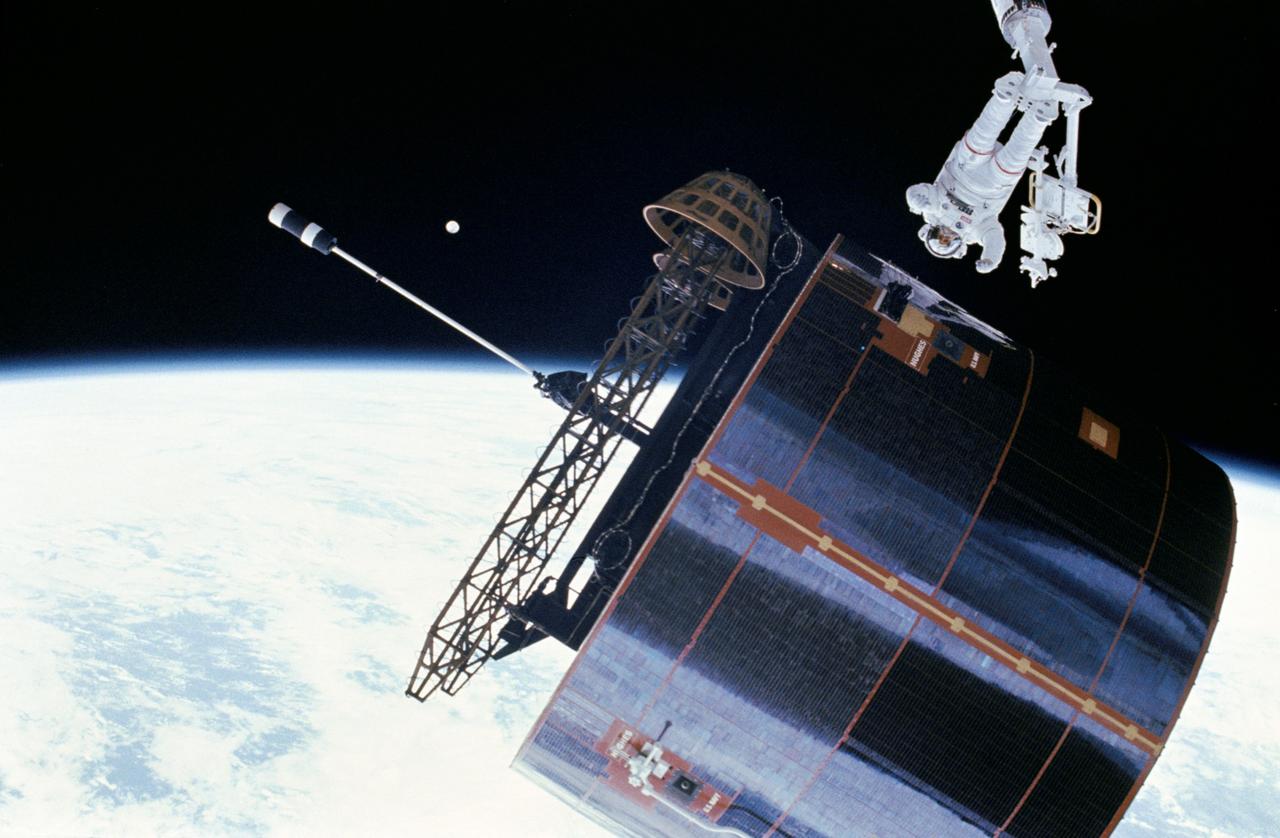
51I-102-029 (31 August - 1 September 1985) --- This is one of a series of six photographs released by NASA covering the extravehicular activity (EVA) of astronauts James D. van Hoften and William F. Fisher, who helped to capture, repair and release the previously errant Syncom IV-3 communications satellite. Here, Dr. van Hoften has just given a shove to the the Syncom. (For orientation, moon should be in lower right quadrant).
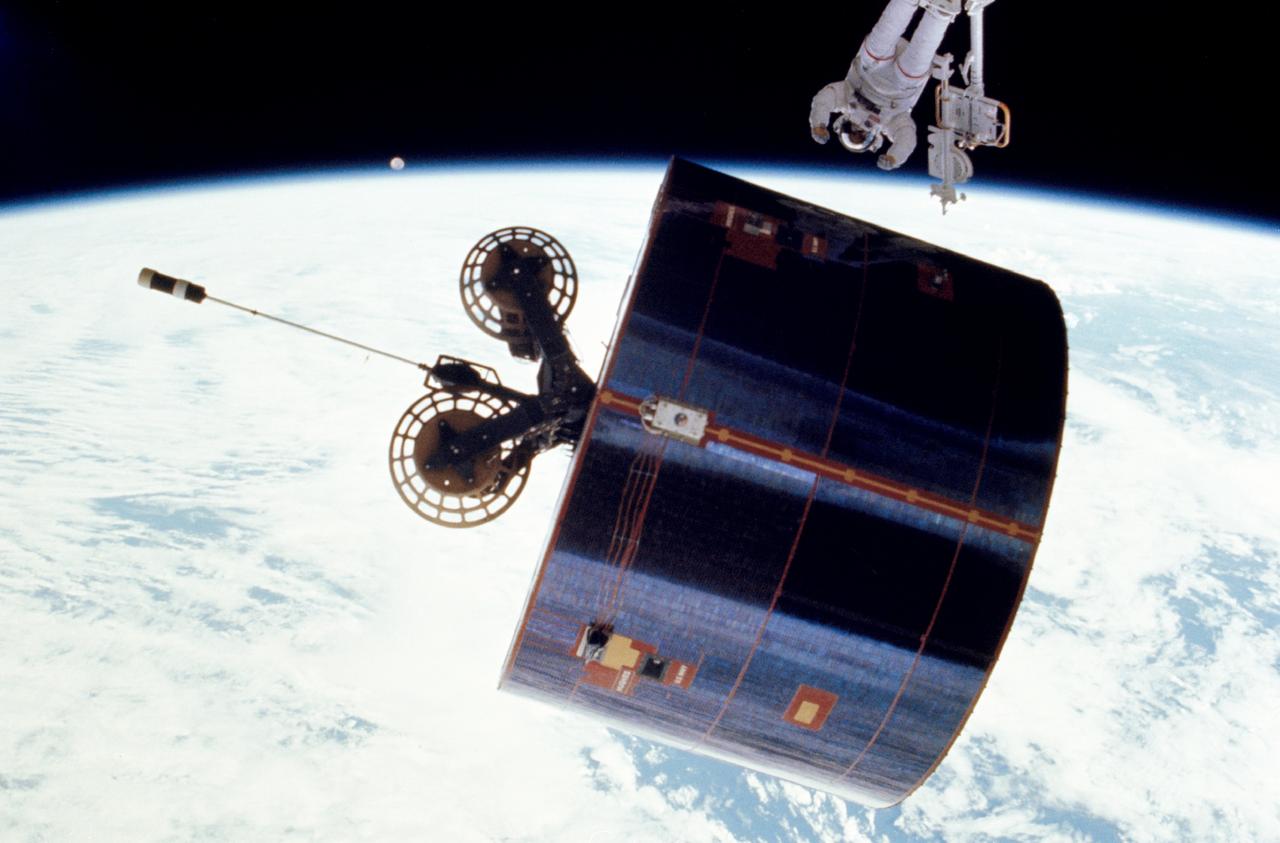
51I-102-033 (31 August - 1 September 1985) --- This is one of a series of six photographs released by NASA covering the extravehicular activity (EVA) of astronauts James D. van Hoften and William F. Fisher, who helped to capture, repair and release the previously errant Syncom IV-3 communications satellite. Here, Dr. van Hoften has just given a shove to the the Syncom. (For orientation, moon should be in lower right quadrant).
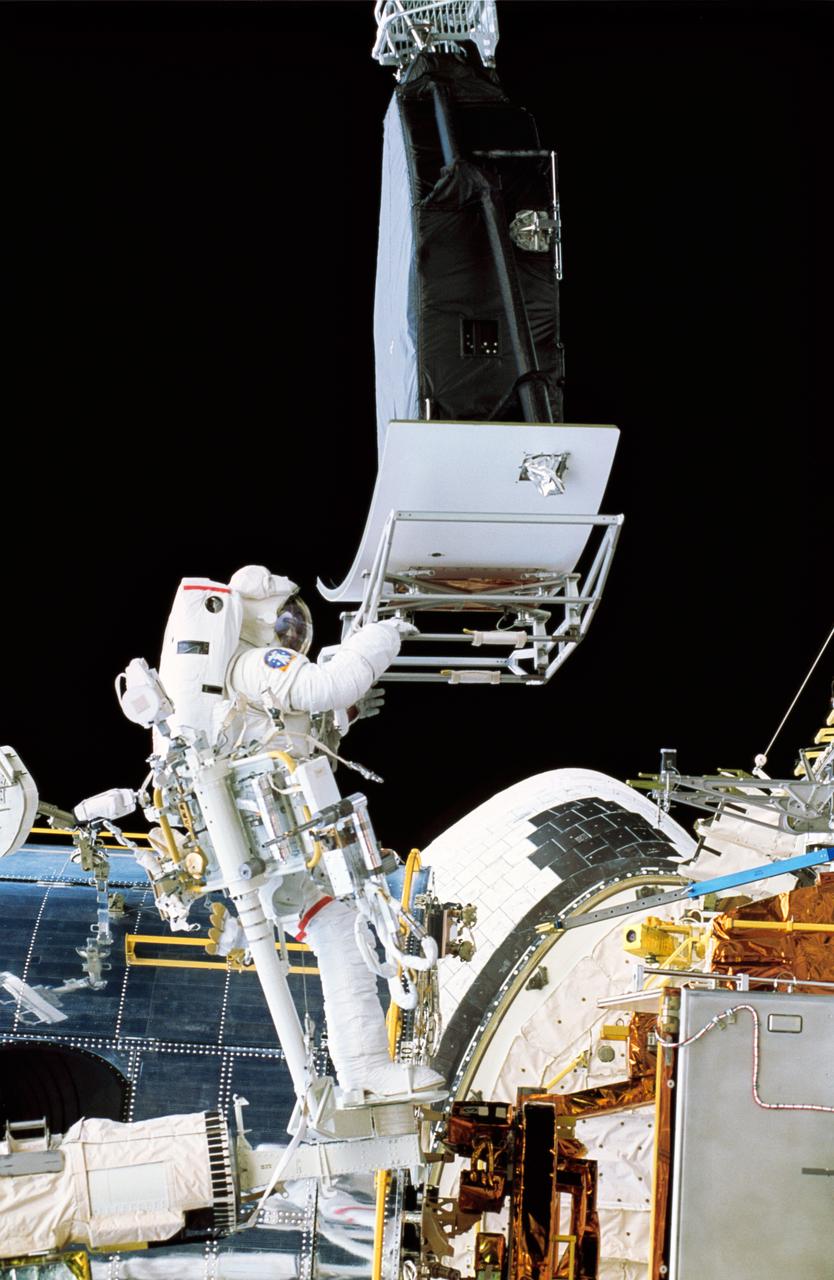
STS061-37-011 (7 Dec 1993) --- Astronaut Jeffrey A. Hoffman with Wide Field/Planetary Camera (WF/PC 1) during changeout operations. WF/PC-2 has already been installed in cavity (out of frame). Astronauts Hoffman and Story Musgrave are performing Extravehicular Activities (EVA) to repair the Hubble Space Telescope (HST).
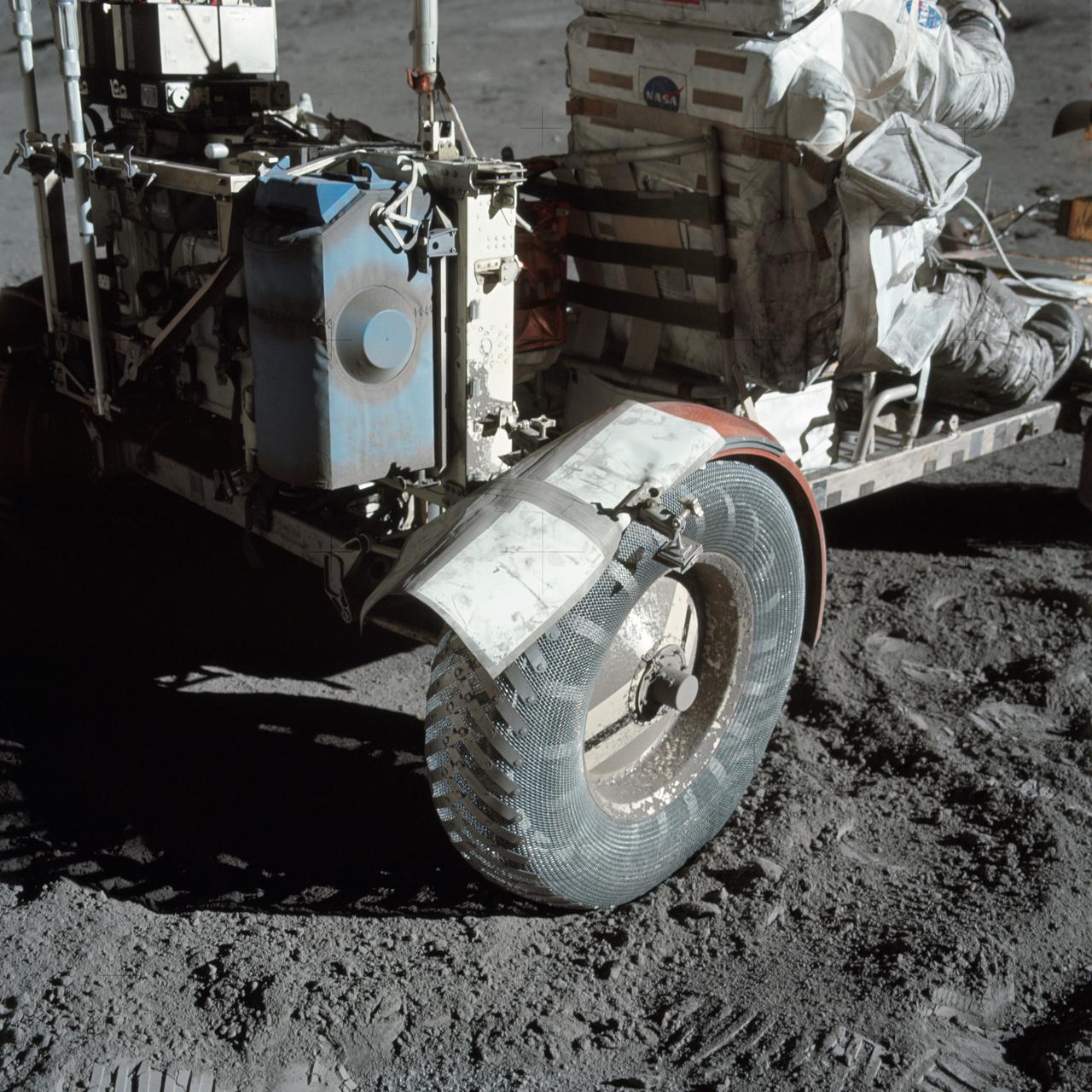
AS17-137-20979 (12 Dec. 1972) --- A close-up view of the lunar roving vehicle (LRV) at the Taurus-Littrow landing site photographed during Apollo 17 lunar surface extravehicular activity. Note the makeshift repair arrangement on the right rear fender of the LRV. During EVA-1 a hammer got underneath the fender and a part of it was knocked off. Astronauts Eugene A. Cernan and Harrison H. Schmitt were reporting a problem with lunar dust because of the damage fender. Following a suggestion from astronaut John W. Young in the Mission Control Center at Houston the crewmen repaired the fender early in EVA-2 using lunar maps and clamps from the optical alignment telescope lamp. Schmitt is seated in the rover. Cernan took this picture.
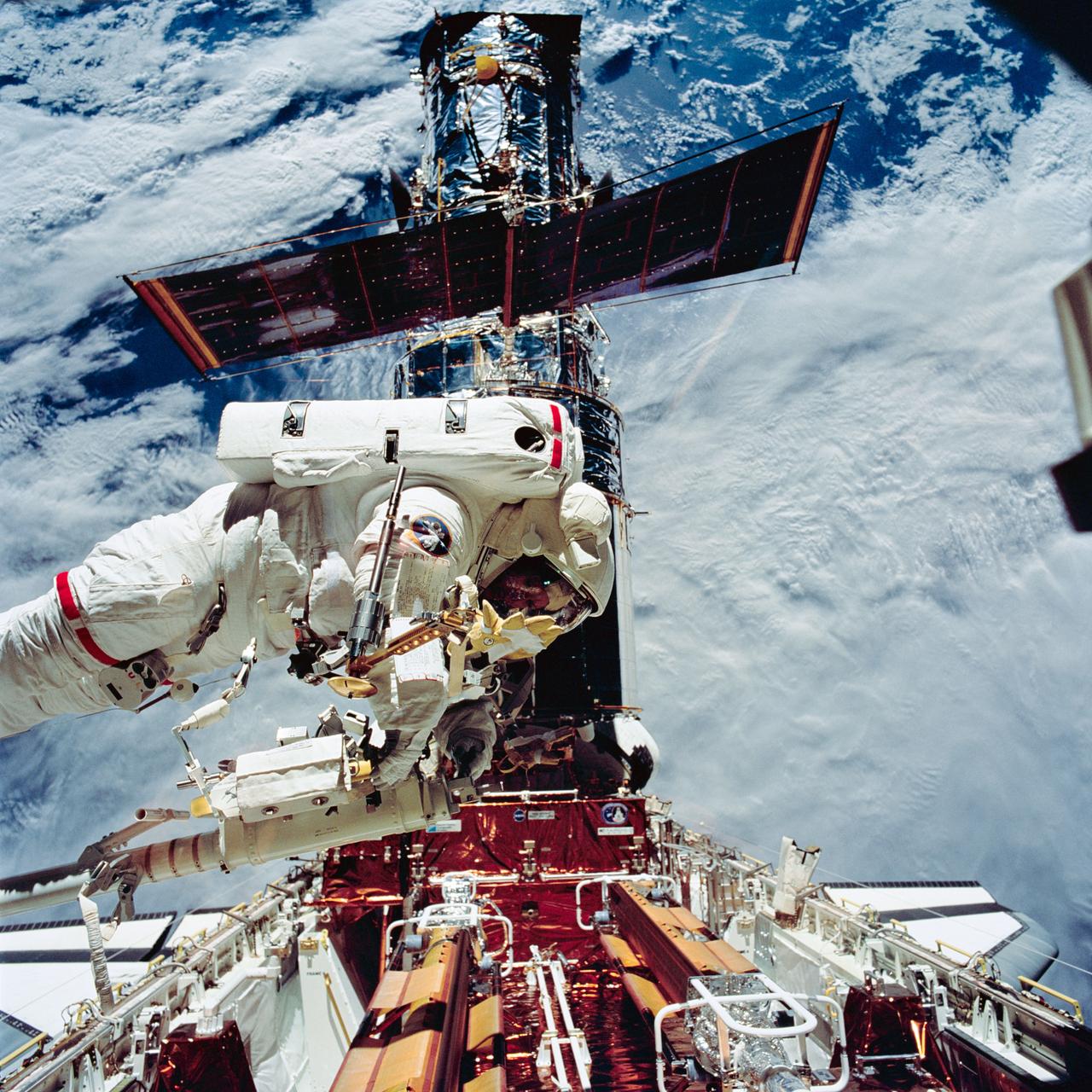
STS061-95-028 (6 Dec 1993) --- Astronaut Kathryn C. Thornton, on the end of the Space Shuttle Endeavour's Remote Manipulator System (RMS) arm, hovers over equipment associated with servicing chores on the Hubble Space Telescope (HST) during the second extravehicular activity (EVA) on the eleven-day mission. Astronauts Thornton and Thomas D. Akers changed out the solar array panels during this EVA.
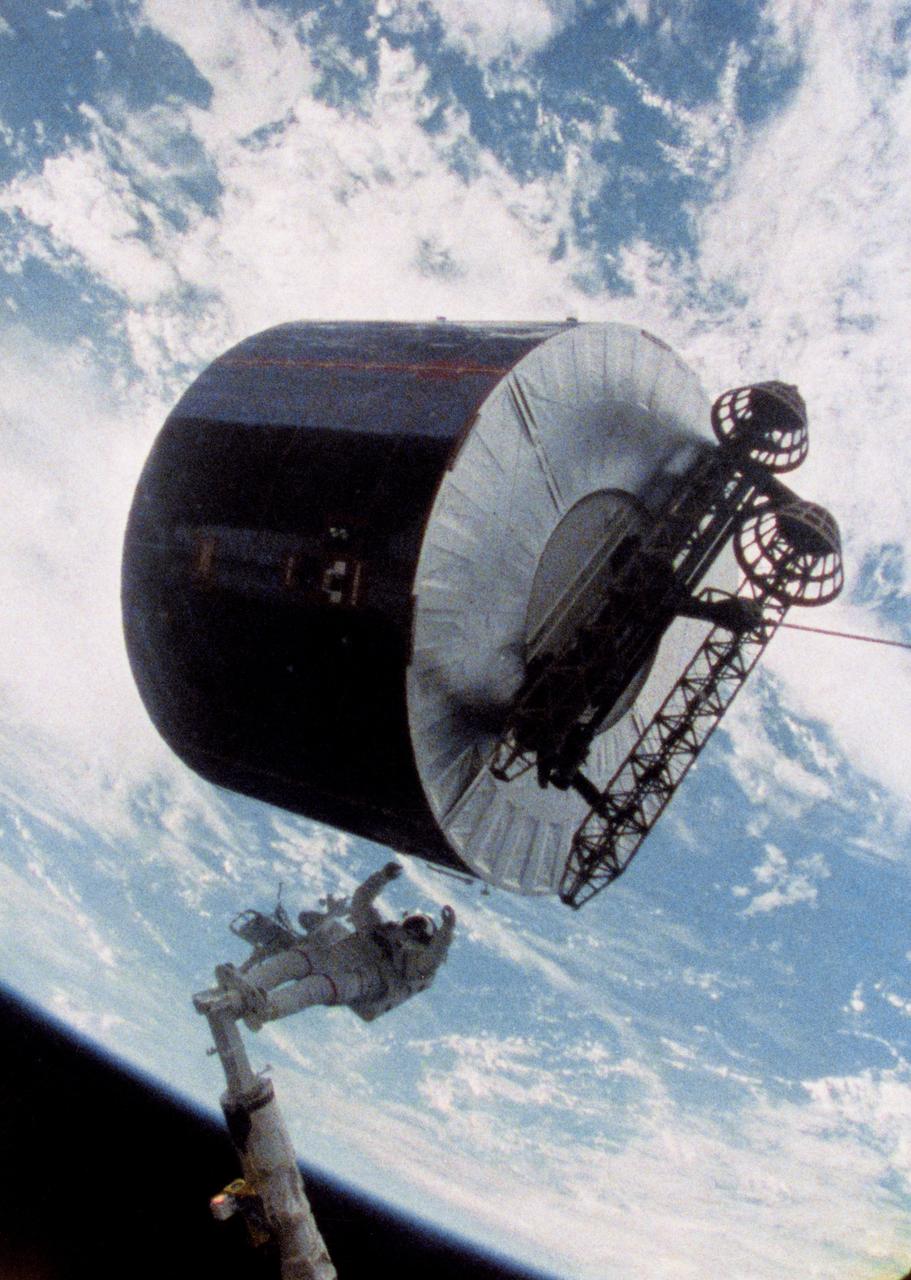
51I-S-237 (1 Sept. 1985) --- A still photo made from a video downlink shows astronaut James D. van Hoften, just after giving a shove to the Syncom IV-3 communications satellite. NASA's 51-I astronaut crew aboard the space shuttle Discovery had earlier captured and repaired the previously errant satellite. Photo credit: NASA
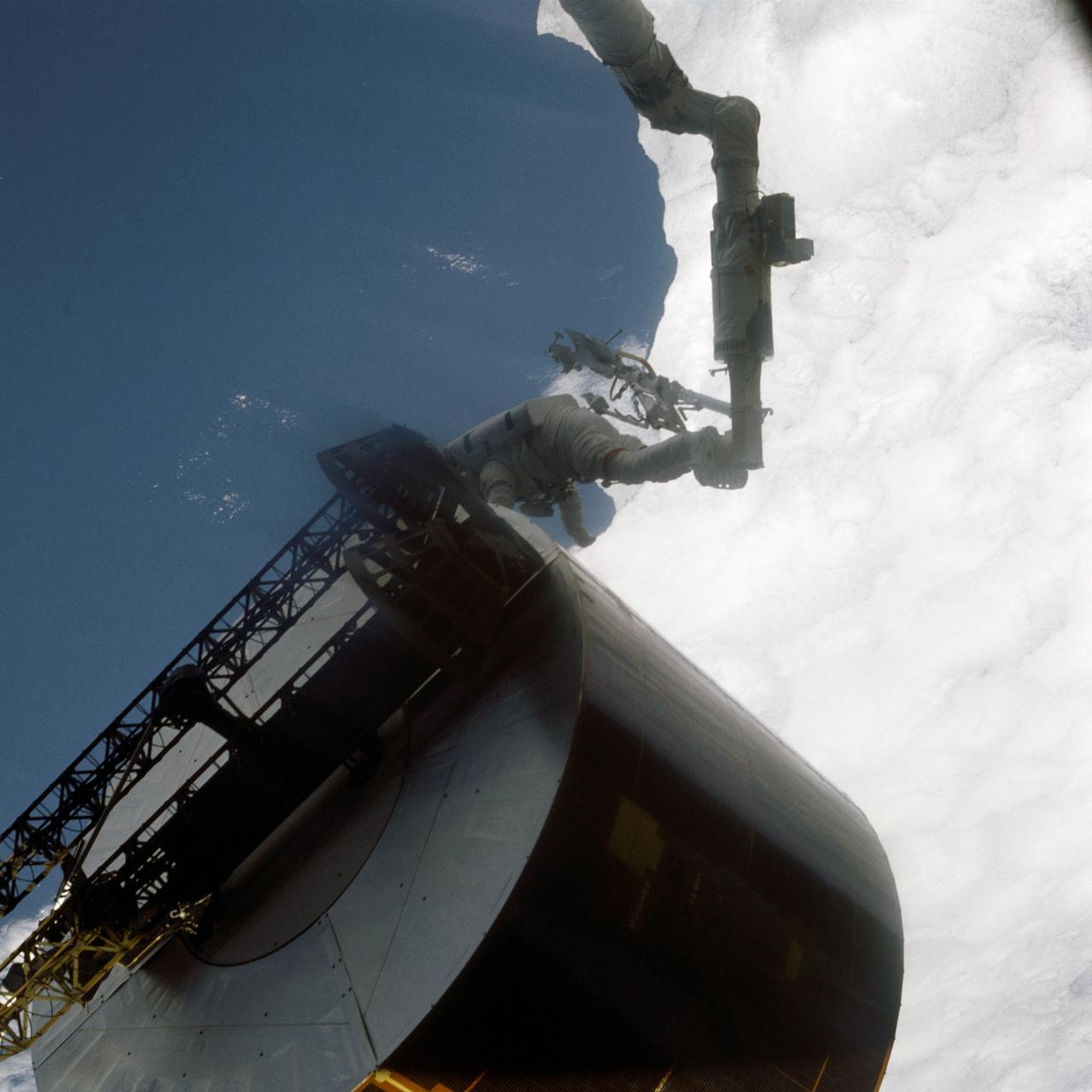
51I-44-014 (31 Aug-1 Sept. 1985) --- This photograph is one of a series of six covering extravehicular activity (EVA) which were released by NASA on Sept. 4, 1985. Here, astronaut James D. van Hoften, dwarfed by the large satellite, moves in for initial contact. Astronaut John M. (Mike) Lounge, out of frame inside cabin, maneuvers the remote manipulator system (RMS) arm to assist astronauts van Hoften and William F. Fisher. Photo credit: NASA
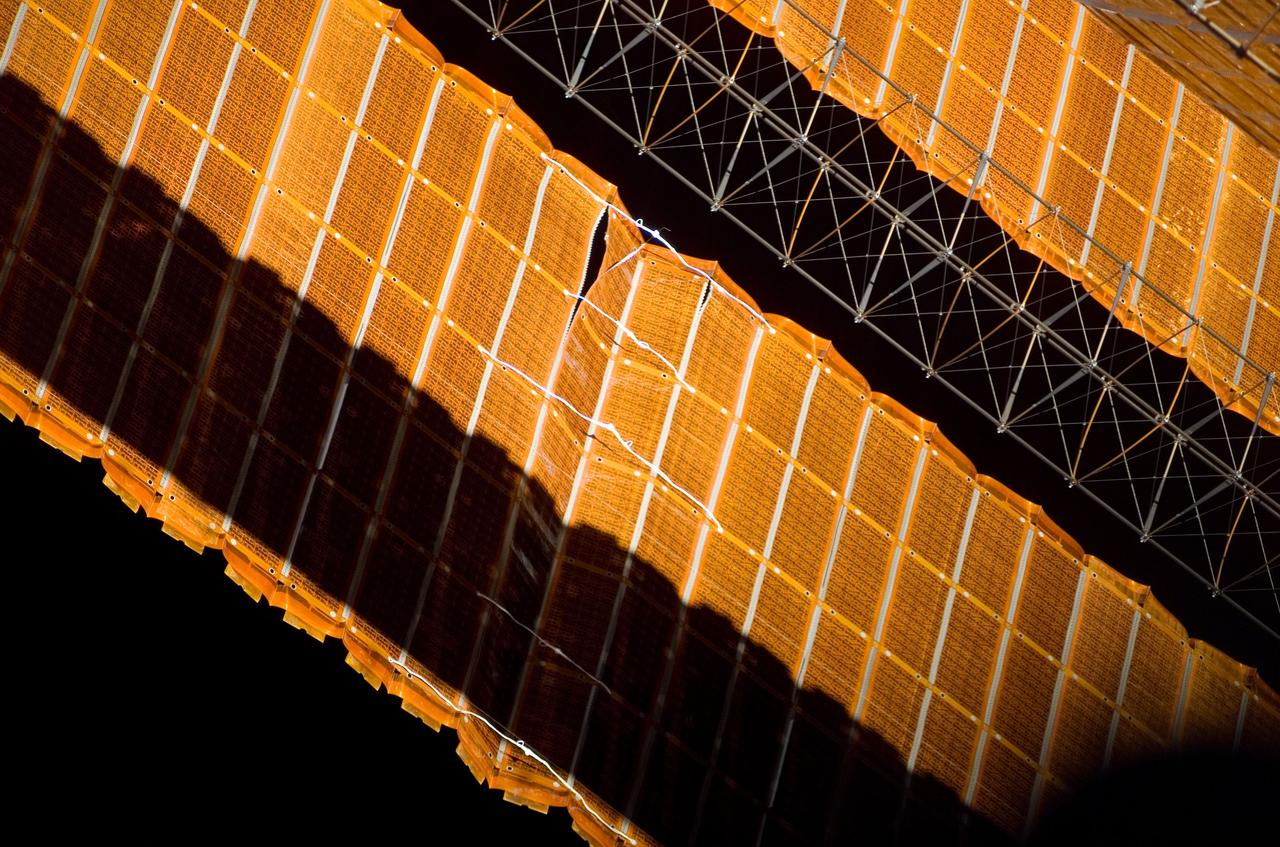
ISS016-E-009201 (3 Nov. 2007) --- View of the repaired solar array photographed during the STS-120 mission's fourth session of extravehicular activity (EVA) while Space Shuttle Discovery is docked with the International Space Station.
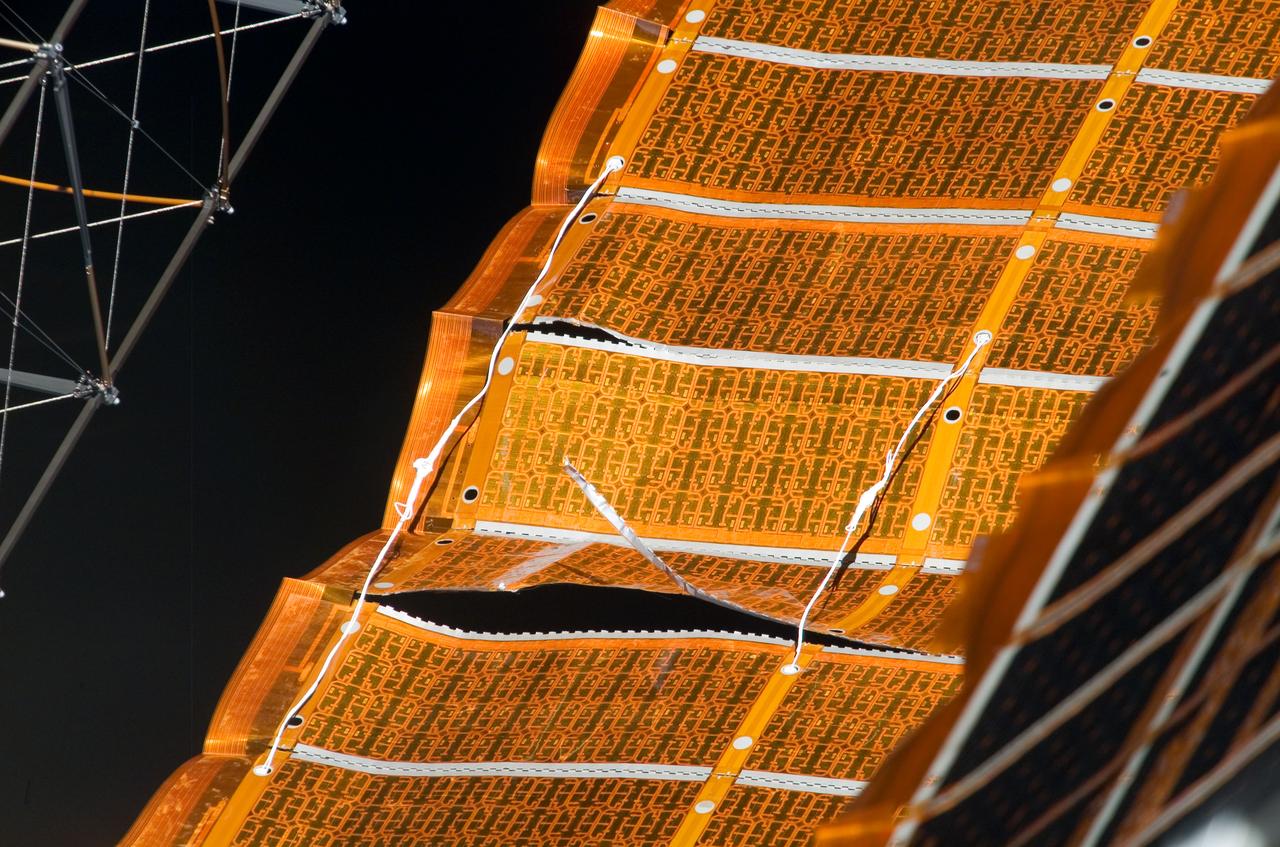
ISS016-E-008875 (3 Nov. 2007) --- View of the repaired solar array photographed during the STS-120 mission's fourth session of extravehicular activity (EVA) while Space Shuttle Discovery is docked with the International Space Station.
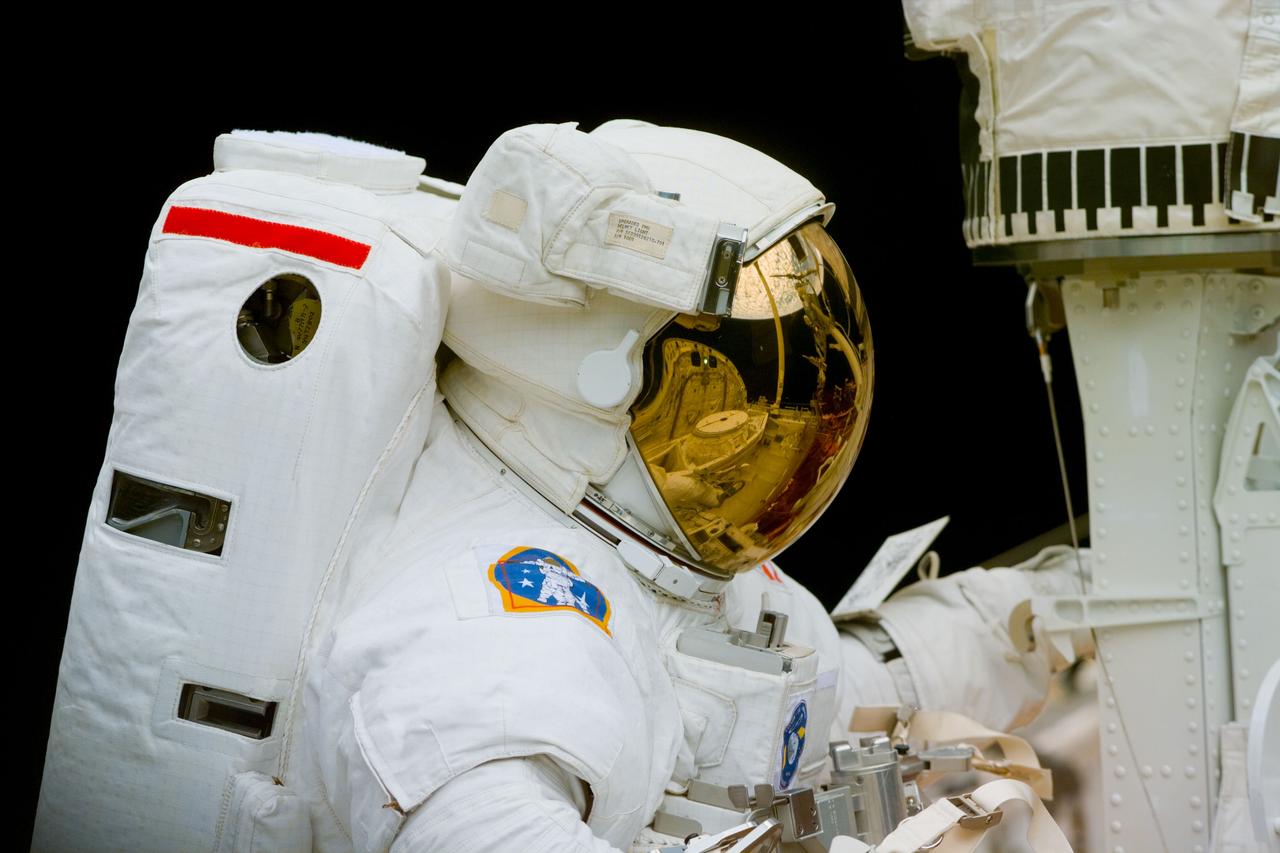
S82-E-5283 (14 Feb. 1997) --- Close-up of astronaut Mark C. Lee during Extravehicular Activity (EVA) of the Hubble Space Telescope (HST) repair mission. This view was taken with an Electronic Still Camera (ESC).
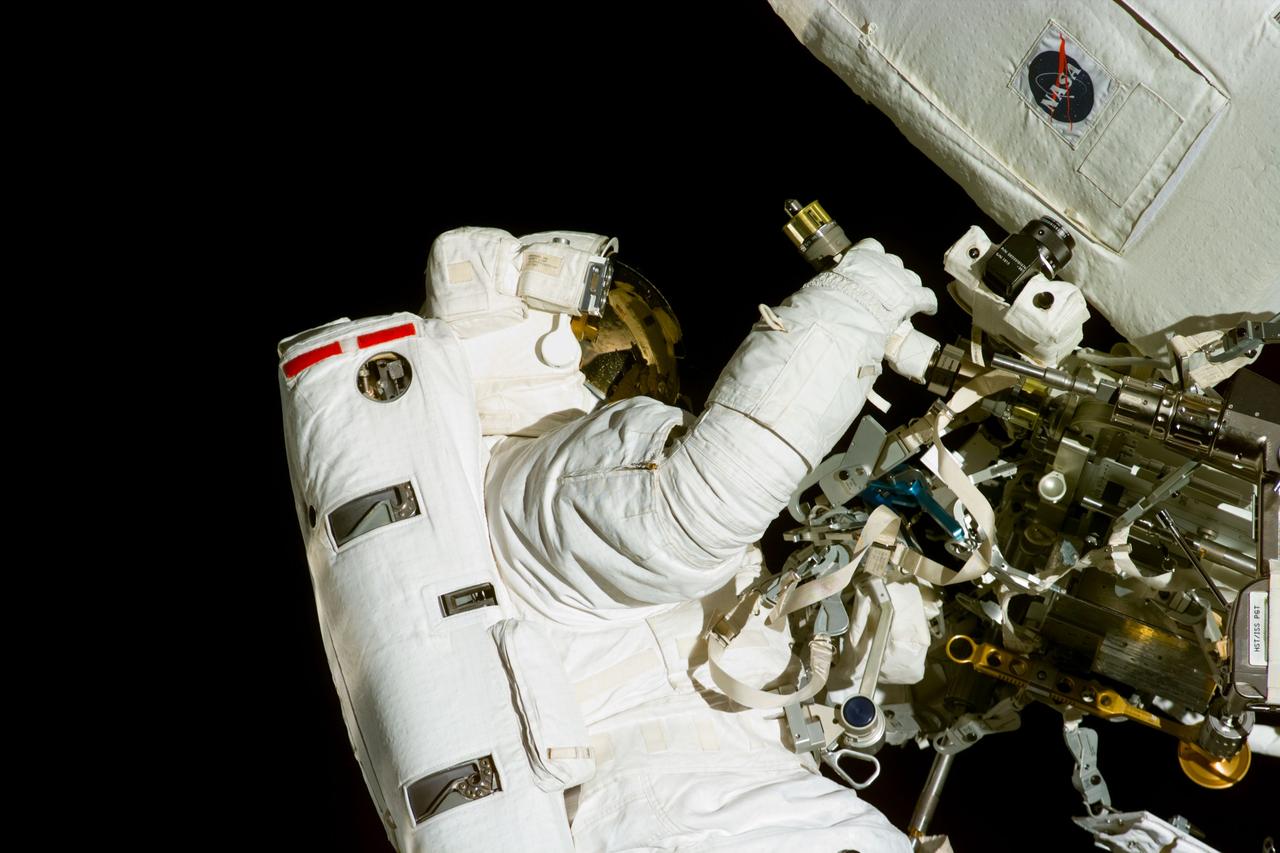
S82-E-5419 (15 Feb. 1997) --- Close-up of astronaut Gregory J. Harbaugh during Extravehicular Activity (EVA) for repair of the Hubble Space Telescope (HST). This view was taken with an Electronic Still Camera (ESC).
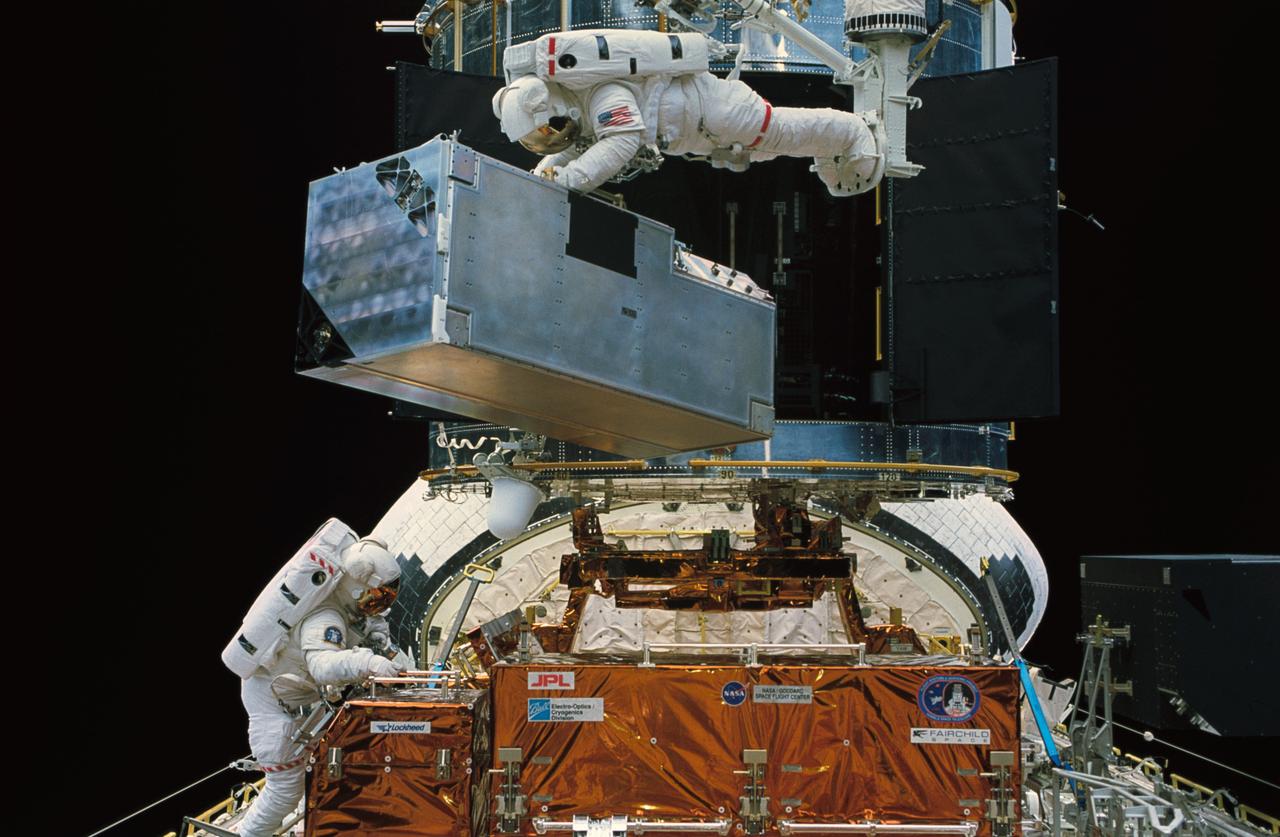
STS061-47-014 (8 Dec 1993) --- Astronaut Kathryn C. Thornton lifts the Corrective Optics Space Telescope Axial Replacement (COSTAR) prior to its installation on the Hubble Space Telescope (HST). Thornton is anchored to a foot restraint on the end of the Remote Manipulator System (RMS) arm. Astronaut Thomas D. Akers, who assisted in the COSTAR installation, is at lower left.
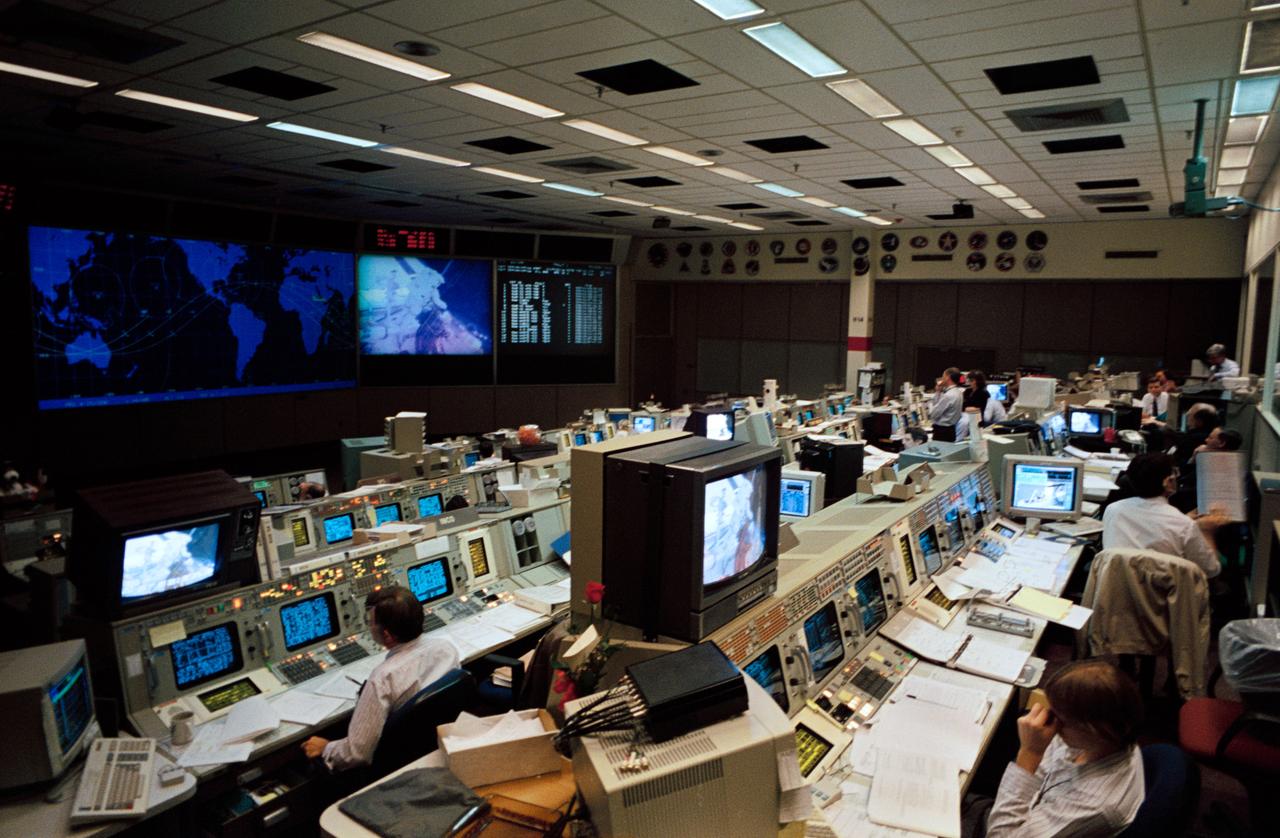
STS61-S-093 (5 Dec 1993) --- Flight controller Kevin McCluney monitors the televised activity of astronauts F. Story Musgrave and Jeffrey A. Hoffman. The veteran astronauts were performing the first extravehicular activity (EVA-1) of the STS-61 Hubble Space Telescope (HST) servicing mission. McCluney's duties deal with maintenance, mechanical, arm and crew systems, meaning that he and his colleagues will be exceptionally busy for the next five days. Four astronauts in alternating pairs will perform a variety of tasks on the giant telescope during that period.
S73-27562 (June 1973) --- Scientist-astronaut Joseph P. Kerwin, Skylab 2 science pilot, performs extravehicular activity (EVA) at the Skylab 1 and 2 space station cluster in Earth orbit, as seen in this reproduction taken from a color television transmission made by a TV camera aboard the station. Kerwin is just outside the Airlock Module. Kerwin assisted astronaut Charles Conrad Jr., Skylab 2 commander, during the successful EVA attempt to free the stuck solar array system wing on the Orbital Workshop. Photo credit: NASA
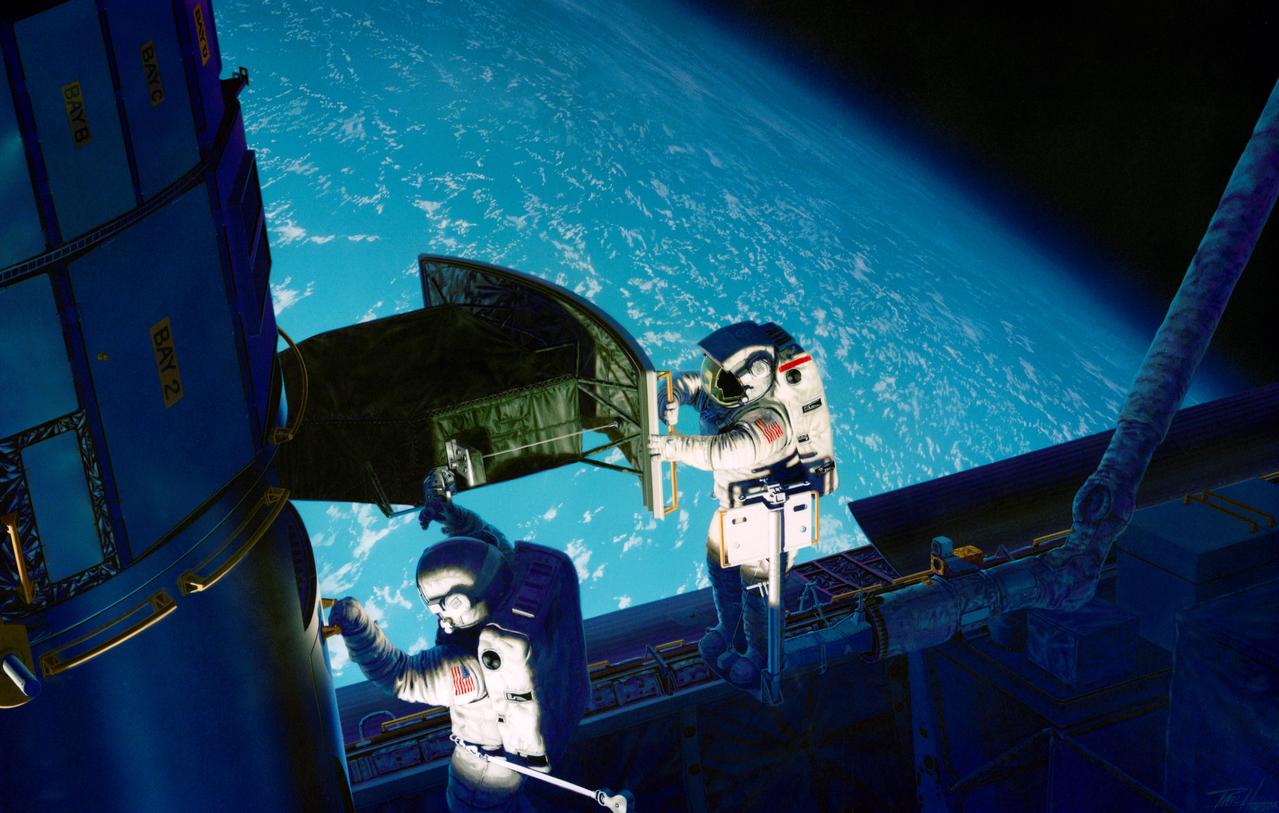
S93-48826 (November 1993) --- This artist's rendition of the 1993 Hubble Space Telescope (HST) servicing mission shows astronauts installing the new Wide Field/Planetary Camera (WF/PC 2). The instruments to replace the original camera and contains corrective optics that compensate for the telescope's flawed primary mirror. During the 11-plus day mission, astronauts are also scheduled to install the Corrective Optics Space Telescope Axial Replacement (COSTAR) -- an optics package that focuses and routes light to the other three instruments aboard the observatory -- a new set of solar array panels, and other hardware and components. The artwork was done for JPL by Paul Hudson.
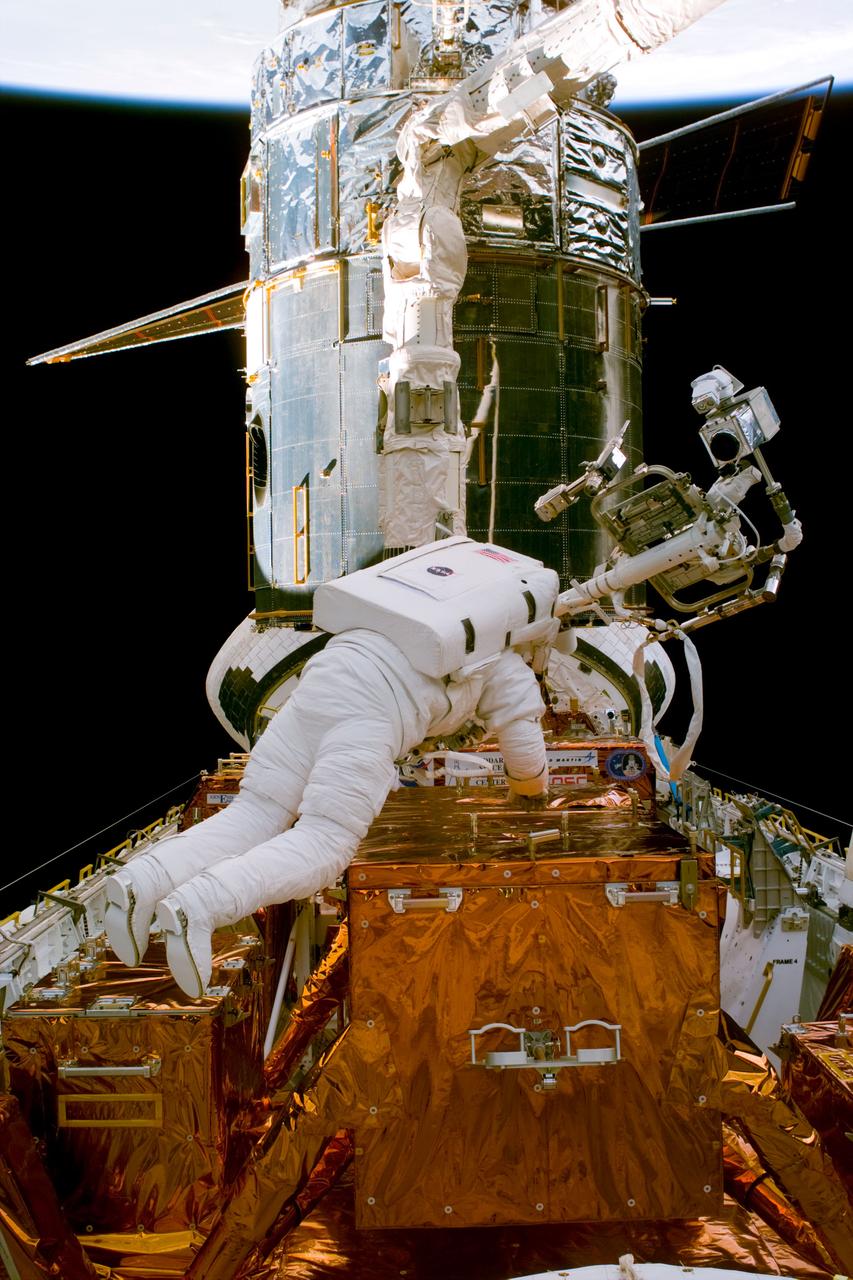
S82-E-5278 (14 Feb. 1997) --- Astronaut Steven L. Smith, STS-82 mission specialist, during Extravehicular Activity (EVA) setup, for the Hubble Space Telescope (HST) repair. This view was taken with an Electronic Still Camera (ESC).
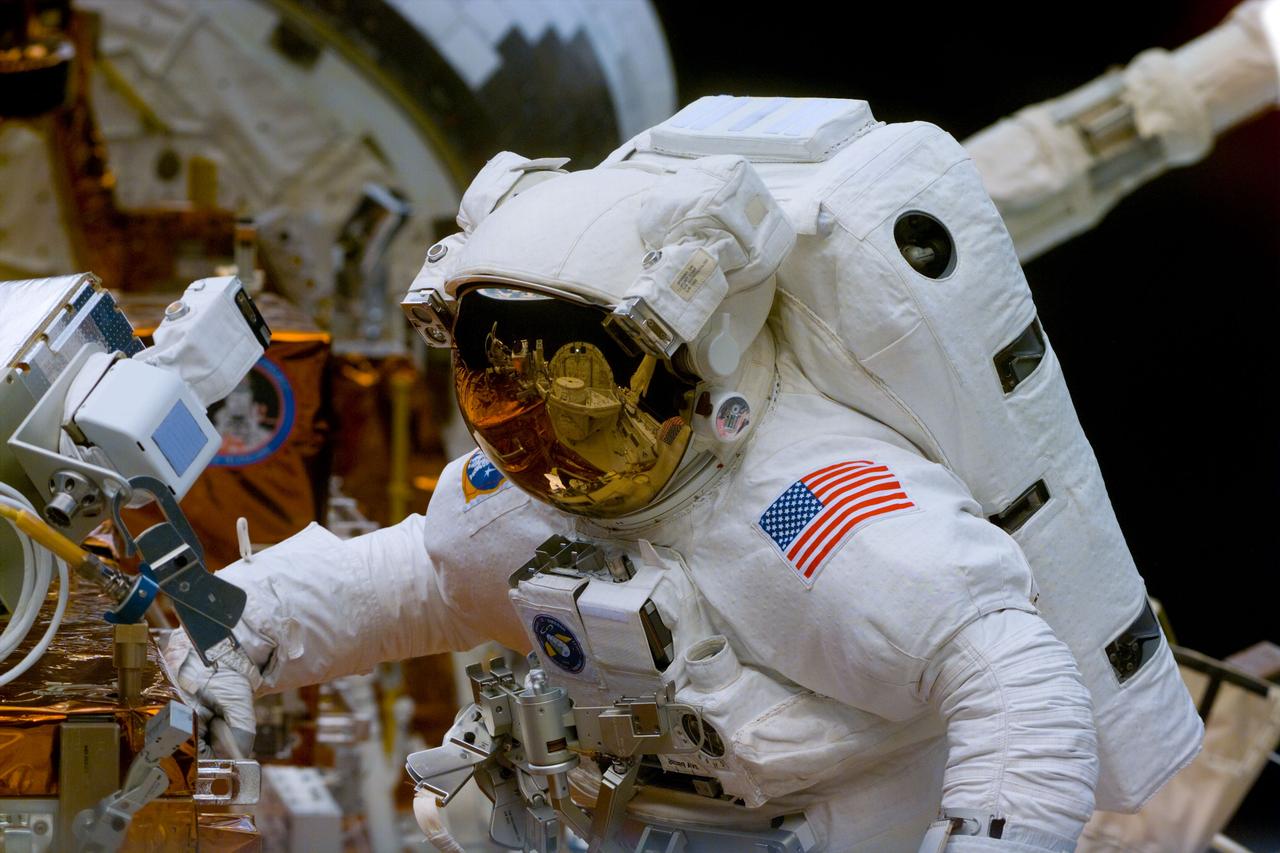
S82-E-5303 (14 Feb. 1997) --- Close-up of astronaut Steven L. Smith, STS-82 mission specialist, during Extravehicular Activity (EVA), for the Hubble Space Telescope (HST) repair. This view was taken with an Electronic Still Camera (ESC).
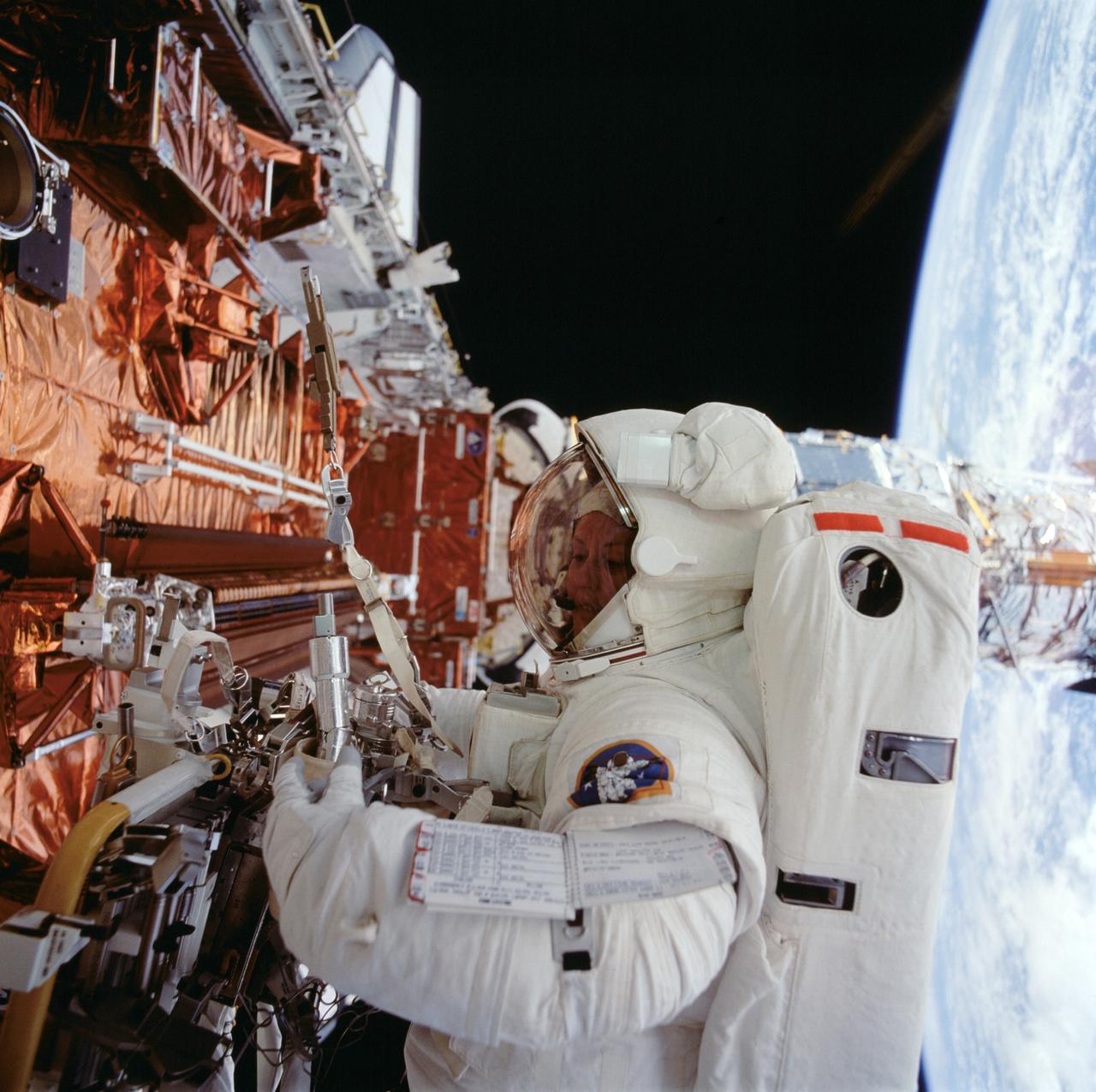
STS061-098-000K (8 Dec. 1993) --- Astronaut Kathryn C. Thornton works with equipment associated with servicing chores on the Hubble Space Telescope (HST) during the fourth extravehicular activity (EVA) on the eleven-day mission.

Astronat Dale A. Gardner achieves a hard dock with the previously spinning Westar VI satellite. Gardner uses a "stinger" device to stabilize the communications satellite.

51A-104-008 (14 Nov 1984) --- Astronaut Dale A. Gardner appears to be under the remote manipulator system (RMS) end effector as he makes a turn in space and prepared to traverse, using the manned maneuvering unit (MMU) backpack, to the nearby Westar VI to "Sting" it with the device he carries. The stringer will enter the communications satellite through the nozzle of the spent motor. Gardner achieved a hard dock at 6:32 A.M. and this picture was photographed about five minutes earlier, on Nov. 14, 1984.
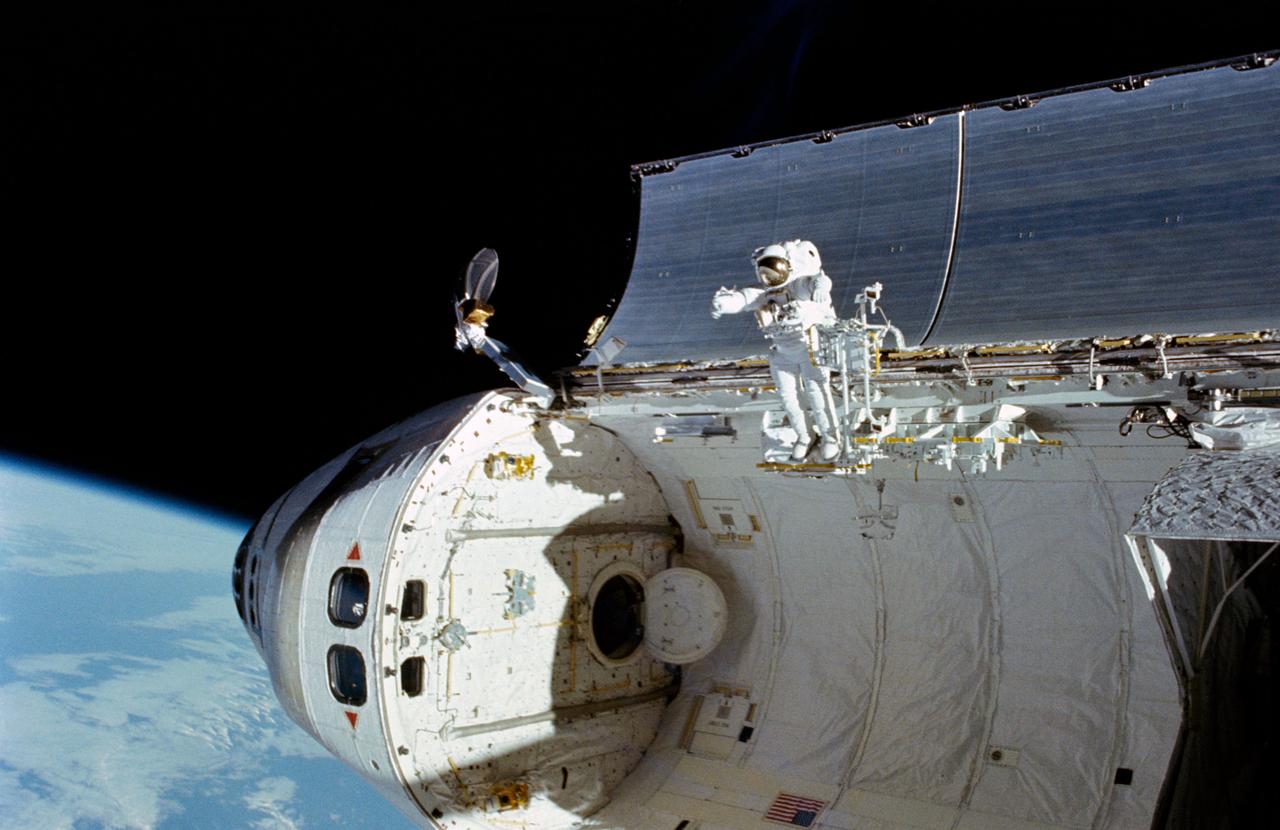
51I-102-048 (4-5 Sept 1985) --- A 35mm frame showing astronaut William F. Fisher standing on the edge of Discovery's cargo bay (in foot restraint) during the second day of a two-day effort to capture, repair and re-release the Syncom IV-3 communications satellite. Astronaut James D. van Hoften, standing on the Discovery's RMS arm, exposed the frame.
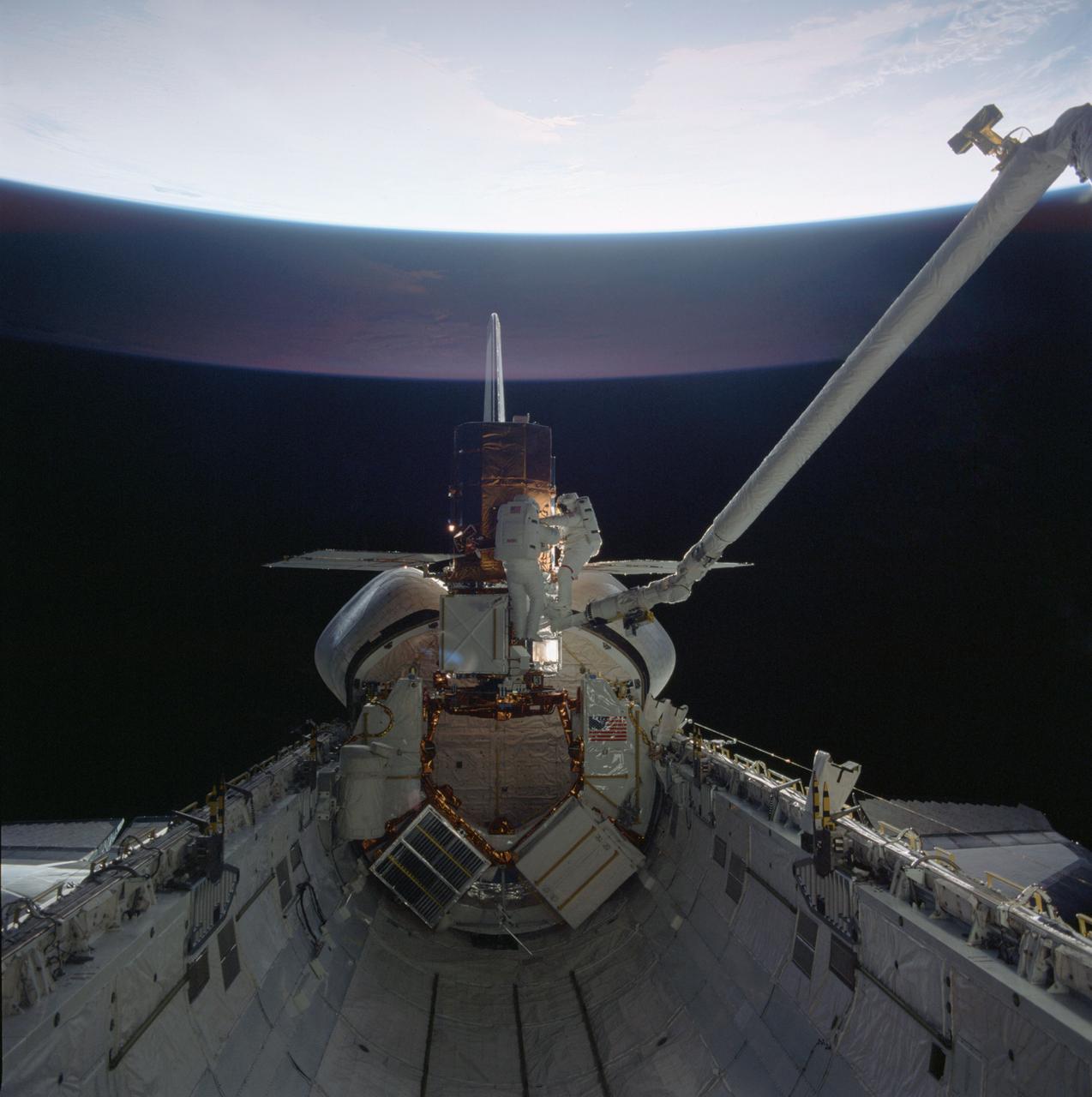
41C-37-1711 (11 April 1984) --- The two mission specialist-EVA participants of Flight 41-C share a repair task at the "captured" Solar Maximum Mission Satellite (SMMS) in the aft end of the Challenger's cargo bay. Astronauts George D. Nelson, right, and James D. van Hoften uses the mobile foot restraint and the Remote Manipulator System (RMS) as a "cherry picker" device for moving about. Later, the RMS lifted the SMMS into space once more.
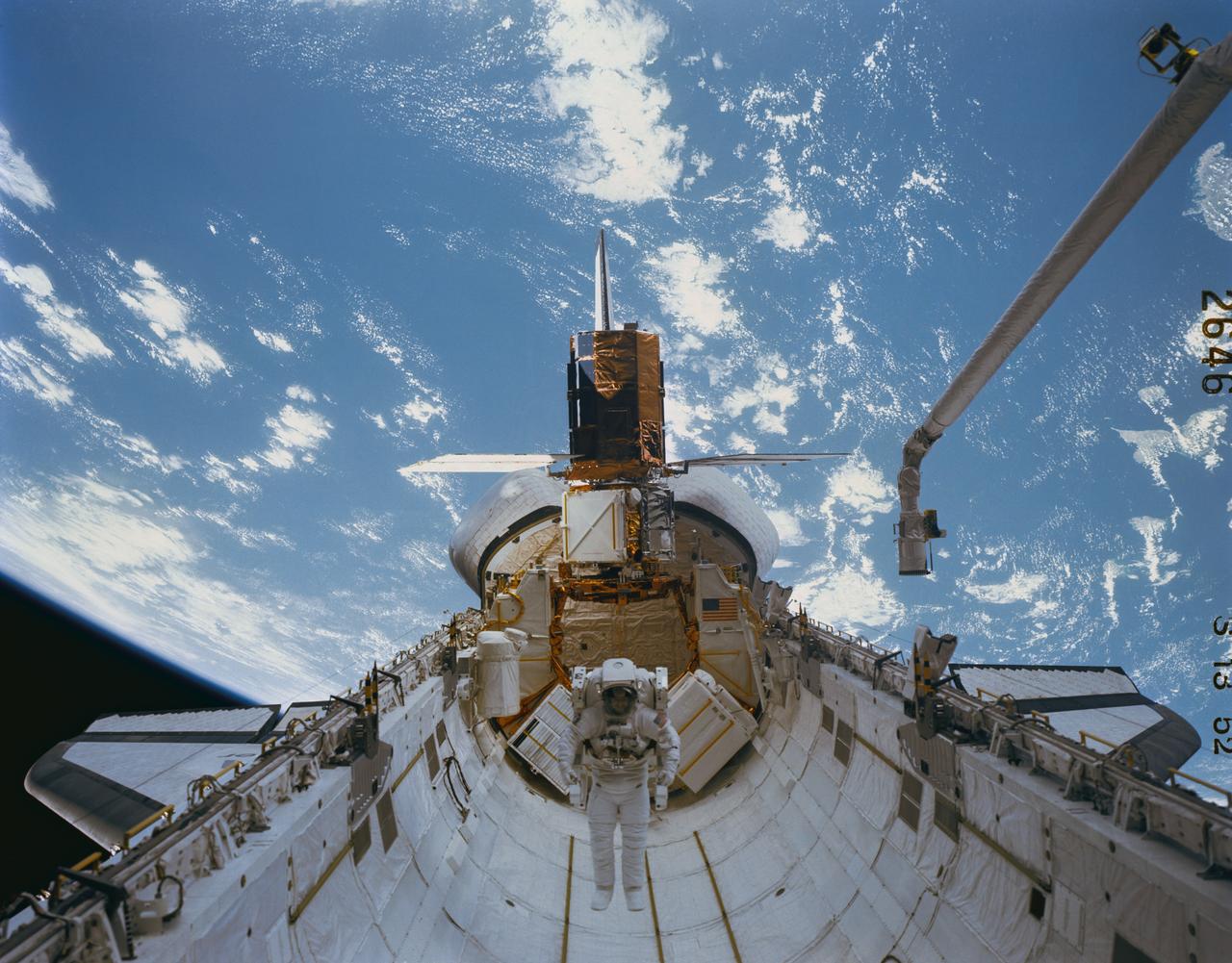
41C-52-2646 (11 April 1984) --- Astronaut James D. van Hoften and a repaired satellite are in a wide panorama recorded on film with a Linhof camera, making its initial flight aboard the Space Shuttle Challenger. Dr. van Hoften is getting in his first "field" test of the Manned Maneuvering Unit (MMU) after months of training in an underwater facility and in a simulator on Earth. The Solar Maximum Mission Satellite (SMMS), revived and almost ready for release into space once more, is docked at the Flight Support System (FSS). The Remote Manipulator System (RMS) is backdropped against the blue and white Earth at frame's edge. Outside of pictures made of the Earth from astronauts on the way to the Moon, this frame showing the planet from 285 nautical miles represents the highest orbital photography in the manned space program.
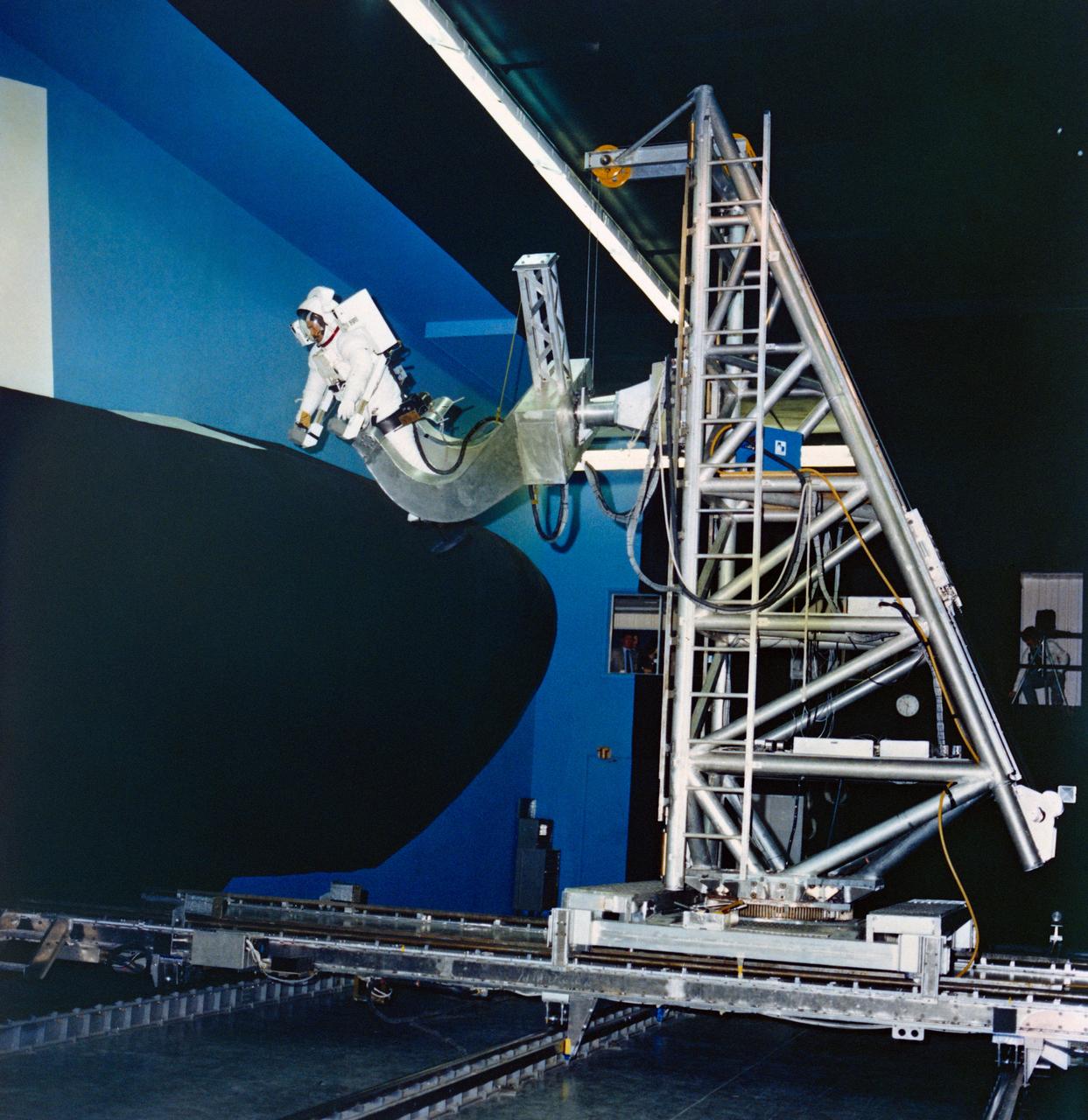
S80-36889 (24 July 1980) --- Astronaut Bruce McCandless II uses a simulator at Martin Marietta?s space center near Denver to develop flight techniques for a backpack propulsion unit that will be used on Space Shuttle flights. The manned maneuvering unit (MMU) training simulator allows astronauts to "fly missions" against a full scale mockup of a portion of the orbiter vehicle. Controls of the simulator are like those of the actual MMU. Manipulating them allows the astronaut to move in three straight-line directions and in pitch, yaw and roll. One possible application of the MMU is for an extravehicular activity chore to repair damaged tiles on the vehicle. McCandless is wearing an extravehicular mobility unit (EMU).
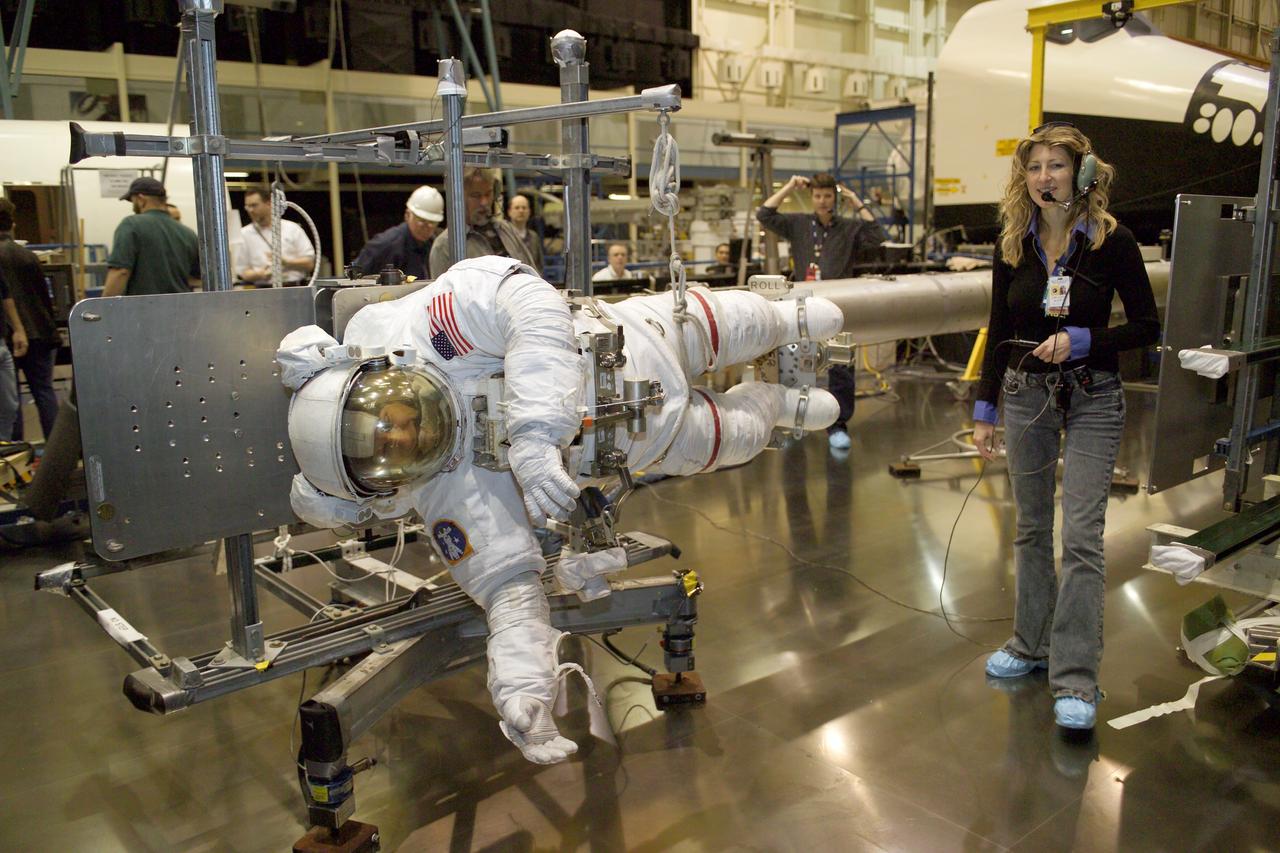
JSC2005-E-08196 (25 February 2005) --- Astronaut Piers J. Sellers, STS-121 mission specialist, wearing a training version of the Extravehicular Mobility Unit (EMU) space suit, participates in an extravehicular activity (EVA) simulation while anchored on the end of the training version of the space shuttle Remote Manipulator System (RMS) robotic arm in the Space Vehicle Mockup Facility at Johnson Space Center. The RMS has a 50-foot boom, called the Orbiter Boom Sensor System (OBSS), extension attached which would be used to reach underneath the orbiter to access tiles. Lora Bailey (right), Manager, JSC Engineering Tile Repair, assisted Sellers.
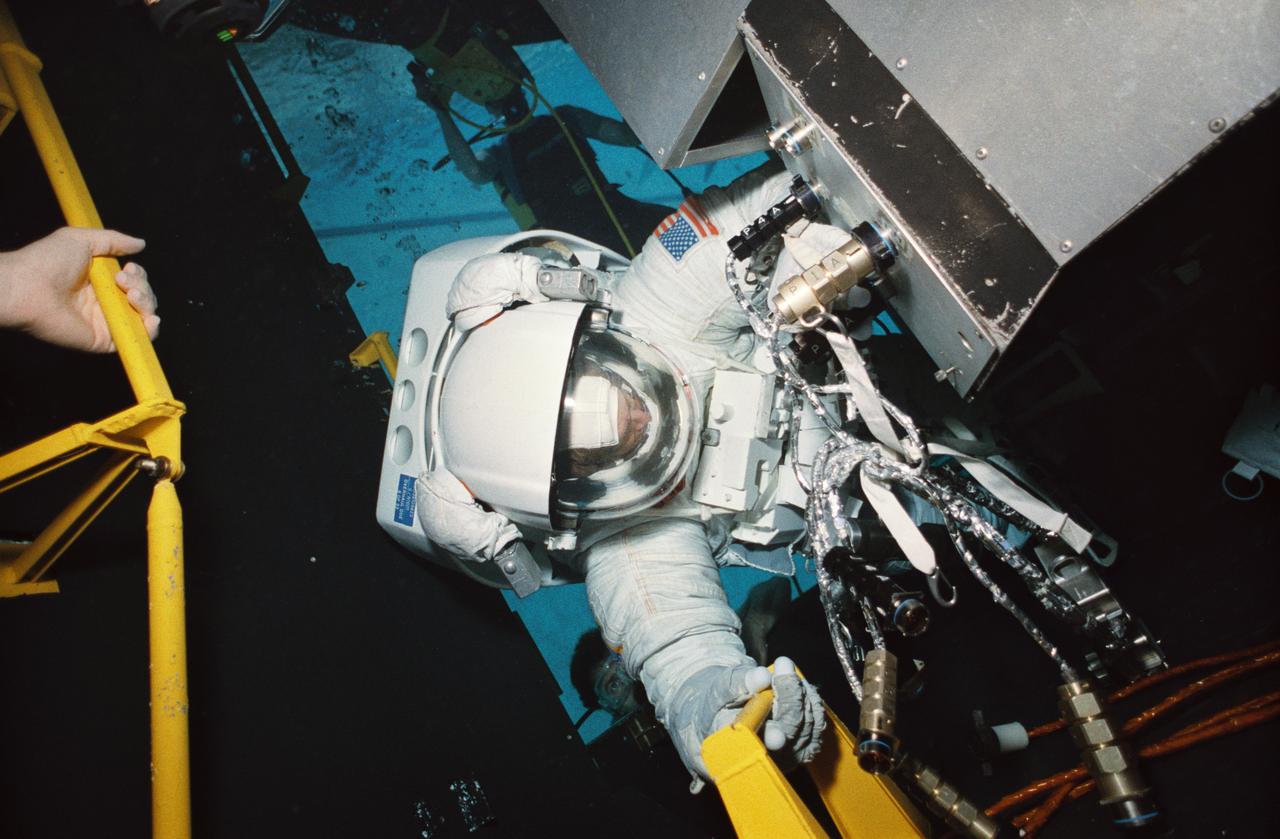
S93-33104 (7 Apr 1993) --- Wearing a training version of Space Shuttle Extravehicular Mobility Unit (EMU), astronaut Jeffrey A. Hoffman uses the giant pool of the Johnson Space Center's (JSC) Weightless Environment Training Facility (WET-F) to rehearse for the Hubble Space Telescope (HST) repair mission. Out of frame is astronaut F. Story Musgrave, who will join Hoffman in STS-61 EVA. The hand at top frame belongs to a SCUBA-equipped diver. A number of divers are on hand for all training sessions in the WET-F. A total of five extravehicular activity (EVA) sessions will be conducted during the scheduled December mission of the Endeavour.
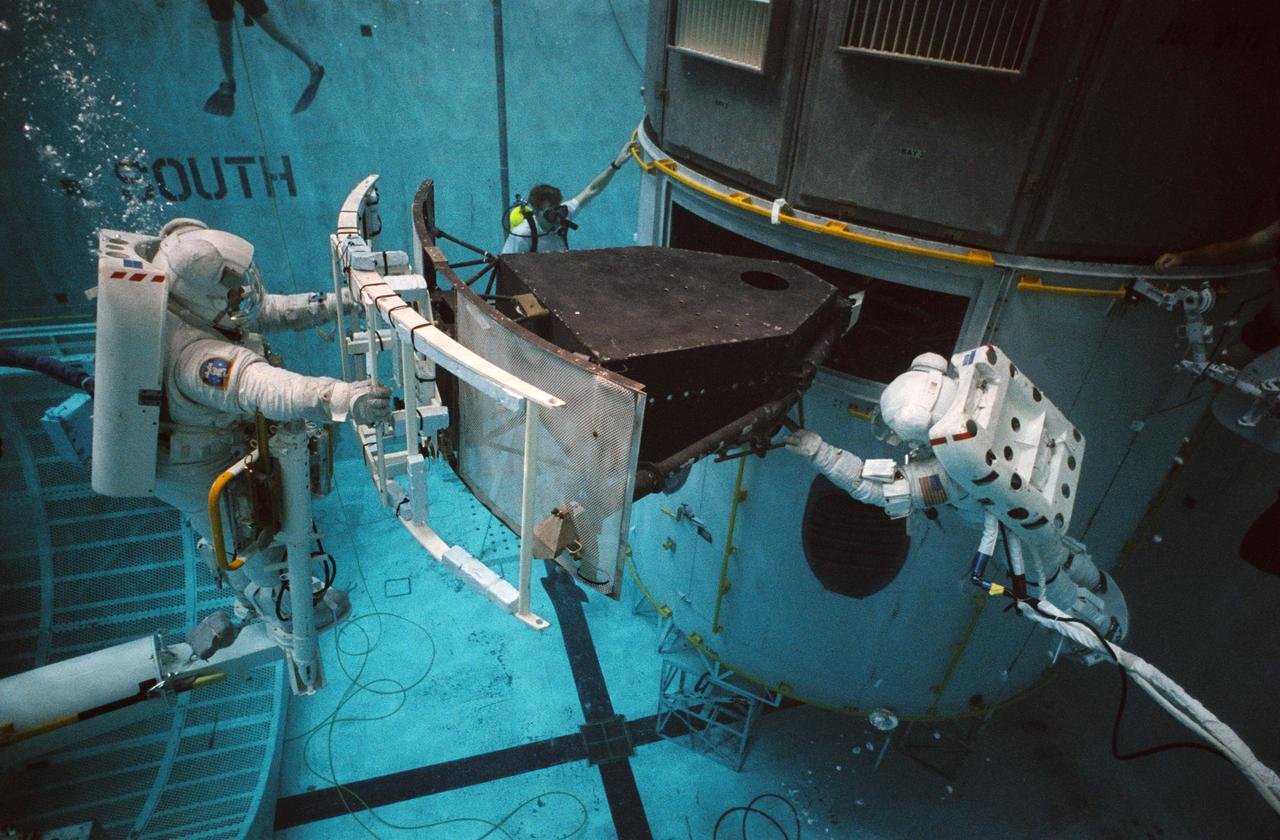
S93-33103 (2 Apr 1993) --- Wearing training versions of Space Shuttle Extravehicular Mobility Units (EMU), astronauts F. Story Musgrave and Jeffrey A. Hoffman use the giant pool of the Johnson Space Center's (JSC) Weightless Environment Training Facility (WET-F) to rehearse for the Hubble Space Telescope (HST) repair mission. The two are working with a full-scale training version of the Wide Field/Planetary Camera (WF/PC). The current WF/PC will be replaced with WF/PC-2. A total of five extravehicular activity (EVA) sessions will be conducted during the scheduled December mission of the Endeavour.
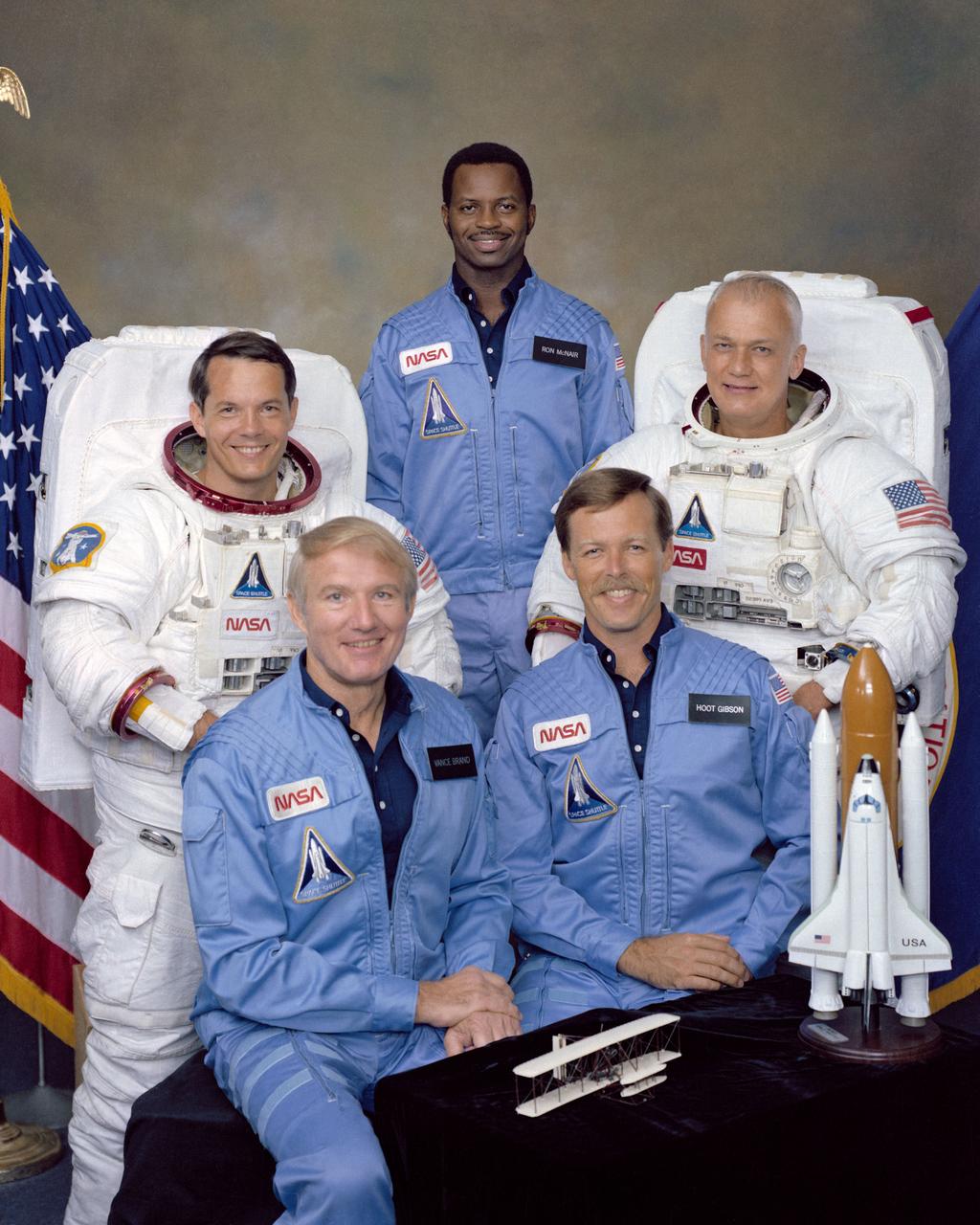
S83-40555 (15 October 1983) --- These five astronauts are in training for the STS-41B mission, scheduled early next year. On the front row are Vance D. Brand, commander; and Robert L. Gibson, pilot. Mission specialists (back row, left to right) are Robert L. Stewart, Dr. Ronald E. McNair and Bruce McCandless II. Stewart and McCandless are wearing Extravehicular Mobility Units (EMU) space suits. The STS program's second extravehicular activity (EVA) is to be performed on this flight, largely as a rehearsal for a scheduled repair visit to the Solar Maximum Satellite (SMS), on a later mission. The Manned Maneuvering Unit (MMU) will make its space debut on STS-41B.
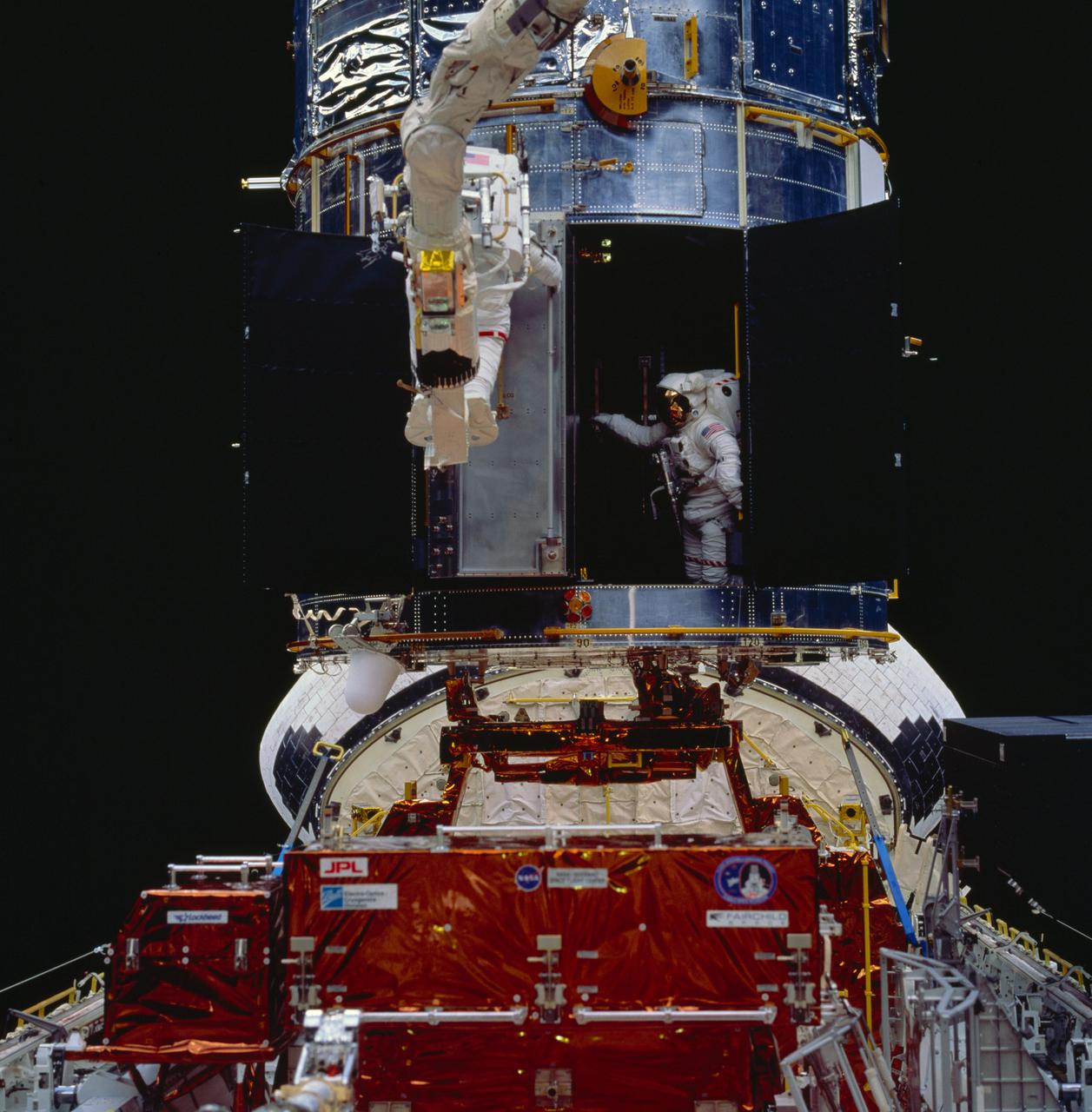
STS061-94-050 (8 Dec 1993) --- Astronaut Thomas D. Akers maneuvers inside the bay which will house the Corrective Optics Space Telescope Axial Replacement (COSTAR) while assisting astronaut Kathryn C. Thornton with the installation of the 640-pound instrument. Thornton, anchored on the end of the Remote Manipulator System (RMS) arm, is partially visible as she prepares to install the COSTAR, during their extravehicular activity (EVA).
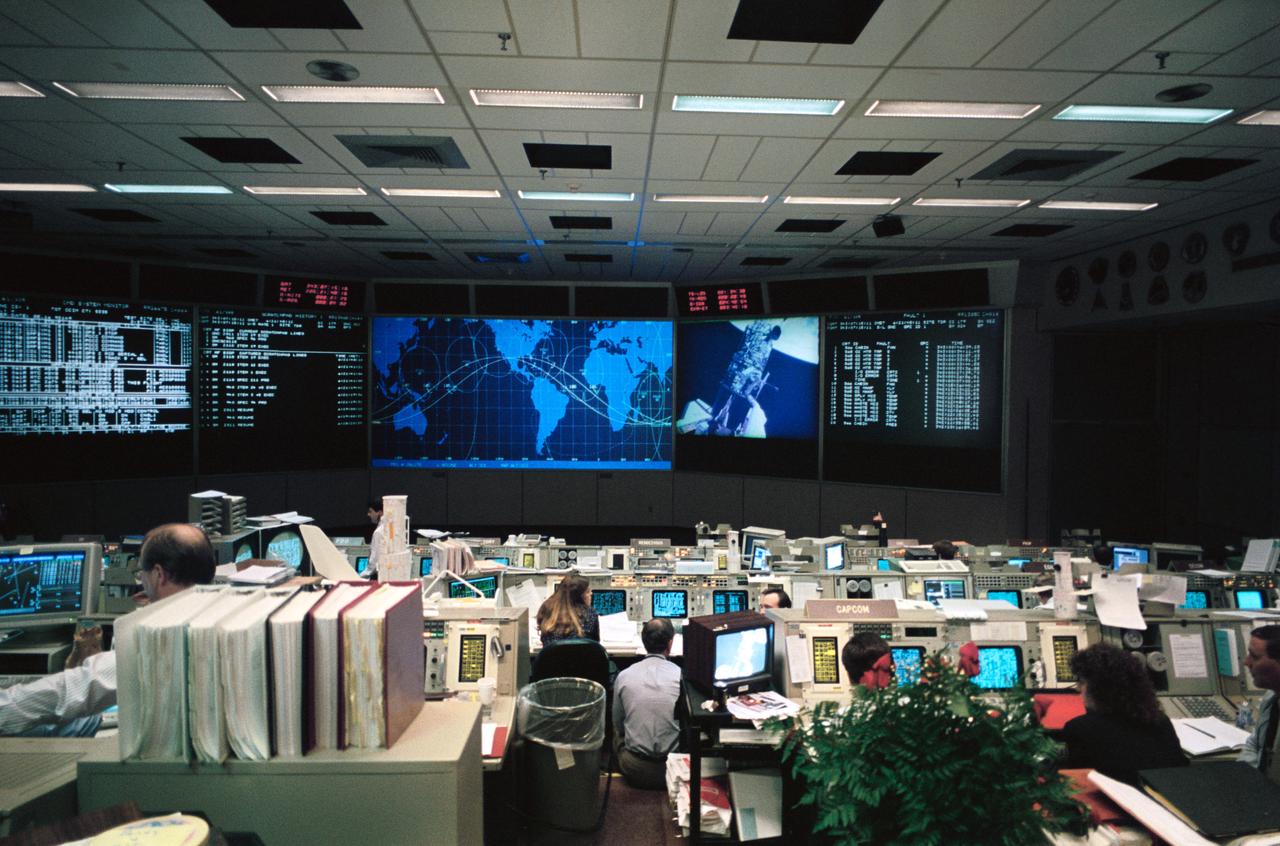
STS061-S-104 (2-13 DEC 1993) --- An overall view in the Johnson Space Center's (JSC) Mission Control Center (MCC) during one of the five space walks performed to service the Hubble Space Telescope (HST) temporarily berthed in the Space Shuttle Endeavour's cargo bay. STS-61 lead flight director Milt Heflin is at right edge of frame.
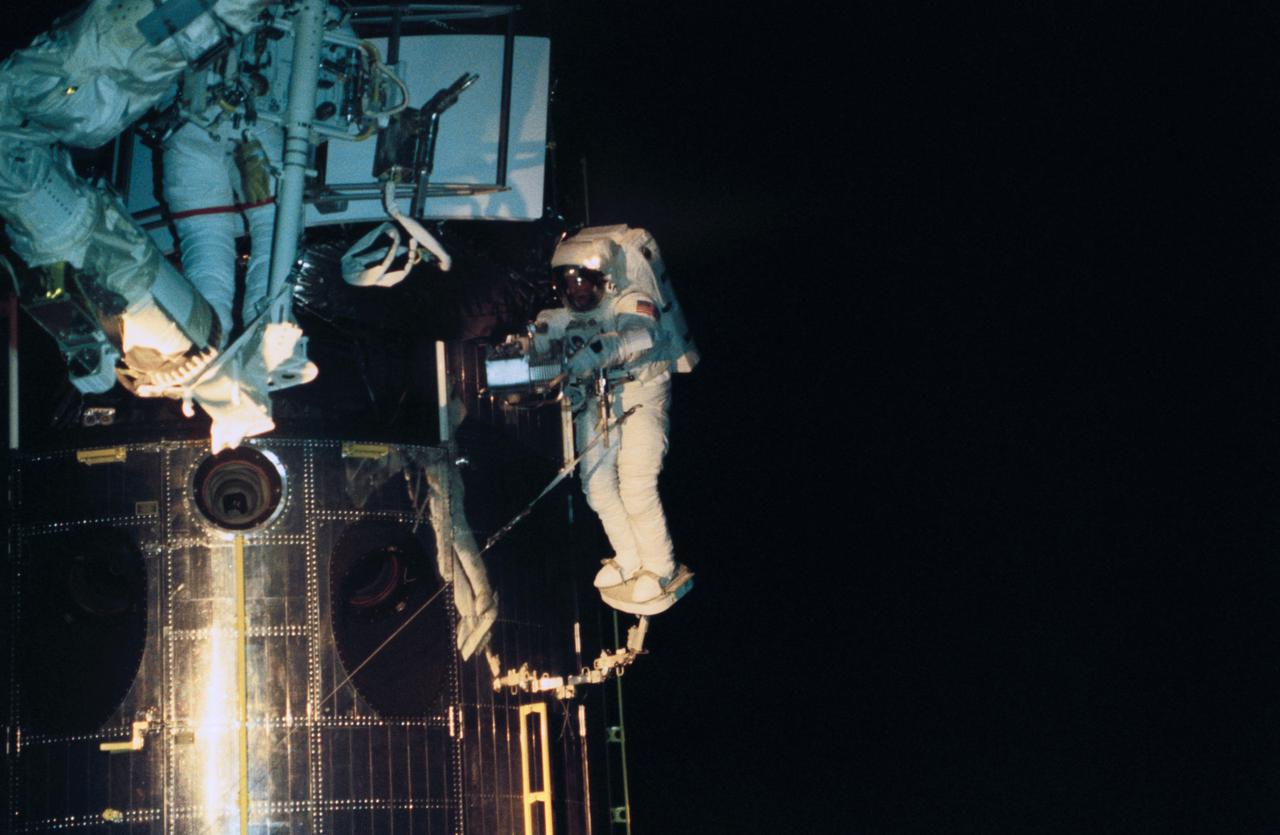
STS061-58-033 (7 Dec 1993) --- Anchored to the Space Shuttle Endeavour's Remote Manipulator System (RMS) arm, astronaut Jeffrey A. Hoffman works with the replacement Wide Field/Planetary Camera (WF/PC II) for the Hubble Space Telescope (HST) during the third of five space walks. Astronaut F. Story Musgrave, who joined Hoffman for three of the five space walks, helps with alignment at center frame.
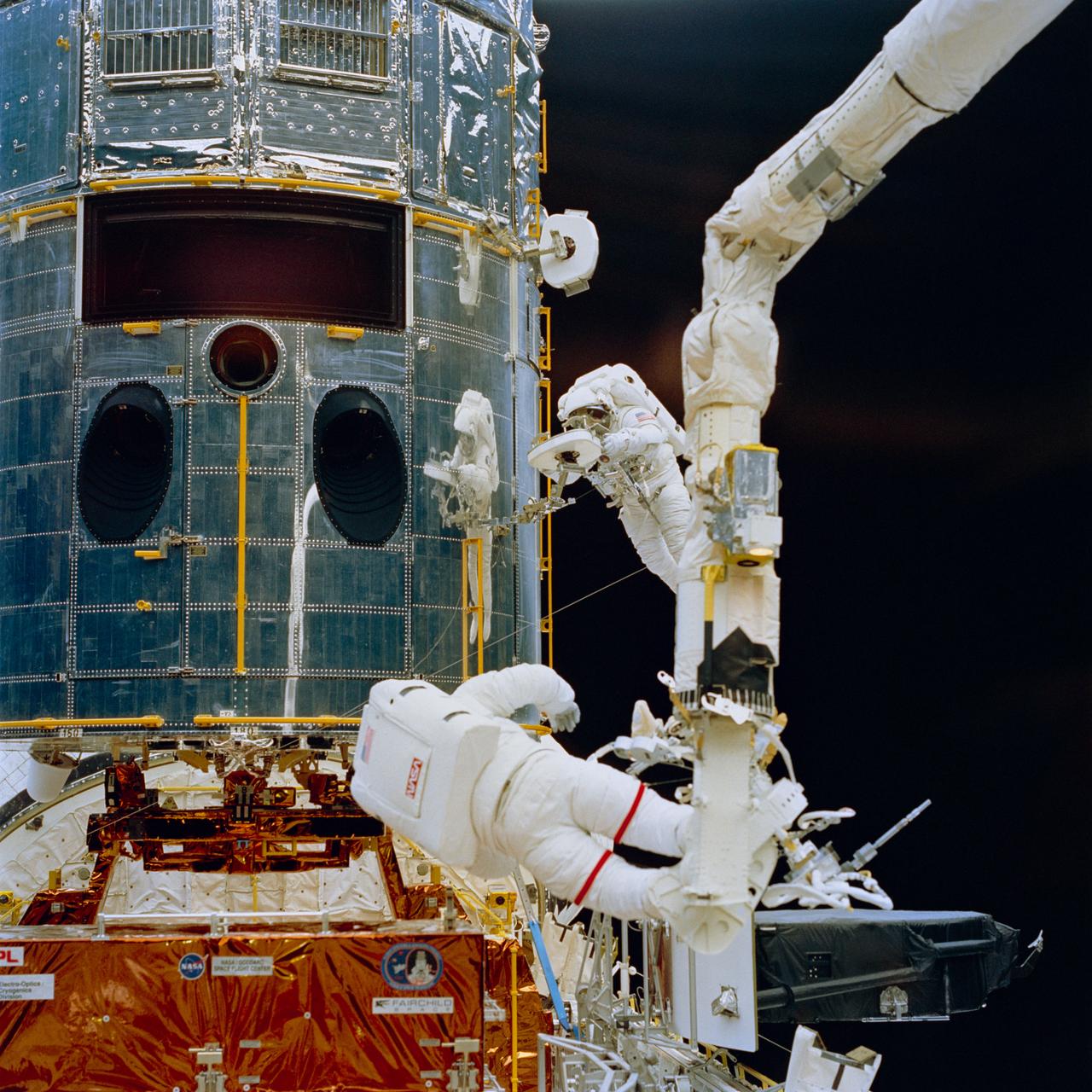
STS061-74-046 (7 Dec 1993) --- Anchored on the end of the Space Shuttle Endeavour's Remote Manipulator System (RMS) arm, astronaut Jeffrey A. Hoffman (foreground) prepares to install the new Wide Field\Planetary Camera (WFPC II) into the empty cavity (top left) on the Hubble Space Telescope (HST). WFPC I is seen temporarily stowed at bottom right. Astronaut F. Story Musgrave works with a Portable Foot Restraint (PFR) at frame center, as his image is reflected in the shiny surface of the telescope. Hoffman and Musgrave shared chores on three of the five extravehicular activity?s (EVA) during the mission.
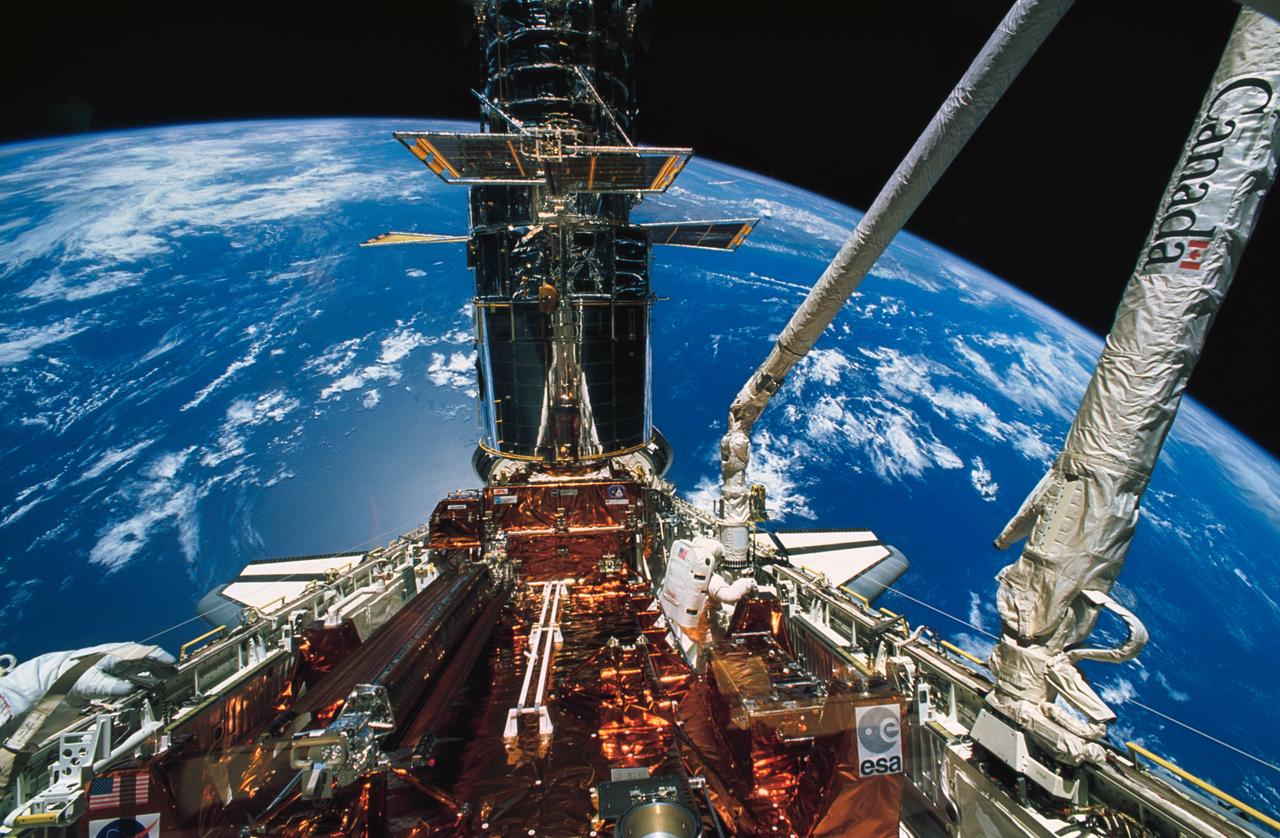
STS061-48-027 (9 Dec 1993) --- Astronaut F. Story Musgrave moves about in the Space Shuttle Endeavour's cargo bay during the deployment of the solar array panels on the Hubble Space Telescope (HST) during the final of five STS-61 space walks. The left hand of astronaut Jeffrey A. Hoffman appears at lower left corner.
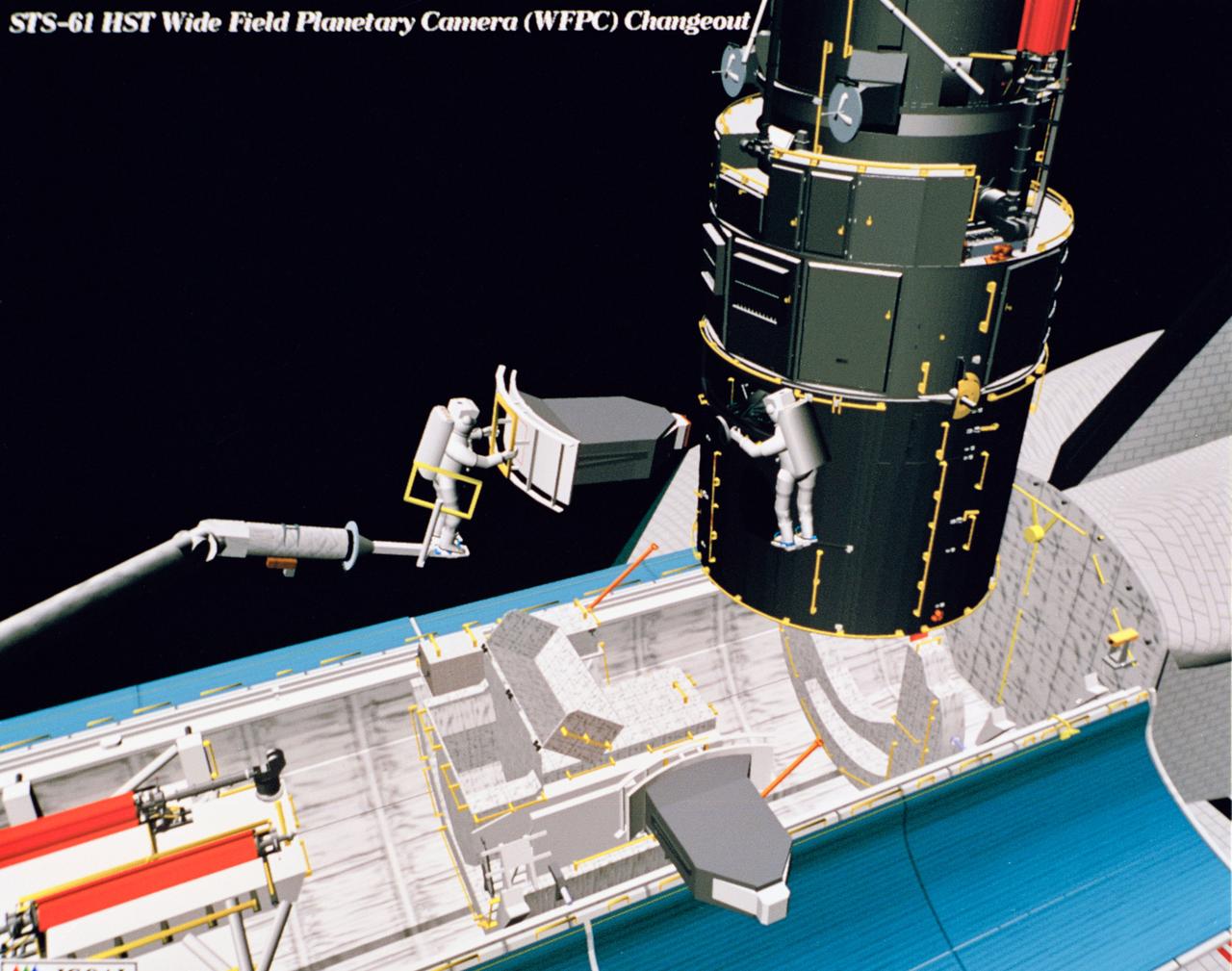
Computer generated scenes depicting the Hubble Space Telescope capture and a sequence of planned events on the planned extravehicular activity (EVA). Scenes include the Remote Manipulator System (RMS) arm assisting two astronauts changing out the Wide Field/Planetary Camera (WF/PC) (48699); RMS arm assisting in the temporary mating of the orbiting telescope to the flight support system in Endeavour's cargo bay (48700); Endeavour's RMS arm assisting in the "capture" of the orbiting telescope (48701); Two astronauts changing out the telescope's coprocessor (48702); RMS arm assistign two astronauts replacing one of the telescope's electronic control units (48703); RMS assisting two astronauts replacing the fuse plugs on the telescope's Power Distribution Unit (PDU) (48704); The telescope's High Resolution Spectrograph (HRS) kit is depicted in this scene (48705); Two astronauts during the removal of the high speed photometer and the installation of the COSTAR instrument (48706); Two astronauts, standing on the RMS, during installation of one of the Magnetic Sensing System (MSS) (48707); High angle view of the orbiting Space Shuttle Endeavour with its cargo bay doors open, revealing the bay's pre-capture configuration. Seen are, from the left, the Solar Array Carrier, the ORU Carrier and the flight support system (48708); Two astronauts performing the replacement of HST's Rate Sensor Units (RSU) (48709); The RMS arm assisting two astronauts with the replacement of the telescope's solar array panels (48710); Two astronauts replacing the telescope's Solar Array Drive Electronics (SADE) (48711).
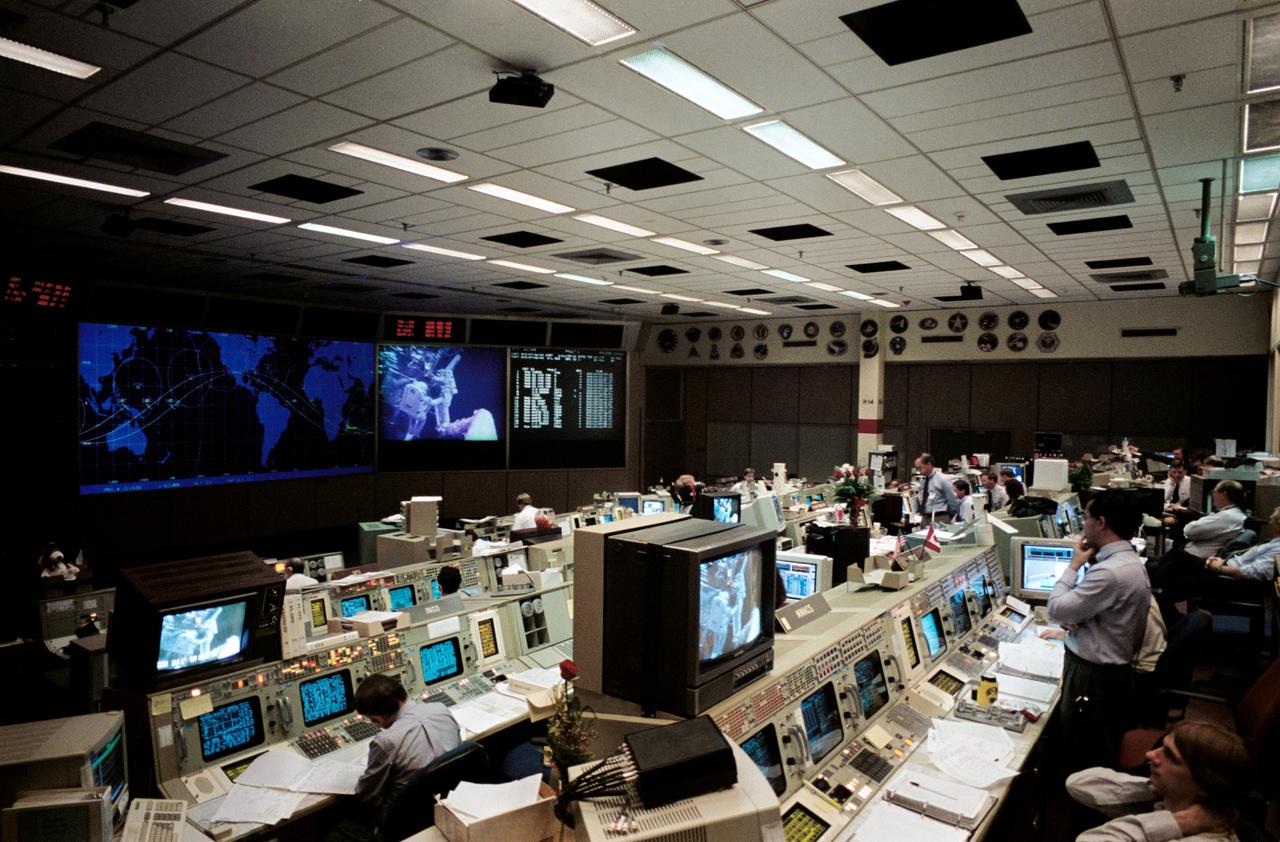
STS061-S-102 (5 Dec. 1993) --- Flight controllers Harry Black (left foreground) and Kevin McCluney (right foreground) monitor the televised activity of two space walkers during the first STS-61 extravehicular activity (EVA). Astronauts F. Story Musgrave and Jeffrey A. Hoffman were performing a variety of equipment replacements. At the Integrated Communications Officer Console (INCO) Black plays a roill in controlling the TV while McLuney's duties deal with maintenance, mechanical, arm and crew systems, meaning that they and their colleagues will be busy for the next five days. Four astronauts in alternating pairs will perform a variety of tasks on the giant telescope during that period.
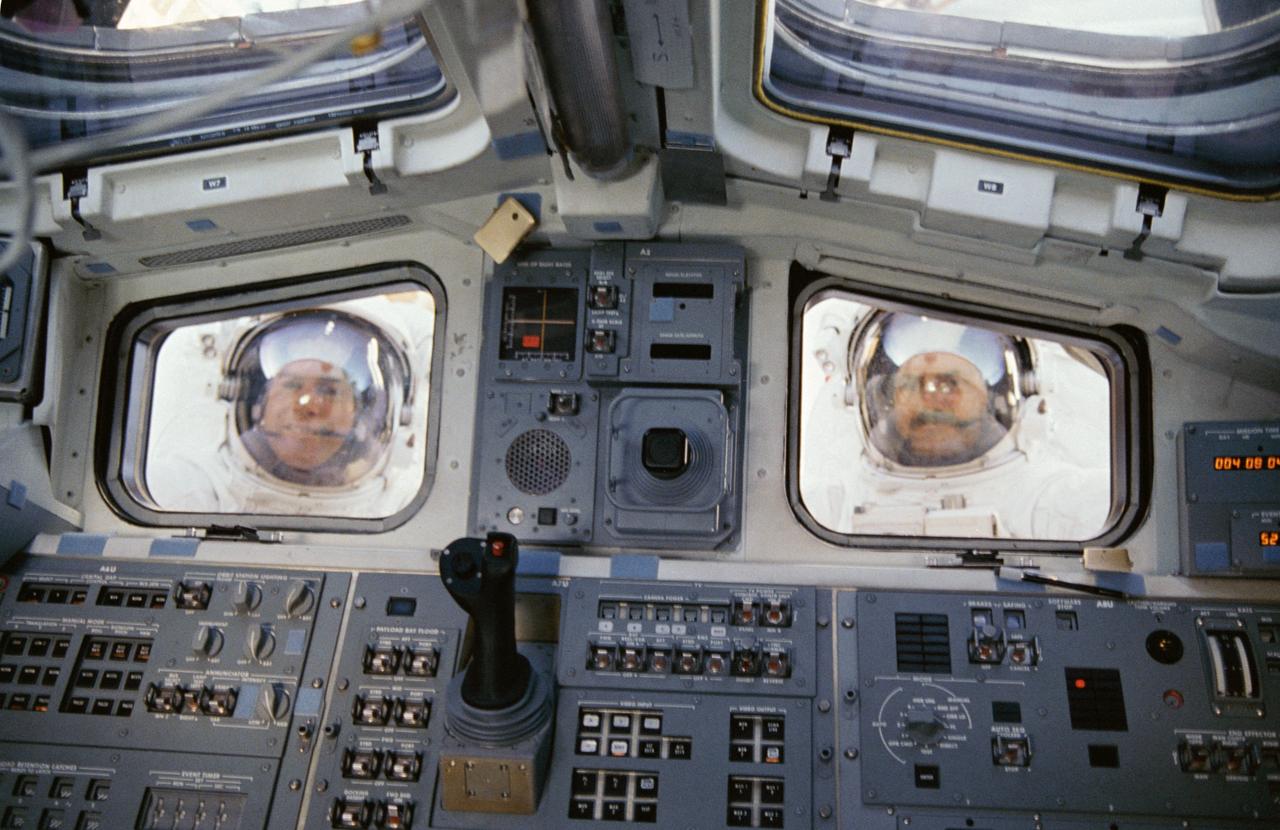
51I-11-027 (1 Sept 1985) --- The extravehicular activity (EVA) of astronauts William F. Fisher (left) and James D. van Hoften succeeded in the capture, repair and re-release of the troubled Syncom IV-3 satellite. Here, the two take a break from the serious side of their EVA to look into the Discovery's cabin. The 51-I crewmembers showed this scene at their Sept. 11 post-flight press conference.
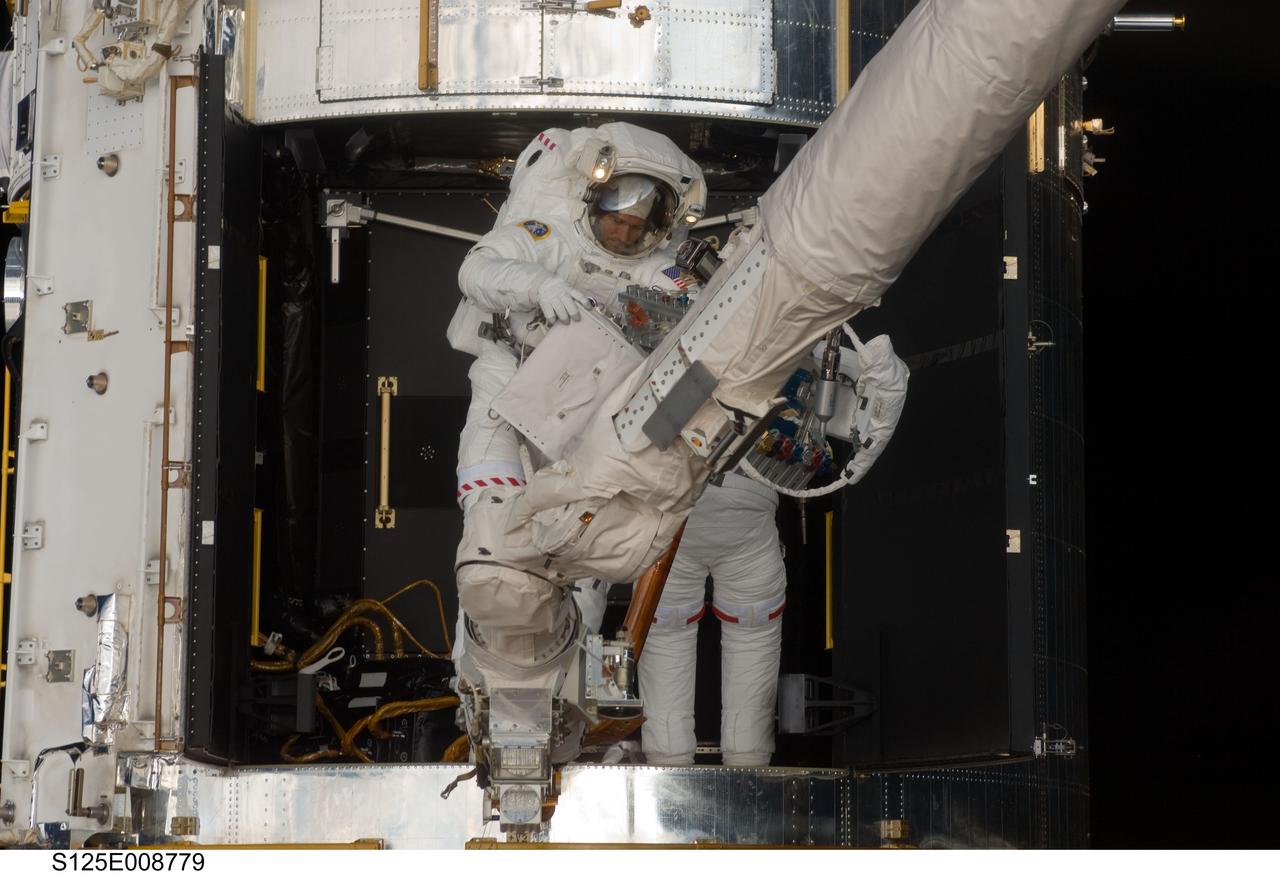
S125-E-008779 (17 May 2009) --- Astronauts Michael Good and Mike Massimino (partially obscured), both STS-125 mission specialists, participate in the mission?s fourth session of extravehicular activity (EVA) as work continues to refurbish and upgrade the Hubble Space Telescope. During the eight-hour, two-minute spacewalk, Massimino and Good continued repairs and improvements to the Space Telescope Imaging Spectrograph (STIS) that will extend the Hubble?s life into the next decade.
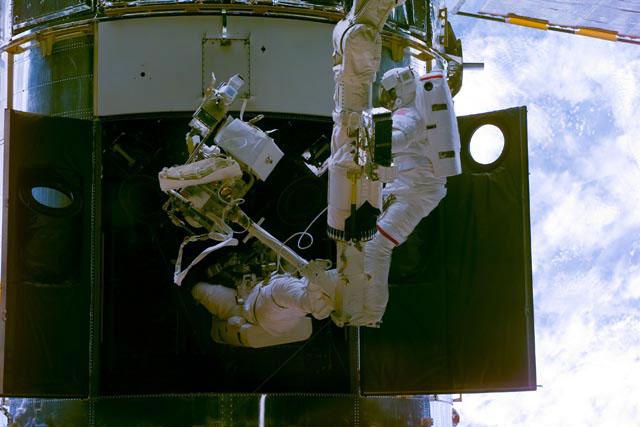
STS-103 mission specialist John M. Grunsfeld (attached to a workstation on the RMS arm) and payload commander Steven L. Smith (free-floating) perform a changeout of the Rate Sensor Units (RSU) in one of the bays of -V3 plane of the Hubble Space Telescope (HST). This repair was performed during the first of three extravehicular activities (EVAs) of the mission. Grunsfeld is distinguished by having no marks on his EMU and Smith is distinguished by the red strip on the pants of his EMU.
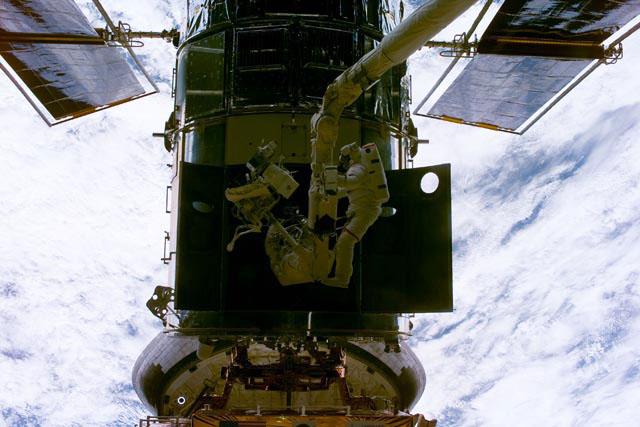
STS-103 mission specialist John M. Grunsfeld (attached to a workstation on the RMS arm) and payload commander Steven L. Smith (free-floating) perform a changeout of the Rate Sensor Units (RSU) in one of the bays of -V3 plane of the Hubble Space Telescope (HST). This repair was performed during the first of three extravehicular activities (EVAs) of the mission. Grunsfeld is distinguished by having no marks on his EMU and Smith is distinguished by the red strip on the pants of his EMU.
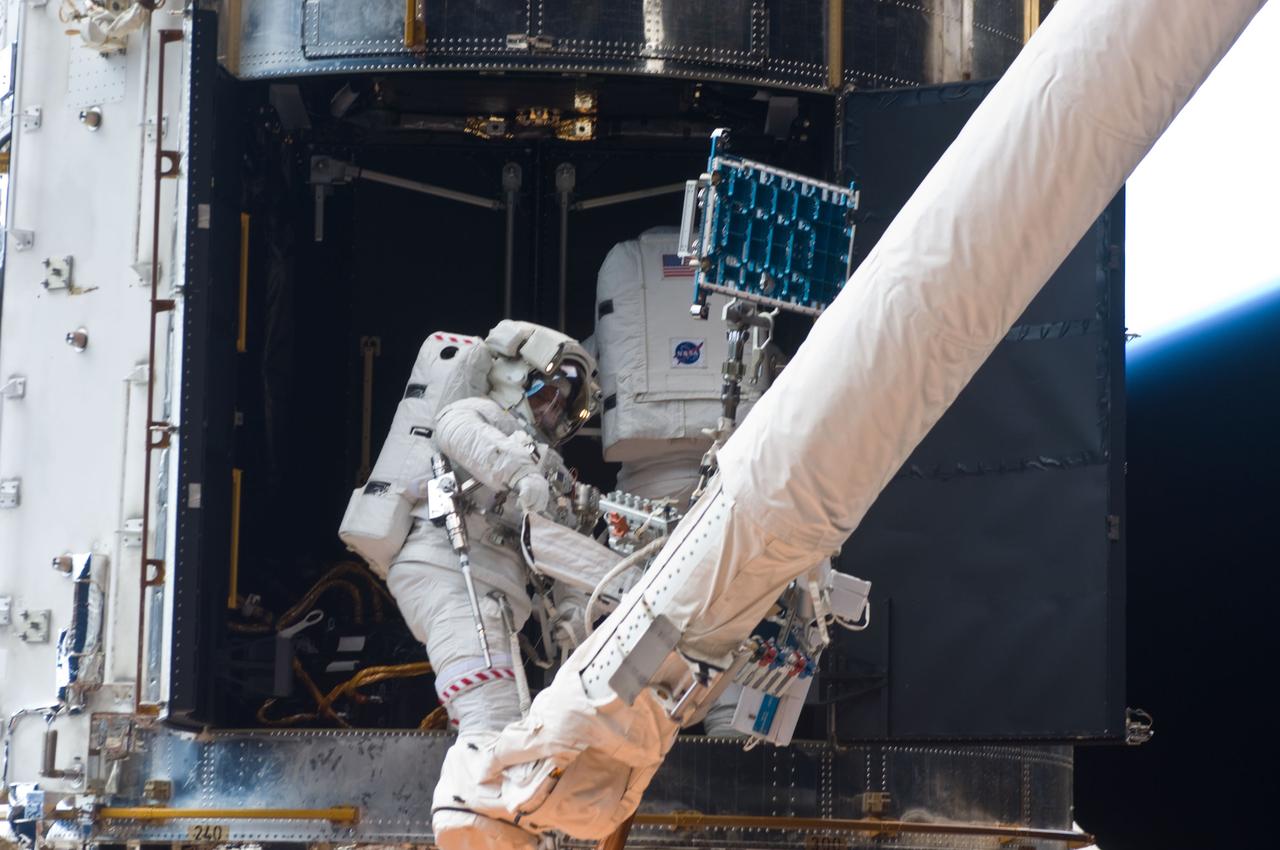
S125-E-008633 (17 May 2009) --- Astronauts Michael Good (left) and Mike Massimino, both STS-125 mission specialists, participate in the mission?s fourth session of extravehicular activity (EVA) as work continues to refurbish and upgrade the Hubble Space Telescope. During the eight-hour, two-minute spacewalk, Massimino and Good continued repairs and improvements to the Space Telescope Imaging Spectrograph (STIS) that will extend the Hubble?s life into the next decade.
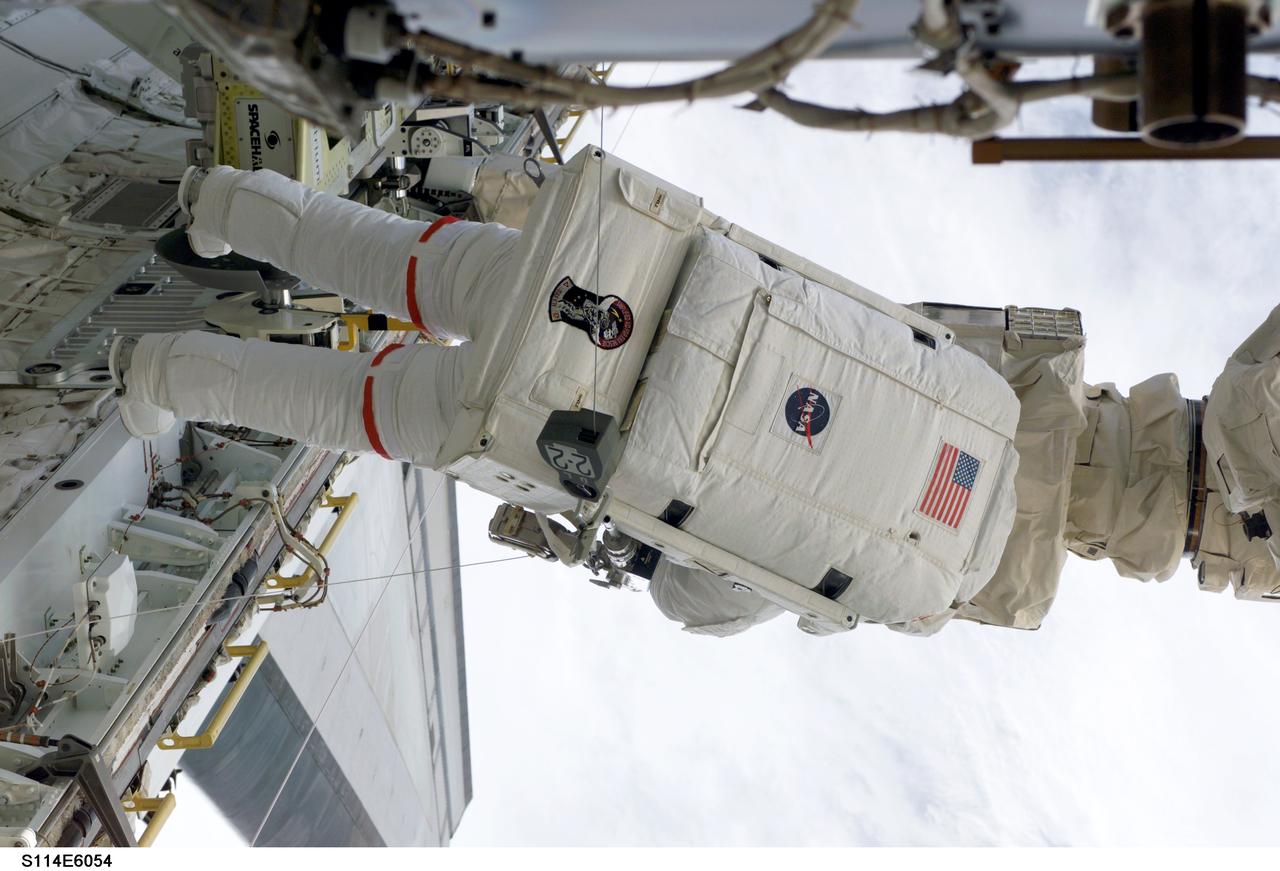
S114-E-6054 (30 July 2005) --- Astronaut Soichi Noguchi, STS-114 mission specialist representing Japan Aerospace Exploration Agency (JAXA), participates in the mission’s first scheduled session of extravehicular activity (EVA). Noguchi and crewmate Stephen K. Robinson (out of frame) completed a demonstration of Shuttle thermal protection repair techniques and enhancements to the International Space Station’s attitude control system during the successful 6-hour, 50-minute spacewalk.
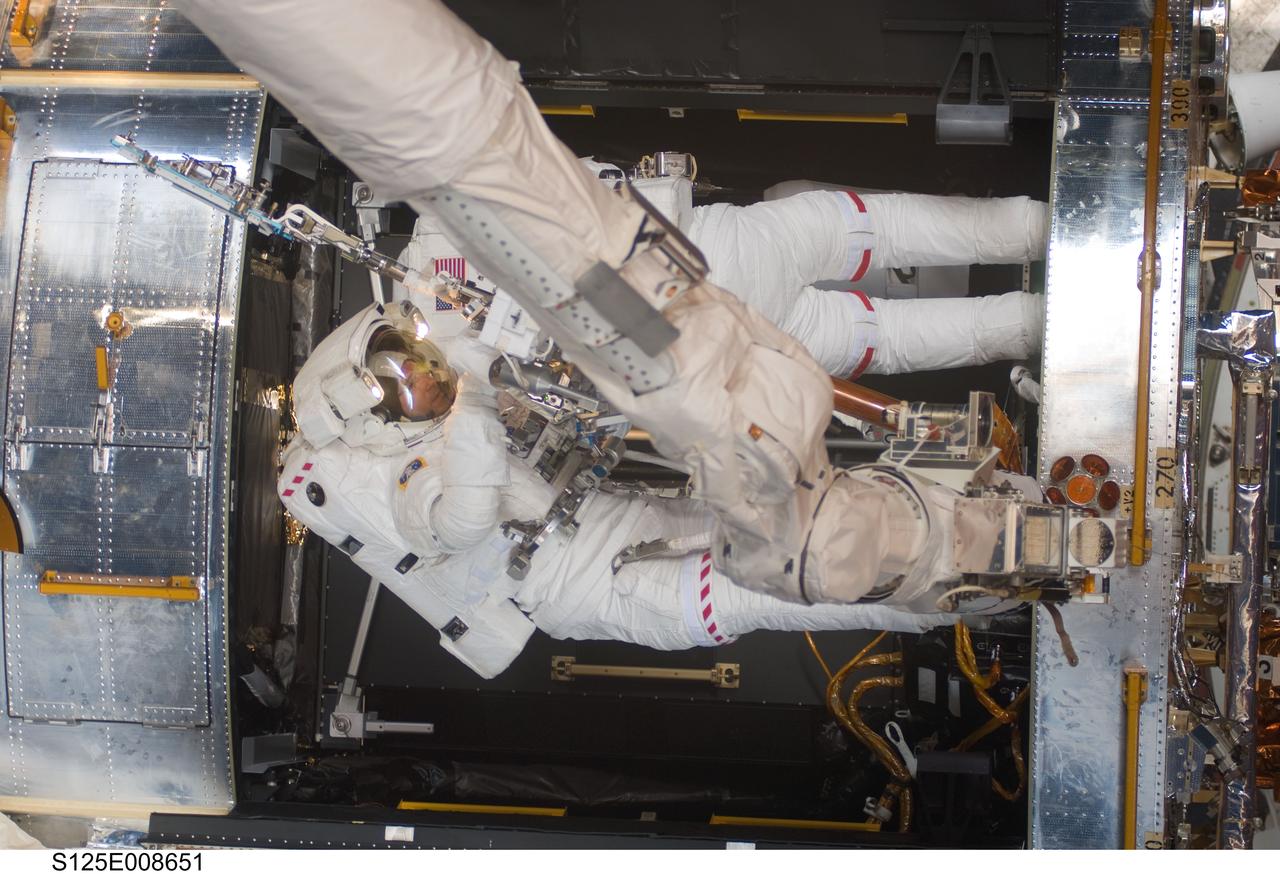
S125-E-008651 (17 May 2009) --- Astronauts Michael Good (bottom) and Mike Massimino, both STS-125 mission specialists, participate in the mission?s fourth session of extravehicular activity (EVA) as work continues to refurbish and upgrade the Hubble Space Telescope. During the eight-hour, two-minute spacewalk, Massimino and Good continued repairs and improvements to the Space Telescope Imaging Spectrograph (STIS) that will extend the Hubble?s life into the next decade.
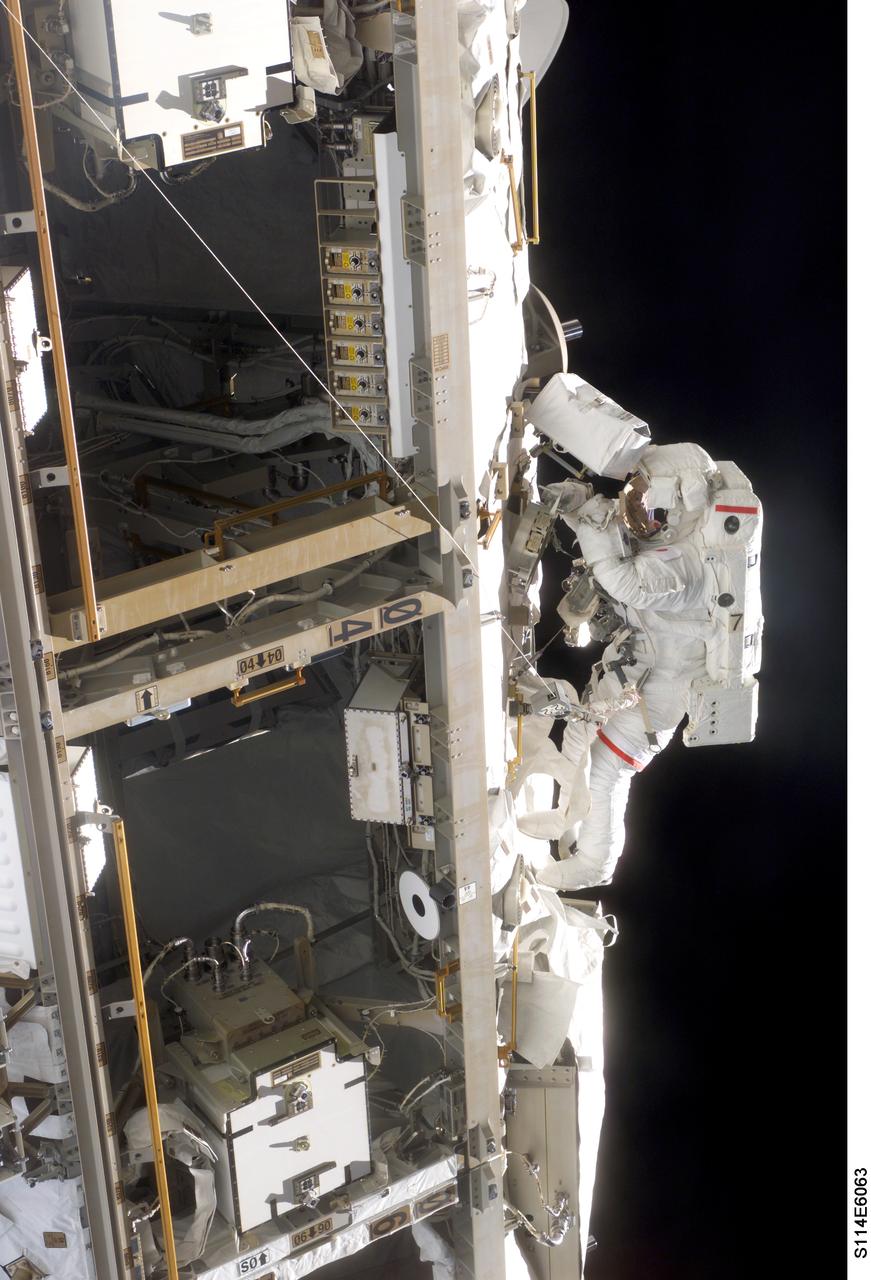
S114-E-6063 (30 July 2005) --- Astronaut Soichi Noguchi, STS-114 mission specialist representing Japan Aerospace Exploration Agency (JAXA), participates in the mission’s first scheduled session of extravehicular activity (EVA). Noguchi and crewmate Stephen K. Robinson (out of frame) completed a demonstration of Shuttle thermal protection repair techniques and enhancements to the International Space Station’s attitude control system during the successful 6-hour, 50-minute spacewalk.
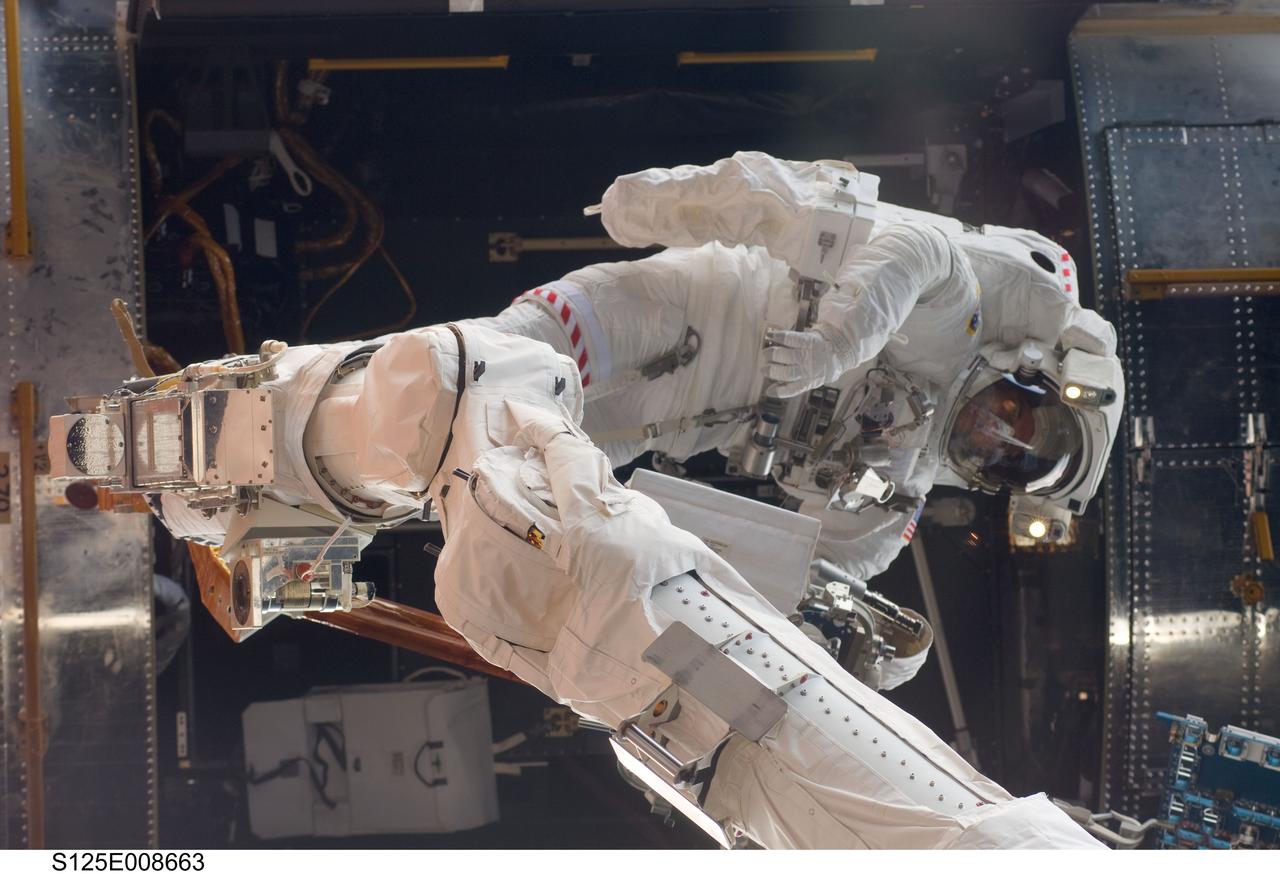
S125-E-008663 (17 May 2009) --- Astronaut Michael Good, STS-125 mission specialist, participates in the mission?s fourth session of extravehicular activity (EVA) as work continues to refurbish and upgrade the Hubble Space Telescope. During the eight-hour, two-minute spacewalk, Good and astronaut Mike Massimino (out of frame), mission specialist, continued repairs and improvements to the Space Telescope Imaging Spectrograph (STIS) that will extend the Hubble?s life into the next decade.
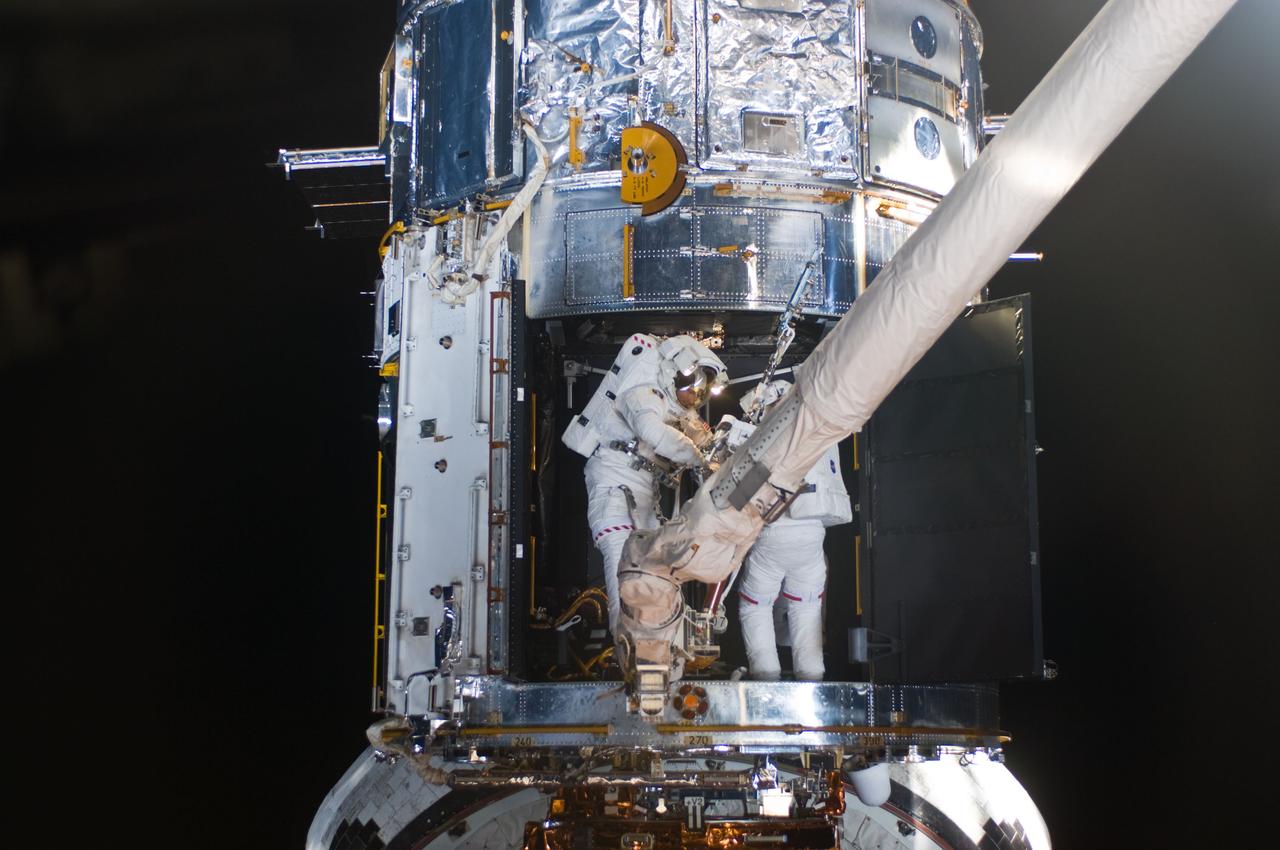
S125-E-008656 (17 May 2009) --- Astronauts Michael Good (left) and Mike Massimino, both STS-125 mission specialists, participate in the mission?s fourth session of extravehicular activity (EVA) as work continues to refurbish and upgrade the Hubble Space Telescope. During the eight-hour, two-minute spacewalk, Massimino and Good continued repairs and improvements to the Space Telescope Imaging Spectrograph (STIS) that will extend the Hubble?s life into the next decade.
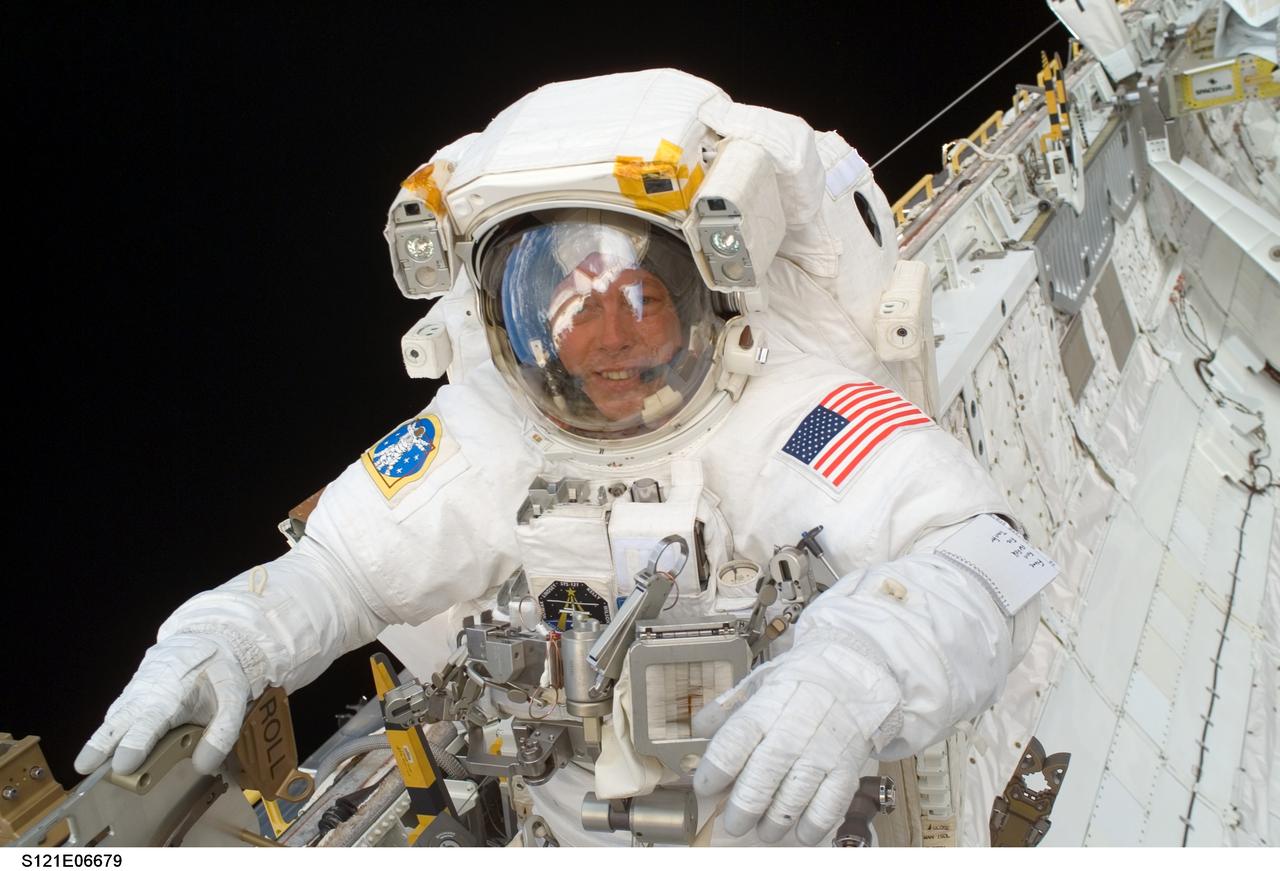
S121-E-06679 (12 July 2006) --- Astronaut Michael E. Fossum, STS-121 mission specialist, works in Space Shuttle Discovery's cargo bay during the mission's third and final session of extravehicular activity (EVA). The demonstration of orbiter heat shield repair techniques was the objective of the 7-hour, 11-minute excursion outside the shuttle and the International Space Station.
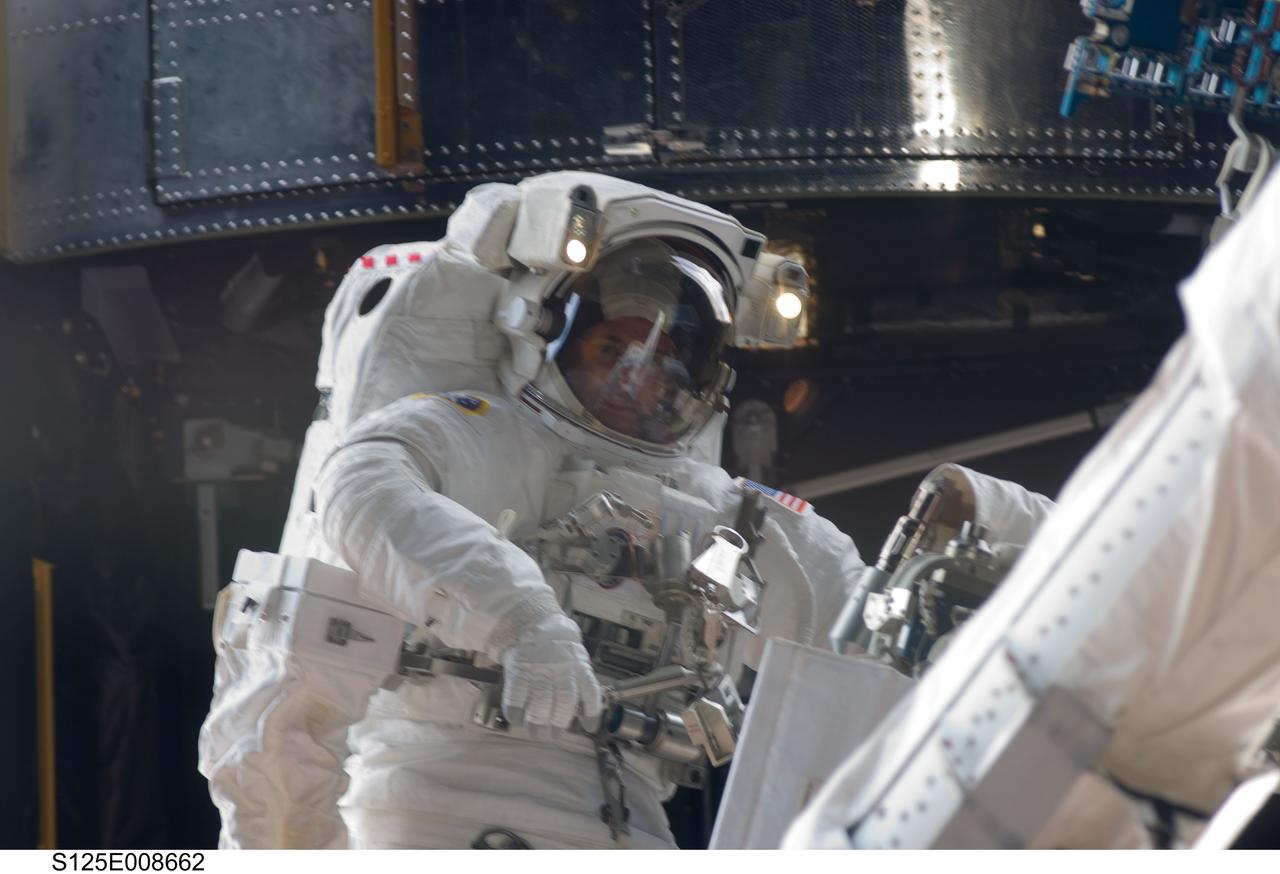
S125-E-008662 (17 May 2009) --- Astronaut Michael Good, STS-125 mission specialist, participates in the mission?s fourth session of extravehicular activity (EVA) as work continues to refurbish and upgrade the Hubble Space Telescope. During the eight-hour, two-minute spacewalk, Good and astronaut Mike Massimino (out of frame), mission specialist, continued repairs and improvements to the Space Telescope Imaging Spectrograph (STIS) that will extend the Hubble?s life into the next decade.
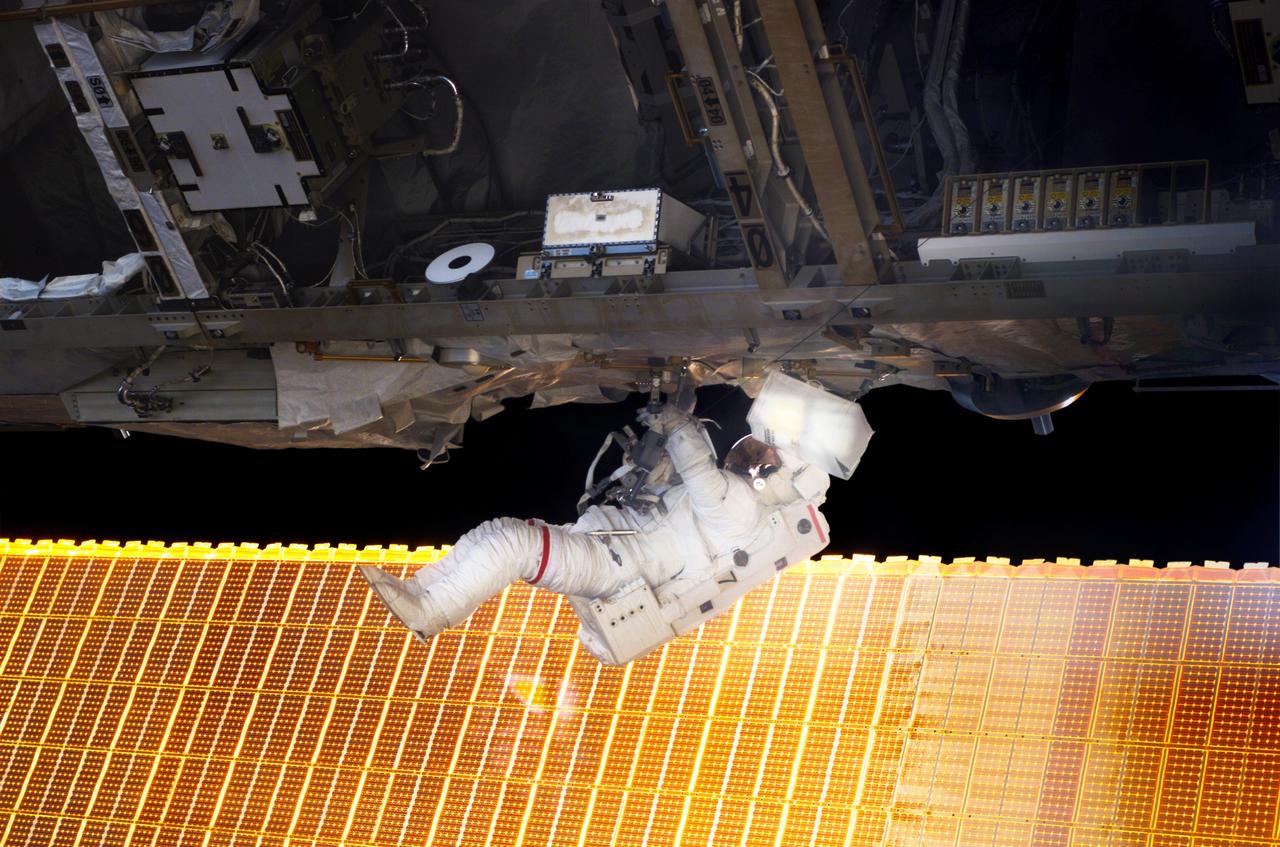
S114-E-6062 (30 July 2005) --- Astronaut Soichi Noguchi, STS-114 mission specialist representing Japan Aerospace Exploration Agency (JAXA), participates in the mission’s first scheduled session of extravehicular activity (EVA). Noguchi and crewmate Stephen K. Robinson (out of frame) completed a demonstration of Shuttle thermal protection repair techniques and enhancements to the International Space Station’s attitude control system during the successful 6-hour, 50-minute spacewalk.
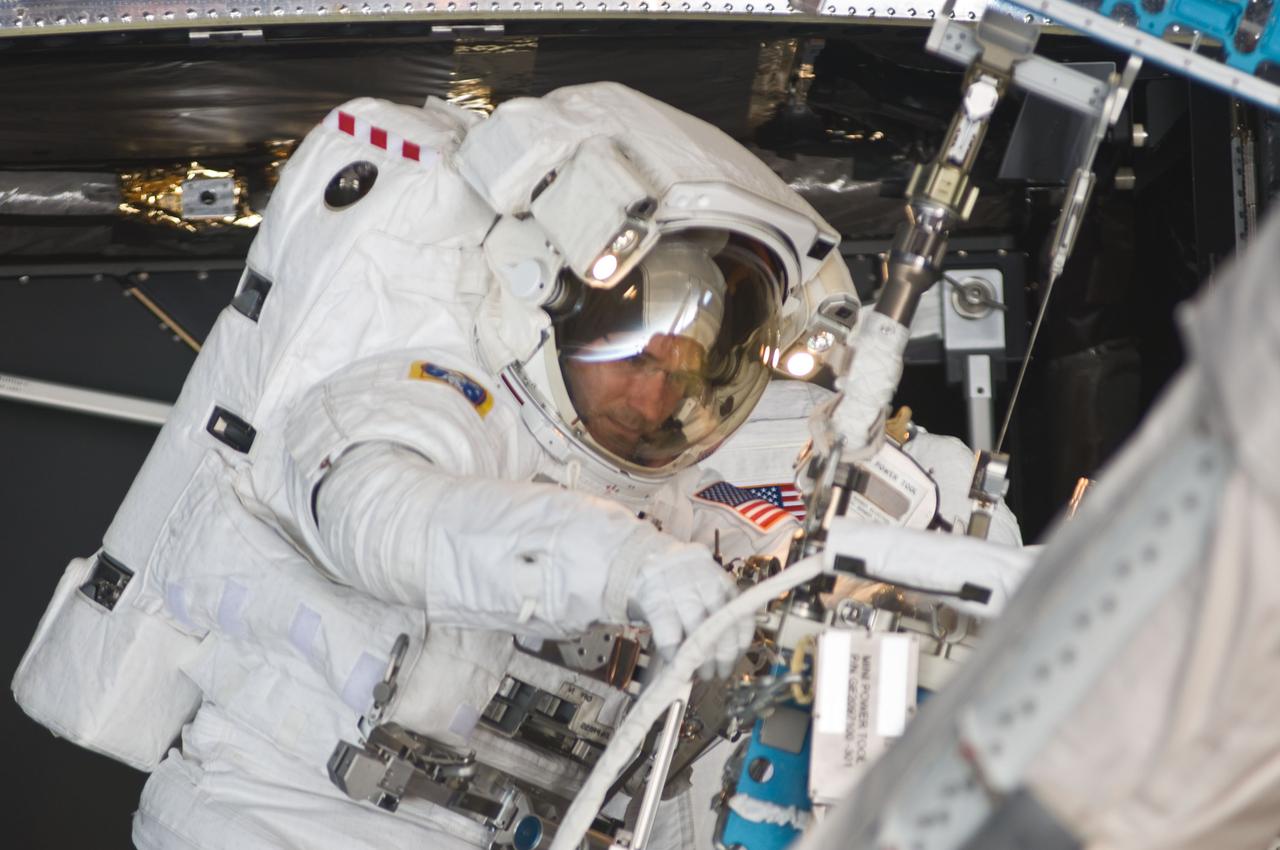
S125-E-008639 (17 May 2009) --- Astronaut Michael Good, STS-125 mission specialist, participates in the mission?s fourth session of extravehicular activity (EVA) as work continues to refurbish and upgrade the Hubble Space Telescope. During the eight-hour, two-minute spacewalk, Good and astronaut Mike Massimino (out of frame), mission specialist, continued repairs and improvements to the Space Telescope Imaging Spectrograph (STIS) that will extend the Hubble?s life into the next decade.
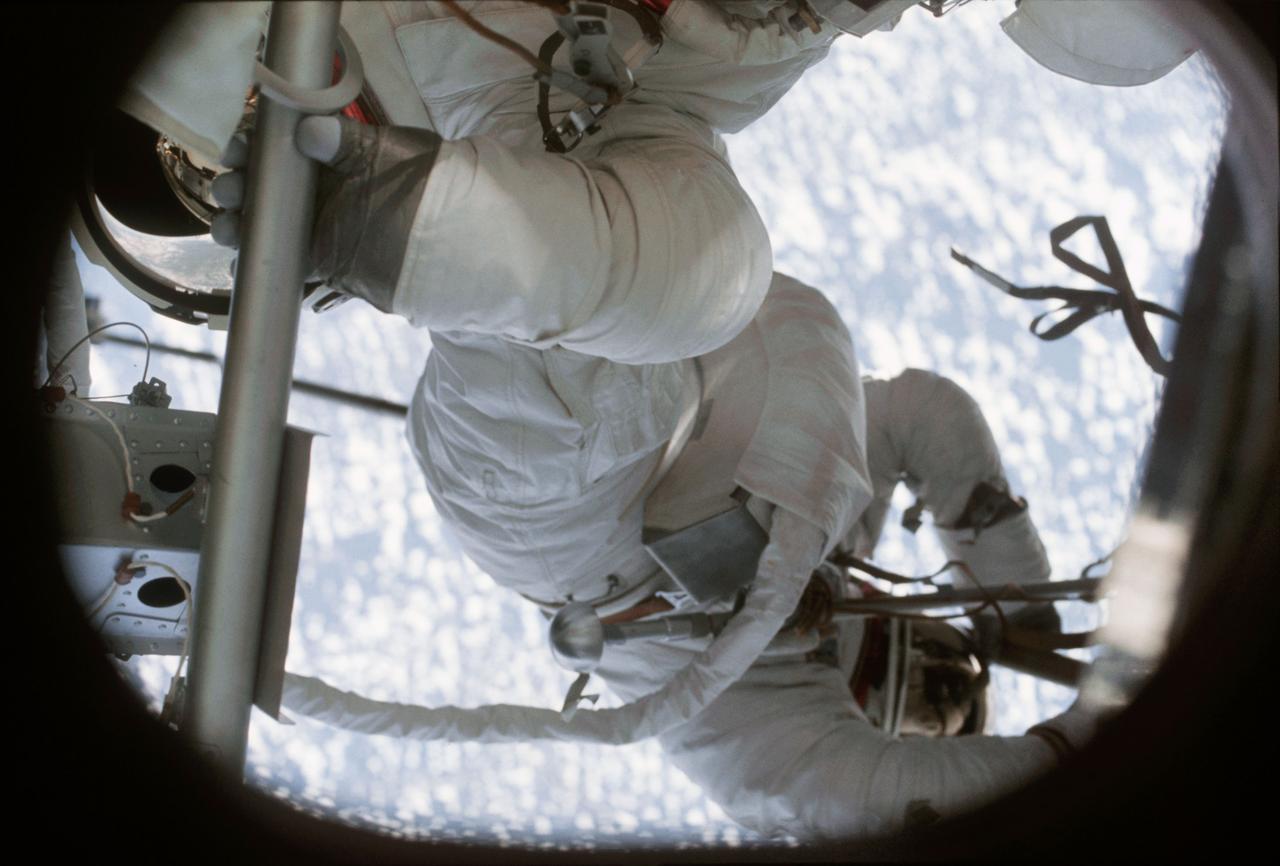
SL2-100-799 (7 June 1973) --- This medium close-up view shows astronauts Charles Conrad, commander for Skylab 2, and Science Pilot Joseph P. Kerwin performing an extravehicular activity (EVA) to repair the damaged and partially deployed solar array system on the Skylab complex. The photo was taken from inside the Orbital Workshop (OWS) by astronaut Paul J. Weitz, pilot. Photo credit: NASA

S121-E-06583 (12 July 2006) --- Astronaut Piers J. Sellers, STS-121 mission specialist, participates in the mission's third and final session of extravehicular activity (EVA). The demonstration of orbiter heat shield repair techniques was the objective of the 7-hour, 11-minute excursion outside Space Shuttle Discovery and the International Space Station.
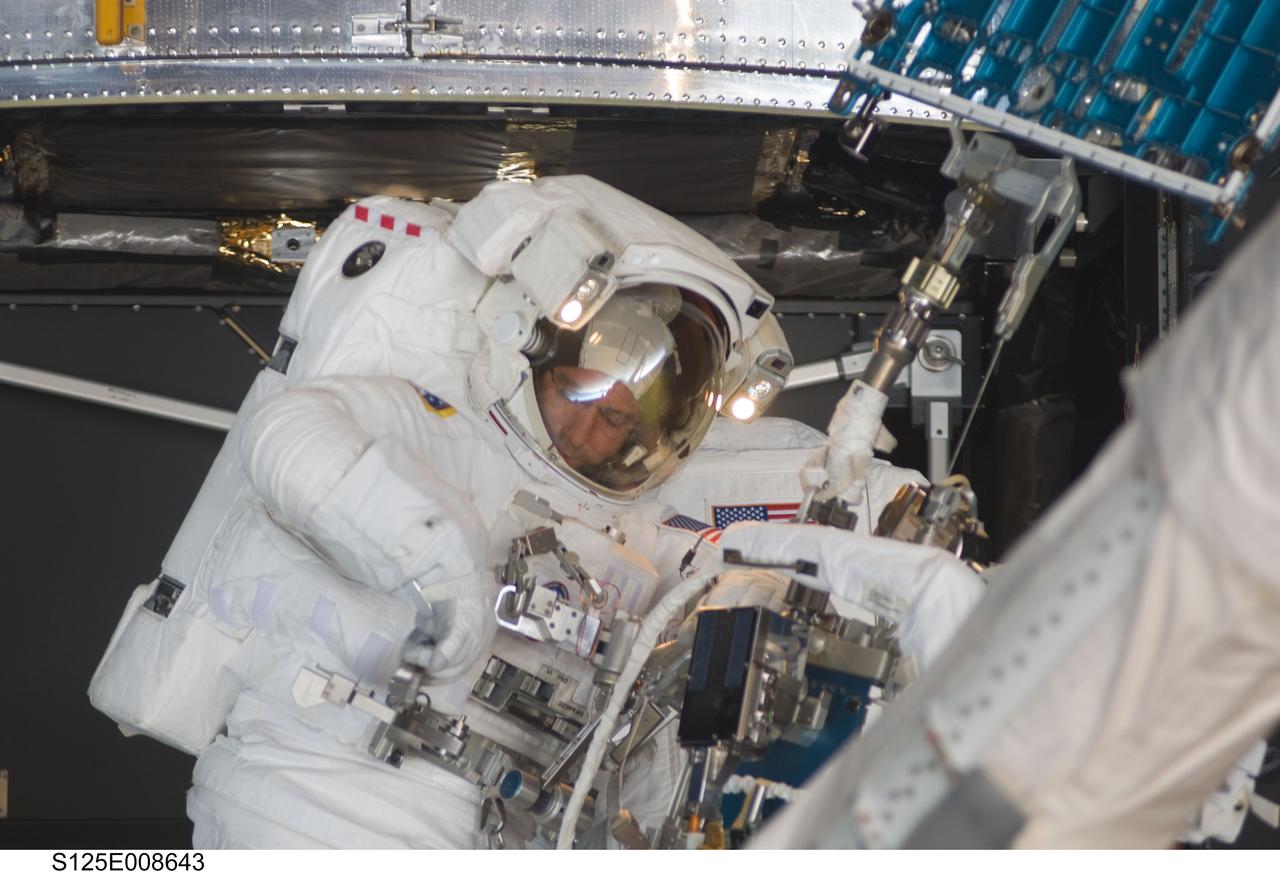
S125-E-008643 (17 May 2009) --- Astronaut Michael Good, STS-125 mission specialist, participates in the mission?s fourth session of extravehicular activity (EVA) as work continues to refurbish and upgrade the Hubble Space Telescope. During the eight-hour, two-minute spacewalk, Good and astronaut Mike Massimino (out of frame), mission specialist, continued repairs and improvements to the Space Telescope Imaging Spectrograph (STIS) that will extend the Hubble?s life into the next decade.
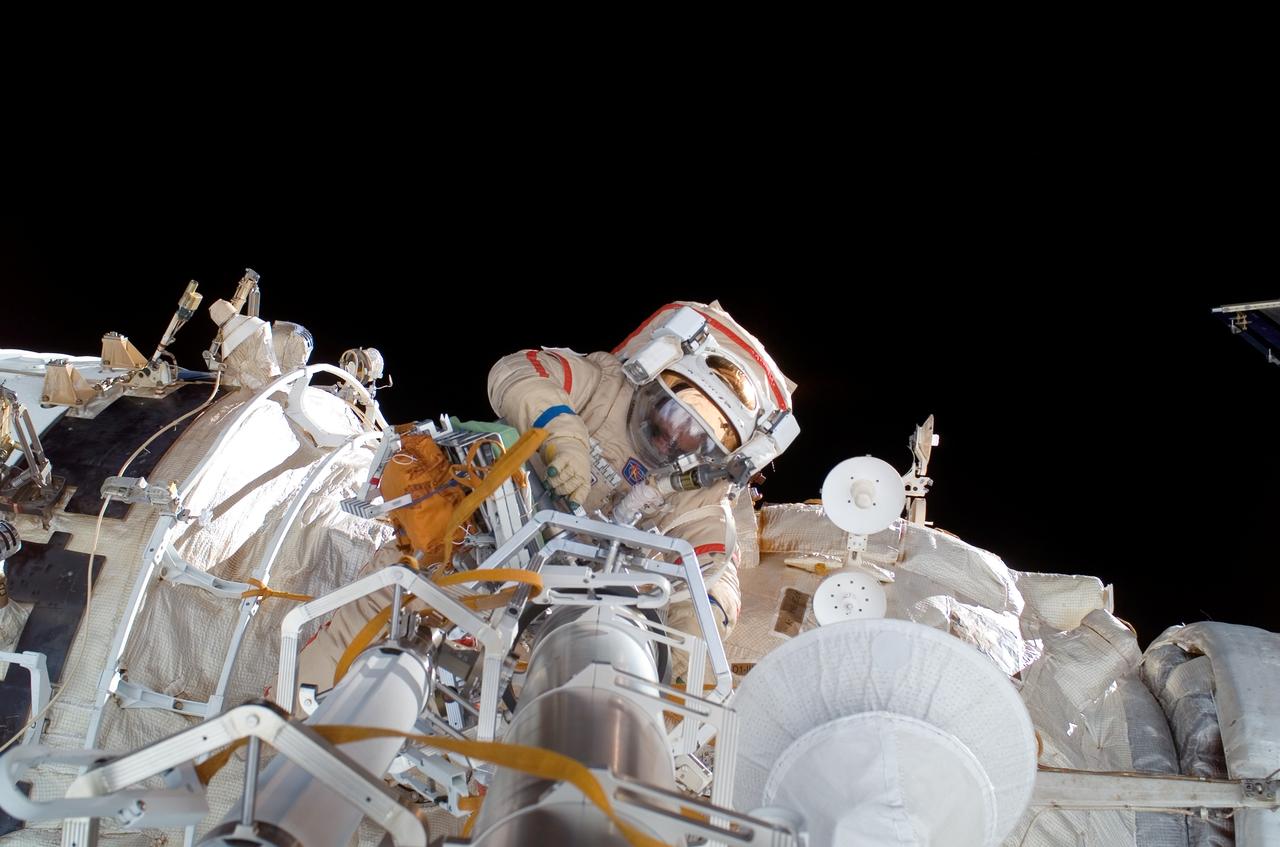
ISS013-E-28984 (1 June 2006) --- Cosmonaut Pavel V. Vinogradov, Expedition 13 commander representing Russia's Federal Space Agency, attired in a Russian Orlan spacesuit, participates in the first session of extravehicular activity (EVA) performed by the Expedition 13 crew during their six-month mission. During the 6-hour, 31-minute spacewalk, Vinogradov and astronaut Jeffrey N. Williams (out of frame), NASA space station science officer, repaired, retrieved and replaced hardware on the U.S. and Russian segments of the International Space Station.
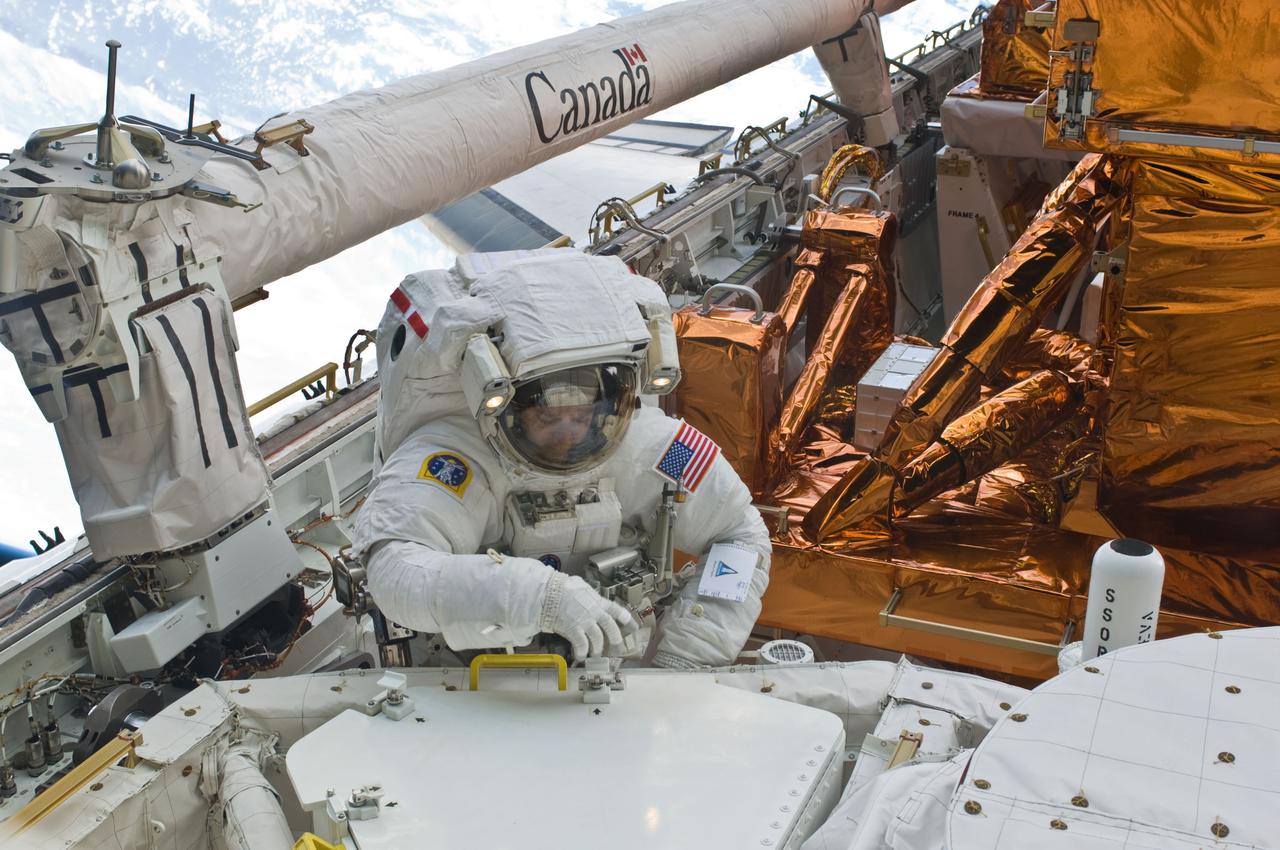
S125-E-008728 (17 May 2009) --- Astronaut Mike Massimino, STS-125 mission specialist, participates in the mission?s fourth session of extravehicular activity (EVA) as work continues to refurbish and upgrade the Hubble Space Telescope. During the eight-hour, two-minute spacewalk, Massimino and astronaut Michael Good (out of frame), mission specialist, continued repairs and improvements to the Space Telescope Imaging Spectrograph (STIS) that will extend the Hubble?s life into the next decade.

S121-E-06685 (12 July 2006) --- Astronaut Michael E. Fossum, STS-121 mission specialist, works in Space Shuttle Discovery's cargo bay during the mission's third and final session of extravehicular activity (EVA). The demonstration of orbiter heat shield repair techniques was the objective of the 7-hour, 11-minute excursion outside the shuttle and the International Space Station.
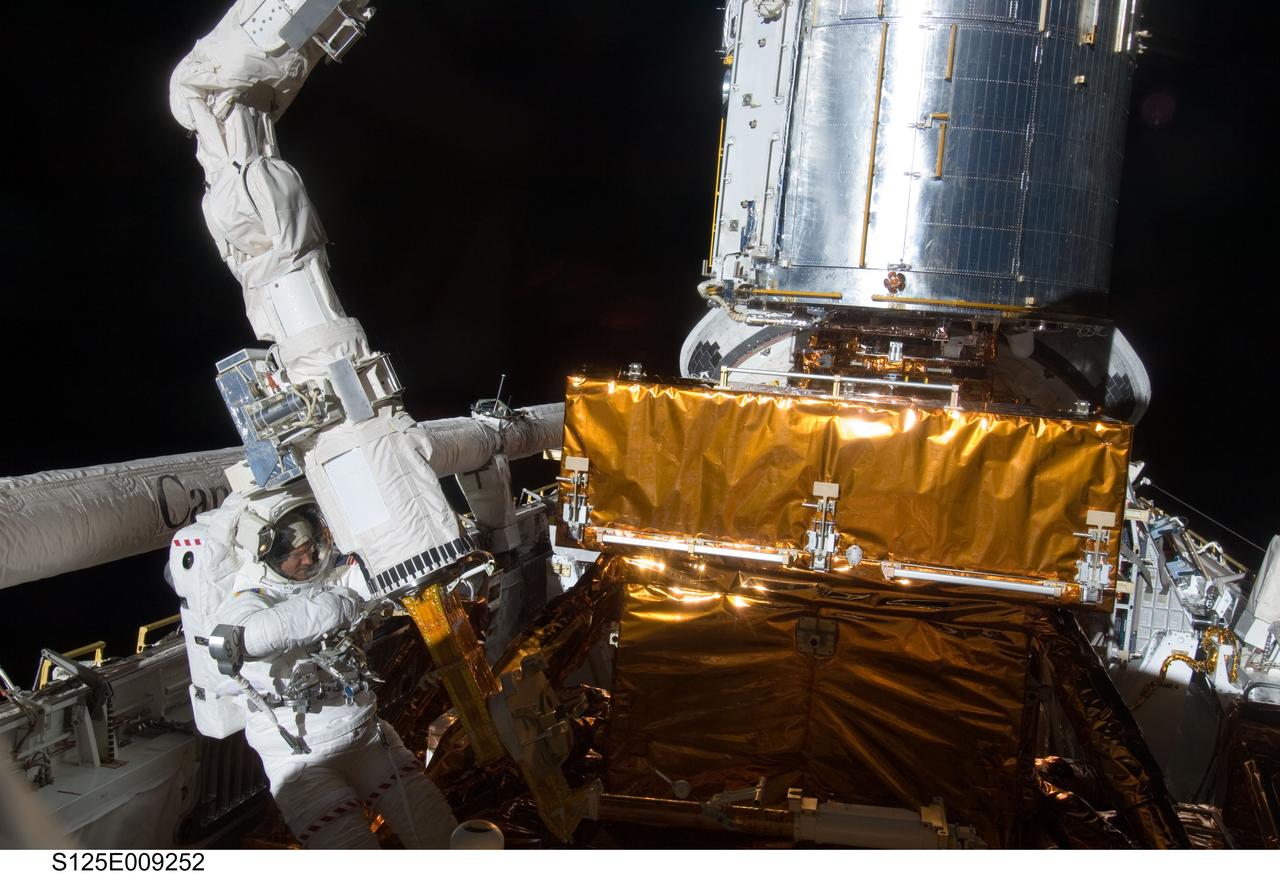
S125-E-009252 (17 May 2009) --- Astronaut Michael Good, STS-125 mission specialist, participates in the mission?s fourth session of extravehicular activity (EVA) as work continues to refurbish and upgrade the Hubble Space Telescope. During the eight-hour, two-minute spacewalk, Good and astronaut Mike Massimino (out of frame), mission specialist, continued repairs and improvements to the Space Telescope Imaging Spectrograph (STIS) that will extend the Hubble?s life into the next decade.
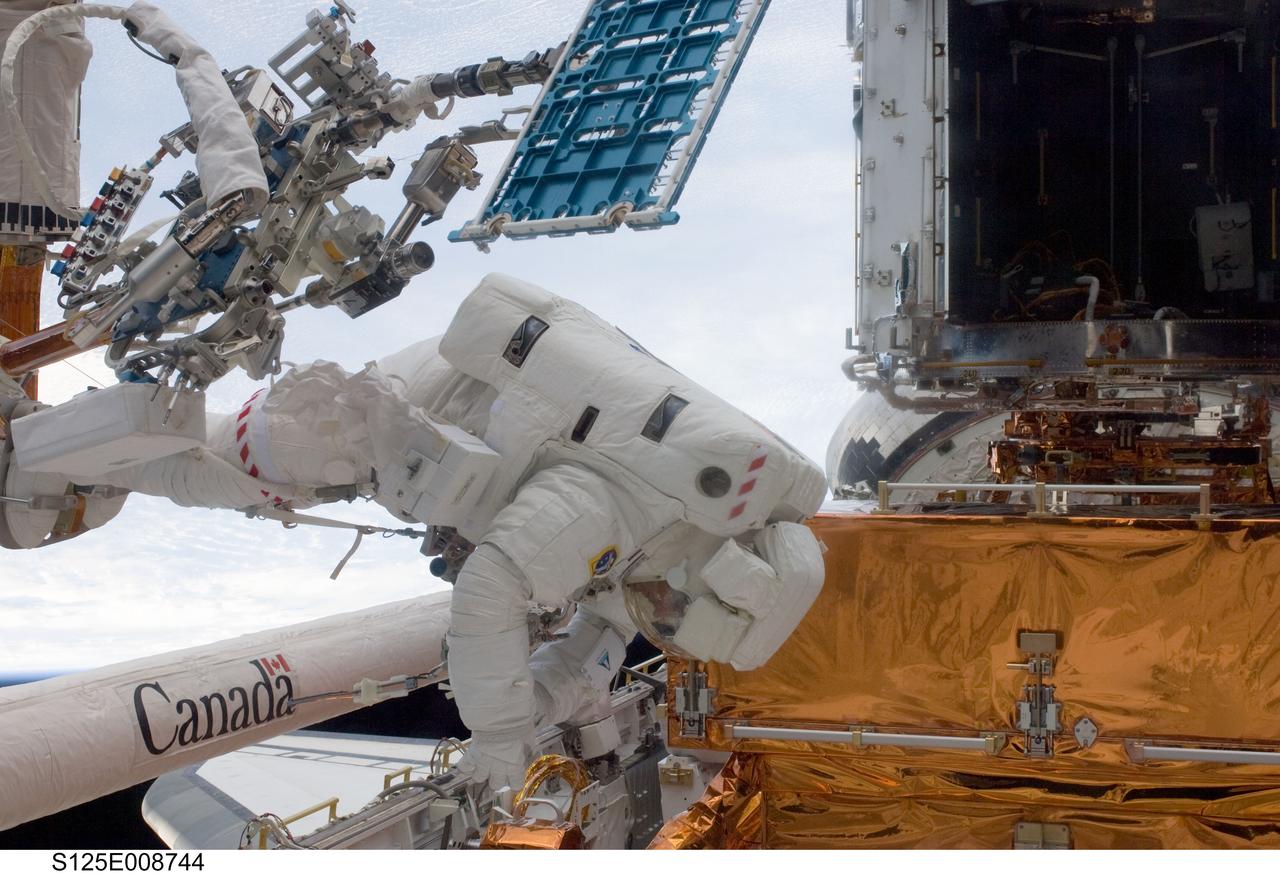
S125-E-008744 (17 May 2009) --- Astronaut Michael Good, STS-125 mission specialist, participates in the mission?s fourth session of extravehicular activity (EVA) as work continues to refurbish and upgrade the Hubble Space Telescope. During the eight-hour, two-minute spacewalk, Good and astronaut Mike Massimino (out of frame), mission specialist, continued repairs and improvements to the Space Telescope Imaging Spectrograph (STIS) that will extend the Hubble?s life into the next decade.
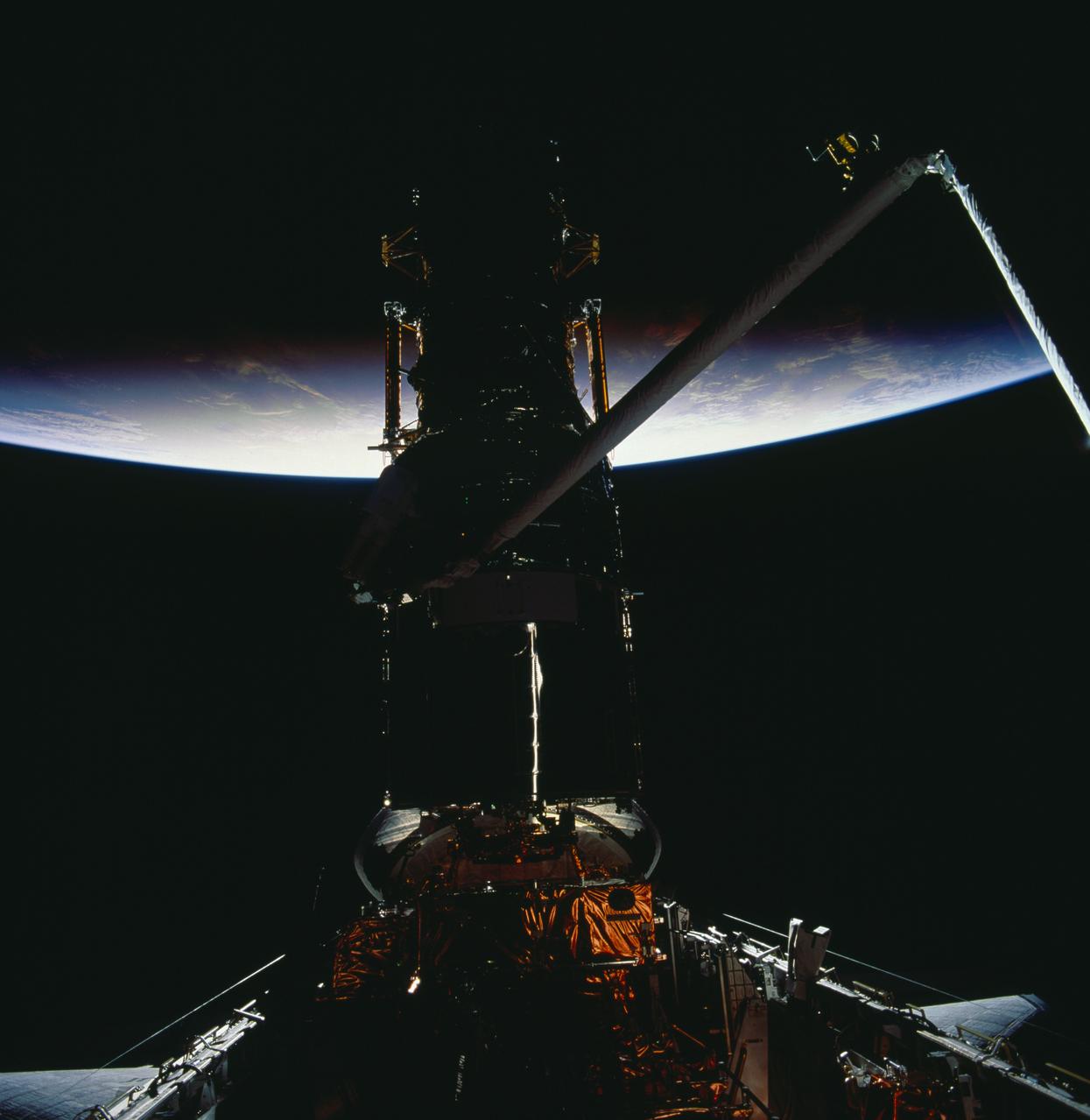
STS061-98-0AR (8 Dec 1993) --- Earth is partially illuminated but the Hubble Space Telescope (HST) and the Space Shuttle Endeavour are still mostly in darkness, in this 70mm frame photographed during the fourth of five space walks. Astronaut Kathryn C. Thornton, barely visible above left center in the frame, works to install the Corrective Optics Space Telescope Axial Replacement (COSTAR).
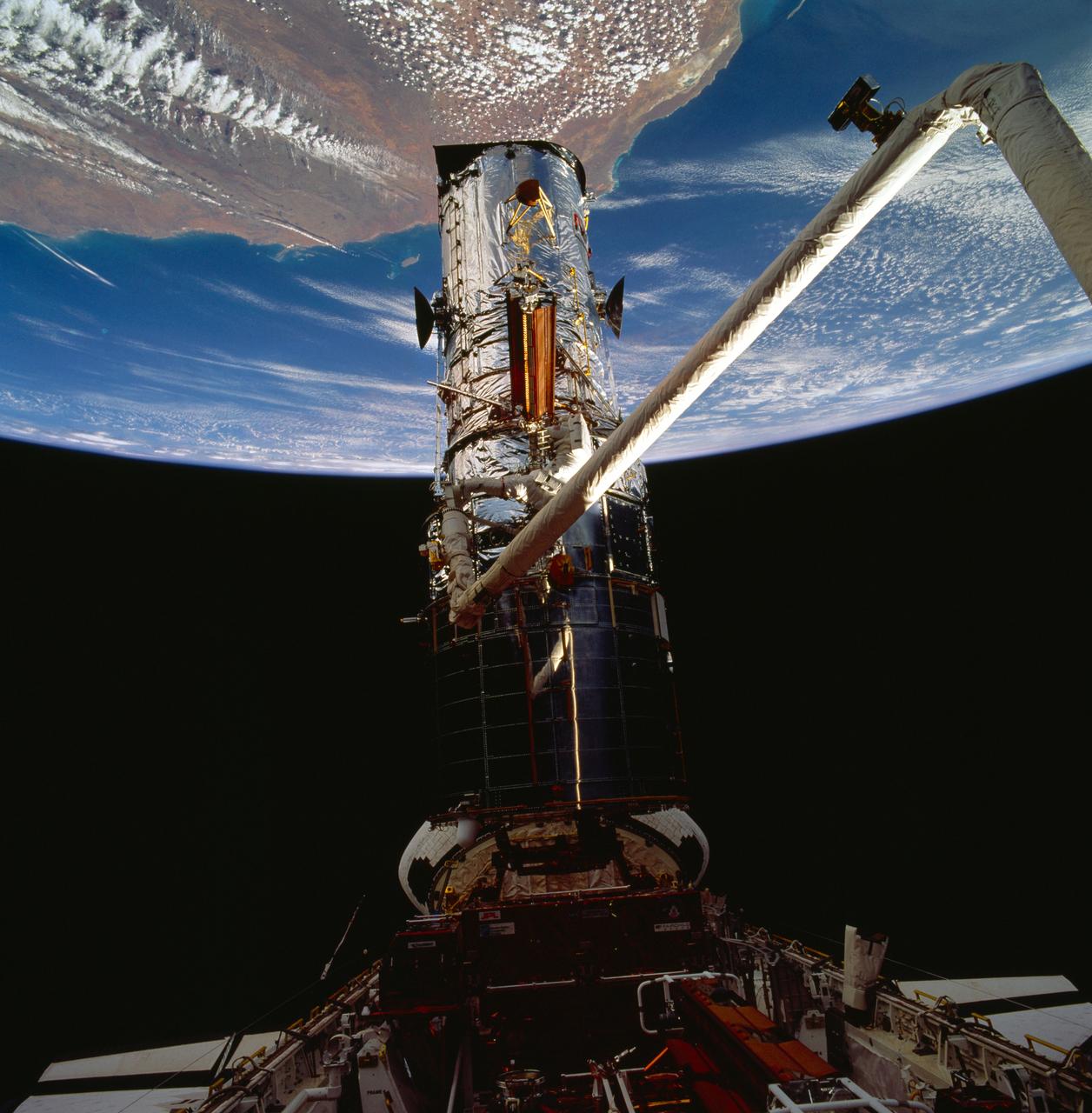
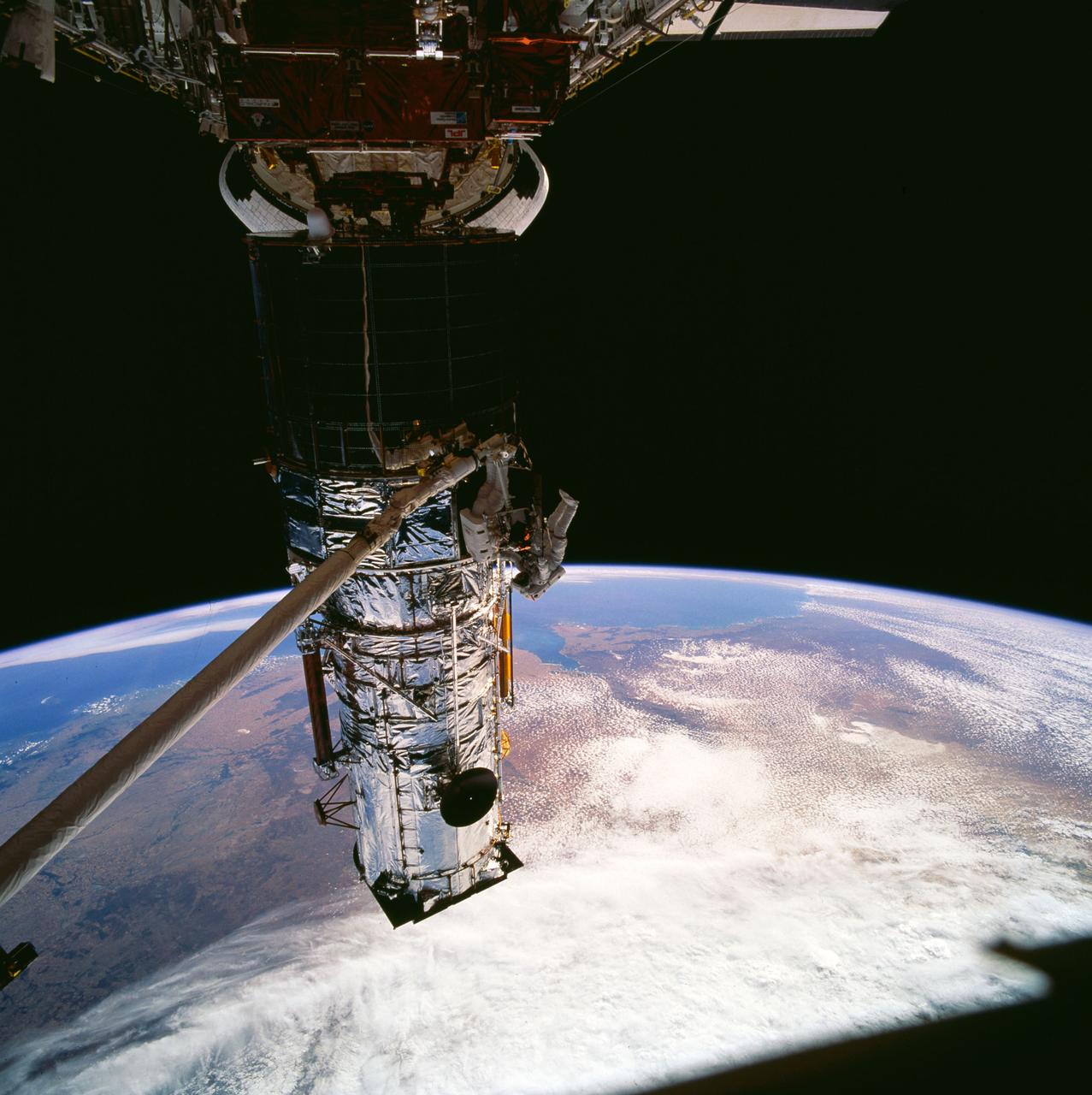
STS061-95-075 (6 Dec 1993) --- Astronauts Kathryn C. Thornton and Thomas D. Akers work to remove one of the solar arrays on the Hubble Space Telescope (HST) on the second of five extravehicular activity?s (EVA). The two space walkers later replaced both solar array panels. Part of Australia is in the background.
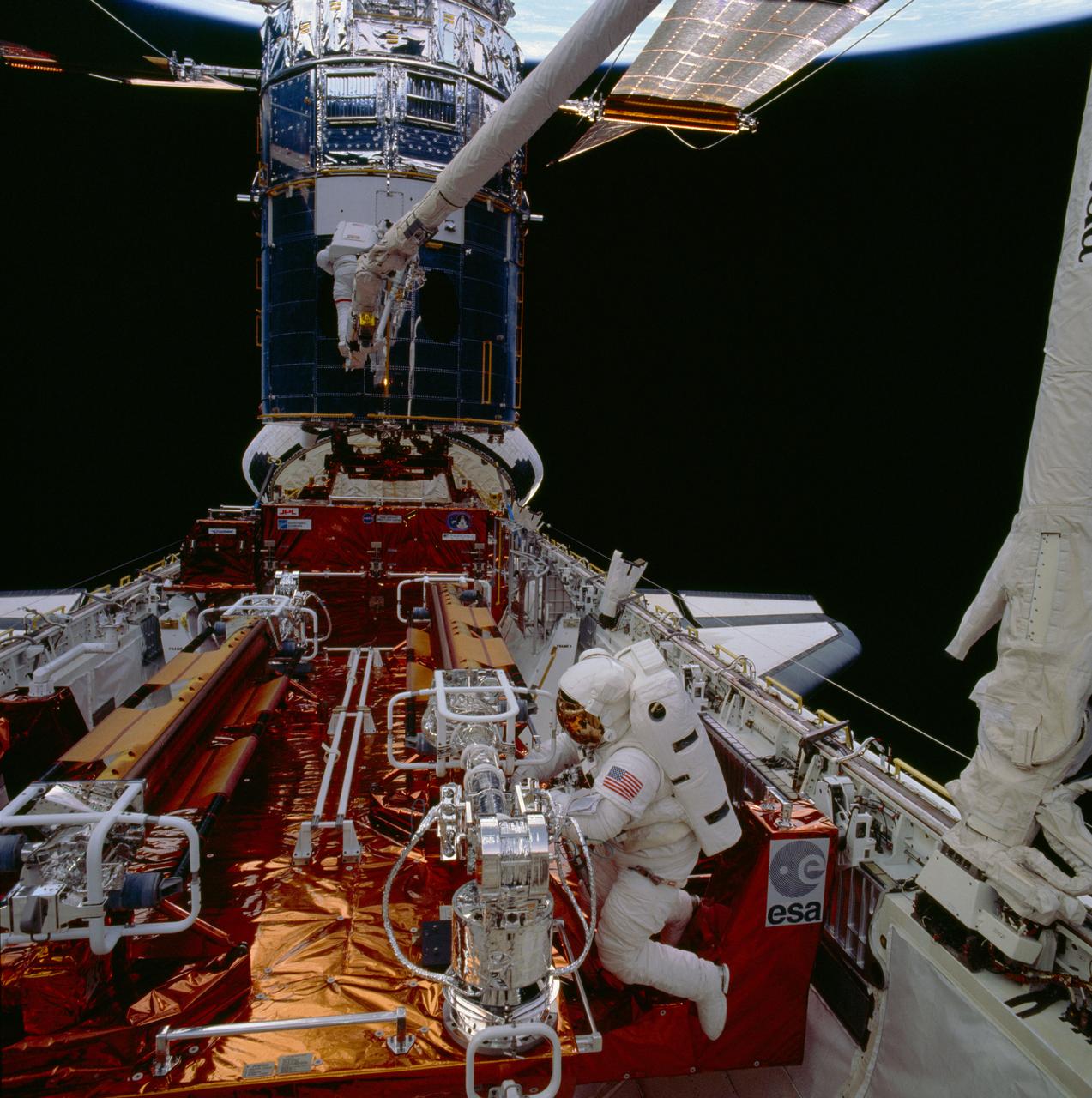
STS061-86-048 (5 Dec 1993) --- Astronauts F. Story Musgrave (foreground) and Jeffrey A. Hoffman are pictured near the end of the first of five extravehicular activity?s (EVA). Musgrave works at the Solar Array Carrier (SAC) in the Space Shuttle Endeavour's cargo bay. Hoffman, anchored to a foot restraint mounted on the end of the Space Shuttle Endeavour's Remote Manipulator System (RMS) arm, waits to be maneuvered to the forward payload bay. The original solar array panels are partially visible at top, while their replacements remain stowed in foreground. The crew's second pair of space walkers -- astronauts Kathryn C. Thornton and Thomas D. Akers -- later changed the solar arrays on the mission's second EVA.
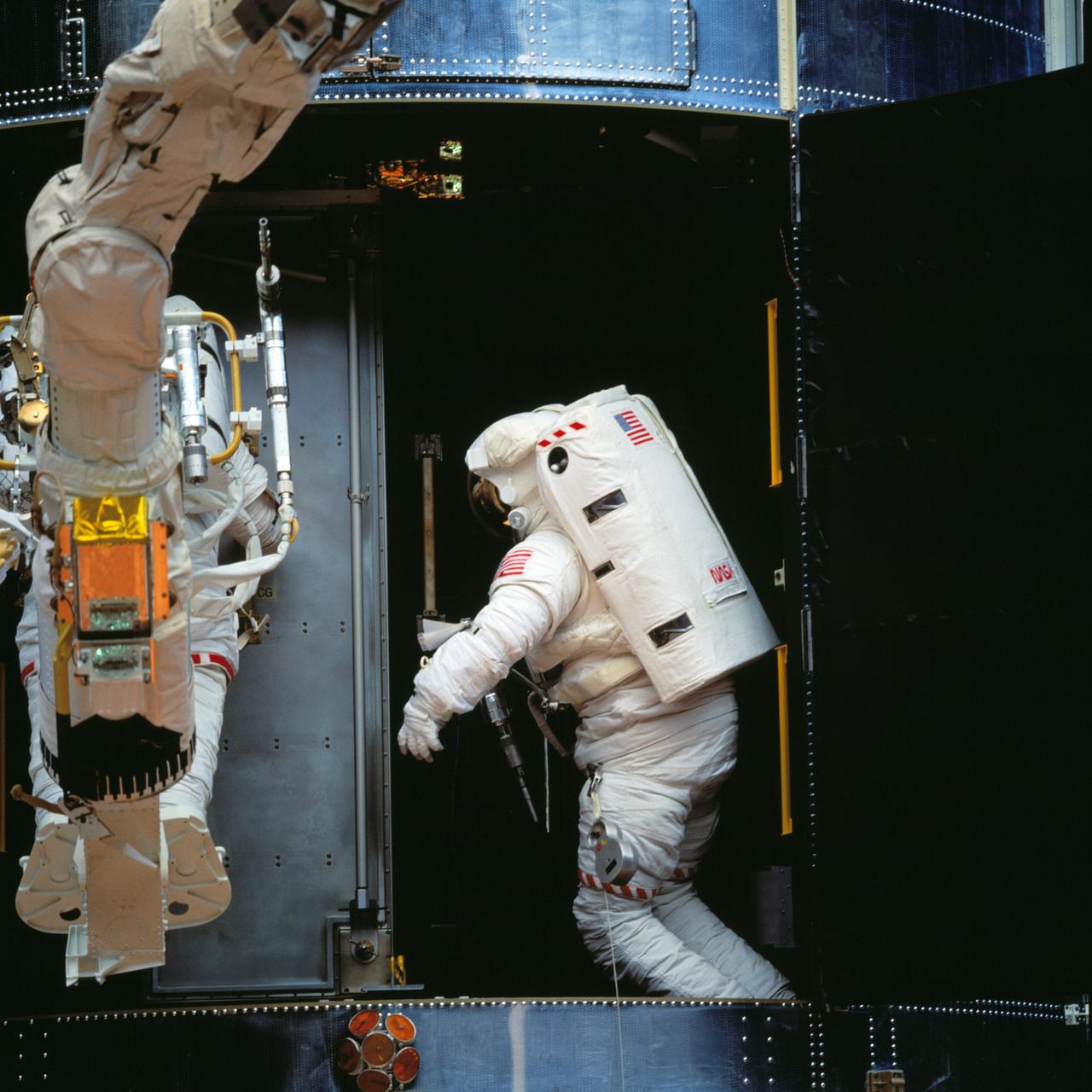
STS061-102-010 (9 Dec 1993) --- Astronauts Jeffrey A. Hoffman (left) and F. Story Musgrave team to replace one of two Solar Array Drive Electronics (SADE) units on the Hubble Space Telescope (HST). Musgrave is standing on a foot restraint mounted on the end of the Space Shuttle Endeavour's Remote Manipulator System (RMS) arm. The black object, in upper left corner, is part of the window frame, through which this 70mm frame was exposed, inside Endeavour's cabin.
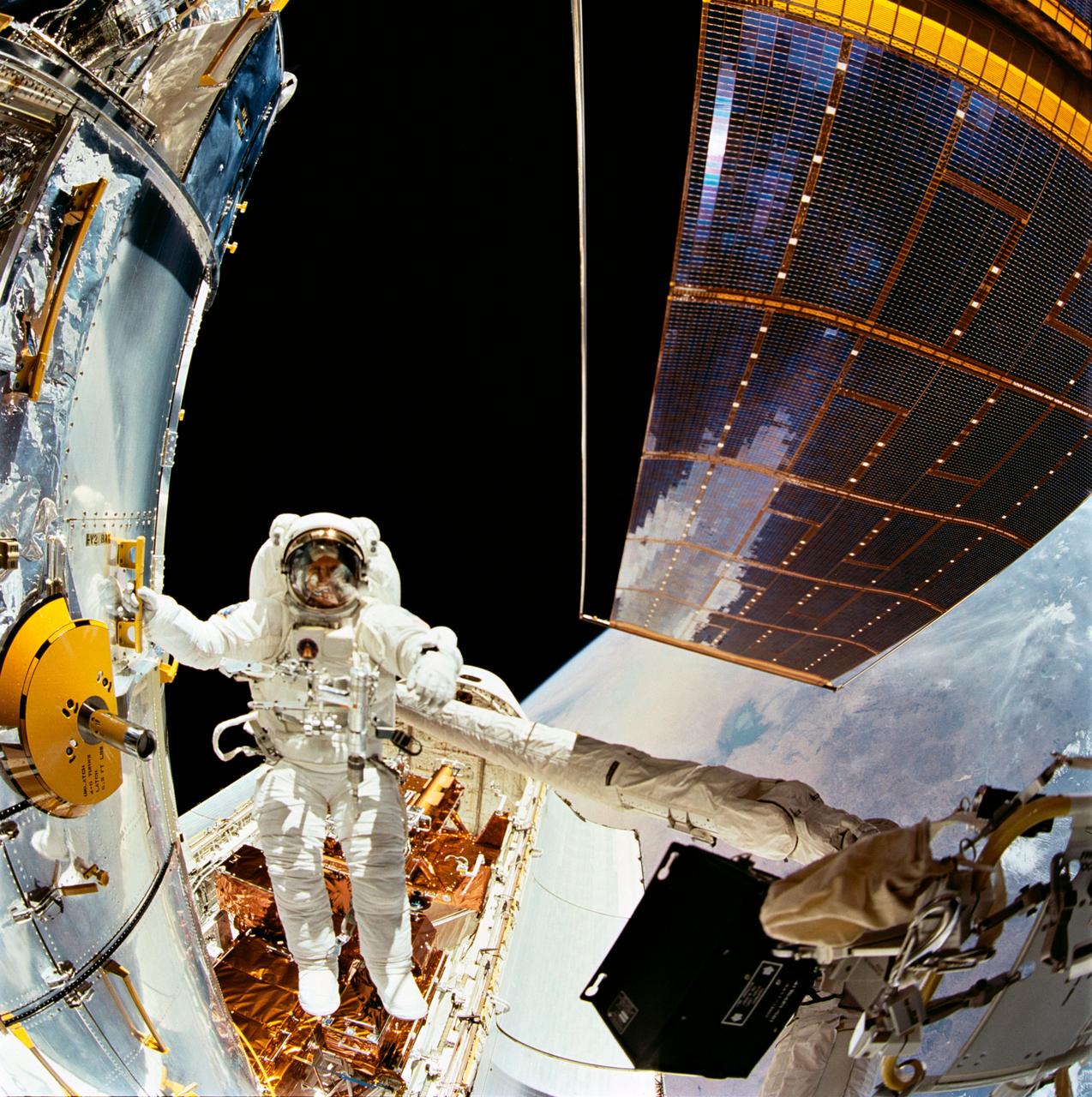
STS061-104-007 (5 Dec 1993) --- Astronaut F. Story Musgrave, holding to one of many strategically placed handrails on the Hubble Space Telescope (HST), is photographed during the first of five extravehicular activity?s (EVA) on the HST-servicing mission, aboard the Space Shuttle Endeavour.
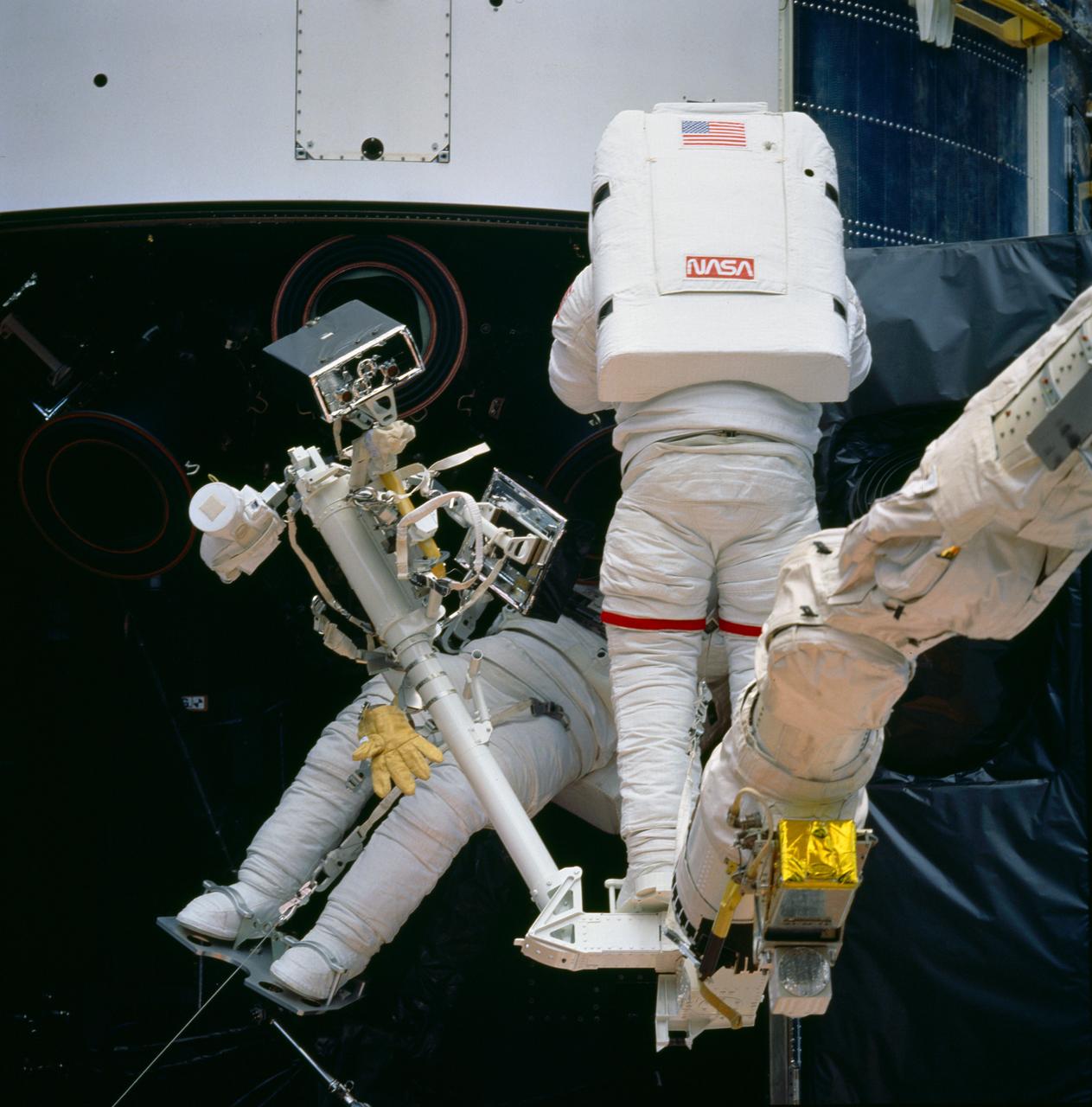
STS061-87-046 (5 Dec 1993) --- Astronauts Jeffrey A. Hoffman (right) and F. Story Musgrave work near the base of the Hubble Space Telescope (HST) on the first of five spacewalks. Their particular mission here is to replace failed Rate Sensor Units (RSU) inside the telescope's housing. Hoffman is anchored to a foot restraint, mounted on the end of the Space Shuttle Endeavour's Remote Manipulator System (RMS) arm, while Musgrave is standing on a foot restraint attached to a support structure in the cargo bay.
STS061-94-059 (8 Dec. 1993) --- Astronaut Thomas D. Akers maneuvers inside the bay which will house the Corrective Optics Space Telescope Axial Replacement (COSTAR) while assisting astronaut Kathryn C. Thornton with the installation of the 640-pound instrument. Thornton, anchored on the end of the Remote Manipulator System (RMS) arm, is partially visible as she prepares to install the COSTAR.
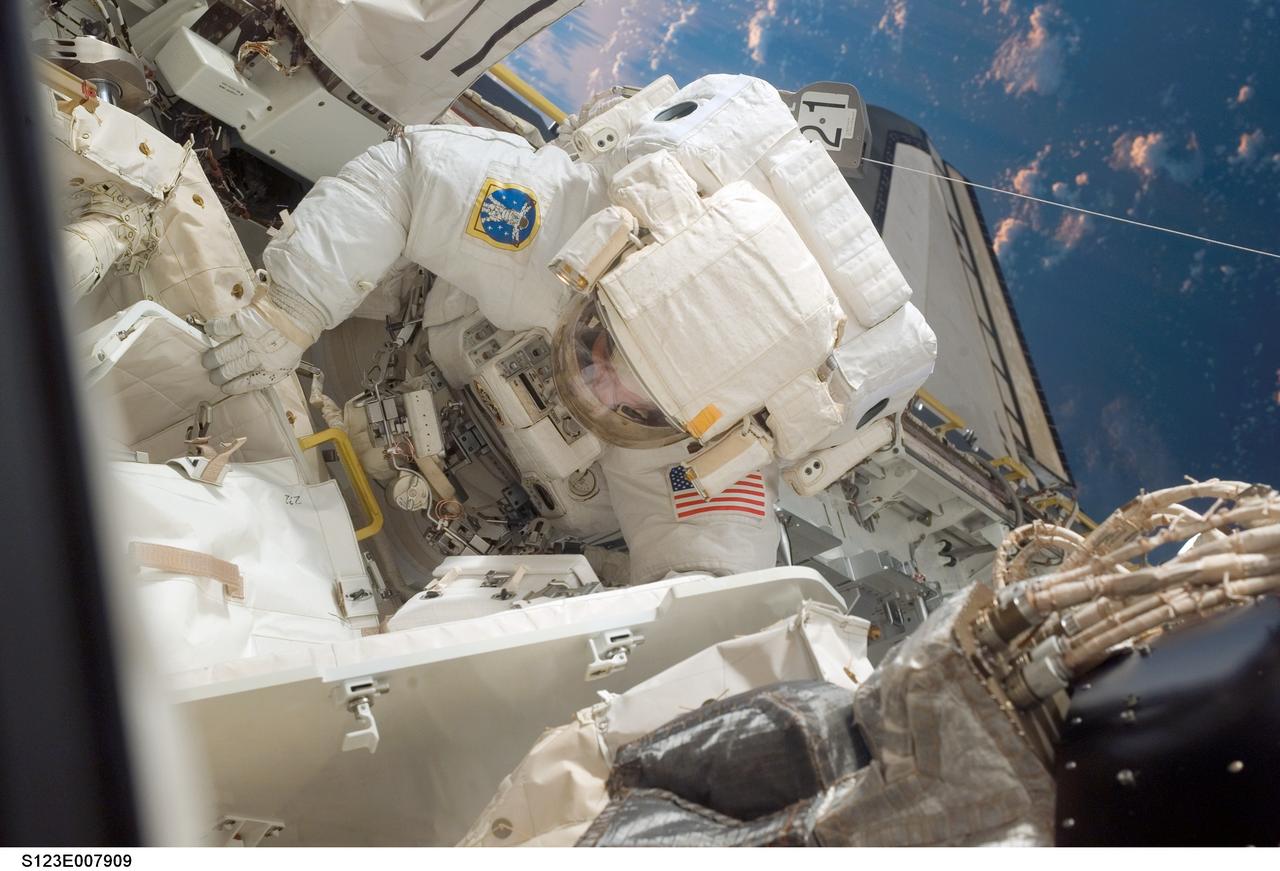
S123-E-007909 (21 March 2008) --- Astronaut Robert L. Behnken, STS-123 mission specialist, participates in the mission's fourth scheduled session of extravehicular activity (EVA) as construction and maintenance continue on the International Space Station. During the 6-hour, 24-minute spacewalk, Behnken and astronaut Mike Foreman (out of frame), mission specialist, replaced a failed Remote Power Control Module -- essentially a circuit breaker -- on the station's truss. The spacewalkers also tested a repair method for damaged heat resistant tiles on the space shuttle. This technique used a caulk-gun-like tool named the Tile Repair Ablator Dispenser to dispense a material called Shuttle Tile Ablator-54 into purposely damaged heat shield tiles. The sample tiles will be returned to Earth to undergo extensive testing on the ground.

S123-E-007838 (21 March 2008) --- Astronauts Robert L. Behnken (top) and Mike Foreman, both STS-123 mission specialists, participate in the mission's fourth scheduled session of extravehicular activity (EVA) as construction and maintenance continue on the International Space Station. During the 6-hour, 24-minute spacewalk, Behnken and Foreman replaced a failed Remote Power Control Module -- essentially a circuit breaker -- on the station's truss. The spacewalkers also tested a repair method for damaged heat resistant tiles on the space shuttle. This technique used a caulk-gun-like tool named the Tile Repair Ablator Dispenser to dispense a material called Shuttle Tile Ablator-54 into purposely damaged heat shield tiles. The sample tiles will be returned to Earth to undergo extensive testing on the ground.
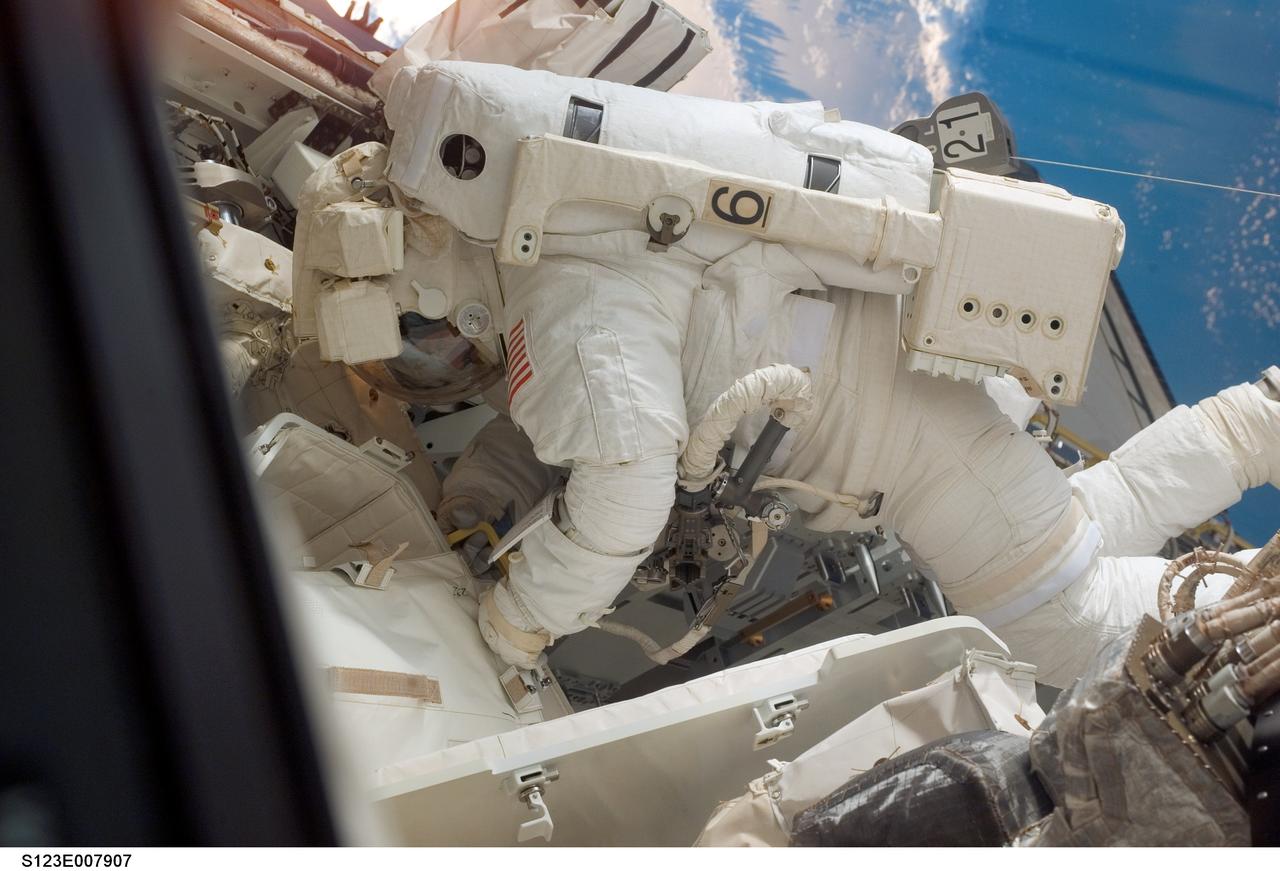
S123-E-007907 (21 March 2008) --- Astronaut Robert L. Behnken, STS-123 mission specialist, participates in the mission's fourth scheduled session of extravehicular activity (EVA) as construction and maintenance continue on the International Space Station. During the 6-hour, 24-minute spacewalk, Behnken and astronaut Mike Foreman (out of frame), mission specialist, replaced a failed Remote Power Control Module -- essentially a circuit breaker -- on the station's truss. The spacewalkers also tested a repair method for damaged heat resistant tiles on the space shuttle. This technique used a caulk-gun-like tool named the Tile Repair Ablator Dispenser to dispense a material called Shuttle Tile Ablator-54 into purposely damaged heat shield tiles. The sample tiles will be returned to Earth to undergo extensive testing on the ground.
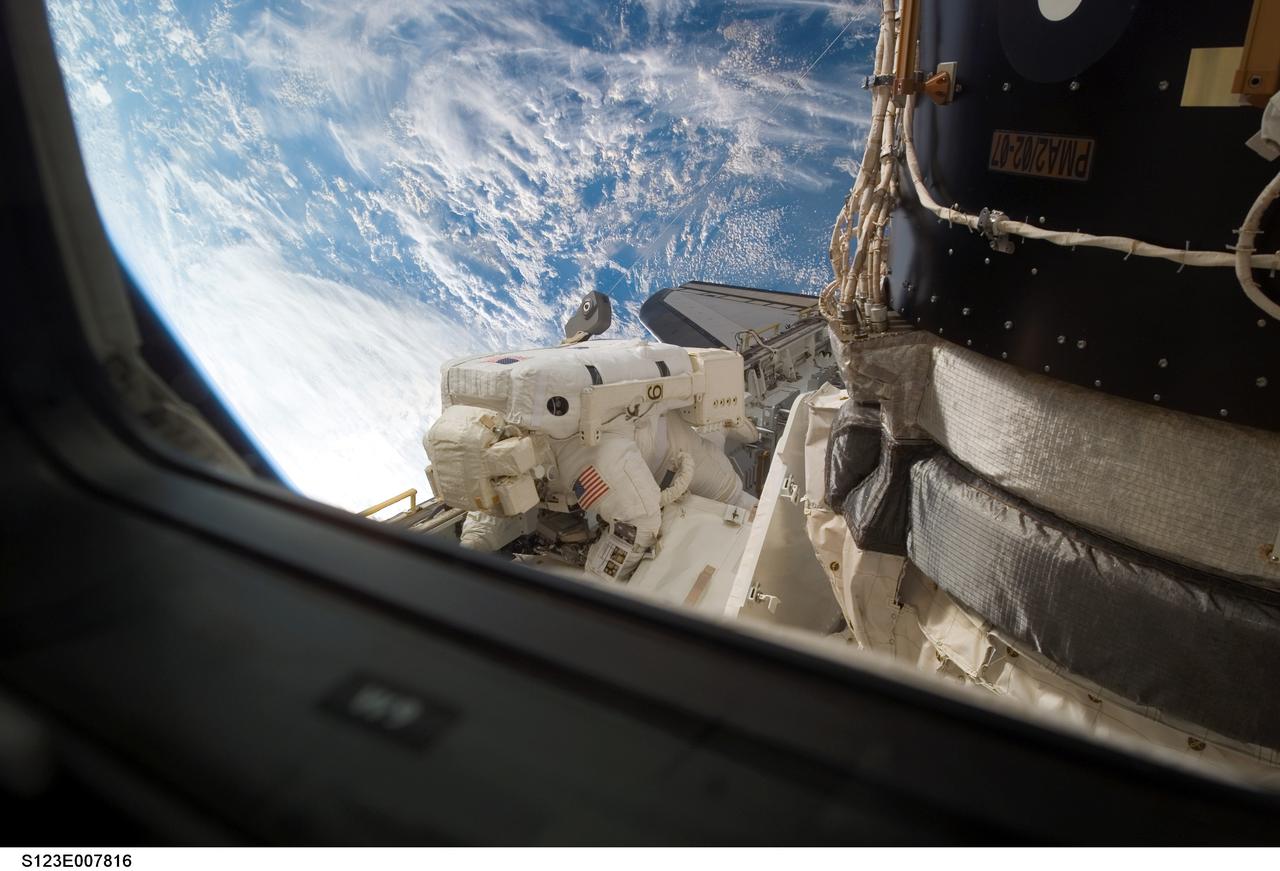
S123-E-007816 (21 March 2008) --- Astronaut Robert L. Behnken, STS-123 mission specialist, participates in the mission's fourth scheduled session of extravehicular activity (EVA) as construction and maintenance continue on the International Space Station. During the 6-hour, 24-minute spacewalk, Behnken and astronaut Mike Foreman (out of frame), mission specialist, replaced a failed Remote Power Control Module -- essentially a circuit breaker -- on the station's truss. The spacewalkers also tested a repair method for damaged heat resistant tiles on the space shuttle. This technique used a caulk-gun-like tool named the Tile Repair Ablator Dispenser to dispense a material called Shuttle Tile Ablator-54 into purposely damaged heat shield tiles. The sample tiles will be returned to Earth to undergo extensive testing on the ground.
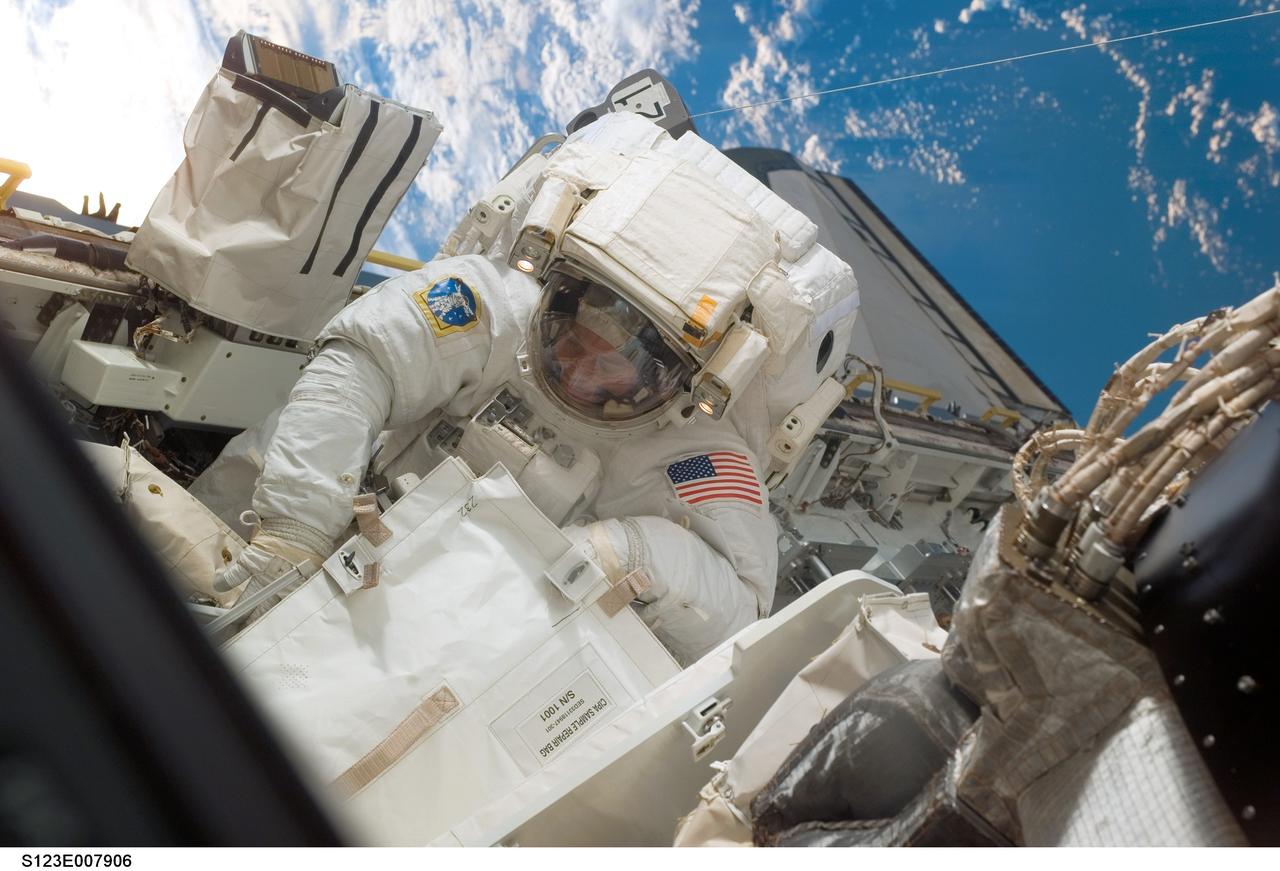
S123-E-007906 (21 March 2008) --- Astronaut Robert L. Behnken, STS-123 mission specialist, participates in the mission's fourth scheduled session of extravehicular activity (EVA) as construction and maintenance continue on the International Space Station. During the 6-hour, 24-minute spacewalk, Behnken and astronaut Mike Foreman (out of frame), mission specialist, replaced a failed Remote Power Control Module -- essentially a circuit breaker -- on the station's truss. The spacewalkers also tested a repair method for damaged heat resistant tiles on the space shuttle. This technique used a caulk-gun-like tool named the Tile Repair Ablator Dispenser to dispense a material called Shuttle Tile Ablator-54 into purposely damaged heat shield tiles. The sample tiles will be returned to Earth to undergo extensive testing on the ground.
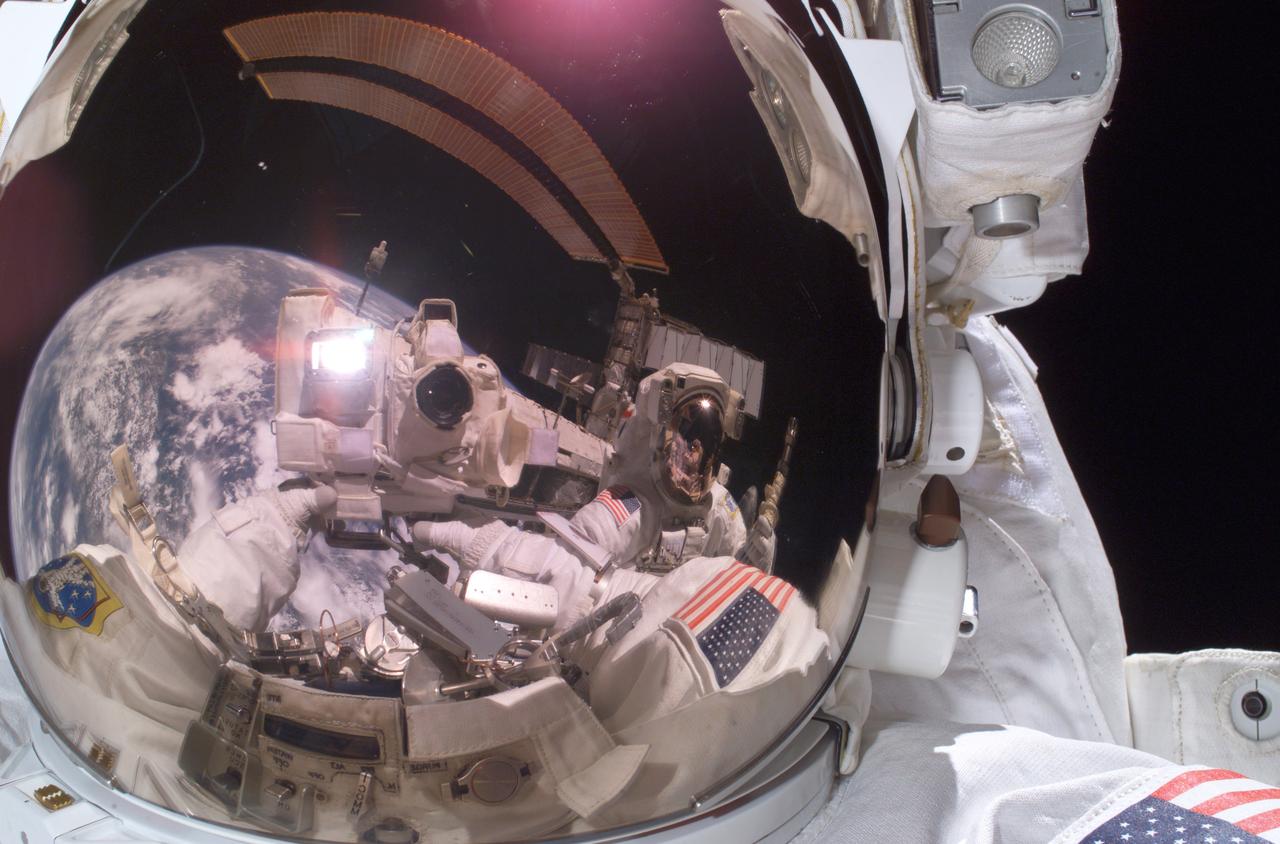
Astronaut Michael E. Fossum, STS-121 mission specialist, used a digital still camera to expose a photo of his helmet visor during a session of extravehicular activity (EVA) while Space Shuttle Discovery was docked with the International Space Station (ISS). Also visible in the visor reflections are fellow space walker Piers J. Sellers, mission specialist, Earth's horizon, and a station solar array. During its 12-day mission, this utilization and logistics flight delivered a multipurpose logistics module (MPLM) to the ISS with several thousand pounds of new supplies and experiments. In addition, some new orbital replacement units (ORUs) were delivered and stowed externally on the ISS on a special pallet. These ORUs are spares for critical machinery located on the outside of the ISS. During this mission the crew also carried out testing of Shuttle inspection and repair hardware, as well as evaluated operational techniques and concepts for conducting on-orbit inspection and repair.
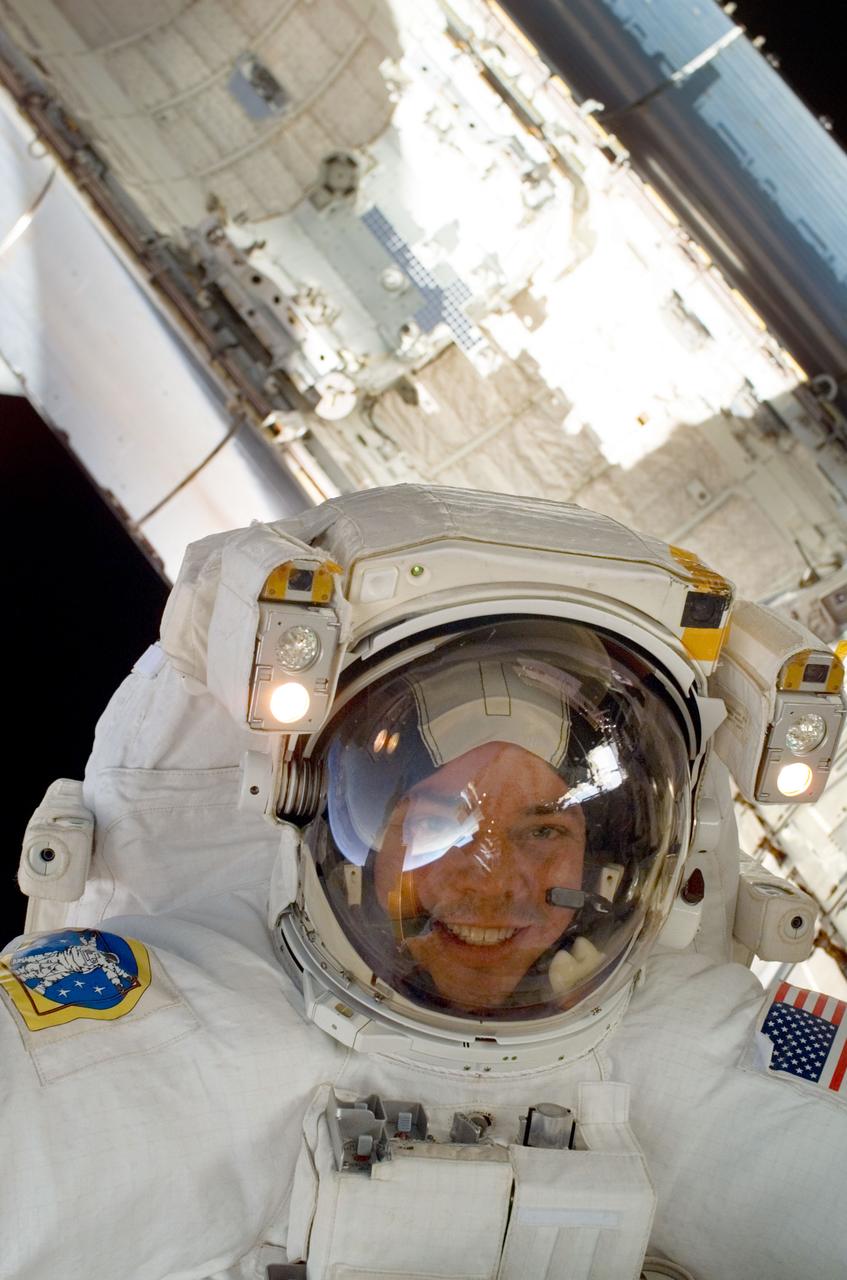
ISS016-E-033400 (21 March 2008) --- Astronaut Robert L. Behnken, STS-123 mission specialist, participates in the mission's fourth scheduled session of extravehicular activity (EVA) as construction and maintenance continue on the International Space Station. During the 6-hour, 24-minute spacewalk, Behnken and astronaut Mike Foreman (out of frame), mission specialist, replaced a failed Remote Power Control Module -- essentially a circuit breaker -- on the station's truss. The spacewalkers also tested a repair method for damaged heat resistant tiles on the space shuttle. This technique used a caulk-gun-like tool named the Tile Repair Ablator Dispenser to dispense a material called Shuttle Tile Ablator-54 into purposely damaged heat shield tiles. The sample tiles will be returned to Earth to undergo extensive testing on the ground. A portion of the Space Shuttle Endeavour payload bay is visible in the background.
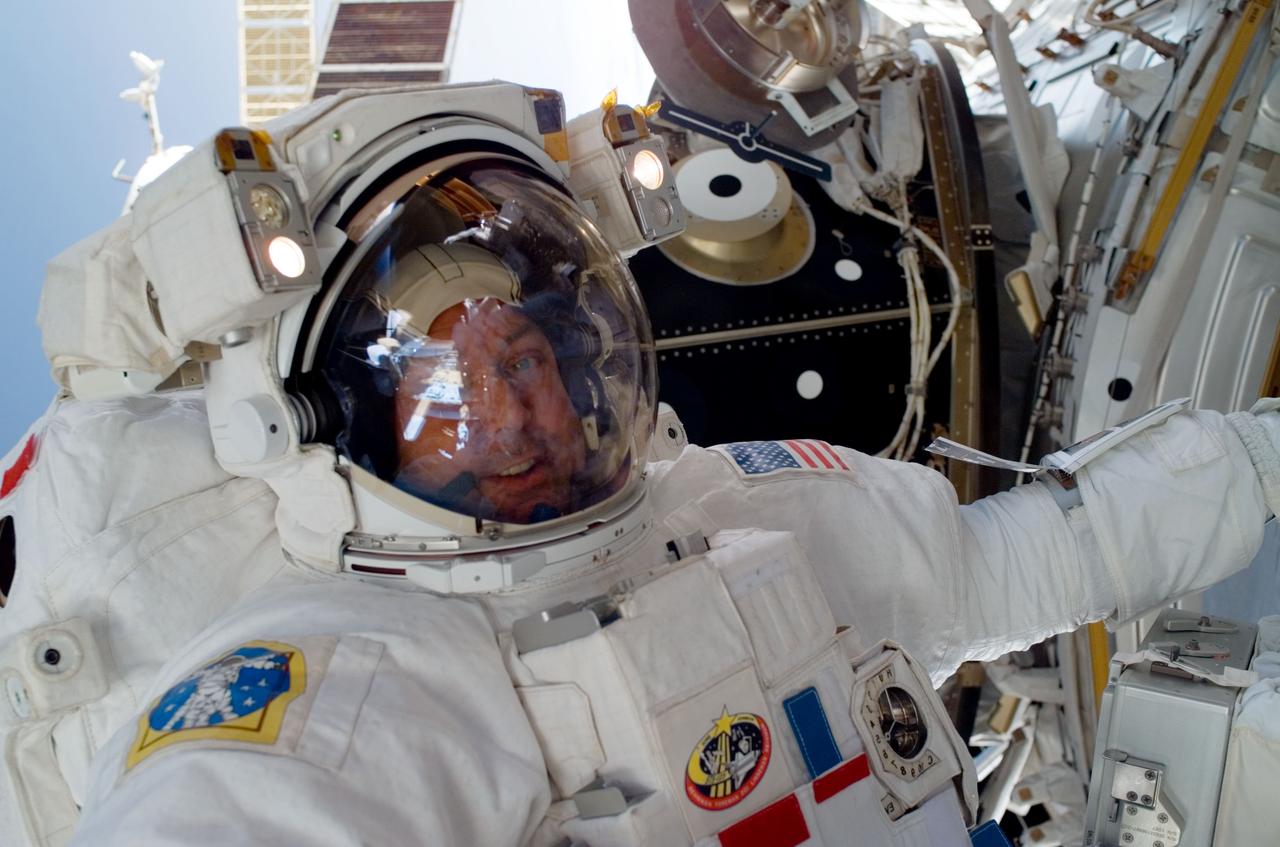
ISS016-E-033394 (21 March 2008) --- Astronaut Mike Foreman, STS-123 mission specialist, participates in the mission's fourth scheduled session of extravehicular activity (EVA) as construction and maintenance continue on the International Space Station. During the 6-hour, 24-minute spacewalk, Foreman and astronaut Robert L. Behnken (out of frame), mission specialist, replaced a failed Remote Power Control Module -- essentially a circuit breaker -- on the station's truss. The spacewalkers also tested a repair method for damaged heat resistant tiles on the space shuttle. This technique used a caulk-gun-like tool named the Tile Repair Ablator Dispenser to dispense a material called Shuttle Tile Ablator-54 into purposely damaged heat shield tiles. The sample tiles will be returned to Earth to undergo extensive testing on the ground.
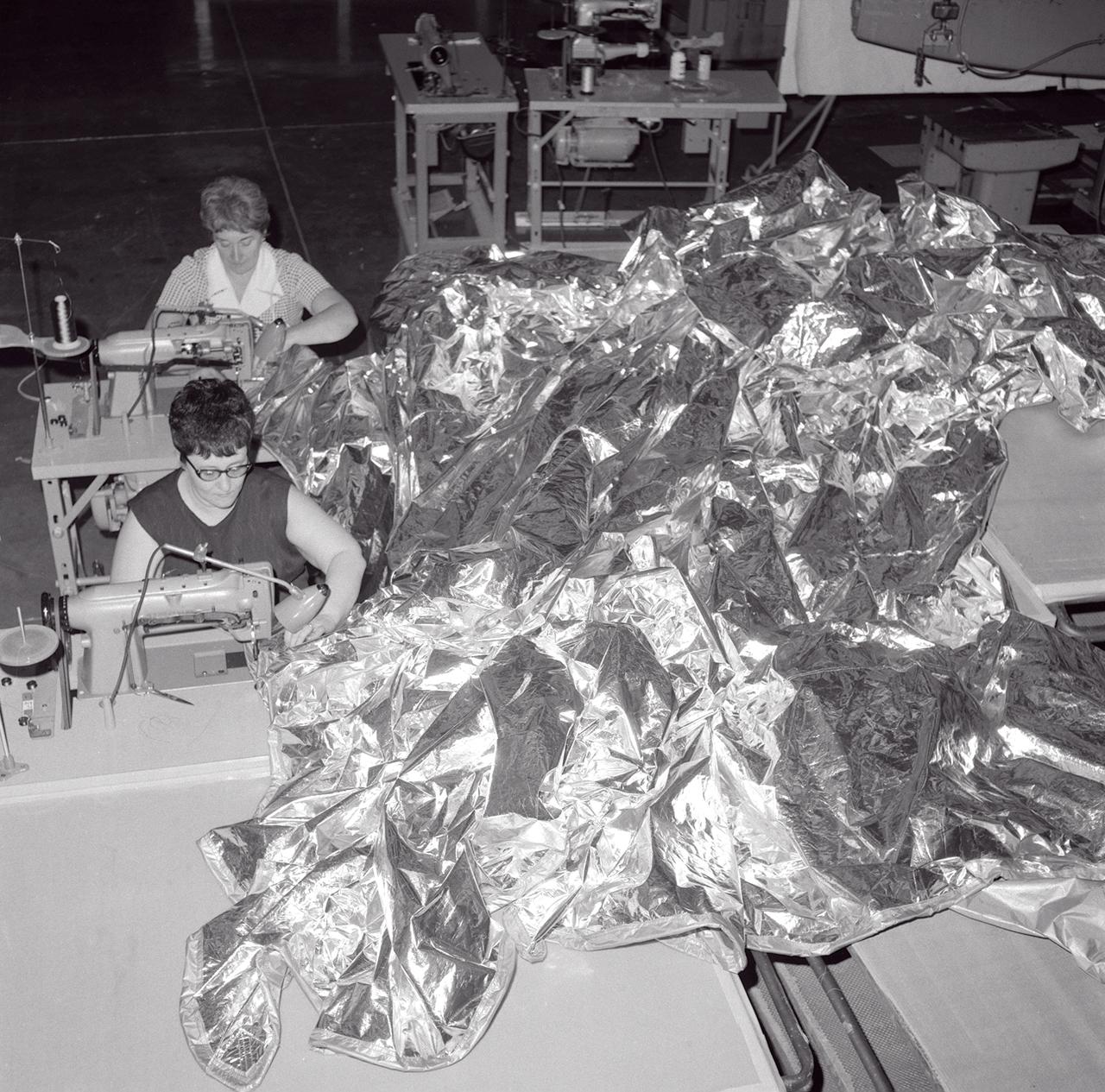
Two seamstresses stitch together a sun-shade for Skylab Orbital Workshop (OWS), the first U.S. experimental space station in orbit, which lost its thermal protection shield during the launch on May 14, 1973. Without the heat shield, the temperature inside the Orbital Workshop became dangerously high, rendering the workshop uninhabitable and threatened deterioration of the interior insulation and adhesive. Engineers and scientists at Marshall Space Flight Center (MSFC) worked tirelessly around the clock on the emergency repair procedure. The Skylab crew and the repair kits were launched just 11 days after the incident. The crew successfully deployed the twin-pole sail parasol sun-shade during their EVA (Extravehicular Activity) the next day.
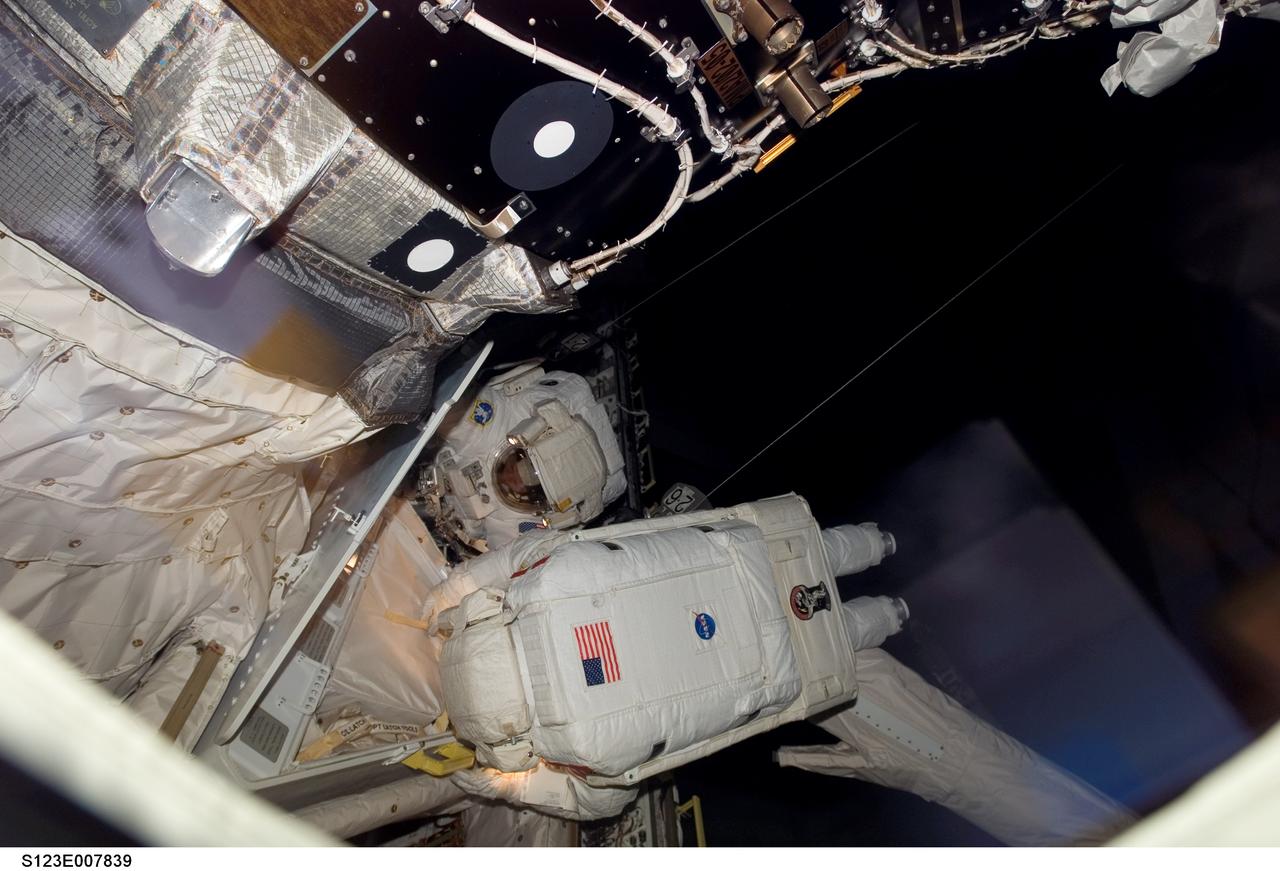
S123-E-007839 (21 March 2008) --- Astronauts Mike Foreman (foreground) and Robert L. Behnken, both STS-123 mission specialists, participate in the mission's fourth scheduled session of extravehicular activity (EVA) as construction and maintenance continue on the International Space Station. During the 6-hour, 24-minute spacewalk, Foreman and Behnken replaced a failed Remote Power Control Module -- essentially a circuit breaker -- on the station's truss. The spacewalkers also tested a repair method for damaged heat resistant tiles on the space shuttle. This technique used a caulk-gun-like tool named the Tile Repair Ablator Dispenser to dispense a material called Shuttle Tile Ablator-54 into purposely damaged heat shield tiles. The sample tiles will be returned to Earth to undergo extensive testing on the ground.
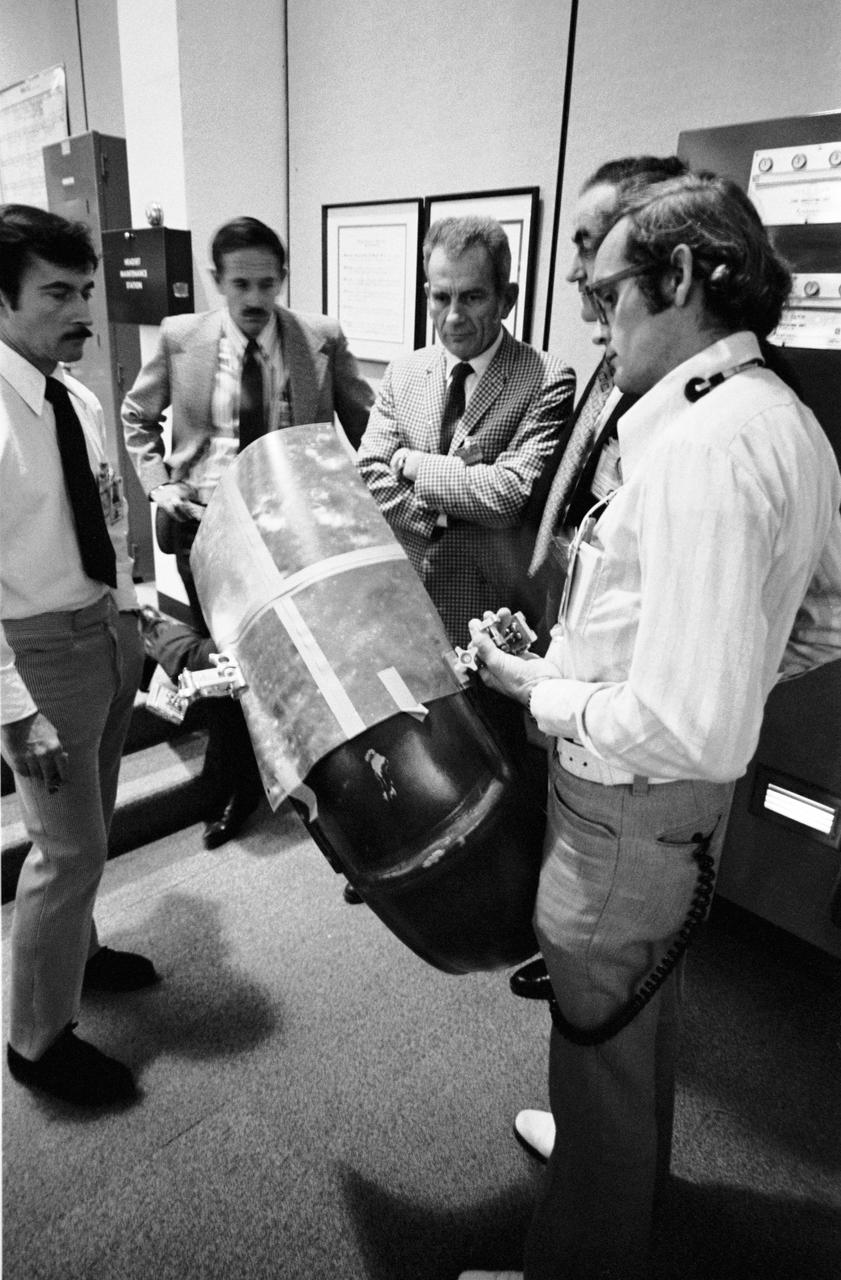
S72-55170 (11 Dec. 1972) --- These five men in the Mission Control Center ponder the solution to the problem of the damage to the right rear fender of the Apollo 17 Lunar Roving Vehicle at the Taurus-Littrow landing site. During the first lunar surface extravehicular activity a hammer got underneath the fender and a part of it was knocked off. Astronauts Eugene A. Cernan and Harrison H. Schmitt were reporting a problem with lunar dust because of the damaged fender. They sought some way to repair the broken fender. Clockwise are astronauts John W. Young and Charles M. Duke Jr., two Apollo 17 CAPCOM; Donald K. Slayton, director of flight crew operations at MSC; Dr. Roco A. Petrone, Apollo program director, Office of Manned Space Flight, NASA HQ; and Ronald V. Blevins, an EVA-1 flight controller with General Electric. They are looking over a makeshift repair arrangement which uses lunar maps and clamps from the optical alignment telescope lamp, a repair suggestion made by astronaut Young. The suggestion was relayed to Cernan and Schmitt and the repair made at the beginning of EVA-2. The problem was solved satisfactorily.
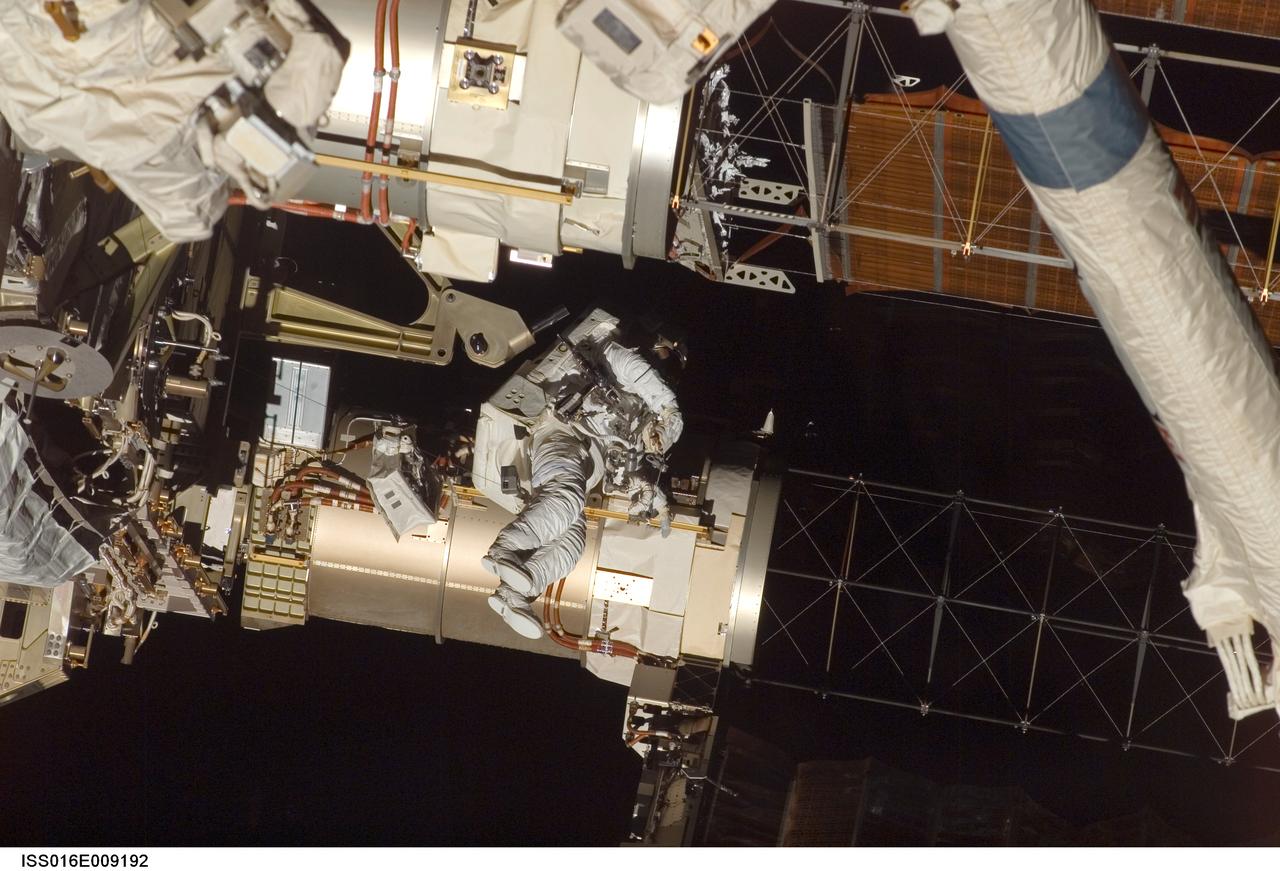
ISS016-E-009192 (3 Nov. 2007) --- Astronaut Doug Wheelock, STS-120 mission specialist, participates in the mission's fourth session of extravehicular activity (EVA) while Space Shuttle Discovery is docked with the International Space Station. During the 7-hour, 19-minute spacewalk, astronaut Scott Parazynski (out of frame), mission specialist, cut a snagged wire and installed homemade stabilizers designed to strengthen the damaged solar array's structure and stability in the vicinity of the damage. Wheelock assisted from the truss by keeping an eye on the distance between Parazynski and the array. Once the repair was complete, flight controllers on the ground successfully completed the deployment of the array.
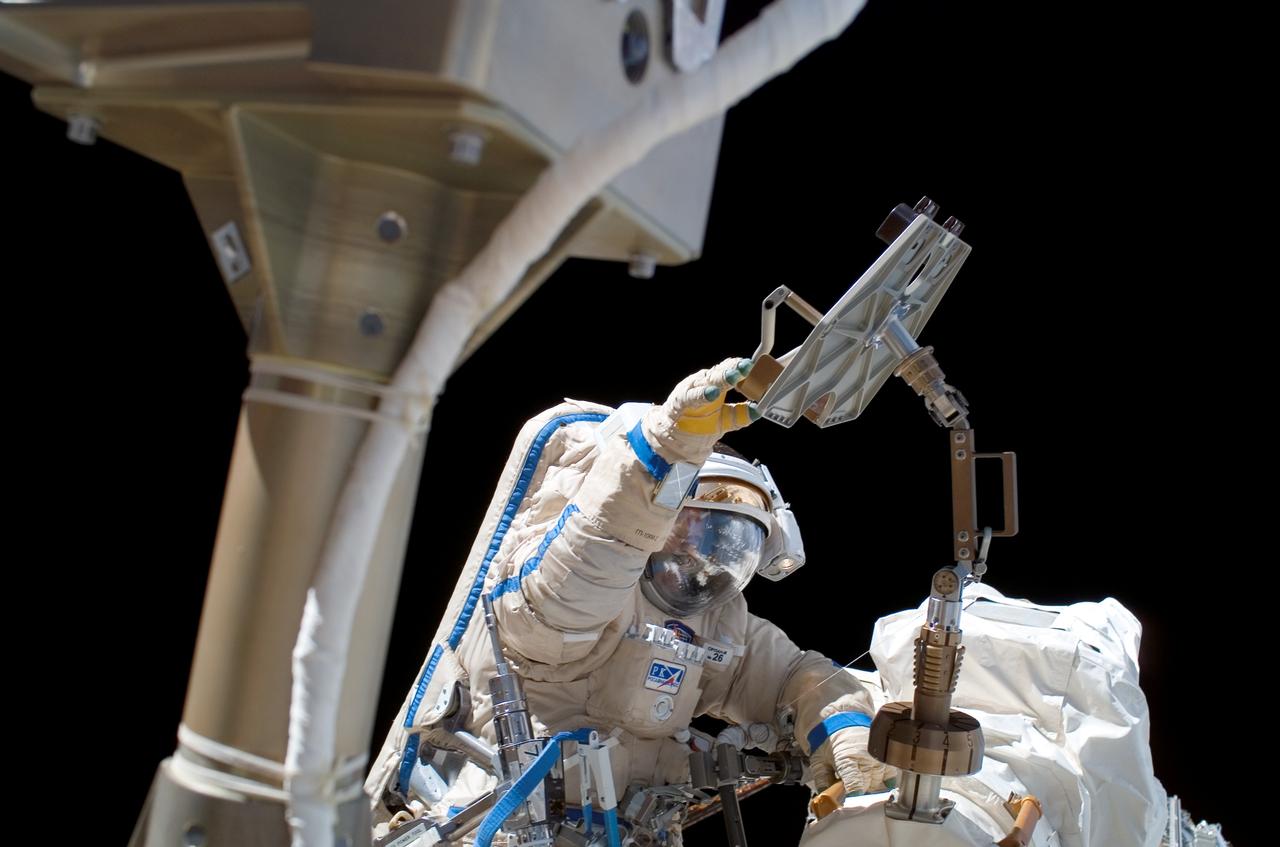
ISS013-E-29017 (1 June 2006) --- Astronaut Jeffrey N. Williams, Expedition 13 NASA space station science officer and flight engineer, attired in a Russian Orlan spacesuit, participates in the first session of extravehicular activity (EVA) performed by the Expedition 13 crew during their six-month mission. During the 6-hour, 31-minute spacewalk, Williams and cosmonaut Pavel V. Vinogradov (out of frame), commander representing Russia's Federal Space Agency, repaired, retrieved and replaced hardware on the U.S. and Russian segments of the International Space Station.
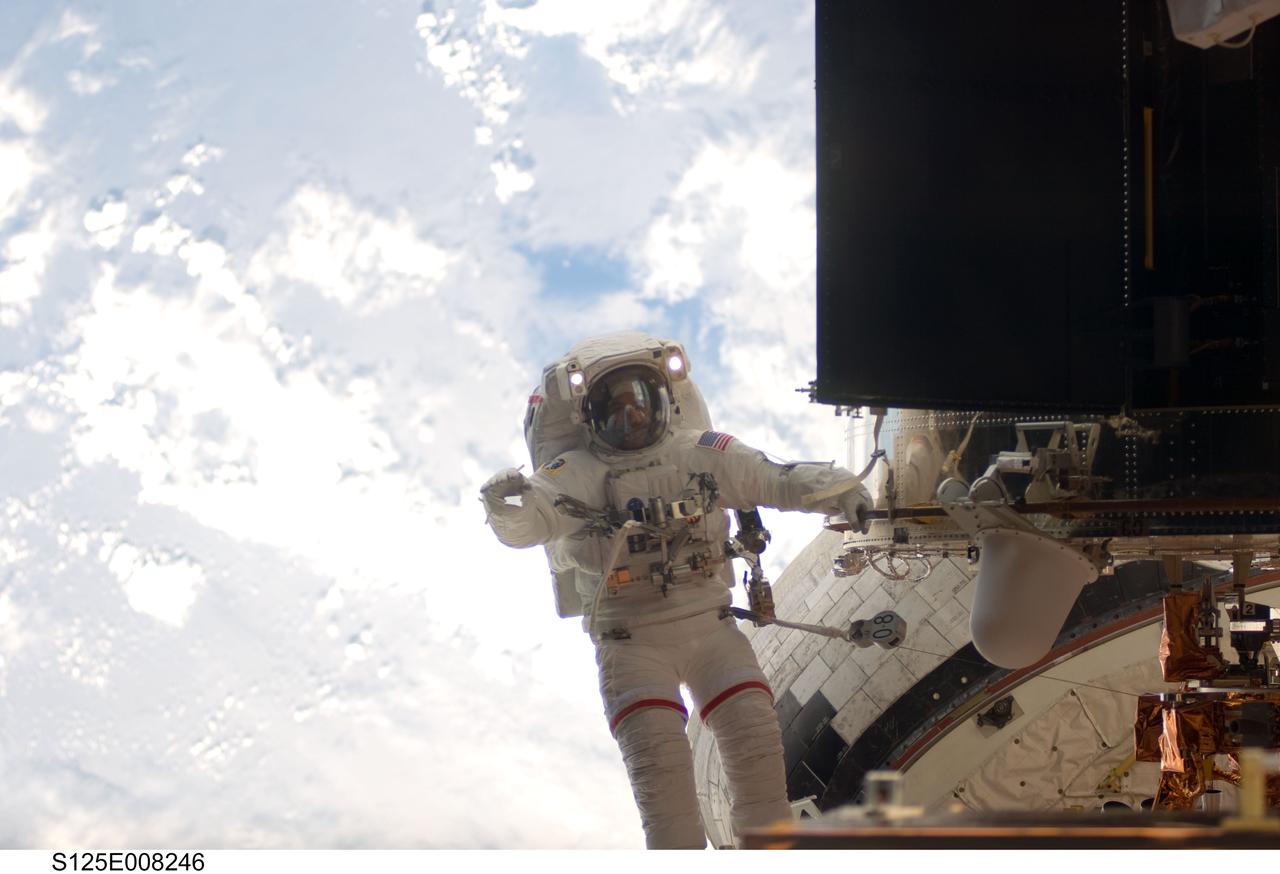
S125-E-008246 (16 May 2009) --- Astronaut John Grunsfeld, STS-125 mission specialist, participates in the mission?s third session of extravehicular activity (EVA) as work continues to refurbish and upgrade the Hubble Space Telescope. During the six-hour, 36-minute spacewalk, Grunsfeld and astronaut Andrew Feustel (out of frame), mission specialist, removed the Corrective Optics Space Telescope Axial Replacement and installed in its place the new Cosmic Origins Spectrograph. They also completed the Advanced Camera for Surveys electronic card replacement work, and completed part 2 of the ACS repair, installing a new electronics box and cable.
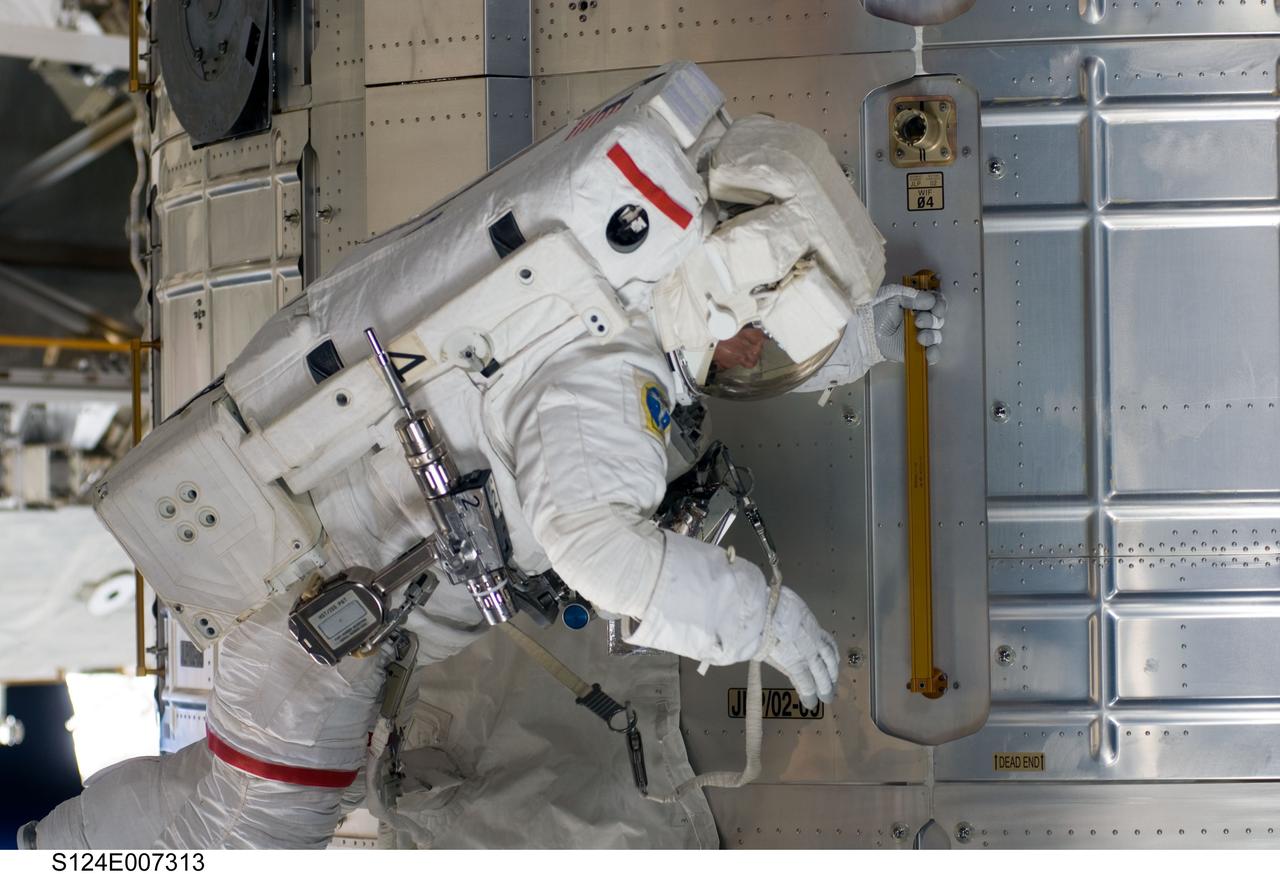
S124-E-007313 (8 June 2008) --- Astronaut Mike Fossum, STS-124 mission specialist, participates in the mission's third scheduled session of extravehicular activity (EVA) as construction and maintenance continue on the International Space Station. During the six-hour, 33-minute spacewalk, Fossum and astronaut Ron Garan (out of frame), mission specialist, exchanged a depleted Nitrogen Tank Assembly for a new one, removed thermal covers and launch locks from the Kibo laboratory, reinstalled a repaired television camera onto the space station's left P1 truss, and retrieved samples of a dust-like substance from the left Solar Alpha Rotary Joint for analysis by experts on the ground.
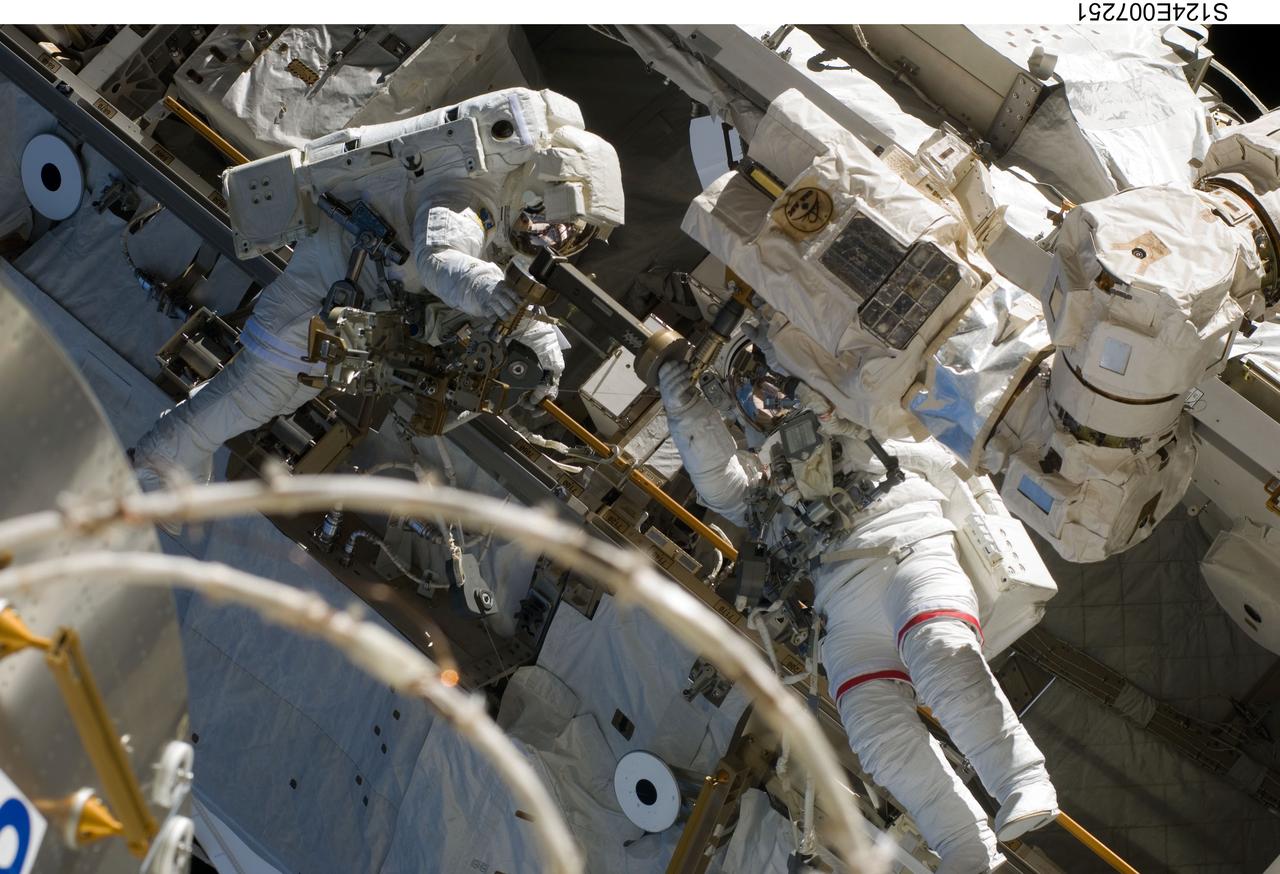
S124-E-007251 (8 June 2008) --- Astronauts Mike Fossum (right) and Ron Garan, both STS-124 mission specialists, participate in the mission's third scheduled session of extravehicular activity (EVA) as construction and maintenance continue on the International Space Station. During the six-hour, 33-minute spacewalk, Fossum and Garan exchanged a depleted Nitrogen Tank Assembly for a new one, removed thermal covers and launch locks from the Kibo laboratory, reinstalled a repaired television camera onto the space station's left P1 truss, and retrieved samples of a dust-like substance from the left Solar Alpha Rotary Joint for analysis by experts on the ground.
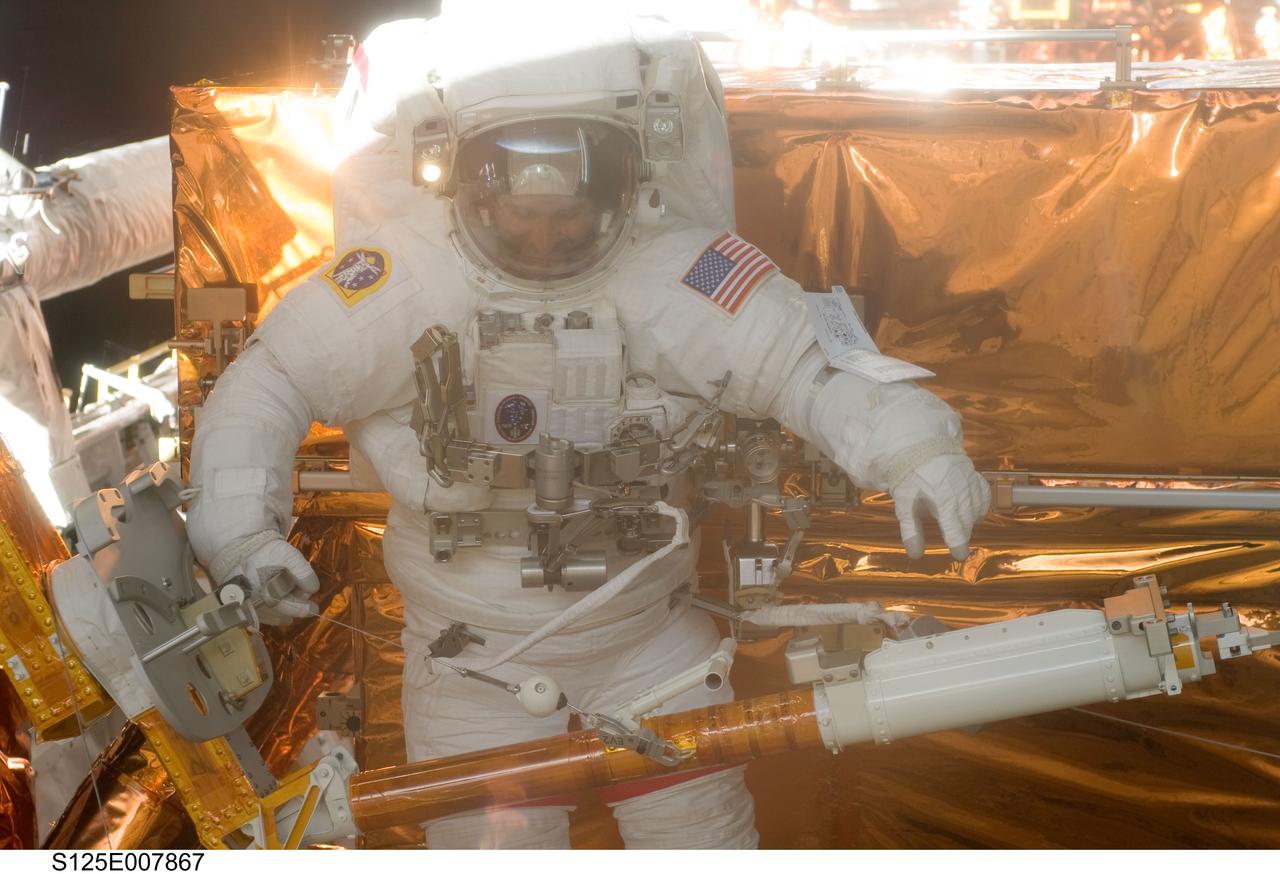
S125-E-007867 (16 May 2009) --- Astronaut John Grunsfeld, STS-125 mission specialist, participates in the mission?s third session of extravehicular activity (EVA) as work continues to refurbish and upgrade the Hubble Space Telescope. During the six-hour, 36-minute spacewalk, Grunsfeld and astronaut Andrew Feustel (out of frame), mission specialist, removed the Corrective Optics Space Telescope Axial Replacement and installed in its place the new Cosmic Origins Spectrograph. They also completed the Advanced Camera for Surveys electronic card replacement work, and completed part 2 of the ACS repair, installing a new electronics box and cable.
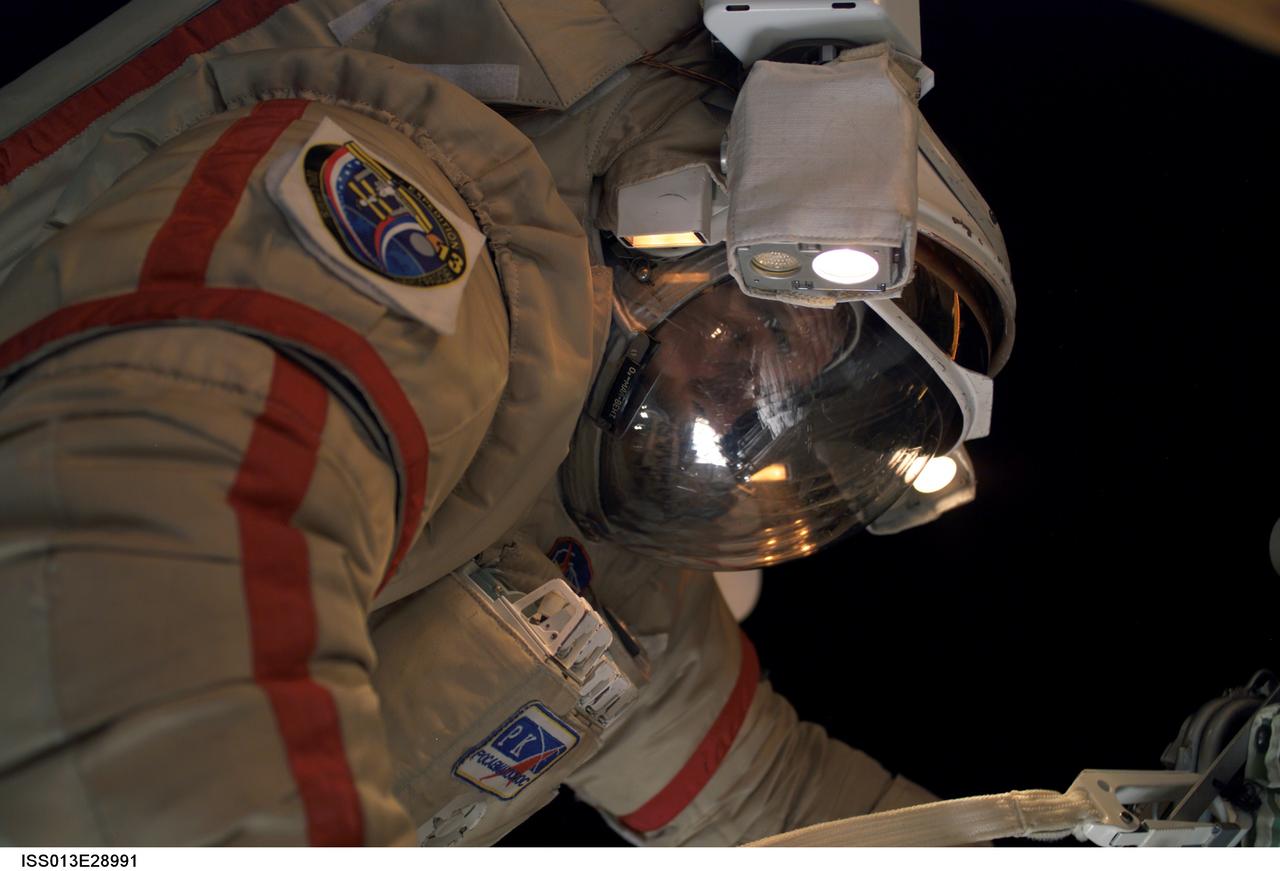
ISS013-E-28991 (1 June 2006) --- Cosmonaut Pavel V. Vinogradov, Expedition 13 commander representing Russia's Federal Space Agency, attired in a Russian Orlan spacesuit, participates in the first session of extravehicular activity (EVA) performed by the Expedition 13 crew during their six-month mission. During the 6-hour, 31-minute spacewalk, Vinogradov and astronaut Jeffrey N. Williams (out of frame), NASA space station science officer and flight engineer, repaired, retrieved and replaced hardware on the U.S. and Russian segments of the International Space Station.
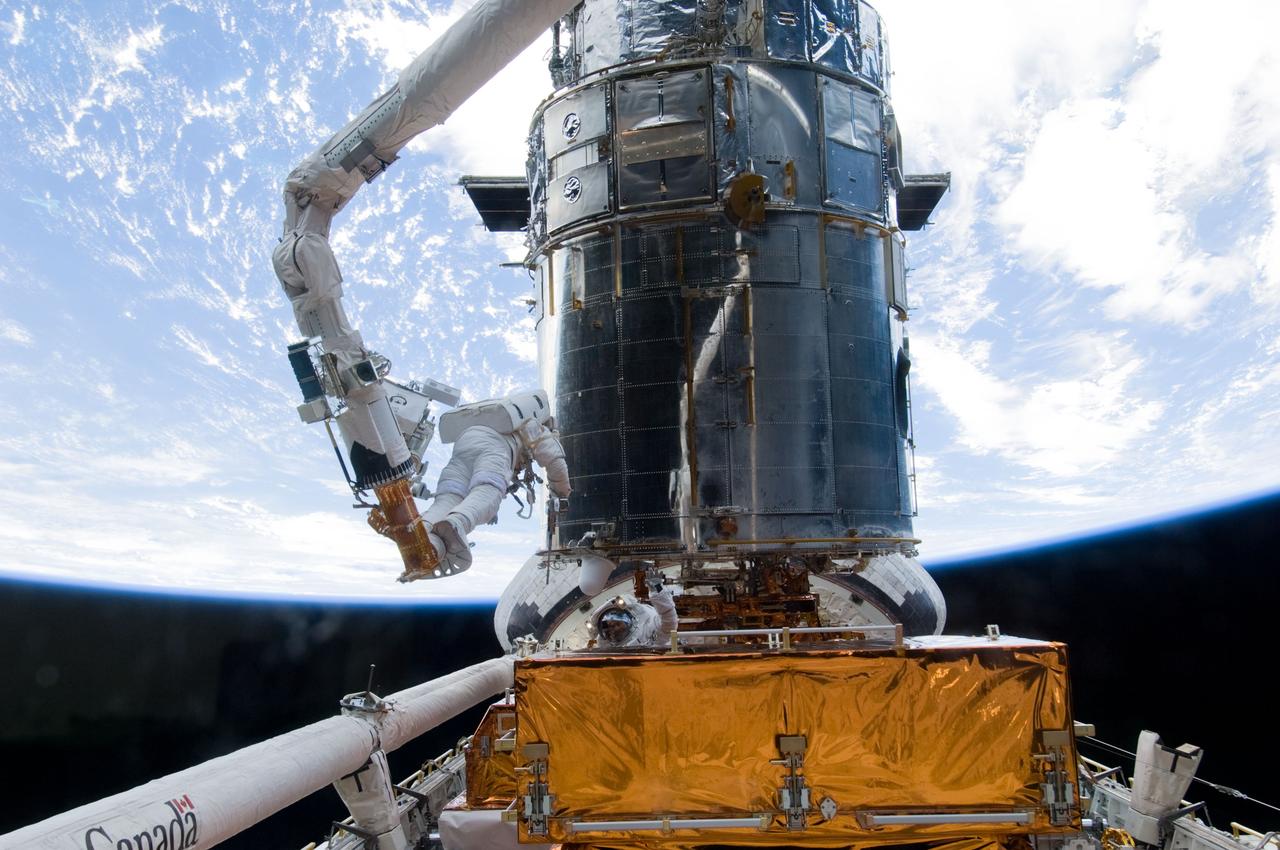
S125-E-008007 (16 May 2009) --- Astronauts Andrew Feustel and John Grunsfeld (partially obscured at bottom), both STS-125 mission specialists, participate in the mission?s third session of extravehicular activity (EVA) as work continues to refurbish and upgrade the Hubble Space Telescope. During the six-hour, 36-minute spacewalk, Grunsfeld and Feustel removed the Corrective Optics Space Telescope Axial Replacement and installed in its place the new Cosmic Origins Spectrograph. They also completed the Advanced Camera for Surveys electronic card replacement work, and completed part 2 of the ACS repair, installing a new electronics box and cable.
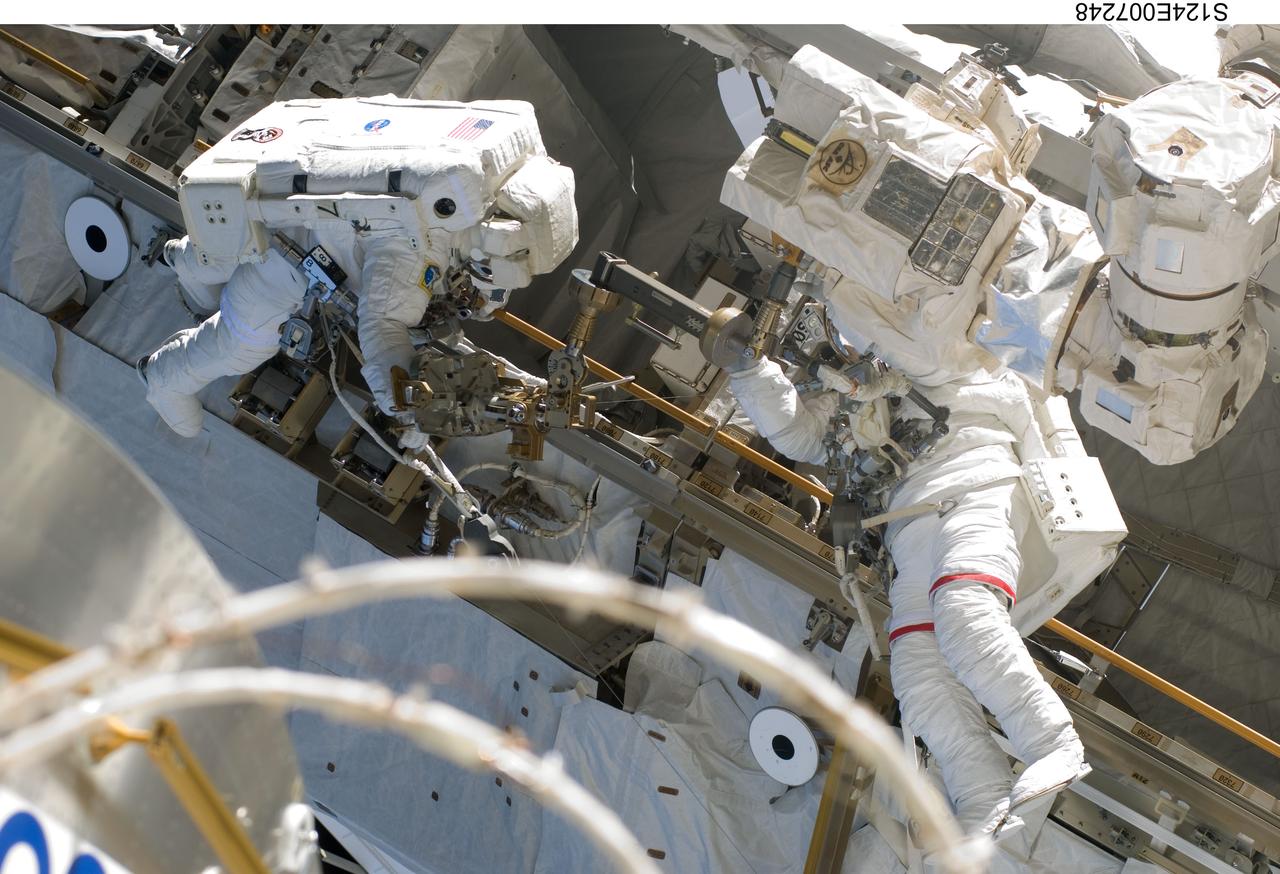
S124-E-007248 (8 June 2008) --- Astronauts Mike Fossum (right) and Ron Garan, both STS-124 mission specialists, participate in the mission's third scheduled session of extravehicular activity (EVA) as construction and maintenance continue on the International Space Station. During the six-hour, 33-minute spacewalk, Fossum and Garan exchanged a depleted Nitrogen Tank Assembly for a new one, removed thermal covers and launch locks from the Kibo laboratory, reinstalled a repaired television camera onto the space station's left P1 truss, and retrieved samples of a dust-like substance from the left Solar Alpha Rotary Joint for analysis by experts on the ground.
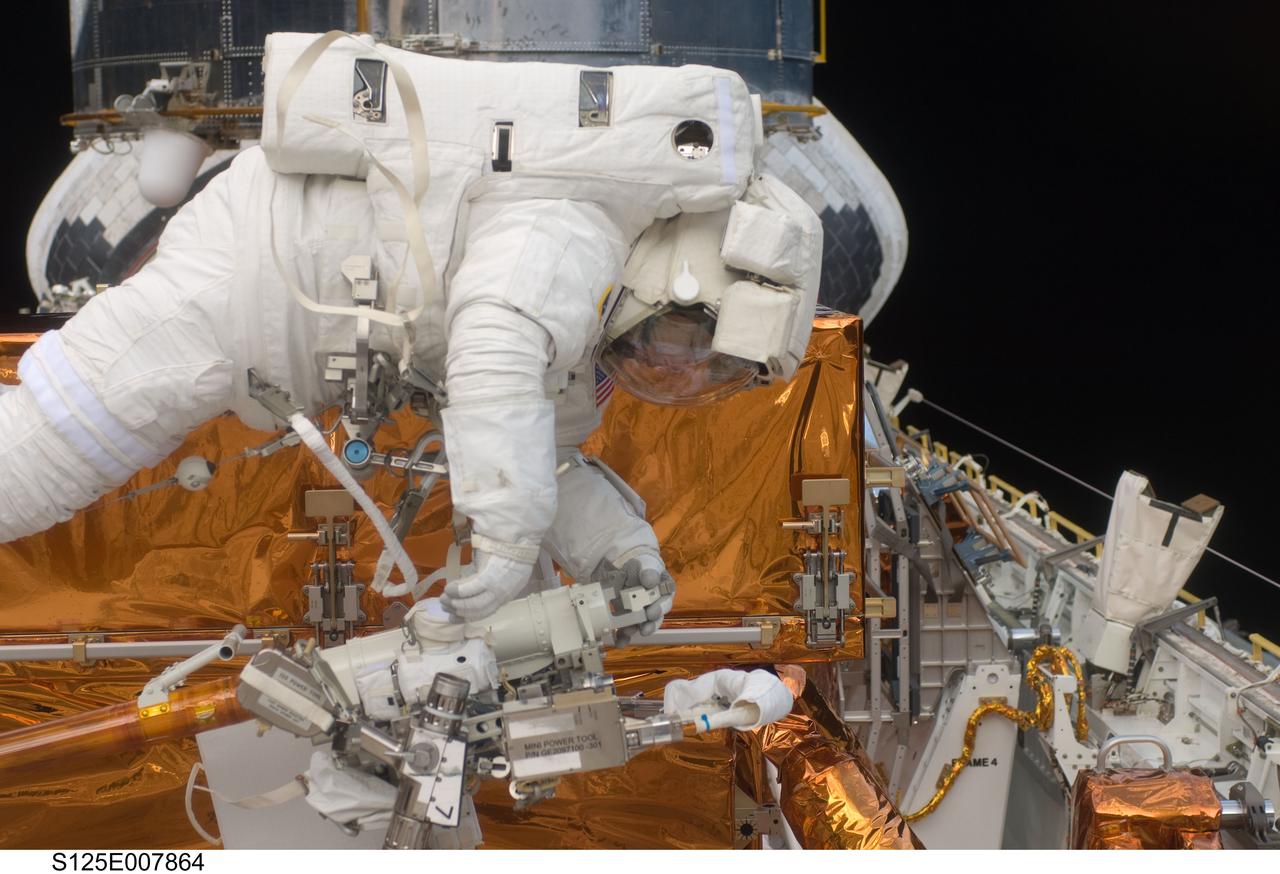
S125-E-007864 (16 May 2009) --- With the Hubble Space Telescope in the background, astronaut Andrew Feustel, STS-125 mission specialist, is seen here working during the mission?s third extravehicular activity (EVA). Feustel and astronaut John Grunsfeld (out of frame), mission specialist, removed the Corrective Optics Space Telescope Axial Replacement and installed in its place the new Cosmic Origins Spectrograph. They also completed the Advanced Camera for Surveys electronic card replacement work, and completed part 2 of the ACS repair, installing a new electronics box and cable.
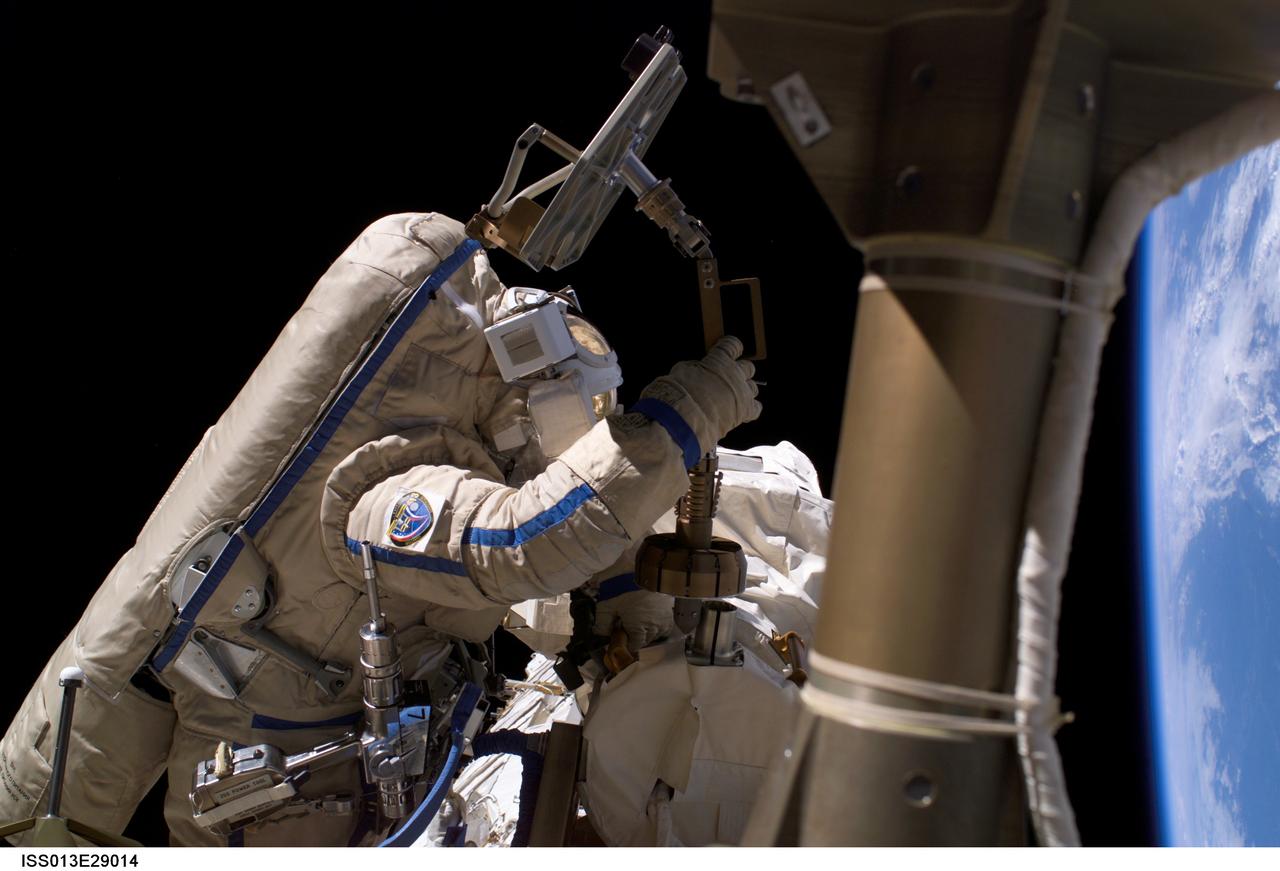
ISS013-E-29014 (1 June 2006) --- Astronaut Jeffrey N. Williams, Expedition 13 NASA space station science officer and flight engineer, attired in a Russian Orlan spacesuit, participates in the first session of extravehicular activity (EVA) performed by the Expedition 13 crew during their six-month mission. During the 6-hour, 31-minute spacewalk, Williams and cosmonaut Pavel V. Vinogradov (out of frame), commander representing Russia's Federal Space Agency, repaired, retrieved and replaced hardware on the U.S. and Russian segments of the International Space Station.
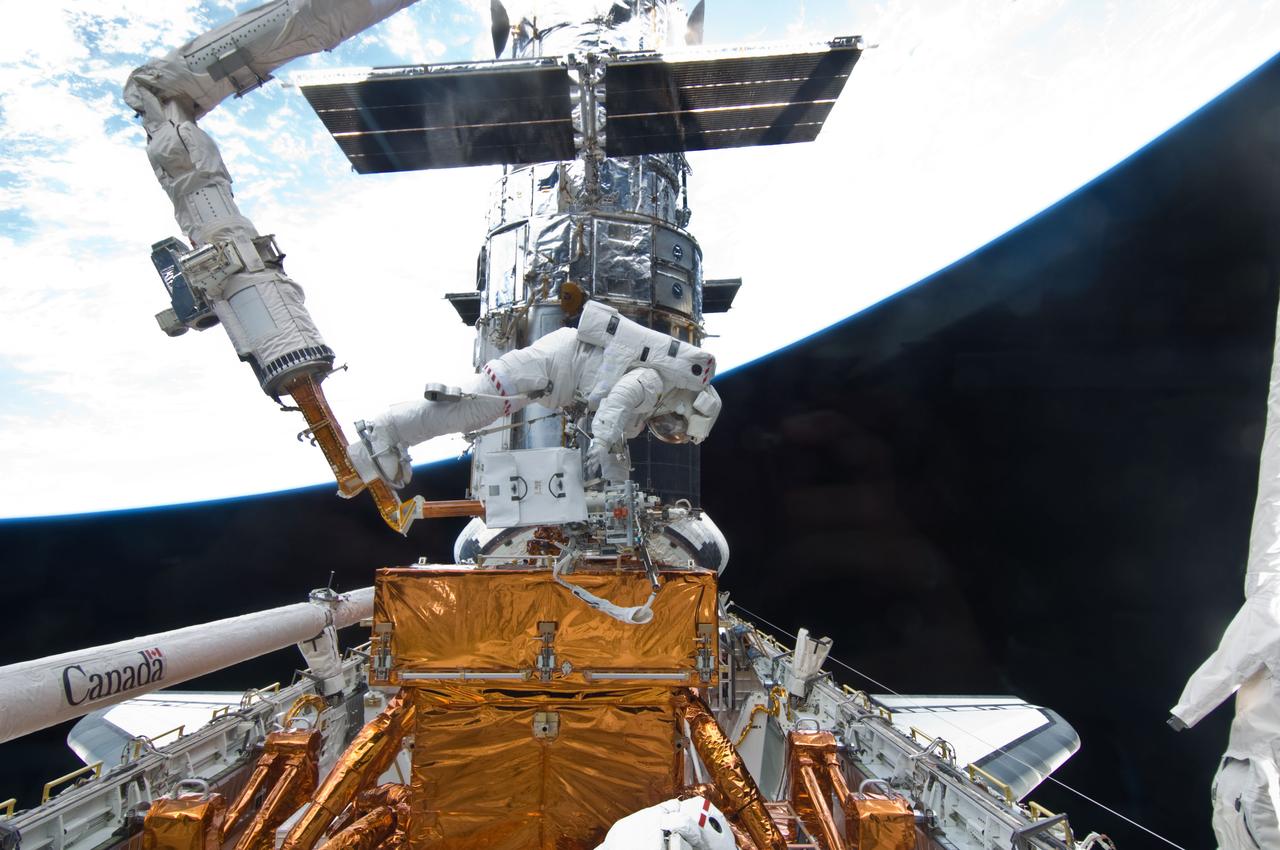
S125-E-009239 (17 May 2009) --- Astronaut Michael Good, STS-125 mission specialist, positioned on a foot restraint on the end of Atlantis? remote manipulator system (RMS), participates in the mission?s fourth session of extravehicular activity (EVA) as work continues to refurbish and upgrade the Hubble Space Telescope. During the eight-hour, two-minute spacewalk, Good and astronaut Mike Massimino (out of frame), mission specialist, continued repairs and improvements to the Space Telescope Imaging Spectrograph (STIS) that will extend the Hubble?s life into the next decade.
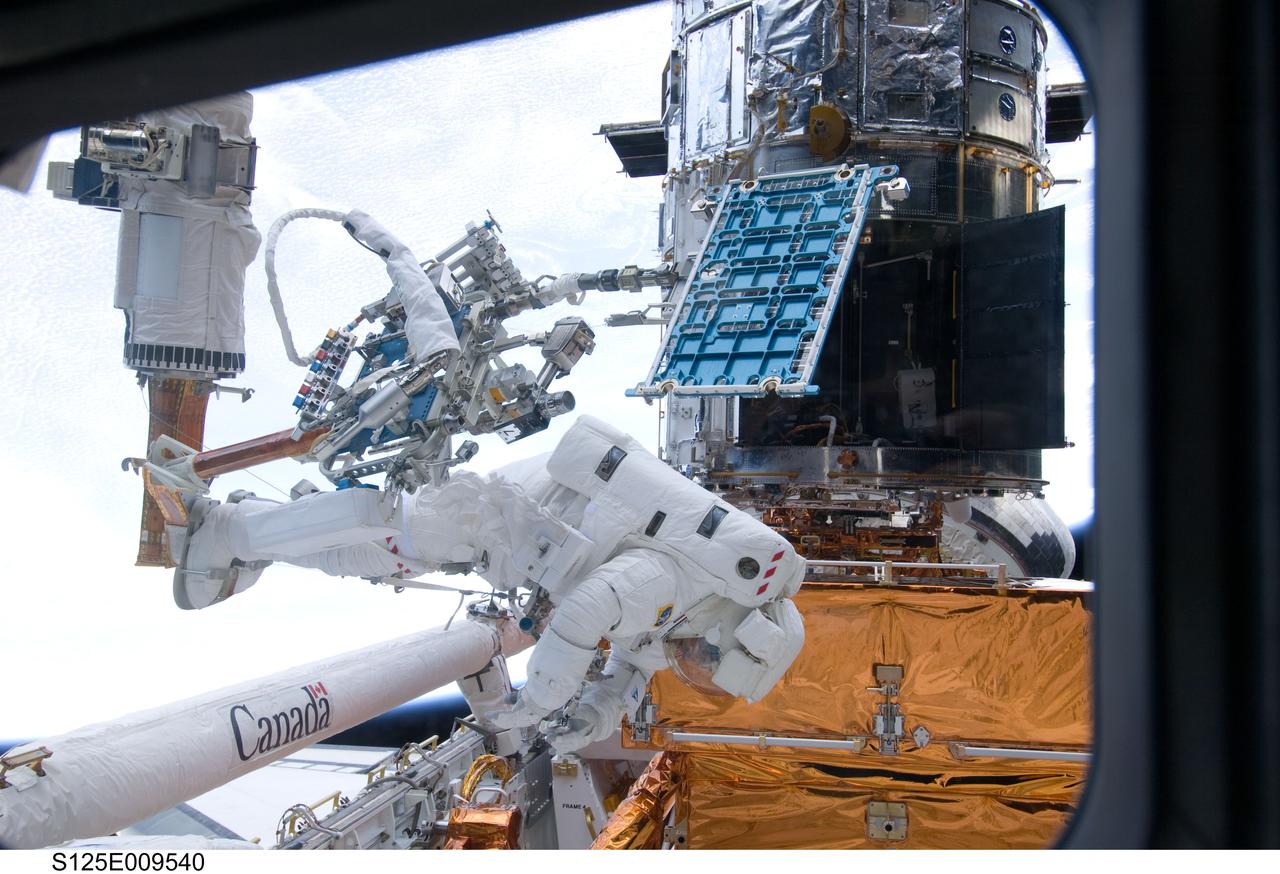
S125-E-009540 (17 May 2009) --- Astronaut Michael Good, STS-125 mission specialist, positioned on a foot restraint on the end of Space Shuttle Atlantis? remote manipulator system (RMS), participates in the mission?s fourth session of extravehicular activity (EVA) as work continues to refurbish and upgrade the Hubble Space Telescope. During the eight-hour, two-minute spacewalk, Good and astronaut Mike Massimino (out of frame), mission specialist, continued repairs and improvements to the Space Telescope Imaging Spectrograph (STIS) that will extend the Hubble?s life into the next decade.
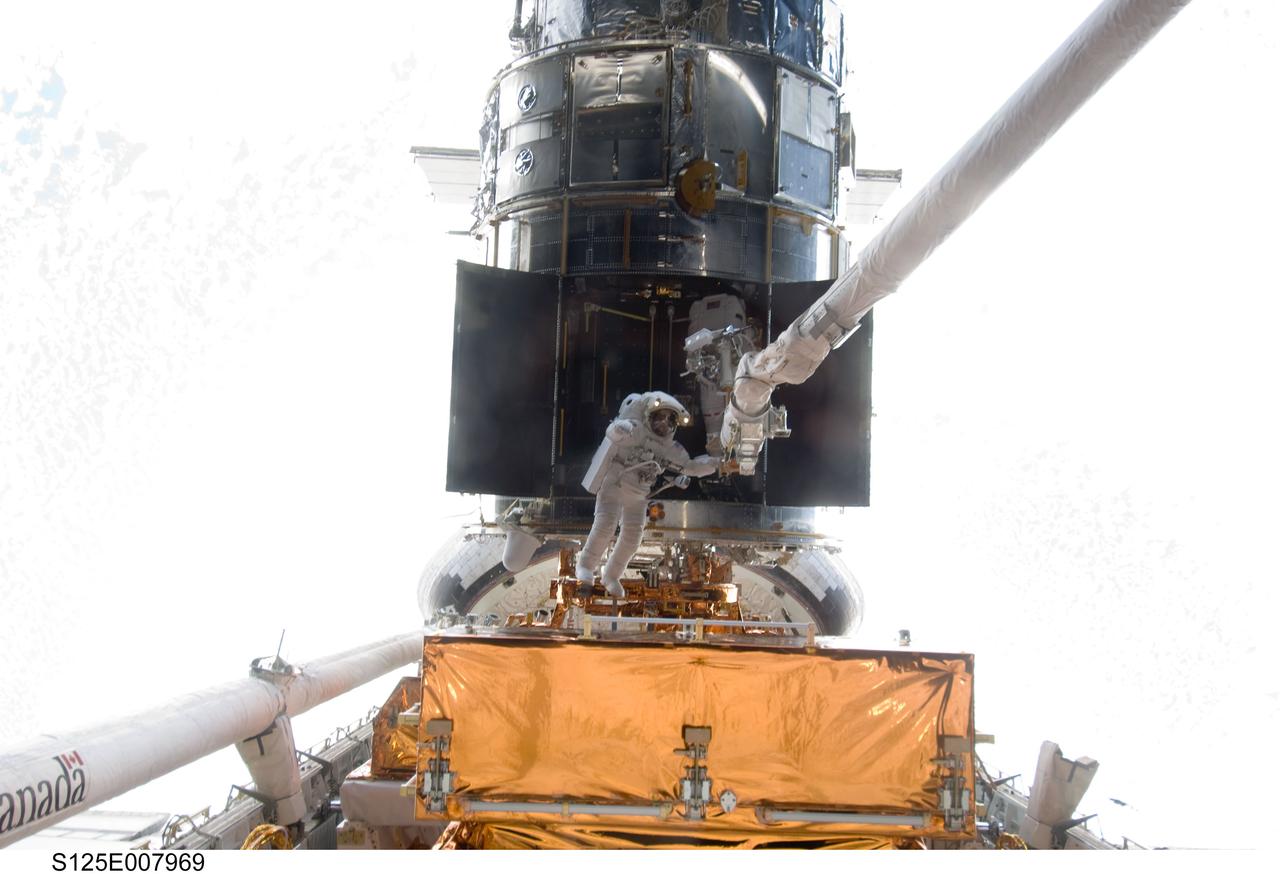
S125-E-007969 (16 May 2009) --- Astronauts Andrew Feustel (left) and John Grunsfeld, both STS-125 mission specialists, participate in the mission?s third session of extravehicular activity (EVA) as work continues to refurbish and upgrade the Hubble Space Telescope. During the six-hour, 36-minute spacewalk, Grunsfeld and Feustel removed the Corrective Optics Space Telescope Axial Replacement and installed in its place the new Cosmic Origins Spectrograph. They also completed the Advanced Camera for Surveys electronic card replacement work, and completed part 2 of the ACS repair, installing a new electronics box and cable.
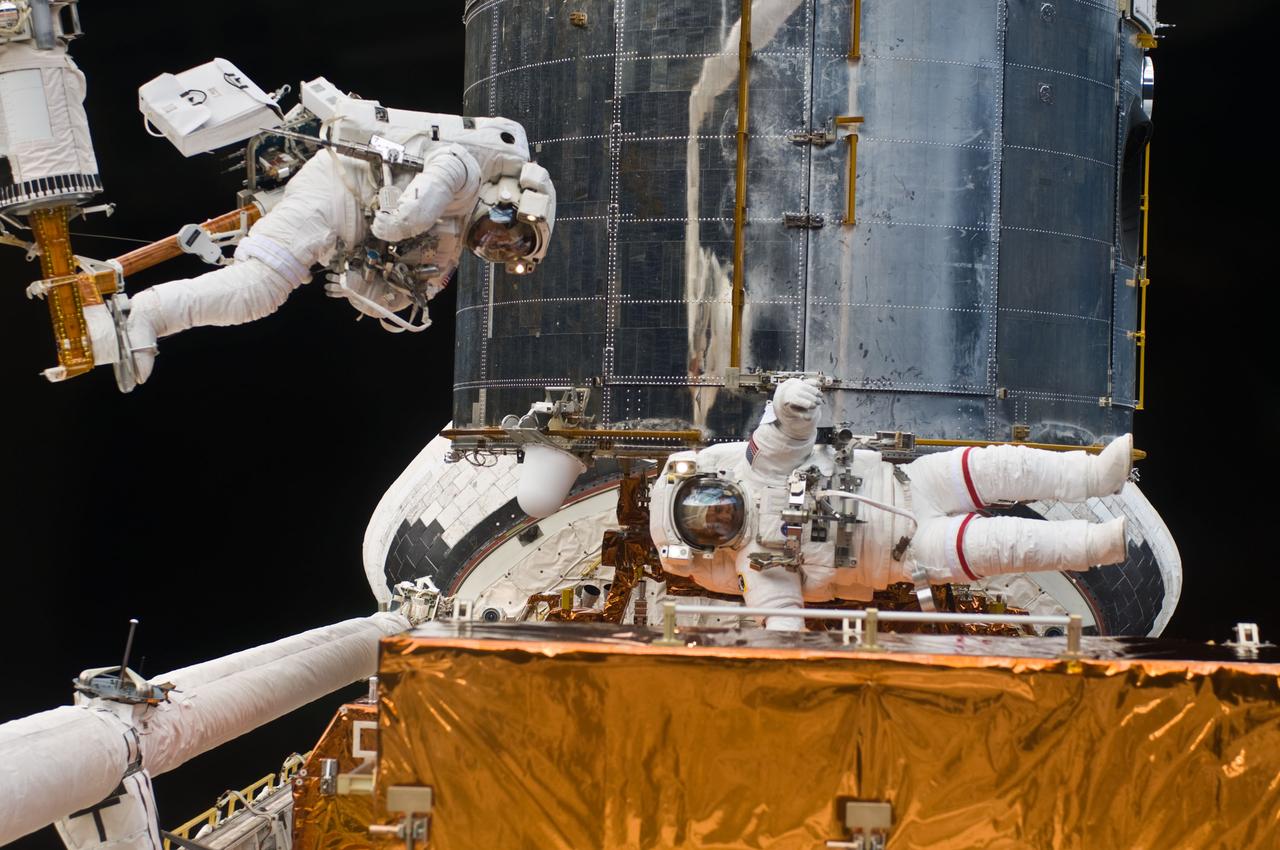
S125-E-008276 (16 May 2009) --- Astronauts Andrew Feustel (left) and John Grunsfeld, both STS-125 mission specialists, participate in the mission?s third session of extravehicular activity (EVA) as work continues to refurbish and upgrade the Hubble Space Telescope. During the six-hour, 36-minute spacewalk, Grunsfeld and Feustel removed the Corrective Optics Space Telescope Axial Replacement and installed in its place the new Cosmic Origins Spectrograph. They also completed the Advanced Camera for Surveys electronic card replacement work, and completed part 2 of the ACS repair, installing a new electronics box and cable.
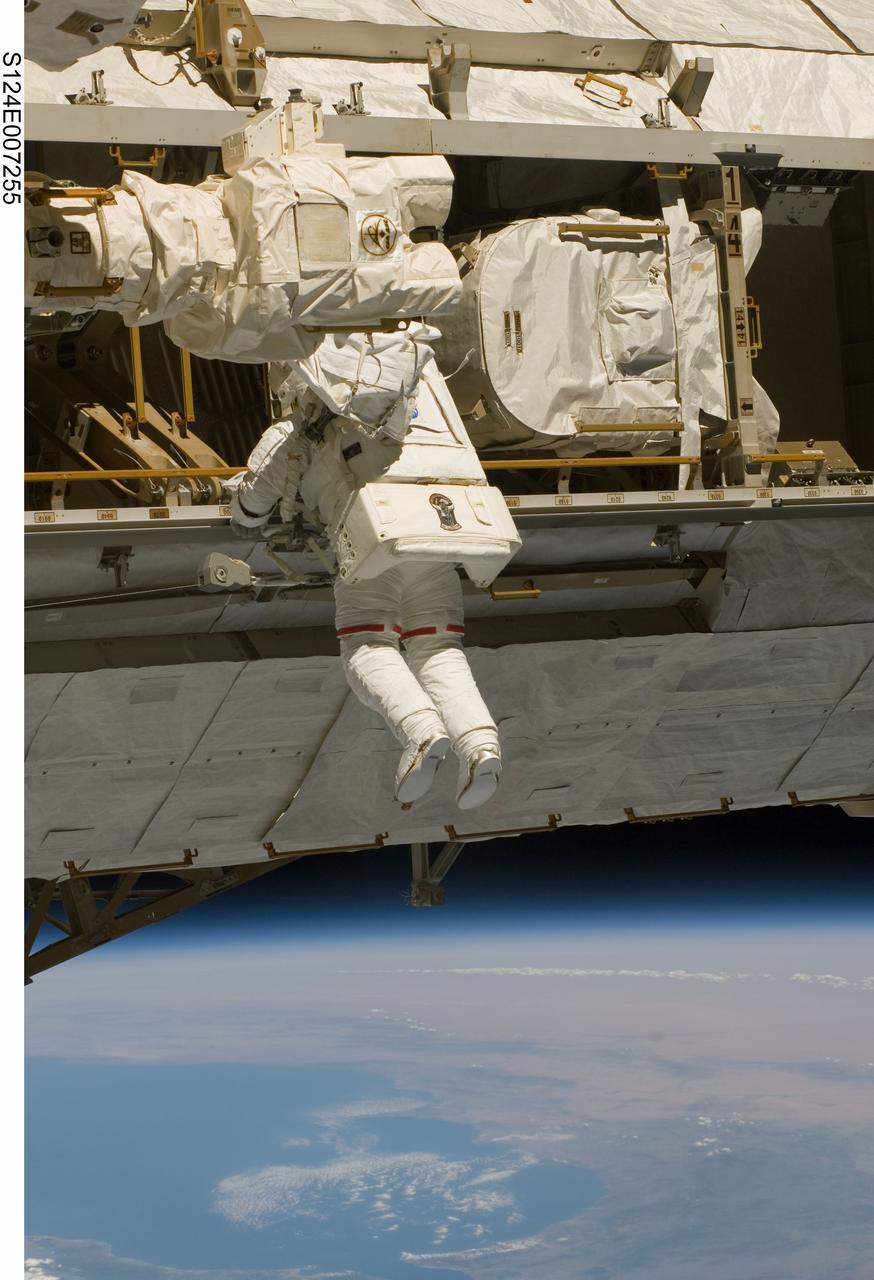
S124-E-007255 (8 June 2008) --- Astronaut Mike Fossum, STS-124 mission specialist, participates in the mission's third scheduled session of extravehicular activity (EVA) as construction and maintenance continue on the International Space Station. During the six-hour, 33-minute spacewalk, Fossum and astronaut Ron Garan (out of frame), mission specialist, exchanged a depleted Nitrogen Tank Assembly for a new one, removed thermal covers and launch locks from the Kibo laboratory, reinstalled a repaired television camera onto the space station's left P1 truss, and retrieved samples of a dust-like substance from the left Solar Alpha Rotary Joint for analysis by experts on the ground.
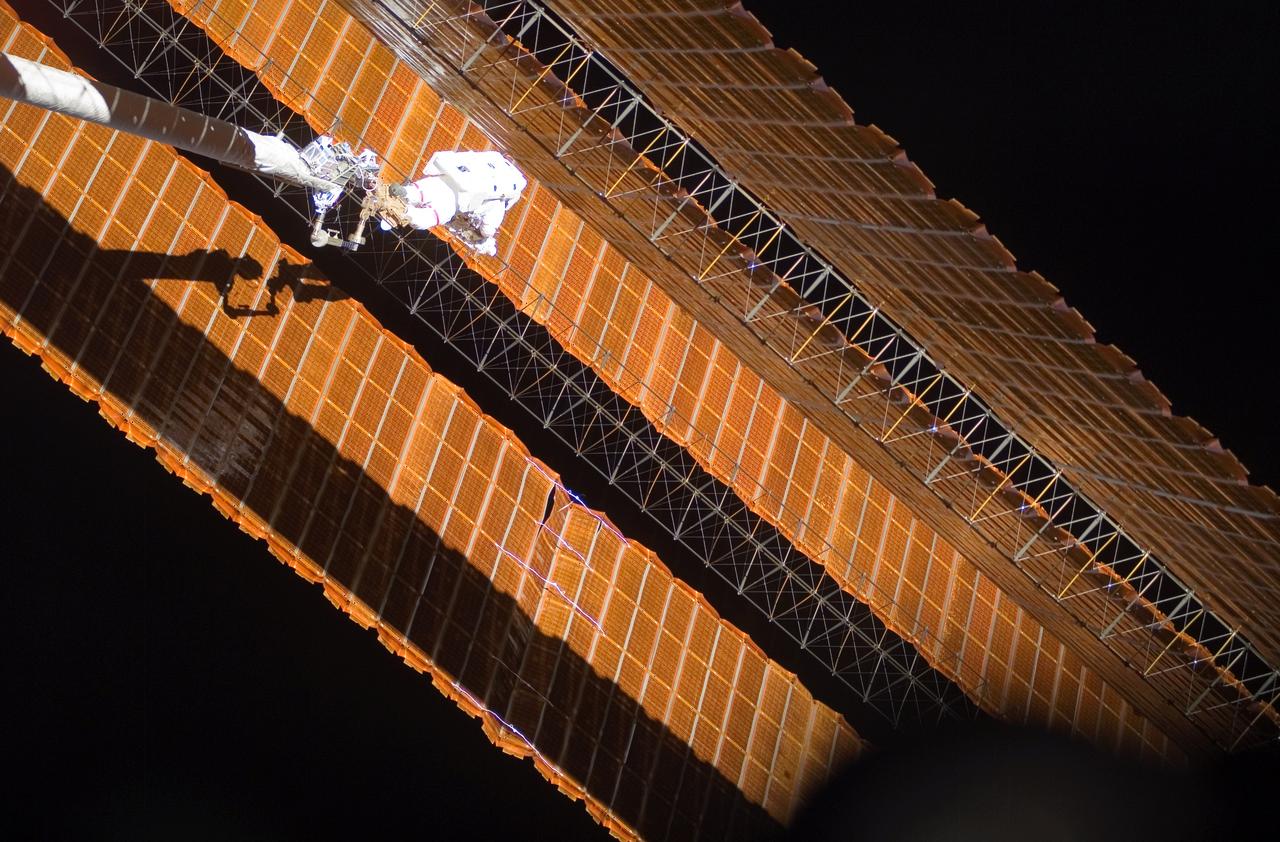
While anchored to a foot restraint on the end of the Orbiter Boom Sensor System (OBSS), astronaut Scott Parazynski, STS-120 mission specialist, participated in the mission's fourth session of extravehicular activity (EVA) while Space Shuttle Discovery was docked with the International Space Station (ISS). During the 7-hour and 19-minute space walk, Parazynski cut a snagged wire and installed homemade stabilizers designed to strengthen the structure and stability of the damaged P6 4B solar array wing. Astronaut Doug Wheelock (out of frame), mission specialist, assisted from the truss by keeping an eye on the distance between Parazynski and the array. Once the repair was complete, flight controllers on the ground successfully completed the deployment of the array.
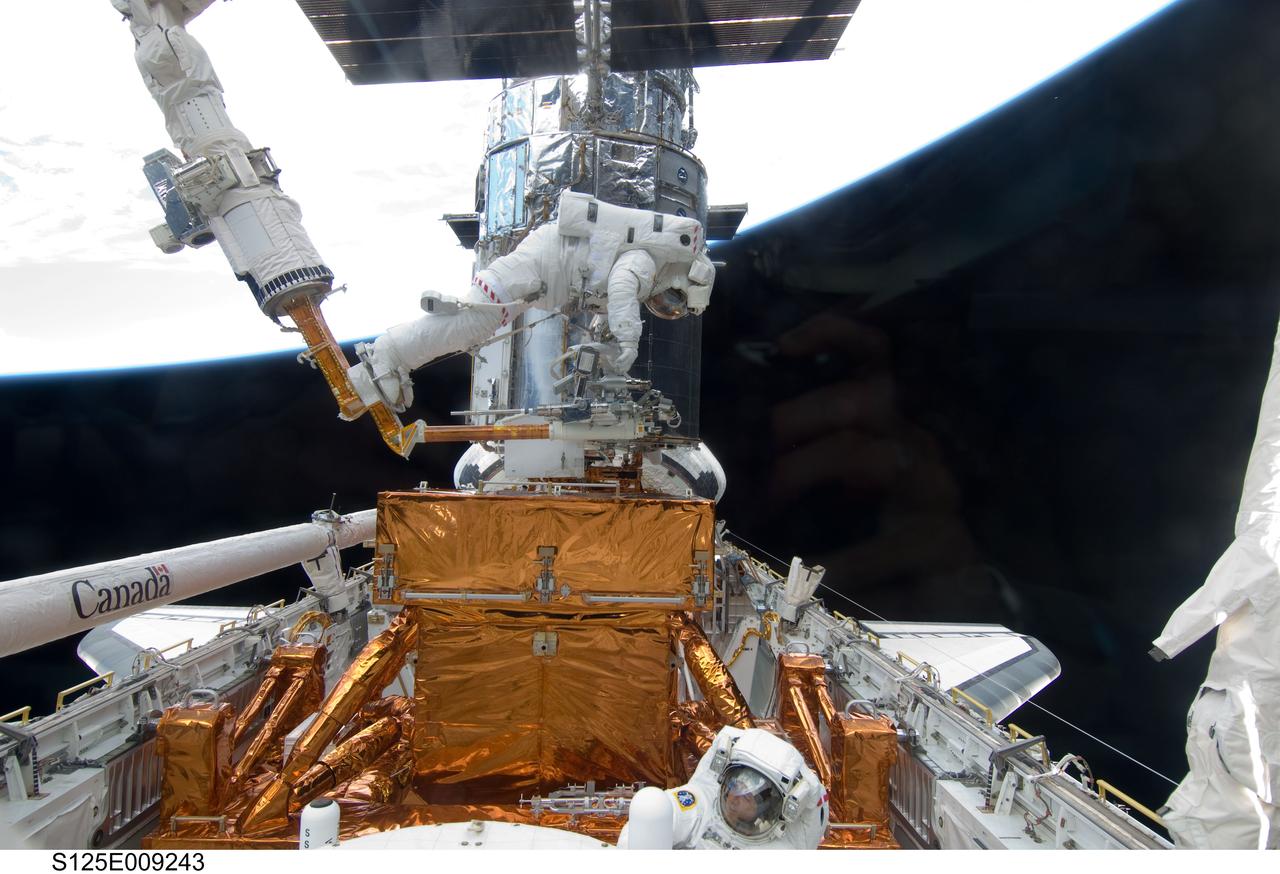
S125-E-009243 (17 May 2009) --- Astronaut Michael Good, STS-125 mission specialist, positioned on a foot restraint on the end of Atlantis? remote manipulator system (RMS), and astronaut Mike Massimino (bottom), mission specialist, participate in the mission?s fourth session of extravehicular activity (EVA) as work continues to refurbish and upgrade the Hubble Space Telescope. During the eight-hour, two-minute spacewalk, Good and Massimino continued repairs and improvements to the Space Telescope Imaging Spectrograph (STIS) that will extend the Hubble?s life into the next decade.
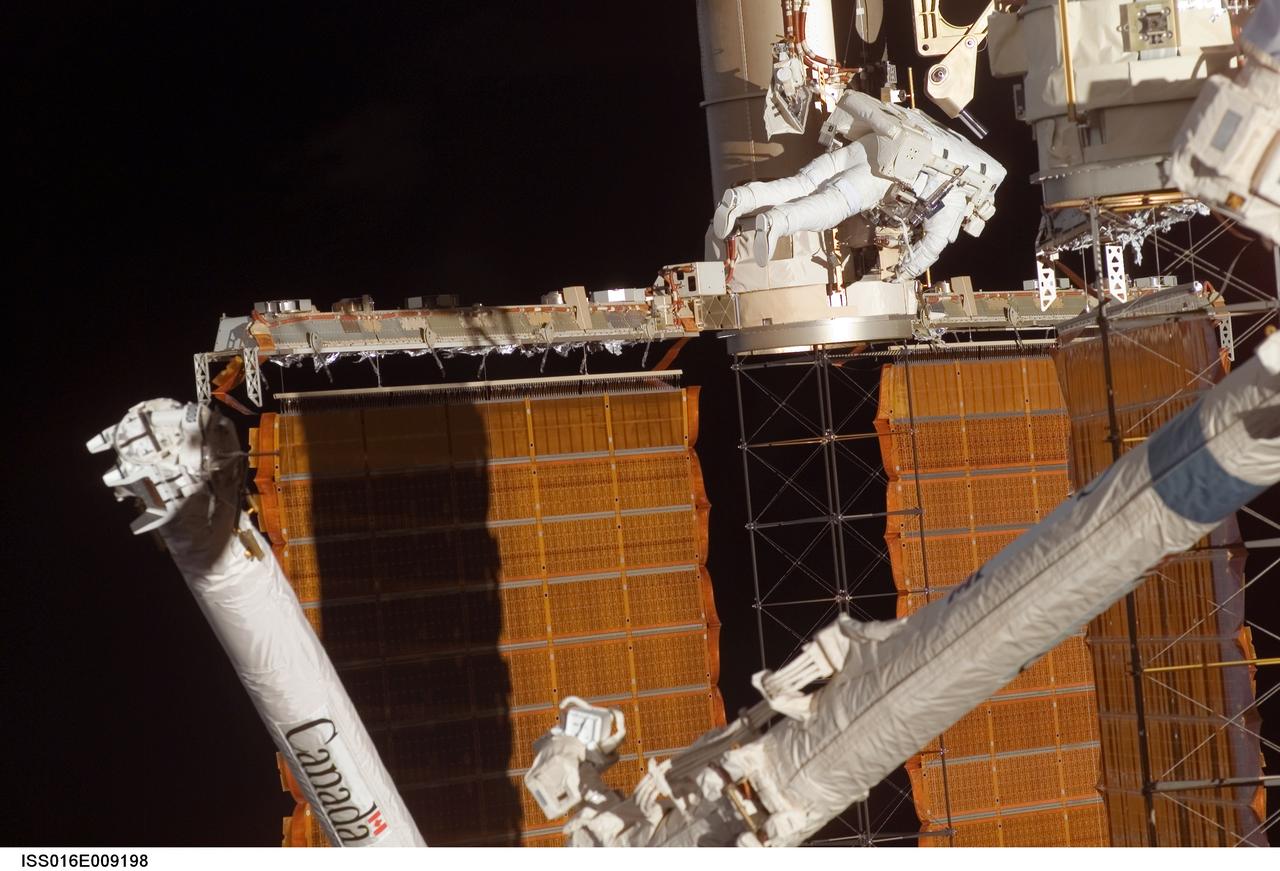
ISS016-E-009198 (3 Nov. 2007) --- Astronaut Doug Wheelock, STS-120 mission specialist, participates in the mission's fourth session of extravehicular activity (EVA) while Space Shuttle Discovery is docked with the International Space Station. During the 7-hour, 19-minute spacewalk, astronaut Scott Parazynski (out of frame), mission specialist, cut a snagged wire and installed homemade stabilizers designed to strengthen the damaged solar array's structure and stability in the vicinity of the damage. Wheelock assisted from the truss by keeping an eye on the distance between Parazynski and the array. Once the repair was complete, flight controllers on the ground successfully completed the deployment of the array.
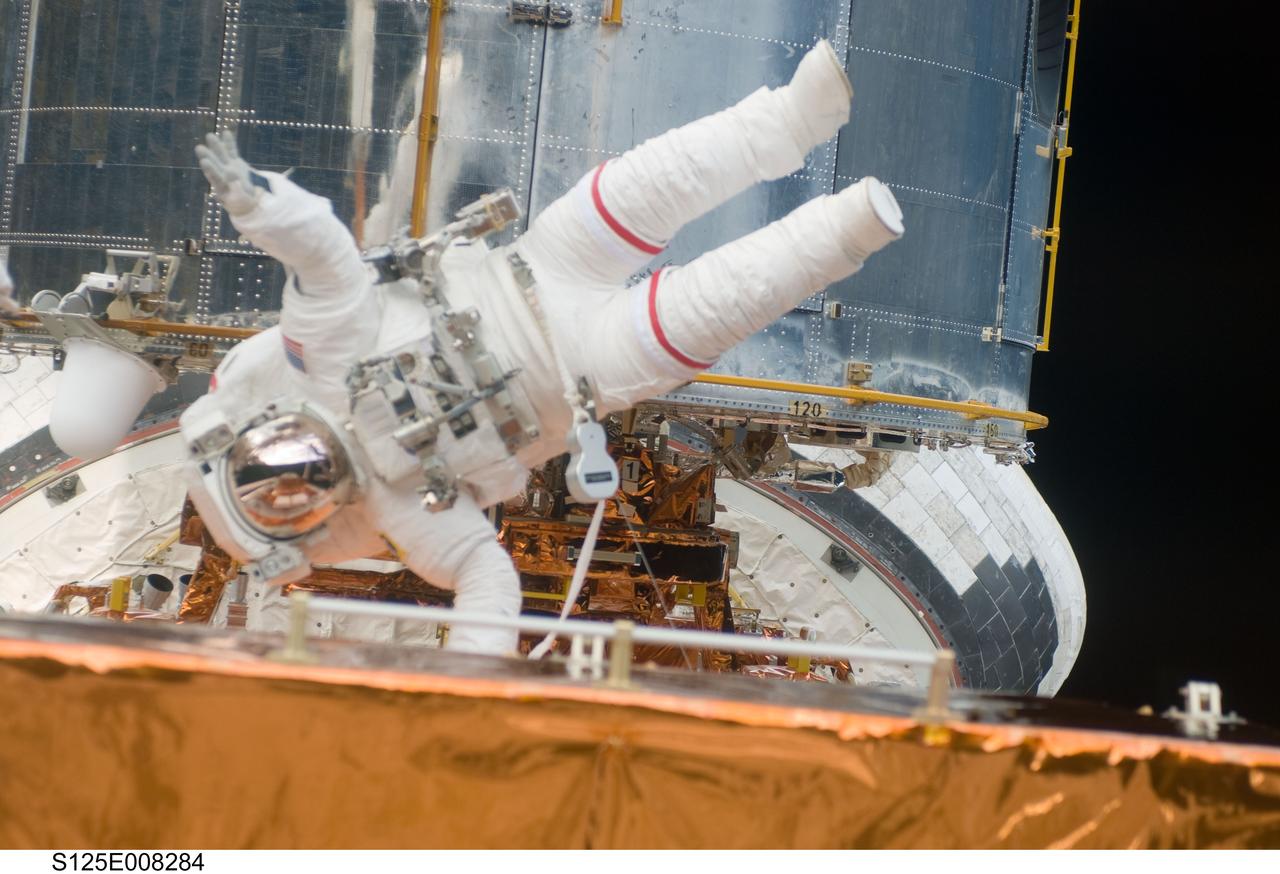
S125-E-008284 (16 May 2009) --- Astronaut John Grunsfeld, STS-125 mission specialist, participates in the mission?s third session of extravehicular activity (EVA) as work continues to refurbish and upgrade the Hubble Space Telescope. During the six-hour, 36-minute spacewalk, Grunsfeld and astronaut Andrew Feustel (out of frame), mission specialist, removed the Corrective Optics Space Telescope Axial Replacement and installed in its place the new Cosmic Origins Spectrograph. They also completed the Advanced Camera for Surveys electronic card replacement work, and completed part 2 of the ACS repair, installing a new electronics box and cable.
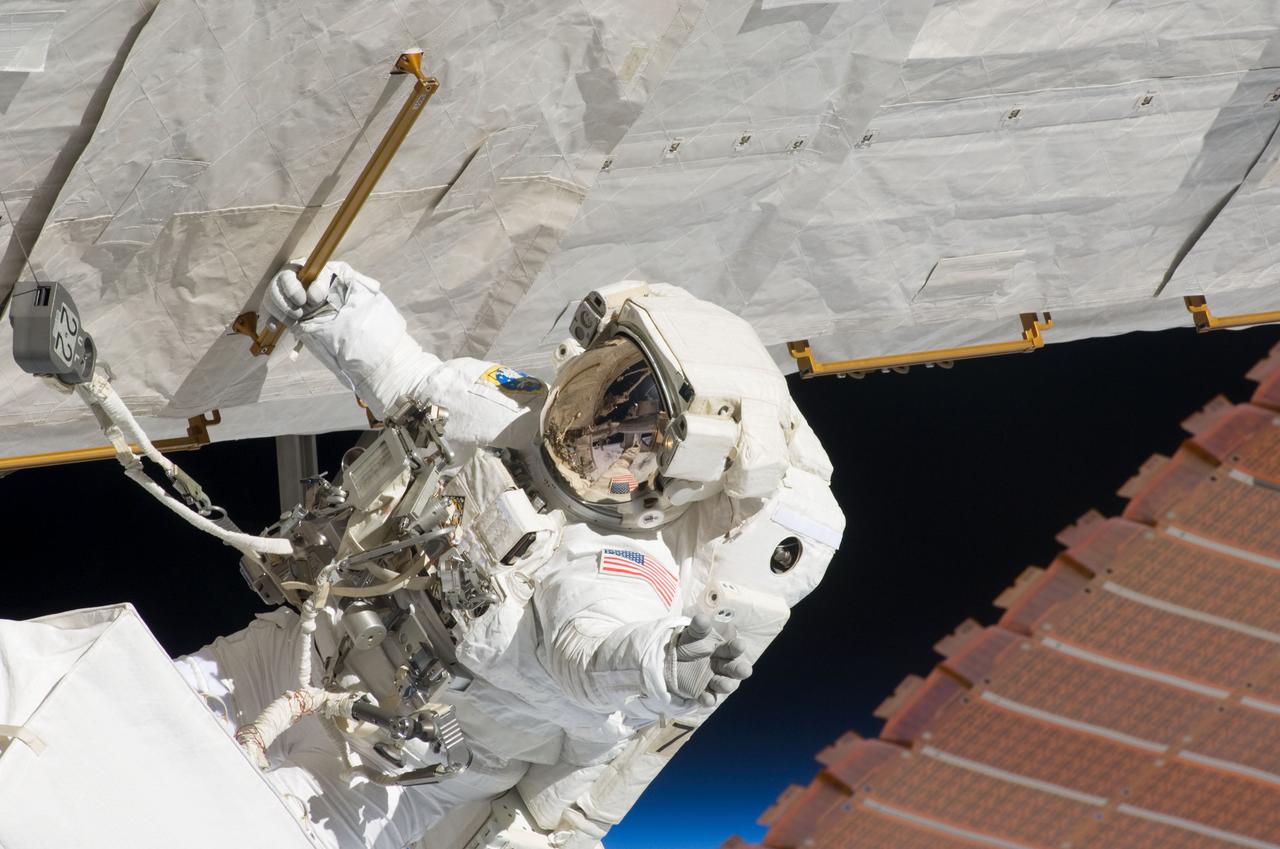
S124-E-007400 (8 June 2008) --- Astronaut Ron Garan, STS-124 mission specialist, participates in the mission's third scheduled session of extravehicular activity (EVA) as construction and maintenance continue on the International Space Station. During the six-hour, 33-minute spacewalk, Garan and astronaut Mike Fossum (out of frame), mission specialist, exchanged a depleted Nitrogen Tank Assembly for a new one, removed thermal covers and launch locks from the Kibo laboratory, reinstalled a repaired television camera onto the space station's left P1 truss, and retrieved samples of a dust-like substance from the left Solar Alpha Rotary Joint for analysis by experts on the ground.
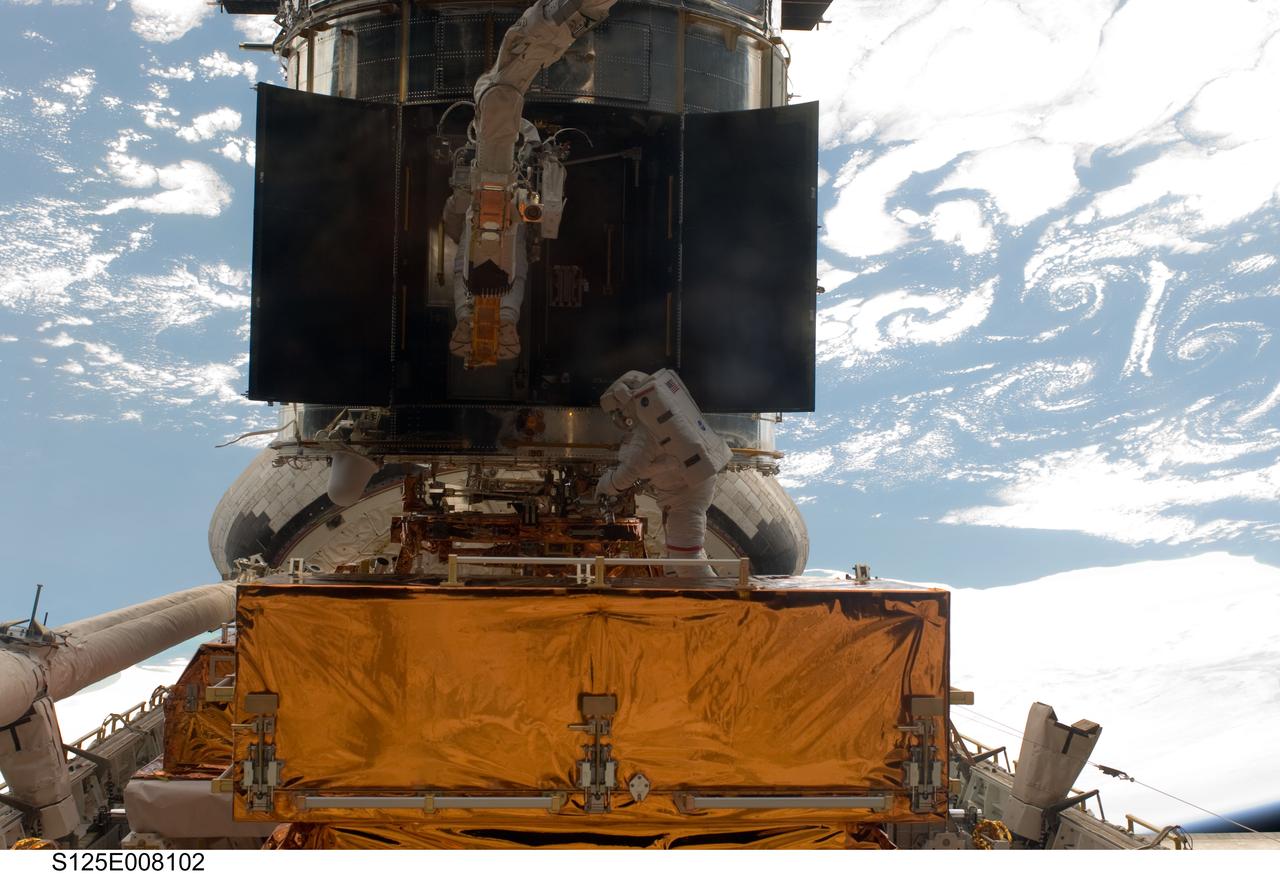
S125-E-008102 (16 May 2009) --- Astronauts Andrew Feustel (partially obscured at top) and John Grunsfeld, both STS-125 mission specialists, participate in the mission?s third session of extravehicular activity (EVA) as work continues to refurbish and upgrade the Hubble Space Telescope. During the six-hour, 36-minute spacewalk, Grunsfeld and Feustel removed the Corrective Optics Space Telescope Axial Replacement and installed in its place the new Cosmic Origins Spectrograph. They also completed the Advanced Camera for Surveys electronic card replacement work, and completed part 2 of the ACS repair, installing a new electronics box and cable.
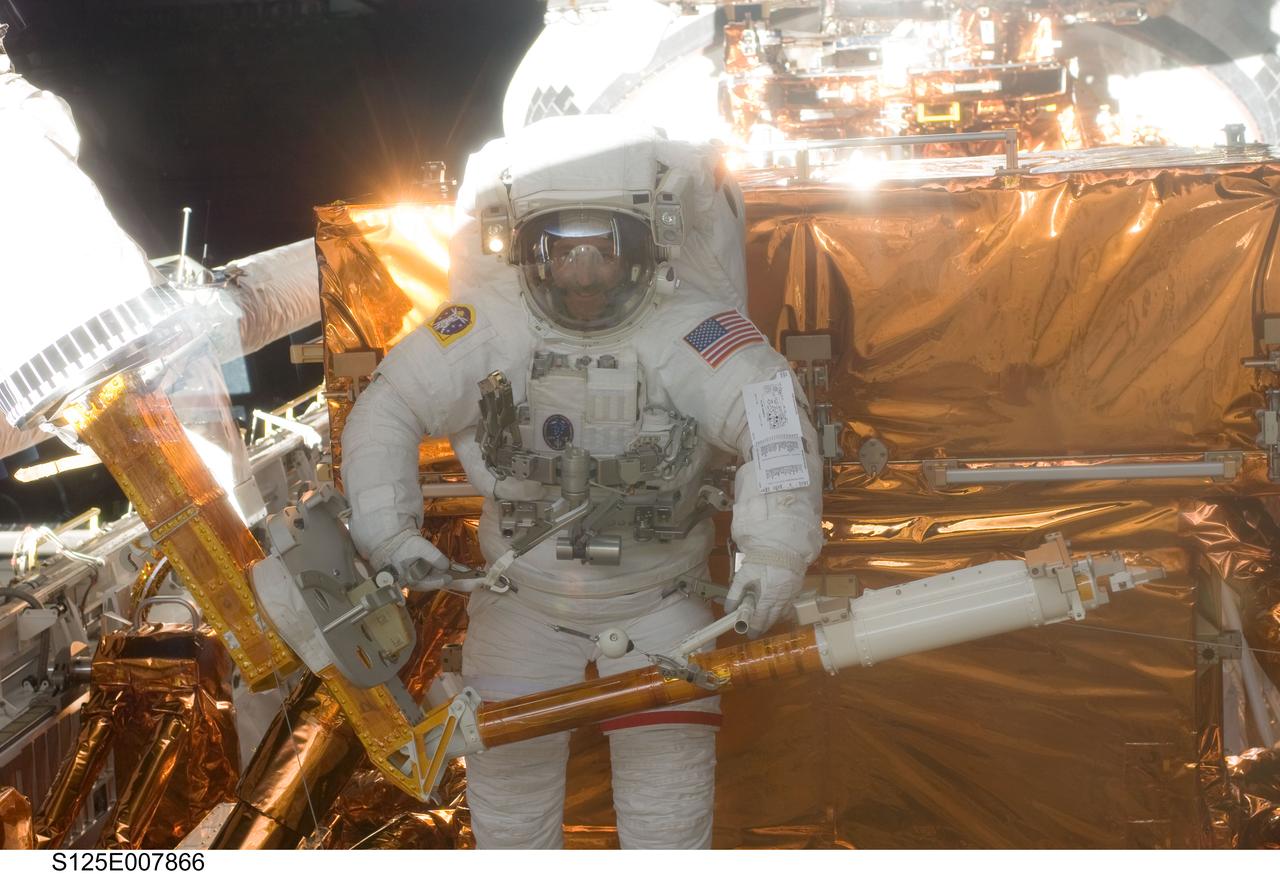
S125-E-007866 (16 May 2009) --- Astronaut John Grunsfeld, STS-125 mission specialist, participates in the mission?s third session of extravehicular activity (EVA) as work continues to refurbish and upgrade the Hubble Space Telescope. During the six-hour, 36-minute spacewalk, Grunsfeld and astronaut Andrew Feustel (out of frame), mission specialist, removed the Corrective Optics Space Telescope Axial Replacement and installed in its place the new Cosmic Origins Spectrograph. They also completed the Advanced Camera for Surveys electronic card replacement work, and completed part 2 of the ACS repair, installing a new electronics box and cable.
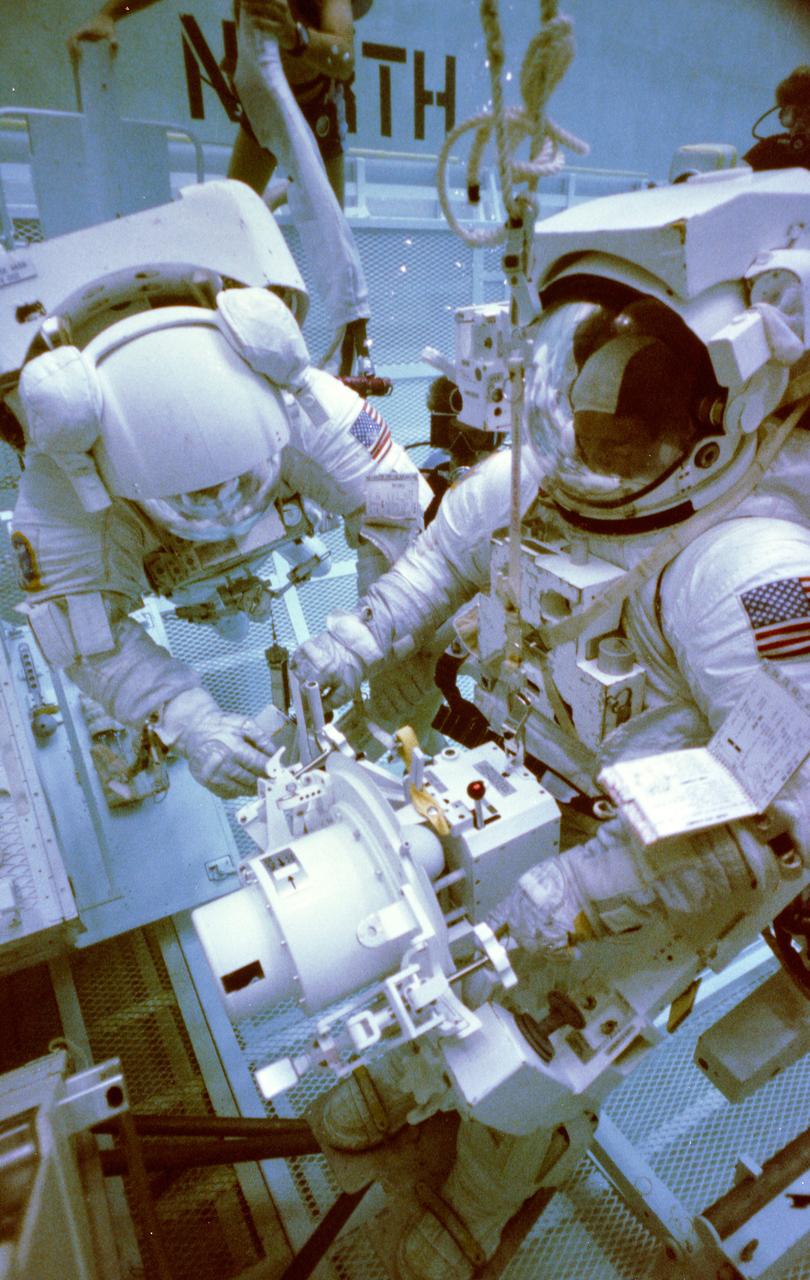
S83-42893 (19 Oct 1983) ---- Astronauts George D. Nelson and James D. van Hoften, two of three STS-41C mission specialists, share an extravehicular activity (EVA) task in this simulation of a Solar Maximum Satellite (SMS) repair visit. The two are making use of the Johnson Space Center's (JSC) weightless environment training facility (WET-F). Dr. Nelson is equipped with the manned maneuvering unit (MMU) trainer and he handles the trunion pin attachment device (TPAD), a major tool to be used on the mission. The photograph was taken by Otis Imboden.
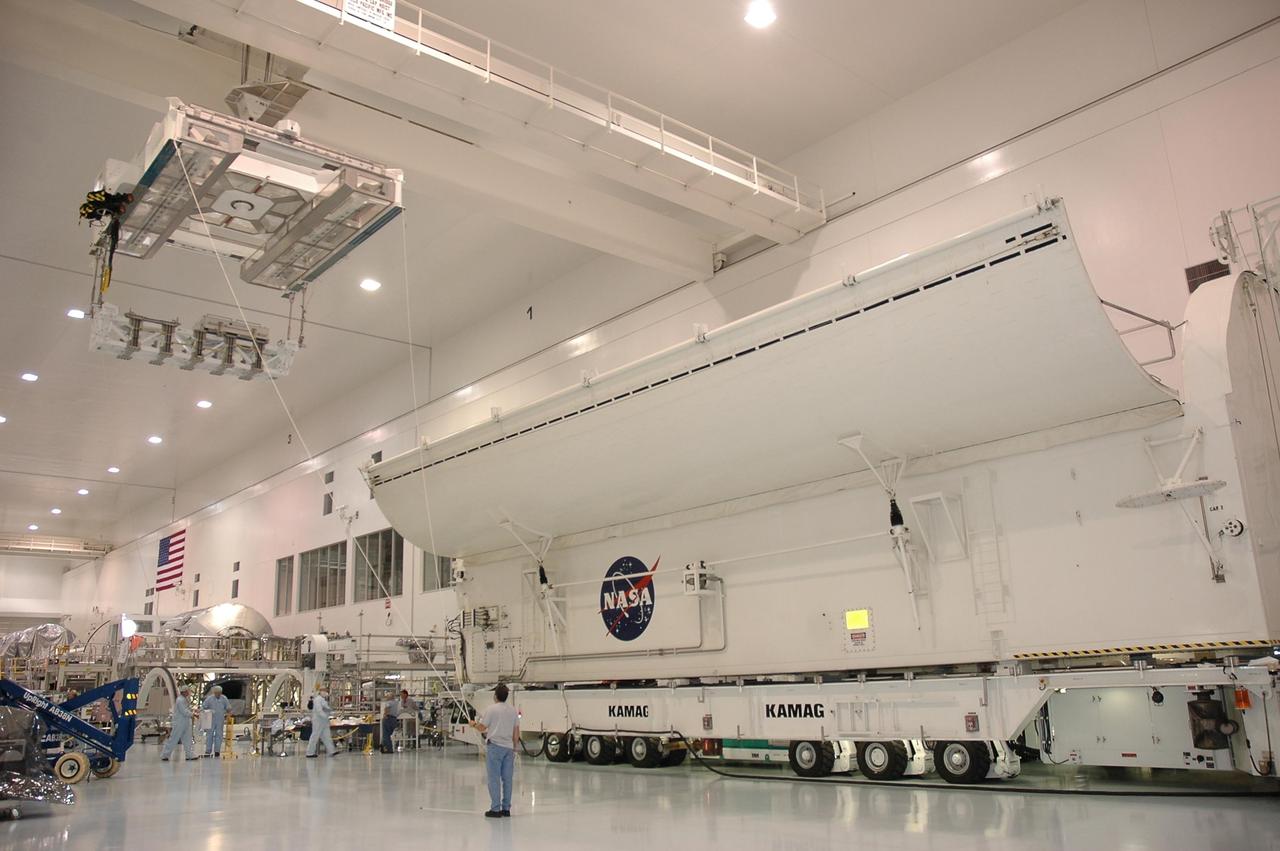
KENNEDY SPACE CENTER, FLA. - In the Space Station Processing Facility, a crane moves the Lightweight Multi-Purpose Experiment Support Structure Carrier (LMC) toward a payload canister, doors open to receive it. Slated to fly on space shuttle mission STS-121, the LMC is ready to be delivered to Launch Pad 39B for installation into orbiter Discovery. It is a cross-bay carrier for hardware required to perform development test objective 848. Test objective 848 is a demonstration of the tools and techniques developed to repair damaged orbiter thermal protection system tiles during a spacewalk, or extravehicular activity. The target launch window for STS-121 is July 1 to July 19, 2006. Photo credit: NASA/Cory Husten