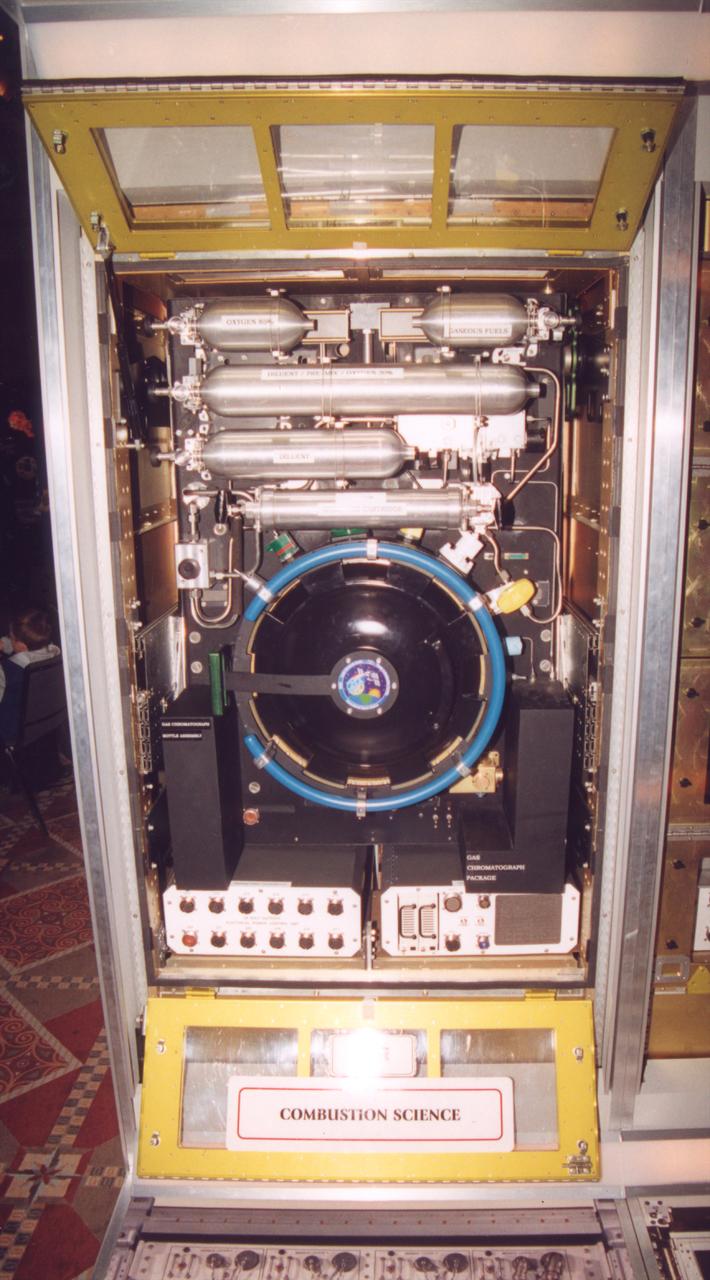
The combustion chamber for the Combustion Integrated Rack section of the Fluids and Combustion Facility (FCF) is shown in its operational configuration. The FCF will be installed, in phases, in the Destiny, the U.S. Laboratory Module of the International Space Station (ISS), and will accommodate multiple users for a range of investigations. This is an engineering mockup; the flight hardware is subject to change as designs are refined. The FCF is being developed by the Microgravity Science Division (MSD) at the NASA Glenn Research Center. (Photo credit: NASA/Marshall Space Flight Center)
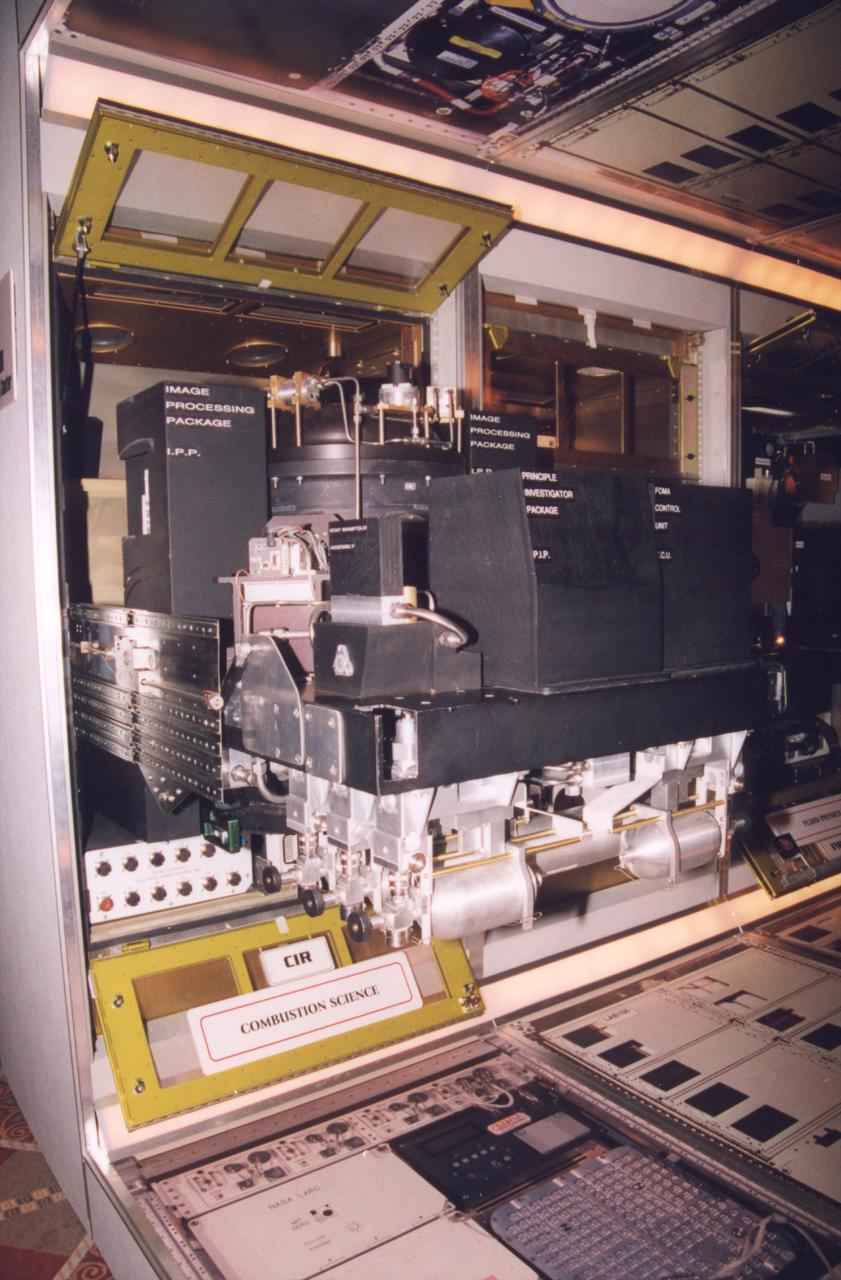
The combustion chamber for the Combustion Integrated Rack section of the Fluids and Combustion Facility (FCF) is shown extracted for servicing and with the optical bench rotated 90 degrees for access to the rear elements. The FCF will be installed, in phases, in the Destiny, the U.S. Laboratory Module of the International Space Station (ISS), and will accommodate multiple users for a range of investigations. This is an engineering mockup; the flight hardware is subject to change as designs are refined. The FCF is being developed by the Microgravity Science Division (MSD) at the NASA Glenn Research Center. (Photo credit: NASA/Marshall Space Flight Center)
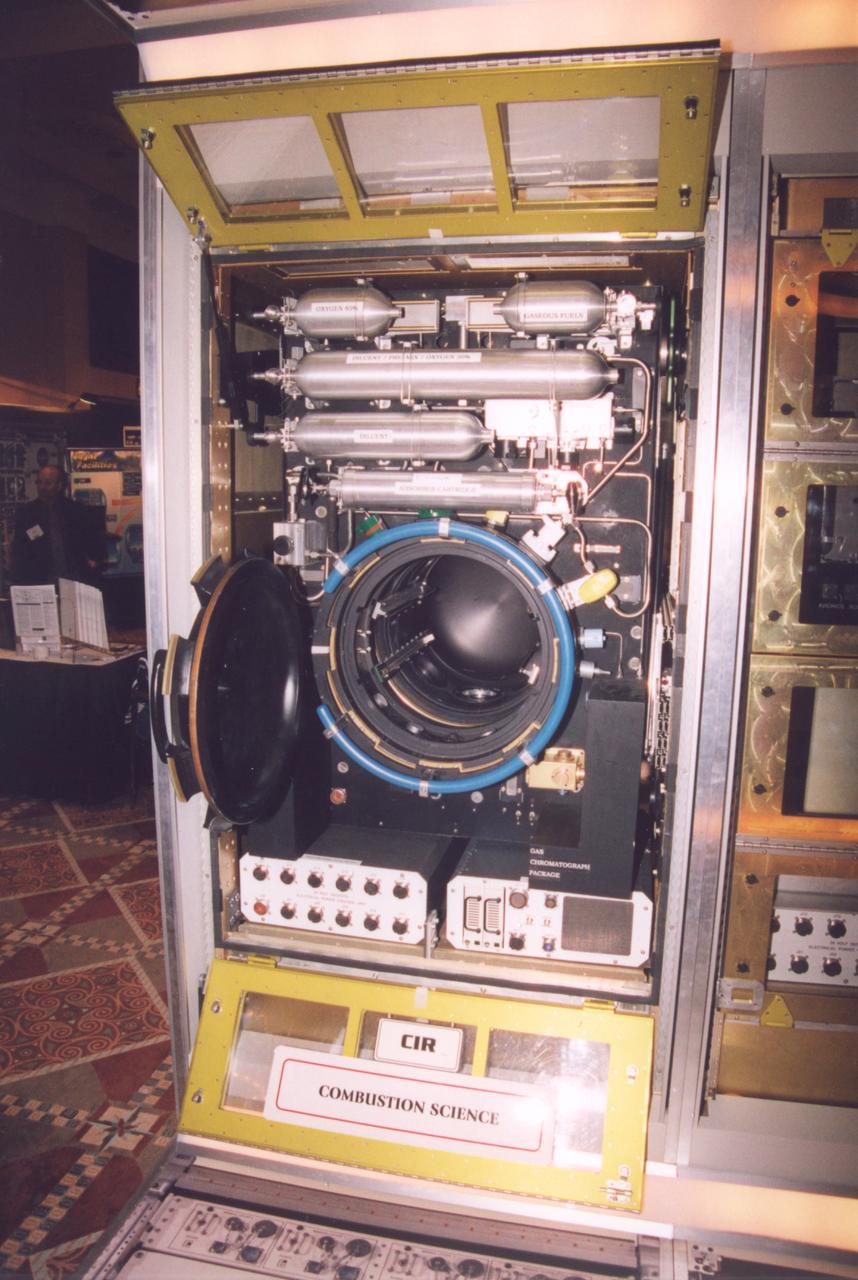
The combustion chamber for the Combustion Integrated Rack section of the Fluids and Combustion Facility (FCF) is shown opened for installation of burn specimens. The FCF will be installed, in phases, in the Destiny, the U.S. Laboratory Module of the International Space Station (ISS), and will accommodate multiple users for a range of investigations. This is an engineering mockup; the flight hardware is subject to change as designs are refined. The FCF is being developed by the Microgravity Science Division (MSD) at the NASA Glenn Research Center. (Photo credit: NASA/Marshall Space Flight Center)
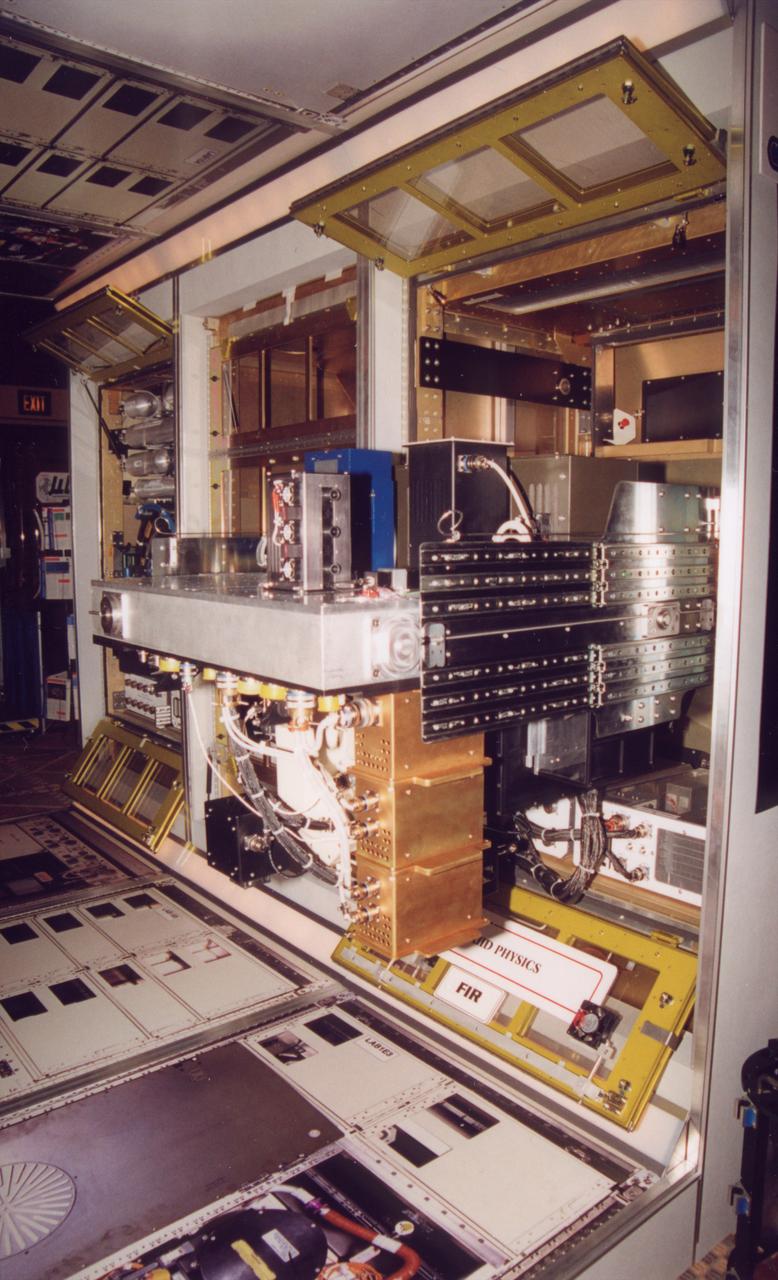
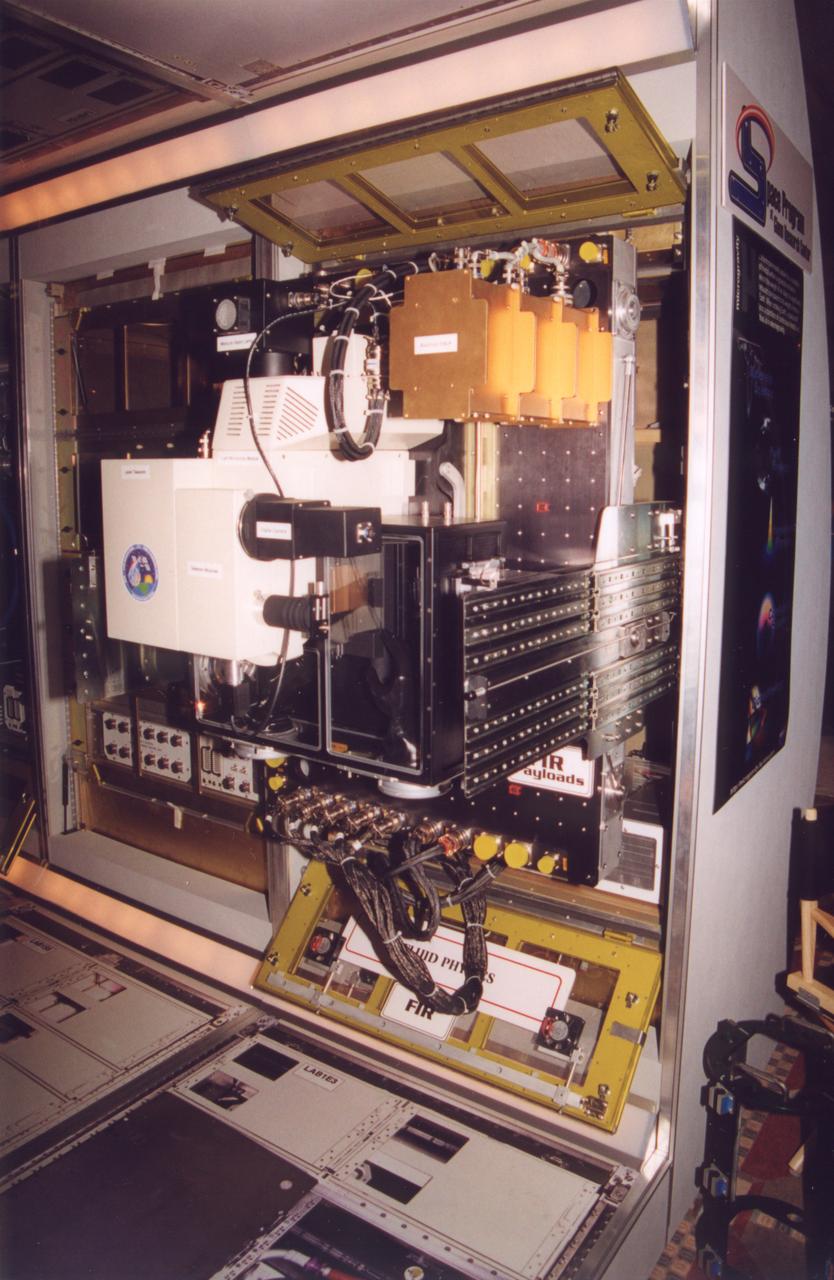
The optical bench for the Fluids Integrated Rack section of the Fluids and Combustion Facility (FCF) is shown extracted for servicing and with the optical bench rotated 90 degrees to access the rear elements. The FCF will be installed, in phases, in the Destiny, the U.S. Laboratory Module of the International Space Station (ISS), and will accommodate multiple users for a range of investigations. This is an engineering mockup; the flight hardware is subject to change as designs are refined. The FCF is being developed by the Microgravity Science Division (MSD) at the NASA Glenn Research Center. (Photo credit: NASA/Marshall Space Flight Center)
The optical bench for the Fluids Integrated Rack section of the Fluids and Combustion Facility (FCF) is shown extracted for servicing. The FCF will be installed, in phases, in the Destiny, the U.S. Laboratory Module of the International Space Station (ISS), and will accommodate multiple users for a range of investigations. This is an engineering mockup; the flight hardware is subject to change as designs are refined. The FCF is being developed by the Microgravity Science Division (MSD) at the NASA Glenn Research Center. (Photo credit: NASA/Marshall Space Flight Center)
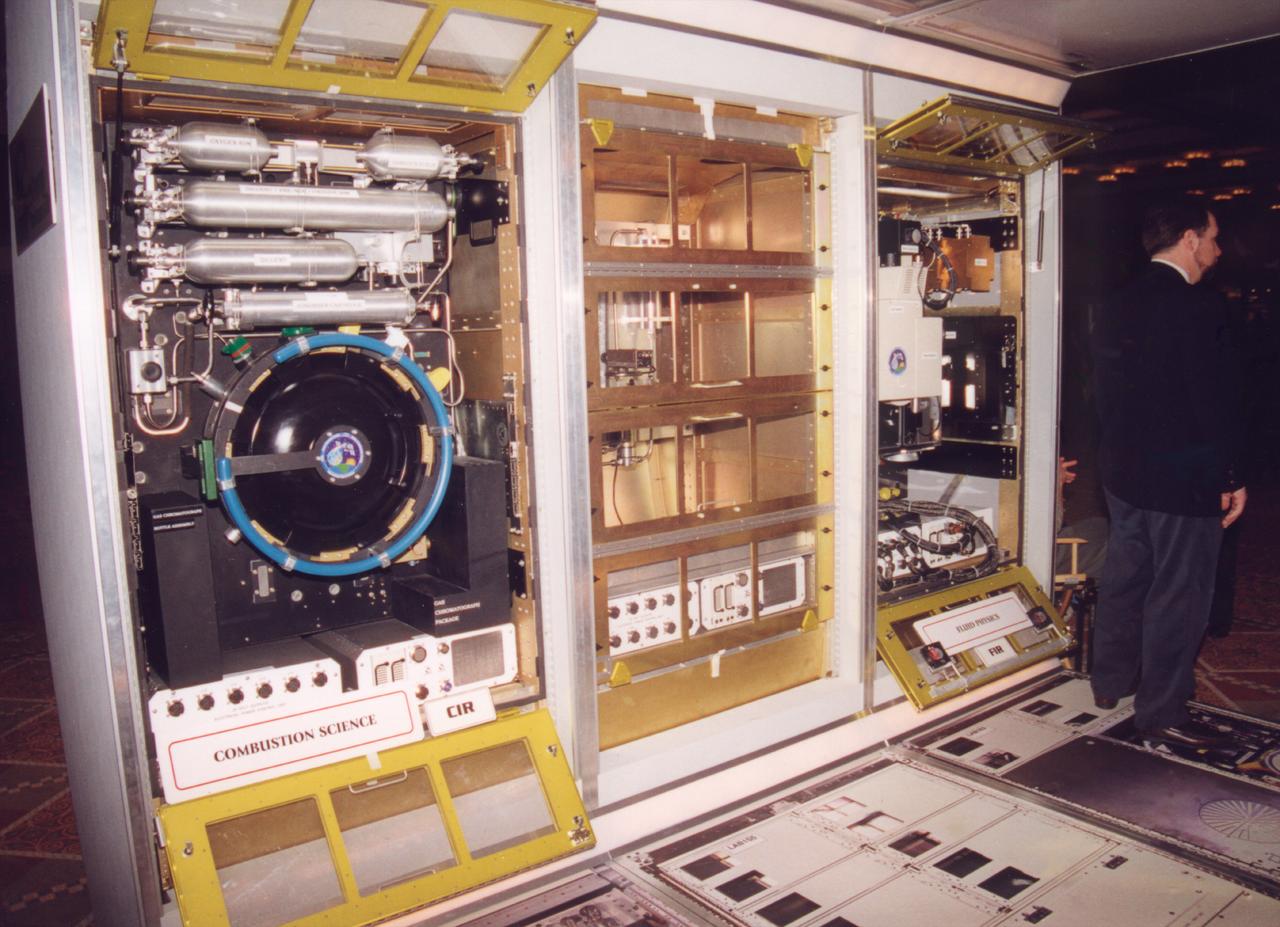
The Fluids and Combustion Facility (FCF) is a modular, multi-user facility to accommodate microgravity science experiments on board Destiny, the U.S. Laboratory Module for the International Space Station (ISS). The FCF will be a permanet facility aboard the ISS, and will be capable of accommodating up to ten science investigations per year. It will support the NASA Science and Technology Research Plans for the International Space Station (ISS) which require sustained systematic research of the effects of reduced gravity in the areas of fluid physics and combustion science. From left to right are the Combustion Integrated Rack, the Shared Rack, and the Fluids Integrated Rack. The FCF is being developed by the Microgravity Science Division (MSD) at the NASA Glenn Research Center. (Photo Credit: NASA/Marshall Space Flight Center)
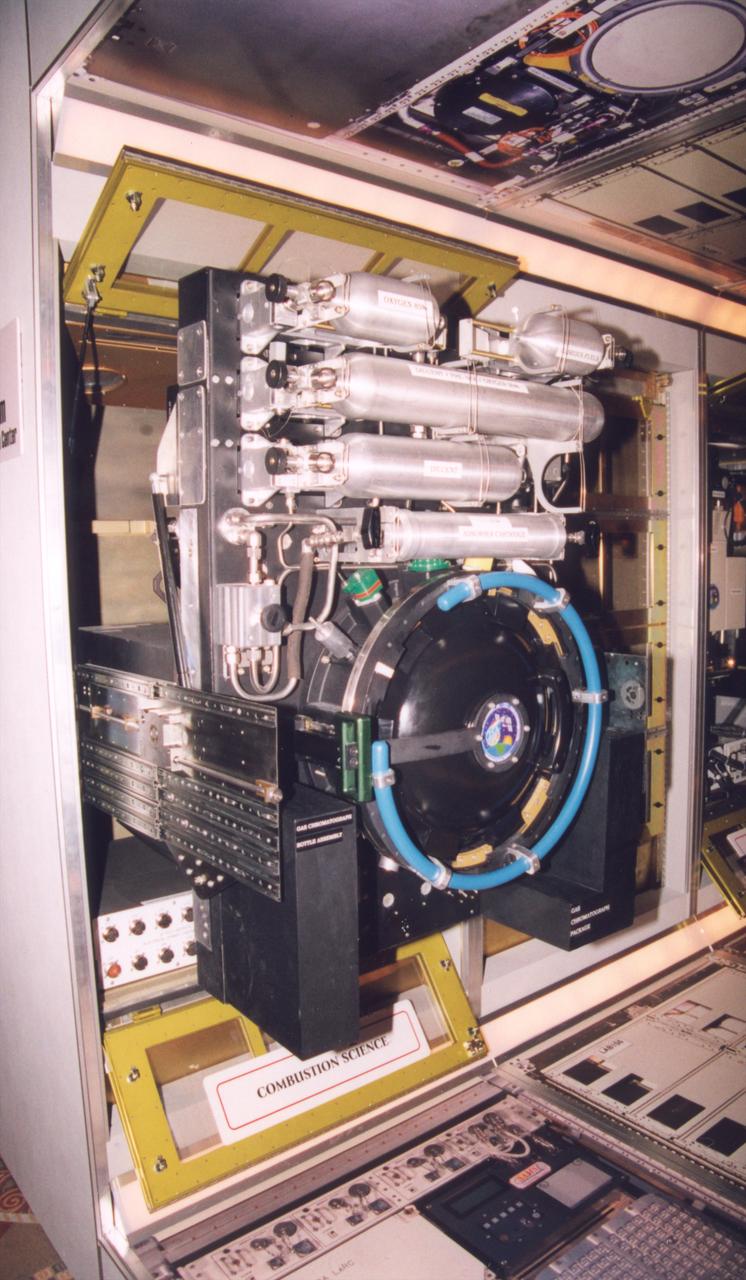
The combustion chamber for the Combustion Integrated Rack section of the Fluids and Combustion Facility (FCF) is shown extracted for servicing. The FCF will be installed, in phases, in the Destiny, the U.S. Laboratory Module of the International Space Station (ISS), and will accommodate multiple users for a range of investigations. This is an engineering mockup; the flight hardware is subject to change as designs are refined. The FCF is being developed by the Microgravity Science Division (MSD) at the NASA Glenn Research Center. (Photo credit: NASA/Marshall Space Flight Center)

The optical bench for the Fluids Integrated Rack section of the Fluids and Combustion Facility (FCF) is shown extracted for servicing and with the optical bench rotated 90 degrees for access to the rear elements. The FCF will be installed, in phases, in the Destiny, the U.S. Laboratory Module of the International Space Station (ISS), and will accommodate multiple users for a range of investigations. This is an engineering mockup; the flight hardware is subject to change as designs are refined. The FCF is being developed by the Microgravity Science Division (MSD) at the NASA Glenn Research Center. (Photo credit: NASA/Marshall Space Flight Center)
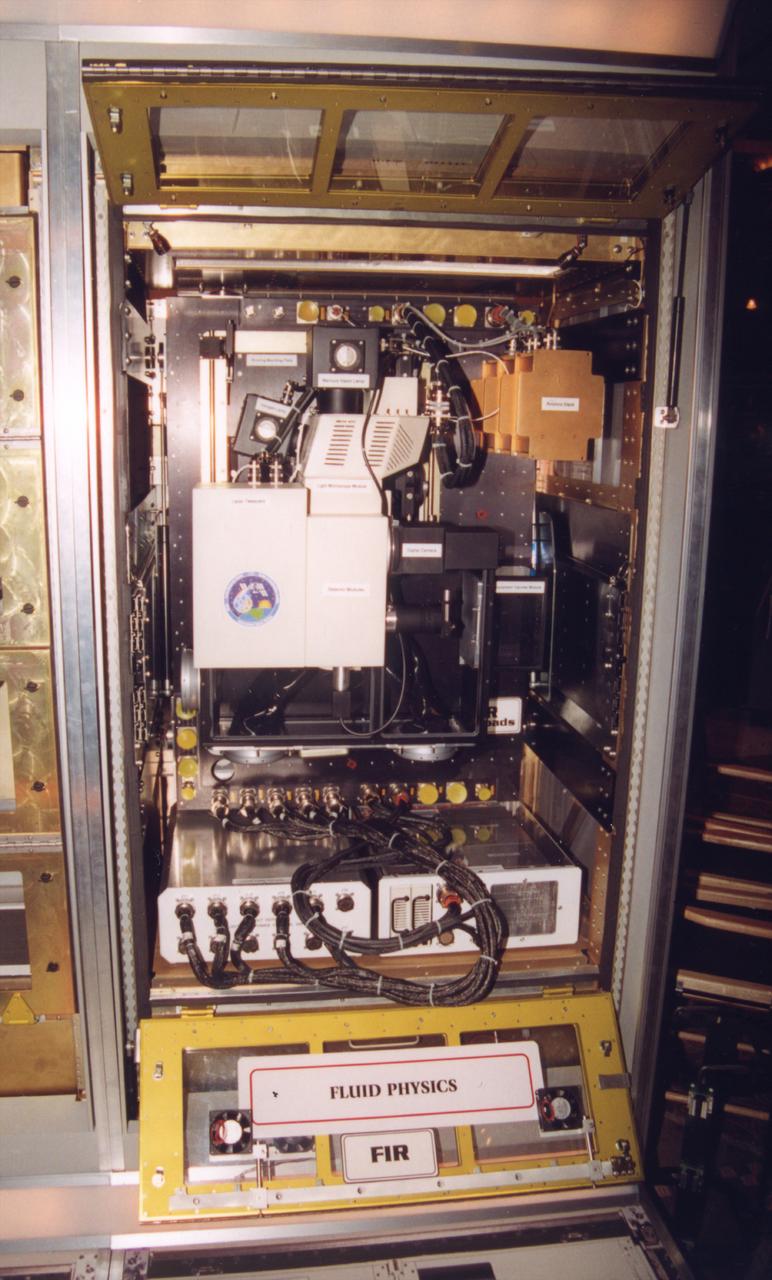
The optical bench for the Fluid Integrated Rack section of the Fluids and Combustion Facility (FCF) is shown in its operational configuration. The FCF will be installed, in phases, in the Destiny, the U.S. Laboratory Module of the International Space Station (ISS), and will accommodate multiple users for a range of investigations. This is an engineering mockup; the flight hardware is subject to change as designs are refined. The FCF is being developed by the Microgravity Science Division (MSD) at the NASA Glenn Research Center. (Photo credit: NASA/Marshall Space Flight Center)
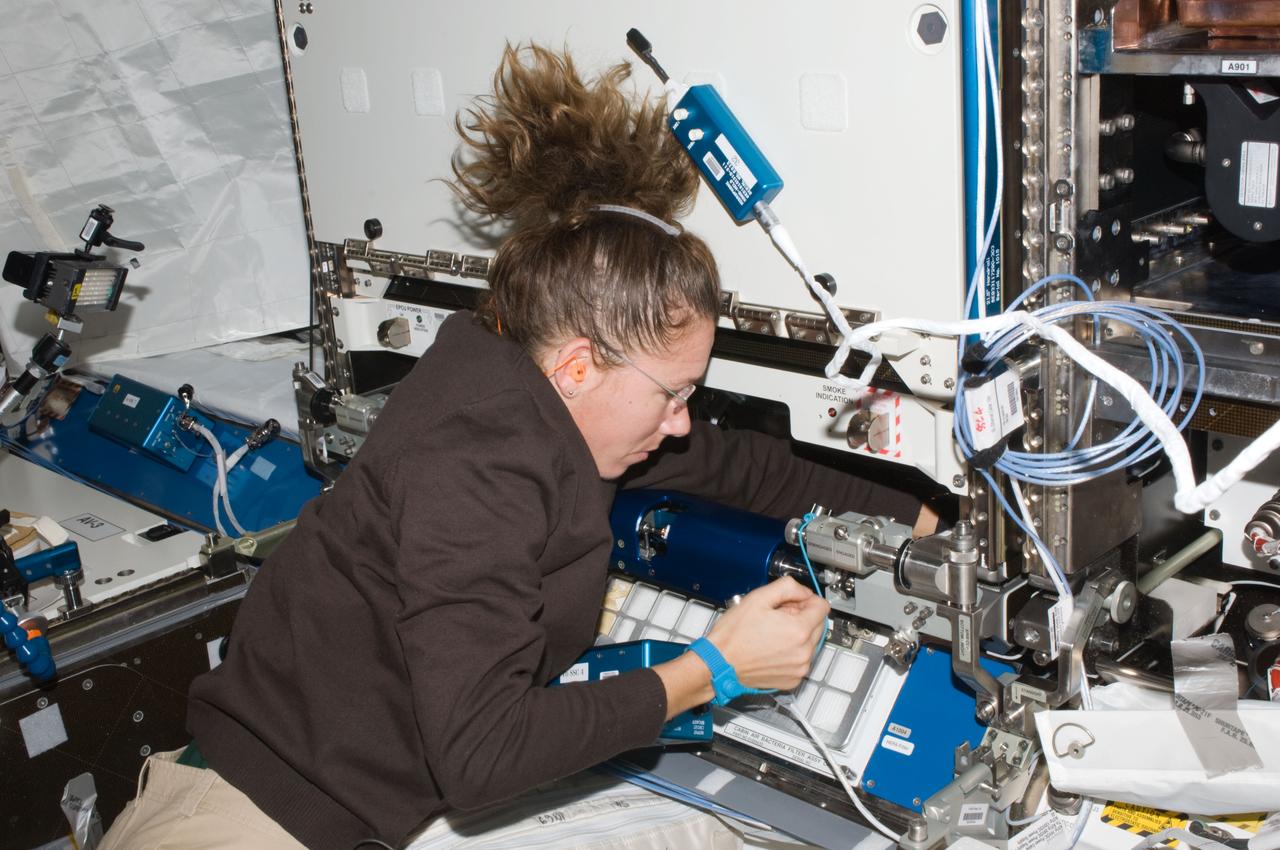
ISS018-E-017796 (5 Jan. 2009) --- Astronaut Sandra Magnus, Expedition 18 flight engineer, works on the Fluids and Combustion Facility (FCF) Combustion Integration Rack (CIR) Passive Rack Isolation System (PaRIS) in the Destiny laboratory of the International Space Station.
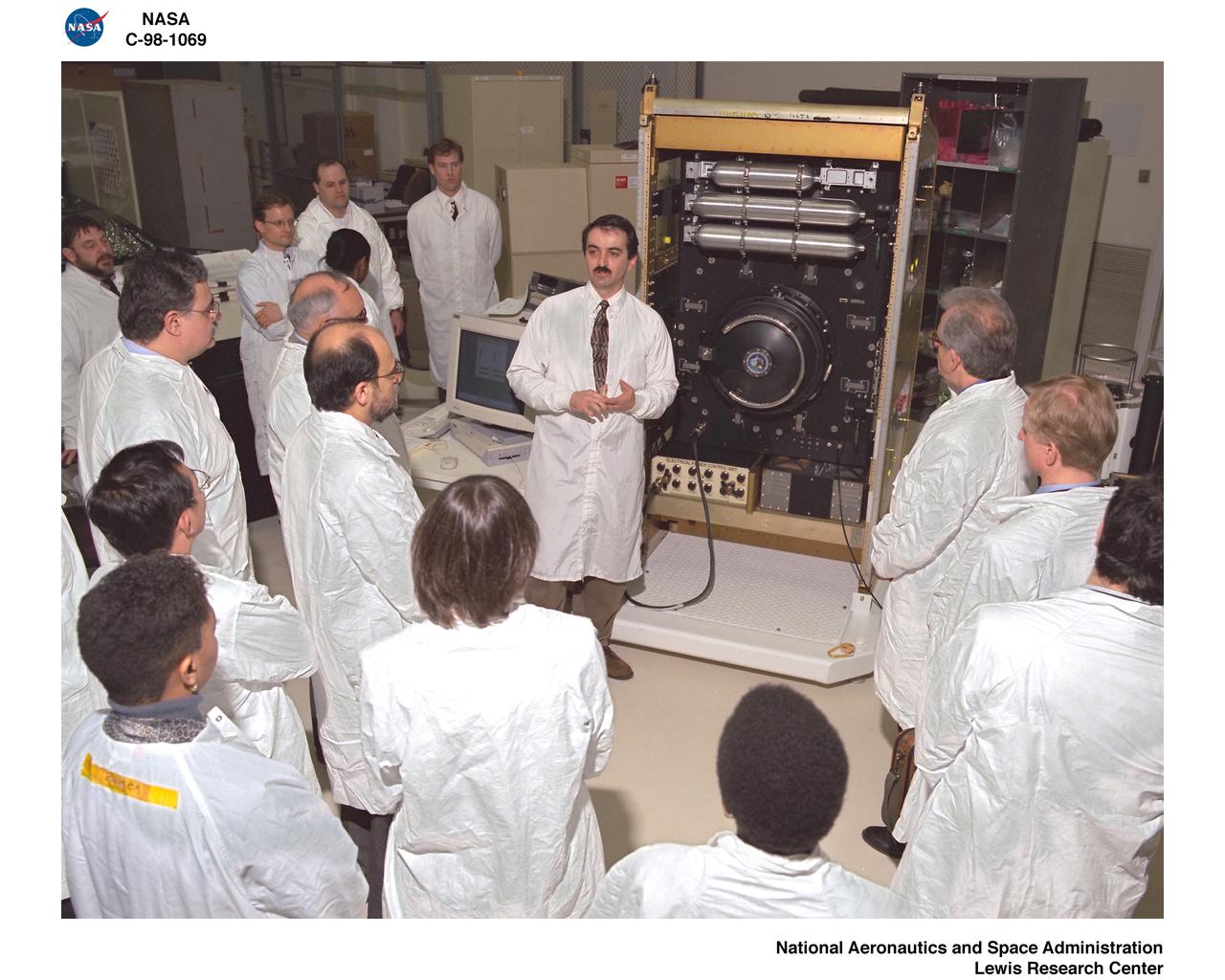
FLUIDS COMBUSTION FACILITY COMBUSTION INTEGRATED RACK INTERNATIONAL MICROGRAVITY WORKING GROUP
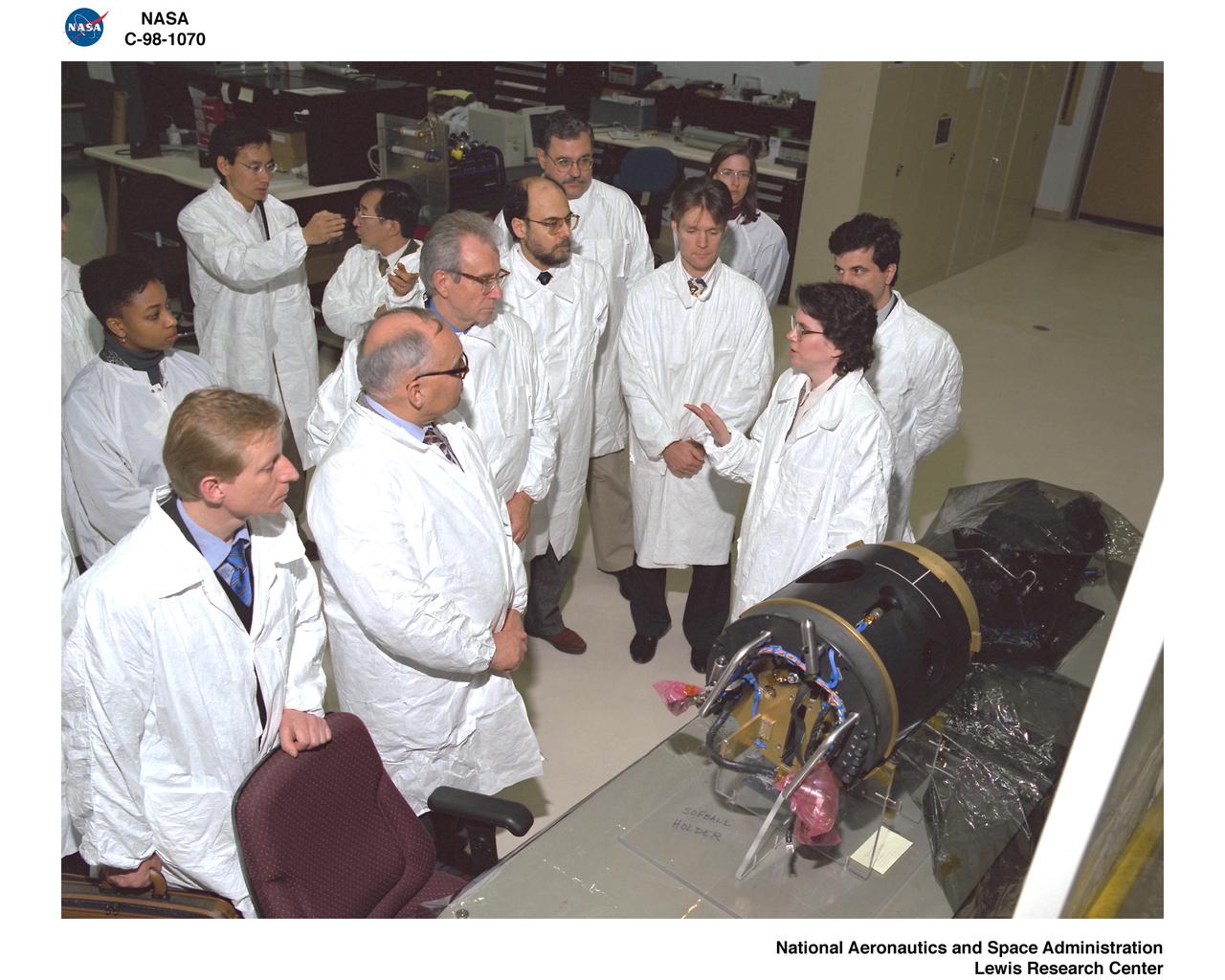
FLUIDS COMBUSTION FACILITY COMBUSTION INTEGRATED RACK INTERNATIONAL MICROGRAVITY WORKING GROUP
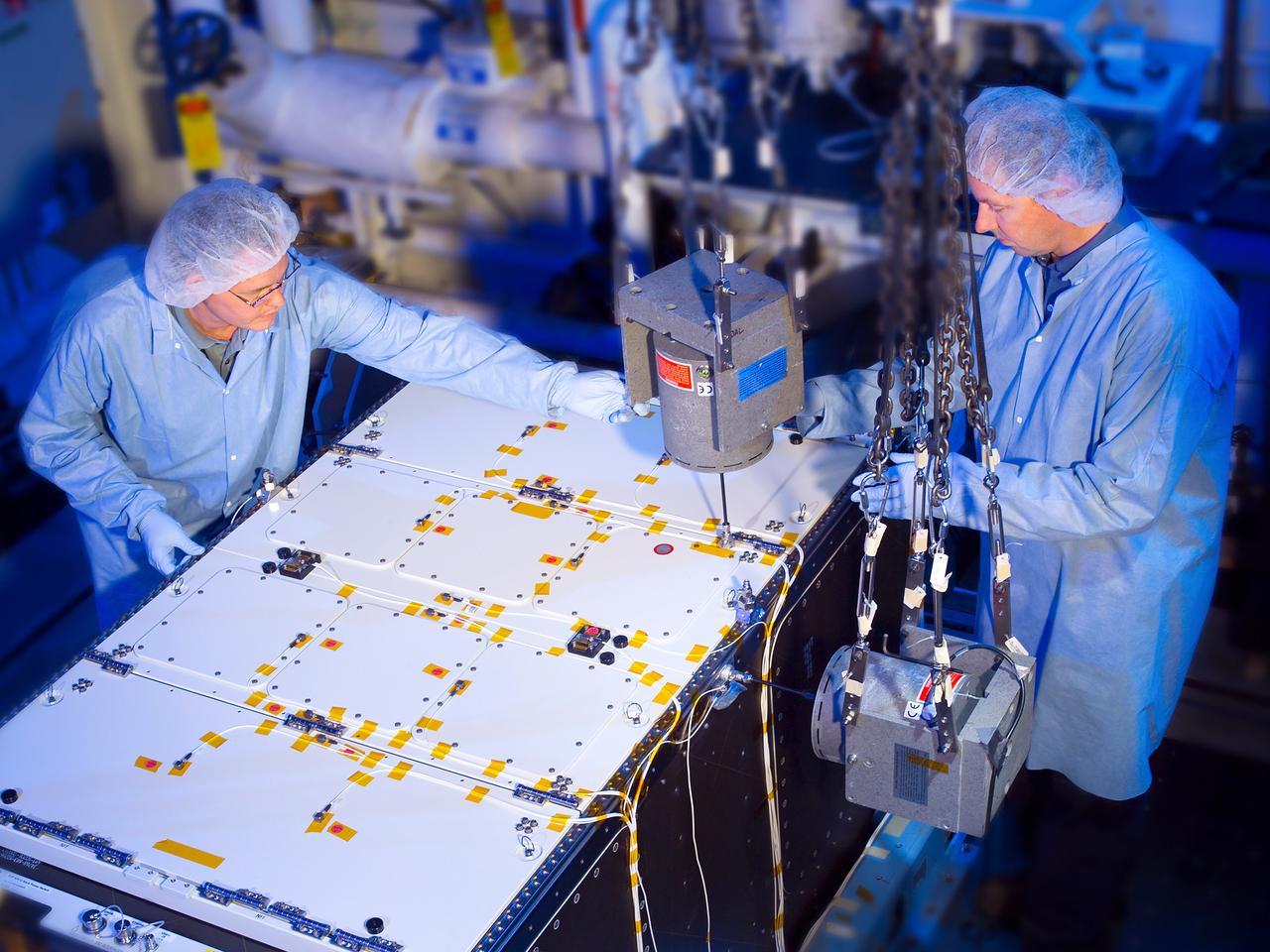
Fluids and Combustion Facility (FCF), Combustion Integration Rack (CIR) during testing in the Structural Dynamics Laboratory (SDL). The Fluids and Combustion Facility (FCF) is a set of two International Space Station (ISS) research facilities designed to support physical and biological experiments in support of technology development and validation in space. The FCF consists of two modular, reconfigurable racks called the Combustion Integration Rack (CIR) and the Fluids Integration Rack (FIR). The CIR and FIR were developed at NASAʼs Glenn Research Center.
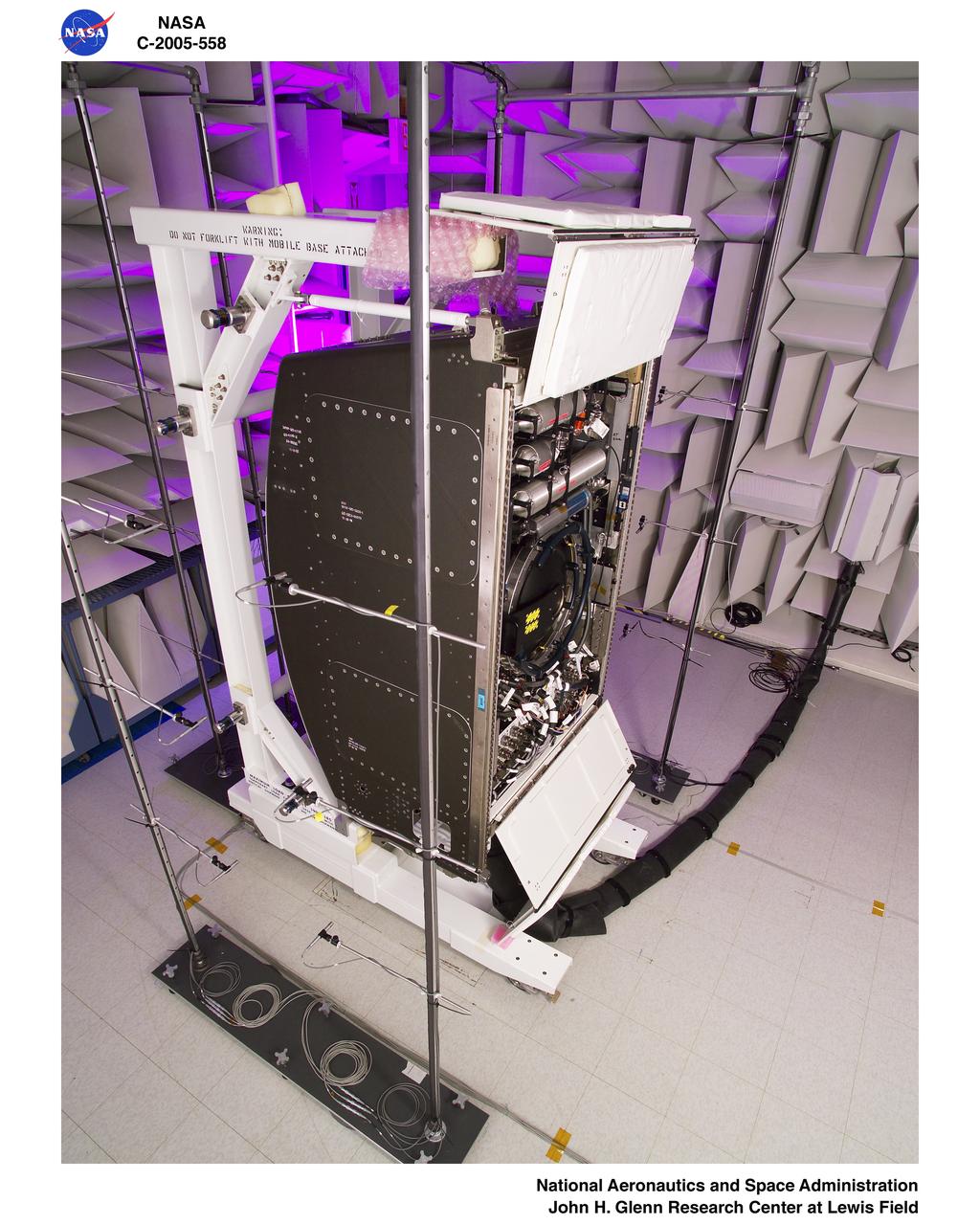
Fluids and Combustion Facility (FCF) Combustion Integrated Rack (CIR) in the Acoustic Testing Laboratory (ATL), Camera file: G6QH5821
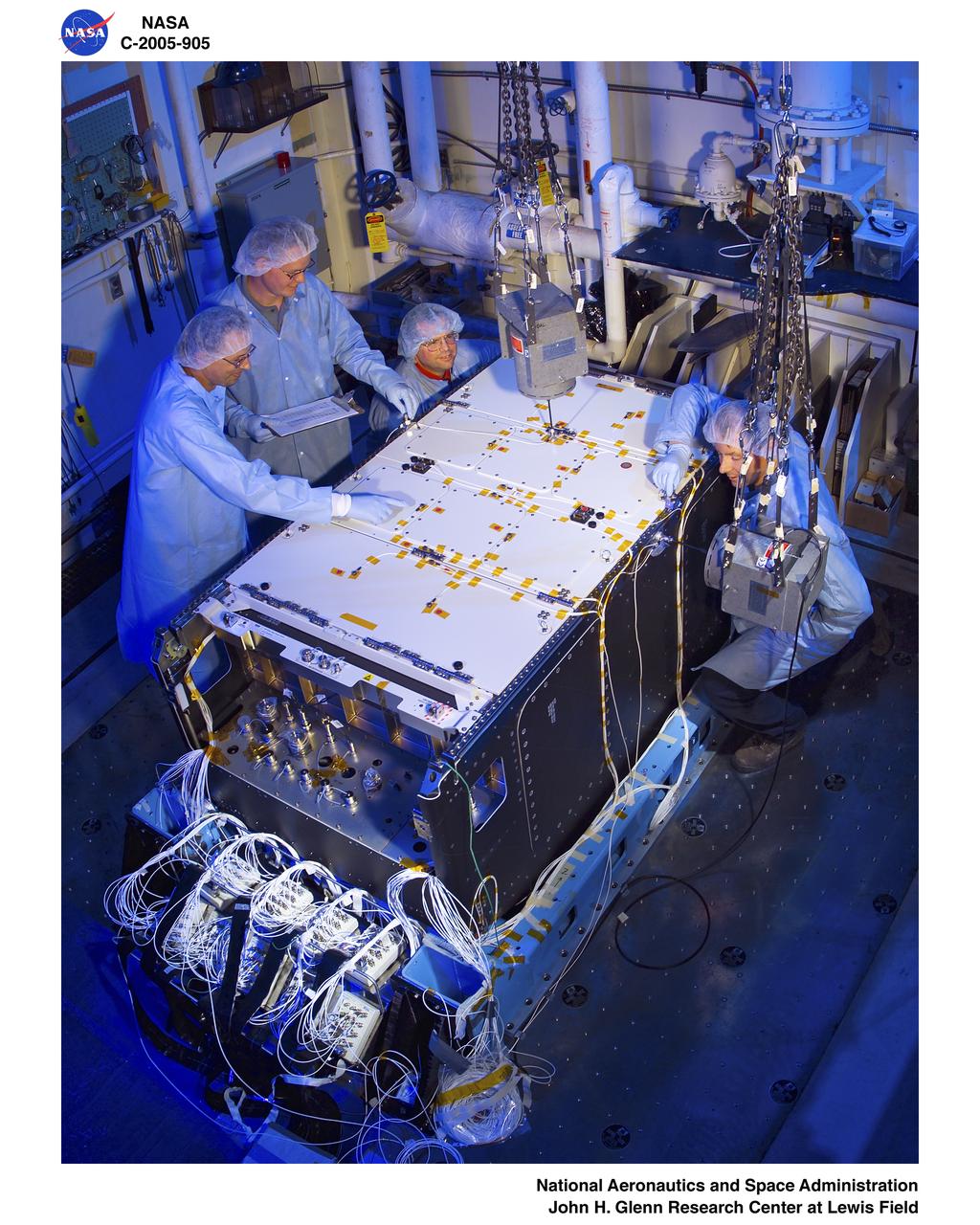
Fluids and Combustion Facility (FCF), Combustion Integration Rack (CIR) during testing in the Structural Dynamics Laboratory (SDL)

Fluids and Combustion Facility (FCF), Combustion Integrated Rack (CIR) during testing in the Structural Dynamics Laboratory (SDL)
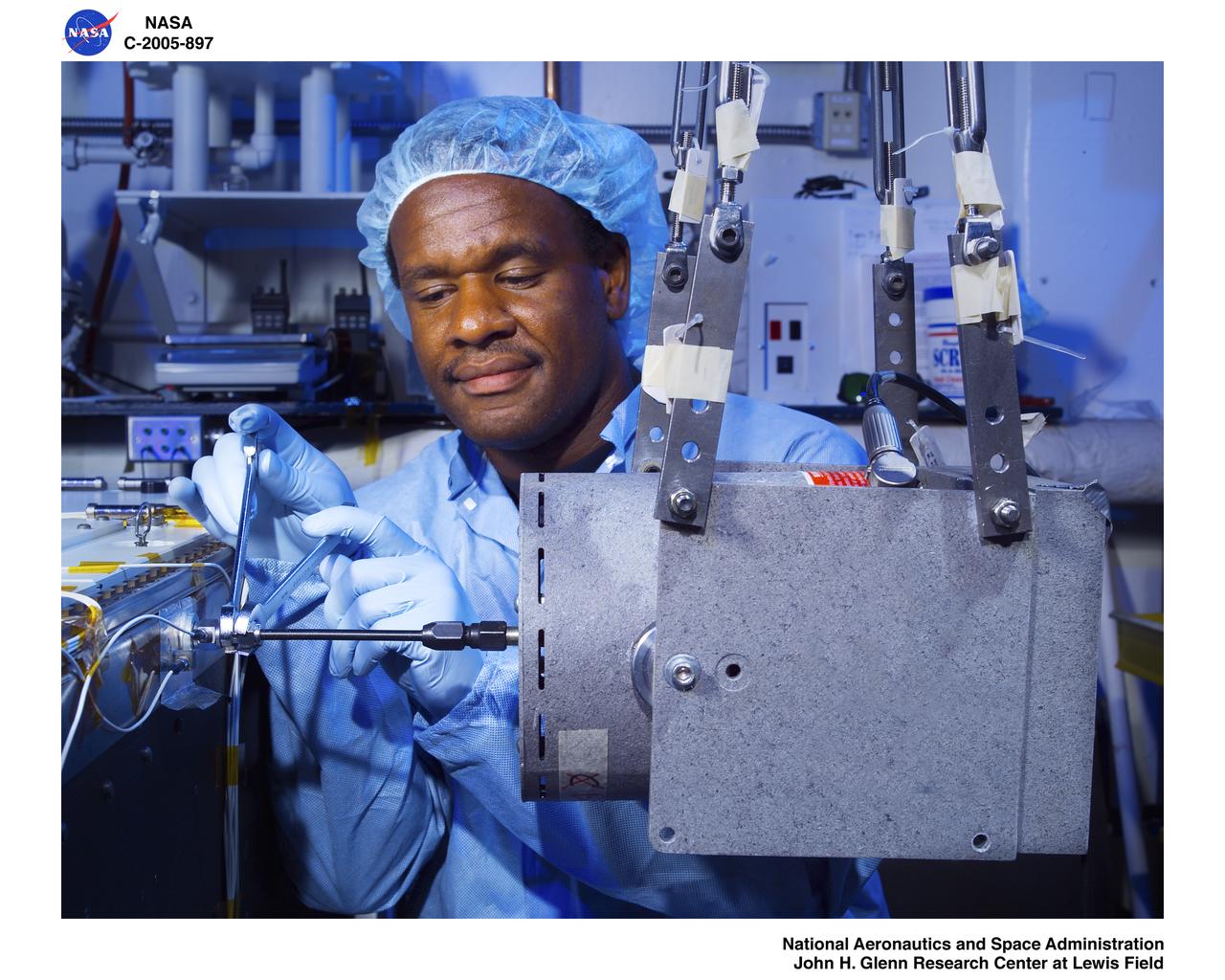
Fluids and Combustion Facility (FCF), Combustion Integration Rack (CIR) during testing in the Structural Dynamics Laboratory (SDL)
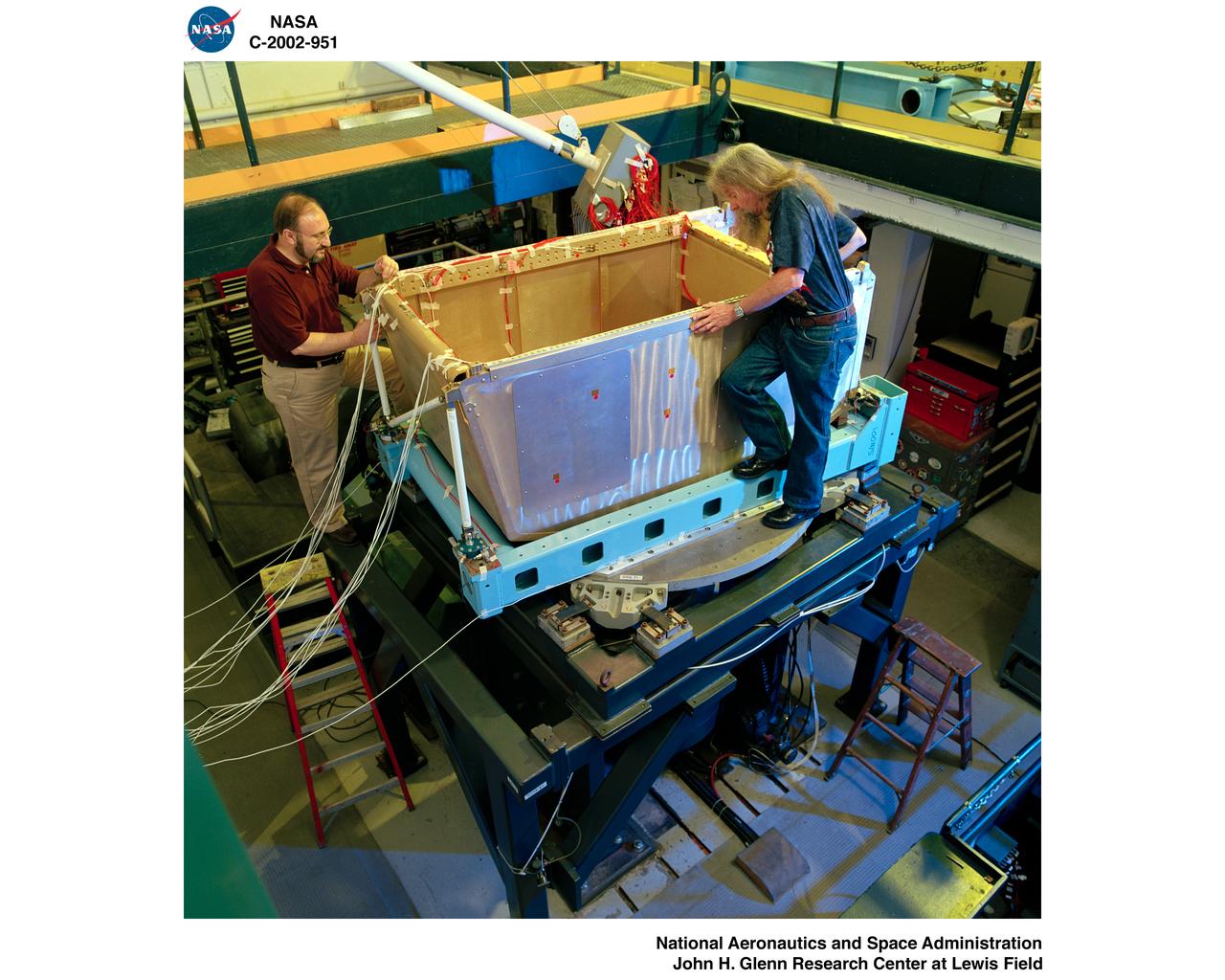
FLUIDS AND COMBUSTION FACILITY RACK IN THE STRUCTURAL DYNAMICS LAB
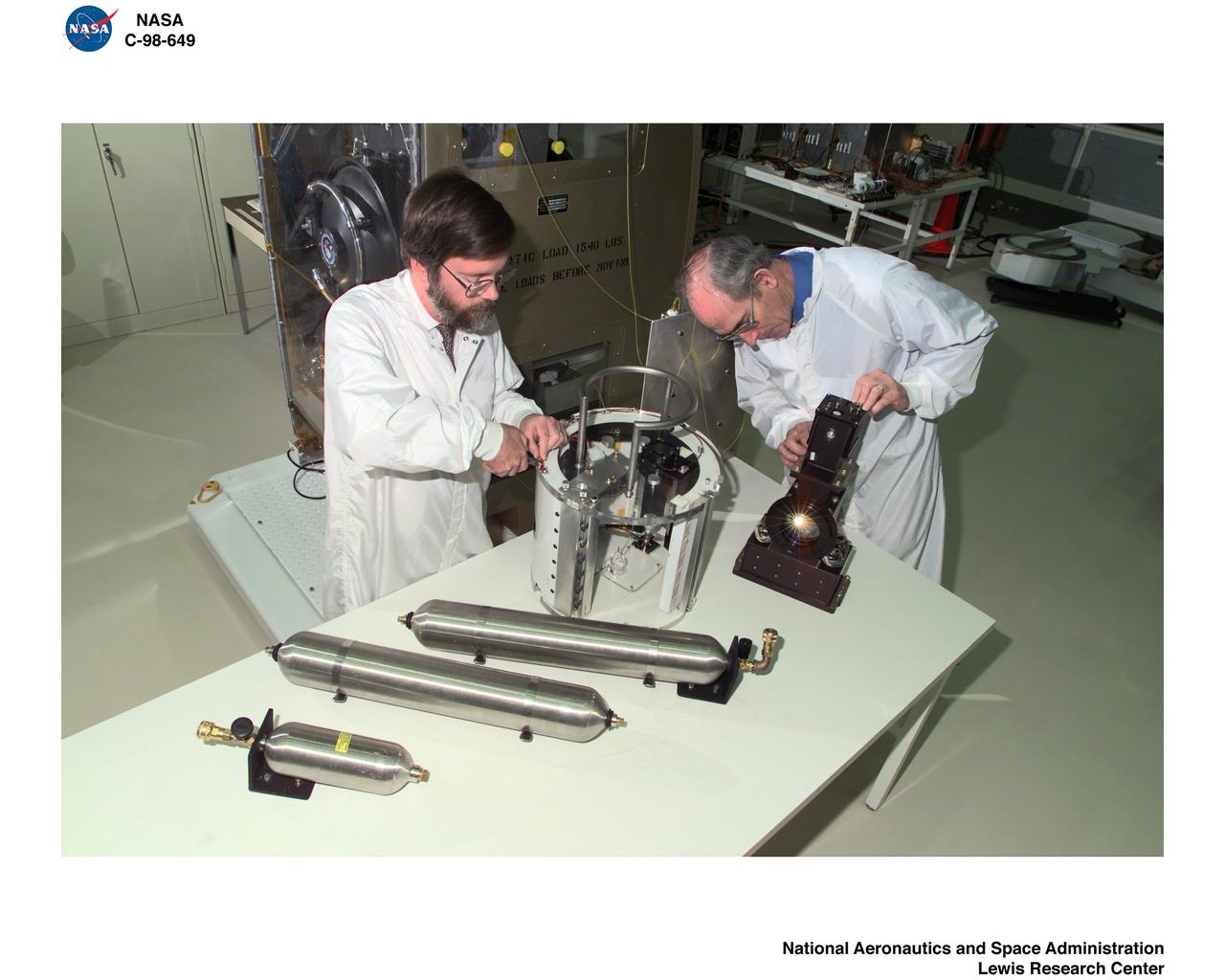
LEWIS RESEARCHERS WORKING ON FLUIDS AND COMBUSTION FACILITY COMPONENTS
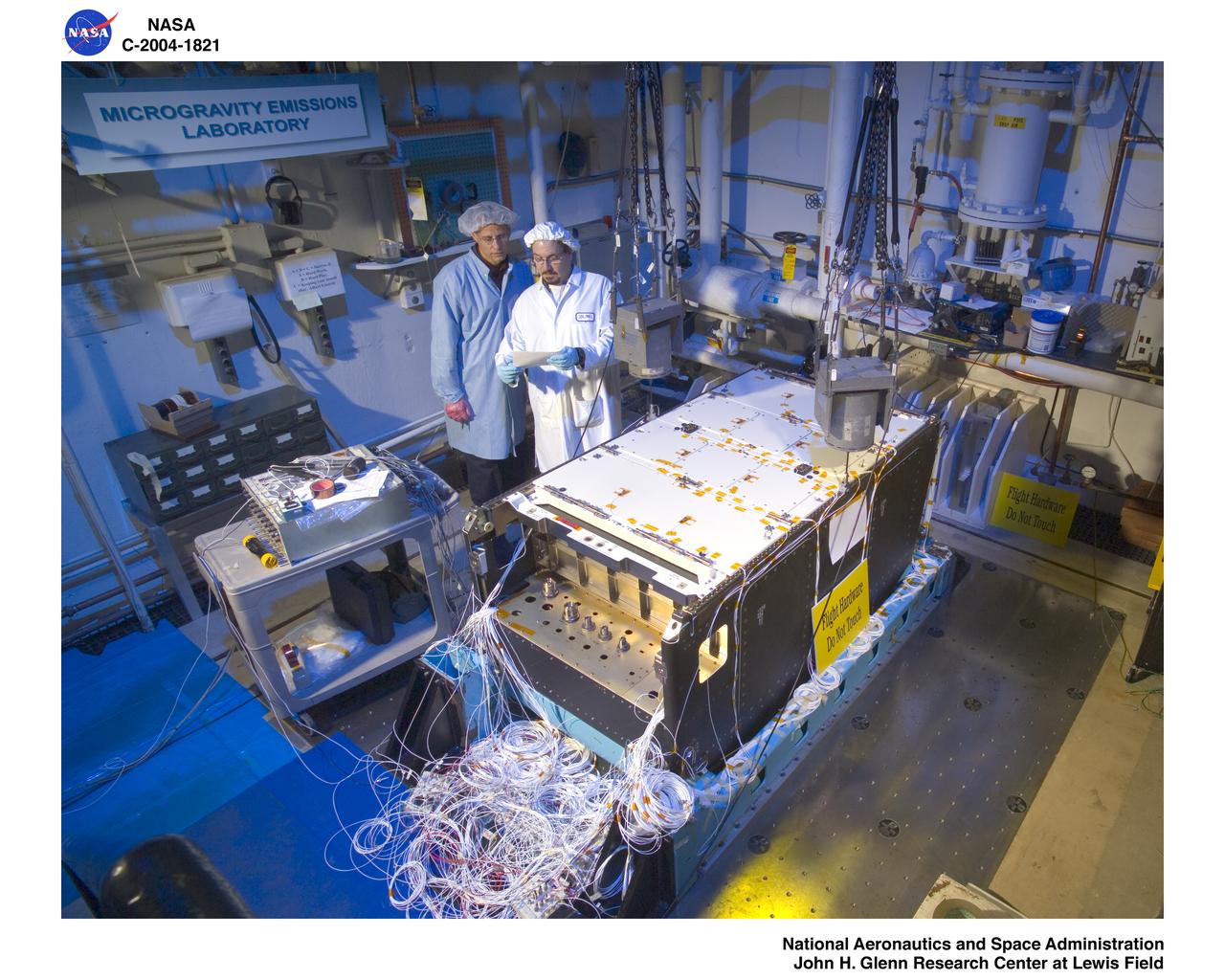
Fluids and Combustion Facility (FCF) Combustion Integrated Rack (CIR) Ground Integration Unit (GIU) Modal Test in the Structural Dynamics Laboratory at NASA Glenn
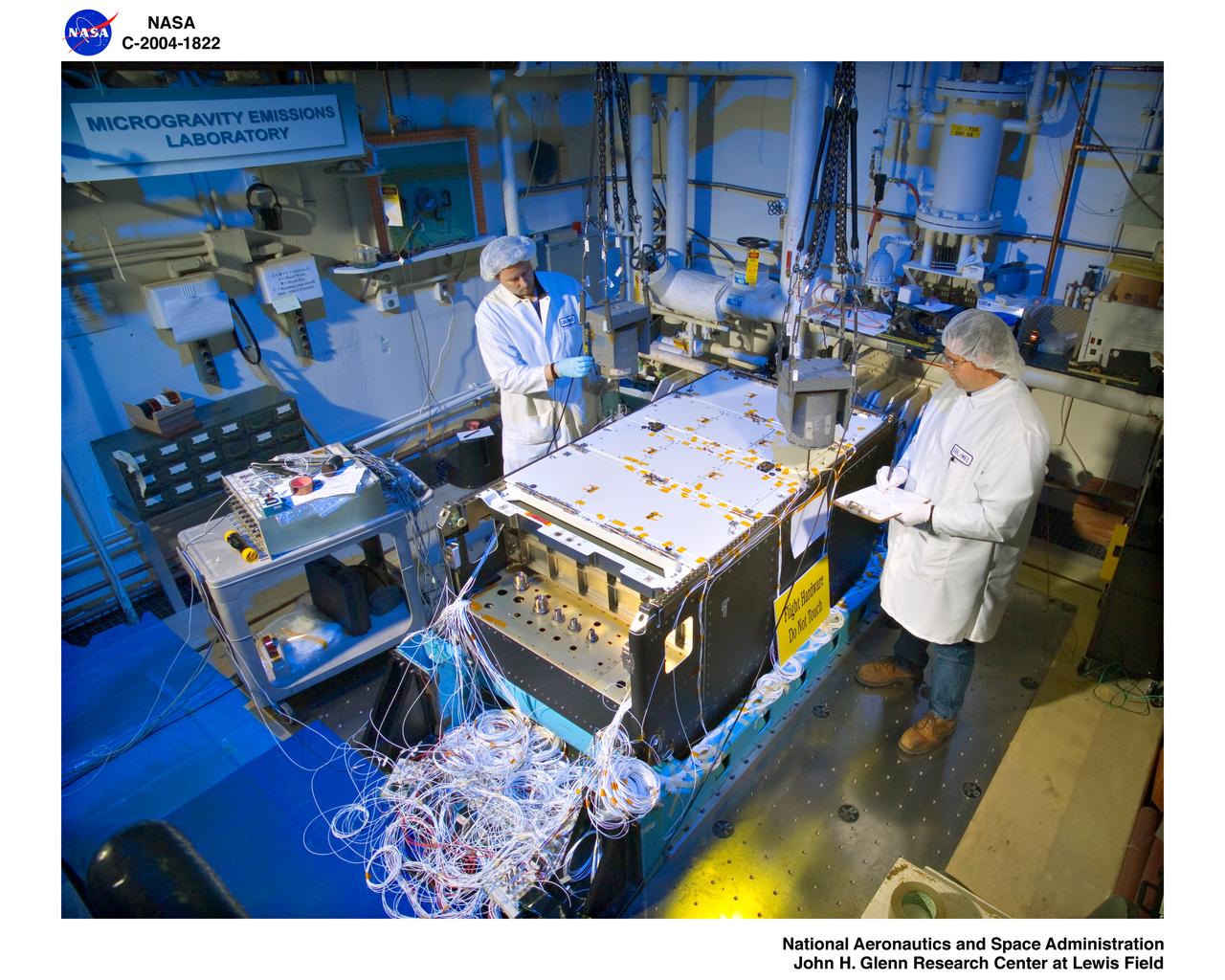
Fluids and Combustion Facility (FCF) Combustion Integrated Rack (CIR) Ground Integration Unit (GIU) Modal Test in the Structural Dynamics Laboratory at NASA Glenn
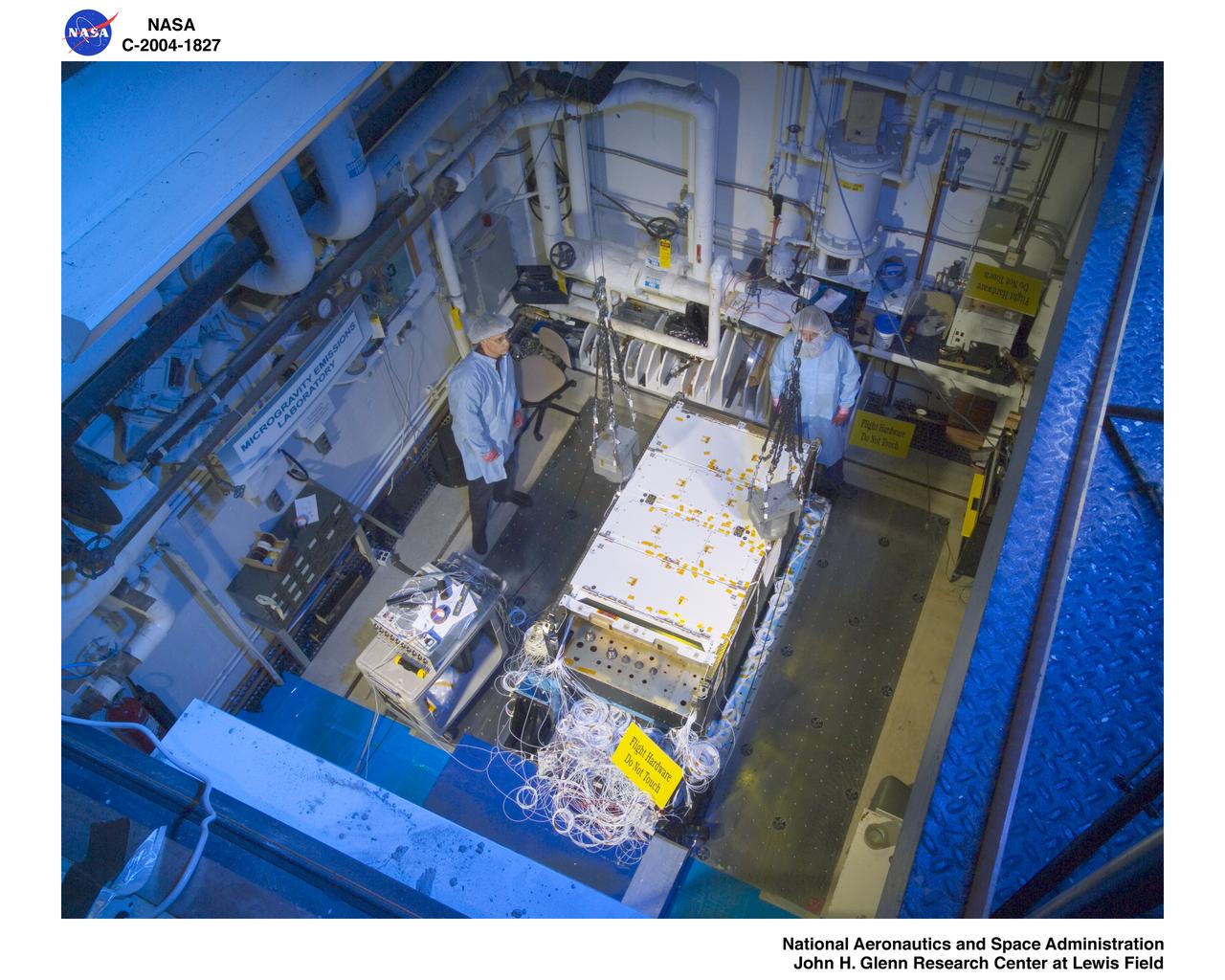
Fluids and Combustion Facility (FCF) Combustion Integrated Rack (CIR) Ground Integration Unit (GIU) Modal Test in the Structural Dynamics Laboratory at NASA Glenn
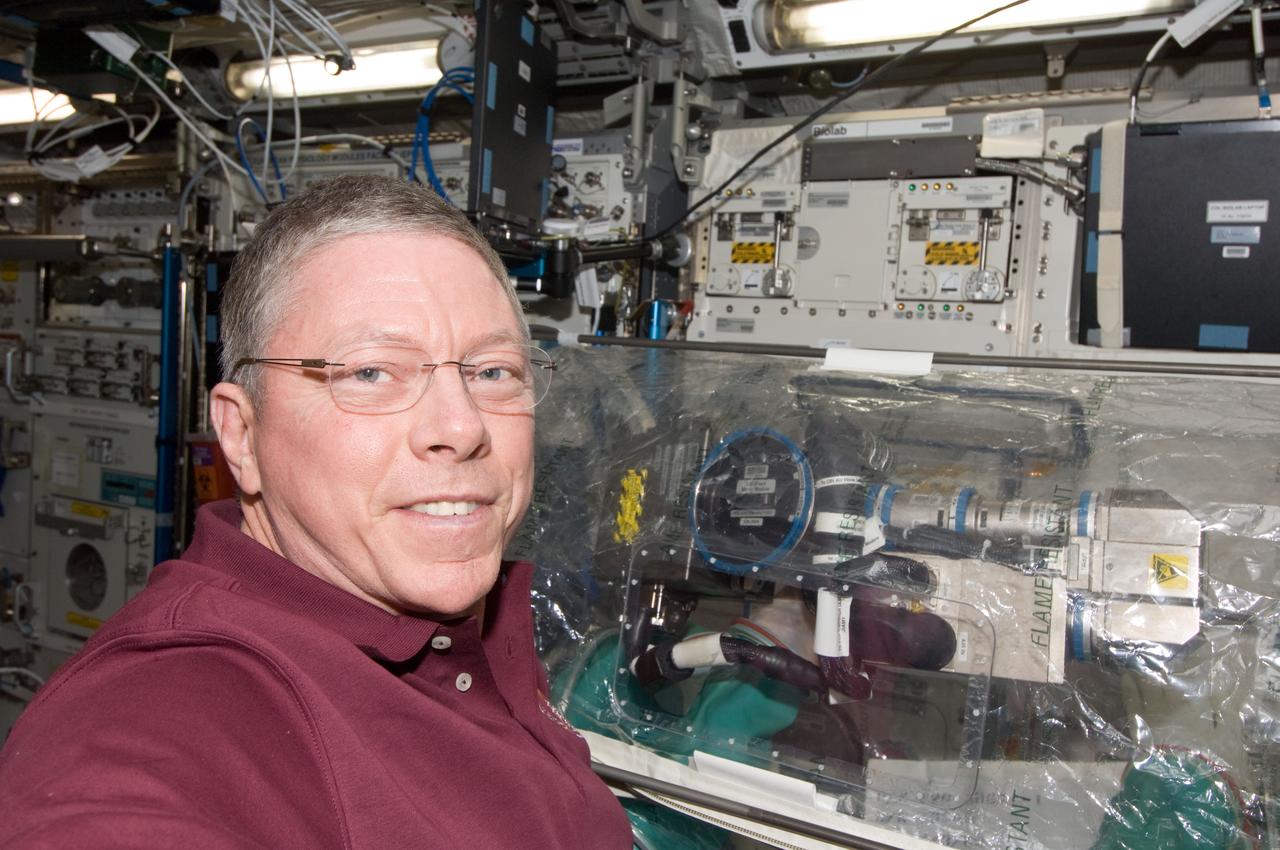
ISS029-E-029756 (17 Oct. 2011) --- NASA astronaut Mike Fossum, Expedition 29 commander, works on the Combustion Integrated Rack / Fluids & Combustion Facility (CIR FCF) in the Destiny laboratory of the International Space Station.
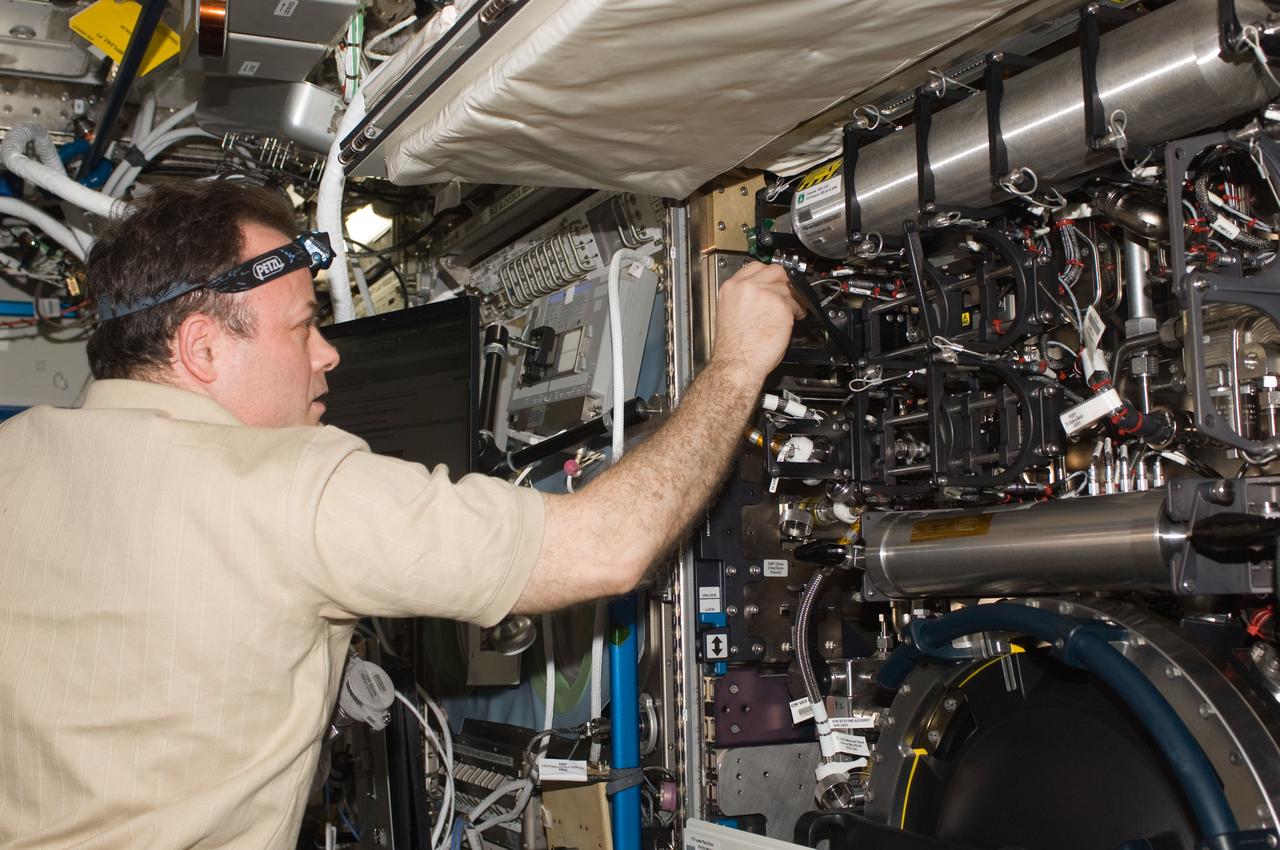
ISS028-E-026400 (17 Aug. 2011) --- NASA astronaut Ron Garan, Expedition 28 flight engineer, works with the Combustion Integrated Rack (CIR) Fluids and Combustion Facility (FCF) in the Destiny laboratory of the International Space Station.
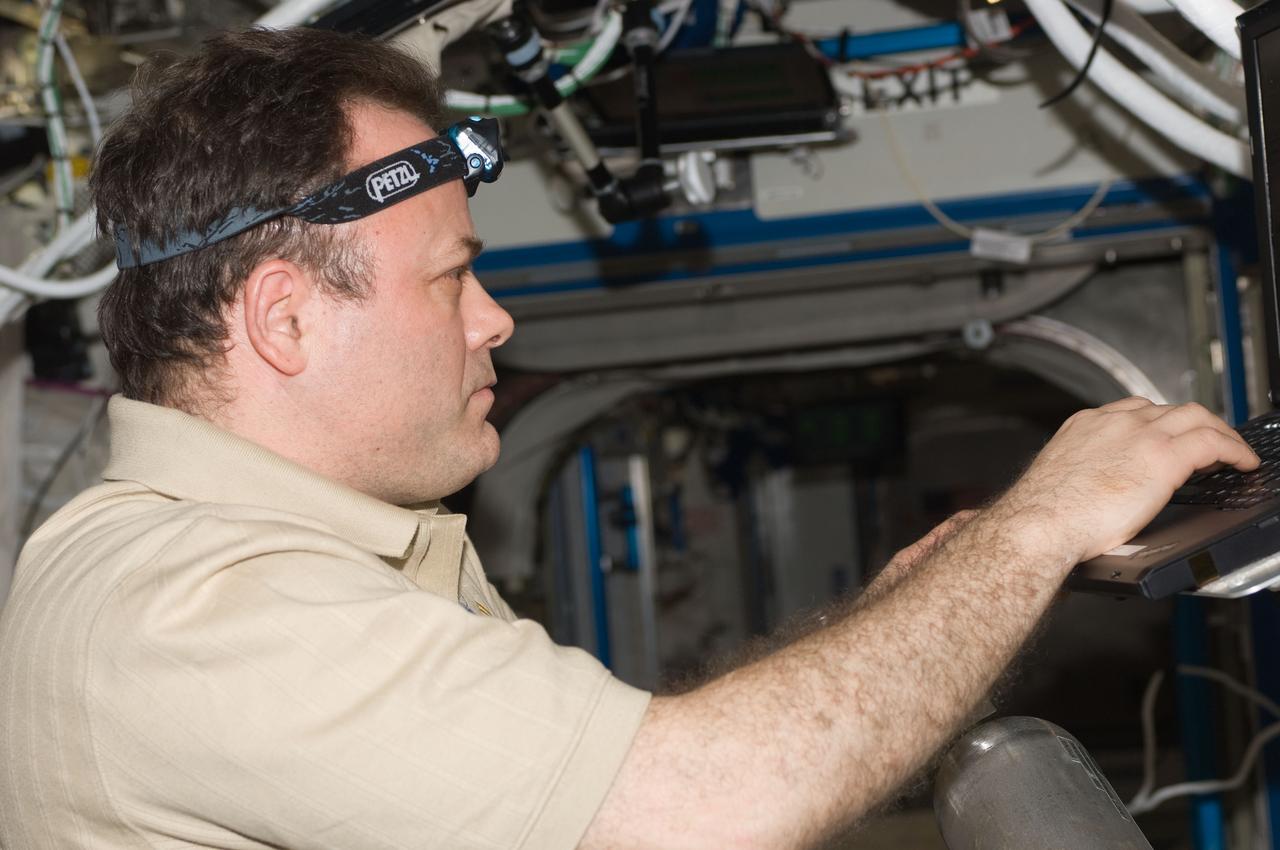
ISS028-E-026402 (17 Aug. 2011) --- NASA astronaut Ron Garan, Expedition 28 flight engineer, works with the Combustion Integrated Rack (CIR) Fluids and Combustion Facility (FCF) in the Destiny laboratory of the International Space Station.
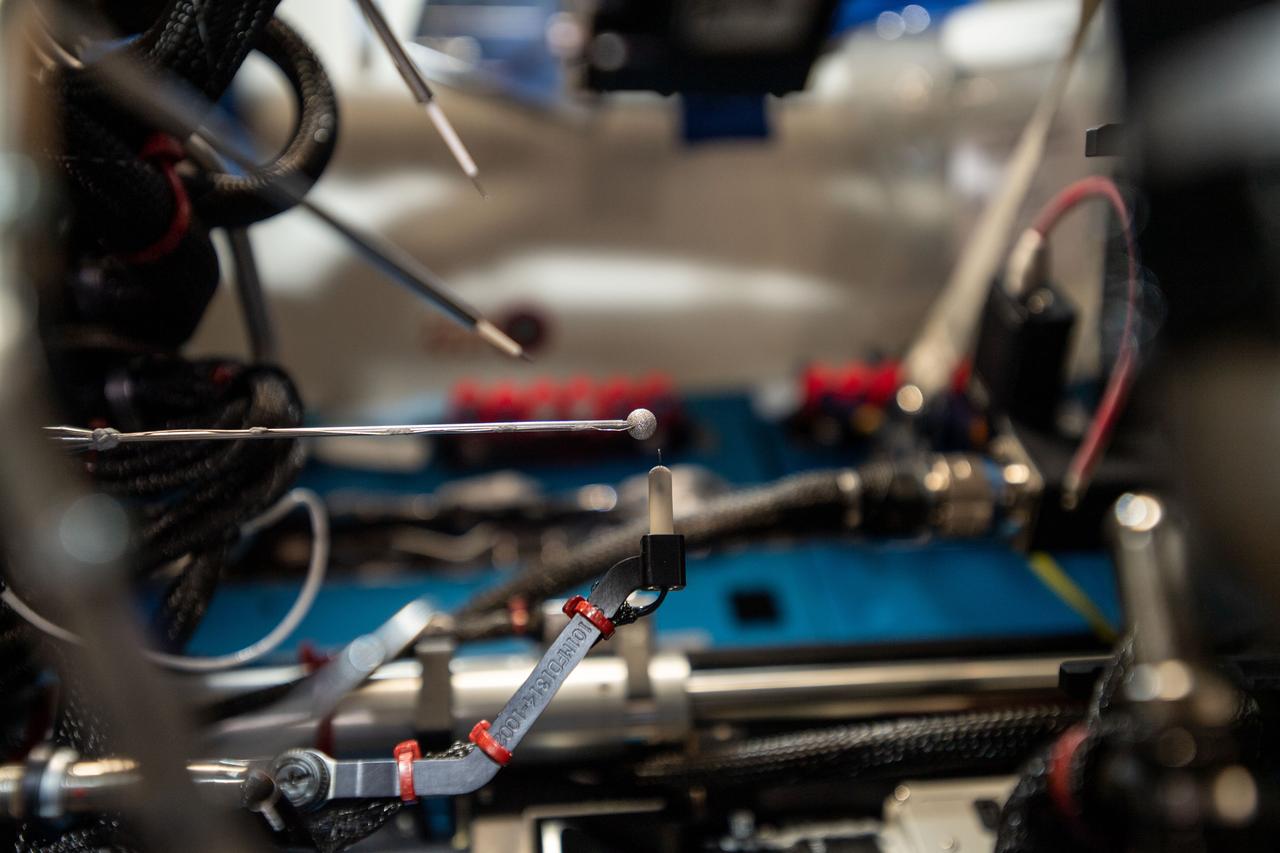
iss059e103188 (6/14/2019) --- Photo documentation taken aboard the International Space Station (ISS) during the Fluids and Combustion Facility (FCF) Combustion Integration Rack (CIR) / Advanced Combustion via Microgravity Experiments (ACME) / Flame Design hardware replacement.
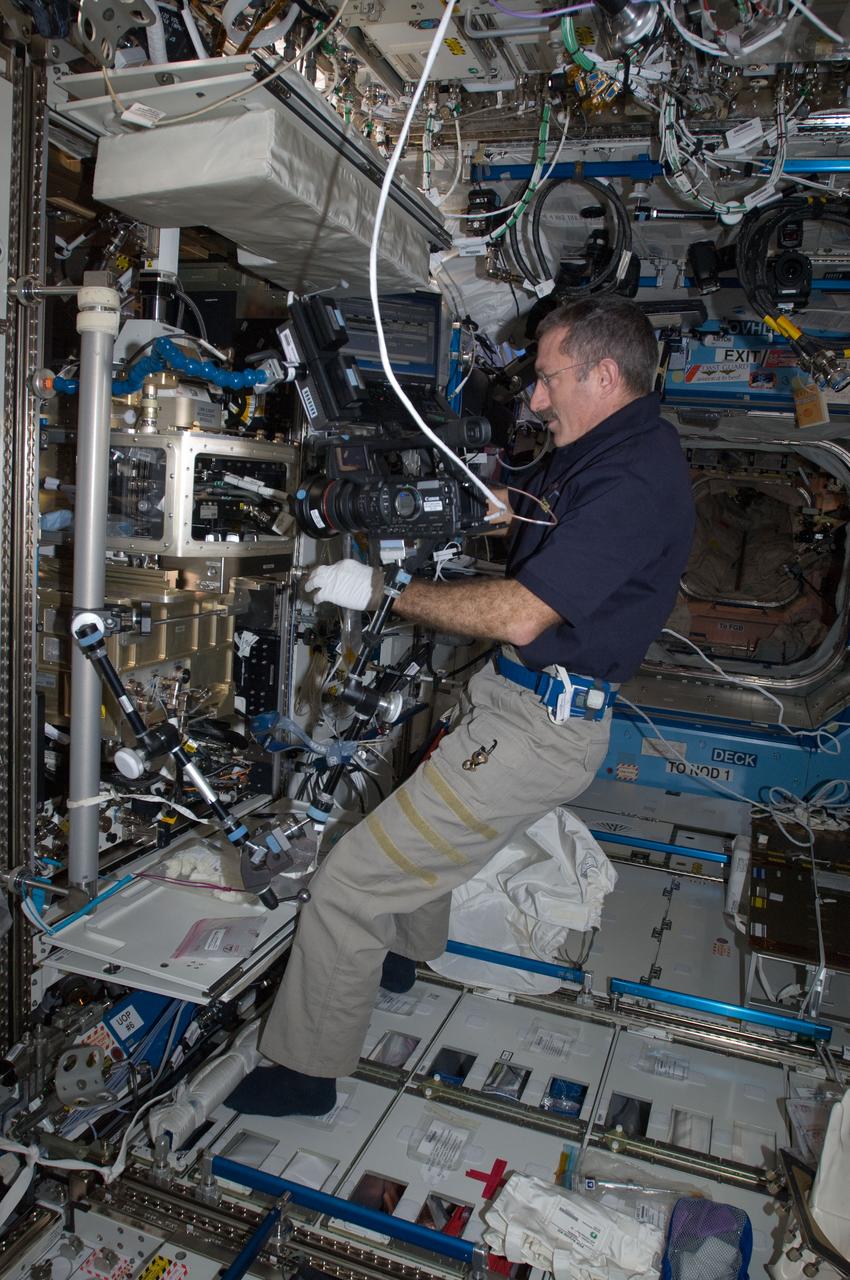
ISS030-E-007428 (1 Dec. 2011) --- NASA astronaut Dan Burbank, Expedition 30 commander, works at the Light Microscopy Module (LMM) in the Fluids Integrated Rack / Fluids Combustion Facility (FIR/FCF) located in the Destiny laboratory of the International Space Station.
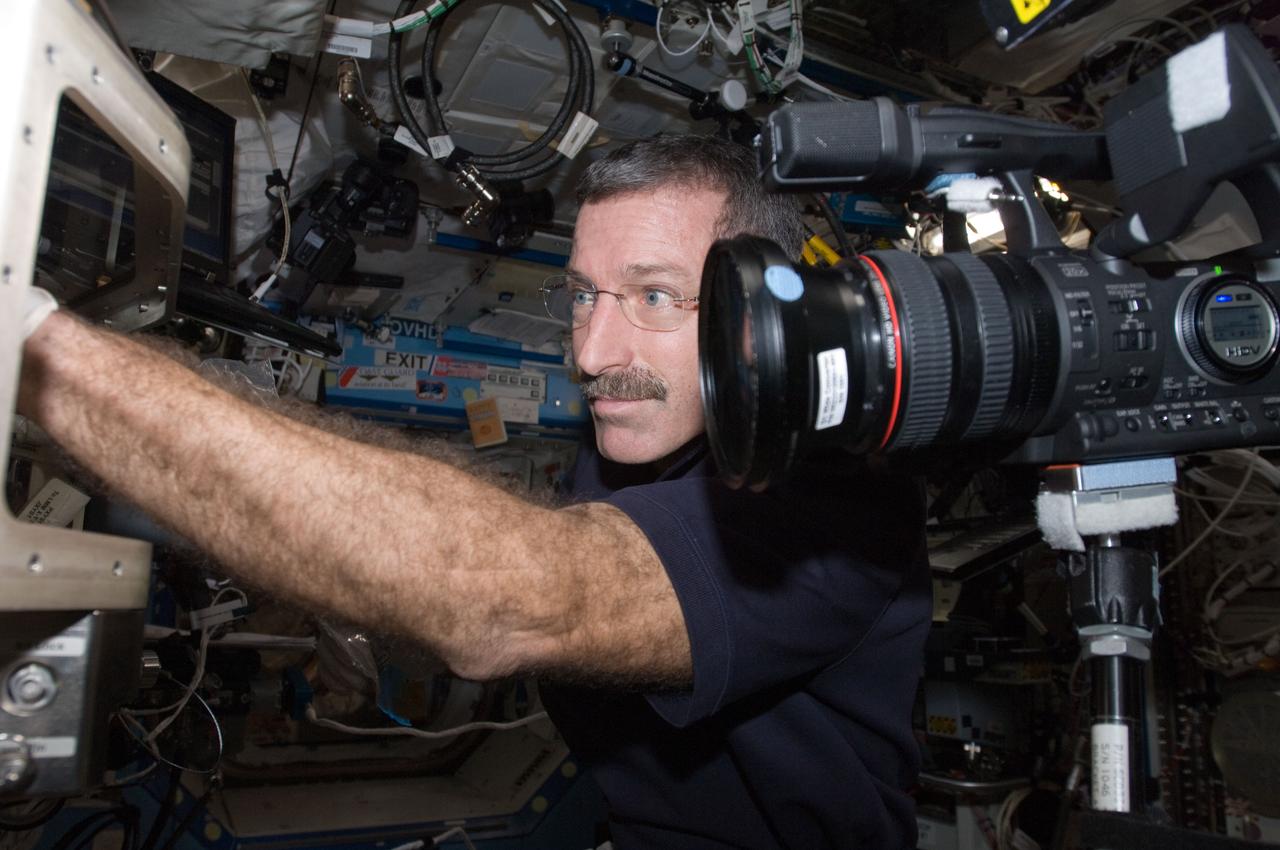
ISS030-E-007426 (1 Dec. 2011) --- NASA astronaut Dan Burbank, Expedition 30 commander, works at the Light Microscopy Module (LMM) in the Fluids Integrated Rack / Fluids Combustion Facility (FIR/FCF) located in the Destiny laboratory of the International Space Station.
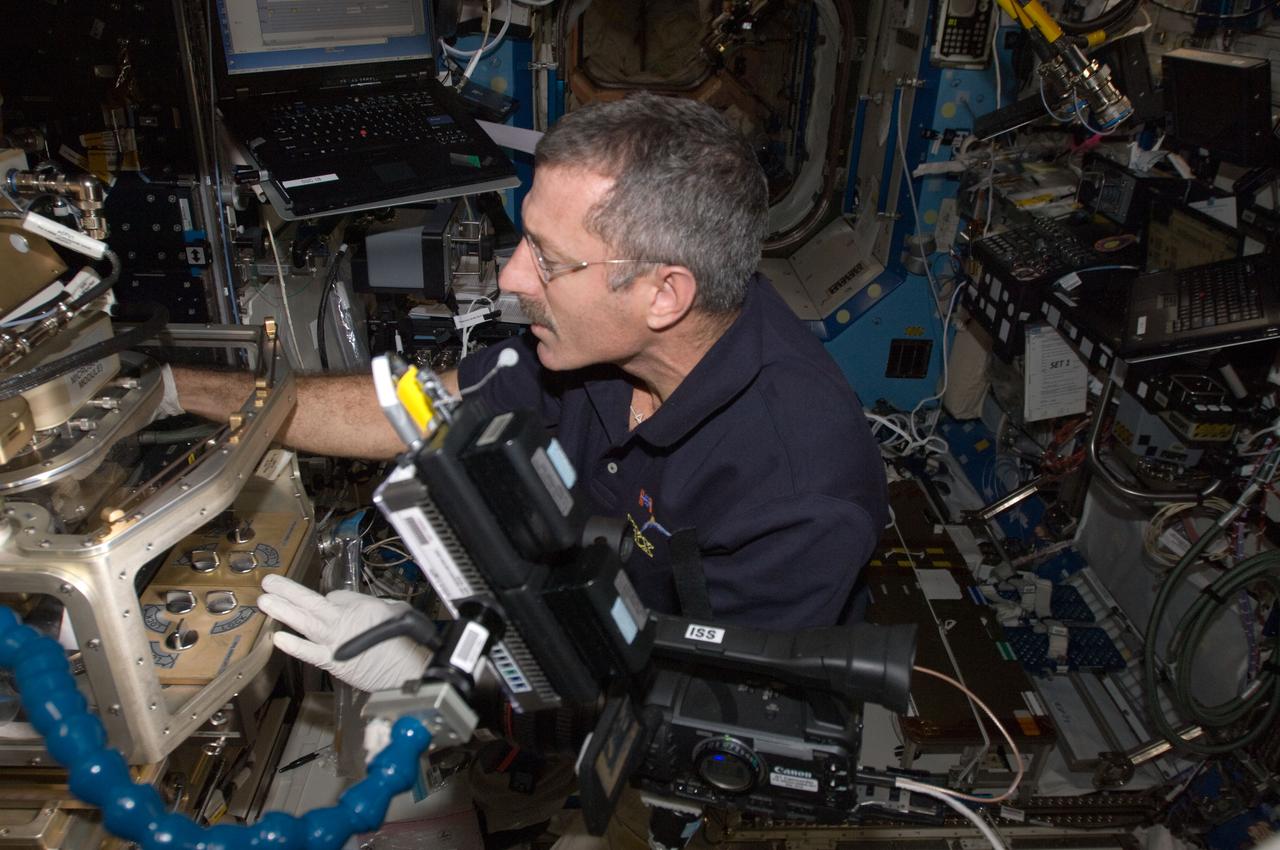
ISS030-E-007429 (1 Dec. 2011) --- NASA astronaut Dan Burbank, Expedition 30 commander, works at the Light Microscopy Module (LMM) in the Fluids Integrated Rack / Fluids Combustion Facility (FIR/FCF) located in the Destiny laboratory of the International Space Station.
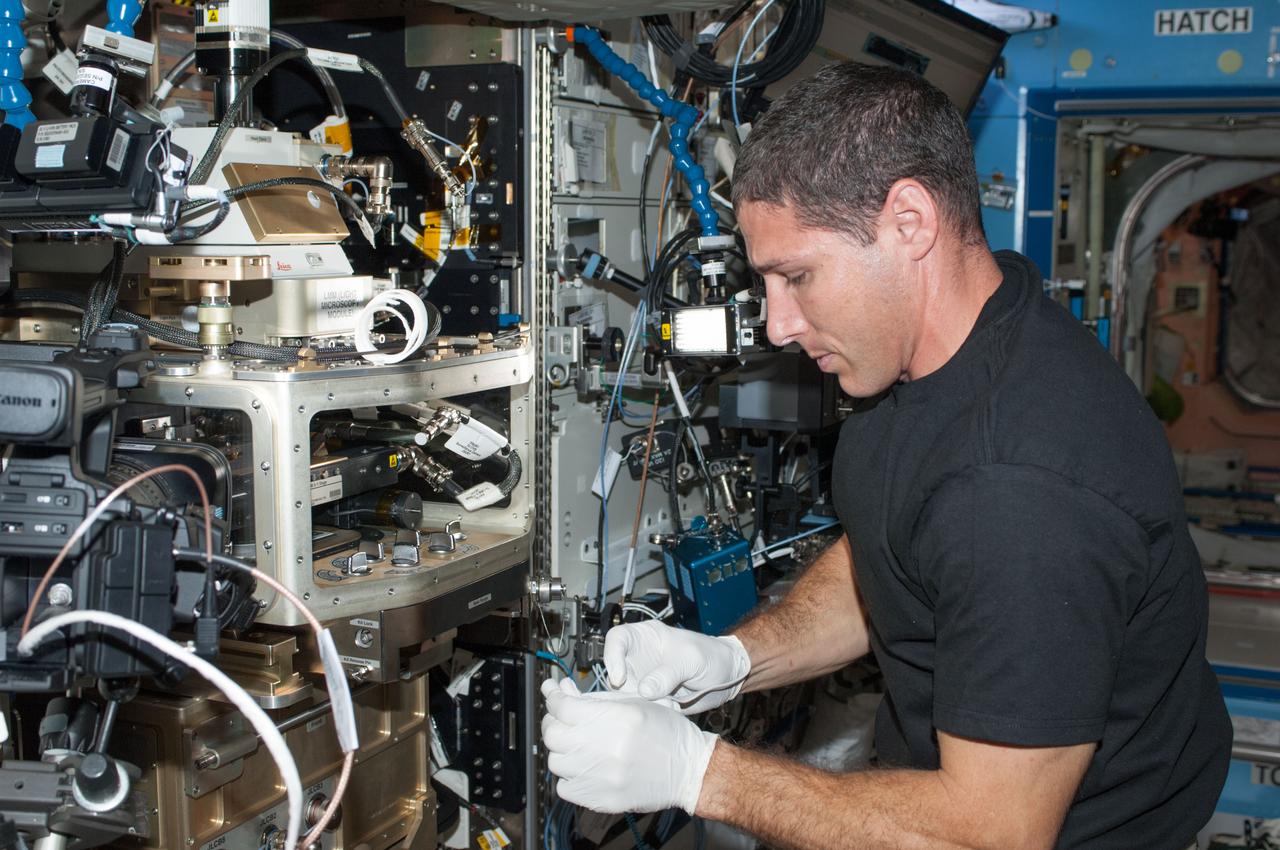
ISS037-E-013951 (14 Oct. 2013) --- NASA astronaut Michael Hopkins, Expedition 37 flight engineer, works at the Light Microscopy Module (LMM) in the Fluids Integrated Rack / Fluids Combustion Facility (FIR/FCF) located in the Destiny laboratory of the International Space Station.
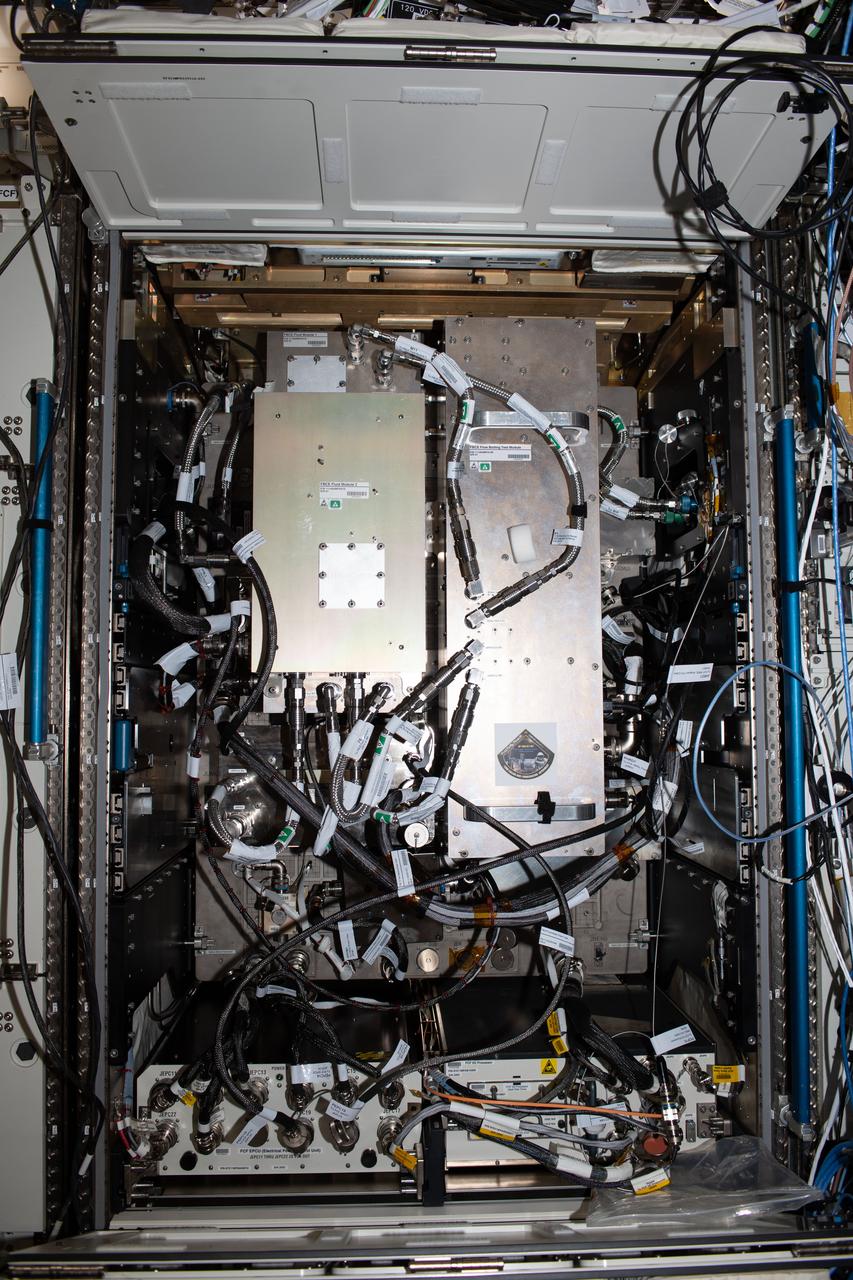
iss066e087939 (12/9/2021) --- A view of the Fluids and Combustion Facility (FCF), used for the Flow Boiling and Condensation Experiment (FBCE) during Expedition 66. The study may improve thermal systems for Earth and other planetary environments.
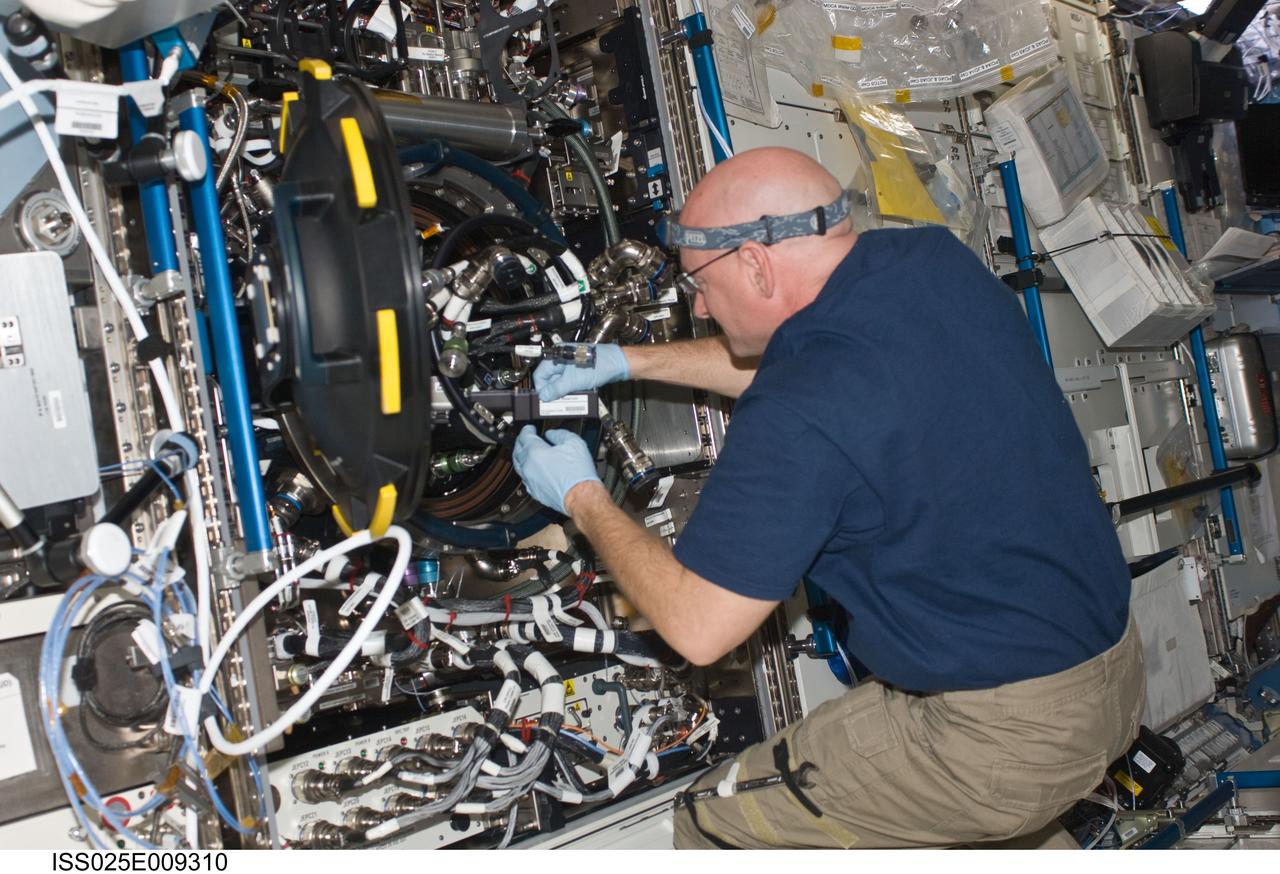
ISS025-E-009310 (26 Oct. 2010) --- NASA astronaut Scott Kelly, Expedition 25 flight engineer, works on the Combustion Integrated Rack (CIR) Multi-user Drop Combustion Apparatus (MDCA) in the Destiny laboratory of the International Space Station. Kelly set up an experiment run on the Fluids & Combustion Facility (FCF) with a new fuel reservoir, ground-assisted by Payload Operations Integration Center/Huntsville (POIC).
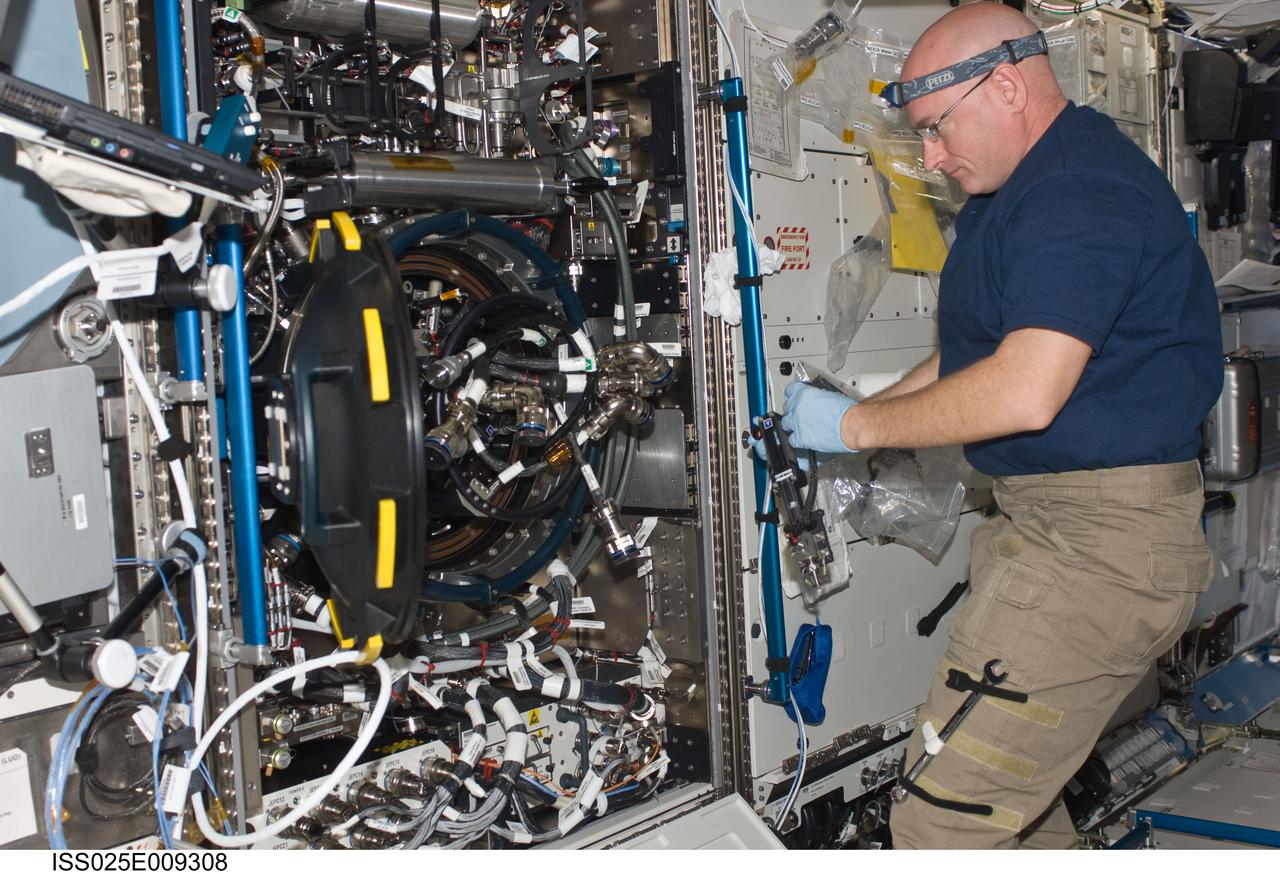
ISS025-E-009308 (26 Oct. 2010) --- NASA astronaut Scott Kelly, Expedition 25 flight engineer, works on the Combustion Integrated Rack (CIR) Multi-user Drop Combustion Apparatus (MDCA) in the Destiny laboratory of the International Space Station. Kelly set up an experiment run on the Fluids & Combustion Facility (FCF) with a new fuel reservoir, ground-assisted by Payload Operations Integration Center/Huntsville (POIC).
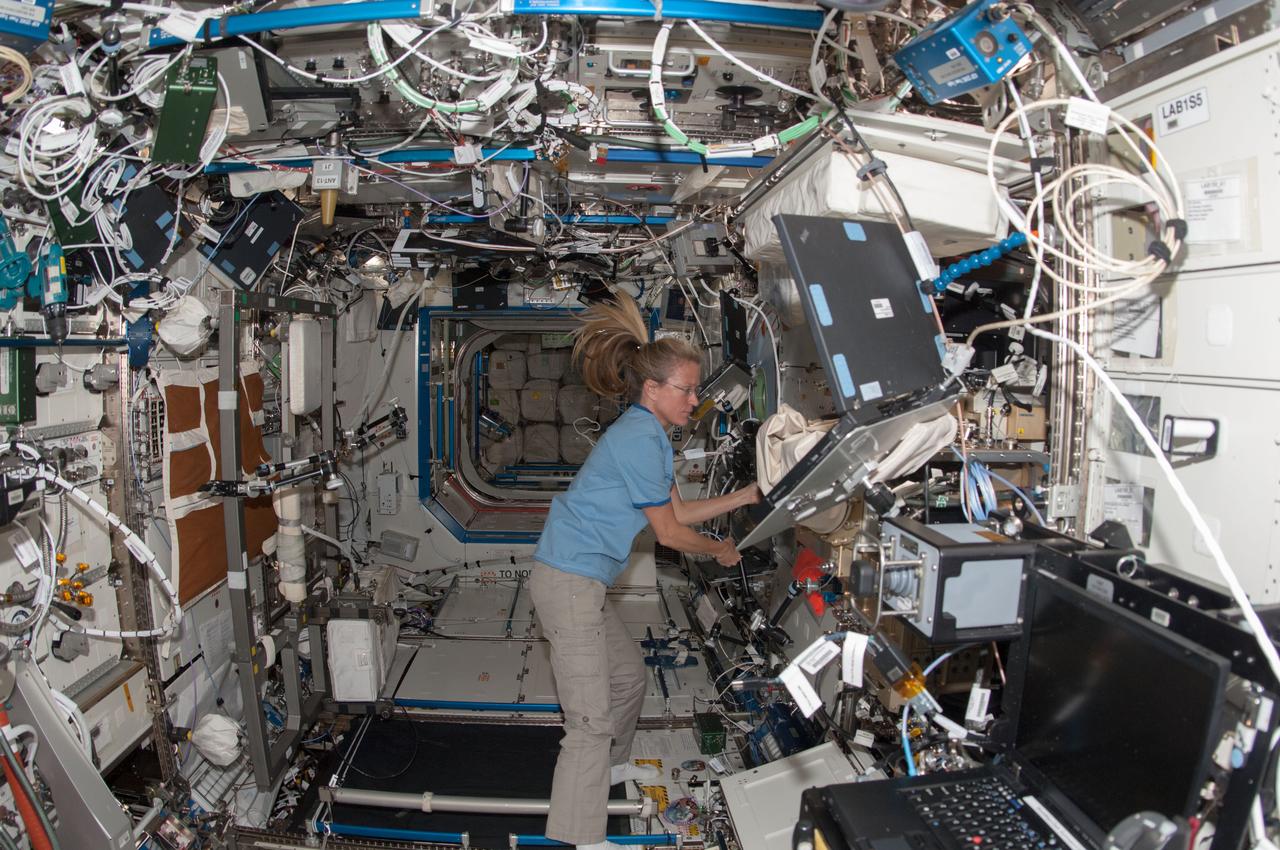
In the International Space Stations Destiny laboratory,NASA astronaut Karen Nyberg,Expedition 36 flight engineer,speaks into a microphone while conducting a session with the Advanced Colloids Experiment (ACE)-1 sample preparation at the Light Microscopy Module (LMM) in the Fluids Integrated Rack / Fluids Combustion Facility (FIR/FCF). ACE-1 is a series of microscopic imaging investigations that uses the microgravity environment to examine flow characteristics and the evolution and ordering effects within a group of colloidal materials.
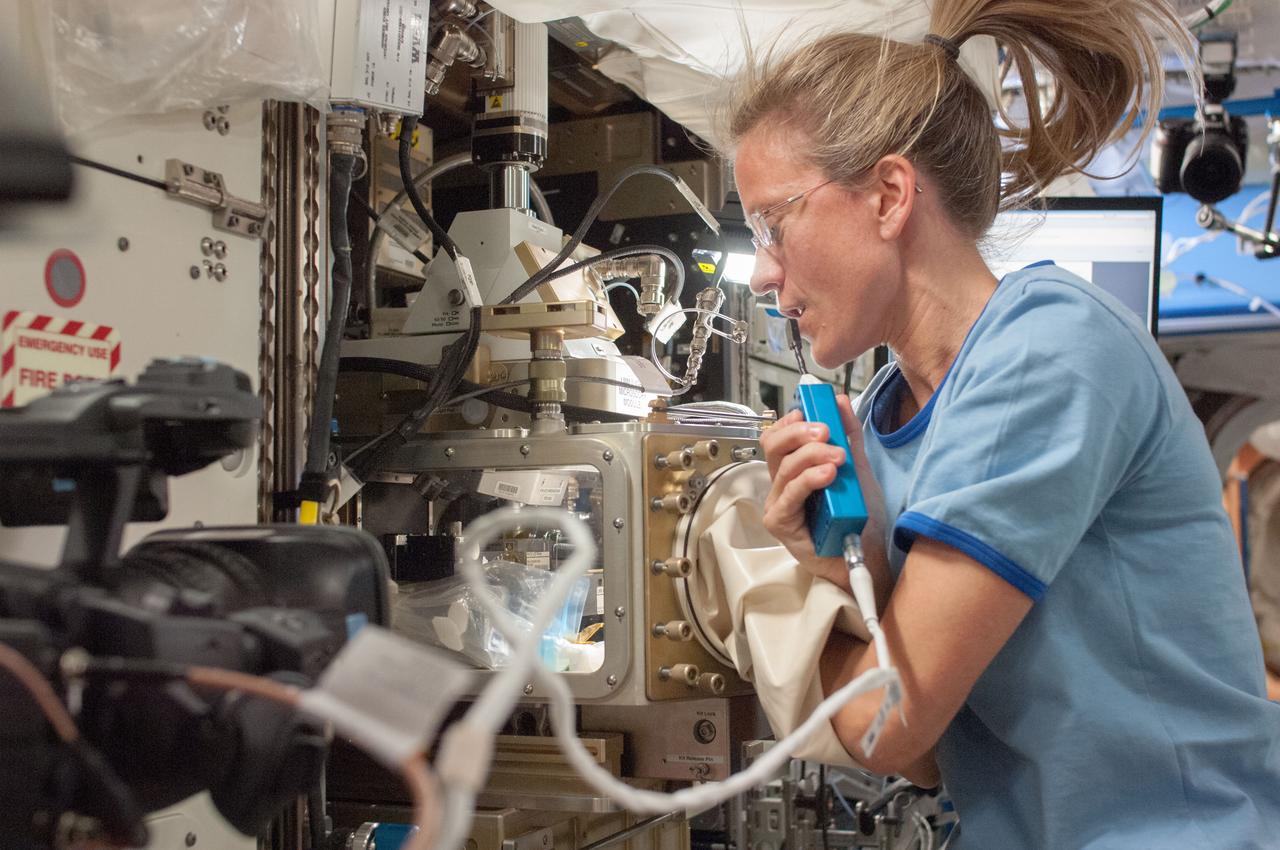
ISS036-E-019830 (24 June 2013) --- In the International Space Station’s Destiny laboratory, NASA astronaut Karen Nyberg, Expedition 36 flight engineer, speaks into a microphone while conducting a session with the Advanced Colloids Experiment (ACE)-1 sample preparation at the Light Microscopy Module (LMM) in the Fluids Integrated Rack / Fluids Combustion Facility (FIR/FCF). ACE-1 is a series of microscopic imaging investigations that uses the microgravity environment to examine flow characteristics and the evolution and ordering effects within a group of colloidal materials.
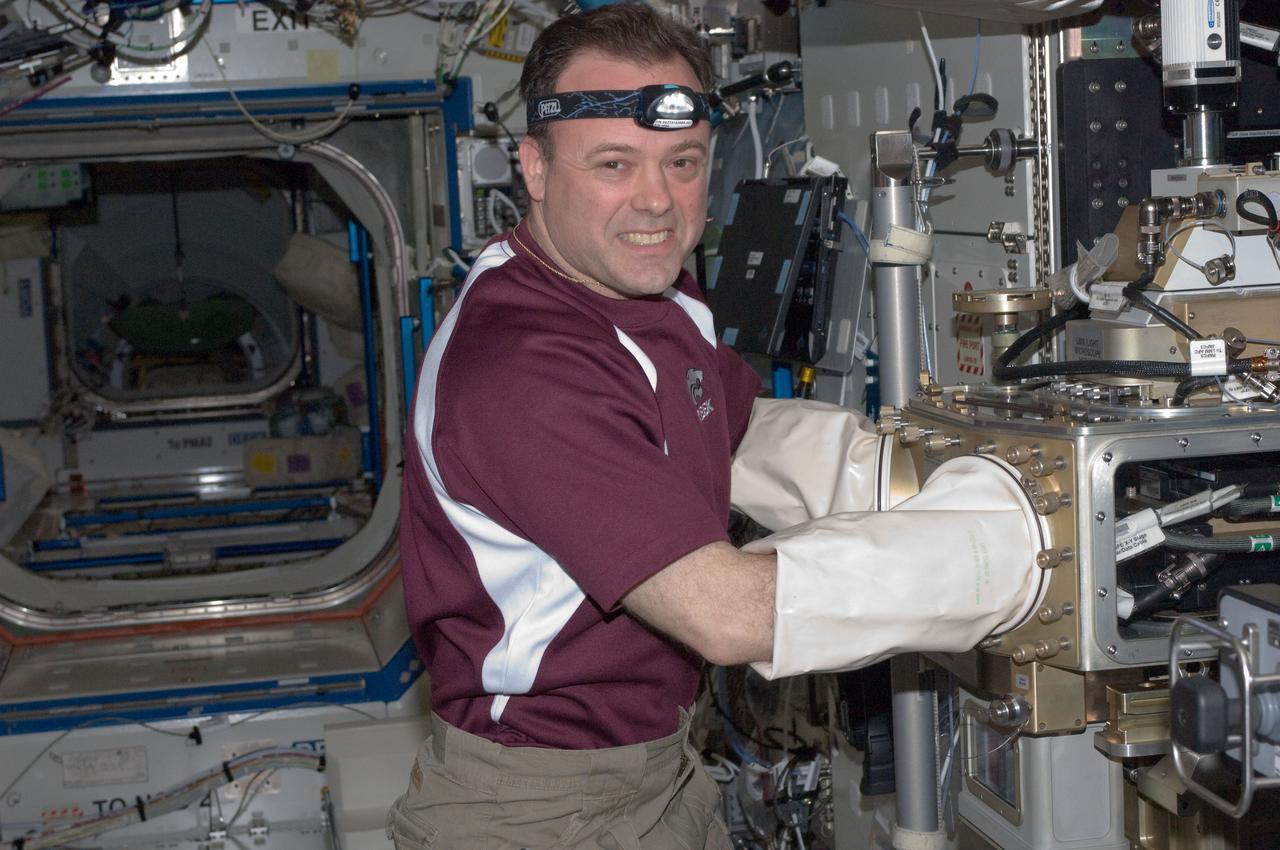
ISS028-E-005602 (26 May 2011) --- NASA astronaut Ron Garan, Expedition 28 flight engineer, services the Fluids Combustion Facility in the Fluids Integrated Rack on the Destiny lab aboard the International Space Station by changing out the Bio sample on the Bio Base. Garan and two Russian cosmonaut crewmates for Expedition 28 will be joined by three more crew members on the station in about one and a half weeks.
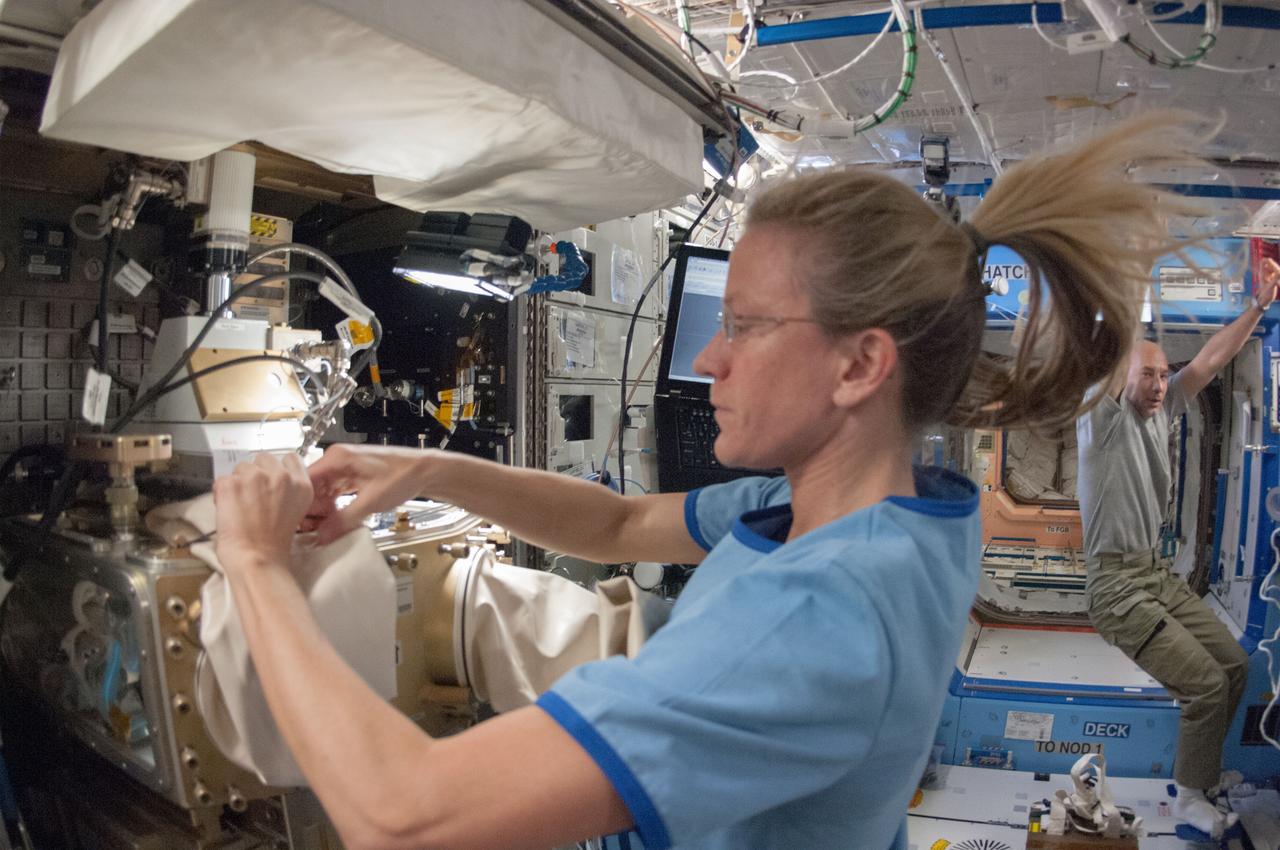
ISS036-E-019760 (24 June 2013) --- In the International Space Station’s Destiny laboratory, NASA astronaut Karen Nyberg, Expedition 36 flight engineer, conducts a session with the Advanced Colloids Experiment (ACE)-1 sample preparation at the Light Microscopy Module (LMM) in the Fluids Integrated Rack / Fluids Combustion Facility (FIR/FCF). ACE-1 is a series of microscopic imaging investigations that uses the microgravity environment to examine flow characteristics and the evolution and ordering effects within a group of colloidal materials.
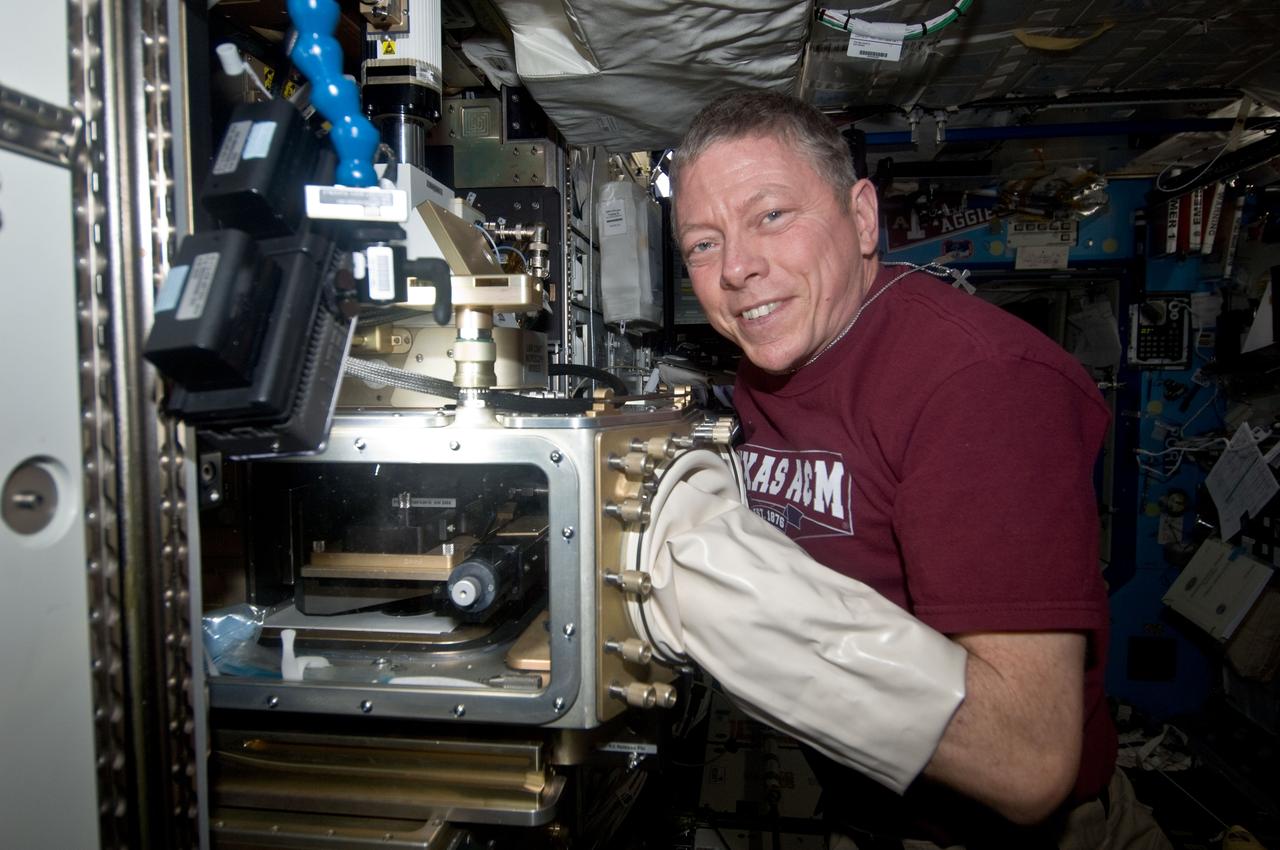
ISS029-E-025108 (11 Oct. 2011) --- NASA astronaut Mike Fossum, Expedition 29 commander, works on the Fluids Integrated Rack/Fluids and Combustion Facility (FIR/FCF), conducting another session with the Preliminary Advanced Colloids Experiment (PACE). Fossum is working at the Light Microscopy Module (LMM) in the Destiny laboratory of the International Space Station.
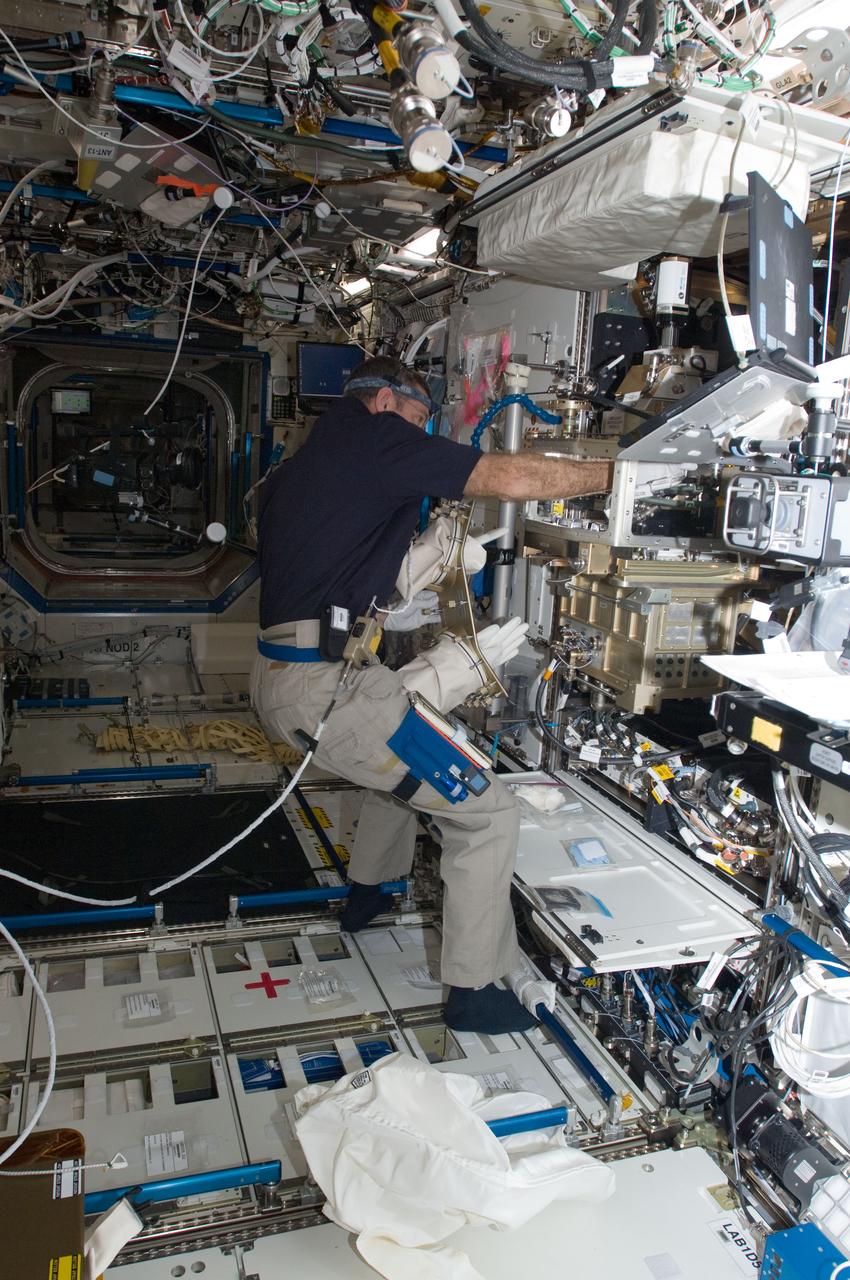
ISS030-E-007418 (1 Dec. 2011) --- In the International Space Station’s Destiny laboratory, NASA astronaut Dan Burbank, Expedition 30 commander, conducts a session with the Preliminary Advanced Colloids Experiment (PACE) at the Light Microscopy Module (LMM) in the Fluids Integrated Rack / Fluids Combustion Facility (FIR/FCF). PACE is designed to investigate the capability of conducting high magnification colloid experiments with the LMM for determining the minimum size particles which can be resolved with it.
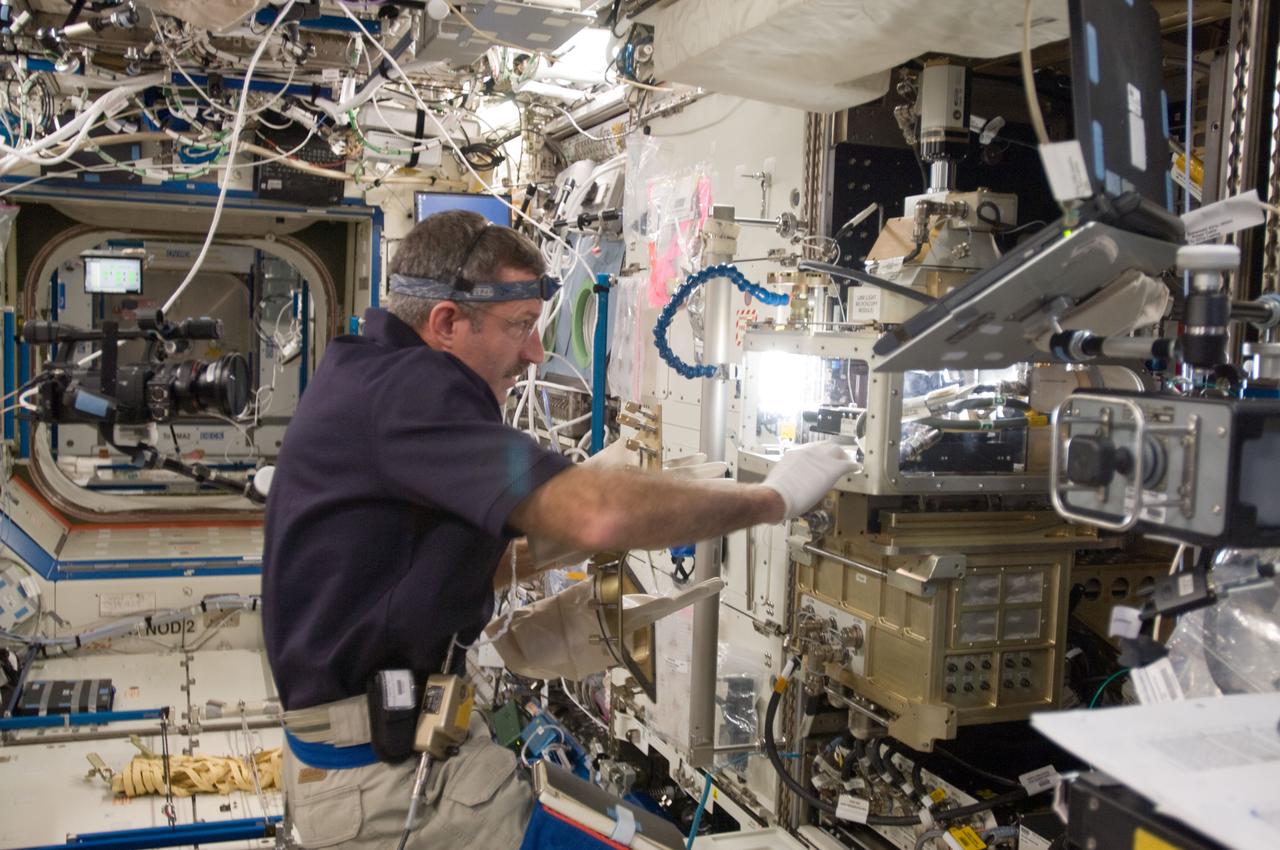
ISS030-E-007417 (1 Dec. 2011) --- In the International Space Station?s Destiny laboratory, NASA astronaut Dan Burbank, Expedition 30 commander, conducts a session with the Preliminary Advanced Colloids Experiment (PACE) at the Light Microscopy Module (LMM) in the Fluids Integrated Rack / Fluids Combustion Facility (FIR/FCF). PACE is designed to investigate the capability of conducting high magnification colloid experiments with the LMM for determining the minimum size particles which can be resolved with it.
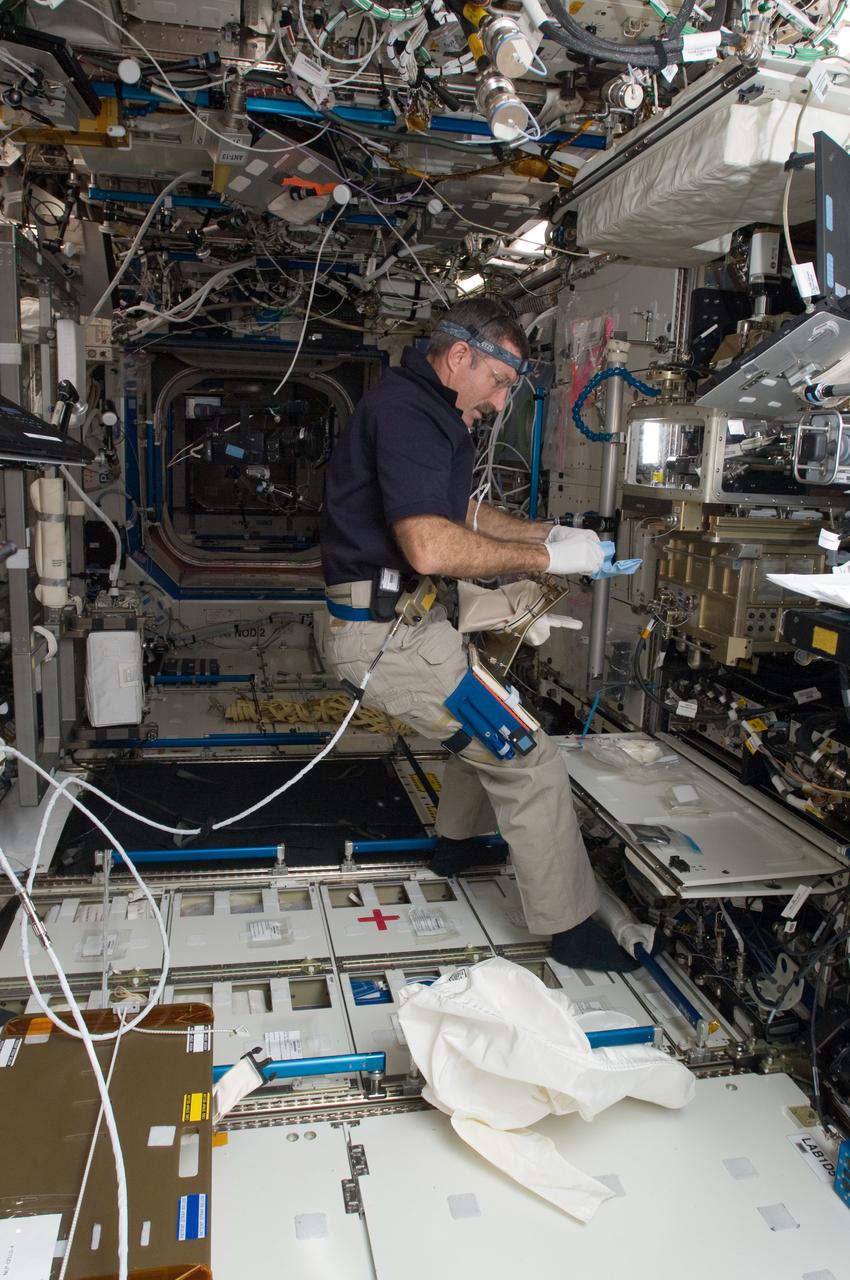
ISS030-E-007419 (1 Dec. 2011) --- In the International Space Station’s Destiny laboratory, NASA astronaut Dan Burbank, Expedition 30 commander, conducts a session with the Preliminary Advanced Colloids Experiment (PACE) at the Light Microscopy Module (LMM) in the Fluids Integrated Rack / Fluids Combustion Facility (FIR/FCF). PACE is designed to investigate the capability of conducting high magnification colloid experiments with the LMM for determining the minimum size particles which can be resolved with it.
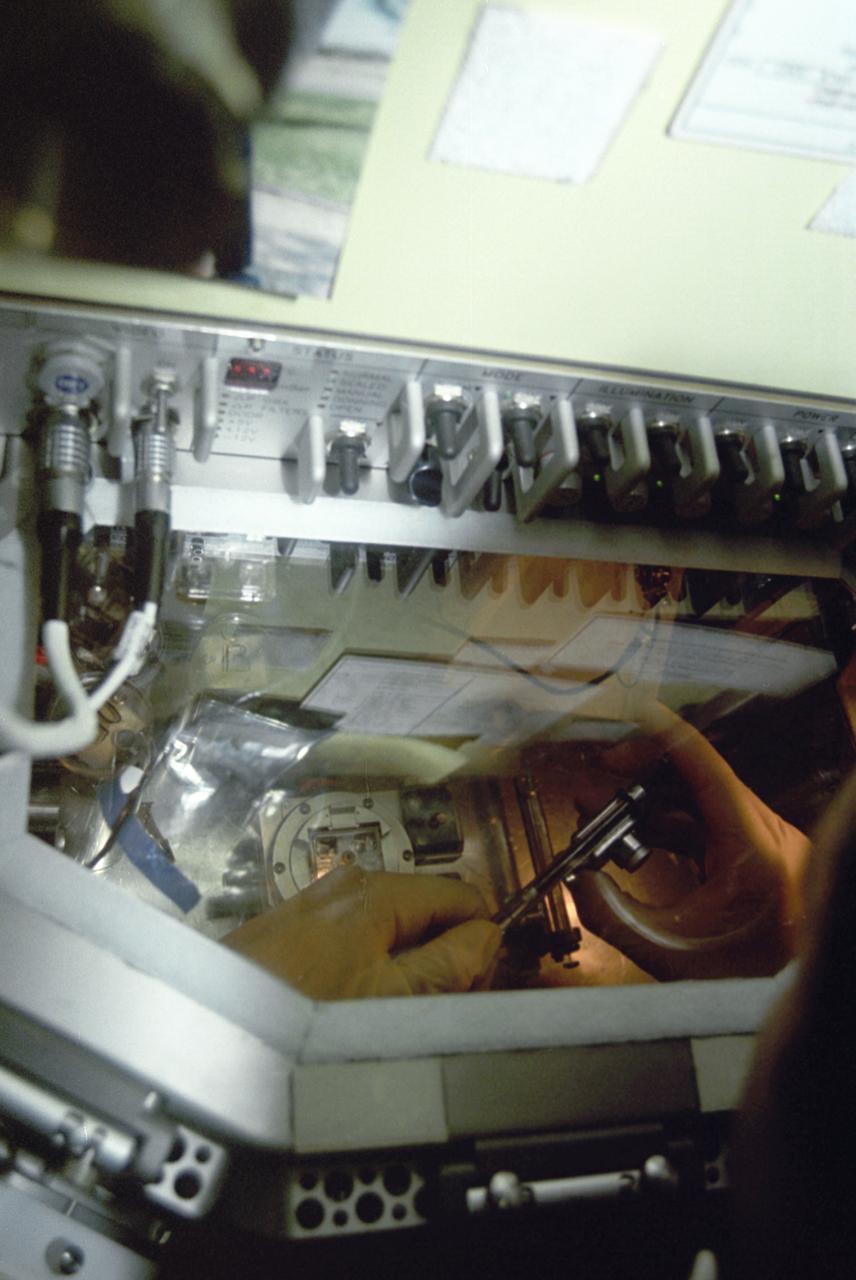
The first United States Microgravity Laboratory (USML-1) provided scientific research in materials science, fluid dynamics, biotechnology, and combustion science in a weightless environment inside the Spacelab module. This photograph is a close-up view of the Glovebox in operation during the mission. The Spacelab Glovebox, provided by the European Space Agency, offers experimenters new capabilities to test and develop science procedures and technologies in microgravity. It enables crewmembers to handle, transfer, and otherwise manipulate materials in ways that are impractical in the open Spacelab. The facility is equipped with three doors: a central port through which experiments are placed in the Glovebox and two glovedoors on both sides with an attachment for gloves or adjustable cuffs and adapters for cameras. The Glovebox has an enclosed compartment that offers a clean working space and minimizes the contamination risks to both Spacelab and experiment samples. Although fluid containment and ease of cleanup are major benefits provided by the facility, it can also contain powders and bioparticles; toxic, irritating, or potentially infectious materials; and other debris produced during experiment operations. The facility is equipped with photographic/video capabilities and permits mounting a microscope. For the USML-1 mission, the Glovebox experiments fell into four basic categories: fluid dynamics, combustion science, crystal growth, and technology demonstration. The USML-1 flew aboard the STS-50 mission in June 1992.
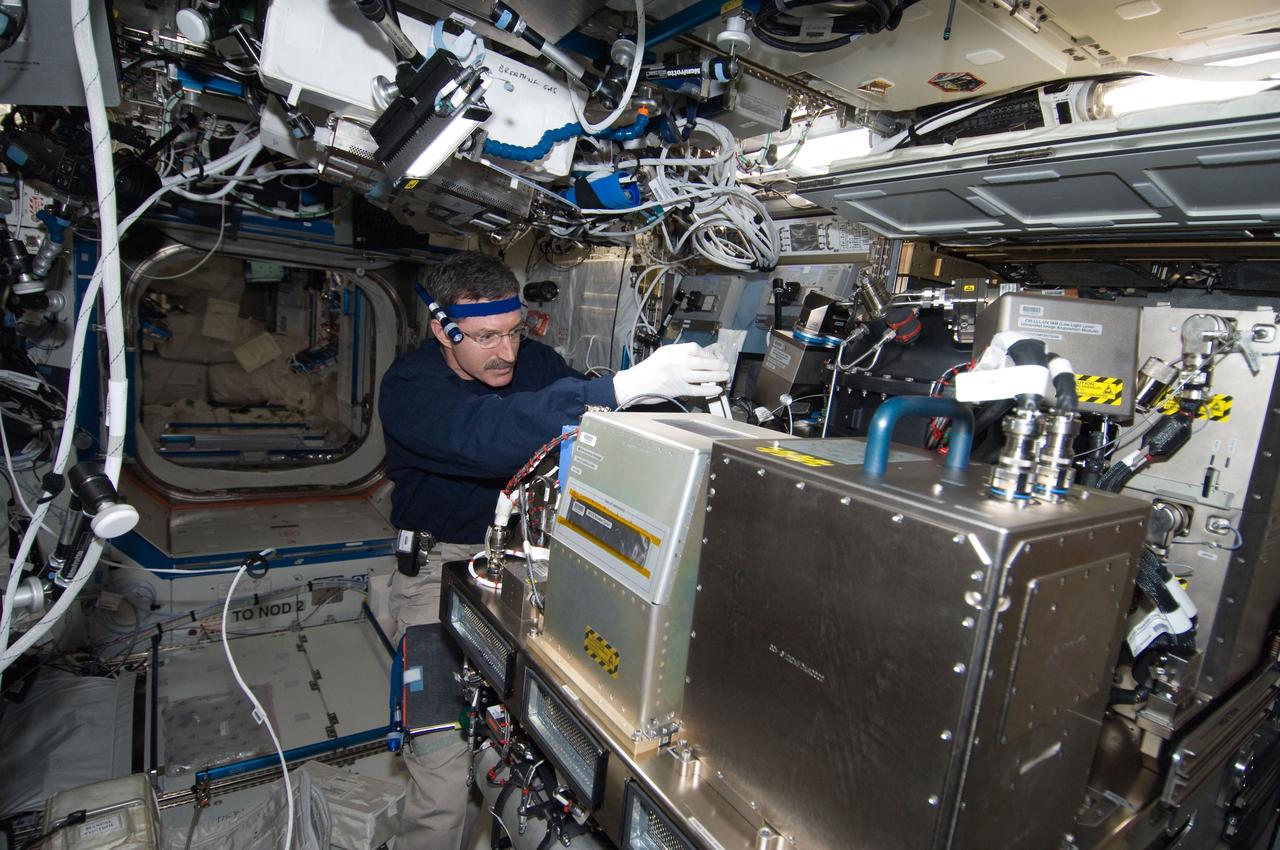
ISS030-E-234735 (10 April 2012) --- NASA astronaut Dan Burbank, Expedition 30 commander, works on the Combustion Integrated Rack (CIR) in the Destiny laboratory of the International Space Station. Burbank disconnected the Moderate Temperature Loop (MTL), Vacuum Exhaust System (VES) and station nitrogen lines of the Optics Bench, translated and rotated it out of the way and replaced a Fluids and Combustion Facility / Diagnostic Control Module (FCF DCM) on its back. Afterwards, Burbank returned the Optics Bench to its nominal position and reconnected the MTL, VES and station nitrogen lines.
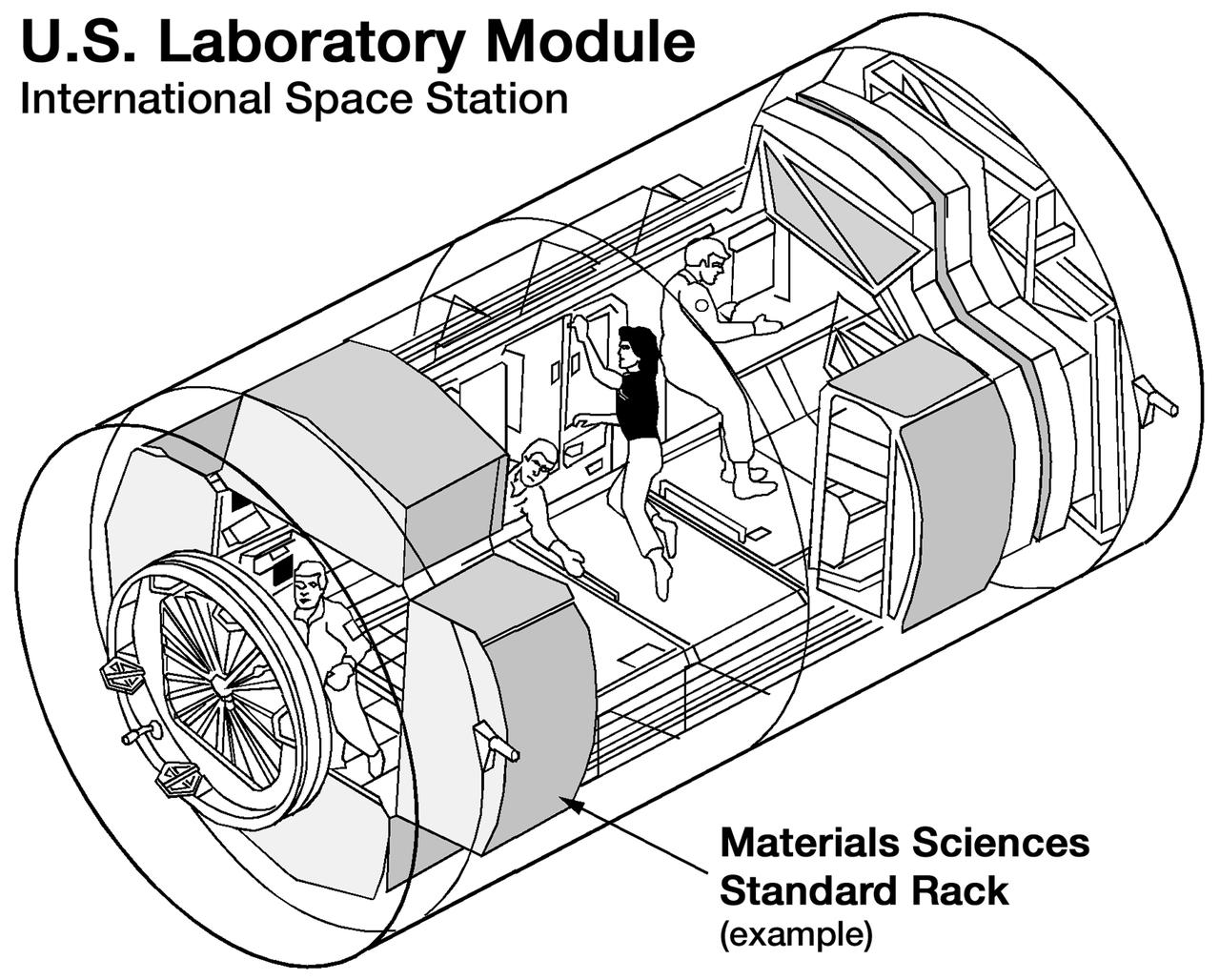
Line drawing depicts the location of one of three racks that will make up the Materials Science Research Facility in the U.S. Destiny laboratory module to be attached to the International Space Station (ISS). Other positions will be occupied by a variety of racks supporting research in combustion, fluids, biotechnology, and human physiology, and racks to support lab and station opertions. The Materials Science Research Facility is managed by NASA's Marshall Space Flight Center. Photo credit: NASA/Marshall Space Flight Center
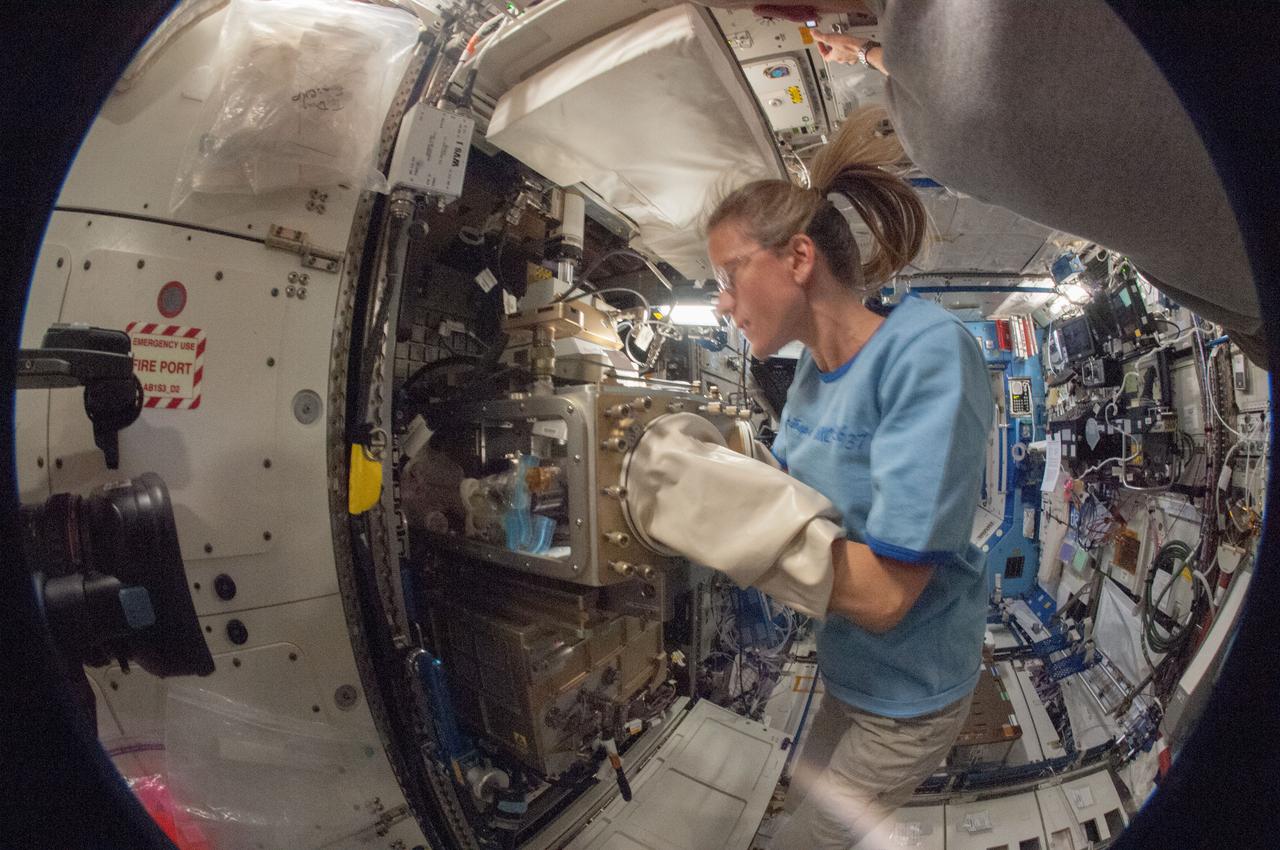
ISS036-E-019783 (24 June 2013) --- In the International Space Station’s Destiny laboratory, a fisheye lens attached to an electronic still camera was used to capture this image of NASA astronaut Karen Nyberg, Expedition 36 flight engineer, as she conducts a session with the Advanced Colloids Experiment (ACE)-1 sample preparation at the Light Microscopy Module (LMM) in the Fluids Integrated Rack / Fluids Combustion Facility (FIR/FCF). ACE-1 is a series of microscopic imaging investigations that uses the microgravity environment to examine flow characteristics and the evolution and ordering effects within a group of colloidal materials.
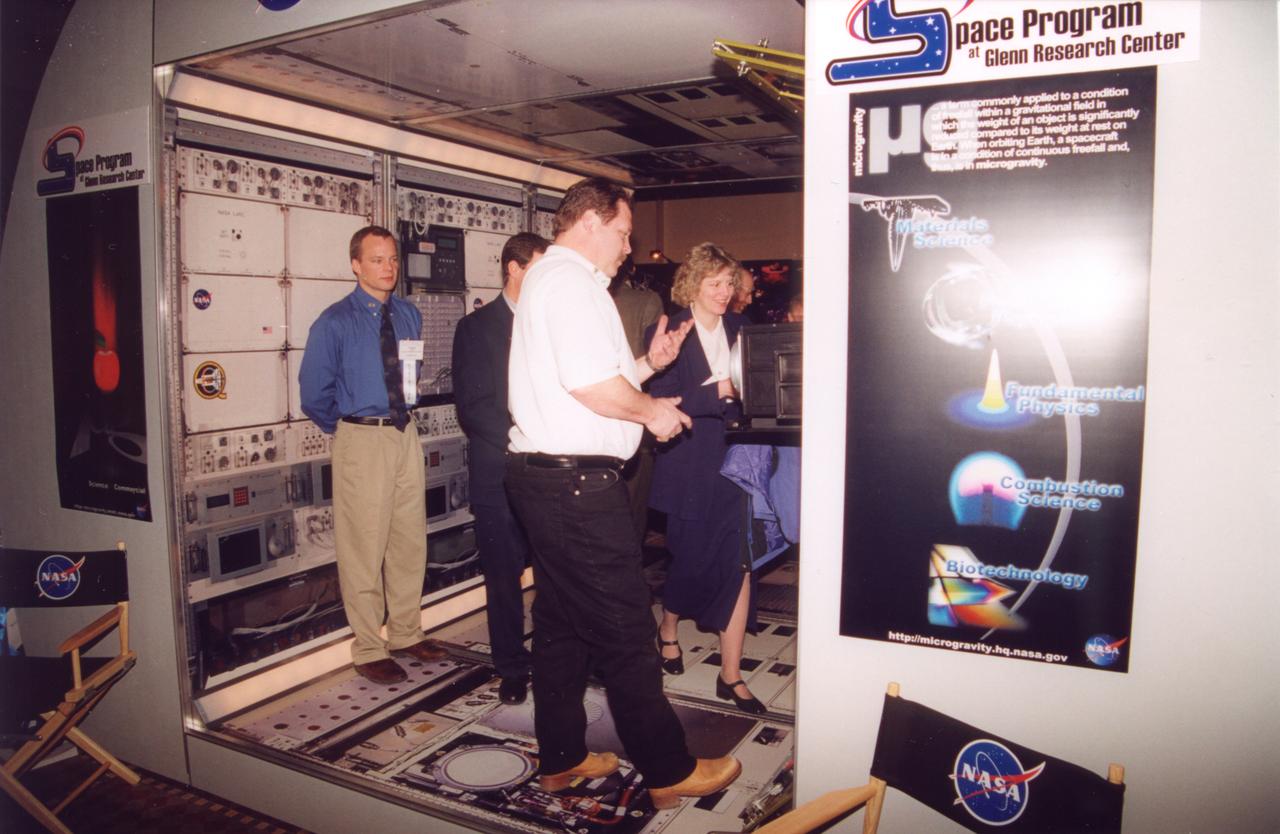
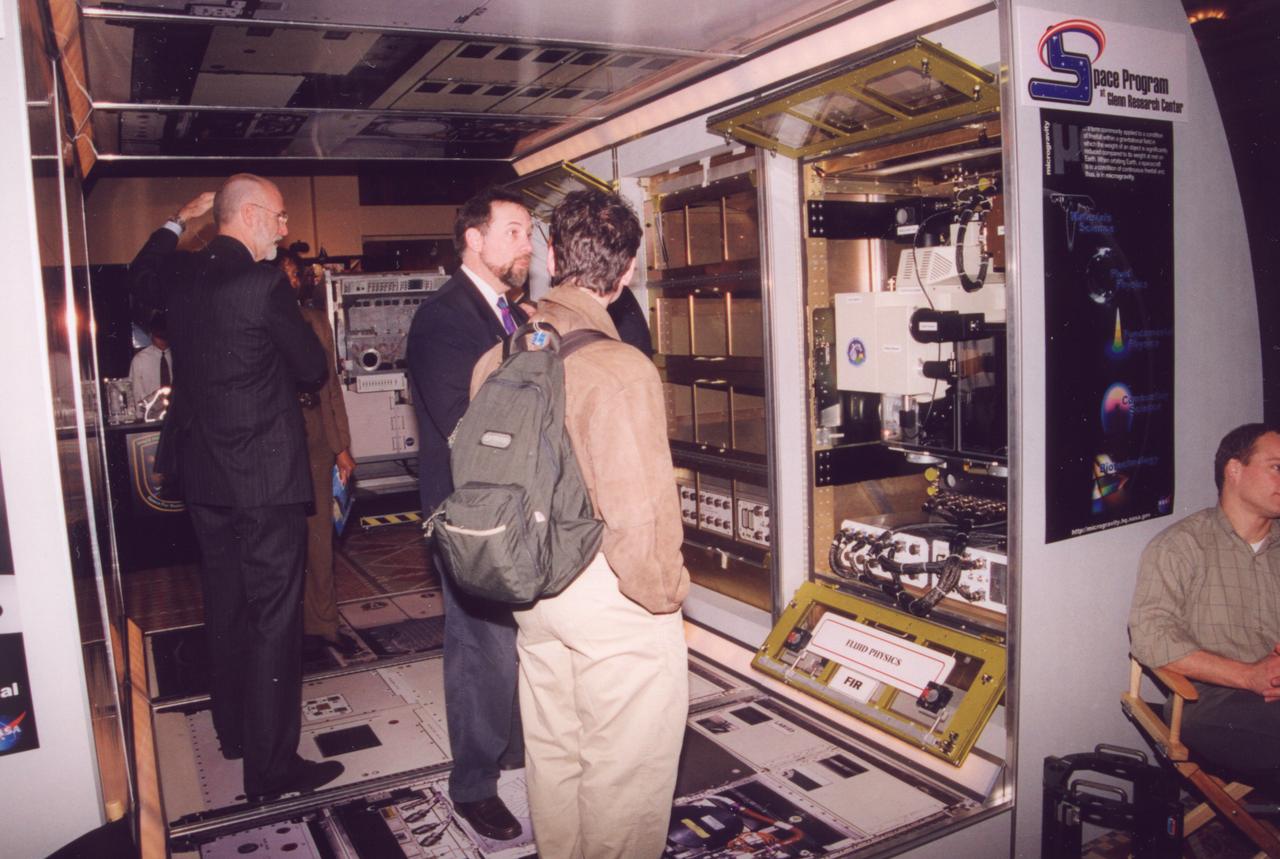
Engineers from NASA's Glenn Research Center, demonstrate access to one of the experiment racks planned for the U.S. Destiny laboratory module on the International Space Station. This mockup has the full diameter, full corridor width, and half the length of the module. The mockup includes engineering mockups of the Fluids and Combustion Facility being developed by NASA's Glenn Research Center. (The full module will be six racks long; the mockup is three rack long) Photo credit: NASA/Marshall Space Flight Center
Engineers from NASA's Glen Research Center demonstrate the access to one of the experiment racks plarned for the U.S. Destiny laboratory module on the International Space Station (ISS). This mockup has the full diameter, full corridor width, and half the length of the module. The mockup includes engineering mockups of the Fluids and Combustion Facility being developed by NASA's Glenn Research Center. (The full module will be six racks long; the mockup is three racks long). Photo credit: NASA/Marshall Space Flight Center (MSFC)
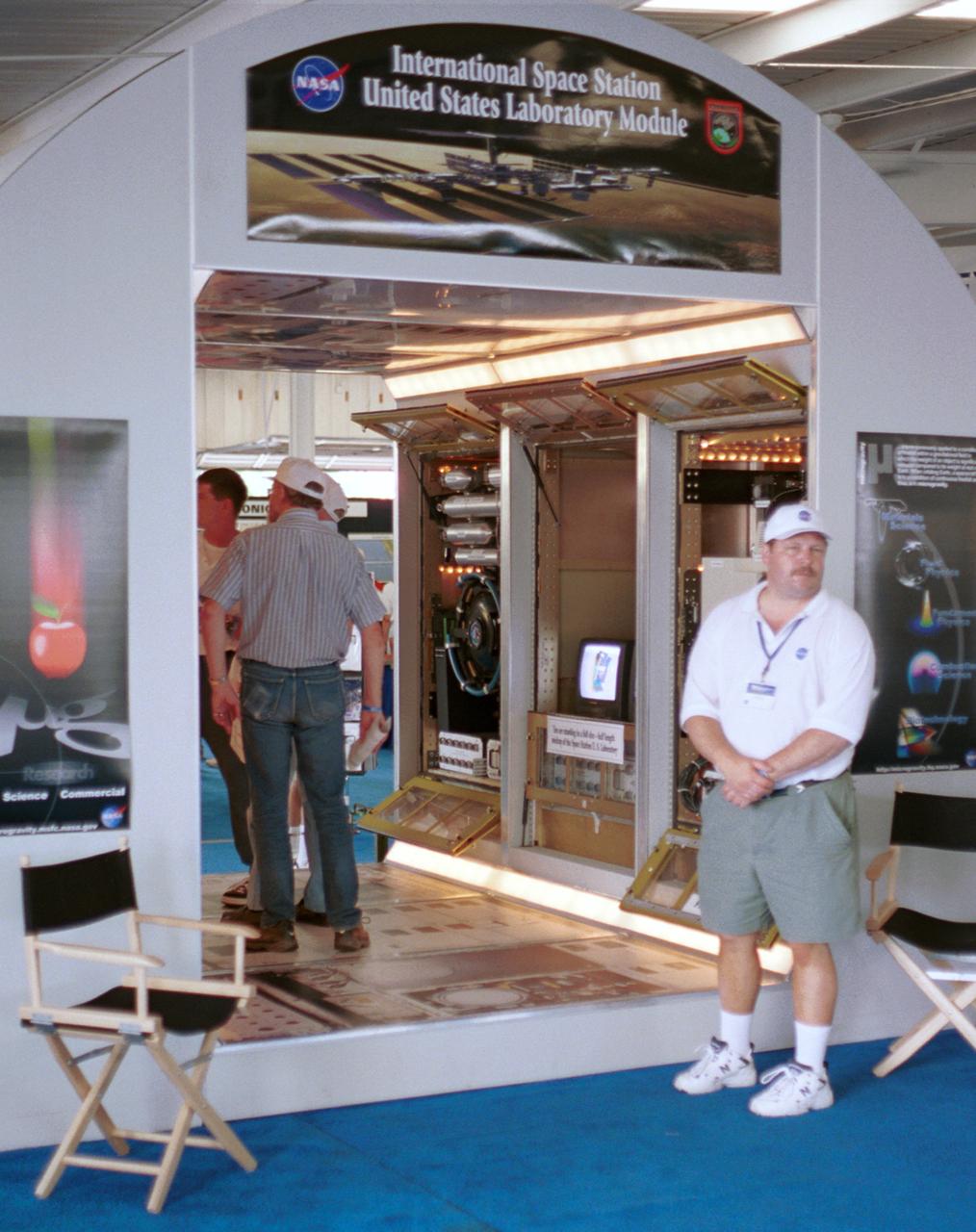
Thomas Turk, an engineer with NASA's Glenn Research Center, waits for more visitors at a mockup of part of Destiny, the U.S. laboratory module that will be attached to the International Space Station (ISS) in Year 2001. Visible behind Turk are engineering models of the three racks that will make up the Fluids and Combustion Facility (FCF) in the module. The mockup is full scale, although Destiny will be twice as long to accomodate six experiment racks along each side. The exhibit was part of the NASA outreach activity at AirVenture 2000 sponsored by the Expeprimental Aircraft Association in Oshkosh, WI.
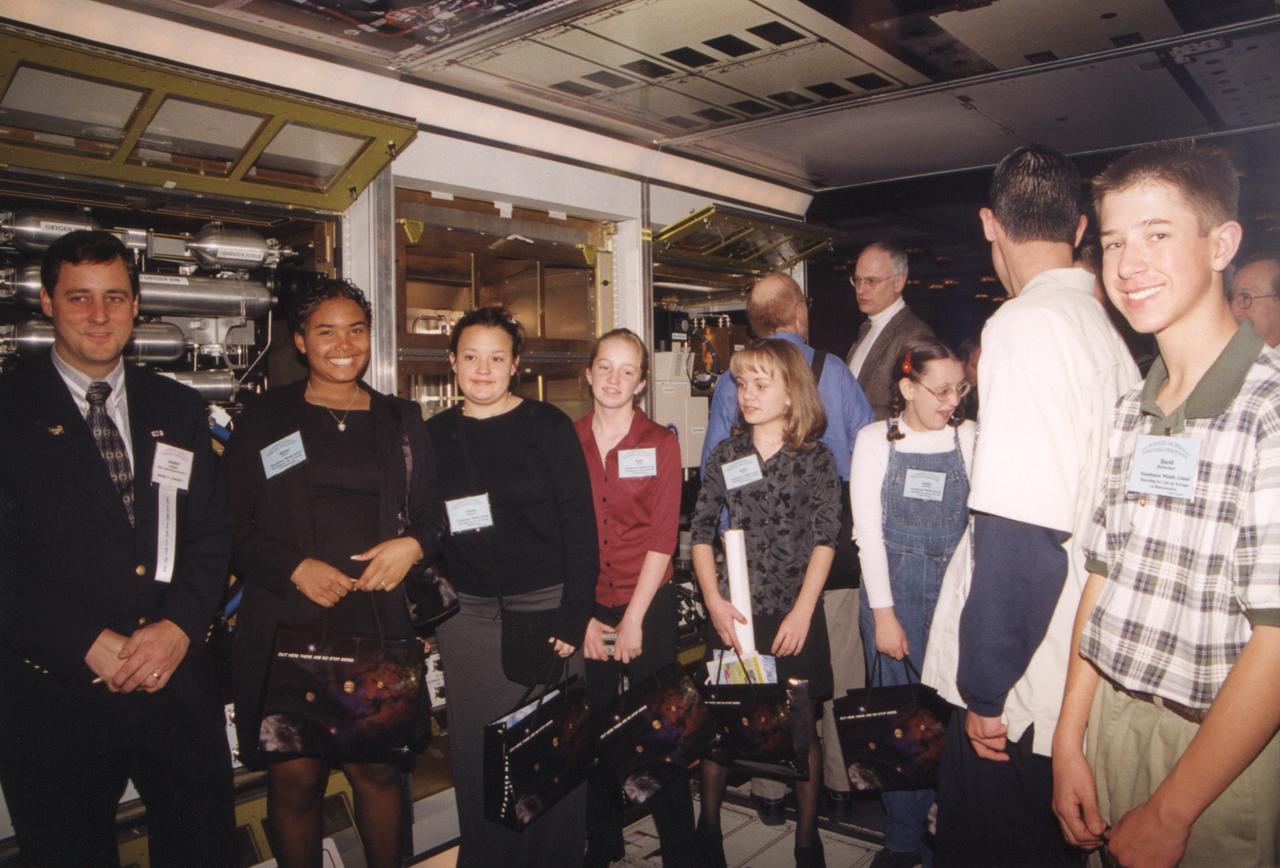
Students from Albuquerque, MN, tour through the mockup of the U.S. Destiny laboratory module that will be attached to the International Space Station (ISS). Behind them are the racks for the Fluids and Combustion Facility being developed by Glenn Research Center. The mockup was on display at the Space Tehnology International Forum in Albuquerque, MN. Photo credit: NASA/Marshall Space Flight Center
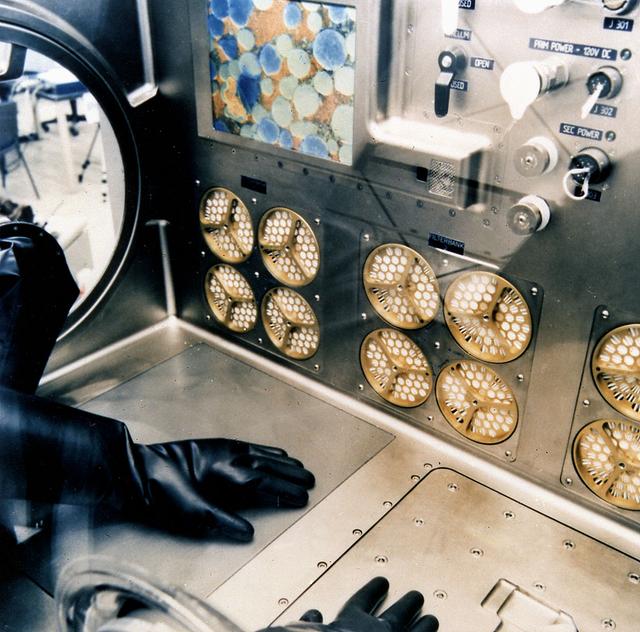
The Microgravity Science Glovebox is a facility for performing microgravity research in the areas of materials, combustion, fluids and biotechnology science. The facility occupies a full ISPR, consisting of: the ISPR rack and infrastructure for the rack, the glovebox core facility, data handling, rack stowage, outfitting equipment, and a video subsystem. MSG core facility provides the experiment developers a chamber with air filtering and recycling, up to two levels of containment, an airlock for transfer of payload equipment to/from the main volume, interface resources for the payload inside the core facility, resources inside the airlock, and storage drawers for MSG support equipment and consumables.
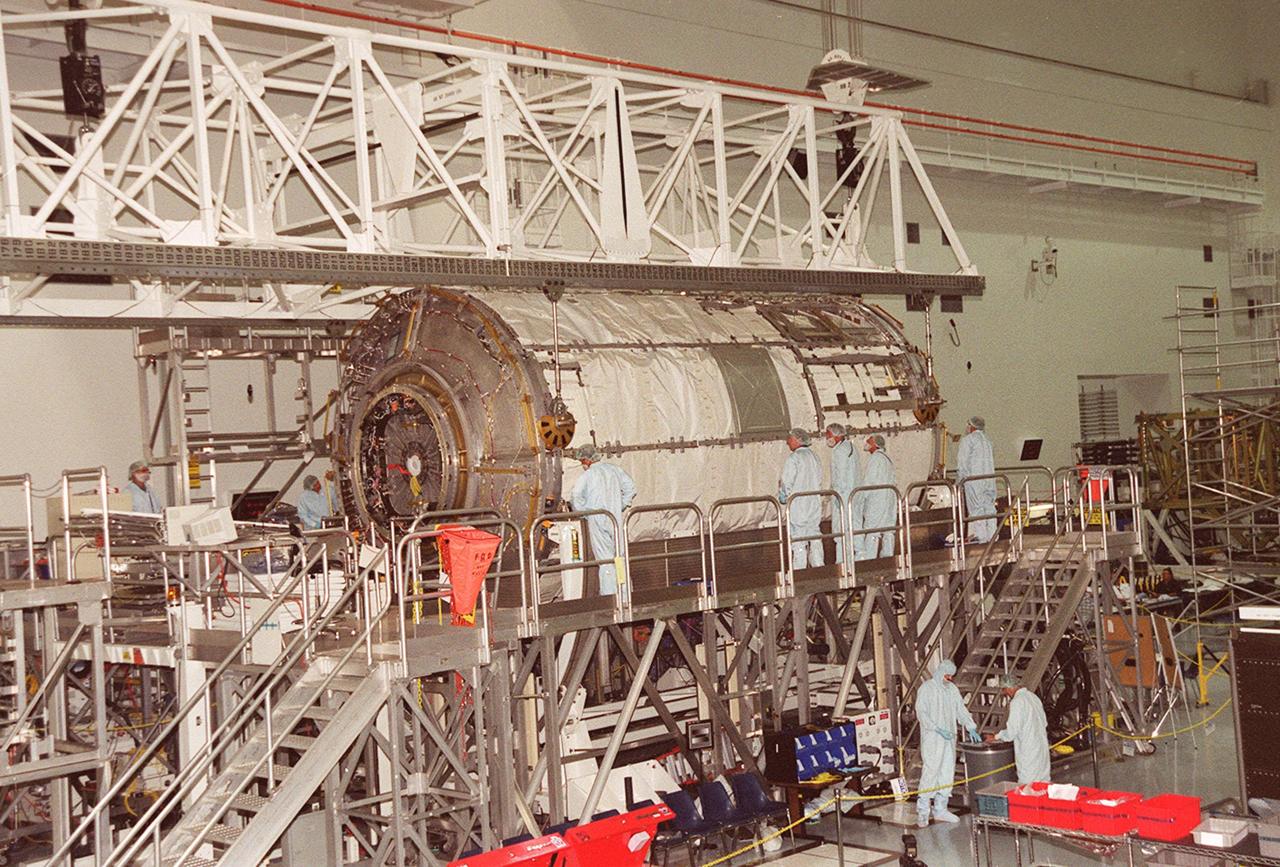
KENNEDY SPACE CENTER, Fla. -- In the Space Station Processing Facility, technicians watch closely as the U.S. Laboratory Destiny rotates. A component of the International Space Station, Destiny is scheduled to fly on mission STS-98 in early 2001. During the mission, the crew will install the Lab during a series of three space walks. The STS-98 mission will provide the station with science research facilities and expand its power, life support and control capabilities. The U.S. Lab module continues a long tradition of microgravity materials research, first conducted by Skylab and later Shuttle and Spacelab missions. Destiny is expected to be a major feature in future research, providing facilities for biotechnology, fluid physics, combustion, and life sciences research.

An experiment vehicle plunges into the deceleration at the end of a 5.18-second drop in the Zero-Gravity Research Facility at NASA's Glenn Research Center. The Zero-Gravity Research Facility was developed to support microgravity research and development programs that investigate various physical sciences, materials, fluid physics, and combustion and processing systems. Payloads up to one-meter in diameter and 455 kg in weight can be accommodated. The facility has a 145-meter evacuated shaft to ensure a disturbance-free drop. This is No. 3 of a sequence of 4 images. (Credit: NASA/Glenn Research Center)
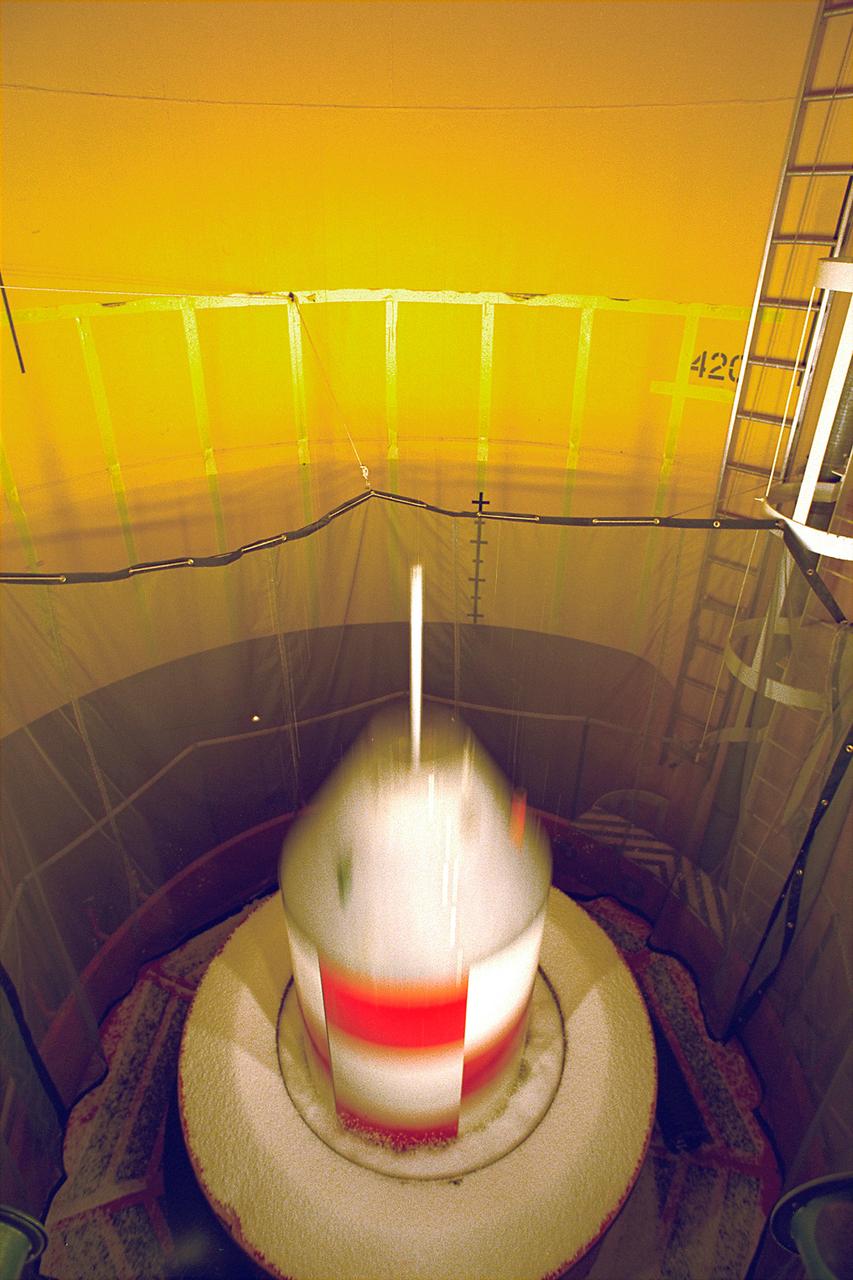
An experiment vehicle plunges into the deceleration pit at the end of a 5.18-second drop in the Zero-Gravity Research Facility at NASA's Glenn Research Center. The Zero-Gravity Research Facility was developed to support microgravity research and development programs that investigate various physical sciences, materials, fluid physcis, and combustion and processing systems. Payloads up to 1 meter in diameter and 455 kg in weight can be accommodated. The facility has a 145-meter evacuated shaft to ensure a disturbance-free drop. This is No. 2 of a sequence of 4 images. (Credit: NASA/Glenn Research Center)
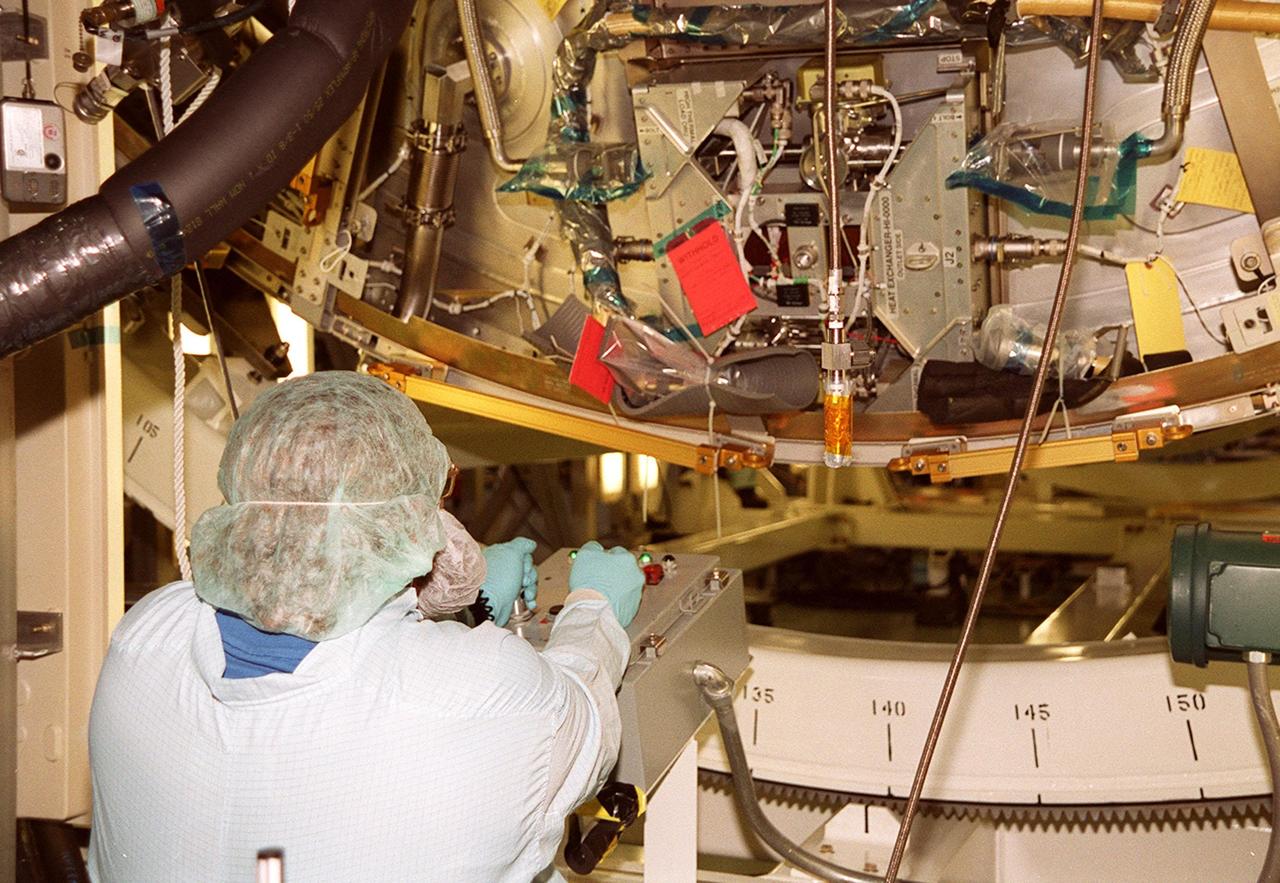
KENNEDY SPACE CENTER, FLA. -- In the Space Station Processing Facility, a worker controls the rotation of the U.S. Laboratory Destiny. A component of the International Space Station, Destiny is scheduled to fly on mission STS-98 in early 2001. During the mission, the crew will install the Lab during a series of three space walks. The STS-98 mission will provide the station with science research facilities and expand its power, life support and control capabilities. The U.S. Lab module continues a long tradition of microgravity materials research, first conducted by Skylab and later Shuttle and Spacelab missions. Destiny is expected to be a major feature in future research, providing facilities for biotechnology, fluid physics, combustion, and life sciences research
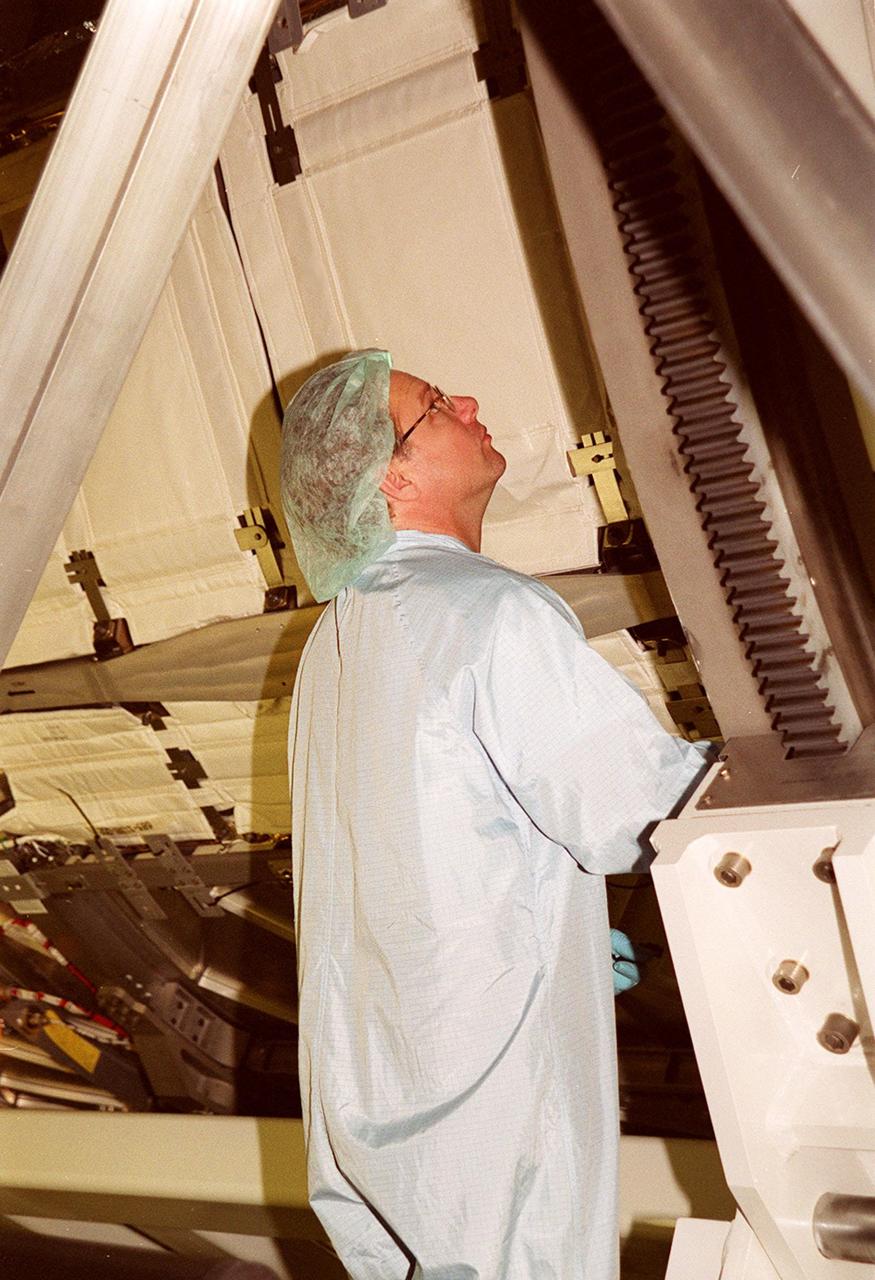
KENNEDY SPACE CENTER, FLA. -- In the Space Station Processing Facility, a worker checks the U.S. Laboratory Destiny as it rotates. A component of the International Space Station, Destiny is scheduled to fly on mission STS-98 in early 2001. During the mission, the crew will install the Lab during a series of three space walks. The STS-98 mission will provide the station with science research facilities and expand its power, life support and control capabilities. The U.S. Lab module continues a long tradition of microgravity materials research, first conducted by Skylab and later Shuttle and Spacelab missions. Destiny is expected to be a major feature in future research, providing facilities for biotechnology, fluid physics, combustion, and life sciences research

An experiment vehicle plunges into the deceleration pit at the end of a 5.18-second drop in the Zero-Gravity Research Facility at NASA's Glenn Research Center. The Zero-Gravity Research Facility was developed to support microgravity research and development programs that investigate various physical sciences, materials, fluid physics, and combustion and processing systems. Payloads up to 1 meter in diameter and 455 kg in weight can be accommodated. The facility has a 145-meter evacuated shaft to ensure a disturbance-free drop. This is No.1 of a sequence of 4 images. (Credit: NASA/Glenn Research Center)
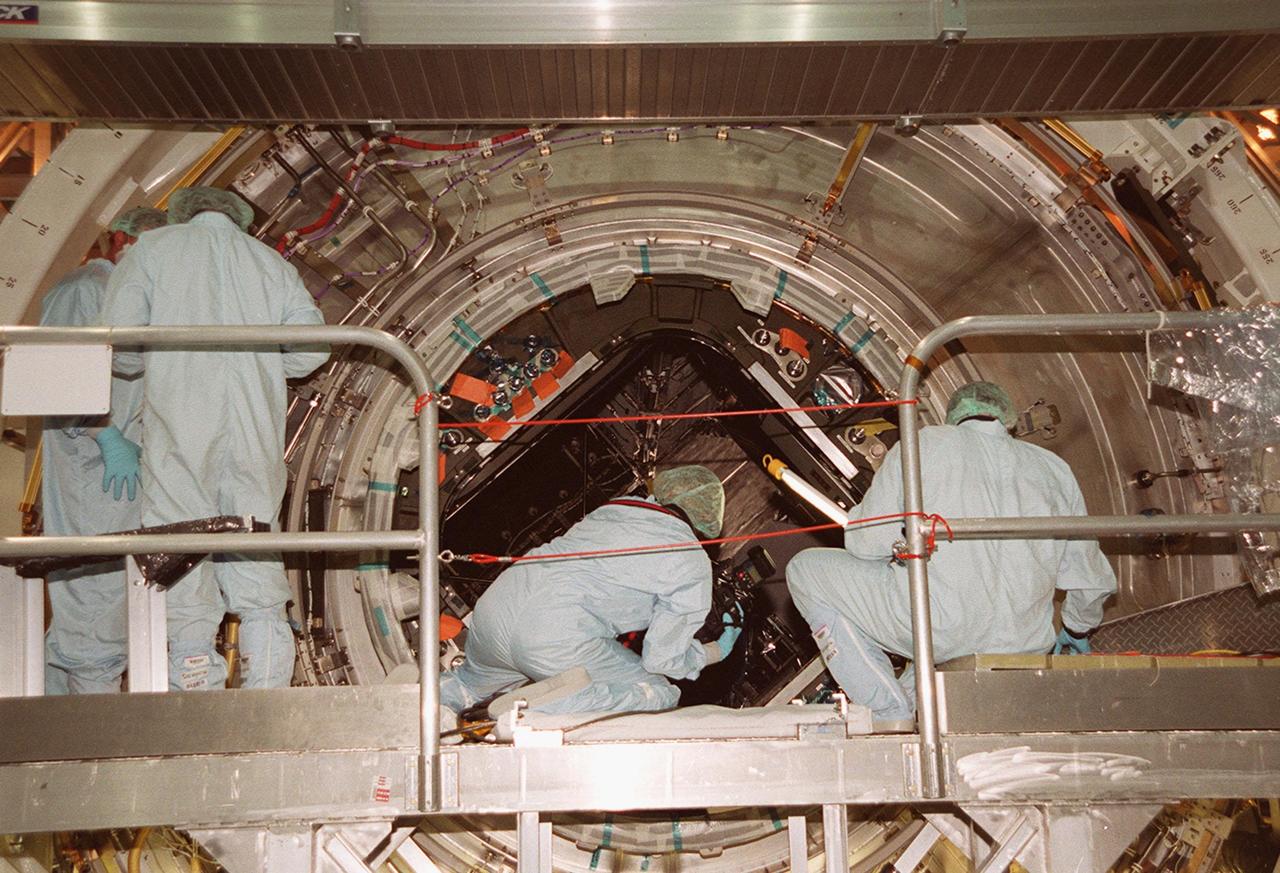
KENNEDY SPACE CENTER, FLA. -- In the Space Station Processing Facility, technicians watch closely as the U.S. Laboratory Destiny rotates. A component of the International Space Station, Destiny is scheduled to fly on mission STS-98 in early 2001. During the mission, the crew will install the Lab during a series of three space walks. The STS-98 mission will provide the station with science research facilities and expand its power, life support and control capabilities. The U.S. Lab module continues a long tradition of microgravity materials research, first conducted by Skylab and later Shuttle and Spacelab missions. Destiny is expected to be a major feature in future research, providing facilities for biotechnology, fluid physics, combustion, and life sciences research
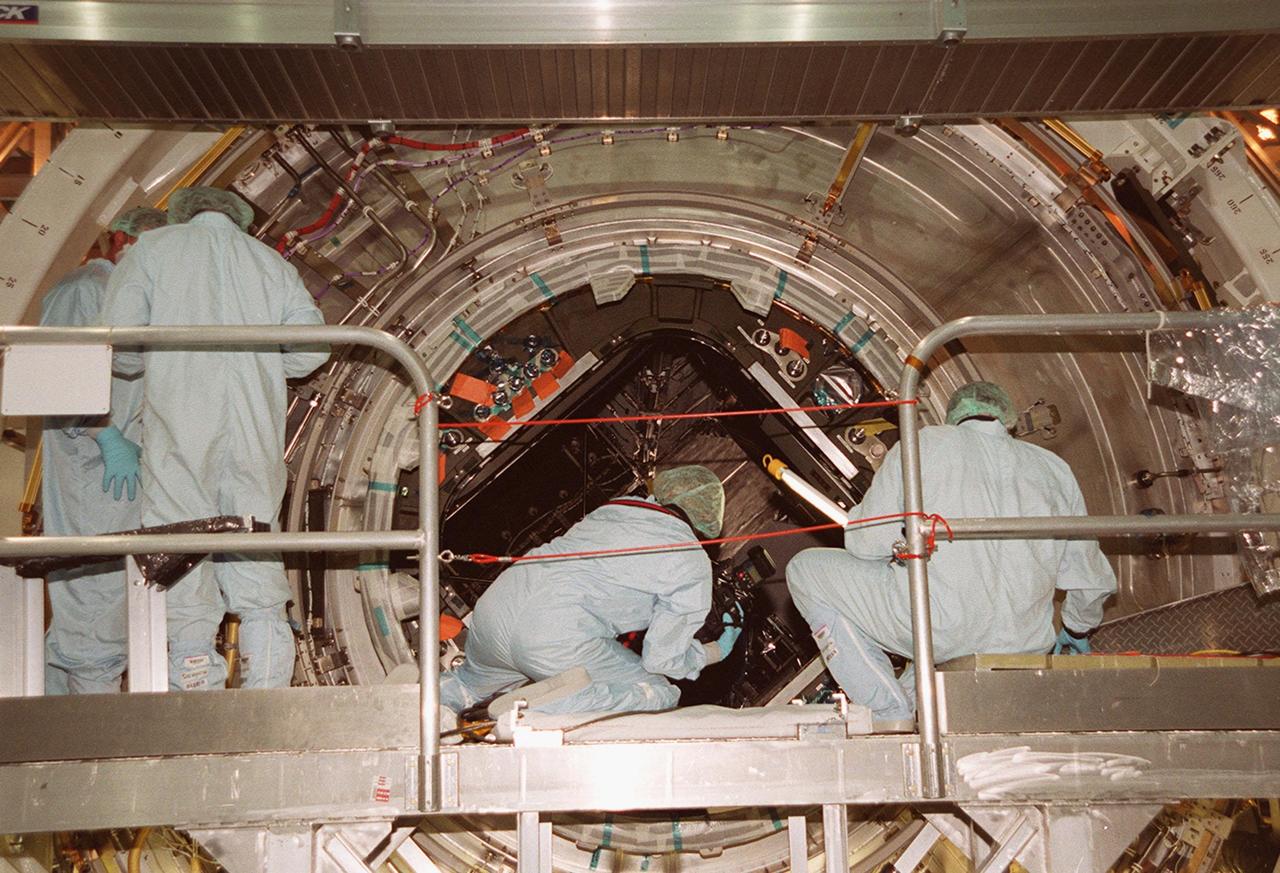
KENNEDY SPACE CENTER, FLA. -- In the Space Station Processing Facility, technicians watch closely as the U.S. Laboratory Destiny rotates. A component of the International Space Station, Destiny is scheduled to fly on mission STS-98 in early 2001. During the mission, the crew will install the Lab during a series of three space walks. The STS-98 mission will provide the station with science research facilities and expand its power, life support and control capabilities. The U.S. Lab module continues a long tradition of microgravity materials research, first conducted by Skylab and later Shuttle and Spacelab missions. Destiny is expected to be a major feature in future research, providing facilities for biotechnology, fluid physics, combustion, and life sciences research
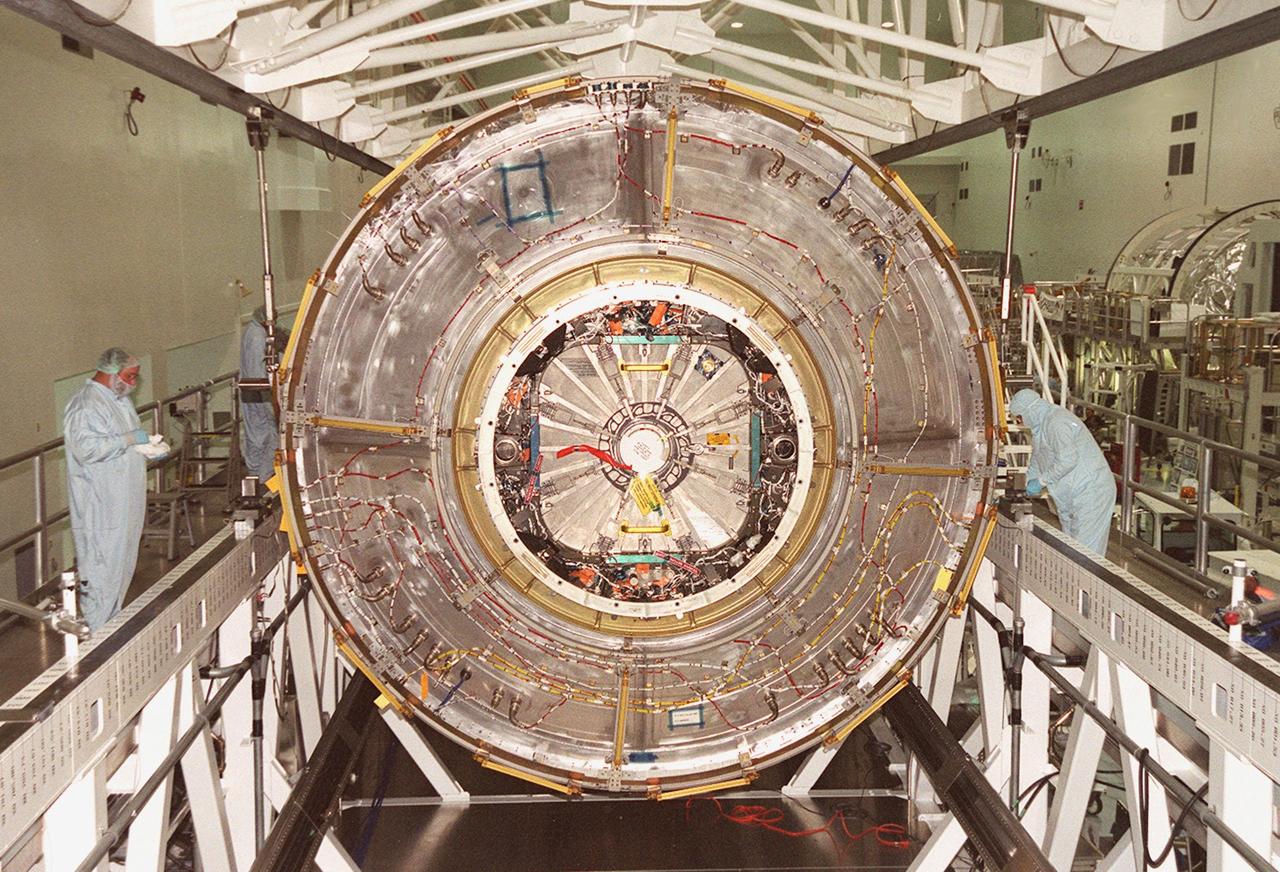
KENNEDY SPACE CENTER, FLA. -- In the Space Station Processing Facility, the U.S. Lab Destiny comes to rest on the weigh stand. A component of the International Space Station, Destiny is scheduled to fly on mission STS-98 in early 2001. During the mission, the crew will install the Lab during a series of three space walks. The STS-98 mission will provide the station with science research facilities and expand its power, life support and control capabilities. The U.S. Lab module continues a long tradition of microgravity materials research, first conducted by Skylab and later Shuttle and Spacelab missions. Destiny is expected to be a major feature in future research, providing facilities for biotechnology, fluid physics, combustion, and life sciences research

KENNEDY SPACE CENTER, FLA. -- In the Space Station Processing Facility, the U.S. Lab Destiny comes to rest on the weigh stand. A component of the International Space Station, Destiny is scheduled to fly on mission STS-98 in early 2001. During the mission, the crew will install the Lab during a series of three space walks. The STS-98 mission will provide the station with science research facilities and expand its power, life support and control capabilities. The U.S. Lab module continues a long tradition of microgravity materials research, first conducted by Skylab and later Shuttle and Spacelab missions. Destiny is expected to be a major feature in future research, providing facilities for biotechnology, fluid physics, combustion, and life sciences research

An experiment vehicle plunges into the deceleration pit at the end of a 5.18-second drop in the Zero-Gravity Research Facility at NASA's Glenn Research Center. The Zero-Gravity Research Facility was developed to support microgravity research and development programs that investigate various physical sciences, materials, fluid physics, and combustion and processing systems. Payloads up to one meter in diameter and 455 kg in weight can be accommodated. The facility has a 145-meter evacuated shaft to ensure a disturbance-free drop. This is No. 4 of a sequence of 4 images. (Credit: NASA/Glenn Research Center)
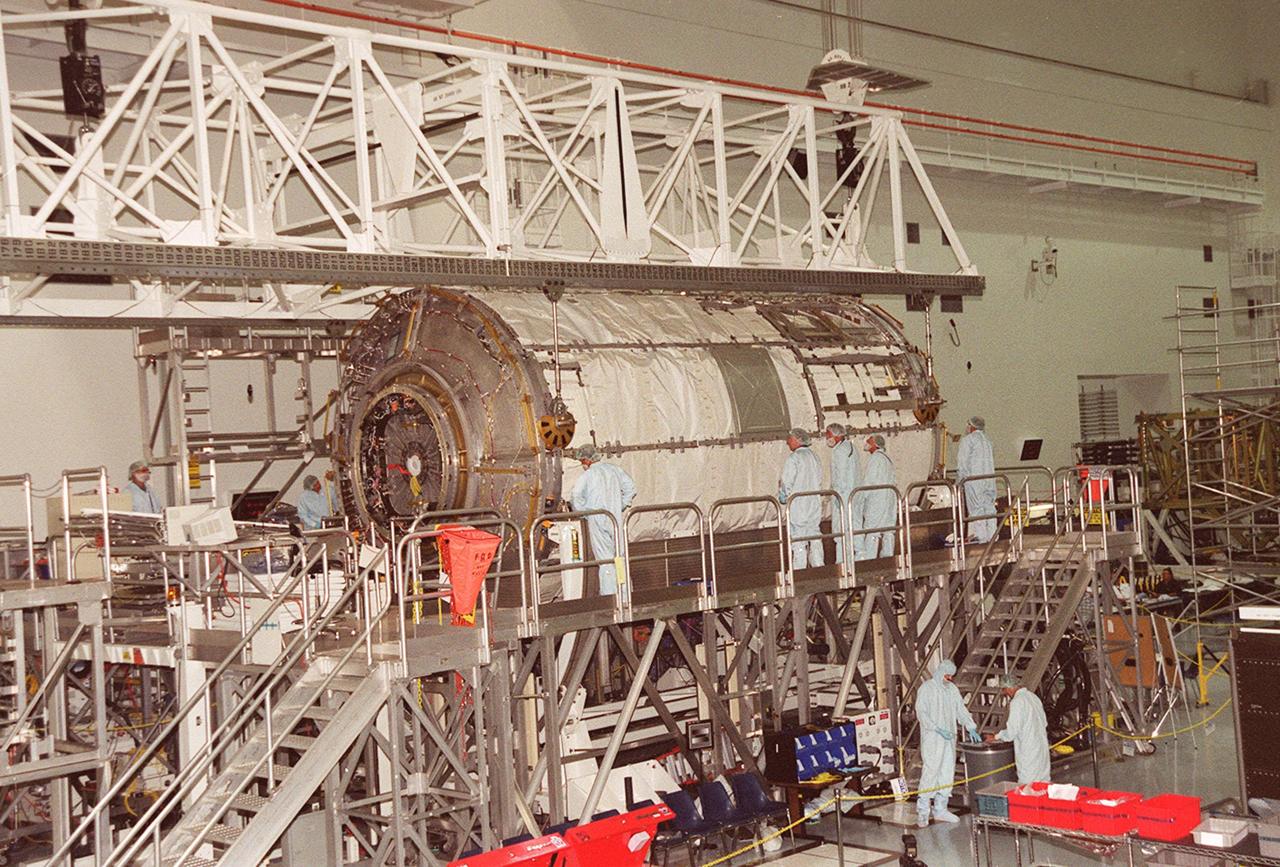
KENNEDY SPACE CENTER, Fla. -- In the Space Station Processing Facility, technicians watch closely as the U.S. Laboratory Destiny rotates. A component of the International Space Station, Destiny is scheduled to fly on mission STS-98 in early 2001. During the mission, the crew will install the Lab during a series of three space walks. The STS-98 mission will provide the station with science research facilities and expand its power, life support and control capabilities. The U.S. Lab module continues a long tradition of microgravity materials research, first conducted by Skylab and later Shuttle and Spacelab missions. Destiny is expected to be a major feature in future research, providing facilities for biotechnology, fluid physics, combustion, and life sciences research.
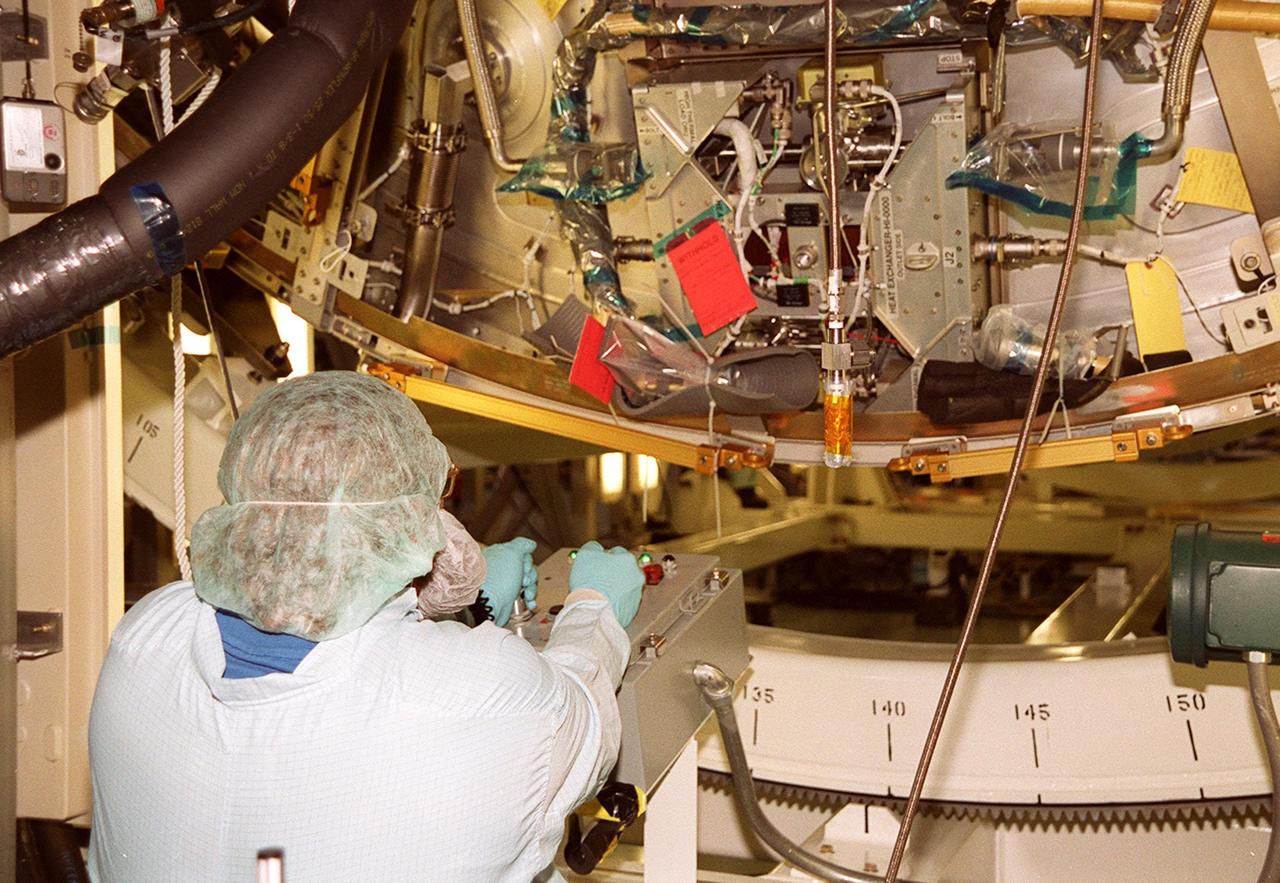
KENNEDY SPACE CENTER, FLA. -- In the Space Station Processing Facility, a worker controls the rotation of the U.S. Laboratory Destiny. A component of the International Space Station, Destiny is scheduled to fly on mission STS-98 in early 2001. During the mission, the crew will install the Lab during a series of three space walks. The STS-98 mission will provide the station with science research facilities and expand its power, life support and control capabilities. The U.S. Lab module continues a long tradition of microgravity materials research, first conducted by Skylab and later Shuttle and Spacelab missions. Destiny is expected to be a major feature in future research, providing facilities for biotechnology, fluid physics, combustion, and life sciences research
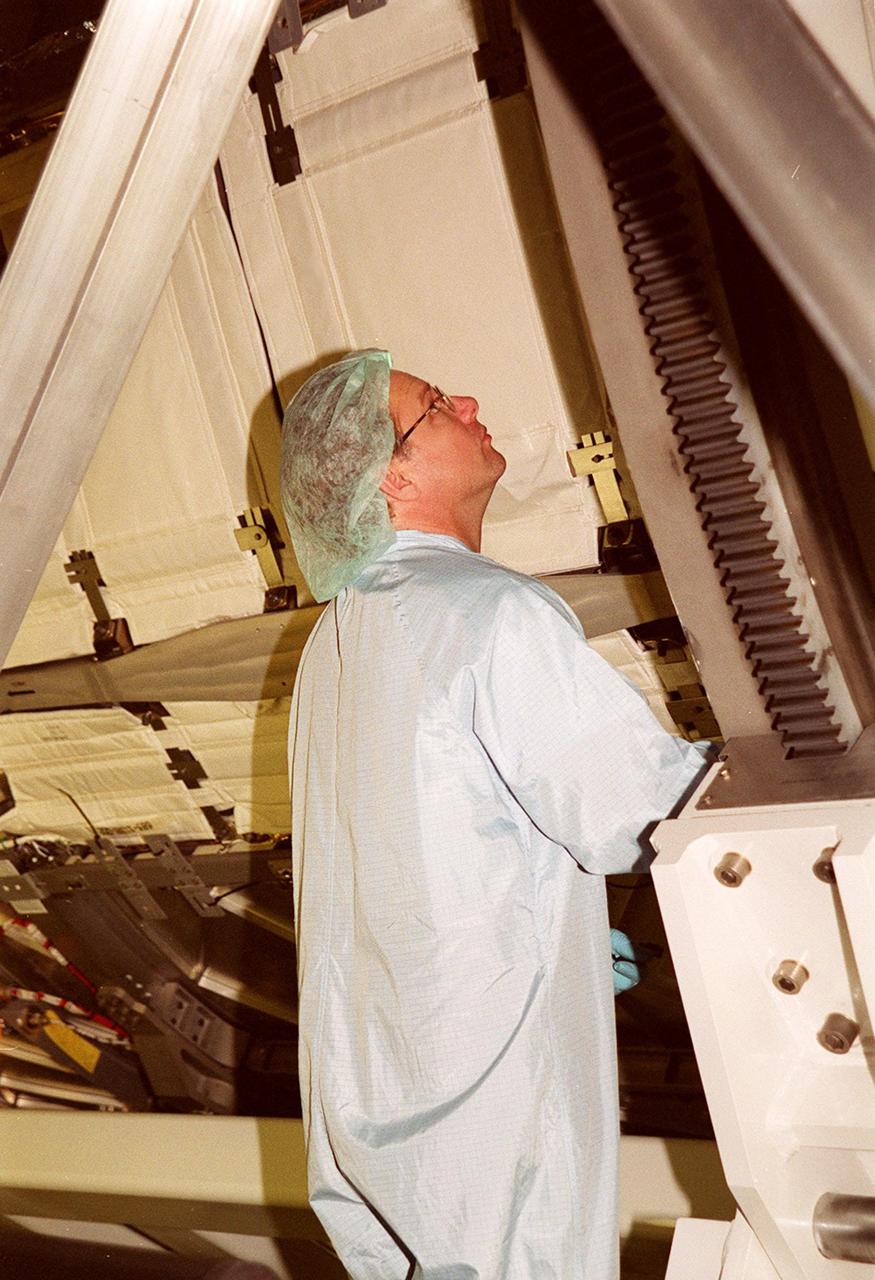
KENNEDY SPACE CENTER, FLA. -- In the Space Station Processing Facility, a worker checks the U.S. Laboratory Destiny as it rotates. A component of the International Space Station, Destiny is scheduled to fly on mission STS-98 in early 2001. During the mission, the crew will install the Lab during a series of three space walks. The STS-98 mission will provide the station with science research facilities and expand its power, life support and control capabilities. The U.S. Lab module continues a long tradition of microgravity materials research, first conducted by Skylab and later Shuttle and Spacelab missions. Destiny is expected to be a major feature in future research, providing facilities for biotechnology, fluid physics, combustion, and life sciences research
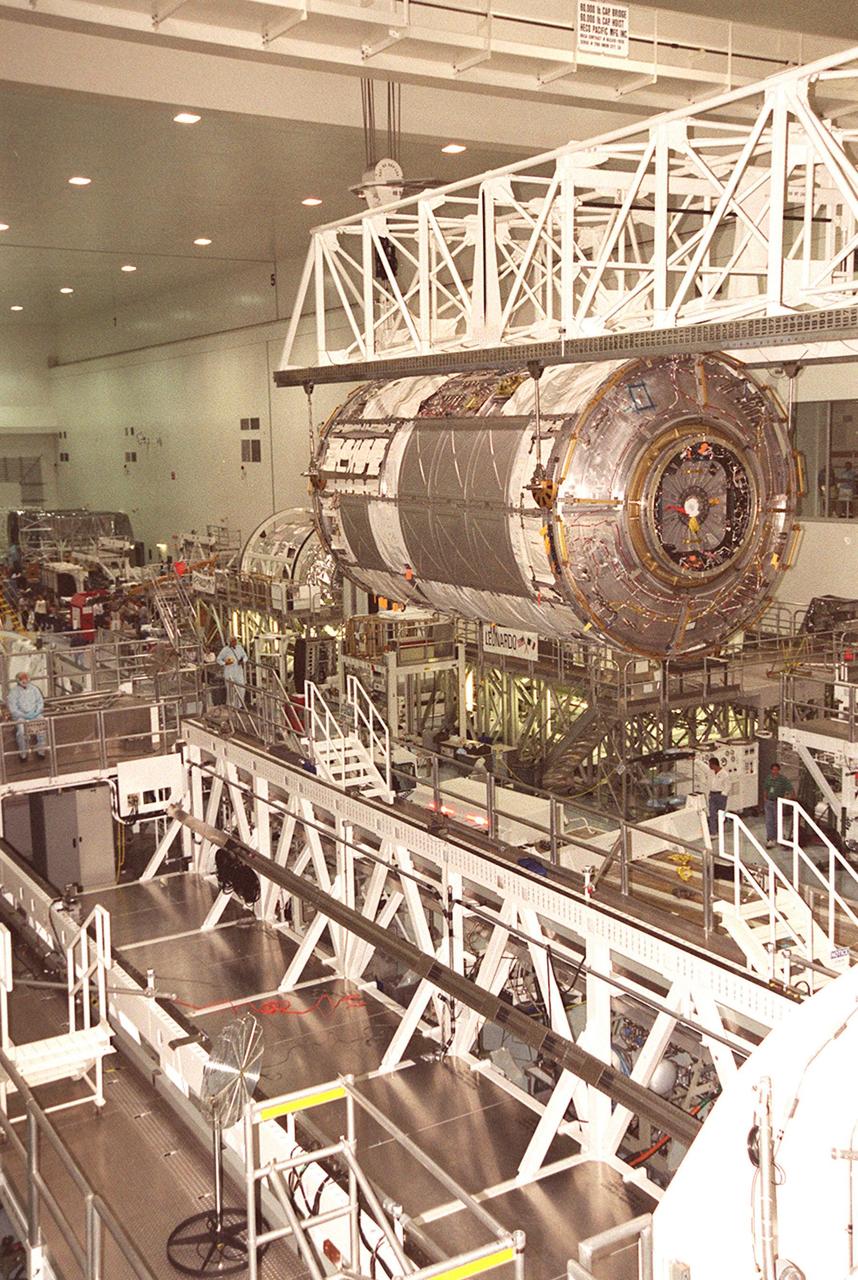
KENNEDY SPACE CENTER, FLA. -- Suspended under an overhead crane, the U.S. Lab Destiny nears the weigh stand at left. A component of the International Space Station, Destiny is scheduled to fly on mission STS-98 in early 2001. During the mission, the crew will install the Lab during a series of three space walks. The STS-98 mission will provide the station with science research facilities and expand its power, life support and control capabilities. The U.S. Lab module continues a long tradition of microgravity materials research, first conducted by Skylab and later Shuttle and Spacelab missions. Destiny is expected to be a major feature in future research, providing facilities for biotechnology, fluid physics, combustion, and life sciences research
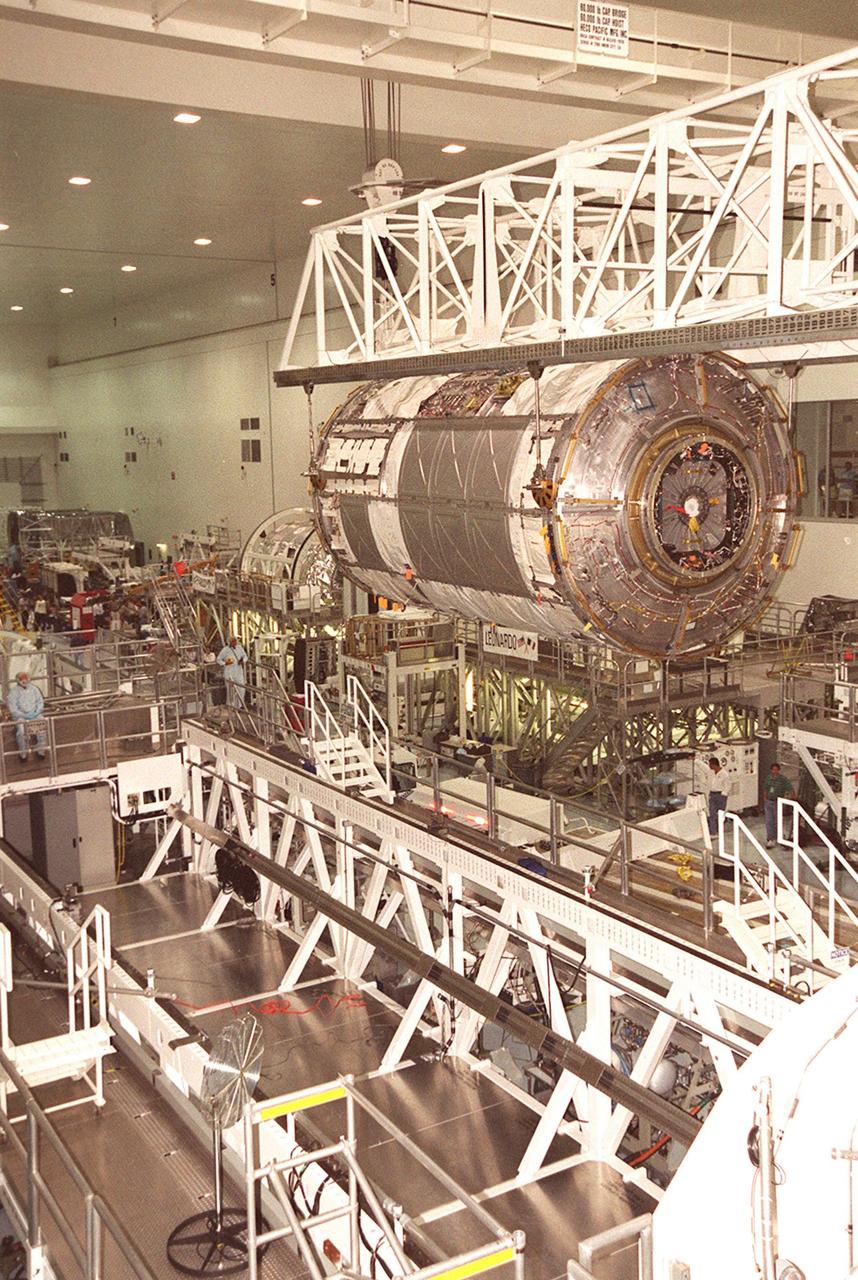
KENNEDY SPACE CENTER, FLA. -- Suspended under an overhead crane, the U.S. Lab Destiny nears the weigh stand at left. A component of the International Space Station, Destiny is scheduled to fly on mission STS-98 in early 2001. During the mission, the crew will install the Lab during a series of three space walks. The STS-98 mission will provide the station with science research facilities and expand its power, life support and control capabilities. The U.S. Lab module continues a long tradition of microgravity materials research, first conducted by Skylab and later Shuttle and Spacelab missions. Destiny is expected to be a major feature in future research, providing facilities for biotechnology, fluid physics, combustion, and life sciences research
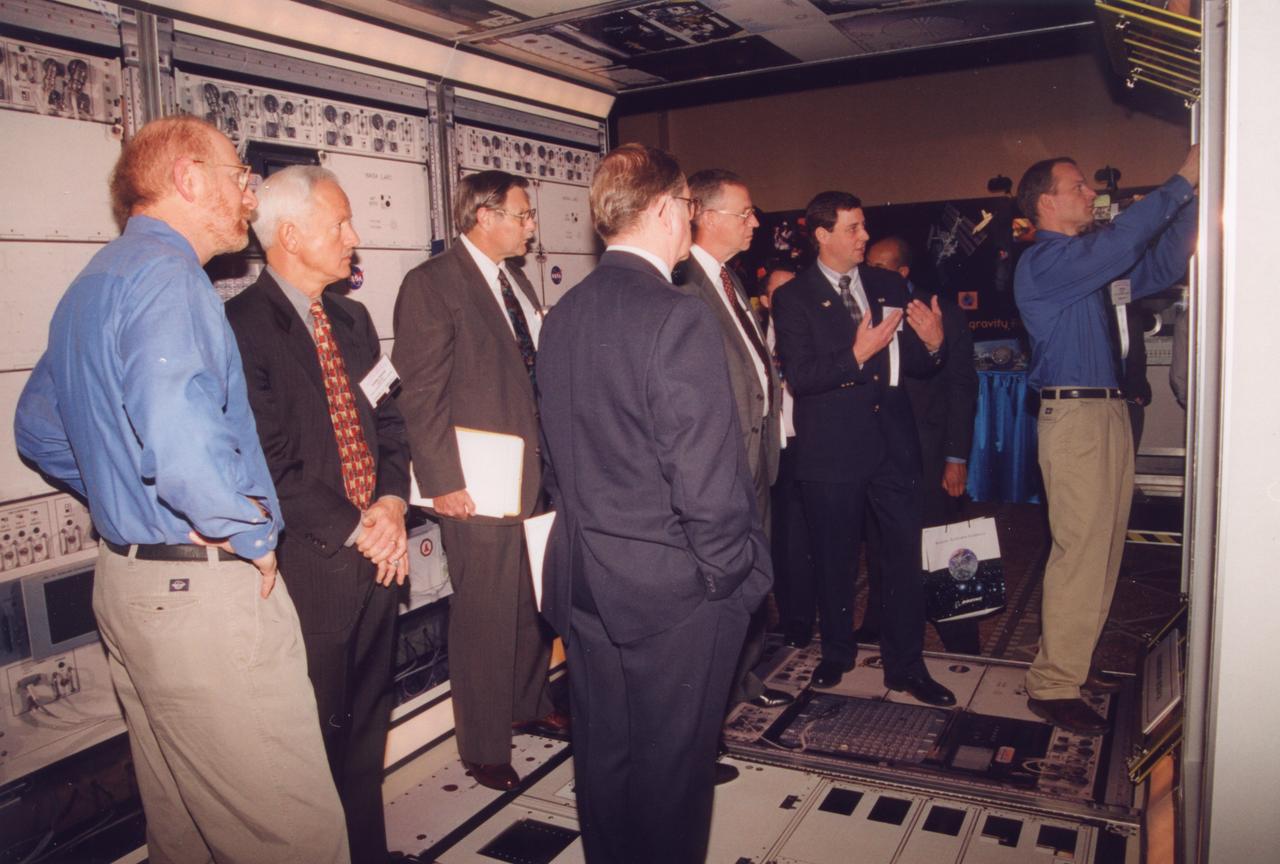
Engineers from NASA's Glenn Research Center demonstrate the access to one of the experiment racks planned for the U.S. Destiny laboratory module on the International Space Station (ISS). This mockup has the full diameter, full corridor width, and half the length of the module. The mockup includes engineering mockups of the Fluids and Combustion Facility being developed by NASA's Glenn Research Center. (The full module will be six racks long; the mockup is three racks long). Listening at left (coat and patterned tie) is John-David Bartoe, ISS research manager at NASA's Johnson Space Center and a payload specialist on Spacelab 2 mission (1985). Photo credit: NASA/Marshall Space Flight Center (MSFC)
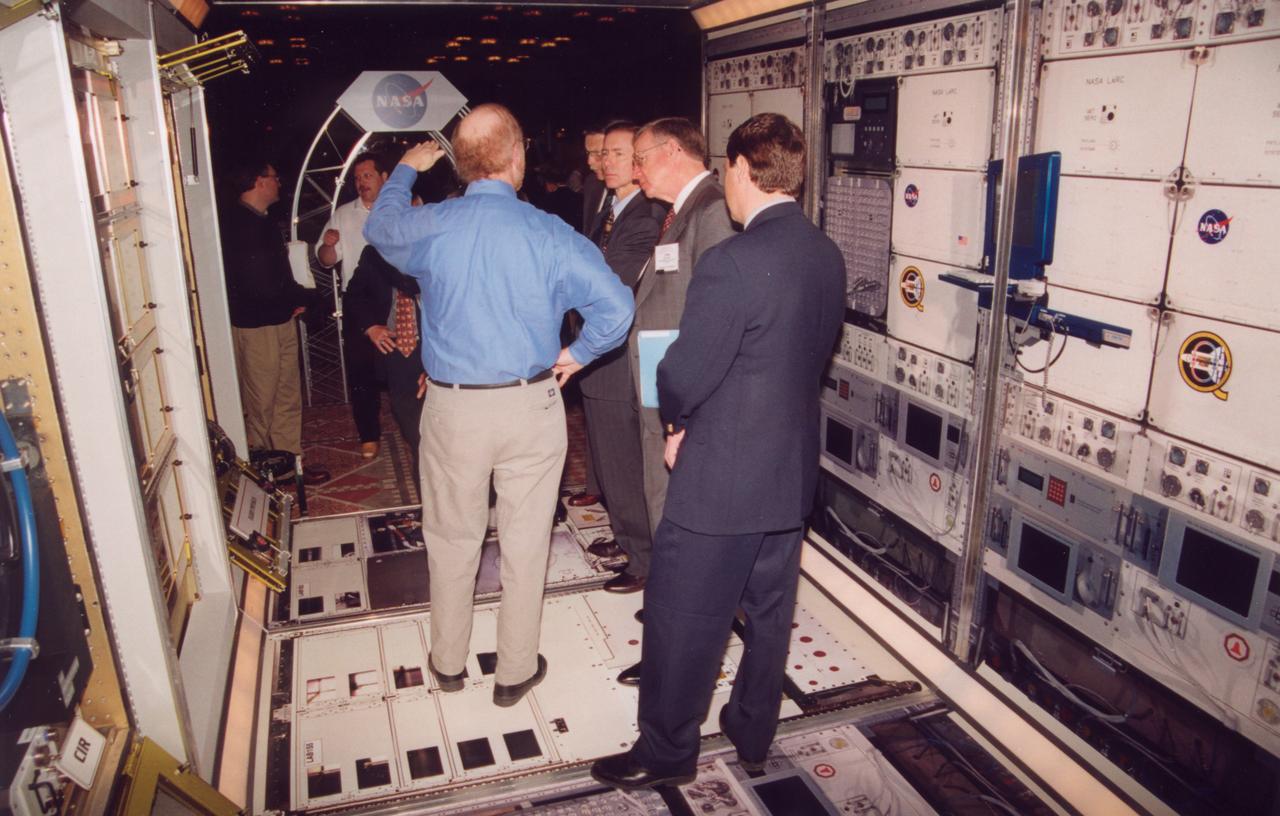
Engineers from NASA's Glenn Research Center demonstrate the access to one of the experiment racks planned for the U.S. Destiny laboratory module on the International Space Station (ISS). This mockup has the full diameter, full corridor width, and half the length of the module. The mockup includes engineering mockups of the Fluids and Combustion Facility being developed by NASA's Glenn Research Center. (The full module will be six racks long; the mockup is three racks long). Listening at center is former astronaut Brewster Shaw (center), now a program official with the Boeing Co., the ISS prime contractor. Photo credit: NASA/Marshall Space Flight Center (MSFC)
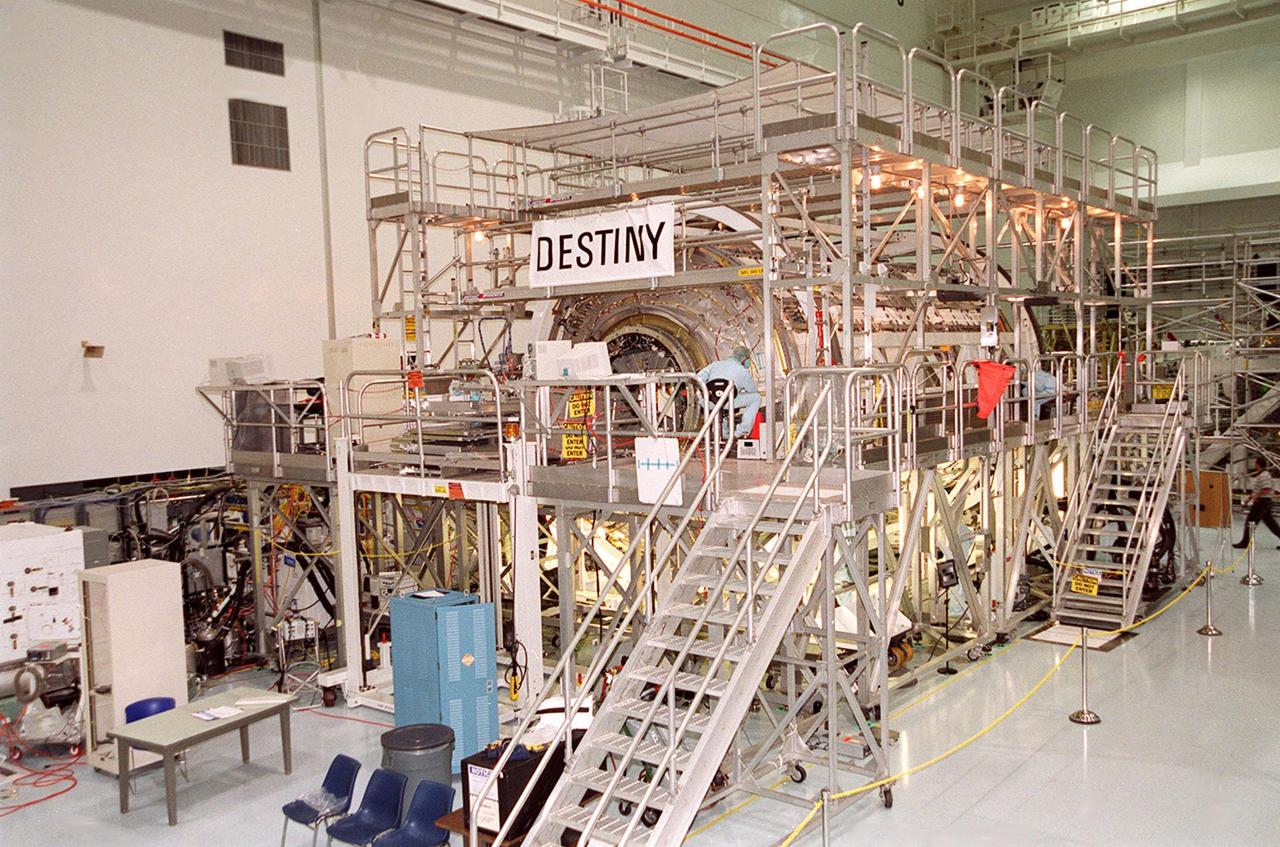
KENNEDY SPACE CENTER, FLA. -- In the Space Station Processing Facility, the U.S. Laboratory Destiny is about to undergo rotation in its workstand. A component of the International Space Station, Destiny is scheduled to fly on mission STS-98 in early 2001. During the mission, the crew will install the Lab during a series of three space walks. The STS-98 mission will provide the station with science research facilities and expand its power, life support and control capabilities. The U.S. Lab module continues a long tradition of microgravity materials research, first conducted by Skylab and later Shuttle and Spacelab missions. Destiny is expected to be a major feature in future research, providing facilities for biotechnology, fluid physics, combustion, and life sciences research

KENNEDY SPACE CENTER, FLA. -- Resting in a rotation and handling fixture, the U.S. Lab, a component of the International Space Station, is nearly vertical. The Lab, named Destiny, will undergo testing in the altitude chamber in the Operations and Checkout Building. Behind the Lab is the payload canister which transported it from the Space Station Processing Facility. Destiny is scheduled to fly on mission STS-98 in early 2001. During the mission, the crew will install the Lab in the Space Station during a series of three space walks. The STS-98 mission will provide the Station with science research facilities and expand its power, life support and control capabilities. The U.S. Lab module continues a long tradition of microgravity materials research, first conducted by Skylab and later Shuttle and Spacelab missions. Destiny is expected to be a major feature in future research, providing facilities for biotechnology, fluid physics, combustion, and life sciences research
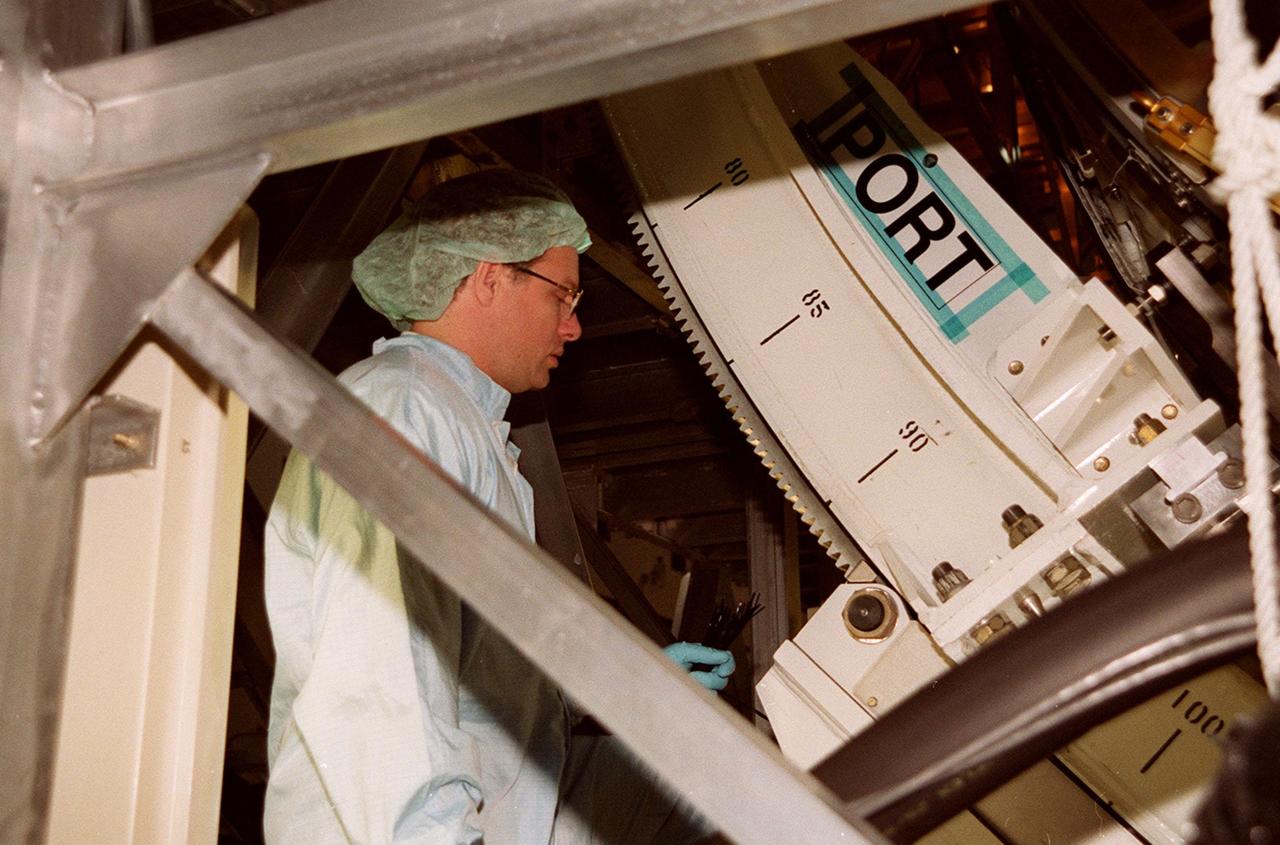
KENNEDY SPACE CENTER, FLA. -- In the Space Station Processing Facility, a worker checks the U.S. Laboratory Destiny as it rotates. A component of the International Space Station, Destiny is scheduled to fly on mission STS-98 in early 2001. During the mission, the crew will install the Lab during a series of three space walks. The STS-98 mission will provide the station with science research facilities and expand its power, life support and control capabilities. The U.S. Lab module continues a long tradition of microgravity materials research, first conducted by Skylab and later Shuttle and Spacelab missions. Destiny is expected to be a major feature in future research, providing facilities for biotechnology, fluid physics, combustion, and life sciences research.<font size="3"

KENNEDY SPACE CENTER, FLA. -- In the Operations and Checkout Building (O&C), the U.S. Lab, a component of the International Space Station, is lifted off the floor in order to be raised to a vertical position. The Lab, named Destiny, will undergo testing in the altitude chamber in the O&C. Behind the Lab is the payload canister which transported it from the Space Station Processing Facility. Destiny is scheduled to fly on mission STS-98 in early 2001. During the mission, the crew will install the Lab in the Space Station during a series of three space walks. The STS-98 mission will provide the Station with science research facilities and expand its power, life support and control capabilities. The U.S. Lab module continues a long tradition of microgravity materials research, first conducted by Skylab and later Shuttle and Spacelab missions. Destiny is expected to be a major feature in future research, providing facilities for biotechnology, fluid physics, combustion, and life sciences research
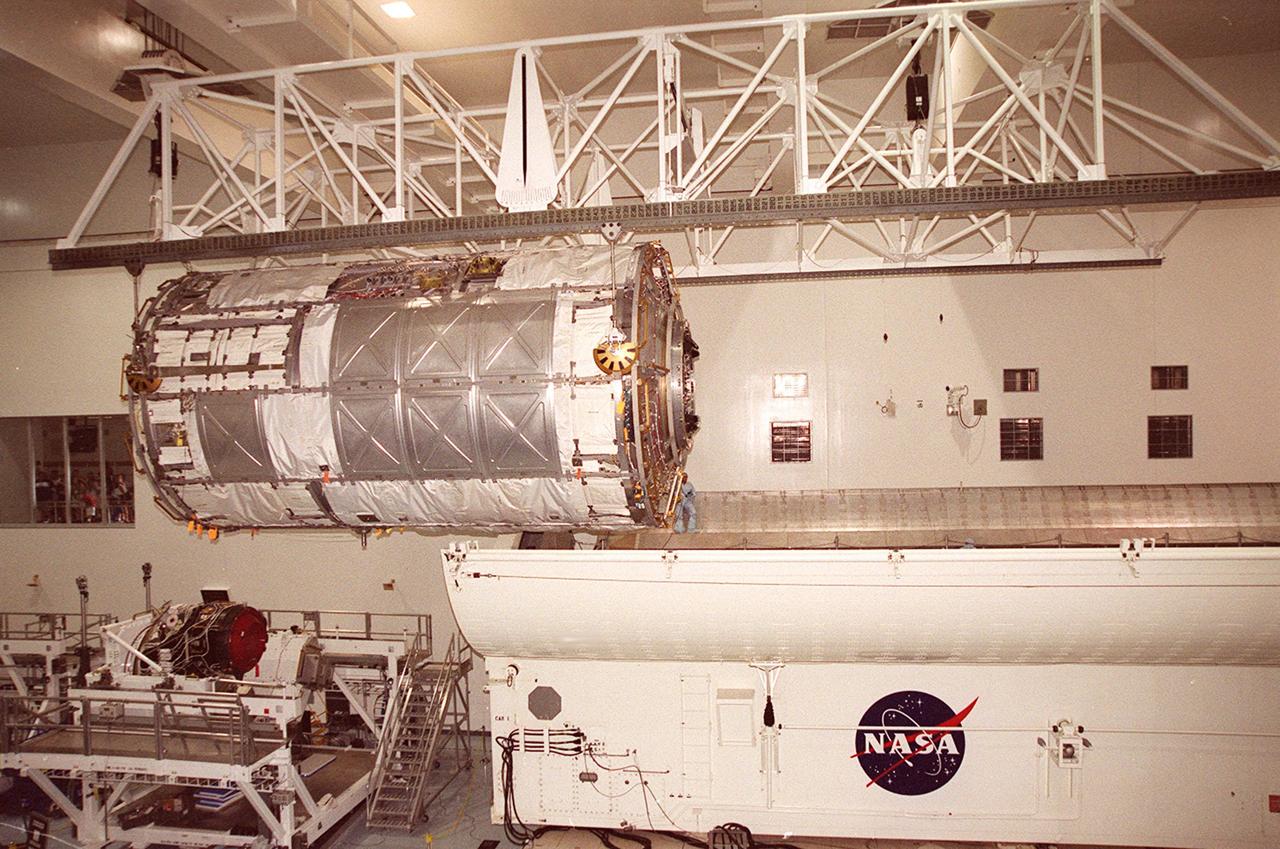
KENNEDY SPACE CENTER, FLA. -- In the Space Station Processing Facility (SSPF), the U.S. Laboratory Destiny, a component of the International Space Station, is moved to a payload canister for transfer to the Operations and Checkout Building where it will be tested in the altitude chamber. On the floor of the SSPF, left, is a Pressurized Mating Adapter-3. Destiny is scheduled to fly on mission STS-98 in early 2001. During the mission, the crew will install the Lab in the Space Station during a series of three space walks. The STS-98 mission will provide the Station with science research facilities and expand its power, life support and control capabilities. The U.S. Lab module continues a long tradition of microgravity materials research, first conducted by Skylab and later Shuttle and Spacelab missions. Destiny is expected to be a major feature in future research, providing facilities for biotechnology, fluid physics, combustion, and life sciences research
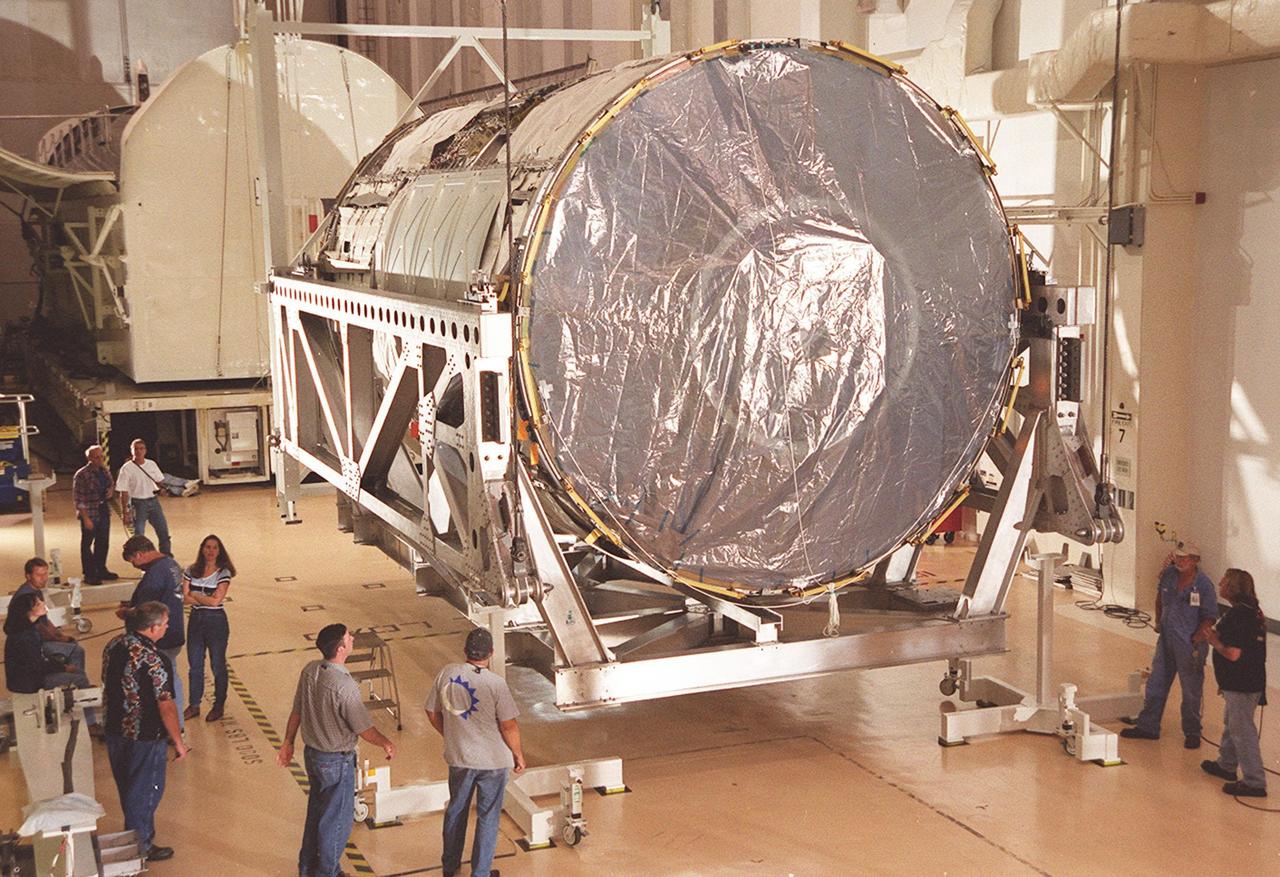
KENNEDY SPACE CENTER, FLA. -- In the Operations and Checkout Building (O&C), the U.S. Lab, a component of the International Space Station, is lifted off the floor in order to be raised to a vertical position. The Lab, named Destiny, will undergo testing in the altitude chamber in the O&C. Behind the Lab is the payload canister which transported it from the Space Station Processing Facility. Destiny is scheduled to fly on mission STS-98 in early 2001. During the mission, the crew will install the Lab in the Space Station during a series of three space walks. The STS-98 mission will provide the Station with science research facilities and expand its power, life support and control capabilities. The U.S. Lab module continues a long tradition of microgravity materials research, first conducted by Skylab and later Shuttle and Spacelab missions. Destiny is expected to be a major feature in future research, providing facilities for biotechnology, fluid physics, combustion, and life sciences research
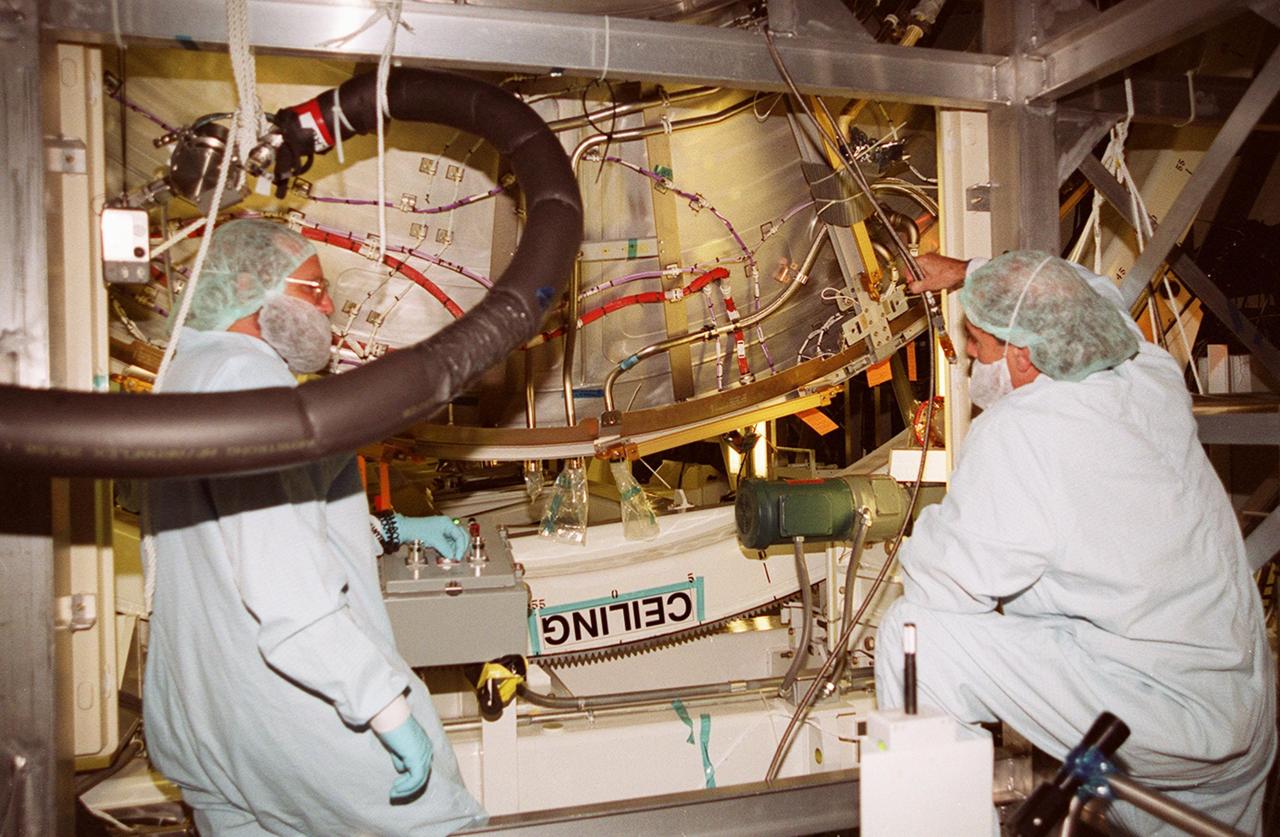
KENNEDY SPACE CENTER, FLA. -- In the Space Station Processing Facility, workers check the U.S. Laboratory Destiny as it rotates, with its ceiling now on the underside. A component of the International Space Station, Destiny is scheduled to fly on mission STS-98 in early 2001. During the mission, the crew will install the Lab during a series of three space walks. The STS-98 mission will provide the station with science research facilities and expand its power, life support and control capabilities. The U.S. Lab module continues a long tradition of microgravity materials research, first conducted by Skylab and later Shuttle and Spacelab missions. Destiny is expected to be a major feature in future research, providing facilities for biotechnology, fluid physics, combustion, and life sciences research

KENNEDY SPACE CENTER, FLA. -- In the Space Station Processing Facility, the U.S. Laboratory Destiny is about to undergo rotation in its workstand. A component of the International Space Station, Destiny is scheduled to fly on mission STS-98 in early 2001. During the mission, the crew will install the Lab during a series of three space walks. The STS-98 mission will provide the station with science research facilities and expand its power, life support and control capabilities. The U.S. Lab module continues a long tradition of microgravity materials research, first conducted by Skylab and later Shuttle and Spacelab missions. Destiny is expected to be a major feature in future research, providing facilities for biotechnology, fluid physics, combustion, and life sciences research
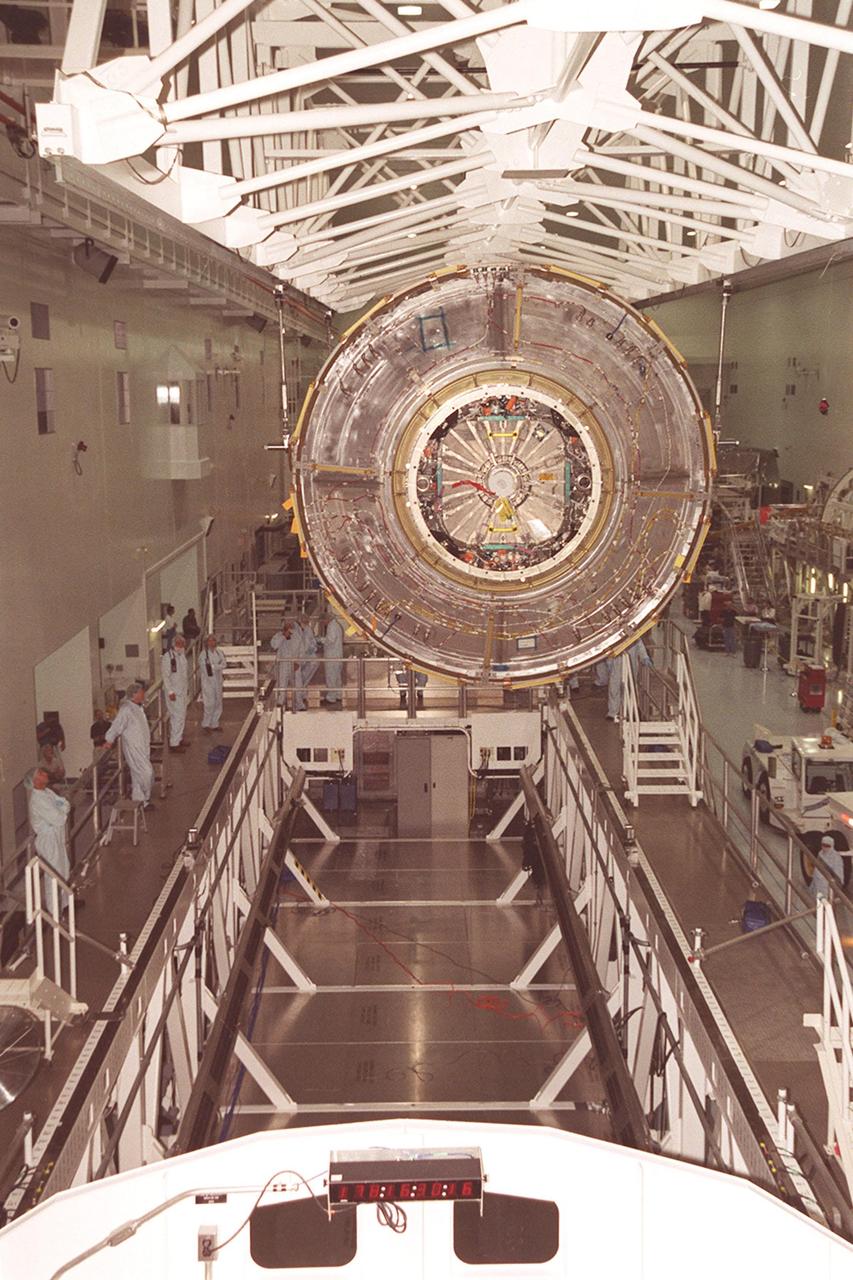
KENNEDY SPACE CENTER, Fla. -- In the Space Station Processing Facility, the U.S. Lab Destiny is lowered toward the weigh stand below. A component of the International Space Station, Destiny is scheduled to fly on mission STS-98 in early 2001. During the mission, the crew will install the Lab during a series of three space walks. The STS-98 mission will provide the station with science research facilities and expand its power, life support and control capabilities. The U.S. Lab module continues a long tradition of microgravity materials research, first conducted by Skylab and later Shuttle and Spacelab missions. Destiny is expected to be a major feature in future research, providing facilities for biotechnology, fluid physics, combustion, and life sciences research.
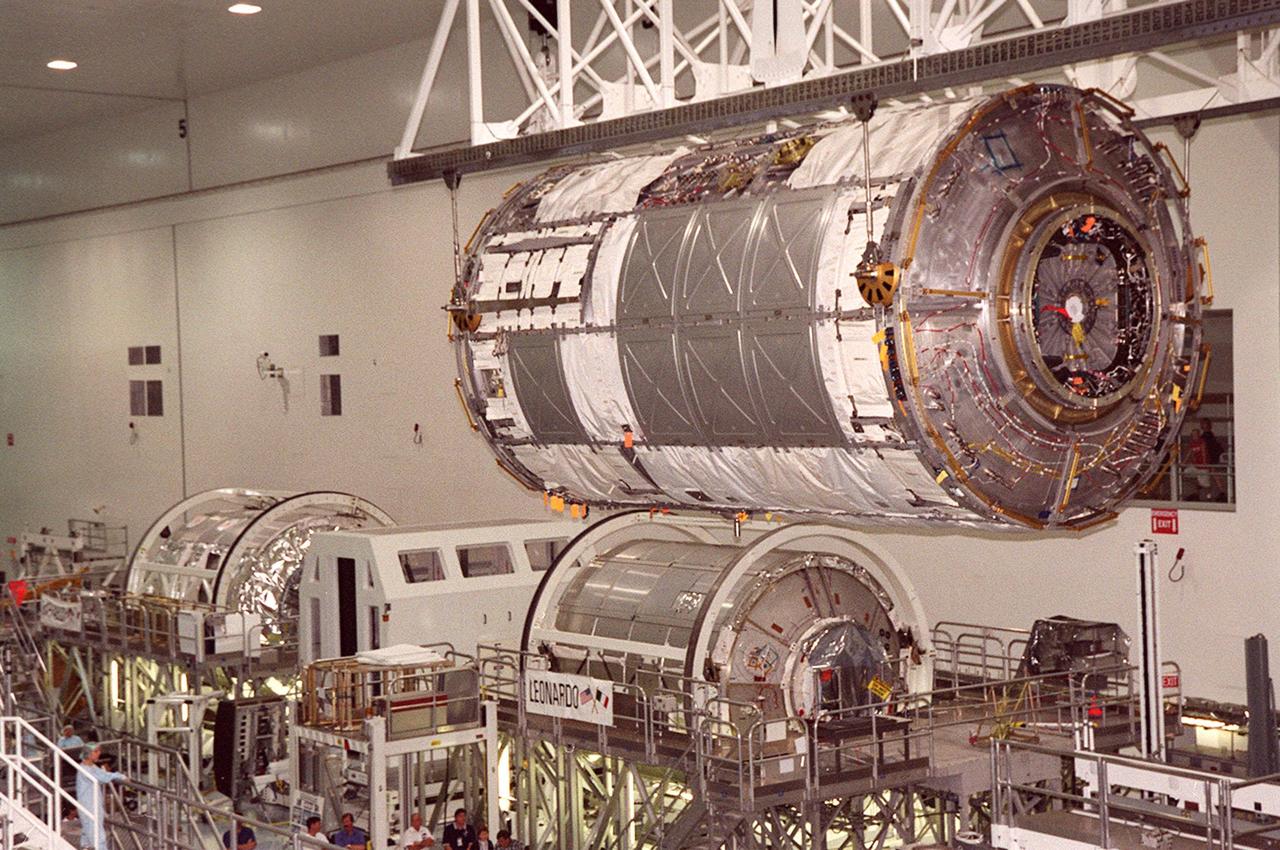
KENNEDY SPACE CENTER, FLA. -- The U.S. Laboratory Destiny, a component of the International Space Station, glides above two Multi-Purpose Logistics Modules (MPLMs), Raffaello (far left) and Leonardo, in the Space Station Processing Facility. Destiny is being moved to a payload canister for transfer to the Operations and Checkout Building where it will be tested in the altitude chamber. Destiny is scheduled to fly on mission STS-98 in early 2001. During the mission, the crew will install the Lab in the Space Station during a series of three space walks. The STS-98 mission will provide the Station with science research facilities and expand its power, life support and control capabilities. The U.S. Lab module continues a long tradition of microgravity materials research, first conducted by Skylab and later Shuttle and Spacelab missions. Destiny is expected to be a major feature in future research, providing facilities for biotechnology, fluid physics, combustion, and life sciences research
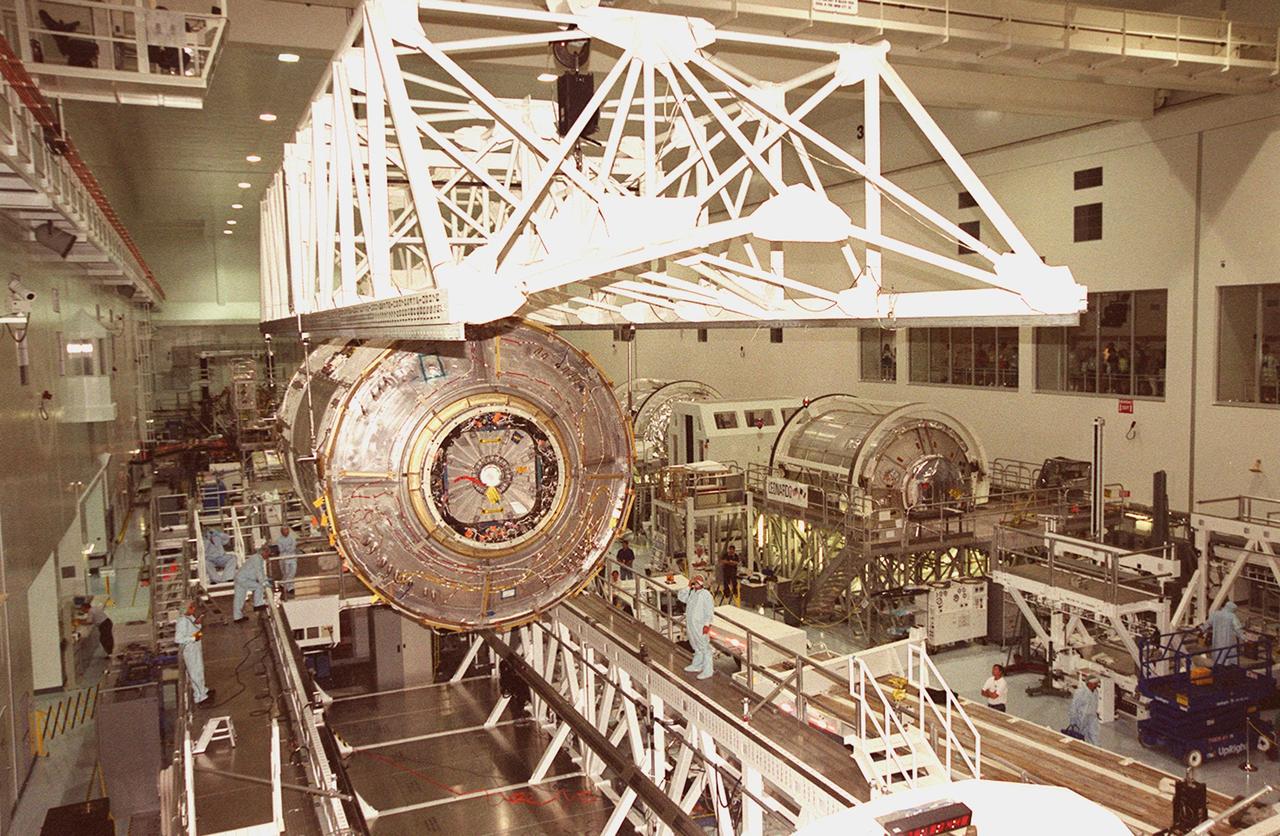
KENNEDY SPACE CENTER, FLA. -- The U.S. Laboratory Destiny, a component of the International Space Station, is lifted off a weigh stand (below) in the Space Station Processing Facility. The module is being moved to a payload canister for transfer to the Operations and Checkout Building where it will be tested in the altitude chamber. Destiny is scheduled to fly on mission STS-98 in early 2001. During the mission, the crew will install the Lab in the Space Station during a series of three space walks. The STS-98 mission will provide the Station with science research facilities and expand its power, life support and control capabilities. The U.S. Lab module continues a long tradition of microgravity materials research, first conducted by Skylab and later Shuttle and Spacelab missions. Destiny is expected to be a major feature in future research, providing facilities for biotechnology, fluid physics, combustion, and life sciences research
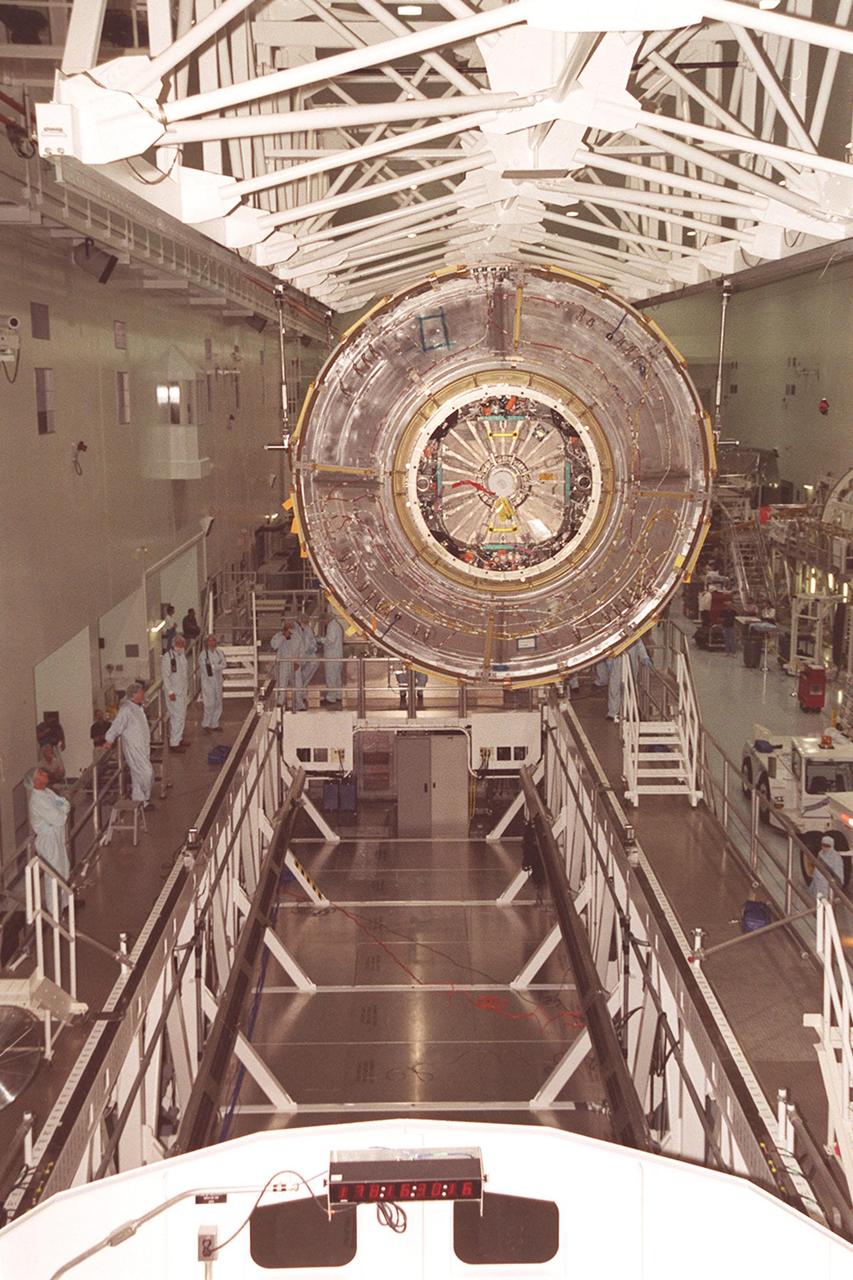
KENNEDY SPACE CENTER, Fla. -- In the Space Station Processing Facility, the U.S. Lab Destiny is lowered toward the weigh stand below. A component of the International Space Station, Destiny is scheduled to fly on mission STS-98 in early 2001. During the mission, the crew will install the Lab during a series of three space walks. The STS-98 mission will provide the station with science research facilities and expand its power, life support and control capabilities. The U.S. Lab module continues a long tradition of microgravity materials research, first conducted by Skylab and later Shuttle and Spacelab missions. Destiny is expected to be a major feature in future research, providing facilities for biotechnology, fluid physics, combustion, and life sciences research.

KENNEDY SPACE CENTER, FLA. -- Resting in a rotation and handling fixture, the U.S. Lab, a component of the International Space Station, is nearly vertical. The Lab, named Destiny, will undergo testing in the altitude chamber in the Operations and Checkout Building. Behind the Lab is the payload canister which transported it from the Space Station Processing Facility. Destiny is scheduled to fly on mission STS-98 in early 2001. During the mission, the crew will install the Lab in the Space Station during a series of three space walks. The STS-98 mission will provide the Station with science research facilities and expand its power, life support and control capabilities. The U.S. Lab module continues a long tradition of microgravity materials research, first conducted by Skylab and later Shuttle and Spacelab missions. Destiny is expected to be a major feature in future research, providing facilities for biotechnology, fluid physics, combustion, and life sciences research
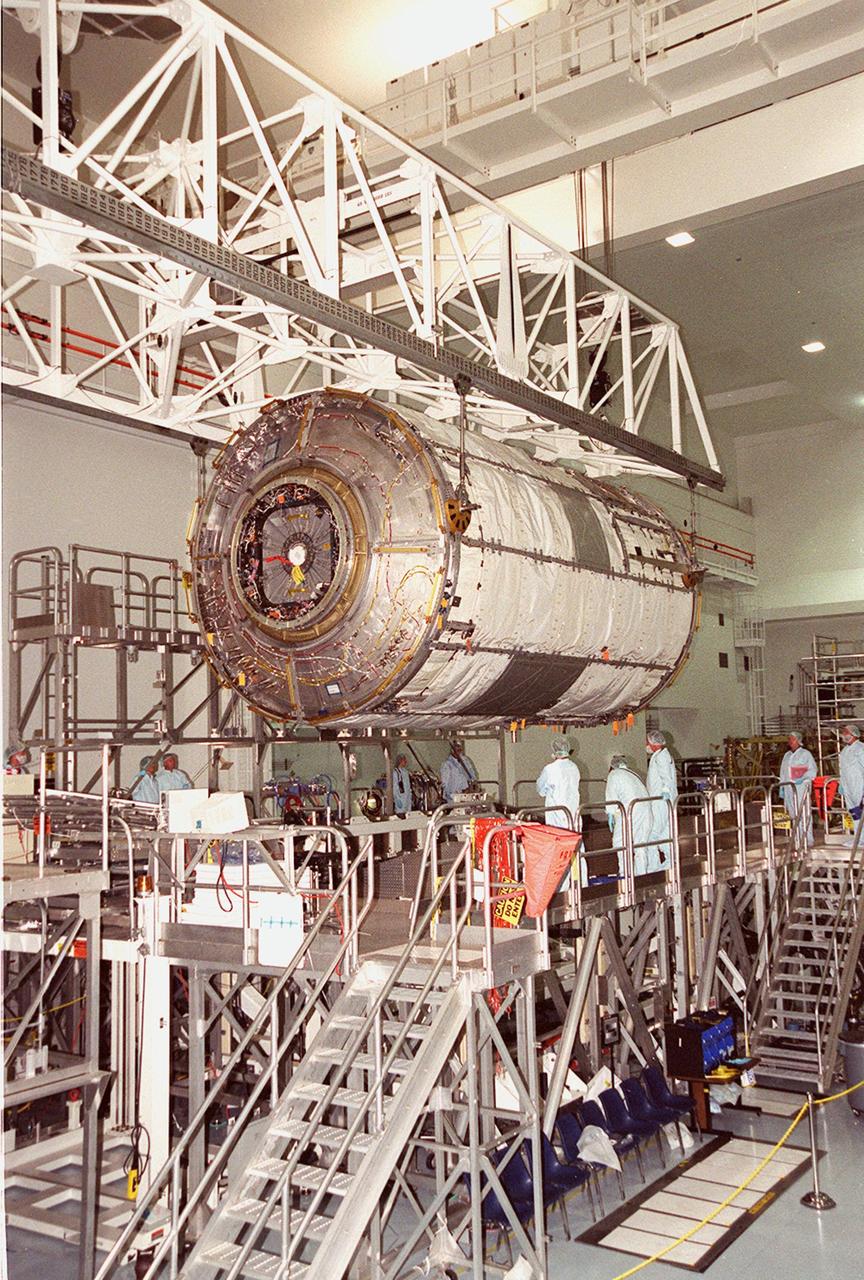
KENNEDY SPACE CENTER, FLA. -- In the Space Station Processing Facility, an overhead crane lifts and moves the U.S. Laboratory Destiny to a weigh stand. A component of the International Space Station, Destiny is scheduled to fly on mission STS-98 in early 2001. During the mission, the crew will install the Lab during a series of three space walks. The STS-98 mission will provide the station with science research facilities and expand its power, life support and control capabilities. The U.S. Lab module continues a long tradition of microgravity materials research, first conducted by Skylab and later Shuttle and Spacelab missions. Destiny is expected to be a major feature in future research, providing facilities for biotechnology, fluid physics, combustion, and life sciences research

KENNEDY SPACE CENTER, FLA. -- Resting in a rotation and handling fixture, the U.S. Lab, a component of the International Space Station, is nearly vertical. The Lab, named Destiny, will undergo testing in the altitude chamber in the Operations and Checkout Building. Behind the Lab is the payload canister which transported it from the Space Station Processing Facility. Destiny is scheduled to fly on mission STS-98 in early 2001. During the mission, the crew will install the Lab in the Space Station during a series of three space walks. The STS-98 mission will provide the Station with science research facilities and expand its power, life support and control capabilities. The U.S. Lab module continues a long tradition of microgravity materials research, first conducted by Skylab and later Shuttle and Spacelab missions. Destiny is expected to be a major feature in future research, providing facilities for biotechnology, fluid physics, combustion, and life sciences research
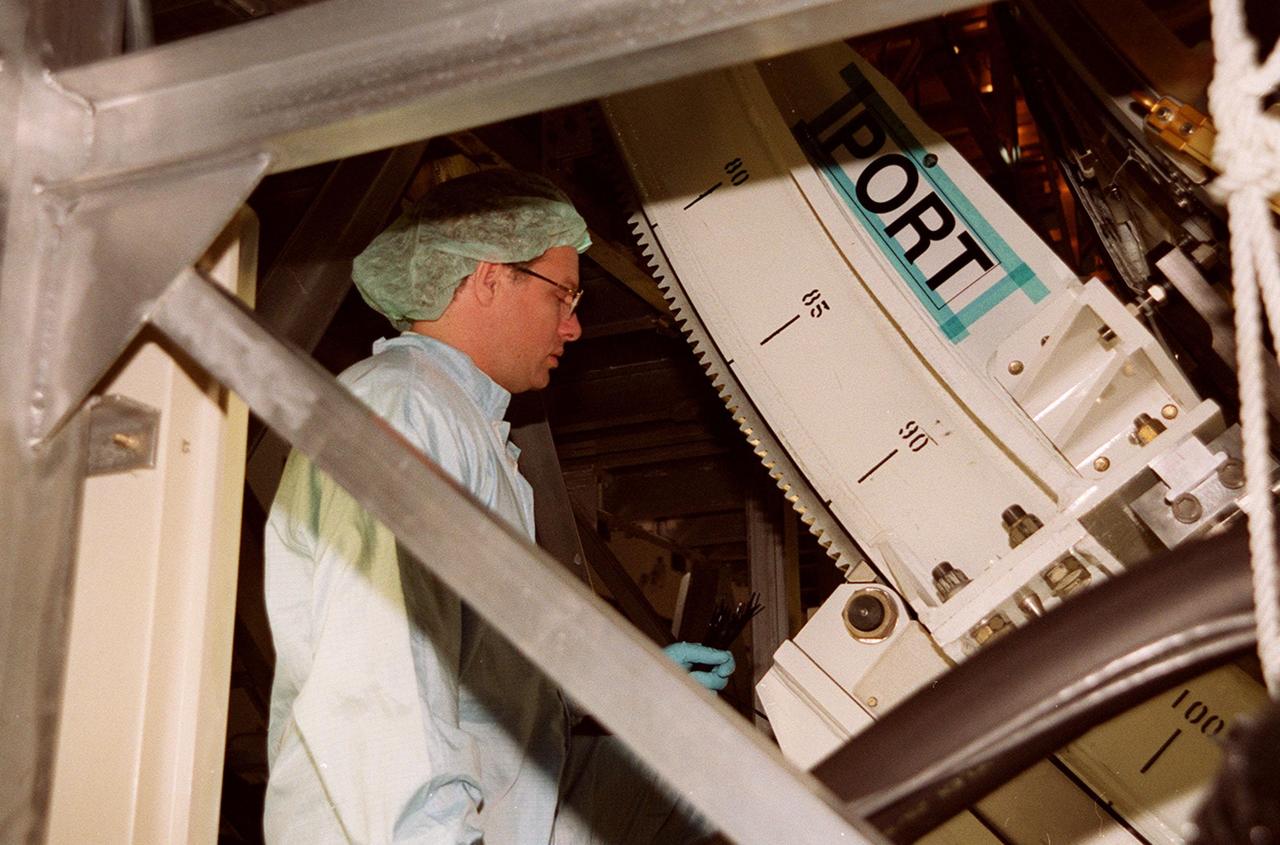
KENNEDY SPACE CENTER, FLA. -- In the Space Station Processing Facility, a worker checks the U.S. Laboratory Destiny as it rotates. A component of the International Space Station, Destiny is scheduled to fly on mission STS-98 in early 2001. During the mission, the crew will install the Lab during a series of three space walks. The STS-98 mission will provide the station with science research facilities and expand its power, life support and control capabilities. The U.S. Lab module continues a long tradition of microgravity materials research, first conducted by Skylab and later Shuttle and Spacelab missions. Destiny is expected to be a major feature in future research, providing facilities for biotechnology, fluid physics, combustion, and life sciences research.<font size="3"
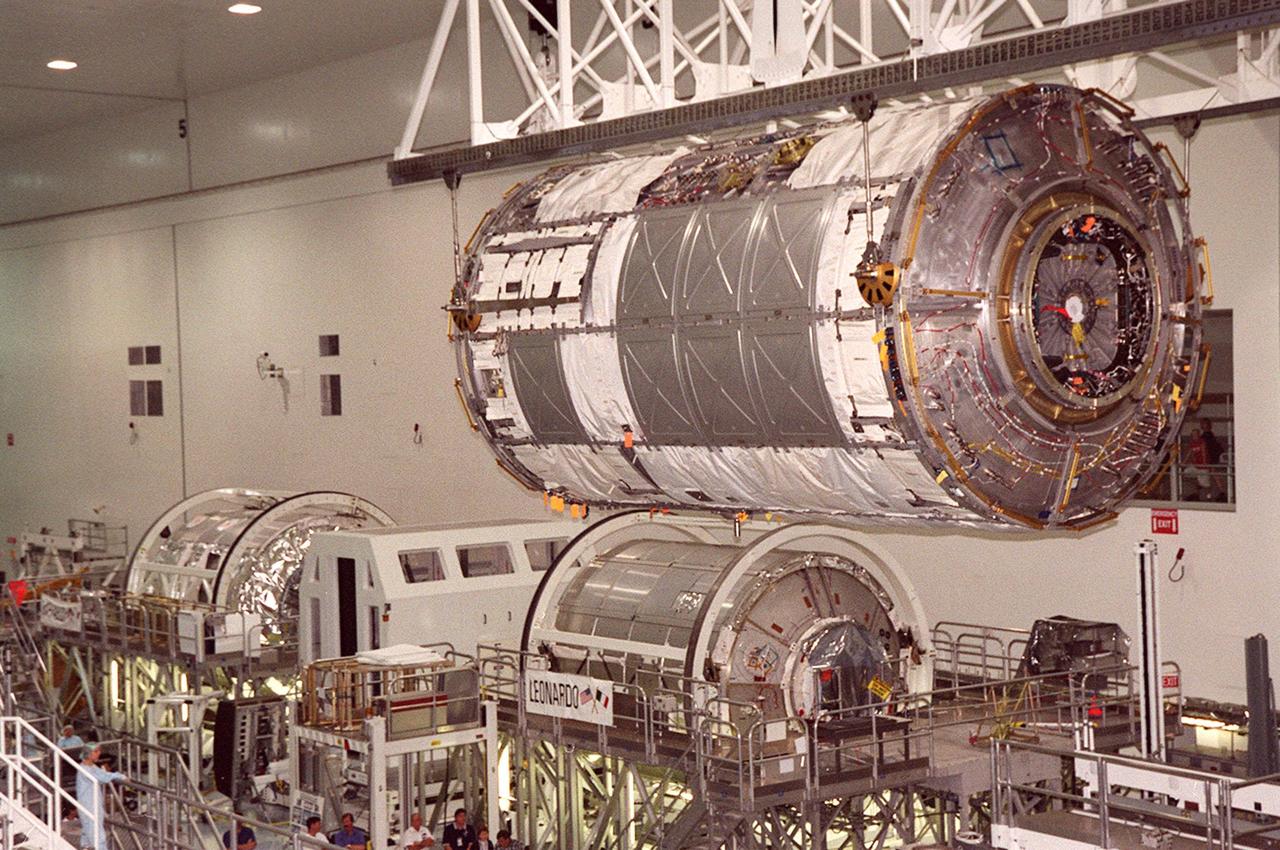
KENNEDY SPACE CENTER, FLA. -- The U.S. Laboratory Destiny, a component of the International Space Station, glides above two Multi-Purpose Logistics Modules (MPLMs), Raffaello (far left) and Leonardo, in the Space Station Processing Facility. Destiny is being moved to a payload canister for transfer to the Operations and Checkout Building where it will be tested in the altitude chamber. Destiny is scheduled to fly on mission STS-98 in early 2001. During the mission, the crew will install the Lab in the Space Station during a series of three space walks. The STS-98 mission will provide the Station with science research facilities and expand its power, life support and control capabilities. The U.S. Lab module continues a long tradition of microgravity materials research, first conducted by Skylab and later Shuttle and Spacelab missions. Destiny is expected to be a major feature in future research, providing facilities for biotechnology, fluid physics, combustion, and life sciences research
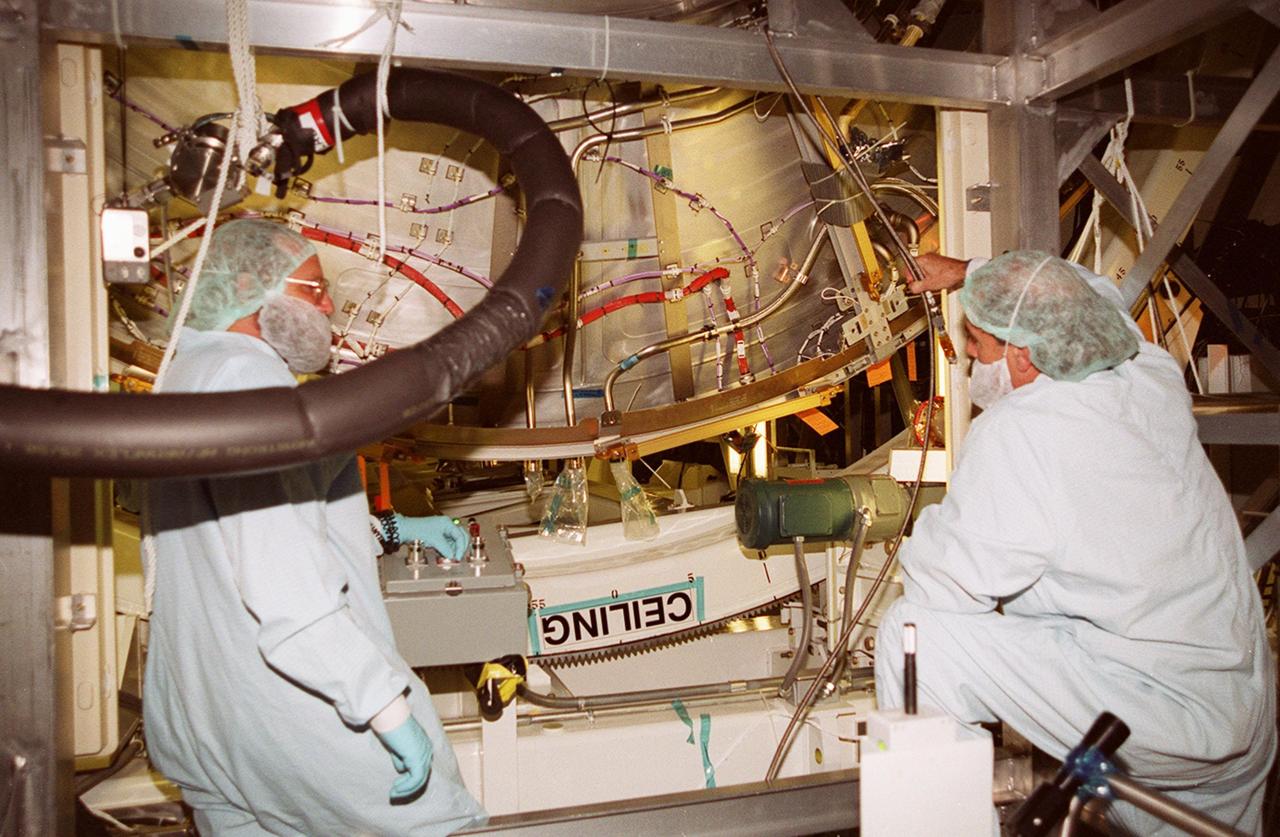
KENNEDY SPACE CENTER, FLA. -- In the Space Station Processing Facility, workers check the U.S. Laboratory Destiny as it rotates, with its ceiling now on the underside. A component of the International Space Station, Destiny is scheduled to fly on mission STS-98 in early 2001. During the mission, the crew will install the Lab during a series of three space walks. The STS-98 mission will provide the station with science research facilities and expand its power, life support and control capabilities. The U.S. Lab module continues a long tradition of microgravity materials research, first conducted by Skylab and later Shuttle and Spacelab missions. Destiny is expected to be a major feature in future research, providing facilities for biotechnology, fluid physics, combustion, and life sciences research

KENNEDY SPACE CENTER, FLA. -- The U.S. Laboratory Destiny, a component of the International Space Station, is lifted off a weigh stand (below) in the Space Station Processing Facility. The module is being moved to a payload canister for transfer to the Operations and Checkout Building where it will be tested in the altitude chamber. Destiny is scheduled to fly on mission STS-98 in early 2001. During the mission, the crew will install the Lab in the Space Station during a series of three space walks. The STS-98 mission will provide the Station with science research facilities and expand its power, life support and control capabilities. The U.S. Lab module continues a long tradition of microgravity materials research, first conducted by Skylab and later Shuttle and Spacelab missions. Destiny is expected to be a major feature in future research, providing facilities for biotechnology, fluid physics, combustion, and life sciences research
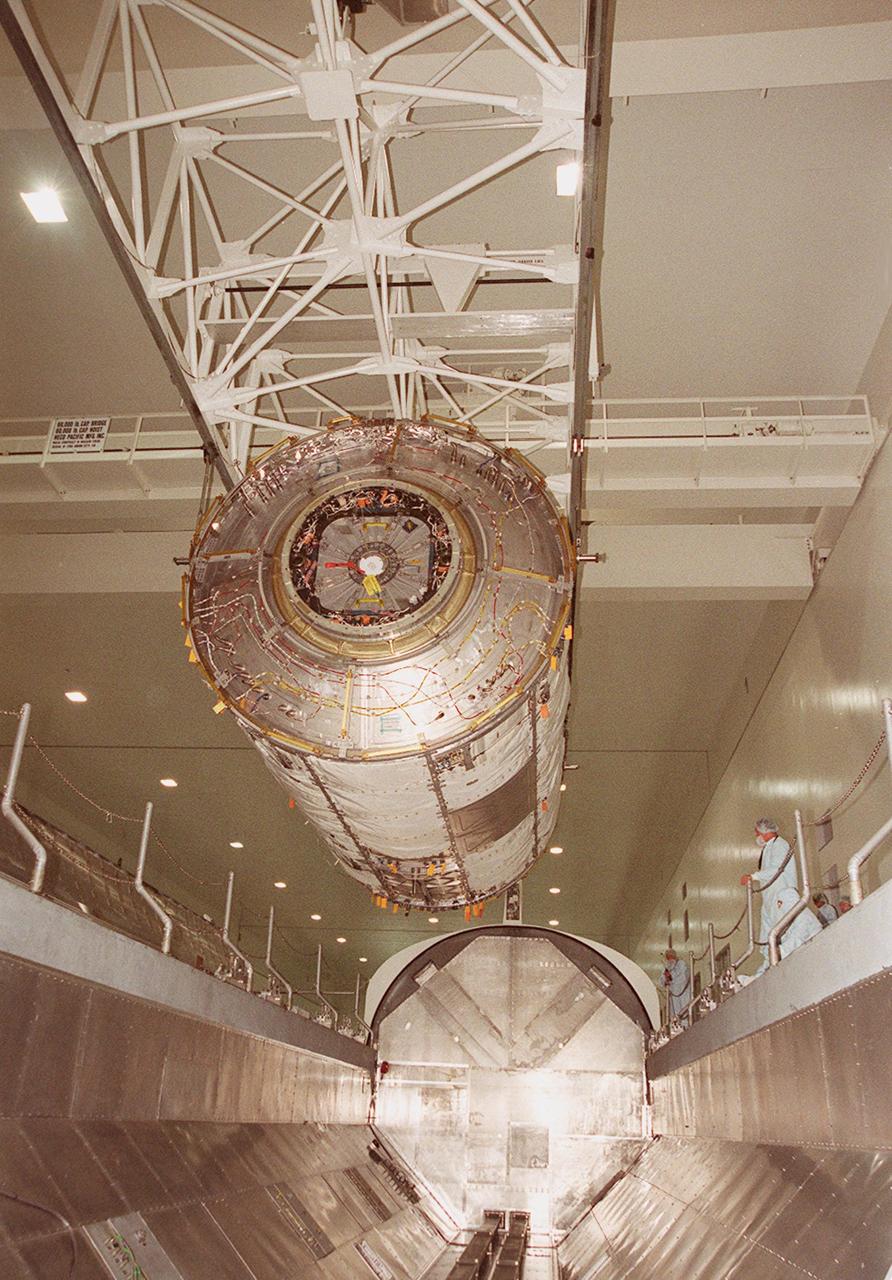
KENNEDY SPACE CENTER, FLA. -- In the Space Station Processing Facility, the U.S. Laboratory Destiny, a component of the International Space Station, is lowered into a payload canister for transfer to the Operations and Checkout Building where it will be tested in the altitude chamber. Destiny is scheduled to fly on mission STS-98 in early 2001. During the mission, the crew will install the Lab in the Space Station during a series of three space walks. The STS-98 mission will provide the Station with science research facilities and expand its power, life support and control capabilities. The U.S. Lab module continues a long tradition of microgravity materials research, first conducted by Skylab and later Shuttle and Spacelab missions. Destiny is expected to be a major feature in future research, providing facilities for biotechnology, fluid physics, combustion, and life sciences research

KENNEDY SPACE CENTER, FLA. -- Resting in a rotation and handling fixture, the U.S. Lab, a component of the International Space Station, is nearly vertical. The Lab, named Destiny, will undergo testing in the altitude chamber in the Operations and Checkout Building. Behind the Lab is the payload canister which transported it from the Space Station Processing Facility. Destiny is scheduled to fly on mission STS-98 in early 2001. During the mission, the crew will install the Lab in the Space Station during a series of three space walks. The STS-98 mission will provide the Station with science research facilities and expand its power, life support and control capabilities. The U.S. Lab module continues a long tradition of microgravity materials research, first conducted by Skylab and later Shuttle and Spacelab missions. Destiny is expected to be a major feature in future research, providing facilities for biotechnology, fluid physics, combustion, and life sciences research
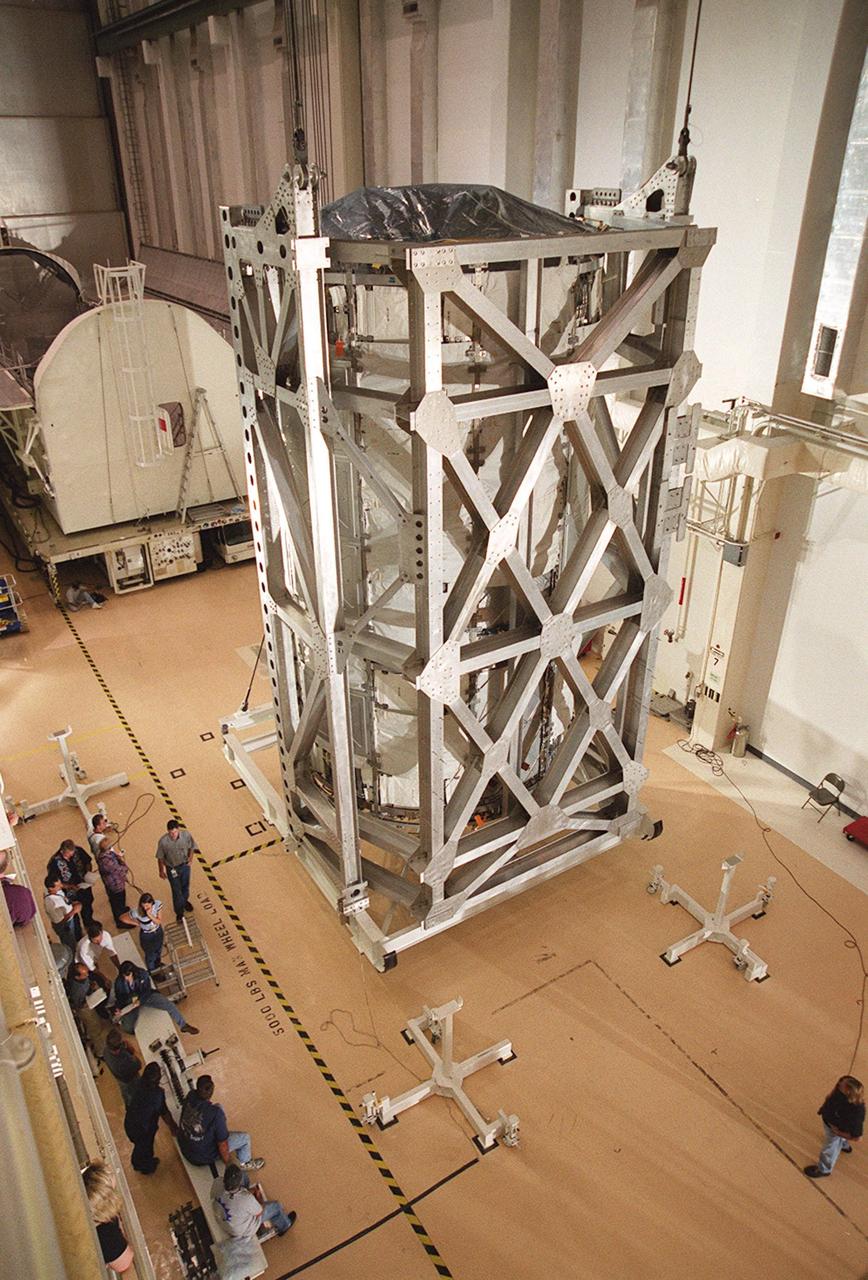
KENNEDY SPACE CENTER, FLA. -- The U.S. Lab, a component of the International Space Station, rests in a vertical position in the Operations and Checkout Building. The Lab, named Destiny, will undergo testing in the altitude chamber in the O&C. Behind the Lab is the payload canister which transported it from the Space Station Processing Facility. Destiny is scheduled to fly on mission STS-98 in early 2001. During the mission, the crew will install the Lab in the Space Station during a series of three space walks. The STS-98 mission will provide the Station with science research facilities and expand its power, life support and control capabilities. The U.S. Lab module continues a long tradition of microgravity materials research, first conducted by Skylab and later Shuttle and Spacelab missions. Destiny is expected to be a major feature in future research, providing facilities for biotechnology, fluid physics, combustion, and life sciences research
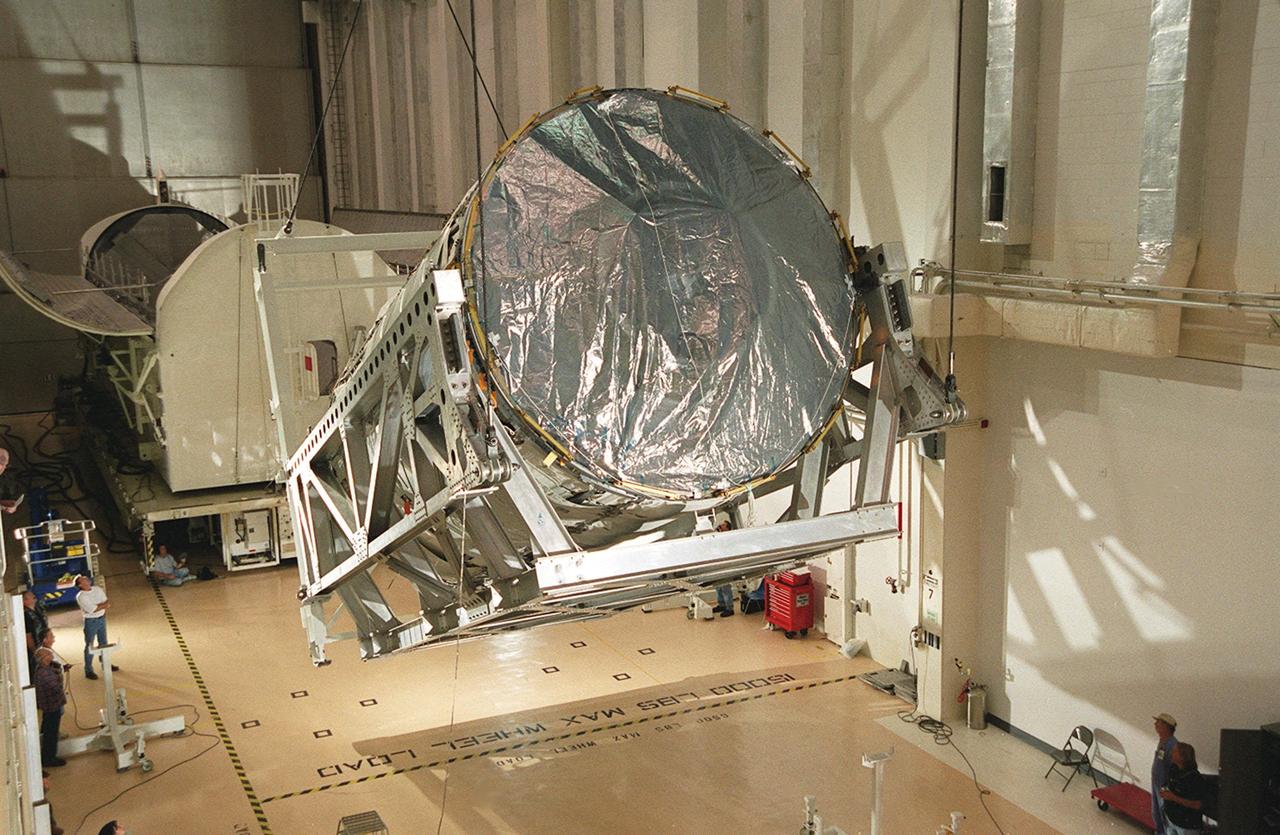
Resting in a rotation and handling fixture, the U.S. Lab, a component of the International Space Station, is lifted toward vertical. The Lab, named Destiny, will undergo testing in the altitude chamber in the Operations and Checkout Building. Behind the Lab is the payload canister which transported it from the Space Station Processing Facility. Destiny is scheduled to fly on mission STS-98 in early 2001. During the mission, the crew will install the Lab in the Space Station during a series of three space walks. The STS-98 mission will provide the Station with science research facilities and expand its power, life support and control capabilities. The U.S. Lab module continues a long tradition of microgravity materials research, first conducted by Skylab and later Shuttle and Spacelab missions. Destiny is expected to be a major feature in future research, providing facilities for biotechnology, fluid physics, combustion, and life sciences research
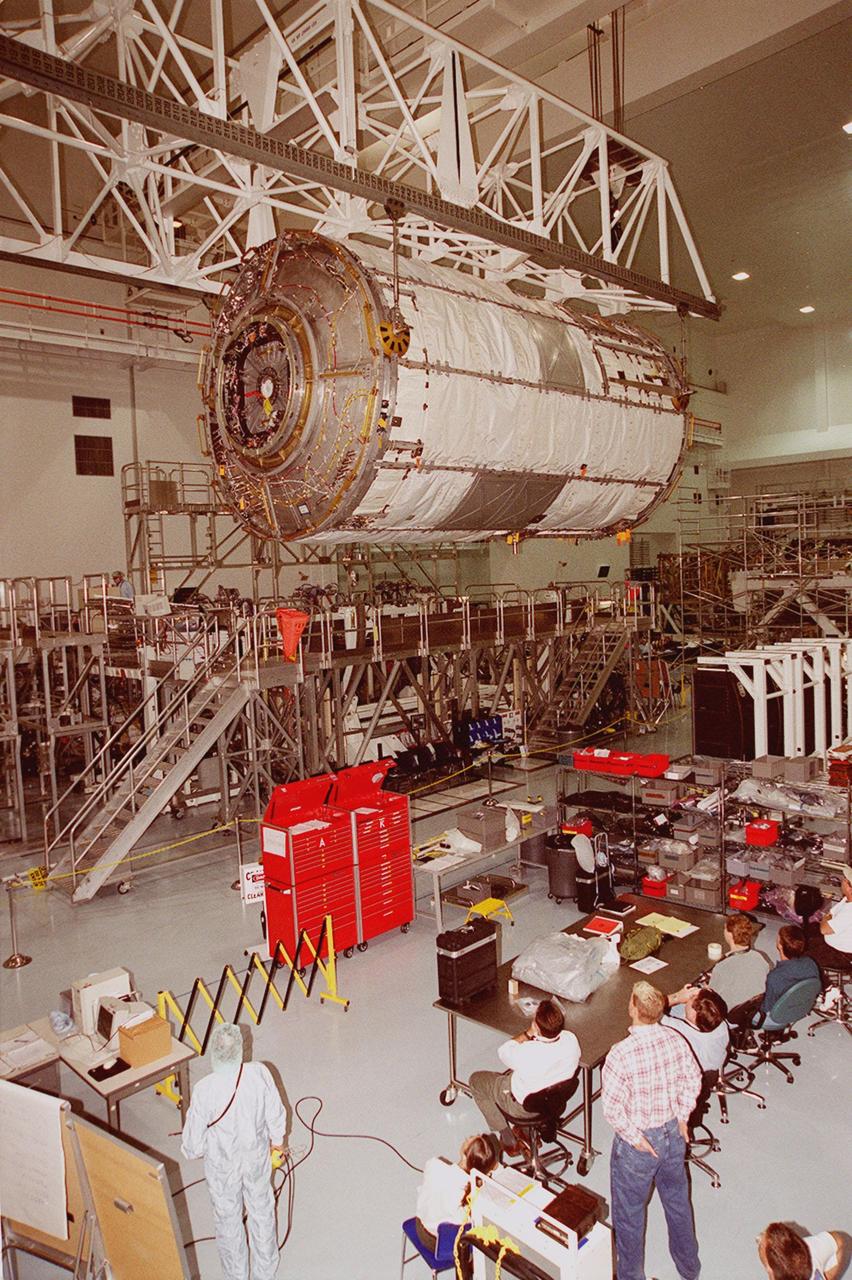
KENNEDY SPACE CENTER, FLA. -- Workers in the Space Station Processing Facility watch as the U.S. Lab Destiny, lifted by an overhead crane, glides through the air to a weigh stand. A component of the International Space Station, Destiny is scheduled to fly on mission STS-98 in early 2001. During the mission, the crew will install the Lab during a series of three space walks. The STS-98 mission will provide the station with science research facilities and expand its power, life support and control capabilities. The U.S. Lab module continues a long tradition of microgravity materials research, first conducted by Skylab and later Shuttle and Spacelab missions. Destiny is expected to be a major feature in future research, providing facilities for biotechnology, fluid physics, combustion, and life sciences research

KENNEDY SPACE CENTER, FLA. -- Workers in the Space Station Processing Facility watch as the U.S. Lab Destiny, lifted by an overhead crane, glides through the air to a weigh stand. A component of the International Space Station, Destiny is scheduled to fly on mission STS-98 in early 2001. During the mission, the crew will install the Lab during a series of three space walks. The STS-98 mission will provide the station with science research facilities and expand its power, life support and control capabilities. The U.S. Lab module continues a long tradition of microgravity materials research, first conducted by Skylab and later Shuttle and Spacelab missions. Destiny is expected to be a major feature in future research, providing facilities for biotechnology, fluid physics, combustion, and life sciences research
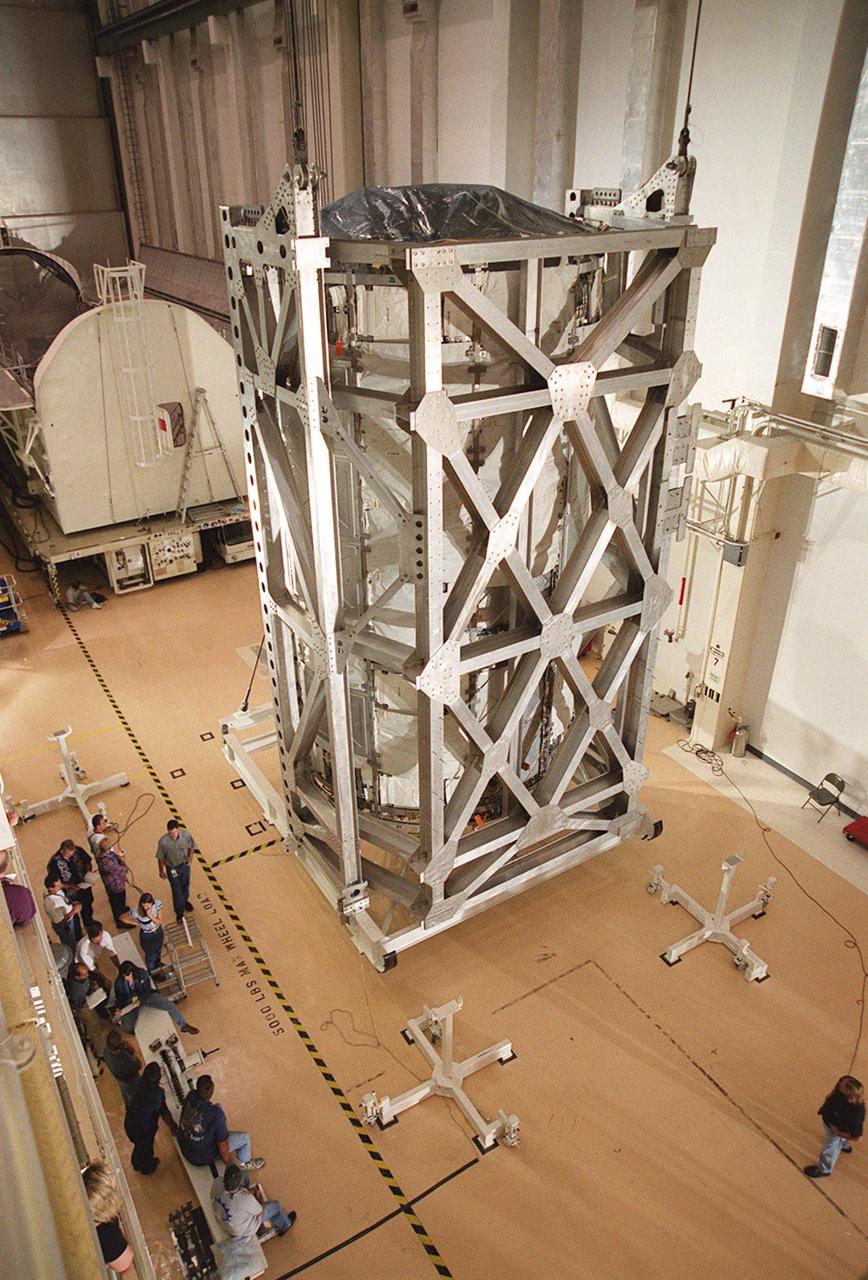
KENNEDY SPACE CENTER, FLA. -- The U.S. Lab, a component of the International Space Station, rests in a vertical position in the Operations and Checkout Building. The Lab, named Destiny, will undergo testing in the altitude chamber in the O&C. Behind the Lab is the payload canister which transported it from the Space Station Processing Facility. Destiny is scheduled to fly on mission STS-98 in early 2001. During the mission, the crew will install the Lab in the Space Station during a series of three space walks. The STS-98 mission will provide the Station with science research facilities and expand its power, life support and control capabilities. The U.S. Lab module continues a long tradition of microgravity materials research, first conducted by Skylab and later Shuttle and Spacelab missions. Destiny is expected to be a major feature in future research, providing facilities for biotechnology, fluid physics, combustion, and life sciences research

KENNEDY SPACE CENTER, FLA. -- In the Space Station Processing Facility, an overhead crane lifts and moves the U.S. Laboratory Destiny to a weigh stand. A component of the International Space Station, Destiny is scheduled to fly on mission STS-98 in early 2001. During the mission, the crew will install the Lab during a series of three space walks. The STS-98 mission will provide the station with science research facilities and expand its power, life support and control capabilities. The U.S. Lab module continues a long tradition of microgravity materials research, first conducted by Skylab and later Shuttle and Spacelab missions. Destiny is expected to be a major feature in future research, providing facilities for biotechnology, fluid physics, combustion, and life sciences research
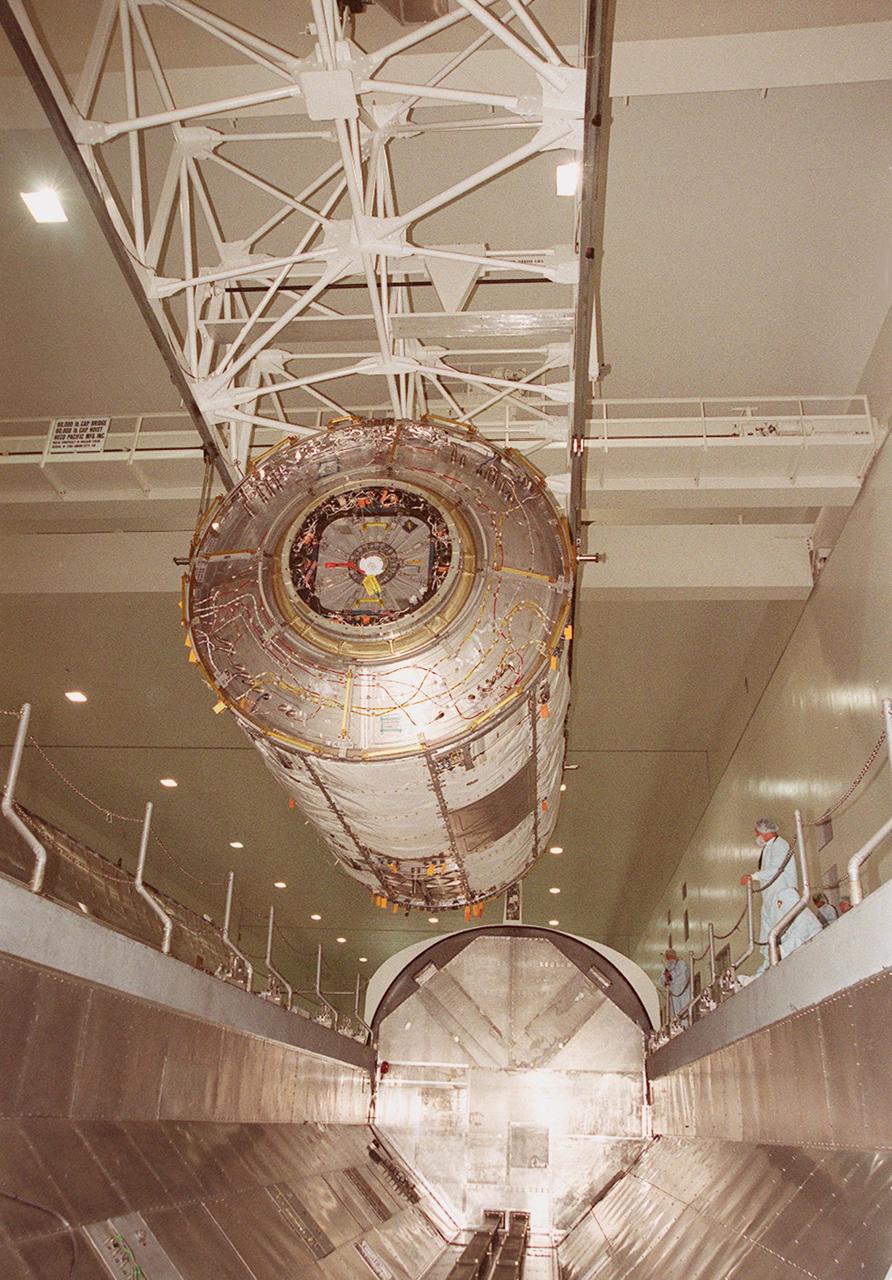
KENNEDY SPACE CENTER, FLA. -- In the Space Station Processing Facility, the U.S. Laboratory Destiny, a component of the International Space Station, is lowered into a payload canister for transfer to the Operations and Checkout Building where it will be tested in the altitude chamber. Destiny is scheduled to fly on mission STS-98 in early 2001. During the mission, the crew will install the Lab in the Space Station during a series of three space walks. The STS-98 mission will provide the Station with science research facilities and expand its power, life support and control capabilities. The U.S. Lab module continues a long tradition of microgravity materials research, first conducted by Skylab and later Shuttle and Spacelab missions. Destiny is expected to be a major feature in future research, providing facilities for biotechnology, fluid physics, combustion, and life sciences research
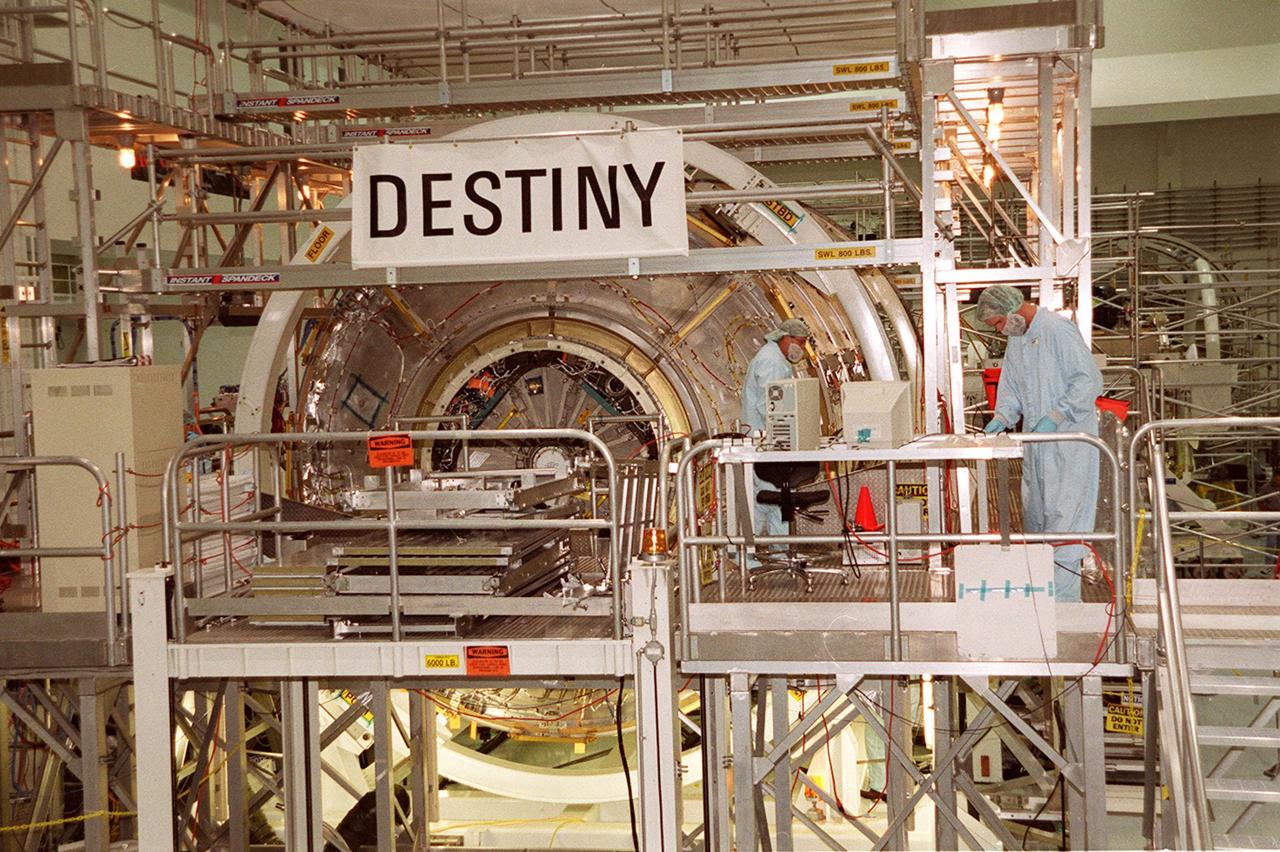
KENNEDY SPACE CENTER, FLA. -- In the Space Station Processing Facility, the U.S. Laboratory Destiny is about to undergo rotation in its workstand. A component of the International Space Station, Destiny is scheduled to fly on mission STS-98 in early 2001. During the mission, the crew will install the Lab during a series of three space walks. The STS-98 mission will provide the station with science research facilities and expand its power, life support and control capabilities. The U.S. Lab module continues a long tradition of microgravity materials research, first conducted by Skylab and later Shuttle and Spacelab missions. Destiny is expected to be a major feature in future research, providing facilities for biotechnology, fluid physics, combustion, and life sciences research
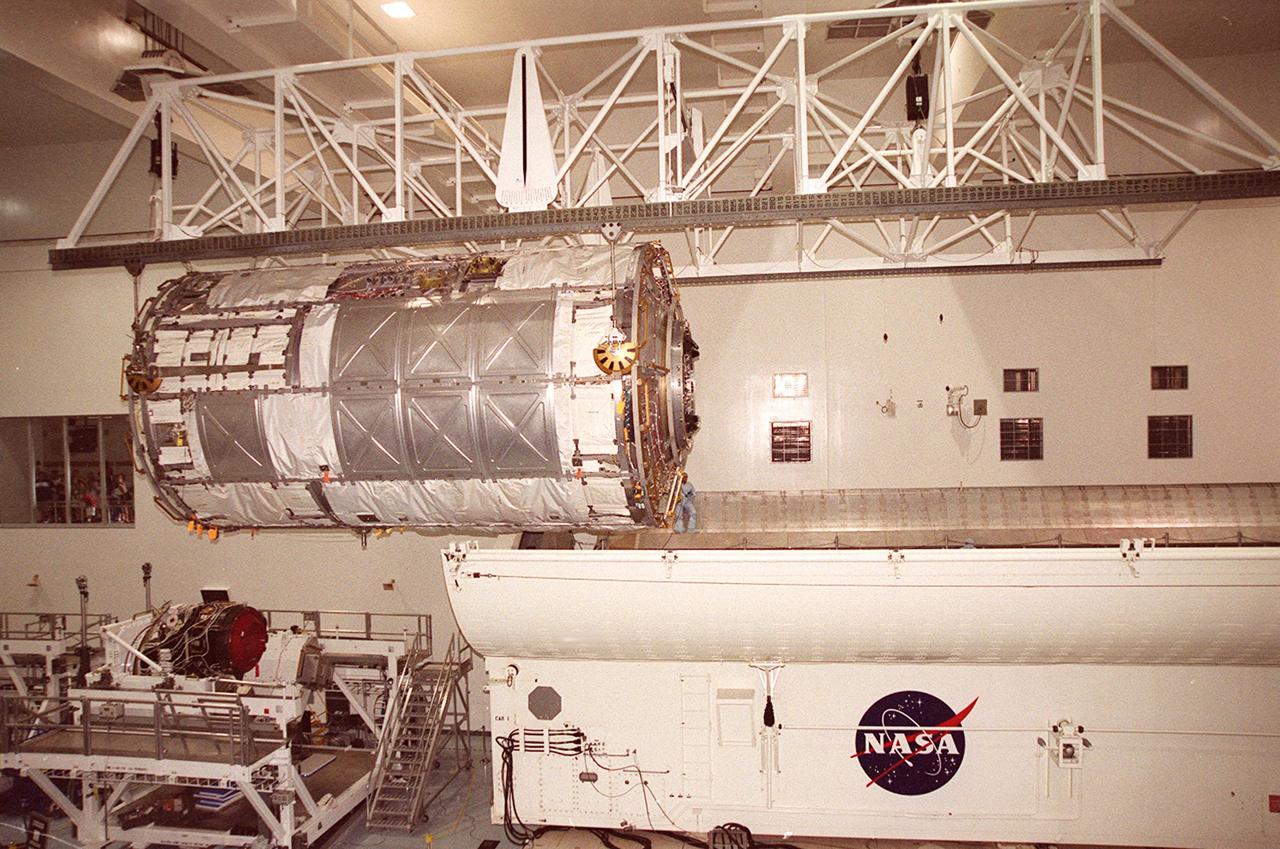
KENNEDY SPACE CENTER, FLA. -- In the Space Station Processing Facility (SSPF), the U.S. Laboratory Destiny, a component of the International Space Station, is moved to a payload canister for transfer to the Operations and Checkout Building where it will be tested in the altitude chamber. On the floor of the SSPF, left, is a Pressurized Mating Adapter-3. Destiny is scheduled to fly on mission STS-98 in early 2001. During the mission, the crew will install the Lab in the Space Station during a series of three space walks. The STS-98 mission will provide the Station with science research facilities and expand its power, life support and control capabilities. The U.S. Lab module continues a long tradition of microgravity materials research, first conducted by Skylab and later Shuttle and Spacelab missions. Destiny is expected to be a major feature in future research, providing facilities for biotechnology, fluid physics, combustion, and life sciences research
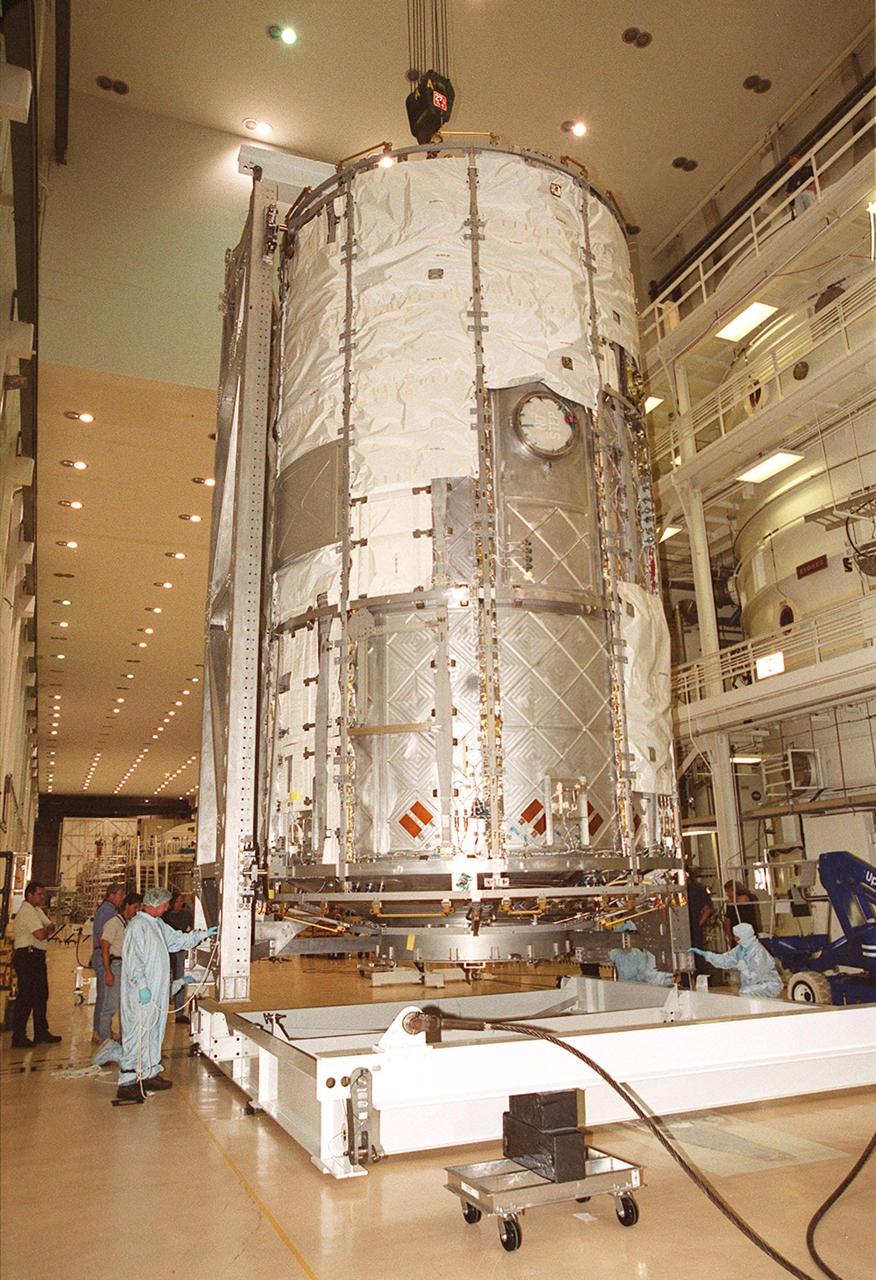
KENNEDY SPACE CENTER, FLA. -- In the Operations and Checkout Building, the U.S. Lab reaches the open floor after being lifted out of the vacuum chamber where it was tested for leaks. The test was very successful. The 32,000-pound scientific research lab, named Destiny, is the first Space Station element to spend seven days in the renovated vacuum chamber. Destiny is scheduled to be launched on Shuttle mission STS-98, the 5A assembly mission, targeted for Jan. 18, 2001. During the mission, the crew will install the Lab in the Space Station during a series of three space walks. The STS-98 mission will provide the Station with science research facilities and expand its power, life support and control capabilities. The U.S. Lab module continues a long tradition of microgravity materials research, first conducted by Skylab and later Shuttle and Spacelab missions. Destiny is expected to be a major feature in future research, providing facilities for biotechnology, fluid physics, combustion, and life sciences research
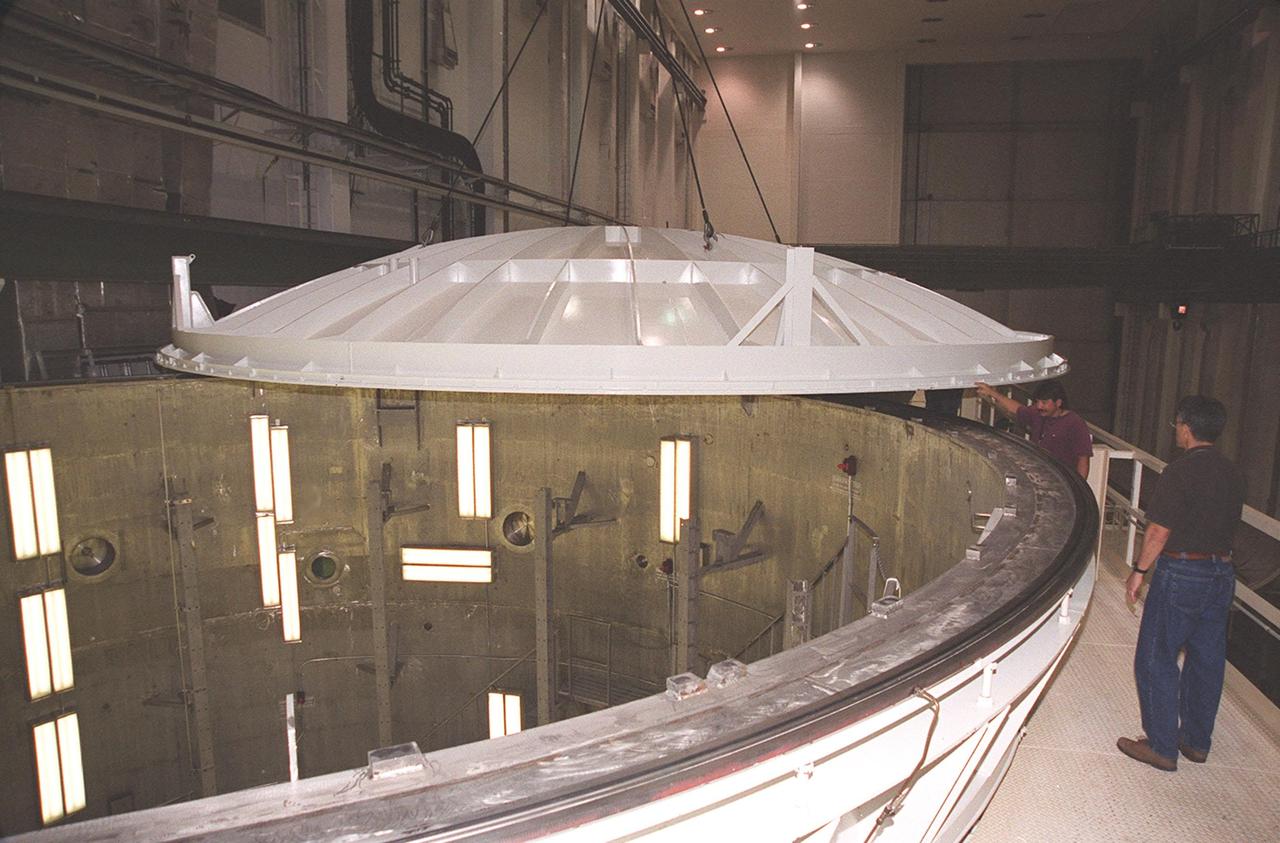
KENNEDY SPACE CENTER, FLA. -- An overhead crane moves the lid over the vacuum chamber containing the U.S. Lab, a component of the International Space Station. The 32,000-pound scientific research lab, named Destiny, is the first Space Station element to spend seven days in the renovated vacuum chamber for a leak test. Destiny is scheduled to be launched on Shuttle mission STS-98, the 5A assembly mission, targeted for Jan. 18, 2001. During the mission, the crew will install the Lab in the Space Station during a series of three space walks. The STS-98 mission will provide the Station with science research facilities and expand its power, life support and control capabilities. The U.S. Lab module continues a long tradition of microgravity materials research, first conducted by Skylab and later Shuttle and Spacelab missions. Destiny is expected to be a major feature in future research, providing facilities for biotechnology, fluid physics, combustion, and life sciences research