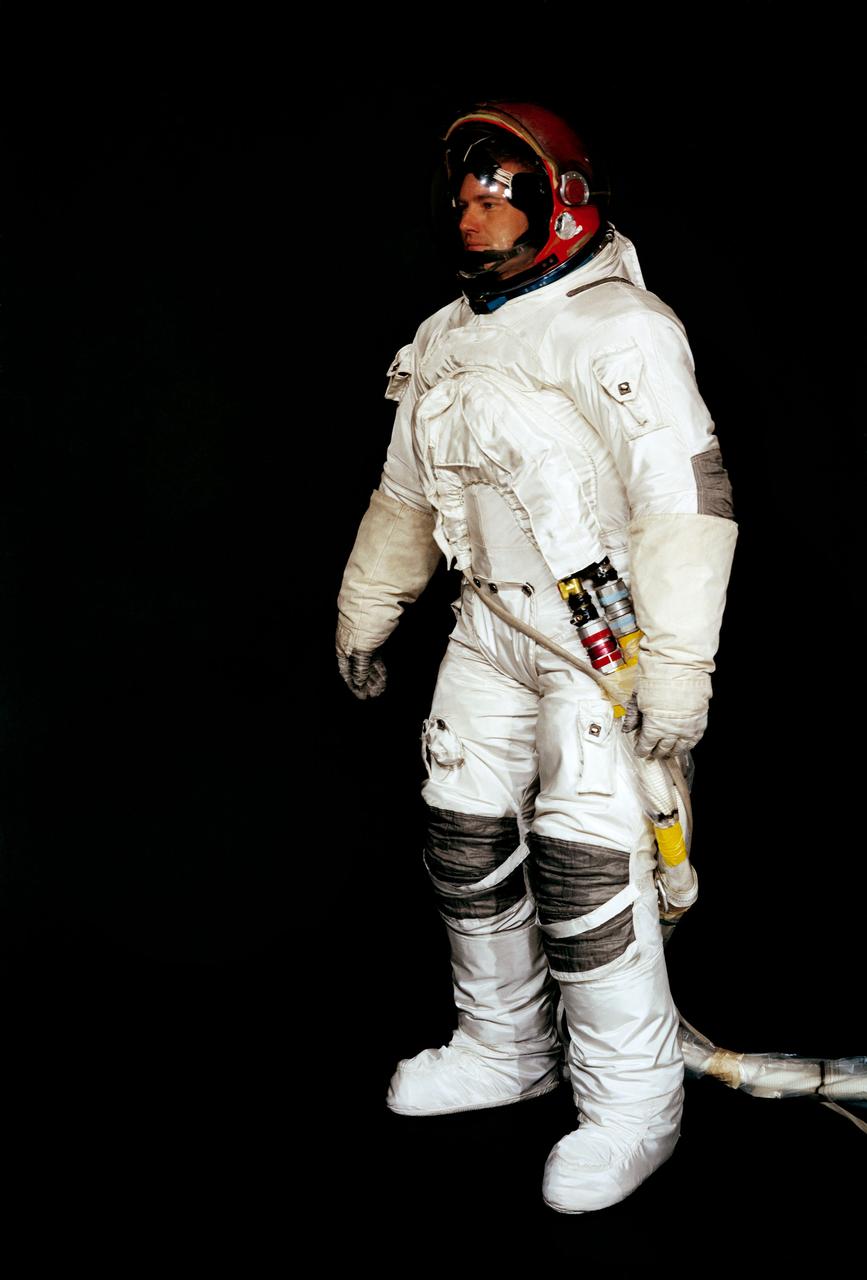
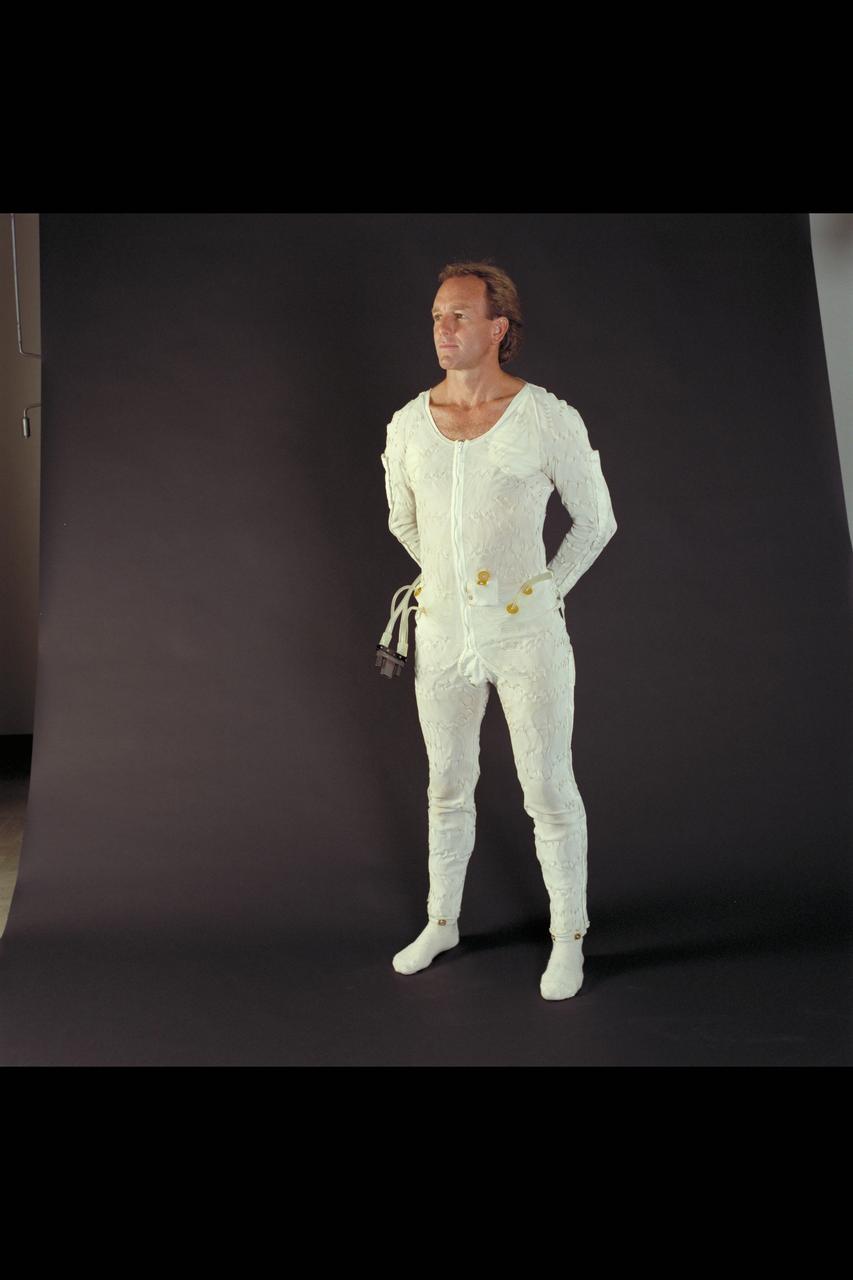
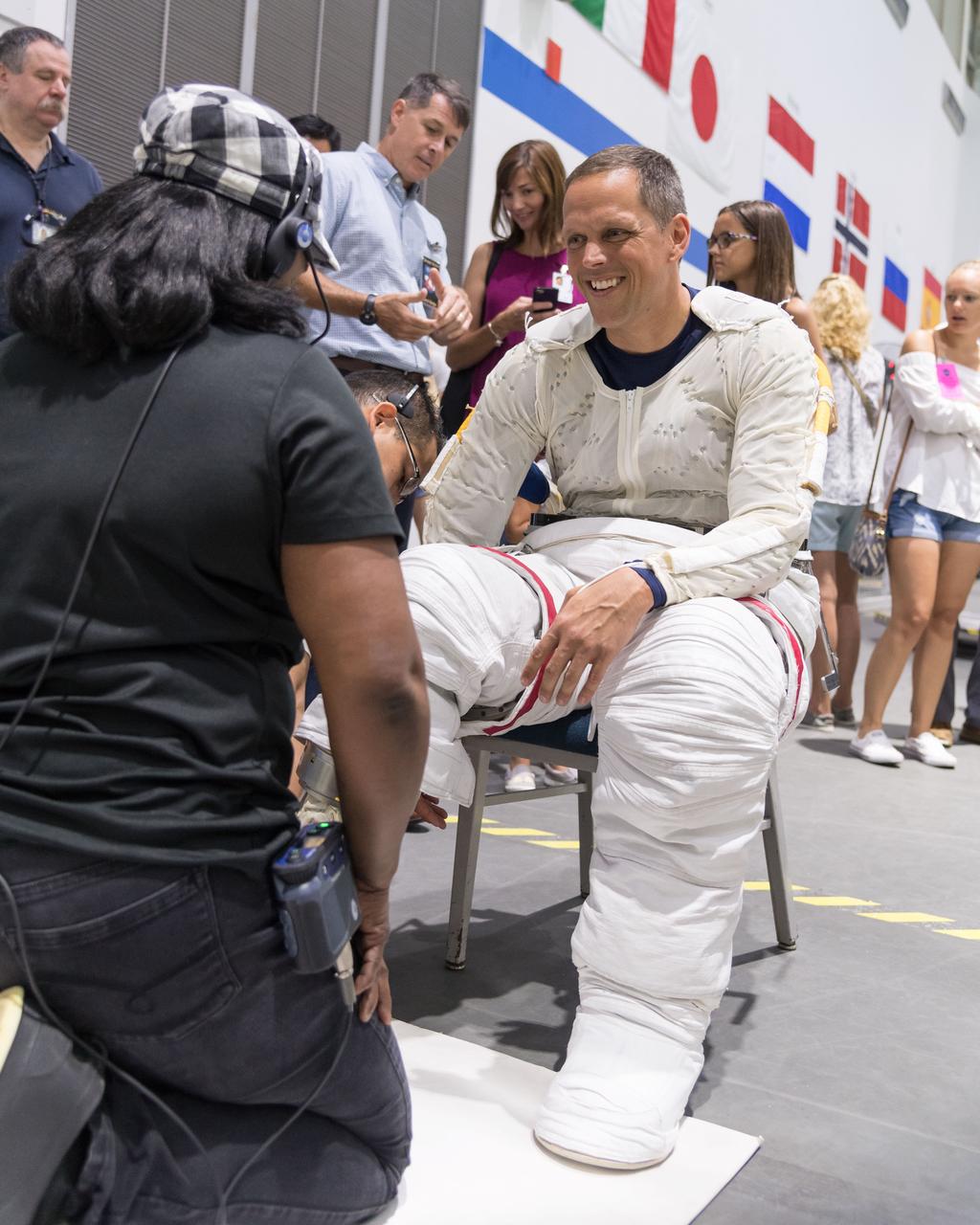
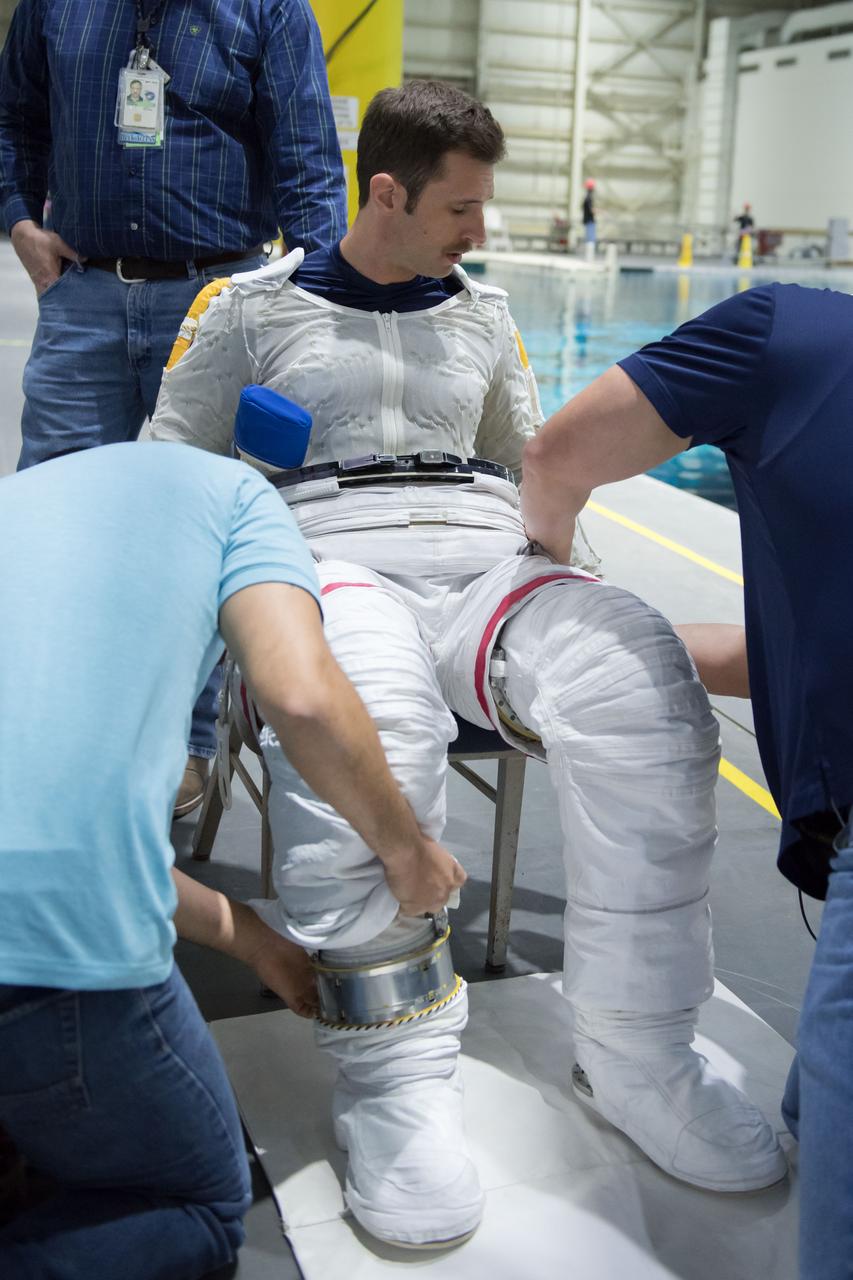
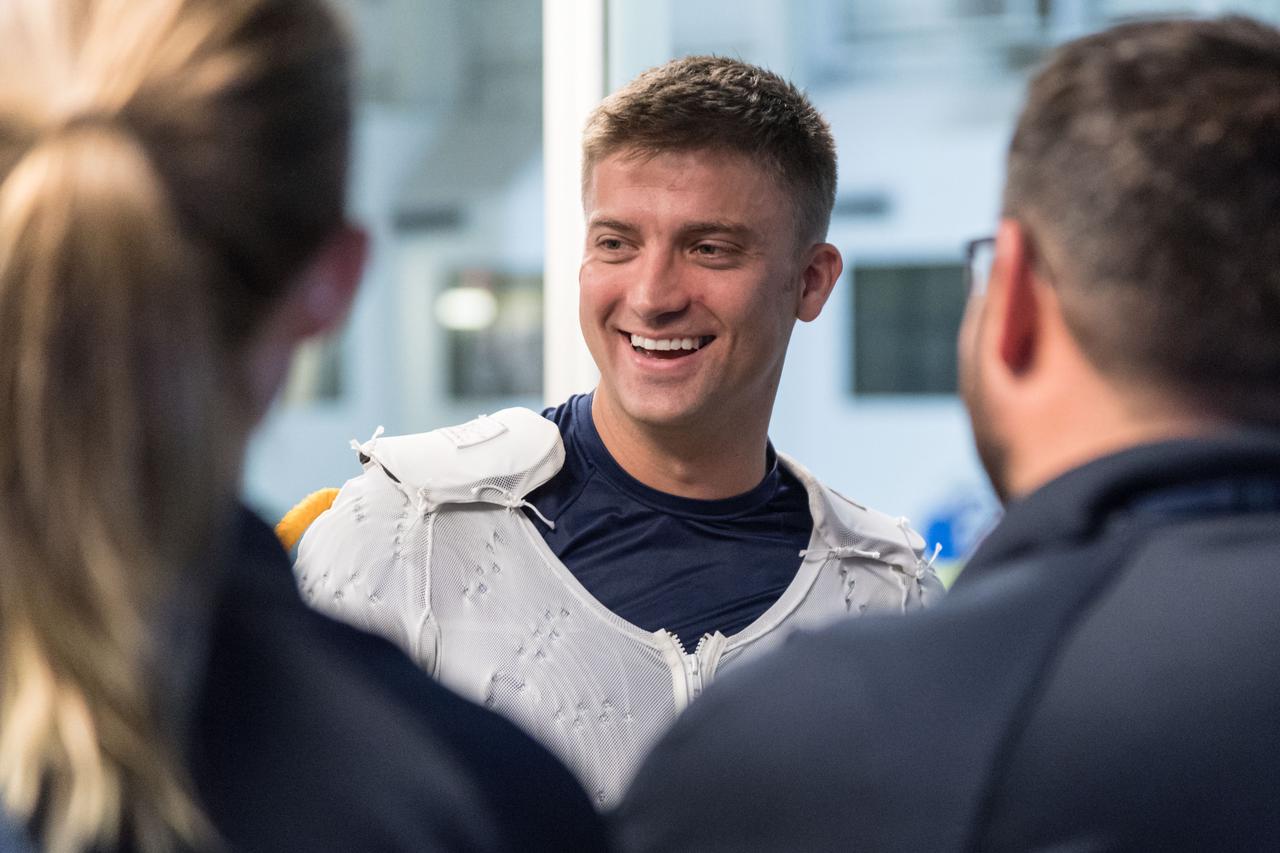
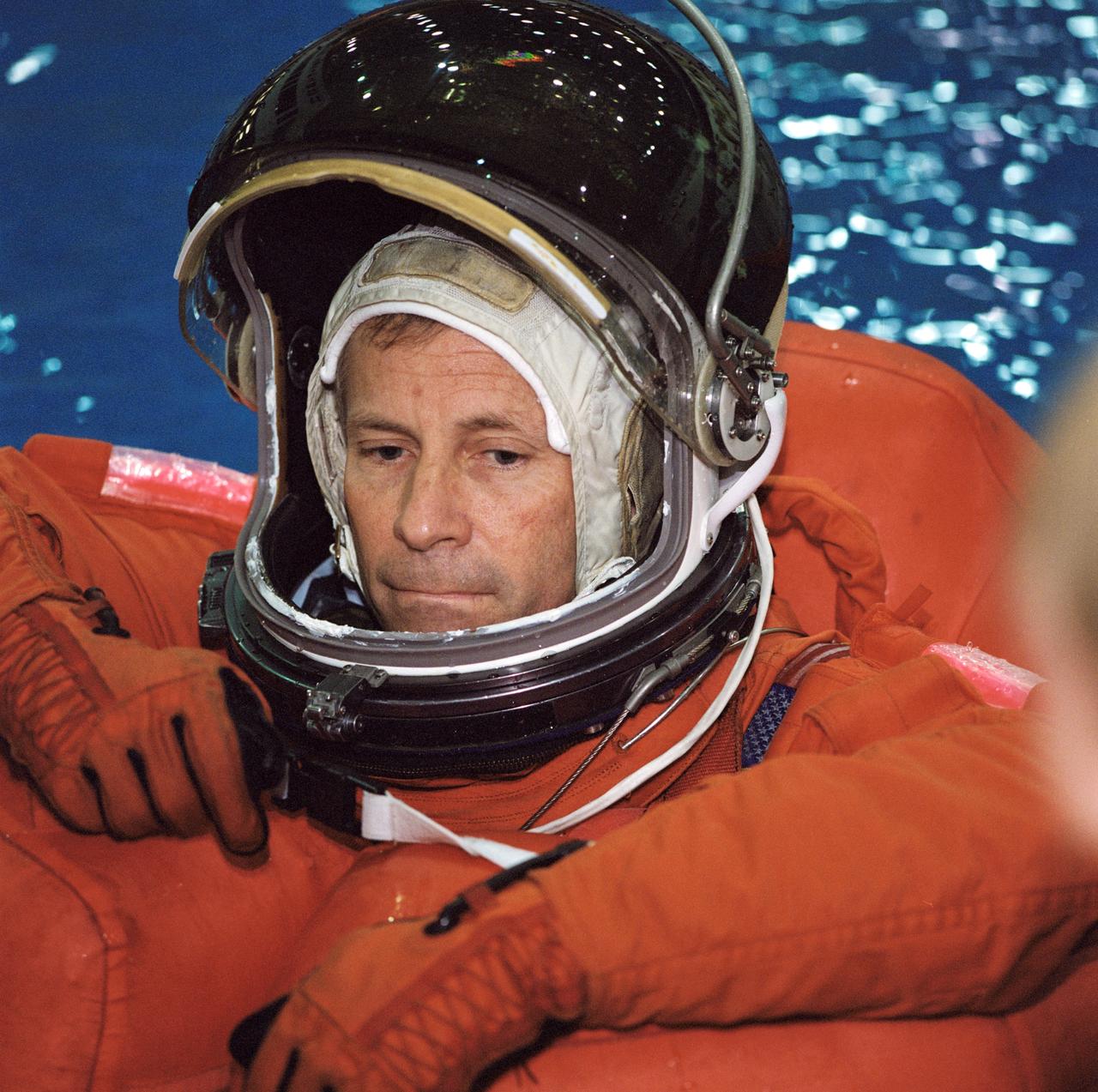
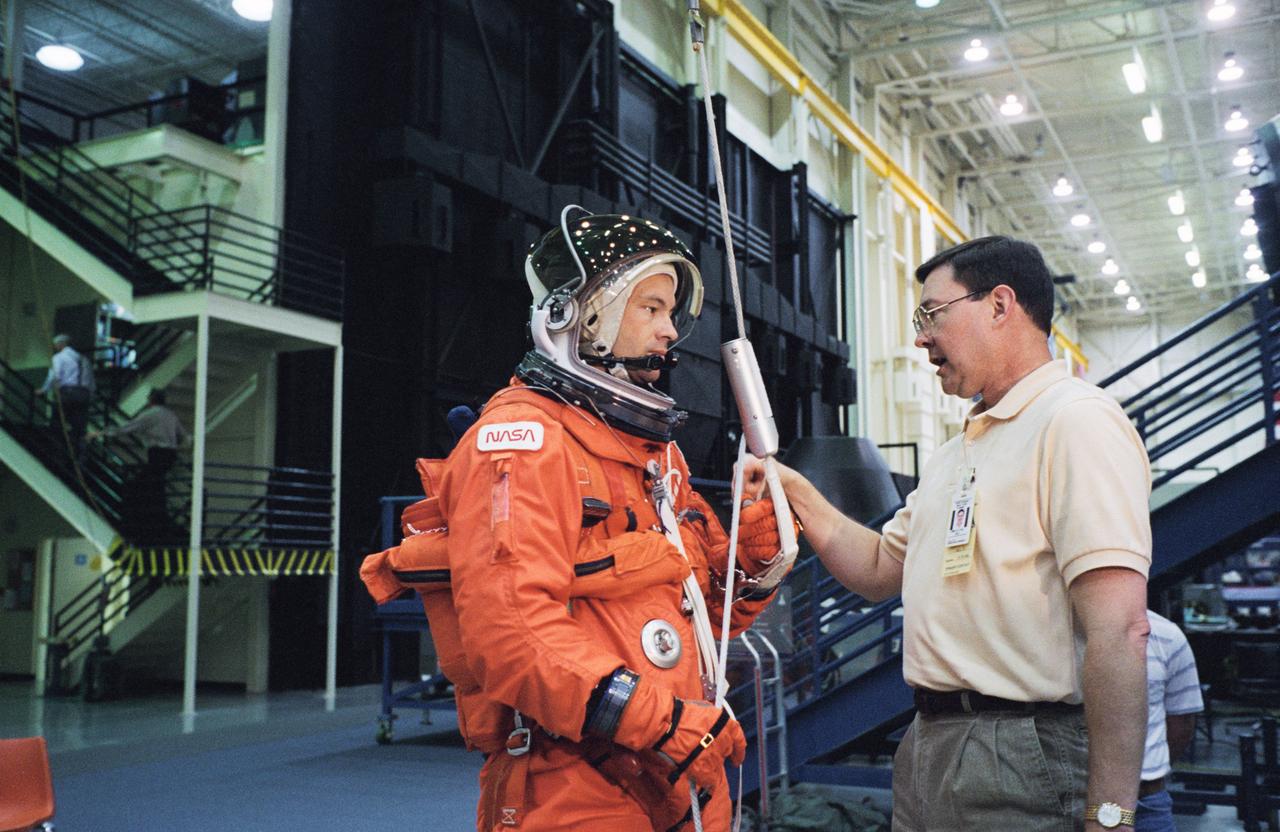
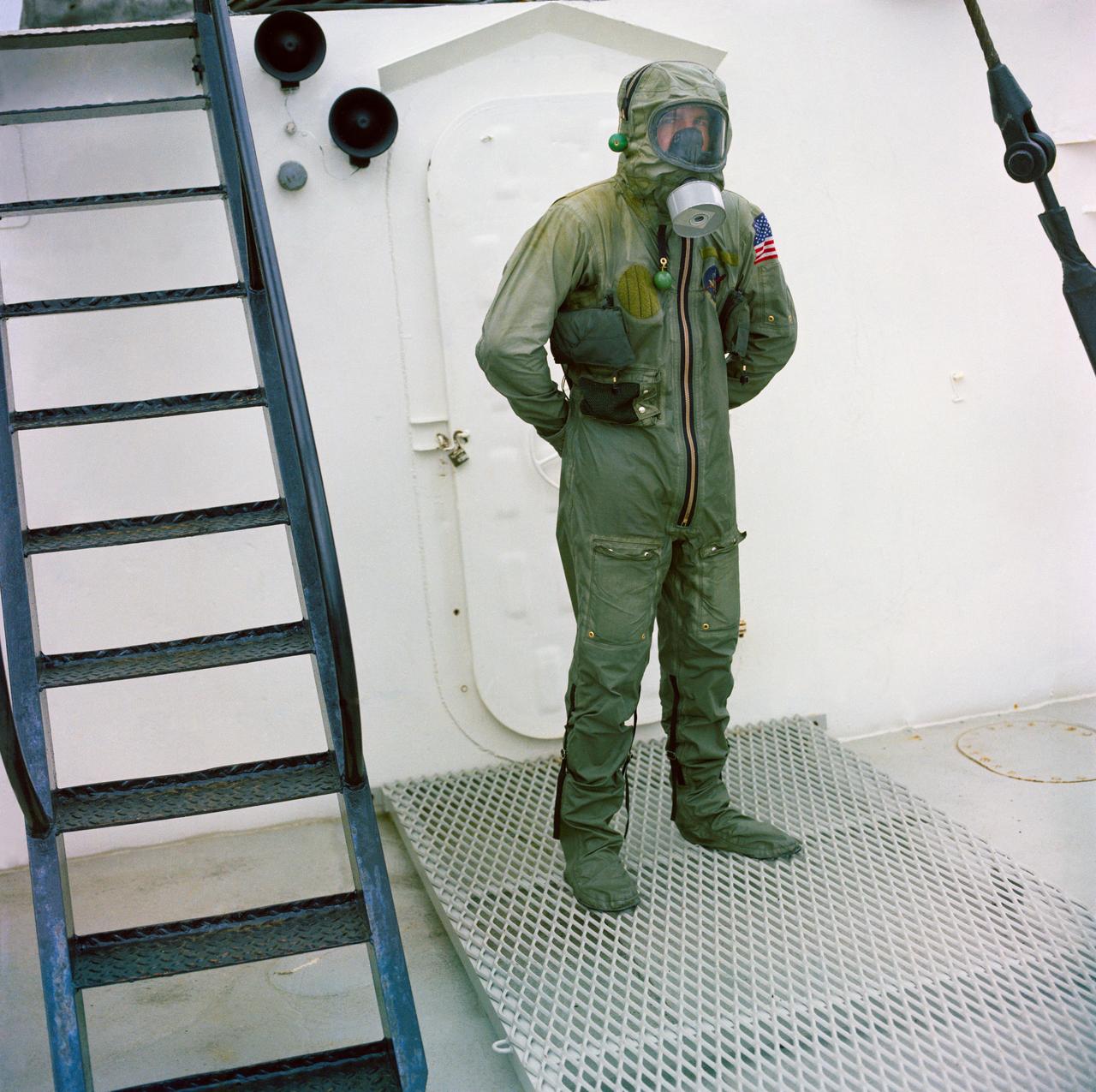
View of subject wearing Biological Isolation Garment (BIG) during a qualification test.
Subject wearing Biological Isolation Garment during qualification test
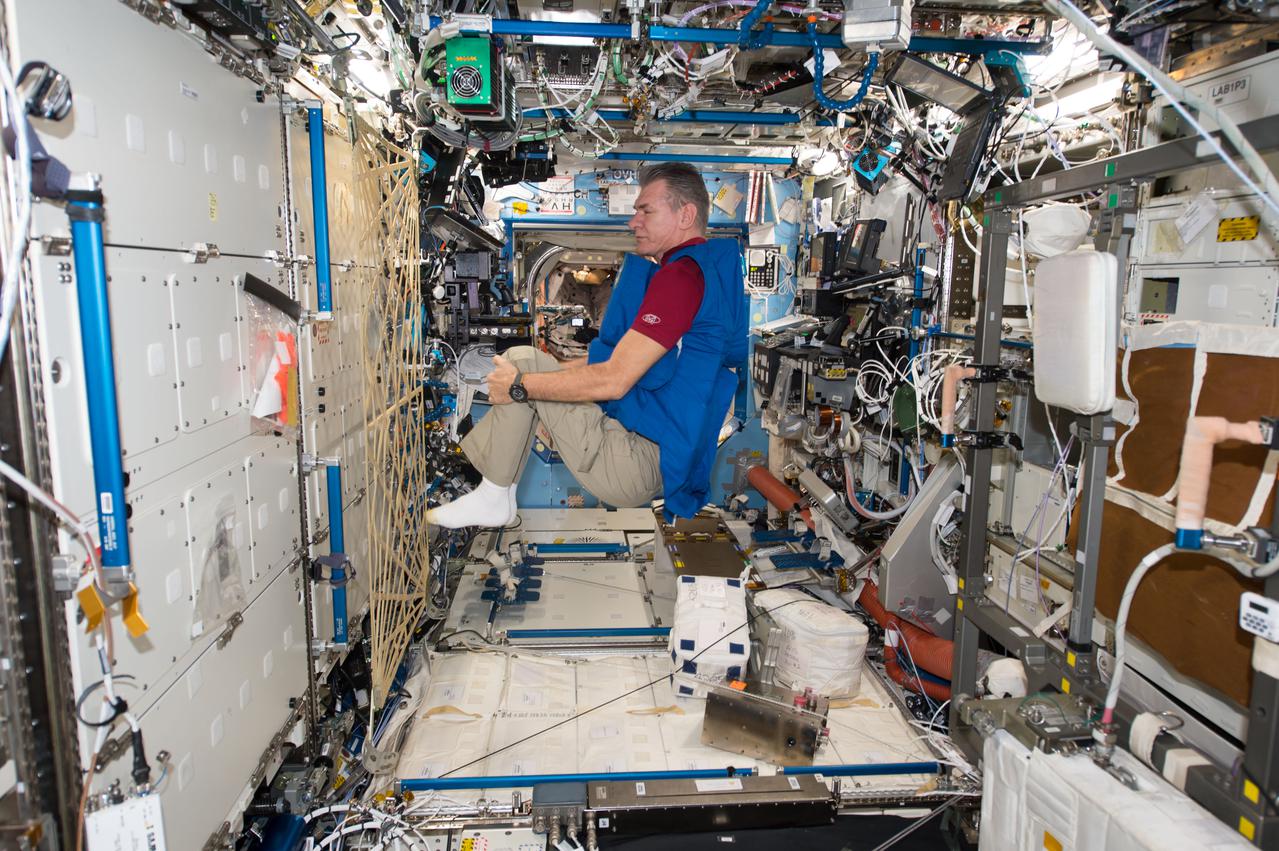
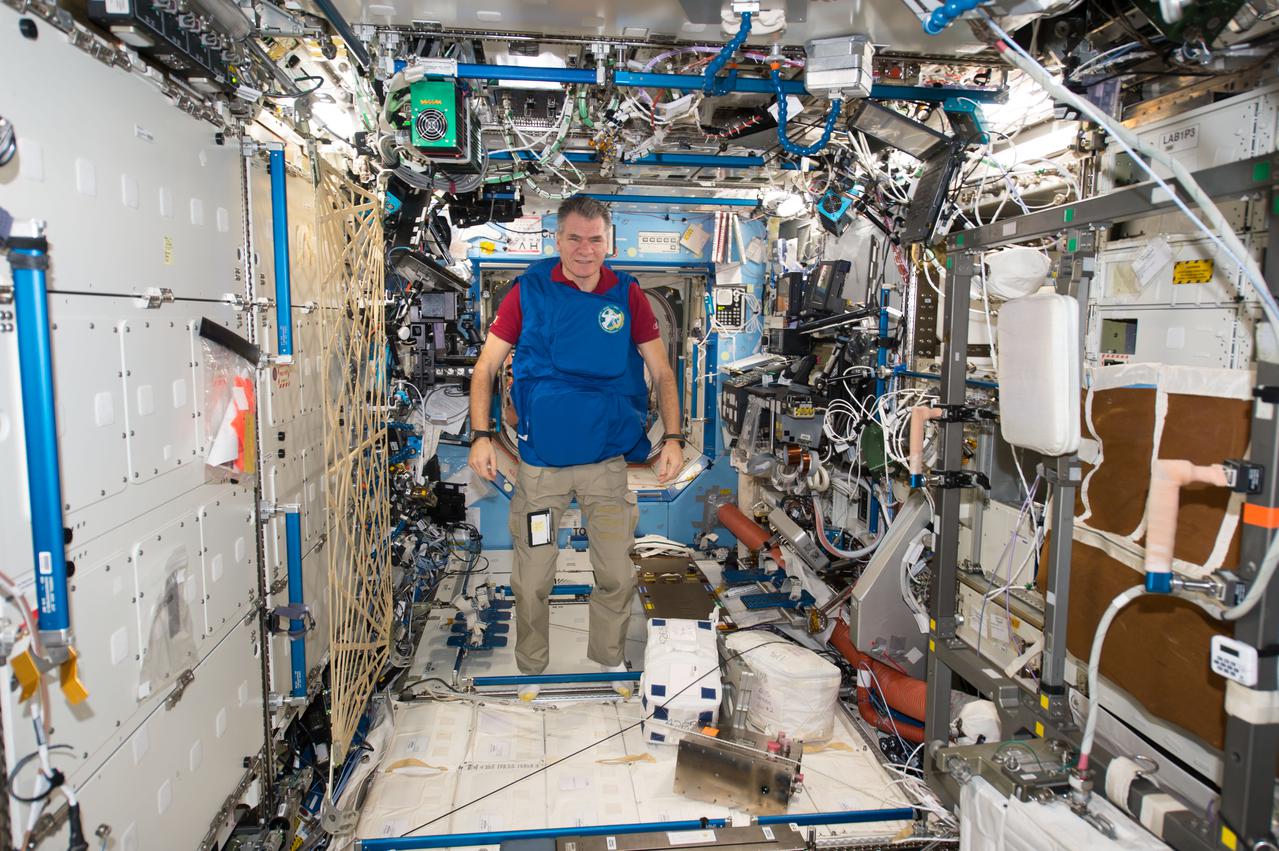
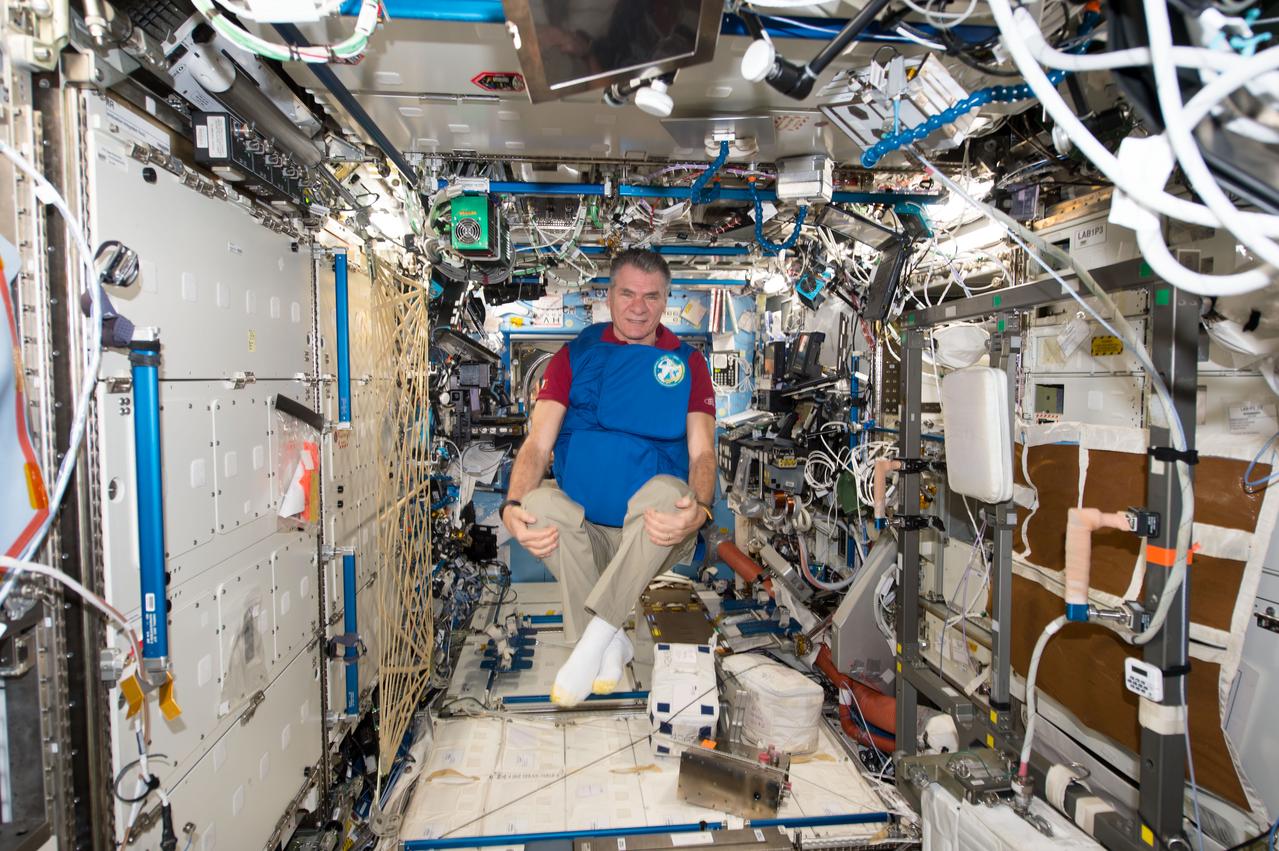
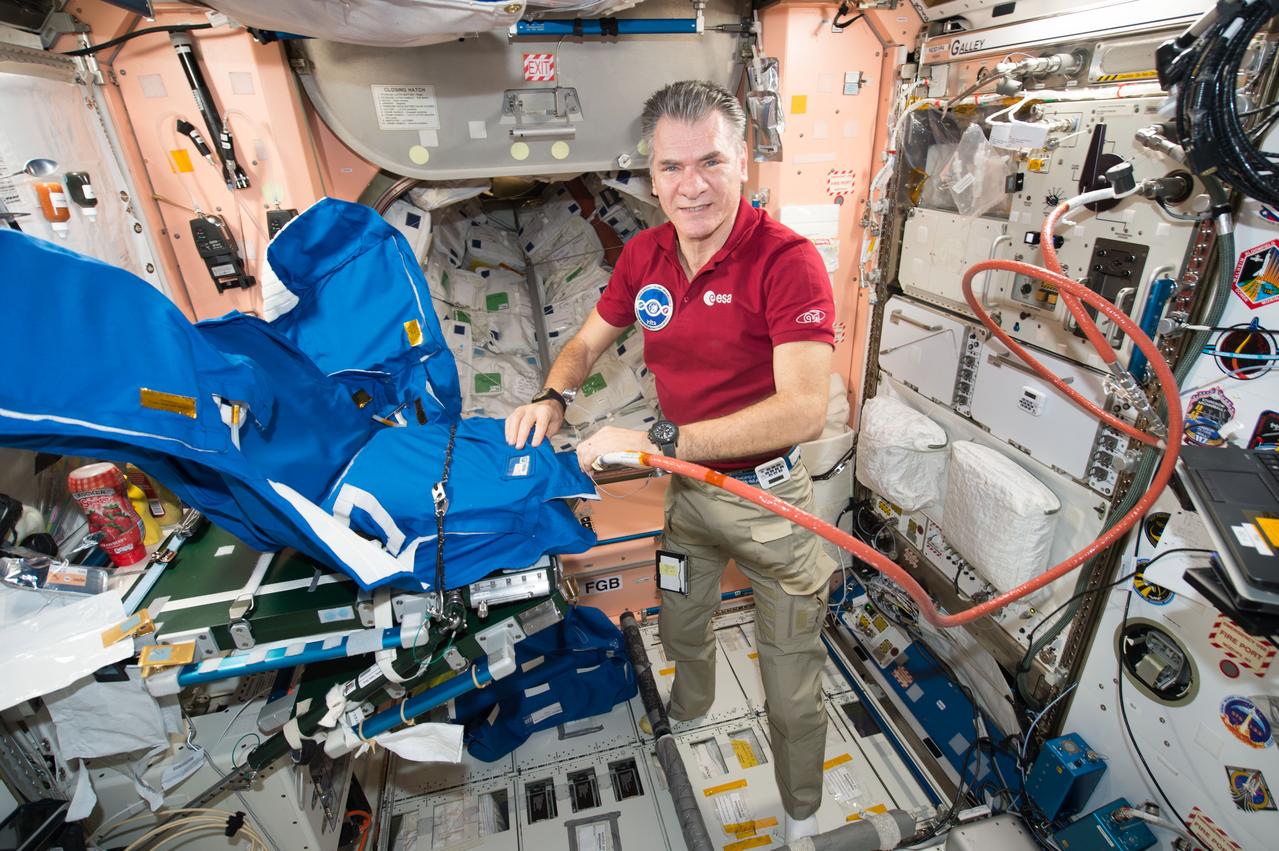
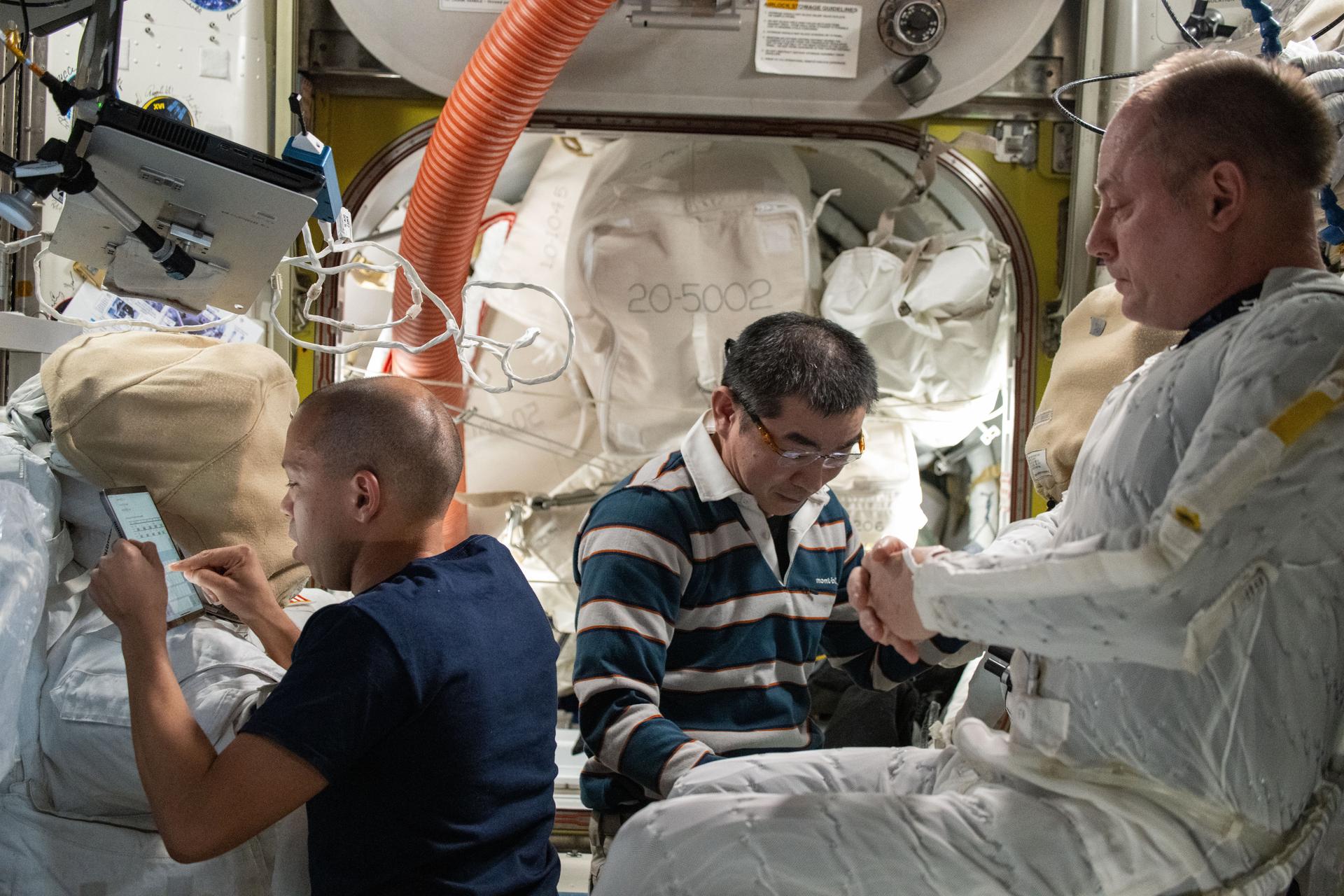
iss053e238888 (Nov. 7, 2017) --- Expedition 53 Flight Engineer Paolo Nespoli, from the European Space Agency, tests a personal radiation shielding garment. Water is used for its shielding properties and filled inside garment containers covering organs that are especially sensitive to cosmic radiation.
Personal Radiation Shielding Garment
iss053e238886 (Nov. 7, 2017) --- Expedition 53 Flight Engineer Paolo Nespoli, from the European Space Agency, tests a personal radiation shielding garment. Water is used for its shielding properties and filled inside garment containers covering organs that are especially sensitive to cosmic radiation.
Personal Radiation Shielding Garment
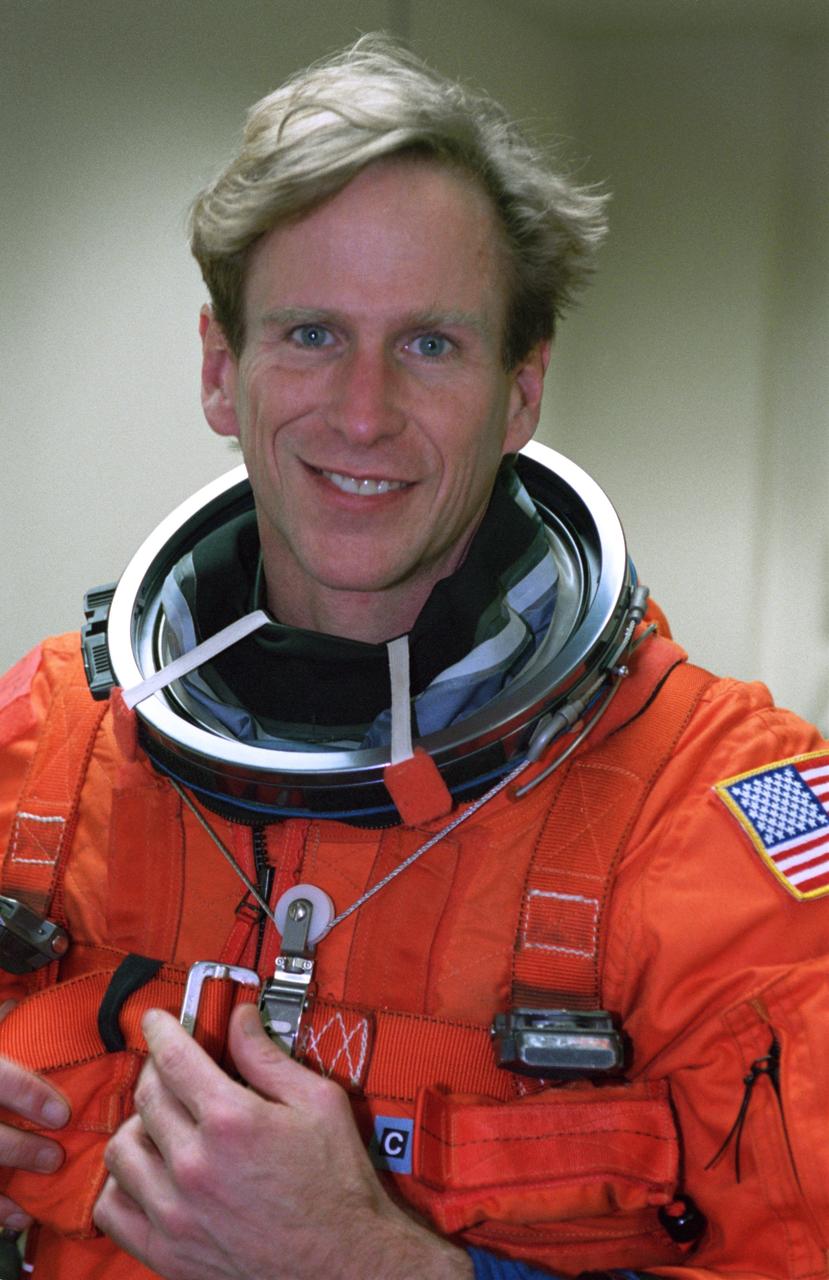
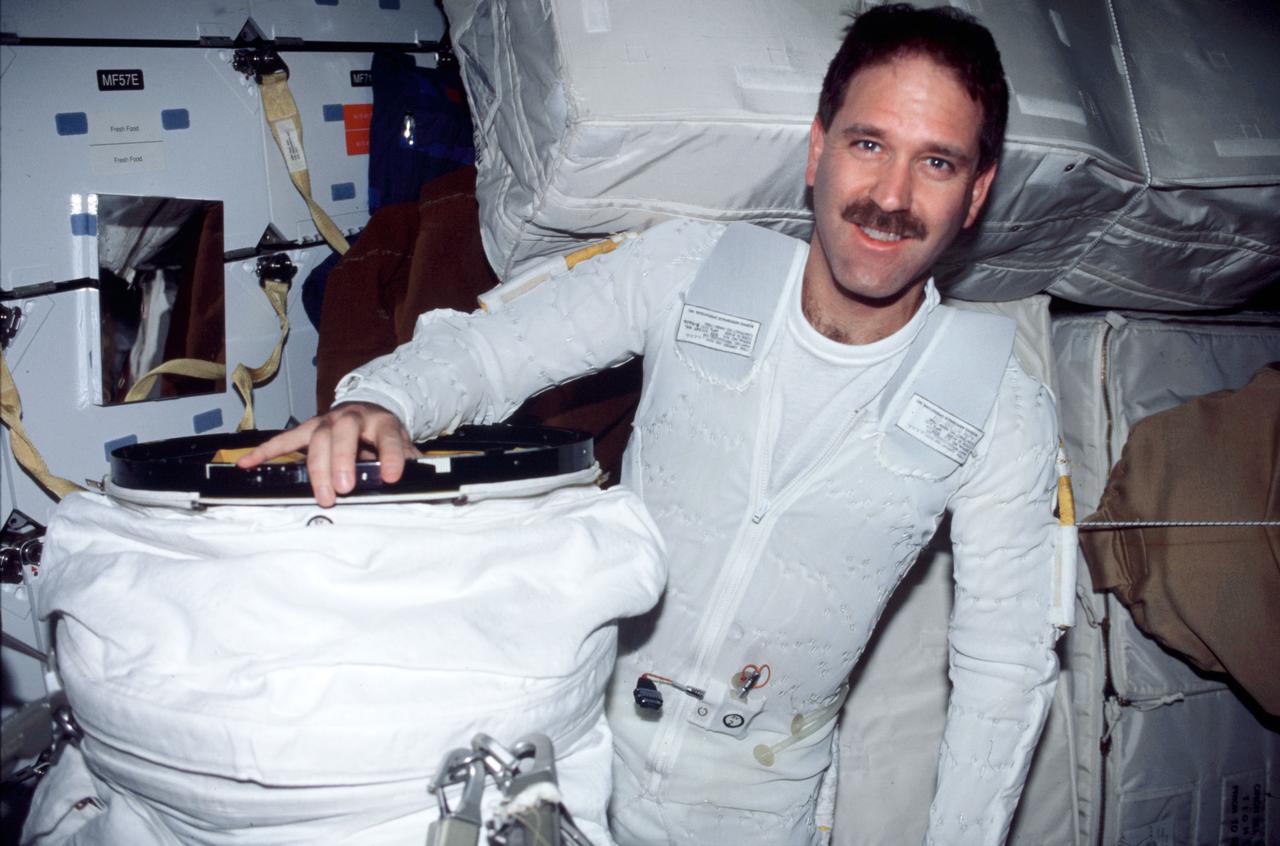
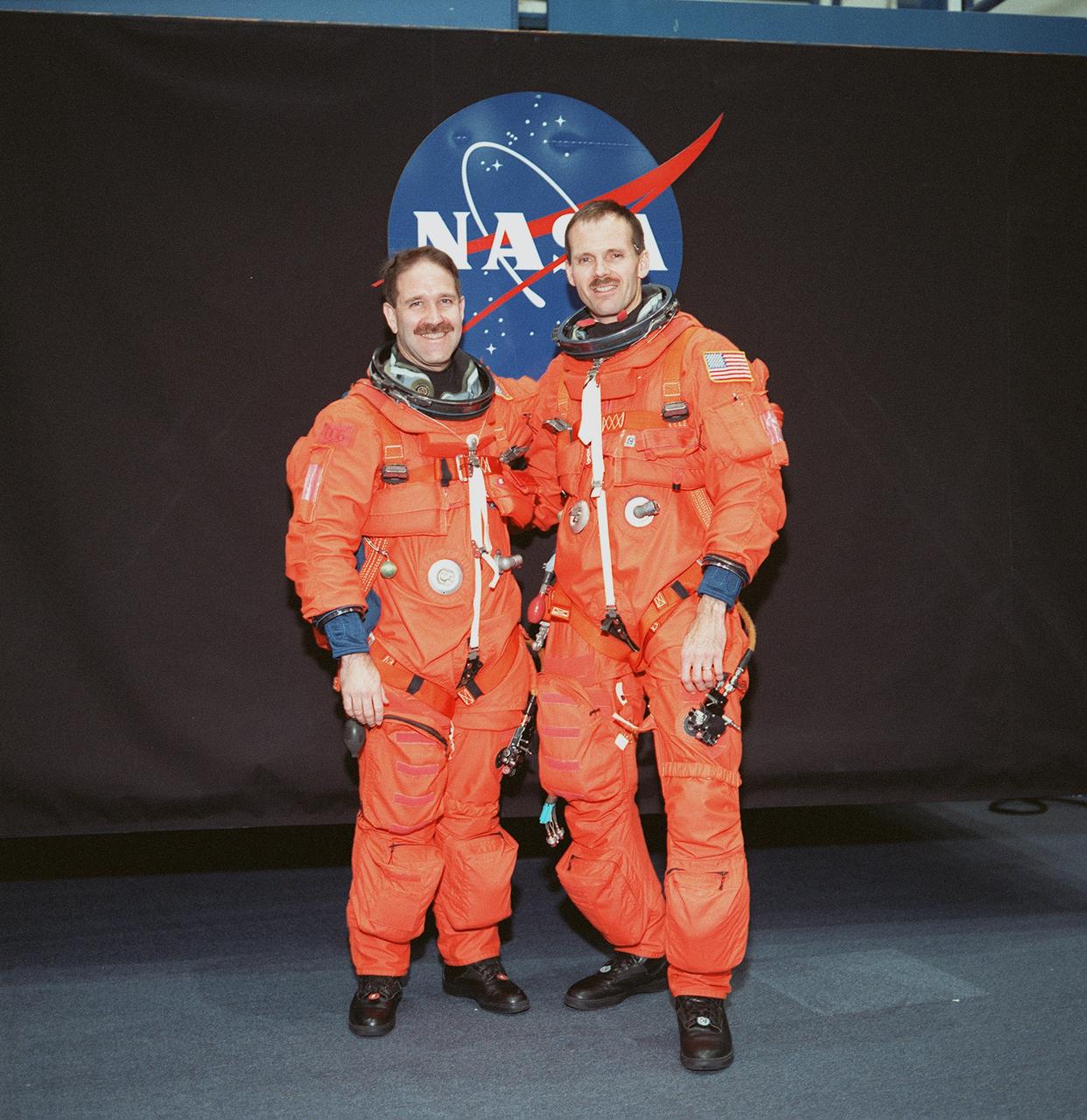
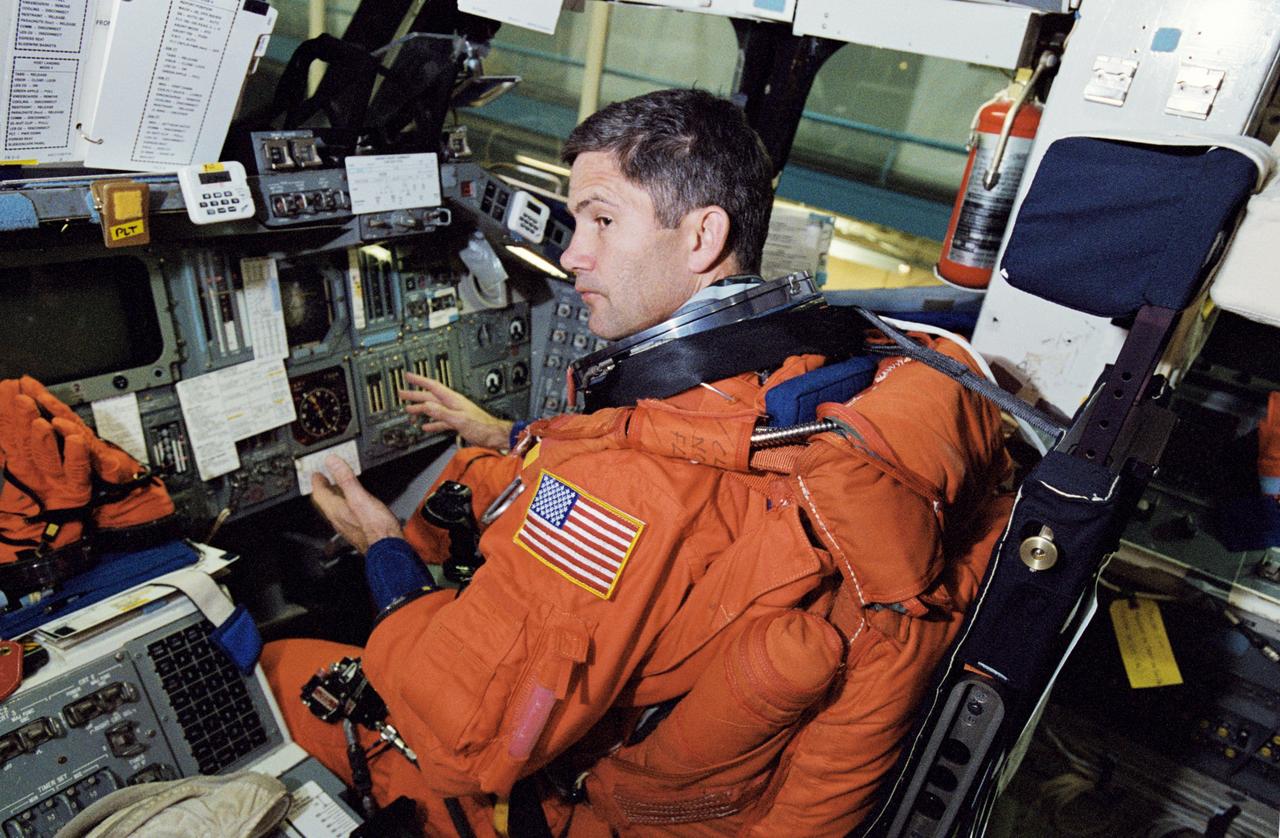
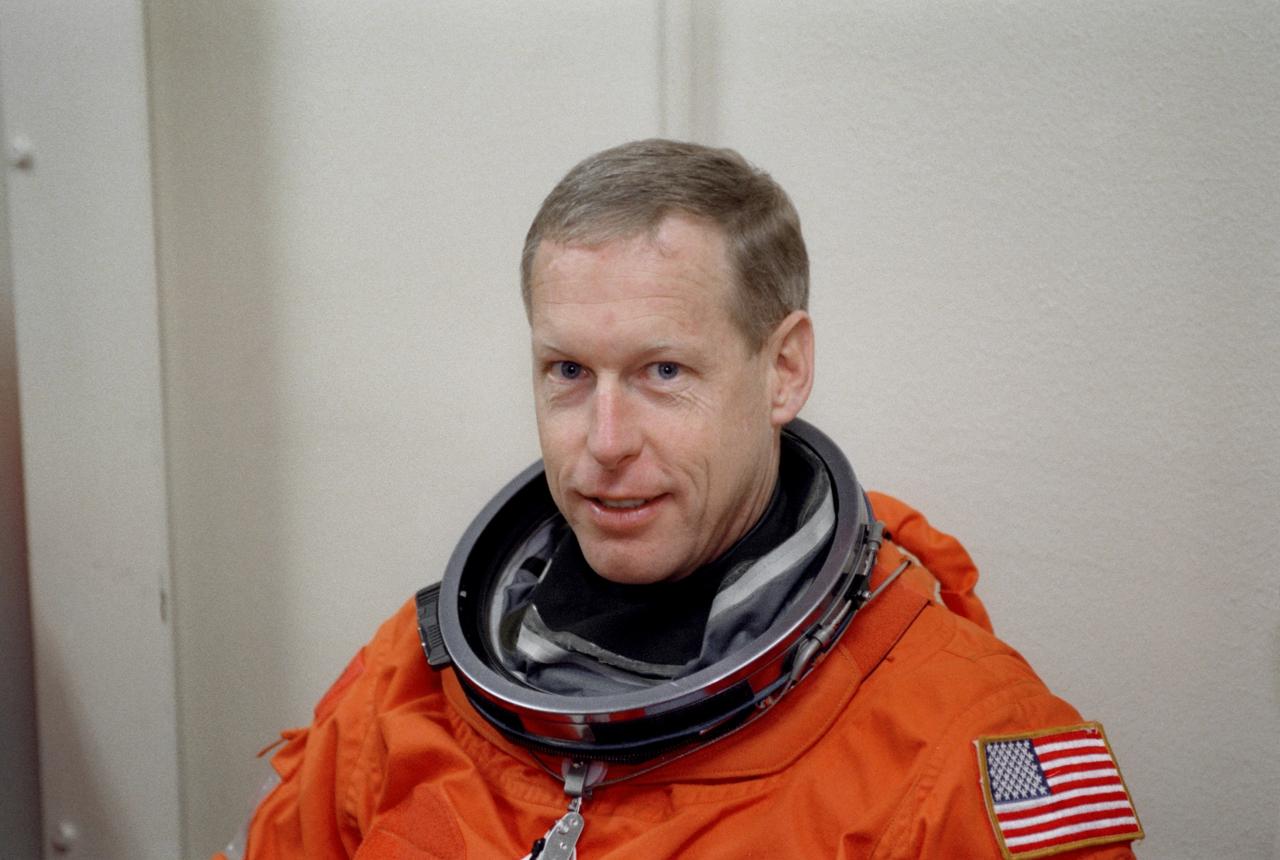
Astronaut John S. Bull wears the A6-L type Pressure Garment Assembly update to an A7-L configuration.
Astronaut John Bull wears the A6-L type pressure Garment Assembly
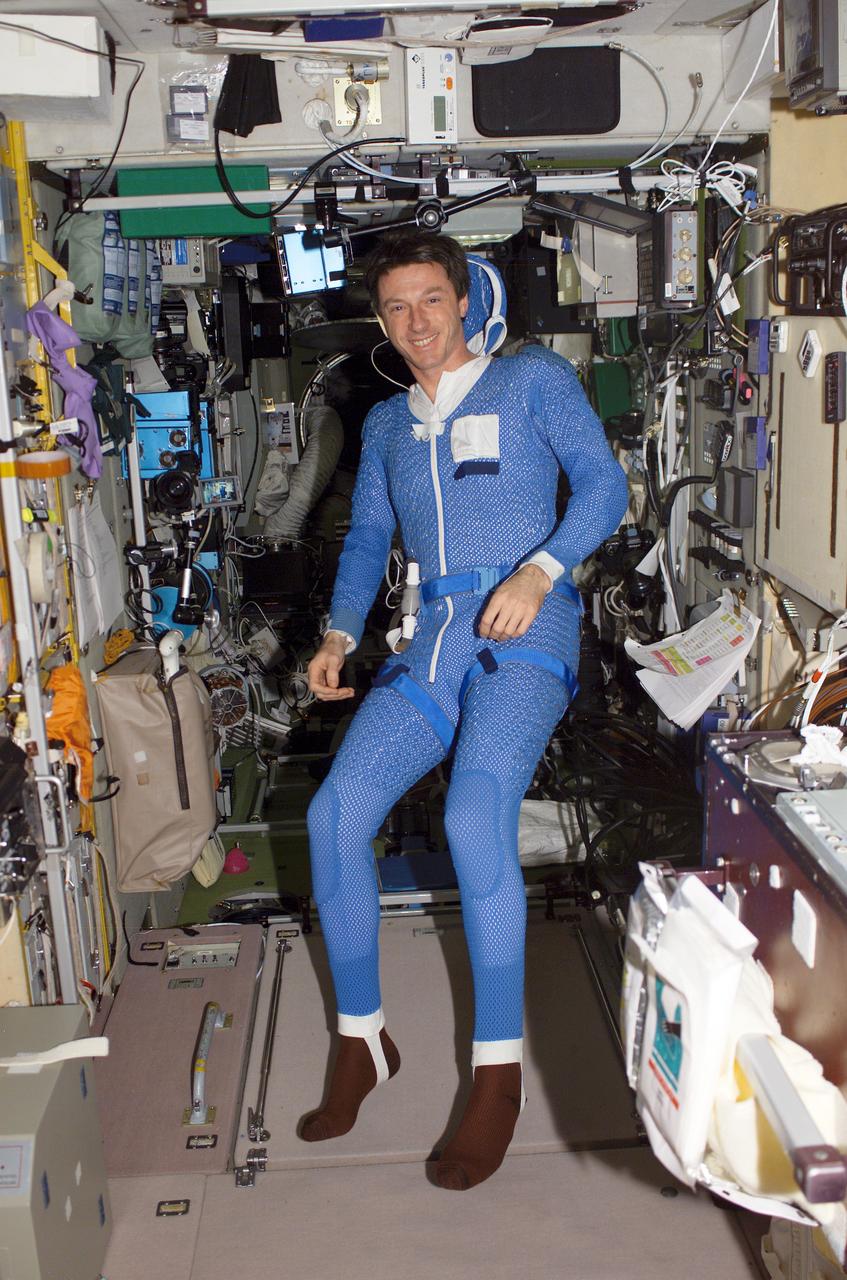
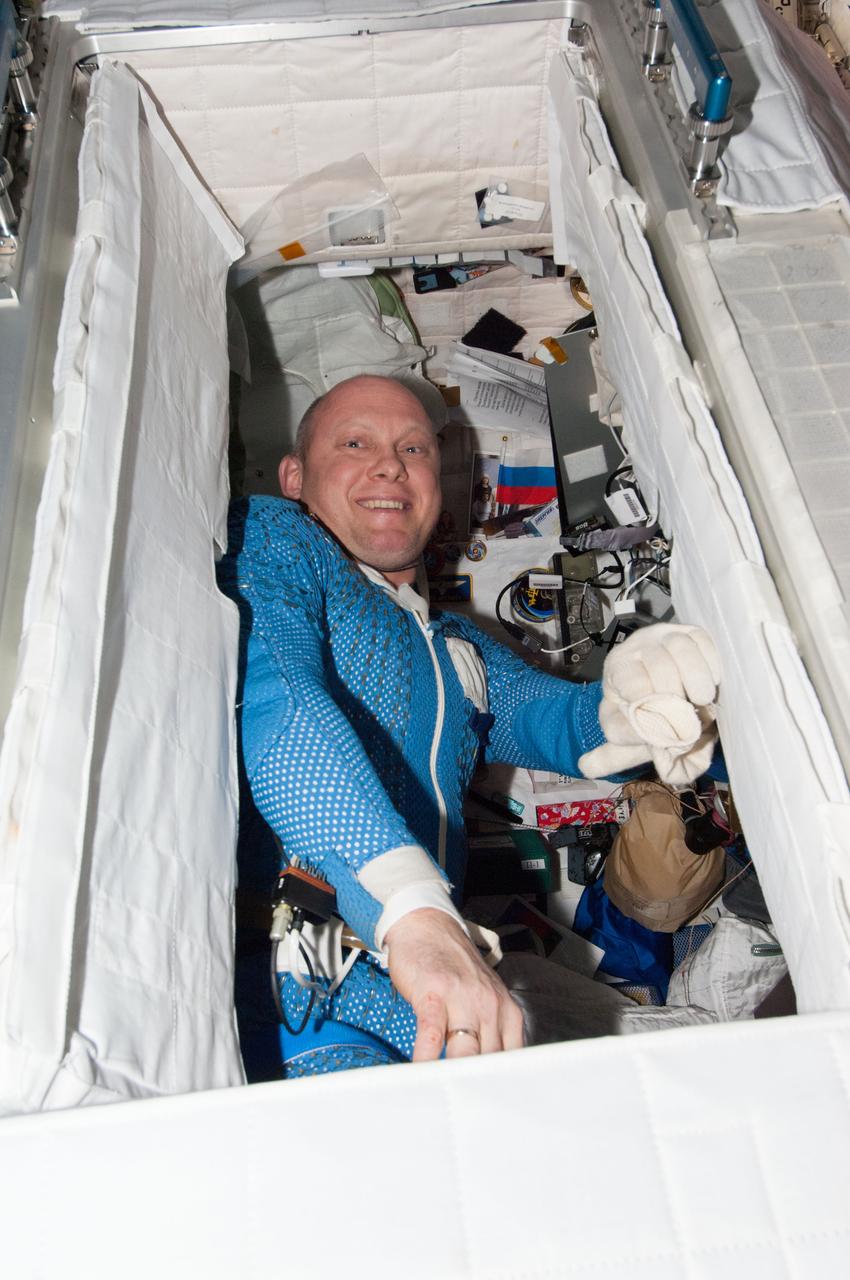
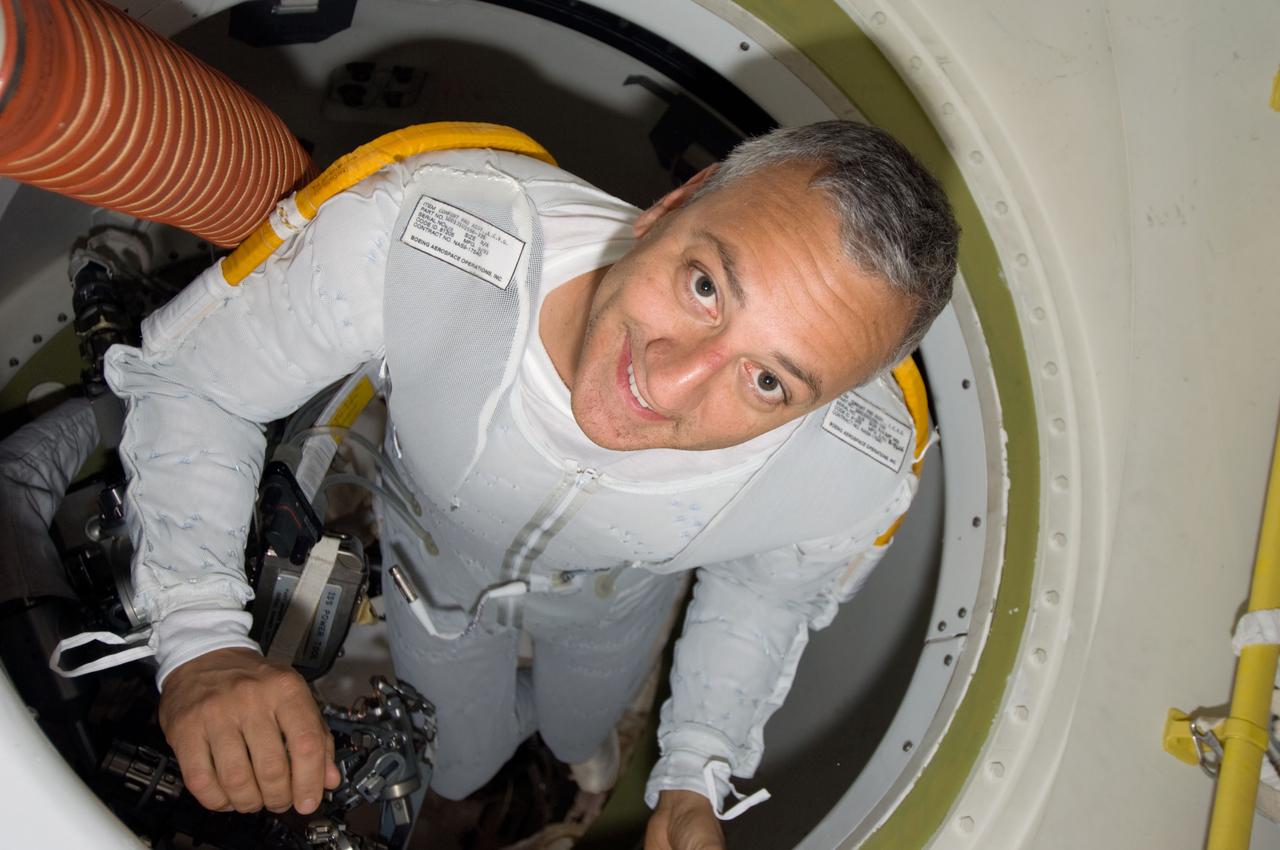
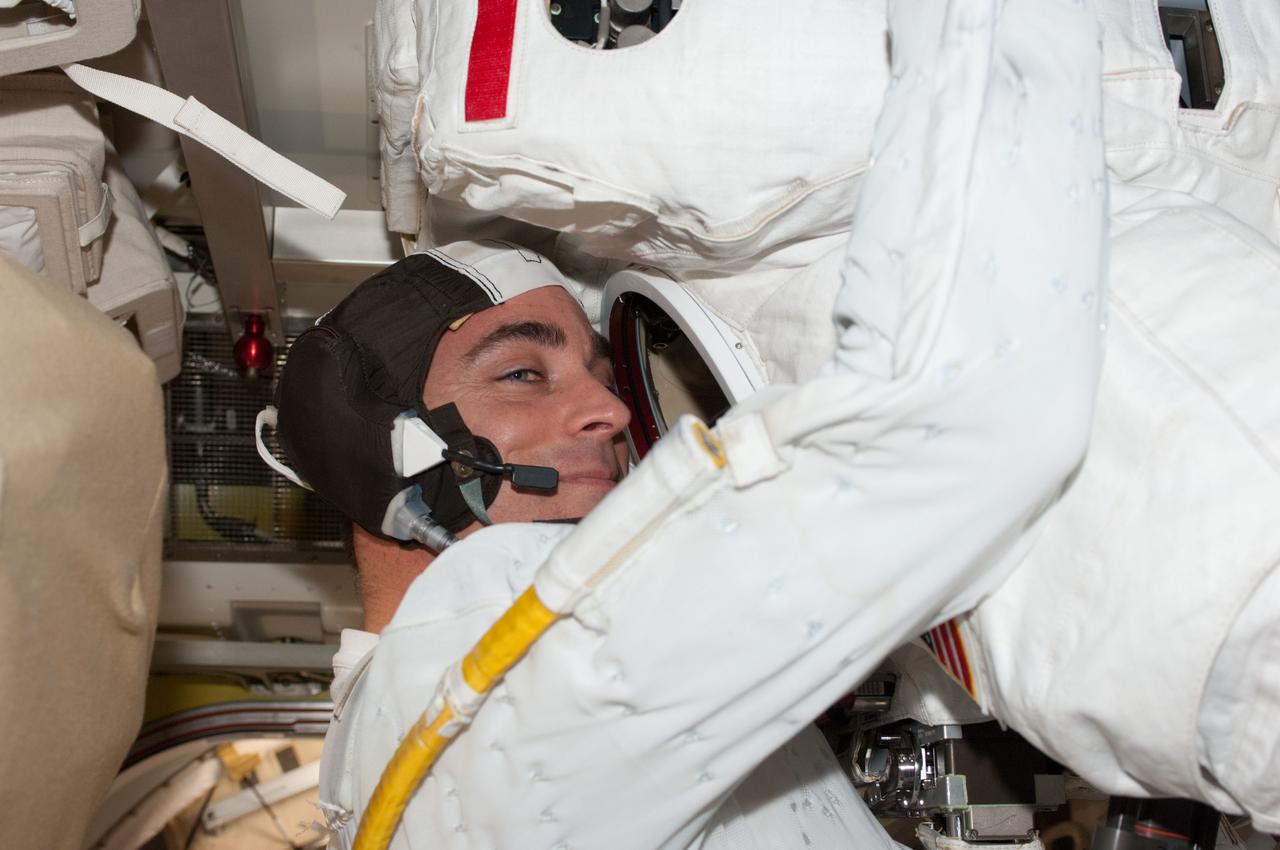
ISS008-E-17196 (26 Feb. 2004) --- Astronaut C. Michael Foale, Expedition 8 commander and NASA ISS science officer, suited in a blue thermal garment prior to donning his Russian Orlan spacesuit, smiles for the camera while floating in the Zvezda Service Module on the International Space Station (ISS).
Foale, in SM, suited in blue thermal garment prior to EVA during Expedition 8
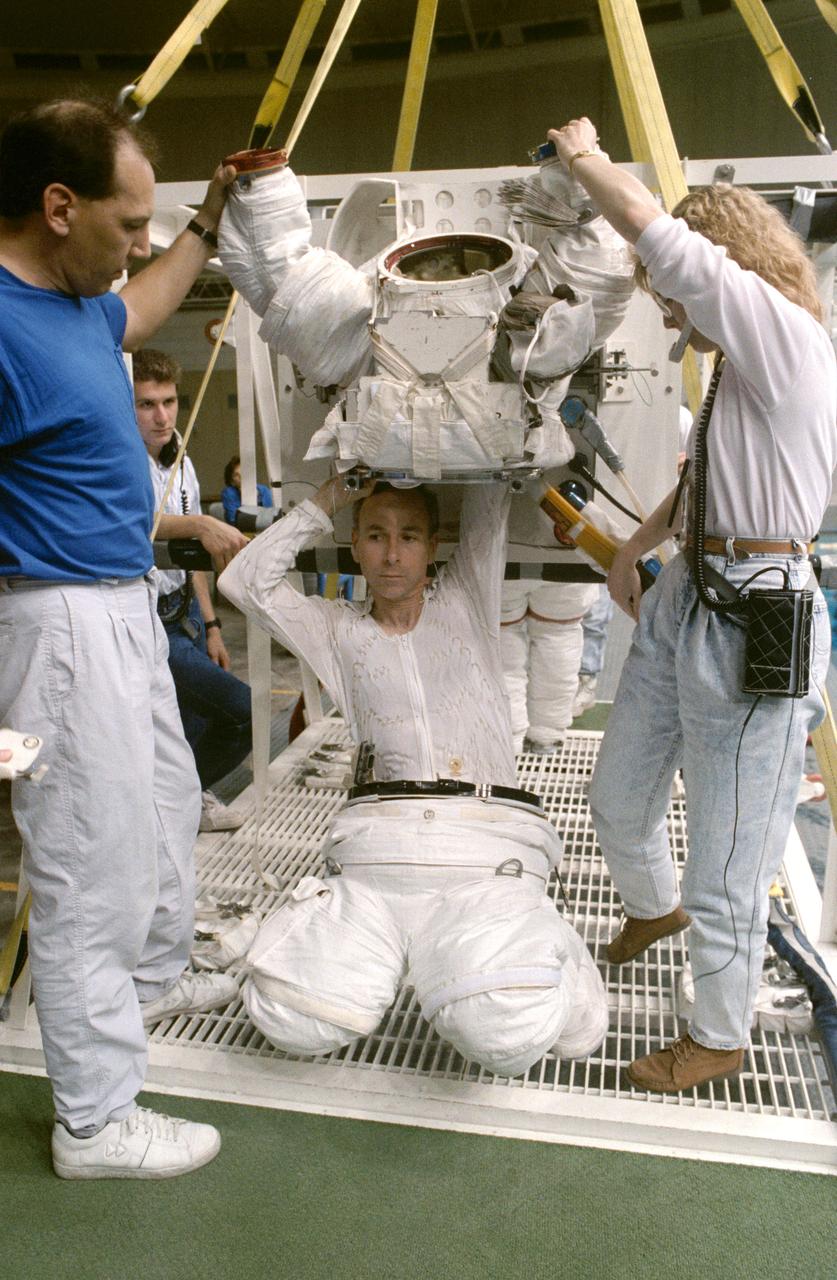
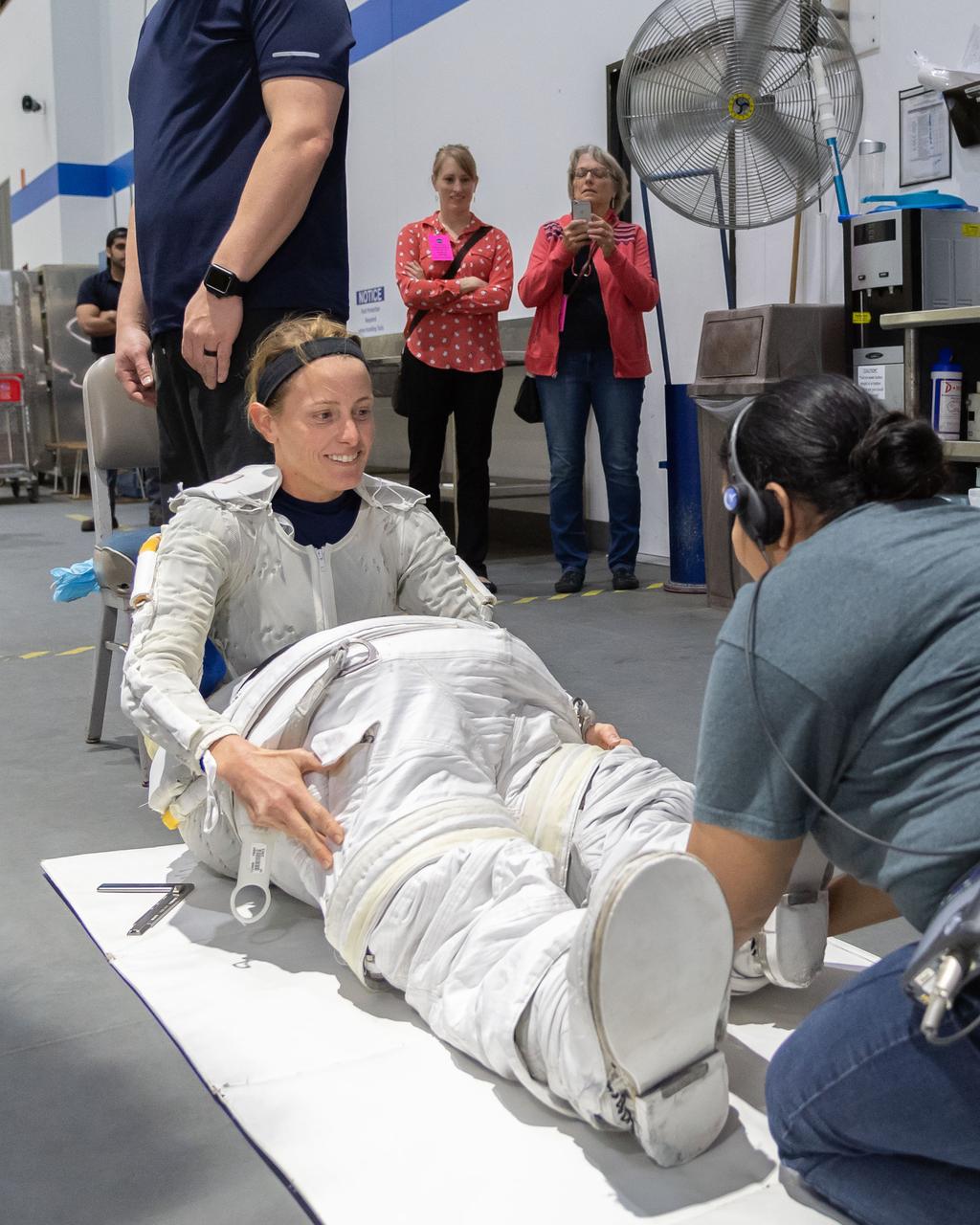
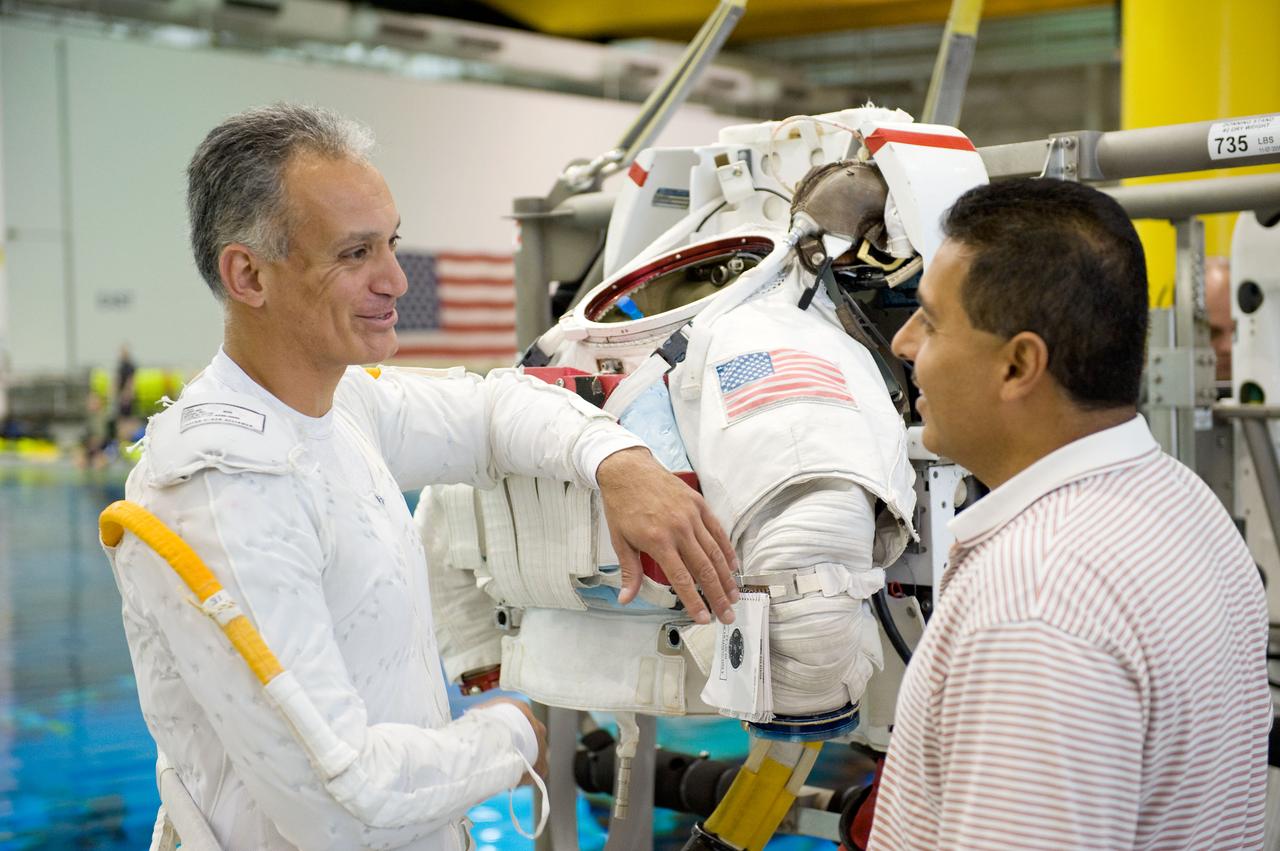
STS-38 Mission Specialist (MS) Carl J. Meade, wearing liquid cooling and ventilation garment (LCVG) and extravehicular mobility unit (EMU) lower torso, crouches under EMU upper torso. Technicians extend the EMU sleeves as Meade reaches into upper torso during suit donning in JSC's Weightless Environment Training Facility (WETF) Bldg 29. Positioned on the WETF platform at pool side, Meade is preparing for an underwater extravehicular activity (EVA) simulation. During the training exercise, Meade will rehearse contingency EVA procedures for the STS-38 mission aboard Atlantis, Orbiter Vehicle (OV) 104.
STS-38 Mission Specialist (MS) Carl J. Meade dons EMU in JSC's WETF Bldg 29
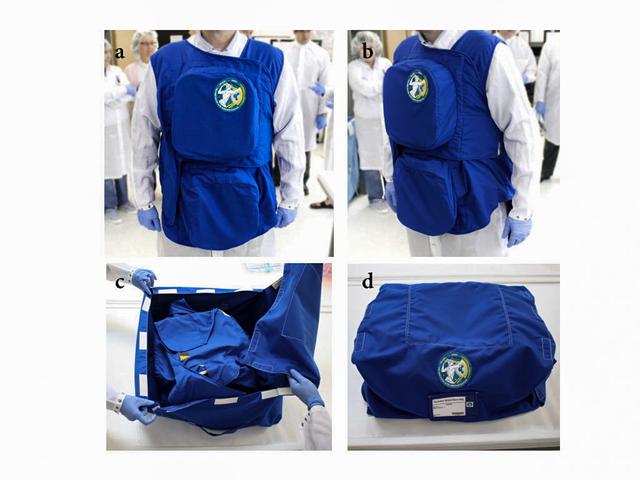
jsc2021e009421 (3/2/2021) --- A preflight view of the PERSEO garment prototype inspection and configuration for launch. (a,b) Garment worn during pre-flight inspections at Johnson Space Center (JSC) in Houston, USA, before launch, front and lateral view. (c) Garment folded in the transport bag for the launch configuration. (d) Closed transport bag containing.the garment. Image courtesy of the Italian Space Agency (ASI).
PERSEO Facility
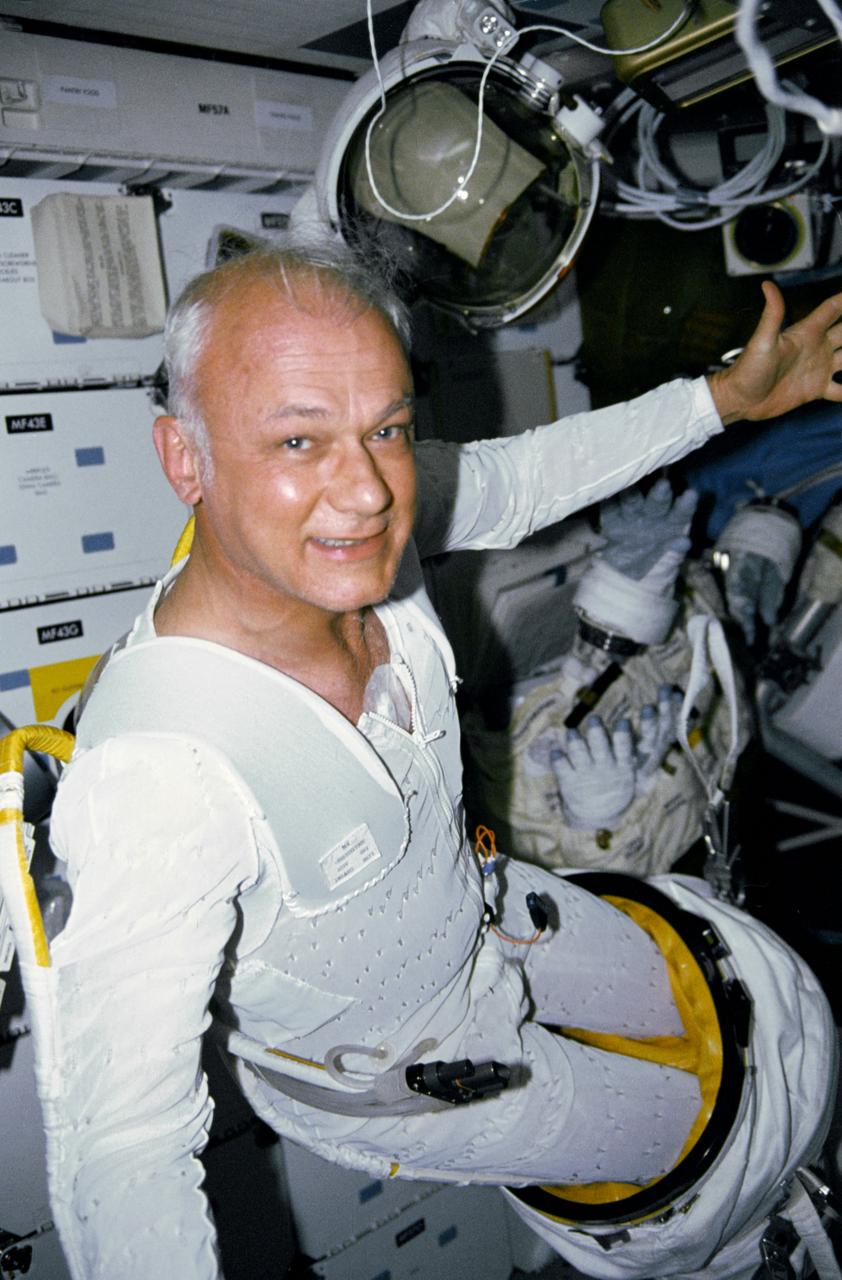
STS-31 Mission Specialist (MS) Bruce McCandless II, wearing liquid cooling and ventilation garment (LCVG), works his way out of the extravehicular mobility unit (EMU) lower torso on the middeck of Discovery, Orbiter Vehicle (OV) 103. McCandless was in a standby mode to perform extravehicular activity (EVA) if needed to support Hubble Space Telescope (HST) deployment and post- deployment tasks. None was needed. His helmet and gloves freefloat in the background.
STS-31 MS McCandless in LCVG removes EMU lower torso on OV-103's middeck
iss053e238891 (Nov. 7, 2017) --- Expedition 53 Flight Engineer Paolo Nespoli, from the European Space Agency, tests a personal radiation shielding garment. Water is used for its shielding properties and filled inside garment containers covering organs that are especially sensitive to cosmic radiation.
iss053e238891
iss053e238877 (Nov. 7, 2017) --- Expedition 53 Flight Engineer Paolo Nespoli, from the European Space Agency, fills a personal radiation shielding garment with water.  Water is used for its shielding properties and filled inside garment containers covering organs that are especially sensitive to cosmic radiation.
iss053e238877
Ames Life Sciences Experiments: Liquid cooling garment with Phil Culbertson
ARC-1994-AC94-0261-8
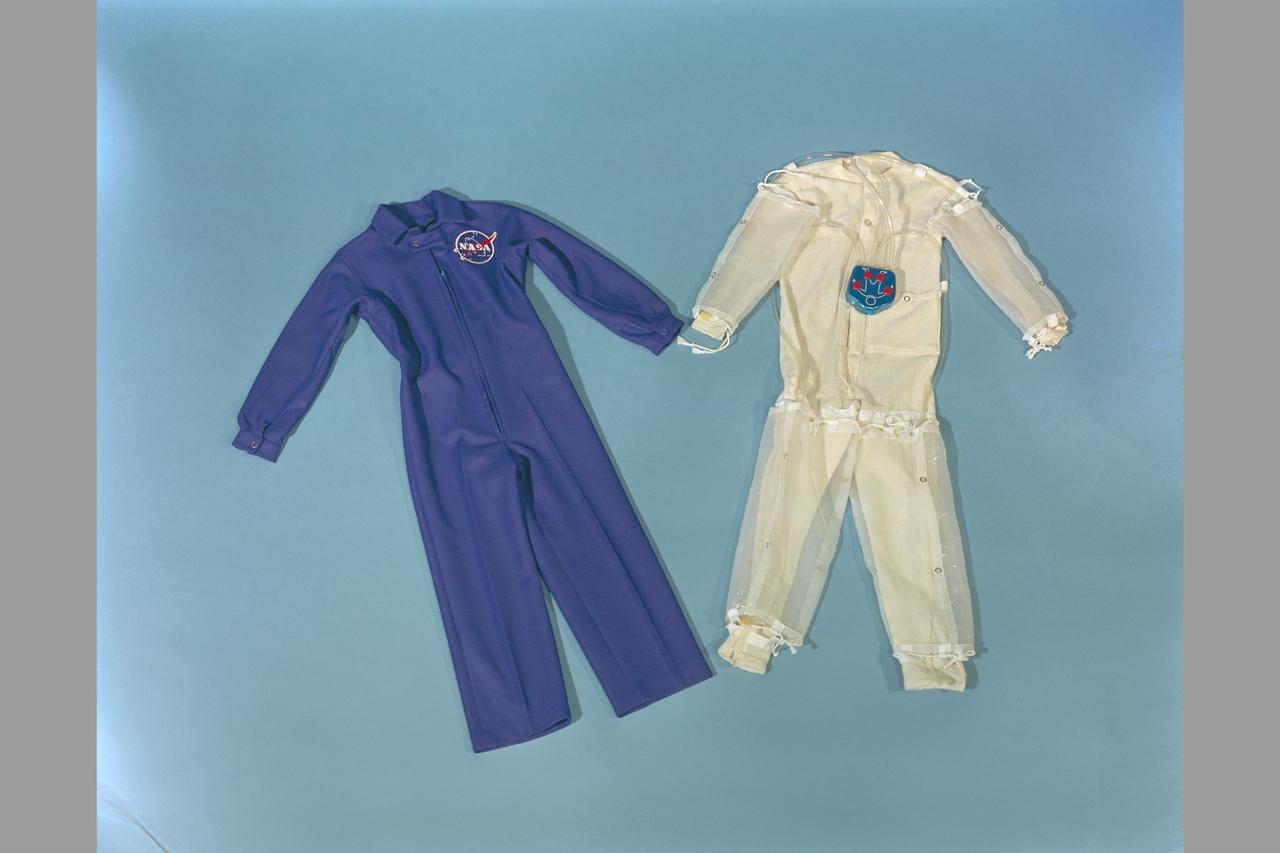
LCG: Anti-Hemophilia G-Suit - outer and inner garment assembled
ARC-1971-AC71-8549
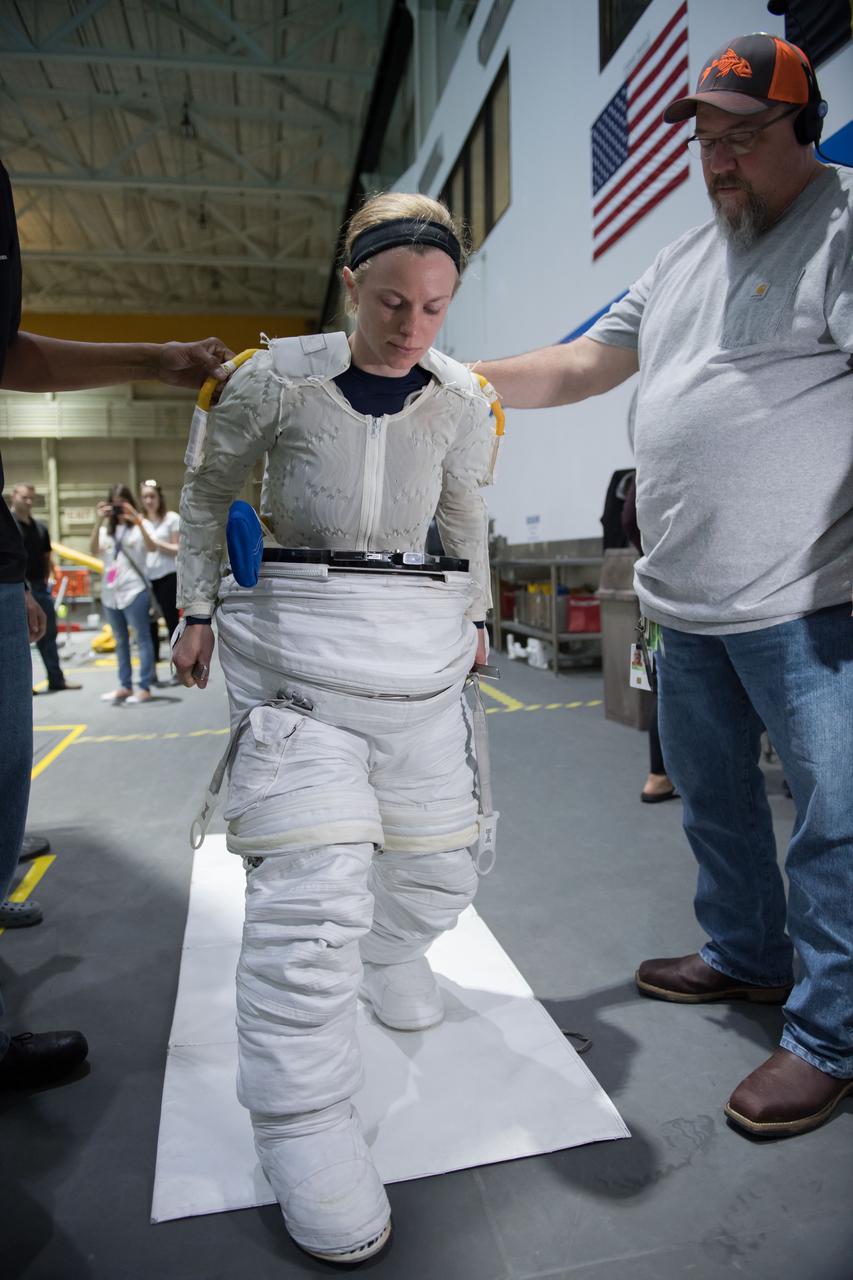
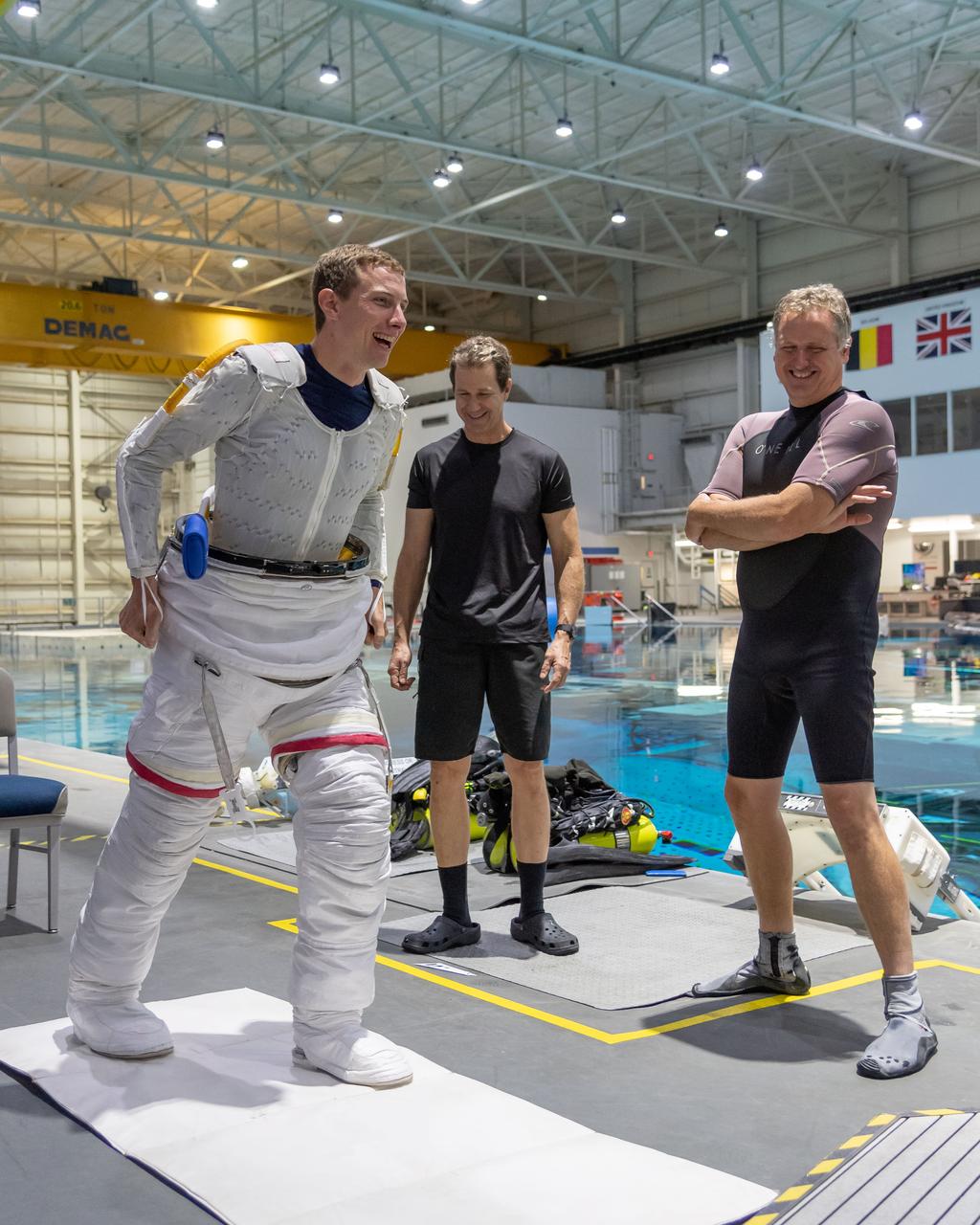
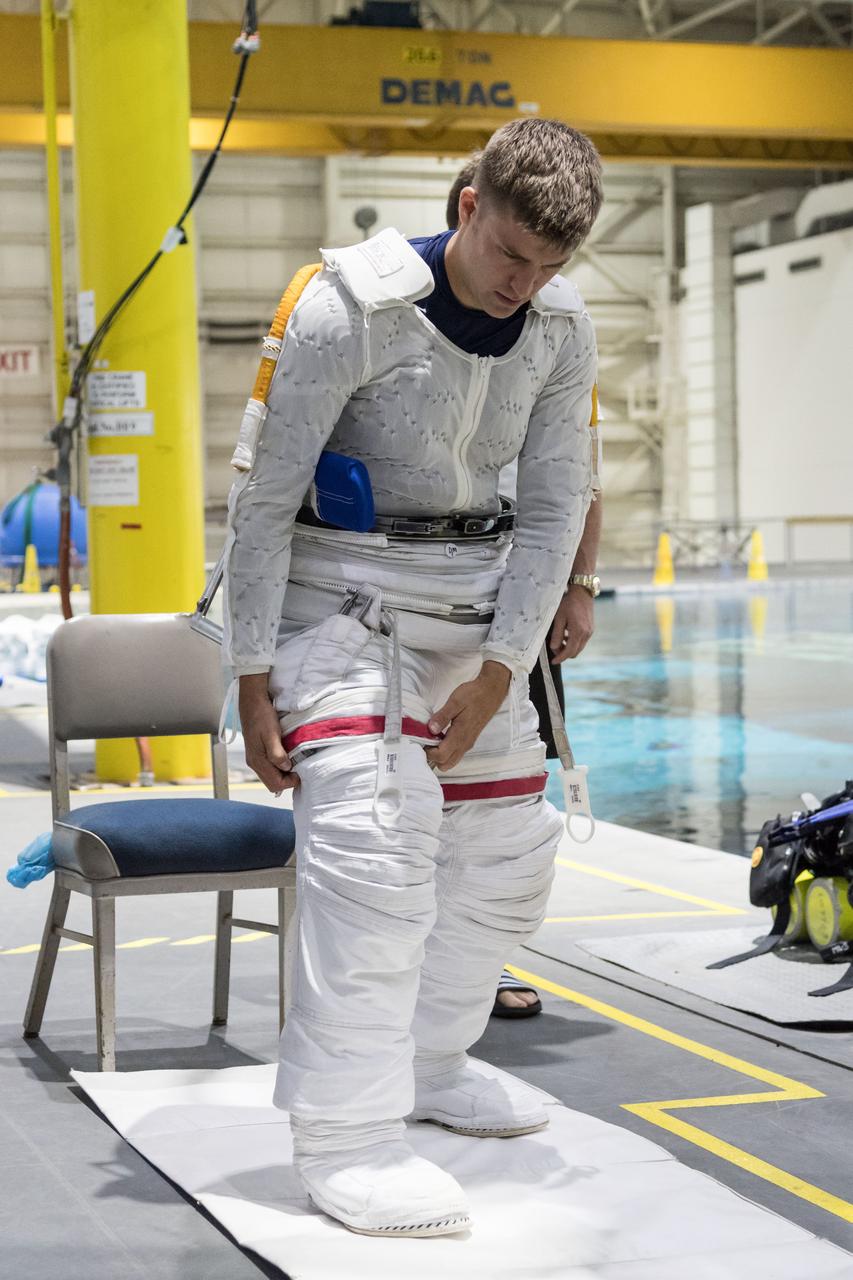
jsc2018e094713 (November 05, 2018) --- 2017 NASA astronaut candidate Warren Hoburg wears a Liquid Cooling and Ventilation Garment and dons a spacesuit prior to underwater spacewalk training at NASA Johnson Space Center’s Neutral Buoyancy Laboratory in Houston. The cooling garment distributes water throughout to help keep him cool while training underwater in the spacesuit. Photo Credit: (NASA/Josh Valcarcel)
2017 ASCAN class members during ASCAN EVQ NBL 3 training
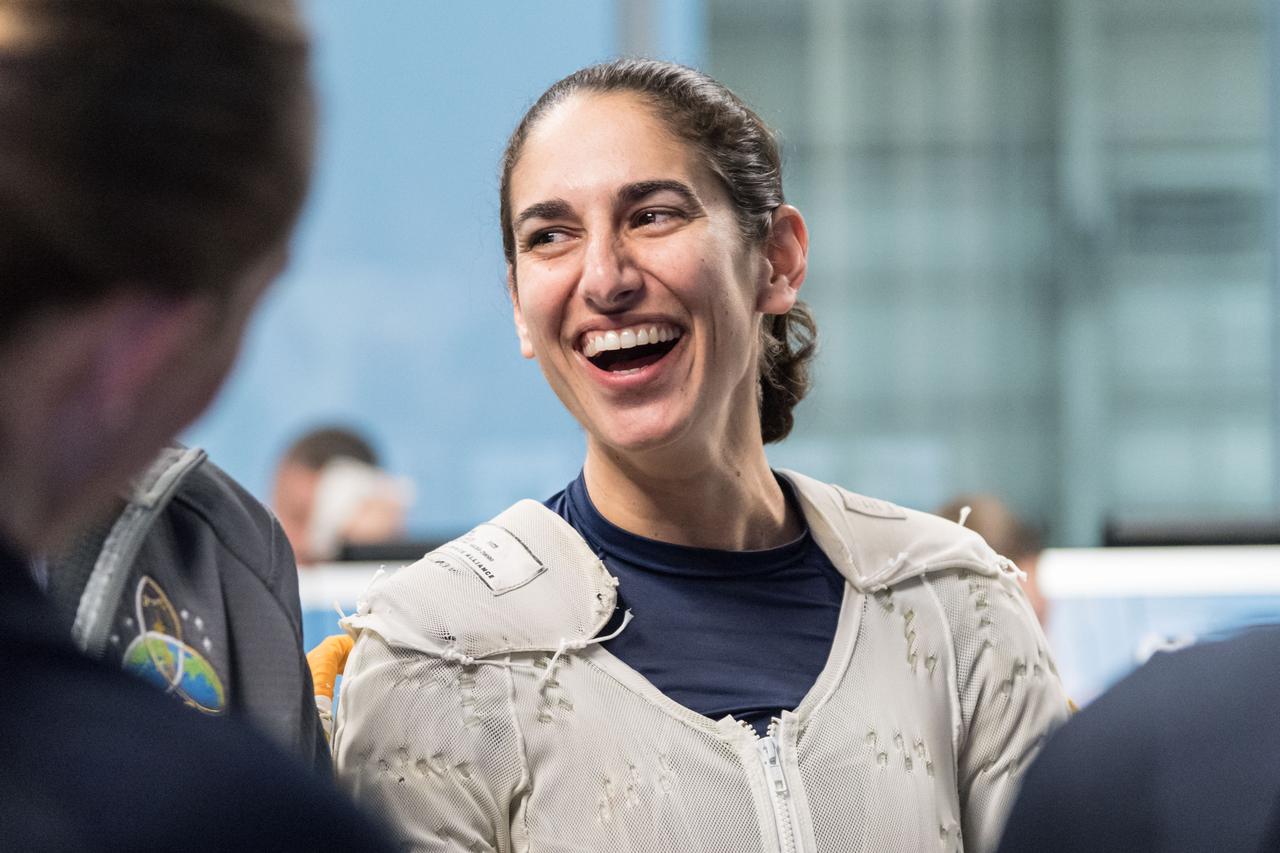
jsc2018e035892 (April 11, 2018) --- NASA astronaut candidate Jasmin Moghbeli wears a Liquid Cooling and Ventilation Garment prior to underwater spacewalk training at NASA Johnson Space Center’s Neutral Buoyancy Laboratory. The cooling garment runs water throughout the suit to keep her cool during training. Photo Credit: (NASA/Josh Valcarcel)
2017 ASCAN class members during ASCAN EVQ1 (Red Team) Training
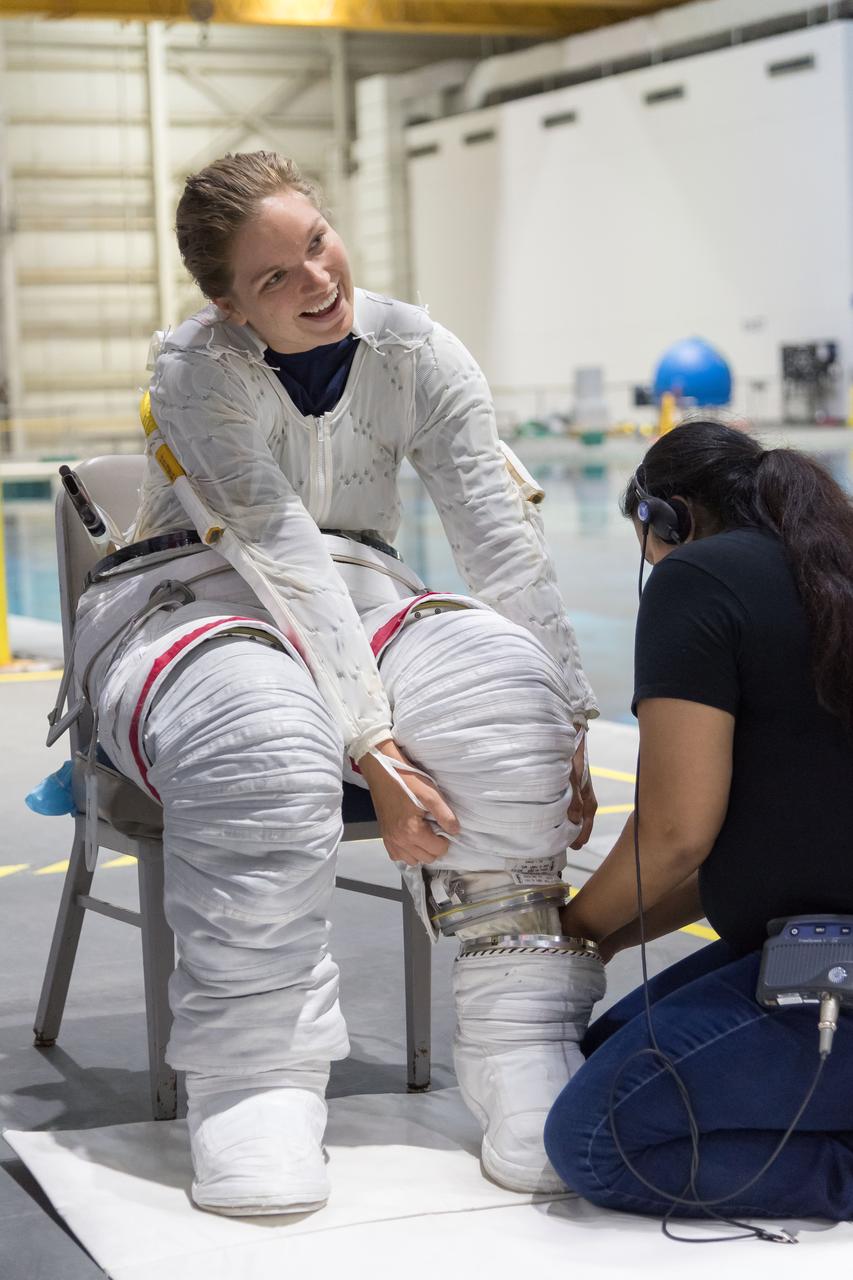
jsc2018e065018 (July 19, 2018) --- Canadian Space Agency astronaut candidate Jennifer Sidey-Gibbons in a Liquid Cooling and Ventilation Garment and being helped into a spacesuit prior to underwater spacewalk training at NASA Johnson Space Center’s Neutral Buoyancy Laboratory in Houston. The cooling garment distributes water throughout to help keep her cool while training underwater. Photo Credit: (NASA/Josh Valcarcel)
2017 ASCAN class members during ASCAN EVQ1 (Red Team) Training
jsc2018e035752 (04-12-2018) --- 2017 NASA astronaut candidate Zena Cardman in a Liquid Cooling and Ventilation Garment and being helped into a spacesuit prior to underwater spacewalk training at NASA Johnson Space Center’s Neutral Buoyancy Laboratory. The cooling garment distributes water throughout to help keep her cool while training underwater in the spacesuit. Photo Credit: (NASA/David DeHoyos)
2017 ASCAN class members during ASCAN EVQ1 (Red Team) Training
jsc2018e035893 (April 11, 2018) --- 2017 NASA astronaut candidate Matthew Dominick wears a Liquid Cooling and Ventilation Garment prior to underwater spacewalk training at NASA Johnson Space Center’s Neutral Buoyancy Laboratory. The cooling garment runs water throughout the suit to keep him cool during training. Photo Credit: (NASA/Josh Valcarcel)
2017 ASCAN class members during ASCAN EVQ1 (Red Team) Training
jsc2018e064787 (07/18/2018) --- 2017 NASA astronaut candidate Bob Hines is in a Liquid Cooling and Ventilation Garment and being helped into a spacesuit prior to underwater spacewalk training at NASA’s Johnson Space Center Neutral Buoyancy Laboratory in Houston. The cooling garment distributes water throughout to help keep him cool while training underwater in the spacesuit. Photo Credit: (NASA/Norah Moran)
2017 ASCAN class members during ASCAN EVQ1 (Red Team) Training
jsc2018e035757 (04-12-2018) --- 2017 Canadian Space Agency astronaut candidate Joshua Kutryk in a Liquid Cooling and Ventilation Garment and being helped into a spacesuit prior to underwater spacewalk training at NASA Johnson Space Center’s Neutral Buoyancy Laboratory. The cooling garment distributes water throughout to help keep him cool while training underwater in the spacesuit. Photo Credit: (NASA/David DeHoyos)
2017 ASCAN class members during ASCAN EVQ1 (Red Team) Training
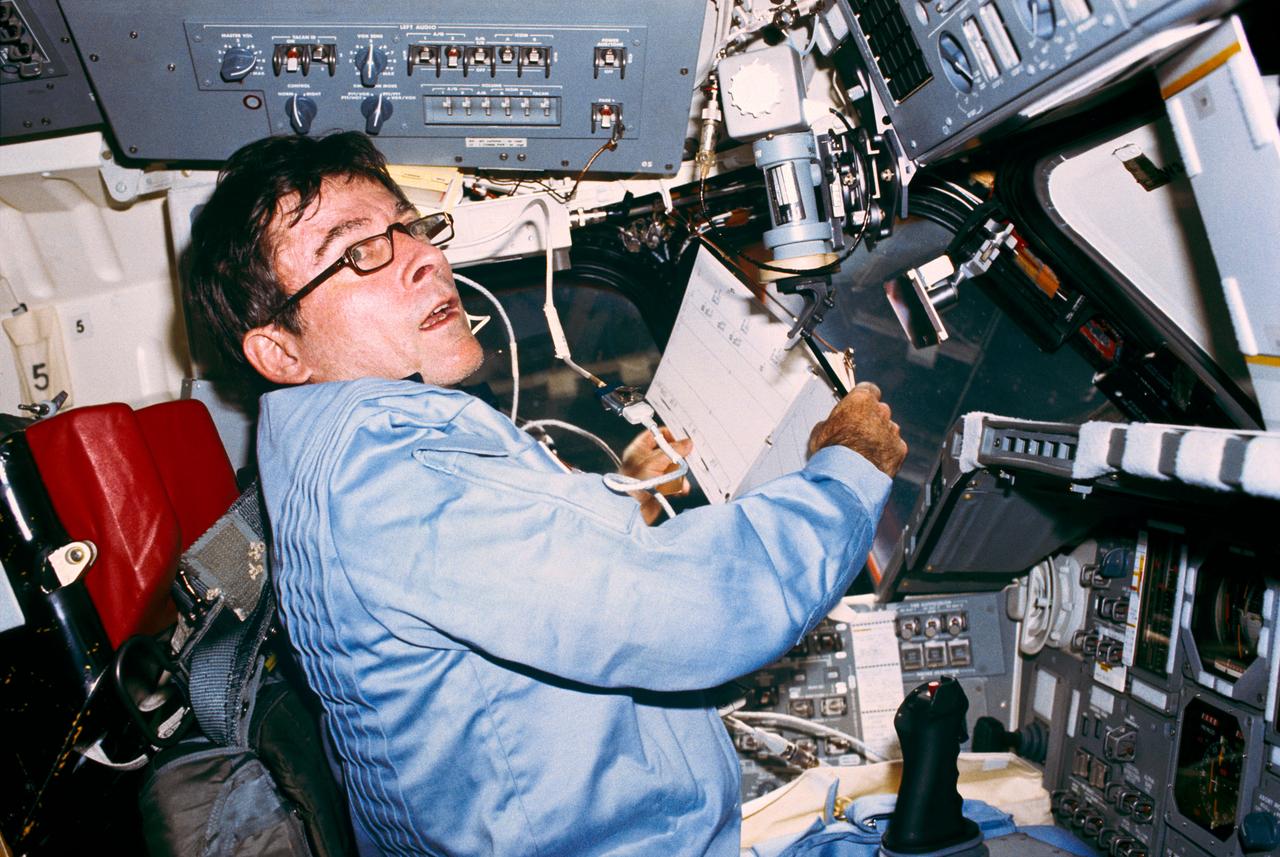
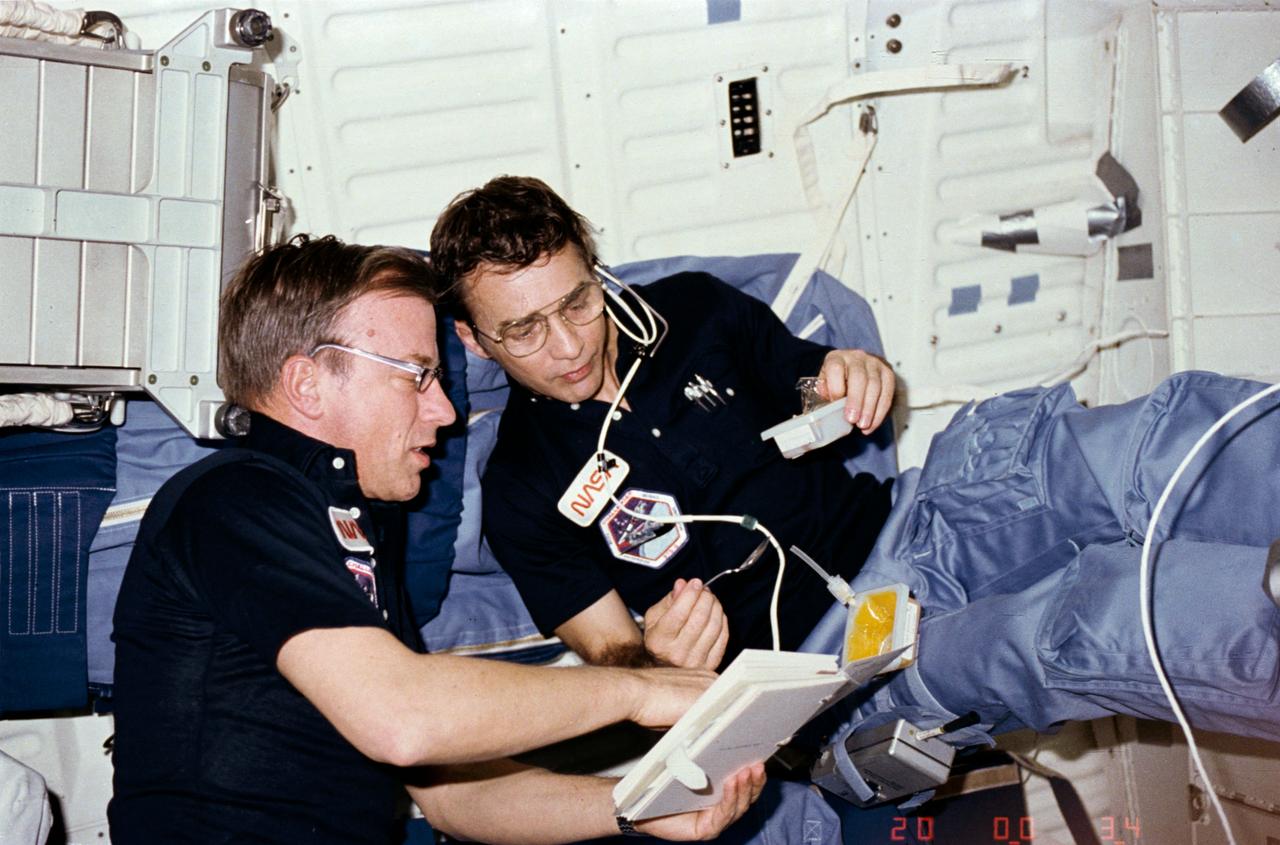
STS001-07-540 (12-14 April 1981) --- Astronaut John W. Young, commander, is seated at his left side station in the flight deck of the space shuttle Columbia. He holds a loose-leaf book in which he recorded data during the flight. Soon after the launch phase of STS-1, astronauts Young and Robert L. Crippen, pilot, changed from their high altitude pressure garments into the light blue constant wear garment. Photo credit: NASA
Commander Young reviews clipboard notes and procedures on forward flight deck
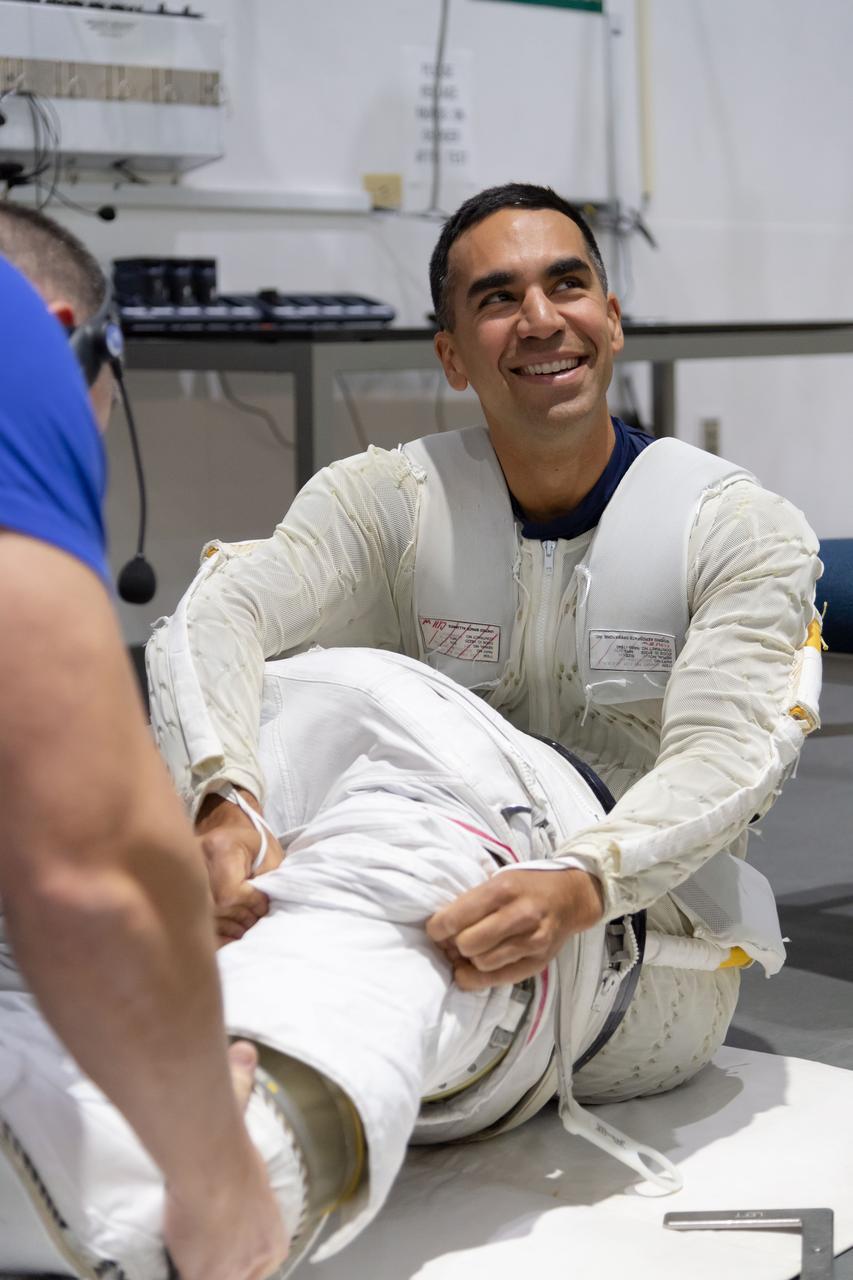
jsc2018e096661 (November 7, 2018) --- 2017 NASA astronaut candidate Raja Chari wears a Liquid Cooling and Ventilation Garment and is helped into a spacesuit prior to underwater spacewalk training at NASA Johnson Space Center’s Neutral Buoyancy Laboratory in Houston. The cooling garment distributes water throughout to help keep him cool while training underwater in the spacesuit. Photo Credit: (NASA/Robert Markowitz)
2017 ASCAN class members during ASCAN EVQ NBL 3 training
jsc2018e094712 (November 05, 2018) --- 2017 NASA astronaut candidate Loral O’Hara wears a Liquid Cooling and Ventilation Garment and is helped into a spacesuit prior to underwater spacewalk training at NASA Johnson Space Center’s Neutral Buoyancy Laboratory in Houston. The cooling garment distributes water throughout to help keep her cool while training underwater in the spacesuit. Photo Credit: (NASA/Josh Valcarcel)
2017 ASCAN class members during ASCAN EVQ NBL 3 training
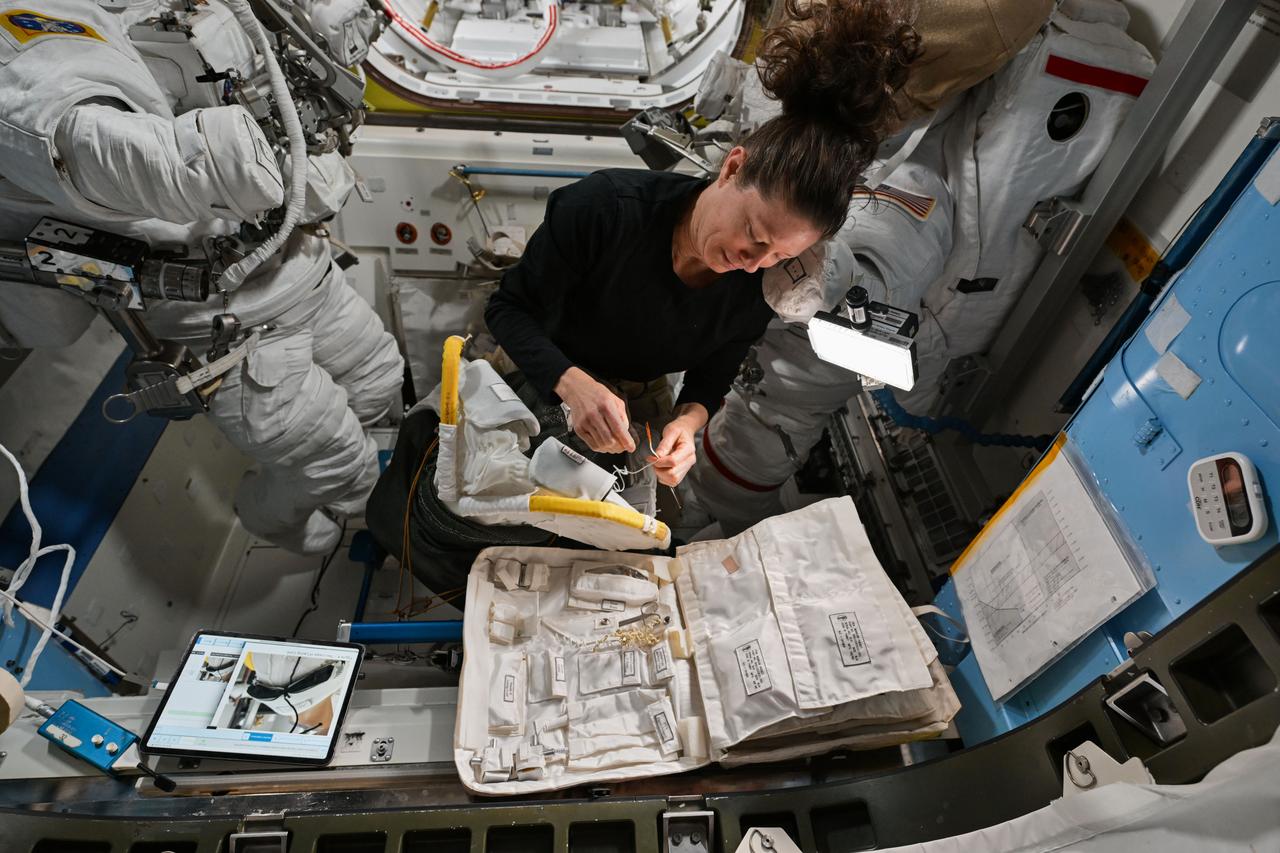
iss071e179083 (June 10, 2024) --- NASA astronaut and Expedition 71 Flight Engineer Tracy C. Dyson works inside the International Space Station's Quest airlock performing maintenance on a spacesuit's liquid cooling ventilation garment.
iss071e179083
Cosmonaut Oleg Artemyev, Expedition 40 flight engineer, is photographed still wearing his liquid cooling and ventilation garment after a Russian Extravehicular Activity (EVA). Artemyev is standing in his crew quarters (CQ).
Artemyev post-EVA
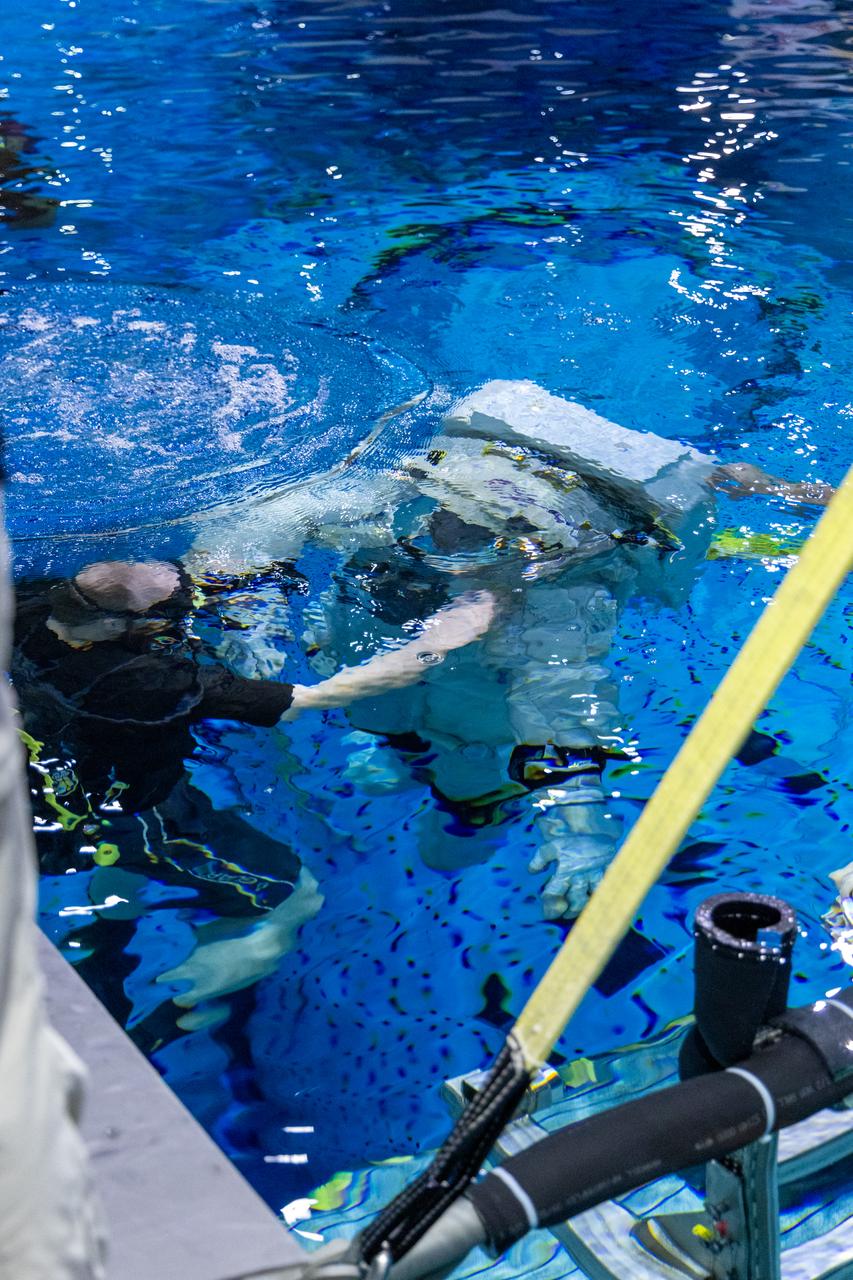
Axiom Space's AxEMU (Axiom Extravehicular Mobility Unit) spacesuit underwater during testing of its pressure garment system at NASA Johnson's Neutral Buoyancy Laboratory. Image Credit: Axiom Space
Underwater Spacesuit Testing
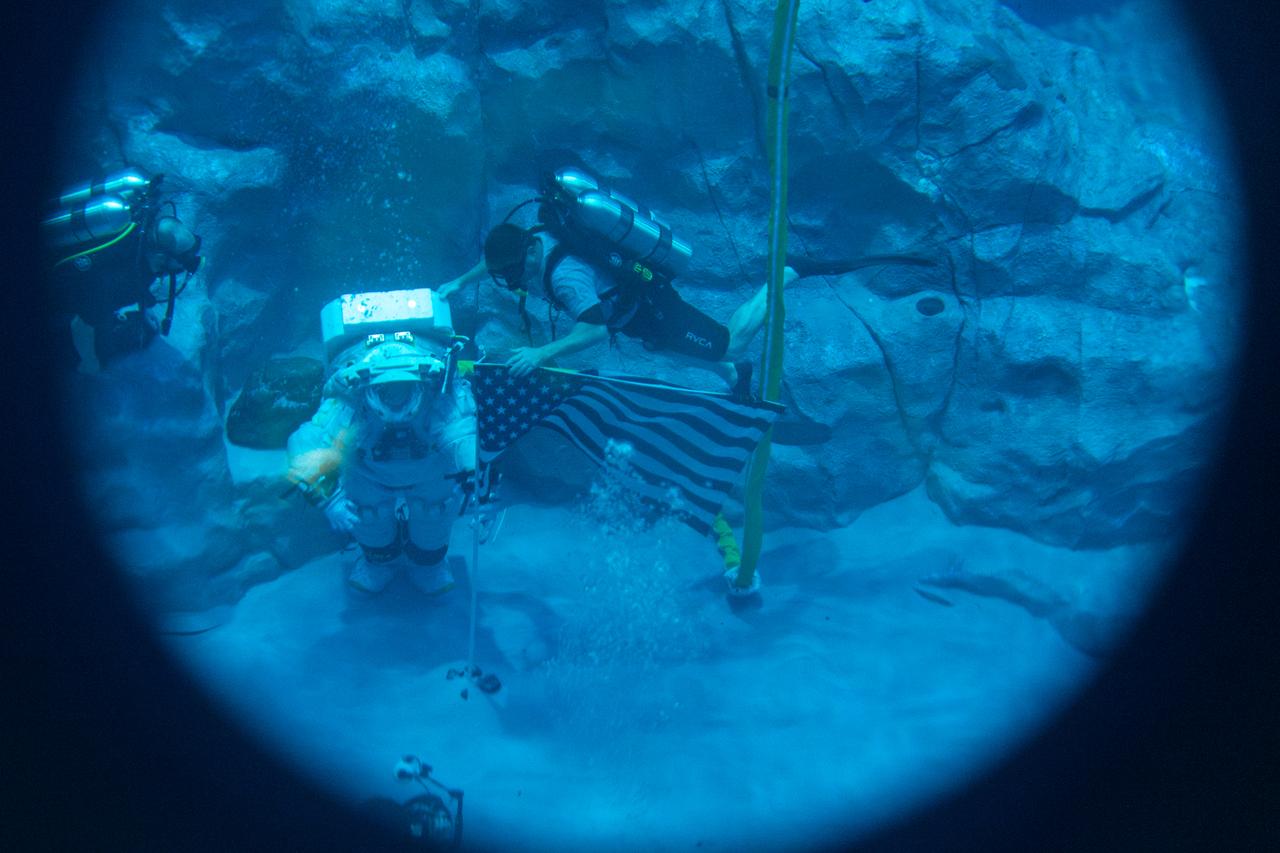
Axiom Space's AxEMU (Axiom Extravehicular Mobility Unit) spacesuit underwater during testing of its pressure garment system at NASA Johnson's Neutral Buoyancy Laboratory. Image Credit: Axiom Space
Underwater Spacesuit Testing
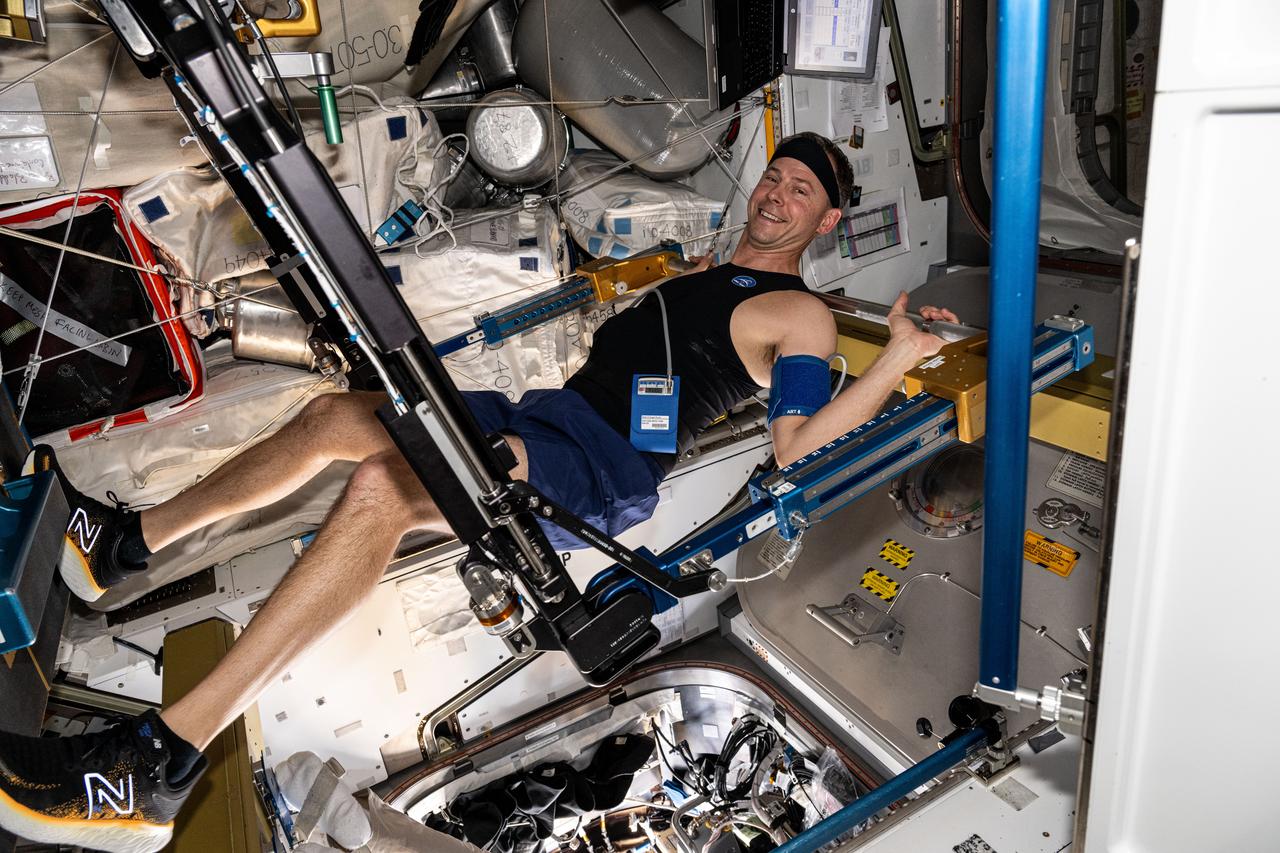
iss072e126509 (Oct. 29, 2024) --- NASA astronaut and Expedition 72 Flight Engineer Nick Hague exercises on the advanced resistive exercise device (ARED) aboard the International Space Station's Tranquility module. The ARED mimics the inertial forces of lifting free weights on Earth to maintain muscle health during long-term space missions. During his exercise session, Hague wore Bio-Monitor, a garment and headband set outfitted with sensors to collect physiological data and minimally interfere with space station life. Hague wore the garment 48 hours as part of Vascular Aging, a study that monitors an astronaut’s cardiovascular health in space.
Astronaut Nick Hague exercises on the advanced resistive exercise device
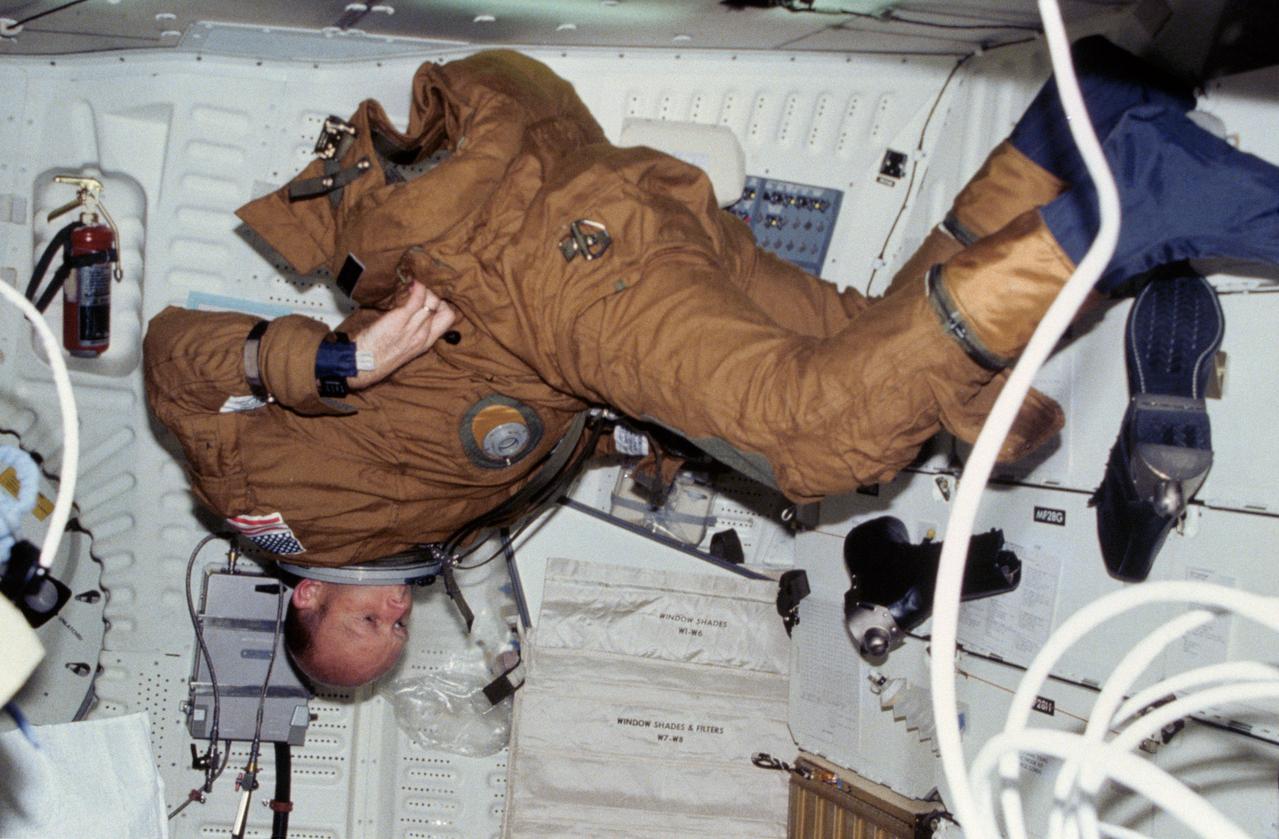
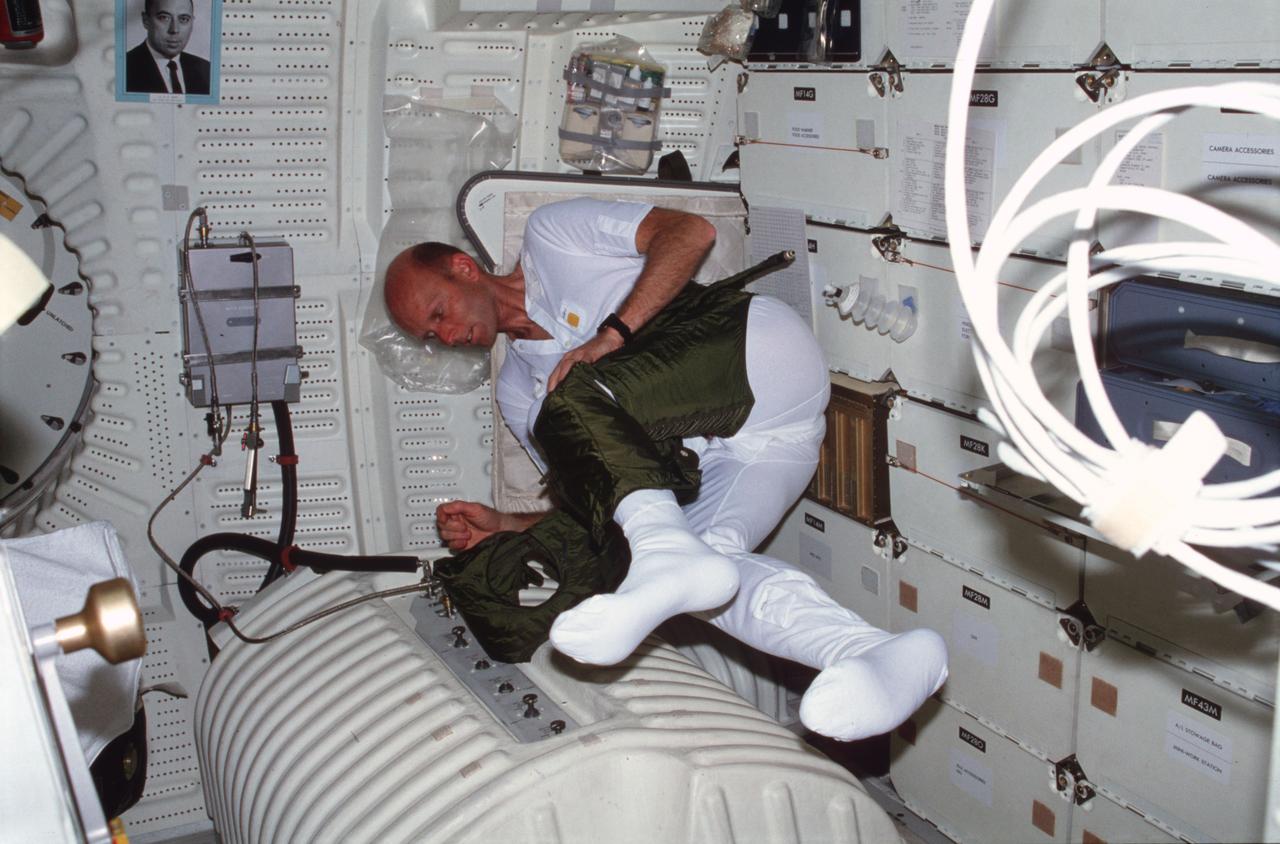
S82-28922 (30 March 1982) --- Astronaut C. Gordon Fullerton, STS-3 pilot, floats upside down in the zero-gravity environment of the middeck area of the Earth-orbiting space shuttle Columbia as he dons a modified USAF high altitude pressure garment. The brownish ejection/escape suit is used by the astronauts at launch and entry. Most of the remainder of their mission time, they are attired in a blue constant-wear garment. Astronaut Jack R. Lousma, crew commander, took this picture with a 35mm camera. The crew spent eight full days in the reusable spacecraft, a shuttle record. Photo credit: NASA
Pilot Fullerton dons anti-g and ejection escape suit (EES) on middeck
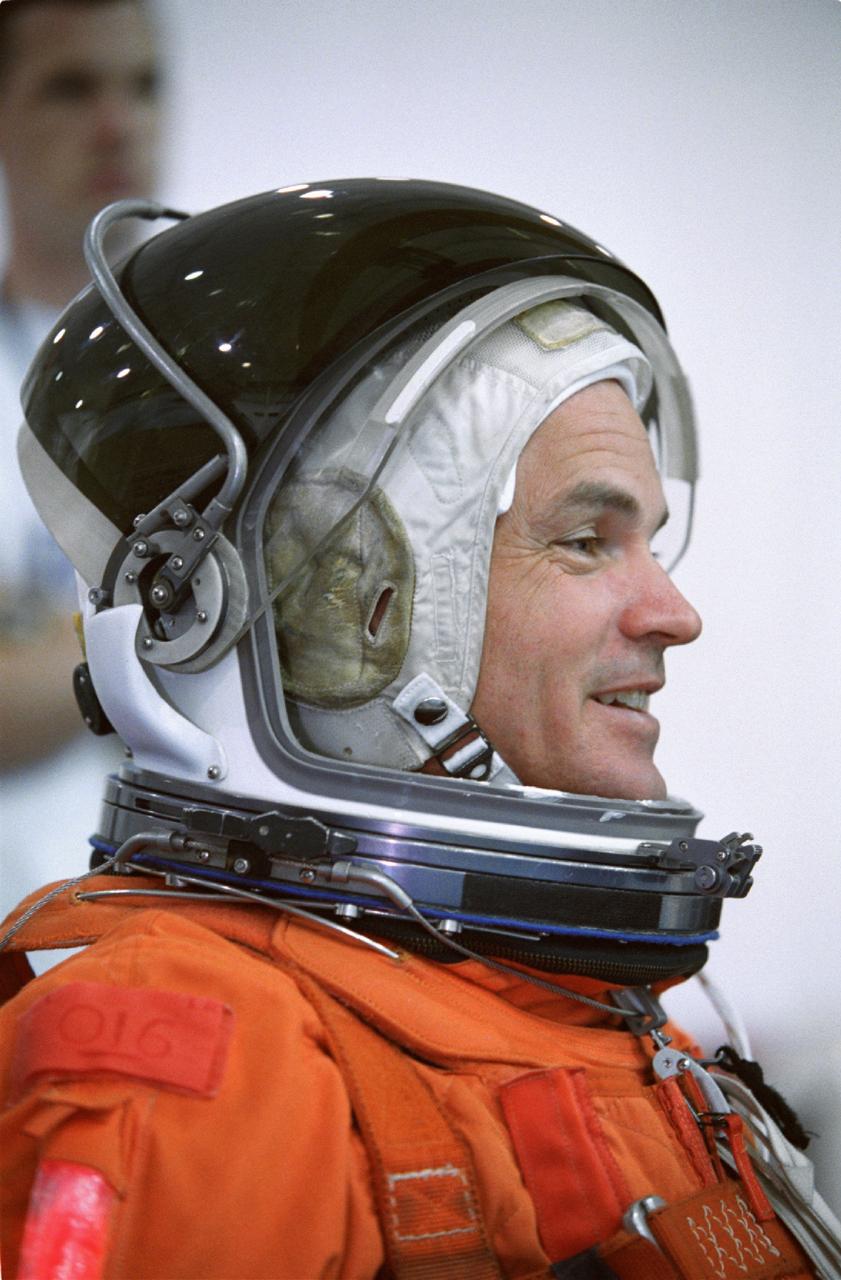
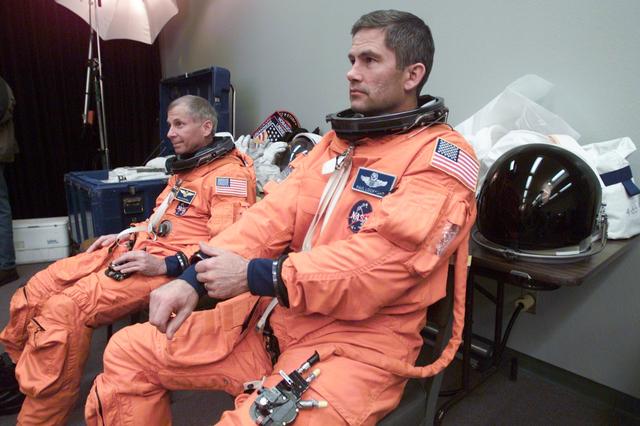
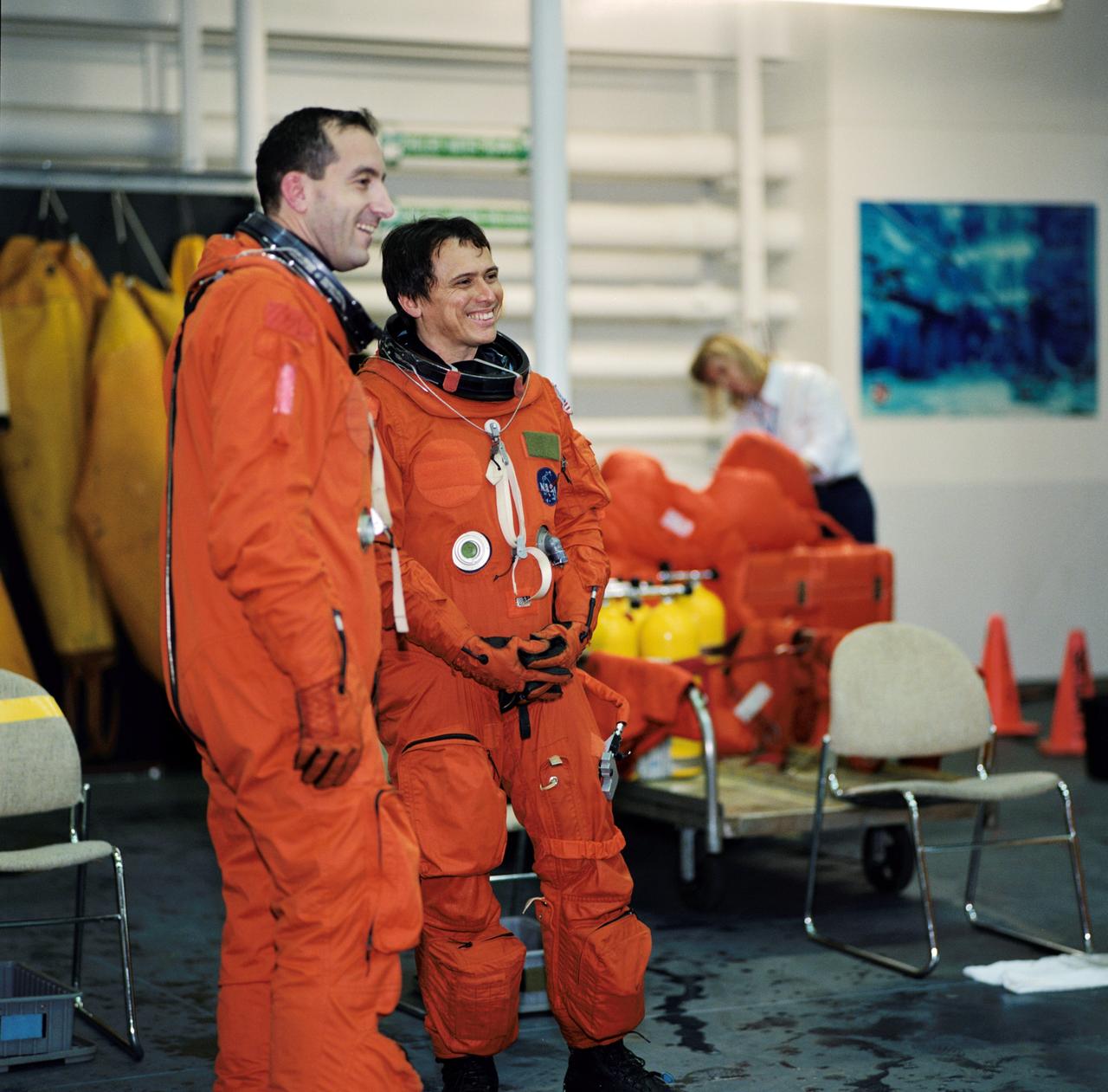
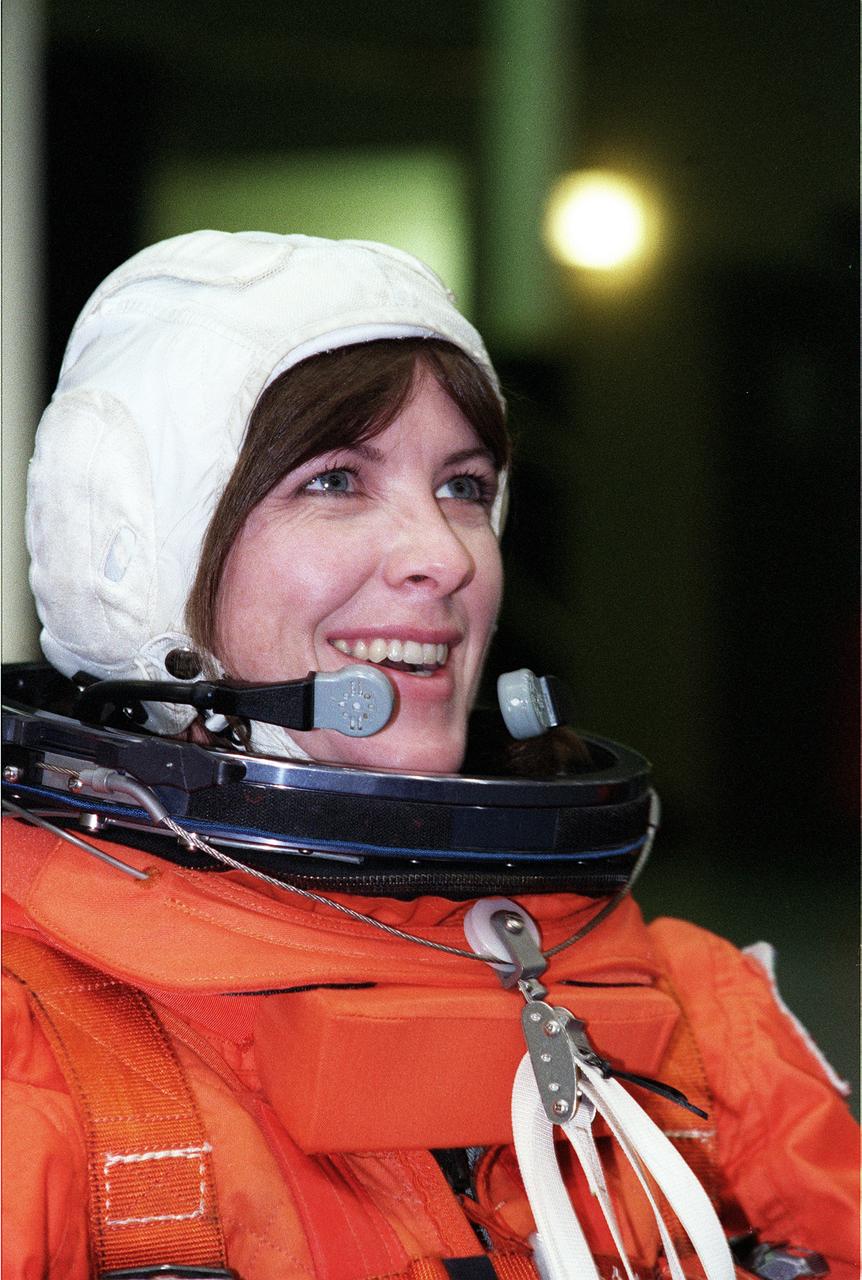
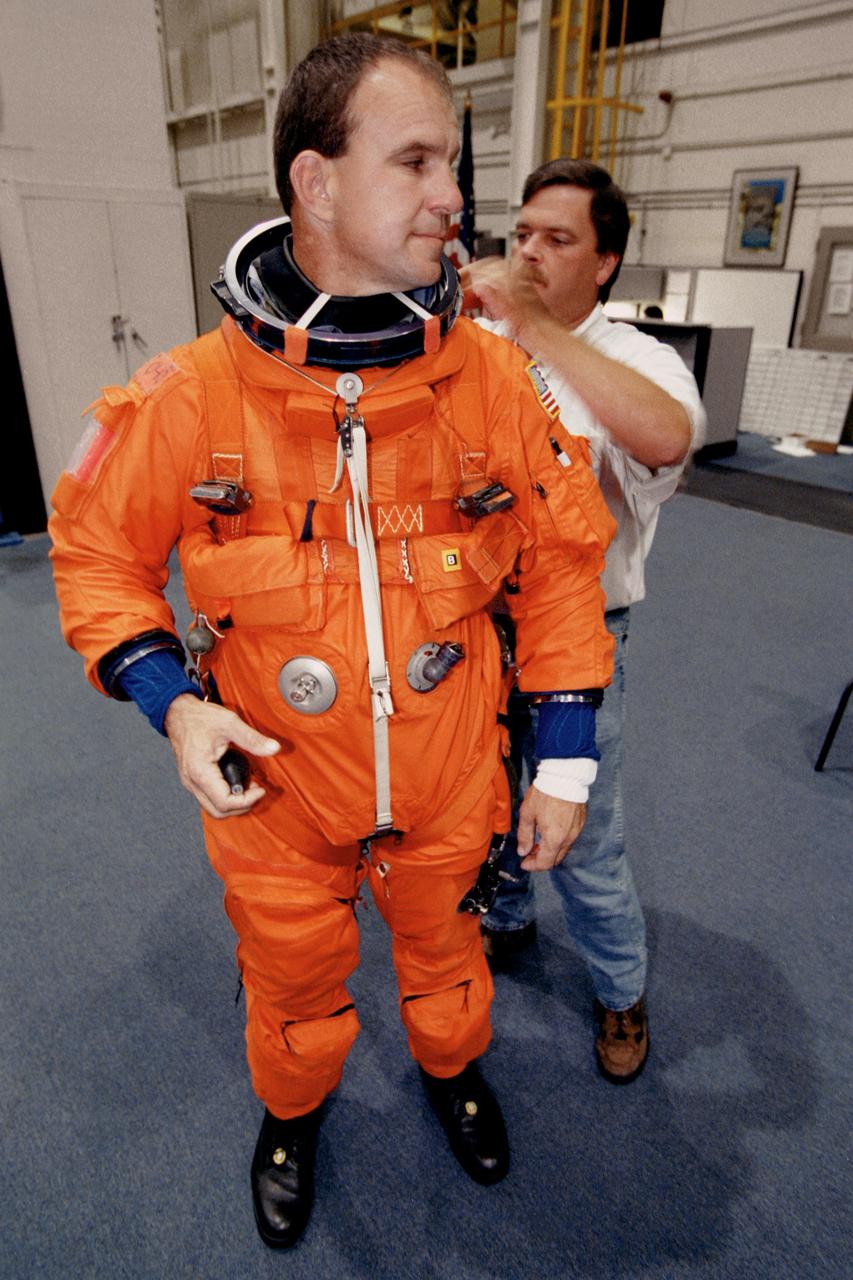
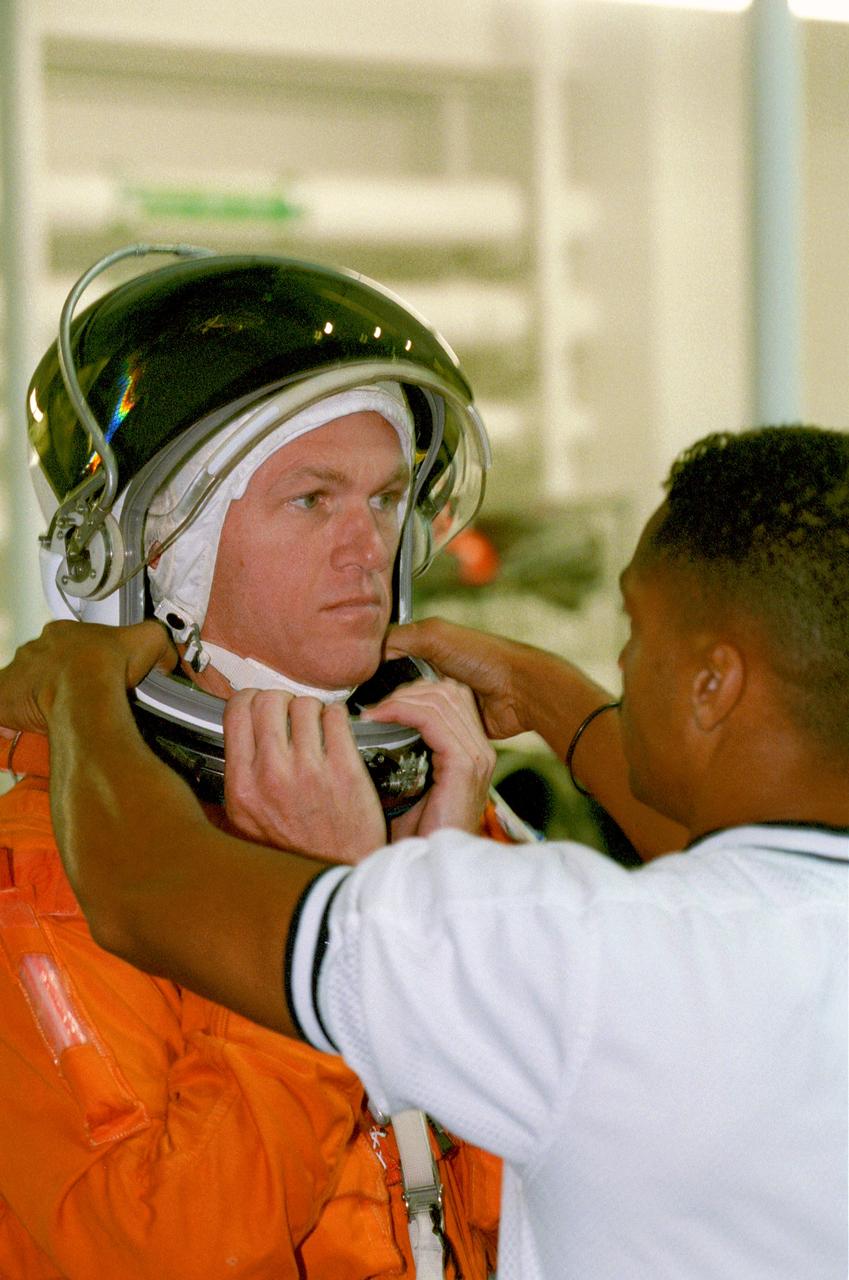
JSC2002-E-07961 (22 February 2002) --- Astronauts Kenneth D. Cockrell (left) and Paul S. Lockhart, STS-111 mission commander and pilot, respectively, wait for a photo session in a studio at Johnson Space Center (JSC). Cockrell and Lockhart are attired in training versions of the launch and entry garment.
jsc2002e07961
JSC2001-00020 (January 2001) --- Astronaut James F. Reilly, STS-104 mission specialist, attired in a training version of the shuttle launch and entry garment at the Neutral Buoyancy Laboratory (NBL) near Johnson Space Center (JSC). Reilly will join four other astronauts for a June mission with the International Space Station (ISS).
STS-104 Preflight Emergency Egress Bailout Training at the NBL
JSC2000-07284 (17 November 2000) --- Astronaut Michael L. Gernhardt, STS-104 mission specialist, attired in a training version of the shuttle launch and entry garment at the Jake Garn Simulation and Training Facility at Johnson Space Center (JSC). Gernhardt will join four other astronauts for a June mission with the International Space Station (ISS).
STS-104 crew trains in building 5
S99-11105 (9 September 1999) --- A suit technician (out of frame) assists astronaut Edward T. Lu, mission specialist, with a training version of the  shuttle launch and entry garment.  Lu was about to join his STS-106 crew mates for an emergency bailout training session in the Neutral Buoyancy Laboratory (NBL).
STS-101 preflight water survival bailout training at the NBL
S99-05617 (19 May 1999) --- Astronaut Janet L. Kavandi, mission specialist,  listens to a briefing about emergency egress procedures during a training session at the Johnson Space Center's  Systems Integration Facility.  Kavandi wears a training version of the partial pressure launch and entry garment.
STS-99 crewmembers bailout training in building 9
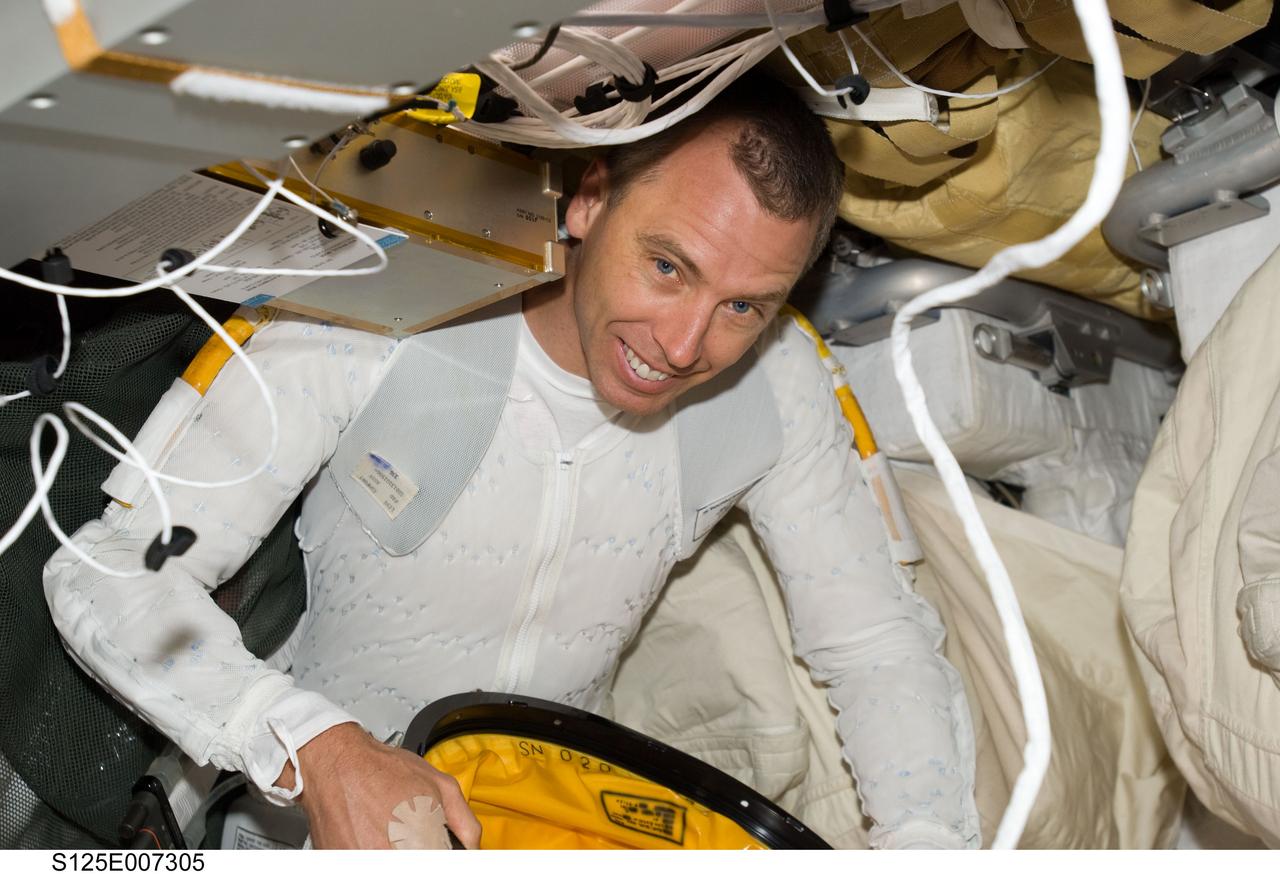
S125-E-007305 (14 May 2009) --- Astronaut Andrew Feustel, STS-125 mission specialist, wearing the liquid cooling and ventilation garment that complements the Extravehicular Mobility Unit (EMU) spacesuit, is pictured on the middeck of Space Shuttle Atlantis prior to the mission?s first session of extravehicular activity (EVA).
STS-125 MS5 Feustel prepares for EVA1 in the Middeck
JSC2000-04753 (15 June 2000) --- Mike Birkenseher, a suit technician for the United Space Alliance, assists astronaut Michael J. Bloomfield, STS-97 pilot, with his launch and entry garment.  Bloomfield was about to join his four STS-97 crew mates for a rehearsal of  launch procedures in a nearby shuttle trainer.
STS-97 crew trains in CCT II, building 9
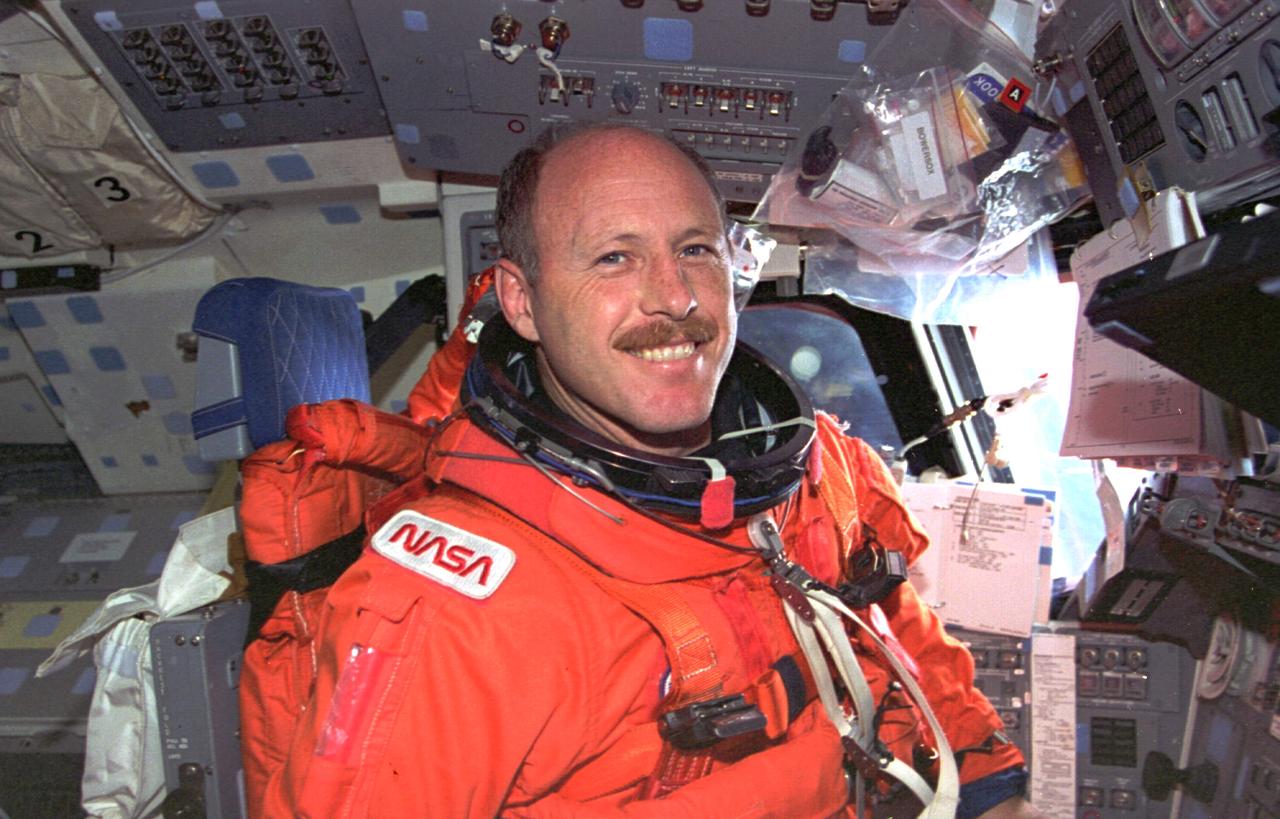
STS073-164-025 (5 November 1995) --- The countenance of astronaut Kenneth D. Bowersox signifies the near completion of a successful 16-day mission in Earth-orbit aboard the Space Shuttle Columbia.  Bowersox, attired in the shuttle launch and entry garment, mans the commander's station prior to the entry phase of the flight.
Commander Ken Bowersox and Pilot Kent Rominger during deorbit preparations
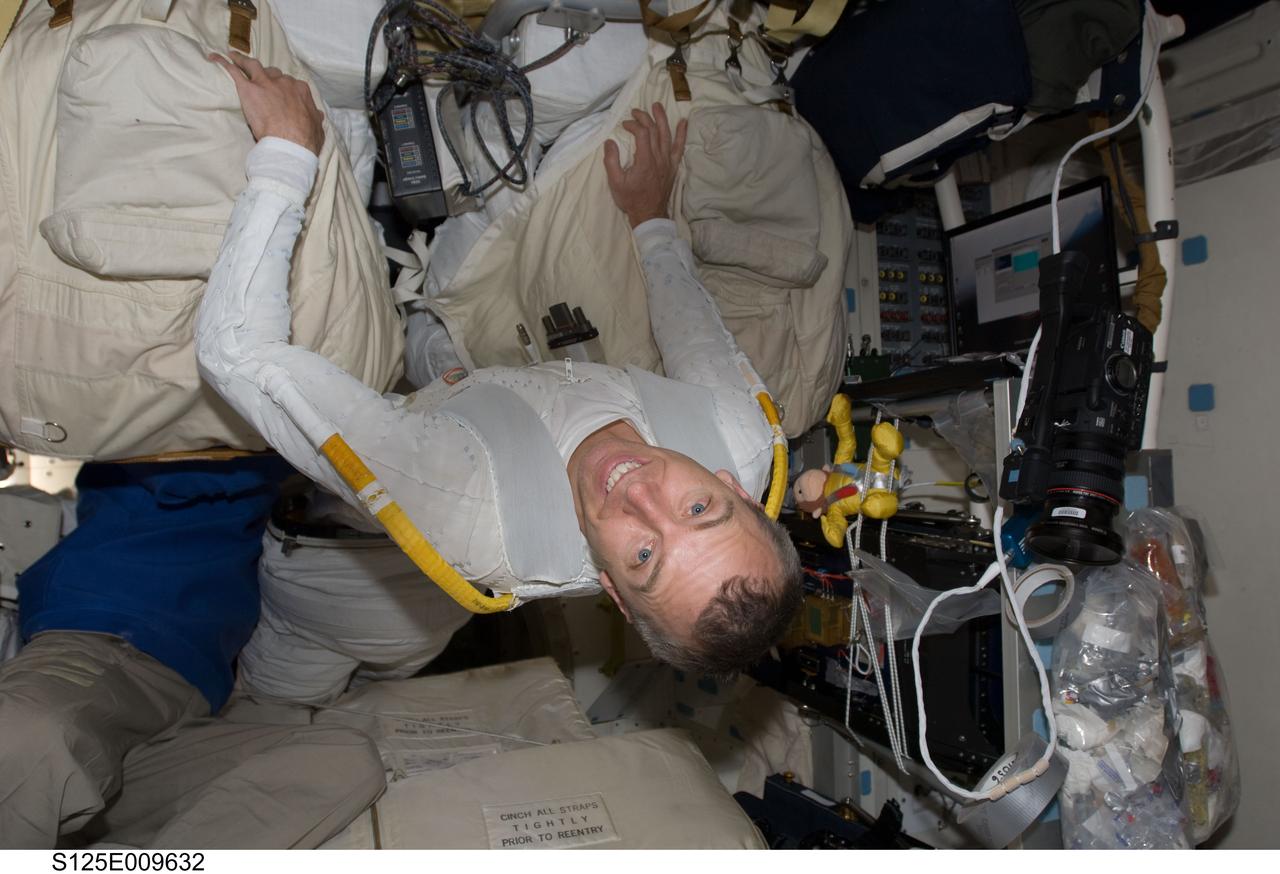
S125-E-009632 (18 May 2009) --- Astronaut Andrew Feustel, STS-125 mission specialist, wearing the liquid cooling and ventilation garment that complements the Extravehicular Mobility Unit (EMU) spacesuit, is picture on the middeck of the Earth-orbiting Space Shuttle Atlantis following the mission?s fifth and final session of extravehicular activity (EVA).
View of MS5 Feustel posing for a photo after the completion of EVA5
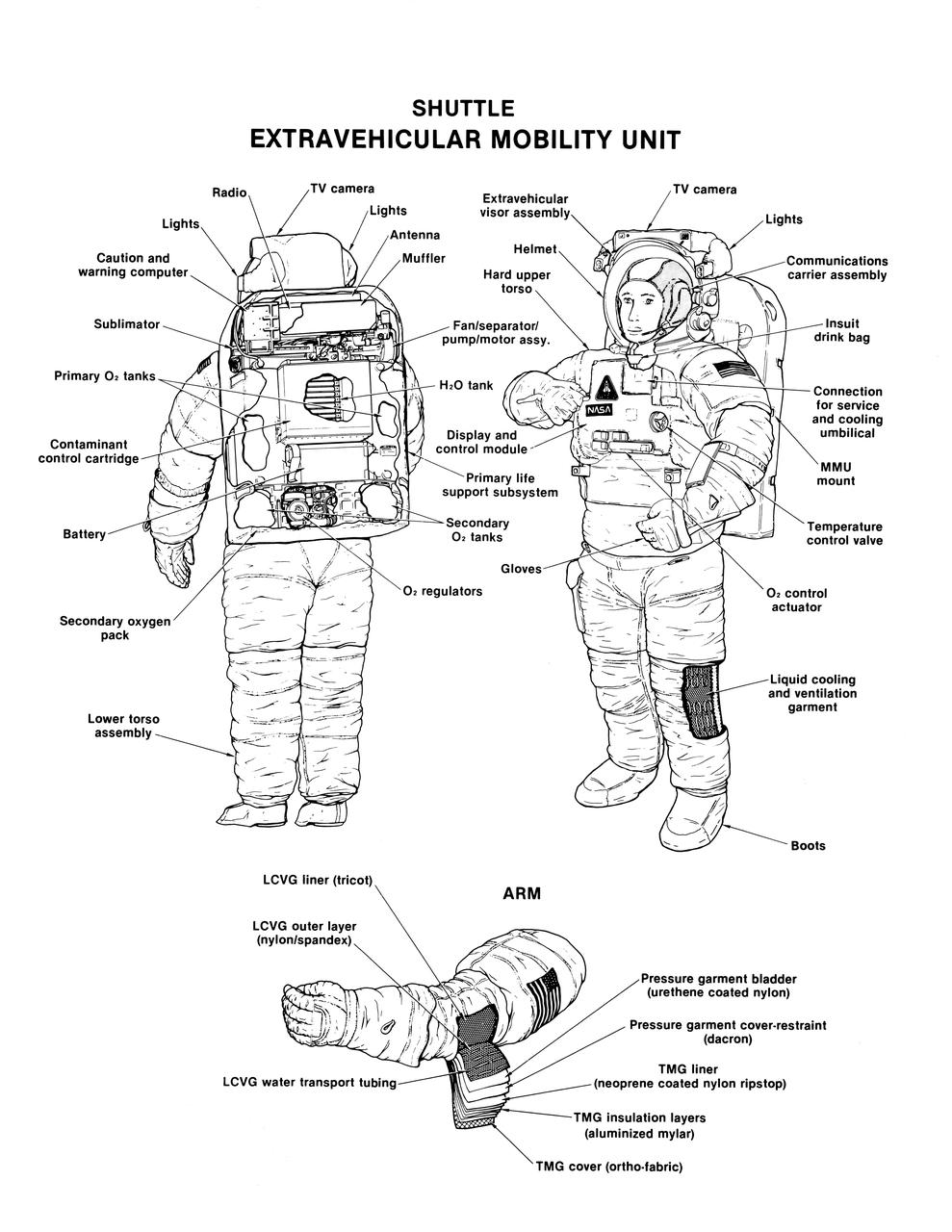
Labeled cutaway line drawing of the Shuttle extravehicular mobility unit (EMU) identifies its various components and equipment. The portable life support system (PLSS) and protective layers of fabric (thermal micrometeoroid garment (TMG)) incorporated in this extravehicular activity (EVA) space suit are shown.
Labeled cutaway line drawing of Shuttle Extravehicular Mobility Unit (EMU)
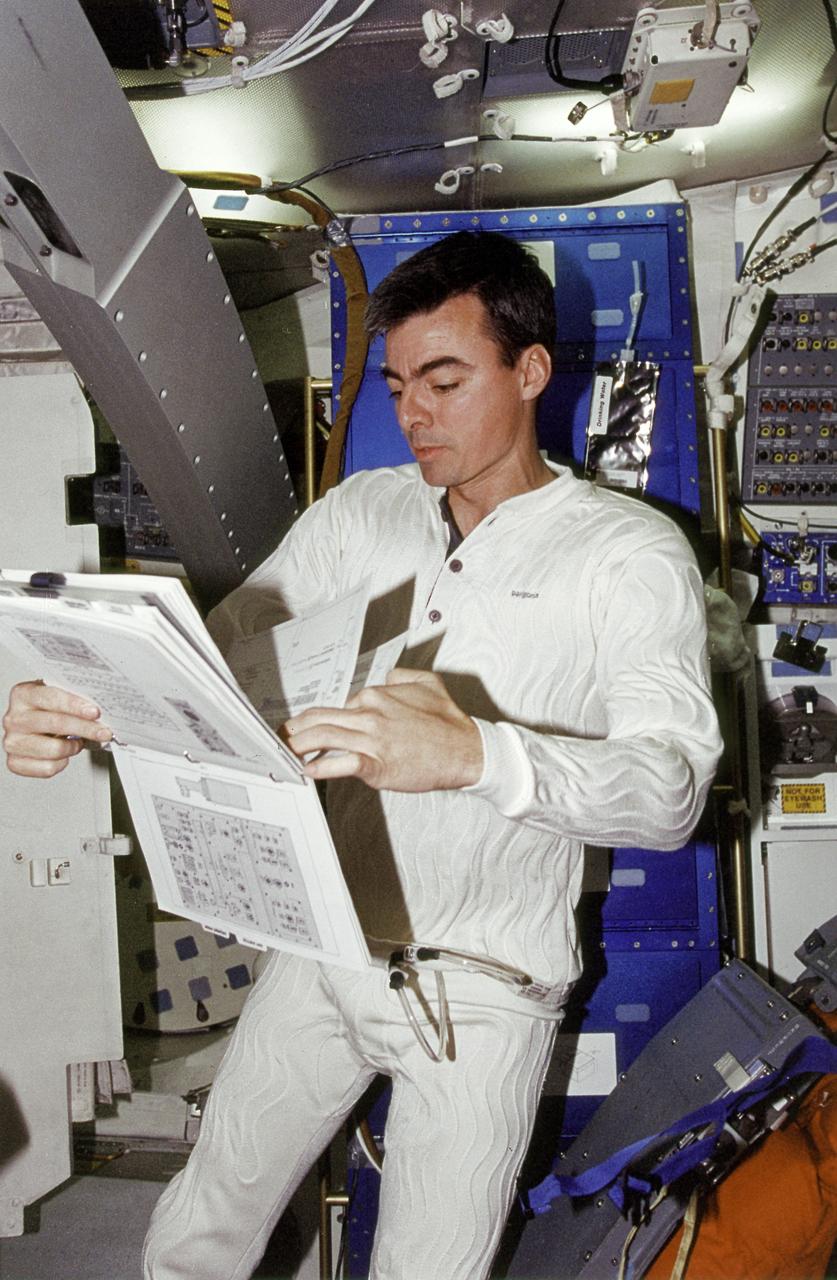
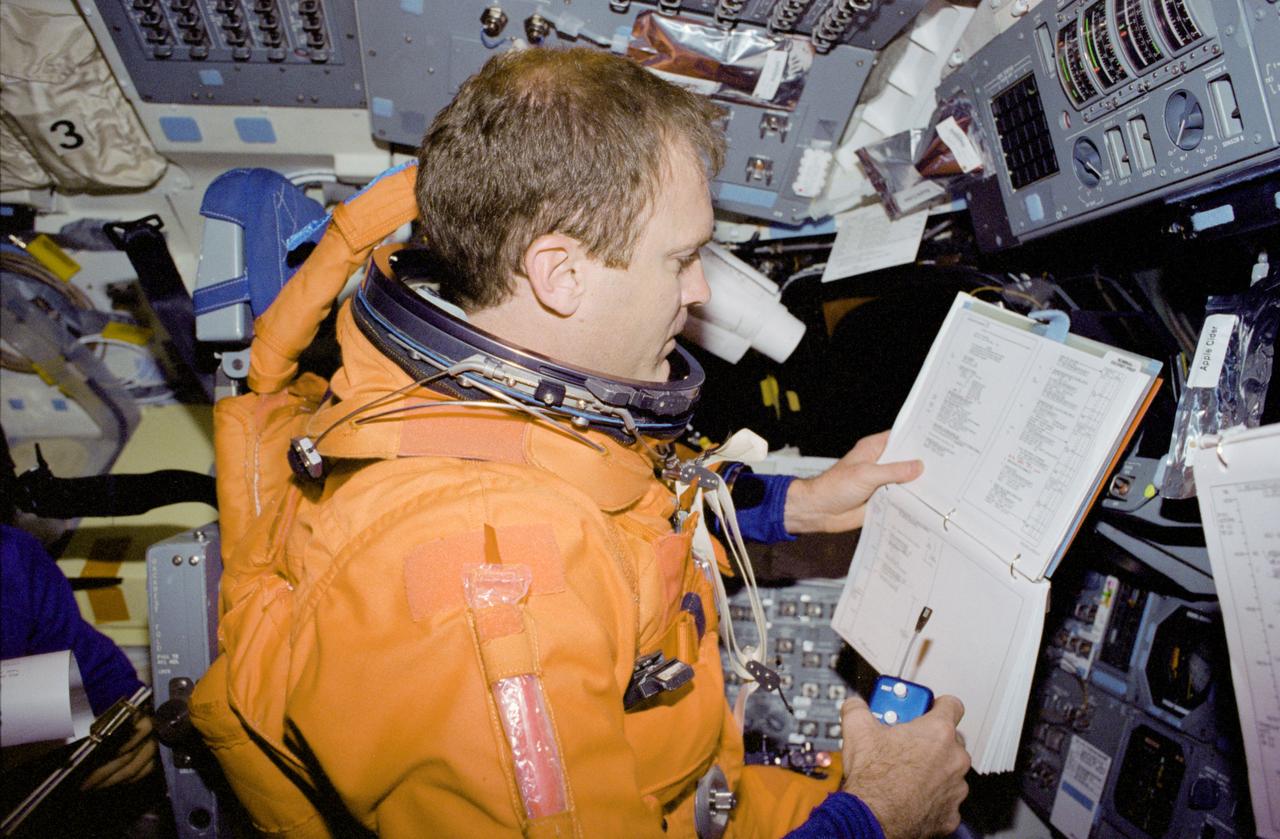
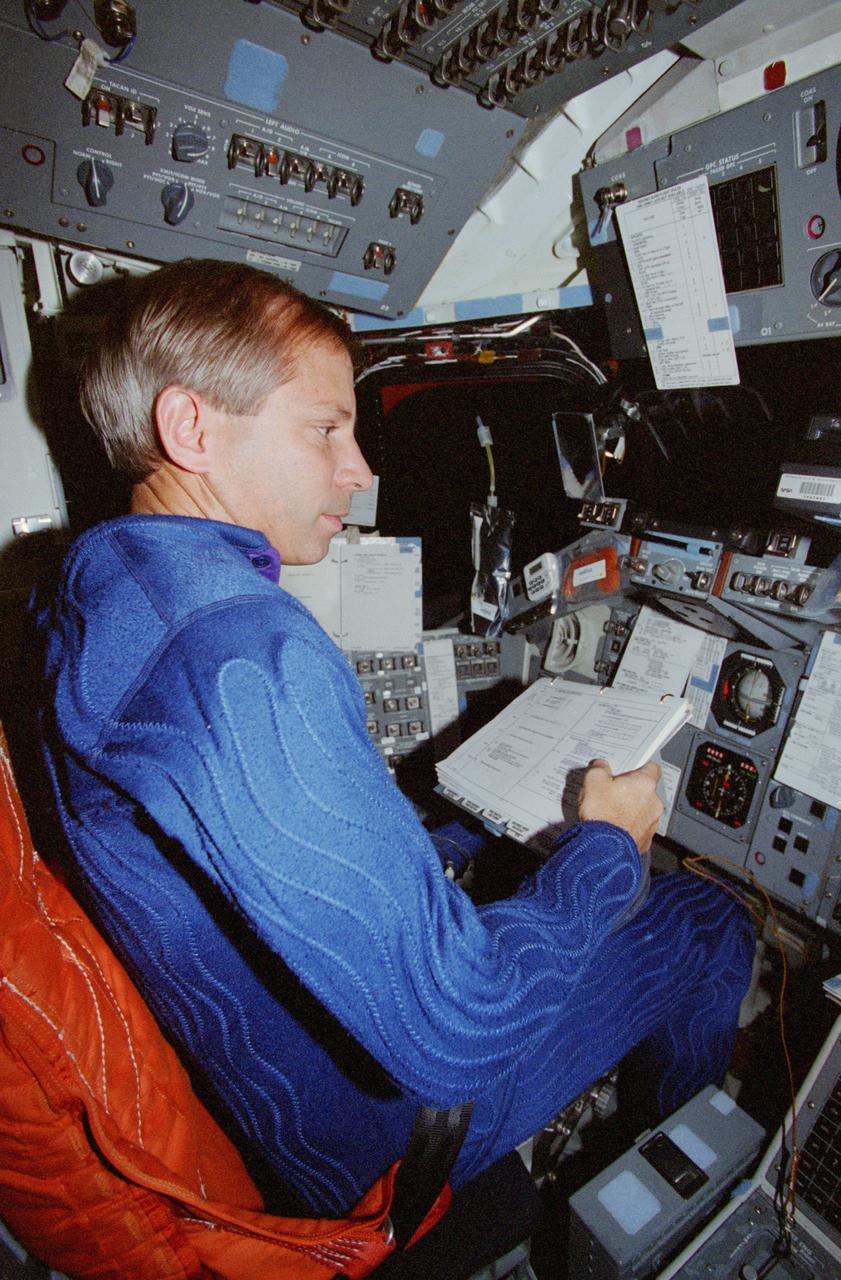
Onboard Space Shuttle Columbia (STS-62) Pilot Andrew M. Allen looks over a procedures book in the midst of a 14-day mission. Allen is attired in a new thermally controlled undergarment. Allen wore the garment during the launch and entry phases of the flight.
Microgravity
S125-E-009381 (17 May 2009) --- Astronaut Mike Massimino, STS-125 mission specialist, wearing the liquid cooling and ventilation garment that complements the Extravehicular Mobility Unit (EMU) spacesuit, is pictured in a hatch on the Earth-orbiting Space Shuttle Atlantis prior to the mission?s fourth session of extravehicular activity (EVA).
STS-125 MS4 Massimino poses for a photo prior to EVA4
S99-07621 (15 July 1999) --- Astronaut Marc Garneau, mission specialist representing the Canadian Space Agency, requires the assistance of two suit technicians as he dons his full pressure, launch and entry garment prior to a training session at the Johnson Space Center's Systems Integration Facility.
STS-97 crewmembers participate in training and preflight activities
STS103-332-021  (19-27 December 1999) --- Astronaut John M. Grunsfeld, who.participated in two of the three STS-103 space walks to service the Hubble Space Telescope (HST), dons an extravehicular mobility unit (EMU) space suit for one of the walks. Grunsfeld is wearing the liquid cooling and ventilation garment that complements the EMU.
MS Grunsfeld prepares for EVA
JSC2000-07466 (11 December 2000) --- Astronaut Daniel T. Barry, mission specialist, attired in a training version of the shuttle launch and entry garment, awaits the start of an emergency bailout training session at the Neutral Buoyancy Laboratory (NBL) near Johnson Space Center (JSC).
STS-105 preflight water survival training in NBL pool in SCTF
JSC2000-07464 (11 December 2000) --- Astronaut Frederick W. Sturckow, STS-105 pilot, attired in a training version of the shuttle launch and entry garment, awaits the start of an emergency bailout training session at the Neutral Buoyancy Laboratory (NBL) near Johnson Space Center (JSC).
STS-105 preflight water survival training in NBL pool in SCTF
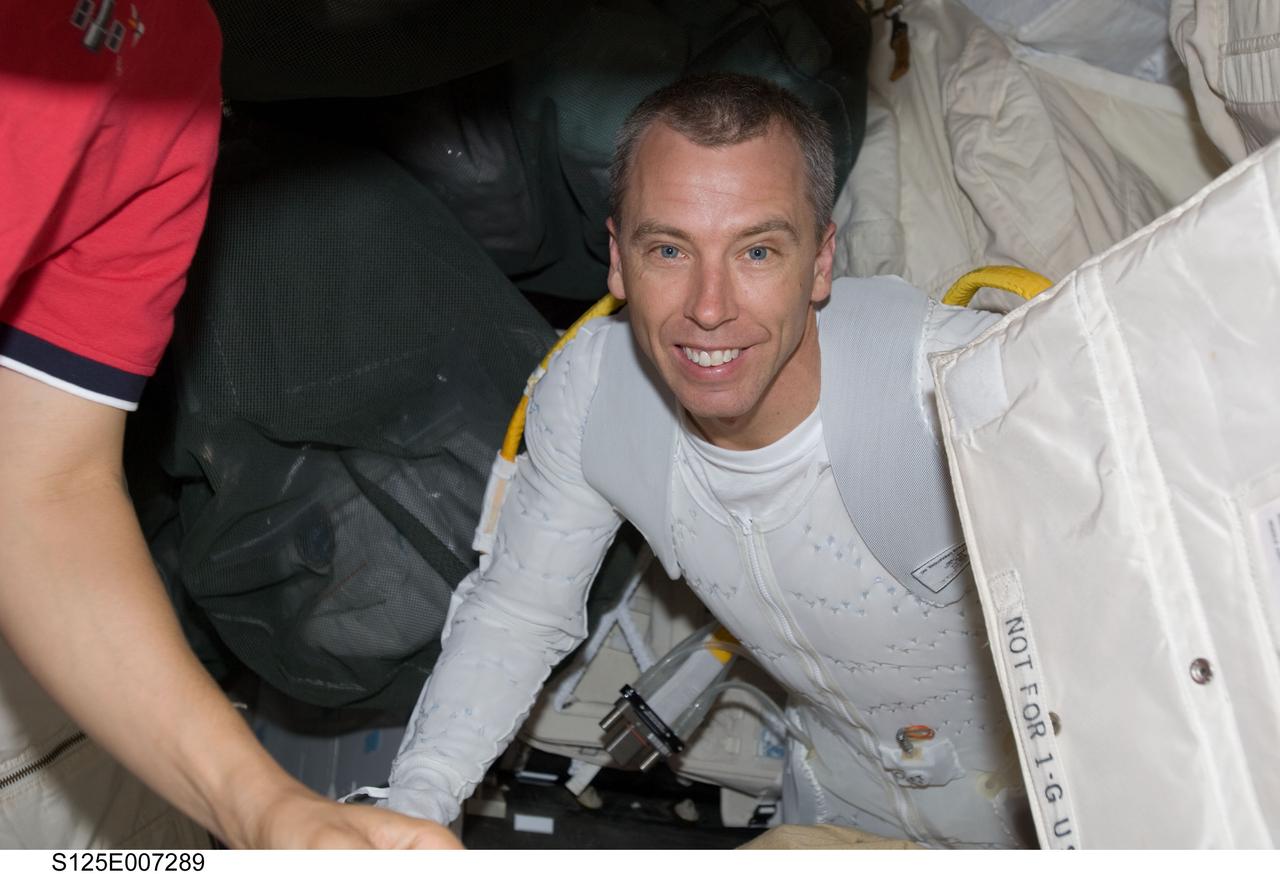
S125-E-007289 (14 May 2009) --- Astronaut Andrew Feustel, STS-125 mission specialist, wearing the liquid cooling and ventilation garment that complements the Extravehicular Mobility Unit (EMU) spacesuit, is pictured on the middeck of Space Shuttle Atlantis prior to the mission?s first session of extravehicular activity (EVA).
View of MS5 Feustel posing for a photo in the Middeck prior to EVA1
S99-05622 (19 May 1999) --- Astronaut Mamoru Mohri, mission specialist representing Japan's National Space Development Agency,  works with his communications gear prior to participating in emergency bailout training at the Johnson Space Center's  Systems Integration Facility.  Mohri  wears a training version of the partial pressure launch and entry garment.
STS-99 crewmembers bailout training in building 9
jsc2018e035900 (April 11, 2018) --- 2017 NASA astronaut candidate Matthew Dominick in a Liquid Cooling and Ventilation Garment helps himself into a spacesuit prior to underwater spacewalk training at NASA Johnson Space Center’s Neutral Buoyancy Laboratory. Photo Credit: (NASA/Josh Valcarcel)
2017 ASCAN class members during ASCAN EVQ1 (Red Team) Training
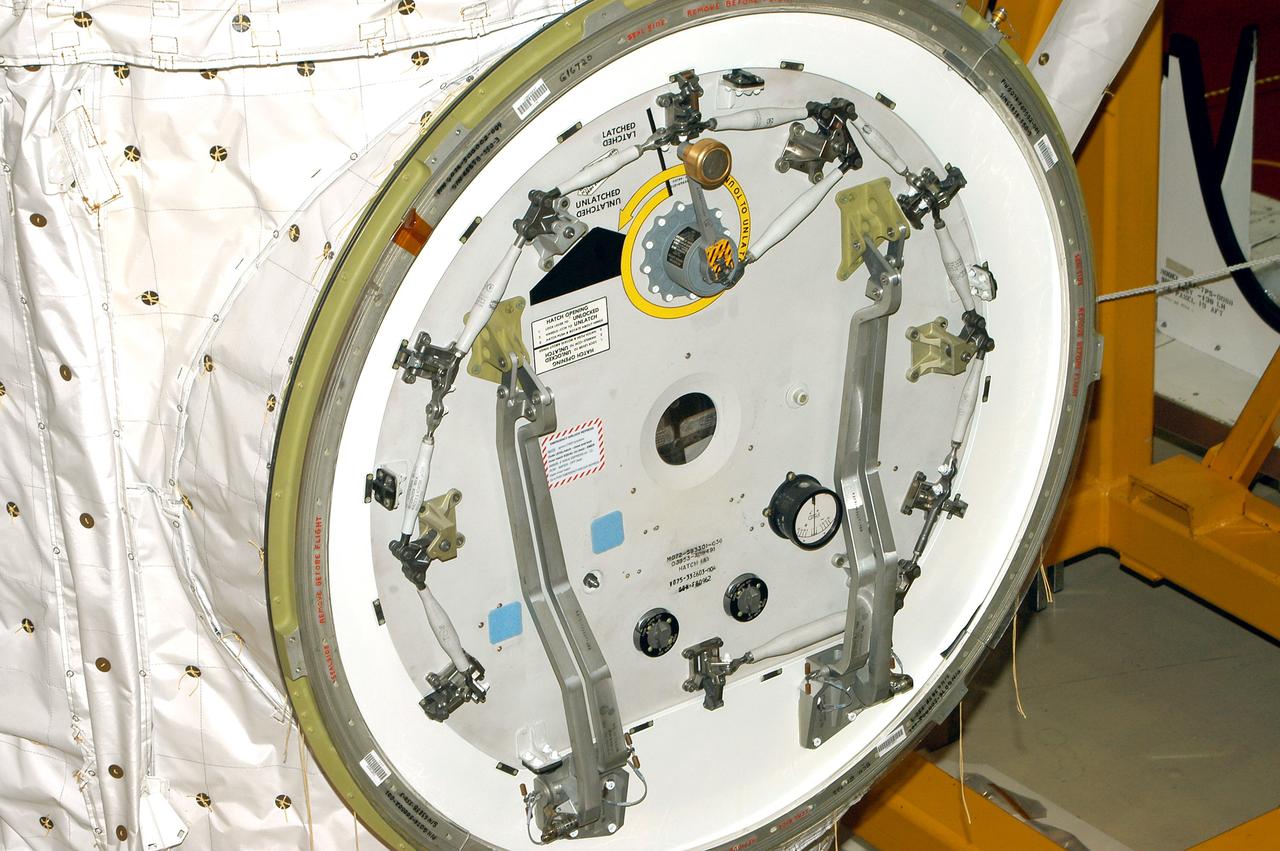
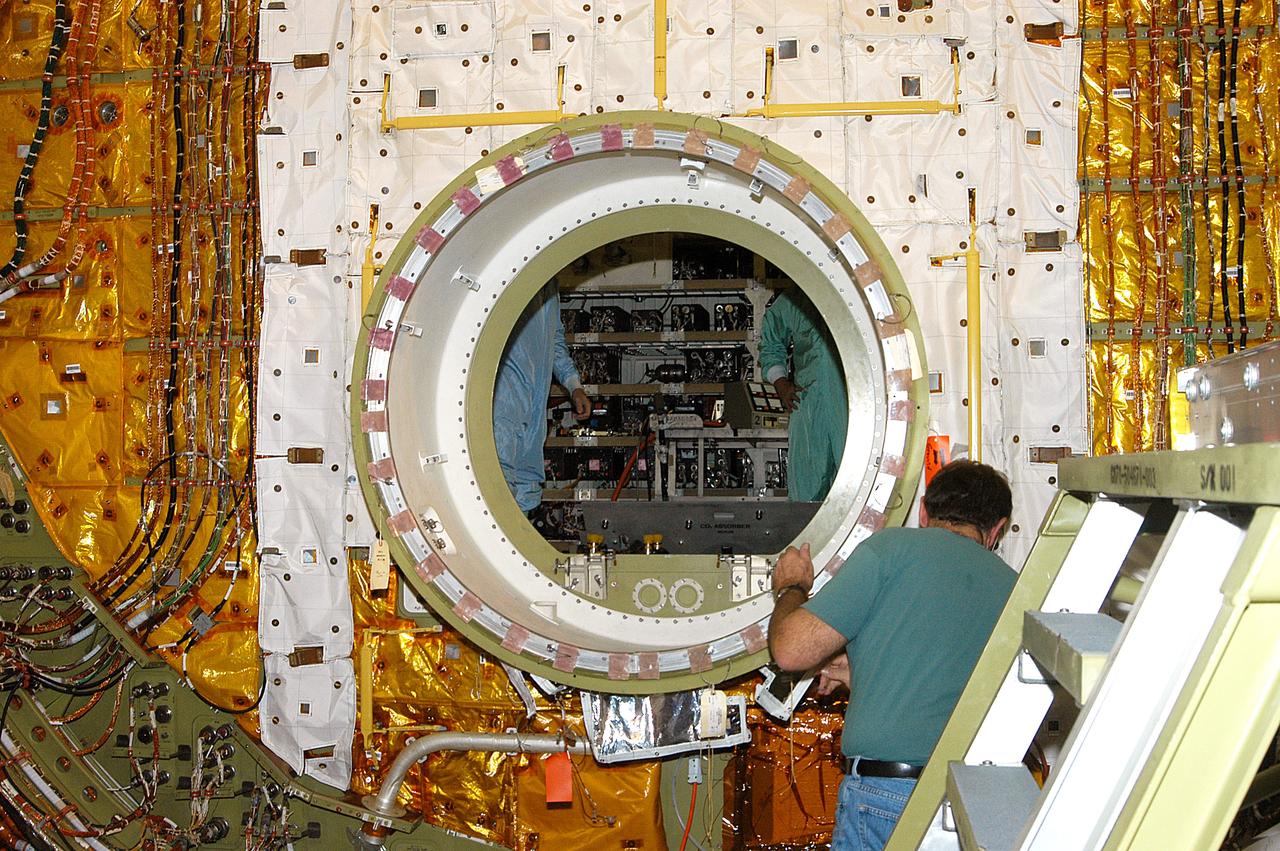
KENNEDY SPACE CENTER, FLA. -  In the Orbiter Processing Facility, a worker checks out part of the equipment in the airlock, at one end of Discovery’s payload bay.  The airlock is sized to accommodate two fully suited flight crew members simultaneously. Support functions include airlock depressurization and repressurization, extravehicular activity equipment recharge, liquid-cooled garment water cooling, EVA equipment checkout, donning and communications. The outer hatch isolates the airlock from the unpressurized payload bay when closed and permits the EVA crew members to exit from the airlock to the payload bay when open.
KENNEDY SPACE CENTER, FLA. - In the Orbiter Processing Facility, a worker checks out part of the equipment in the airlock, at one end of Discovery’s payload bay. The airlock is sized to accommodate two fully suited flight crew members simultaneously. Support functions include airlock depressurization and repressurization, extravehicular activity equipment recharge, liquid-cooled garment water cooling, EVA equipment checkout, donning and communications. The outer hatch isolates the airlock from the unpressurized payload bay when closed and permits the EVA crew members to exit from the airlock to the payload bay when open.
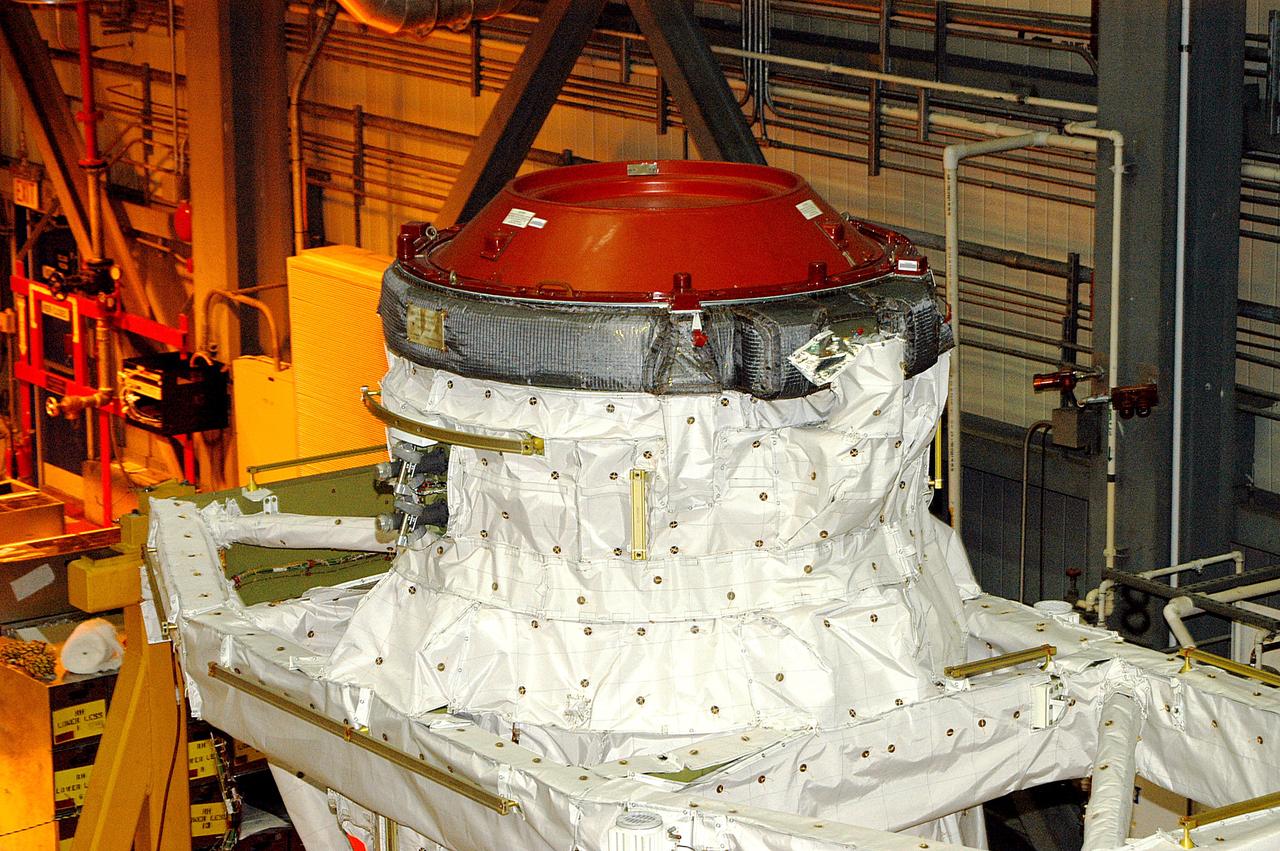
KENNEDY SPACE CENTER, FLA. -  Seen in the photo is one end of the airlock that is installed in the payload bay of orbiter Discovery.  The airlock is normally located inside the middeck of the spacecraft’s pressurized crew cabin. The airlock is sized to accommodate two fully suited flight crew members simultaneously. Support functions include airlock depressurization and repressurization, extravehicular activity equipment recharge, liquid-cooled garment water cooling, EVA equipment checkout, donning and communications. The outer hatch isolates the airlock from the unpressurized payload bay when closed and permits the EVA crew members to exit from the airlock to the payload bay when open.
KENNEDY SPACE CENTER, FLA. - Seen in the photo is one end of the airlock that is installed in the payload bay of orbiter Discovery. The airlock is normally located inside the middeck of the spacecraft’s pressurized crew cabin. The airlock is sized to accommodate two fully suited flight crew members simultaneously. Support functions include airlock depressurization and repressurization, extravehicular activity equipment recharge, liquid-cooled garment water cooling, EVA equipment checkout, donning and communications. The outer hatch isolates the airlock from the unpressurized payload bay when closed and permits the EVA crew members to exit from the airlock to the payload bay when open.
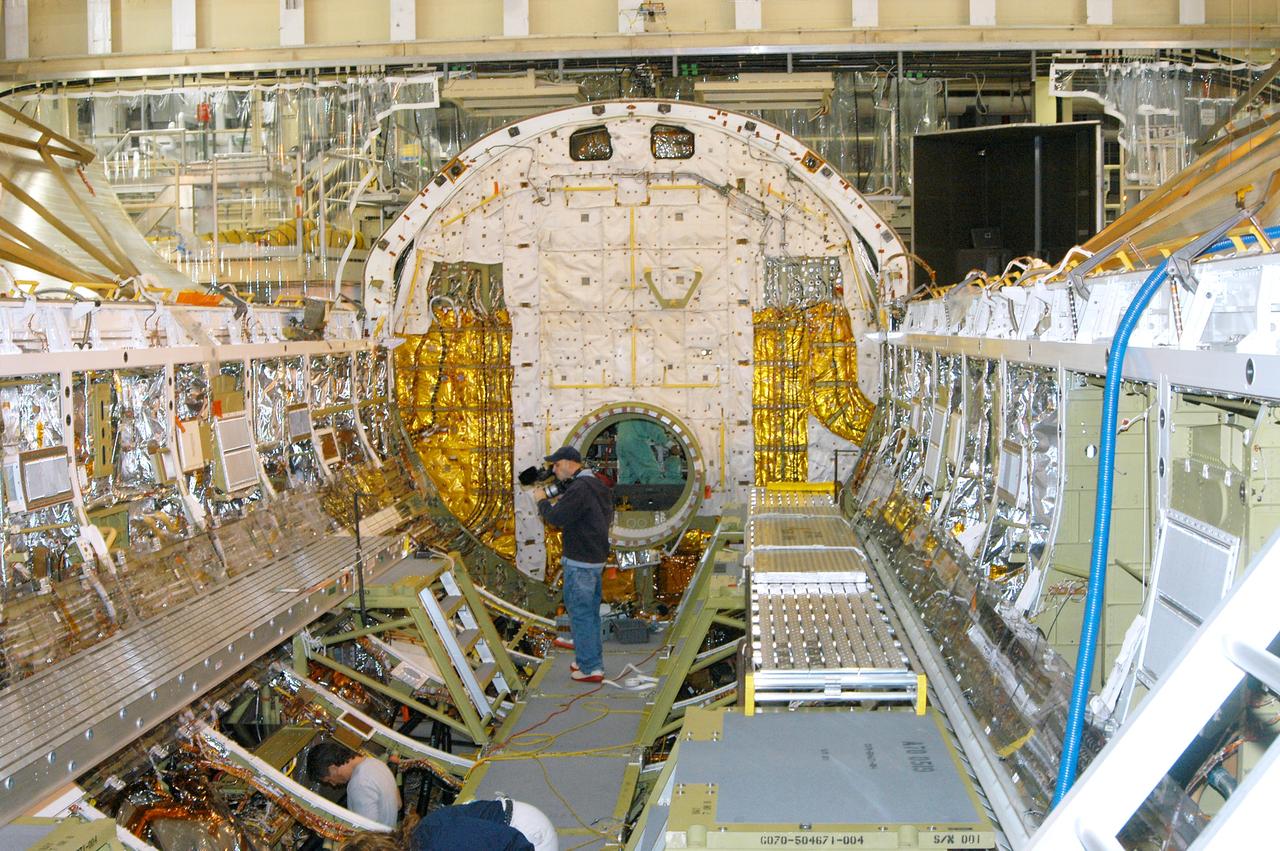
KENNEDY SPACE CENTER, FLA. -  In the Orbiter Processing Facility, a cameraman films part of Discovery’s payload bay for a special feature on the KSC Web.  In the background is the open hatch of the airlock, located inside the middeck of the spacecraft’s pressurized crew cabin. The airlock is sized to accommodate two fully suited flight crew members simultaneously. Support functions include airlock depressurization and repressurization, extravehicular activity equipment recharge, liquid-cooled garment water cooling, EVA equipment checkout, donning and communications. The outer hatch isolates the airlock from the unpressurized payload bay when closed and permits the EVA crew members to exit from the airlock to the payload bay when open.
KENNEDY SPACE CENTER, FLA. - In the Orbiter Processing Facility, a cameraman films part of Discovery’s payload bay for a special feature on the KSC Web. In the background is the open hatch of the airlock, located inside the middeck of the spacecraft’s pressurized crew cabin. The airlock is sized to accommodate two fully suited flight crew members simultaneously. Support functions include airlock depressurization and repressurization, extravehicular activity equipment recharge, liquid-cooled garment water cooling, EVA equipment checkout, donning and communications. The outer hatch isolates the airlock from the unpressurized payload bay when closed and permits the EVA crew members to exit from the airlock to the payload bay when open.
KENNEDY SPACE CENTER, FLA. -  A worker in the Orbiter Processing Facility checks the open hatch of the airlock in Discovery’s payload bay. The airlock is normally located inside the middeck of the spacecraft’s pressurized crew cabin. The airlock is sized to accommodate two fully suited flight crew members simultaneously. Support functions include airlock depressurization and repressurization, extravehicular activity equipment recharge, liquid-cooled garment water cooling, EVA equipment checkout, donning and communications. The outer hatch isolates the airlock from the unpressurized payload bay when closed and permits the EVA crew members to exit from the airlock to the payload bay when open.
KENNEDY SPACE CENTER, FLA. - A worker in the Orbiter Processing Facility checks the open hatch of the airlock in Discovery’s payload bay. The airlock is normally located inside the middeck of the spacecraft’s pressurized crew cabin. The airlock is sized to accommodate two fully suited flight crew members simultaneously. Support functions include airlock depressurization and repressurization, extravehicular activity equipment recharge, liquid-cooled garment water cooling, EVA equipment checkout, donning and communications. The outer hatch isolates the airlock from the unpressurized payload bay when closed and permits the EVA crew members to exit from the airlock to the payload bay when open.
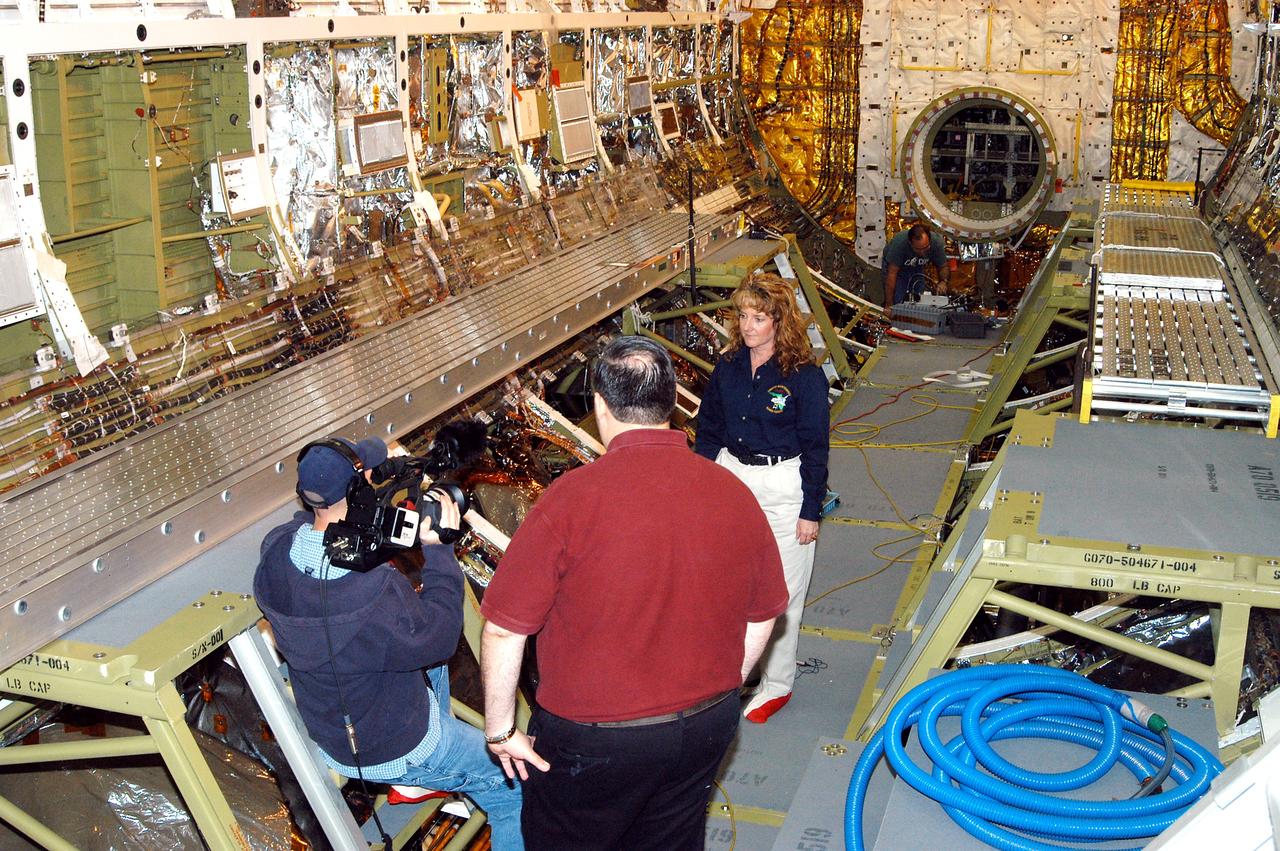
KENNEDY SPACE CENTER, FLA. -  Standing inside Discovery’s payload bay, Carol Scott (right), lead orbiter engineer, talks about her job as part of a special feature for the KSC Web.  With his back to the camera is Bill Kallus, Media manager in the KSC Web Studio.  Behind Scott can be seen the open hatch of the airlock, which provides support functions such as airlock depressurization and repressurization, extravehicular activity equipment recharge, liquid-cooled garment water cooling, EVA equipment checkout, donning and communications. The outer hatch isolates the airlock from the unpressurized payload bay when closed and permits the EVA crew members to exit from the airlock to the payload bay when open.
KENNEDY SPACE CENTER, FLA. - Standing inside Discovery’s payload bay, Carol Scott (right), lead orbiter engineer, talks about her job as part of a special feature for the KSC Web. With his back to the camera is Bill Kallus, Media manager in the KSC Web Studio. Behind Scott can be seen the open hatch of the airlock, which provides support functions such as airlock depressurization and repressurization, extravehicular activity equipment recharge, liquid-cooled garment water cooling, EVA equipment checkout, donning and communications. The outer hatch isolates the airlock from the unpressurized payload bay when closed and permits the EVA crew members to exit from the airlock to the payload bay when open.
KENNEDY SPACE CENTER, FLA. -  Seen in the photo is one end of the airlock that is installed in the payload bay of orbiter Discovery.  The airlock is normally located inside the middeck of the spacecraft’s pressurized crew cabin. The airlock is sized to accommodate two fully suited flight crew members simultaneously. Support functions include airlock depressurization and repressurization, extravehicular activity equipment recharge, liquid-cooled garment water cooling, EVA equipment checkout, donning and communications. The outer hatch isolates the airlock from the unpressurized payload bay when closed and permits the EVA crew members to exit from the airlock to the payload bay when open.
KENNEDY SPACE CENTER, FLA. - Seen in the photo is one end of the airlock that is installed in the payload bay of orbiter Discovery. The airlock is normally located inside the middeck of the spacecraft’s pressurized crew cabin. The airlock is sized to accommodate two fully suited flight crew members simultaneously. Support functions include airlock depressurization and repressurization, extravehicular activity equipment recharge, liquid-cooled garment water cooling, EVA equipment checkout, donning and communications. The outer hatch isolates the airlock from the unpressurized payload bay when closed and permits the EVA crew members to exit from the airlock to the payload bay when open.
JSC2000-E-23713 (September 2000) --- Attired in a training version of his full-pressure launch and entry garment,  astronaut James D. Wetherbee, mission commander for STS-102, is pictured prior to participating in an emergency bailout training exercise in the Crew Compartment Trainer (CCT-2) of the Systems Integration Facility at the Johnson Space Center (JSC).
STS-102 and Expedition Four bailout training in Building 9NW
JSC2002-00417 (4 February 2002) --- Astronaut Franklin R. Chang-Diaz, STS-111 mission specialist, simulates a parachute drop into water during an emergency bailout training session at the Neutral Buoyancy Laboratory (NBL) near the Johnson Space Center (JSC). Chang-Diaz is attired in a training version of the shuttle launch and entry garment. STS-111 will be the 14th shuttle mission to visit the International Space Station (ISS).
jsc2002-00417
JSC2000-E-23342 (26 September 2000) --- Astronauts Carl E. Walz (left) and Daniel W. Bursch, both Expedition Four flight engineers, and cosmonaut Yuri I. Onufrienko, mission commander, pause for an informal crew portrait prior to a mission training session in the Space Vehicle Mockup Facility at the Johnson Space Center (JSC). The crew members are attired in training versions of the shuttle launch and entry garment. Onufrienko represents Rosaviakosmos.
ISS Expedition Four crew training in Bldg 9, CCTII
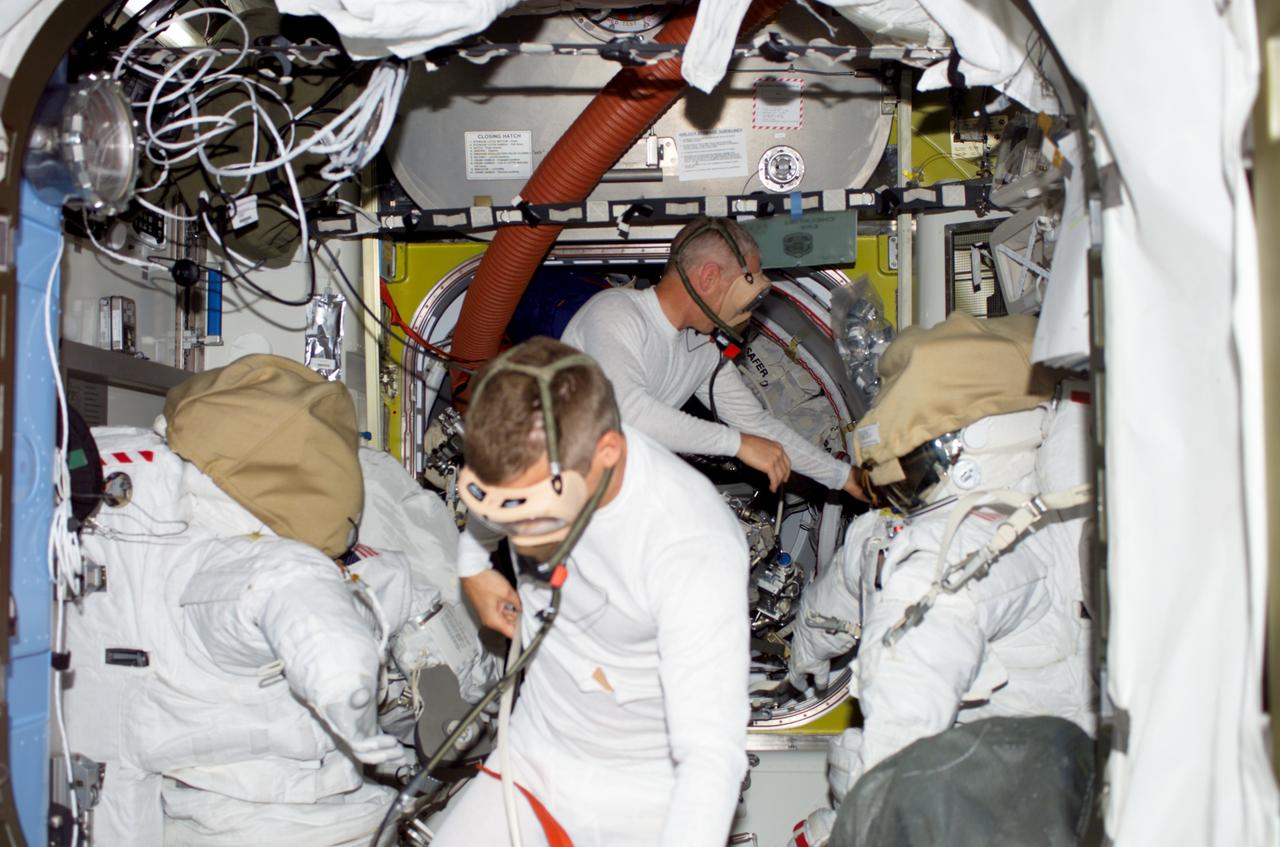
STS112-309-033 (10 October 2002) --- Astronauts Piers J. Sellers (left) and David A. Wolf, STS-112 mission specialists, are photographed in the midst of a pre-breathe exercise in preparation for the mission’s first session of extravehicular activity (EVA). Sellers and Wolf are attired in the liquid cooling and ventilation garment that complements the Extravehicular Mobility Unit (EMU) space suit.
MS Sellers and Wolf in Quest airlock for EVA 1
S99-8656 (24 May 1999) --- Astronauts C. Michael Foale, left, and Claude Nicollier, both assigned to EVA duty on the STS-103 crew's upcoming servicing visit to the Hubble Space Telescope (HST), pose for an informal portrait in training versions of the launch and entry space garment. Nicollier is one of two astronauts on this crew who represent the European Space Agency (ESA).
STS-103 crewmembers participate in bailout training in building 9N
SC2000-E-23716 (September 2000) --- Attired in a training version of his full-pressure launch and entry garment, astronaut Paul W. Richards, mission specialist for STS-102, is pictured prior to participating in an emergency bailout training exercise in the Crew Compartment Trainer (CCT-2) of the Systems Integration Facility at the Johnson Space Center (JSC).
STS-102 and Expedition Four bailout training in Building 9NW
ISS013-E-60792 (28 July 2006) --- Cosmonaut Pavel V. Vinogradov (left), Expedition 13 commander representing Russia's Federal Space Agency, and astronaut Jeffrey N. Williams, NASA space station science officer and flight engineer, take a moment to pose for a photo in the Quest Airlock of the International Space Station. Williams is attired in a liquid cooling and ventilation garment that complements the Extravehicular Mobility Unit (EMU) space suit. The crew is preparing for a session of extravehicular activity (EVA) scheduled for Thursday, Aug. 3, 2006.
EVA preparation during Expedition 13
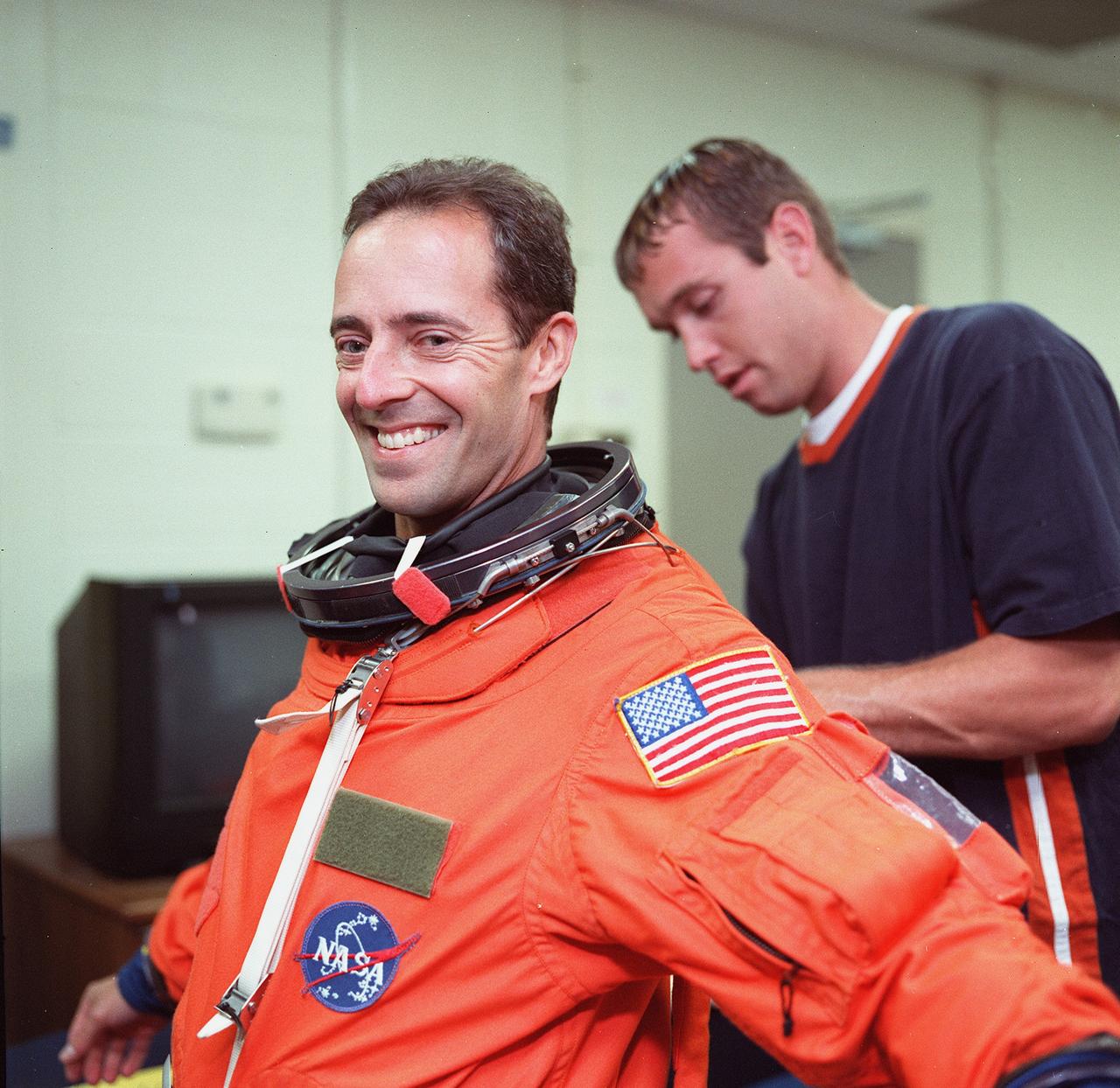
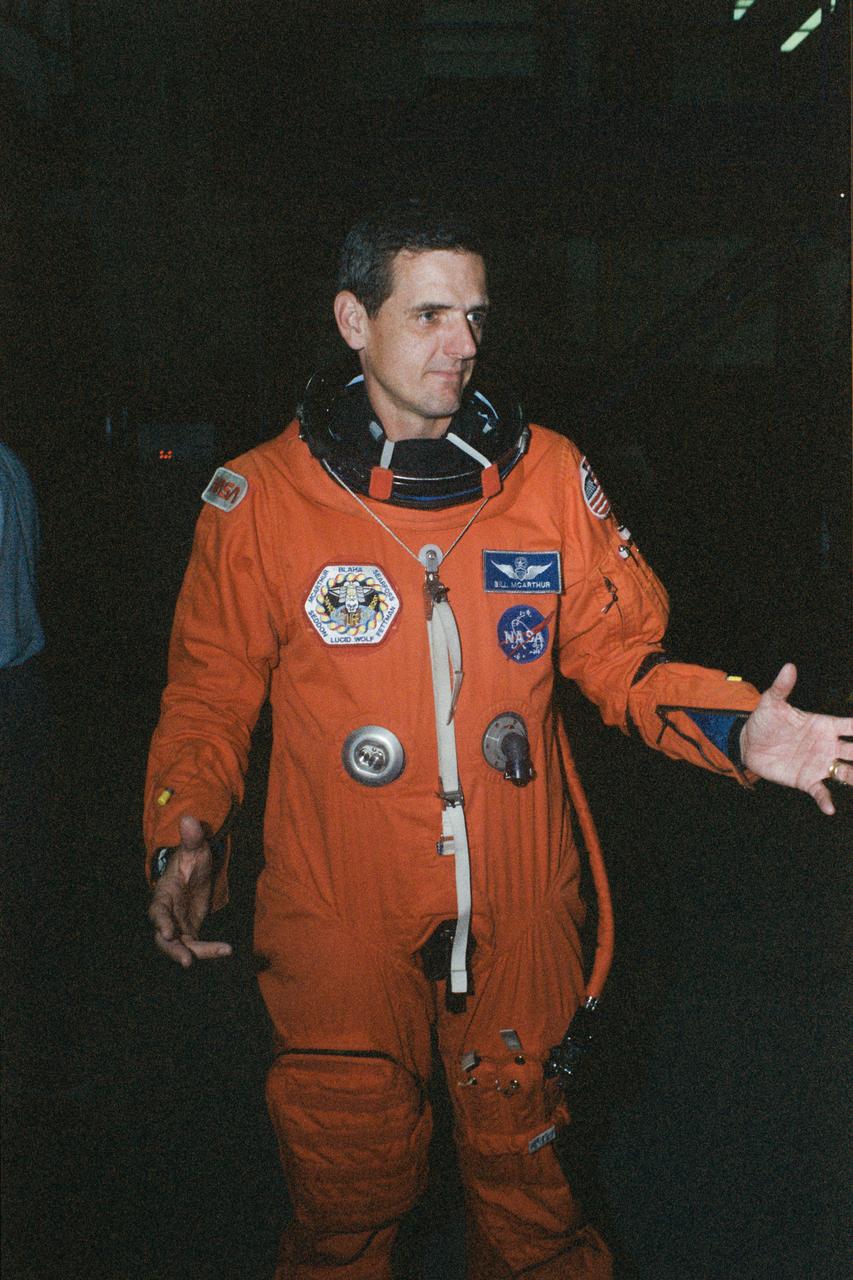
S93-38679 (20 July 1993) --- Wearing a training version of the partial pressure launch and entry garment, astronaut William S. McArthur listens to a briefing on emergency egress procedures for the STS-58 mission.  McArthur, along with five other NASA astronauts and a visiting payload specialist assigned to the seven member crew, later rehearsed contingency evacuation procedures.  Most of the training session took place in the crew compartment and full fuselage trainers of the Space Shuttle mockup and integration laboratory.
Astronaut William McArthur prepares for a training exercise
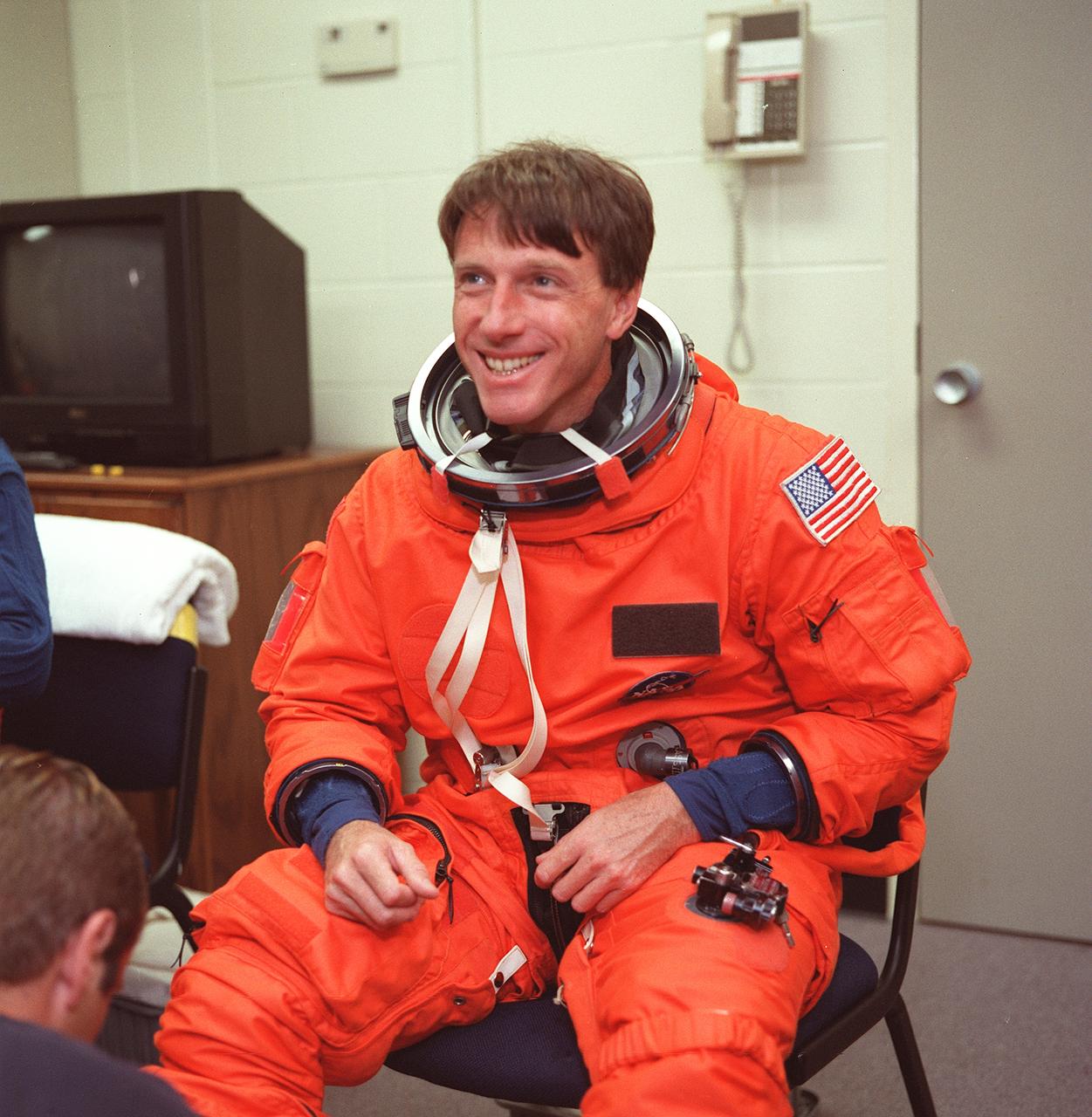
STS084-318-035 (15-24 May 1997) --- Attired in the partial pressure launch and entry garment, astronaut Charles J. Precourt, commander, performs final checkout procedures prior to the re-entry phase of the STS-84 mission. The photo was taken with a 35mm camera by one of the Space Shuttle Atlantis' rear station-seated crewmembers.
Precourt prepares for entry seated at the commander's station
JSC2001-00024 (January 2001) --- Astronaut Charles O. Hobaugh, STS-104 pilot, attired in a training version of the shuttle launch and entry garment, awaits the start of a training session at the Neutral Buoyancy Laboratory (NBL) near Johnson Space Center (JSC). Hobaugh will join four other astronauts for a June mission with the International Space Station (ISS).
STS-104 Preflight Emergency Egress Bailout Training at the NBL
STS98-E-5223 (14 February 2001) ---  Astronaut Thomas D. Jones, mission specialist, dons his extravehicular mobility unit (EMU) space garment in the airlock of the Space Shuttle Atlantis in this high-angle view photographed with a digital still camera.  Jones was about to participate in the final of three space walks scheduled for the STS-98/5a mission.
MS Jones in airlock
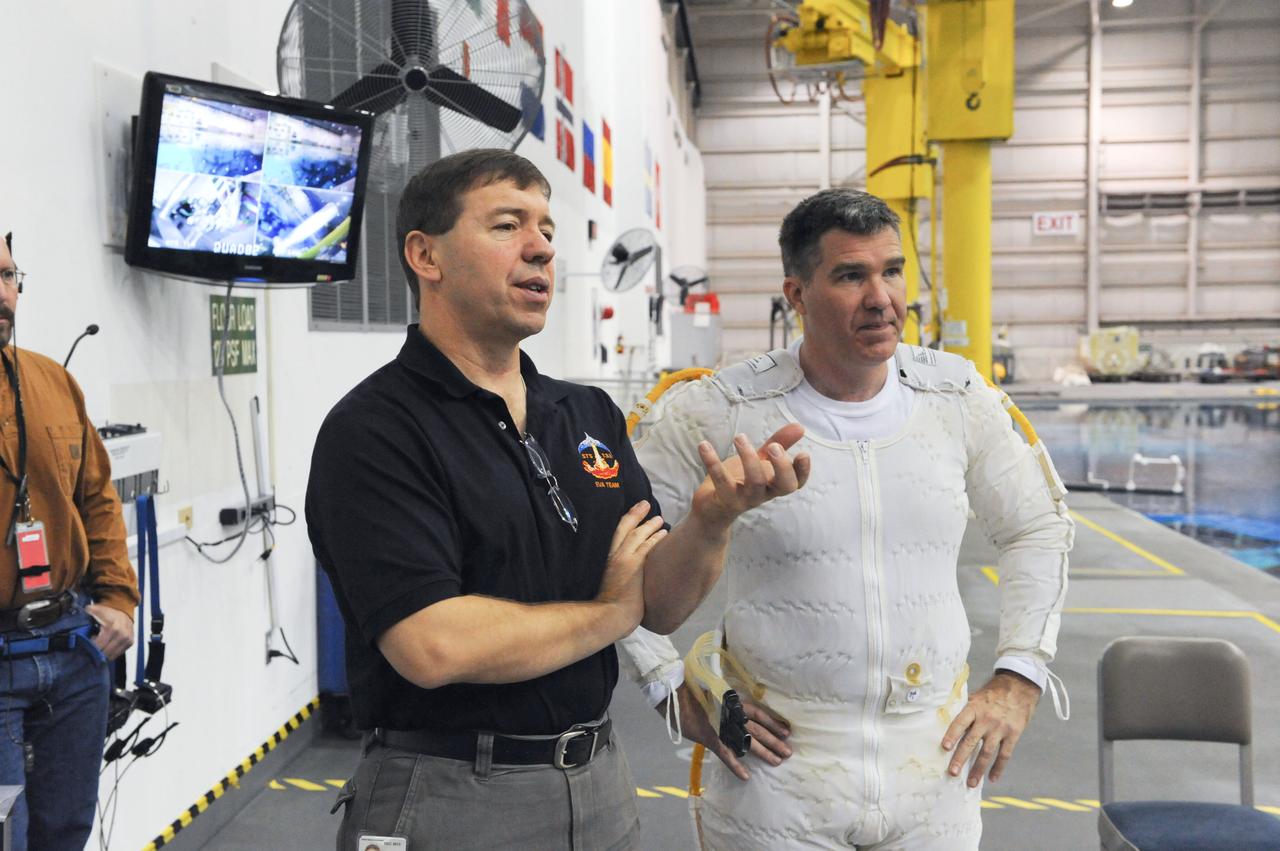
JSC2010-E-185491 (12 Nov. 2010) --- NASA astronaut Andrew Feustel, STS-134 mission specialist, wearing a liquid cooling and ventilation garment that complements the Extravehicular Mobility Unit (EMU) spacesuit, participates in a training session in the simulation control area in the Neutral Buoyancy Laboratory (NBL) at the Sonny Carter Training Facility near NASA's Johnson Space Center. Photo credit: NASA or National Aeronautics and Space Administration
STS-134 crew members Mike Fincke and Greg Chamitoff
S117-E-09438 (21 June 2007) --- Attired in his launch and entry garment, astronaut Lee Archambault, STS-117 pilot, appears all ready for re-entry and landing of the Space Shuttle Atlantis, as he signals thumbs-up from the pilot's station on the starboard side of the shuttle's flight deck. Unfortunately, the weather in Florida was not ready, and the crew had to wait until the following day to land. They ultimately landed in California.
Archambault wearing LES in the FD on STS-117 Space Shuttle Atlantis
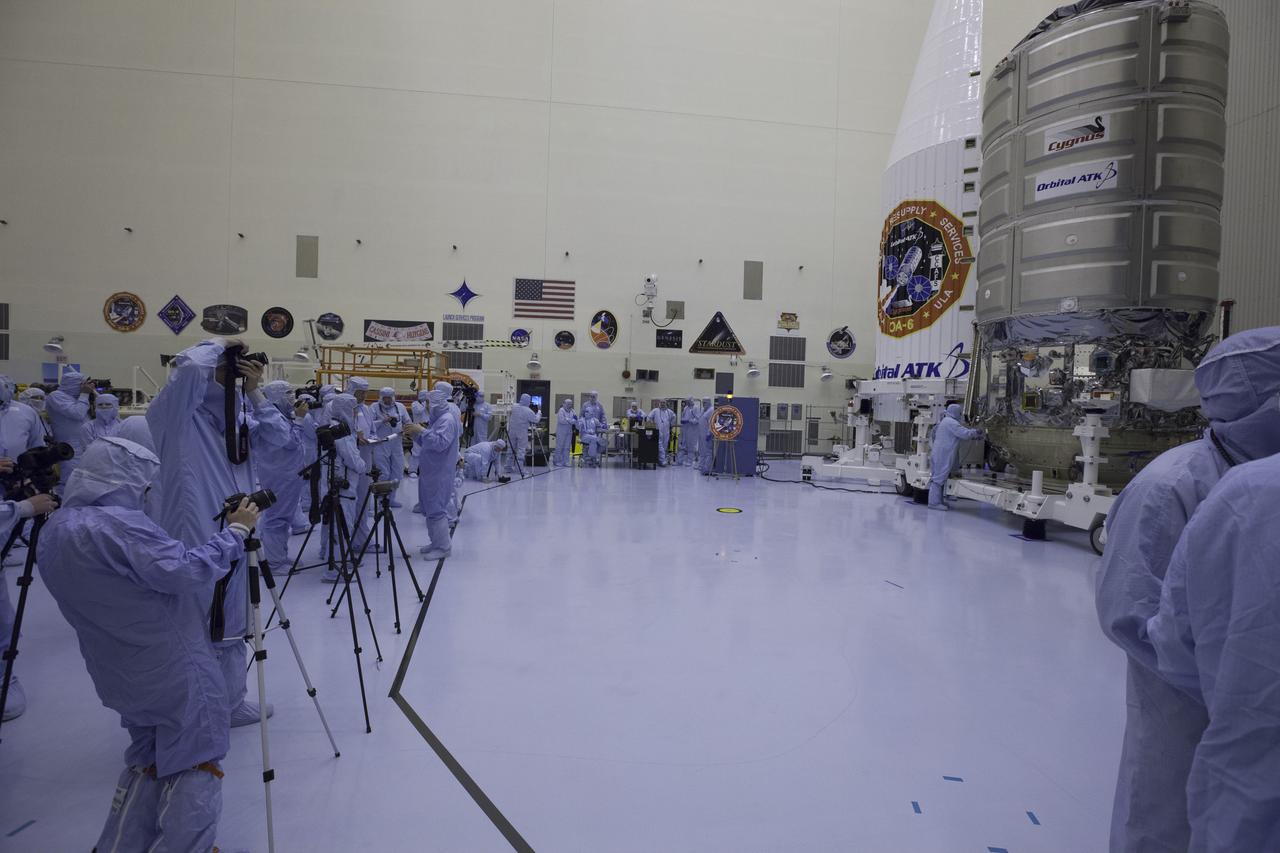
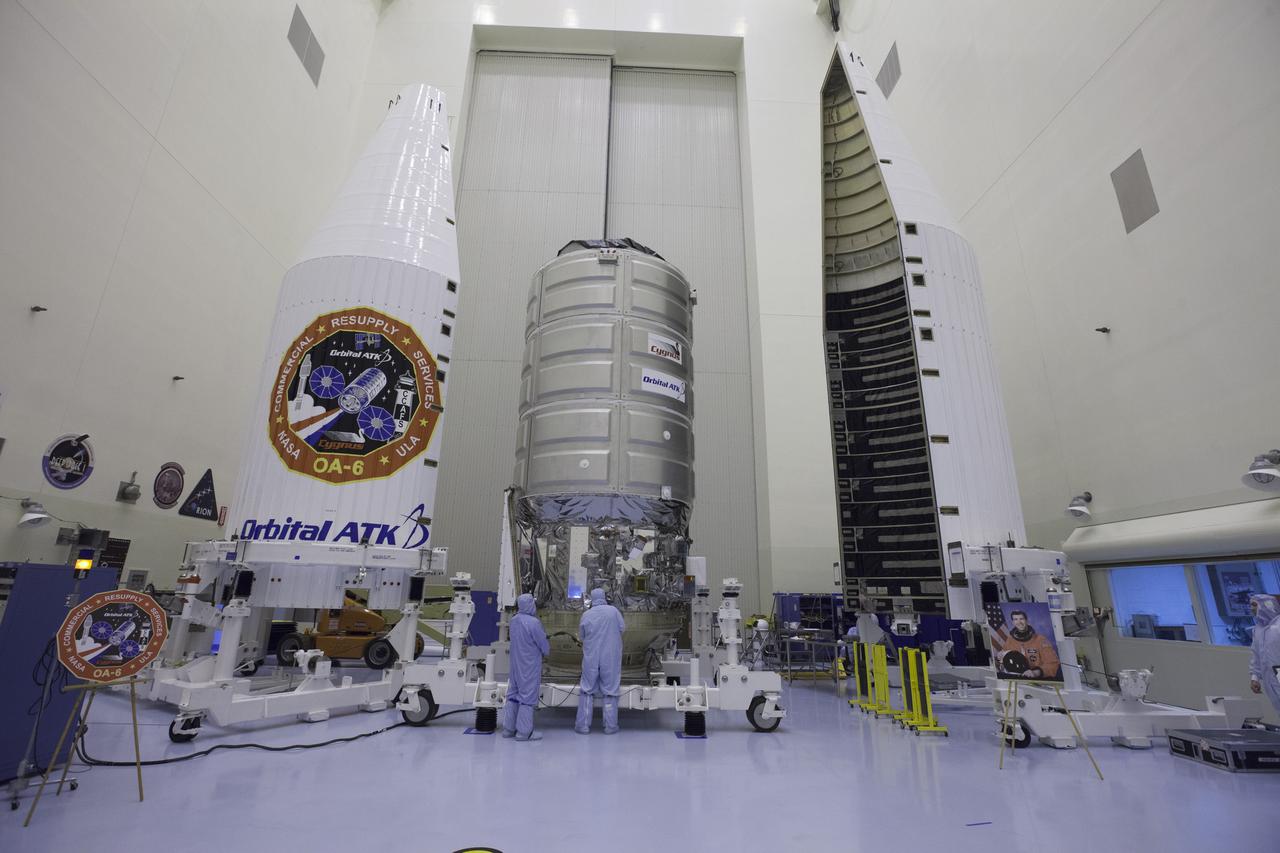
Inside the Payload Hazardous Servicing Facility at NASA's Kennedy Space Center in Florida, members of the news media get a close-up view of a Cygnus cargo vessel. The spacecraft is scheduled for the upcoming Orbital ATK Commercial Resupply Services-6 mission to deliver hardware and supplies to the International Space Station. Reporters, technicians and engineers are clad in "bunny suits." The cleanroom garments are worn to prevent contamination in the controlled environment. The Cygnus is scheduled to lift off atop a United Launch Alliance Atlas V rocket on March 22.
Cygnus Orbital ATK OA-6 Press Opportunity
S99-08650 (24 May 1999) --- A suit technician assists astronaut Jean-Francois Clervoy, mission specialist representing the European Space Agency (ESA), in readying for a session of emergency bailout training in the Systems Integration Facility at the Johnson Space Center (JSC).  Clervoy, wearing a training version of the partial-pressure launch and entry garment, and his six STS-103 crew mates are currently in training  for the third visit to the Hubble Space Telescope (HST) since its 1990 deployment.
STS-103 crewmembers participate in bailout training in building 9N
STS097-327-033 (30 Nov.-11 Dec. 2000) --- Astronauts Joseph R. Tanner (left) and Carlos I. Noriega, both mission specialists, who participated in three STS-97 space walks, don their extravehicular mobility unit (EMU) space suits for one of the walks. Tanner and Noriega are wearing the liquid cooling and ventilation garment that complements the EMU.
MS Tanner and MS Noriega pose in LCVGs prior to the third EVA of STS-97
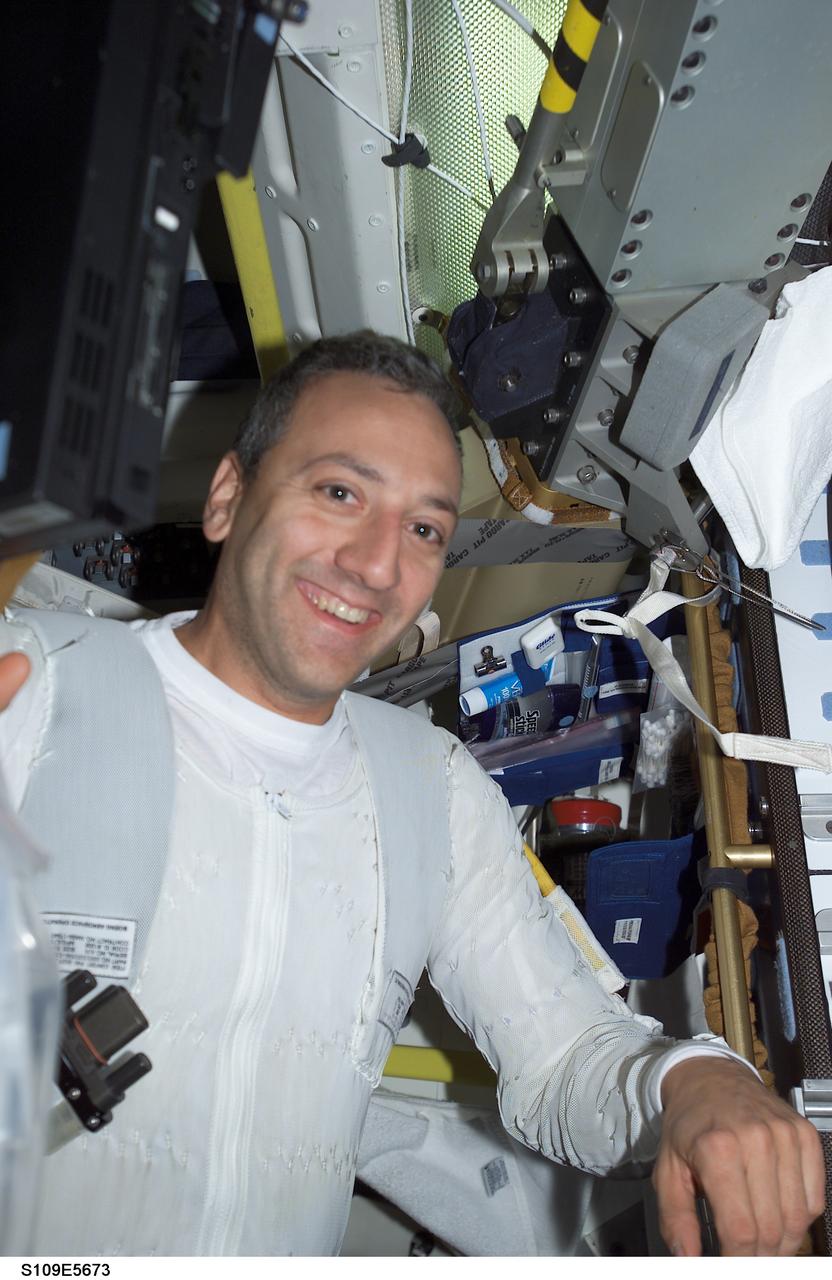
STS109-E-5670 (7 March 2002) --- Astronaut James H. Newman, mission   specialist, is about to put on his  extravehicular mobility unit's (EMU)  outer suit over its thermal under garment. Astronauts Newman and Michael  J. Massimino were about to embark on the STS-109 mission's fourth space walk. The image was recorded with a digital still camera.
MS Newman on middeck prior to EVA 4
JSC2000-04779 (16 June 2000) --- Astronaut Mark Polansky, STS-98 pilot, secures the head gear on a training version of the shuttle full-pressure  launch and entry garment.  He was about to join his crew mates for a simulation exercise in the motion-base shuttle mission simulator in the Johnson Space Center's Mission Simulation and Training Facility.  Launch for STS-98 is scheduled for early next year.
STS-98 crewmembers engages in preflight training in building 5
STS080-360-002 (19 Nov.-7 Dec. 1996) --- From the commander's station on the port side of the space shuttle Columbia's forward flight deck, astronaut Kenneth D. Cockrell prepares for a minor firing of Reaction Control System (RCS) engines during operations with the Wake Shield Facility (WSF). The activity was recorded with a 35mm camera on flight day seven. The commander is attired in a liquid-cooled biological garment.
Cockrell and Rominger go through de-orbit preparations in the flight deck
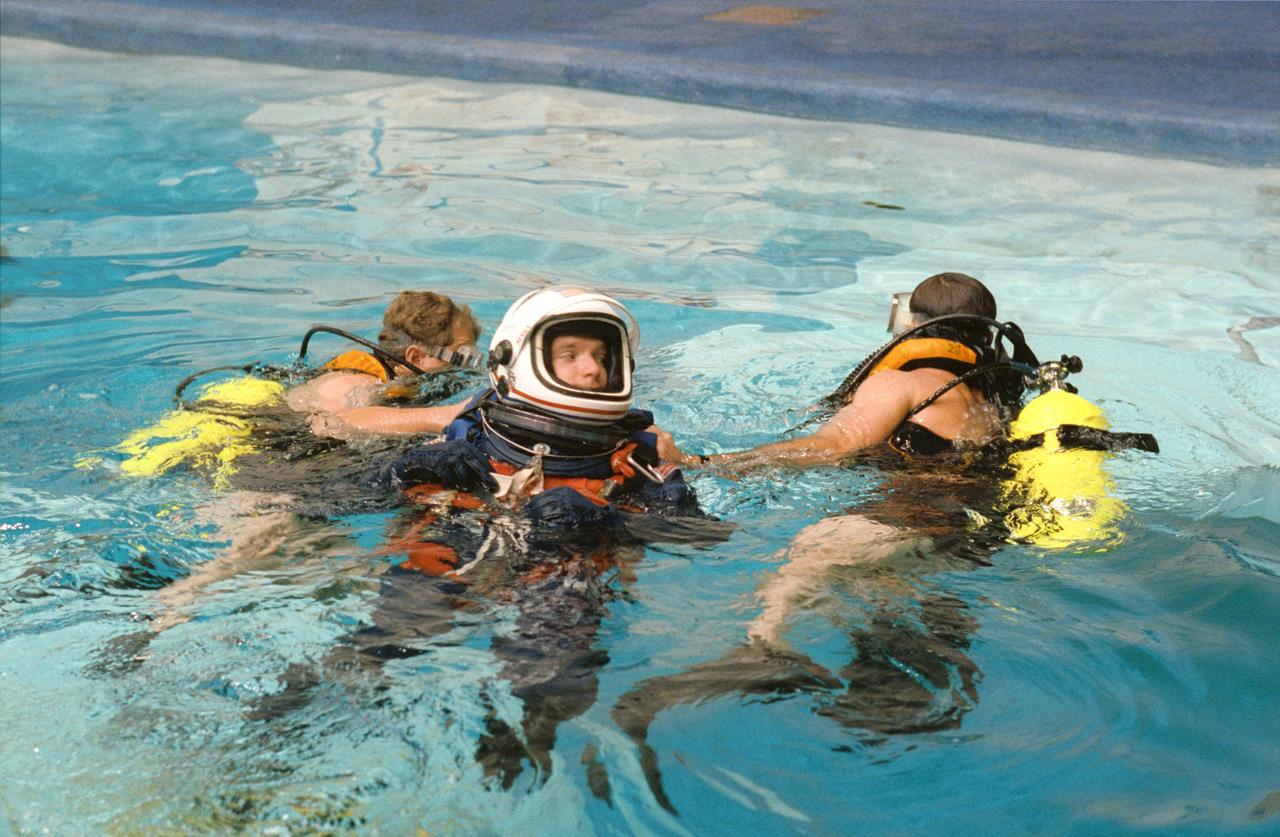
S92-50647 (Dec 1992) --- Assisted by two SCUBA-equipped divers, astronaut Charles J. Precourt, mission specialist for the STS-55/D-2 mission, participates in bailout training at the Johnson Space Center's (JSC) Weightless Environment and Training Facility (WET-F).  Precourt is attired in a training version of the partial pressure Shuttle launch and entry garment.  All seven prime flight crewmembers and the two backup payload specialists participated in the training session.
STS-55 MS2 Precourt is assisted by divers during water egress training at JSC
JSC2010-E-187196 (22 Nov. 2010) --- NASA astronaut Ron Garan, Expedition 27/28 flight engineer, works with extravehicular activity (EVA) equipment during a training session in the Neutral Buoyancy Laboratory (NBL) near NASA's Johnson Space Center. Garan is wearing a liquid cooling and ventilation garment that complements his Extravehicular Mobility Unit (EMU) spacesuit. Photo credit: NASA or National Aeronautics and Space Administration
Expedition 27 crew member Ron Garan with STS-335 crew member Rex Walheim
S99-08654 (24 May 1999) --- A suit technician assists astronaut Claude Nicollier, mission specialist representing the European Space Agency (ESA), in readying for a session of emergency bailout training in the Systems Integration Facility at the Johnson Space Center (JSC). Nicollier, wearing a training version of the partial-pressure launch and entry garment, and his six STS-103 crew mates are currently in training  for the third visit to the Hubble Space Telescope (HST) since its 1990 deployment.
STS-103 crewmembers participate in bailout training in building 9N
JSC2011-E-029098 (25 March 2011) --- NASA astronauts Michael Fincke (left) and Greg Chamitoff (right), both STS-134 mission specialists, wearing liquid cooling and ventilation garments that complement the Extravehicular Mobility Unit (EMU) spacesuits, participate in a training session in the simulation control area in the Neutral Buoyancy Laboratory (NBL) at the Sonny Carter Training Facility near NASA's Johnson Space Center. Photo credit: NASA or National Aeronautics and Space Administration
STS-134 crew members Michael Fincke and Greg Chamitoff during their final EVA4 training run at the NBL.
STS056-S-002 (January 1993) --- The five NASA astronauts assigned to fly aboard the Space Shuttle Discovery for the STS-56\Atlas-2 mission are pictured in training versions of their partial-pressure launch and entry garments. Left to right are astronauts Kenneth D. Cockrell, Steven S. Oswald, C. Michael Foale, Kenneth D. Cameron and Ellen Ochoa. Cameron is mission commander; Oswald, pilot; while the other three will serve as mission specialists.
STS-56 Discovery, OV-103, official crew portrait
S125-E-009260 (17 May 2009) --- Astronauts Mike Massimino (left) and Michael Good, both STS-125 mission specialists, wearing the liquid cooling and ventilation garments that complement their Extravehicular Mobility Unit (EMU) spacesuits, pose for a photo on the middeck of Space Shuttle Atlantis following the completion of the mission?s fourth session of extravehicular activity (EVA).
STS-125 MS1 Good and MS4 Massimino after completing EVA4
JSC2001-01918 (12 July 2001) --- Astronaut Scott D. Altman, STS-109 mission commander, attired in a training version of the shuttle launch and entry garment, awaits the start of an emergency bailout training session at the Neutral Buoyancy Laboratory (NBL) near the Johnson Space Center (JSC). STS-109 will be the 108th shuttle flight and the fourth Hubble Space Telescope (HST) servicing mission.
STS-109 crew during Water Survival Training at SCTF
JSC2000-07659 (19 December 2000) --- Astronaut Patrick G. Forrester, STS-105 mission specialist, attired in a training version of the shuttle launch and entry garment, awaits the start of a mission training session in the Jake Garn Simulation and Training Facility at Johnson Space Center (JSC). This summer, Forrester will join four other astronauts and two cosmonauts for a mission to the International Space Station (ISS).
STS-105 LES suit-up at SMS in Building 5
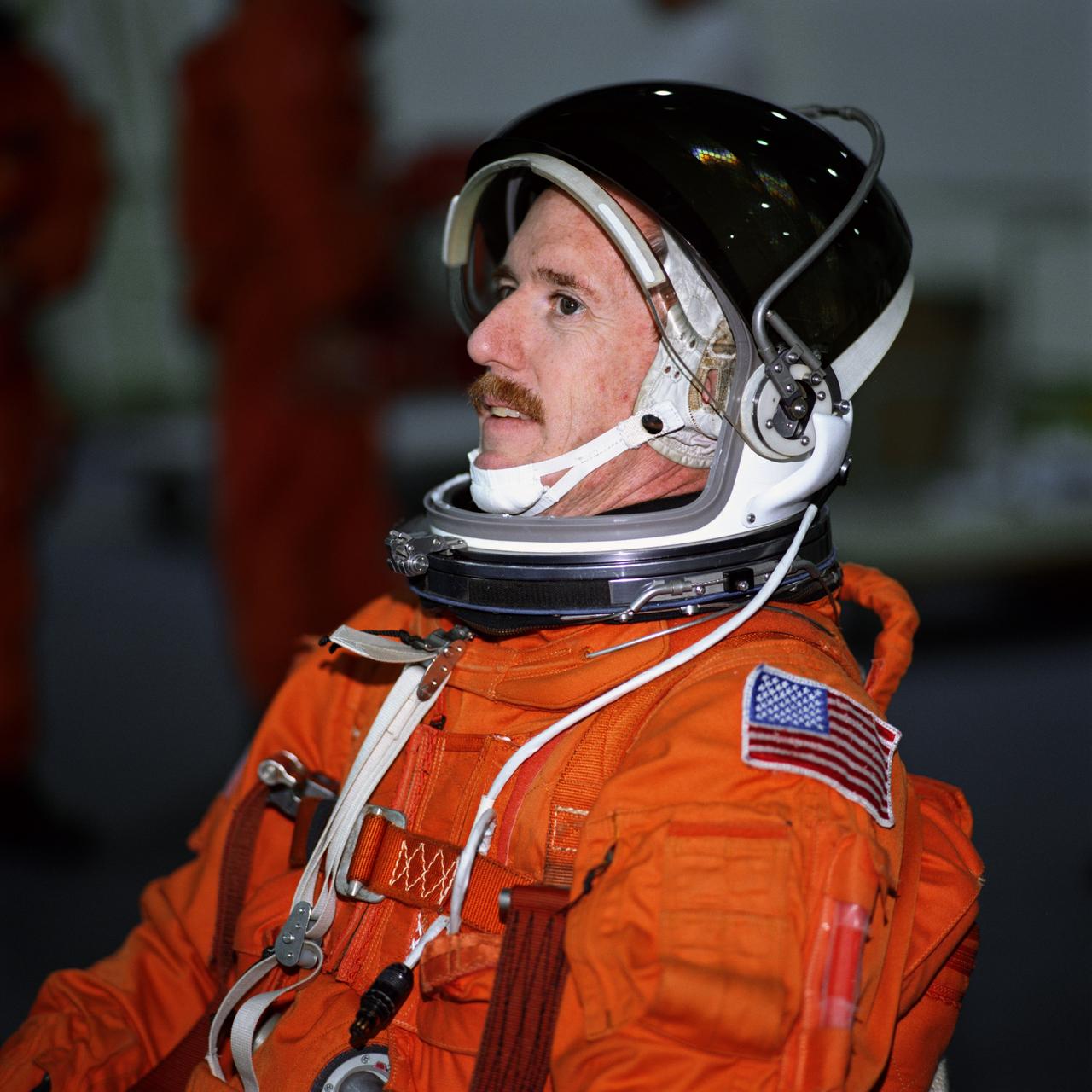
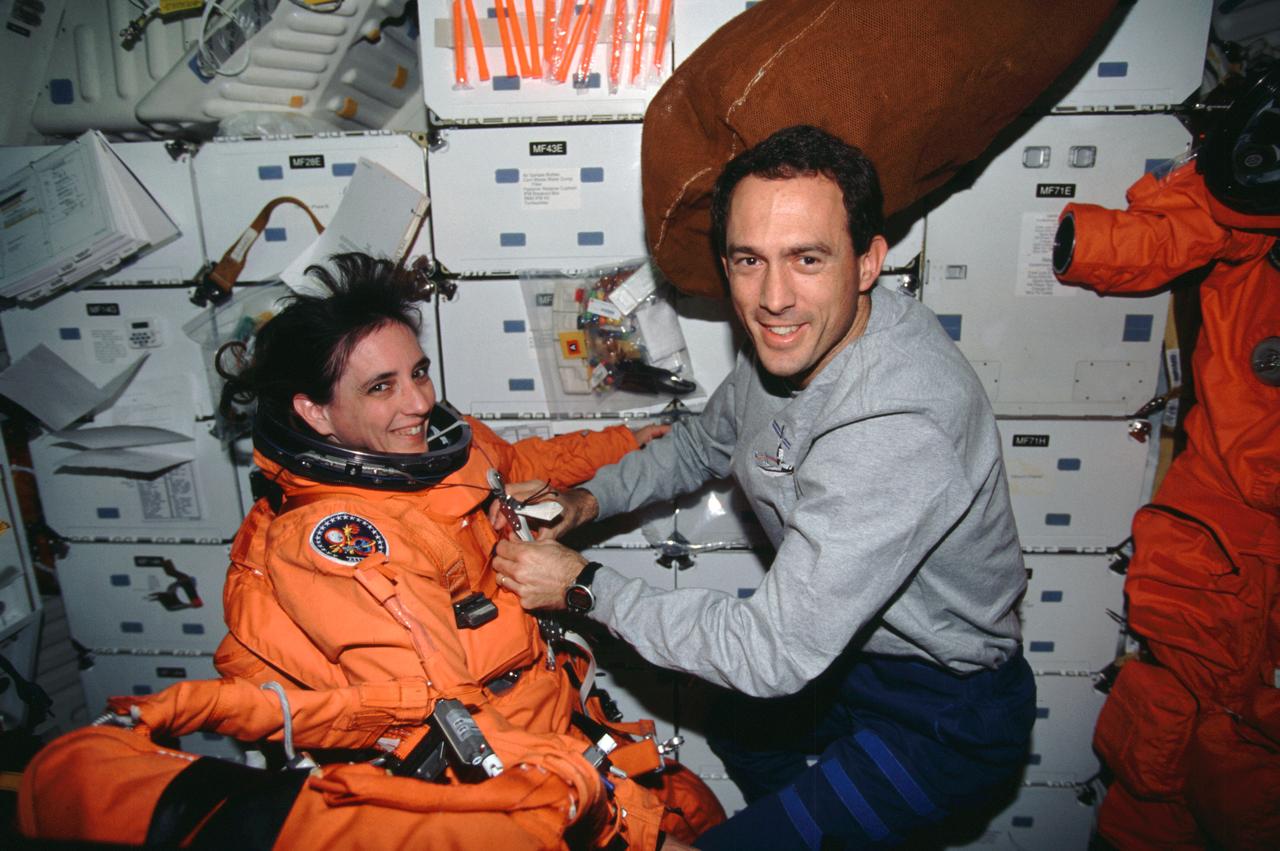
STS088-313-030 (4-15 December 1998) --- Astronaut James H. Newman assists astronaut Nancy J. Currie, both mission specialists, with her launch and entry suit (LES) on the middeck of the Earth-orbiting Space Shuttle Endeavour.  The burnt-orange colored suits are high altitude, partial-pressure garments worn by each crew member for ascent and entry phases of the shuttle flights.
View of the STS-88 crew during deorbit preparations
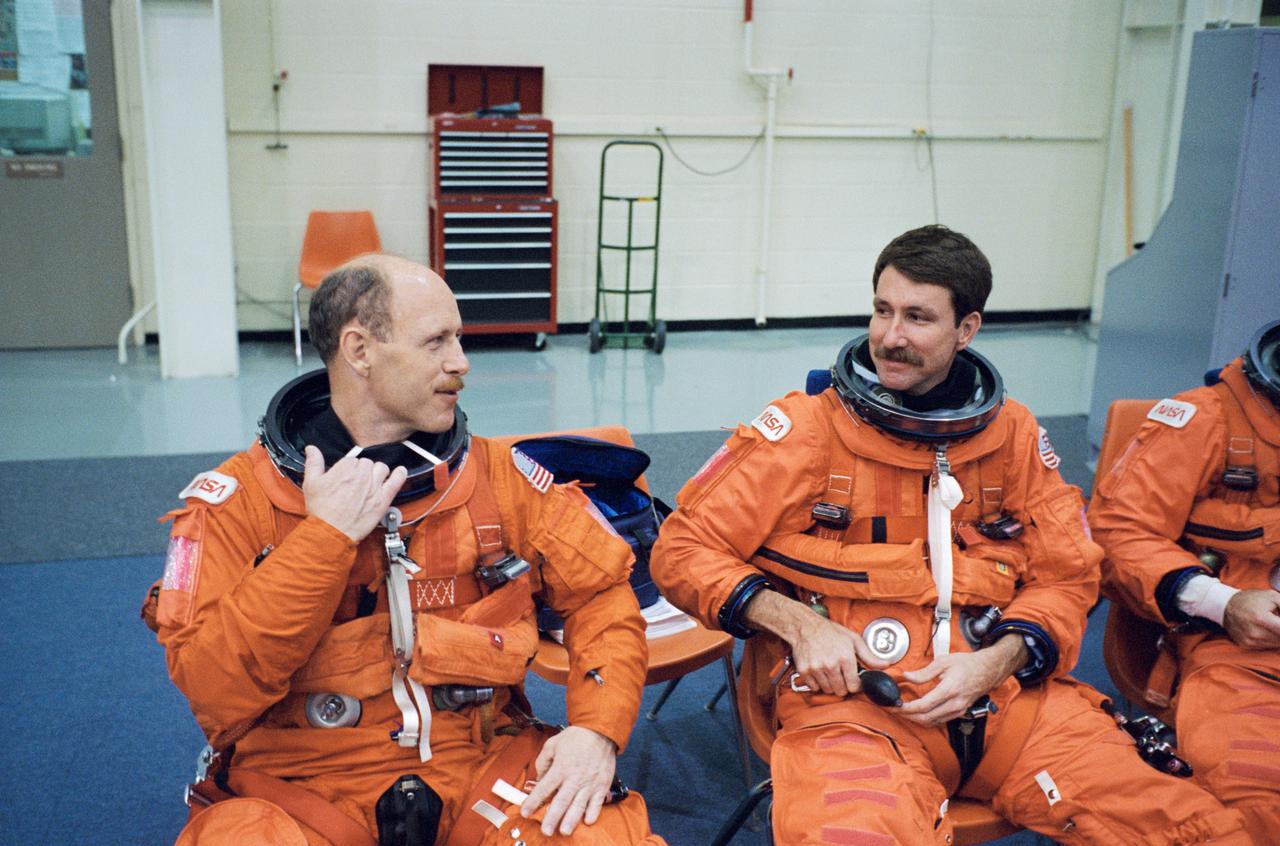
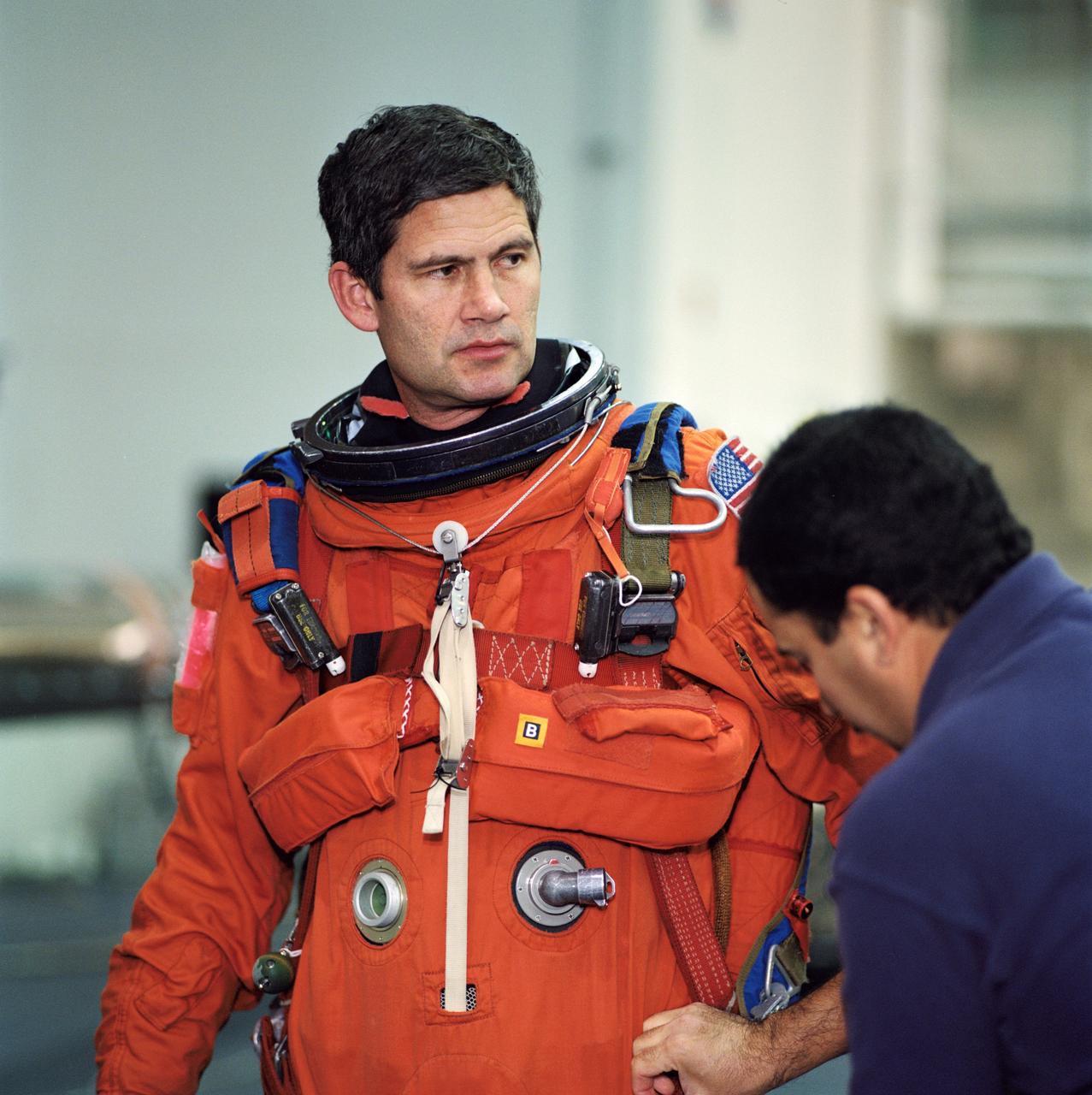
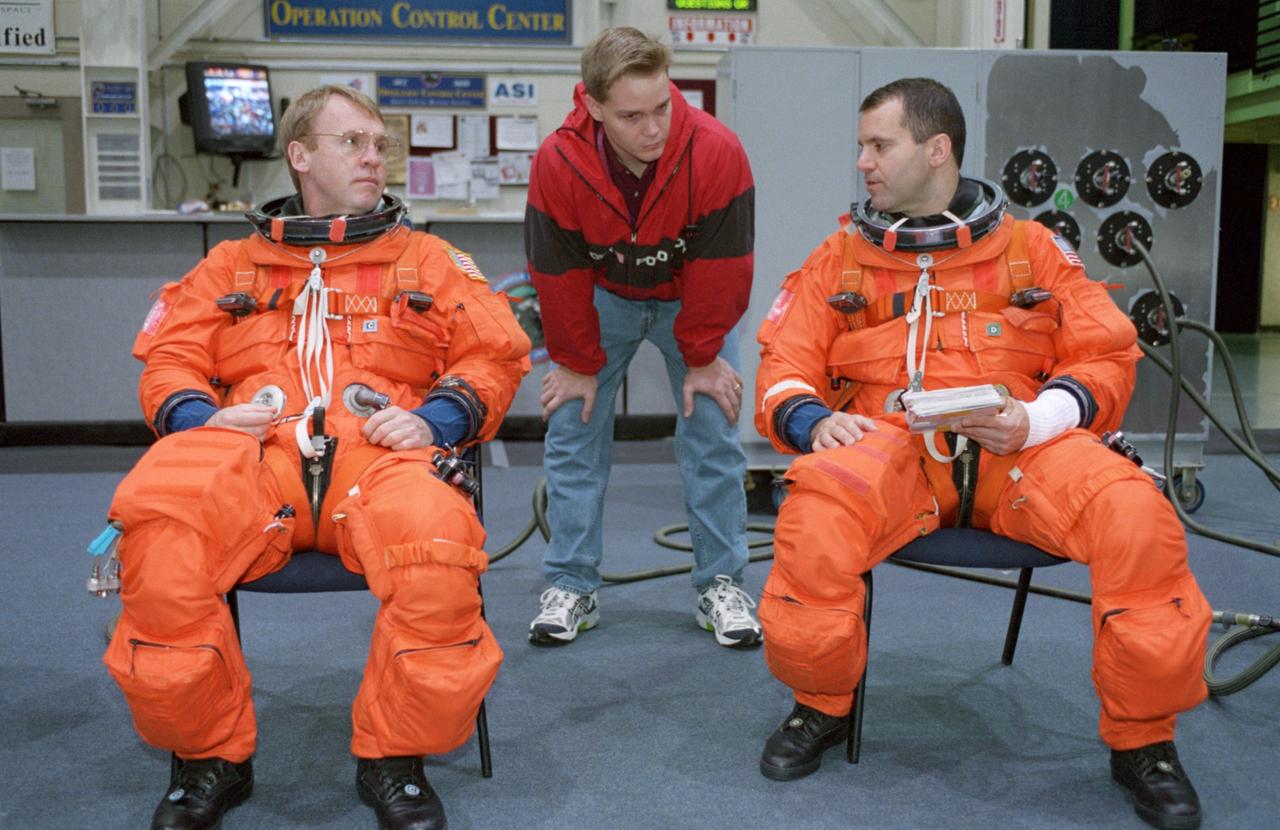
S91-43614 (25 July 1991) --- The astronaut crewmembers for NASA's STS 48 mission, attired in orange partial pressure garments used for Shuttle launch and entry, prepare to participate in an emergency egress training session at the Johnson Space Center.  The crewmembers are, left to right, astronauts Mark N. Brown, James F. Buchli and Charles D. (Sam) Gemar, all mission specialists, and John O. Creighton, Mission commander, and Kenneth S. Reightler, pilot.  STS 48 is currently scheduled for mid-September of this year.
STS-48 crewmembers, in LESs, prepare to for emergency egress training at JSC
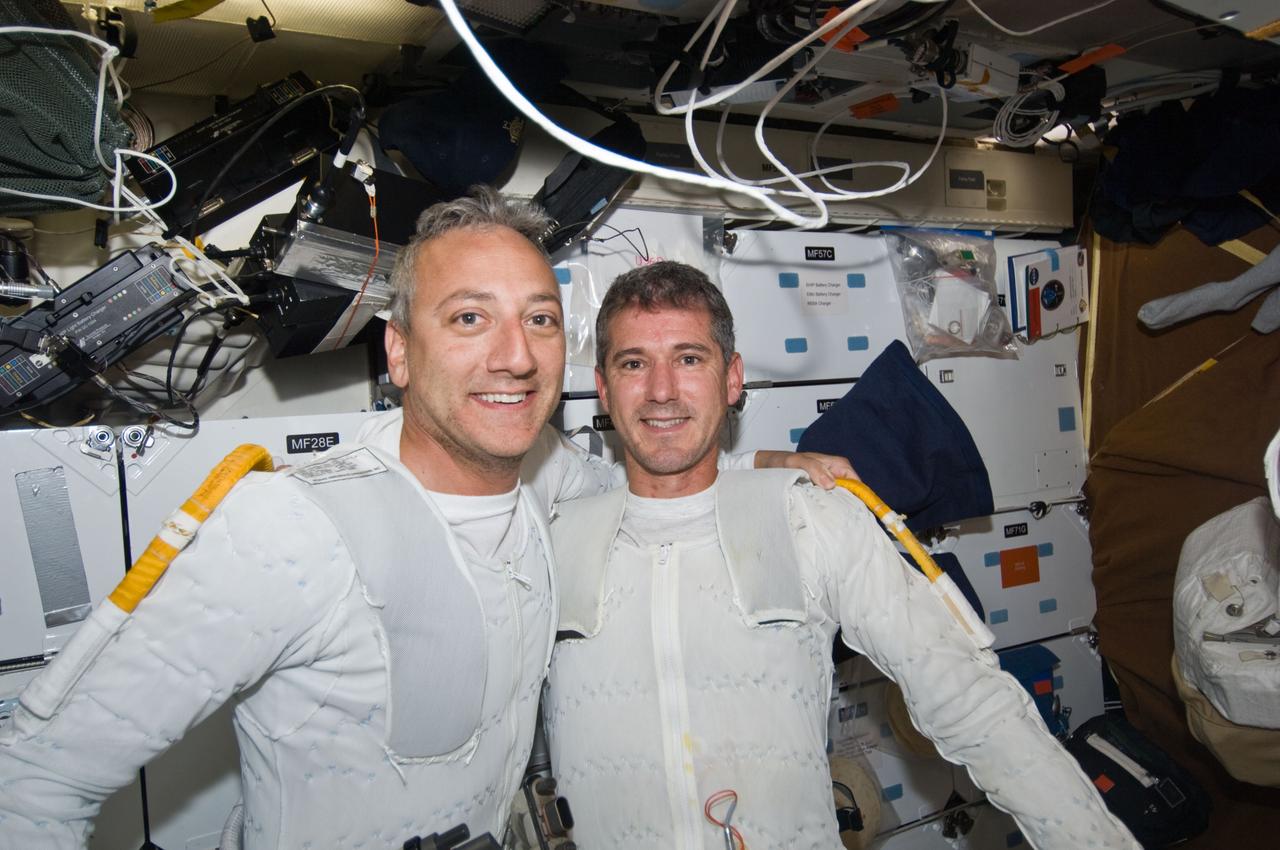
S104-E-5076 (15 July 2001) --- After completing the first extravehicular activity (EVA) of the STS-104 mission, James F. Reilly (left), mission specialist, and Michael L. Gernhardt (right), mission specialist, both wearing Liquid Cooling and Ventilation Garments (LCVG's), pose for a picture with Charles O. Hobaugh, pilot, on the middeck of the Space Shuttle Atlantis.
Reilly, Gernhardt and Hobaugh on middeck after EVA 1
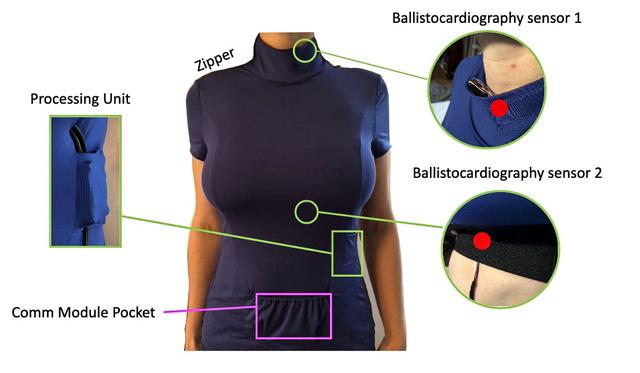
jsc2022e023740 (4/19/2022) --- The components of the Smart-Shirt garment includes integrated sensors, wiring, and a communication module to transmit scientific data via a wireless link for the Ballistocardiography for Extraterrestrial Applications and long-Term missions (BEAT) experiment, part of the Wireless Compose-2 investigation. The technology demonstration builds on work by the German Space Agency (DLR) to develop wireless network infrastructure to support scientific experiments on the space station. Image courtesy of DLR.
jsc2022e023740
JSC2010-E-185492 (12 Nov. 2010) --- NASA astronauts Michael Fincke (seated left) and Andrew Feustel, both STS-134 mission specialists, wearing liquid cooling and ventilation garments that complement the Extravehicular Mobility Unit (EMU) spacesuits, participate in a training session in the simulation control area in the Neutral Buoyancy Laboratory (NBL) at the Sonny Carter Training Facility near NASA's Johnson Space Center. NASA astronaut Greg Chamitoff, mission specialist, is visible in the background. Photo credit: NASA or National Aeronautics and Space Administration
STS-134 crew members Mike Fincke and Greg Chamitoff
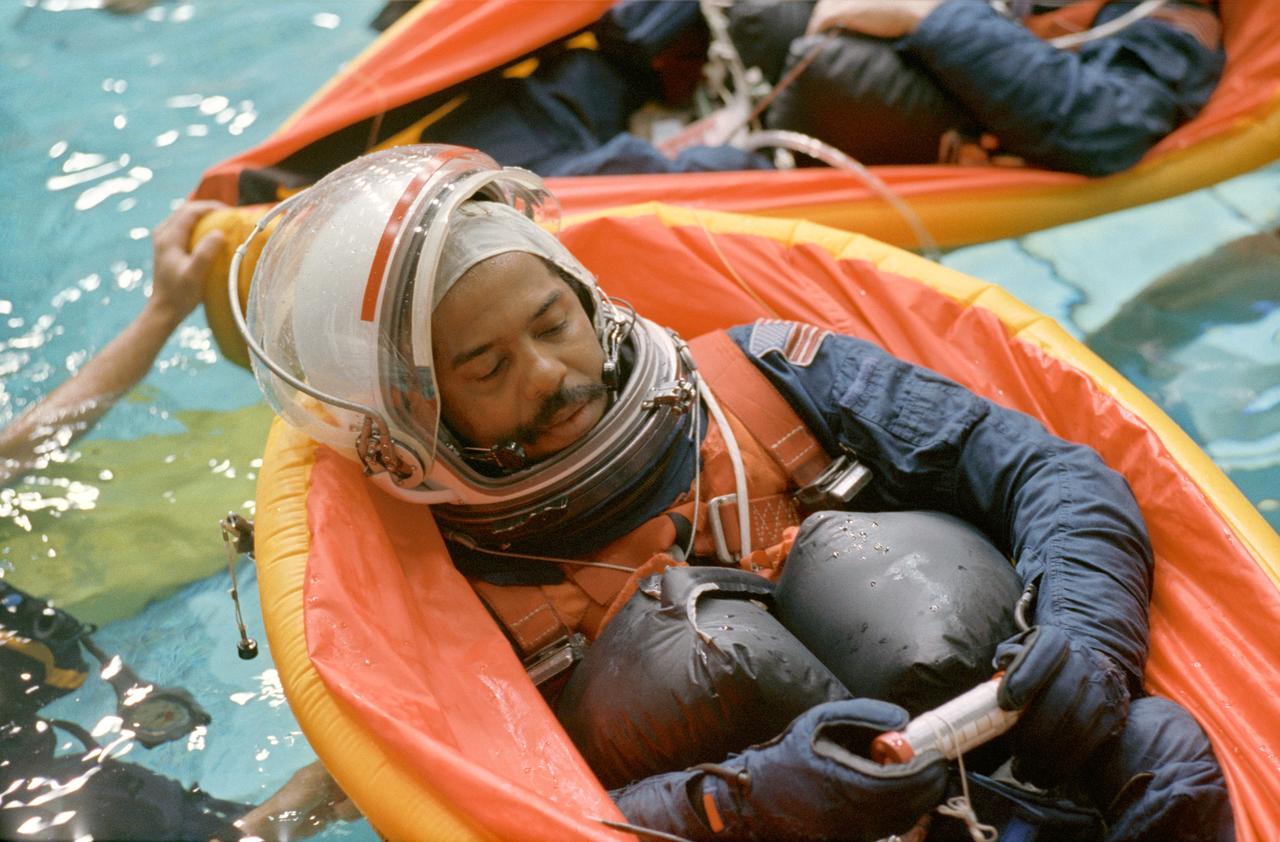
S92-50679 (Dec 1992) --- Using a small life raft, astronaut Bernard A. Harris Jr., mission specialist for the STS-55\D-2 mission, participates in bailout training at the Johnson Space Center's (JSC) Weightless Environment and Training Facility (WET-F).  Harris is attired in a training version of the partial pressure Shuttle launch and entry garment.  All seven prime flight crew members and the two back-up payload specialists participated in the training session.
Astronaut Bernard Harris in life raft during WETF training
JSC2001-02990 (5 December 2001) --- Astronaut Paul S. Lockhart, STS-111 pilot, occupies the pilot’s station during a mission training session in the Space Vehicle Mockup Facility at the Johnson Space Center (JSC). Lockhart is attired in a training version of the shuttle launch and entry garment. STS-111 will be the 14th shuttle mission to visit the International Space Station (ISS).
STS-111 and Expedition 5 Post Insertion Training
S99-08671 (24 May 1999) --- Astronauts John M. Grunsfeld (left) and Steven L. Smith, wearing training versions of the shuttle launch and entry garment, pose for an informal portrait prior to an emergency bailout training session in the Systems Integration Facility.  The two mission  specialists will join five other astronauts for the third servicing mission to the Earth-orbiting Hubble Space Telescope in the autumn of this year.
STS-103 crewmembers participate in bailout training in building 9N
S93-39619 (20 July 1993) --- Wearing a training version of the partial pressure launch and entry garment, astronaut William S. McArthur listens to a briefing on emergency egress procedures for the STS-58 mission.  McArthur, along with the five other NASA astronauts and a visiting payload specialist assigned to the seven-member crew, later rehearsed contingency evacuation procedures.  Most of the training session took place in the crew compartment and full fuselage trainers of the Space Shuttle mockup and integration laboratory.
STS-58 crew participates in CCT training
JSC2001-02992 (5 December 2001) --- Astronaut Kenneth D. Cockrell, STS-111 mission commander, occupies the commander’s station during a mission training session in the Space Vehicle Mockup Facility at the Johnson Space Center (JSC). Cockrell is attired in a training version of the shuttle launch and entry garment. STS-111 will be the 14th shuttle mission to visit the International Space Station (ISS).
STS-111 and Expedition 5 Post Insertion Training
STS109-318-005 (1-12 March 2002) --- Astronauts James H. Newman (left foreground) and Michael J. Massimino, both STS-109 mission specialists, wearing the liquid cooling and ventilation garment that complements the Extravehicular Mobility Unit (EMU) space suit, are photographed on the mid deck of the Space Shuttle Columbia. Also pictured are astronauts John M. Grunsfeld (right) and Richard M. Linnehan, payload commander and mission specialist, respectively. The two teams were preparing for one of the five scheduled space walks for the mission.
MS Newman and Massimino prepare for EVA 2
S93-31980 (April 1993) --- Attired in a training version of the Shuttle launch and entry garment, astronaut Nancy J. Sherlock participates in a bailout training session at the Johnson Space Center's (JSC) systems integration facility.  Training as a mission specialist for the STS-57 mission, Sherlock was rehearsing using the slide pole escape device.        EDITOR'S NOTE: Nancy J. Currie (formerly Sherlock) has been assigned as a mission specialist for the STS-70 mission, scheduled for launch in spring of 1995.
STS-57 MS2 Sherlock, in LES, tumbles out JSC's CCT side hatch using CES pole
JSC2000-07462 (11 December 2000) --- Astronaut Patrick G. Forrester, STS-105 mission specialist, attired in a training version of the shuttle launch and entry garment, awaits the start of an emergency bailout training session at the Neutral Buoyancy Laboratory (NBL) near Johnson Space Center (JSC). This summer, Forrester will join four other astronauts and two cosmonauts for a mission to the International Space Station (ISS).
STS-105 preflight water survival training in NBL pool in SCTF
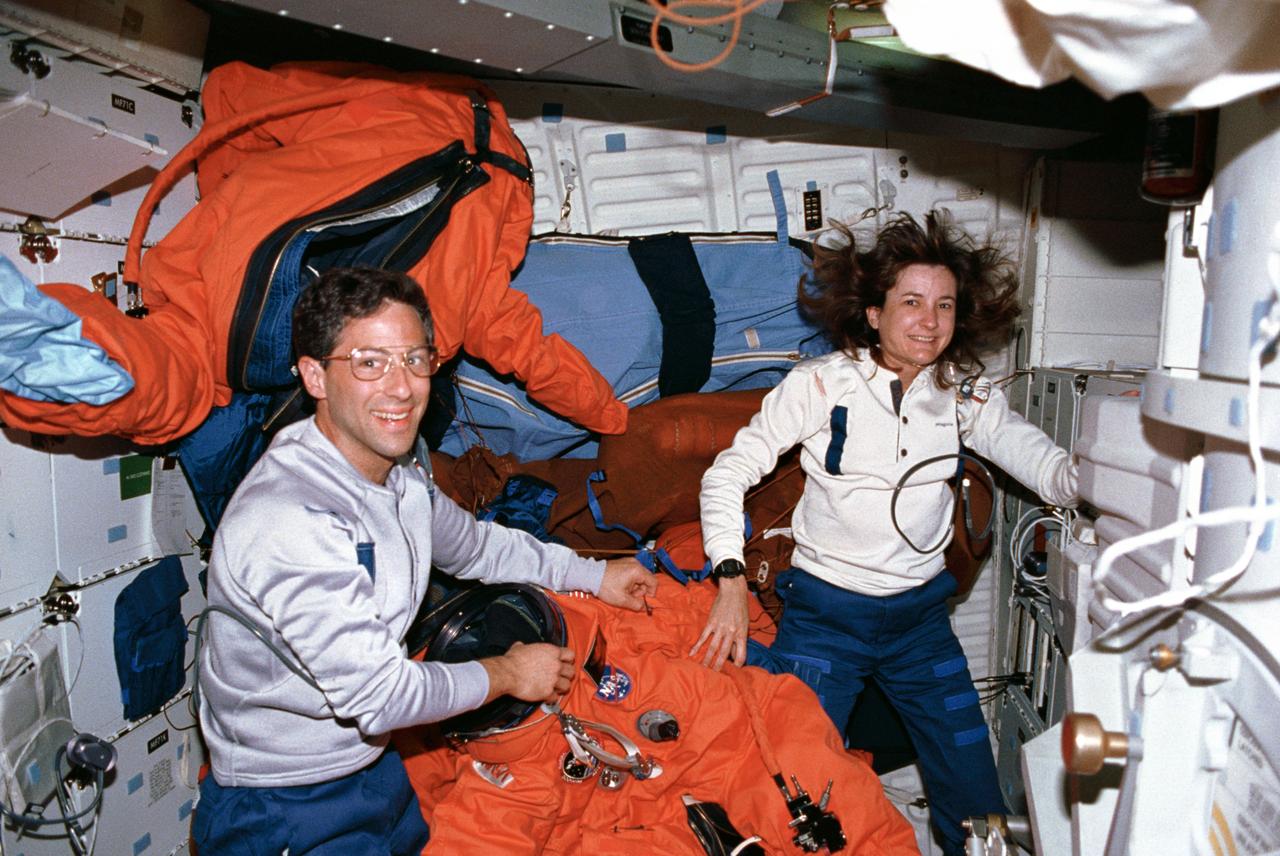
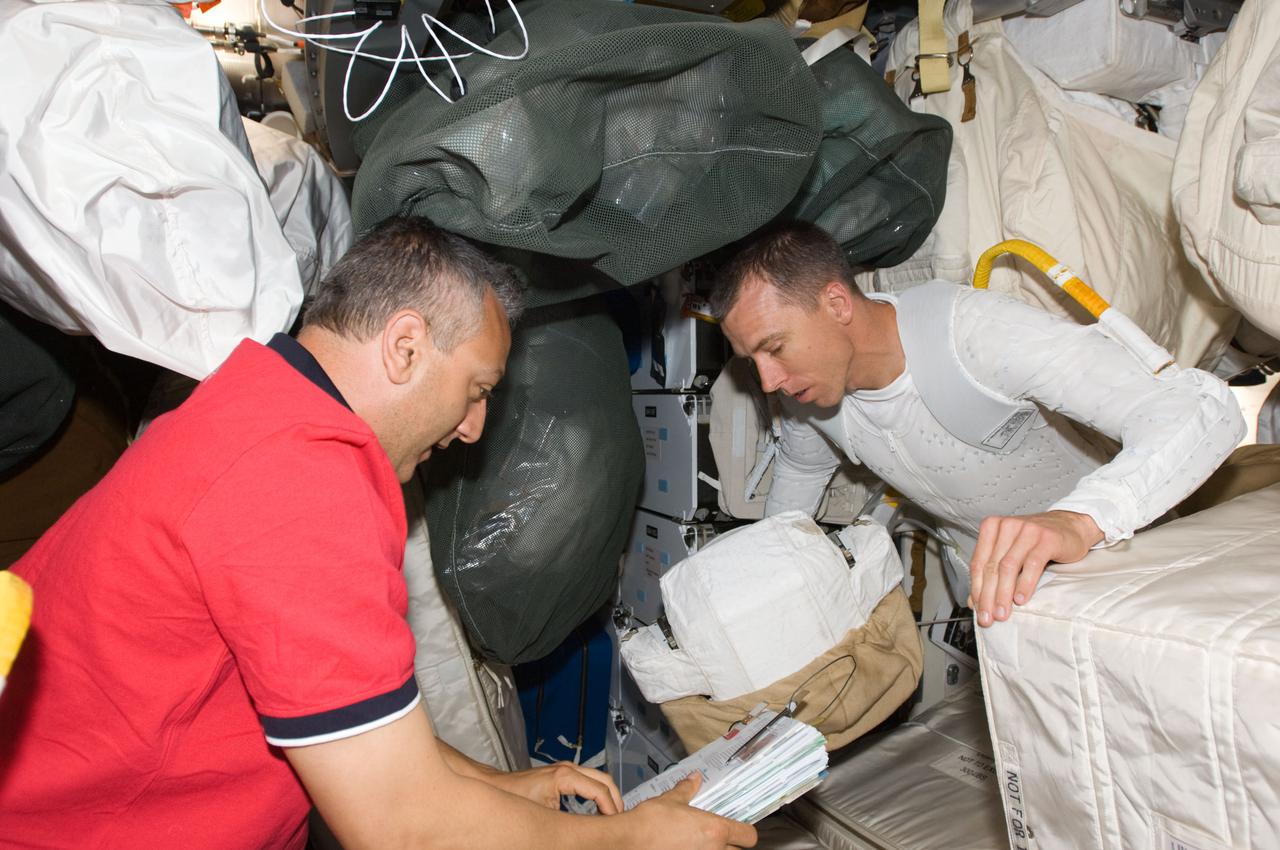
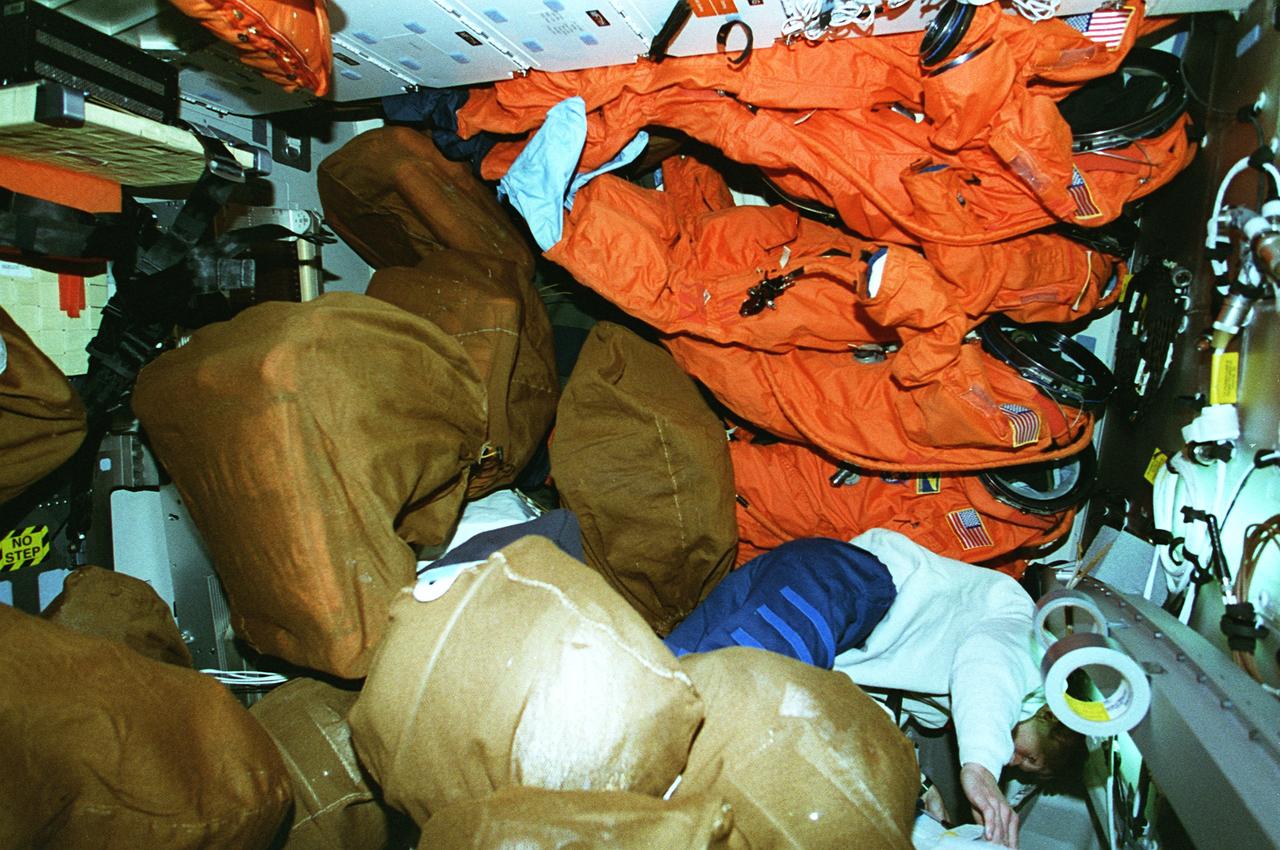
STS081-308-032 (12-22 Jan. 1997) --- Astronaut Marsha S. Ivins appears almost lost among the bags of material to be brought back to Earth at the impending conclusion of the Space Shuttle Atlantis and Russia's Mir Space Station docking mission. Several partial pressure garments which were used for launch and will soon be donned for the entry phase are in upper left.
STS-81 crew on middeck preparing for re-entry
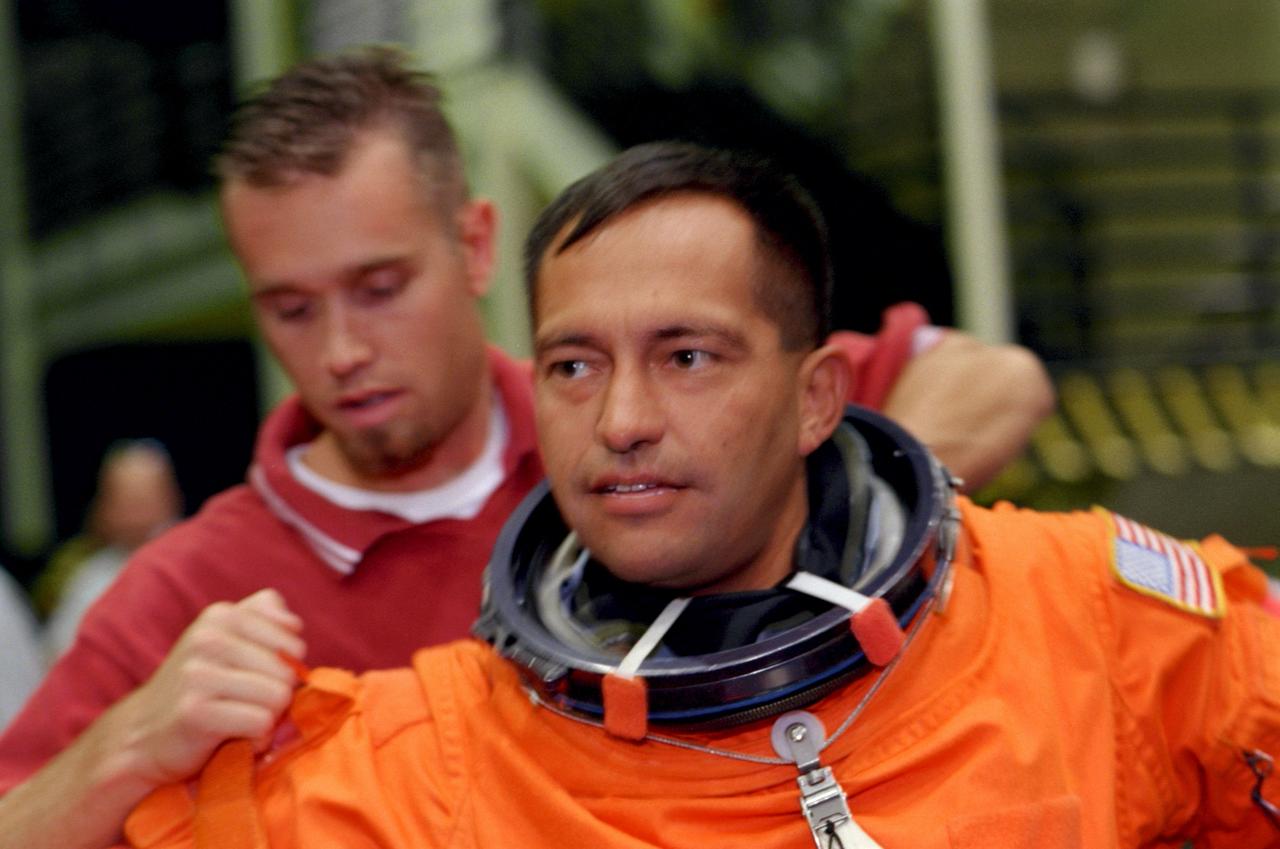
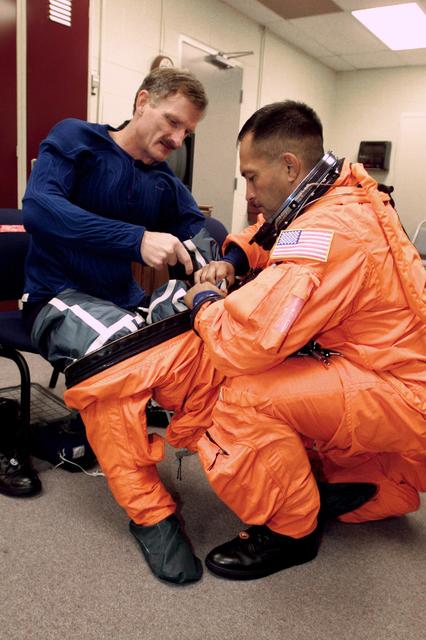
S95-03465 (16 Feb 1995) --- Attired in a training version of the Shuttle launch and entry garment, astronaut Kevin R. Kregel gets help with the final touches of suit donning during a training session at the Johnson Space Center's (JSC) Weightless Environment Training Facility (WET-F).  Assigned as pilot for the STS-70 mission, Kregel was about to rehearse emergency bailout.  The crew members made use of a nearby 25-feet deep pool to practice parachute landings in water and subsequent deployment of life rafts.
Astronaut Kevin Kregel during training session at WETF
S79-29596 (28 Feb 1979) --- Contrasting the old with the new, six astronaut candidates pose for photographers in their new constant wear garments, ideal for the zero-gravity tasks in the pressurized environs of Space Shuttle.  The "old" is an Apollo type spacesuit used for extravehicular activity (EVA).  From left to right are Shannon W. Lucid, Rhea Seddon, Kathryn D. Sullivan, Judith A. Resnik, Anna L. Fisher and Sally K. Ride.
FEMALE ASTRONAUT-CANDIDATES (ASCAN)'S - JSC
S99-07641 (15 July 1999)---  Carlous Gillis, a technician for United Space Alliance, assists astronaut Brent W. Jett, STS-97 commander, with his launch and entry garment during a training session in the Systems Integration Facility at the Johnson Space Center (JSC).  Jett, pictured here in the commander's station on the port side of a shuttle crew compartment trainer (CCT), and four other astronauts are to visit the International Space Station (ISS) late next year
STS-97 crewmembers participate in training and preflight activities
JSC2000-E-23719 (September 2000) --- Attired in  training versions of their full-pressure launch and entry garments, astronauts James D. Wetherbee (left), mission commander for STS-102,   and James W. Kelly, pilot,  discuss contingencies prior to participating in an emergency bailout training exercise in the Crew Compartment Trainer (CCT-2) in the Systems Integration Facility at the Johnson Space Center (JSC).
STS-102 and Expedition Four bailout training in Building 9NW
S99-08655 (24 May 1999) --- From the left, astronauts Steven L. Smith, John M. Grunsfeld, C. Michael Foale and Claude Nicollier, all mission specialists, pose for an informal portrait.  The STS-103 crew members are wearing training versions of the shuttle partial-pressure launch and entry space garments.  Nicollier is one of two astronauts on this flight who represents the European Space Agency (ESA).
STS-103 crewmembers participate in bailout training in building 9N
STS085-364-008 (19 August 1997) --- One of the final pictures taken during the STS-85 mission was this frame, exposed on the mid-deck during preparations for the August 19, 1997 entry.  Left to right are payload specialist Bjarni V. Tryggvason, with astronauts Kent V. Rominger, pilot, and N. Jan Davis, payload commander.  Rominger has already donned his partial pressure launch and entry suit, while Tryggvason and Davis have put on their blue under garments but have yet to don their escape suits.
De-orbit crew preparations include suiting up in LES