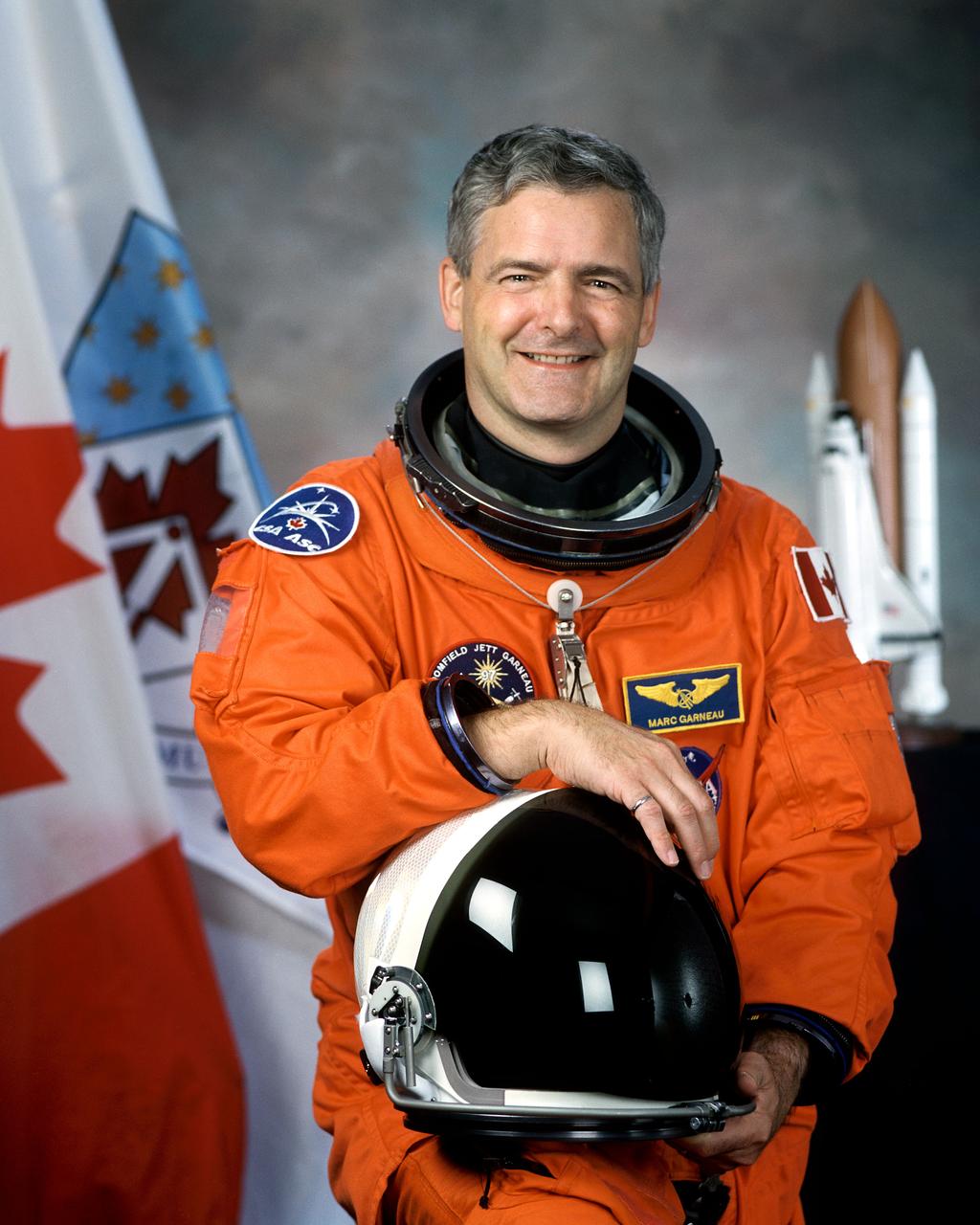
JSC2000-05266 (19 June 2000) --- Astronaut Marc Garneau, mission specialist representing the Canadian Space Agency.
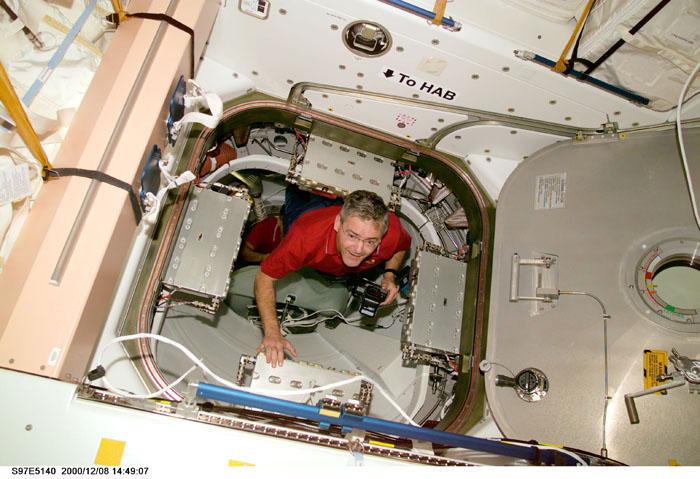
S97-E-5140 (8 December 2000) --- Astronaut Marc Garneau, with a camera in hand, floats in the hatchway that leads from Unity to Pressurized Mating Adapter-3 (PMA-3), which leads to Endeavour. Garneau, STS-97 mission specialist representing the Canadian Space Agency (CSA), and his four crew mates went into the International Space Station (ISS) following hatch opening. The photograph was taken with a digital still camera.
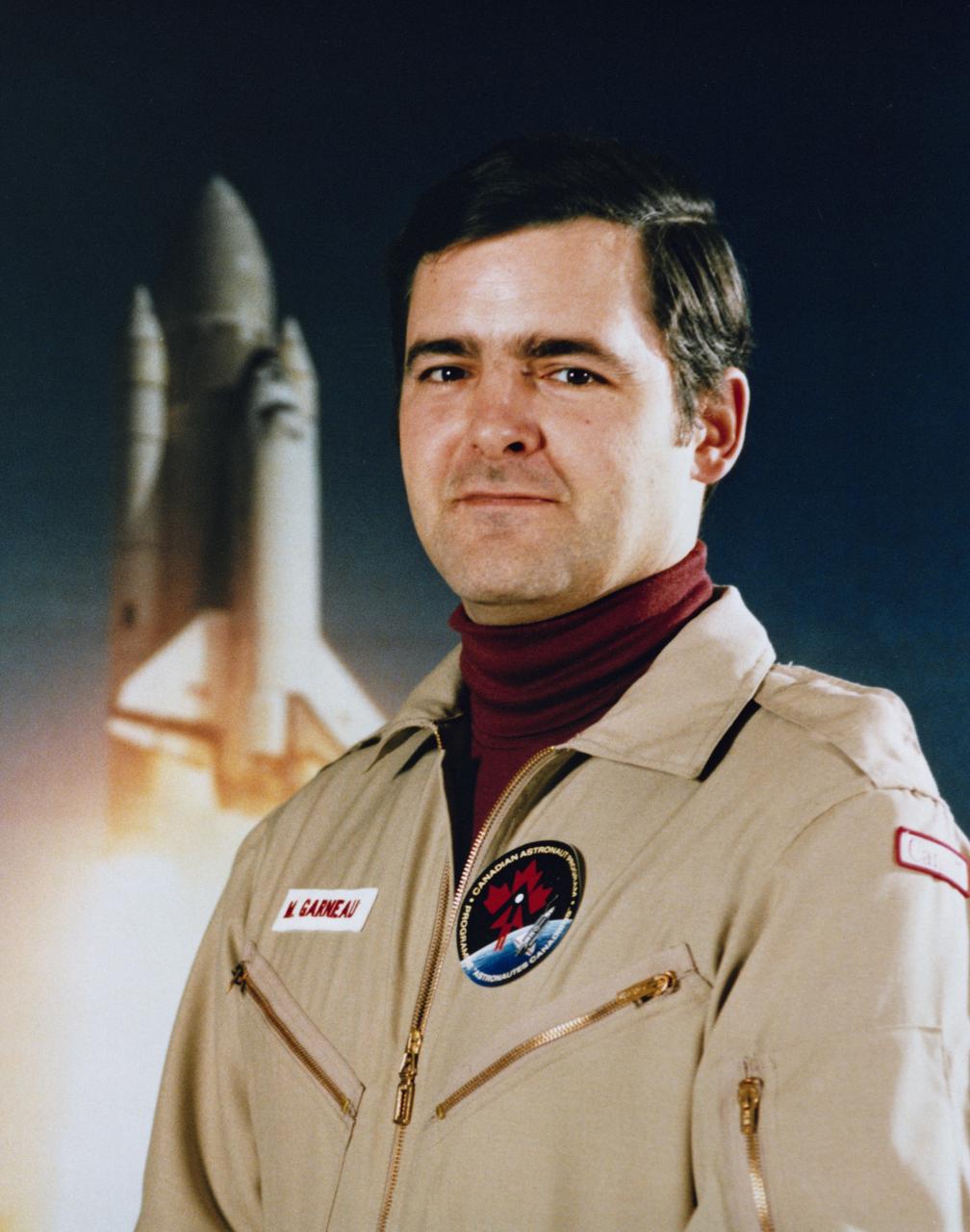
Portrait photograph, Canadian Payload Specialist Mark Garneau, assigned to the STS-16/41G Mission. Also available in 4x5 B&W
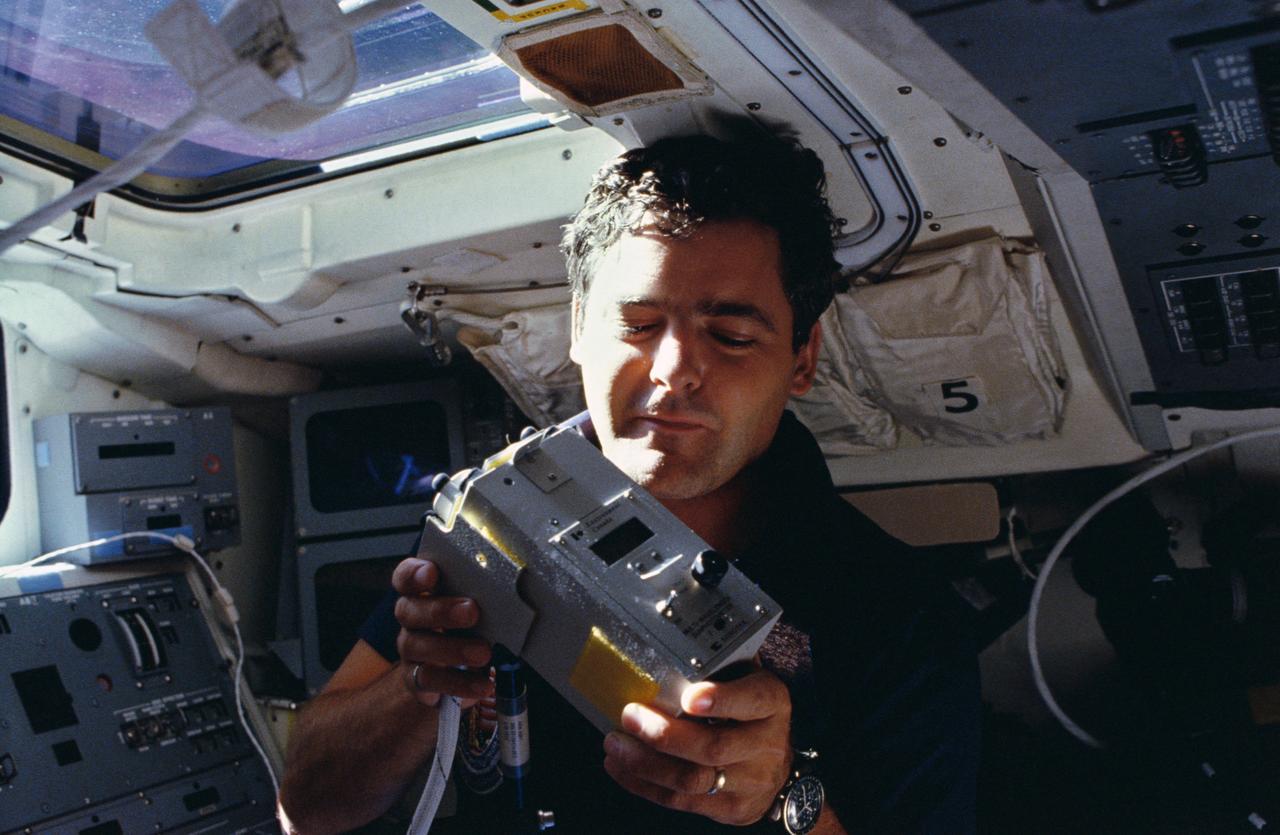
Payload specialist Marc Garneau displays a Canadian made Sunphotometer, part of a package of experiments which he is concentrating on during this mission. He is sitting on the Challenger's flight deck at the aft station.
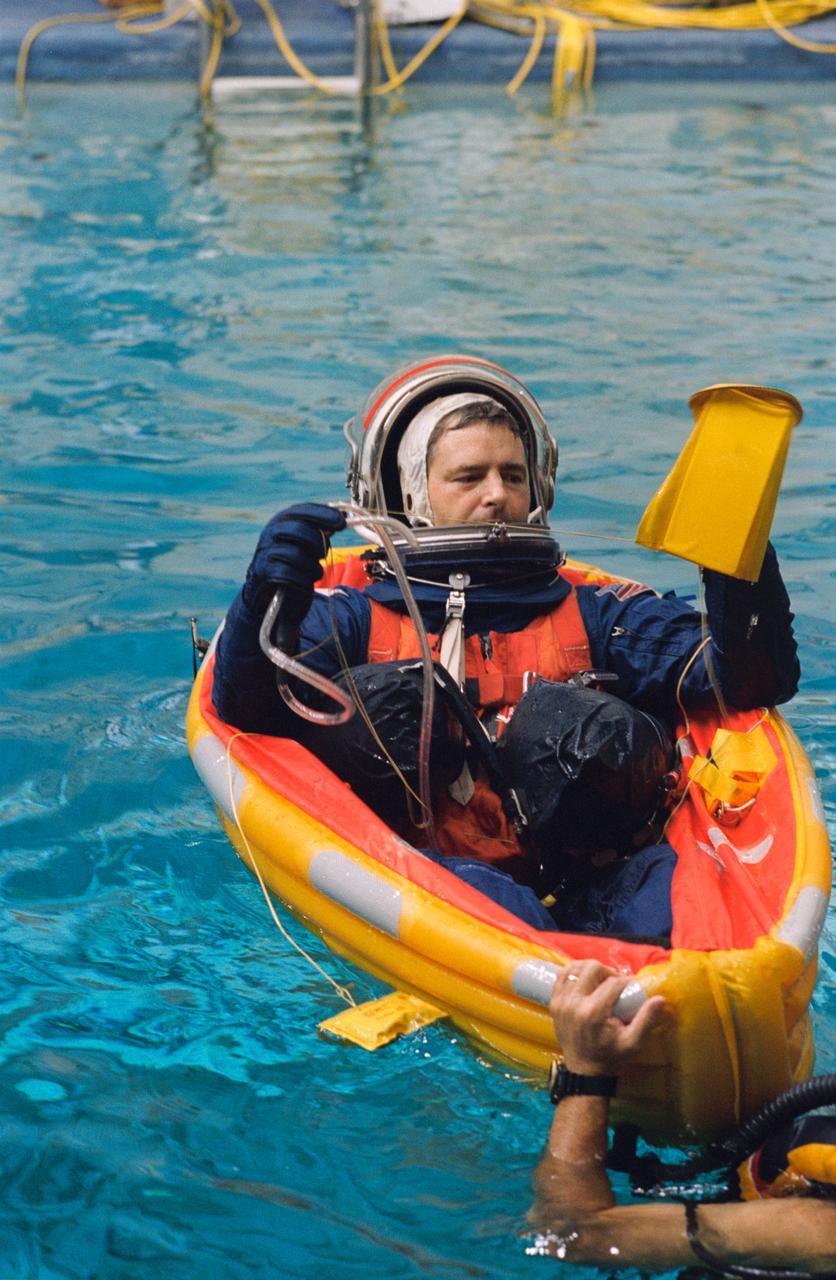
S93-45726 (7 Oct. 1993) --- Canadian astronaut candidate Marc Garneau, later named as a mission specialist for NASA's STS-77 mission, participates in emergency bailout training at the Johnson Space Center (JSC). Garneau was in the 1992 class of Astronaut Candidates (ASCAN). Wearing full parachute gear following a simulated parachute drop, Garneau has deployed a small life raft in a 25-feet deep pool in JSC's Weightless Environment Training Facility (WET-F). This portion of an astronaut's training is to prepare him or her for proper measures to take in the event of bailout over water. Garneau is assisted here by one of several SCUBA-equipped divers in the pool.
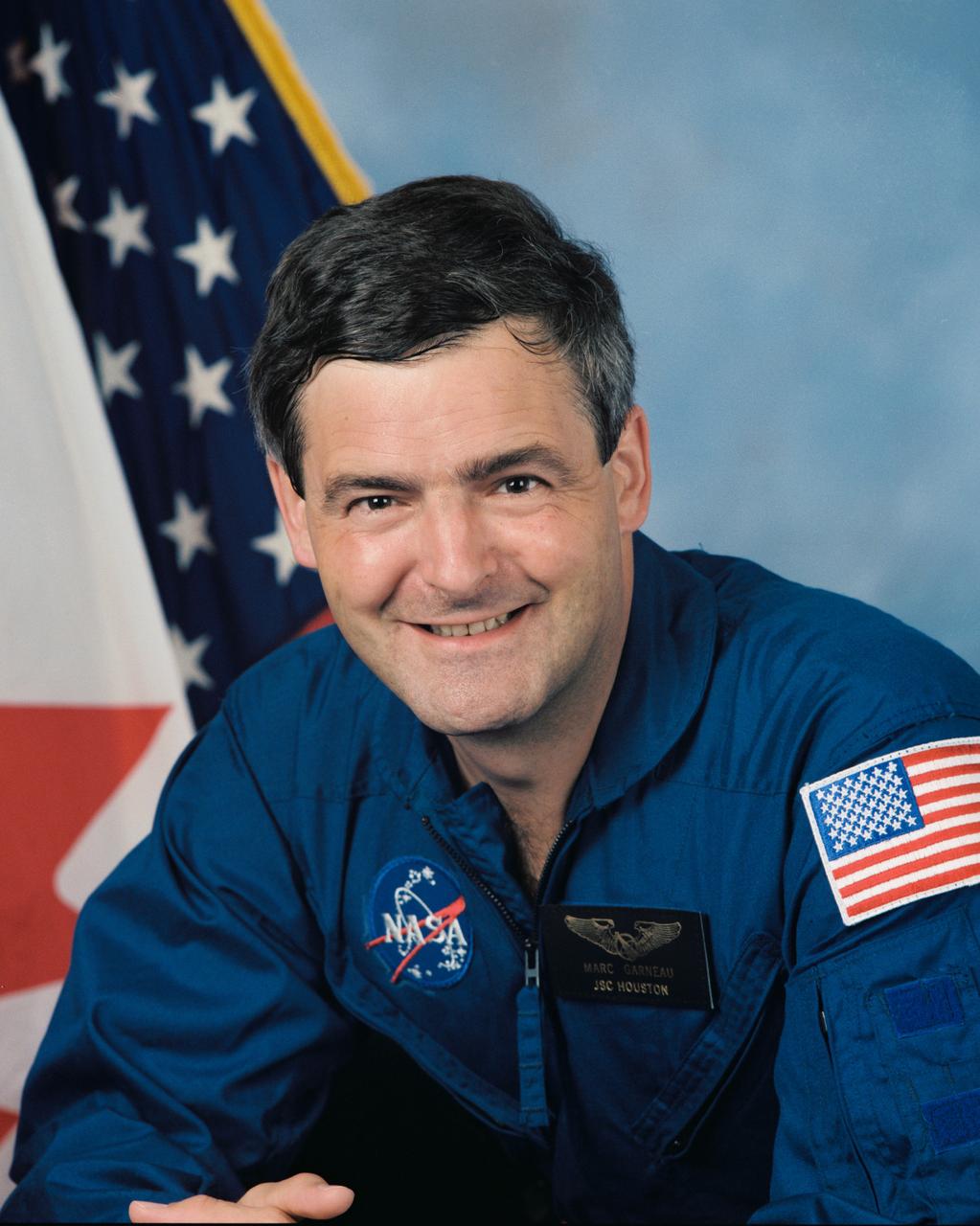
S92-44959 (September 1992) --- Astronaut Marc Garneau, mission specialist representing the Canadian Space Agency. Note: Garneau, who flew as a Canadian payload specialist aboard Challenger for the STS-41G mission in October of 1984, returned to the Johnson Space Center in August of 1992 to begin training as a mission specialist representing his native country. He is one of five international mission specialists currently in training with 19 NASA astronaut candidates selected in March of this year.
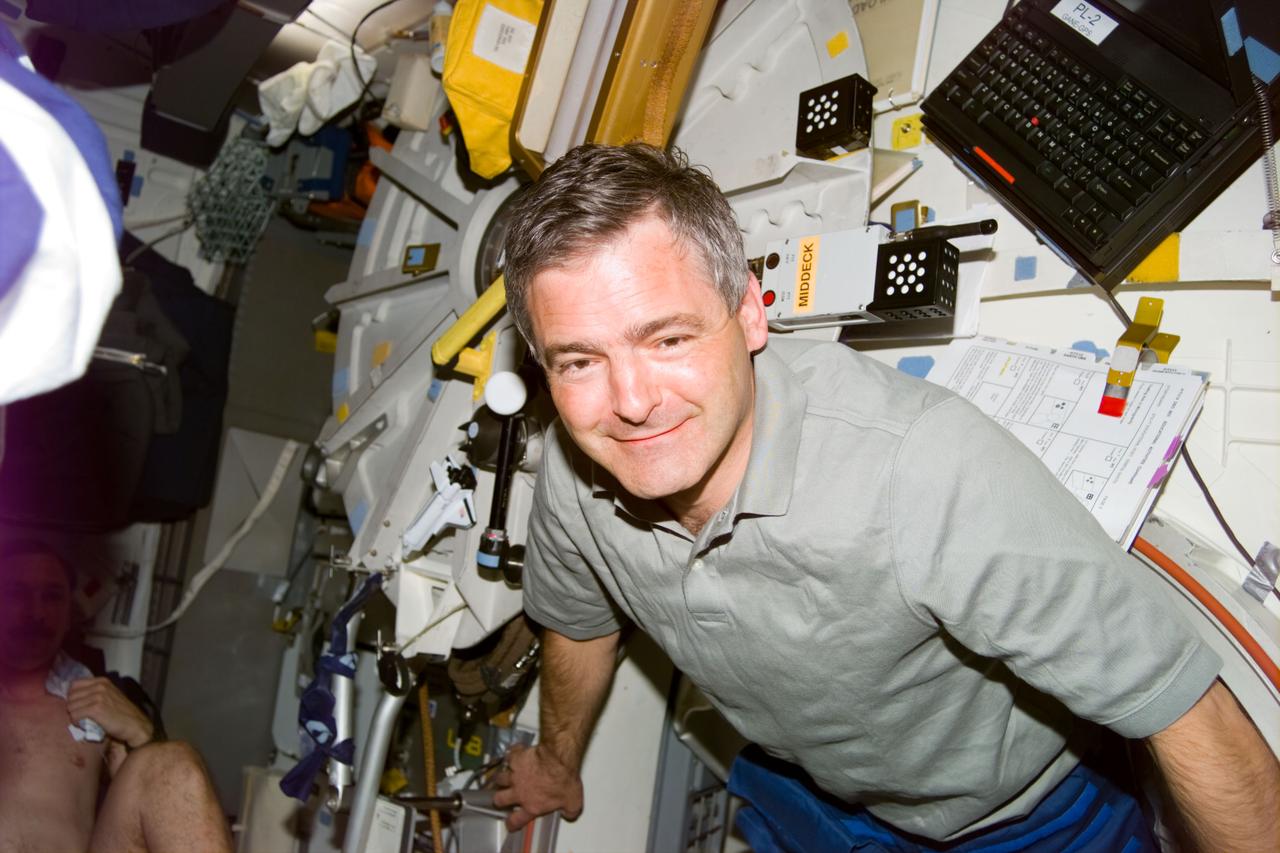
S77-E-5107 (26 May 1996) --- Astronaut Marc Garneau, mission specialist representing the Canadian Space Agency (CSA), poses for a photograph onboard the middeck of the Earth-orbiting Space Shuttle Endeavour. The scene was recorded with an Electronic Still Camera (ESC).
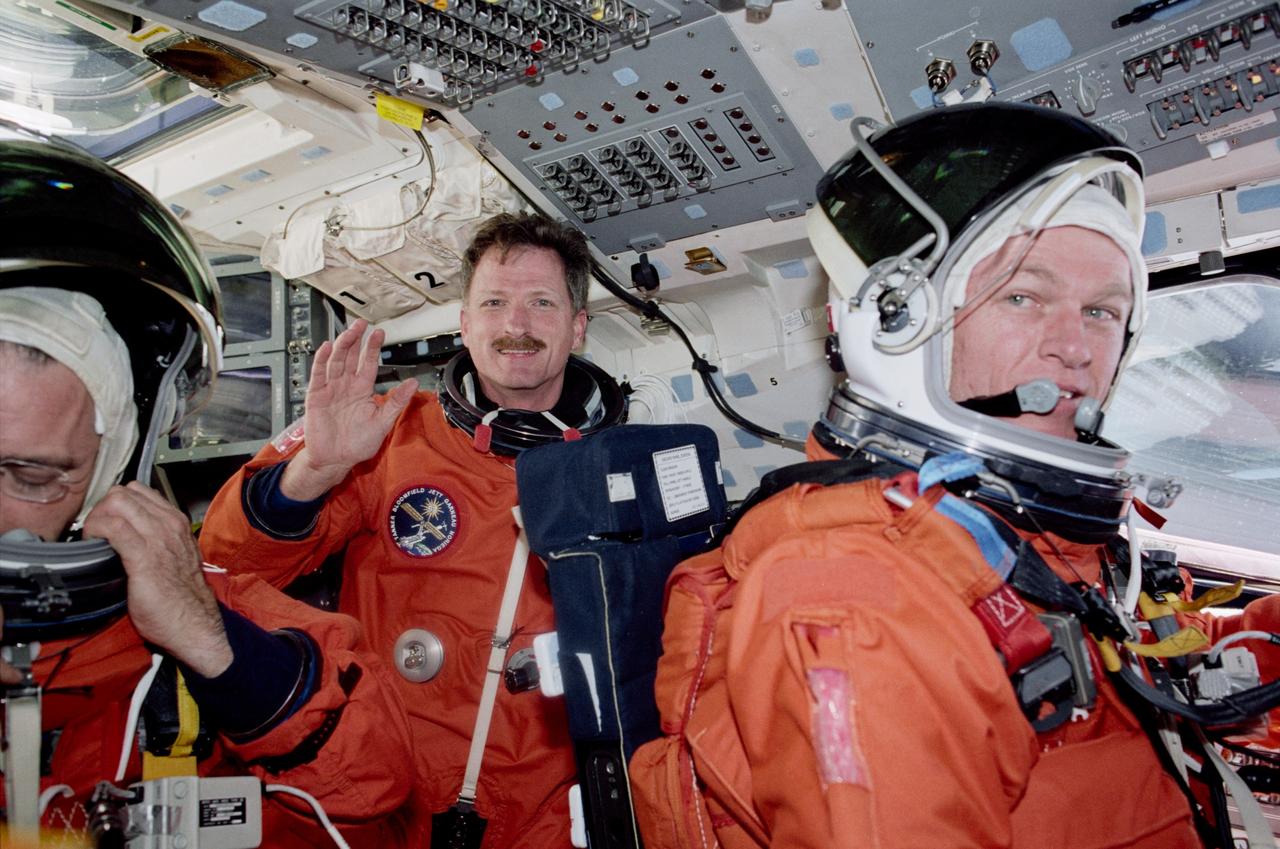
STS097-310-032 (11 December 2000) --- Astronauts (left to right) Marc Garneau, Joseph R. Tanner, both mission specialists, and Brent W. Jett, mission commander, are photographed on the flight deck of the Space Shuttle Endeavour as they prepare for re-entry. Garneau represents the Canadian Space Agency (CSA).
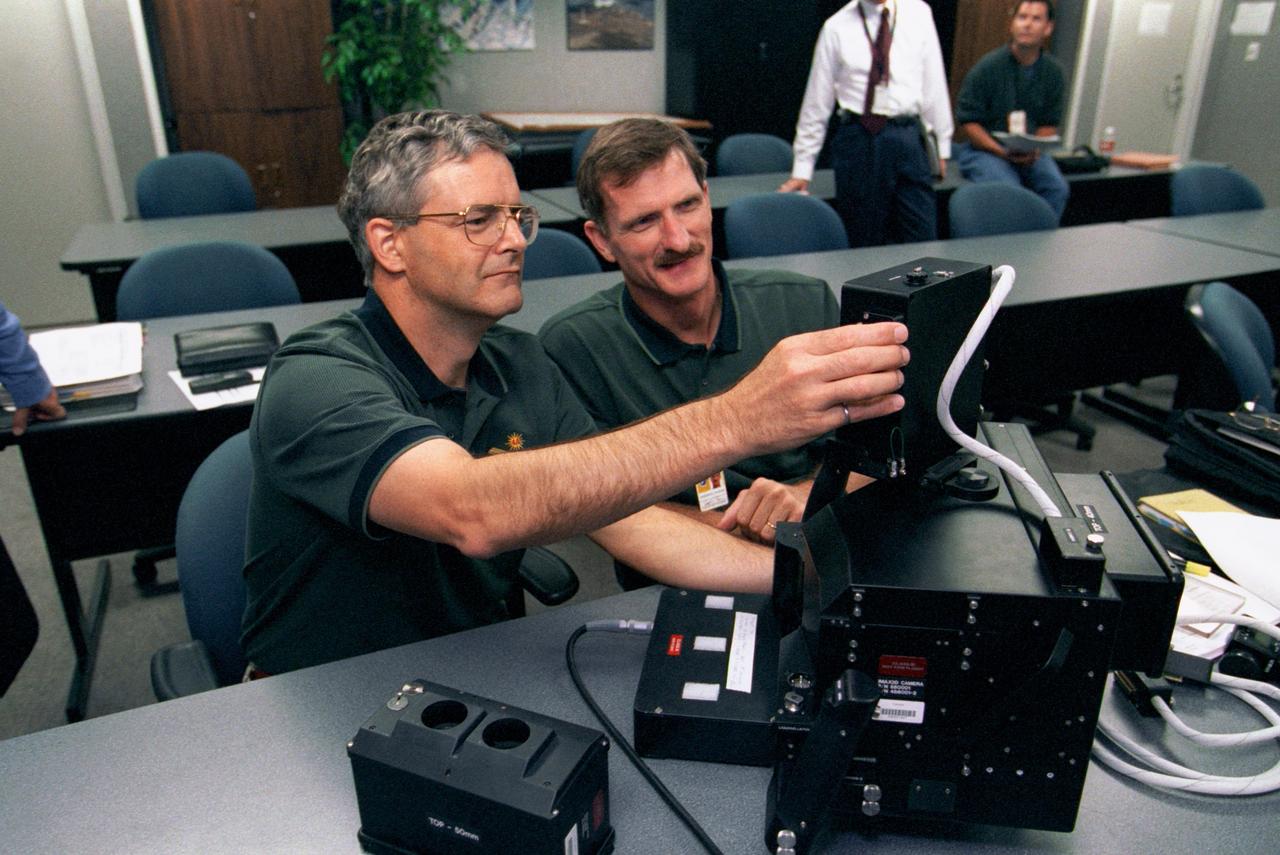
JSC2000-04743 (13 June 2000) --- Astronauts Marc Garneau (left) and Joseph R. Tanner, STS-97 mission specialists, familiarize themselves with an IMAX 3D motion picture camera during a training session in the Flight Operations Facility at the Johnson Space Center (JSC). Garneau represents the Canadian Space Agency (CSA).
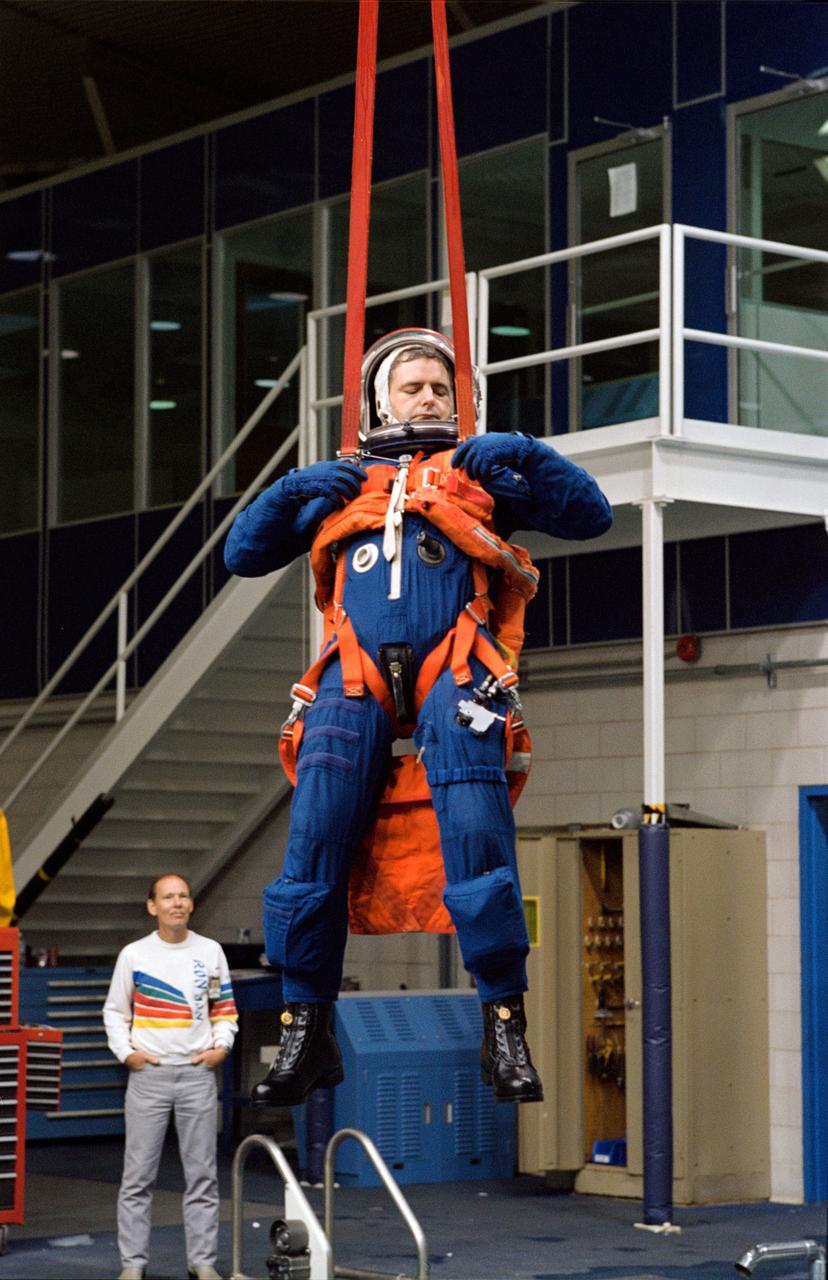
S93-45723 (7 October 1993) --- Canadian astronaut candidate Marc Garneau, later named as a mission specialist for NASA's STS-77 mission-representing the Canadian Space Agency (CSA), participates in emergency bailout training at the Johnson Space Center (JSC). Garneau was in the 1992 class of Astronaut Candidates (ASCAN). Wearing full parachute gear, Garneau is suspended above a 25-feet deep pool in JSC's Weightless Environment Training Facility (WET-F). This portion of an astronaut's training is to prepare them for proper measures to take in the event of bailout over water.
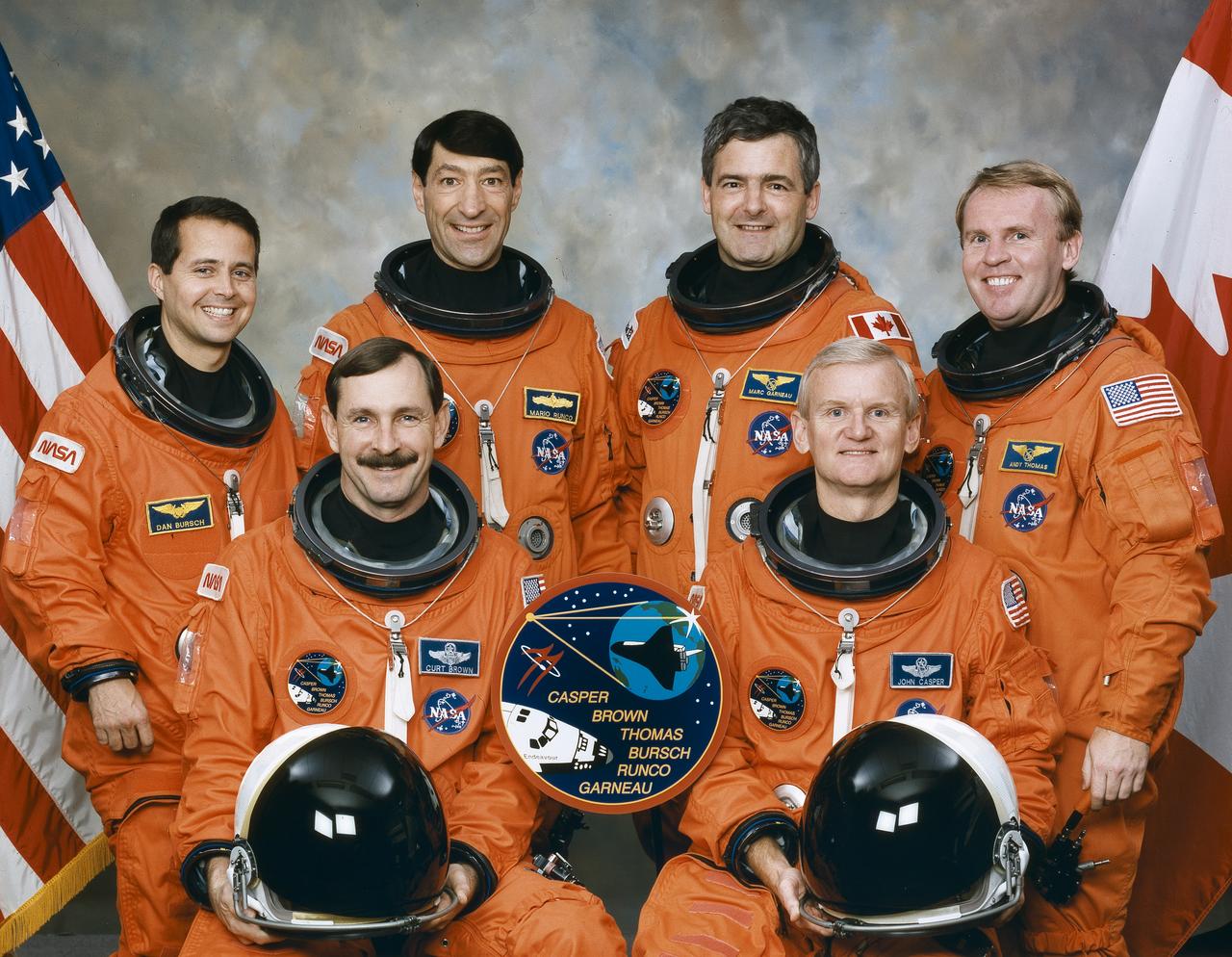
The crew assigned to the STS-77 mission included (seated left to right) Curtis L. Brown, pilot; and John H. Casper, commander. Standing, left to right, are mission specialists Daniel W. Bursch, Mario Runco, Marc Garneau (CSA), and Andrew S. W. Thomas. Launched aboard the Space Shuttle Endeavour on May 19, 1996 at 6:30:00 am (EDT), the STS-77 mission carried three primary payloads; the SPACEHAB-4 pressurized research module, the Inflatable Antenna Experiment (IAE) mounted on a Spartan 207 free-flyer, and a suite of four technology demonstration experiments known as Technology Experiments for Advancing Missions in Space (TEAMS).
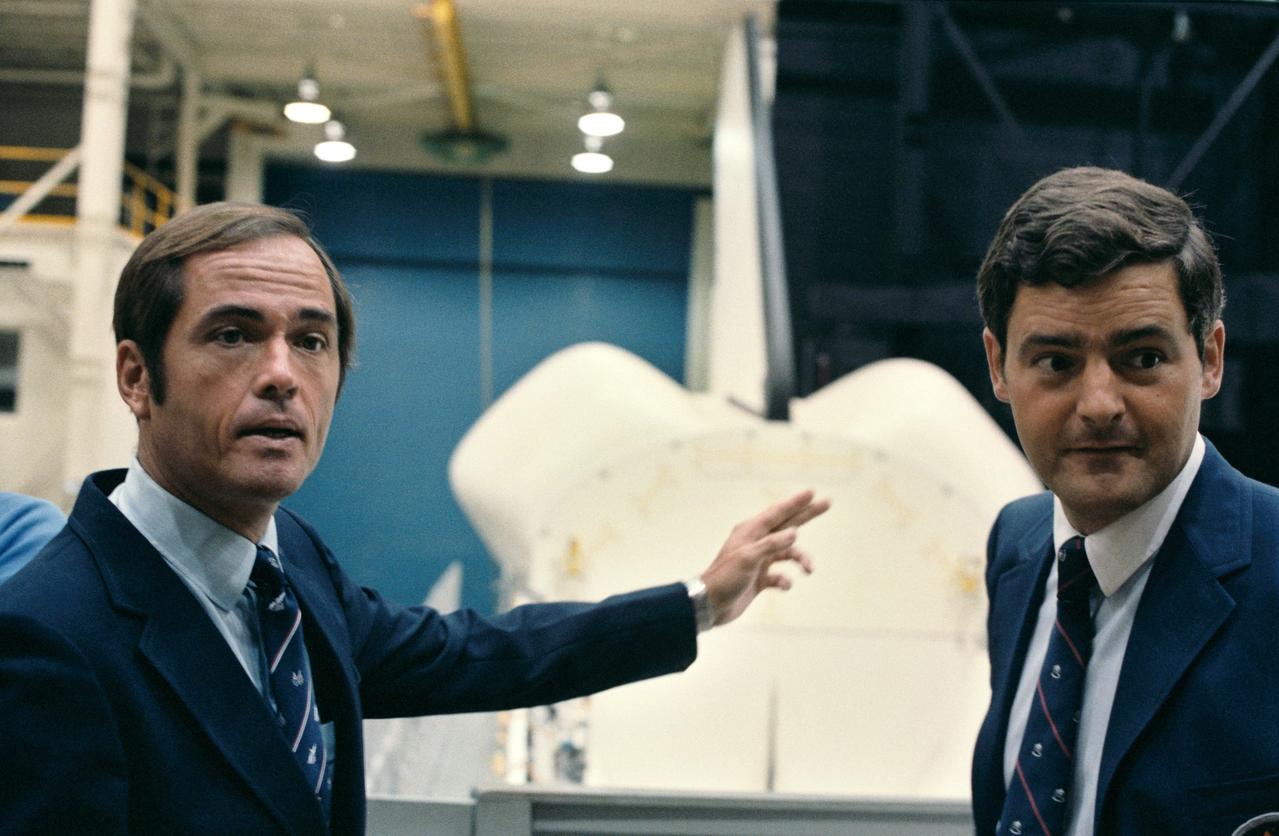
41D-3142 (3 Sept 1984) --- Astronaut Robert L. Crippen, left, crew commander for NASA's 41-G flight, and Marc Garneau, payload specialist representing the Canadian National Research Council (NRC), participate in a briefing in the Shuttle mockup and integration laboratory at the Johnson Space Center.
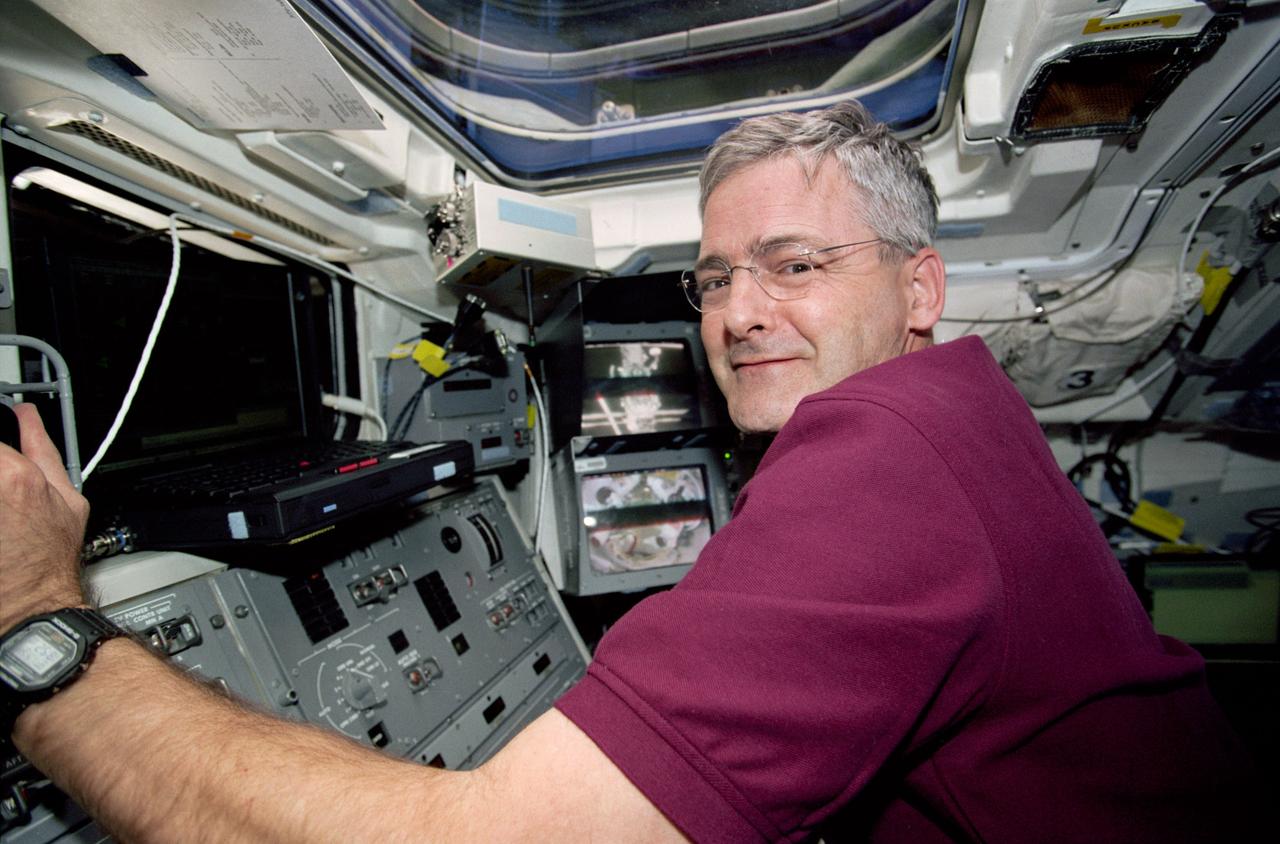
STS097-316-002 (30 Nov. - 11 Dec. 2000) Astronaut Marc Garneau, mission specialist representing the Canadian Space Agency (CSA), works the controls for Endeavour's remote manipulator system (RMS).
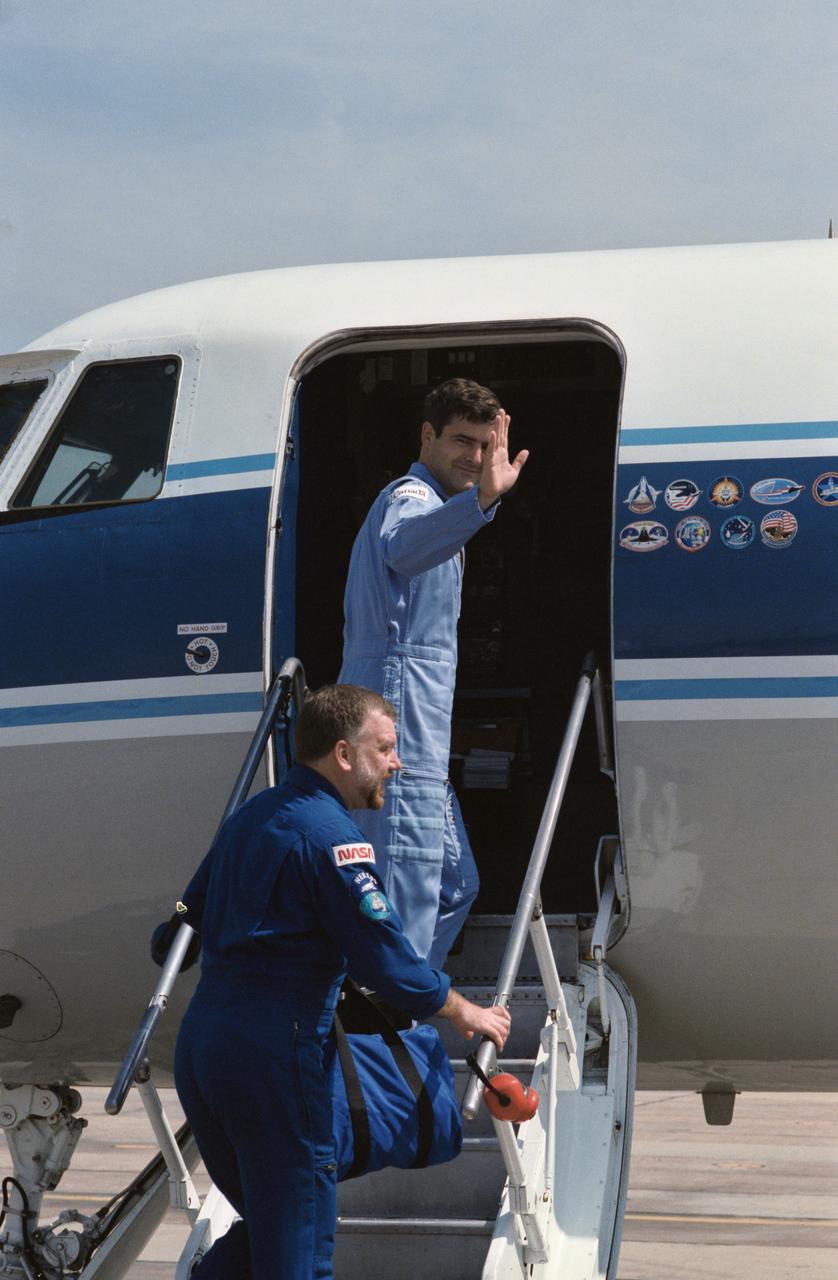
Payload Specialists Marc Garneau and Paul Scully-Power prepare to board the Shuttle Trainer aircraft to leave for the Kennedy Space Center (KSC) for the STS 41-G mission.
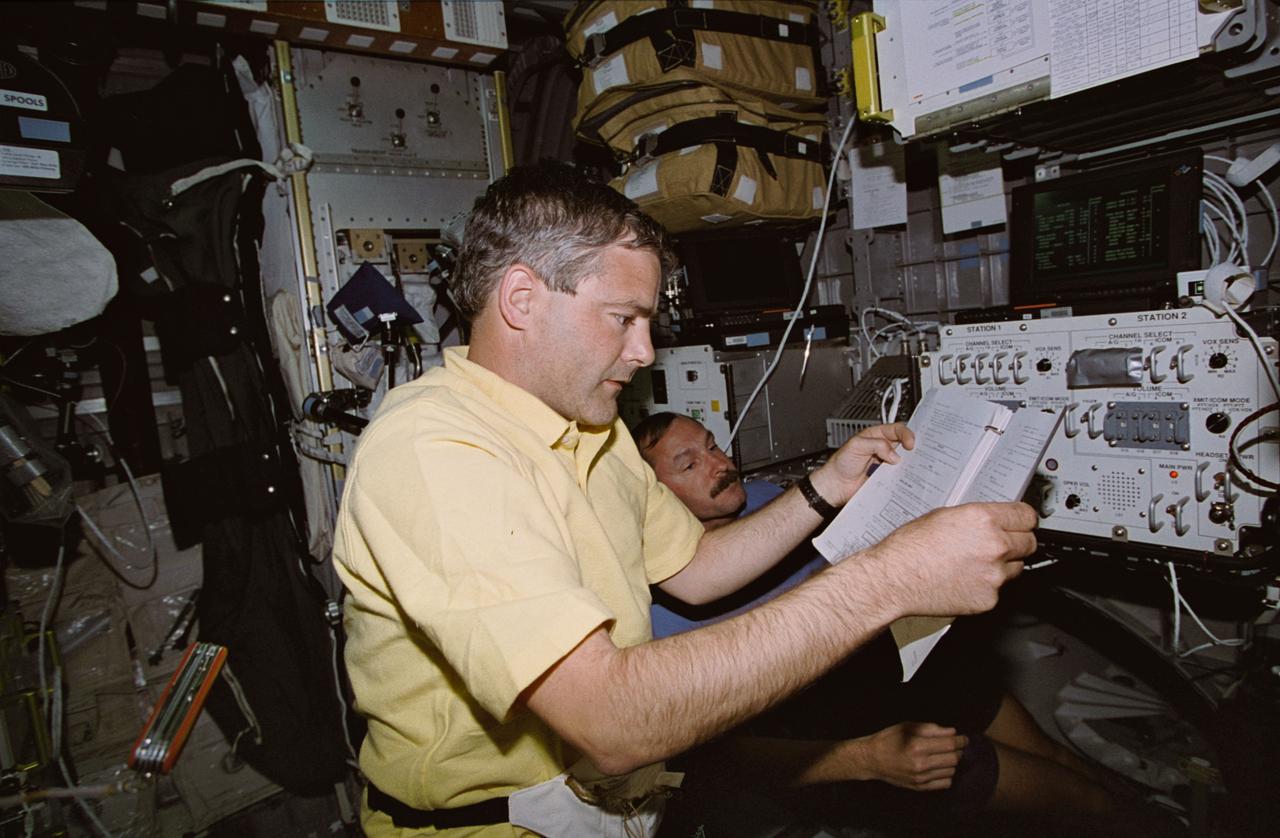
STS077-392-007 (19-29 May 1996) --- Inside the Spacehab Module onboard the Earth-orbiting Space Shuttle Endeavour, Canadian astronaut Marc Garneau, mission specialist, joins astronaut Curtis L. Brown, Jr., pilot, in checking out the audio control system for Spacehab. The two joined four other NASA astronauts for nine days of research and experimentation in Earth-orbit.
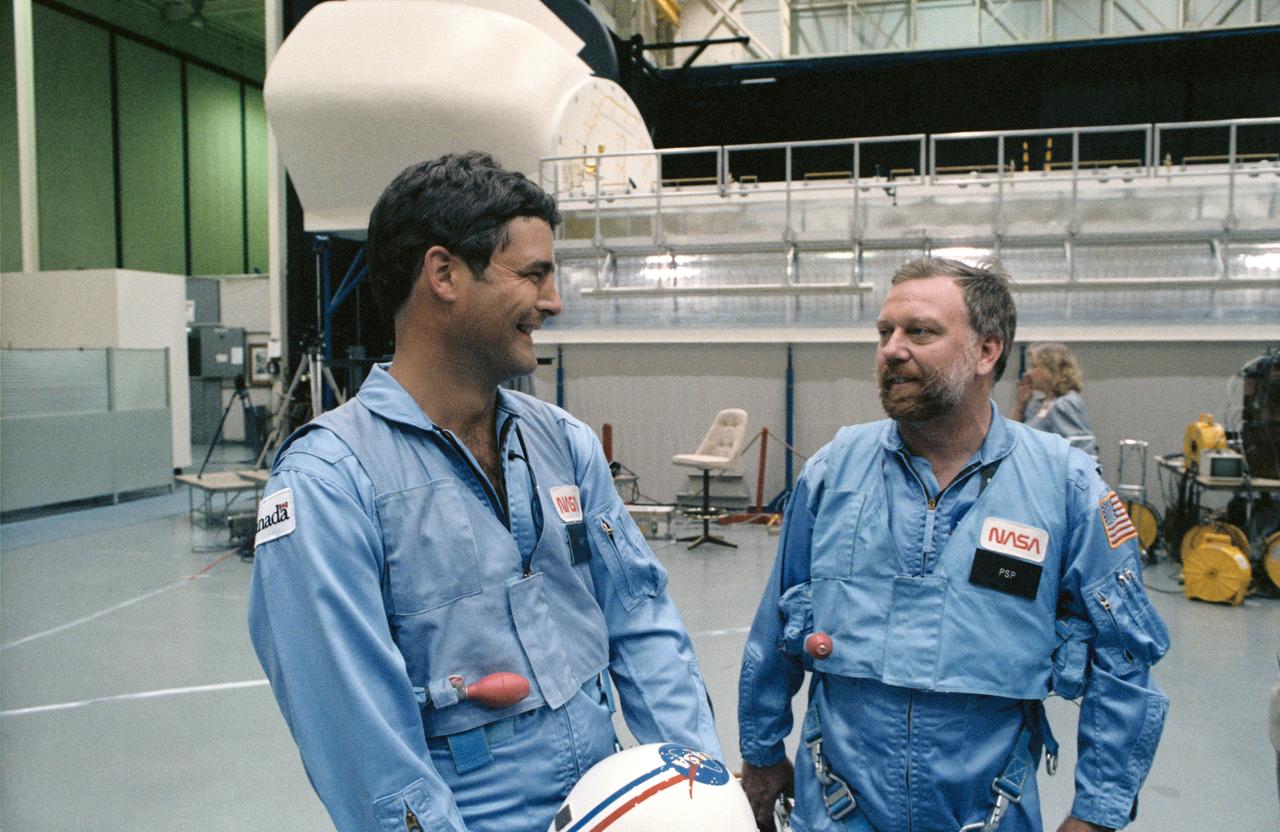
41D-3185 (S14-3185) (4 Sept 1984) --- The two payload specialists for NASA's 41-G mission aboard the Challenger chat prior to a simulation session in the Shuttle mockup and integration laboratory at the Johnson Space Center. They are Marc Garneau, left, representing the Canadian National Research Council, and Paul D. Scully-Power, an oceanographer with the U.S. Navy. They are standing near the manipulator development facility (MDF), pictured in background.
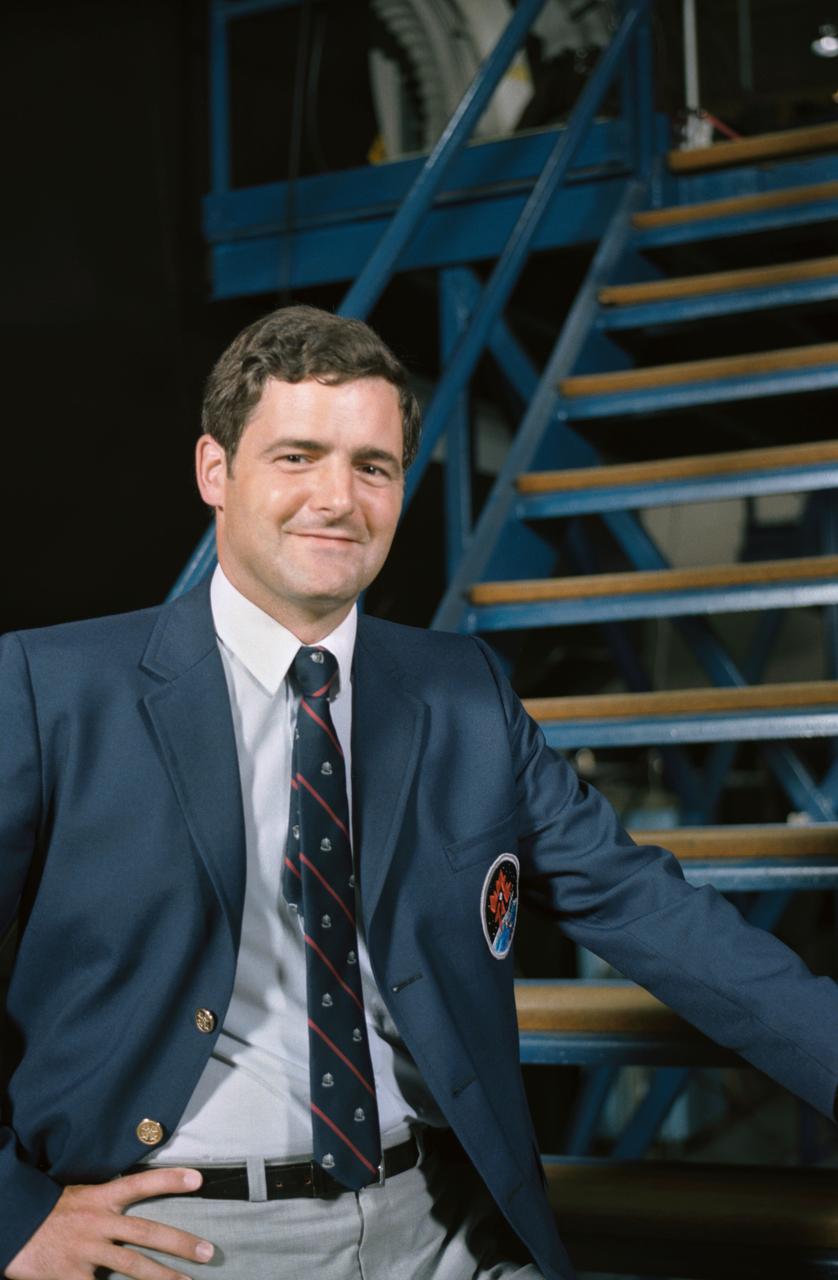
41D-3276 (S14-3276)(4 Sept 1984) --- Marc Garnea, 41-G payload specialist, will represent the Canadian National Research Council when the seven-member crew lauches aboard the Space Shuttle Challenger on Oct. 5, 1984. Garneau and other members of the crew had earlier met the press for the first time as a group.
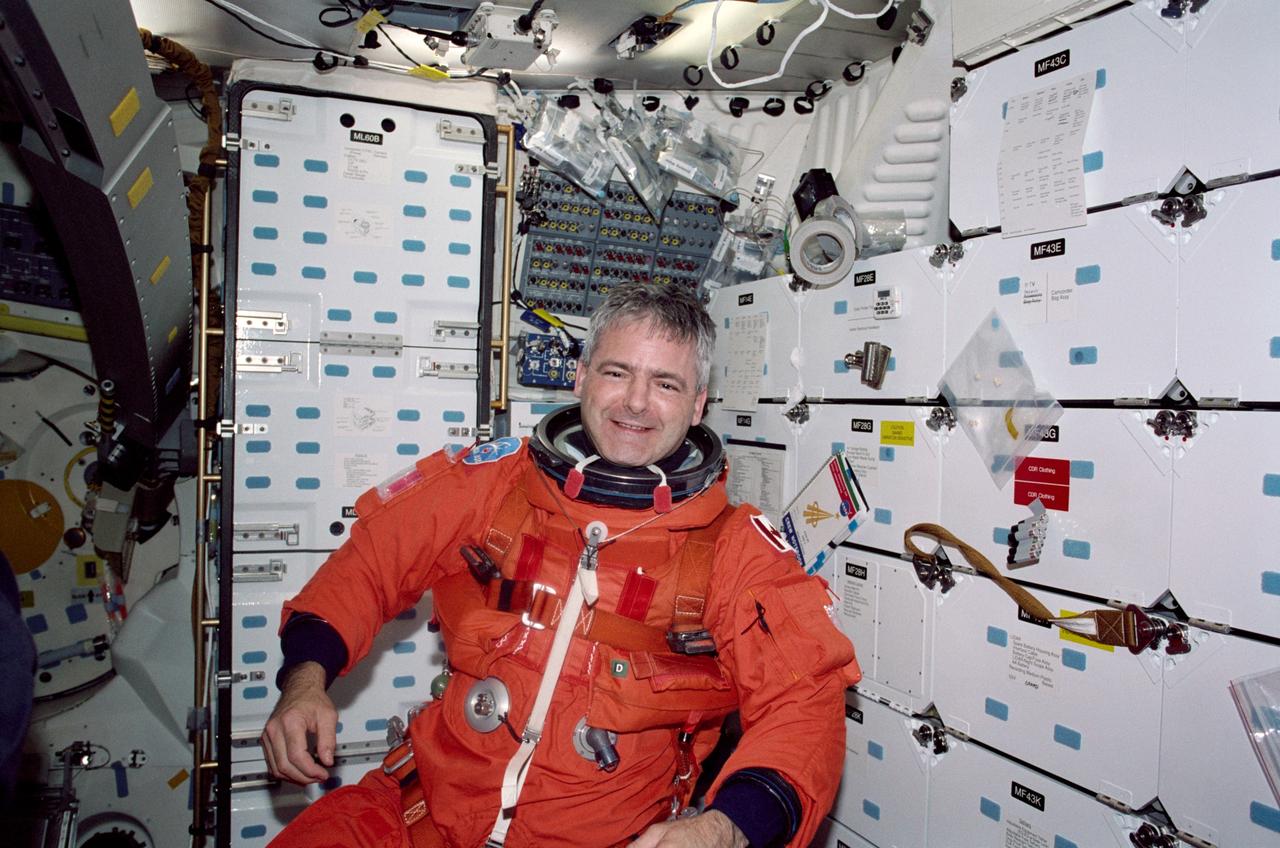
STS097-310-026 (11 December 2000) --- Astronaut Marc Garneau, mission specialist representing the Canadian Space Agency (CSA), is photographed in the launch and entry suit on the middeck of the Earth-orbiting Space Shuttle Endeavour prior to re-entry.
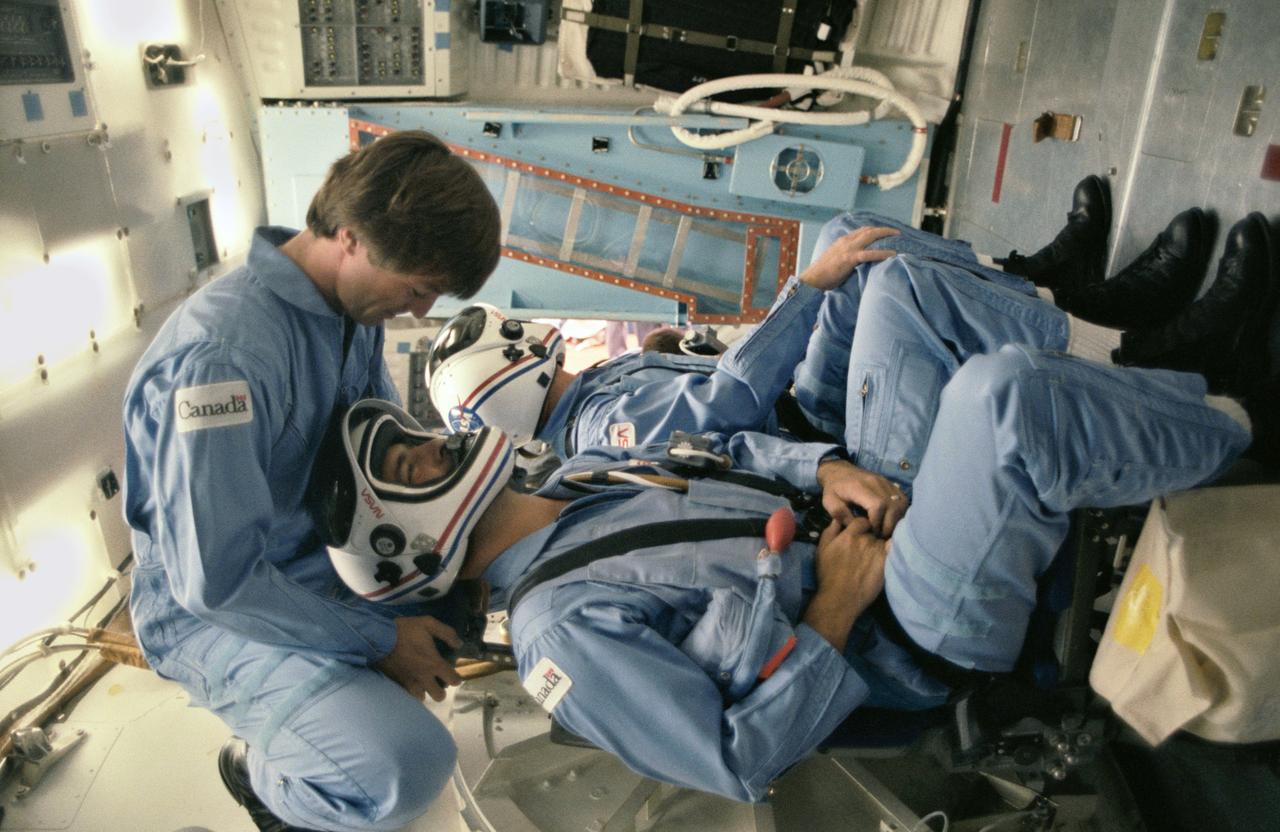
41D-3139 (2 Sept 1984) --- Two prime crew member payload specialist and a backup for NASA's 41-G Space Shuttle mission participate in launch phase simulations at the Johnson Space Center. Securing themselves in temporary stations in the middeck of a trainer are Marc Garneau, representing the Canadian National Research Council (NRC), and Paul D. Scully-Power (background), a U.S. Navy oceanographer. Robert Thirsk, also with the NRC, is a backup payload specialist. This photograph was taken by Otis Imboden.
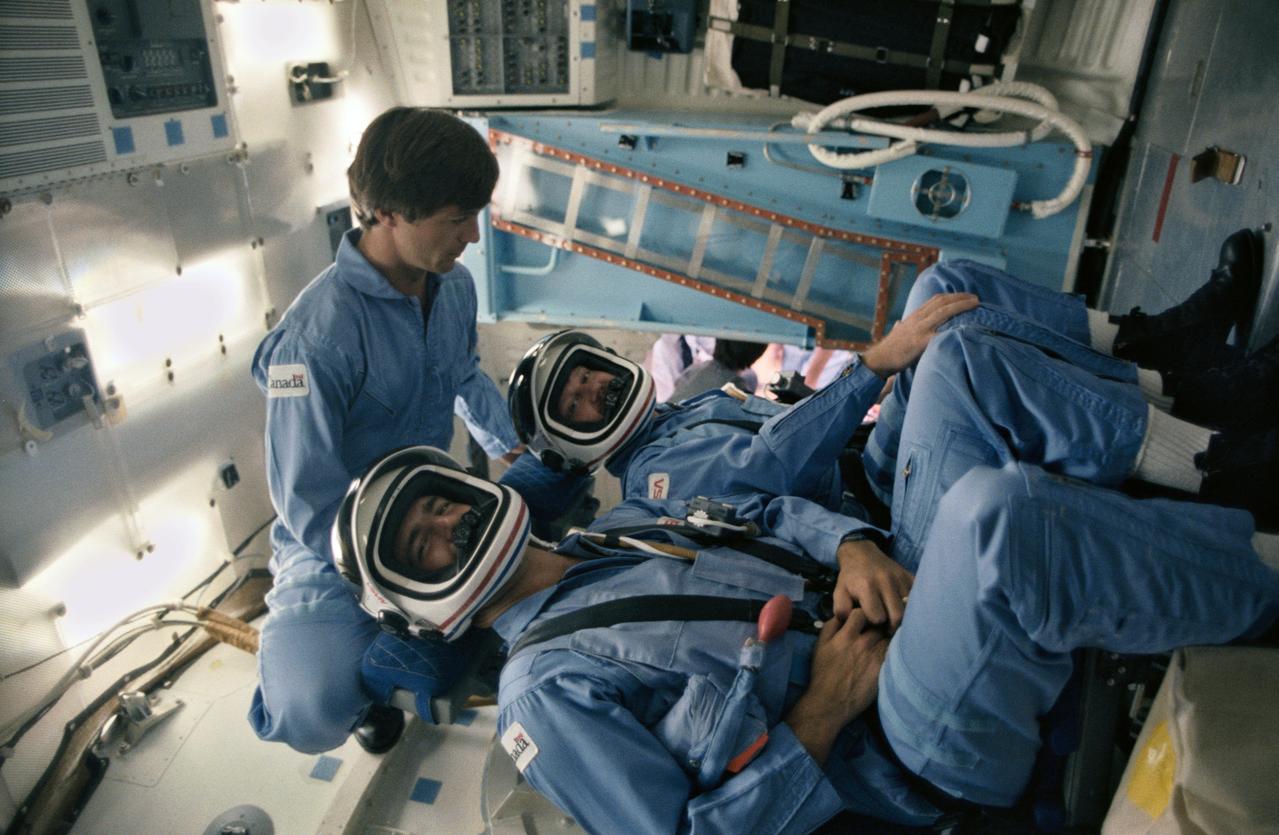
41D-3138 (4 Sept 1984)--- Canada's backup payload specialist assists the two 41-G prime payload specialists during a training session in the Johnson Space Center's Shuttle mockup and integration laboratory. Robert Thirsk (without helmet) represents the National Research Council (NRC) and is backup to Marc Garneau (nearest camera), also of the NRC. Paul D. Scully-Power, seated in the other middeck seat for the launch phase, is a civilian oceanographer with the U.S. Navy. The 41-G flight aboard the Challenger is NASA's first to utilize a crew of more than six persons. This photograph was taken by Otis Imboden.
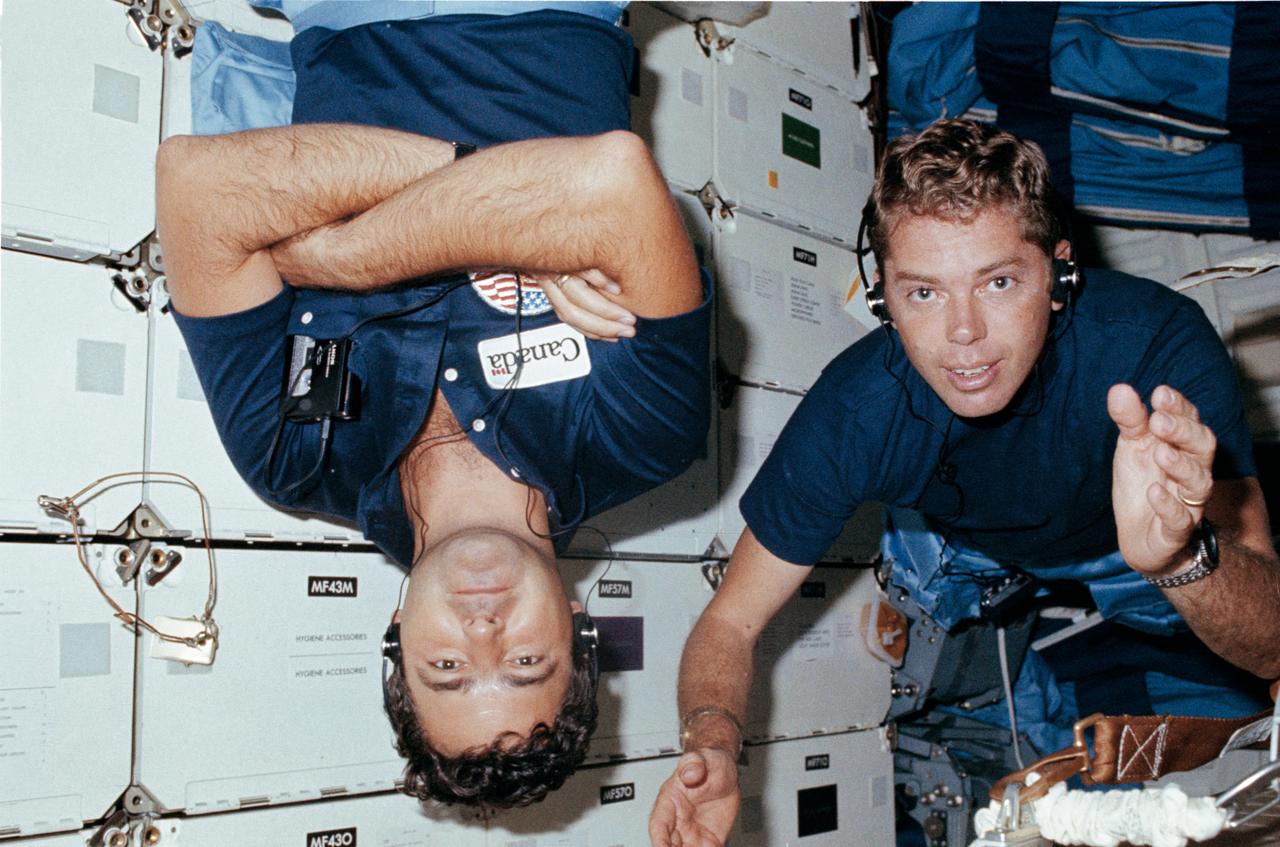
41G-101-039 (5-13 Oct 1984) --- Two members of a record seven-person crew are pictured during Intravehicular Activity (IVA) aboard the Earth-orbiting Space Shuttle Challenger. Hold picture with open hand at right center edge. Astronaut David C. Leestma, mission specialist, is at right observing a test by payload specialist Marc Garneau, representing the National Research Council (NRC) of Canada. Garneau spent much of his on-duty time conducting a series of experiments for the NRC. The crew consisted of astronauts Robert L. Crippen, commander; Jon A. McBride, pilot; mission specialist's Kathryn D. Sullivan, Sally K. Ride, and David D. Leestma; Canadian astronaut Marc Garneau, and Paul D. Scully-Power, payload specialist's. EDITOR'S NOTE: The STS-41G mission had the first American female EVA (Sullivan); first seven-person crew; first orbital fuel transfer; and the first Canadian (Garneau).
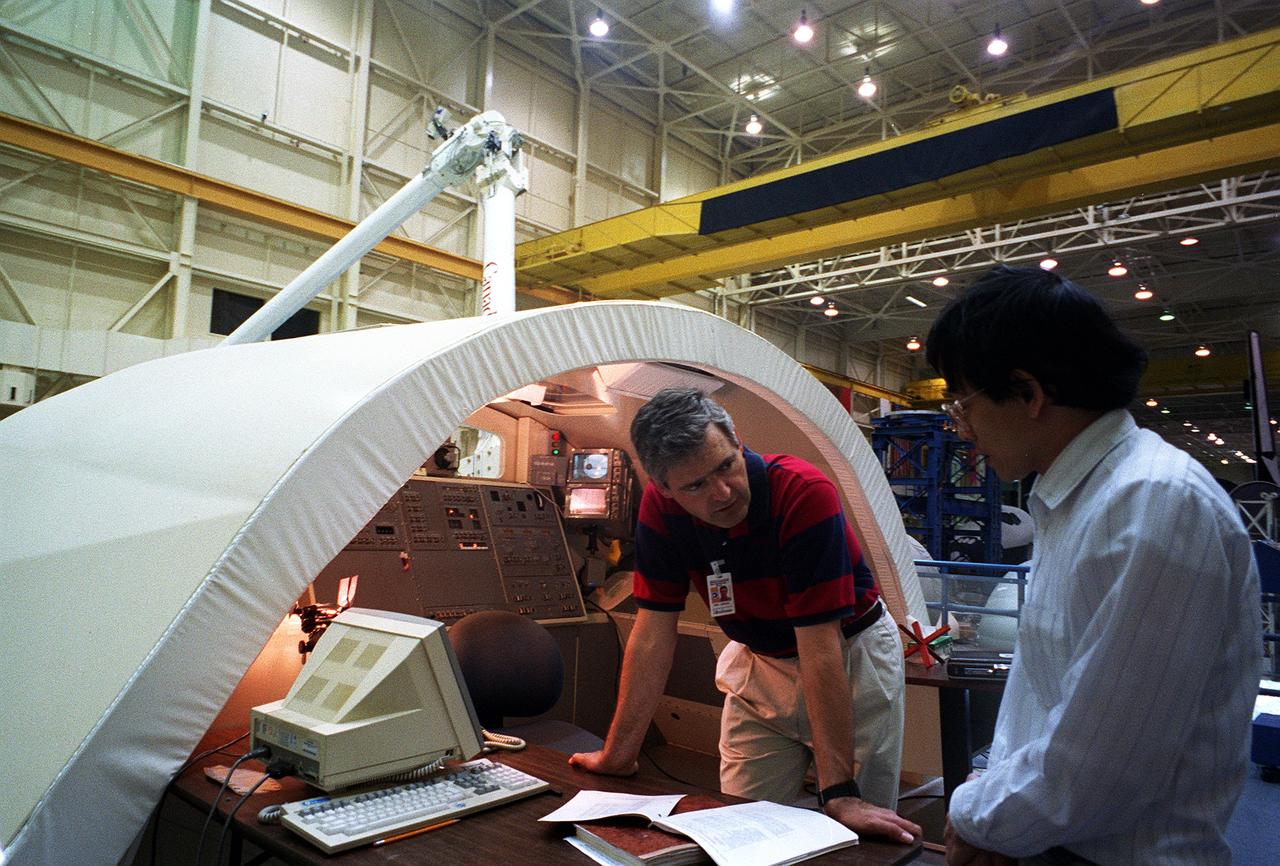
S96-08071 (April 1996) --- Crew trainer Viet Nguyen briefs Canadian astronaut Marc Garneau, mission specialist, on Remote Manipulation System (RMS) procedures during a training session in the Johnson Space Center's (JSC) Manipulator Development Facility (MDF). Garneau will be making his second flight in space when he joins five NASA astronauts for nine days aboard the Space Shuttle Endeavour next month.
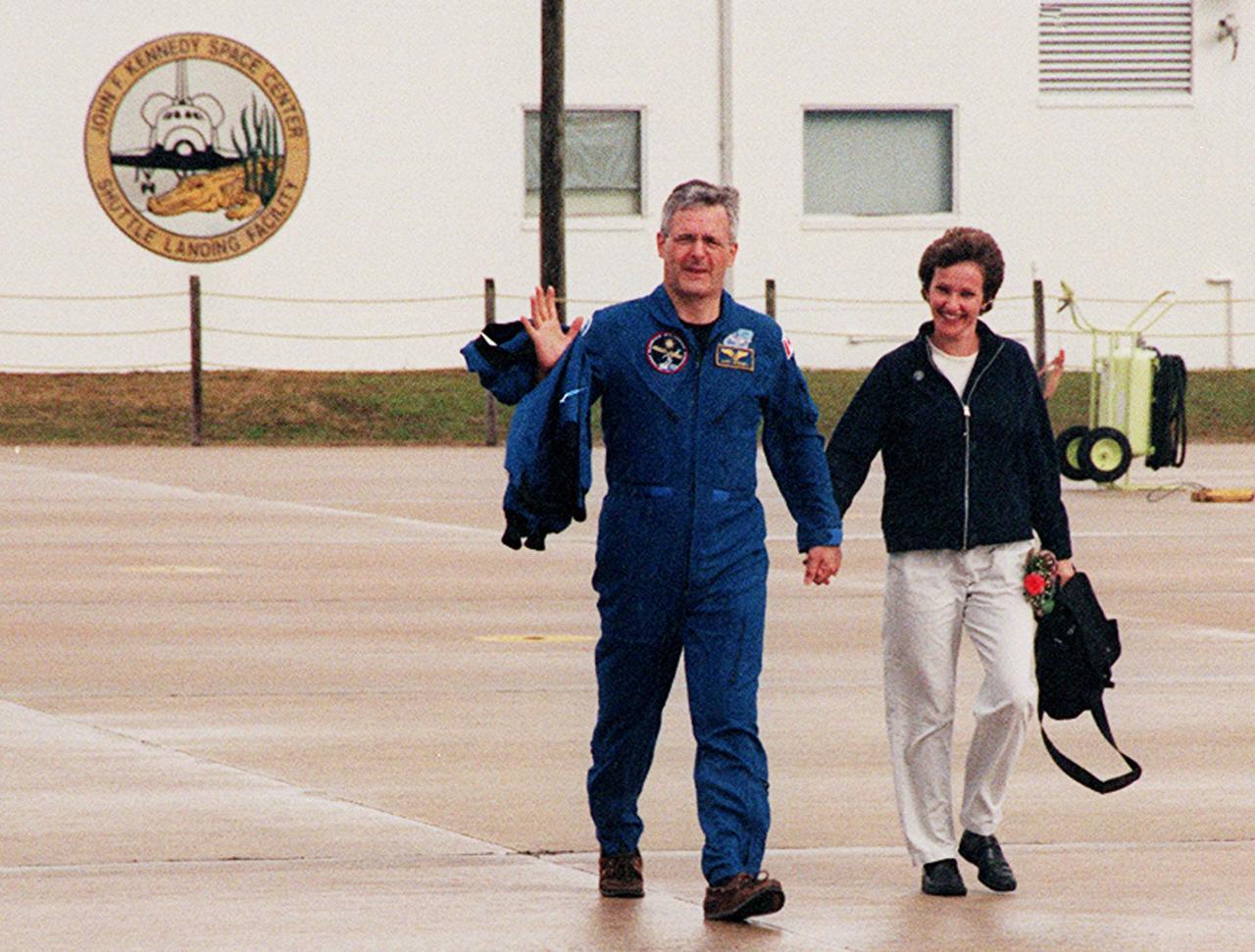
KENNEDY SPACE CENTER, FLA. -- After a night’s rest and a brief press conference at KSC, STS-97 Mission Specialist Marc Garneau heads for a plane at the Shuttle Landing Facility. With him is his wife. They and other crew members and their families are returning to Houston. Garneau is with the Canadian Space Agency.Mission STS-97 ended on Dec. 11, 2000, with a landing at KSC at 6:04 p.m. EST
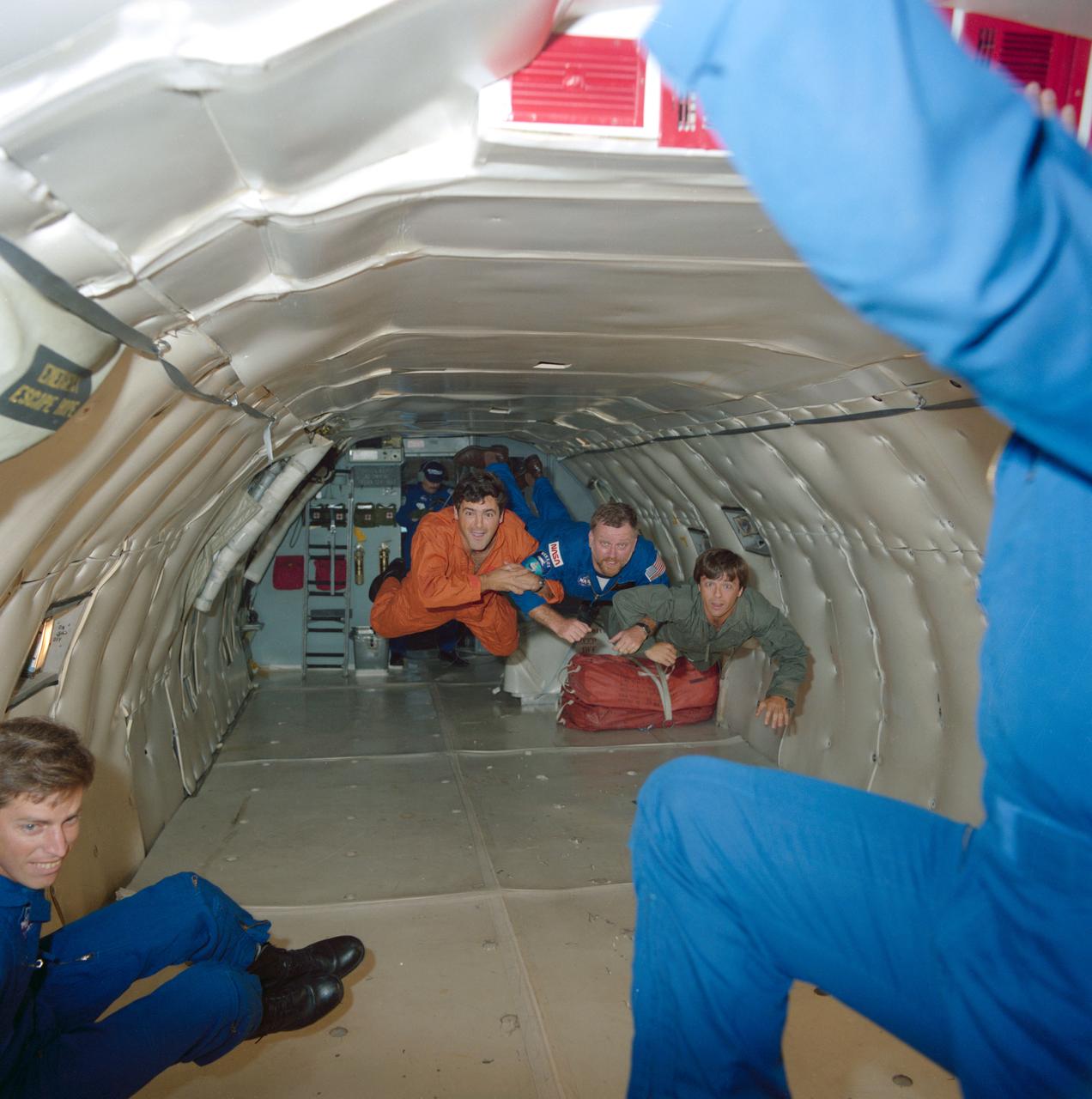
S84-40538 (24 Aug 1984) --- Two 41-G payload specialists and a backup for one of them appear to be at home in zero gravity in this scene photographed aboard a KC-135 "Zero gravity" aircraft flying one of its weightlessness opportunity parabolas. Paul D. Scully-Power, a civilian oceanographer with the U.S. Navey, is flanked by Marc Garneau (left) and Robert Thirsk, both representing the National Research Council of Canada. Thirsk is back up payload specialist for Garneau.
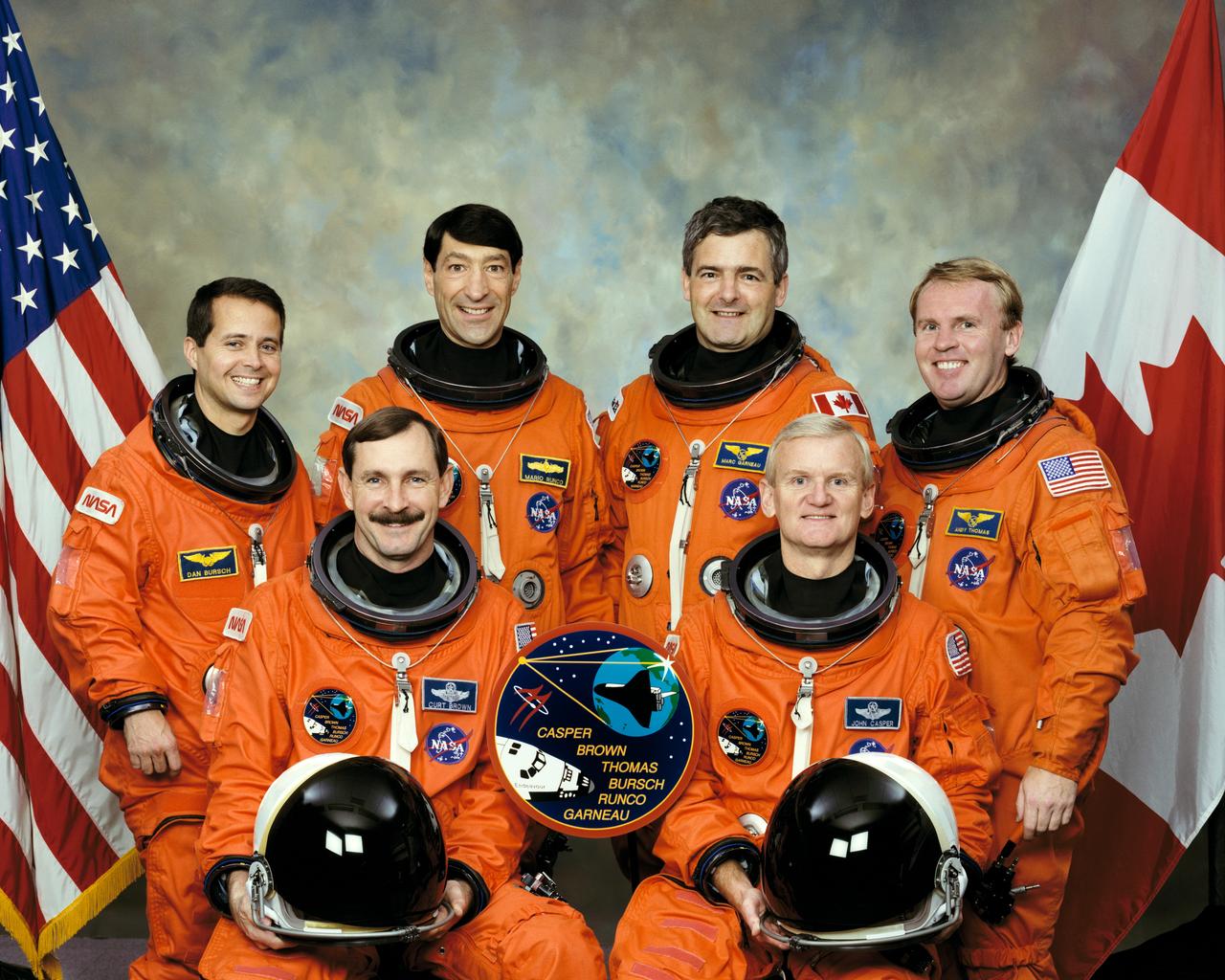
STS077-S-002 (February 1996) --- These six astronauts have been named to fly aboard the Space Shuttle Endeavour in support of the Spacehab-04 mission, scheduled for launch in May of this year. On the front row are astronauts John H. Casper (right), mission commander; and Curtis L. Brown Jr., pilot. In the rear, from the left, are astronauts Daniel W. Bursch, Mario Runco Jr., Marc Garneau and Andrew S. W. Thomas, all mission specialists. Garneau represents the Canadian Space Agency (CSA).
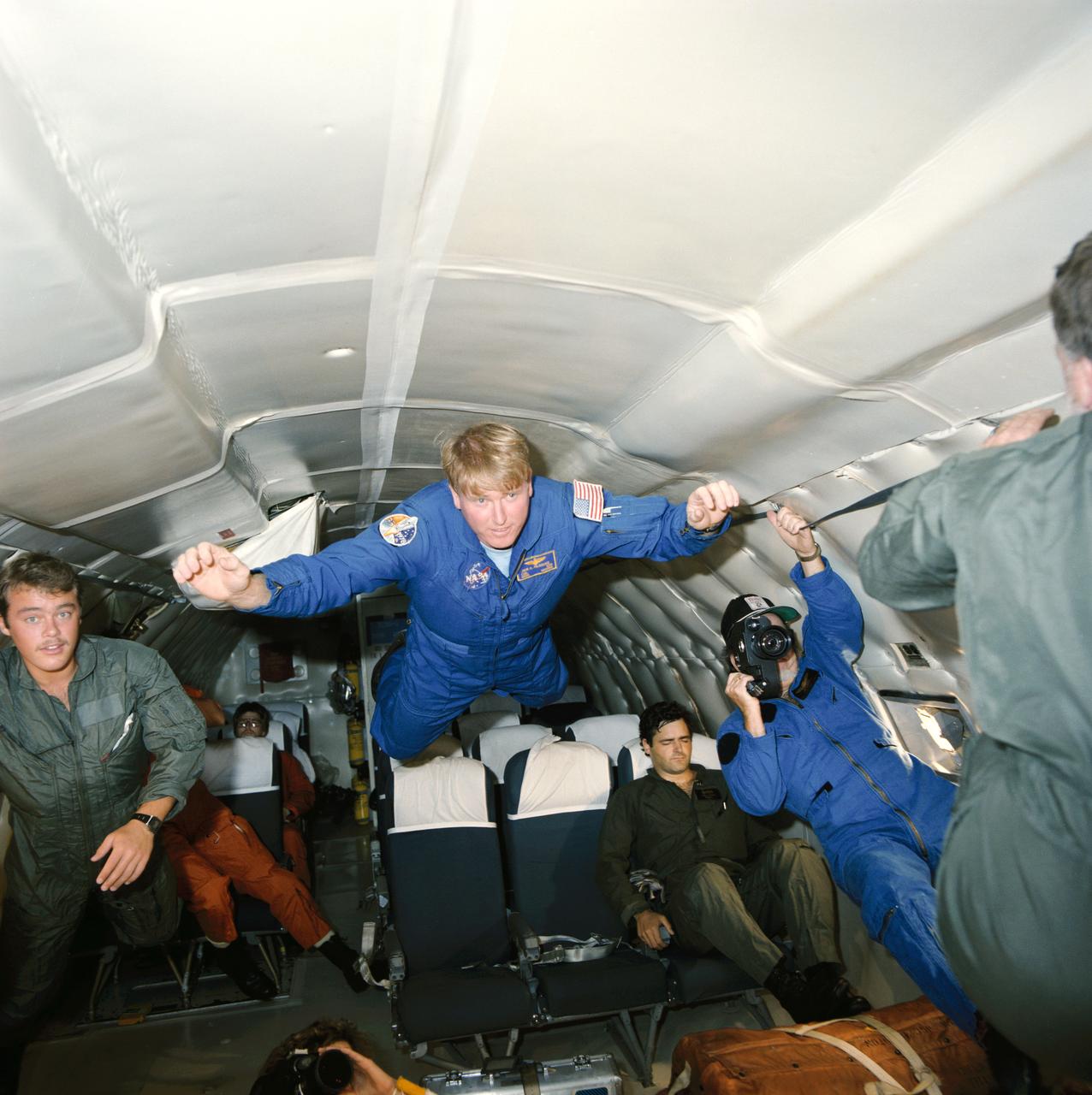
S84-37522 (18 July 1984) --- Astronaut Jon A. McBride, center, floats briefly aboard a NASA KC-135 aircraft during a flight designed as part of the training program for 41-G's seven crewmembers. McBride is pilot for that October 1984 flight. Marc Garneau, one of two payload specialists for the mission, is seated at right. Garneau represents the National Research Council of Canada.
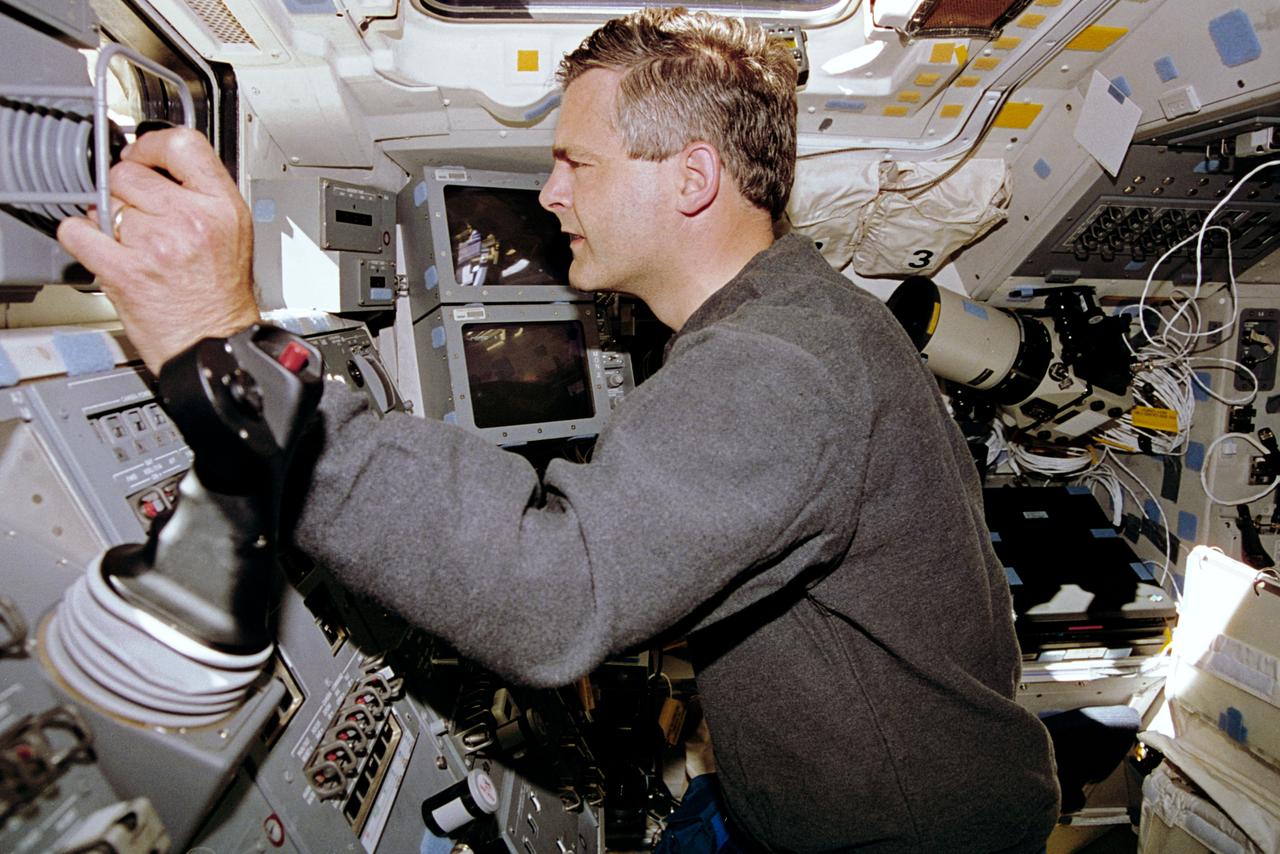
STS077-307-017 (19-29 May 1996) --- Astronaut Marc Garneau, mission specialist, is pictured at the controls for the Remote Manipulator System (RMS) on the aft flight deck of the Space Shuttle Endeavour. Garneau, representing the Canadian Space Agency (CSA), and five other astronauts went on to spend almost ten days aboard Endeavour in support of the Spacehab 4 mission and a number of other payloads.
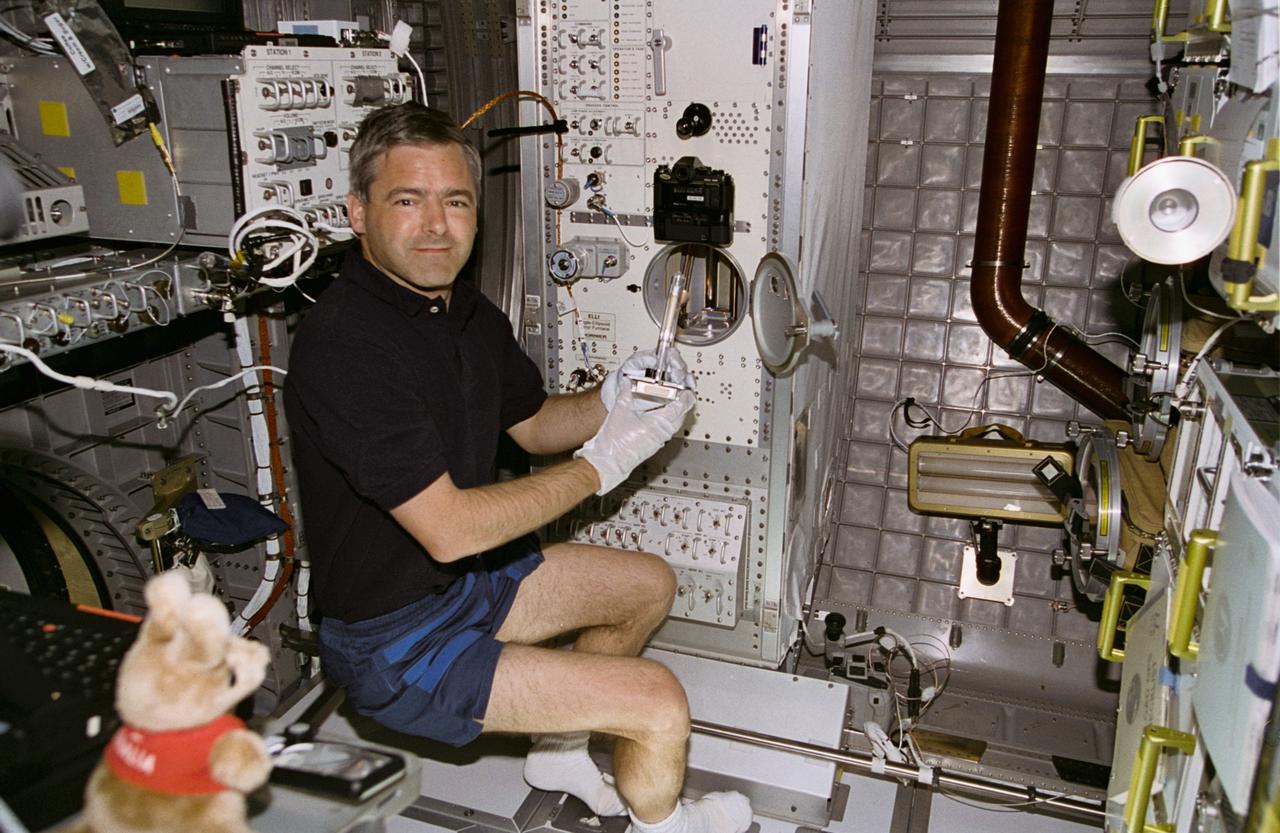
STS077-392-033 (19-29 May 1996) --- Astronaut Marc Garneau, mission specialist, works at the Commercial Float Zone Furnace (CFZF) in the Spacehab Module onboard the Space Shuttle Endeavour. Garneau, representing the Canadian Space Agency (CSA), and five other astronauts went on to spend almost ten-days aboard Endeavour in support of the Spacehab 4 mission and a number of other payloads.
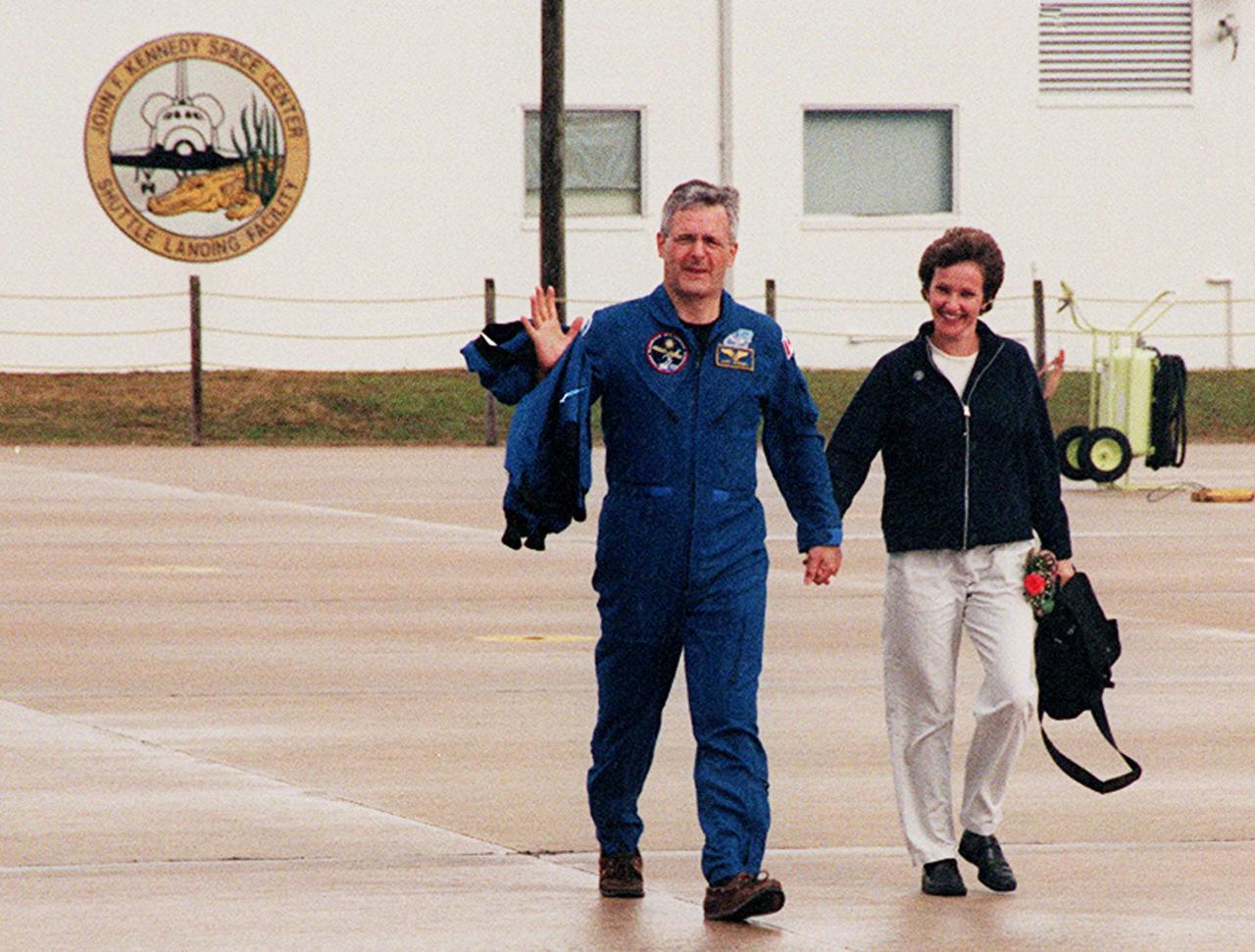
KENNEDY SPACE CENTER, FLA. -- After a night’s rest and a brief press conference at KSC, STS-97 Mission Specialist Marc Garneau heads for a plane at the Shuttle Landing Facility. With him is his wife. They and other crew members and their families are returning to Houston. Garneau is with the Canadian Space Agency.Mission STS-97 ended on Dec. 11, 2000, with a landing at KSC at 6:04 p.m. EST
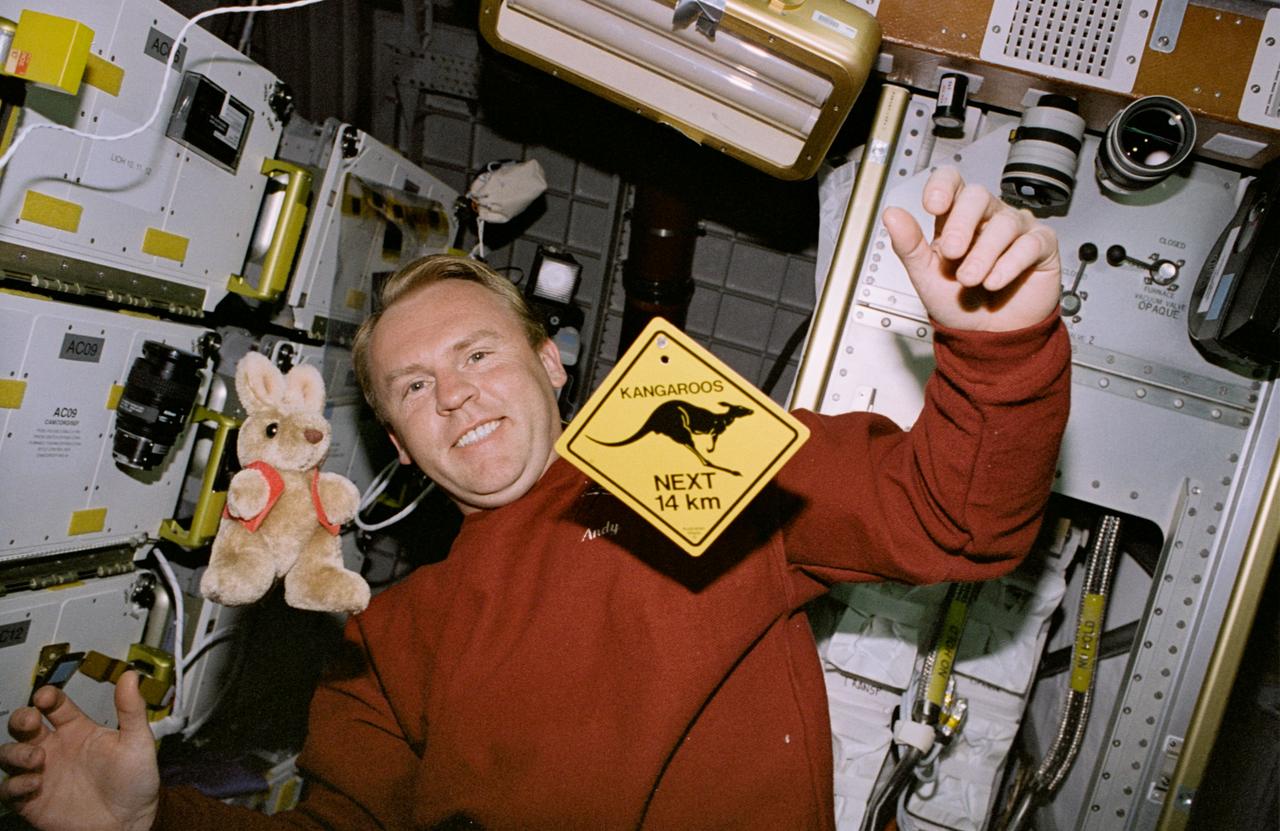
STS077-368-026 (19-29 May 1996) --- On his off-duty time, Australian-native Andrew S. W. Thomas, mission specialist, has a little fun with Australian mementos in the Spacehab Module onboard the Space Shuttle Endeavour. Floating in the foreground are a stuffed toy kangaroo and a miniaturized typical highway warning sign about the plentiful four-legged Australian resident. Astronaut Thomas and five other crew members went on to spend almost ten-days aboard Endeavour in support of the Spacehab 4 mission and a number of other payloads.
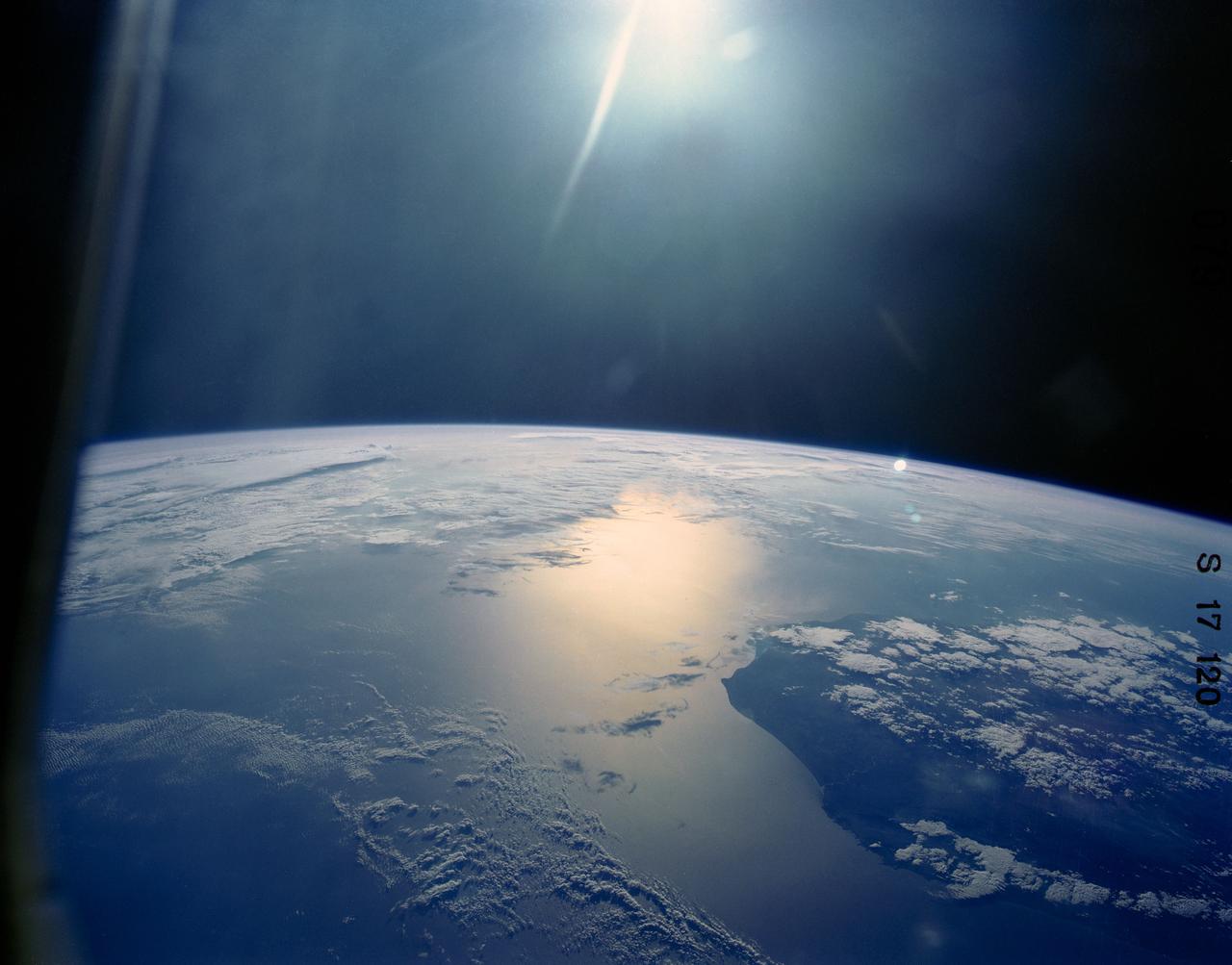
41G-120-079 (5-13 Oct 1984) --- This oblique view, photographed from the Space Shuttle Challenger, shows the south tip of the island of Madagascar. Sunglint reflects on the surface of the Mozambique Channel. The crew consisted of astronauts Robert L. Crippen, commander; Jon A. McBride, pilot; mission specialist's Kathryn D. Sullivan, Sally K. Ride, and David D. Leestma; Canadian astronaut Marc Garneau; and Paul D. Scully-Power, payload specialist. EDITOR'S NOTE: The STS-41G mission had the first American female EVA (Sullivan); first seven-person crew; first orbital fuel transfer; and the first Canadian (Garneau).
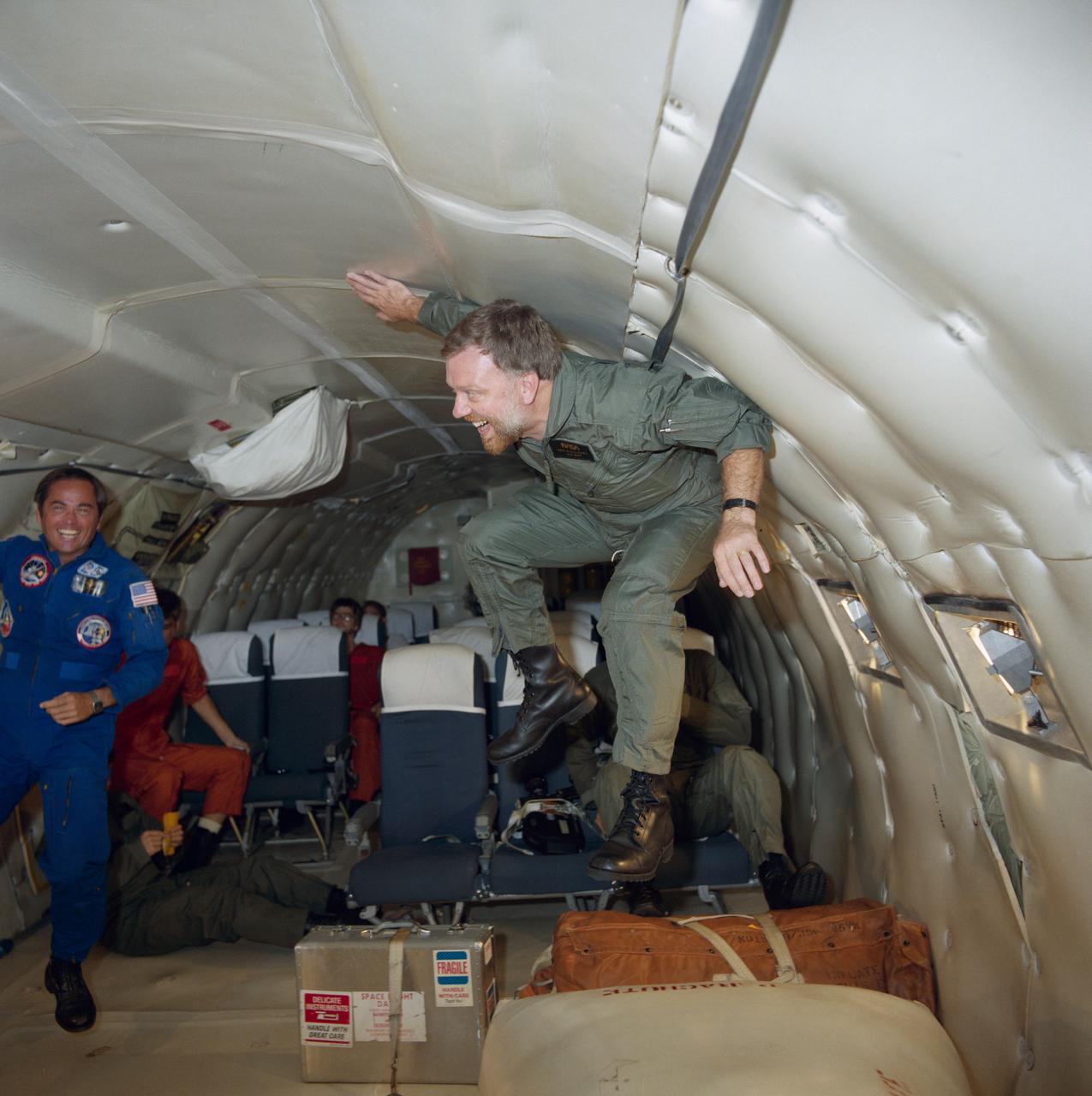
S84-37536 (18 July 1984) --- Astronaut Robert L. Crippen, left, 41-G crew commander watches as one of his fellow crewmembers gets an introduction to weightlessness aboard a KC-135, "zero-gravity" aircraft. Paul D. Scully-Power is the crew member literally floating here in the brief period of micro-gravity. Scully-Power, an oceanographer with the U.S. Navy, and Marc Garneau (partially visible in chair behind the floating Scully-Power)are payload specialists for 41-G. Garneau represents the National Research Council (Canada).
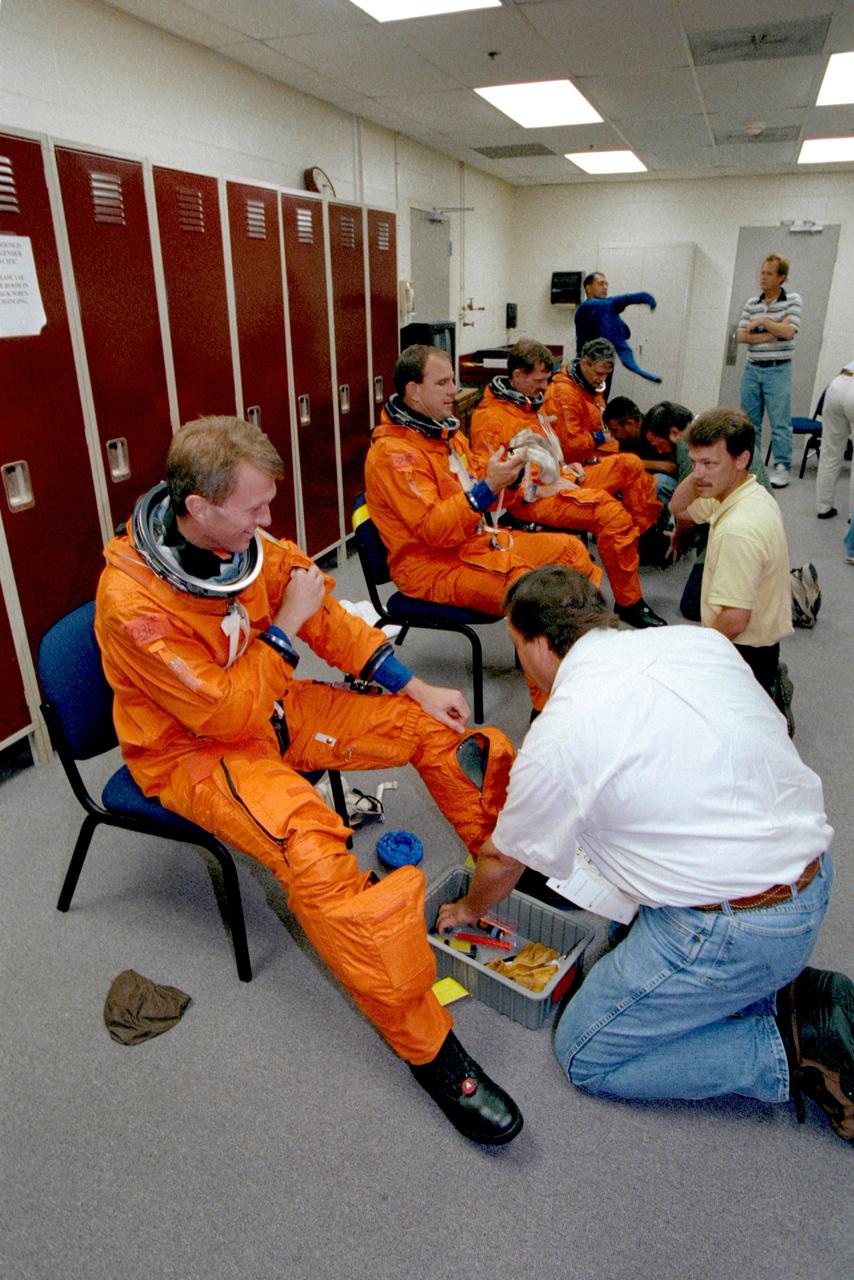
JSC2000-04751 (15 June 2000) --- Members of the STS-97 crew don training versions of the ascent and entry suits for a training session in the Johnson Space Center's Systems Integration Facility. Wearing the burnt-orange pressure suits, from the left, are astronauts Brent W. Jett, mission commander; Michael J. Bloomfield, pilot; and Joseph R. Tanner and Marc Garneau, both mission specialists. Garneau represents the Canadian Space Agency (CSA). Suit technicians assisting are Mike Birkenseher, Brad Milling, Steve Clendenin and Rudy Molina. In the background Carlos I. Noriega, mission specialist, prepares to put on his suit with the assistance of suit tech John Hazelhurt.
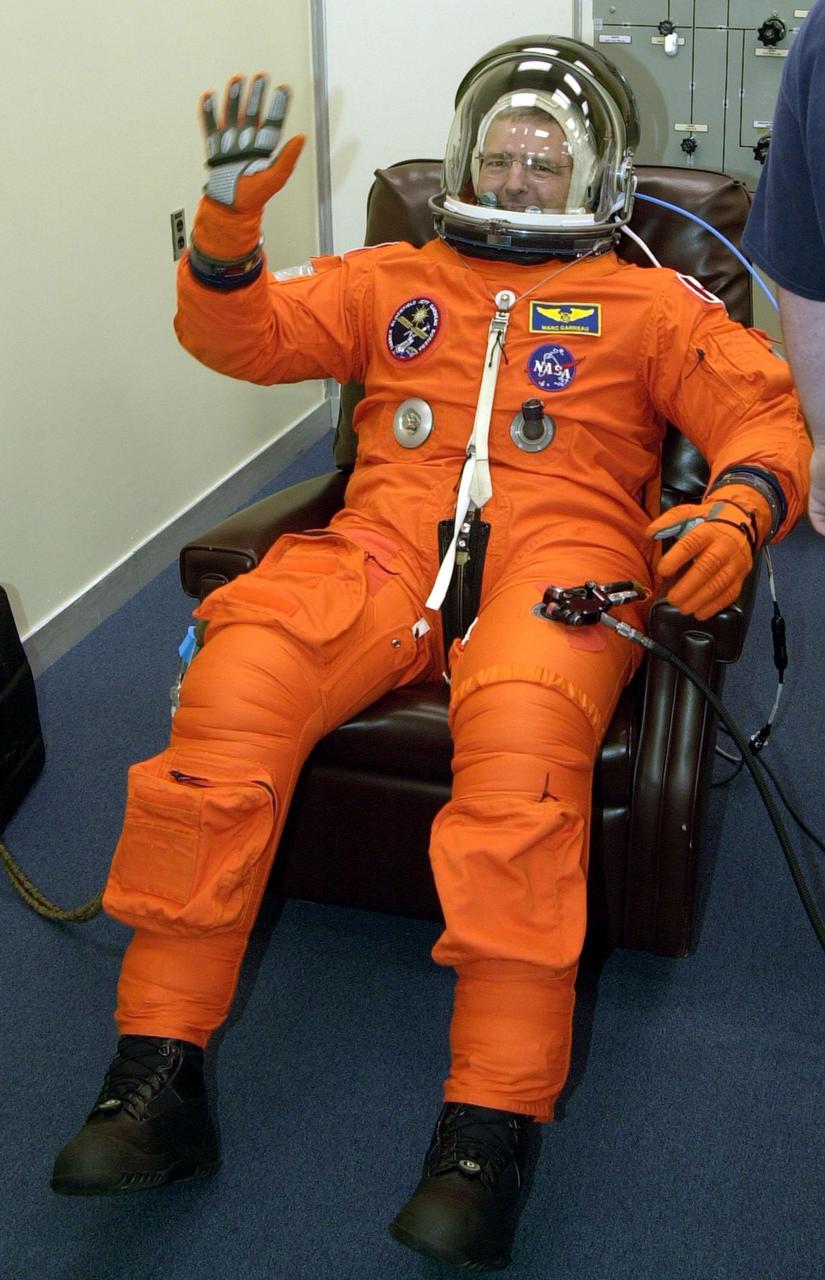
During pre-pack and fit check in the Operations and Checkout Building, STS-97 Mission Specialist Marc Garneau waves after getting his helmet on. Garneau is with the Canadian Space Agency. Mission STS-97 is the sixth construction flight to the International Space Station. Its payload includes the P6 Integrated Truss Structure and a photovoltaic (PV) module, with giant solar arrays that will provide power to the Station. The mission includes two spacewalks to complete the solar array connections. STS-97 is scheduled to launch Nov. 30 at about 10:06 p.m. EST
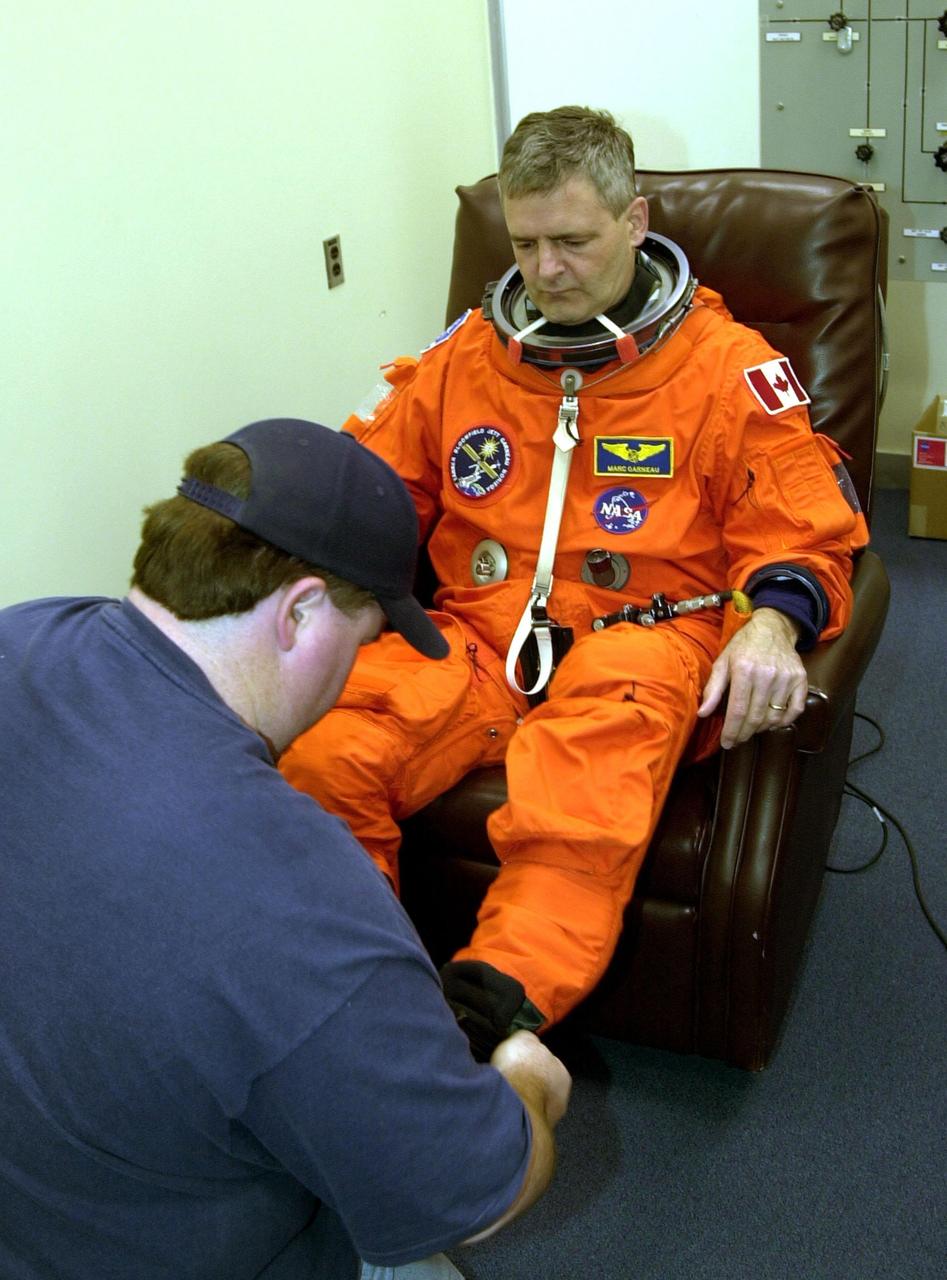
STS-97 Mission Specialist Marc Garneau gets help with his boots from suit technician Tommy McDonald during pre-pack and fit check. Garneau is with the Canadian Space Agency. Mission STS-97 is the sixth construction flight to the International Space Station. Its payload includes the P6 Integrated Truss Structure and a photovoltaic (PV) module, with giant solar arrays that will provide power to the Station. The mission includes two spacewalks to complete the solar array connections. STS-97 is scheduled to launch Nov. 30 at about 10:06 p.m. EST
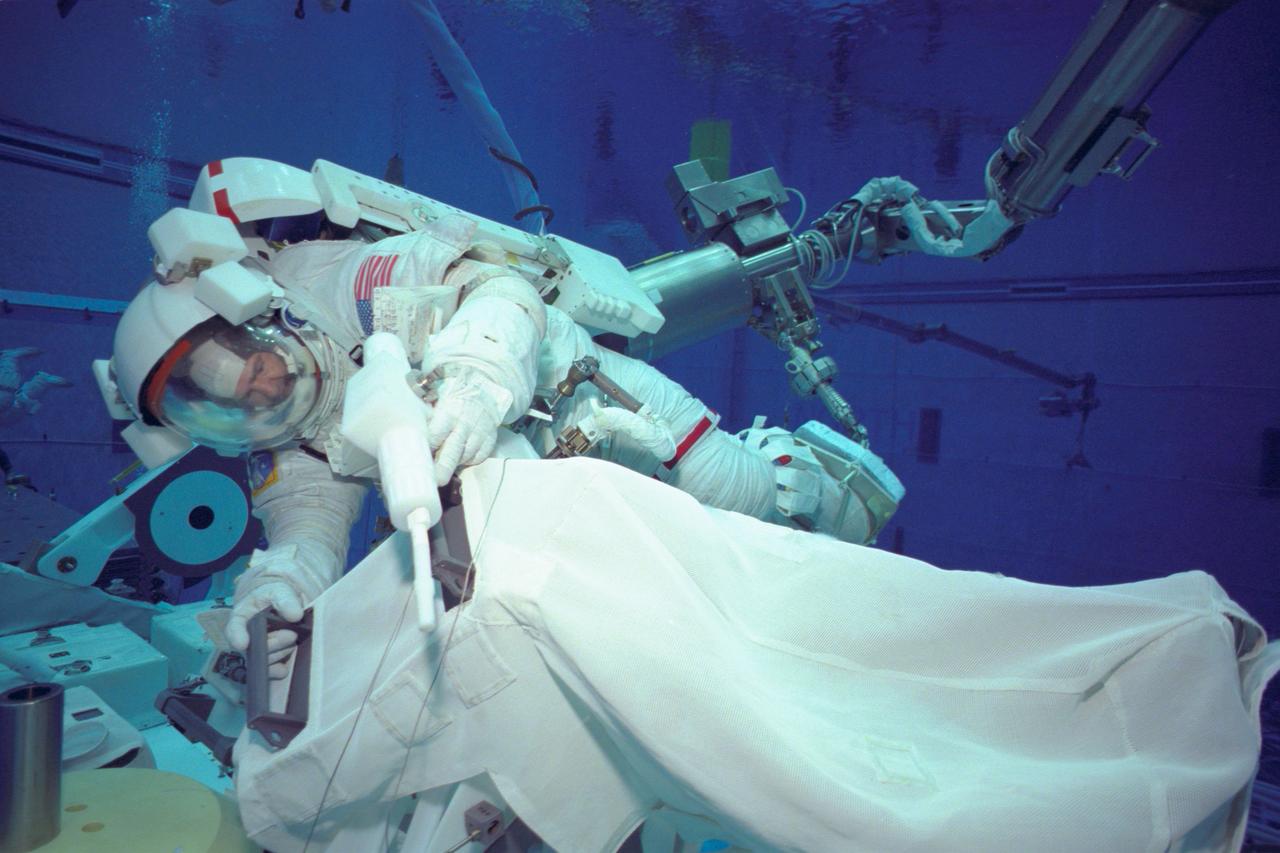
JSC2000-07072 (23 October 2000) --- Equipped with mockup tools and attached to a training version of the shuttle's remote manipulator system (RMS)robotic arm, astronaut Marc Garneau simulates a space walk task in the Neutral Buoyancy Laboratory (NBL). Garneau, an STS-97 mission specialist representing the Canadian Space Agency (CSA), has been assigned an alternate's role for extravehicular activity (EVA) on the ISS 4a mission. The prime EVA crew is composed of astronauts Joseph R. Tanner and Carlos I. Noriega, who are expected to share three different days of space walks during the December mission.
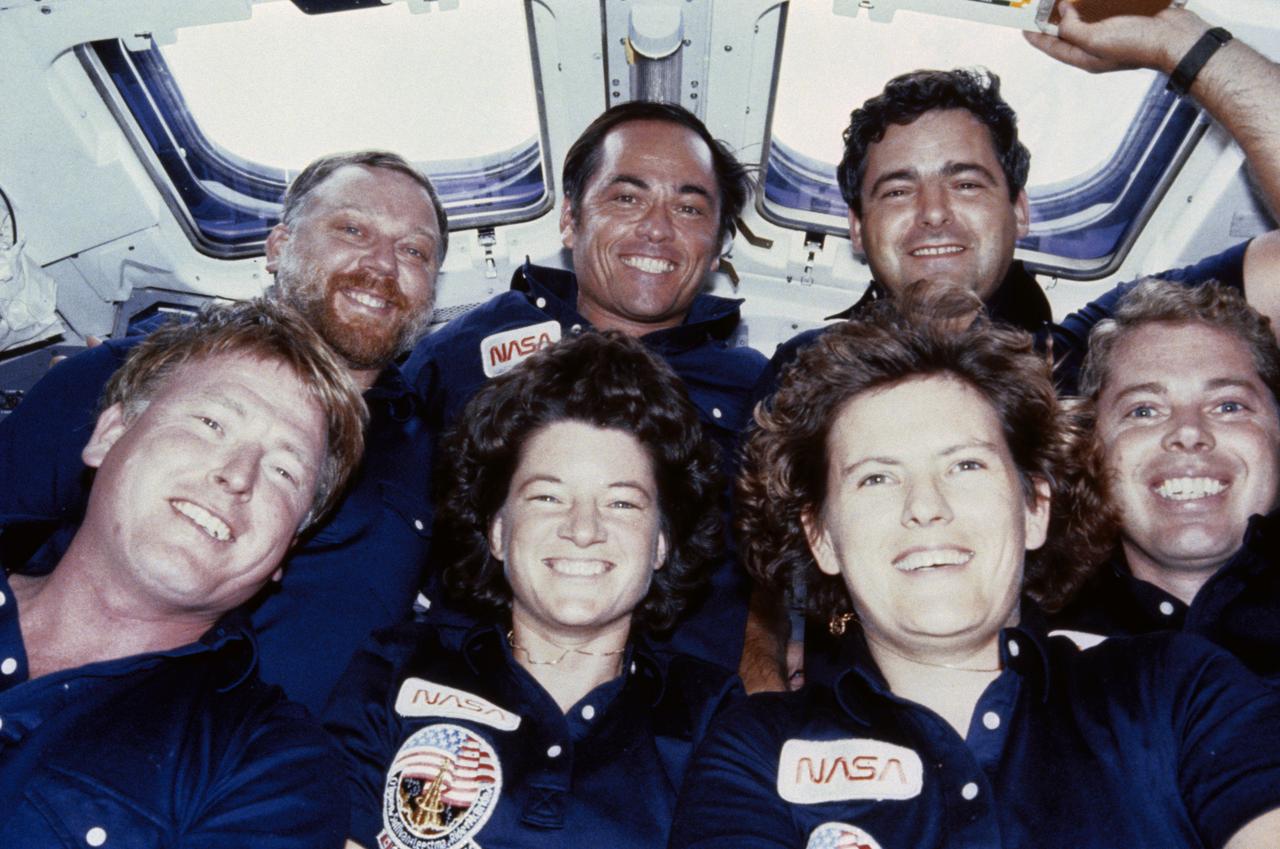
41G-19-006 (5-13 Oct. 1984) --- The seven-member 41-G crew assembles for a group shot on the flight deck of the Earth-orbiting space shuttle Challenger. Robert L. Crippen, commander, is in center of the back row. Others pictured are (front row, l.-r.) Jon A. McBride, pilot; Sally K. Ride, Kathryn D. Sullivan and David C. Leestma, all mission specialists; and Paul D. Scully-Power (left) and Marc Garneau, both payload specialists, on the back row. Garneau represents the National Research Council of Canada and Scully-Power is a civilian oceanographer with the U.S. Navy. Photo credit: NASA
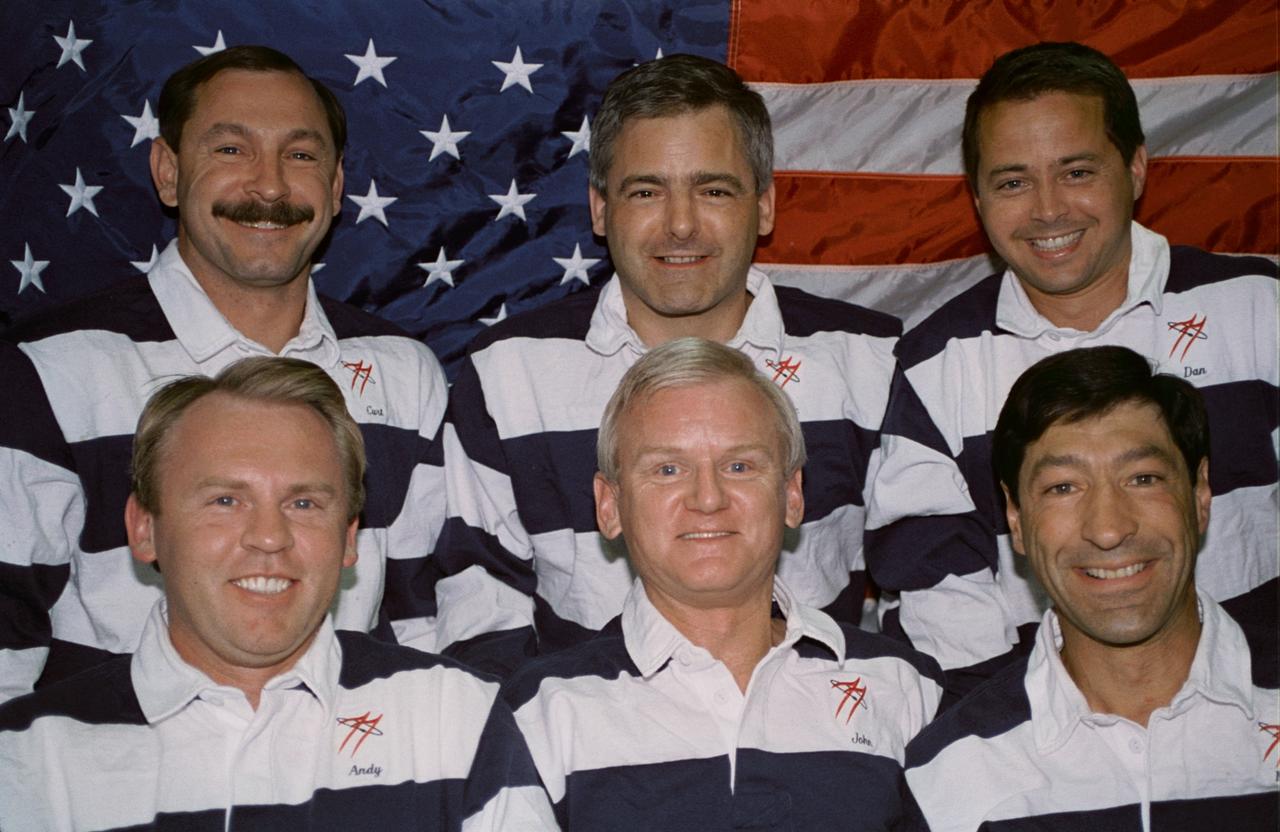
STS077-314-011 (19-29 May 1996) --- The six astronauts aboard the Space Shuttle Endeavour for NASA?s STS-77 mission pose for the traditional inflight portrait. Left to right, front, are astronauts Andrew S. W. Thomas, John H. Casper and Mario Runco, Jr. On the back row are astronauts Curtis L. Brown, Jr., Marc Garneau and Daniel W. Bursch. Casper is mission commander and Brown serves as pilot, with the rest of the crew functioning as mission specialists. Garneau represents the Canadian Space Agency (CSA).
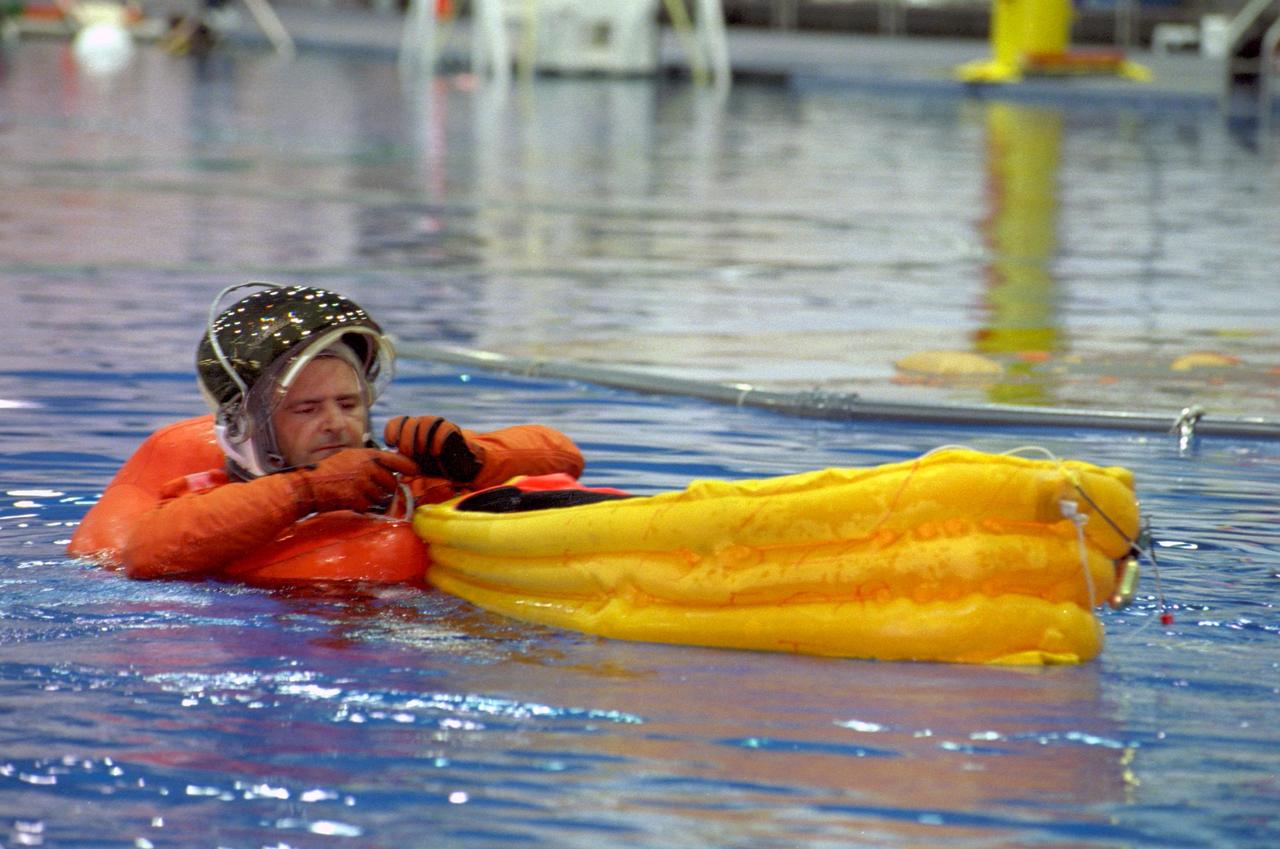
S99-07008 (9 July 1999) --- Astronaut Marc Garneau, mission specialist representing the Canadian Space Agency, puts the final touches on the life raft he's just deployed during a simulated emergency bailout exercise in the Neutral Buoyancy Laboratory at the Sonny Carter Training Center.
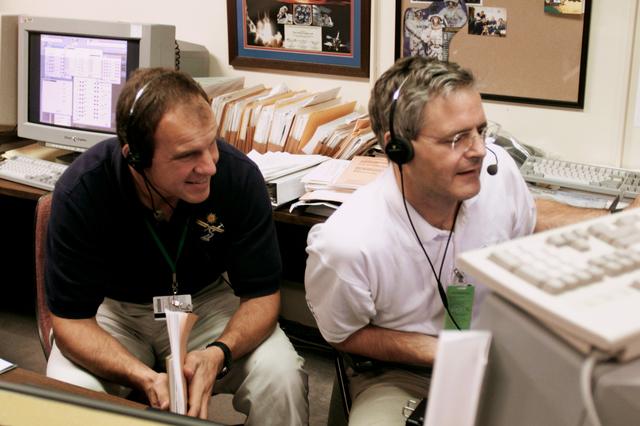
JSC2000-E-26589 (October 2000) --- Astronauts Michael J. Bloomfield (left), STS-97 pilot, looks on as astronaut Marc Garneau, mission specialist representing the Canadian Space Agency (CSA), rehearses assigned duties for the upcoming Endeavour mission. The training took place in the Johnson Space Center's virtual reality laboratory.
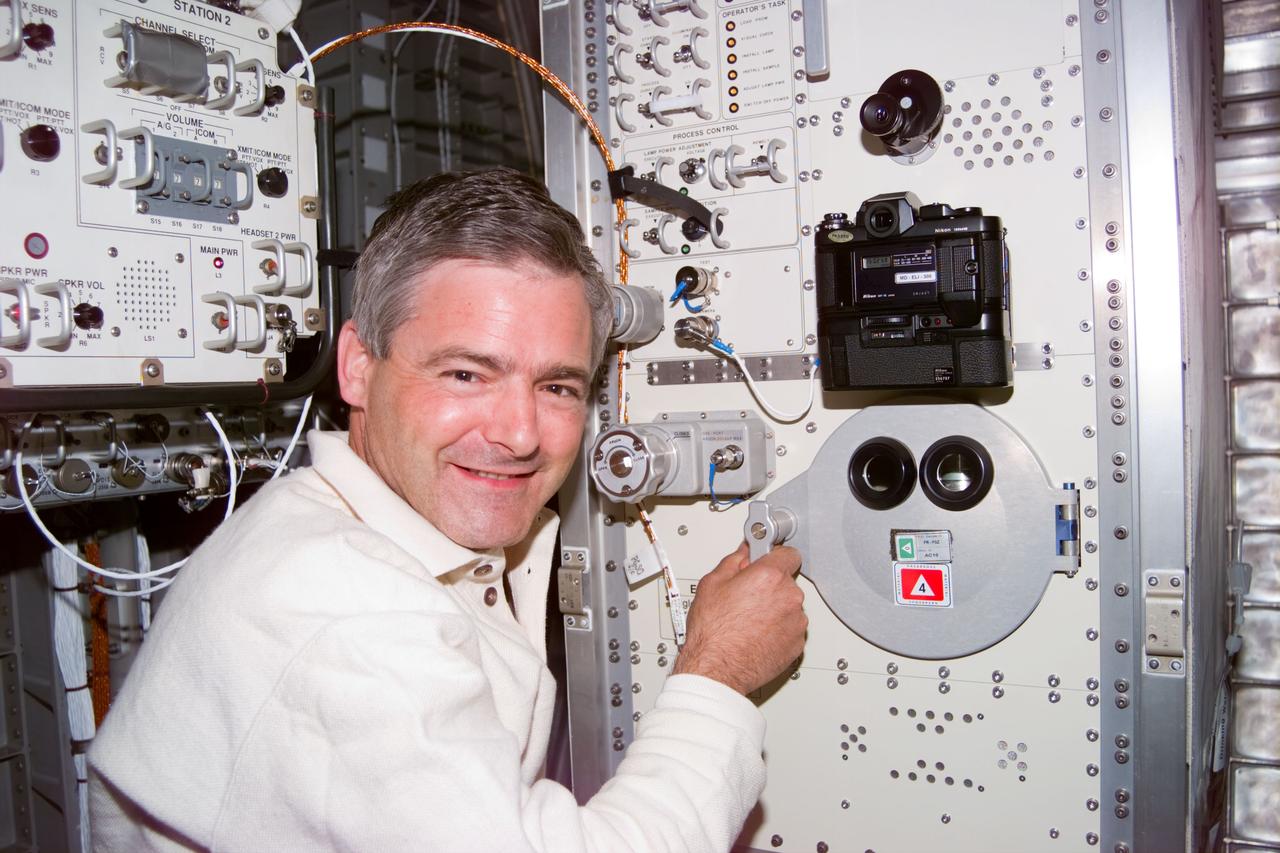
S77-E-5094 (25 May 1996) --- Astronaut Marc Garneau, mission specialist representing the Canadian Space Agency (CSA), stands at the Commercial Float Zone Furnace (CFZF) in the Spacehab Module onboard the Earth-orbiting Space Shuttle Endeavour.
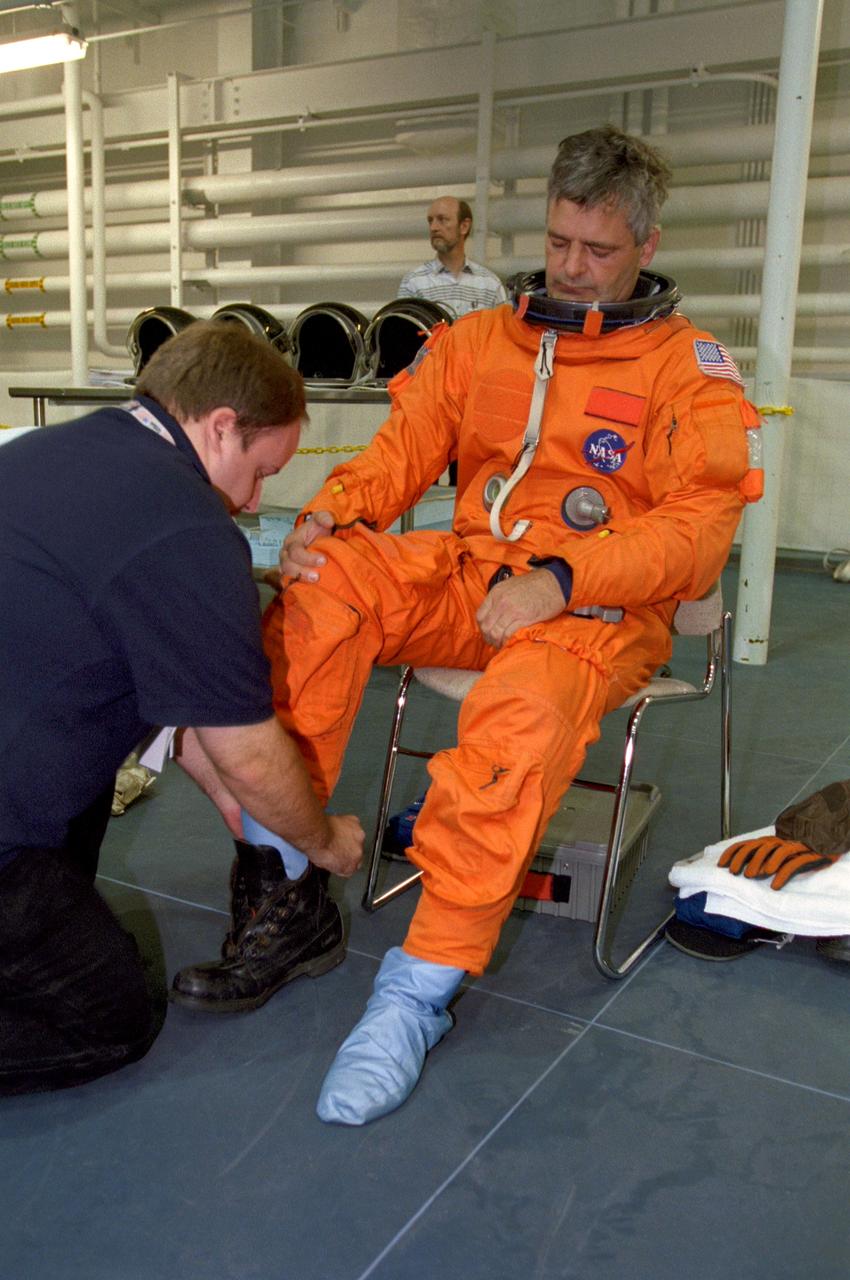
S99-07013 (9 July 1999) --- Astronaut Marc Garneau, mission specialist representing the Canadian Space Agency, with the aid of a United Space Alliance suit technician, dons his shoes while suiting up for a STS-97 training session in the Neutral Buoyancy Laboratory at the Sonny Carter Training Center.
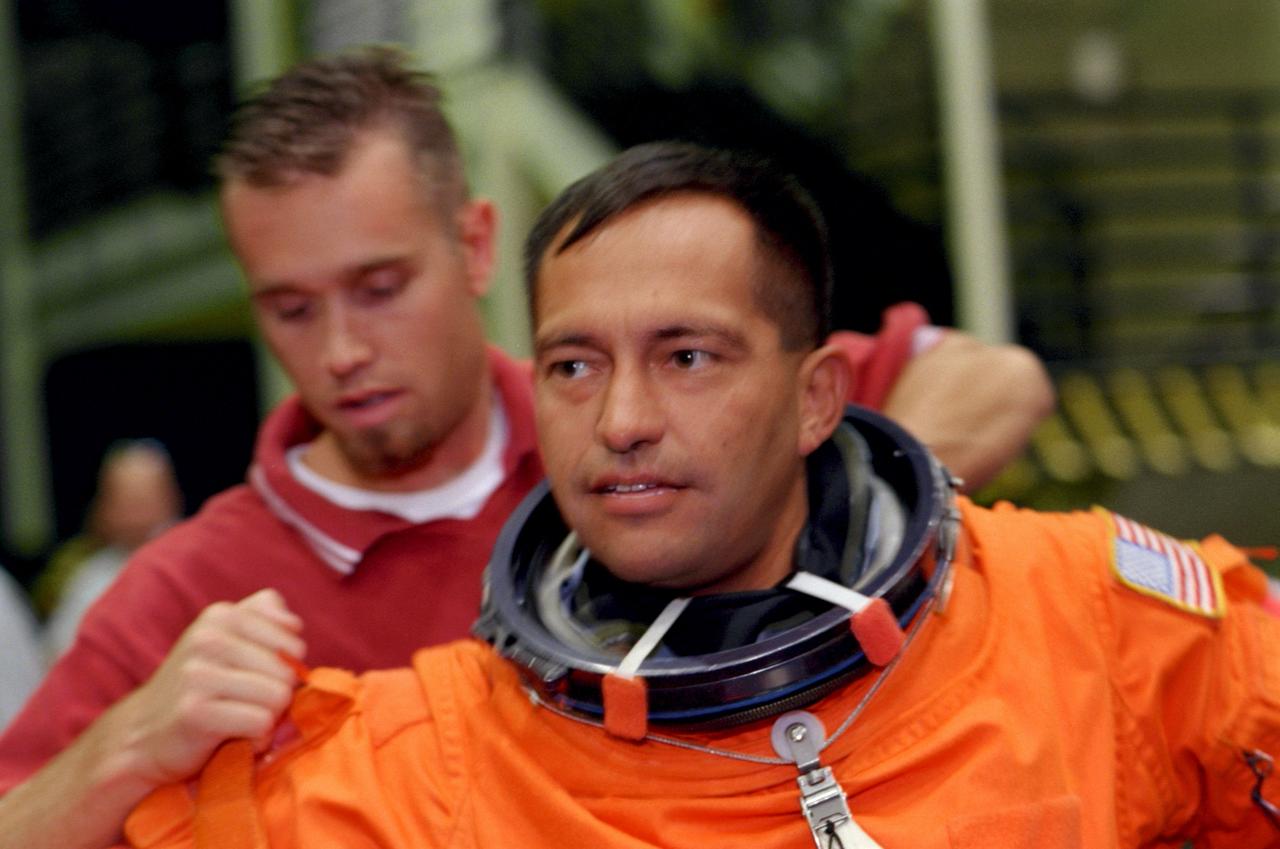
S99-07621 (15 July 1999) --- Astronaut Marc Garneau, mission specialist representing the Canadian Space Agency, requires the assistance of two suit technicians as he dons his full pressure, launch and entry garment prior to a training session at the Johnson Space Center's Systems Integration Facility.
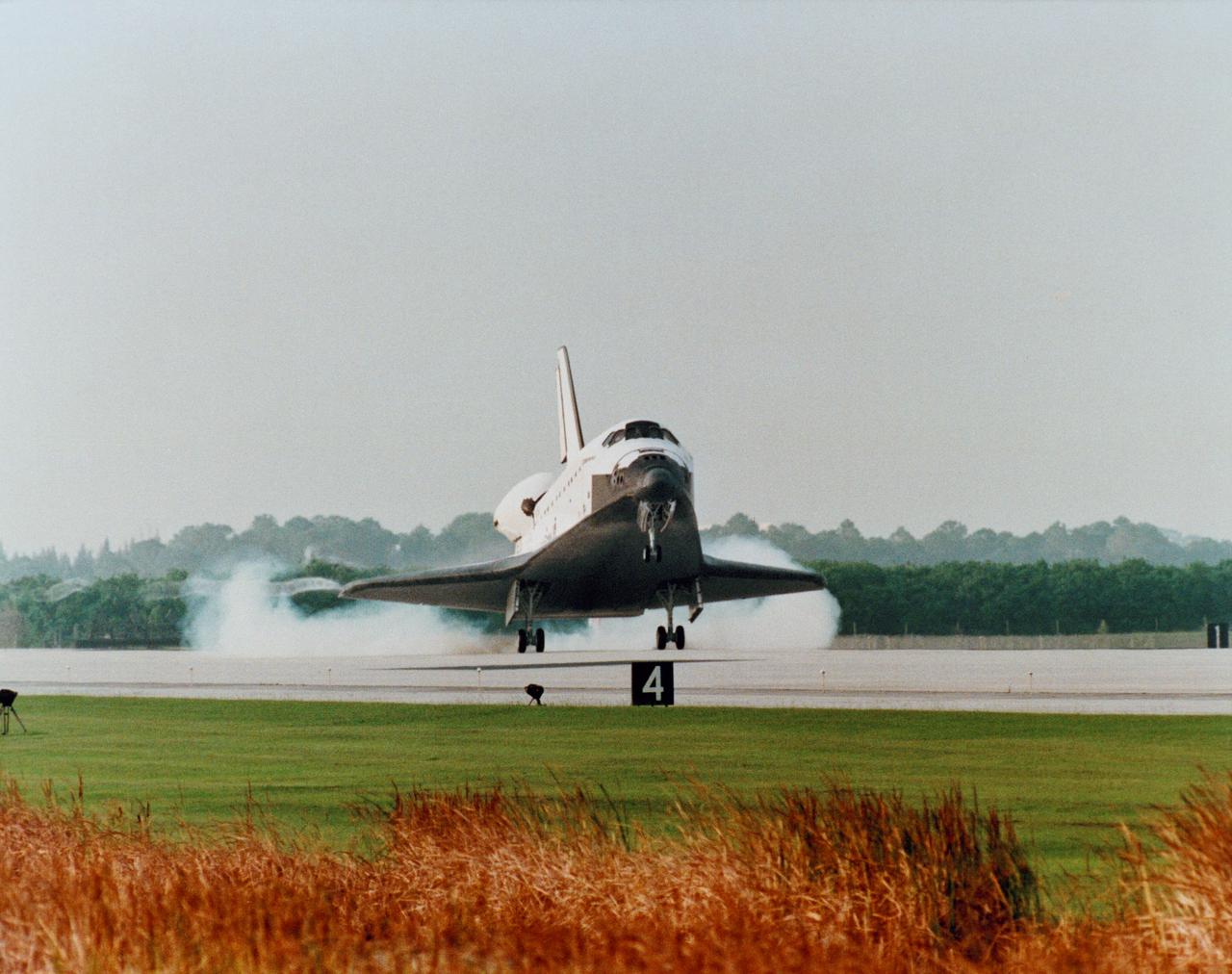
STS077-S-045 (29 May 1996) --- As its main landing gear touches down on Runway 33 at the Kennedy Space Center (KSC), the Space Shuttle Endeavour marks its return to Earth following a ten-day mission in space. Touchdown came at 7:09 a.m. (EDT), May 29, 1996. Leading the crew onboard was astronaut John H. Casper, mission commander. Other crew members were astronauts Curtis L. Brown, Jr., pilot; along with Daniel W. Bursch, Mario Runco, Jr., Andrew S. W. Thomas and Marc Garneau, all mission specialists. Garneau represents the Canadian Space Agency (CSA). During the approximately 10-day mission, the crew performed a variety of payload activities, including microgravity research aboard the Spacehab 4 Module, deployment and retrieval of the Spartan 207 and deployment and rendezvous with the Passive Aerodynamically-Stabilized Magnetically-Damped Satellite (PAMS).
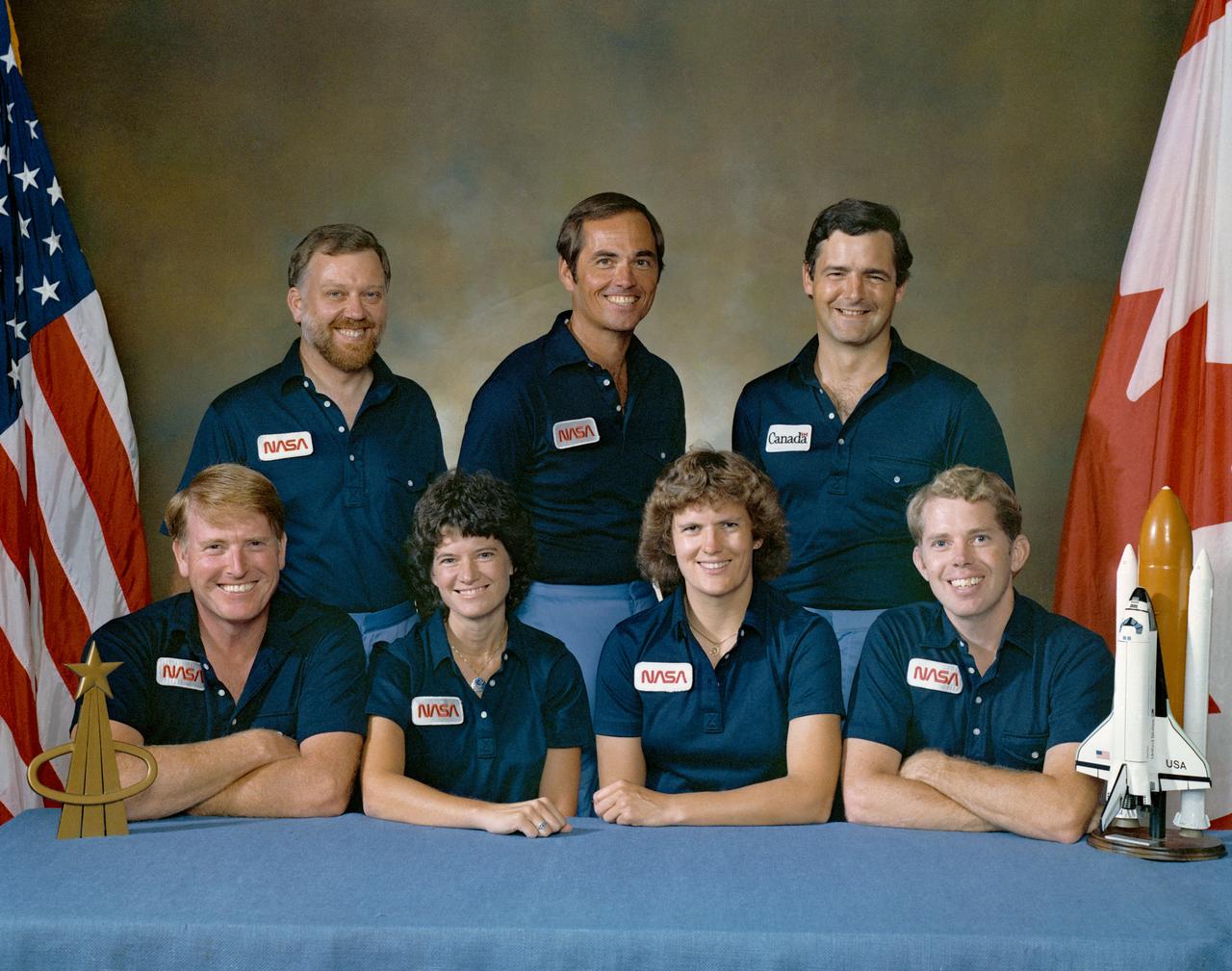
S84-37981 (20 July 1984) --- The space shuttle Challenger will carry these seven persons into space for NASA's STS-41G mission scheduled for October 1984. They are (bottom row, left to right) astronauts Jon A. McBride, pilot; and Sally K. Ride, Kathryn D. Sullivan and David C. Leestma -- all mission specialists. Astronaut Robert L. Crippen crew commander, is flanked by Paul D. Scully-Power and Marc Garneau, both payload specialists. Scully-Power is an oceanographer for the U.S. Navy and Garneau represents the National Research Council (Canada). The replica of a gold astronaut pin near McBride signifies unity. The group represents the largest space shuttle crew thus far. Photo credit: NASA
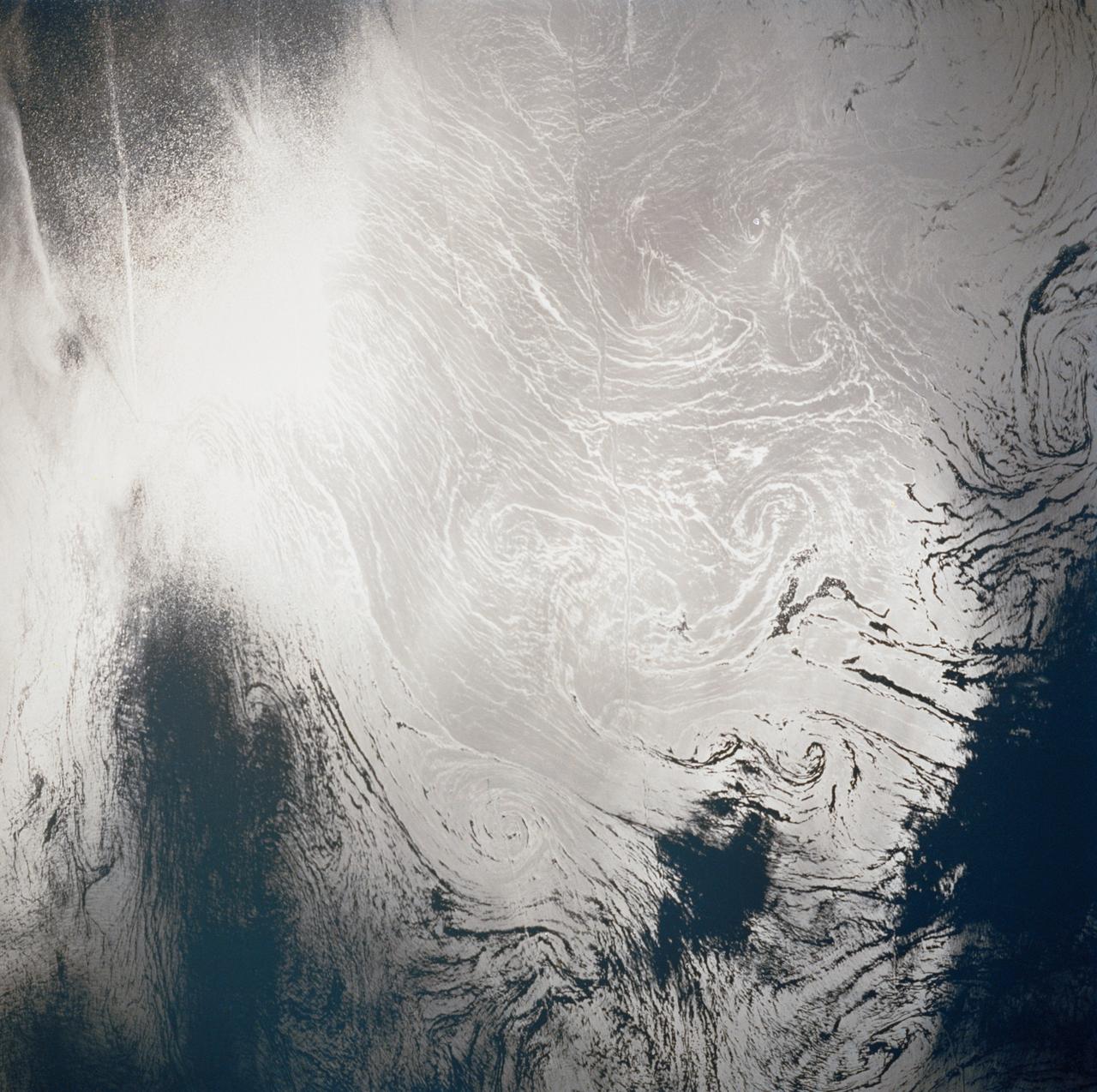
41G-38-060 (5-13 Oct 1984) --- A large ship wake in the central Mediterranean Sea is highlighted by sunglint in this handheld camera's view from STS-41G. According to NASA and U.S. Navy scientists studying the STS-41G film, the depicted reflectance is similar to oil slicks seen in the various oceans of the world. They note that it is apparent that a ship is pumping a mixture of bilge water and oil overboard. The crew consisted of astronauts Robert L. Crippen, commander; Jon A. McBride, pilot; mission specialist's Kathryn D. Sullivan, Sally K. Ride, and David D. Leestma; Canadian astronaut Marc Garneau; and Paul D. Scully-Power, payload specialist. EDITOR'S NOTE: The STS-41G mission had the first American female EVA (Sullivan); first seven-person crew; first orbital fuel transfer; and the first Canadian (Garneau).
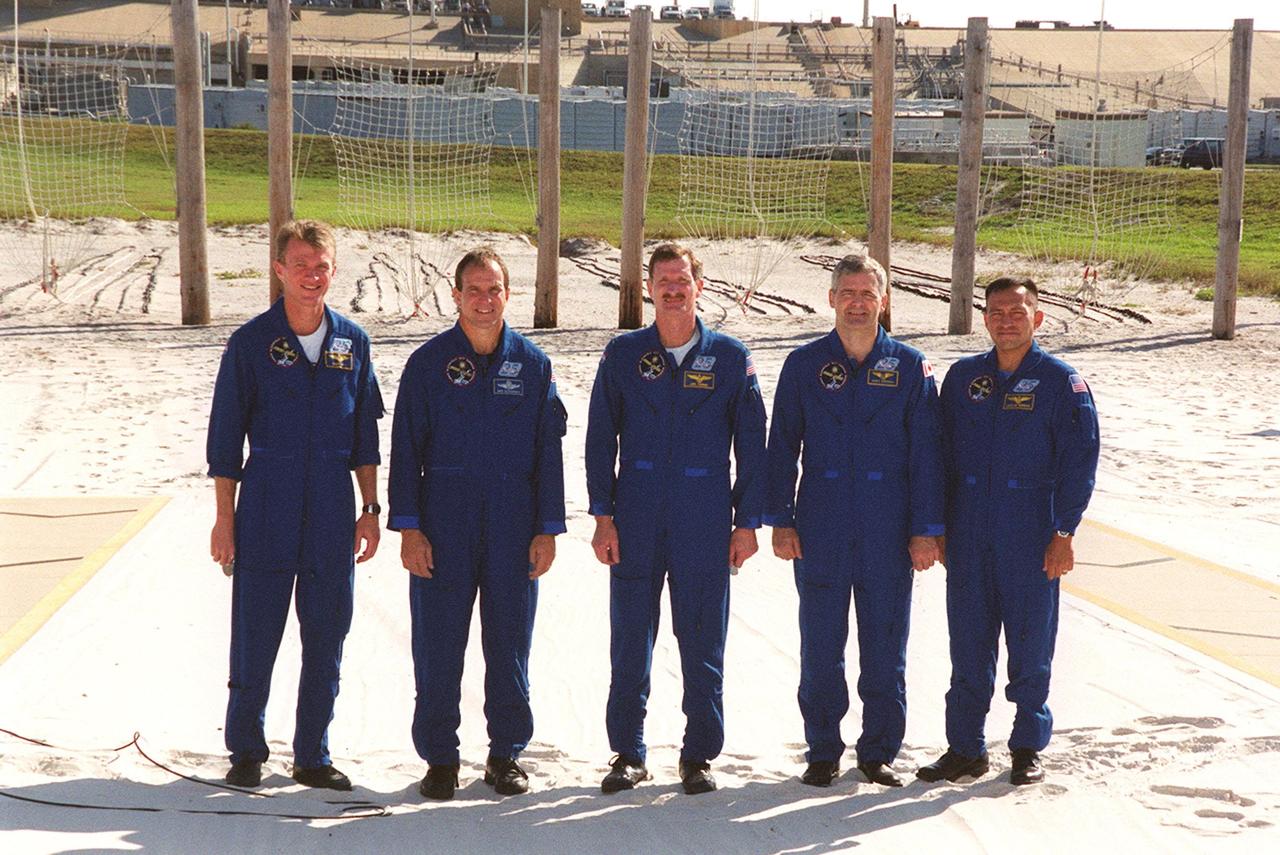
Standing in the slidewire landing zone at Launch Pad 39B, the STS-97 crew respond to questions from the media. They are, left to right, Commander Brent Jett, Pilot Mike Bloomfield and Mission Specialists Joe Tanner, Marc Garneau and Carlos Noriega. Garneau is with the Canadian Space Agency. The nets suspended behind them are a braking system catch net for the slidewire baskets that provide emergency exit from the orbiter and Fixed Service Structure. The crew is at KSC to take part in Terminal Countdown Demonstration Test activities that include emergency egress training, familiarization with the payload, and a simulated launch countdown. Mission STS-97is the sixth construction flight to the International Space Station. Its payload includes the P6 Integrated Truss Structure and a photovoltaic (PV) module, with giant solar arrays that will provide power to the Station. The mission includes two spacewalks to complete the solar array connections. STS-97 is scheduled to launch Nov. 30 at 10:05 p.m. EST
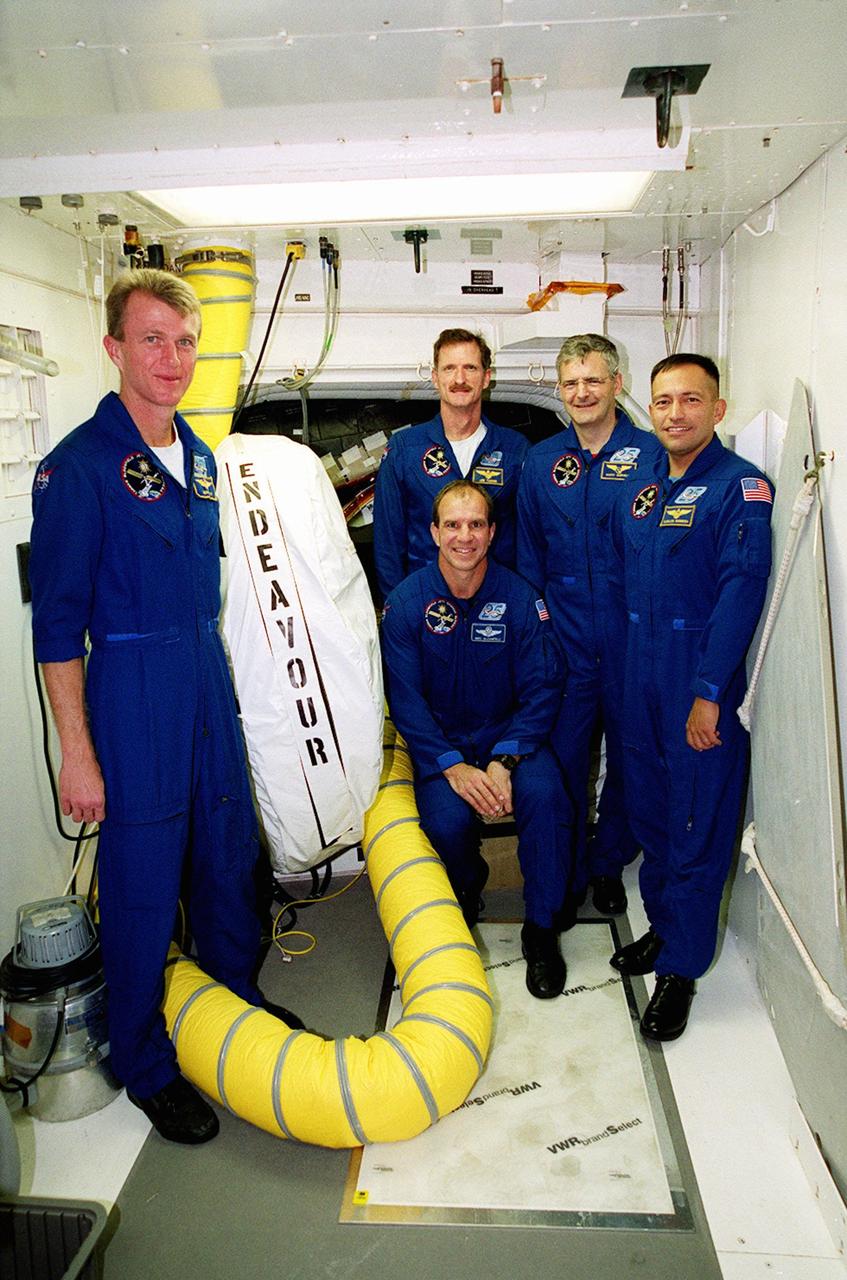
During Terminal Countdown Demonstration Test (TCDT) activities, the STS-97 crew pause in the White Room at Launch Pad 39B for a photo. At left is Commander Brent Jett and crouching in front is Pilot Mike Bloomfield. Standing behind him are Mission Specialists Joe Tanner, Marc Garneau and Carlos Noriega. . Garneau is with the Canadian Space Agency. The TCDT includes emergency egress training, familiarization with the payload, and a simulated launch countdown. Mission STS-97is the sixth construction flight to the International Space Station. Its payload includes the P6 Integrated Truss Structure and a photovoltaic (PV) module, with giant solar arrays that will provide power to the Station. The mission includes two spacewalks to complete the solar array connections. STS-97 is scheduled to launch Nov. 30 at 10:05 p.m. EST
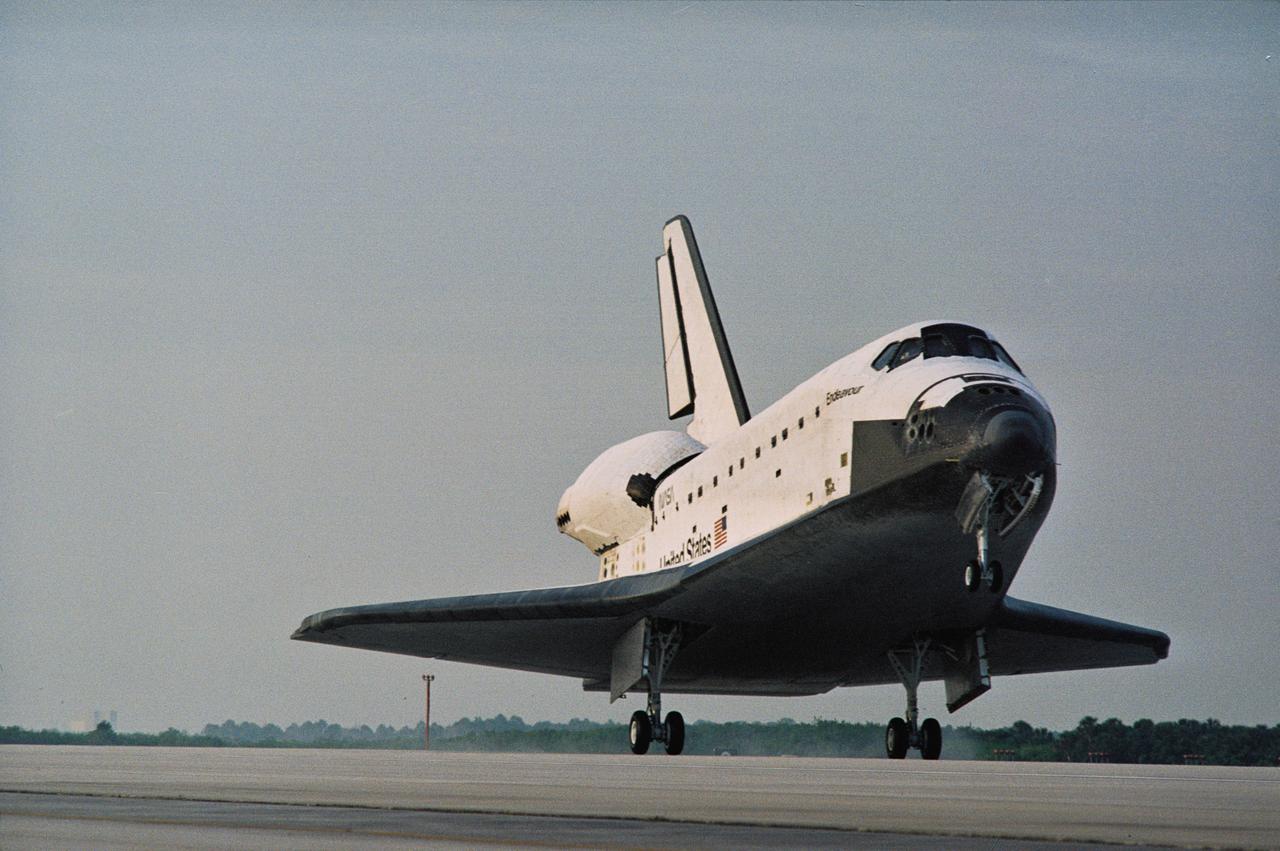
STS077-S-011 (29 May 1996) --- As its main landing gear touches down on Runway 33 at the Kennedy Space Center (KSC), the Space Shuttle Endeavour returns to Florida following a ten-day mission in space. Touchdown came at 7:09 a.m. (EDT), May 29, 1996. Leading the crew onboard was astronaut John H. Casper, mission commander. Other crew members were astronauts Curtis L. Brown, Jr., pilot; along with Daniel W. Bursch, Mario Runco, Jr., Andrew S. W. Thomas and Marc Garneau, all mission specialists. Garneau represents the Canadian Space Agency (CSA). During the approximately 10-day mission, the crew performed a variety of payload activities, including microgravity research aboard the Spacehab 4 Module, deployment and retrieval of the Spartan 207 and deployment and rendezvous with the Passive Aerodynamically-Stabilized Magnetically-Damped Satellite (PAMS).
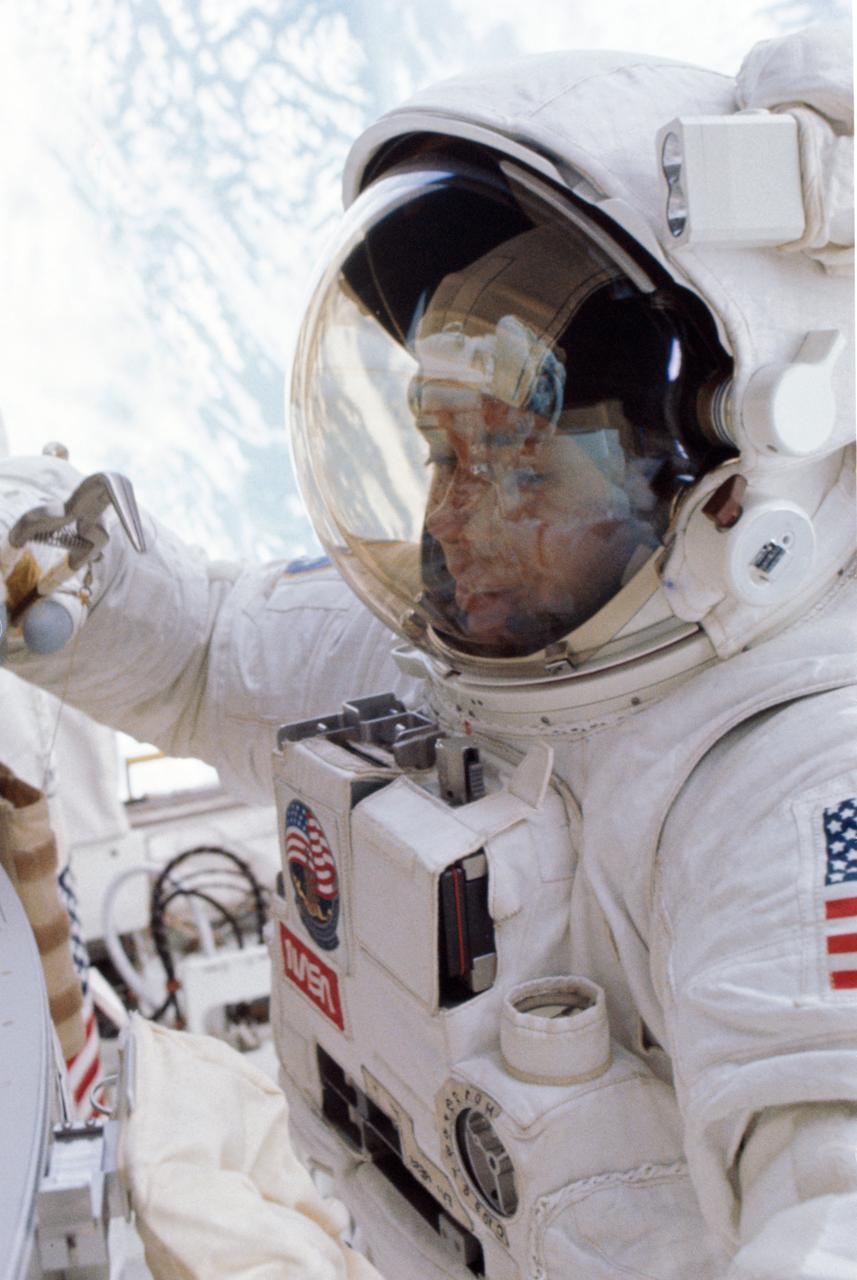
41G-101-013 (14 Oct 1984) --- Astronaut David C. Leestma works at the Orbital Refueling System (ORS) on the Mission Peculiar Support Structure (MPESS) in the aft end of the cargo bay of the Space Shuttle Challenger. Astronaut Kathryn D. Sullivan, America's first woman to perform an extravehicular activity (EVA) with the logging of this busy day, exposed this frame witha 35mm camera. The crew consisted of astronauts Robert L. Crippen, commander; Jon A. McBride, pilot; mission specialist's Kathryn D. Sullivan, Sally K. Ride, and David D. Leestma; Canadian astronaut Marc Garneau; and Paul D. Scully-Power, payload specialist. EDITOR'S NOTE: The STS-41G mission had the first American female EVA (Sullivan); first seven-person crew; first orbital fuel transfer; and the first Canadian (Garneau).
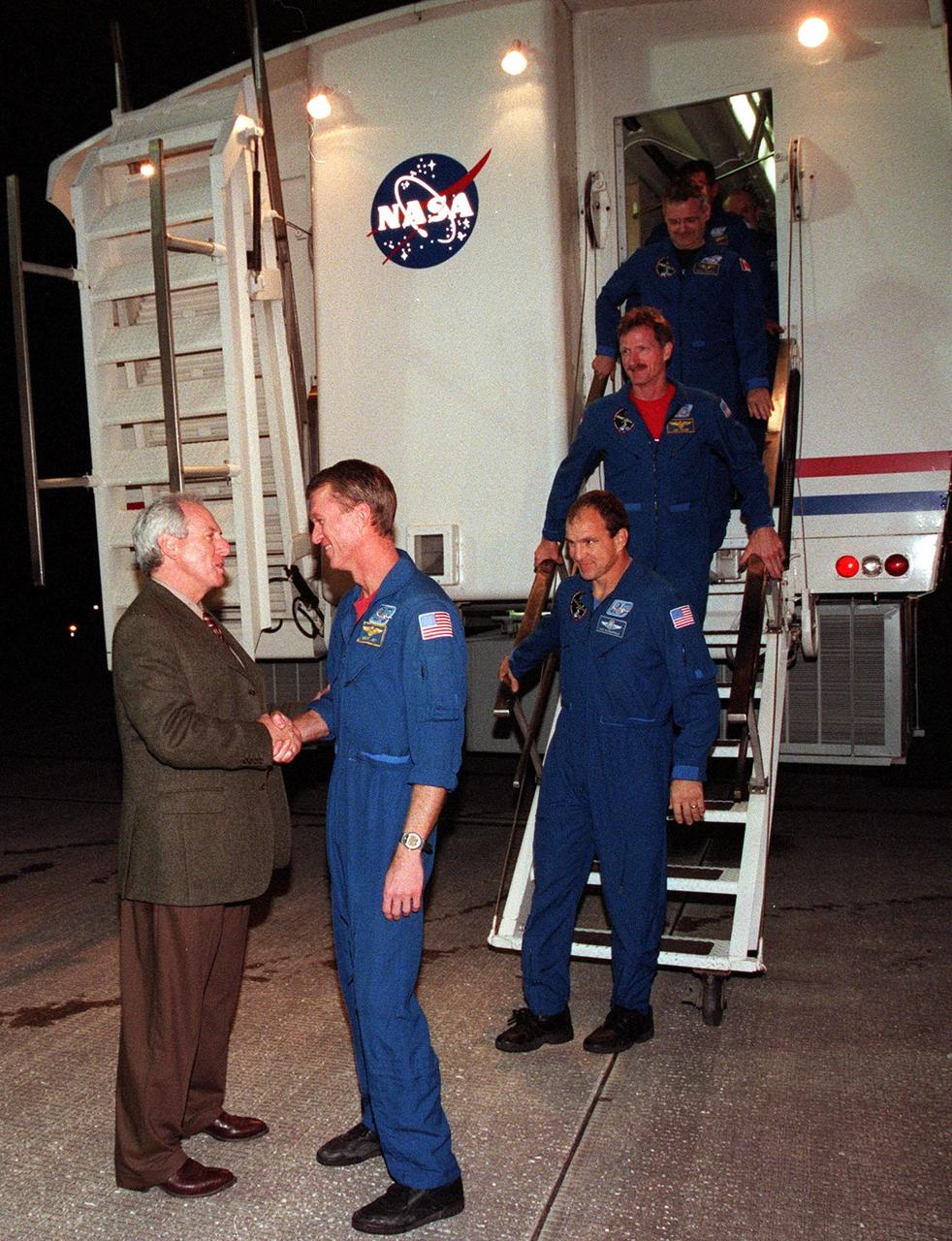
KENNEDY SPACE CENTER, FLA. -- Following a successful landing, the crew of Endeavour exit the Crew Transport Vehicle and are greeted by NASA Administrator Daniel Goldin. First down the stairs is Commander Brent Jett. Behind him are Pilot Michael Bloomfield and Mission Specialists Joseph Tanner, Marc Garneau and Carlos Noriega. Garneau is with the Canadian Space Agency. On the 4.4-million-mile mission, Endeavour carried the P6 Integrated Truss Structure with solar arrays to power the International Space Station. The arrays and other equipment were installed during three EVAs that totaled 19 hours, 20 minutes. Endeavour was docked with the Space Station for 6 days, 23 hours, 13 minutes. This is the 16th nighttime landing for a Space Shuttle and the 53rd at Kennedy Space Center
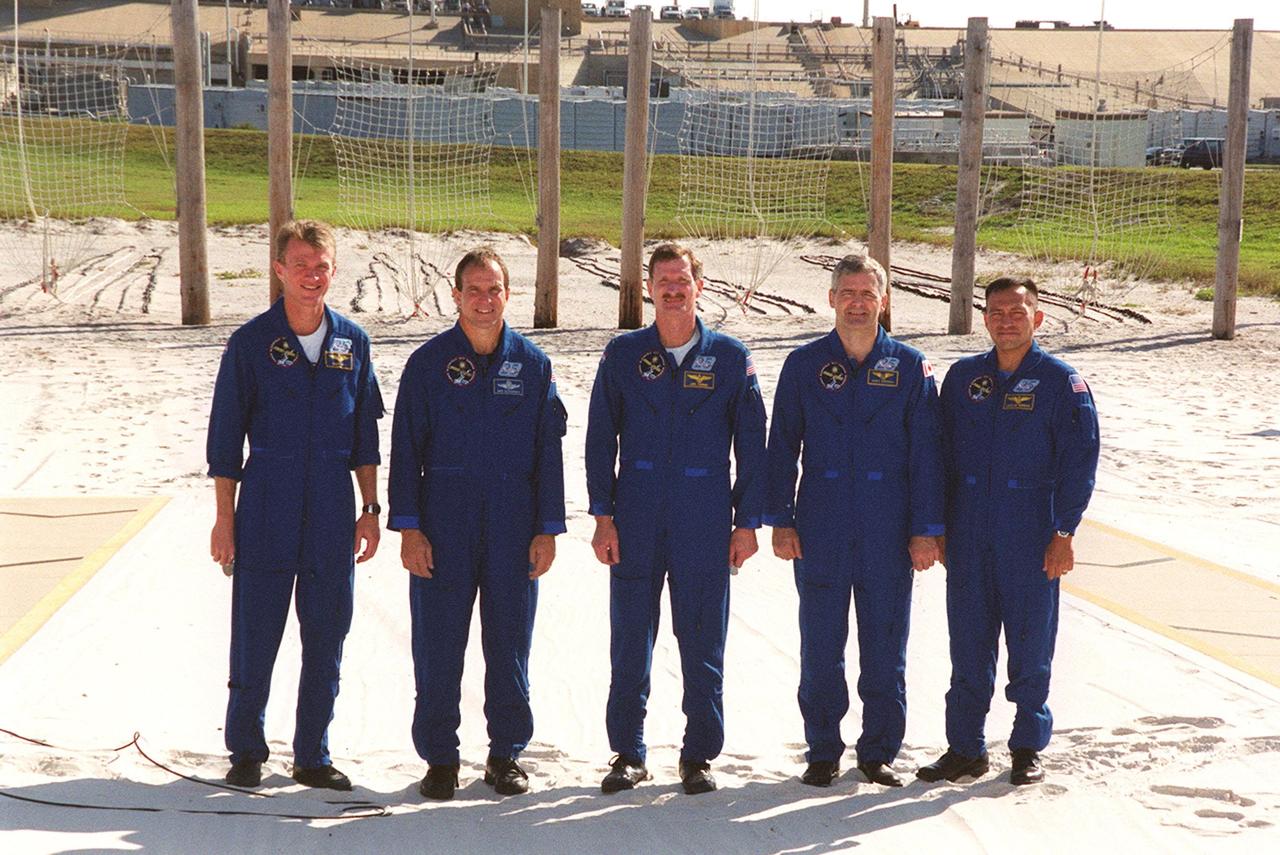
Standing in the slidewire landing zone at Launch Pad 39B, the STS-97 crew respond to questions from the media. They are, left to right, Commander Brent Jett, Pilot Mike Bloomfield and Mission Specialists Joe Tanner, Marc Garneau and Carlos Noriega. Garneau is with the Canadian Space Agency. The nets suspended behind them are a braking system catch net for the slidewire baskets that provide emergency exit from the orbiter and Fixed Service Structure. The crew is at KSC to take part in Terminal Countdown Demonstration Test activities that include emergency egress training, familiarization with the payload, and a simulated launch countdown. Mission STS-97is the sixth construction flight to the International Space Station. Its payload includes the P6 Integrated Truss Structure and a photovoltaic (PV) module, with giant solar arrays that will provide power to the Station. The mission includes two spacewalks to complete the solar array connections. STS-97 is scheduled to launch Nov. 30 at 10:05 p.m. EST
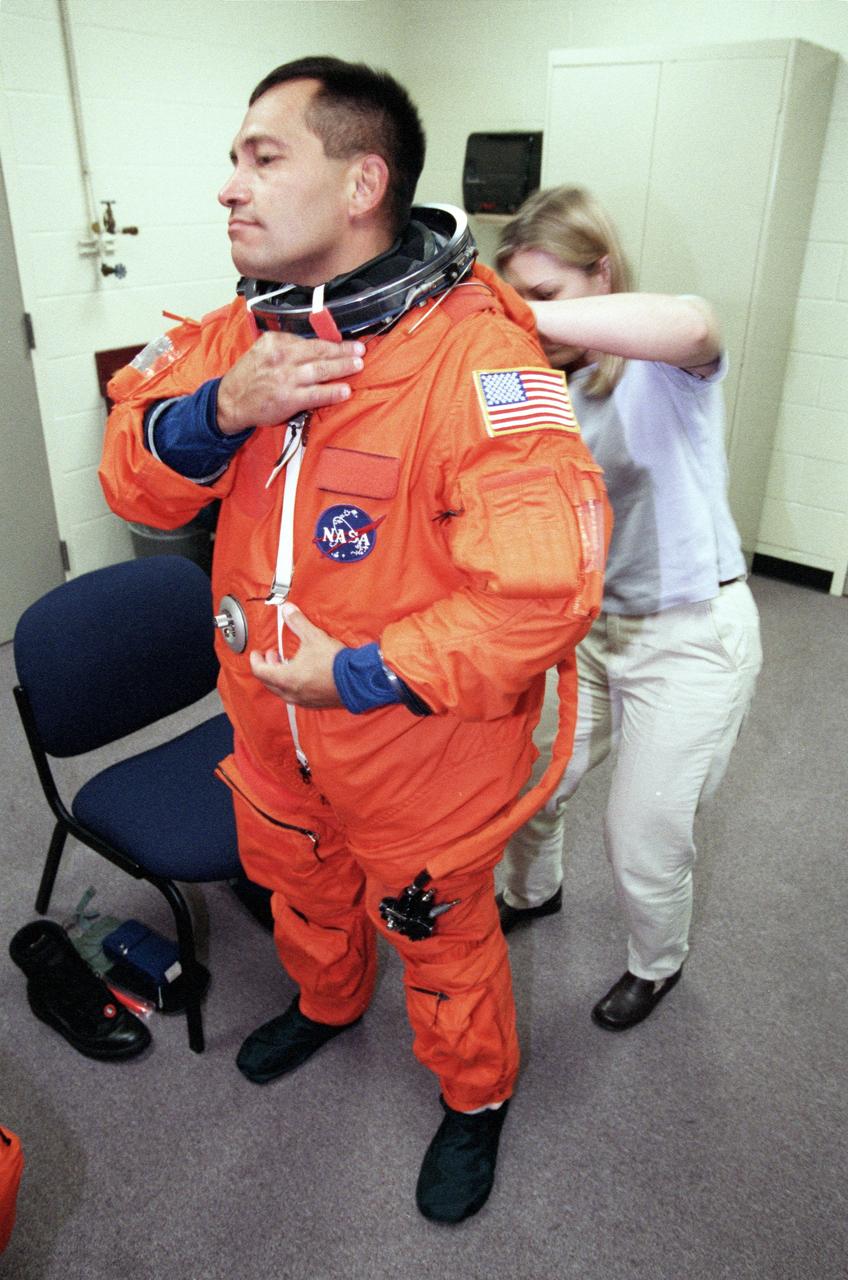
Photographic documentation showing the STS-97 crew training in the Crew Compartment Trainer II (CCT II) in bldg. 9. Views include: STS-97 pilot Michael J. Bloomfield wearing a Launch and Entry Suit (LES) with no helmet (04749); STS-97 Mission Specialist (MS) Carlos I. Noriega with personnel helping him with his LES 904750); Left to right in a locker room, with all wearing LES: STS-97 mission commaner Brett W. Jett, Bloomfield, MS Joseph R. Tanner and MS Marc Garneau (04751); Noriega, wearing LES and helmet, strapped down in CCT II (04752); personnel help Bloomfield with his LES (04753). CCTII mockup. Crew includes: Brent Jett, Michael Bloomfield, Joseph Tanner, Carlos Noriega, Marc Garneau
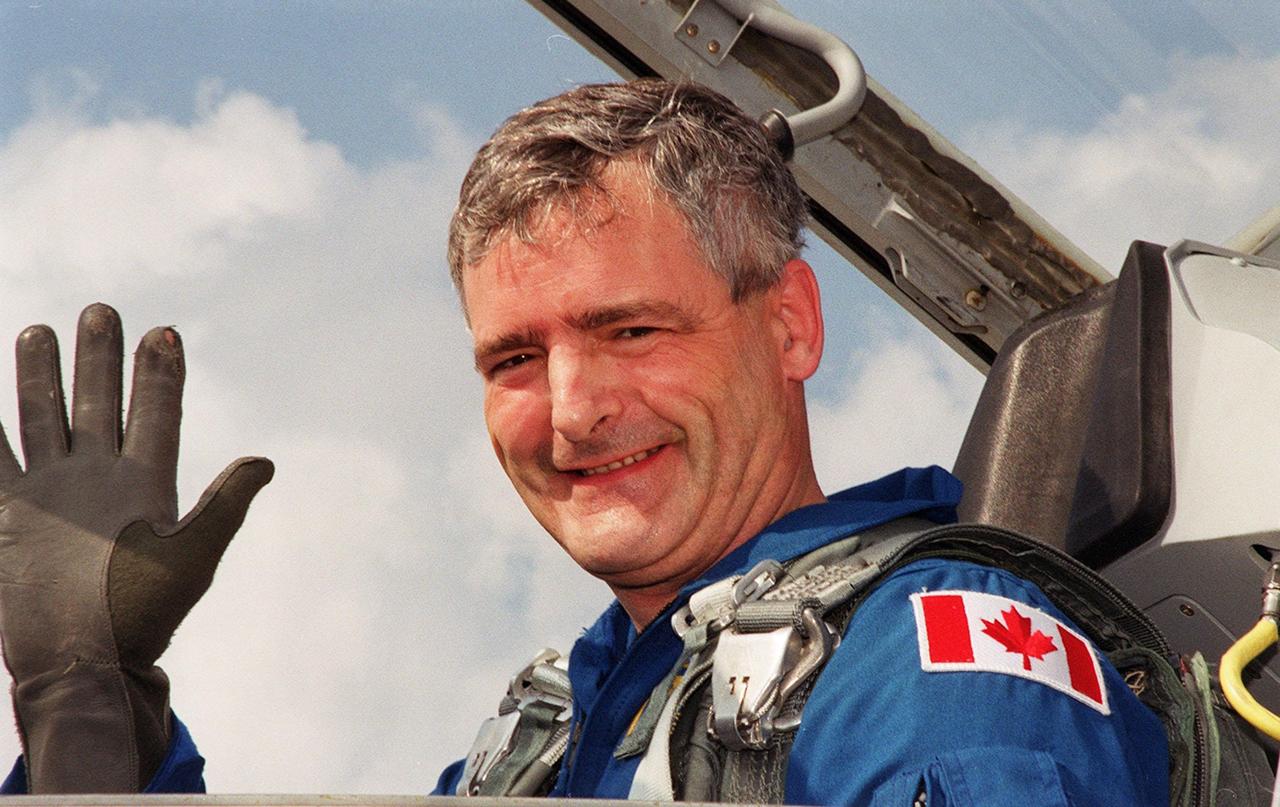
STS-97 Mission Specialist Marc Garneau arrives at the Shuttle Landing Facility aboard a T-38 jet aircraft. Garneau is with the Canadian Space Agency. He and the rest of the crew are at KSC to take part in Terminal Countdown Demonstration Test activities that include emergency egress training, familiarization with the payload, and a simulated launch countdown. The other crew members are Commander Brent Jett, Pilot Mike Bloomfield and Mission Specialists Joe Tanner and Carlos Noriega. Mission STS-97is the sixth construction flight to the International Space Station. Its payload includes the P6 Integrated Truss Structure and a photovoltaic (PV) module, with giant solar arrays that will provide power to the Station. The mission includes two spacewalks to complete the solar array connections. STS-97 is scheduled to launch Nov. 30 at 10:05 p.m. EST
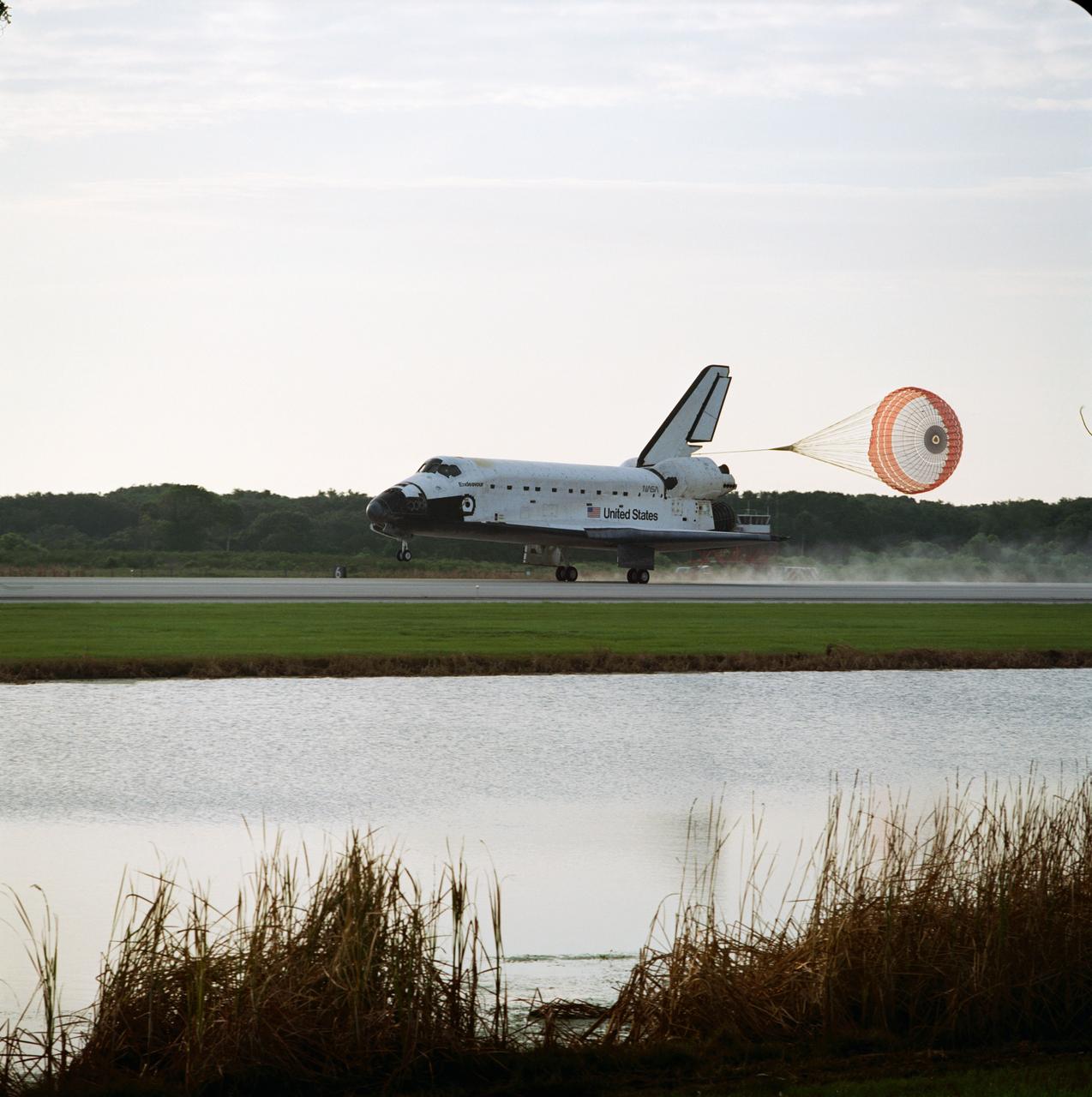
STS077-S-012 (29 May 1996) --- As its drag chute is released on Runway 33 at the Kennedy Space Center (KSC), the Space Shuttle Endeavour marks its return to Earth following a ten-day mission in space. Touchdown came at 7:09 a.m. (EDT), May 29, 1996. Leading the crew onboard was astronaut John H. Casper, mission commander. Other crew members were astronauts Curtis L. Brown, Jr., pilot; along with Daniel W. Bursch, Mario Runco, Jr., Andrew S. W. Thomas and Marc Garneau, all mission specialists. Garneau represents the Canadian Space Agency (CSA). During the approximately 10-day mission, the crew performed a variety of payload activities, including microgravity research aboard the Spacehab 4 Module, deployment and retrieval of the Spartan 207 and deployment and rendezvous with the Passive Aerodynamically-Stabilized Magnetically-Damped Satellite (PAMS).
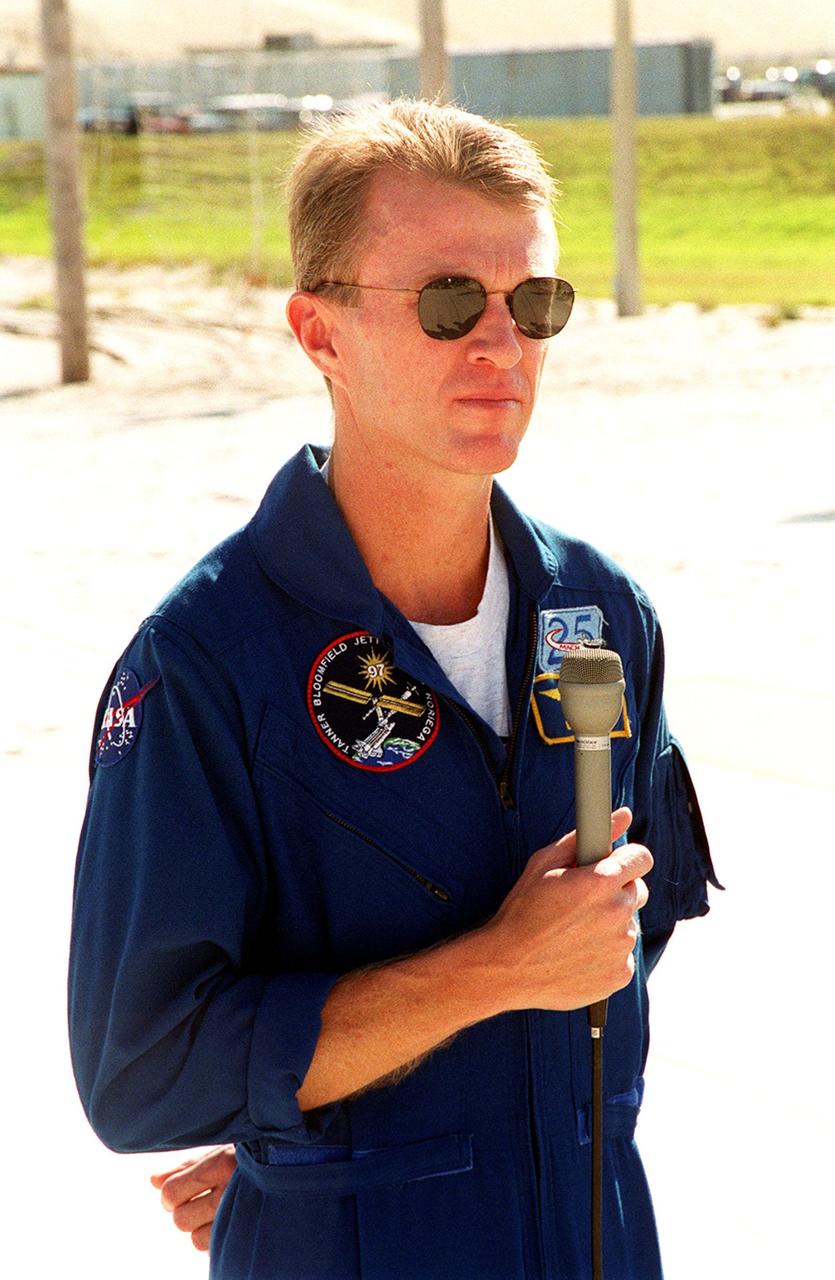
KENNEDY SPACE CENTER, Fla. -- STS-97 Commander Brent Jett listens to a question from a reporter during a media session near Launch Pad 39B. The crew is at KSC to take part in Terminal Countdown Demonstration Test activities that include emergency egress training, familiarization with the payload, and a simulated launch countdown. The other crew members are Pilot Mike Bloomfield and Mission Specialists Joe Tanner, Marc Garneau and Carlos Noriega. Garneau is with the Canadian Space Agency. Mission STS-97is the sixth construction flight to the International Space Station. Its payload includes the P6 Integrated Truss Structure and a photovoltaic (PV) module, with giant solar arrays that will provide power to the Station. The mission includes two spacewalks to complete the solar array connections. STS-97 is scheduled to launch Nov. 30 at about 10:05 p.m. EST
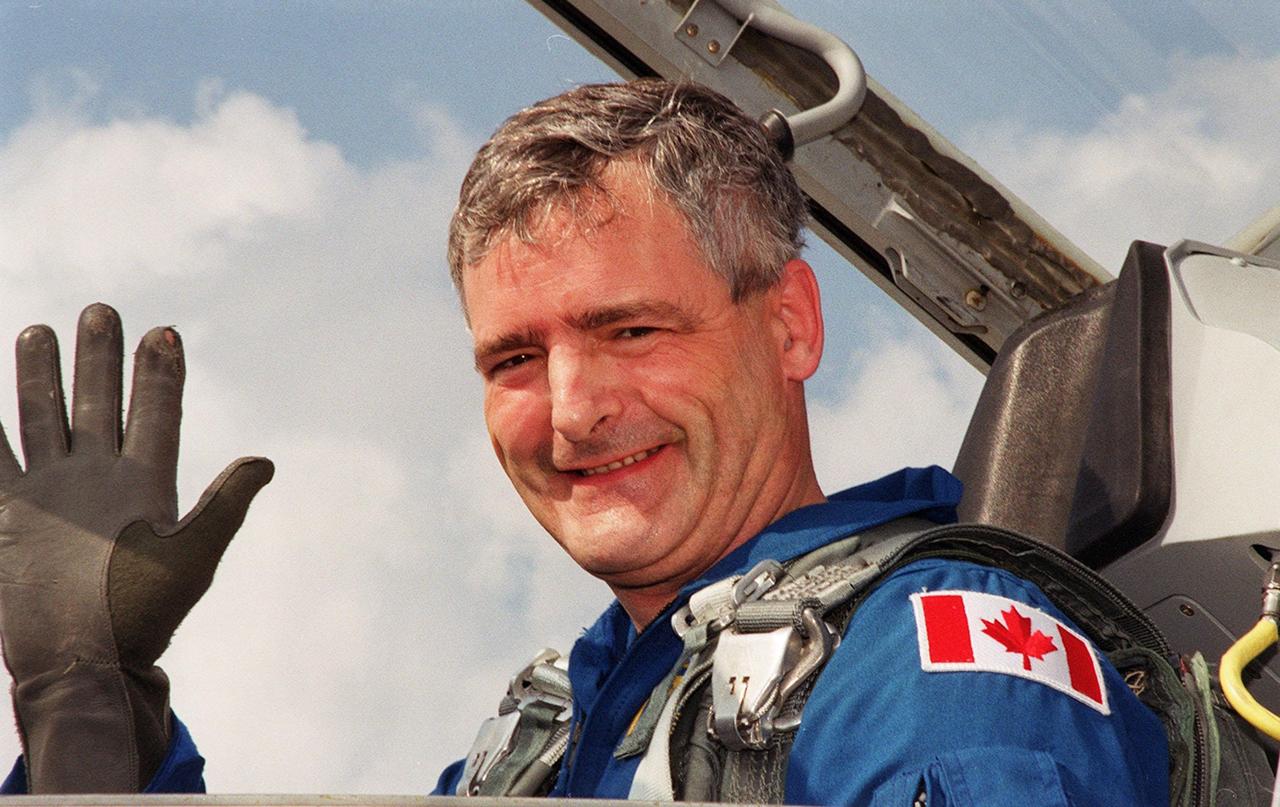
STS-97 Mission Specialist Marc Garneau arrives at the Shuttle Landing Facility aboard a T-38 jet aircraft. Garneau is with the Canadian Space Agency. He and the rest of the crew are at KSC to take part in Terminal Countdown Demonstration Test activities that include emergency egress training, familiarization with the payload, and a simulated launch countdown. The other crew members are Commander Brent Jett, Pilot Mike Bloomfield and Mission Specialists Joe Tanner and Carlos Noriega. Mission STS-97is the sixth construction flight to the International Space Station. Its payload includes the P6 Integrated Truss Structure and a photovoltaic (PV) module, with giant solar arrays that will provide power to the Station. The mission includes two spacewalks to complete the solar array connections. STS-97 is scheduled to launch Nov. 30 at 10:05 p.m. EST
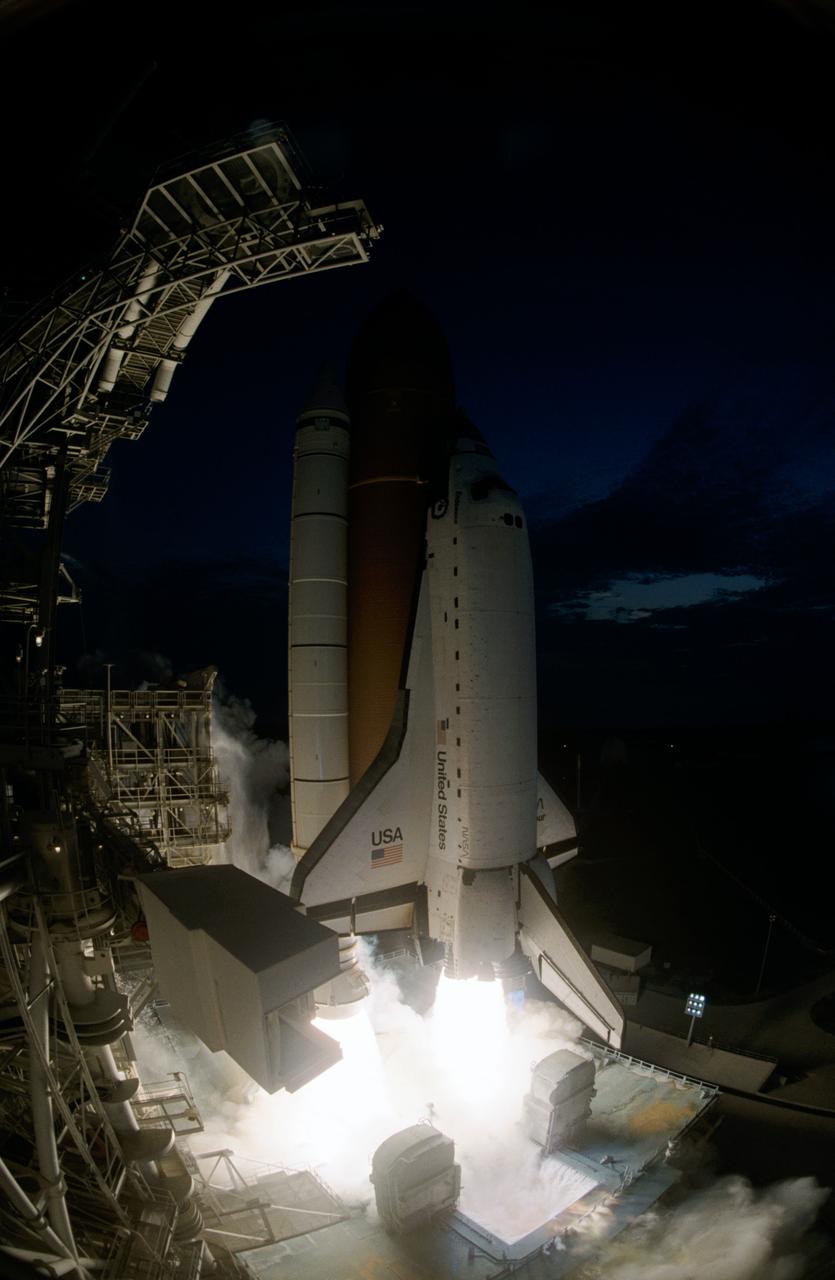
STS077-S-005 (19 May 1996) --- As seen through the ?fish-eye? lens of a 35mm camera at the service structure, the Space Shuttle Endeavour lifts off with six astronauts aboard. It was headed toward the fourth NASA Space Shuttle mission of the year. The launch occurred at 6:30:00 a.m. (EDT), May 19, 1996. Leading the crew onboard is astronaut John H. Casper, mission commander. Other crew members are astronauts Curtis L. Brown, Jr., pilot; along with Daniel W. Bursch, Mario Runco, Jr., Andrew S. W. Thomas and Marc Garneau, all mission specialists. Garneau represents the Canadian Space Agency (CSA). During the approximately 10-day mission, the crew will perform a variety of payload activities, including microgravity research aboard the Spacehab 4 Module, deployment and retrieval of the Spartan 207 and deployment and rendezvous with the Passive Aerodynamically-Stabilized Magnetically-Damped Satellite (PAMS).
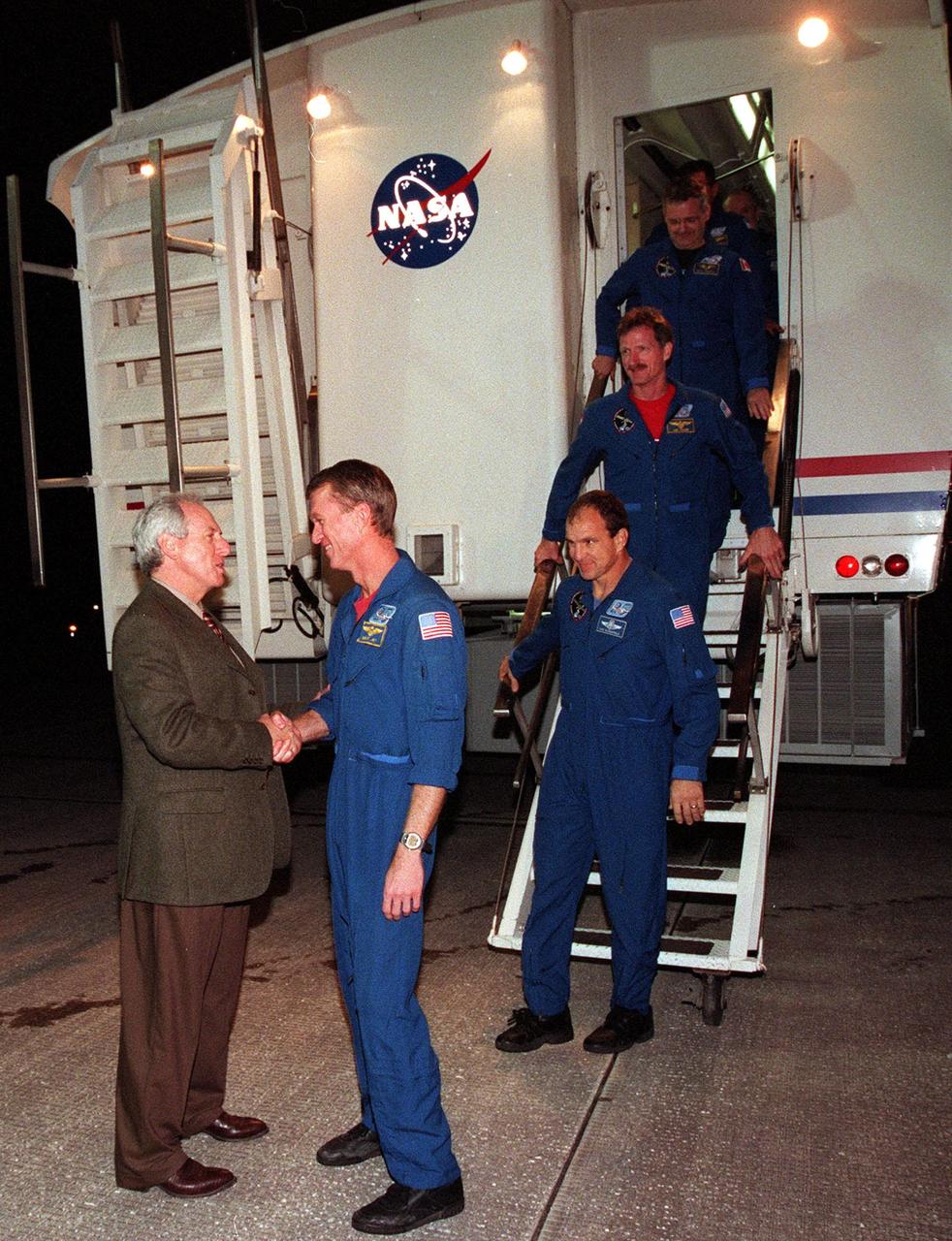
KENNEDY SPACE CENTER, FLA. -- Following a successful landing, the crew of Endeavour exit the Crew Transport Vehicle and are greeted by NASA Administrator Daniel Goldin. First down the stairs is Commander Brent Jett. Behind him are Pilot Michael Bloomfield and Mission Specialists Joseph Tanner, Marc Garneau and Carlos Noriega. Garneau is with the Canadian Space Agency. On the 4.4-million-mile mission, Endeavour carried the P6 Integrated Truss Structure with solar arrays to power the International Space Station. The arrays and other equipment were installed during three EVAs that totaled 19 hours, 20 minutes. Endeavour was docked with the Space Station for 6 days, 23 hours, 13 minutes. This is the 16th nighttime landing for a Space Shuttle and the 53rd at Kennedy Space Center
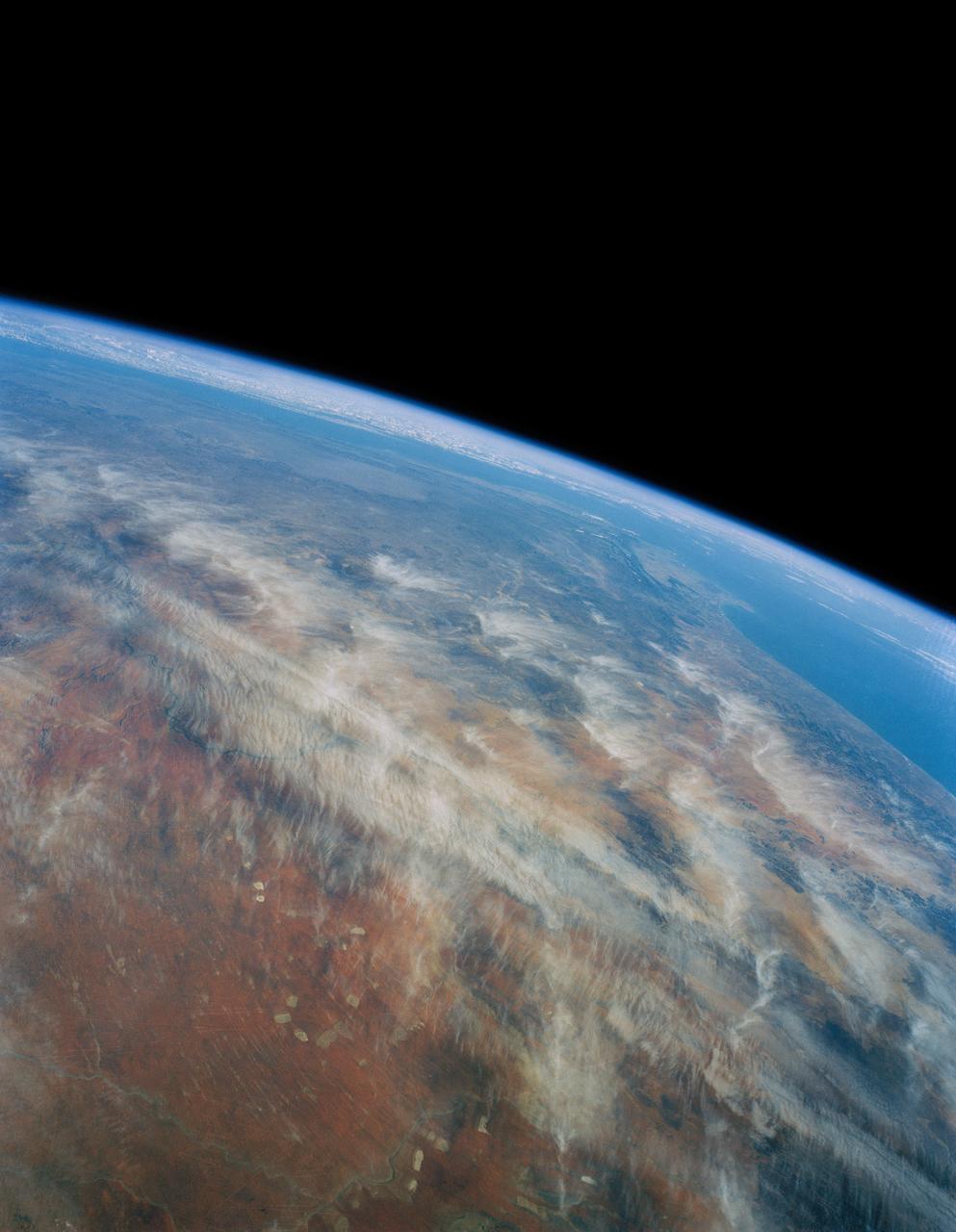
41G-121-189 (5-13 Oct 1984) --- The Kalihari Desert is visible in the foreground of this photograph covering three African nations. The desert is a classic red to orange-red, with small depressions and salt encrustation's which appear as lakes. Visible are Cape Town, the Cape of Good Hope and Cape Agulhas. The crew consisted of astronauts Robert L. Crippen, commander; Jon A. McBride, pilot; mission specialist's Kathryn D. Sullivan, Sally K. Ride, and David D. Leestma; Canadian astronaut Marc Garneau; and Paul D. Scully-Power, payload specialist. EDITOR'S NOTE: The STS-41G mission had the first American female EVA (Sullivan); first seven-person crew; first orbital fuel transfer; and the first Canadian (Garneau).
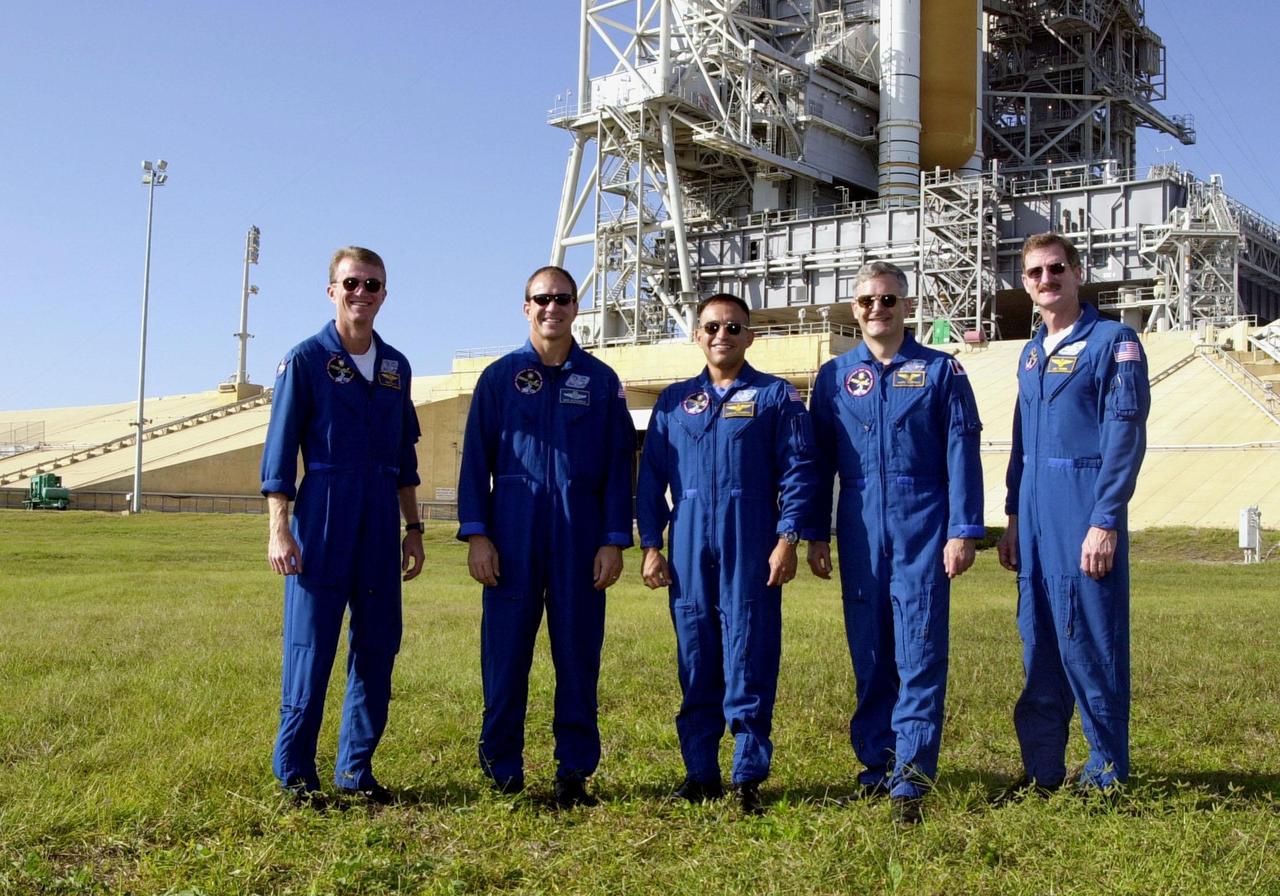
KENNEDY SPACE CENTER, Fla. -- The STS-97 crew pose for photographers at the base of Launch Pad 39B. They are, left to right, Commander Brent Jett, Pilot Mike Bloomfield and Mission Specialists Carlos Noriega, Marc Garneau and Joe Tanner. Garneau is with the Canadian Space Agency. The crew is at KSC to take part in Terminal Countdown Demonstration Test activities that include emergency egress training, familiarization with the payload, and a simulated launch countdown. Visible in the background are the solid rocket booster and external tank on Space Shuttle Endeavour. Mission STS-97is the sixth construction flight to the International Space Station. Its payload includes the P6 Integrated Truss Structure and a photovoltaic (PV) module, with giant solar arrays that will provide power to the Station. The mission includes two spacewalks to complete the solar array connections. STS-97 is scheduled to launch Nov. 30 at about 10:05 p.m. EST
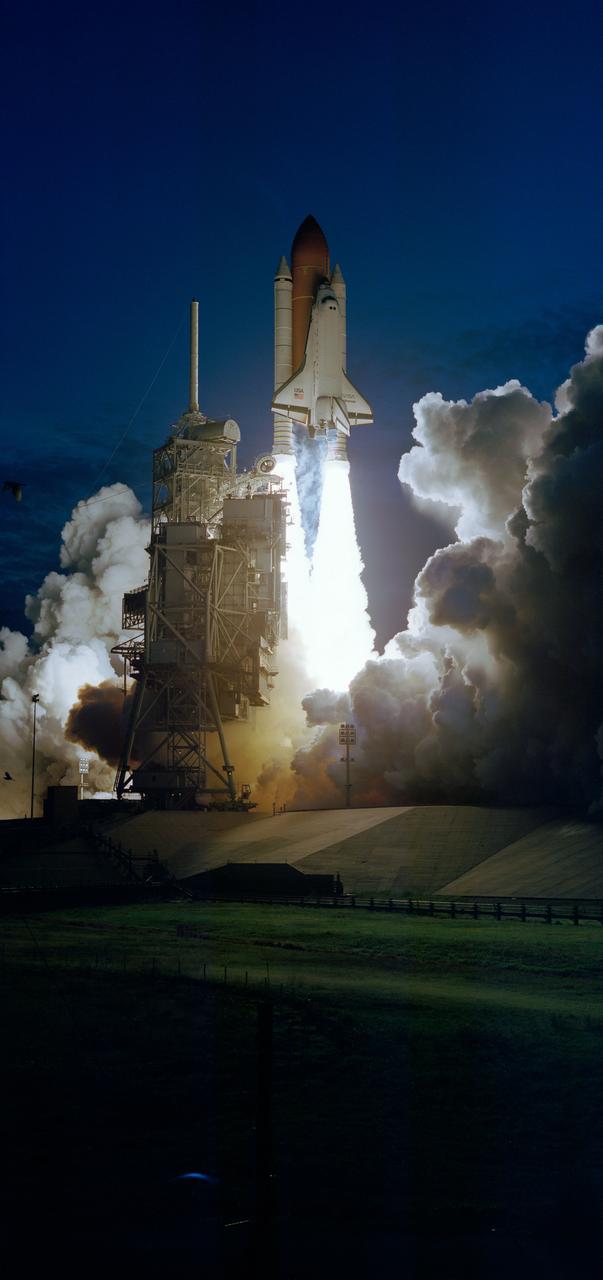
STS077-S-004 (19 May 1996) --- The Space Shuttle Endeavour lifts off with six astronauts headed toward the fourth NASA Space Shuttle mission of the year. The launch occurred at 6:30:00 a.m. (EDT), May 19, 1996. Heading the crew onboard is astronaut John H. Casper, mission commander. Other crew members are astronauts Curtis L. Brown, Jr., pilot; along with Daniel W. Bursch, Mario Runco, Jr., Andrew S. W. Thomas and Marc Garneau, all mission specialists. Garneau represents the Canadian Space Agency (CSA). During the approximately 10-day mission, the crew will perform a variety of payload activities, including microgravity research aboard the Spacehab 4 Module, deployment and retrieval of the Spartan 207 and deployment and rendezvous with the Passive Aerodynamically-Stabilized Magnetically-Damped Satellite (PAMS).
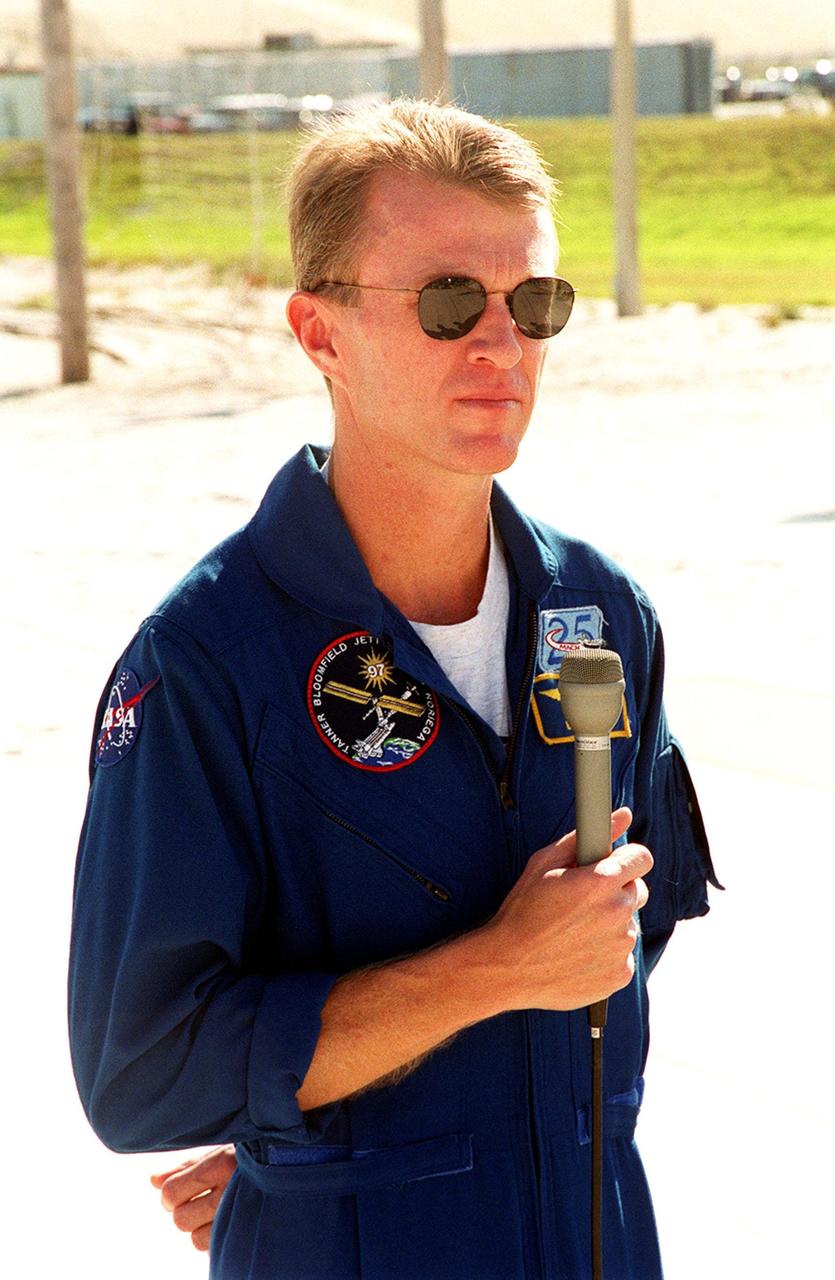
KENNEDY SPACE CENTER, Fla. -- STS-97 Commander Brent Jett listens to a question from a reporter during a media session near Launch Pad 39B. The crew is at KSC to take part in Terminal Countdown Demonstration Test activities that include emergency egress training, familiarization with the payload, and a simulated launch countdown. The other crew members are Pilot Mike Bloomfield and Mission Specialists Joe Tanner, Marc Garneau and Carlos Noriega. Garneau is with the Canadian Space Agency. Mission STS-97is the sixth construction flight to the International Space Station. Its payload includes the P6 Integrated Truss Structure and a photovoltaic (PV) module, with giant solar arrays that will provide power to the Station. The mission includes two spacewalks to complete the solar array connections. STS-97 is scheduled to launch Nov. 30 at about 10:05 p.m. EST
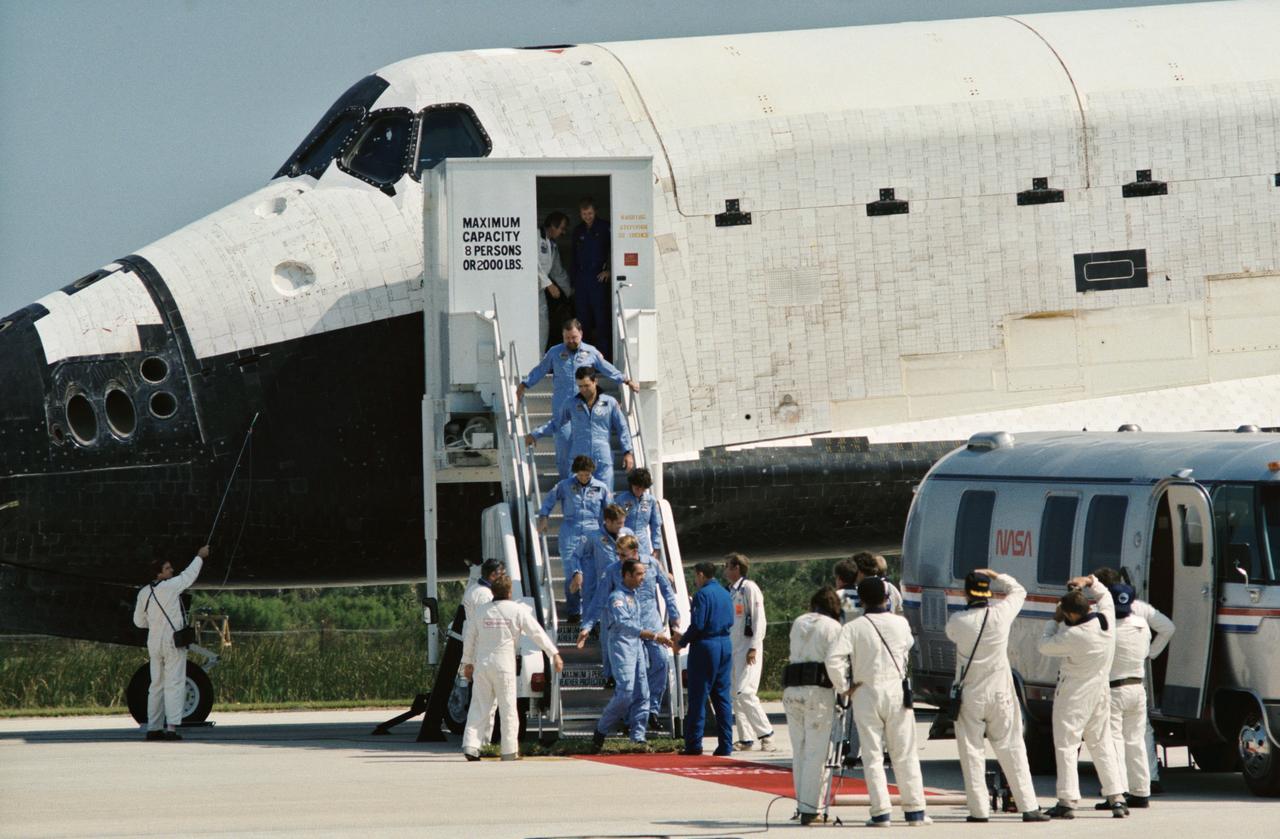
41G-90217 (13 Oct 1984) --- 41-G crew leaves the orbiter after landing at Kennedy Space Center at the end of their mission. Astronaut Robert Crippen shakes hands with George W.S. Abbey, Director of JSC's Flight Crew Operations, while the other crewmembers wait behind him. They are Jon McBride, David Leestma, Sally K. Ride, Kathryn Sullivan, Marc Garneau and Paul Scully-Power.
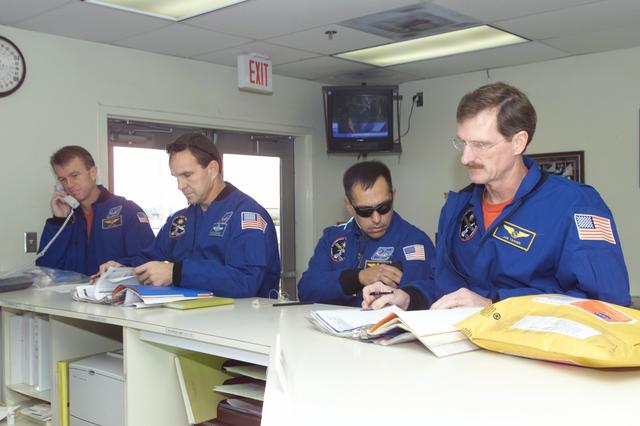
JSC2000-E-29119 (27 November 2000) --- Performing final tasks prior to leaving Ellington Field for Florida are four members of the STS-97 crew. From the left are astronauts Brent W. Jett, Jr., Michael J. Bloomfield, Carlos I. Noriega and Joseph R. Tanner. Marc Garneau, who represents the Canadian Space Agency (CSA), is not pictured. Launch from Florida's Kennedy Space Center (KSC) is scheduled for November 30.
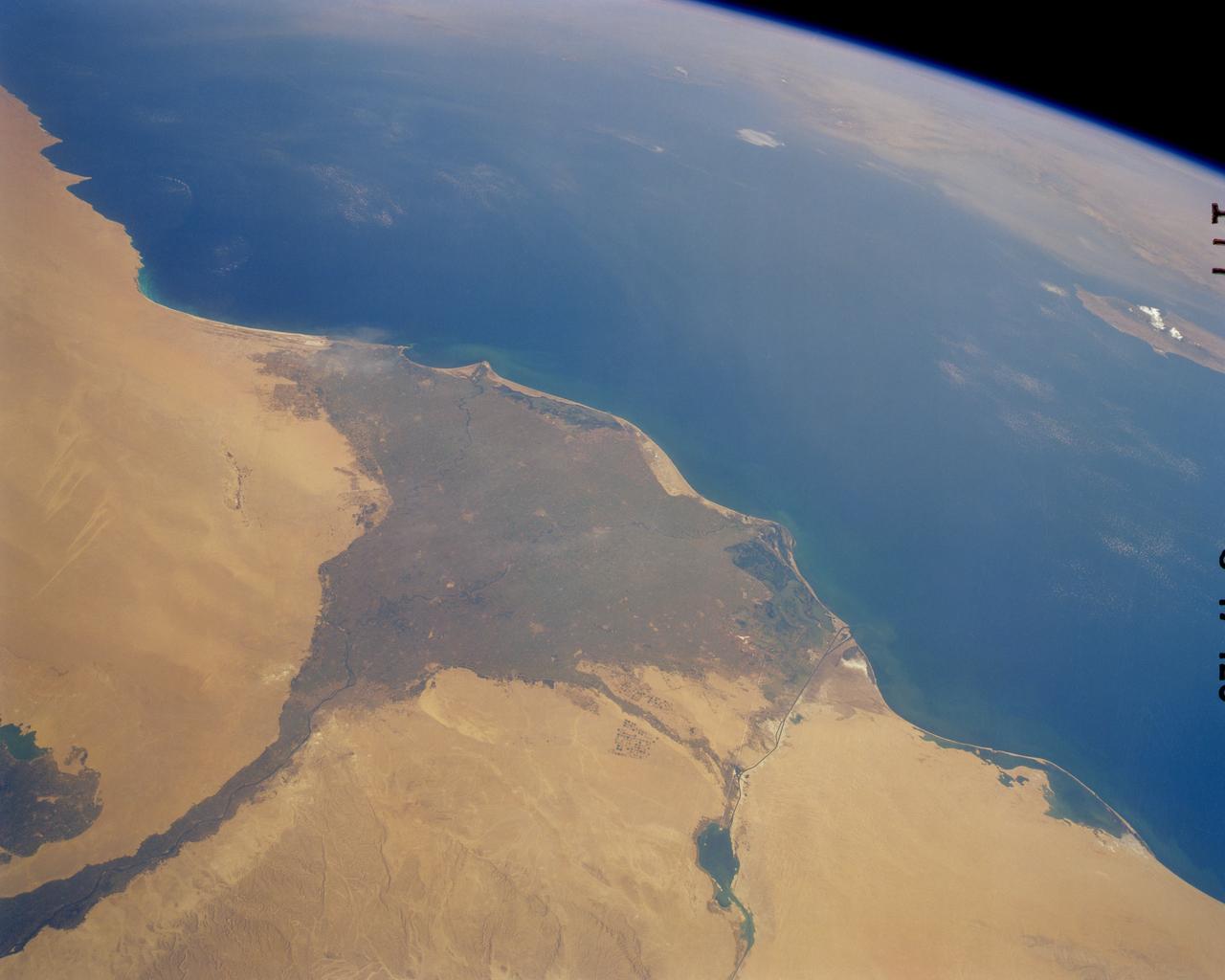
41G-120-177 (5-13 Oct 1984) --- Egypt and the Nile River Delta are easily recognizable in this 250mm frame. Cairo and the Egyptian pyramids are also visible in the lower left side of this photograph. The crew consisted of astronauts Robert L. Crippen, commander, Jon A. McBride, pilot; mission specialist’s Kathryn D. Sullivan, Sally K. Ride, and David D. Leestma; Canadian astronaut Marc Garneau; and Paul D. Scully-Power payload specialist.
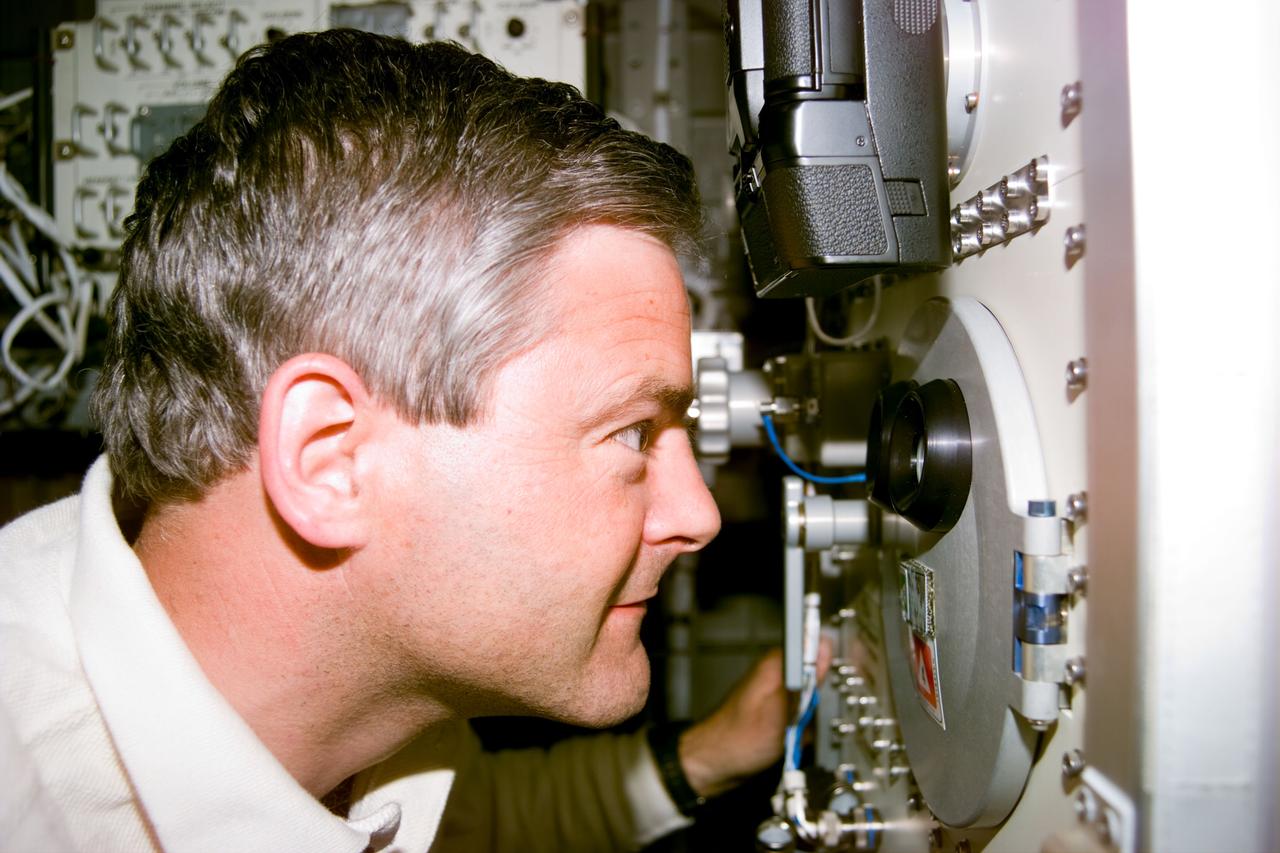
S77-E-5093 (25 May 1996) --- Astronaut Marc Garneau, mission specialist representing the Canadian Space Agency (CSA), makes a visual check of the Commercial Float Zone Furnace (CFZF), a single-rack-mounted facility in the Spacehab Module onboard the Earth-orbiting Space Shuttle Endeavour. The scene was recorded with an Electronic Still Camera (ESC).
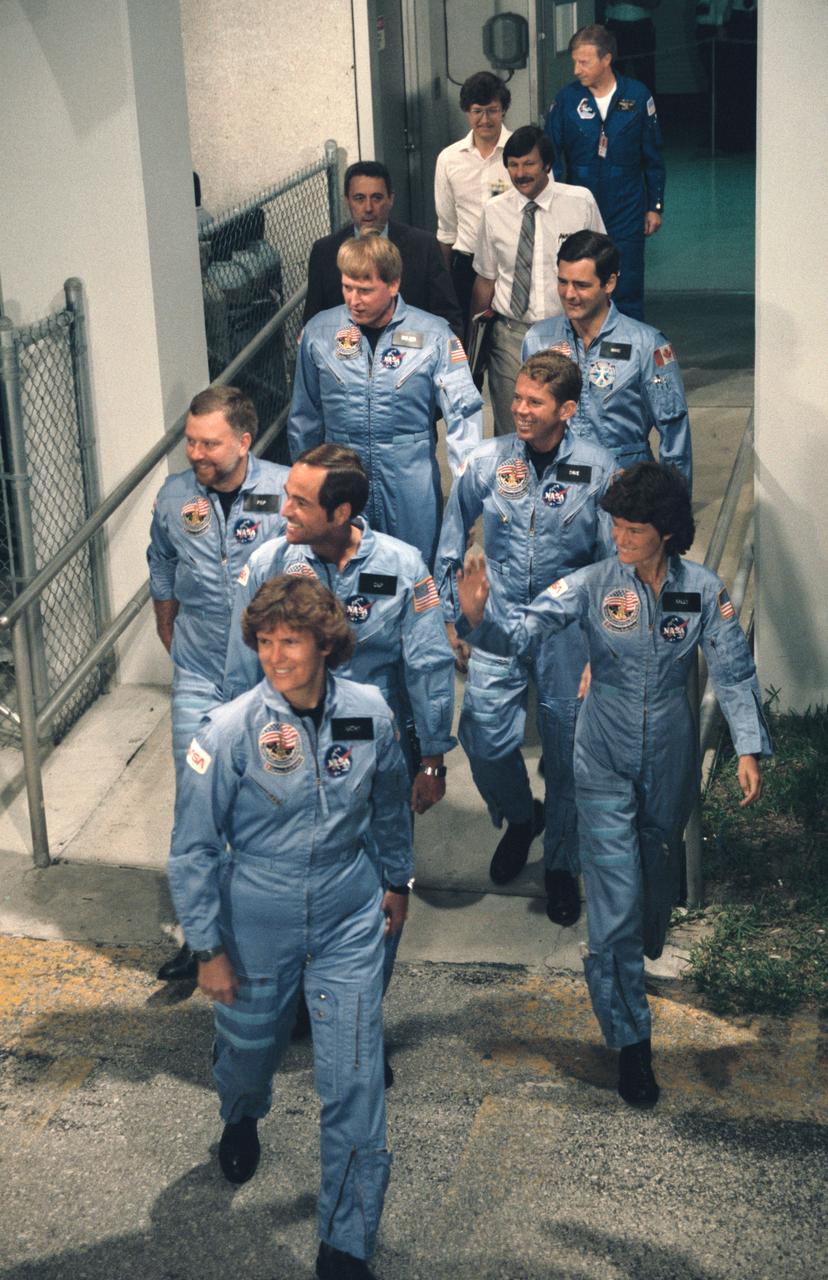
41G-90081 / S17-90081 (5 Oct 1984) --- The seven member crew leaves the Operations and Checkout Building (OCB) to take a van ride to the launch pad. Leading the way is Kathryn D. Sullivan followed in file by Robert L. Crippen, Paul D. Scully-Power and Jon A. McBride. On the right side are Sally K. Ride, David C. Leestma and Marc Garneau. Trailing the crew are George W. S. Abbey, Richard Nygren, Paul Bulver, and Paul J. Weitz.
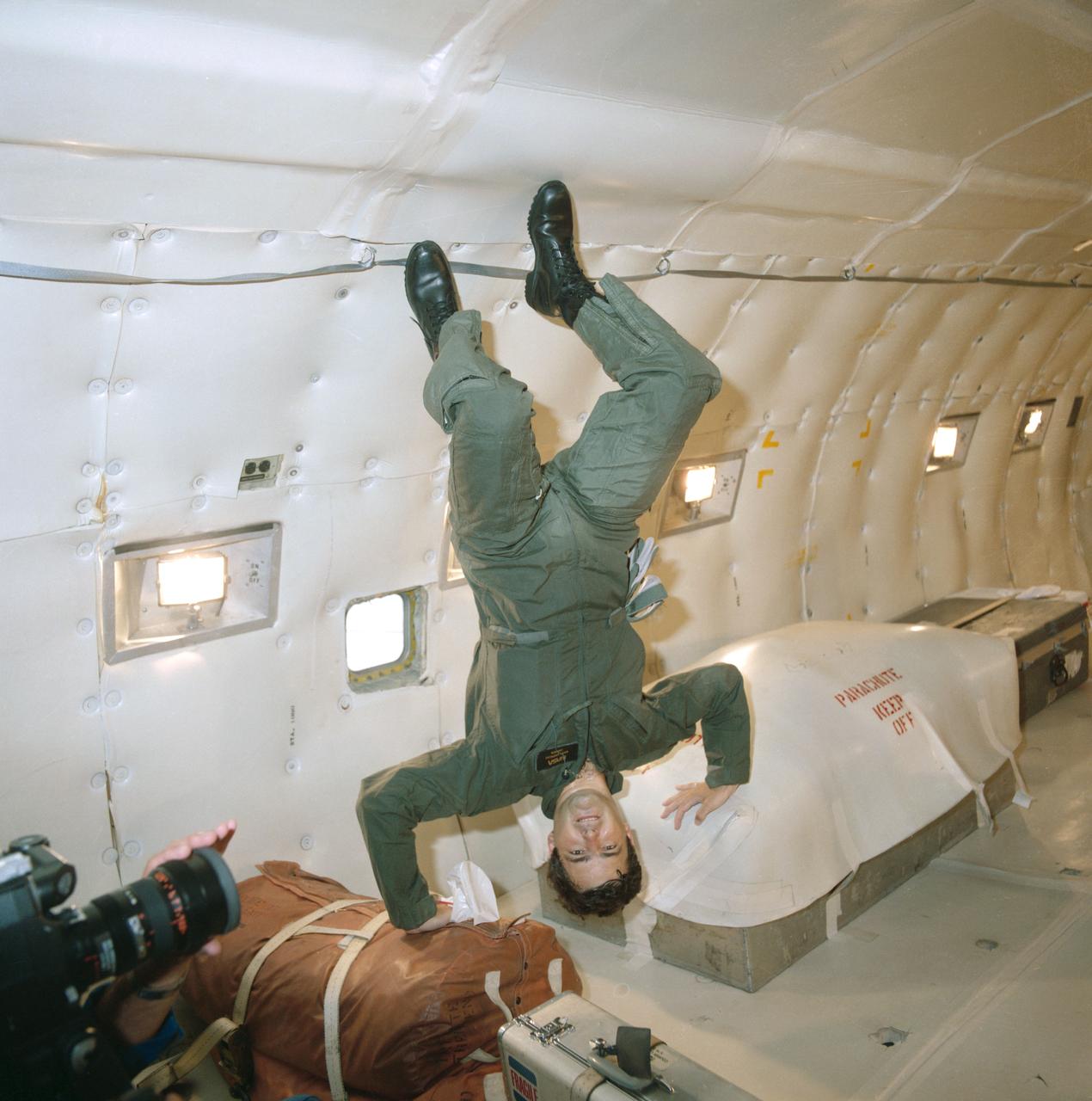
S84-37514 (18 July 1984) --- Marc Garneau, representing Canada's National Research Council as one of two 41-G payload specialists, gets the "feel" of zero gravity aboard a special NASA aircraft designed to create brief periods of weightlessness. Five astronauts and an oceanographer from the U.S. Dept. of the Navy will join Canada's first representative in space for the trip aboard Challenger later this year. This KC-135 aircraft is used extensively for evaluation of equipment and experiments scheduled for future missions.
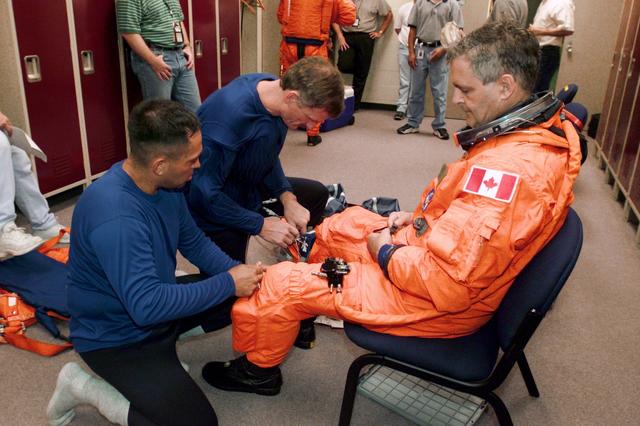
JSC2000-E-23527 (October 2000) --- Astronaut Marc Garneau, mission specialist representing the Canadian Space Agency (CSA), looks on as two crew mates assist him with final touches of suit-donning prior to a training session in the Johnson Space Center's Systems Integration Facility. Helping out are astronauts Carlos I. Noriega (left) and Joseph R. Tanner, mission specialists.
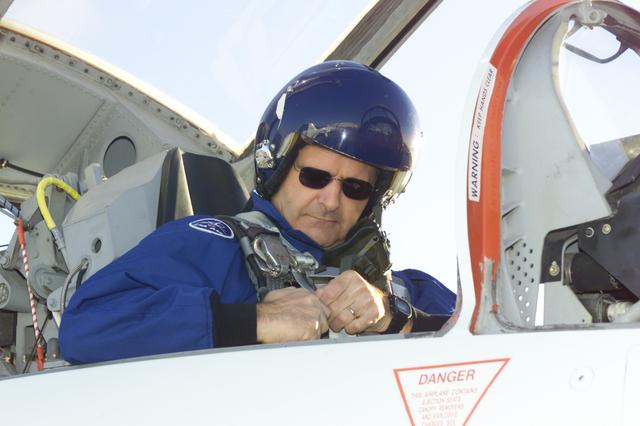
JSC2000-E-29124 (27 November 2000) --- Astronaut Marc Garneau, mission specialist representing the Canadian Space Agency (CSA), is pictured in the cockpit of a NASA T-38 jet trainer at Ellington Field. The five-member STS-97 crew was minutes away from departure to Florida, where it will continue preparations for launch later this week aboard the Space Shuttle Endeavour.
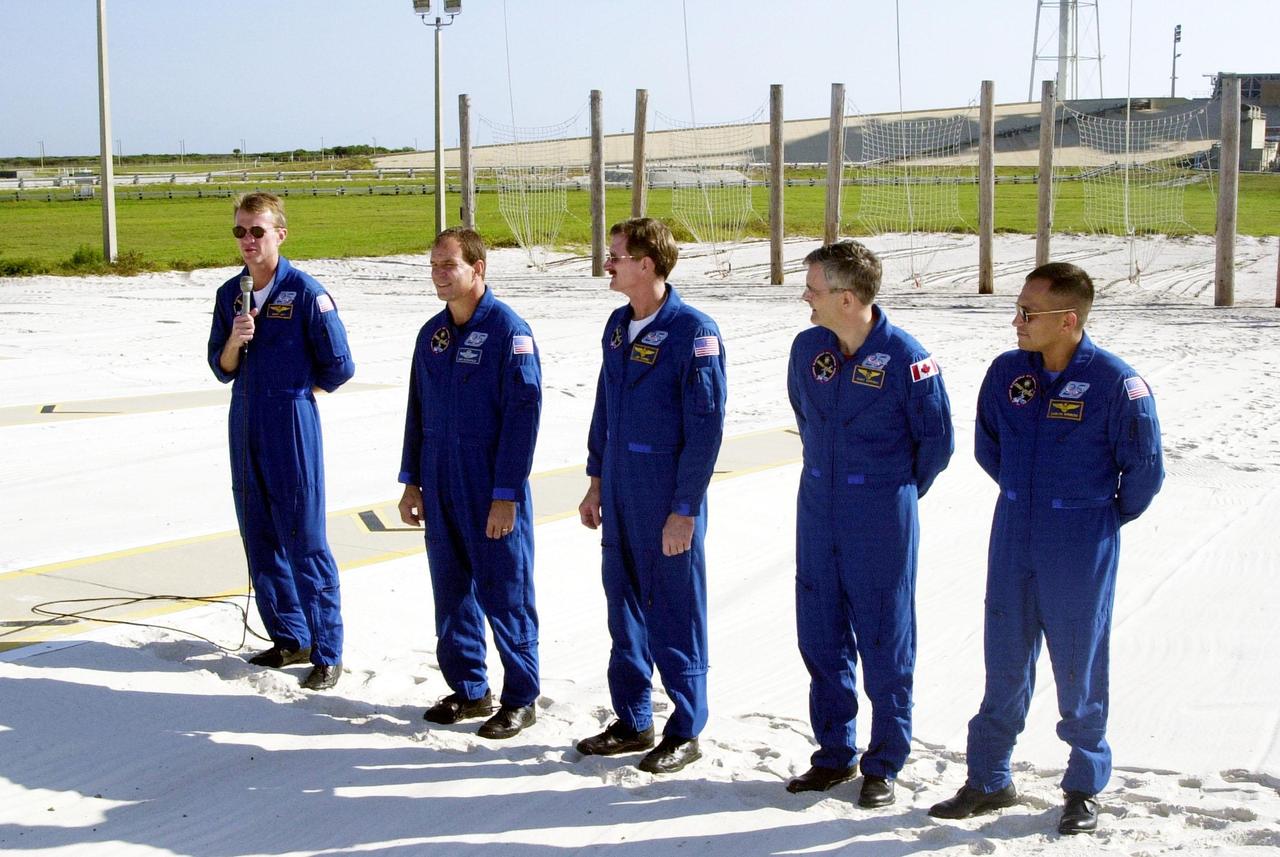
KENNEDY SPACE CENTER, Fla. -- Standing in the slidewire landing zone at Launch Pad 39B, the STS-97 crew respond to questions from the media. They are, left to right, Commander Brent Jett, Pilot Mike Bloomfield and Mission Specialists Joe Tanner, Marc Garneau and Carlos Noriega. Garneau is with the Canadian Space Agency. The nets suspended behind them are a braking system catch net for the slidewire baskets that provide emergency exit from the orbiter and Fixed Service Structure. The crew is at KSC to take part in Terminal Countdown Demonstration Test activities that include emergency egress training, familiarization with the payload, and a simulated launch countdown. Visible in the background are the solid rocket booster and external tank on Space Shuttle Endeavour. Mission STS-97is the sixth construction flight to the International Space Station. Its payload includes the P6 Integrated Truss Structure and a photovoltaic (PV) module, with giant solar arrays that will provide power to the Station. The mission includes two spacewalks to complete the solar array connections. STS-97 is scheduled to launch Nov. 30 at about 10:05 p.m. EST
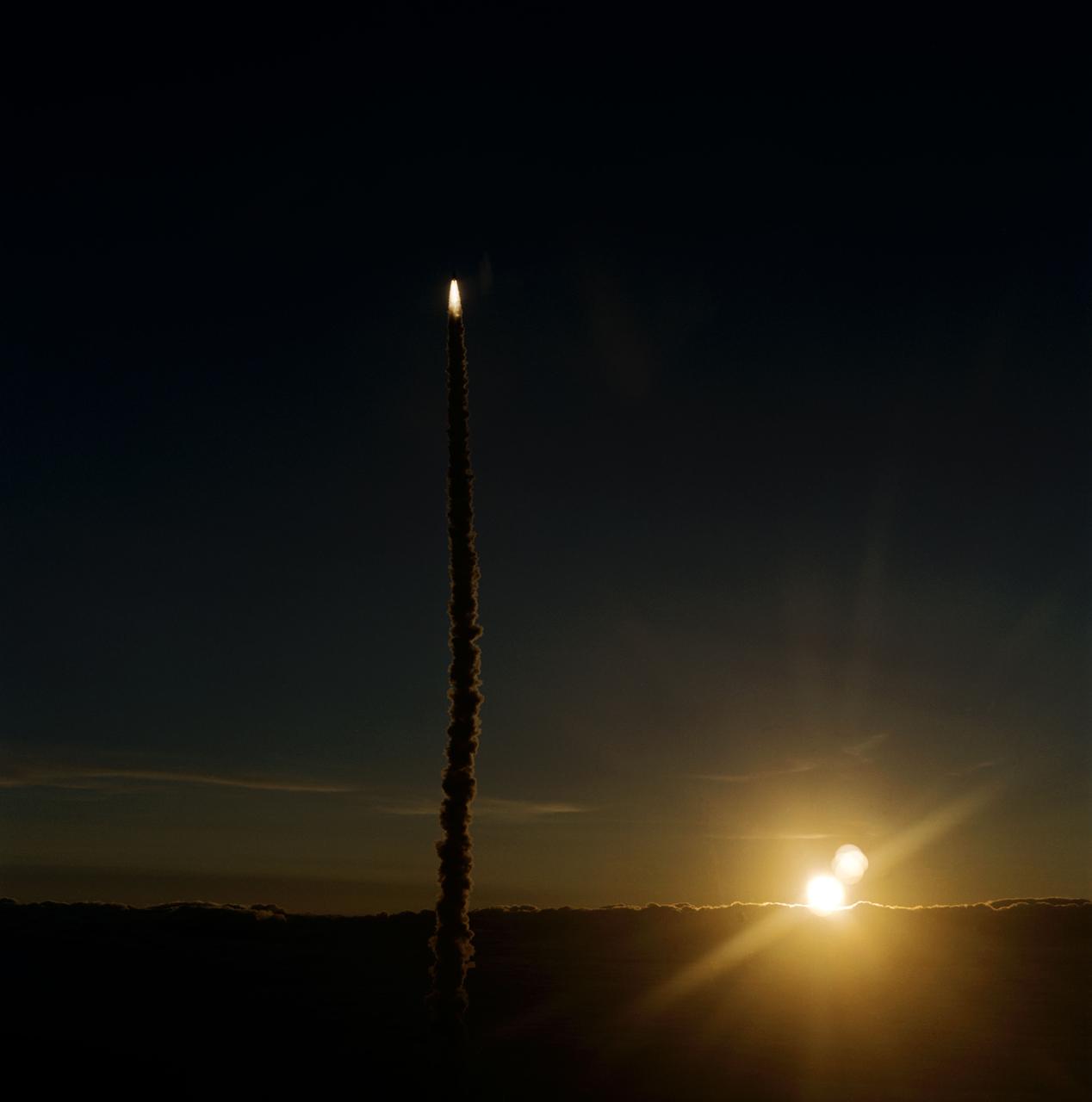
STS077-S-007 (19 May 1996) --- In this air-to-air 70mm frame, the Space Shuttle Endeavour is captured atop a trail of smoke as it carries six astronauts toward the fourth NASA Space Shuttle mission of the year. The photograph was taken from the Shuttle Training Aircraft (STA) which routinely checks the Florida environs for weather and safety factors. The launch occurred at 6:30:00 a.m. (EDT), May 19, 1996. Heading the six-member crew onboard is astronaut John H. Casper, mission commander. Other crew members are astronauts Curtis L. Brown, Jr., pilot; along with Daniel W. Bursch, Mario Runco, Jr., Andrew S. W. Thomas and Marc Garneau, all mission specialists. Garneau represents the Canadian Space Agency (CSA). During the approximately 10-day mission, the crew will perform a variety of payload activities, including microgravity research aboard the Spacehab 4 Module, deployment and retrieval of the Spartan 207 and deployment and rendezvous with the Passive Aerodynamically-Stabilized Magnetically-Damped Satellite (PAMS).
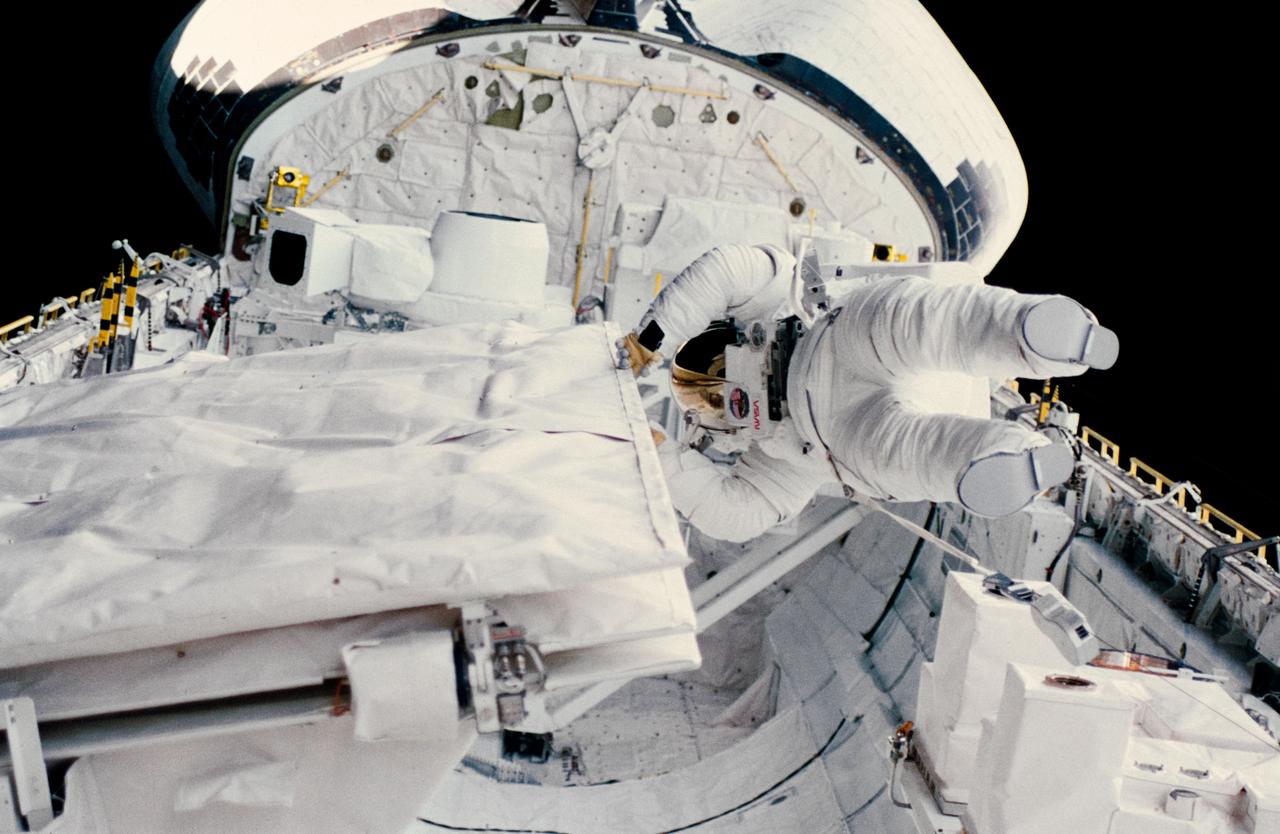
41G-13-032 (11 Oct. 1984) --- Astronaut Kathryn D. Sullivan checks the latch of the SIR-B antenna in the space shuttle Challenger's open cargo bay during her historic extravehicular activity (EVA) on Oct. 11, 1984. Earlier, America's first woman to perform an EVA and astronaut David C. Leestma, participated in an in-space simulation of refueling a spacecraft in orbit. The Orbital Refueling System (ORS) is just beyond the astronaut mission specialist's helmet. To the left is the Large Format Camera (LFC). The LFC and ORS are stationed on a device called the Mission Peculiar Support Structure (MPESS). Crew members consisted of astronauts Robert L. Crippen, commander; Jon A. McBride, pilot; along with Kathryn D. Sullivan, Sally K. Ride, and David D. Leestma, all mission specialists; and Canadian astronaut Marc Garneau and Paul D. Scully-Power, both payload specialist. EDITOR'S NOTE: The STS-41G mission had the first American female EVA (Sullivan); first seven-person crew; first orbital fuel transfer; and the first Canadian (Garneau).
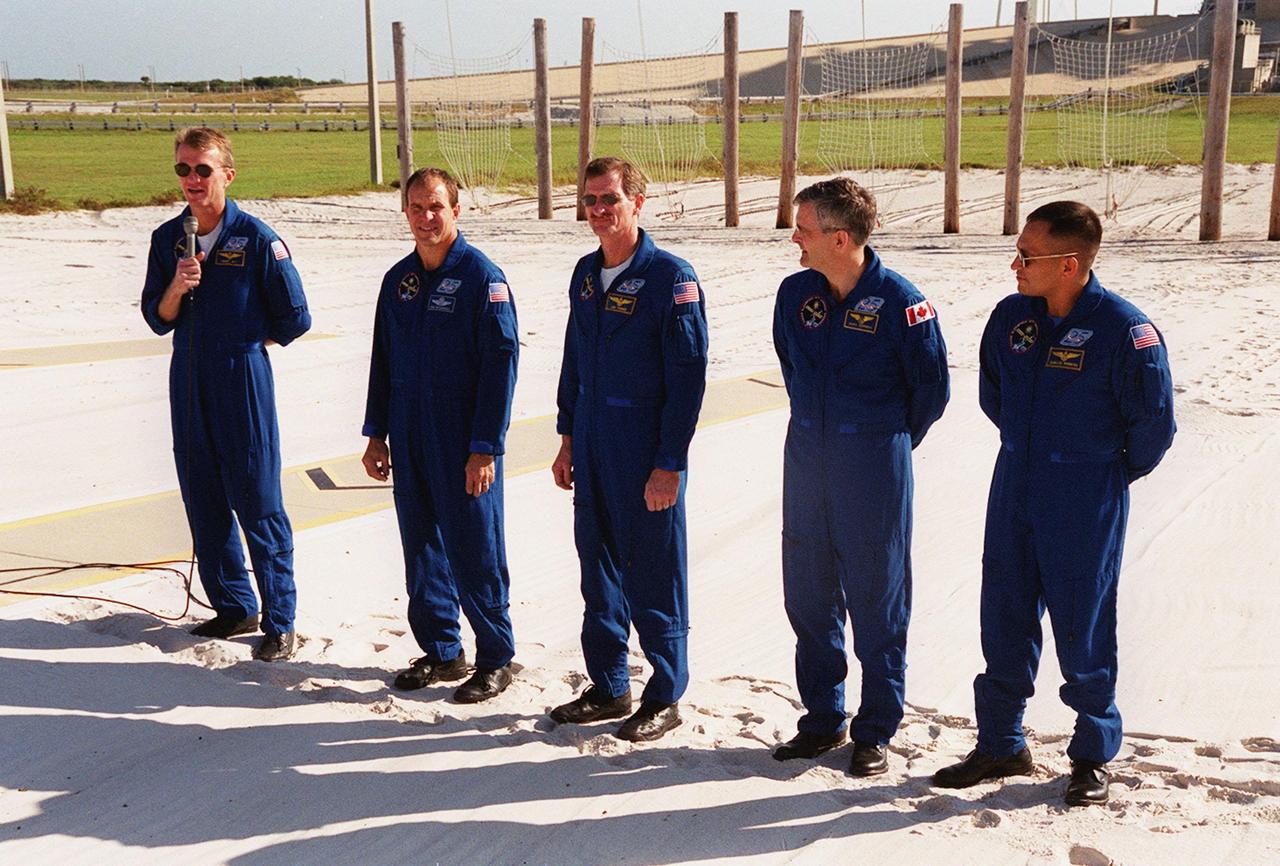
KENNEDY SPACE CENTER, Fla. -- Standing in the slidewire landing zone at Launch Pad 39B, the STS-97 crew respond to questions from the media. Commander Brent Jett (on left, with microphone) introduces the rest of the crew (left to right) Pilot Mike Bloomfield and Mission Specialists Joe Tanner, Marc Garneau and Carlos Noriega. Garneau is with the Canadian Space Agency. The nets suspended behind them are a braking system catch net for the slidewire baskets that provide emergency exit from the orbiter and Fixed Service Structure. The crew is at KSC to take part in Terminal Countdown Demonstration Test activities that include emergency egress training, familiarization with the payload, and a simulated launch countdown. Mission STS-97is the sixth construction flight to the International Space Station. Its payload includes the P6 Integrated Truss Structure and a photovoltaic (PV) module, with giant solar arrays that will provide power to the Station. The mission includes two spacewalks to complete the solar array connections. STS-97 is scheduled to launch Nov. 30 at about 10:05 p.m. EST
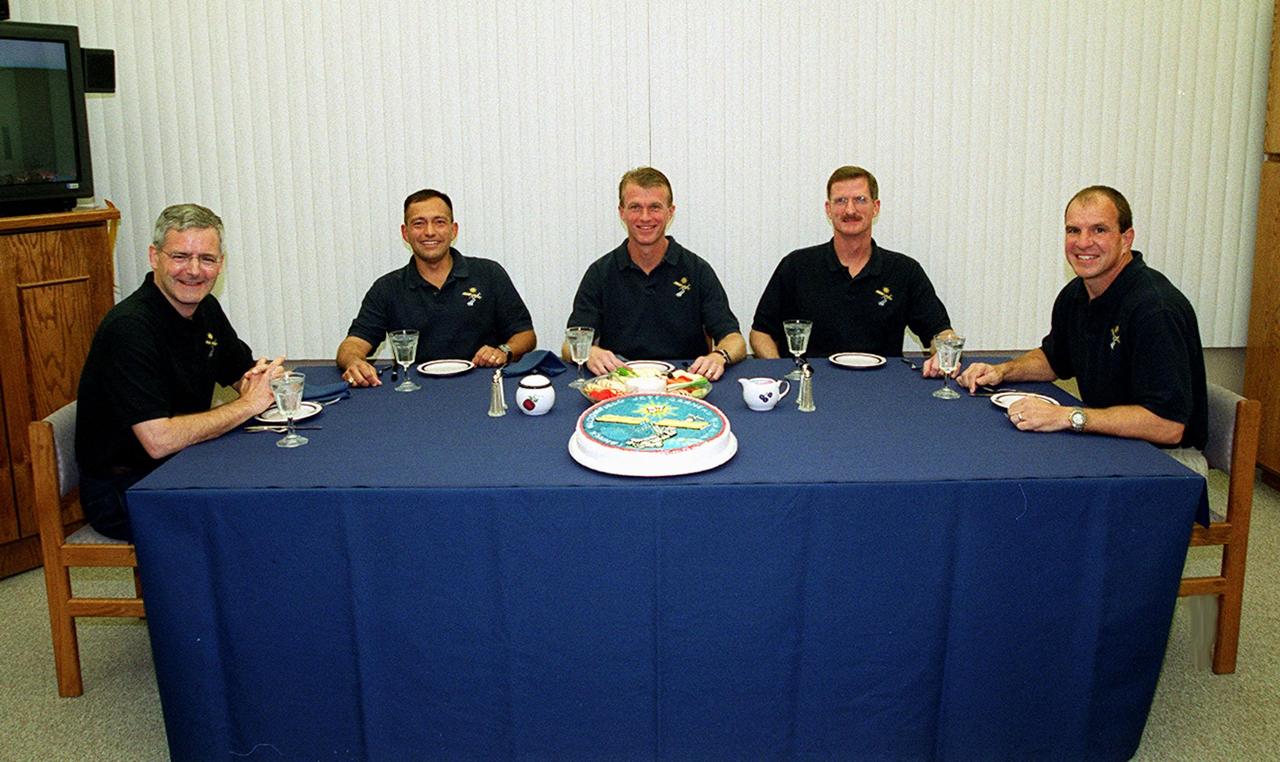
The STS-97 crew are ready to enjoy a snack in the crew quarters, Operations and Checkout Building, before beginning to suit up for launch. Seated from left are Mission Specialists Marc Garneau and Carlos Noriega, Commander Brent Jett, Mission Specialist Joseph Tanner and Pilot Michael Bloomfield. Garneau is with the Canadian Space Agency. Mission STS-97 is the sixth construction flight to the International Space Station. It is transporting the P6 Integrated Truss Structure that comprises Solar Array Wing-3 and the Integrated Electronic Assembly, to be installed on the Space Station. The solar arrays are mounted on a “blanket” that can be folded like an accordion for delivery. Once in orbit, astronauts will deploy the blankets to their full size. The 11-day mission includes two spacewalks to complete the solar array connections. The Station’s electrical power system will use eight photovoltaic solar arrays, each 112 feet long by 39 feet wide, to convert sunlight to electricity.. Gimbals will be used to rotate the arrays so that they will face the Sun to provide maximum power to the Space Station. Launch is scheduled for Nov. 30 at 10:06 p.m. EST
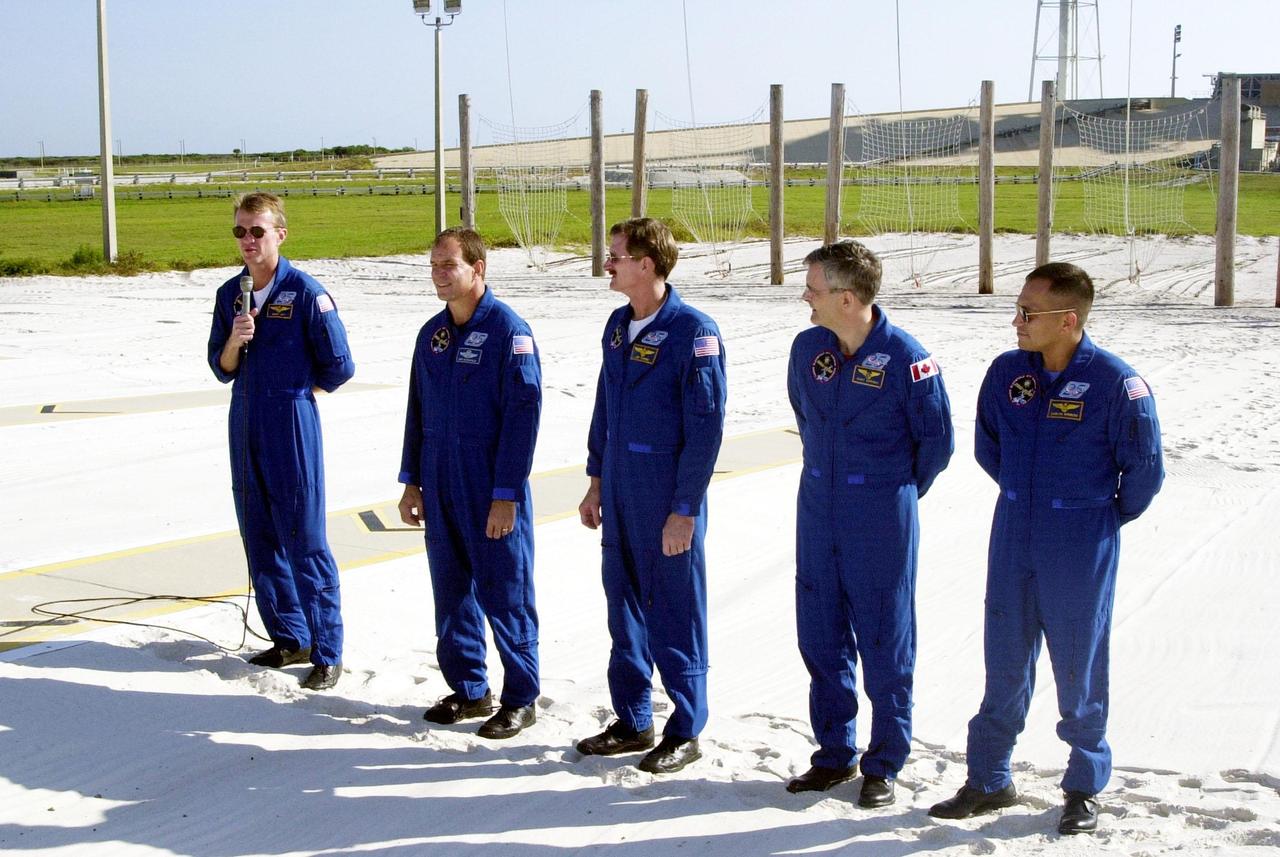
KENNEDY SPACE CENTER, Fla. -- Standing in the slidewire landing zone at Launch Pad 39B, the STS-97 crew respond to questions from the media. They are, left to right, Commander Brent Jett, Pilot Mike Bloomfield and Mission Specialists Joe Tanner, Marc Garneau and Carlos Noriega. Garneau is with the Canadian Space Agency. The nets suspended behind them are a braking system catch net for the slidewire baskets that provide emergency exit from the orbiter and Fixed Service Structure. The crew is at KSC to take part in Terminal Countdown Demonstration Test activities that include emergency egress training, familiarization with the payload, and a simulated launch countdown. Visible in the background are the solid rocket booster and external tank on Space Shuttle Endeavour. Mission STS-97is the sixth construction flight to the International Space Station. Its payload includes the P6 Integrated Truss Structure and a photovoltaic (PV) module, with giant solar arrays that will provide power to the Station. The mission includes two spacewalks to complete the solar array connections. STS-97 is scheduled to launch Nov. 30 at about 10:05 p.m. EST
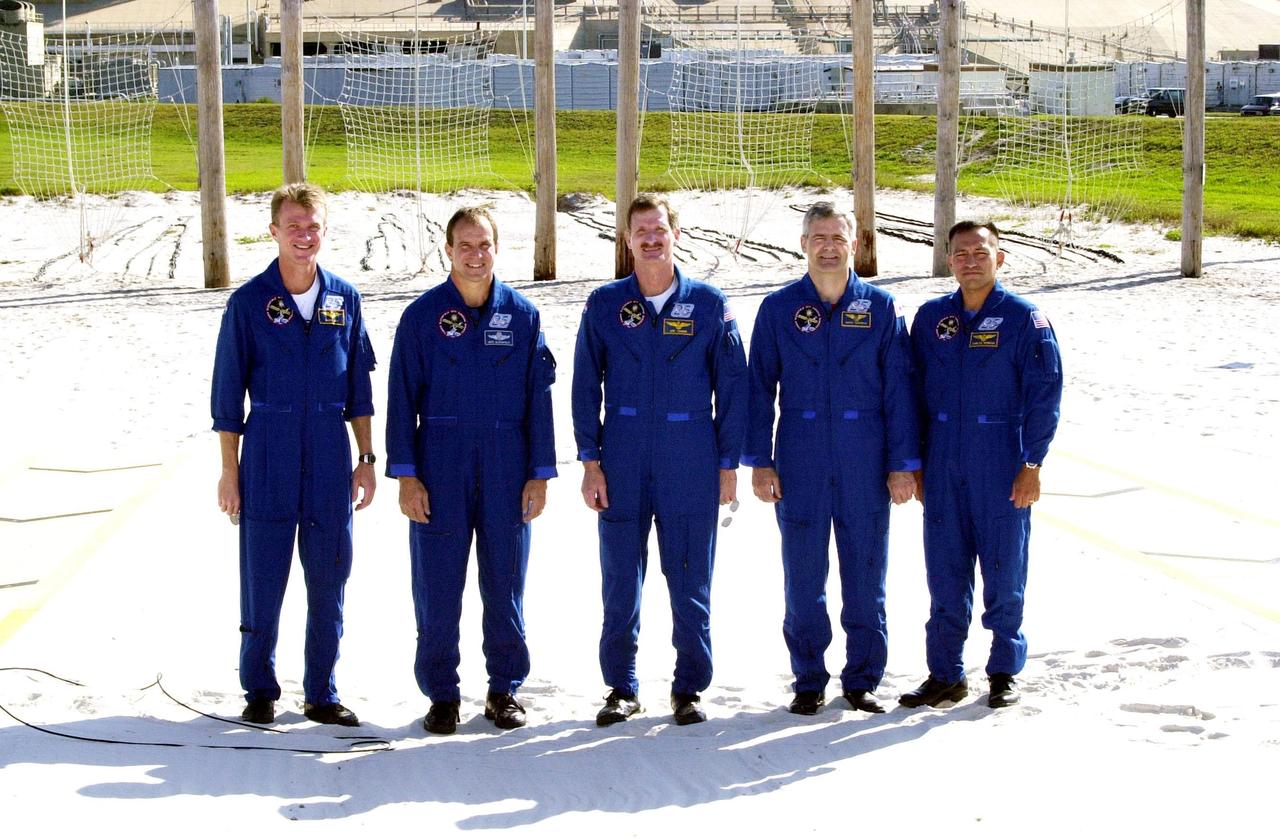
KENNEDY SPACE CENTER, Fla. -- The STS-97 crew poses for another photo after meeting with the media at the slidewire landing zone. They are, left to right, Commander Brent Jett, Pilot Mike Bloomfield and Mission Specialists Joe Tanner, Marc Garneau and Carlos Noriega. Garneau is with the Canadian Space Agency. The nets suspended behind them are a braking system catch net for the slidewire baskets that provide emergency exit from the orbiter and Fixed Service Structure. The crew is at KSC to take part in Terminal Countdown Demonstration Test activities that include emergency egress training, familiarization with the payload, and a simulated launch countdown. Visible in the background are the solid rocket booster and external tank on Space Shuttle Endeavour. Mission STS-97is the sixth construction flight to the International Space Station. Its payload includes the P6 Integrated Truss Structure and a photovoltaic (PV) module, with giant solar arrays that will provide power to the Station. The mission includes two spacewalks to complete the solar array connections. STS-97 is scheduled to launch Nov. 30 at 10:05 p.m. EST
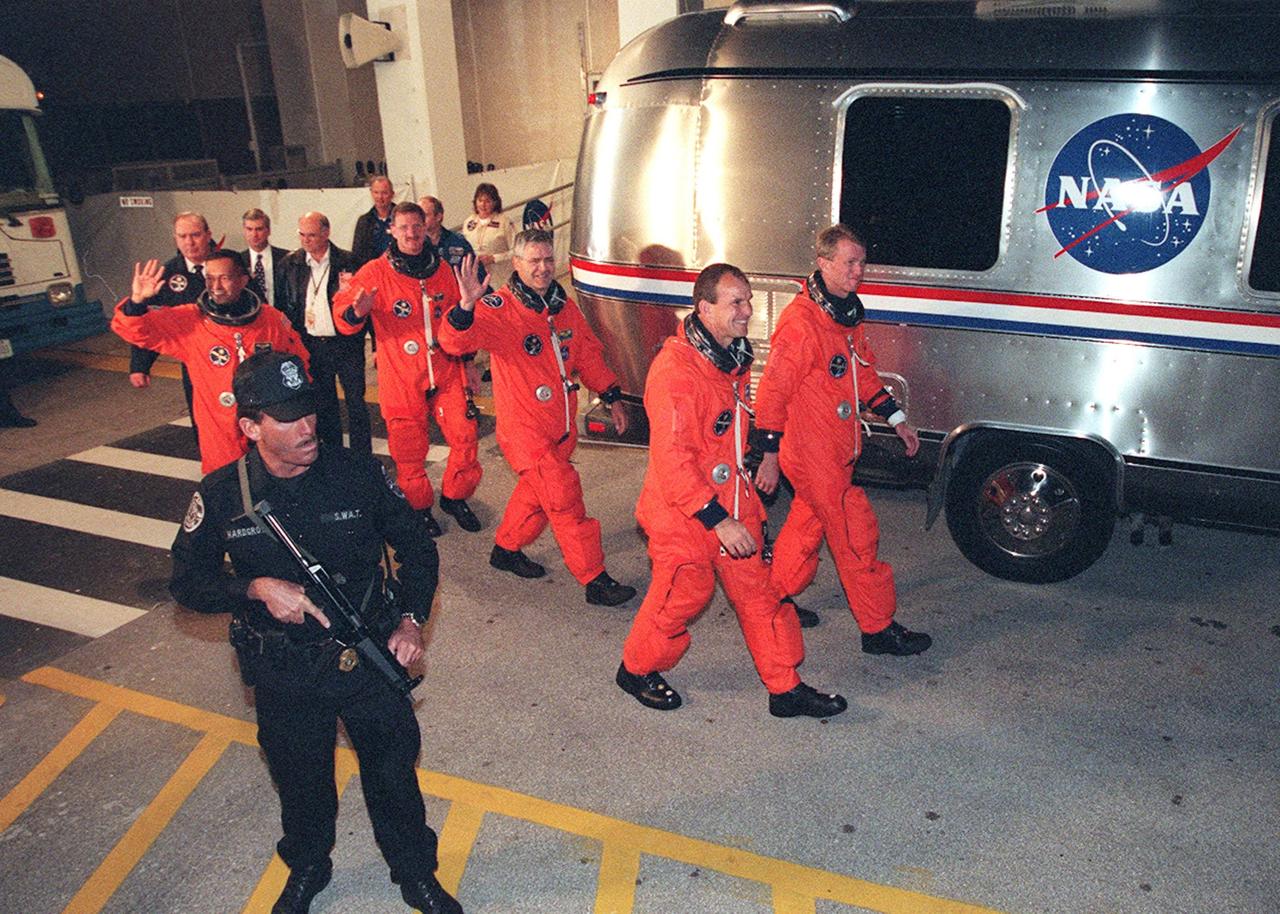
Leaving the Operations and Checkout Building, the STS-97 crew hurries toward the waiting Astrovan that will take them to Launch Pad 39B. Starting at left, they are Mission Specialists Carlos Noriega, Joseph Tanner and Marc Garneau; Pilot Michael Bloomfield; and Commander Brent Jett. Garneau is with the Canadian Space Agency. Mission STS-97 is the sixth construction flight to the International Space Station. It is transporting the P6 Integrated Truss Structure that comprises Solar Array Wing-3 and the Integrated Electronic Assembly, to be installed on the Space Station. The solar arrays are mounted on a “blanket” that can be folded like an accordion for delivery. Once in orbit, astronauts will deploy the blankets to their full size. The 11-day mission includes two spacewalks to complete the solar array connections. The Station’s electrical power system will use eight photovoltaic solar arrays, each 112 feet long by 39 feet wide, to convert sunlight to electricity. Gimbals will be used to rotate the arrays so that they will face the Sun to provide maximum power to the Space Station. Launch is scheduled for Nov. 30 at 10:06 p.m. EST
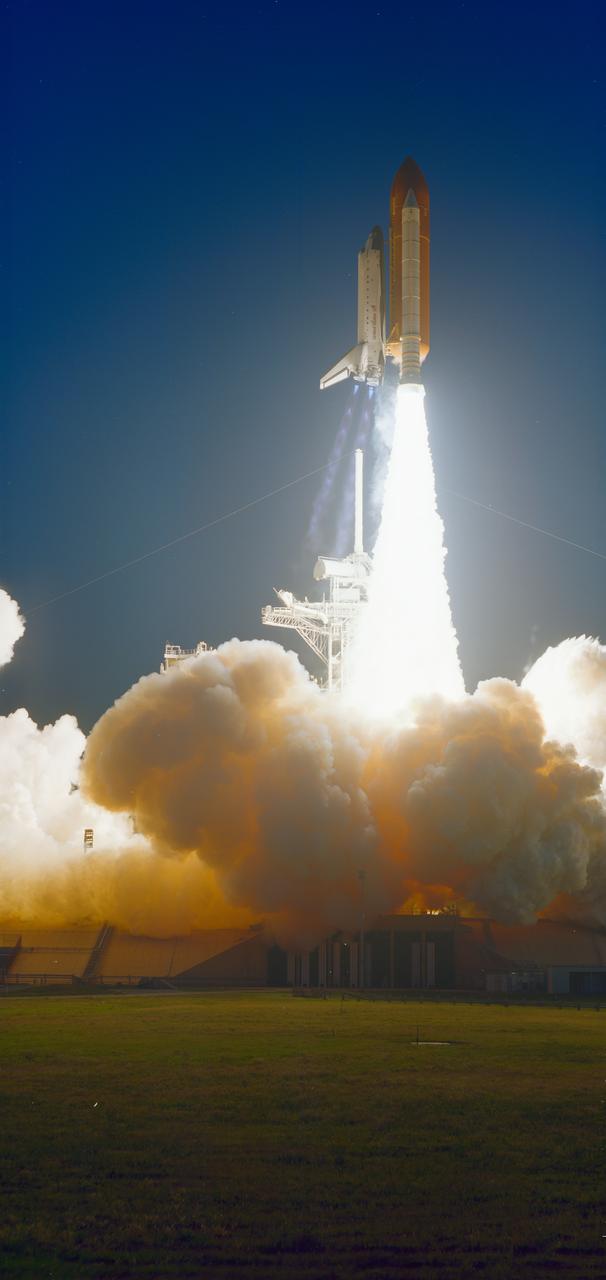
STS077-S-003 (19 May 1996) --- A remote 35mm camera provided this profile view of the Space Shuttle Endeavour?s lift-off. Headed toward the fourth NASA Space Shuttle mission of the year, Endeavour displays a diamond-shock effect of its three-main engines. The launch occurred at 6:30:00 a.m. (EDT), May 19, 1996. Heading the six-member crew onboard is astronaut John H. Casper, mission commander. Other crew members are astronauts Curtis L. Brown, Jr., pilot; along with Daniel W. Bursch, Mario Runco, Jr., Andrew S. W. Thomas and Marc Garneau, all mission specialists. Garneau represents the Canadian Space Agency (CSA). During the approximately 10-day mission, the crew will perform a variety of payload activities, including microgravity research aboard the Spacehab 4 Module, deployment and retrieval of the Spartan 207 and deployment and rendezvous with the Passive Aerodynamically-Stabilized Magnetically-Damped Satellite (PAMS).
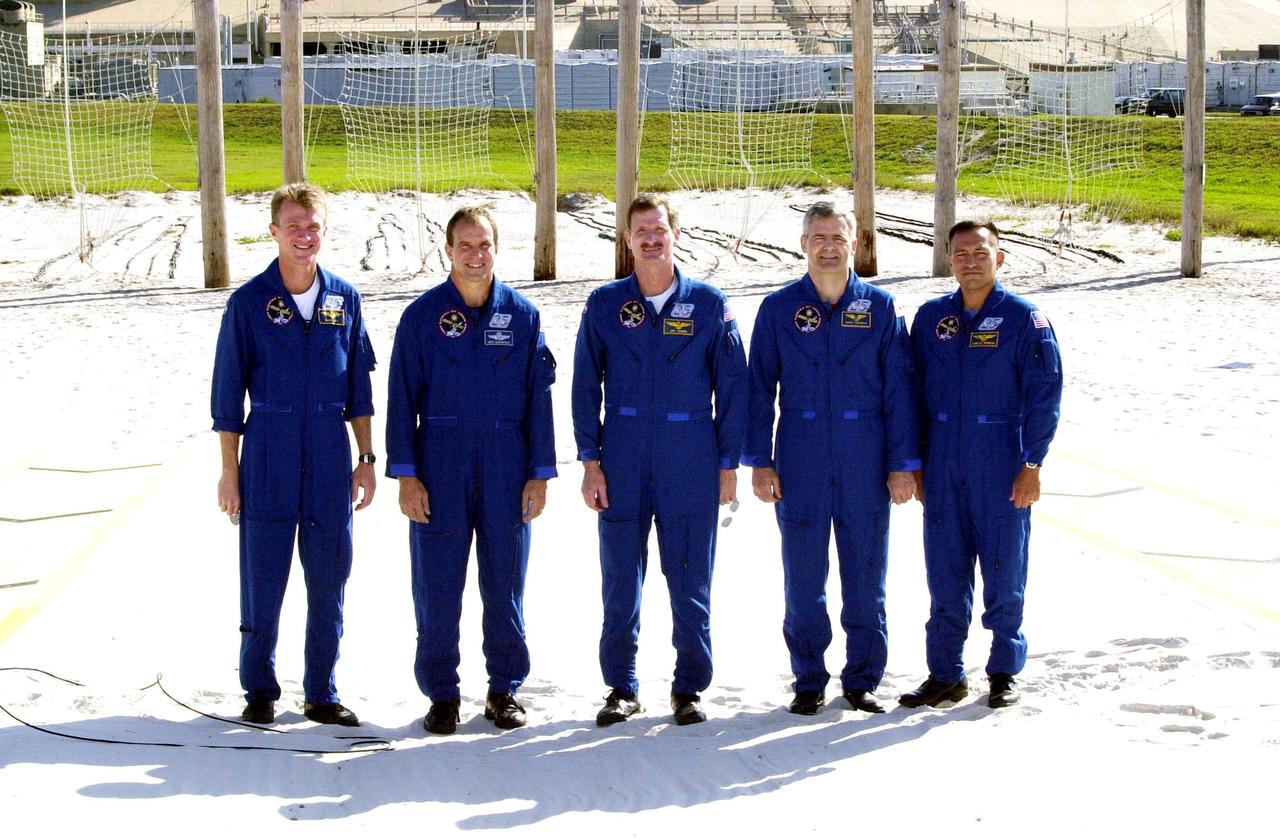
KENNEDY SPACE CENTER, Fla. -- The STS-97 crew poses for another photo after meeting with the media at the slidewire landing zone. They are, left to right, Commander Brent Jett, Pilot Mike Bloomfield and Mission Specialists Joe Tanner, Marc Garneau and Carlos Noriega. Garneau is with the Canadian Space Agency. The nets suspended behind them are a braking system catch net for the slidewire baskets that provide emergency exit from the orbiter and Fixed Service Structure. The crew is at KSC to take part in Terminal Countdown Demonstration Test activities that include emergency egress training, familiarization with the payload, and a simulated launch countdown. Visible in the background are the solid rocket booster and external tank on Space Shuttle Endeavour. Mission STS-97is the sixth construction flight to the International Space Station. Its payload includes the P6 Integrated Truss Structure and a photovoltaic (PV) module, with giant solar arrays that will provide power to the Station. The mission includes two spacewalks to complete the solar array connections. STS-97 is scheduled to launch Nov. 30 at 10:05 p.m. EST
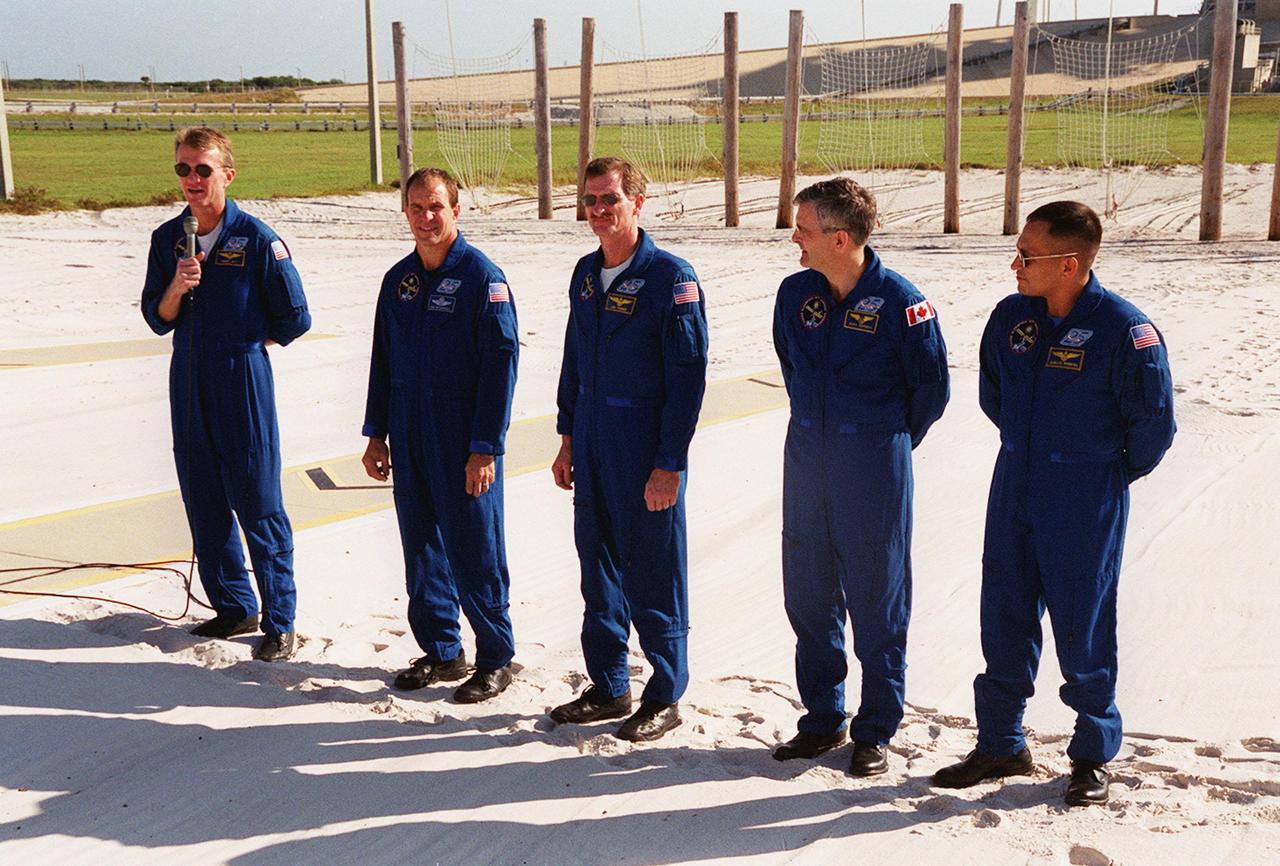
KENNEDY SPACE CENTER, Fla. -- Standing in the slidewire landing zone at Launch Pad 39B, the STS-97 crew respond to questions from the media. Commander Brent Jett (on left, with microphone) introduces the rest of the crew (left to right) Pilot Mike Bloomfield and Mission Specialists Joe Tanner, Marc Garneau and Carlos Noriega. Garneau is with the Canadian Space Agency. The nets suspended behind them are a braking system catch net for the slidewire baskets that provide emergency exit from the orbiter and Fixed Service Structure. The crew is at KSC to take part in Terminal Countdown Demonstration Test activities that include emergency egress training, familiarization with the payload, and a simulated launch countdown. Mission STS-97is the sixth construction flight to the International Space Station. Its payload includes the P6 Integrated Truss Structure and a photovoltaic (PV) module, with giant solar arrays that will provide power to the Station. The mission includes two spacewalks to complete the solar array connections. STS-97 is scheduled to launch Nov. 30 at about 10:05 p.m. EST
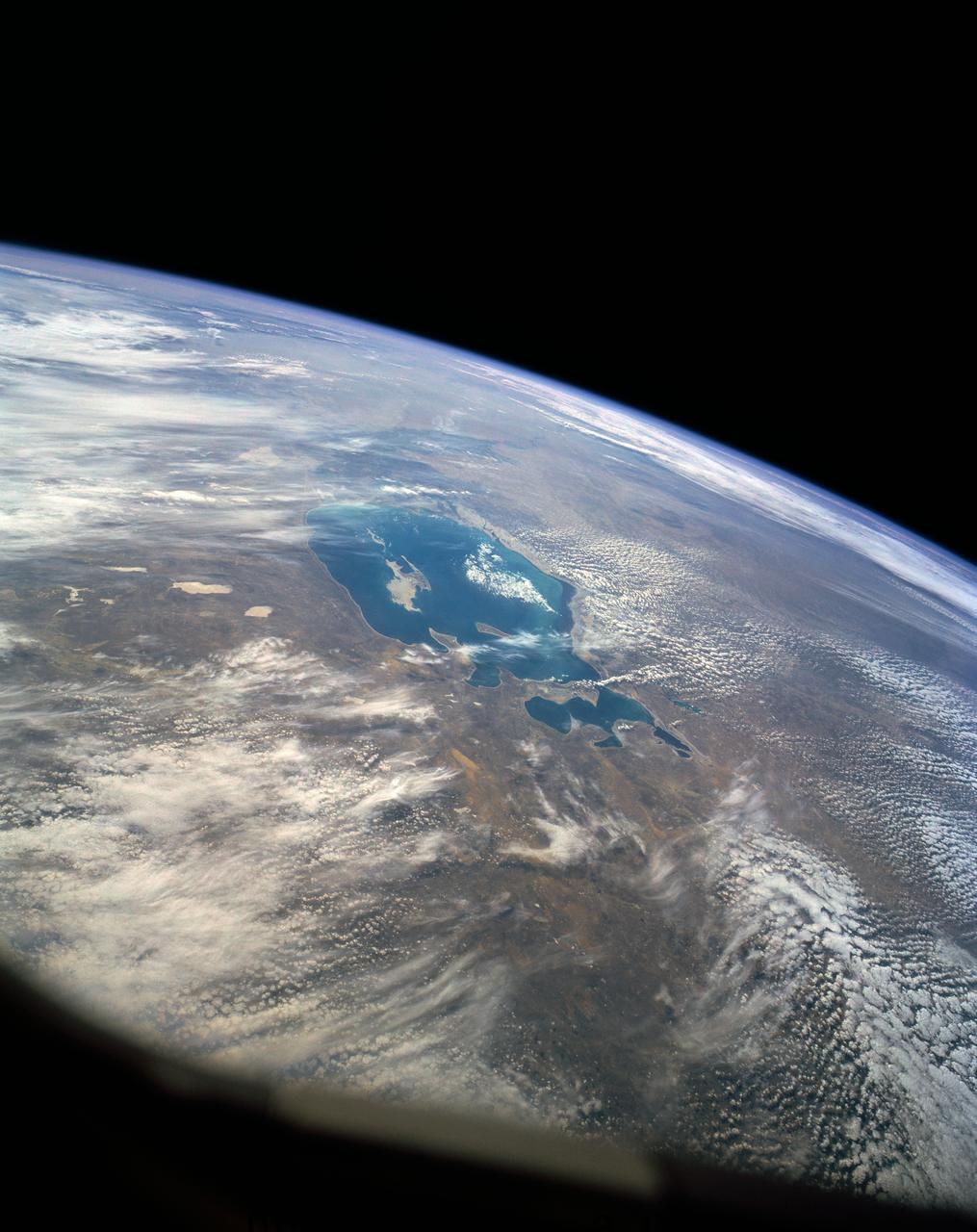
41G-120-005 (5-13 Oct 1984) --- The Kyzyl Kum Desert of the Kazakh and Uzbek Soviet Socialist Republics. The Aralskoe More, also known as the Aral Sea, is to the south-southeast. This saltwater lake is fed mainly from waters of the Amu Darya River, mostly with snow melt water from the distant Tyan-Shan Mountains near the Afghanistan and China border. The crew consisted of astronauts Robert L. Crippen, commander; Jon A. McBride, pilot; mission specialist's Kathryn D. Sullivan, Sally K. Ride, and David D. Leestma; Canadian astronaut Marc Garneau; and Paul D. Scully-Power, payload specialist.
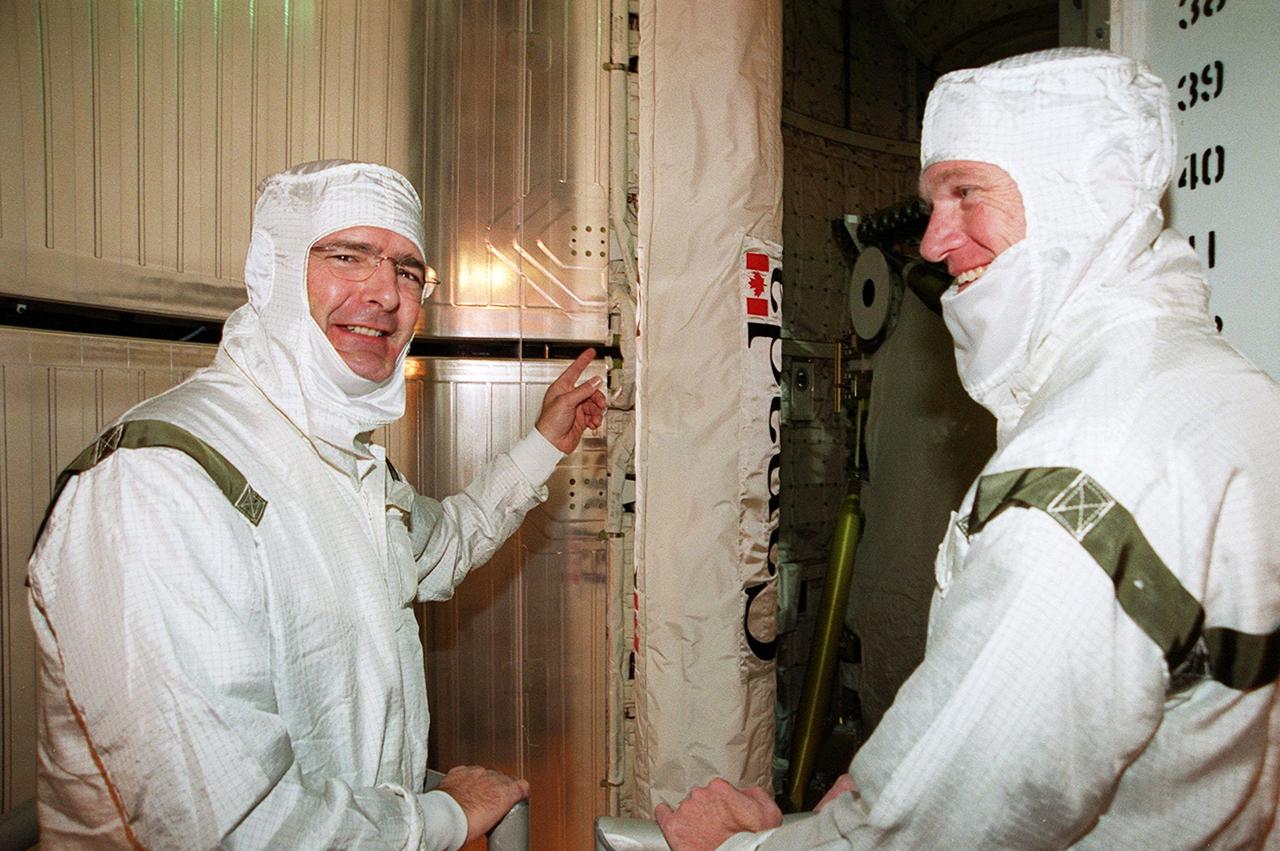
STS-97 Mission Specialist Marc Garneau, who is with the Canadian Space Agency, points to the Canadian robotic arm he will be working with during spacewalks to install solar arrays. At right is Commander Brent Jett. The arrays are part of the P6 Integrated Truss Segment that will be temporarily installed on the recently delivered Z1 truss, connecting them to the Unity module. Each more than 100 feet long, the arrays will capture energy from the sun and convert it to power for the Station. STS-97 is scheduled to launch Nov. 30 at about 10:06 p.m. EST
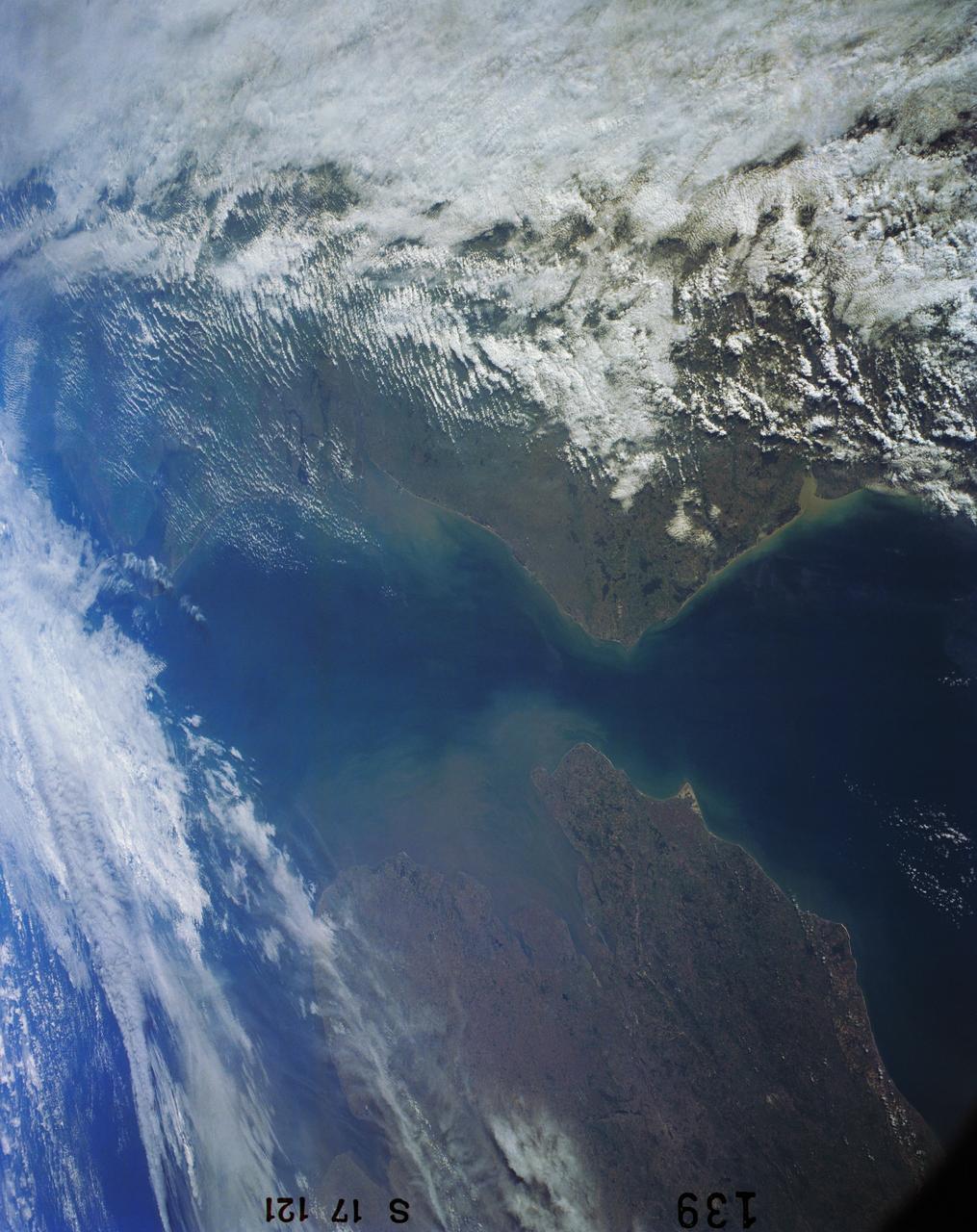
41G-121-139 (5-13 Oct. 1984) --- The Strait of Dover and London, seldom seen in space photography, can be delineated in this medium format camera's scene showing parts of England and France from onboard the Earth-orbiting space shuttle Challenger. Parts of the Thames River can also be traced in the frame. The 41-G crew consisted of astronauts Robert L. Crippen, commander; Jon A. McBride, pilot; and Mission Specialists Kathryn D. Sullivan, Sally K. Ride, and David D. Leestma; along with Canadian astronaut Marc Garneau; and Paul D. Scully-Power, both payload specialists. Photo credit: NASA
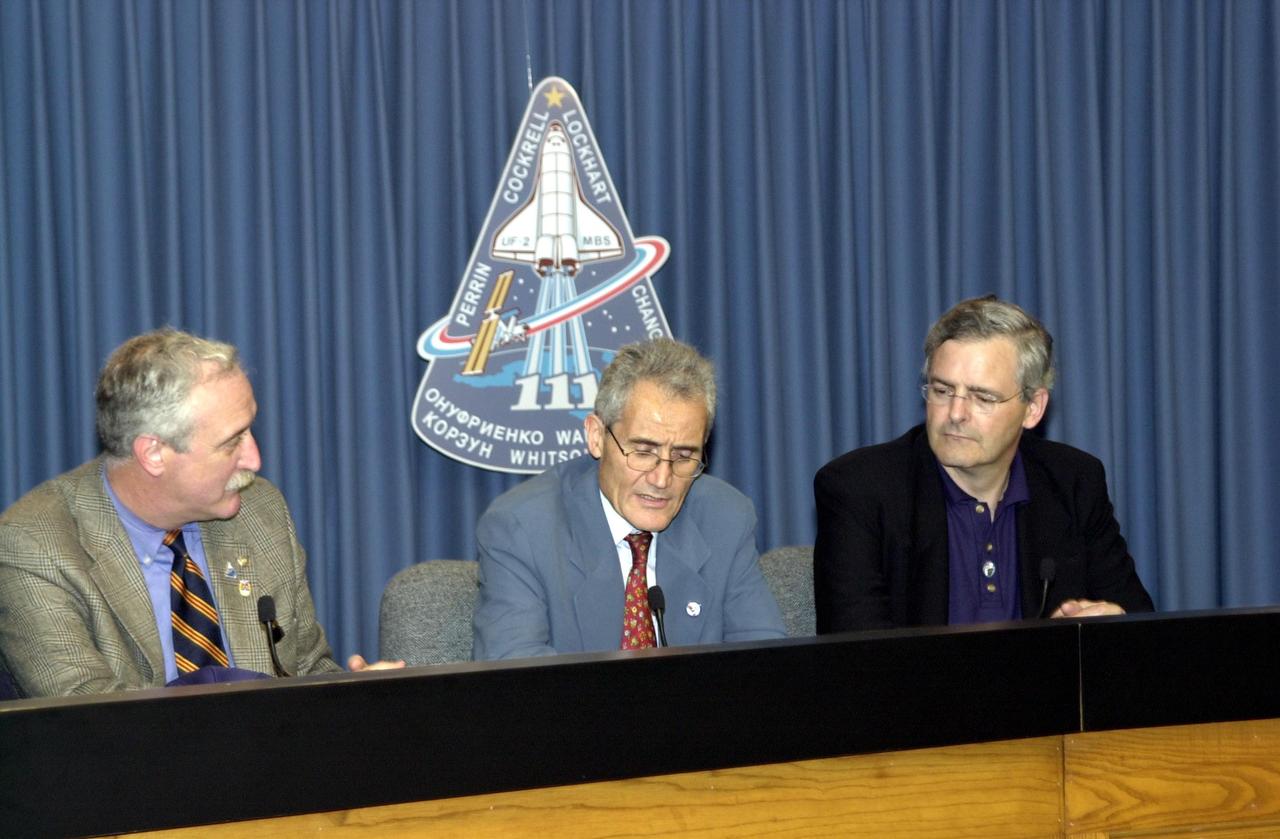
KENNEDY SPACE CENTER, FLA. -- In the Press Site auditorium, space agency officials participate in a media briefing following the launch scrub of Space Shuttle mission STS-111. From left are NASA Administrator Sean O'Keefe, French Space Agency President Dr. Alain Bensoussan, and Canadian Space Agency President Dr. Marc Garneau. STS-111 is the second Utilization Flight to the International Space Station, carrying the Multi-Purpose Logistics Module Leonardo, the Mobile Base System (MBS), and a replacement wrist/roll joint for the Canadarm 2. Also on board will be the Expedition Five crew who will replace Expedition Four on the Station. Launch is rescheduled for May 31 at 7:22 p.m. EDT
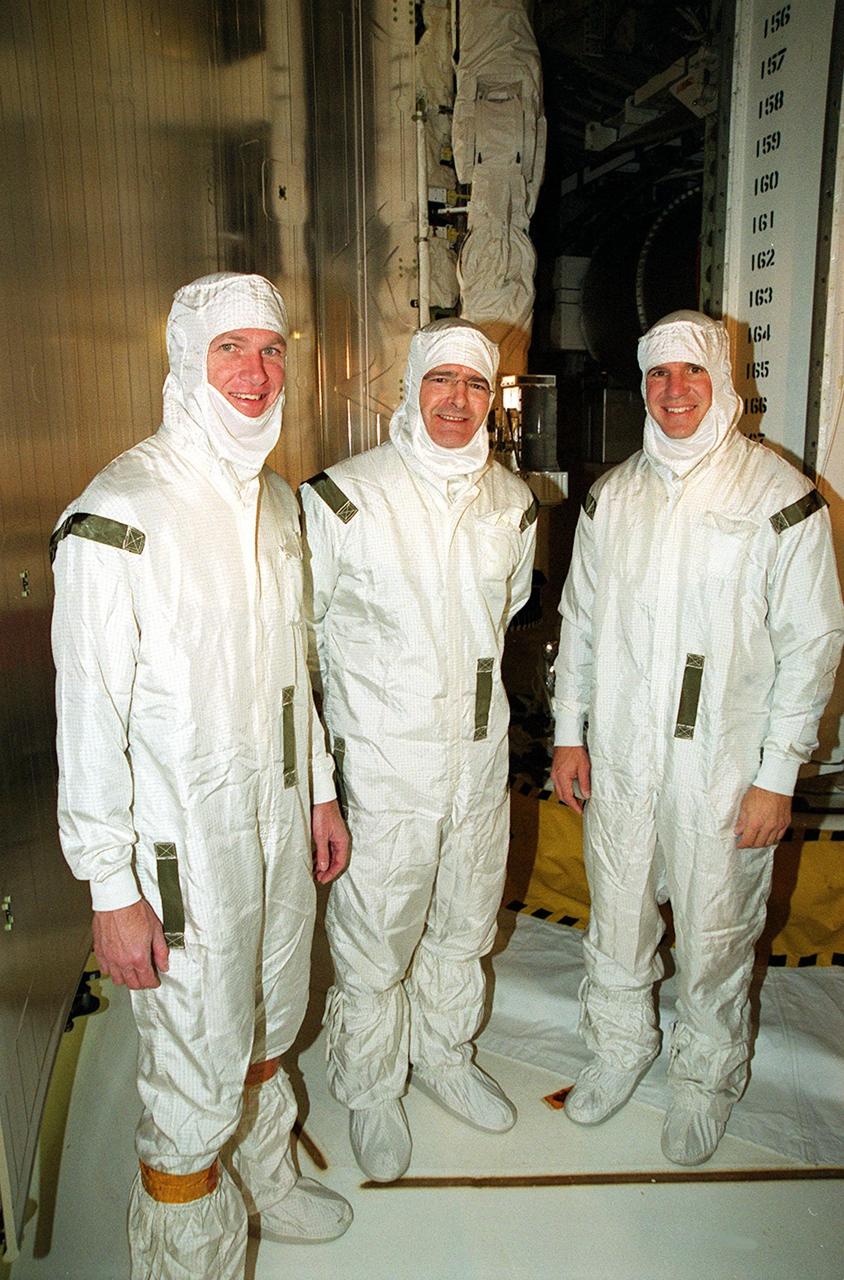
In the payload changeout room at Launch Pad 39B, STS-97 Commander Brent Jett (left), Mission Specialist Marc Garneau (center) and Pilot Michael Bloomfield (right) pause during a payload walkdown. The payload comprises the P6 Integrated Truss Segment, with solar arrays and batteries that will be temporarily installed on the recently delivered Z1 truss, connecting them to the Unity module. The two solar arrays are each more than 100 feet long. They will capture energy from the sun and convert it to power for the Station. Two spacewalks will be required to install the solar array connections. STS-97 is scheduled to launch Nov. 30 at about 10:06 p.m. EST
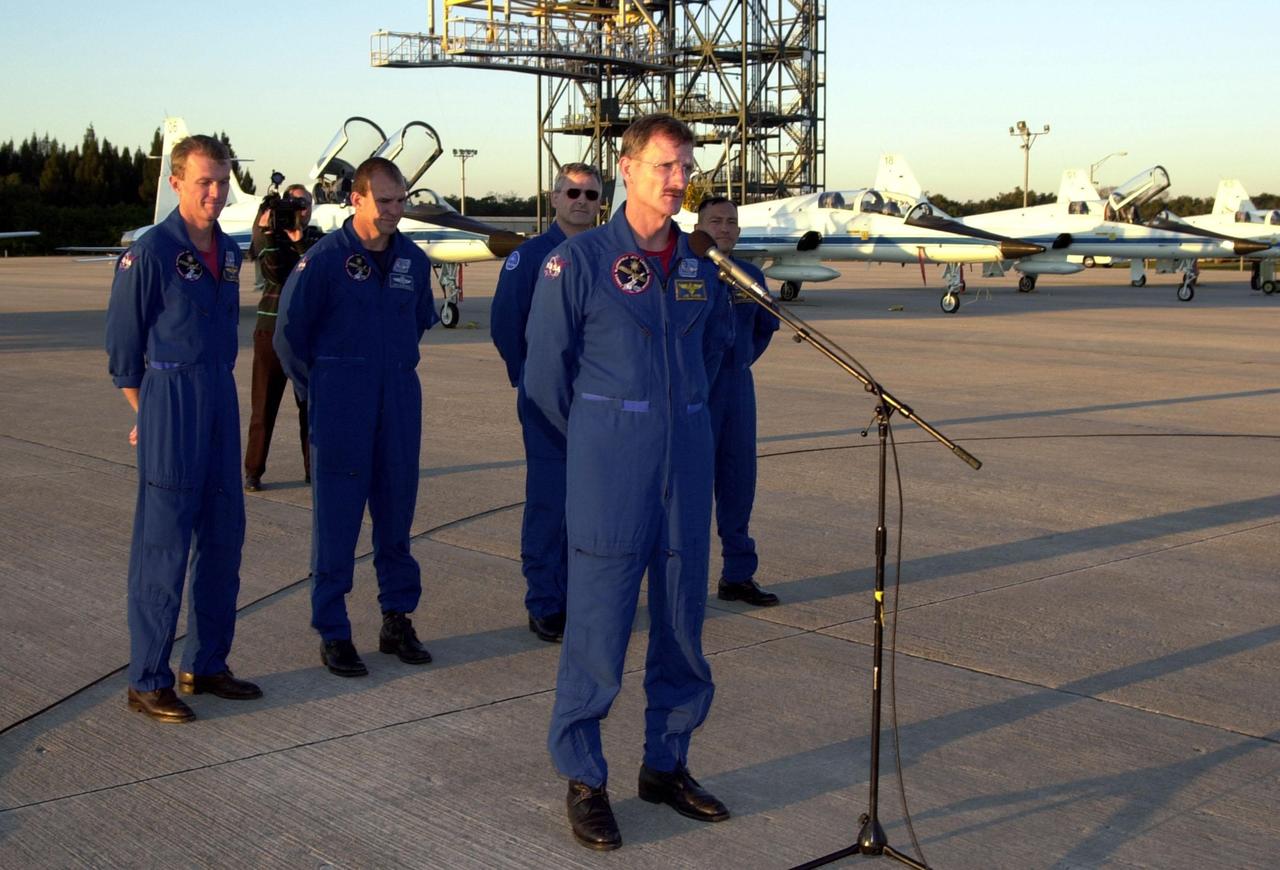
After their arrival at the Shuttle Landing Facility, the STS-97 crew gather to address the media. At the microphone is Mission Specialist Joseph Tanner. Behind him stand Commander Brent Jett, Pilot Michael Bloomfield and Mission Specialists Marc Garneau, who is with the Canadian Space Agency, and Carlos Noriega. Mission STS-97is the sixth construction flight to the International Space Station. Its payload includes the P6 Integrated Truss Structure and a photovoltaic (PV) module, with giant solar arrays that will provide power to the Station. The mission includes two spacewalks to complete the solar array connections. STS-97 is scheduled to launch Nov. 30 at about 10:06 p.m. EST
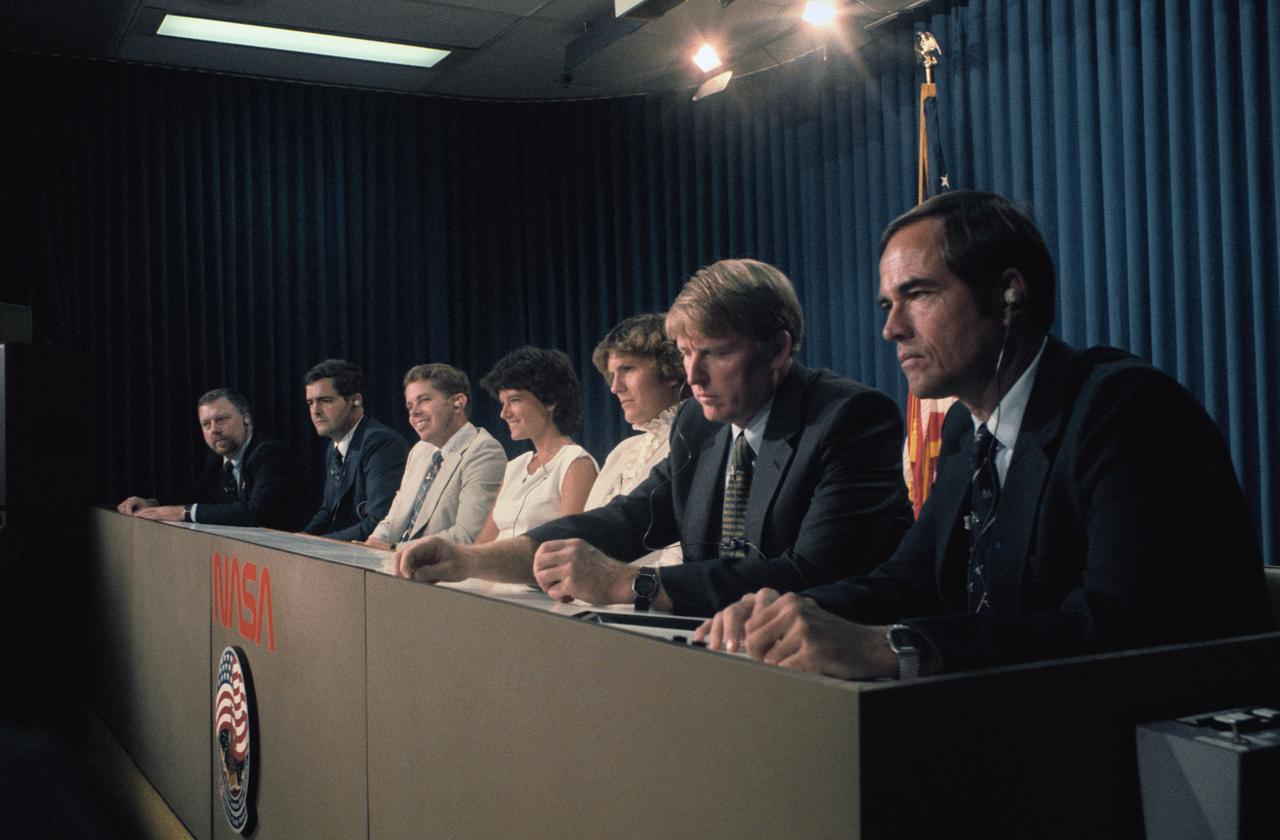
S84-41580 (3 Sept 1984) --- Assembled together publicly for the first time, the seven crewmembers for NASA's 41-G Space Shuttle mission field questions from the press corps at the Johnson Space Center. Pictured (foreground right to left) are Robert L. Crippen, crew commander ;Jon A. McBride, pilot; Kathryn D. Sullivan, Sally K. Ride and David C. Leestma--all mission specialists; Marc Garneau, representing the Canadian National Research Council, and Paul D. Scully-Power, U.S. Navy oceanographer, both payload specialists. Their flight is scheduled for early October.
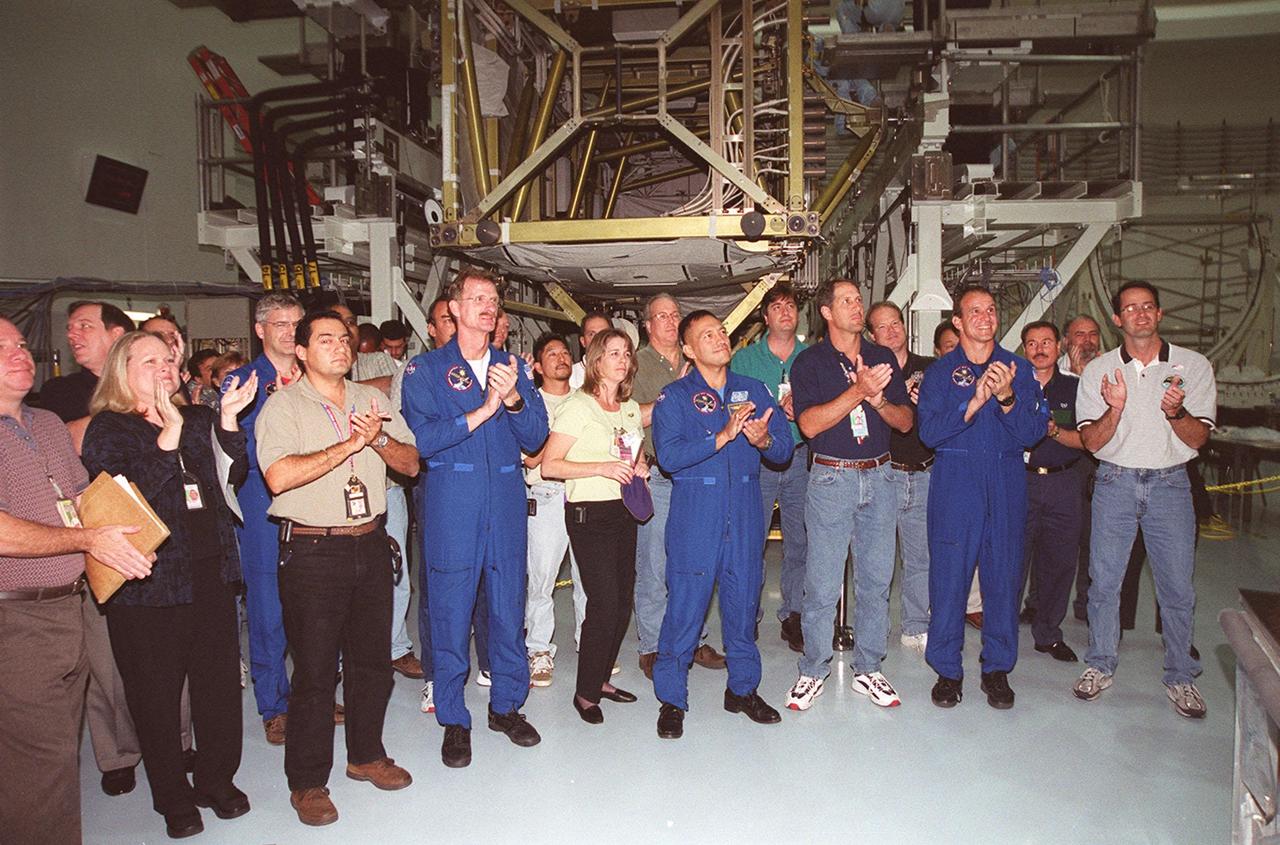
In the Space Station Processing Facility, workers applaud the turnover of the P6 Integrated Truss Structure by International Space Station ground operations to the NASA shuttle integration team in a special ceremony. Standing in front are STS-97 Mission Specialists Joe Tanner and Carlos Noriega plus Pilot Mike Broomfield. Behind and left of Tanner is Mission Specialist Marc Garneau. Mission STS-97is the sixth construction flight to the International Space Station. Its payload includes a photovoltaic (PV) module, with giant solar arrays that will provide power to the Station. The mission involves two spacewalks to complete the solar array connections. STS-97 is scheduled to launch Nov. 30 at 10:05 p.m. EST
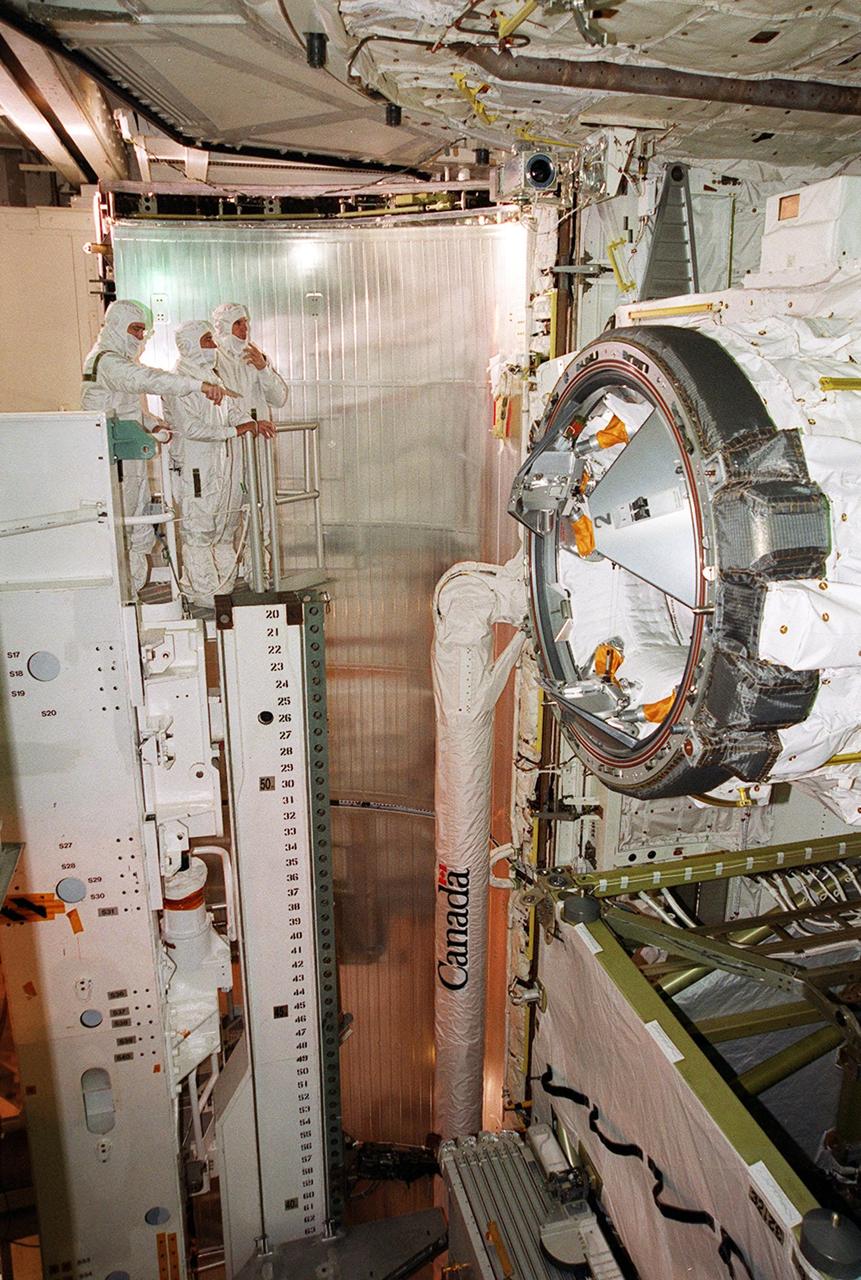
Members of the STS-97 crew look into Endeavour’s payload bay at some of the equipment that will be carried on the mission. On the left, pointing, is Mission Specialist Marc Garneau. Next to him (left to right) are Mission Specialist Carlos Noriega and Pilot Michael Bloomfield. At right center of the photo is the orbiter docking system (ODS). At left and below the ODS is the Canadian robotic arm that will be used during spacewalks on the mission to install solar arrays. Each more than 100 feet long, the arrays will capture energy from the sun and convert it to power for the Station. STS-97 is scheduled to launch Nov. 30 at about 10:06 p.m. EST
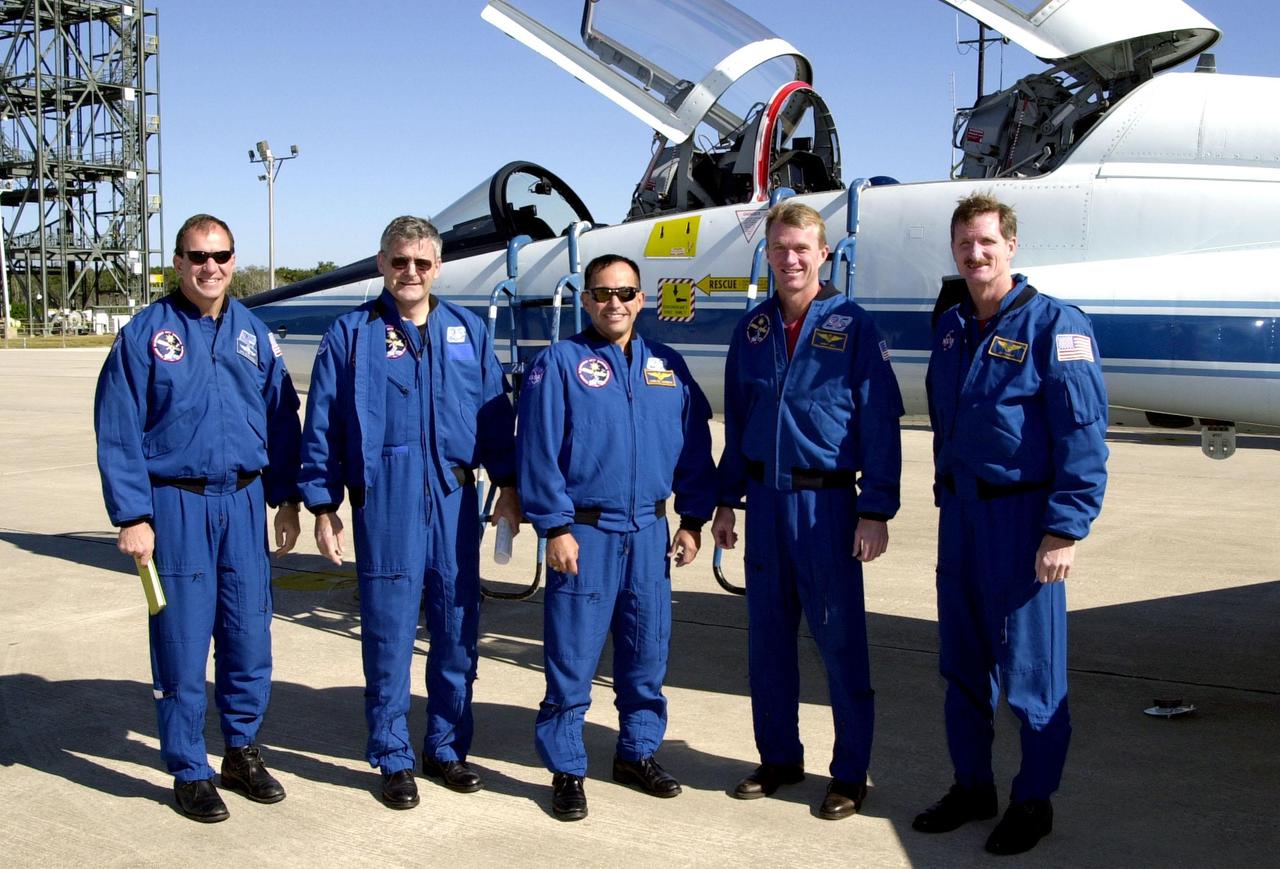
The STS-97 crew poses for a photo after landing at KSC’s Shuttle Landing Facility. Standing, left to right, are Pilot Mike Bloomfield, Mission Specialists Marc Garneau and Carlos Noriega, Commander Brent Jett and Mission Specialist Joe Tanner. They are at KSC for a mini-CEIT (Crew Equipment Interface Test). STS-97 is scheduled to launch Nov. 30 at 10:06 p.m. EST from Launch Pad 39B. The sixth flight to the International Space Station, the mission is expected to last 11 days, with a planned KSC landing at about 5:58 p.m. Dec. 11
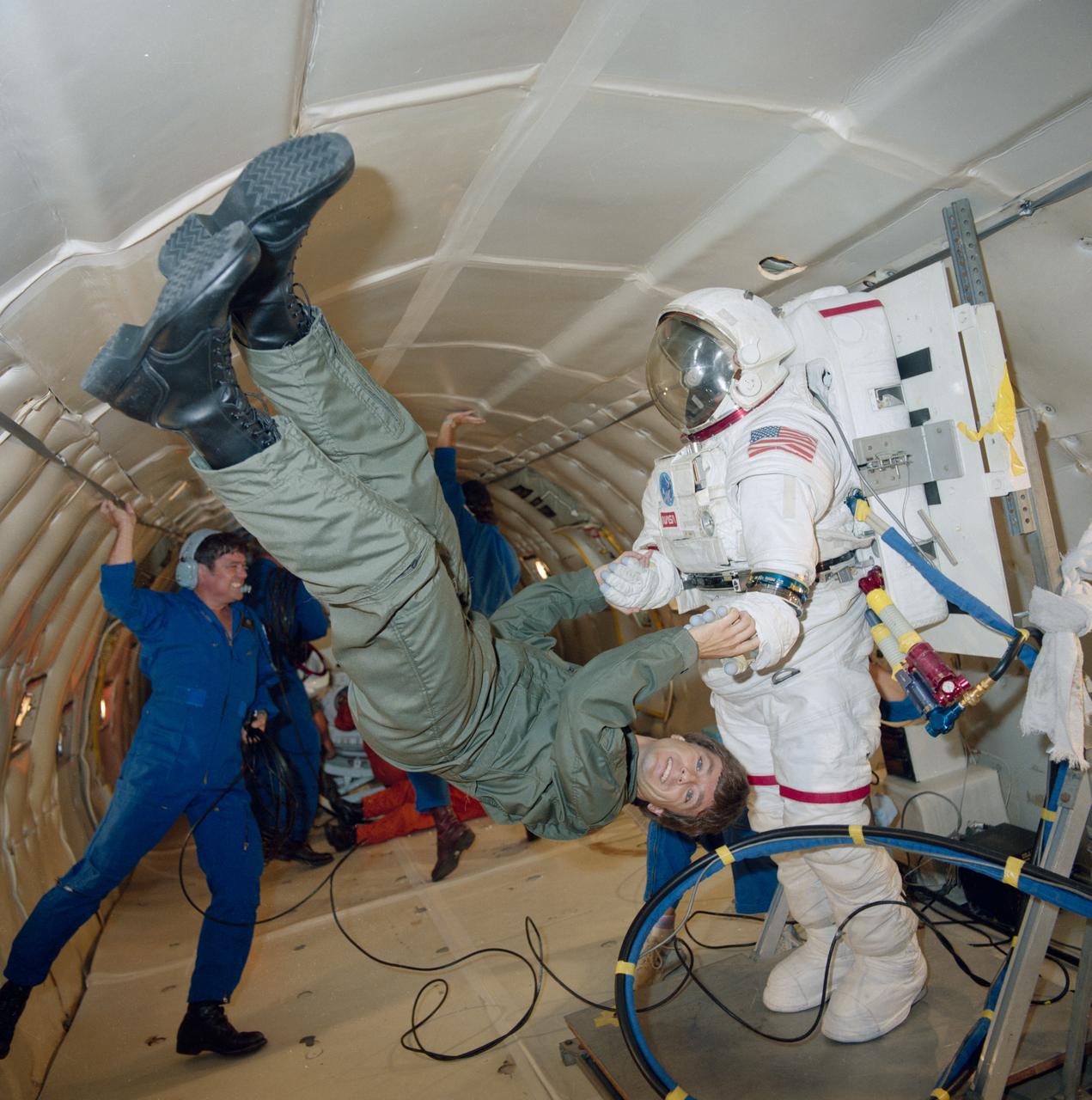
S84-37532 (18 July 1984) --? Robert B. Thirsk, backup payload specialist for 41-G appears to be shaking hands with an unoccupied extravehicular mobility unit (EMU) during a familiarization flight aboard NASA?s KC-135 aircraft. Thirsk, representing Canada?s National Research Council (NRC), serves as backup to Marc Garneau on the seven-member crew for Challenger?s October 1984 flight. This aircraft is used extensively for training and exposing Shuttle crewmembers to weightlessness as well as for evaluation of equipment and experiments scheduled for future flights.
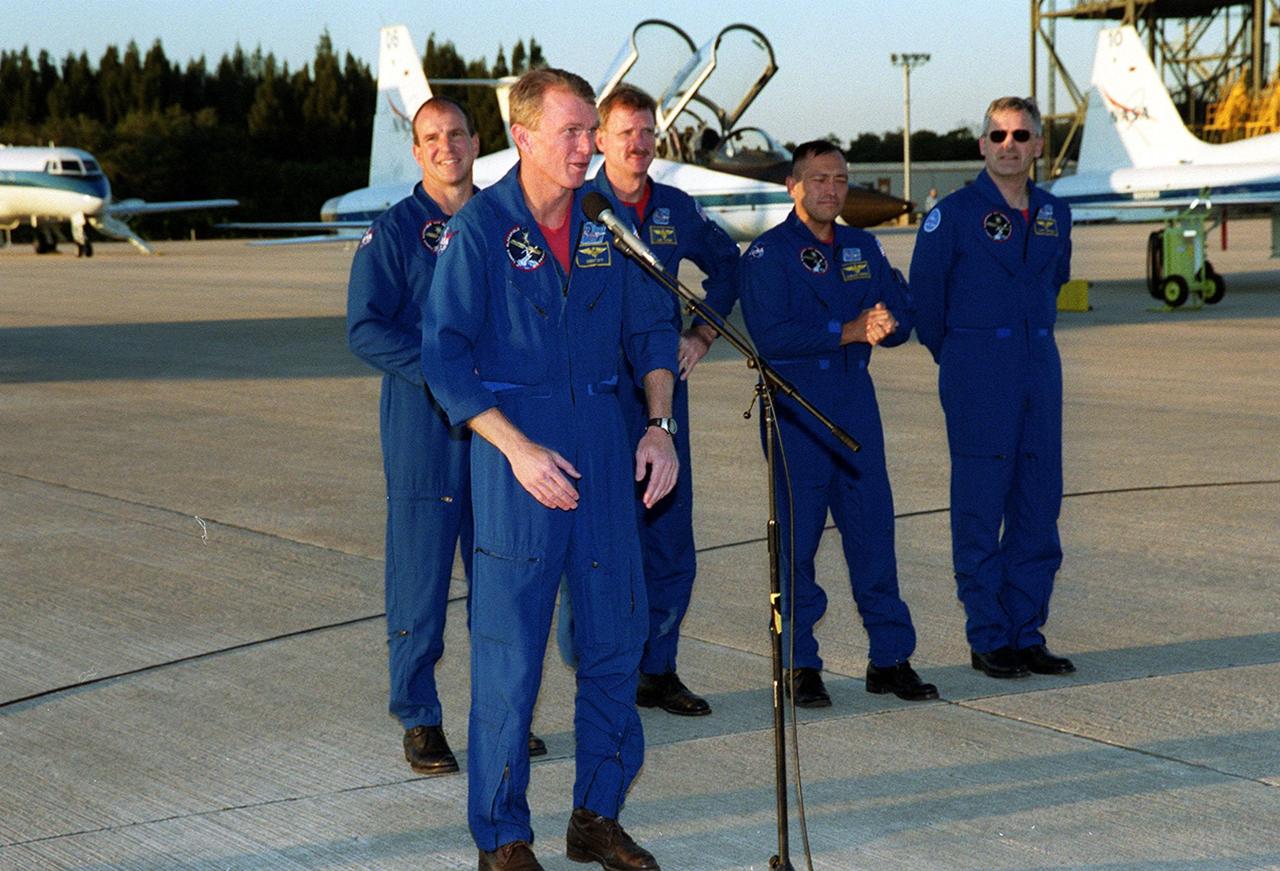
After arriving at the Shuttle Landing Facility, the STS-97 crew gather to address the media. At the microphone, Commander Brent Jett praises the efforts of the KSC workers to get ready for the launch. Behind Jett are Pilot Michael Bloomfield and Mission Specialists Joseph Tanner, Carlos Noriega and Marc Garneau, who is with the Canadian Space Agency. Mission STS-97 is the sixth construction flight to the International Space Station. Its payload includes the P6 Integrated Truss Structure and a photovoltaic (PV) module, with giant solar arrays that will provide power to the Station. The mission includes two spacewalks to complete the solar array connections. STS-97 is scheduled to launch Nov. 30 at about 10:06 p.m. EST
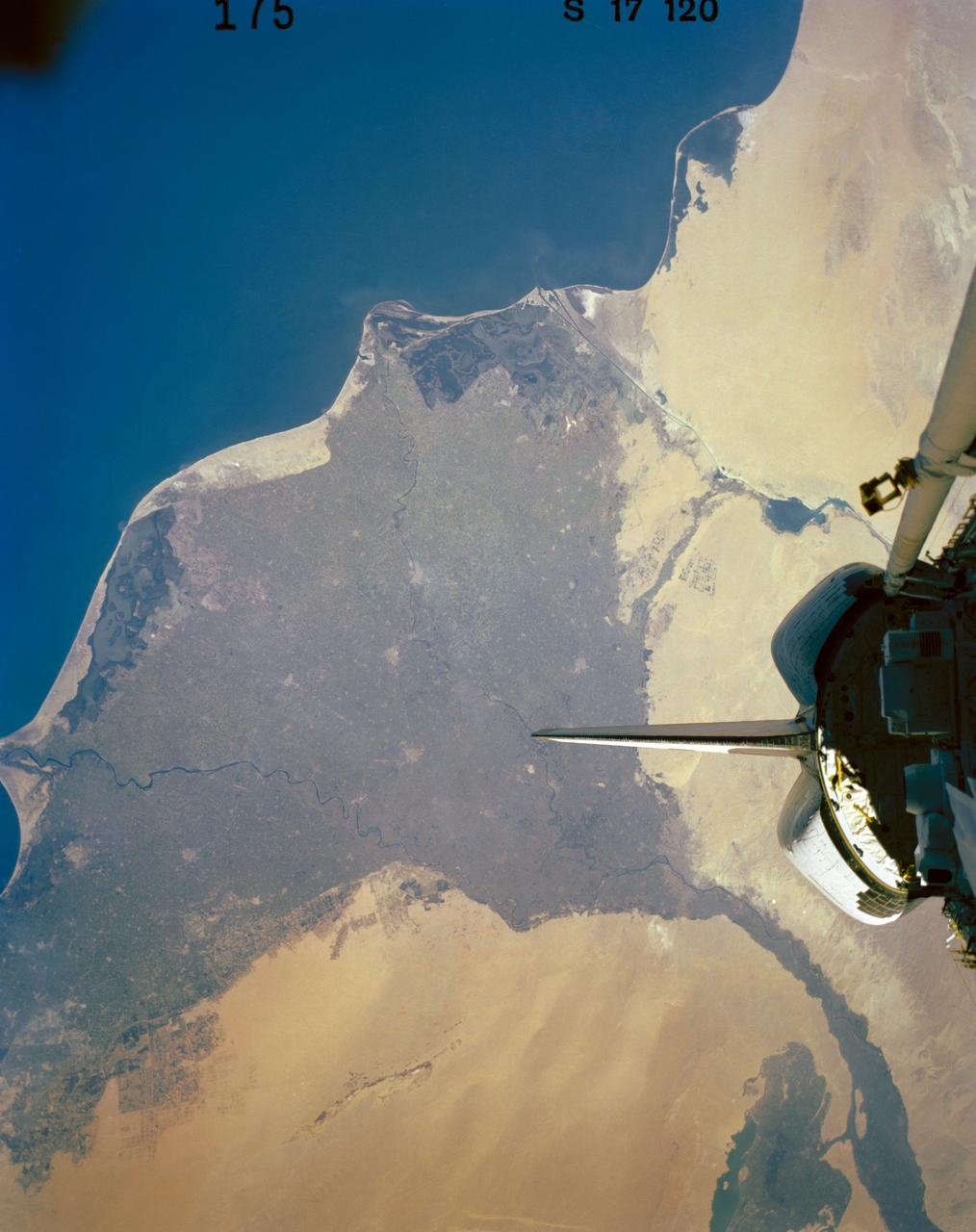
41G-120-175 (5-13 Oct. 1984) --- Egypt and the Nile River Delta are easily recognizable in this 250mm frame photographed by one of the seven 41-G crew members aboard the Earth-orbiting space shuttle Challenger. Cairo and the Egyptian pyramids are also visible in the lower left side of this photograph. The 41-G crew consisted of astronauts Robert L. Crippen, commander, Jon A. McBride, pilot; Mission Specialists Kathryn D. Sullivan, Sally K. Ride, and David D. Leestma; along with Canadian astronaut Marc Garneau; and Paul D. Scully-Power, both payload specialists. Photo credit: NASA
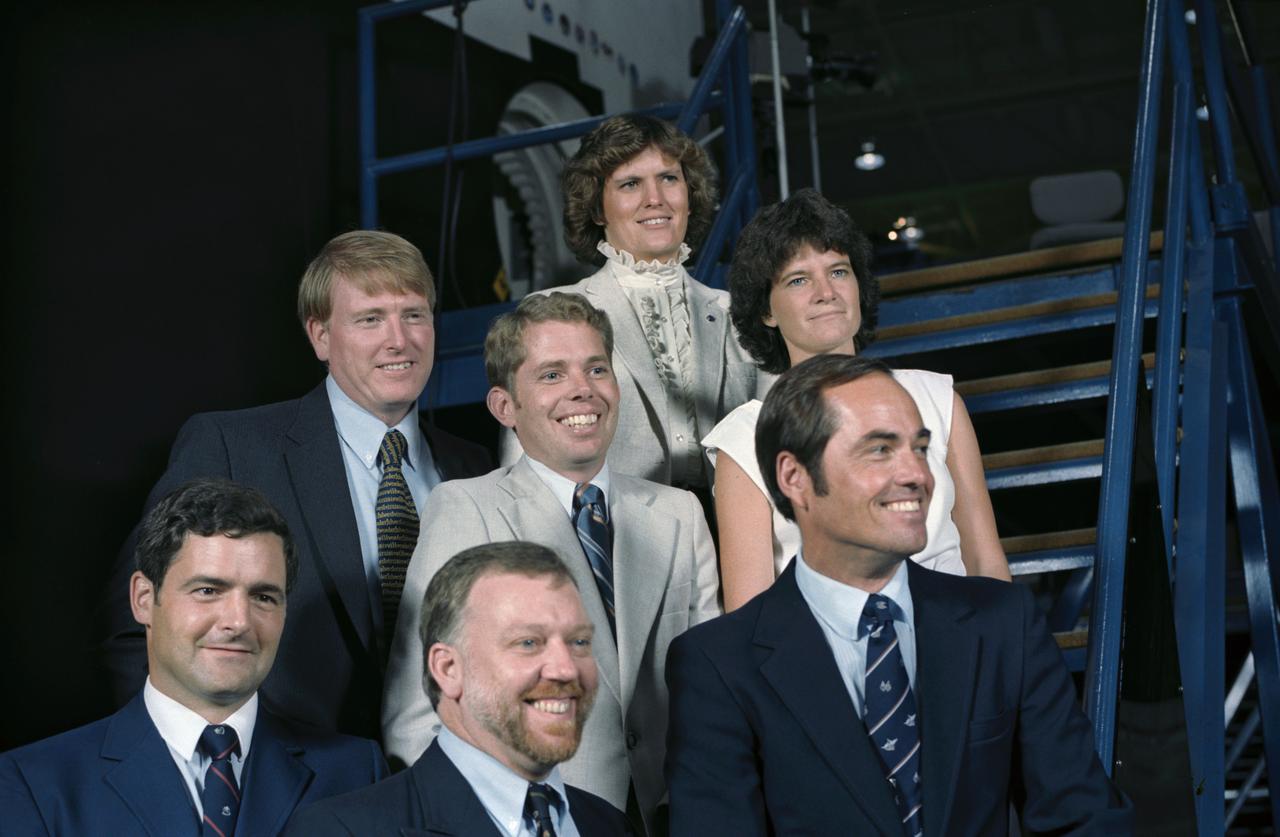
41D-3277 (S14-3277) (4 Sept 1984) --- Having met the press for the first time as a group, members of the STS 41-G crew pose for photographs in the Shuttle mockup and integration laboratory at the Johnson Space Center. They are (bottom row, left, to right) Marc Garneau and Paul D. Scully-Power, both payload specialists; and Robert L. Crippen, crew commander; (second row, l.-r.) Astronauts Jon A. McBride, pilot; David C. Leestma and Sally K. Ride, both mission specialists; and Kathryn D. Sullivan, mission specialist. They are scheduled for an October 5, 1984 launch aboard the Space Shuttle Challenger.
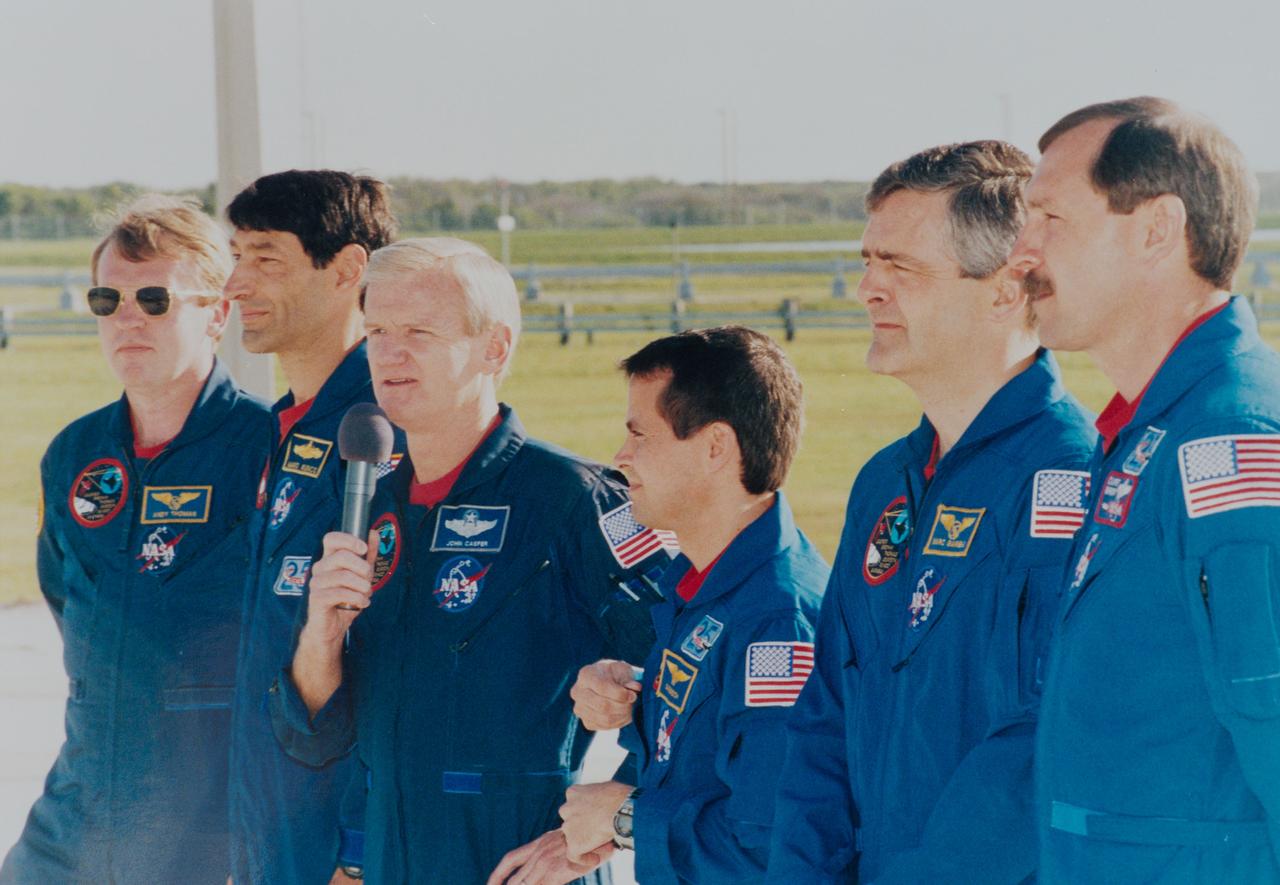
S96-08027 (22 April 1996) --- The crew talk to the news media at Launch Pad 39B, at the Kennedy Space Center (KSC). From left are astronauts Andrew S. W. Thomas, mission specialist; Mario Runco, Jr., mission specialist; John H. Casper, commander; Daniel W. Bursch, mission specialist; Marc Garneau, mission specialist representing the Canadian Space Agency (CSA); and Curtis L. Brown, Jr., pilot. The astronauts are at KSC for the Terminal Countdown Demonstration Test (TCDT), a dress rehearsal for launch, the Space Shuttle Endeavour is undergoing preparations at Pad 39B for liftoff on the fourth Shuttle flight of 1996 around May 16, 1996.
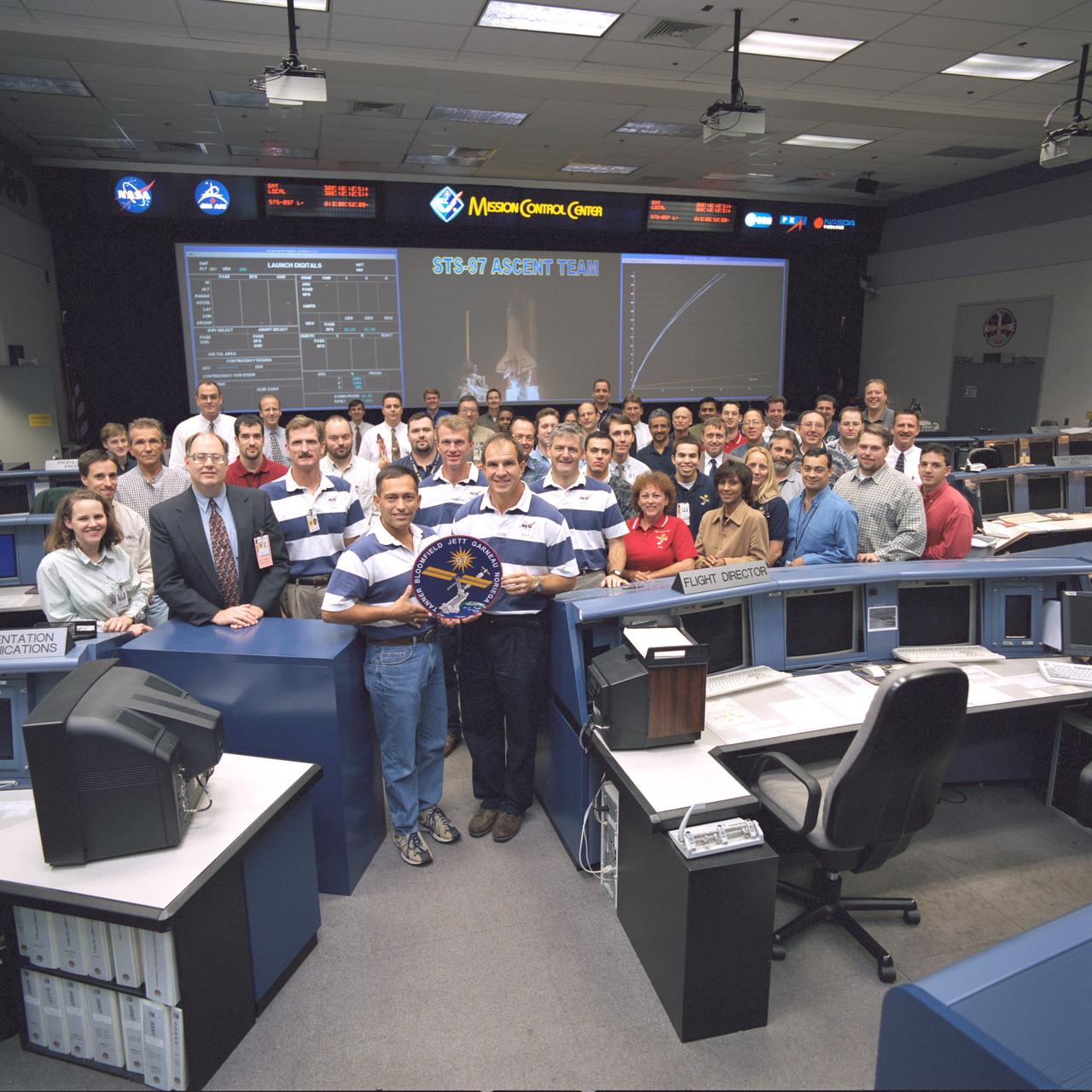
JSC2000-07294 (20 November 2000) --- The 40-odd flight controllers assigned to the STS-97 ascent team and some special guests pose for a group portrait in the shuttle flight control room in Houston's Mission Control Center (JSC). The five guests attired in the blue and white shirts are the flight crew members for the STS-97 crew, scheduled to be launched from Florida on the last day of this month. The astronauts are, from the left, Joseph R. Tanner, Carlos I. Noriega, Brent W. Jett, Jr., Michael J. Bloomfield and Marc Garneau, who represents the Canadian Space Agency (CSA). Ascent shift flight director Wayne Hale stands next to Tanner.
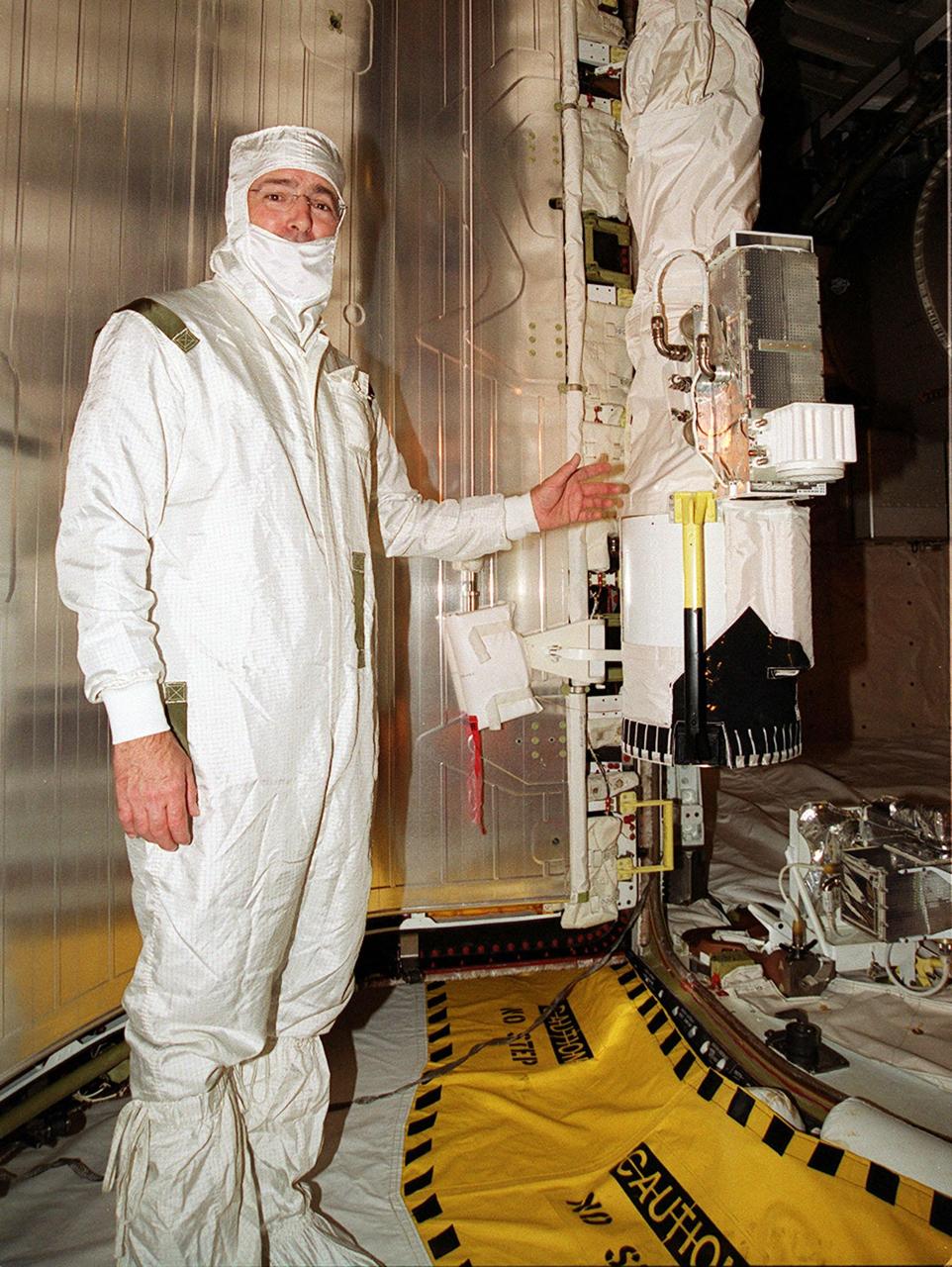
STS-97 Mission Specialist Marc Garneau points to Endeavour's robotic arm that he will use during a spacewalk on the mission. Members of the STS-97 crew are taking part in a payload walkdown from the payload changeout room at Launch Pad 39B. The payload comprises the P6 Integrated Truss Segment, with solar arrays that will be temporarily installed on the recently delivered Z1 truss, connecting them to the Unity module, and batteries. The two solar arrays are each more than 100 feet long. They will capture energy from the sun and convert it to power for the Station. Two spacewalks will be required to install the solar array connections. STS-97 is scheduled to launch Nov. 30 at about 10:06 p.m. EST
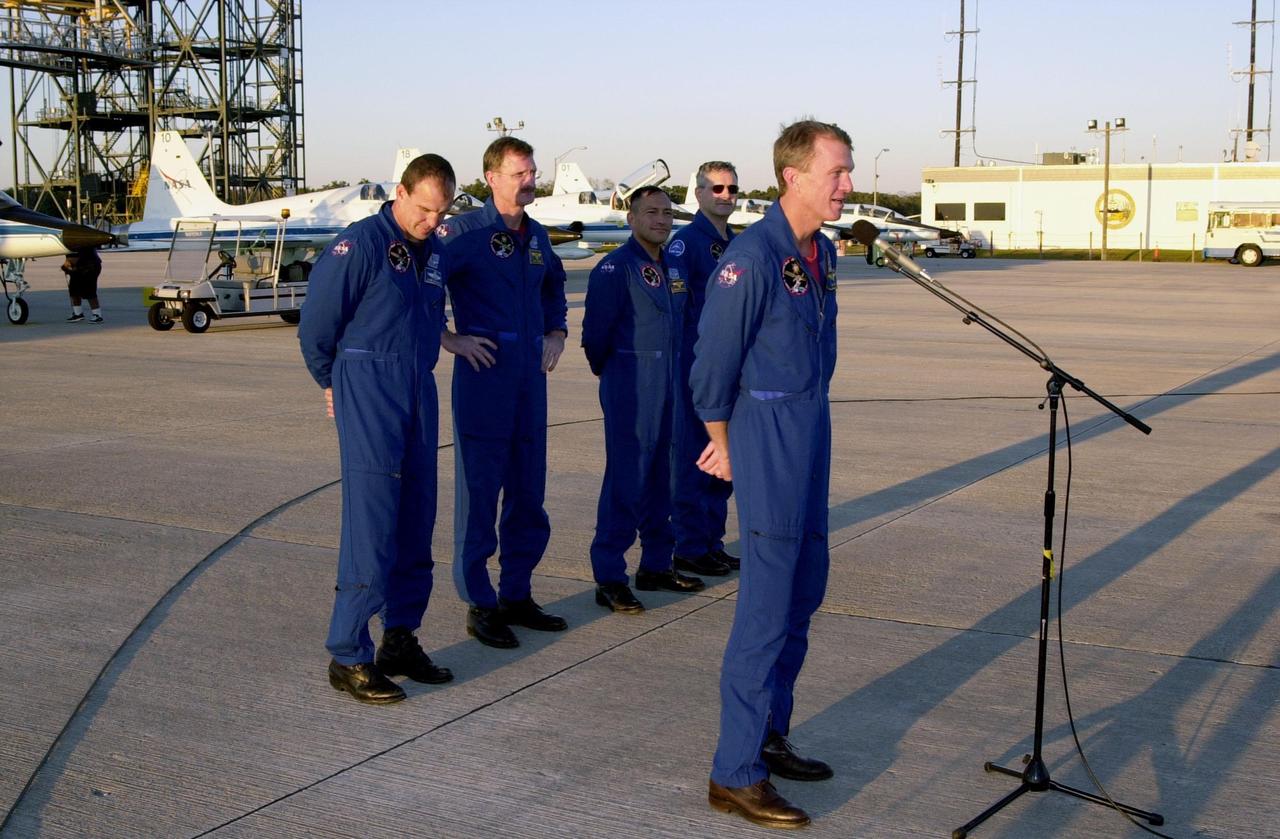
After their arrival at the Shuttle Landing Facility, the STS-97 crew gather to address the media. At the microphone, Commander Brent Jett praises the efforts of the KSC workers to get ready for the launch. Behind Jett are Pilot Michael Bloomfield and Mission Specialists Joseph Tanner, Carolos Noriega and Marc Garneau, who is with the Canadian Space Agency. Mission STS-97is the sixth construction flight to the International Space Station. Its payload includes the P6 Integrated Truss Structure and a photovoltaic (PV) module, with giant solar arrays that will provide power to the Station. The mission includes two spacewalks to complete the solar array connections. STS-97 is scheduled to launch Nov. 30 at about 10:06 p.m. EST