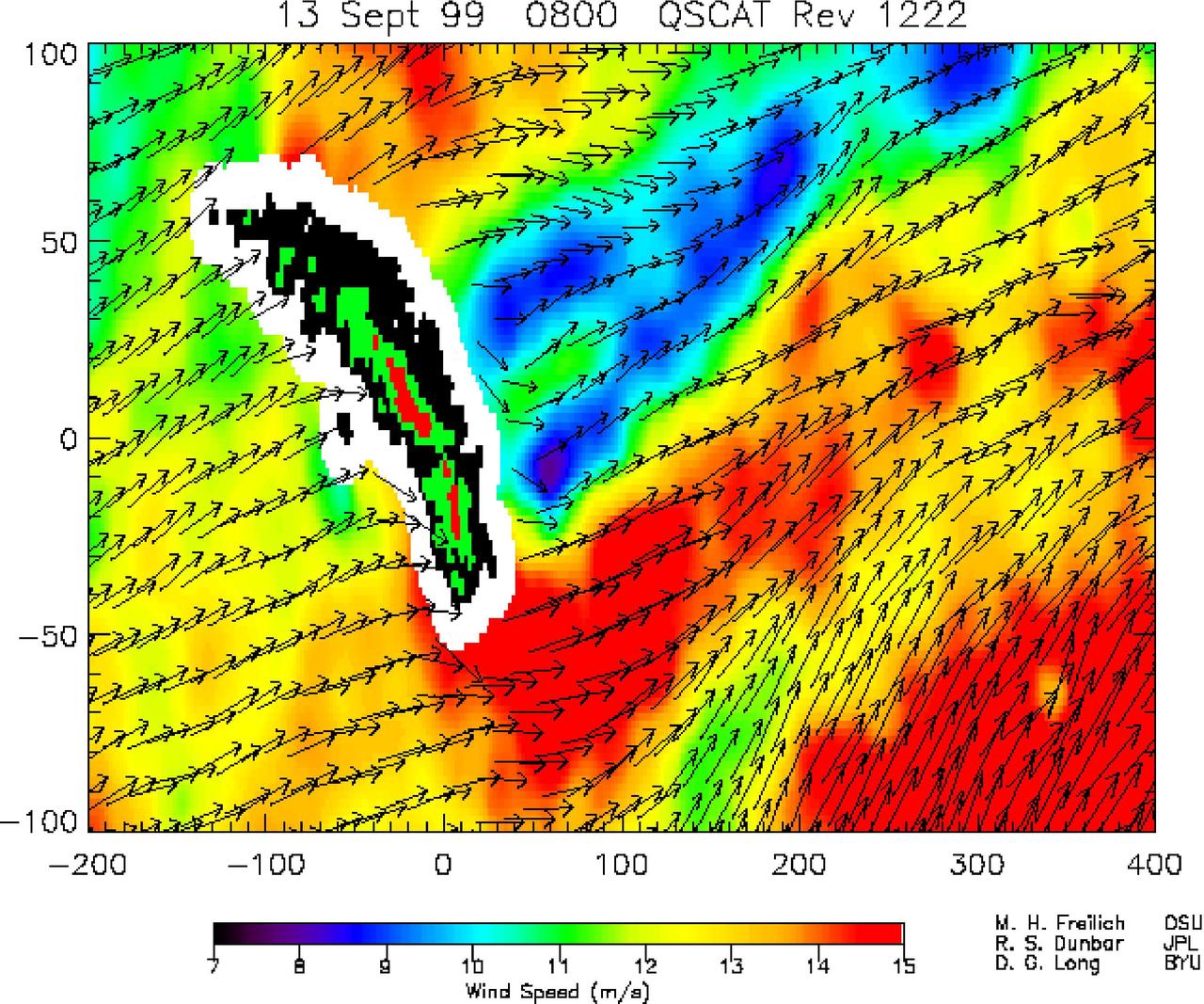
NASA SeaWinds instrument on the QuikScat satellite shows winds are blocked by an island mountain barrier on South Georgia Island, in the South Atlantic Ocean in the year 2000.
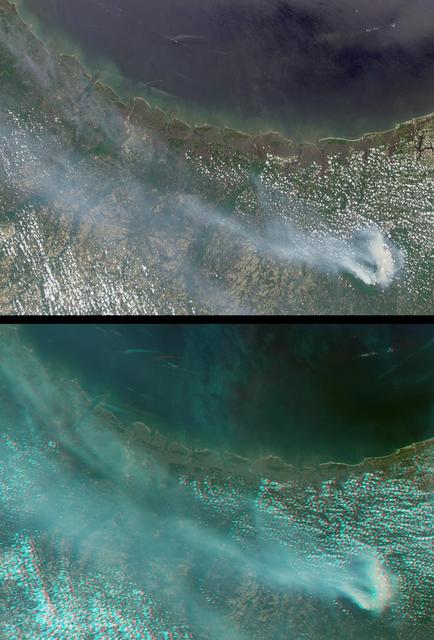
Large smoke plumes were produced by the Blackjack complex fire in southeastern Georgia Okefenokee Swamp as seen by the MISR instrument aboard NASA Terra spacecraft May 8, 2002. 3D glasses are necessary to view this image.
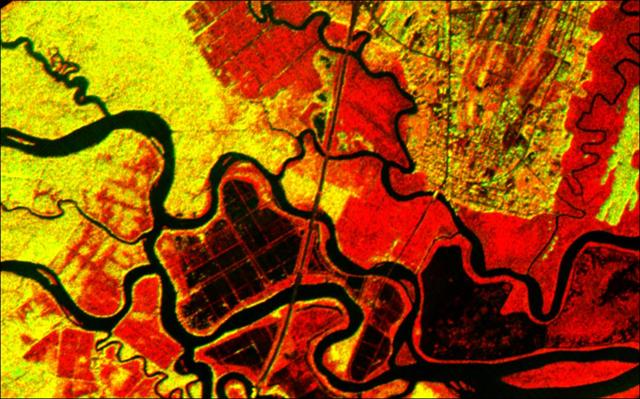
This radar image acquired by NASA Airborne Synthetic Aperture Radar AIRSAR in 2001, shows the Altamaha River Delta in the Georgia Sea Islands.
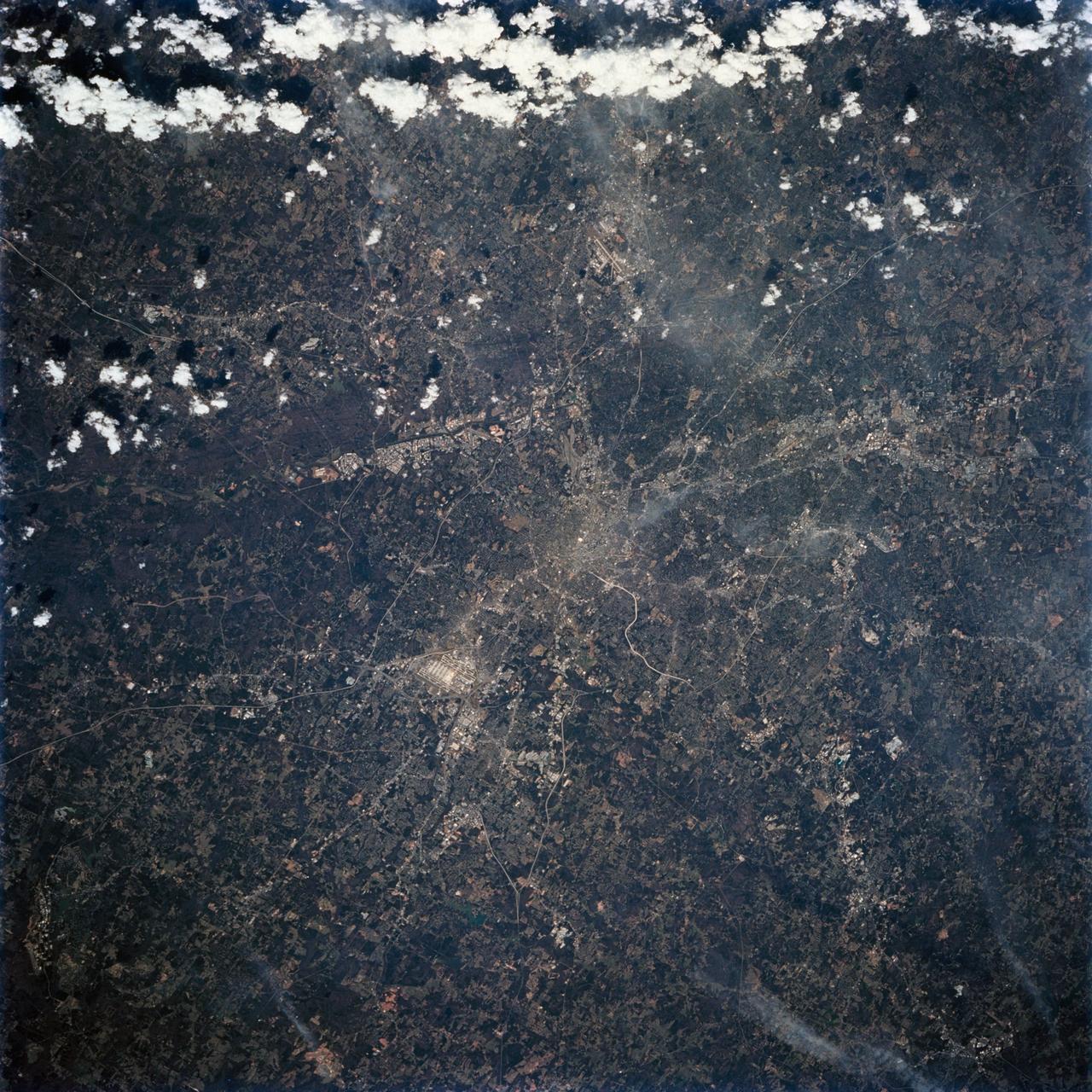
STS062-85-147 (4-18 March 1994) --- Hartsfield Atlanta International Airport is visible to the south of Atlanta, situated near the center of the photograph. Dobbins Air Force Base and the city of Marietta can also be seen to the north of Atlanta in this south-looking low-oblique view. The complex system of transportation routes and interstate highways surrounding and traversing Atlanta can also be seen in the photograph. The white dot near the center of the photograph is the Georgia Dome, a major sports and entertainment complex in downtown Atlanta. Atlanta is the cultural, industrial, transportation, financial and commercial center of the South. It has one of the busies air traffic hubs in the United States. A major aircraft assembly plant is located north of Atlanta in Marietta. The Stone Mountain Memorial, with its enormous relief carvings of Confederate figures, is located east of Atlanta and is visible on the photograph.
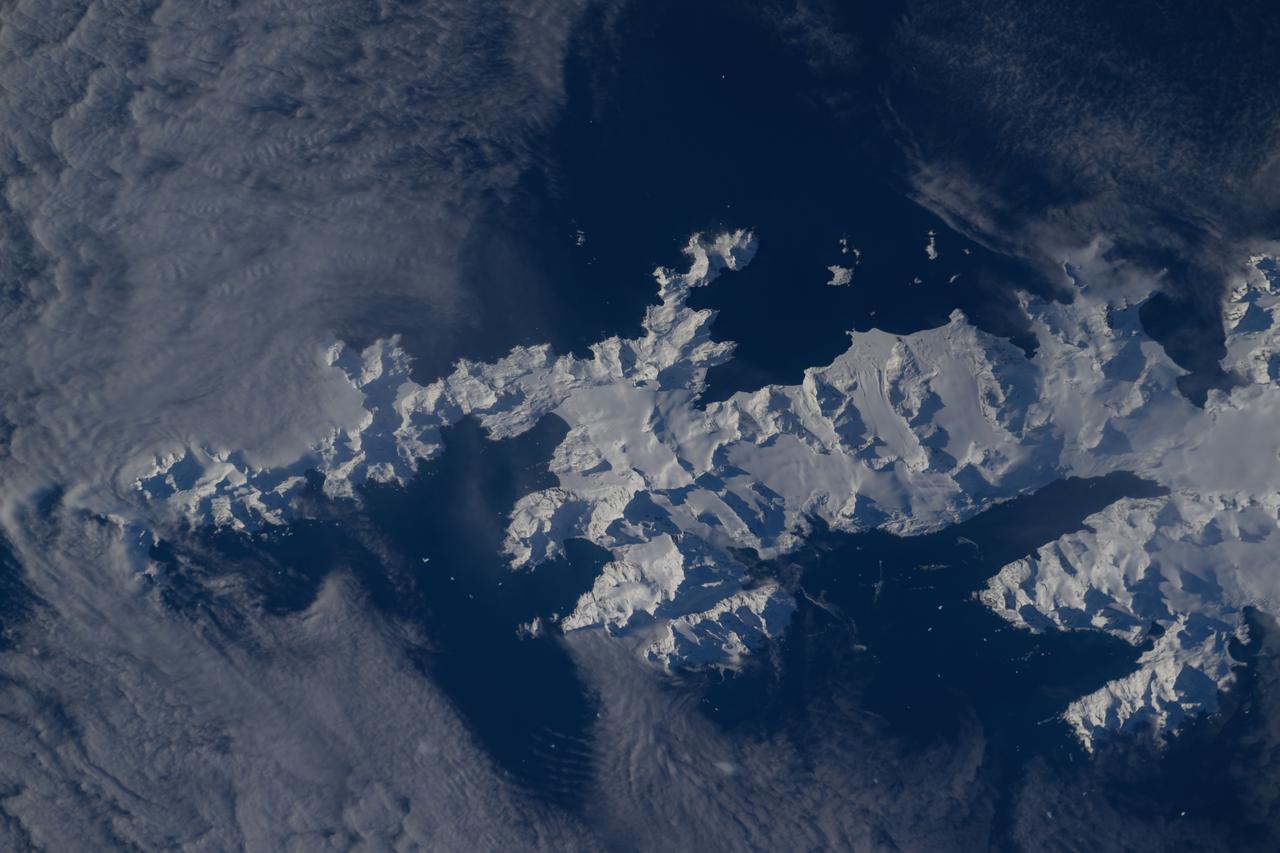
iss071e581850 (Sept. 1, 2024) -- In the southern Atlantic ocean is a snow-covered South Georgia Island. The British Overseas Territory was photographed by NASA astronaut Michael Barratt as the International Space Station orbited 267 miles above.
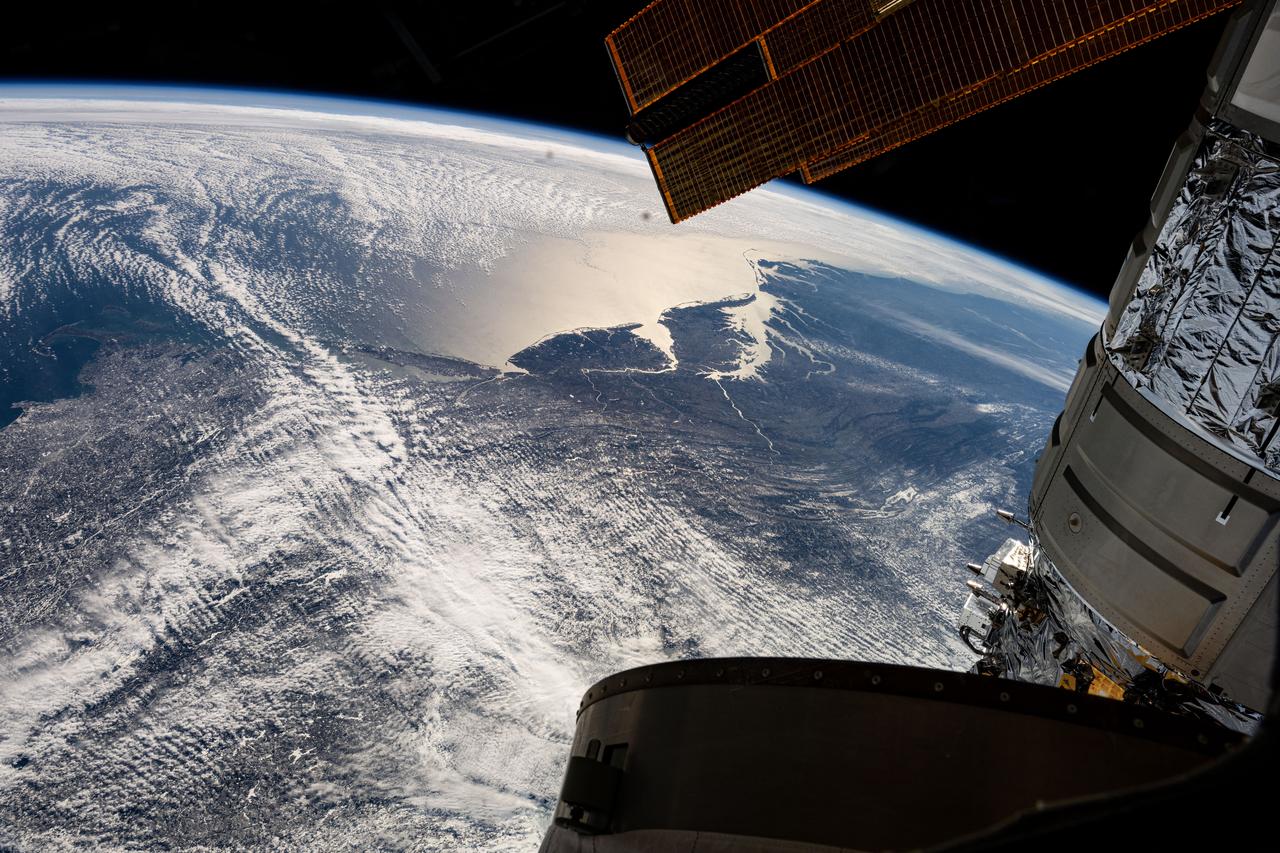
iss072e629084 (Feb. 14, 2025) --- The east coast of the United States from Massachussetts to Georgia, with the easily distinguishable Delaware Bay and Chesapeake Bay, contrasts with the gleaming Atlantic Ocean in this photograph from the International Space Station as it orbited 263 miles above North America.
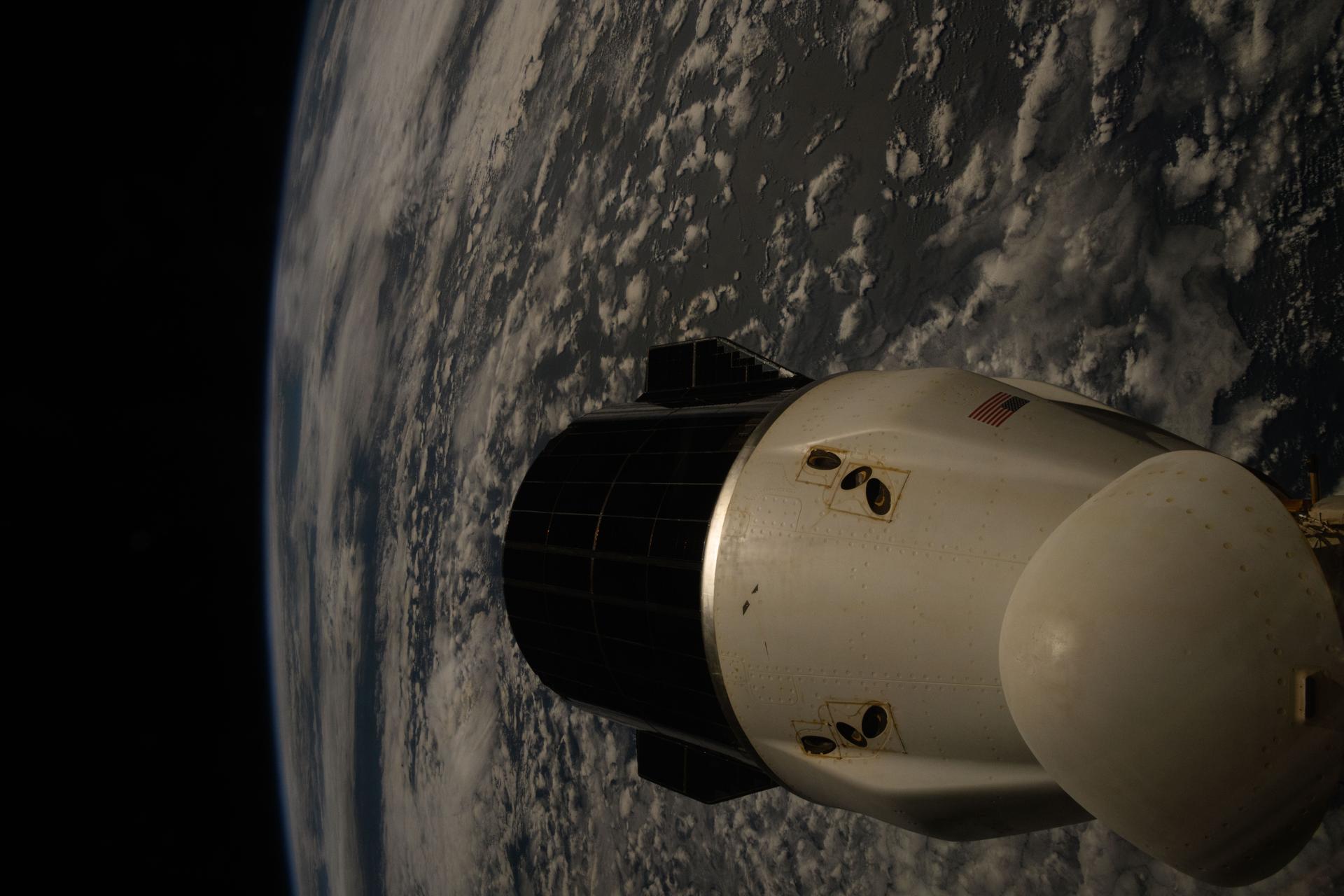
iss074e0100627 (Dec. 29, 2025) --- A SpaceX Dragon spacecraft is pictured docked to the International Space Station as the orbital outpost soared 269 miles above the Atlantic Ocean northwest of the South Georgia and the South Sandwich Islands.
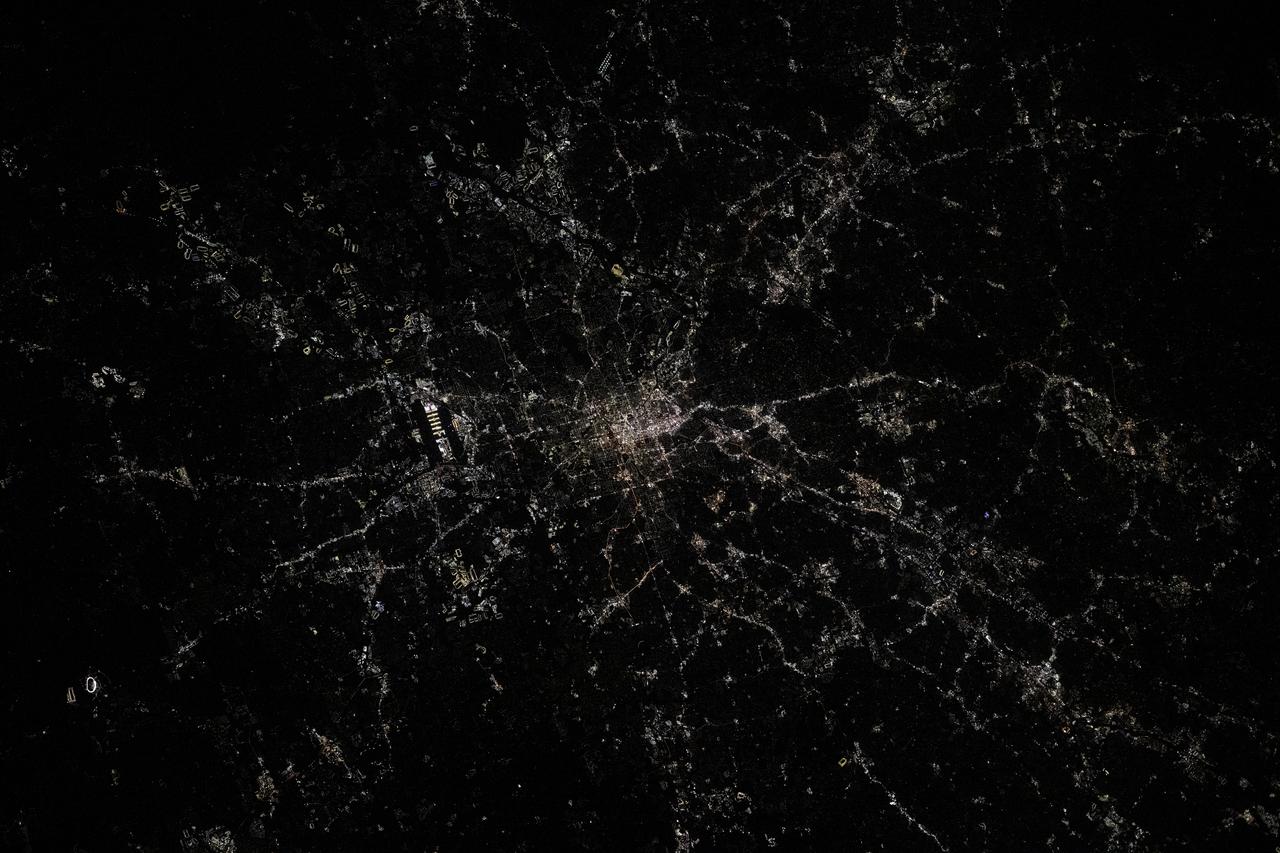
iss073e0433580 (June 27, 2025) --- Atlanta, Georgia, also known as the "City in a Forest" almost half covered by trees, and home to the busiest airport in the world, Hartsfield-Jackson Atlanta International Airport (center left), is pictured at approximately 6:19 a.m. local time from the International Space Station as it orbited 260 miles above the southern United States.
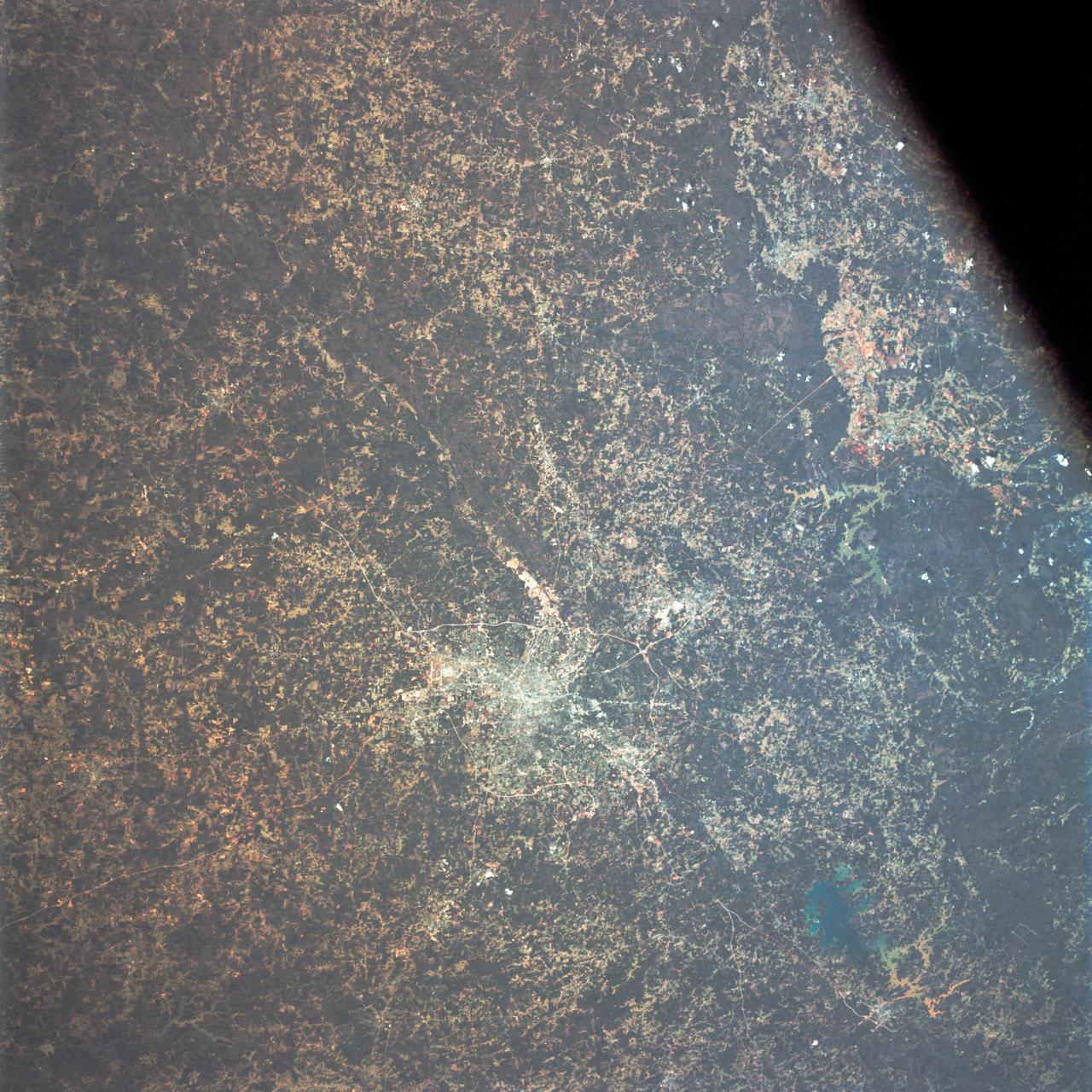
AS09-23-3567 (3-13 March 1969) --- Oblique view of the Atlanta, Georgia area as photographed from the Apollo 9 spacecraft during its Earth-orbital mission. The Chattahoochee River runs from Lake Sidney Lanier, near Gainesville (at upper left corner), south-westward by Atlanta and between Newnan and Carrollton (lower right). Allatoona Lake is at left center.
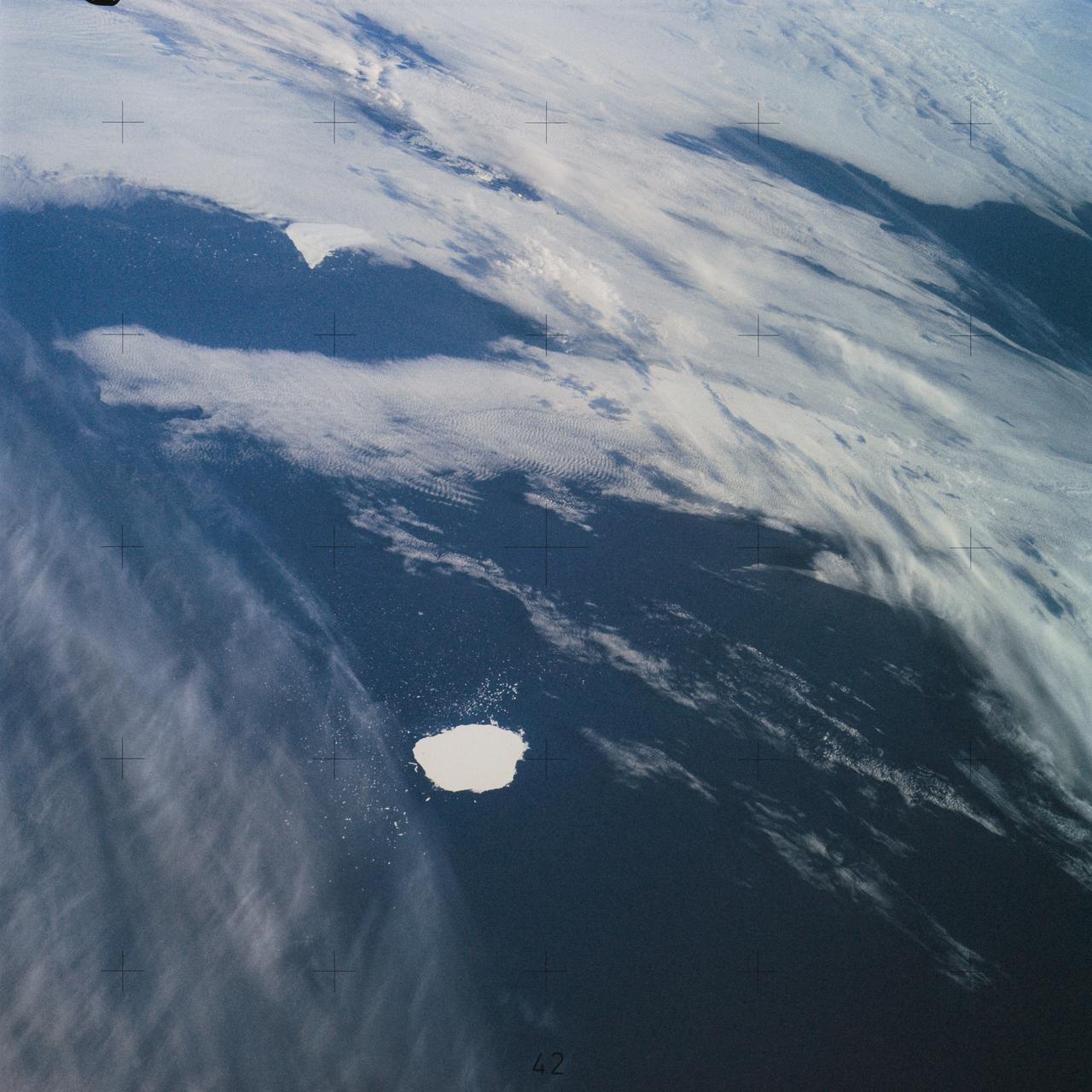
SL4-142-4577 (28 Jan. 1974) --- Two large ice islands in the vicinity of South Georgia Island in the South Atlantic Ocean, as photographed from the Skylab space station in Earth orbit by one of the Skylab 4 crewmen. The camera used was a hand-held 70mm Hasselblad, with SO-368 medium-speed Ektachrome. One of the ice islands is partially obscured by clouds. Ice islands were observed as large as 45 by 60 kilometers (27 x 37 miles) and as far north as 45 degrees south latitude. The size and distribution of the "small" icebergs (to a ship they would look very large) can be used to study the local winds and currents. Recent research has suggested the possibility of towing such Antarctic icebergs to selected areas and using them as water supplies. One such iceberg would contain many times the water as in Lake Powell. Photo credit: NASA
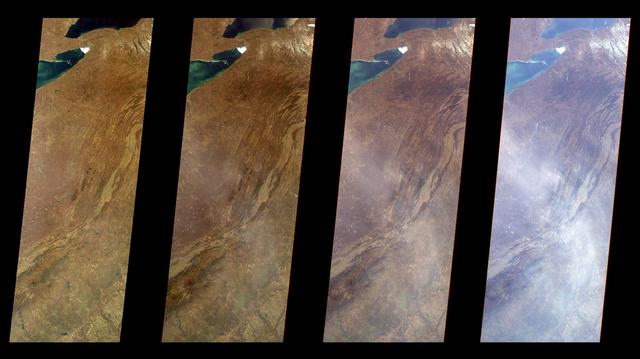
These images from NASA Terra spacecraft show the nadir view of the eastern United States, stretching from Lake Ontario to northern Georgia, and spanning the Appalachian Mountains.

AS09-26A-3816A (12 March 1969) --- Color infrared photograph of the Atlantic coast of Georgia, Brunswick area, taken on March 12, 1969, by one of the four synchronized cameras of the Apollo 9 Earth Resources Survey SO65 Experiment. At 11:35 a.m. (EST) when this picture was made the Apollo 9 spacecraft was at an altitude of 102 nautical miles, and the sun elevation was 51 degrees above the horizon. The location of the point on Earth's surface at which the four-camera combination was aimed 31 degrees 16 minutes north latitude, and 81 degrees 17 minutes west longitude. The other three cameras used: (B) black and white film with a red filter; (C) black and white infrared film; and (D) black and white film with a green filter.
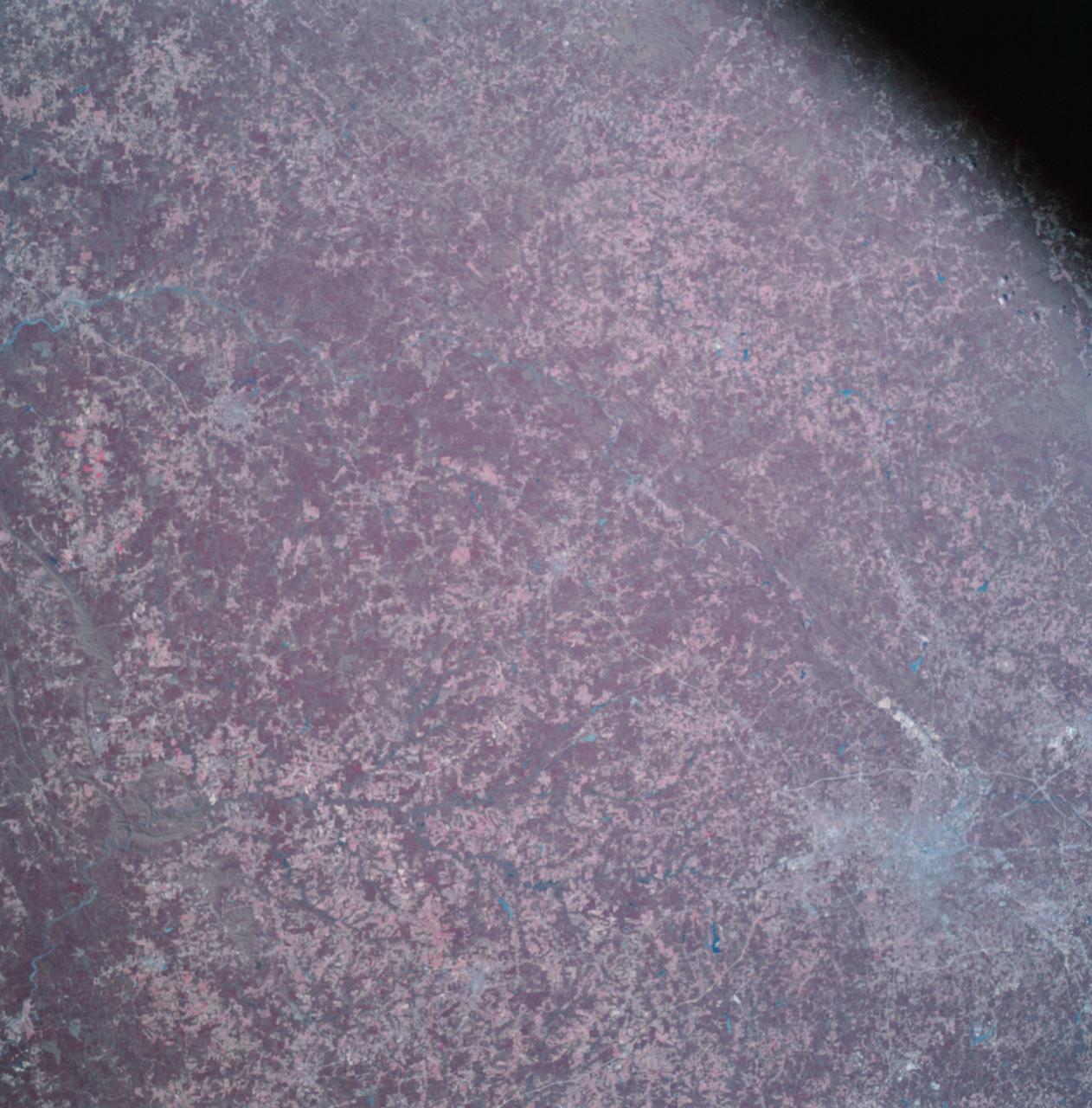
AS09-26A-3792A (11 March 1969) --- Color infrared photograph of the Atlanta, Georgia area taken on March 11, 1969, by one of the four synchronized cameras of the Apollo 9 Earth Resources Survey (SO-65) experiment. At 11:21 a.m. (EST) when this picture was taken, the Apollo 9 spacecraft was at an altitude of 106 nautical miles, and the sun elevation was 47 degrees above the horizon. The location of the point on Earth's surface at which the four-camera combination was aimed was 33 degrees 10 minutes north latitude, and 84 degrees and 40 minutes west longitude. The other three cameras used: (B) black and white film with a red filter; (C) black and white infrared film; and (D) black and white film with a green filter.
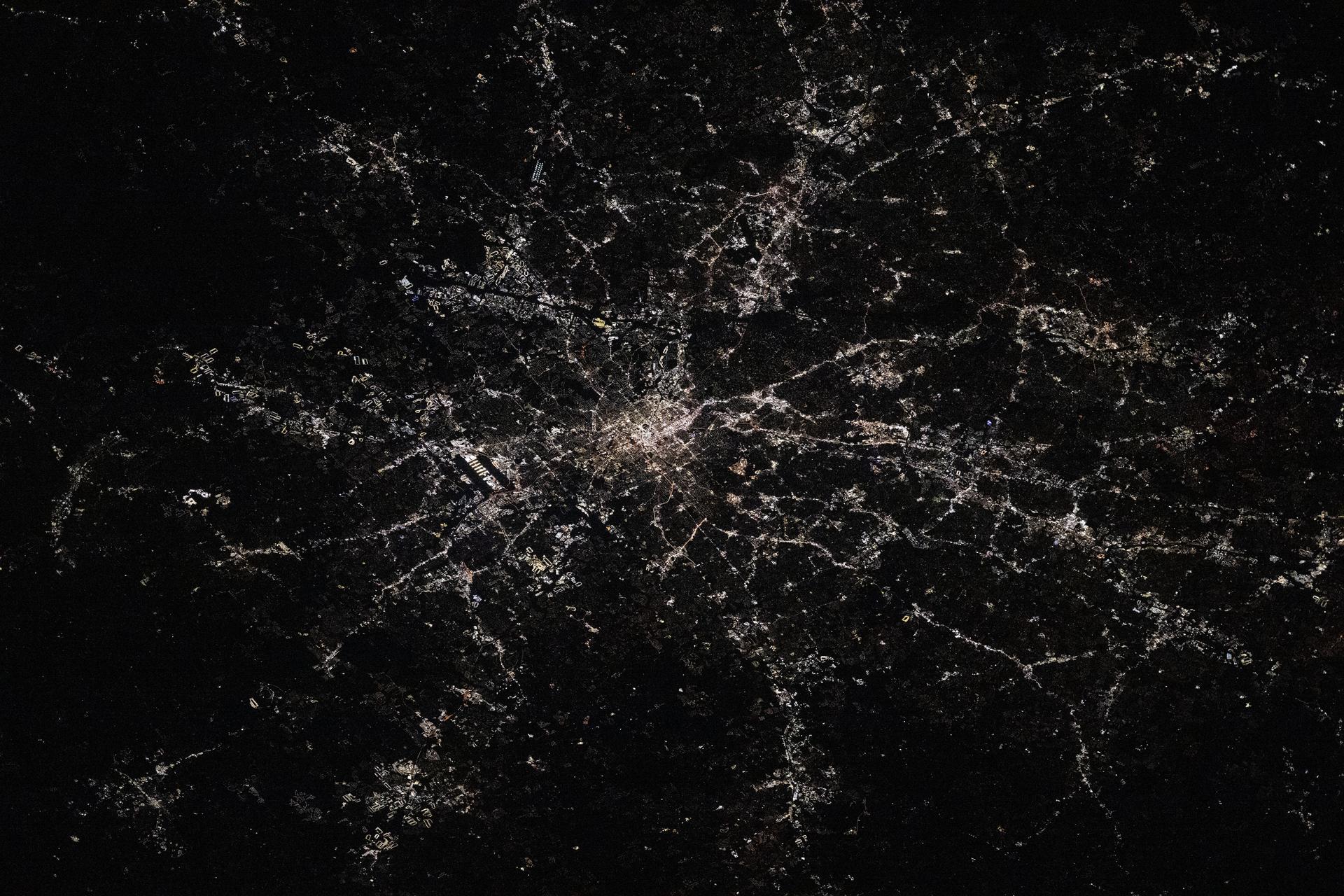
iss073e0982081 (Oct. 25, 2025) --- Atlanta, Georgia—home to the world's busiest airport, Hartsfield-Jackson Atlanta International Airport (center left), which handles over 107 million passengers annually—is pictured at approximately 2:20 a.m. local time from the International Space Station as it orbited 261 miles above North America. Atlanta is also nicknamed the "City in a Forest," with approximately 48% of its area covered in trees.
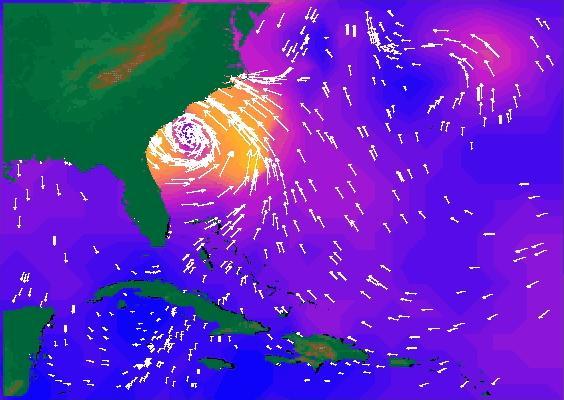
NASA SeaWinds radar instrument eyed the center of a massive hurricane -- Floyd -- as it ripped past Georgia and the Carolinas Wednesday afternoon, September 15, then marched toward a midnight strike at Cape Fear, North Carolina.
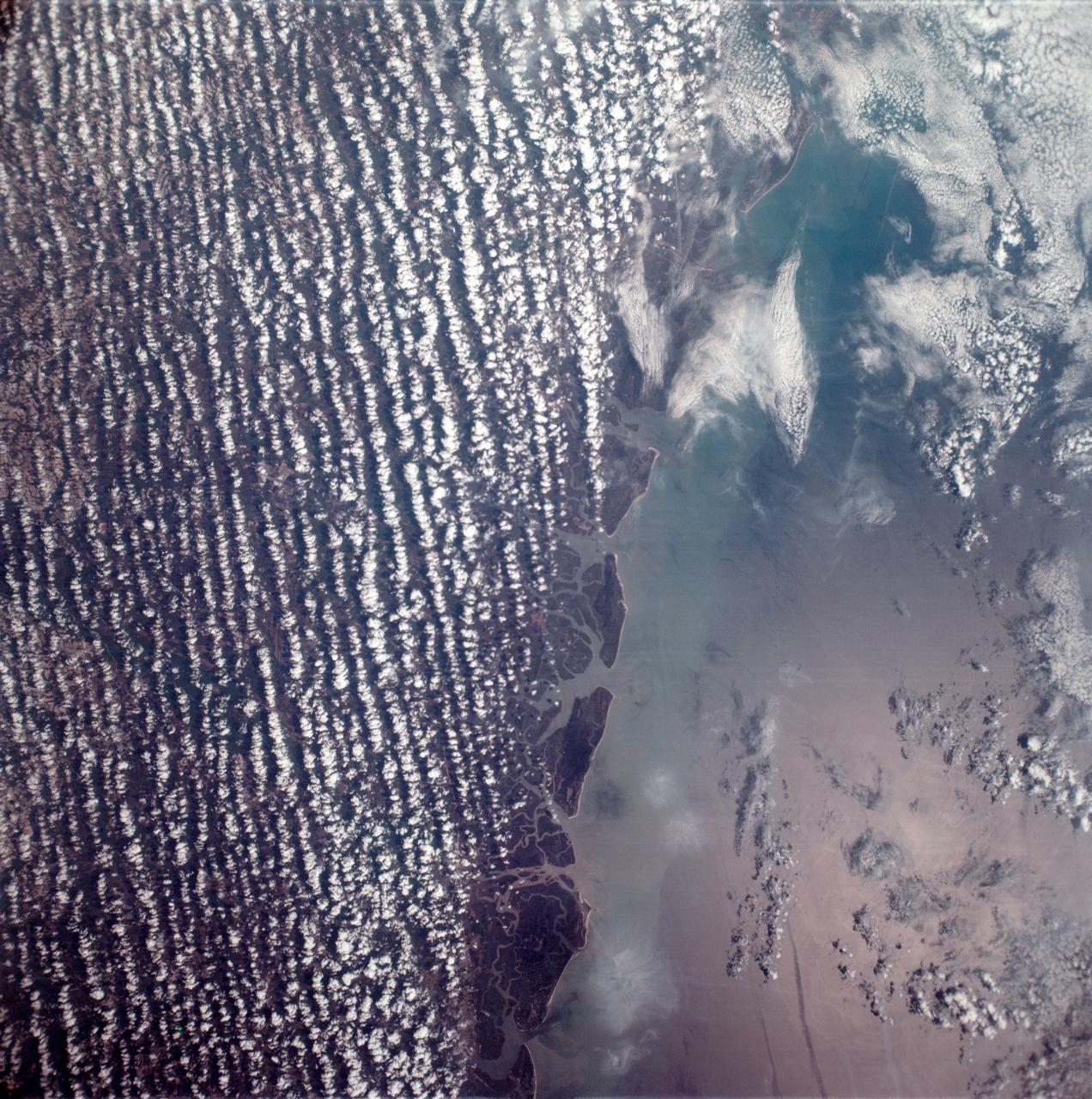
AS6-02-1485 (4 April 1968) --- View of the east coast of the United States as photographed from the National Aeronautics and Space Administration's unmanned Apollo 6 (Spacecraft 020/Saturn 502) space mission. This photograph was taken during a pass over Georgia, between Savannah and Brunswick. Altitude of the spacecraft was 100 nautical miles. Numerous jet aircraft contrails can be seen over the Atlantic Ocean. Sun glint on the surface of the ocean permits oceanographers to determine conditions of the water. This photograph was taken April 4, 1968, three hours and 14 minutes after liftoff, using Eastman Kodak SO-121 high resolution aerial Ektachrome film (exposure setting f/5.6 at 1/500 second), in a J. A. Maurer model 220G camera.
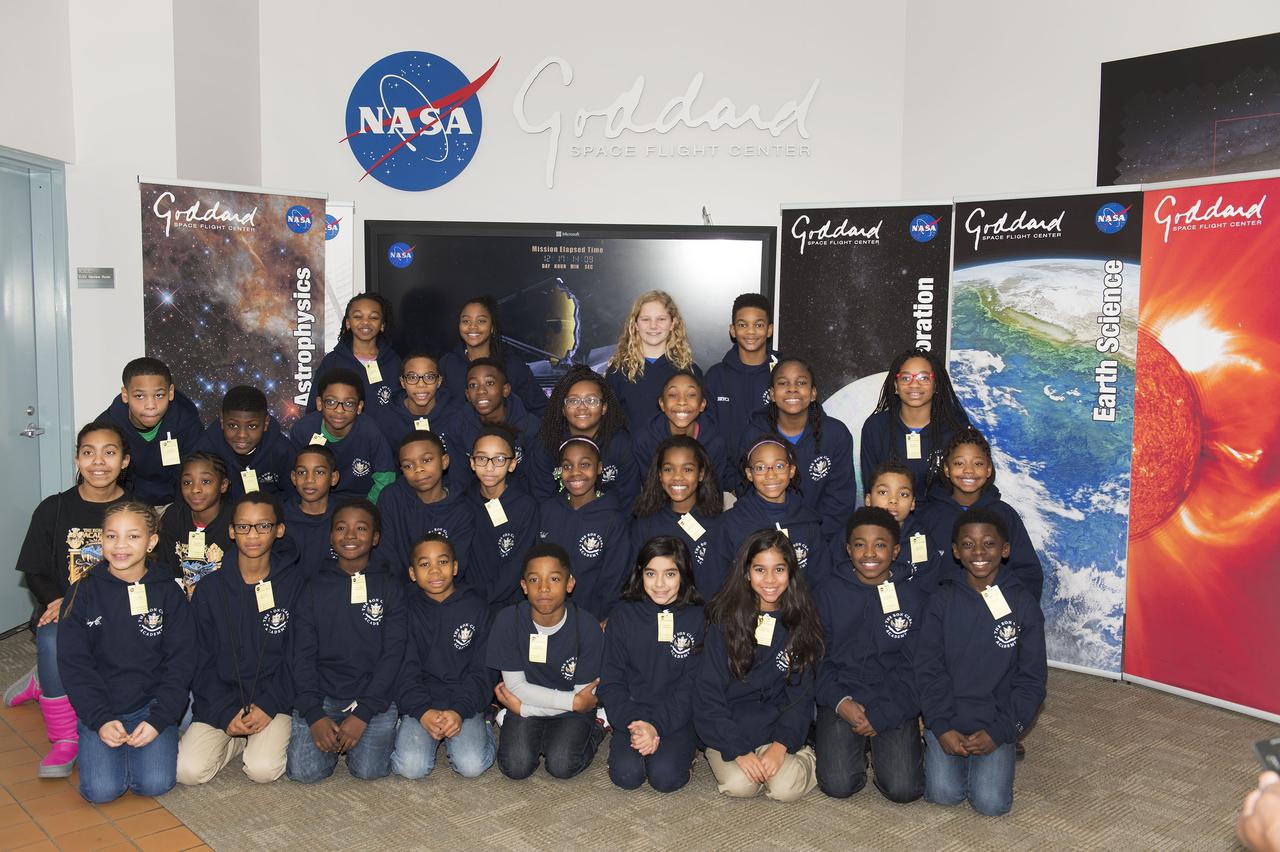
Ron Clark Academy students visited Goddard from Atlanta, Georgia on December 19, 2016. They visited JWST, Integration and Test facilities, and Hyperwall.
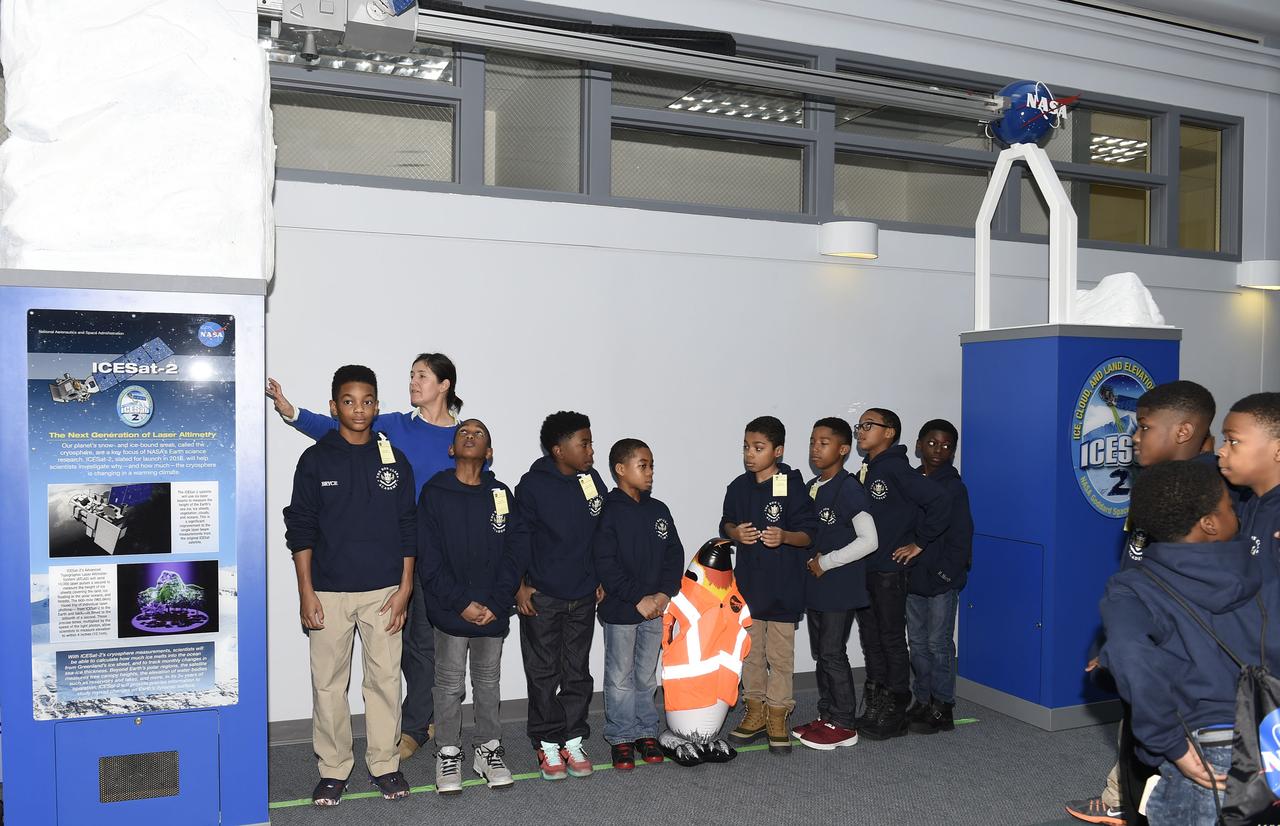
Ron Clark Academy students visited Goddard from Atlanta, Georgia on Dec 19, 201. They visited JWST, Integration and Test facilities and Hyperwall.
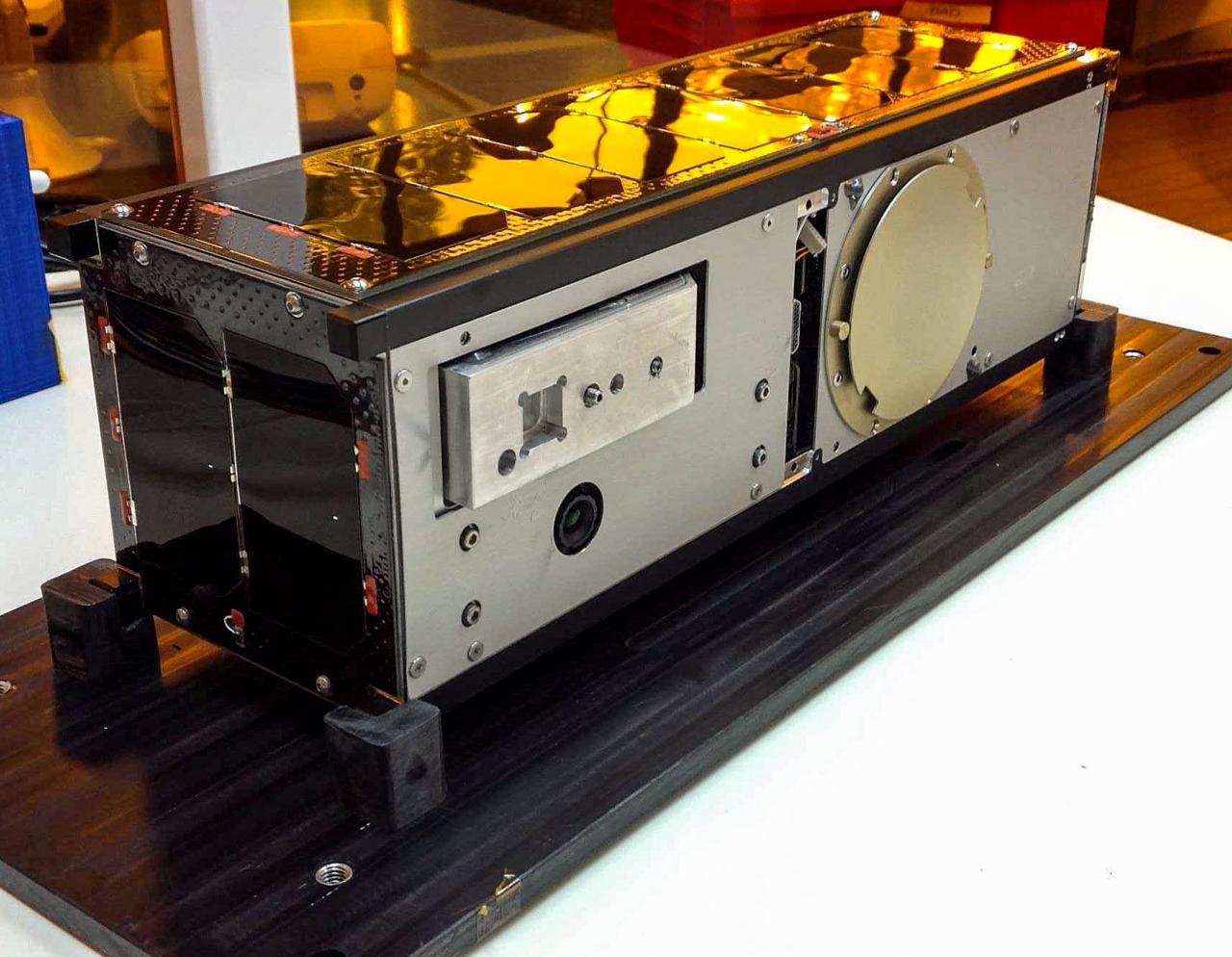
jsc2020e026629 (9/30/2019) --- Preflight imagery of the UGA-SPOC-Spectral Ocean Color Satellite before leaving the University of Georgia Small Satellite Research Laboratory for environmental testing. SPOC (Spectral Ocean Color) is a 3U CubeSat built by students at the University of Georgia. The primary mission objective is to develop and operate the first moderate resolution coastal ecosystem and ocean color CubeSat with a focus on Earth science applications.
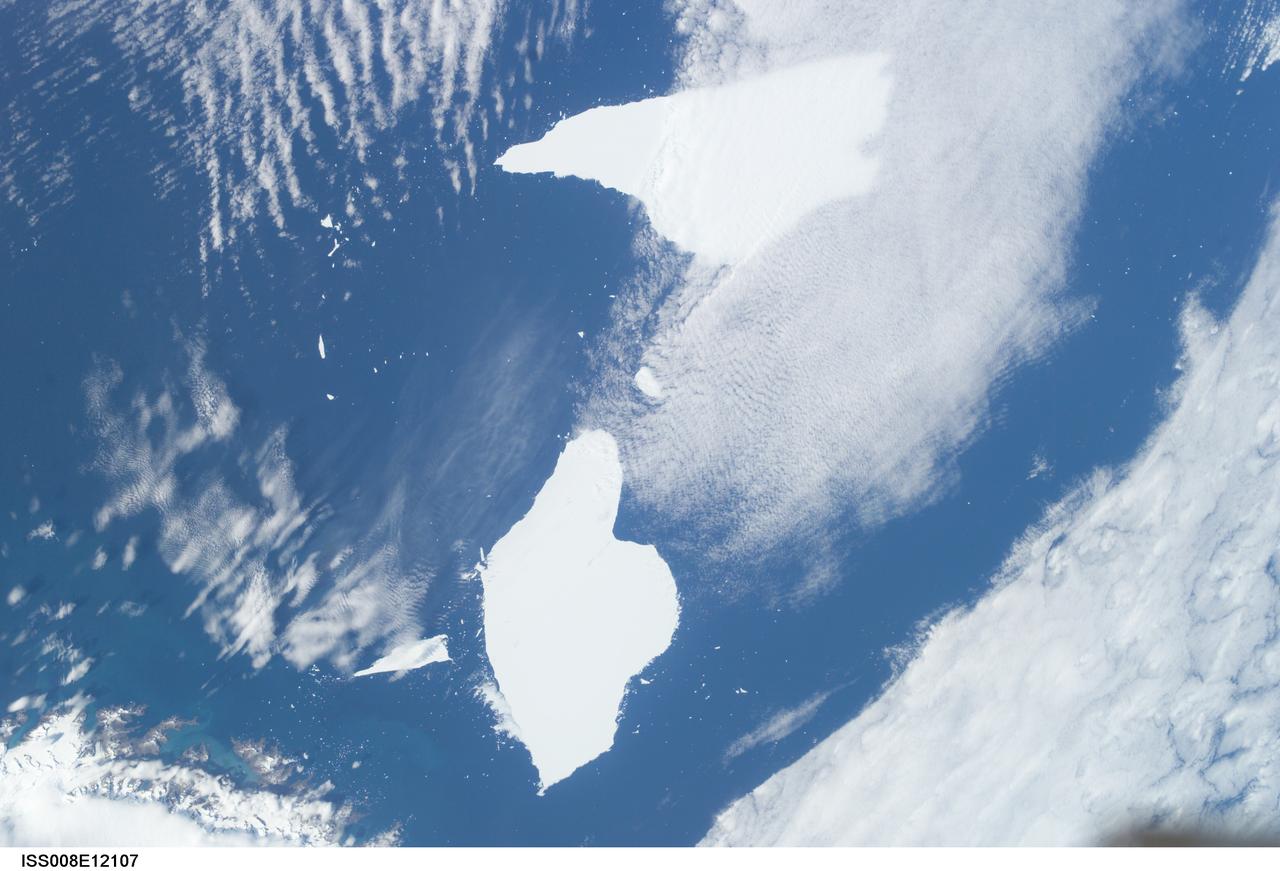
ISS008-E-12107 (6 January 2004) --- Five year old icebergs near South Georgia Island are featured in this image photographed by an Expedition 8 crewmember onboard the International Space Station (ISS). This photo shows two pieces of a massive iceberg that broke off from the Antarctica Ronne Ice Shelf in October 1998. The pieces of iceberg A-38 have floated relatively close to South Georgia Island. After five years and 3 months, they are approximately 1500 nautical miles from their origin.
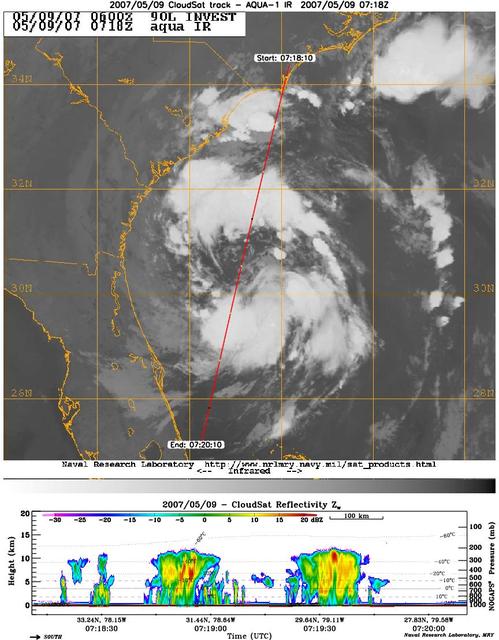
CloudSat's Cloud Profiling Radar captured a profile across Tropical Storm Andrea on Wednesday, May 9, 2007, near the South Carolina/Georgia/Florida Atlantic coast. The upper image shows an infrared view of Tropical Storm Andrea from the Moderate Resolution Imaging Spectroradiometer instrument on NASA's Aqua satellite, with CloudSat's ground track shown as a red line. The lower image is the vertical cross section of radar reflectivity along this path, where the colors indicate the intensity of the reflected radar energy. CloudSat orbits approximately one minute behind Aqua in a satellite formation known as the A-Train. http://photojournal.jpl.nasa.gov/catalog/PIA09379

The 2019 National Disability Awareness Month program was held in Marshall Space Flight Center's P110 conference room with guest speaker and former NASA Scientist Kantis Simmons. Master of Ceremonies was Matt McSaveney and the National Anthem was performed by MSFC student intern Andrea Brown. Additional remarks were presented by MSFC Associate Director Steve Miley. Additional songs were performed by Georgia Aplin, Cassidie Gorig' Worrell, Danay Jackson, Charli Grace Strawn from the Alabama Institute for the Deaf and Blind. Former NASA scientist Kantis Simmons, an author and speaker, addresses NASA’s Marshall Space Flight Center team members Oct. 29 during the National Disability Awareness Month presentation, “The Right Talent, Right Now.” Simmons’ humorous discussion focused on growing up with a birth defect and overcoming the self-doubts that can bring. “Quit looking at what you don’t have and think about all the amazing things you do have,” Simmons said.
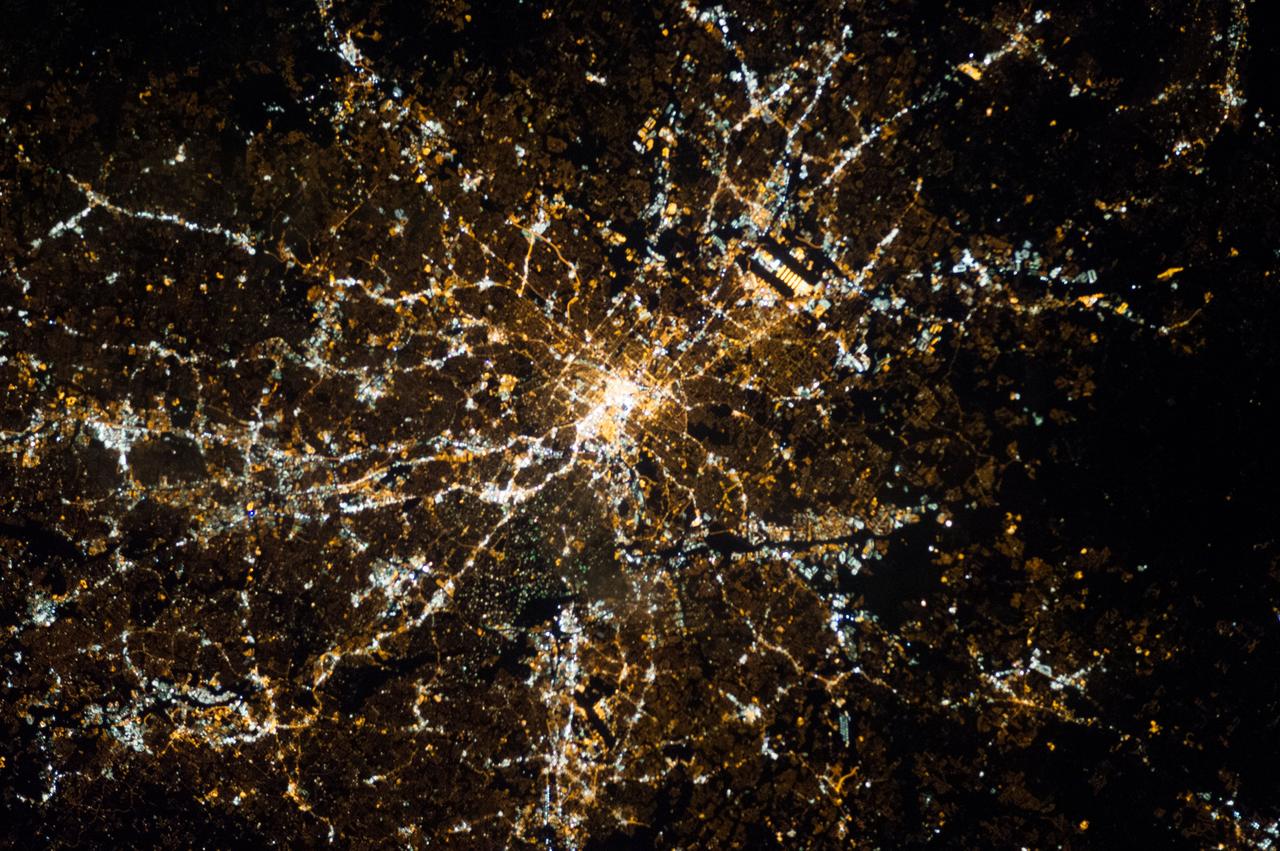
ISS034-E-032466 (20 Jan. 2013) -- One of the Expedition 34 crew members aboard the International Space Station, flying at an altitude of approximately 240 miles, photographed this vertical night view of the metropolitan area of Atlanta, Georgia.

iss070e097979 (Feb. 22, 2024) --- Atlanta, Georgia, and Hartsfield-Jackson Atlanta International Airport (lower left) are pictured during nighttime from the International Space Station as it orbited 260 miles above the Peach State.
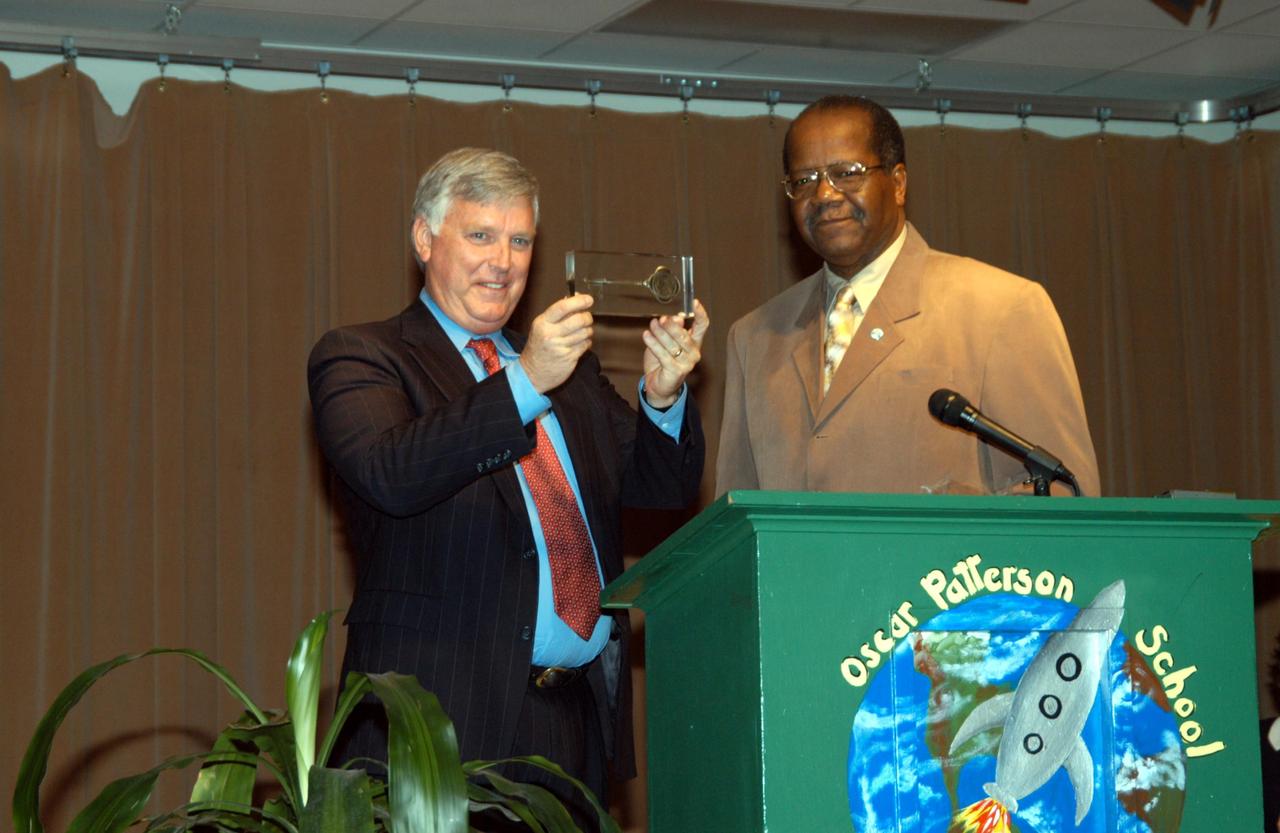
KENNEDY SPACE CENTER, FLA. -- Center Director Jim Kennedy (left) displays the key to the city presented by Johnathon Wilson (right), Panama City commissioner. Kennedy is visiting NASA Explorer Schools in Florida and Georgia to share America’s new vision for space exploration with the next generation of explorers. Kennedy is talking with students in NASA Explorer Schools in Florida and Georgia about our destiny as explorers, NASA’s stepping stone approach to exploring Earth, the Moon, Mars and beyond, how space impacts our lives, and how people and machines rely on each other in space.
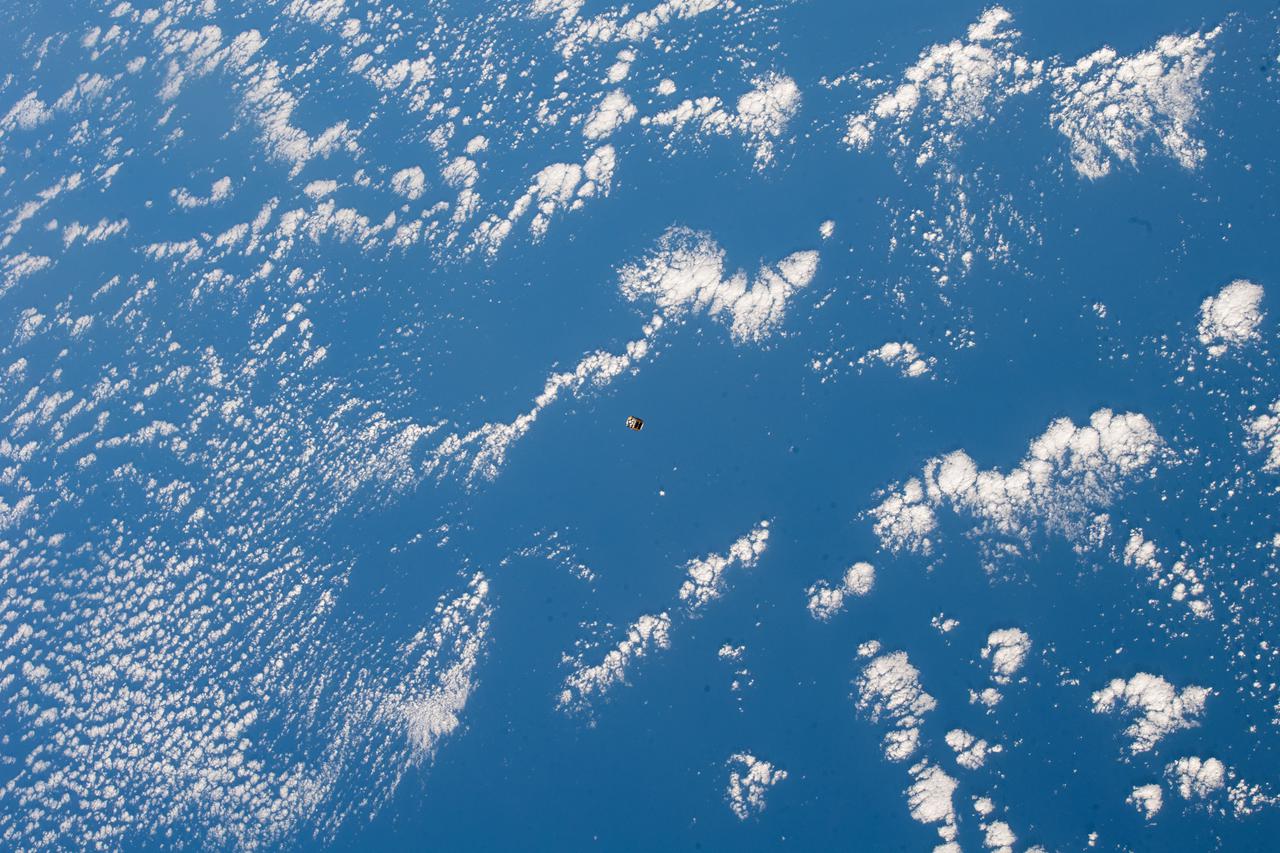
iss066e135744 (2/3/2022) --- A view of the deployed GT-1 CubeSat. The Georgia Institute of Technology-1 (GT-1) is a 1.14 kg 1-Unit (1U) CubeSat, developed by the Georgia Institute of Technology, with experimental deployable solar panels and a deployable UHF radio antenna. The GT-1 mission demonstrates a rapid “cradle-to-grave” development lifecycle of a university level CubeSat. GT-1 is deployed as a part of the JEM Small Satellite Orbital Deployer-20 (J-SSOD-20) CubeSat deployment mission, and is launched to the International Space Station (ISS) aboard the SpaceX-24 Dragon Cargo Vehicle.
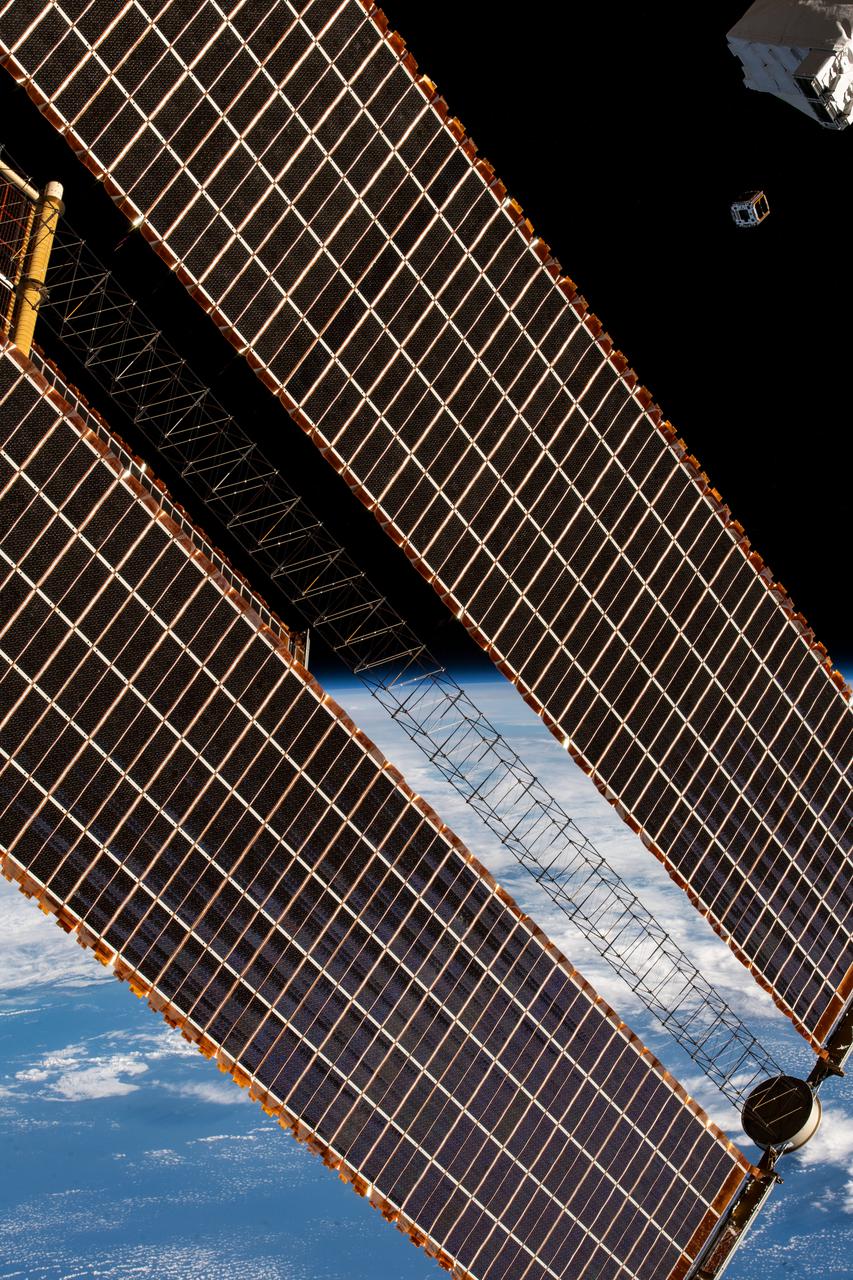
iss066e135704 (2/3/2022) --- A view of the deployed GT-1 CubeSat. The Georgia Institute of Technology-1 (GT-1) is a 1.14 kg 1-Unit (1U) CubeSat, developed by the Georgia Institute of Technology, with experimental deployable solar panels and a deployable UHF radio antenna. The GT-1 mission demonstrates a rapid “cradle-to-grave” development lifecycle of a university level CubeSat. GT-1 is deployed as a part of the JEM Small Satellite Orbital Deployer-20 (J-SSOD-20) CubeSat deployment mission, and is launched to the International Space Station (ISS) aboard the SpaceX-24 Dragon Cargo Vehicle.
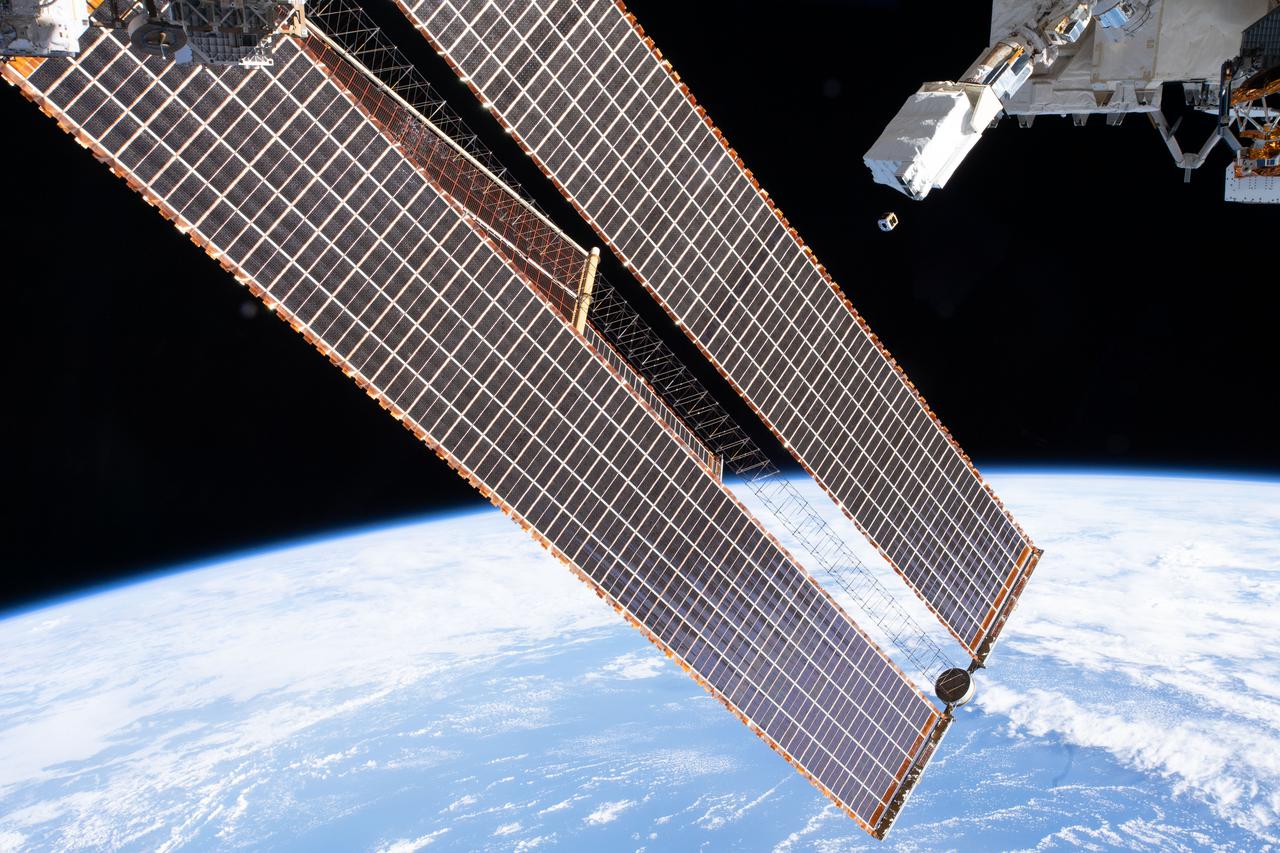
iss066e135308 (2/3/2022) --- A view of the deployed GT-1 CubeSat. The Georgia Institute of Technology-1 (GT-1) is a 1.14 kg 1-Unit (1U) CubeSat, developed by the Georgia Institute of Technology, with experimental deployable solar panels and a deployable UHF radio antenna. The GT-1 mission demonstrates a rapid “cradle-to-grave” development lifecycle of a university level CubeSat. GT-1 is deployed as a part of the JEM Small Satellite Orbital Deployer-20 (J-SSOD-20) CubeSat deployment mission, and is launched to the International Space Station (ISS) aboard the SpaceX-24 Dragon Cargo Vehicle.
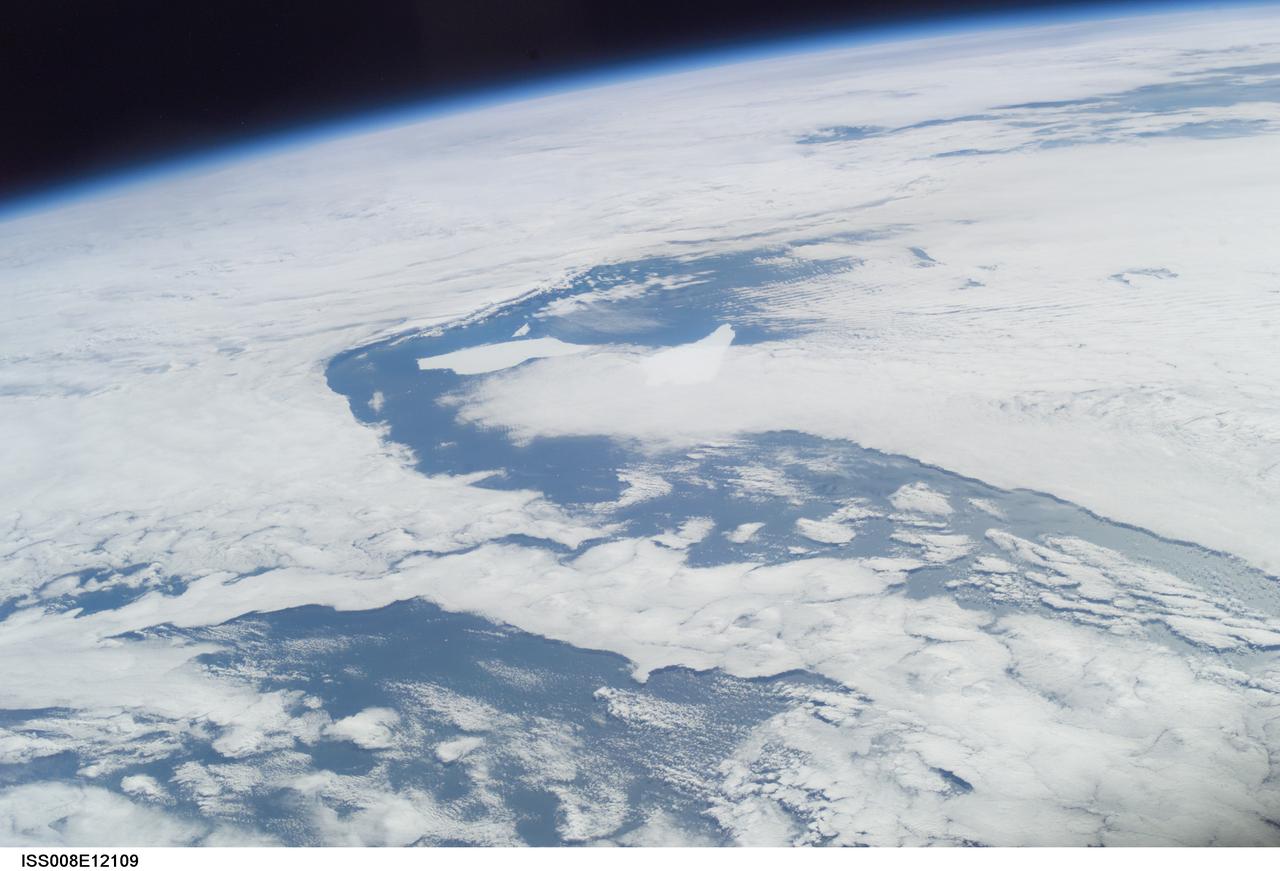
ISS008-E-12109 (6 January 2004) --- Five year old icebergs near South Georgia Island are featured in this image photographed by an Expedition 8 crewmember onboard the International Space Station (ISS). This oblique image shows two pieces of a massive iceberg that broke off from the Antarctica Ronne Ice Shelf in October 1998. The pieces of iceberg A-38 have floated relatively close to South Georgia Island. After five years and 3 months, they are approximately 1500 nautical miles from their origin. The cloud pattern is indicative of the impact of the mountainous islands on the local wind field. At the time this image was taken, the icebergs were sheltered in the lee side of the island.
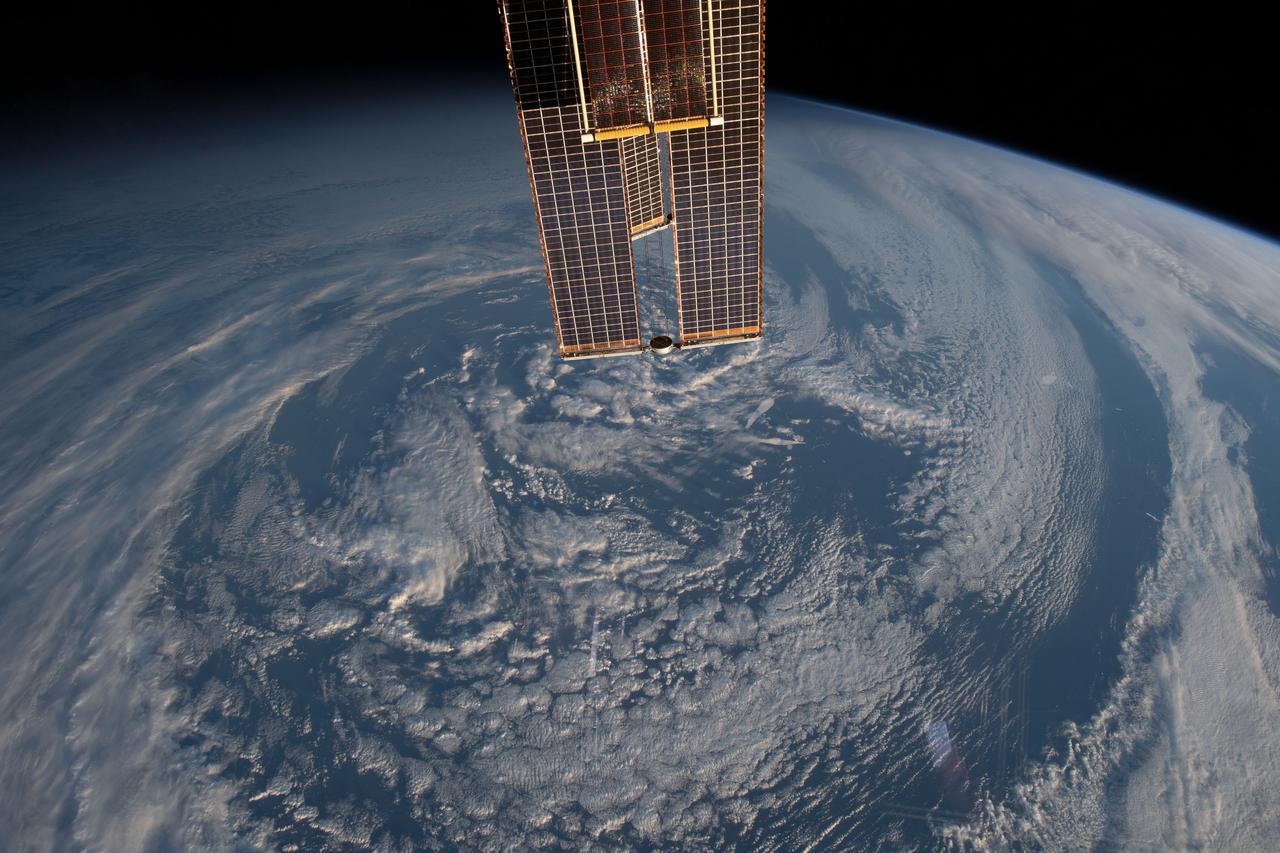
iss069e027347 (July 2, 2023) --- The International Space Station was orbiting 270 miles above the south Atlantic Ocean about 350 miles north of South Georgia Island when this photograph was taken. In the top foreground, portions of the station's main solar array and roll-out solar array are also pictured.
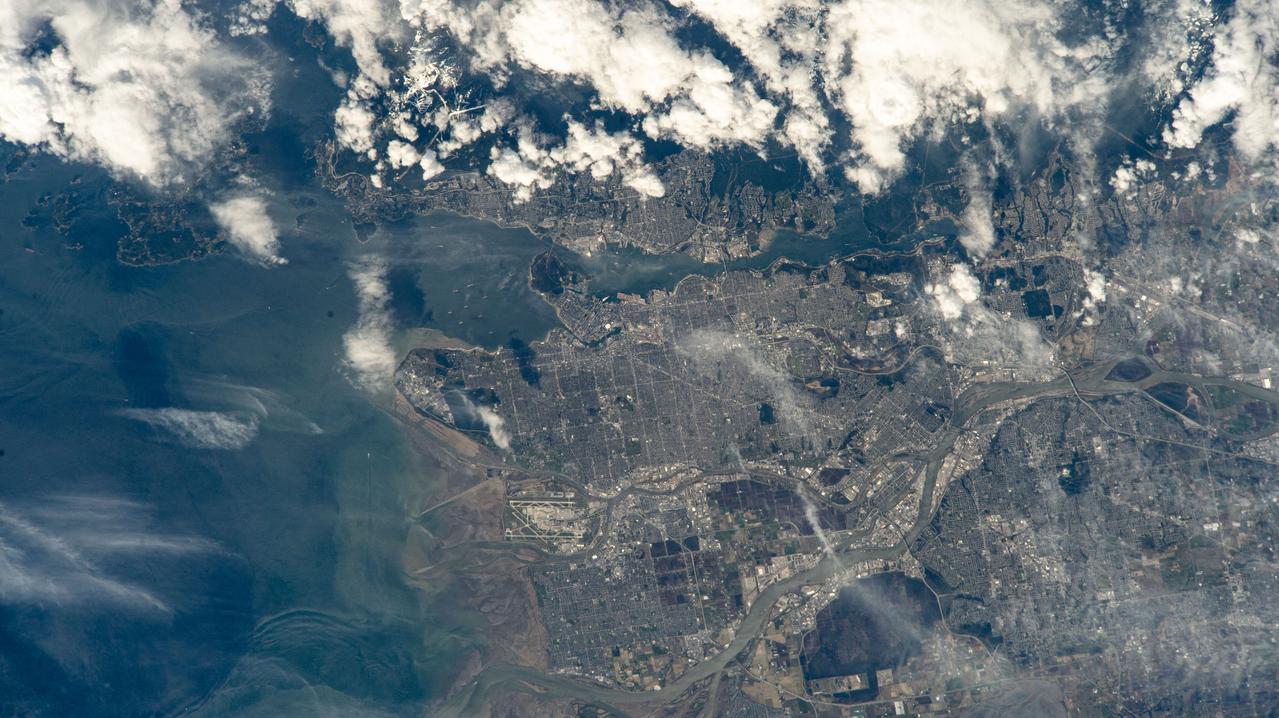
iss071e006133 (April 9, 2024) --- Vancouver, British Columbia, and its surroundng suburbs on the Strait of Georgia are pictured from the International Space Station as it orbited 261 miles above Canada. Toward lower center, is the Fairmont Vancouver Airport on Sea Island.
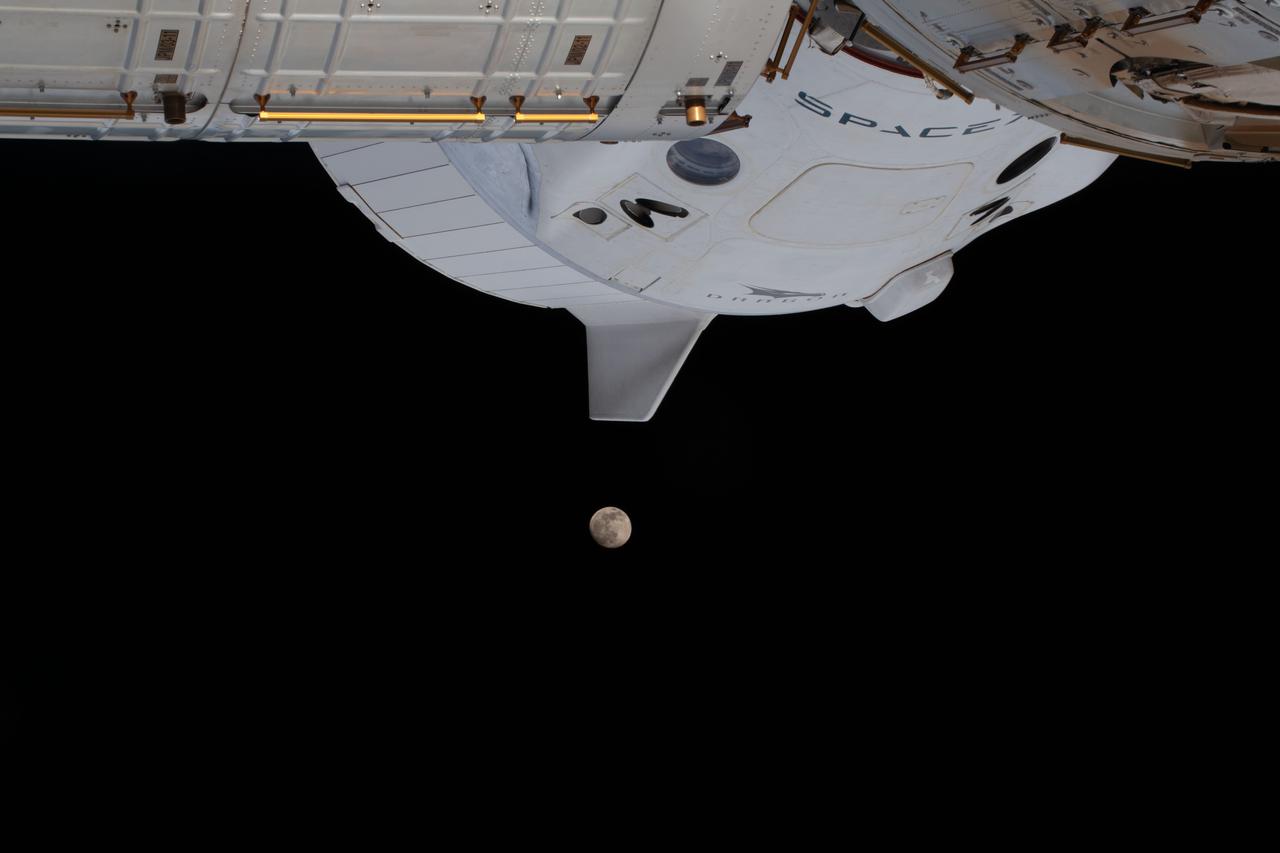
iss064e026716 (Jan. 26, 2021) --- The waxing gibbous moon is pictured below a portion of the SpaceX Crew Dragon spacecraft docked to the Harmony module's forward international docking adapter. The International Space Station was orbiting 263 miles above Atlanta, Georgia, when this photograph was taken.
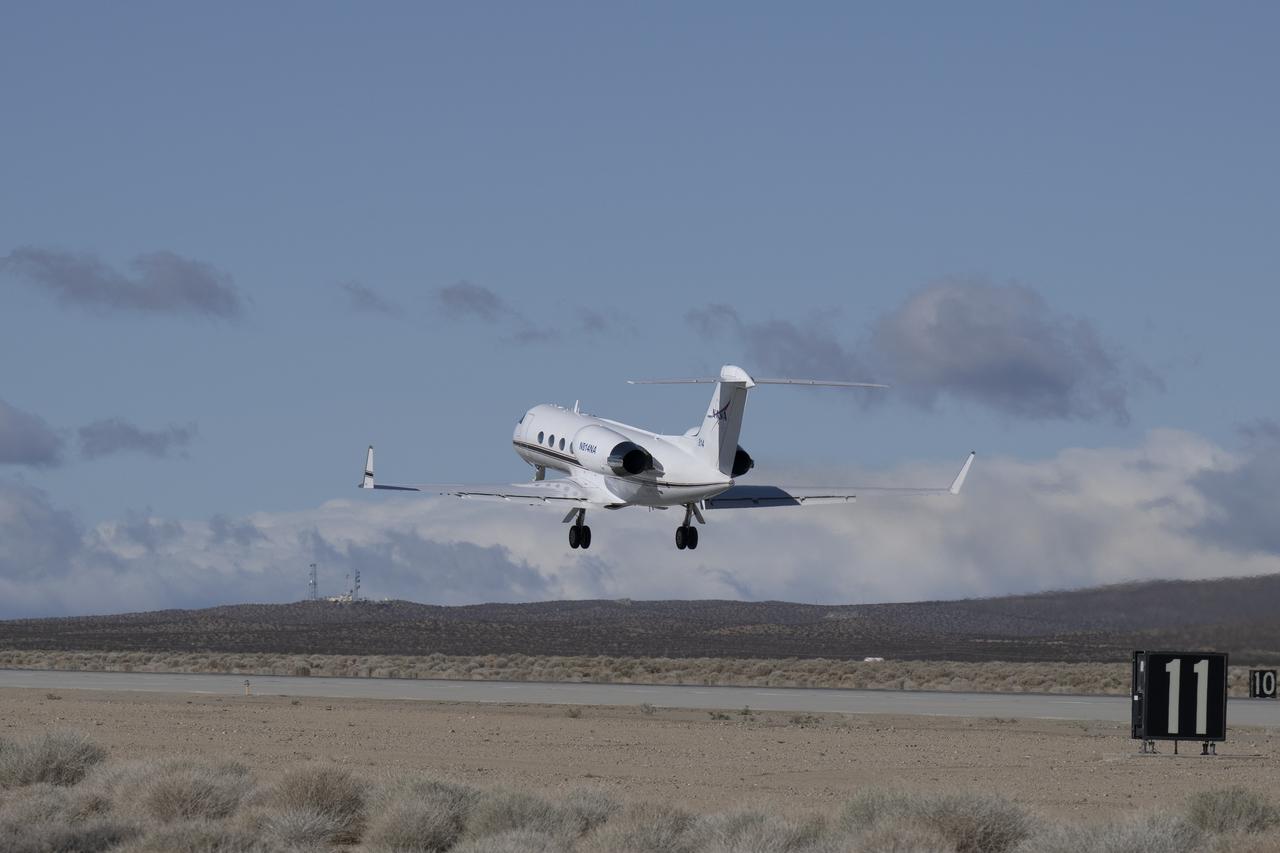
The G-IV aircraft lifts off from NASA’s Armstrong Flight Research Center in Edwards, California, on March 18, 2025. As the newest member of NASA Armstrong’s airborne science fleet, the G-IV was sent to Avenger Aerospace Solutions in Cartersville, Georgia, for modifications that will optimize the G-IV’s performance as a research aircraft.
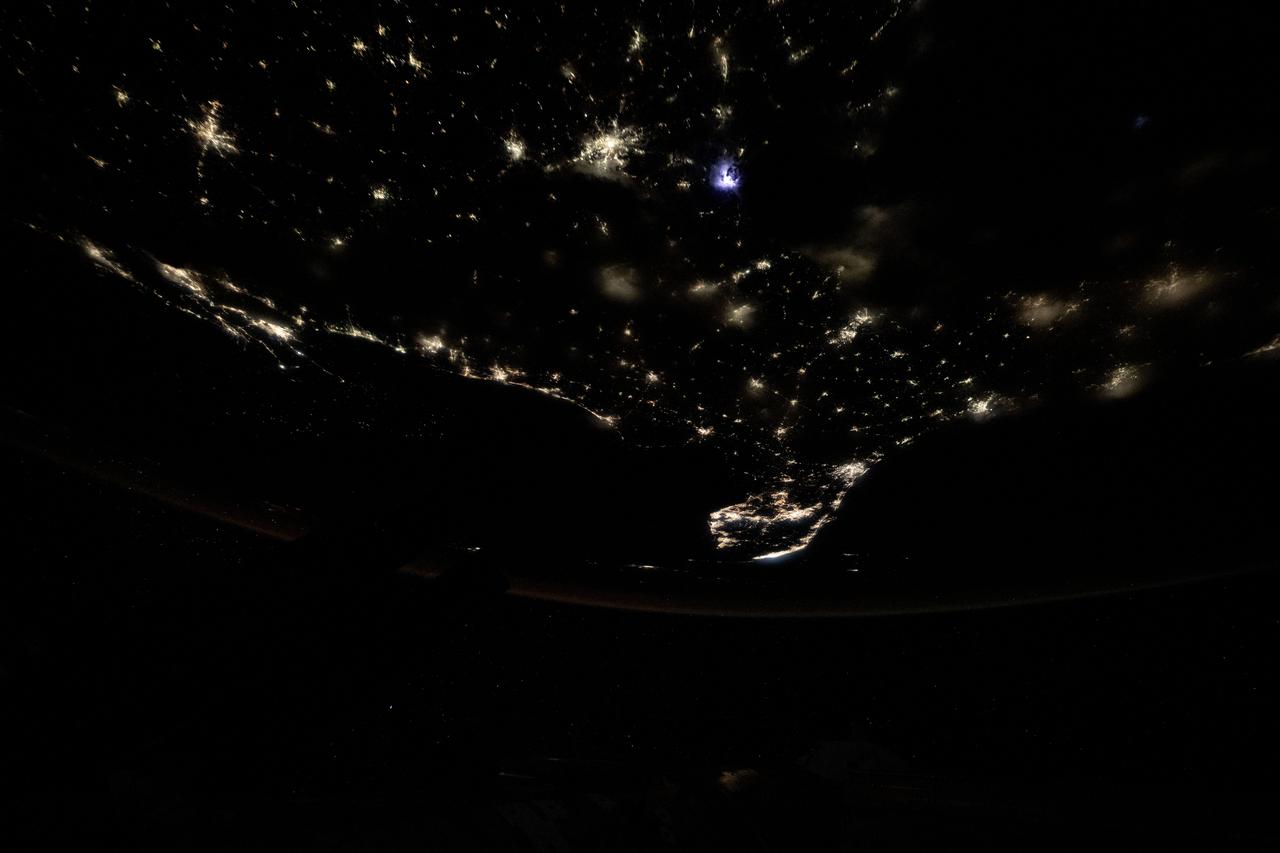
iss073e0149171 (May 21, 2025) --- City lights dot the southern United States' landscape from Louisiana (upper left), to Florida (lower center), to South Carolina (right), in this photograph from the International Space Station as it orbited 260 miles above Georgia at approximately 12:59 a.m. local time.
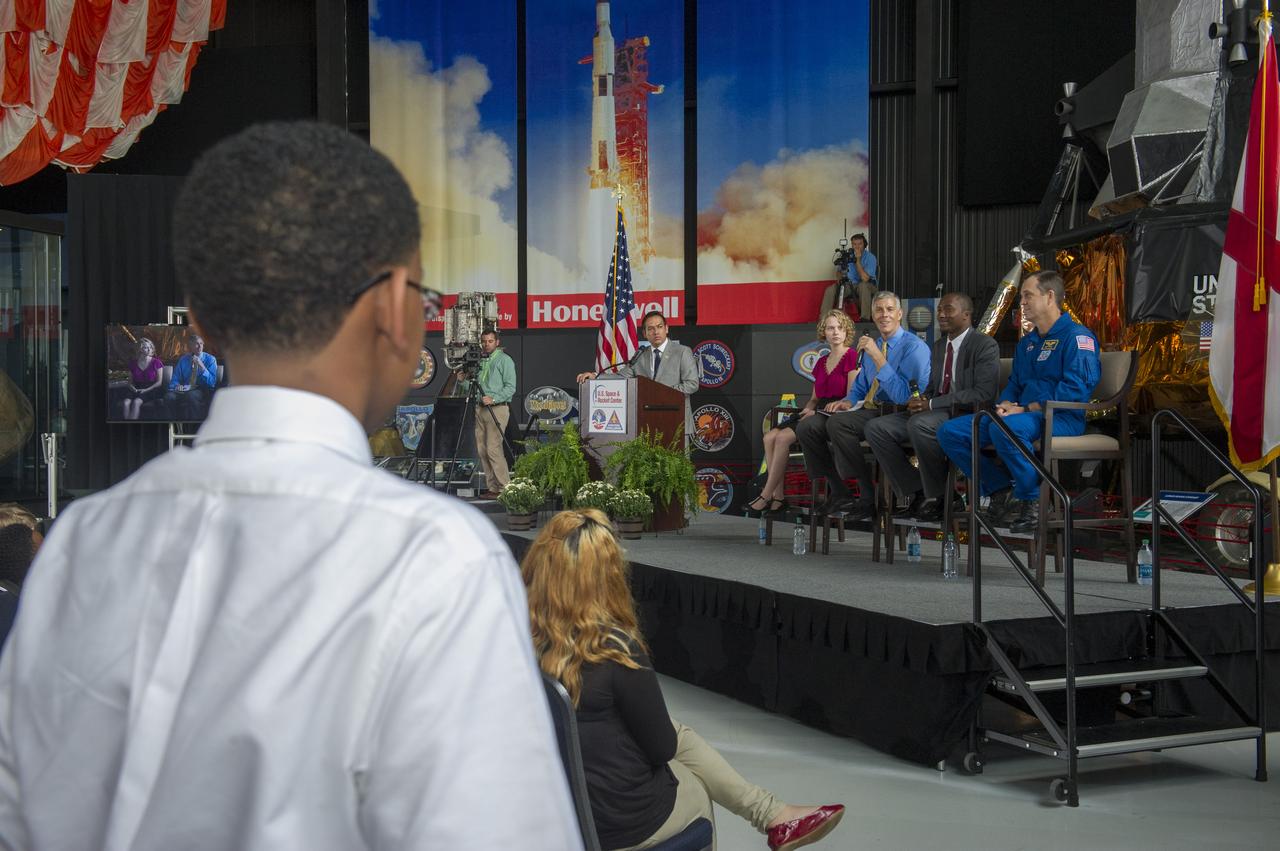
U.S. SECRETARY OF EDUCATION ARNE DUNCAN, ALONG WITH NASA ASTRONAUT RICKY ARNOLD AND OTHER GUESTS, ANSWER STUDENTS’ QUESTIONS DURING AN EDUCATIONAL TOWN HALL MEETING AT THE SPACE & ROCKET CENTER. THE SECRETARY’S VISIT WAS PART OF HIS TOUR TO PROMOTE EDUCATION, WITH STOPS IN GEORGIA, ALABAMA AND TENNESSEE
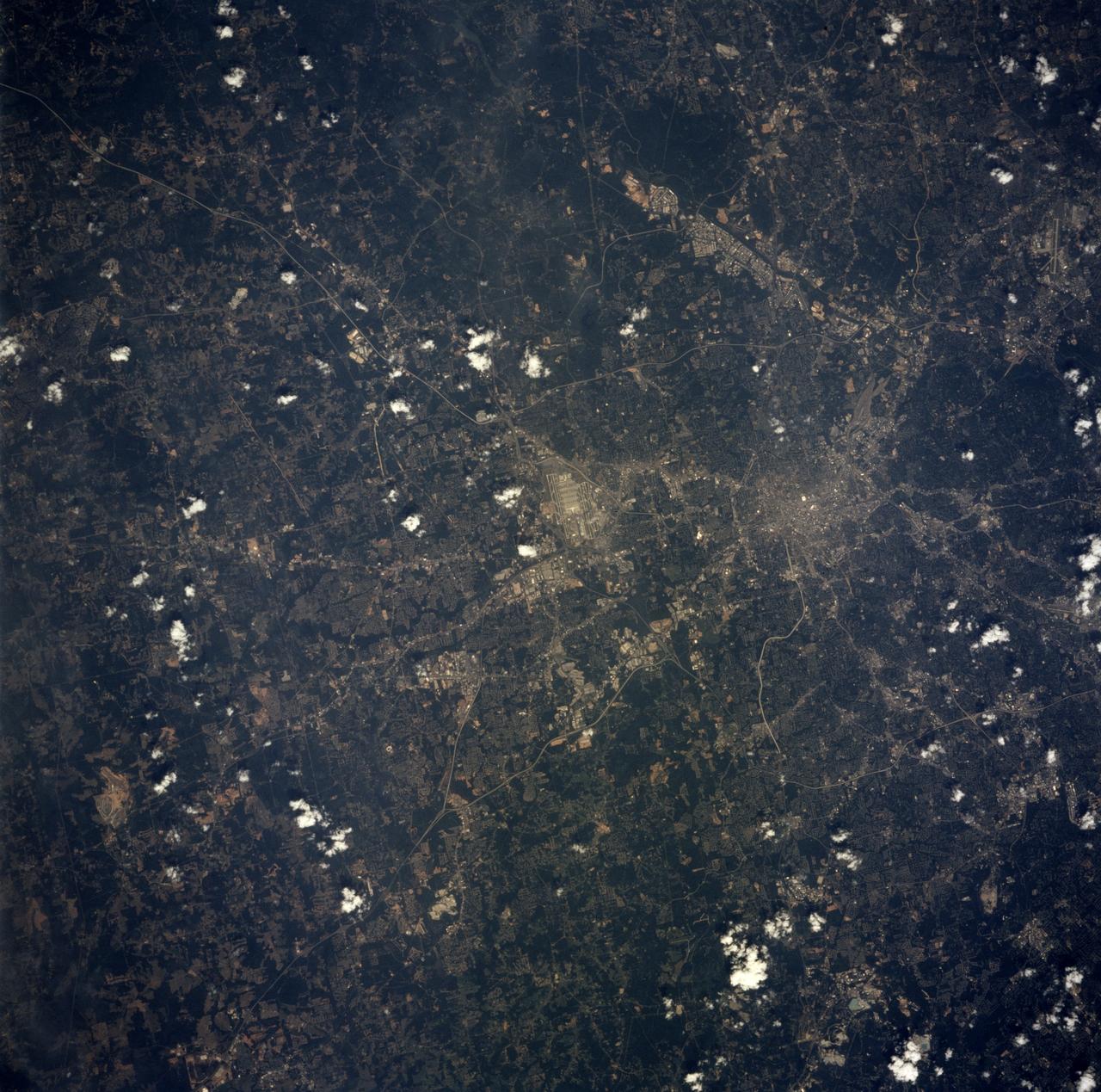
STS078-751-076 (20 June-7 July 1996) --- Metropolitan Atlanta, Georgia, host area for 1996 Summer Olympics was captured on film by one of the crew members using a 70mm handheld camera. Hartsfield Atlanta International Airport is visible to the south of Atlanta, near the center of the photograph. Dobbins Air Force Base and a portion of the city of Marietta can also be seen to the north of Atlanta in the upper left hand corner. The complex system of transportation routes and interstate highways is seen surrounding and traversing Atlanta. The white dot near the center of the city is the Georgia Dome, a major sports and entertainment complex in downtown Atlanta. Atlanta is the cultural, industrial, transportation, financial, and commercial center of the South. It has one of the busiest air traffic hubs in the United States. A major aircraft assembly plant is located north of Atlanta in Marietta. The Stone Mountain Memorial, with its enormous relief carvings of Confederate figures, is located east of Atlanta and is visible on the photograph.
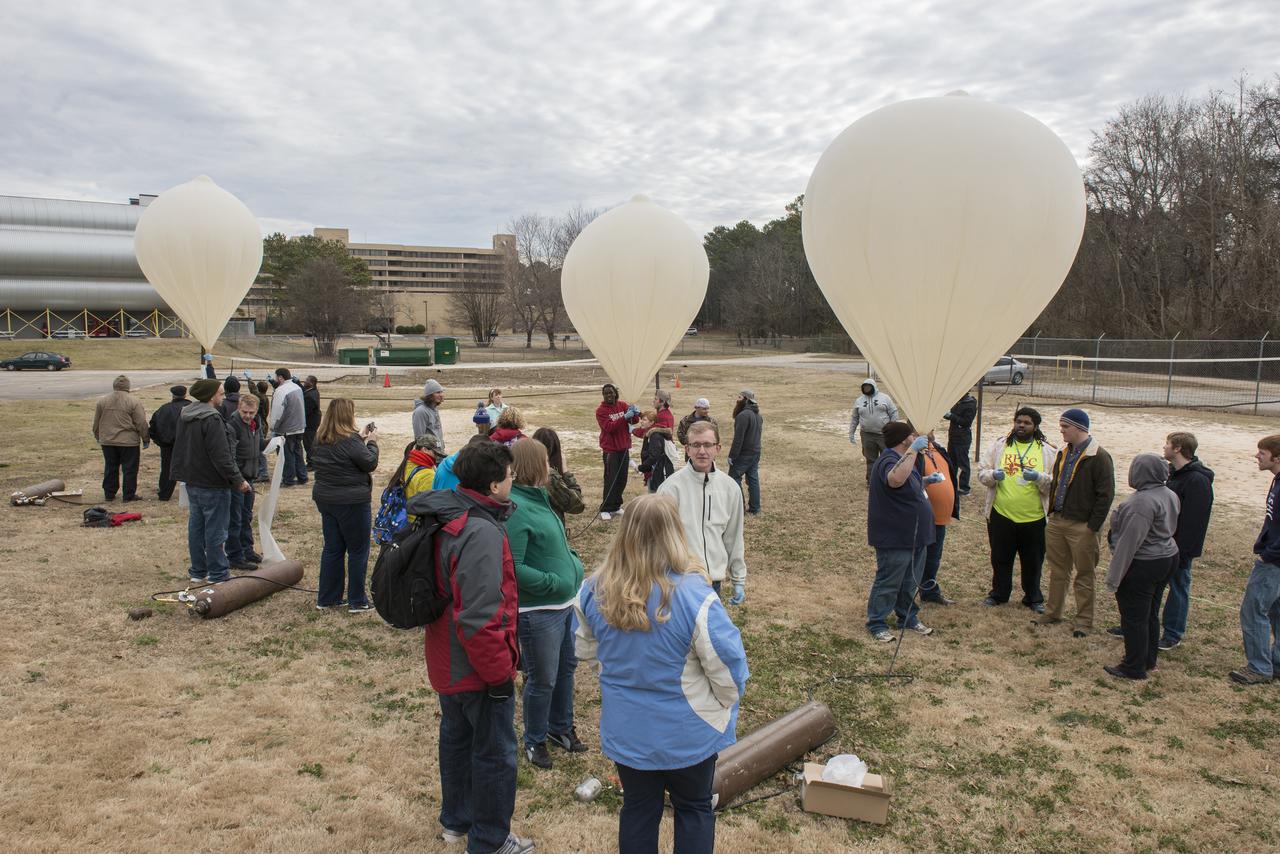
STUDENTS FROM COMMUNITY COLLEGES THROUGHOUT THE SOUTH CAME TOGETHER AT THE U.S. SPACE AND ROCKET CENTER FOR THE BALLOONSAT LAUNCH EVENT. EACH COMMUNITY COLLEGE TEAM ASSEMBLED ITS OWN PAYLOAD, DESIGNED TO DOWNLOAD SCIENTIFIC AND ATMOSPHERIC INFORMATION, AND THEN 2 WEATHER BALLOONS WERE SENT ALOFT TO APPROXIMATELY 100,000 FEET WITH THE PAYLOADS. THE PAYLOADS WERE RECOVERED IN N. GEORGIA AND TAKEN BACK TO THE INDIVIDUAL SCHOOLS FOR DOWNLOADING.
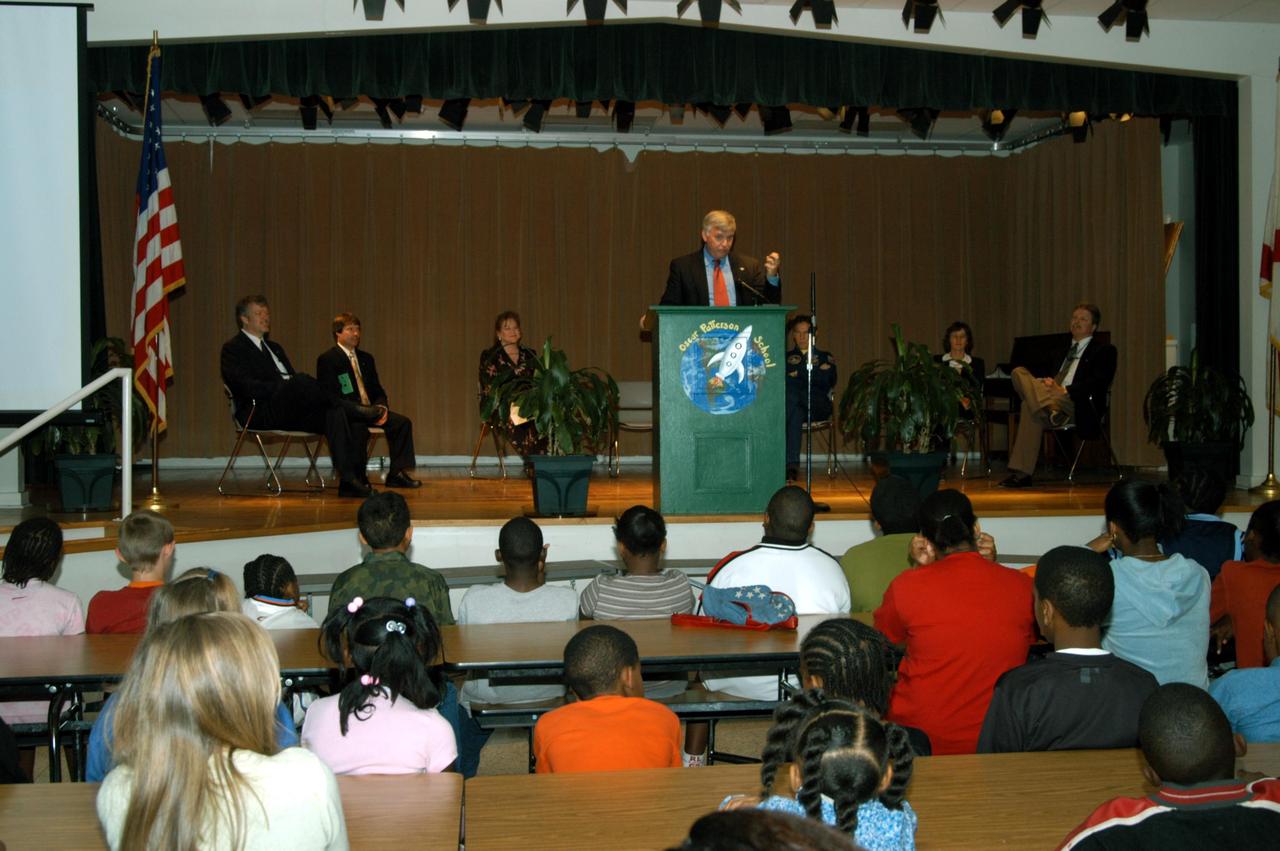
KENNEDY SPACE CENTER, FLA. -- Center Director Jim Kennedy talks to students at Oscar Patterson Elementary Magnet School in Panama City, Fla. Kennedy is visiting NASA Explorer Schools in Florida and Georgia to share America’s new vision for space exploration with the next generation of explorers. Kennedy is talking with students about our destiny as explorers, NASA’s stepping stone approach to exploring Earth, the Moon, Mars and beyond, how space impacts our lives, and how people and machines rely on each other in space.

Bobby Braun, professor, Georgia Institute of Technology, talks during the NASA Future Forum panel titled "Shifting Roles for Public, Private, and International Players in Space" at The Ohio State University on Tuesday, Feb. 21, 2012 in Columbus, Ohio. The NASA Future Forum features panel discussions on the importance of education to our nation's future in space, the benefit of commercialized space technology to our economy and lives here on Earth, and the shifting roles for the public, commercial and international communities in space. Photo Credit: (NASA/Bill Ingalls)
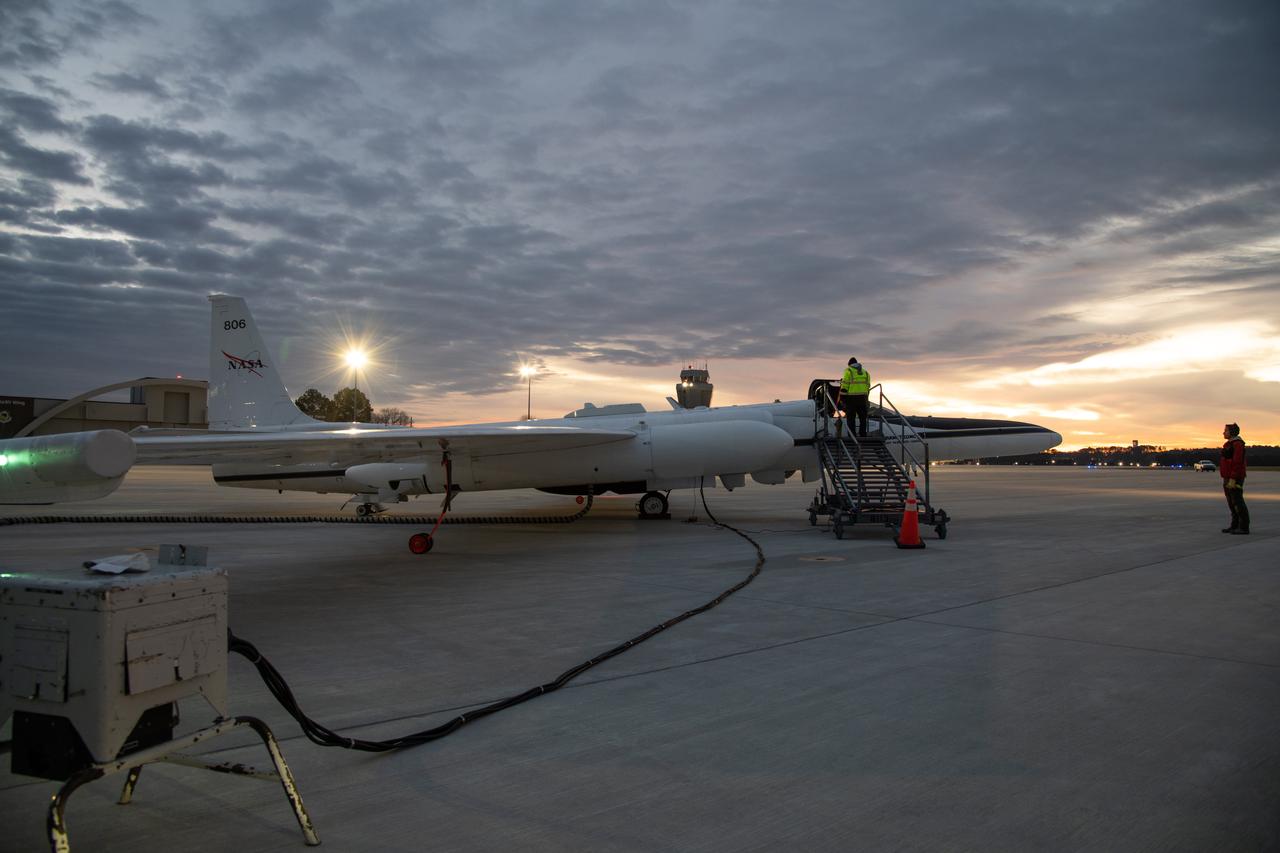
The NASA ER-2 high-altitude aircraft was prepared to support the Investigation of Microphysics and Precipitation for Atlantic Coast-Threatening Storms (IMPACTS) mission. For this mission, the IMPACTS team tracked storms across the Eastern United States to help understand how winter storms form and develop. The aircraft, which is based at NASA’s Armstrong Flight Research Center Building 703 in Palmdale, California, was temporarily based at Dobbins Air Reserve Base in Marietta, Georgia. The three-year IMPACTS campaign concluded on Feb. 28, 2023.
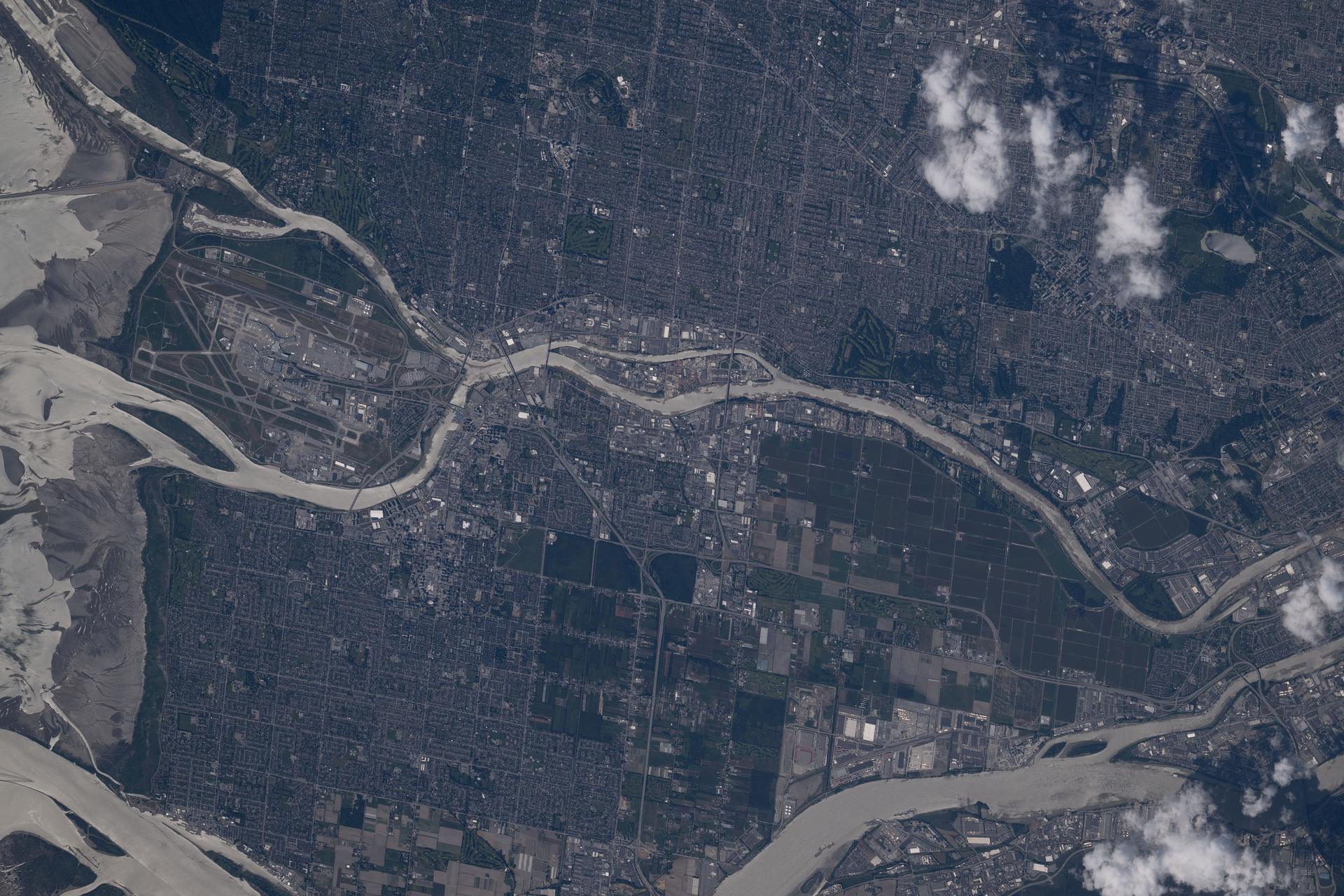
iss074e0623357 (May 30, 2026) --- Vancouver International Airport sits on Sea Island (left), where the Fraser River splits into its North and Middle Arms—a natural bifurcation—before emptying into the Strait of Georgia on Canada’s Pacific coast. The airport is the nation’s second busiest and lies just south of Vancouver, a metropolitan area of about 2.73 million people and 23 surrounding jurisdictions. Credit: NASA/Chris Williams
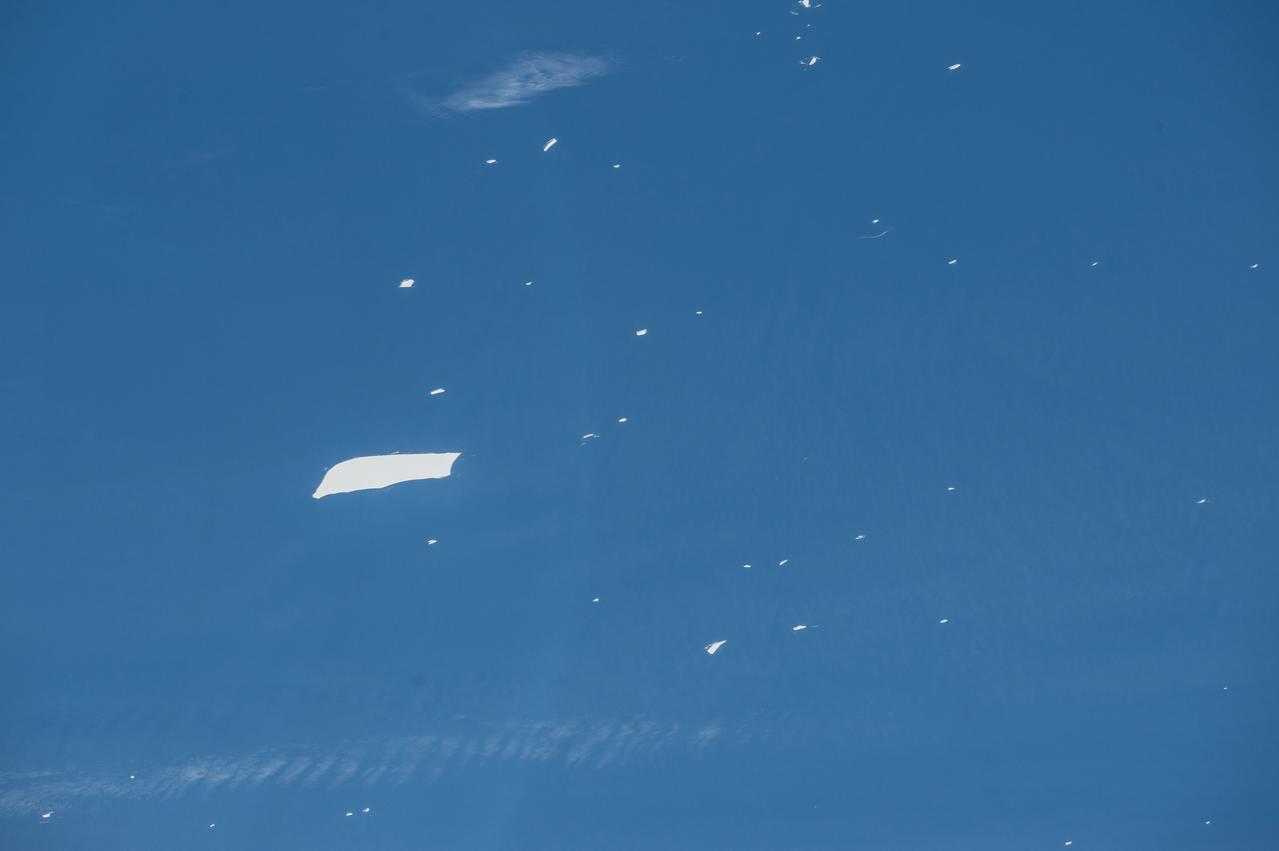
ISS047e22133 (03/27/2016) ---The crew of Expedition 47 aboard the International Space Station captured this image of a massive iceberg causing shipping to pay close attention. It is floating in the southern Atlantic Ocean, near the South Georgia and South Sandwich Islands. Smaller pieces cluster around the main iceberg. causing further shipping concern. The closest continent is the bottom tip of South America (Argentina) and the Falkland Islands.
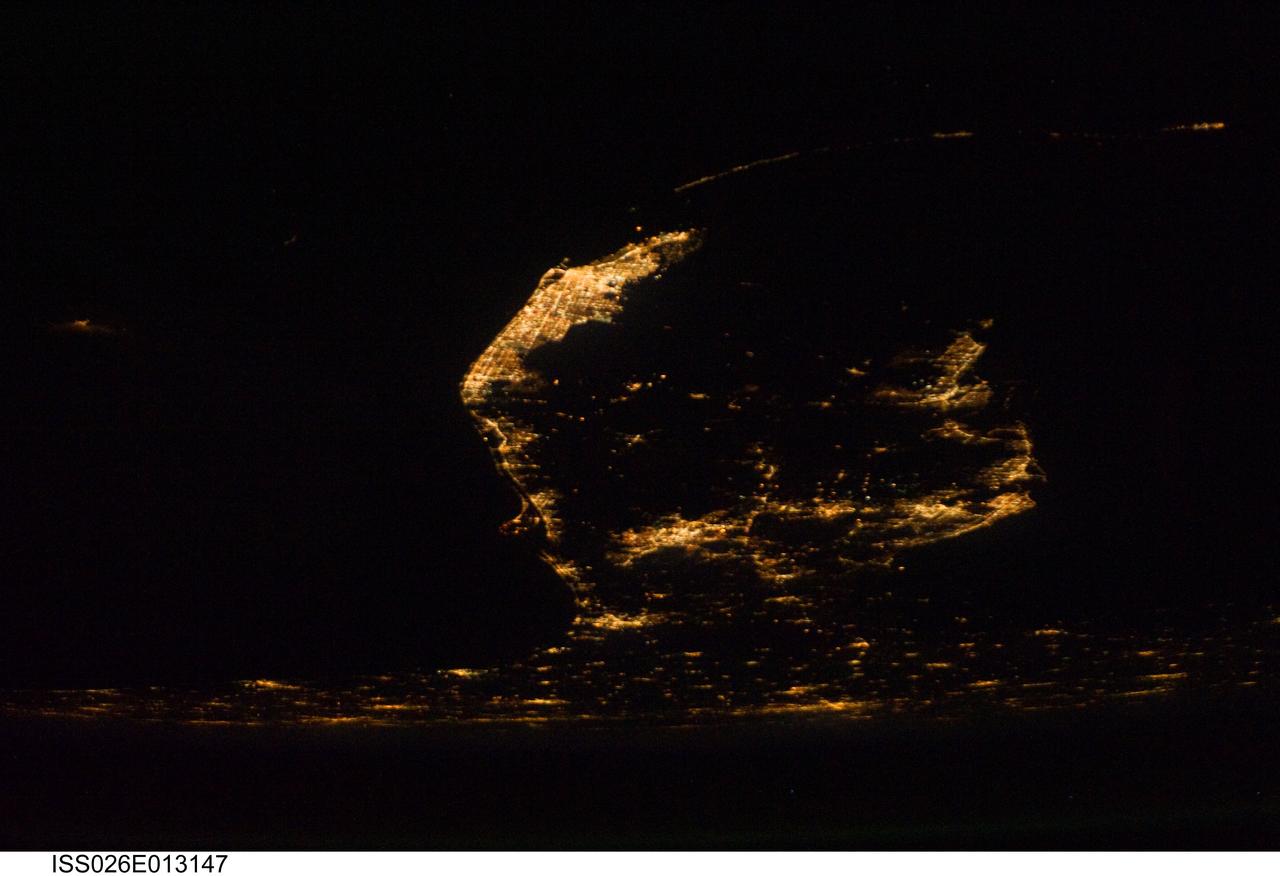
ISS026-E-013147 (28 Dec. 2010) --- A southerly looking night view of the upper two thirds of the Florida peninsula was recorded by one of the Expedition 26 crew members aboard the International Space Station on Dec. 28, 2010. Cape Canaveral and the Kennedy Space Center are very well lighted on the left (Atlantic Ocean) side of the peninsula. The Tampa-St. Petersburg area is seen on the Gulf of Mexico or right side of the frame. At bottom or in the north areas of the picture are portions of the state?s panhandle as well as cities and communities in southern Georgia.
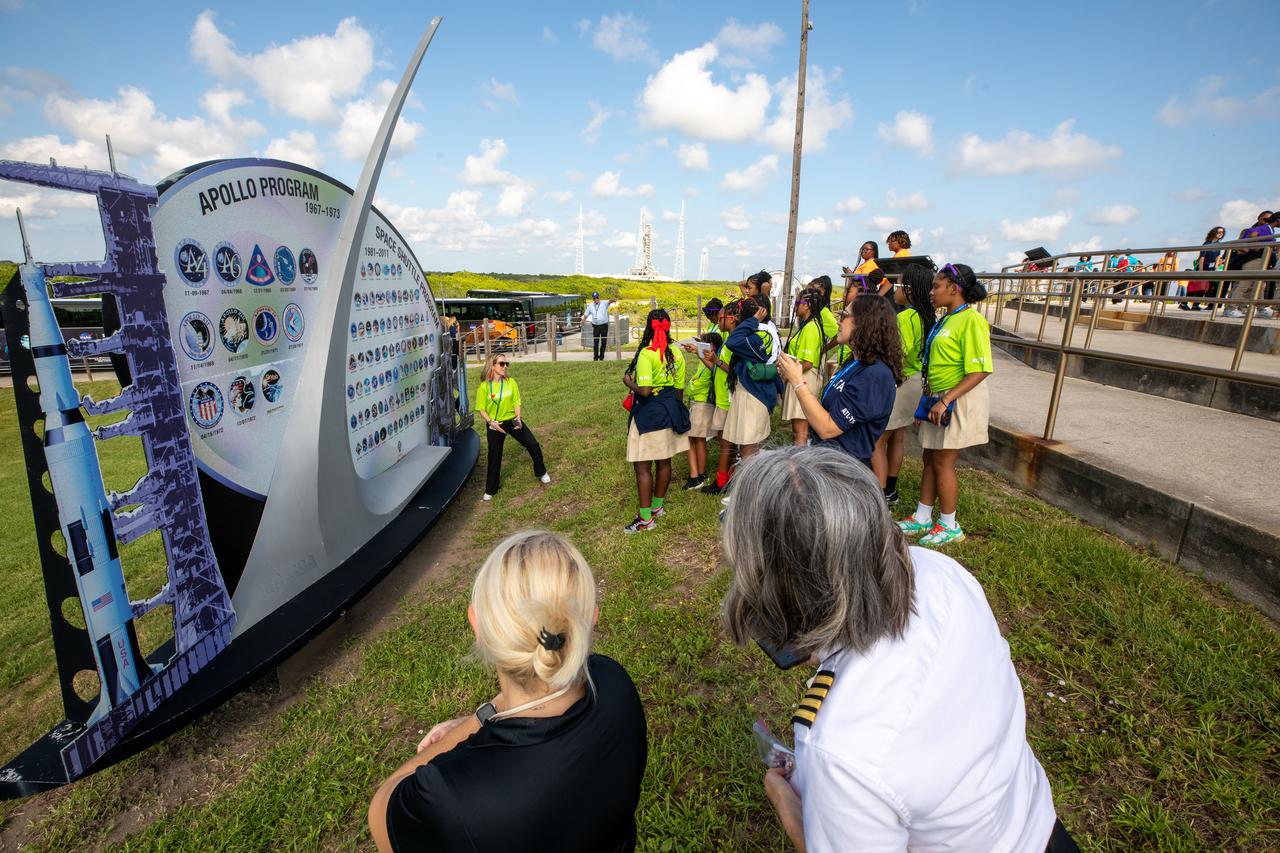
Young women, ages 11 to 18, visited launch pads 39A and 39B on Friday, Sept. 20, 2024, at the agency’s Kennedy Space Center in Florida. Part of the Delta Air Lines’ Women Inspiring Our Next Generation (WING) flight, the young women from the Atlanta, Georgia area, learned about the various women-led STEM (science, technology, engineering, and math) careers available at the Florida spaceport.
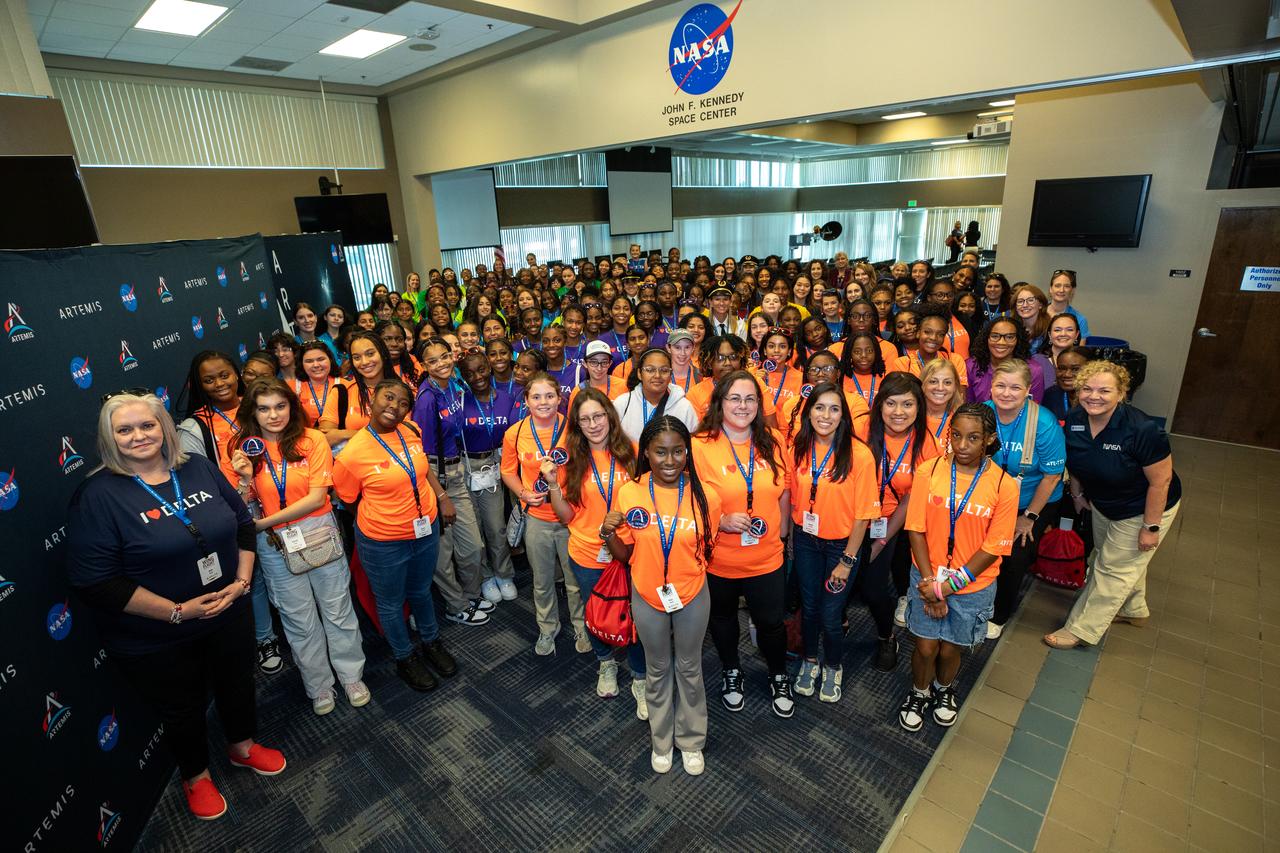
Young women, ages 11 to 18, from the Atlanta, Georgia area, with interests in STEM (science, technology, engineering, and math), pose for a photo on Friday, Sept. 20, 2024, at NASA’s Kennedy Space Center in Florida. NASA Kennedy hosted the Delta Air Lines’ Women Inspiring Our Next Generation (WING) flight to showcase various women-led STEM careers available at the Florida spaceport.
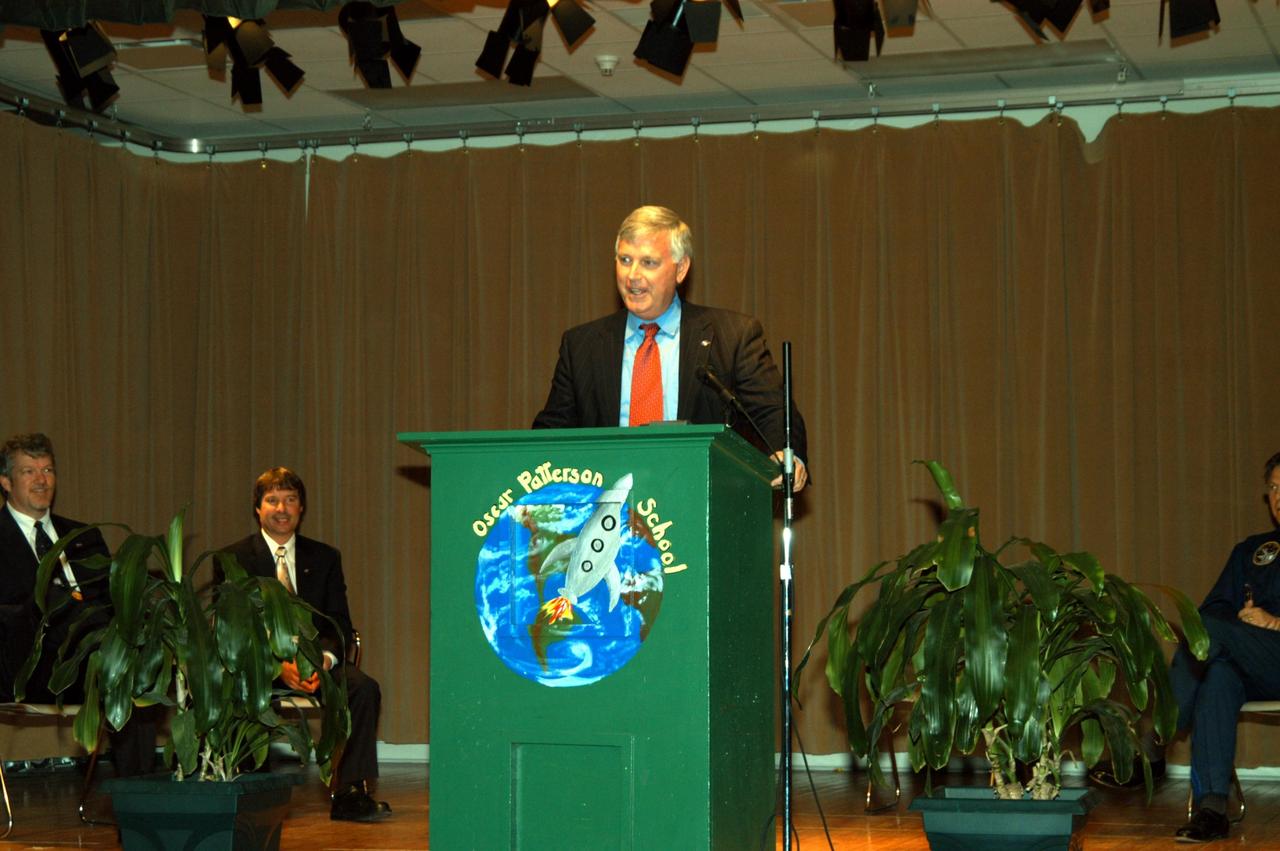
KENNEDY SPACE CENTER, FLA. -- Center Director Jim Kennedy talks to students at Oscar Patterson Elementary Magnet School in Panama City, Fla. Kennedy is visiting NASA Explorer Schools in Florida and Georgia to share America’s new vision for space exploration with the next generation of explorers. Kennedy is talking with students about our destiny as explorers, NASA’s stepping stone approach to exploring Earth, the Moon, Mars and beyond, how space impacts our lives, and how people and machines rely on each other in space.
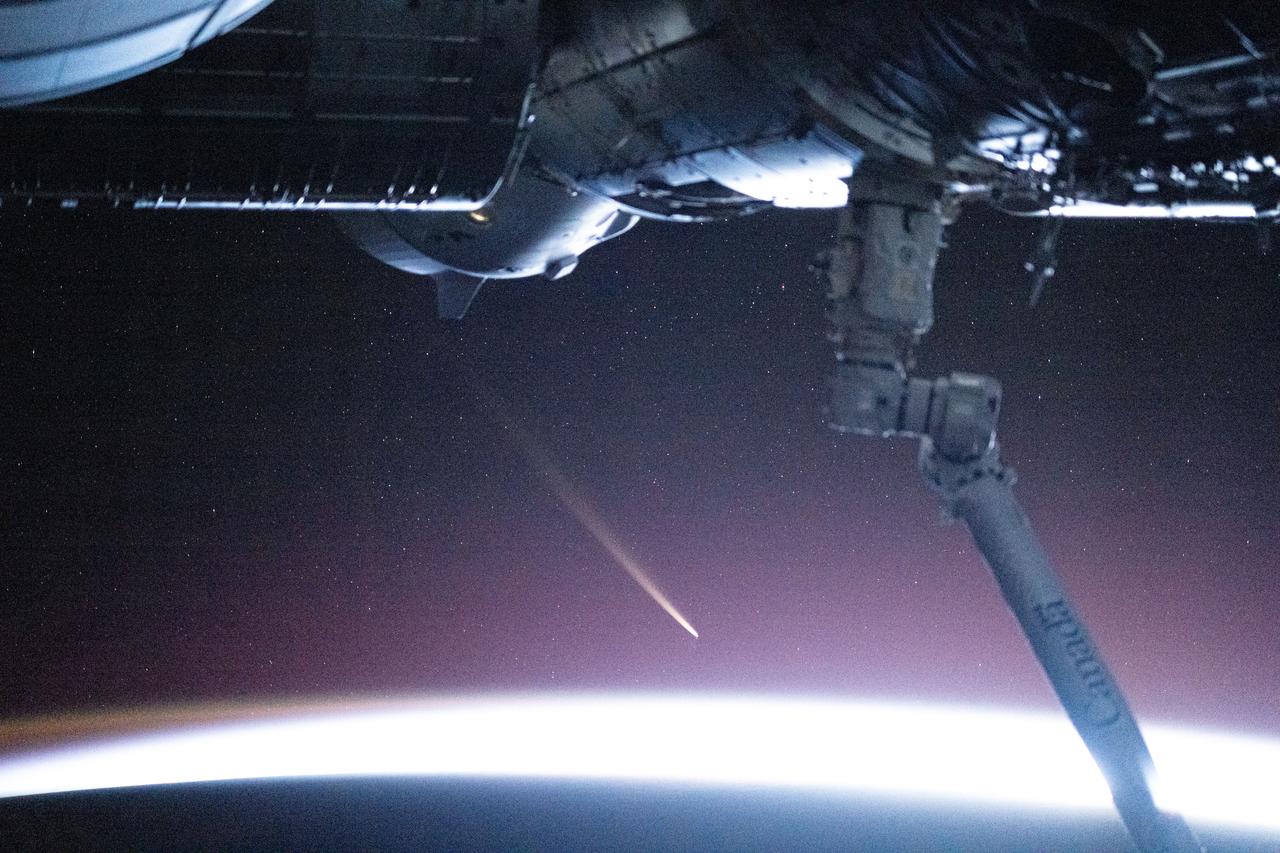
iss072e007238 (Oct. 1, 2024) --- The non-periodic Comet C/2024 G3 (ATLAS) is pictured seemingly above Earth's atmosphere though it was actually about 235 million miles away and heading for a trip around the Sun. The International Space Station was orbiting 272 miles above the southern Atlantic Ocean in between the Falkland Islands (Islas Malvinas) and South Georgia and the South Sandwich Islands at the time of this photograph. Credit: NASA/Don Pettit
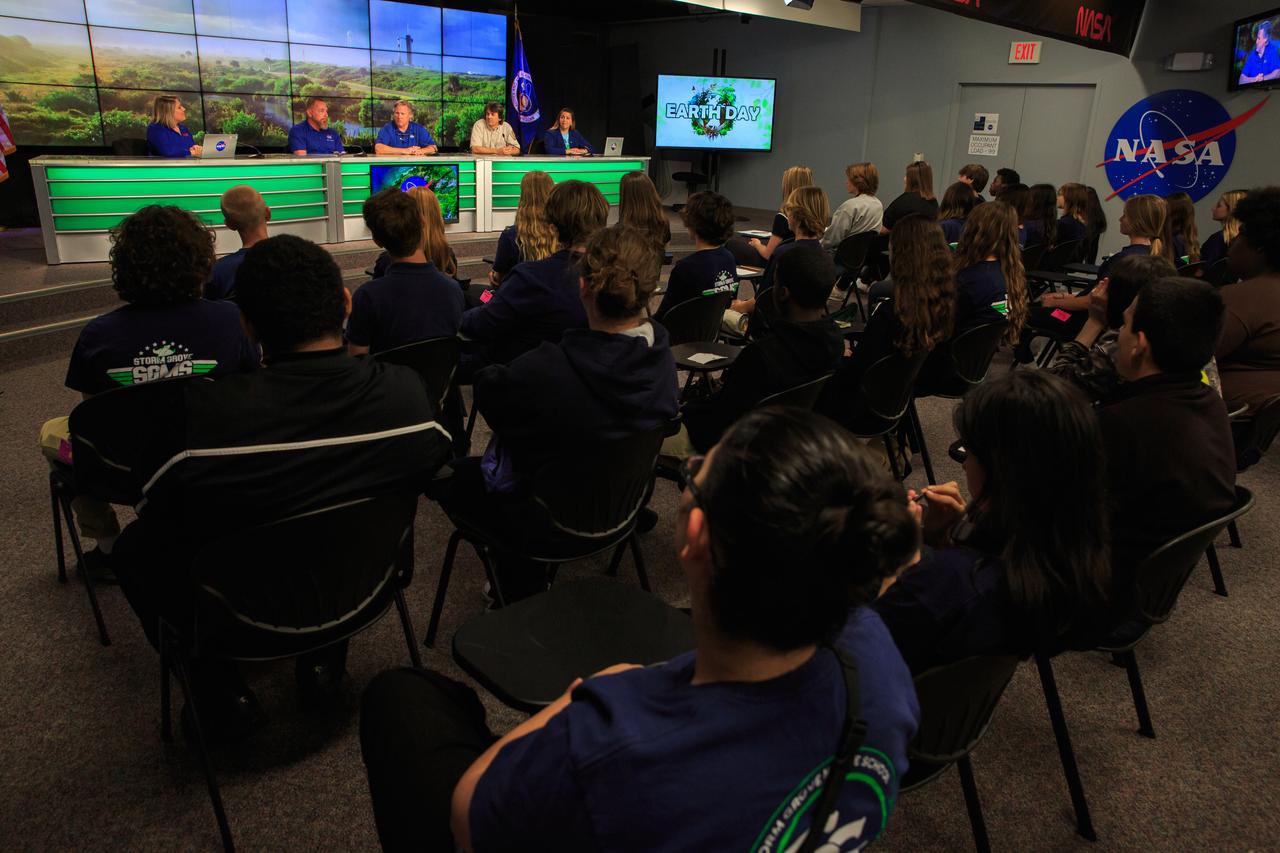
As part of NASA’s NextGen STEM project, students from Florida’s Montverde Academy, Storm Grove Middle School, and Whispering Pines School, as well as a homeschool collective from Georgia, participate in an environmentally focused Earth Day briefing inside the News Auditorium at NASA’s Kennedy Space Center in Florida on April 20, 2023. Along with the students participating in person, middle- and high-school students across the country had the opportunity to ask questions of the panel via phone to discuss how technology and science coexist with nature at Kennedy.
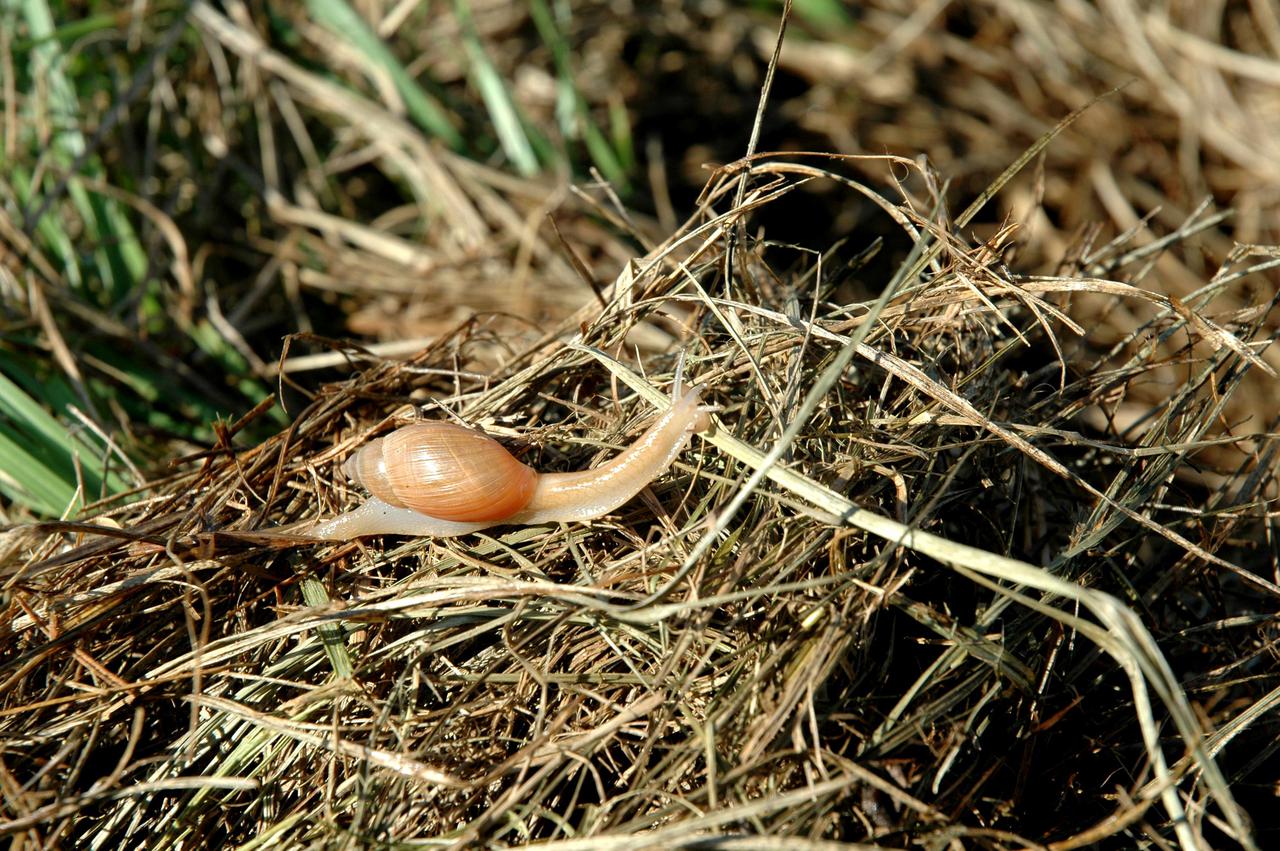
KENNEDY SPACE CENTER, FLA. - This snail was photographed near the NASA Kennedy Space Center Shuttle Landing Facility. It appears to have the characteristics of the “Rosy Predator Snail,” which is found in Southeastern Texas, Louisiana, Mississippi, Alabama, Georgia, South Carolina and is widespread in Florida including the Keys. It is usually found singly in hardwood forests, roadsides and urban gardens. The Shuttle Landing Facility backs up to the Banana Creek and surrounding marshes.
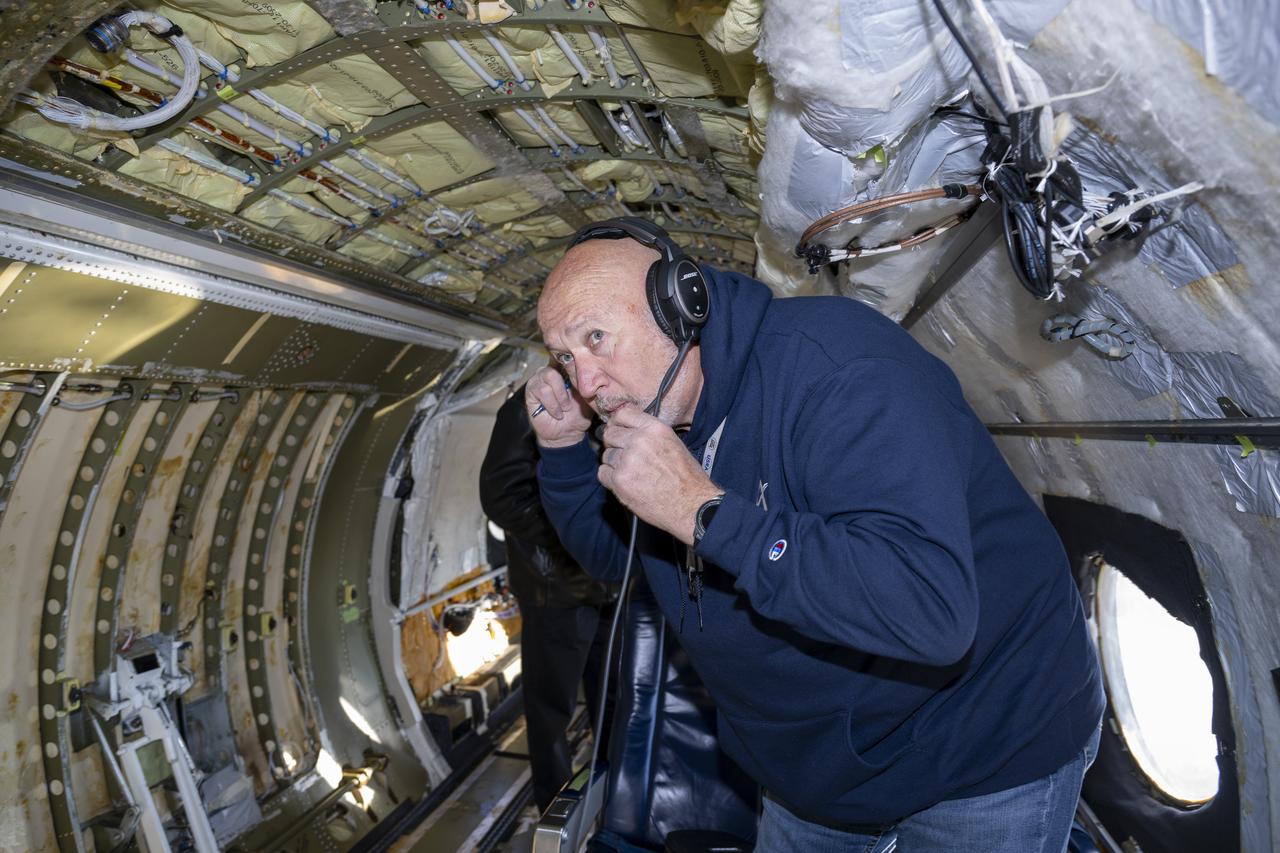
Martin Hench, flight systems engineer, checks the communications system onboard the G-IV aircraft as it prepares to depart NASA’s Armstrong Flight Research Center in Edwards, California, on March 18, 2025. As the newest member of NASA Armstrong’s airborne science fleet, the G-IV was sent to Avenger Aerospace Solutions in Cartersville, Georgia, for modifications that will optimize the G-IV’s performance as a research aircraft.
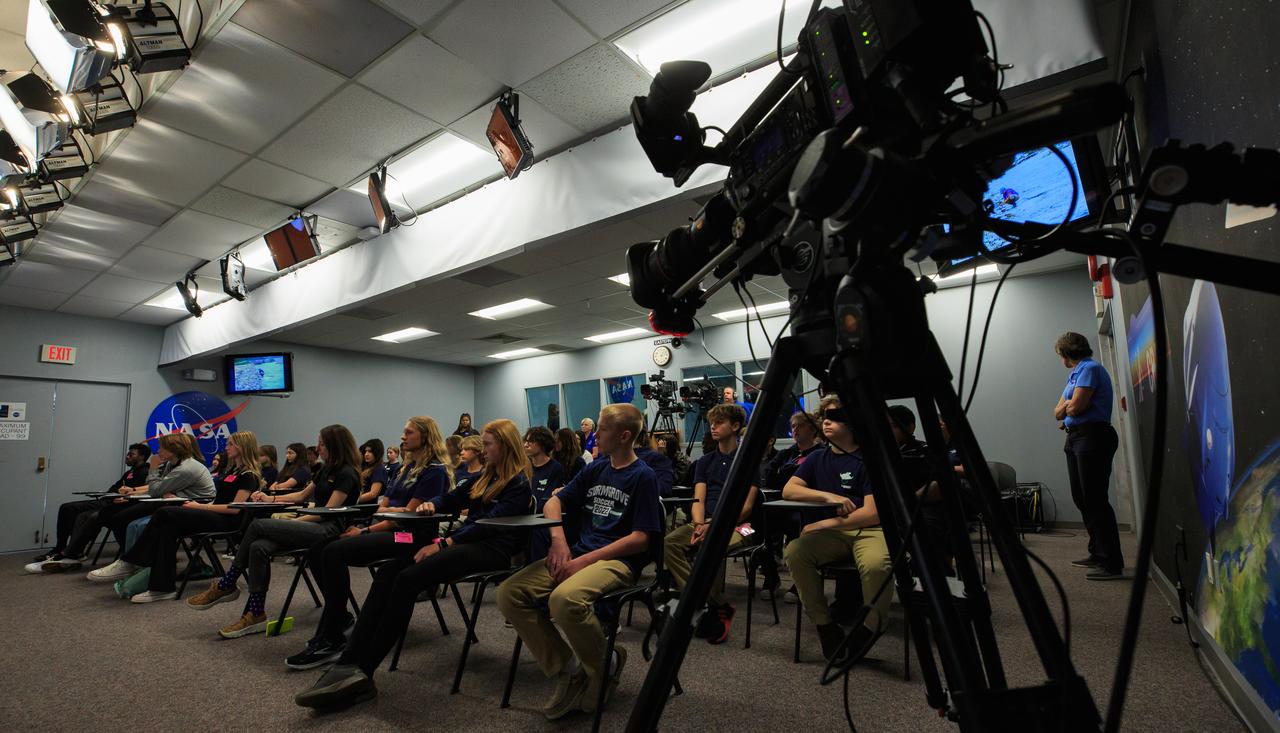
As part of NASA’s NextGen STEM project, students from Florida’s Montverde Academy, Storm Grove Middle School, and Whispering Pines School, as well as a homeschool collective from Georgia, participate in an environmentally focused Earth Day briefing inside the News Auditorium at NASA’s Kennedy Space Center in Florida on April 20, 2023. Along with the students participating in person, middle- and high-school students across the country had the opportunity to ask questions of the panel via phone to discuss how technology and science coexist with nature at Kennedy.
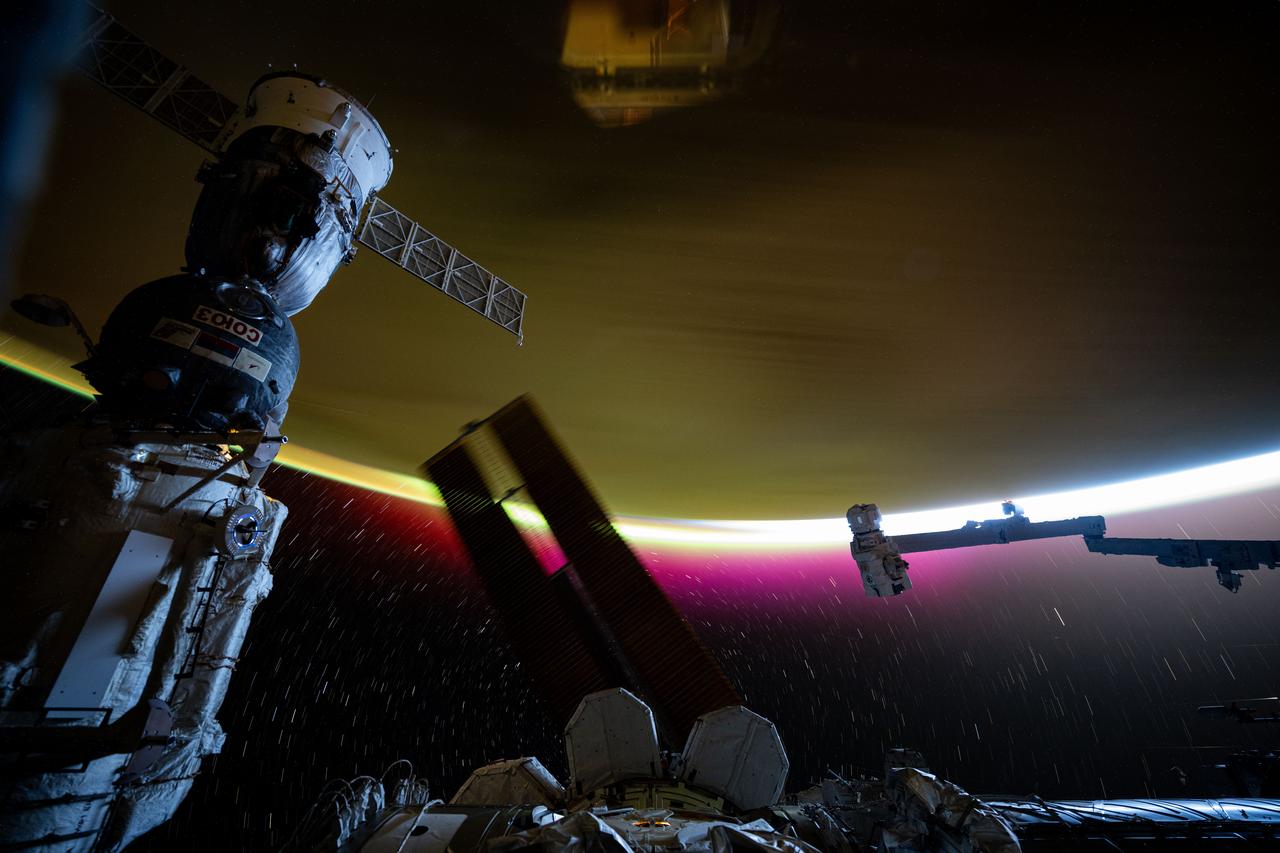
iss072e941128 (April 2, 2025) --- This long duration photograph, taken from the International Space Station as it orbited 271 miles above the South Georgia and the South Sandwich Islands in the southern Atlantic Ocean, highlights star trails and Earth's atmospheric glow moments before the orbital outpost soared into a sunrise. In the foreground (from left), are the Soyuz MS-26 spacecraft docked to the Rassvet module, a set of the station's main solar arrays, and the Canadarm2 robotic arm.
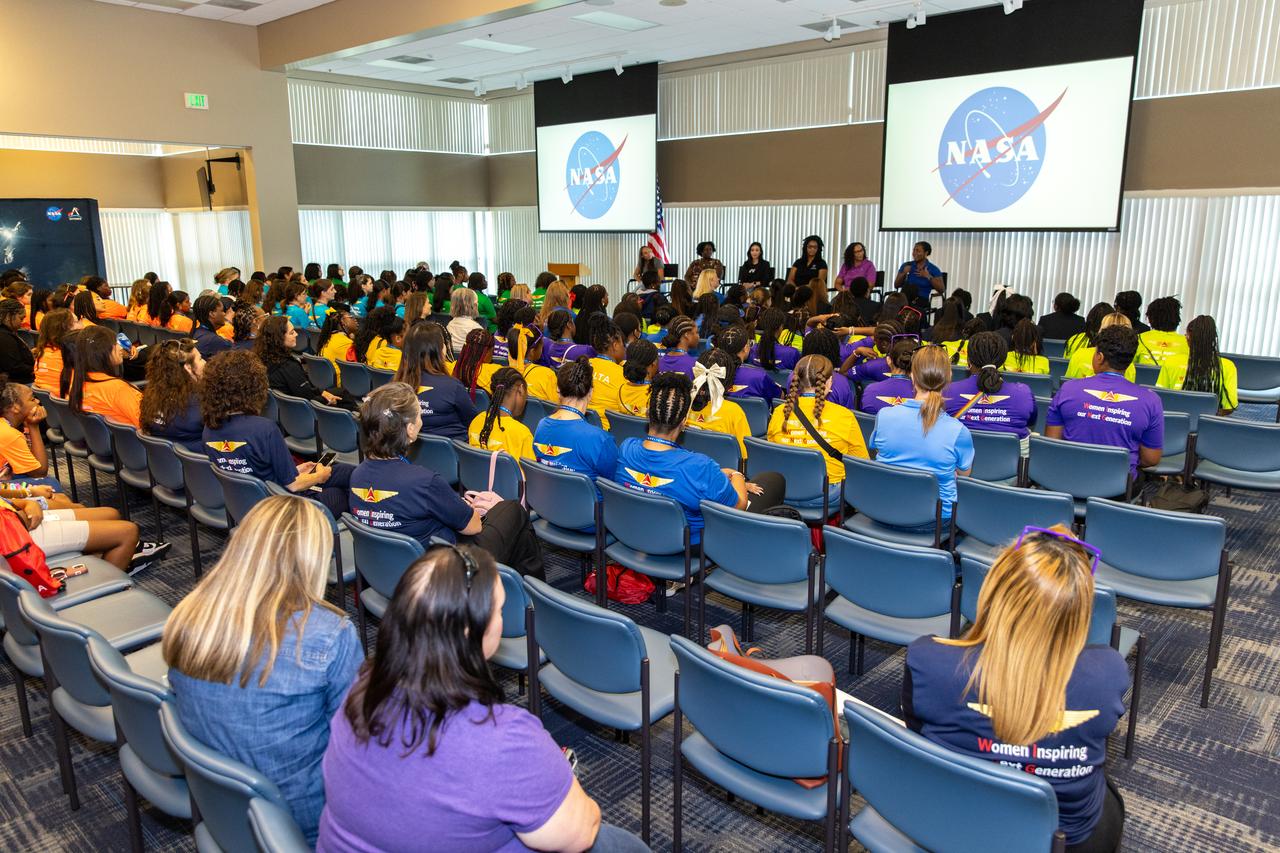
Young women, ages 11 to 18, from the Atlanta, Georgia area, with interests in STEM (science, technology, engineering, and math), pose for a photo on Friday, Sept. 20, 2024, at NASA’s Kennedy Space Center in Florida. NASA Kennedy hosted the Delta Air Lines’ Women Inspiring Our Next Generation (WING) flight to showcase various women-led STEM careers available at the Florida spaceport.
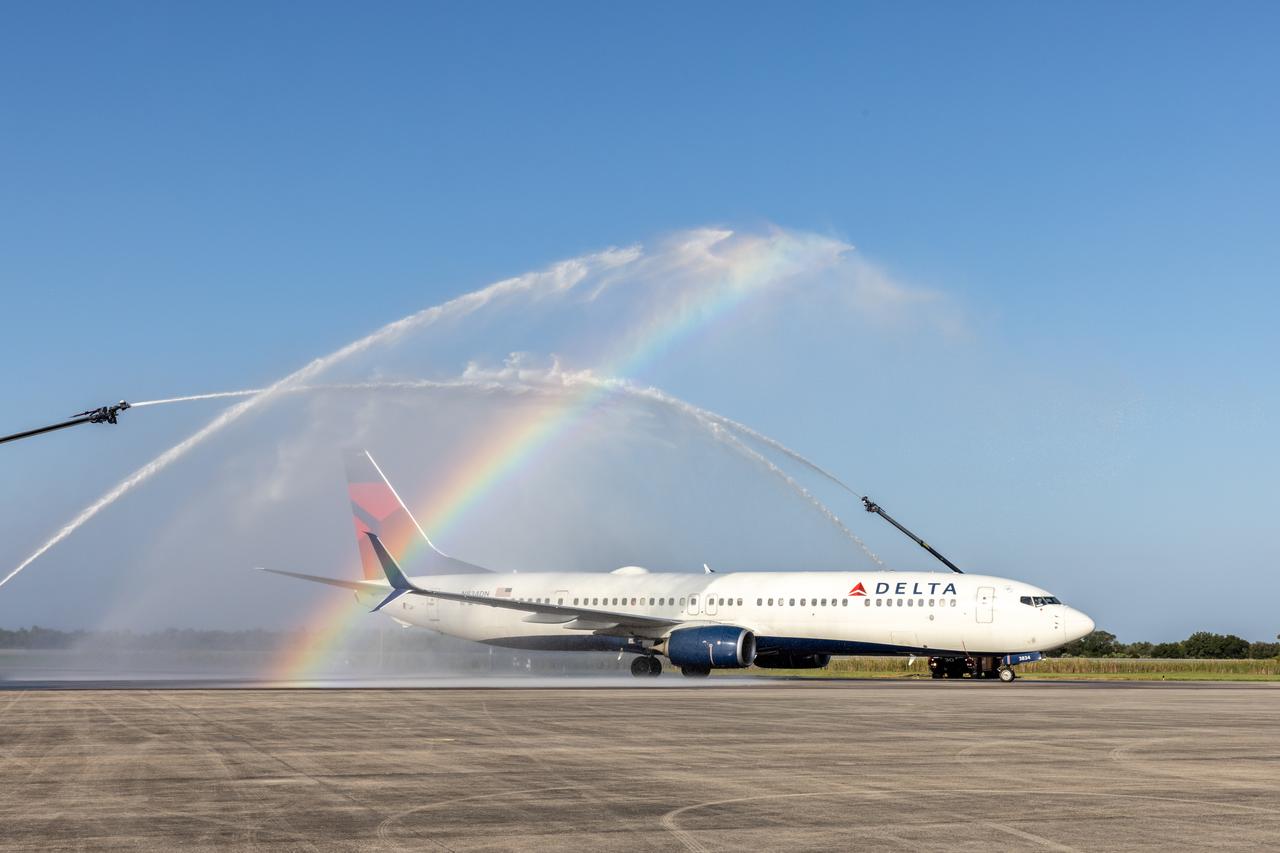
A Delta plane, carrying an all-female crew and 130 young women ages 11 to 18, received a “water salute” upon arrival on Friday, Sept. 20, 2024, at the Launch and Landing Facility at NASA’s Kennedy Space Center in Florida. Part of the Delta Air Lines’ Women Inspiring Our Next Generation (WING) flight, the young women from the Atlanta, Georgia area, learned about the various women-led STEM (science, technology, engineering, and math) careers available at the Florida spaceport.
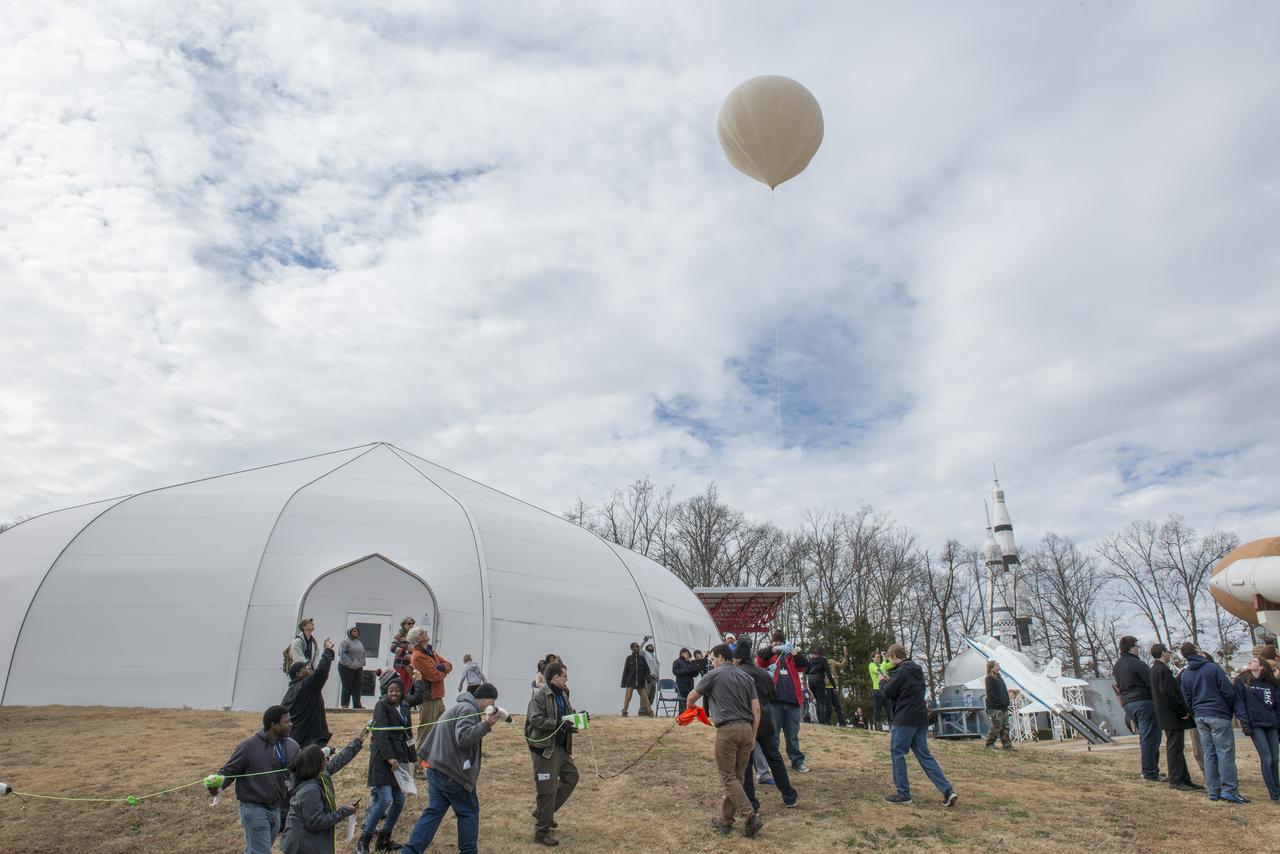
STUDENTS FROM COMMUNITY COLLEGES THROUGHOUT THE SOUTH CAME TOGETHER AT THE U.S. SPACE AND ROCKET CENTER FOR THE BALLOONSAT LAUNCH EVENT. EACH COMMUNITY COLLEGE TEAM ASSEMBLED ITS OWN PAYLOAD, DESIGNED TO DOWNLOAD SCIENTIFIC AND ATMOSPHERIC INFORMATION, AND THEN 2 WEATHER BALLOONS WERE SENT ALOFT TO APPROXIMATELY 100,000 FEET WITH THE PAYLOADS. THE PAYLOADS WERE RECOVERED IN N. GEORGIA AND TAKEN BACK TO THE INDIVIDUAL SCHOOLS FOR DOWNLOADING.

Like a ship carving its way through the sea, the South Georgia and South Sandwich Islands parted the clouds. The Moderate Resolution Imaging Spectroradiometer (MODIS) on NASA’s Terra satellite acquired this natural-color image on February 2, 2017. The ripples in the clouds are known as gravity waves. NASA image by Jeff Schmaltz, LANCE/EOSDIS Rapid Response #nasagoddard
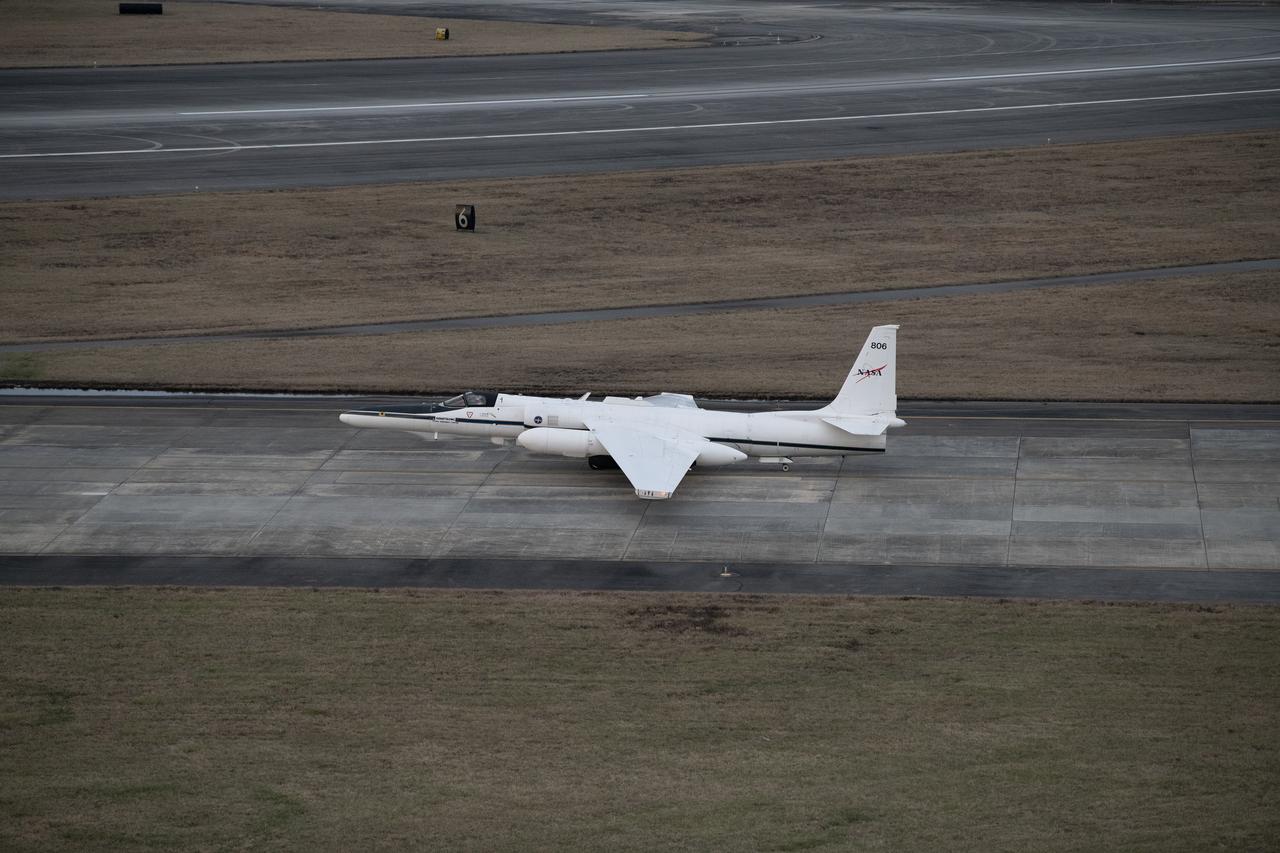
The NASA ER-2 high-altitude aircraft was prepared to support the Investigation of Microphysics and Precipitation for Atlantic Coast-Threatening Storms (IMPACTS) mission. For this mission, the IMPACTS team tracked storms across the Eastern United States to help understand how winter storms form and develop. The aircraft, which is based at NASA’s Armstrong Flight Research Center Building 703 in Palmdale, California, was temporarily based at Dobbins Air Reserve Base in Marietta, Georgia. The three-year IMPACTS campaign concluded on Feb. 28, 2023.

jsc2021e029976 (6/30/2021) --- A preflight view of the TARGIT cubesat. The Tethering And Ranging Mission of the Georgia Institute of Technology (TARGIT) tests a miniaturized Light Detection and Ranging (LiDAR) imaging camera. The camera tracks and takes images of a tethered inflatable target to verify its performance and demonstrate precision topographic mapping capability and use of an inflatable as a drag device. These capabilities could help support future planetary missions. Image courtesy of Candler Hobbs
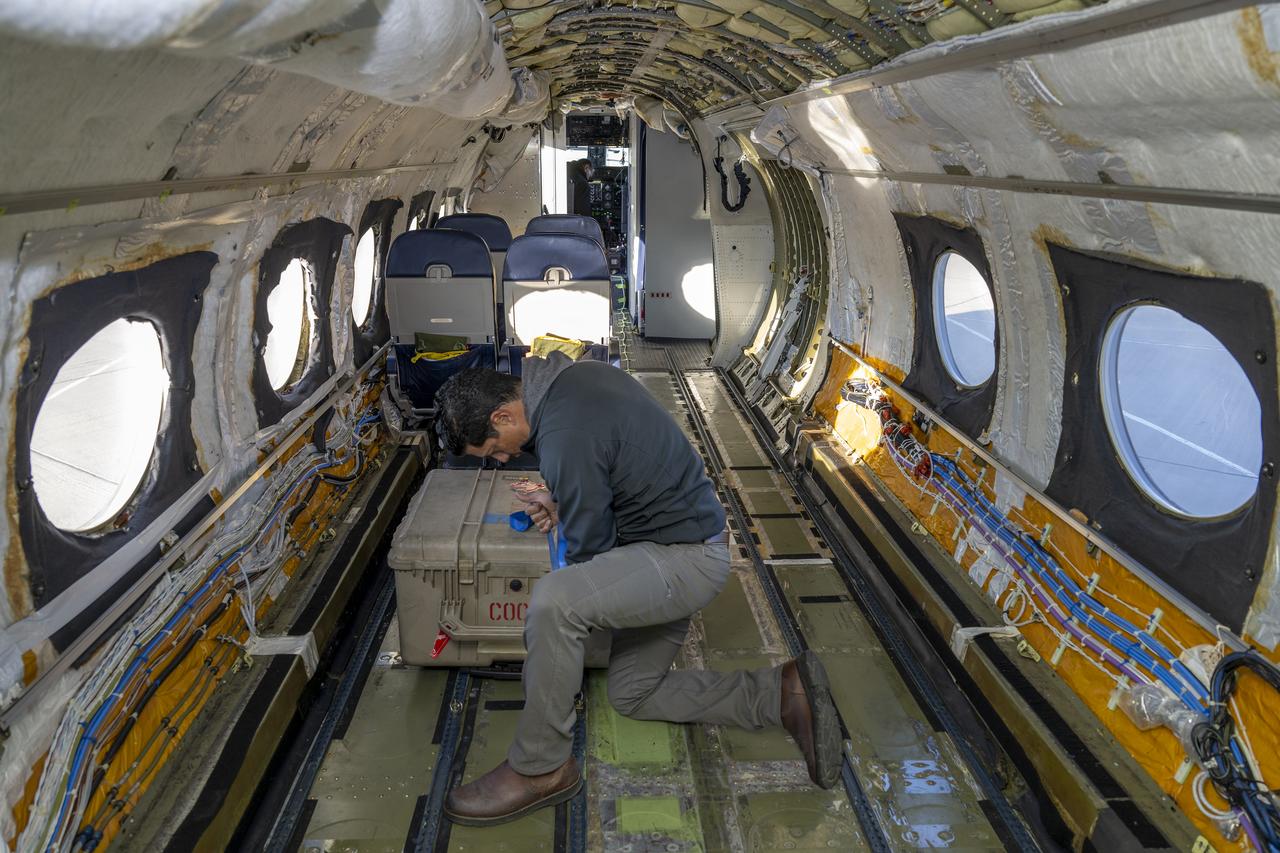
Jose “Manny” Rodriguez, technical engineer at NASA’s Armstrong Flight Research Center in Edwards, California, secures a trunk onboard the G-IV aircraft on March 18, 2025. As the newest member of NASA Armstrong’s airborne science fleet, the G-IV was sent to Avenger Aerospace Solutions in Cartersville, Georgia, for modifications that will optimize the G-IV’s performance as a research aircraft.
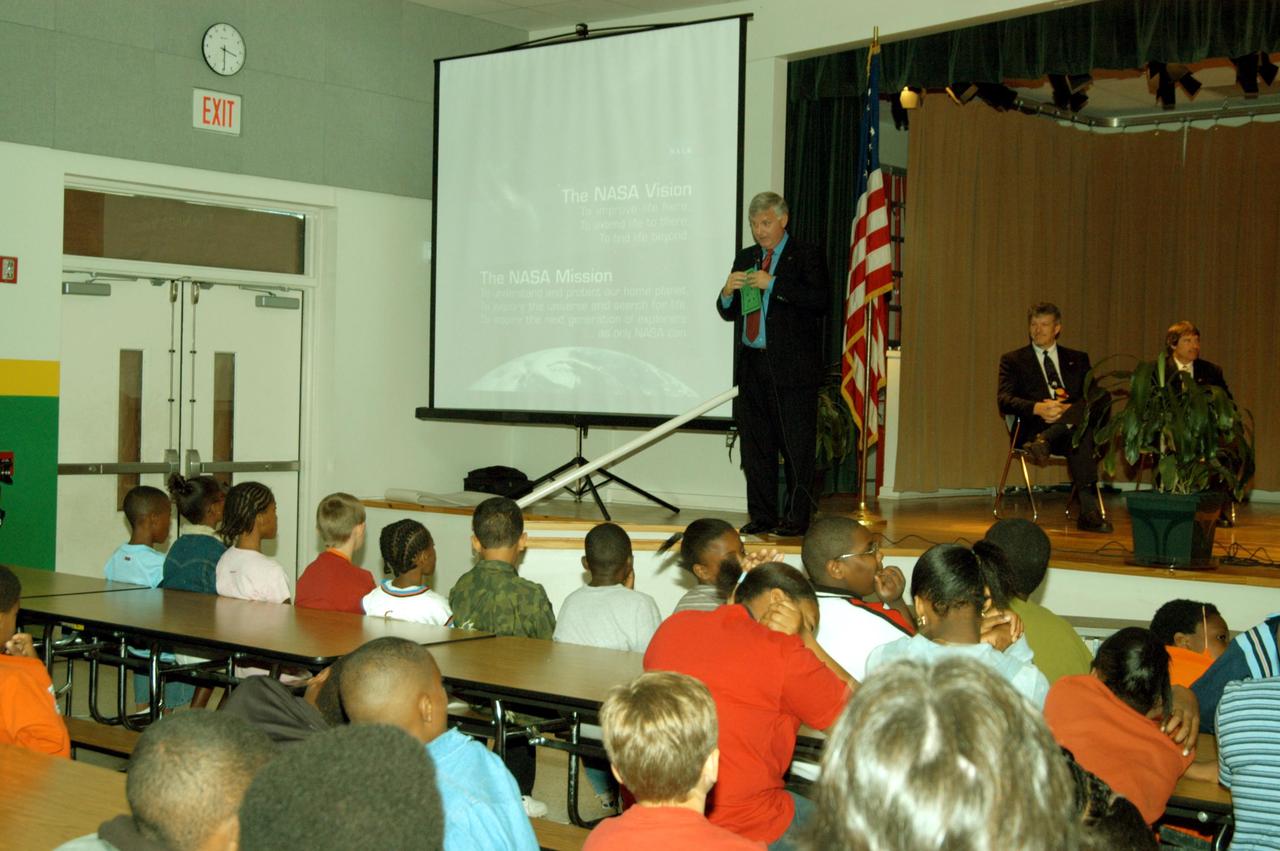
KENNEDY SPACE CENTER, FLA. -- Students at Oscar Patterson Elementary Magnet School in Panama City, Fla., listen to Center Director Jim Kennedy as he shares America’s new vision for space exploration. Kennedy is visiting NASA Explorer Schools in Florida and Georgia, talking with students about our destiny as explorers, NASA’s stepping stone approach to exploring Earth, the Moon, Mars and beyond, how space impacts our lives, and how people and machines rely on each other in space.
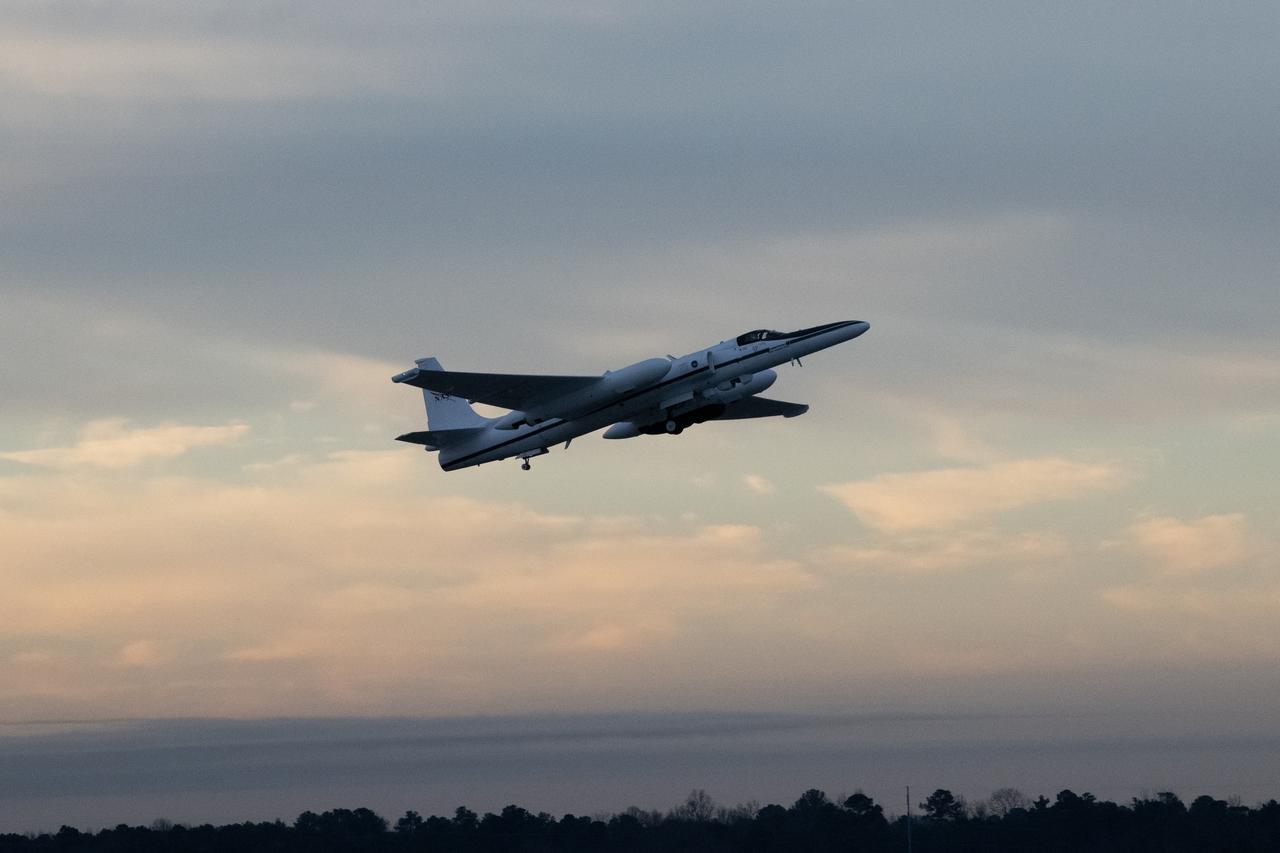
The NASA ER-2 high-altitude aircraft supported the Investigation of Microphysics and Precipitation for Atlantic Coast-Threatening Storms (IMPACTS) mission. For this mission, the IMPACTS team tracked storms across the Eastern United States to help understand how winter storms form and develop. The aircraft, which is based at NASA’s Armstrong Flight Research Center Building 703 in Palmdale, California, was temporarily based at Dobbins Air Reserve Base in Marietta, Georgia. The three-year IMPACTS campaign concluded on Feb. 28, 2023.
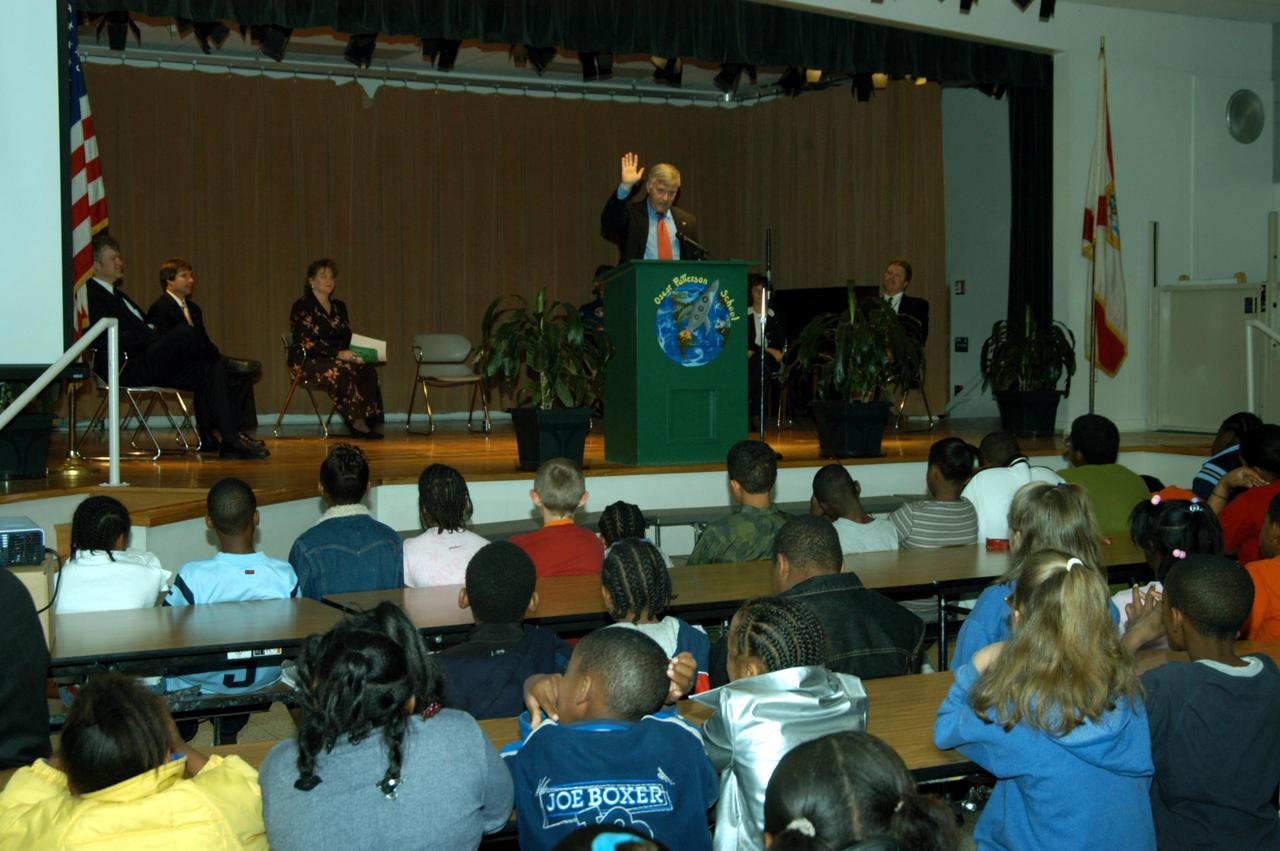
KENNEDY SPACE CENTER, FLA. -- Center Director Jim Kennedy talks to students at Oscar Patterson Elementary Magnet School in Panama City, Fla. Kennedy is visiting NASA Explorer Schools in Florida and Georgia to share America’s new vision for space exploration with the next generation of explorers. Kennedy is talking with students about our destiny as explorers, NASA’s stepping stone approach to exploring Earth, the Moon, Mars and beyond, how space impacts our lives, and how people and machines rely on each other in space.
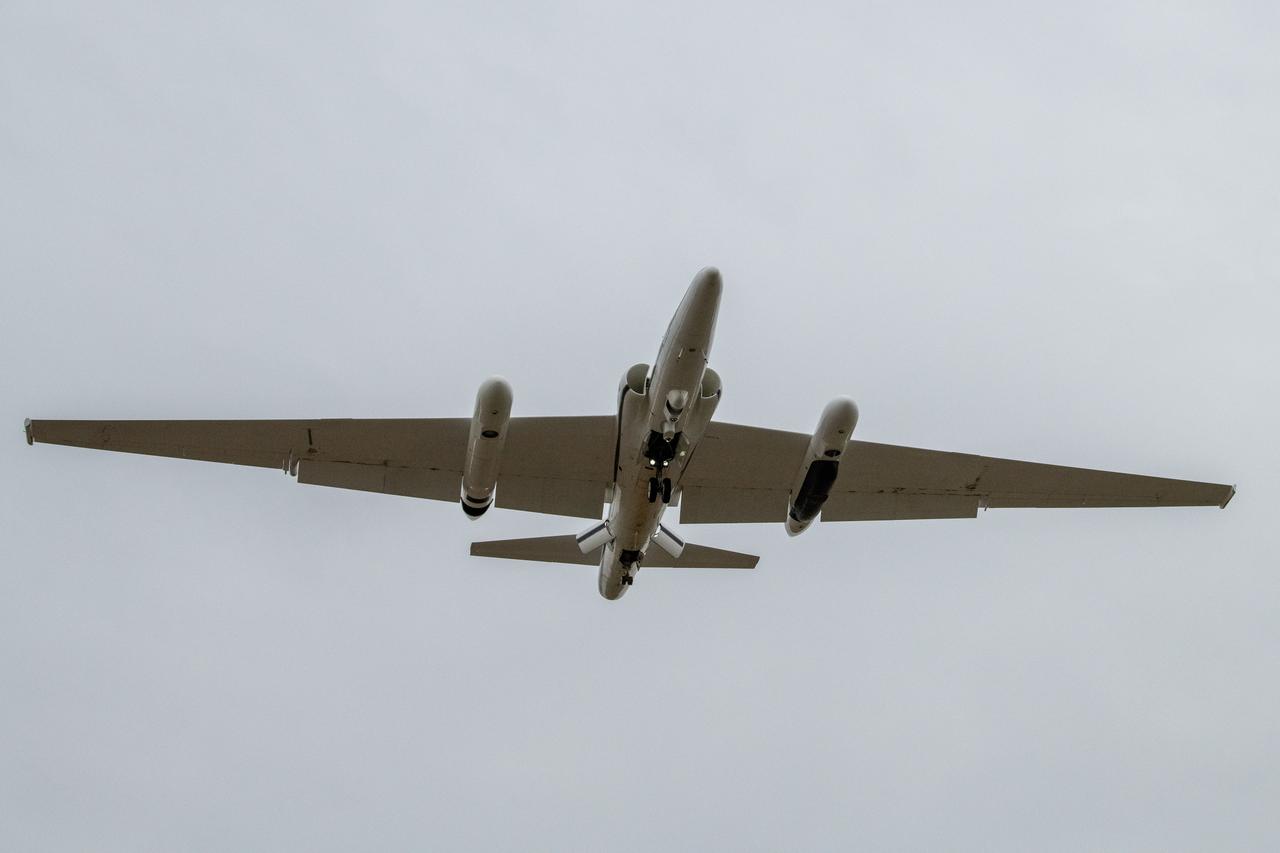
The NASA ER-2 high-altitude aircraft supported the Investigation of Microphysics and Precipitation for Atlantic Coast-Threatening Storms (IMPACTS) mission. For this mission, the IMPACTS team tracked storms across the Eastern United States to help understand how winter storms form and develop. The aircraft, which is based at NASA’s Armstrong Flight Research Center Building 703 in Palmdale, California, was temporarily based at Dobbins Air Reserve Base in Marietta, Georgia. The three-year IMPACTS campaign concluded on Feb. 28, 2023.
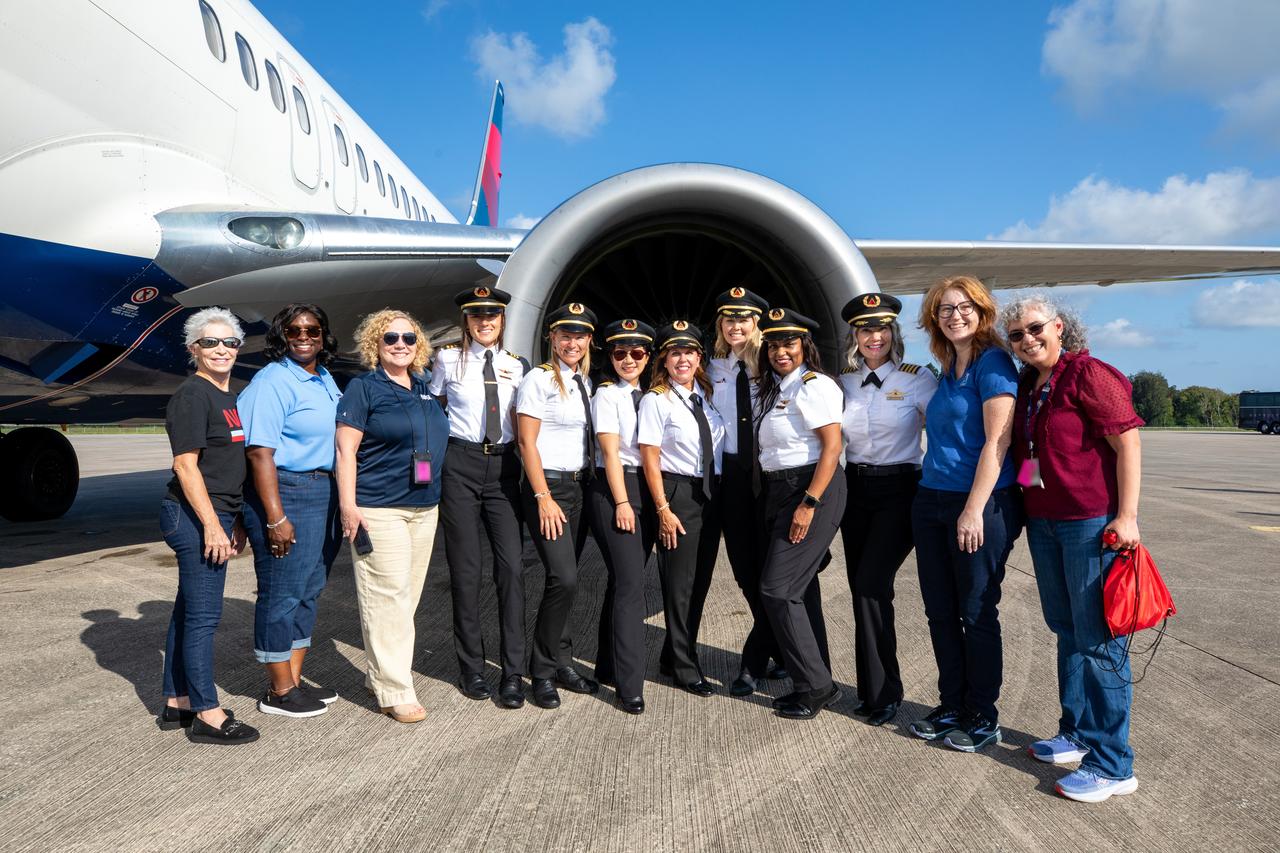
Women with leadership positions at NASA’s Kennedy Space Center pose with members of the all-female crew for Delta Air Lines’ Women Inspiring Our Next Generation (WING) flight after the crew touched down on Friday, Sept. 20, 2024, at the Launch and Landing Facility at the Florida spaceport. The flight brought girls from Atlanta, Georgia, ranging in age from 11 to 18, to view center facilities and hear a panel of women discuss their careers with NASA and Delta Air Lines.
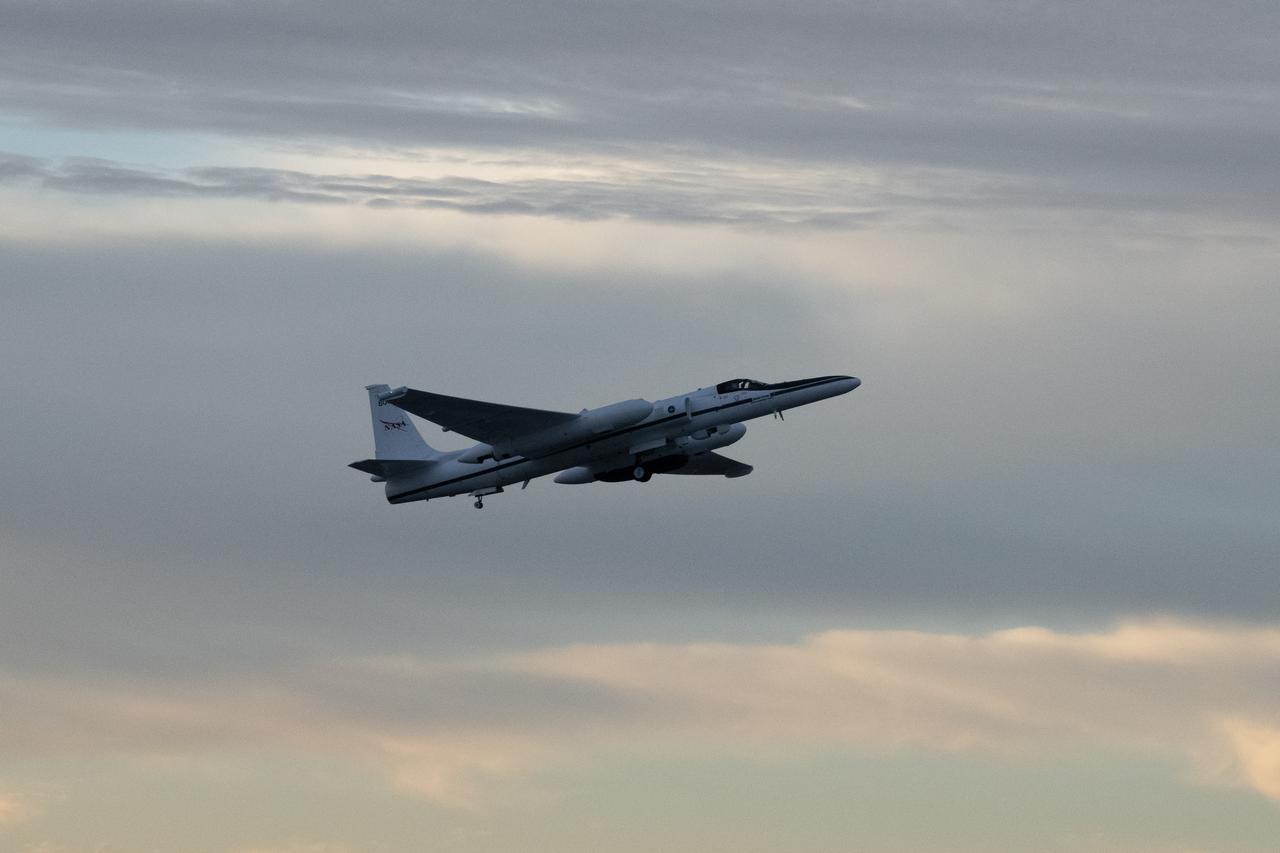
The NASA ER-2 high-altitude aircraft supported the Investigation of Microphysics and Precipitation for Atlantic Coast-Threatening Storms (IMPACTS) mission. For this mission, the IMPACTS team tracked storms across the Eastern United States to help understand how winter storms form and develop. The aircraft, which is based at NASA’s Armstrong Flight Research Center Building 703 in Palmdale, California, was temporarily based at Dobbins Air Reserve Base in Marietta, Georgia. The three-year IMPACTS campaign concluded on Feb. 28, 2023.
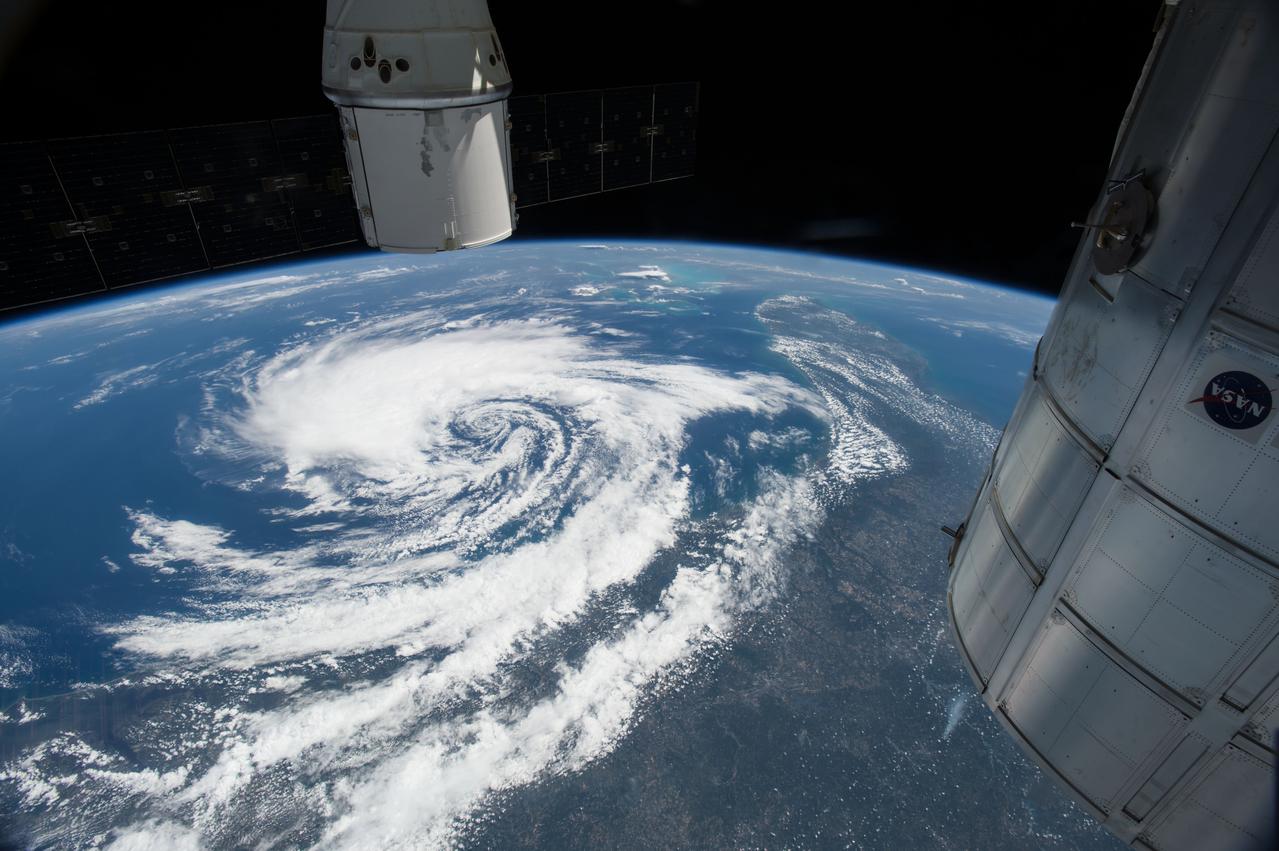
ISS043E182261 (05/08/2015) --- This image of Tropical Storm Anna taken from the International Space Station displays the view looking south-southeastward from western Virginia towards storm about 200 miles east of Savannah, Georgia, Bahamas and Florida in the distance. Expedition 43 NASA astronaut Scott Kelly and his crewmates captured many images of the Earth showing the storms progression onto the Carolina's and other east coast states.
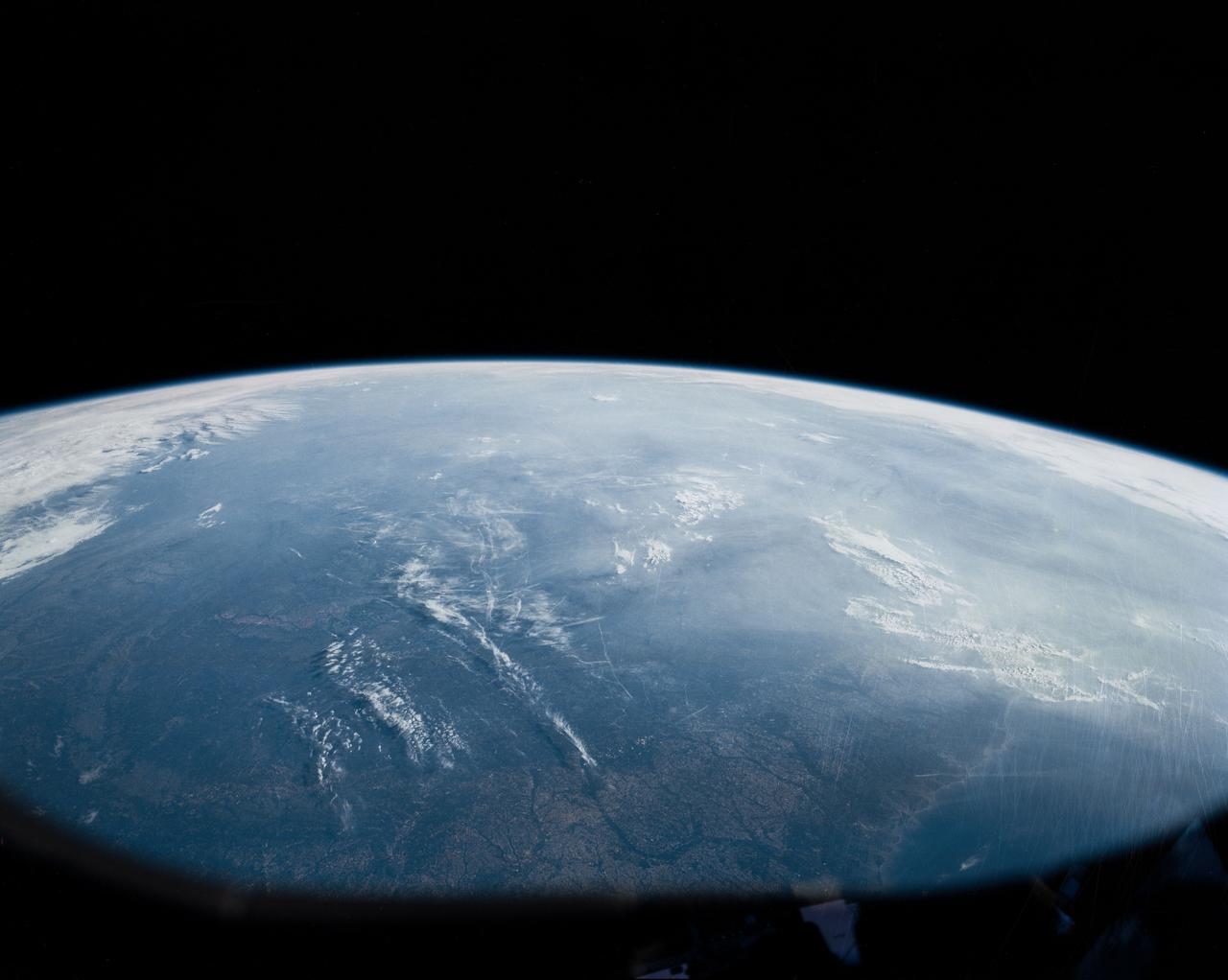
In this oblique view of the Georgia and South Carolina coast, the southern most Appalachians (32.0N, 83.0W) dominate the foreground. Contrails criss cross over Atlanta, a major airline hub. The coastal plain which wraps around the southern Appalachians, is well delineated. Faintly visible under the haze toward Earth's limb are the Great lakes (Lake Michigan near center), the folded belts of the central Appalachians and Long Island, New York.
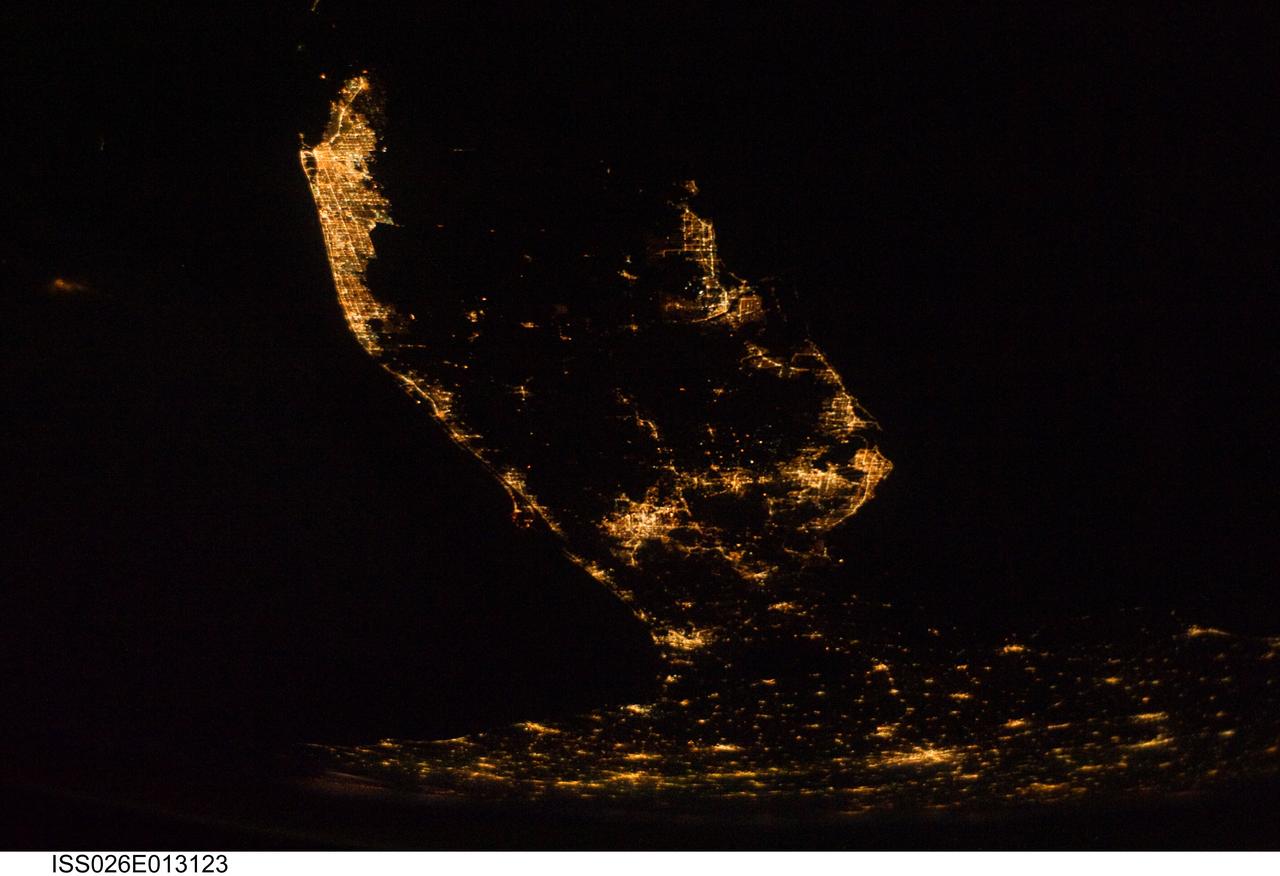
ISS026-E-013123 (28 Dec. 2010) --- A southerly looking night view of the upper two thirds of the Florida peninsula was recorded by one of the Expedition 26 crew members aboard the International Space Station on Dec. 28, 2010. Cape Canaveral and the Kennedy Space Center are very well lighted on the left (Atlantic Ocean) side of the peninsula. The Tampa-St. Petersburg area is seen on the Gulf of Mexico or right side of the frame. At bottom or in the north areas of the picture are portions of the state?s panhandle as well as cities and communities in southern Georgia.
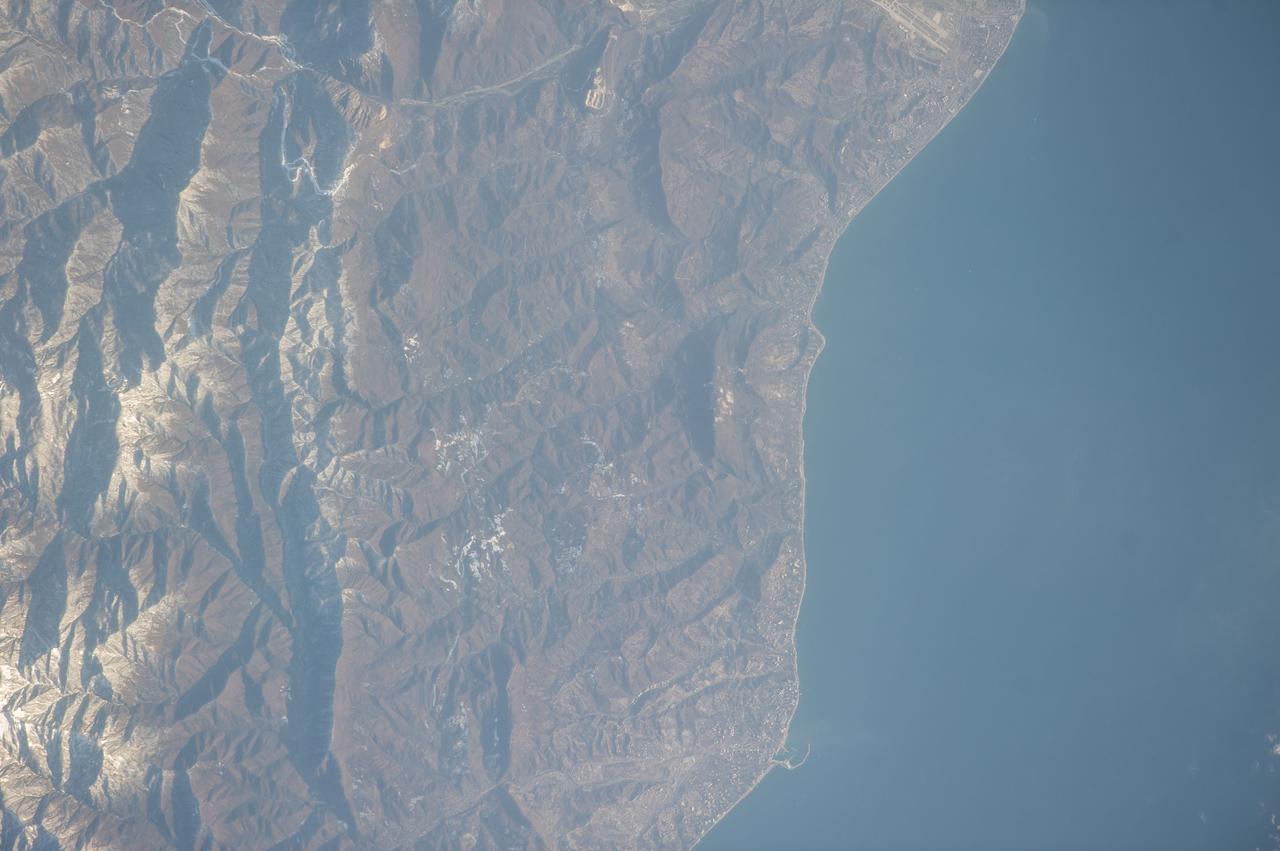
ISS038-E-025812 (5 Feb. 2014) --- One of the Expedition 38 crew members aboard the International Space Station used a 400mm lens to expose this vertical view of the general area of the 2014 Winter Olympics. Sochi is a city in Krasnodar Krai, Russia, located on the Black Sea coast near the border between Georgia/Abkhazia and Russia. It has an area of 1,353 square miles or 3,505 square kilometers.
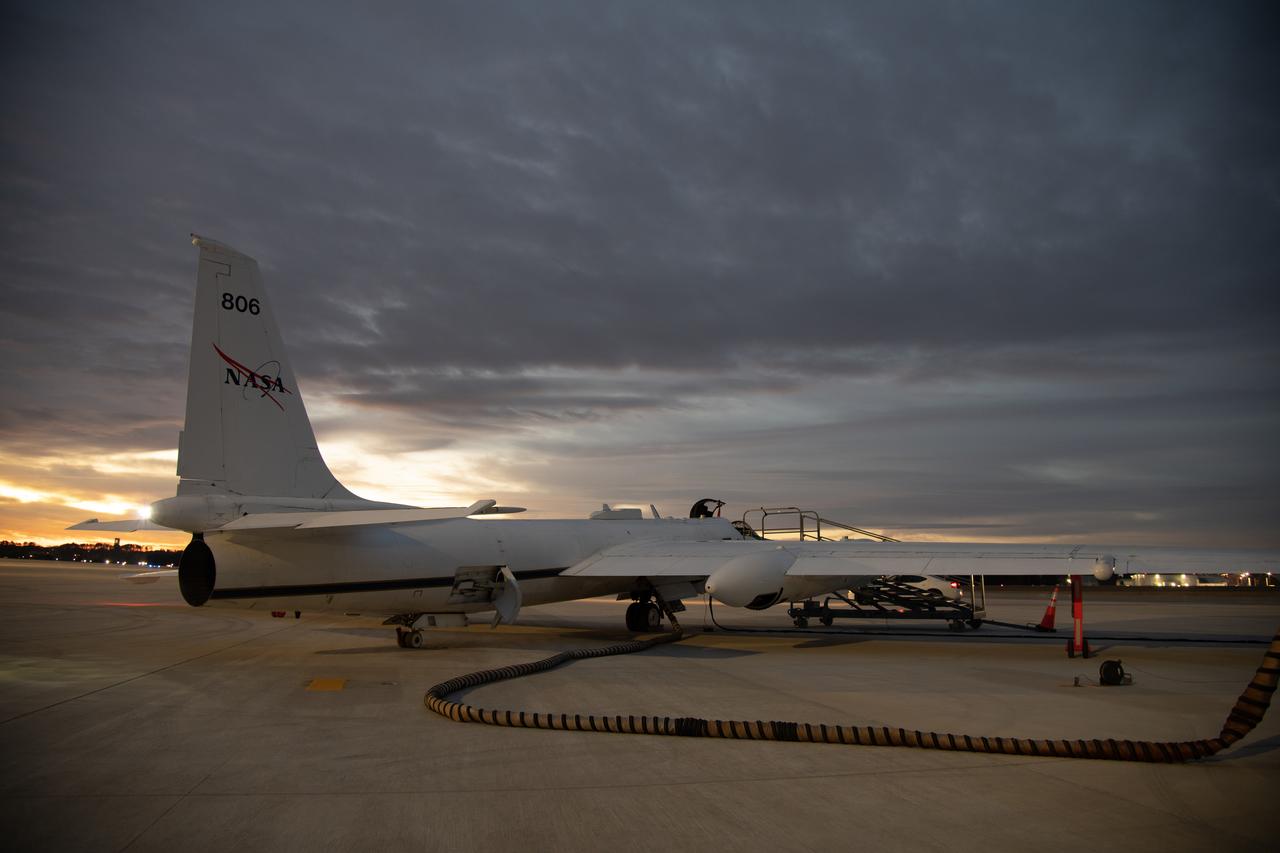
The NASA ER-2 high-altitude aircraft was prepared to support the Investigation of Microphysics and Precipitation for Atlantic Coast-Threatening Storms (IMPACTS) mission. For this mission, the IMPACTS team tracked storms across the Eastern United States to help understand how winter storms form and develop. The aircraft, which is based at NASA’s Armstrong Flight Research Center Building 703 in Palmdale, California, was temporarily based at Dobbins Air Reserve Base in Marietta, Georgia. The three-year IMPACTS campaign concluded on Feb. 28, 2023.
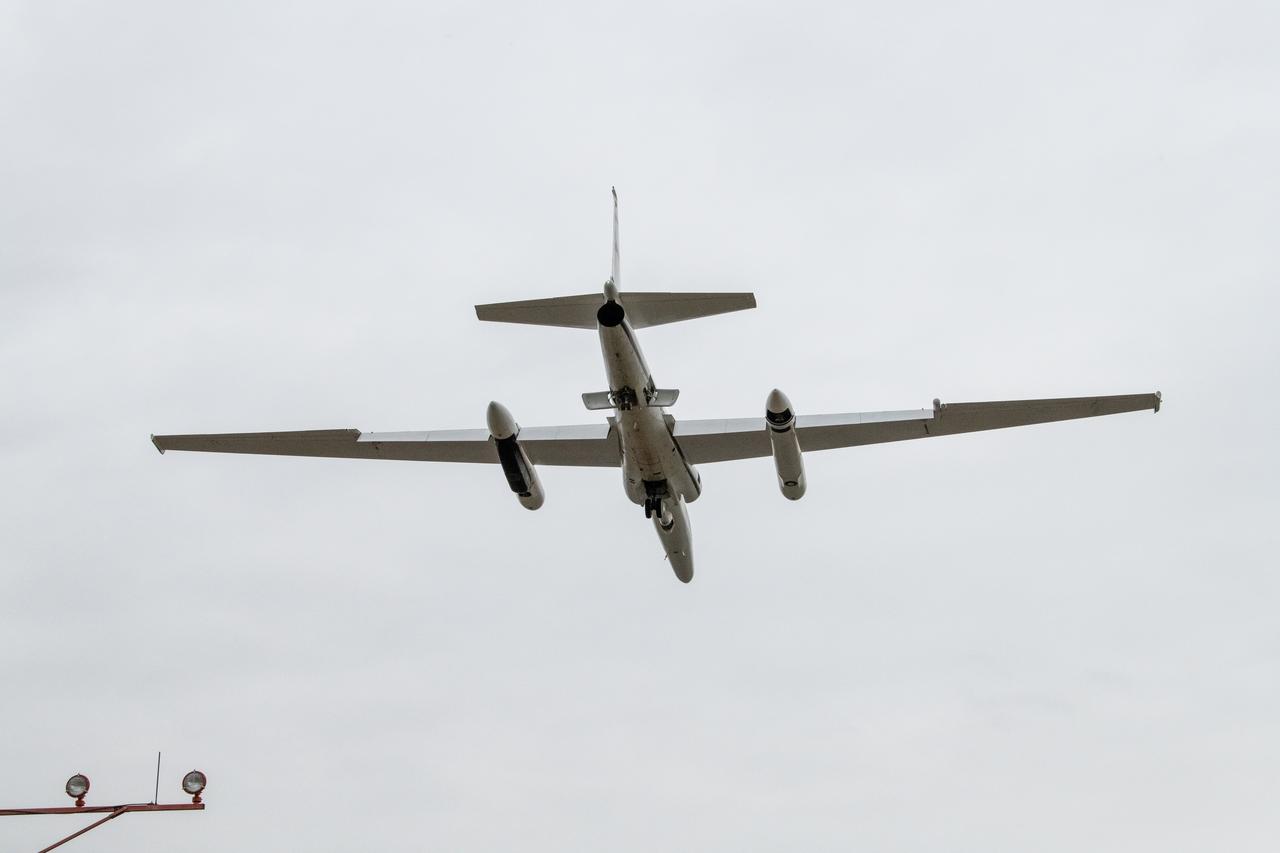
The NASA ER-2 high-altitude aircraft supported the Investigation of Microphysics and Precipitation for Atlantic Coast-Threatening Storms (IMPACTS) mission. For this mission, the IMPACTS team tracked storms across the Eastern United States to help understand how winter storms form and develop. The aircraft, which is based at NASA’s Armstrong Flight Research Center Building 703 in Palmdale, California, was temporarily based at Dobbins Air Reserve Base in Marietta, Georgia. The three-year IMPACTS campaign concluded on Feb. 28, 2023.
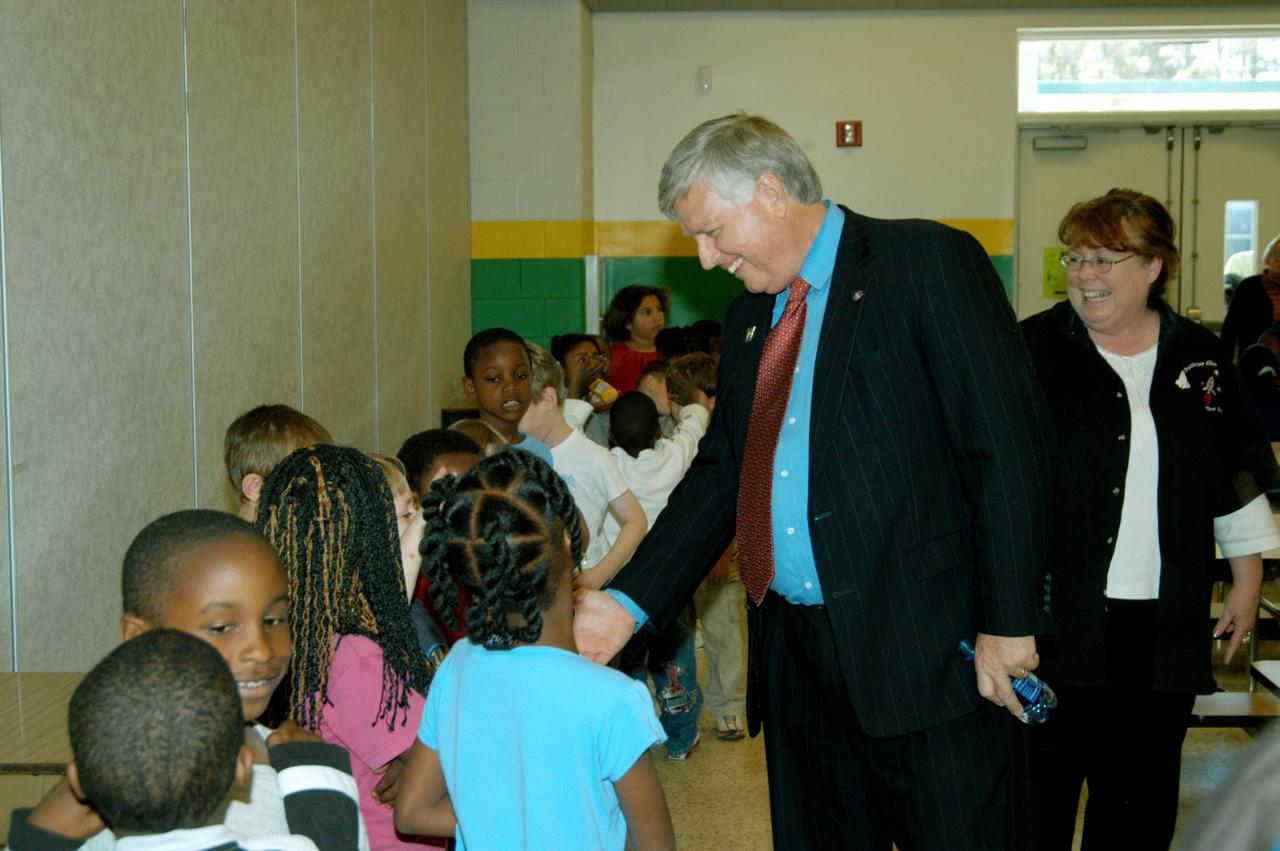
KENNEDY SPACE CENTER, FLA. -- Center Director Jim Kennedy shakes hands with students at Oscar Patterson Elementary Magnet School in Panama City, Fla. Kennedy is touring Florida and Georgia NASA Explorer Schools to share America’s new vision for space exploration with the next generation of explorers. Kennedy is talking with students about our destiny as explorers, NASA’s stepping stone approach to exploring Earth, the Moon, Mars and beyond, how space impacts our lives, and how people and machines rely on each other in space.
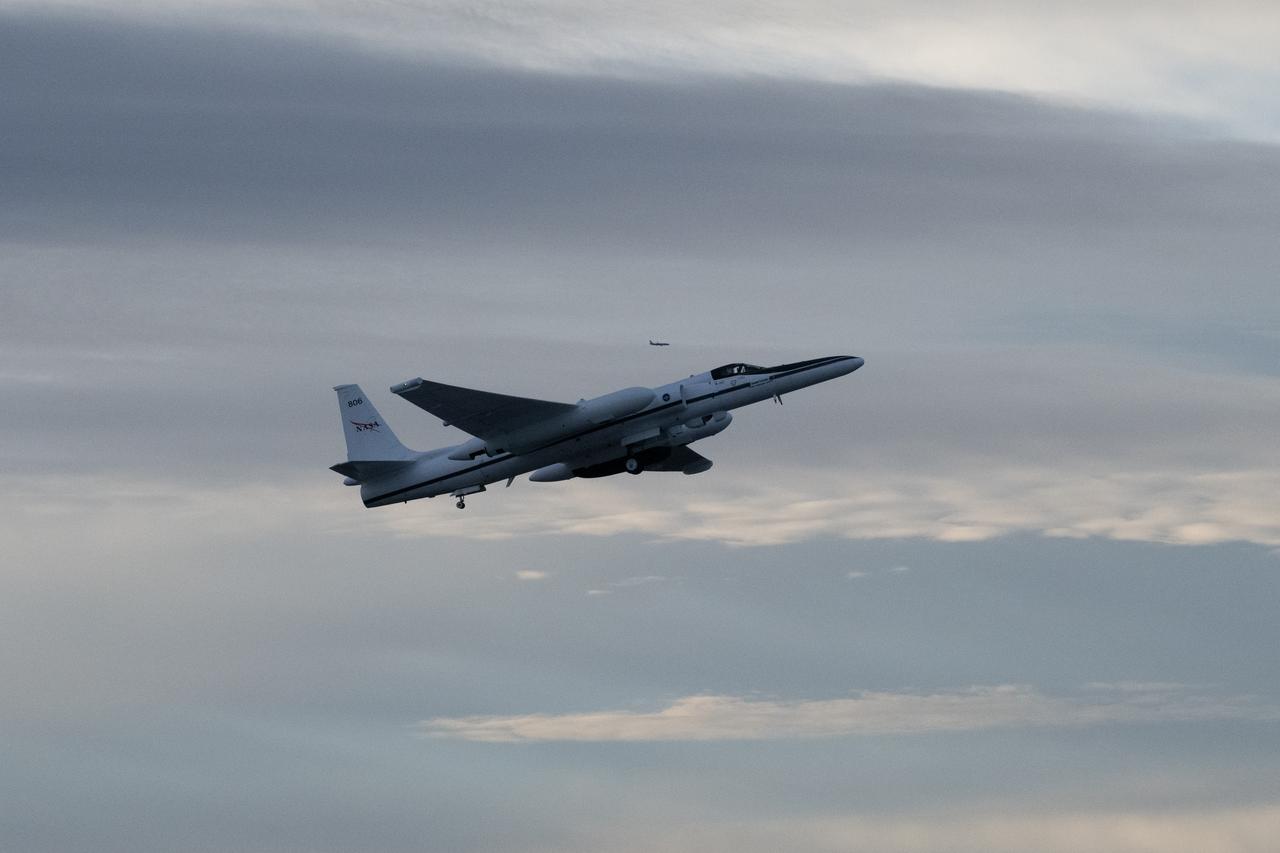
The NASA ER-2 high-altitude aircraft supported the Investigation of Microphysics and Precipitation for Atlantic Coast-Threatening Storms (IMPACTS) mission. For this mission, the IMPACTS team tracked storms across the Eastern United States to help understand how winter storms form and develop. The aircraft, which is based at NASA’s Armstrong Flight Research Center Building 703 in Palmdale, California, was temporarily based at Dobbins Air Reserve Base in Marietta, Georgia. The three-year IMPACTS campaign concluded on Feb. 28, 2023.
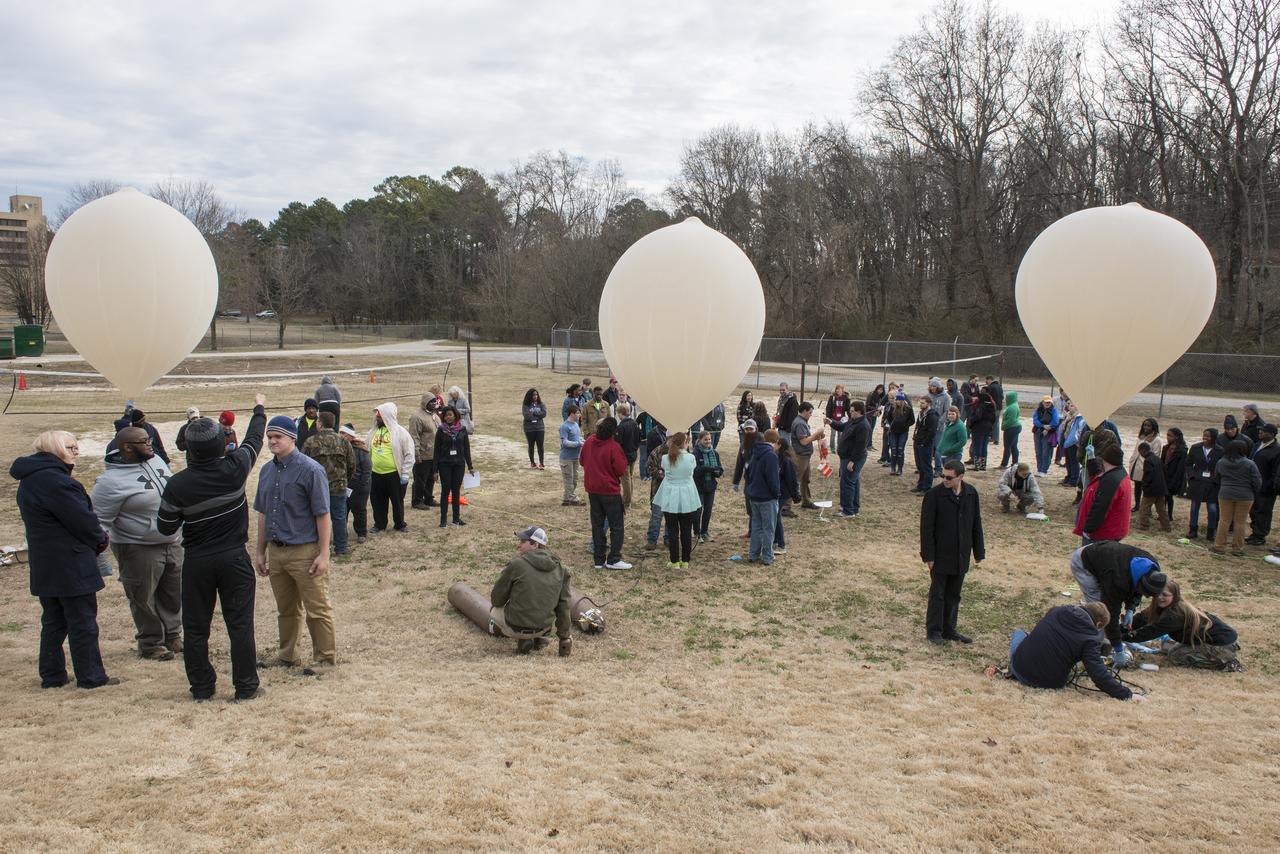
STUDENTS FROM COMMUNITY COLLEGES THROUGHOUT THE SOUTH CAME TOGETHER AT THE U.S. SPACE AND ROCKET CENTER FOR THE BALLOONSAT LAUNCH EVENT. EACH COMMUNITY COLLEGE TEAM ASSEMBLED ITS OWN PAYLOAD, DESIGNED TO DOWNLOAD SCIENTIFIC AND ATMOSPHERIC INFORMATION, AND THEN 2 WEATHER BALLOONS WERE SENT ALOFT TO APPROXIMATELY 100,000 FEET WITH THE PAYLOADS. THE PAYLOADS WERE RECOVERED IN N. GEORGIA AND TAKEN BACK TO THE INDIVIDUAL SCHOOLS FOR DOWNLOADING.
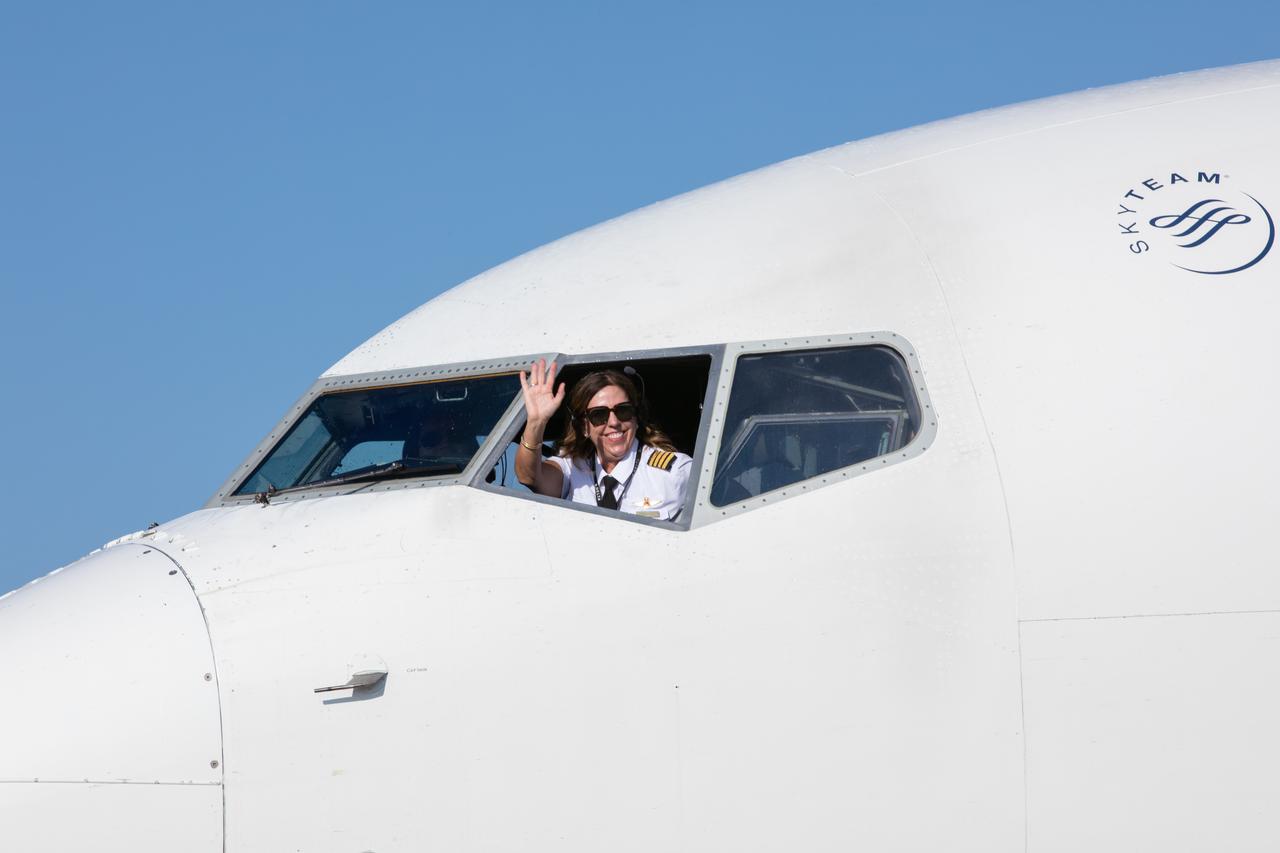
Part of the all-female crew for Delta Air Lines’ Women Inspiring Our Next Generation (WING) flight waves to a crowd on Friday, Sept. 20, 2024, after touching down at the Launch and Landing Facility at NASA’s Kennedy Space Center in Florida. The flight brought young ladies from Atlanta, Georgia, ranging in age from 11 to 18, to learn about the various women-led STEM (science, technology, engineering, and math) careers available at the Florida spaceport.
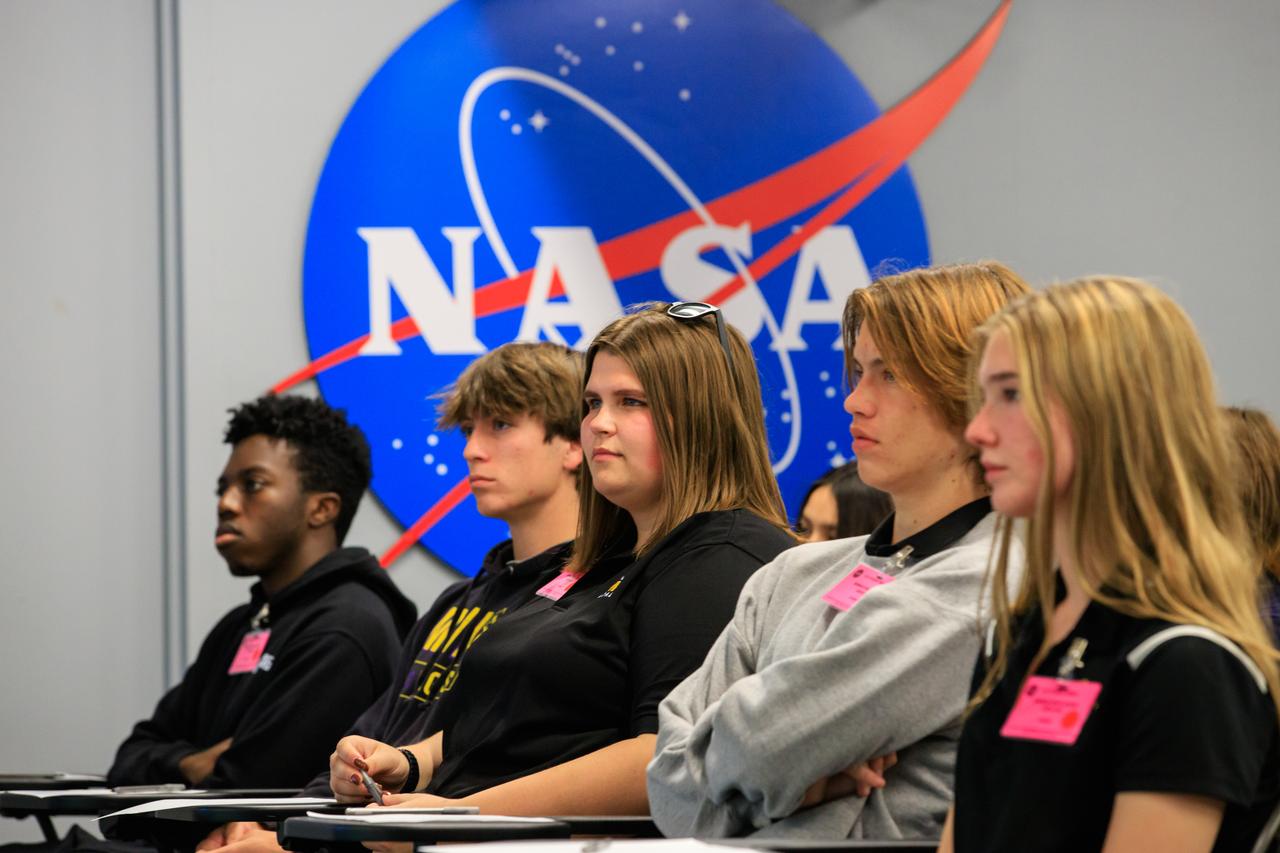
As part of NASA’s NextGen STEM project, students from Florida’s Montverde Academy, Storm Grove Middle School, and Whispering Pines School, as well as a homeschool collective from Georgia, participate in an environmentally focused Earth Day briefing inside the News Auditorium at NASA’s Kennedy Space Center in Florida on April 20, 2023. Along with the students participating in person, middle- and high-school students across the country had the opportunity to ask questions of the panel via phone to discuss how technology and science coexist with nature at Kennedy.
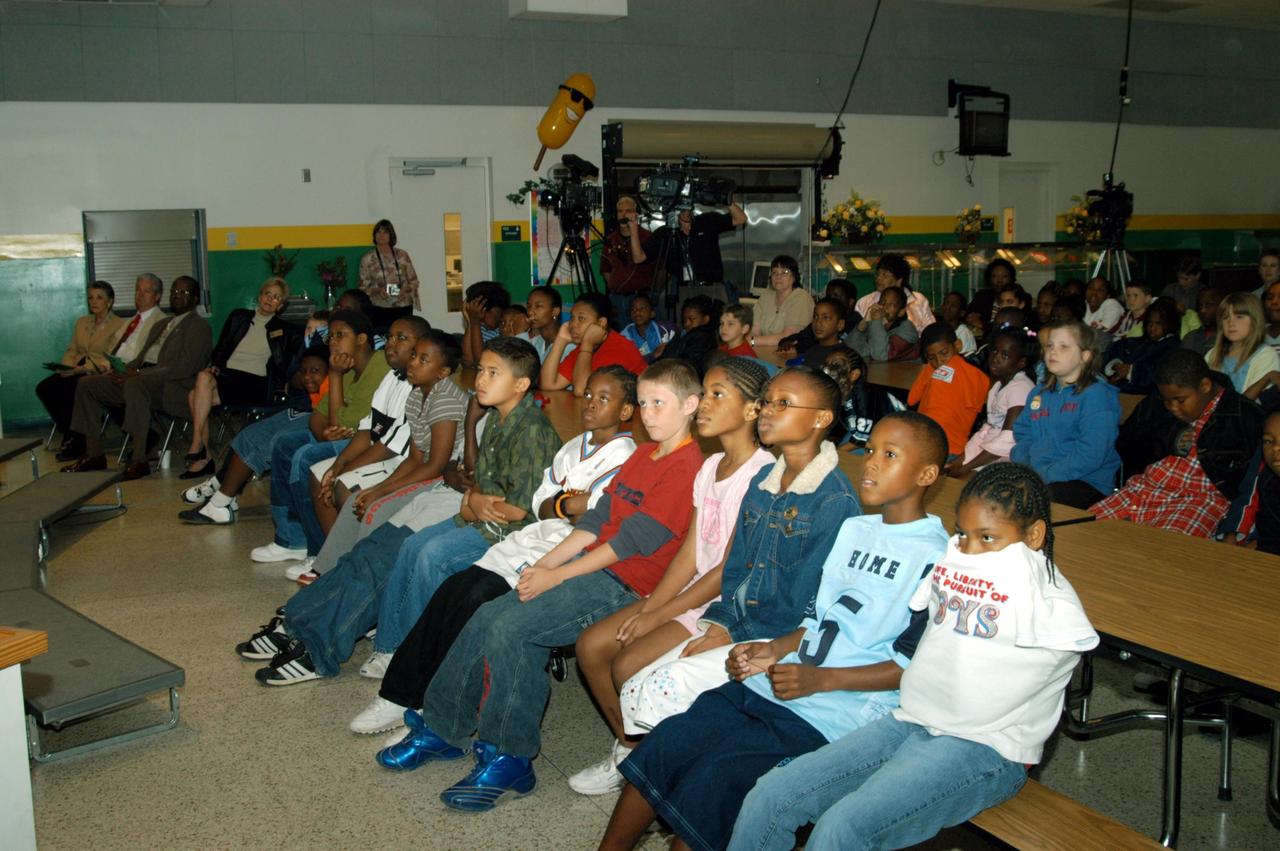
KENNEDY SPACE CENTER, FLA. -- Students at Oscar Patterson Elementary Magnet School in Panama City, Fla., listen intently to Center Director Jim Kennedy as he shares America’s new vision for space exploration. Kennedy is visiting NASA Explorer Schools in Florida and Georgia, talking with students about our destiny as explorers, NASA’s stepping stone approach to exploring Earth, the Moon, Mars and beyond, how space impacts our lives, and how people and machines rely on each other in space.
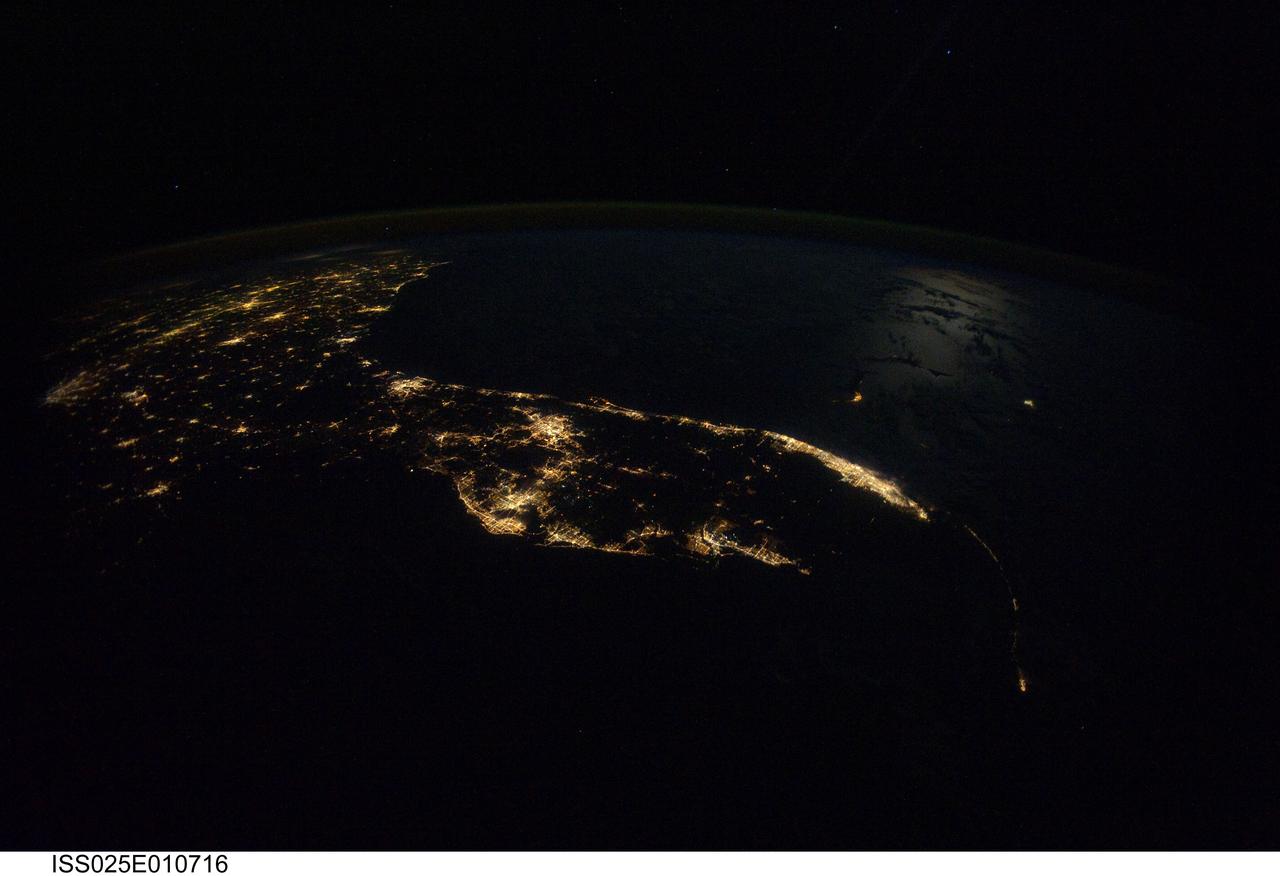
ISS025-E-010716 (31 Oct. 2010) --- From 220 miles above Earth, one of the Expedition 25 crew members aboard the International Space Station exposed this night time image of the Florida peninsula on Oct. 31. Both the Gulf and Atlantic coasts are clearly visible in the scene, which includes the Florida "Panhandle" and part of the Georgia coast.
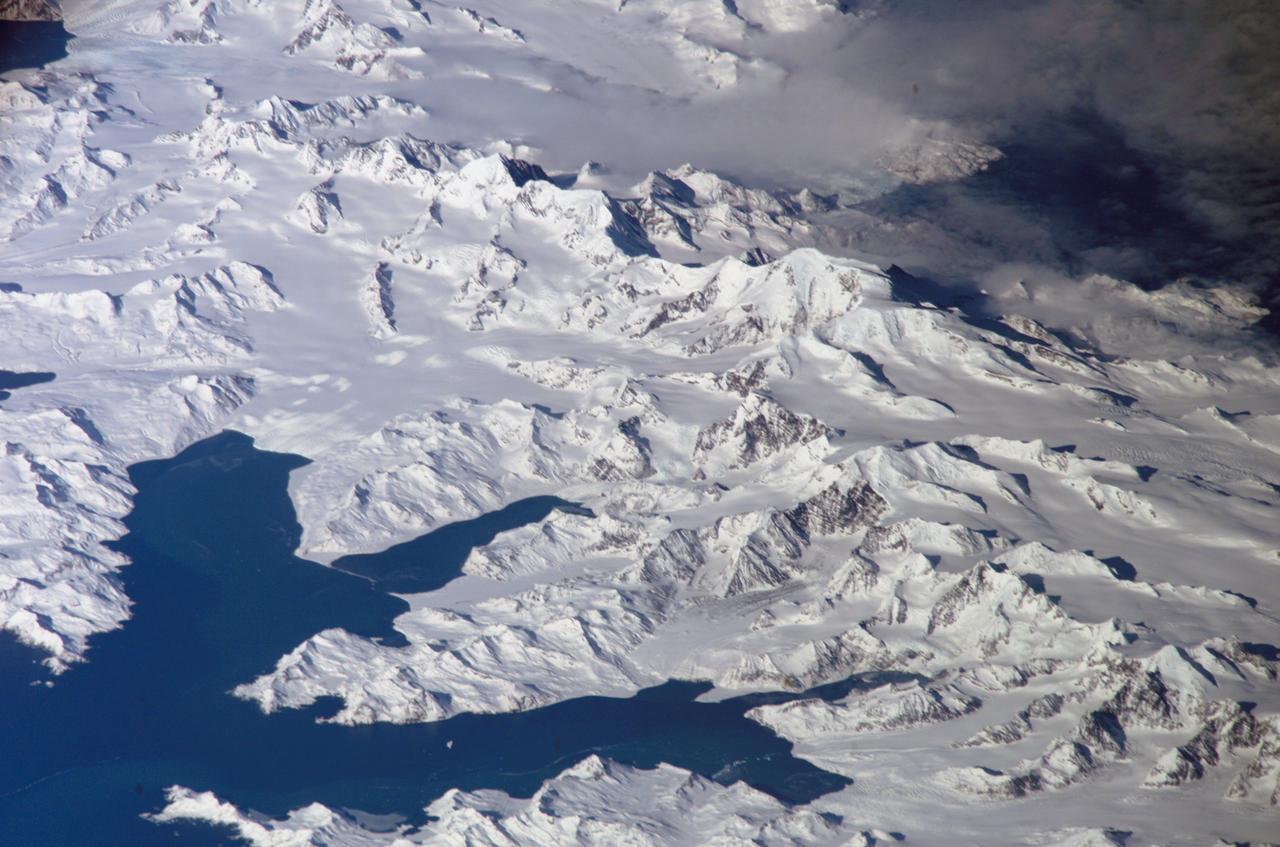
ISS011-E-12148 (26 August 2005) --- South Georgia Island is featured in this image photographed by an Expedition 11 crewmember on the international space station. There is no permanent human base on South Georgia Island, a British territory in the South Atlantic Ocean that lies 1300 kilometers east of the Falkland Islands. Using a long lens (800 mm focal length) and positioned for an oblique view, the crew of the international space station was able to capture the rugged and isolated landscape of the northern shore of the island. The high mountains protect the north and eastern coast of the island from the prevailing gales coming from Antarctica and the west. The steep topography also makes deep embayments along the coast that provide habitat for wildlife and anchorages for whaling ships. The island supports major rookeries of penguins and albatrosses, and large seal populations. This view centers on Mt. Paget and Cumberland Bay. The former whaling station Grytviken is located within the bay. The encampment supports the scientific base for the British Antarctic Survey and Bird Island Research Station.
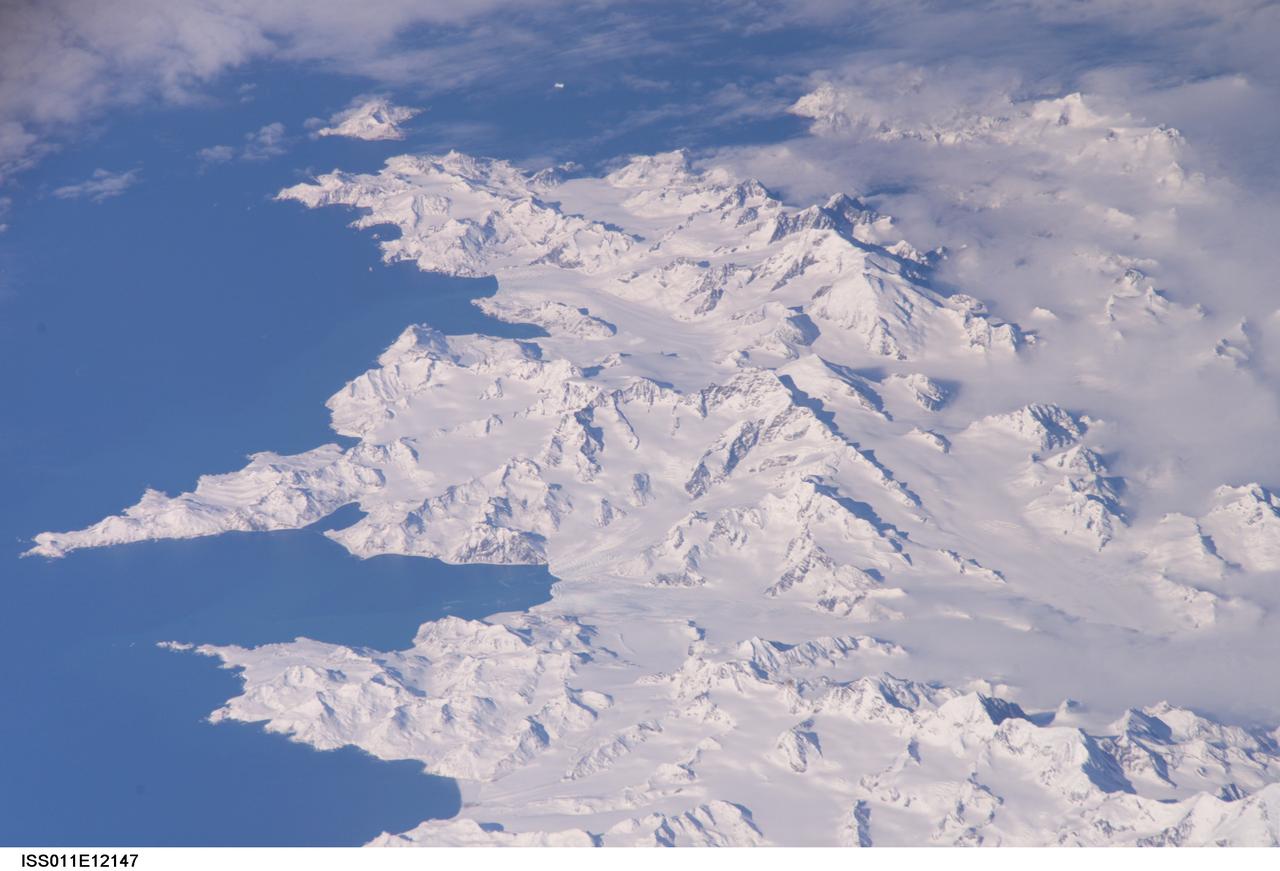
ISS011-E-12147 (26 Aug. 2005) --- South Georgia Island is featured in this image photographed by an Expedition 11 crewmember on the International Space Station. There is no permanent human base on South Georgia Island, a British territory in the South Atlantic Ocean that lies 1300 kilometers east of the Falkland Islands. Using a long lens (800 mm focal length) and positioned for an oblique view, the crew of the international space station was able to capture the rugged and isolated landscape of the northern shore of the island. The high mountains protect the north and eastern coast of the island from the prevailing gales coming from Antarctica and the west. The steep topography also makes deep embayments along the coast that provide habitat for wildlife and anchorages for whaling ships. The island supports major rookeries of penguins and albatrosses, and large seal populations. This view centers on Mt. Paget and Cumberland Bay. The former whaling station Grytviken is located within the bay. The encampment supports the scientific base for the British Antarctic Survey and Bird Island Research Station.
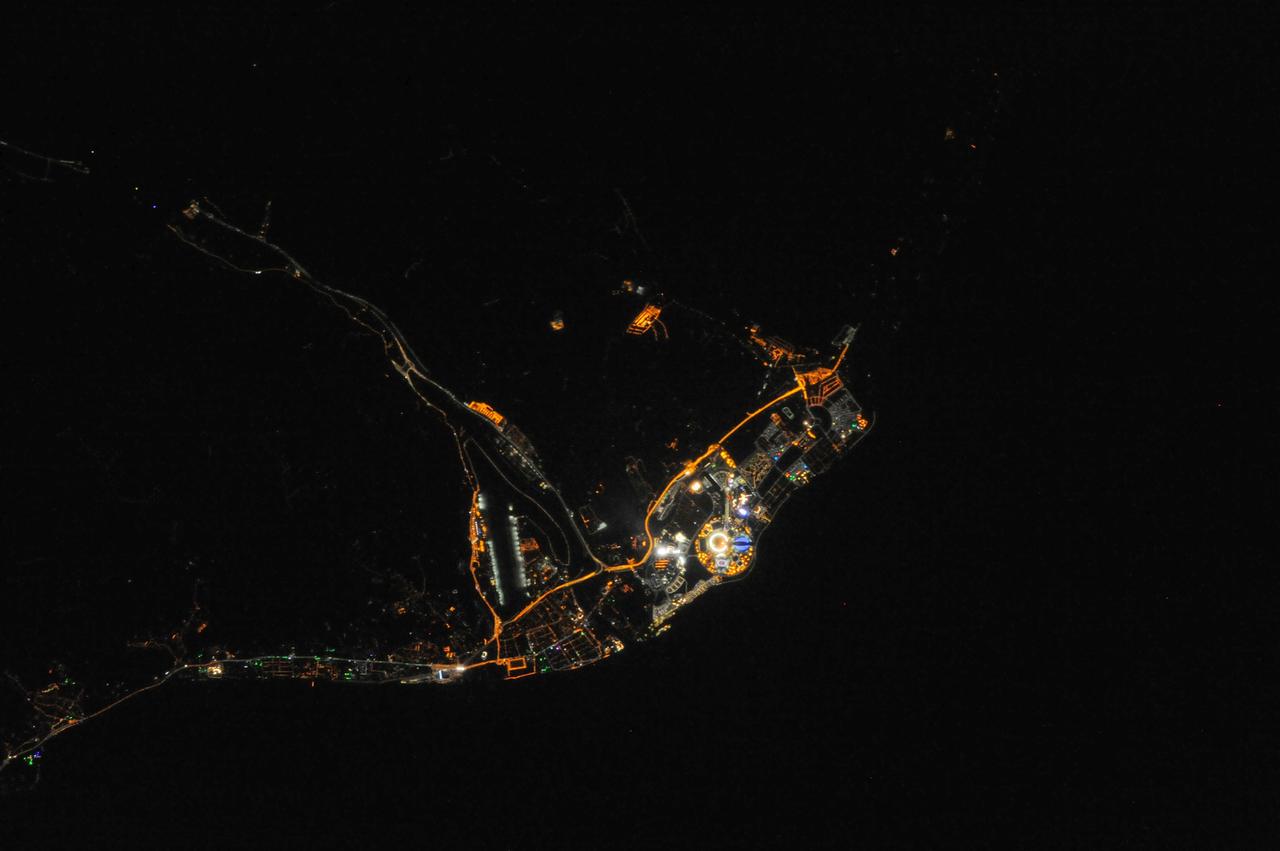
ISS038-E-042992 (10 Feb. 2014) --- One of the Expedition 38 crew members aboard the International Space Station downlinked this vertical 600mm night view of Sochi, Russia, which clearly shows the site of the 2014 Winter Olympics while they are just a few days under way. Fisht Stadium where the Opening Ceremonies were held on Feb. 7 is easily recognizable as the bright circular structure. Sochi is a city in Krasnodar Krai, Russia, located on the Black Sea coast near the border between Georgia/Abkhazia and Russia. It has an area of 1,353 square miles or 3,505 square kilometers. Photo credit: NASA ISS038-E-042992 (10 Feb. 2014) --- One of the Expedition 38 crew members aboard the International Space Station downlinked this vertical 600mm night view of Sochi, Russia, which clearly shows the site of the 2014 Winter Olympics while they are just a few days under way. Fisht Stadium where the Opening Ceremonies were held on Feb. 7 is easily recognizable as the bright circular structure. Sochi is a city in Krasnodar Krai, Russia, located on the Black Sea coast near the border between Georgia/Abkhazia and Russia. It has an area of 1,353 square miles or 3,505 square kilometers. Photo credit: NASA
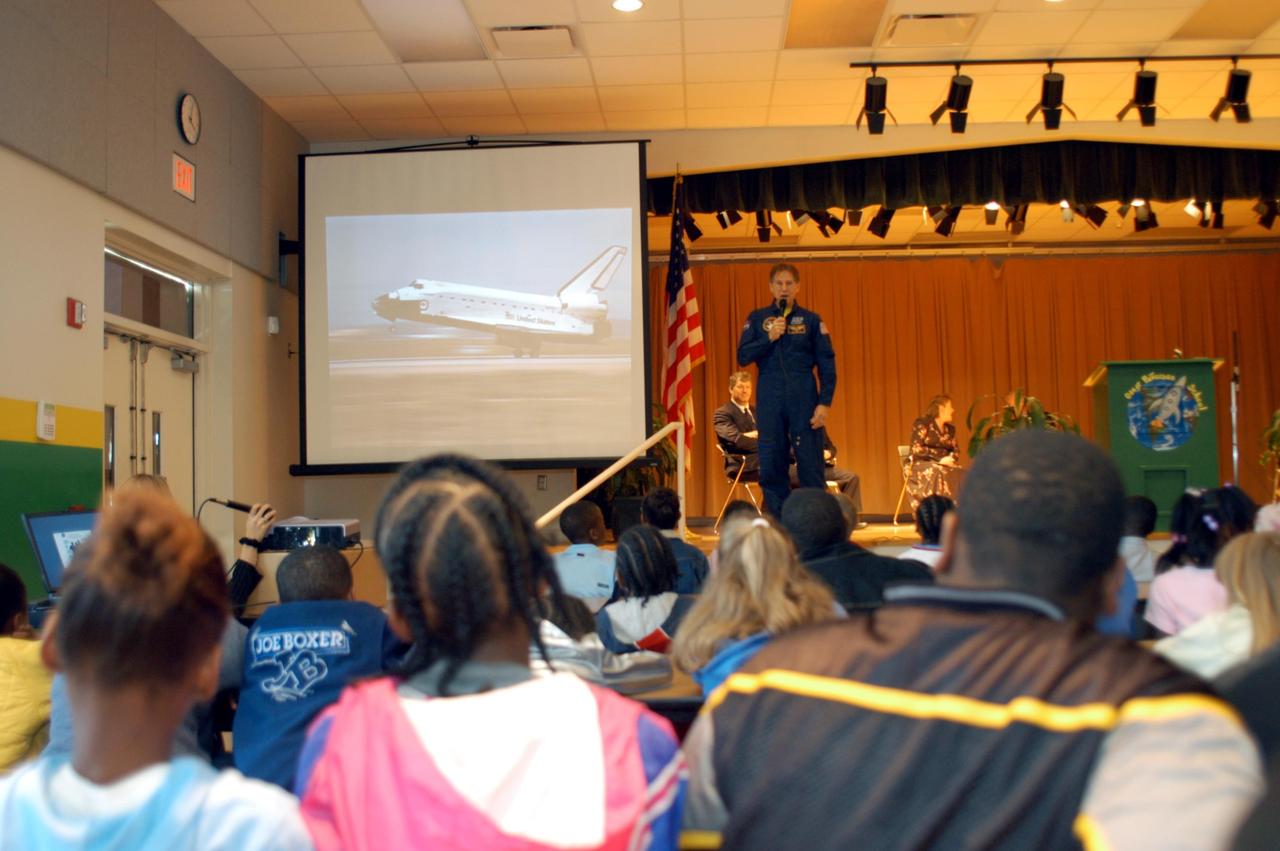
KENNEDY SPACE CENTER, FLA. -- Sam Durrance shares stories of his experiences as an astronaut with the students at Oscar Patterson Elementary Magnet School in Panama City, Fla. Durrance joined Center Director Jim Kennedy as he shares America’s new vision for space exploration with the next generation of explorers. Kennedy is talking with students in NASA Explorer Schools in Florida and Georgia about our destiny as explorers, NASA’s stepping stone approach to exploring Earth, the Moon, Mars and beyond, how space impacts our lives, and how people and machines rely on each other in space.
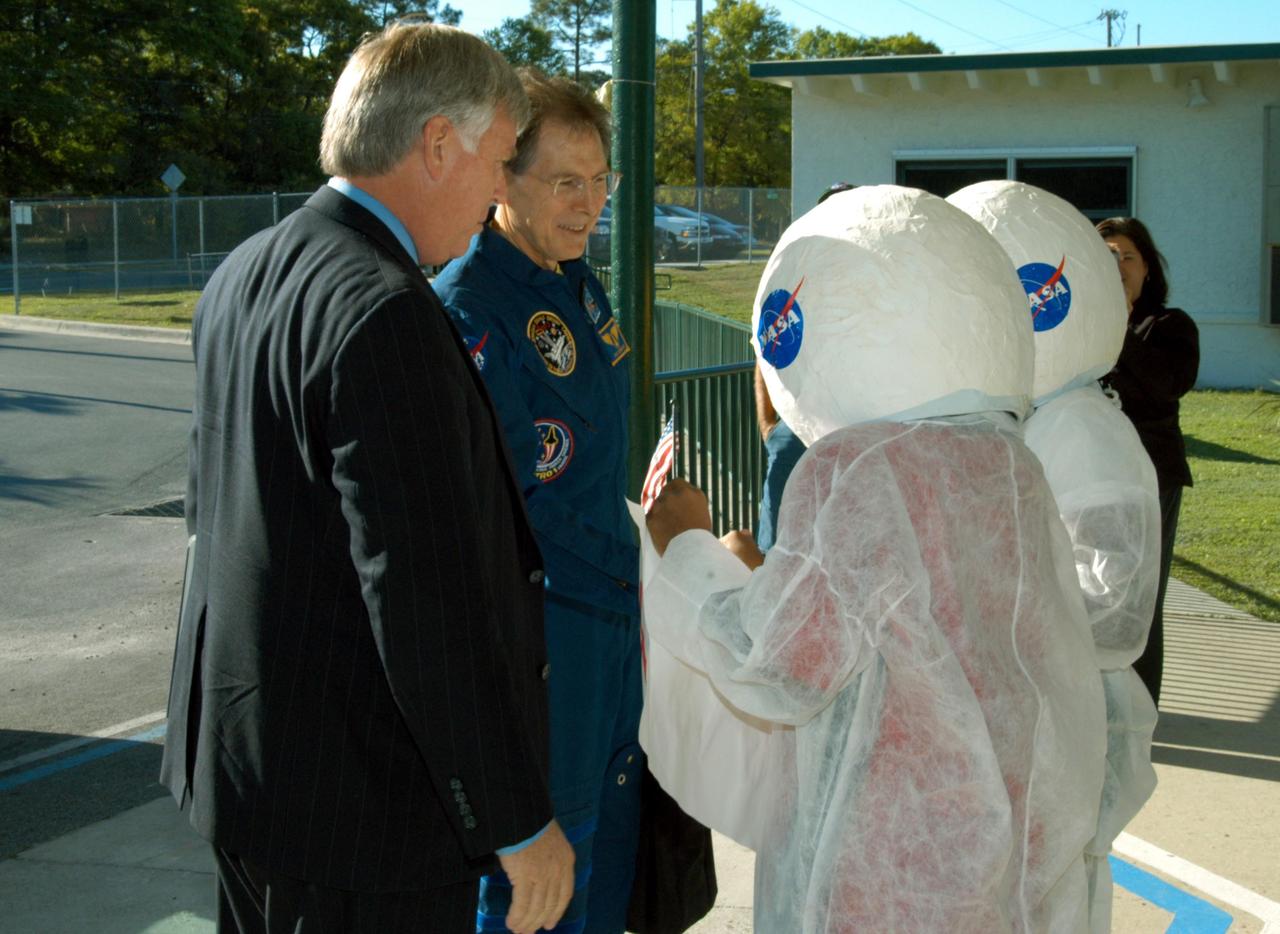
KENNEDY SPACE CENTER, FLA. -- Two student “astronauts” welcome Center Director Jim Kennedy (left) and NASA astronaut Sam Durrance to Oscar Patterson Elementary Magnet School in Panama City, Fla. Kennedy and other NASA-KSC representatives are visiting NASA Explorer Schools in Florida and Georgia to share America’s new vision for space exploration with the next generation of explorers. Kennedy is talking with students about our destiny as explorers, NASA’s stepping stone approach to exploring Earth, the Moon, Mars and beyond, how space impacts our lives, and how people and machines rely on each other in space.

KENNEDY SPACE CENTER, FLA. -- Enthralled students in a classroom at Oscar Patterson Elementary Magnet School in Panama City, Fla., listen to astronaut Sam Durrance as he shares stories of his experiences as an astronaut. Durrance joined Center Director Jim Kennedy, who is visiting Florida and Georgia NASA Explorer Schools to share America’s new vision for space exploration with the next generation of explorers. Kennedy is talking with students about our destiny as explorers, NASA’s stepping stone approach to exploring Earth, the Moon, Mars and beyond, how space impacts our lives, and how people and machines rely on each other in space.
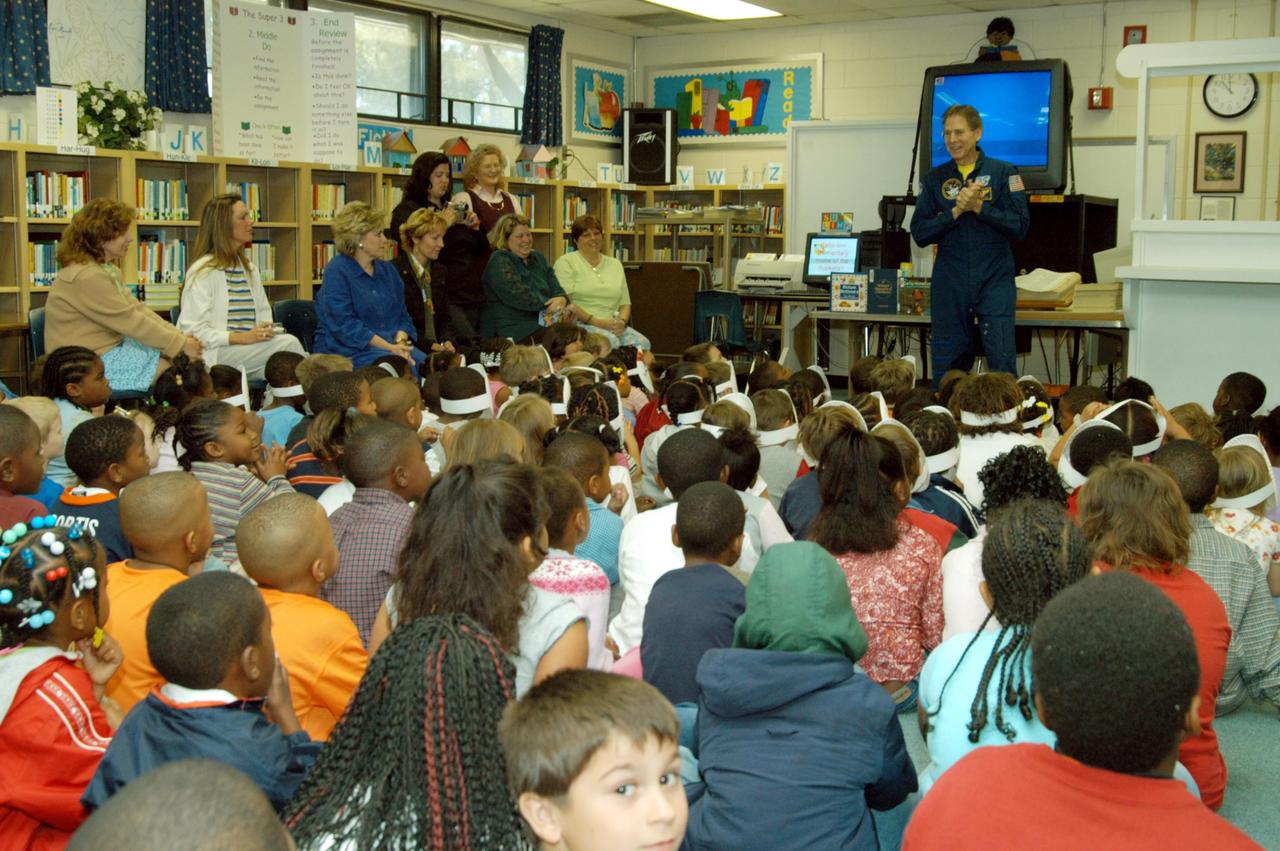
KENNEDY SPACE CENTER, FLA. -- Sam Durrance (standing, in the background) shares stories of his experiences as an astronaut with the students in a classroom at Oscar Patterson Elementary Magnet School in Panama City, Fla. Durrance joined Center Director Jim Kennedy as he shares America’s new vision for space exploration with the next generation of explorers. Kennedy is talking with students at NASA Explorer Schools in Florida and Georgia about our destiny as explorers, NASA’s stepping stone approach to exploring Earth, the Moon, Mars and beyond, how space impacts our lives, and how people and machines rely on each other in space.
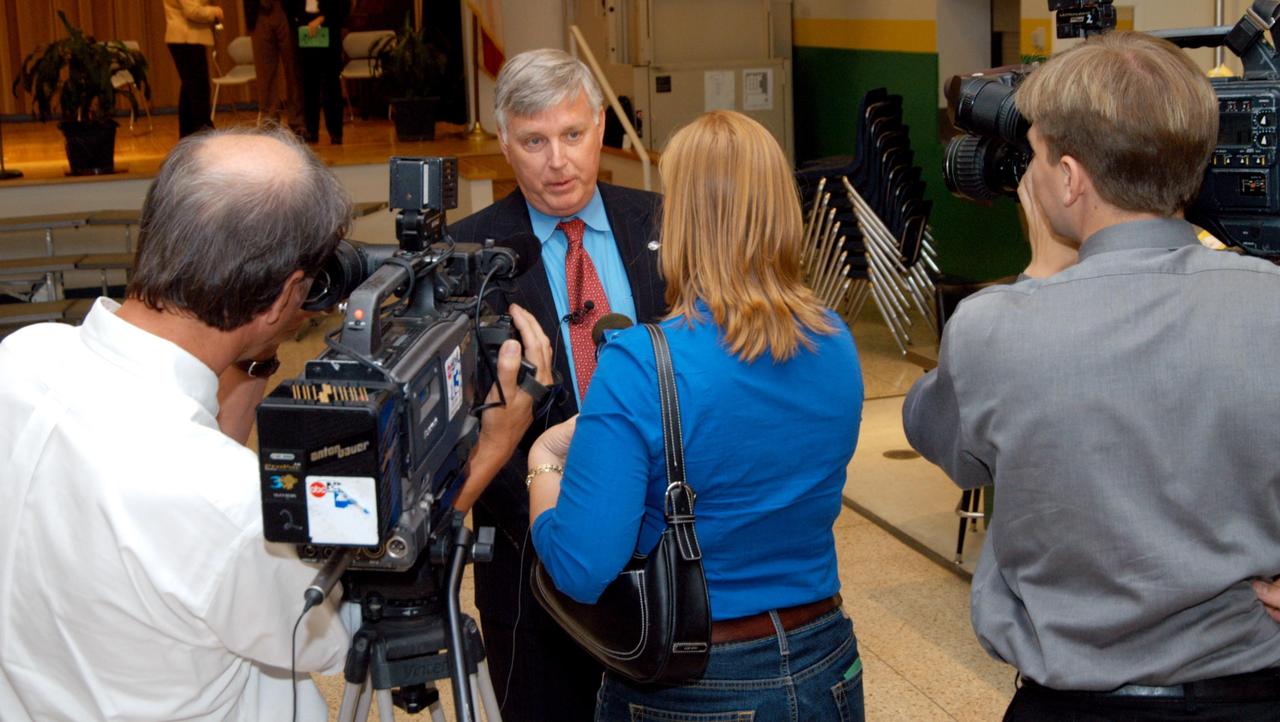
KENNEDY SPACE CENTER, FLA. -- Center Director Jim Kennedy (center) is interviewed by a reporter from channel 7 ABC-TV after his visit to Oscar Patterson Elementary Magnet School in Panama City, Fla. He other NASA officials visited the school to share America’s new vision for space exploration with the next generation of explorers. Kennedy is talking with students at NASA Explorer Schools in Florida and Georgia about our destiny as explorers, NASA’s stepping stone approach to exploring Earth, the Moon, Mars and beyond, how space impacts our lives, and how people and machines rely on each other in space.
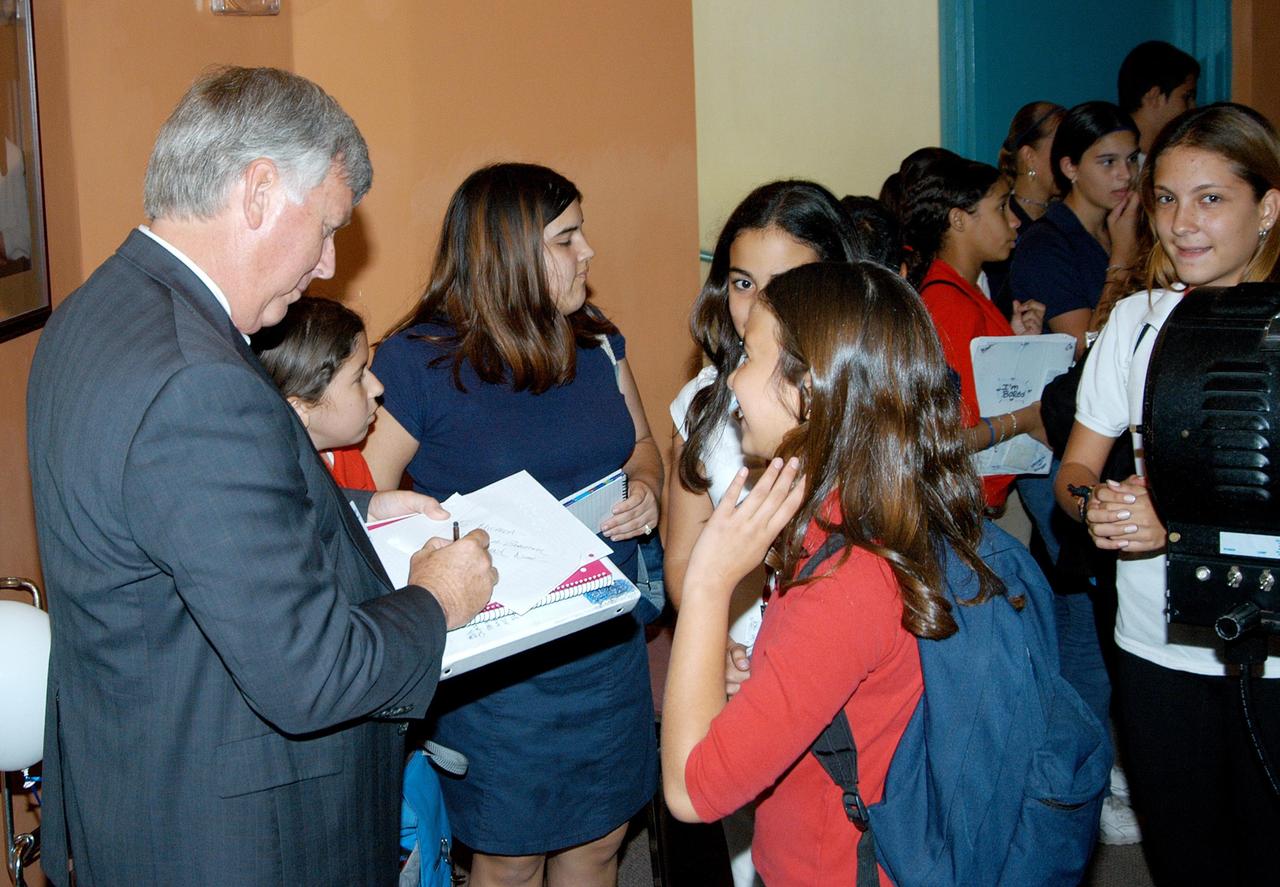
KENNEDY SPACE CENTER, FLA. -- After his presentation, Center Director Jim Kennedy signs a memento for a student at Howard A. Doolin Middle School, Miami, Fla. The school is one of 100 taking part in the NASA Explorer Schools (NES) program. Kennedy visited the school to share America’s new vision for space exploration with the next generation of explorers. He is talking with students in Florida and Georgia Explorer Schools about our destiny as explorers, NASA’s stepping stone approach to exploring Earth, the Moon, Mars and beyond, how space impacts our lives, and how people and machines rely on each other in space.
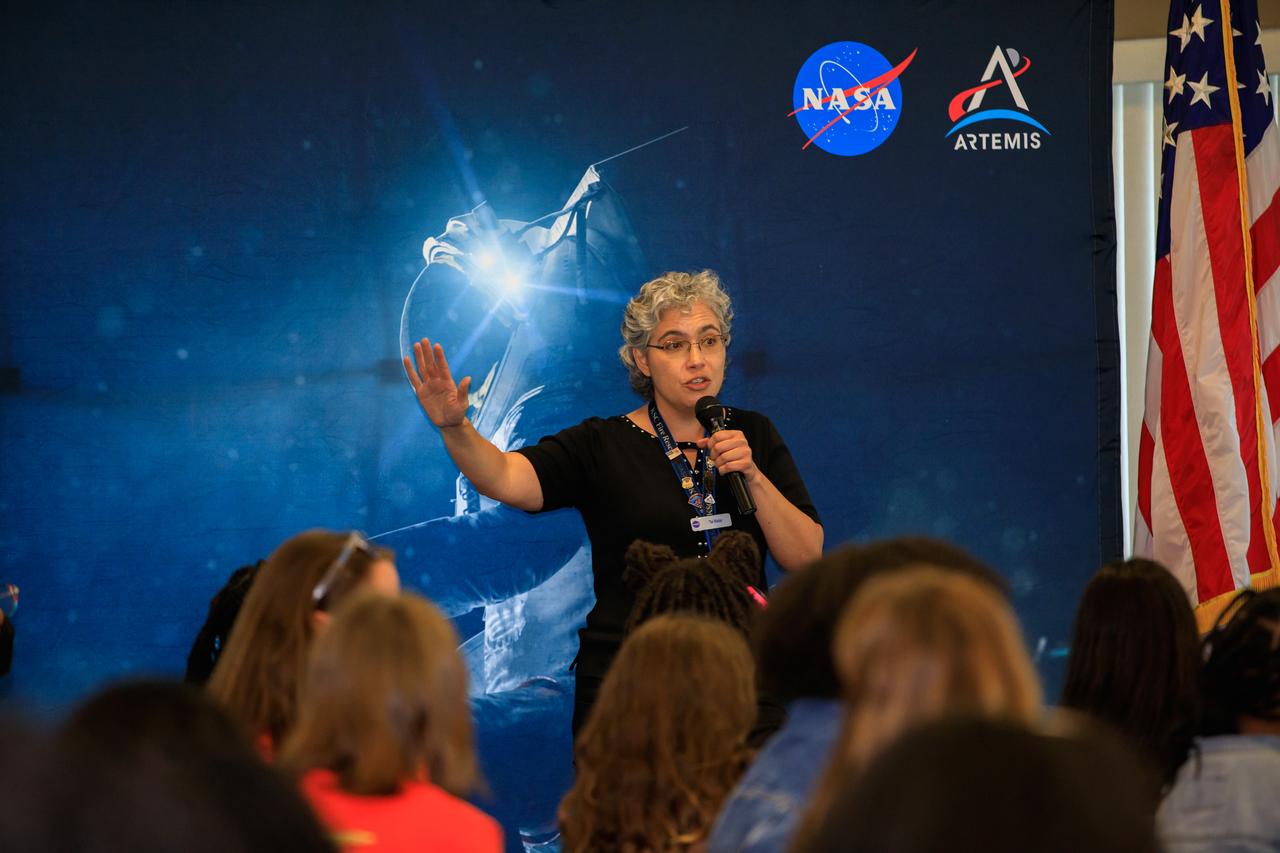
Tai Victor, Kennedy Space Center events lead, speaks to students who were brought to Kennedy on Delta Air Lines’ Women Inspiring Our Next Generation (WING) flight from Atlanta, Georgia, on Sept. 23, 2022. An all-female crew flew girls from a variety of schools and organizations with a STEM (science, technology, engineering, math) focus to Kennedy to learn about the various careers available at the Florida spaceport. While at Kennedy, the group had the opportunity to view NASA’s Artemis I Moon rocket at Launch Pad 39B, hear from a panel of 18 women with a combination of careers from Kennedy and Delta, and tour the visitor complex.
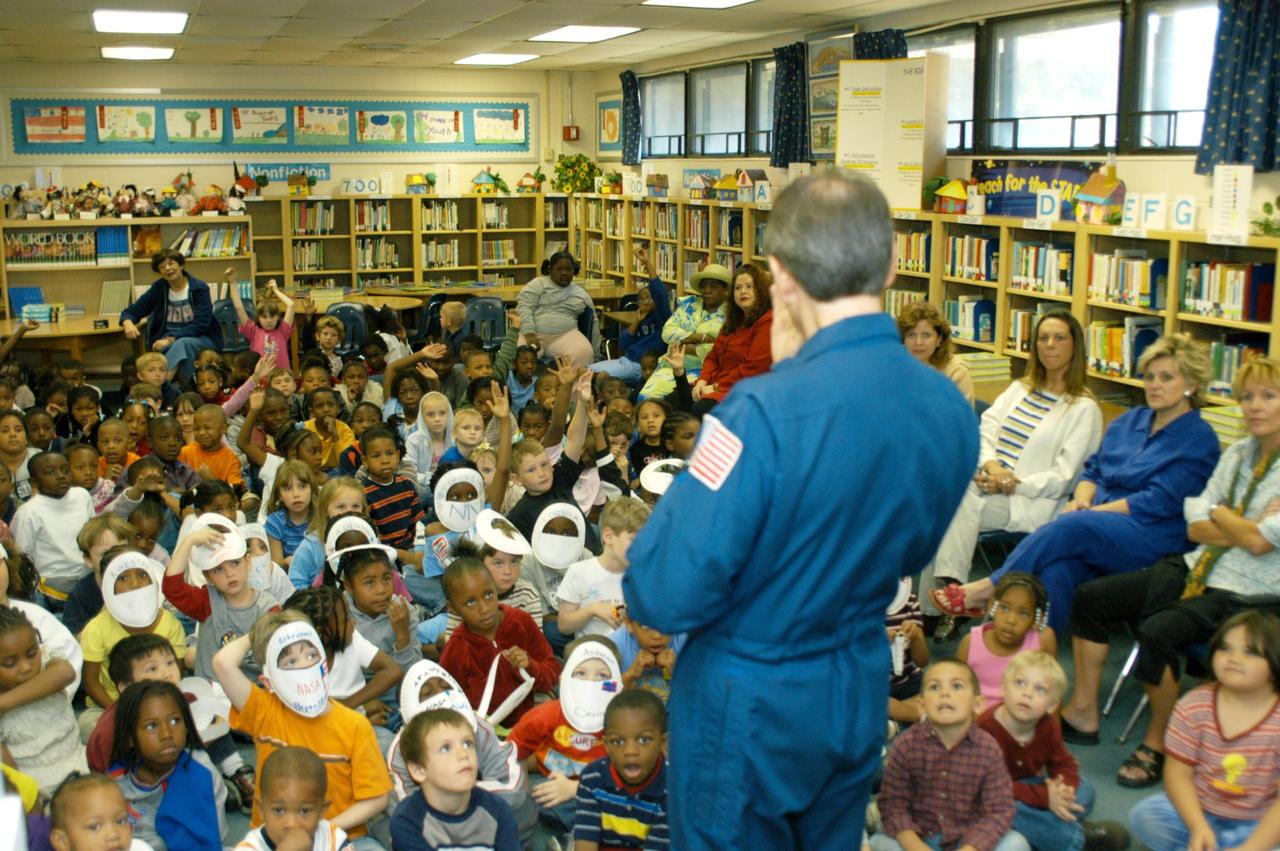
KENNEDY SPACE CENTER, FLA. -- Students in a classroom at Oscar Patterson Elementary Magnet School in Panama City, Fla., are eager to ask questions of astronaut Sam Durrance, who was sharing stories of his experiences as an astronaut. Durrance joined Center Director Jim Kennedy, who is visiting Florida and Georgia NASA Explorer Schools to share America’s new vision for space exploration with the next generation of explorers. Kennedy is talking with students about our destiny as explorers, NASA’s stepping stone approach to exploring Earth, the Moon, Mars and beyond, how space impacts our lives, and how people and machines rely on each other in space.

This artist's concept portrays the plan for the new Engineering Directorate office to be constructed at the Marshall Space Flight Center. The first of several new buildings to be constructed as replacements for older Center facilities, the 5-story, 139,000-square-foot building will house approximately 500 current Marshall employees that provide development and research engineering services for the Marshall Center. Ground breaking ceremonies took place on June 10, 2003 at the construction site, southwest of the Martin and Rideout Roads intersection on Redstone Arsenal. GSC Construction of Waynesboro, Georgia has been selected as the contractor for the facility, which is scheduled for a September 2004 completion.
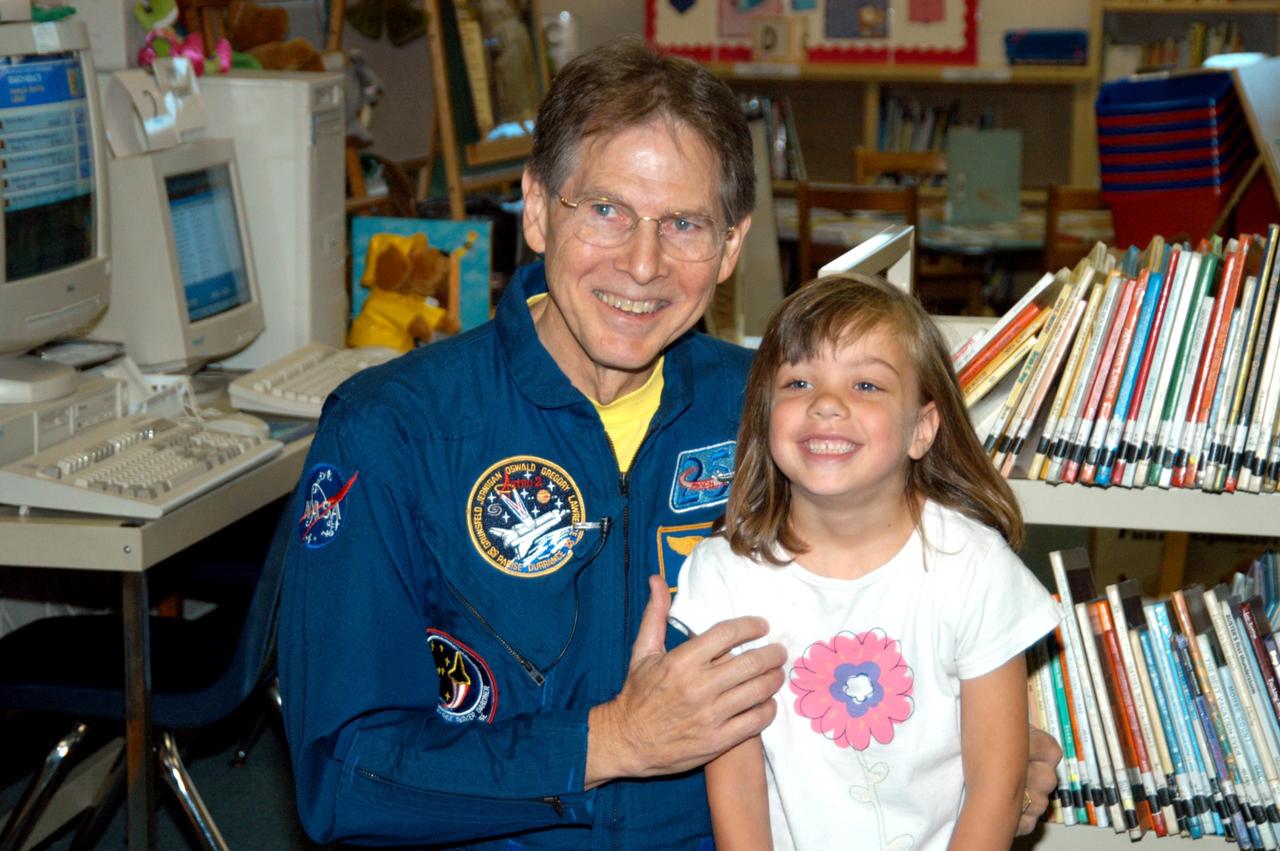
KENNEDY SPACE CENTER, FLA. -- Astronaut Sam Durrance poses with a student from Panama City, Fla., Oscar Patterson Elementary Magnet School. Durrance joined Center Director Jim Kennedy, who is visiting Florida and Georgia NASA Explorer Schools to share America’s new vision for space exploration with the next generation of explorers. Kennedy is talking with students about our destiny as explorers, NASA’s stepping stone approach to exploring Earth, the Moon, Mars and beyond, how space impacts our lives, and how people and machines rely on each other in space.
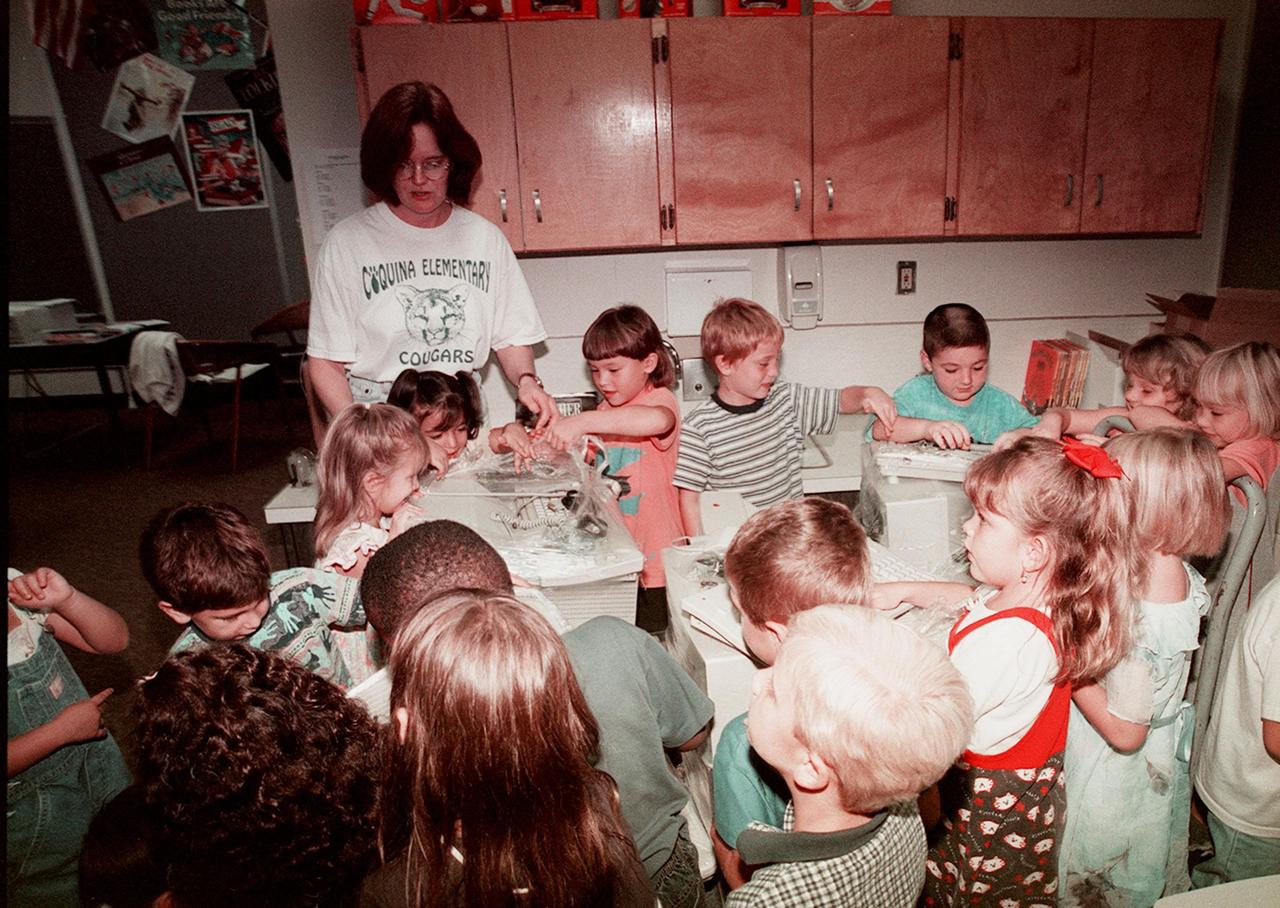
Children at Coquina Elementary School, Titusville, Fla., eagerly tear into the wrapped computer equipment donated by Kennedy Space Center. Coquina is one of 13 Brevard County schools receiving 81 excess contractor computers thanks to an innovative educational outreach project spearheaded by the Nasa k-12 Education Services Office at ksc. The Astronaut Memorial Foundation, a strategic partner in the effort, and several schools in rural Florida and Georgia also received refurbished computers as part of the year-long project. KSC employees put in about 3,300 volunteer hours to transform old, excess computers into upgraded, usable units. A total of $90,000 in upgraded computer equipment is being donated
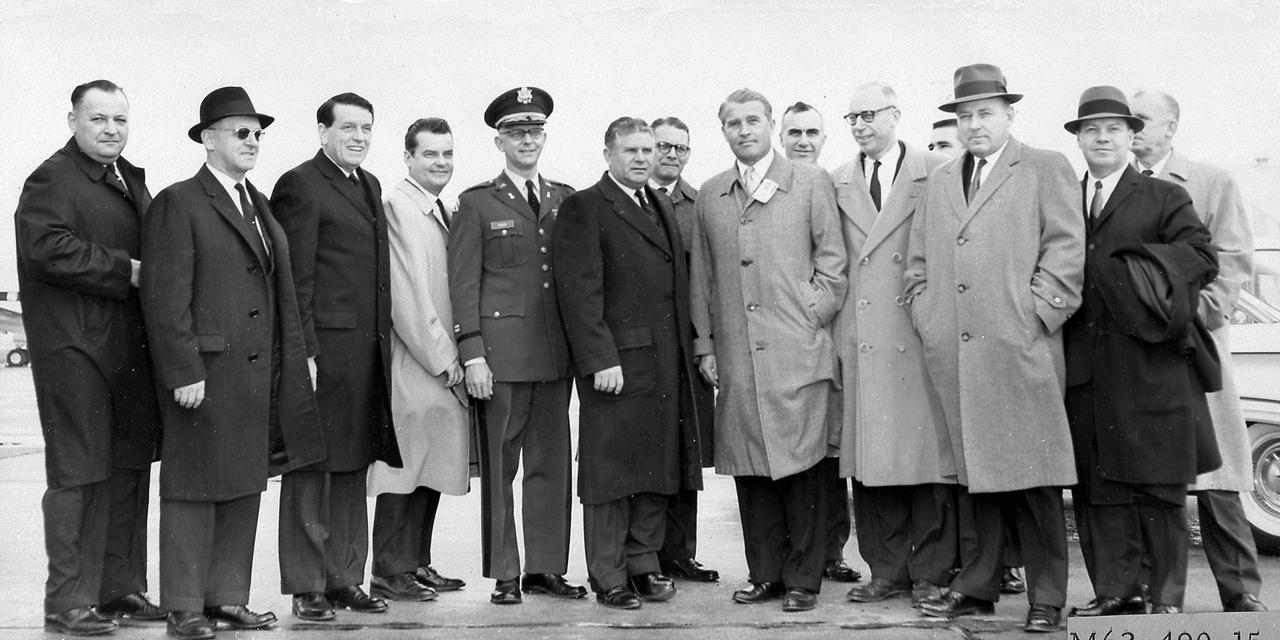
The members of the House Committee on Science and Astronautics visited the Marshall Space Flight Center (MSFC) on March 9, 1962 to gather first-hand information of the nation's space exploration program. The congressional group was composed of members of the Subcommittee on Marned Space Flight. Headed by Representative Olin E. Teague of Texas, other members were James G. Fulton, Pennsylvania; Ken Heckler, West Virginia; R. Walter Riehlman, New York; Richard L. Roudebush,, Indiana; John W. Davis, Georgia; James C. Corman, California; Joseph Waggoner, Louisiana; J. Edgar Chenoweth, Colorado; and William G. Bray, Indiana.
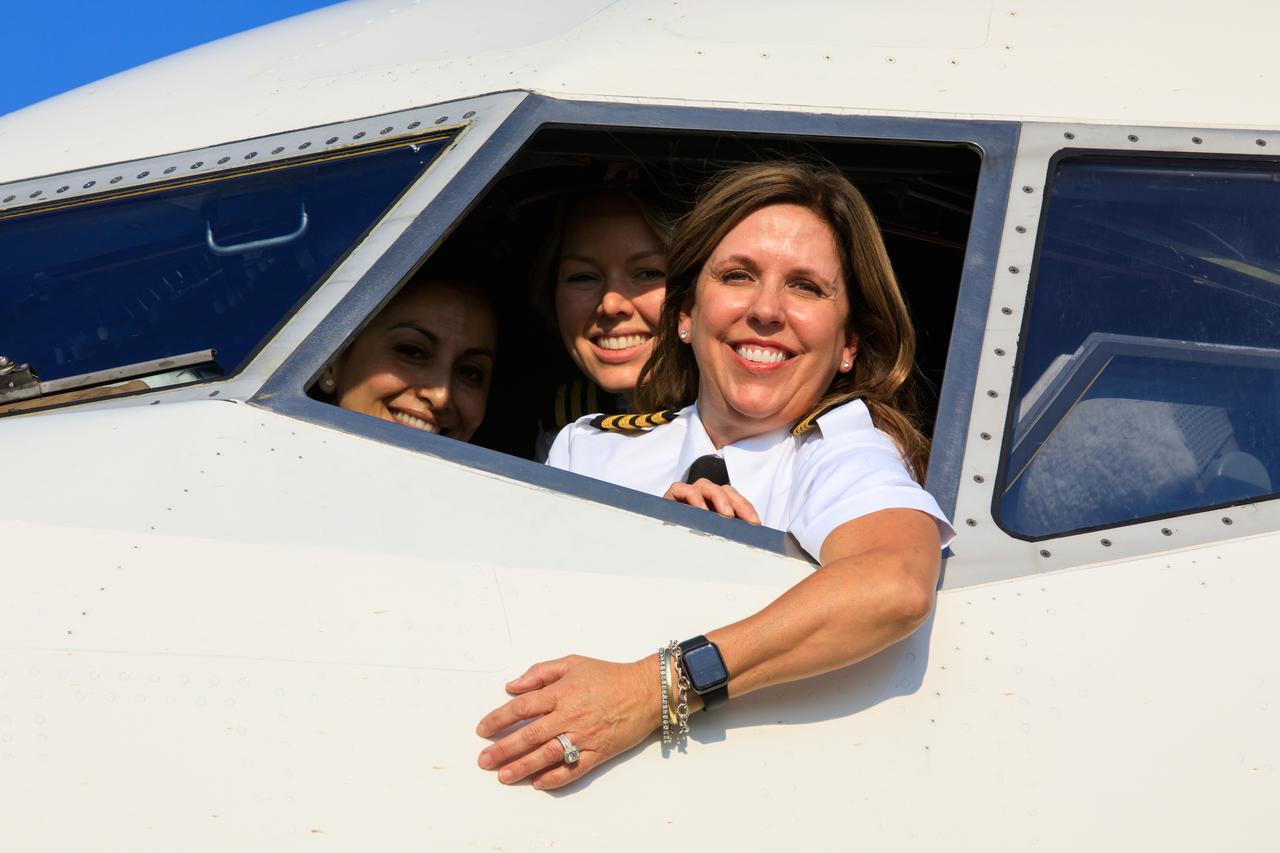
Part of the all-female crew for Delta Air Lines’ Women Inspiring Our Next Generation (WING) flight is photographed just after touching down at the Launch and Landing Facility at NASA’s Kennedy Space Center in Florida on Sept. 23, 2022. The flight brought girls from Atlanta, Georgia, ranging in age from 11 to 18, to learn about the various careers available at the Florida spaceport. While at Kennedy, the group had the opportunity to view NASA’s Artemis I Moon rocket at Launch Pad 39B, hear from a panel of 18 women with a combination of careers from Kennedy and Delta, and tour the visitor complex.
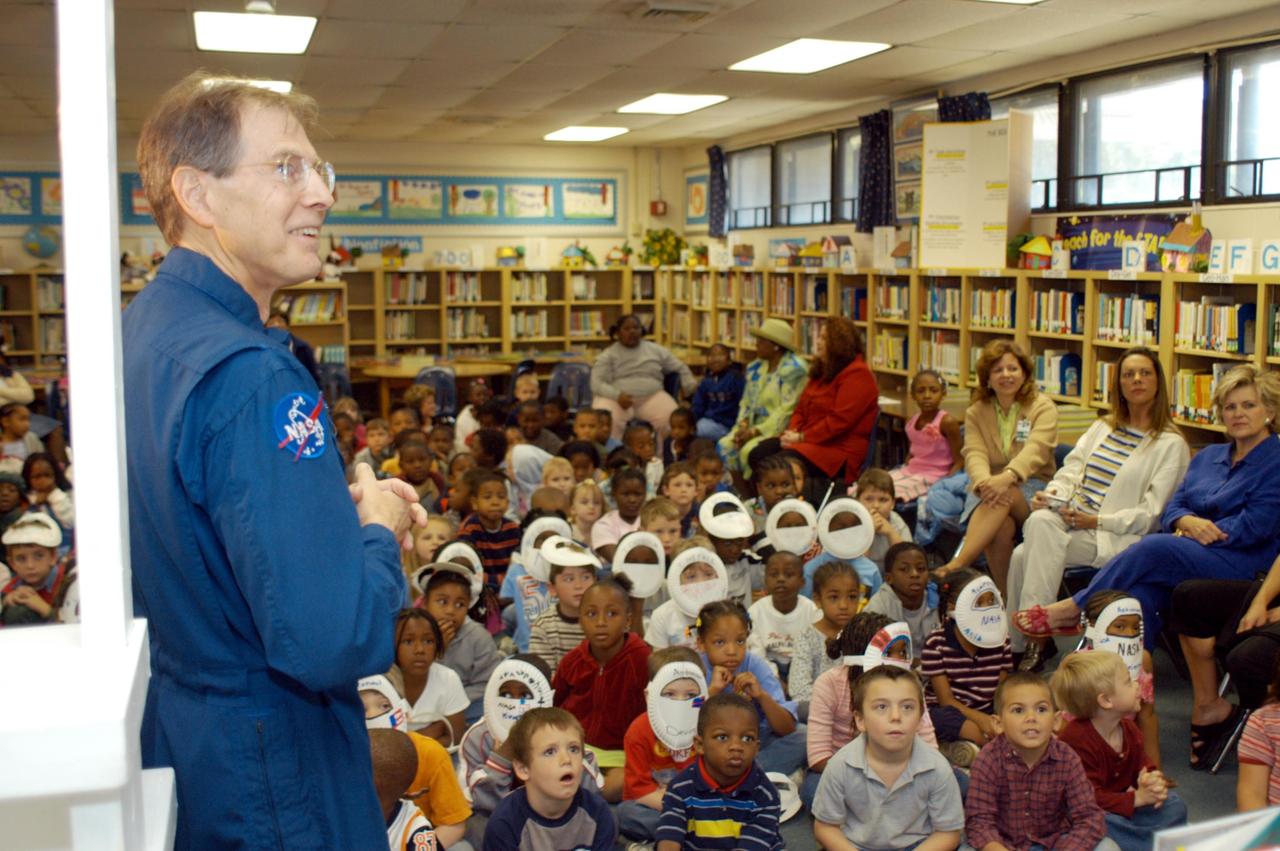
KENNEDY SPACE CENTER, FLA. -- Astronaut Sam Durrance shares stories of his experiences as an astronaut with enthralled students in a classroom at Oscar Patterson Elementary Magnet School in Panama City, Fla. Durrance joined Center Director Jim Kennedy, who is visiting Florida and Georgia NASA Explorer Schools to share America’s new vision for space exploration with the next generation of explorers. Kennedy is talking with students about our destiny as explorers, NASA’s stepping stone approach to exploring Earth, the Moon, Mars and beyond, how space impacts our lives, and how people and machines rely on each other in space.
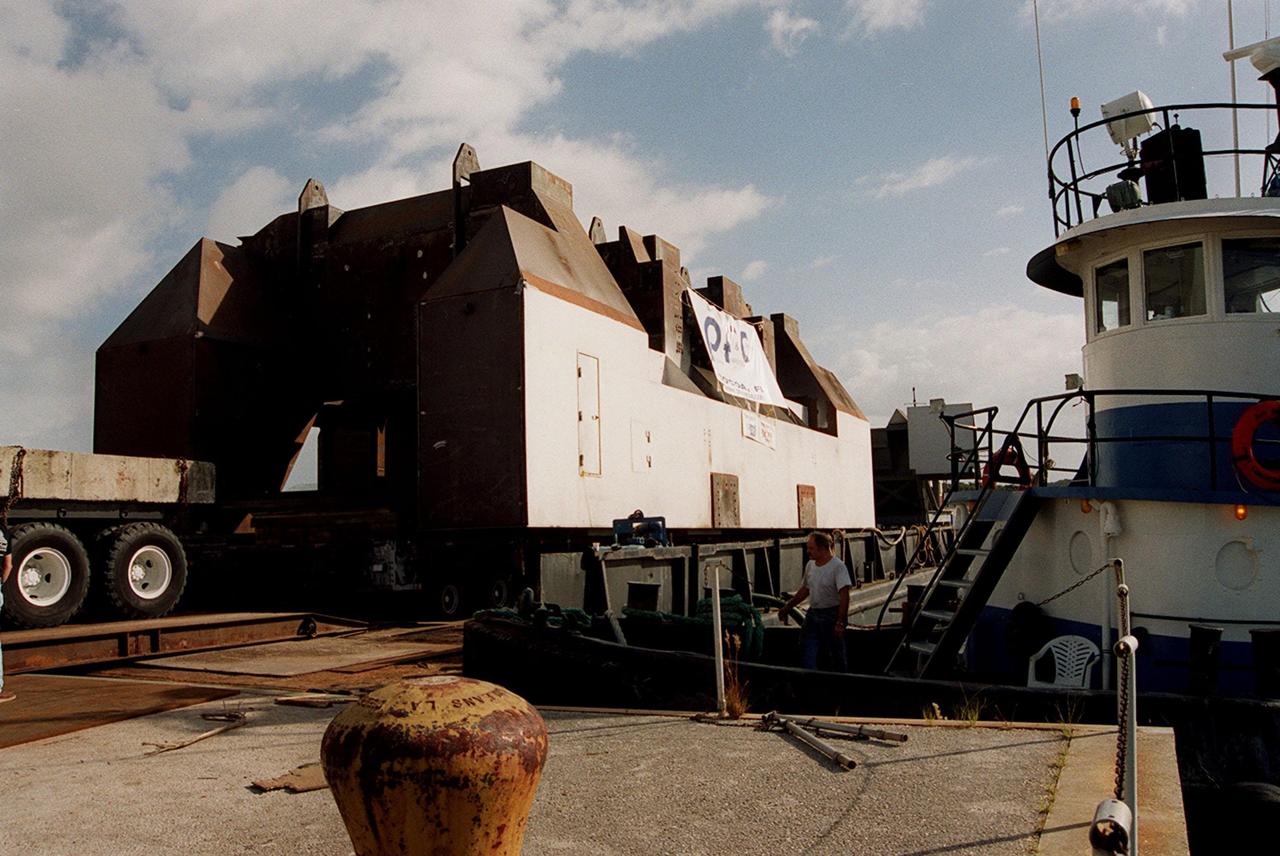
A launch table fabricated by Jered Industries in Georgia is ready for transfer to Launch Complex 37B, Cape Canaveral Air Force Station, after being stabilized aboard the barge that brought it to the turn basin in KSC’s Launch Complex 39 Area. In the background is the Vehicle Assembly Building. The table was built in support of the Delta Evolved Expendable Launch Vehicle (EELV) program, known as Delta IV. It was floated on the barge down the Intercoastal Waterway, through the Barge Canal to the turn basin. The table is approximately 70 feet long, 40 feet wide and 50 feet high, and weighs about 600,000 pounds. Accompanying the launch table on the barge are flame deflectors, which are also to be erected on pad 37B
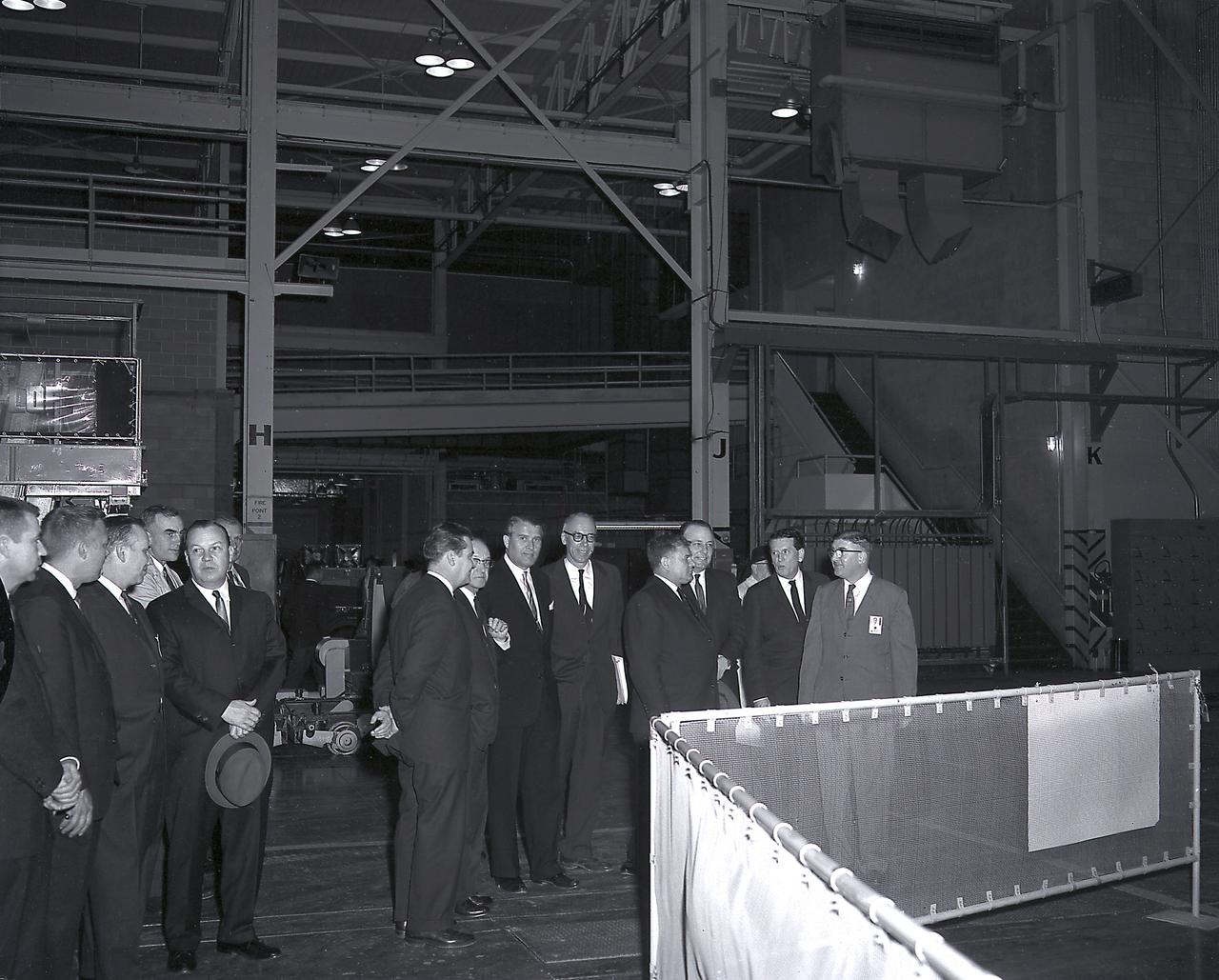
The members of the House Committee on Science and Astronautics visited the Marshall Space Flight Center (MSFC) on March 9, 1962 to gather first-hand information of the nation's space exploration program. The congressional group was composed of members of the Subcommittee on Marned Space Flight. Headed by Representative Olin E. Teague of Texas, other members were James G. Fulton, Pennsylvania; Ken Heckler, West Virginia; R. Walter Riehlman, New York; Richard L. Roudebush, Indiana; John W. Davis, Georgia; James C. Corman, California; Joseph Waggoner, Louisiana; J. Edgar Chenoweth, Colorado; and William G. Bray, Indiana.
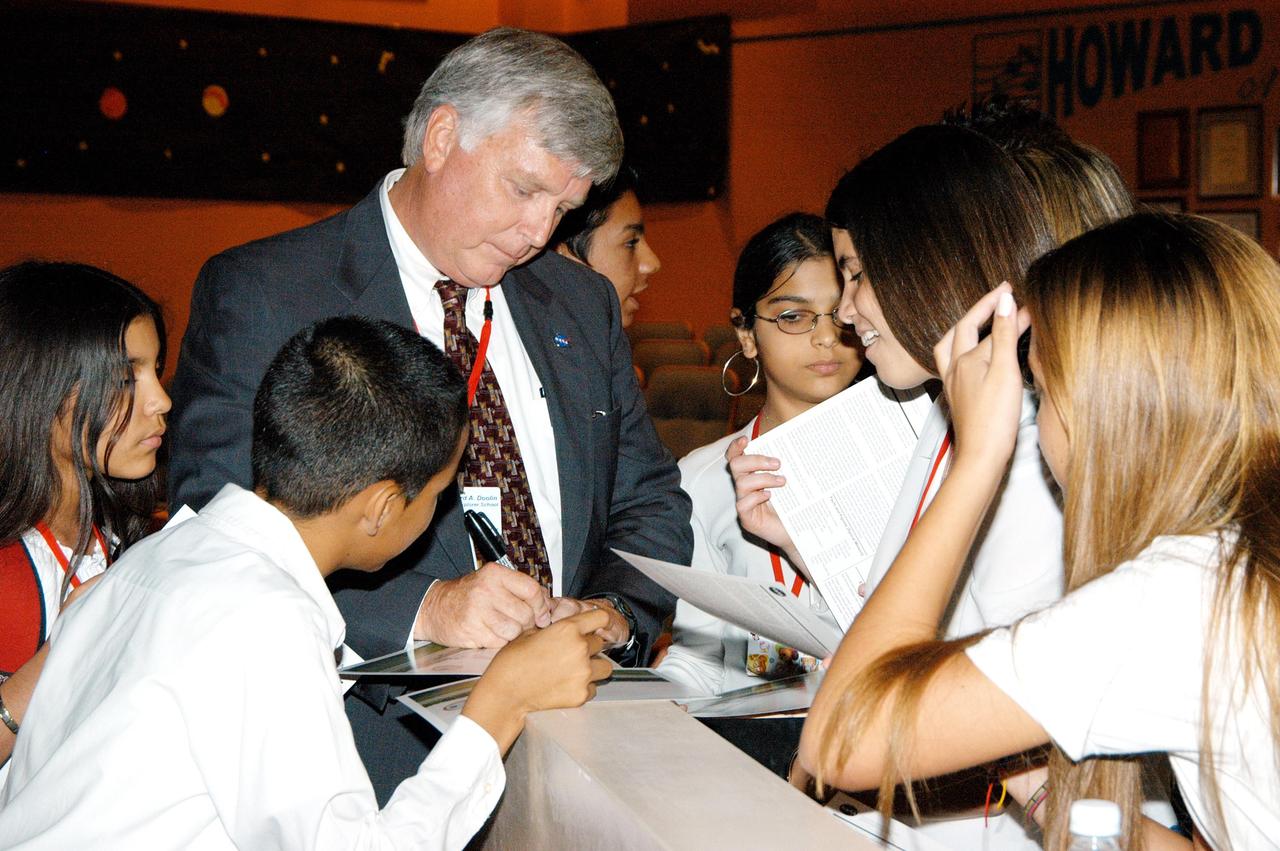
KENNEDY SPACE CENTER, FLA. -- After his presentation, students at Howard A. Doolin Middle School, Miami, Fla., gather around Center Director Jim Kennedy as he signs a memento for a student. The school is one of 100 taking part in the NASA Explorer Schools (NES) program. Kennedy visited the school to share America’s new vision for space exploration with the next generation of explorers. He is talking with students in Florida and Georgia Explorer Schools about our destiny as explorers, NASA’s stepping stone approach to exploring Earth, the Moon, Mars and beyond, how space impacts our lives, and how people and machines rely on each other in space.
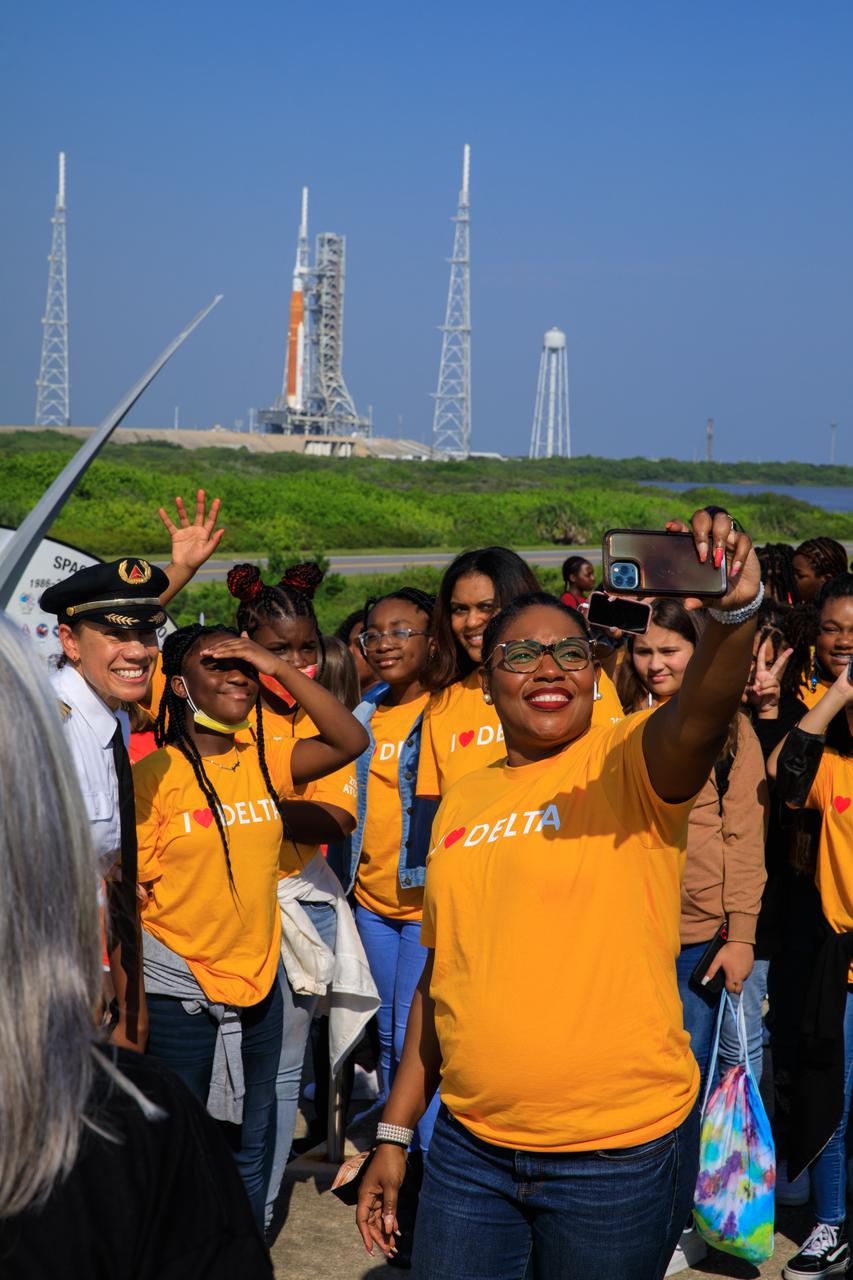
A group of girls pose for a selfie in front of NASA’s Artemis I Moon rocket at Launch Pad 39B at the agency’s Kennedy Space Center in Florida on Sept. 23, 2022. As part of Delta Air Lines’ Women Inspiring Our Next Generation (WING) program, an all-female crew flew girls from a variety of Atlanta, Georgia area schools and organizations with a STEM (science, technology, engineering, math) focus to Kennedy to learn about the various careers available at the Florida spaceport. While at Kennedy, the group also had the opportunity to hear from a panel of 18 women with a combination of careers from Kennedy and Delta and tour the visitor complex.
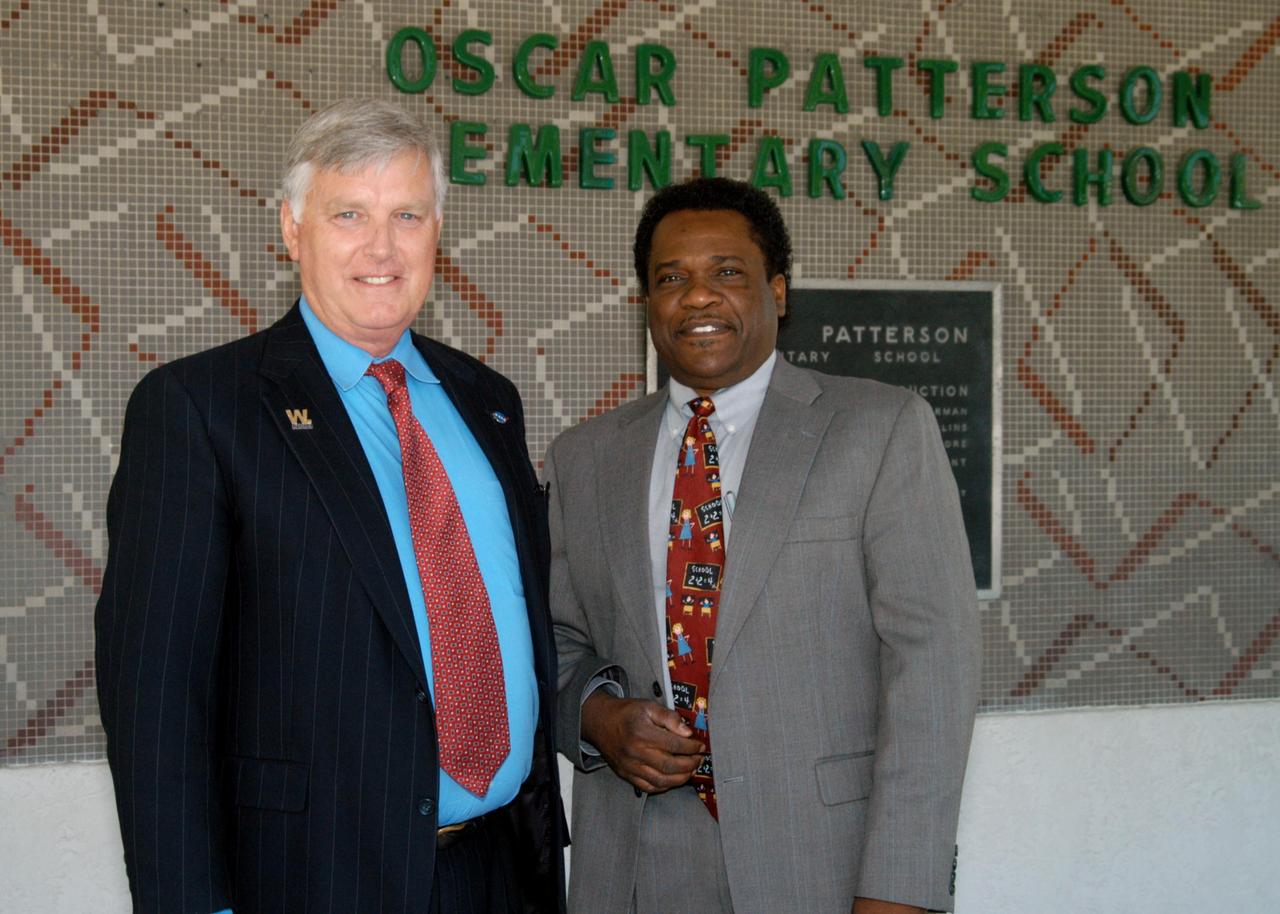
KENNEDY SPACE CENTER, FLA. -- Center Director Jim Kennedy stands with Dr. Linward Barnes, principal of Oscar Patterson Elementary Magnet School in Panama City, Fla. Kennedy is touring Florida and Georgia NASA Explorer Schools to share America’s new vision for space exploration with the next generation of explorers. Kennedy is talking with students about our destiny as explorers, NASA’s stepping stone approach to exploring Earth, the Moon, Mars and beyond, how space impacts our lives, and how people and machines rely on each other in space.