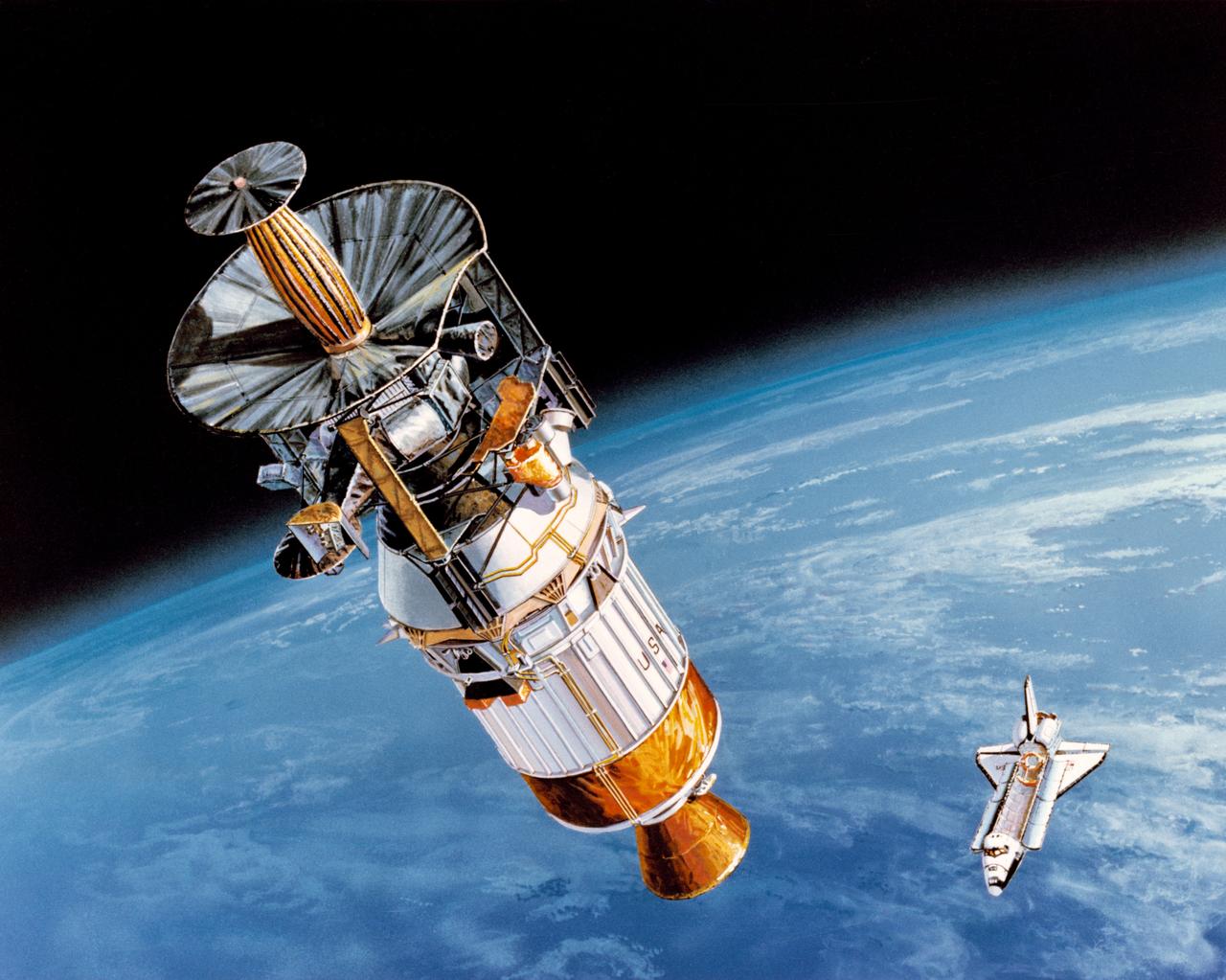
S89-42940 (April 1989) --- In this artist's rendition, the Galileo spacecraft is being boosted into its inter-planetary trajectory by the Inertial Upper Stage (IUS) rocket. The Space Shuttle Atlantis, which is scheduled to take Galileo and the IUS from Earth's surface into space, is depicted against the curve of Earth. Galileo will be placed on a trajectory to Venus, from which it will return to Earth at higher velocity and then gain still more energy in two gravity-assist passes, until it has enough velocity to reach Jupiter. Passing Venus, it will take scientific data using instruments designed for observing Jupiter; later, it will make measurements at Earth and the moon, crossing above the moon's north pole in the second pass. Between the two Earth passes, it will edge into the asteroid belt, beyond Mars' orbit; there, the first close-up observation of an asteroid is planned. Crossing the belt later, another asteroid flyby is possible.
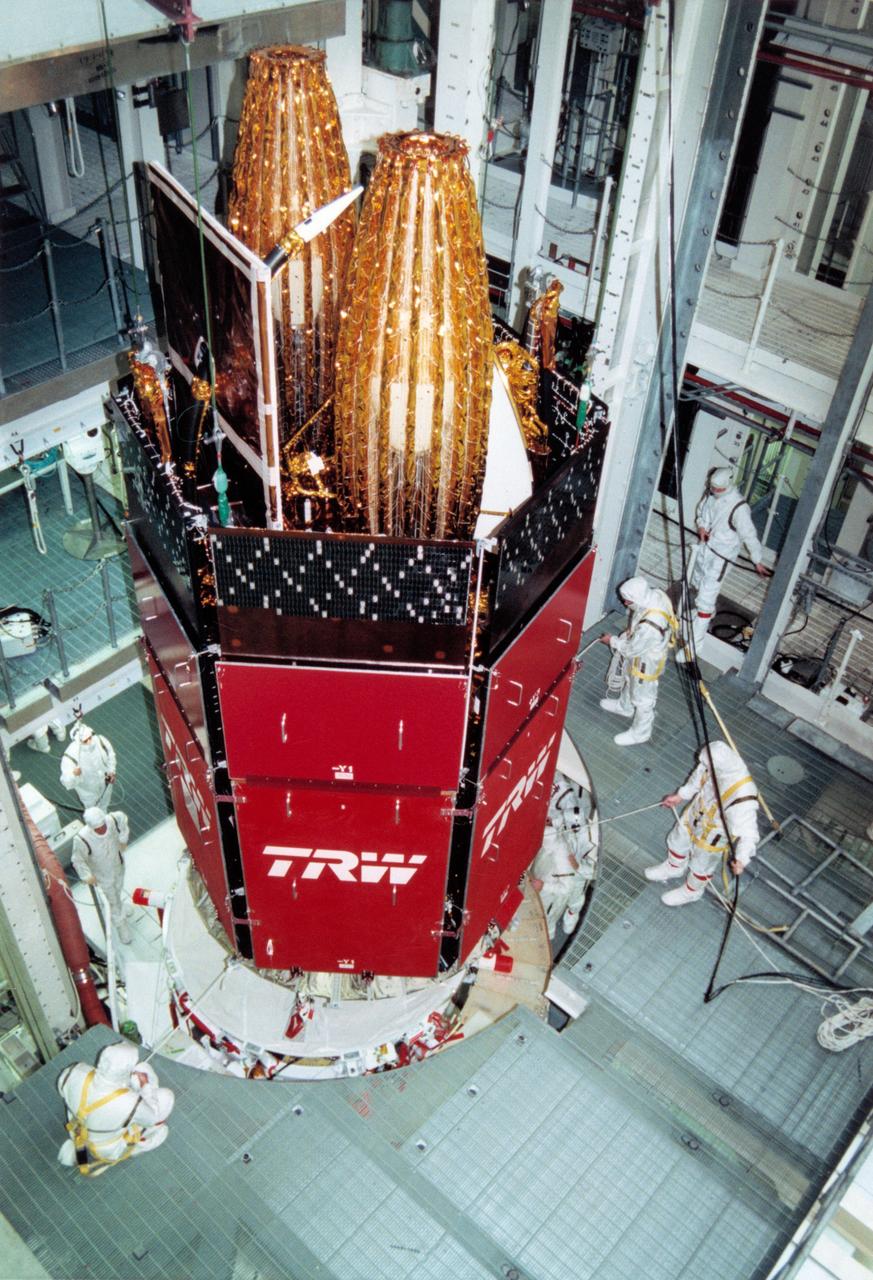
S95-08962 (12 APRIL 1995) --- Members of the Kennedy Space Center (KSC) Payload Processing Team hoist the Tracking and Data Relay Satellite (TDRS-G) into a work stand in the Vertical Processing Facility (VPF) for mating with its Inertial Upper Stage (IUS). After testing and final checkout, TDRS-G and the IUS will be transported to Launch Pad 39B and installed into the Space Shuttle Discovery's payload bay for launch on the STS-70 mission, scheduled for launch June 8, 1995.
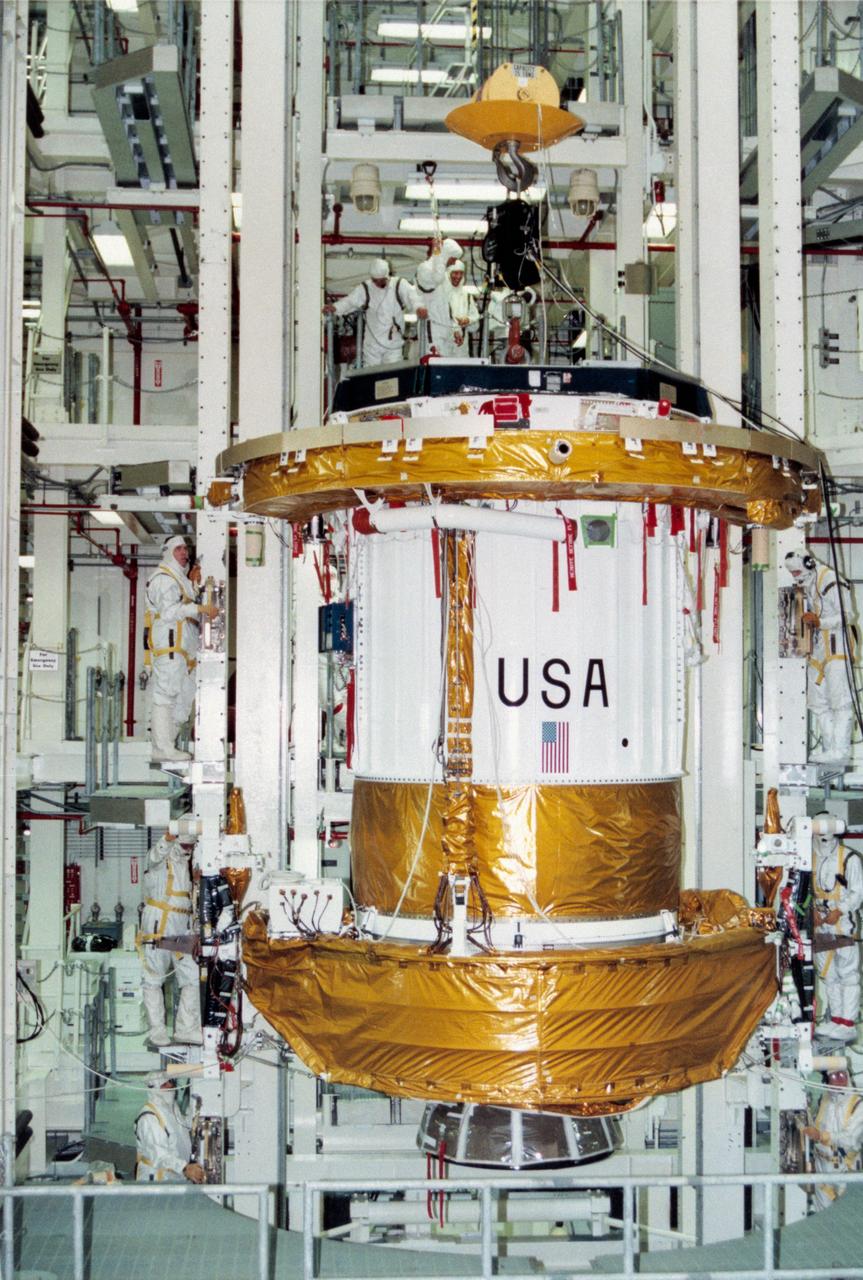
S95-08961 (4 APRIL 1995) --- Workers in the Vertical Processing Facility (VPF) oversee and control the lowering of the Inertial Upper Stage (IUS) booster into a work stand for preflight processing. The IUS will be attached to the Tracking and Data Relay Satellite (TDRS-G), which will be deployed by the Space Shuttle Discovery on the STS-70 mission. The IUS is scheduled to be mated to the TDRS satellite later in April. Liftoff of STS-70 is slated for no earlier than June 8, 1995.
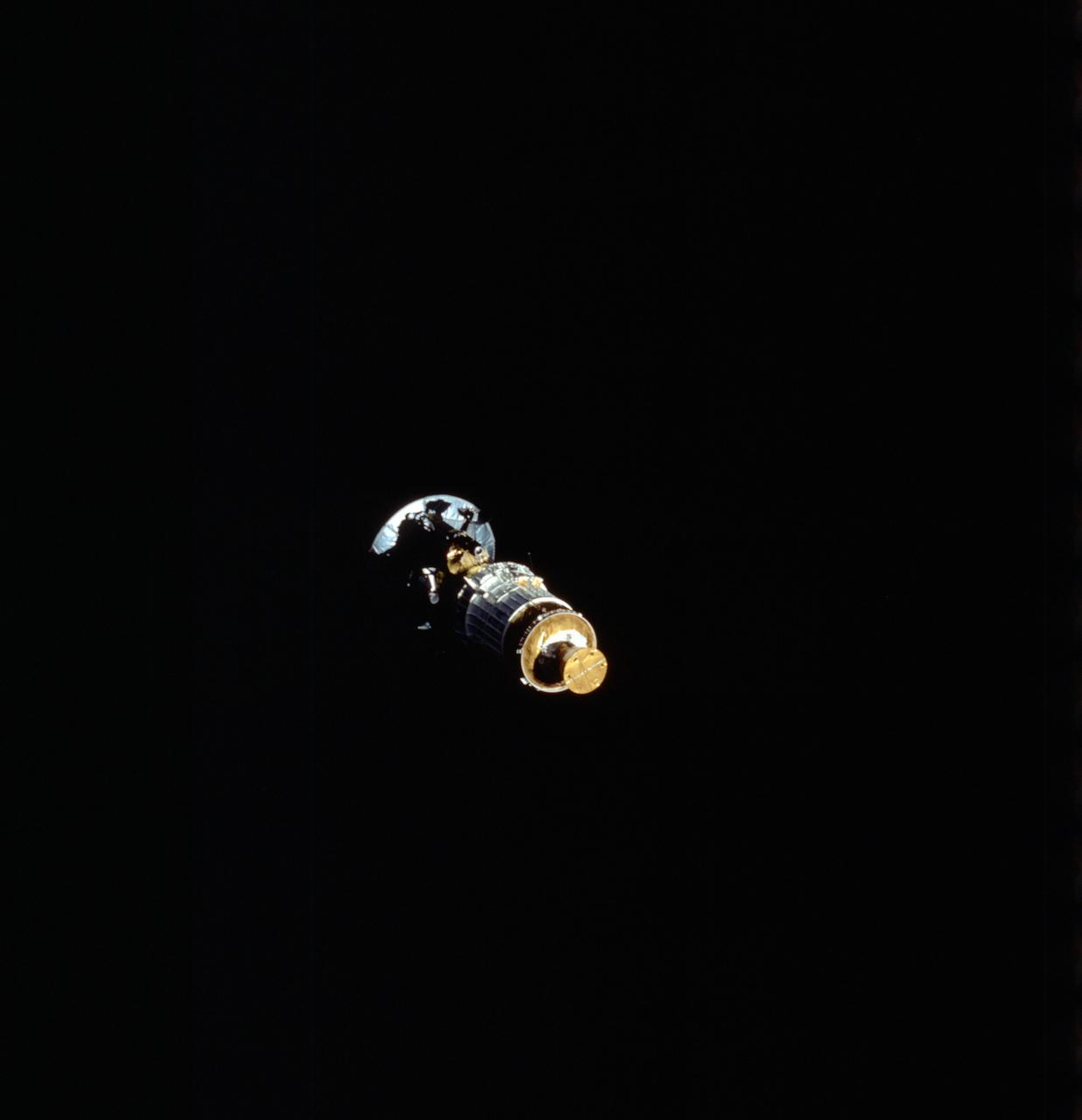
STS034-72-070 (18 Oct 1989) --- Backdropped against the blackness of space, the Galileo spacecraft and its inertial upper stage (IUS) begin relative separation from the Earth-orbiting Space Shuttle Atlantis. The five-member STS-34 crew deployed the Jupiter-bound satellite within six hours of achieving Earth orbit on Oct. 18, 1989. The scene was exposed with a 70mm handheld Hasselblad camera.
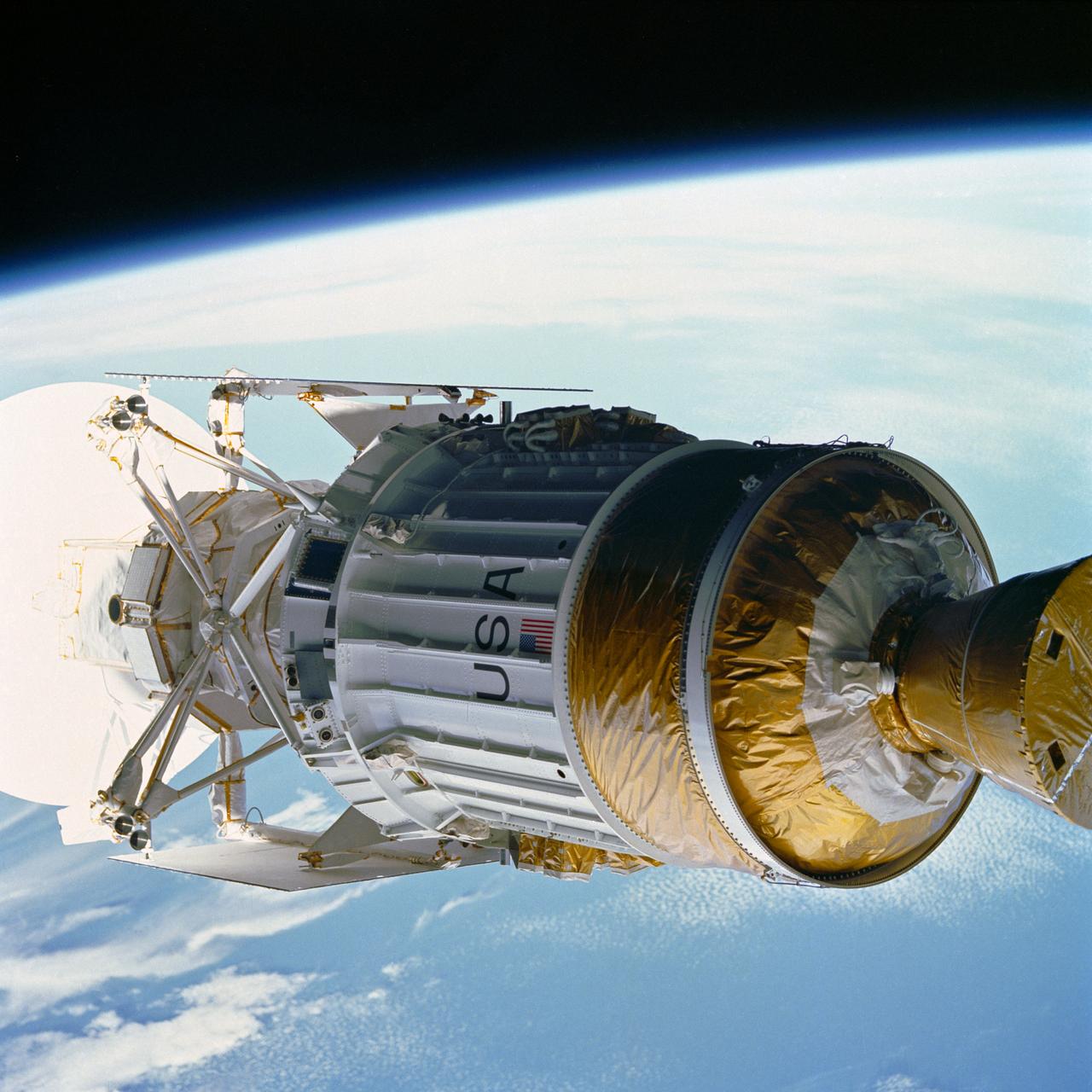
STS030-71-052 (4 May 1989) --- In the early evening hours of the Space Shuttle Atlantis' first day in space for the four-day mission, the Magellan spacecraft begins its long journey to the planet Venus for an extensive radar mapping mission. The scene was photographed through Atlantis' aft flight deck windows with a handheld 70mm camera.
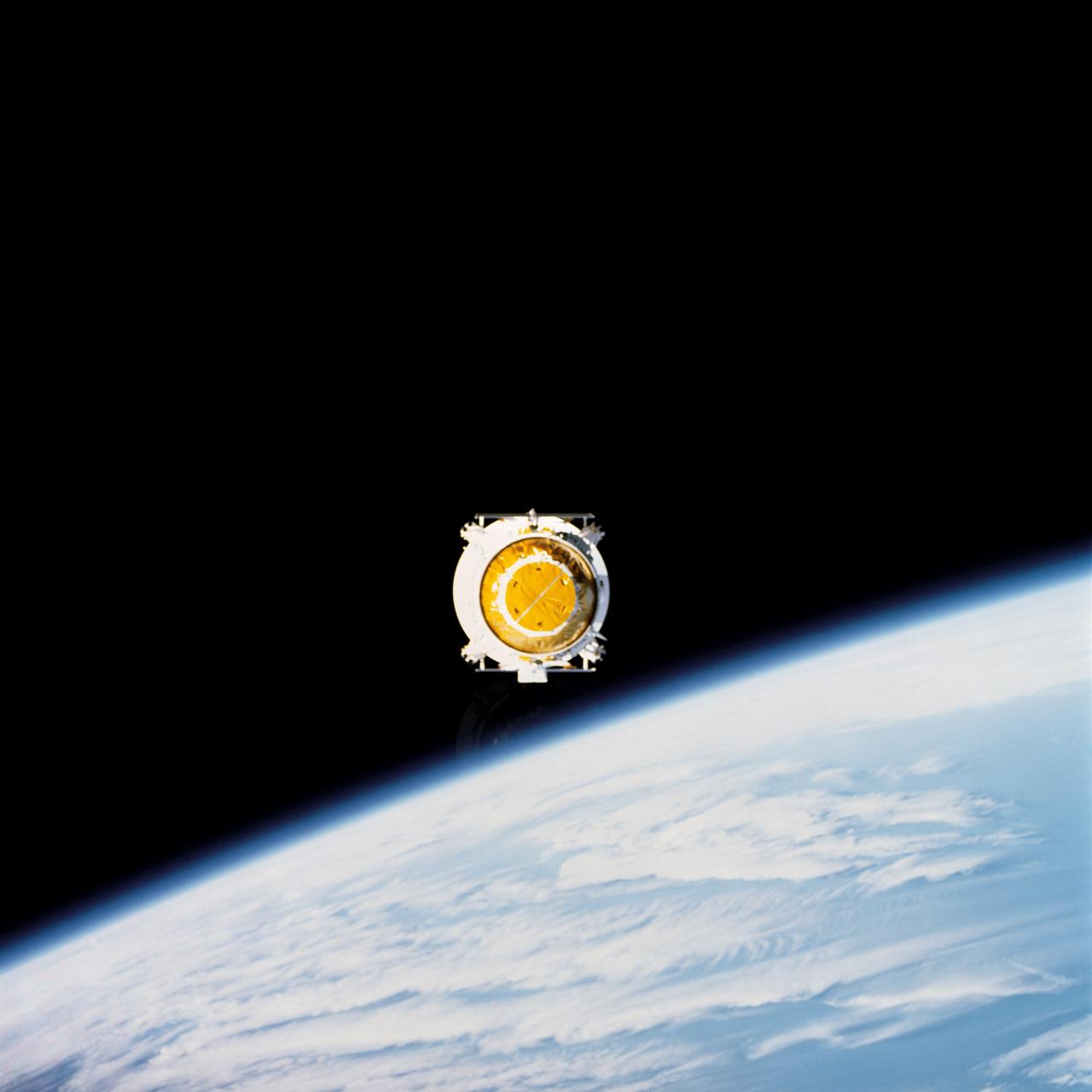
STS030-71-053 (4 May 1989) --- In the early evening hours of Space Shuttle Atlantis’ first day in space for the four-day STS-30 mission, the Magellan spacecraft is released into space to begin its long journey to the planet Venus for an extensive radar mapping mission. The scene was photographed through Atlantis’ aft flight deck windows with a handheld 70mm camera.
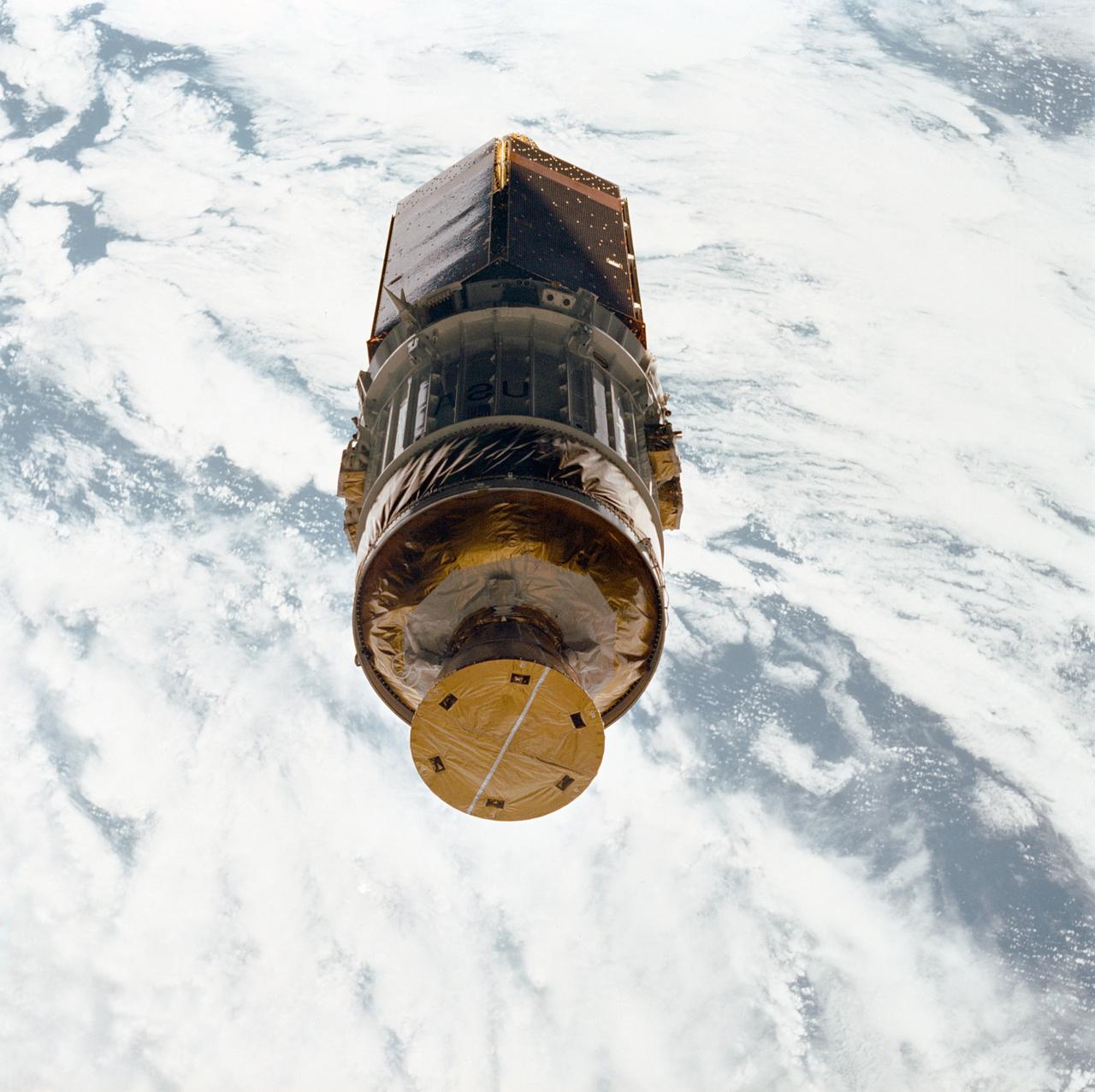
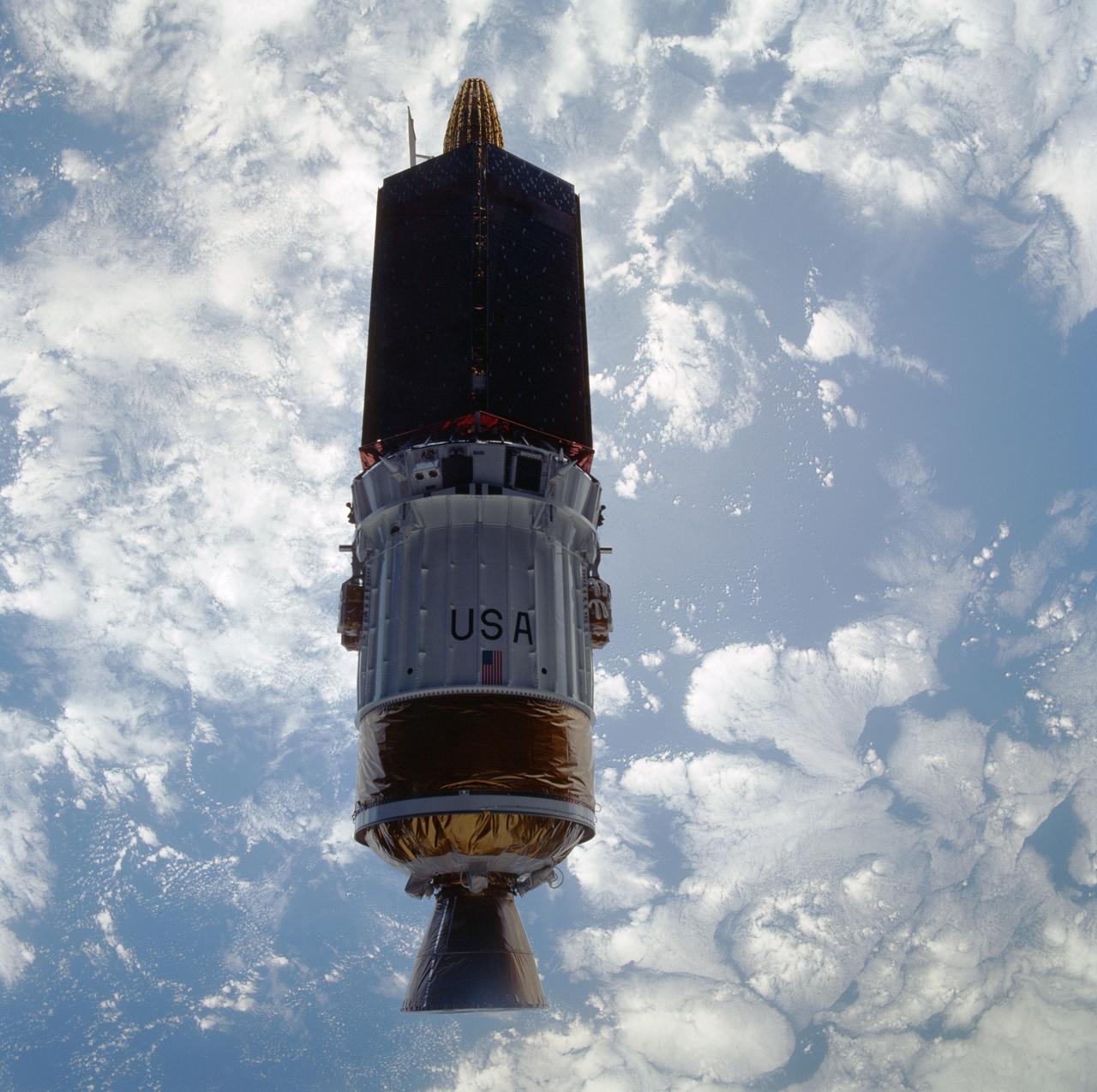
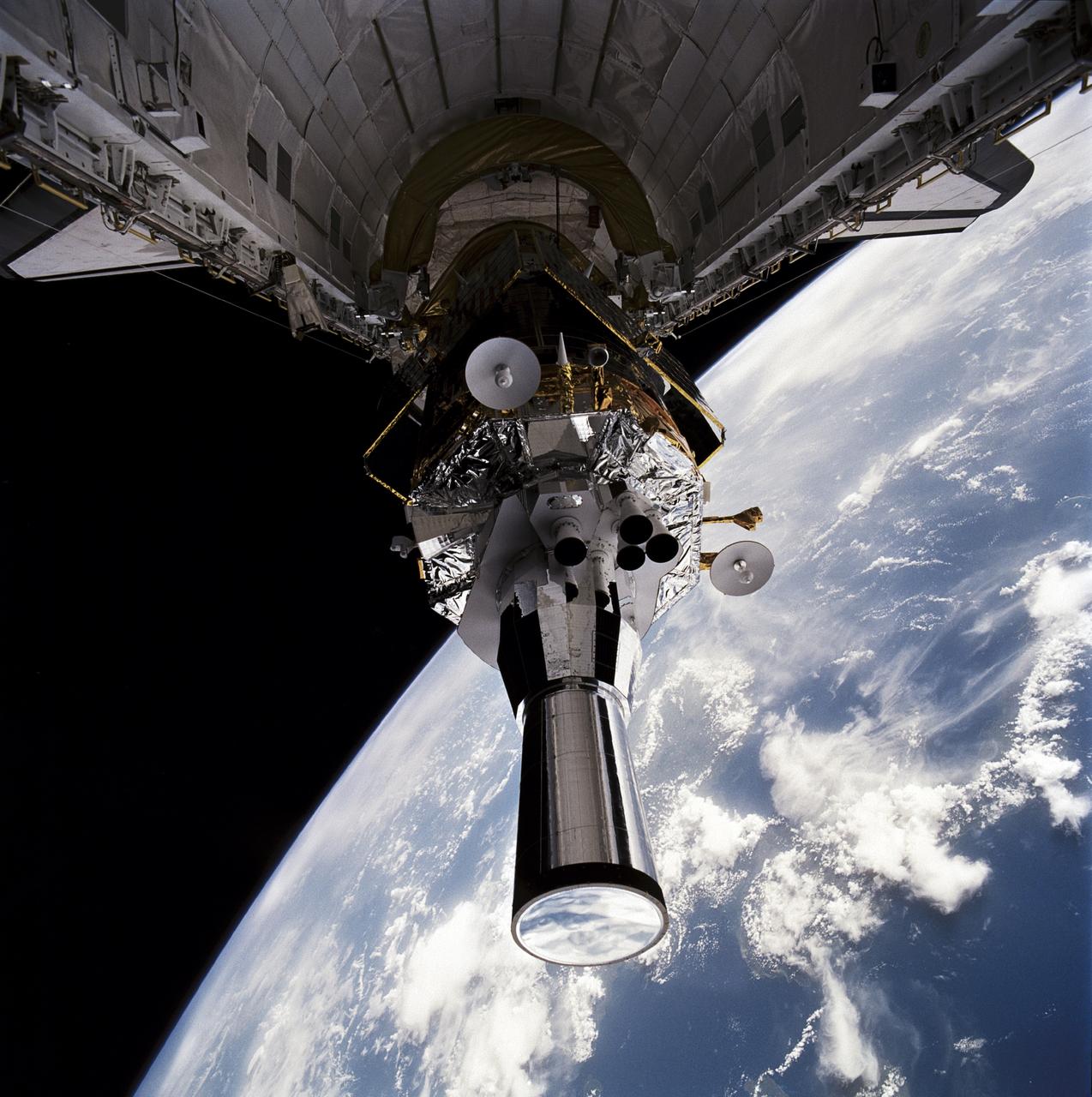
STS026-31-071 (3 Oct 1988) --- After deployment from Discovery, Orbiter Vehicle (OV) 103, the inertial upper stage (IUS) with the tracking and data relay satellite C (TDRS-C) drifts above the cloud-covered Earth surface. TDRS-C, in stowed configuration (solar array panels visible), is mounted atop the IUS with the interstage and solid rocket motor and nozzle seen in the foreground.
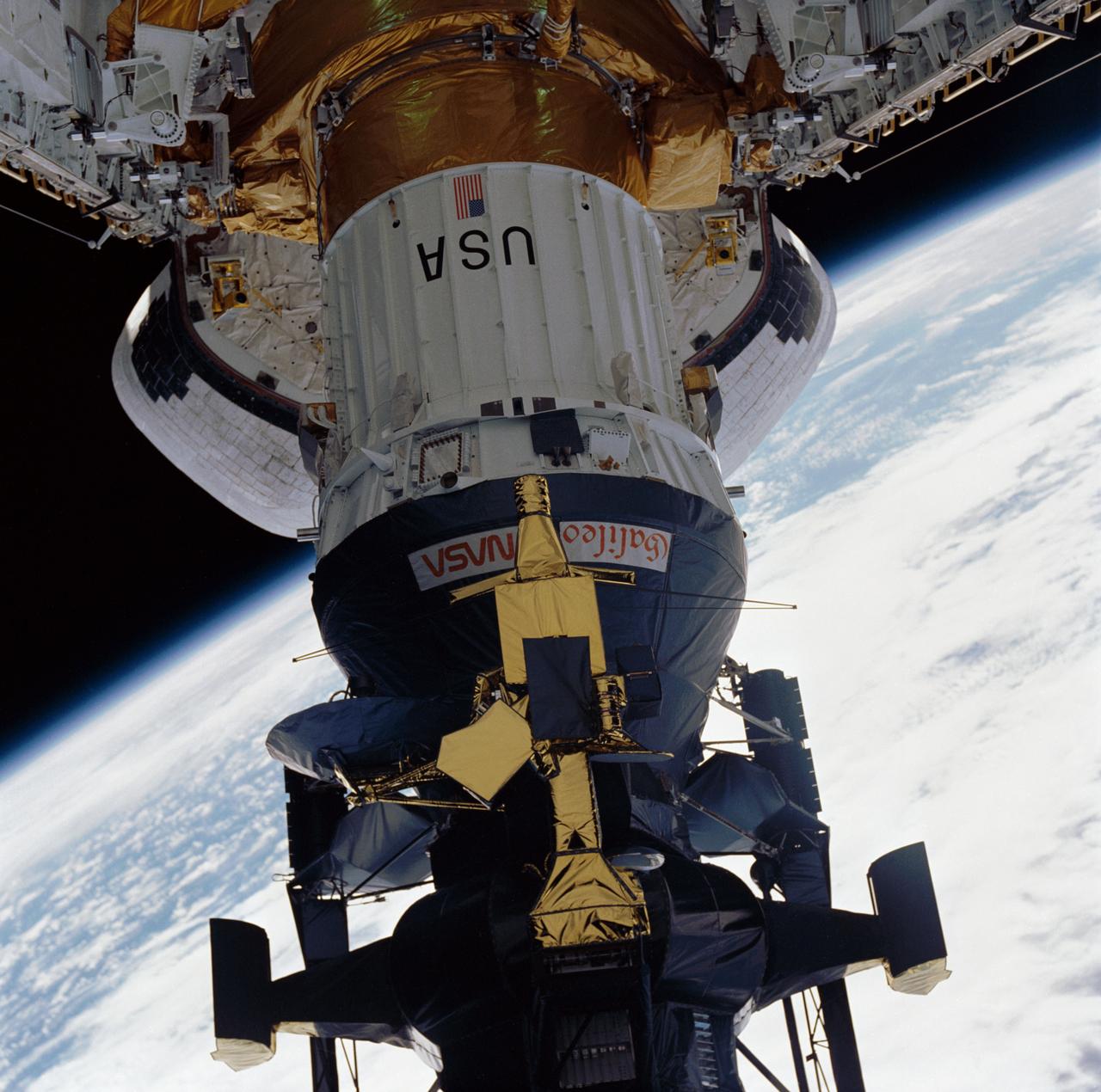
During STS-34 mission, the Galileo spacecraft mounted atop the inertial upper stage (IUS) is tilted to a 58-degree deployment position by the airborne support equipment (ASE) aft frame tilt actuator (AFTA) table in Atlantis', Orbiter Vehicle (OV) 104's, payload bay (PLB). Visible in the foreground is the ASE forward cradle and the umbilical boom which has fallen away from the IUS. OV-104's orbital maneuvering system (OMS) pods and the Earth's limb appear in the background.
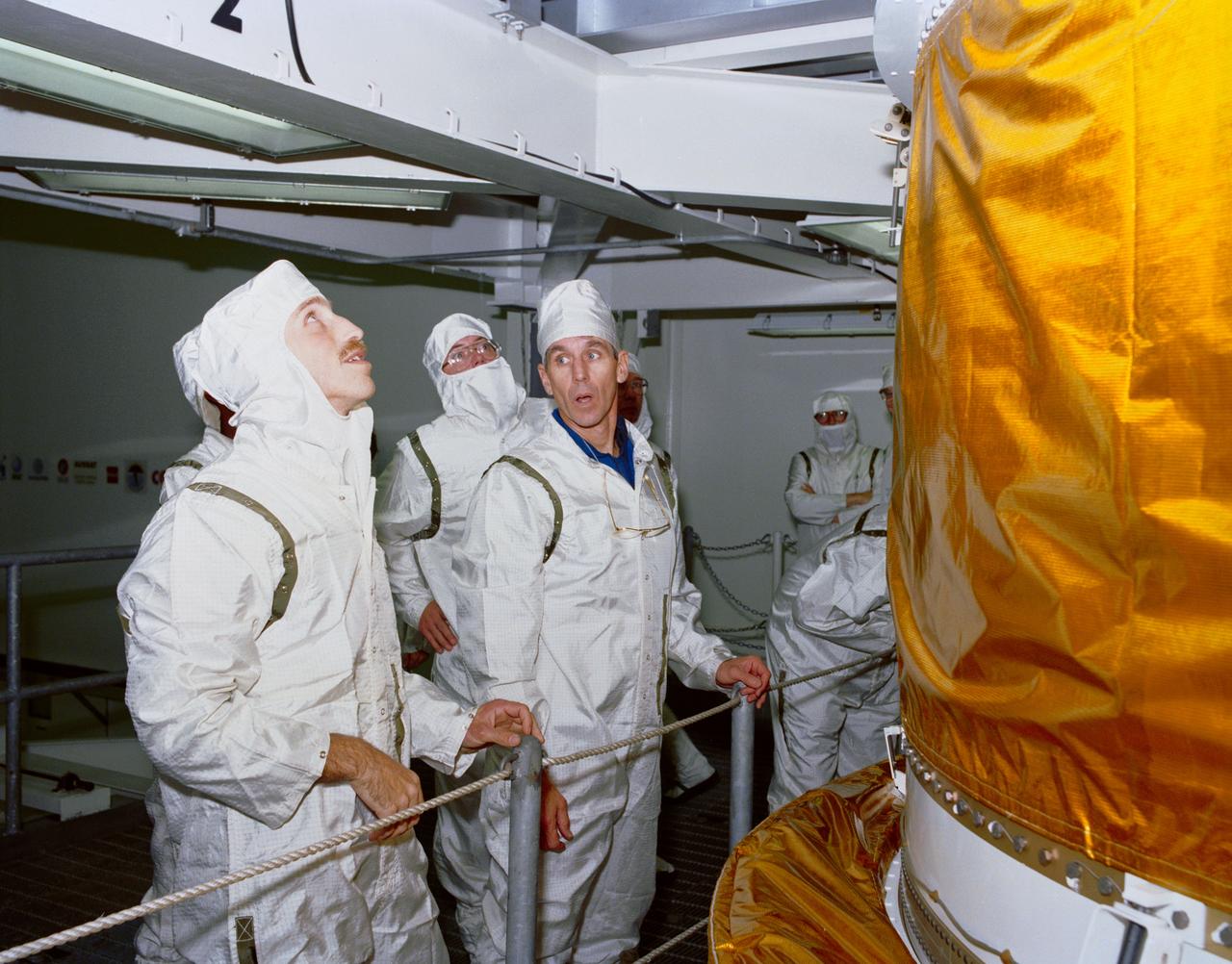
S89-27384 (5 Jan 1989) --- Astronauts James P. Bagian, left, and Robert C. Springer inspect a portion of the first stage of the Inertial Upper Stage (IUS-9) in a test cell of the KSC vertical processing facility. The two, along with three other NASA astronauts, will fly aboard Discovery and are responsible for the deployment of the tracking and data relay satellite (TDRS).
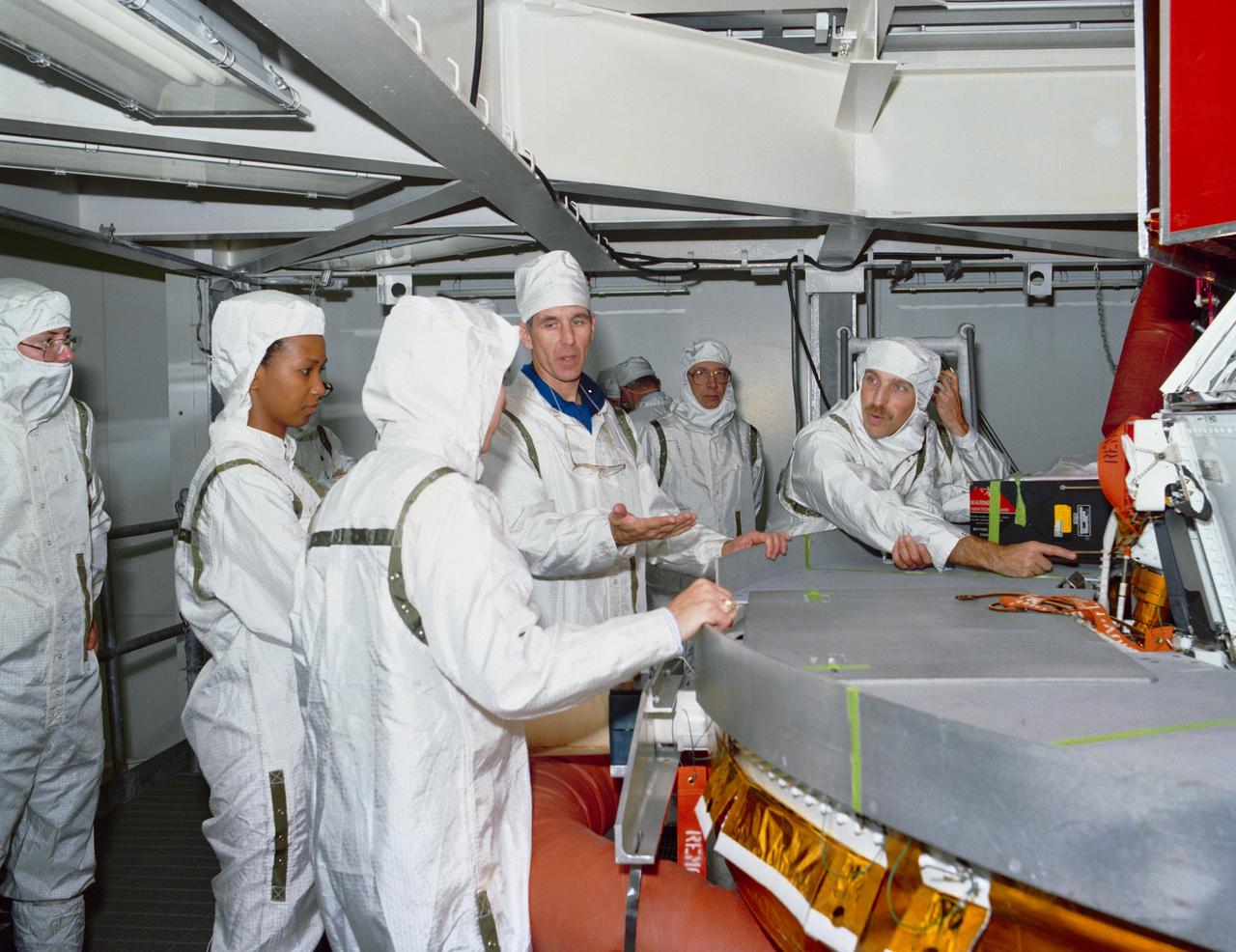
S89-28108 --- Astronaut Mae C. Jemison and STS-29 Mission Specialist James P. Bagian and Robert C. Springer inspect the interface between the tracking and data relay satellite D (TDRS-D) and inertial upper stage (IUS-9) in a test cell located in the Kennedy Space Center (KSC) Vertical Processing Facility (VPF). The clean-suited astronauts, engineers, and technicians discuss the payload. Photo credit: NASA
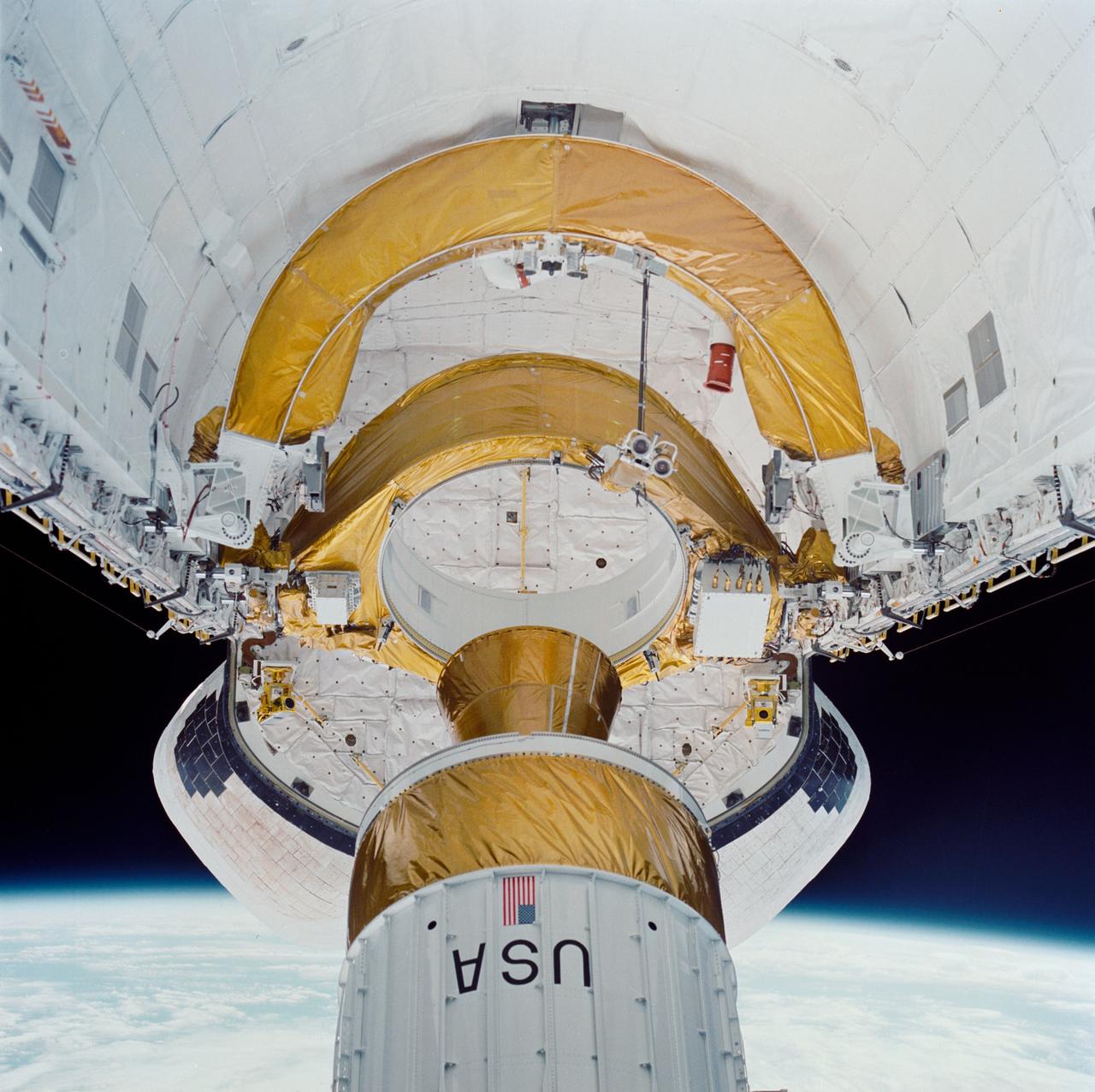
During STS-26, inertial upper stage (IUS) with the tracking and data relay satellite C (TDRS-C) drifts above Discovery, Orbiter Vehicle (OV) 103, payload bay (PLB) after being positioned in deployment attitude (an angle of 50 degrees) by the airborne support equipment (ASE). IUS vacates the ASE aft frame tilt actuator (AFTA) table in the PLB while the disconnected ASE umbilical boom floats above ASE forward cradle. IUS first stage rocket motor and nozzle and the interstage are visible as the IUS is deployed. In the background are the orbital maneuvering system (OMS) pods and the Earth's limb.
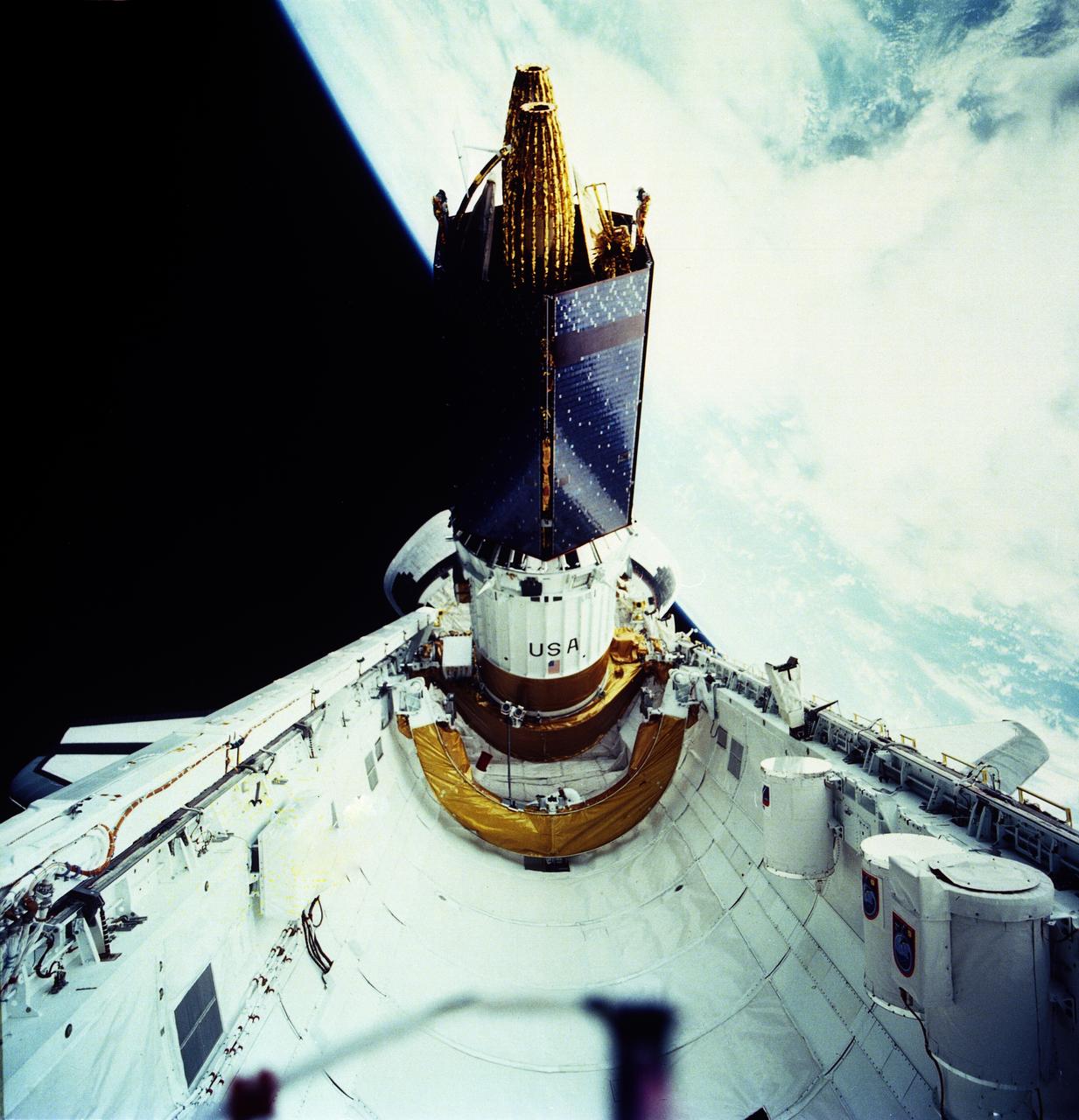
The primary payload of the STS-43 mission, Tracking and Data Relay Satellite-E (TDRS-E) attached to an Inertial Upper Stage (IUS) was photographed at the moment of its release from the cargo bay of the Space Shuttle Orbiter Atlantis. The TDRS-E was boosted by the IUS into geosynchronous orbit and positioned to remain stationary 22,400 miles above the Pacific Ocean southwest of Hawaii. The TDRS system provides almost uninterrupted communications with Earth-orbiting Shuttles and satellites, and had replaced the intermittent coverage provided by globe-encircling ground tracking stations used during the early space program. The TDRS can transmit and receive data, and track a user spacecraft in a low Earth orbit. The IUS is an unmarned transportation system designed to ferry payloads from low Earth orbit to higher orbits that are unattainable by the Shuttle. The launch of STS-43 occurred on August 2, 1991.

The free-flying Tracking and Data Relay Satellite-E (TDRS-E), still attached to an Inertial Upper Stage (IUS), was photographed by one of the crewmembers during the STS-43 mission. The TDRS-E was boosted by the IUS into geosynchronous orbit and positioned to remain stationary 22,400 miles above the Pacific Ocean southwest of Hawaii. The TDRS system provides almost uninterrupted communications with Earth-orbiting Shuttles and satellites, and had replaced the intermittent coverage provided by globe-encircling ground tracking stations used during the early space program. The TDRS can transmit and receive data, and track a user spacecraft in a low Earth orbit. The IUS is an unmarned transportation system designed to ferry payloads from low Earth orbit to higher orbits that are unattainable by the Shuttle. The Space Shuttle Orbiter Atlantis for the STS-43 mission was launched on August 2, 1991.
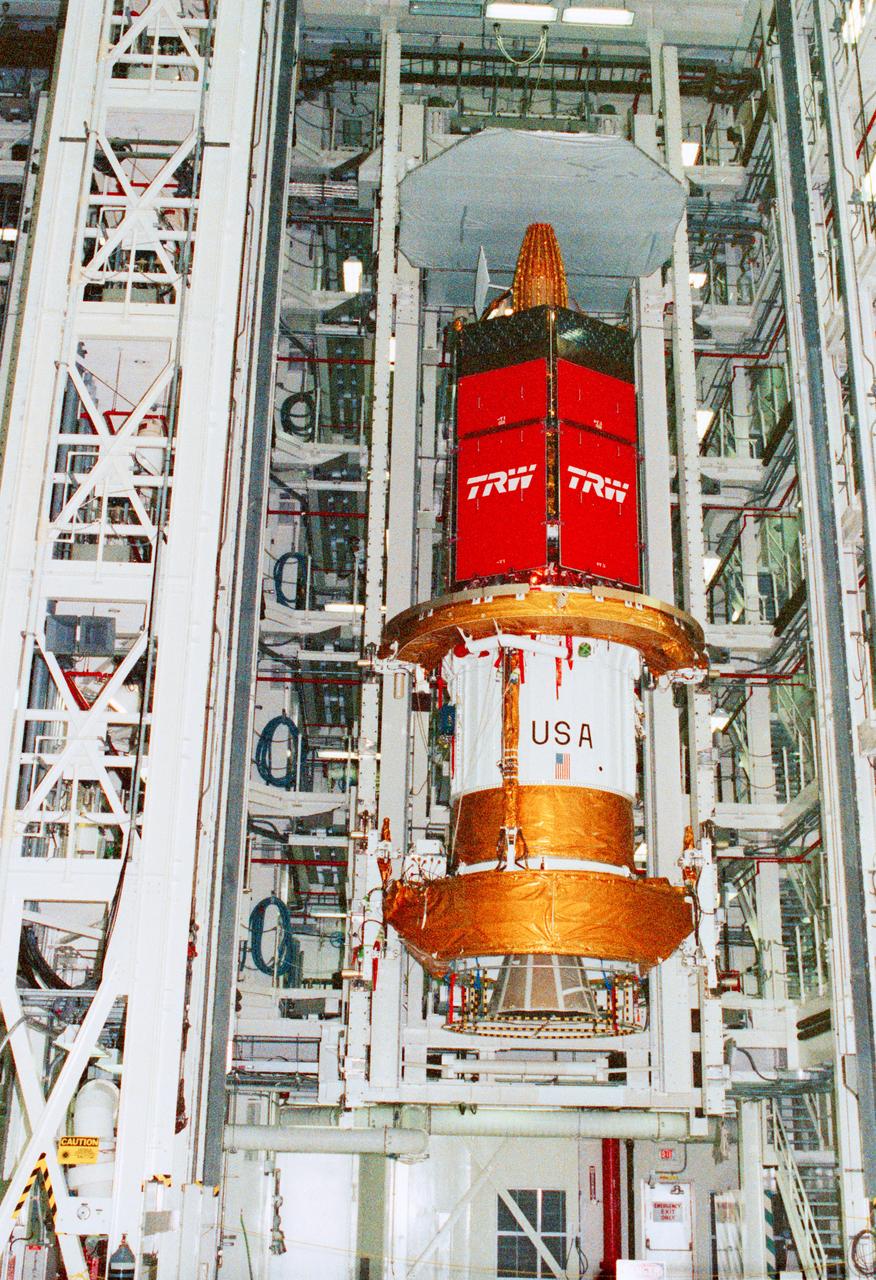
STS-43 Tracking and Data Relay Satellite E (TDRS-E) undergoes preflight processing in the Kennedy Space Center's (KSC's) Vertical Processing Facility (VPF) before being loaded into a payload canister for transfer to the launch pad and eventually into Atlantis', Orbiter Vehicle (OV) 104's, payload bay (PLB). This side of the TDRS-E will rest at the bottom of the PLB therefore the airborne support equipment (ASE) forward frame keel pin (at center of spacecraft) and the umbilical boom running between the two ASE frames are visible. The solar array panels are covered with protective TRW shields. Above the shields the stowed antenna and solar sail are visible. The inertial upper stage (IUS) booster is the white portion of the spacecraft and rests in the ASE forward frame and ASE aft frame tilt actuator (AFTA) frame (at the bottom of the IUS). The IUS booster nozzle extends beyond the AFTA frame. View provided by KSC with alternate number KSC-91PC-1079.
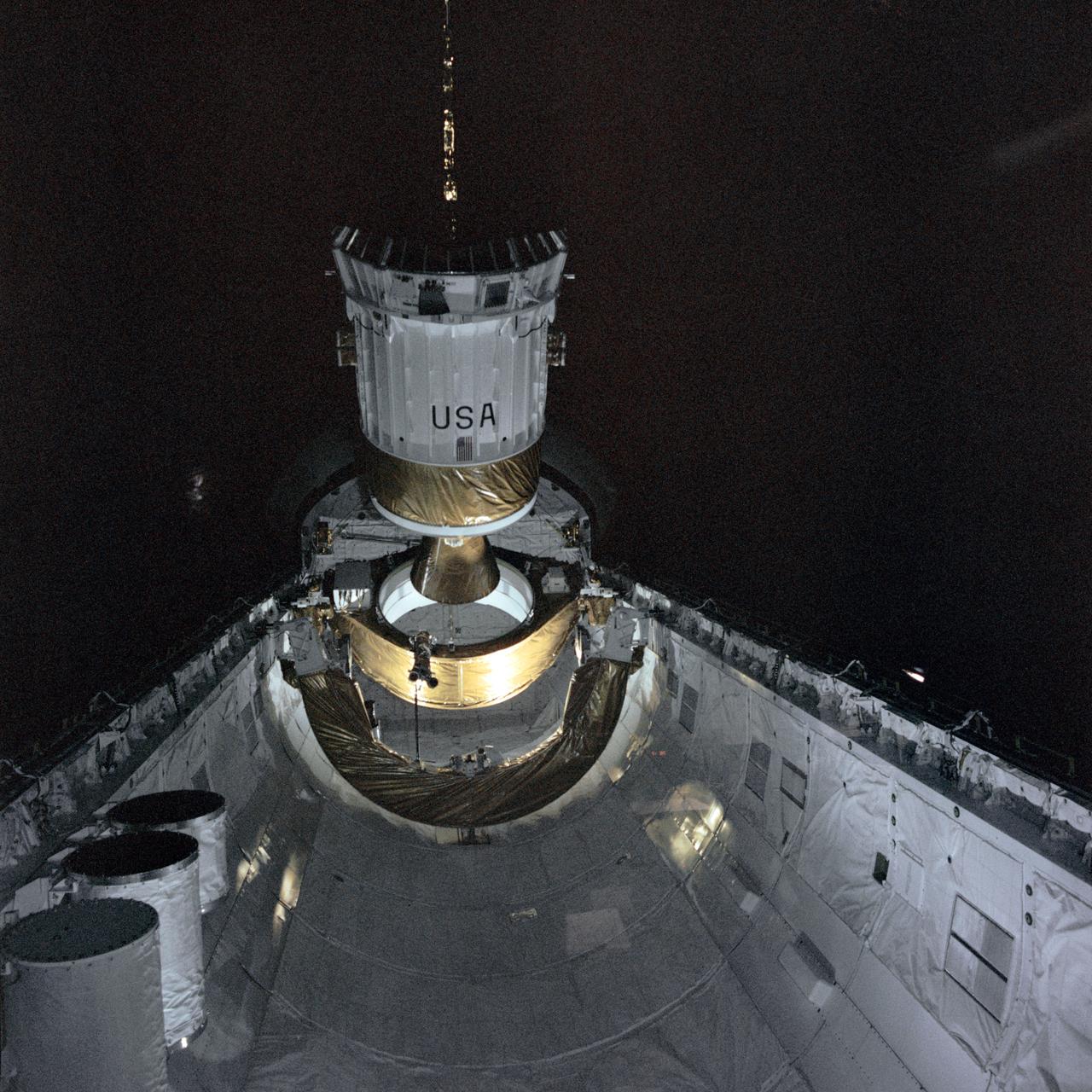
STS006-38-894 (4 April 1983) --- The tracking and data relay satellite (TDRS) leaves the 18-meter (60-ft) long cargo bay of the Earth-orbiting space shuttle Challenger about ten hours following launch of NASA’s second reusable space vehicle. The inertial upper stage (IUS) which gives power necessary to place the TDRS in its desired orbit is clearly seen in this view, photographed with a 70mm camera aimed through the aft flight deck windows of the Challenger. The cylindrical canisters in the left foreground contain scientific experiments from subscribers to NASA’s getaway special (GAS) program. Photo credit: NASA
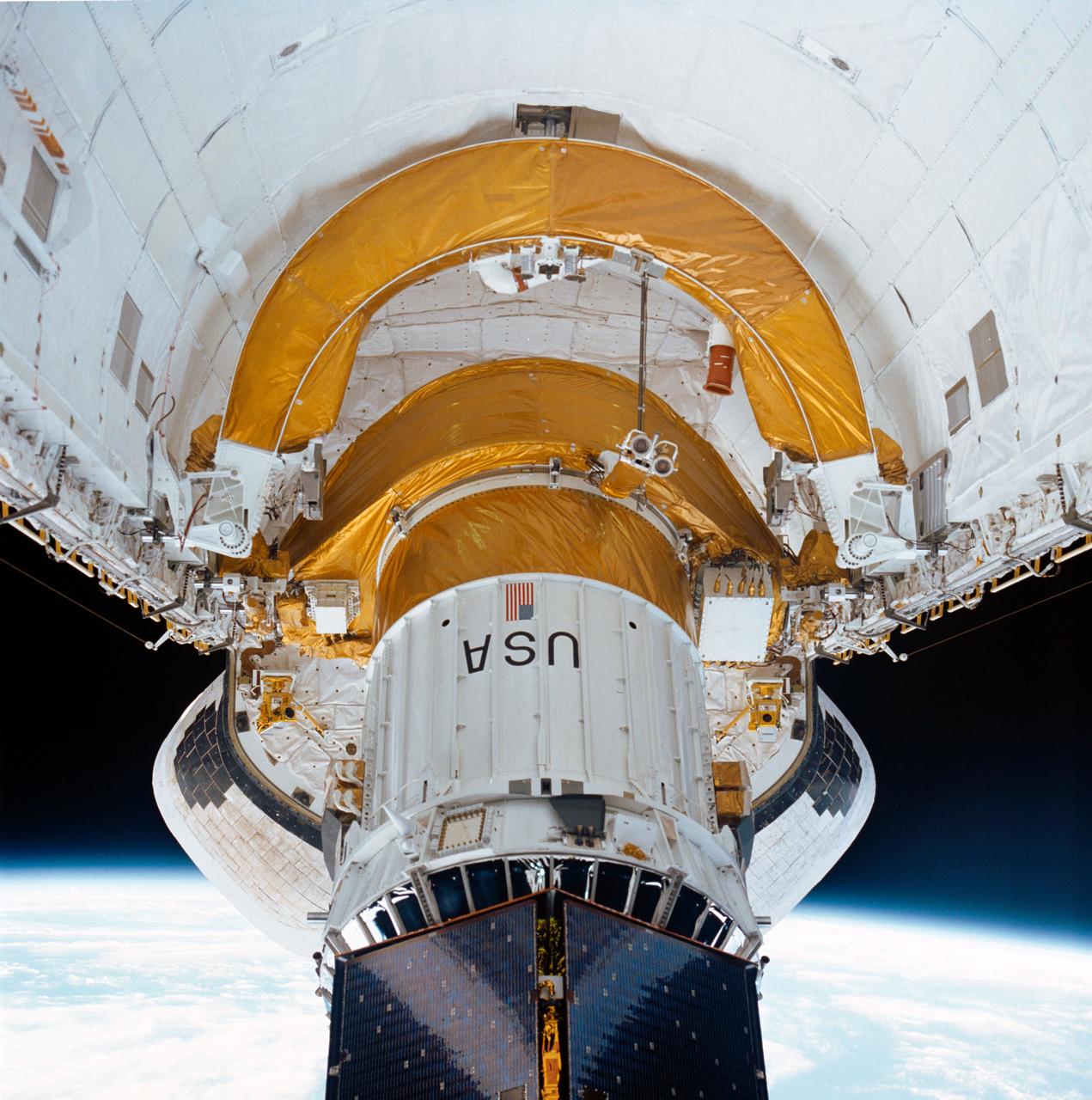
During STS-26, inertial upper stage (IUS) with the tracking and data relay satellite C (TDRS-C) located in the payload bay (PLB) of Discovery, Orbiter Vehicle (OV) 103, is raised into deployment attitude (an angle of 50 degrees) by the airborne support equipment (ASE). ASE aft frame tilt actuator (AFTA) table supports the IUS as it is positioned in the PLB and the ASE umbilical boom drifts away from IUS toward ASE forward cradle. TDRS-C solar array panels (in stowed configuration) are visible on top of the IUS. In the background are the orbital maneuvering system (OMS) pods and the Earth's limb.
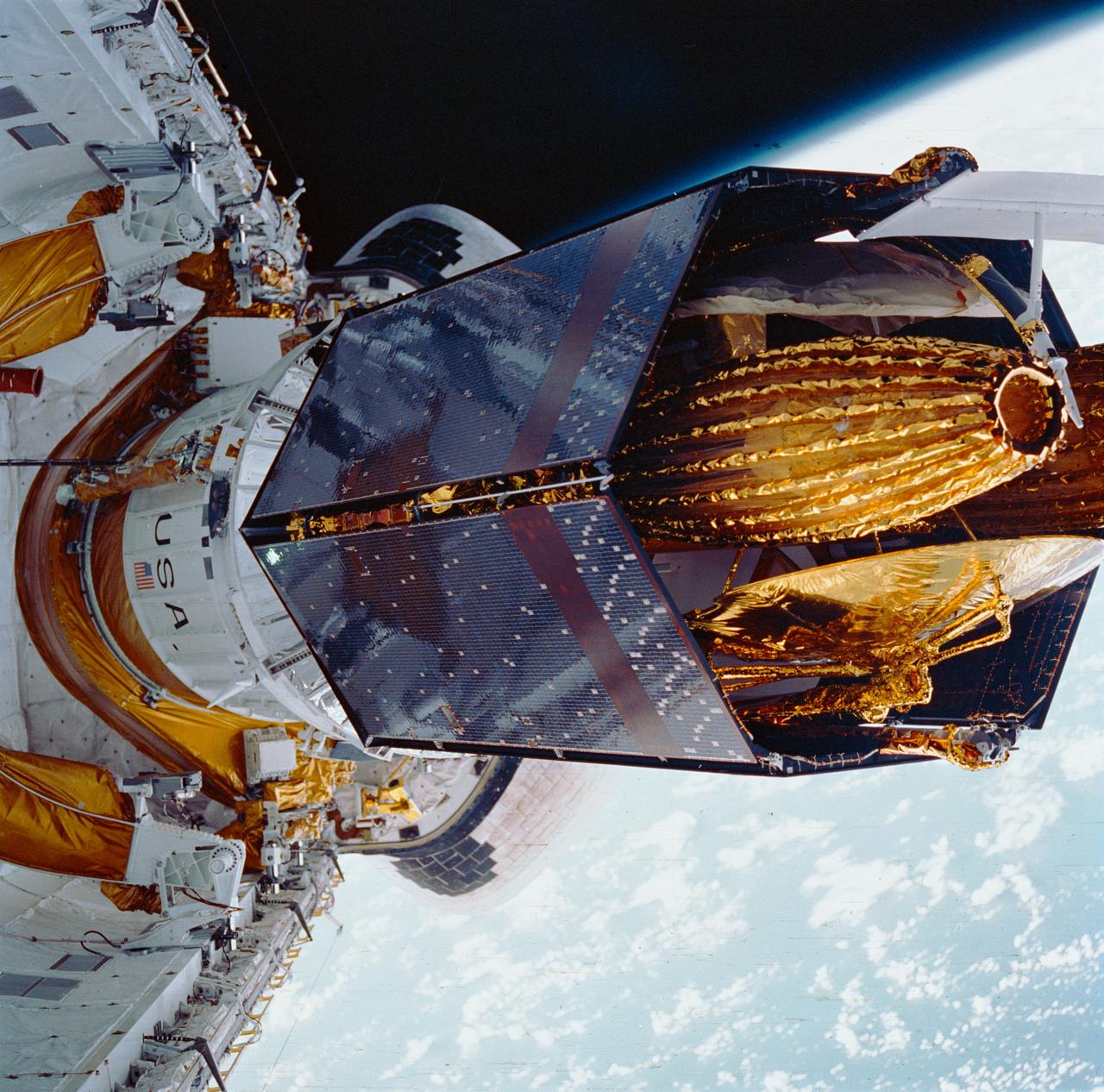
During STS-26, inertial upper stage (IUS) with tracking and data relay satellite C (TDRS-C) located in the payload bay (PLB) of Discovery, Orbiter Vehicle (OV) 103, is positioned into its proper deployment attitude (an angle of 50 degrees) by the airborne support equipment (ASE). In the foreground, the ASE forward cradle is visible. The IUS is mounted in the ASE aft frame tilt actuator (AFTA) table. TDRS-C components in stowed configuration include solar array panels, TDRS single access #1 and #2, TDRS SGL, and S-Band omni antenna. In the background are the orbital maneuvering system (OMS) pods, the Earth's cloud-covered surface, and the Earth's limb.
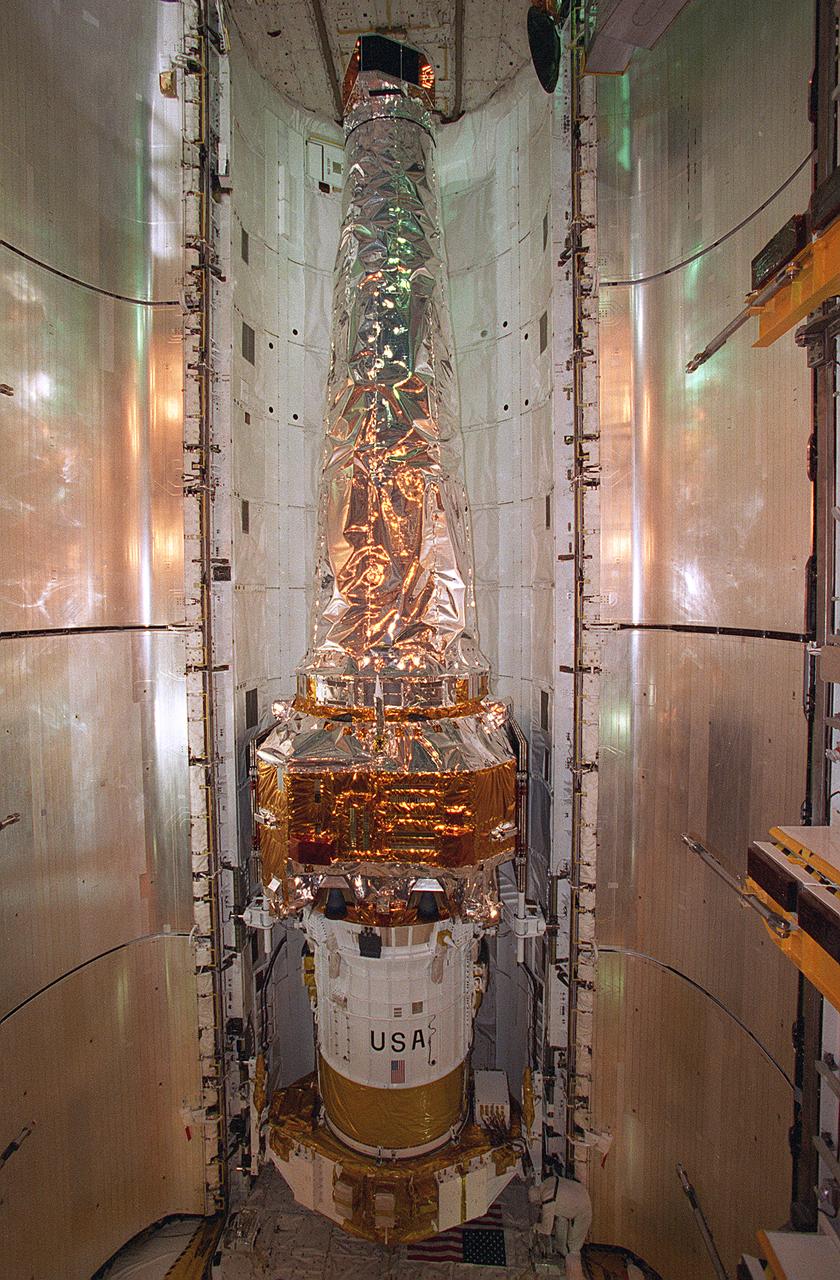
In this photograph, the Chandra X-Ray Observatory (CXO) was installed and mated to the Inertial Upper Stage (IUS) inside the Shuttle Columbia's cargo bay at the Kennedy Space Center. The CXO will help astronomers world-wide better understand the structure and evolution of the universe by studying powerful sources of x-rays such as exploding stars, matter falling into black holes, and other exotic celestial objects. X-ray astronomy can only be done from space because Earth's atmosphere blocks x-rays from reaching the surface. The Observatory provides images that are 50 times more detailed than previous x-ray missions. At more than 45 feet in length and weighing more than 5 tons, the CXO was carried into low-Earth orbit by the Space Shuttle Columbia (STS-93 mission) on July 22, 1999. The Observatory was deployed from the Shuttle's cargo bay at 155 miles above the Earth. Two firings of an attached IUS rocket, and several firings of its own onboard rocket motors, after separating from the IUS, placed the Observatory into its working orbit. The IUS is a solid rocket used to place spacecraft into orbit or boost them away from the Earth on interplanetary missions. Since its first use by NASA in 1983, the IUS has supported a variety of important missions, such as the Tracking and Data Relay Satellite, Galileo spacecraft, Magellan spacecraft, and Ulysses spacecraft. The IUS was built by the Boeing Aerospace Co., at Seattle, Washington and managed by the Marshall Space Flight Center.
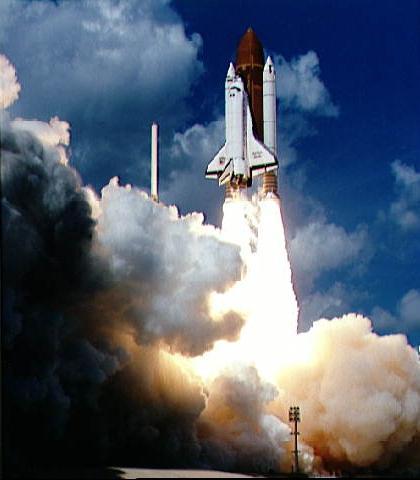
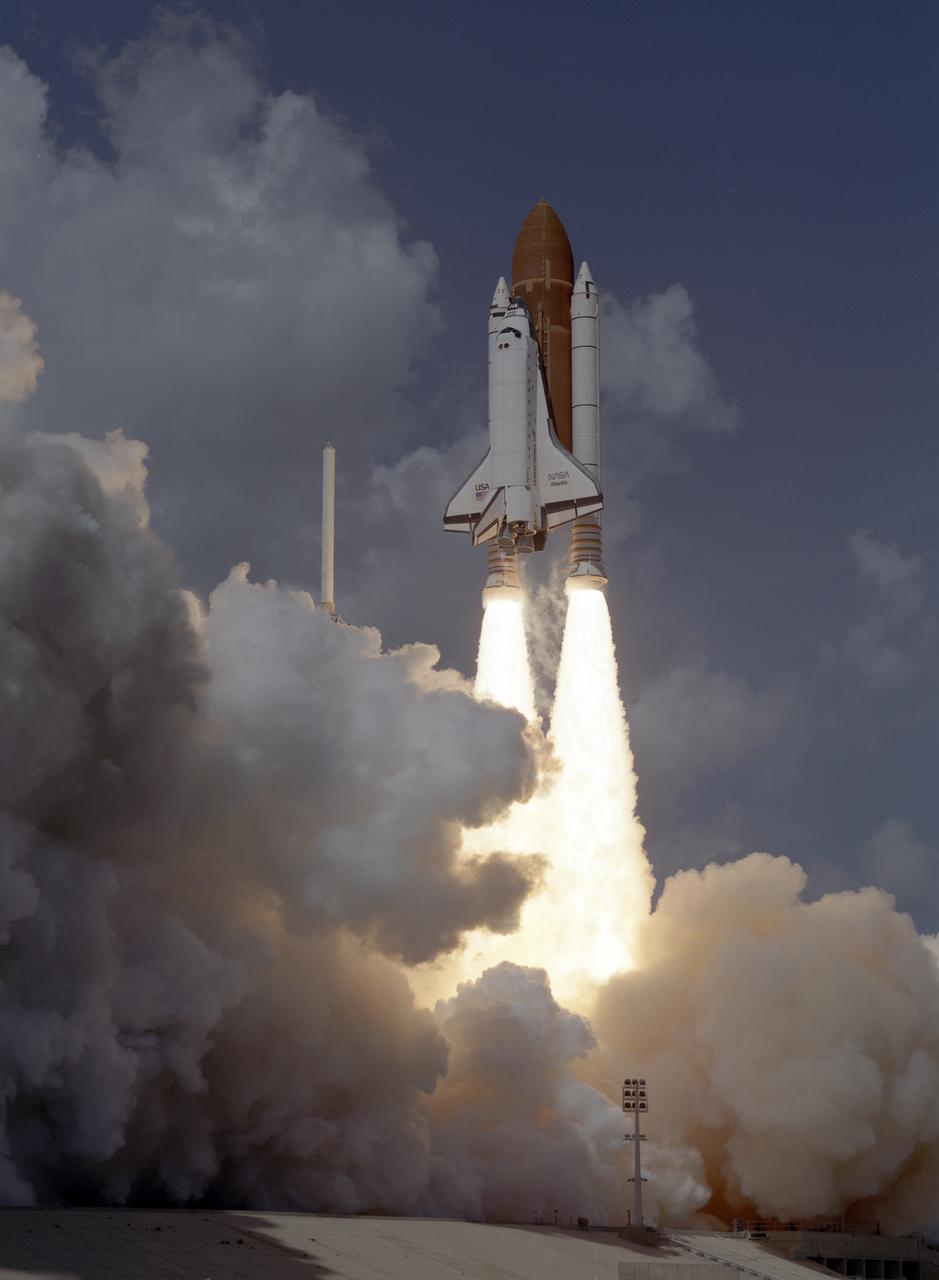
Liftoff of STS-34 Atlantis, carrying NASA Galileo spacecraft and its Inertial Upper Stage IUS booster on October 18, 1989 at 12:35 p.m. EDT. P-35036BC

S89-28093 (29 Dec 1988) --- In the clean room of the vertical processing facility, the TDRS-D satellite is hoisted, thus beginning the mating process with the inertial upper stage (IUS), located in an adjacent test cell.
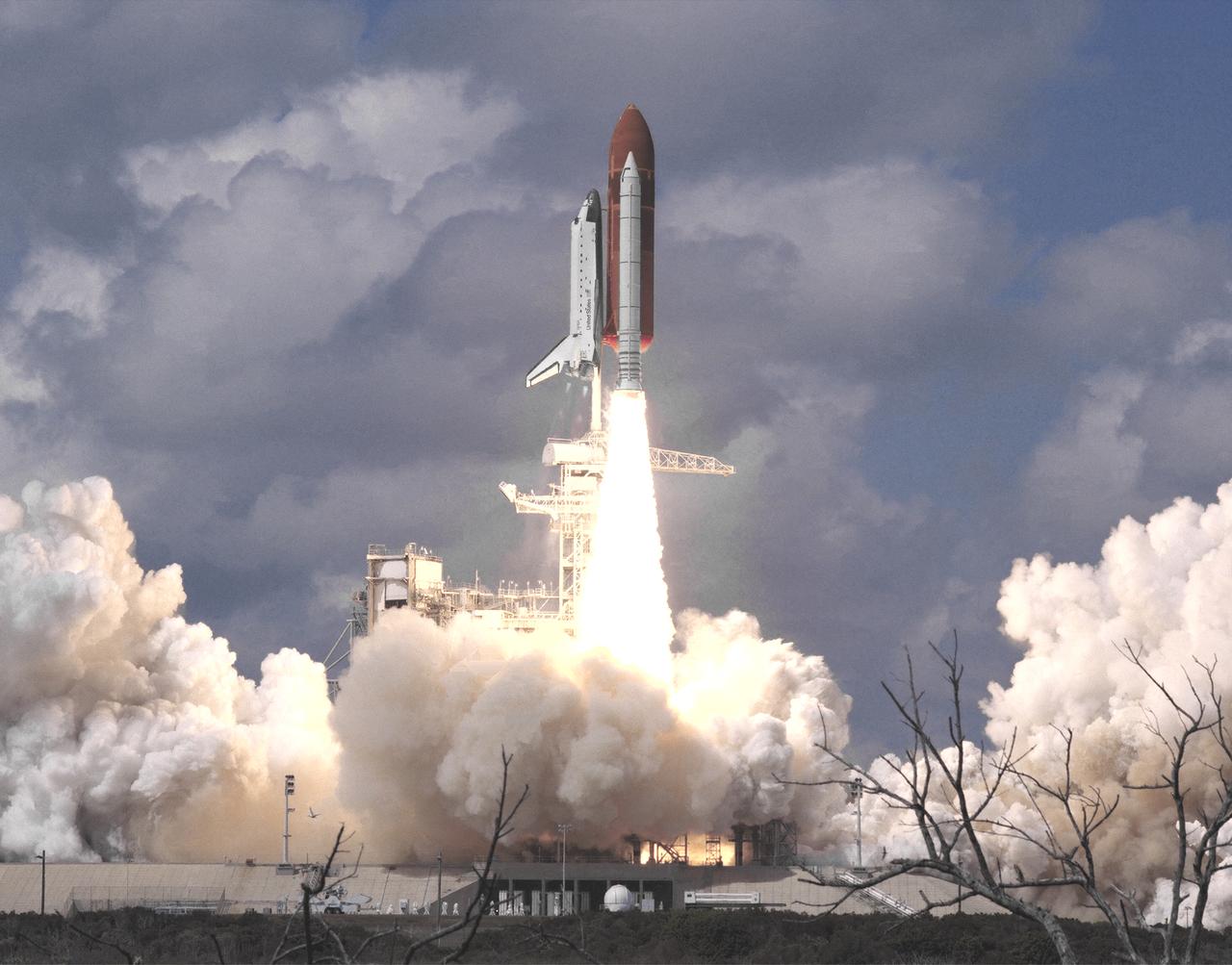
The Space Shuttle Discovery takes off from Launch Pad 39B at the Kennedy Space Center, Florida, to being Mission STS-26 on 29 September 1988,11:37:00 a.m. EDT. The 26th shuttle mission lasted four days, one hour, zero minutes, and 11 seconds. Discovery landed 3 October 1988, 9:37:11 a.m. PDT, on Runway 17 at Edwards Air Force Base, California. Its primary payload, NASA Tracking and Data Relay Satellite-3 (TDRS-3) attached to an Inertial Upper Stage (IUS), became the second TDRS deployed. After deployment, IUS propelled the satellite to a geosynchronous orbit. The crew consisted of Frederick H. Hauck, Commander; Richard O. Covey, Pilot; John M. Lounge, Mission Specialist 1; George D. Nelson, Mission Specialist 2; and David C. Hilmers, Mission Specialist 3.
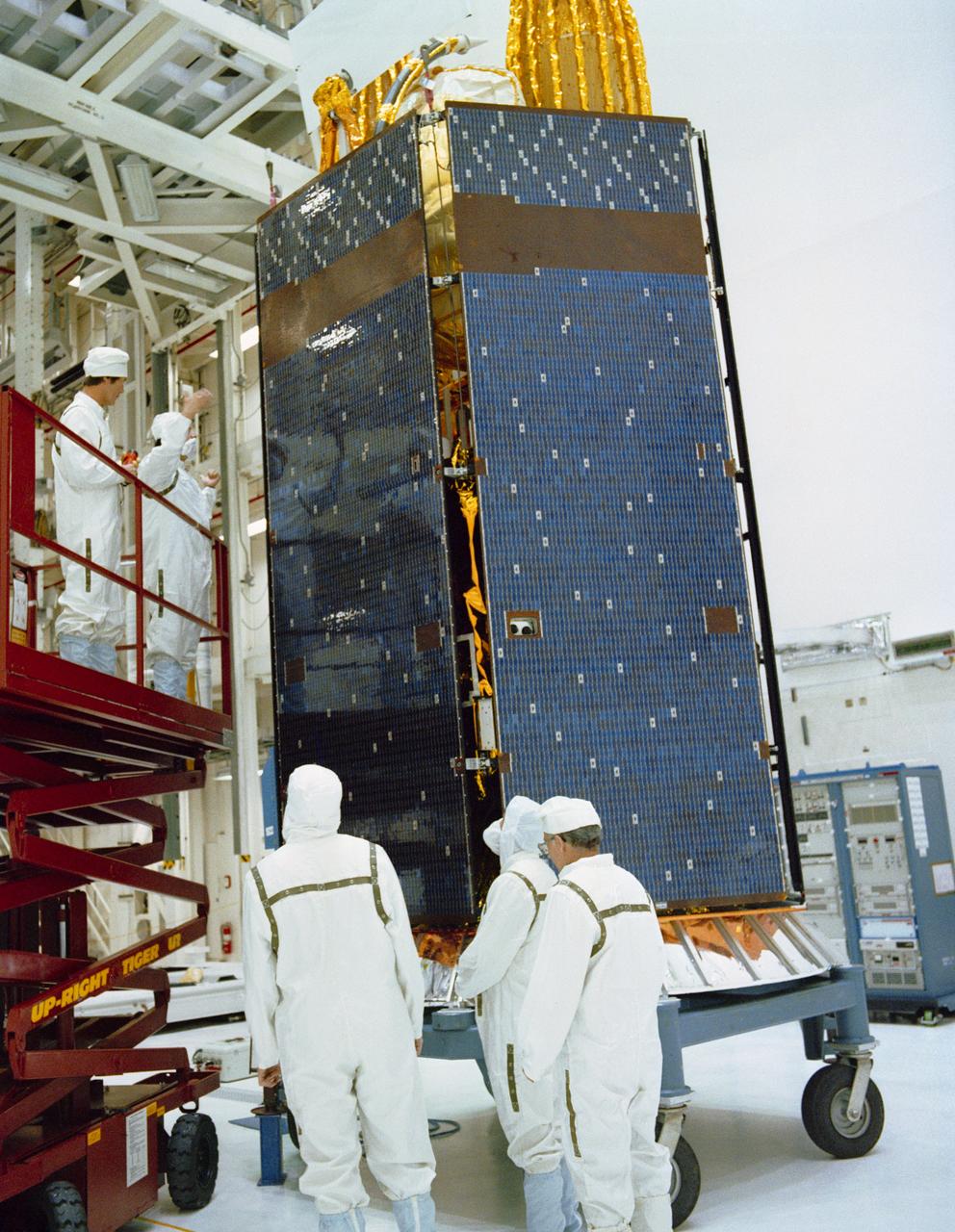
S89-27381 (29 Dec 1988) --- Technicians and engineers in the Kennedy Space Center's Vertical Processing Facility clean room prepare to participate in the mating of the STS 29 tracking and data relay satellite (TDRS-D) with its inertial upper stage (IUS-9, out of frame).
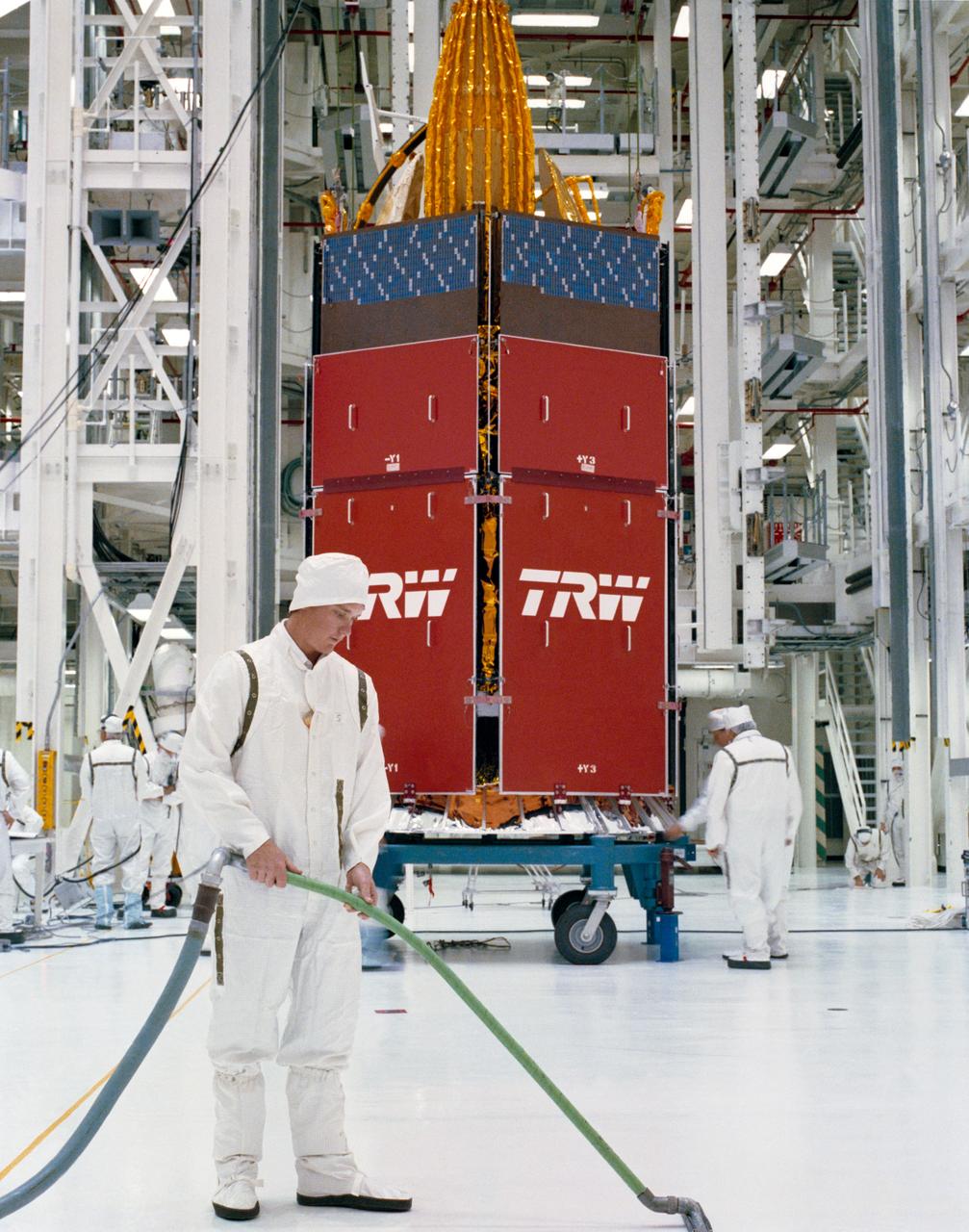
S89-27382 (29 Dec 1988) --- Technicians and engineers in the Kennedy Space Center's Vertical Processing Facility prepare to participate in the mating of the STS-29 tracking and data relay satellite (TDRS-D) with its inertial upper stage (IUS-9, out of frame).

CAPE CANAVERAL, Fla. -- At the Kennedy Space Center in Florida, the Ulysses spacecraft with two attached upper stages –- a payload assist module and an inertial upper stage -- is transferred into the payload canister. Transport from the Vertical Processing Facility to the Payload Changeout Room at the Launch Pad 39B was scheduled for Aug. 27, 1990. The payload will be vertically installed in the cargo bay of the space shuttle Discovery after the shuttle is brought to the pad in September. Ulysses will be deployed during STS-41, set for a launch period extending from Oct. 5 through Oct. 23, 1990. Photo Credit: NASA
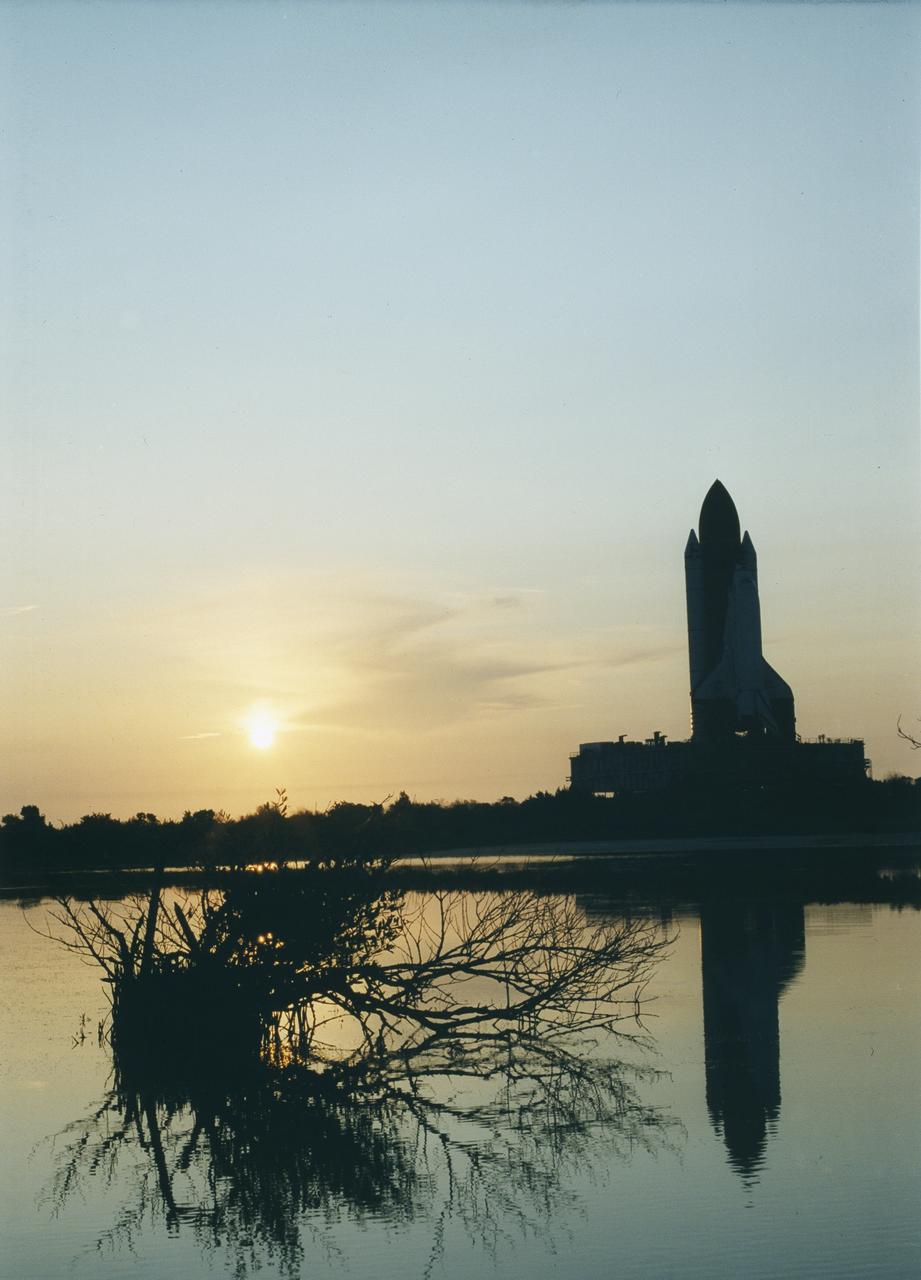
Launched aboard the Space Shuttle Atlantis on August 2, 1991, the STS-43 mission’s primary payload was the Tracking and Data Relay Satellite 5 (TDRS-5) attached to an Inertial Upper Stage (IUS), which became the 4th member of an orbiting TDRS cluster. The flight crew consisted of five astronauts: John E. Blaha, commander; Michael A. Baker, pilot; Shannon W. Lucid, mission specialist 1; James C. Adamson, mission specialist 2; and G. David Low, mission specialist 3.

The STS-30 mission launched aboard the Space Shuttle Atlantis on May 4, 1989 at 2:46:59pm (EDT) carrying a crew of five. Aboard were Ronald J. Grabe, pilot; David M. Walker, commander; and mission specialists Norman E. Thagard, Mary L. Cleave, and Mark C. Lee. The primary payload for the mission was the Magellan/Venus Radar mapper spacecraft and attached Inertial Upper Stage (IUS).
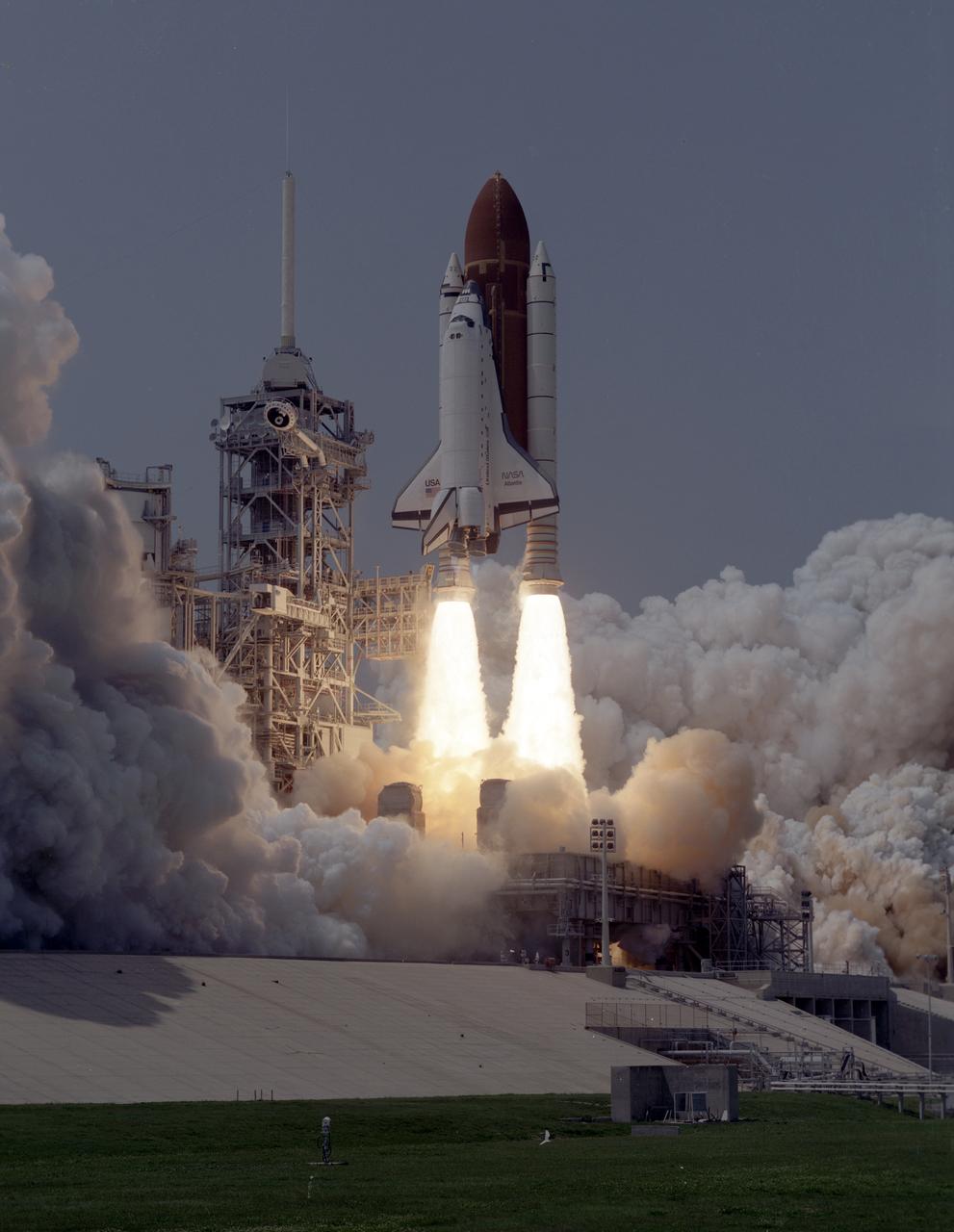
The STS-30 mission launched aboard the Space Shuttle Atlantis on May 4, 1989 at 2:46:59pm (EDT) carrying a crew of five. Aboard were Ronald J. Grabe, pilot; David M. Walker, commander; and mission specialists Norman E. Thagard, Mary L. Cleave, and Mark C. Lee. The primary payload for the mission was the Magellan/Venus Radar mapper spacecraft and attached Inertial Upper Stage (IUS).
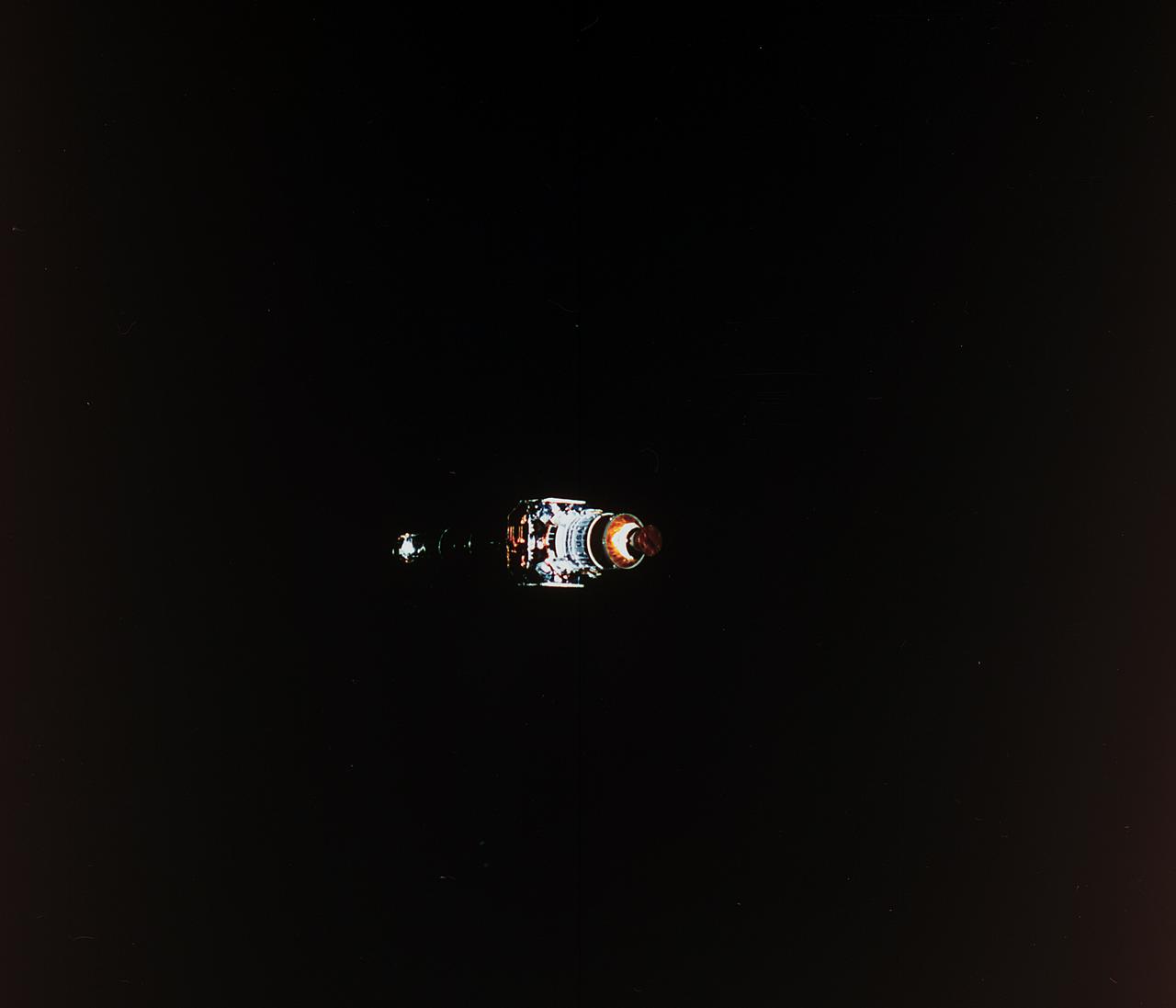
A crew member of the STS-93 mission took this photograph of the Chandra X-Ray Observatory, still attached to the Inertial Upper Stage (IUS), backdropped against the darkness of space not long after its release from Orbiter Columbia. Two firings of an attached IUS rocket placed the Observatory into its working orbit. The primary duty of the crew of this mission was to deploy the 50,162-pound Observatory, the world's most powerful x-ray telescope.
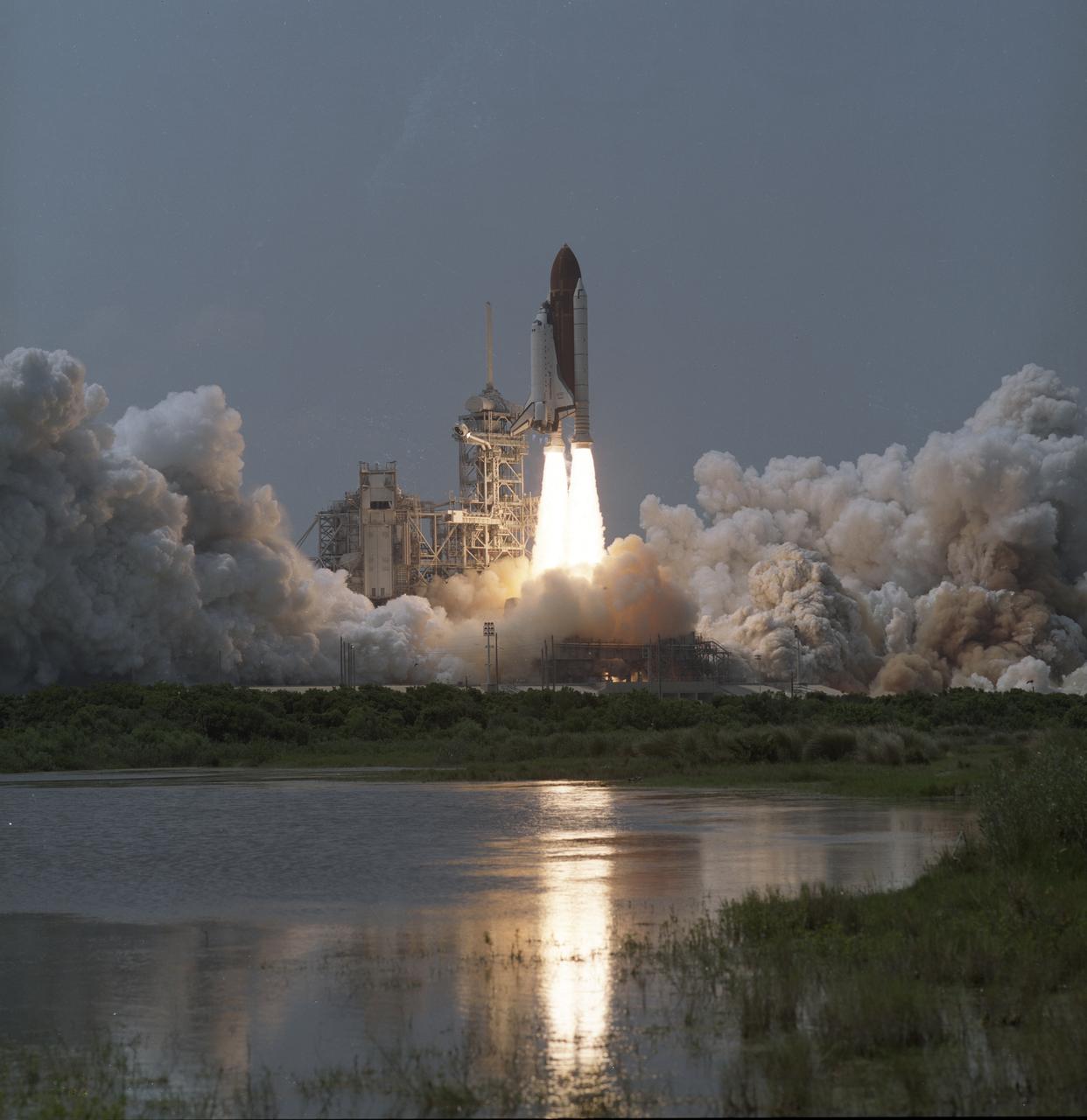
The STS-30 mission launched aboard the Space Shuttle Atlantis on May 4, 1989 at 2:46:59pm (EDT) carrying a crew of five. Aboard were Ronald J. Grabe, pilot; David M. Walker, commander; and mission specialists Norman E. Thagard, Mary L. Cleave, and Mark C. Lee. The primary payload for the mission was the Magellan/Venus Radar mapper spacecraft and attached Inertial Upper Stage (IUS).
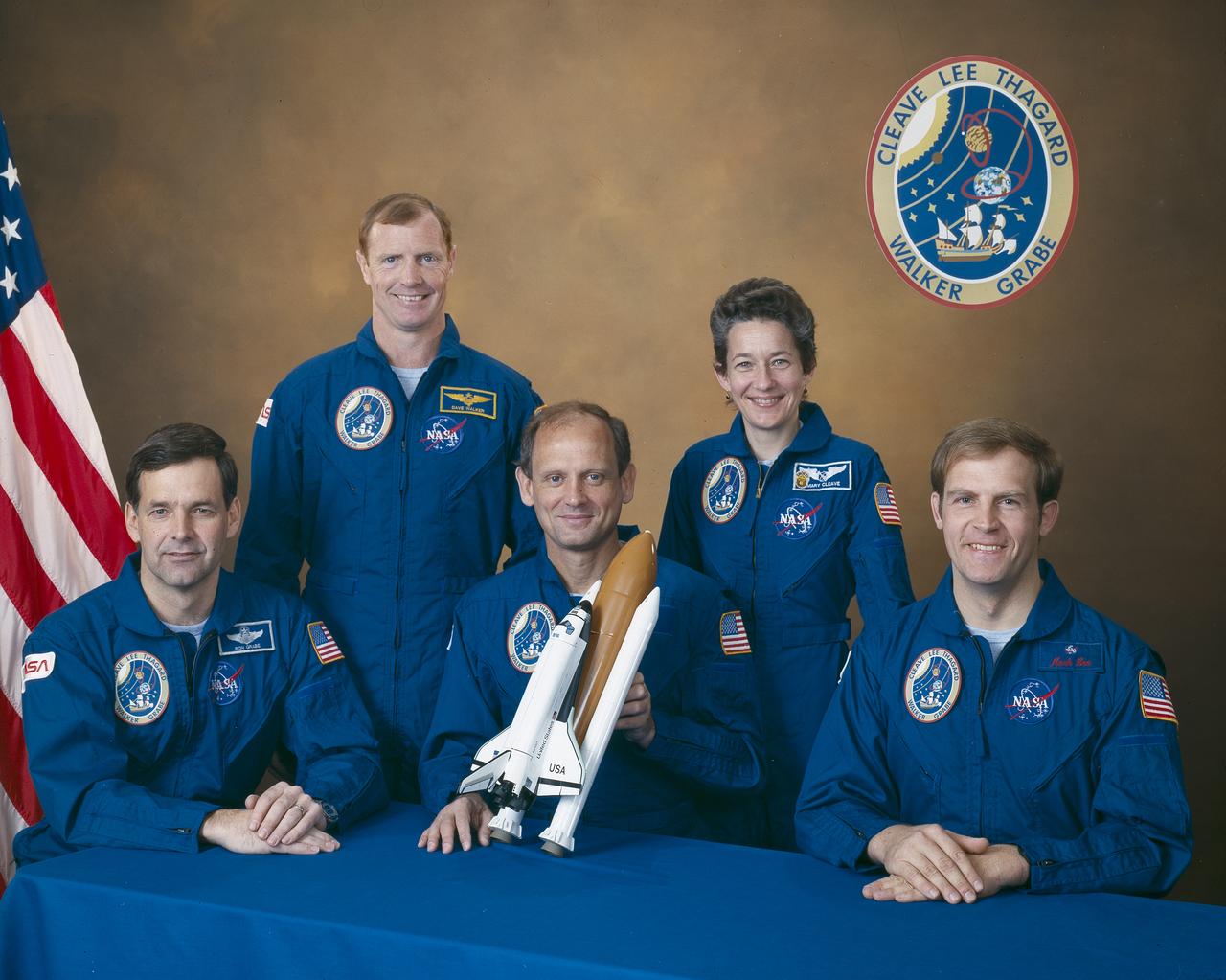
Five astronauts composed the STS-30 crew. Pictured (left to right) are Ronald J. Grabe, pilot; David M. Walker, commander; and mission specialists Norman E. Thagard, Mary L. Cleave, and Mark C. Lee. The STS-30 mission launched aboard the Space Shuttle Atlantis on May 4, 1989 at 2:46:59pm (EDT). The primary payload was the Magellan/Venus Radar mapper spacecraft and attached Inertial Upper Stage (IUS).
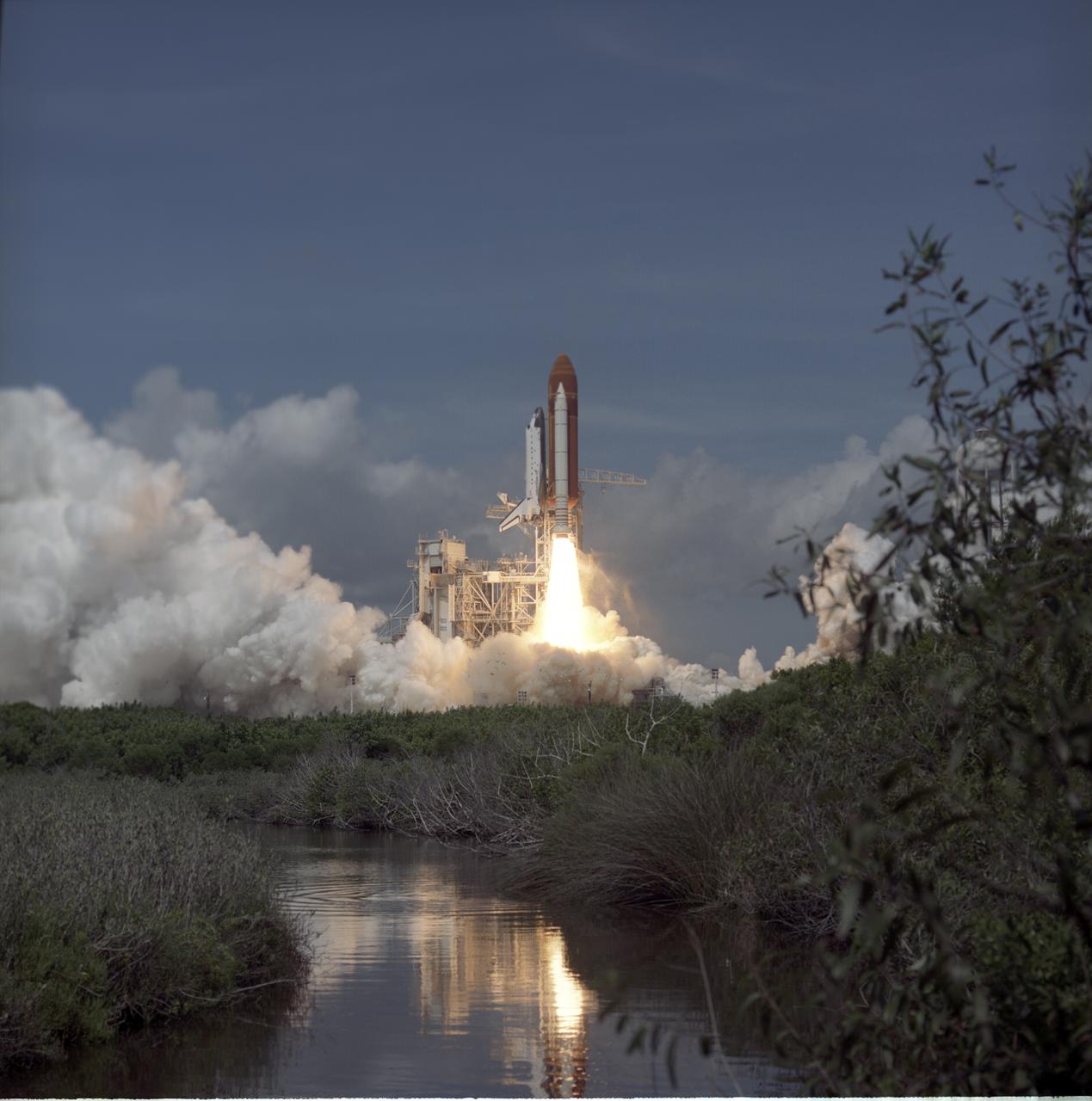
Launched aboard the Space Shuttle Atlantis on August 2, 1991, the STS-43 mission’s primary payload was the Tracking and Data Relay Satellite 5 (TDRS-5) attached to an Inertial Upper Stage (IUS), which became the 4th member of an orbiting TDRS cluster. The flight crew consisted of 5 astronauts: John E. Blaha, commander; Michael A. Baker, pilot; Shannon W. Lucid, mission specialist 1; James C. Adamson, mission specialist 2; and G. David Low, mission specialist 3.
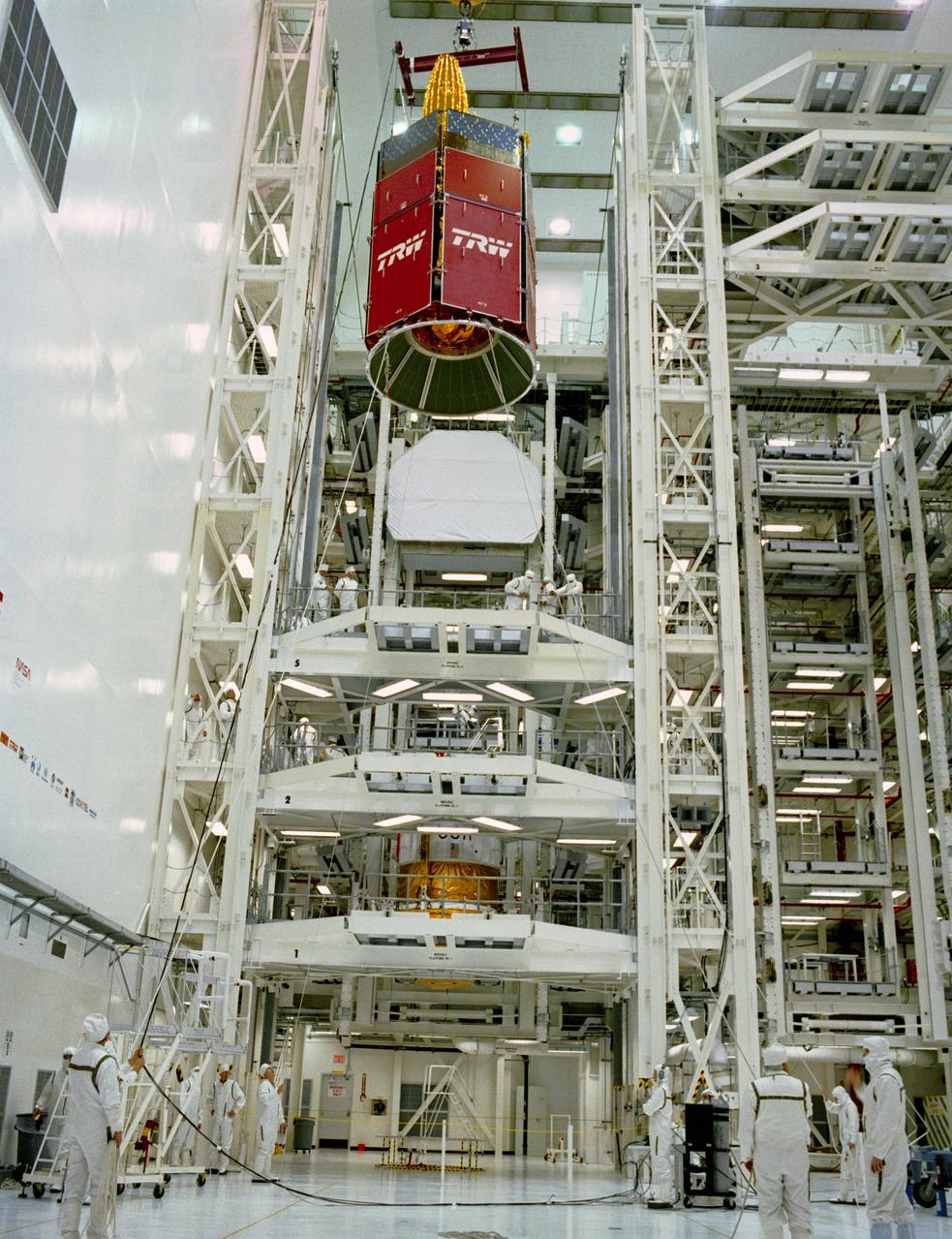
S89-27383 (29 Dec 1988) --- This wide shot of a test cell in KSC's Vertical Processing Facility affords an overall scene of the mating process of the STS 29 tracking and data relay satellite (TDRS-D, in foreground) with its inertial upper stage (IUS-9, in lower part of frame). Later the tandem will be loaded into the cargo bay of Discovery.
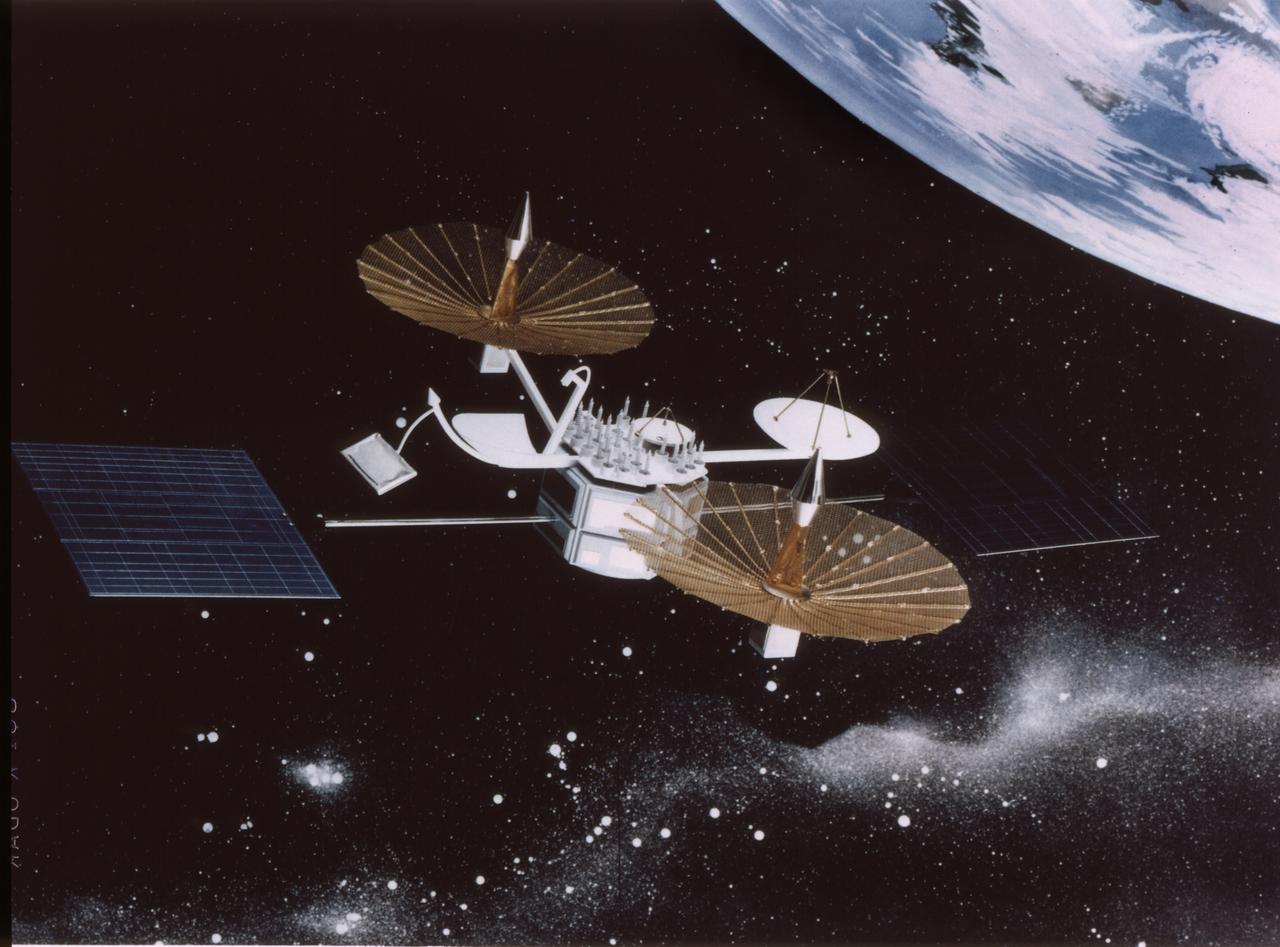
This artist's concept drawing depicts the Tracking and Data Relay Satellite-C (TDRS-C), which was the primary payload of the Space Shuttle Discovery on the STS-26 mission, launched on September 29, 1988. The TDRS system provides almost uninterrupted communications with Earth-orbiting Shuttles and satellites, and had replaced the intermittent coverage provided by globe-encircling ground tracking stations used during the early space program. The TDRS can transmit and receive data, and track a user spacecraft in a low Earth orbit. The deployment of TDRS-G on the STS-70 mission being the latest in the series, NASA has successfully launched six TDRSs.
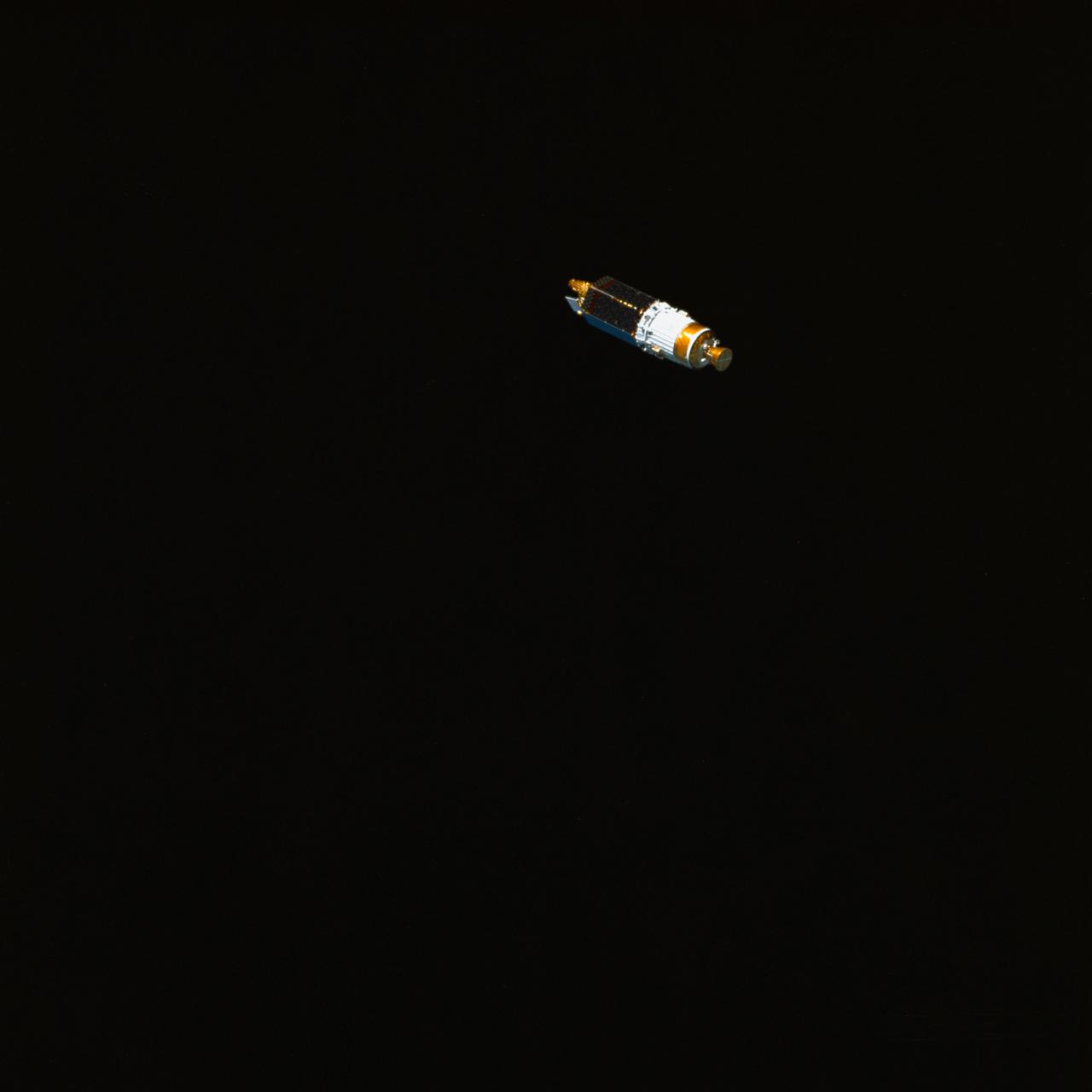
STS029-78-019 (13 March 1989) --- Headed on its way to a much higher orbit is another Tracking and Data Relay Satellite (TDRS-D), as photographed with a 70mm camera from inside Discovery's cabin. Moments earlier, the STS-29 crewmembers released the cylindrical form into space from Discovery's cargo bay. When at its final destination high above Earth, TDRS-D will no longer maintain its cylindrical form, having transformed into an operational satellite with antenna spanned out in various directions and its Interim Upper Stage (IUS), covered with gold foil and forward-most in this frame, discarded.
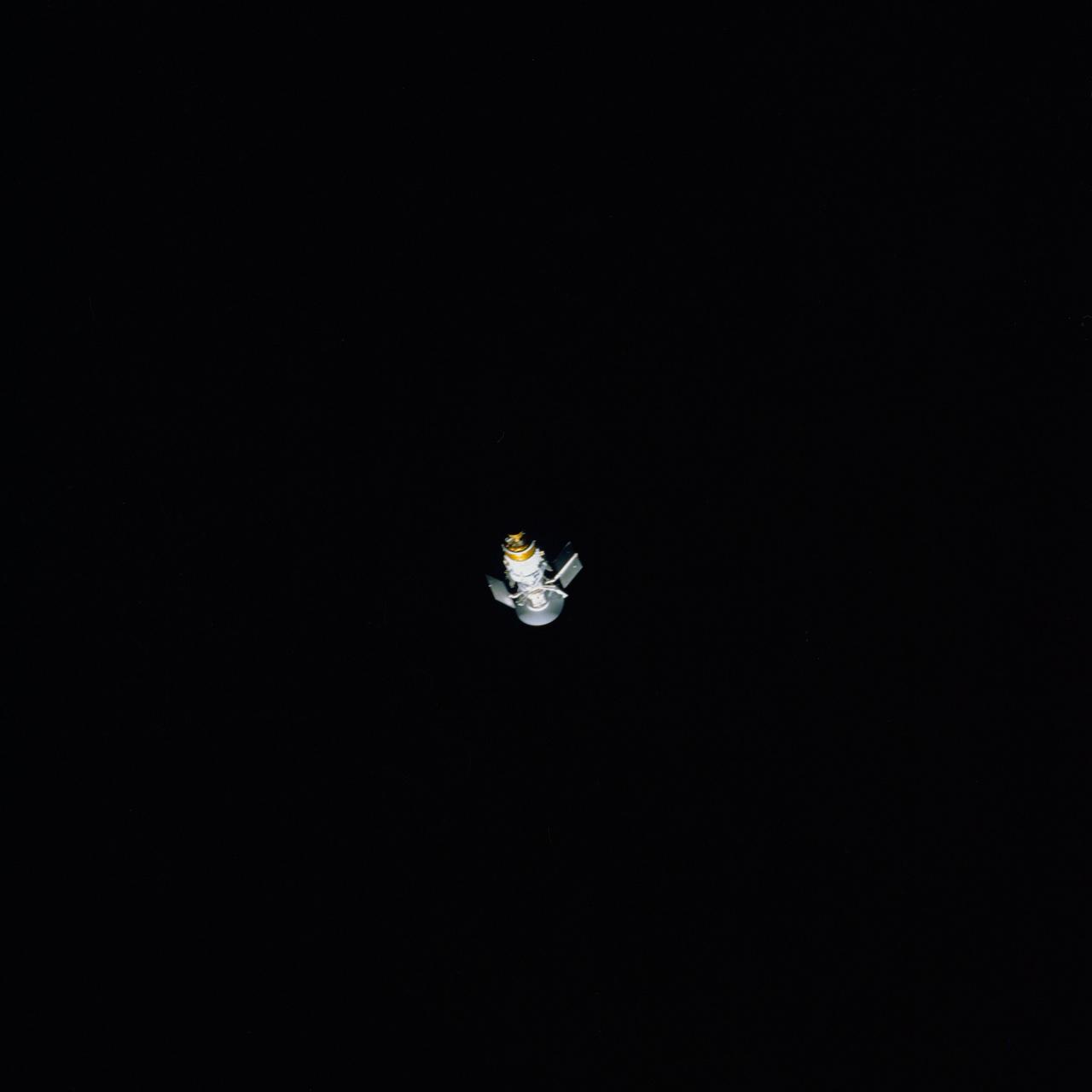
STS043-601-033 (2 Aug 1991) --- The Tracking and Data Relay Satellite (TDRS-E), is seen almost as a silhouette in this 70mm image. The TDRS spacecraft was captured on film as it moved away from the earth-orbiting Atlantis a mere six hours after the shuttle was launched from Pad 39A at Kennedy Space Center, Florida. TDRS, built by TRW, will be placed in a geosynchronous orbit and after on-orbit testing, which requires several weeks, will be designated TDRS-5. The communications satellite will replace TDRS-3 at 174 degrees west longitude. The backbone of NASA's space-to-ground communications, the Tracking and Data Relay Satellites have increased NASA's ability to send and receive data to spacecraft in low-earth orbit to more than 85 percent of the time. Before TDRS, NASA relied solely on a system of ground stations that permitted communications only 15 percent of the time. Increased coverage has allowed on-orbit repairs, live television broadcast from space and continuous dialogues between astronaut crews and ground control during critical periods such as space shuttle landings. The five astronauts of the STS-43 are John E. Blaha, mission commander, Michael a. Baker, pilot, and mission specialists Shannon W. Lucid, G. David Low and James C. Adamson.
STS030-71-063 (4 May 1989) --- This scene is one of two released by NASA showing the process of solar array panel deployment on the Magellan spacecraft. Panels are not fully extended in this frame. The spacecraft had earlier been released by the STS-30 crewmembers to begin its long journey to the planet Venus for an extensive radar mapping mission. The frame was photographed through Atlantis? aft flight deck windows with a handheld 70mm camera. The complementary photograph is STS030-71-070.
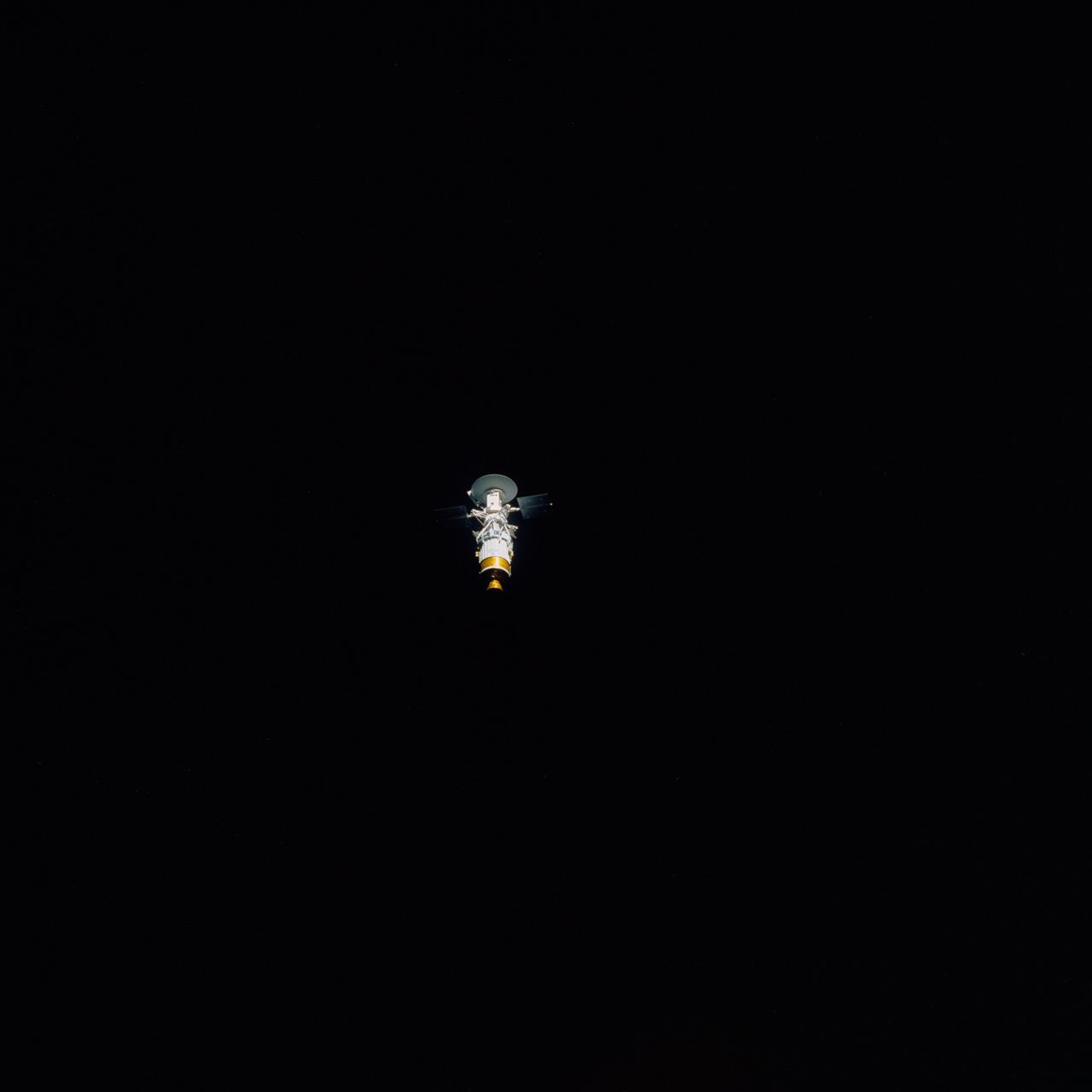
STS030-71-070 (4 May 1989) --- This scene is one of two released by NASA showing the process of solar array panel deployment on the Magellan spacecraft. Though partially blended into the backdrop of the blackness of space, it appears the two panels are fully extended in this frame. The spacecraft had earlier been released by the STS-30 crewmembers to begin its long journey to the planet Venus for an extensive radar mapping mission. The frame was photographed through Atlantis' aft flight deck windows with a handheld 70mm camera. The complementary photograph is STS030-71-063.
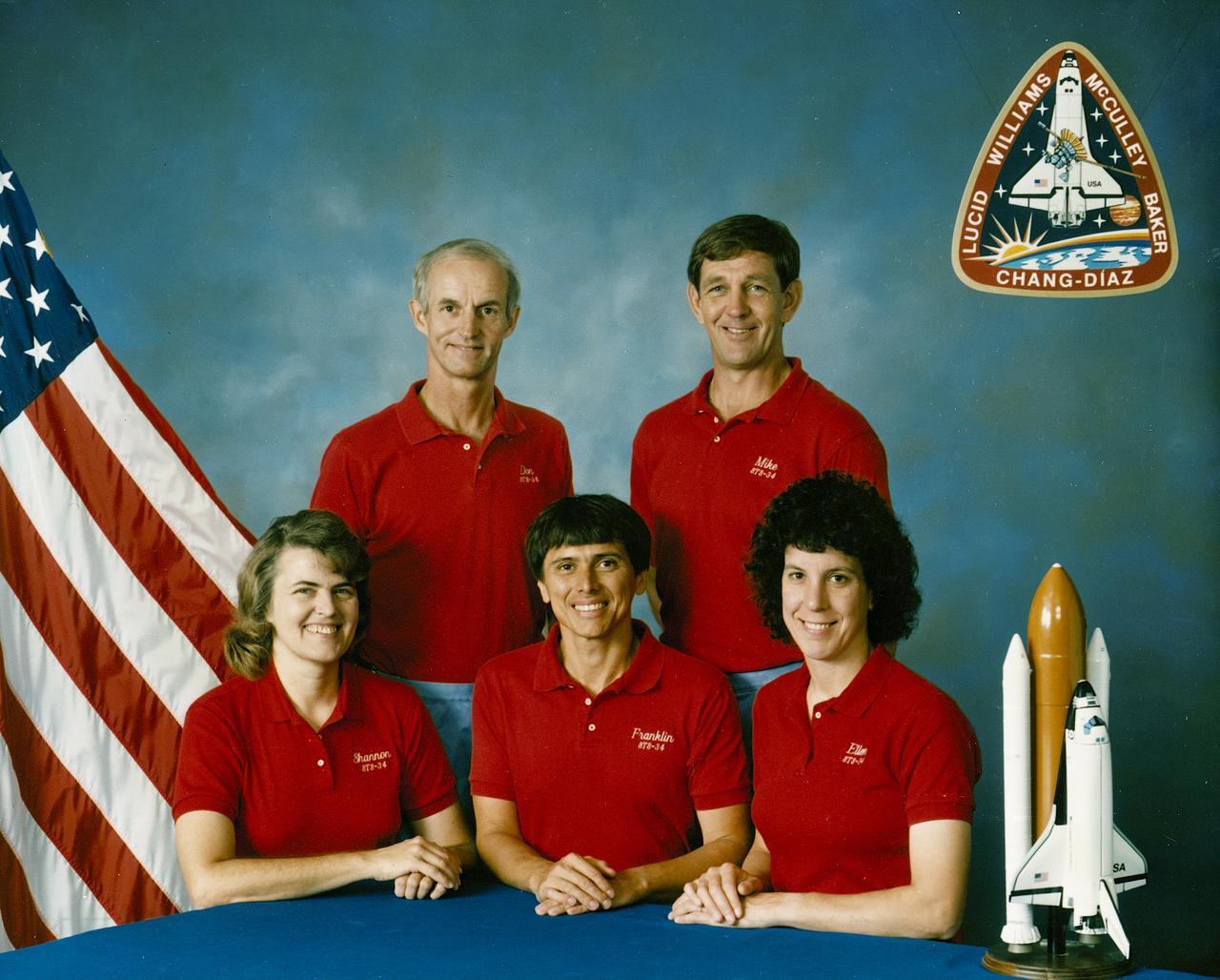
The STS-34 crew portrait includes 5 astronauts. Pictured left to right are Shannon W. Lucid, mission specialist; Donald E. Williams, commander; Franklin R. Chang-Diaz, mission specialist; Michael J. McCulley, pilot; and Ellen S. Baker, mission secialist. The crew of 5 launched aboard the Space Shuttle Orbiter Atlantis on October 18, 1989 at 12:53:40pm (EDT). The primary payload was the Galileo Jupiter Spacecraft and attached inertial upper stage (IUS). Deployed 6 hours and 30 minutes into the flight, the IUS stages fired, boosting Galileo on trajectory for a 6 year trip to Jupiter.
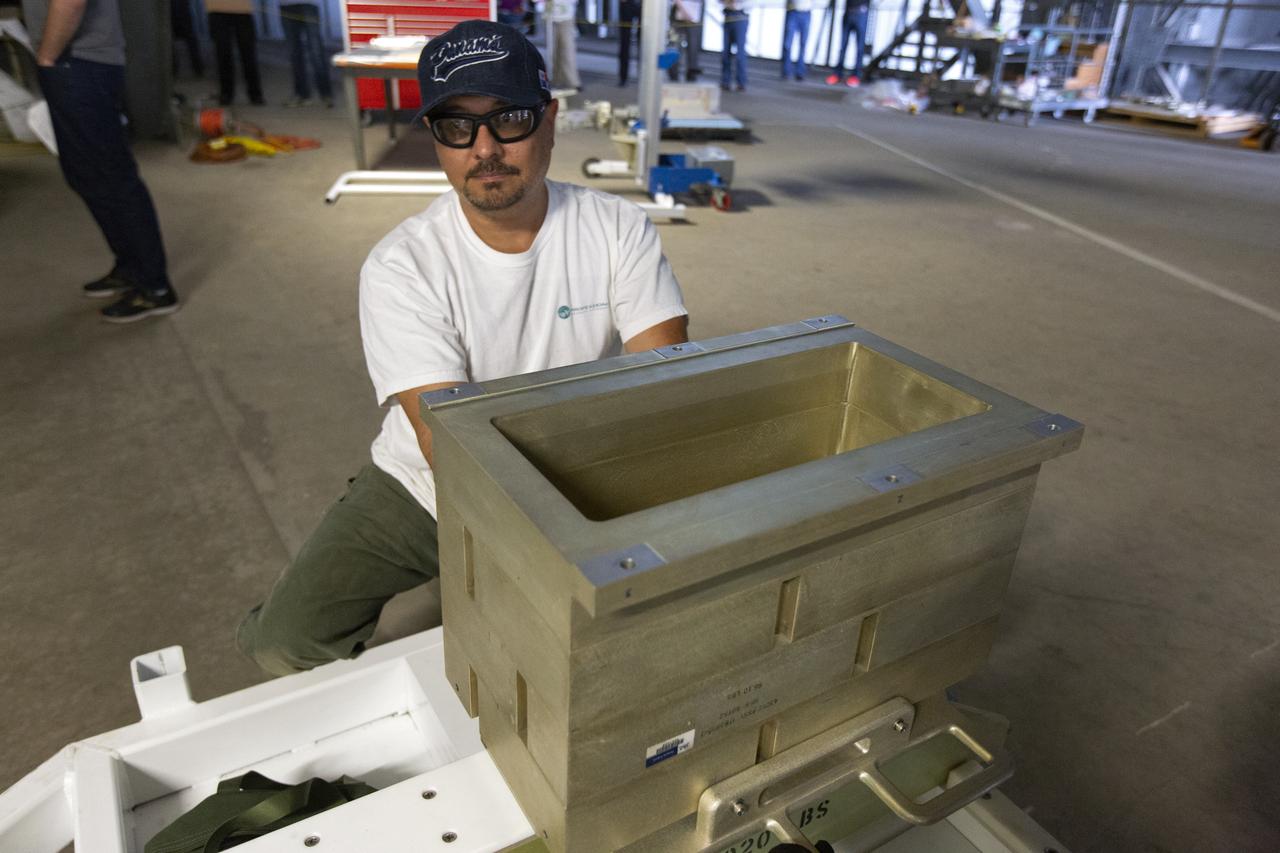
A Space Launch System (SLS) avionics handling tool demonstration takes place inside Kennedy Space Center’s Vehicle Assembly Building on April 4, 2019. The demonstration showed that avionics boxes could be successfully and safely mounted into the SLS rocket’s upper stage — called the Interim Cryogenic Propulsion Stage, or ICPS — with low risk of damaging a closely located hydrazine tank. Avionics boxes include the Inertial Navigation and Control Assembly and flight batteries. The actual installation will take place just weeks before NASA’s SLS rocket and uncrewed Orion spacecraft lift off on Exploration Mission-1 from Launch Pad 39B at Kennedy.
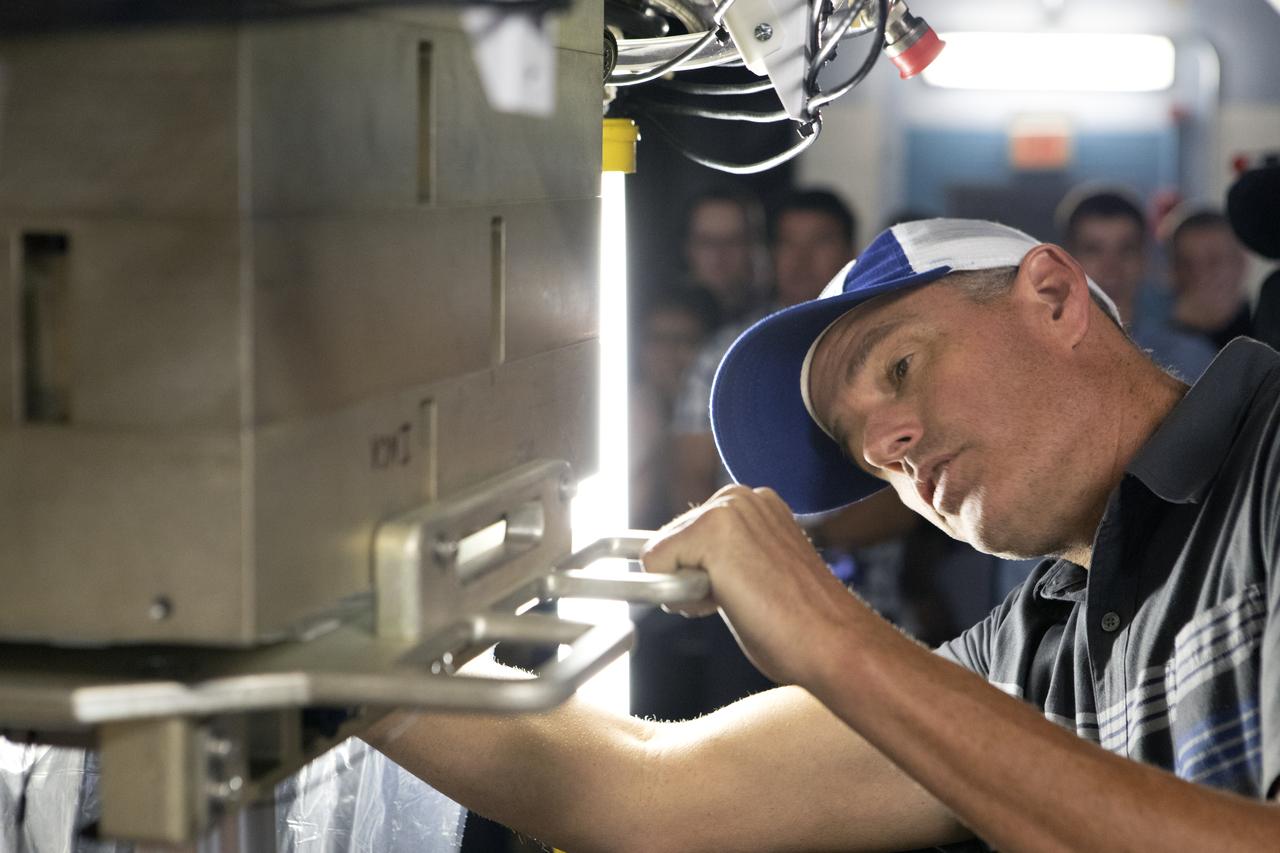
A Space Launch System (SLS) avionics handling tool demonstration takes place inside Kennedy Space Center’s Vehicle Assembly Building on April 4, 2019. The demonstration showed that avionics boxes could be successfully and safely mounted into the SLS rocket’s upper stage — called the Interim Cryogenic Propulsion Stage, or ICPS — with low risk of damaging a closely located hydrazine tank. Avionics boxes include the Inertial Navigation and Control Assembly and flight batteries. The actual installation will take place just weeks before NASA’s SLS rocket and uncrewed Orion spacecraft lift off on Exploration Mission-1 from Launch Pad 39B at Kennedy.
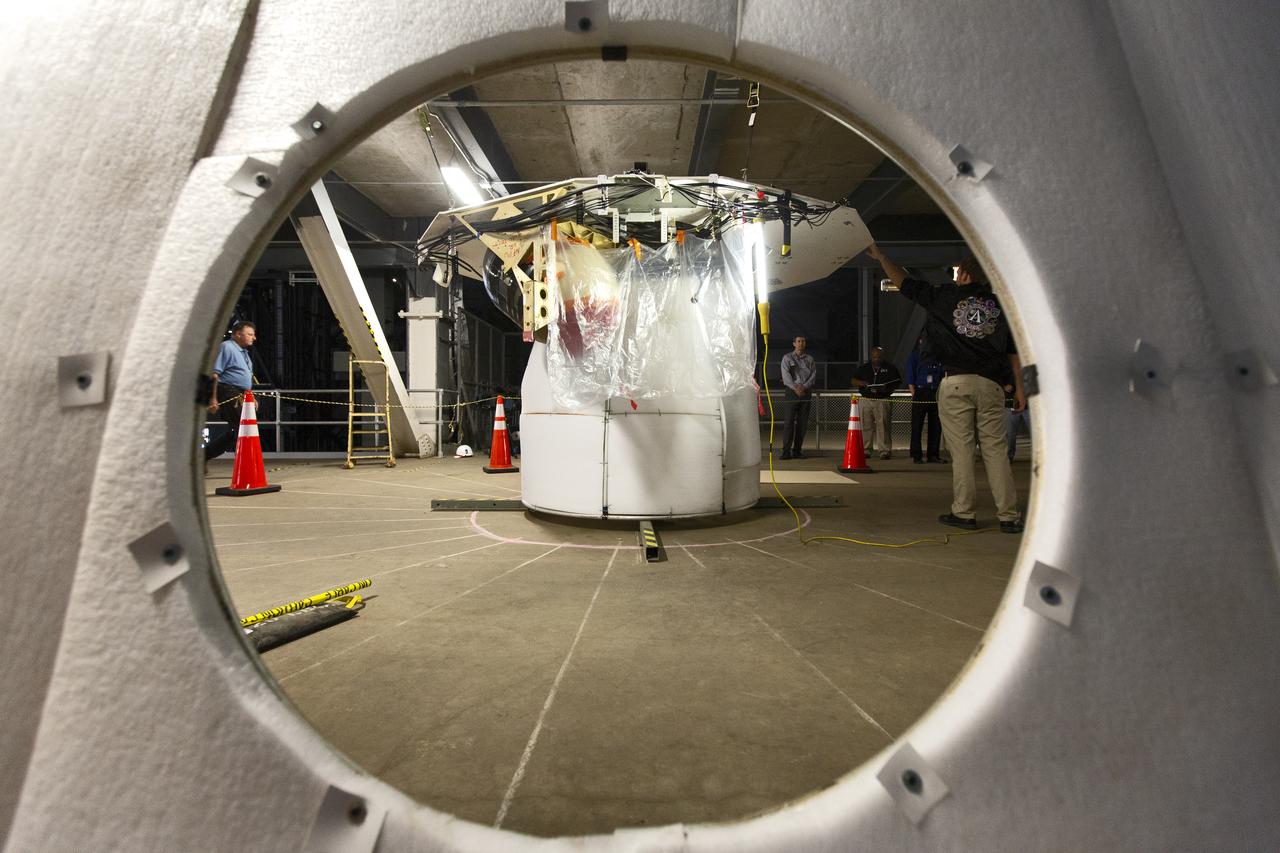
Robert Cook, a launch vehicle engineer with Millennium Engineering and Integration, talks during the Space Launch System (SLS) avionics handling tool demonstration inside Kennedy Space Center’s Vehicle Assembly Building on April 4, 2019. The demonstration showed that avionics boxes could be successfully and safely mounted into the SLS rocket’s upper stage — called the Interim Cryogenic Propulsion Stage, or ICPS — with low risk of damaging a closely located hydrazine tank. Avionics boxes include the Inertial Navigation and Control Assembly and flight batteries. Cook designed the ICPS section mockup used in the exercise.
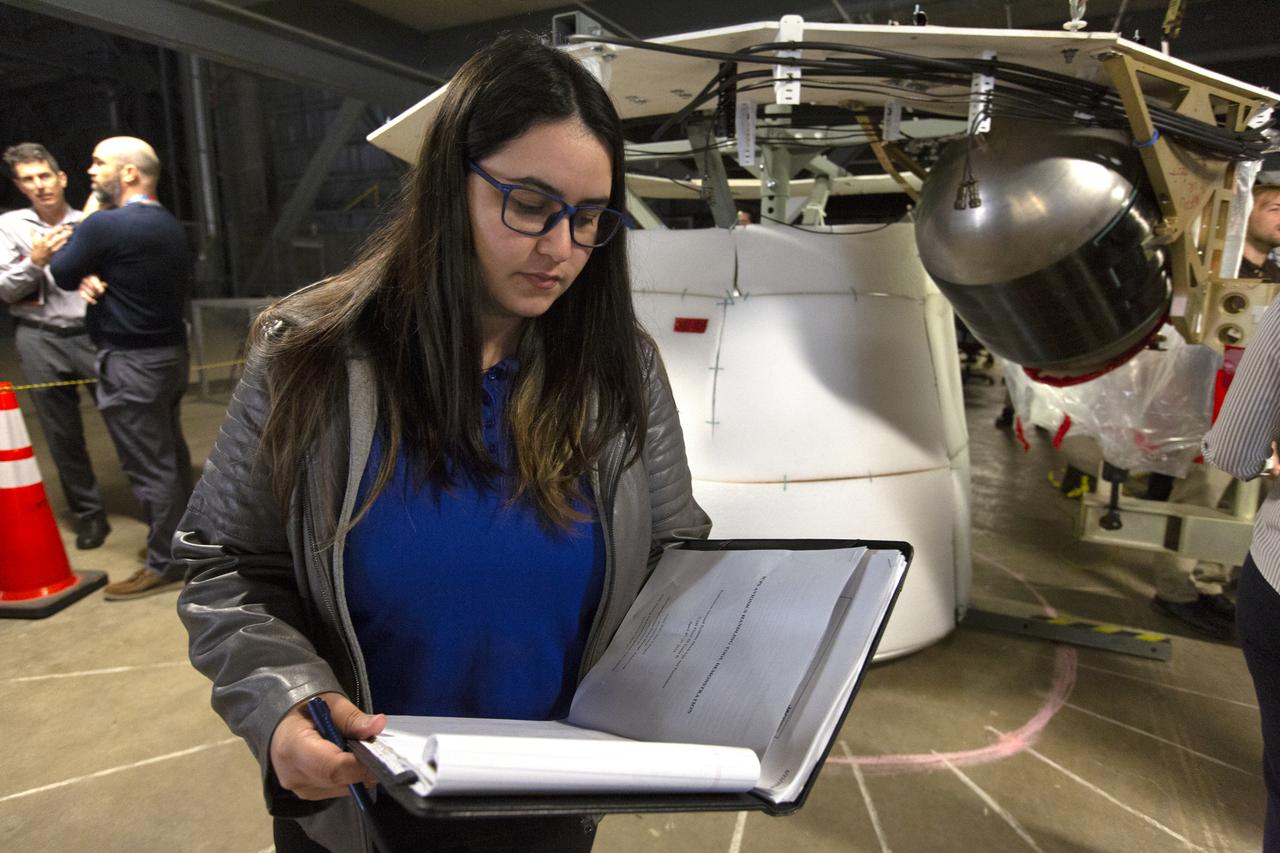
NASA Flight Systems Engineer Sherild Rivera Melendez takes notes during the Space Launch System avionics handling tool demonstration inside Kennedy Space Center’s Vehicle Assembly Building on April 4, 2019. The demonstration showed that avionics boxes could be successfully and safely mounted into the SLS rocket’s upper stage — called the Interim Cryogenic Propulsion Stage, or ICPS — with low risk of damaging a closely located hydrazine tank. Avionics boxes include the Inertial Navigation and Control Assembly and flight batteries. Rivera Melendez coordinated multiple human factors teams, focusing on life cycle reviews and impact risks during installation of the avionics.
The STS-34 crew of five launched aboard the Space Shuttle Orbiter Atlantis on October 18, 1989 at 12:53:40pm (EDT). Crew members included commander Donald E. Williams, pilot Michael J. McCulley; and mission Specialists Shannon W. Lucid, Franklin R. Chang-Diaz, and Ellen S. Baker. The primary payload was the Galileo Jupiter Spacecraft and attached Inertial Upper Stage (IUS). Deployed 6 hours and 30 minutes into the flight, the IUS stages fired boosting Galileo on trajectory for a 6 year trip to Jupiter.
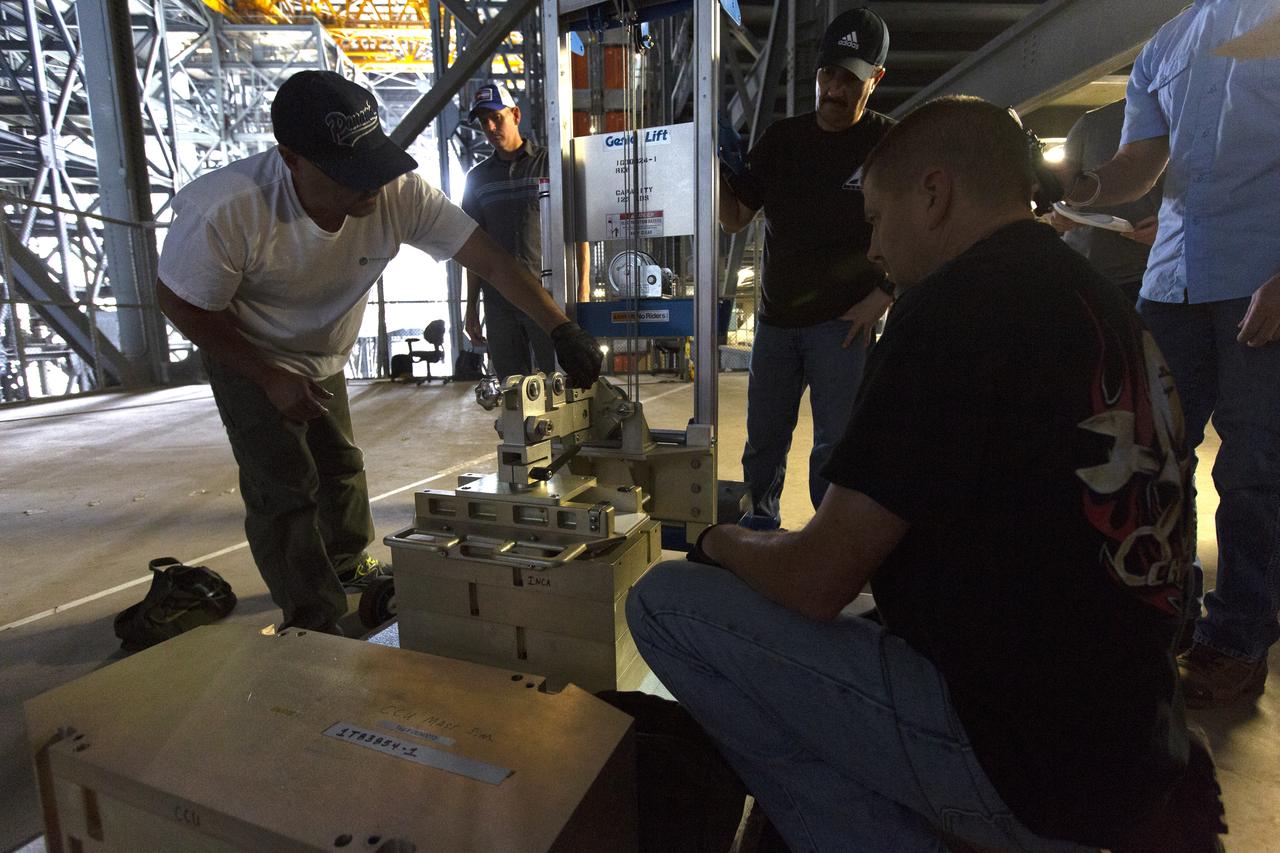
A Space Launch System (SLS) avionics handling tool demonstration takes place inside Kennedy Space Center’s Vehicle Assembly Building on April 4, 2019. The demonstration showed that avionics boxes could be successfully and safely mounted into the SLS rocket’s upper stage — called the Interim Cryogenic Propulsion Stage, or ICPS — with low risk of damaging a closely located hydrazine tank. Avionics boxes include the Inertial Navigation and Control Assembly and flight batteries. The actual installation will take place just weeks before NASA’s SLS rocket and uncrewed Orion spacecraft lift off on Exploration Mission-1 from Launch Pad 39B at Kennedy.
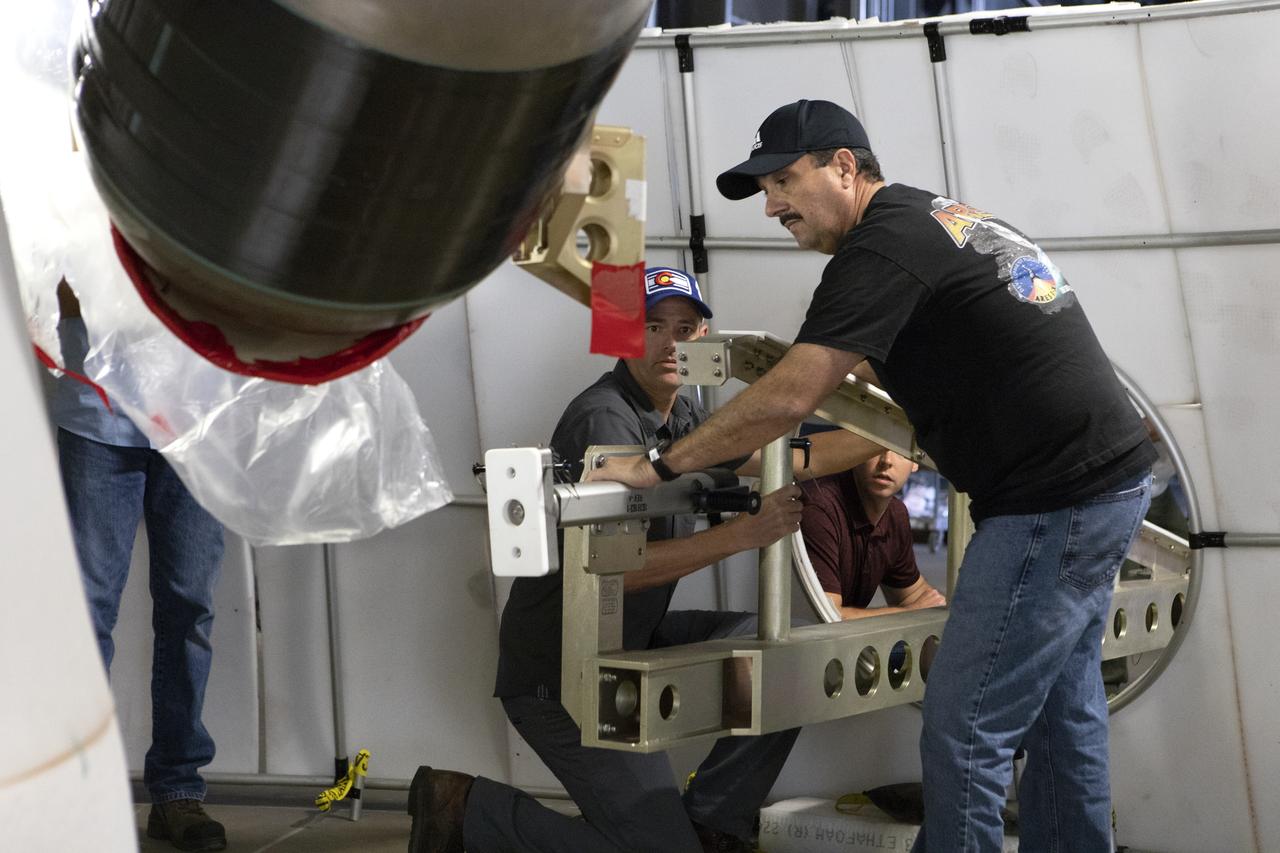
A Space Launch System (SLS) avionics handling tool demonstration takes place inside Kennedy Space Center’s Vehicle Assembly Building on April 4, 2019. The demonstration showed that avionics boxes could be successfully and safely mounted into the SLS rocket’s upper stage — called the Interim Cryogenic Propulsion Stage, or ICPS — with low risk of damaging a closely located hydrazine tank. Avionics boxes include the Inertial Navigation and Control Assembly and flight batteries. The actual installation will take place just weeks before NASA’s SLS rocket and uncrewed Orion spacecraft lift off on Exploration Mission-1 from Launch Pad 39B at Kennedy.
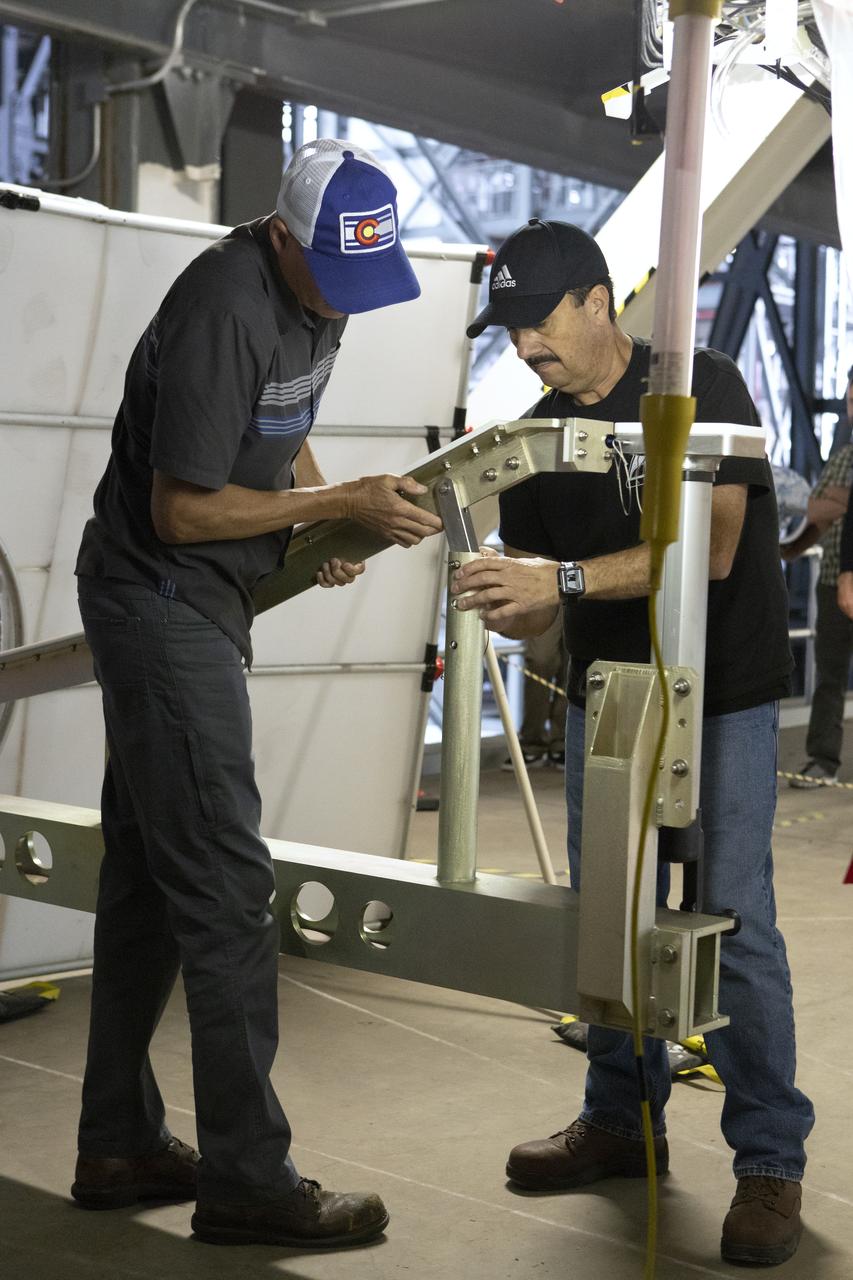
A Space Launch System (SLS) avionics handling tool demonstration takes place inside Kennedy Space Center’s Vehicle Assembly Building on April 4, 2019. The demonstration showed that avionics boxes could be successfully and safely mounted into the SLS rocket’s upper stage — called the Interim Cryogenic Propulsion Stage, or ICPS — with low risk of damaging a closely located hydrazine tank. Avionics boxes include the Inertial Navigation and Control Assembly and flight batteries. The actual installation will take place just weeks before NASA’s SLS rocket and uncrewed Orion spacecraft lift off on Exploration Mission-1 from Launch Pad 39B at Kennedy.
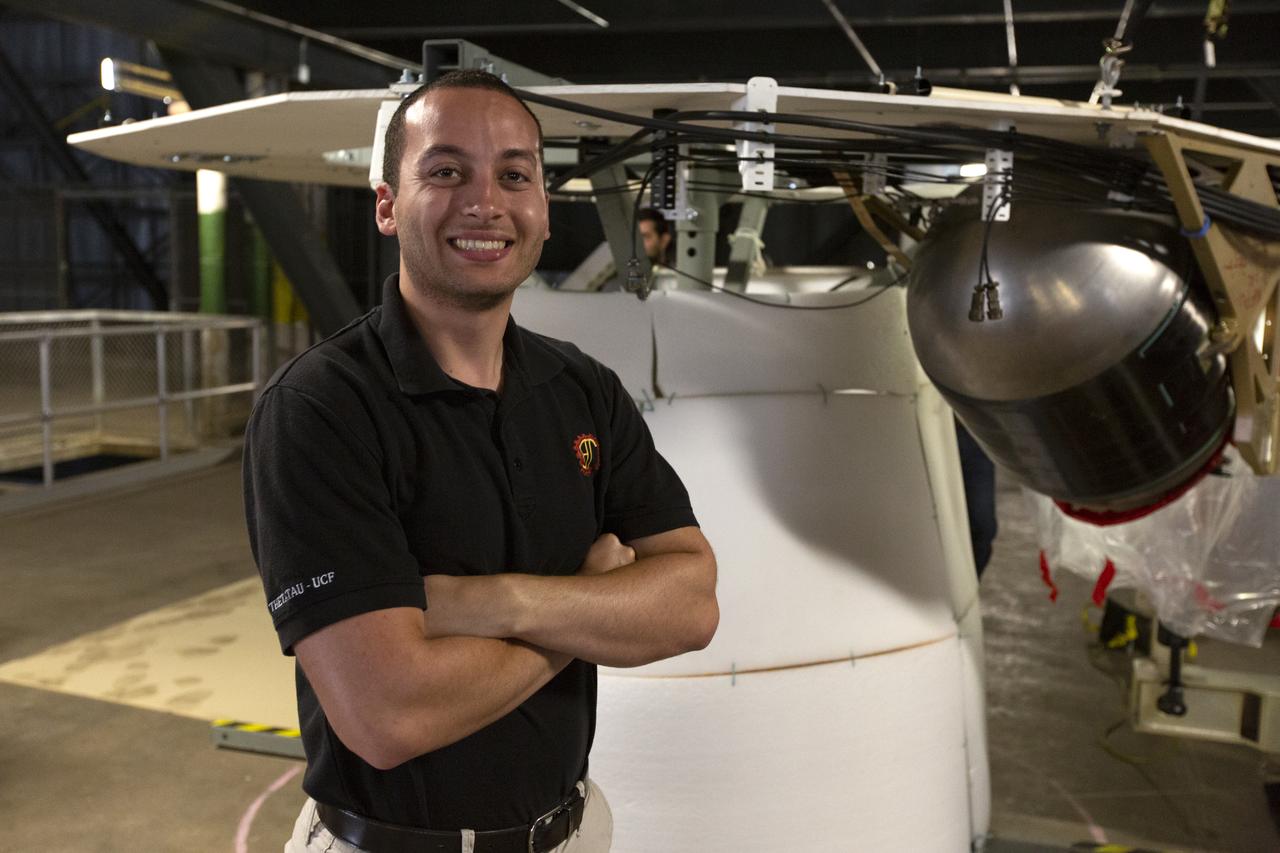
Christopher Di Taranto, a member of the mechanical structures engineering team on the Jacobs Test and Operations Contract, stands in front of an Interim Cryogenic Propulsion Stage (ICPS) mockup during the Space Launch System avionics handling tool demonstration inside Kennedy Space Center’s Vehicle Assembly Building on April 4, 2019. The demonstration showed that avionics boxes could be successfully mounted into the SLS rocket’s upper stage safely, and with low risk of damaging a closely located hydrazine tank. Avionics boxes include the Inertial Navigation and Control Assembly and flight batteries. Di Taranto led a team to quickly resolve a non-conformance issue with the tool.
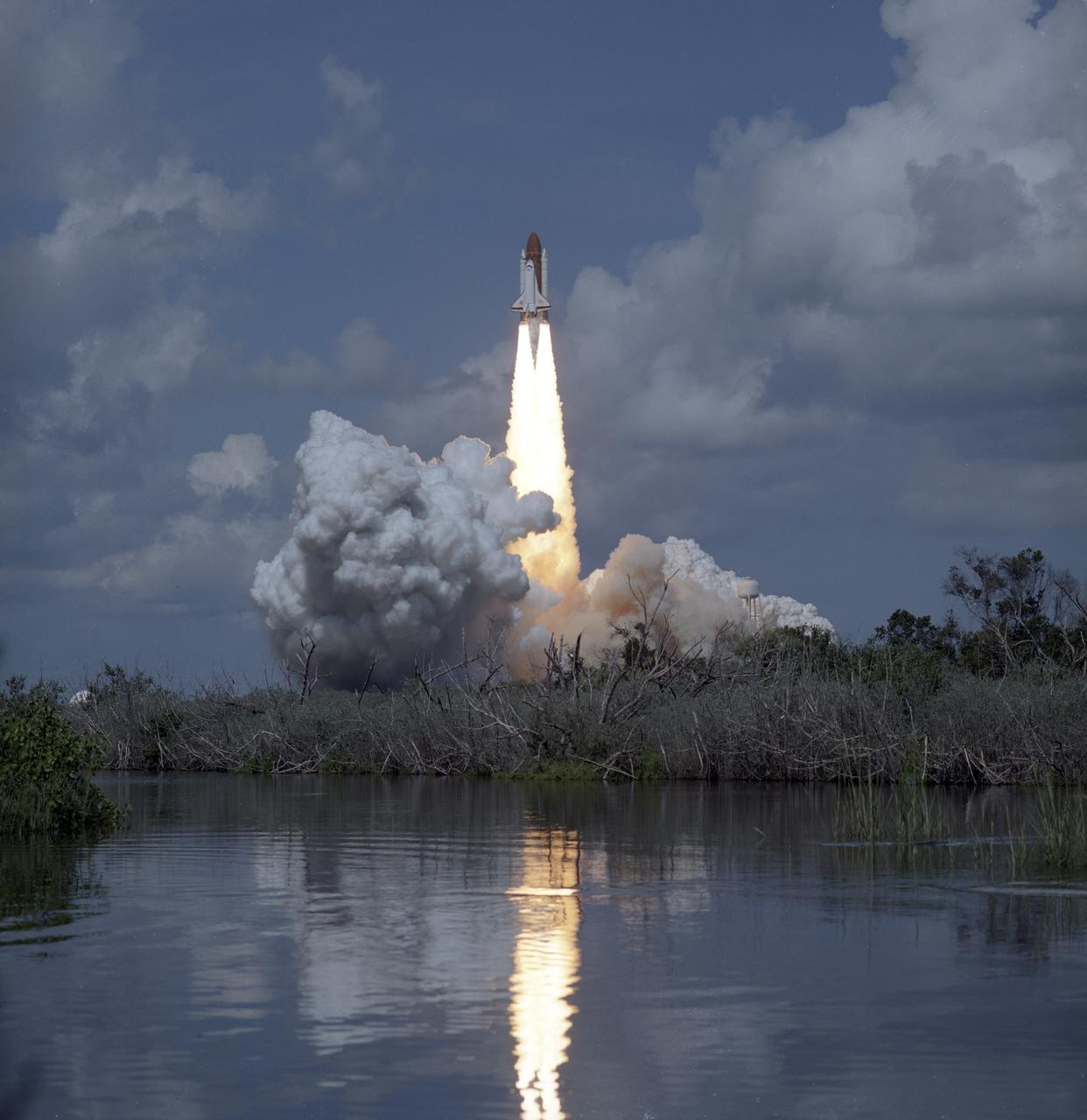
The STS-34 crew of five launched aboard the Space Shuttle Orbiter Atlantis on October 18, 1989 at 12:53:40pm (EDT). Crew members included commander Donald E. Williams, pilot Michael J. McCulley, and mission Specialists Shannon W. Lucid, Franklin R. Chang-Diaz, and Ellen S. Baker. The primary payload was the Galileo Jupiter Spacecraft and attached Inertial Upper Stage (IUS). Deployed 6 hours and 30 minutes into the flight, the IUS stages fired boosting Galileo on trajectory for a 6 year trip to Jupiter.
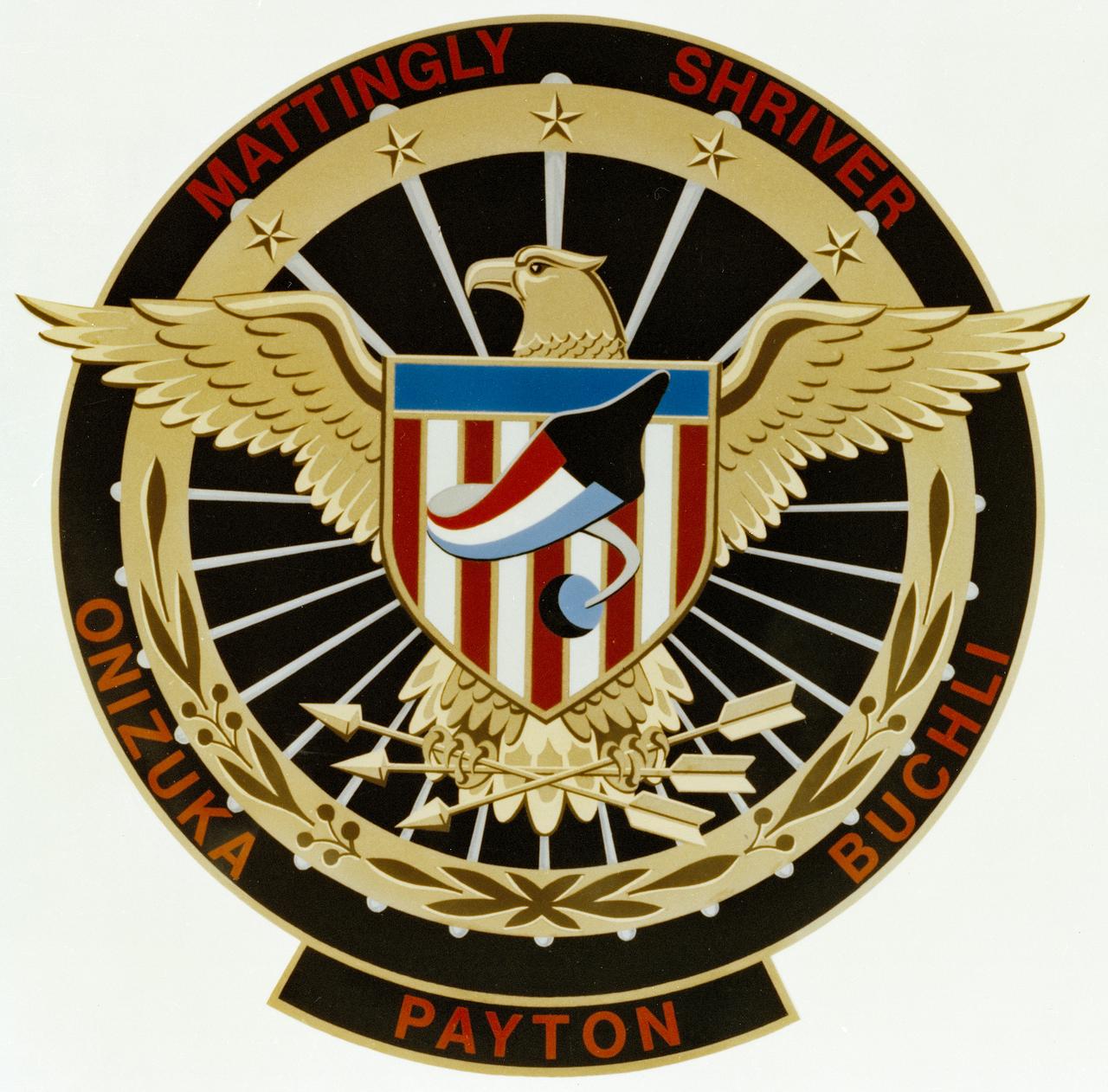
The crew insignia for STS Flight 51-C includes the names of its five crewmembers. The STS 51-C mission marked the third trip of the Space Shuttle Discovery into space. It was the first Space Shuttle mission totally dedicated to the Department of Defense. The U. S. Air Force Inertial Upper Stage Booster Rocket was successfully deployed. Due to the nature of the mission, few additional details of the flight were made available. Landing was made at the Kennedy Space Center, FL on January 27 at 4:23 PM EST. Mission duration was three days, one hour and 33 minutes.
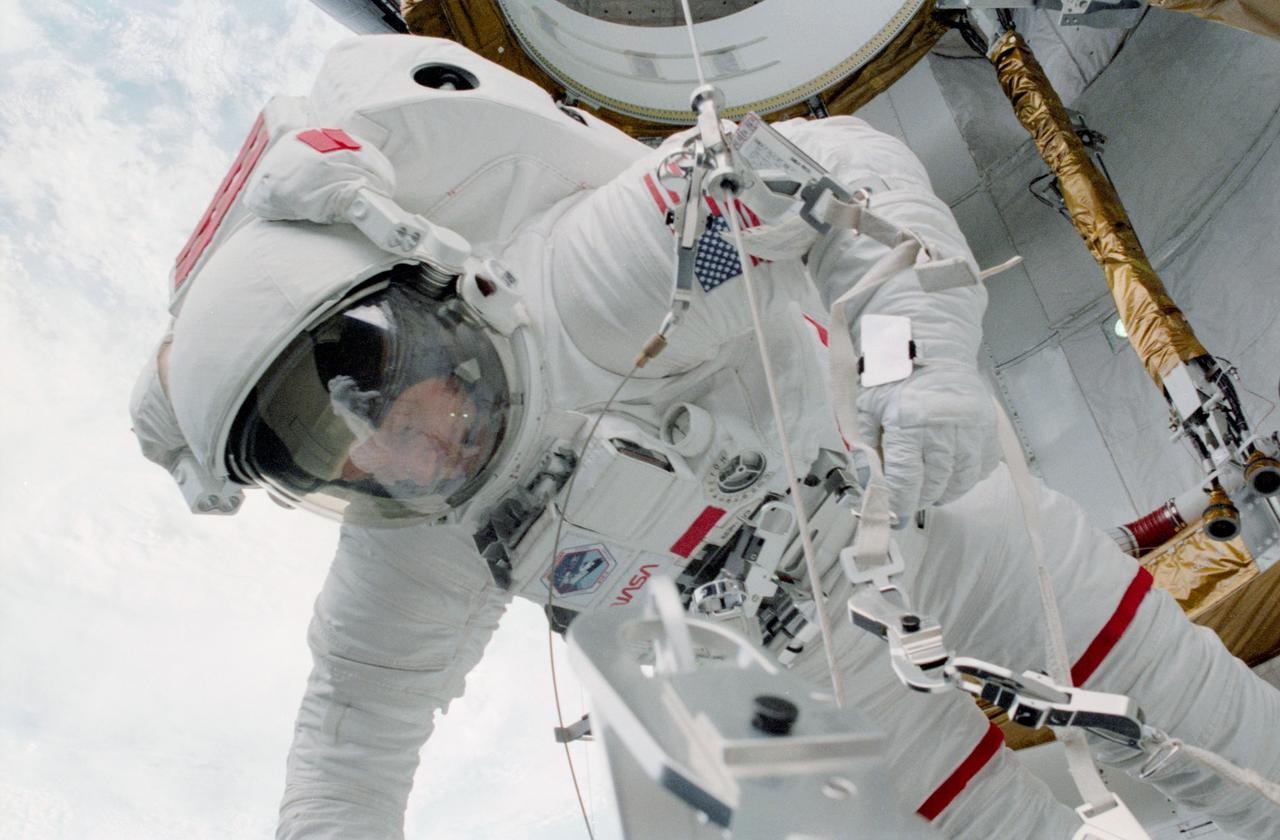
STS006-22-038 (7 April 1983) --- Astronaut F. Story Musgrave, one of two STS-6 mission specialists who performed a long, successful extravehicular activity (EVA) in the cargo bay of the Earth-orbiting space shuttle Challenger, moves along a slide wire near the now vacated inertial upper stage’s (ISU) airborne support equipment (ASE). Astronaut Donald H. Peterson, sharing the cargo bay with Dr. Musgrave, exposed this frame with a 35mm camera, while astronauts Paul J. Weitz, commander; Karol J. Bobko, pilot, remained in the cabin. Photo credit: NASA
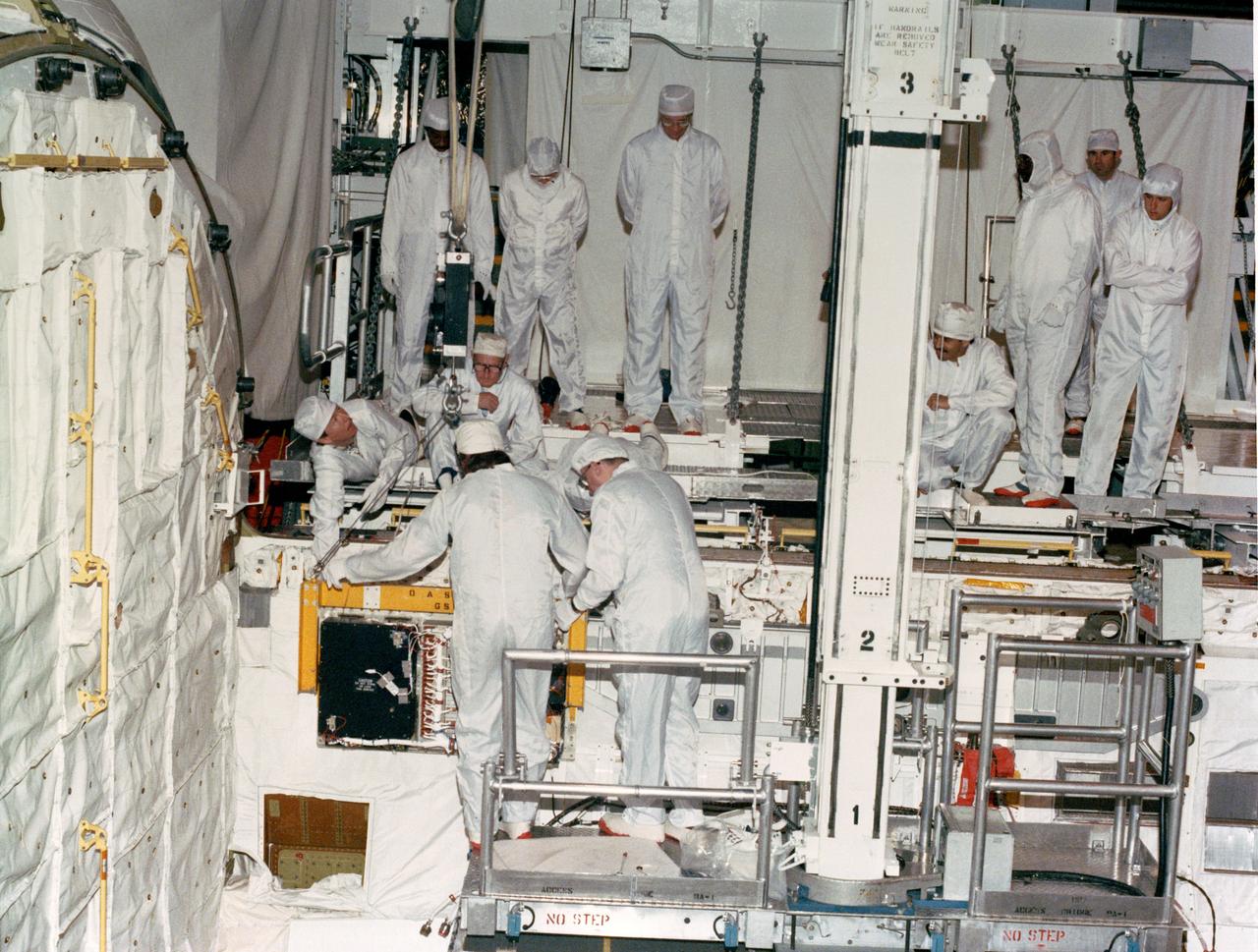
S88-37764 (18 April 1988) --- OASIS, instrumentation which will record the environment experienced by Discovery during the STS-26 Space Shuttle mission, is lowered into position for attachment to the orbiter's aft port sill. Instrumentation sensors in the payload bay which are connected to the tape recorder module will document a variety of environmental measurements during various phases of the flight including temperature, pressure, vibration, sounds, acceleration, stress, and strain. OASIS will also record data during the Flight Readiness Firing. NASA is flying OASIS aboard Discovery in support of the Inertial Upper Stage (IUS) program office of the Air Force Space Division. The system was developed by Lockheed under a NASA contract, funded by the Air Force.

STS006-44-582 (5 April 1983) --- A 70mm camera through the aft windows of the Earth-orbiting space shuttle Challenger’s cabin centered on the starboard orbital maneuvering system (OMS) pod of the reusable spacecraft. Two pieces of thermal protection system tile appear to have loosened. The view also shows one of the cargo bay television cameras, part of the EVA slide wire system, three handrails and other features on the aft bulkhead. Part of the airborne support equipment (ASE) for the now vacated inertial upper stage (IUS)/tracking and data relay satellite (TDRS) tandem is in lower right foreground. Photo credit: NASA
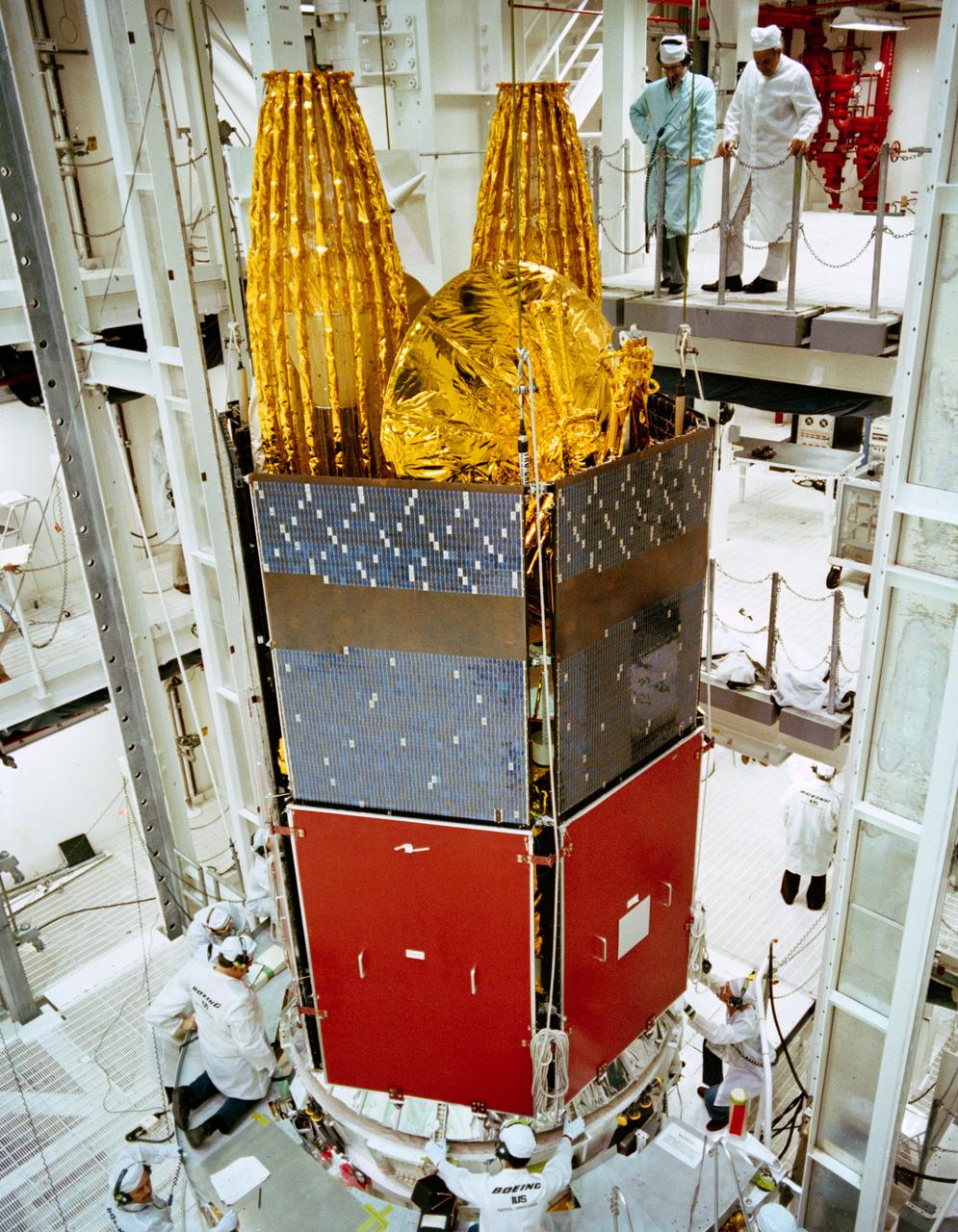
S82-41171 (29 Nov. 1982) --- NASA?s tracking and data relay satellite (TDRS) is gently mated to its inertial upper stage (IUS), which will propel the satellite to a higher geosynchronous orbit after it is ejected from the Challenger?s cargo bay during STS-6. Another TDRS will be placed in orbit on a later shuttle mission. The two will provide communications between orbiting shuttle mission craft and the ground, resulting in increased real-time communication and eliminating the need for much of NASA?s extensive world-wide system of ground tracking stations. A more distant plan is to launch other TDRS to be used for commercial telecommunications and for handling peak loads. Photo credit: NASA
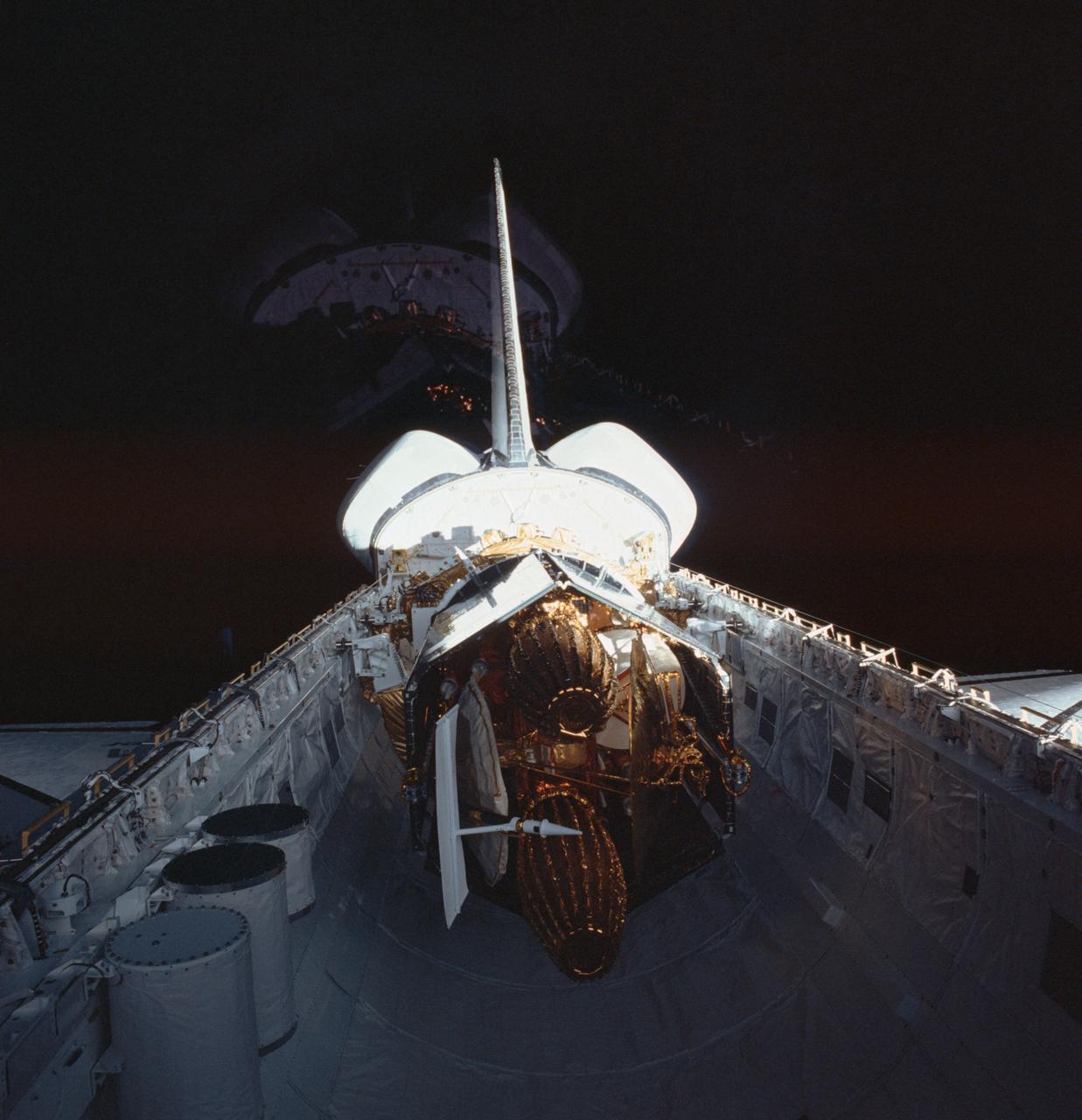
STS006-38-844 (4 April 1983) --- The stowed tracking and data relay satellite (TDRS) and its inertial upper stage (IUS) are seen in duplicate in this 70mm frame taken by the STS-6 crew aboard the Earth-orbiting space shuttle Challenger on its first day in space. A reflection in the aft window of the flight deck resulted in the mirage effect of the “second” TDRS. The three canisters in the aft foreground contain experiments of participants in NASA’s STS getaway special (GAS) program. Onboard the second reusable shuttle for this five-day flight were astronauts Paul J. Weitz, Karol J. Bobko, Dr. F. Story Musgrave and Donald H. Peterson. Photo credit: NASA
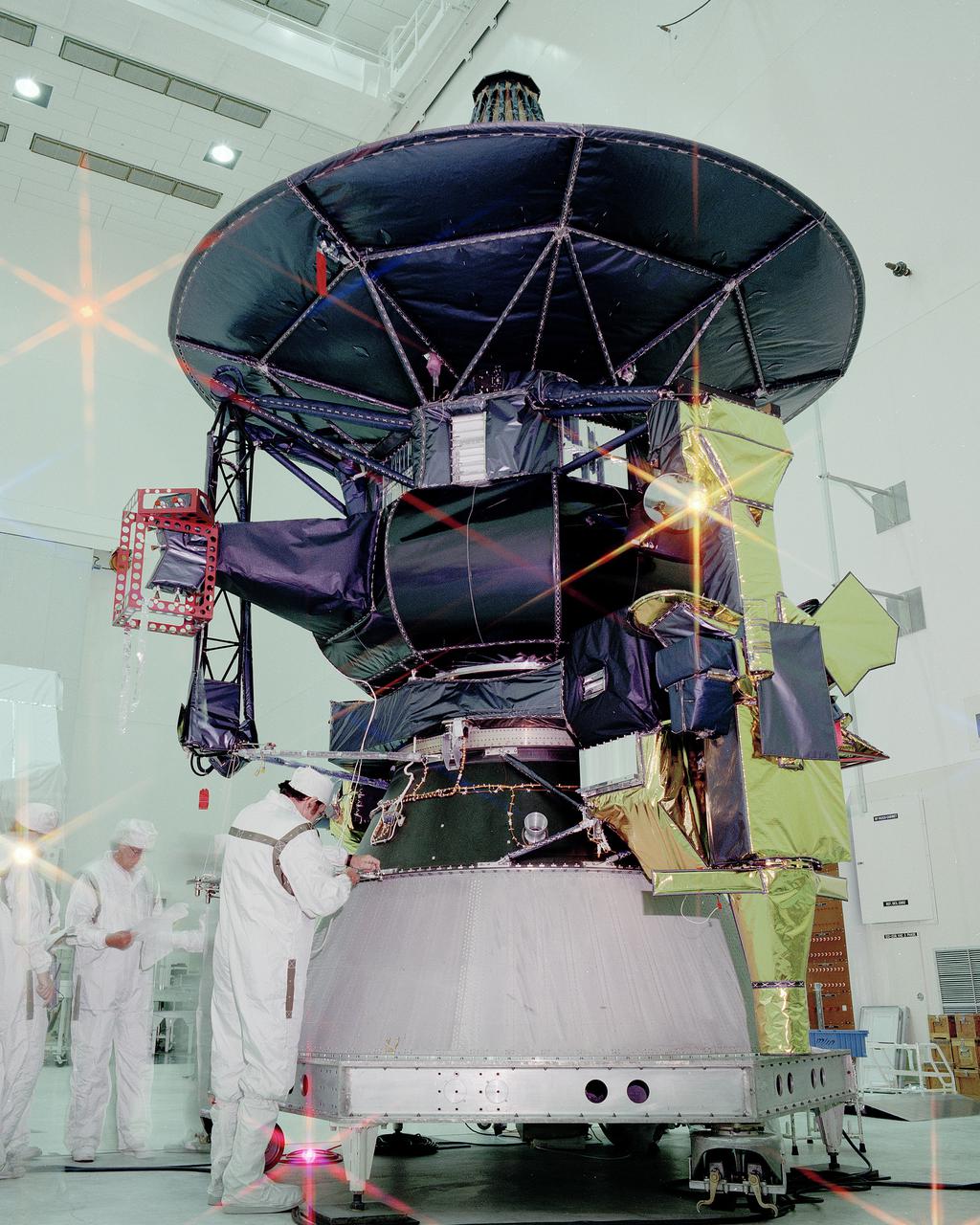
CAPE CANAVERAL, Fla. -- At the Kennedy Space Center’s SAEF-2 planetary spacecraft checkout facility, technicians work on the spacecraft Galileo prior to moving it to the Vertical Processing Facility for mating with an Inertial Upper Stage. Galileo is scheduled to be launched aboard Atlantis on space shuttle mission STS-34, Oct. 12, 1989 and sent to the planet Jupiter, a journey which will take more than six years to complete. In December 1995, as the two and one half ton spacecraft orbits Jupiter with its 10 scientific instruments, a probe will be released to parachute into the Jovian atmosphere. Photo Credit: NASA
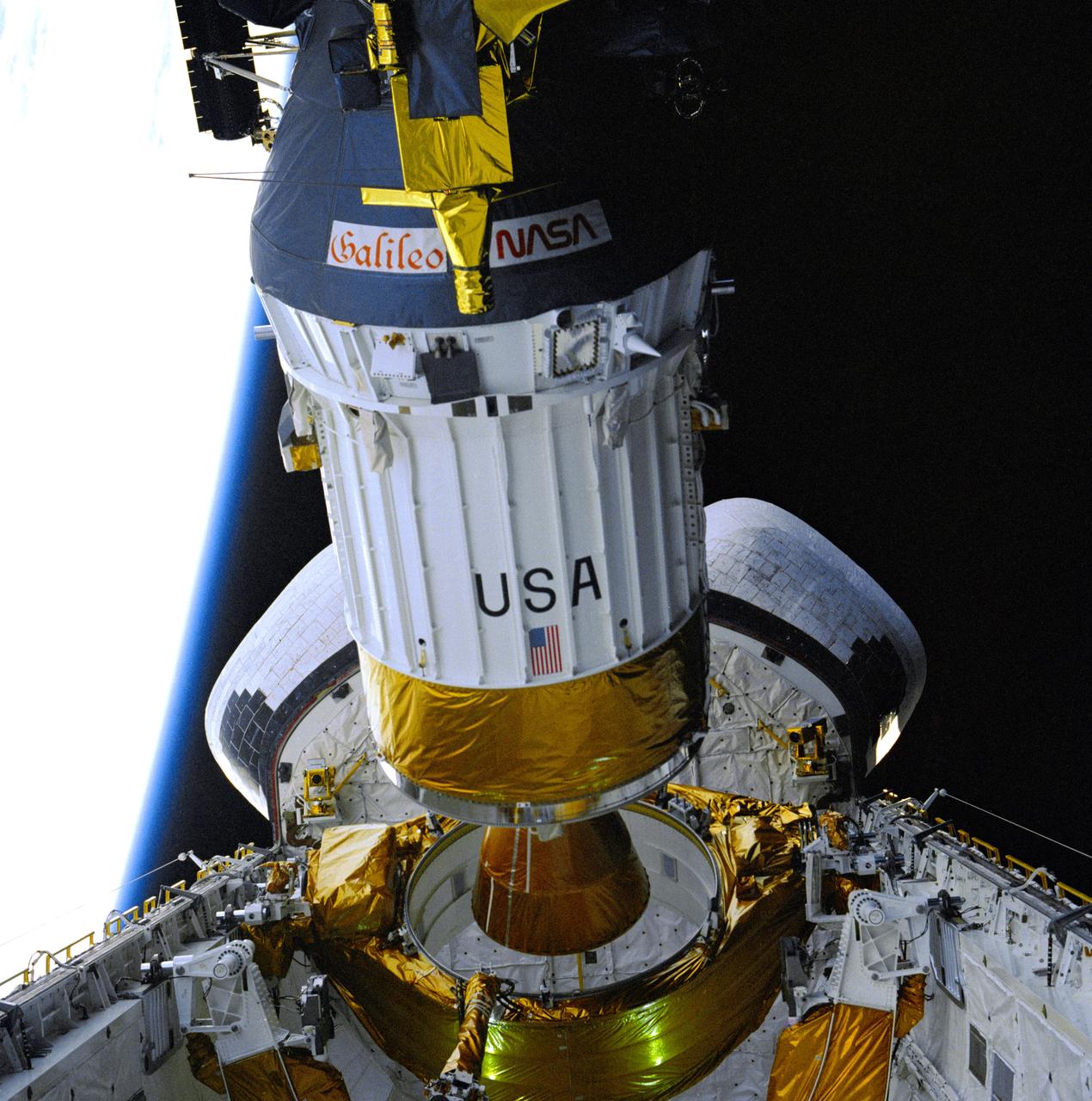
STS034-71-000AK (18 Oct 1989) --- Backdropped against the blackness of space, the Galileo spacecraft and its inertial upper stage (IUS) have just detached from a cradle-like device aboard the Earth-orbiting Space Shuttle Atlantis to begin a six-year journey to Jupiter. The five-member STS-34 crew deployed the satellite within six hours of achieving Earth orbit on Oct. 18, 1989. The scene was exposed with a 70mm handheld Hasselblad camera. Earth's horizon and a thin line representing its airglow and atmosphere are visible on the left side of the frame.
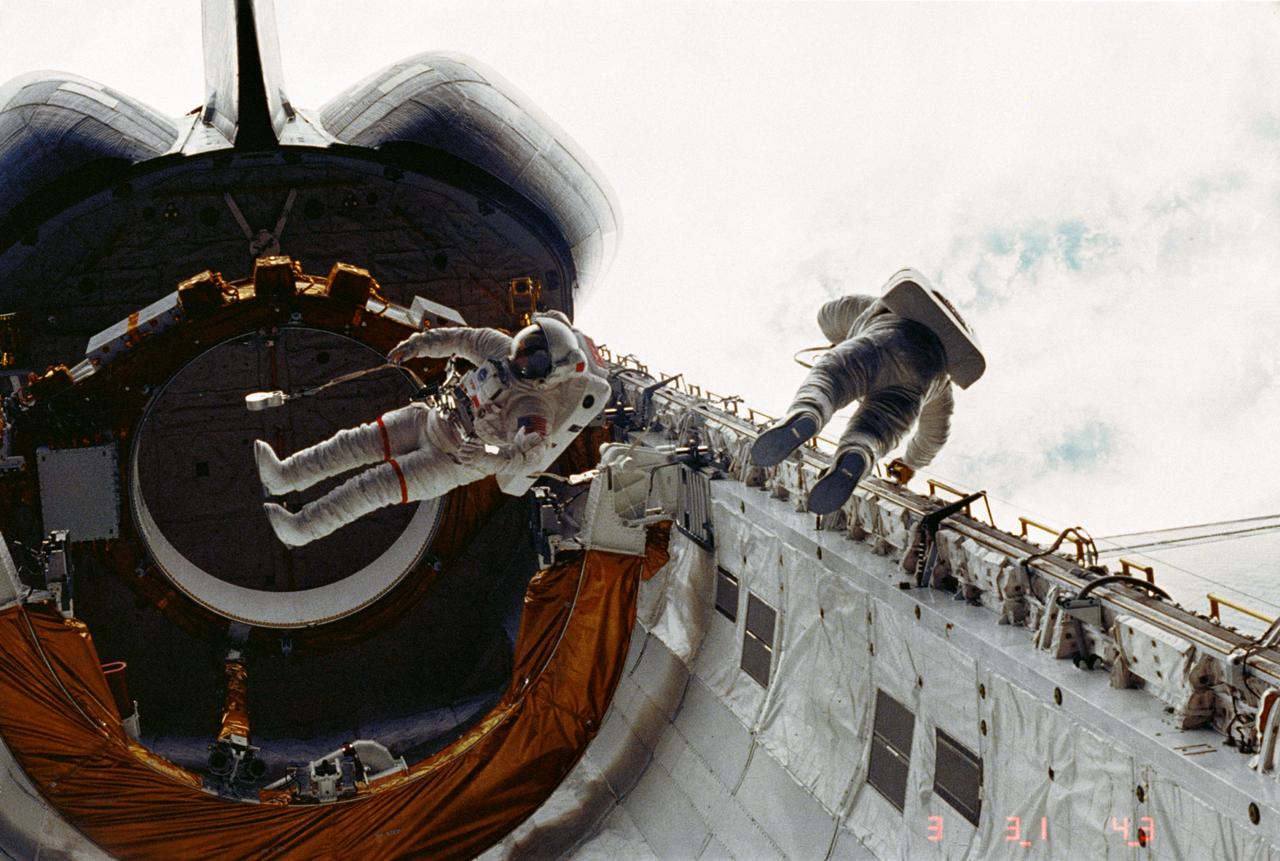
STS006-10-417 (7 April 1983) --- Astronauts F. Story Musgrave, left, and Donald H. Peterson float about in the cargo bay of the Earth-orbiting space shuttle Challenger during their April 7, 1983, extravehicular activity (EVA). Their "floating about" is restricted via tethers to safety slide wires. Thanks to the tether/slide wire combination, Peterson is able to translate along the port side hand rails. Musgrave is near the Airborne Support Equipment (ASE) for the now vacated Inertial Upper Stage (IUS). Clouds can be seen in the background. Photo credit: NASA
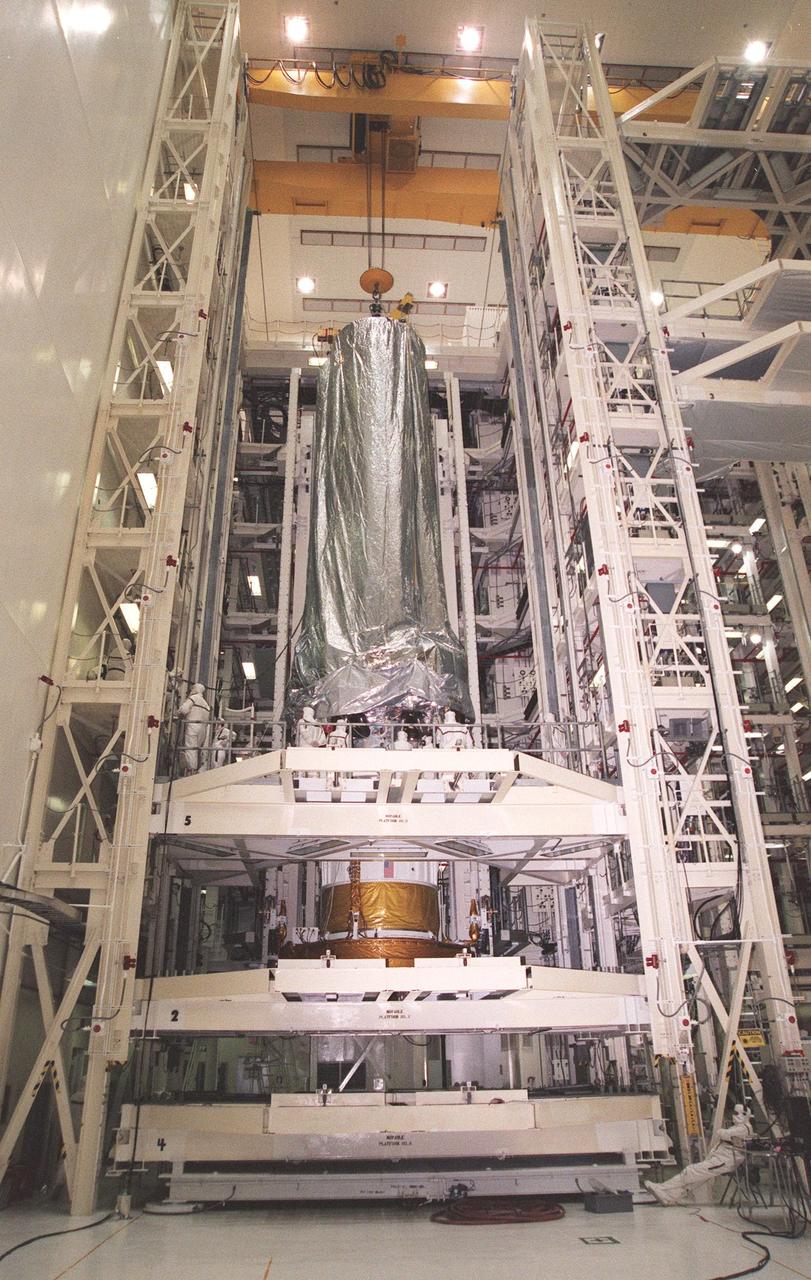
In the Vertical Processing Facility, the Chandra X-ray Observatory is lowered onto the Inertial Upper Stage (IUS) beneath it. After the two components are mated, they will undergo testing to validate the IUS/Chandra connections and to check the orbiter avionics interfaces. Following that, an end-to-end test (ETE) will be conducted to verify the communications path to Chandra, commanding it as if it were in space. With the world's most powerful X-ray telescope, Chandra will allow scientists from around the world to see previously invisible black holes and high-temperature gas clouds, giving the observatory the potential to rewrite the books on the structure and evolution of our universe. Chandra is scheduled for launch July 22 aboard Space Shuttle Columbia, on mission STS-93
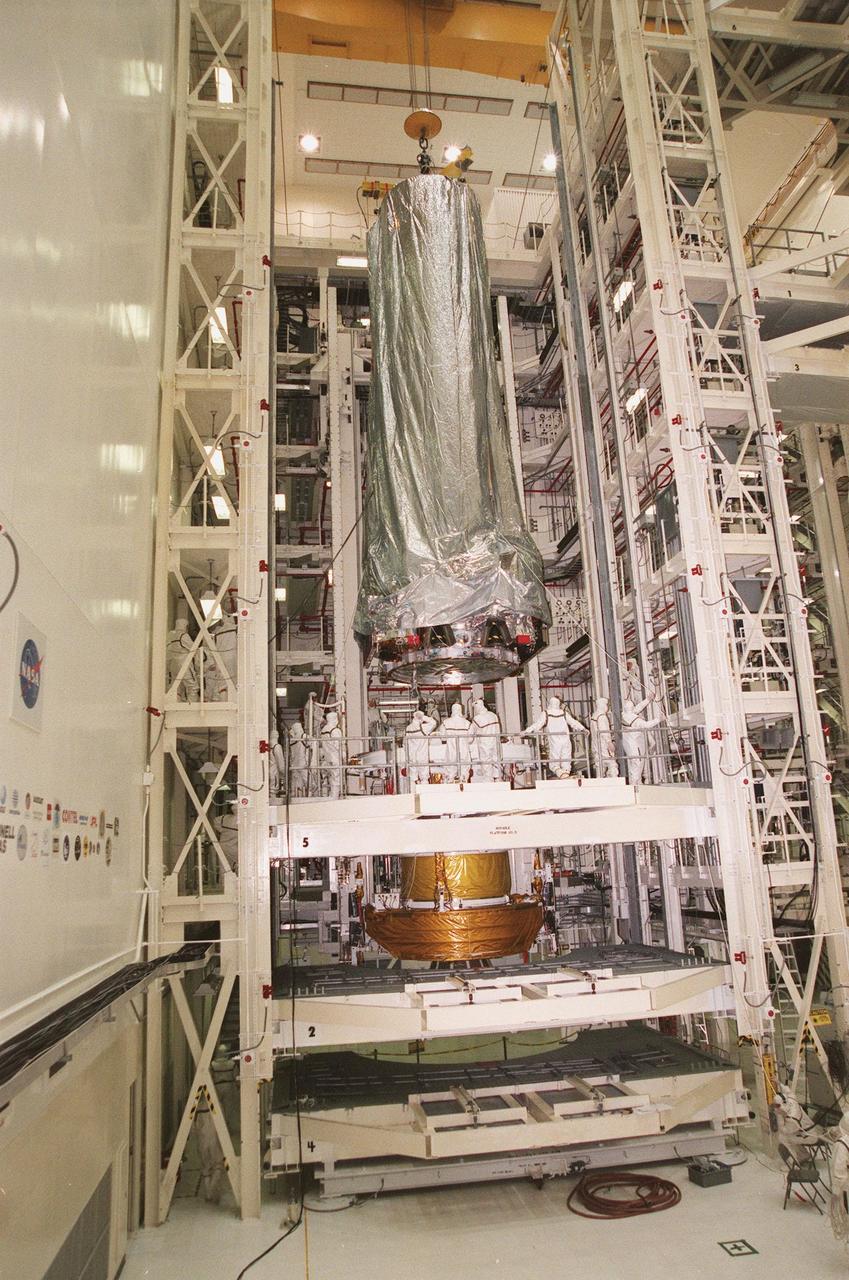
In the Vertical Processing Facility, the Chandra X-ray Observatory is lowered toward the Inertial Upper Stage (IUS) in a workstand beneath it. There it will be mated with the IUS and then undergo testing to validate the IUS/Chandra connections and to check the orbiter avionics interfaces. Following that, an end-to-end test (ETE) will be conducted to verify the communications path to Chandra, commanding it as if it were in space. With the world's most powerful X-ray telescope, Chandra will allow scientists from around the world to see previously invisible black holes and high-temperature gas clouds, giving the observatory the potential to rewrite the books on the structure and evolution of our universe. Chandra is scheduled for launch July 22 aboard Space Shuttle Columbia, on mission STS-93
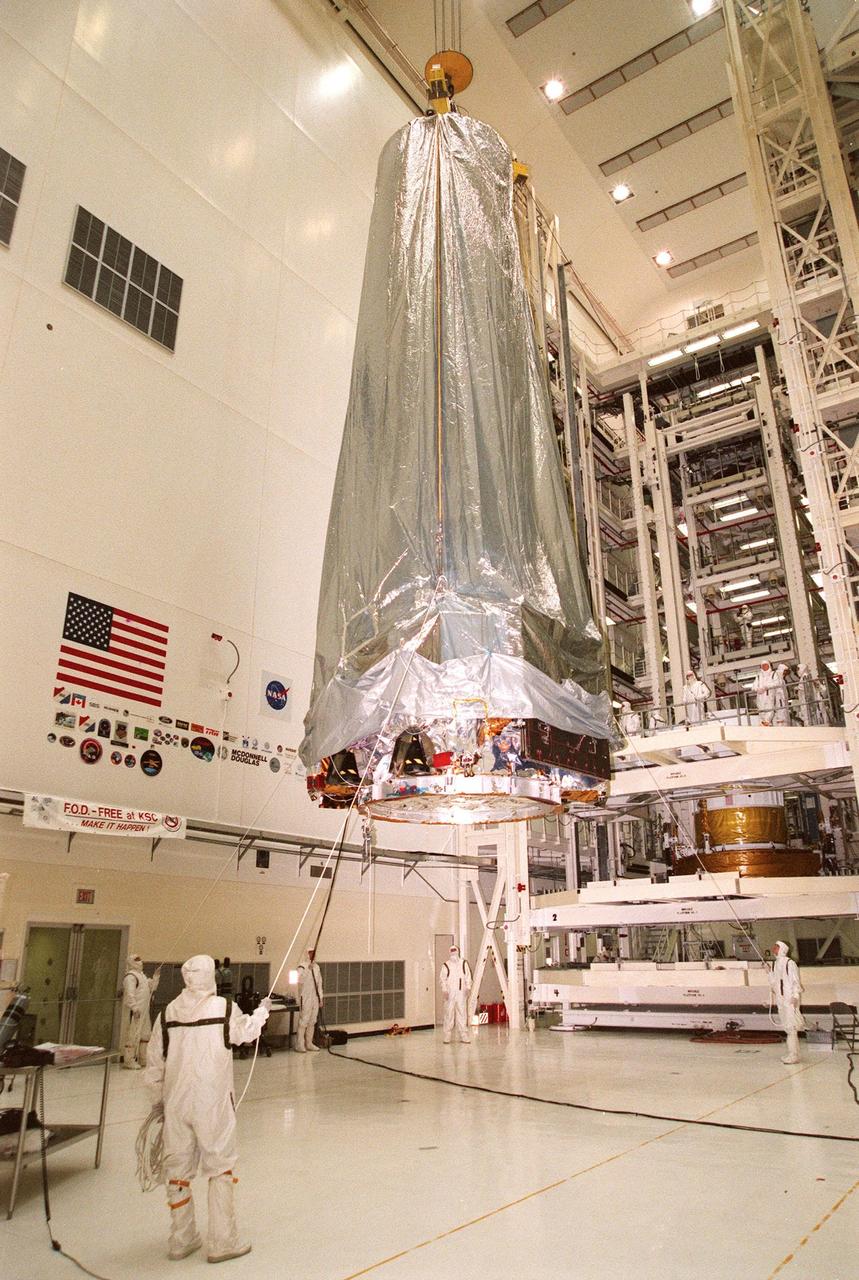
In the Vertical Processing Facility, the Chandra X-ray Observatory is moved toward the Inertial Upper Stage (IUS) in a workstand at right. There it will be mated with the IUS and then undergo testing to validate the IUS/Chandra connections and check the orbiter avionics interfaces. Following that, an end-to-end test (ETE) will be conducted to verify the communications path to Chandra, commanding it as if it were in space. With the world's most powerful X-ray telescope, Chandra will allow scientists from around the world to see previously invisible black holes and high-temperature gas clouds, giving the observatory the potential to rewrite the books on the structure and evolution of our universe. Chandra is scheduled for launch July 22 aboard Space Shuttle Columbia, on mission STS-93
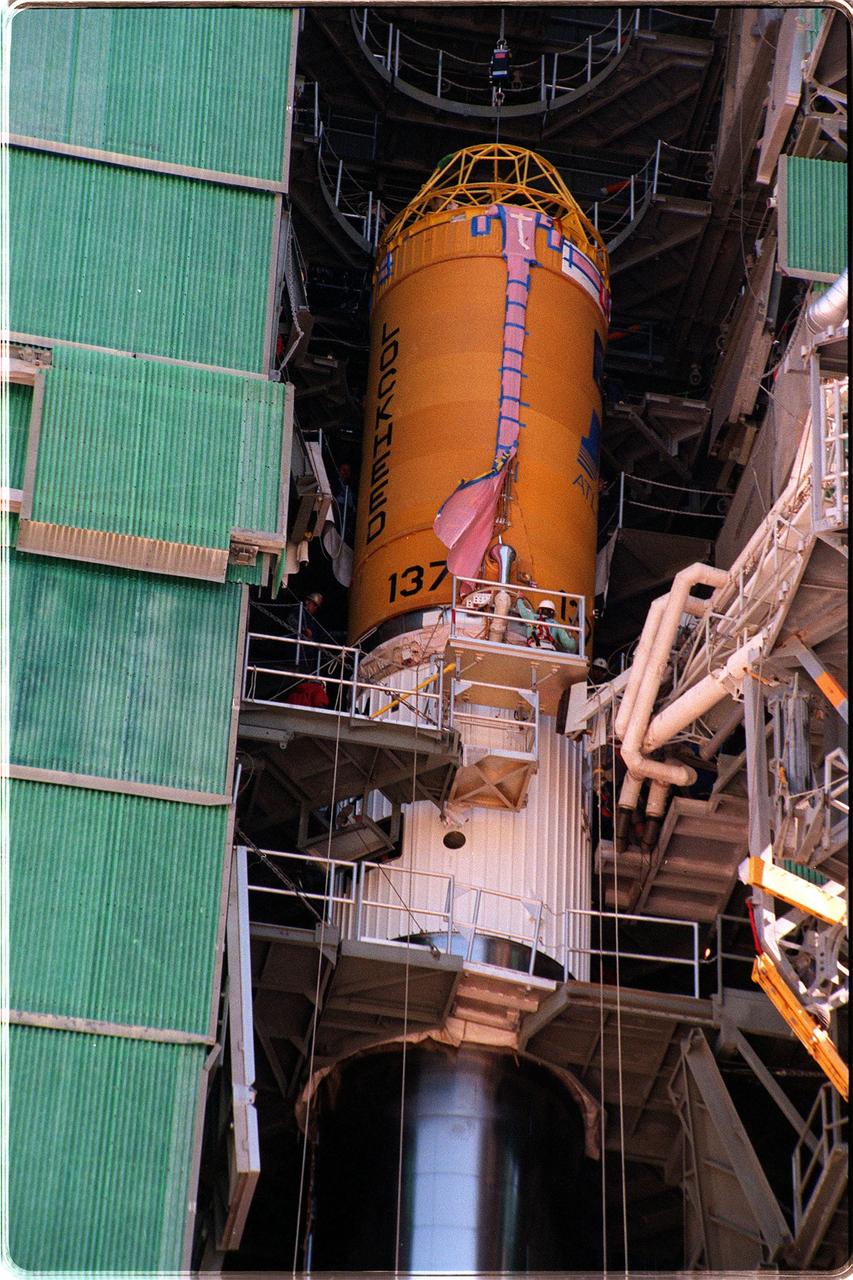
At Launch Pad 36A, Cape Canaveral Air Station, a Centaur upper stage is mated to the lower stage Lockheed Martin Atlas IIA rocket. The rocket is scheduled to launch the NASA GOES-L satellite on May 15, at the opening of a launch window which extends from 2:23 to 4:41 a.m. EDT. Once in orbit, the satellite will become GOES-11, joining GOES-8, GOES-9 and GOES-10 in space. The fourth of a new advanced series of geostationary weather satellites for the National Oceanic and Atmospheric Administration (NOAA), GOES-L is a three-axis inertially stabilized spacecraft that will provide pictures and perform atmospheric sounding at the same time. Once launched, the satellite will undergo checkout and then provide backup capabilities for the existing, aging operational satellites
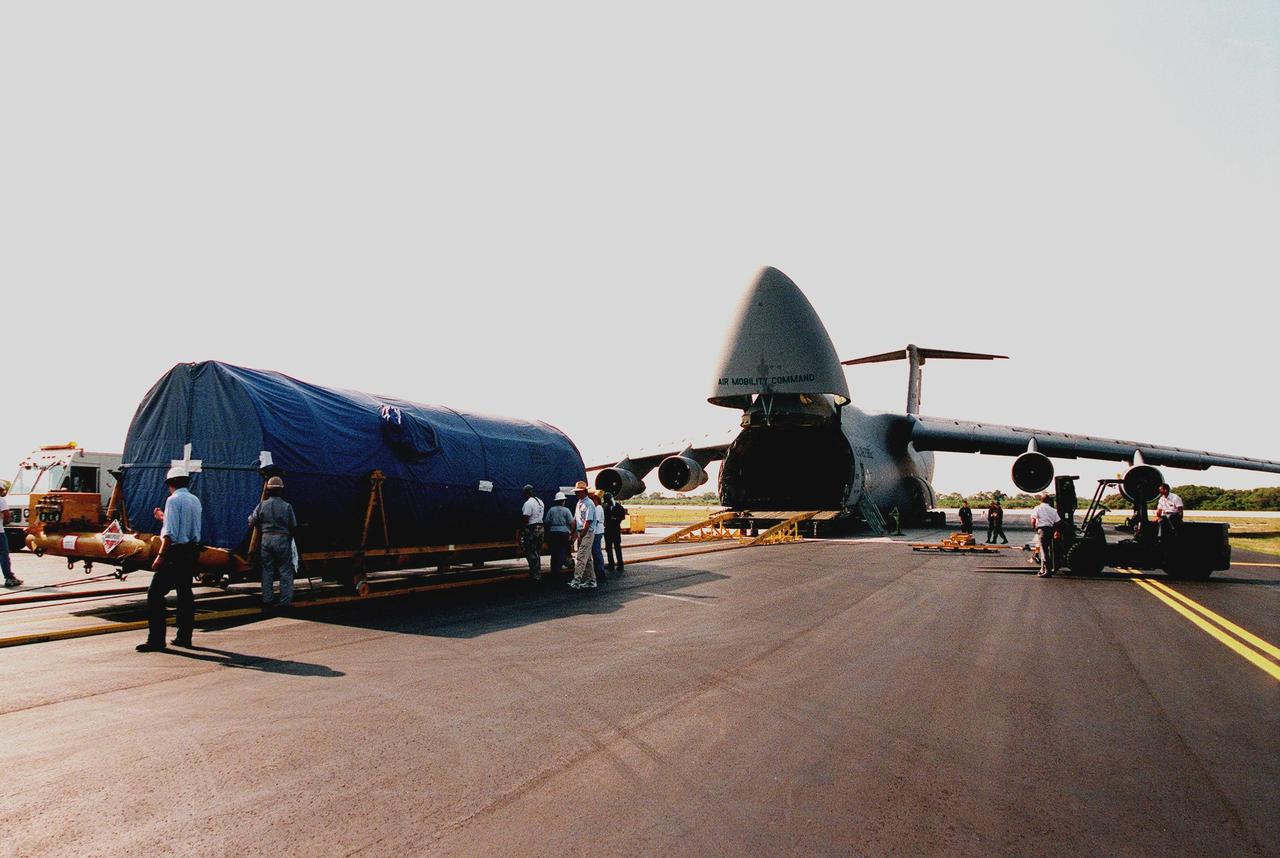
At Cape Canaveral Air Station, workers secure a Centaur upper stage on a transporter after offloading it from a U.S. Air Force C-5c (right). After being mated with the Atlas IIA lower stage, the rocket is scheduled to launch the NASA GOES-L satellite from Launch Pad 36A on May 15. Once in orbit, the satellite will become GOES-11, joining GOES-8, GOES-9 and GOES-10 in space. The fourth of a new advanced series of geostationary weather satellites for the National Oceanic and Atmospheric Administration (NOAA), GOES-L is a three-axis inertially stabilized spacecraft that will provide pictures and perform atmospheric sounding at the same time. Once launched, the satellite will undergo checkout and then provide backup capabilities for the existing, aging operational satellites
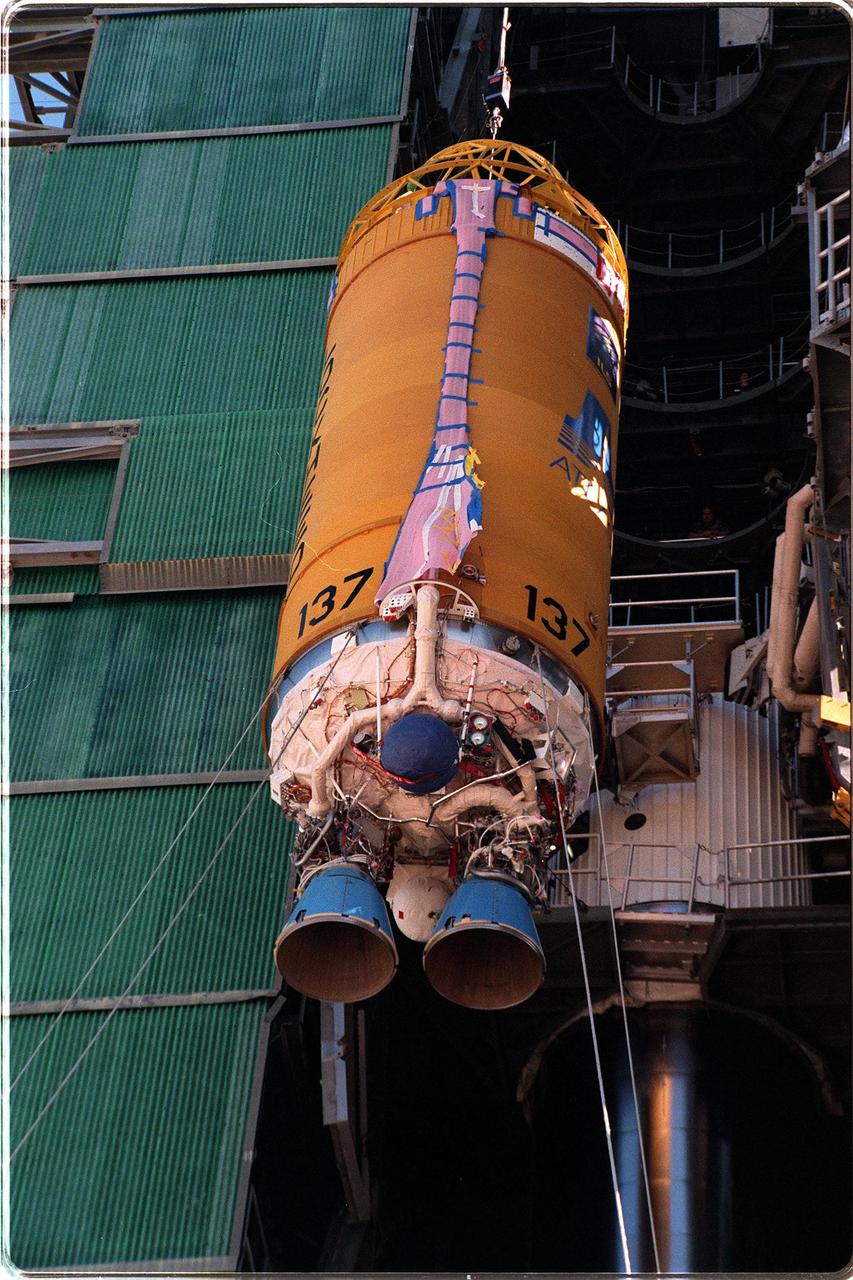
At Launch Pad 36A, Cape Canaveral Air Station, a Centaur upper stage is lifted up the gantry for mating with the lower stage Lockheed Martin Atlas IIA rocket seen behind it. The Lockheed Martin-manufactured Centaur IIA is powered by two Pratt & Whitney turbopump-fed engines, producing a total thrust of 41,600 pounds. The rocket is scheduled to launch the NASA GOES-L satellite on May 15, at the opening of a launch window which extends from 2:23 to 4:41 a.m. EDT. Once in orbit, the satellite will become GOES-11, joining GOES-8, GOES-9 and GOES-10 in space. The fourth of a new advanced series of geostationary weather satellites for the National Oceanic and Atmospheric Administration (NOAA), GOES-L is a three-axis inertially stabilized spacecraft that will provide pictures and perform atmospheric sounding at the same time. Once launched, the satellite will undergo checkout and then provide backup capabilities for the existing, aging operational satellites
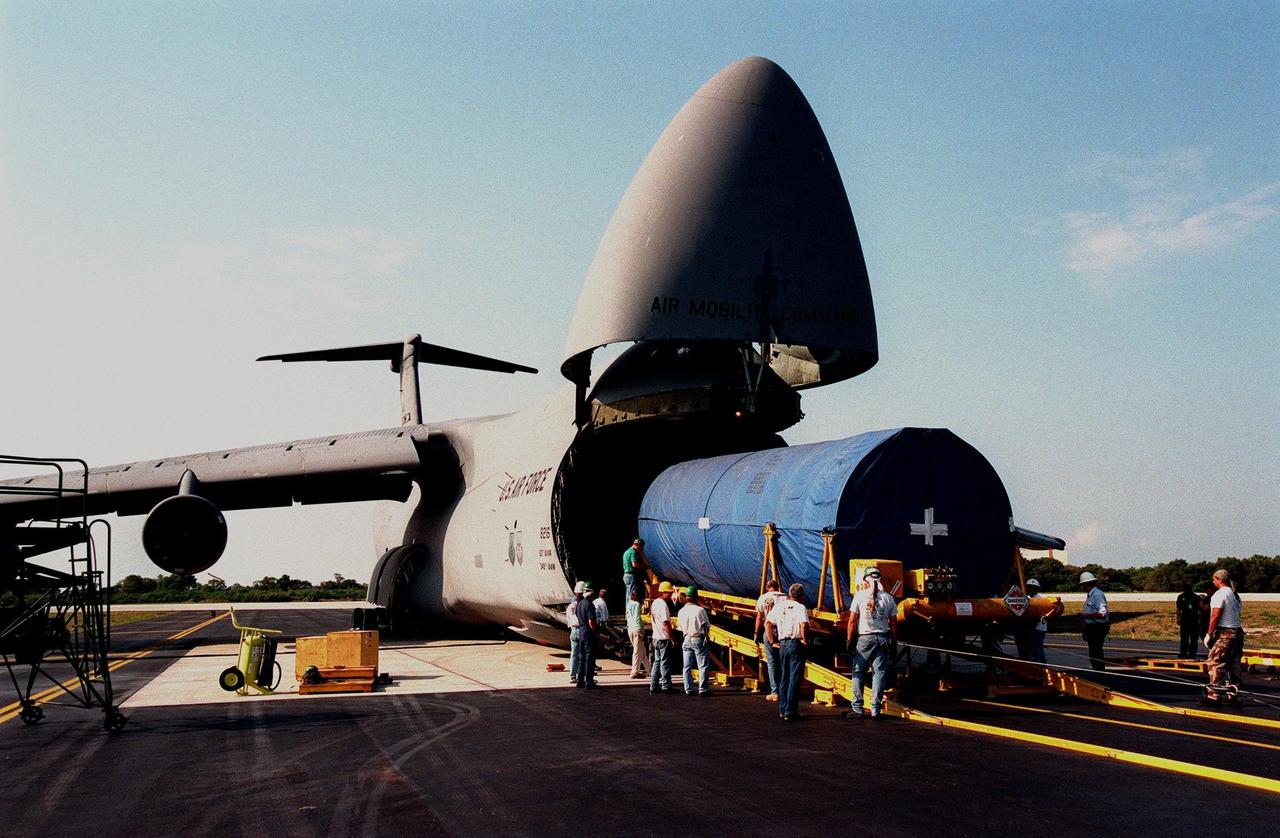
At Cape Canaveral Air Station, workers begin offloading a Centaur upper stage from a U.S. Air Force C-5c. After being mated with the Atlas IIA lower stage, the rocket is scheduled to launch the NASA GOES-L satellite from Launch Pad 36A on May 15. Once in orbit, the satellite will become GOES-11, joining GOES-8, GOES-9 and GOES-10 in space. The fourth of a new advanced series of geostationary weather satellites for the National Oceanic and Atmospheric Administration (NOAA), GOES-L is a three-axis inertially stabilized spacecraft that will provide pictures and perform atmospheric sounding at the same time. Once launched, the satellite will undergo checkout and then provide backup capabilities for the existing, aging operational satellites
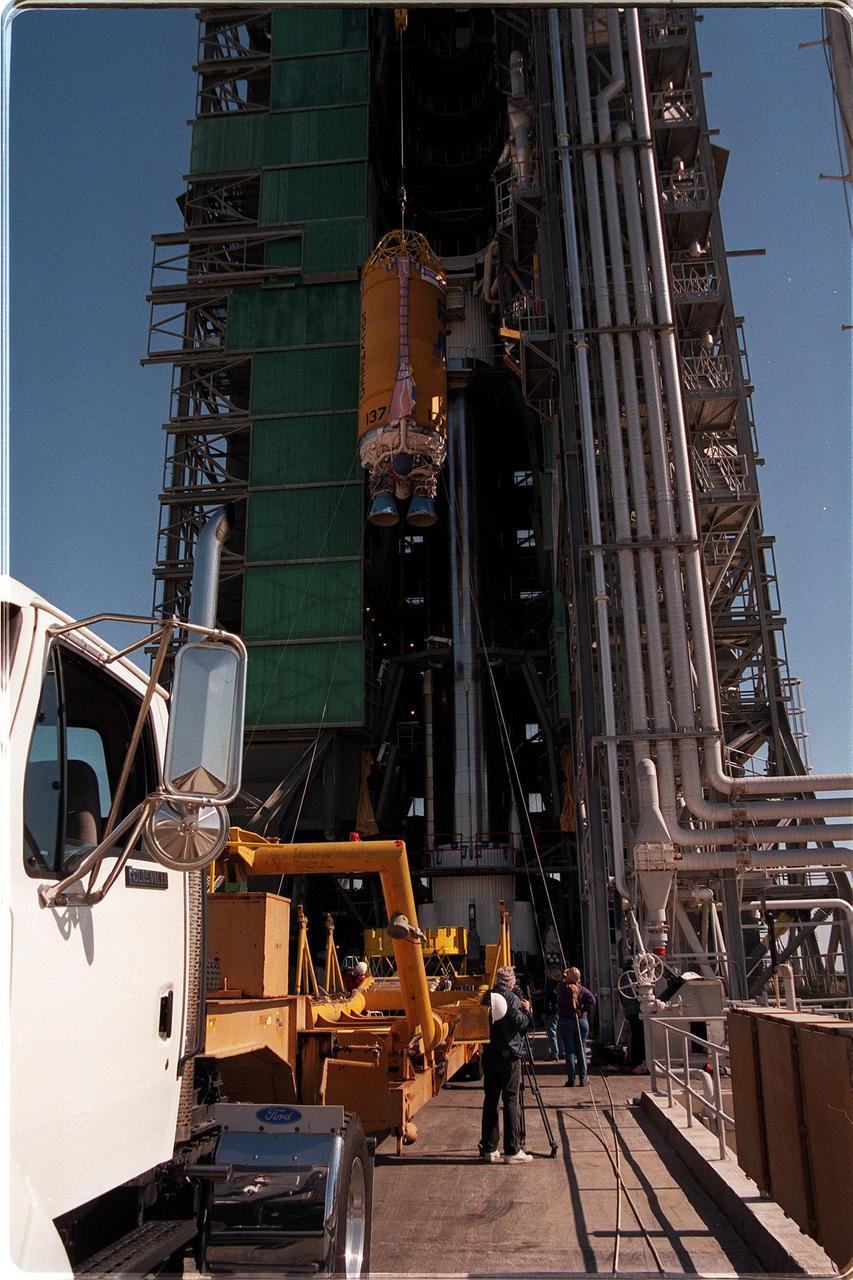
At Launch Pad 36A, Cape Canaveral Air Station, a Centaur upper stage is lifted up the gantry for mating with the lower stage Lockheed Martin Atlas IIA rocket already in place. The Lockheed Martin-manufactured Centaur IIA is powered by two Pratt & Whitney turbopump-fed engines, producing a total thrust of 41,600 pounds. The rocket is scheduled to launch the NASA GOES-L satellite on May 15, at the opening of a launch window which extends from 2:23 to 4:41 a.m. EDT. Once in orbit, the satellite will become GOES-11, joining GOES-8, GOES-9 and GOES-10 in space. The fourth of a new advanced series of geostationary weather satellites for the National Oceanic and Atmospheric Administration (NOAA), GOES-L is a three-axis inertially stabilized spacecraft that will provide pictures and perform atmospheric sounding at the same time. Once launched, the satellite will undergo checkout and then provide backup capabilities for the existing, aging operational satellites
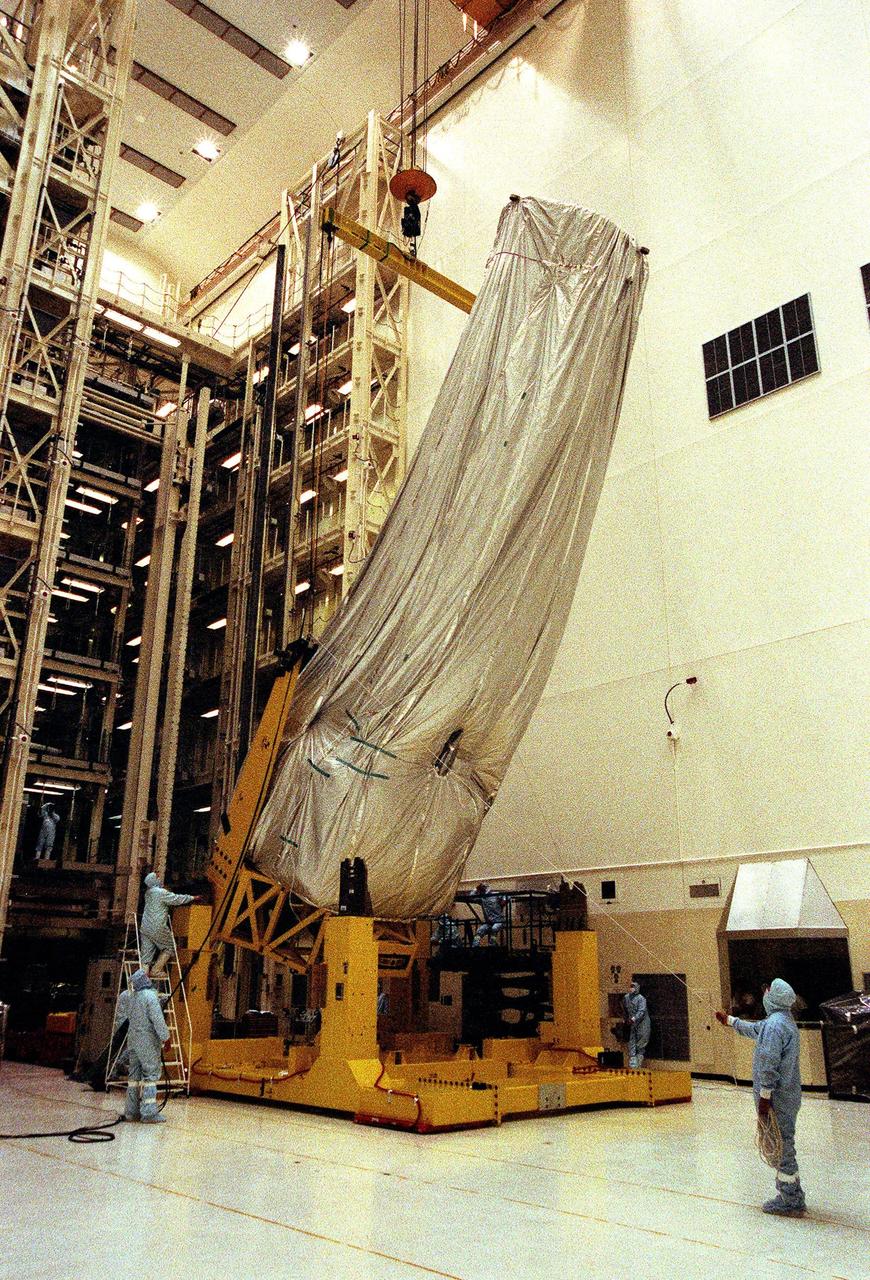
In the Vertical Processing Facility (VPF), workers guide the final stages as the overhead crane lifts the shrouded Chandra X-ray Observatory to a vertical position. The telescope will undergo final installation of associated electronic components; it will also be tested, fueled and mated with the Inertial Upper Stage booster. A set of integrated tests will follow. Chandra is scheduled for launch July 9 aboard Space Shuttle Columbia, on mission STS-93 . Formerly called the Advanced X-ray Astrophysics Facility, Chandra comprises three major elements: the spacecraft, the science instrument module (SIM), and the world's most powerful X-ray telescope. Chandra will allow scientists from around the world to see previously invisible black holes and high-temperature gas clouds, giving the observatory the potential to rewrite the books on the structure and evolution of our universe
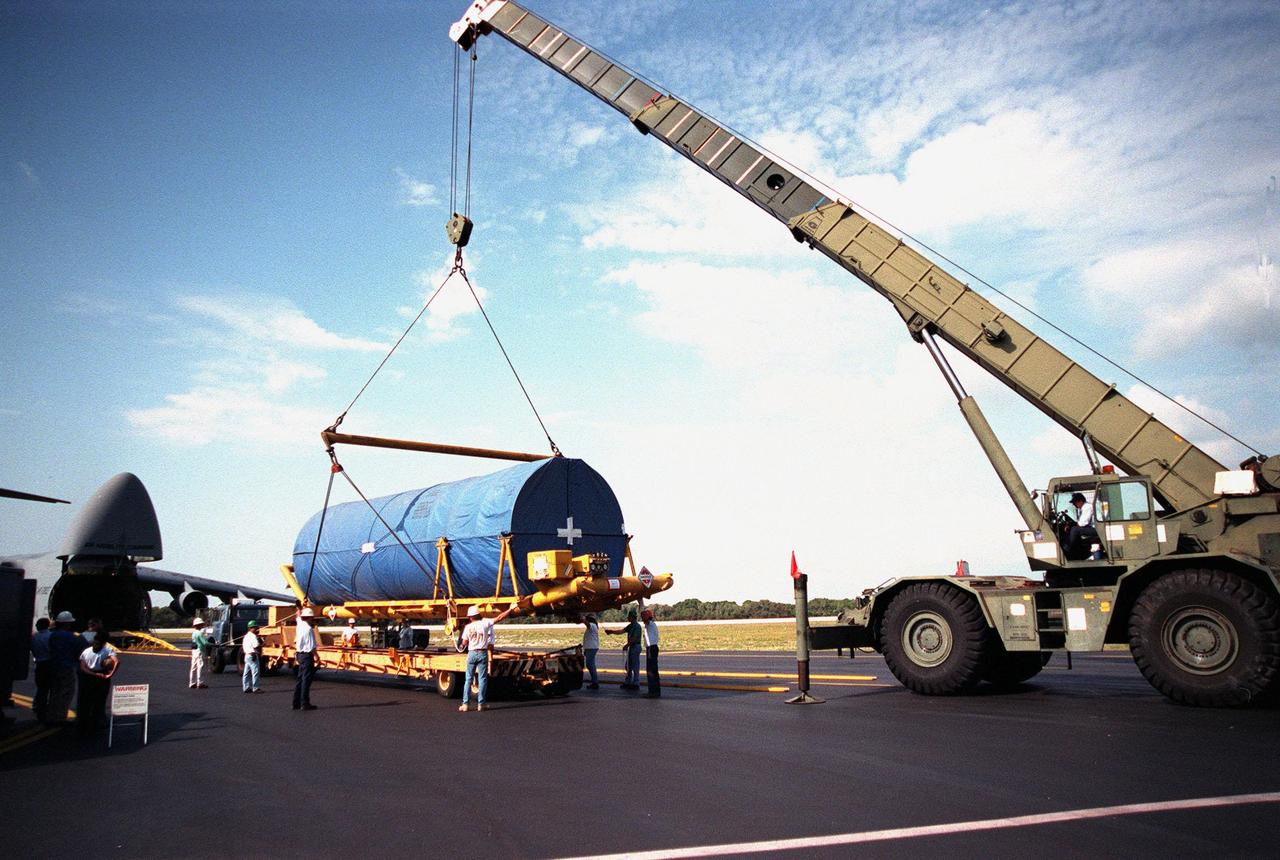
At Cape Canaveral Air Station (CCAS), workers help guide the crane lifting a Centaur upper stage onto a transporter. The Centaur arrived at CCAS aboard a U.S. Air Force C-5c (far left). After being mated with the Atlas IIA lower stage, the rocket is scheduled to launch the NASA GOES-L satellite from Launch Pad 36A on May 15. Once in orbit, the satellite will become GOES-11, joining GOES-8, GOES-9 and GOES-10 in space. The fourth of a new advanced series of geostationary weather satellites for the National Oceanic and Atmospheric Administration (NOAA), GOES-L is a three-axis inertially stabilized spacecraft that will provide pictures and perform atmospheric sounding at the same time. Once launched, the satellite will undergo checkout and then provide backup capabilities for the existing, aging operational satellites
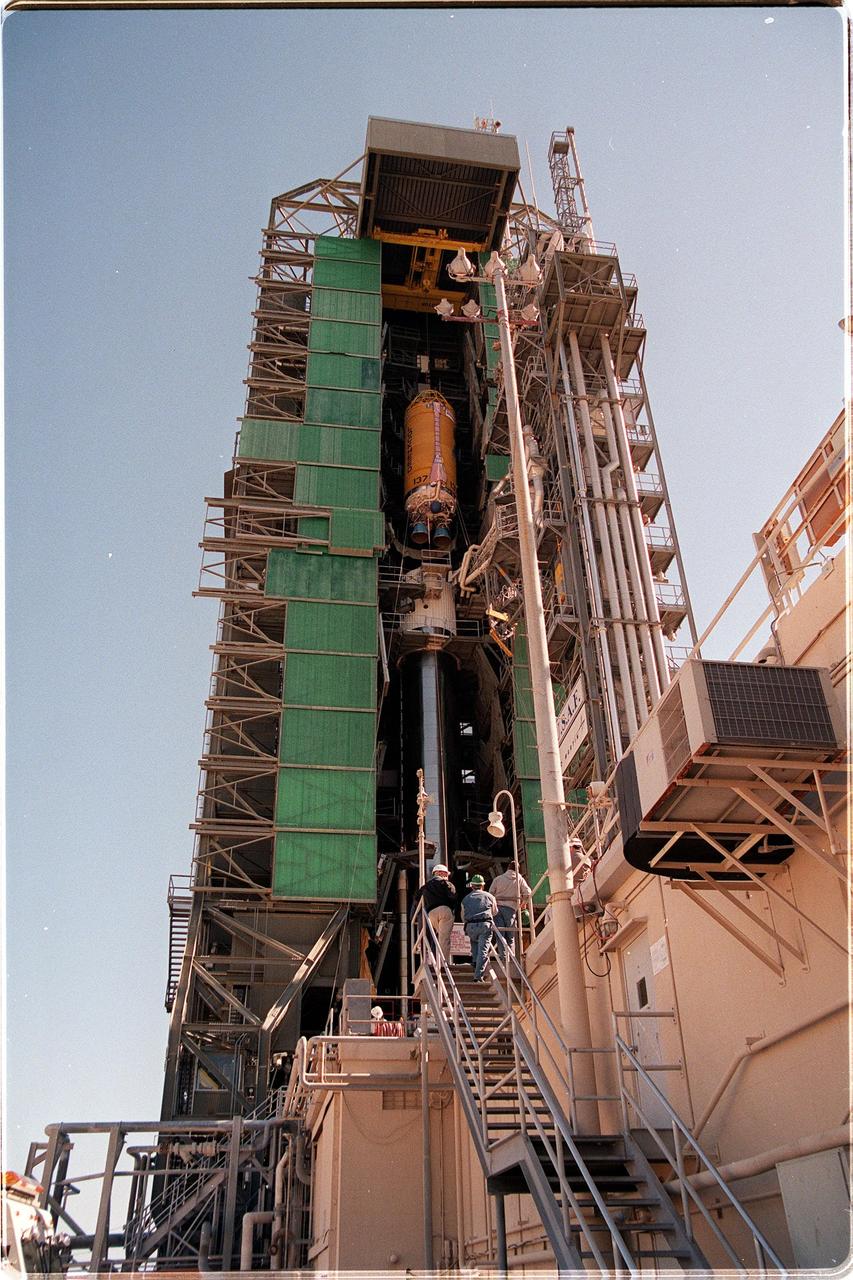
At Launch Pad 36A, Cape Canaveral Air Station, a Centaur upper stage is moved into place above the lower stage Lockheed Martin Atlas IIA rocket. The Lockheed Martin-manufactured Centaur IIA is powered by two Pratt & Whitney turbopump-fed engines, producing a total thrust of 41,600 pounds. The rocket is scheduled to launch the NASA GOES-L satellite on May 15, at the opening of a launch window which extends from 2:23 to 4:41 a.m. EDT. Once in orbit, the satellite will become GOES-11, joining GOES-8, GOES-9 and GOES-10 in space. The fourth of a new advanced series of geostationary weather satellites for the National Oceanic and Atmospheric Administration (NOAA), GOES-L is a three-axis inertially stabilized spacecraft that will provide pictures and perform atmospheric sounding at the same time. Once launched, the satellite will undergo checkout and then provide backup capabilities for the existing, aging operational satellites
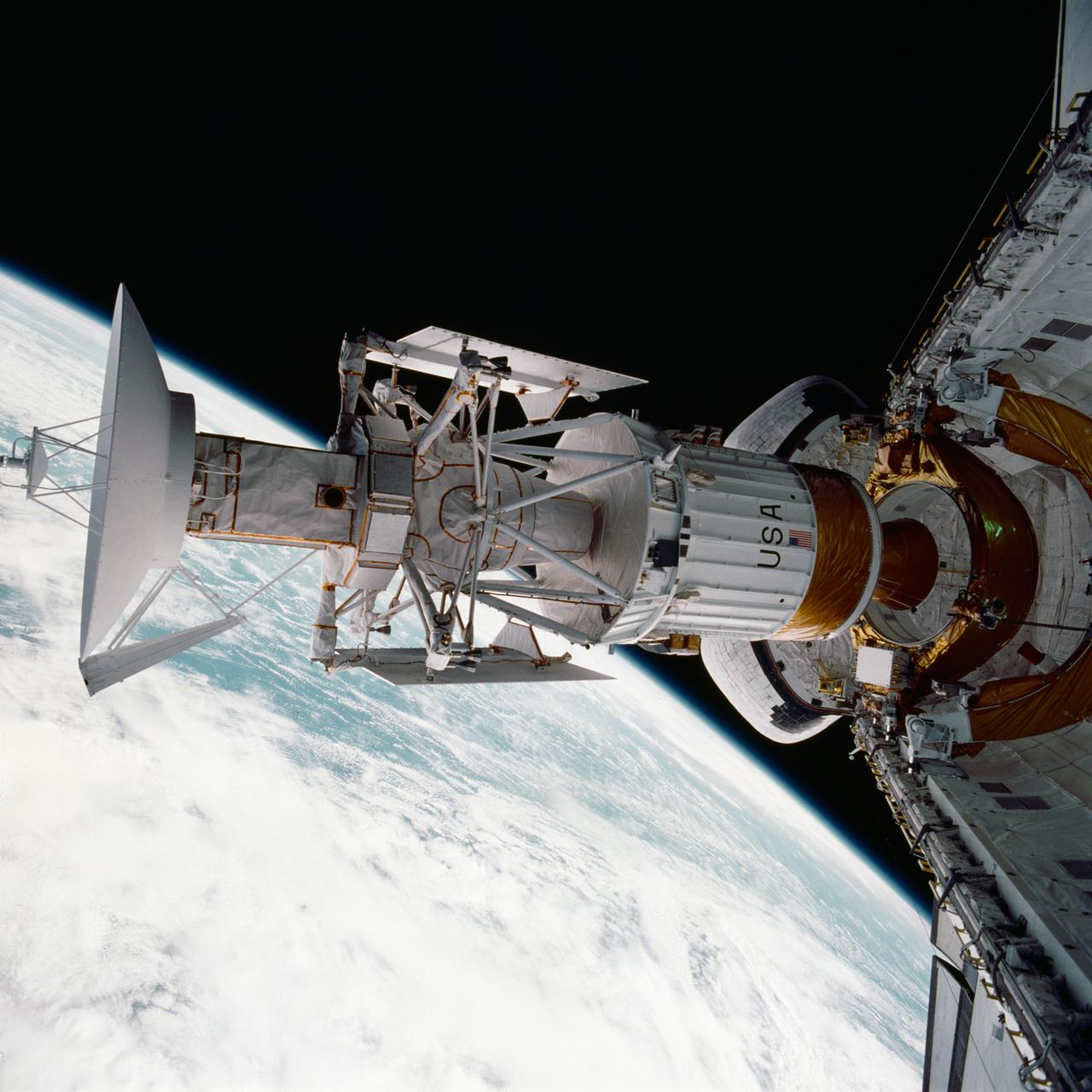
STS030-72-047 (4 May 1989) --- In the early evening hours of Atlantis?s first day in space for the four-day STS-30 mission, the Magellan spacecraft is released into space to begin its long journey to the planet Venus for an extensive radar mapping mission. The scene was photographed through Atlantis?s aft flight deck windows with a handheld 70mm camera.
STS044-71-011 (25 Nov. 1991) --- A 70mm frame shows pre-deployment view of the Defense Support Payload (DSP), backdropped against a blue and white Earth.
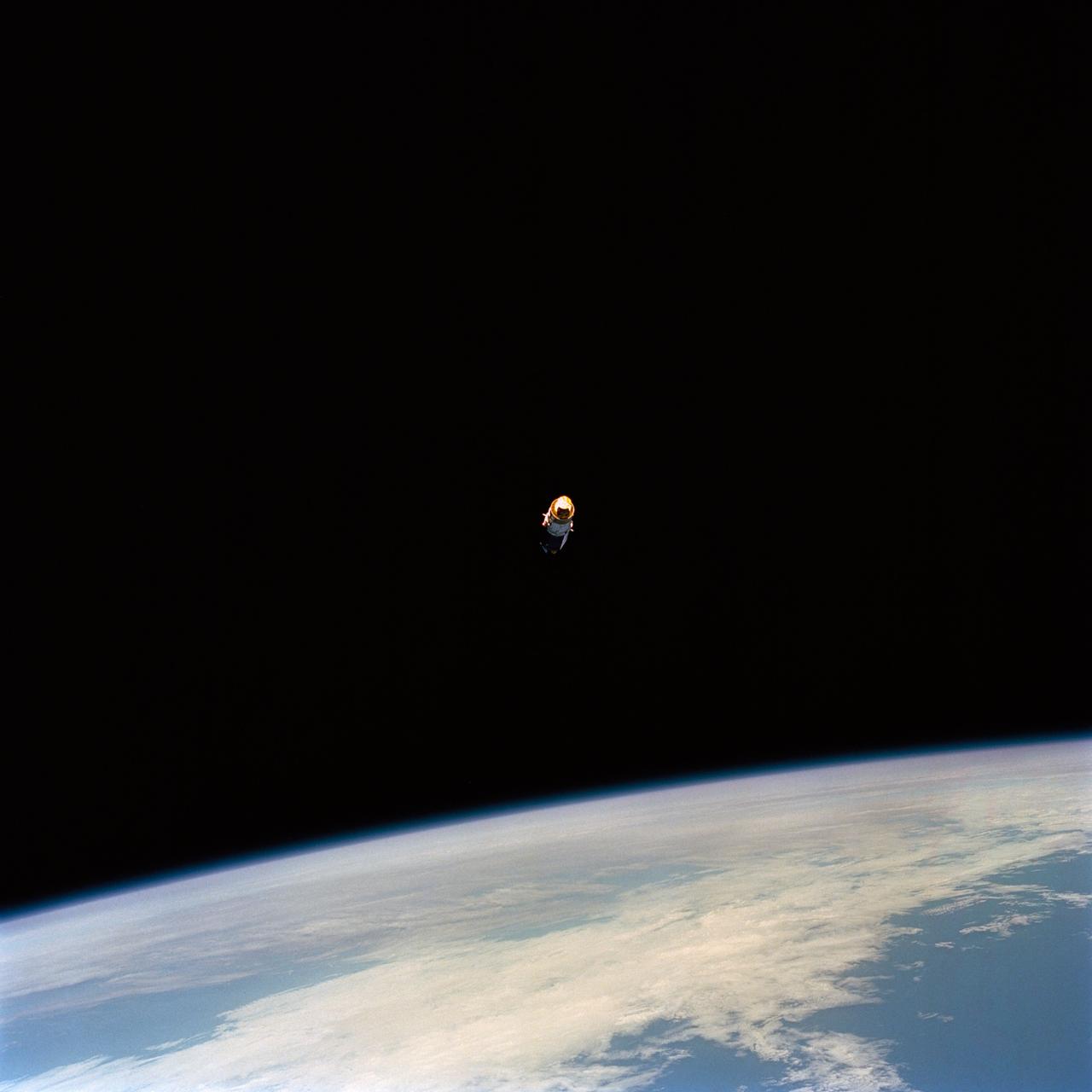
STS054-71-087 (13 Jan 1993) --- The Tracking and Data Relay Satellite (TDRS) is backdropped against the blackness of space, minutes after its release from the Space Shuttle Endeavour. Onboard NASA's newest Shuttle for the six-day mission are astronauts John H. Casper, mission commander; Donald R. McMonagle, pilot; and Mario Runco Jr., Gregory J. Harbaugh and Susan J. Helms, mission specialists. The photograph was taken with a 70mm camera.
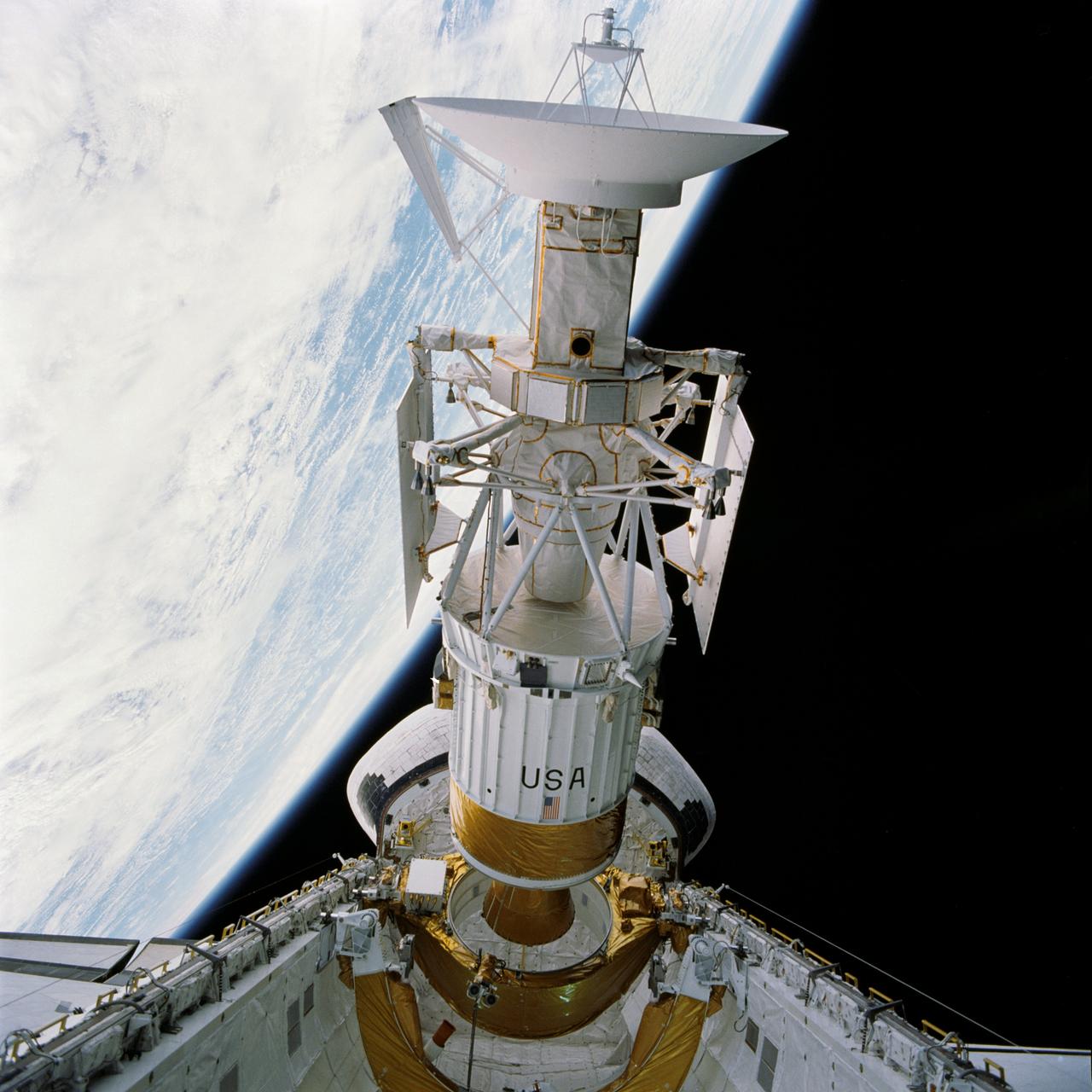
STS030-72-046 (4 May 1989) --- In the early evening hours of the Space Shuttle Atlantis' first day in space for the four-day STS-30 mission, the Magellan spacecraft is released into space to begin its long journey to the planet Venus for an extensive radar mapping mission. The scene was photographed through Atlantis' aft flight deck windows with a handheld 70mm camera.
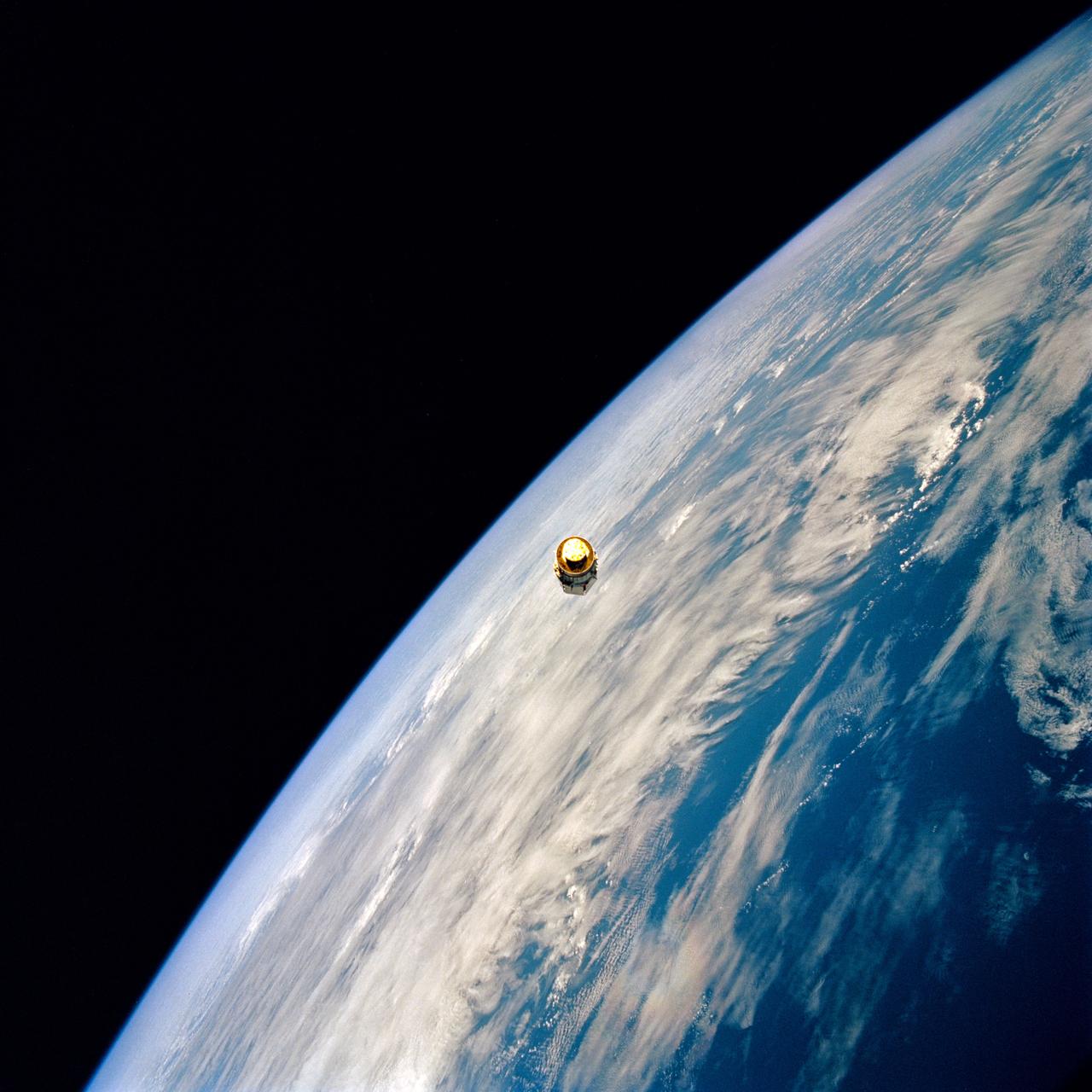
STS054-71-077 (13 Jan 1993) --- The Tracking and Data Relay Satellite (TDRS) quickly moves away from the Space Shuttle Endeavour following deployment on the first day of the six-day mission. Onboard NASA's newest Shuttle for the six-day mission are astronauts John H. Casper, mission commander; Donald R. McMonagle, pilot; and Mario Runco Jr., Gregory J. Harbaugh and Susan J. Helms, mission specialists. The photograph was taken with a 70mm camera.
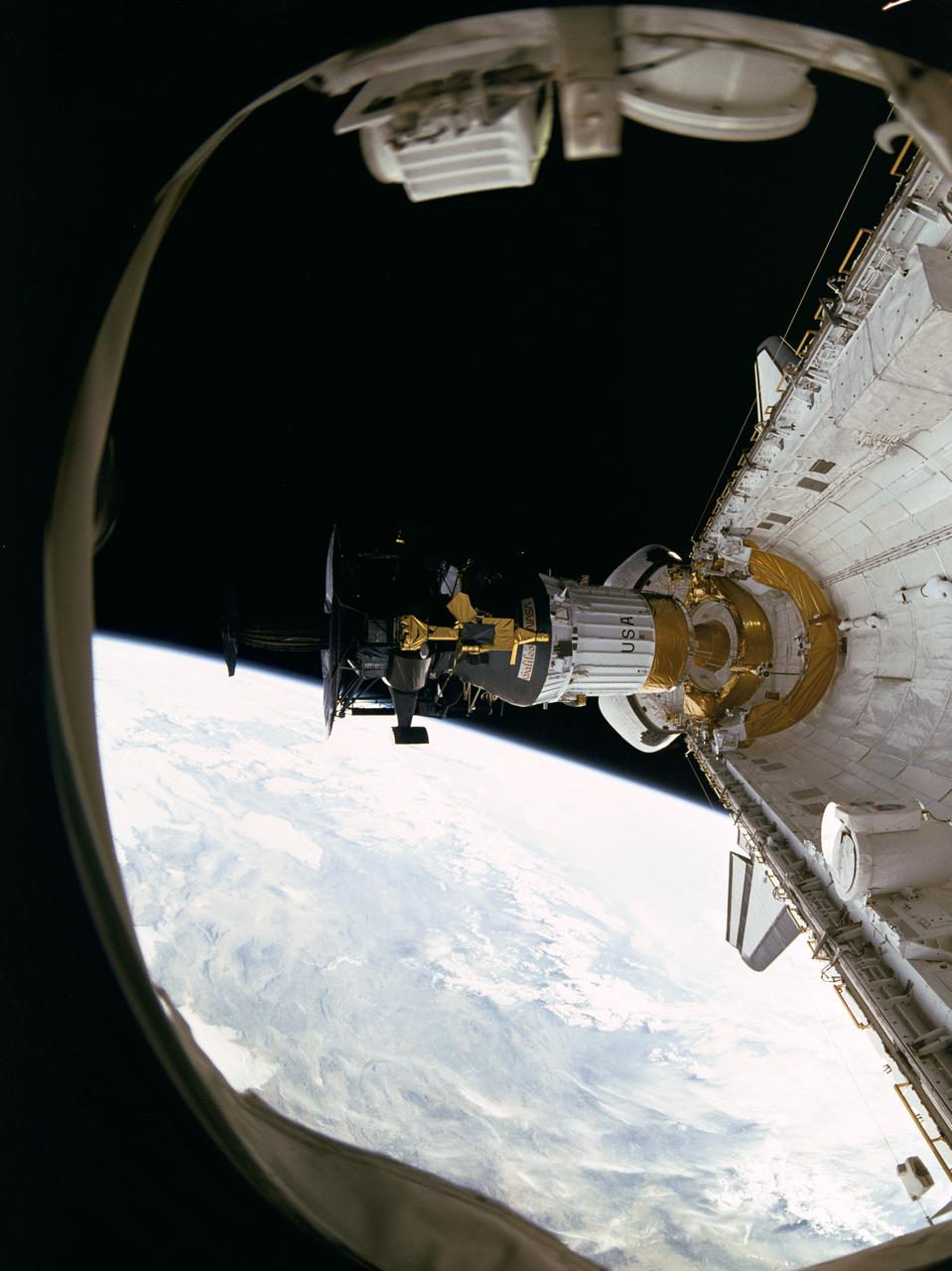
S89-48714 (18 Oct 1989) --- This photograph was taken by the STS-34 crew aboard the Space Shuttle Atlantis and shows the Galileo spacecraft being deployed on Oct. 18, 1989 from the payload bay. Galileo is a scientific craft that will go into orbit around the planet Jupiter and drop a probe into its atmosphere in search of primordial solar system material believed to be present there. The 70mm motion picture film will be used in the forthcoming "Blue Planet," which will address Earth's environmental problems from the perspective of space-based observation and solar system exploration. The film is being produced by IMAX Space Technology Inc. for the sponsor, the Smithsonian Institution, with funding provided by the Lockheed Corporation. PHOTO CREDIT: NASA/Smithsonian Institution
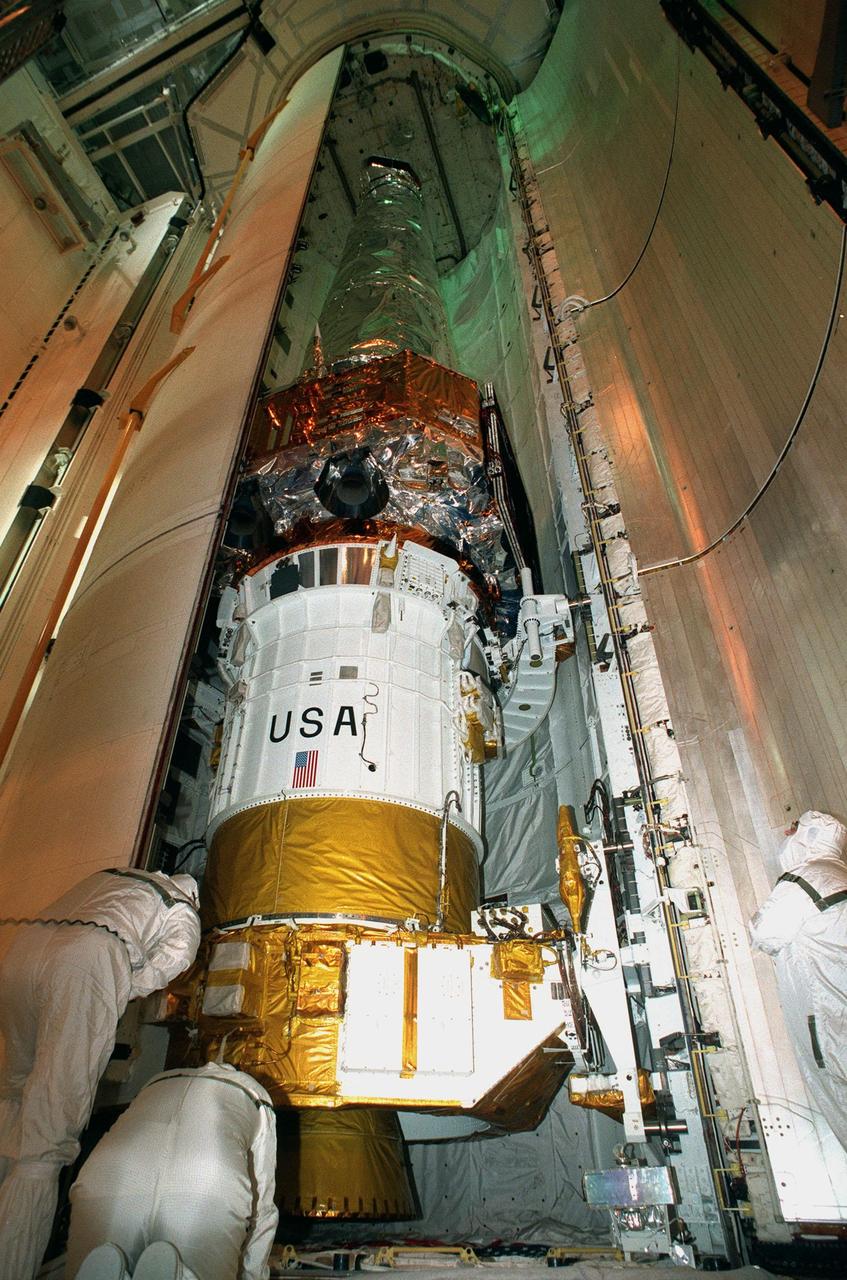
At Launch Pad 39-B, the Space Shuttle Columbia's payload bay doors close around the Chandra X-ray Observatory inside, while workers monitor the activity. Chandra is the primary payload on mission STS-93, scheduled to launch aboard Columbia July 20 at 12:36 a.m. EDT. The combined Chandra/Inertial Upper Stage, seen here, measures 57 feet long and weighs 50,162 pounds. Fully deployed with solar arrays extended, the observatory measures 45.3 feet long and 64 feet wide. The world's most powerful X-ray telescope, Chandra will allow scientists from around the world to see previously invisible black holes and high-temperature gas clouds, giving the observatory the potential to rewrite the books on the structure and evolution of our universe
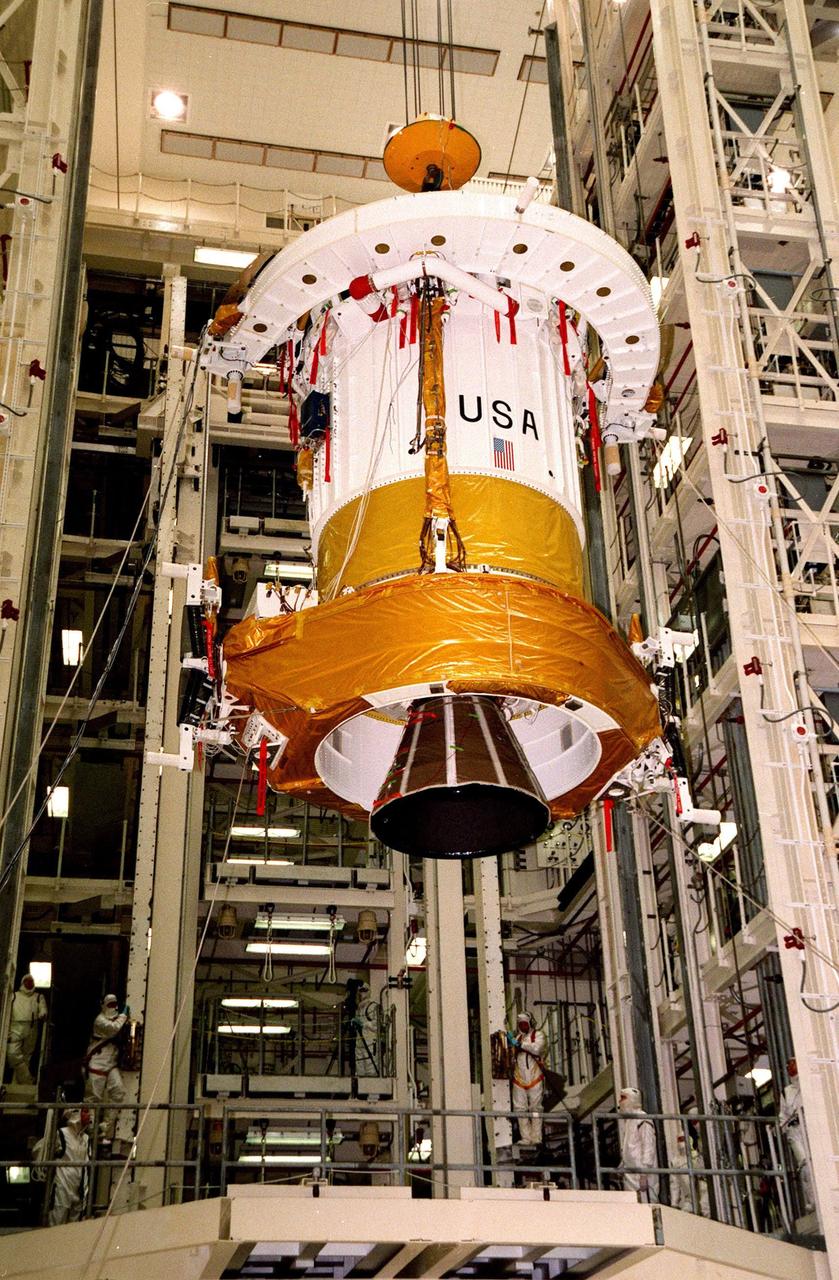
The Inertial Upper Stage (IUS) booster is moved toward a workstand in Kennedy Space Center's Vertical Processing Facility. The IUS will be mated with the Chandra X-ray Observatory and then undergo testing to validate the IUS/Chandra connections and check the orbiter avionics interfaces. Following that, an end-to-end test (ETE) will be conducted to verify the communications path to Chandra, commanding it as if it were in space. With the world's most powerful X-ray telescope, Chandra will allow scientists from around the world to see previously invisible black holes and high-temperature gas clouds, giving the observatory the potential to rewrite the books on the structure and evolution of our universe. Chandra is scheduled for launch July 22 aboard Space Shuttle Columbia, on mission STS-93
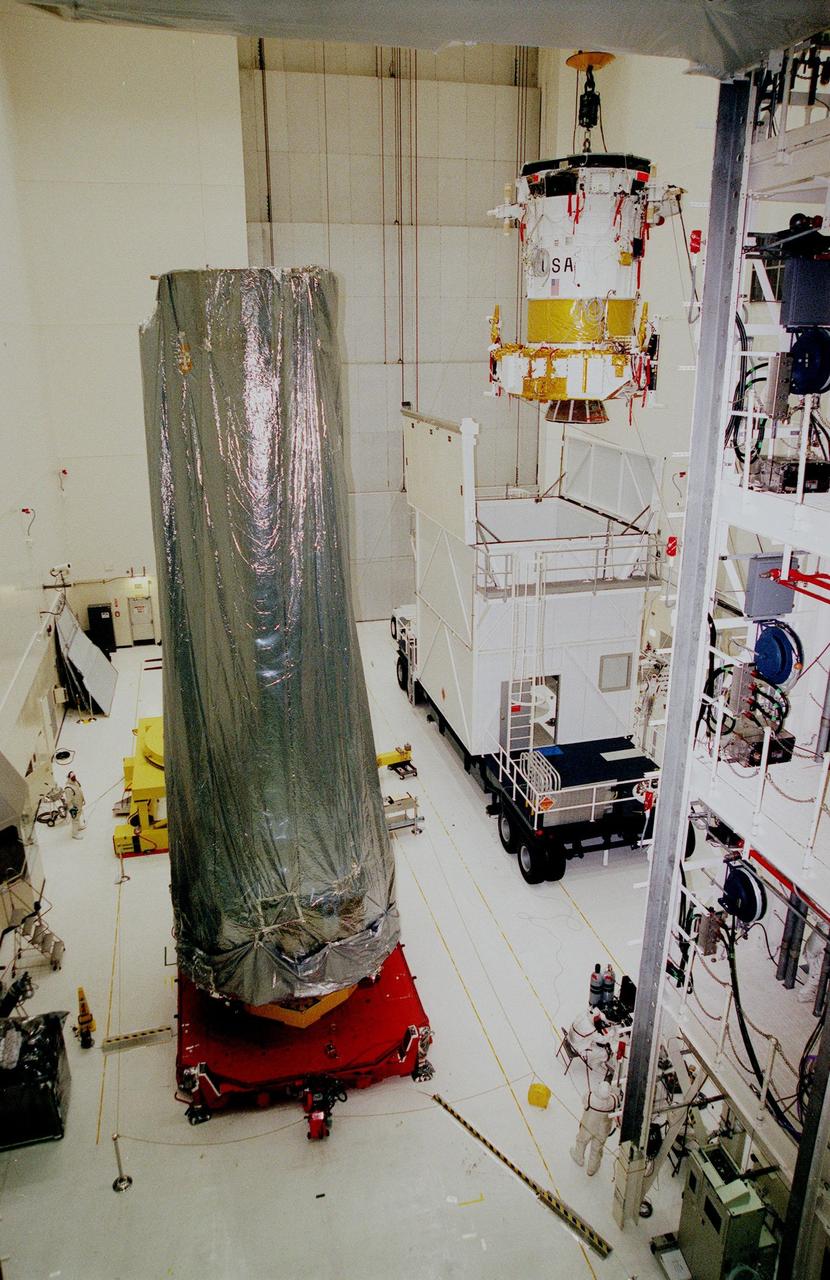
The Inertial Upper Stage (IUS) booster (right) is lifted out of its container after arriving at Kennedy Space Center's Vertical Processing Facility. The IUS will be mated with the Chandra X-ray Observatory (at left) and then undergo testing to validate the IUS/Chandra connections and check the orbiter avionics interfaces. Following that, an end-to-end test (ETE) will be conducted to verify the communications path to Chandra, commanding it as if it were in space. With the world's most powerful X-ray telescope, Chandra will allow scientists from around the world to see previously invisible black holes and high-temperature gas clouds, giving the observatory the potential to rewrite the books on the structure and evolution of our universe. Chandra is scheduled for launch July 22 aboard Space Shuttle Columbia, on mission STS-93
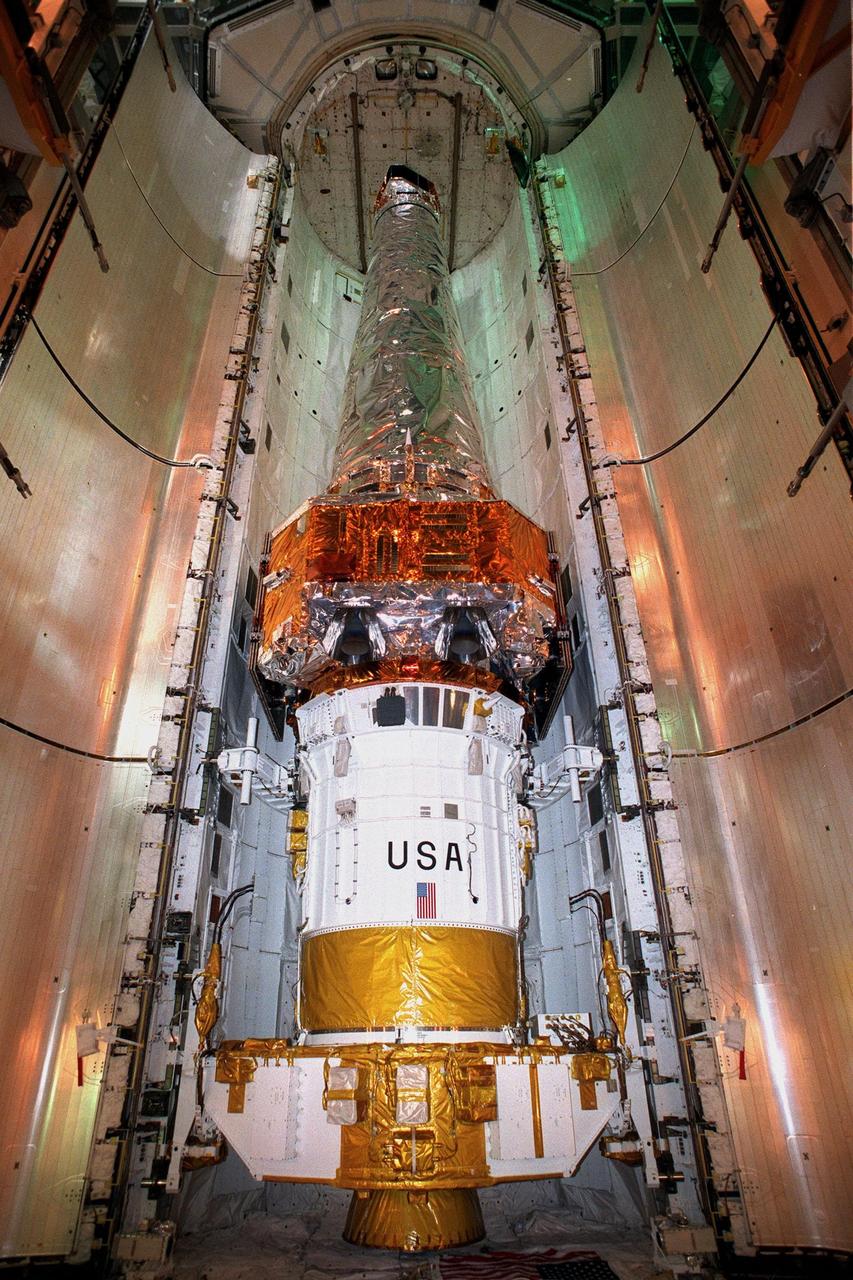
At Launch Pad 39-B, the Chandra X-ray Observatory sits inside the payload bay of Space Shuttle Columbia, waiting for the doors to close. Chandra is the primary payload on mission STS-93, scheduled to launch aboard Columbia July 20 at 12:36 a.m. EDT. The combined Chandra/Inertial Upper Stage, seen here, measures 57 feet long and weighs 50,162 pounds. Fully deployed with solar arrays extended, the observatory measures 45.3 feet long and 64 feet wide. The world's most powerful X-ray telescope, Chandra will allow scientists from around the world to see previously invisible black holes and high-temperature gas clouds, giving the observatory the potential to rewrite the books on the structure and evolution of our universe

In the Vertical Processing Facility (VPF), workers move the shrouded Chandra X-ray Observatory on its workstand to the scaffolding behind it. The telescope will undergo final installation of associated electronic components; it will also be tested, fueled and mated with the Inertial Upper Stage booster. A set of integrated tests will follow. Chandra is scheduled for launch July 9 aboard Space Shuttle Columbia, on mission STS-93 . Formerly called the Advanced X-ray Astrophysics Facility, Chandra comprises three major elements: the spacecraft, the science instrument module (SIM), and the world's most powerful X-ray telescope. Chandra will allow scientists from around the world to see previously invisible black holes and high-temperature gas clouds, giving the observatory the potential to rewrite the books on the structure and evolution of our universe
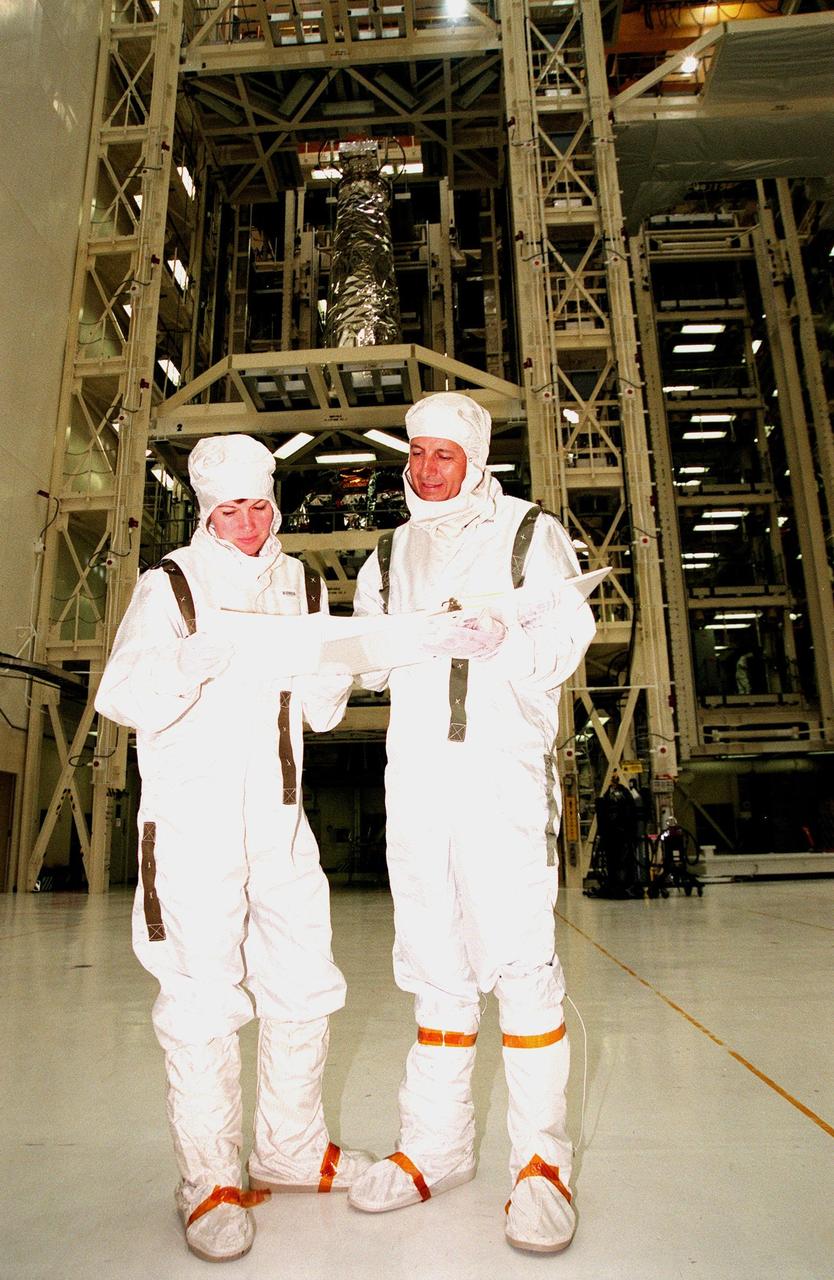
STS-93 Mission Specialists Catherine Coleman (left) and Michel Tognini of France (right), representing the Centre National d'Etudes Spatiales (CNES), look over material on the mission payload behind them, the Chandra X-ray Observatory. Chandra is being mated with the Inertial Upper Stage (IUS) before testing to validate the IUS/Chandra connections and to check the orbiter avionics interfaces. Following that, an end-to-end test (ETE) will be conducted to verify the communications path to Chandra, commanding it as if it were in space. With the world's most powerful X-ray telescope, Chandra will allow scientists from around the world to see previously invisible black holes and high-temperature gas clouds, giving the observatory the potential to rewrite the books on the structure and evolution of our universe. Chandra is scheduled for launch July 22 aboard Space Shuttle Columbia, on mission STS-93
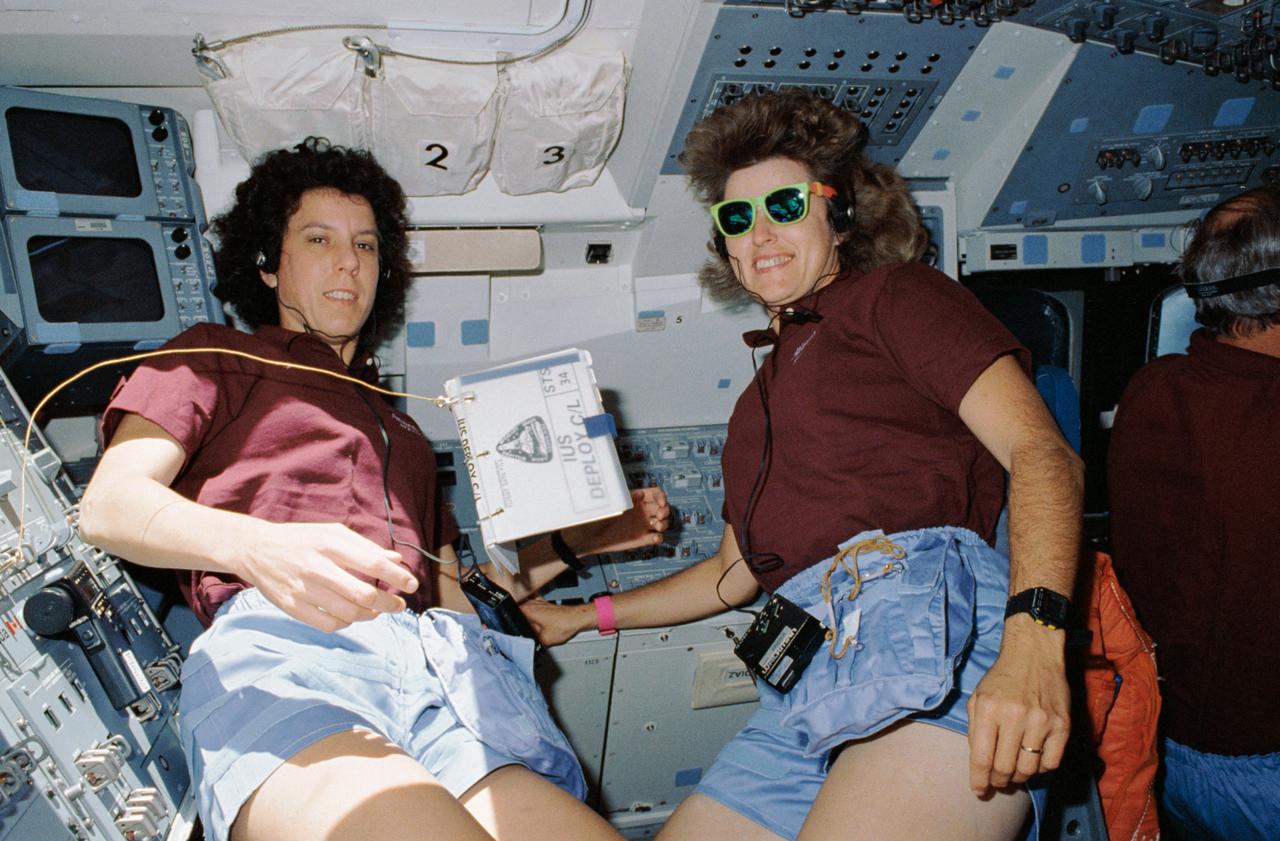
STS034-09-007 (23 Oct. 1989) --- Having been in space only a few hours, three of the STS-34 astronaut crew prepare for pre-deployment exercises involving one of the most prominent "passengers" of the flight -- the Galileo payload which was lying in Atlantis', Orbiter Vehicle (OV) 104's, payload bay (PLB). Pictured, left to right, are astronauts Ellen S. Baker and Shannon W. Lucid, both mission specialists; along with Donald E. Williams, commander, who guided OV-104's course during the exercise. Baker and Lucid communicated with ground controllers while juggling other Galileo-related chores. Both Baker and Lucid are equipped with SONY Walkmans and are wearing headsets. Lucid wears a pair of sunglasses with brightly colored frames. A tethered inertial upper stage (IUS) deploy checklist (C/L) floats between the two and a spotmeter is Velcroed to an on orbit station control panel.
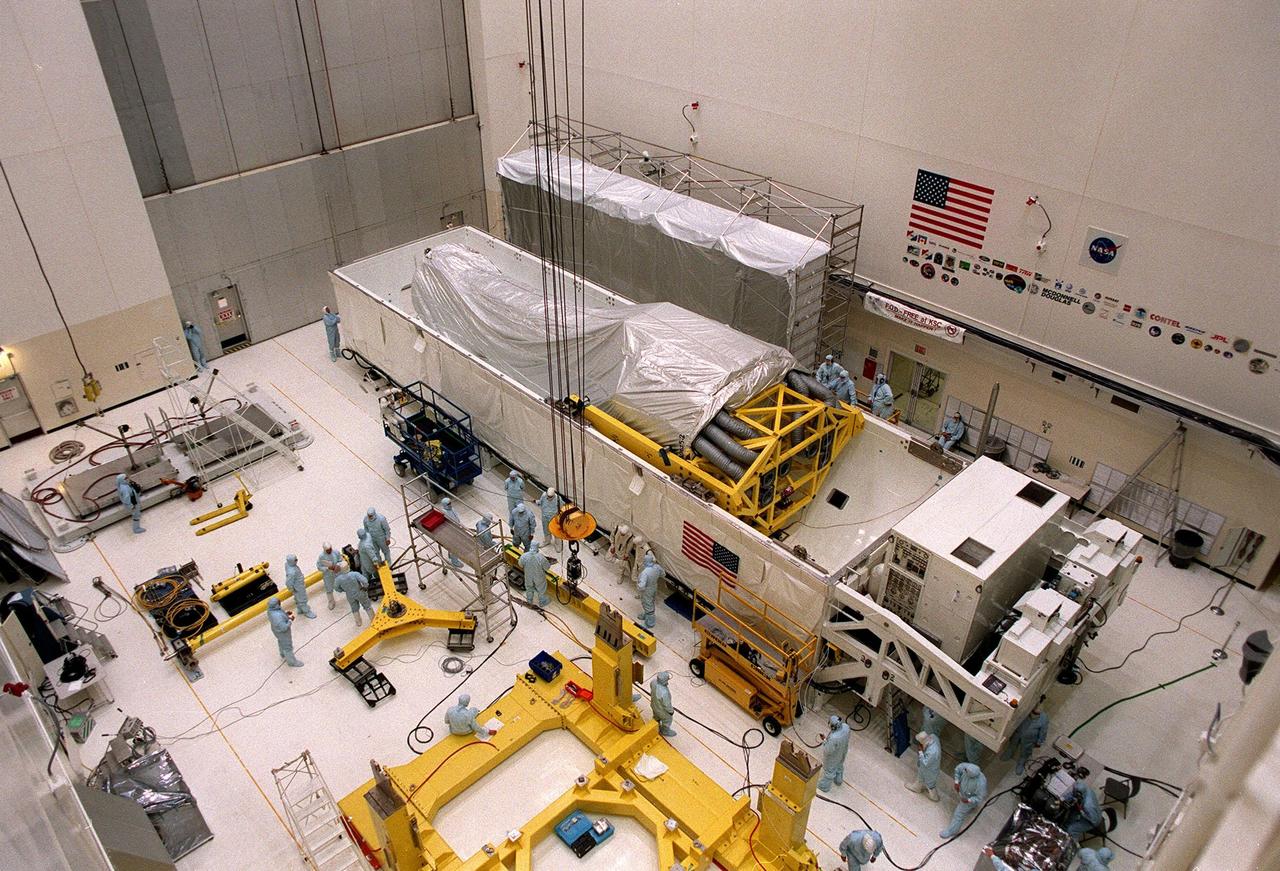
Inside the Vertical Processing Facility (VPF), the Chandra X-ray Observatory (top) lies in its protective container while workers on the floor prepare the overhead cable that will remove it. In the VPF, the telescope will undergo final installation of associated electronic components; it will also be tested, fueled and mated with the Inertial Upper Stage booster. A set of integrated tests will follow. Chandra is scheduled for launch July 9 aboard Space Shuttle Columbia, on mission STS-93 . Formerly called the Advanced X-ray Astrophysics Facility, Chandra comprises three major elements: the spacecraft, the science instrument module (SIM), and the world's most powerful X-ray telescope. Chandra will allow scientists from around the world to see previously invisible black holes and high-temperature gas clouds, giving the observatory the potential to rewrite the books on the structure and evolution of our universe
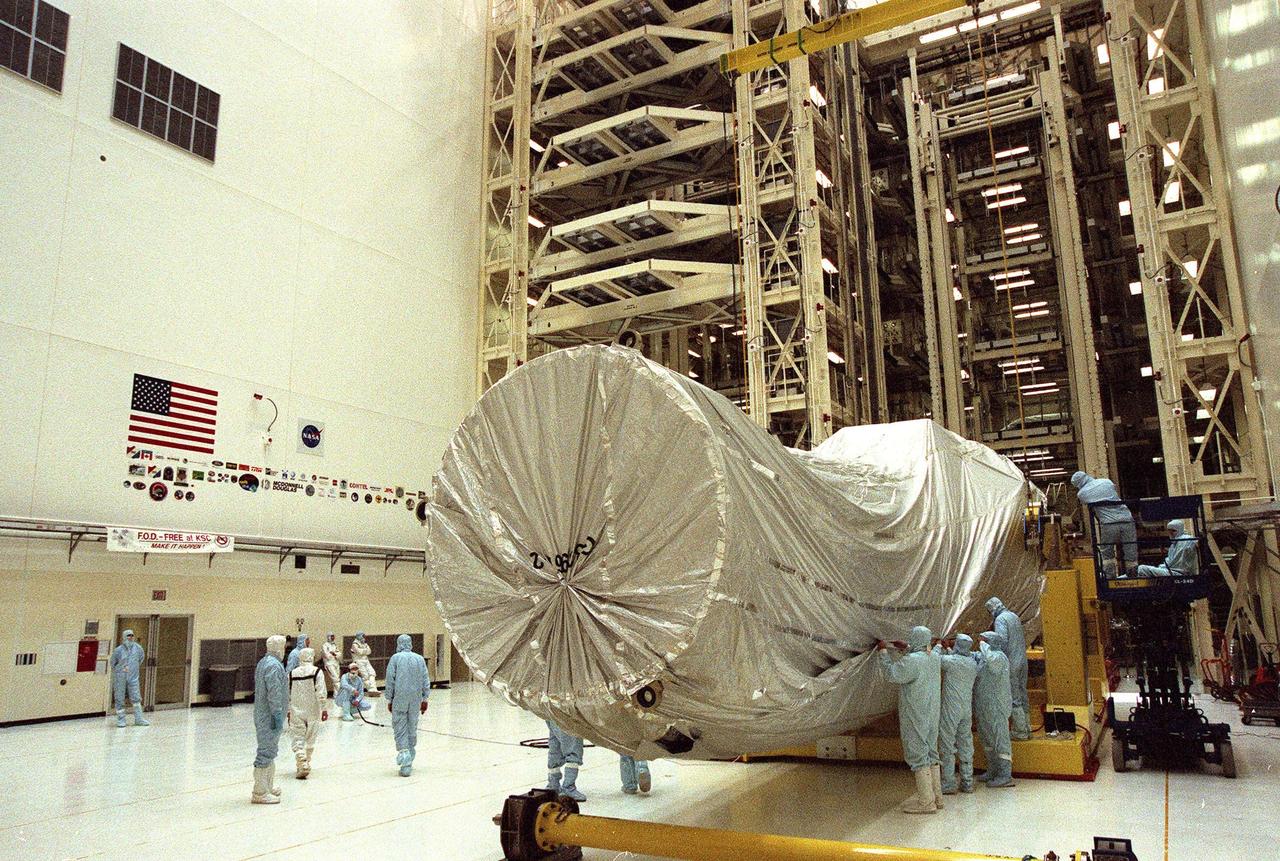
In the Vertical Processing Facility (VPF), workers prepare the shrouded Chandra X-ray Observatory for its lift to a vertical position. The telescope will undergo final installation of associated electronic components; it will also be tested, fueled and mated with the Inertial Upper Stage booster. A set of integrated tests will follow. Chandra is scheduled for launch July 9 aboard Space Shuttle Columbia, on mission STS-93 . Formerly called the Advanced X-ray Astrophysics Facility, Chandra comprises three major elements: the spacecraft, the science instrument module (SIM), and the world's most powerful X-ray telescope. Chandra will allow scientists from around the world to see previously invisible black holes and high-temperature gas clouds, giving the observatory the potential to rewrite the books on the structure and evolution of our universe
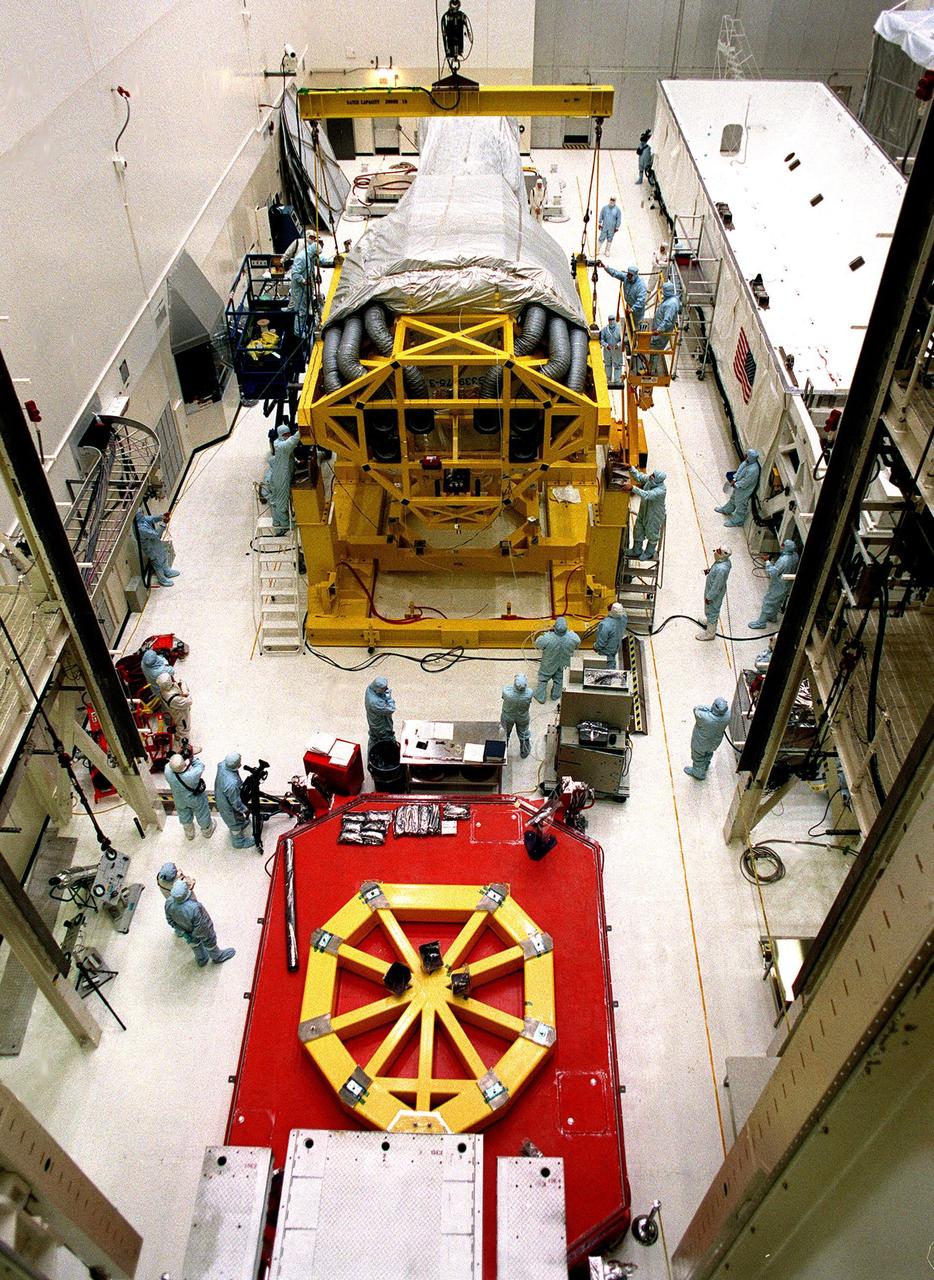
In the Vertical Processing Facility (VPF), workers check the placement of the Chandra X-ray Observatory on the stand on the floor. The stand will be used to raise the observatory to a vertical position. While in the VPF, the telescope will undergo final installation of associated electronic components; it will also be tested, fueled and mated with the Inertial Upper Stage booster. A set of integrated tests will follow. Chandra is scheduled for launch July 9 aboard Space Shuttle Columbia, on mission STS-93 . Formerly called the Advanced X-ray Astrophysics Facility, Chandra comprises three major elements: the spacecraft, the science instrument module (SIM), and the world's most powerful X-ray telescope. Chandra will allow scientists from around the world to see previously invisible black holes and high-temperature gas clouds, giving the observatory the potential to rewrite the books on the structure and evolution of our universe

At the Kennedy Space Center's (KSC's) Spacecraft and Assembly Encapsulation Facility 2 (SAEF-2), the planetary spacecraft checkout facility, clean-suited technicians work on the Galileo spacecraft prior to moving it to the Vehicle Processing Facility (VPF) for mating with the inertial upper stage (IUS). Galileo is scheduled for launch aboard Atlantis, Orbiter Vehicle (OV) 104, on Space Shuttle Mission STS-34 in October 1989. It will be sent to the planet Jupiter, a journey which will taken more than six years to complete. In December 1995 as the two and one half ton spacecraft orbits Jupiter with its ten scientific instruments, a probe will be released to parachute into the Jovian atmosphere. NASA's Jet Propulsion Laboratory (JPL) manages the Galileo project. View provided by KSC.
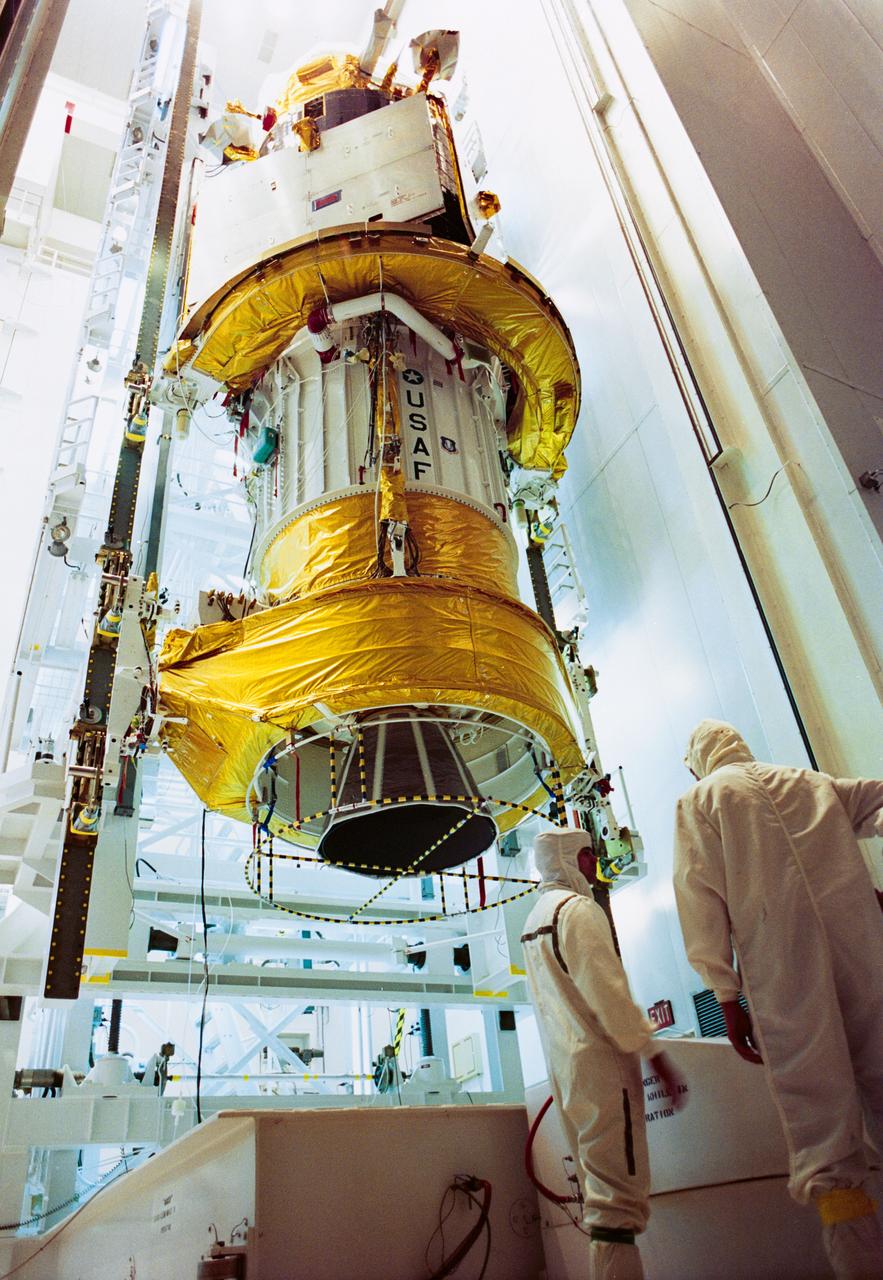
S91-50773 (19 Oct 1991) --- At a processing facility on Cape Canaveral Air Force Station, the Defense Support Program (DSP) satellite is being transferred into the payload canister transporter for shipment to Launch Pad 39A at KSC. The DSP will be deployed during Space Shuttle Mission STS-44 later this year. It is a surveillance satellite, developed for the Department of Defense, which can detect missile and space launches, as well as nuclear detonations. The Inertial Upper Stage which will boost the DSP satellite to its proper orbital position is the lower portion of the payload. DSP satellites have comprised the spaceborne segment of NORAD's (North American Air Defense Command) Tactical Warning and Attack Assessment System since 1970. STS- 44, carrying a crew of six, will be a ten-day flight.
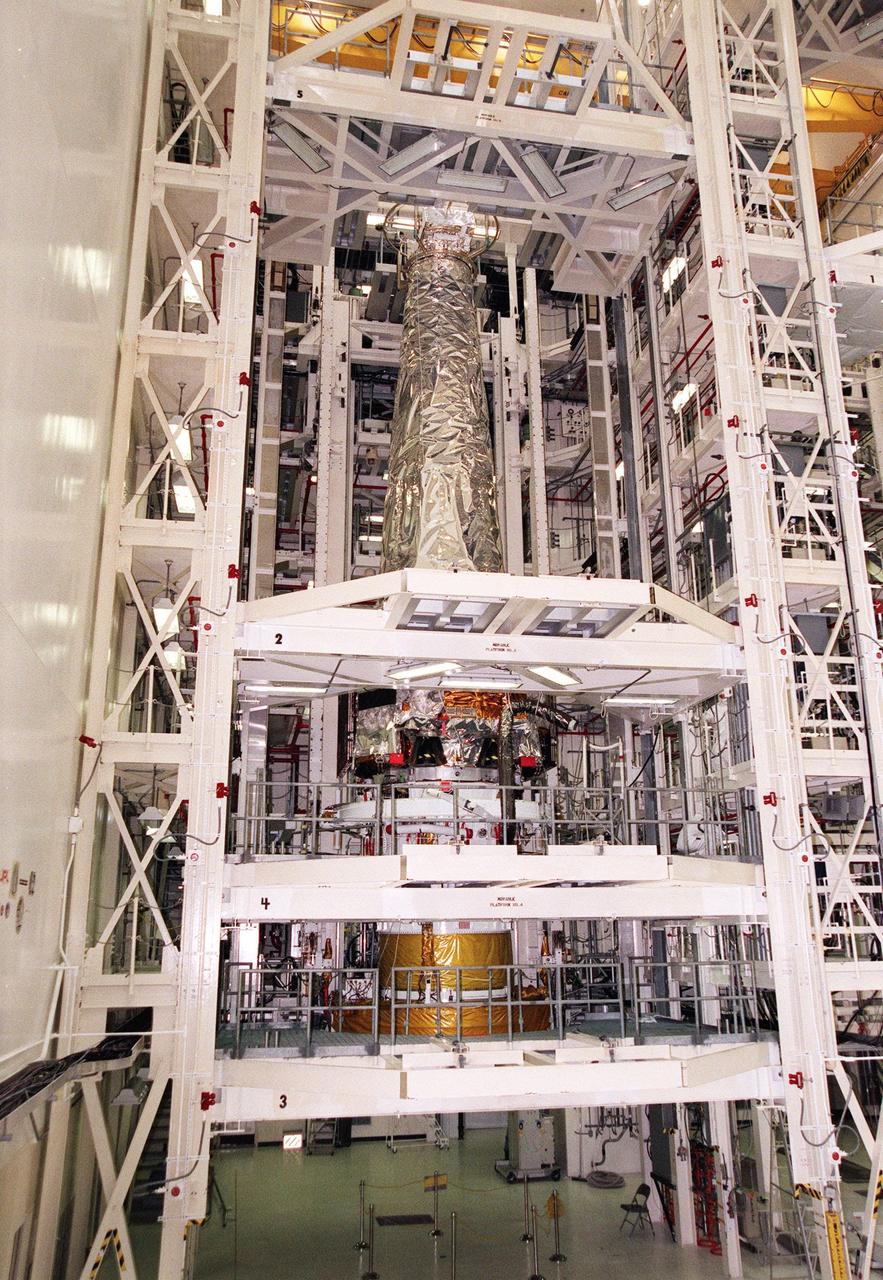
In the Vertical Processing Facility, the Chandra X-ray Observatory is revealed with its protective cover removed. Chandra is ready for mating with the Inertial Upper Stage (IUS) beneath it, to be followed by testing to validate the IUS/Chandra connections and to check the orbiter avionics interfaces. Following that, an end-to-end test (ETE) will be conducted to verify the communications path to Chandra, commanding it as if it were in space. With the world's most powerful X-ray telescope, Chandra will allow scientists from around the world to see previously invisible black holes and high-temperature gas clouds, giving the observatory the potential to rewrite the books on the structure and evolution of our universe. Chandra is scheduled for launch July 22 aboard Space Shuttle Columbia, on mission STS-93
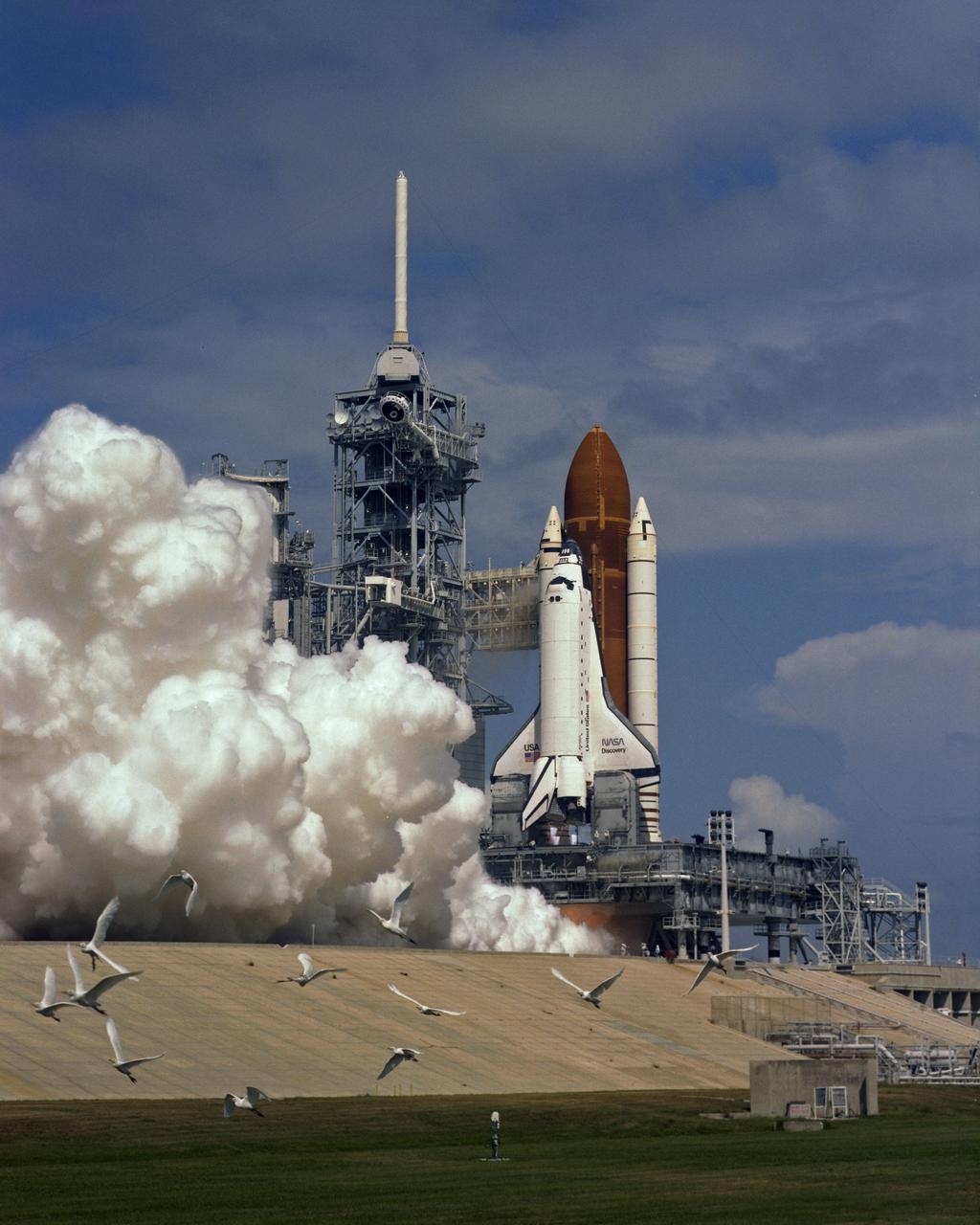
CAPE CANAVERAL, Fla. - The space shuttle Discovery and its five-man crew is launched from pad 39B at 11:37 a.m. as STS-26 embarks on a four-day mission marking America's return to space. On the first day of orbit, the crew will deploy from the orbiter's payload bay the primary payload, the Tracking and Date Relay Satellite, or TDRS-C. The inertial upper stage, or IUS, will boost the satellite to a geosynchronous altitude from low Earth orbit. When it place, TDRS-C will relay date from low Earth orbiting spacecraft and air-to-ground voice communications sand television from shape shuttle orbiters during missions. The crew members of STST-26 are Commander Rick Hauck, Pilot Richard Covey, and Mission Specialists Dave Hilmers, Mike Lounge and George "Pinky" Nelson. Photo Credit: NASA
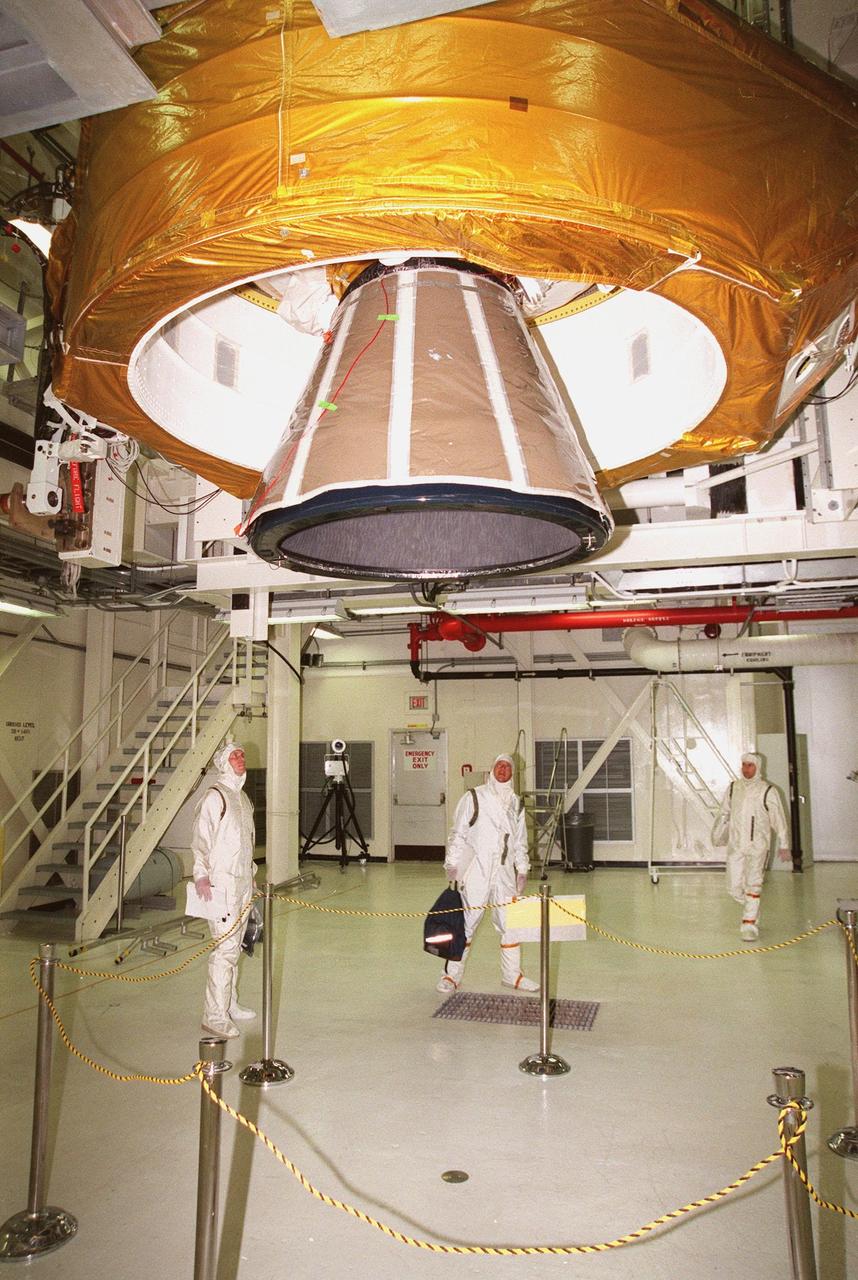
Workers in the Vertical Processing Facility observe the lower end of the Inertial Upper Stage (IUS) that will be mated with the Chandra X-ray Observatory (out of sight above it). After the two components are mated, they will undergo testing to validate the IUS/Chandra connections and to check the orbiter avionics interfaces. Following that, an end-to-end test (ETE) will be conducted to verify the communications path to Chandra, commanding it as if it were in space. With the world's most powerful X-ray telescope, Chandra will allow scientists from around the world to see previously invisible black holes and high-temperature gas clouds, giving the observatory the potential to rewrite the books on the structure and evolution of our universe. Chandra is scheduled for launch July 22 aboard Space Shuttle Columbia, on mission STS-93
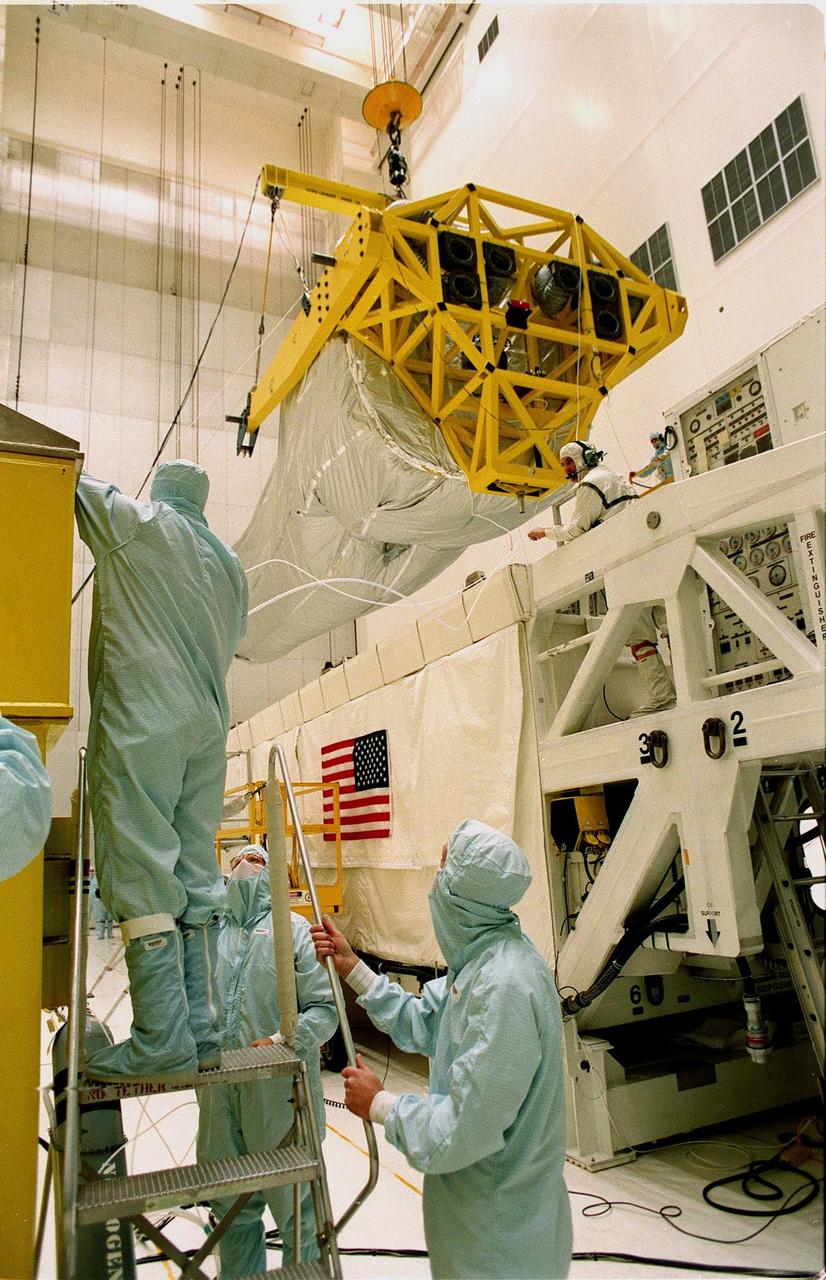
In the Vertical Processing Facility (VPF), workers begin moving the overhead crane carrying the Chandra X-ray Observatory from its protective container to a stand on the floor. While in the VPF, the telescope will undergo final installation of associated electronic components; it will also be tested, fueled and mated with the Inertial Upper Stage booster. A set of integrated tests will follow. Chandra is scheduled for launch July 9 aboard Space Shuttle Columbia, on mission STS-93 . Formerly called the Advanced X-ray Astrophysics Facility, Chandra comprises three major elements: the spacecraft, the science instrument module (SIM), and the world's most powerful X-ray telescope. Chandra will allow scientists from around the world to see previously invisible black holes and high-temperature gas clouds, giving the observatory the potential to rewrite the books on the structure and evolution of our universe
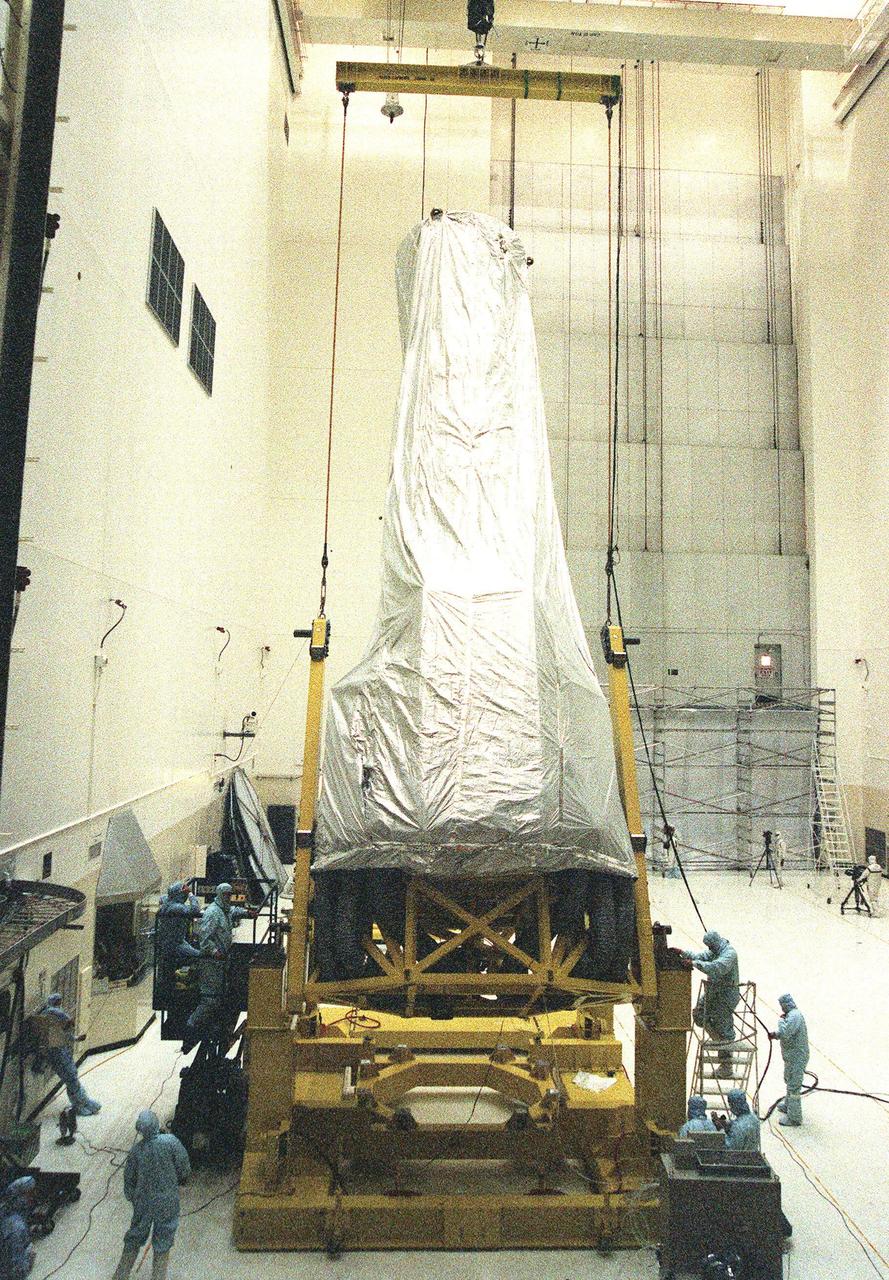
In the Vertical Processing Facility (VPF), the shrouded Chandra X-ray Observatory achieves a vertical position via the overhead crane. The telescope will undergo final installation of associated electronic components; it will also be tested, fueled and mated with the Inertial Upper Stage booster. A set of integrated tests will follow. Chandra is scheduled for launch July 9 aboard Space Shuttle Columbia, on mission STS-93 . Formerly called the Advanced X-ray Astrophysics Facility, Chandra comprises three major elements: the spacecraft, the science instrument module (SIM), and the world's most powerful X-ray telescope. Chandra will allow scientists from around the world to see previously invisible black holes and high-temperature gas clouds, giving the observatory the potential to rewrite the books on the structure and evolution of our universe
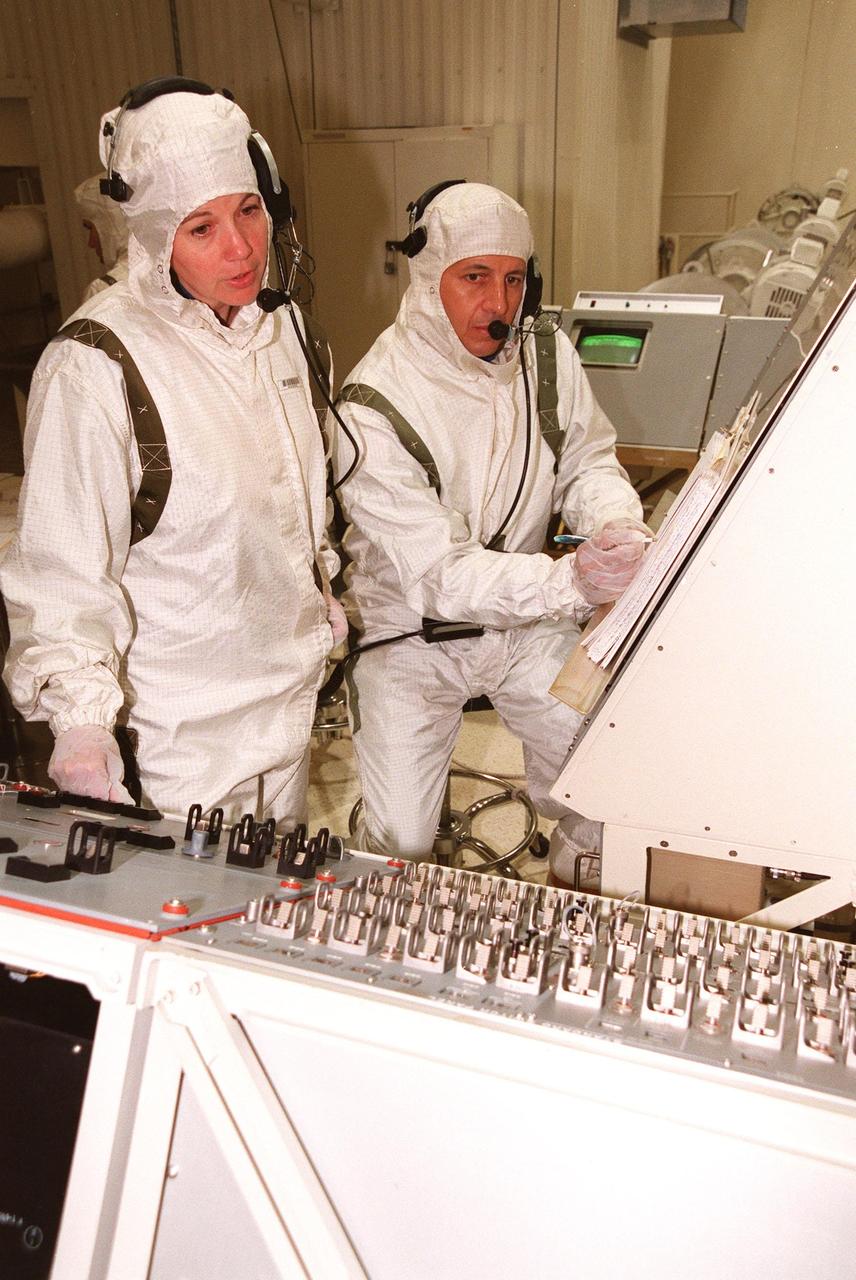
STS-93 Mission Specialists Catherine Coleman (left) and Michel Tognini of France (right), who represents the Centre National d'Etudes Spatiales (CNES), look over the controls for the Chandra X-ray Observatory. Chandra is being mated with the Inertial Upper Stage (IUS) before testing to validate the IUS/Chandra connections and to check the orbiter avionics interfaces. Following that, an end-to-end test (ETE) will be conducted to verify the communications path to Chandra, commanding it as if it were in space. With the world's most powerful X-ray telescope, Chandra will allow scientists from around the world to see previously invisible black holes and high-temperature gas clouds, giving the observatory the potential to rewrite the books on the structure and evolution of our universe. Chandra is scheduled for launch July 22 aboard Space Shuttle Columbia, on mission STS-93
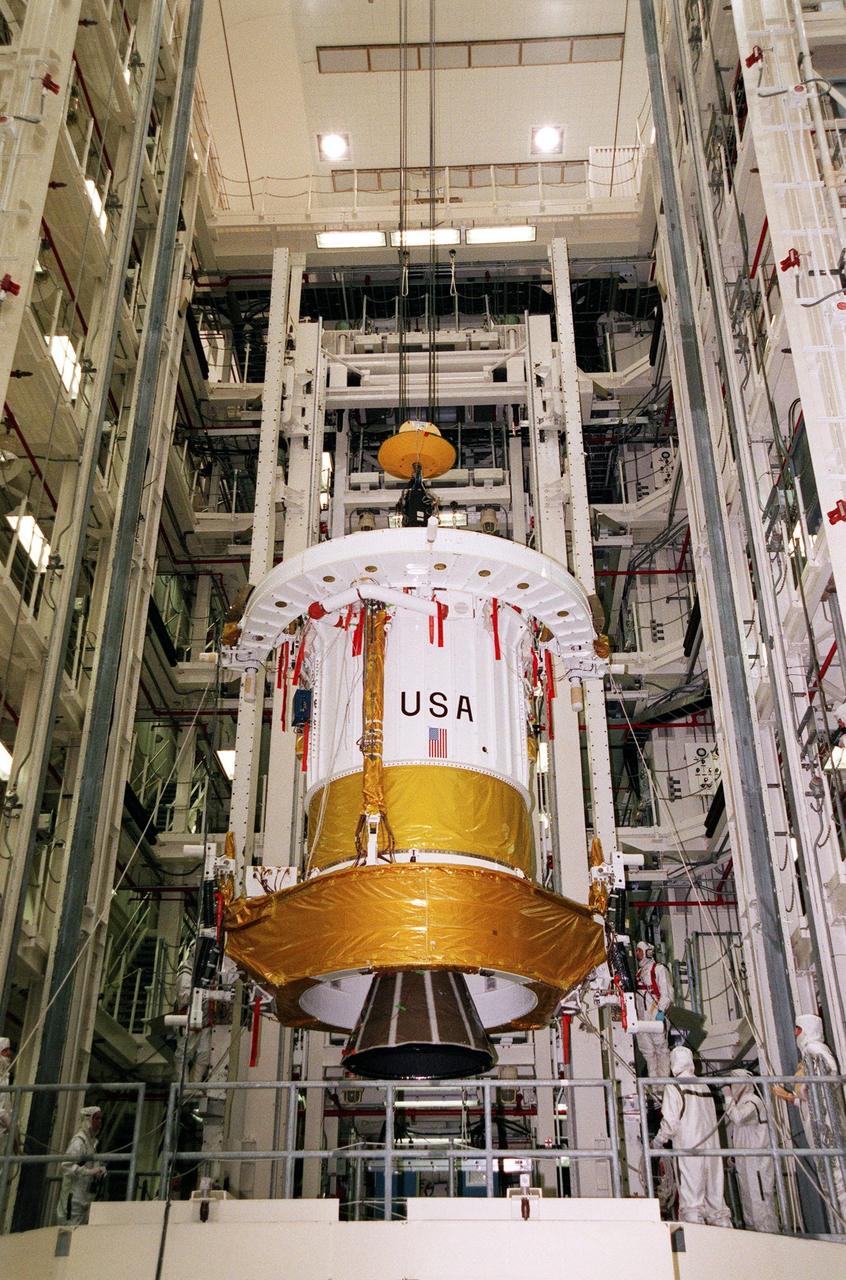
The Inertial Upper Stage (IUS) booster is lowered toward a workstand in Kennedy Space Center's Vertical Processing Facility. The IUS will be mated with the Chandra X-ray Observatory and then undergo testing to validate the IUS/Chandra connections and check the orbiter avionics interfaces. Following that, an end-to-end test (ETE) will be conducted to verify the communications path to Chandra, commanding it as if it were in space. With the world's most powerful X-ray telescope, Chandra will allow scientists from around the world to see previously invisible black holes and high-temperature gas clouds, giving the observatory the potential to rewrite the books on the structure and evolution of our universe. Chandra is scheduled for launch July 22 aboard Space Shuttle Columbia, on mission STS-93
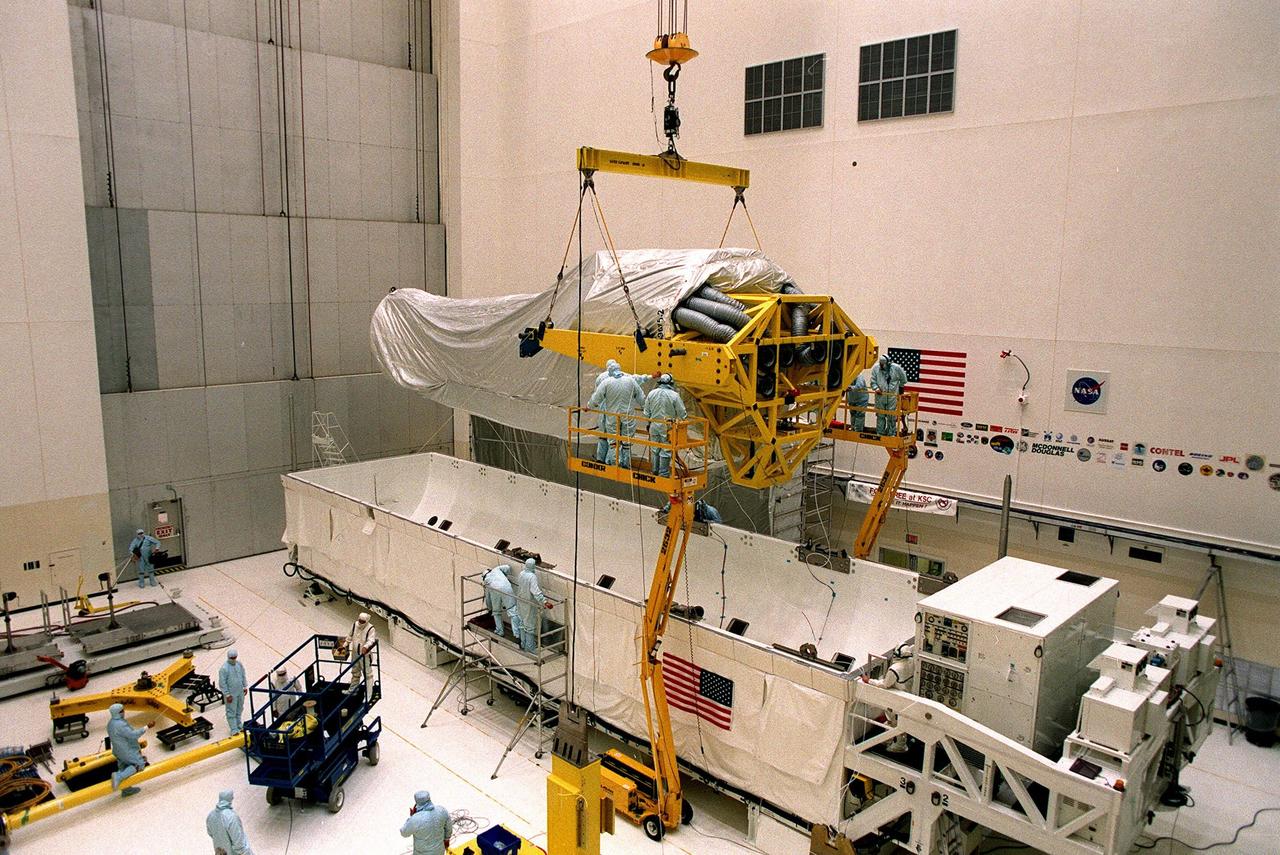
Inside the Vertical Processing Facility (VPF), the overhead crane lifts Chandra X-ray Observatory completely out of its protective container. While in the VPF, the telescope will undergo final installation of associated electronic components; it will also be tested, fueled and mated with the Inertial Upper Stage booster. A set of integrated tests will follow. Chandra is scheduled for launch July 9 aboard Space Shuttle Columbia, on mission STS-93 . Formerly called the Advanced X-ray Astrophysics Facility, Chandra comprises three major elements: the spacecraft, the science instrument module (SIM), and the world's most powerful X-ray telescope. Chandra will allow scientists from around the world to see previously invisible black holes and high-temperature gas clouds, giving the observatory the potential to rewrite the books on the structure and evolution of our universe
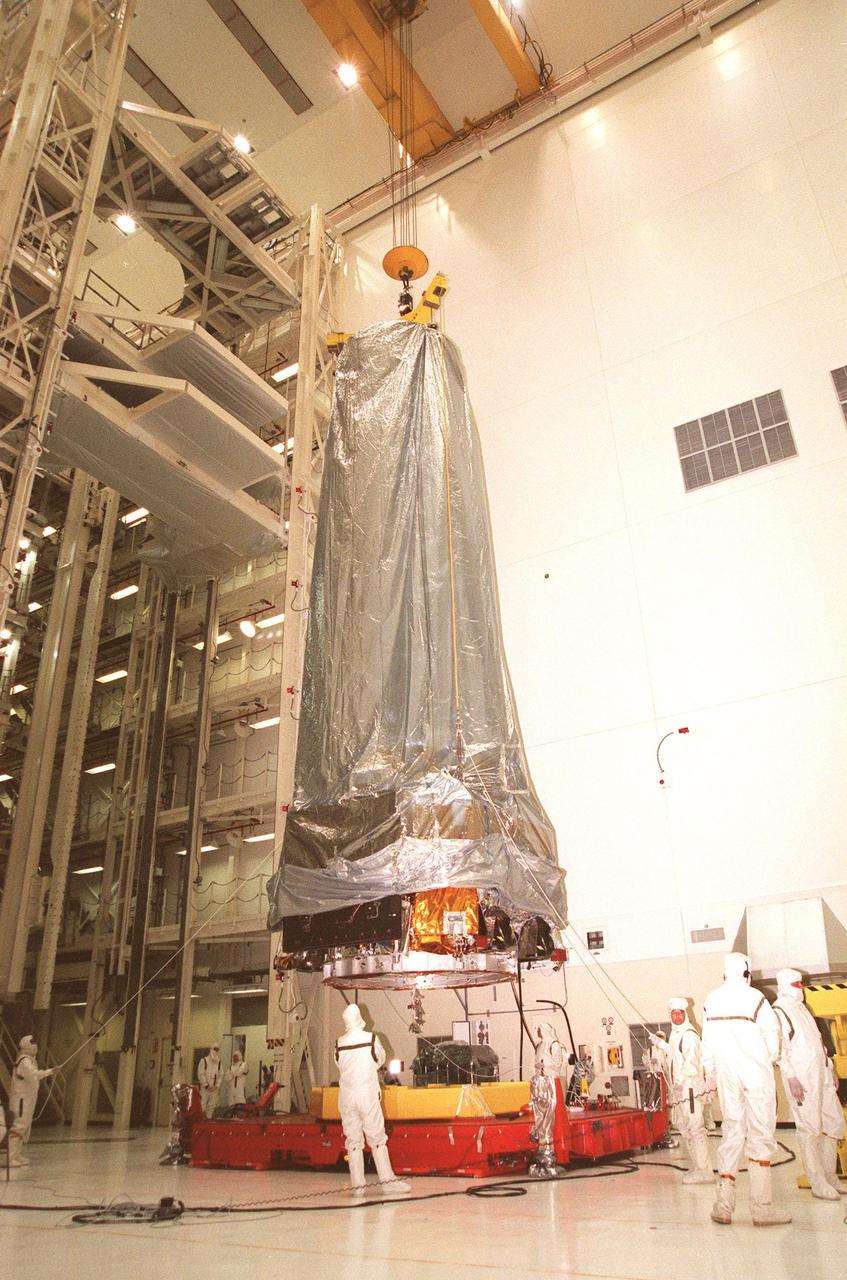
In the Vertical Processing Facility, the Chandra X-ray Observatory is lifted from its workstand in order to move it to the Inertial Upper Stage (IUS) nearby. After being mated, the two components will then undergo testing to validate the IUS/Chandra connections and check the orbiter avionics interfaces. Following that, an end-to-end test (ETE) will be conducted to verify the communications path to Chandra, commanding it as if it were in space. With the world's most powerful X-ray telescope, Chandra will allow scientists from around the world to see previously invisible black holes and high-temperature gas clouds, giving the observatory the potential to rewrite the books on the structure and evolution of our universe. Chandra is scheduled for launch July 22 aboard Space Shuttle Columbia, on mission STS-93
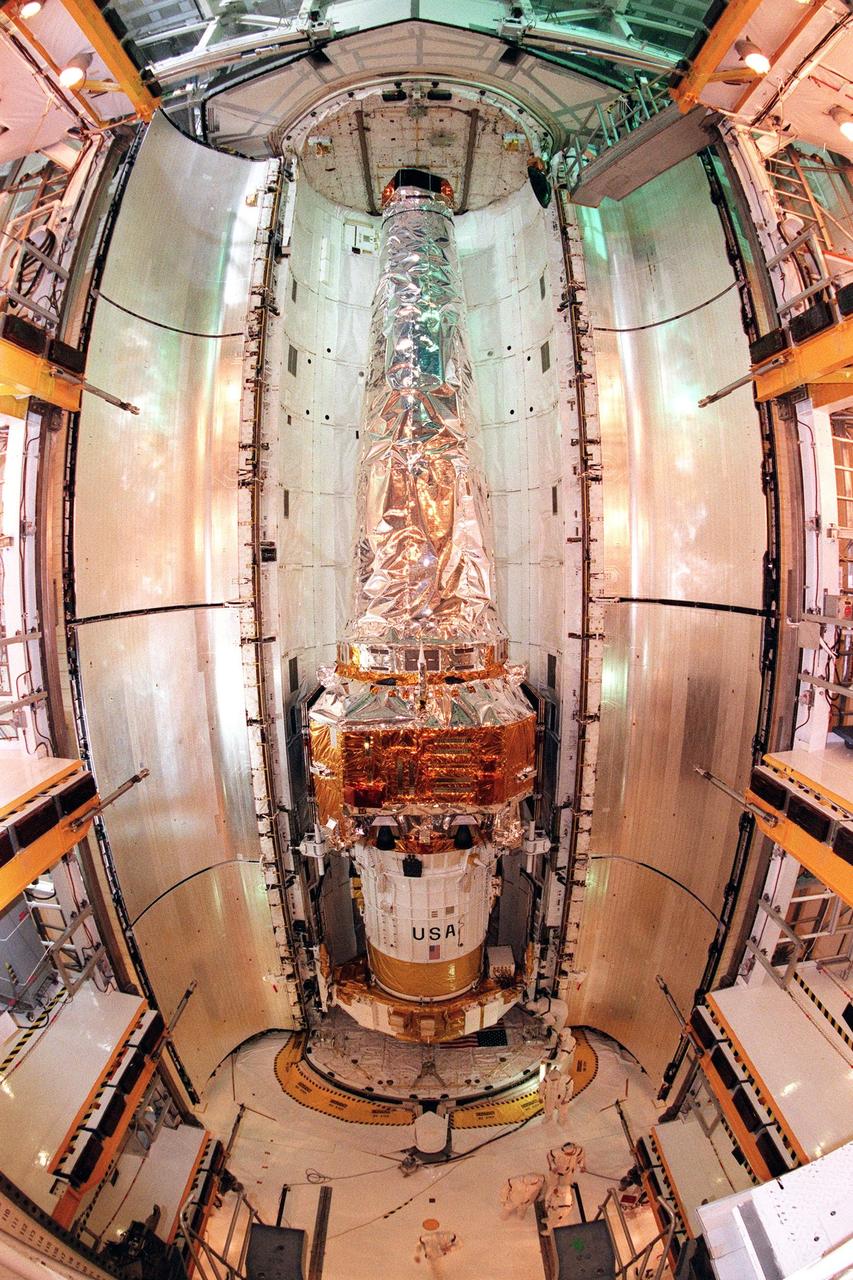
KENNEDY SPACE CENTER, FLA. -- At Launch Pad 39-B, the Chandra X-ray Observatory sits inside the payload bay on mission Space Shuttle Columbia, waiting for the doors to close. Chandra is the primary payload of STS-93, scheduled to launch aboard Columbia July 20 at 12:36 a.m. EDT. The combined Chandra/Inertial Upper Stage, seen here, measures 57 feet long and weighs 50,162 pounds. Fully deployed with solar arrays extended, the observatory measures 45.3 feet long and 64 feet wide. The world's most powerful X-ray telescope, Chandra will allow scientists from around the world to see previously invisible black holes and high-temperature gas clouds, giving the observatory the potential to rewrite the books on the structure and evolution of our universe
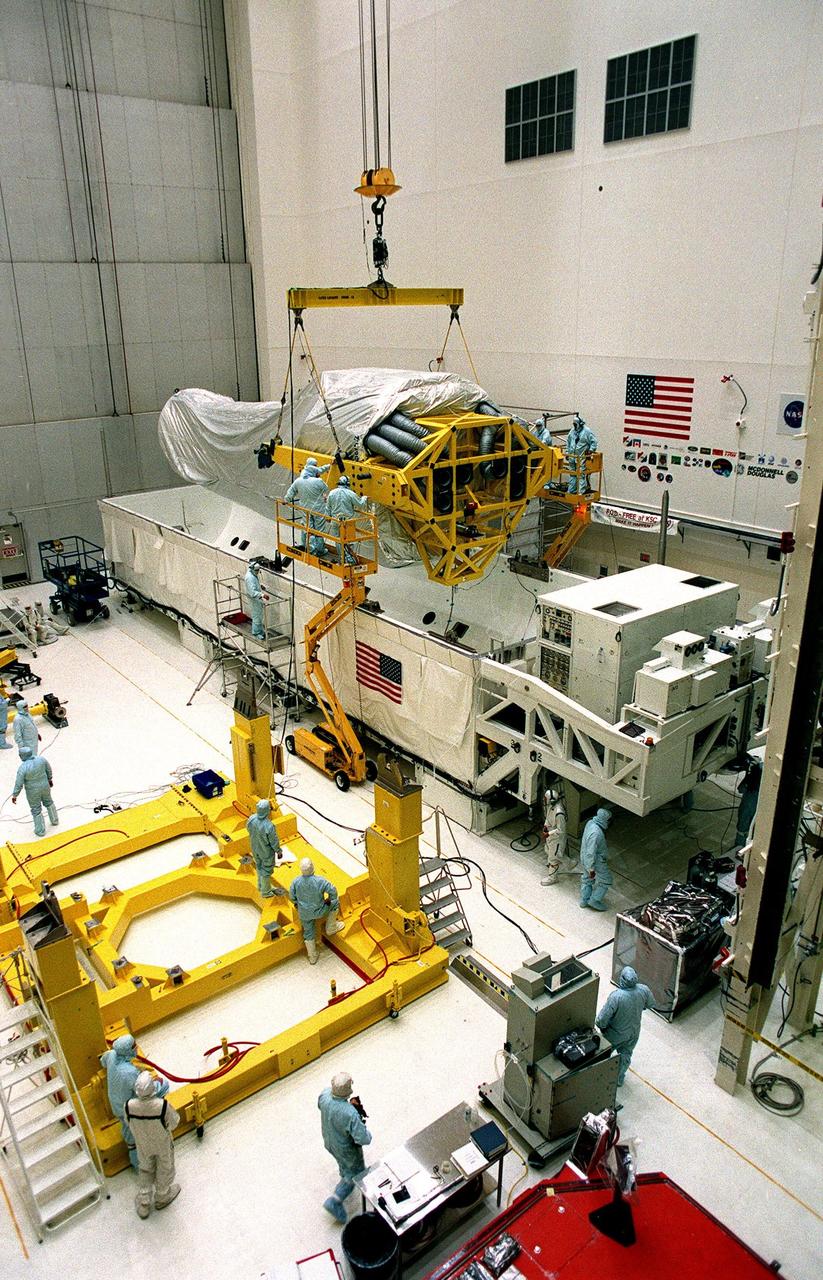
Inside the Vertical Processing Facility (VPF), workers begin lifting the Chandra X-ray Observatory out of its protective container. While in the VPF, the telescope will undergo final installation of associated electronic components; it will also be tested, fueled and mated with the Inertial Upper Stage booster. A set of integrated tests will follow. Chandra is scheduled for launch July 9 aboard Space Shuttle Columbia, on mission STS-93 . Formerly called the Advanced X-ray Astrophysics Facility, Chandra comprises three major elements: the spacecraft, the science instrument module (SIM), and the world's most powerful X-ray telescope. Chandra will allow scientists from around the world to see previously invisible black holes and high-temperature gas clouds, giving the observatory the potential to rewrite the books on the structure and evolution of our universe

Inside the Vertical Processing Facility (VPF), workers check the overhead cable that will lift the Chandra X-ray Observatory out of its protective container. While in the VPF, the telescope will undergo final installation of associated electronic components; it will also be tested, fueled and mated with the Inertial Upper Stage booster. A set of integrated tests will follow. Chandra is scheduled for launch July 9 aboard Space Shuttle Columbia, on mission STS-93 . Formerly called the Advanced X-ray Astrophysics Facility, Chandra comprises three major elements: the spacecraft, the science instrument module (SIM), and the world's most powerful X-ray telescope. Chandra will allow scientists from around the world to see previously invisible black holes and high-temperature gas clouds, giving the observatory the potential to rewrite the books on the structure and evolution of our universe
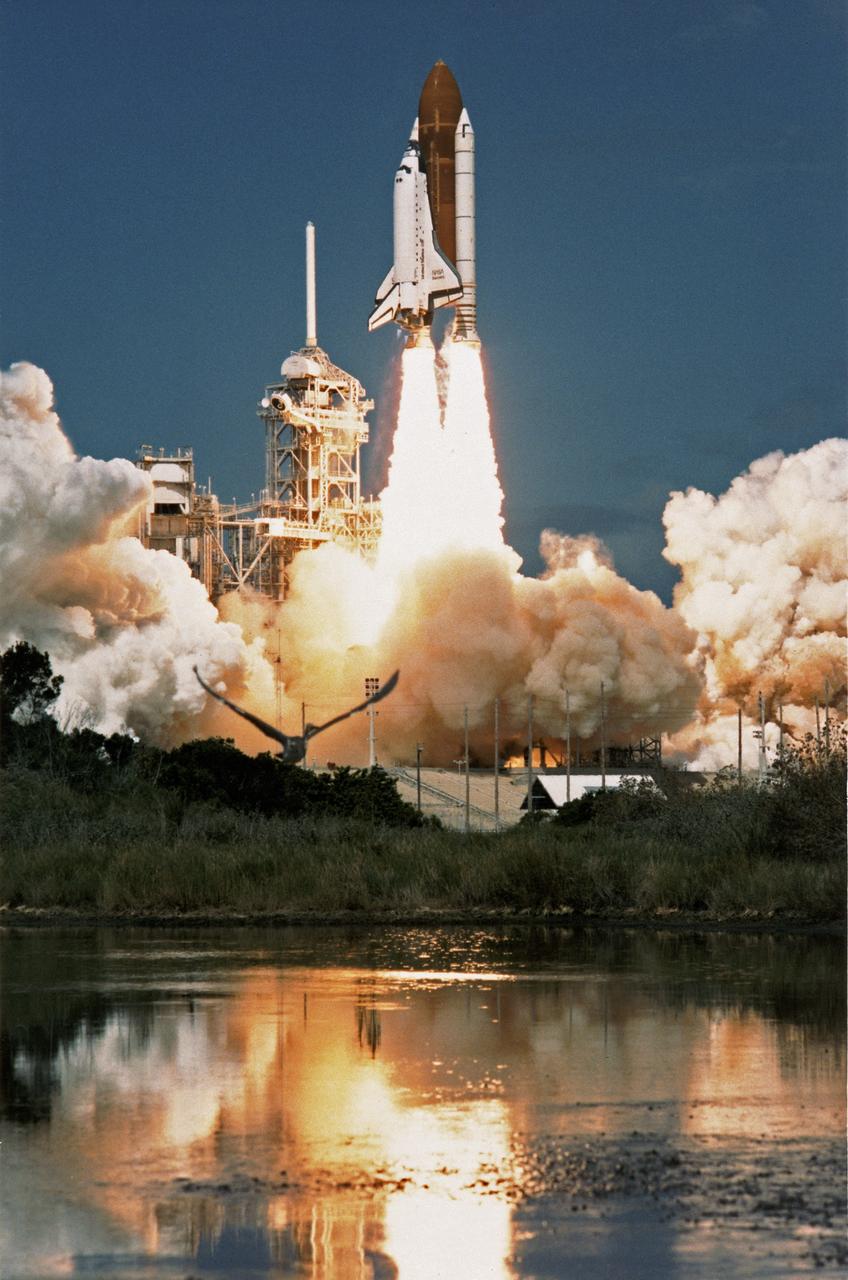
CAPE CANAVERAL, Fla. - The space shuttle Discovery and its five-man crew is launched from pad 39B at 11:37 a.m. as STS-26 embarks on a four-day mission marking America's return to space. On the first day of orbit, the crew will deploy from the orbiter's payload bay the primary payload, the Tracking and Data Relay Satellite, or TDRS-C. The inertial upper stage, or IUS, will boost the satellite to a geosynchronous altitude from low Earth orbit. When it place, TDRS-C will relay date from low Earth orbiting spacecraft and air-to-ground voice communications sand television from shape shuttle orbiters during missions. The crew members of STST-26 are Commander Rick Hauck, Pilot Richard Covey, and mission specialists Dave Hilmers, Mike Lounge and George "Pinky" Nelson. Photo Credit: NASA
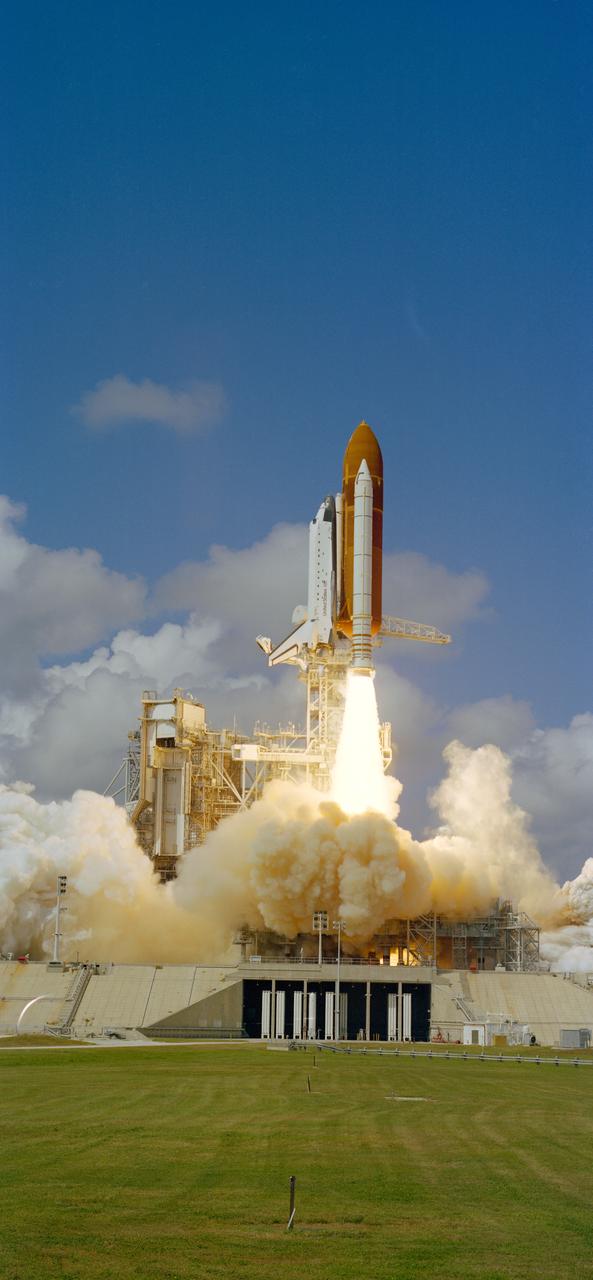
STS026-S-031 (29 Sept 1988) --- Just moments after ignition, the Space Shuttle Discovery, mated to two solid rocket boosters and an external fuel tank, heads, toward Earth orbit. The mission marks Discovery?s first flight since September of 1985 and NASA?s first manned mission since September of 1985 and NASA?s first manned mission since the 51L Challenger accident of January 28, 1986. Onboard the spacecraft are Astronauts Frederick H. (Rick) Hauck, commander; Richard O. Covey, pilot; and George D. Nelson, John M. (Mike) Lounge and David C. Hilmers, mission specialists. Discovery?s dry weight is 171,419 pounds. The tracking and data relay satellite and its inertial upper stage total about 37,000 pounds.