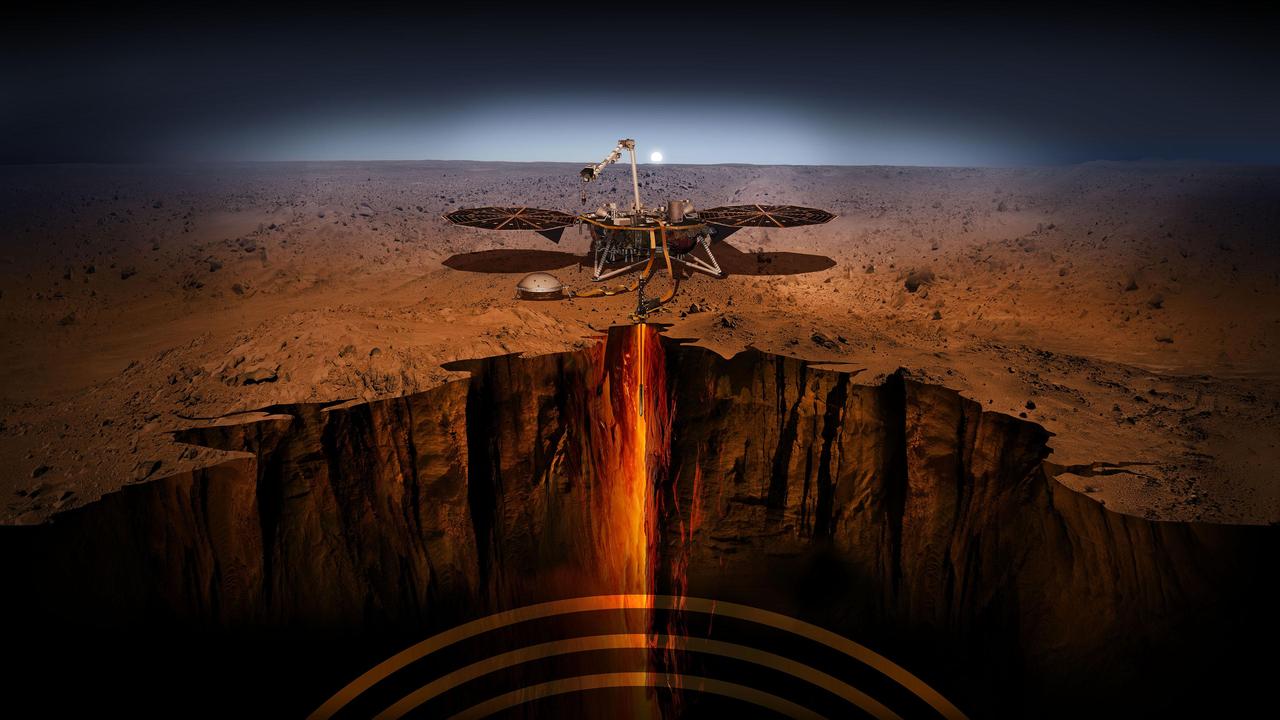
An artist illustration of the InSight lander on Mars. InSight, short for Interior Exploration using Seismic Investigations, Geodesy and Heat Transport, is designed to give the Red Planet its first thorough check up since it formed 4.5 billion years ago. The mission will look for tectonic activity and meteorite impacts, study how much heat is still flowing through the planet, and track Mars' wobble as it orbits the sun. While InSight is a Mars mission, it's more than a Mars mission. InSight will help answer key questions about the formation of the rocky planets of the solar system. https://photojournal.jpl.nasa.gov/catalog/PIA22745
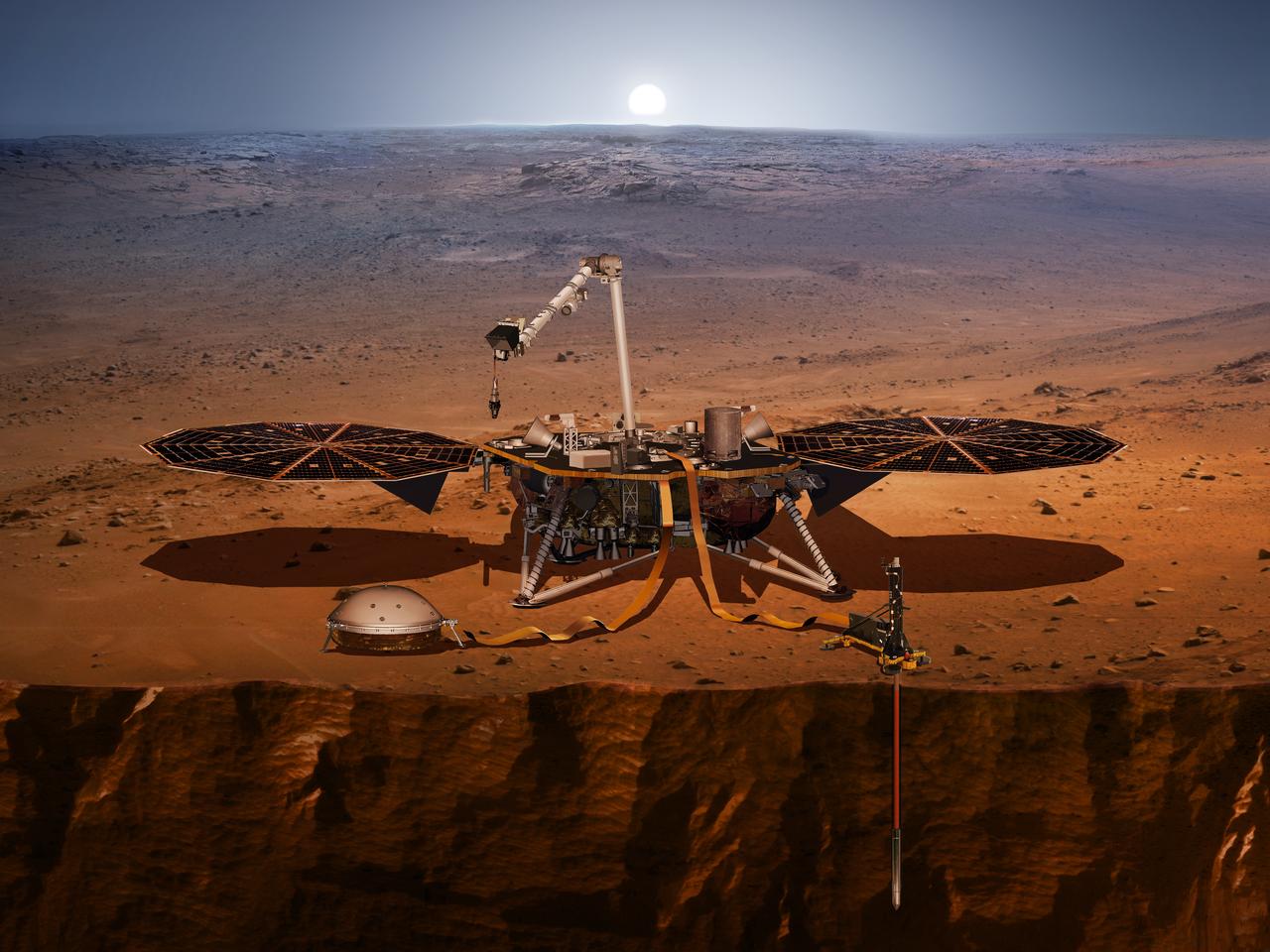
This artist's concept shows the InSight lander, its sensors, cameras and instruments. InSight is will take the first-ever-in-depth look at Mars' "inner space." InSight stands for Interior Exploration using Seismic Investigations, Geodesy and Heat Transport. Its three instruments are a seismometer, a heat flow probe, and a radio science experiment. These instruments will shed light on how warm and geologically active Mars still is, study its reflexes as it whips about in its orbit around the sun, and provide essential clues on the evolution of the rocky planets of our solar system. So while InSight is a Mars mission, it's also more than a Mars mission. InSight will launch between May 5 through June 8, 2018 from Vandenberg Air Force Base in California. https://photojournal.jpl.nasa.gov/catalog/PIA22227
The InSight spacecraft approaches Mars in this artist's concept. Interior Exploration using Seismic Investigations, Geodesy and Heat Transport, or InSight, is a Mars lander that probes the planet's deep interior to shed light on the evolution of Mars and the rocky planets of the solar system. There are six phases in the InSight mission: Pre-Launch, Launch, Cruise, Approach, Landing and Surface Operations. The approach phase begins about 60 days before the spacecraft enters the Martian atmosphere and prepares the spacecraft for landing. https://photojournal.jpl.nasa.gov/catalog/PIA22099
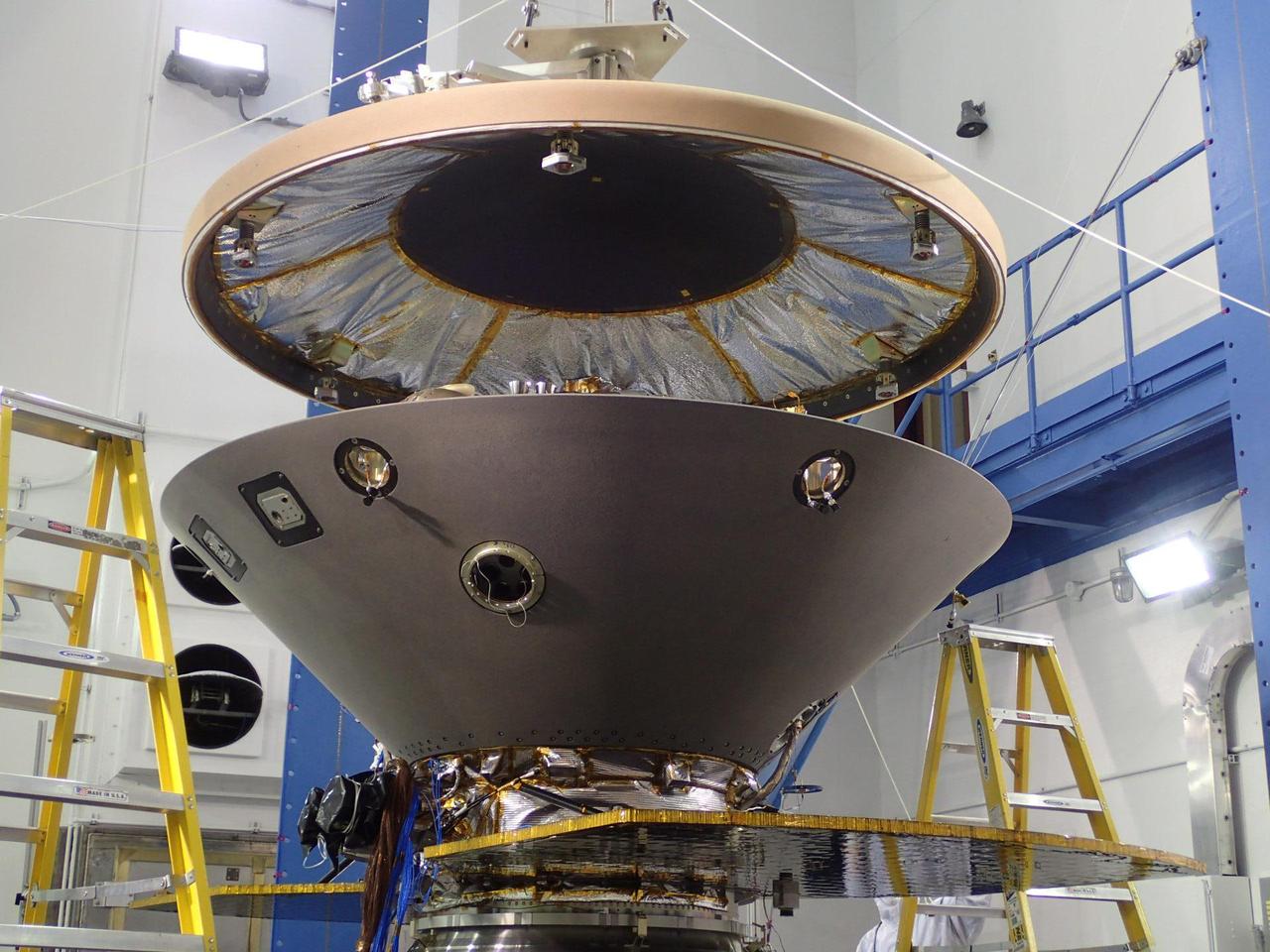
The heat shield is suspended above the rest of the InSight spacecraft in this image taken July 13, 2015, in a spacecraft assembly clean room at Lockheed Martin Space Systems, Denver. The gray cone is the back shell, which together with the heat shield forms a protective aeroshell around the stowed InSight lander. The photo was taken during preparation for vibration testing of the spacecraft. InSight, for Interior Exploration Using Seismic Investigations, Geodesy and Heat Transport, is scheduled for launch in March 2016 and landing in September 2016. It will study the deep interior of Mars to advance understanding of the early history of all rocky planets, including Earth. Note: After thorough examination, NASA managers have decided to suspend the planned March 2016 launch of the Interior Exploration using Seismic Investigations Geodesy and Heat Transport (InSight) mission. The decision follows unsuccessful attempts to repair a leak in a section of the prime instrument in the science payload. http://photojournal.jpl.nasa.gov/catalog/PIA19814
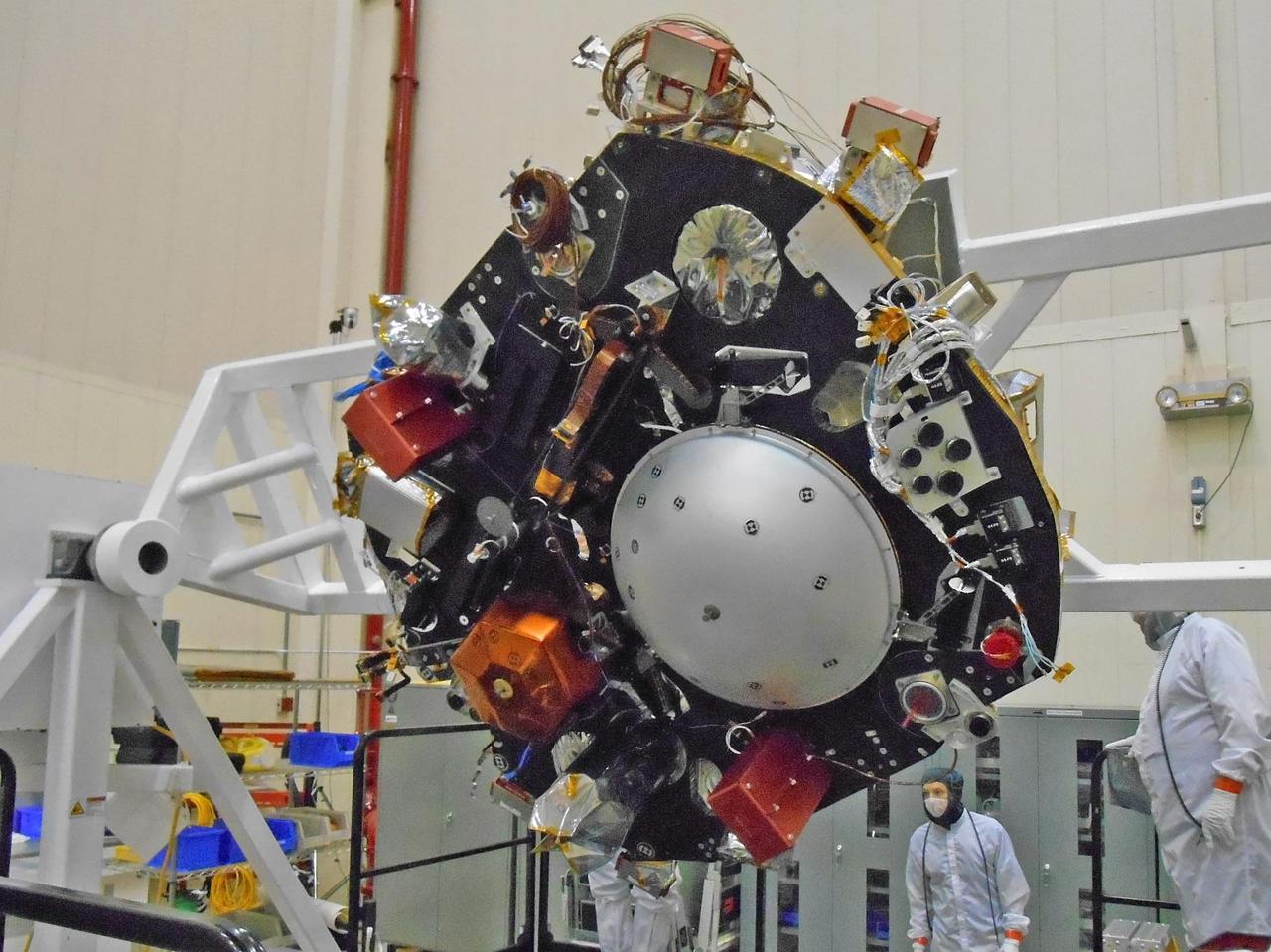
The science deck of NASA's InSight lander is being turned over in this April 29, 2015, photo from InSight assembly and testing operations inside a clean room at Lockheed Martin Space Systems, Denver. The large circular component on the deck is the protective covering to be placed over InSight's seismometer after the seismometer is placed directly onto the Martian ground. InSight, for Interior Exploration Using Seismic Investigations, Geodesy and Heat Transport, is scheduled for launch in March 2016 and landing in September 2016. It will study the deep interior of Mars to advance understanding of the early history of all rocky planets, including Earth. Note: After thorough examination, NASA managers have decided to suspend the planned March 2016 launch of the Interior Exploration using Seismic Investigations Geodesy and Heat Transport (InSight) mission. The decision follows unsuccessful attempts to repair a leak in a section of the prime instrument in the science payload. http://photojournal.jpl.nasa.gov/catalog/PIA19670

This is one of the last images ever taken by NASA's InSight Mars lander. Captured on Dec. 11, 2022, the 1,436th Martian day, or sol, of the mission, it shows InSight's seismometer on the Red Planet's surface. https://photojournal.jpl.nasa.gov/catalog/PIA25680
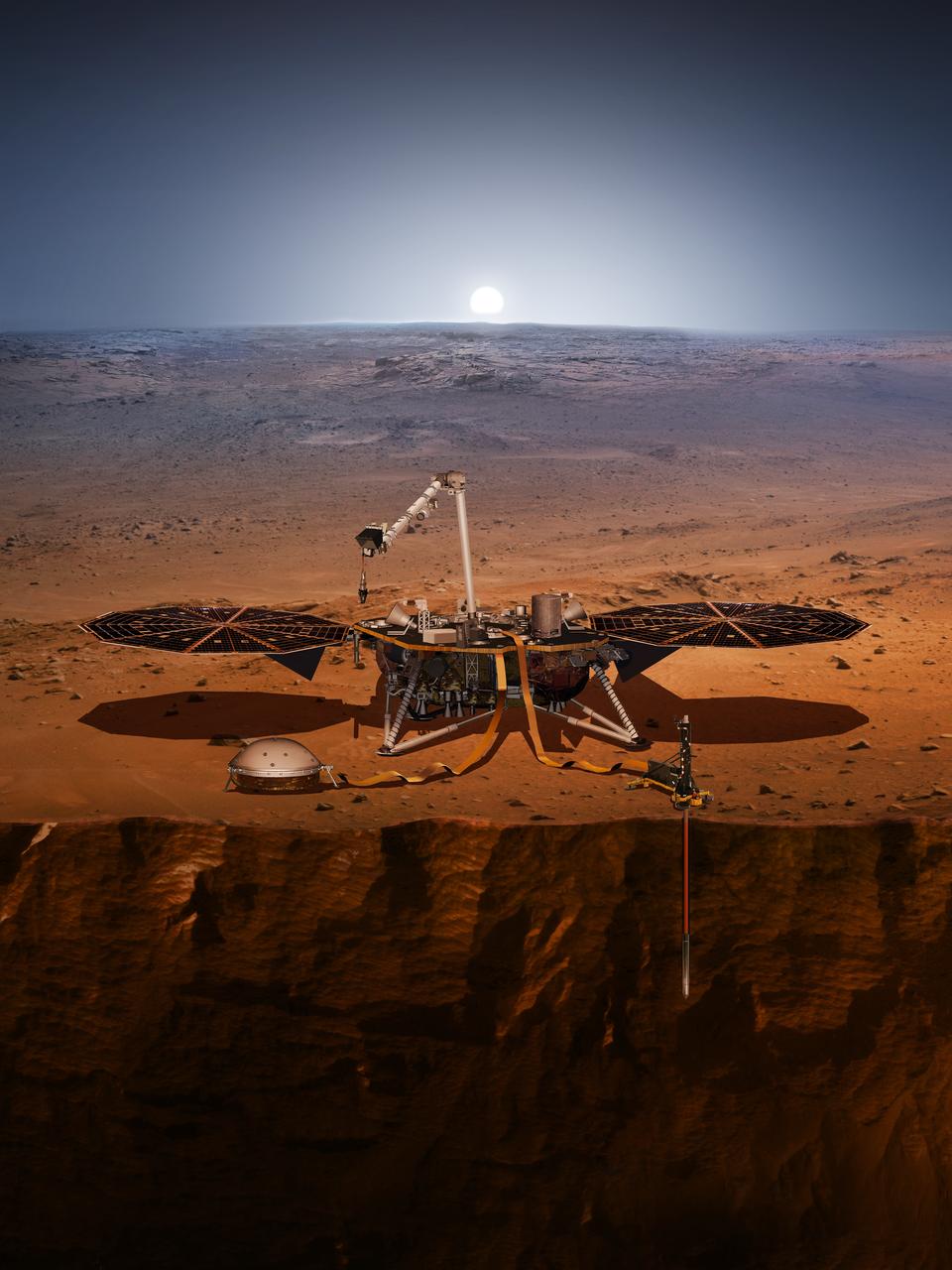
An artist's impression of the InSight lander on Mars. InSight, short for Interior Exploration using Seismic Investigations, Geodesy and Heat Transport, is designed to give the Red Planet its first thorough check up since it formed 4.5 billion years ago. It is scheduled to launch from Vandenberg Air Force Base on the California coast between May 5 through June 8, 2018, and land on Mars six months later. InSight will look for tectonic activity and meteorite impacts, study how much heat is still flowing through the planet, and track Mars' wobble as it orbits the sun. While InSight is a Mars mission, it's more than a Mars mission. InSight will help answer key questions about the formation of the rocky planets of the solar system. https://photojournal.jpl.nasa.gov/catalog/PIA22226
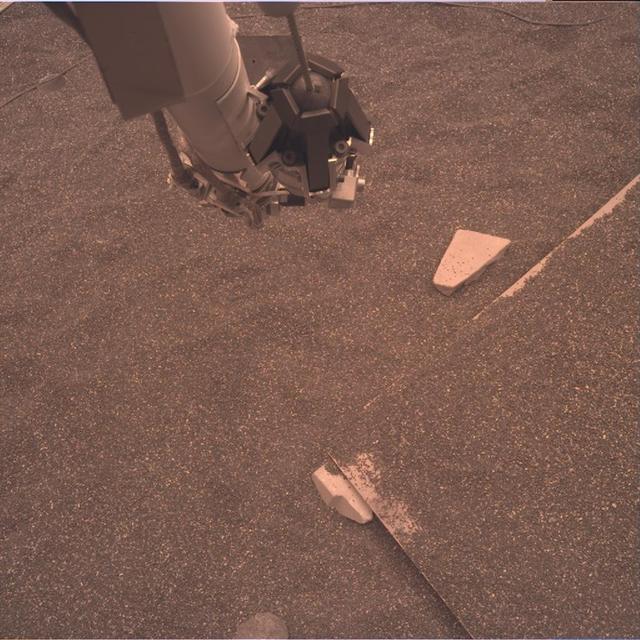
This test image from an engineering model of NASA's InSight lander shows part of the lander's robotic arm and the simulated Martian ground at a testbed at NASA's Jet Propulsion Laboratory in Pasadena, California. The testbed aims to mimic the environment InSight will encounter at Mars so engineers can prepare for the spacecraft operations to come. This image is expected to be similar to the raw or unprocessed images that InSight will send back to Earth. It was taken by the instrument deployment camera attached to InSight's robotic arm. https://photojournal.jpl.nasa.gov/catalog/PIA22827
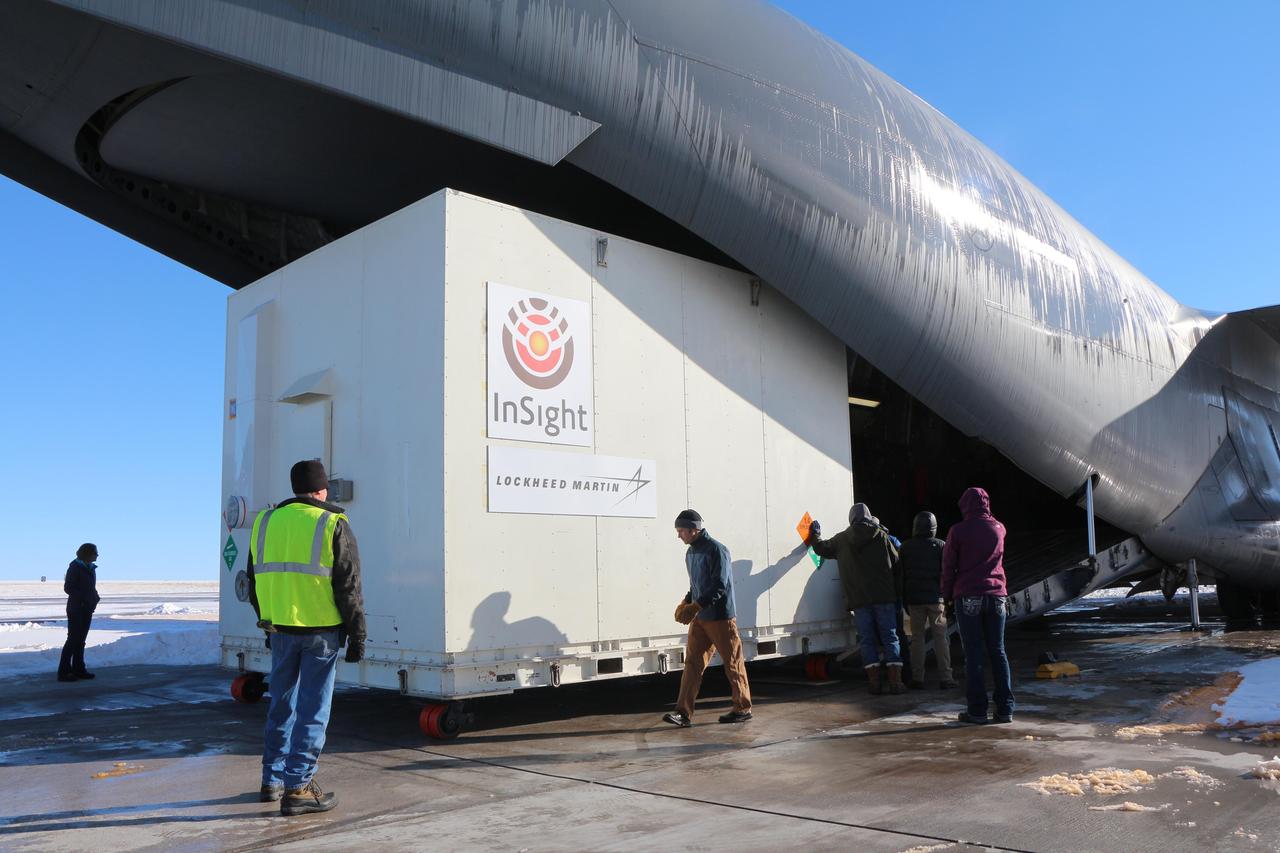
Personnel supporting NASA's InSight mission to Mars load the crated InSight spacecraft into a C-17 cargo aircraft at Buckley Air Force Base, Denver, for shipment to Vandenberg Air Force Base, California. The spacecraft, built in Colorado by Lockheed Martin Space Systems, was shipped Dec. 16, 2015, in preparation for launch from Vandenberg in March 2016. InSight, for Interior Exploration using Seismic Investigations, Geodesy and Heat Transport, is the first mission dedicated to studying the deep interior of Mars. Its findings will advance understanding of the early history of all rocky planets, including Earth. Note: After thorough examination, NASA managers have decided to suspend the planned March 2016 launch of the Interior Exploration using Seismic Investigations Geodesy and Heat Transport (InSight) mission. The decision follows unsuccessful attempts to repair a leak in a section of the prime instrument in the science payload. http://photojournal.jpl.nasa.gov/catalog/PIA20278
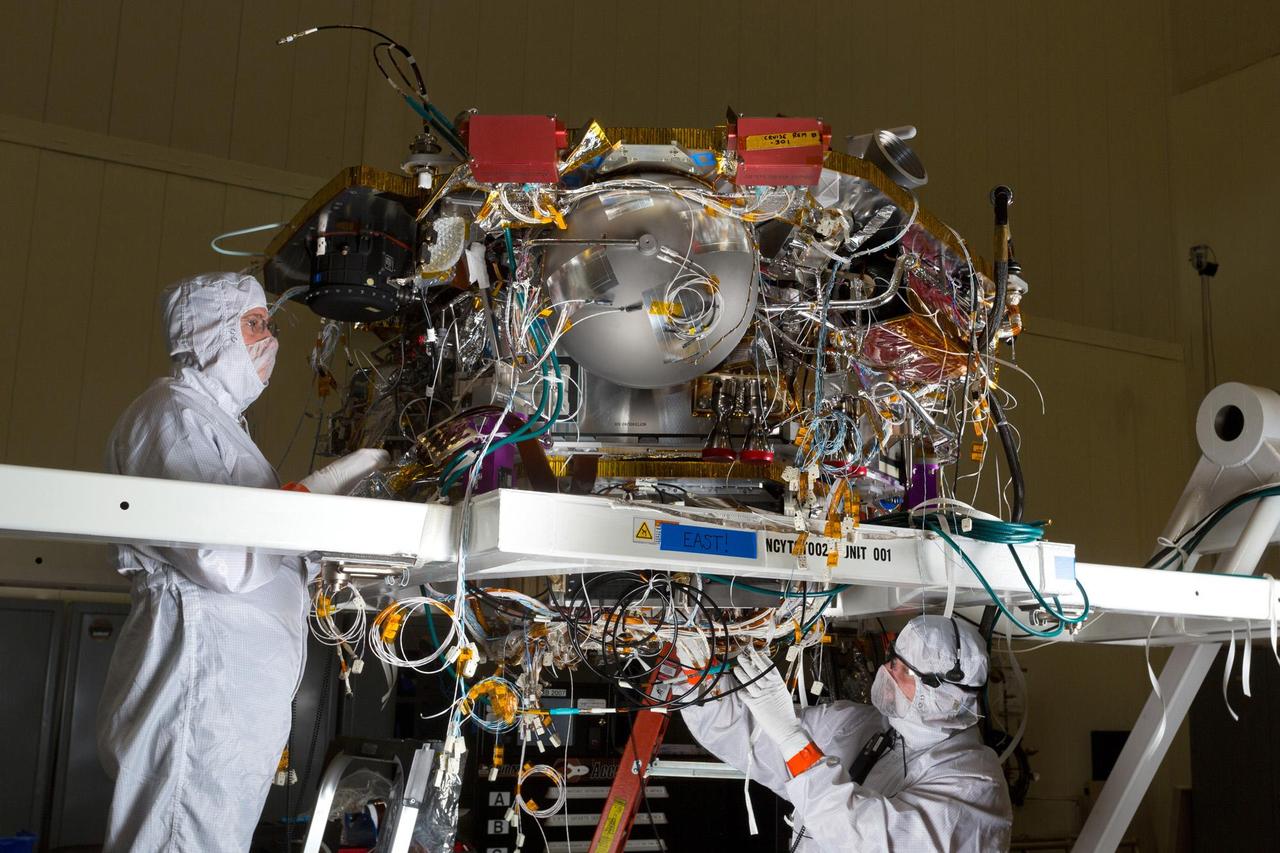
The Mars lander that NASA's InSight mission will use for investigating how rocky planets formed and evolved is being assembled by Lockheed Martin Space Systems, Denver. In this scene from January 2015, Lockheed Martin spacecraft specialists are working on the lander in a clean room. InSight, for Interior Exploration Using Seismic Investigations, Geodesy and Heat Transport, is scheduled for launch in March 2016 and landing in September 2016. Note: After thorough examination, NASA managers have decided to suspend the planned March 2016 launch of the Interior Exploration using Seismic Investigations Geodesy and Heat Transport (InSight) mission. The decision follows unsuccessful attempts to repair a leak in a section of the prime instrument in the science payload. http://photojournal.jpl.nasa.gov/catalog/PIA19402

The InSight Team at Lockheed Martin Space in May 2017 The InSight team is comprised of scientists and engineers from multiple disciplines and is a unique collaboration between countries and organizations around the world. The science team includes co-investigators from the U.S., France, Germany, Austria, Belgium, Canada, Japan, Switzerland and the United Kingdom. https://photojournal.jpl.nasa.gov/catalog/PIA22235
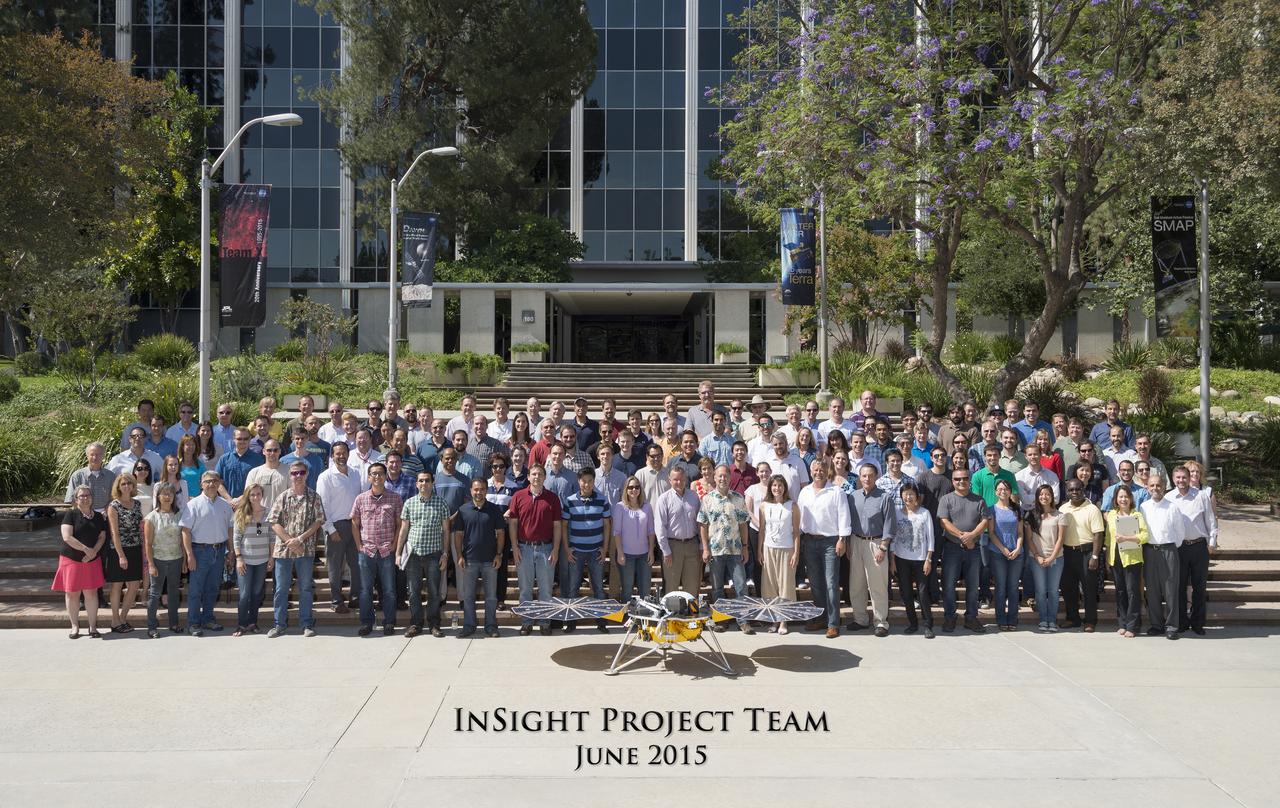
The InSight Team at NASA's Jet Propulsion Laboratory, JPL, in June 2015. The InSight team is comprised of scientists and engineers from multiple disciplines and is a unique collaboration between countries and organizations around the world. The science team includes co-investigators from the U.S., France, Germany, Austria, Belgium, Canada, Japan, Switzerland and the United Kingdom. https://photojournal.jpl.nasa.gov/catalog/PIA22234
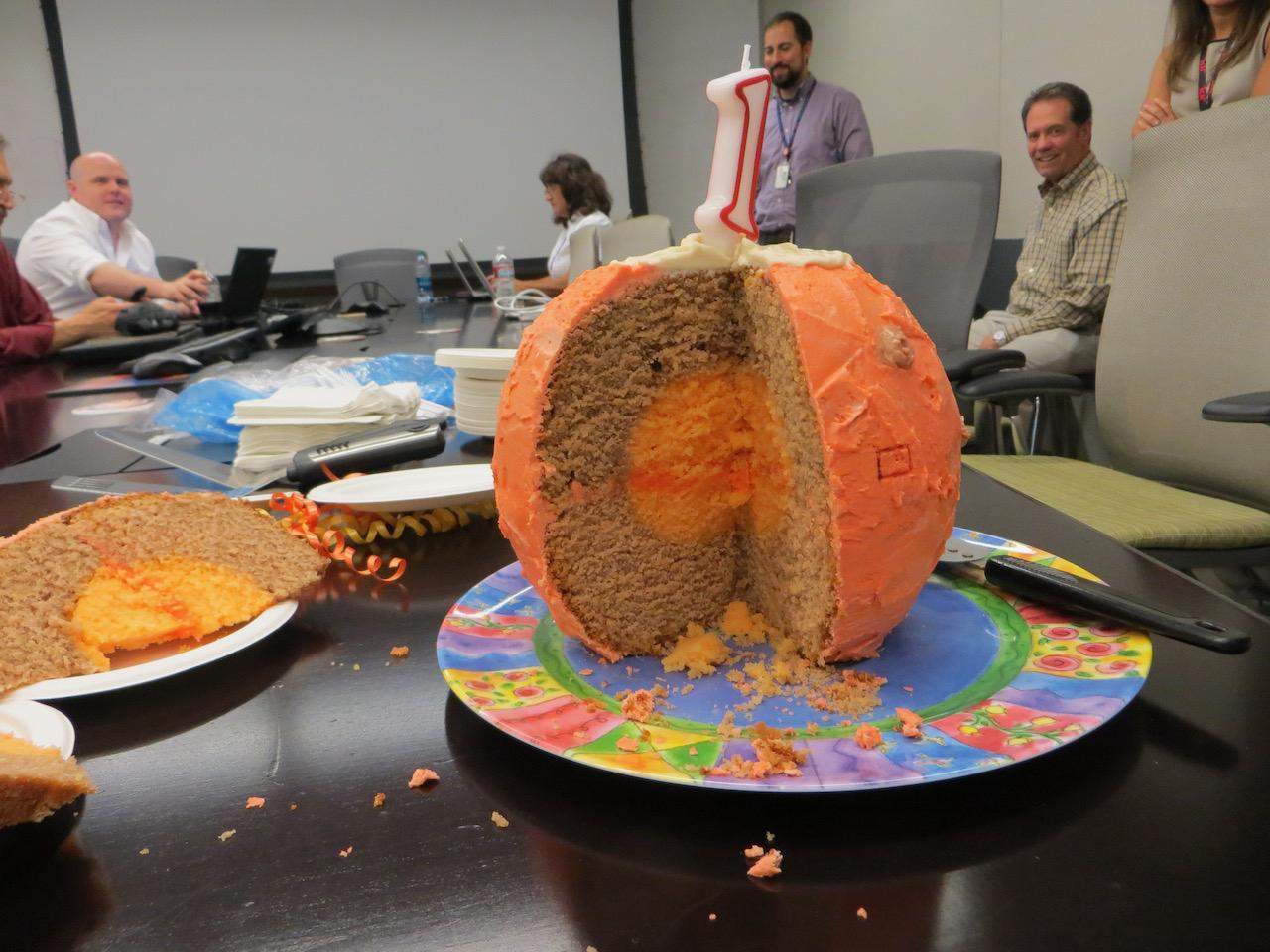
NASA's InSight lander team enjoyed this Mars-shaped cake on the first anniversary of the spacecraft's Nov. 26, 2018, landing. The cake came complete with its own inner layers – just like the Red Planet. https://photojournal.jpl.nasa.gov/catalog/PIA25283
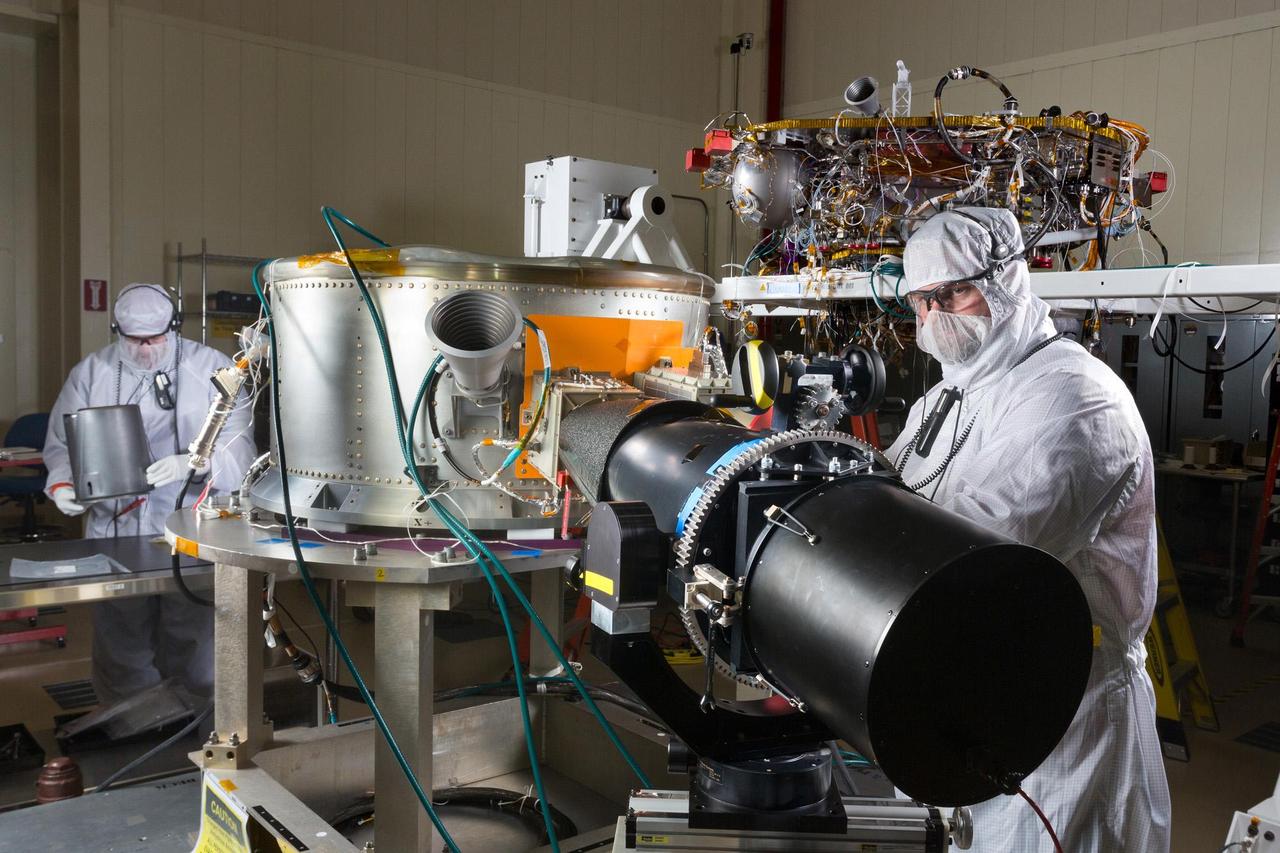
Spacecraft specialists in a clean room at Lockheed Martin Space Systems, Denver, are working on NASA's InSight spacecraft in this January 2015 scene from the mission's assembly and testing phase. At center is the cruise stage, which will serve multiple functions during the flight from Earth to Mars. In the background is the InSight lander. InSight, for Interior Exploration Using Seismic Investigations, Geodesy and Heat Transport, will investigate the deep interior of Mars to gain information about how rocky planets, including Earth, formed and evolved. The mission is scheduled for launch from California in March 2016 and landing on Mars in September 2016. Note: After thorough examination, NASA managers have decided to suspend the planned March 2016 launch of the Interior Exploration using Seismic Investigations Geodesy and Heat Transport (InSight) mission. The decision follows unsuccessful attempts to repair a leak in a section of the prime instrument in the science payload. http://photojournal.jpl.nasa.gov/catalog/PIA19403
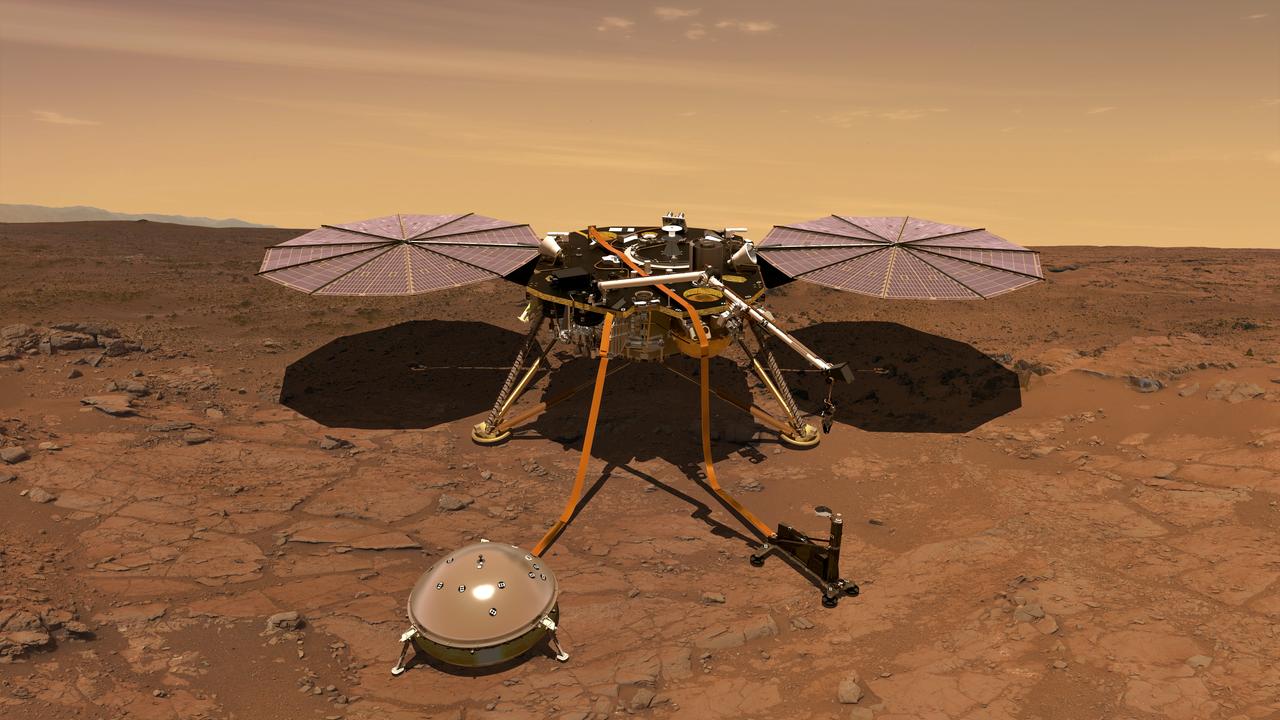
An artist's rendition of the InSight lander operating on the surface of Mars. InSight, short for Interior Exploration using Seismic Investigations, Geodesy and Heat Transport, is a lander designed to give Mars its first thorough check up since it formed 4.5 billion years ago. It is scheduled to launch from Vandenberg Air Force Base on the California coast between May 5 through June 8, 2018, and land on Mars six months later, on Nov. 26, 2018. InSight complements missions orbiting Mars and roving around on the planet's surface. The lander's science instruments look for tectonic activity and meteorite impacts on Mars, study how much heat is still flowing through the planet, and track the planet's wobble as it orbits the sun. This helps answer key questions about how the rocky planets of the solar system formed. So while InSight is a Mars mission, it's also more than a Mars mission. Surface operations begin a minute after landing at Elysium Planitia. The lander's prime mission is one Mars year (approximately two Earth years). https://photojournal.jpl.nasa.gov/catalog/PIA22228

Lockheed Martin spacecraft specialists check the cruise stage of NASA's InSight spacecraft in this photo taken June 22, 2017, in a Lockheed Martin clean room facility in Littleton, Colorado. The cruise stage will provide vital functions during the flight from Earth to Mars, and then will be jettisoned before the InSight lander, enclosed in its aeroshell, enters Mars' atmosphere. The InSight mission (for Interior Exploration using Seismic Investigations, Geodesy and Heat Transport) is scheduled to launch in May 2018 and land on Mars Nov. 26, 2018. It will investigate processes that formed and shaped Mars and will help scientists better understand the evolution of our inner solar system's rocky planets, including Earth. https://photojournal.jpl.nasa.gov/catalog/PIA21845
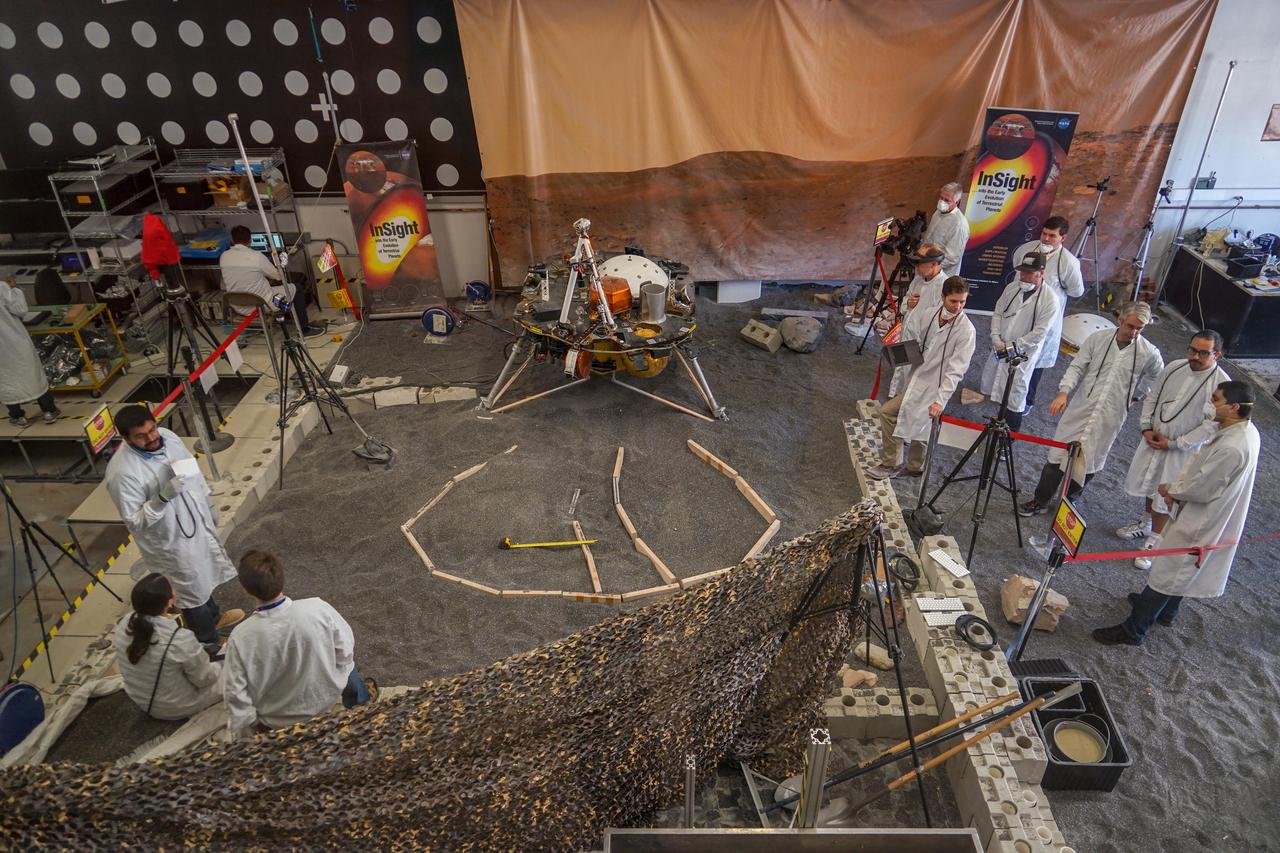
Engineers in Pasadena, California, sculpt a gravel-like material to mimic the terrain in front of NASA's InSight lander on Mars. Recreating the exact conditions will allow them to practice setting down the lander's instruments here on Earth (at NASA's Jet Propulsion Laboratory) before it's done on Mars. https://photojournal.jpl.nasa.gov/catalog/PIA22879
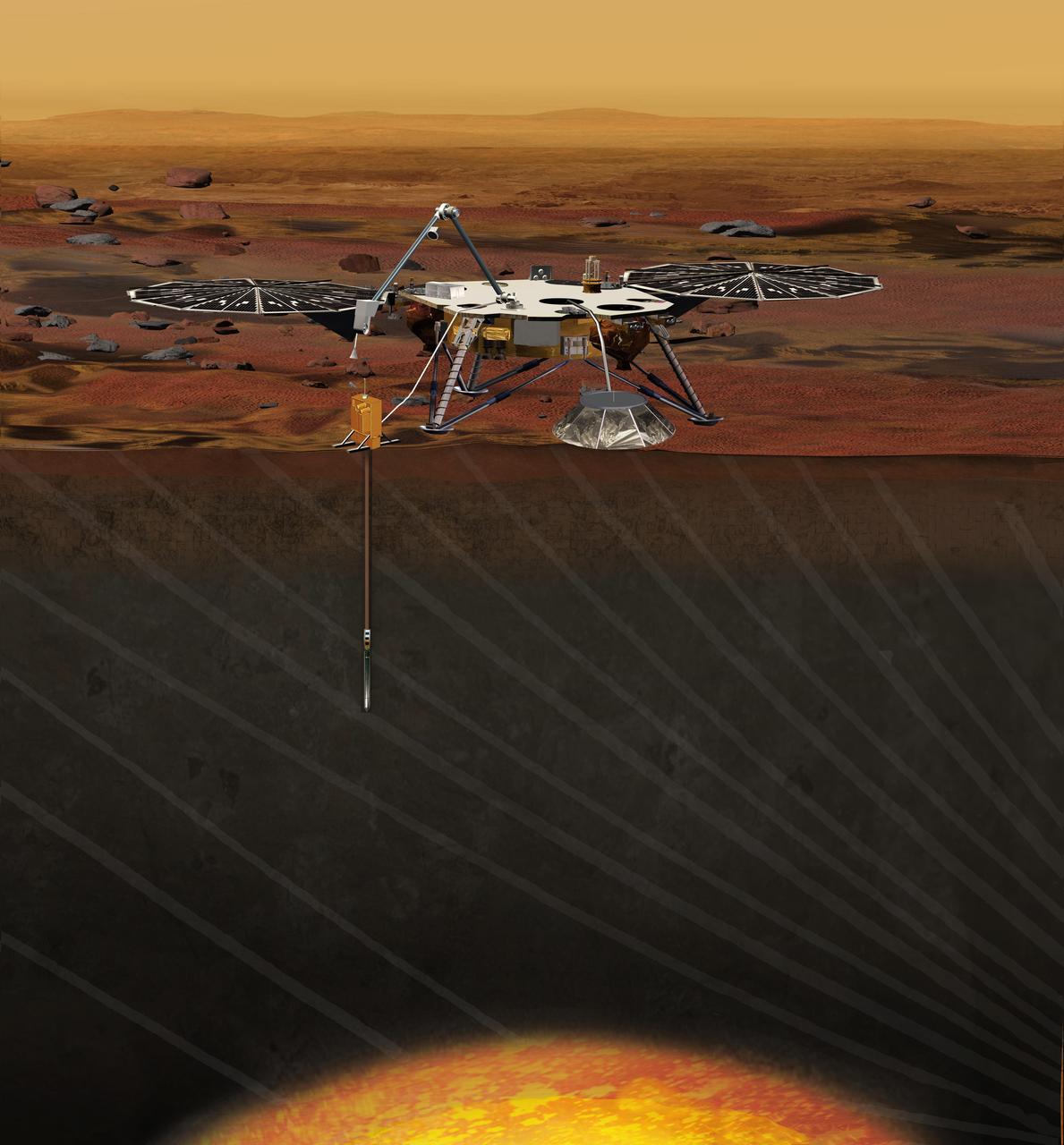
This artist rendition is of the Interior exploration using Seismic Investigations, Geodesy and Heat Transport InSight Lander. InSight proposes to place a single geophysical lander on Mars to study its deep interior. Note: After thorough examination, NASA managers have decided to suspend the planned March 2016 launch of the Interior Exploration using Seismic Investigations Geodesy and Heat Transport (InSight) mission. The decision follows unsuccessful attempts to repair a leak in a section of the prime instrument in the science payload. http://photojournal.jpl.nasa.gov/catalog/PIA13958
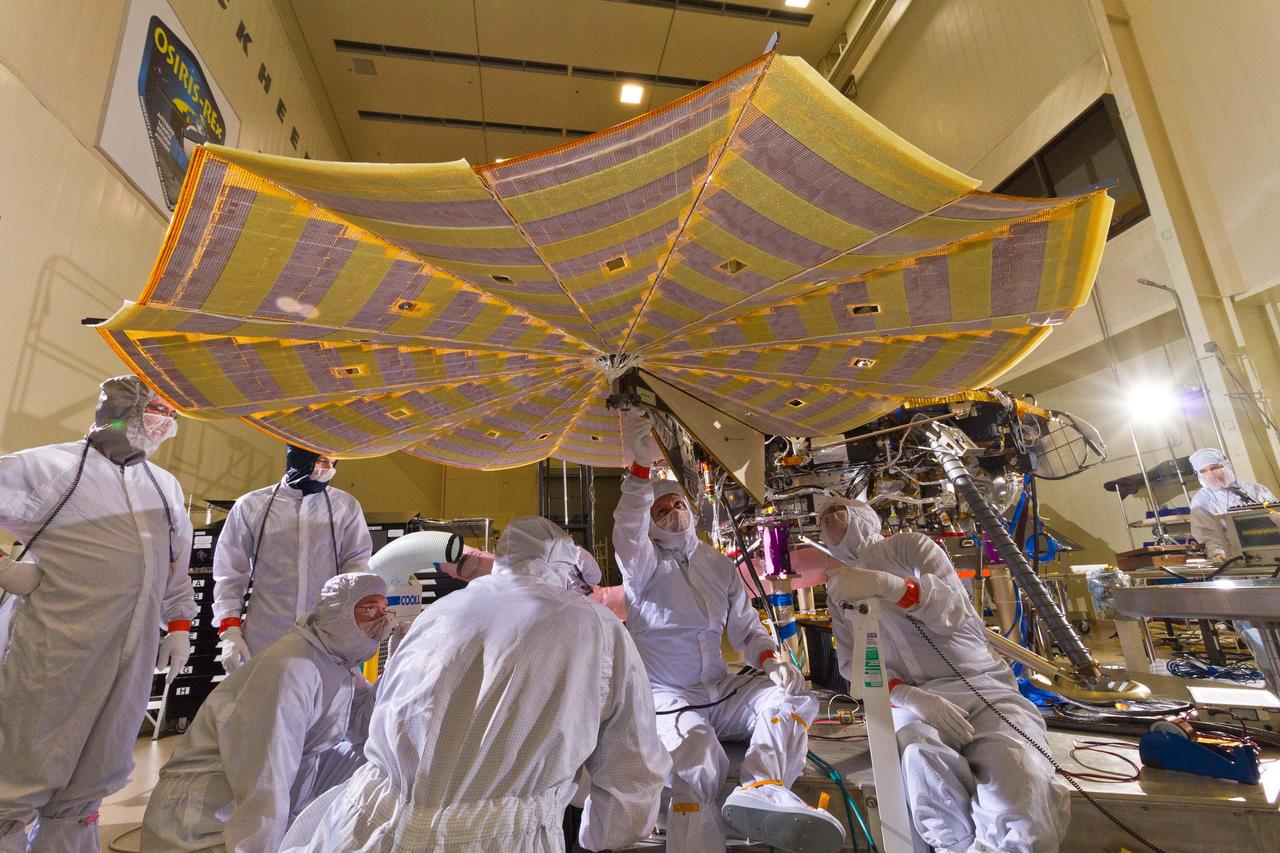
Engineers and technicians at Lockheed Martin Space Systems, Denver, run a test of deploying the solar arrays on NASA's InSight lander in this April 30, 2015 image. InSight, for Interior Exploration Using Seismic Investigations, Geodesy and Heat Transport, is scheduled for launch in March 2016 and landing in September 2016. It will study the deep interior of Mars to advance understanding of the early history of all rocky planets, including Earth. Note: After thorough examination, NASA managers have decided to suspend the planned March 2016 launch of the Interior Exploration using Seismic Investigations Geodesy and Heat Transport (InSight) mission. The decision follows unsuccessful attempts to repair a leak in a section of the prime instrument in the science payload. http://photojournal.jpl.nasa.gov/catalog/PIA19665
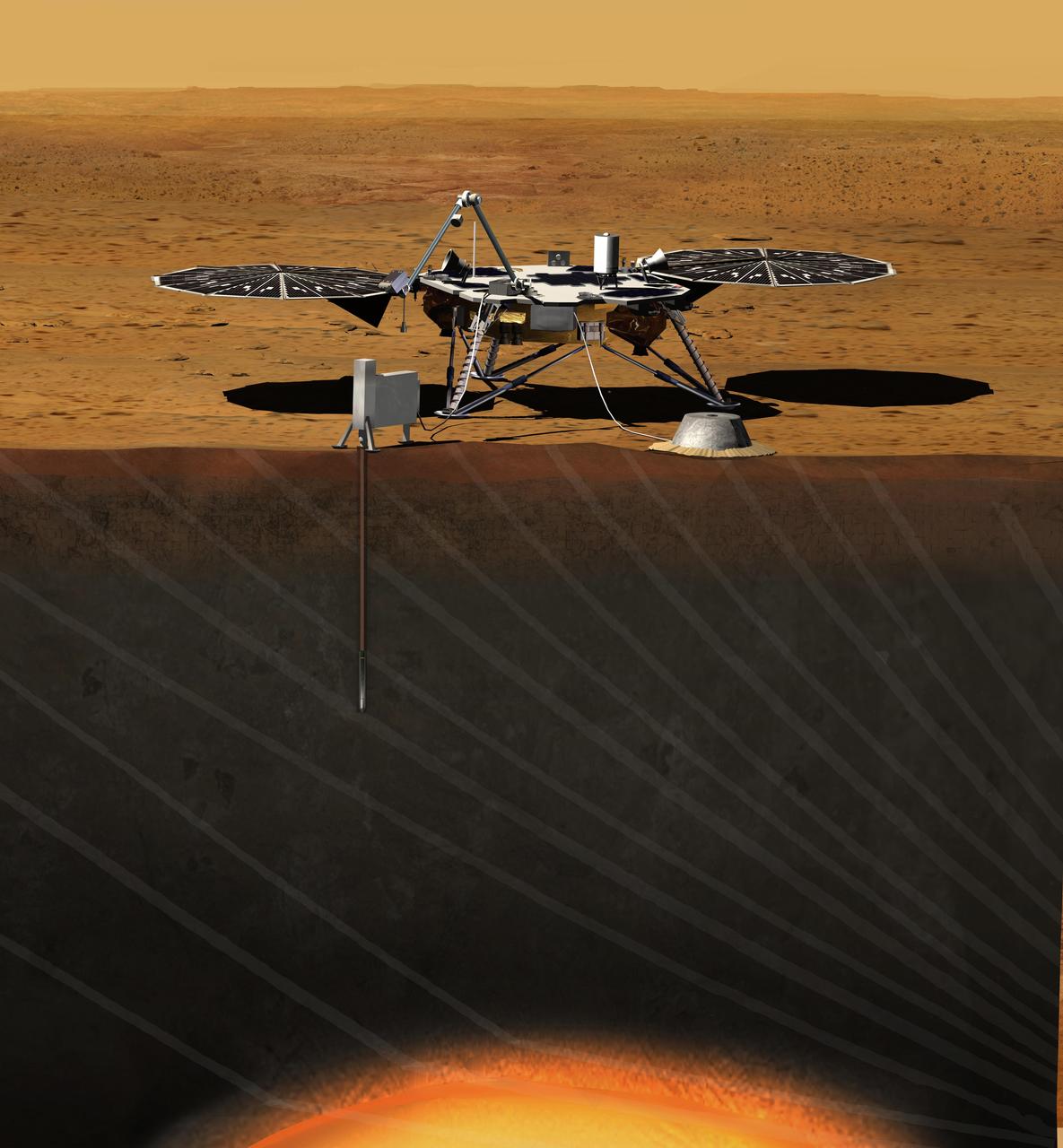
Artist rendition of the InSight (Interior exploration using Seismic Investigations, Geodesy and Heat Transport) Lander. InSight is based on the proven Phoenix Mars spacecraft and lander design with state-of-the-art avionics from the Mars Reconnaissance Orbiter and Gravity Recovery and Interior Laboratory missions. Note: After thorough examination, NASA managers have decided to suspend the planned March 2016 launch of the Interior Exploration using Seismic Investigations Geodesy and Heat Transport (InSight) mission. The decision follows unsuccessful attempts to repair a leak in a section of the prime instrument in the science payload. http://photojournal.jpl.nasa.gov/catalog/PIA16079
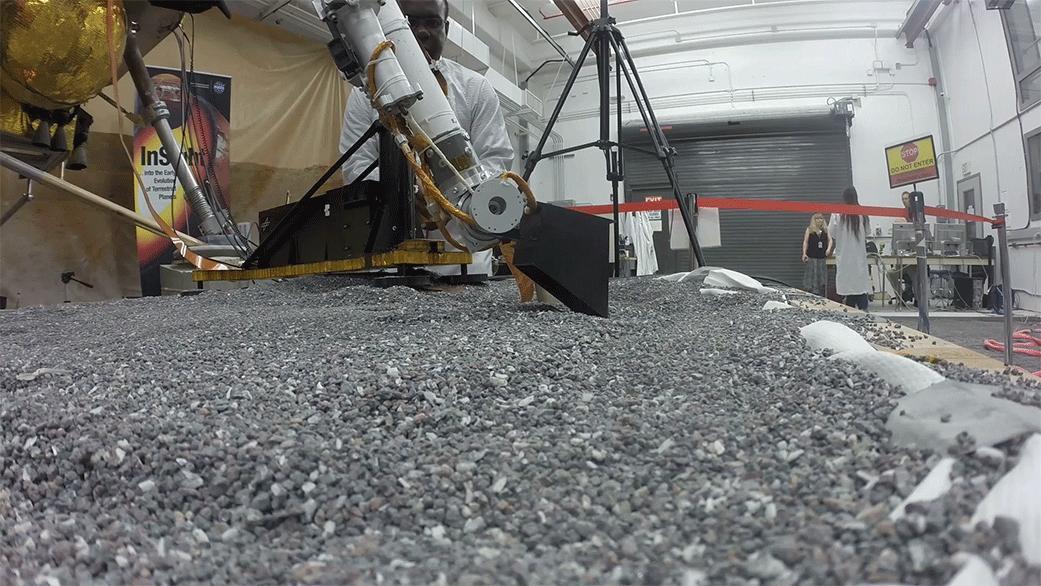
This footage from Aug. 19, 2019, shows a replica of InSight scraping soil with a scoop on the end of its robotic arm in a test lab at NASA's Jet Propulsion Laboratory in Southern California. A replica of the "mole" — the lander's self-hammering heat probe — comes in to view as the scoop moves to the left. On Mars, InSight will use techniques practiced by engineers on Earth in order to scrape and tamp down soil on top of the mole to help it dig. Movie available at https://photojournal.jpl.nasa.gov/catalog/PIA24099

NASA's InSight lander deployed its Wind and Thermal Shield on Feb. 2, 2019 (sol 66). The shield covers InSight's seismometer, which was set down onto the Martian surface on Dec. 19, 2018. This image was taken by the Instrument Deployment Camera on the lander's robotic arm. https://photojournal.jpl.nasa.gov/catalog/PIA22959
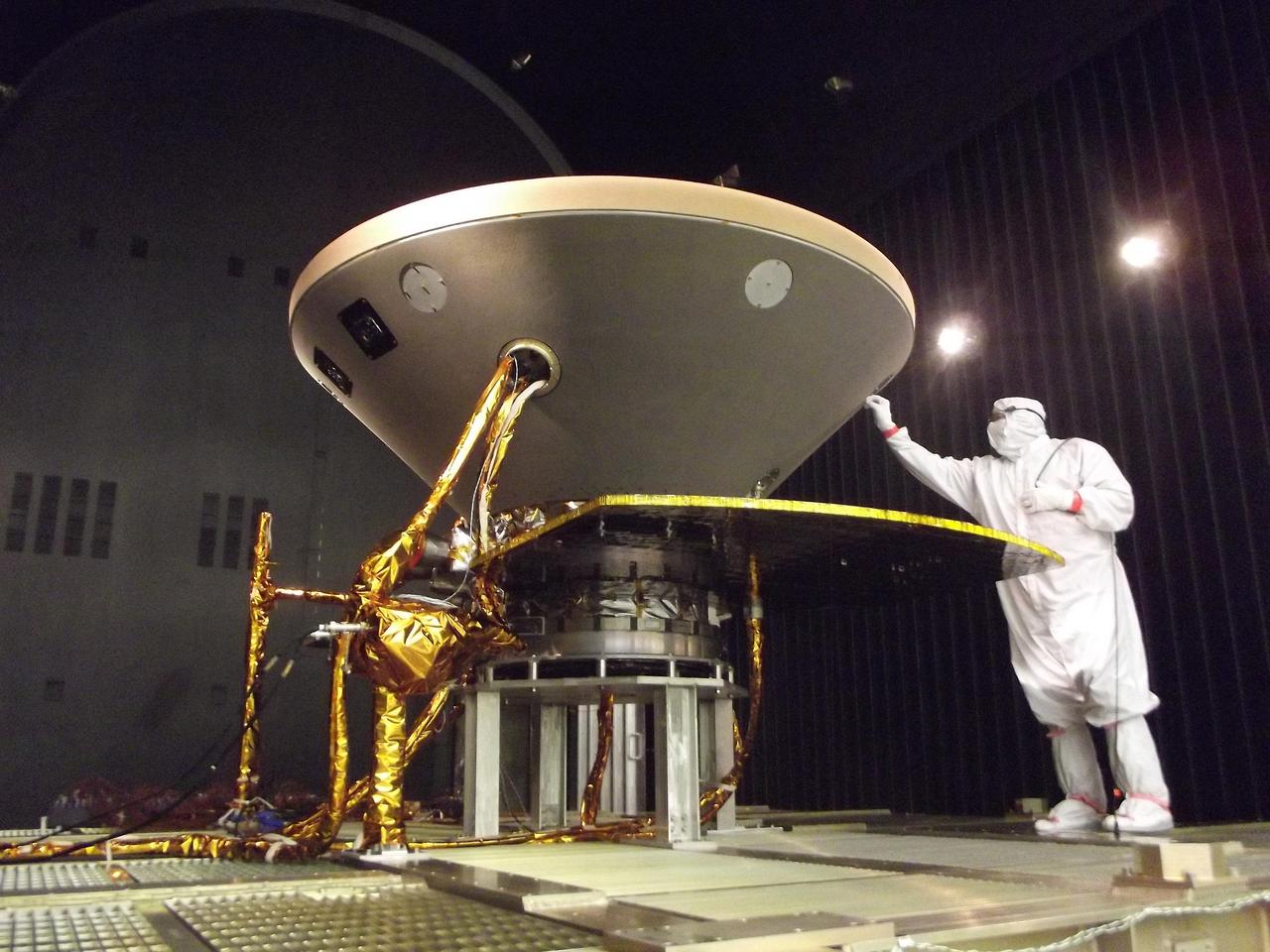
In this photo, a spacecraft specialist prepares NASA's InSight spacecraft for thermal vacuum testing in the flight system's "cruise" configuration for its 2016 flight to Mars. The testing simulates conditions of outer space that InSight will experience during its flight. The photo was taken on May 29, 2015, in a clean room of spacecraft assembly and test facilities at Lockheed Martin Space Systems, Denver. Note: After thorough examination, NASA managers have decided to suspend the planned March 2016 launch of the Interior Exploration using Seismic Investigations Geodesy and Heat Transport (InSight) mission. The decision follows unsuccessful attempts to repair a leak in a section of the prime instrument in the science payload. http://photojournal.jpl.nasa.gov/catalog/PIA19812
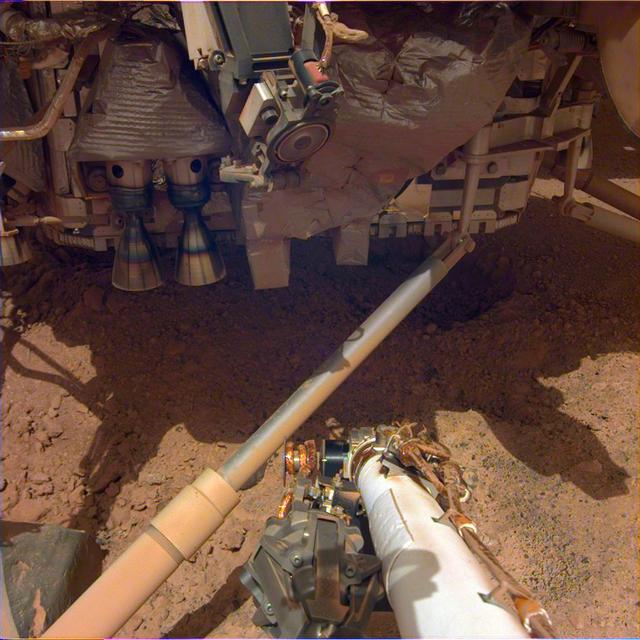
While NASA's InSight spacecraft landed on Mars, thrusters on the bottom of the spacecraft churned up the soil beneath it. This image shows pits that the thrusters excavated. This image was taken Dec. 14, 2018, the 18th Martian day, or sol, of the mission, using the Instrument Deployment Camera on InSight's robotic arm. https://photojournal.jpl.nasa.gov/catalog/PIA23250
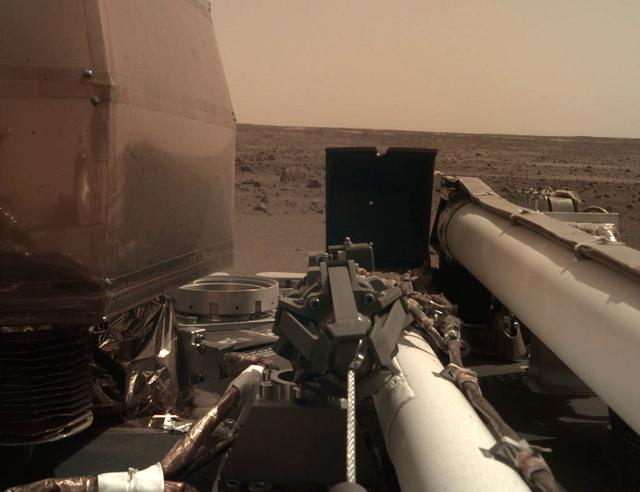
As visible in this image, NASA's InSight spacecraft unlatched its robotic arm on Nov. 27, 2018, the day after it landed on Mars. Animation available at https://photojournal.jpl.nasa.gov/catalog/PIA22892
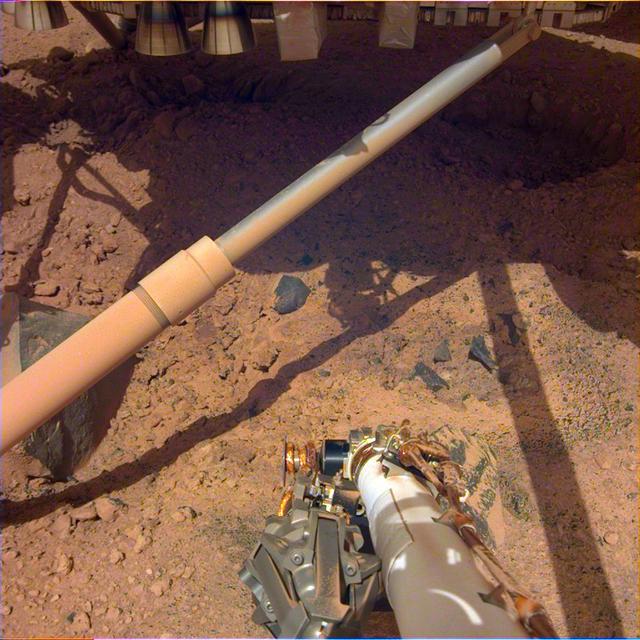
Thrusters under NASA's InSight lander churned up soil during landing on Mars. This image shows two pits excavated by the thrusters. https://photojournal.jpl.nasa.gov/catalog/PIA23301
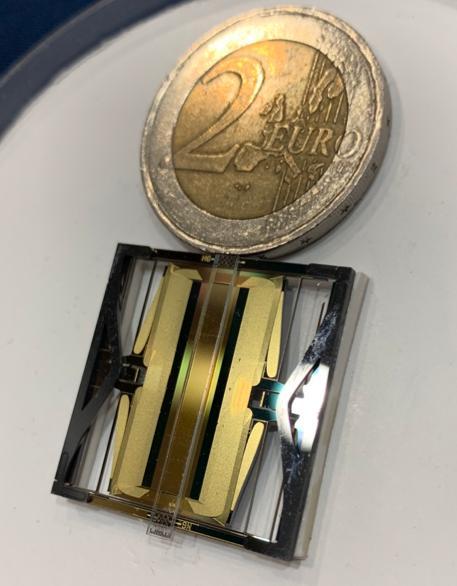
A copy of one of the sensors on NASA InSight's seismometer, compared to a 2-euro coin (about 1 inch wide). The short-period seismometer has three of these sensors. https://photojournal.jpl.nasa.gov/catalog/PIA22926
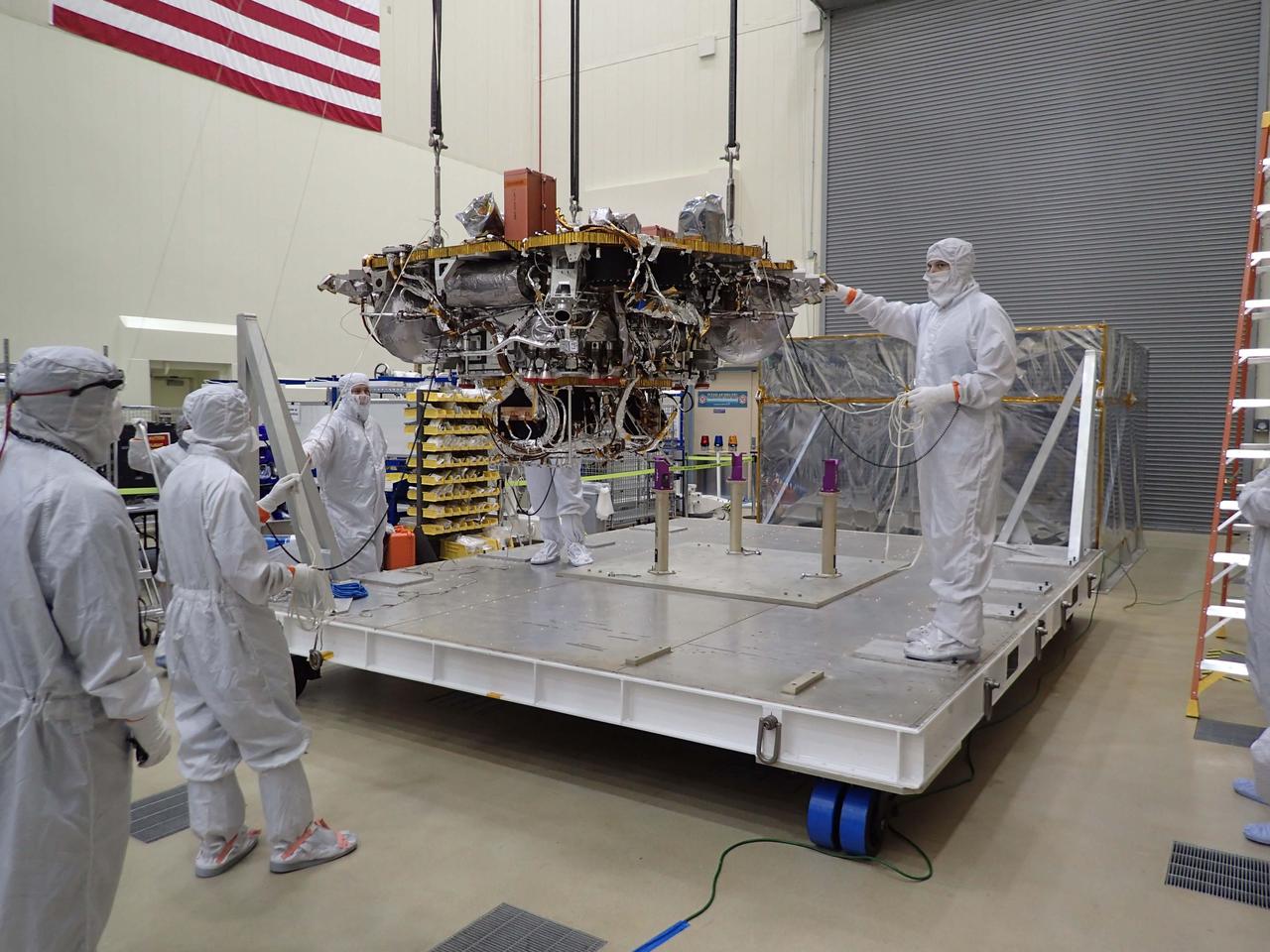
The Mars lander portion of NASA's InSight spacecraft is lifted from the base of a storage container in preparation for testing, in this photo taken June 20, 2017, in a Lockheed Martin clean room facility in Littleton, Colorado. The InSight mission (for Interior Exploration using Seismic Investigations, Geodesy and Heat Transport) is scheduled to launch in May 2018 and land on Mars Nov. 26, 2018. It will investigate processes that formed and shaped Mars and will help scientists better understand the evolution of our inner solar system's rocky planets, including Earth. https://photojournal.jpl.nasa.gov/catalog/PIA21844
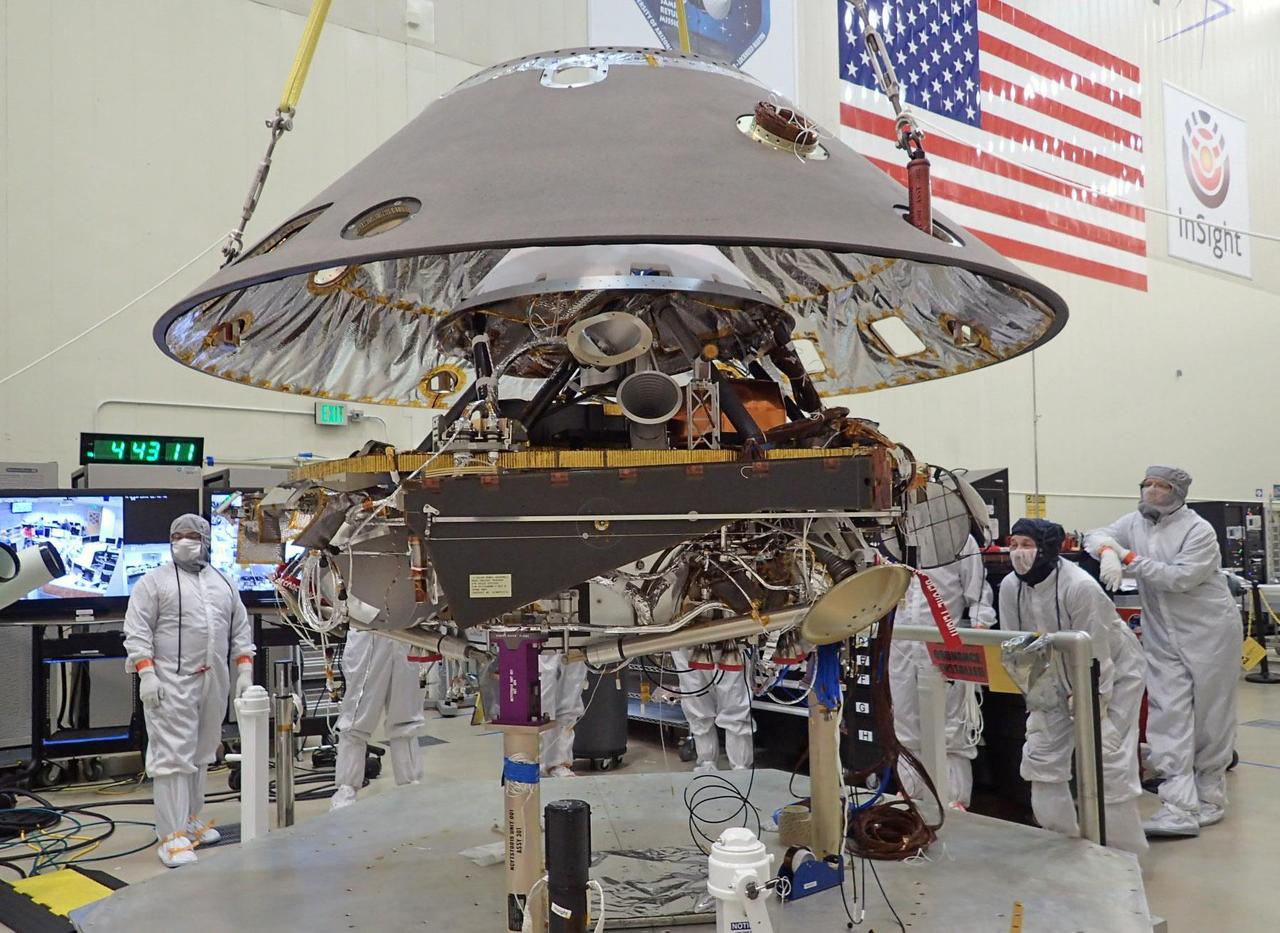
In this photo, the back shell of NASA's InSight spacecraft is being lowered onto the mission's lander, which is folded into its stowed configuration. The back shell and a heat shield form the aeroshell, which will protect the lander as the spacecraft plunges into the upper atmosphere of Mars. The photo was taken on April 29, 2015, in a spacecraft assembly clean room at Lockheed Martin Space Systems, Denver. InSight, for Interior Exploration Using Seismic Investigations, Geodesy and Heat Transport, is scheduled for launch in March 2016 and landing in September 2016. It will study the deep interior of Mars to advance understanding of the early history of all rocky planets, including Earth. Note: After thorough examination, NASA managers have decided to suspend the planned March 2016 launch of the Interior Exploration using Seismic Investigations Geodesy and Heat Transport (InSight) mission. The decision follows unsuccessful attempts to repair a leak in a section of the prime instrument in the science payload. http://photojournal.jpl.nasa.gov/catalog/PIA19666
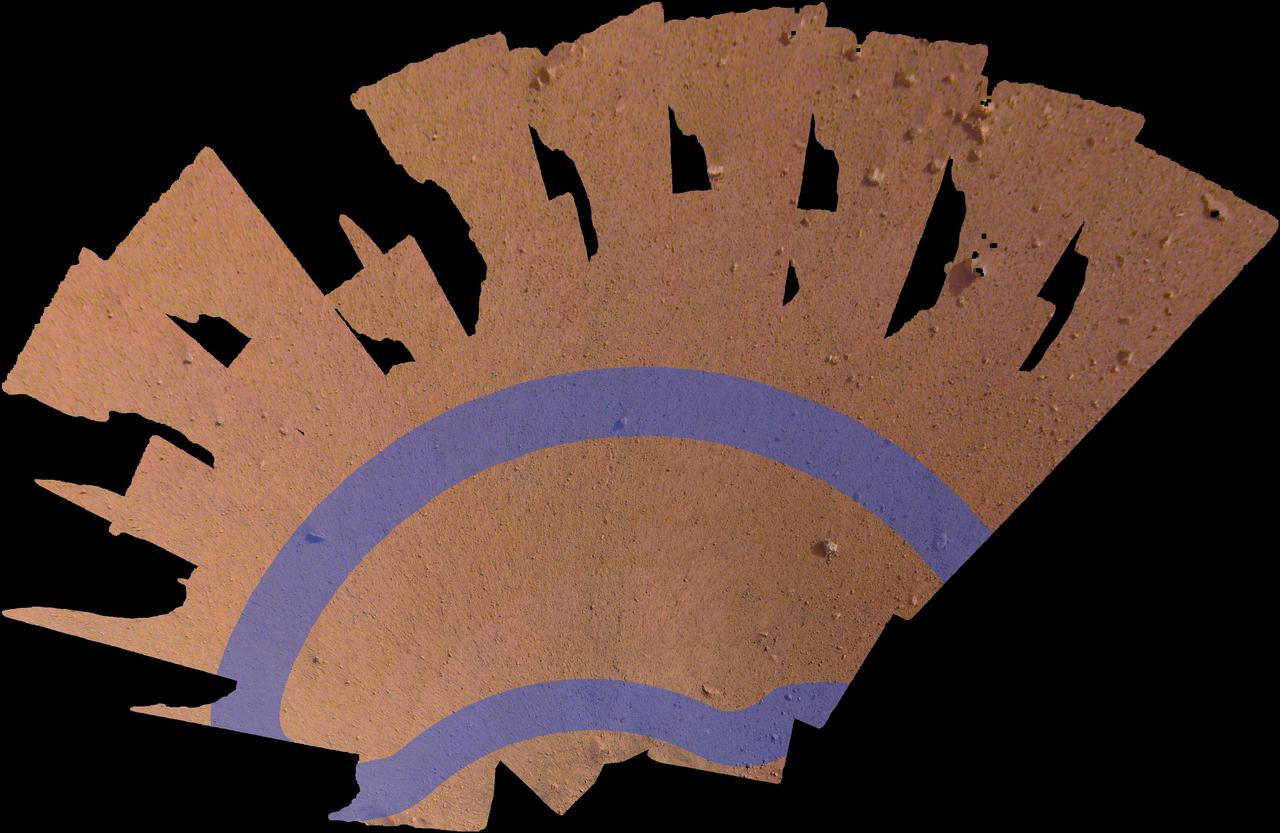
This mosaic, made of 52 individual images from NASA's InSight lander, shows the workspace where the spacecraft will eventually set its science instruments. The workspace is roughly 14 by 7 feet (4 by 2 meters). The lavender annotation shows where InSight's seismometer (called the Seismic Experiment for Interior Structure, or SEIS) and heat flow probe (called the Heat Flow and Physical Properties Package, or HP3) can be placed. https://photojournal.jpl.nasa.gov/catalog/PIA22874
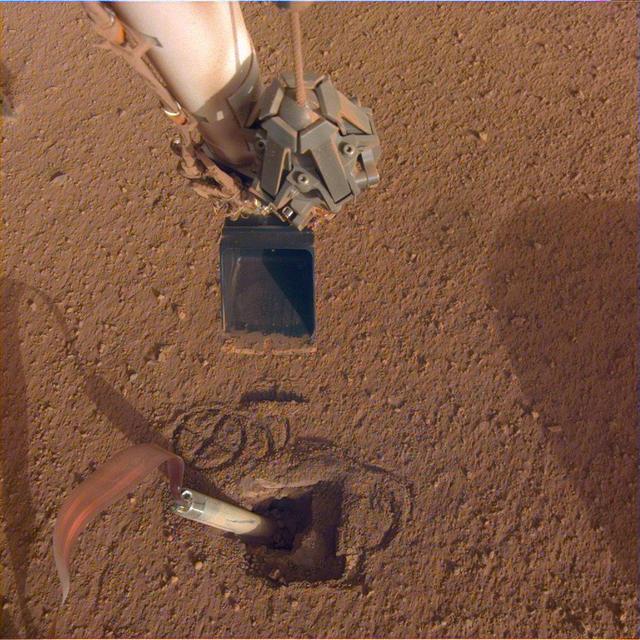
NASA's Mars InSight lander recently moved its robotic arm closer to the heat probe's digging device, called the "mole," in preparation to push on its top, or back cap. The InSight team hopes that pushing on this location will help the mole it bury itself and enable the heat probe to take Mars' temperature. Animation available at https://photojournal.jpl.nasa.gov/catalog/PIA23622

NASA's InSight spacecraft captured this panorama of its landing site on Dec. 9, 2018, the 14th Martian day, or sol, of its mission. The 290-degree perspective surveys the rim of the degraded crater InSight landed in, nicknamed "Homestead Hollow." The panorama is made of 30 individual images that were taken by the spacecraft's Instrument Deployment Camera, located on its robotic arm. https://photojournal.jpl.nasa.gov/catalog/PIA23140
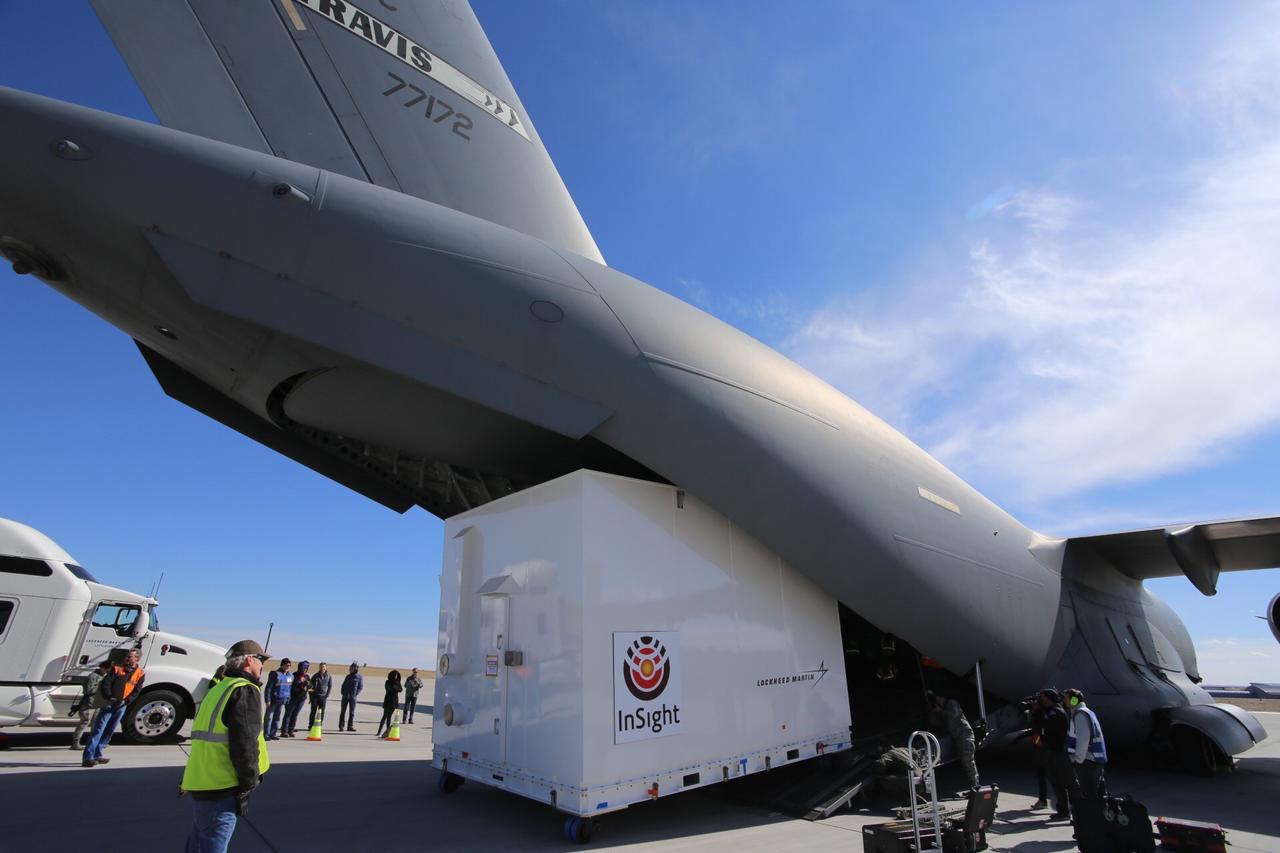
Personnel supporting NASA's InSight mission to Mars load the crated InSight spacecraft into a C-17 cargo aircraft at Buckley Air Force Base, Denver, for shipment to Vandenberg Air Force Base, California. The spacecraft, built in Colorado by Lockheed Martin Space, was shipped February 28, 2018, in preparation for launch from Vandenberg in May 2018. InSight, short for Interior Exploration using Seismic Investigations, Geodesy and Heat Transport, is the first mission dedicated to studying the deep interior of Mars. Its findings will advance understanding of the early history of all rocky planets, including Earth. https://photojournal.jpl.nasa.gov/catalog/PIA22220
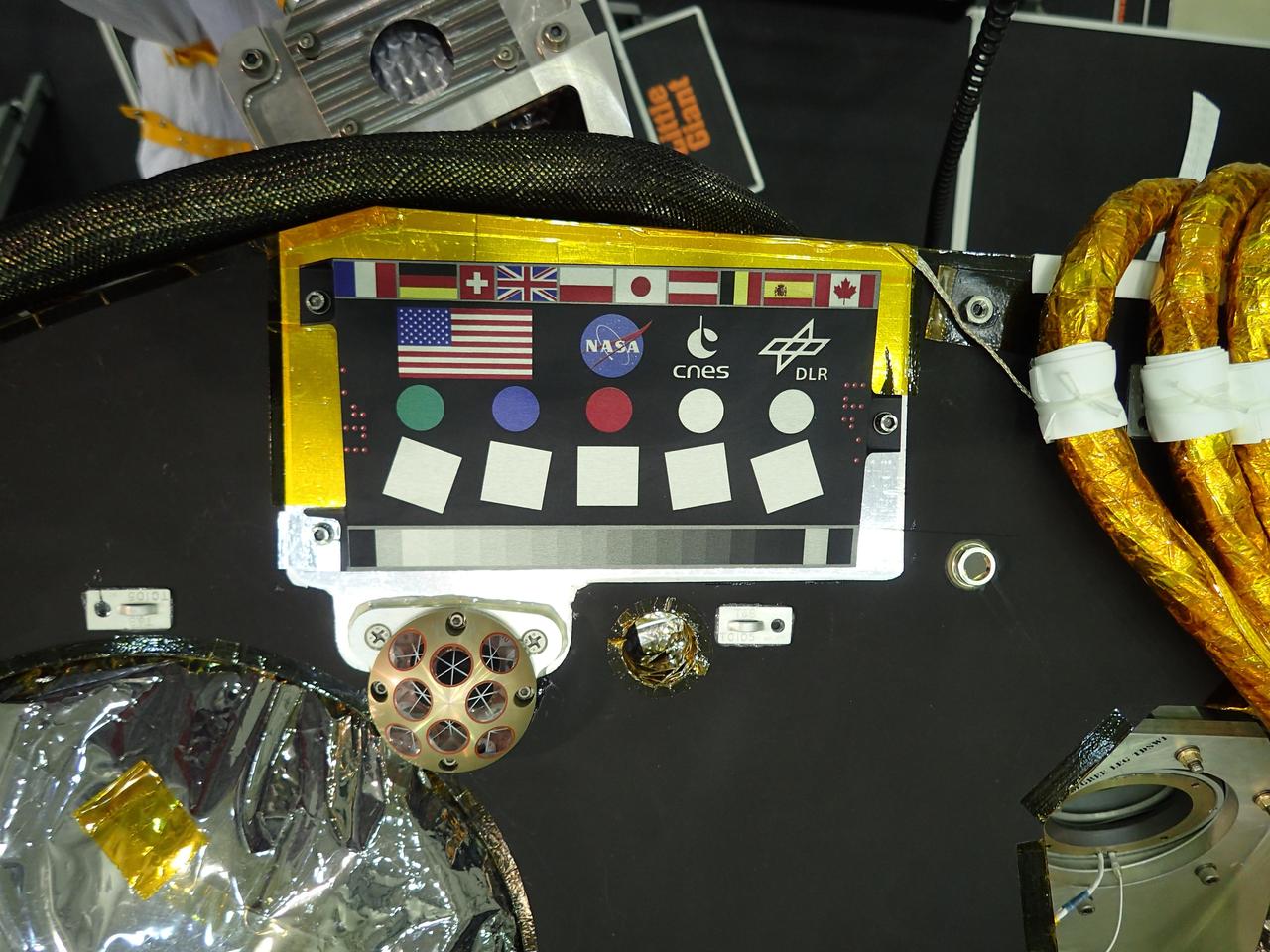
A camera calibration target sits on the deck of the NASA's InSight lander, adorned with the flags of the countries participating in the mission. The target, which will be viewed by InSight's cameras, provides a variety of colors and shapes to help calibrate the lander's cameras. It also shows off international flags representing the agencies, institutions and participating scientists of the mission as of late 2014 (since that time, Italy has contributed an experiment). In the second row are the United States flag and the logos of NASA, the French space agency CNES, which provided InSight's seismometer; and the German Aerospace Center DLR, which provided InSight's heat flow probe. Below the target in the photo is an Italian experiment called the Laser Retroreflector for InSight (LaRRI). LaRRI is the small, copper-colored dome covered with circles just below the calibration target; it won't actually play a role in InSight's mission. The national space agency of Italy (ASI, for Agenzia Spaziale Italiana) provided LaRRI to be used by a possible future Mars orbiter mission with a laser altimeter making extremely precise measurements of the lander's location for fundamental physics studies and precision cartography. A microchip bearing the names of nearly a million members of the public is visible in this image to the right of the calibration target. A second microchip with more than a million additional names was added after this photo was taken. https://photojournal.jpl.nasa.gov/catalog/PIA22540
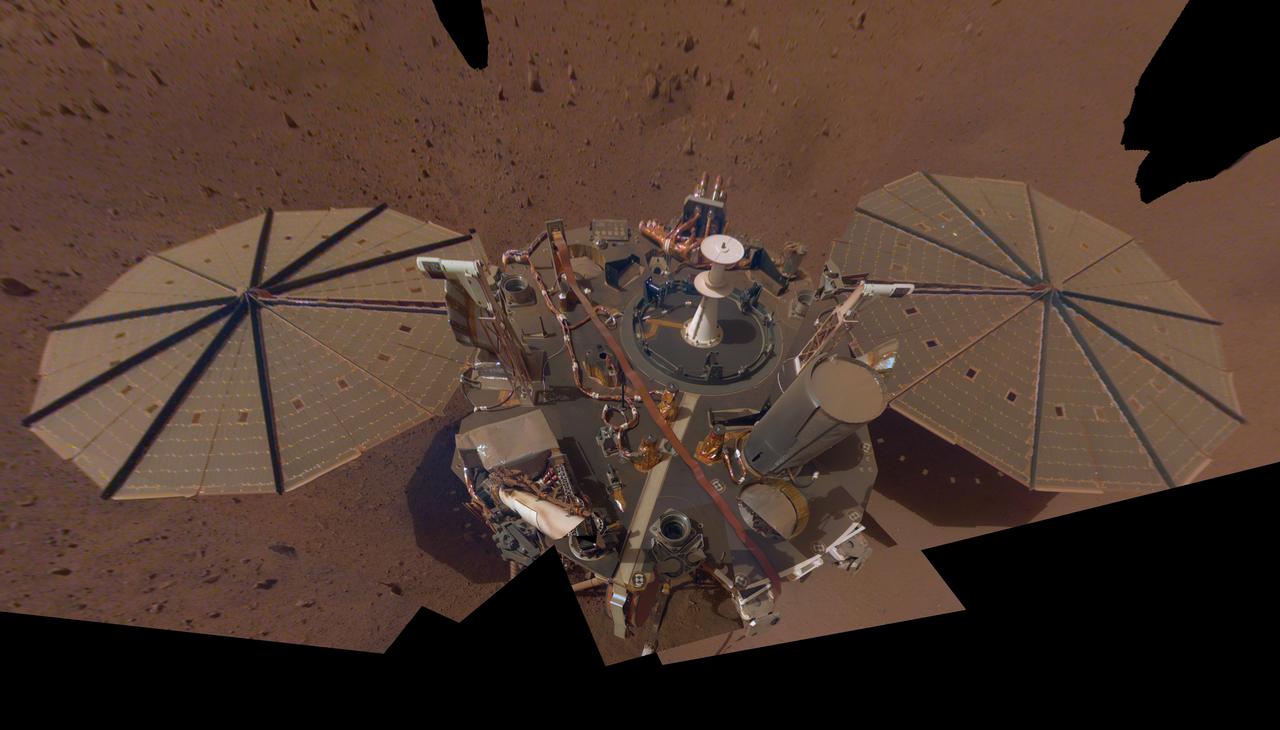
This is NASA InSight's second full selfie on Mars. Since taking its first selfie, the lander has removed its heat probe and seismometer from its deck, placing them on the Martian surface; a thin coating of dust now covers the spacecraft as well. This selfie is a mosaic made up of 14 images taken on March 15 and April 11 - the 106th and 133rd Martian days, or sols, of the mission - by InSight's Instrument Deployment Camera, located on its robotic arm. InSight's first selfie showed its instruments still on the deck. Now that they're removed, the viewer can see the spacecraft's air pressure sensor (white object in center), the tether box for its seismometer and the tether for its heat probe running across the deck. Also visible is its robotic arm and grapple. https://photojournal.jpl.nasa.gov/catalog/PIA23203
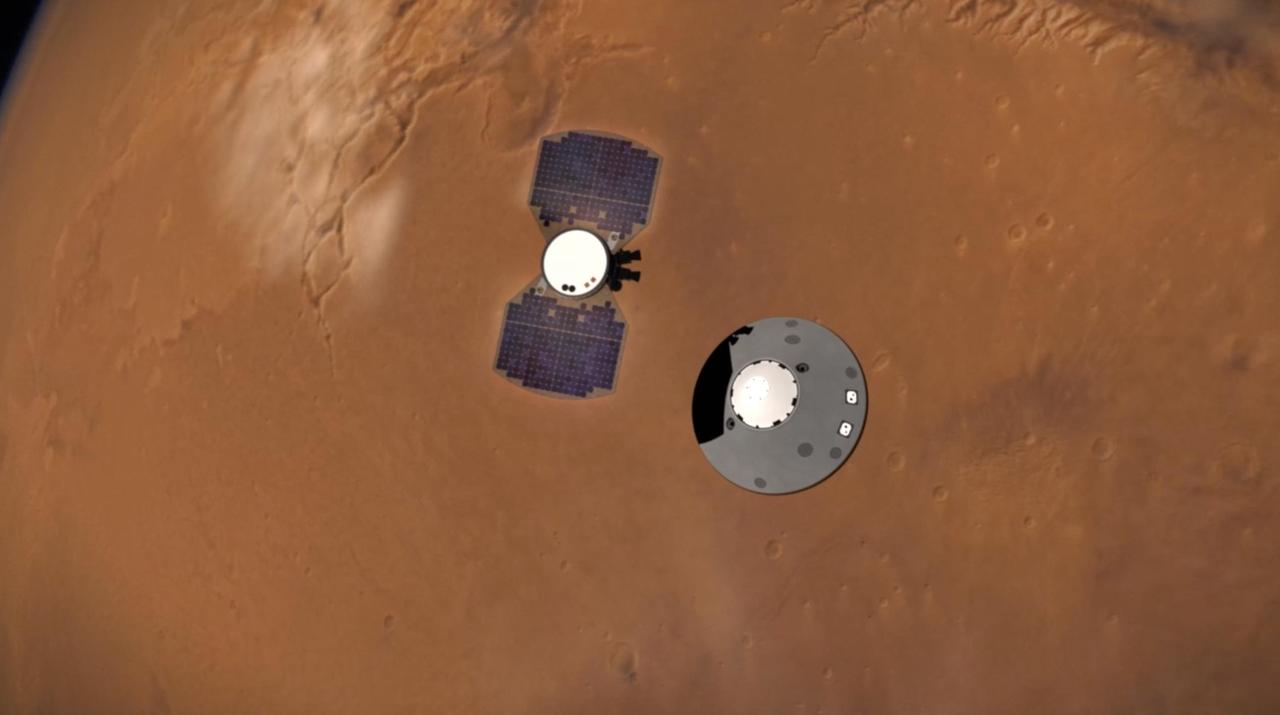
This illustration shows NASA's InSight lander separating from its cruise stage as it prepares to enter Mars' atmosphere. The InSight lander is on the right, tucked inside a protective heat shield and back shell. The cruise stage with solar panels is on the left. https://photojournal.jpl.nasa.gov/catalog/PIA22828
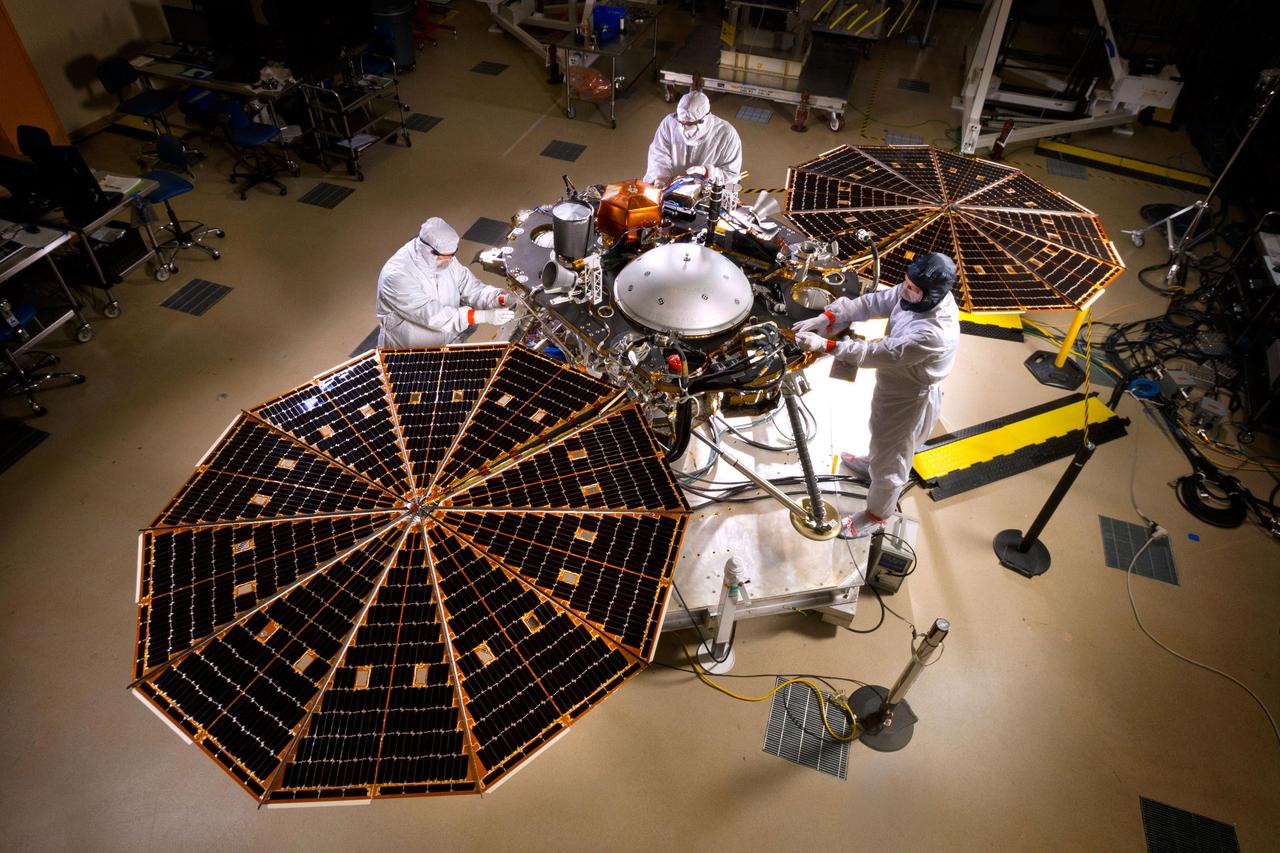
The solar arrays on NASA's InSight lander are deployed in this test inside a clean room at Lockheed Martin Space Systems, Denver. This configuration is how the spacecraft will look on the surface of Mars. The image was taken on April 30, 2015. InSight, for Interior Exploration Using Seismic Investigations, Geodesy and Heat Transport, is scheduled for launch in March 2016 and landing in September 2016. It will study the deep interior of Mars to advance understanding of the early history of all rocky planets, including Earth. Note: After thorough examination, NASA managers have decided to suspend the planned March 2016 launch of the Interior Exploration using Seismic Investigations Geodesy and Heat Transport (InSight) mission. The decision follows unsuccessful attempts to repair a leak in a section of the prime instrument in the science payload. http://photojournal.jpl.nasa.gov/catalog/PIA19664
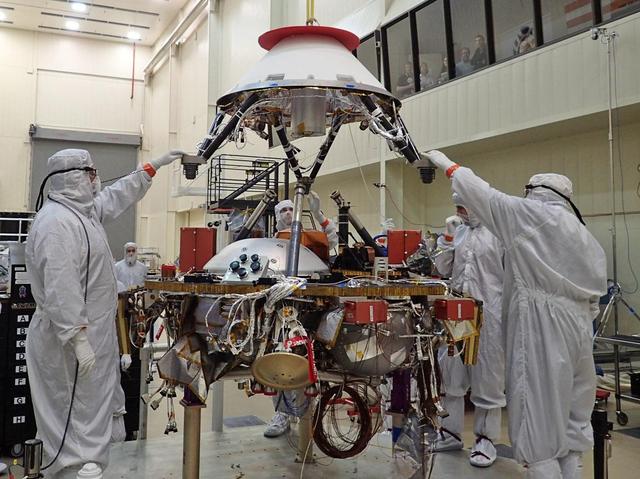
In this photo, spacecraft specialists at Lockheed Martin Space Systems, Denver, are reaching up to guide lowering of the parachute cone for installation onto NASA's InSight spacecraft. The photo was taken on April 29, 2015. InSight's parachute, stowed inside the cone, will provide deceleration in the Martian atmosphere. Its role will come after atmospheric friction with the spacecraft's heat shield provides initial deceleration and before thrusters on the lander provide final deceleration. InSight, for Interior Exploration Using Seismic Investigations, Geodesy and Heat Transport, is scheduled for launch in March 2016 and landing in September 2016. It will study the deep interior of Mars to advance understanding of the early history of all rocky planets, including Earth. Note: After thorough examination, NASA managers have decided to suspend the planned March 2016 launch of the Interior Exploration using Seismic Investigations Geodesy and Heat Transport (InSight) mission. The decision follows unsuccessful attempts to repair a leak in a section of the prime instrument in the science payload. http://photojournal.jpl.nasa.gov/catalog/PIA19669
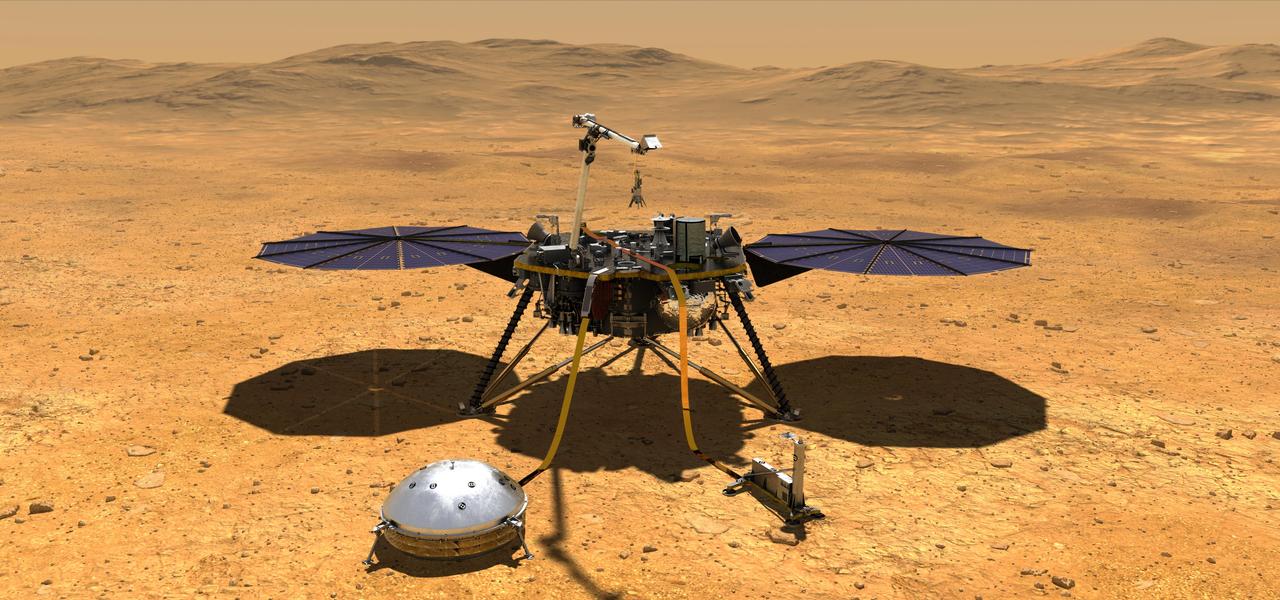
This artist's concept depicts NASA's InSight lander after it has deployed its instruments on the Martian surface. https://photojournal.jpl.nasa.gov/catalog/PIA22743
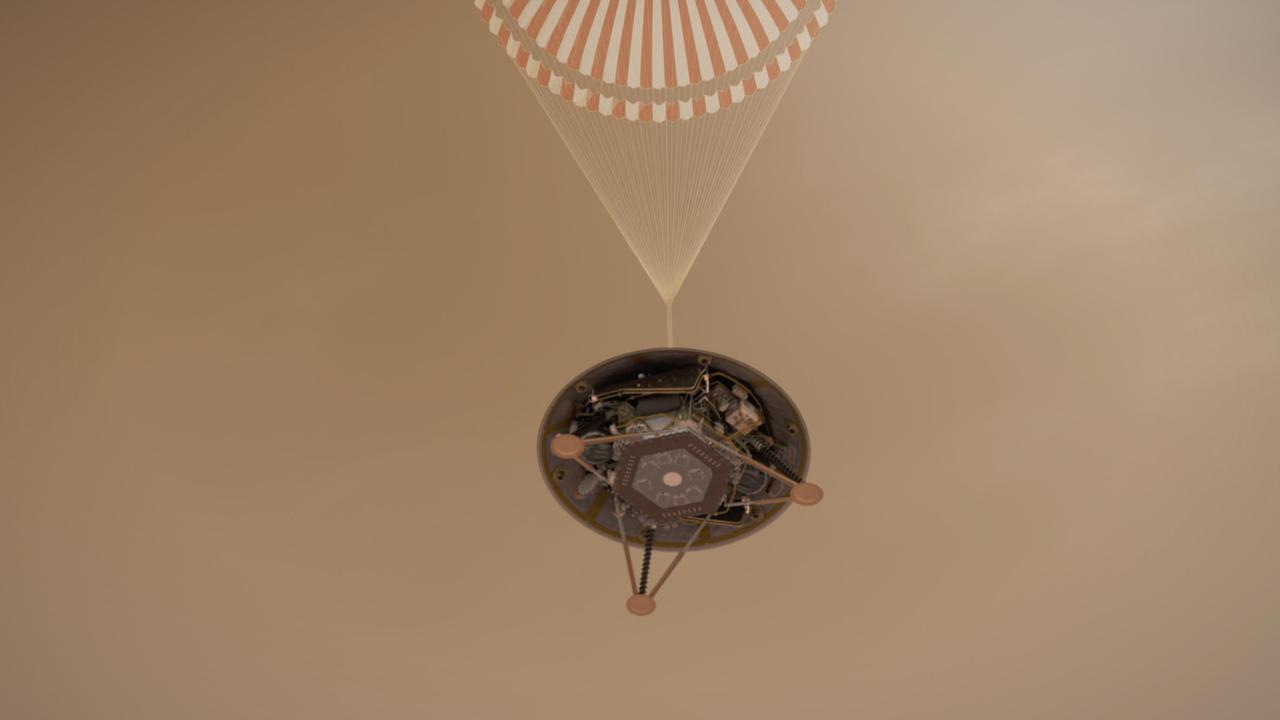
This illustration shows a simulated view of NASA's InSight lander descending towards the surface of Mars on its parachute. https://photojournal.jpl.nasa.gov/catalog/PIA22809
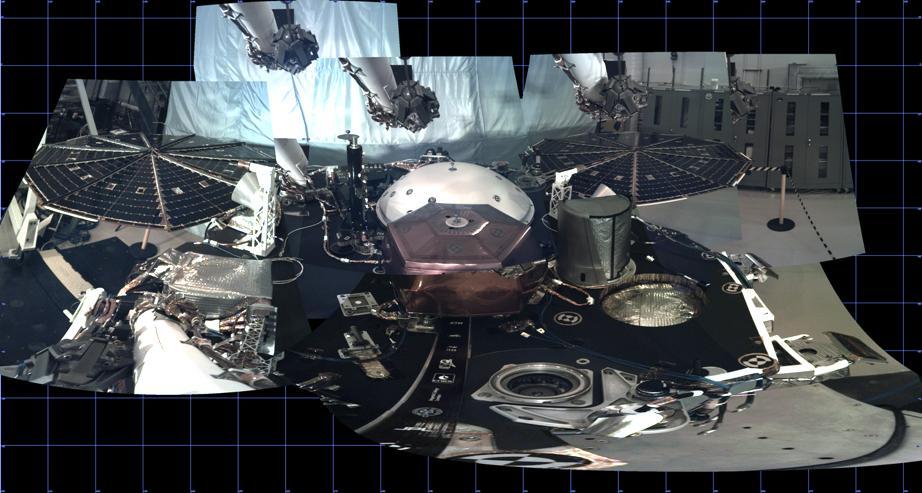
This panorama, created from multiple images, shows the deck of NASA's InSight lander, as well as its solar panels, during the assembly, test and launch operations phase at Lockheed Martin Space, Denver. The panorama, which uses images from InSight's Instrument Deployment Camera on its robotic arm, is a cylindrical projection. https://photojournal.jpl.nasa.gov/catalog/PIA22826
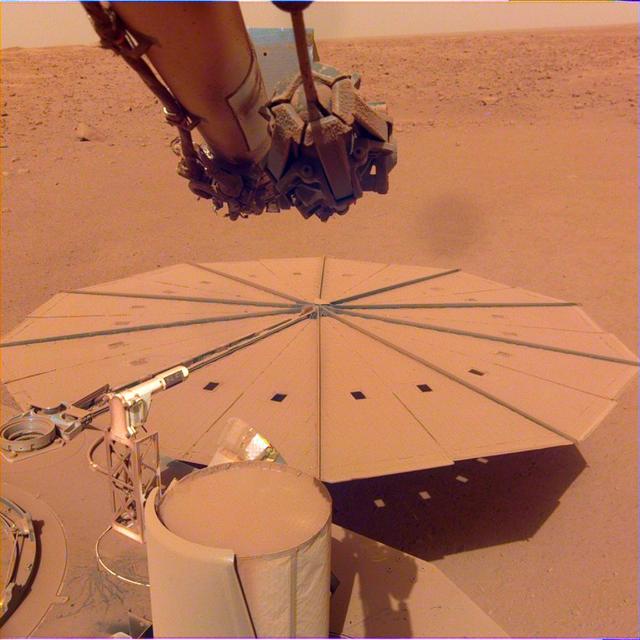
NASA's InSight Mars lander captured this image of one of its dust-covered solar panels on April 24, 2022, the 1,211th Martian day, or sol, of the mission. https://photojournal.jpl.nasa.gov/catalog/PIA25286
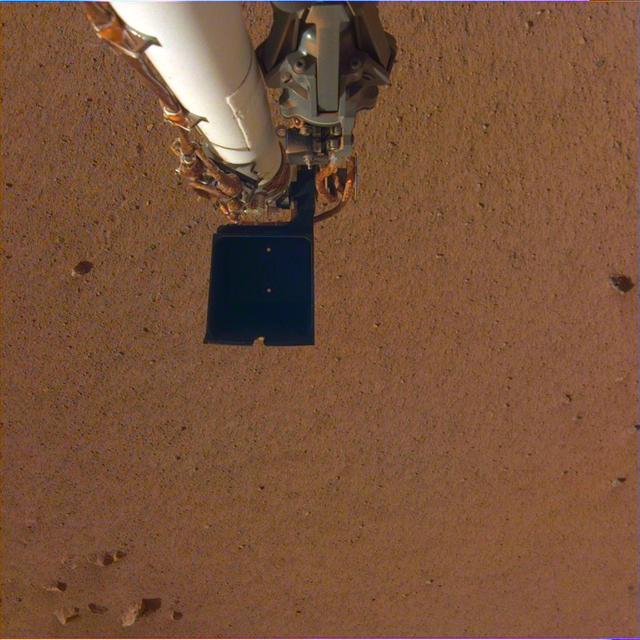
NASA's InSight spacecraft took a color-calibrated image of its robotic arm using its Instrument Deployment Camera on Dec. 4, 2018 (Sol 8). The camera still has a transparent dust cover on it, but the robotic arm can clearly be seen above the Martian soil. There is a dark scoop at the end of the arm. Above the scoop is the stowed grapple, the claw that InSight will use to grab and move its instruments from its deck onto the planet's surface. InSight will be the first Mars mission to use a robotic arm to grasp objects and deploy them onto the surface of another planet. https://photojournal.jpl.nasa.gov/catalog/PIA22872
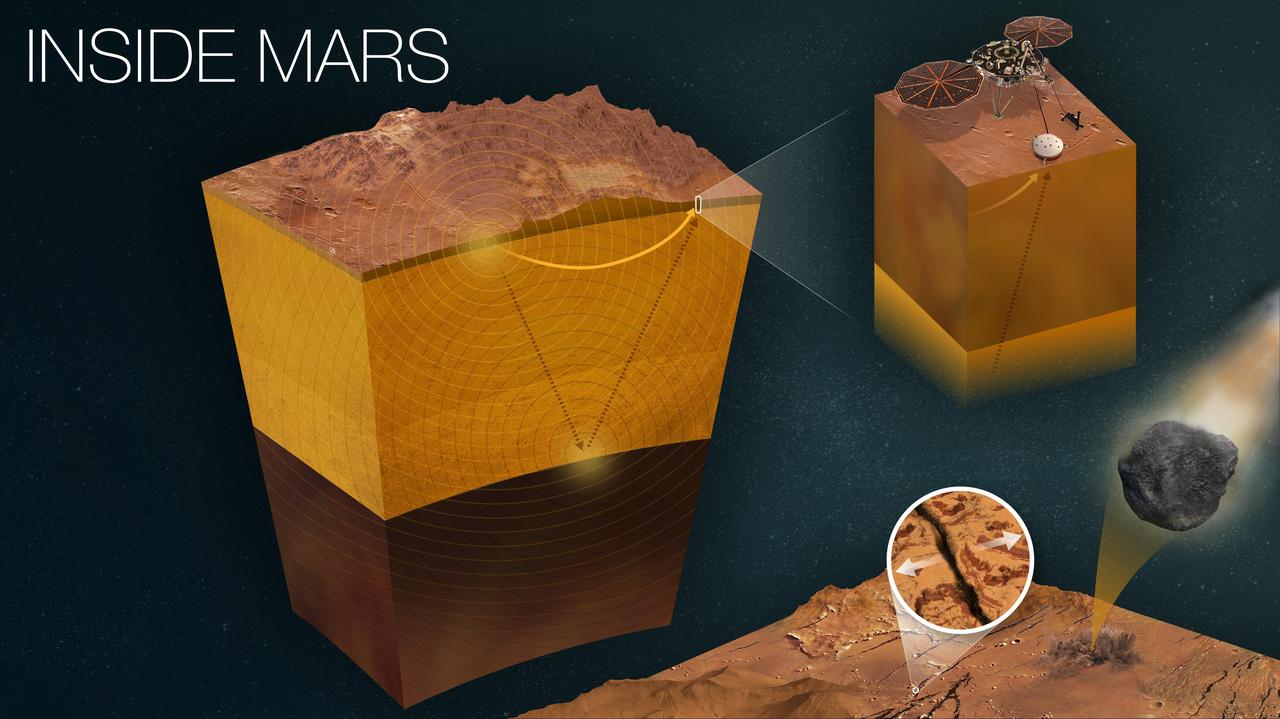
NASA's InSight Mars lander uses a seismometer to study the inner layers of Mars. Seismic signals from quakes change as they pass through different kinds of materials; seismologists can "read" the squiggles of a seismogram to study the properties of the planet's crust, mantle, and core. This infographic shows those layers, and how InSight uses quakes to study them. It also shows a close-up of InSight and the major sources of marsquakes. Most quakes are created by heat and pressure inside the planet, which cause rock to fracture; another source is meteors striking the surface. https://photojournal.jpl.nasa.gov/catalog/PIA25282
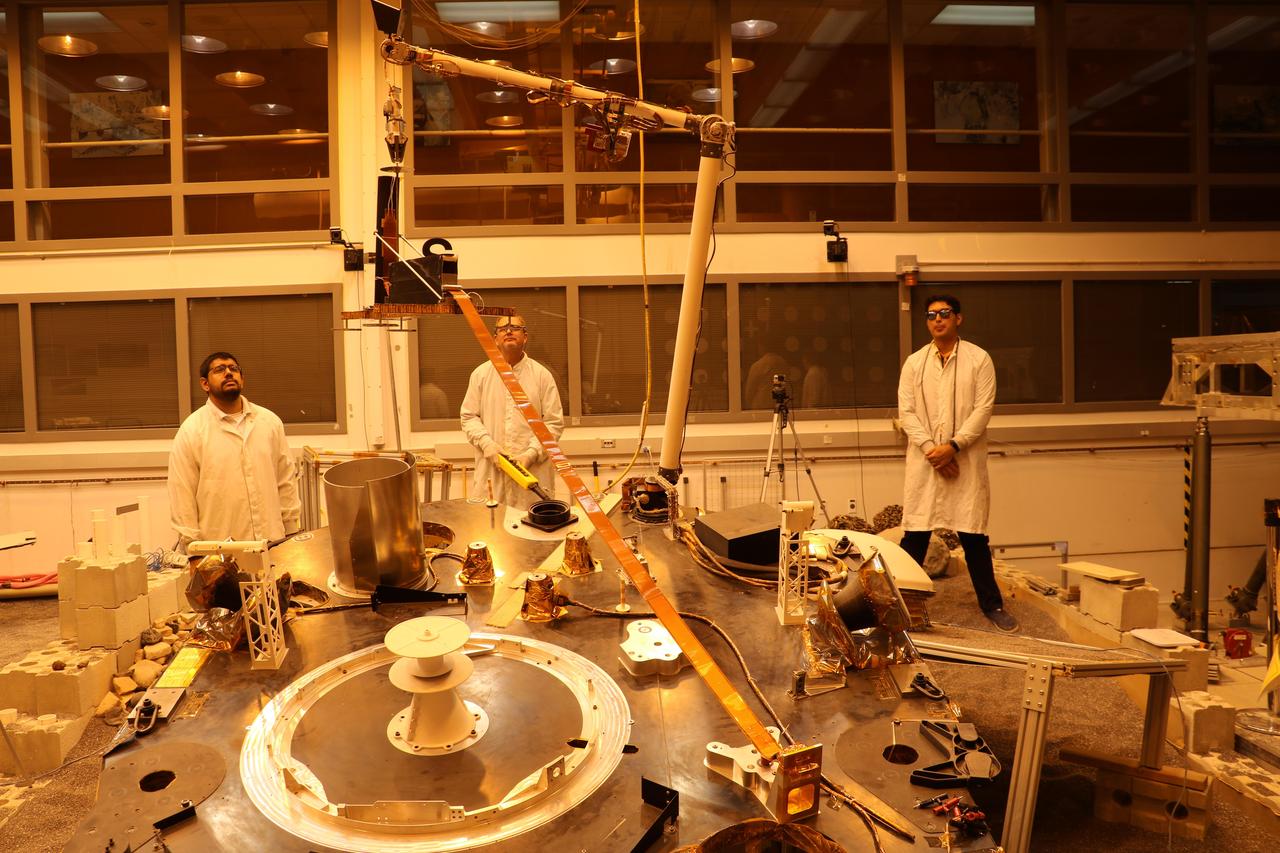
An engineering version of the robotic arm on NASA's InSight mission lifts the engineering version of the Heat Flow and Physical Properties Probe (HP3) at NASA's Jet Propulsion Laboratory. This test was conducted by InSight team members in a Mars-like environment, including reddish lighting, to simulate conditions InSight will encounter on the Red Planet. The orange tape-like tail behind HP3 is a tether that connects the HP3 support structure to the instrument's back-end electronics box on the lander. https://photojournal.jpl.nasa.gov/catalog/PIA22807
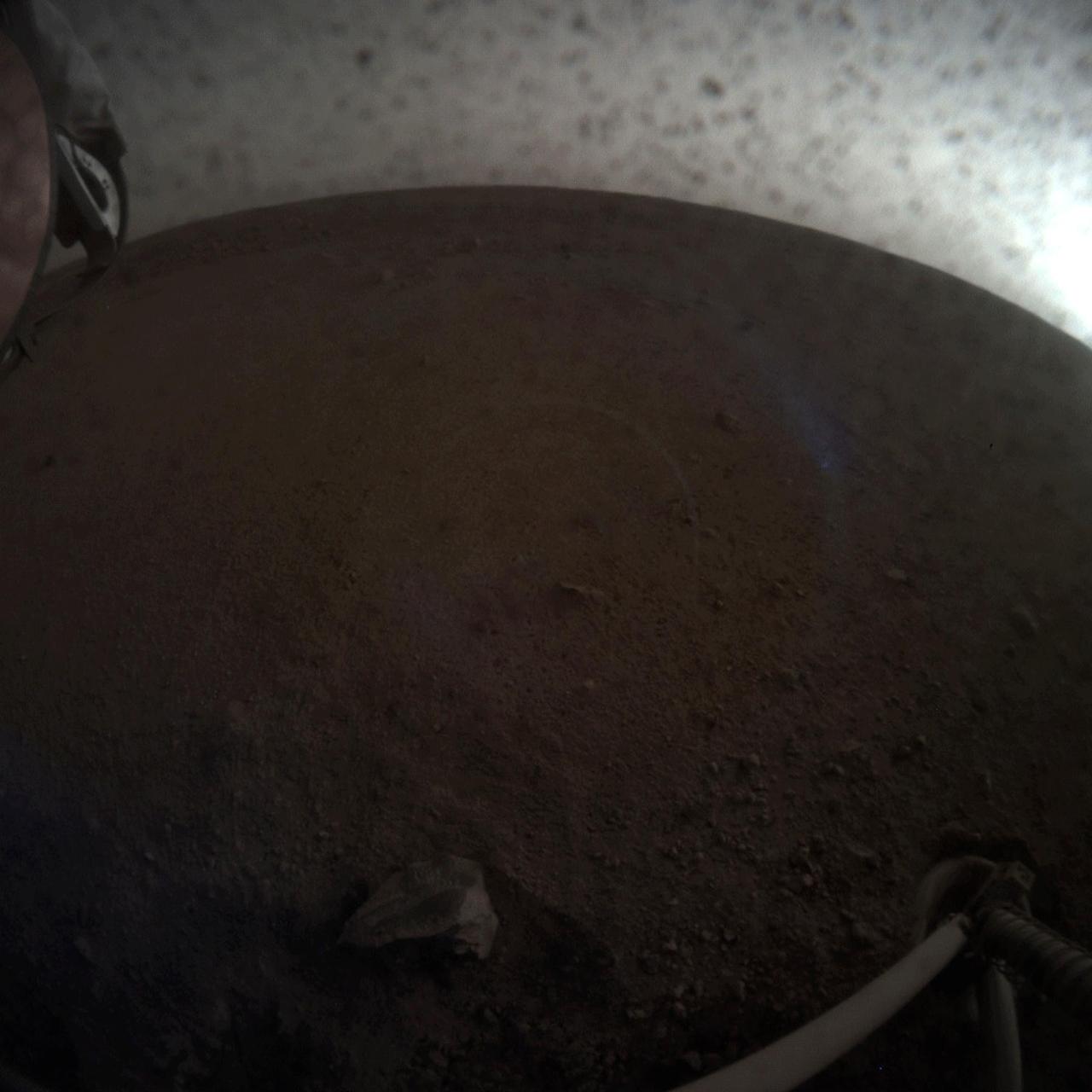
A fish-eye view of NASA's InSight lander deploying its first instrument onto the surface of Mars. InSight's robotic arm placed the seismometer on Dec. 19, 2018, around the time of dusk on Mars. These images were taken by the Instrument Context Camera (ICC), a fish-eye camera under the spacecraft's deck. Animation available at https://photojournal.jpl.nasa.gov/catalog/PIA22978
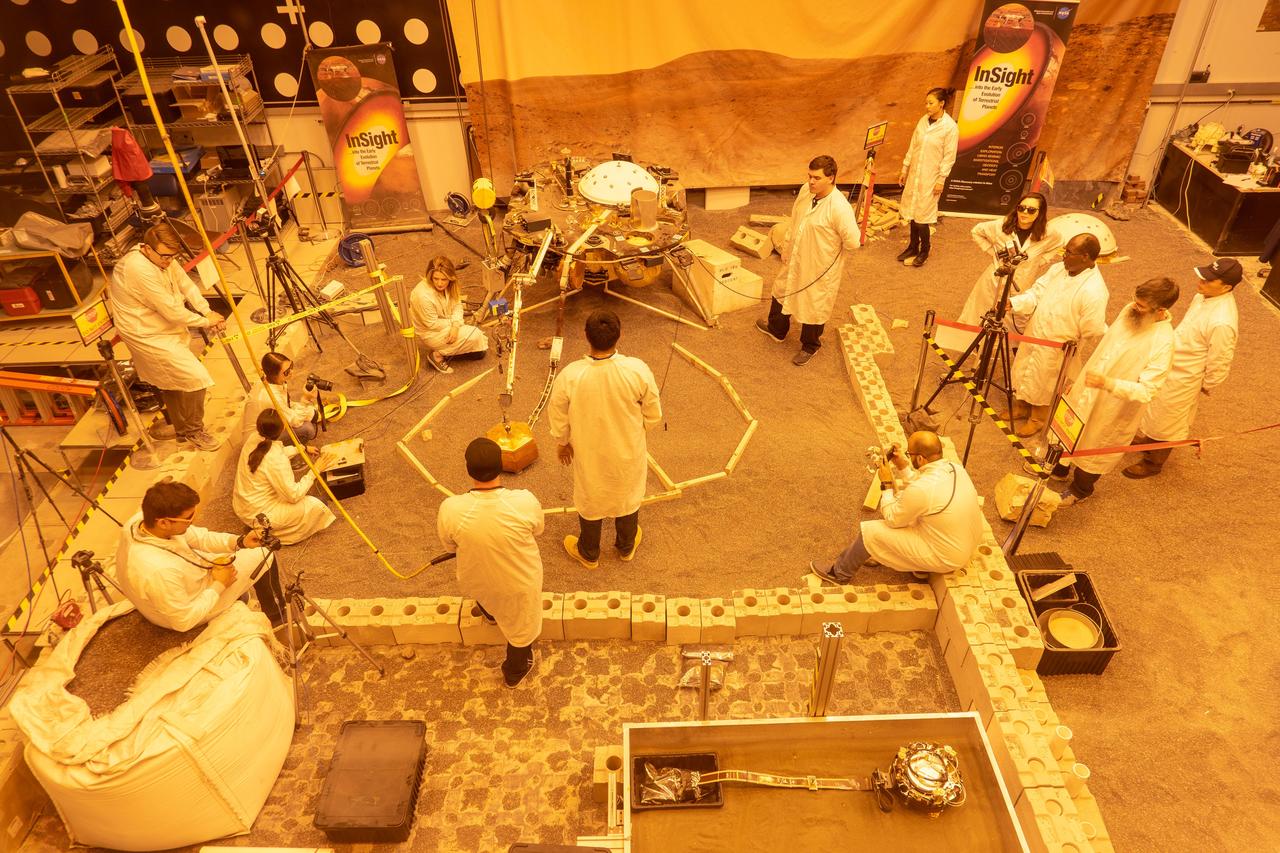
Engineers practice deploying InSight's instruments in a lab at NASA's Jet Propulsion Laboratory in Pasadena, California. Several of them are wearing sunglasses to block the bright yellow lights in the test space, which mimic sunlight as it appears on Mars. The yellow lights are used to test cameras which are the same as those used by InSight on Mars. The entire lab space in the center of the image has been sculpted to mimic the terrain in front of the lander on Mars, creating more reliable test conditions. The area in the center of the image is the "workspace" where the lander's instruments can be set down; wood blocks have been laid down to mark the perimeter of these areas. Rocks have been chosen to match the size, shape and location of those in front of InSight on Mars. In the center of the image is a model of the lander's copper-colored seismometer; at the bottom-right is a second model of the seismometer used for a different kind of testing. In the lower left corner of the image is a bag of crushed granite, which is used in this lab to simulate Martian sand. https://photojournal.jpl.nasa.gov/catalog/PIA22744
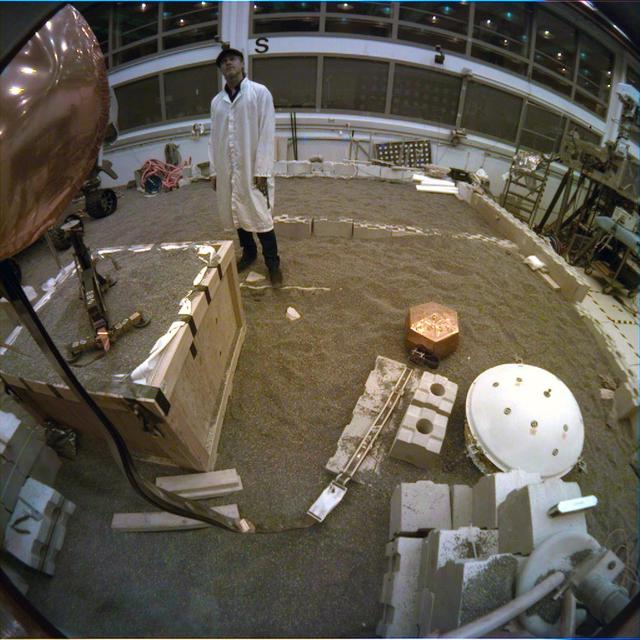
In a Mars-like environment at NASA's Jet Propulsion Laboratory, the fish-eye camera aboard the engineering model of NASA's InSight lander snapped this image of the actor Brad Pitt on Sept. 6, 2019. This picture, which has been white-balanced to remove the orange-red tint of the Mars lights in the room, was taken by the instrument context camera, bolted to the deck of the lander model. The InSight replica is located in JPL's In-Situ Instrument Laboratory and used for test purposes. Pitt visited JPL to learn about real space technology after filming his space-themed movie "Ad Astra." https://photojournal.jpl.nasa.gov/catalog/PIA23278
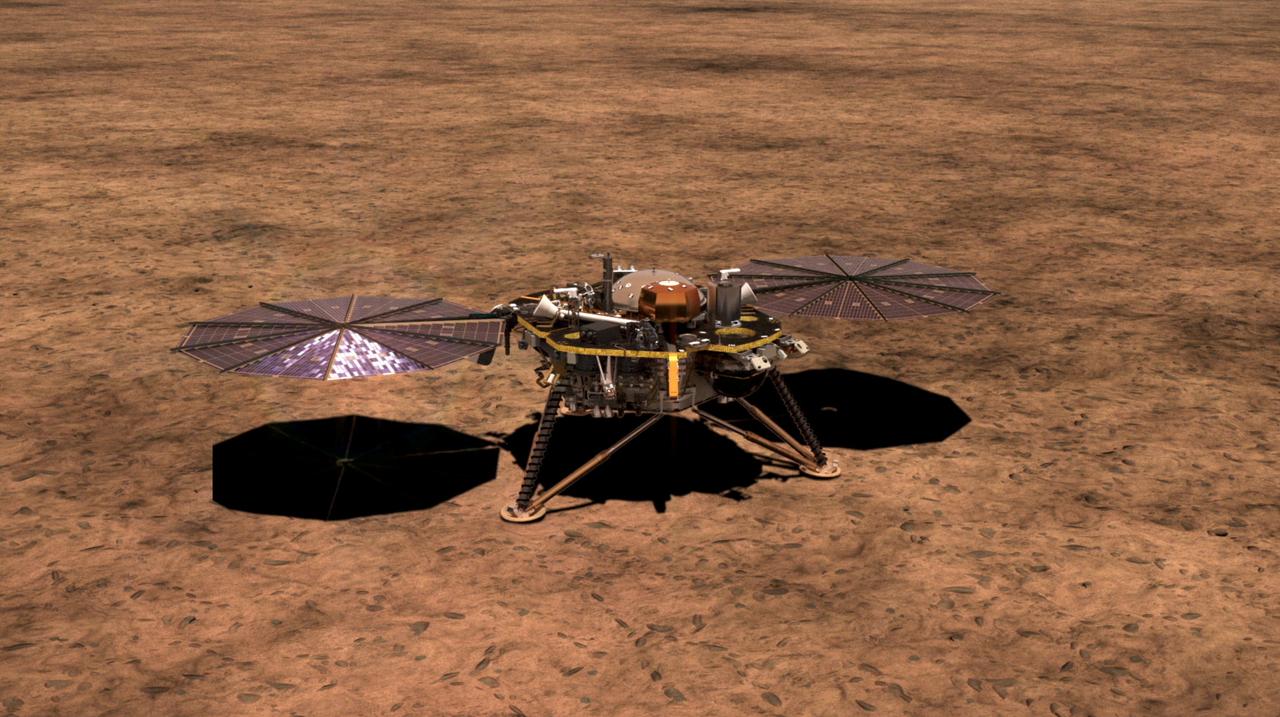
This artist's illustration shows NASA's InSight lander on the surface of Mars, with its solar arrays deployed. https://photojournal.jpl.nasa.gov/catalog/PIA22571
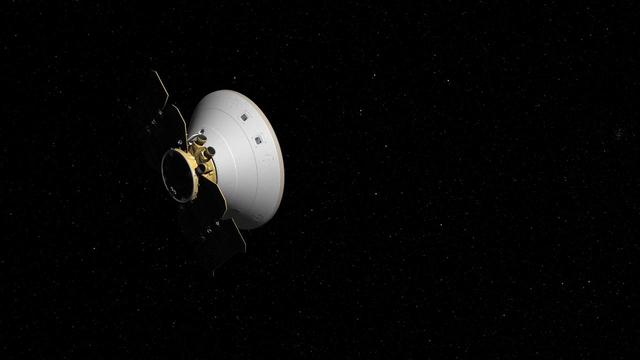
This artist's concept shows the InSight spacecraft, encapsulated in its aeroshell, as it cruises to Mars. https://photojournal.jpl.nasa.gov/catalog/PIA22547
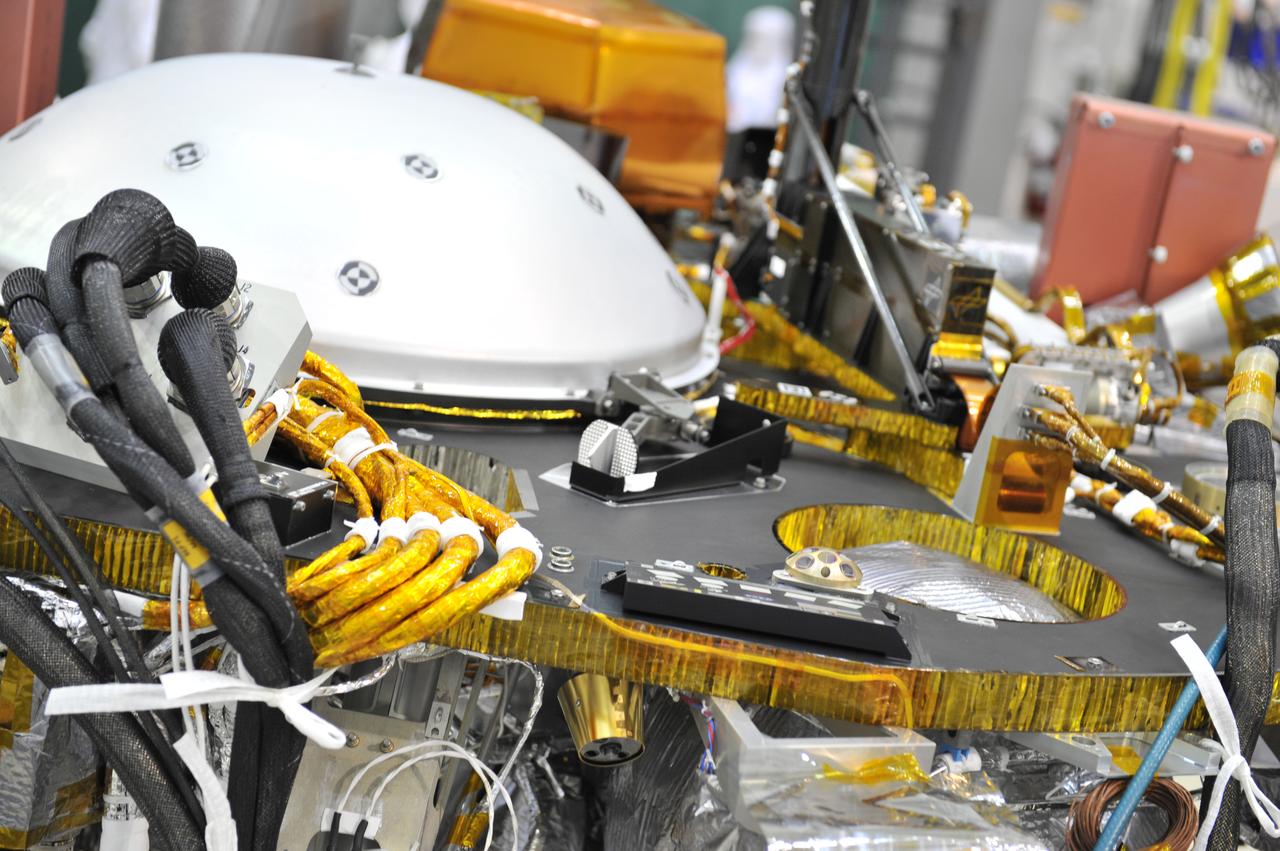
Technicians at Lockheed Martin Space in Littleton, Colorado installed a microchip with 1.6 million names submitted by the public to ride along with NASA's InSight mission to Mars. The chip was installed on Jan. 23, 2018. This joins another microchip that was previously installed that included 800,000 names for a grand total of 2.4 million names going to Mars as early as May 5, 2018. The microchip including names from the NASA InSight mission's "Send Your Name to Mars" campaign was affixed to the spacecraft with a special glue. https://photojournal.jpl.nasa.gov/catalog/PIA22206
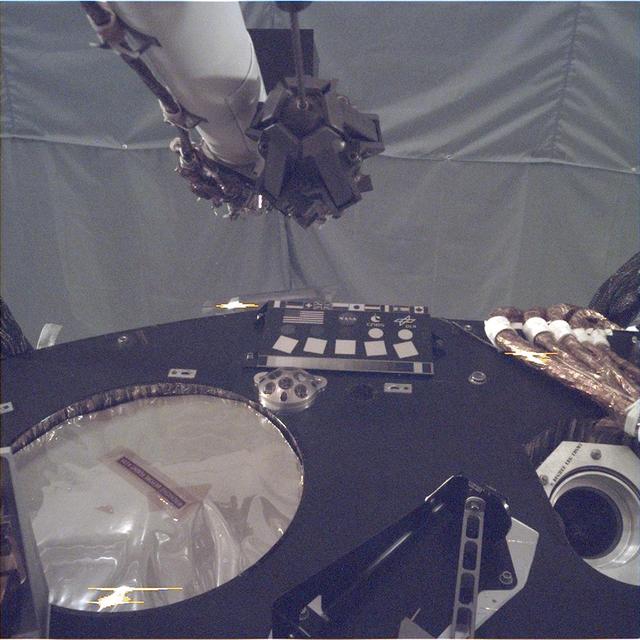
This image of the deck of NASA's InSight lander - where the camera's rectangular calibration target can be seen in the middle - was taken by the Instrument Deployment Camera during the assembly, test and launch operations phase at Lockheed Martin Space, Denver. The Instrument Deployment Camera is attached to the spacecraft's robotic arm. For more on the calibration target see https://photojournal.jpl.nasa.gov/catalog/PIA22540. https://photojournal.jpl.nasa.gov/catalog/PIA22815
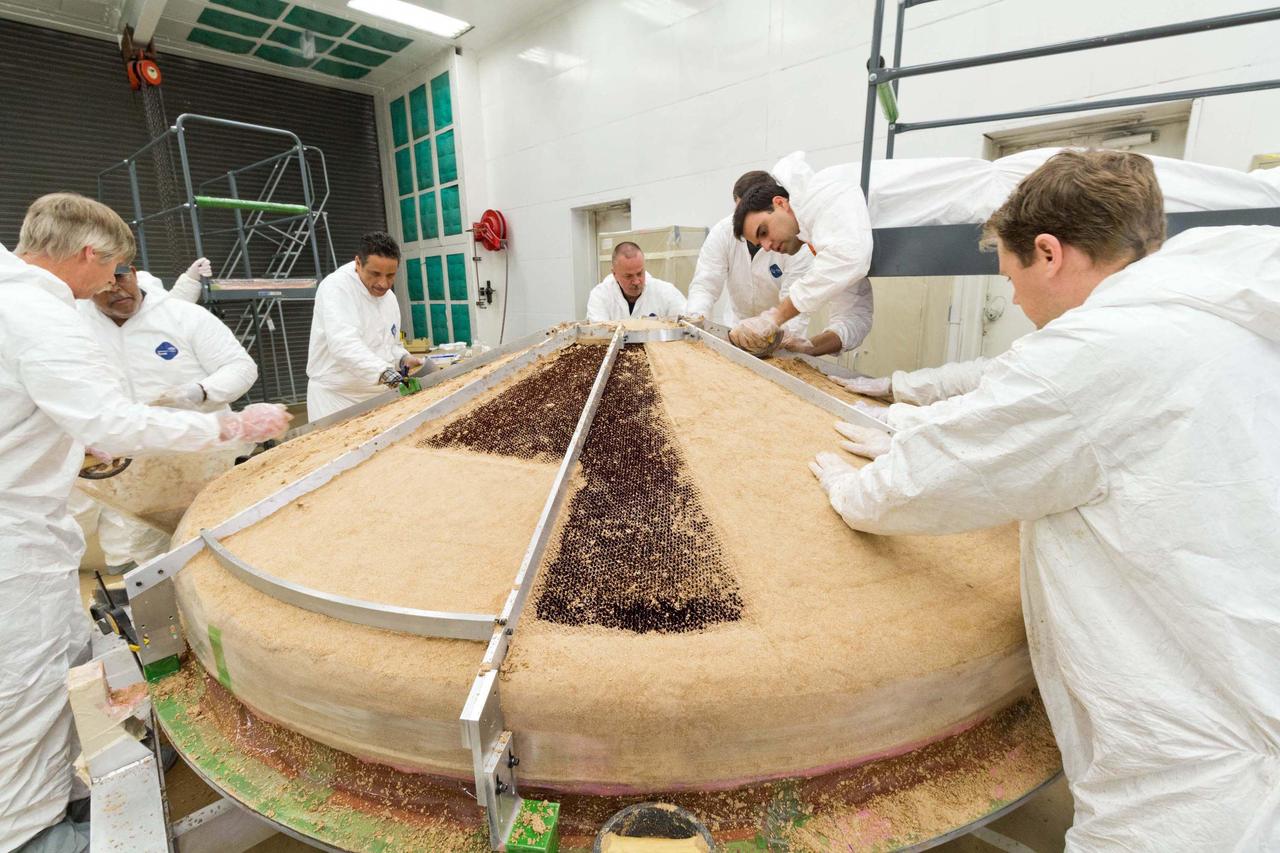
In this February 2015 scene from a clean room at Lockheed Martin Space Systems, Denver, specialists are building the heat shield to protect NASA's InSight spacecraft when it is speeding through the Martian atmosphere. Note: After thorough examination, NASA managers have decided to suspend the planned March 2016 launch of the Interior Exploration using Seismic Investigations Geodesy and Heat Transport (InSight) mission. The decision follows unsuccessful attempts to repair a leak in a section of the prime instrument in the science payload. http://photojournal.jpl.nasa.gov/catalog/PIA19404
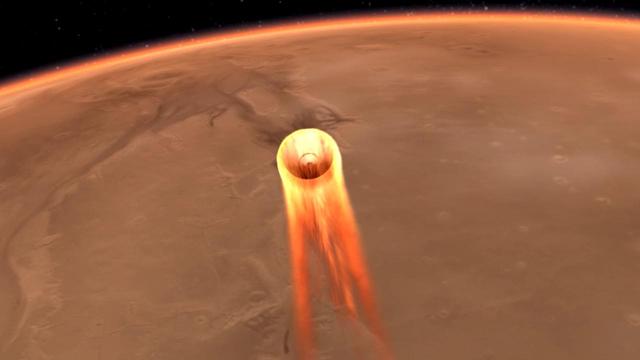
An artist's impression of InSight's Entry, Descent and Landing (EDL). InSight is short for Interior Exploration using Seismic Investigations, Geodesy and Heat Transport. The mission is the first outer space explorer to study the "inner space" of Mars. The lander probes deep beneath the surface of Mars to study the fingerprints of the processes that first formed the rocky planets of our solar system. Entry, descent, and landing (EDL) begins when the spacecraft reaches the Martian atmosphere, about 80 miles (about 128 kilometers) above the surface, and ends with the lander safe and sound on the surface of Mars six minutes later. https://photojournal.jpl.nasa.gov/catalog/PIA22100

This image of a footpad on NASA's Insight lander was taken by the Instrument Deployment Camera during the assembly, test and launch operations phase at Lockheed Martin Space, Denver. The Instrument Deployment Camera is attached to the spacecraft's robotic arm. https://photojournal.jpl.nasa.gov/catalog/PIA22814
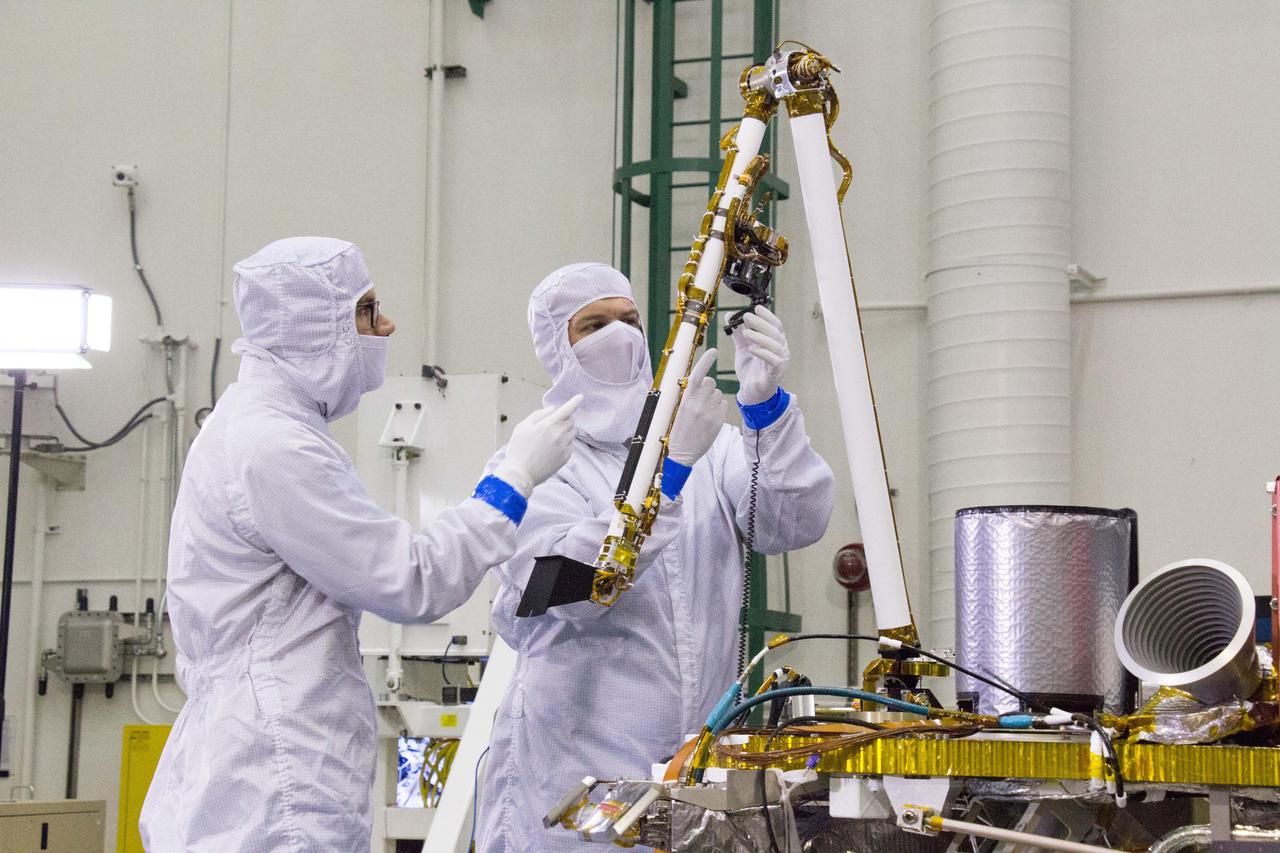
Engineers at Lockheed Martin Space, Denver, Colorado, test the robotic arm on NASA's InSight lander several months before launch. https://photojournal.jpl.nasa.gov/catalog/PIA22741
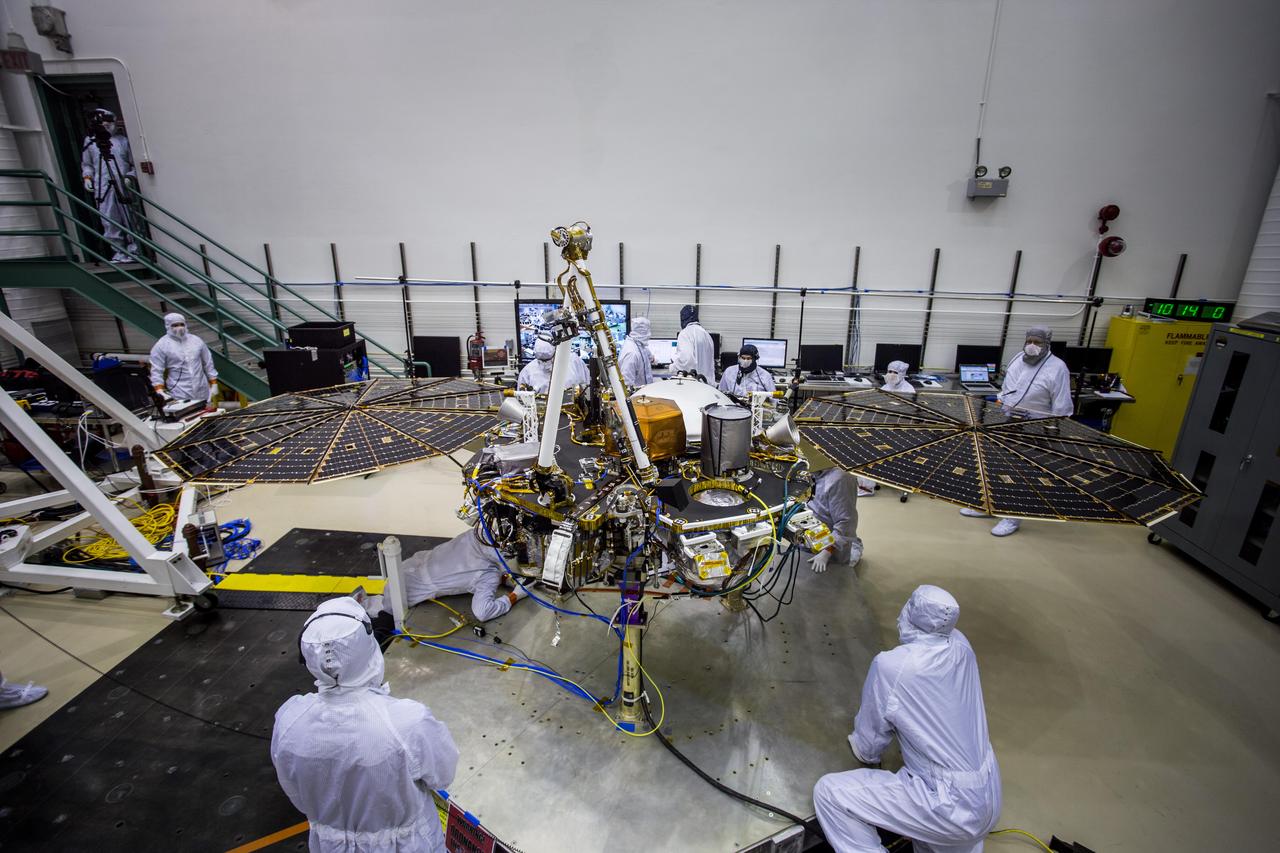
Engineers at Lockheed Martin Space, Denver, Colorado, test the solar arrays on NASA's InSight lander several months before launch. https://photojournal.jpl.nasa.gov/catalog/PIA22739
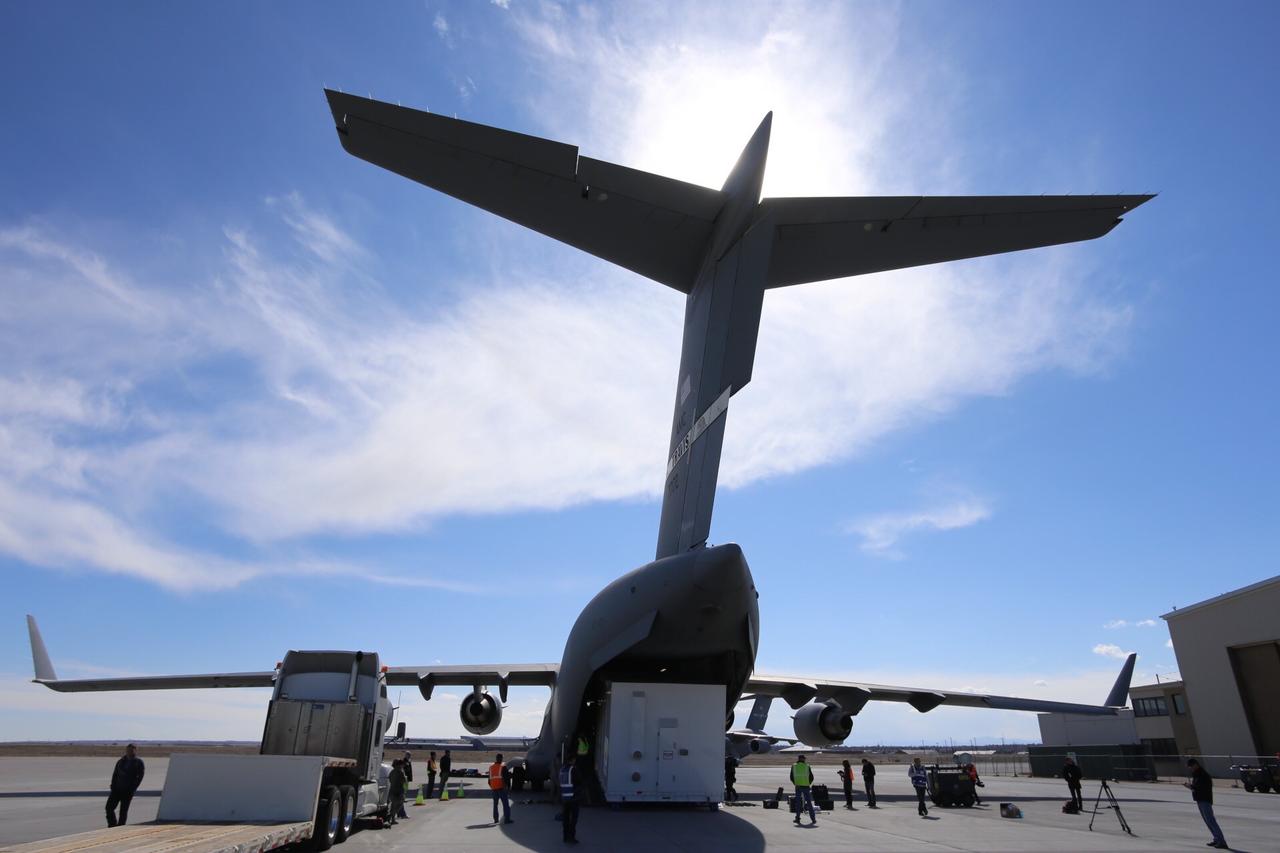
Personnel supporting NASA's InSight mission to Mars load the crated InSight spacecraft into a C-17 cargo aircraft at Buckley Air Force Base, Denver, for shipment to Vandenberg Air Force Base, California. The spacecraft, built in Colorado by Lockheed Martin Space, was shipped February 28, 2018, in preparation for launch from Vandenberg in May 2018. InSight, short for Interior Exploration using Seismic Investigations, Geodesy and Heat Transport, is the first mission dedicated to studying the deep interior of Mars. Its findings will advance understanding of the early history of all rocky planets, including Earth. https://photojournal.jpl.nasa.gov/catalog/PIA22252
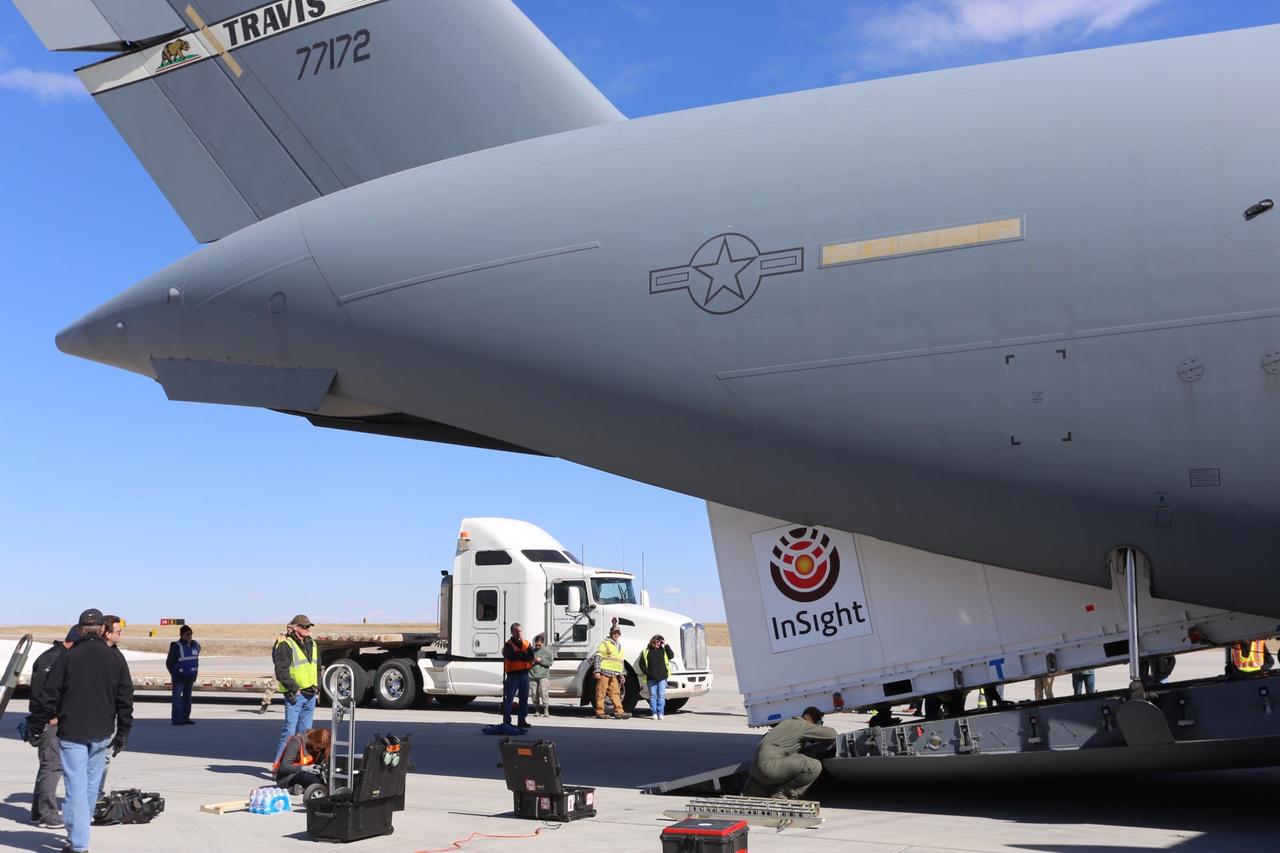
Personnel supporting NASA's InSight mission to Mars load the crated InSight spacecraft into a C-17 cargo aircraft at Buckley Air Force Base, Denver, for shipment to Vandenberg Air Force Base, California. The spacecraft, built in Colorado by Lockheed Martin Space, was shipped February 28, 2018, in preparation for launch from Vandenberg in May 2018. InSight, short for Interior Exploration using Seismic Investigations, Geodesy and Heat Transport, is the first mission dedicated to studying the deep interior of Mars. Its findings will advance understanding of the early history of all rocky planets, including Earth. https://photojournal.jpl.nasa.gov/catalog/PIA22253
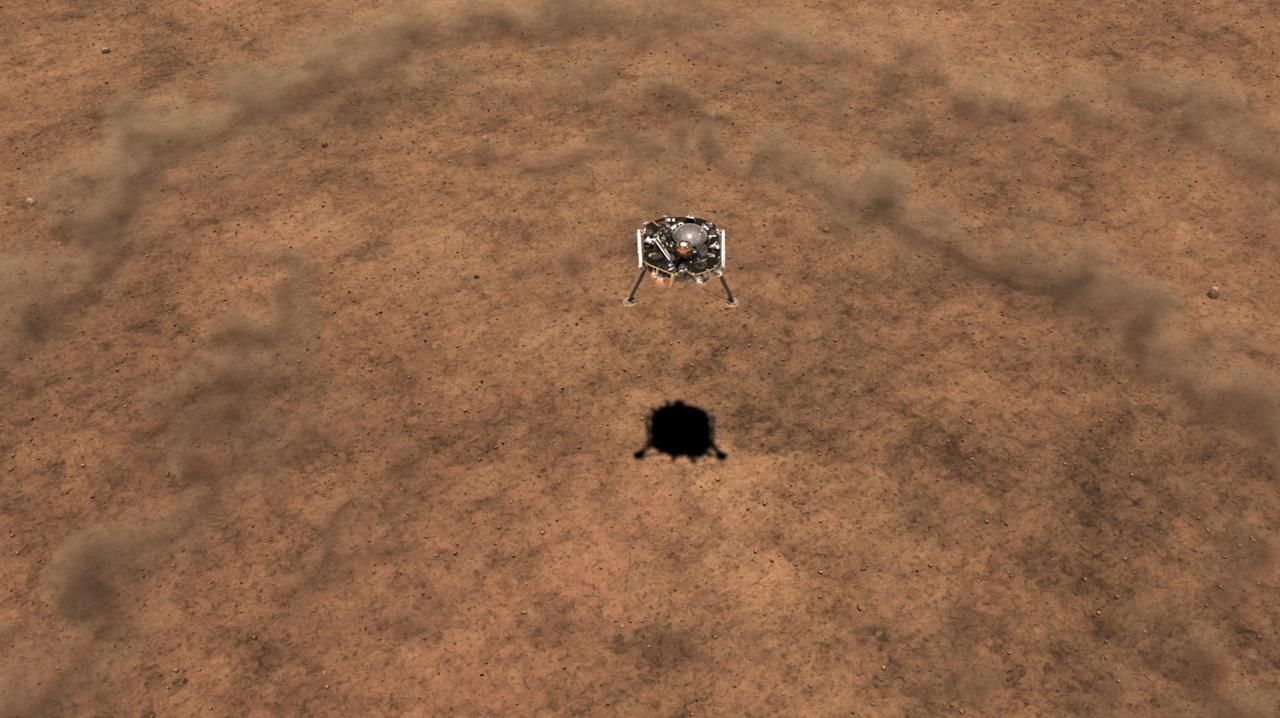
This illustration shows a simulated view of NASA's InSight lander kicking up dust as it lands on the Martian surface. https://photojournal.jpl.nasa.gov/catalog/PIA22811
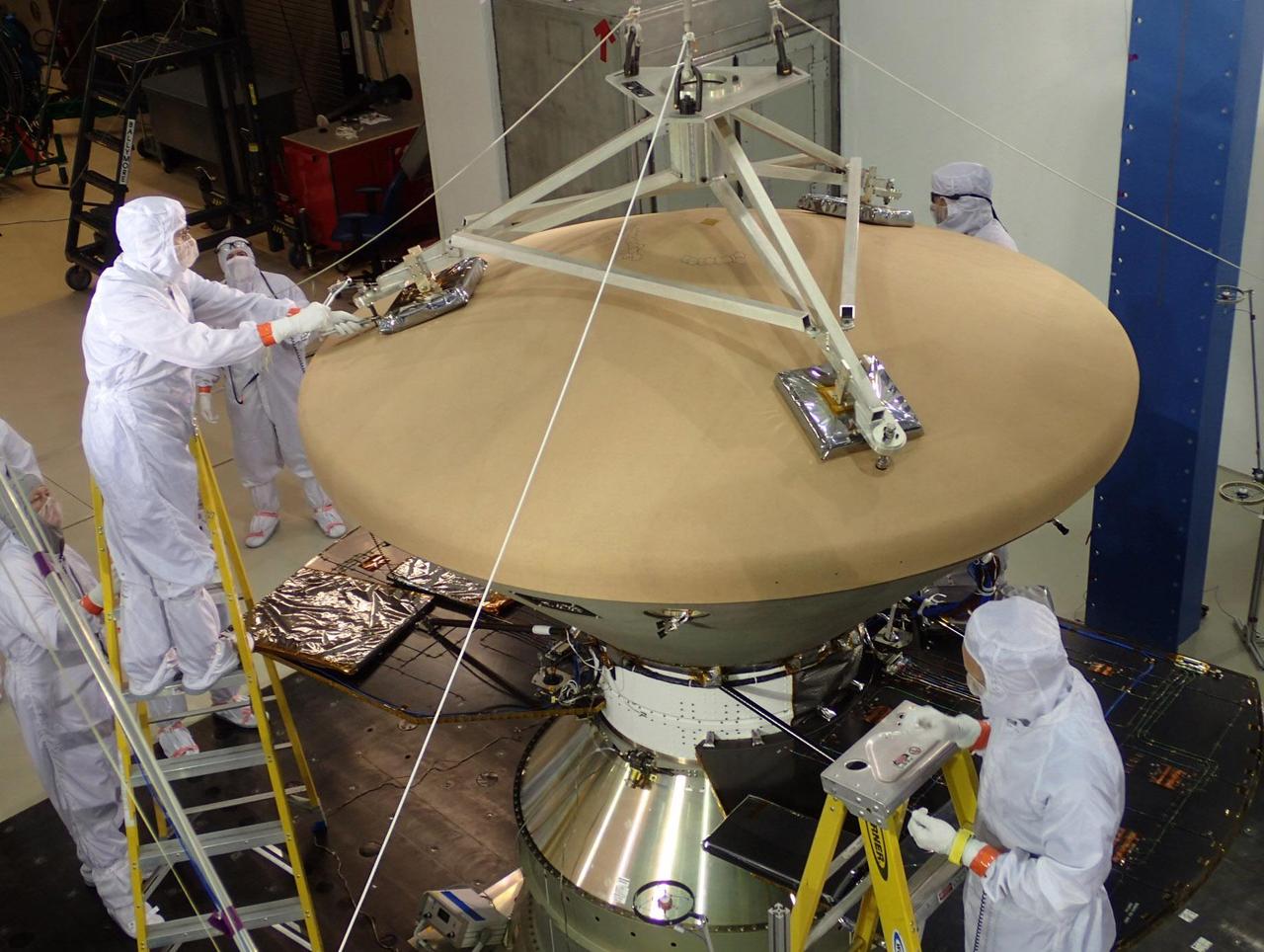
Spacecraft specialists at Lockheed Martin Space Systems, Denver, prepare NASA's InSight spacecraft for vibration testing as part of assuring that it is ready for the rigors of launch from Earth and flight to Mars. The spacecraft is oriented with its heat shield facing up in this July 13, 2015, photograph. InSight, for Interior Exploration Using Seismic Investigations, Geodesy and Heat Transport, is scheduled for launch in March 2016 and landing in September 2016. It will study the deep interior of Mars to advance understanding of the early history of all rocky planets, including Earth. Note: After thorough examination, NASA managers have decided to suspend the planned March 2016 launch of the Interior Exploration using Seismic Investigations Geodesy and Heat Transport (InSight) mission. The decision follows unsuccessful attempts to repair a leak in a section of the prime instrument in the science payload. http://photojournal.jpl.nasa.gov/catalog/PIA19815
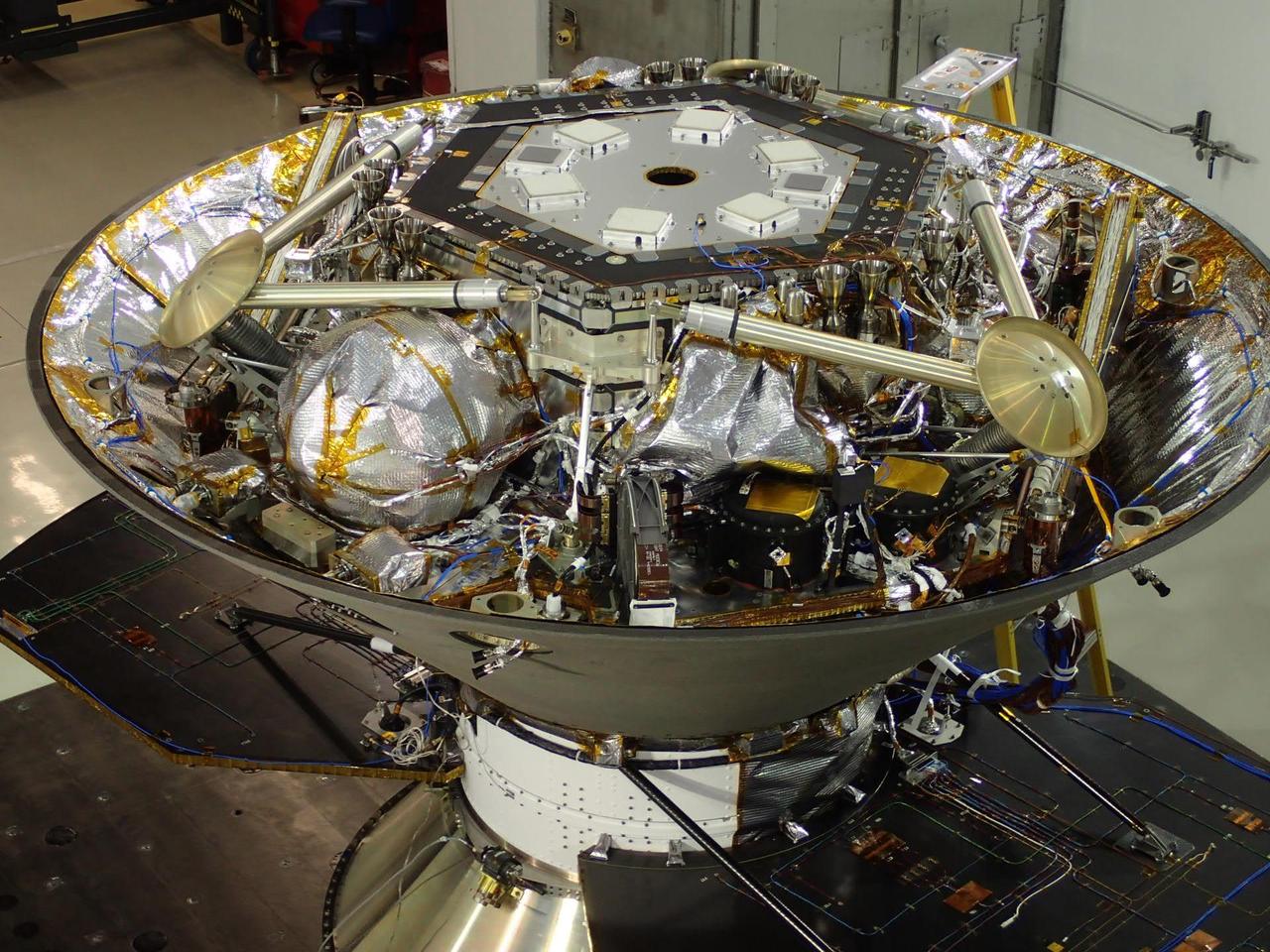
In this photo, NASA's InSight Mars lander is stowed inside the inverted back shell of the spacecraft's protective aeroshell. It was taken on July 13, 2015, in a clean room of spacecraft assembly and test facilities at Lockheed Martin Space Systems, Denver, during preparation for vibration testing of the spacecraft. InSight, for Interior Exploration Using Seismic Investigations, Geodesy and Heat Transport, is scheduled for launch in March 2016 and landing in September 2016. It will study the deep interior of Mars to advance understanding of the early history of all rocky planets, including Earth. Note: After thorough examination, NASA managers have decided to suspend the planned March 2016 launch of the Interior Exploration using Seismic Investigations Geodesy and Heat Transport (InSight) mission. The decision follows unsuccessful attempts to repair a leak in a section of the prime instrument in the science payload. http://photojournal.jpl.nasa.gov/catalog/PIA19813
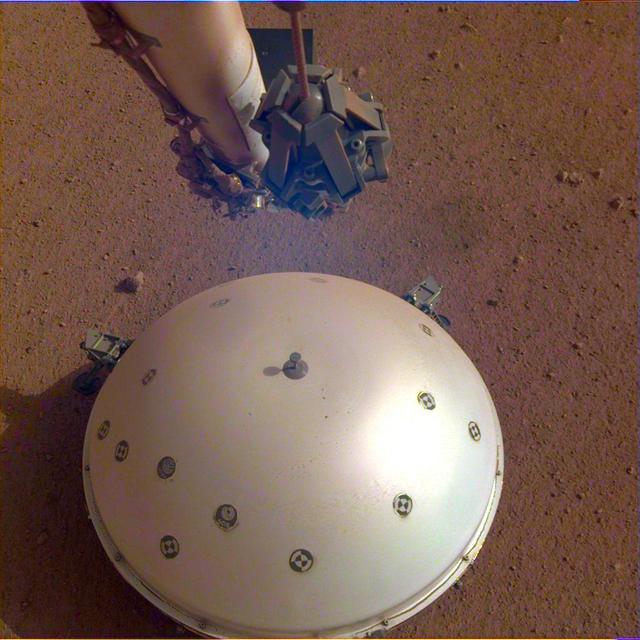
This image shows InSight's domed Wind and Thermal Shield, which covers its seismometer. The image was taken on the 110th Martian day, or sol, of the mission. The seismometer is called Seismic Experiment for Interior Structure, or SEIS. https://photojournal.jpl.nasa.gov/catalog/PIA23177
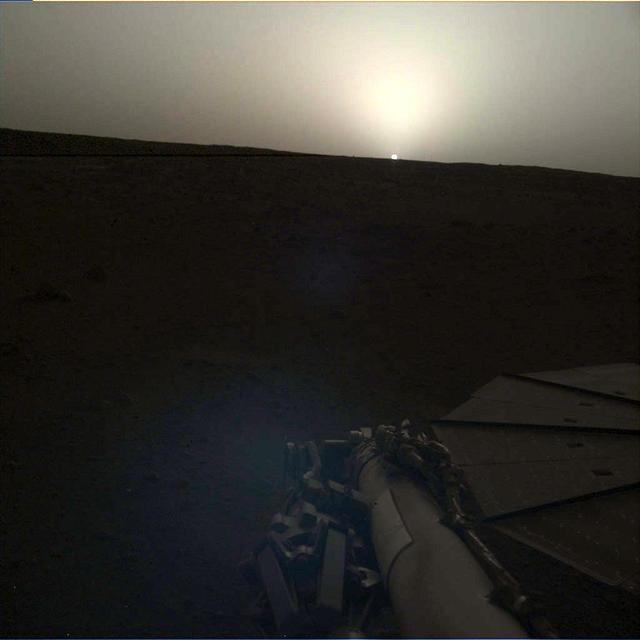
NASA's InSight lander used the Instrument Deployment Camera (IDC) on the end of its robotic arm to image this sunset on Mars on April 25, 2019, the 145th Martian day, or sol, of the mission. This was taken around 6:30 p.m. Mars local time. https://photojournal.jpl.nasa.gov/catalog/PIA23202
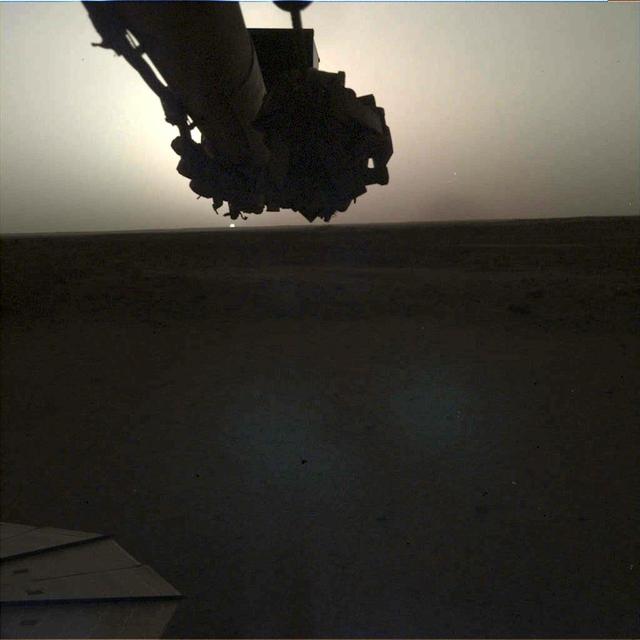
NASA's InSight lander used its Instrument Deployment Camera (IDC) on the spacecraft's robotic arm to image this sunrise on Mars on April 24, 2019, the 145th Martian day (or sol) of the mission. This was taken around 5:30 a.m. Mars local time. https://photojournal.jpl.nasa.gov/catalog/PIA23201
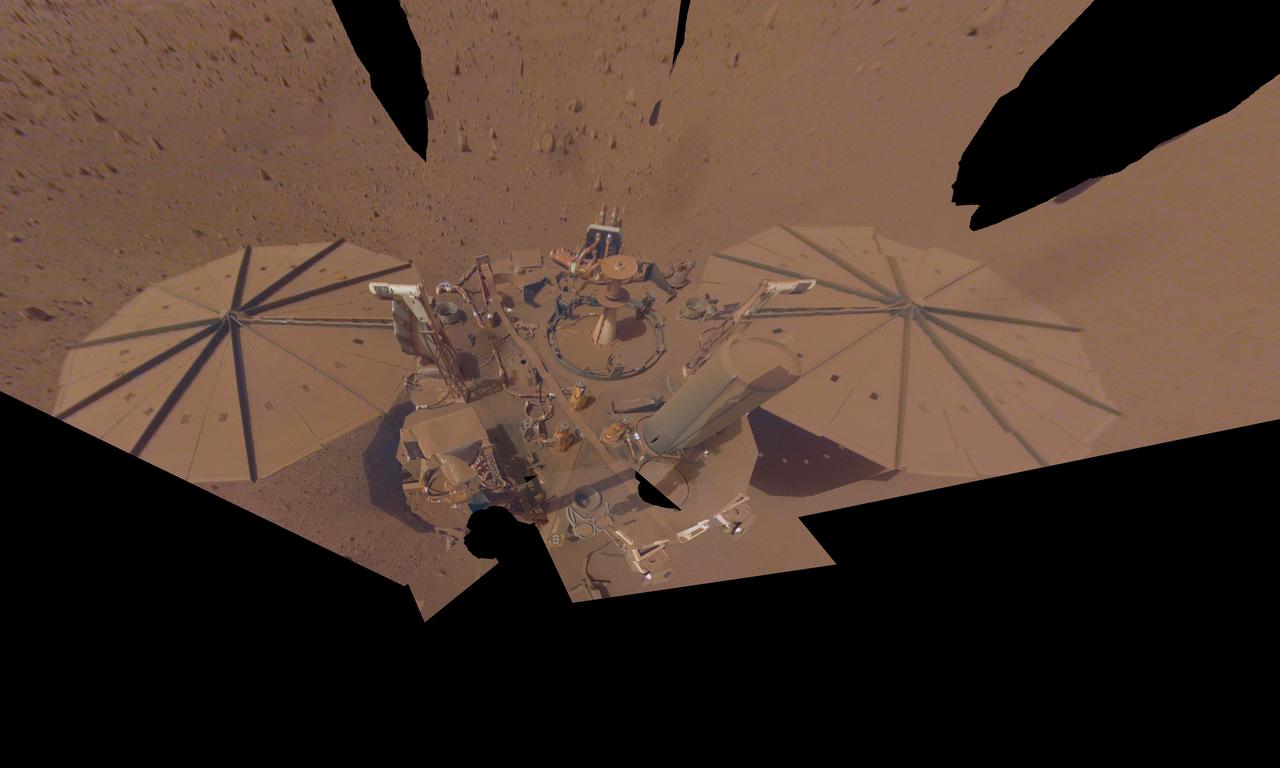
NASA's InSight Mars lander took this final selfie on April 24, 2022, the 1,211th Martian day, or sol, of the mission. The lander is covered with far more dust than it was in its first selfie, taken in December 2018, not long after landing – or in its second selfie, composed of images taken in March and April 2019. The arm needs to move several times in order to capture a full selfie. Because InSight's dusty solar panels are producing less power, the team will soon put the lander's robotic arm in its resting position (called the "retirement pose") for the last time in May of 2022. Animation available at https://photojournal.jpl.nasa.gov/catalog/PIA25287
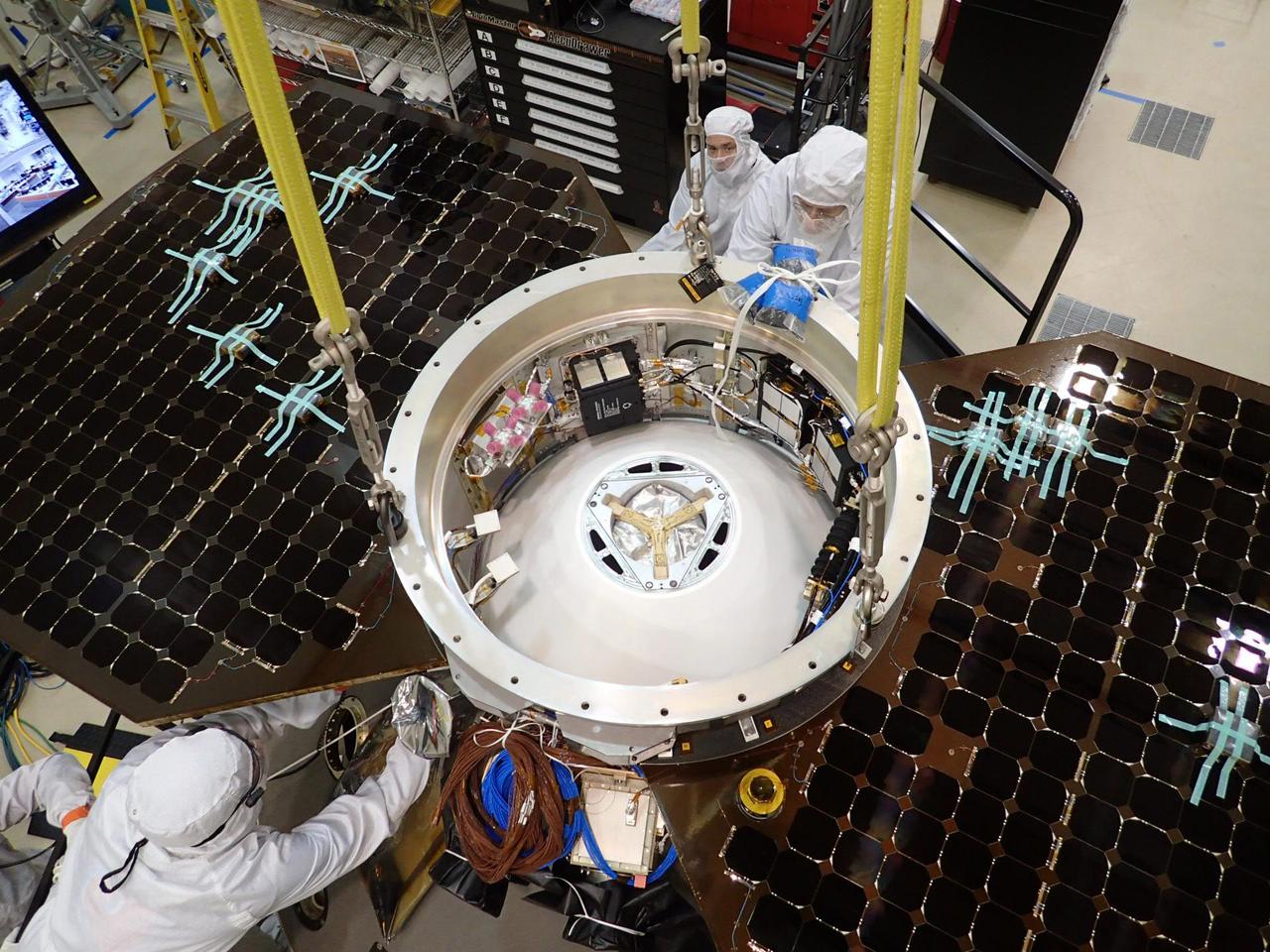
This photo shows the upper side of the cruise stage of NASA's InSight spacecraft as specialists at Lockheed Martin Space Systems, Denver, attach it to the spacecraft's back shell. The photo was taken on April 29, 2015. The cruise stage will serve multiple functions during the flight from Earth to Mars. It has its own solar arrays, thrusters and radio antennas. It will be jettisoned shortly before the spacecraft enters the Martian atmosphere. InSight, for Interior Exploration Using Seismic Investigations, Geodesy and Heat Transport, is scheduled for launch in March 2016 and landing in September 2016. It will study the deep interior of Mars to advance understanding of the early history of all rocky planets, including Earth. Note: After thorough examination, NASA managers have decided to suspend the planned March 2016 launch of the Interior Exploration using Seismic Investigations Geodesy and Heat Transport (InSight) mission. The decision follows unsuccessful attempts to repair a leak in a section of the prime instrument in the science payload. http://photojournal.jpl.nasa.gov/catalog/PIA19668
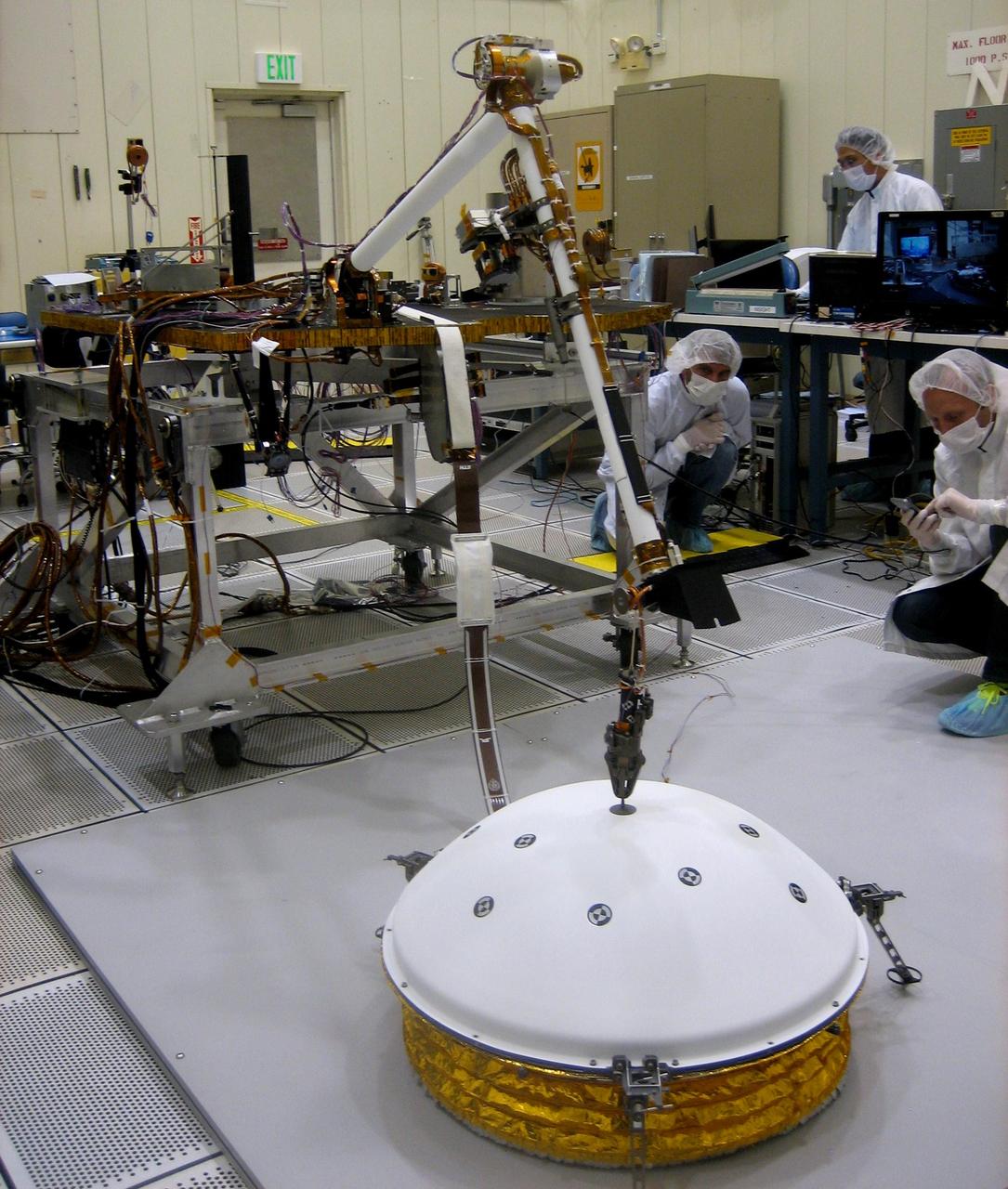
In the weeks after NASA's InSight mission reaches Mars in September 2016, the lander's arm will lift two key science instruments off the deck and place them onto the ground. This image shows testing of InSight's robotic arm inside a clean room at NASA's Jet Propulsion Laboratory, Pasadena, California, about two years before it will perform these tasks on Mars. InSight -- an acronym for Interior Exploration using Seismic Investigations, Geodesy and Heat Transport -- will launch in March 2016. It will study the interior of Mars to improve understanding of the processes that formed and shaped rocky planets, including Earth. One key instrument that the arm will deploy is the Seismic Experiment for Interior Structure, or SEIS. It is from France's national space agency (CNES), with components from Germany, Switzerland, the United Kingdom and the United States. In this scene, the arm has just deployed a test model of a protective covering for SEIS, the instrument's wind and thermal shield. The shield's purpose is to lessen disturbances that weather would cause to readings from the sensitive seismometer. Note: After thorough examination, NASA managers have decided to suspend the planned March 2016 launch of the Interior Exploration using Seismic Investigations Geodesy and Heat Transport (InSight) mission. The decision follows unsuccessful attempts to repair a leak in a section of the prime instrument in the science payload. http://photojournal.jpl.nasa.gov/catalog/PIA19144
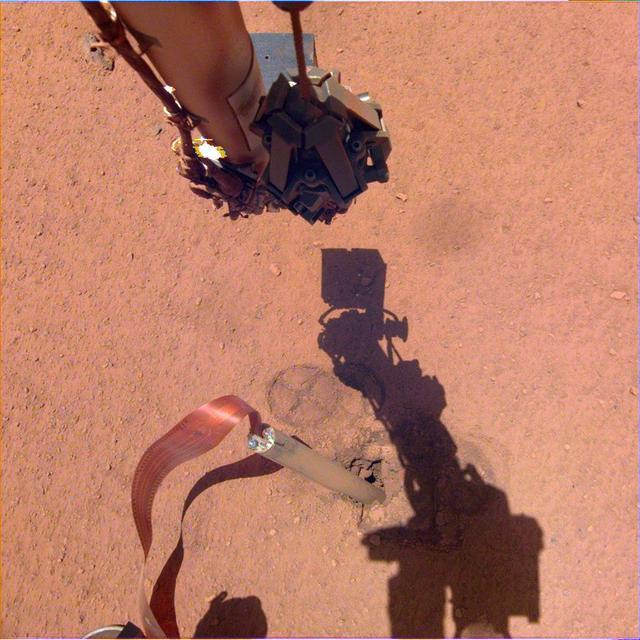
The shadow of NASA InSight's robotic arm moves over its heat probe, or "mole," on Nov. 3, 2019, the 333rd Martian day, or sol, of the mission. Animation available at https://photojournal.jpl.nasa.gov/catalog/PIA23512
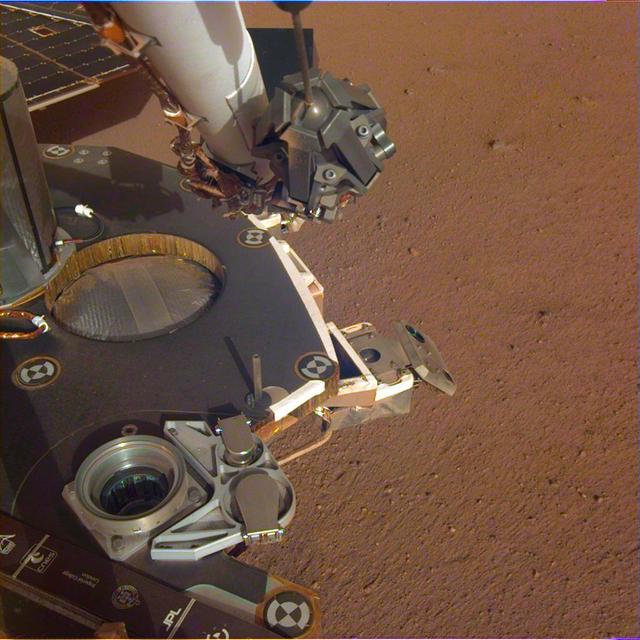
A partial view of the deck of NASA's InSight lander, where it stands on the Martian plains Elysium Planitia. The color-calibrated image was received on Dec. 4, 2018 (Sol 8). InSight's robotic arm with its stowed grapple can be seen above the deck, and jutting out from the front of the deck is one of the boxy attitude control system thrusters that helped control the spacecraft's landing. The circular silver inset of the propellant tank can also be seen in the middle of the image, as well as one of the connections for the aeroshell and parachute, which looks like a cupholder in the foreground. Next to the propellant tank is the UHF antenna, which helps the lander communicate with Earth. In the background, part of one of InSight's solar panels is visible. https://photojournal.jpl.nasa.gov/catalog/PIA22873
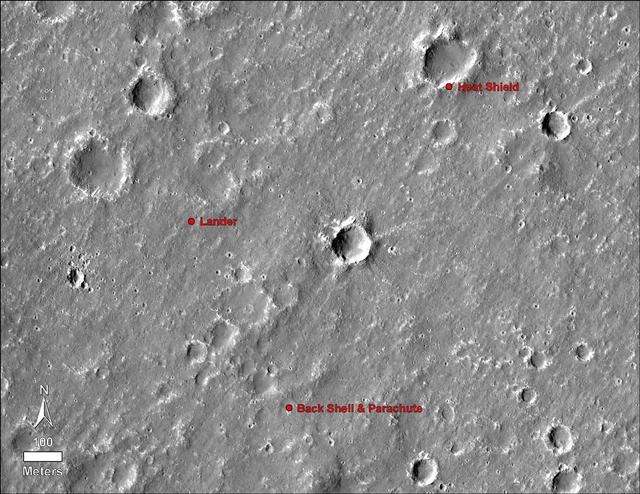
An annotated image of the surface of Mars, taken by the HiRISE camera on NASA's Mars Reconnaissance Orbiter (MRO) on May 30, 2014. The annotations - added after InSight landed on Nov. 26, 2018 - display the locations of NASA's InSight lander, its heat shield and parachute. https://photojournal.jpl.nasa.gov/catalog/PIA22877
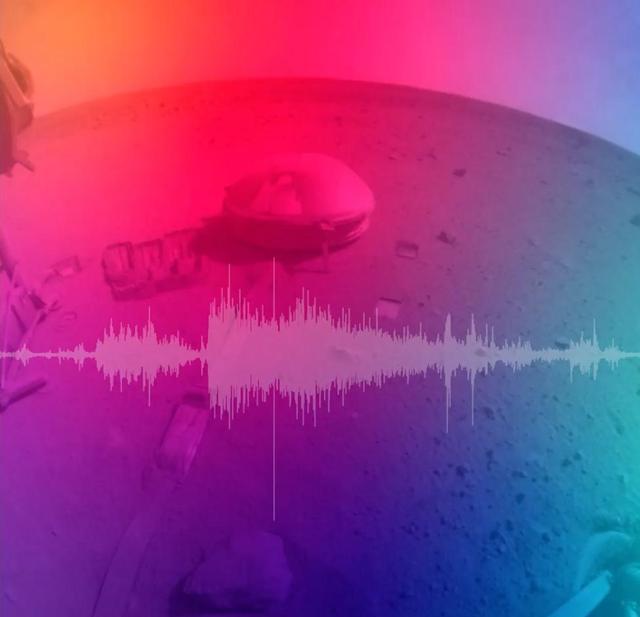
NASA's InSight Mars lander detected a giant meteoroid strike on Dec. 24, 2021, the 1,094th Martian day, or sol, of the mission. InSight's seismometer recorded seismic signals that are not in the range of human hearing. In order to make the signals audible, the data was sped up 100 times. Animation available at https://photojournal.jpl.nasa.gov/catalog/PIA25582
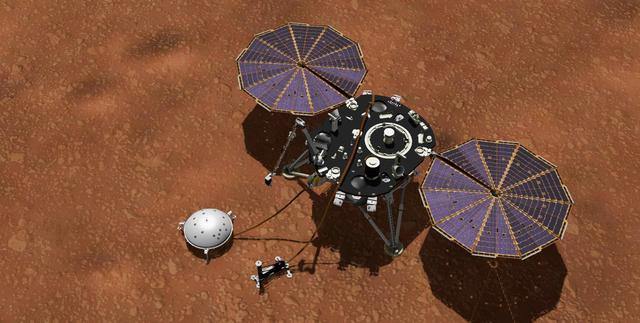
This artist's concept shows NASA's InSight lander with its instruments deployed on the Martian surface. InSight's package of weather sensors, called the Auxiliary Payload Subsystem (APSS), includes an air pressure sensor inside the lander -- its inlet is visible on InSight's deck -- and two air temperature and wind sensors on the deck. Under the deck's edge is a magnetometer, provided by UCLA, to measure changes in the local magnetic field that could also influence SEIS. InSight's air temperature and wind sensors are actually refurbished spares built for Curiosity's Rover Environmental Monitoring Station (REMS). Called Temperature and Wind for InSight, or TWINS, these two east- and west-facing booms sit on the lander's deck and were provided by Spain's Centro de Astrobiología (CAB). https://photojournal.jpl.nasa.gov/catalog/PIA22957
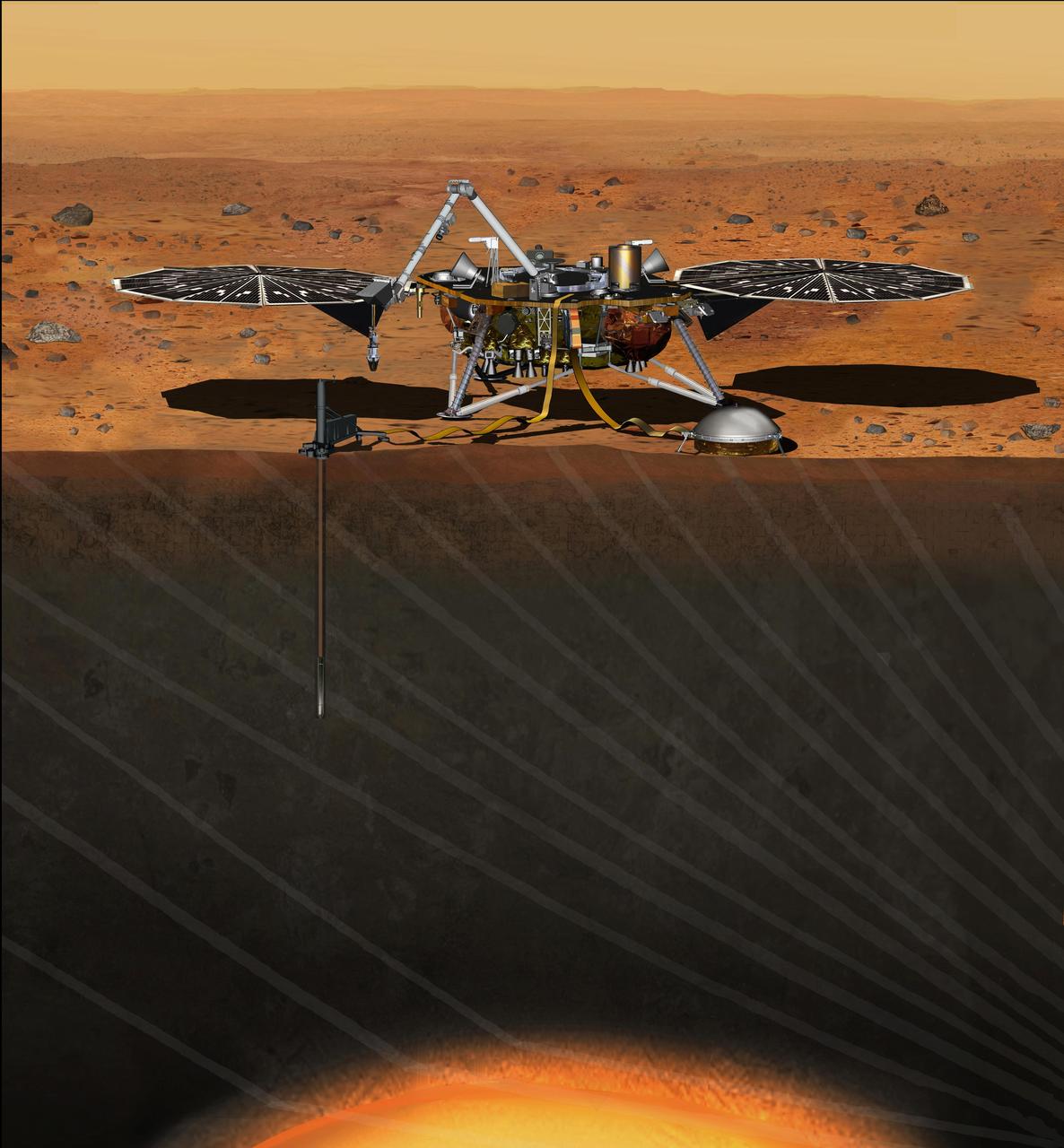
This artist's concept depicts the stationary NASA Mars lander known by the acronym InSight at work studying the interior of Mars. The InSight mission (for Interior Exploration using Seismic Investigations, Geodesy and Heat Transport) is scheduled to launch in March 2016 and land on Mars six months later. It will investigate processes that formed and shaped Mars and will help scientists better understand the evolution of our inner solar system's rocky planets, including Earth. InSight will deploy two instruments to the ground using a robotic arm: a seismometer (contributed by the French space agency Centre National d'Etudes Spatiales, or CNES) to measure the microscopic ground motions from distant marsquakes, providing detailed information about the interior structure of Mars; and a heat-flow probe (contributed by the German Aerospace Center, or DLR) designed to hammer itself 3 to 5 meters (about 16 feet) deep and monitor heat coming from the planet's interior. The mission will also track the lander's radio to measure wobbles in the planet's rotation that relate to the size of its core and will include a camera and a suite of environmental sensors to monitor the weather and variations in the magnetic field. Lockheed Martin Space Systems, Denver, is building the spacecraft. Note: After thorough examination, NASA managers have decided to suspend the planned March 2016 launch of the Interior Exploration using Seismic Investigations Geodesy and Heat Transport (InSight) mission. The decision follows unsuccessful attempts to repair a leak in a section of the prime instrument in the science payload. http://photojournal.jpl.nasa.gov/catalog/PIA17358
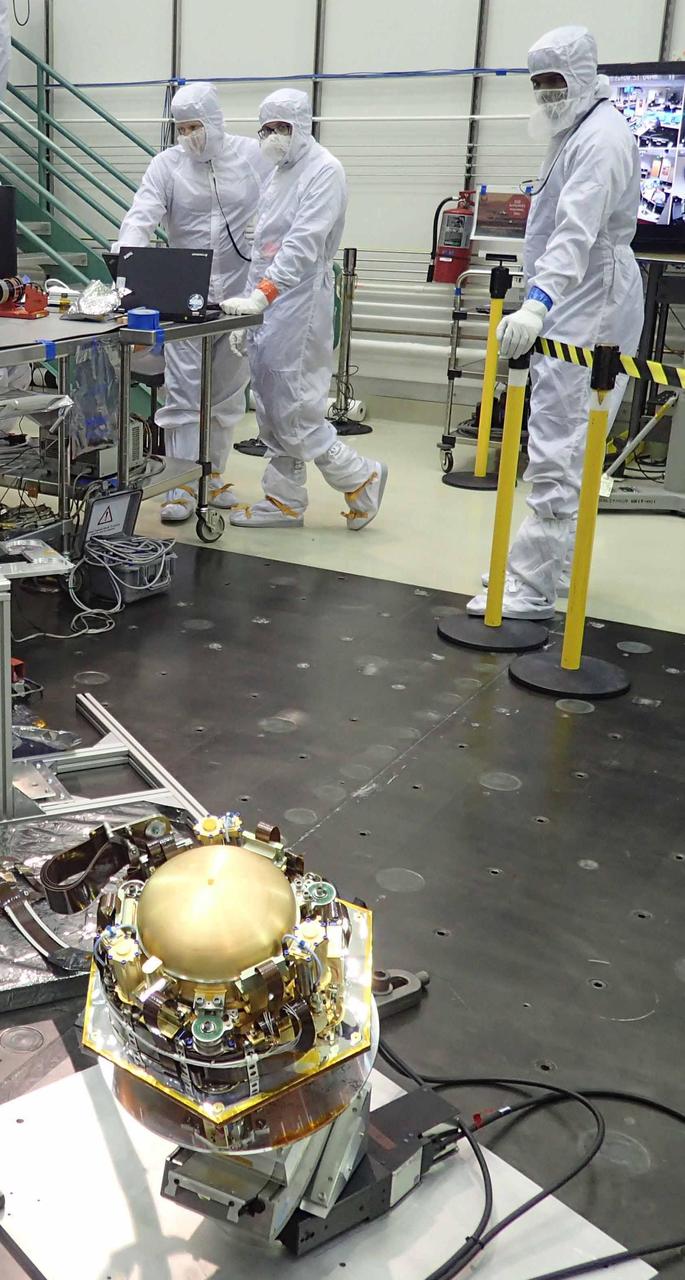
The Seismic Experiment for Interior Structure (SEIS) instrument for NASA's InSight mission to Mars undergoes a checkout for the spacecraft's assembly, test and launch operations (ATLO) in this photo taken July 20, 2017, in a Lockheed Martin clean room facility in Littleton, Colorado. The SEIS was provided by France's national space agency (CNES) with collaboration from the United States, the United Kingdom, Switzerland and Germany. The InSight mission (for Interior Exploration using Seismic Investigations, Geodesy and Heat Transport) is scheduled to launch in May 2018 and land on Mars Nov. 26, 2018. It will investigate processes that formed and shaped Mars and will help scientists better understand the evolution of our inner solar system's rocky planets, including Earth. https://photojournal.jpl.nasa.gov/catalog/PIA21846
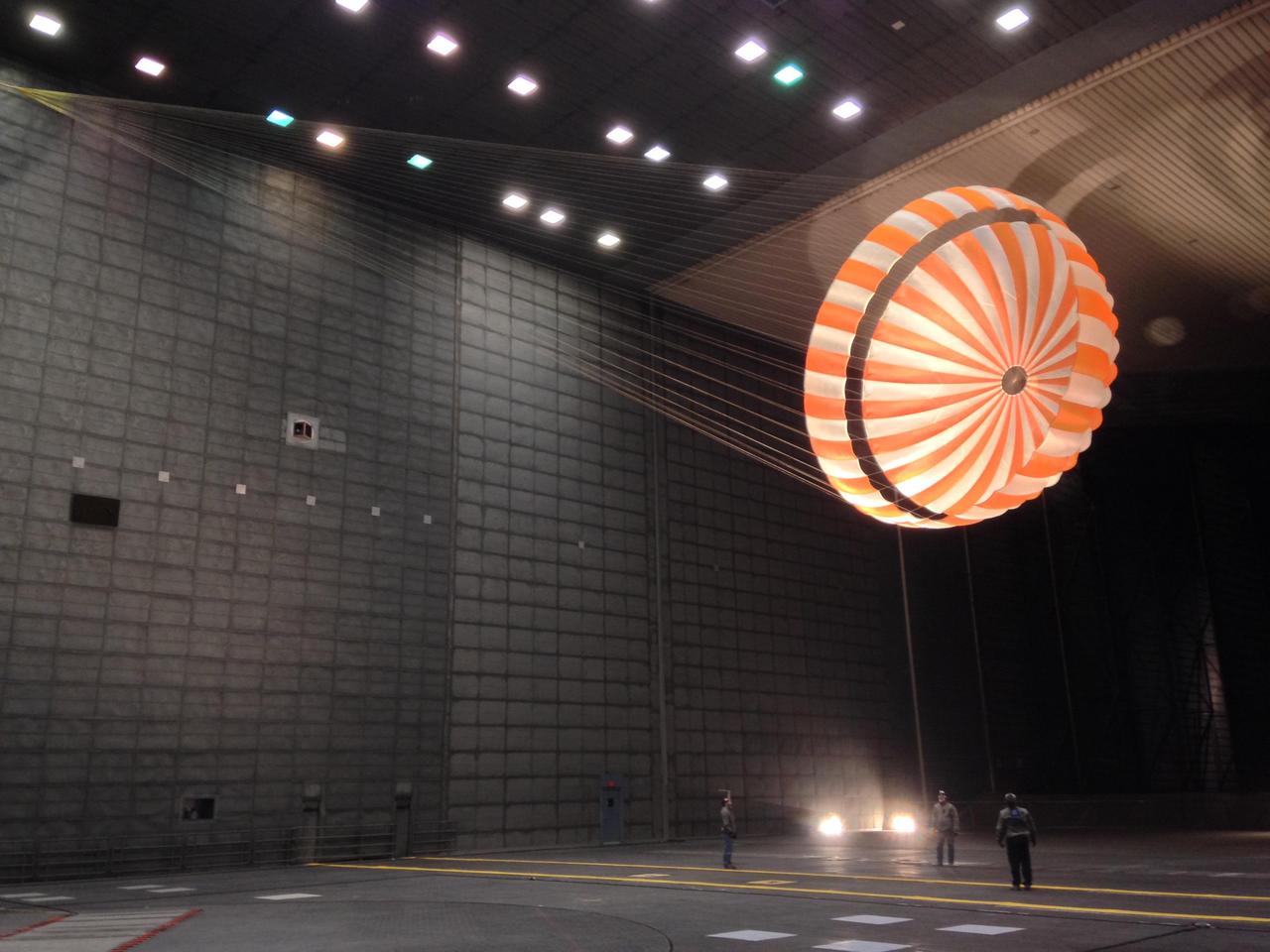
This parachute testing for NASA's InSight mission to Mars was conducted inside the world's largest wind tunnel, at NASA Ames Research Center, Moffett Field, California, in February 2015. The wind tunnel is 80 feet (24 meters) tall and 120 feet (37 meters) wide. It is part of the National Full-Scale Aerodynamics Complex, operated by the Arnold Engineering Development Center of the U.S. Air Force. Note: After thorough examination, NASA managers have decided to suspend the planned March 2016 launch of the Interior Exploration using Seismic Investigations Geodesy and Heat Transport (InSight) mission. The decision follows unsuccessful attempts to repair a leak in a section of the prime instrument in the science payload. http://photojournal.jpl.nasa.gov/catalog/PIA19405
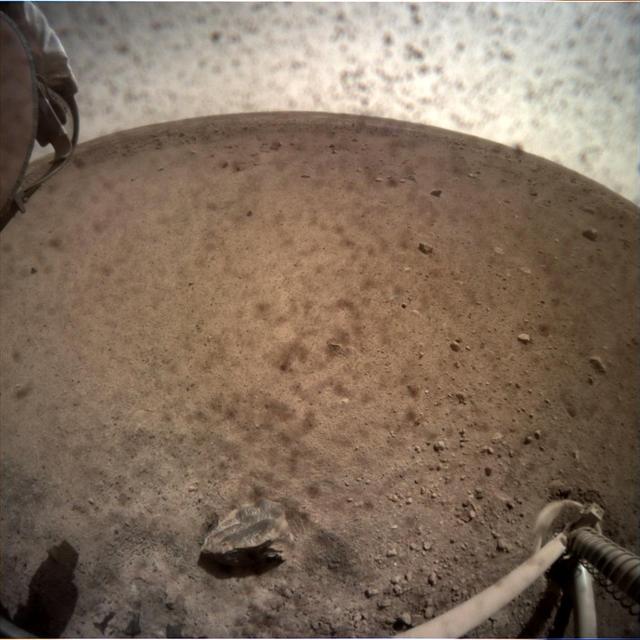
NASA's InSight spacecraft flipped open the lens cover on its Instrument Context Camera (ICC) on Nov. 30, 2018, and captured this view of Mars. Located below the deck of the InSight lander, the ICC has a fisheye view, creating a curved horizon. Some clumps of dust are still visible on the camera's lens. One of the spacecraft's footpads can be seen in the lower right corner. The seismometer's tether box is in the upper left corner. https://photojournal.jpl.nasa.gov/catalog/PIA22893
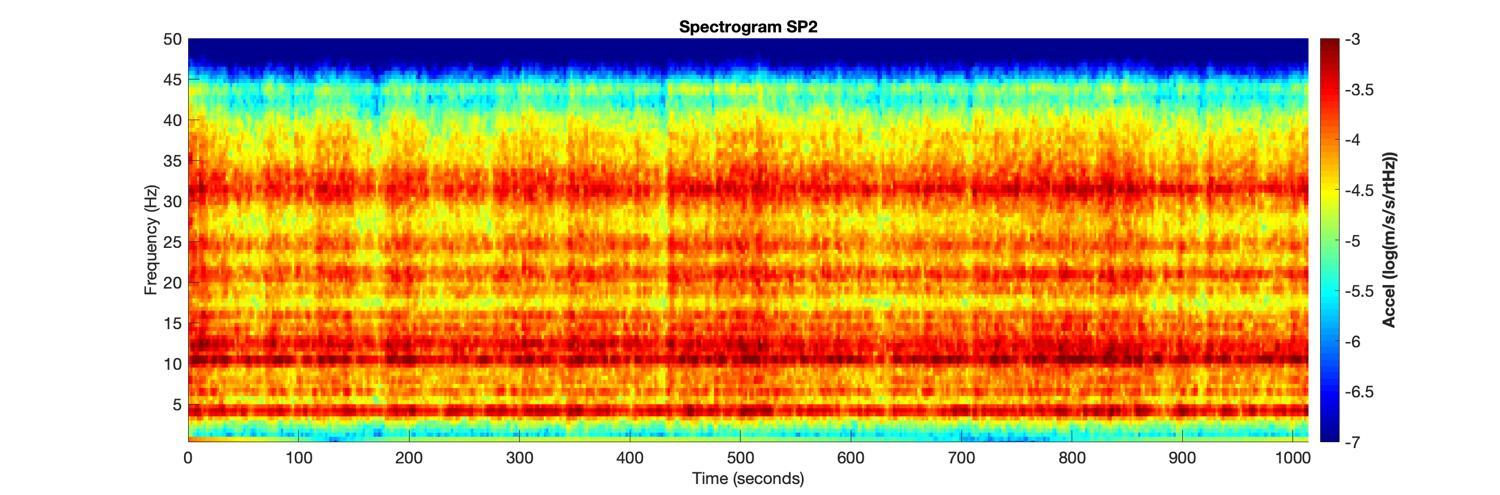
The spectrogram of vibrations (frequency spectrum over time) recorded by two of the three sensors of the short period seismometer on NASA's InSight lander on Mars. This spectrogram shows the first 1,000 seconds, roughly 20 minutes, of InSight's first seismic data from the Red Planet. The vibrations of the lander are due to the wind passing over the spacecraft, particularly the large solar arrays. https://photojournal.jpl.nasa.gov/catalog/PIA22925
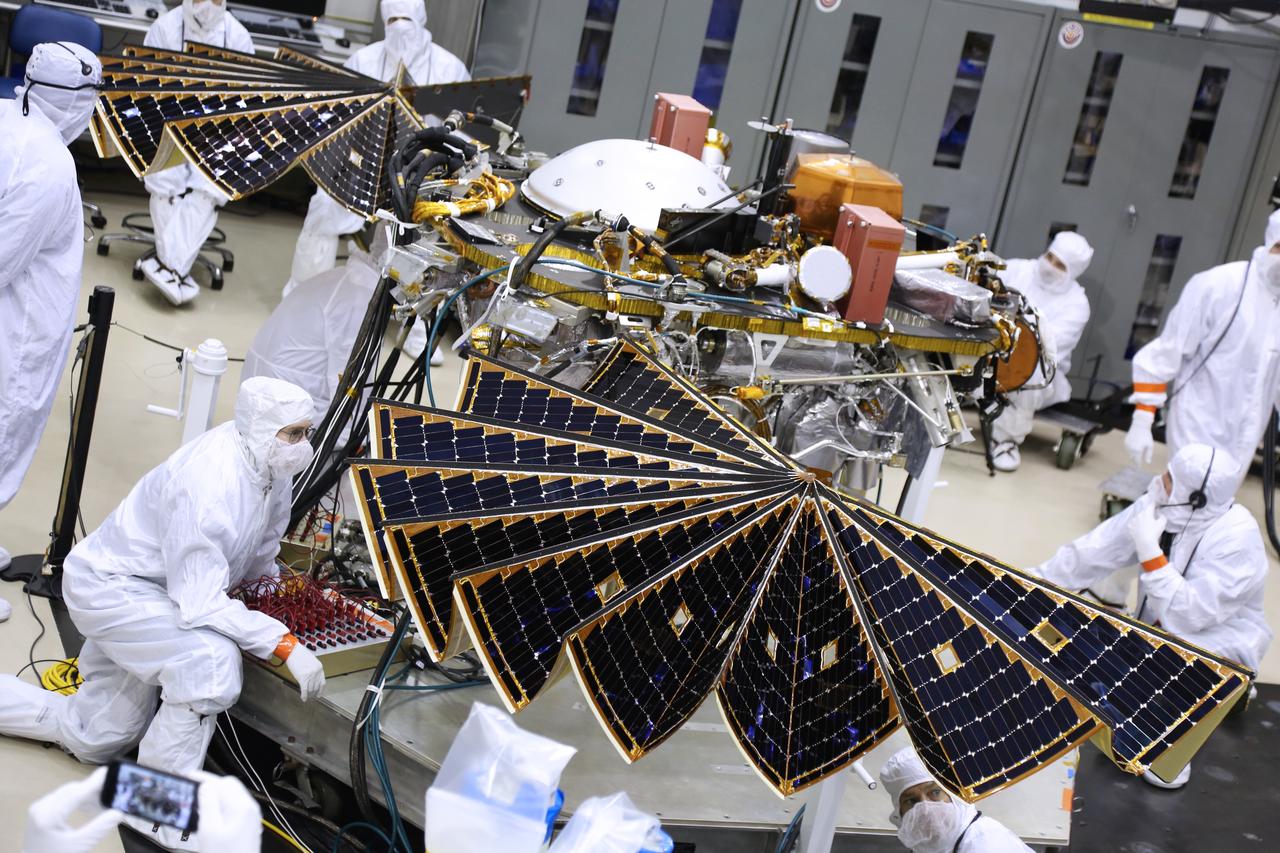
The solar arrays on NASA's InSight Mars lander were deployed as part of testing conducted Jan. 23, 2018, at Lockheed Martin Space in Littleton, Colorado. Engineers and technicians evaluated the solar arrays and performed an illumination test to confirm that the solar cells were collecting power. The launch window for InSight opens May 5, 2018. A video is available at https://photojournal.jpl.nasa.gov/catalog/PIA22205
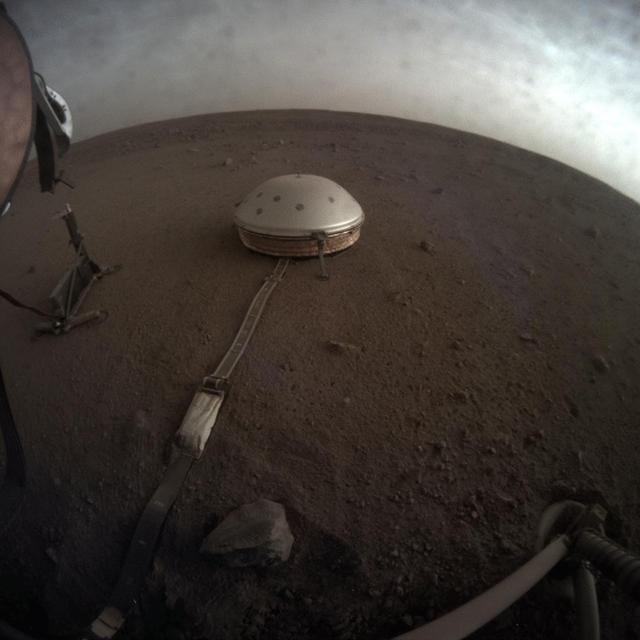
NASA's InSight used its Instrument Context Camera (ICC) beneath the lander's deck to image these drifting clouds at sunset. This series of images was taken on April 25, 2019, the 145th Martian day, or sol, of the mission, starting at around 6:30 p.m. Mars local time. Movies available at https://photojournal.jpl.nasa.gov/catalog/PIA23180
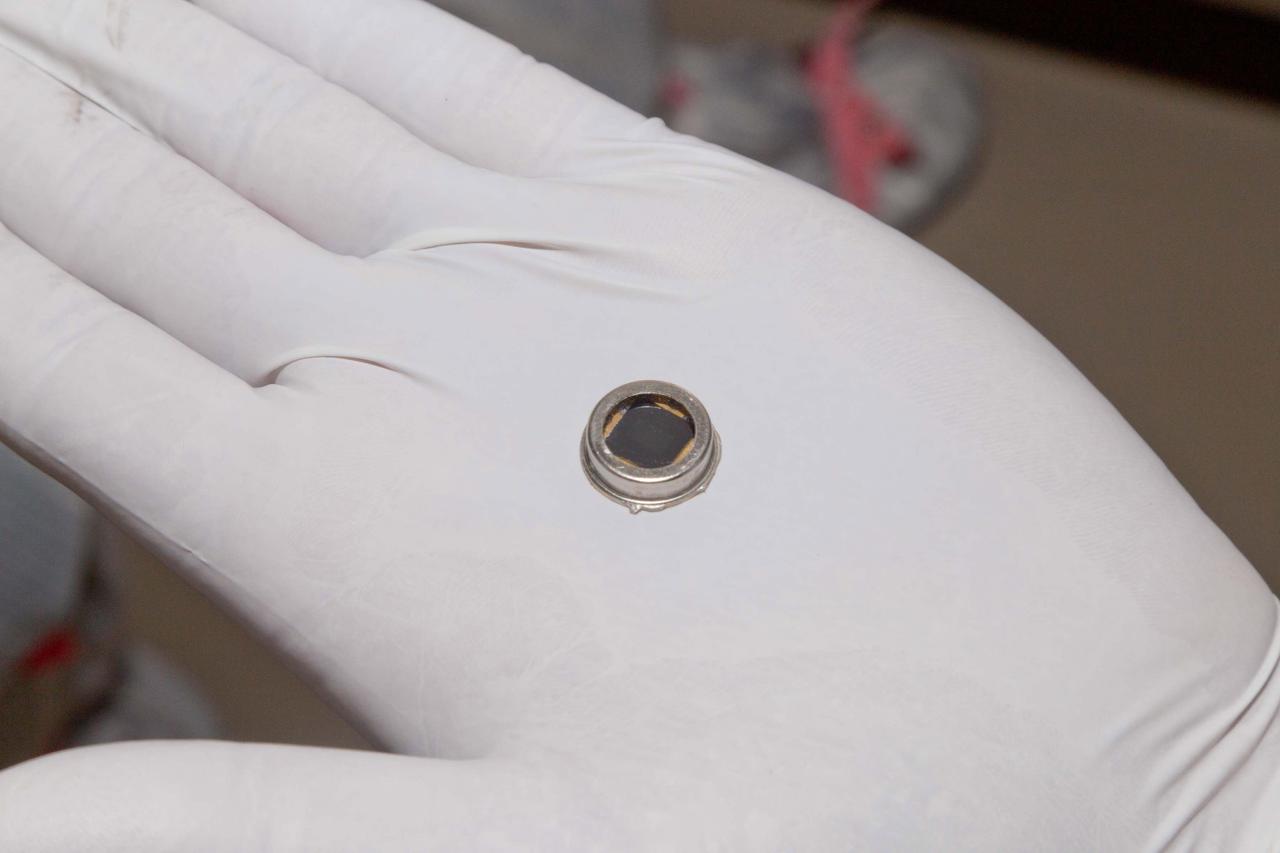
The dime-size microchip in this close-up image carries 826,923 names that will go to Mars on NASA InSight lander. The image was taken in November 2015 inside a clean room at Lockheed Martin Space Systems, Denver, where the lander was built.
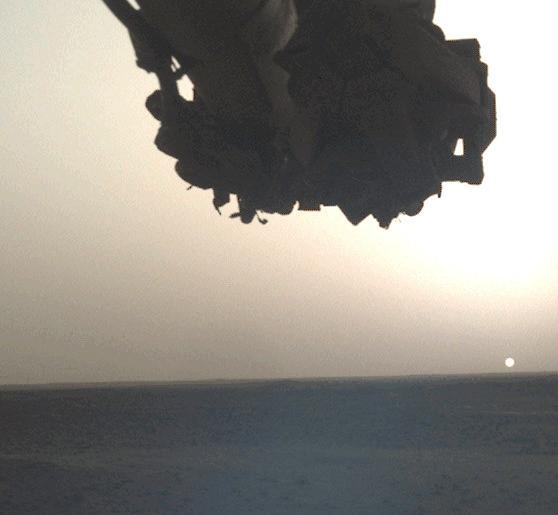
NASA's InSight lander snapped a series of images of the Sun rising and setting on Mars using the camera on its robotic arm on April 10, 2022, the 1,198th Martian day, or sol, of the mission. https://photojournal.jpl.nasa.gov/catalog/PIA25178
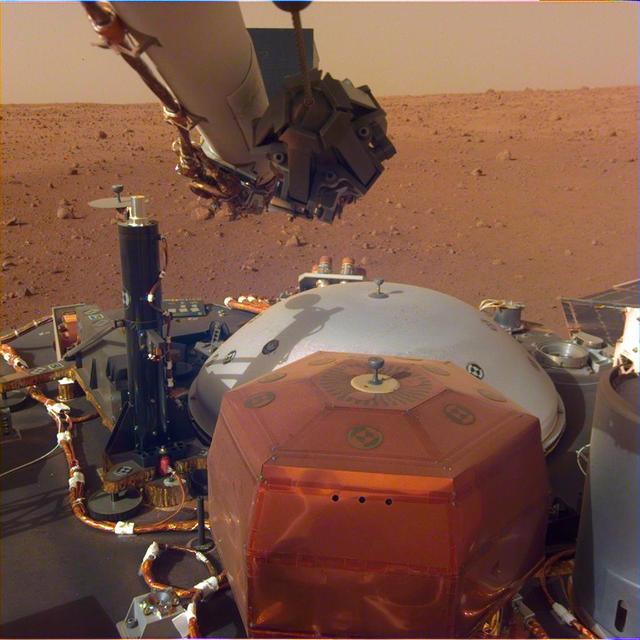
This image from InSight's robotic-arm mounted Instrument Deployment Camera shows the instruments on the spacecraft's deck, with the Martian surface of Elysium Planitia in the background. The color-calibrated picture was acquired on Dec. 4, 2018 (Sol 8). In the foreground, a copper-colored hexagonal cover protects the Seismic Experiment for Interior Structure instrument (SEIS), a seismometer that will measure marsquakes. The gray dome behind SEIS is the wind and thermal shield, which will be placed over SEIS. To the left is a black cylindrical instrument, the Heat Flow and Physical Properties Probe (HP3). HP3 will drill up to 16 feet (5 meters) below the Martian surface, measuring heat released from the interior of the planet. Above the deck is InSight's robotic arm, with the stowed grapple directly facing the camera. To the right can be seen a small portion of one of the two solar panels that help power InSight and part of the UHF communication antenna. https://photojournal.jpl.nasa.gov/catalog/PIA22871
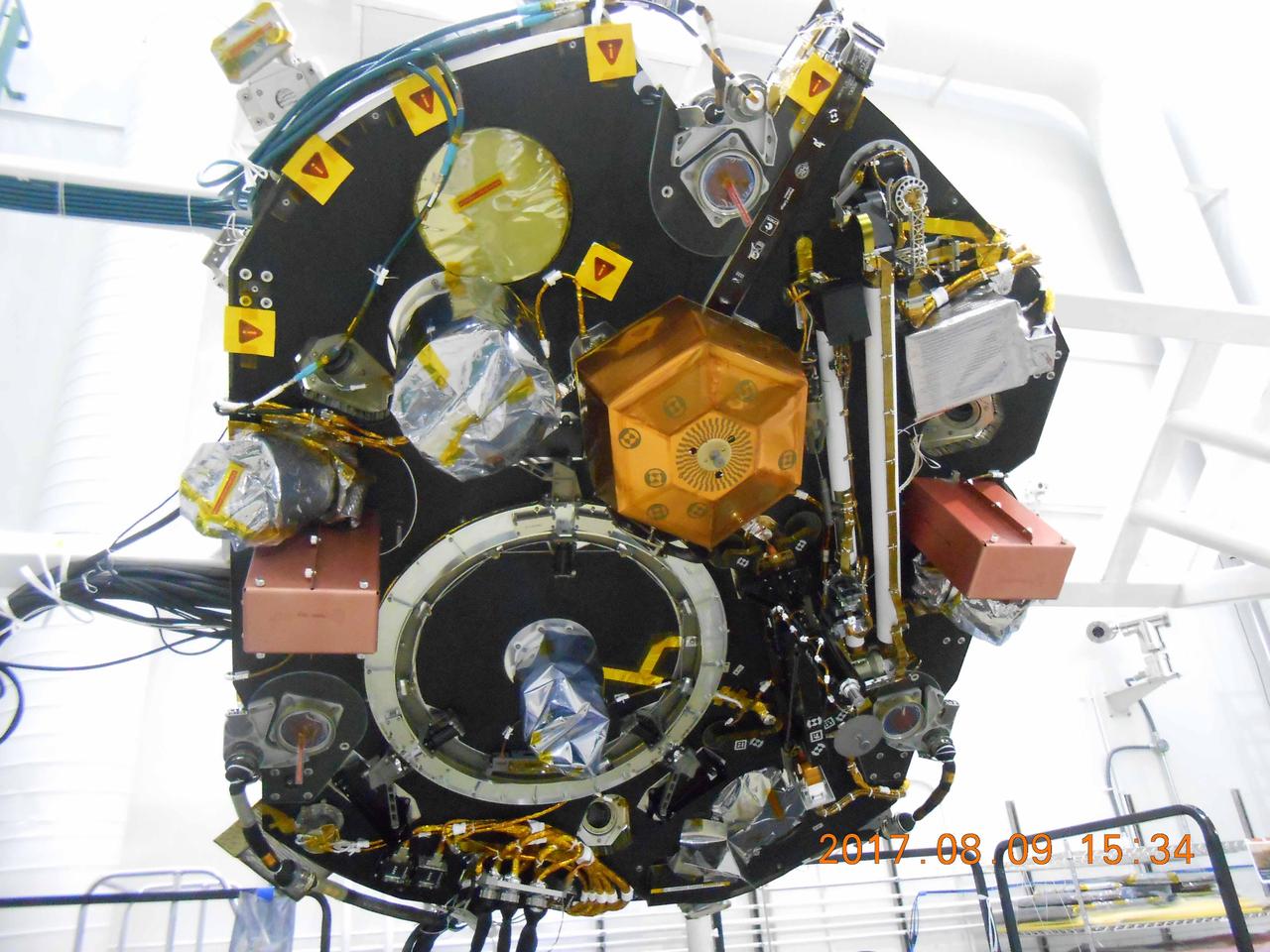
This view looks upward toward the InSight Mars lander suspended upside down. It shows the top of the lander's science deck with the mission's two main science instruments -- the Seismic Experiment for Interior Structure (SEIS) and the Heat Flow and Physical Properties Probe (HP3) -- plus the robotic arm and other subsystems installed. The photo was taken Aug. 9, 2017, in a Lockheed Martin clean room facility in Littleton, Colorado. The InSight mission (for Interior Exploration using Seismic Investigations, Geodesy and Heat Transport) is scheduled to launch in May 2018 and land on Mars Nov. 26, 2018. It will investigate processes that formed and shaped Mars and will help scientists better understand the evolution of our inner solar system's rocky planets, including Earth. https://photojournal.jpl.nasa.gov/catalog/PIA21847
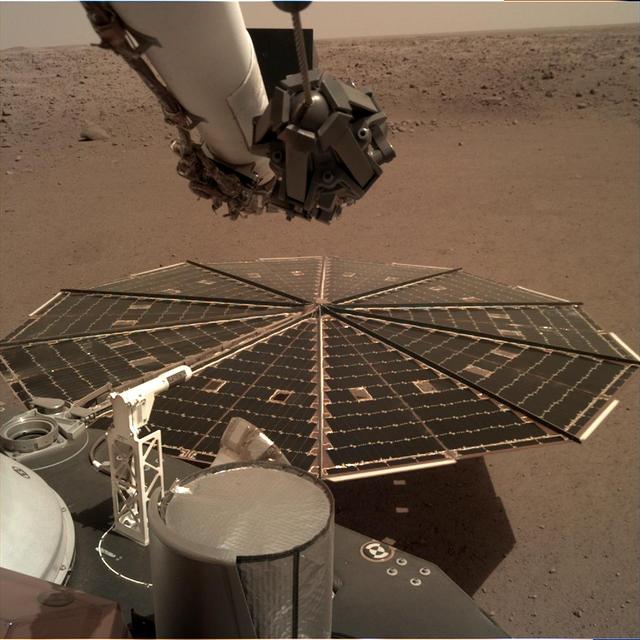
One of InSight's 7-foot (2.2 meter) wide solar panels was imaged by the lander's Instrument Deployment Camera, which is fixed to the elbow of its robotic arm. https://photojournal.jpl.nasa.gov/catalog/PIA22736
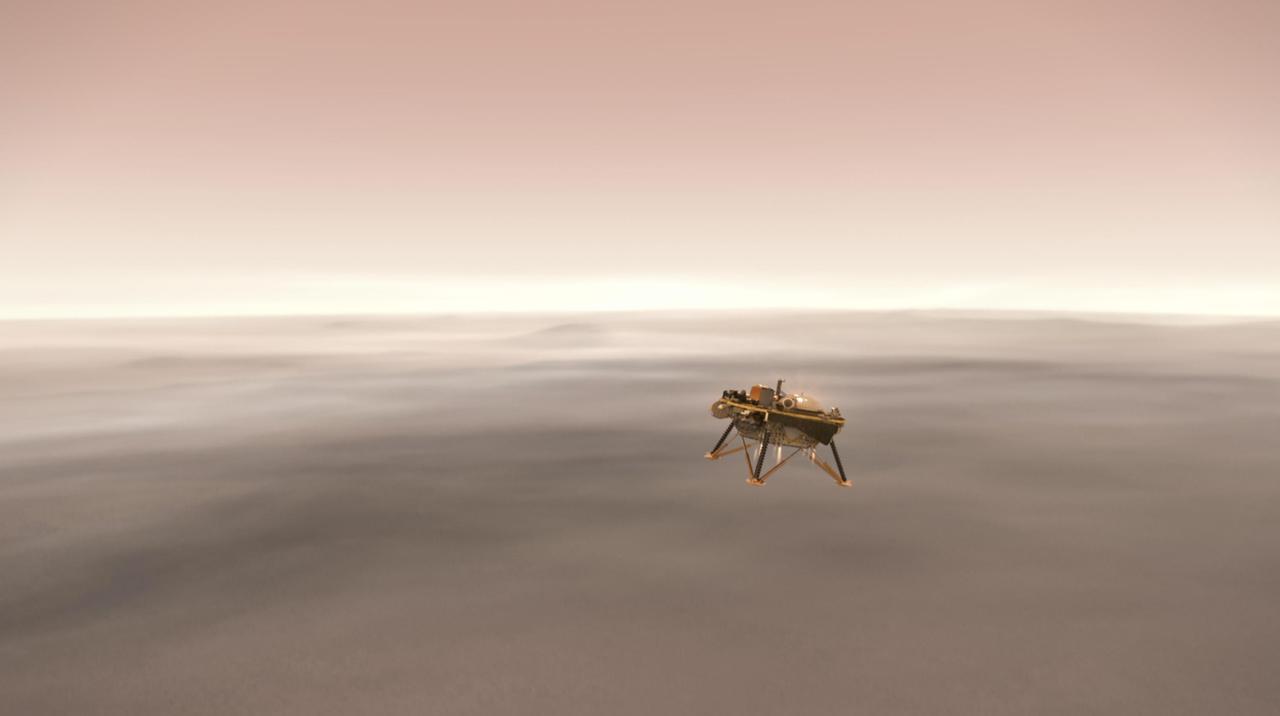
This illustration shows a simulated view of NASA's InSight lander firing retrorockets to slow down as it descends toward the surface of Mars. https://photojournal.jpl.nasa.gov/catalog/PIA22810
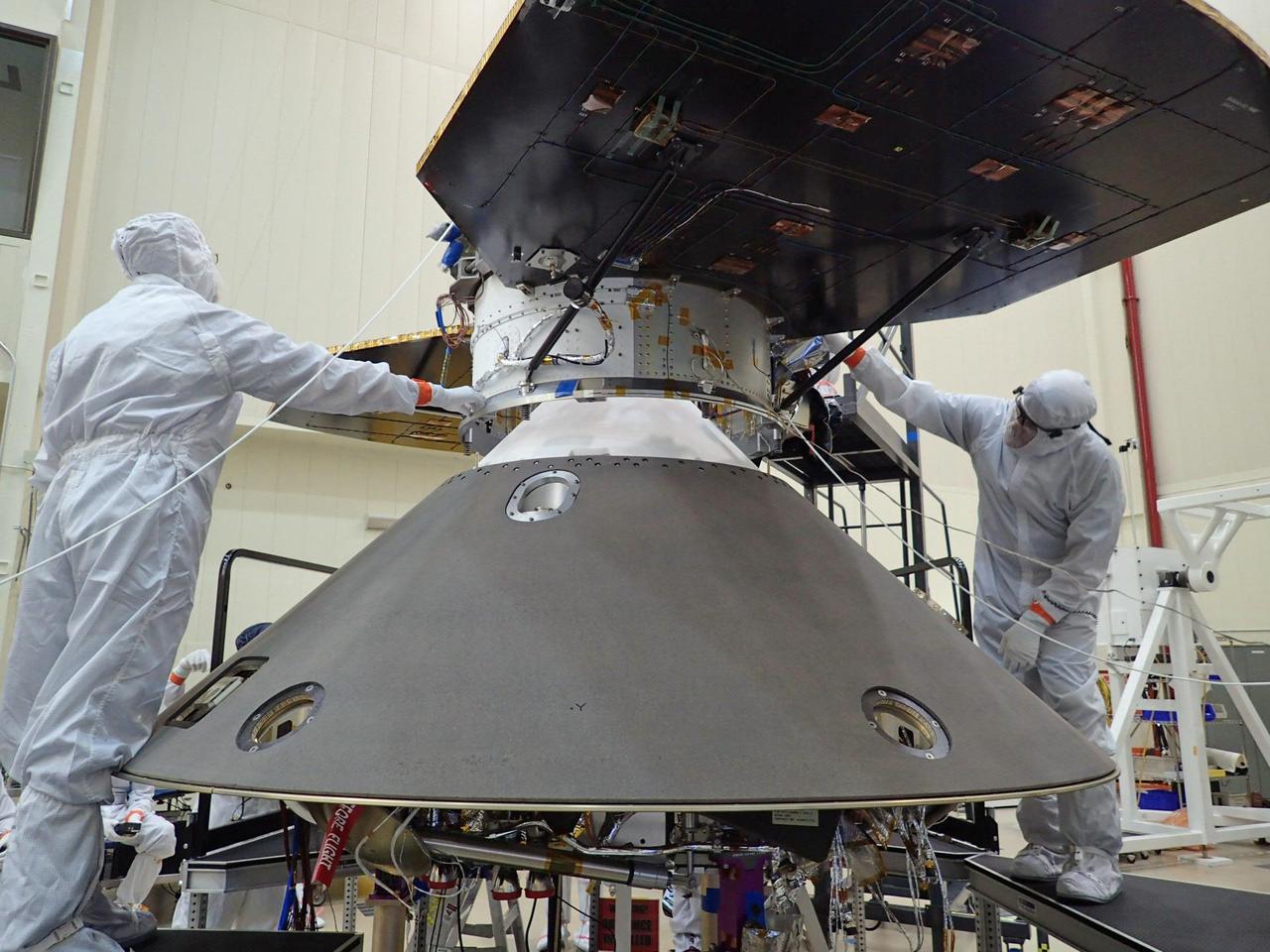
Spacecraft specialists at Lockheed Martin Space Systems, Denver, are preparing to attach the cruise stage of NASA's InSight spacecraft to the top of the spacecraft's back shell in this April 29, 2015, photo. The cruise stage will serve multiple functions during the flight from Earth to Mars. It has its own solar arrays, thrusters and radio antennas. It will be jettisoned shortly before the spacecraft enters the Martian atmosphere. InSight, for Interior Exploration Using Seismic Investigations, Geodesy and Heat Transport, is scheduled for launch in March 2016 and landing in September 2016. It will study the deep interior of Mars to advance understanding of the early history of all rocky planets, including Earth. Note: After thorough examination, NASA managers have decided to suspend the planned March 2016 launch of the Interior Exploration using Seismic Investigations Geodesy and Heat Transport (InSight) mission. The decision follows unsuccessful attempts to repair a leak in a section of the prime instrument in the science payload. http://photojournal.jpl.nasa.gov/catalog/PIA19667
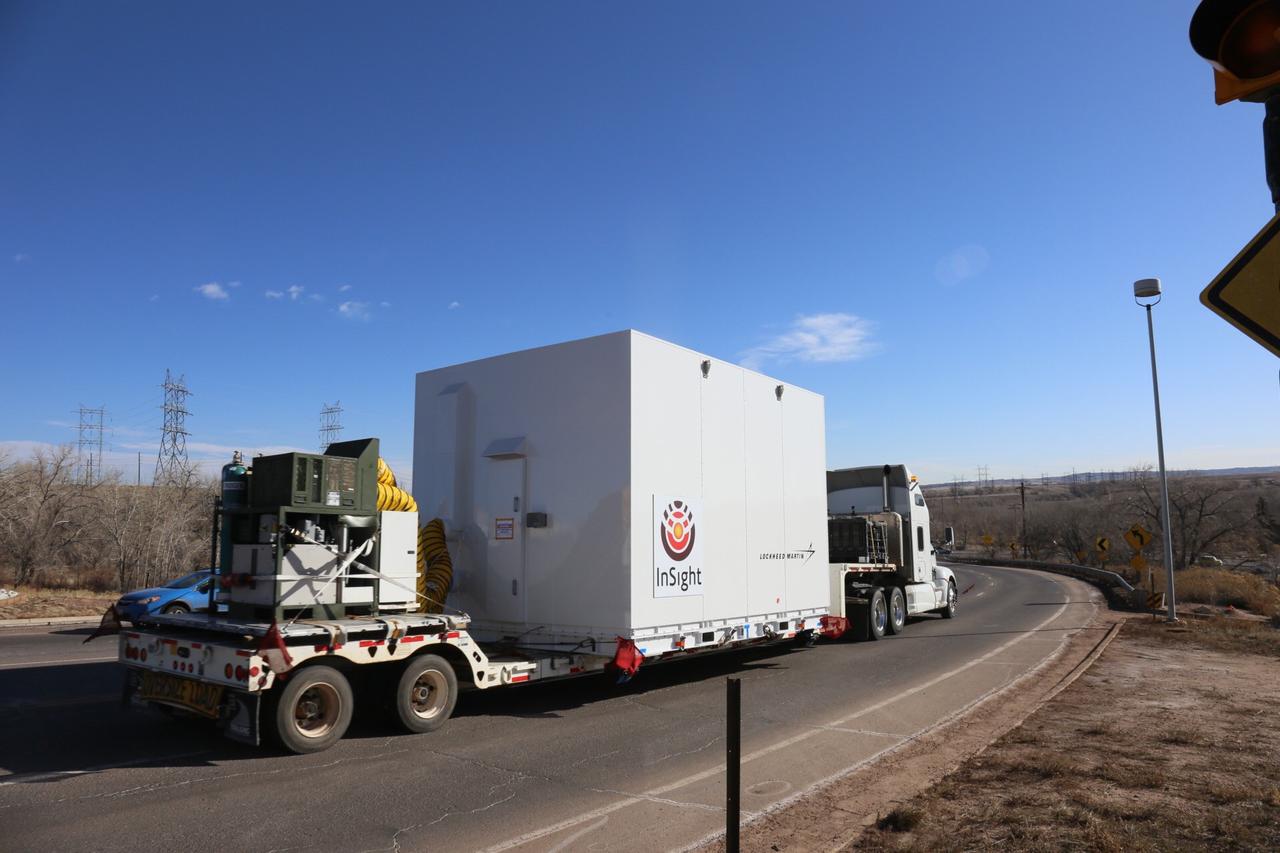
A truck carrying NASA s InSight spacecraft leaves Lockheed Martin Space, Denver, where the spacecraft was built and tested, on February 28, 2018. InSight was driven to Buckley Air Force Base, where it was loaded into a C-17 cargo aircraft and flown to Vandenberg Air Force Base, California. There, it will be prepared for a May launch. InSight, short for Interior Exploration using Seismic Investigations, Geodesy and Heat Transport, is the first mission dedicated to studying the deep interior of Mars. Its findings will advance understanding of the early history of all rocky planets, including Earth. https://photojournal.jpl.nasa.gov/catalog/PIA22225

Engineers at Lockheed Martin Space, Denver, Colorado, prepare NASA's InSight lander for testing in a thermal vacuum chamber several months before launch. https://photojournal.jpl.nasa.gov/catalog/PIA22740
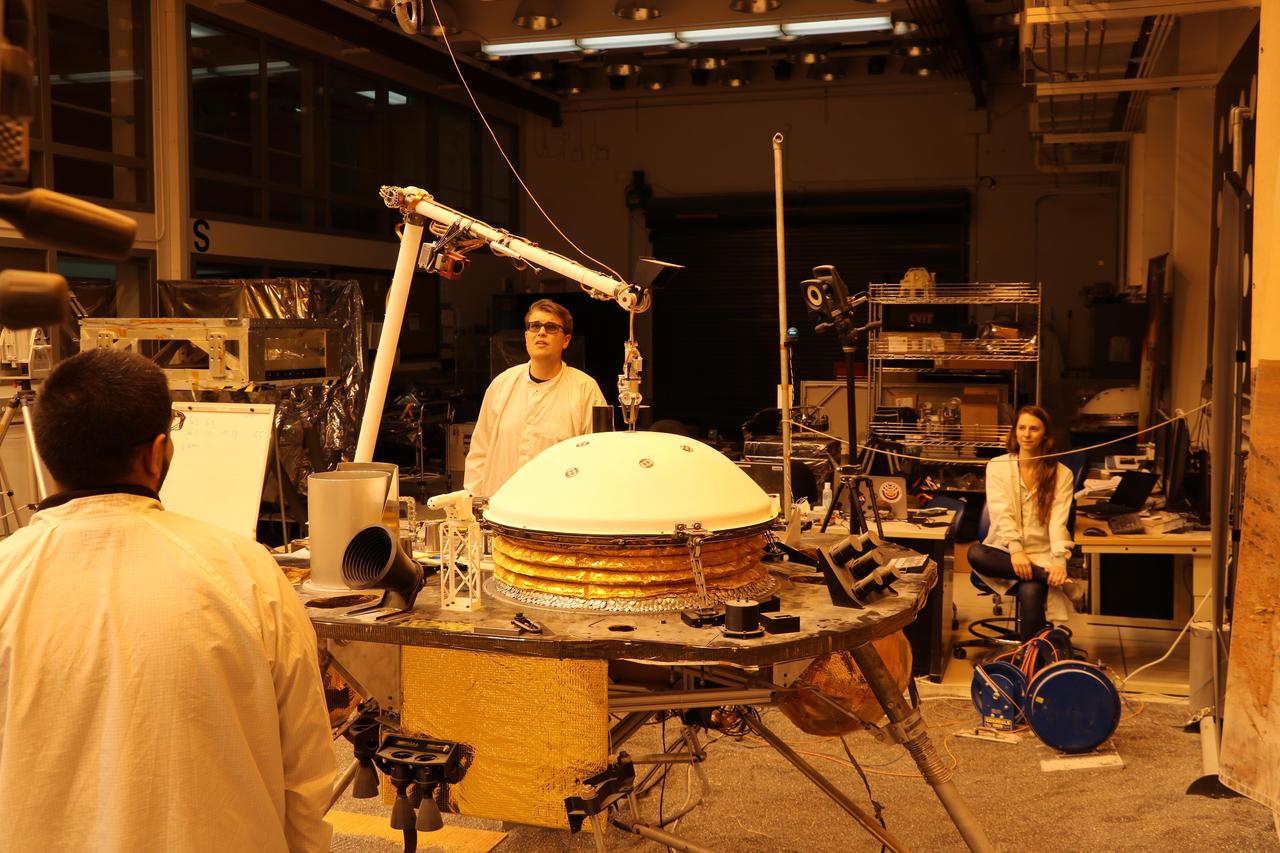
NASA's InSight mission tests an engineering version of the spacecraft's robotic arm in a Mars-like environment at NASA's Jet Propulsion Laboratory. The five-fingered grapple on the end of the robotic arm is lifting up the Wind and Thermal Shield, a protective covering for InSight's seismometer. The test is being conducted under reddish "Mars lighting" to simulate activities on the Red Planet. https://photojournal.jpl.nasa.gov/catalog/PIA22806
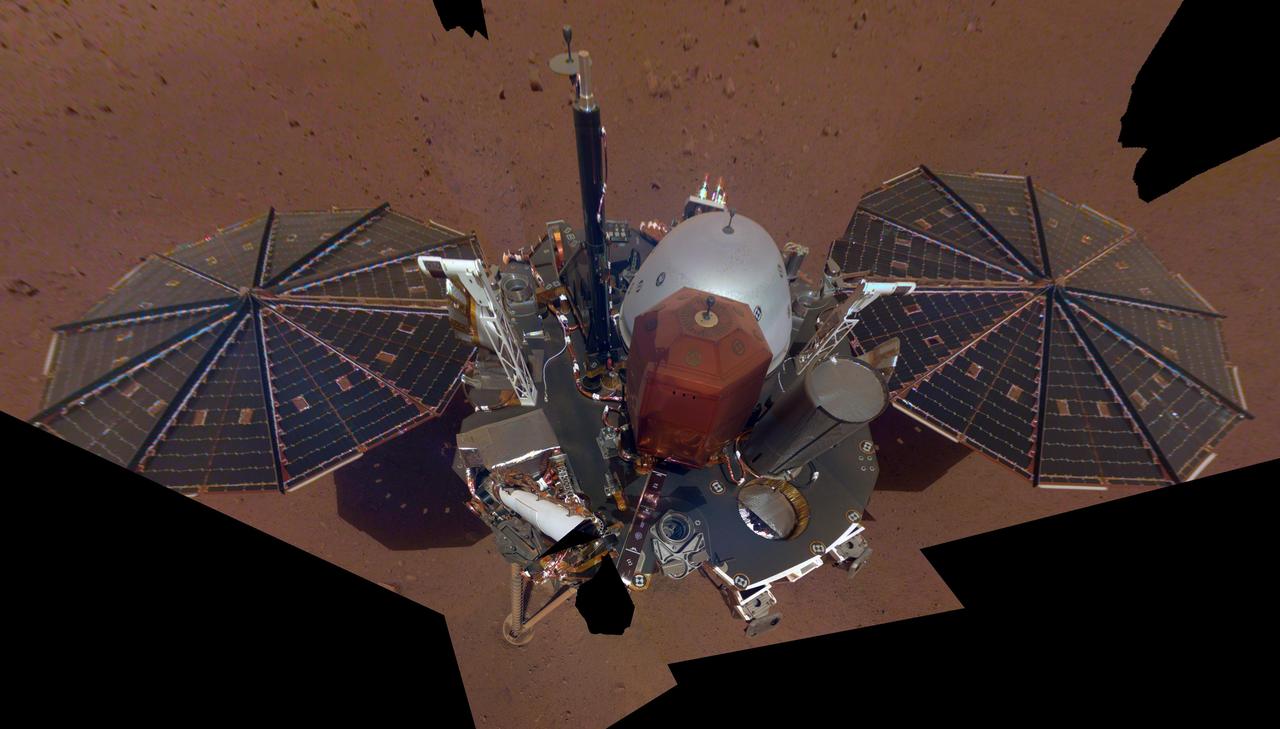
This is NASA InSight's first full selfie on Mars. It displays the lander's solar panels and deck. On top of the deck are its science instruments, weather sensor booms and UHF antenna. The selfie was taken on Dec. 6, 2018 (Sol 10). The selfie is made up of 11 images which were taken by its Instrument Deployment Camera, located on the elbow of its robotic arm. Those images are then stitched together into a mosaic. https://photojournal.jpl.nasa.gov/catalog/PIA22876

This seismogram shows the largest quake ever detected on another planet. Estimated at magnitude 5, this quake was discovered by NASA's InSight lander on May 4, 2022, the 1,222nd Martian day, or sol, of the mission. InSight was sent to Mars with a highly sensitive seismometer, provided by France's Centre National d'Études Spatiales (CNES), to study the deep interior of the planet. As seismic waves pass through or reflect off material in Mars' crust, mantle, and core, they change in ways that seismologists can study to determine the depth and composition of these layers. What scientists learn about the structure of Mars can help them better understand the formation of all rocky worlds, including Earth and its Moon. https://photojournal.jpl.nasa.gov/catalog/PIA25180

This spectrogram shows the largest quake ever detected on another planet. Estimated at magnitude 5, this quake was discovered by NASA's InSight lander on May 4, 2022, the 1,222nd Martian day, or sol, of the mission. InSight was sent to Mars with a highly sensitive seismometer, provided by France's Centre National d'Études Spatiales (CNES), to study the deep interior of the planet. As seismic waves pass through or reflect off material in Mars' crust, mantle, and core, they change in ways that seismologists can study to determine the depth and composition of these layers. What scientists learn about the structure of Mars can help them better understand the formation of all rocky worlds, including Earth and its Moon. https://photojournal.jpl.nasa.gov/catalog/PIA25044

On June 28, 2019, NASA's InSight lander used its robotic arm to move the support structure for its digging instrument, informally called the "mole." This view was captured by the Instrument Deployment Camera on the spacecraft's robotic arm. Lifting the support structure had been done in three steps, a little bit at a time, to ensure the mole wasn't pulled out of the soil. Moving the structure out of the way will give the InSight team a better look at the mole and allow them to try to help it dig. https://photojournal.jpl.nasa.gov/catalog/PIA23309
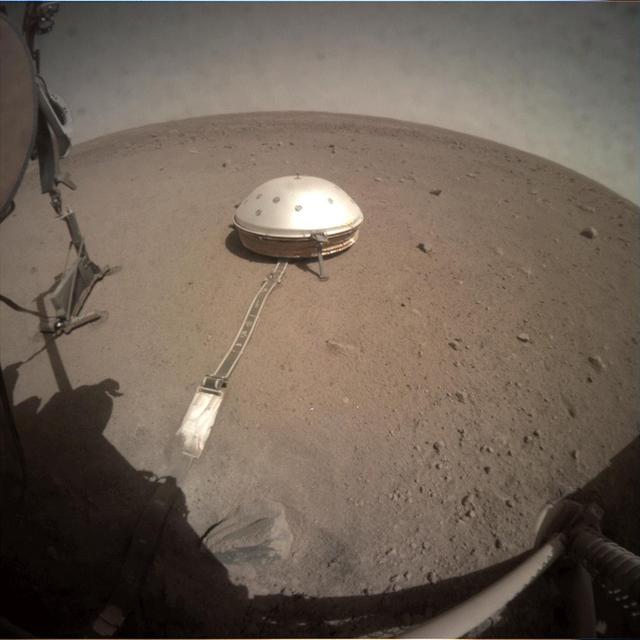
On June 28, 2019, NASA's InSight lander used its robotic arm to move the support structure for its digging instrument, informally called the "mole." This view was captured by the fisheye Instrument Context Camera under the lander's deck. Lifting the support structure had been done in three steps, a little bit at a time, to ensure the mole wasn't pulled out of the soil. Moving the structure out of the way will give the InSight team a better look at the mole and allow them to try to help it dig. https://photojournal.jpl.nasa.gov/catalog/PIA23308
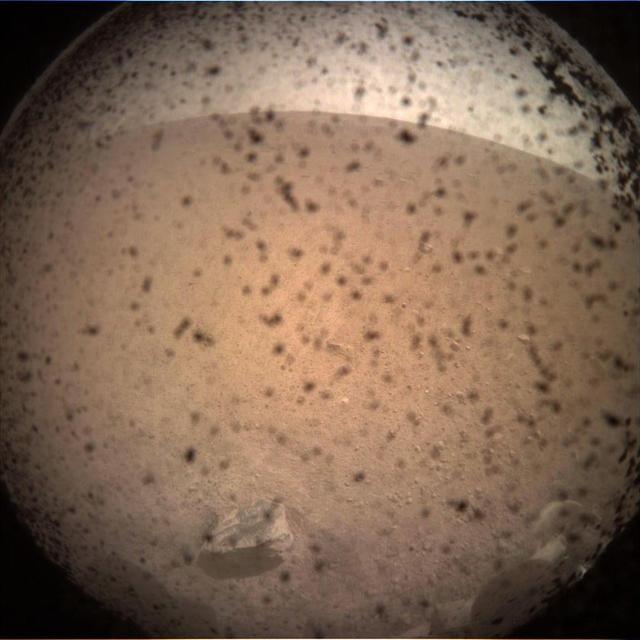
This is the first image taken by NASA's InSight lander on the surface of Mars. The instrument context camera (ICC) mounted below the lander deck obtained this image on Nov. 26, 2018, shortly after landing. The transparent lens cover was still in place to protect the lens from any dust kicked up during landing. https://photojournal.jpl.nasa.gov/catalog/PIA22829
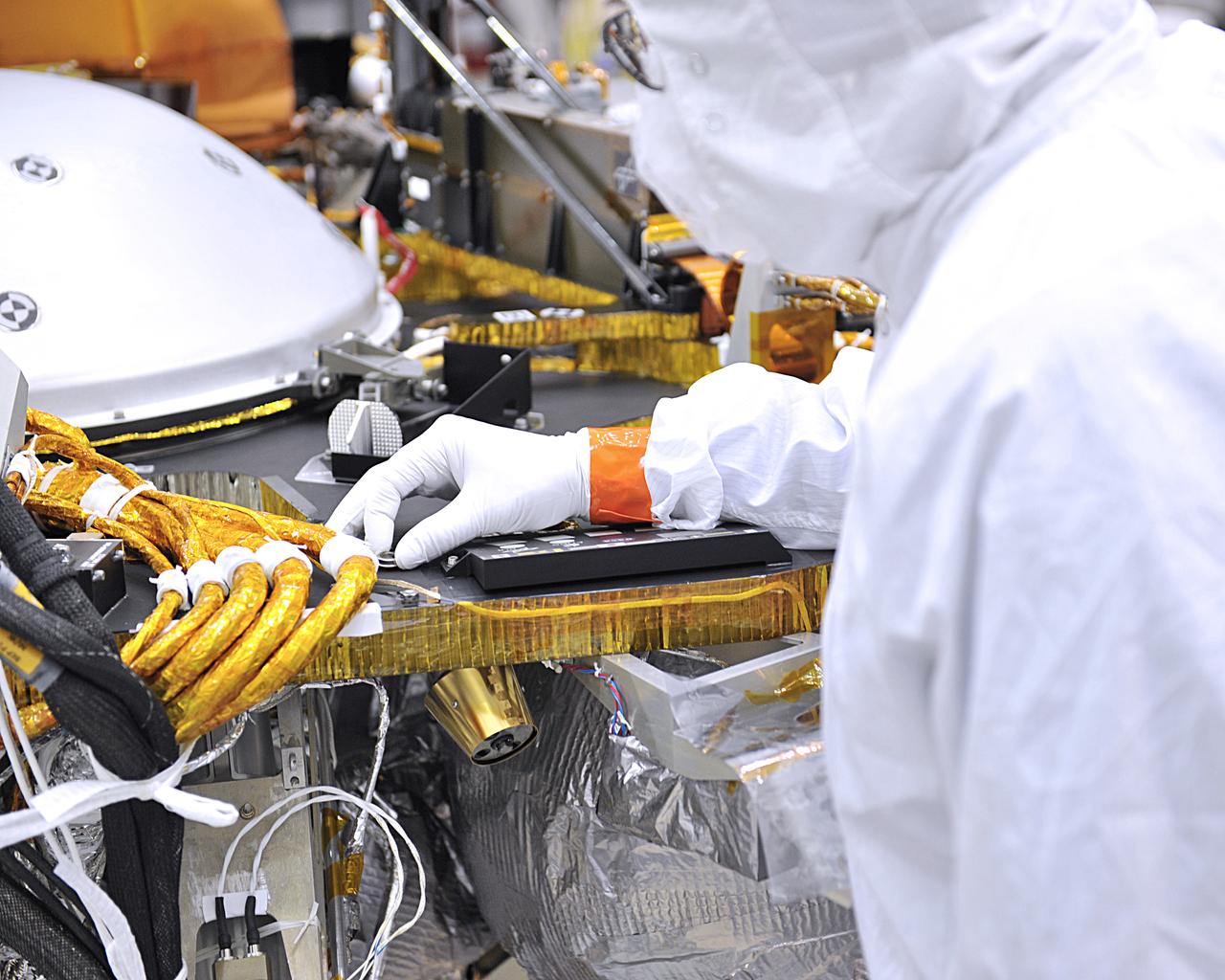
An engineer in the clean room at Lockheed Martin Space in Littleton, Colorado, affixes a dime-size chip onto the lander deck of NASA's InSight spacecraft. This second microchip, contains 1.6 million names submitted by the public to ride along with InSight to Mars. The chip was installed on Jan. 23, 2018. This joins another microchip that was previously installed that included 800,000 names for a grand total of 2.4 million names going to Mars as early as May 5, 2018. Engineers at NASA's Jet Propulsion Laboratory, Pasadena, California, put the names onto this tiny 0.3 square inches (8 millimeter-square) silicon wafer microchip using an electron beam to write extremely tiny letters with lines smaller than one one-thousandth the width of a human hair. The dime-size chip is affixed to the InSight lander deck and will remain on Mars forever. Normally used to make high-precision nanometer-scale devices, this technique was also used to write millions of names that were transported on NASA Mars rovers and Orion's first test flight. InSight is the first Mars mission dedicated to study the deep interior of Mars. Its findings will advance understanding of the early history of all rocky planets, including Earth. https://photojournal.jpl.nasa.gov/catalog/PIA22236
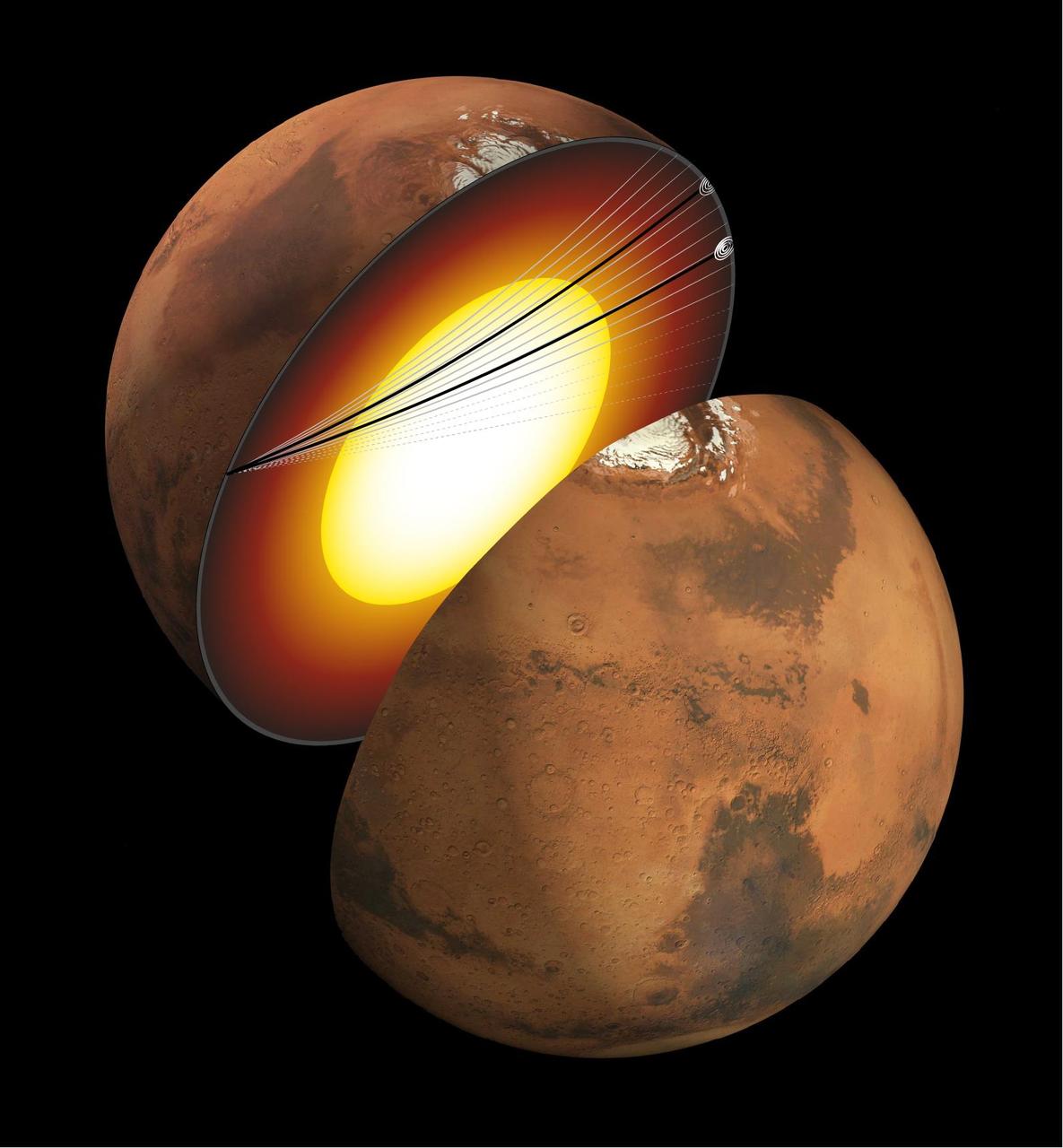
This artist's concept shows a cutaway of Mars along with the paths of seismic waves from two separate quakes in 2021. These seismic waves, detected by NASA's InSight mission, were the first ever identified to enter another planet's core. InSight's seismometer allowed scientists to study these waves and gain an unprecedented look at the Martian core. The quakes were detailed in a paper published April 24, 2023, in the Proceedings of the National Academies of Sciences. Occurring on Aug. 25 and Sept. 18, 2021, the two temblors were the first identified by the InSight team to have originated on the opposite side of the planet from the lander – so-called farside quakes. The distance proved crucial: The farther a quake happens from InSight, the deeper into the planet its seismic waves can travel before being detected. https://photojournal.jpl.nasa.gov/catalog/PIA25827
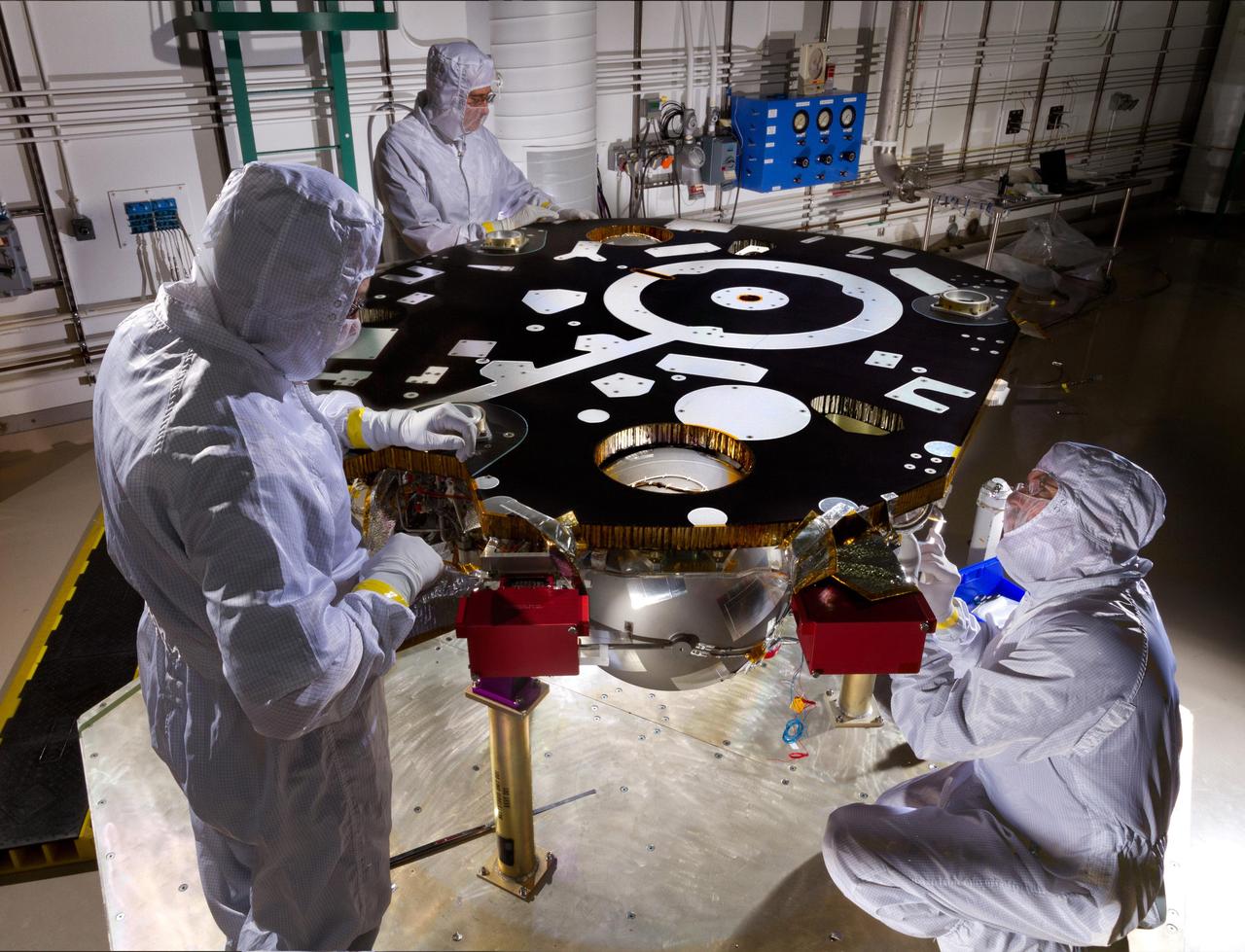
Technicians in a Lockheed Martin clean room near Denver prepare NASA's InSight Mars lander for propulsion proof and leak testing on Oct. 31, 2014. Following the test, the lander was moved to another clean room for the start of the mission's assembly, test and launch operations (ATLO) phase. The assembly portion of ATLO will last about six months. The InSight mission (for Interior Exploration using Seismic Investigations, Geodesy and Heat Transport) is scheduled to launch in March 2016 and land on Mars six months later. It will investigate processes that formed and shaped Mars and will help scientists better understand the evolution of our inner solar system's rocky planets, including Earth. Note: After thorough examination, NASA managers have decided to suspend the planned March 2016 launch of the Interior Exploration using Seismic Investigations Geodesy and Heat Transport (InSight) mission. The decision follows unsuccessful attempts to repair a leak in a section of the prime instrument in the science payload. http://photojournal.jpl.nasa.gov/catalog/PIA18884
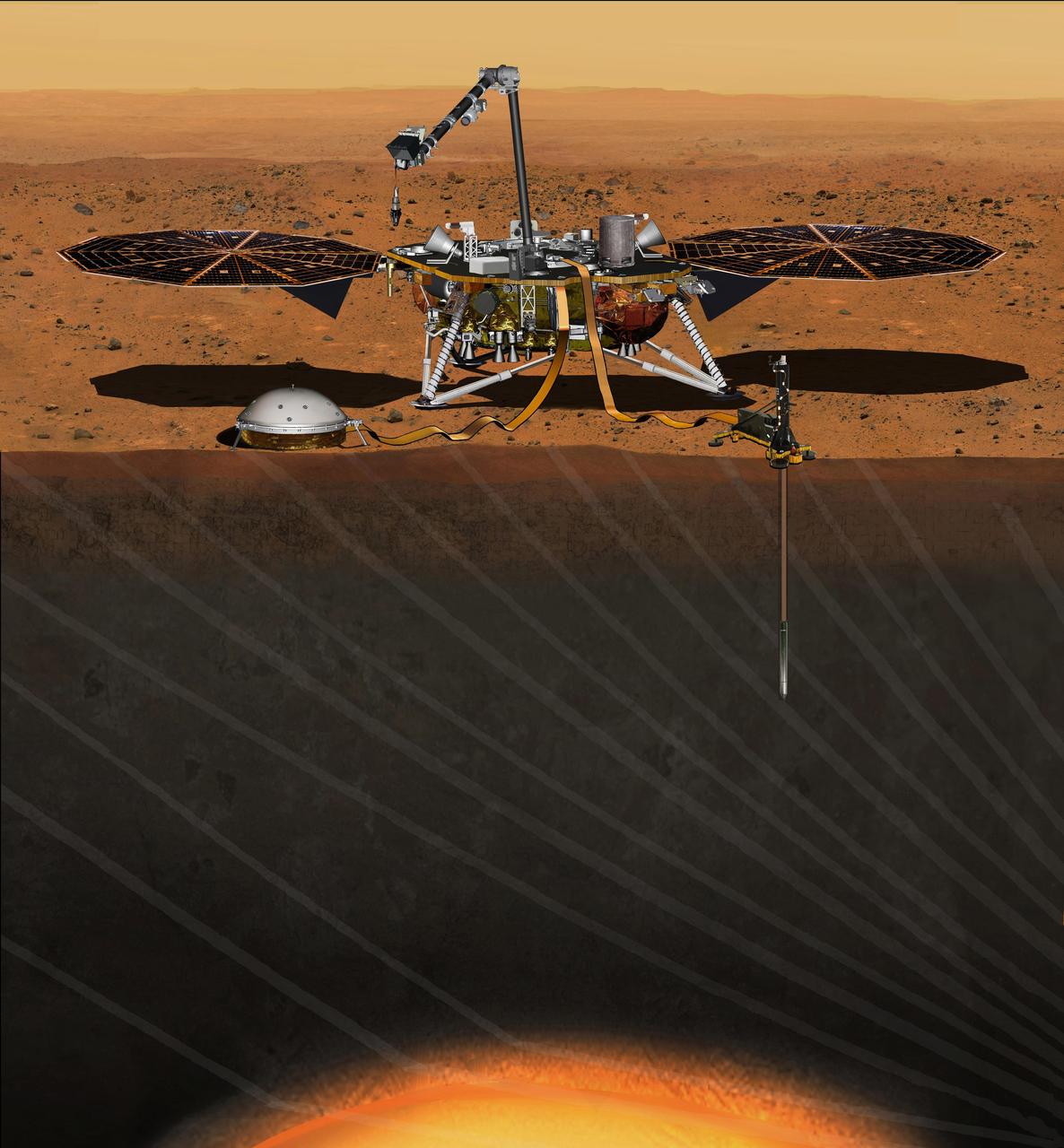
This artist's concept from August 2015 depicts NASA's InSight Mars lander fully deployed for studying the deep interior of Mars. This illustration updates the correct placement and look of Insight's main instruments. For an earlier artist rendition, see PIA17358. InSight, short for Interior Exploration using Seismic Investigations, Geodesy and Heat Transport, will investigate processes that formed and shaped Mars. Its findings will improve understanding about the evolution of our inner solar system's rocky planets, including Earth. The lander will be the first mission to permanently deploy instruments directly onto Martian ground using a robotic arm. The two instruments to be placed into a work area in front of the lander are a seismometer (contributed by the French space agency Centre National d'Études Spatiales, or CNES) to measure the microscopic ground motions from distant marsquakes providing information about the interior structure of Mars, and a heat-flow probe (contributed by the German Aerospace Center, or DLR) designed to hammer itself 3 to 5 meters (about 16 feet) deep and monitor heat coming from the planet's interior. The mission will also track the lander's radio to measure wobbles in the planet's rotation that relate to the size of its core and a suite of environmental sensors to monitor the weather and variations in the magnetic field. Two cameras will aid in instrument deployment and monitoring the local environment. Note: After thorough examination, NASA managers have decided to suspend the planned March 2016 launch of the Interior Exploration using Seismic Investigations Geodesy and Heat Transport (InSight) mission. The decision follows unsuccessful attempts to repair a leak in a section of the prime instrument in the science payload. http://photojournal.jpl.nasa.gov/catalog/PIA19811