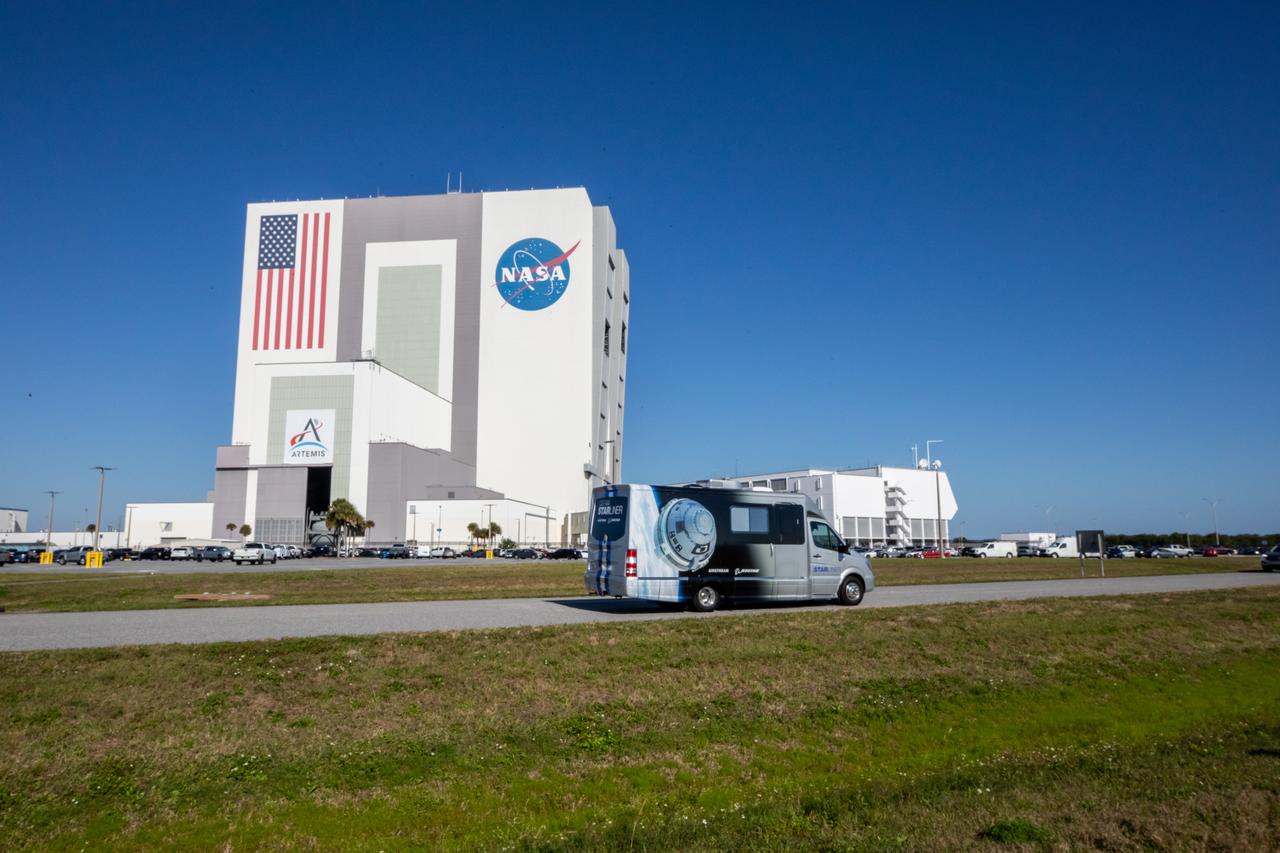
A crew transportation vehicle carrying NASA astronauts Suni Williams and Barry “Butch” Wilmore drives past the iconic Vehicle Assembly Building at the agency’s Kennedy Space Center in Florida on Wednesday, Jan. 31, 2024, as part of an integrated crew exercise simulation for NASA’s Boeing Crew Flight Test (CFT). The integrated exercise involved participation from the flight crew, NASA, Boeing, and United Launch Alliance (ULA), and allowed teams to rehearse prelaunch operations beginning roughly four hours before a targeted liftoff. CFT will be the first flight with astronauts to the International Space Station for Boeing’s Starliner spacecraft as part of NASA’s Commercial Crew Program. Starliner is scheduled to launch atop ULA’s Atlas V rocket no earlier than mid-April 2024.
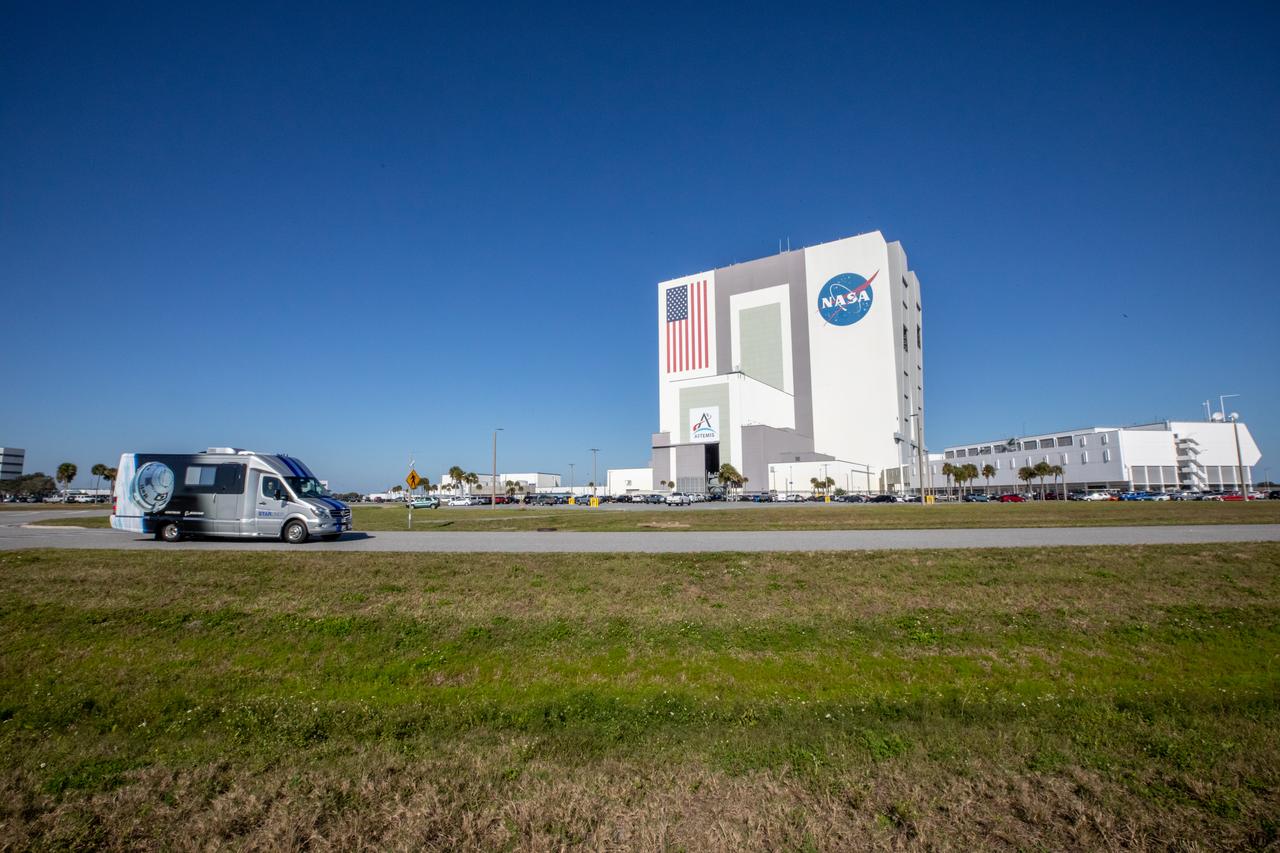
A crew transportation vehicle carrying NASA astronauts Suni Williams and Barry “Butch” Wilmore drives past the iconic Vehicle Assembly Building at the agency’s Kennedy Space Center in Florida on Wednesday, Jan. 31, 2024, as part of an integrated crew exercise simulation for NASA’s Boeing Crew Flight Test (CFT). The integrated exercise involved participation from the flight crew, NASA, Boeing, and United Launch Alliance (ULA), and allowed teams to rehearse prelaunch operations beginning roughly four hours before a targeted liftoff. CFT will be the first flight with astronauts to the International Space Station for Boeing’s Starliner spacecraft as part of NASA’s Commercial Crew Program. Starliner is scheduled to launch atop ULA’s Atlas V rocket no earlier than mid-April 2024.
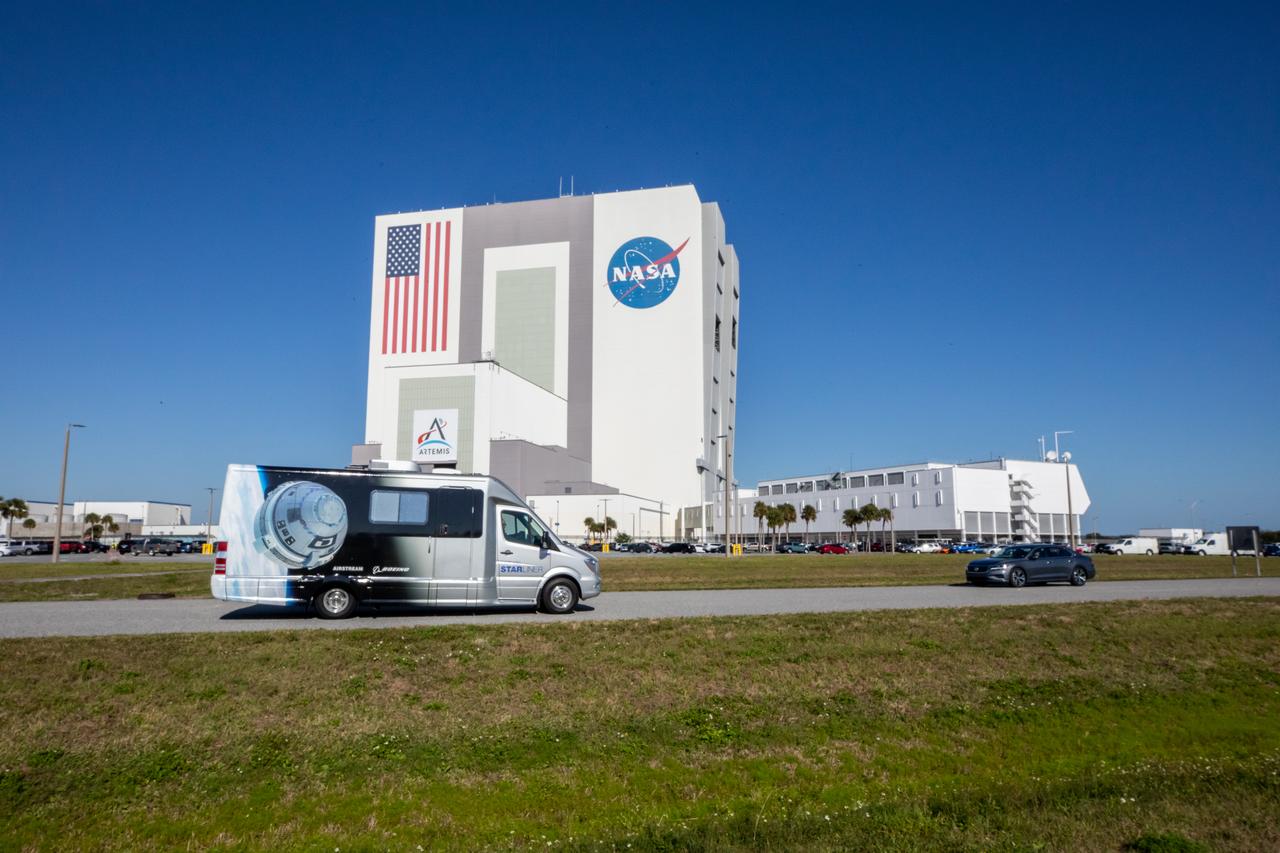
A crew transportation vehicle carrying NASA astronauts Suni Williams and Barry “Butch” Wilmore drives past the iconic Vehicle Assembly Building at the agency’s Kennedy Space Center in Florida on Wednesday, Jan. 31, 2024, as part of an integrated crew exercise simulation for NASA’s Boeing Crew Flight Test (CFT). The integrated exercise involved participation from the flight crew, NASA, Boeing, and United Launch Alliance (ULA), and allowed teams to rehearse prelaunch operations beginning roughly four hours before a targeted liftoff. CFT will be the first flight with astronauts to the International Space Station for Boeing’s Starliner spacecraft as part of NASA’s Commercial Crew Program. Starliner is scheduled to launch atop ULA’s Atlas V rocket no earlier than mid-April 2024.
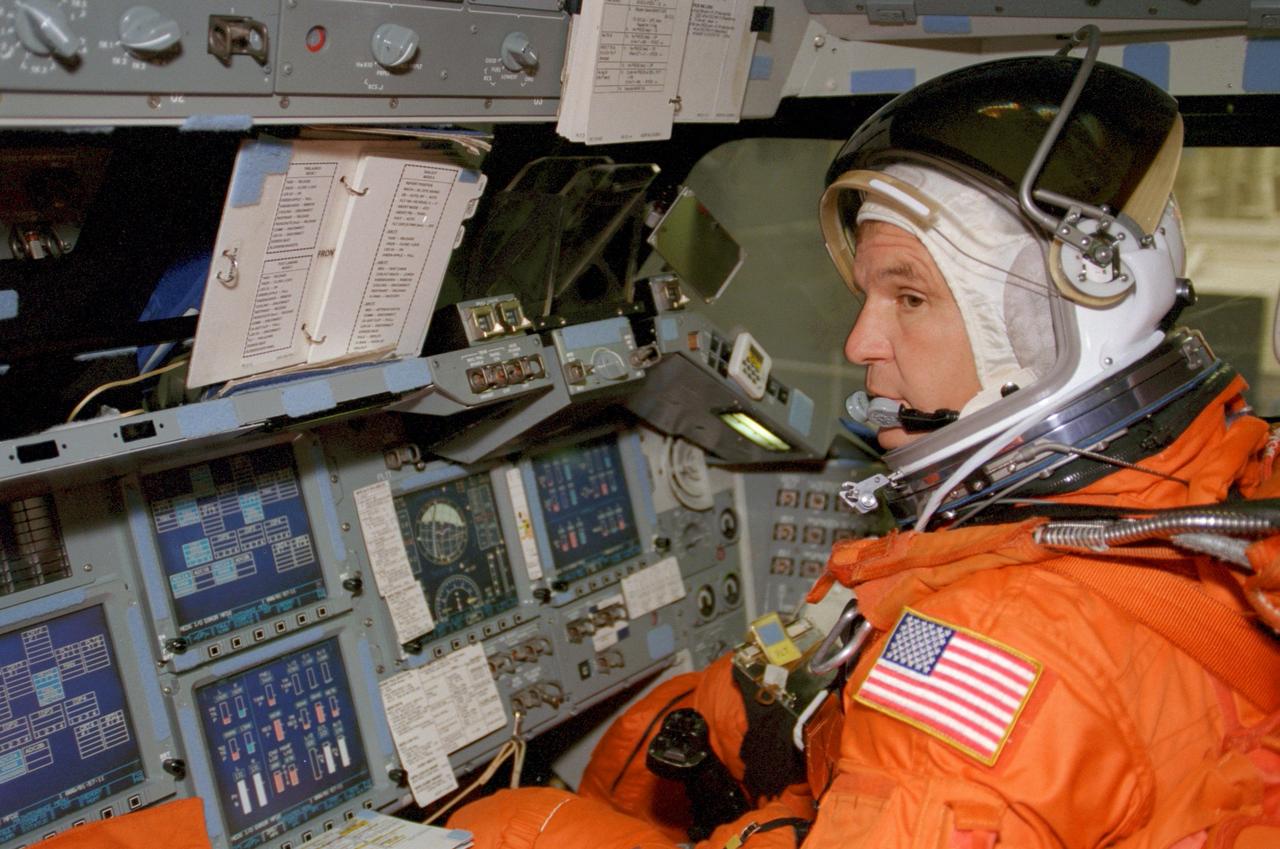
S99-07624 (15 July 1999) --- Astronaut Michael J. Bloomfield, STS-97 pilot, mans the pilot's station of a crew compartment trainer (CCT) during a training exercise at the Johnson Space Center's Systems Integration Facility.
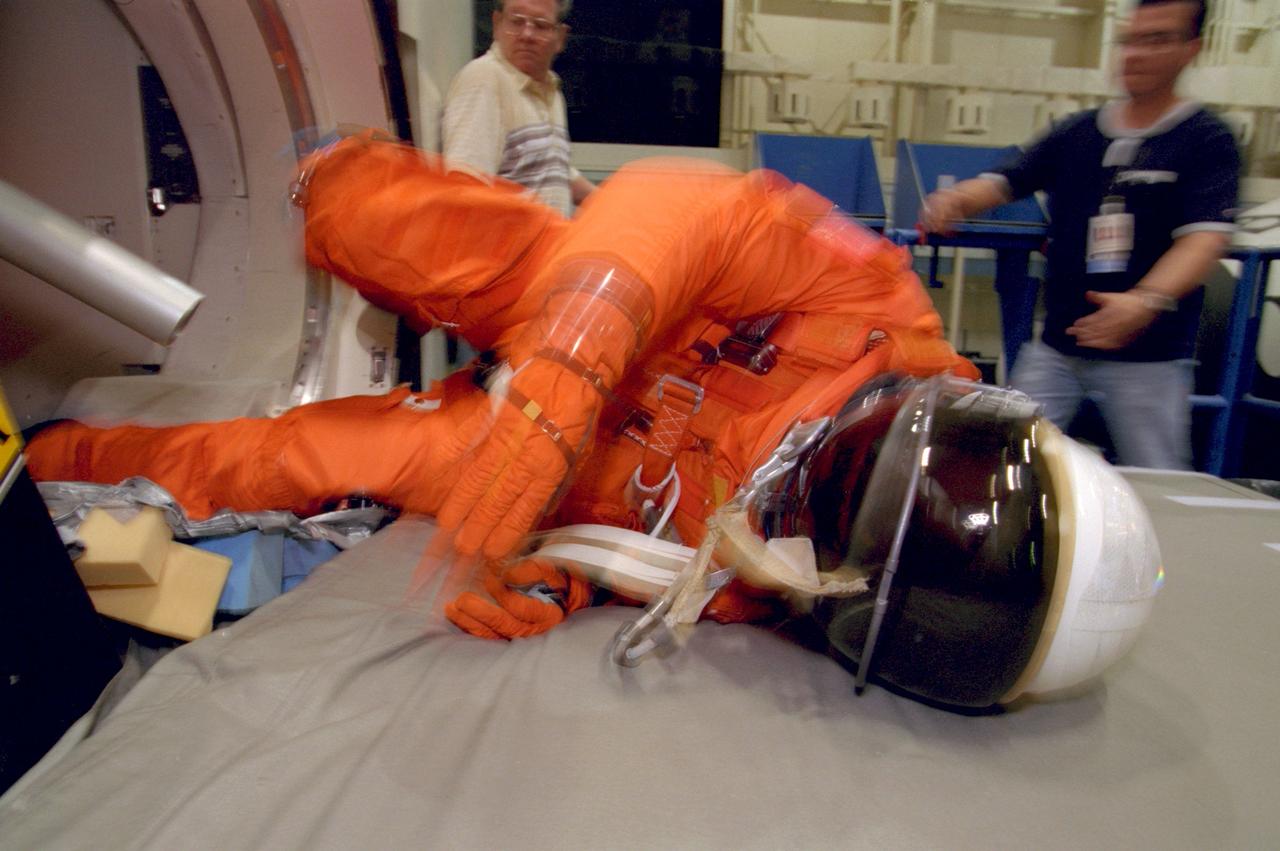
S99-07632 (15 July 1999) --- An unidentified STS-97 crew member simulates a bailout from a shuttle-in-trouble during an emergency egress exercise in the Systems Integration Facility at the Johnson Space Center.
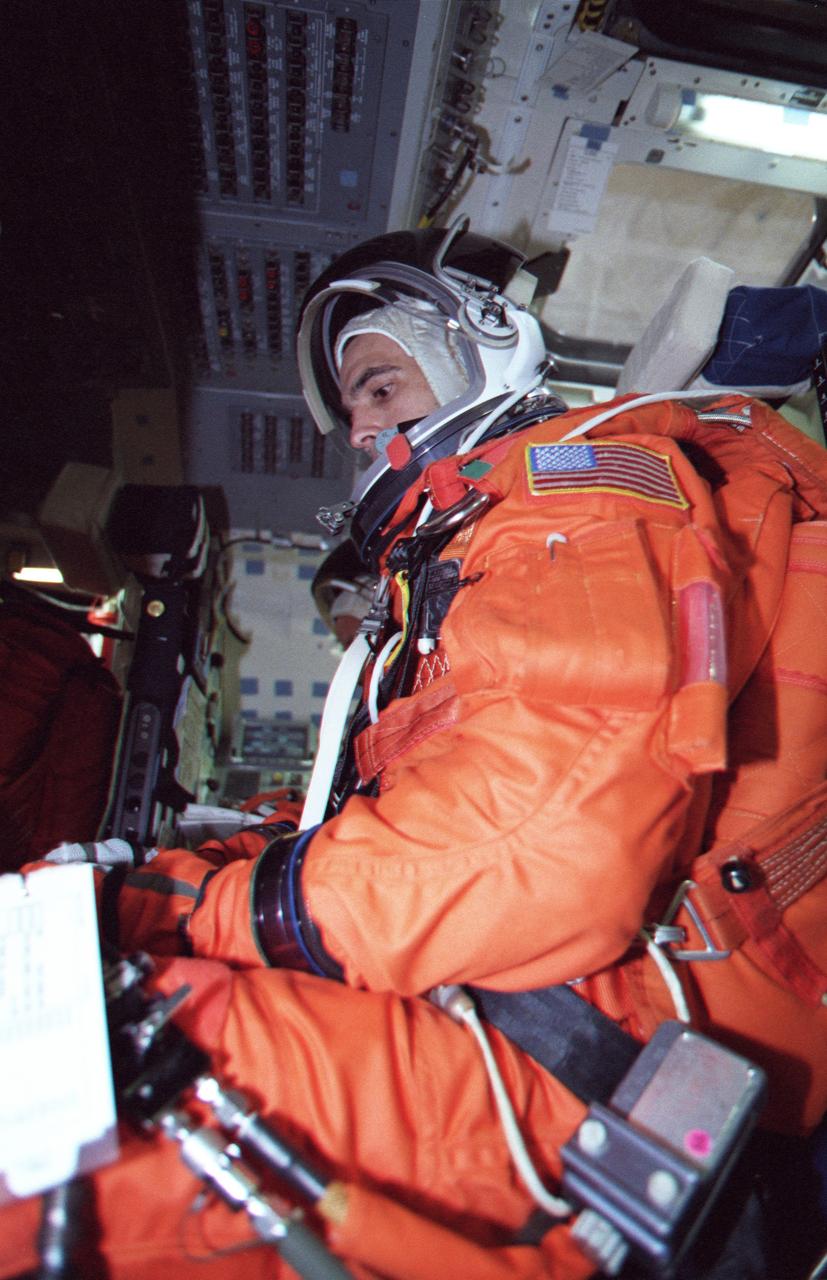
JSC2000-02222 (March 2000) --- Astronaut Richard A. Mastracchio, mission specialist, participates in a simulation exercise on the flight deck of the crew compartment trainer (CCT-1) at the Johnson Space Center's Systems Integration Facility. With four crew members seated on the flight deck and three on the mid deck, the astronauts rehearsed procedures for countdown and launch.

NASA astronauts Suni Williams and Barry “Butch” Wilmore prepare to enter a crew transportation vehicle in front of the Neil Armstrong Operations and Checkout Building at the agency’s Kennedy Space Center in Florida on Wednesday, Jan. 31, 2024, as part of an integrated crew exercise simulation for NASA’s Boeing Crew Flight Test (CFT). The integrated exercise involved participation from the flight crew, NASA, Boeing, and United Launch Alliance (ULA), and allowed teams to rehearse prelaunch operations beginning roughly four hours before a targeted liftoff. CFT will be the first flight with astronauts to the International Space Station for Boeing’s Starliner spacecraft as part of NASA’s Commercial Crew Program. Starliner is scheduled to launch atop ULA’s Atlas V rocket no earlier than mid-April 2024.
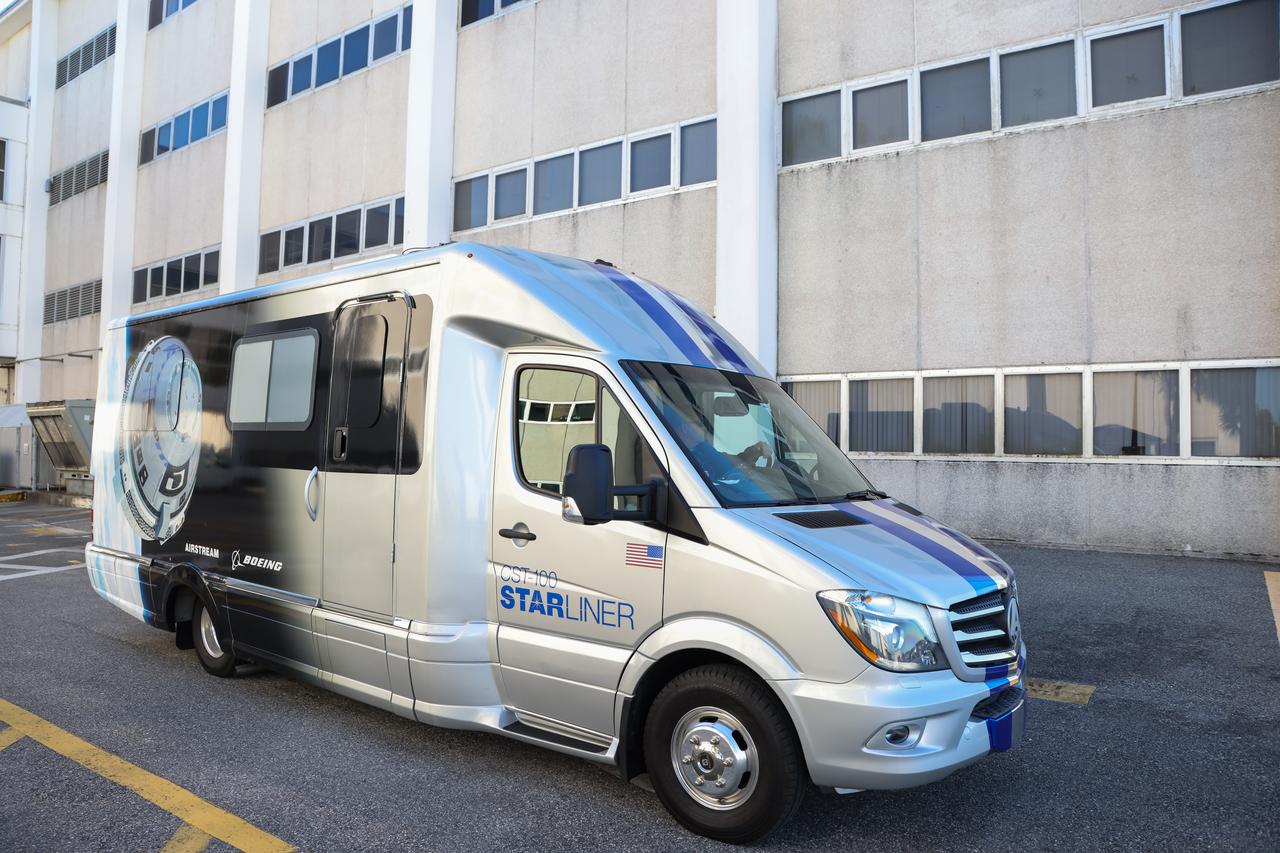
A crew transportation vehicle carrying NASA astronauts Suni Williams and Barry “Butch” Wilmore drives past the Neil Armstrong Operations and Checkout Building at the agency’s Kennedy Space Center in Florida on Wednesday, Jan. 31, 2024, as part of an integrated crew exercise simulation for NASA’s Boeing Crew Flight Test (CFT). The integrated exercise involved participation from the flight crew, NASA, Boeing, and United Launch Alliance (ULA), and allowed teams to rehearse prelaunch operations beginning roughly four hours before a targeted liftoff. CFT will be the first flight with astronauts to the International Space Station for Boeing’s Starliner spacecraft as part of NASA’s Commercial Crew Program. Starliner is scheduled to launch atop ULA’s Atlas V rocket no earlier than mid-April 2024.
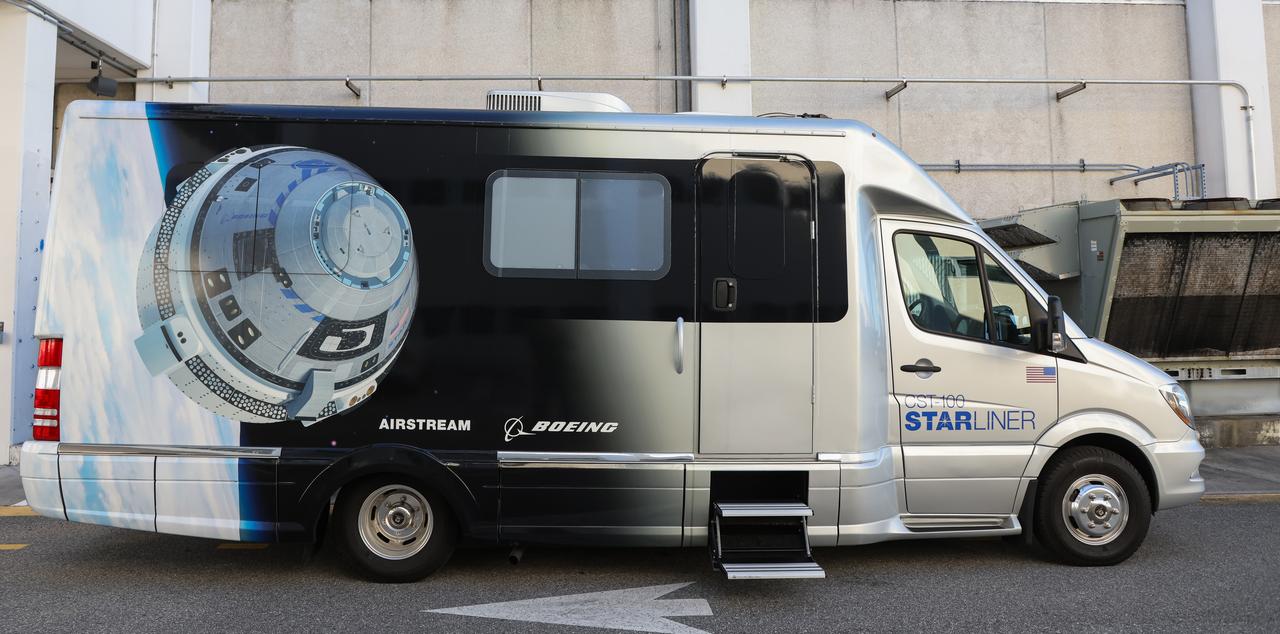
A crew transportation vehicle outside the Neil Armstrong Operations and Checkout Building at the agency’s Kennedy Space Center in Florida waits to carry NASA astronauts Suni Williams and Barry “Butch” Wilmore as part of an integrated crew exercise simulation for NASA’s Boeing Crew Flight Test (CFT) on Wednesday, Jan. 31, 2024. The integrated exercise involved participation from the flight crew, NASA, Boeing, and United Launch Alliance (ULA), and allowed teams to rehearse prelaunch operations beginning roughly four hours before a targeted liftoff. CFT will be the first flight with astronauts to the International Space Station for Boeing’s Starliner spacecraft as part of NASA’s Commercial Crew Program. Starliner is scheduled to launch atop ULA’s Atlas V rocket no earlier than mid-April 2024.
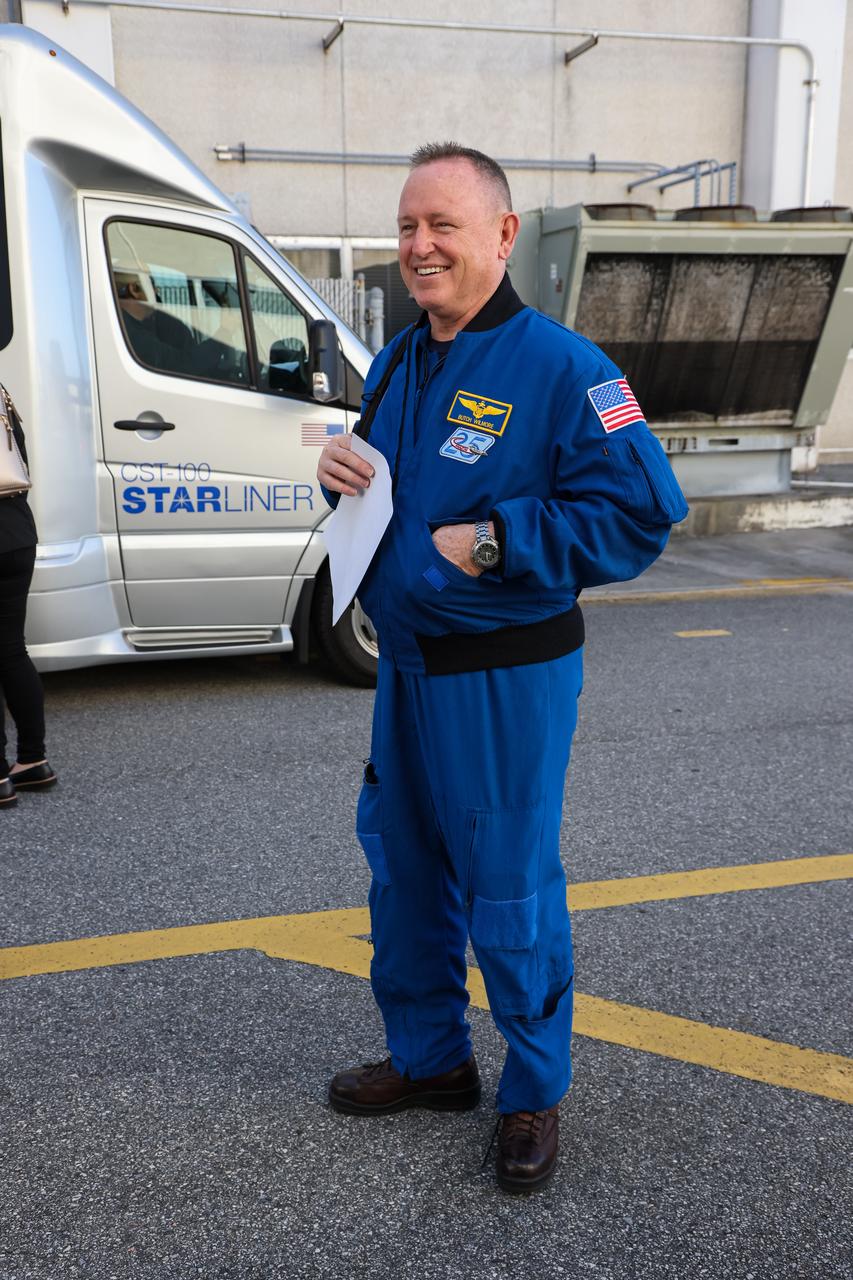
NASA astronaut Barry “Butch” Wilmore emerges from the Neil Armstrong Operations and Checkout Building and prepares to enter a crew transportation vehicle at the agency’s Kennedy Space Center in Florida on Wednesday, Jan. 31, 2024, as part of an integrated crew exercise simulation for NASA’s Boeing Crew Flight Test (CFT). Wilmore and fellow crew member Suni Williams, along with NASA, Boeing, and United Launch Alliance (ULA), participated in the integrated exercise, which allowed teams to rehearse prelaunch operations beginning roughly four hours before a targeted liftoff. CFT will be the first flight with astronauts to the International Space Station for Boeing’s Starliner spacecraft as part of NASA’s Commercial Crew Program. Starliner is scheduled to launch atop ULA’s Atlas V rocket no earlier than mid-April 2024.
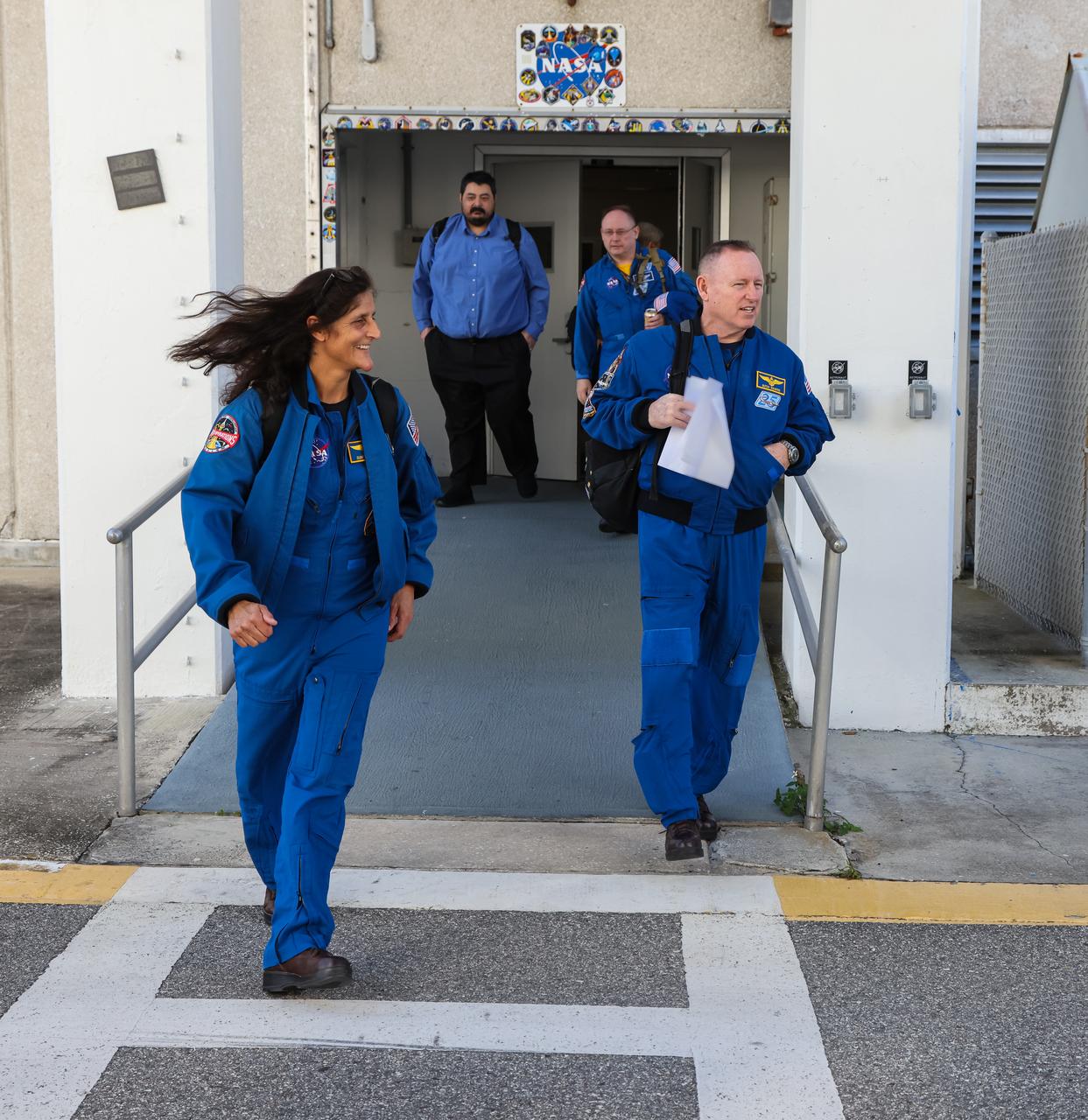
NASA astronauts Suni Williams and Barry “Butch” Wilmore emerge from the Neil Armstrong Operations and Checkout Building at the agency’s Kennedy Space Center in Florida on Wednesday, Jan. 31, 2024, as part of an integrated crew exercise simulation for NASA’s Boeing Crew Flight Test (CFT). The integrated exercise involved participation from the flight crew, NASA, Boeing, and United Launch Alliance (ULA), and allowed teams to rehearse prelaunch operations beginning roughly four hours before a targeted liftoff. CFT will be the first flight with astronauts to the International Space Station for Boeing’s Starliner spacecraft as part of NASA’s Commercial Crew Program. Starliner is scheduled to launch atop ULA’s Atlas V rocket no earlier than mid-April 2024.
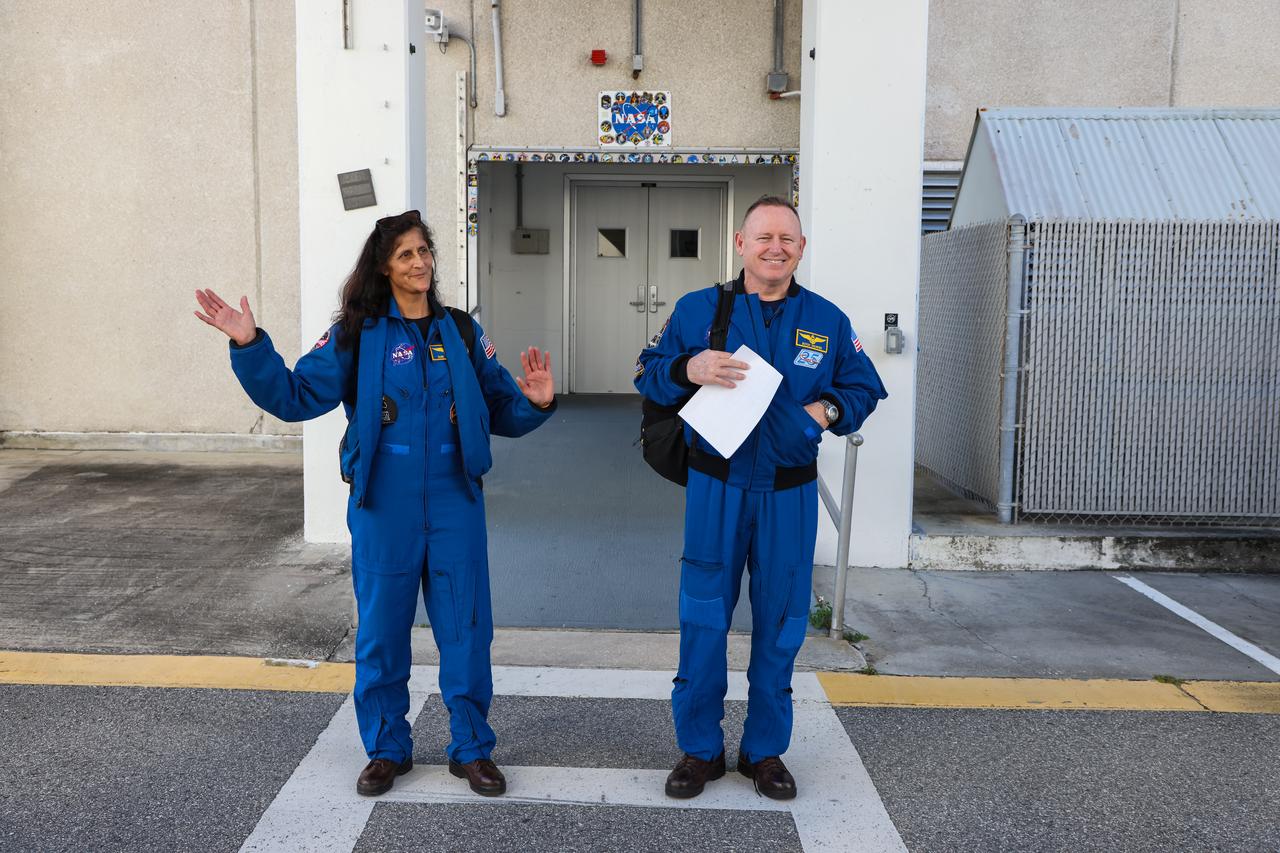
NASA astronauts Suni Williams and Barry “Butch” Wilmore emerge from the Neil Armstrong Operations and Checkout Building at the agency’s Kennedy Space Center in Florida on Wednesday, Jan. 31, 2024, as part of an integrated crew exercise simulation for NASA’s Boeing Crew Flight Test (CFT). The integrated exercise involved participation from the flight crew, NASA, Boeing, and United Launch Alliance (ULA), and allowed teams to rehearse prelaunch operations beginning roughly four hours before a targeted liftoff. CFT will be the first flight with astronauts to the International Space Station for Boeing’s Starliner spacecraft as part of NASA’s Commercial Crew Program. Starliner is scheduled to launch atop ULA’s Atlas V rocket no earlier than mid-April 2024.
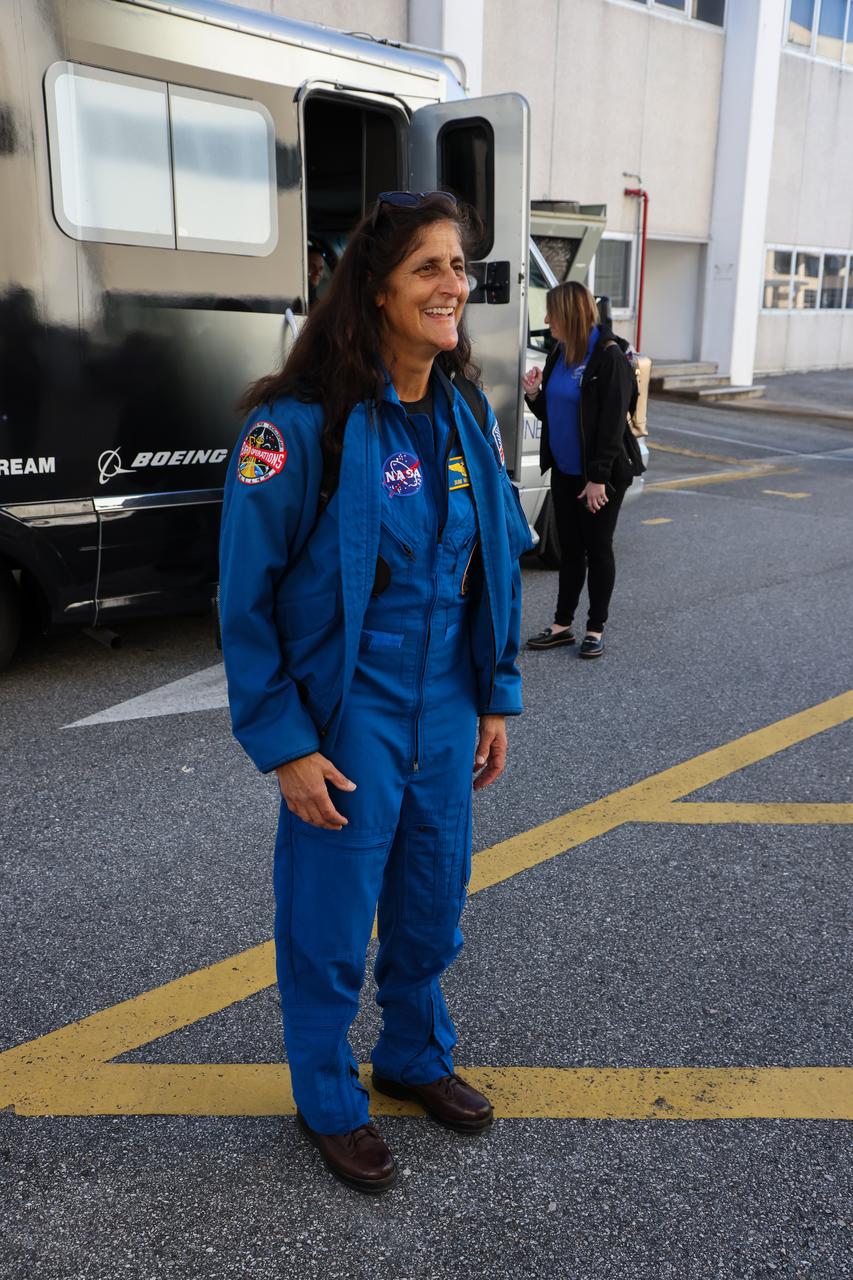
NASA astronaut Suni Williams emerges from the Neil Armstrong Operations and Checkout Building at the agency’s Kennedy Space Center in Florida on Wednesday, Jan. 31, 2024, as part of an integrated crew exercise simulation for NASA’s Boeing Crew Flight Test (CFT). Williams and fellow crew member Barry “Butch” Wilmore, along with NASA, Boeing, and United Launch Alliance (ULA), participated in the integrated exercise, which allowed teams to rehearse prelaunch operations beginning roughly four hours before a targeted liftoff. CFT will be the first flight with astronauts to the International Space Station for Boeing’s Starliner spacecraft as part of NASA’s Commercial Crew Program. Starliner is scheduled to launch atop ULA’s Atlas V rocket no earlier than mid-April 2024.
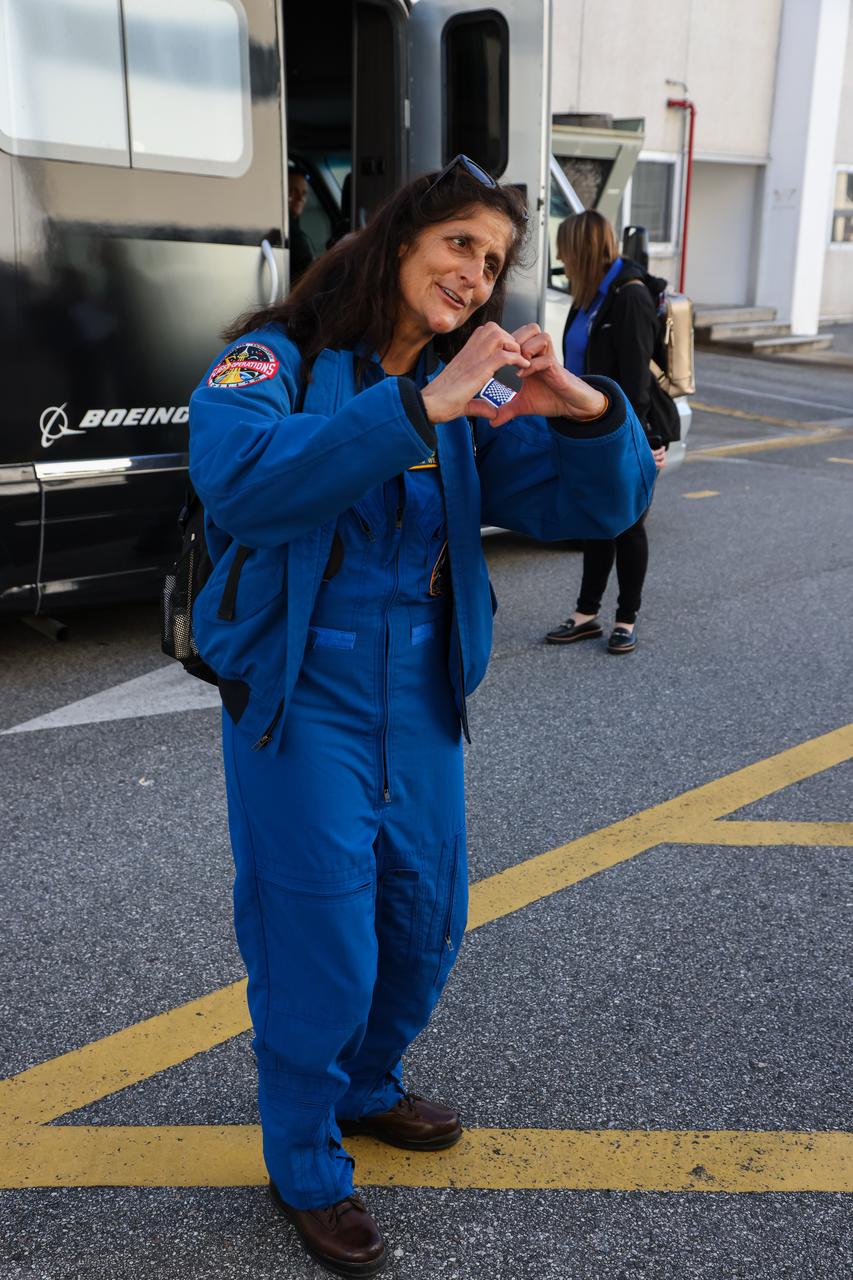
NASA astronaut Suni Williams emerges from the Neil Armstrong Operations and Checkout Building at the agency’s Kennedy Space Center in Florida on Wednesday, Jan. 31, 2024, as part of an integrated crew exercise simulation for NASA’s Boeing Crew Flight Test (CFT). Williams and fellow crew member Barry “Butch” Wilmore, along with NASA, Boeing, and United Launch Alliance (ULA), participated in the integrated exercise, which allowed teams to rehearse prelaunch operations beginning roughly four hours before a targeted liftoff. CFT will be the first flight with astronauts to the International Space Station for Boeing’s Starliner spacecraft as part of NASA’s Commercial Crew Program. Starliner is scheduled to launch atop ULA’s Atlas V rocket no earlier than mid-April 2024.
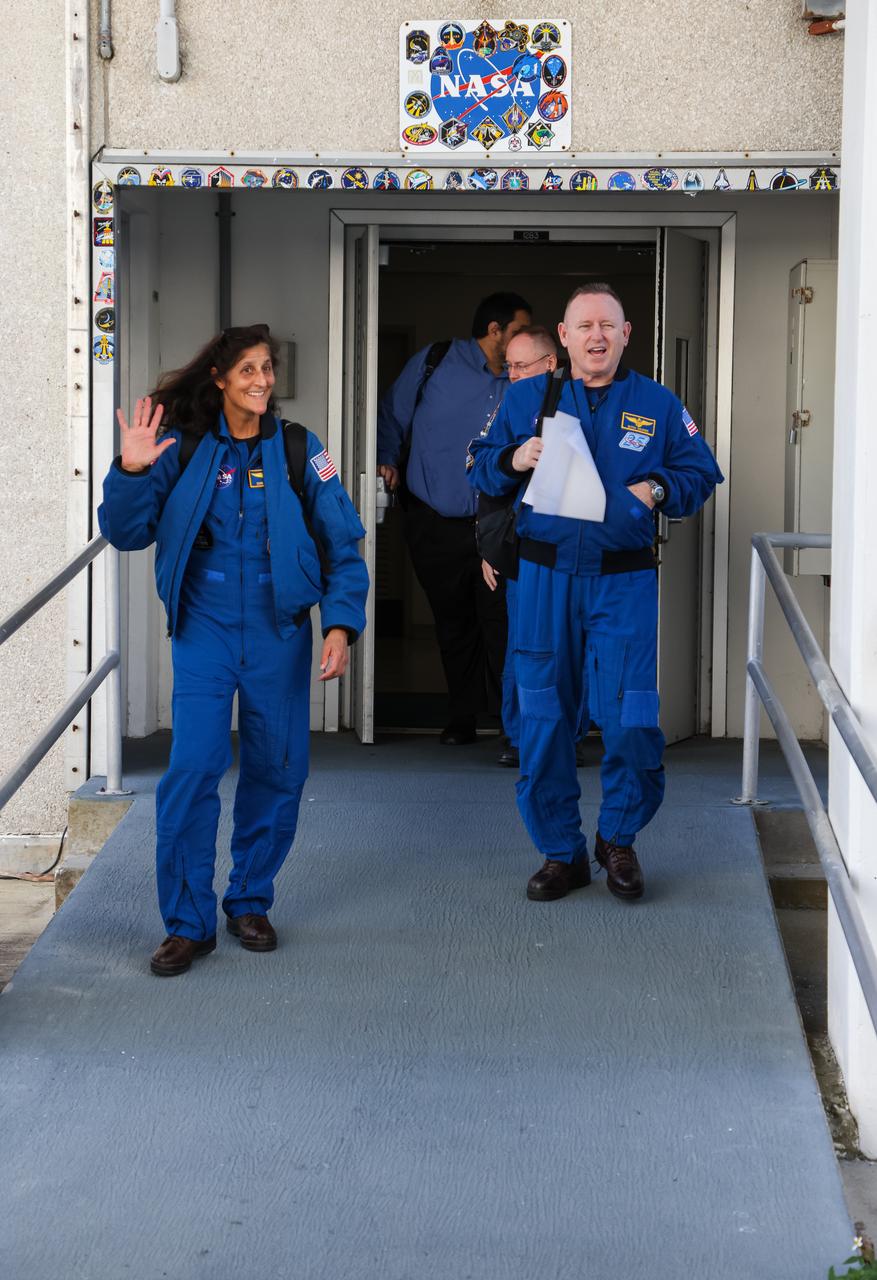
NASA astronauts Suni Williams and Barry “Butch” Wilmore emerge from the Neil Armstrong Operations and Checkout Building at the agency’s Kennedy Space Center in Florida on Wednesday, Jan. 31, 2024, as part of an integrated crew exercise simulation for NASA’s Boeing Crew Flight Test (CFT). The integrated exercise involved participation from the flight crew, NASA, Boeing, and United Launch Alliance (ULA), and allowed teams to rehearse prelaunch operations beginning roughly four hours before a targeted liftoff. CFT will be the first flight with astronauts to the International Space Station for Boeing’s Starliner spacecraft as part of NASA’s Commercial Crew Program. Starliner is scheduled to launch atop ULA’s Atlas V rocket no earlier than mid-April 2024.
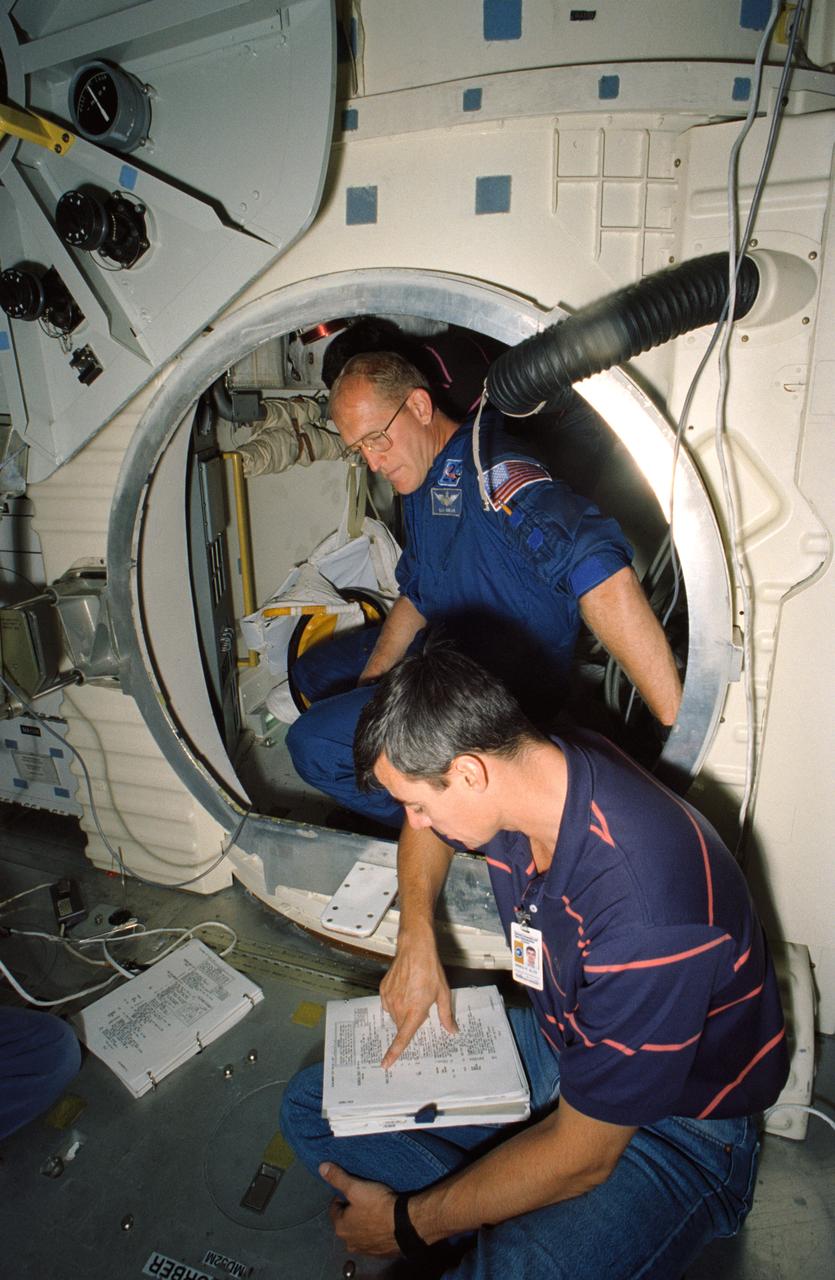
Astronauts Charles D. (Sam) Gemar, and Andrew M. Allen participate in a training exercise at JSC's Crew Compartment Trainer (CCT), located in the Shuttle mockup and integration laboratory. Gemar sits inside the airlock as Allen reviews procedures for EVA.
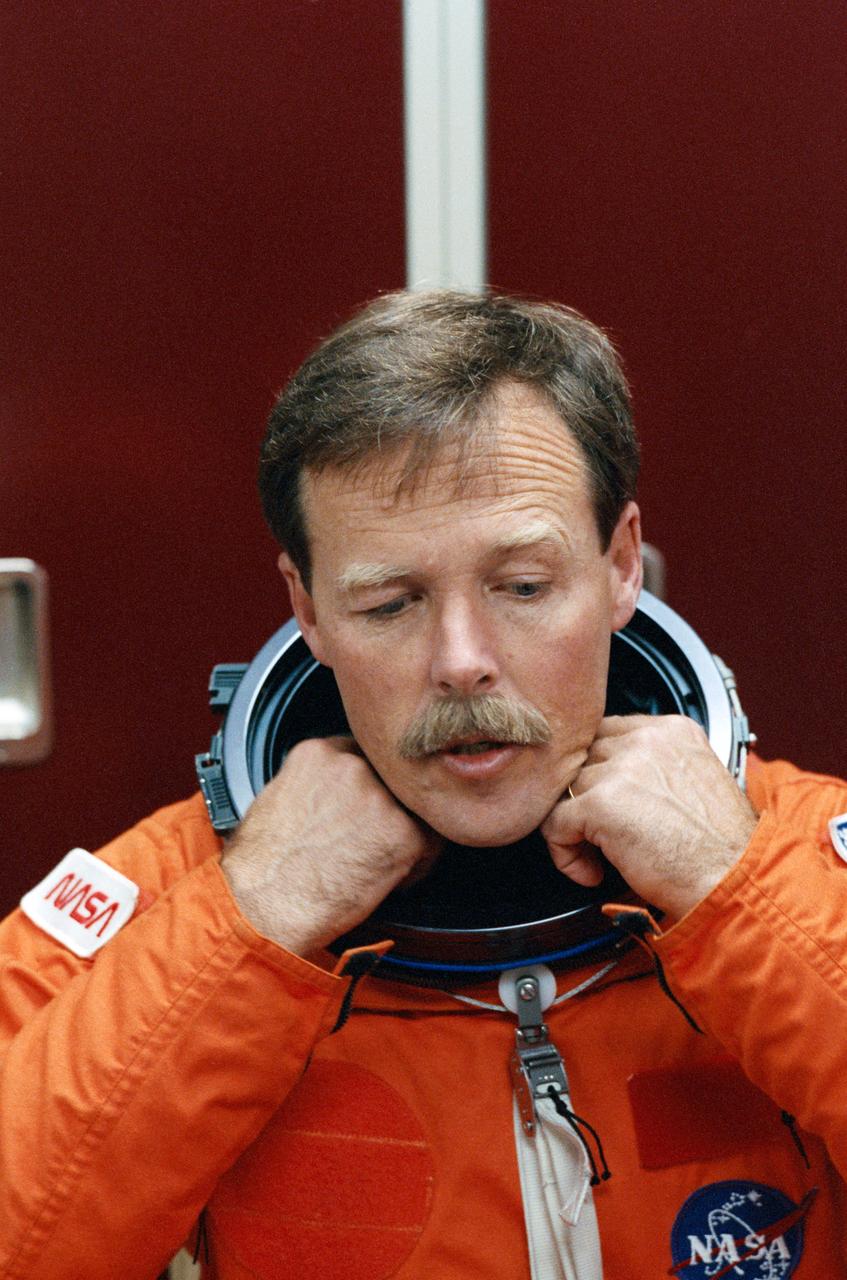
STS-47 Endeavour, Orbiter Vehicle (OV) 105, Commander Robert L. Gibson adjusts the launch and entry suit (LES) neck dam during suit donning in JSC's Mockup and Integration Laboratory (MAIL) Bldg 9A. Gibson is preparing for launch emergency egress (bailout) exercises in the Crew Compartment Trainer (CCT).
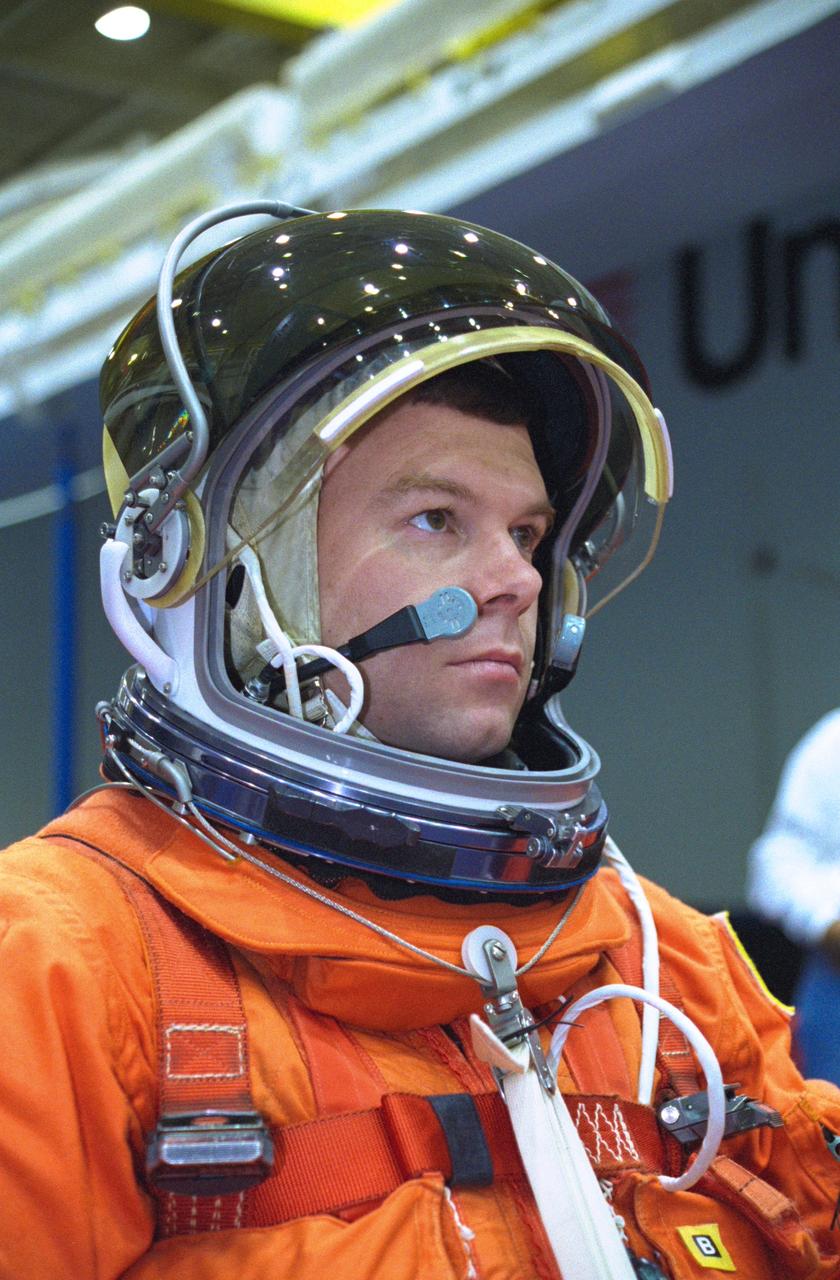
JSC2000-05557 (3 August 2000) --- Astronaut James M. Kelly, STS-102 pilot, listens as a crew training staff member briefs the astronauts at the Full Fuselage Trainer (FFT) during an emergency egress training exercise at the Johnson Space Center's Systems Integration Facility.
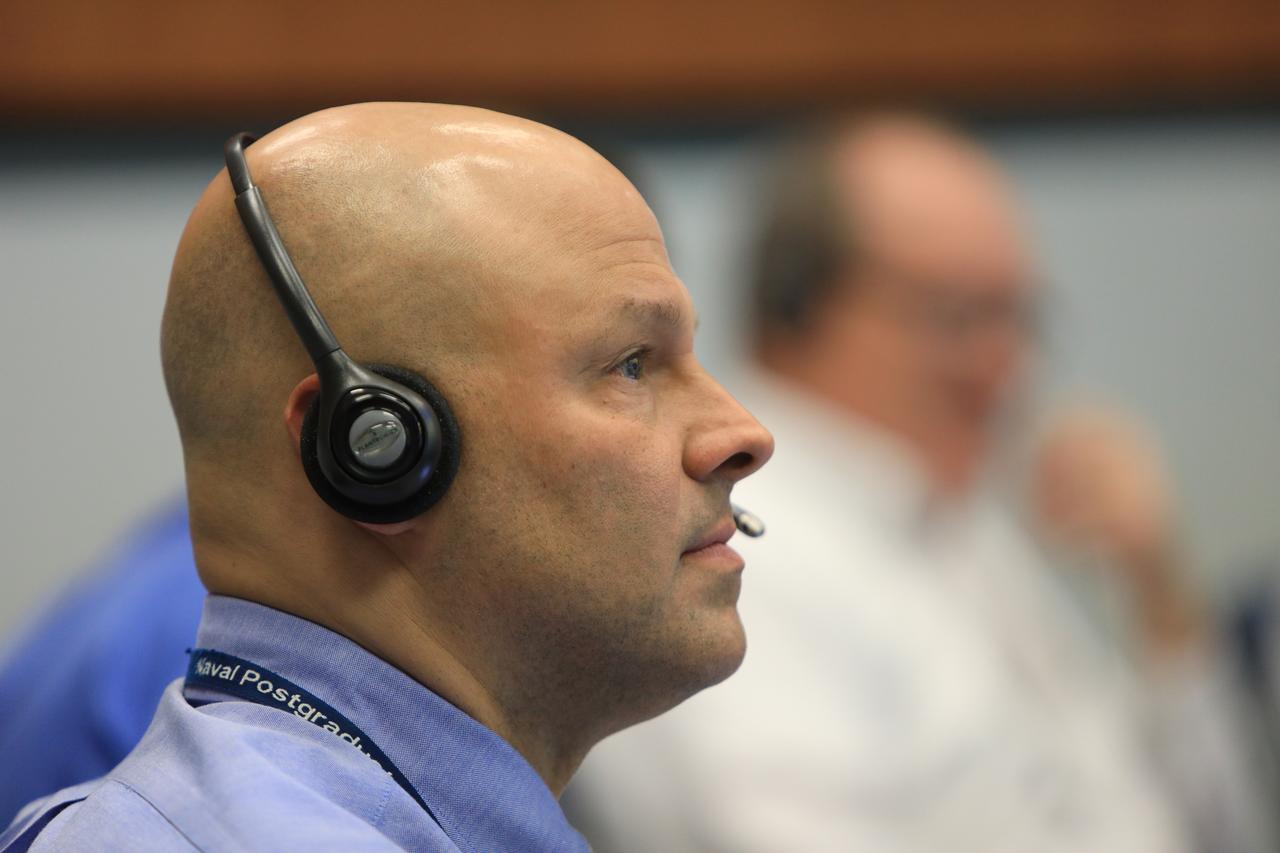
As part of the joint team that will launch Boeing’s CST-100 Starliner on a United Launch Alliance Atlas V rocket in Boeing’s Orbital Flight Test (OFT), NASA Operations Integration Manager Michael Hess participated in a successful Integrated Crew Exercise on Feb. 12. NASA, ULA, Boeing and Department of Defense personnel executed a mock countdown that practiced fueling the rocket and operating on the unique launch day timeline that features a four-hour built-in hold at the T-minus 4 minute mark. OFT is Boeing’s uncrewed flight test of Starliner and part of NASA’s Commercial Crew Program, which will return human spaceflight launches into low-Earth orbit from U.S. soil.
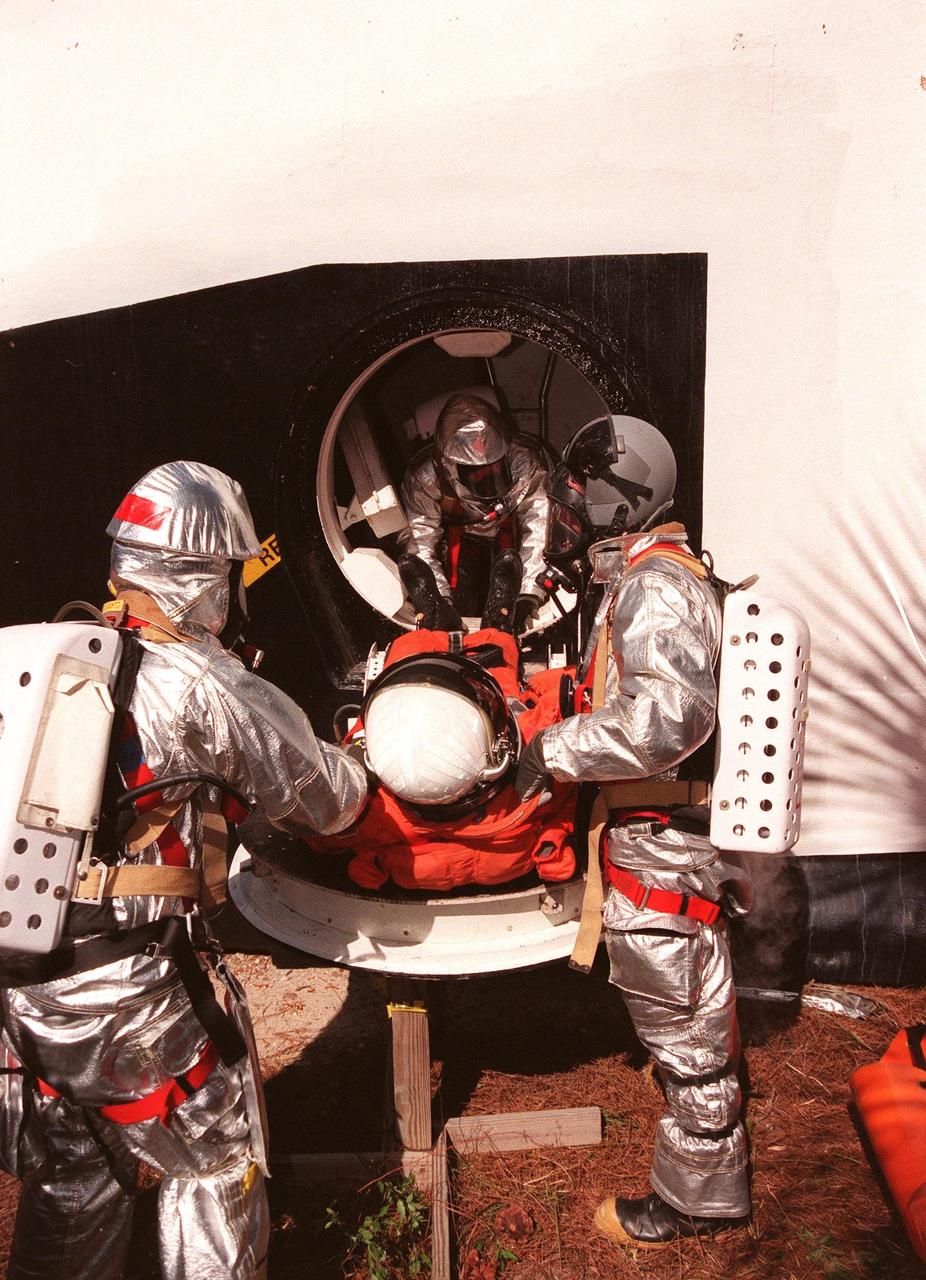
KENNEDY SPACE CENTER, FLA. -- During a simulated rescue mission in the woods near the Shuttle Landing Facility, the KSC response team removes a Shuttle "crew" member from the mock orbiter. The response team is training for the unlikely scenario of a Shuttle mishap at the SLF. The Mode 7 simulation of an astronaut rescue exercises all aspects of command and control, search and rescue, and medical procedures required for a successful rescue. The remote location of the mock-up prevents a totally land-based crew rescue, and calls on a NASA UH-1 helicopter to locate the site and four Air Force HH-60 helicopters to drop emergency equipment and fire/rescue workers to prepare the "crew" for preliminary triage. The helicopters later are used to remove the crew five astronaut candidates, one representative from the Vehicle Integration Test office, and one fire/rescue worker. The exercise concluded with airlifted "patients" arriving safely in the emergency rooms of participating area hospitals
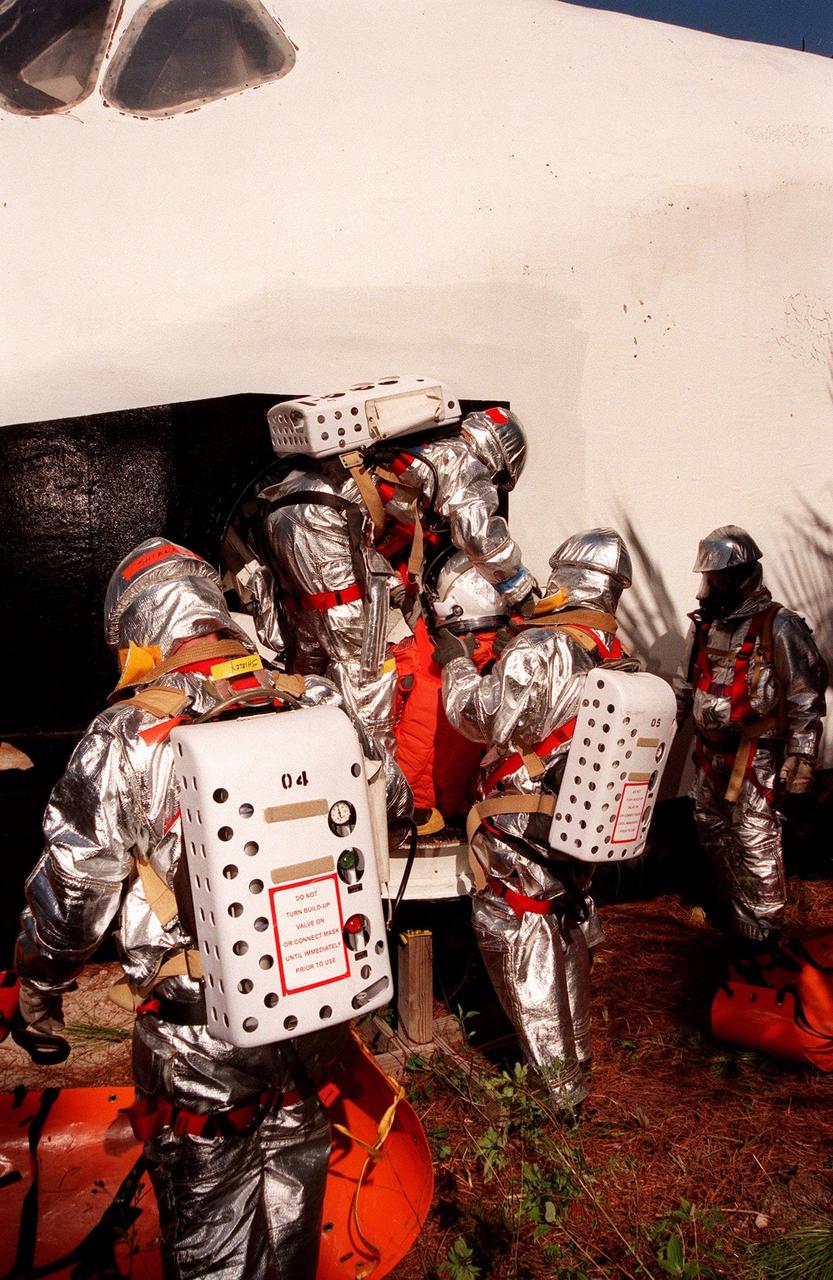
During a simulated rescue mission in the woods near the Shuttle Landing Facility (SLF), the KSC response team removes a crew member from a mock Shuttle. The response team is training for the unlikely scenario of a Shuttle mishap at the SLF. The Mode 7 simulation of an astronaut rescue exercises all aspects of command and control, search and rescue, and medical procedures required for a successful rescue. The remote location of the mock-up prevents a totally land-based crew rescue, and calls on a NASA UH-1 helicopter to locate the site and four Air Force HH-60 helicopters to drop emergency equipment and fire/rescue workers to prepare the "crew" for preliminary triage. The helicopters later are used to remove the crew five astronaut candidates, one representative from the Vehicle Integration Test office, and one fire/rescue worker. The exercise concluded with airlifted "patients" arriving safely in the emergency rooms of participating area hospitals
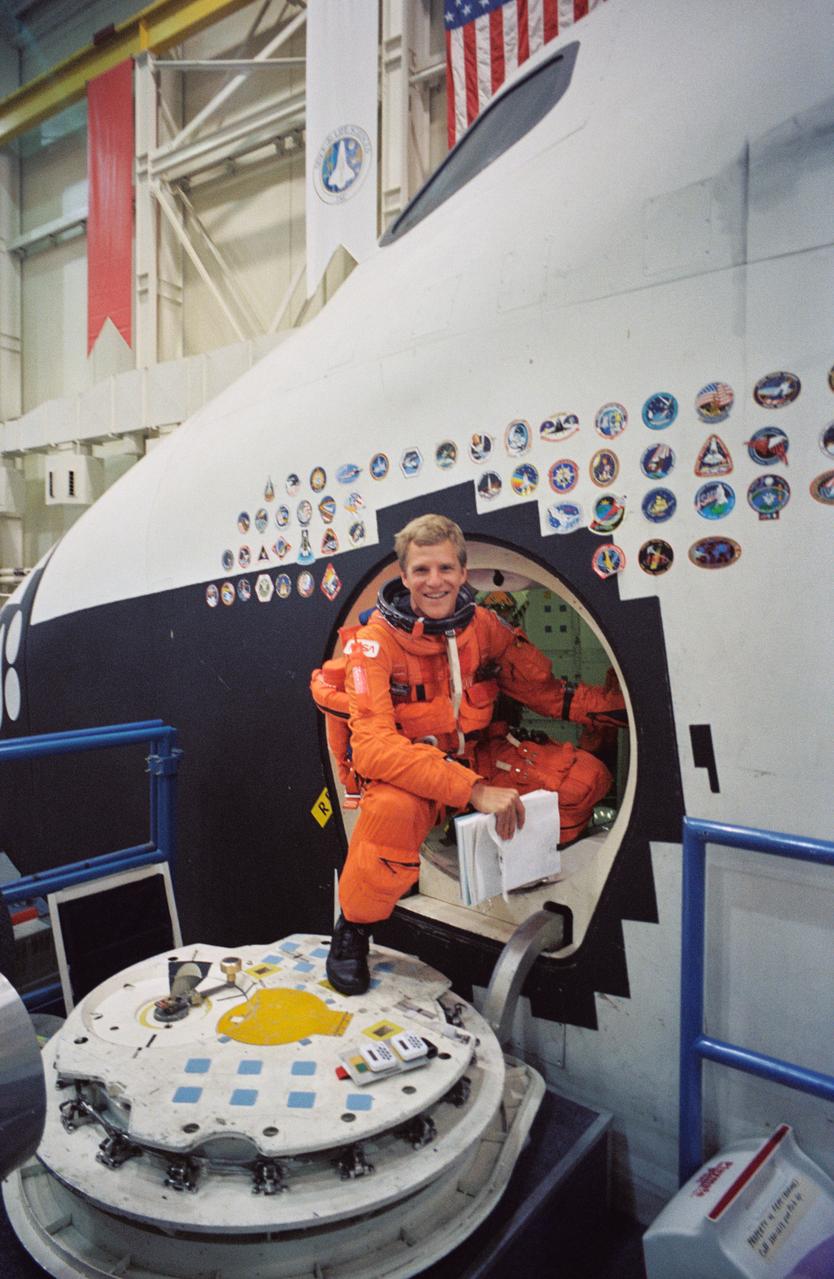
S94-36628 (23 June 1994) --- Astronaut Scott E. Parazynski poses at the hatch of the crew compartment trainer prior to a rehearsal of launch and entry procedures for a November 1994 flight aboard the Space Shuttle Atlantis. Four other NASA astronauts and a European mission specialist joined the mission specialist for this training exercise in the crew compartment trainer at the Johnson Space Center's (JSC) Shuttle Mockup and Integration Laboratory and will join him aboard Atlantis in November. The flight is manifest to support the Atmospheric Laboratory for Applications and Science (ATLAS-3) mission.
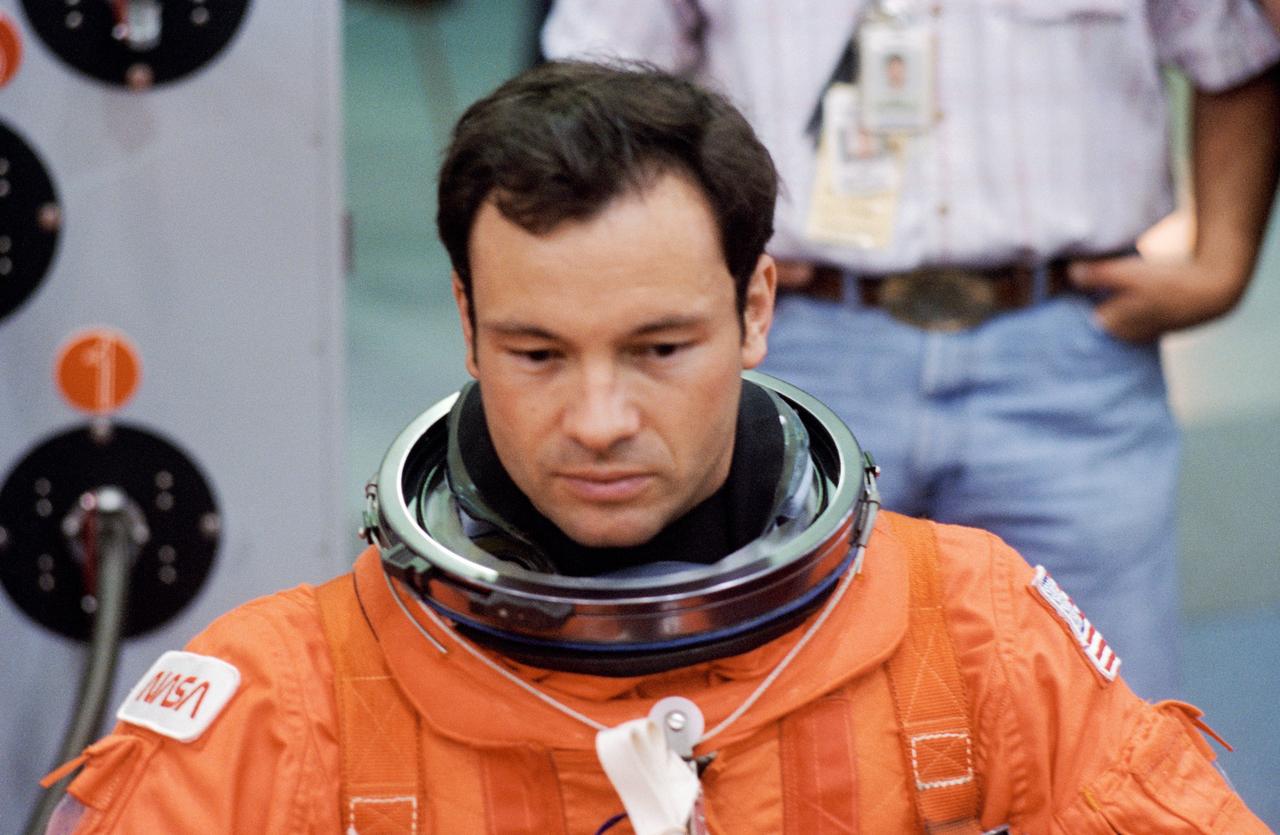
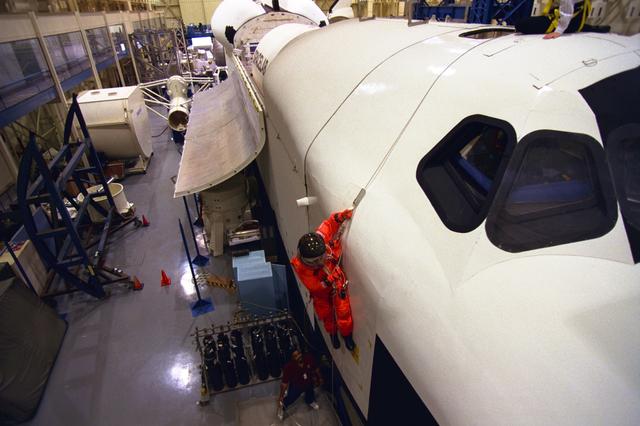
S95-09131 (27 Apr. 1995) --- Astronaut Michael E. Lopez-Alegria, mission specialist, watches as one his seven STS-73 crew mates (out of frame) rehearses action necessary in the case of an emergency with the Space Shuttle. The crew mate uses (and Lopez-Alegria later used) a Sky-genie device to rappel from the top of a ?troubled Shuttle? during emergency egress training exercises in the Systems Integration Facility at the Johnson Space Center (JSC).
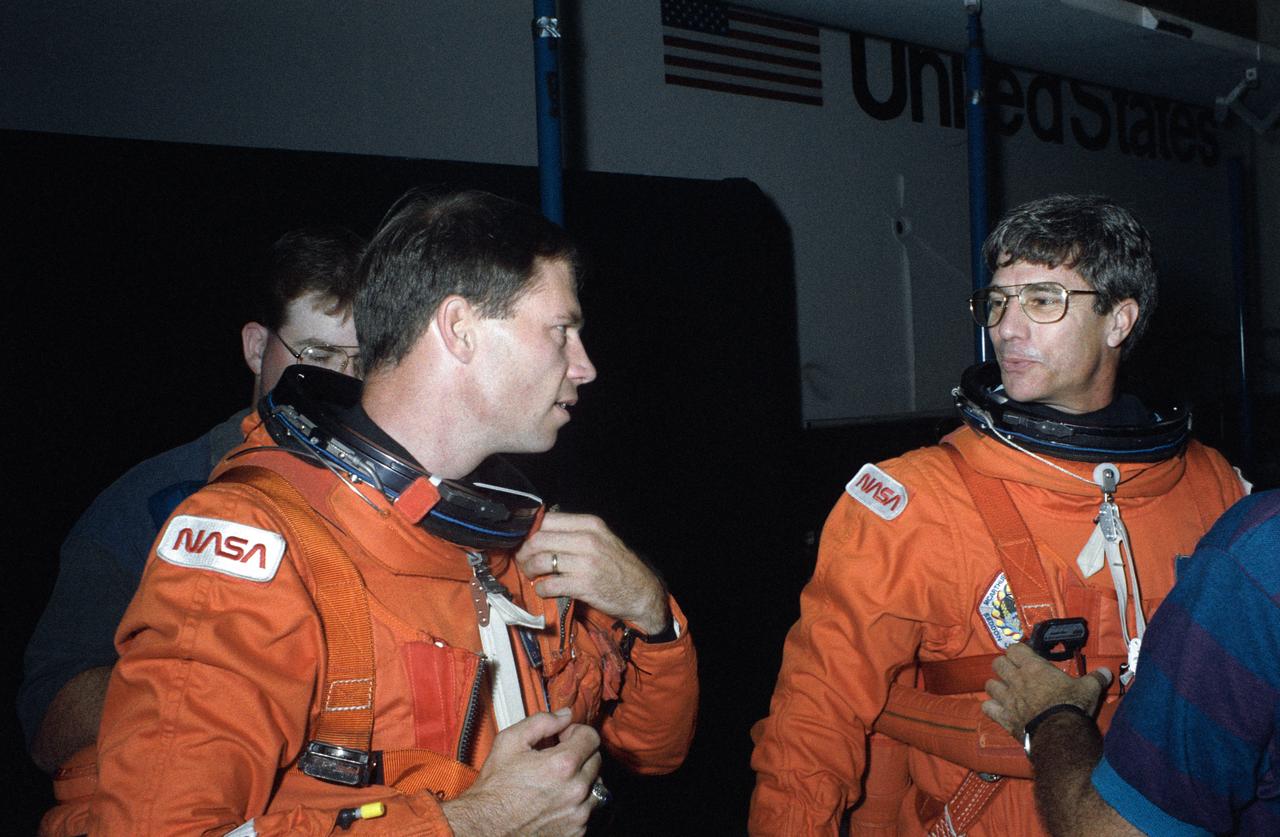
S93-38675 (20 July 1993) --- Wearing training versions of the partial pressure launch and entry garment, astronauts Richard A. Searfoss (left), pilot, and John E. Blaha, mission commander, prepare for a training exercise. The two, along with the four other NASA astronauts and a visiting payload specialist asssigned to the seven-member crew, later rehearsed contingency evacuation procedures. Most of the training session took part in the crew compartment and full fuselage trainers in the Space Shuttle mockup and integration laboratory.
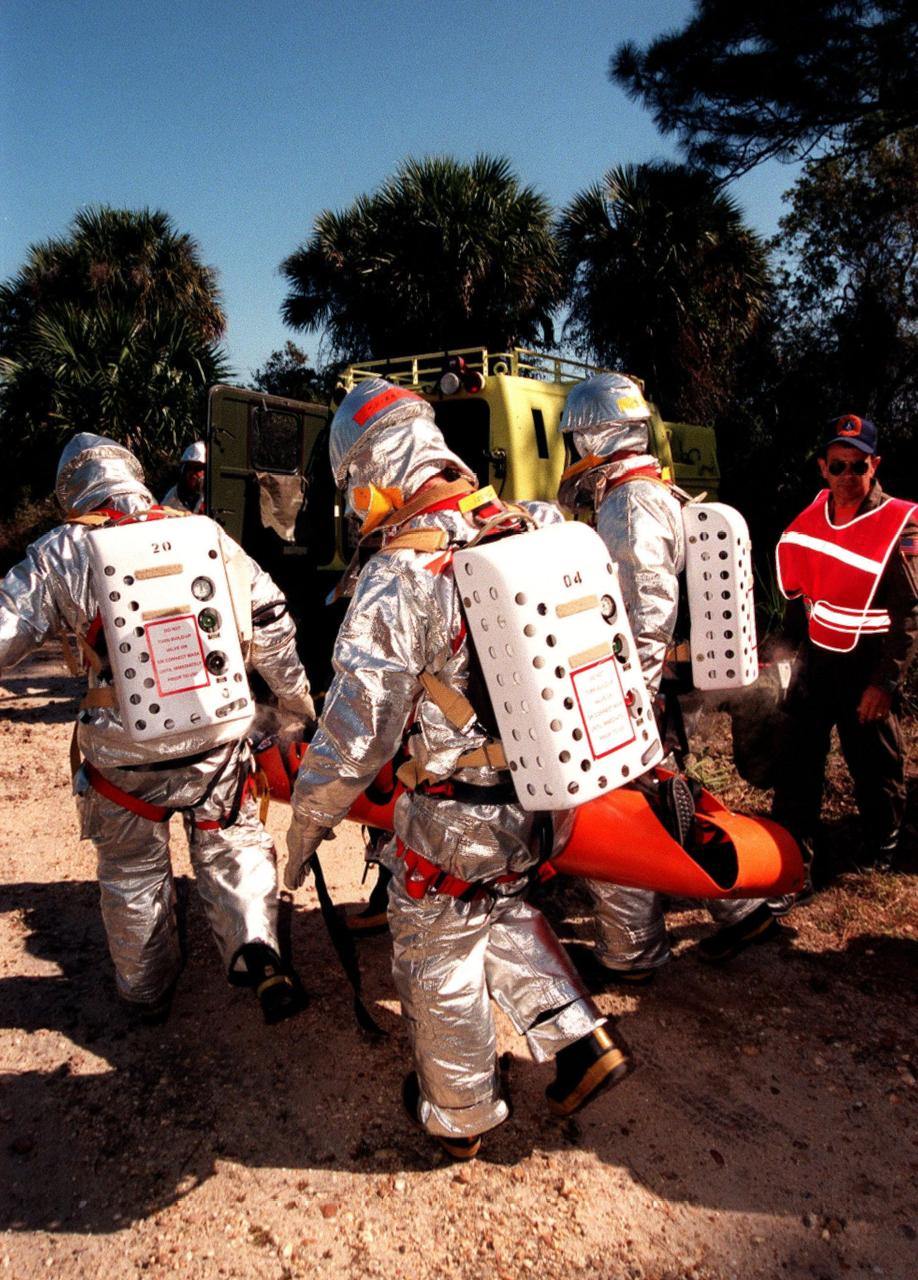
KENNEDY SPACE CENTER, FLA. -- In the woods next to the Shuttle Landing Facility (SLF), the KSC response team takes part in training for the unlikely scenario of a Shuttle mishap at the SLF. The Mode 7 simulation of an astronaut rescue exercises all aspects of command and control, search and rescue, and medical procedures required for a successful rescue. The remote location of the mock-up prevents a totally land-based crew rescue, and calls on a NASA UH-1 helicopter to locate the site and four Air Force HH-60 helicopters to drop emergency equipment and fire/rescue workers to prepare the "crew" for preliminary triage. The helicopters later are used to remove the crew five astronaut candidates, one representative from the Vehicle Integration Test office, and one fire/rescue worker. The exercise concluded with airlifted "patients" arriving safely in the emergency rooms of participating area hospitals
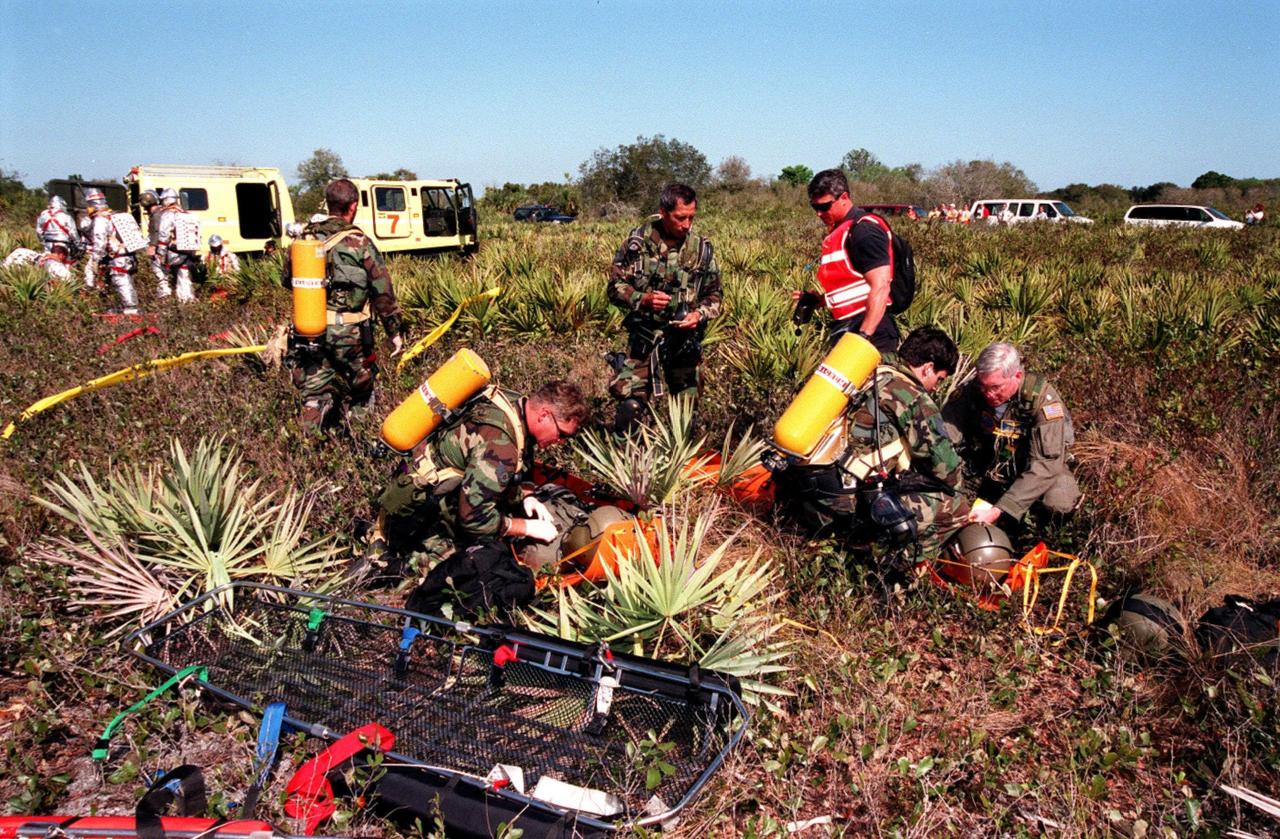
KENNEDY SPACE CENTER, FLA. -- In the simulated rescue mission, the KSC response team takes part in the unlikely scenario of a Shuttle mishap at the Shuttle Landing Facility. The Mode 7 simulation of an astronaut rescue exercised all aspects of command and control, search and rescue, and medical procedures required for a successful rescue. The remote location of the mock-up prevents a totally land-based crew rescue, and calls on a NASA UH-1 helicopter to locate the site and four Air Force HH-60 helicopters to drop emergency equipment and fire/rescue workers to prepare the "crew" for preliminary triage. The helicopters later are used to remove the crew five astronaut candidates, one representative from the Vehicle Integration Test office, and one fire/rescue worker. The exercise concluded with airlifted "patients" arriving safely in the emergency rooms of participating area hospitals.
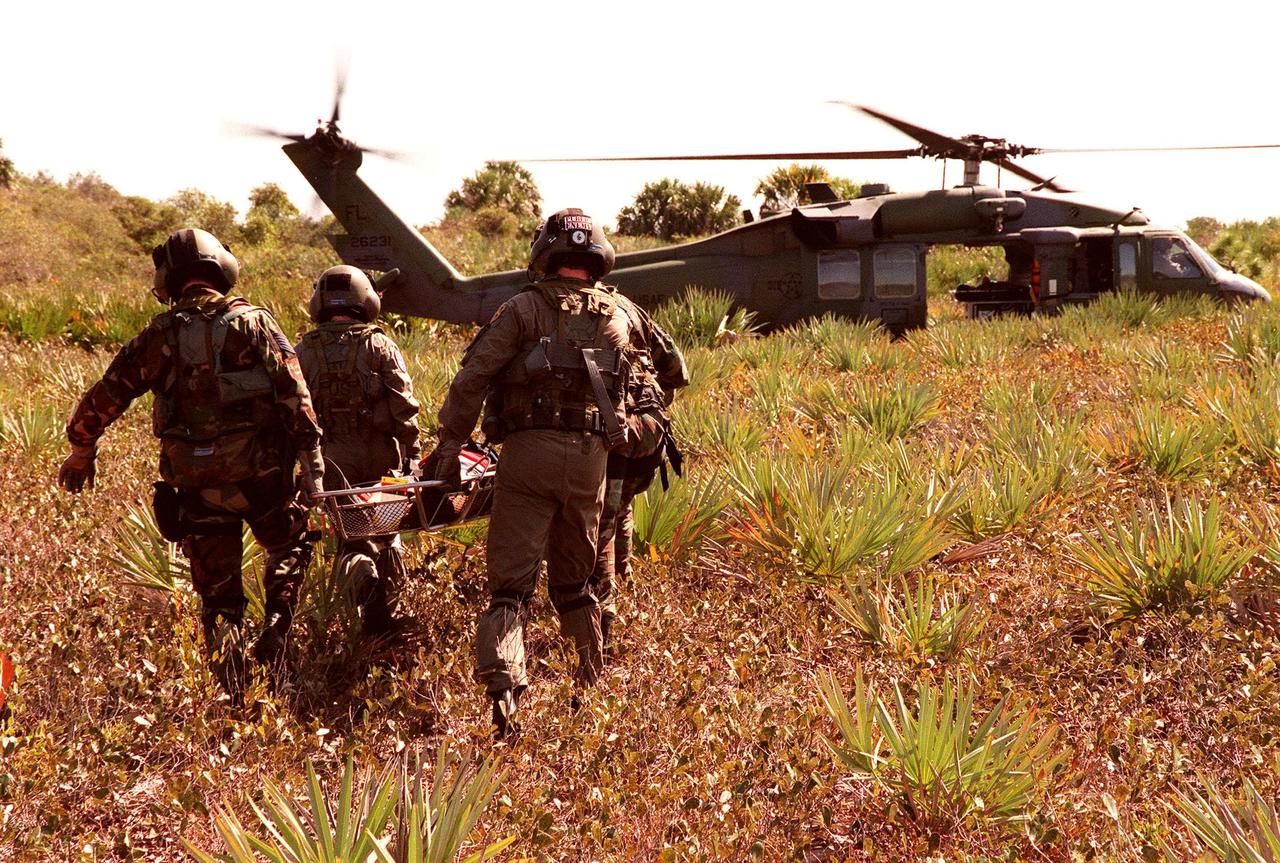
KENNEDY SPACE CENTER, FLA. -- During a simulated rescue mission in the woods near the Shuttle Landing Facility (SLF), the KSC response team practices carrying an injured crew member to an Air Force HH-60 helicopter for transport to a local hospital. The response team is training for the unlikely scenario of a Shuttle mishap at the SLF. The Mode 7 simulation of an astronaut rescue exercises all aspects of command and control, search and rescue, and medical procedures required for a successful rescue. The remote location of the mock-up prevents a totally land-based crew rescue, and calls on a NASA UH-1 helicopter to locate the site and four Air Force HH-60 helicopters to reach the site, drop emergency equipment and later remove the "crew" five astronaut candidates, one representative from the Vehicle Integration Test office, and one fire/rescue worker. The exercise will conclude with airlifted "patients" arriving safely in the emergency rooms of participating area hospitals
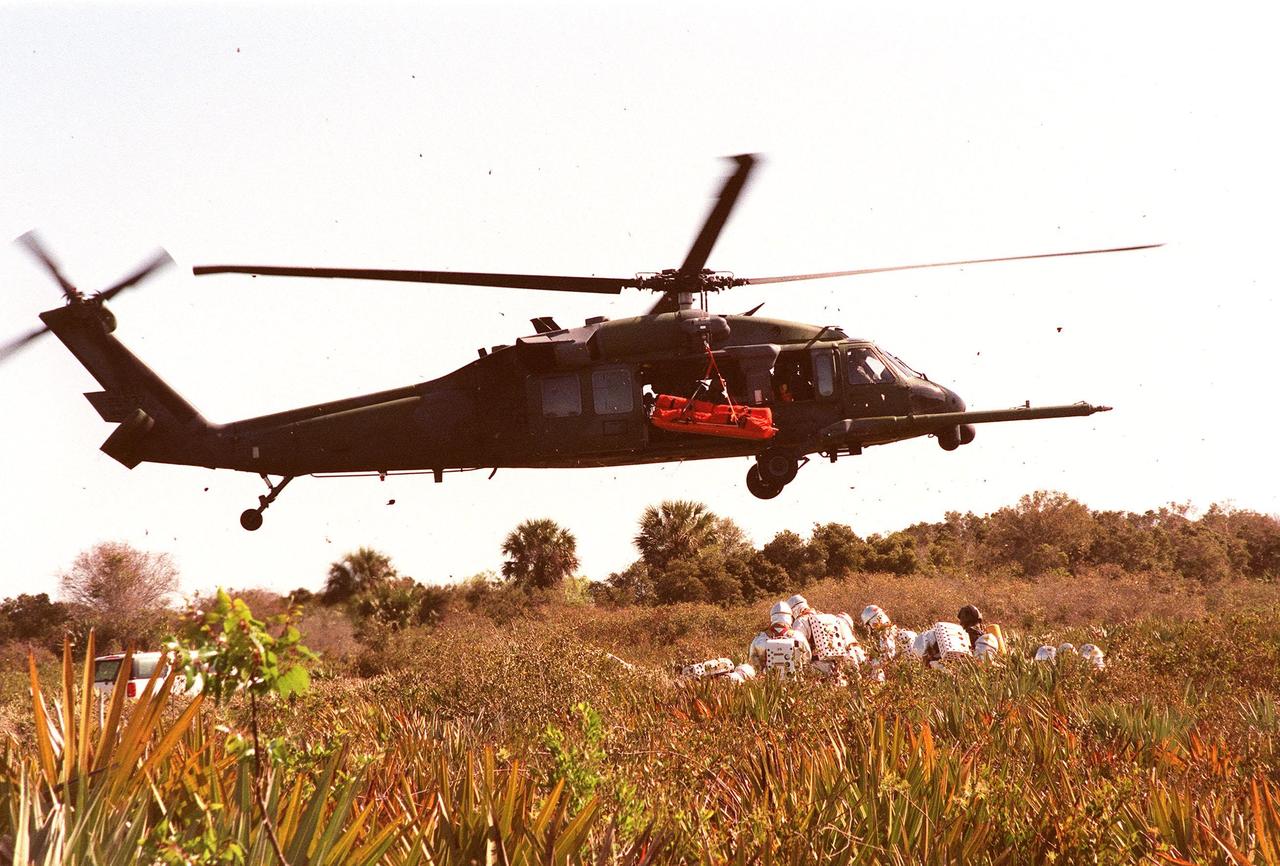
KENNEDY SPACE CENTER, FLA. -- During a simulated rescue mission in the woods near the Shuttle Landing Facility (SLF), the KSC response team practices lifting an injured crew member to an Air Force HH-60 helicopter for transport to a local hospital. The response team is training for the unlikely scenario of a Shuttle mishap at the SLF. The Mode 7 simulation of an astronaut rescue exercises all aspects of command and control, search and rescue, and medical procedures required for a successful rescue. The remote location of the mock-up prevents a totally land-based crew rescue, and calls on a NASA UH-1 helicopter to locate the site and four Air Force HH-60 helicopters to reach and prepare the "crew" five astronaut candidates, one representative from the Vehicle Integration Test office, and one fire/rescue worker for preliminary triage. The exercise will conclude with airlifted "patients" arriving safely in the emergency rooms of participating area hospitals
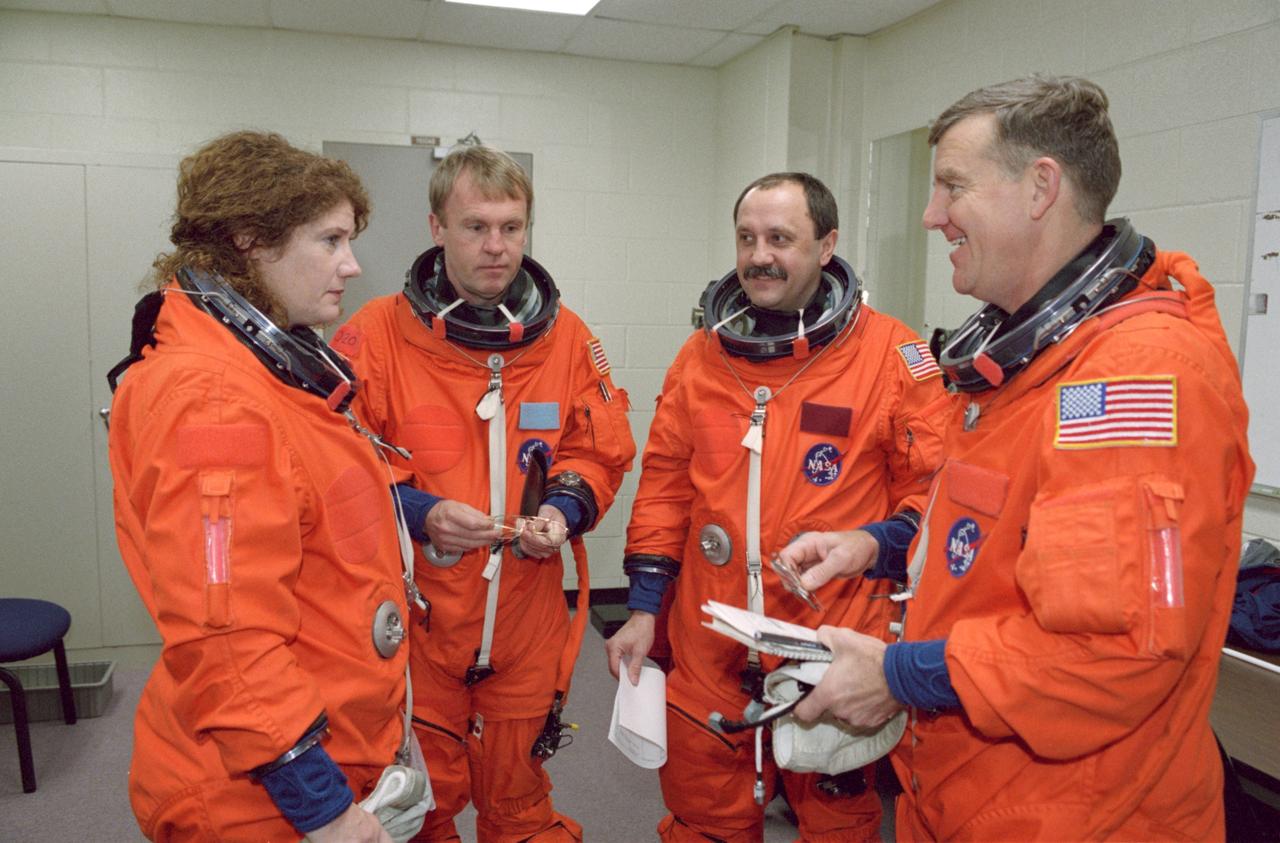
JSC2000-07449 (6 December 2000) --- Astronaut Andrew S.W. Thomas (second left), STS-102 mission specialist, chats with the Expedition Two crew members prior to a simulation exercise in the Systems Integration Facility at the Johnson Space Center. The station crew members are, from left, astronaut Susan J. Helms, cosmonaut Yury V. Usachev and astronaut James S. Voss. Usachev is commander for the second station crew, which will replace the initial group onboard the outpost. The three station crew members will accompany the STS-102 crew aboard the Space Shuttle Discovery to the outpost in March of next year.
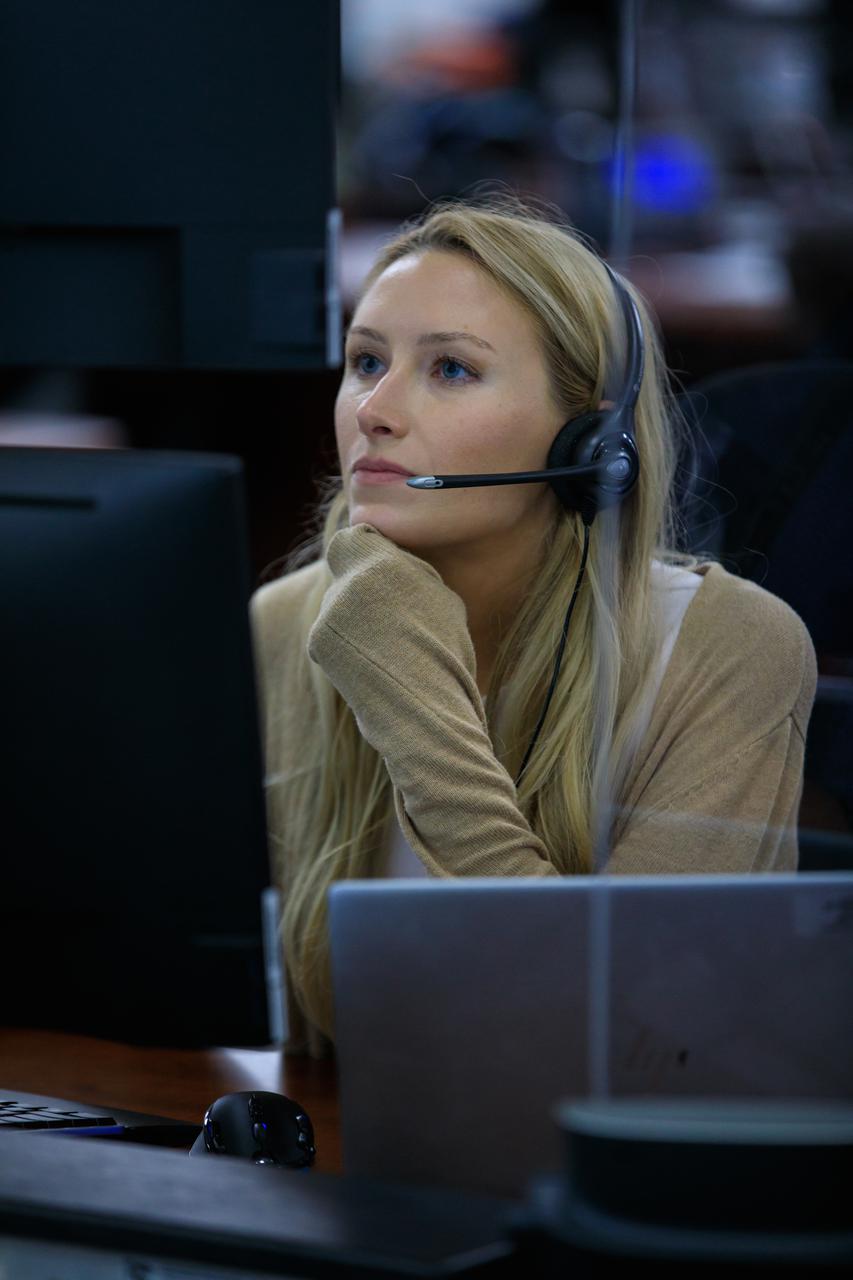
A Kennedy Space Center employee participates in the first joint integrated launch countdown simulation for Artemis I inside the Florida spaceport’s Launch Control Center on July 8, 2021. The training exercise involved engineers from Kennedy, Marshall Space Flight Center in Alabama, and Johnson Space Center in Houston coming together to rehearse all aspects of the launch countdown, from cryogenic loading – filling tanks in the Space Launch System (SLS) rocket’s core stage with liquid hydrogen and liquid oxygen – to liftoff. These simulations will help certify that the launch team is ready for Artemis I – the first test flight of SLS and Orion as an integrated system prior to crewed flights to the Moon.
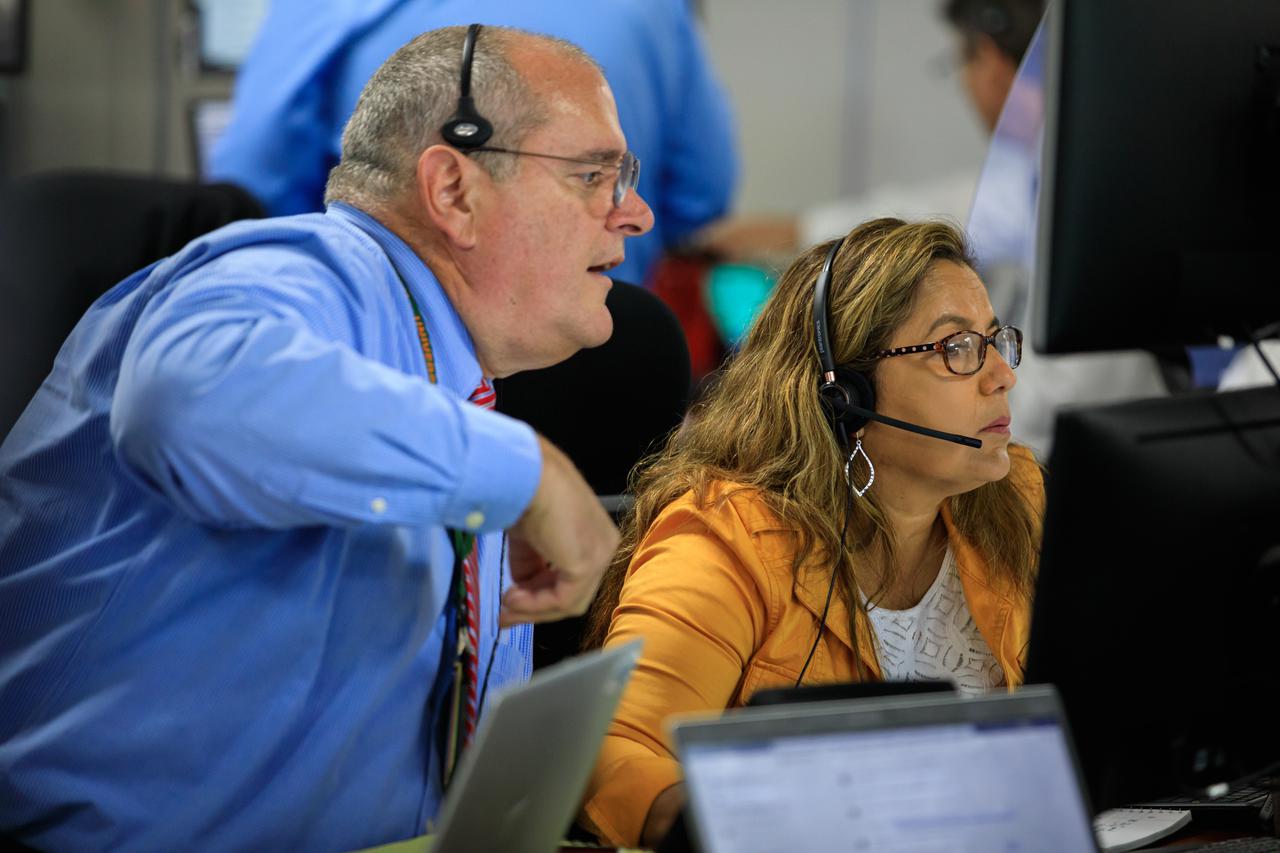
Team members at NASA’s Kennedy Space Center in Florida participate in the first joint integrated launch countdown simulation for Artemis I inside the Launch Control Center on July 8, 2021. The training exercise involved engineers from Kennedy, Marshall Space Flight Center in Alabama, and Johnson Space Center in Houston coming together to rehearse all aspects of the launch countdown, from cryogenic loading – filling tanks in the Space Launch System (SLS) rocket’s core stage with liquid hydrogen and liquid oxygen – to liftoff. These simulations will help certify that the launch team is ready for Artemis I – the first test flight of SLS and Orion as an integrated system prior to crewed flights to the Moon.
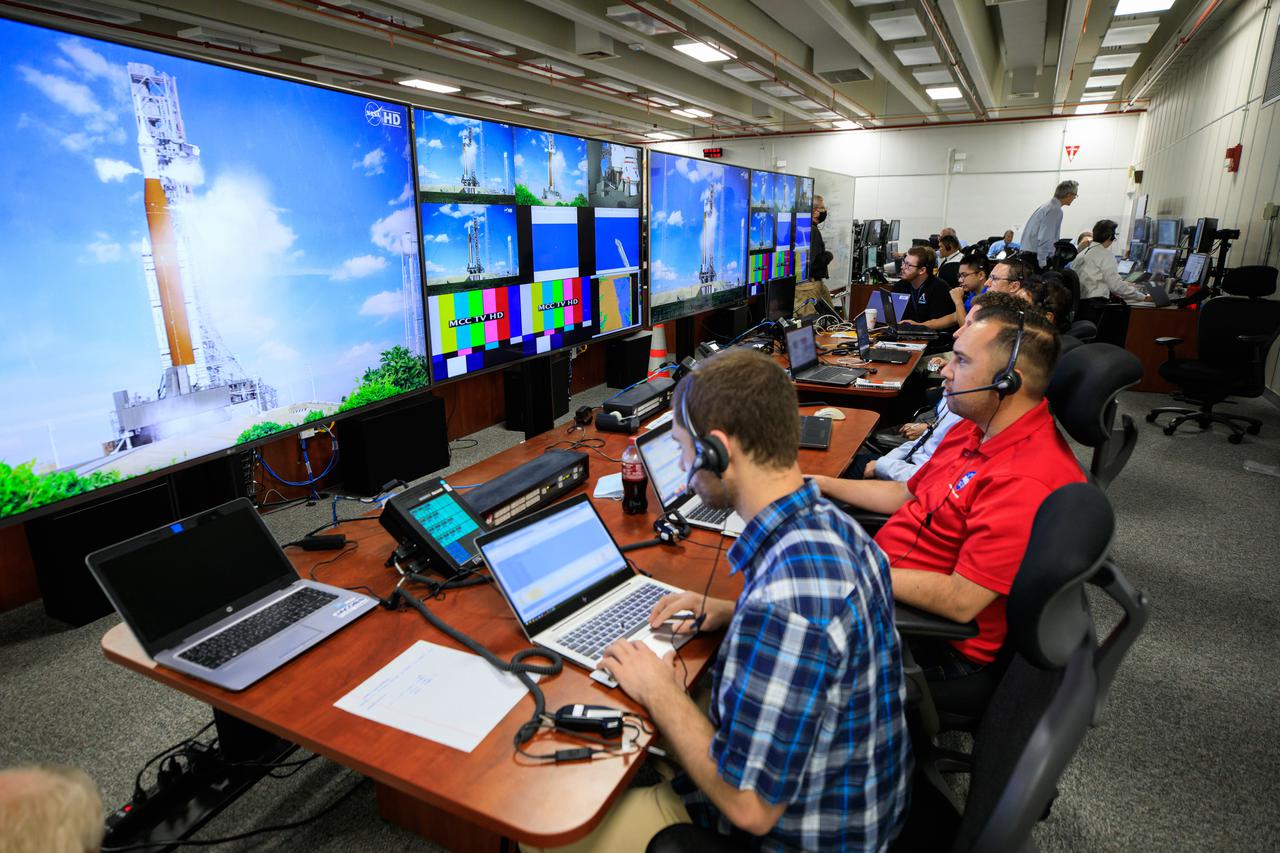
Teams at NASA’s Kennedy Space Center in Florida participate in the first joint integrated launch countdown simulation for Artemis I inside the Launch Control Center on July 8, 2021. The training exercise involved engineers from Kennedy, Marshall Space Flight Center in Alabama, and Johnson Space Center in Houston coming together to rehearse all aspects of the launch countdown, from cryogenic loading – filling tanks in the Space Launch System (SLS) rocket’s core stage with liquid hydrogen and liquid oxygen – to liftoff. These simulations will help certify that the launch team is ready for Artemis I – the first test flight of SLS and Orion as an integrated system prior to crewed flights to the Moon.
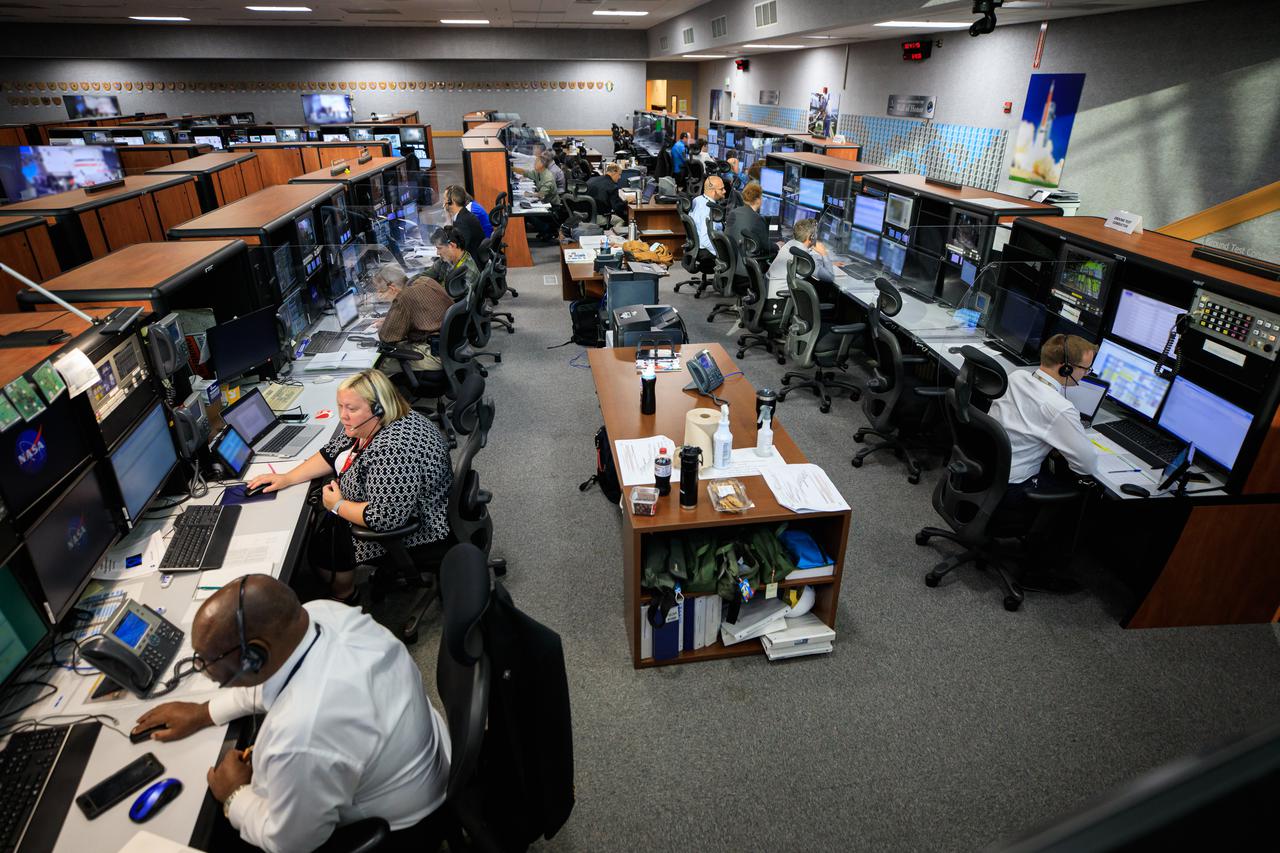
Teams at NASA’s Kennedy Space Center in Florida participate in the first joint integrated launch countdown simulation for Artemis I inside the Launch Control Center on July 8, 2021. The training exercise involved engineers from Kennedy, Marshall Space Flight Center in Alabama, and Johnson Space Center in Houston coming together to rehearse all aspects of the launch countdown, from cryogenic loading – filling tanks in the Space Launch System (SLS) rocket’s core stage with liquid hydrogen and liquid oxygen – to liftoff. These simulations will help certify that the launch team is ready for Artemis I – the first test flight of SLS and Orion as an integrated system prior to crewed flights to the Moon.

JSC2000-E-23719 (September 2000) --- Attired in training versions of their full-pressure launch and entry garments, astronauts James D. Wetherbee (left), mission commander for STS-102, and James W. Kelly, pilot, discuss contingencies prior to participating in an emergency bailout training exercise in the Crew Compartment Trainer (CCT-2) in the Systems Integration Facility at the Johnson Space Center (JSC).
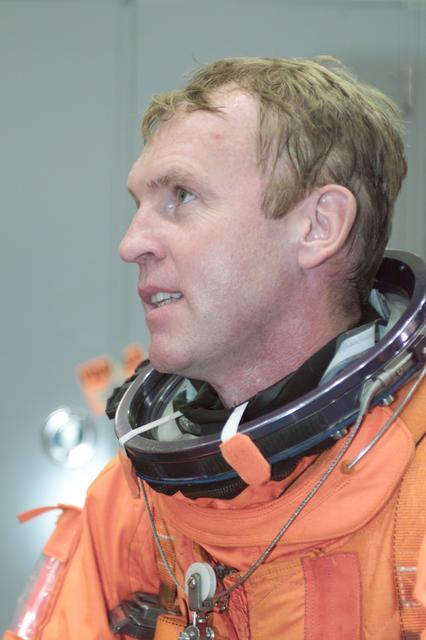
JSC2000-E-23717 (September 2000) --- Attired in a training version of his full-pressure launch and entry garment, astronaut Andrew S.W. Thomas, mission specialist for STS-102, is pictured prior to participating in an emergency bailout training exercise in the Crew Compartment Trainer (CCT-2) of the Systems Integration Facility at the Johnson Space Center (JSC).
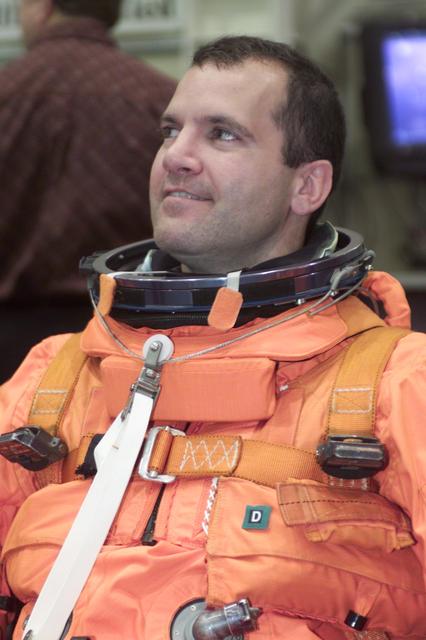
SC2000-E-23716 (September 2000) --- Attired in a training version of his full-pressure launch and entry garment, astronaut Paul W. Richards, mission specialist for STS-102, is pictured prior to participating in an emergency bailout training exercise in the Crew Compartment Trainer (CCT-2) of the Systems Integration Facility at the Johnson Space Center (JSC).
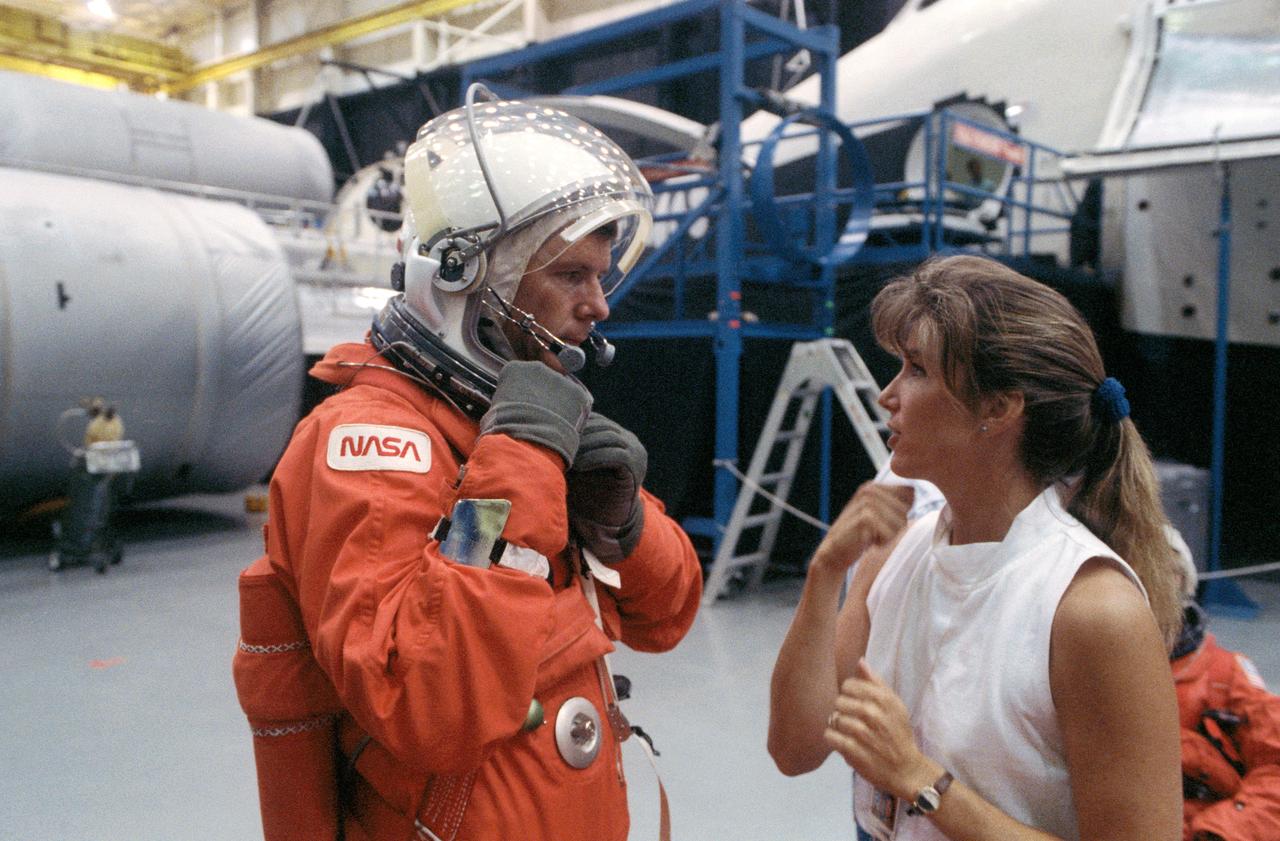
S90-41366 (11 June 1990) --- Astronaut Bryan D. O'Connor, STS-40 mission commander, talks with Elizabeth Youmans of the crew training staff at JSC, during a break in mission training. This exercise, in JSC's Shuttle mockup and integration laboratory, was designed to familiarize the astronauts with proper procedures and gear involved in emergency egress from the Space Shuttle. O'Connor is wearing the orange partial pressure ascent/entry suit. Primary payload of the STS-40 mission is Spacelab Life Sciences (SLS-1).
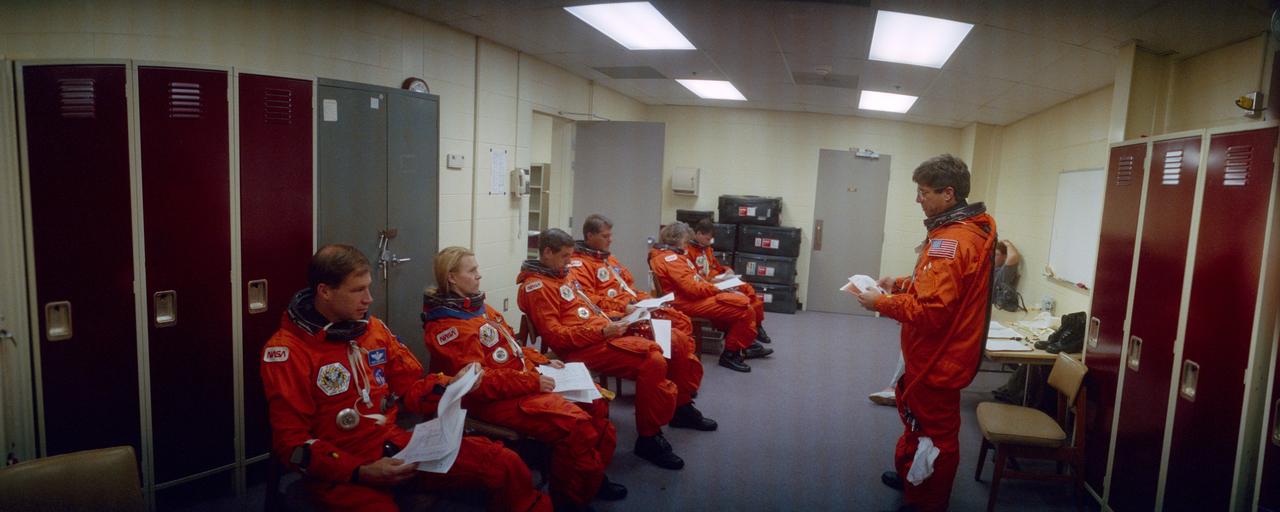
S93-38672 (20 July 1993) --- Wearing training versions of the partial pressure launch and entry garment, the STS-58 crewmembers prepare for a training exercise. After being briefed by astronaut John E. Blaha (right), mission commander, the group rehearsed contingency evacuation procedures. Most of the training session took part in the crew compartment and full fuselage trainers in the Space Shuttle mockup and integration laboratory.
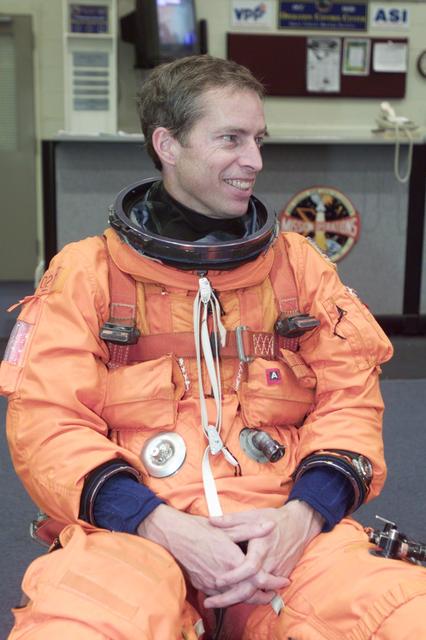
JSC2000-E-23713 (September 2000) --- Attired in a training version of his full-pressure launch and entry garment, astronaut James D. Wetherbee, mission commander for STS-102, is pictured prior to participating in an emergency bailout training exercise in the Crew Compartment Trainer (CCT-2) of the Systems Integration Facility at the Johnson Space Center (JSC).
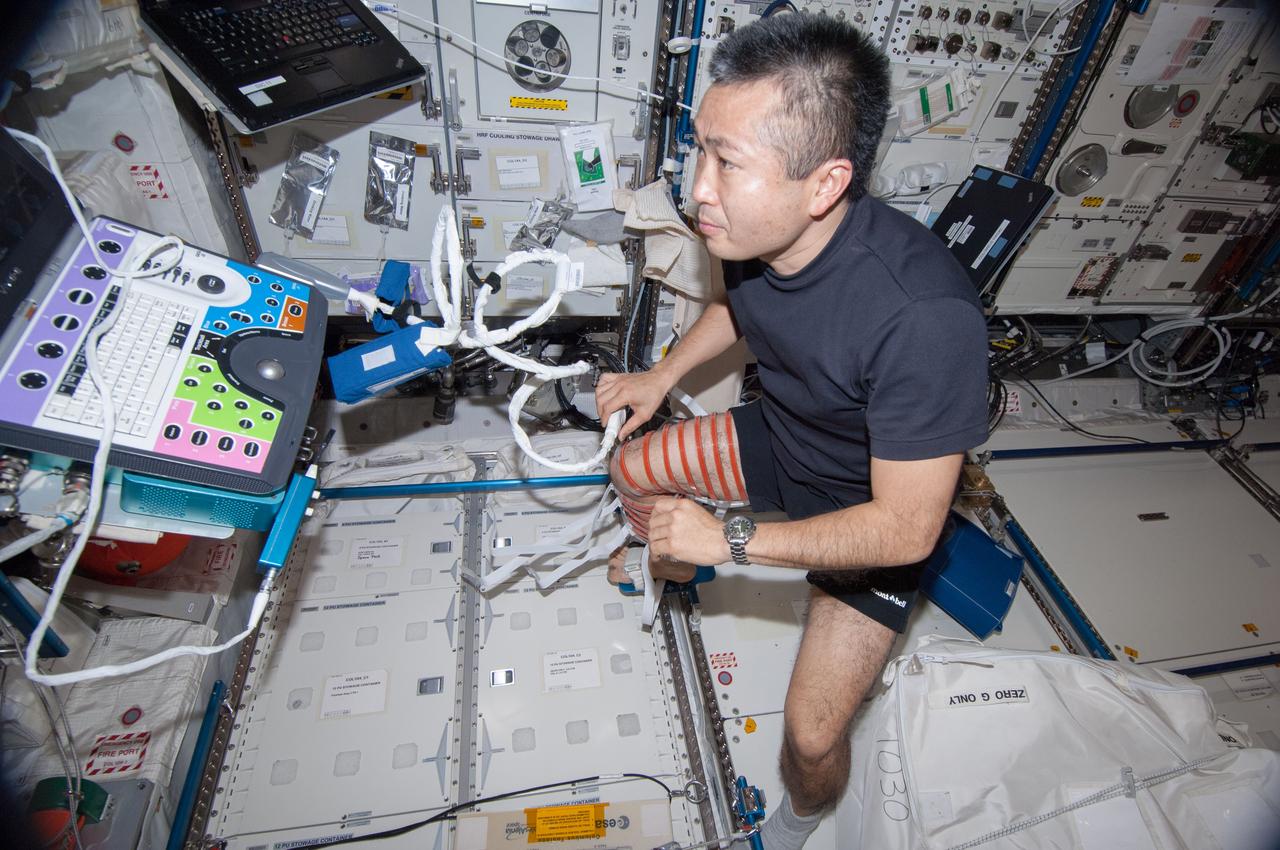
ISS038-E-007119 (21 Nov. 2013) --- Japan Aerospace Exploration Agency astronaut Koichi Wakata, Expedition 38 flight engineer, wears ultrasound gear around his legs while performing the Integrated Resistance and Aerobic Training Study (Sprint) experiment in the Columbus laboratory of the International Space Station. Sprint evaluates the use of high intensity, low volume exercise training to minimize loss of muscle, bone, and cardiovascular function in station crew members during long-duration missions.
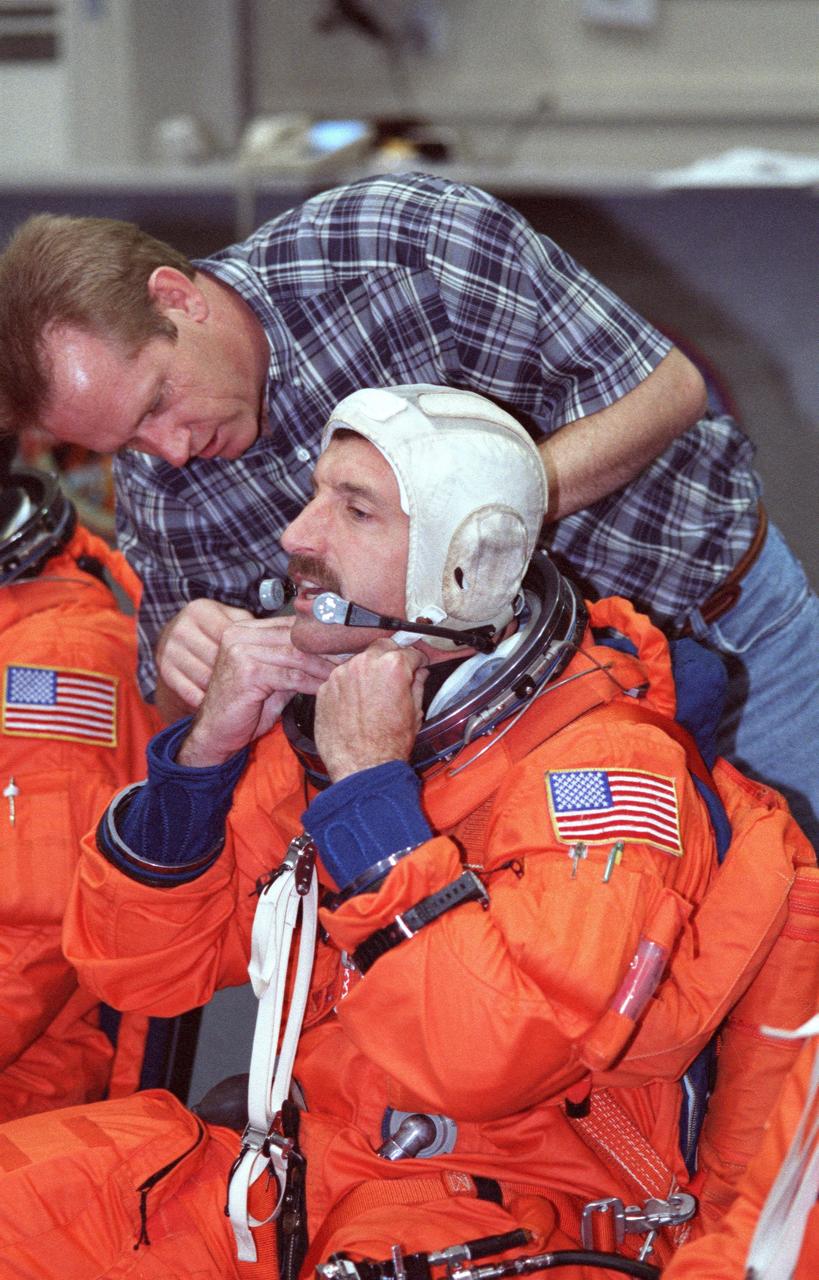
JSC2000-02936 (5 April 2000) --- John Hazelhurst, a suit technician for the United Space Alliance, assists astronaut Daniel C. Burbank with final touches on his suit-donning exercise as the STS-106 mission specialist prepares to participate in emergency egress training. Similar training is afforded each shuttle crew in the Johnson Space Center's Systems Integration Facility. Burbank will join four other NASA astronauts and two cosmonauts representing the Russian Aviation and Space Agency for a late summer visit to the International Space Station.
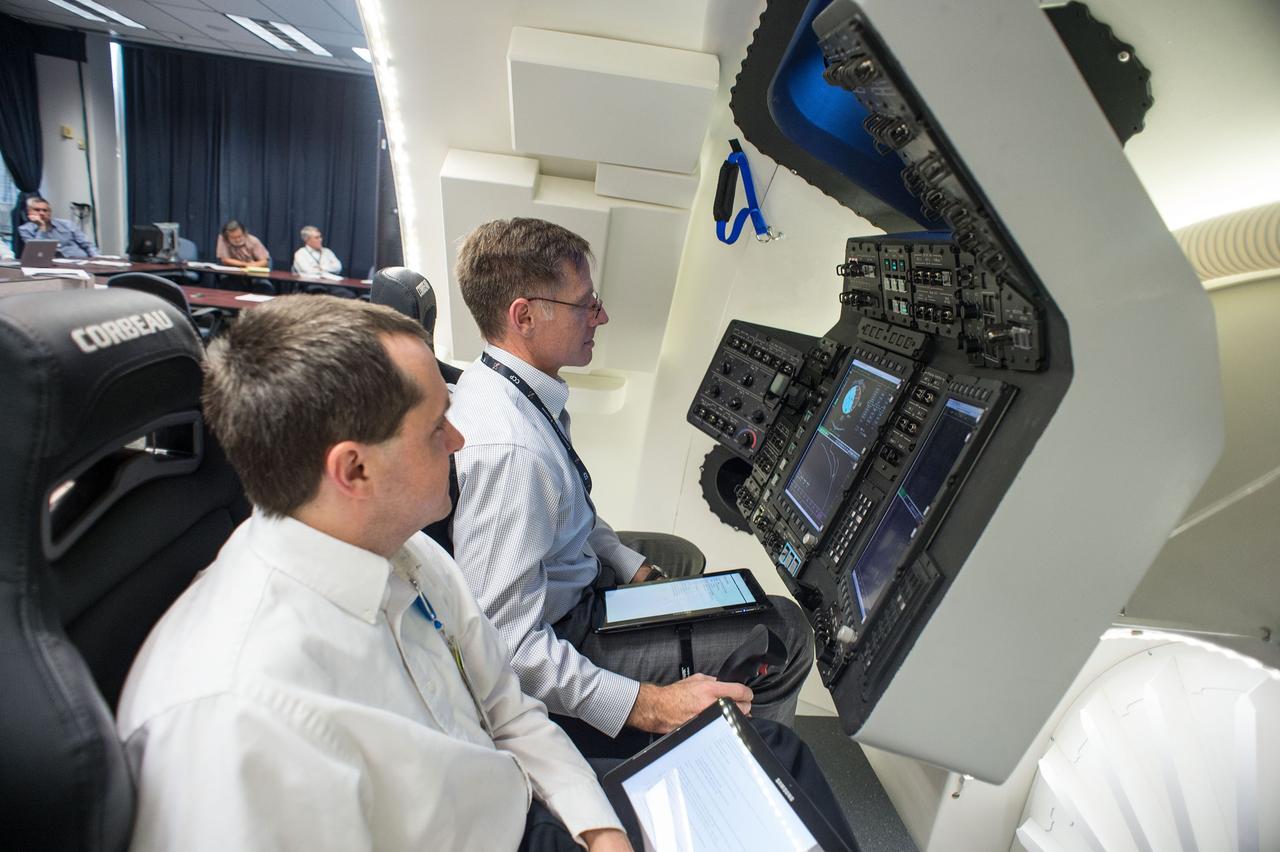
HOUSTON – Chris Ferguson, a former space shuttle commander who is now director of Crew and Mission Operations for Boeing Space Exploration, takes the controls inside the company's CST-100 spacecraft simulator. To Ferguson's right, an engineer observes the exercise. Boeing demonstrated that the CST-100's software allows a human pilot to take over control of the spacecraft from the computer during all phases of a mission following separation from the launch vehicle. The pilot-in-the-loop demonstration at the Houston Product Support Center is a milestone under Boeing's Commercial Crew Integrated Capability agreement with the agency and its Commercial Crew Program. Photo credit: NASA/Bill Stafford
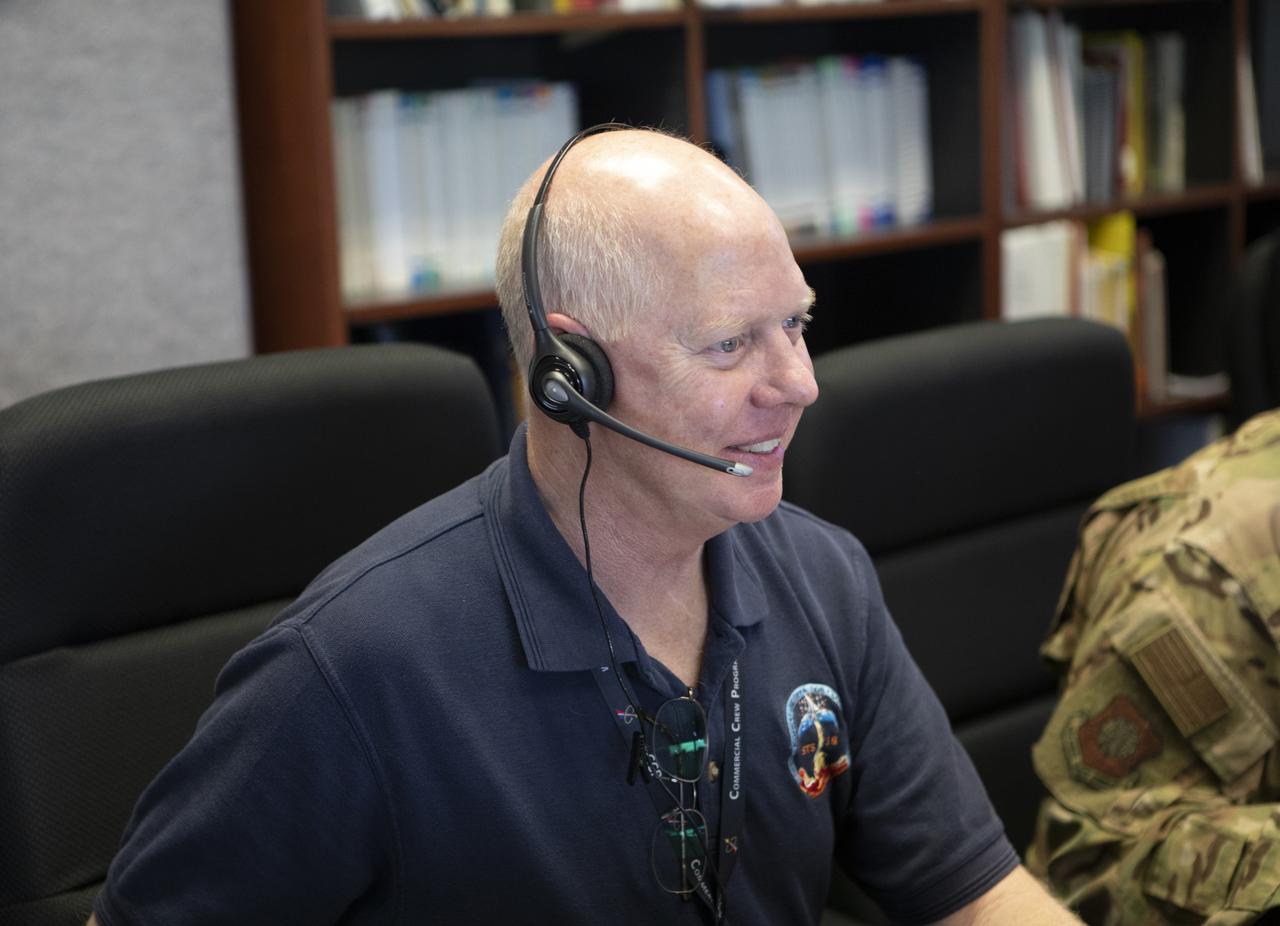
As part of the joint team that will launch Boeing’s CST-100 Starliner on a United Launch Alliance (ULA) Atlas V rocket in Boeing’s Orbital Flight Test (OFT), Steve Payne, Launch Integration Manager for NASA’s Commercial Crew Program, participated in a successful Integrated Crew Exercise on Feb. 12. NASA, ULA, Boeing and Department of Defense personnel executed a mock countdown that practiced fueling the rocket and operating on the unique launch day timeline that features a four-hour built-in hold at the T-minus 4 minute mark. OFT is Boeing’s uncrewed flight test of Starliner and part of NASA’s Commercial Crew Program, which will return human spaceflight launches into low-Earth orbit from U.S. soil.
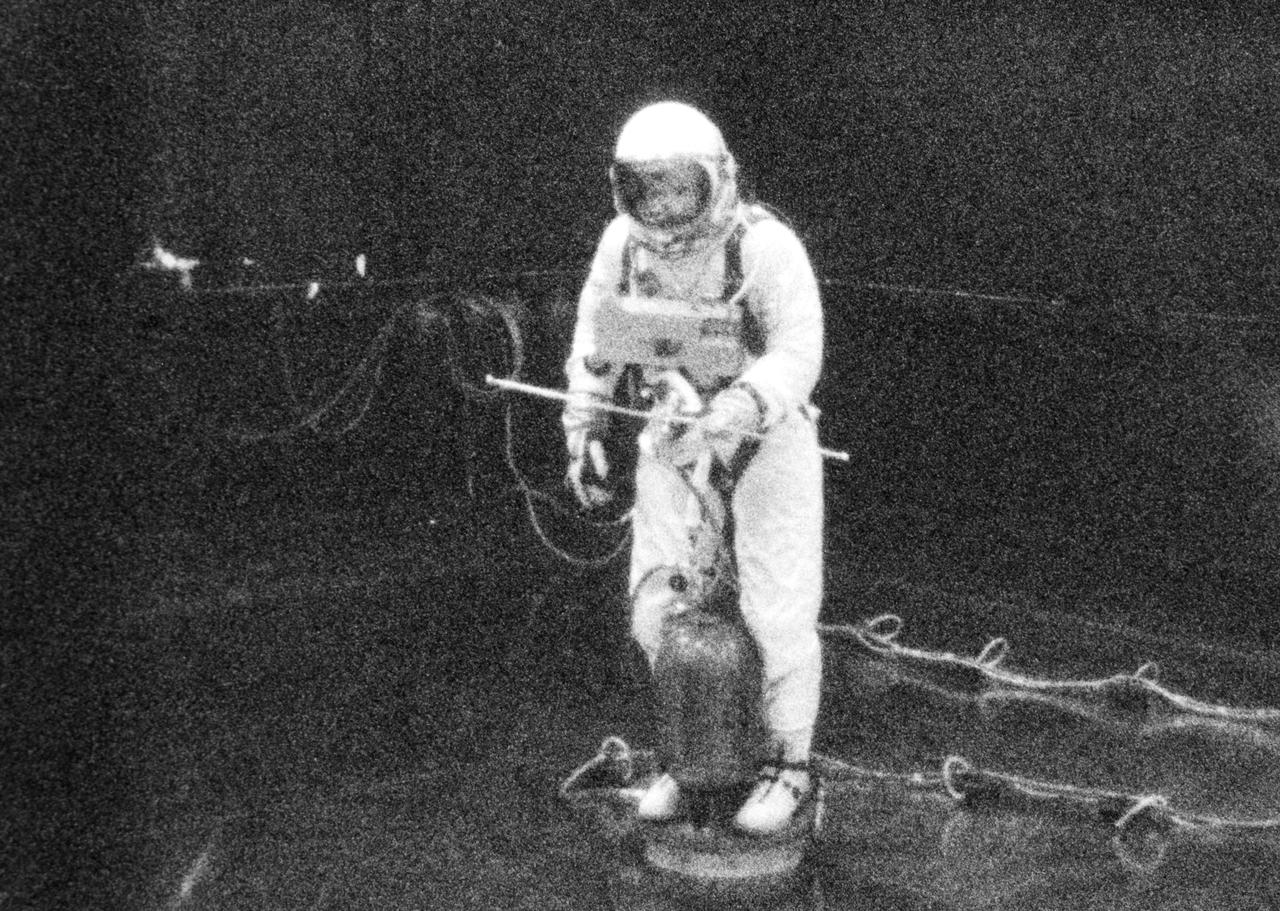
S65-19504 (28 May 1965) --- Astronaut Edward H. White II, pilot for the Gemini-Titan 4 prime crew, is pictured during an extravehicular exercise in the Building 4 laboratory at the Manned Spacecraft Center in Houston, Texas. White is controlling about the yaw (vertical) axis while translating. He stands on a Balance Extravehicular Training Aircraft which is separated from the level steel floor by a .001th-inch cushion of air. In his right hand White holds a zero-gravity integral propulsion unit which is a self-maneuvering device used by an astronaut in a zero-gravity environment. This condition is simulated in this training exercise. White's spacesuit is pressurized to create a realistic training condition. The simulated umbilical line is floated on air with the aid of eleven small air pads.
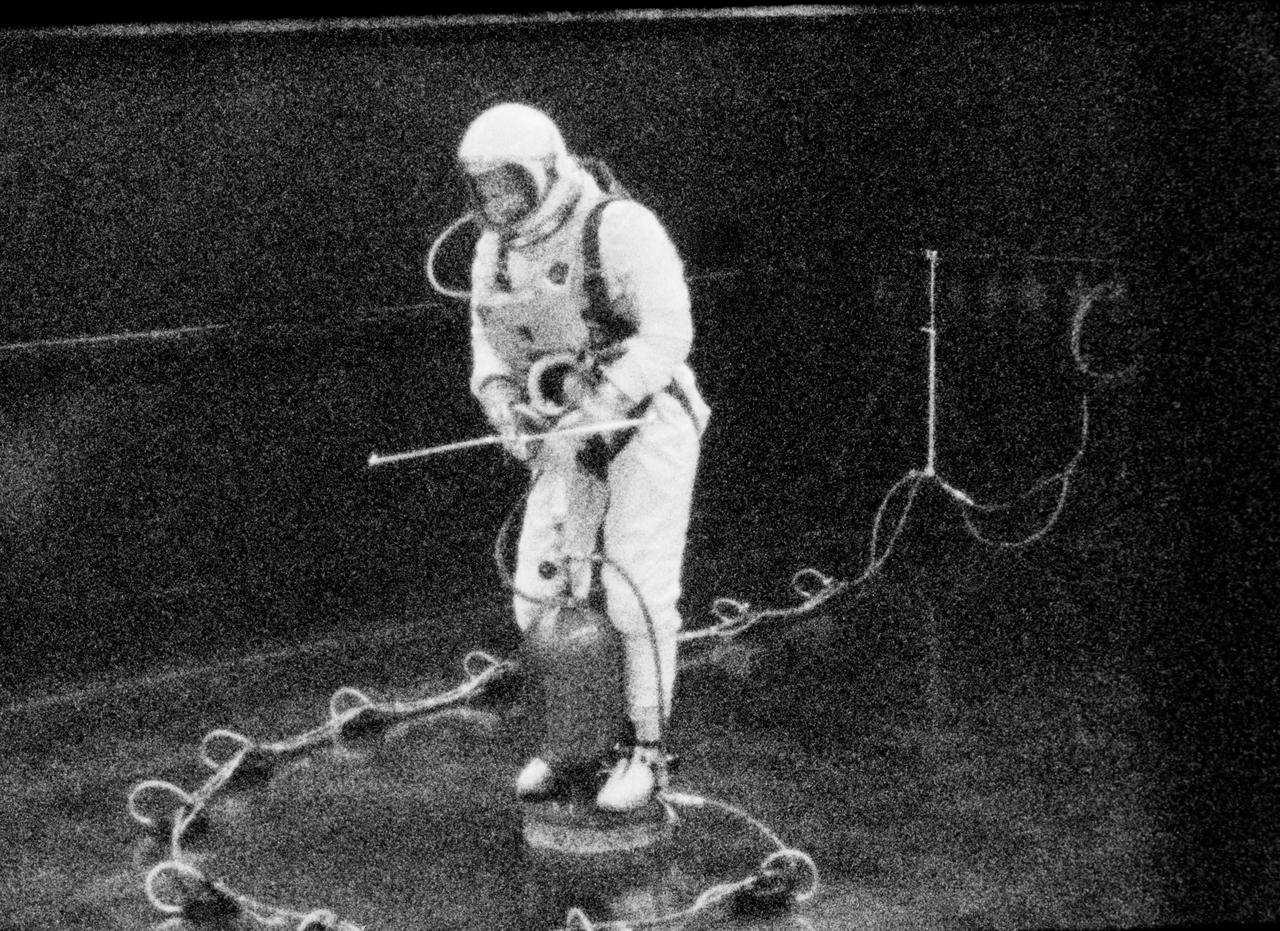
S65-19505 (28 May 1965) --- Astronaut Edward H. White II, pilot for the Gemini-Titan 4 prime crew, is pictured during an extravehicular exercise in the Building 4 laboratory at the Manned Spacecraft Center in Houston, Texas. White is controlling about the yaw (vertical) axis while translating. He stands on a Balance Extravehicular Training Aircraft which is separated from the level steel floor by a .001th-inch cushion of air. In his right hand White holds a zero-gravity integral propulsion unit which is a self-maneuvering device used by an astronaut in a zero-gravity environment. This condition is simulated in this training exercise. White's spacesuit is pressurized to create a realistic training condition. The simulated umbilical line is floated on air with the aid of eleven small air pads.
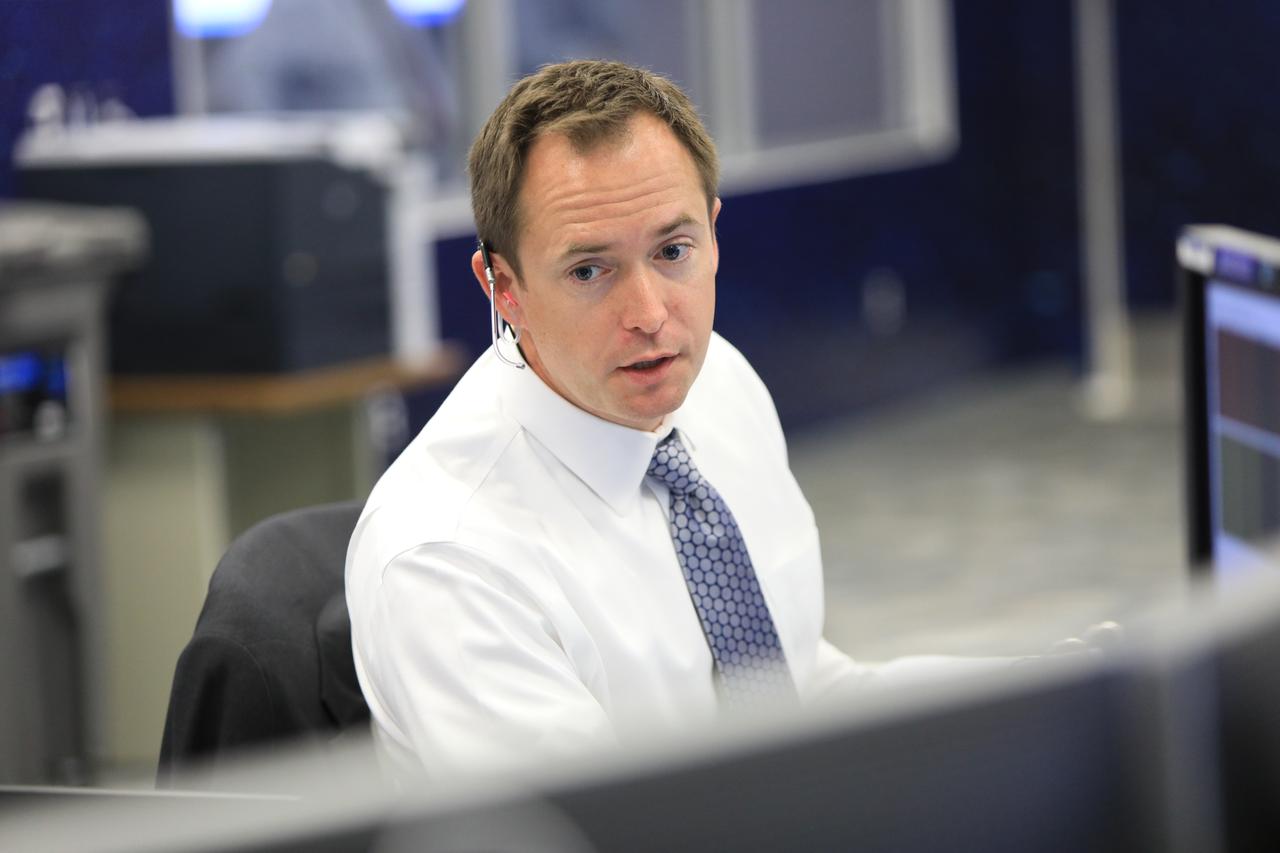
As part of the joint team that will launch Boeing’s CST-100 Starliner on a United Launch Alliance (ULA) Atlas V rocket in Boeing’s Orbital Flight Test (OFT), Boeing Spacecraft Launch Conductor Louis Atchison participated in a successful Integrated Crew Exercise on Feb. 12. NASA, ULA, Boeing and Department of Defense personnel executed a mock countdown that practiced fueling the rocket and operating on the unique launch day timeline that features a four-hour built-in hold at the T-minus 4 minute mark. OFT is Boeing’s uncrewed flight test of Starliner and part of NASA’s Commercial Crew Program, which will return human spaceflight launches into low-Earth orbit from U.S. soil.
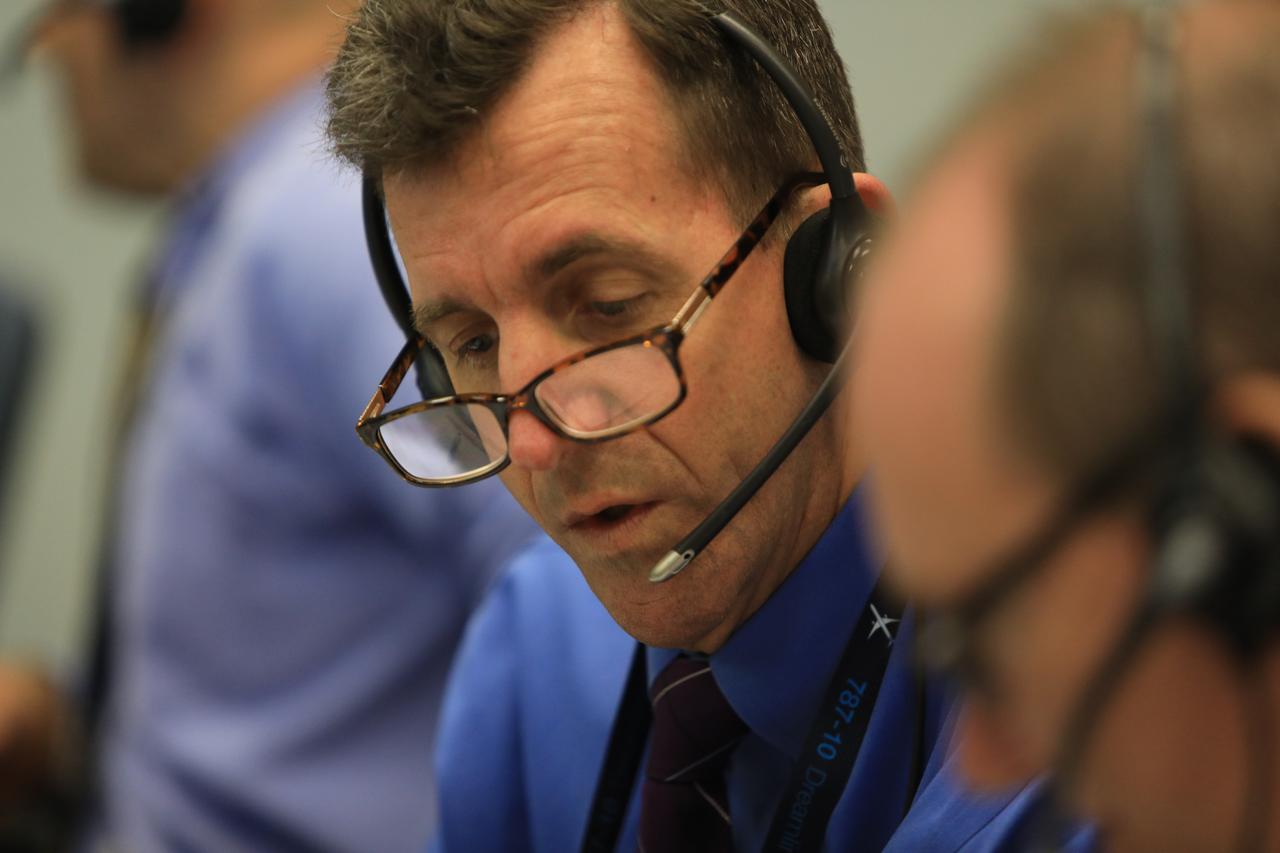
As part of the joint team that will launch Boeing’s CST-100 Starliner on a United Launch Alliance Atlas V rocket in Boeing’s Orbital Flight Test (OFT), Boeing Spacecraft Mission Director LeRoy Cain participated in a successful Integrated Crew Exercise on Feb. 12. NASA, ULA, Boeing and Department of Defense personnel executed a mock countdown that practiced fueling the rocket and operating on the unique launch day timeline that features a four-hour built-in hold at the T-minus 4 minute mark. OFT is Boeing’s uncrewed flight test of Starliner and part of NASA’s Commercial Crew Program, which will return human spaceflight launches into low-Earth orbit from U.S. soil.
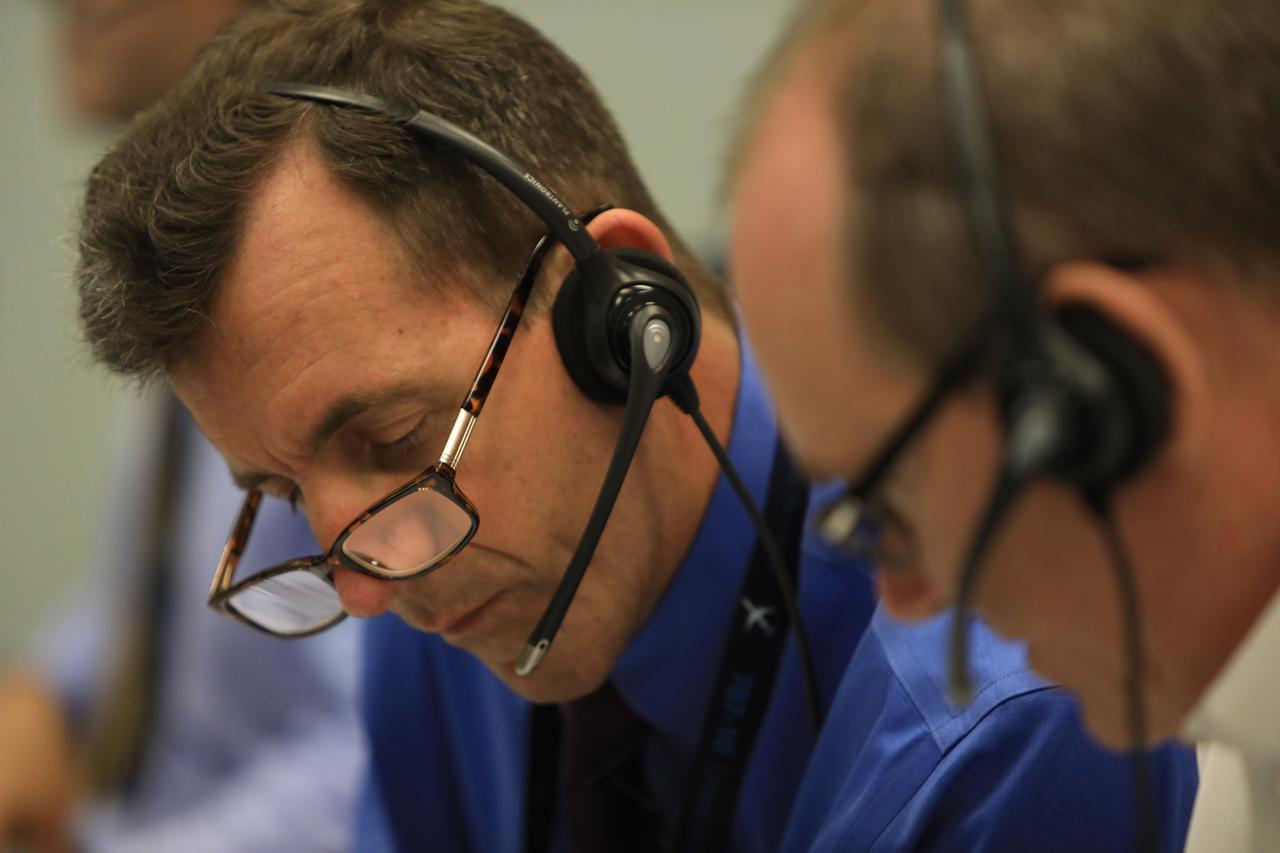
As part of the joint team that will launch Boeing’s CST-100 Starliner on a United Launch Alliance Atlas V rocket in Boeing’s Orbital Flight Test (OFT), Boeing Spacecraft Mission Director LeRoy Cain participated in a successful Integrated Crew Exercise on Feb. 12. NASA, ULA, Boeing and Department of Defense personnel executed a mock countdown that practiced fueling the rocket and operating on the unique launch day timeline that features a four-hour built-in hold at the T-minus 4 minute mark. OFT is Boeing’s uncrewed flight test of Starliner and part of NASA’s Commercial Crew Program, which will return human spaceflight launches into low-Earth orbit from U.S. soil.
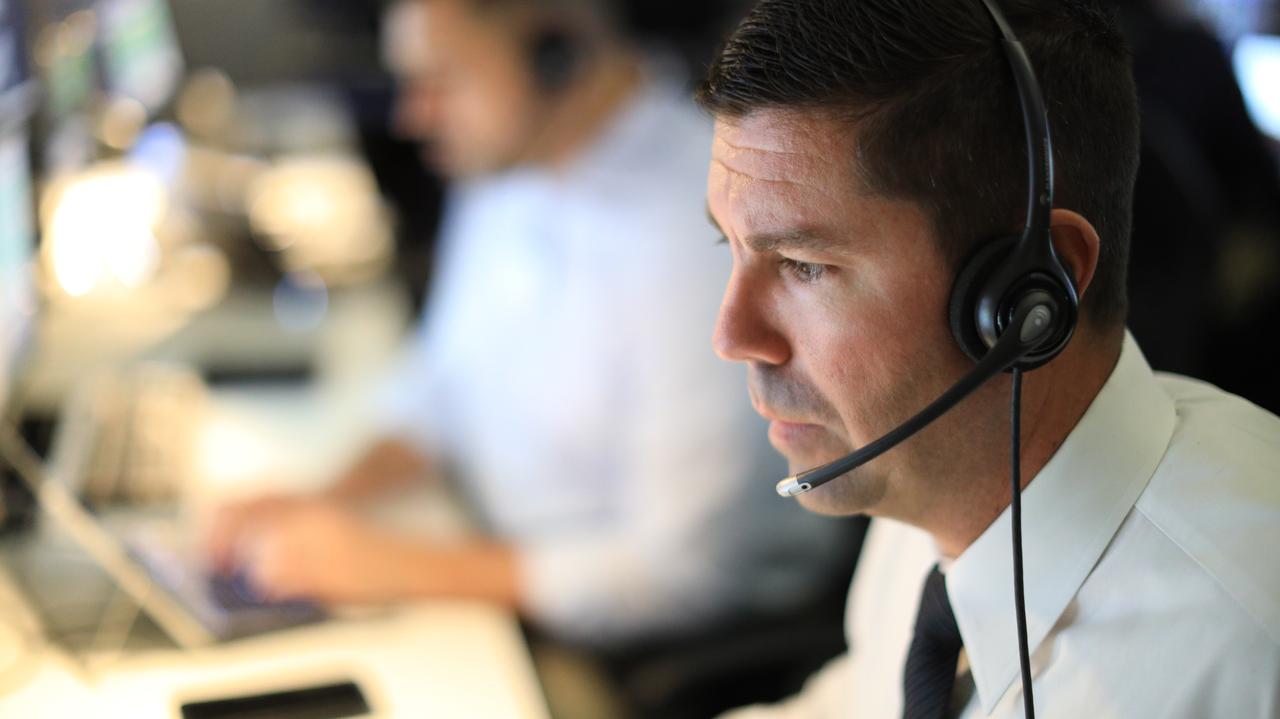
As part of the joint team that will launch Boeing’s CST-100 Starliner on a United Launch Alliance Atlas V rocket in Boeing’s Orbital Flight Test (OFT), Eugene “Trip” Healey, NASA Mission Manager for OFT, participated in a successful Integrated Crew Exercise on Feb. 12. NASA, ULA, Boeing and Department of Defense personnel executed a mock countdown that practiced fueling the rocket and operating on the unique launch day timeline that features a four-hour built-in hold at the T-minus 4 minute mark. OFT is Boeing’s uncrewed flight test of Starliner and part of NASA’s Commercial Crew Program, which will return human spaceflight launches into low-Earth orbit from U.S. soil.
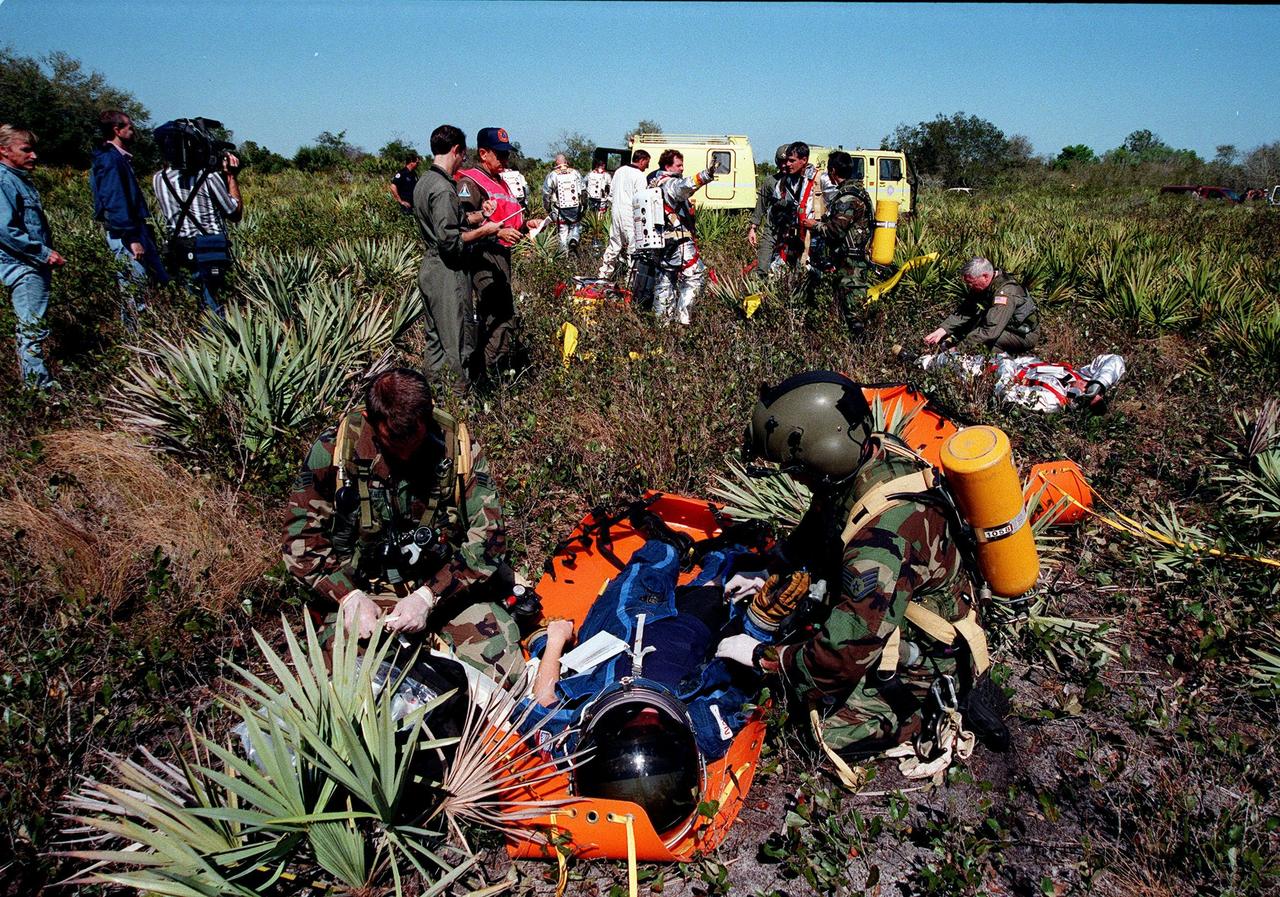
KENNEDY SPACE CENTER, FLA. -- During a simulated rescue mission in the woods near the Shuttle Landing Facility (SLF), the KSC response team practices stabilizing an injured crew member before transport to a local hospital by helicopter. The response team is training for the unlikely scenario of a Shuttle mishap at the SLF. The Mode 7 simulation of an astronaut rescue exercises all aspects of command and control, search and rescue, and medical procedures required for a successful rescue. The remote location of the mock-up prevents a totally land-based crew rescue, and calls on a NASA UH-1 helicopter to locate the site and four Air Force HH-60 helicopters to drop emergency equipment and fire/rescue workers who will prepare the "crew" for preliminary triage. The helicopters later will help remove the crew five astronaut candidates, one representative from the Vehicle Integration Test office, and one fire/rescue worker. The exercise will conclude with airlifted "patients" arriving safely in the emergency rooms of participating area hospitals
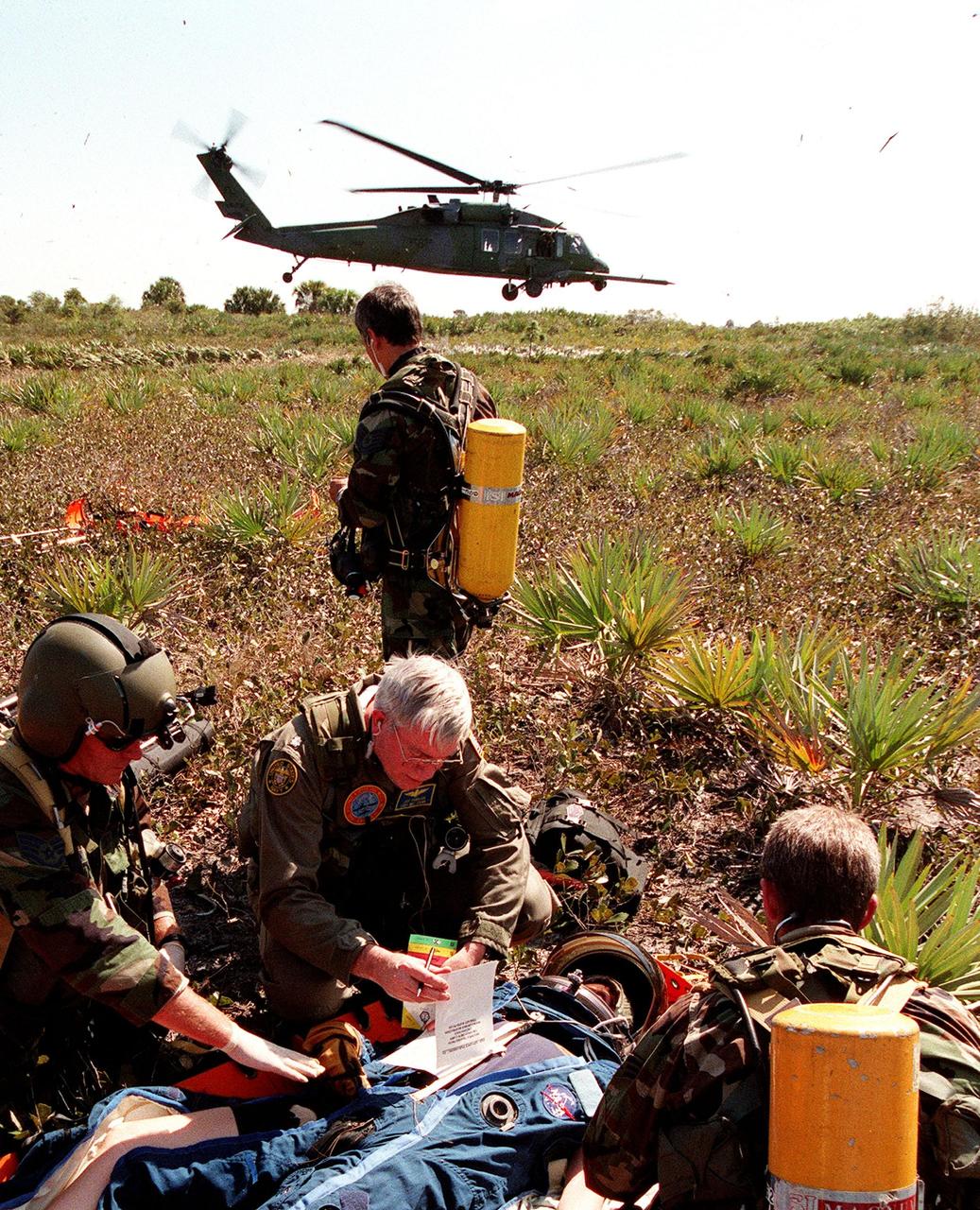
KENNEDY SPACE CENTER, FLA. -- During a simulated rescue mission in the woods near the Shuttle Landing Facility (SLF), the KSC response team practices stabilizing an injured crew member before transport to a local hospital by an Air Force HH-60 helicopter. The response team is training for the unlikely scenario of a Shuttle mishap at the SLF. The Mode 7 simulation of an astronaut rescue exercises all aspects of command and control, search and rescue, and medical procedures required for a successful rescue. The remote location of the mock-up prevents a totally land-based crew rescue, and calls on a NASA UH-1 helicopter to locate the site and four HH-60 helicopters to drop emergency equipment and fire/rescue workers to prepare the "crew" for preliminary triage. The helicopters are then used to remove the crew five astronaut candidates, one representative from the Vehicle Integration Test office, and one fire/rescue worker. The exercise will conclude with airlifted "patients" arriving safely in the emergency rooms of participating area hospitals
![2014-03-14-14-08-03[1] In the Integration Facility at the Baikonur Cosmodrome in Kazakhstan, Expedition 39/40 Flight Engineer Steve Swanson of NASA poses for a picture in the Soyuz TMA-12M spacecraft during a “fit check” dress rehearsal exercise March 14 that is part of the crew’s final training. Swanson, Soyuz Commander Alexander Skvortsov of the Russian Federal Space Agency (Roscosmos) and Flight Engineer Oleg Artemyev of Roscosmos are scheduled to launch to the International Space Station March 26 (Kazakh time) for the start of a six-month mission. NASA/Victor Zelentsov](https://images-assets.nasa.gov/image/jsc2014e026284/jsc2014e026284~orig.jpg)
2014-03-14-14-08-03[1] In the Integration Facility at the Baikonur Cosmodrome in Kazakhstan, Expedition 39/40 Flight Engineer Steve Swanson of NASA poses for a picture in the Soyuz TMA-12M spacecraft during a “fit check” dress rehearsal exercise March 14 that is part of the crew’s final training. Swanson, Soyuz Commander Alexander Skvortsov of the Russian Federal Space Agency (Roscosmos) and Flight Engineer Oleg Artemyev of Roscosmos are scheduled to launch to the International Space Station March 26 (Kazakh time) for the start of a six-month mission. NASA/Victor Zelentsov
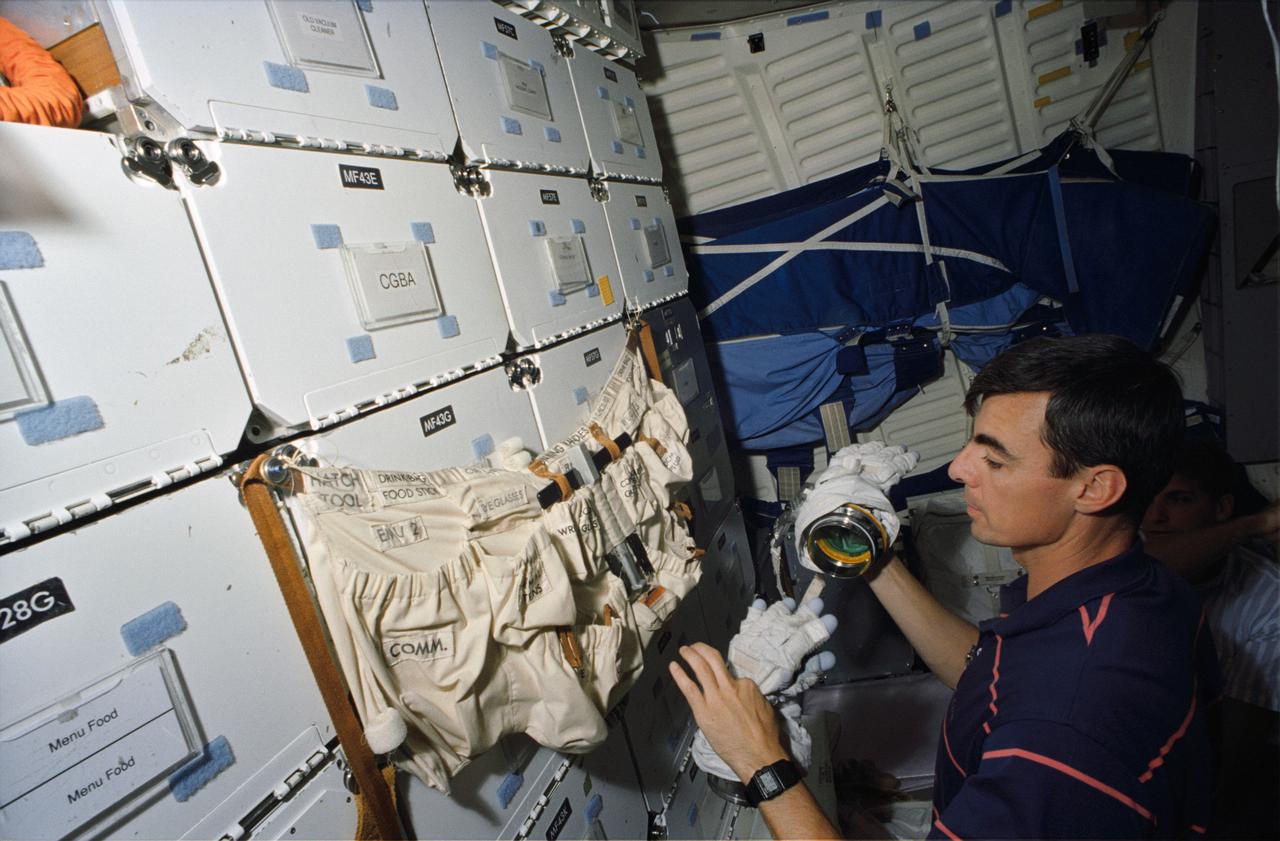
S93-46018 (13 October 1993) --- In the Johnson Space Center's (JSC) Shuttle mockup and integration laboratory, astronaut Andrew M. Allen retrieves gear to rehearse a suit donning exercise on the middeck. Thuot's very realistic environs are provided by the Shuttle crew compartment trainer. Thuot, mission specialist, and four other NASA astronauts will spend two weeks in space aboard the Columbia in March of next year. He and astronaut Pierre J. Thuot have been rehearsing contingency space walks. There is no scheduled extravehicular activity for the STS-62 flight.
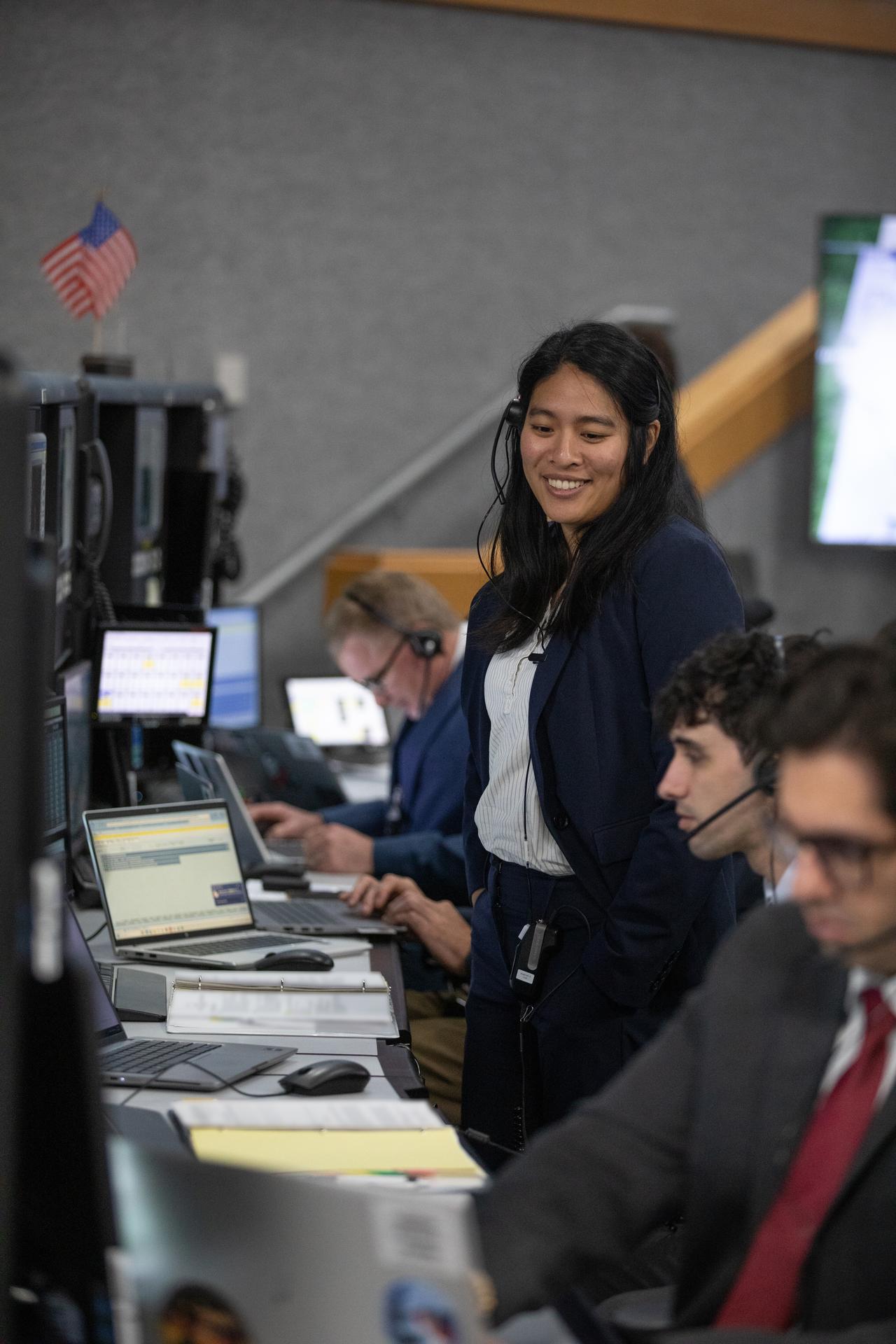
Artemis launch team members participate in an integrated launch countdown simulation for Artemis II inside Firing Room 1 of the Launch Control Center on Wednesday, Dec. 10, 2025. The training exercise involved engineers from Kennedy, Marshall Space Flight Center in Huntsville, Alabama, and Johnson Space Center in Houston coming together to rehearse all aspects of the launch countdown, from cryogenic loading – filling tanks in the SLS (Space Launch System) rocket’s core stage with liquid hydrogen and liquid oxygen – to liftoff. For Artemis II, four astronauts will venture around the Moon, the first crewed mission on NASA’s path to establishing a long-term presence for science and exploration through Artemis.
![2014-03-14-10-48-03-3[1] In the Integration Facility at the Baikonur Cosmodrome in Kazakhstan, Expedition 39/40 Flight Engineer Steve Swanson of NASA reviews procedures in the Soyuz TMA-12M spacecraft during a “fit check” dress rehearsal exercise March 14 that is part of the crew’s final training. Swanson, Soyuz Commander Alexander Skvortsov of the Russian Federal Space Agency (Roscosmos; hidden from view) and Flight Engineer Oleg Artemyev of Roscosmos (foreground) are scheduled to launch to the International Space Station March 26 (Kazakh time) for the start of a six-month mission. NASA/Victor Zelentsov](https://images-assets.nasa.gov/image/jsc2014e026276/jsc2014e026276~medium.jpg)
2014-03-14-10-48-03-3[1] In the Integration Facility at the Baikonur Cosmodrome in Kazakhstan, Expedition 39/40 Flight Engineer Steve Swanson of NASA reviews procedures in the Soyuz TMA-12M spacecraft during a “fit check” dress rehearsal exercise March 14 that is part of the crew’s final training. Swanson, Soyuz Commander Alexander Skvortsov of the Russian Federal Space Agency (Roscosmos; hidden from view) and Flight Engineer Oleg Artemyev of Roscosmos (foreground) are scheduled to launch to the International Space Station March 26 (Kazakh time) for the start of a six-month mission. NASA/Victor Zelentsov
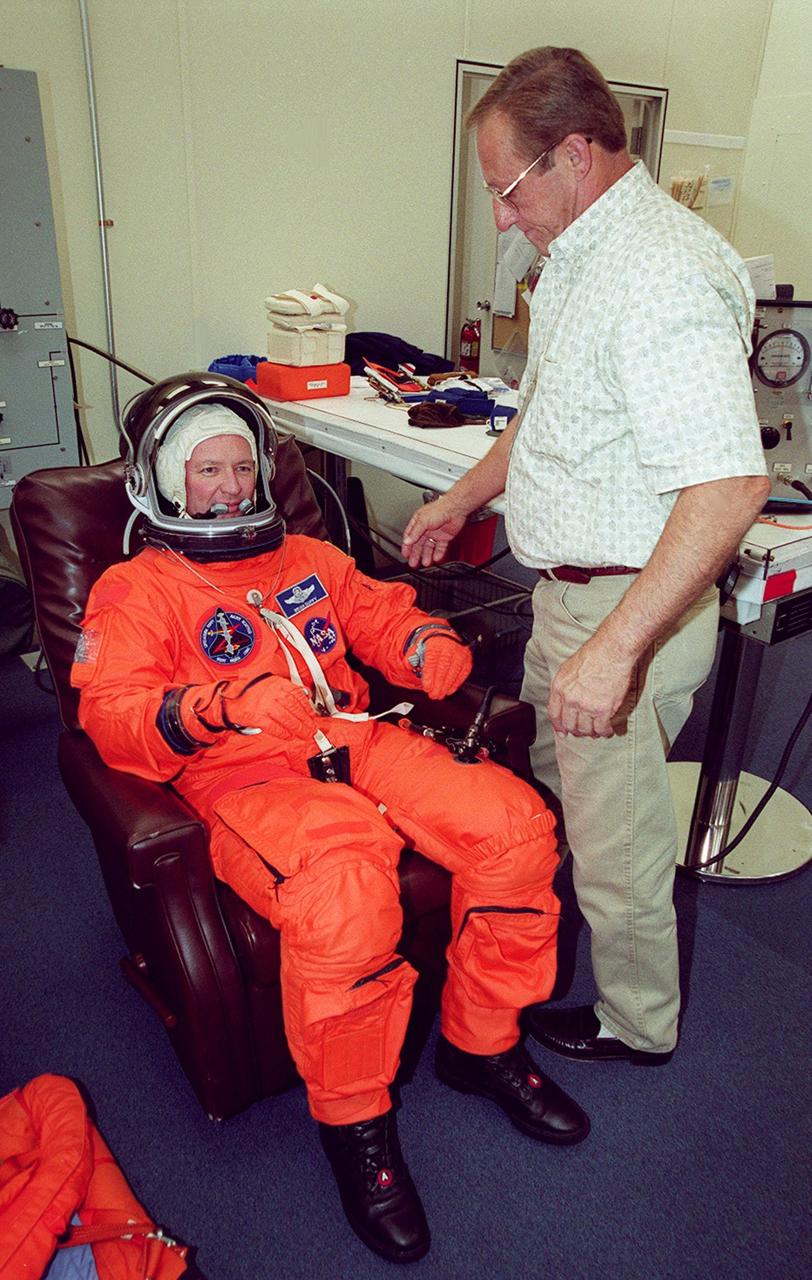
During pre-pack and fit check, STS-92 Commander Brian Duffy tests his launch and entry suit for comfort and ease while sitting. This mission will be Duffy’s fourth Shuttle flight. He and the rest of the crew are at KSC for Terminal Countdown Demonstration Test activities. The TCDT provides emergency egress training, simulated countdown exercises and opportunities to inspect the mission payload. STS-92 is scheduled to launch Oct. 5 at 9:38 p.m. EDT from Launch Pad 39A on the fifth flight to the International Space Station. It will carry two elements of the Space Station, the Integrated Truss Structure Z1 and the third Pressurized Mating Adapter. The mission is also the 100th flight in the Shuttle program
![2014-03-14-12-25-11-2[1] In the Integration Facility at the Baikonur Cosmodrome in Kazakhstan, Expedition 39/40 Flight Engineer Steve Swanson of NASA suits up March 14 for a “fit check” dress rehearsal exercise that is part of the crew’s final training. Swanson, Soyuz Commander Alexander Skvortsov of the Russian Federal Space Agency (Roscosmos) and Flight Engineer Oleg Artemyev of Roscosmos are scheduled to launch to the International Space Station March 26 (Kazakh time) for the start of a six-month mission. NASA/Victor Zelentsov](https://images-assets.nasa.gov/image/jsc2014e026277/jsc2014e026277~medium.jpg)
2014-03-14-12-25-11-2[1] In the Integration Facility at the Baikonur Cosmodrome in Kazakhstan, Expedition 39/40 Flight Engineer Steve Swanson of NASA suits up March 14 for a “fit check” dress rehearsal exercise that is part of the crew’s final training. Swanson, Soyuz Commander Alexander Skvortsov of the Russian Federal Space Agency (Roscosmos) and Flight Engineer Oleg Artemyev of Roscosmos are scheduled to launch to the International Space Station March 26 (Kazakh time) for the start of a six-month mission. NASA/Victor Zelentsov
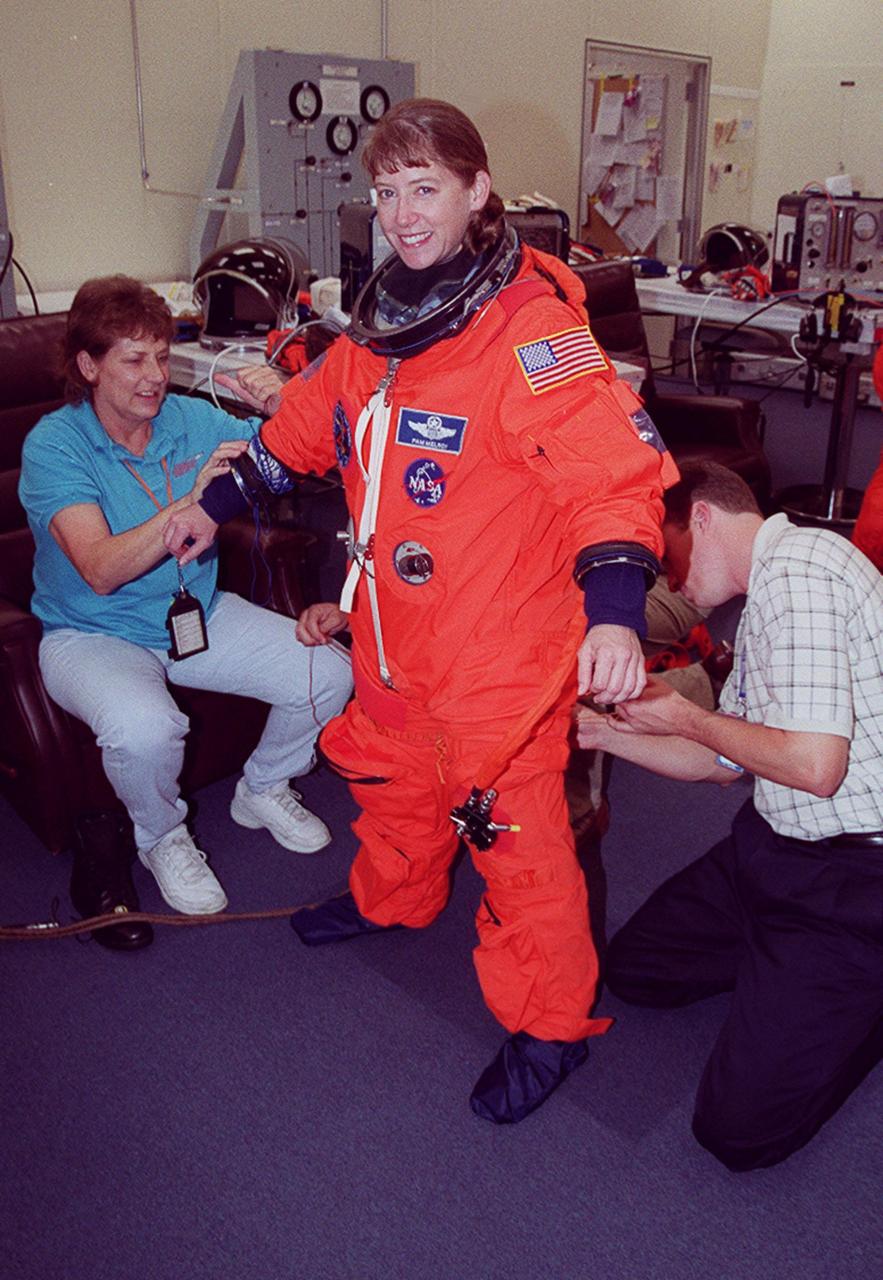
The “rookie” on the STS-92 mission, Pilot Pamela Ann Melroy has her new launch and entry suit adjusted during pre-pack and fit check in the Operations and Checkout Building. Melroy and the rest of the crew are at KSC for Terminal Countdown Demonstration Test activities. The TCDT provides emergency egress training, simulated countdown exercises and opportunities to inspect the mission payload. STS-92 is scheduled to launch Oct. 5 at 9:38 p.m. EDT from Launch Pad 39A on the fifth flight to the International Space Station. It will carry two elements of the Space Station, the Integrated Truss Structure Z1 and the third Pressurized Mating Adapter. The mission is also the 100th flight in the Shuttle program
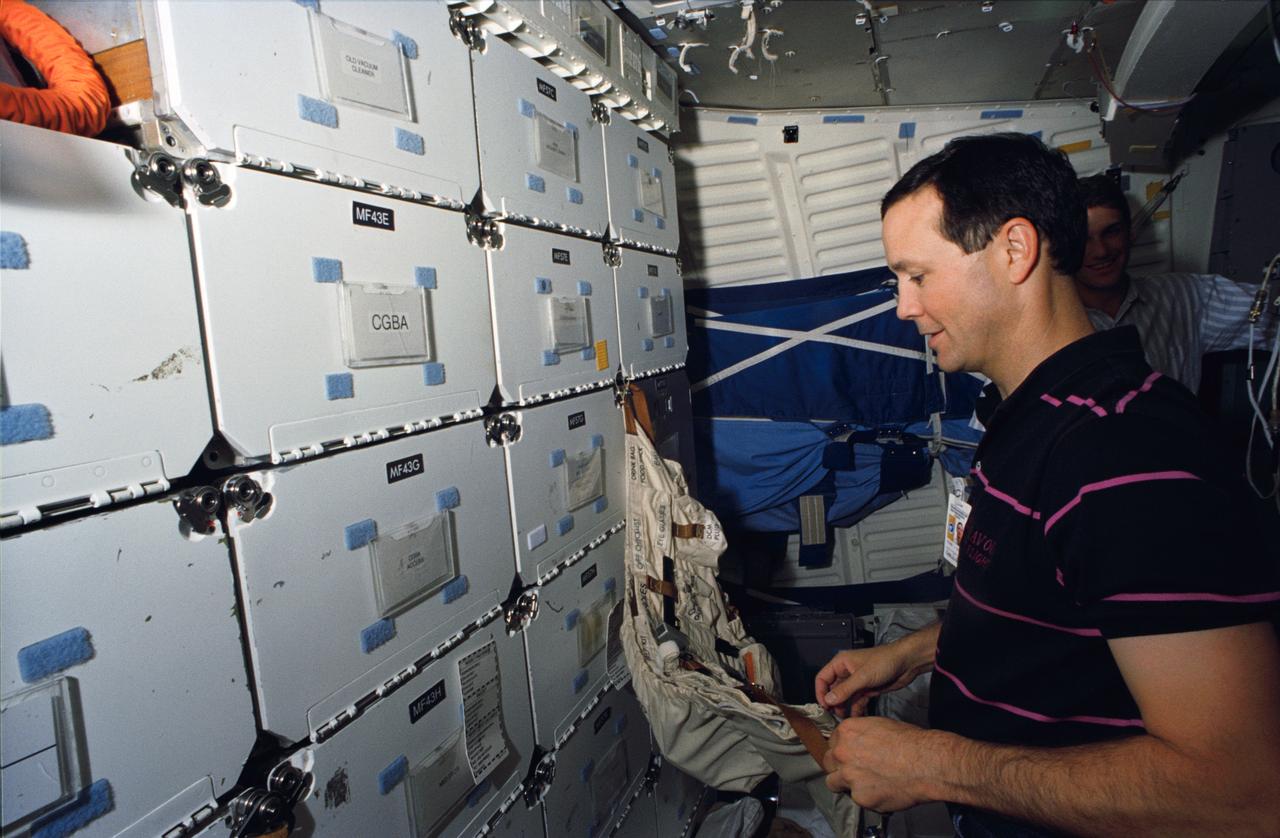
S93-46017 (13 October 1993) --- In the Johnson Space Center's (JSC) Shuttle mockup and integration laboratory, astronaut Pierre J. Thuot retrieves gear to rehearse a suit donning exercise on the middeck. Thuot's very realistic environs are provided by the Shuttle crew compartment trainer. Thuot, mission specialist, and four other NASA astronauts will spend two weeks in space aboard the Columbia in March of next year. He and astronaut Andrew M. Allen have been rehearsing contingency space walks. There is no scheduled extravehicular activity for the STS-62 flight.
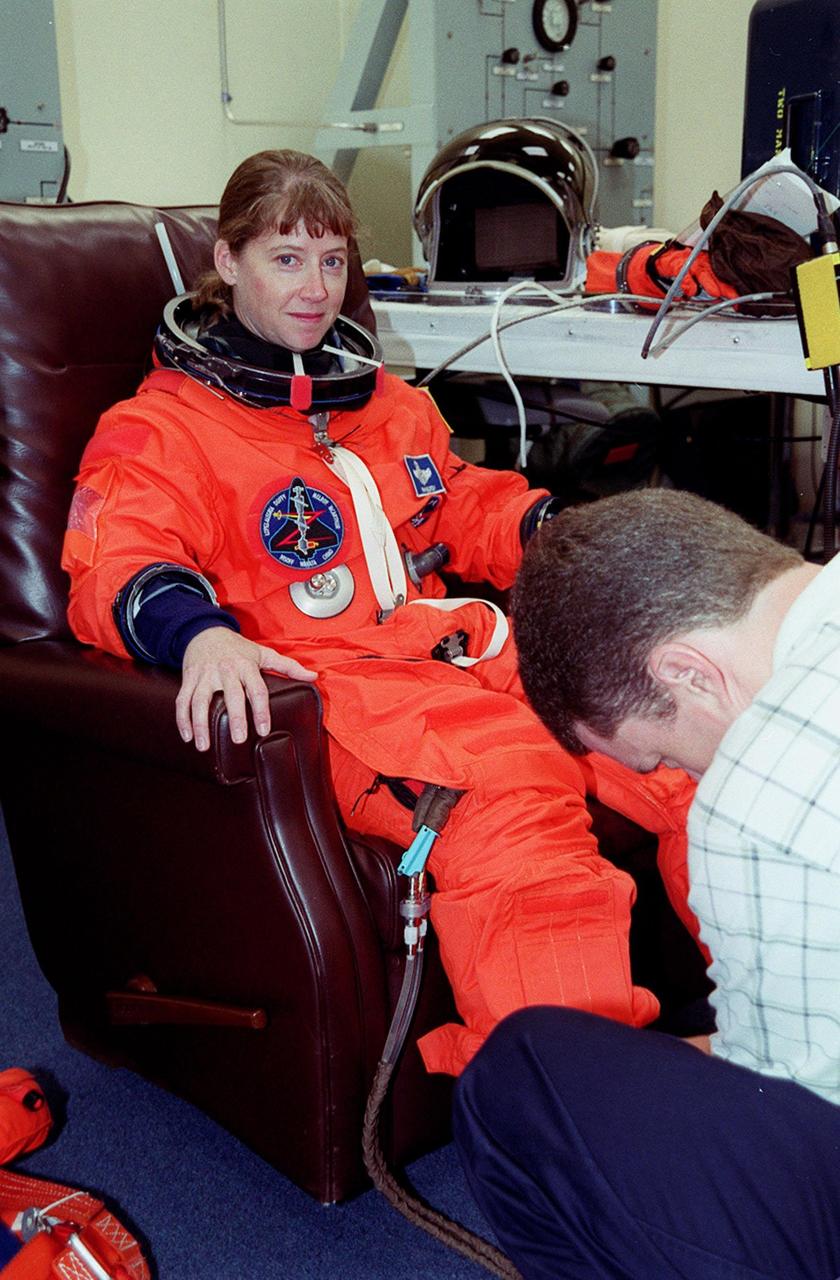
In the Operations and Checkout Building, STS-92 Pilot Pamela Ann Melroy has her new launch and entry suit adjusted during fit check. Melroy and the rest of the crew are at KSC for Terminal Countdown Demonstration Test activities. The TCDT provides emergency egress training, simulated countdown exercises and opportunities to inspect the mission payload. This mission will be Melroy’s first Shuttle flight. STS-92 is scheduled to launch Oct. 5 at 9:38 p.m. EDT from Launch Pad 39A on the fifth flight to the International Space Station. It will carry two elements of the Space Station, the Integrated Truss Structure Z1 and the third Pressurized Mating Adapter. The mission is also the 100th flight in the Shuttle program
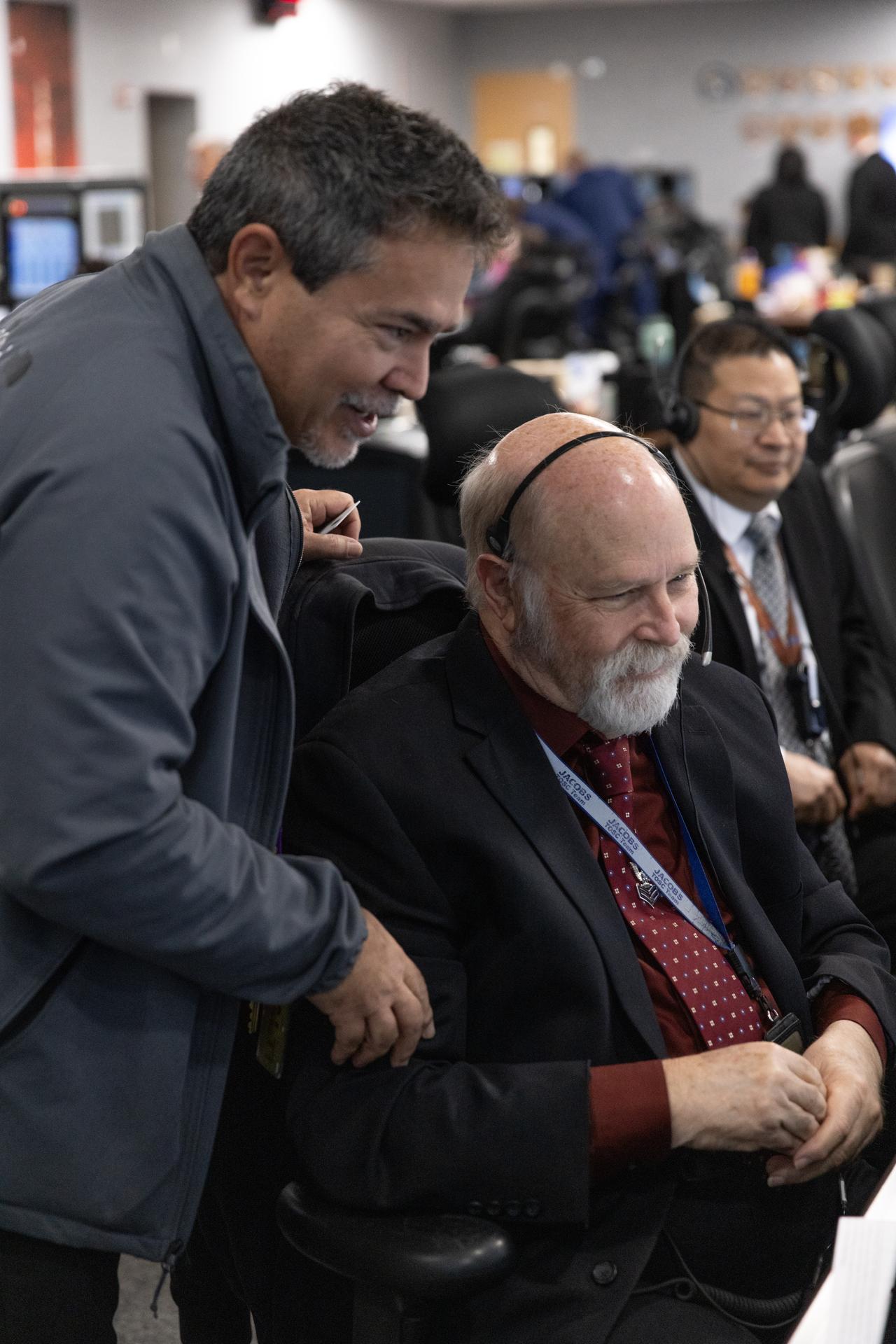
Artemis launch team members participate in an integrated launch countdown simulation for Artemis II inside Firing Room 1 of the Launch Control Center on Wednesday, Dec. 10, 2025. The training exercise involved engineers from Kennedy, Marshall Space Flight Center in Huntsville, Alabama, and Johnson Space Center in Houston coming together to rehearse all aspects of the launch countdown, from cryogenic loading – filling tanks in the SLS (Space Launch System) rocket’s core stage with liquid hydrogen and liquid oxygen – to liftoff. For Artemis II, four astronauts will venture around the Moon, the first crewed mission on NASA’s path to establishing a long-term presence for science and exploration through Artemis.
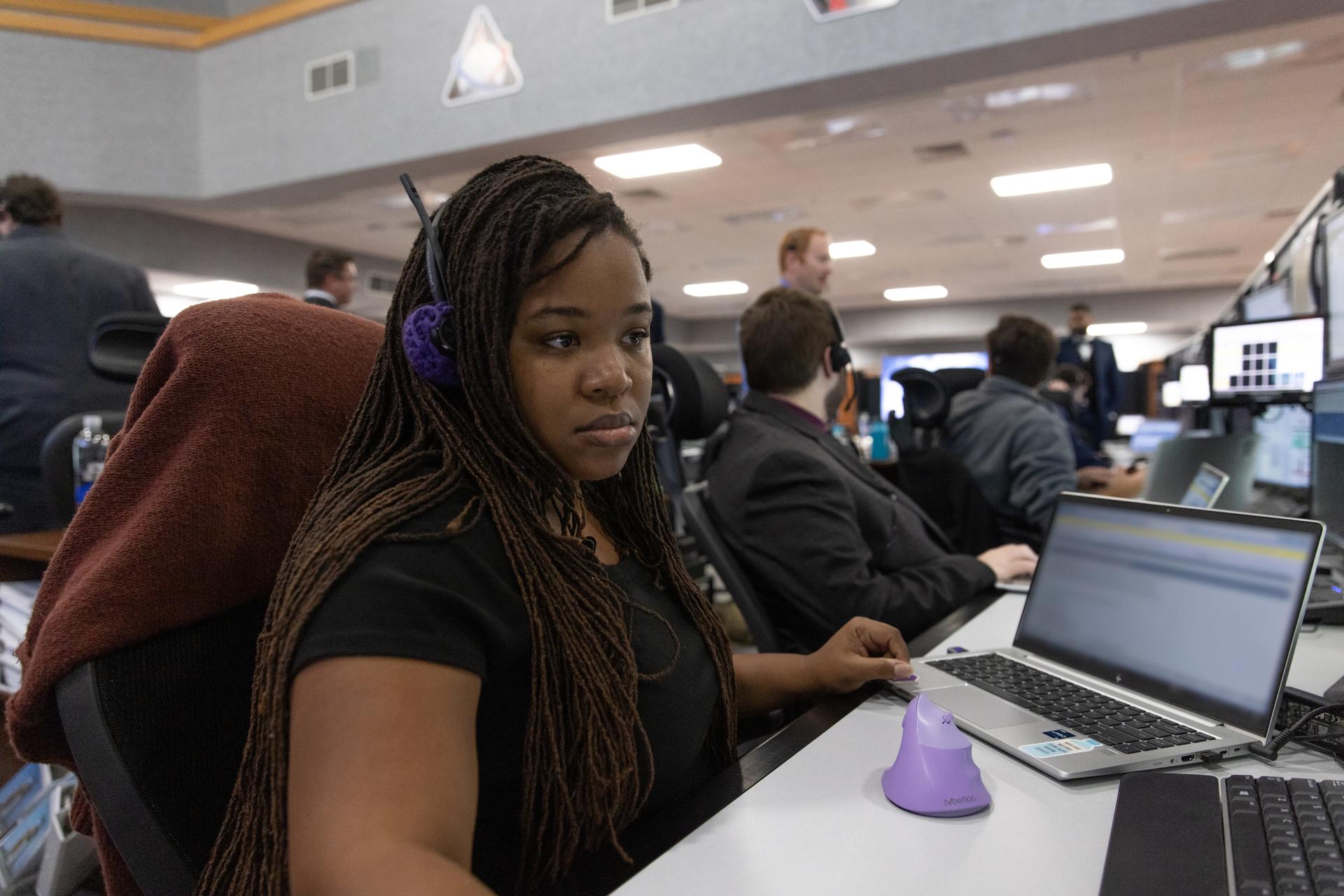
Artemis launch team members participate in an integrated launch countdown simulation for Artemis II inside Firing Room 1 of the Launch Control Center on Wednesday, Dec. 10, 2025. The training exercise involved engineers from Kennedy, Marshall Space Flight Center in Huntsville, Alabama, and Johnson Space Center in Houston coming together to rehearse all aspects of the launch countdown, from cryogenic loading – filling tanks in the SLS (Space Launch System) rocket’s core stage with liquid hydrogen and liquid oxygen – to liftoff. For Artemis II, four astronauts will venture around the Moon, the first crewed mission on NASA’s path to establishing a long-term presence for science and exploration through Artemis.
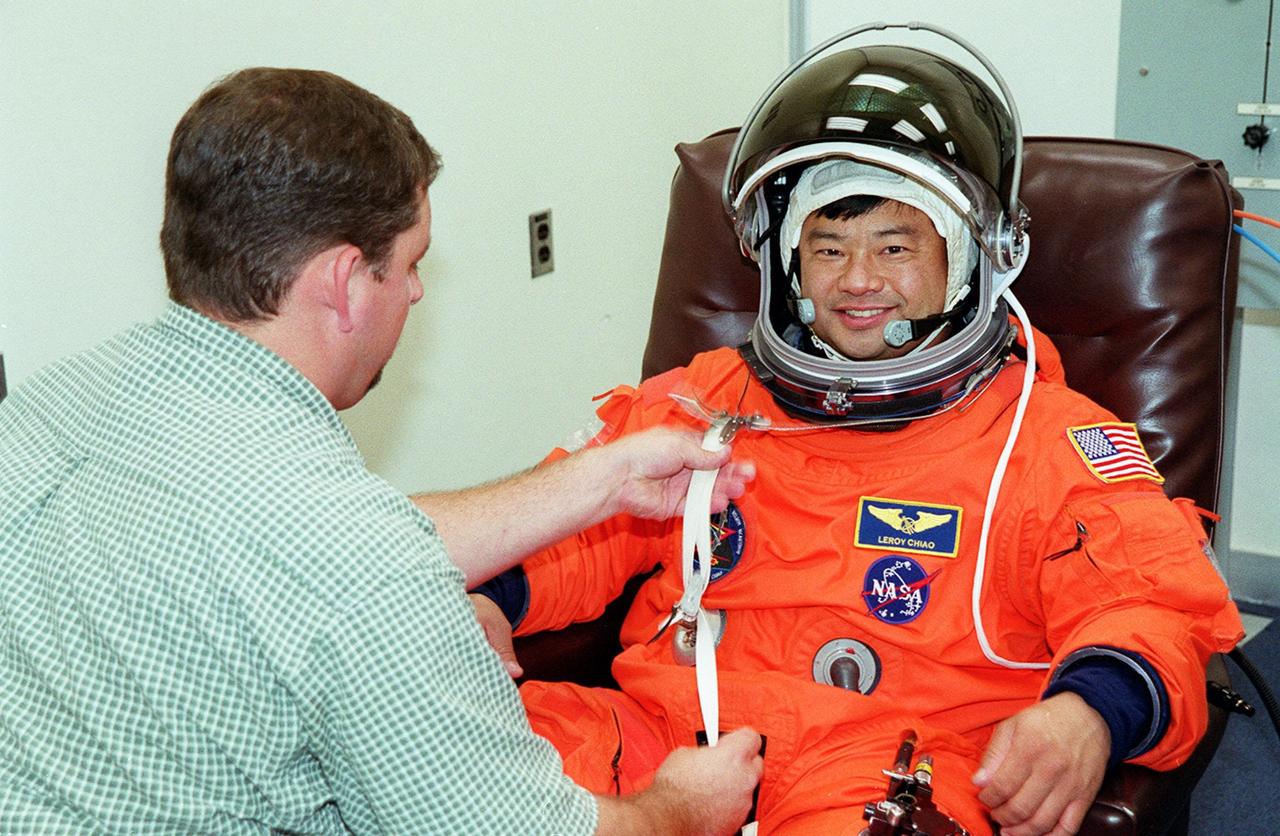
In the Operations and Checkout Building, STS-92 Mission Specialist Leroy Chiao has his launch and entry suit adjusted during fit check. Chiao and the rest of the crew are at KSC for Terminal Countdown Demonstration Test activities. The TCDT provides emergency egress training, simulated countdown exercises and opportunities to inspect the mission payload. This mission will be Chiao’s third Shuttle flight. STS-92 is scheduled to launch Oct. 5 at 9:38 p.m. EDT from Launch Pad 39A on the fifth flight to the International Space Station. It will carry two elements of the Space Station, the Integrated Truss Structure Z1 and the third Pressurized Mating Adapter. The mission is also the 100th flight in the Shuttle program
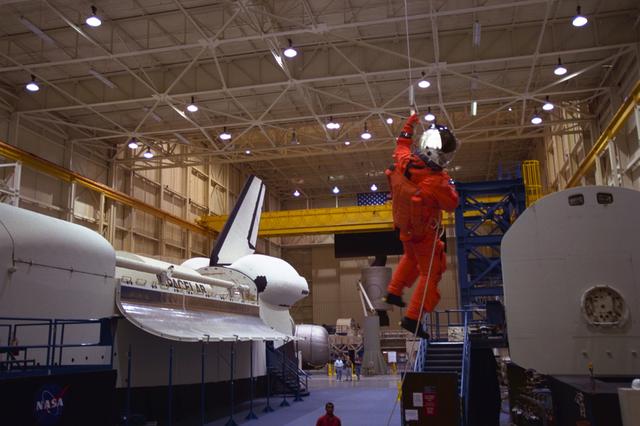
S98-06938 (28 April 1998) --- U.S. Sen. John H. Glenn Jr. (D.-Ohio), uses a device called a Sky genie to simulate rappelling from a troubled Space Shuttle during training at the Johnson Space Center (JSC). Glenn has been named as a payload specialist for STS-95, scheduled for launch later this year. This exercise, in the systems integration facility at JSC, trains the crewmembers for procedures to follow in egressing a troubled shuttle on the ground. The full fuselage trainer (FFT) is at left, with the crew compartment trainer (CCT) at right. Photo Credit: Joe McNally, National Geographic, for NASA
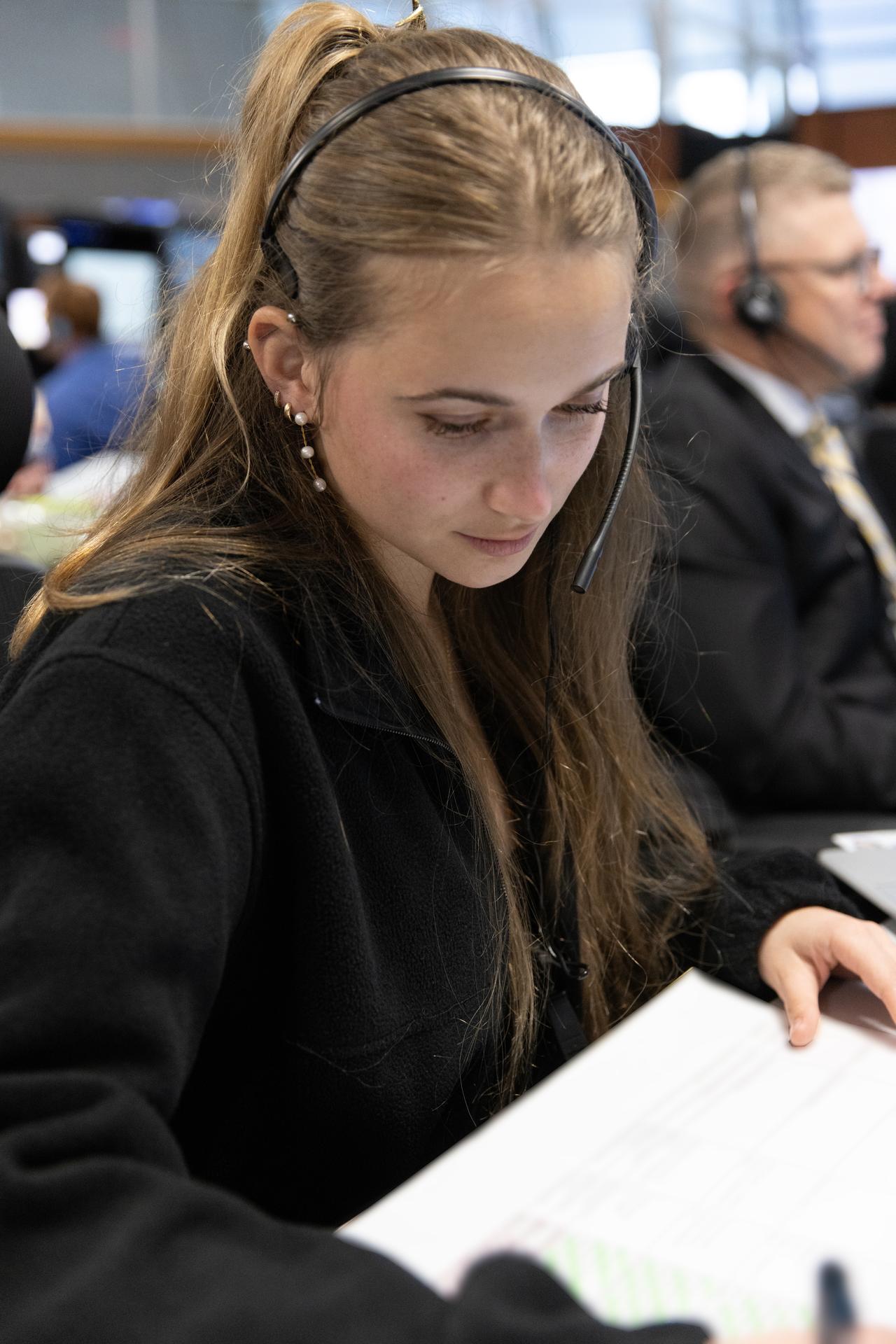
Artemis launch team members participate in an integrated launch countdown simulation for Artemis II inside Firing Room 1 of the Launch Control Center on Wednesday, Dec. 10, 2025. The training exercise involved engineers from Kennedy, Marshall Space Flight Center in Huntsville, Alabama, and Johnson Space Center in Houston coming together to rehearse all aspects of the launch countdown, from cryogenic loading – filling tanks in the SLS (Space Launch System) rocket’s core stage with liquid hydrogen and liquid oxygen – to liftoff. For Artemis II, four astronauts will venture around the Moon, the first crewed mission on NASA’s path to establishing a long-term presence for science and exploration through Artemis.

During pre-pack and fit check on his launch and entry suit, STS-92 Commander Brian Duffy adjusts his helmet. Duffy and the rest of the crew are at KSC for Terminal Countdown Demonstration Test activities. The TCDT provides emergency egress training, simulated countdown exercises and opportunities to inspect the mission payload. This mission will be Duffy’s fourth Shuttle flight. STS-92 is scheduled to launch Oct. 5 at 9:38 p.m. EDT from Launch Pad 39A on the fifth flight to the International Space Station. It will carry two elements of the Space Station, the Integrated Truss Structure Z1 and the third Pressurized Mating Adapter. The mission is also the 100th flight in the Shuttle program
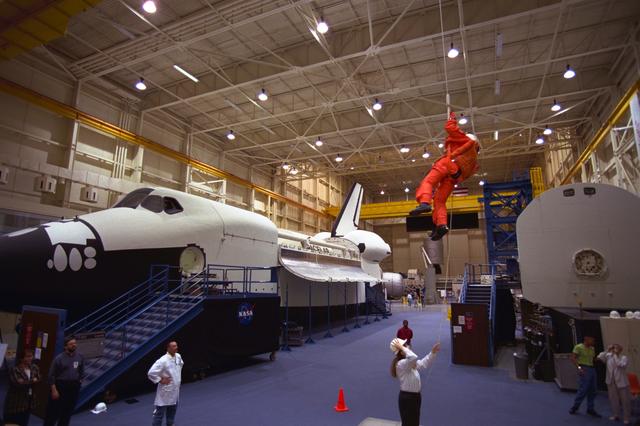
S98-06937 (28 April 1998) --- U.S. Sen. John H. Glenn Jr. (D.-Ohio), uses a device called a Sky genie to simulate rappelling from a troubled Space Shuttle during training at the Johnson Space Center (JSC). Glenn has been named as a payload specialist for STS-95, scheduled for launch later this year. This exercise, in the systems integration facility at JSC, trains the crewmembers for procedures to follow in egressing a troubled shuttle on the ground. The full fuselage trainer (FFT) is at left, with the crew compartment trainer (CCT) at right. Photo Credit: Joe McNally, National Geographic, for NASA
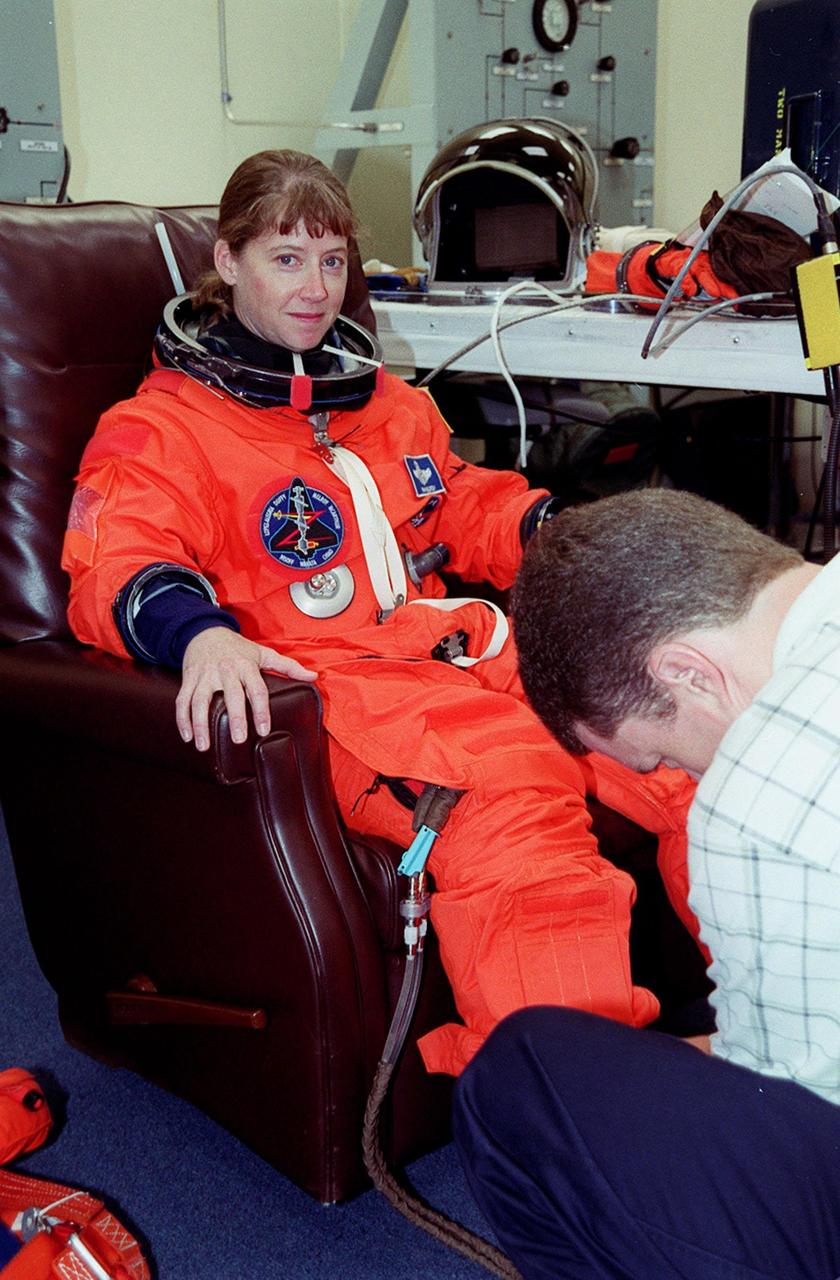
In the Operations and Checkout Building, STS-92 Pilot Pamela Ann Melroy has her new launch and entry suit adjusted during fit check. Melroy and the rest of the crew are at KSC for Terminal Countdown Demonstration Test activities. The TCDT provides emergency egress training, simulated countdown exercises and opportunities to inspect the mission payload. This mission will be Melroy’s first Shuttle flight. STS-92 is scheduled to launch Oct. 5 at 9:38 p.m. EDT from Launch Pad 39A on the fifth flight to the International Space Station. It will carry two elements of the Space Station, the Integrated Truss Structure Z1 and the third Pressurized Mating Adapter. The mission is also the 100th flight in the Shuttle program
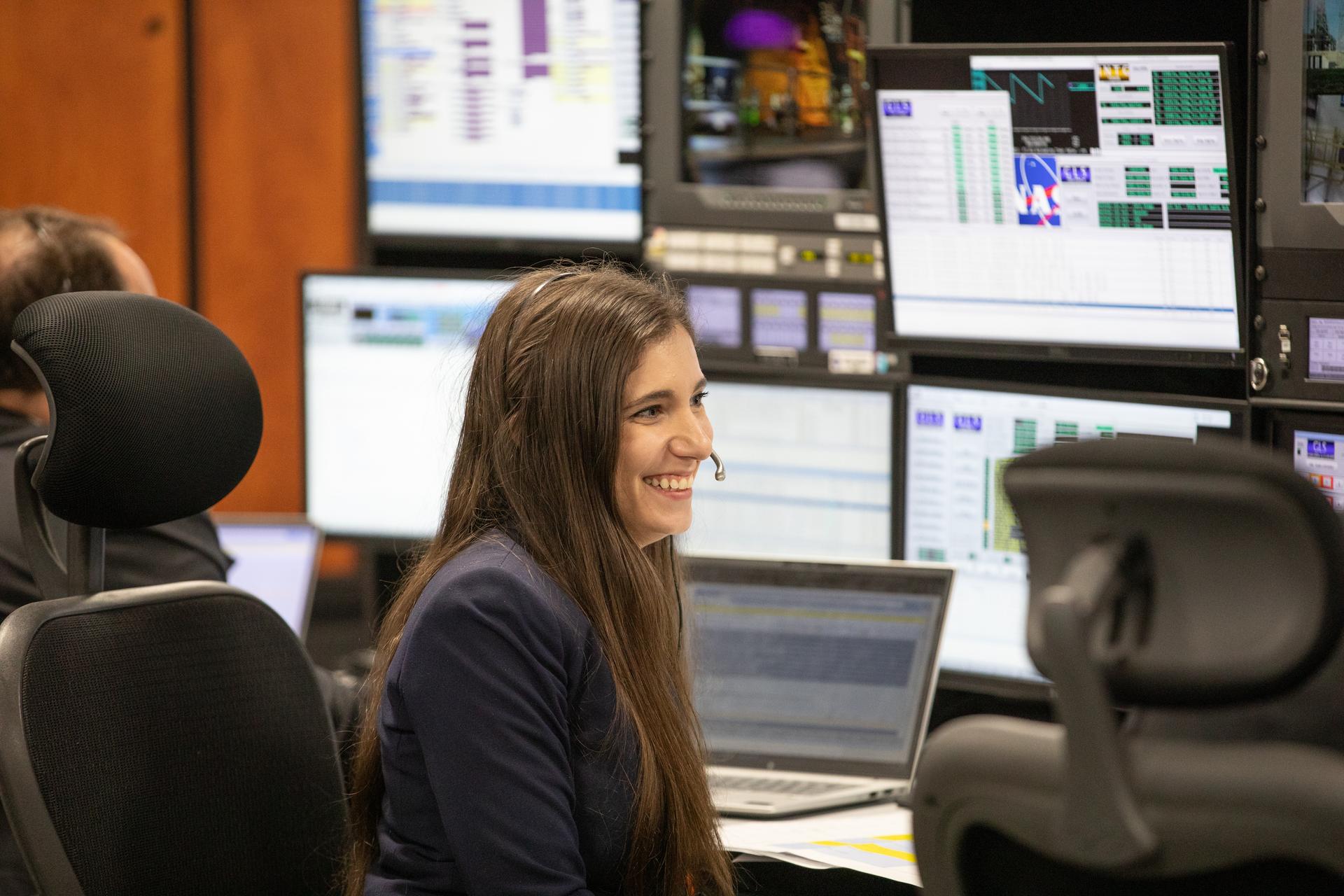
Artemis launch team members participate in an integrated launch countdown simulation for Artemis II inside Firing Room 1 of the Launch Control Center on Wednesday, Dec. 10, 2025. The training exercise involved engineers from Kennedy, Marshall Space Flight Center in Huntsville, Alabama, and Johnson Space Center in Houston coming together to rehearse all aspects of the launch countdown, from cryogenic loading – filling tanks in the SLS (Space Launch System) rocket’s core stage with liquid hydrogen and liquid oxygen – to liftoff. For Artemis II, four astronauts will venture around the Moon, the first crewed mission on NASA’s path to establishing a long-term presence for science and exploration through Artemis.
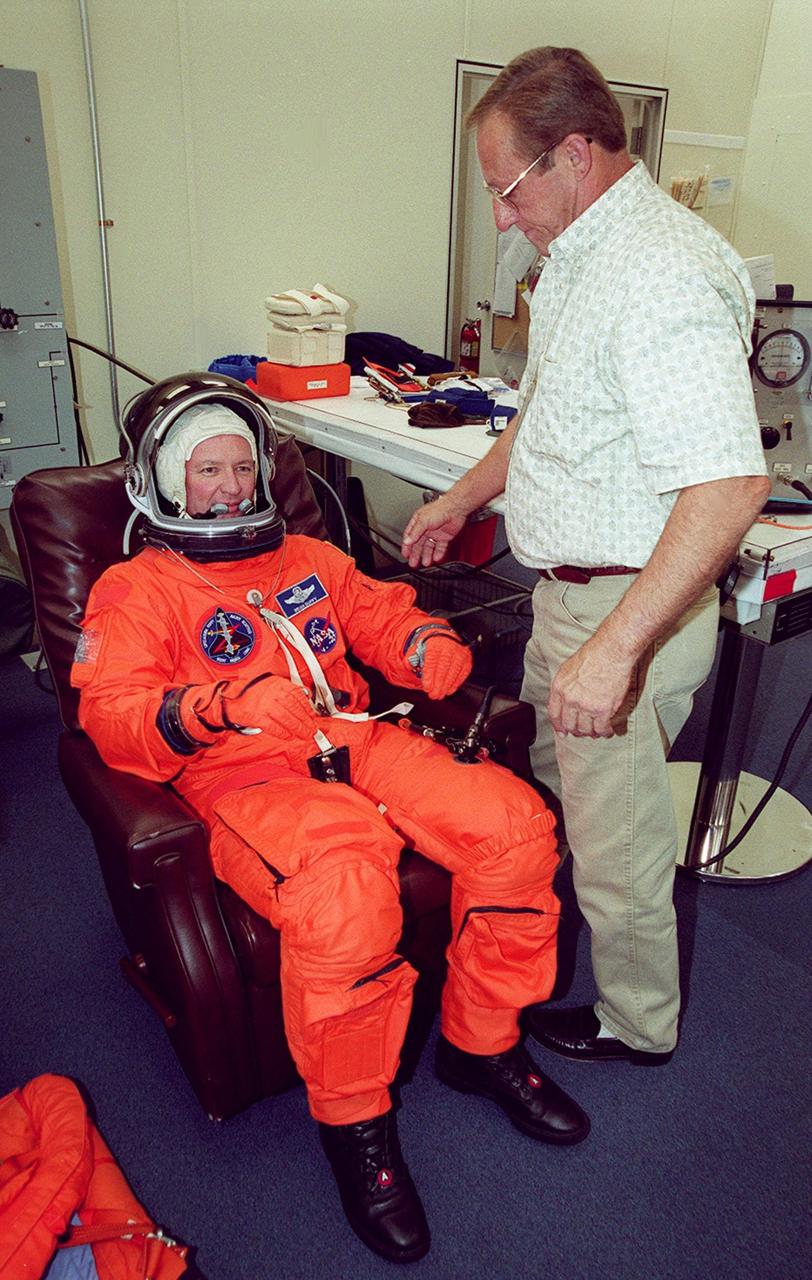
During pre-pack and fit check, STS-92 Commander Brian Duffy tests his launch and entry suit for comfort and ease while sitting. This mission will be Duffy’s fourth Shuttle flight. He and the rest of the crew are at KSC for Terminal Countdown Demonstration Test activities. The TCDT provides emergency egress training, simulated countdown exercises and opportunities to inspect the mission payload. STS-92 is scheduled to launch Oct. 5 at 9:38 p.m. EDT from Launch Pad 39A on the fifth flight to the International Space Station. It will carry two elements of the Space Station, the Integrated Truss Structure Z1 and the third Pressurized Mating Adapter. The mission is also the 100th flight in the Shuttle program
S98-06946 (28 April 1998) --- U.S. Sen. John H. Glenn Jr. (D.-Ohio), uses a device called a Sky genie to simulate rappelling from a troubled Space Shuttle during training at the Johnson Space Center (JSC). This training mockup is called The full fuselage trainer (FFT). Glenn has been named as a payload specialist for STS-95, scheduled for launch later this year. This exercise, in the systems integration facility at JSC, trains the crew members for procedures to follow in egressing a troubled shuttle on the ground. Photo Credit: Joe McNally, National Geographic, for NASA
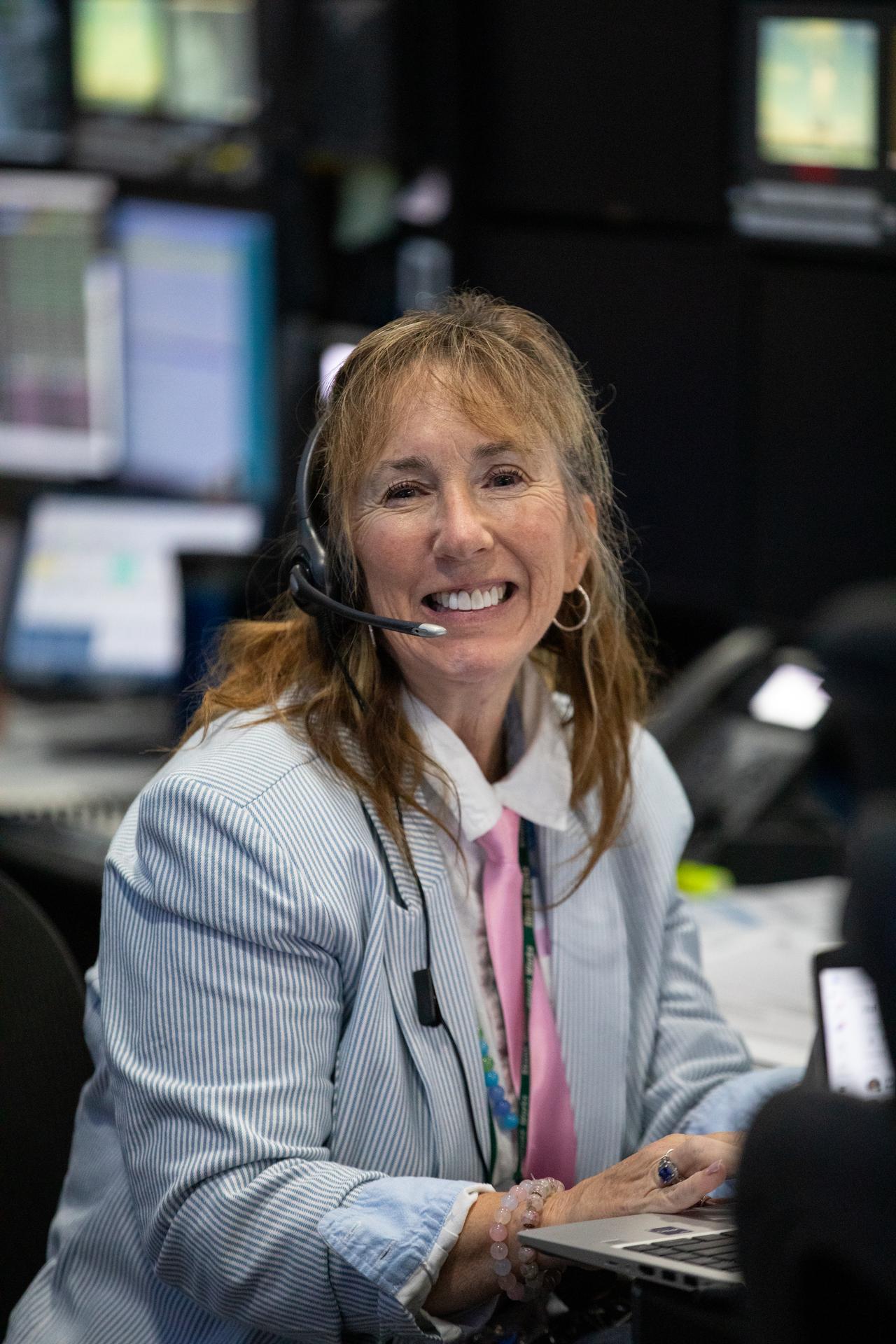
Artemis launch team members participate in an integrated launch countdown simulation for Artemis II inside Firing Room 1 of the Launch Control Center on Wednesday, Dec. 10, 2025. The training exercise involved engineers from Kennedy, Marshall Space Flight Center in Huntsville, Alabama, and Johnson Space Center in Houston coming together to rehearse all aspects of the launch countdown, from cryogenic loading – filling tanks in the SLS (Space Launch System) rocket’s core stage with liquid hydrogen and liquid oxygen – to liftoff. For Artemis II, four astronauts will venture around the Moon, the first crewed mission on NASA’s path to establishing a long-term presence for science and exploration through Artemis.
![2014-03-14-10-17-15-2[1] In the Integration Facility at the Baikonur Cosmodrome in Kazakhstan, Expedition 39/40 Flight Engineer Steve Swanson of NASA enters his Soyuz TMA-12M spacecraft during a “fit check” dress rehearsal exercise March 14 that is part of the crew’s final training. Swanson, Soyuz Commander Alexander Skvortsov of the Russian Federal Space Agency (Roscosmos) and Flight Engineer Oleg Artemyev of Roscosmos are scheduled to launch to the International Space Station March 26 (Kazakh time) for the start of a six-month mission. NASA/Victor Zelentsov](https://images-assets.nasa.gov/image/jsc2014e026275/jsc2014e026275~medium.jpg)
2014-03-14-10-17-15-2[1] In the Integration Facility at the Baikonur Cosmodrome in Kazakhstan, Expedition 39/40 Flight Engineer Steve Swanson of NASA enters his Soyuz TMA-12M spacecraft during a “fit check” dress rehearsal exercise March 14 that is part of the crew’s final training. Swanson, Soyuz Commander Alexander Skvortsov of the Russian Federal Space Agency (Roscosmos) and Flight Engineer Oleg Artemyev of Roscosmos are scheduled to launch to the International Space Station March 26 (Kazakh time) for the start of a six-month mission. NASA/Victor Zelentsov
![2014-03-14-14-15-17[1] In the Integration Facility at the Baikonur Cosmodrome in Kazakhstan, Expedition 39/40 Flight Engineer Steve Swanson of NASA poses for a picture in the Soyuz TMA-12M spacecraft during a “fit check” dress rehearsal exercise March 14 that is part of the crew’s final training. Swanson, Soyuz Commander Alexander Skvortsov of the Russian Federal Space Agency (Roscosmos) and Flight Engineer Oleg Artemyev of Roscosmos are scheduled to launch to the International Space Station March 26 (Kazakh time) for the start of a six-month mission. NASA/Victor Zelentsov](https://images-assets.nasa.gov/image/jsc2014e026285/jsc2014e026285~medium.jpg)
2014-03-14-14-15-17[1] In the Integration Facility at the Baikonur Cosmodrome in Kazakhstan, Expedition 39/40 Flight Engineer Steve Swanson of NASA poses for a picture in the Soyuz TMA-12M spacecraft during a “fit check” dress rehearsal exercise March 14 that is part of the crew’s final training. Swanson, Soyuz Commander Alexander Skvortsov of the Russian Federal Space Agency (Roscosmos) and Flight Engineer Oleg Artemyev of Roscosmos are scheduled to launch to the International Space Station March 26 (Kazakh time) for the start of a six-month mission. NASA/Victor Zelentsov

The “rookie” on the STS-92 mission, Pilot Pamela Ann Melroy has her new launch and entry suit adjusted during pre-pack and fit check in the Operations and Checkout Building. Melroy and the rest of the crew are at KSC for Terminal Countdown Demonstration Test activities. The TCDT provides emergency egress training, simulated countdown exercises and opportunities to inspect the mission payload. STS-92 is scheduled to launch Oct. 5 at 9:38 p.m. EDT from Launch Pad 39A on the fifth flight to the International Space Station. It will carry two elements of the Space Station, the Integrated Truss Structure Z1 and the third Pressurized Mating Adapter. The mission is also the 100th flight in the Shuttle program
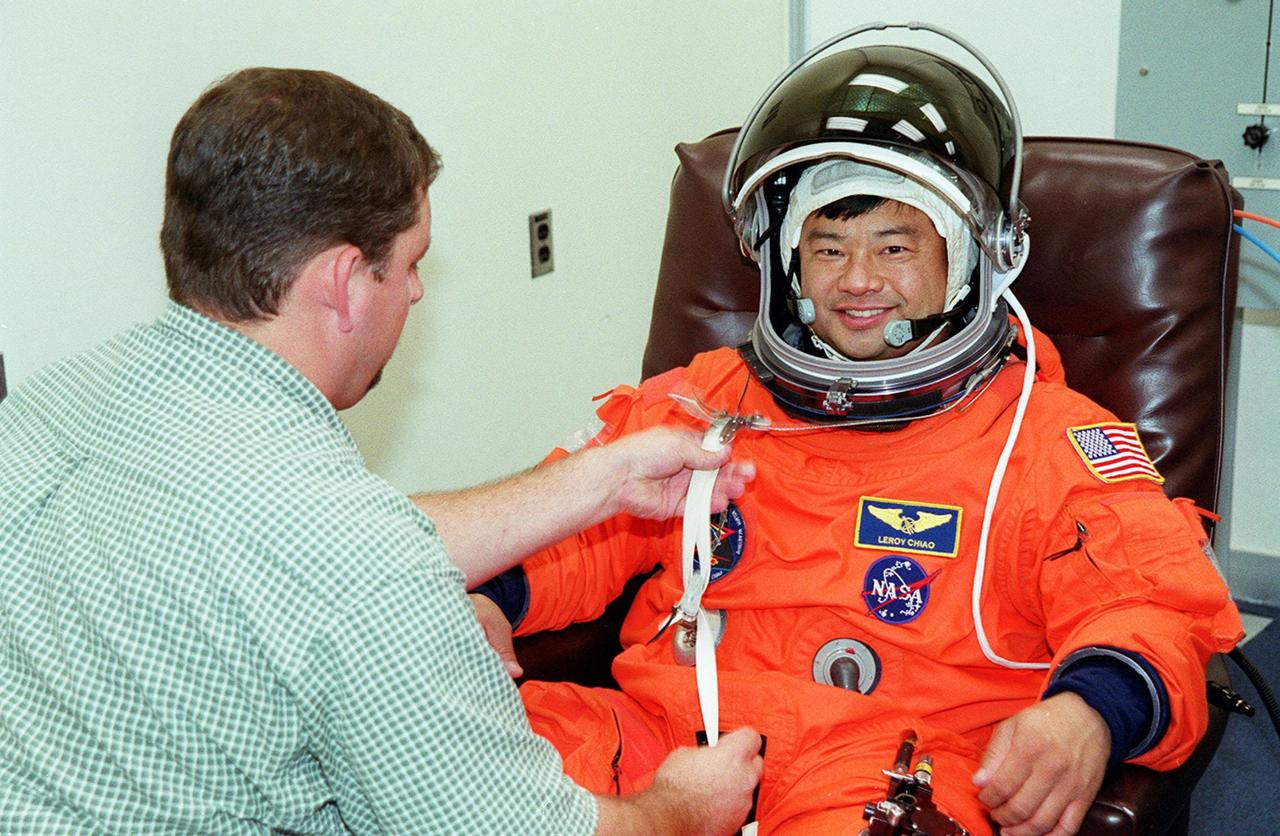
In the Operations and Checkout Building, STS-92 Mission Specialist Leroy Chiao has his launch and entry suit adjusted during fit check. Chiao and the rest of the crew are at KSC for Terminal Countdown Demonstration Test activities. The TCDT provides emergency egress training, simulated countdown exercises and opportunities to inspect the mission payload. This mission will be Chiao’s third Shuttle flight. STS-92 is scheduled to launch Oct. 5 at 9:38 p.m. EDT from Launch Pad 39A on the fifth flight to the International Space Station. It will carry two elements of the Space Station, the Integrated Truss Structure Z1 and the third Pressurized Mating Adapter. The mission is also the 100th flight in the Shuttle program
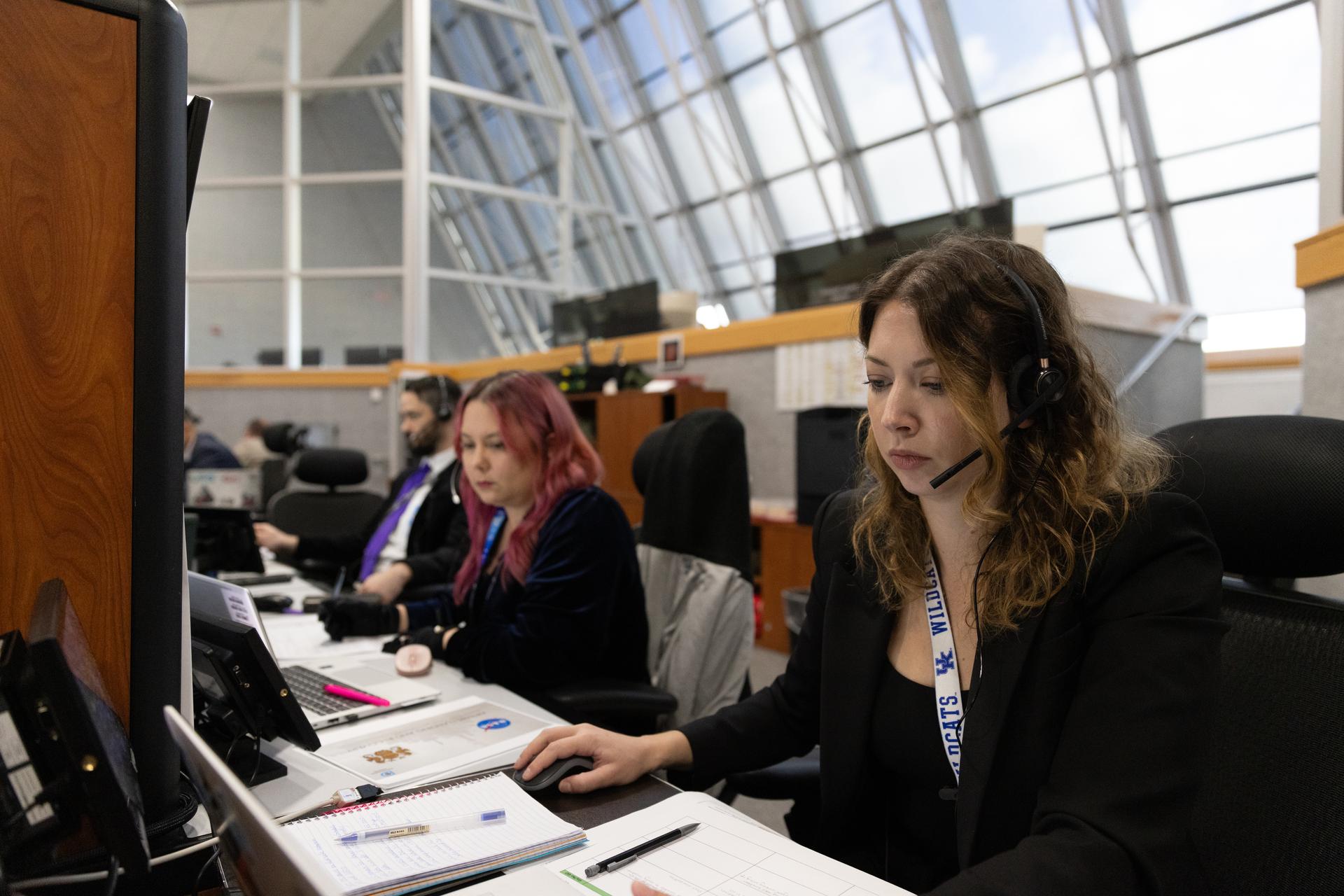
Artemis launch team members participate in an integrated launch countdown simulation for Artemis II inside Firing Room 1 of the Launch Control Center on Wednesday, Dec. 10, 2025. The training exercise involved engineers from Kennedy, Marshall Space Flight Center in Huntsville, Alabama, and Johnson Space Center in Houston coming together to rehearse all aspects of the launch countdown, from cryogenic loading – filling tanks in the SLS (Space Launch System) rocket’s core stage with liquid hydrogen and liquid oxygen – to liftoff. For Artemis II, four astronauts will venture around the Moon, the first crewed mission on NASA’s path to establishing a long-term presence for science and exploration through Artemis.
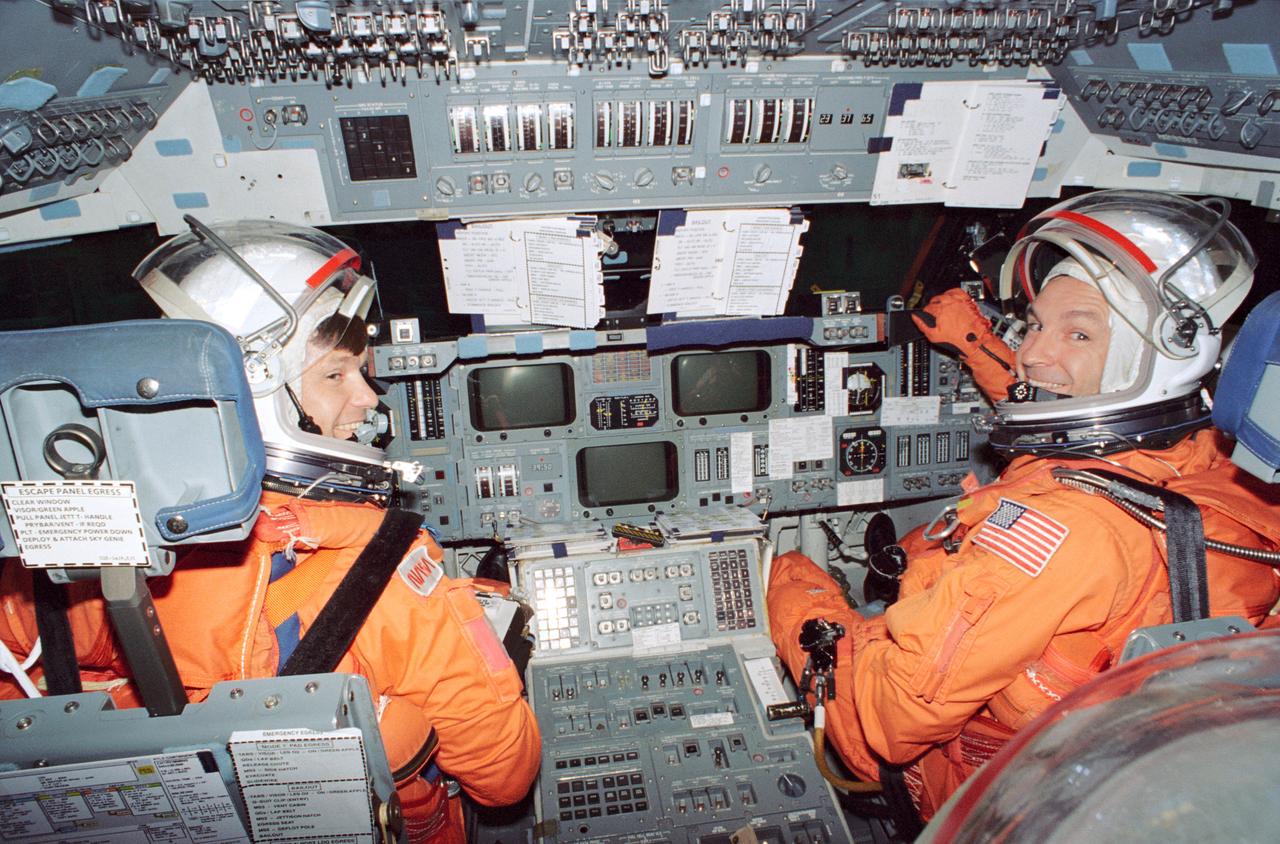
S94-40090 (23 June 1994) --- Astronauts Donald R. McMonagle, left, and Curtis L. Brown man the commander's and pilot's stations, respectively, during a rehearsal of ascent and entry phases of their scheduled November 1994 flight aboard Atlantis. Three other NASA astronauts and a European mission specialist joined the two for this training exercise in the Crew Compartment Trainer (CCT) at the Johnson Space Center's (JSC) Shuttle Mockup and Integration Laboratory and will join them aboard the Space Shuttle Atlantis in November. The flight is manifest to support the Atmospheric Laboratory for Applications and Science (ATLAS-3) mission.
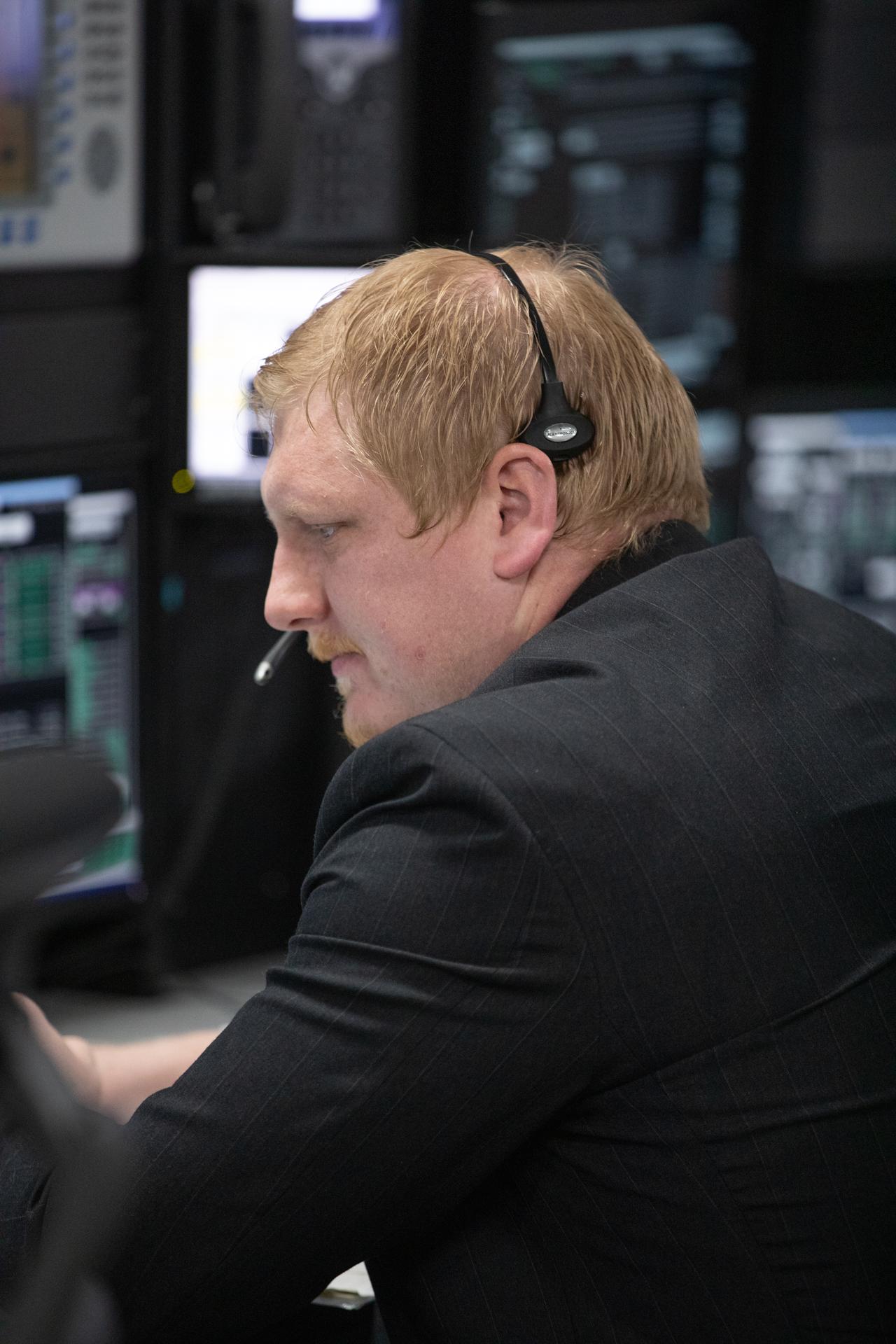
Artemis launch team members participate in an integrated launch countdown simulation for Artemis II inside Firing Room 1 of the Launch Control Center on Wednesday, Dec. 10, 2025. The training exercise involved engineers from Kennedy, Marshall Space Flight Center in Huntsville, Alabama, and Johnson Space Center in Houston coming together to rehearse all aspects of the launch countdown, from cryogenic loading – filling tanks in the SLS (Space Launch System) rocket’s core stage with liquid hydrogen and liquid oxygen – to liftoff. For Artemis II, four astronauts will venture around the Moon, the first crewed mission on NASA’s path to establishing a long-term presence for science and exploration through Artemis.
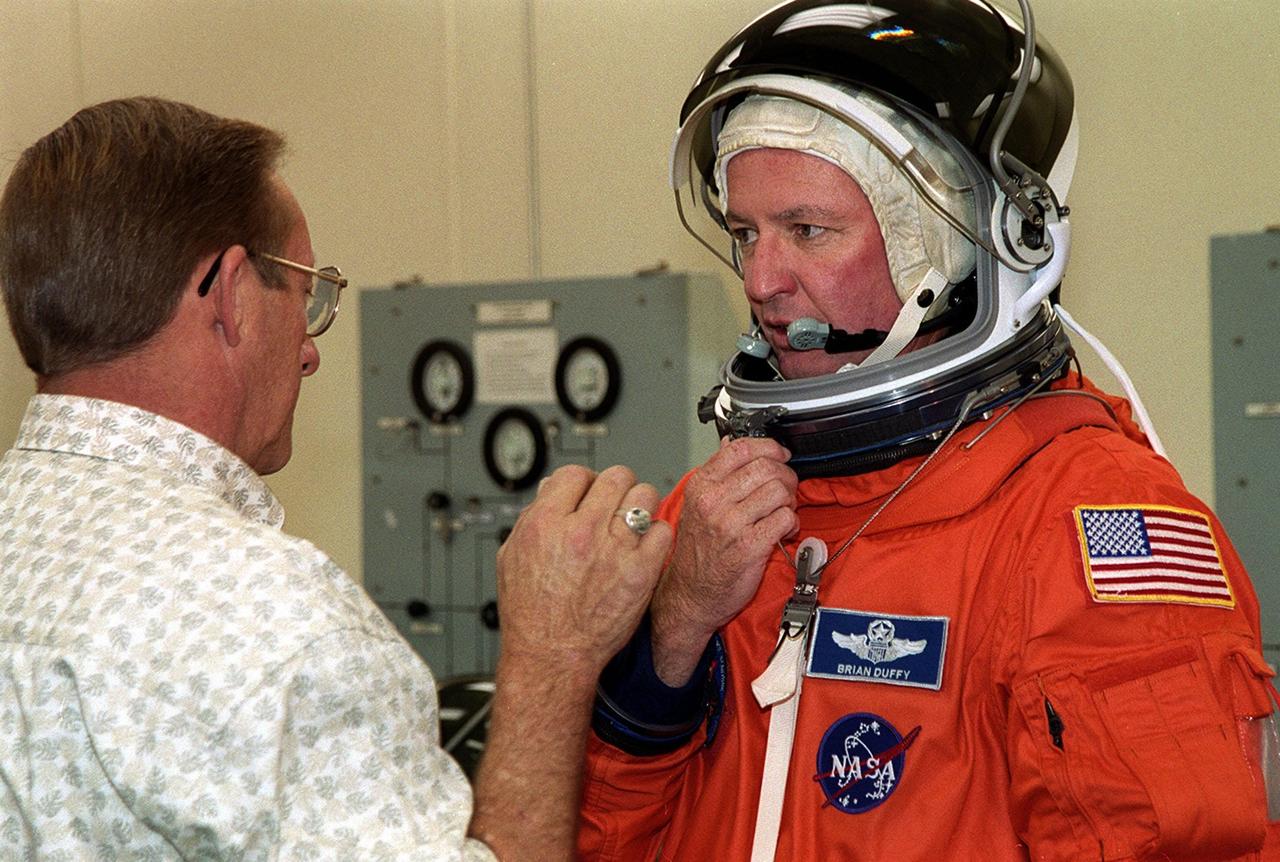
During pre-pack and fit check on his launch and entry suit, STS-92 Commander Brian Duffy adjusts his helmet. Duffy and the rest of the crew are at KSC for Terminal Countdown Demonstration Test activities. The TCDT provides emergency egress training, simulated countdown exercises and opportunities to inspect the mission payload. This mission will be Duffy’s fourth Shuttle flight. STS-92 is scheduled to launch Oct. 5 at 9:38 p.m. EDT from Launch Pad 39A on the fifth flight to the International Space Station. It will carry two elements of the Space Station, the Integrated Truss Structure Z1 and the third Pressurized Mating Adapter. The mission is also the 100th flight in the Shuttle program
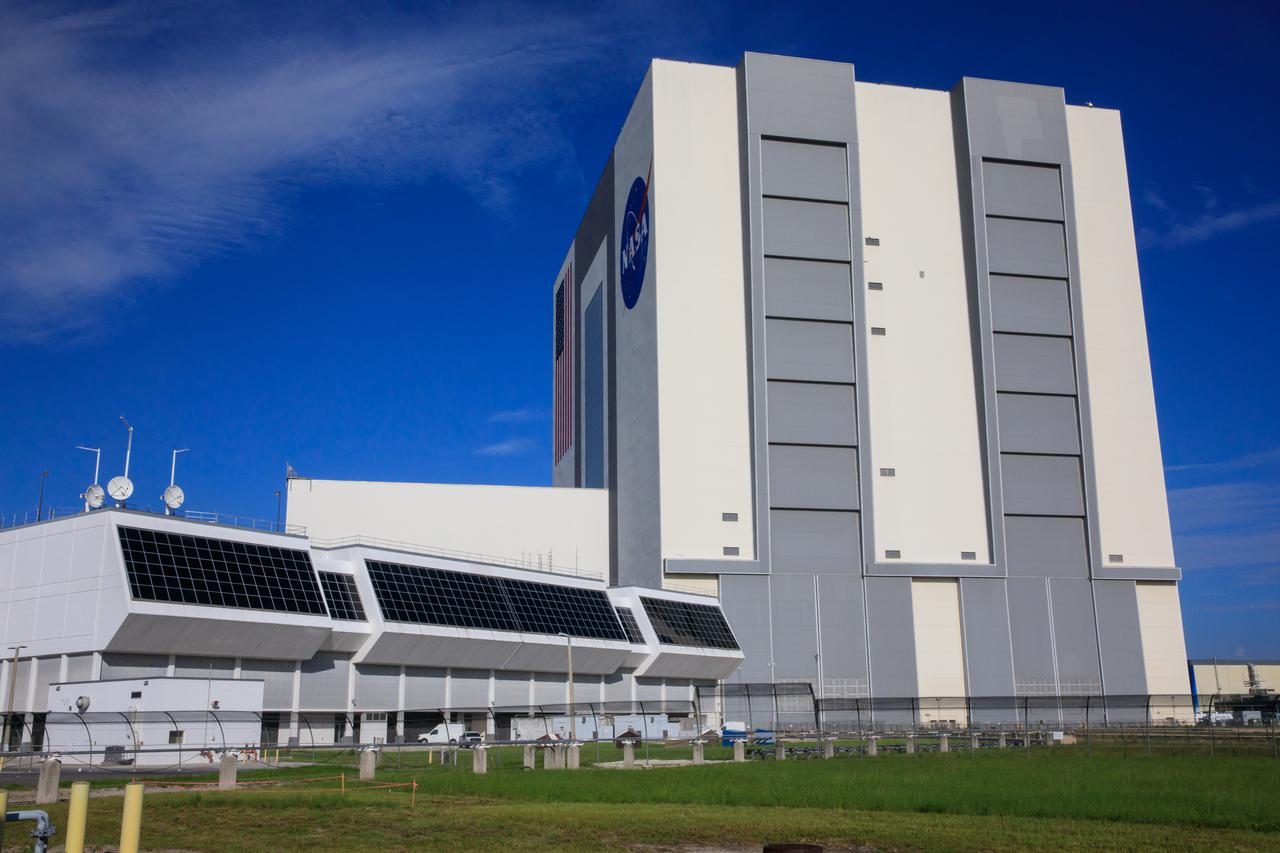
Seen here is an exterior view of the Launch Control Center (LCC) at NASA’s Kennedy Space Center in Florida, located next to the iconic Vehicle Assembly Building, on July 8, 2021. The LCC will house the team of engineers responsible for launching the Space Launch System (SLS) rocket and Orion spacecraft for the Artemis I mission. On July 8, teams from Kennedy, Marshall Space Flight Center in Alabama, and Johnson Space Center in Houston came together to perform the first joint integrated launch countdown simulation for Artemis I. The training exercise involved rehearsing all aspects of the launch countdown, from cryogenic loading – filling tanks in the Space Launch System (SLS) rocket’s core stage with liquid hydrogen and liquid oxygen – to liftoff. These simulations will help certify that the launch team is ready for Artemis I – the first test flight of SLS and Orion as an integrated system prior to crewed flights to the Moon.
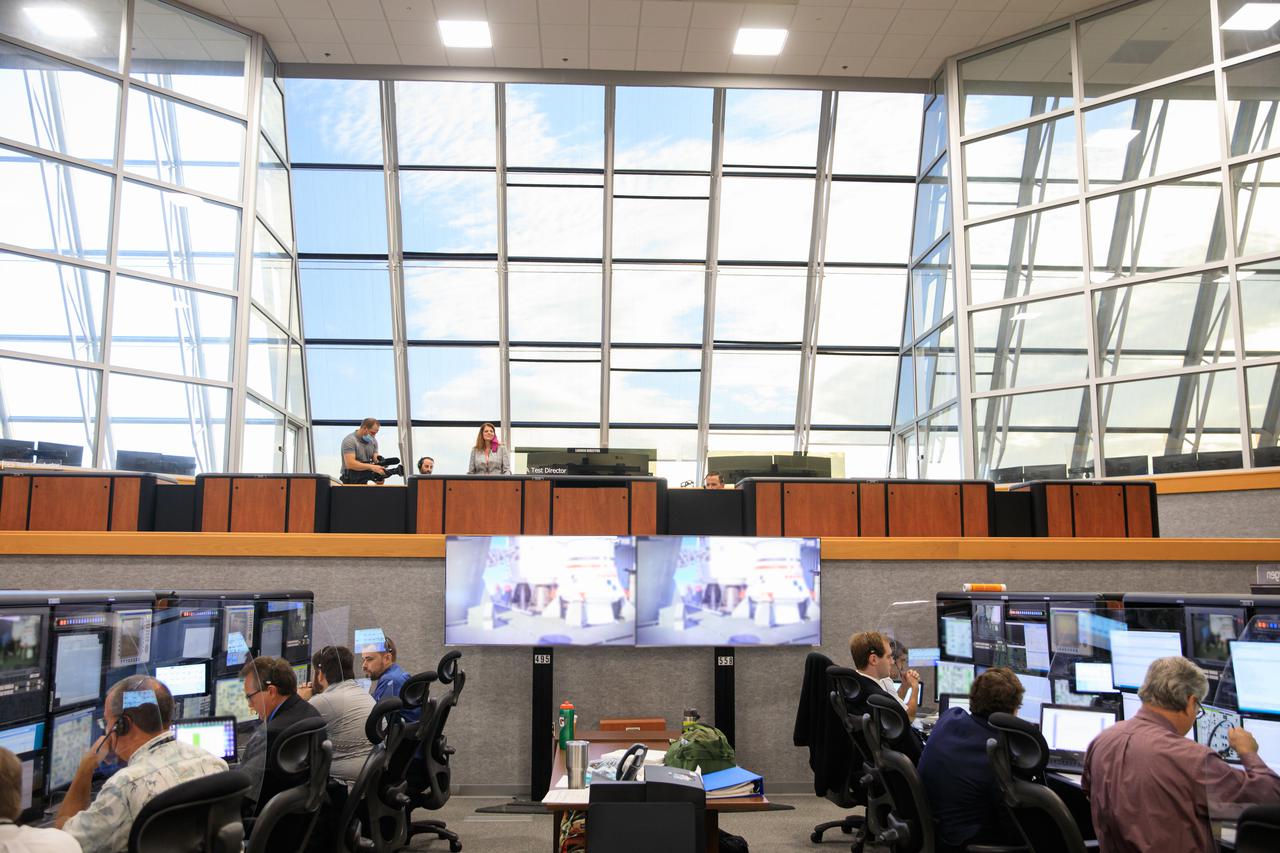
Teams at NASA’s Kennedy Space Center in Florida participate in the first joint integrated launch countdown simulation for Artemis I inside Firing Room 1 of the Launch Control Center on July 8, 2021. Seen at the top of the room is Charlie Blackwell-Thompson (right), the launch director for Artemis I. The training exercise involved engineers from Kennedy, Marshall Space Flight Center in Alabama, and Johnson Space Center in Houston coming together to rehearse all aspects of the launch countdown, from cryogenic loading – filling tanks in the Space Launch System (SLS) rocket’s core stage with liquid hydrogen and liquid oxygen – to liftoff. These simulations will help certify that the launch team is ready for Artemis I – the first test flight of SLS and Orion as an integrated system prior to crewed flights to the Moon.
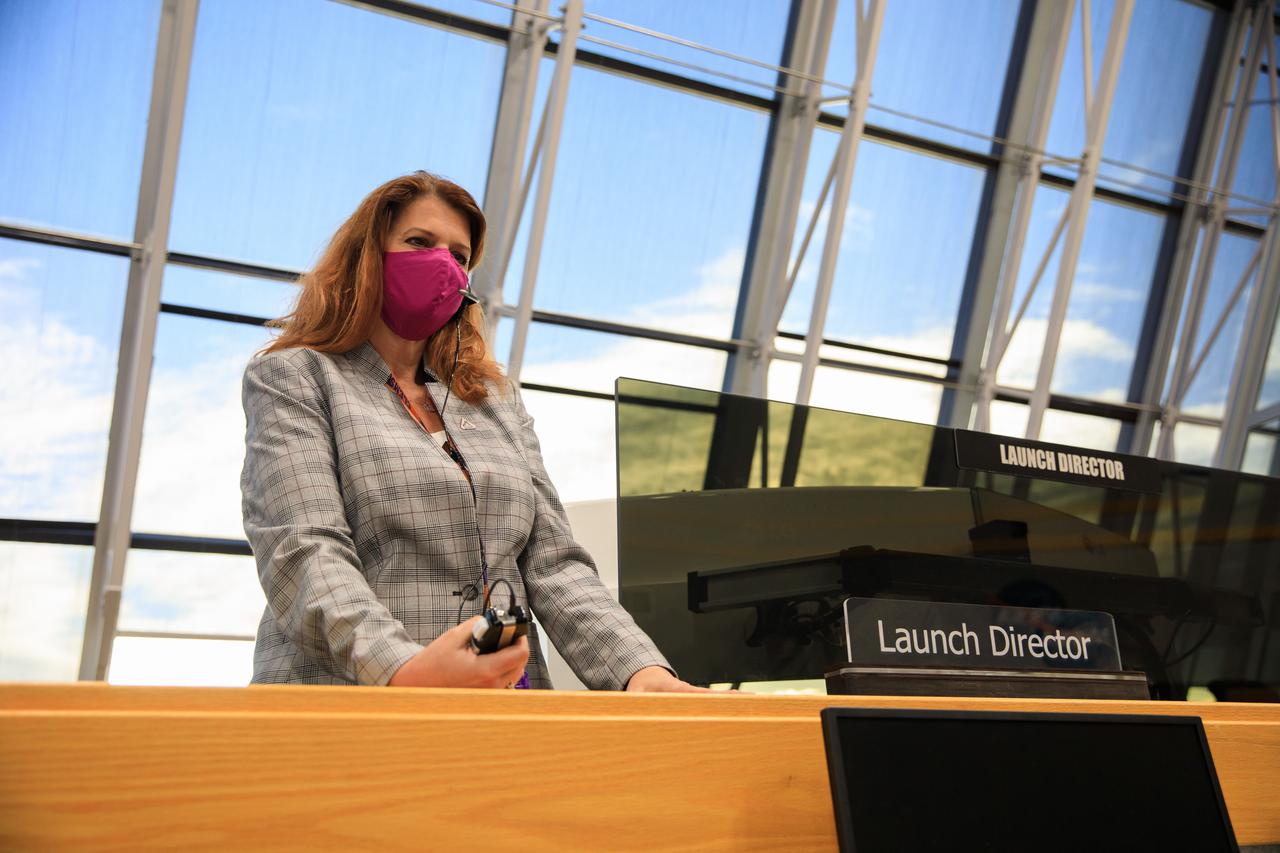
Artemis I Launch Director Charlie Blackwell-Thompson participates in the first joint integrated launch countdown simulation for Artemis I inside Firing Room 1 of the Launch Control Center at NASA’s Kennedy Space Center in Florida on July 8, 2021. The training exercise involved engineers from Kennedy, Marshall Space Flight Center in Alabama, and Johnson Space Center in Houston coming together to rehearse all aspects of the launch countdown, from cryogenic loading – filling tanks in the Space Launch System (SLS) rocket’s core stage with liquid hydrogen and liquid oxygen – to liftoff. These simulations will help certify that the launch team is ready for Artemis I – the first test flight of SLS and Orion as an integrated system prior to crewed flights to the Moon.
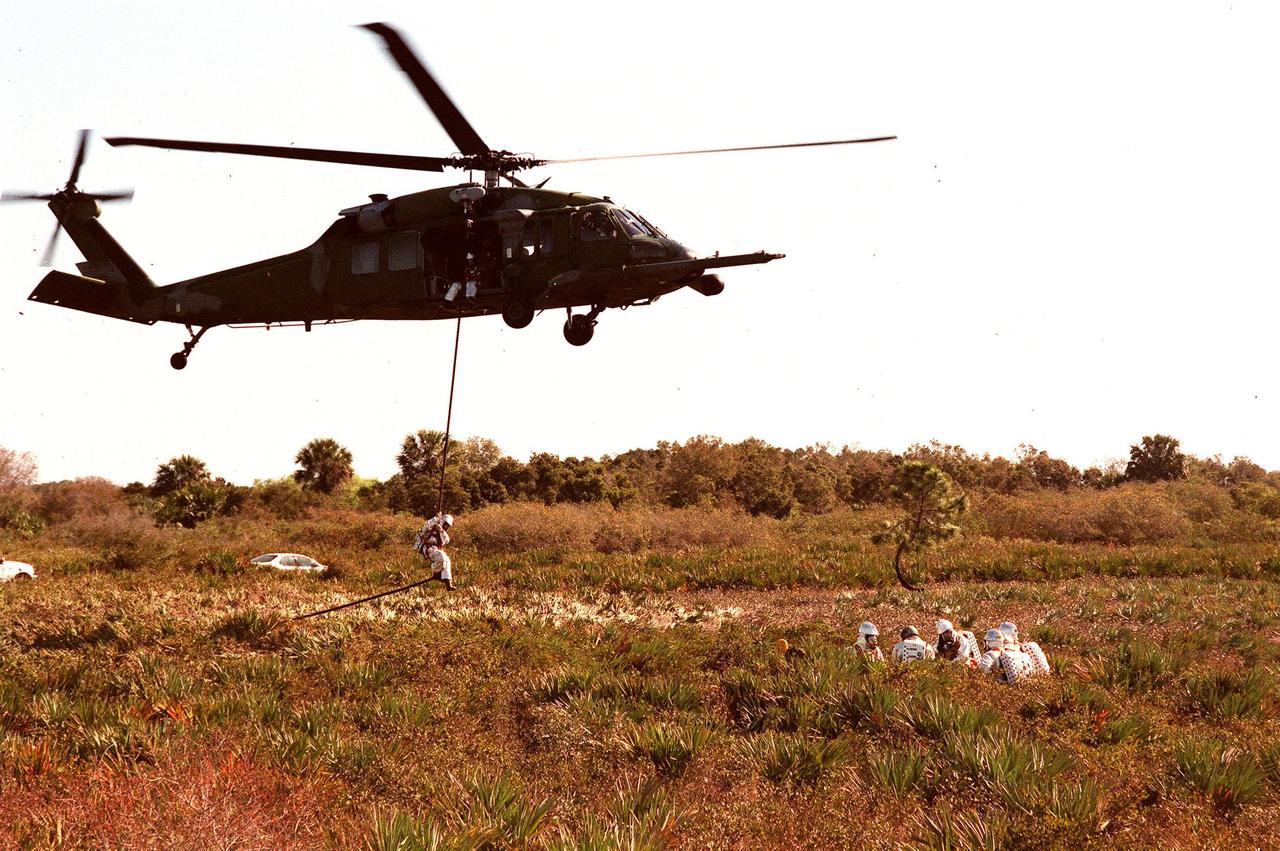
KENNEDY SPACE CENTER, FLA. -- During a simulated rescue mission in the woods near the Shuttle Landing Facility (SLF), a fire/rescue worker practices disembarking from an Air Force HH-60 helicopter. The KSC response team is training for the unlikely scenario of a Shuttle mishap at the SLF. The Mode 7 simulation of an astronaut rescue exercises all aspects of command and control, search and rescue, and medical procedures required for a successful rescue. The remote location of the mock-up prevents a totally land-based crew rescue, and calls on a NASA UH-1 helicopter to locate the site and four Air Force HH-60 helicopters to drop emergency equipment and fire/rescue workers to prepare the "crew" for preliminary traige. The helicopters are used later to remove the crew five astronaut candidates, one representative from the Vehicle Integration Test office, and one fire/rescue worker. The exercise will conclude with airlifted "patients" arriving safely in the emergency rooms of participating area hospitals
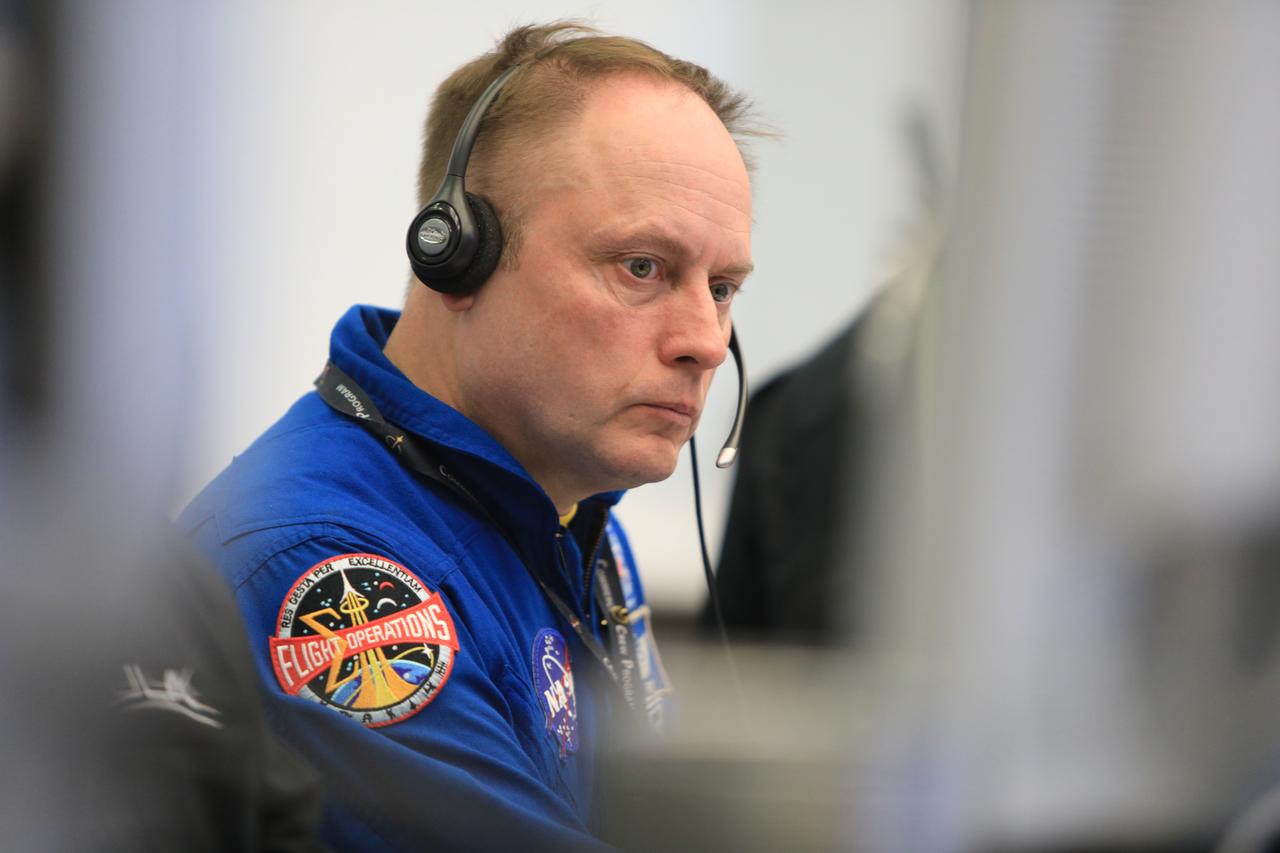
Along with the joint team that will launch the United Launch Alliance (ULA) Atlas V rocket and Boeing’s CST-100 Starliner in Boeing’s Orbital Flight Test, NASA astronaut Michael Fincke participated in a successful Integrated Crew Exercise on Feb. 12. NASA, ULA, Boeing and Department of Defense personnel executed a mock countdown that practiced fueling the rocket and operating on the unique launch day timeline that features a four-hour built-in hold at the T-minus 4 minute mark. Fincke will fly on Boeing’s Crew Flight Test (CFT), scheduled to launch no earlier than August 2019. OFT and CFT are Boeing’s uncrewed and crewed flight tests of Starliner and part of NASA’s Commercial Crew Program, which will return human spaceflight launches into low-Earth orbit from U.S. soil.
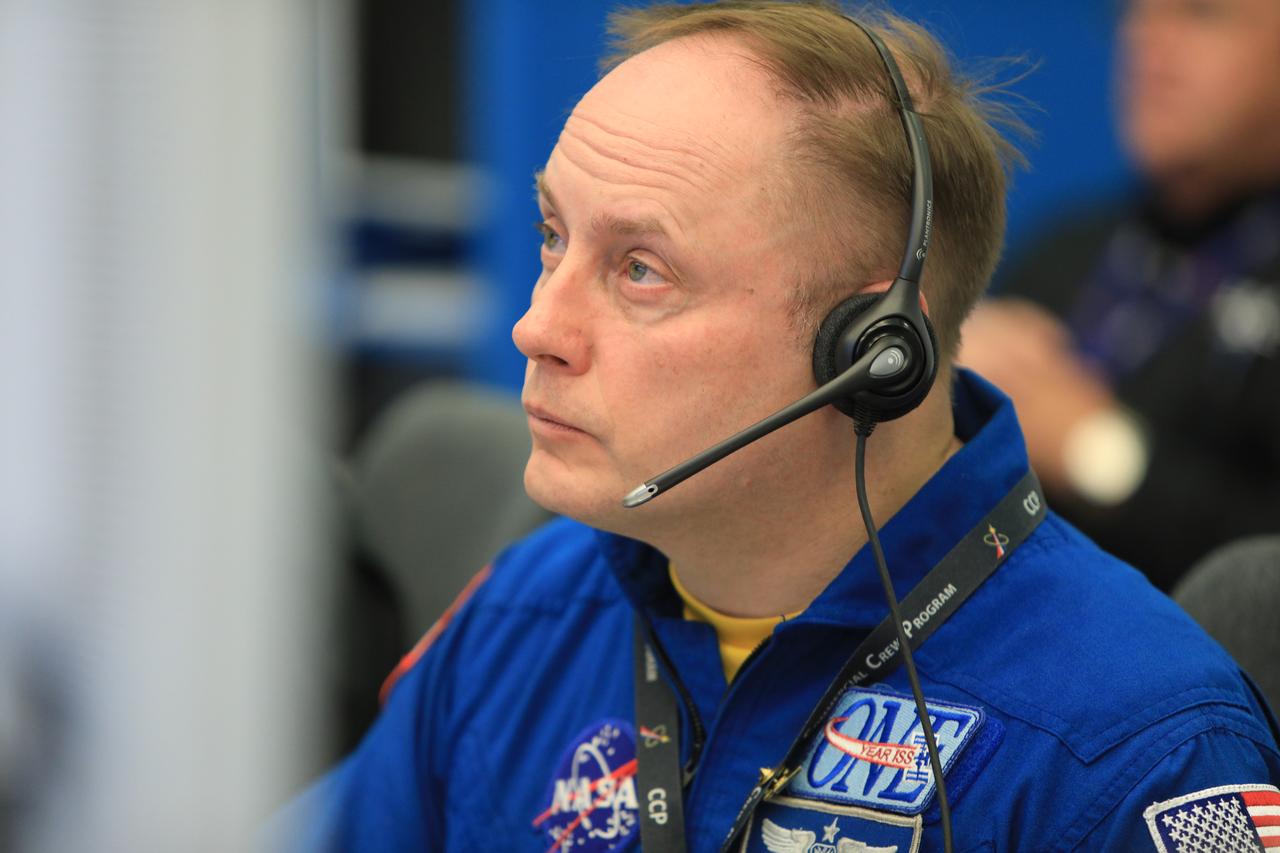
Along with the joint team that will launch the United Launch Alliance (ULA) Atlas V rocket and Boeing’s CST-100 Starliner in Boeing’s Orbital Flight Test, NASA astronaut Michael Fincke participated in a successful Integrated Crew Exercise on Feb. 12. NASA, ULA, Boeing and Department of Defense personnel executed a mock countdown that practiced fueling the rocket and operating on the unique launch day timeline that features a four-hour built-in hold at the T-minus 4 minute mark. Fincke will fly on Boeing’s Crew Flight Test (CFT), scheduled to launch no earlier than August 2019. OFT and CFT are Boeing’s uncrewed and crewed flight tests of Starliner and part of NASA’s Commercial Crew Program, which will return human spaceflight launches into low-Earth orbit from U.S. soil.
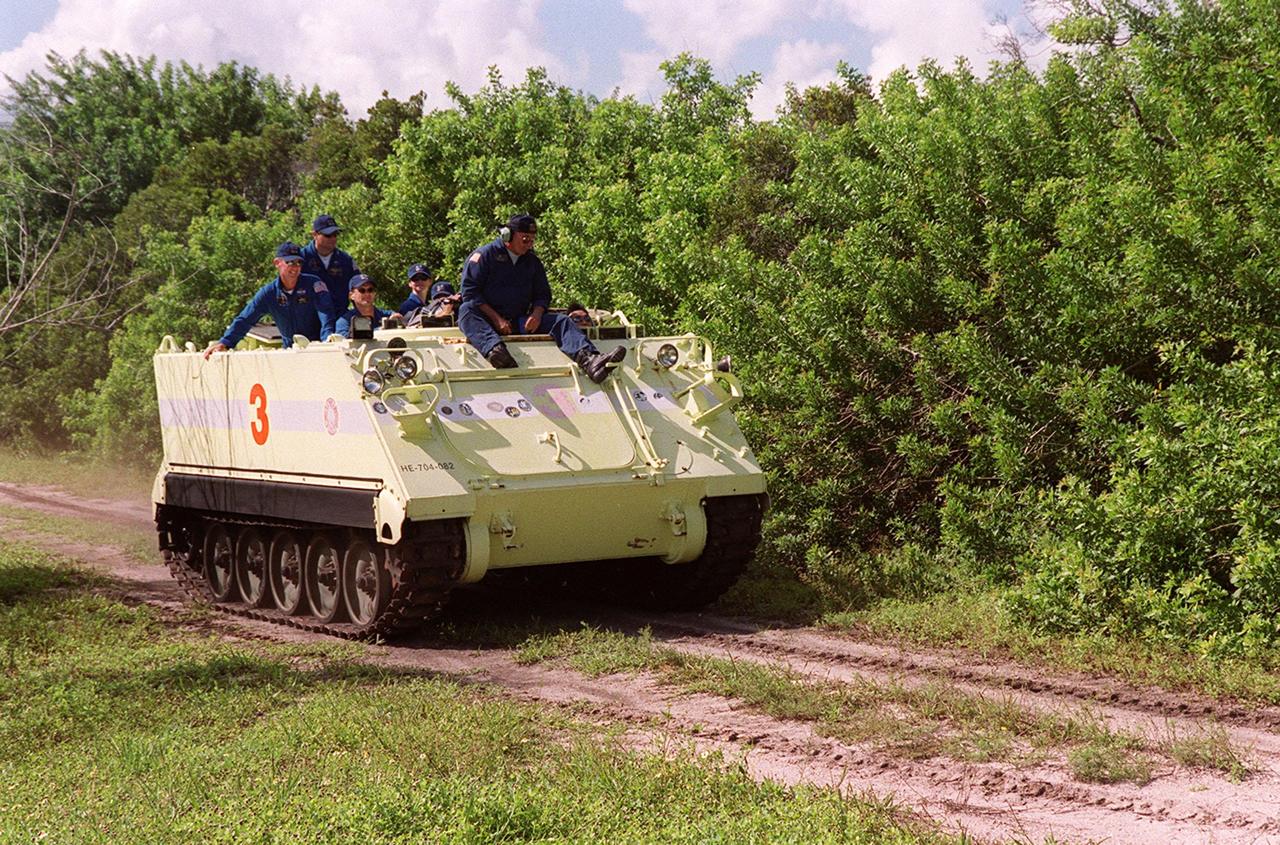
With Capt. George Hoggard, trainer with the KSC Fire Department, riding on top, Mission Specialist Koichi Wakata of Japan practices driving the M-113, part of emergency egress training during Terminal Countdown Demonstration Test (TCDT) activities. Riding in the back (on the left) are other crew members, waiting their turn to drive. The tracked vehicle could be used by the crew in the event of an emergency at the pad during which the crew must make a quick exit from the area. The TCDT also provides simulated countdown exercises and opportunities to inspect the mission payloads in the orbiter’s payload bay. STS-92 is scheduled to launch Oct. 5 at 9:30 p.m. EDT on the fifth flight to the International Space Station. It will carry two elements of the Space Station, the Integrated Truss Structure Z1 and the third Pressurized Mating Adapter. The mission is also the 100th flight in the Shuttle program
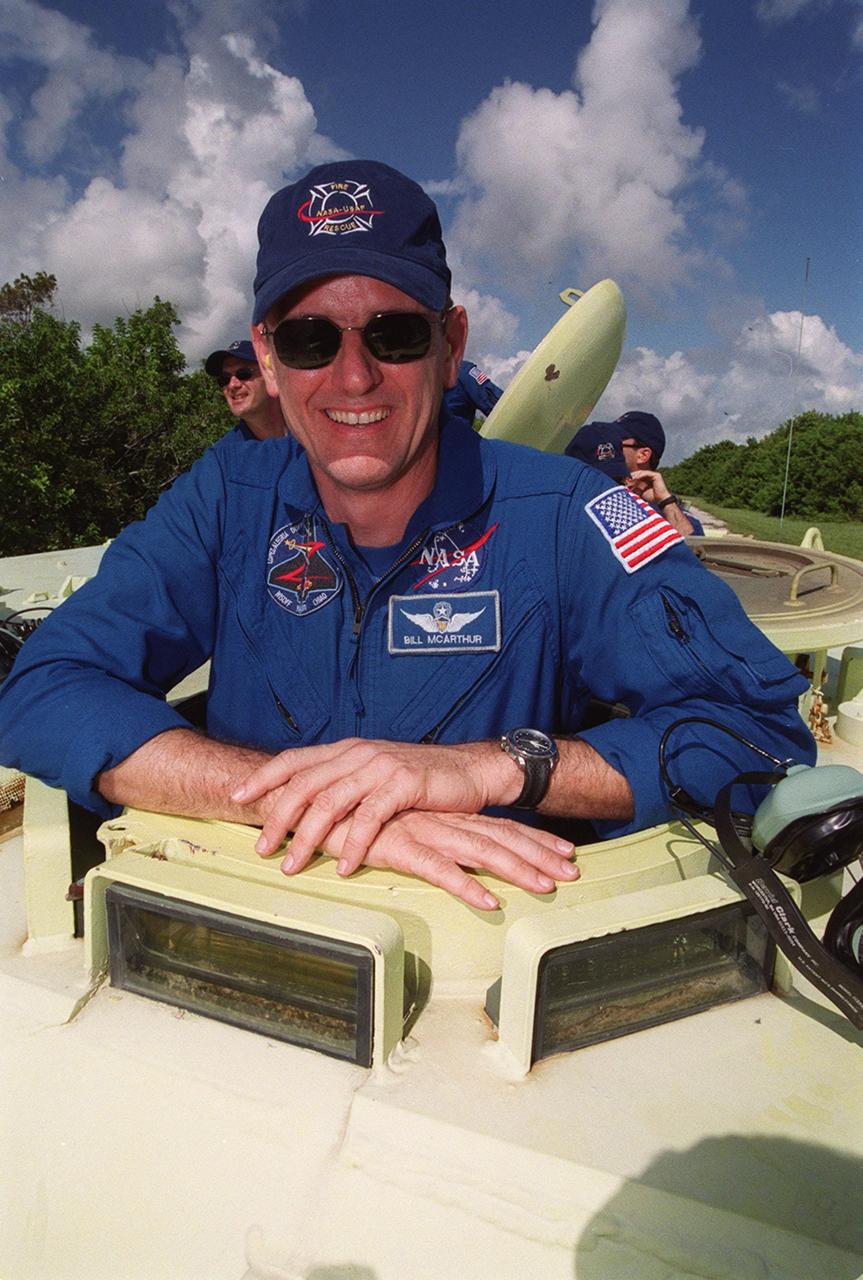
STS-92 Mission Specialist Bill McArthur gets ready to take his turn at driving the M-113, part of emergency egress training during Terminal Countdown Demonstration Test (TCDT) activities. Behind him (left) is Mission Specialist Jeff Wisoff, waiting his turn to drive along with other unidentified crew members.; The tracked vehicle could be used by the crew in the event of an emergency at the pad during which the crew must make a quick exit from the area. The TCDT also provides simulated countdown exercises and opportunities to inspect the mission payloads in the orbiter’s payload bay. STS-92 is scheduled to launch Oct. 5 at 9:30 p.m. EDT on the fifth flight to the International Space Station. It will carry two elements of the Space Station, the Integrated Truss Structure Z1 and the third Pressurized Mating Adapter. The mission is also the 100th flight in the Shuttle program
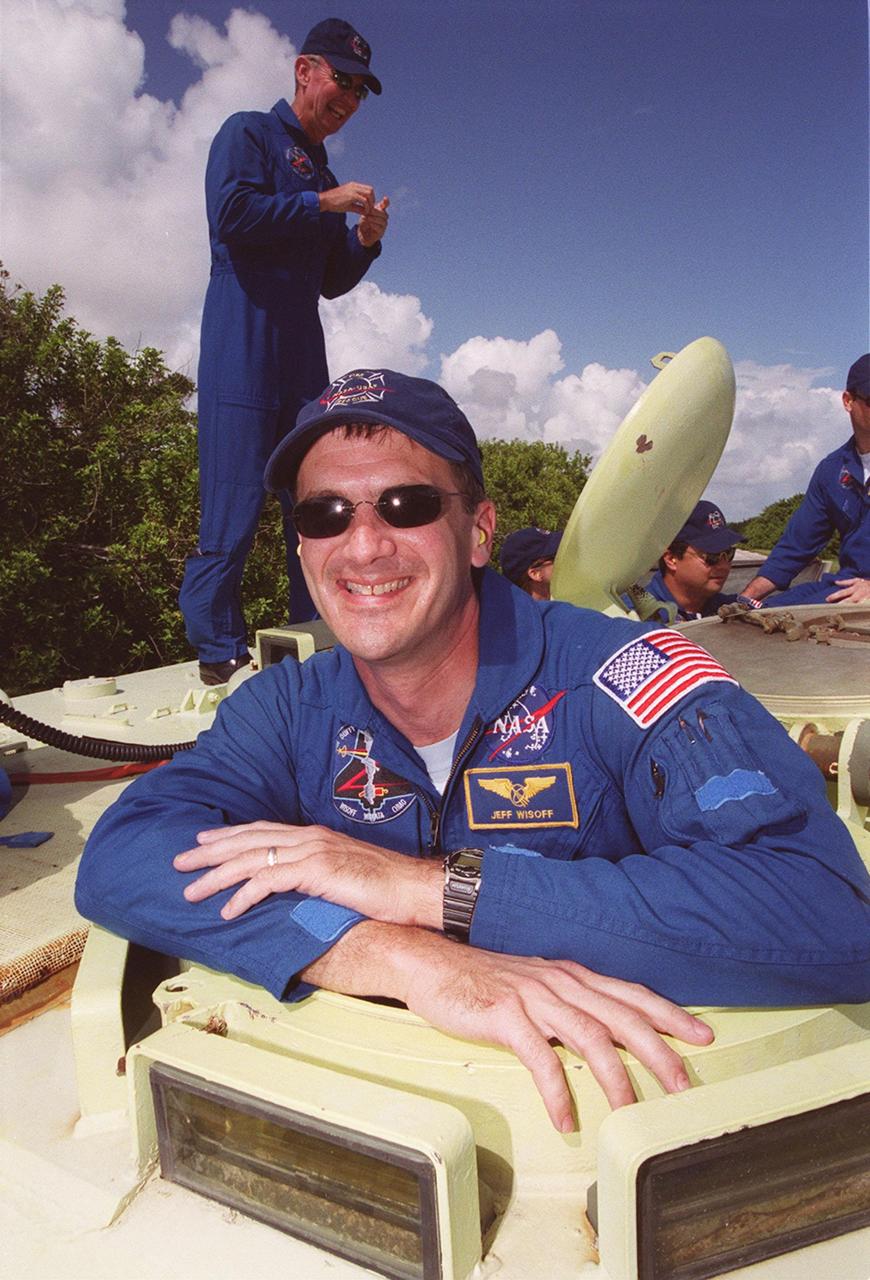
STS-92 Mission Specialist Jeff Wisoff happily anticipates his chance to drive the M-113 he is in. Behind him are Commander Brian Duffy (left) and Mission Specialist Leroy Chiao, along with other crew members. Part of emergency egress training during Terminal Countdown Demonstration Test (TCDT) activities, the tracked vehicle could be used by the crew in the event of an emergency at the pad during which the crew must make a quick exit from the area. The TCDT also provides simulated countdown exercises and opportunities to inspect the mission payloads in the orbiter’s payload bay. STS-92 is scheduled to launch Oct. 5 at 9:30 p.m. EDT on the fifth flight to the International Space Station. It will carry two elements of the Space Station, the Integrated Truss Structure Z1 and the third Pressurized Mating Adapter. The mission is also the 100th flight in the Shuttle program
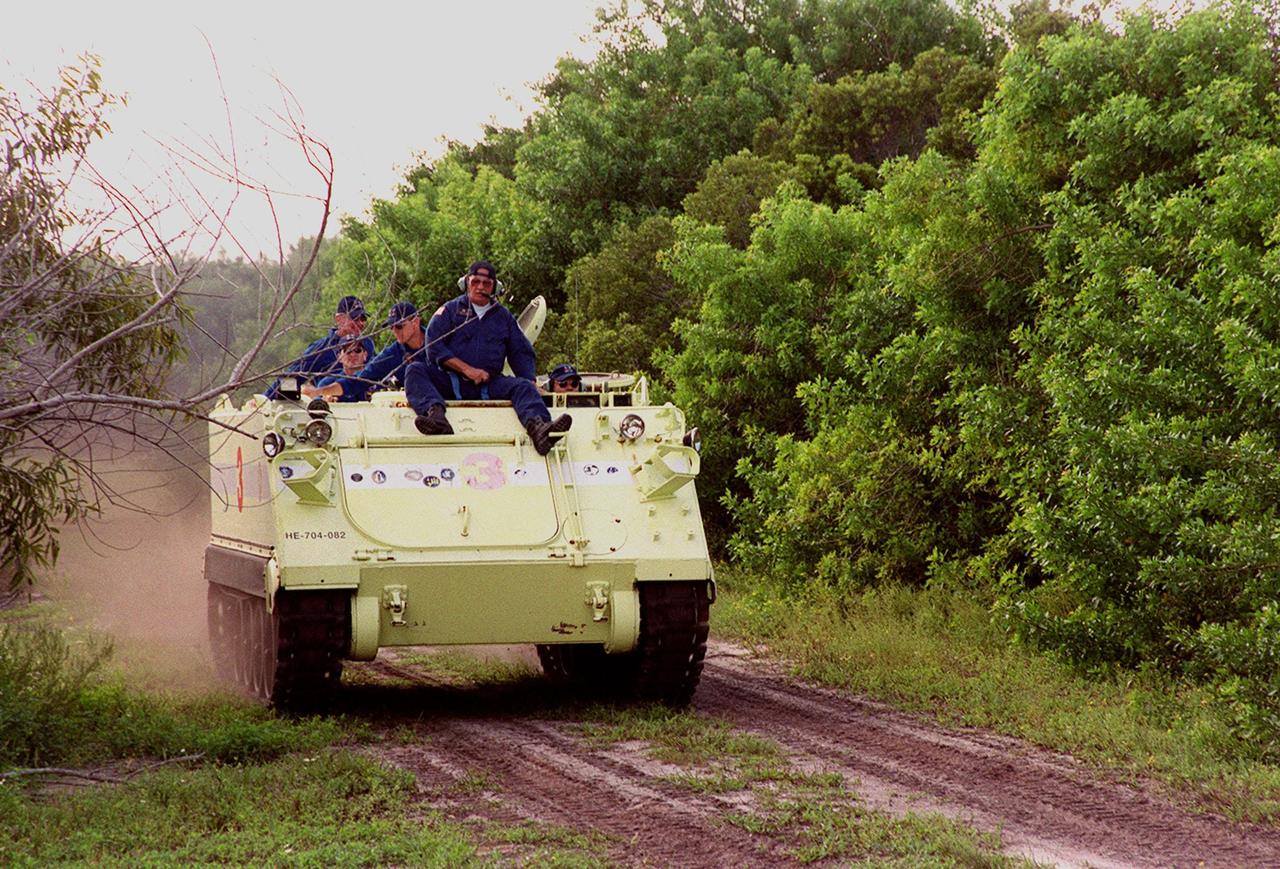
With other crew members in the back, STS-92 Mission Specialist Leroy Chiao races the M-113 along the track through the scrub. Driving the M-113 is part of emergency egress training during Terminal Countdown Demonstration Test (TCDT) activities. The tracked vehicle could be used by the crew in the event of an emergency at the pad during which the crew must make a quick exit from the area. The TCDT also provides simulated countdown exercises and opportunities to inspect the mission payloads in the orbiter’s payload bay. STS-92 is scheduled to launch Oct. 5 at 9:30 p.m. EDT on the fifth flight to the International Space Station. It will carry two elements of the Space Station, the Integrated Truss Structure Z1 and the third Pressurized Mating Adapter. The mission is also the 100th flight in the Shuttle program
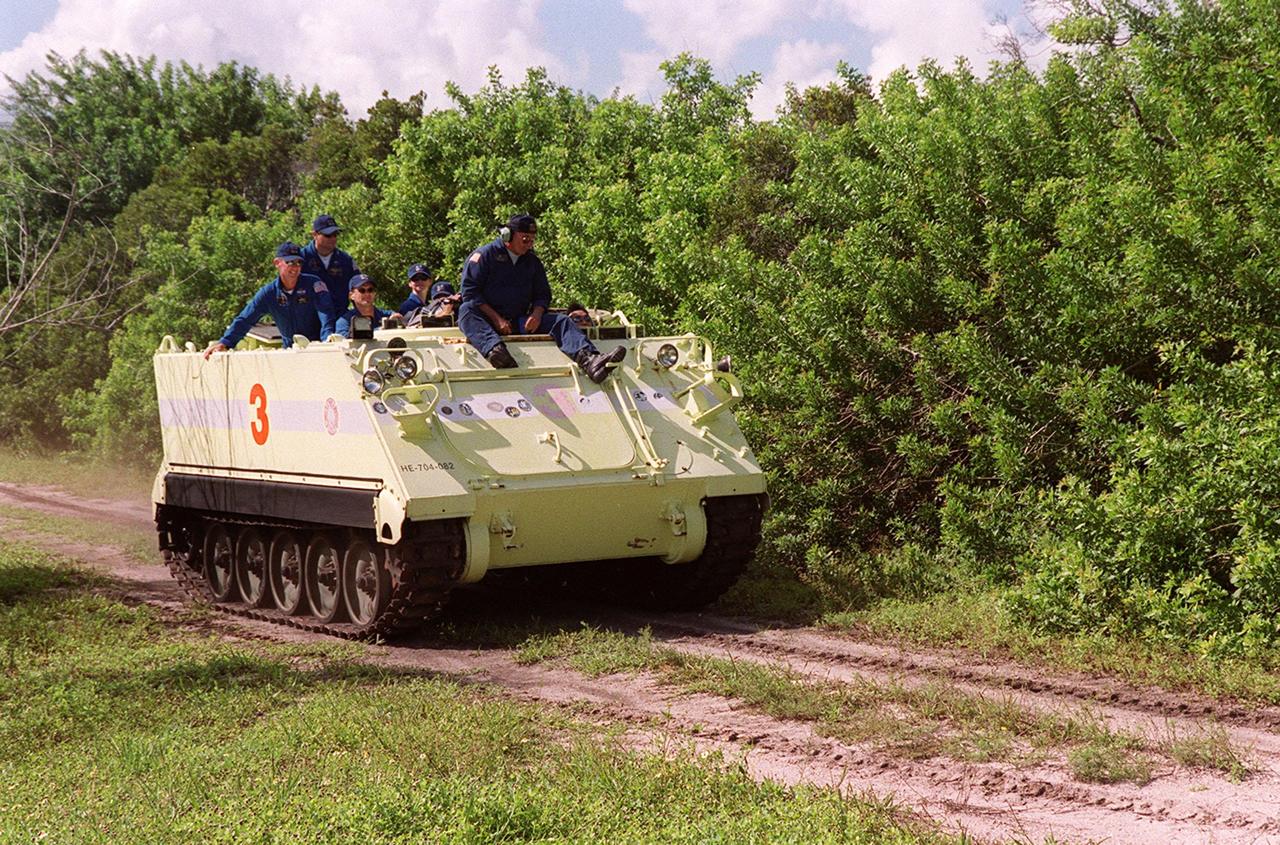
With Capt. George Hoggard, trainer with the KSC Fire Department, riding on top, Mission Specialist Koichi Wakata of Japan practices driving the M-113, part of emergency egress training during Terminal Countdown Demonstration Test (TCDT) activities. Riding in the back (on the left) are other crew members, waiting their turn to drive. The tracked vehicle could be used by the crew in the event of an emergency at the pad during which the crew must make a quick exit from the area. The TCDT also provides simulated countdown exercises and opportunities to inspect the mission payloads in the orbiter’s payload bay. STS-92 is scheduled to launch Oct. 5 at 9:30 p.m. EDT on the fifth flight to the International Space Station. It will carry two elements of the Space Station, the Integrated Truss Structure Z1 and the third Pressurized Mating Adapter. The mission is also the 100th flight in the Shuttle program
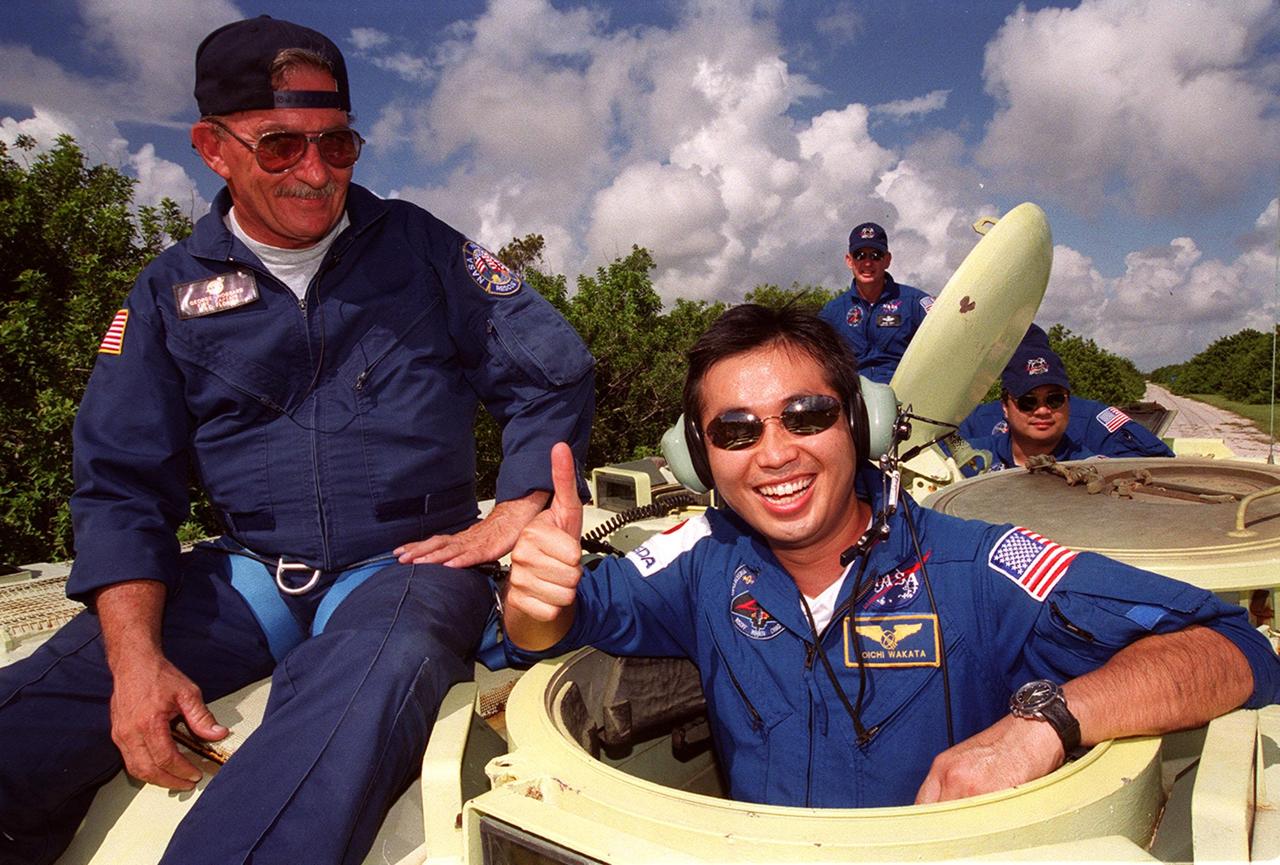
STS-92 Mission Specialist Koichi Wakata of Japan signals a successful driving lesson on the M-113 he is in. Capt. George Hoggard, trainer with the KSC Fire Department, sits on top. Behind Wakata are Commander Brian Duffy (left) and Leroy Chiao (right), waiting their turns. The practice drive is part of emergency egress training during Terminal Countdown Demonstration Test (TCDT) activities. The tracked vehicle could be used by the crew in the event of an emergency at the pad during which the crew must make a quick exit from the area. The TCDT also provides simulated countdown exercises and opportunities to inspect the mission payloads in the orbiter’s payload bay. STS-92 is scheduled to launch Oct. 5 at 9:30 p.m. EDT on the fifth flight to the International Space Station. It will carry two elements of the Space Station, the Integrated Truss Structure Z1 and the third Pressurized Mating Adapter. The mission is also the 100th flight in the Shuttle program
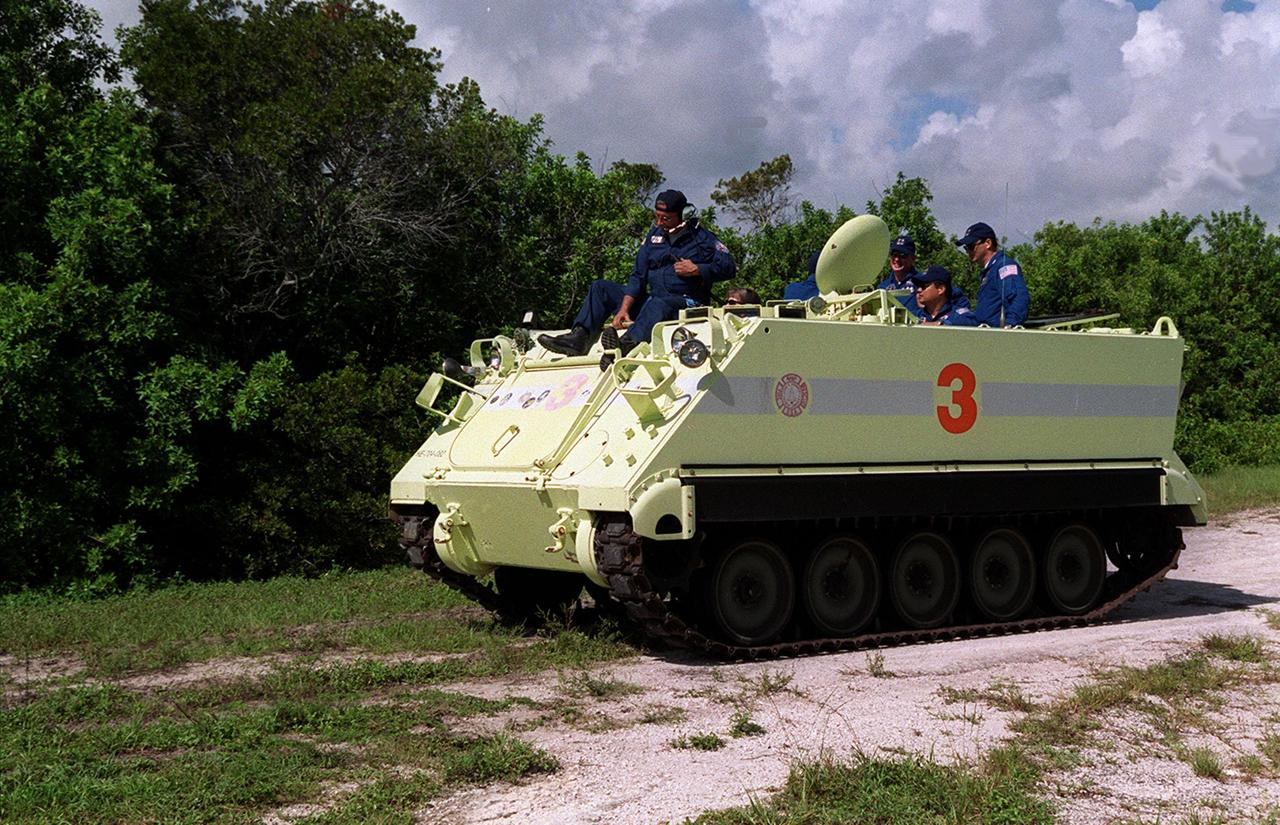
STS-92 Pilot Pam Melroy heads down the road driving the M-113, part of emergency egress training during Terminal Countdown Demonstration Test (TCDT) activities. Capt. George Hoggard, trainer with the KSC Fire Department, keeps in voice communication with her as he rides on top. The tracked vehicle could be used by the crew in the event of an emergency at the pad during which the crew must make a quick exit from the area. The TCDT also provides simulated countdown exercises and opportunities to inspect the mission payloads in the orbiter’s payload bay. STS-92 is scheduled to launch Oct. 5 at 9:30 p.m. EDT on the fifth flight to the International Space Station. It will carry two elements of the Space Station, the Integrated Truss Structure Z1 and the third Pressurized Mating Adapter. The mission is also the 100th flight in the Shuttle program
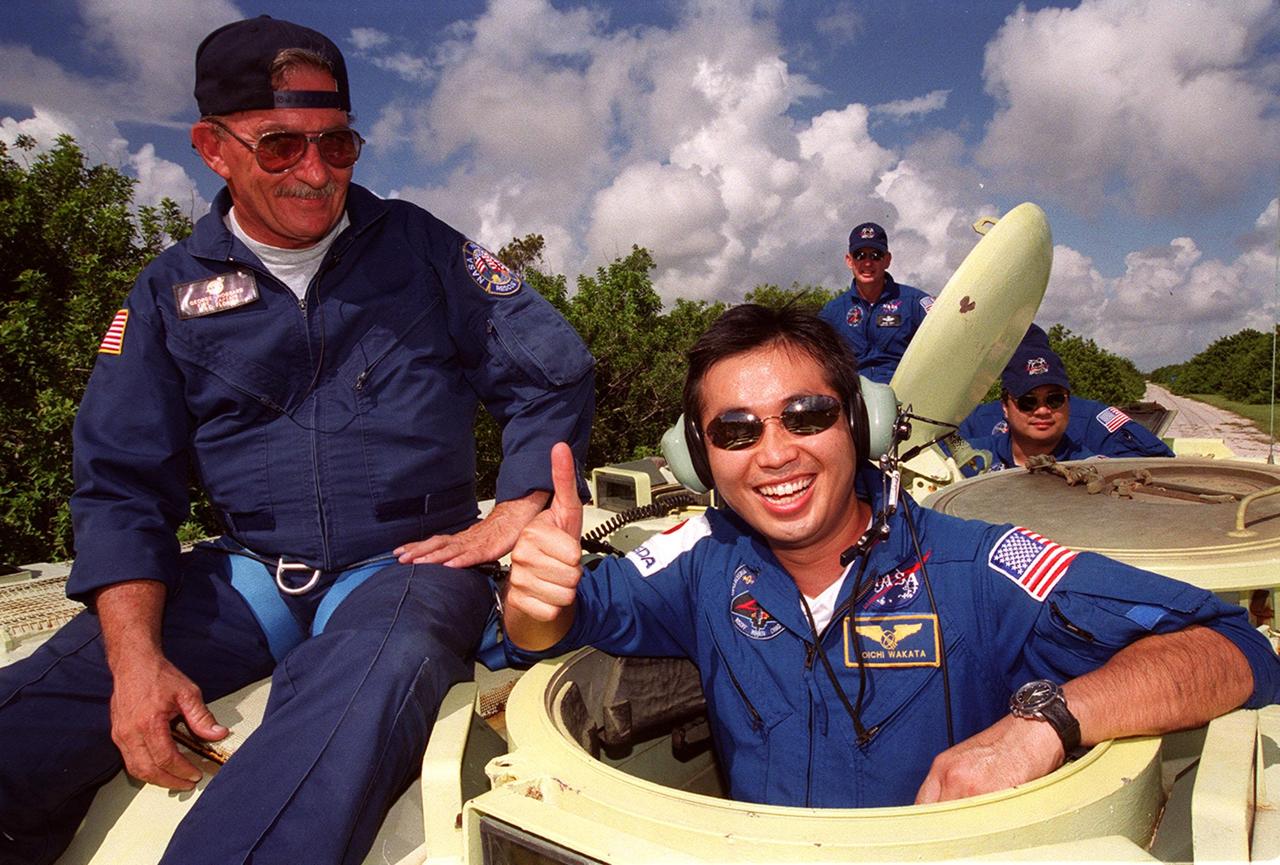
STS-92 Mission Specialist Koichi Wakata of Japan signals a successful driving lesson on the M-113 he is in. Capt. George Hoggard, trainer with the KSC Fire Department, sits on top. Behind Wakata are Commander Brian Duffy (left) and Leroy Chiao (right), waiting their turns. The practice drive is part of emergency egress training during Terminal Countdown Demonstration Test (TCDT) activities. The tracked vehicle could be used by the crew in the event of an emergency at the pad during which the crew must make a quick exit from the area. The TCDT also provides simulated countdown exercises and opportunities to inspect the mission payloads in the orbiter’s payload bay. STS-92 is scheduled to launch Oct. 5 at 9:30 p.m. EDT on the fifth flight to the International Space Station. It will carry two elements of the Space Station, the Integrated Truss Structure Z1 and the third Pressurized Mating Adapter. The mission is also the 100th flight in the Shuttle program
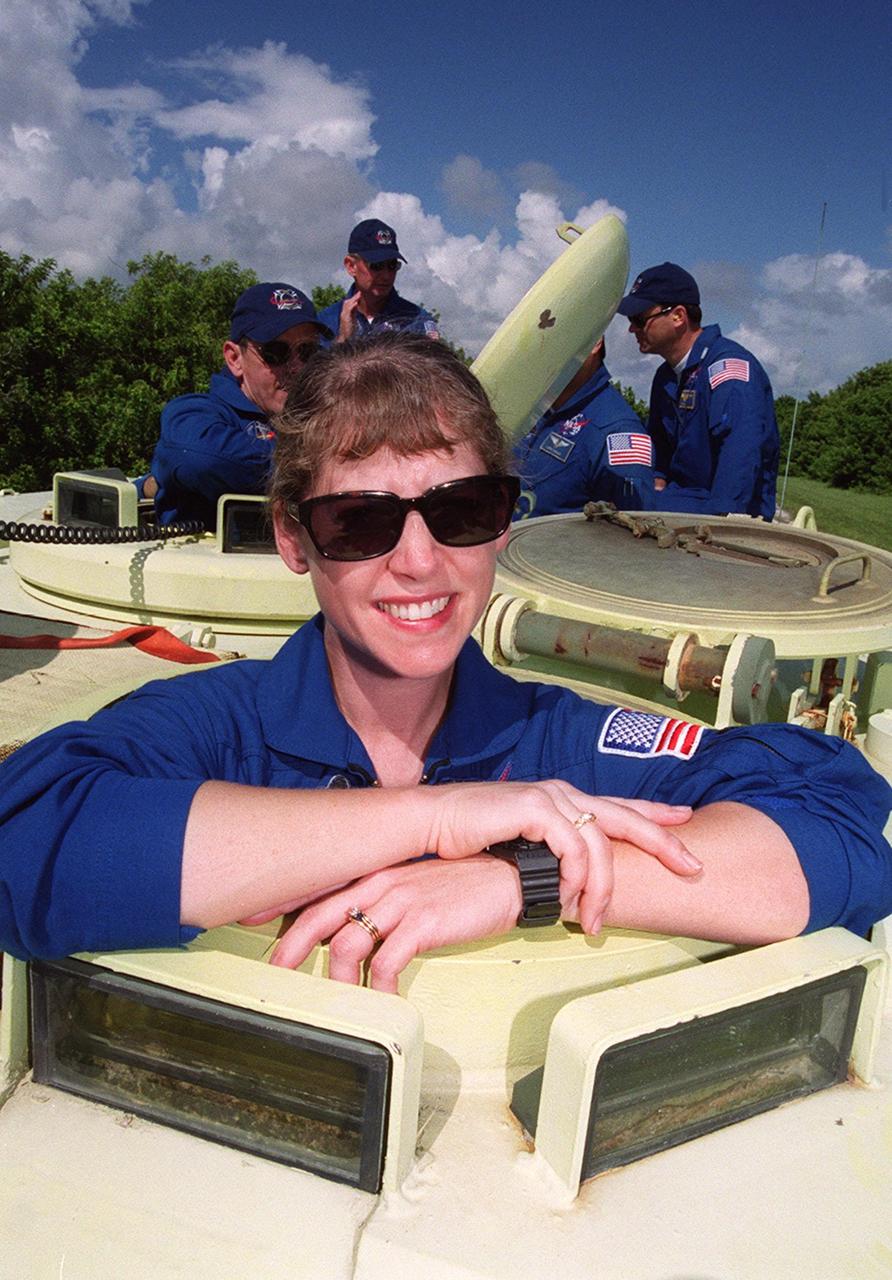
STS-92 Pilot Pam Melroy is ready to take her turn driving the M-113, part of emergency egress training during Terminal Countdown Demonstration Test (TCDT) activities. Behind her, waiting to take their turn, are (left to right) Mission Specialist Jeff Wisoff, Commander Brian Duffy, and Mission Specialists Bill McArthur and Michael Lopez-Alegria. The tracked vehicle could be used by the crew in the event of an emergency at the pad during which the crew must make a quick exit from the area. The TCDT also provides simulated countdown exercises and opportunities to inspect the mission payloads in the orbiter’s payload bay. STS-92 is scheduled to launch Oct. 5 at 9:30 p.m. EDT on the fifth flight to the International Space Station. It will carry two elements of the Space Station, the Integrated Truss Structure Z1 and the third Pressurized Mating Adapter. The mission is also the 100th flight in the Shuttle program
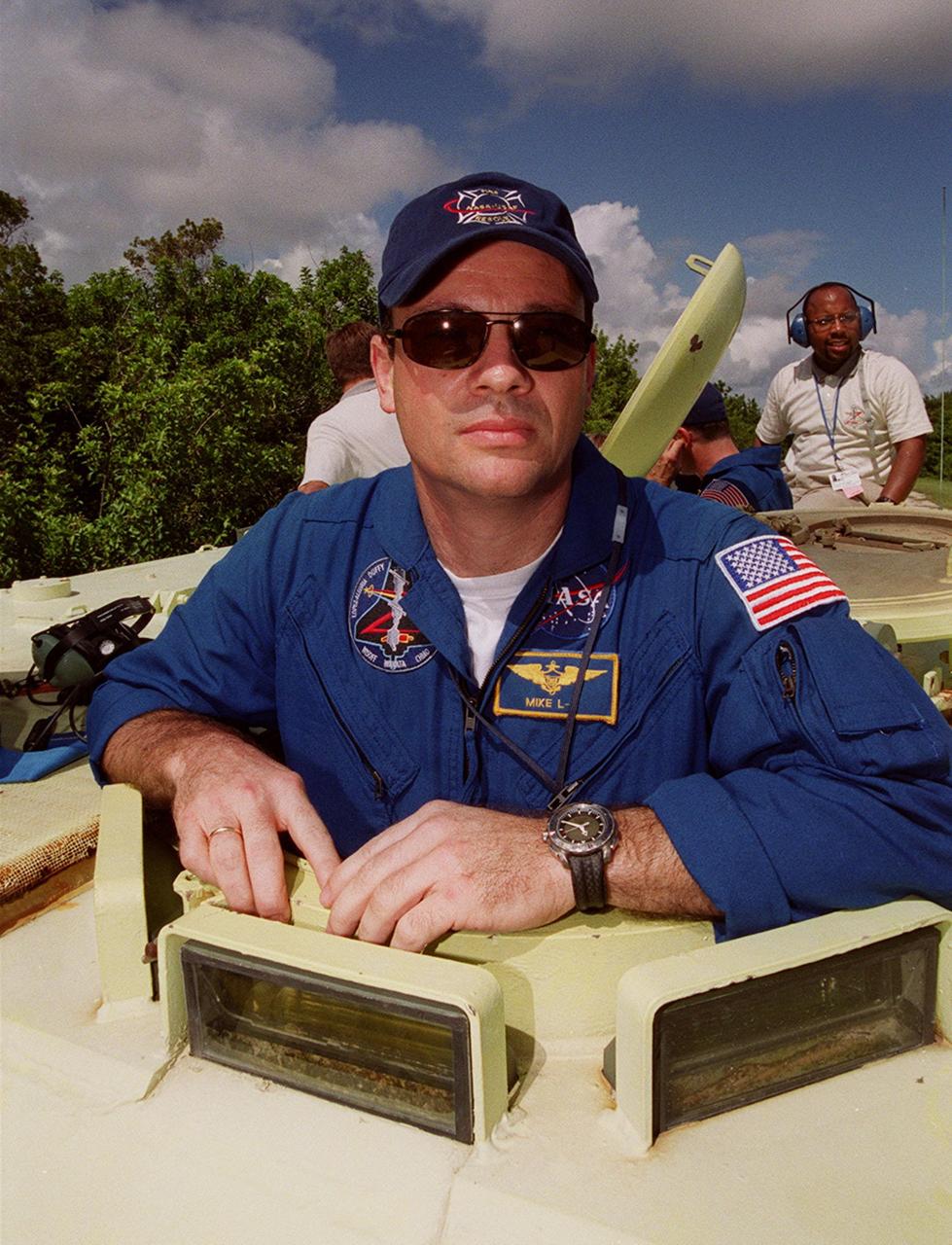
Waiting his turn to drive the M-113 is STS-92 Mission Specialist Michael Lopez-Alegria. Part of emergency egress training during Terminal Countdown Demonstration Test (TCDT) activities, the tracked vehicle could be used by the crew in the event of an emergency at the pad during which the crew must make a quick exit from the area. The TCDT also provides simulated countdown exercises and opportunities to inspect the mission payloads in the orbiter’s payload bay. STS-92 is scheduled to launch Oct. 5 at 9:30 p.m. EDT on the fifth flight to the International Space Station. It will carry two elements of the Space Station, the Integrated Truss Structure Z1 and the third Pressurized Mating Adapter. The mission is also the 100th flight in the Shuttle program
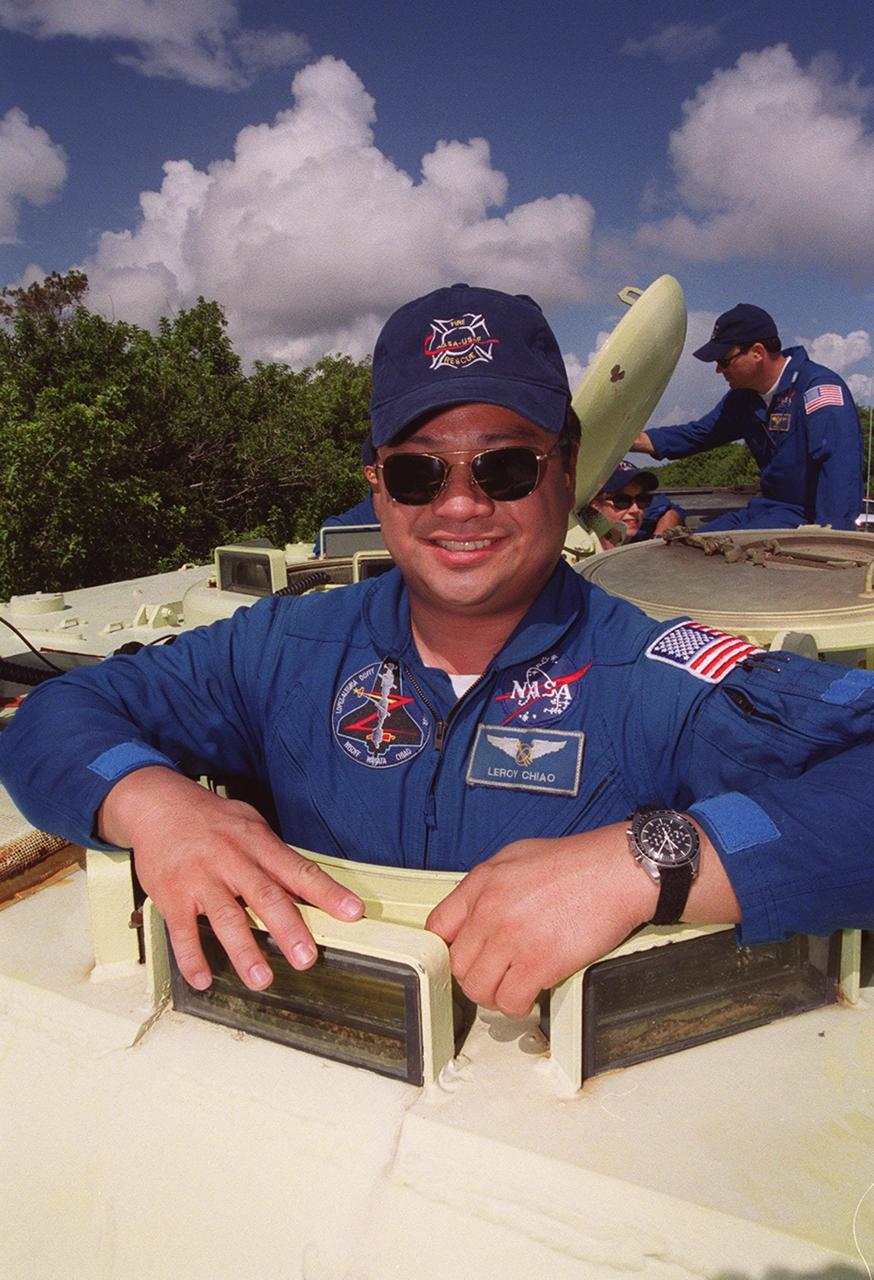
STS-92 Mission Specialist Leroy Chiao gets into the driver’s side for his turn to drive the M-113, part of emergency egress training during Terminal Countdown Demonstration Test (TCDT) activities. Behind him are Pilot Pam Melroy (left) and Mission Specialist Michael Lopez-Alegria.; The tracked vehicle could be used by the crew in the event of an emergency at the pad during which the crew must make a quick exit from the area. The TCDT also provides simulated countdown exercises and opportunities to inspect the mission payloads in the orbiter’s payload bay. STS-92 is scheduled to launch Oct. 5 at 9:30 p.m. EDT on the fifth flight to the International Space Station. It will carry two elements of the Space Station, the Integrated Truss Structure Z1 and the third Pressurized Mating Adapter. The mission is also the 100th flight in the Shuttle program
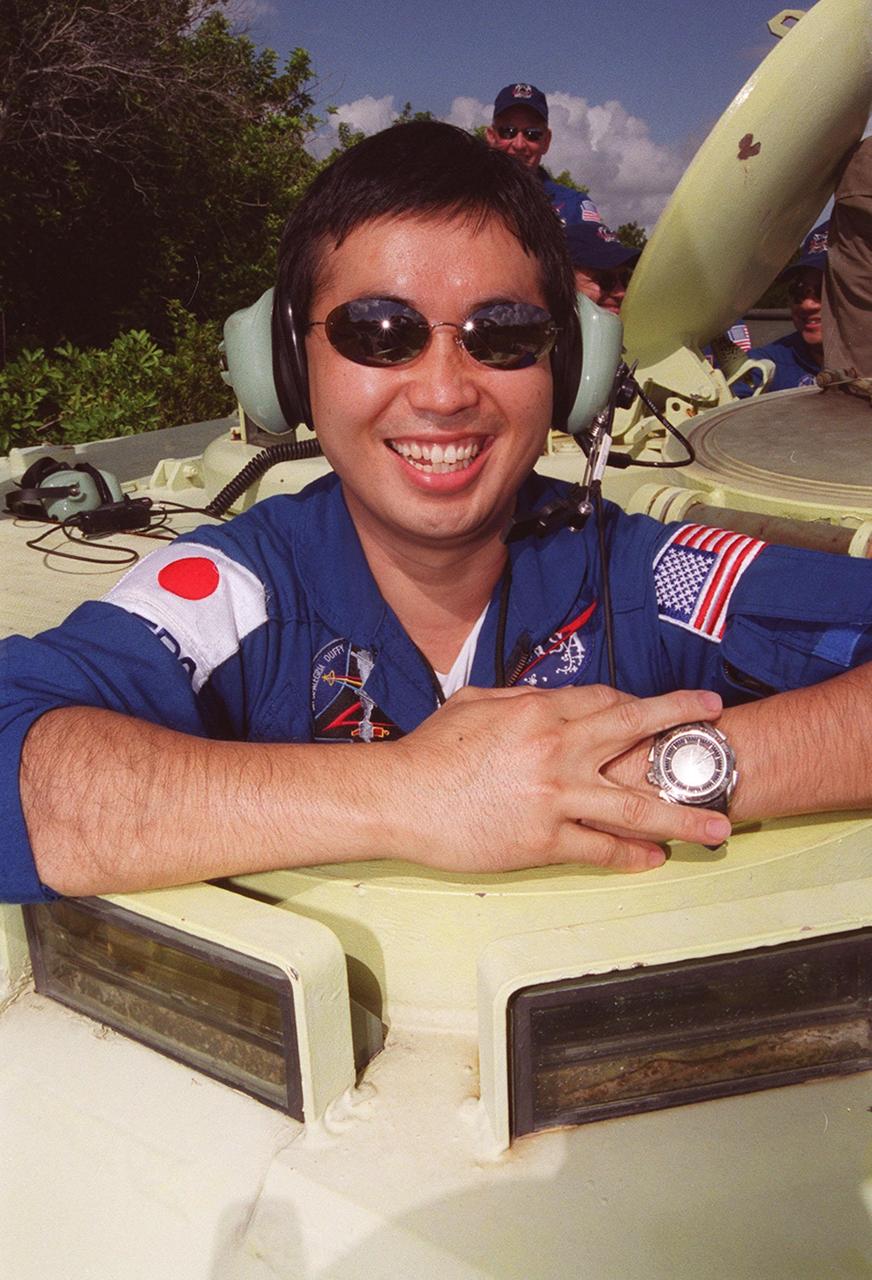
Getting ready to take his turn at the wheel of the M-113 is Mission Specialist Koichi Wakata of Japan. Behind him can be seen Mission Specialists Bill McArthur (left) and Leroy Chiao (right), who wait their turns. Learning to drive the armored vehicle is part of emergency egress training during Terminal Countdown Demonstration Test (TCDT) activities. The tracked vehicle could be used by the crew in the event of an emergency at the pad during which the crew must make a quick exit from the area. The TCDT also provides simulated countdown exercises and opportunities to inspect the mission payloads in the orbiter’s payload bay. STS-92 is scheduled to launch Oct. 5 at 9:30 p.m. EDT on the fifth flight to the International Space Station. It will carry two elements of the Space Station, the Integrated Truss Structure Z1 and the third Pressurized Mating Adapter. The mission is also the 100th flight in the Shuttle program
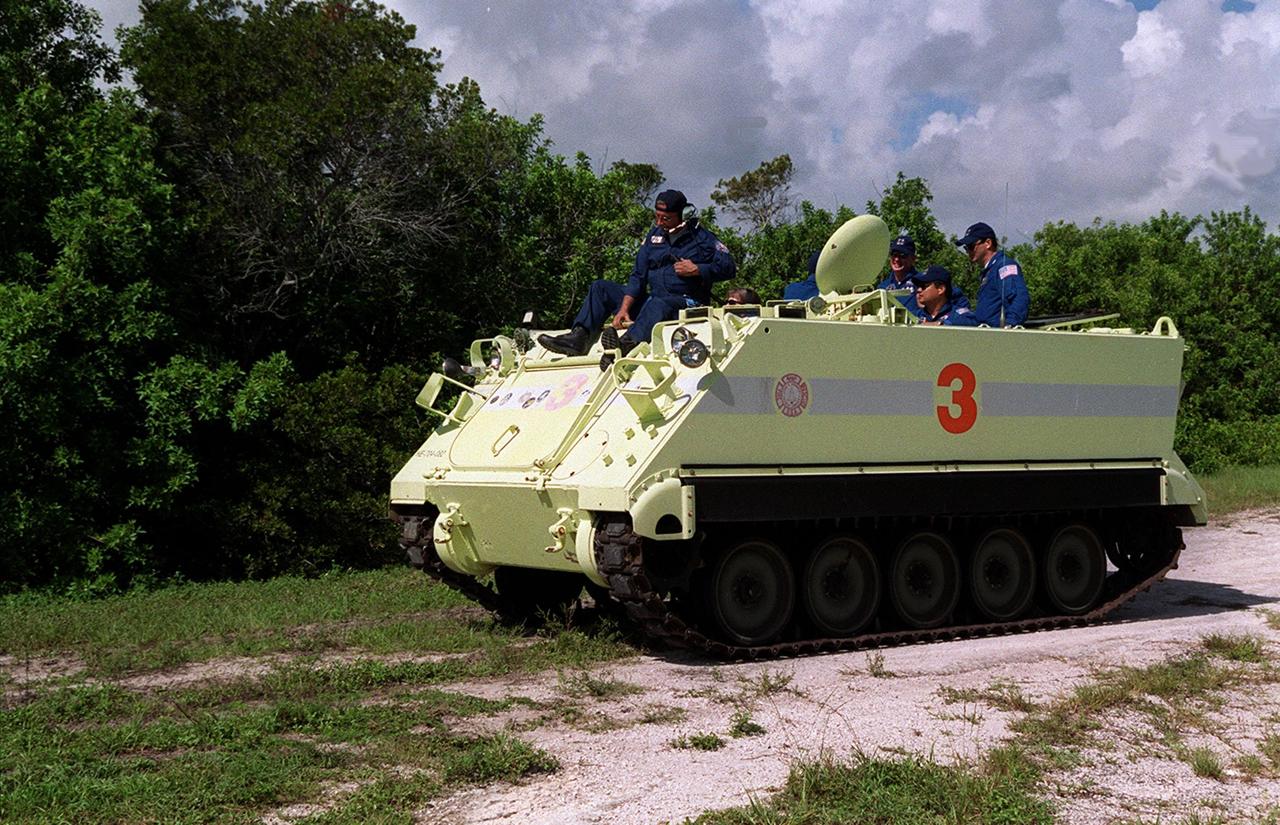
STS-92 Pilot Pam Melroy heads down the road driving the M-113, part of emergency egress training during Terminal Countdown Demonstration Test (TCDT) activities. Capt. George Hoggard, trainer with the KSC Fire Department, keeps in voice communication with her as he rides on top. The tracked vehicle could be used by the crew in the event of an emergency at the pad during which the crew must make a quick exit from the area. The TCDT also provides simulated countdown exercises and opportunities to inspect the mission payloads in the orbiter’s payload bay. STS-92 is scheduled to launch Oct. 5 at 9:30 p.m. EDT on the fifth flight to the International Space Station. It will carry two elements of the Space Station, the Integrated Truss Structure Z1 and the third Pressurized Mating Adapter. The mission is also the 100th flight in the Shuttle program
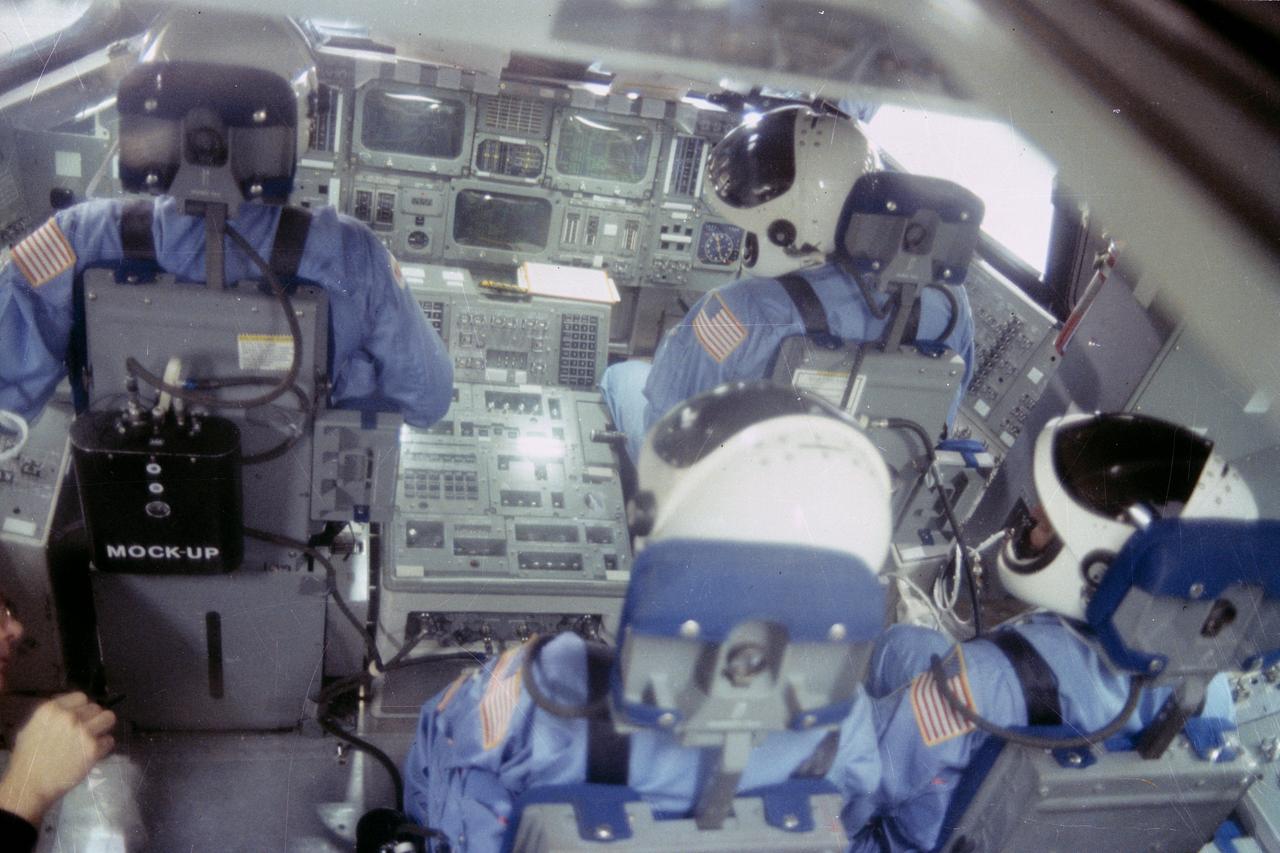
S82-41355 (December 1982) --- The four crew members for NASA?s STS-6 mission go through a training exercise in the full-scale engineering mock-up in the shuttle mock-up and integration laboratory at the Johnson Space Center (JSC). Their seating configuration reflects that of launch and landing phases aboard the space shuttle Challenger. The front stations are occupied by astronauts Paul J. Weitz (left), commander, and Karol J. Bobko, pilot. In the rear seats are astronauts Story Musgrave and Donald H. Peterson, both mission specialists. STS-6 will be the Challenger?s first flight when it takes this crew and a tracking and data relay satellite (TDRS) into Earth orbit the early part of next year. Photo credit: NASA