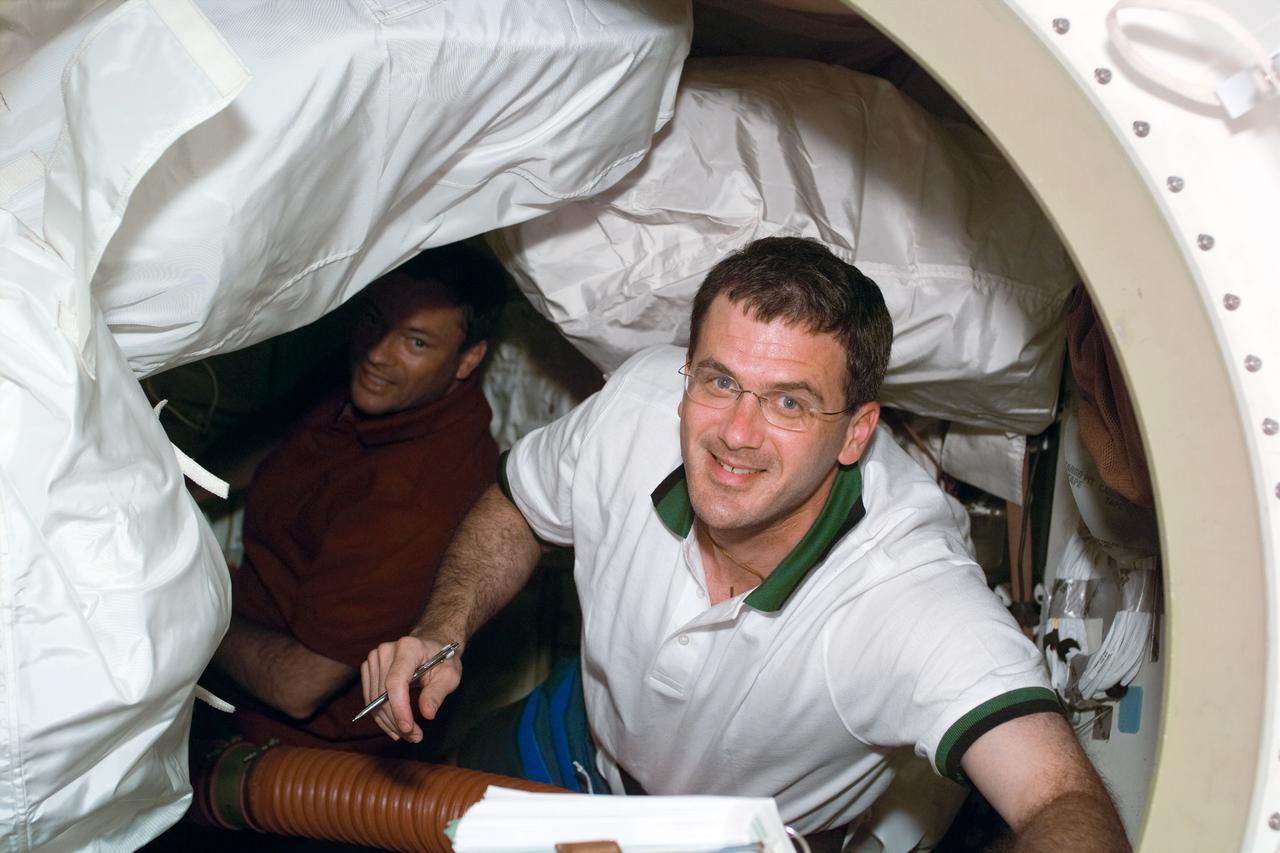
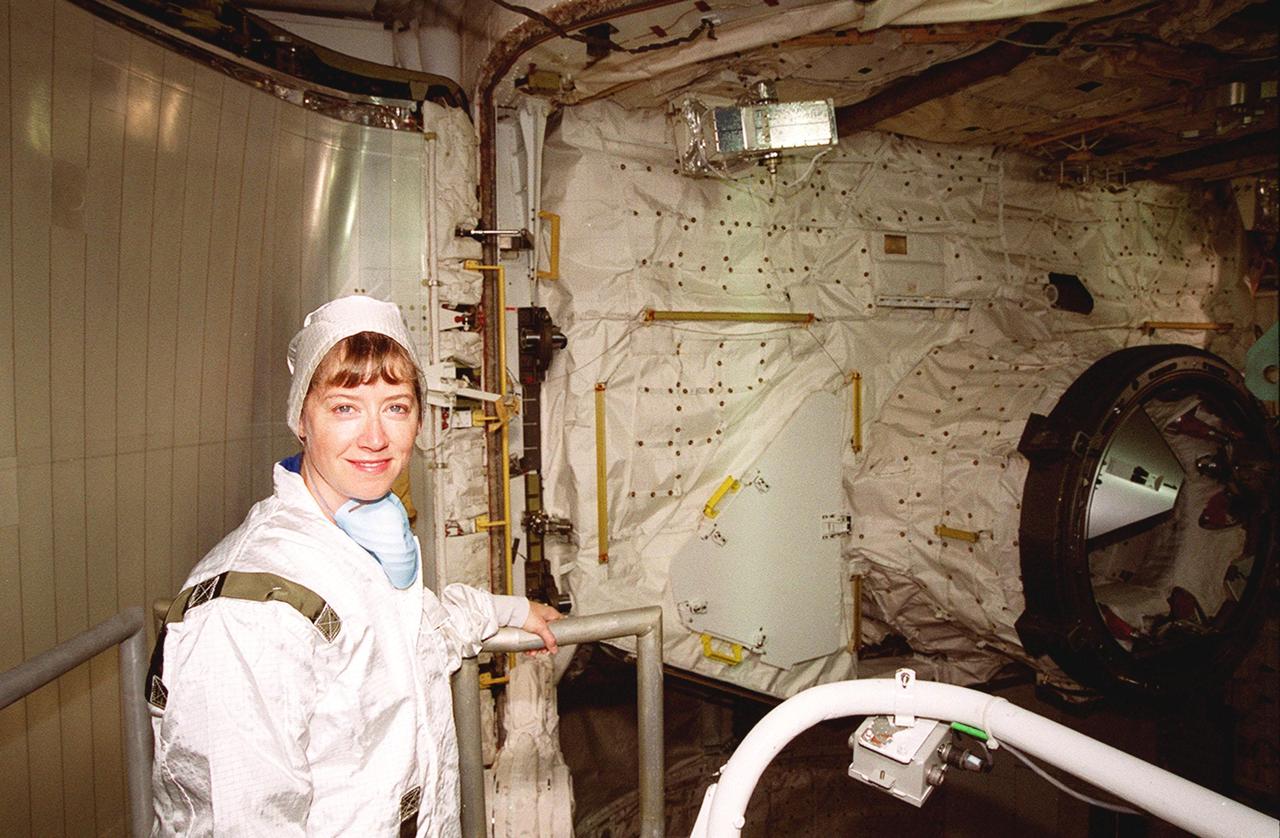
S92-E-5025 (12 October 2000) --- Astronaut Peter J.K. (Jeff) Wisoff on Flight Day 2.
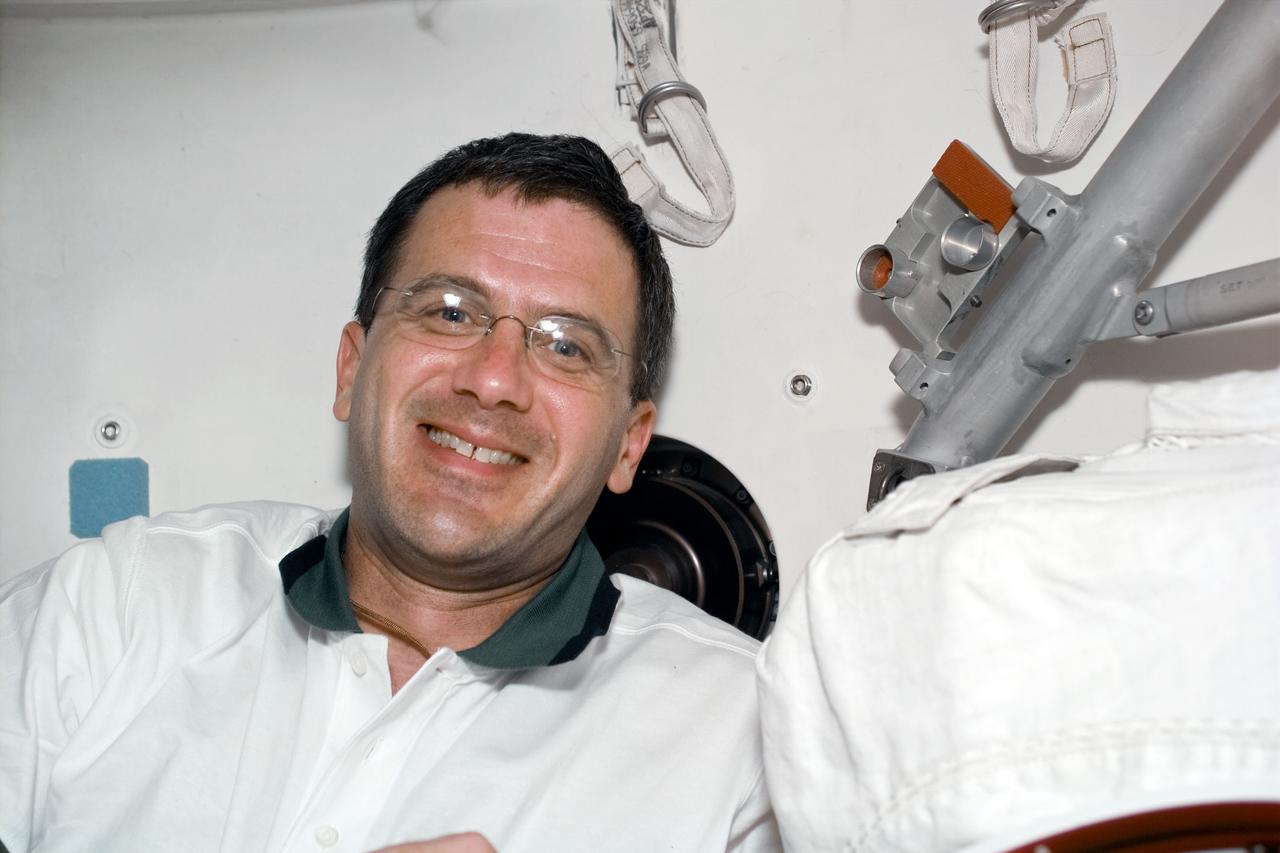
S92-E-5024 (12 October 2000) --- Electronic still camera's view features astronaut Peter J.K. (Jeff)Wisoff, mission specialist, in Discovery airlock.
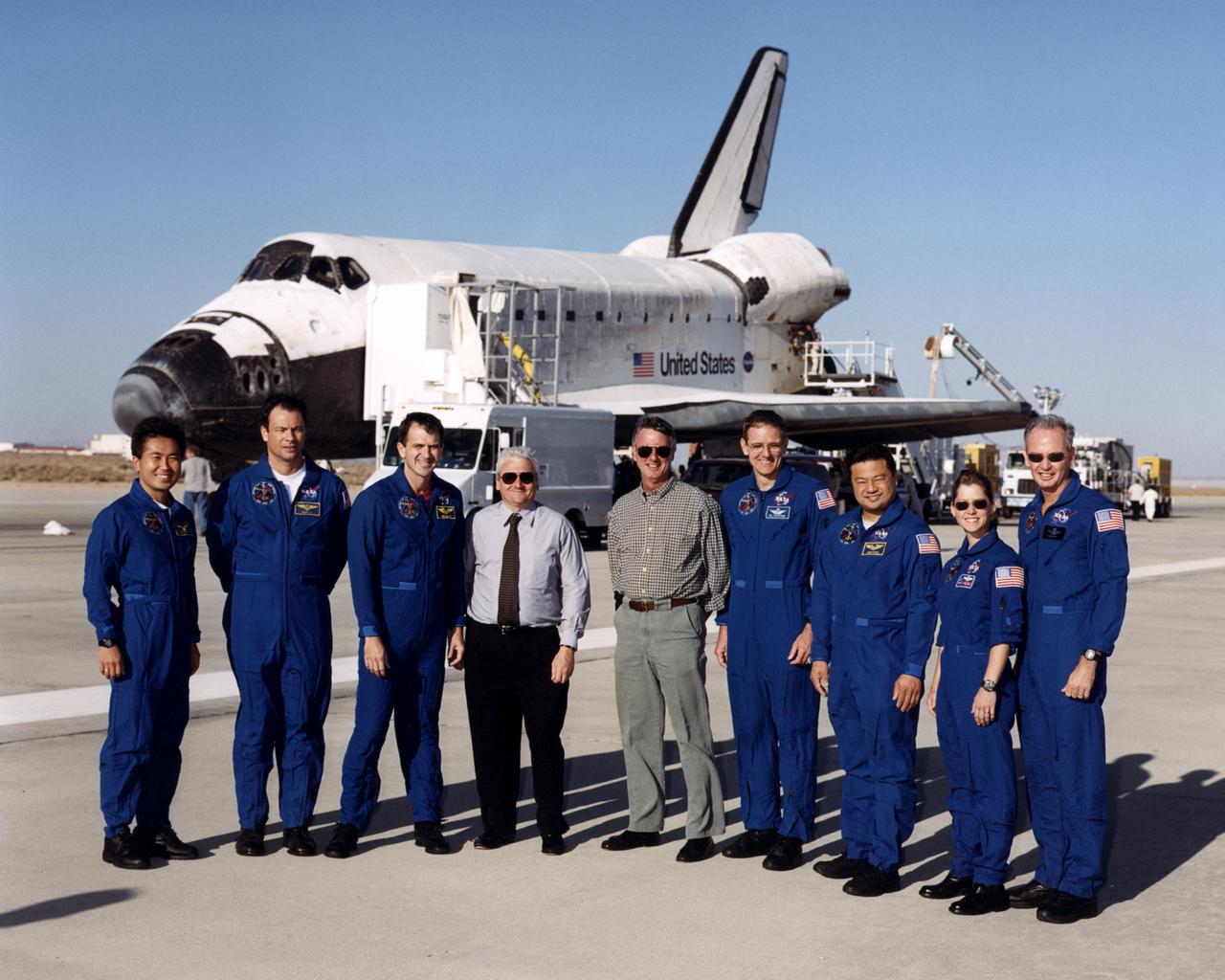
The seven-member crew of the Space Shuttle mission STS-92 gathered in front of the Shuttle Discovery shortly after landing at Edwards Air Force Base in Southern California October 24, 2000. They are seen here with NASA Dryden Fight Research Center Director Kevin Petersen and Deputy Director Wallace Sawyer. From left are mission specialists Koichi Wakata, Michael Lopez-Alegria, Jeff Wisoff, Bill McArthur and Leroy Chiao, pilot Pam Melroy and mission commander Brian Duffy. Between Jeff Wisoff and Brian McArthur are Kevin Petersen and Wally Sawyer, wearing ordinary civilian clothing.
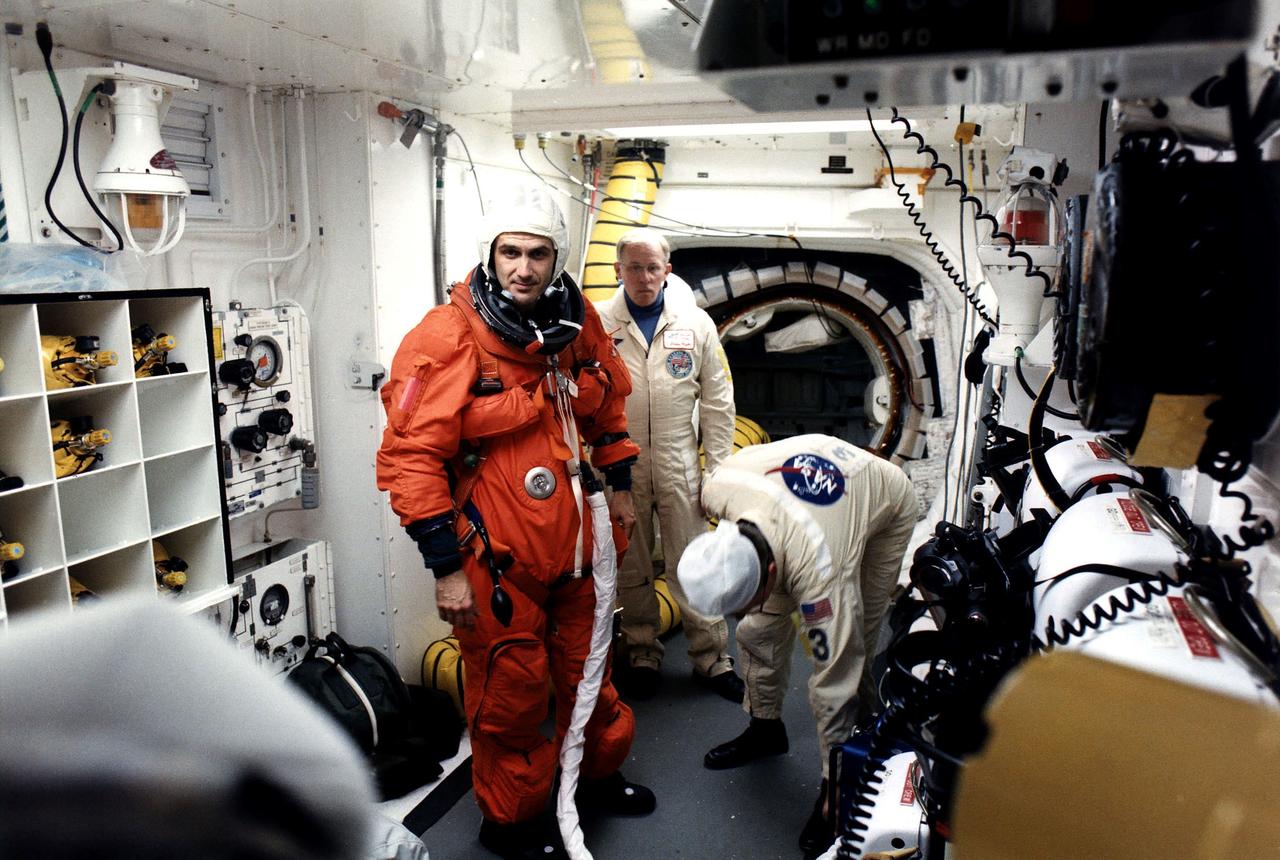
KENNEDY SPACE CENTER, FLA. - STS-81 Mission Specialist Jeff Wisoff prepares to enter the Space Shuttle Atlantis at Launch Pad 39B with help from White Room closeout crew members Danny Wyatt (center) and Al Rochford.
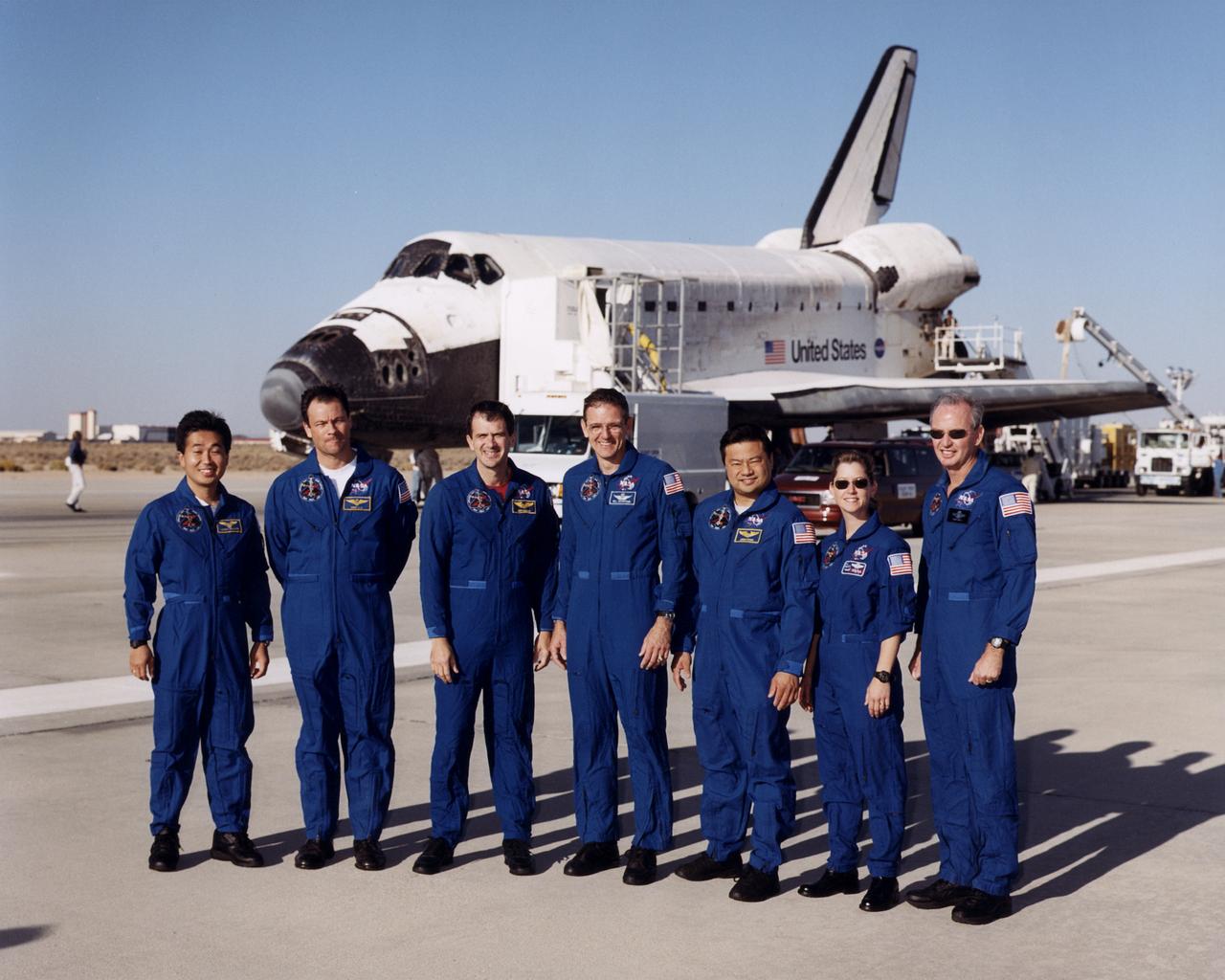
The seven-member crew of the Space Shuttle mission STS-92 gathered in front of the Shuttle Discovery shortly after landing at Edwards Air Force Base in Southern California October 24, 2000. From left are mission specialists Koichi Wakata, Michael Lopez-Alegria, Jeff Wisoff, Bill McArthur and Leroy Chiao, pilot Pam Melroy and mission commander Brian Duffy.

S90-45443 (August 1990) --- Astronaut Peter J. K. (Jeff) Wisoff, mission specialist.
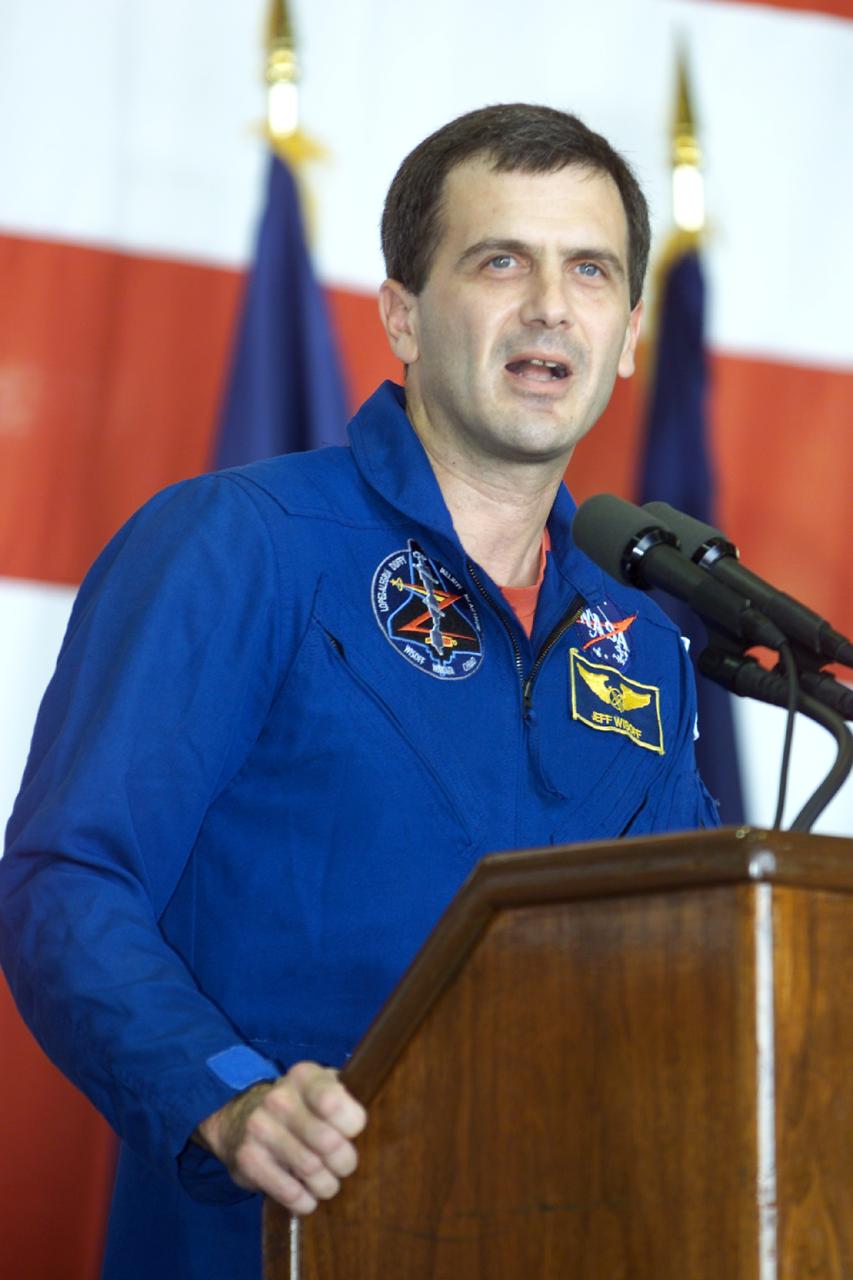
JSC2000-E-27055 (27 October 2000) --- Astronaut Peter J.K. (Jeff) Wisoff, STS-92 mission specialist, addresses crowd at Ellington Field during crew return ceremonies.
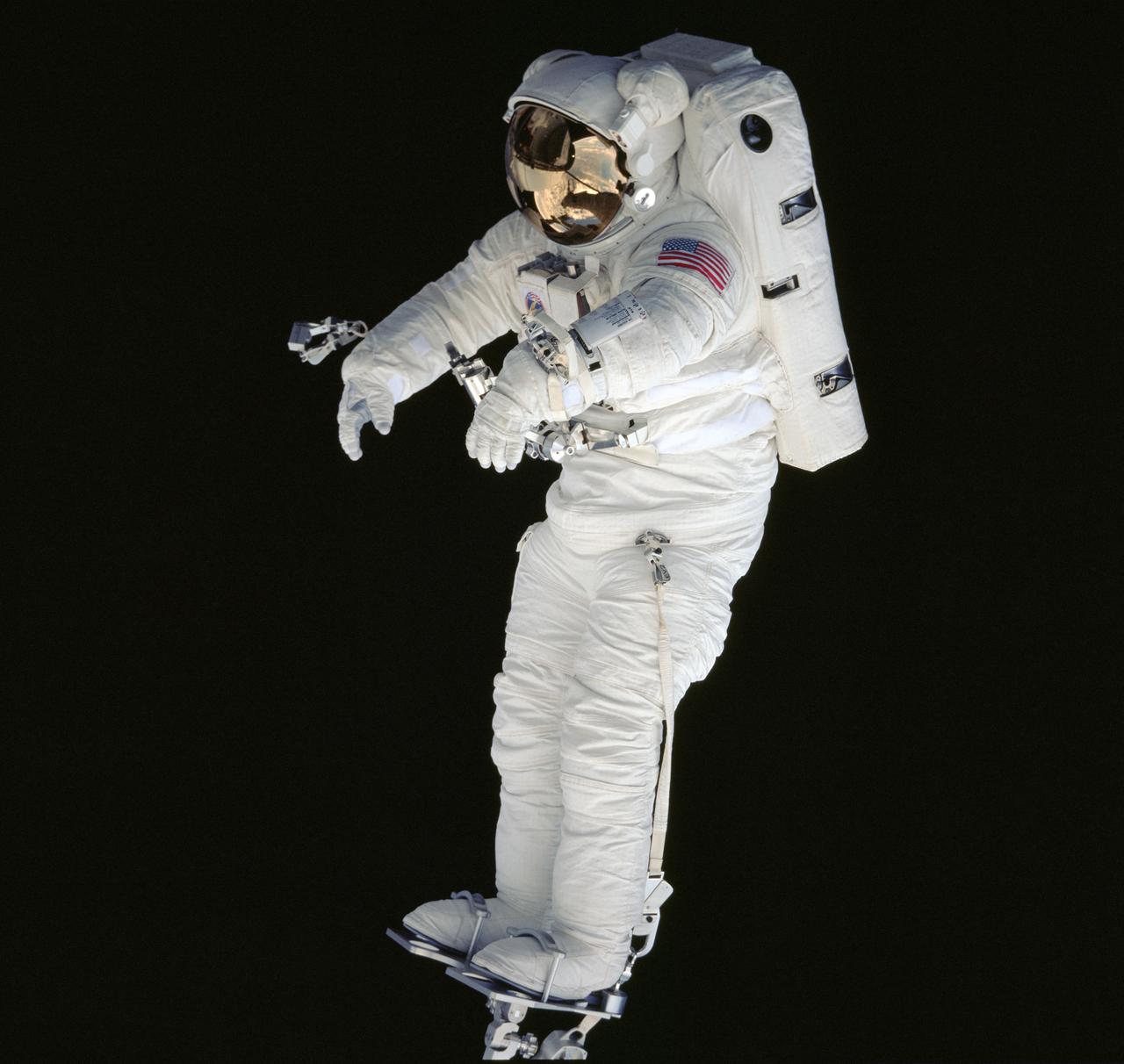
STS057-89-067 (25 June 1993) --- Backdropped against the blackness of space, astronaut Peter J. K. (Jeff) Wisoff, stands on a mobile foot restraint on the end of the Space Shuttle Endeavour's Remote Manipulator System (RMS). Astronauts Wisoff and G. David Low participated in a lengthy session of extravehicular activity (EVA) on the mission's fifth day in Earth-orbit. This view was recorded on 70mm film with a handheld Hasselblad camera inside the Space Shuttle Endeavour's crew cabin.
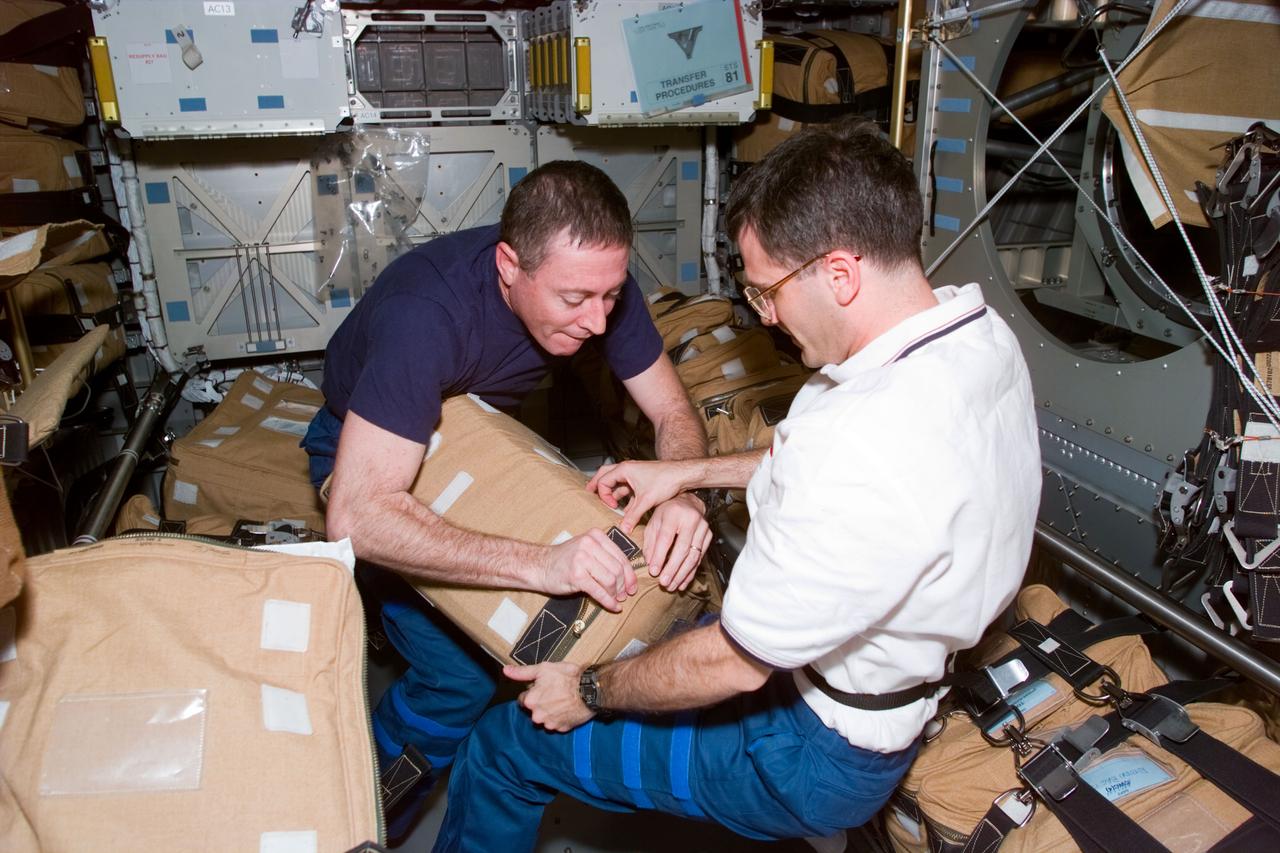
STS081-E-05515 (16 Jan. 1997) --- Astronauts Michael A. Baker, commander, and Peter J. K. (Jeff) Wisoff, mission specialist, secure a bag filled with a drawer of supplies in the Spacehab Double Module (DM). The scene was recorded with an Electronic Still Camera (ESC) and later downlinked to flight controllers in Houston, Texas.
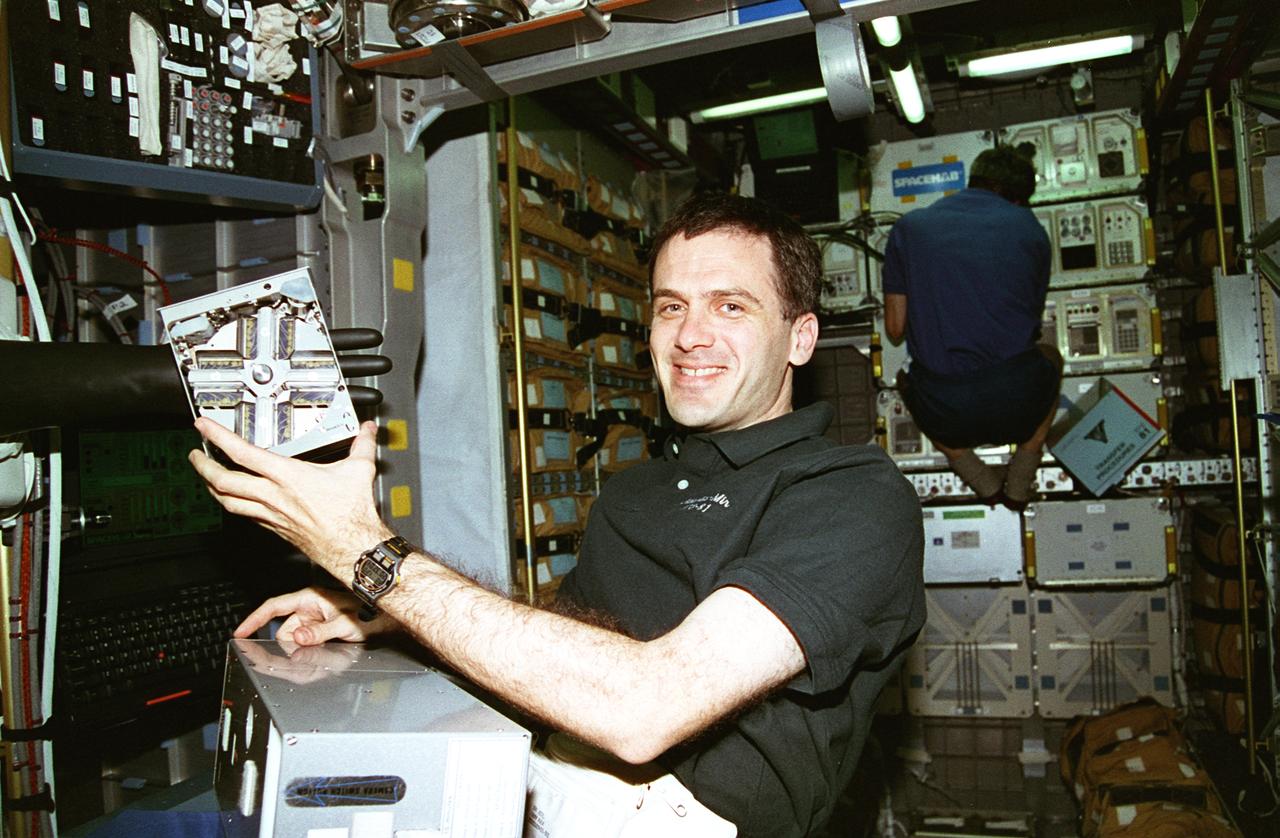
STS081-318-020 (12-22 Jan. 1997) --- Astronaut Peter J. K. (Jeff) Wisoff at biorack in the Spacehab Double Module (DM) checks on a botanical experiment, onboard the Space Shuttle Atlantis, during the Atlantis and Russia's Mir Space Station docking mission.
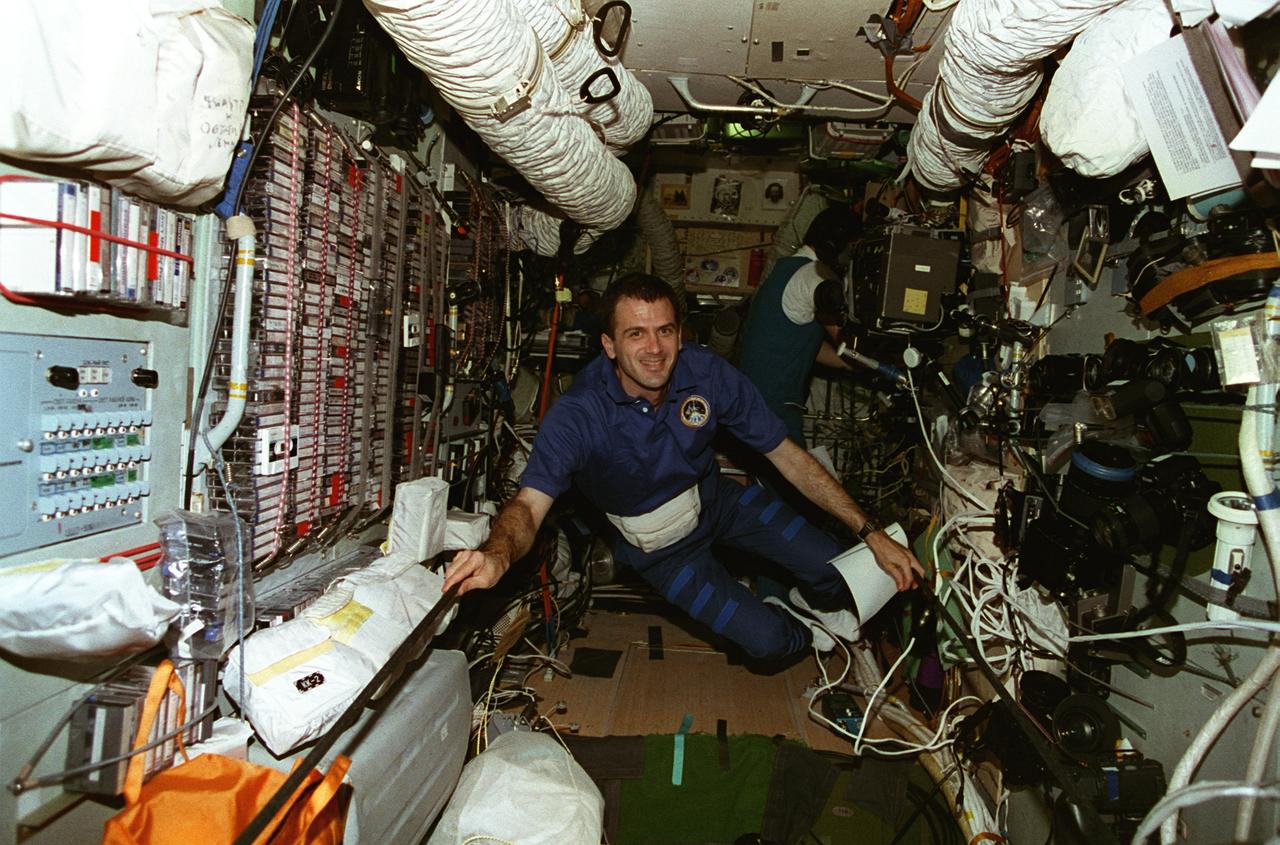
STS081-347-031 (12-22 Jan. 1997) --- Astronaut Peter J. K. (Jeff) Wisoff, is pictured with a small sampling of supplies moved from the Spacehab Double Module (DM) aboard the Space Shuttle Atlantis to Russia's Mir Space Station.
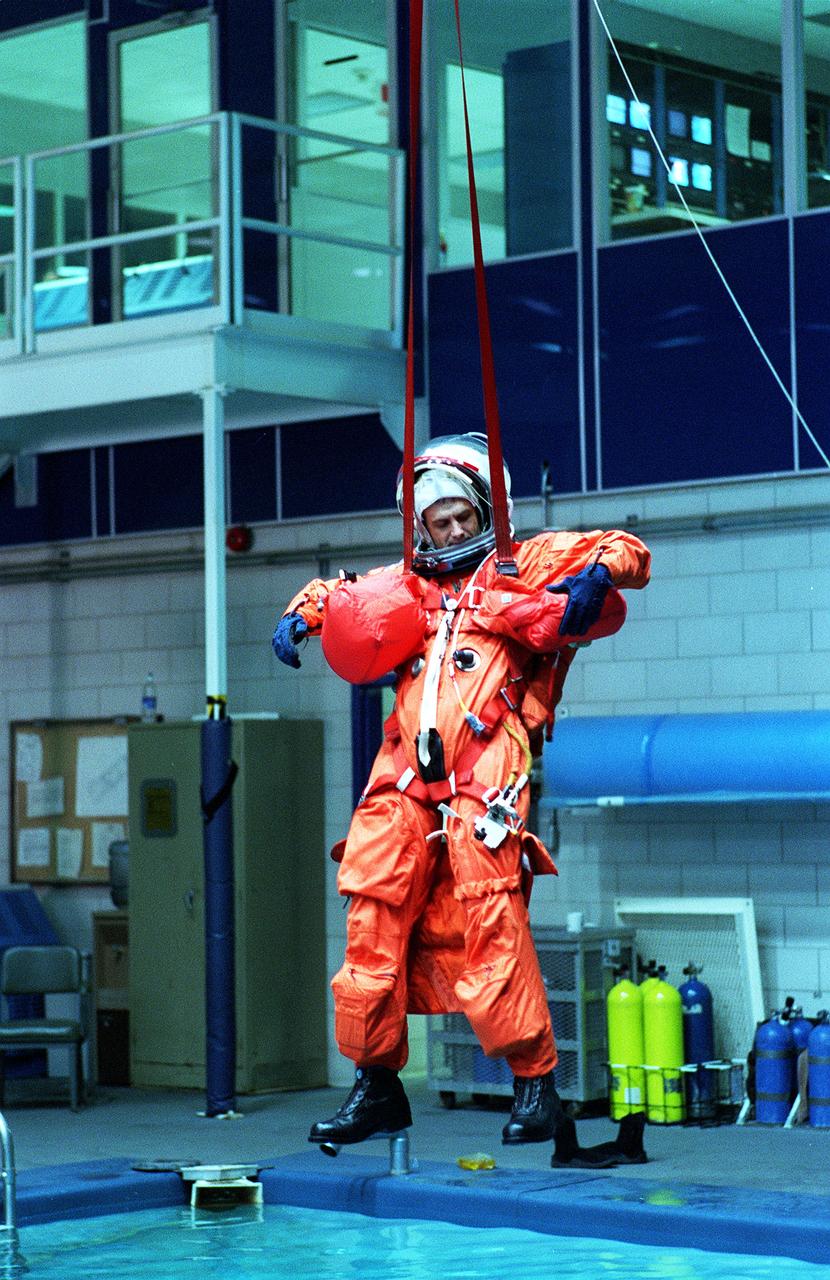
S96-15407 (26 Sept. 1996) --- In the Johnson Space Center's weightless environment training facility, astronaut Peter J.K. (Jeff) Wisoff, STS-81 mission specialist, simulates a parachute drop into water. Five STS-81 crewmates, out of frame, joined him for the bailout training exercises.
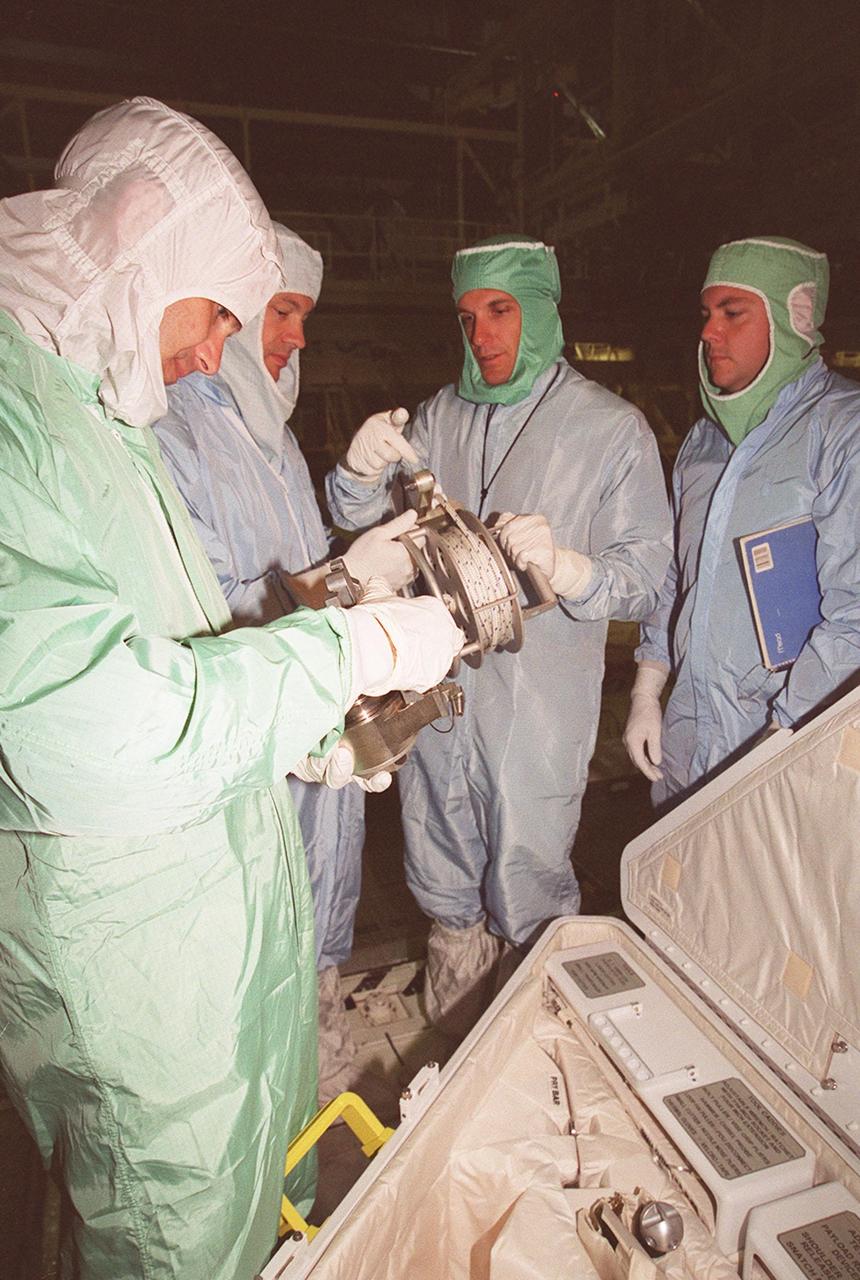
As part of Crew Equipment Interface Test activities, STS-92 Mission Specialists Jeff Wisoff (left) and Michael Lopez-Alegria (second from left) check equipment on orbiter Discovery that they will be using on their mission. At right are Boeing workers. Discovery is in the Orbiter Processing Facility bay 1. Other crew members taking part in the CEIT are Commander Brian Duffy, Pilot Pam Melroy, and Mission Specialists Koichi Wakata, Leroy Chiao, Jeff Wisoff, Michael Lopez-Alegria, and Bill McArthur. STS-92 is scheduled to launch Oct. 5 from Launch Pad 39A on the fifth flight to the International Space Station. Discovery will carry the Integrated Truss Structure (ITS) Z1, Pressurized Mating Adapter 3, Ku-band Communications System, and Control Moment Gyros (CMGs)
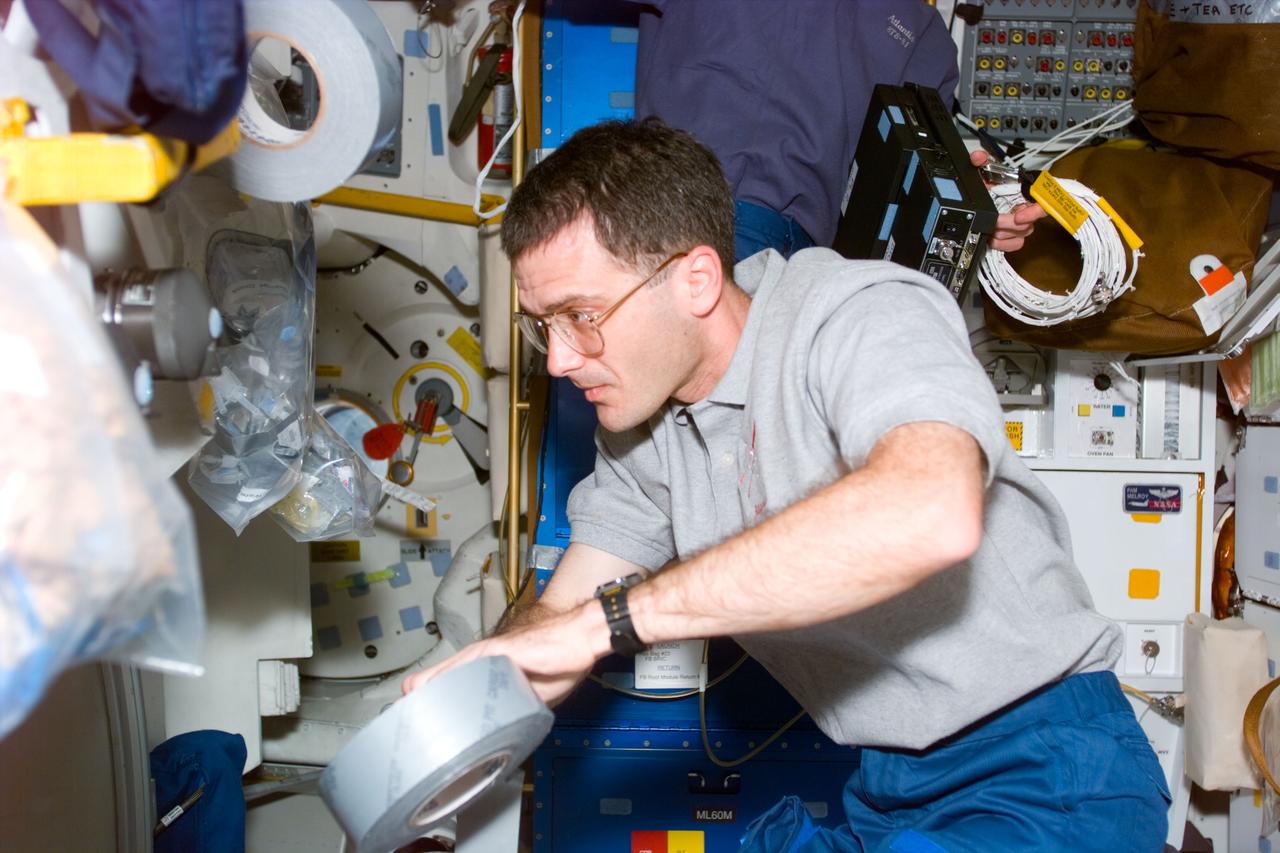
STS081-E-5009 (12 Jan. 1997) --- Astronaut Peter J. K. (Jeff) Wisoff, mission specialist, helps carry out tasks of readying the Space Shuttle Atlantis for almost ten days in space, securing supplies with a piece of gaffer's tape. Currently, Wisoff is accompanied by five crew mates, among whom one - astronaut Jerry M. Linenger - will be exchanged in a few days for John E. Blaha, who has been aboard Russia's Mir Space Station for several months, as a cosmonaut guest researcher. Docking of Atlantis with Mir is scheduled for the middle of the week. The scene was recorded with an Electronic Still Camera (ESC) and later downlinked to flight controllers in Houston, Texas.
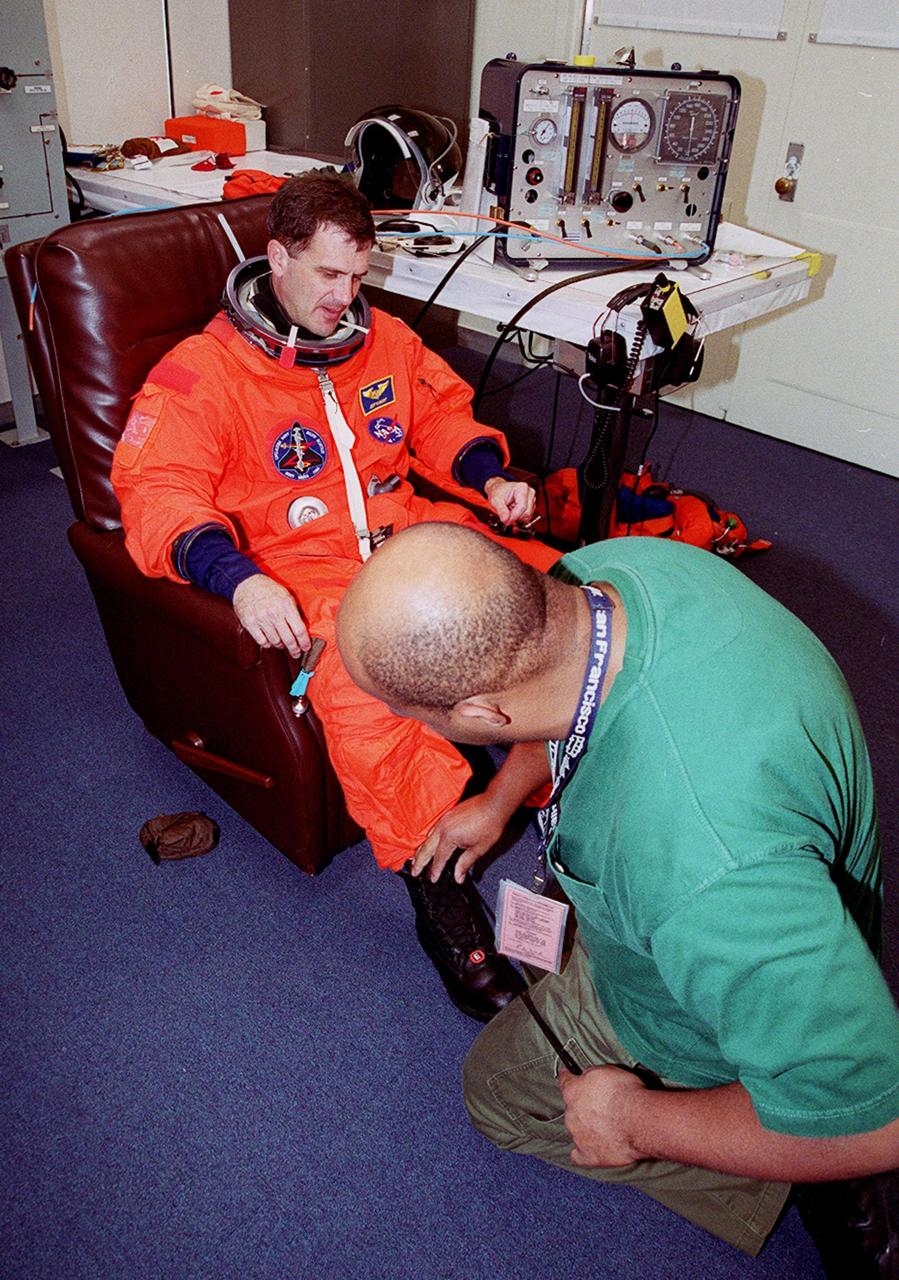
During pre-pack and fit check in the Operations and Checkout Building, STS-92 Mission Specialist Peter J.K. "Jeff" Wisoff tries on his boots. Wisoff and the rest of the crew are at KSC for Terminal Countdown Demonstration Test activities. The TCDT provides emergency egress training, simulated countdown exercises and opportunities to inspect the mission payload. This mission will be Wisoff’s fourth Shuttle flight. STS-92 is scheduled to launch Oct. 5 at 9:38 p.m. EDT from Launch Pad 39A on the fifth flight to the International Space Station. It will carry two elements of the Space Station, the Integrated Truss Structure Z1 and the third Pressurized Mating Adapter. The mission is also the 100th flight in the Shuttle program
During pre-pack and fit check in the Operations and Checkout Building, STS-92 Mission Specialist Peter J.K. "Jeff" Wisoff tries on his boots. Wisoff and the rest of the crew are at KSC for Terminal Countdown Demonstration Test activities. The TCDT provides emergency egress training, simulated countdown exercises and opportunities to inspect the mission payload. This mission will be Wisoff’s fourth Shuttle flight. STS-92 is scheduled to launch Oct. 5 at 9:38 p.m. EDT from Launch Pad 39A on the fifth flight to the International Space Station. It will carry two elements of the Space Station, the Integrated Truss Structure Z1 and the third Pressurized Mating Adapter. The mission is also the 100th flight in the Shuttle program
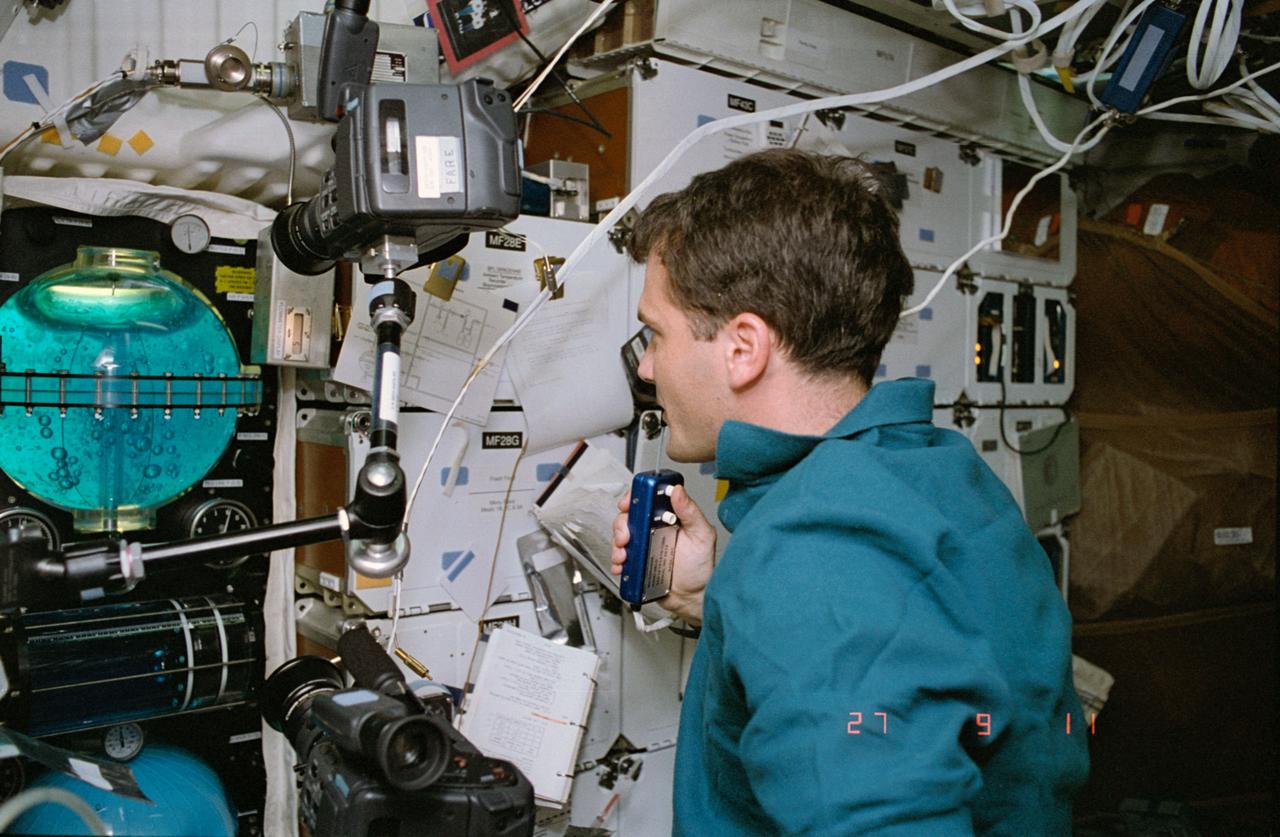
STS057-39-021 (21 June-1 July 1993) --- Astronaut Peter J. K. (Jeff) Wisoff, mission specialist, monitors the Fluid Acquisition and Resupply Experiment (FARE II), housed in four middeck lockers onboard the Space Shuttle Endeavour. The successor to FARE I (STS 53, 1992), FARE II was designed to demonstrate the effectiveness of a device to alleviate the problems associated with vapor-free liquid transfer.
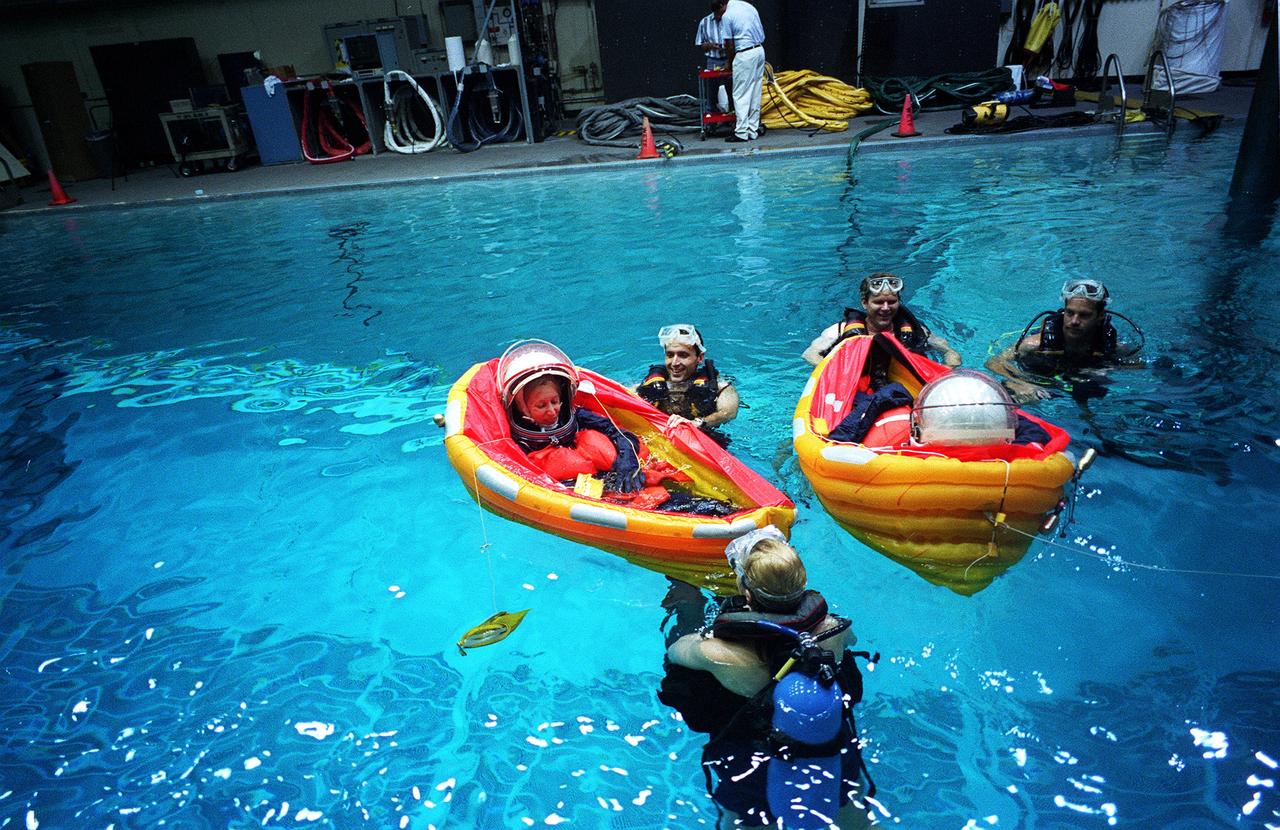
S96-15405 (26 Sept. 1996) --- In the Johnson Space Center's weightless environment training facility, astronaut Marsha S. Ivins, STS-81 mission specialist, bails water from her life raft during water bailout survival training. Astronaut Peter J.K. (Jeff) Wisoff (pictured in right raft) and four other STS-81 crewmates (out of frame) joined Ivins for the bailout training exercises. Several SCUBA-equipped divers assist in the training exercise.
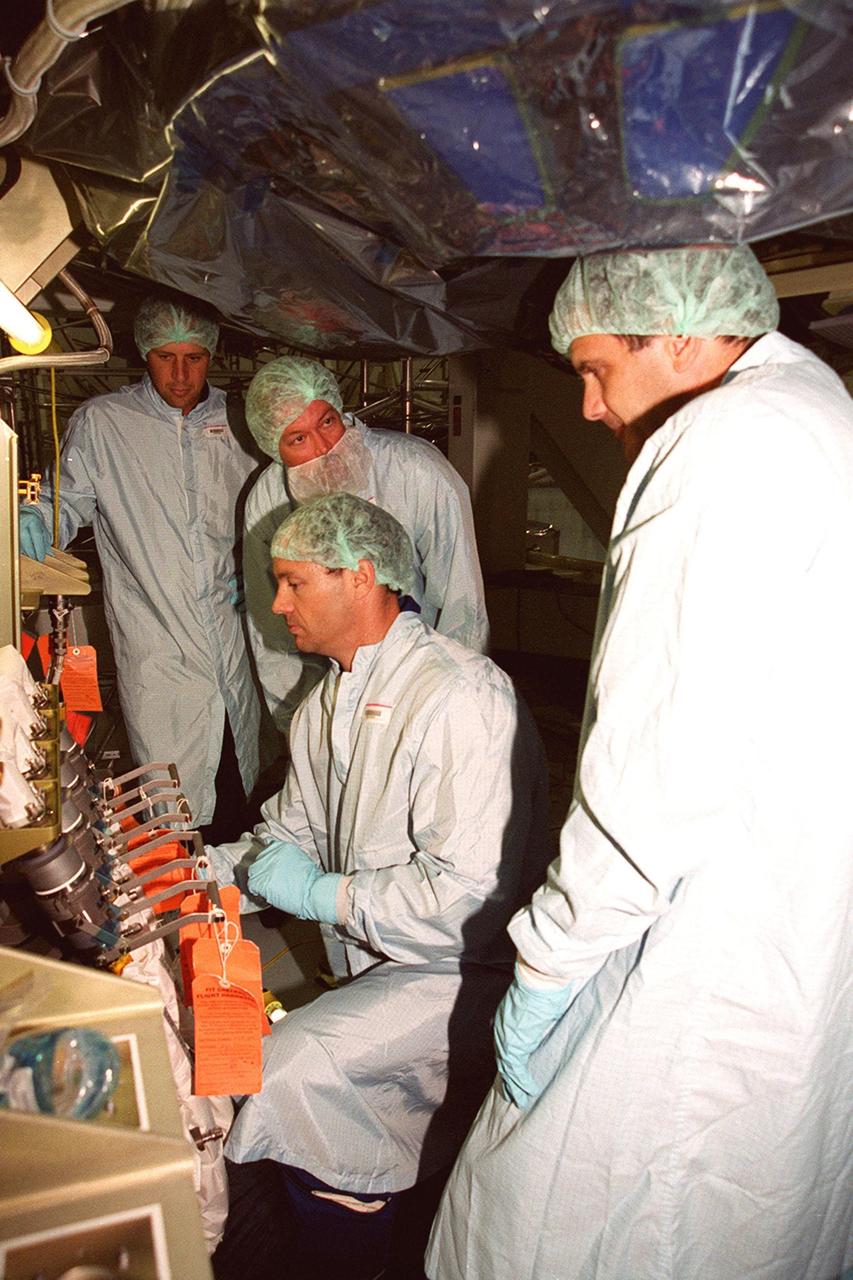
STS-92 Mission Specialists Michael Lopez-Alegria (center) and Jeff Wisoff (right) check out the Integrated Truss Structure Z1, a component of the International Space Station and payload on their mission. They and other crew members are taking part in Crew Equipment Interface Test (CEIT) activities while at KSC. The Z1 truss is an early exterior framework to allow the first U.S. solar arrays on a future flight to be temporarily installed on Unity for early power. STS-92 is scheduled to launch Oct. 5 from launch Pad 39A
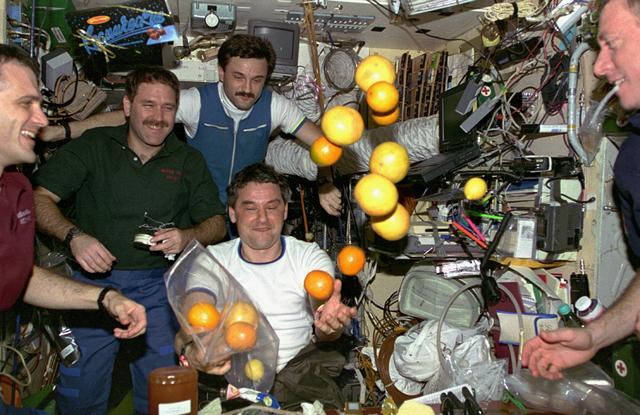
STS081-343-014 (12-22 Jan. 1997) --- Oranges and grapefruit brought up from Earth get a popular reception by the Mir-22 crewmembers. Left to right astronauts Peter J. K. (Jeff) Wisoff and John M. Grunsfeld, along with cosmonauts Aleksandr Y. Kaleri and Valeri G. Korzun, Mir-22 flight engineer and commander respectively, view the microgravity behavior of the seasonal gifts. Astronaut Michael A. Baker, mission commander, looks on at frame's right edge.
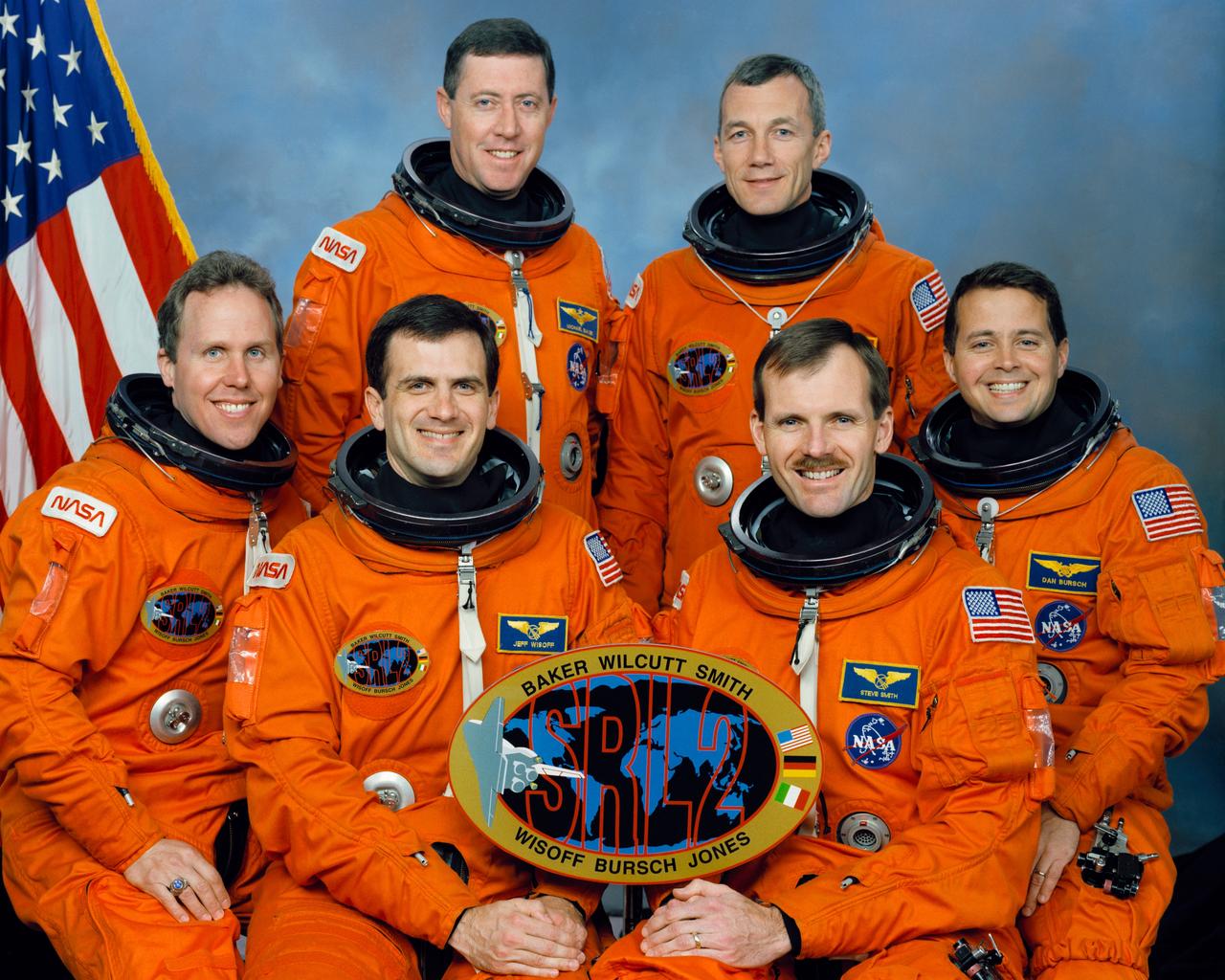
STS068-S-002 (March 1994) --- These six NASA astronauts are in training for the mission, scheduled for launch later this year. Standing are, left to right, Michael A. Baker, mission commander; and Terrence W. Wilcutt, pilot. On the front row are, left to right, Thomas D. Jones, payload commander; and Peter J. K. (Jeff) Wisoff, Steven L. Smith and Daniel W. Bursch, all mission specialists.
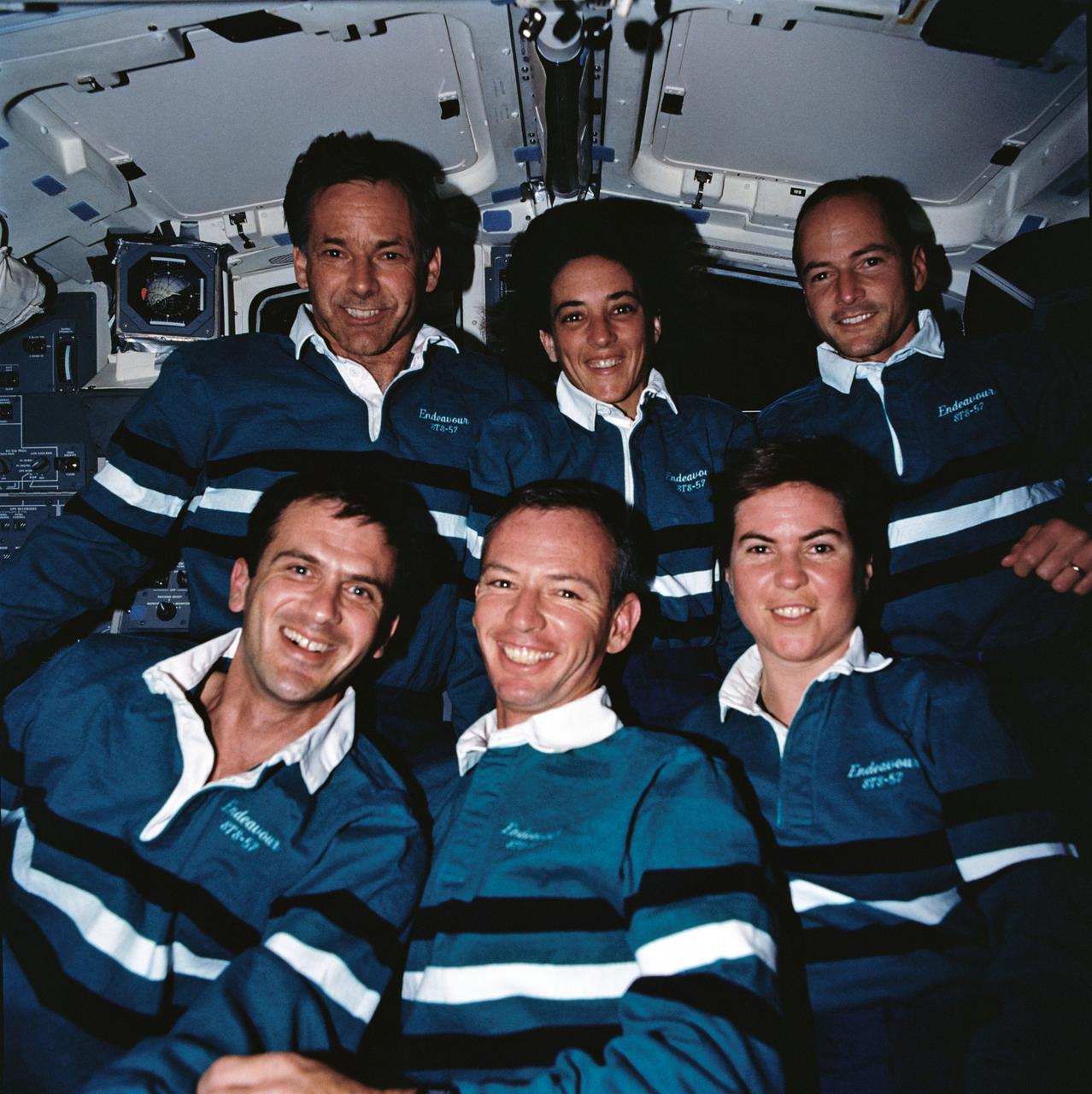
STS057-94-017 (21 June - 1 July 1993) --- Six astronauts onboard the Space Shuttle Endeavour pose for the traditional inflight crew portrait on the aft flight deck. In the rear (left to right) are astronauts Ronald J. Grabe, mission commander; Nancy J. Sherlock, mission specialist; and G. David Low, payload commander; in front (left to right), Peter J. K. (Jeff) Wisoff, mission specialist; Brian Duffy, pilot; and Janice E. Voss, mission specialist.
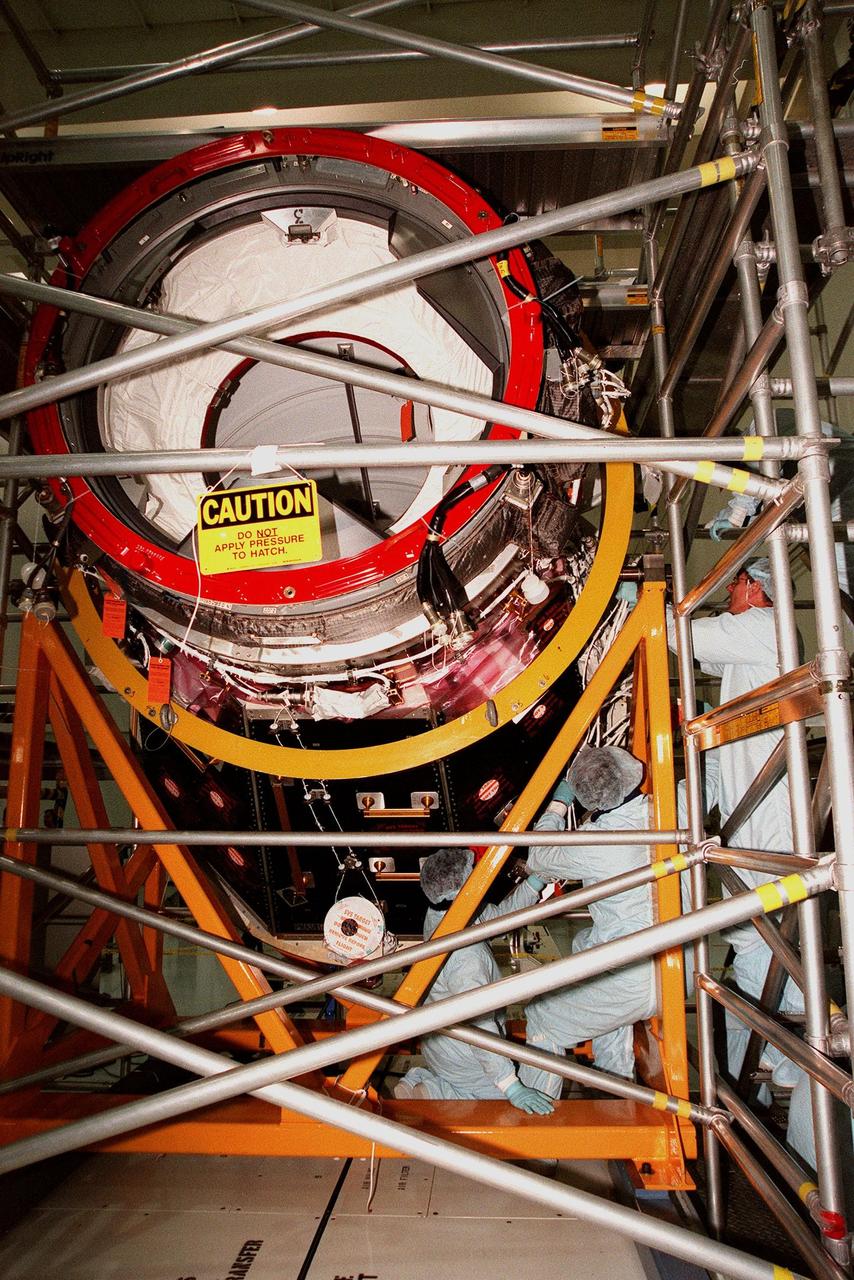
In the Space Station Processing Facility, members of the STS-92 crew practice working with the Pressurized Mating Adapter-3, part of the payload for their mission to the International Space Station (ISS). STS-92 is targeted for launch in December 1999. STS-92 crew members visiting KSC are Commander Brian Duffy and Mission Specialists Koichi Wakata, Leroy Chiao, Jeff Wisoff, Michael Lopez-Alegria and Bill McArthur. STS-92 is the fourth U.S. flight for construction of the International Space Station. The payload also includes an integrated truss structure
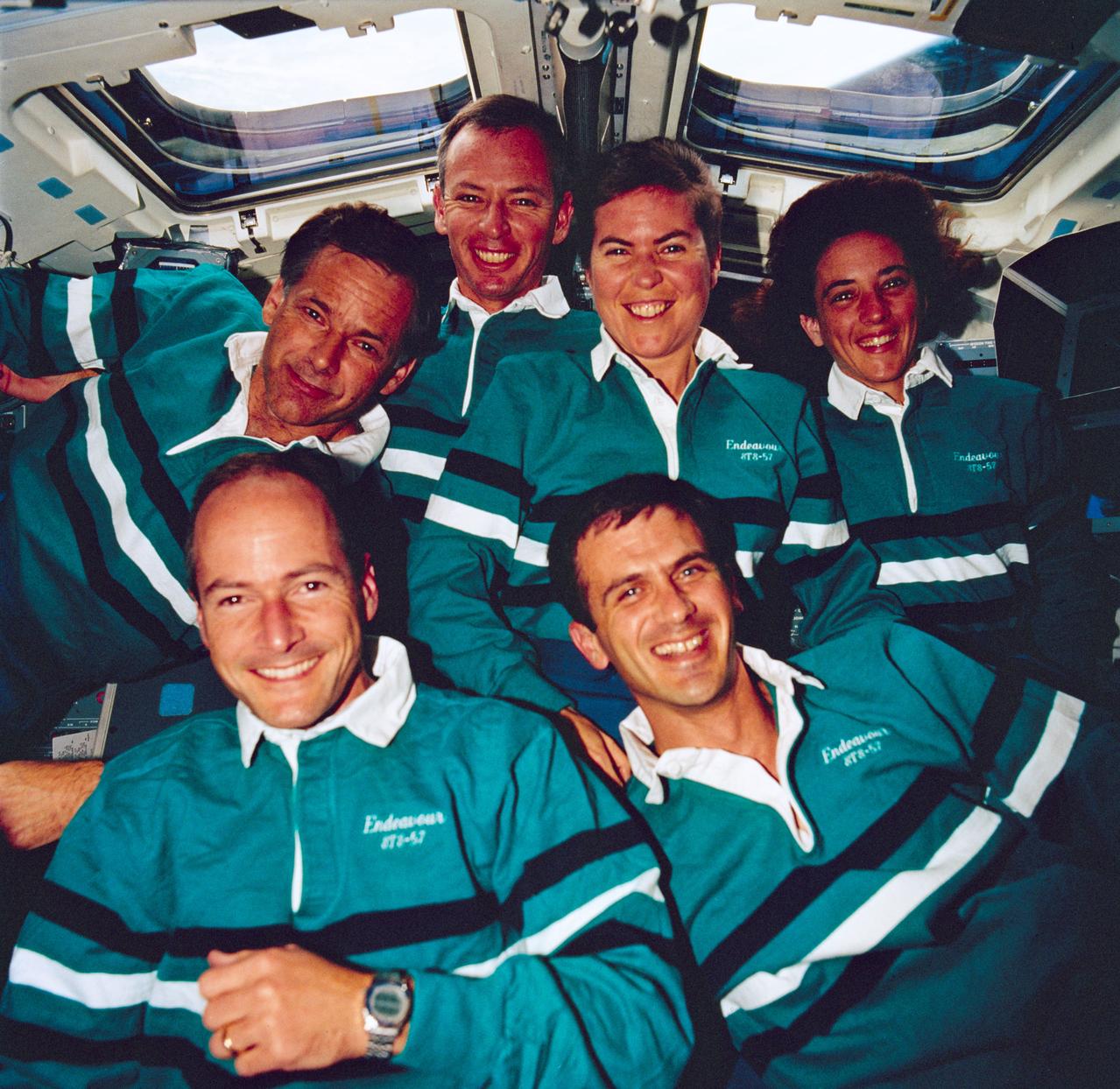
STS057-94-007 (21 June-1 July 1993) --- The six STS-57 crewmembers used a pre-set 70mm camera to record the traditional in-space crew portrait on Endeavour's aft flight deck. In front are astronauts G. David Low, payload commander; and Peter J. K. (Jeff) Wisoff, mission specialist. In the back are astronauts Ronald J. Grabe, mission commander; Brian Duffy, pilot; Janice E. Voss and Nancy J. Sherlock, mission specialists.
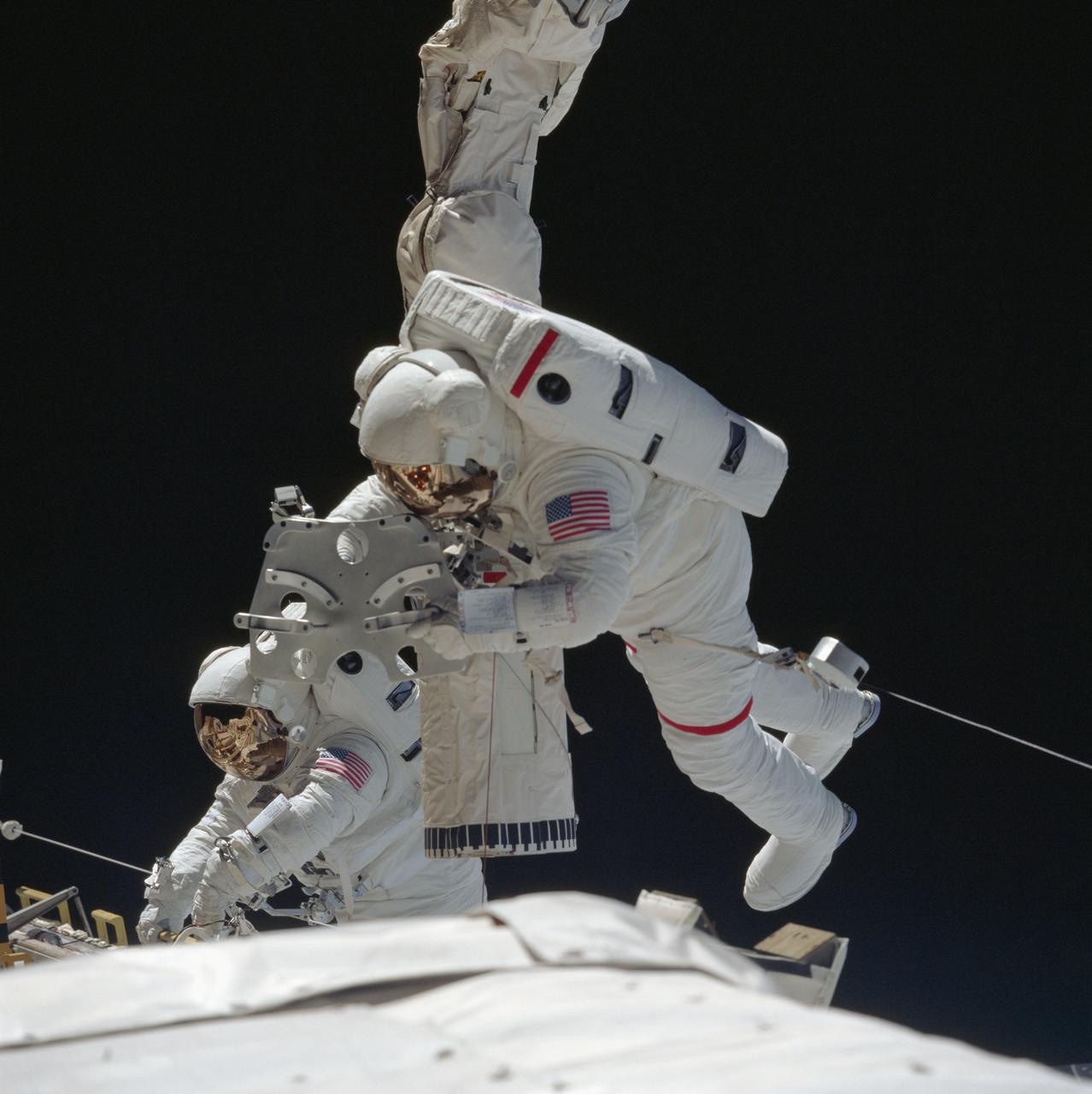
STS057-97-056 (25 June 1993) --- Astronaut G. David Low (foreground) adjusts the mobile foot restraint on the end of the Space Shuttle Endeavour's Remote Manipulator System (RMS) while astronaut Peter J. K. (Jeff) Wisoff busies himself at the stowed European Retrievable Carrier (EURECA) during June 25, 1993, extravehicular activity (EVA).
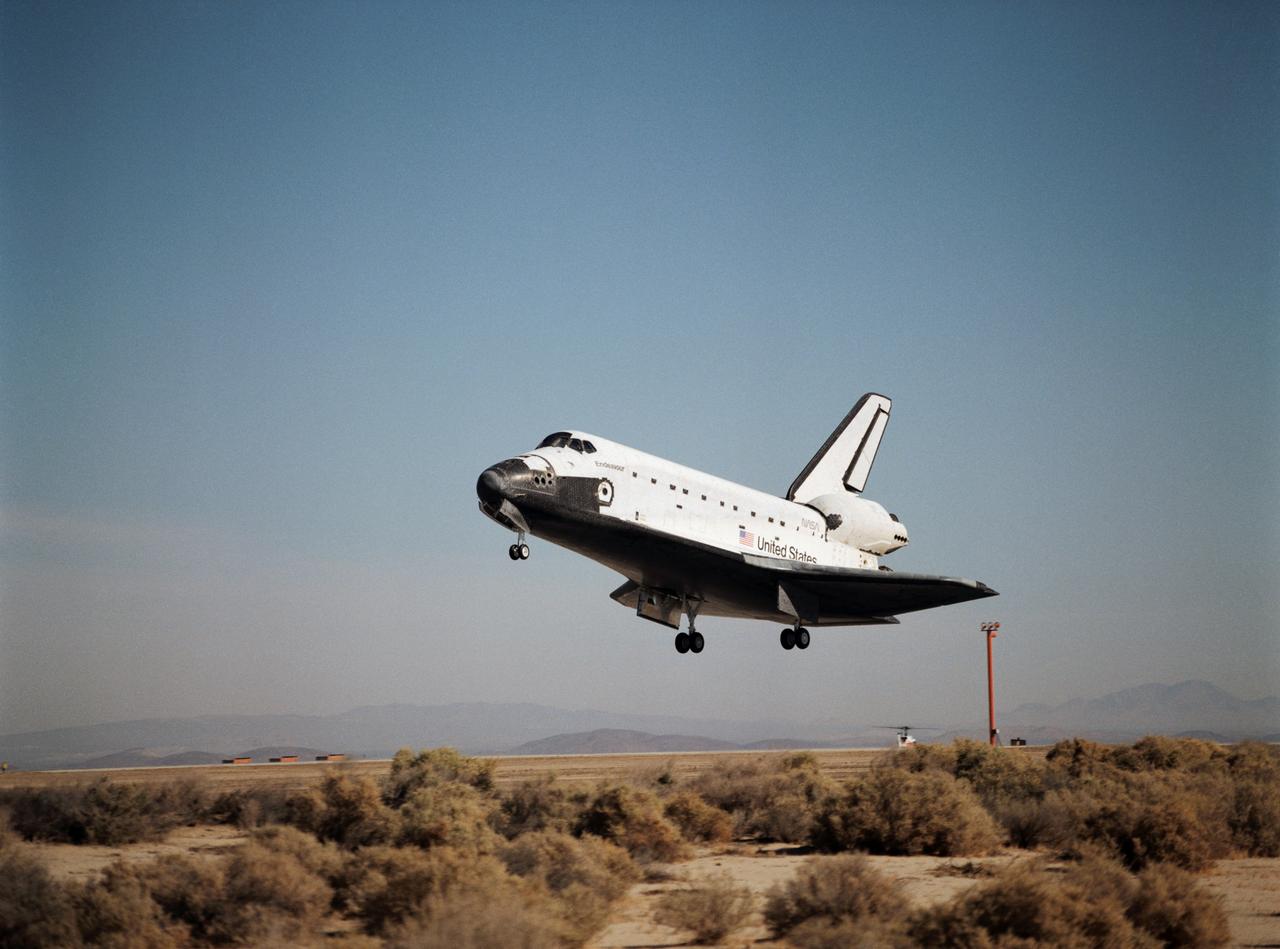
STS068-S-060 (11 October 1994) --- With its main landing gear not quite on the runway, the Space Shuttle Endeavour wraps up an eleven-day mission at Edwards Air Force Base, California. Landing occurred at 10:02 a.m. (PDT), October 11, 1994. Onboard were astronauts Michael A. Baker, mission commander; Terrence W. Wilcutt, pilot; Thomas D. Jones, payload commander; and Daniel W. Bursch, Peter J. K. (Jeff) Wisoff and Steven L. Smith, all mission specialists.
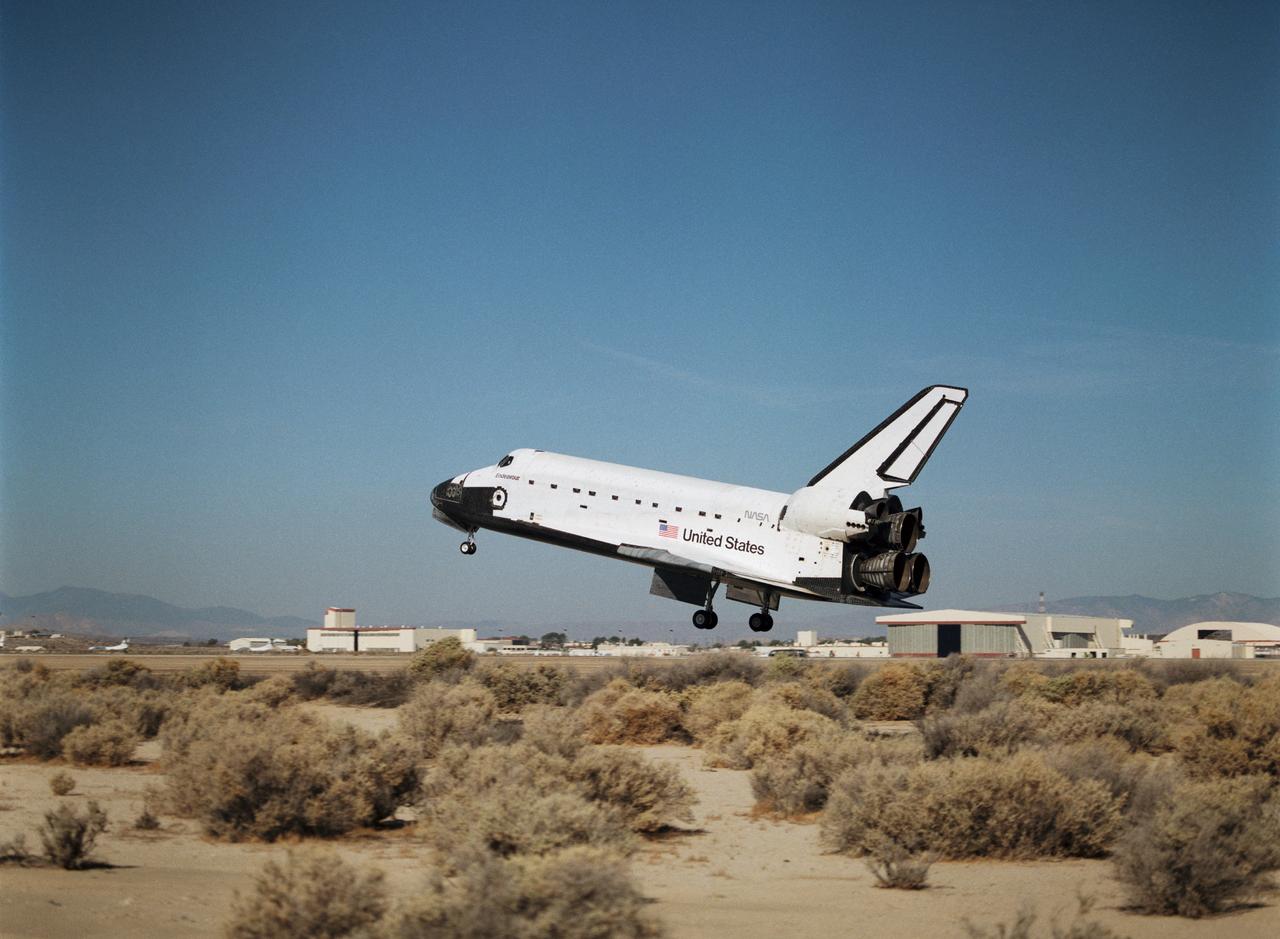
STS068-S-059 (11 October 1994) --- With its main landing gear not quite on the runway, the Space Shuttle Endeavour wraps up an eleven-day mission at Edwards Air Force Base, California. Landing occurred at 10:02 a.m. (PDT), October 11, 1994. Onboard were astronauts Michael A. Baker, mission commander; Terrence W. Wilcutt, pilot; Thomas D. Jones, payload commander; and Daniel W. Bursch, Peter J. K. (Jeff) Wisoff and Steven L. Smith, all mission specialists.
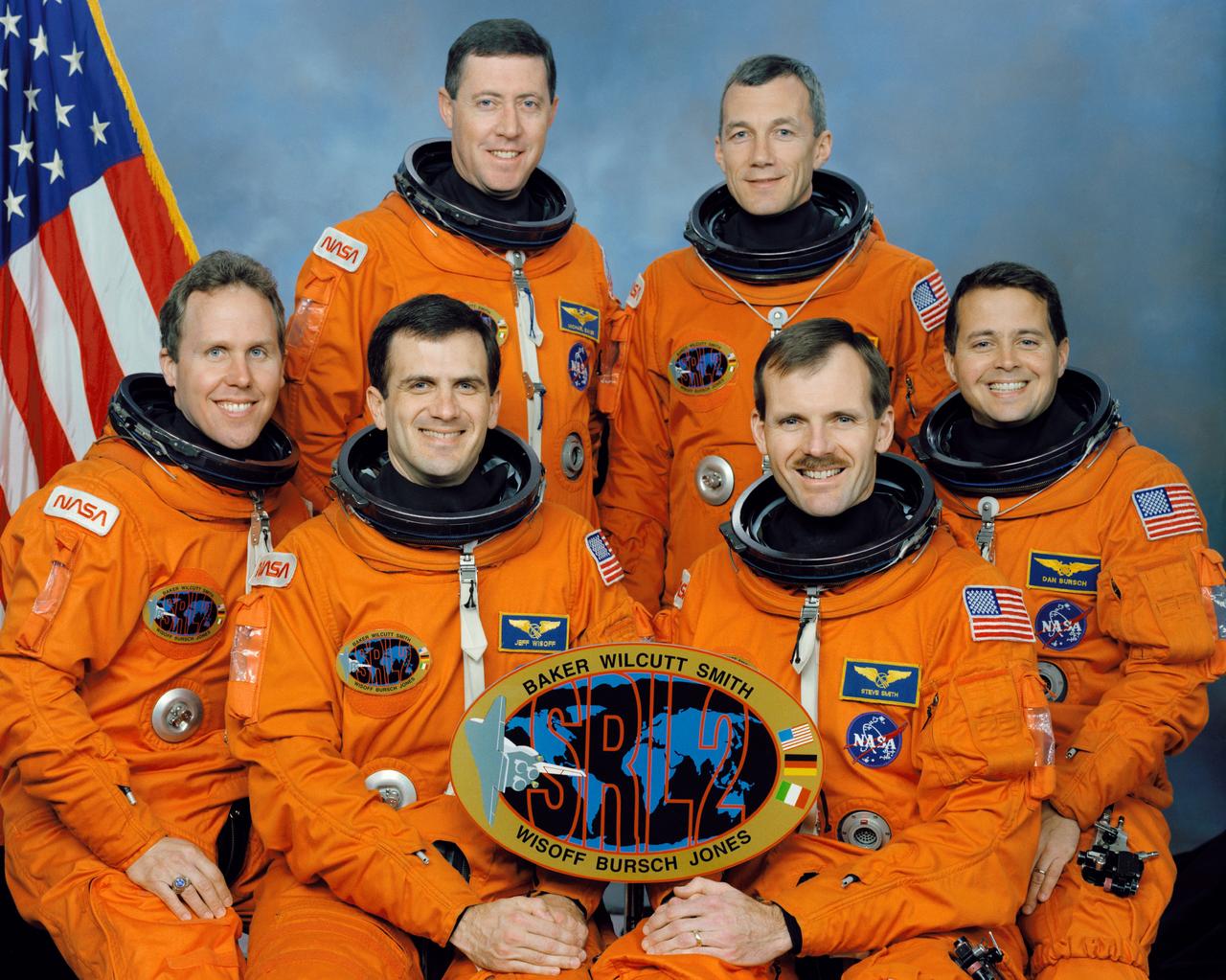
These six NASA astronauts composed the crew of the STS-68 mission that launched aboard the Space Shuttle Endeavour on September 30, 1994. Standing are, left to right, Michael A. Baker, mission commander; and Terrence W. Wilcutt, pilot. On the front row are, left to right, Thomas D. Jones, payload commander; and Peter J. K. (Jeff) Wisoff, Steven L. Smith, and Daniel W. Bursch, all mission specialists. STS-68 marked the second flight of the Space Radar Laboratory, part of NASA’s mission to planet Earth.
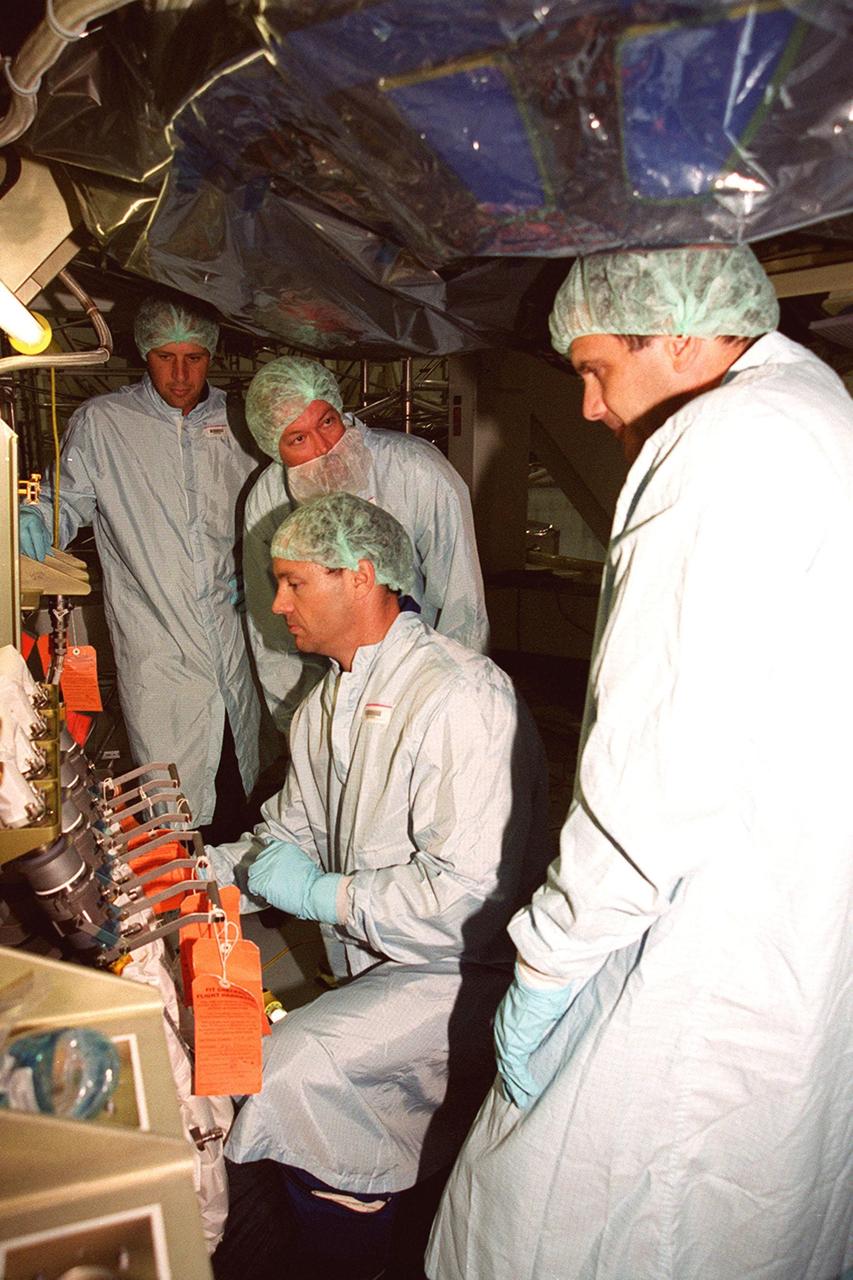
STS-92 Mission Specialists Michael Lopez-Alegria (center) and Jeff Wisoff (right) check out the Integrated Truss Structure Z1, a component of the International Space Station and payload on their mission. They and other crew members are taking part in Crew Equipment Interface Test (CEIT) activities while at KSC. The Z1 truss is an early exterior framework to allow the first U.S. solar arrays on a future flight to be temporarily installed on Unity for early power. STS-92 is scheduled to launch Oct. 5 from launch Pad 39A
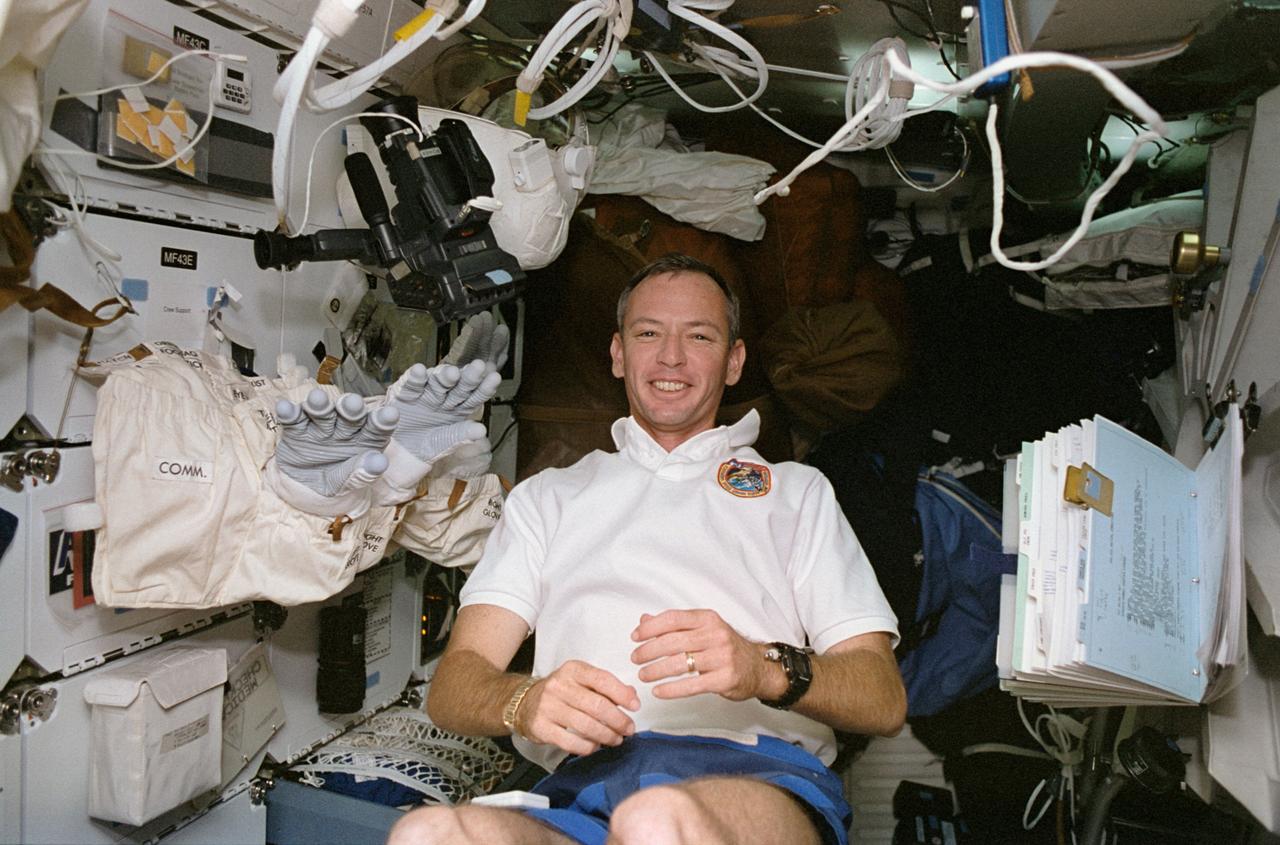
STS057-32-017 (24 June 1993) --- Near the airlock hatch on Endeavour's middeck, astronaut Brian Duffy, pilot, checks out some of the equipment to be used on the June 25 extravehicular activity (EVA) of two crewmates. Less than 24 hours later, Duffy and three other NASA astronauts remained inside Endeavour's cabin while astronauts G. David Low and Peter J. K. (Jeff) Wisoff, began a lengthy, variegated session of EVA.
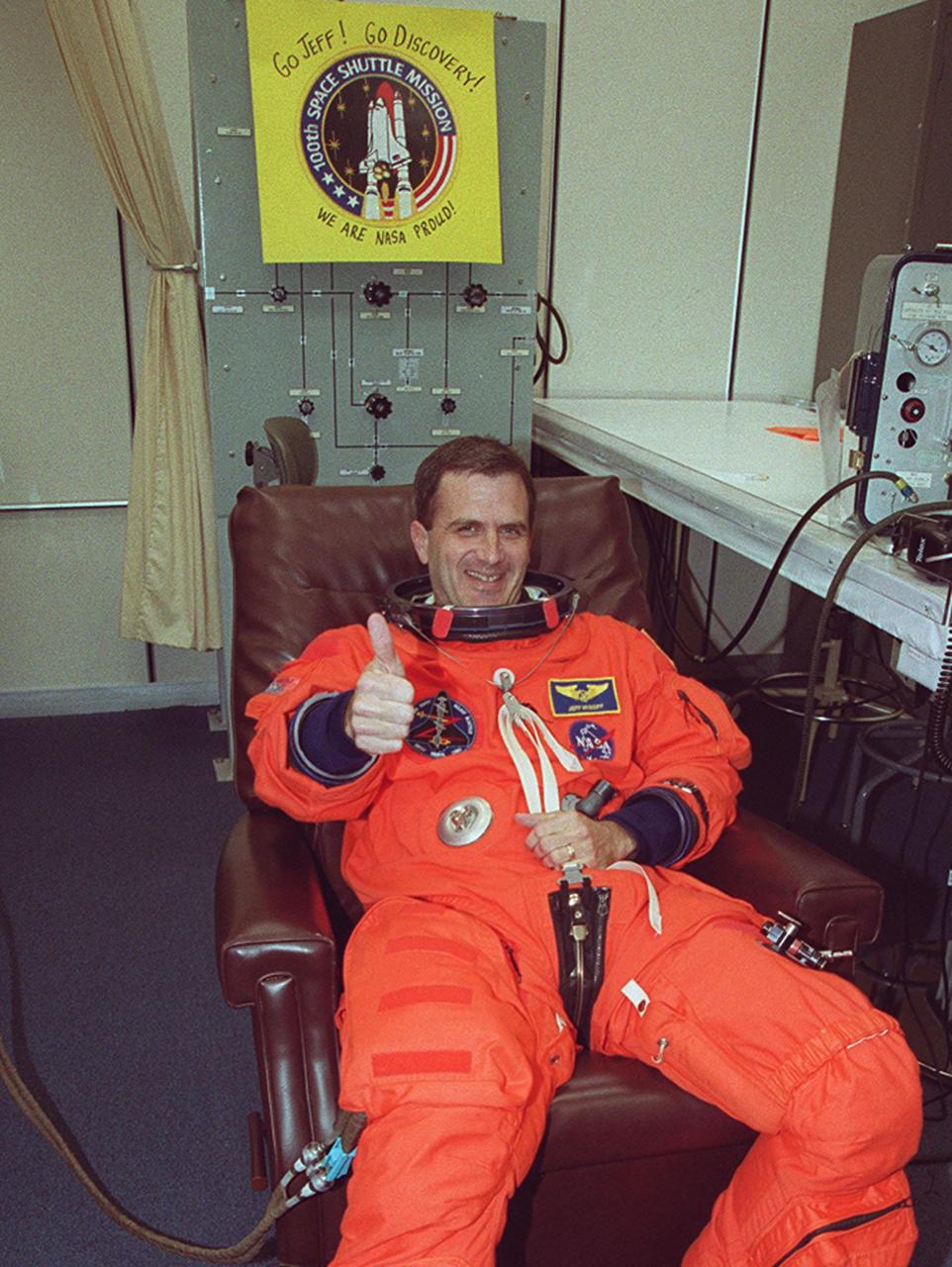
STS-92 Mission Specialist Peter J.K. “Jeff” Wisoff looks relaxed as he signals a thumbs up for launch, scheduled for 8:05 p.m. EDT. The mission is the fifth flight for the construction of the ISS. The payload includes the Integrated Truss Structure Z-1 and the third Pressurized Mating Adapter. During the 11-day mission, four extravehicular activities (EVAs), or spacewalks, are planned. The Z-1 truss is the first of 10 that will become the backbone of the International Space Station, eventually stretching the length of a football field. PMA-3 will provide a Shuttle docking port for solar array installation on the sixth ISS flight and Lab installation on the seventh ISS flight. This launch is the fourth for Wisoff. Landing is expected Oct. 21 at 3:55 p.m. EDT
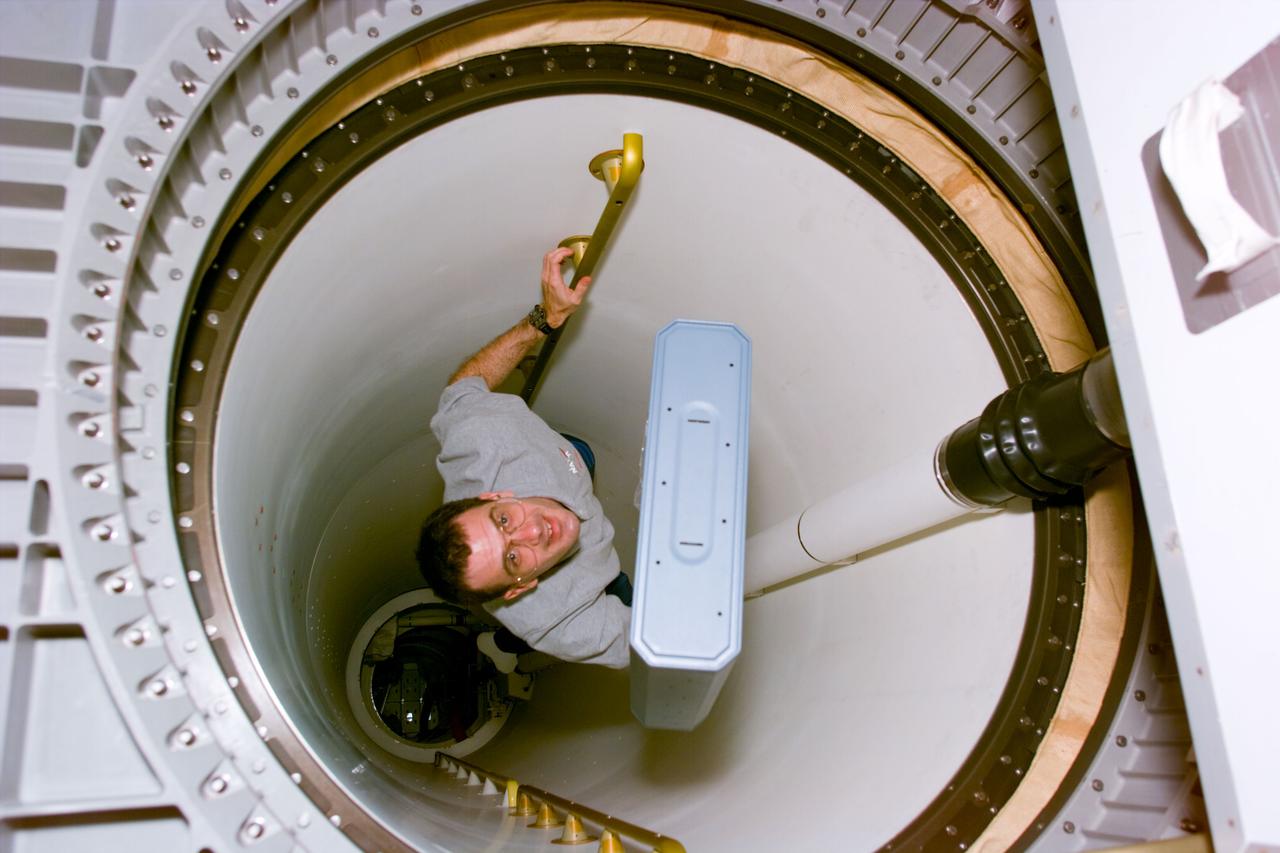
STS081-E-05100 (12 Jan. 1997) --- Astronaut Peter J. K. (Jeff) Wisoff, mission specialist, carries a stowage drawer from the middeck of the Space Shuttle Atlantis' crew cabin through a connective tunnel into the Spacehab Double Module (DM). In a few days, Wisoff and his five crew mates are scheduled to dock with Russia's Mir Space Station and pick up John E. Blaha, NASA astronaut who has been serving as a cosmonaut guest researcher since September, 1996. Astronaut Jerry M. Linenger will replace Blaha onboard Mir and the transfer will mark the second such direct exchange of cosmonaut guest researchers, though Linenger will be the fourth United States astronaut to spend a lengthy stay on Mir.

STS068-237-055 (30 September - 11 October 1994) --- This coastal area, considered home by astronaut Peter J. K. (Jeff) Wisoff, was photographed from the Space Shuttle Endeavour during the Space Radar Laboratory (SRL-2) mission. Wisoff, a native of Norfolk, talked about this area during a post-flight crew awards and presentation event at the Johnson Space Center (JSC). He pointed out that the waterways are heavily used for commercial, recreational and military purposes. Piers near the mouth of the Elizabeth River are associated with the U. S. Naval Base and those down river support the activities of the city of Norfolk. Seashore State Park and the Ft. Story Military Reservation are visible at the mouth of the Chesapeake.
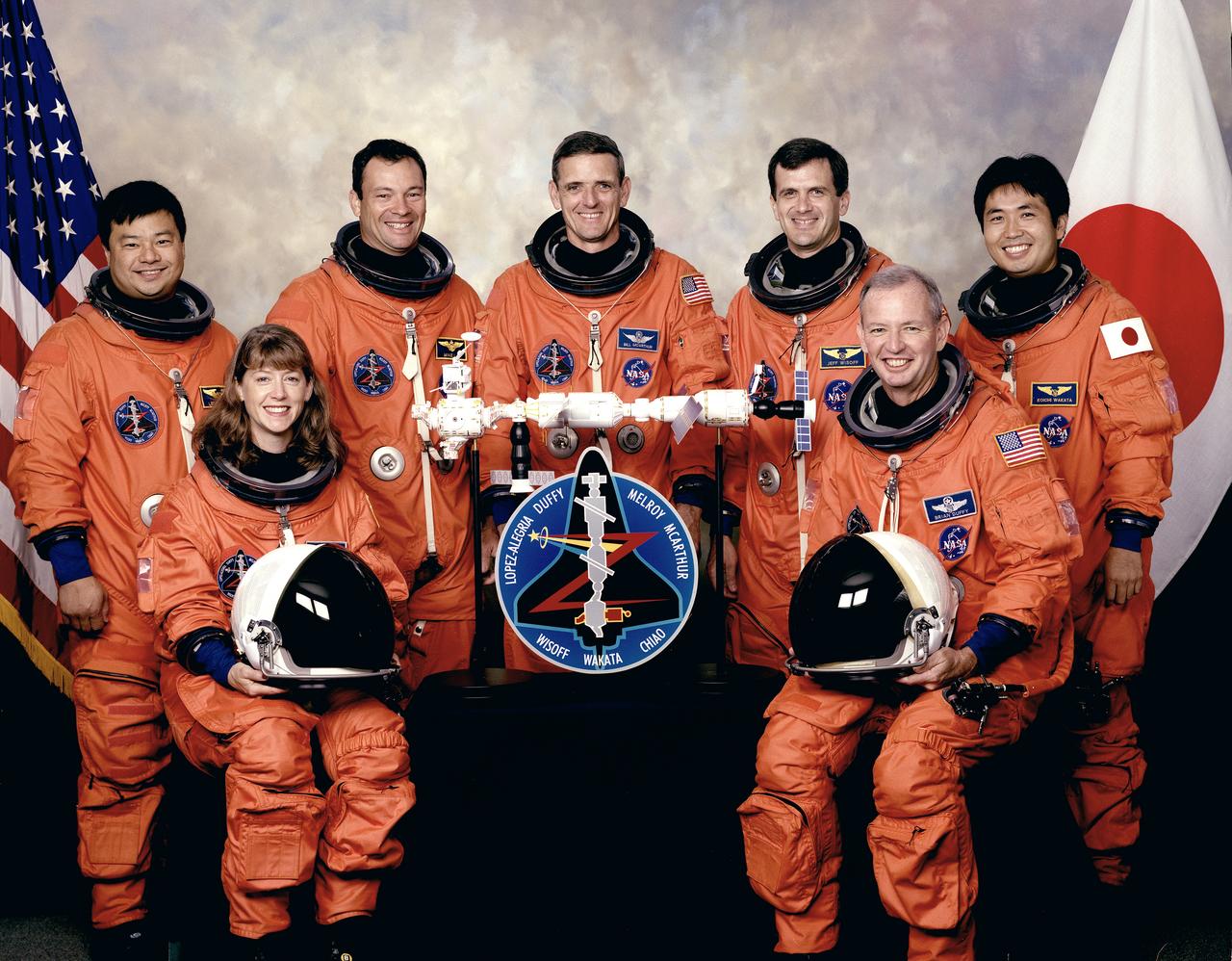
These seven astronauts composed the crew for the STS-92 mission. In front are astronauts Pamela A. Melroy, pilot; and Brian Duffy, mission commander. In the rear, from the left, are astronauts Leroy Chiao, Michael E. Lopez-Alegria, William S. McArthur, Jr., Peter J.K. (Jeff) Wisoff, and Koichi Wakata, all mission specialists. Wakata represents Japan's National Space Development Agency (NASDA). Launched aboard the Space Shuttle Discovery on October 11, 2000, the 100th shuttle flight was the second to deliver hardware to the International Space Station (ISS). During Four space walks, the crew installed the Z1 truss and the Pressurized Mating Adapter (PMA) 3.
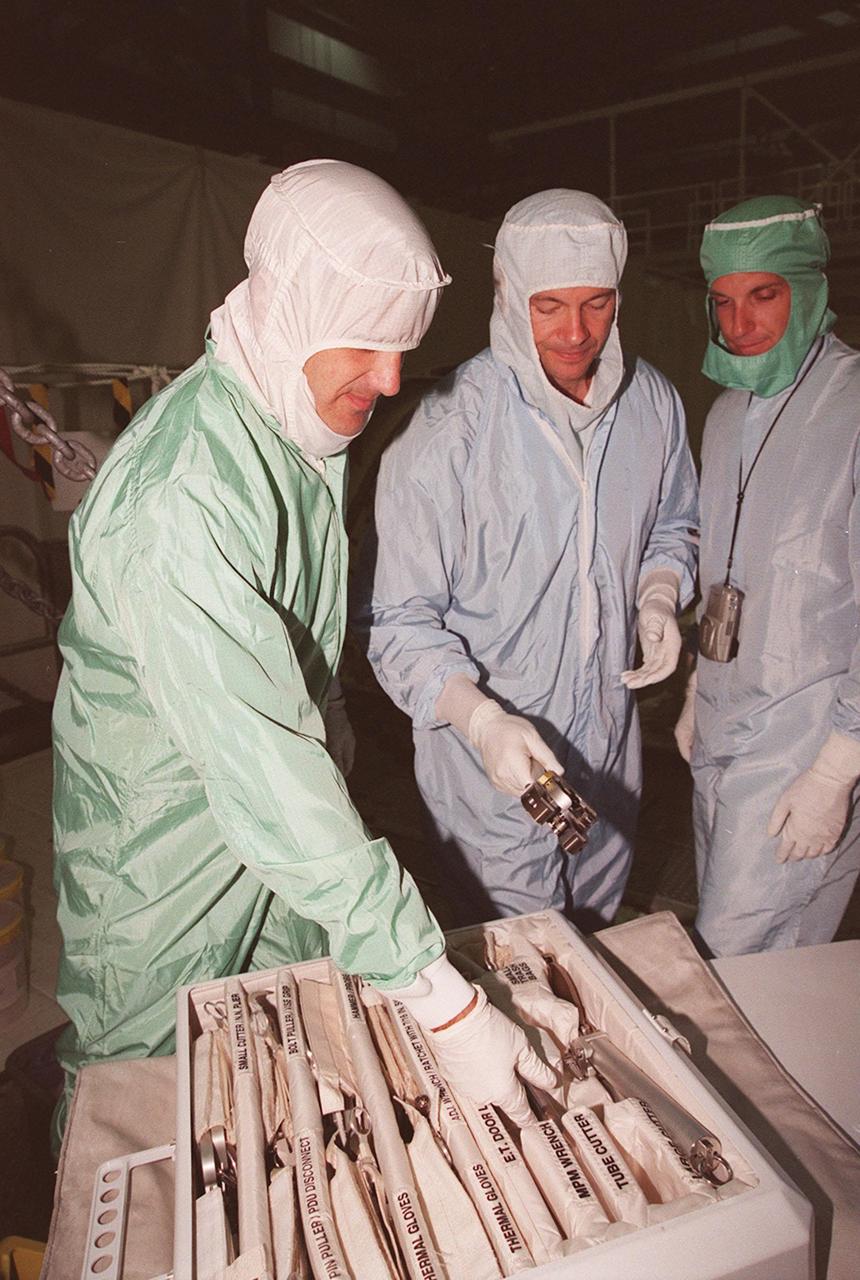
In the Orbiter Processing Facility bay 1, STS-92 crew members, along with Boeing workers, look closely at the tools they will be using on their mission. The crew comprises Commander Brian Duffy, Pilot Pam Melroy and Mission Specialists Koichi Wakata, Leroy Chiao, Jeff Wisoff, Michael Lopez-Alegria and Bill McArthur. STS-92 is scheduled to launch Oct. 5 on Shuttle Discovery from Launch Pad 39A on the fifth flight to the International Space Station. Discovery will carry the Integrated Truss Structure (ITS) Z1, Pressurized Mating Adapter 3, Ku-band Communications System, and Control Moment Gyros (CMGs)
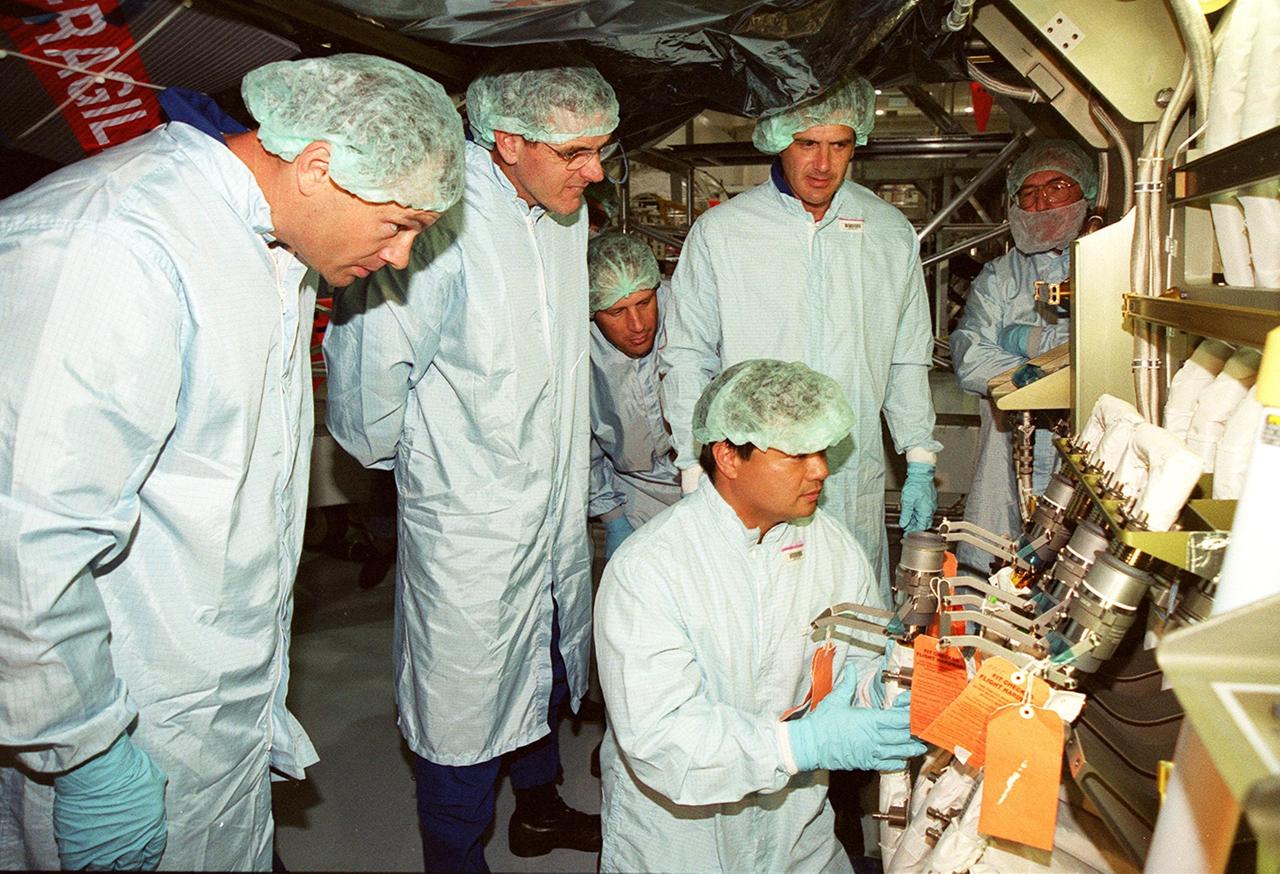
Members of the STS-92 crew check out the Integrated Truss Structure Z1, a component of the International Space Station and payload on their mission. From left are Mission Specialists Michael Lopez-Alegria, Bill McArthur, Jeff Wisoff and (kneeling) Leroy Chiao. They and other crew members are taking part in Crew Equipment Interface Test (CEIT) activities while at KSC. The Z1 truss is an early exterior framework to allow the first U.S. solar arrays on a future flight to be temporarily installed on Unity for early power. STS-92 is scheduled to launch Oct. 5 from launch Pad 39A
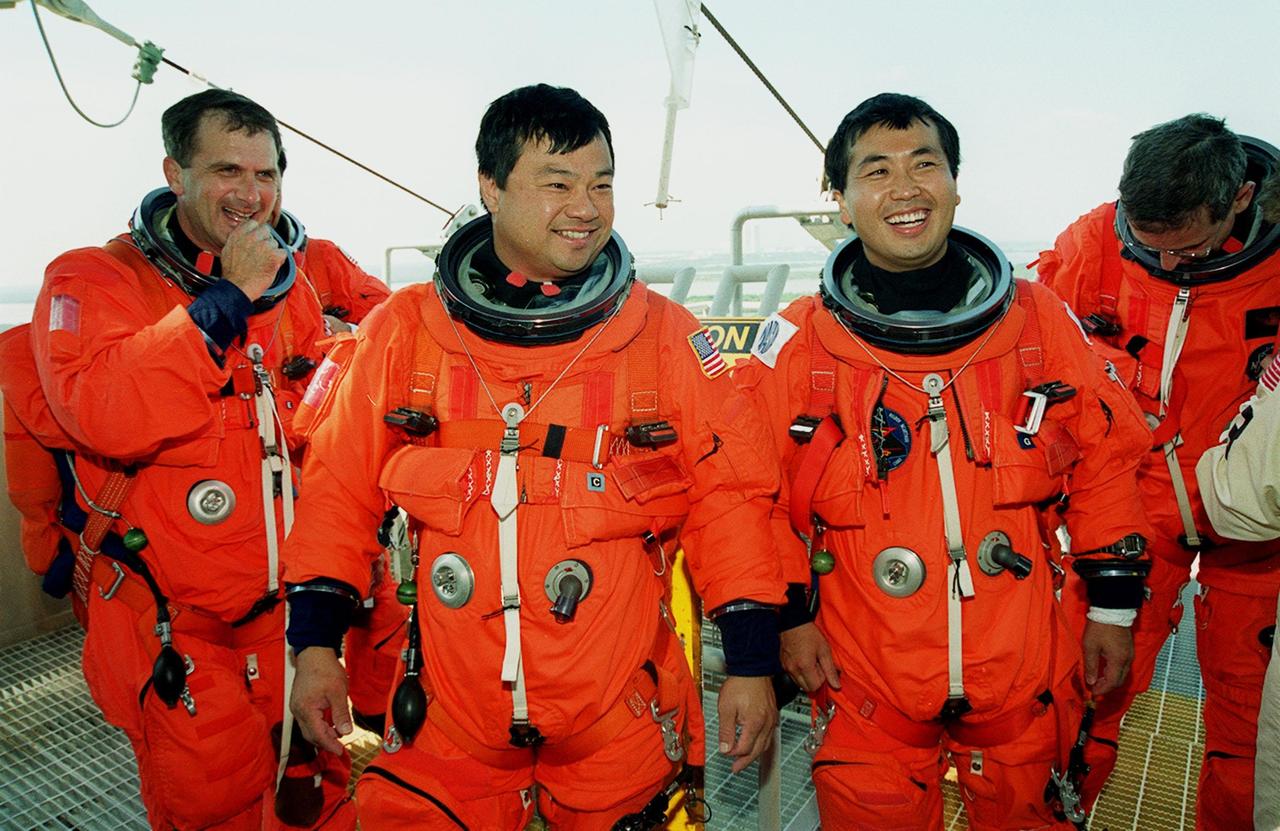
KENNEDY SPACE CENTER, FLA. -- STS-92 Mission Specialists (left to right) Peter J.K. “Jeff” Wisoff, Leroy Chiao, Koichi Wakata of Japan and William S. McArthur Jr. finish emergency egress training in the slidewire baskets behind them. The training is part of Terminal Countdown Demonstration Test activities that also include a simulated countdown. STS-92 is scheduled to launch Oct. 5 at 9:38 p.m. EDT on the fifth flight to the International Space Station. It will carry two elements of the Space Station, the Integrated Truss Structure Z1 and the third Pressurized Mating Adapter. The mission is also the 100th flight in the Shuttle program
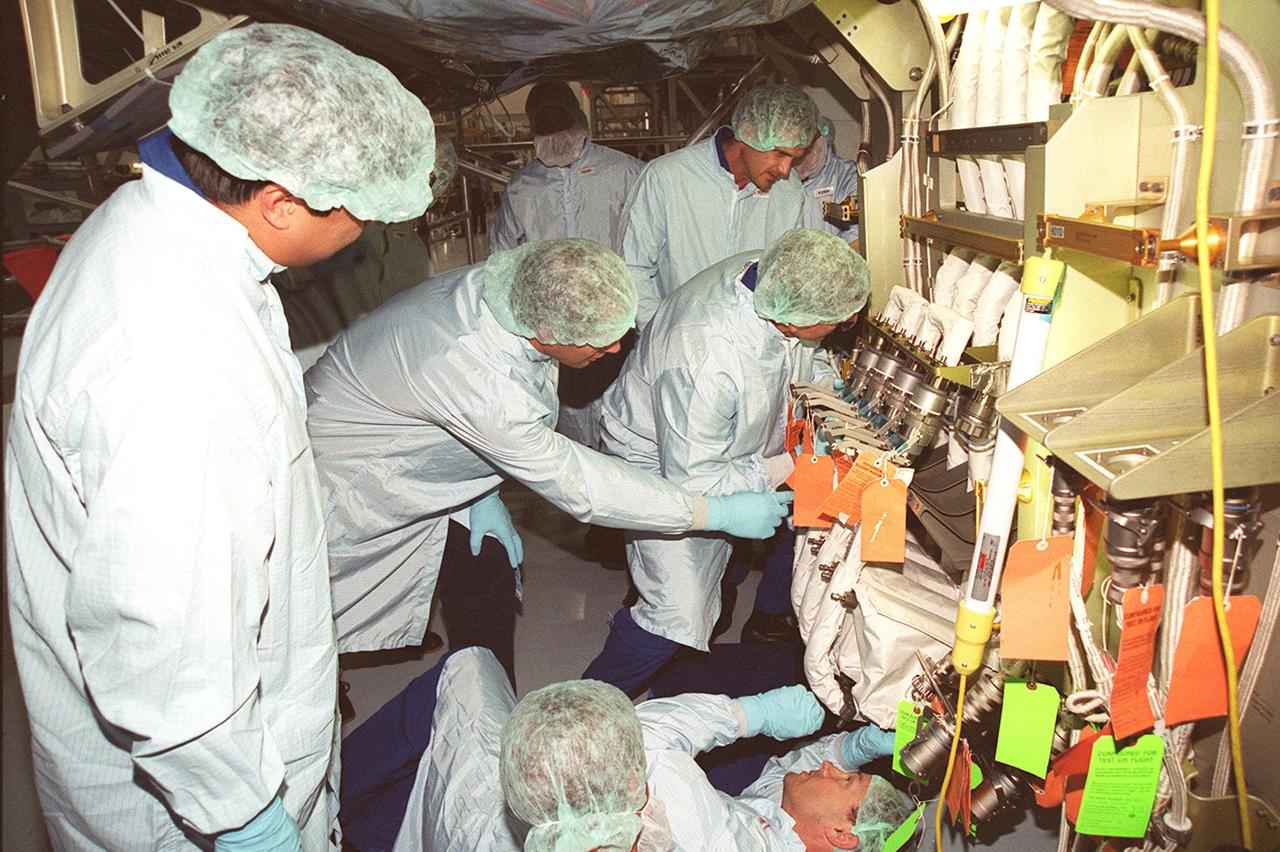
As part of Crew Equipment Interface Test (CEIT) activities, members of the STS-92 crew check out equipment they will be using on the mission to the International Space Station. At left is Mission Specialist Leroy Chiao, looking at part of the Integrated Truss Structure Z1, a component of the Station and payload on STS-92. Others seen in the photo are Mission Specialists Michael Lopez-Alegria (on his back, lower right); Jeff Wisoff (standing in back); and Bill McArthur (bending closer to the Z1 truss). Also taking part in the CIET are Commander Brian Duffy, Pilot Pam Melroy, and Mission Specialist Koichi Wakata. STS-92 is scheduled to launch Oct. 5 from launch Pad 39A
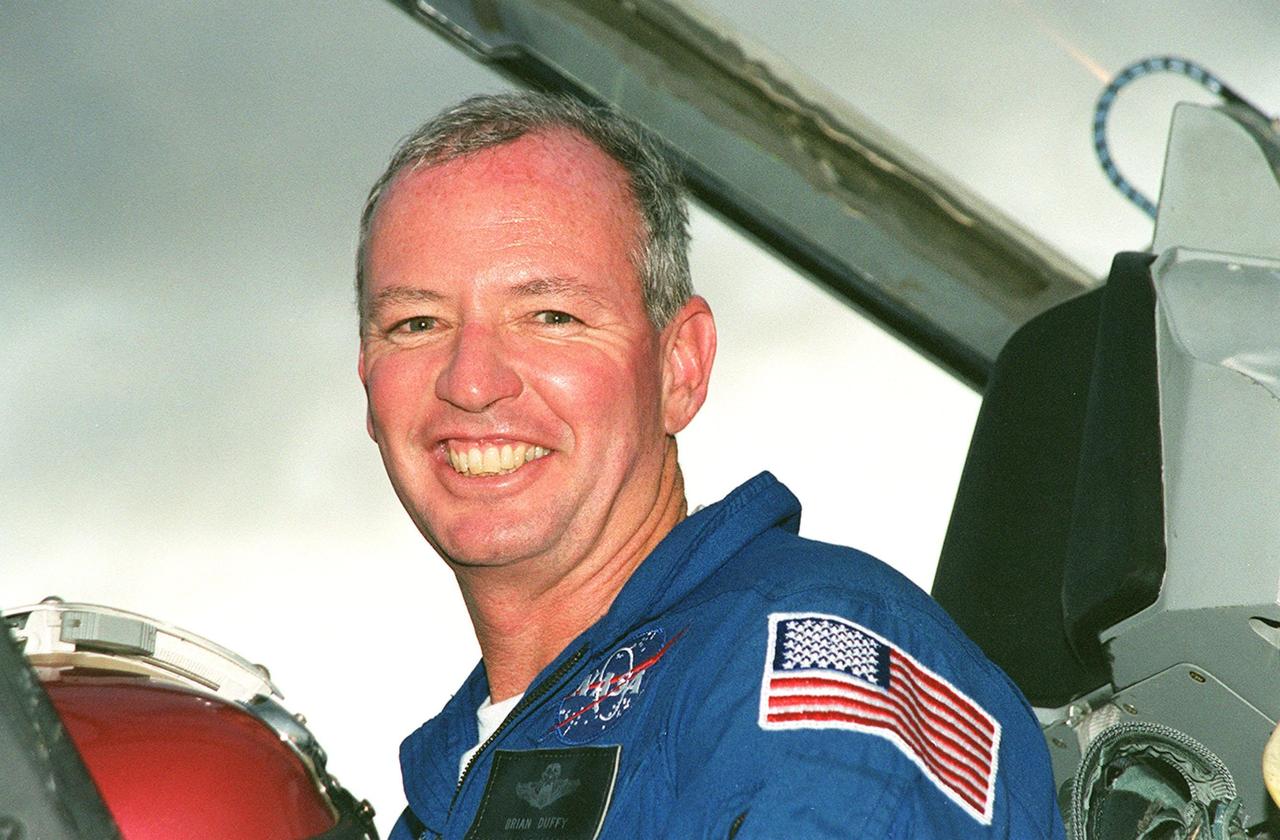
KENNEDY SPACE CENTER, FLA. -- STS-92 Commander Brian Duffy is happy to return to KSC for the launch of Space Shuttle Discovery on Oct. 5. . He and other crew members Pilot Pamela Ann Melroy and Mission Specialists Koichi Wakata of Japan, Leroy Chiao, Peter J.K. “Jeff” Wisoff, Michael E. Lopez-Alegria and William S. McArthur Jr. expressed their eagerness to launch to a waiting group of media at the Shuttle Landing Facility. The mission is the fifth flight for the construction of the International Space Station. The payload includes the Integrated Truss Structure Z-1 and the third Pressurized Mating Adapter. During the 11-day mission, four extravehicular activities (EVAs), or space walks, are planned.
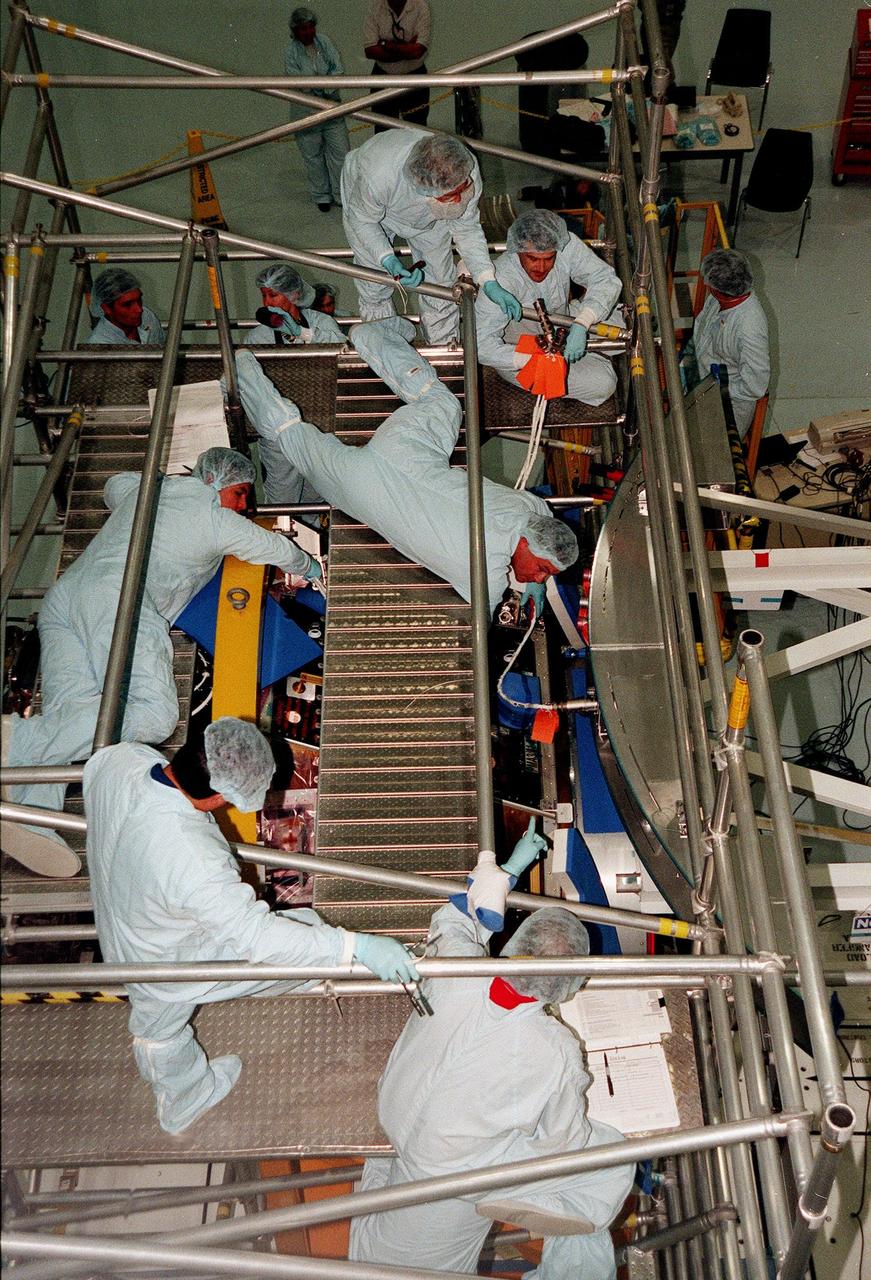
In the Space Station Processing Facility, members of the STS-92 crew fill scaffolding to look over the Pressurized Mating Adapter-3, part of the payload for their mission to the International Space Station (ISS). STS-92 is targeted for launch in December 1999. From lower left are Mission Specialists Leroy Chiao, Michael Lopez-Alegria (center), Bill McArthur and Jeff Wisoff (top). Other crew members visiting KSC are Commander Brian Duffy and Mission Specialist Koichi Wakata. STS-92 is the fourth U.S. flight for construction of the International Space Station. The payload also includes an integrated truss structure
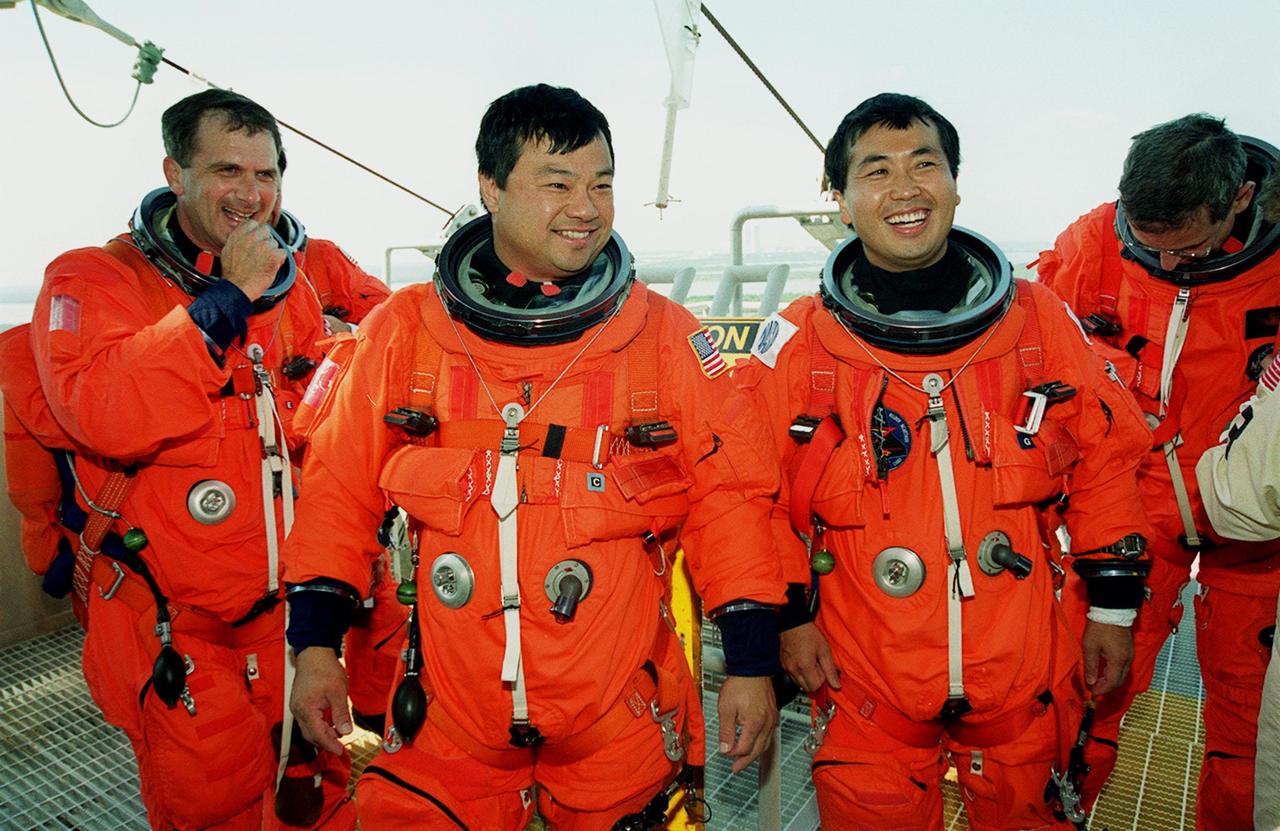
KENNEDY SPACE CENTER, FLA. -- STS-92 Mission Specialists (left to right) Peter J.K. “Jeff” Wisoff, Leroy Chiao, Koichi Wakata of Japan and William S. McArthur Jr. finish emergency egress training in the slidewire baskets behind them. The training is part of Terminal Countdown Demonstration Test activities that also include a simulated countdown. STS-92 is scheduled to launch Oct. 5 at 9:38 p.m. EDT on the fifth flight to the International Space Station. It will carry two elements of the Space Station, the Integrated Truss Structure Z1 and the third Pressurized Mating Adapter. The mission is also the 100th flight in the Shuttle program
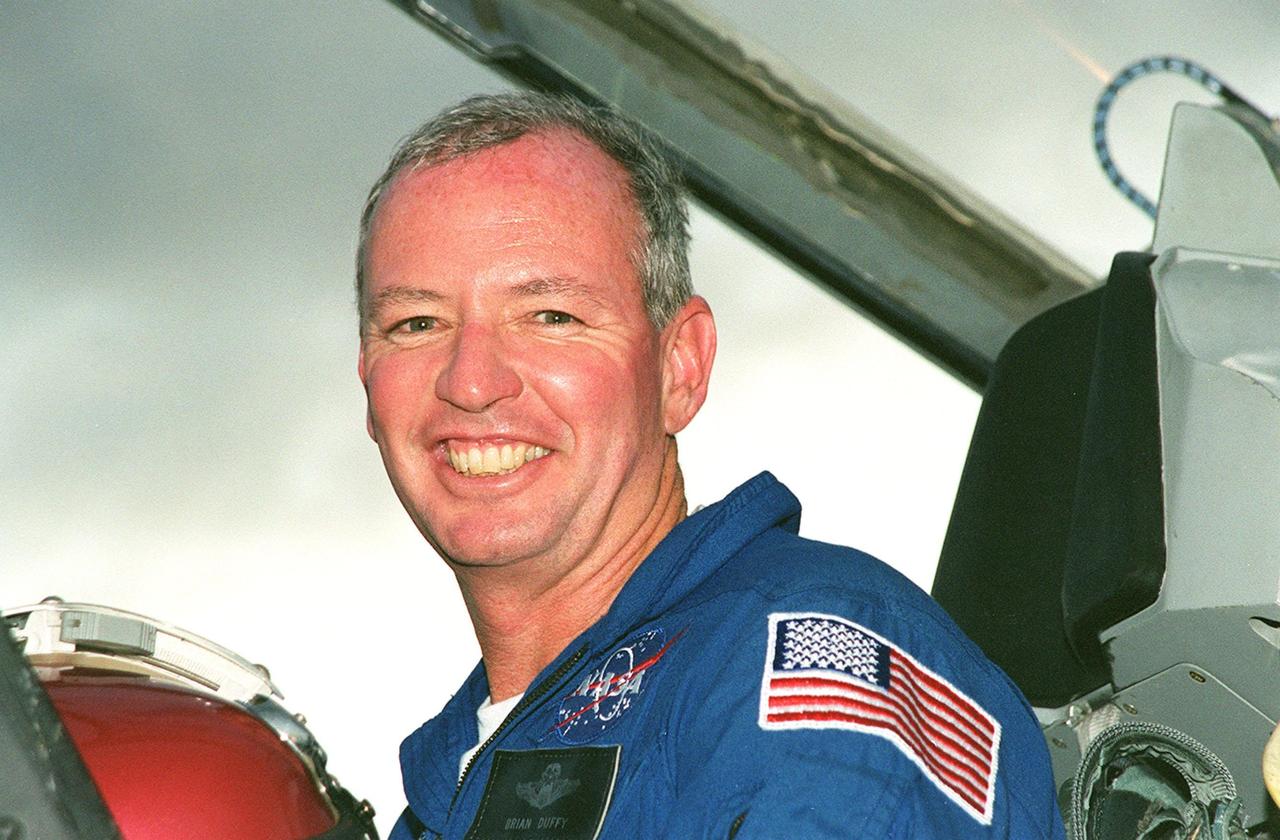
KENNEDY SPACE CENTER, FLA. -- STS-92 Commander Brian Duffy is happy to return to KSC for the launch of Space Shuttle Discovery on Oct. 5. . He and other crew members Pilot Pamela Ann Melroy and Mission Specialists Koichi Wakata of Japan, Leroy Chiao, Peter J.K. “Jeff” Wisoff, Michael E. Lopez-Alegria and William S. McArthur Jr. expressed their eagerness to launch to a waiting group of media at the Shuttle Landing Facility. The mission is the fifth flight for the construction of the International Space Station. The payload includes the Integrated Truss Structure Z-1 and the third Pressurized Mating Adapter. During the 11-day mission, four extravehicular activities (EVAs), or space walks, are planned.
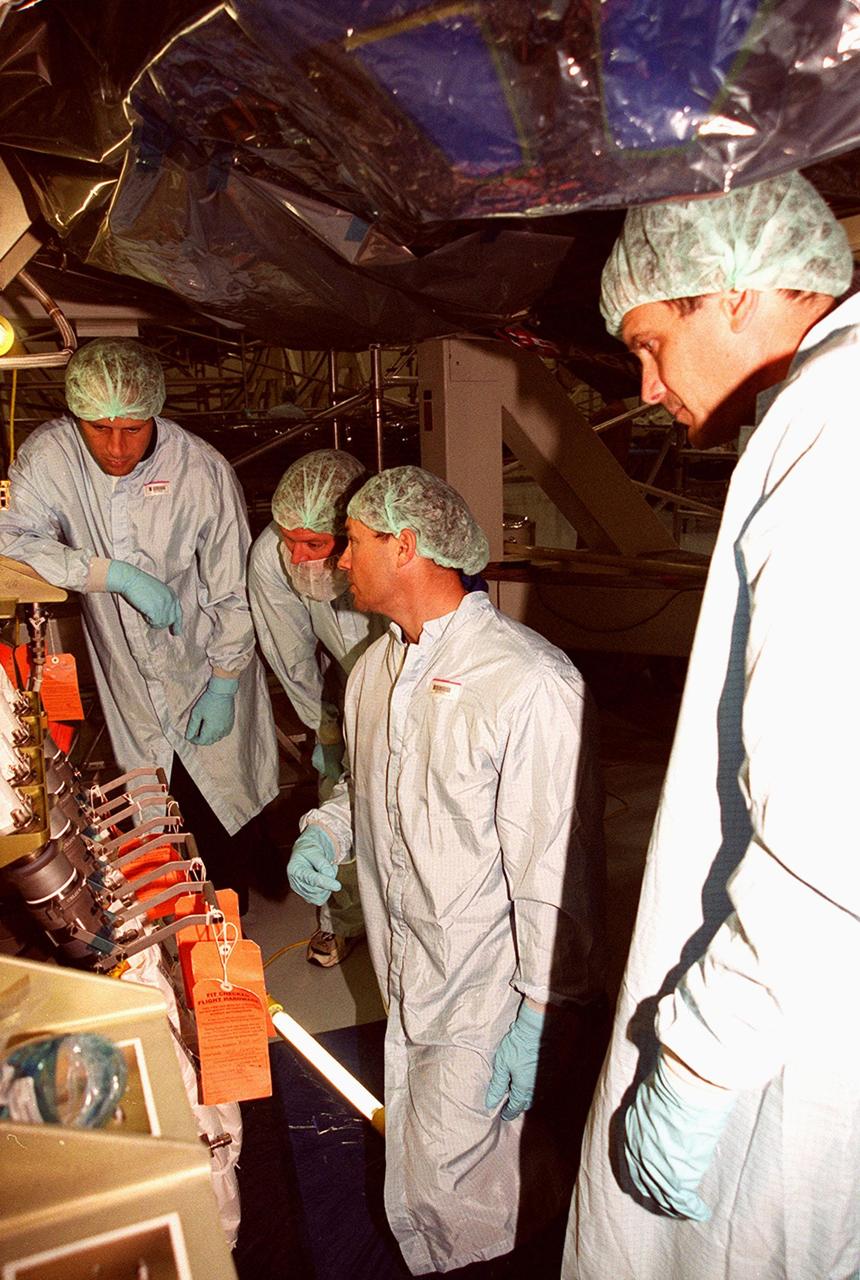
As part of Crew Equipment Interface Test (CEIT) activities, members of the STS-92 crew check out equipment they will be using on the mission to the International Space Station. Mission Specialists Michael Lopez-Alegria (center) and Jeff Wisoff (right) talk with Boeing technicians about the Integrated Truss Structure Z1, a component of the Station and payload on STS-92, in front of them. The Z1 truss is an early exterior framework to allow the first U.S. solar arrays on a future flight to be temporarily installed on Unity for early power. STS-92 is scheduled to launch Oct. 5 from launch Pad 39A
![STS092-S-020 [EC00-0311-1] (24 October 2000)--- The main landing gear on the Space Shuttle Discovery is just about to touch down to mark mission completion at Edwards Air Force Base in the Mojave Desert of California. Onboard were astronauts Brian Duffy, Pamela A. Melroy, William S. McArthur, Jr., Leroy Chiao, Michael E. Lopez-Alegria, Peter J.K. (Jeff) Wisoff and Koichi Wakata of Japan's National Space Development Agency (NASDA). Discovery touched down at 2 p.m. (PDT), October 24, and rolled to a stop on Edward's concrete runway at 2:0l, for a mission elapsed time of 12 days, 21 hours and 43 minutes.](https://images-assets.nasa.gov/image/sts092-s-020/sts092-s-020~medium.jpg)
STS092-S-020 [EC00-0311-1] (24 October 2000)--- The main landing gear on the Space Shuttle Discovery is just about to touch down to mark mission completion at Edwards Air Force Base in the Mojave Desert of California. Onboard were astronauts Brian Duffy, Pamela A. Melroy, William S. McArthur, Jr., Leroy Chiao, Michael E. Lopez-Alegria, Peter J.K. (Jeff) Wisoff and Koichi Wakata of Japan's National Space Development Agency (NASDA). Discovery touched down at 2 p.m. (PDT), October 24, and rolled to a stop on Edward's concrete runway at 2:0l, for a mission elapsed time of 12 days, 21 hours and 43 minutes.

KENNEDY SPACE CENTER, FLA. -- Getting ready for a simulated countdown, STS-92 Mission Specialists Leroy Chiao, Peter J.K. “Jeff” Wisoff and Michael E. Lopez-Alegria wait in their seats in Discovery. They and other crew members are taking part in a simulated countdown KSC for Terminal Countdown Demonstration Test (TCDT) activities. STS-92 is scheduled to launch Oct. 5 at 9:38 p.m. EDT on the fifth flight to the International Space Station. It will carry two elements of the Space Station, the Integrated Truss Structure Z1 and the third Pressurized Mating Adapter. The mission is also the 100th flight in the Shuttle program
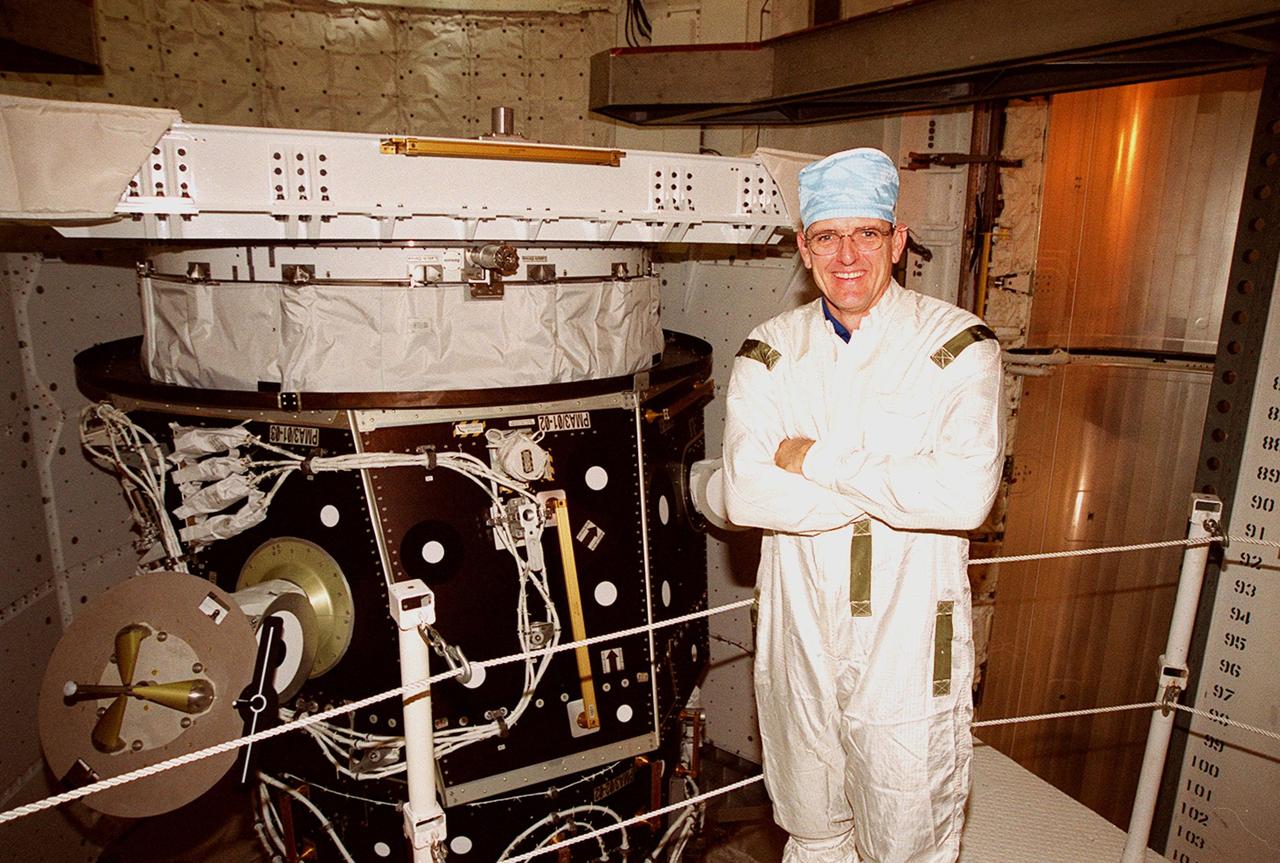
STS-92 Mission Specialist William S. McArthur Jr. smiles for the camera during inspection of the payload (left) in Space Shuttle Discovery’s payload bay. He and other crew members Commander Brian Duffy, Pilot Pamela Ann Melroy and Mission Specialists Koichi Wakata of Japan, Leroy Chiao, Peter J.K. “Jeff” Wisoff and Michael E. Lopez-Alegria are preparing for launch on Oct. 5, 2000. The mission is the fifth flight for the construction of the International Space Station. The payload includes the Integrated Truss Structure Z-1 and the third Pressurized Mating Adapter. During the 11-day mission, four extravehicular activities (EVAs), or space walks, are planned

Greeted by cheers from wellwishers at KSC and eager for their venture into space on the fifth Shuttle-Mir docking mission, the STS-81 astronauts depart the Operations and Checkout Building and board the Astrovan for their 25-minute trip to Launch Pad 39B. Leading the six-member crew is Mission Commander Michael A. Baker, followed by Pilot Brent W. Jett, Jr. Behind them are Mission Specialists John M. Grunsfeld, Jerry Linenger, Peter J. K. "Jeff" Wisoff, and Marsha S. Ivins. Once at the pad, they will take their positions in the crew cabin of the Space Shuttle Atlantis to await a liftoff during a seven-minute window that will open at 4:27 a.m. EST, January 12
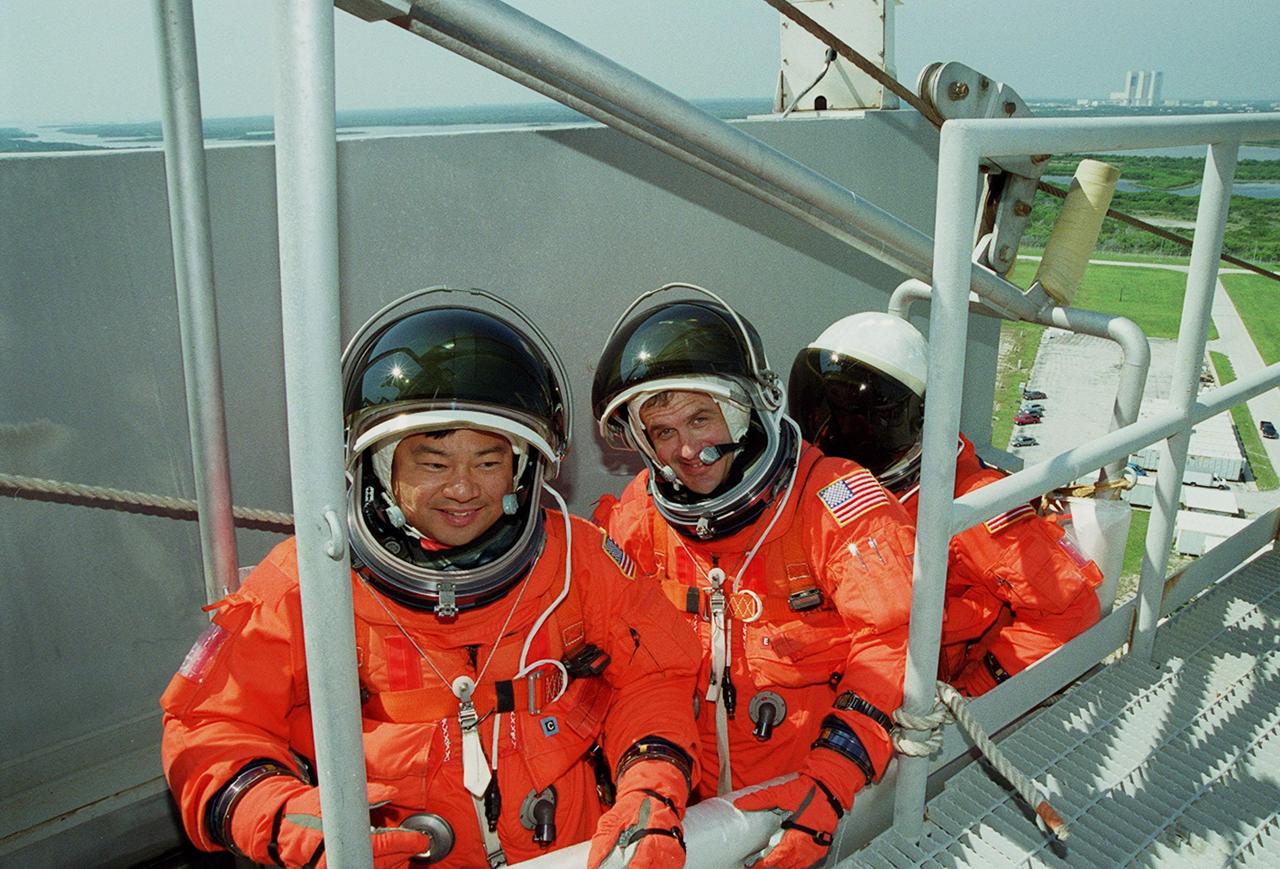
KENNEDY SPACE CENTER, FLA. -- Seated in the slidewire basket at the 195-foot level of the Fixed Service Structure on Launch Pad 39A, STS-92 Mission Specialists Leroy Chaio, Peter J.K. “Jeff” Wisoff and Michael E. Lopez-Alegria take part in emergency egress training, one of the Terminal Countdown Demonstration Test activities that also include a simulated countdown. STS-92 is scheduled to launch Oct. 5 at 9:38 p.m. EDT on the fifth flight to the International Space Station. It will carry two elements of the Space Station, the Integrated Truss Structure Z1 and the third Pressurized Mating Adapter. The mission is also the 100th flight in the Shuttle program
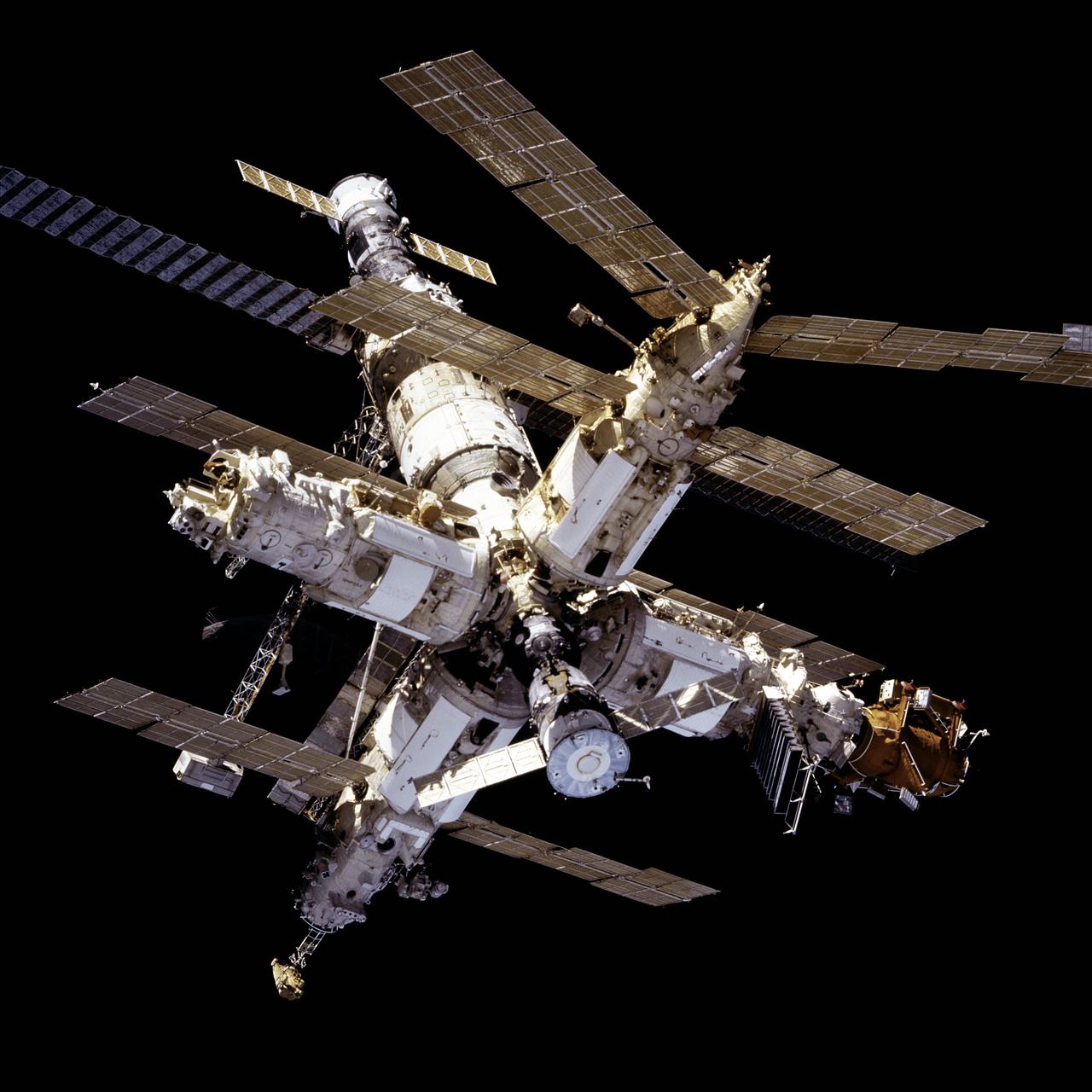
STS081-736-034 (14 Jan 1997) --- This 70mm frame affords a full view of Russia?s Mir Space Station complex during approach for docking, backdropped against the blackness of space. Astronaut Jerry M. Linenger, now onboard the Space Shuttle Atlantis, will trade places with John E. Blaha, current cosmonaut guest researcher onboard Mir since mid September 1996. Along with Linenger, other crew members now aboard Atlantis are astronauts Michael A. Baker, commander; Brent W. Jett, Jr., pilot; and mission specialists John M. Grunsfeld, Marsha S. Ivins and Peter J. K. (Jeff) Wisoff.
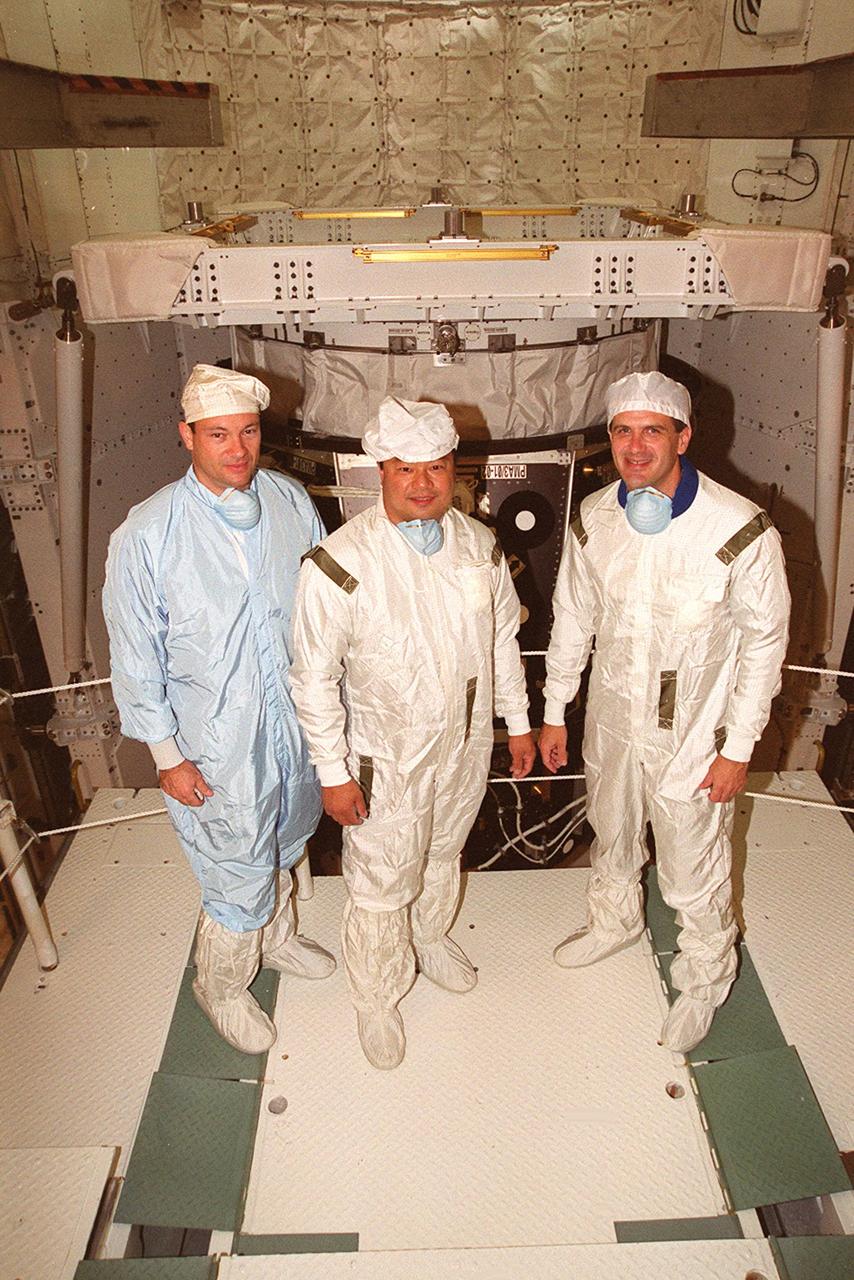
KENNEDY SPACE CENTER, FLA. -- During inspection of the payload in Space Shuttle Discovery’s payload bay (background), STS-92 Mission Specialists Michael E. Lopez-Alegria, Leroy Chiao and Peter J.K. “Jeff” Wisoff pause for a photo. They and other crew members Commander Brian Duffy, Pilot Pamela Ann Melroy and Mission Specialists Koichi Wakata of Japan and William S. McArthur Jr. are preparing for launch on Oct. 5, 2000. The mission is the fifth flight for the construction of the International Space Station. The payload includes the Integrated Truss Structure Z-1 and the third Pressurized Mating Adapter. During the 11-day mission, four extravehicular activities (EVAs), or space walks, are planned
 Wisoff and Koichi Wakata of Japan's National Space Development Agency (NASDA). Discovery touched down at 2 p.m. (PDT), October 24, and rolled to a stop on Edward's concrete runway at 2:0l, for a mission elapsed time of 12 days, 21 hours and 43 minutes.](https://images-assets.nasa.gov/image/sts092-s-021/sts092-s-021~medium.jpg)
STS092-S-021 [EC00-0311-2](24 October 2000 --- The main landing gear on the Space Shuttle Discovery is just about to touch down to mark mission completion at Edwards Air Force Base in the Mojave Desert of California. Onboard were astronauts Brian Duffy, Pamela A. Melroy, William S. McArthur, Jr., Leroy Chiao, Michael E. Lopez-Alegria, Peter J.K. (Jeff) Wisoff and Koichi Wakata of Japan's National Space Development Agency (NASDA). Discovery touched down at 2 p.m. (PDT), October 24, and rolled to a stop on Edward's concrete runway at 2:0l, for a mission elapsed time of 12 days, 21 hours and 43 minutes.
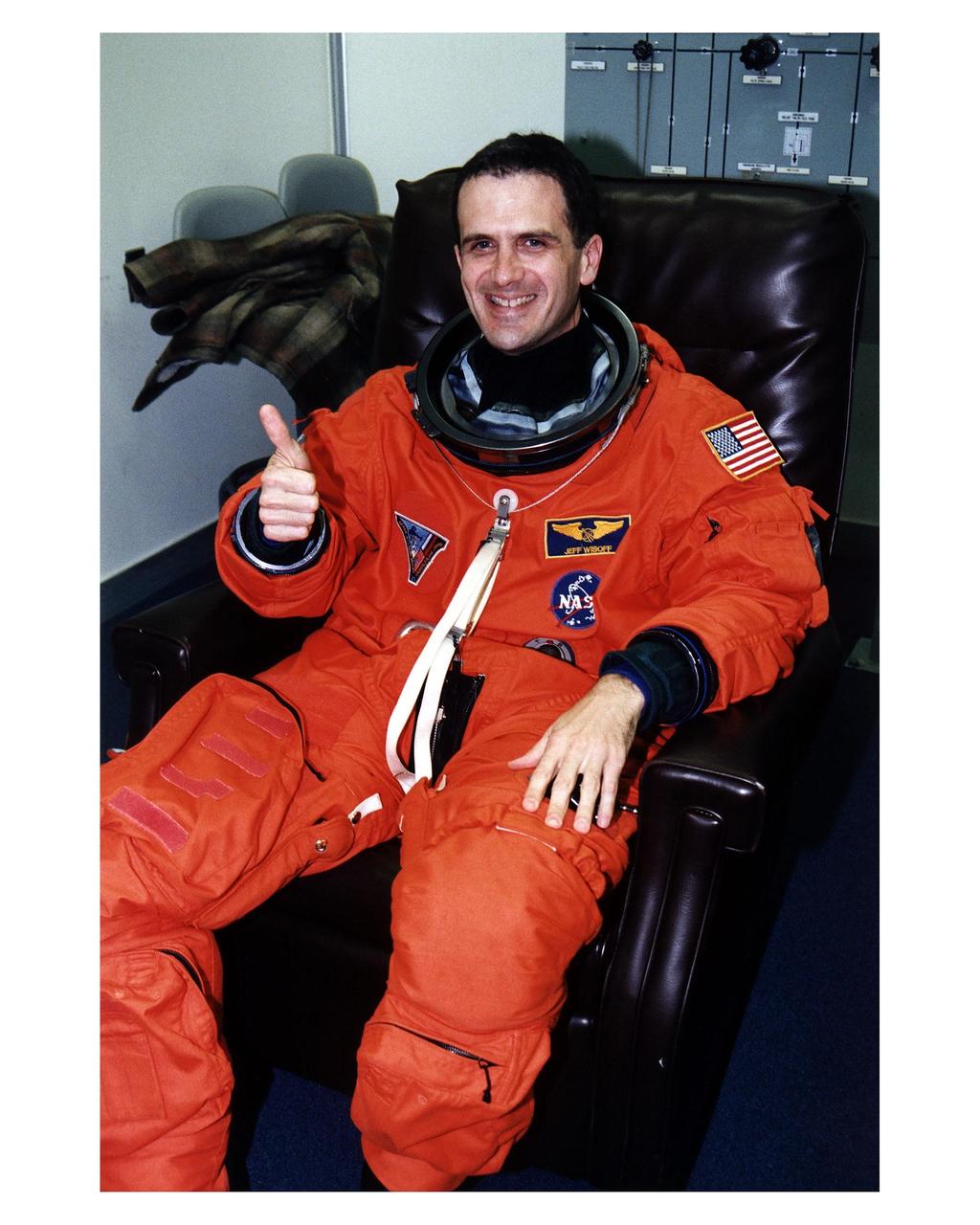
STS-81 Mission Specialist Peter J. K. "Jeff" Wisoff prepares for the fifth ShuttleMir docking as he waits in the Operations and Checkout (O&C) Building for the operation to fit him into his launch/entry suit to be completed. He conducted a spacewalk on his on his first Shuttle mission, STS57 and holds a doctorate degree in applied physics with an emphasis on lasers and semiconductor materials. He and five crew members will shortly depart the O&C and head for Launch Pad 39B, where the Space Shuttle Atlantis will lift off during a 7-minute window that opens at 4:27 a.m. EST, January 12
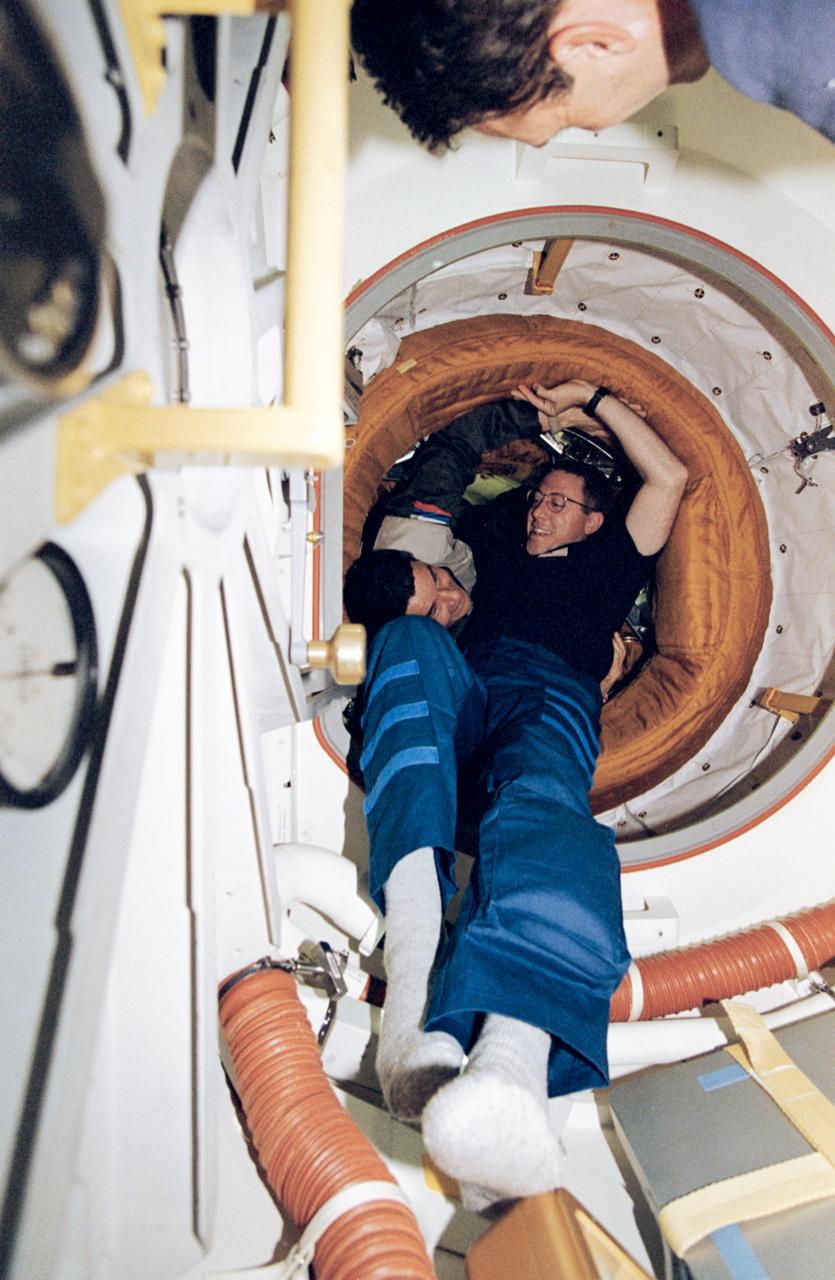
STS081-373-025 (14 Jan 1997) --- Greeting between commanders - astronaut Michael A. Baker (foreground) and cosmonaut Valeri G. Korzun - just after hatch opening following the January 14, 1997, docking. Out of frame on the Space Shuttle Atlantis is astronaut Jerry M. Linenger, soon to be trading places with John E. Blaha, the current cosmonaut guest researcher, onboard Russia?s Mir Space Station since mid September 1996. Along with Baker and Linenger, other crew members now aboard Atlantis are astronauts Brent W. Jett, Jr., pilot; and mission specialists John M. Grunsfeld, Marsha S. Ivins and Peter J. K. (Jeff) Wisoff.
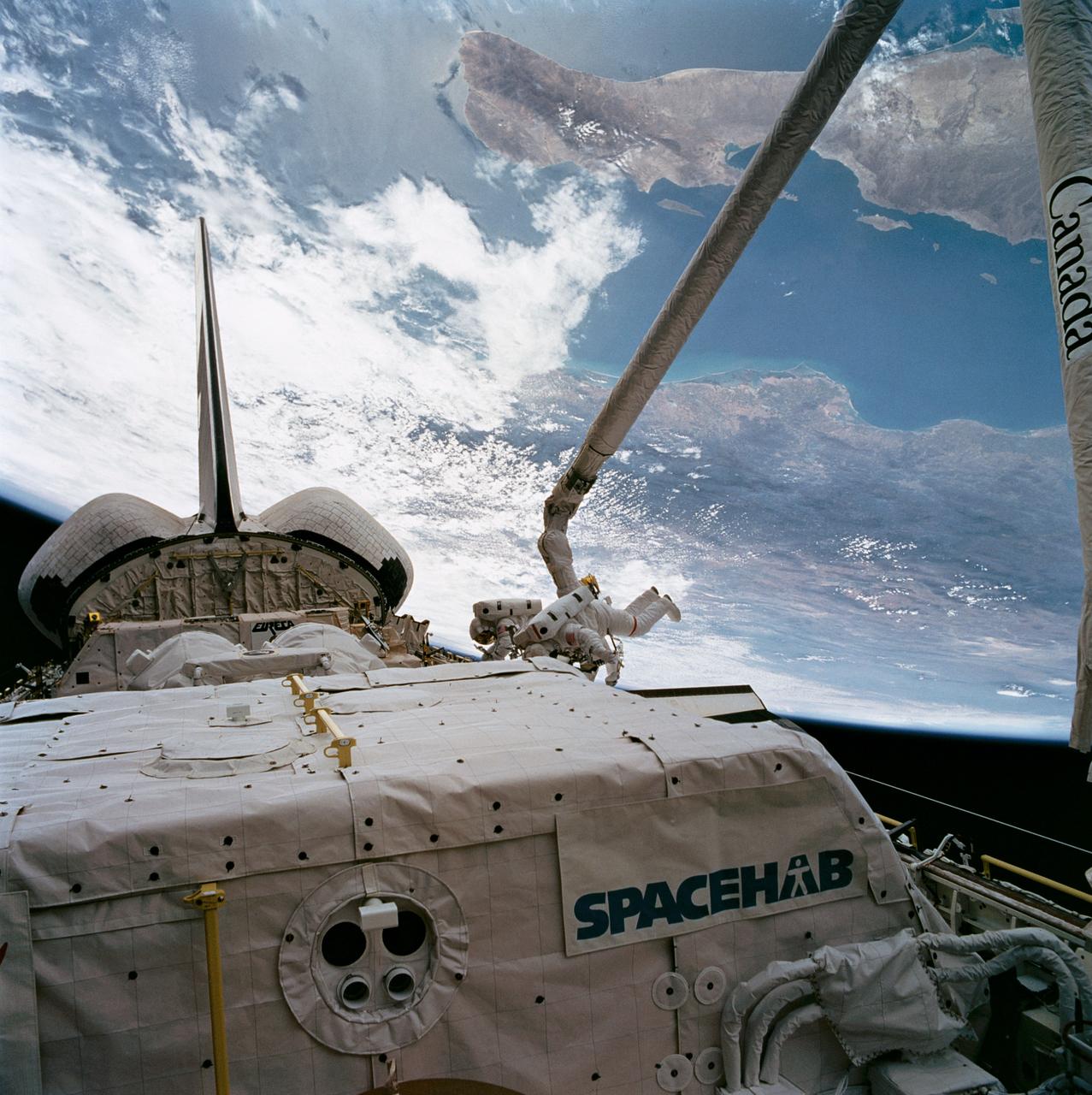
STS057-89-042 (24 June 1993) --- Baja California forms the backdrop for this extravehicular activity (EVA) scene captured on 70mm film by one of the STS-57 crew members in the Space Shuttle Endeavour's crew cabin. Working near the recently "captured" European Retrievable Carrier (EURECA) at frame center are astronauts G. David Low (nearest camera) and Peter J. K. (Jeff) Wisoff. Low is attached to a mobile foot restraint to the end of the Canadian-built Remote Manipulator System (RMS) arm. The SPACEHAB module is seen in the foreground and EURECA is partially visible near Endeavour's aft firewall.
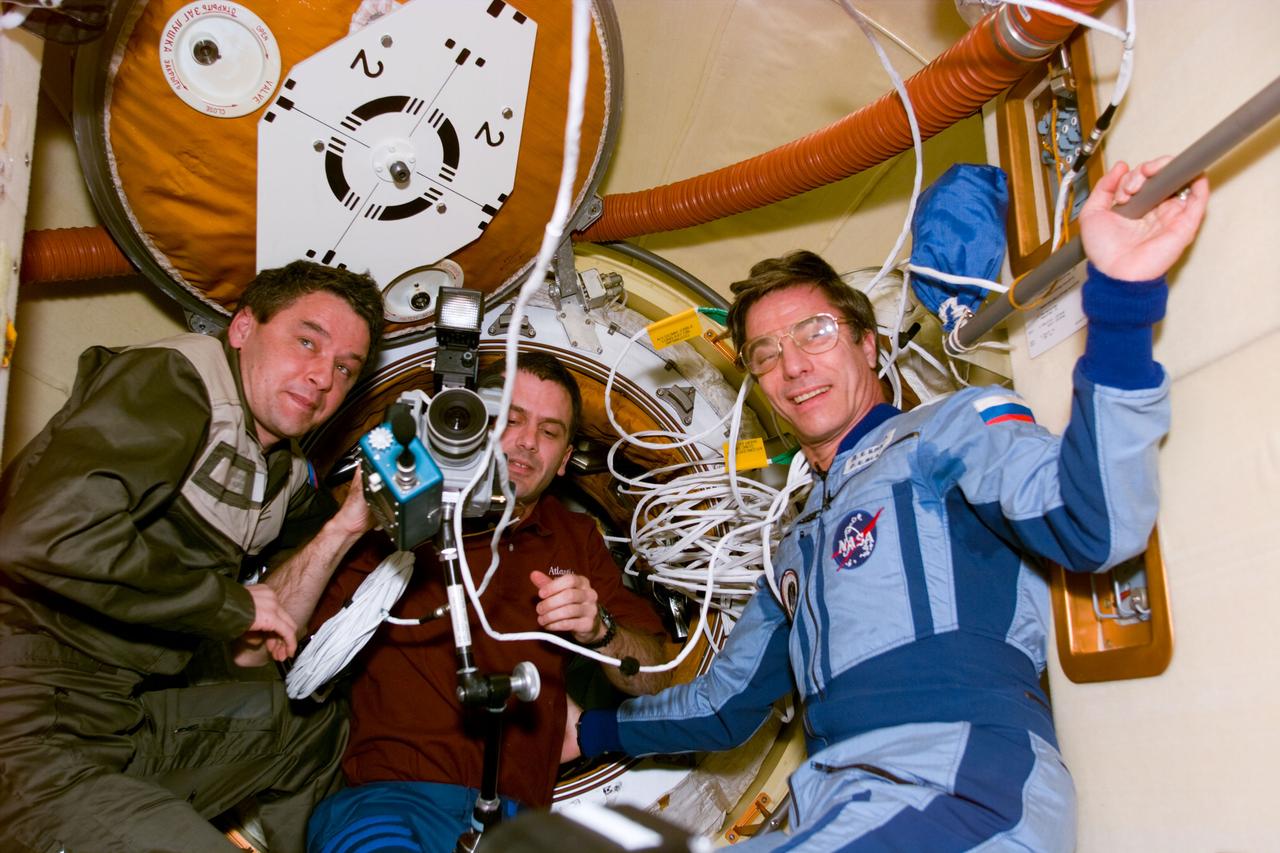
STS081-E-5424 (15 Jan. 1997) --- Left to right, cosmonaut Valeri G. Korzun, Mir-22 mission commander; and astronauts Peter J. K. (Jeff) Wisoff (holding 70mm camera) and John E. Blaha are pictured soon after hatch opening. Blaha had just joined the NASA crew, having served as a cosmonaut guest researcher aboard Russia's Mir Space Station since mid September 1996. The photograph was taken with an Electronic Still Camera (ESC), which was used throughout the 10-day mission to downlink current photographs of the crews'joint ativities.
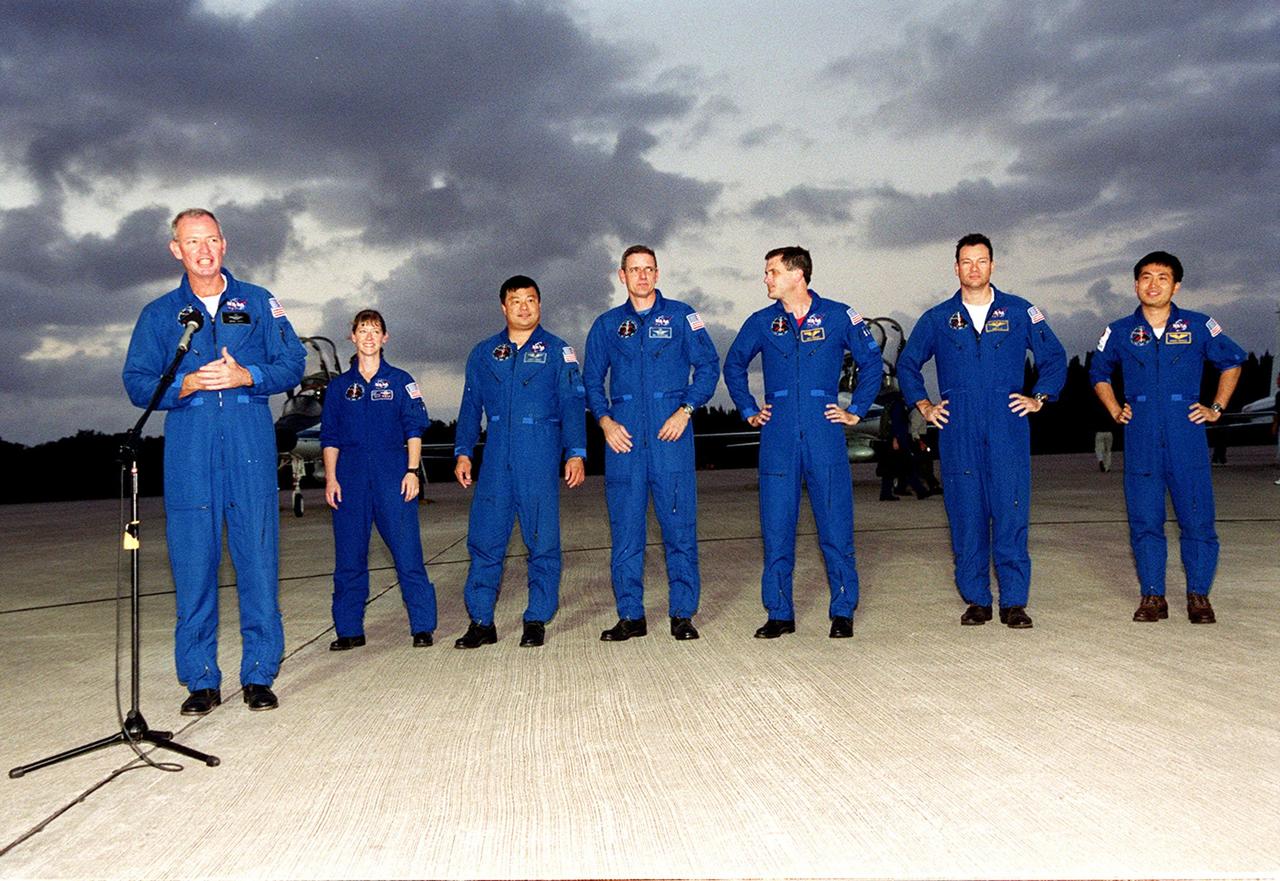
KENNEDY SPACE CENTER, FLA. -- After their arrival at KSC’s Shuttle Landing Facility, the STS-92 crew paused to talk to the media, who were waiting nearby. At the microphone is Commander Brian Duffy. Standing behind him, left to right, are Pilot Pamela Ann Melroy and Mission Specialists Leroy Chiao, William S. McArthur Jr., Peter J.K. “Jeff” Wisoff, Michael E. Lopez-Alegria and Koichi Wakata of Japan. The mission is the fifth flight for the construction of the International Space Station. The payload includes the Integrated Truss Structure Z-1 and the third Pressurized Mating Adapter. During the 11-day mission, four extravehicular activities (EVAs), or space walks, are planned
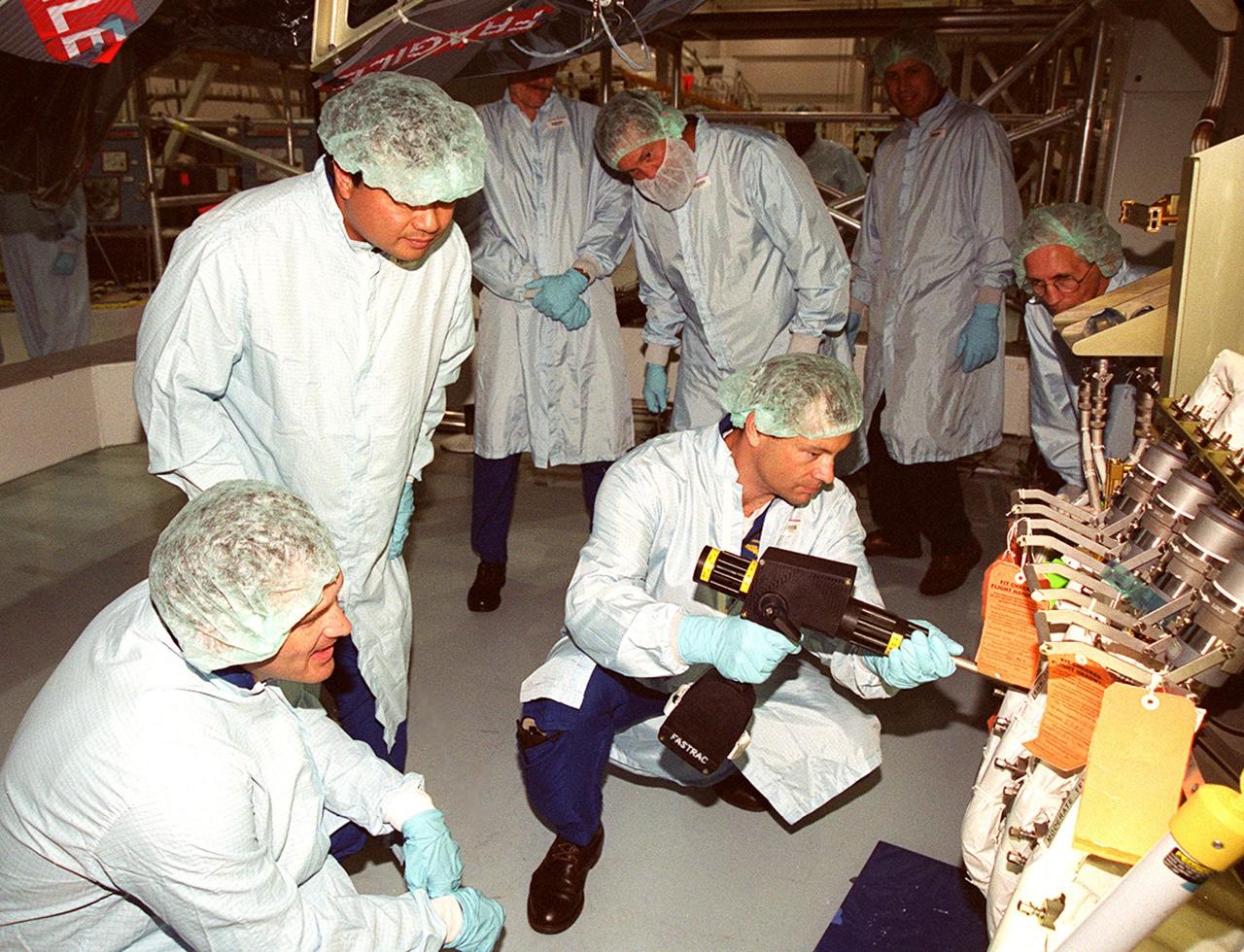
In the Space Station Processing Facility, members of the STS-92 crew check out equipment they will be using on the mission to the International Space Station. Here, (left to right) Mission Specialists Jeff Wisoff and Leroy Chiao watch while Michael Lopez-Alegria practices putting on and taking off fittings on the Z1 Integrated Truss Structure. In the background are Boeing technicians. The Z-1 truss, a component of the Station, is an early exterior framework to allow the first U.S. solar arrays on a future flight to be temporarily installed on Unity for early power. STS-92 is scheduled to launch Oct. 5 from launch Pad 39A
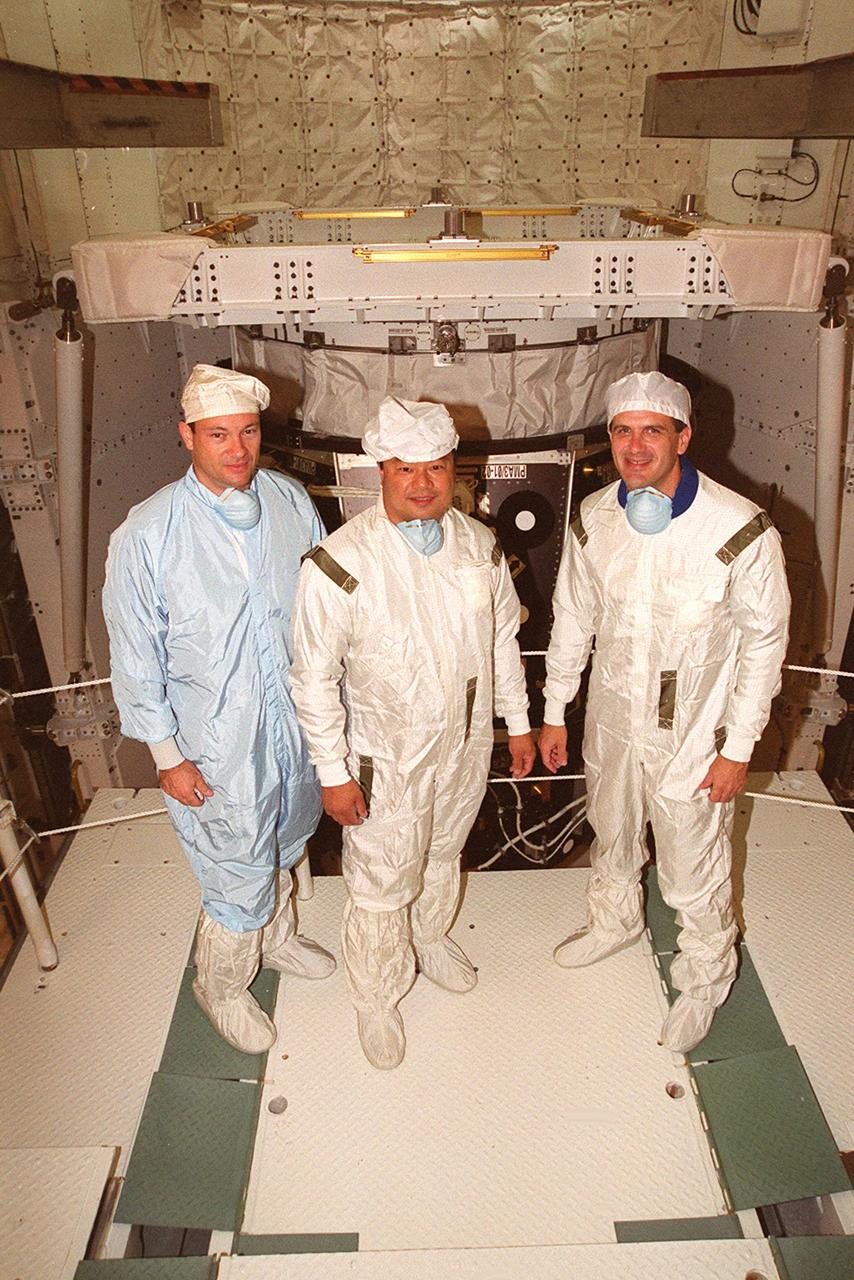
KENNEDY SPACE CENTER, FLA. -- During inspection of the payload in Space Shuttle Discovery’s payload bay (background), STS-92 Mission Specialists Michael E. Lopez-Alegria, Leroy Chiao and Peter J.K. “Jeff” Wisoff pause for a photo. They and other crew members Commander Brian Duffy, Pilot Pamela Ann Melroy and Mission Specialists Koichi Wakata of Japan and William S. McArthur Jr. are preparing for launch on Oct. 5, 2000. The mission is the fifth flight for the construction of the International Space Station. The payload includes the Integrated Truss Structure Z-1 and the third Pressurized Mating Adapter. During the 11-day mission, four extravehicular activities (EVAs), or space walks, are planned
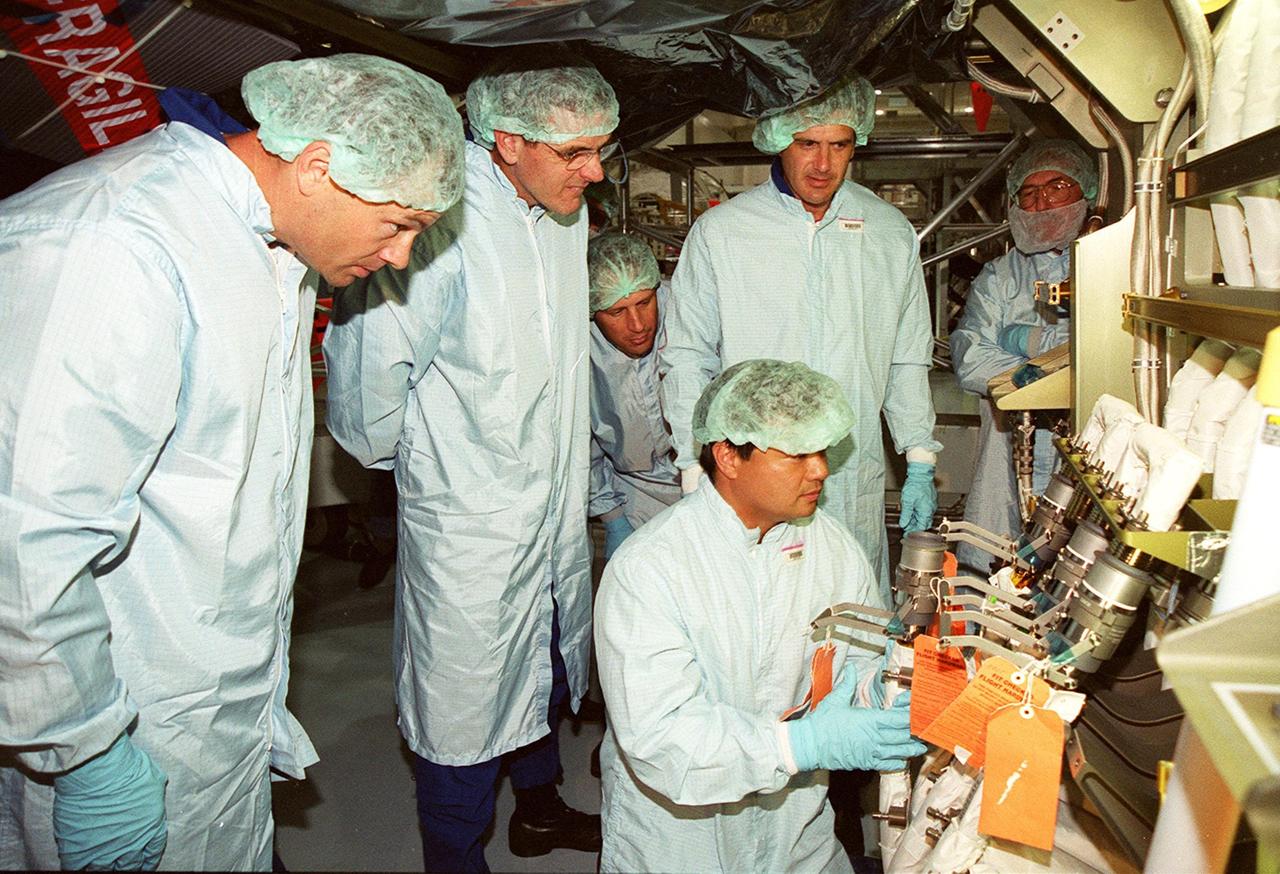
Members of the STS-92 crew check out the Integrated Truss Structure Z1, a component of the International Space Station and payload on their mission. From left are Mission Specialists Michael Lopez-Alegria, Bill McArthur, Jeff Wisoff and (kneeling) Leroy Chiao. They and other crew members are taking part in Crew Equipment Interface Test (CEIT) activities while at KSC. The Z1 truss is an early exterior framework to allow the first U.S. solar arrays on a future flight to be temporarily installed on Unity for early power. STS-92 is scheduled to launch Oct. 5 from launch Pad 39A
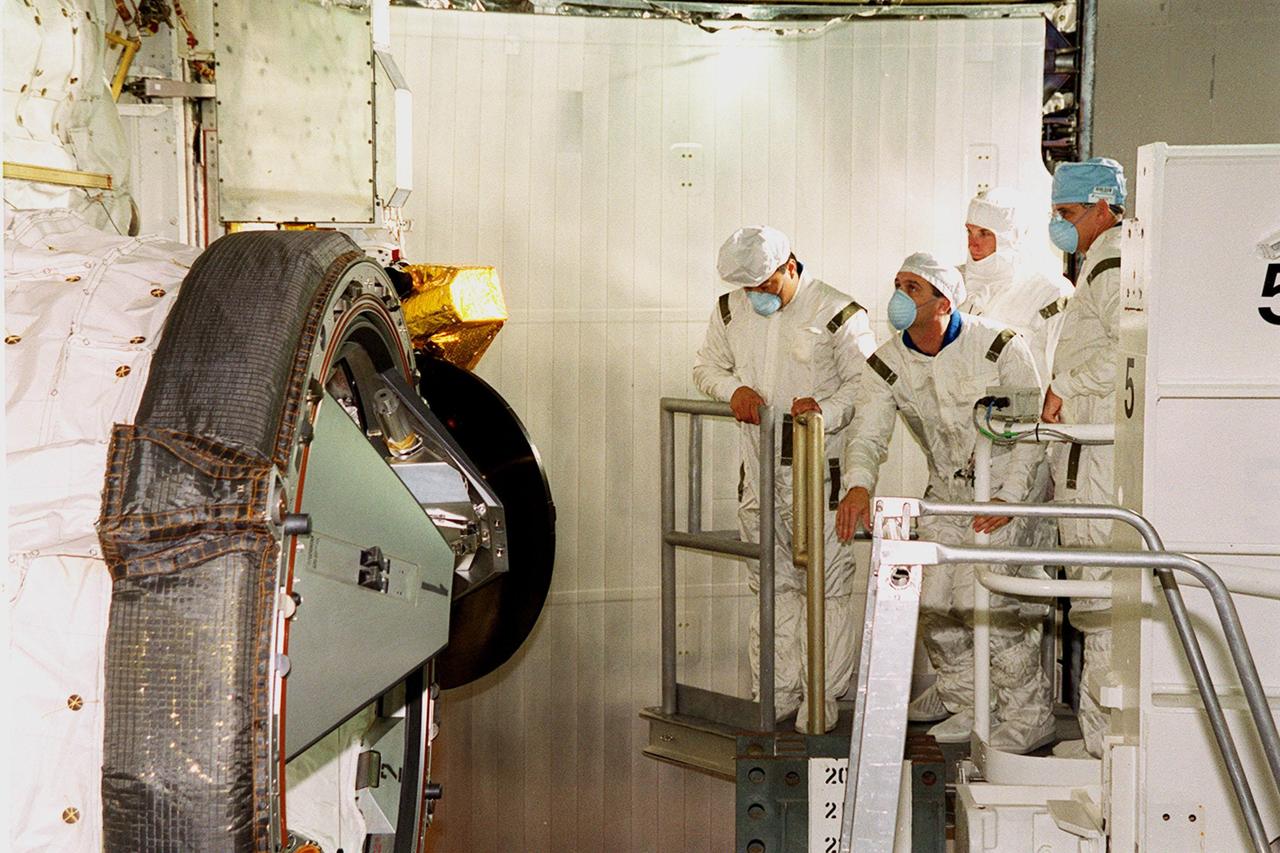
Members of the STS-92 crew look over the payload (left) in Space Shuttle Discovery’s payload bay. Left to right, in masks, are Mission Specialists Leroy Chiao, Peter J.K. “Jeff” Wisoff and William S. McArthur Jr. They and the other crew members Commander Brian Duffy, Pilot Pamela Ann Melroy and Mission Specialists Koichi Wakata of Japan, and Michael E. Lopez-Alegria are preparing for launch on Oct. 5, 2000. The mission is the fifth flight for the construction of the International Space Station. The payload includes the Integrated Truss Structure Z-1 and the third Pressurized Mating Adapter. During the 11-day mission, four extravehicular activities (EVAs), or space walks, are planned
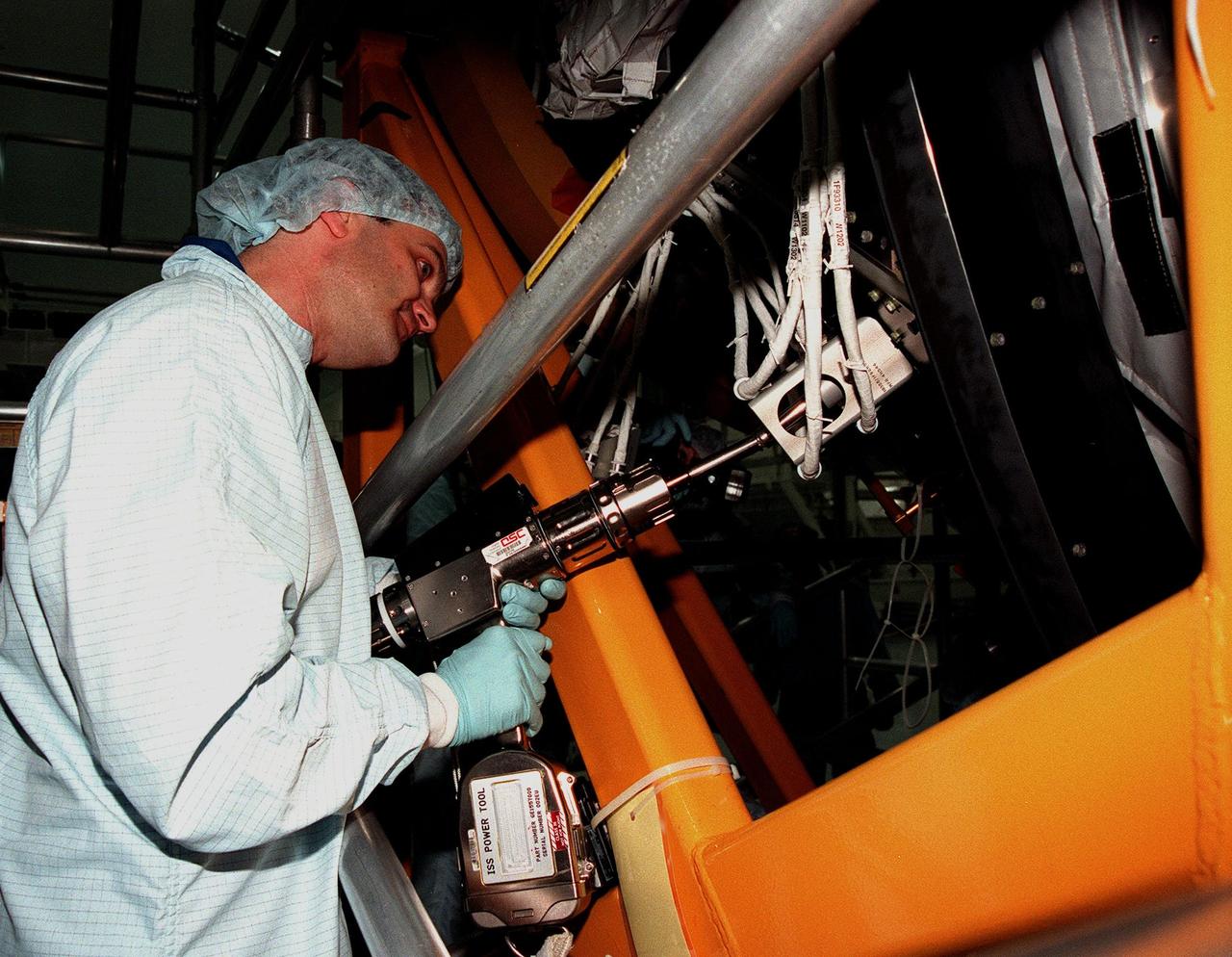
In the Space Station Processing Facility, STS-92 Mission Specialist Jeff Wisoff practices removing a wire harness from the Pressurized Mating Adapter-3, part of the payload on the STS-92 mission to the International Space Station (ISS). STS-92 is targeted for launch in December 1999. Other crew members visiting KSC are Commander Brian Duffy and Mission Specialists Koichi Wakata, Leroy Chiao, Michael Lopez-Alegria and Bill McArthur. STS-92 is the fourth U.S. flight for construction of the International Space Station. The payload also includes an integrated truss structure
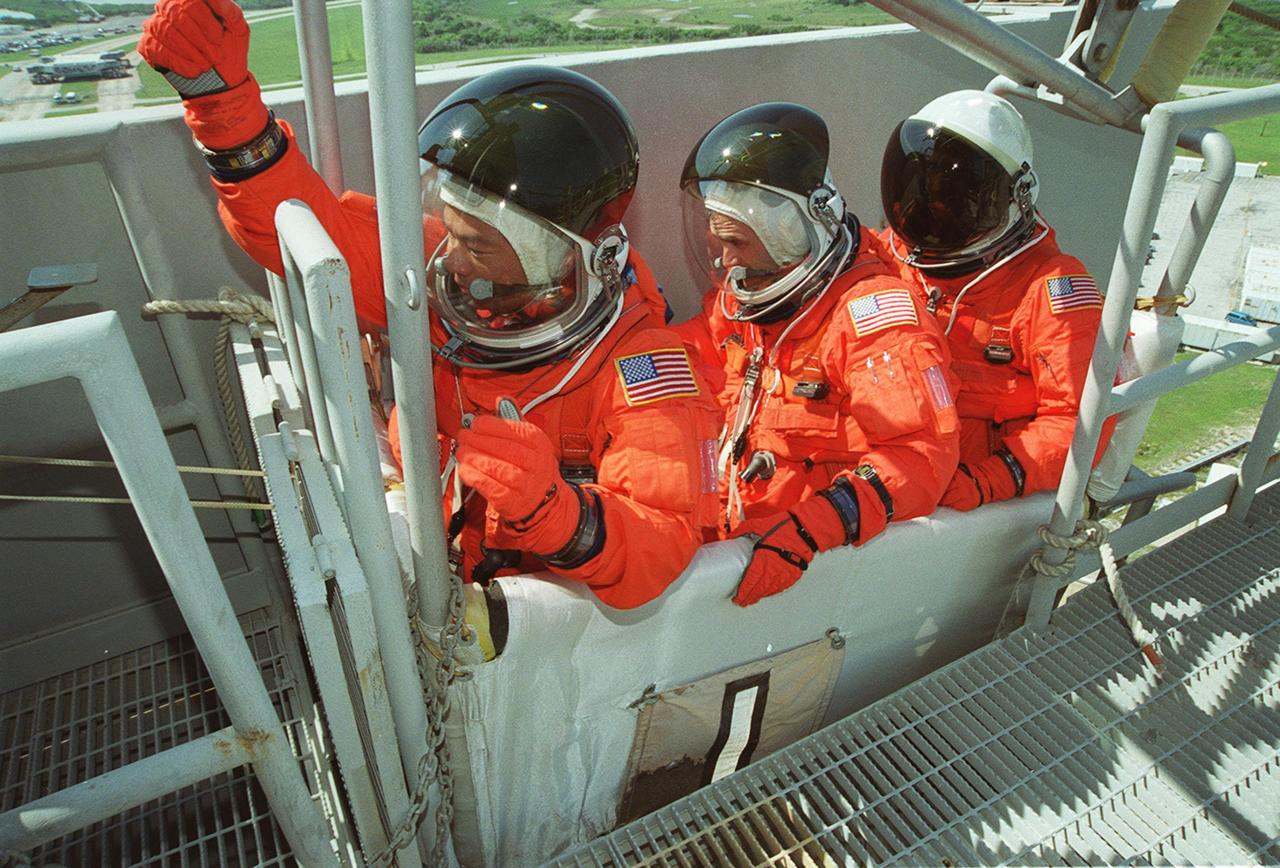
KENNEDY SPACE CENTER, FLA. -- Seated in the slidewire basket at the 195-foot level of the Fixed Service Structure on Launch Pad 39A, STS-92 Mission Specialists Leroy Chiao, Peter J.K. “Jeff” Wisoff and Michael E. Lopez-Alegria practice emergency egress. They and other crew members have been taking part in Terminal Countdown Demonstration Test activities that also include a simulated countdown. STS-92 is scheduled to launch Oct. 5 at 9:38 p.m. EDT on the fifth flight to the International Space Station. It will carry two elements of the Space Station, the Integrated Truss Structure Z1 and the third Pressurized Mating Adapter. The mission is also the 100th flight in the Shuttle program
STS-92 Pamela Ann Melroy pauses during inspection of the payload (behind her) in Space Shuttle Discovery’s payload bay. She and other crew members Commander Brian Duffy and Mission Specialists Koichi Wakata of Japan, Leroy Chiao, Peter J.K. “Jeff” Wisoff. Michael E. Lopez-Alegria and William S. McArthur Jr. are preparing for launch on Oct. 5, 2000. The mission is the fifth flight for the construction of the International Space Station. The payload includes the Integrated Truss Structure Z-1 and the third Pressurized Mating Adapter. During the 11-day mission, four extravehicular activities (EVAs), or space walks, are planned
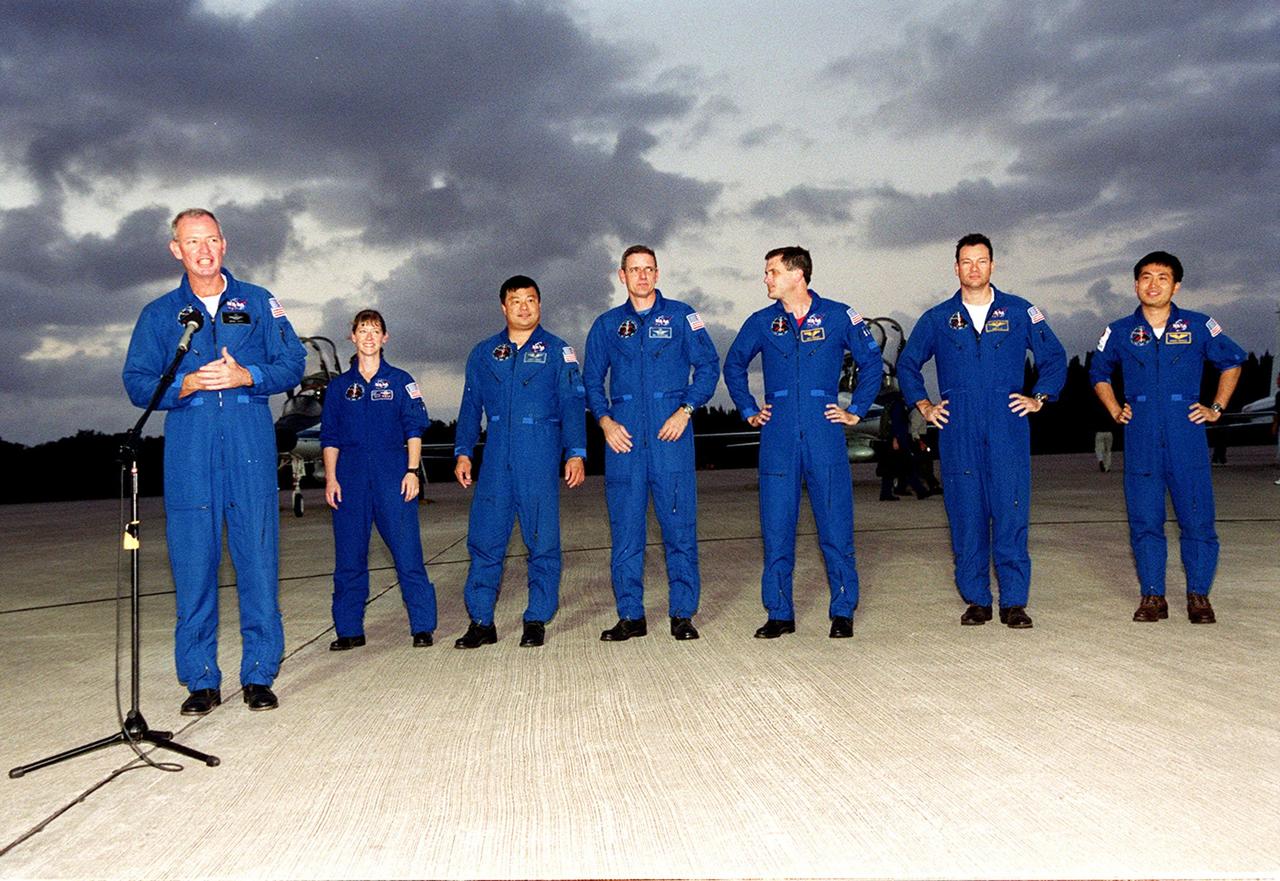
KENNEDY SPACE CENTER, FLA. -- After their arrival at KSC’s Shuttle Landing Facility, the STS-92 crew paused to talk to the media, who were waiting nearby. At the microphone is Commander Brian Duffy. Standing behind him, left to right, are Pilot Pamela Ann Melroy and Mission Specialists Leroy Chiao, William S. McArthur Jr., Peter J.K. “Jeff” Wisoff, Michael E. Lopez-Alegria and Koichi Wakata of Japan. The mission is the fifth flight for the construction of the International Space Station. The payload includes the Integrated Truss Structure Z-1 and the third Pressurized Mating Adapter. During the 11-day mission, four extravehicular activities (EVAs), or space walks, are planned
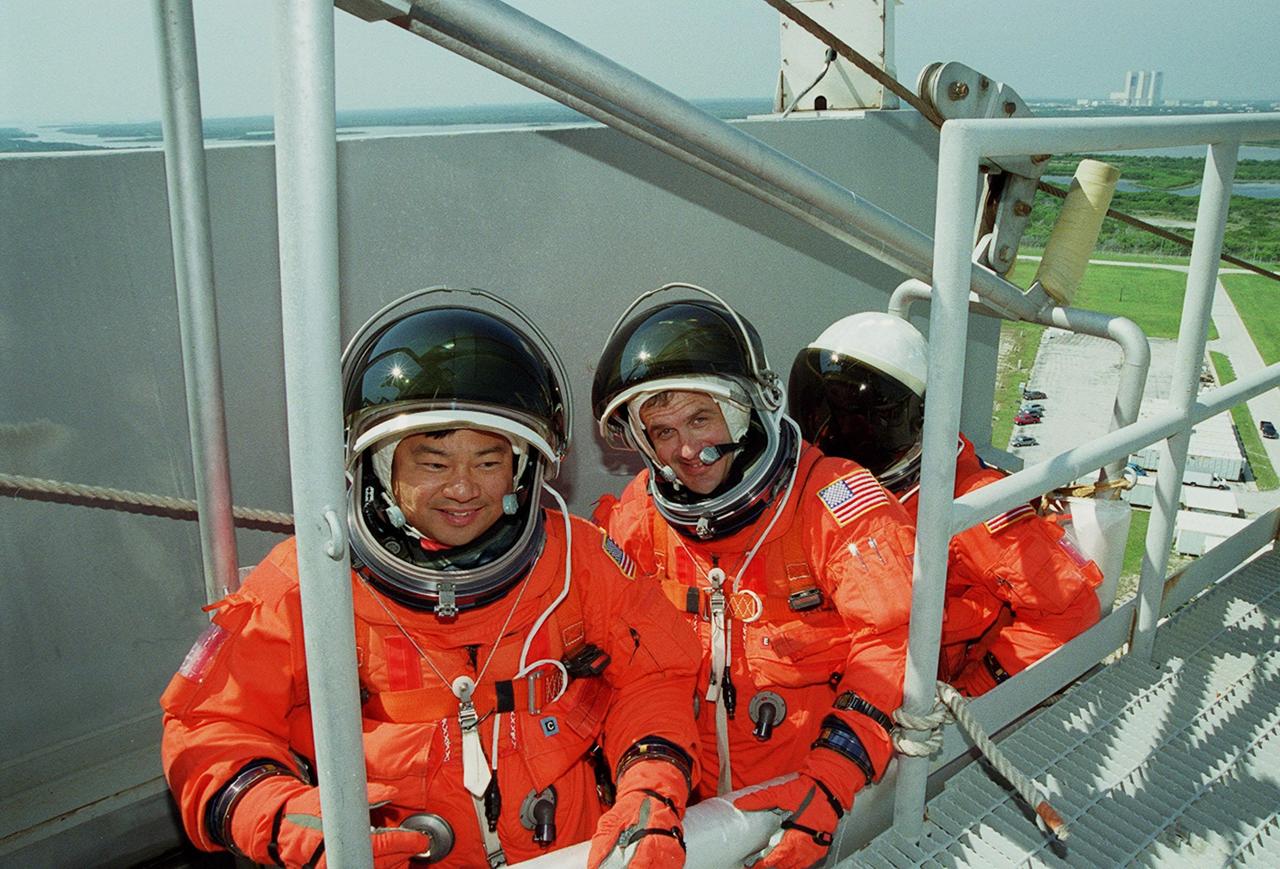
KENNEDY SPACE CENTER, FLA. -- Seated in the slidewire basket at the 195-foot level of the Fixed Service Structure on Launch Pad 39A, STS-92 Mission Specialists Leroy Chaio, Peter J.K. “Jeff” Wisoff and Michael E. Lopez-Alegria take part in emergency egress training, one of the Terminal Countdown Demonstration Test activities that also include a simulated countdown. STS-92 is scheduled to launch Oct. 5 at 9:38 p.m. EDT on the fifth flight to the International Space Station. It will carry two elements of the Space Station, the Integrated Truss Structure Z1 and the third Pressurized Mating Adapter. The mission is also the 100th flight in the Shuttle program
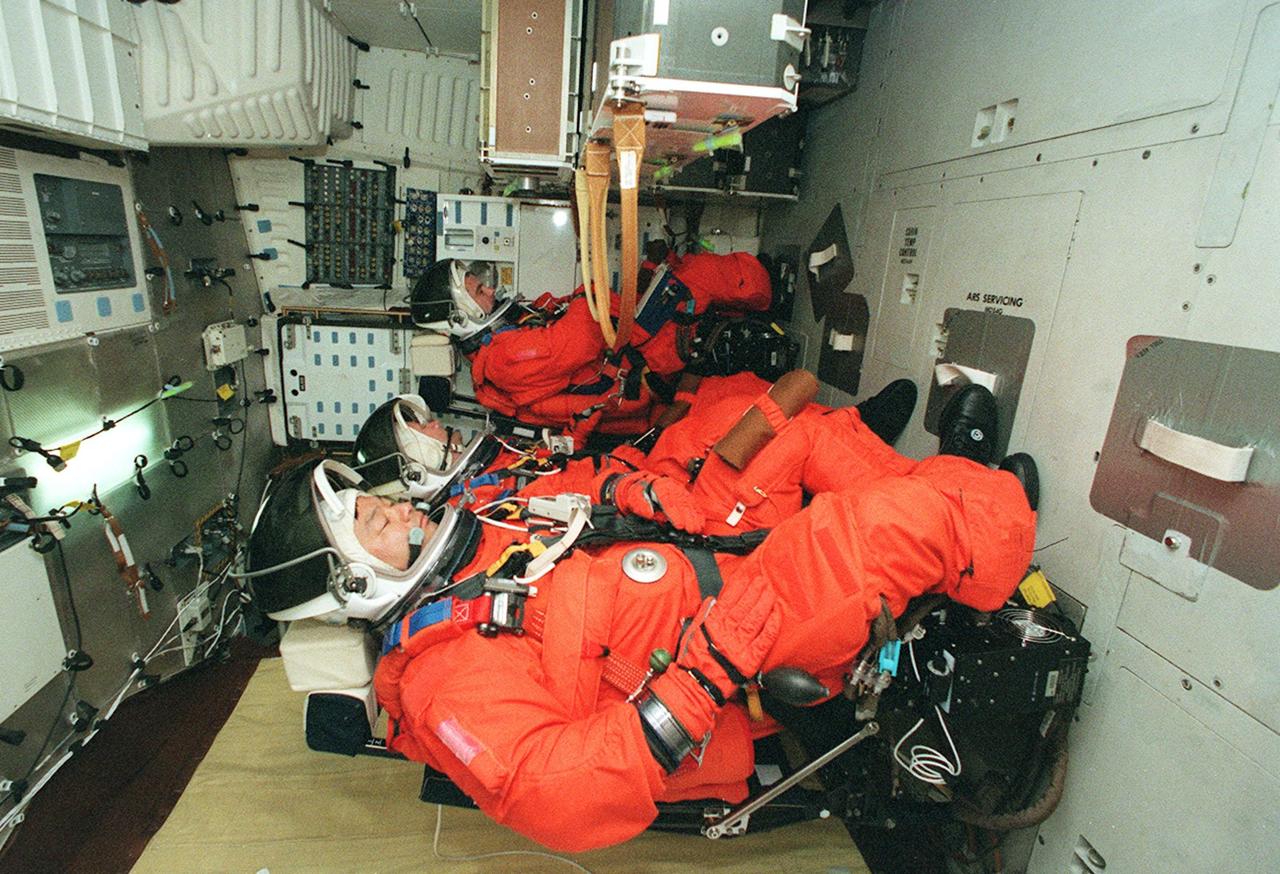
KENNEDY SPACE CENTER, FLA. -- Getting ready for a simulated countdown, STS-92 Mission Specialists Leroy Chiao, Peter J.K. “Jeff” Wisoff and Michael E. Lopez-Alegria wait in their seats in Discovery. They and other crew members are taking part in a simulated countdown KSC for Terminal Countdown Demonstration Test (TCDT) activities. STS-92 is scheduled to launch Oct. 5 at 9:38 p.m. EDT on the fifth flight to the International Space Station. It will carry two elements of the Space Station, the Integrated Truss Structure Z1 and the third Pressurized Mating Adapter. The mission is also the 100th flight in the Shuttle program
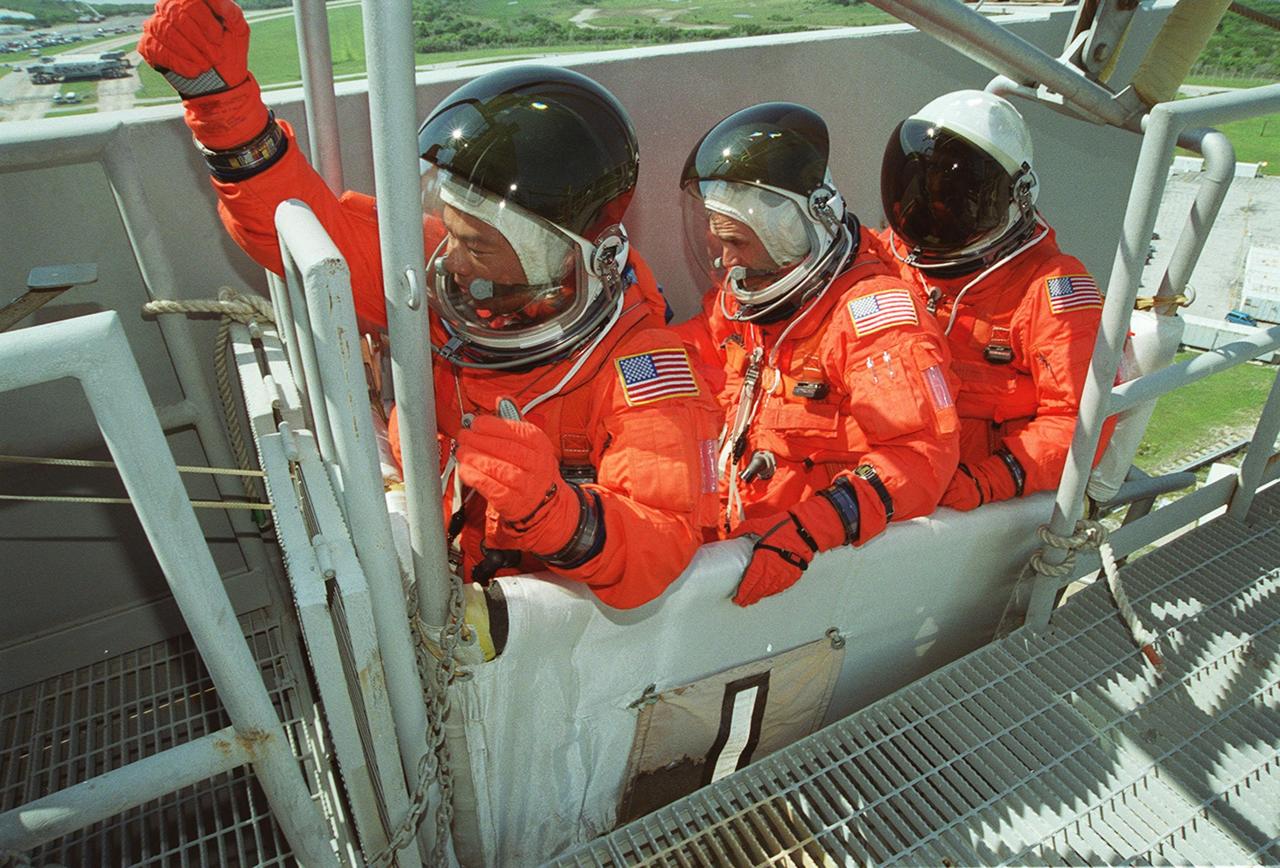
KENNEDY SPACE CENTER, FLA. -- Seated in the slidewire basket at the 195-foot level of the Fixed Service Structure on Launch Pad 39A, STS-92 Mission Specialists Leroy Chiao, Peter J.K. “Jeff” Wisoff and Michael E. Lopez-Alegria practice emergency egress. They and other crew members have been taking part in Terminal Countdown Demonstration Test activities that also include a simulated countdown. STS-92 is scheduled to launch Oct. 5 at 9:38 p.m. EDT on the fifth flight to the International Space Station. It will carry two elements of the Space Station, the Integrated Truss Structure Z1 and the third Pressurized Mating Adapter. The mission is also the 100th flight in the Shuttle program
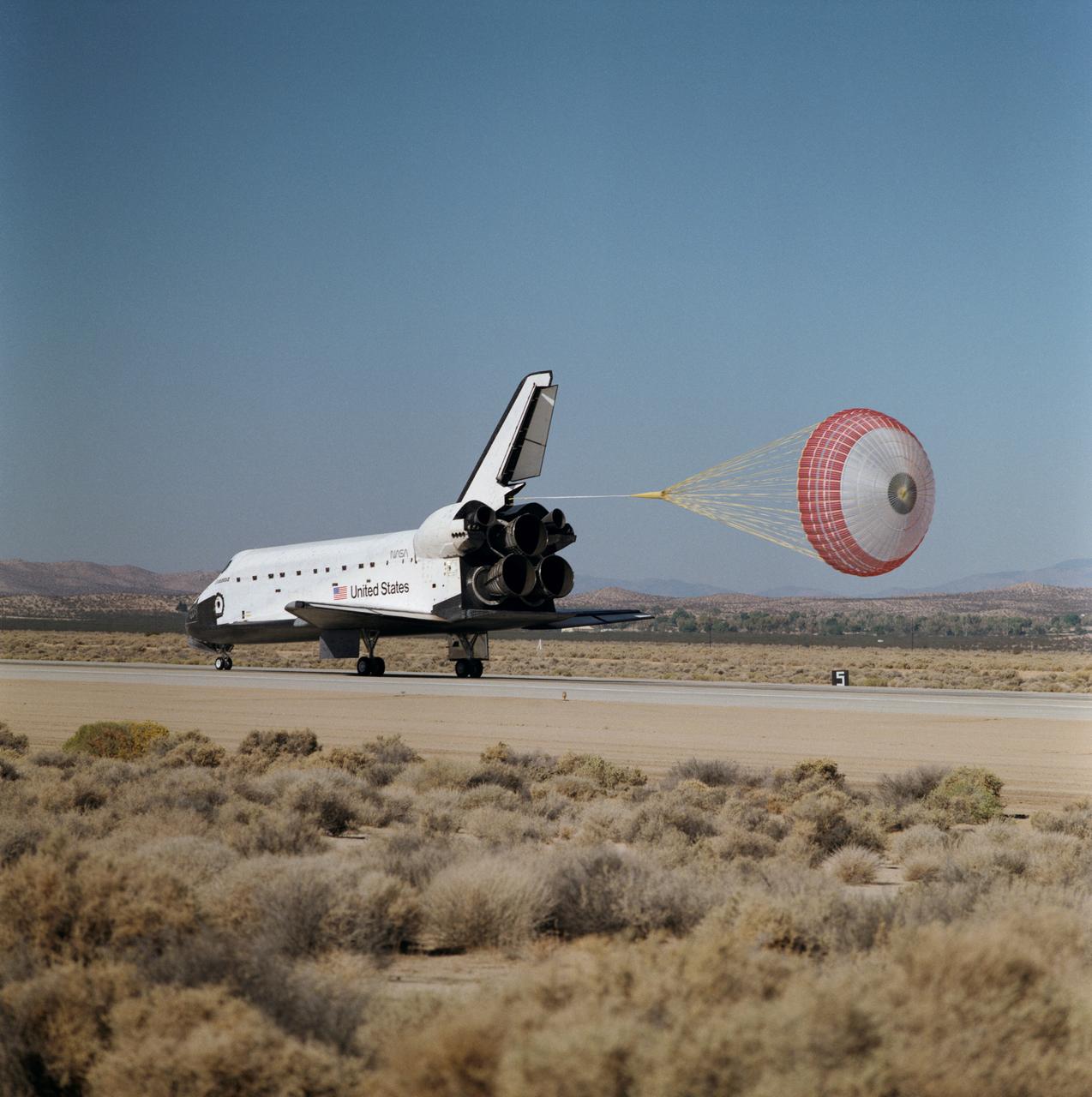
STS068-S-061 (11 October 1994) --- The drag chute system, one of 13 Detailed Test Objectives (DTO) for STS-68, is deployed as the Space Shuttle Endeavour completes an eleven-day mission at Edwards Air Force Base, California. Landing occurred at 10:02 a.m. (PDT), October 11, 1994. Onboard were astronauts Michael A. Baker, mission commander; Terrence W. Wilcutt, pilot; Thomas D. Jones, payload commander; and Daniel W. Bursch, Peter J. K. (Jeff) Wisoff and Steven L. Smith, all mission specialists.
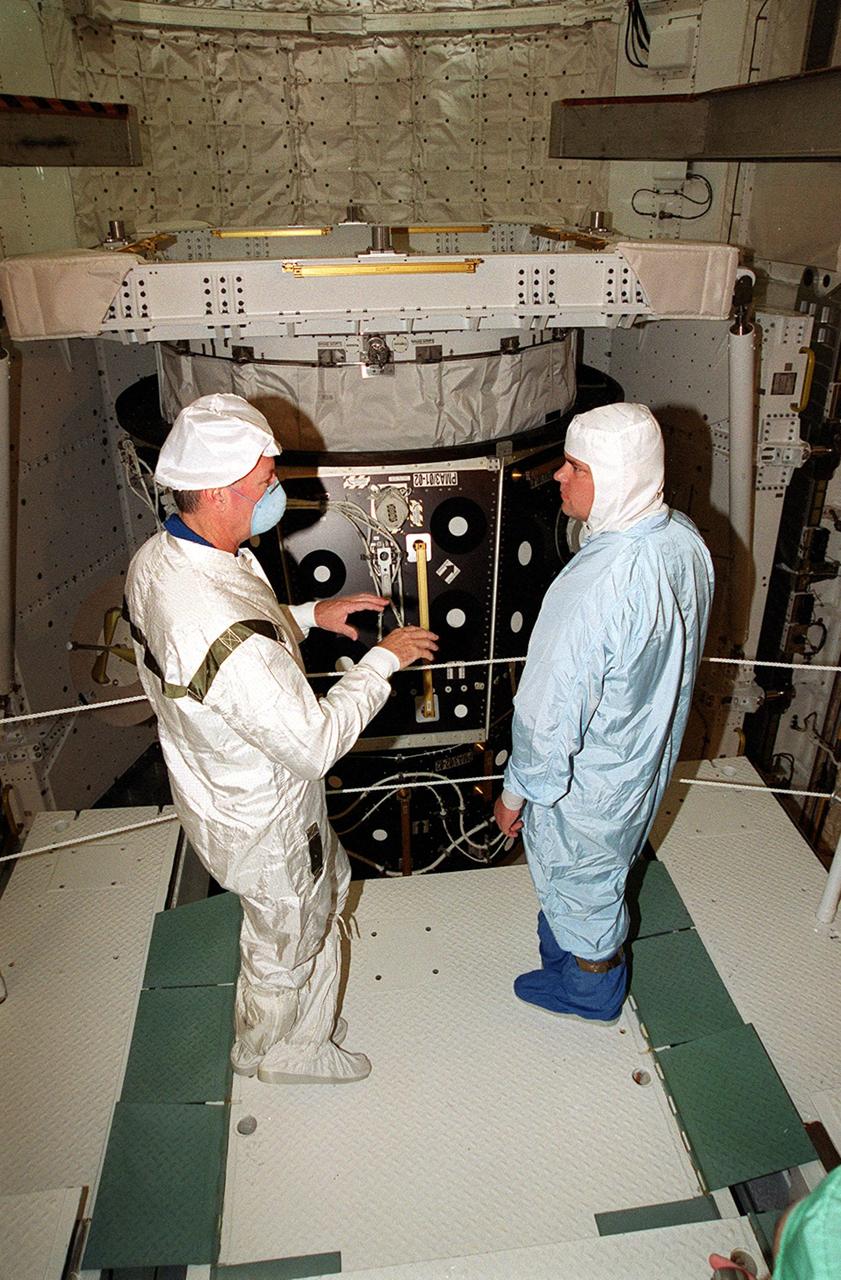
STS-92 Commander Brian Duffy (left) talks with a worker during inspection of the payload (behind them) in Space Shuttle Discovery’s payload bay. He and other crew members Pilot Pamela Ann Melroy and Mission Specialists Koichi Wakata of Japan, Leroy Chiao, Peter J.K. “Jeff” Wisoff, Michael E. Lopez-Alegria and William S. McArthur Jr. are preparing for launch on Oct. 5, 2000. The mission is the fifth flight for the construction of the International Space Station. The payload includes the Integrated Truss Structure Z-1 and the third Pressurized Mating Adapter. During the 11-day mission, four extravehicular activities (EVAs), or space walks, are planned
 --- The drag chute on the Space Shuttle Discovery is deployed as the vehicle rolls toward mission completion at Edwards Air Force Base in the Mojave Desert of California. Onboard were astronauts Brian Duffy, Pamela A. Melroy, Leroy Chiao, William S. McArthur, Jr., Peter J.K. (Jeff) Wisoff, Michael E. Lopez-Alegria, and Koichi Wakata of Japan's National Space Development Agency (NASDA). Discovery touched down at 2 p.m. (PDT), October 24, and rolled to a stop on Edward's concrete runway at 2:0l, for a mission elapsed time of 12 days, 21 hours and 43 minutes.](https://images-assets.nasa.gov/image/sts092-s-022/sts092-s-022~medium.jpg)
STS092-S-022 [EC00-0311-3](24 OCTOBER 2000) --- The drag chute on the Space Shuttle Discovery is deployed as the vehicle rolls toward mission completion at Edwards Air Force Base in the Mojave Desert of California. Onboard were astronauts Brian Duffy, Pamela A. Melroy, Leroy Chiao, William S. McArthur, Jr., Peter J.K. (Jeff) Wisoff, Michael E. Lopez-Alegria, and Koichi Wakata of Japan's National Space Development Agency (NASDA). Discovery touched down at 2 p.m. (PDT), October 24, and rolled to a stop on Edward's concrete runway at 2:0l, for a mission elapsed time of 12 days, 21 hours and 43 minutes.
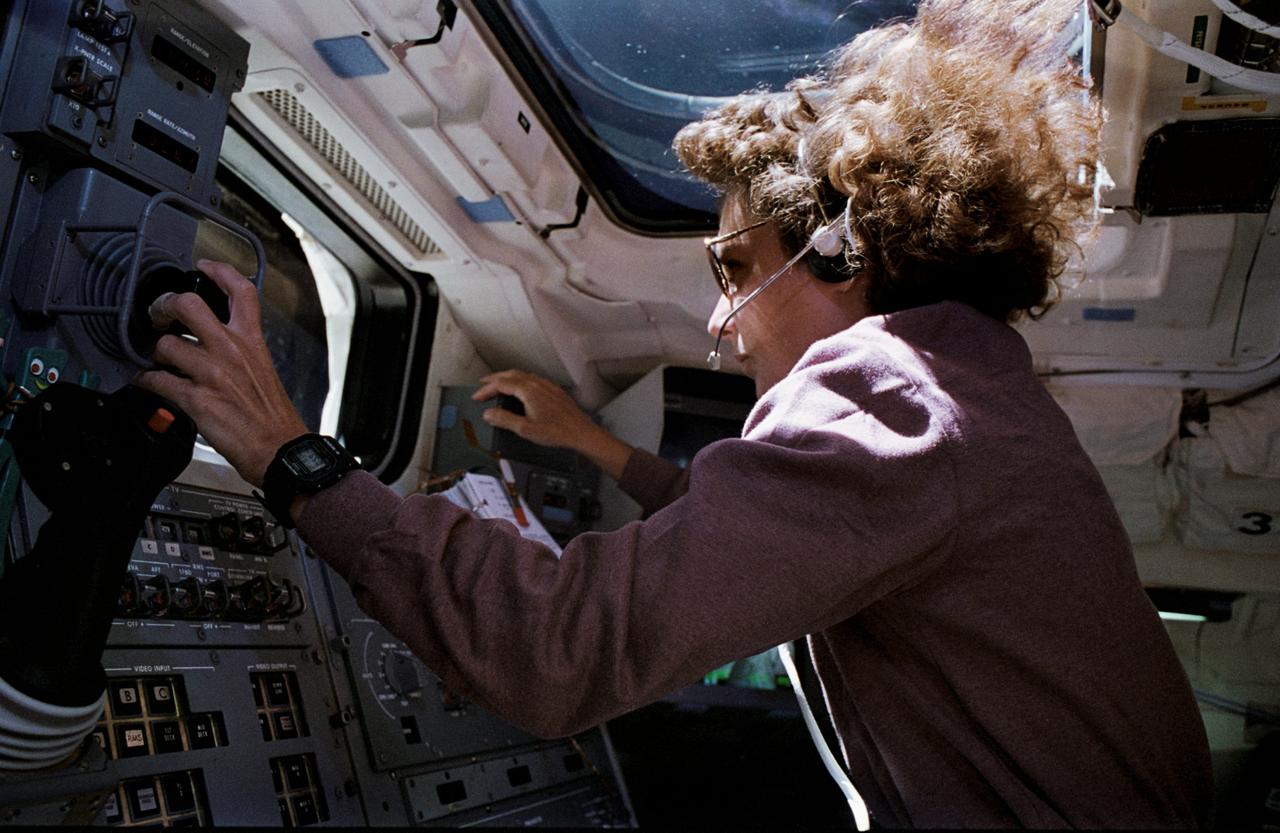
STS057-31-030 (25 June 1993) --- Astronaut Nancy J. Sherlock operates Endeavour's remote manipulator system (RMS) during the June 25 extravehicular activity of two crewmates. At one point, astronaut G. David Low, while his feet were anchored to a special restraint device on the end of the RMS arm, moved about, with Sherlock's aid, while holding astronaut Peter J. K. (Jeff) Wisoff. The activity represented an evaluation of techniques which might be used on planned future missions -- a 1993 servicing visit to the Hubble Space Telescope and later space station work -- which will require astronauts to frequently lift objects of similar sized bulk.
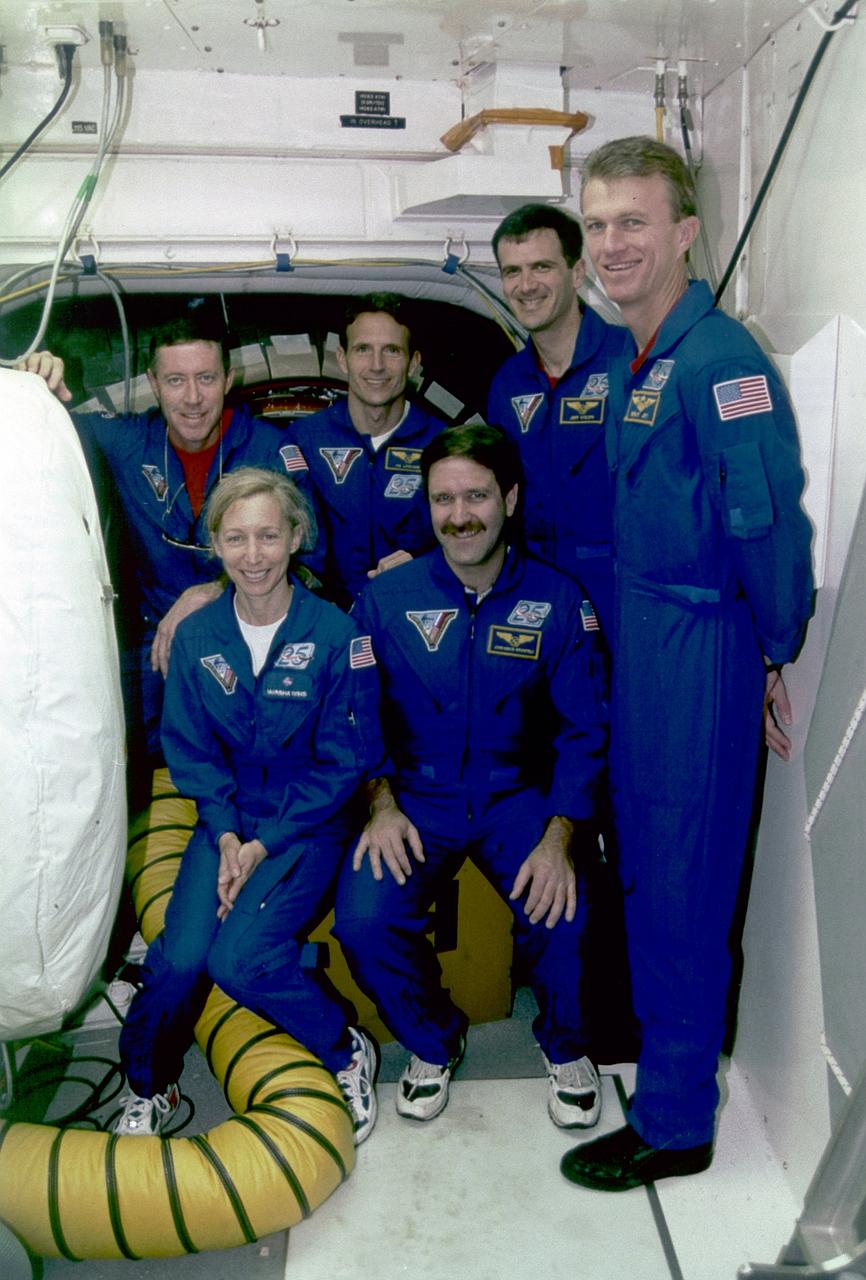
S97-00247 (15 Dec. 1996) --- The STS-81 mission flight crew poses outside the hatch of the space shuttle Atlantis at Launch Pad 39B during a Terminal Countdown Demonstration Test (TCDT). The TCDT represents a simulated final countdown rehearsal that ends just before main engine ignition. The actual launch is now scheduled for Jan. 12, 1997. Pictured (from the left) are astronauts Michael A. Baker, Marsha S. Ivins, Jerry M. Linenger, John M. Grunsfeld, Peter J.K. (Jeff) Wisoff, and Brent W. Jett Jr.
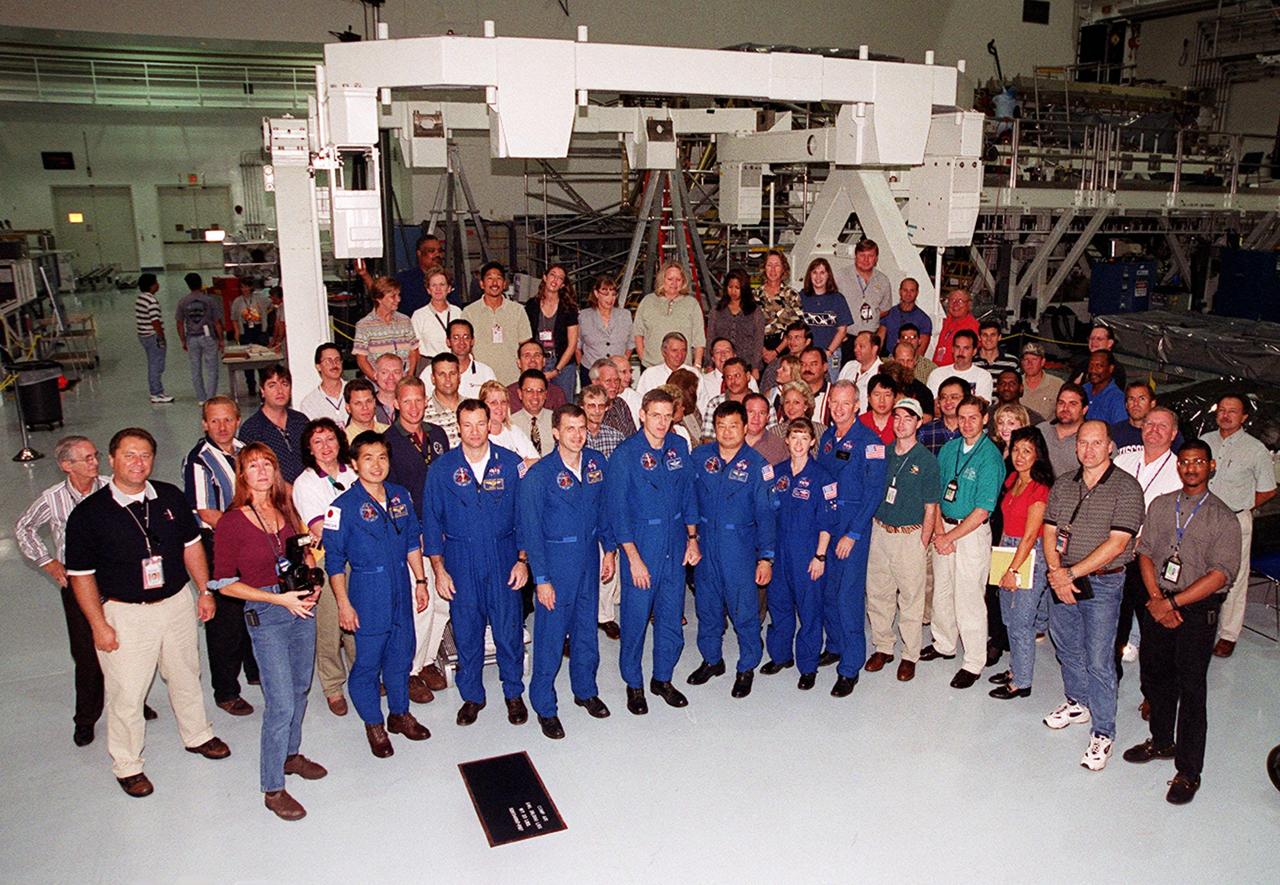
In the Space Station Processing Facility, workers who have supported mission STS-92 gather for a photo with the crew: (left to right) Mission Specialists Koichi Wakata of Japan, Michael Lopez-Alegria, Jeff Wisoff, Bill McArthur and Leroy Chiao; Pilot Pam Melroy; and Commander Brian Duffy. STS-92 is scheduled to launch Oct. 5 at 9:30 p.m. EDT on the fifth flight to the International Space Station. It will carry two elements of the Space Station, the Integrated Truss Structure Z1 and the third Pressurized Mating Adapter. The mission is also the 100th flight in the Shuttle program
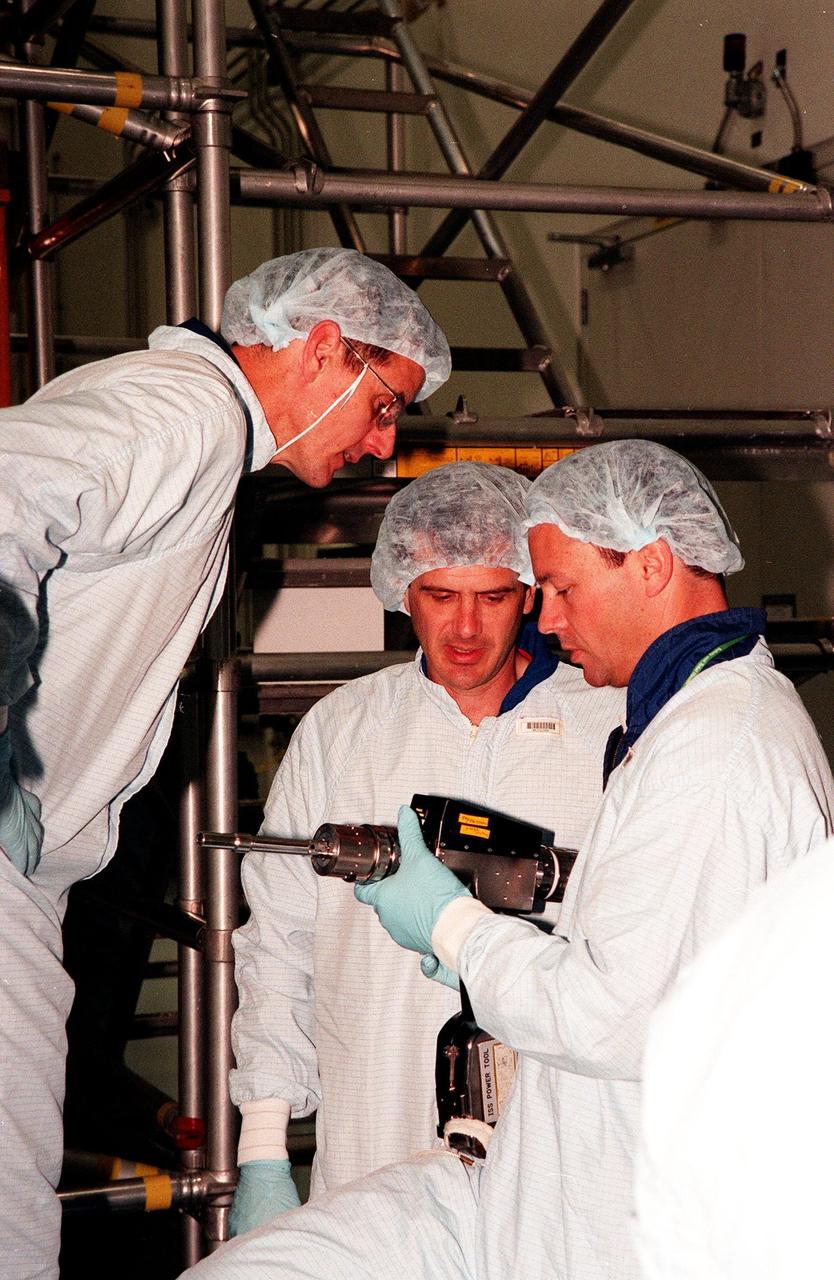
In the Space Station Processing Facility, members of the STS-92 crew become familiar with equipment in preparation for their mission to the International Space Station (ISS). STS-92 is targeted for launch in December 1999. From left are Mission Specialists Bill McArthur, Jeff Wisoff and Michael Lopez-Alegria, holding an ISS power tool. Other crew members visiting KSC are Commander Brian Duffy and Mission Specialists Koichi Wakata and Leroy Chiao. STS-92 is the fourth U.S. flight for construction of the International Space Station. The payload includes an integrated truss structure and a pressurized mating adapter
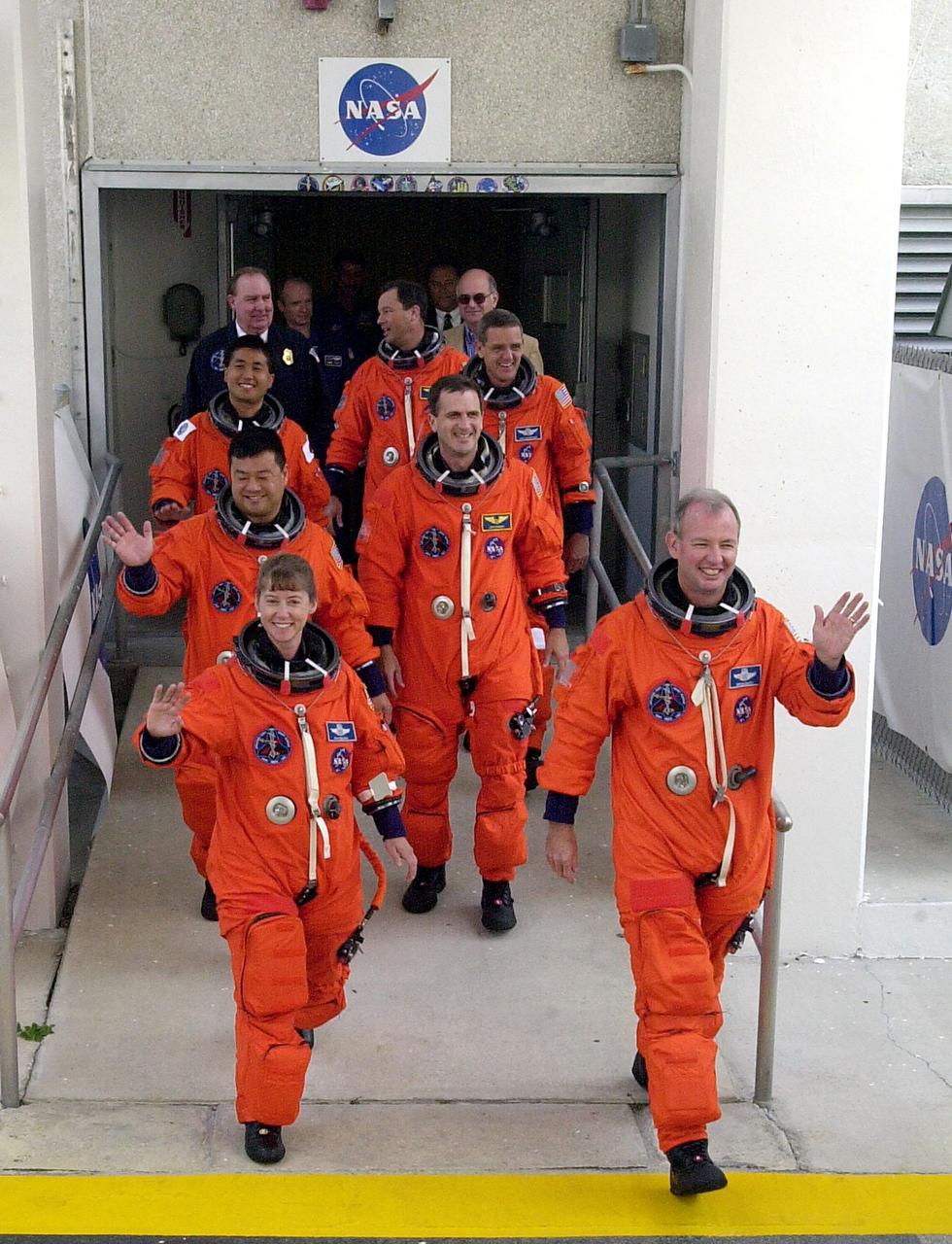
The STS-92 crew eagerly walk out of the Operations and Checkout Building for the second time for their trip to Launch Pad 39A. On the left side, from front to back, are Pilot Pamela Ann Melroy and Mission Specialists Leroy Chiao and Koichi Wakata of Japan. On the right side, front to back, are Commander Brian Duffy and Mission Specialists Peter J.K. “Jeff” Wisoff, William S. McArthur Jr. and Michael E. Lopez-Alegria. During the 11-day mission to the International Space Station, four extravehicular activities (EVAs), or spacewalks, are planned for construction. The payload includes the Integrated Truss Structure Z-1 and the third Pressurized Mating Adapter. The Z-1 truss is the first of 10 that will become the backbone of the Space Station, eventually stretching the length of a football field. PMA-3 will provide a Shuttle docking port for solar array installation on the sixth Station flight and Lab installation on the seventh Station flight. This launch is the fourth for Duffy and Wisoff, the third for Chiao and McArthur, second for Wakata and Lopez-Alegria, and first for Melroy. Launch is scheduled for 7:17 p.m. EDT. Landing is expected Oct. 22 at 2:10 p.m. EDT. [Photo taken with a Nikon D1 camera.
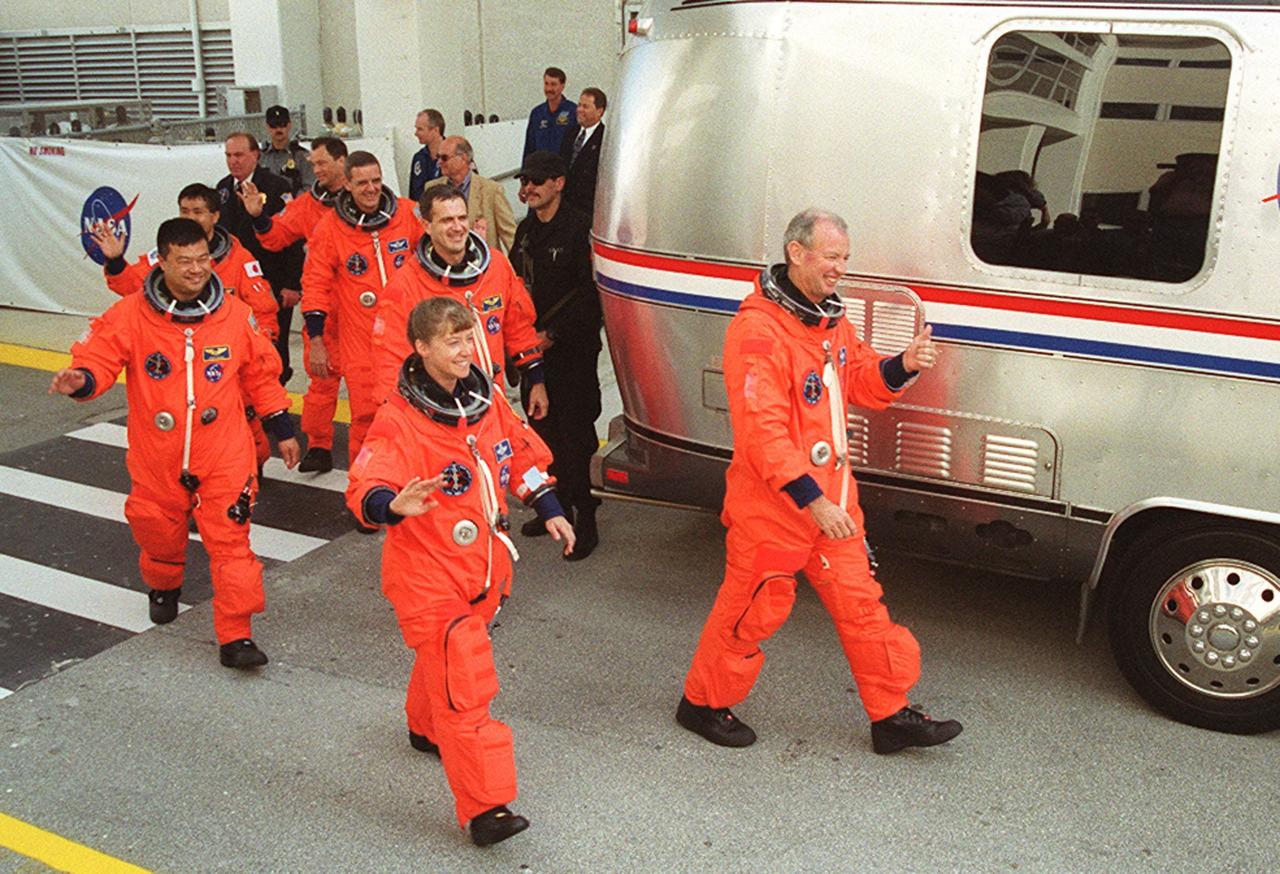
Smiling and waving at photographers and onlookers, the STS-92 crew hurries to the waiting Astrovan for the trip to Launch Pad 39A and liftoff of Space Shuttle Discovery. Clockwise from right, leading the way are Commander Brian Duffy and Pilot Pamela Ann Melroy; then Mission Specialists Leroy Chiao, Koichi Wakata of Japan, Michael Lopez-Alegria, William S. McArthur Jr. and Peter J.K. “Jeff” Wisoff. During the 11-day mission to the International Space Station, four extravehicular activities (EVAs), or spacewalks, are planned for construction. The payload includes the Integrated Truss Structure Z-1 and the third Pressurized Mating Adapter. The Z-1 truss is the first of 10 that will become the backbone of the Space Station, eventually stretching the length of a football field. PMA-3 will provide a Shuttle docking port for solar array installation on the sixth Station flight and Lab installation on the seventh Station flight. This launch is the fourth for Duffy and Wisoff, the third for Chiao and McArthur, second for Wakata and Lopez-Alegria, and first for Melroy. Launch is scheduled for 7:17 p.m. EDT. Discovery’s landing is expected Oct. 22 at 2:10 p.m. EDT
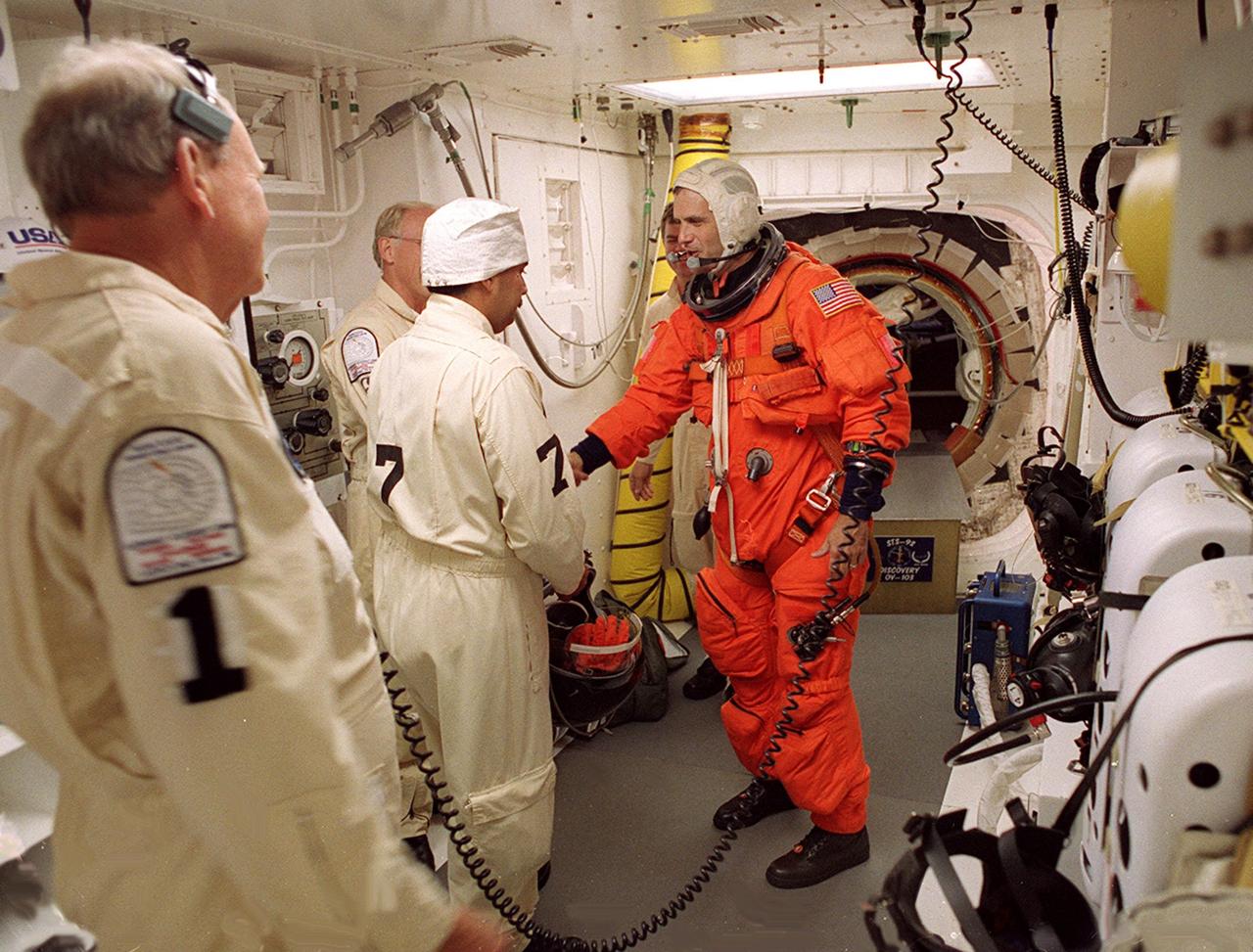
STS-92 Mission Specialist Peter J.K. “Jeff” Wisoff reaches out to shake the hand of Danny Wyatt, KSC NASA Quality Assurance specialist, after completing final check of his launch and entry suit in the White Room before entering Discovery. The White Room is an environmentally controlled area at the end of the Orbiter Access Arm that provides entry to the orbiter as well as emergency egress if needed. The arm remains in the extended position until 7 minutes 24 seconds before launch. Wisoff and the rest of the crew are undertaking the fifth flight to the International Space Station for construction. Discovery carries a payload that includes the Integrated Truss Structure Z-1, first of 10 trusses that will form the backbone of the Space Station, and the third Pressurized Mating Adapter that will provide a Shuttle docking port for solar array installation on the sixth Station flight and Lab installation on the seventh Station flight. The mission includes four spacewalks for the construction activities. Discovery’s landing is expected Oct. 22 at 2:10 p.m. EDT
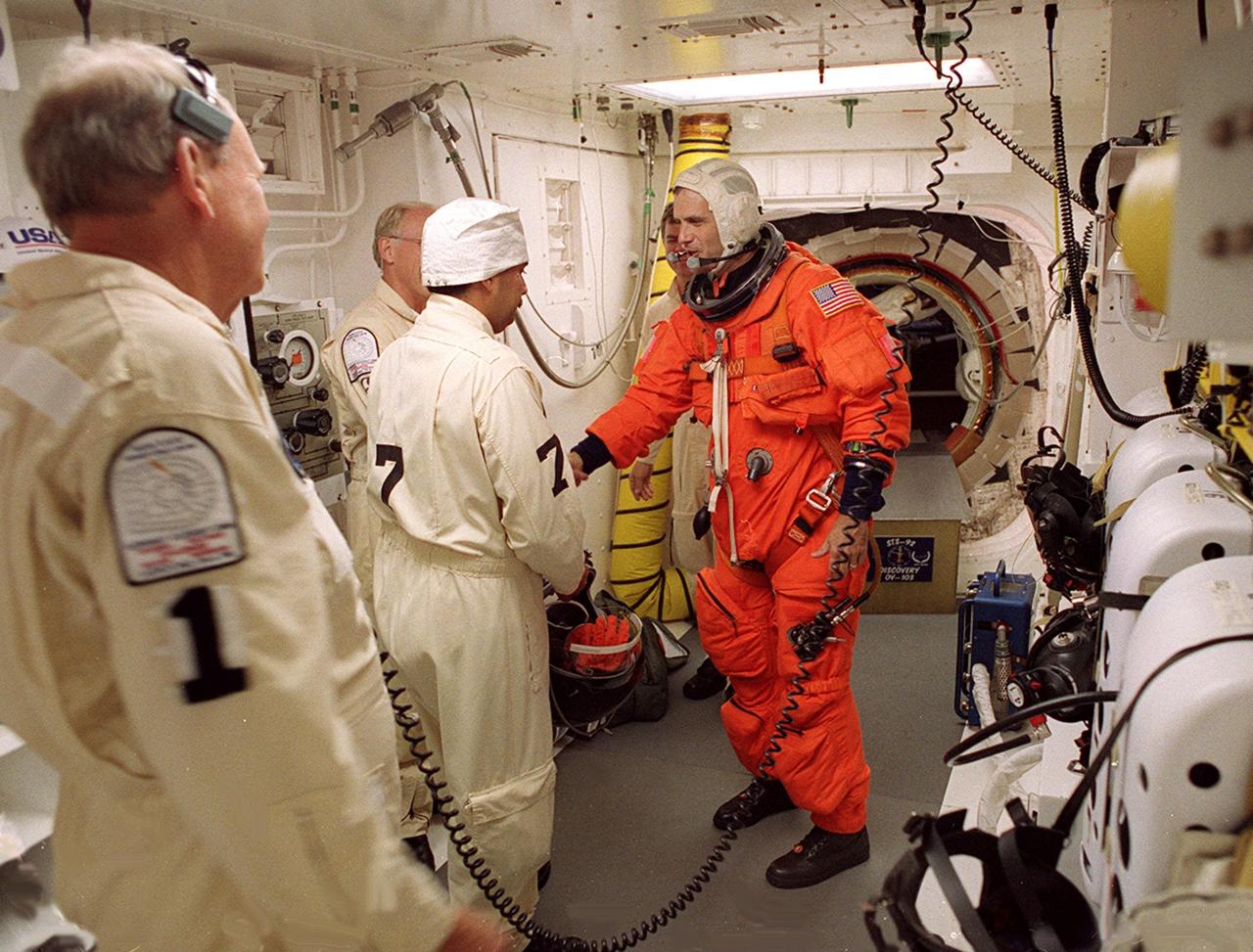
STS-92 Mission Specialist Peter J.K. “Jeff” Wisoff reaches out to shake the hand of Danny Wyatt, KSC NASA Quality Assurance specialist, after completing final check of his launch and entry suit in the White Room before entering Discovery. The White Room is an environmentally controlled area at the end of the Orbiter Access Arm that provides entry to the orbiter as well as emergency egress if needed. The arm remains in the extended position until 7 minutes 24 seconds before launch. Wisoff and the rest of the crew are undertaking the fifth flight to the International Space Station for construction. Discovery carries a payload that includes the Integrated Truss Structure Z-1, first of 10 trusses that will form the backbone of the Space Station, and the third Pressurized Mating Adapter that will provide a Shuttle docking port for solar array installation on the sixth Station flight and Lab installation on the seventh Station flight. The mission includes four spacewalks for the construction activities. Discovery’s landing is expected Oct. 22 at 2:10 p.m. EDT
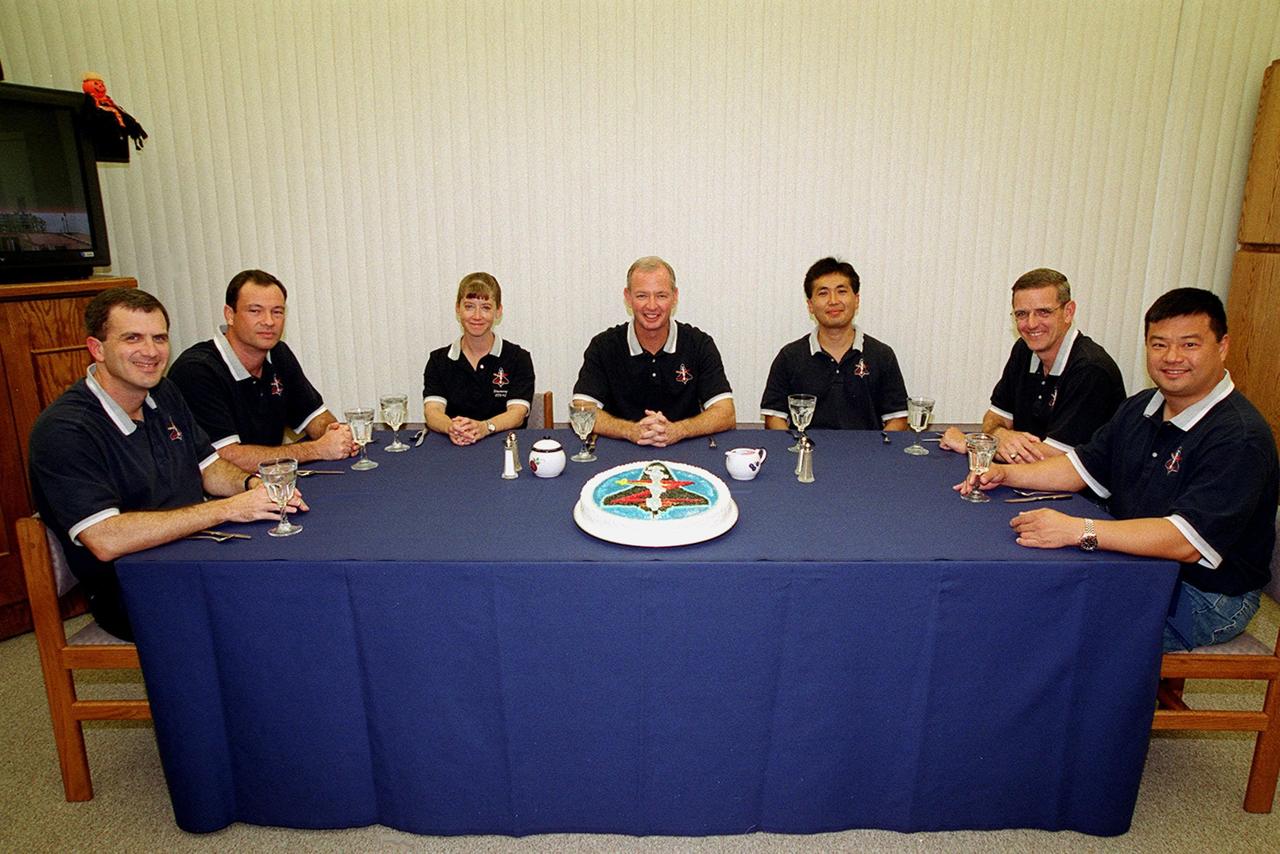
The STS-92 crew pose for a group photo after a snack prior to suiting up for launch. Seated left to right are Mission Specialists Peter J.K. “Jeff” Wisoff and Michael E. Lopez-Alegria; Pilot Pamela Ann Melory; Commander Brian Duffy; and Mission Specialists Koichi Wakata of Japan, William S. McArthur Jr. and Leroy Chiao. The mission is the fifth flight for the construction of the ISS. The payload includes the Integrated Truss Structure Z-1 and the third Pressurized Mating Adapter. During the 11-day mission, four extravehicular activities (EVAs), or spacewalks, are planned. The Z-1 truss is the first of 10 that will become the backbone of the International Space Station, eventually stretching the length of a football field. PMA-3 will provide a Shuttle docking port for solar array installation on the sixth ISS flight and Lab installation on the seventh ISS flight. This launch is the fourth for Duffy and Wisoff, the third for Chiao and McArthur, second for Wakata and Lopez-Alegria, and first for Melroy. Launch is scheduled for 8:05 p.m. EDT. Landing is expected Oct. 21 at 3:55 p.m. EDT
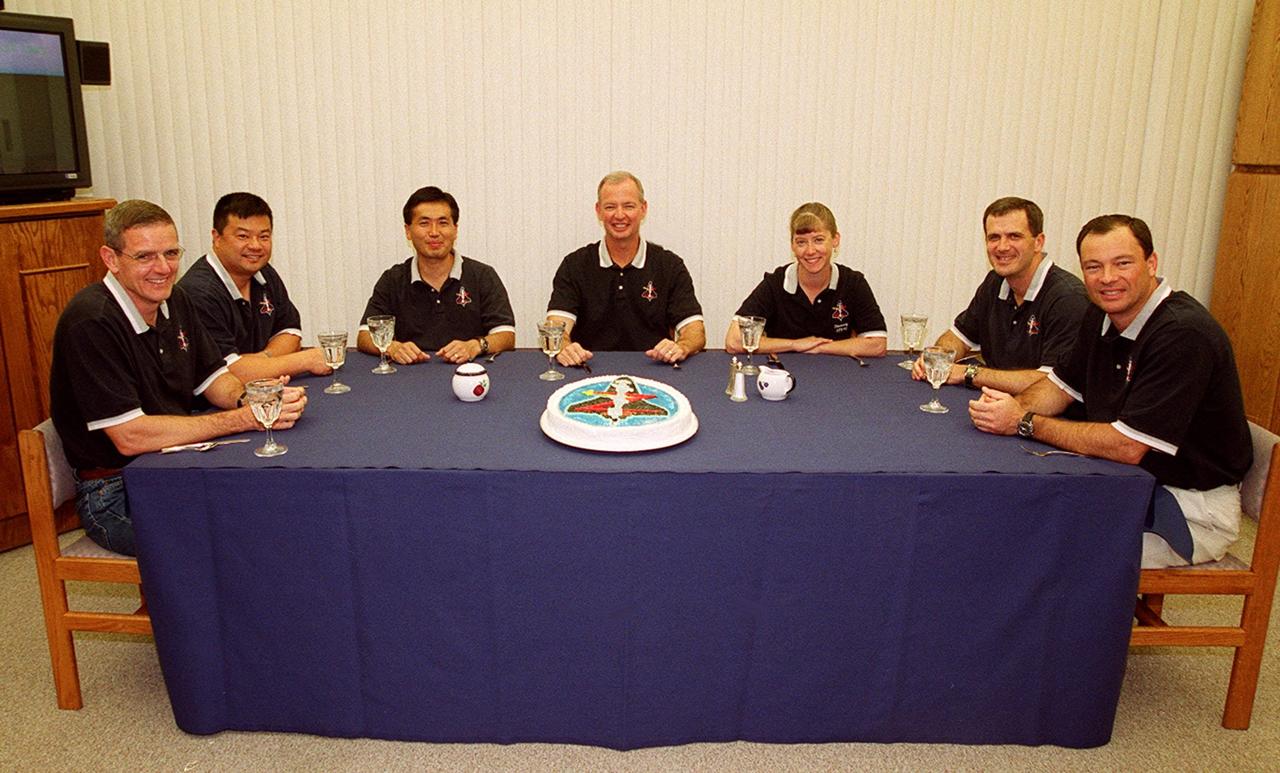
The STS-92 crew begin their journey to Launch Pad 39A with a snack. Seated at the table (left to right) are Mission Specialists William S. McArthur Jr., Leroy Chiao and Koichi Wakata of Japan; Commander Brian Duffy; Pilot Pamela Ann Melroy; and Mission Specialists Peter J.K. “Jeff” Wisoff and Michael E. Lopez-Alegria. During the 11-day mission to the International Space Station, four extravehicular activities (EVAs), or spacewalks, are planned for construction. The payload includes the Integrated Truss Structure Z-1 and the third Pressurized Mating Adapter. The Z-1 truss is the first of 10 that will become the backbone of the Space Station, eventually stretching the length of a football field. PMA-3 will provide a Shuttle docking port for solar array installation on the sixth Station flight and Lab installation on the seventh Station flight. This launch is the fourth for Duffy and Wisoff, the third for Chiao and McArthur, second for Wakata and Lopez-Alegria, and first for Melroy. Launch is scheduled for 7:17 p.m. EDT. Landing is expected Oct. 22 at 2:10 p.m. EDT
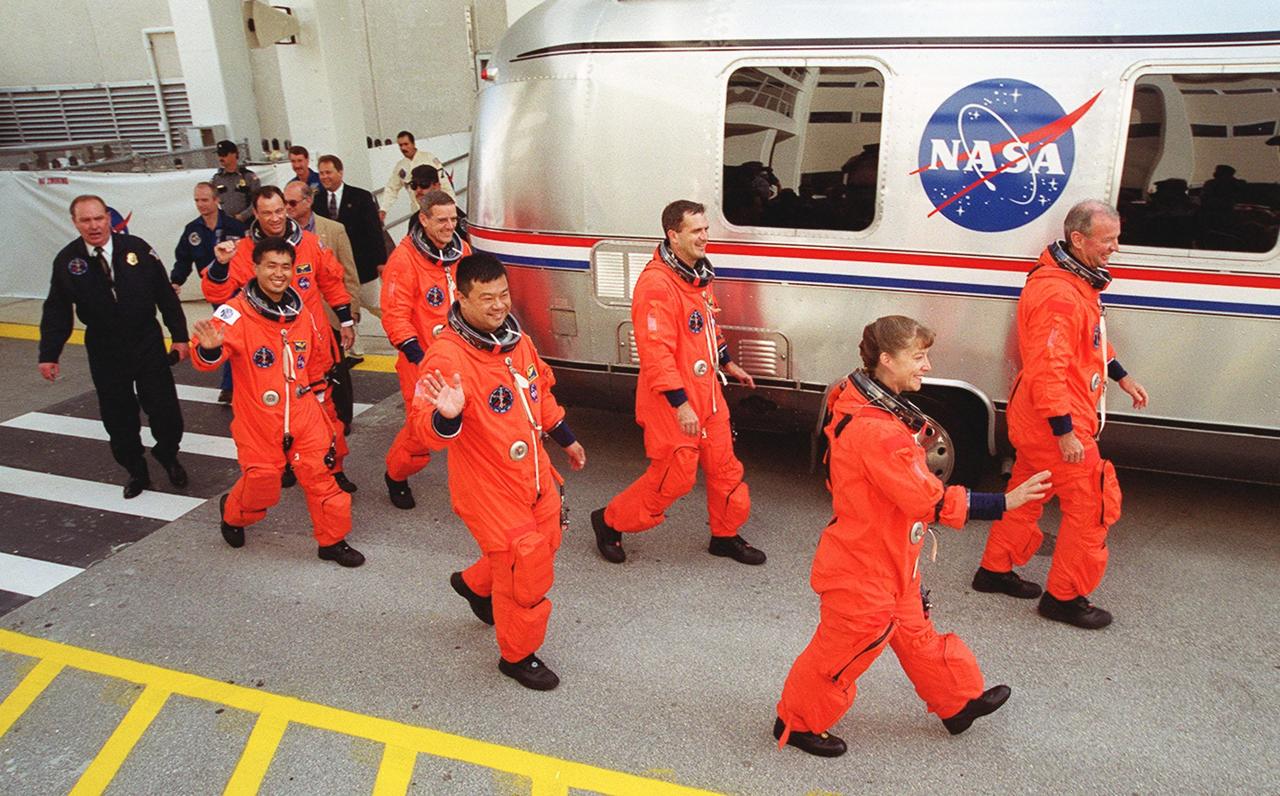
Eager to get to the launch pad and liftoff of Space Shuttle Discovery on mission STS-92, the crew hurries to the waiting Astrovan for the trip. From left are Mission Specialists Michael E. Lopez-Alegria, Koichi Wakata of Japan, William S. McArthur Jr., Leroy Chiao and Peter J.K. “Jeff” Wisoff; Pilot Pamela Ann Melroy; and Commander Brian Duffy. This launch is the fourth for Duffy and Wisoff, the third for Chiao and McArthur, second for Wakata and Lopez-Alegria, and first for Melroy. During the 11-day mission to the International Space Station, four extravehicular activities (EVAs), or spacewalks, are planned for construction. The payload includes the Integrated Truss Structure Z-1 and the third Pressurized Mating Adapter. The Z-1 truss is the first of 10 that will become the backbone of the Space Station, eventually stretching the length of a football field. PMA-3 will provide a Shuttle docking port for solar array installation on the sixth Station flight and Lab installation on the seventh Station flight. Launch is scheduled for 7:17 p.m. EDT. Discovery’s landing is expected Oct. 22 at 2:10 p.m. EDT
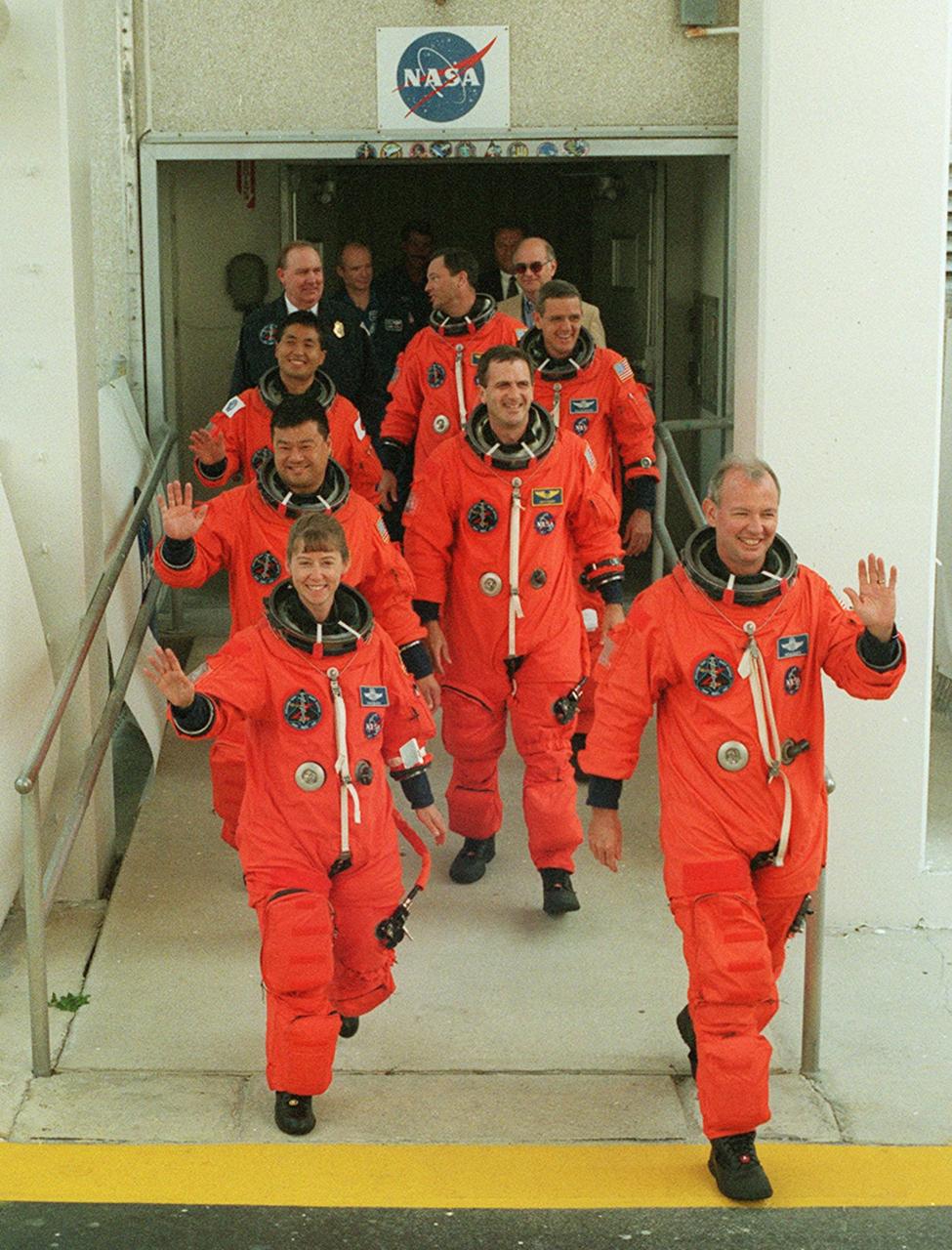
The STS-92 crew greets cheering onlookers as they exit the Operations and Checkout Building for the trip to Launch Pad 39A and liftoff of Space Shuttle Discovery. In rows of two, starting at front, are Pilot Pamela Ann Melroy and Commander Brian Duffy; Mission Specialists Leroy Chiao, Peter J.K. “Jeff” Wisoff; Koichi Wakata, William S. McArthur Jr.; and Michael E. Lopez-Alegria taking up the rear. . This launch is the fourth for Duffy and Wisoff, the third for Chiao and McArthur, second for Wakata and Lopez-Alegria, and first for Melroy. During the 11-day mission to the International Space Station, four extravehicular activities (EVAs), or spacewalks, are planned for construction. The payload includes the Integrated Truss Structure Z-1 and the third Pressurized Mating Adapter. The Z-1 truss is the first of 10 that will become the backbone of the Space Station, eventually stretching the length of a football field. PMA-3 will provide a Shuttle docking port for solar array installation on the sixth Station flight and Lab installation on the seventh Station flight. Launch is scheduled for 7:17 p.m. EDT. Discovery’s landing is expected Oct. 22 at 2:10 p.m. EDT
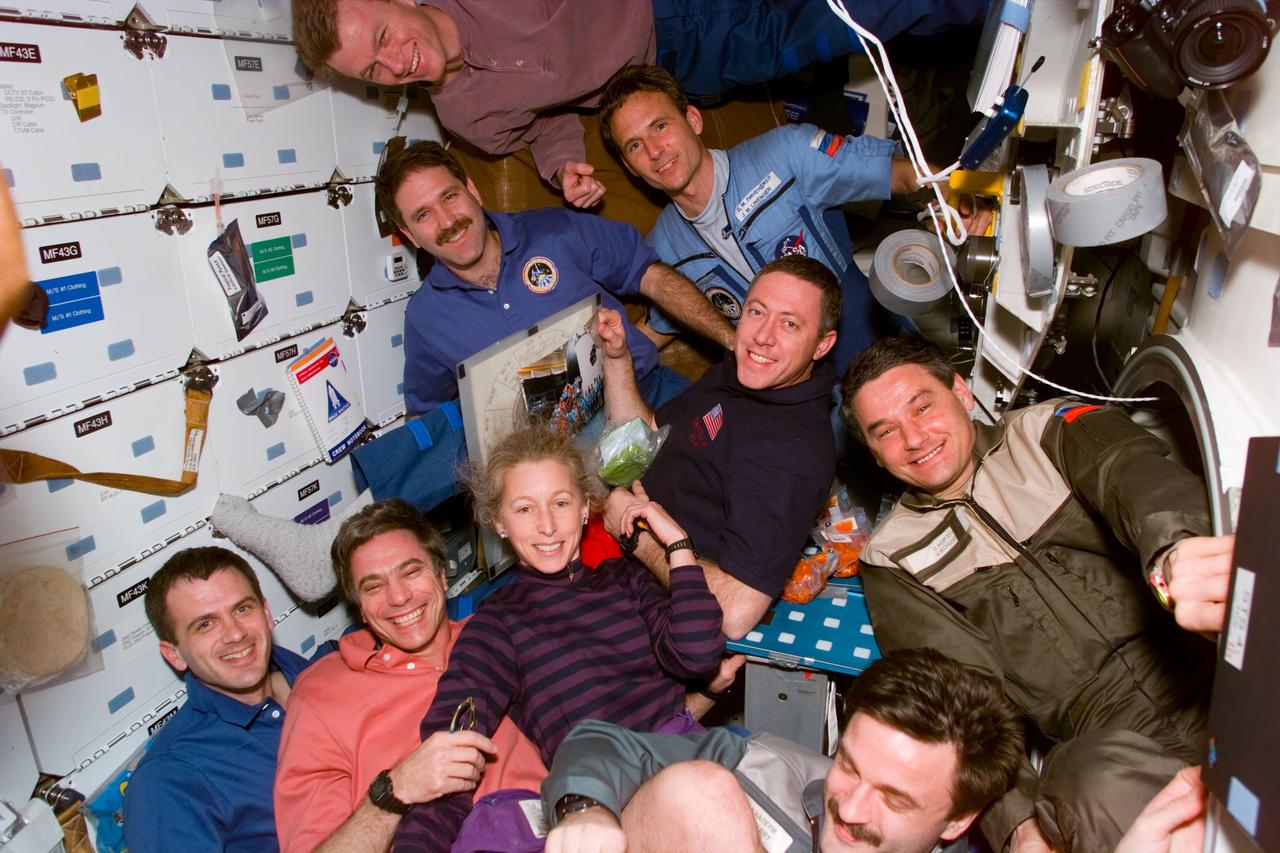
STS081-E-05535 (17 Jan. 1997) --- Seven NASA astronauts and two Russian cosmonauts take a break from busy supply-transfer duties on the space shuttle Atlantis' middeck halfway through the ten-day mission. Left to right at bottom of the frame are mission specialists Peter J. K. (Jeff) Wisoff, John E. Blaha, Marsha S. Ivins and cosmonaut Aleksandr Y. Kaleri, Mir-22 flight engineer. In the top half of the scene are, from the top left, Brent W. Jett, Jr., pilot; John M. Grunsfeld, mission specialist; Jerry M. Linenger, cosmonaut guest researcher; Michael A. Baker, commander; and cosmonaut Valeri G. Korzun, Mir-22 commander. The picture was recorded with a pre-set 35mm Electronic Still Camera (ESC).
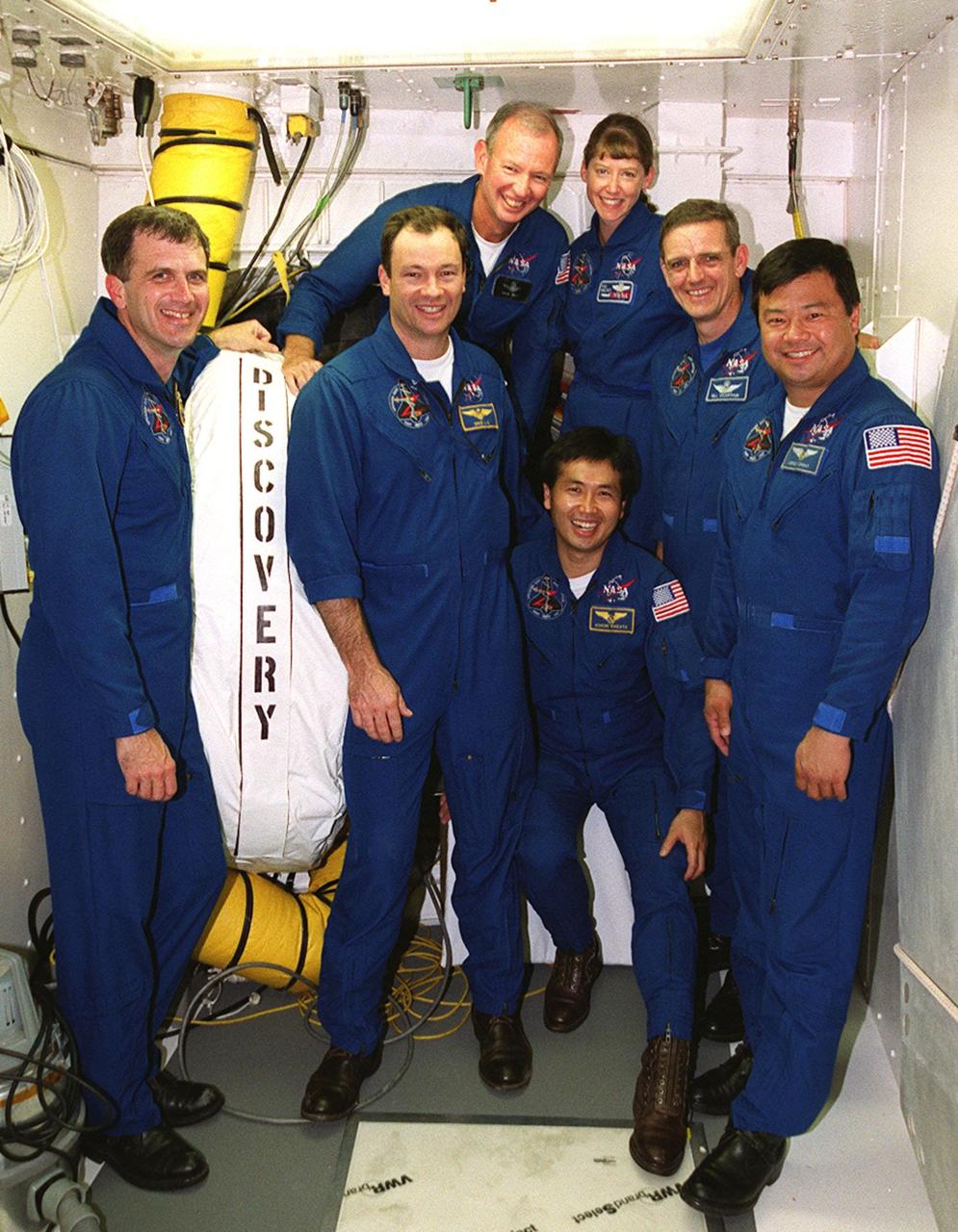
The STS-92 crew poses for a photograph in the White Room, the environmentally controlled chamber on the orbiter access arm that provides entry for the crew into the orbiter. Standing, left to right, are Mission Specialists Peter J.K. “Jeff” Wisoff and Michael E. Lopez-Alegria; Commander Brian Duffy; Pilot Pamela Ann Melroy; and Mission Specialists William S. McArthur Jr. and Leroy Chiao. Crouching in front is Mission Specialist Koichi Wakata of Japan. The crew is at KSC for Terminal Countdown Demonstration Test activities that provide emergency egress training, opportunities to inspect the mission payload, and take part in a simulated countdown. STS-92 is scheduled to launch Oct. 5 at 9:38 p.m. EDT on the fifth flight to the International Space Station. It will carry two elements of the Space Station, the Integrated Truss Structure Z1 and the third Pressurized Mating Adapter. The mission is also the 100th flight in the Shuttle program
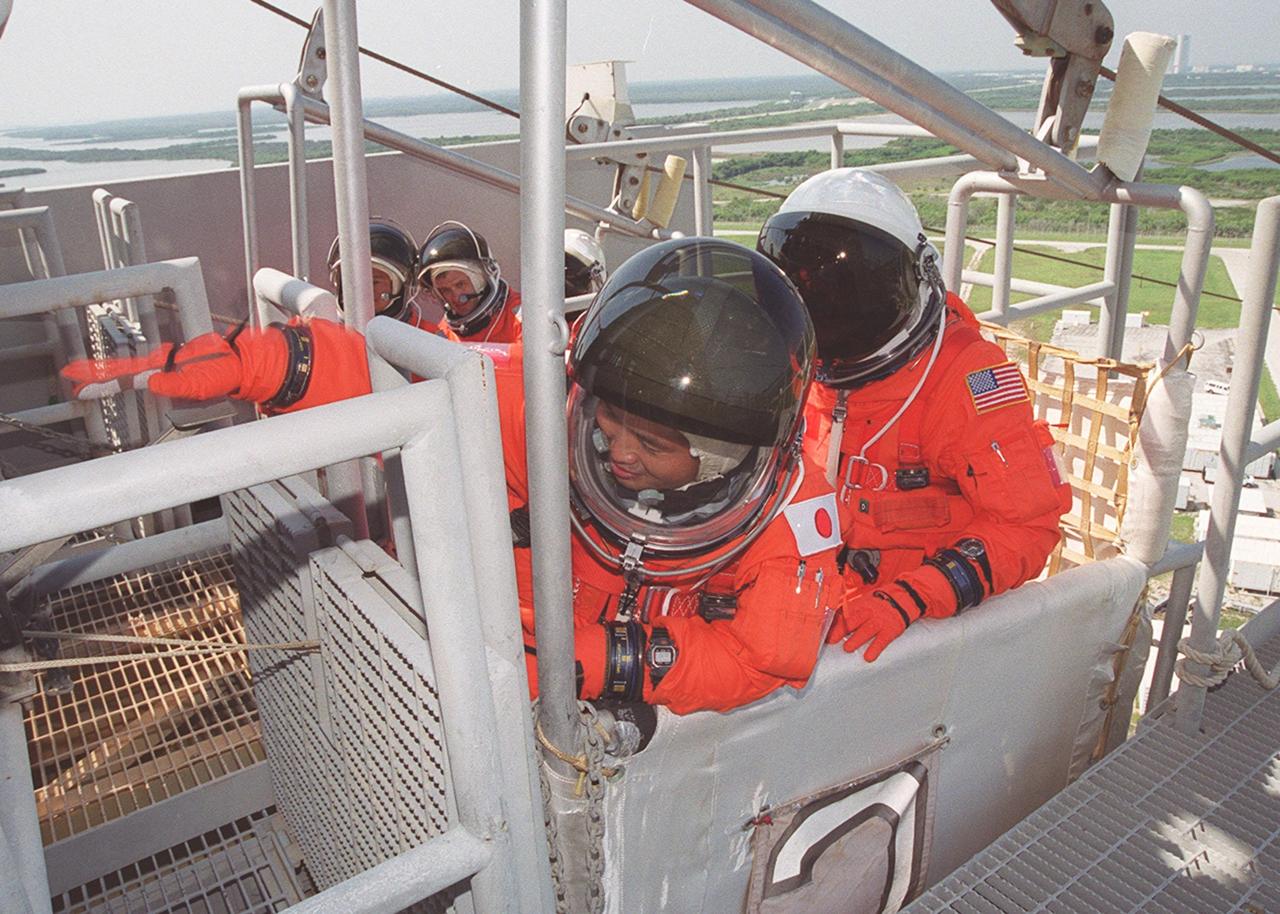
KENNEDY SPACE CENTER, FLA. -- STS-92 Mission Specialist Koichi Wakata of Japan reaches for a lever that will release the slidewire basket he is in. Behind him is Mission Specialist William S. McArthur Jr. In another basket (in the background) are Mission Specialists Leroy Chiao, Peter J.K. “Jeff” Wisoff and Michael E. Lopez-Alegria. They are taking part in emergency egress training, one of the Terminal Countdown Demonstration Test activities that also include a simulated countdown. STS-92 is scheduled to launch Oct. 5 at 9:38 p.m. EDT on the fifth flight to the International Space Station. It will carry two elements of the Space Station, the Integrated Truss Structure Z1 and the third Pressurized Mating Adapter. The mission is also the 100th flight in the Shuttle program
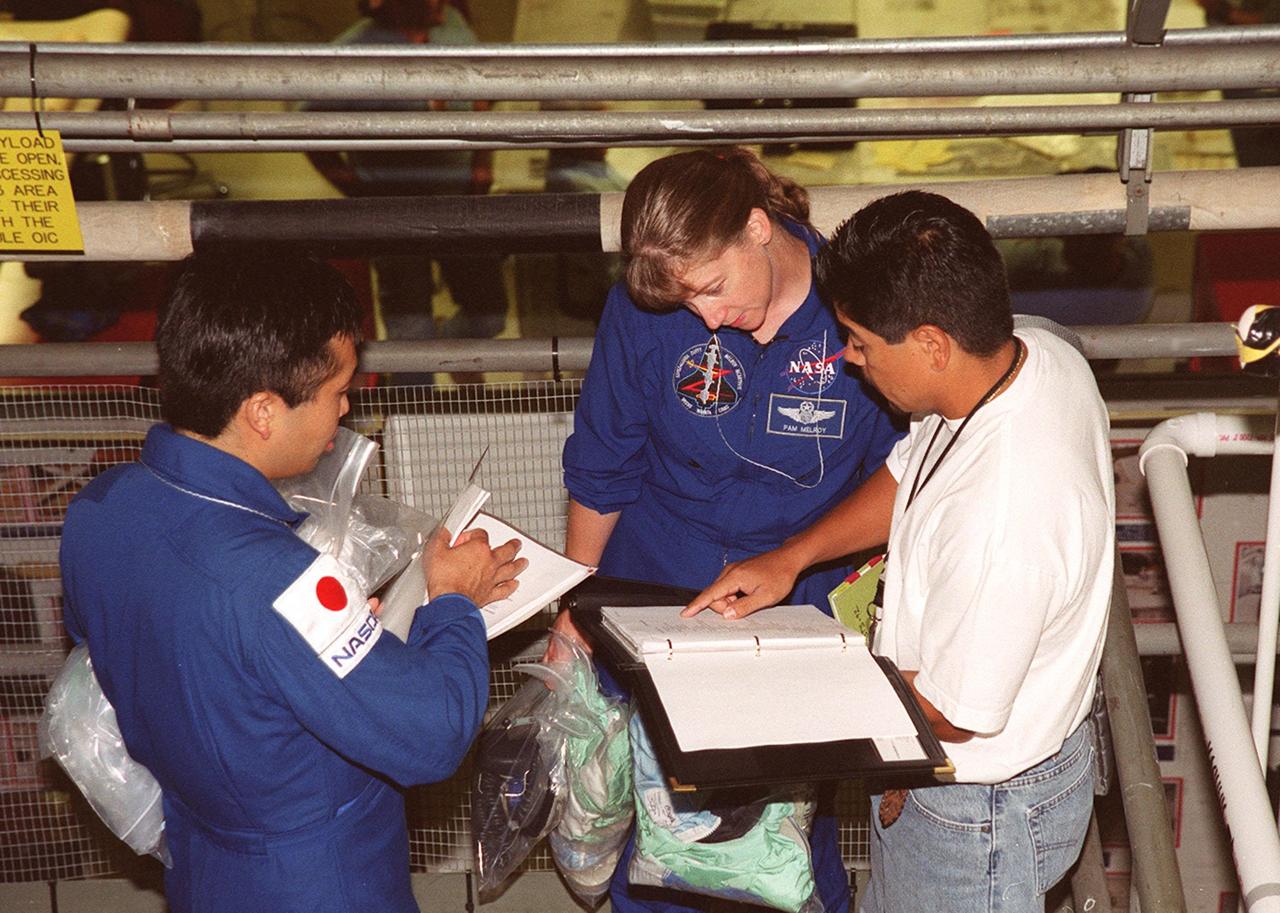
KENNEDY SPACE CENTER, FLA. -- During Crew Equipment Interface Test (CEIT) activities, STS-92 Mission Specialist Koichi Wakata, who is with the Japanese space agency, and Pilot Pam Melroy check paperwork in the Orbiter Processing Facility bay 1. At right is a Boeing worker. Other crew members taking part in the CEIT are Commander Brian Duffy and Mission Specialists Leroy Chiao, Jeff Wisoff, Michael Lopez-Alegria, and Bill McArthur. STS-92 is scheduled to launch Oct. 5 on Shuttle Discovery from Launch Pad 39A on the fifth flight to the International Space Station. Discovery will carry the Integrated Truss Structure (ITS) Z1, Pressurized Mating Adapter 3 (PMA-3), Ku-band Communications System, and Control Moment Gyros (CMGs)
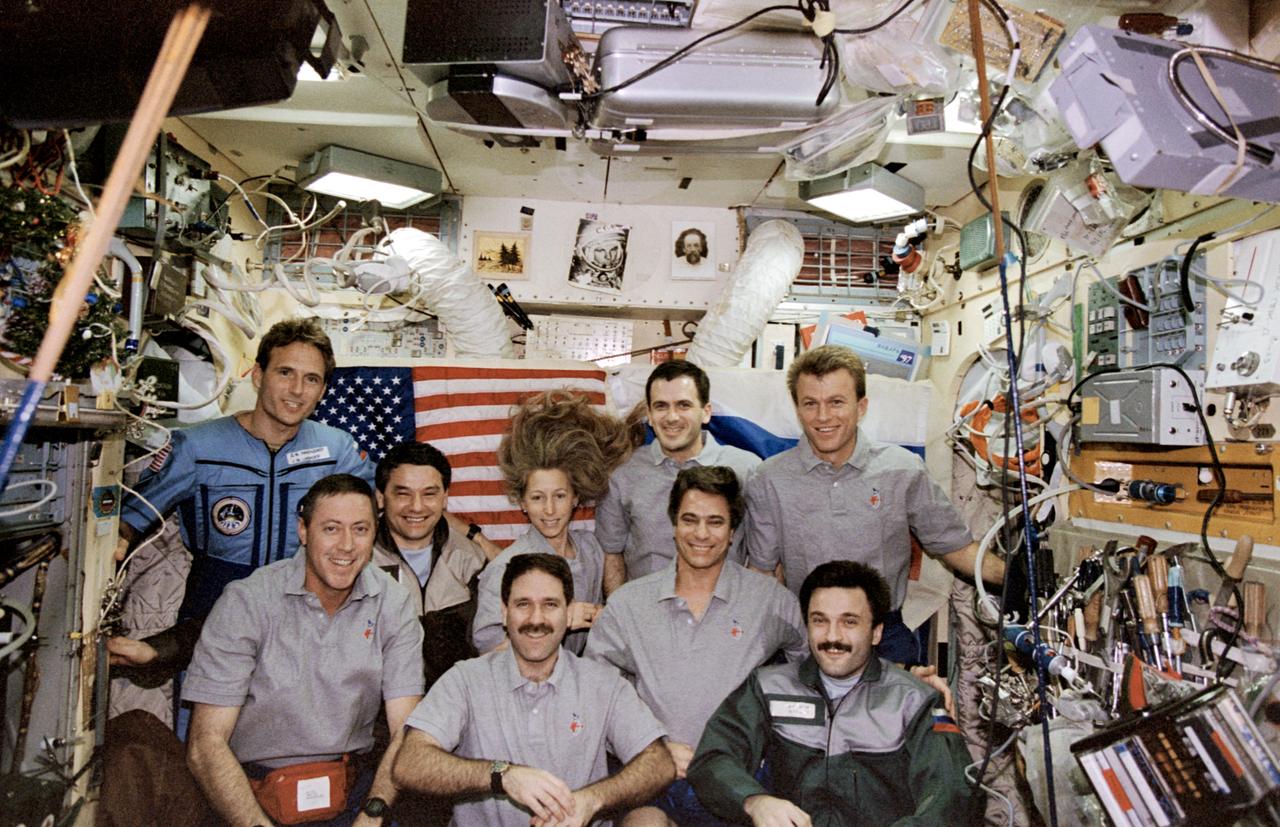
STS081-369-003 (12-22 Jan. 1997) --- Traditional inflight crew portrait of the combined Mir-22 and STS-81 crews in the Base Block Module aboard Russia's Mir Space Station. Front row: left to right, Michael A. Baker, commander; John M. Grunsfeld, mission specialist; and cosmonaut Aleksandr Y. Kaleri, Mir-22 flight engineer. Middle row: cosmonaut Valeri G. Korzun, Mir-22 commander; Marsha S. Ivins, mission specialist; and John E. Blaha, former cosmonaut guest researcher. Back row: Jerry M. Linenger, cosmonaut guest researcher; Peter J. K. (Jeff) Wisoff, mission specialist; and Brent W. Jett, Jr., pilot. Linenger is seen in a Russian jump suit, and Blaha now wears a Space Shuttle inflight garment as the two exchanged cosmonaut guest researcher roles on January 14, 1997, following the docking of the Atlantis and the Mir complex.
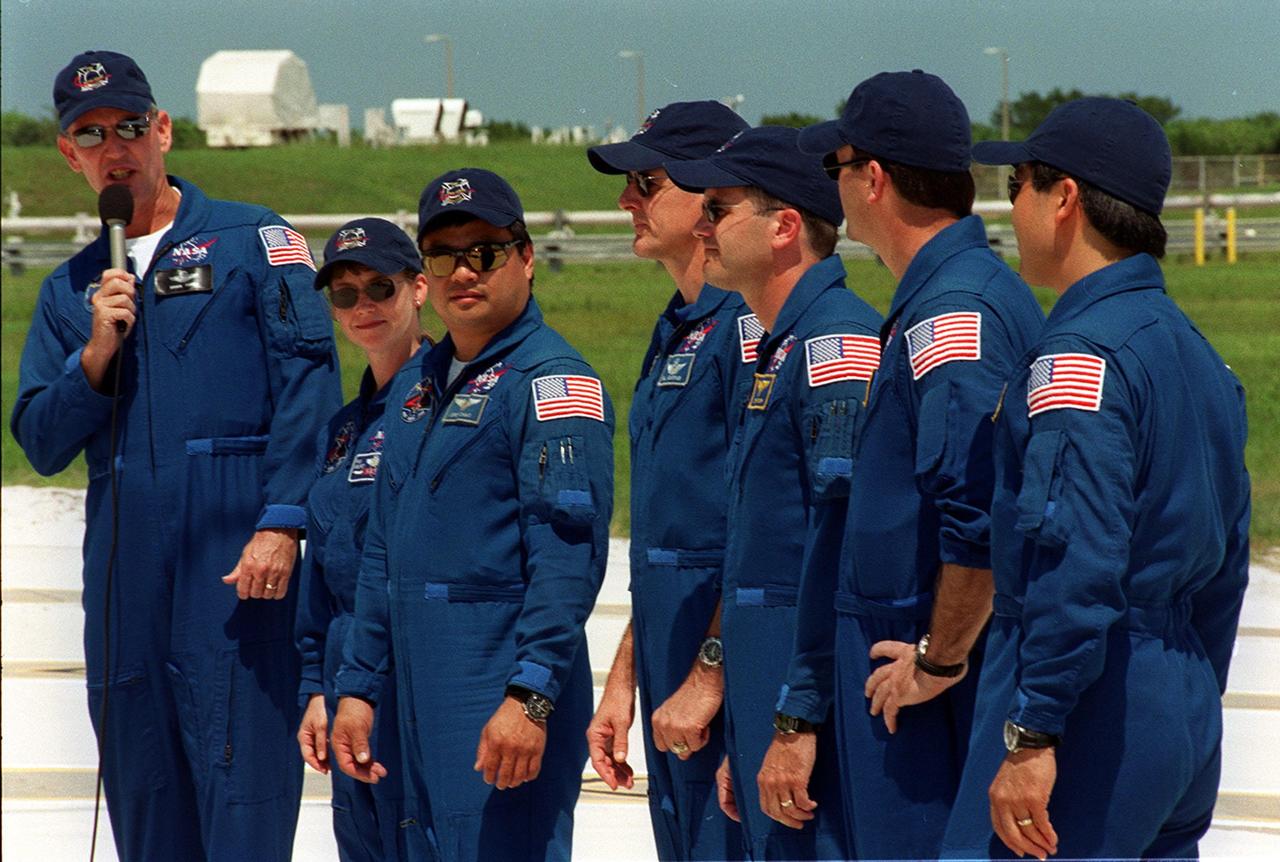
KENNEDY SPACE CENTER, FLA. -- At Launch Pad 39A during a question and answer session with the media, STS-92 Commander Brian Duffy talks about the mission. Standing next to him, left to right, are Pilot Pamela Ann Melroy and Mission Specialists Leroy Chiao, William S. McArthur Jr., Peter J.K. “Jeff” Wisoff, Michael E. Lopez-Alegria and Koichi Wakata of Japan. The crew is at KSC for Terminal Countdown Demonstration Test activities that provide emergency egress training, opportunities to inspect the mission payload, and a simulated countdown. The slidewire basket area is a landing site for the crew if they have to use the slidewire baskets to exit the orbiter on the pad in an emergency. STS-92 is scheduled to launch Oct. 5 at 9:38 p.m. EDT on the fifth flight to the International Space Station. It will carry two elements of the Space Station, the Integrated Truss Structure Z1 and the third Pressurized Mating Adapter. The mission is also the 100th flight in the Shuttle program
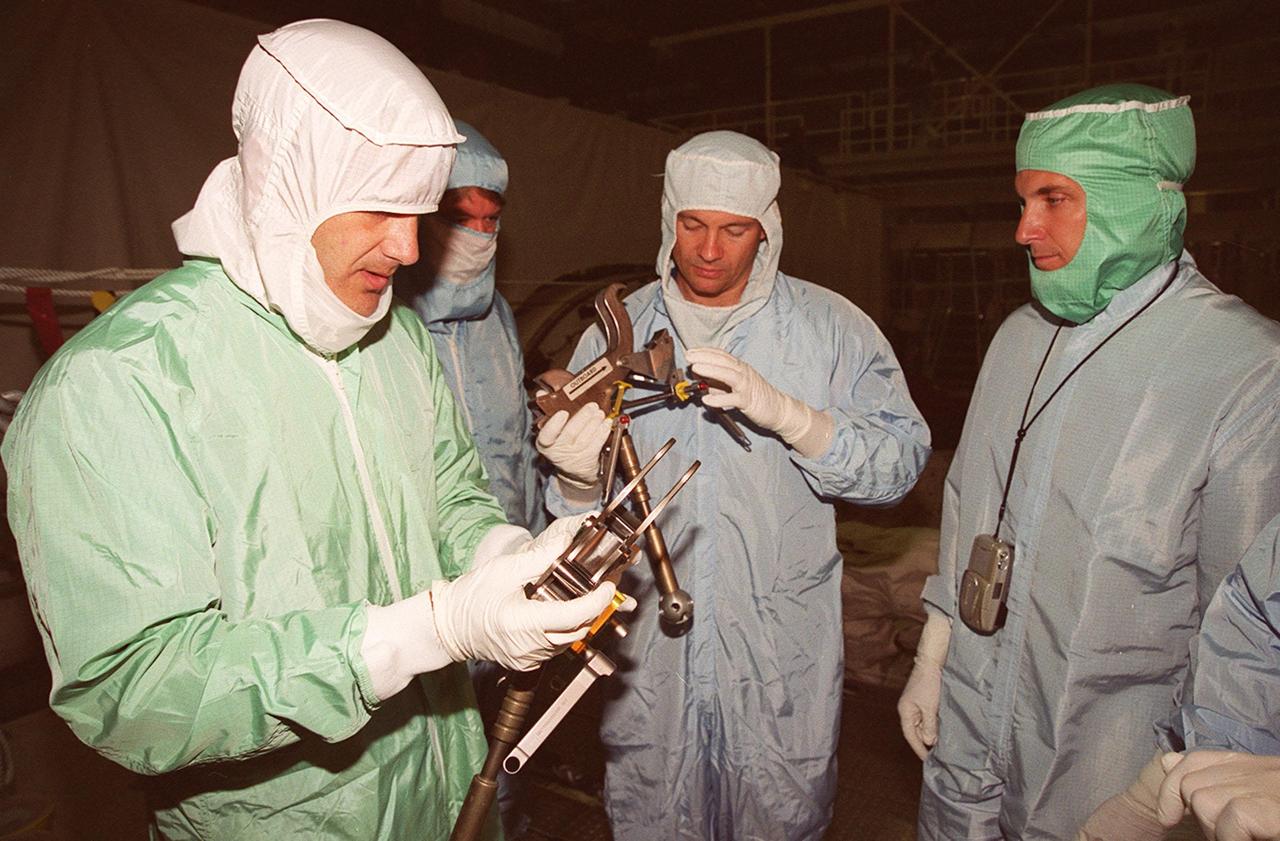
As part of Crew Equipment Interface Test activities, STS-92 Mission Specialists Jeff Wisoff (left) and Michael Lopez-Alegria (center) check equipment that they will be using on their mission. Boeing workers (second from left and right) look on. Other crew members taking part in the CEIT are Commander Brian Duffy, Pilot Pam Melroy, and Mission Specialists Koichi Wakata, Leroy Chiao and Bill McArthur. STS-92 is scheduled to launch Oct. 5 on Shuttle Discovery from Launch Pad 39A on the fifth flight to the International Space Station. Discovery will carry the Integrated Truss Structure (ITS) Z1, Pressurized Mating Adapter 3, Ku-band Communications System, and Control Moment Gyros (CMGs)
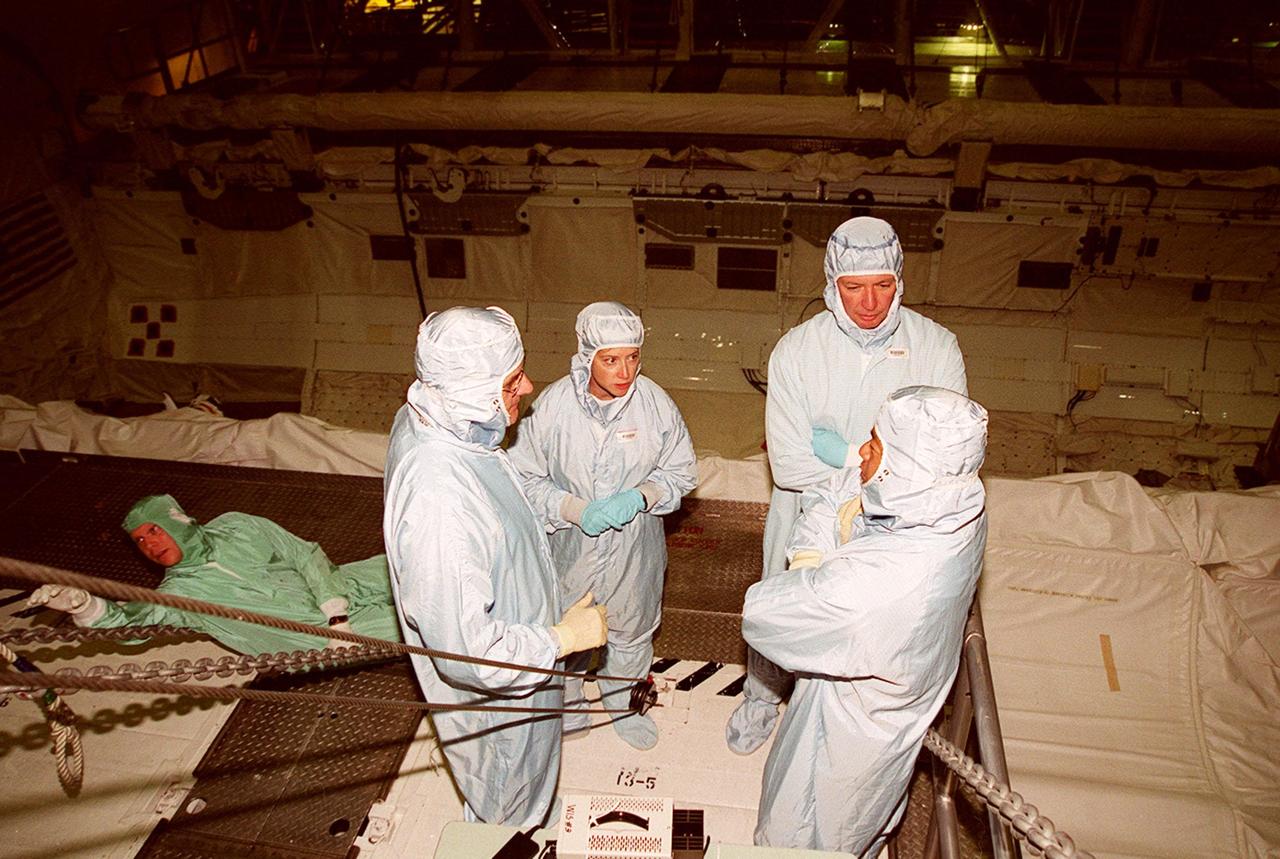
KENNEDY SPACE CENTER, FLA. -- Members of the STS-92 crew take a moment for discussion while checking out the payload bay of the orbiter Discovery in the Orbiter Processing Facility bay 1. Their mission, the fourth U.S. flight to the ISS, includes as payload the Integrated Truss Structure Z1, an early exterior framework to allow the first U.S. solar arrays on a future flight to be temporarily installed on Unity for early power; Ku-band communication to support early science capability and U.S. television; and PMA-3 to provide a Shuttle docking port for solar array installation on the sixth ISS flight and Lab installation on the seventh ISS flight. The crew comprises Mission Commander Brian Duffy, Pilot Pamela Melroy, and Mission Specialists Koichi Wakata, Leroy Chiao, Peter "Jeff" Wisoff, Michael Lopez-Alegria, and William McArthur. Launch of STS-92 is scheduled for Sept. 21, 2000. Wakata is with the National Space Development Agency of Japan
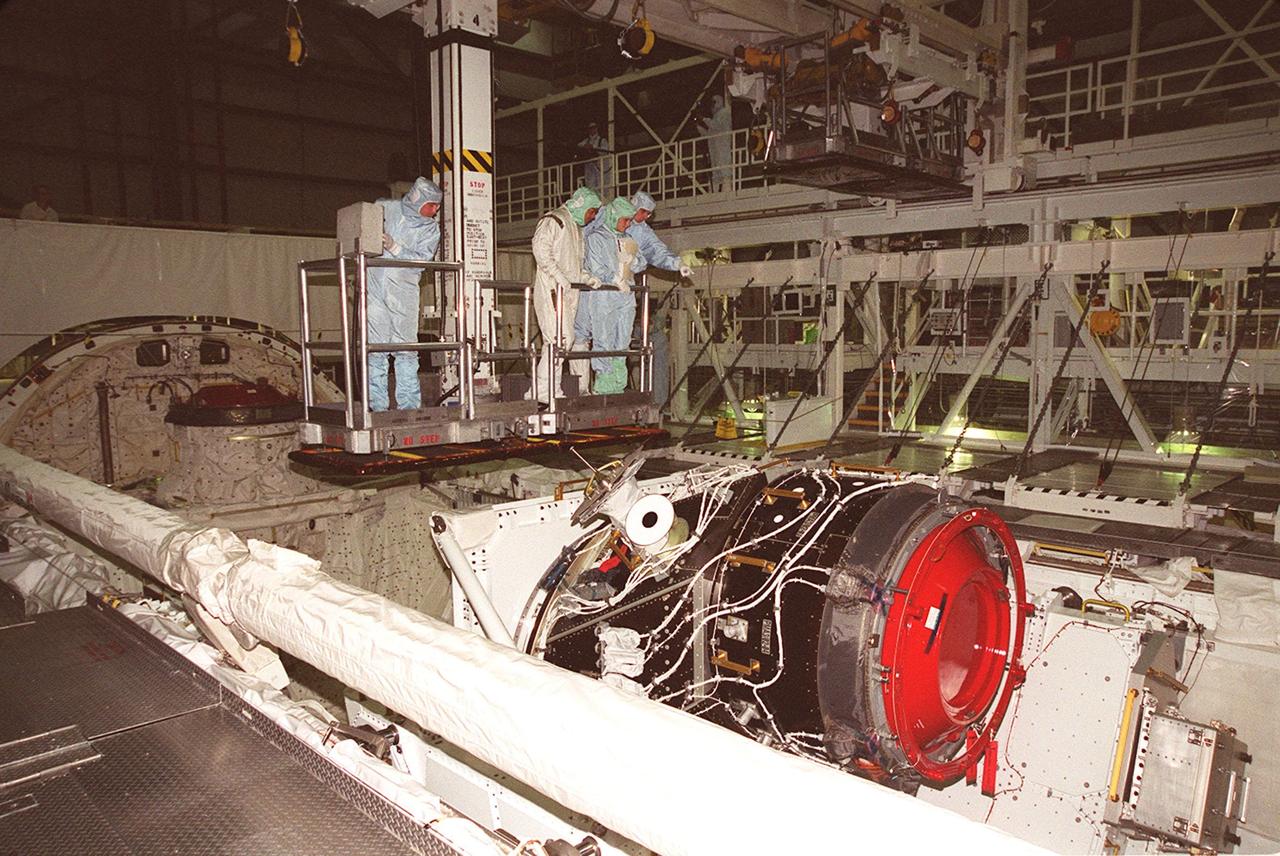
KENNEDY SPACE CENTER, FLA. -- In Orbiter Processing Facility bay 1, members of the STS-92 crew take part in Crew Equipment Interface Test (CEIT) activities. Being lowered into the payload bay of Discovery for a closer look at the payload are Mission Specialists Leroy Chiao (second from left) and Bill McArthur (far right), accompanied by Boeing workers. In the foreground is the Pressurized Mating Adapter-3 (PMA-3). Other crew members taking part in the CEIT are Commander Brian Duffy, Pilot Pam Melroy, and Mission Specialists Koichi Wakata, Jeff Wisoff and Michael Lopez-Alegria. STS-92 is scheduled to launch Oct. 5 on Shuttle Discovery from Launch Pad 39A on the fifth flight to the International Space Station. Discovery will carry the Integrated Truss Structure (ITS) Z1, the PMA-3, Ku-band Communications System, and Control Moment Gyros (CMGs)
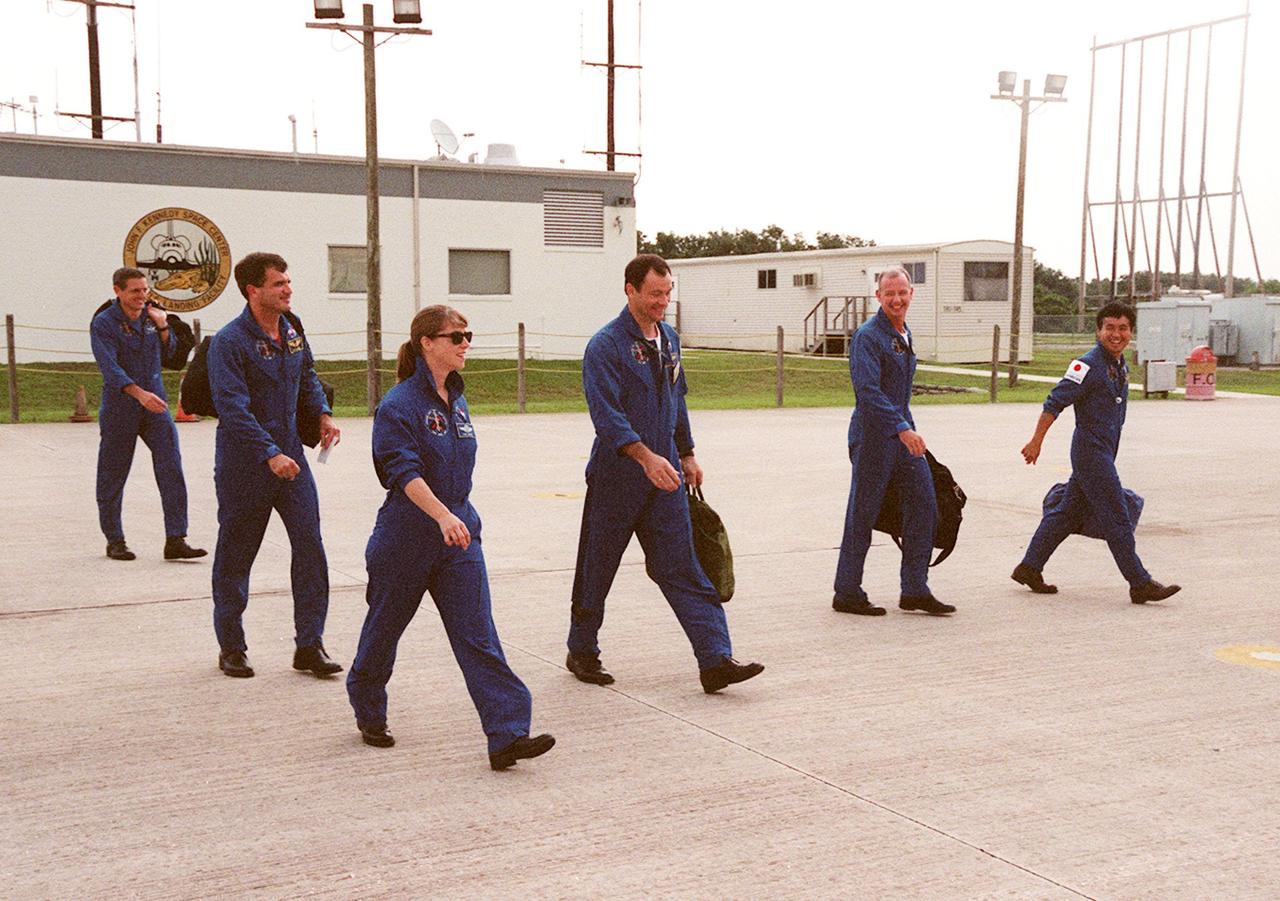
The STS-92 crew strides across the runway at KSC’s Shuttle Landing Facility, heading toward the aircraft that will take them back to Houston. They were at KSC for Crew Equipment Interface Test (CEIT) activities, looking over their mission payload and related equipment. From left are Mission Specialists Bill McArthur and Jeff Wisoff, Pilot Pam Melroy, Mission Specialist Michael Lopez-Alegria, Commander Brian Duffy and Mission Specialist Koichi Wakata, who is with the Japanese space agency. Not seen is Mission Specialist Leroy Chiao, who was also at KSC for the CEIT. STS-92 is scheduled to launch Oct. 5 on Shuttle Discovery from Launch Pad 39A on the fifth flight to the International Space Station. Discovery will carry the Integrated Truss Structure (ITS) Z1, the PMA-3, Ku-band Communications System, and Control Moment Gyros (CMGs)
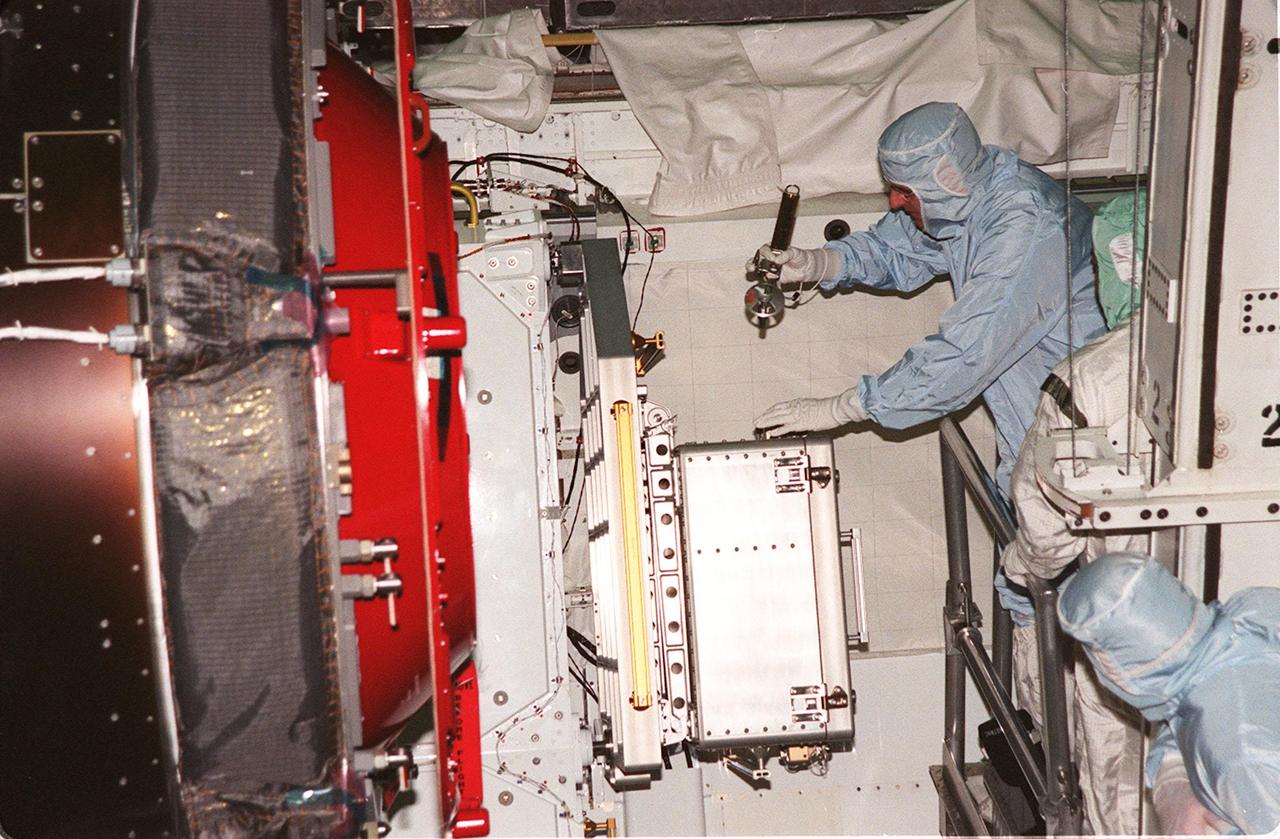
KENNEDY SPACE CENTER, FLA. -- STS-92 Mission Specialist Bill McArthur (with tool in hand) gets a close look at the Pressurized Mating Adapter-3 in the payload bay of orbiter Discovery. He and other crew members Commander Brian Duffy, Pilot Pam Melroy and Mission Specialists Koichi Wakata, Leroy Chiao, Jeff Wisoff, and Michael Lopez-Alegria are at KSC to take part in Crew Equipment Interface Test activities. Discovery is in the Orbiter Processing Facility bay 1. STS-92 is scheduled to launch Oct. 5 on Shuttle Discovery from Launch Pad 39A on the fifth flight to the International Space Station. Discovery will carry the Integrated Truss Structure (ITS) Z1, the PMA-3, Ku-band Communications System, and Control Moment Gyros (CMGs)
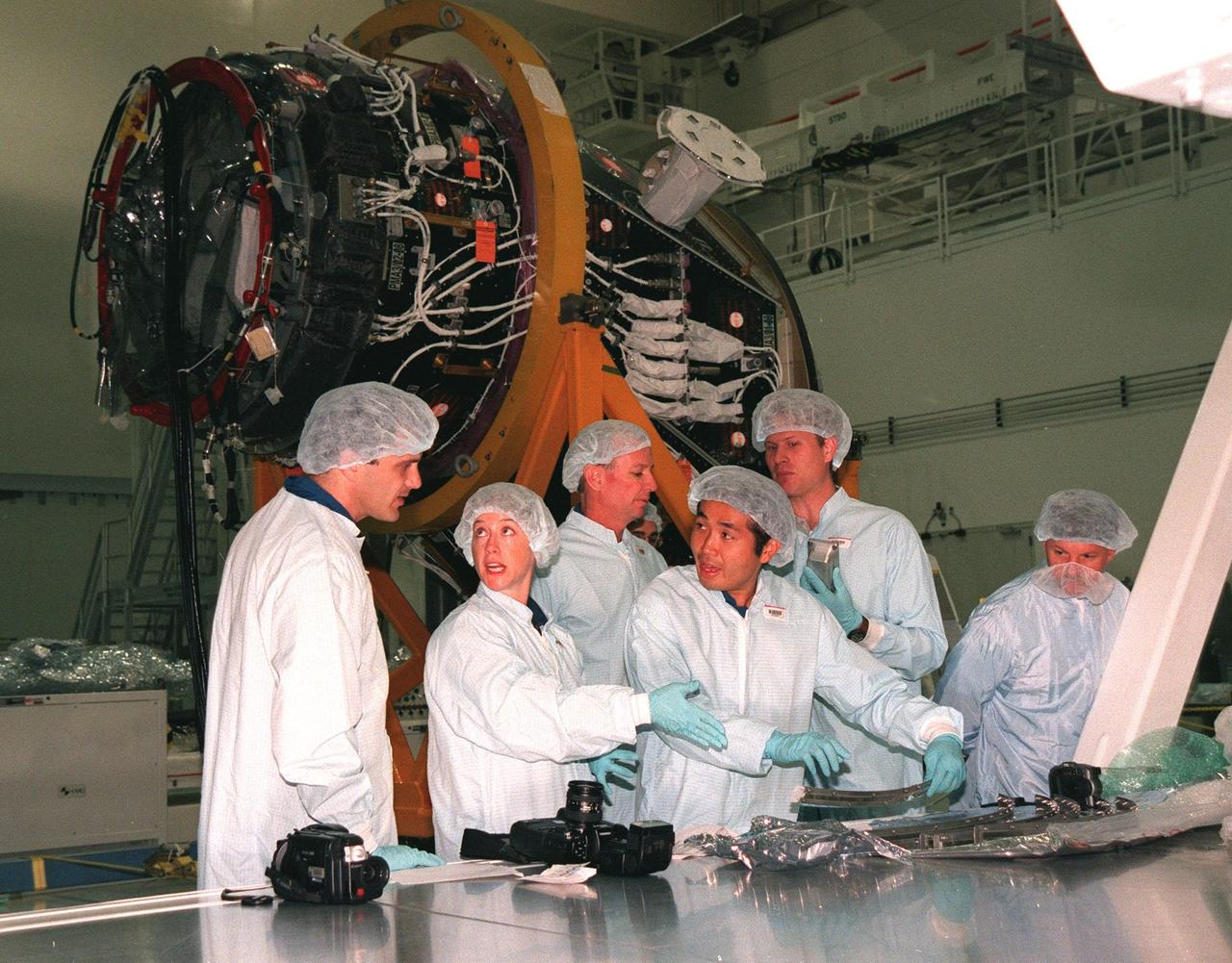
In the Space Station Processing Facility, STS-92 crew members take part in a Leak Seal Kit Fit Check in connection with the Pressurized Mating Adapter -3 in the background. From left are Mission Specialist Peter J.K. "Jeff" Wisoff (Ph.D.), Pilot Pamela A. Melroy, Commander Brian Duffy, Mission Specialist Koichi Wakata, who represents the National Space Development Agency of Japan (NASDA), Brian Warkentine, with JSC, and a Boeing worker at right. Also participating are other crew members Mission Specialists Leroy Chiao (Ph.D.), Michael E. Lopez-Alegria and William Surles "Bill" McArthur Jr. The mission payload also includes an integrated truss structure (Z-1 truss). Launch of STS-92 is scheduled for Feb. 24, 2000
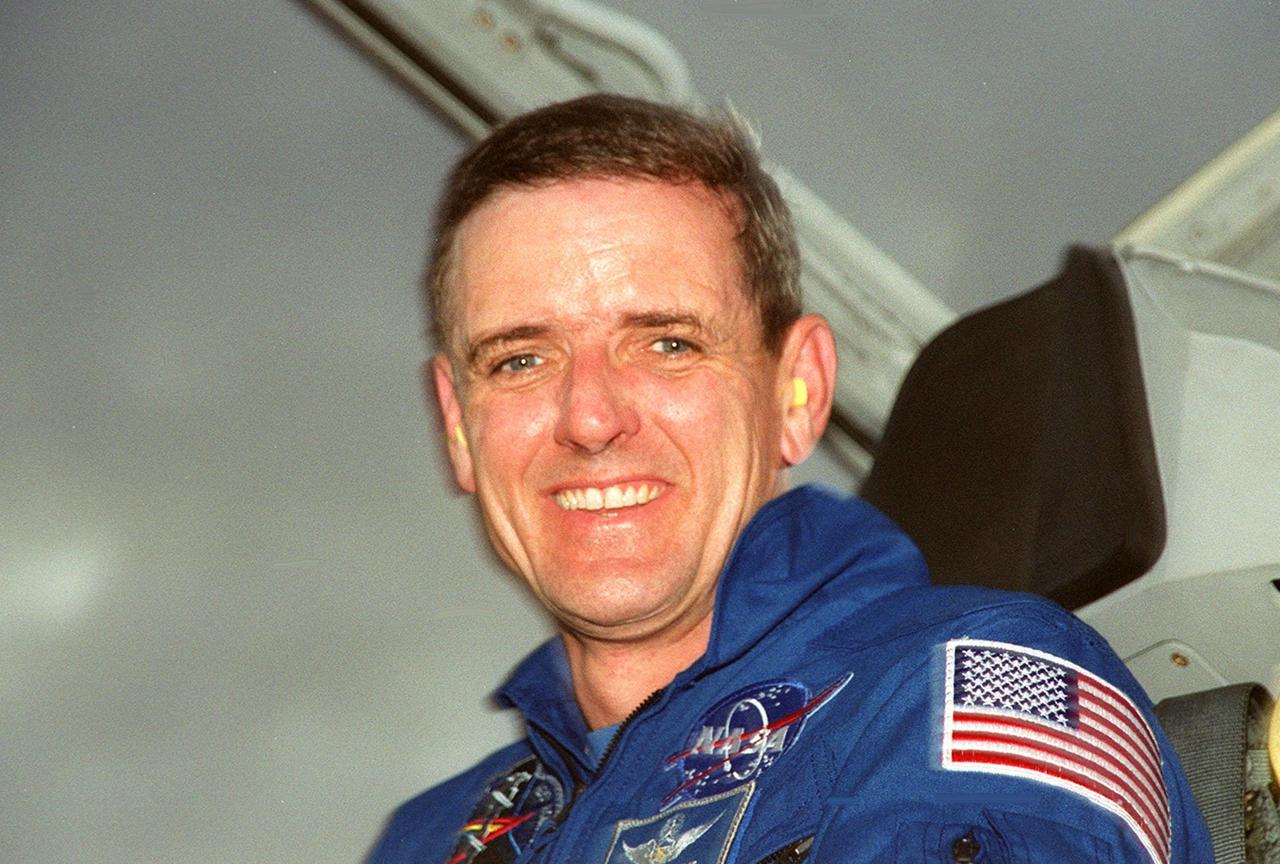
KENNEDY SPACE CENTER, FLA. -- Still seated in the T-38 jet aircraft that arrived moments before at the Shuttle Landing Facility, STS-92 Mission Specialist William S. McArthur Jr. shows his happiness in being back at KSC for launch. He and other crew members Commander Brian Duffy, Pilot Pamela Ann Melroy and Mission Specialists Koichi Wakata of Japan, Leroy Chiao, Peter J.K. “Jeff” Wisoff and Michael E. Lopez-Alegria later talked to a waiting group of media at the Shuttle Landing Facility. The mission is the fifth flight for the construction of the International Space Station. The payload includes the Integrated Truss Structure Z-1 and the third Pressurized Mating Adapter. During the 11-day mission, four extravehicular activities (EVAs), or space walks, are planned

KENNEDY SPACE CENTER, FLA. -- Still seated in the cockpit of the T-38 jet aircraft she flew from Houston, STS-92 Pilot Pamela Ann Melroy smiles for the camera. She and other crew members Commander Brian Duffy and Mission Specialists Koichi Wakata of Japan, Leroy Chiao, Peter J.K. “Jeff” Wisoff, Michael E. Lopez-Alegria and William S. McArthur Jr. expressed their eagerness to launch to a waiting group of media at the Shuttle Landing Facility. The mission is the fifth flight for the construction of the International Space Station. The payload includes the Integrated Truss Structure Z-1 and the third Pressurized Mating Adapter. During the 11-day mission, four extravehicular activities (EVAs), or space walks, are planned
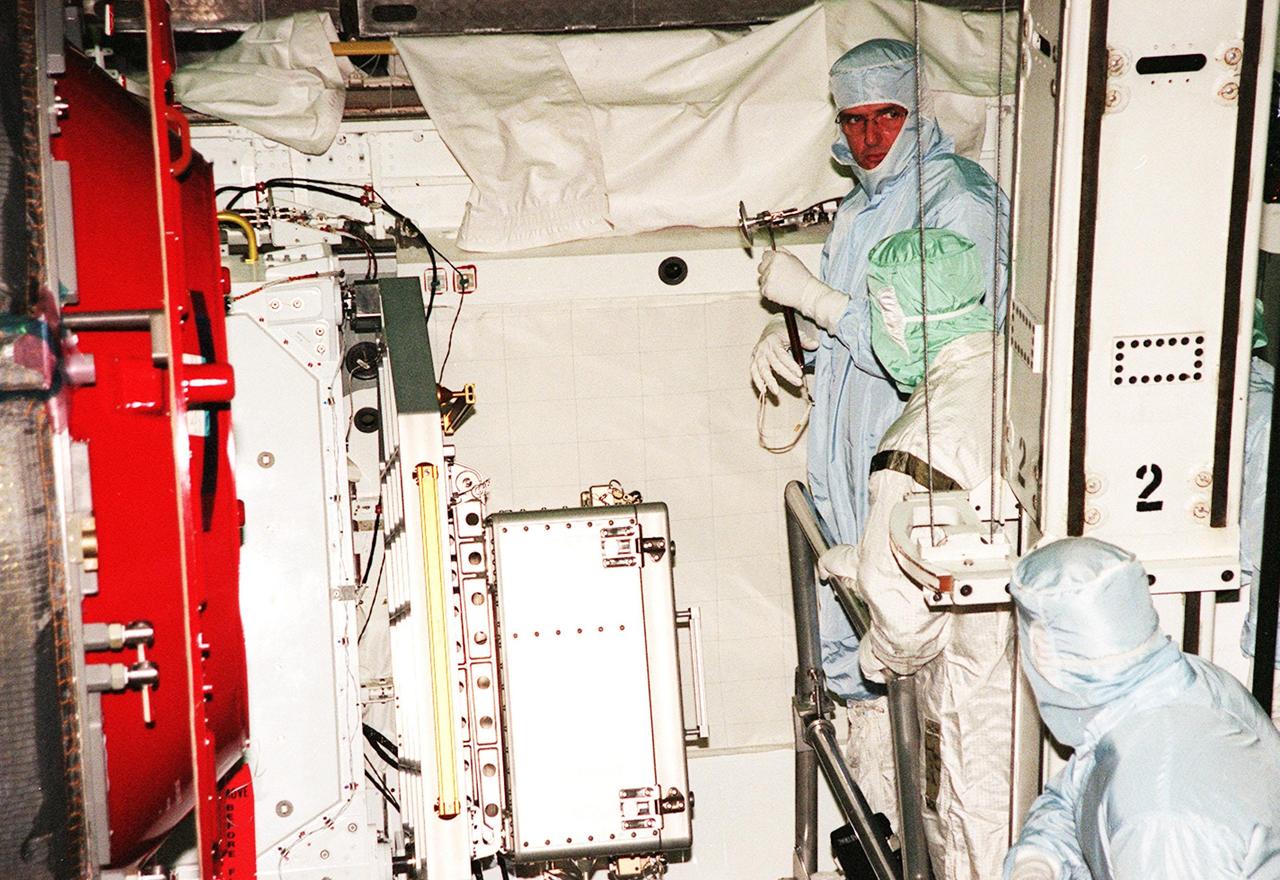
KENNEDY SPACE CENTER, FLA. -- STS-92 Mission Specialist Bill McArthur (with tool in hand) gets a close look at the Pressurized Mating Adapter-3 (PMA-3) in the payload bay of orbiter Discovery. He and other crew members Commander Brian Duffy, Pilot Pam Melroy and Mission Specialists Koichi Wakata, Leroy Chiao, Jeff Wisoff, and Michael Lopez-Alegria are at KSC to take part in Crew Equipment Interface Test activities. Discovery is in the Orbiter Processing Facility bay 1. STS-92 is scheduled to launch Oct. 5 on Shuttle Discovery from Launch Pad 39A on the fifth flight to the International Space Station. Discovery will carry the Integrated Truss Structure (ITS) Z1, the PMA-3, Ku-band Communications System, and Control Moment Gyros (CMGs
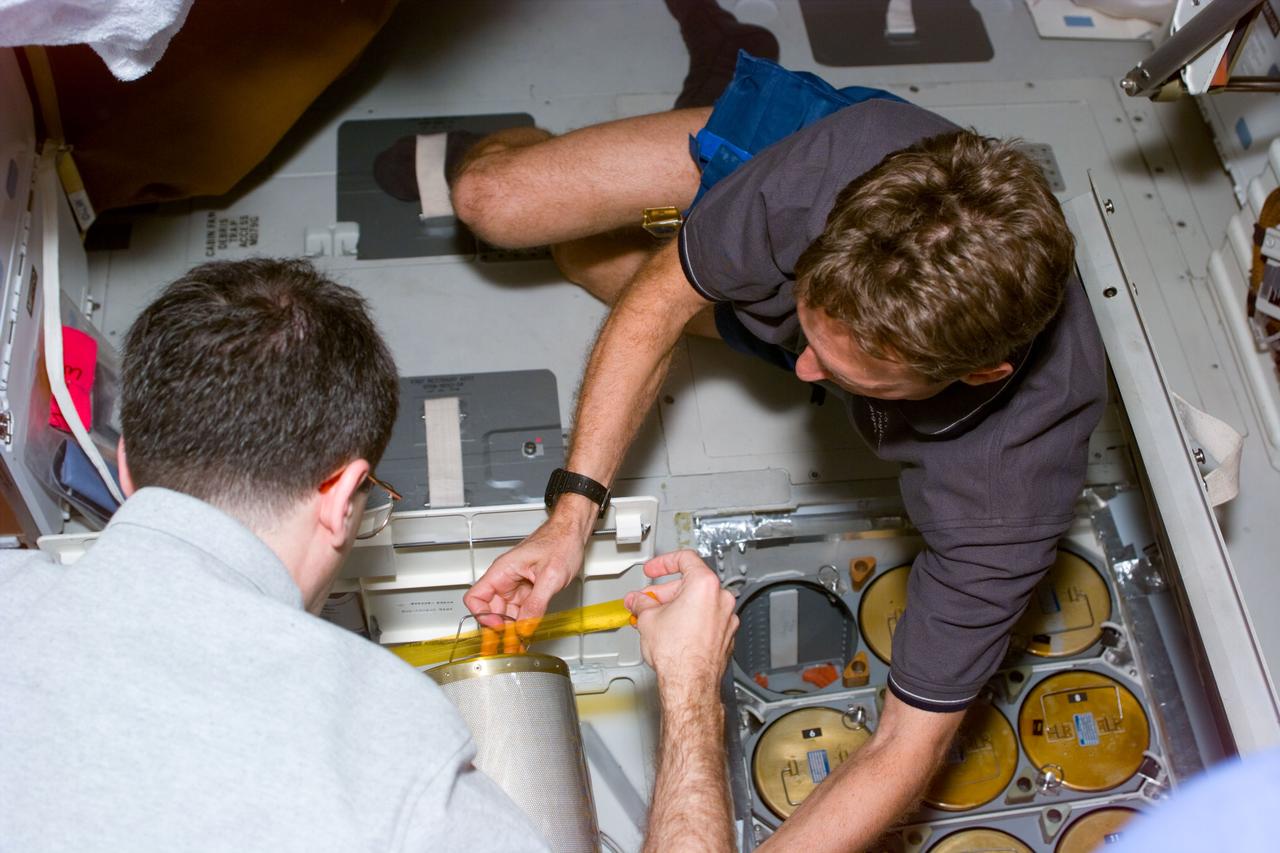
STS081-E-5007 (12 Jan. 1997) --- Astronauts Peter J. K. (Jeff) Wisoff (left) and Jerry M. Linenger begin early housekeeping by putting in fresh lithium hydroxide canisters beneath the Space Shuttle Atlantis' middeck. Not far away in Atlantis' cargo bay, the two mission specialists and their four crew mates are flying the Spacehab Double Module (DM), replete with supplies for the three-man crew aboard Russia's Mir Space Station with which Atlantis will be docking later in the week. Linenger will trade places with John E. Blaha, marking the second such exchange of American astronaut - cosmonaut guest researcher's aboard Mir. Blaha had replaced Shannon W. Lucid in September of 1996. The scene was recorded with an Electronic Still Camera (ESC) and later downlinked to flight controllers in Houston, Texas.
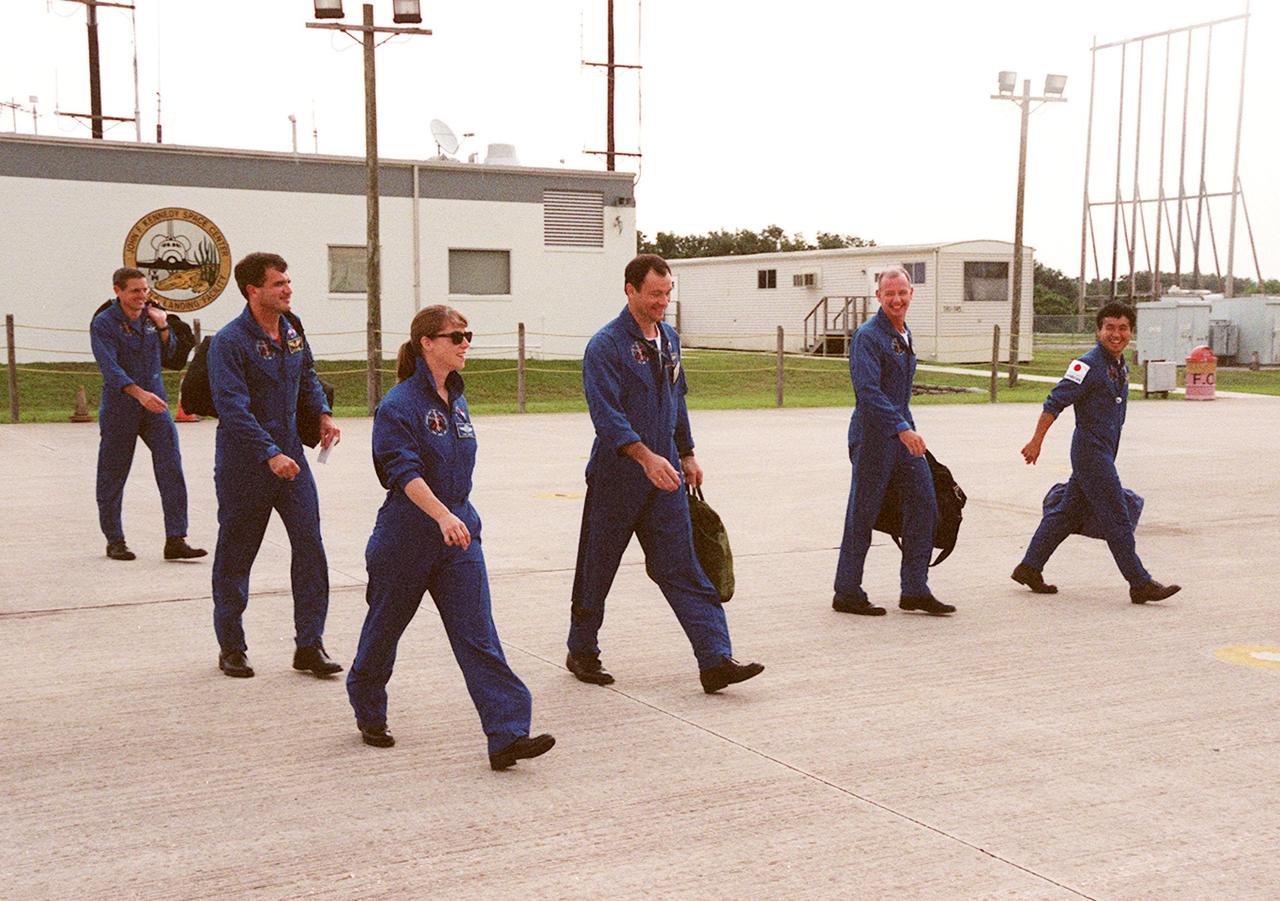
The STS-92 crew strides across the runway at KSC’s Shuttle Landing Facility, heading toward the aircraft that will take them back to Houston. They were at KSC for Crew Equipment Interface Test (CEIT) activities, looking over their mission payload and related equipment. From left are Mission Specialists Bill McArthur and Jeff Wisoff, Pilot Pam Melroy, Mission Specialist Michael Lopez-Alegria, Commander Brian Duffy and Mission Specialist Koichi Wakata, who is with the Japanese space agency. Not seen is Mission Specialist Leroy Chiao, who was also at KSC for the CEIT. STS-92 is scheduled to launch Oct. 5 on Shuttle Discovery from Launch Pad 39A on the fifth flight to the International Space Station. Discovery will carry the Integrated Truss Structure (ITS) Z1, the PMA-3, Ku-band Communications System, and Control Moment Gyros (CMGs)
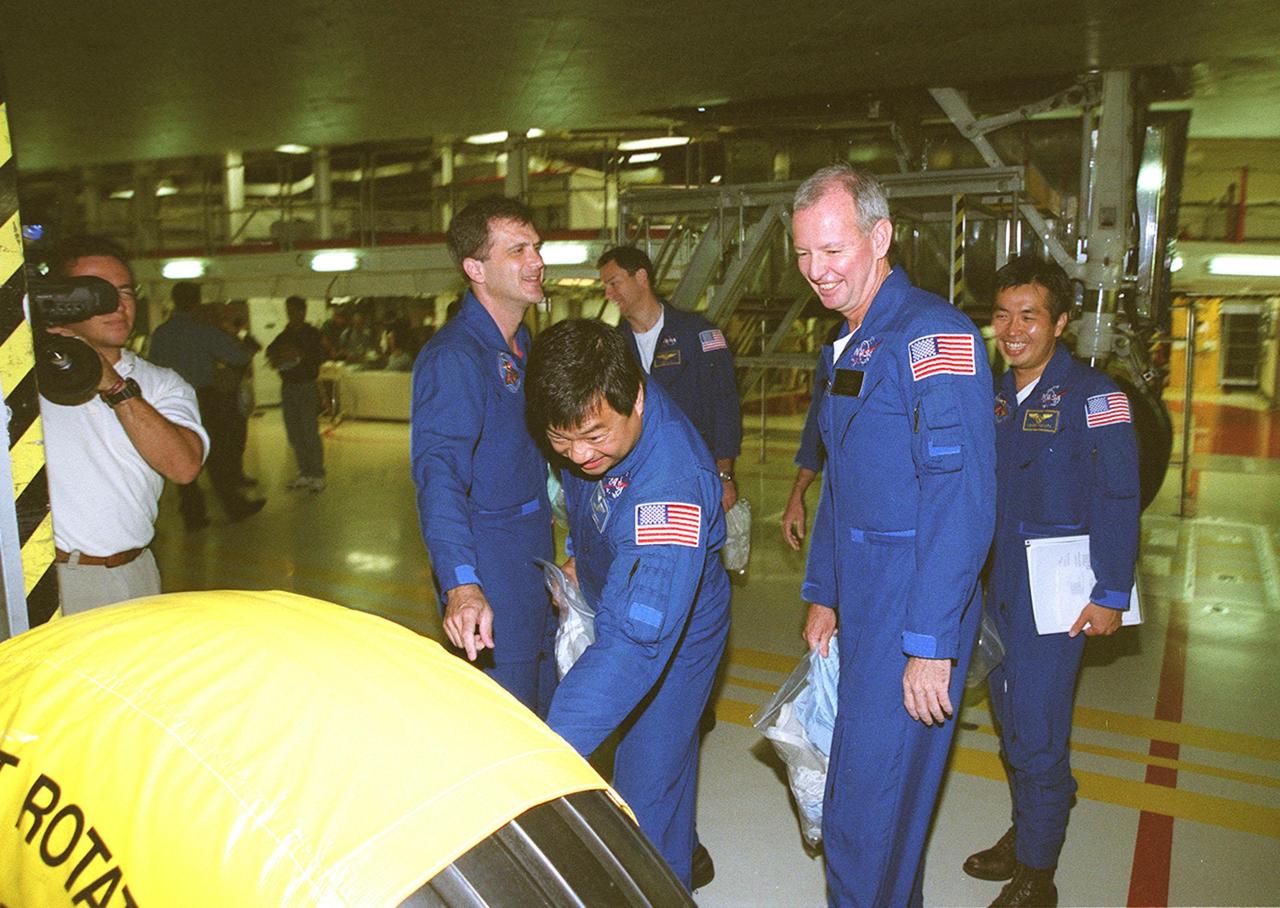
KENNEDY SPACE CENTER, FLA. -- Members of the STS-92 crew look over a tire on the landing gear of orbiter Discovery in the Orbiter Processing Facility bay 1. From left to right are Mission Specialists Jeff Wisoff (pointing) and Leroy Chiao, Commander Brian Duffy and Mission Specialist Koichi Wakata, who is with the Japanese space agency. Standing behind them is Mission Specialist Michael Lopez-Alegria. The crew is at KSC to take part in Crew Equipment Interface Test activities. Others taking part are Pilot Pam Melroy and Mission Specialist Bill McArthur. STS-92 is scheduled to launch Oct. 5 on Shuttle Discovery from Launch Pad 39A on the fifth flight to the International Space Station. Discovery will carry the Integrated Truss Structure (ITS) Z1, Pressurized Mating Adapter 3 (PMA-3), Ku-band Communications System, and Control Moment Gyros (CMGs)