
NASA has extended the mission of its Juno spacecraft exploring Jupiter. The agency's most distant planetary orbiter will now extend its investigation of the solar system's largest planet through September 2025, or until the spacecraft's end of life. This extension tasks Juno with becoming an explorer of the full Jovian system — Jupiter and its rings and moons — with multiple rendezvous planned for three of Jupiter's most intriguing Galilean moons: Ganymede, Europa, and Io. The prime mission operations will be completed in July 2021. Involving 42 additional orbits, the extended mission expands on discoveries Juno has already made about Jupiter's interior structure, internal magnetic field, atmosphere (including polar cyclones, deep atmosphere, and aurora) and magnetosphere. It includes close passes of Jupiter's north polar cyclones; the first extensive exploration of the faint rings encircling the planet; and flybys of the moons Ganymede, Europa, and Io. https://photojournal.jpl.nasa.gov/catalog/PIA24308
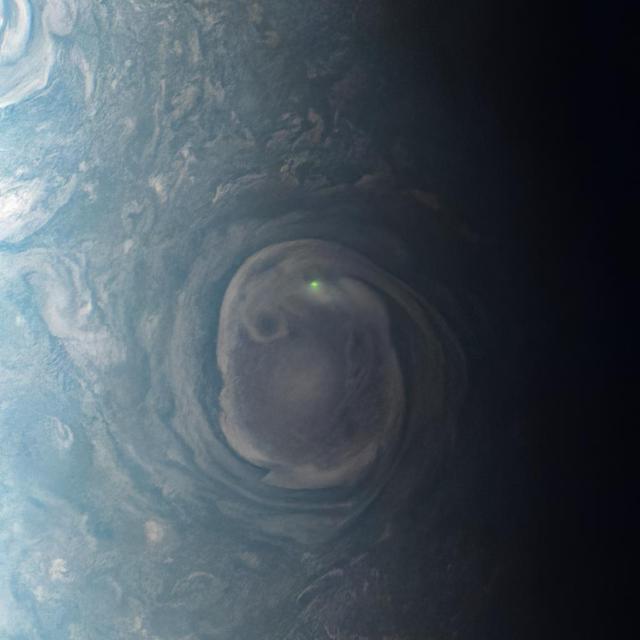
In this view of a vortex near Jupiter's north pole, NASA's Juno mission observed the glow from a bolt of lightning. On Earth, lightning bolts originate from water clouds, and happen most frequently near the equator, while on Jupiter lightning likely also occurs in clouds containing an ammonia-water solution, and can be seen most often near the poles. In the coming months, Juno's orbits will repeatedly take it close to Jupiter as the spacecraft passes over the giant planet's night side, which will provide even more opportunities for Juno's suite of science instruments to catch lightning in the act. Juno captured this view as Juno completed its 31st close flyby of Jupiter on Dec. 30, 2020. In 2022, Citizen scientist Kevin M. Gill processed the image from raw data from the JunoCam instrument aboard the spacecraft. At the time the raw image was taken, Juno was about 19,900 miles (32,000 kilometers) above Jupiter's cloud tops, at a latitude of about 78 degrees as it approached the planet. https://photojournal.jpl.nasa.gov/catalog/PIA25020
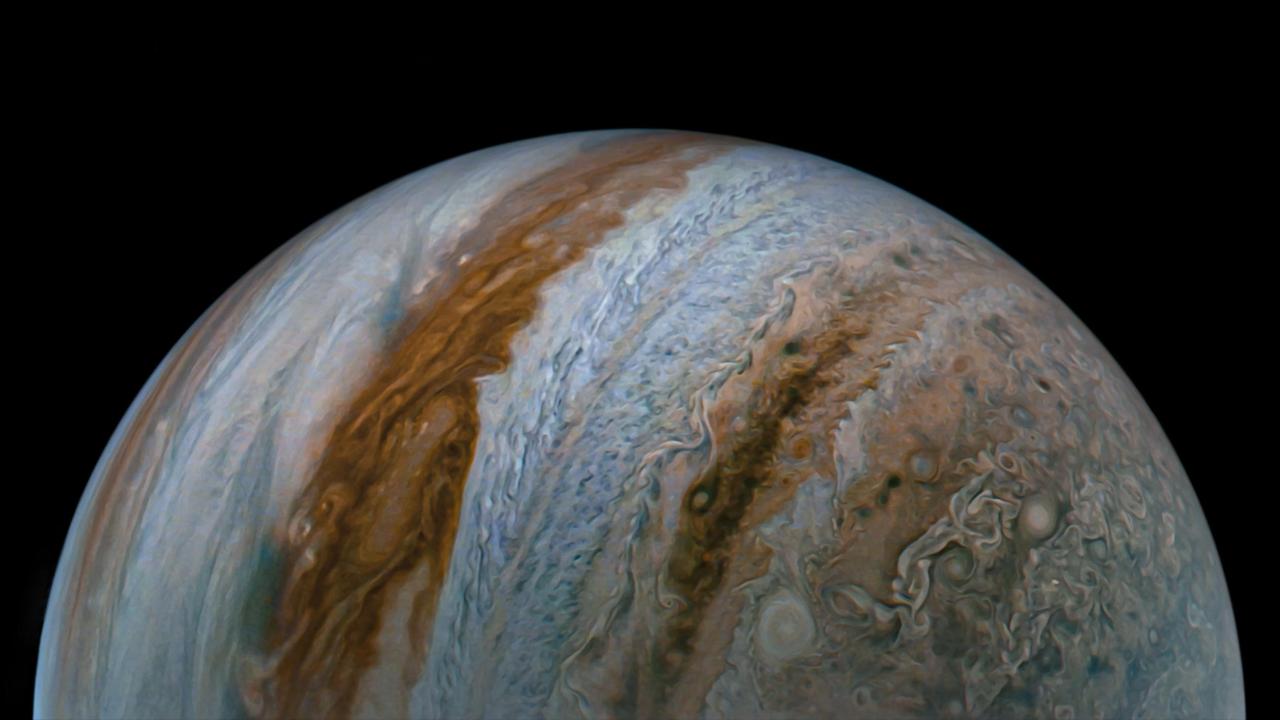
NASA's Juno spacecraft captured this view of Jupiter during the mission's 54th close flyby of the giant planet on Sept. 7, 2023. The colorful zones and belts in Jupiter's atmosphere run from the cloud tops down to approximately 1,860 miles (3,000 kilometers). Citizen scientist Tanya Oleksuik made this image using raw data from the JunoCam instrument, processing the data to enhance details in cloud features and colors. At the time the raw image was taken, the Juno spacecraft was about 52,400 miles (about 84,400 kilometers) above Jupiter's cloud tops. https://photojournal.jpl.nasa.gov/catalog/PIA26077

On Sept. 7, 2023, during its 54th close flyby of Jupiter, NASA's Juno mission captured this view of an area in the giant planet's far northern regions called Jet N7. The image shows turbulent clouds and storms along Jupiter's terminator, the dividing line between the day and night sides of the planet. The low angle of sunlight highlights the complex topography of features in this region, which scientists have studied to better understand the processes playing out in Jupiter's atmosphere. As often occurs in views from Juno, Jupiter's clouds in this picture lend themselves to pareidolia, the effect that causes observers to perceive faces or other patterns in largely random patterns. Citizen scientist Vladimir Tarasov made this image using raw data from the JunoCam instrument. At the time the raw image was taken, the Juno spacecraft was about 4,800 miles (about 7,700 kilometers) above Jupiter's cloud tops, at a latitude of about 69 degrees north. https://photojournal.jpl.nasa.gov/catalog/PIA25727
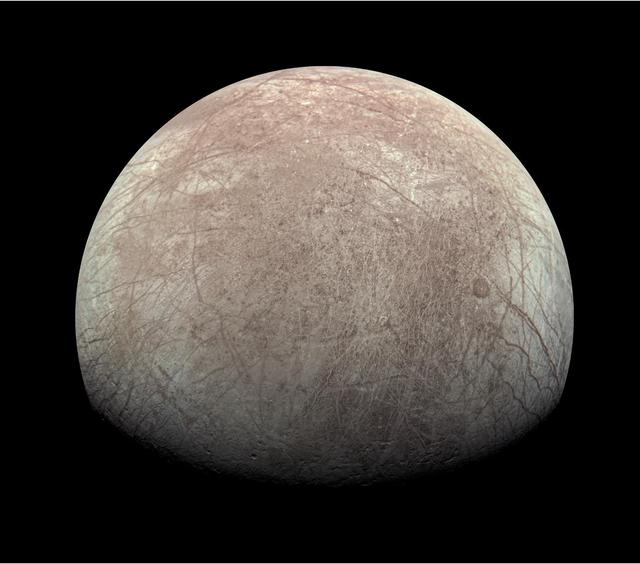
This view of Jupiter's icy moon Europa was captured by JunoCam, the public engagement camera aboard NASA's Juno spacecraft, during the mission's close flyby on Sept. 29, 2022. The picture is a composite of JunoCam's second, third, and fourth images taken during the flyby, as seen from the perspective of the fourth image. North is to the left. The images have a resolution of just over 0.5 to 2.5 miles per pixel (1 to 4 kilometers per pixel). As with our Moon and Earth, one side of Europa always faces Jupiter, and that is the side of Europa visible here. Europa's surface is crisscrossed by fractures, ridges, and bands, which have erased terrain older than about 90 million years. Citizen scientist Kevin M. Gill processed the images to enhance the color and contrast. https://photojournal.jpl.nasa.gov/catalog/PIA25695
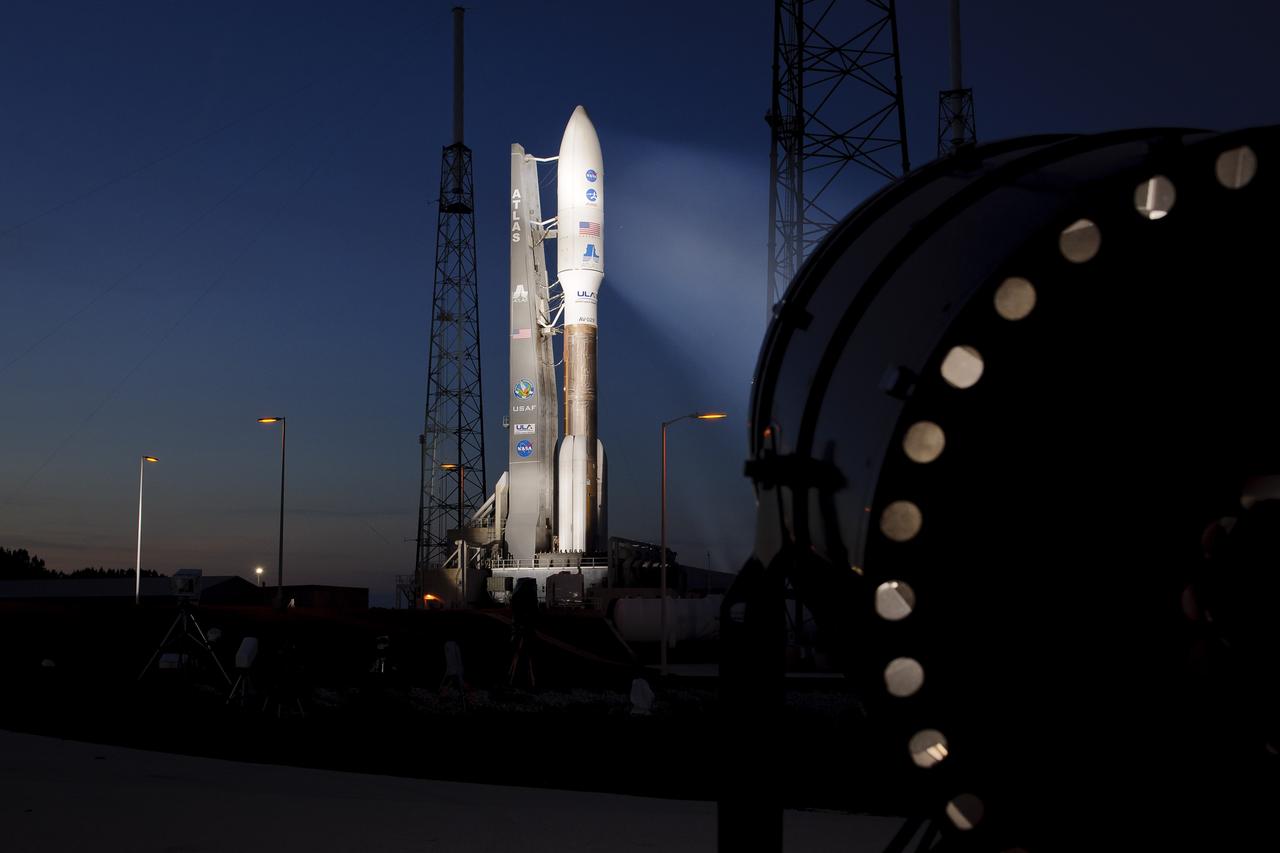
An Atlas V rocket with NASA's Juno spacecraft payload is seen the evening before it's planned launch at Space Launch Complex 41 of the Cape Canaveral Air Force Station in Florida on Thursday, August 4, 2011. The Juno spacecraft will make a five-year, 400-million-mile voyage to Jupiter, orbit the planet, investigate its origin and evolution with eight instruments to probe its internal structure and gravity field, measure water and ammonia in its atmosphere, map its powerful magnetic field and observe its intense auroras. Photo Credit: (NASA/Bill Ingalls)
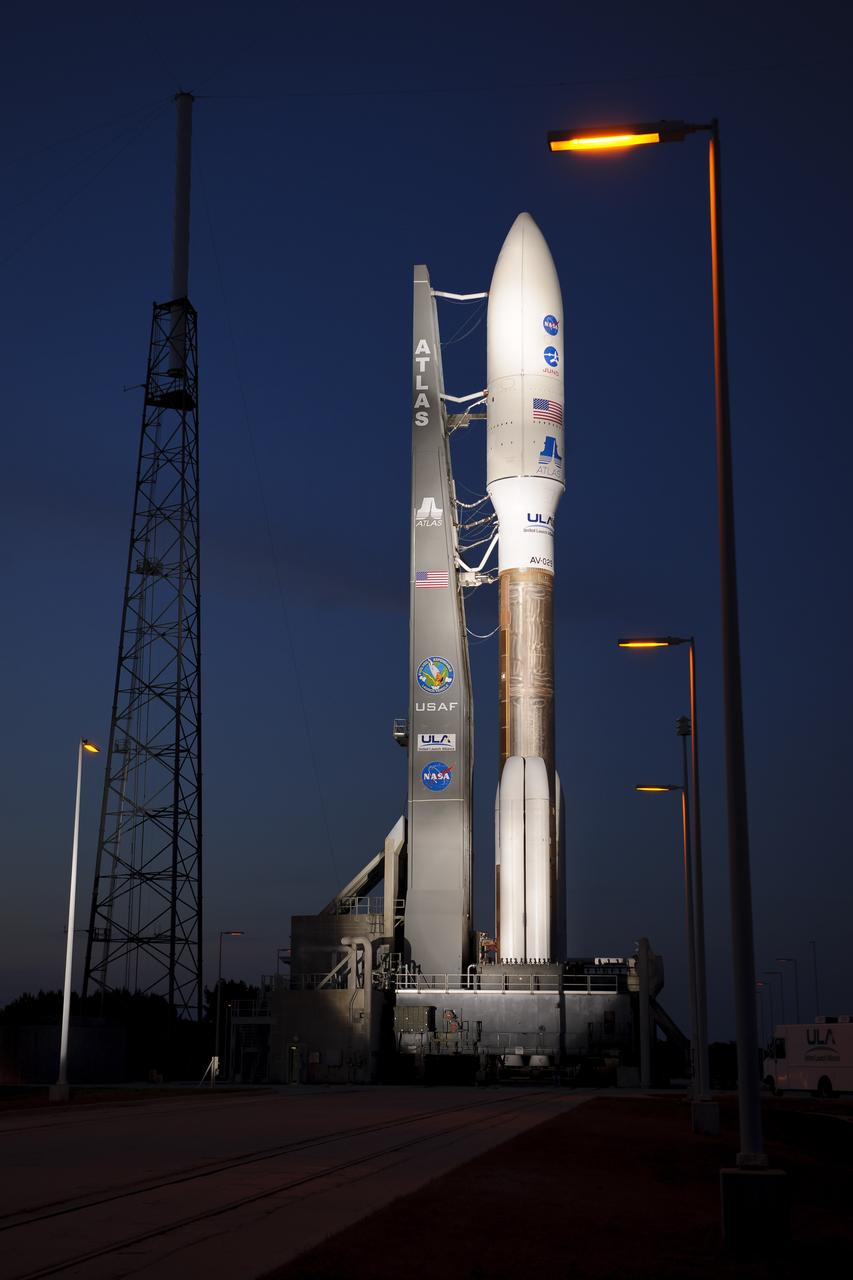
An Atlas V rocket with NASA's Juno spacecraft payload is seen the evening before it's planned launch at Space Launch Complex 41 of the Cape Canaveral Air Force Station in Florida on Thursday, August 4, 2011. The Juno spacecraft will make a five-year, 400-million-mile voyage to Jupiter, orbit the planet, investigate its origin and evolution with eight instruments to probe its internal structure and gravity field, measure water and ammonia in its atmosphere, map its powerful magnetic field and observe its intense auroras. Photo Credit: (NASA/Bill Ingalls)
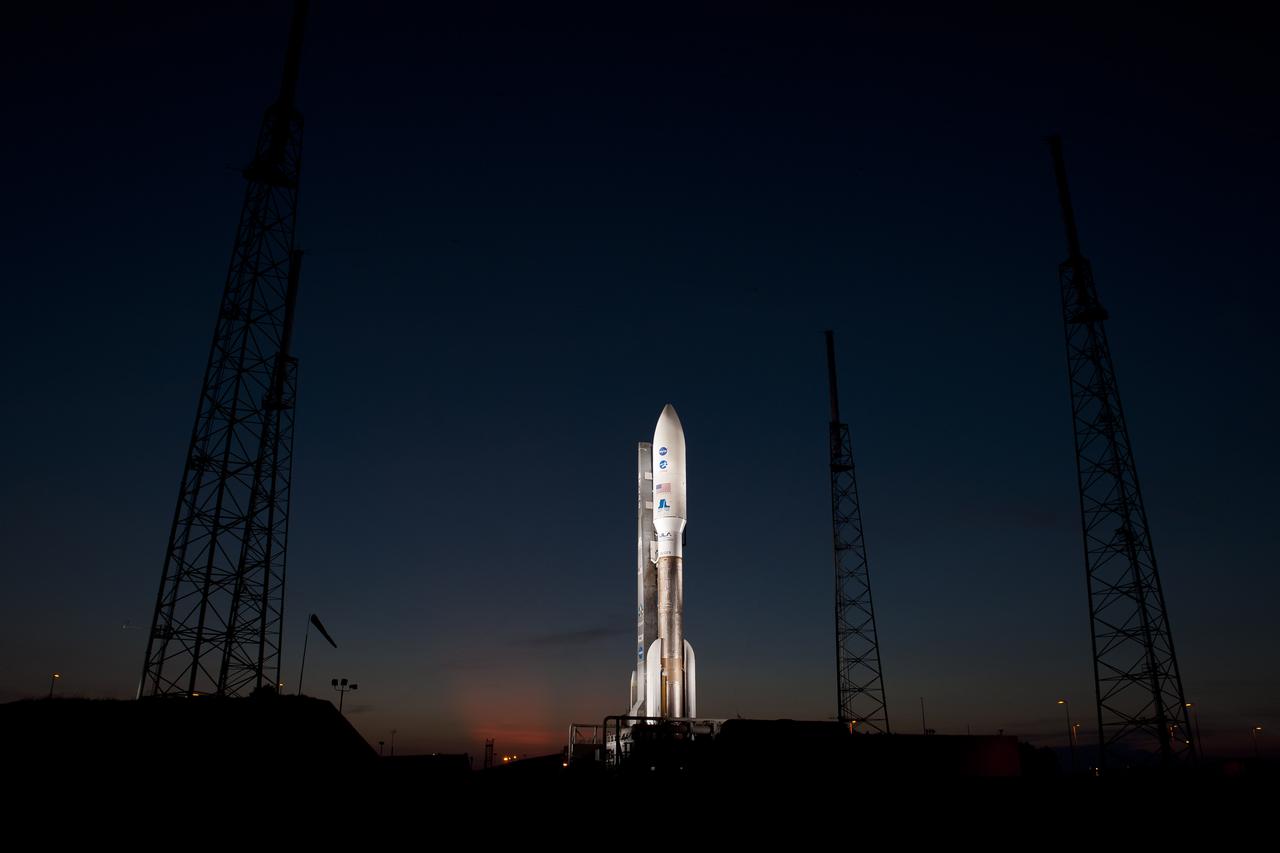
An Atlas V rocket with NASA's Juno spacecraft payload is seen the evening before it's planned launch at Space Launch Complex 41 of the Cape Canaveral Air Force Station in Florida on Thursday, August 4, 2011. The Juno spacecraft will make a five-year, 400-million-mile voyage to Jupiter, orbit the planet, investigate its origin and evolution with eight instruments to probe its internal structure and gravity field, measure water and ammonia in its atmosphere, map its powerful magnetic field and observe its intense auroras. Photo Credit: (NASA/Bill Ingalls)
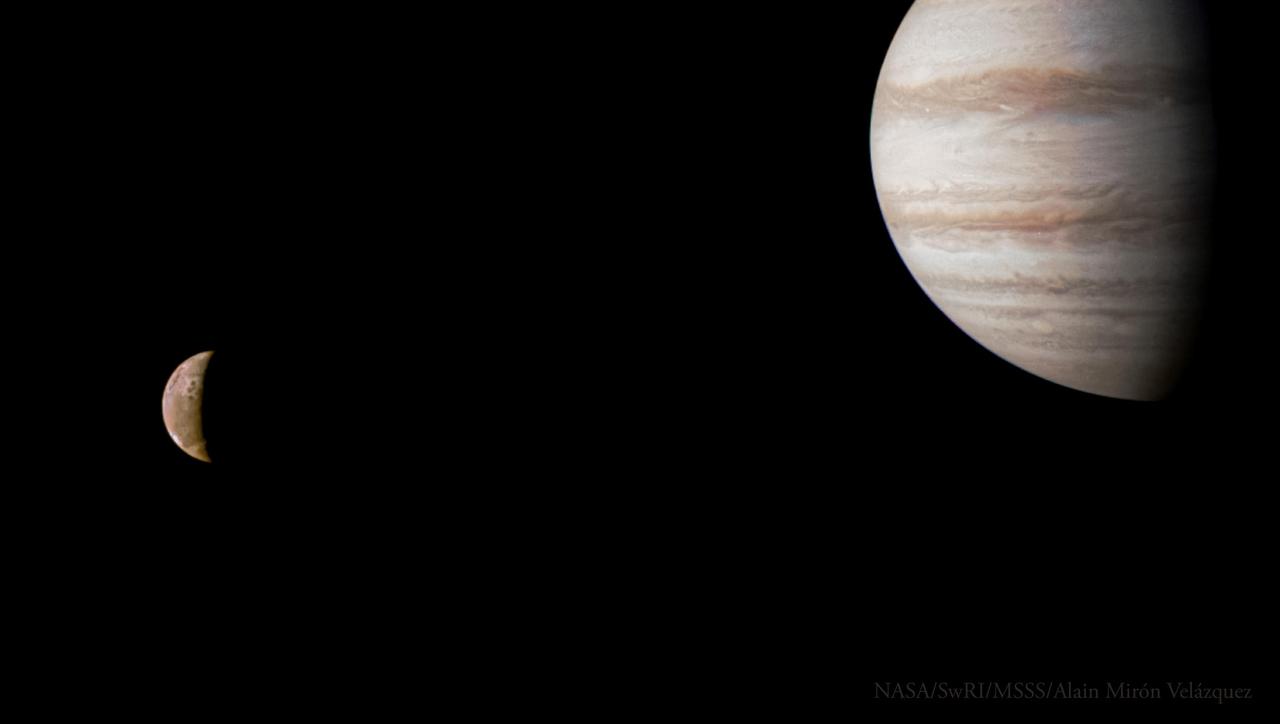
Just hours before NASA's Juno mission completed its 53rd close flyby of Jupiter on July 31, 2023, the spacecraft sped past the planet's volcanic moon Io and captured this dramatic view of both bodies in the same frame. The surface of Io, the most volcanically active world in the solar system, is marked by hundreds of volcanoes that regularly erupt with molten lava and sulfurous gases. Juno has provided scientists with the closest looks at Io since 2007, and the spacecraft will gather additional images and data from its suite of scientific instruments during even closer passes in late 2023 and early 2024. To create this image, citizen scientist Alain Mirón Velázquez processed a raw image from the JunoCam instrument, enhancing the contrast, color, and sharpness. At the time the raw image was taken on July 30, 2023, Juno was about 32,170 miles (about 51,770 kilometers) from Io, and about 245,000 miles (about 395,000 kilometers) above Jupiter's cloud tops. https://photojournal.jpl.nasa.gov/catalog/PIA25726
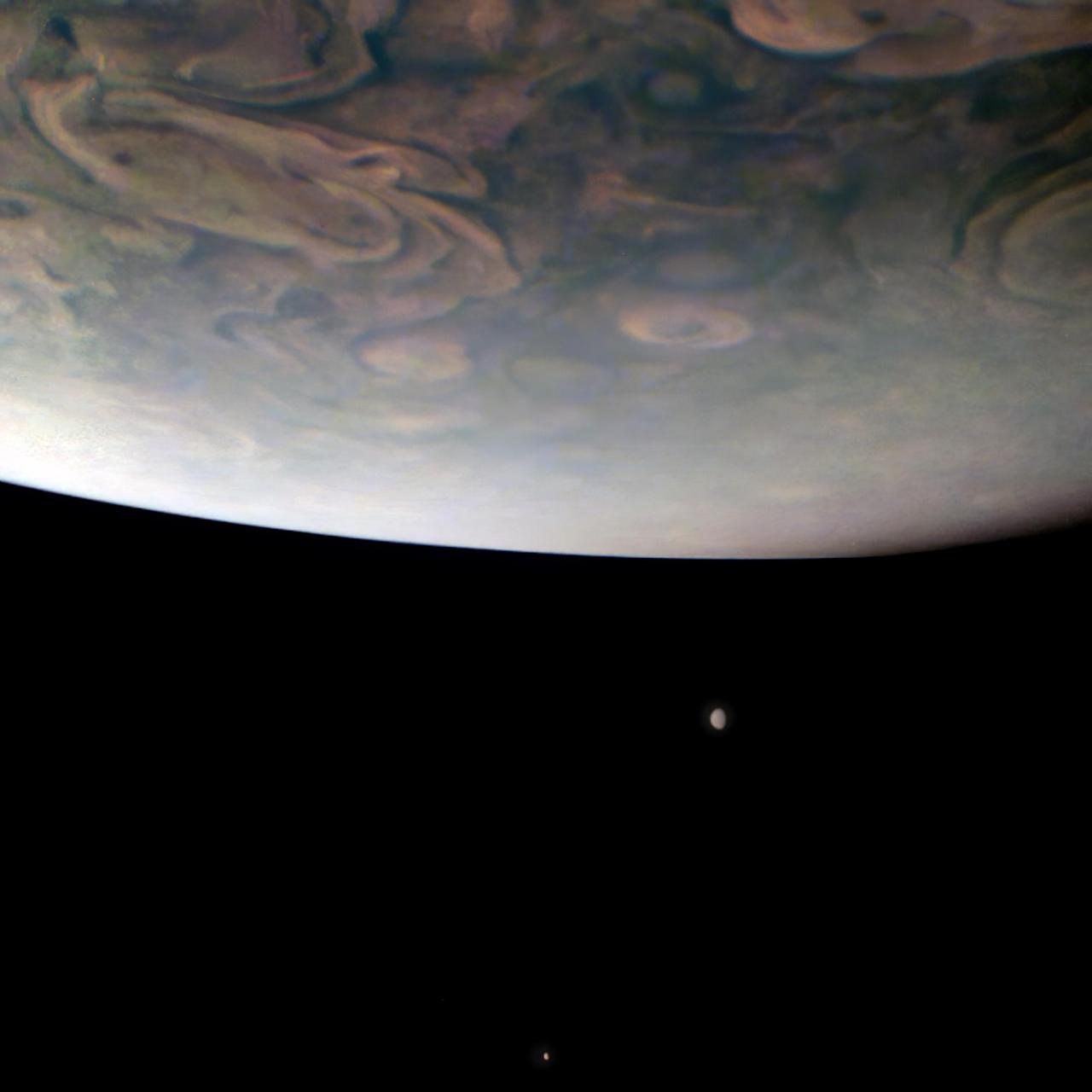
On Nov. 29, 2021, NASA's Juno mission completed its 38th close flyby of Jupiter. As the spacecraft sped low over the giant planet's cloud tops, its JunoCam instrument captured this look at two of Jupiter's largest moons. In the foreground, hurricane-like spiral wind patterns called vortices can be seen spinning in the planet's north polar region. These powerful storms can be over 30 miles (50 kilometers) in height and hundreds of miles across. Below Jupiter's curving horizon, two Jovian moons make an appearance: Callisto (below) and Io (above). Juno will make close flybys of Io in December 2023 and February 2024, the first such close encounters with this intriguing moon in over two decades. Io is the most volcanic body in our solar system, and its eruptions leave a trail of material behind that both fills Jupiter's magnetosphere and creates a torus of gas and dust around Jupiter. During the flybys, Juno will study Io's volcanoes and geology, search for signs of a magma ocean, and investigate how Io interacts with Jupiter's giant magnetosphere. Citizen scientist Gerald Eichstädt used raw JunoCam data to make the original version of this image, and then another citizen scientist, Thomas Thomopoulos, further processed it, zooming in and making color enhancements. In this view, north is down. At the time the image was taken, Juno was about 8,700 miles (14,000 kilometers) above Jupiter's cloud tops, at a latitude of about 69 degrees, traveling at a speed of about 123,000 mph (198,000 kilometers per hour) relative to the planet. https://photojournal.jpl.nasa.gov/catalog/PIA25019
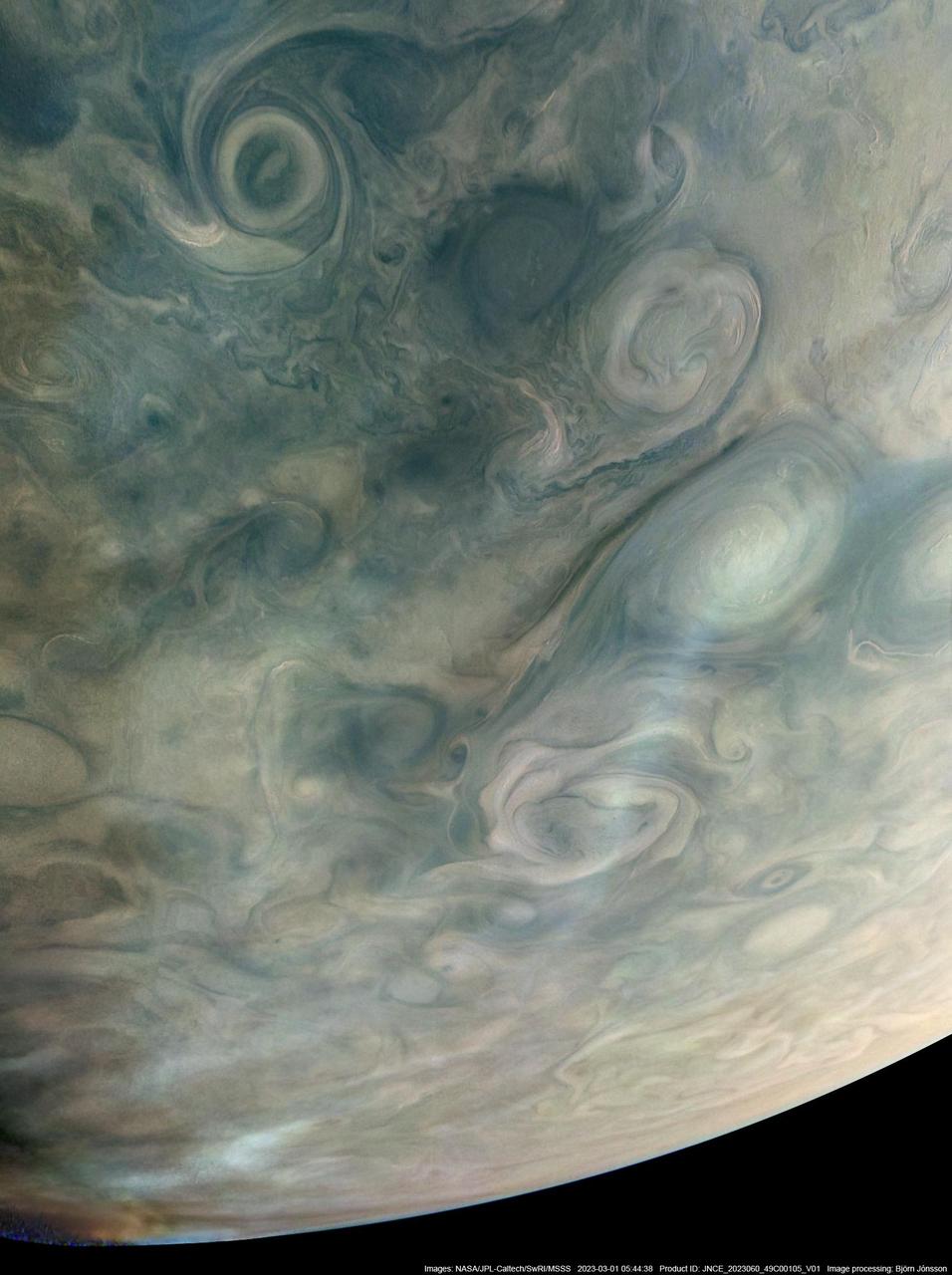
On March 1, 2023, NASA's Juno mission completed its 49th close flyby of Jupiter. As the spacecraft flew low over the giant planet's cloud tops, its JunoCam instrument captured this look at bands of high-altitude haze forming above cyclones in an area known at Jet N7. Citizen scientist Björn Jónsson processed a raw image from the JunoCam instrument, enhancing the contrast and sharpness. At the time the image was taken, Juno was about 5,095 miles (8,200 kilometers) above Jupiter's cloud tops, at a latitude of about 66 degrees. https://photojournal.jpl.nasa.gov/catalog/PIA25725
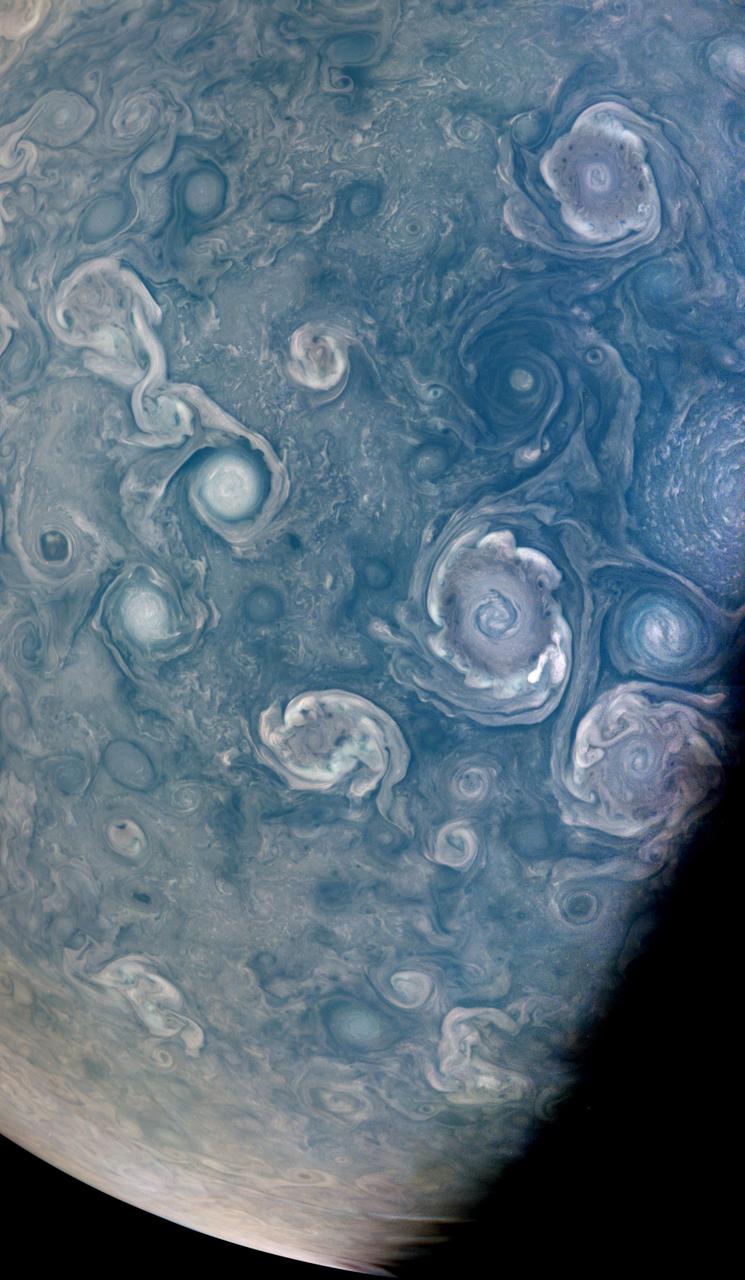
As NASA's Juno mission completed its 43rd close flyby of Jupiter on July 5, 2022, its JunoCam instrument captured this striking view of vortices – hurricane-like spiral wind patterns – near the planet's north pole. These powerful storms can be over 30 miles (50 kilometers) in height and hundreds of miles across. Figuring out how they form is key to understanding Jupiter's atmosphere, as well as the fluid dynamics and cloud chemistry that create the planet's other atmospheric features. Scientists are particularly interested in the vortices' varying shapes, sizes, and colors. For example, cyclones, which spin counter-clockwise in the northern hemisphere and clockwise in the southern, and anti-cyclones, which rotate clockwise in the northern hemisphere and counter-clockwise in the southern hemisphere, exhibit very different colors and shapes. A NASA citizen science project, Jovian Vortex Hunter, seeks help from volunteer members of the public to spot and help categorize vortices and other atmospheric phenomena visible in JunoCam photos of Jupiter. This process does not require specialized training or software, and can be done by anyone, anywhere, with a cellphone or laptop. As of July 2022, 2,404 volunteers had made 376,725 classifications using the Jovian Vortex Hunter project web site at https://www.zooniverse.org/projects/ramanakumars/jovian-vortex-hunter. Another citizen scientist, Brian Swift, created this enhanced color and contrast view of vortices using raw JunoCam image data. At the time the raw image was taken, the Juno spacecraft was about 15,600 miles (25,100 kilometers) above Jupiter's cloud tops, at a latitude of about 84 degrees. https://photojournal.jpl.nasa.gov/catalog/PIA25017
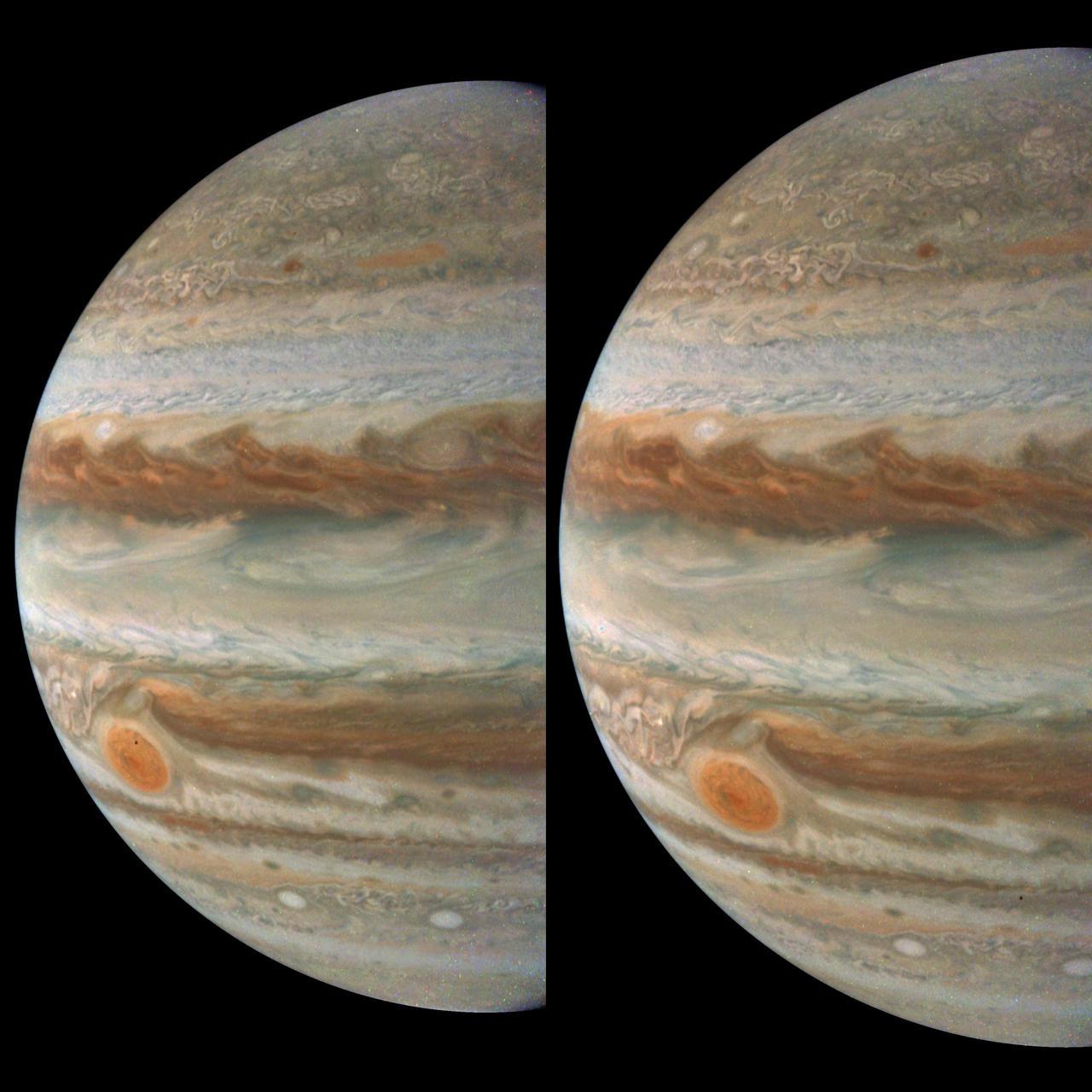
NASA's Juno mission captured these views of Jupiter during its 59th close flyby of the giant planet on March 7, 2024. They provide a good look at Jupiter's colorful belts and swirling storms, including the Great Red Spot. Close examination reveals something more: two glimpses of the tiny moon Amalthea. With a radius of just 52 miles (84 kilometers), Amalthea has a potato-like shape, lacking the mass to pull itself into a sphere. In 2000, NASA's Galileo spacecraft revealed some surface features, including impact craters, hills, and valleys. Amalthea circles Jupiter inside Io's orbit, which is the innermost of the planet's four largest moons, taking 0.498 Earth days to complete one orbit. Amalthea is the reddest object in the solar system, and observations indicate it gives out more heat than it receives from the Sun. This may be because, as it orbits within Jupiter's powerful magnetic field, electric currents are induced in the moon's core. Alternatively, the heat could be from tidal stresses caused by Jupiter's gravity. At the time that the first of these two images was taken, the Juno spacecraft was about 165,000 miles (265,000 kilometers) above Jupiter's cloud tops, at a latitude of about 5 degrees north of the equator. Citizen scientist Gerald Eichstädt made these images using raw data from the JunoCam instrument, applying processing techniques to enhance the clarity of the images. https://photojournal.jpl.nasa.gov/catalog/PIA25728
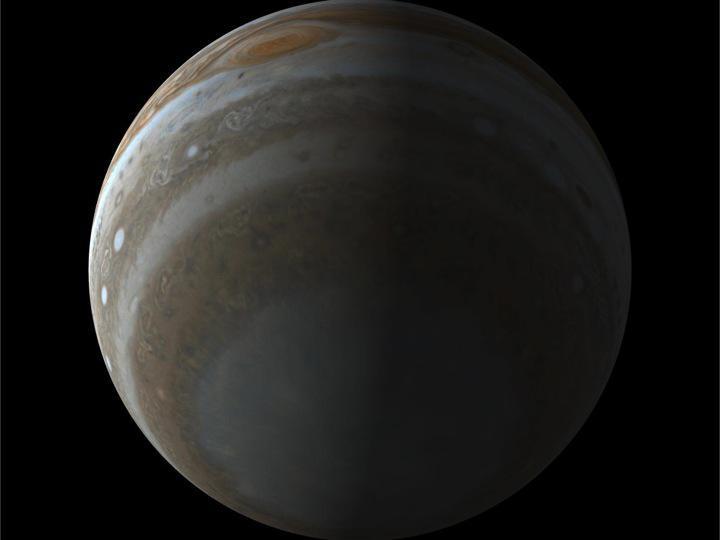
This simulated view of the south pole of Jupiter illustrates the unique perspective of NASA Juno mission. Juno polar orbit will allow its camera, called JunoCam, to image Jupiter clouds from a vantage point never accessed by other spacecraft.
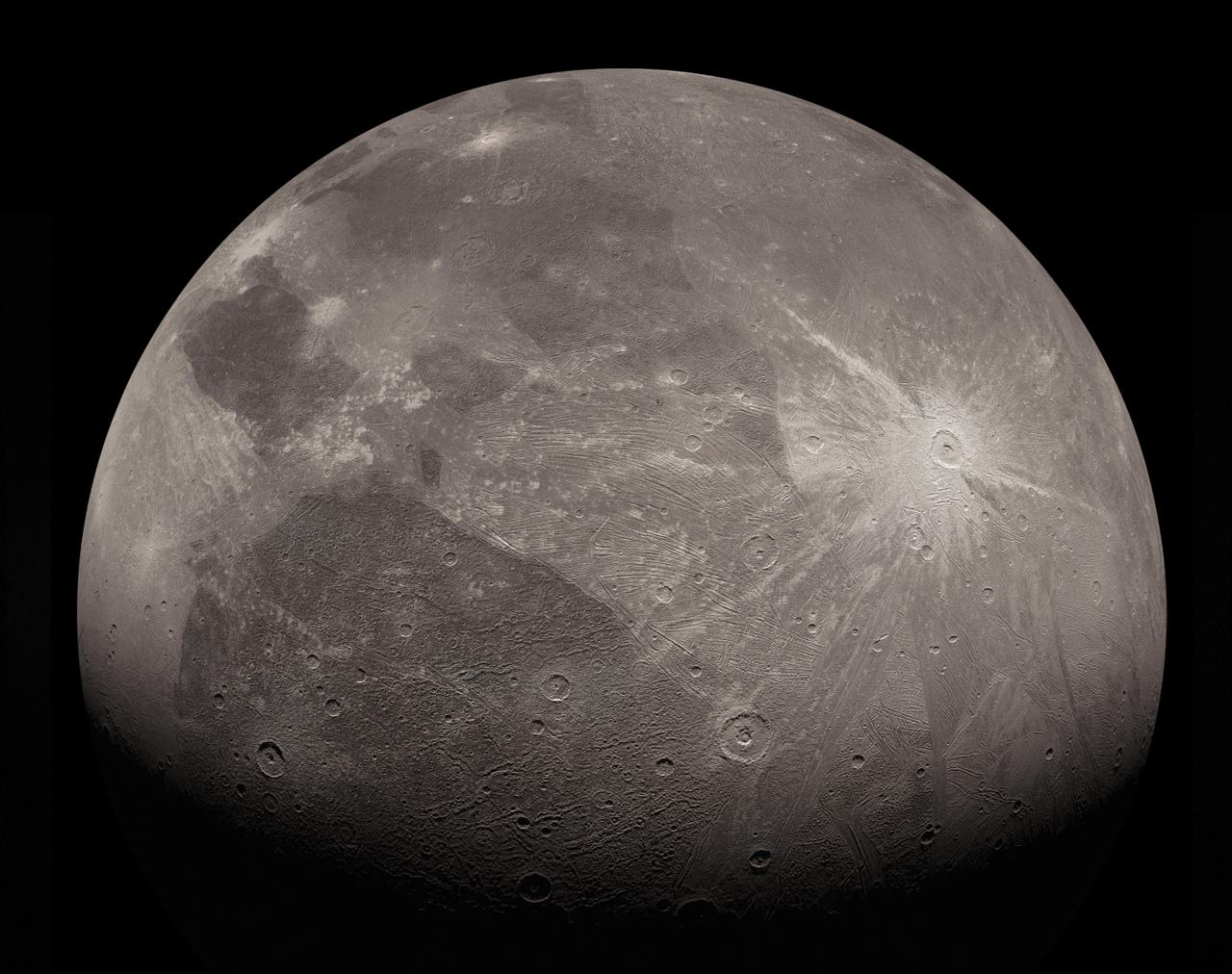
This enhanced image of the Jovian moon Ganymede was obtained by the JunoCam imager aboard NASA's Juno spacecraft during the mission's June 7, 2021, flyby of the icy moon on Juno's 34th pass close to Jupiter. This is an extended, upscaled and artistically enhanced version of a previously released JunoCam image: PIA24681. The missing top part of the original JunoCam image has been reconstructed, for the most part, using an additional image. To make the new, enhanced image, small surface features have been extracted from elsewhere on Ganymede's surface. During the June 7 flyby, Juno passed just 645 miles (1,038 kilometers) above the surface of the Ganymede, which is the solar system's largest moon. The spacecraft has been in orbit around Jupiter since July 4, 2016, but this was the first pass close to one of Jupiter's large moons. Juno is a spin-stabilized spacecraft (with a rotation rate of 2 rpm), and the JunoCam imager has a fixed field of view. To obtain Ganymede images as Juno rotated, the camera acquired a strip at a time as the target passed through its field of view. These image strips were captured separately through red, green and blue filters. To generate the final image product, the strips must be stitched together and the colors aligned. https://photojournal.jpl.nasa.gov/catalog/PIA25028
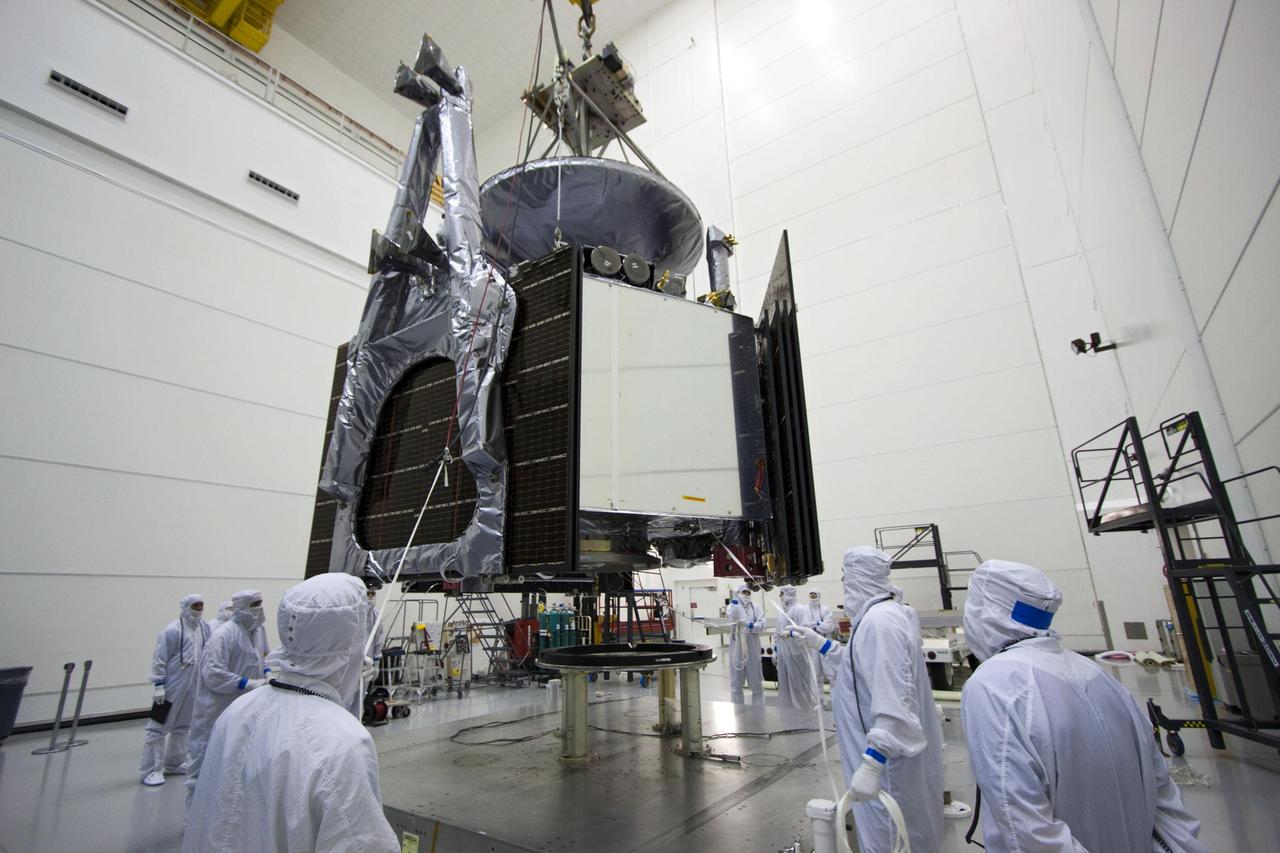
Technicians use an overhead crane to lower NASA Juno spacecraft onto a fueling stand where the spacecraft will be loaded with the propellant necessary for its mission to Jupiter.
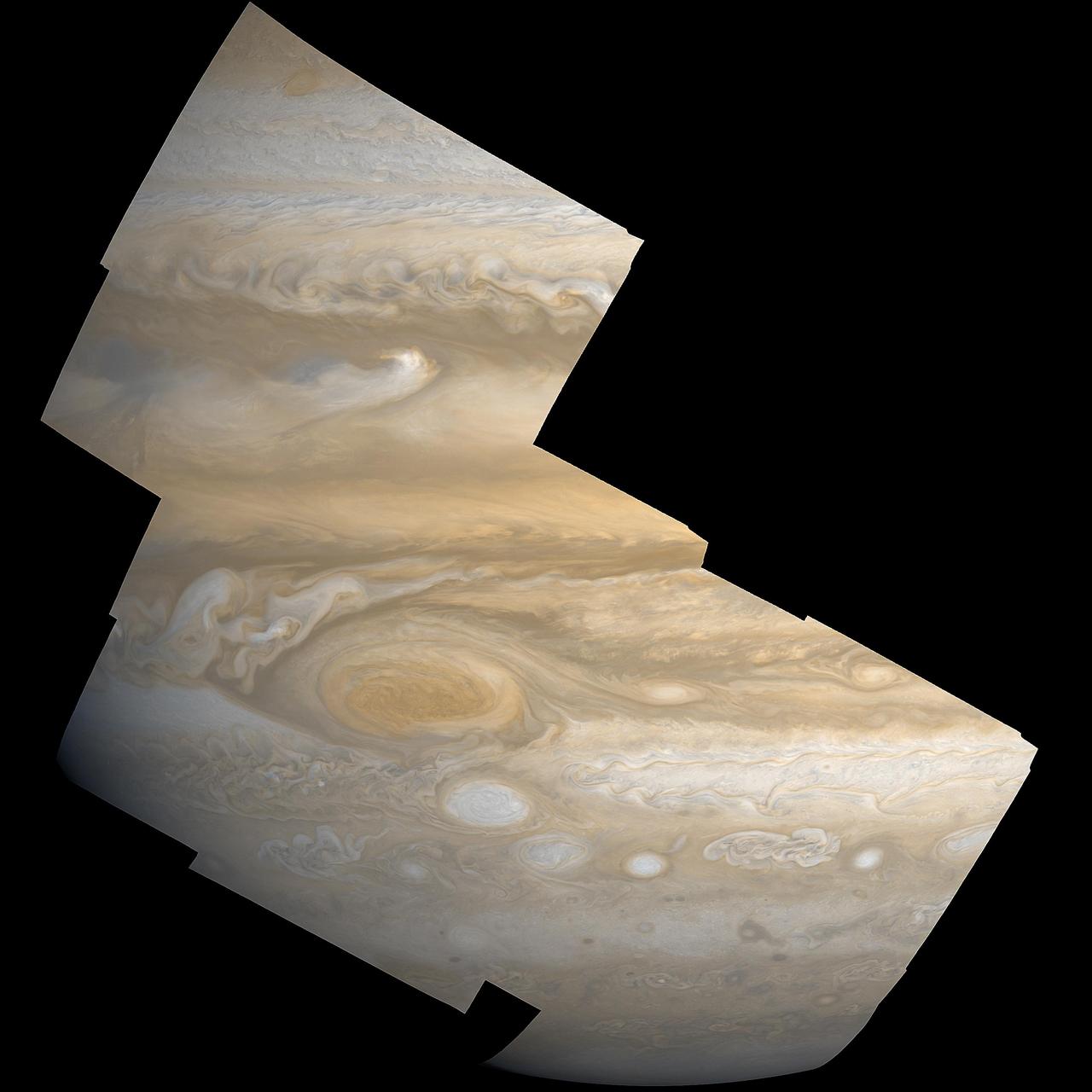
Data from the camera onboard NASA Juno mission, called JunoCam, will be made available to the public for processing into their own images. Illustrated here with an image of Jupiter taken by NASA Voyager mission.
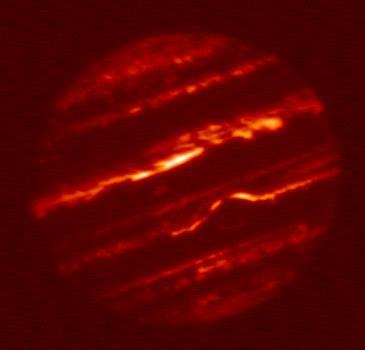
This still from an animation of four images shows Jupiter in infrared light as seen by NASA InfraRed Telescope Facility, or IRTF, on May 16, 2015. The observations were obtained in support of NASA's Juno mission by a team headed by Juno scientist Glenn Orton. Observations like these are helping to provide spatial and temporal context for what the science instruments on board Juno will see once the spacecraft arrives at the giant planet in mid-2016. Juno will pass very close to the planet -- coming within just a few thousand miles (or kilometers) of the cloud tops every two weeks. That up-close vantage point will be balanced by distant views of the planet that show how different features move and change over time in relation to each other. The IRTF is a three-meter telescope, optimized for infrared observations, and located at the summit of Mauna Kea, Hawaii. The observatory is operated and managed for NASA by the University of Hawaii Institute for Astronomy, Honolulu. http://photojournal.jpl.nasa.gov/catalog/PIA19640
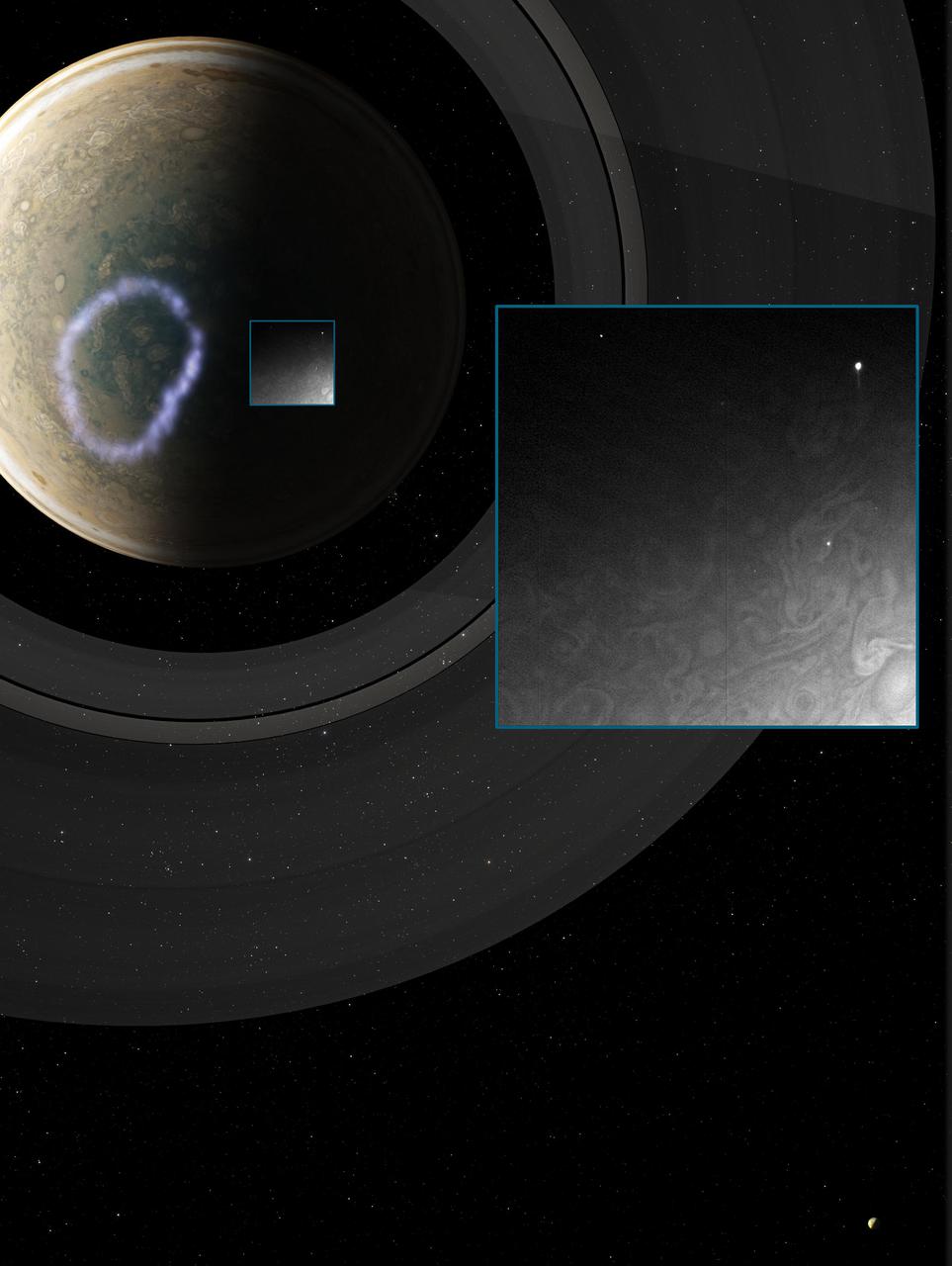
This image is the first observation of "shallow lightning" flashes — signatures of high-altitude Jovian thunderstorms that may fundamentally influence the composition of Jupiter's atmosphere. The image of was acquired by NASA's Juno mission using the spacecraft's sensitive Stellar Reference Unit navigation camera during Juno's 10th science flyby on Feb. 7, 2018. The solar-powered Jupiter explorer launched on Aug. 5, 2011 and went into orbit around the gas giant on July 4, 2016. https://photojournal.jpl.nasa.gov/catalog/PIA24301
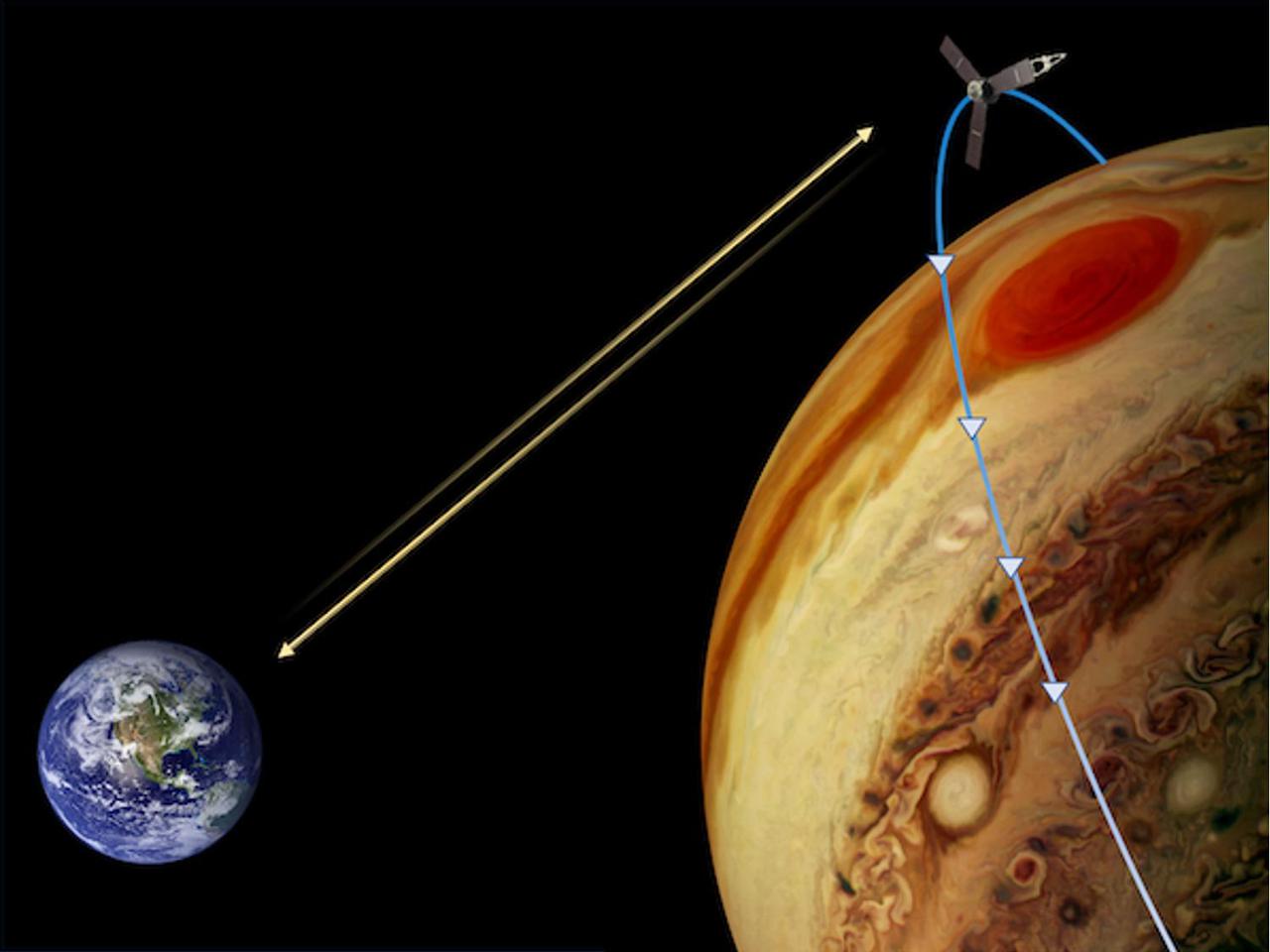
This representation depicts how NASA's Juno mission obtained gravity science data of Jupiter's Great Red Spot. The Juno spacecraft flew twice over the crimson vortex in 2019 at low altitudes with the goal of picking up its subtle gravitational signal. The concentration of mass related to the powerful winds surrounding the Great Red Spot induced a minute Doppler shift in the spacecraft's radio signals that could be measured by a NASA's Deep Space Network tracking antenna on Earth. With Juno traveling at about 130,000 mph (209,000 kph) over Jupiter's cloud deck, mission scientists were able to measure velocity changes as small 0.01 millimeter per second This enabled them to constrain the depth of the Great Red Spot to about 186 miles (300 kilometers) below the cloud tops. https://photojournal.jpl.nasa.gov/catalog/PIA24820
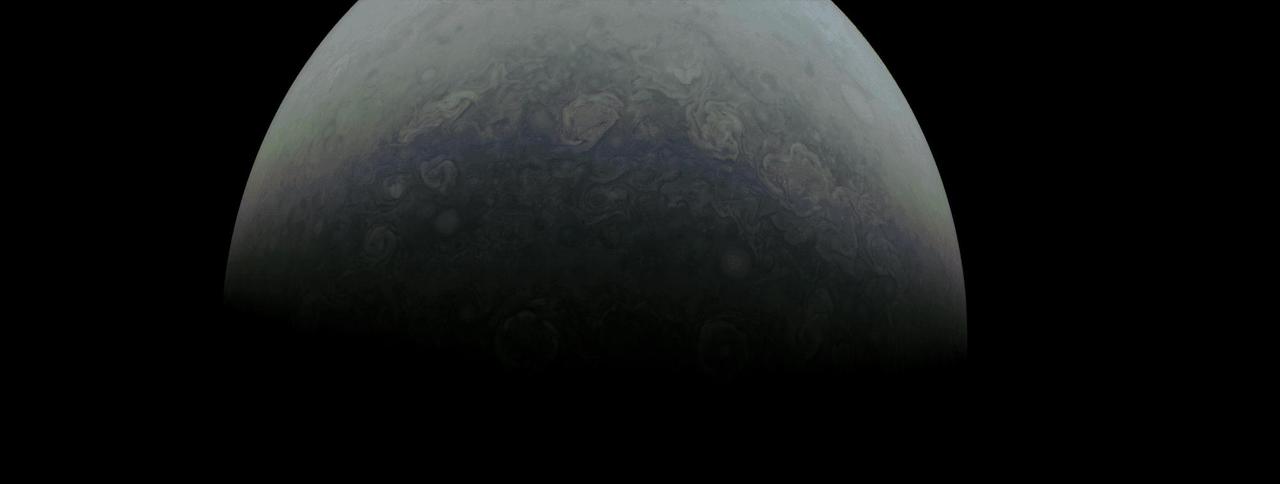
On April 9, 2022, as NASA's Juno mission completed its 41st close flyby of Jupiter, its JunoCam instrument captured what it would look like to ride along with the spacecraft. Citizen scientist Andrea Luck created this animated sequence using raw JunoCam image data. At about 87,000 miles (140,000 kilometers) in diameter, Jupiter is the largest planet in the solar system. At the point of closest approach on April 9, Juno was just over 2,050 miles (3,300 kilometers) above Jupiter's colorful cloud tops. At that moment, it was traveling at about 131,000 MPH (210,000 kilometers per hour) relative to the planet. By comparison, at closest approach Juno was more than 10 times closer to Jupiter than satellites in geosynchronous orbit are to Earth, traveling at a speed about five times faster than the Apollo missions did when they left Earth for the Moon. Movie available at https://photojournal.jpl.nasa.gov/catalog/PIA25016
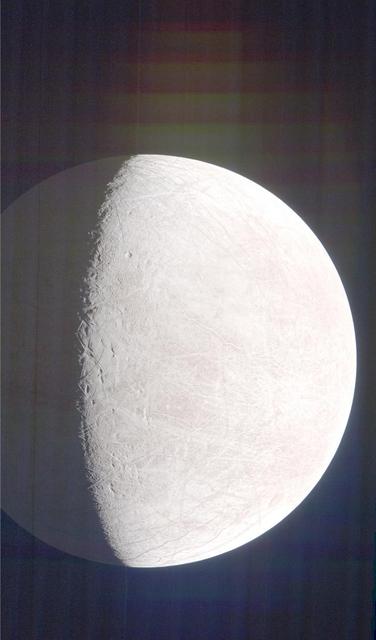
NASA's Juno mission captured this view of Jupiter's intriguing, icy moon Europa during a close pass on Sept. 29, 2022. The contrast has been enhanced to help scientists look for signs of eruptions along the limb and terminator – the dividing line between the day and night sides of the moon. None were identified. When processed this way, the image shows features on Europa's night side illuminated by sunlight reflected from Jupiter, also called Jupiter shine. Along the terminator, low-angle sunlight highlights topography on the moon's surface. At the time the image was taken, the Juno spacecraft was 945 miles (1,521 kilometers) from Europa. Citizen scientist Brian Swift processed the image from raw data from the spacecraft's JunoCam public engagement camera, brightening darker regions and enhancing the contrast. https://photojournal.jpl.nasa.gov/catalog/PIA25694
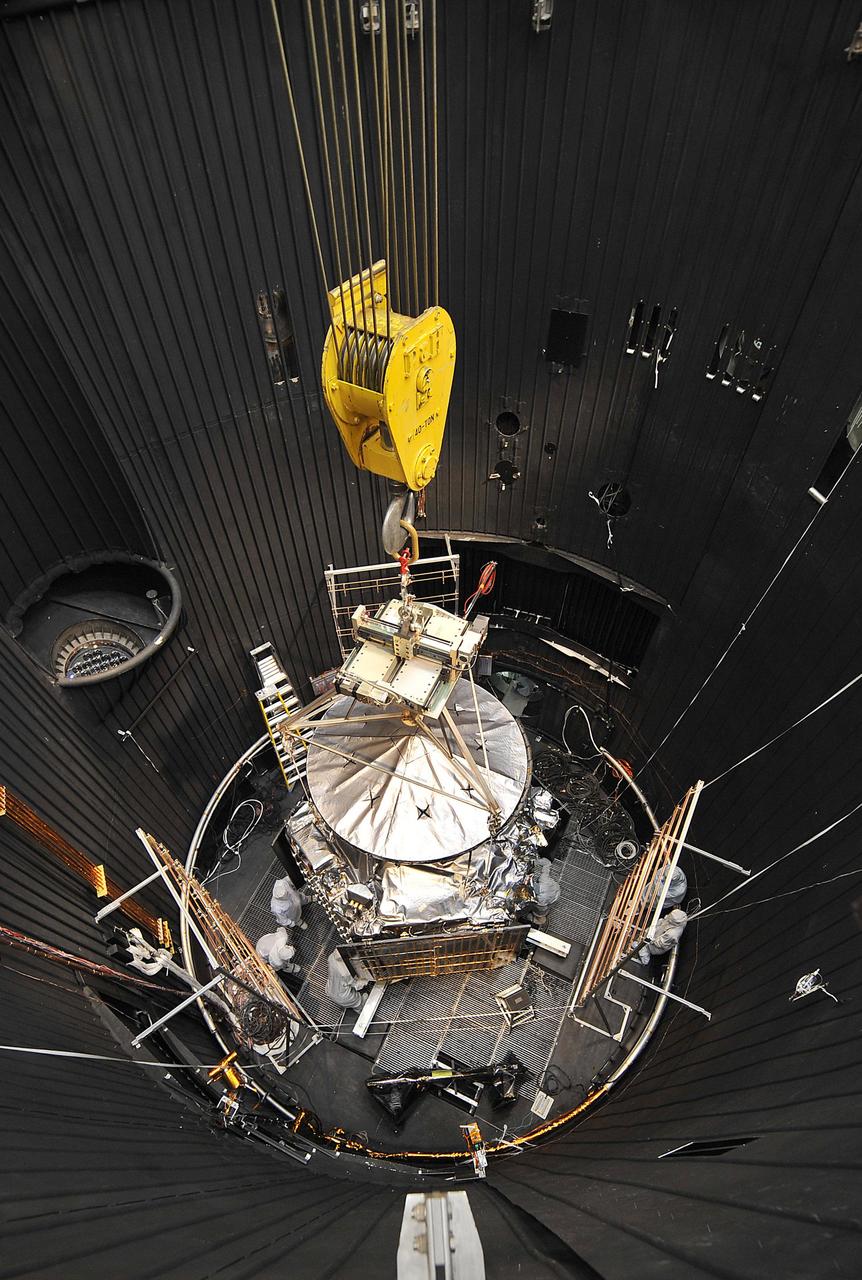
NASA Juno spacecraft is readied for lifting out of a thermal vacuum chamber following testing to simulate the environment of space over the range of conditions the probe will encounter during its mission.
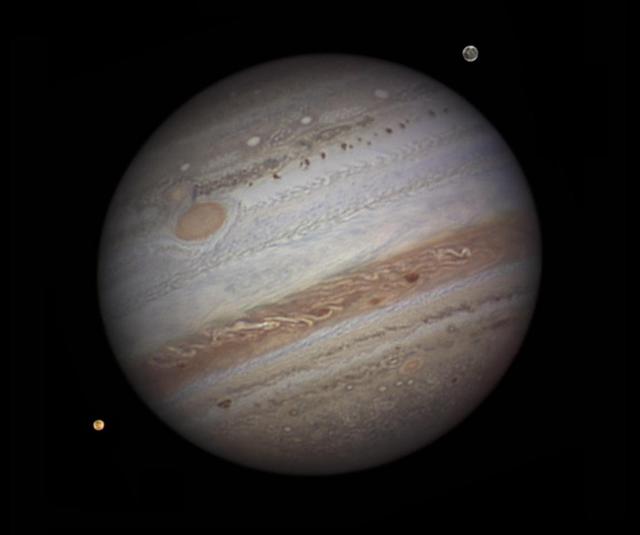
Ground-based astronomers will be playing a vital role in NASA Juno mission. Images from the amateur astronomy community are needed to help the JunoCam instrument team predict what features will be visible when the camera images are taken.

Ground-based astronomers will be playing a vital role in NASA Juno mission. Images from the amateur astronomy community are needed to help the JunoCam instrument team predict what features will be visible when the camera images are taken.
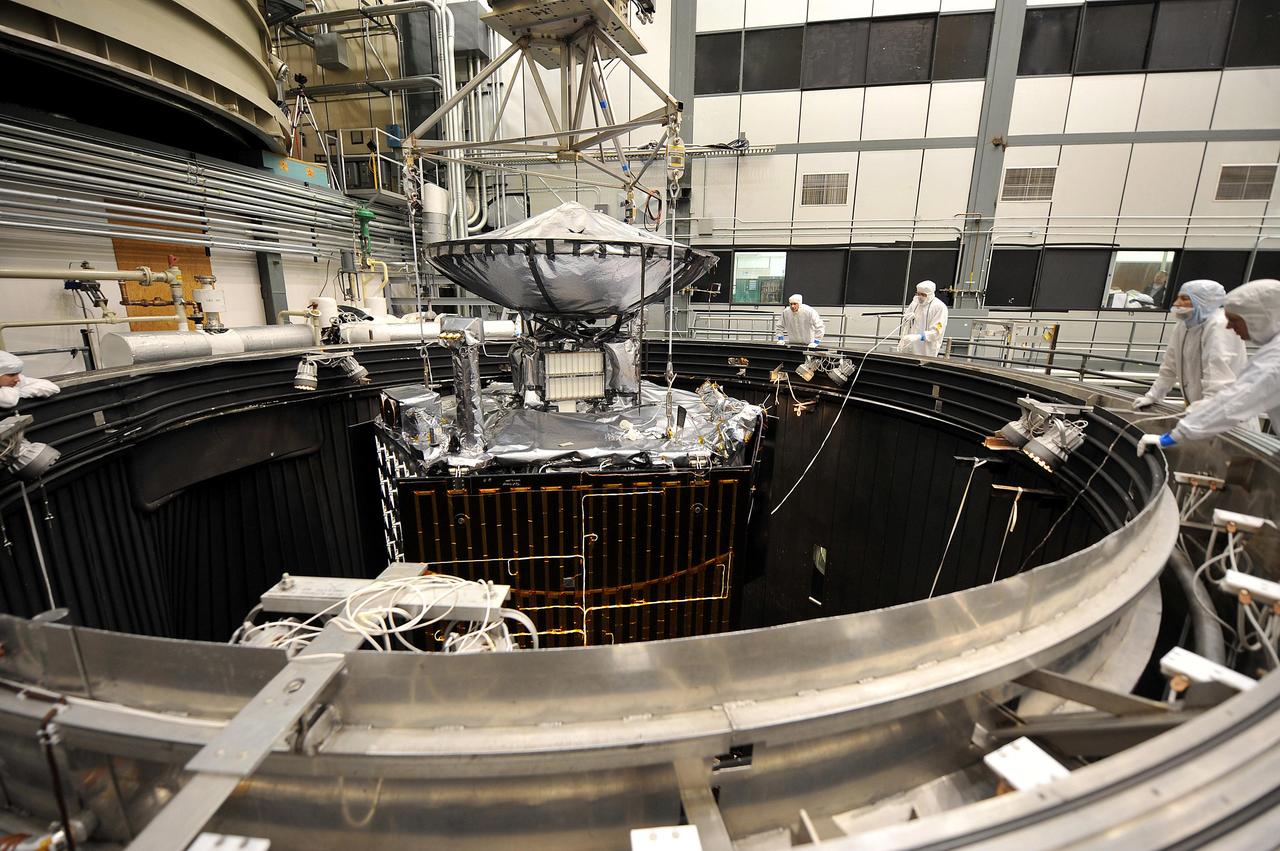
NASA Juno spacecraft is raised out of a thermal vacuum chamber following tests that simulated the environment of space over the range of conditions the probe will encounter during its mission.
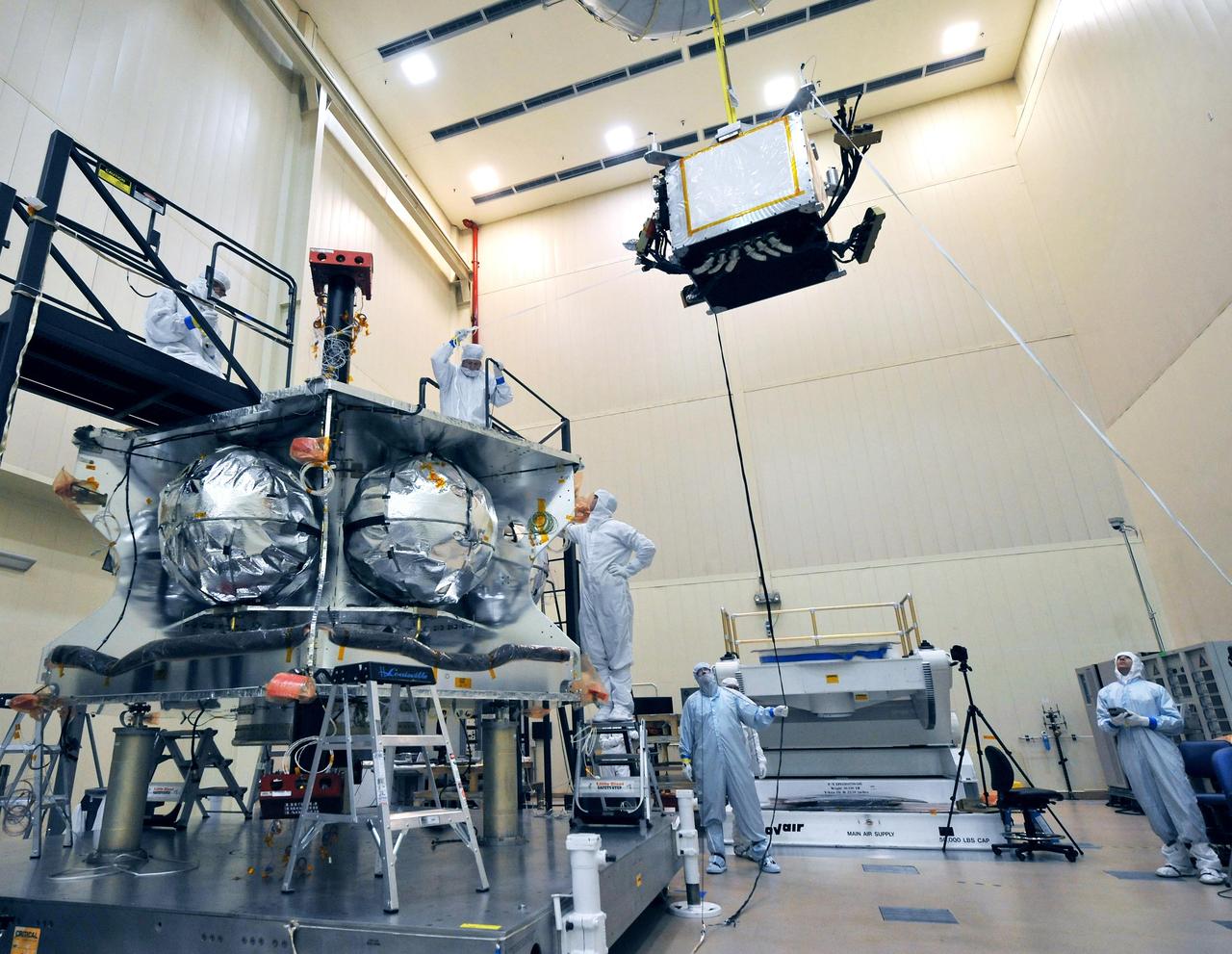
Technicians lowered a special radiation vault onto the propulsion module of NASA Juno spacecraft. The vault will dramatically slow the aging effect radiation has on the electronics for the duration of the mission.
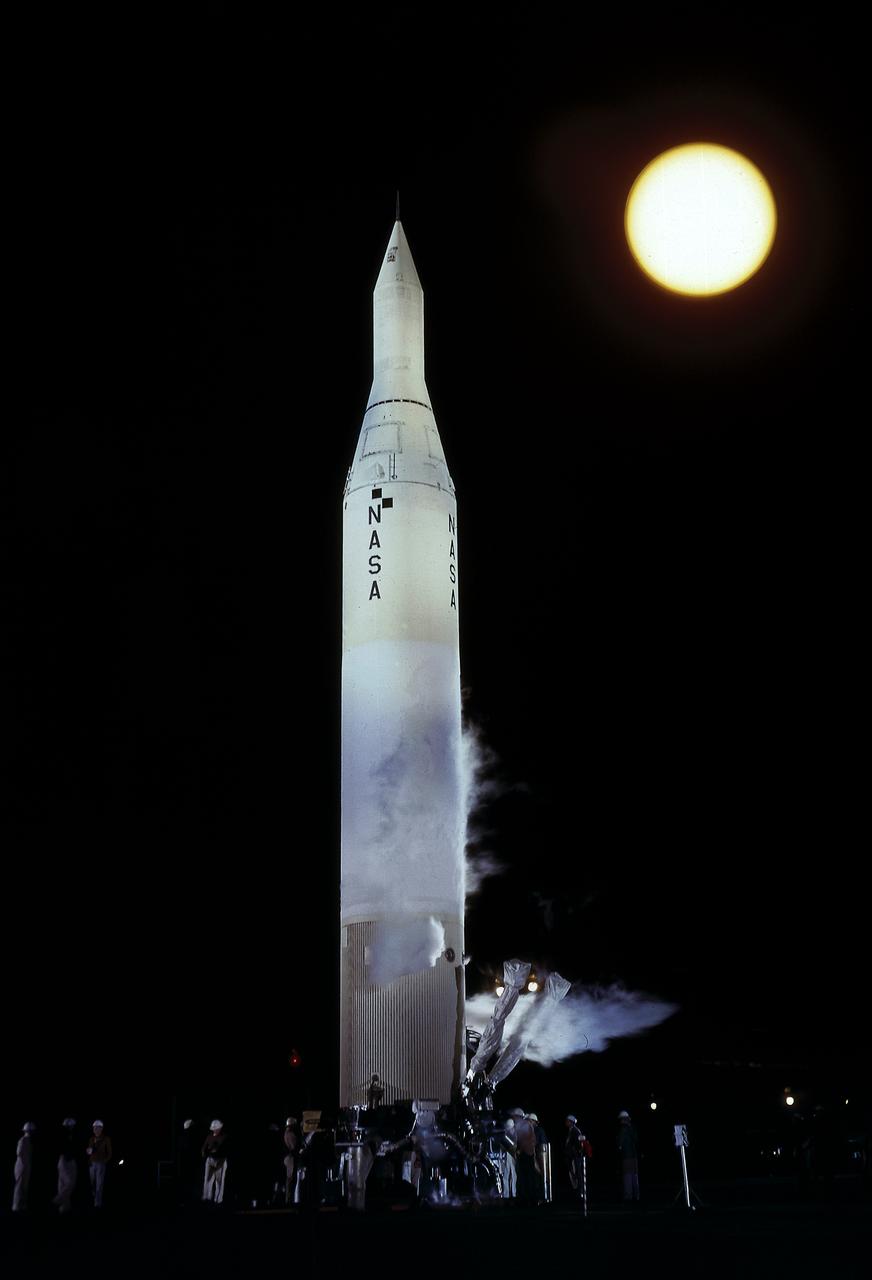
Juno II (AM-14) on the launch pad just prior to launch, March 3, 1959. The payload of AM-14 was Pioneer IV, America's first successful lunar mission. The Juno II was a modification of Jupiter ballistic missile
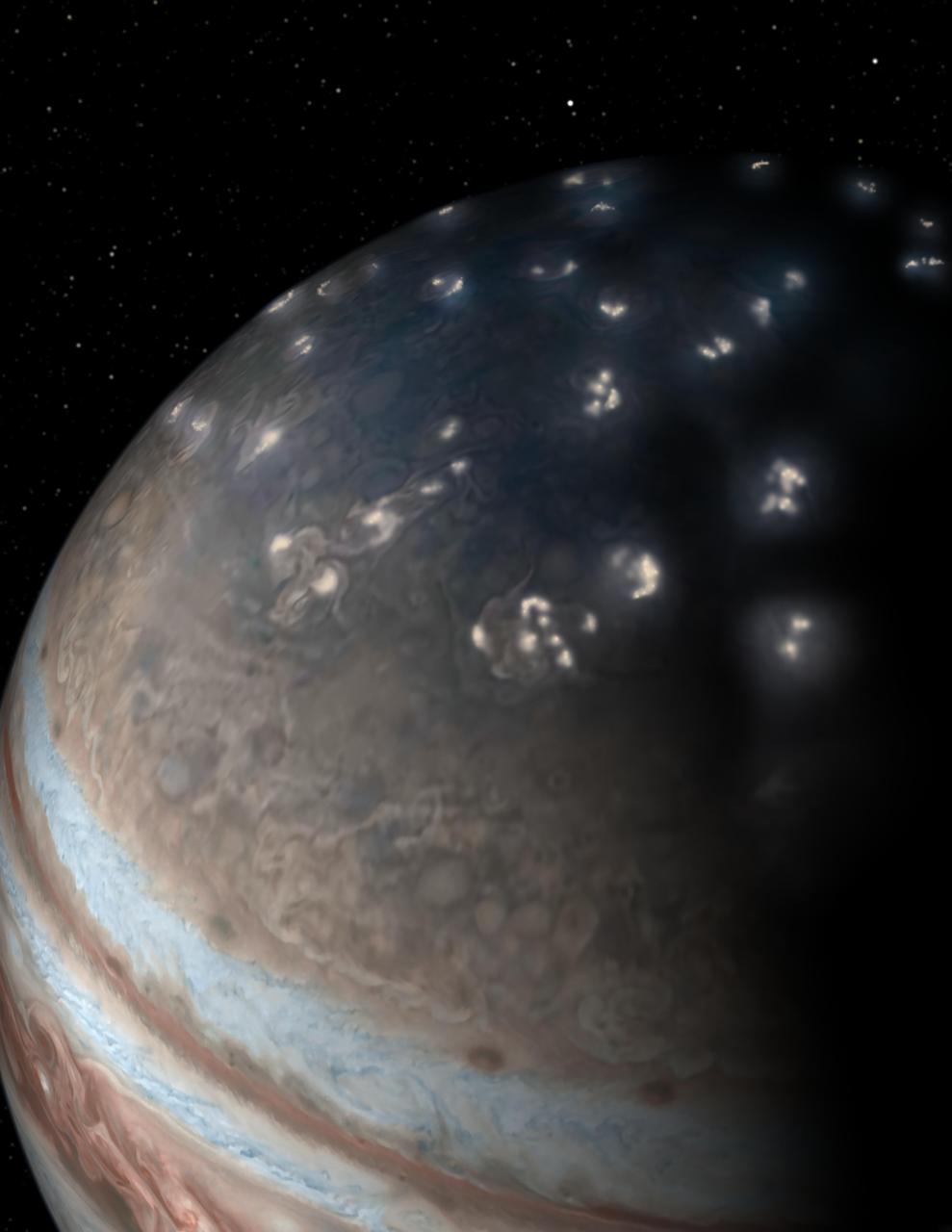
This artist's concept of lightning distribution in Jupiter's northern hemisphere incorporates a JunoCam image with artistic embellishments. Data from NASA's Juno mission indicates that most of the lightning activity on Jupiter is near its poles. https://photojournal.jpl.nasa.gov/catalog/PIA22474
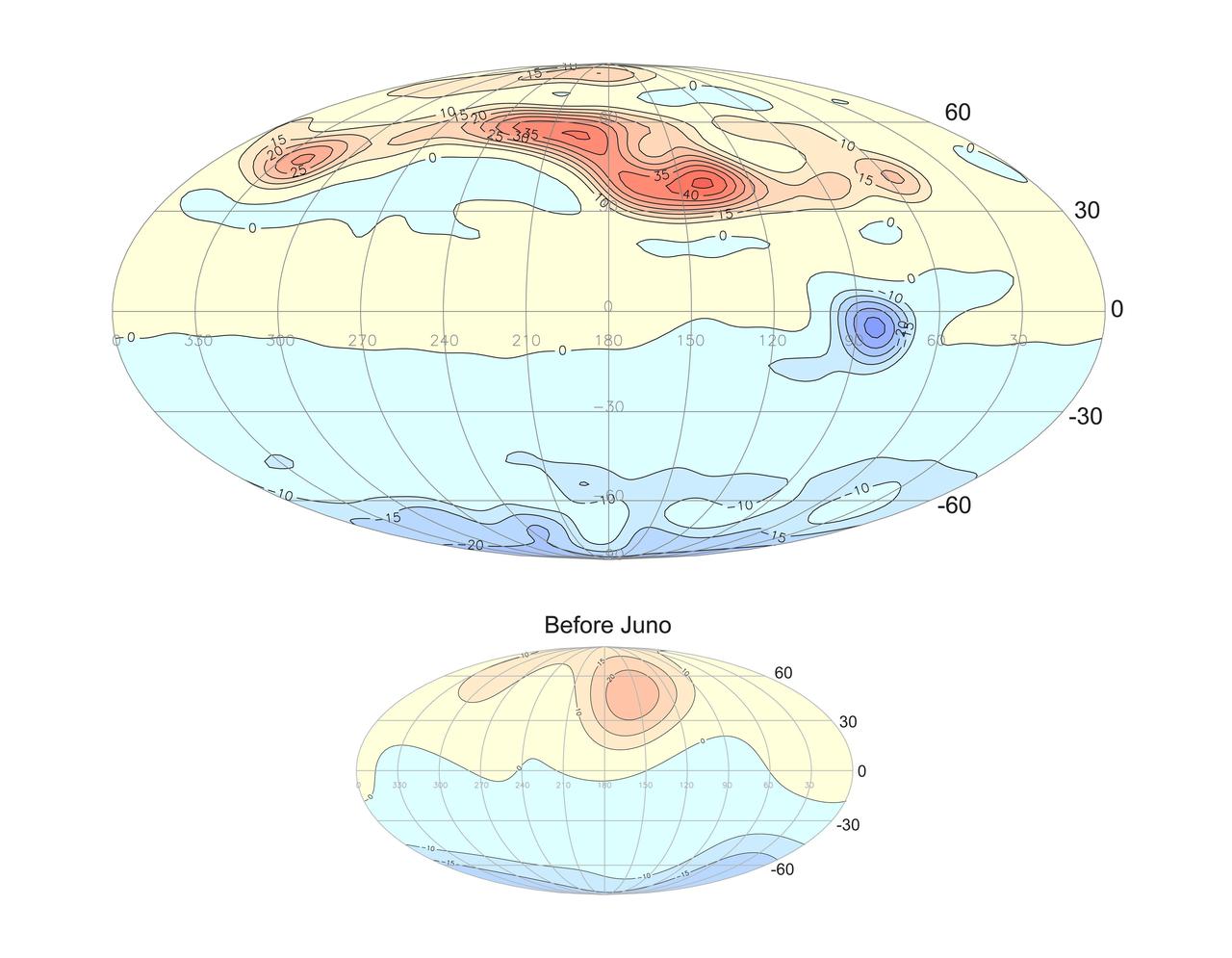
This projection of the radial magnetic field of Jupiter (top) uses a new magnetic field model based on data from Juno's orbits during its prime mission. Magnetic field lines emerge from yellow and red regions and enter the planet in the blue regions. The new model represents a vast improvement in spatial resolution compared to prior knowledge (bottom) provided by earlier missions, including Pioneer 10 and 11, Voyager 1 and 2, Ulysses, and Galileo. https://photojournal.jpl.nasa.gov/catalog/PIA25040

CAPE CANAVERAL, Fla. -- A Juno mission science briefing is held in the NASA Press Site auditorium at NASA's Kennedy Space Center in Florida. From left are Scott Bolton, Juno principal investigator, Southwest Research Institute, San Antonio; Toby Owen, Juno co-investigator, University of Hawaii; Jack Connerney, Juno MAG Instrument Lead, Goddard Space Flight Center, Greenbelt, Md.; Steve Levin, Juno project scientist, Jet Propulsion Laboratory, Pasadena, Calif.; Fran Bagenai, Juno co-investigator, University of Colorado, Boulder, Colo.; and Candy Hansen, Juno co-investigator, Planetary Science Institute, Tucson, Ariz. Juno is scheduled to launch Aug. 5 aboard a United Launch Alliance Atlas V rocket from Cape Canaveral Air Force Station in Florida. The solar-powered spacecraft will orbit Jupiter's poles 33 times to find out more about the gas giant's origins, structure, atmosphere and magnetosphere and investigate the existence of a solid planetary core. For more information, visit www.nasa.gov/juno. Photo credit: NASA/Kim Shiflett

CAPE CANAVERAL, Fla. -- Media representatives question the participants of a Juno mission science briefing in the NASA Press Site auditorium at NASA's Kennedy Space Center in Florida. From left are Scott Bolton, Juno principal investigator, Southwest Research Institute, San Antonio; Toby Owen, Juno co-investigator, University of Hawaii; Jack Connerney, Juno MAG Instrument Lead, Goddard Space Flight Center, Greenbelt, Md.; Steve Levin, Juno project scientist, Jet Propulsion Laboratory, Pasadena, Calif.; Fran Bagenai, Juno co-investigator, University of Colorado, Boulder, Colo.; and Candy Hansen, Juno co-investigator, Planetary Science Institute, Tucson, Ariz. Juno is scheduled to launch Aug. 5 aboard a United Launch Alliance Atlas V rocket from Cape Canaveral Air Force Station in Florida. The solar-powered spacecraft will orbit Jupiter's poles 33 times to find out more about the gas giant's origins, structure, atmosphere and magnetosphere and investigate the existence of a solid planetary core. For more information, visit www.nasa.gov/juno. Photo credit: NASA/Kim Shiflett

KEITH ROBINSON IS INTERVIEWED BY JOSH BARRETT WITH WAAY 31 ON JUNO TO JUPITER MISSION

KEITH ROBINSON IS INTERVIEWED BY JOSH BARRETT WITH WAAY 31 ON JUNO TO JUPITER MISSION
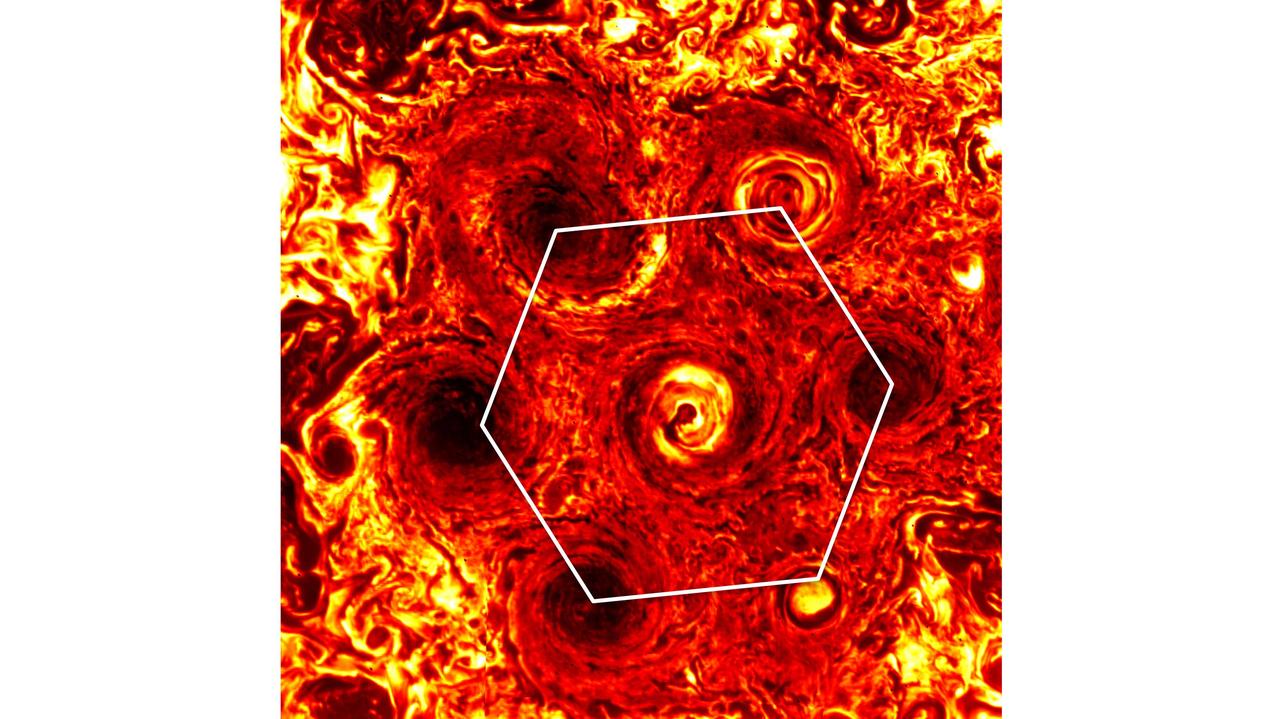
In this annotated infrared image, six cyclones form a hexagonal pattern around a central cyclone at Jupiter's south pole. The image was generated from data collected on Nov. 4, 2019, by the Jovian Infrared Auroral Mapper (JIRAM) instrument aboard NASA's Juno mission during its 23rd science pass of the planet. The JIRAM instrument measures heat radiated from the planet at an infrared wavelength of around 5 microns. https://photojournal.jpl.nasa.gov/catalog/PIA23559
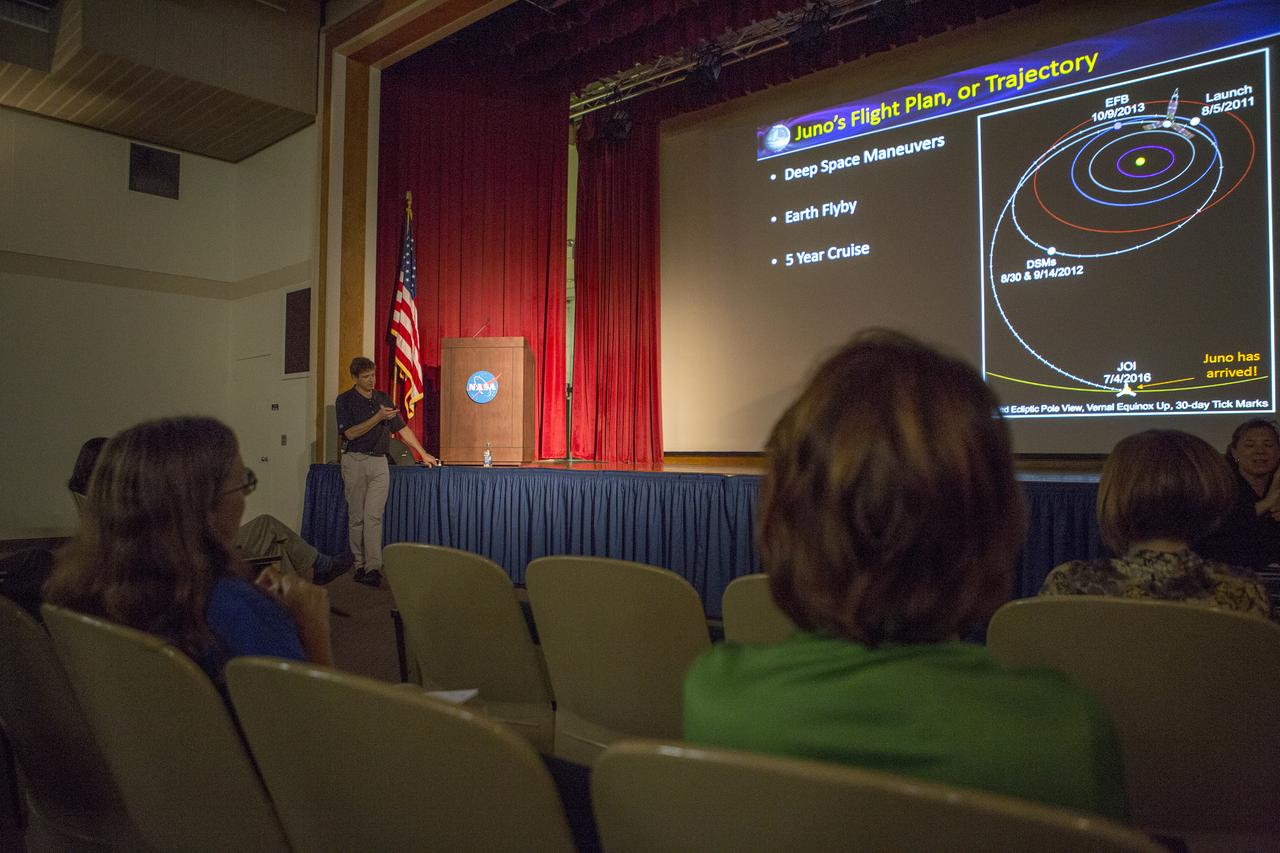
Scott Bolton briefs employees at NASA’s Kennedy Space Center on the progress of the Juno mission to the planet Jupiter. Bolton is the principal investigator for Juno at the Southwest Research Institute in San Antonio, Texas. NASA’s Launch Services Program, which is based at Kennedy, led the successful launch of the Juno spacecraft aboard a United Launch Alliance Atlas V rocket Aug. 5, 2011 from nearby Space Launch Complex 41. Juno arrived at Jupiter on July 4, 2016, and will study our solar system’s largest planet until February 2018. Photo credit: NASA/Cory Huston
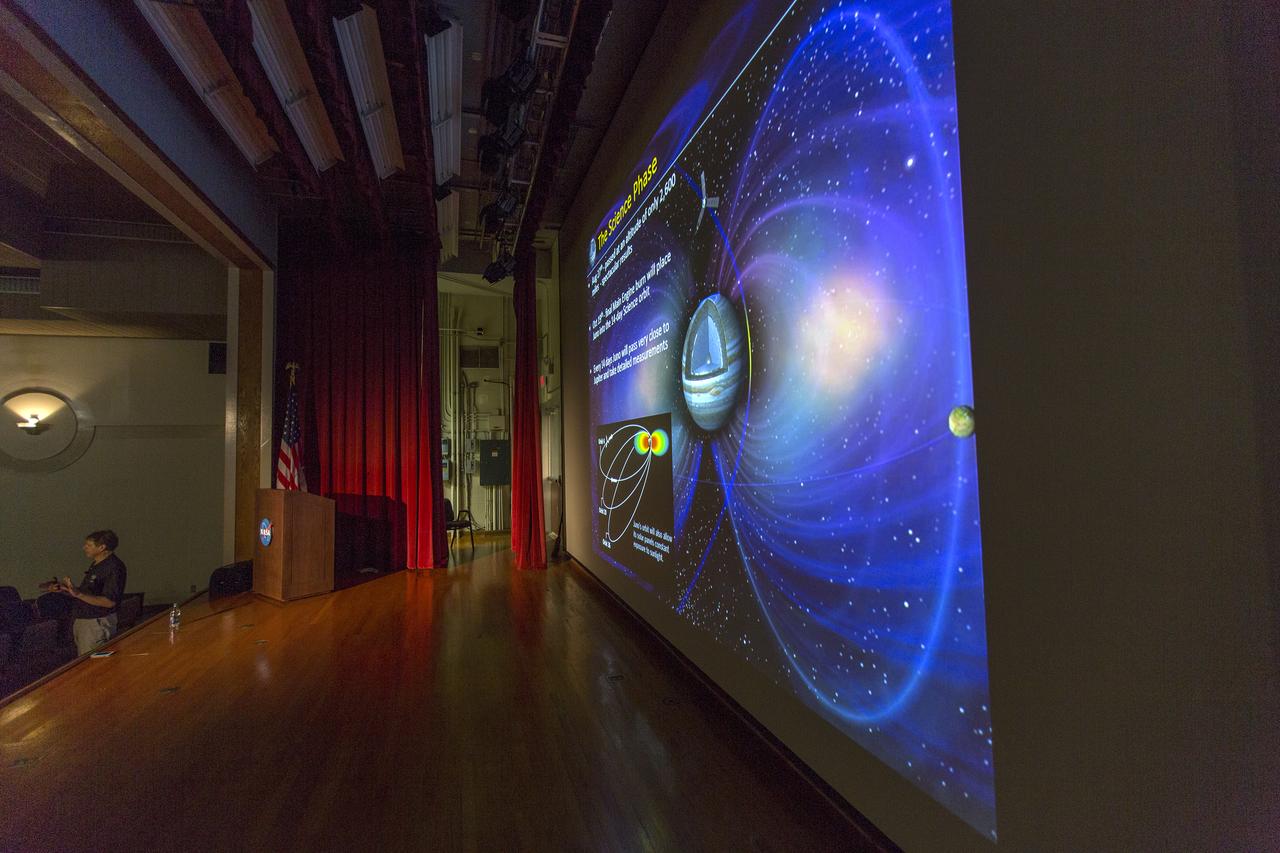
The science phase of the Juno mission to the planet Jupiter is explained in a slideshow presented to Kennedy Space Center employees during a briefing by Scott Bolton, principal investigator for Juno at the Southwest Research Institute in San Antonio, Texas. NASA’s Launch Services Program, which is based at Kennedy, led the successful launch of the Juno spacecraft aboard a United Launch Alliance Atlas V rocket Aug. 5, 2011 from nearby Space Launch Complex 41. Juno arrived at Jupiter on July 4, 2016, and will study our solar system’s largest planet until February 2018. Photo credit: NASA/Cory Huston

Scott Bolton briefs employees at NASA’s Kennedy Space Center on the progress of the Juno mission to the planet Jupiter. Bolton is the principal investigator for Juno at the Southwest Research Institute in San Antonio, Texas. NASA’s Launch Services Program, which is based at Kennedy, led the successful launch of the Juno spacecraft aboard a United Launch Alliance Atlas V rocket Aug. 5, 2011 from nearby Space Launch Complex 41. Juno arrived at Jupiter on July 4, 2016, and will study our solar system’s largest planet until February 2018. Photo credit: NASA/Cory Huston
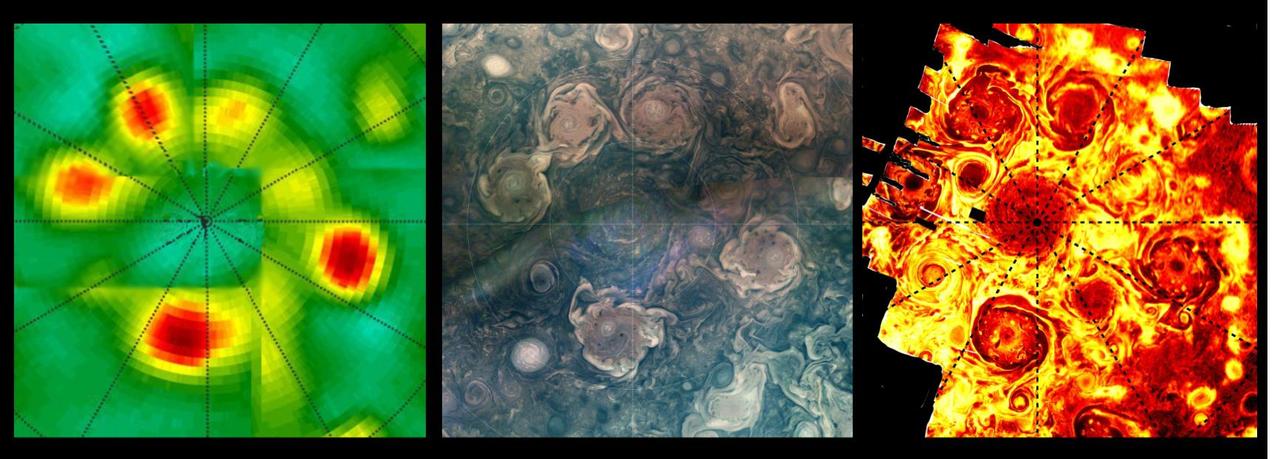
This composite shows views of Jupiter's northern polar cyclones in three different wavelengths of light – microwave, visible, and ultraviolet – as captured by NASA's Juno mission. These differing perspectives allowed Juno scientists to deduce that all Jovian polar cyclones are not created equal. The infrared image, on the far right, was derived from data collected by the spacecraft's Jovian Infrared Auroral Mapper (JIRAM) instrument. The composite image at center was collected by the JunoCam visible-light imager. Though taken with separate instruments that record different wavelengths of light, both images depict Jupiter's northern polar storms as well defined and of similar size. The data on the left, collected by Juno's Microwave Radiometer (MWR), shows the polar storms in another light. MWR enables Juno to see deep into Jupiter by recording the planet's microwave emissions. In the MWR graphic, the polar storms at the 4 and 6 o'clock positions have bright microwave signatures, indicating they extend well beneath the cloud tops, at least 62 miles (100 kilometers) below. The size of those two storms is comparable to what's found in the visible light and infrared light images, but the other storms, as seen through MWR, have a notably reduced emissions intensity. Another disparity in the MWR graphic versus visible light and infrared can be seen in how the central cyclone is depicted by the data. In the infrared and visible light images, the central cyclone is evident; with MWR data, it all but disappears. This disparity indicates that the central cyclone's subsurface structure must be very different from the surrounding storms. JIRAM "sees" in infrared light not visible to the human eye. It captures the infrared glow from the heat of Jupiter's upper atmosphere, probing the top of the weather layer, and gaps in the clouds allow glimpses as deep as 30 to 45 miles (50 to 70 kilometers) below Jupiter's cloud tops. JunoCam's visible light images catch reflected sunlight, with a view that is very similar to what a human eye would see if a person could ride along with Juno. JunoCam's raw images are available for the public to peruse and process into image products at https://missionjuno.swri.edu/junocam/processing. Like JIRAM, the MWR instrument records the glow of Jupiter's atmosphere, but the brightness results from the temperature at depths below anything achievable with previous spacecraft or Earth-based observations. The MWR's six radio channels peer progressively deeper below the visible cloud tops, with a range from the top of the clouds (for the highest frequency channel) to 200 miles (320 kilometers) or more below (for the lowest frequency channel). https://photojournal.jpl.nasa.gov/catalog/PIA26295

This artist concept depicts the Juno spacecraft which will launch from Earth in 2011 and will arrive at Jupiter in 2016 to study the giant planet from an elliptical, polar orbit.
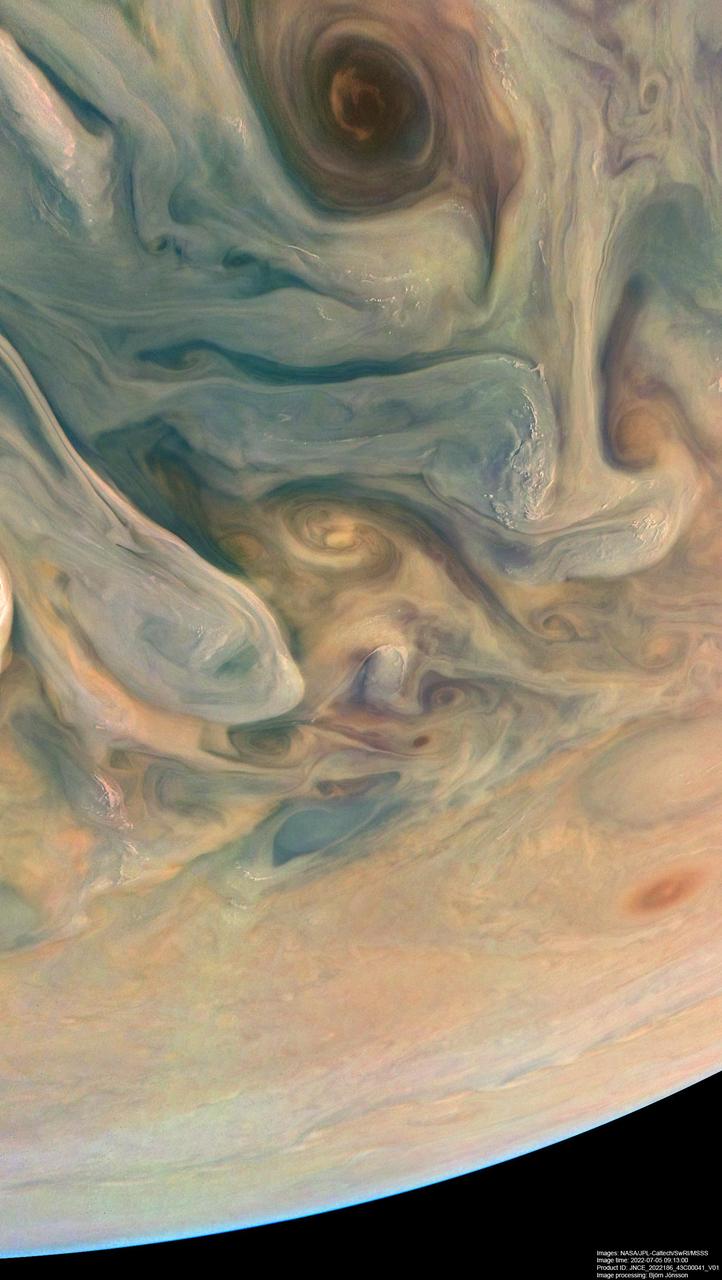
NASA's Juno spacecraft observed the complex colors and structure of Jupiter's clouds as it completed its 43rd close flyby of the giant planet on July 5, 2022. Citizen scientist Björn Jónsson created these two images using raw data from the JunoCam instrument aboard the spacecraft. At the time the raw image was taken, Juno was about 3,300 miles (5,300 kilometers) above Jupiter's cloud tops, at a latitude of about 50 degrees. North is up. At that moment, the spacecraft was traveling at about 130,000 mph (209,000 kilometers per hour) relative to the planet. The image was digitally processed to increase both the color saturation and contrast to sharpen small-scale features and to reduce compression artifacts and noise that typically appear in raw images. This clearly reveals some of the most intriguing aspects of Jupiter's atmosphere, including color variation that results from differing chemical composition, the three-dimensional nature of Jupiter's swirling vortices, and the small, bright "pop-up" clouds that form in the higher parts of the atmosphere. https://photojournal.jpl.nasa.gov/catalog/PIA25018

Swirling clouds on Jupiter are shown in an image taken by the JunoCam public engagement camera aboard NASA's Juno spacecraft on Feb. 25, 2022. Juno's orbit around Jupiter changes every time the spacecraft passes the giant planet, with the point of closest approach – perijove, or "PJ" – moving steadily northward. As the perijove changes, the resolution of images taken in the northern hemisphere steadily increases. This zoomed-in cutout of a JunoCam image, acquired on PJ40 at 54 degrees north, shows new detail in the clouds and storms. Taken at an altitude of 4,133 miles (6,652 kilometers), the image reveals features as small as 2.8 miles (4.5 kilometers) across. Citizen scientist Kevin M. Gill processed the images to enhance color and contrast. https://photojournal.jpl.nasa.gov/catalog/PIA25691

CAPE CANAVERAL, Fla. -- In the Press Site auditorium at NASA's Kennedy Space Center in Florida, a briefing was held to update media on the upcoming launch of NASA's Juno spacecraft. Seen here are NASA Panel Moderator and Public Affairs Officer George Diller (left), Jim Green, director of the Planetary Science Division at Headquarters in Washington, D.C.; Scott Bolton, Juno principal investigator with the Southwest Research Institute in San Antonio, Texas; Jan Chodas, Juno project manager with the Jet Propulsion Laboratory in Pasadena, Calif., and Kaelyn Badura, Pine Ridge High School, Deltona, Fla. high school student, Juno Education program participant and Goldstone Apple Valley Radio Telescope Project participant. Juno is scheduled to launch aboard an United Launch Alliance Atlas V from Cape Canaveral, Fla. Aug. 5.The solar-powered spacecraft will orbit Jupiter's poles 33 times to find out more about the gas giant's origins, structure, atmosphere and magnetosphere and investigate the existence of a solid planetary core. For more information visit: www.nasa.gov/juno. Photo credit: NASA/Gianni M. Woods

CAPE CANAVERAL, Fla. -- In the Press Site auditorium at NASA's Kennedy Space Center in Florida, a briefing was held to update media on the upcoming launch of NASA's Juno spacecraft. Seen here are Jim Green, director of the Planetary Science Division at Headquarters in Washington, D.C.; Scott Bolton, Juno principal investigator with the Southwest Research Institute in San Antonio, Texas; Jan Chodas, Juno project manager with the Jet Propulsion Laboratory in Pasadena, Calif., and Kaelyn Badura, Pine Ridge High School, Deltona, Fla. high school student, Juno Education program participant and Goldstone Apple Valley Radio Telescope Project participant. Juno is scheduled to launch aboard an United Launch Alliance Atlas V from Cape Canaveral, Fla. Aug. 5.The solar-powered spacecraft will orbit Jupiter's poles 33 times to find out more about the gas giant's origins, structure, atmosphere and magnetosphere and investigate the existence of a solid planetary core. For more information visit: www.nasa.gov/juno. Photo credit: NASA/Gianni M. Woods

CAPE CANAVERAL, Fla. -- In the Press Site auditorium at NASA's Kennedy Space Center in Florida, a briefing was held to update media on the upcoming launch of NASA's Juno spacecraft. Seen here are NASA Panel Moderator and Public Affairs Officer George Diller (left), Jim Green, director of the Planetary Science Division at Headquarters in Washington, D.C.; Scott Bolton, Juno principal investigator with the Southwest Research Institute in San Antonio, Texas; Jan Chodas, Juno project manager with the Jet Propulsion Laboratory in Pasadena, Calif., and Kaelyn Badura, Pine Ridge High School, Deltona, Fla. high school student, Juno Education program participant and Goldstone Apple Valley Radio Telescope Project participant. Juno is scheduled to launch aboard an United Launch Alliance Atlas V from Cape Canaveral, Fla. Aug. 5.The solar-powered spacecraft will orbit Jupiter's poles 33 times to find out more about the gas giant's origins, structure, atmosphere and magnetosphere and investigate the existence of a solid planetary core. For more information visit: www.nasa.gov/juno. Photo credit: NASA/Gianni M. Woods

CAPE CANAVERAL, Fla. -- In the Press Site auditorium at NASA's Kennedy Space Center in Florida, a briefing was held to update media on the upcoming launch of NASA's Juno spacecraft. Seen here are NASA Panel Moderator and Public Affairs Officer George Diller (left), Jim Green, director of the Planetary Science Division at Headquarters in Washington, D.C.; Scott Bolton, Juno principal investigator with the Southwest Research Institute in San Antonio, Texas; Jan Chodas, Juno project manager with the Jet Propulsion Laboratory in Pasadena, Calif., and Kaelyn Badura, Pine Ridge High School, Deltona, Fla. high school student, Juno Education program participant and Goldstone Apple Valley Radio Telescope Project participant. Juno is scheduled to launch aboard an United Launch Alliance Atlas V from Cape Canaveral, Fla. Aug. 5.The solar-powered spacecraft will orbit Jupiter's poles 33 times to find out more about the gas giant's origins, structure, atmosphere and magnetosphere and investigate the existence of a solid planetary core. For more information visit: www.nasa.gov/juno. Photo credit: NASA/Gianni M. Woods

CAPE CANAVERAL, Fla. -- In the Press Site auditorium at NASA's Kennedy Space Center in Florida, a briefing was held to update media on the upcoming launch of NASA's Juno spacecraft. Seen here are Scott Bolton, Juno principal investigator with the Southwest Research Institute in San Antonio, Texas; Jan Chodas, Juno project manager with the Jet Propulsion Laboratory in Pasadena, Calif., and Kaelyn Badura, Pine Ridge High School, Deltona, Fla. high school student, Juno Education program participant and Goldstone Apple Valley Radio Telescope Project participant. Juno is scheduled to launch aboard an United Launch Alliance Atlas V from Cape Canaveral, Fla. Aug. 5.The solar-powered spacecraft will orbit Jupiter's poles 33 times to find out more about the gas giant's origins, structure, atmosphere and magnetosphere and investigate the existence of a solid planetary core. For more information visit: www.nasa.gov/juno. Photo credit: NASA/Gianni M. Woods

CAPE CANAVERAL, Fla. -- In the Press Site auditorium at NASA's Kennedy Space Center in Florida, a briefing was held to update media on the upcoming launch of NASA's Juno spacecraft. Seen here are Scott Bolton, Juno principal investigator with the Southwest Research Institute in San Antonio, Texas; Jan Chodas, Juno project manager with the Jet Propulsion Laboratory in Pasadena, Calif., and Kaelyn Badura, Pine Ridge High School, Deltona, Fla. high school student, Juno Education program participant and Goldstone Apple Valley Radio Telescope Project participant. Juno is scheduled to launch aboard an United Launch Alliance Atlas V from Cape Canaveral, Fla. Aug. 5.The solar-powered spacecraft will orbit Jupiter's poles 33 times to find out more about the gas giant's origins, structure, atmosphere and magnetosphere and investigate the existence of a solid planetary core. For more information visit: www.nasa.gov/juno. Photo credit: NASA/Gianni M. Woods

CAPE CANAVERAL, Fla. -- In the Press Site auditorium at NASA's Kennedy Space Center in Florida, a briefing was held to update media on the upcoming launch of NASA's Juno spacecraft. Seen here are NASA Panel Moderator and Public Affairs Officer George Diller (left), Jim Green, director of the Planetary Science Division at Headquarters in Washington, D.C.; Scott Bolton, Juno principal investigator with the Southwest Research Institute in San Antonio, Texas; Jan Chodas, Juno project manager with the Jet Propulsion Laboratory in Pasadena, Calif., and Kaelyn Badura, Pine Ridge High School, Deltona, Fla. high school student, Juno Education program participant and Goldstone Apple Valley Radio Telescope Project participant. Juno is scheduled to launch aboard an United Launch Alliance Atlas V from Cape Canaveral, Fla. Aug. 5.The solar-powered spacecraft will orbit Jupiter's poles 33 times to find out more about the gas giant's origins, structure, atmosphere and magnetosphere and investigate the existence of a solid planetary core. For more information visit: www.nasa.gov/juno. Photo credit: NASA/Gianni M. Woods

CAPE CANAVERAL, Fla. -- In the Press Site auditorium at NASA's Kennedy Space Center in Florida, a briefing was held to update media on the upcoming launch of NASA's Juno spacecraft. Seen here are NASA Panel Moderator and Public Affairs Officer George Diller (left), Jim Green, director of the Planetary Science Division at Headquarters in Washington, D.C.; Scott Bolton, Juno principal investigator with the Southwest Research Institute in San Antonio, Texas; Jan Chodas, Juno project manager with the Jet Propulsion Laboratory in Pasadena, Calif., and Kaelyn Badura, Pine Ridge High School, Deltona, Fla. high school student, Juno Education program participant and Goldstone Apple Valley Radio Telescope Project participant. Juno is scheduled to launch aboard an United Launch Alliance Atlas V from Cape Canaveral, Fla. Aug. 5.The solar-powered spacecraft will orbit Jupiter's poles 33 times to find out more about the gas giant's origins, structure, atmosphere and magnetosphere and investigate the existence of a solid planetary core. For more information visit: www.nasa.gov/juno. Photo credit: NASA/Gianni M. Woods
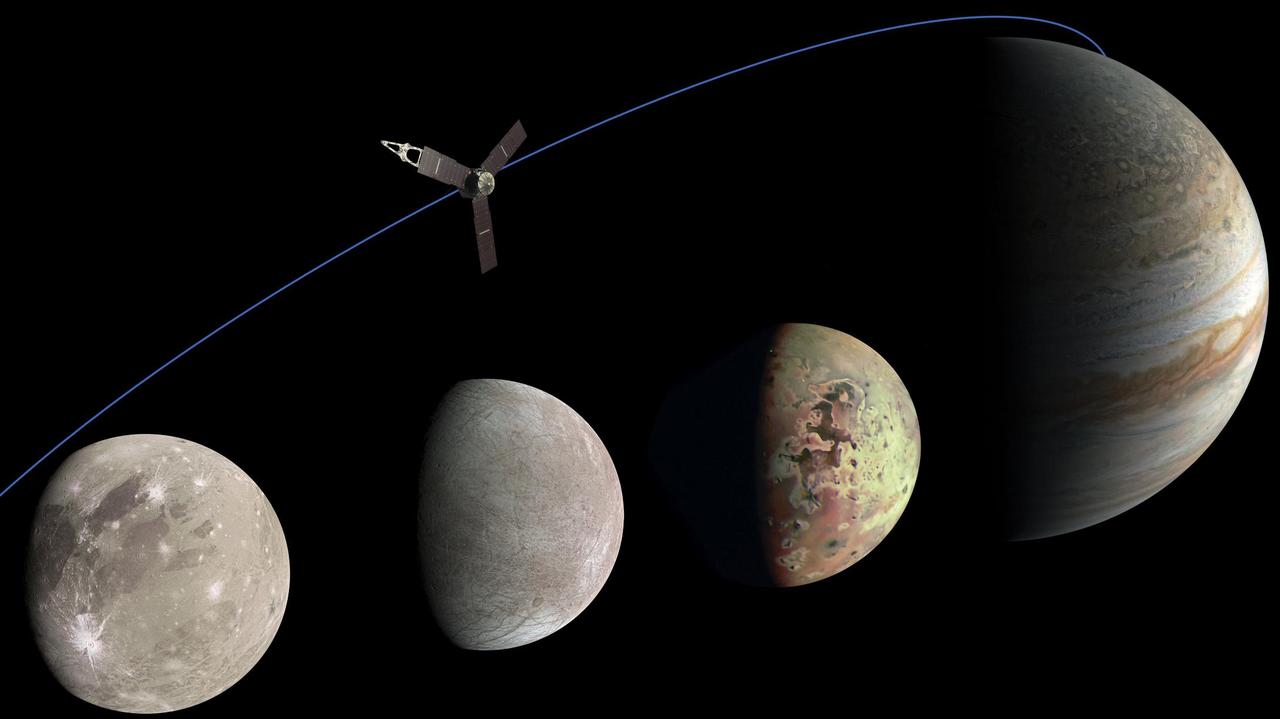
This photo illustration of Jupiter and the three Jovian moons NASA's Juno mission has flown past was generated from data collected by the spacecraft's JunoCam imager. Ganymede, the moon furthest to the left, was imaged by JunoCam as it flew past on June 8, 2021. Citizen scientist Kevin M. Gill created this image using data from JunoCam. The moon second from the left is Europa, which Juno imaged on Sept. 29, 2022. Citizen scientist Kevin M. Gill created this image using data from JunoCam. The image of Io was captured during a flyby of the moon on May 16, 2023. Citizen scientist Thomas Thomopoulos created this image using data from JunoCam. The image of Jupiter was captured on Dec. 15, 2022. Citizen scientist Kevin M. Gill created this image using data from JunoCam. https://photojournal.jpl.nasa.gov/catalog/PIA25966
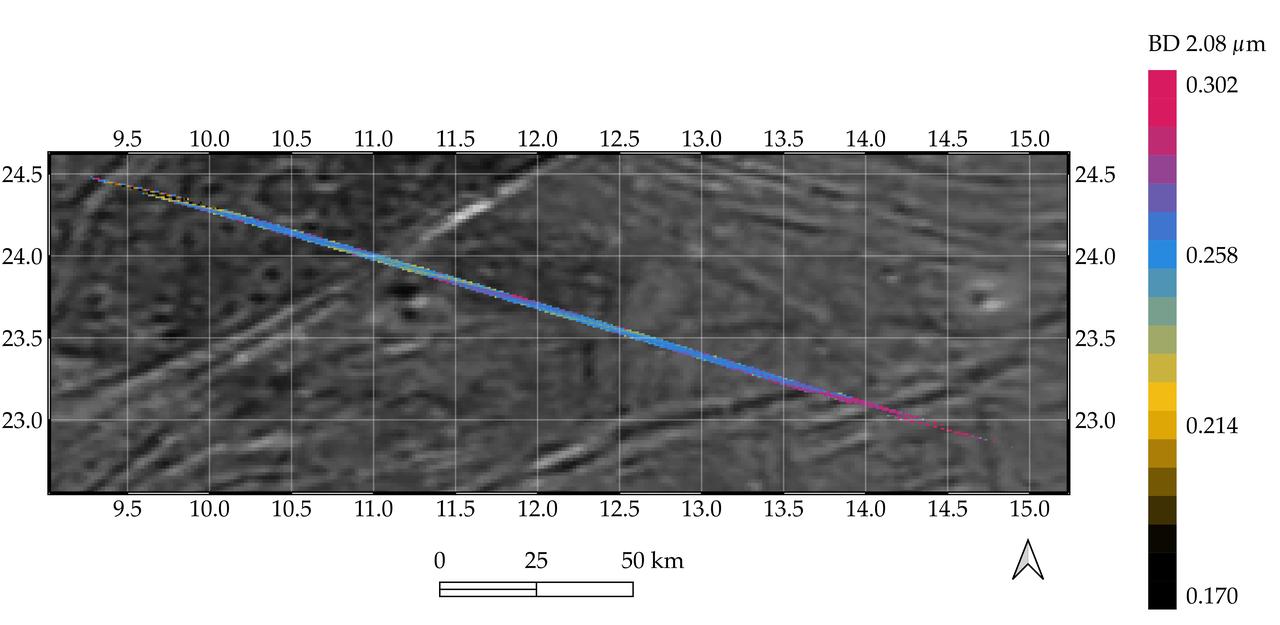
Processed data from the Jovian InfraRed Auroral Mapper (JIRAM) spectrometer aboard NASA's Juno mission is superimposed on a mosaic of optical images from the agency's Galileo and Voyager spacecraft that shows grooved terrain on Jupiter's moon Ganymede. This composite image covers a portion of Phrygia Suclus, northeast of Nanshe Catena, on Ganymede. The data was taken by Juno during its June 7, 2021, flyby of the icy moon. The JIRAM data is represented by the colored line running from the upper left to lower right in the graphic. The line depicts an increase in intensity of the spectral signature of a non-ice compound, possibly ammonium chloride, in the groove at the lower right of the image. JIRAM "sees" infrared light not visible to the human eye. It measures heat radiated from the planet at an infrared wavelengths. https://photojournal.jpl.nasa.gov/catalog/PIA26075
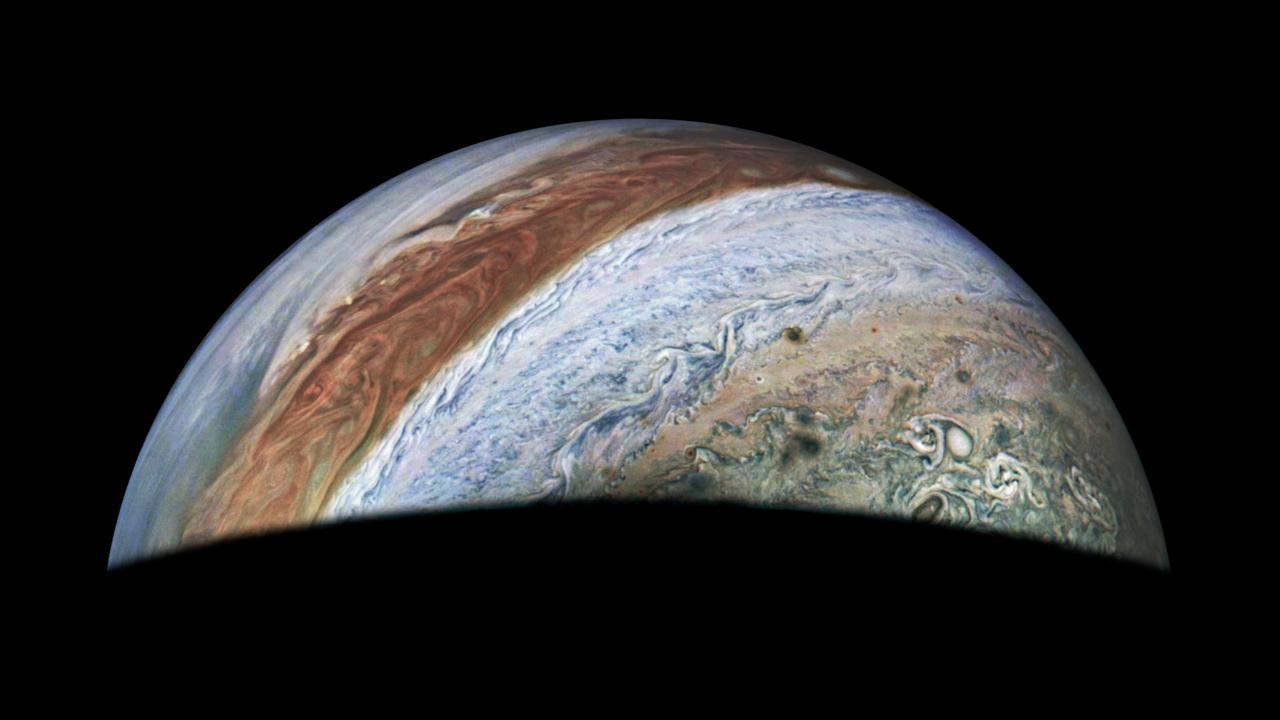
This view of Jupiter was captured by the JunoCam instrument aboard NASA's Juno spacecraft during the mission's 62nd close flyby of the giant planet on June 13, 2024. Citizen scientist Jackie Branc made the image using raw JunoCam data. https://photojournal.jpl.nasa.gov/catalog/PIA26350

CAPE CANAVERAL, Fla. – At NASA’s Kennedy Space Center in Florida, Steve Matousek (left), former Juno mission manager, and Jan Chodas, Juno project manager, both from the Jet Propulsion Laboratory in Pasadena, Calif., speak to about 150 followers of the agency’s Twitter account during Juno Tweetup activities inside a tent at the Press Site. The tweeters are at the center for two days of prelaunch activities. Juno is NASA’s mission to Jupiter to study the giant planet and improve our understanding of the planet’s formation and evolution. The tweeters will share their experiences with followers through the social networking site Twitter. Attendees represent 28 states, the District of Columbia and five other countries: Canada, Finland, Norway, Spain and the United Kingdom. This is the first time NASA has invited Twitter followers to experience the launch of a planetary spacecraft. The Juno spacecraft is scheduled to launch on an Atlas V rocket from Space Launch Complex 41 at Cape Canaveral Air Force Station in Florida, Aug. 5, at 11:34 a.m. EDT. For more information, visit http://www.nasa.gov/juno. Photo credit: Jim Grossmann
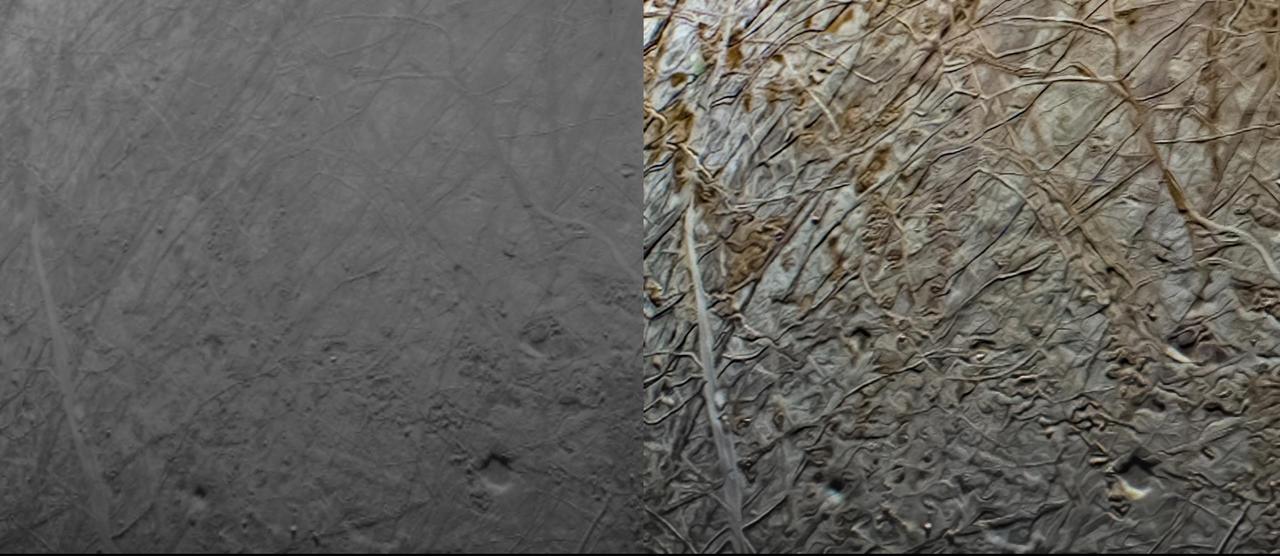
This pair of images shows the same portion of Jupiter's moon Europa before and after it was processed. The original (minimally processed) image, left, was captured by JunoCam, the public engagement camera aboard NASA's Juno spacecraft, during the mission's close flyby on Sept. 29, 2022. Captured at an altitude of 945 miles (1,521 kilometers) above a region of the moon called Annwn Regio, it was minimally processed. Citizen scientist Navaneeth Krishnan reprocessed the image to produce the version on the right. The enhanced color contrast causes larger surface features to stand out more. An example of the results can be seen in the lower right of this image, where the pits and a small rectangular block (reflecting more light than surrounding features) cast notable shadows. Small-scale texturing of the surface in the image needs to be carefully studied to distinguish between features and artifacts from processing, but the image serves both art and science by drawing us deeper into Europa's alien landscape. In processing raw images taken by JunoCam, members of the public create deep-space portraits of the Jovian moon that aren't only awe-inspiring but also worthy of further scientific scrutiny. Juno citizen scientists have played an invaluable role in processing the numerous JunoCam images obtained during science operations at Jupiter. https://photojournal.jpl.nasa.gov/catalog/PIA25333

A massive hot spot near the south pole of Io can be seen near the center of this annotated image taken by the JIRAM infrared imager aboard NASA's Juno on Dec. 27, 2024, during the spacecraft's flyby of the Jovian moon. The hot spot is larger than Earth's Lake Superior. At the time of closest approach during the flyby, Juno came within about 46,200 miles (74,400 kilometers) of the moon. JIRAM, short for Jovian Infrared Auroral Mapper, was contributed to the Juno mission by the Italian Space Agency. https://photojournal.jpl.nasa.gov/catalog/PIA26527

In this composite image, derived from data collected by the Jovian Infrared Auroral Mapper (JIRAM) instrument aboard NASA's Juno mission to Jupiter, shows the central cyclone at the planet's north pole and the eight cyclones that encircle it. JIRAM collects data in infrared, and the colors in this composite represent radiant heat: the yellow (thinner) clouds are about 9 degrees Fahrenheit (-13°Celsius) in brightness temperature and the dark red (thickest) are around -181 degrees Fahrenheit (83°Celsius). https://photojournal.jpl.nasa.gov/catalog/PIA22335
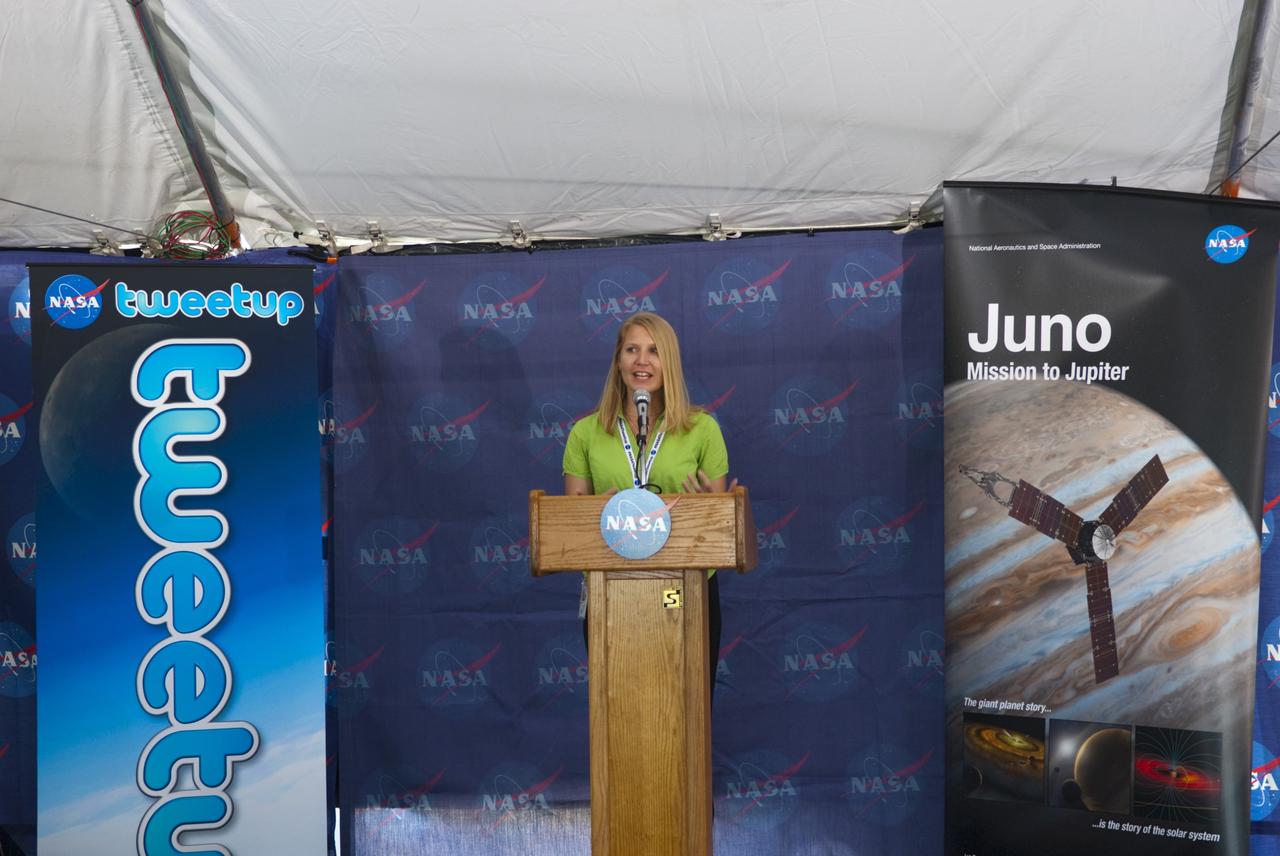
CAPE CANAVERAL, Fla. – At NASA’s Kennedy Space Center in Florida, NASA Tweetup coordinator Stephanie Schierholz welcomes about 150 tweeters to Juno Tweetup activities inside a tent at the Press Site. The tweeters are at the center for two days of prelaunch activities. Juno is NASA’s mission to Jupiter to study the giant planet and improve our understanding of the planet’s formation and evolution. The tweeters will share their experiences with followers through the social networking site Twitter. Attendees represent 28 states, the District of Columbia and five other countries: Canada, Finland, Norway, Spain and the United Kingdom. This is the first time NASA has invited Twitter followers to experience the launch of a planetary spacecraft. The Juno spacecraft is scheduled to launch on an Atlas V rocket from Space Launch Complex 41 at Cape Canaveral Air Force Station in Florida, Aug. 5, at 11:34 a.m. EDT. For more information, visit http://www.nasa.gov/juno. Photo credit: Jim Grossmann

CAPE CANAVERAL, Fla. – At NASA’s Kennedy Space Center in Florida, about 150 followers of the agency’s Twitter account arrived at the Tweetup tent at the Press Site for two days of Juno prelaunch activities. Juno is NASA’s mission to Jupiter to study the giant planet and improve our understanding of the planet’s formation and evolution. The tweeters will share their experiences with followers through the social networking site Twitter. Attendees represent 28 states, the District of Columbia and five other countries: Canada, Finland, Norway, Spain and the United Kingdom. This is the first time NASA has invited Twitter followers to experience the launch of a planetary spacecraft. The Juno spacecraft is scheduled to launch on an Atlas V rocket from Space Launch Complex 41 at Cape Canaveral Air Force Station in Florida, Aug. 5, at 11:34 a.m. EDT. For more information, visit http://www.nasa.gov/juno. Photo credit: Jim Grossmann
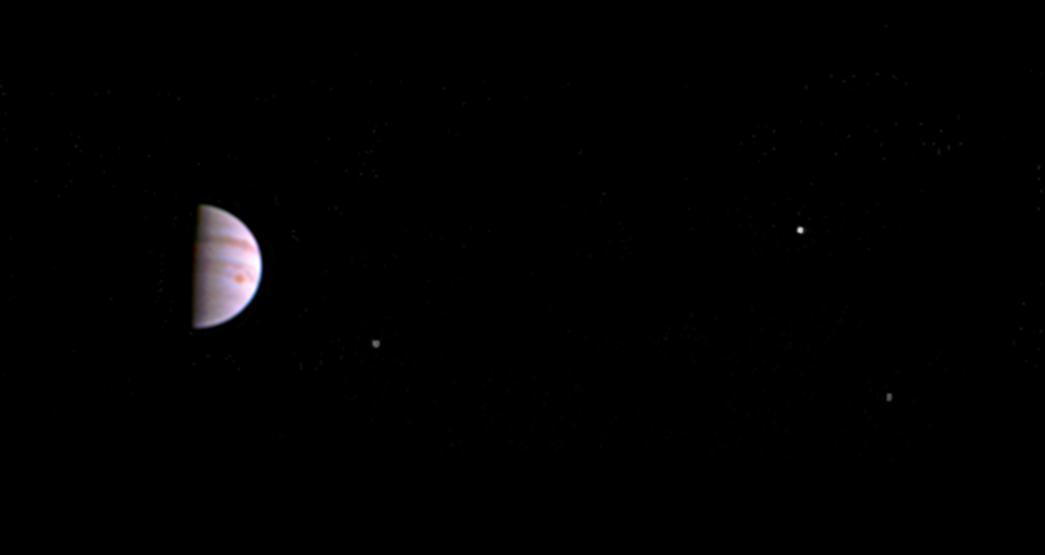
This color view from NASA's Juno spacecraft is made from some of the first images taken by JunoCam after the spacecraft entered orbit around Jupiter on July 5th (UTC). The view shows that JunoCam survived its first pass through Jupiter's extreme radiation environment, and is ready to collect images of the giant planet as Juno begins its mission. The image was taken on July 10, 2016 at 5:30 UTC, when the spacecraft was 2.7 million miles (4.3 million kilometers) from Jupiter on the outbound leg of its initial 53.5-day capture orbit. The image shows atmospheric features on Jupiter, including the Great Red Spot, and three of Jupiter's four largest moons. JunoCam will continue to image Jupiter during Juno's capture orbits. The first high-resolution images of the planet will be taken on August 27 when the Juno spacecraft makes its next close pass to Jupiter. http://photojournal.jpl.nasa.gov/catalog/PIA20707

CAPE CANAVERAL, Fla. – At NASA’s Kennedy Space Center in Florida, about 150 followers of the agency’s Twitter account listen to presentations about NASA’s Juno mission to Jupiter during Tweetup activities inside a tent at the Press Site. The tweeters are at the center for two days of Juno prelaunch activities. Juno is NASA’s mission to Jupiter to study the giant planet and improve our understanding of the planet’s formation and evolution. The tweeters will share their experiences with followers through the social networking site Twitter. Attendees represent 28 states, the District of Columbia and five other countries: Canada, Finland, Norway, Spain and the United Kingdom. This is the first time NASA has invited Twitter followers to experience the launch of a planetary spacecraft. The Juno spacecraft is scheduled to launch on an Atlas V rocket from Space Launch Complex 41 at Cape Canaveral Air Force Station in Florida, Aug. 5, at 11:34 a.m. EDT. For more information, visit http://www.nasa.gov/juno. Photo credit: NASA/Fletcher Hildreth

CAPE CANAVERAL, Fla. -- A Juno prelaunch news conference is held in the NASA Press Site auditorium at NASA's Kennedy Space Center in Florida. From left are George Diller, NASA Public Affairs; Colleen Hartman, assistant associate administrator, Science Mission Directorate, NASA Headquarters, Washington; Omar Baez, NASA launch director, Kennedy Space Center, Cape Canaveral, Fla.; Vernon Thorp, program manager, NASA Missions, United Launch Alliance, Denver, Colo.; Jan Chodas, Juno project manager, Jet Propulsion Laboratory, Pasadena, Calif.; Tim Gasparrini, Juno program manager, Lockheed Martin Space Systems, Denver, Colo.; and Capt. Billy Whisel, launch weather officer, 45th Weather Squadron, Cape Canaveral Air Force Station, Fla. Juno is scheduled to launch Aug. 5 aboard a United Launch Alliance Atlas V rocket from Cape Canaveral Air Force Station in Florida. The solar-powered spacecraft will orbit Jupiter's poles 33 times to find out more about the gas giant's origins, structure, atmosphere and magnetosphere and investigate the existence of a solid planetary core. For more information, visit www.nasa.gov/juno. Photo credit: NASA/Kim Shiflett

CAPE CANAVERAL, Fla. – At NASA’s Kennedy Space Center in Florida, about 150 followers of the agency’s Twitter account listen to presentations about NASA’s Juno mission to Jupiter during Tweetup activities inside a tent at the Press Site. The tweeters are at the center for two days of Juno prelaunch activities. Juno is NASA’s mission to Jupiter to study the giant planet and improve our understanding of the planet’s formation and evolution. The tweeters will share their experiences with followers through the social networking site Twitter. Attendees represent 28 states, the District of Columbia and five other countries: Canada, Finland, Norway, Spain and the United Kingdom. This is the first time NASA has invited Twitter followers to experience the launch of a planetary spacecraft. The Juno spacecraft is scheduled to launch on an Atlas V rocket from Space Launch Complex 41 at Cape Canaveral Air Force Station in Florida, Aug. 5, at 11:34 a.m. EDT. For more information, visit http://www.nasa.gov/juno. Photo credit: NASA/Fletcher Hildreth

CAPE CANAVERAL, Fla. – At NASA’s Kennedy Space Center in Florida, about 150 followers of the agency’s Twitter account listen to presentations about NASA’s Juno mission to Jupiter during Tweetup activities inside a tent at the Press Site. The tweeters are at the center for two days of Juno prelaunch activities. Juno is NASA’s mission to Jupiter to study the giant planet and improve our understanding of the planet’s formation and evolution. The tweeters will share their experiences with followers through the social networking site Twitter. Attendees represent 28 states, the District of Columbia and five other countries: Canada, Finland, Norway, Spain and the United Kingdom. This is the first time NASA has invited Twitter followers to experience the launch of a planetary spacecraft. The Juno spacecraft is scheduled to launch on an Atlas V rocket from Space Launch Complex 41 at Cape Canaveral Air Force Station in Florida, Aug. 5, at 11:34 a.m. EDT. For more information, visit http://www.nasa.gov/juno. Photo credit: Jim Grossmann
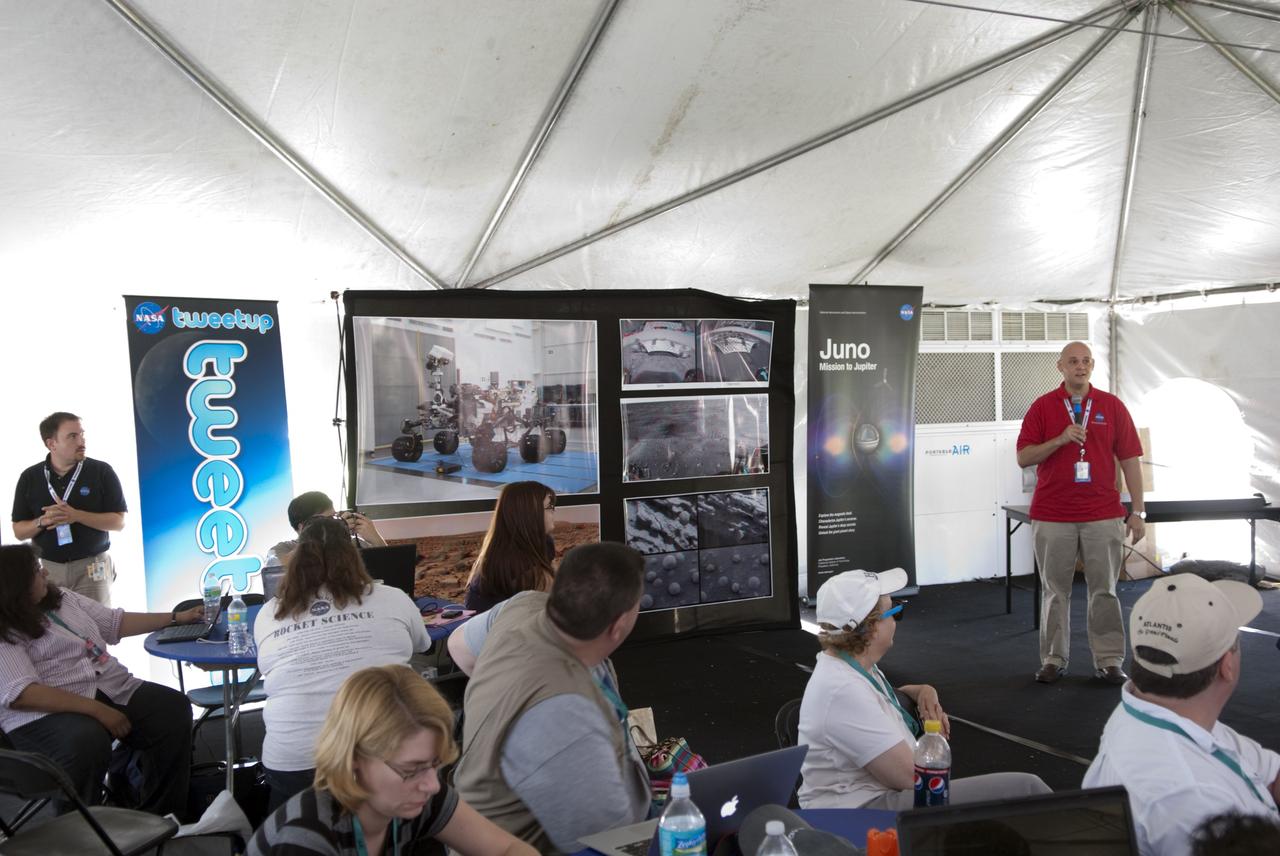
CAPE CANAVERAL, Fla. – At NASA’s Kennedy Space Center in Florida, about 150 followers of the agency’s Twitter account listen to presentations about NASA’s Juno mission to Jupiter during Tweetup activities inside a tent at the Press Site. The tweeters are at the center for two days of Juno prelaunch activities. Juno is NASA’s mission to Jupiter to study the giant planet and improve our understanding of the planet’s formation and evolution. The tweeters will share their experiences with followers through the social networking site Twitter. Attendees represent 28 states, the District of Columbia and five other countries: Canada, Finland, Norway, Spain and the United Kingdom. This is the first time NASA has invited Twitter followers to experience the launch of a planetary spacecraft. The Juno spacecraft is scheduled to launch on an Atlas V rocket from Space Launch Complex 41 at Cape Canaveral Air Force Station in Florida, Aug. 5, at 11:34 a.m. EDT. For more information, visit http://www.nasa.gov/juno. Photo credit: Jim Grossmann

CAPE CANAVERAL, Fla. -- Media representatives question the participants of a Juno prelaunch news conference in the NASA Press Site auditorium at NASA's Kennedy Space Center in Florida. From left are George Diller, NASA Public Affairs; Colleen Hartman, assistant associate administrator, Science Mission Directorate, NASA Headquarters, Washington; Omar Baez, NASA launch director, Kennedy Space Center, Cape Canaveral, Fla.; Vernon Thorp, program manager, NASA Missions, United Launch Alliance, Denver, Colo.; Jan Chodas, Juno project manager, Jet Propulsion Laboratory, Pasadena, Calif.; Tim Gasparrini, Juno program manager, Lockheed Martin Space Systems, Denver, Colo.; and Capt. Billy Whisel, launch weather officer, 45th Weather Squadron, Cape Canaveral Air Force Station, Fla. Juno is scheduled to launch Aug. 5 aboard a United Launch Alliance Atlas V rocket from Cape Canaveral Air Force Station in Florida. The solar-powered spacecraft will orbit Jupiter's poles 33 times to find out more about the gas giant's origins, structure, atmosphere and magnetosphere and investigate the existence of a solid planetary core. For more information, visit www.nasa.gov/juno. Photo credit: NASA/Kim Shiflett
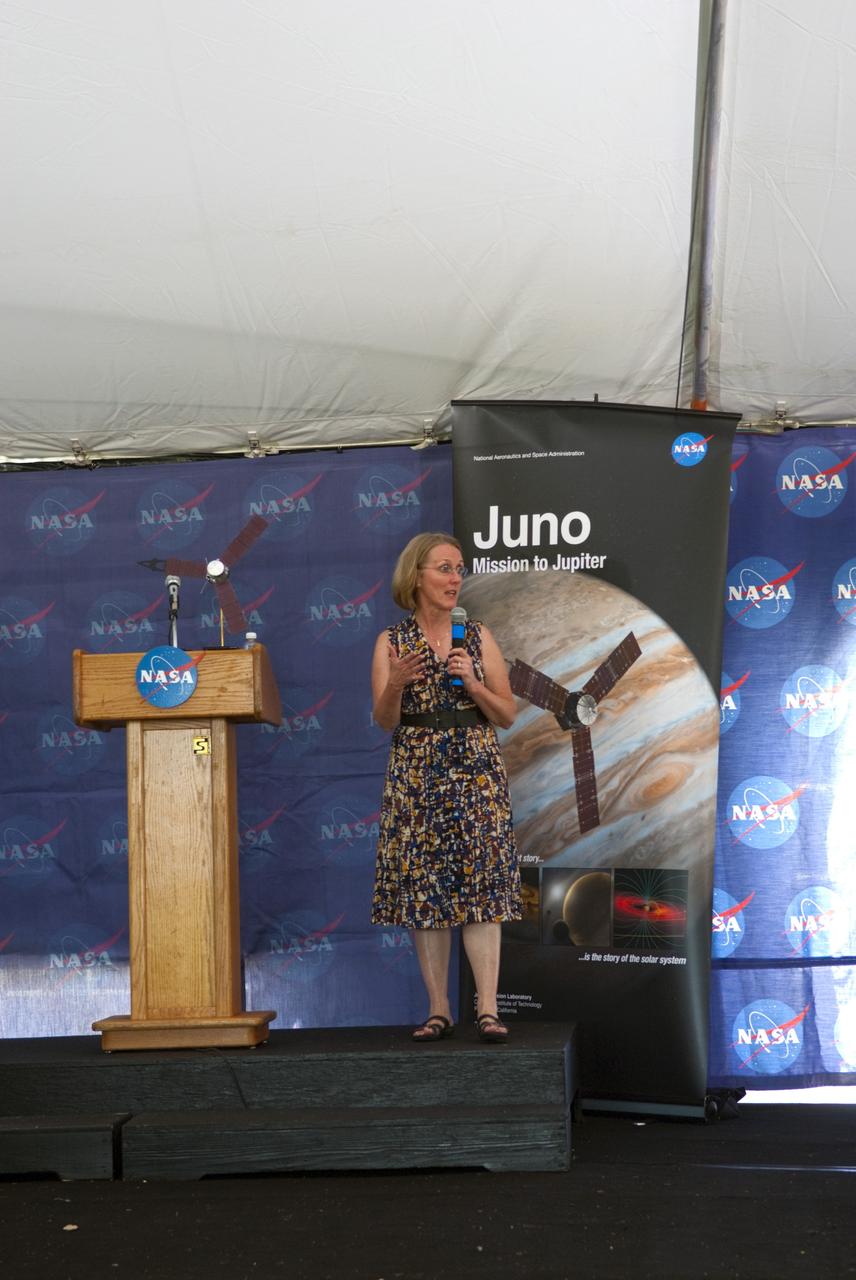
CAPE CANAVERAL, Fla. – At NASA’s Kennedy Space Center in Florida, Jan Chodas, Juno project manager from the Jet Propulsion Laboratory in Pasadena, Calif., speaks to about 150 followers of the agency’s Twitter account during Juno Tweetup activities inside a tent at the Press Site. The tweeters are at the center for two days of prelaunch activities. Juno is NASA’s mission to Jupiter to study the giant planet and improve our understanding of the planet’s formation and evolution. The tweeters will share their experiences with followers through the social networking site Twitter. Attendees represent 28 states, the District of Columbia and five other countries: Canada, Finland, Norway, Spain and the United Kingdom. This is the first time NASA has invited Twitter followers to experience the launch of a planetary spacecraft. The Juno spacecraft is scheduled to launch on an Atlas V rocket from Space Launch Complex 41 at Cape Canaveral Air Force Station in Florida, Aug. 5, at 11:34 a.m. EDT. For more information, visit http://www.nasa.gov/juno. Photo credit: Jim Grossmann

CAPE CANAVERAL, Fla. – At NASA’s Kennedy Space Center in Florida, Steve Levin, Juno project scientist from the Jet Propulsion Laboratory in Pasadena, Calif., speaks to about 150 followers of the agency’s Twitter account during Juno Tweetup activities inside a tent at the Press Site. The tweeters are at the center for two days of prelaunch activities. Juno is NASA’s mission to Jupiter to study the giant planet and improve our understanding of the planet’s formation and evolution. The tweeters will share their experiences with followers through the social networking site Twitter. Attendees represent 28 states, the District of Columbia and five other countries: Canada, Finland, Norway, Spain and the United Kingdom. This is the first time NASA has invited Twitter followers to experience the launch of a planetary spacecraft. The Juno spacecraft is scheduled to launch on an Atlas V rocket from Space Launch Complex 41 at Cape Canaveral Air Force Station in Florida, Aug. 5, at 11:34 a.m. EDT. For more information, visit http://www.nasa.gov/juno. Photo credit: Jim Grossmann
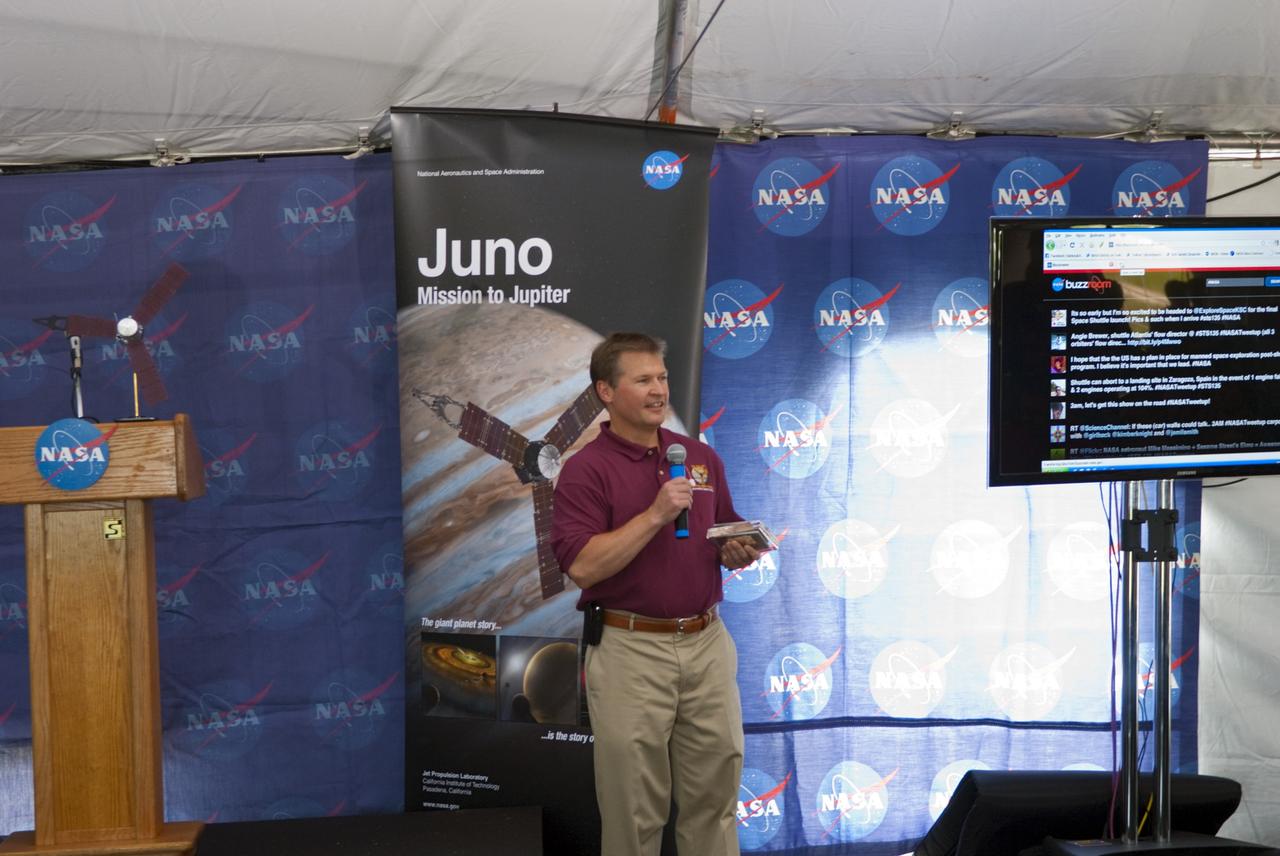
CAPE CANAVERAL, Fla. – At NASA’s Kennedy Space Center in Florida, Chris Brosious, Juno chief systems engineer for Lockheed Martin, speaks to about 150 followers of the agency’s Twitter account during Juno Tweetup activities inside a tent at the Press Site. The tweeters are at the center for two days of prelaunch activities. Juno is NASA’s mission to Jupiter to study the giant planet and improve our understanding of the planet’s formation and evolution. The tweeters will share their experiences with followers through the social networking site Twitter. Attendees represent 28 states, the District of Columbia and five other countries: Canada, Finland, Norway, Spain and the United Kingdom. This is the first time NASA has invited Twitter followers to experience the launch of a planetary spacecraft. The Juno spacecraft is scheduled to launch on an Atlas V rocket from Space Launch Complex 41 at Cape Canaveral Air Force Station in Florida, Aug. 5, at 11:34 a.m. EDT. For more information, visit http://www.nasa.gov/juno. Photo credit: Jim Grossmann

CAPE CANAVERAL, Fla. – At NASA’s Kennedy Space Center in Florida, Steve Levin, Juno project scientist from the Jet Propulsion Laboratory in Pasadena, Calif., speaks to about 150 followers of the agency’s Twitter account during Juno Tweetup activities inside a tent at the Press Site. The tweeters are at the center for two days of prelaunch activities. Juno is NASA’s mission to Jupiter to study the giant planet and improve our understanding of the planet’s formation and evolution. The tweeters will share their experiences with followers through the social networking site Twitter. Attendees represent 28 states, the District of Columbia and five other countries: Canada, Finland, Norway, Spain and the United Kingdom. This is the first time NASA has invited Twitter followers to experience the launch of a planetary spacecraft. The Juno spacecraft is scheduled to launch on an Atlas V rocket from Space Launch Complex 41 at Cape Canaveral Air Force Station in Florida, Aug. 5, at 11:34 a.m. EDT. For more information, visit http://www.nasa.gov/juno. Photo credit: Jim Grossmann
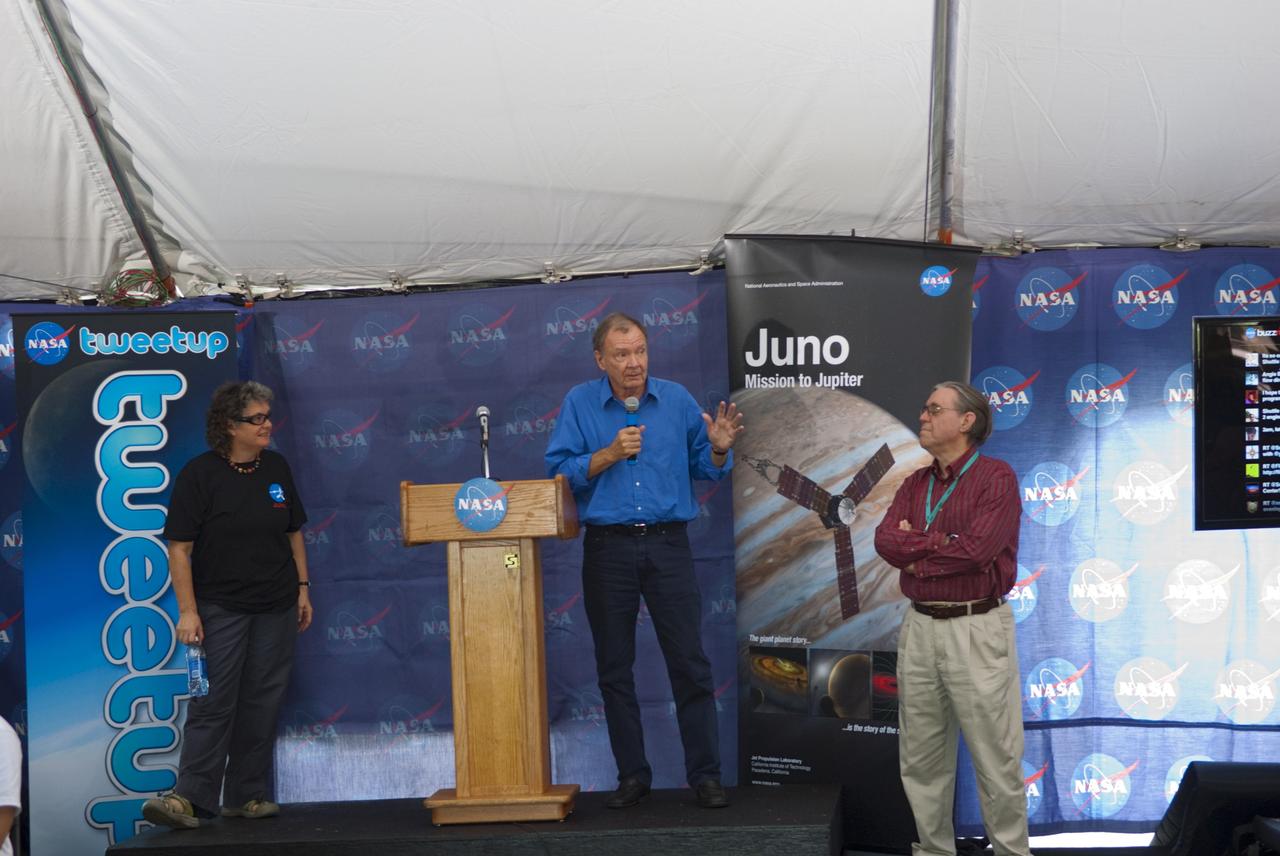
CAPE CANAVERAL, Fla. – At NASA’s Kennedy Space Center in Florida, Toby Owen, Juno co-investigator from the University of Hawaii, speaks to about 150 followers of the agency’s Twitter account during Juno Tweetup activities inside a tent at the Press Site. The tweeters are at the center for two days of prelaunch activities. Juno is NASA’s mission to Jupiter to study the giant planet and improve our understanding of the planet’s formation and evolution. The tweeters will share their experiences with followers through the social networking site Twitter. Attendees represent 28 states, the District of Columbia and five other countries: Canada, Finland, Norway, Spain and the United Kingdom. This is the first time NASA has invited Twitter followers to experience the launch of a planetary spacecraft. The Juno spacecraft is scheduled to launch on an Atlas V rocket from Space Launch Complex 41 at Cape Canaveral Air Force Station in Florida, Aug. 5, at 11:34 a.m. EDT. For more information, visit http://www.nasa.gov/juno. Photo credit: Jim Grossmann
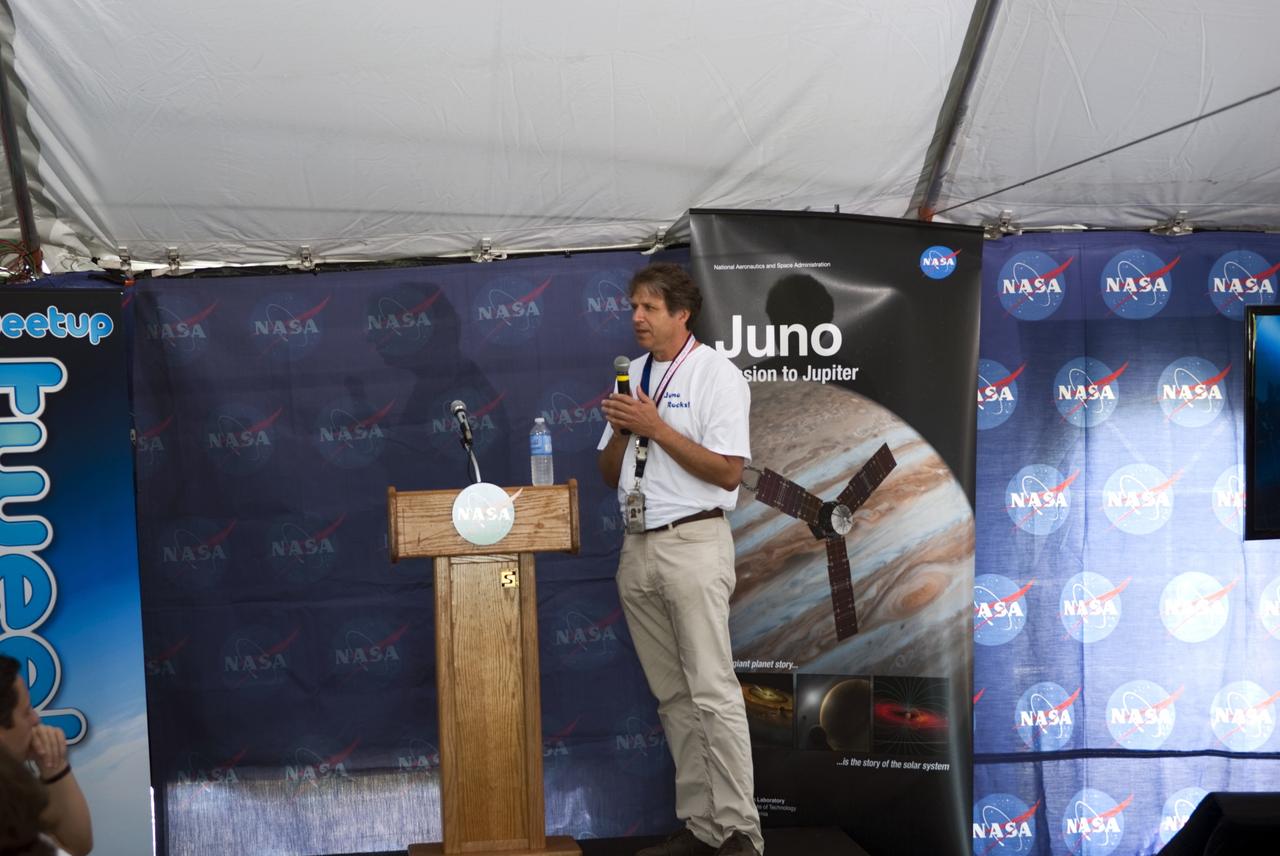
CAPE CANAVERAL, Fla. – At NASA’s Kennedy Space Center in Florida, Scott Bolton, Juno primary investigator from the Southwest Research Institute in San Antonio, speaks to about 150 followers of the agency’s Twitter account during Juno Tweetup activities inside a tent at the Press Site. The tweeters are at the center for two days of prelaunch activities. Juno is NASA’s mission to Jupiter to study the giant planet and improve our understanding of the planet’s formation and evolution. The tweeters will share their experiences with followers through the social networking site Twitter. Attendees represent 28 states, the District of Columbia and five other countries: Canada, Finland, Norway, Spain and the United Kingdom. This is the first time NASA has invited Twitter followers to experience the launch of a planetary spacecraft. The Juno spacecraft is scheduled to launch on an Atlas V rocket from Space Launch Complex 41 at Cape Canaveral Air Force Station in Florida, Aug. 5, at 11:34 a.m. EDT. For more information, visit http://www.nasa.gov/juno. Photo credit: Jim Grossmann

NASA's Juno mission captured this infrared view of Jupiter's volcanic moon Io on July 5, 2022, when the spacecraft was about 50,000 miles (80,000 kilometers) away. This infrared image was derived from data collected by the Jovian Infrared Auroral Mapper (JIRAM) instrument aboard Juno. In this image, the brighter the color the higher the temperature recorded by JIRAM. https://photojournal.jpl.nasa.gov/catalog/PIA25698
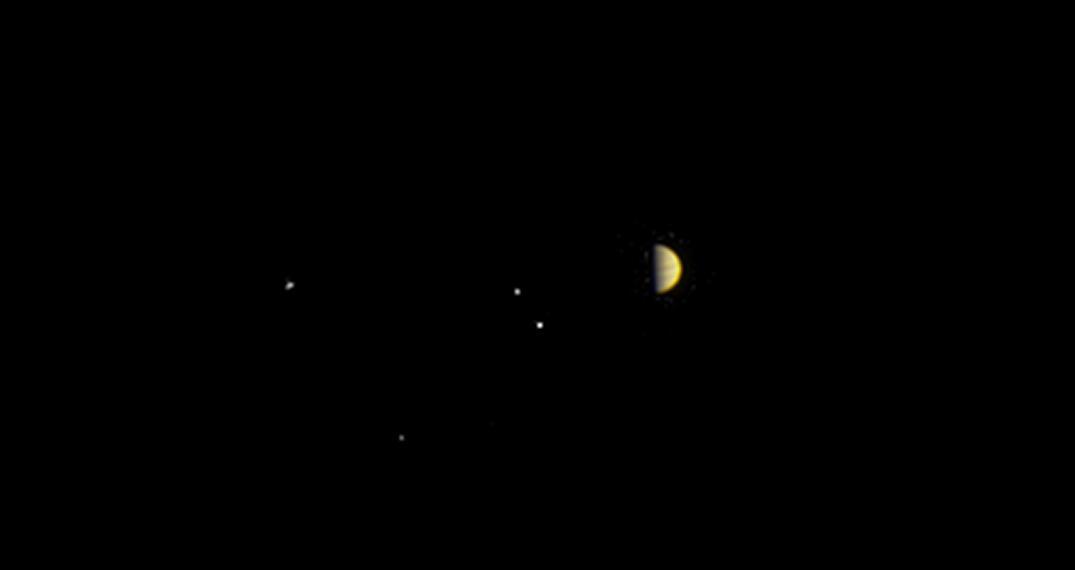
NASA's Juno spacecraft obtained this color view on June 21, 2016, at a distance of 6.8 million miles (10.9 million kilometers) from Jupiter. As Juno makes its initial approach, the giant planet's four largest moons -- Io, Europa, Ganymede and Callisto -- are visible, and the alternating light and dark bands of the planet's clouds are just beginning to come into view. Juno is approaching over Jupiter's north pole, affording the spacecraft a unique perspective on the Jupiter system. Previous missions that imaged Jupiter on approach saw the system from much lower latitudes, closer to the planet's equator. The scene was captured by the mission's imaging camera, called JunoCam, which is designed to acquire high resolution views of features in Jupiter's atmosphere from very close to the planet. http://photojournal.jpl.nasa.gov/catalog/PIA20701
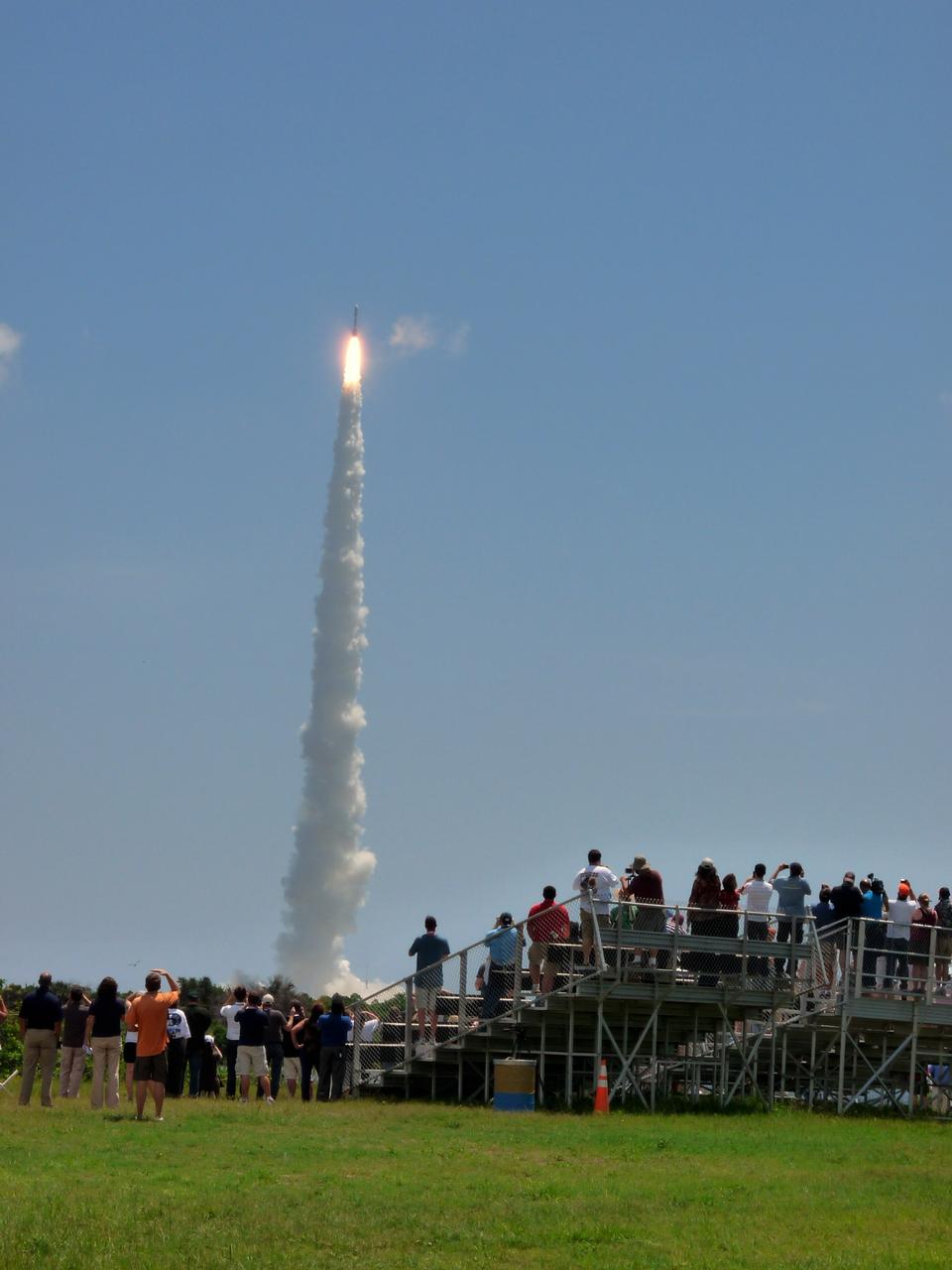
CAPE CANAVERAL, Fla. -- At the Press Site at NASA’s Kennedy Space Center in Florida, about 150 followers of the agency’s Twitter account view the launch of NASA's Juno planetary probe atop a United Launch Alliance Atlas V-551 rocket. The tweeters, in turn, will share their experiences with followers through the social networking site Twitter. Liftoff was at 12:25 p.m. EDT Aug. 5 from Space Launch Complex 41 on Cape Canaveral Air Force Station in Florida. The solar-powered spacecraft will orbit Jupiter's poles 33 times to find out more about the gas giant's origins, structure, atmosphere and magnetosphere and investigate the existence of a solid planetary core. NASA's Jet Propulsion Laboratory, Pasadena, Calif., manages the Juno mission for the principal investigator, Scott Bolton, of Southwest Research Institute in San Antonio. The Juno mission is part of the New Frontiers Program managed at NASA's Marshall Space Flight Center in Huntsville, Ala. Lockheed Martin Space Systems, Denver, built the spacecraft. Launch management for the mission is the responsibility of NASA's Launch Services Program at the Kennedy Space Center in Florida. For more information, visit www.nasa.gov/juno. Photo credit: NASA/Fletcher Hildreth
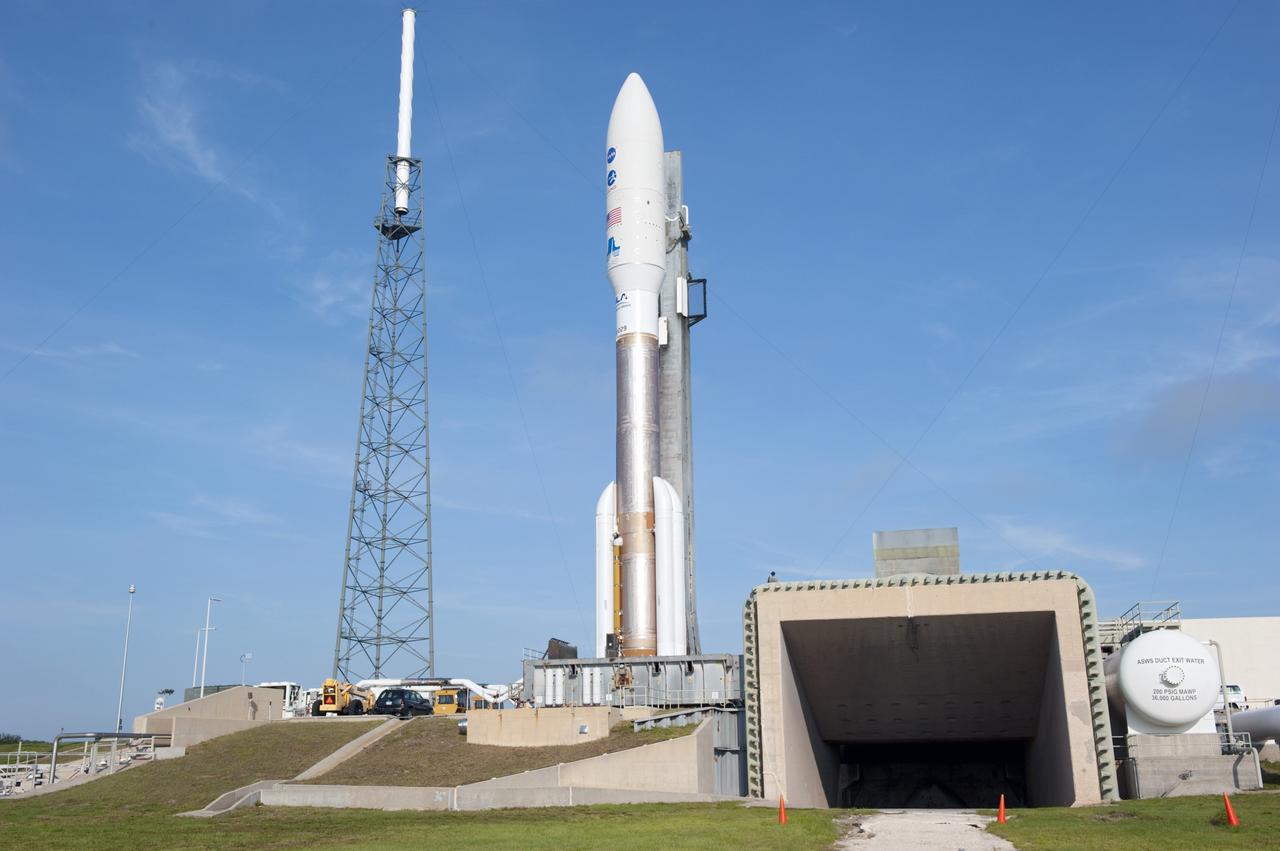
CAPE CANAVERAL, Fla. -- On Cape Canaveral Air Force Station in Florida, the 197-foot-tall United Launch Alliance Atlas V-551 launch vehicle is in position beside the exhaust duct on the launch pad at Space Launch Complex 41. Atop the rocket is NASA's Juno spacecraft, enclosed in its payload fairing. Liftoff is planned during a launch window which extends from 11:34 a.m. to 12:43 p.m. EDT on Aug. 5. The solar-powered spacecraft will orbit Jupiter's poles 33 times to find out more about the gas giant's origins, structure, atmosphere and magnetosphere and investigate the existence of a solid planetary core. NASA's Jet Propulsion Laboratory, Pasadena, Calif., manages the Juno mission for the principal investigator, Scott Bolton, of Southwest Research Institute in San Antonio. The Juno mission is part of the New Frontiers Program managed at NASA's Marshall Space Flight Center in Huntsville, Ala. Lockheed Martin Space Systems, Denver, built the spacecraft. Launch management for the mission is the responsibility of NASA's Launch Services Program at the Kennedy Space Center in Florida. For more information, visit www.nasa.gov/juno. Photo credit: NASA/Kim Shiflett
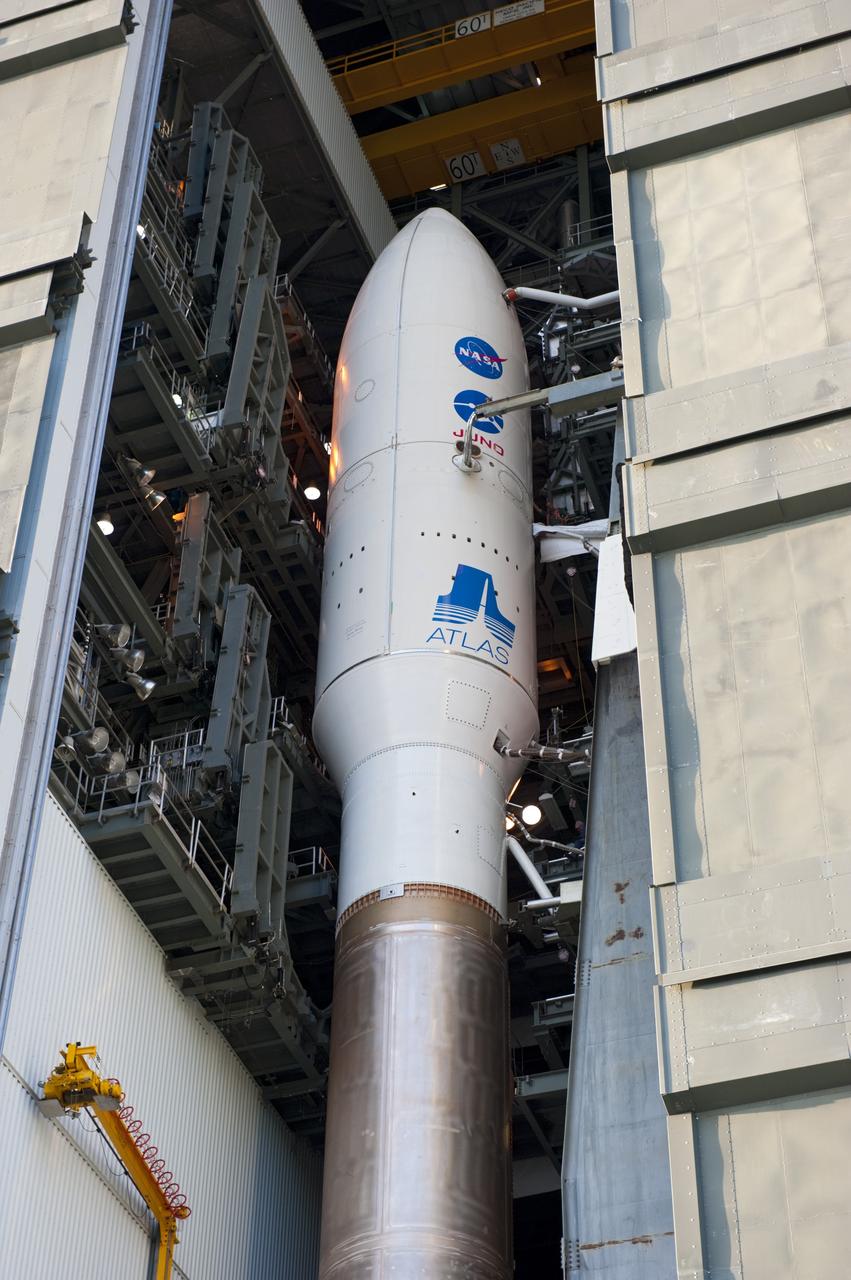
CAPE CANAVERAL, Fla. -- In the Vertical Integration Facility on Cape Canaveral Air Force Station in Florida, NASA's Juno spacecraft, enclosed in its payload fairing, sits atop the United Launch Alliance Atlas V-551 launch vehicle, awaiting its move to Space Launch Complex 41. Liftoff is planned during a launch window which extends from 11:34 a.m. to 12:43 p.m. EDT on Aug. 5. The solar-powered spacecraft will orbit Jupiter's poles 33 times to find out more about the gas giant's origins, structure, atmosphere and magnetosphere and investigate the existence of a solid planetary core. NASA's Jet Propulsion Laboratory, Pasadena, Calif., manages the Juno mission for the principal investigator, Scott Bolton, of Southwest Research Institute in San Antonio. The Juno mission is part of the New Frontiers Program managed at NASA's Marshall Space Flight Center in Huntsville, Ala. Lockheed Martin Space Systems, Denver, built the spacecraft. Launch management for the mission is the responsibility of NASA's Launch Services Program at the Kennedy Space Center in Florida. For more information, visit www.nasa.gov/juno. Photo credit: NASA/Kim Shiflett
CAPE CANAVERAL, Fla. -- NASA's Juno spacecraft, enclosed in the payload fairing atop a United Launch Alliance Atlas V-551 launch vehicle, arrives at Space Launch Complex 41 on Cape Canaveral Air Force Station in Florida. Launch is planned during a launch window which extends from 11:34 a.m. to 12:43 p.m. EDT on Aug. 5. The solar-powered spacecraft will orbit Jupiter's poles 33 times to find out more about the gas giant's origins, structure, atmosphere and magnetosphere and investigate the existence of a solid planetary core. NASA's Jet Propulsion Laboratory, Pasadena, Calif., manages the Juno mission for the principal investigator, Scott Bolton, of Southwest Research Institute in San Antonio. The Juno mission is part of the New Frontiers Program managed at NASA's Marshall Space Flight Center in Huntsville, Ala. Lockheed Martin Space Systems, Denver, built the spacecraft. Launch management for the mission is the responsibility of NASA's Launch Services Program at the Kennedy Space Center in Florida. For more information, visit www.nasa.gov/juno. Photo credit: NASA/Kim Shiflett
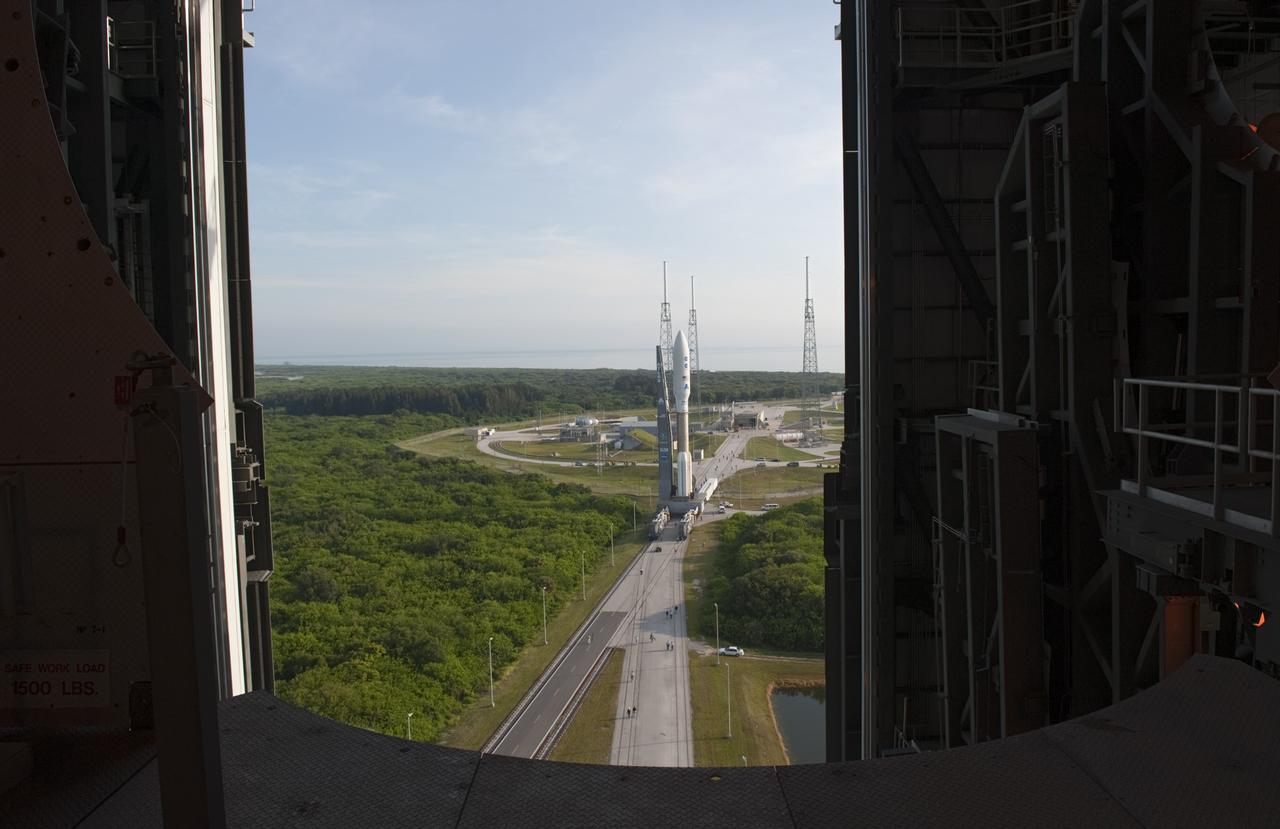
CAPE CANAVERAL, Fla. -- On Cape Canaveral Air Force Station in Florida, the Vertical Integration Facility offers a unique vantage point to view the United Launch Alliance Atlas V-551 launch vehicle as it makes a slow, steady approach to Space Launch Complex 41. Atop the rocket is NASA's Juno spacecraft, enclosed in its payload fairing. Liftoff is planned during a launch window which extends from 11:34 a.m. to 12:43 p.m. EDT on Aug. 5. The solar-powered spacecraft will orbit Jupiter's poles 33 times to find out more about the gas giant's origins, structure, atmosphere and magnetosphere and investigate the existence of a solid planetary core. NASA's Jet Propulsion Laboratory, Pasadena, Calif., manages the Juno mission for the principal investigator, Scott Bolton, of Southwest Research Institute in San Antonio. The Juno mission is part of the New Frontiers Program managed at NASA's Marshall Space Flight Center in Huntsville, Ala. Lockheed Martin Space Systems, Denver, built the spacecraft. Launch management for the mission is the responsibility of NASA's Launch Services Program at the Kennedy Space Center in Florida. For more information, visit www.nasa.gov/juno. Photo credit: NASA/Kim Shiflett
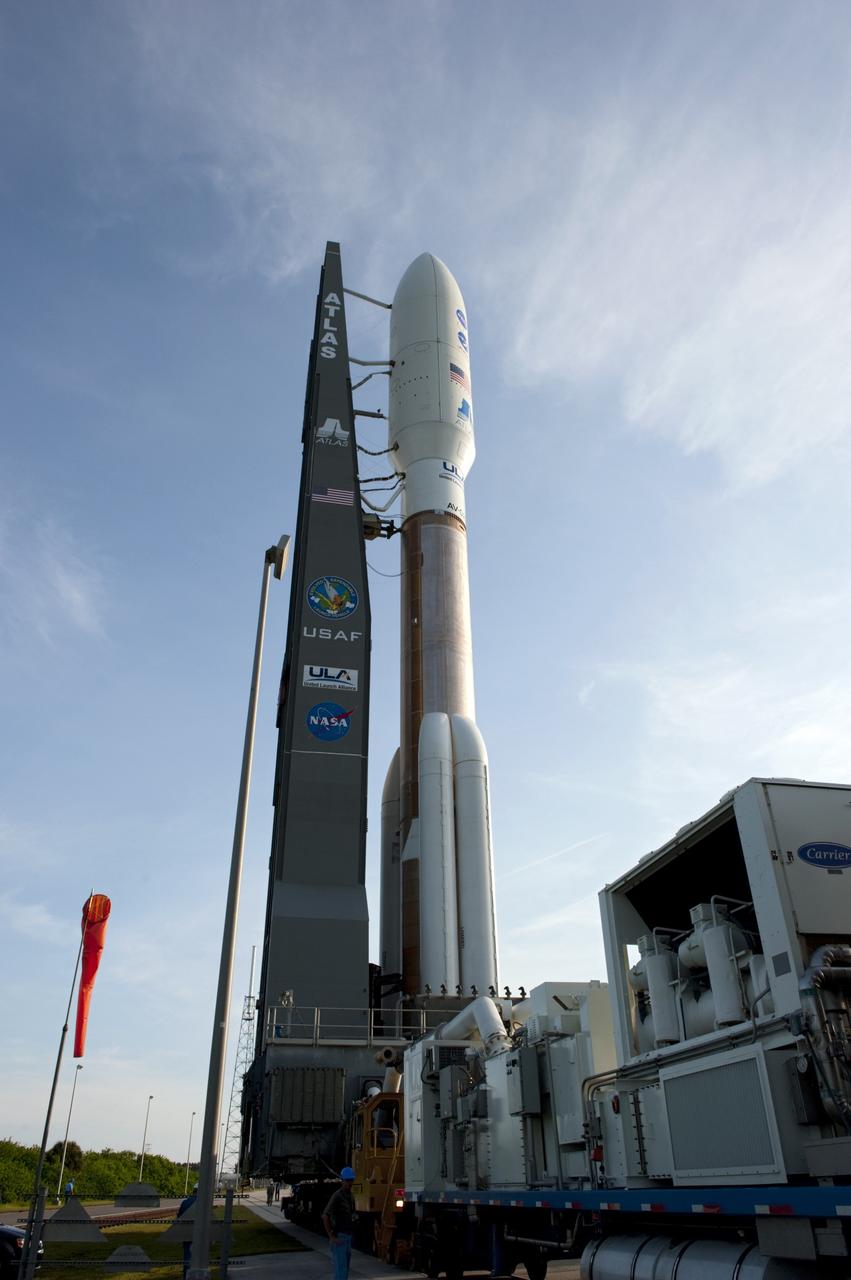
CAPE CANAVERAL, Fla. -- On Cape Canaveral Air Force Station in Florida, the 197-foot-tall United Launch Alliance Atlas V-551 launch vehicle makes a slow, steady approach to Space Launch Complex 41 on its move from the Vertical Integration Facility. Atop the rocket is NASA's Juno spacecraft, enclosed in its payload fairing. Liftoff is planned during a launch window which extends from 11:34 a.m. to 12:43 p.m. EDT on Aug. 5. The solar-powered spacecraft will orbit Jupiter's poles 33 times to find out more about the gas giant's origins, structure, atmosphere and magnetosphere and investigate the existence of a solid planetary core. NASA's Jet Propulsion Laboratory, Pasadena, Calif., manages the Juno mission for the principal investigator, Scott Bolton, of Southwest Research Institute in San Antonio. The Juno mission is part of the New Frontiers Program managed at NASA's Marshall Space Flight Center in Huntsville, Ala. Lockheed Martin Space Systems, Denver, built the spacecraft. Launch management for the mission is the responsibility of NASA's Launch Services Program at the Kennedy Space Center in Florida. For more information, visit www.nasa.gov/juno. Photo credit: NASA/Kim Shiflett
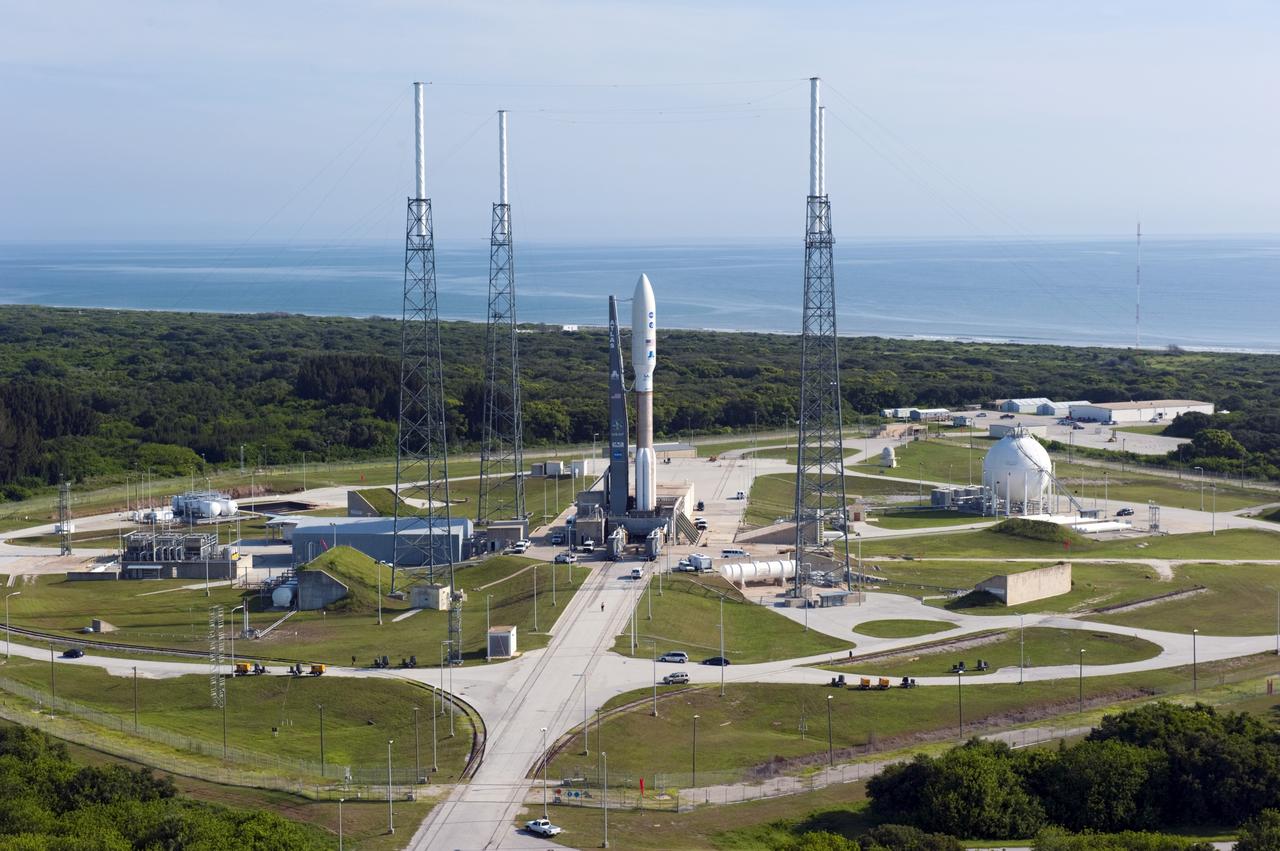
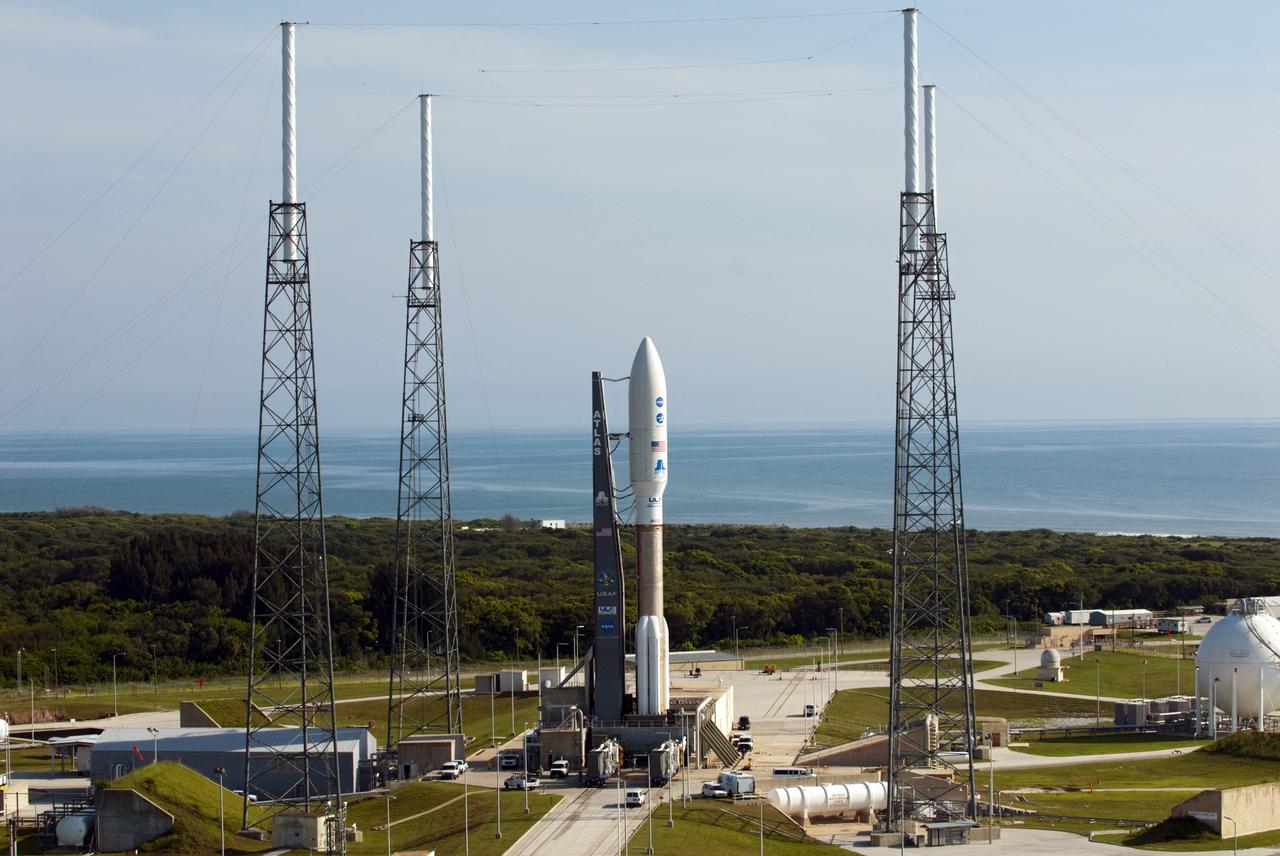
CAPE CANAVERAL, Fla. -- NASA's Juno spacecraft, enclosed in its payload fairing atop a United Launch Alliance Atlas V-551 launch vehicle, is nestled between the towers of the lightning protection system at Space Launch Complex 41 on Cape Canaveral Air Force Station in Florida. The water of the Atlantic Ocean rolls in the distance as far as the eye can see. Launch is planned during a launch window which extends from 11:34 a.m. to 12:43 p.m. EDT on Aug. 5. The solar-powered spacecraft will orbit Jupiter's poles 33 times to find out more about the gas giant's origins, structure, atmosphere and magnetosphere and investigate the existence of a solid planetary core. NASA's Jet Propulsion Laboratory, Pasadena, Calif., manages the Juno mission for the principal investigator, Scott Bolton, of Southwest Research Institute in San Antonio. The Juno mission is part of the New Frontiers Program managed at NASA's Marshall Space Flight Center in Huntsville, Ala. Lockheed Martin Space Systems, Denver, built the spacecraft. Launch management for the mission is the responsibility of NASA's Launch Services Program at the Kennedy Space Center in Florida. For more information, visit www.nasa.gov/juno. Photo credit: NASA/Kim Shiflett
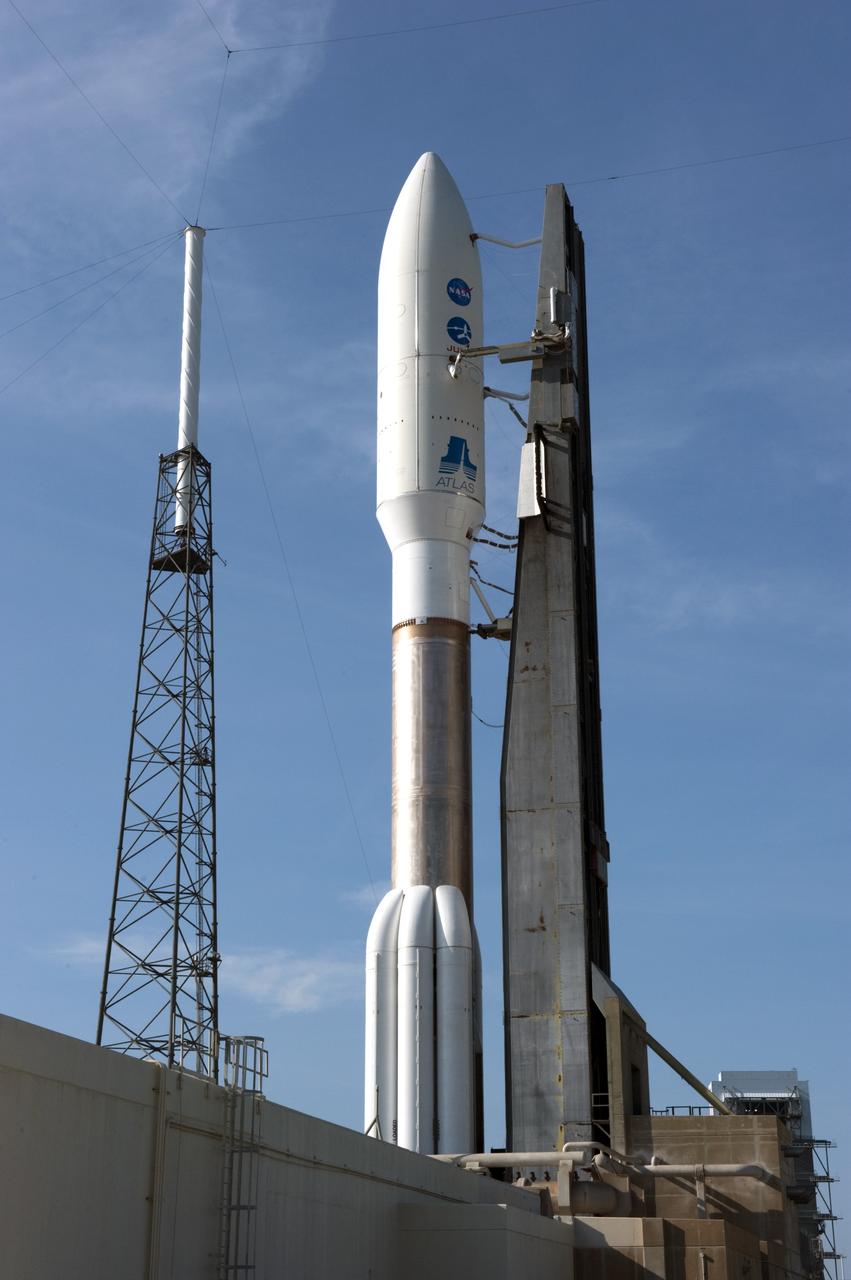
CAPE CANAVERAL, Fla. -- NASA's Juno spacecraft, enclosed in its payload fairing atop a United Launch Alliance Atlas V-551 launch vehicle, is protected from potential stormy weather by the wire catenary system traversing the towers of the lightning protection system at Space Launch Complex 41 on Cape Canaveral Air Force Station in Florida. Launch is planned during a launch window which extends from 11:34 a.m. to 12:43 p.m. EDT on Aug. 5. The solar-powered spacecraft will orbit Jupiter's poles 33 times to find out more about the gas giant's origins, structure, atmosphere and magnetosphere and investigate the existence of a solid planetary core. NASA's Jet Propulsion Laboratory, Pasadena, Calif., manages the Juno mission for the principal investigator, Scott Bolton, of Southwest Research Institute in San Antonio. The Juno mission is part of the New Frontiers Program managed at NASA's Marshall Space Flight Center in Huntsville, Ala. Lockheed Martin Space Systems, Denver, built the spacecraft. Launch management for the mission is the responsibility of NASA's Launch Services Program at the Kennedy Space Center in Florida. For more information, visit www.nasa.gov/juno. Photo credit: NASA/Kim Shiflett
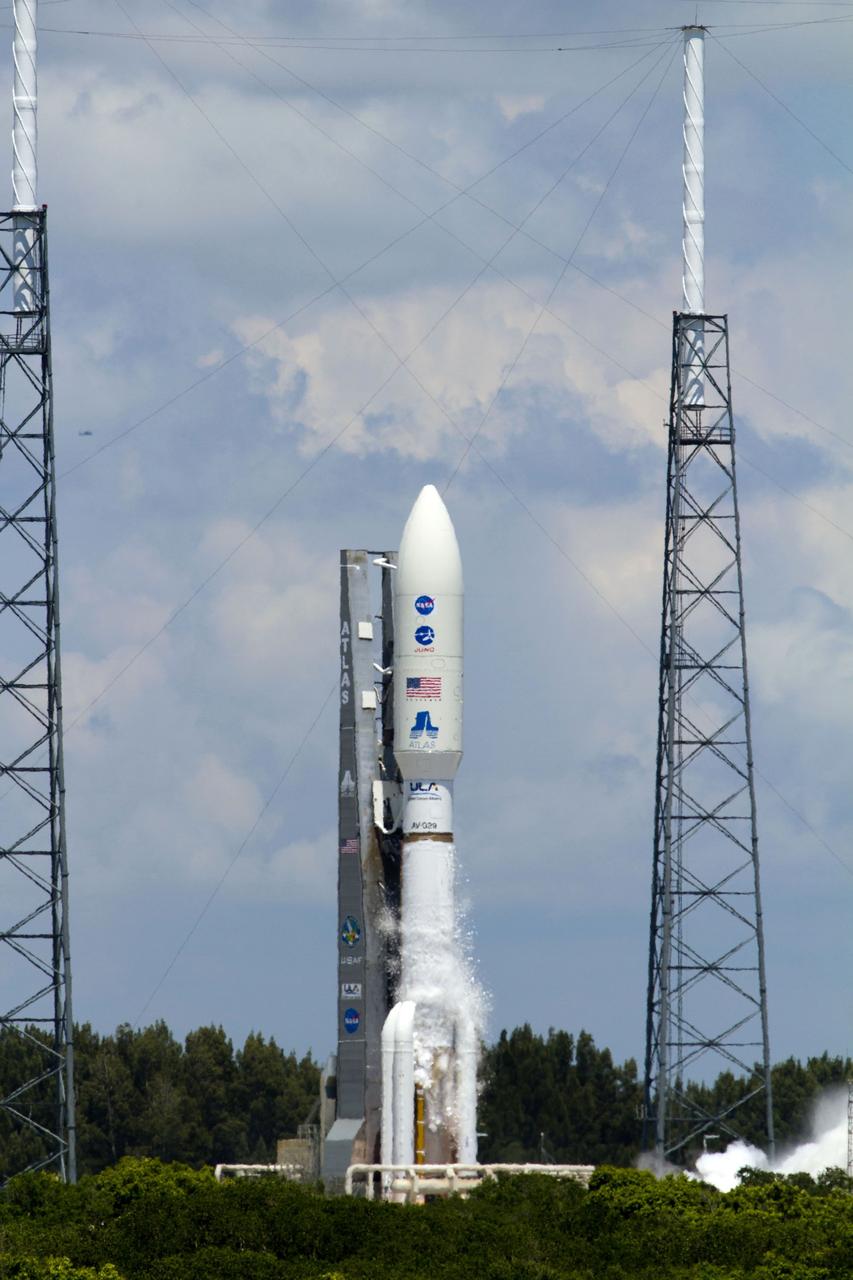
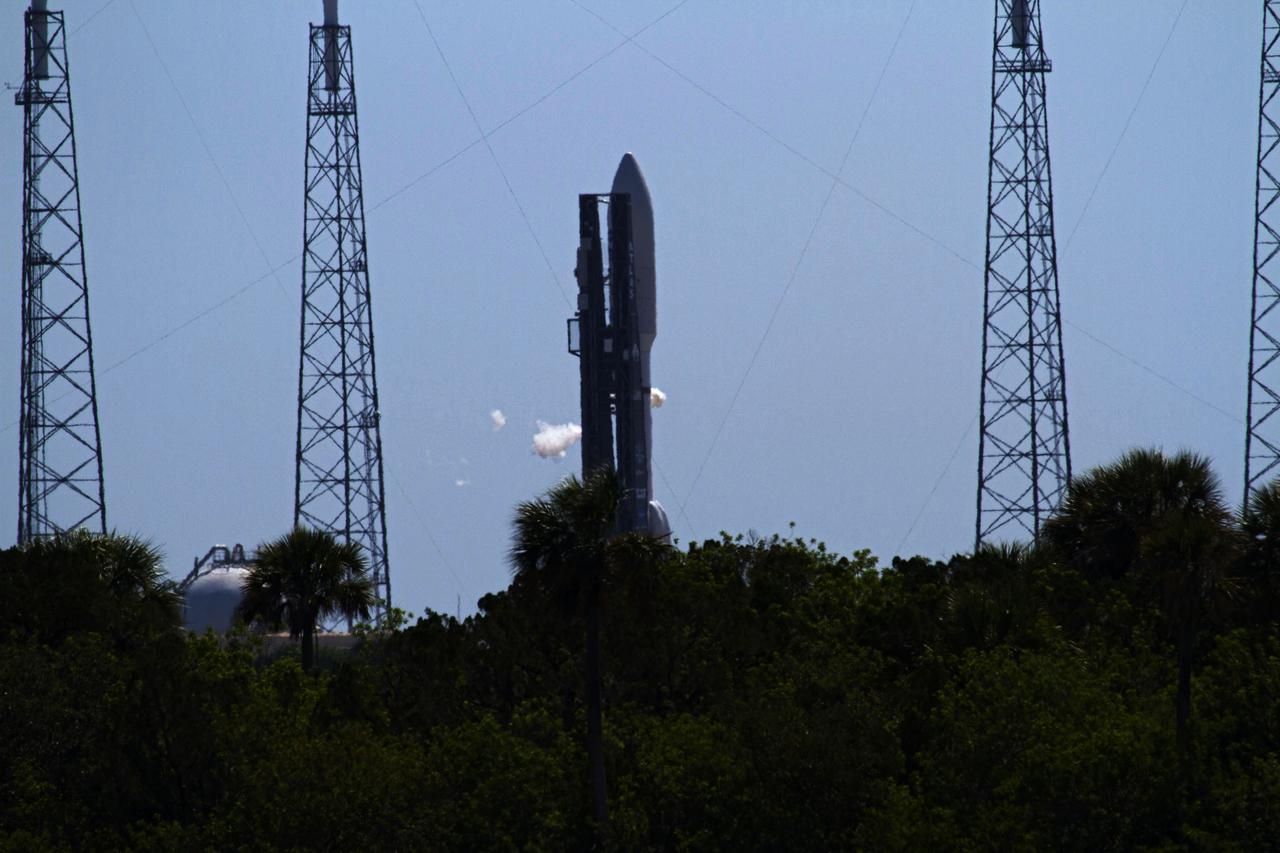
CAPE CANAVERAL, Fla. -- Frost breaks away from the first stage of the United Launch Alliance Atlas V-551 launch vehicle carrying NASA's Juno planetary probe as it begins to vibrate on the pad before launch at Space Launch Complex 41 on Cape Canaveral Air Force Station in Florida. The frost forms when the stage is filled with its supercold liquid oxygen fuel. Liftoff was at 12:25 p.m. EDT Aug. 5. The solar-powered spacecraft will orbit Jupiter's poles 33 times to find out more about the gas giant's origins, structure, atmosphere and magnetosphere and investigate the existence of a solid planetary core. NASA's Jet Propulsion Laboratory, Pasadena, Calif., manages the Juno mission for the principal investigator, Scott Bolton, of Southwest Research Institute in San Antonio. The Juno mission is part of the New Frontiers Program managed at NASA's Marshall Space Flight Center in Huntsville, Ala. Lockheed Martin Space Systems, Denver, built the spacecraft. Launch management for the mission is the responsibility of NASA's Launch Services Program at the Kennedy Space Center in Florida. For more information, visit www.nasa.gov/juno. Photo credit: NASA/George Roberts and Rusty Backer
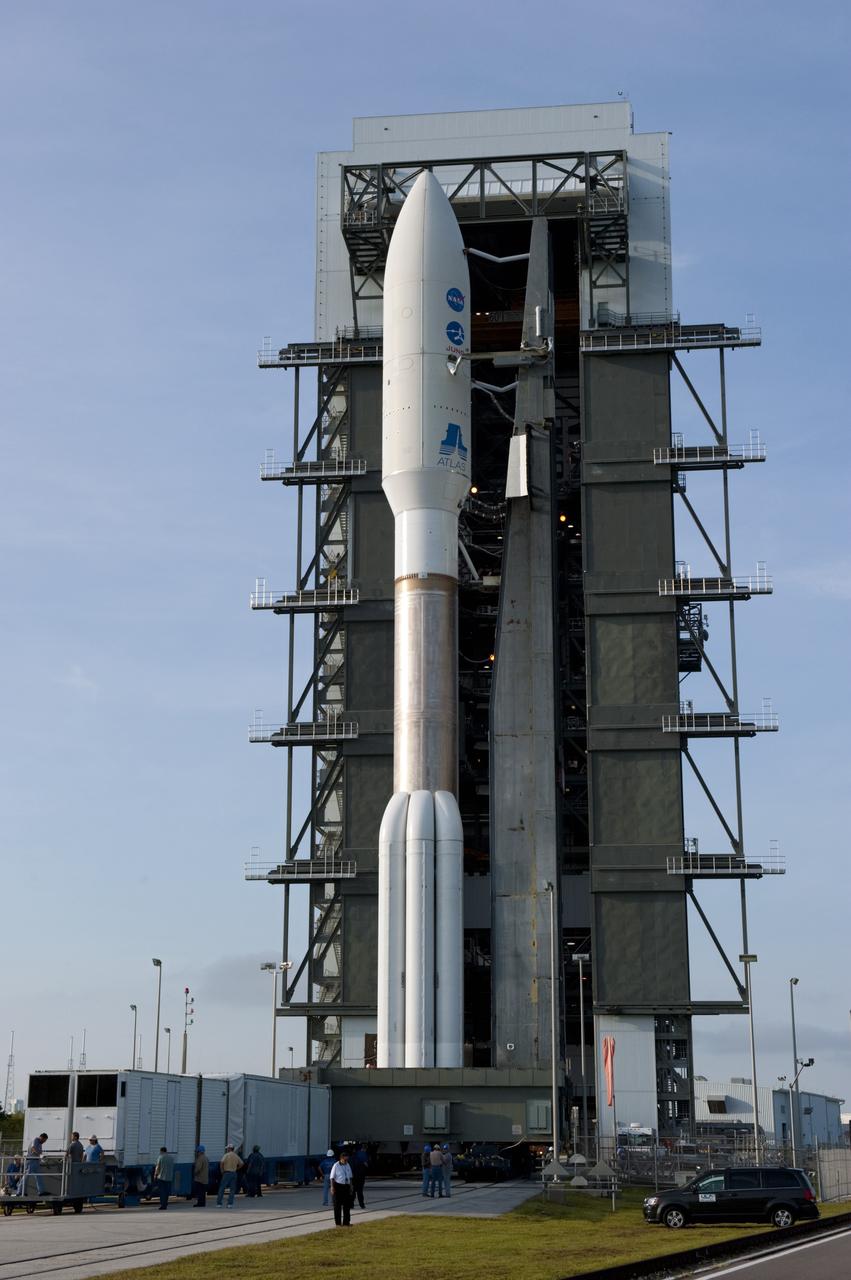
CAPE CANAVERAL, Fla. -- On Cape Canaveral Air Force Station in Florida, the 197-foot-tall United Launch Alliance Atlas V-551 launch vehicle basks in the sunshine outside the Vertical Integration Facility during its move to Space Launch Complex 41. Atop the rocket is NASA's Juno spacecraft, enclosed in its payload fairing. Liftoff is planned during a launch window which extends from 11:34 a.m. to 12:43 p.m. EDT on Aug. 5. The solar-powered spacecraft will orbit Jupiter's poles 33 times to find out more about the gas giant's origins, structure, atmosphere and magnetosphere and investigate the existence of a solid planetary core. NASA's Jet Propulsion Laboratory, Pasadena, Calif., manages the Juno mission for the principal investigator, Scott Bolton, of Southwest Research Institute in San Antonio. The Juno mission is part of the New Frontiers Program managed at NASA's Marshall Space Flight Center in Huntsville, Ala. Lockheed Martin Space Systems, Denver, built the spacecraft. Launch management for the mission is the responsibility of NASA's Launch Services Program at the Kennedy Space Center in Florida. For more information, visit www.nasa.gov/juno. Photo credit: NASA/Kim Shiflett
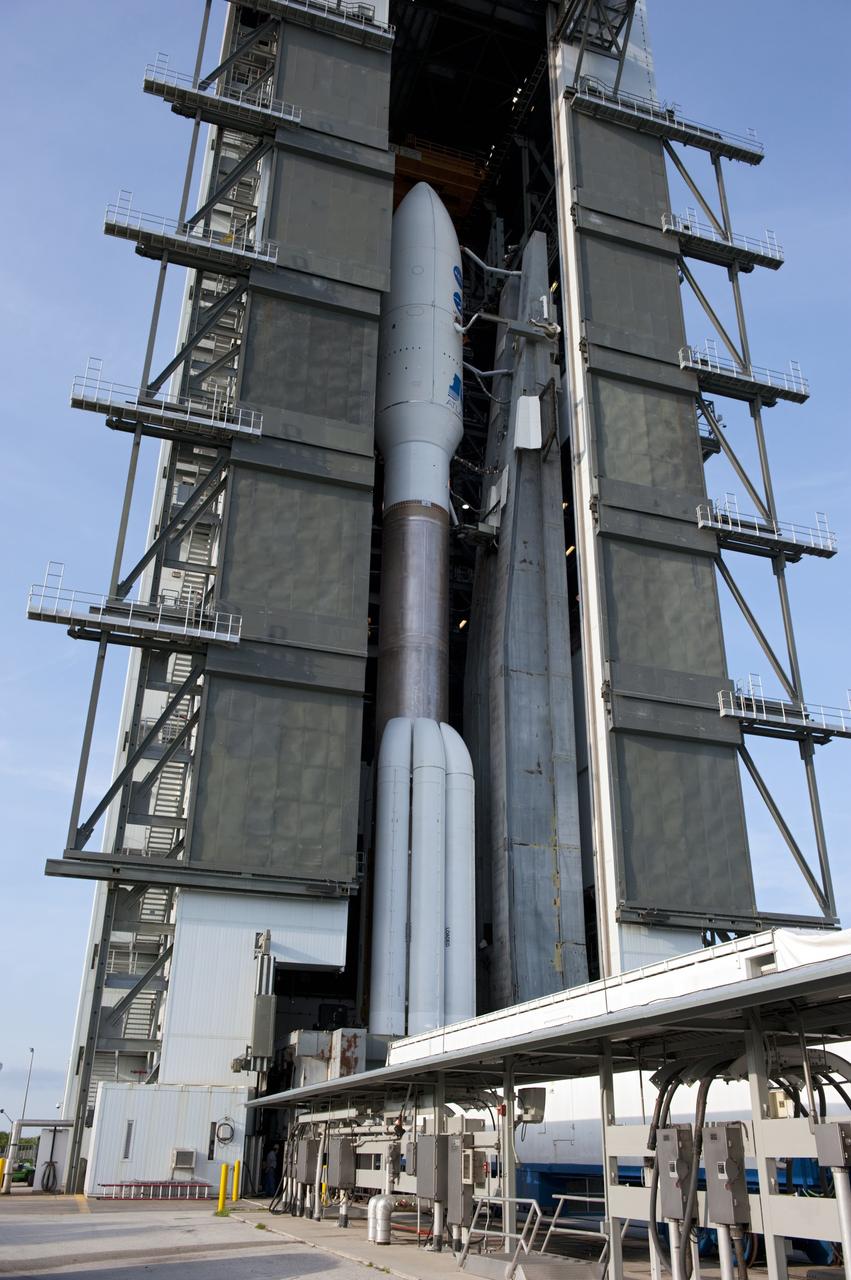
CAPE CANAVERAL, Fla. -- In the Vertical Integration Facility on Cape Canaveral Air Force Station in Florida, preparations are under way to roll the United Launch Alliance Atlas V-551 launch vehicle to Space Launch Complex 41. Atop the rocket is NASA's Juno spacecraft, enclosed in its payload fairing. Liftoff is planned during a launch window which extends from 11:34 a.m. to 12:43 p.m. EDT on Aug. 5. The solar-powered spacecraft will orbit Jupiter's poles 33 times to find out more about the gas giant's origins, structure, atmosphere and magnetosphere and investigate the existence of a solid planetary core. NASA's Jet Propulsion Laboratory, Pasadena, Calif., manages the Juno mission for the principal investigator, Scott Bolton, of Southwest Research Institute in San Antonio. The Juno mission is part of the New Frontiers Program managed at NASA's Marshall Space Flight Center in Huntsville, Ala. Lockheed Martin Space Systems, Denver, built the spacecraft. Launch management for the mission is the responsibility of NASA's Launch Services Program at the Kennedy Space Center in Florida. For more information, visit www.nasa.gov/juno. Photo credit: NASA/Kim Shiflett
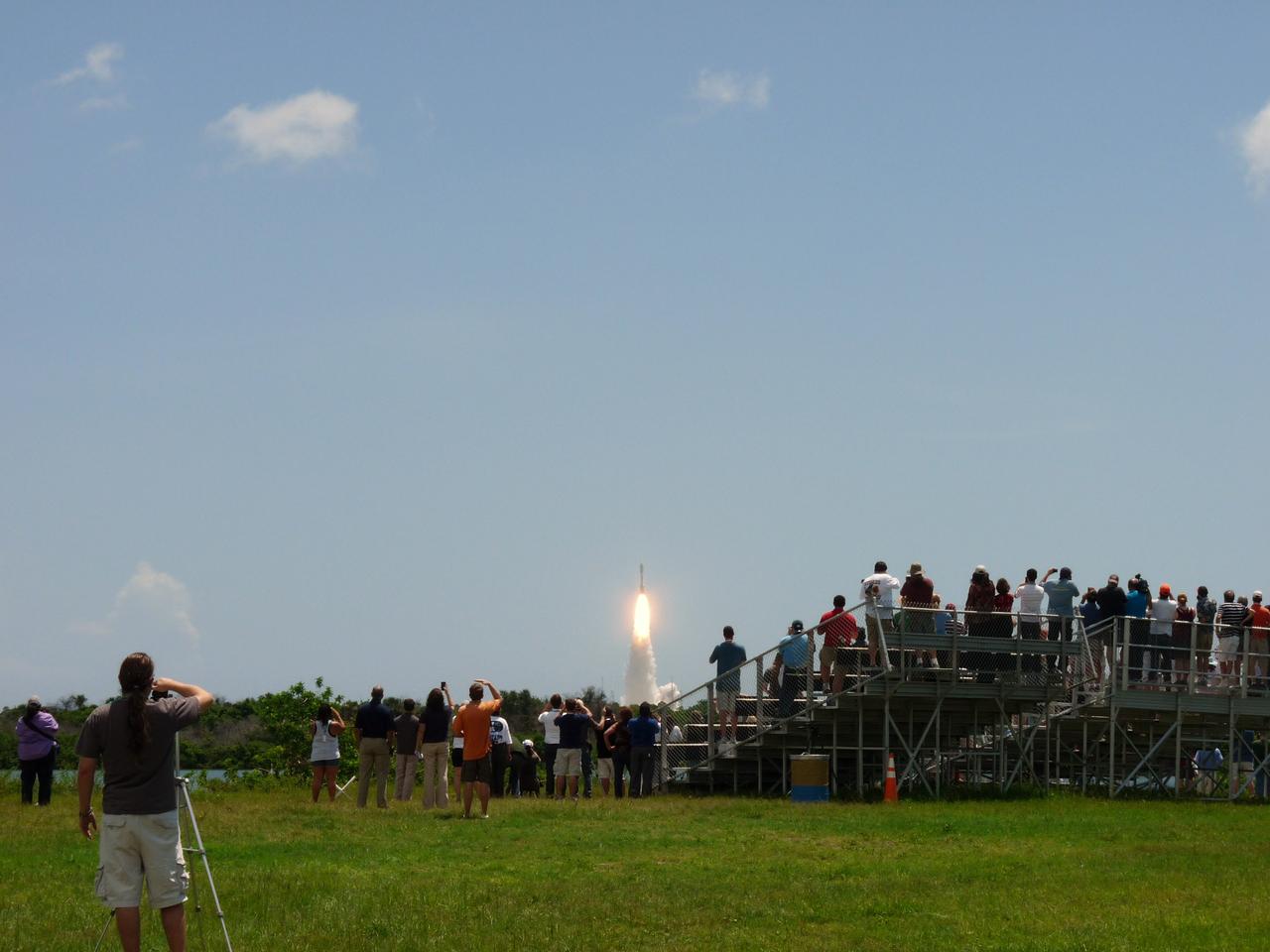
CAPE CANAVERAL, Fla. -- At the Press Site at NASA’s Kennedy Space Center in Florida, about 150 followers of the agency’s Twitter account view the launch of NASA's Juno planetary probe atop a United Launch Alliance Atlas V-551 rocket. The tweeters, in turn, will share their experiences with followers through the social networking site Twitter. Liftoff was at 12:25 p.m. EDT Aug. 5 from Space Launch Complex 41 on Cape Canaveral Air Force Station in Florida. The solar-powered spacecraft will orbit Jupiter's poles 33 times to find out more about the gas giant's origins, structure, atmosphere and magnetosphere and investigate the existence of a solid planetary core. NASA's Jet Propulsion Laboratory, Pasadena, Calif., manages the Juno mission for the principal investigator, Scott Bolton, of Southwest Research Institute in San Antonio. The Juno mission is part of the New Frontiers Program managed at NASA's Marshall Space Flight Center in Huntsville, Ala. Lockheed Martin Space Systems, Denver, built the spacecraft. Launch management for the mission is the responsibility of NASA's Launch Services Program at the Kennedy Space Center in Florida. For more information, visit www.nasa.gov/juno. Photo credit: NASA/Fletcher Hildreth
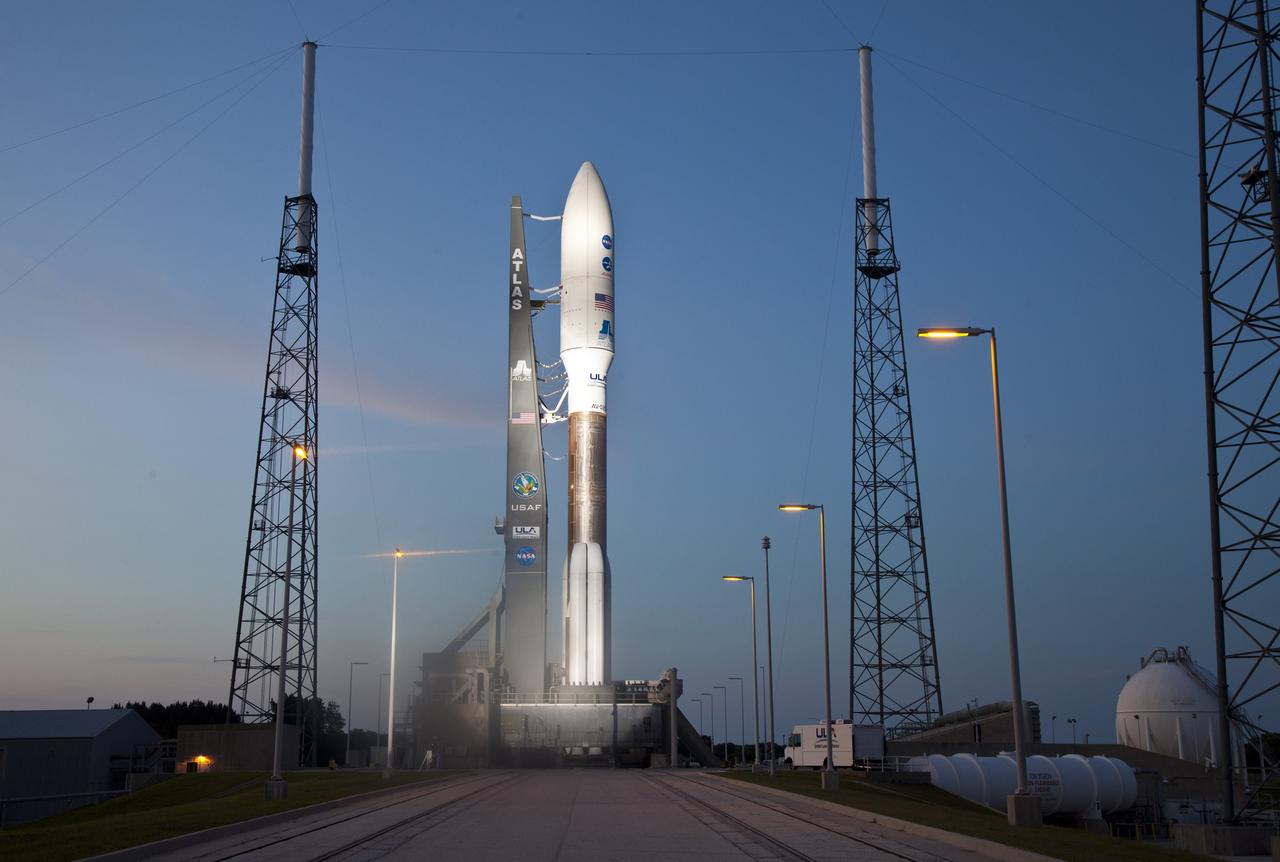
CAPE CANAVERAL, Fla. -- As night descends on Space Launch Complex 41 at Cape Canaveral Air Force Station in Florida, the United Launch Alliance Atlas V-551 launch vehicle is being readied for launch. Atop the rocket is NASA's Juno planetary probe, enclosed in its payload fairing. Liftoff is planned during a launch window which extends from 11:34 a.m. to 12:43 p.m. EDT on Aug. 5. The solar-powered spacecraft will orbit Jupiter's poles 33 times to find out more about the gas giant's origins, structure, atmosphere and magnetosphere and investigate the existence of a solid planetary core. NASA's Jet Propulsion Laboratory, Pasadena, Calif., manages the Juno mission for the principal investigator, Scott Bolton, of Southwest Research Institute in San Antonio. The Juno mission is part of the New Frontiers Program managed at NASA's Marshall Space Flight Center in Huntsville, Ala. Lockheed Martin Space Systems, Denver, built the spacecraft. Launch management for the mission is the responsibility of NASA's Launch Services Program at the Kennedy Space Center in Florida. For more information, visit www.nasa.gov/juno. Photo credit: Courtesy of Scott Andrews
CAPE CANAVERAL, Fla. -- NASA's Juno planetary probe, enclosed in its payload fairing, is moments away from beginning its five-year journey to Jupiter atop a United Launch Alliance Atlas V-551 launch vehicle from Space Launch Complex 41 on Cape Canaveral Air Force Station in Florida. Liftoff was at 12:25 p.m. EDT Aug. 5. The solar-powered spacecraft will orbit Jupiter's poles 33 times to find out more about the gas giant's origins, structure, atmosphere and magnetosphere and investigate the existence of a solid planetary core. NASA's Jet Propulsion Laboratory, Pasadena, Calif., manages the Juno mission for the principal investigator, Scott Bolton, of Southwest Research Institute in San Antonio. The Juno mission is part of the New Frontiers Program managed at NASA's Marshall Space Flight Center in Huntsville, Ala. Lockheed Martin Space Systems, Denver, built the spacecraft. Launch management for the mission is the responsibility of NASA's Launch Services Program at the Kennedy Space Center in Florida. For more information, visit www.nasa.gov/juno. Photo credit: NASA/Kenny Allen
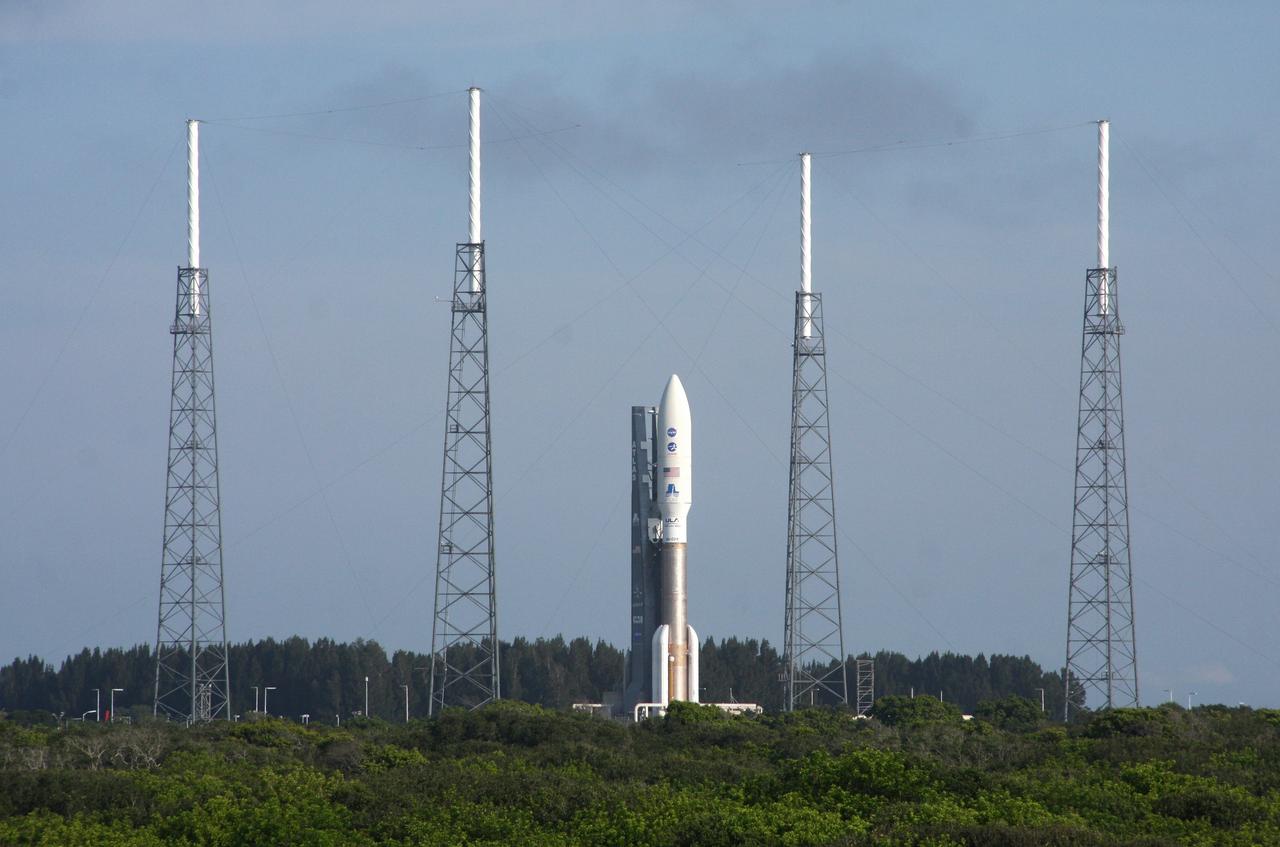
CAPE CANAVERAL, Fla. -- NASA's Juno spacecraft, enclosed in its payload fairing atop a United Launch Alliance Atlas V-551 launch vehicle, is protected from potential stormy weather by the wire catenary system traversing the towers of the lightning protection system at Space Launch Complex 41 on Cape Canaveral Air Force Station in Florida. Liftoff is planned during a launch window which extends from 11:34 a.m. to 12:43 p.m. EDT on Aug. 5. The solar-powered spacecraft will orbit Jupiter's poles 33 times to find out more about the gas giant's origins, structure, atmosphere and magnetosphere and investigate the existence of a solid planetary core. NASA's Jet Propulsion Laboratory, Pasadena, Calif., manages the Juno mission for the principal investigator, Scott Bolton, of Southwest Research Institute in San Antonio. The Juno mission is part of the New Frontiers Program managed at NASA's Marshall Space Flight Center in Huntsville, Ala. Lockheed Martin Space Systems, Denver, built the spacecraft. Launch management for the mission is the responsibility of NASA's Launch Services Program at the Kennedy Space Center in Florida. For more information, visit www.nasa.gov/juno. Photo credit: NASA/Ken Thornsley
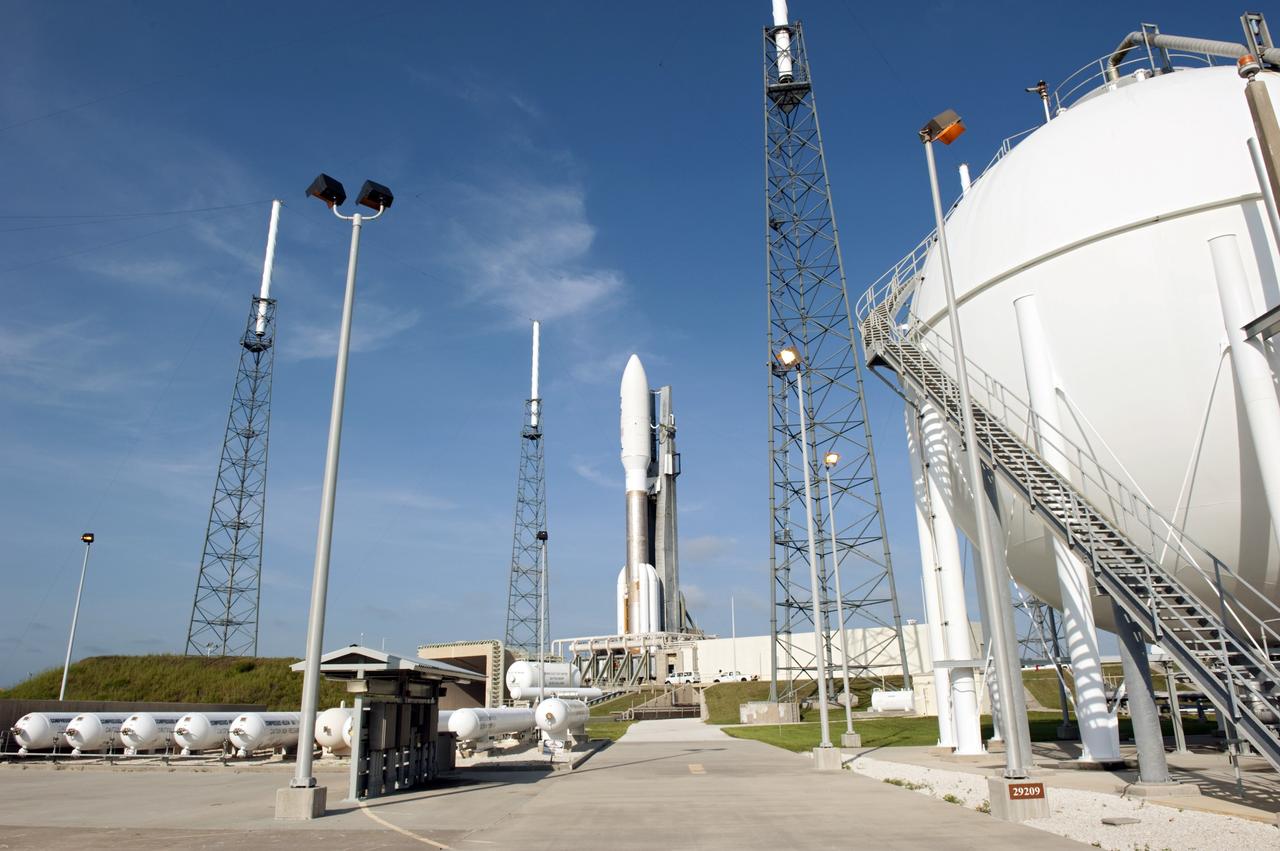
CAPE CANAVERAL, Fla. -- At Space Launch Complex 41 on Cape Canaveral Air Force Station in Florida, preparations are under way to launch a United Launch Alliance Atlas V-551 launch vehicle carrying NASA's Juno spacecraft. Launch is planned during a launch window which extends from 11:34 a.m. to 12:43 p.m. EDT on Aug. 5. The solar-powered spacecraft will orbit Jupiter's poles 33 times to find out more about the gas giant's origins, structure, atmosphere and magnetosphere and investigate the existence of a solid planetary core. NASA's Jet Propulsion Laboratory, Pasadena, Calif., manages the Juno mission for the principal investigator, Scott Bolton, of Southwest Research Institute in San Antonio. The Juno mission is part of the New Frontiers Program managed at NASA's Marshall Space Flight Center in Huntsville, Ala. Lockheed Martin Space Systems, Denver, built the spacecraft. Launch management for the mission is the responsibility of NASA's Launch Services Program at the Kennedy Space Center in Florida. For more information, visit www.nasa.gov/juno. Photo credit: NASA/Kim Shiflett
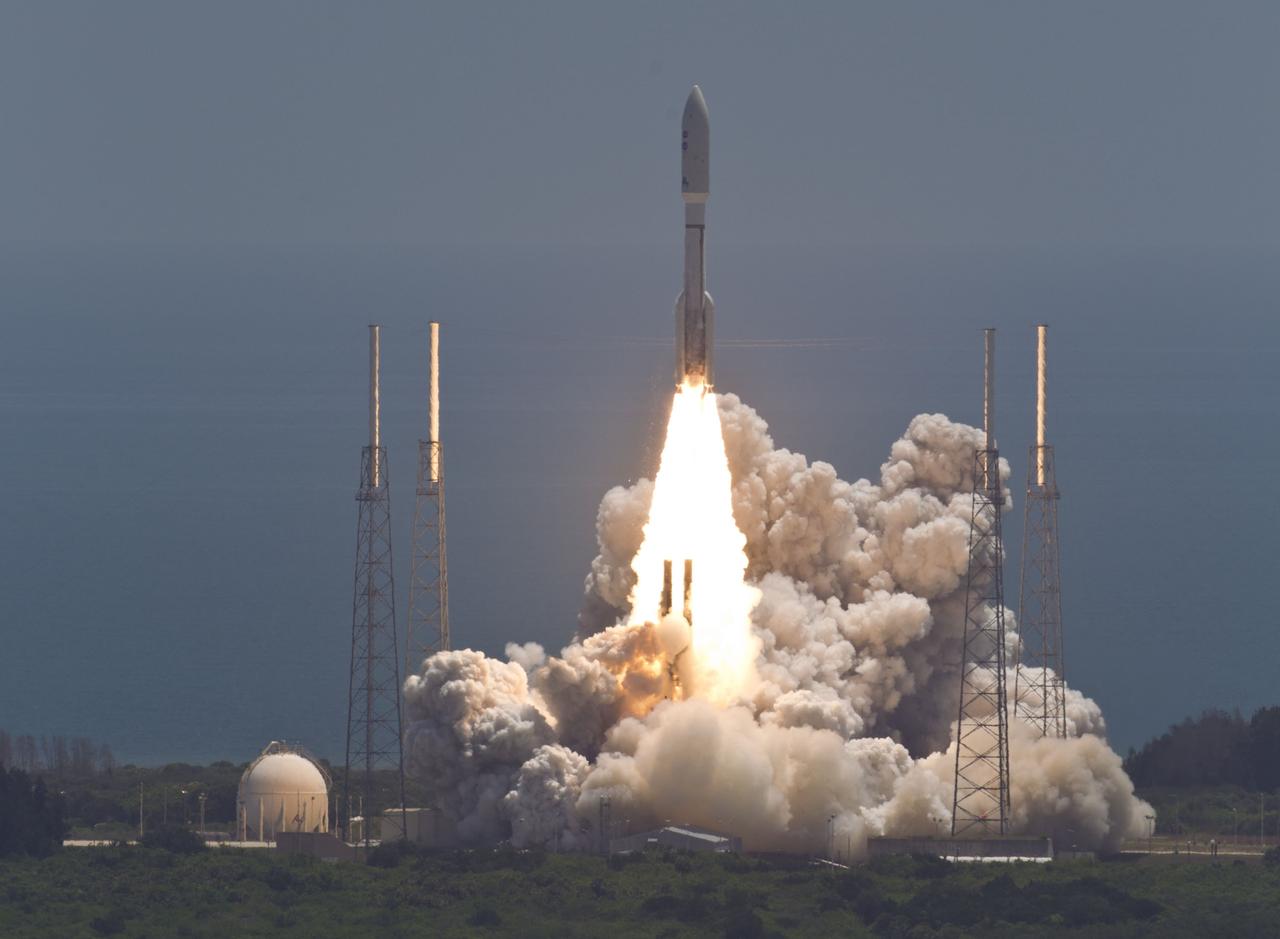
CAPE CANAVERAL, Fla. -- The United Launch Alliance Atlas V-551 launch vehicle carrying NASA's Juno planetary probe, its motors blazing, is off to a roaring start on its five-year journey to Jupiter from Space Launch Complex 41 on Cape Canaveral Air Force Station in Florida. Liftoff was at 12:25 p.m. EDT Aug. 5. The solar-powered spacecraft will orbit Jupiter's poles 33 times to find out more about the gas giant's origins, structure, atmosphere and magnetosphere and investigate the existence of a solid planetary core. NASA's Jet Propulsion Laboratory, Pasadena, Calif., manages the Juno mission for the principal investigator, Scott Bolton, of Southwest Research Institute in San Antonio. The Juno mission is part of the New Frontiers Program managed at NASA's Marshall Space Flight Center in Huntsville, Ala. Lockheed Martin Space Systems, Denver, built the spacecraft. Launch management for the mission is the responsibility of NASA's Launch Services Program at the Kennedy Space Center in Florida. For more information, visit www.nasa.gov/juno. Photo credit: Courtesy of Scott Andrews

CAPE CANAVERAL, Fla. -- Frost breaks away from the first stage of the United Launch Alliance Atlas V-551 launch vehicle carrying NASA's Juno planetary probe as it lifts off the pad at Space Launch Complex 41 on Cape Canaveral Air Force Station in Florida. The frost forms when the stage is filled with its supercold liquid oxygen fuel. Liftoff was at 12:25 p.m. EDT Aug. 5. The solar-powered spacecraft will orbit Jupiter's poles 33 times to find out more about the gas giant's origins, structure, atmosphere and magnetosphere and investigate the existence of a solid planetary core. NASA's Jet Propulsion Laboratory, Pasadena, Calif., manages the Juno mission for the principal investigator, Scott Bolton, of Southwest Research Institute in San Antonio. The Juno mission is part of the New Frontiers Program managed at NASA's Marshall Space Flight Center in Huntsville, Ala. Lockheed Martin Space Systems, Denver, built the spacecraft. Launch management for the mission is the responsibility of NASA's Launch Services Program at the Kennedy Space Center in Florida. For more information, visit www.nasa.gov/juno. Photo credit: NASA/George Roberts and Rusty Backer
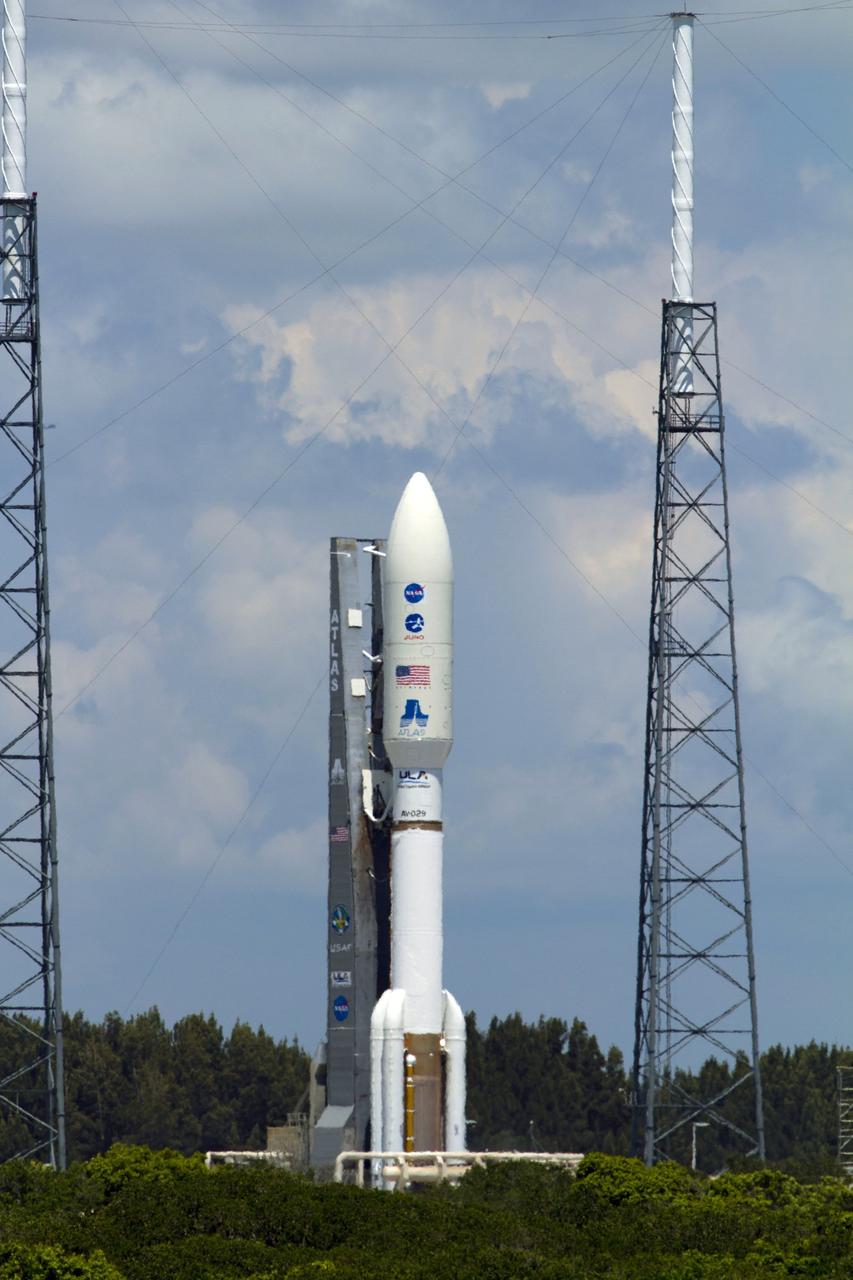
CAPE CANAVERAL, Fla. -- NASA's Juno planetary probe is moments away from beginning its five-year journey to Jupiter atop a United Launch Alliance Atlas V-551 launch vehicle from Space Launch Complex 41 on Cape Canaveral Air Force Station in Florida. Liftoff was at 12:25 p.m. EDT Aug. 5. The solar-powered spacecraft will orbit Jupiter's poles 33 times to find out more about the gas giant's origins, structure, atmosphere and magnetosphere and investigate the existence of a solid planetary core. NASA's Jet Propulsion Laboratory, Pasadena, Calif., manages the Juno mission for the principal investigator, Scott Bolton, of Southwest Research Institute in San Antonio. The Juno mission is part of the New Frontiers Program managed at NASA's Marshall Space Flight Center in Huntsville, Ala. Lockheed Martin Space Systems, Denver, built the spacecraft. Launch management for the mission is the responsibility of NASA's Launch Services Program at the Kennedy Space Center in Florida. For more information, visit www.nasa.gov/juno. Photo credit: NASA/George Roberts and Rusty Backer
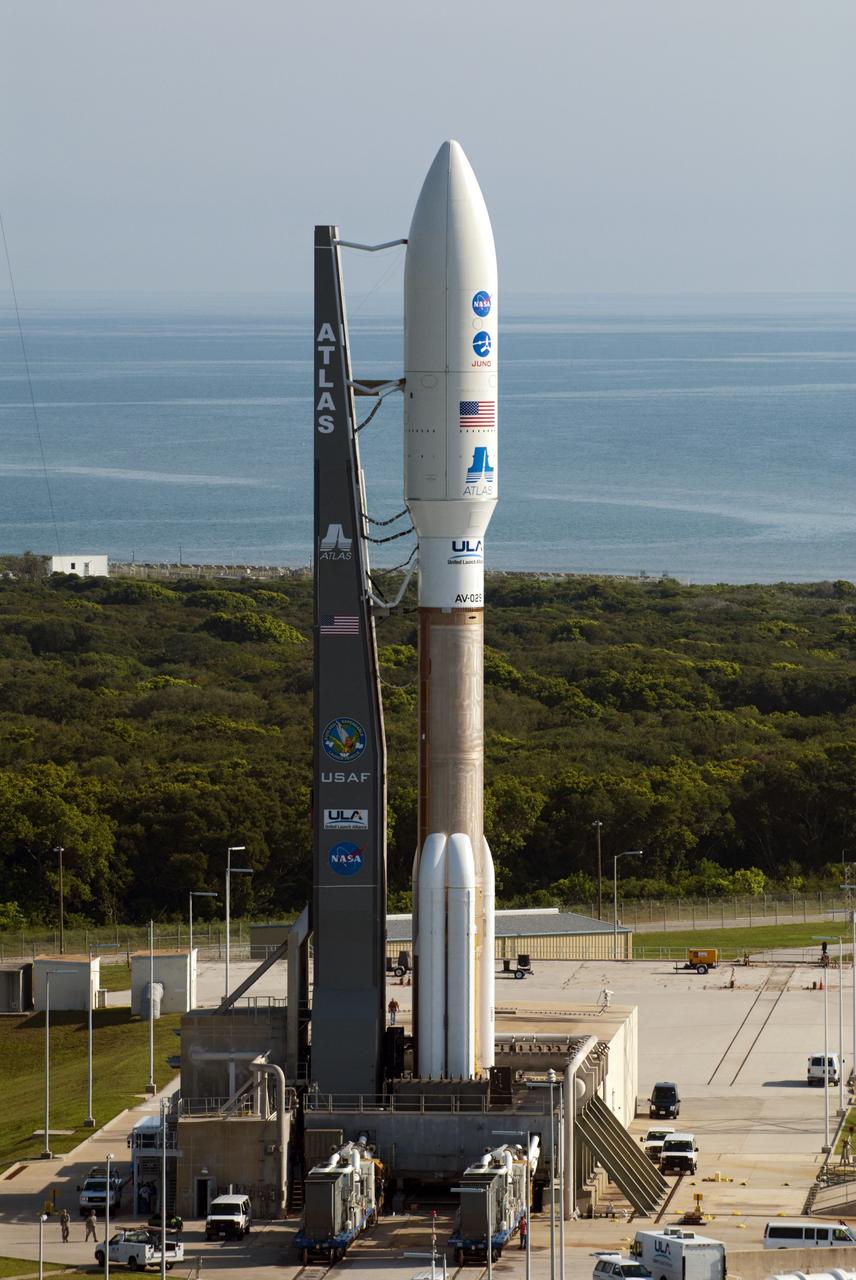
CAPE CANAVERAL, Fla. -- NASA's Juno spacecraft, enclosed in its payload fairing atop a United Launch Alliance Atlas V-551 launch vehicle, stands on its seaside launch pad at Space Launch Complex 41 on Cape Canaveral Air Force Station in Florida. The water of the Atlantic Ocean swirls in the distance. Launch is planned during a launch window which extends from 11:34 a.m. to 12:43 p.m. EDT on Aug. 5. The solar-powered spacecraft will orbit Jupiter's poles 33 times to find out more about the gas giant's origins, structure, atmosphere and magnetosphere and investigate the existence of a solid planetary core. NASA's Jet Propulsion Laboratory, Pasadena, Calif., manages the Juno mission for the principal investigator, Scott Bolton, of Southwest Research Institute in San Antonio. The Juno mission is part of the New Frontiers Program managed at NASA's Marshall Space Flight Center in Huntsville, Ala. Lockheed Martin Space Systems, Denver, built the spacecraft. Launch management for the mission is the responsibility of NASA's Launch Services Program at the Kennedy Space Center in Florida. For more information, visit www.nasa.gov/juno. Photo credit: NASA/Kim Shiflett
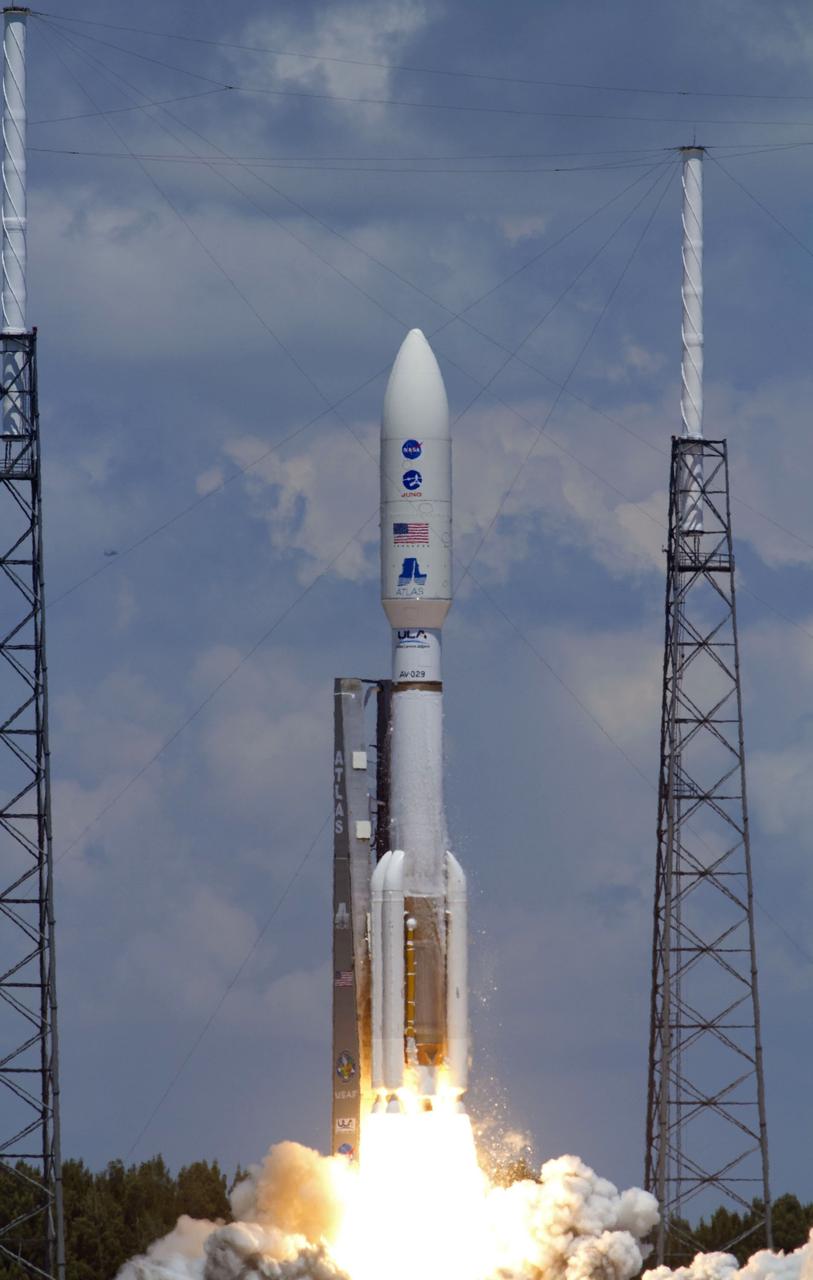
CAPE CANAVERAL, Fla. -- Frost breaks away from the first stage of the United Launch Alliance Atlas V-551 launch vehicle carrying NASA's Juno planetary probe as it lifts off the pad at Space Launch Complex 41 on Cape Canaveral Air Force Station in Florida. The frost forms when the stage is filled with its supercold liquid oxygen fuel. Liftoff was at 12:25 p.m. EDT Aug. 5. The solar-powered spacecraft will orbit Jupiter's poles 33 times to find out more about the gas giant's origins, structure, atmosphere and magnetosphere and investigate the existence of a solid planetary core. NASA's Jet Propulsion Laboratory, Pasadena, Calif., manages the Juno mission for the principal investigator, Scott Bolton, of Southwest Research Institute in San Antonio. The Juno mission is part of the New Frontiers Program managed at NASA's Marshall Space Flight Center in Huntsville, Ala. Lockheed Martin Space Systems, Denver, built the spacecraft. Launch management for the mission is the responsibility of NASA's Launch Services Program at the Kennedy Space Center in Florida. For more information, visit www.nasa.gov/juno. Photo credit: NASA/George Roberts and Rusty Backer
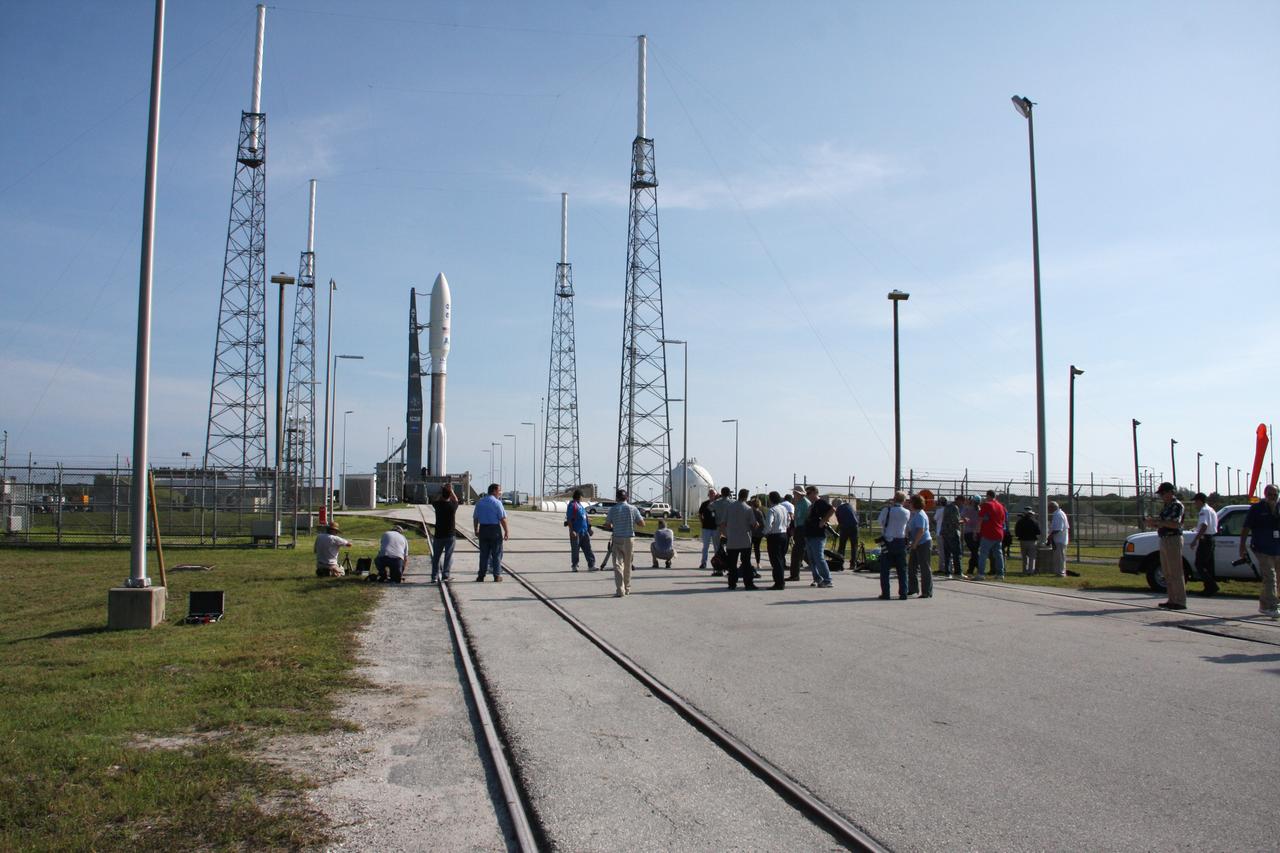
CAPE CANAVERAL, Fla. -- On Cape Canaveral Air Force Station in Florida, representatives of media outlets worldwide witness the arrival of the 197-foot-tall United Launch Alliance Atlas V-551 launch vehicle, carrying NASA's Juno spacecraft, on the launch pad at Space Launch Complex 41. Liftoff is planned during a launch window which extends from 11:34 a.m. to 12:43 p.m. EDT on Aug. 5. The solar-powered spacecraft will orbit Jupiter's poles 33 times to find out more about the gas giant's origins, structure, atmosphere and magnetosphere and investigate the existence of a solid planetary core. NASA's Jet Propulsion Laboratory, Pasadena, Calif., manages the Juno mission for the principal investigator, Scott Bolton, of Southwest Research Institute in San Antonio. The Juno mission is part of the New Frontiers Program managed at NASA's Marshall Space Flight Center in Huntsville, Ala. Lockheed Martin Space Systems, Denver, built the spacecraft. Launch management for the mission is the responsibility of NASA's Launch Services Program at the Kennedy Space Center in Florida. For more information, visit www.nasa.gov/juno. Photo credit: NASA/Ken Thornsley
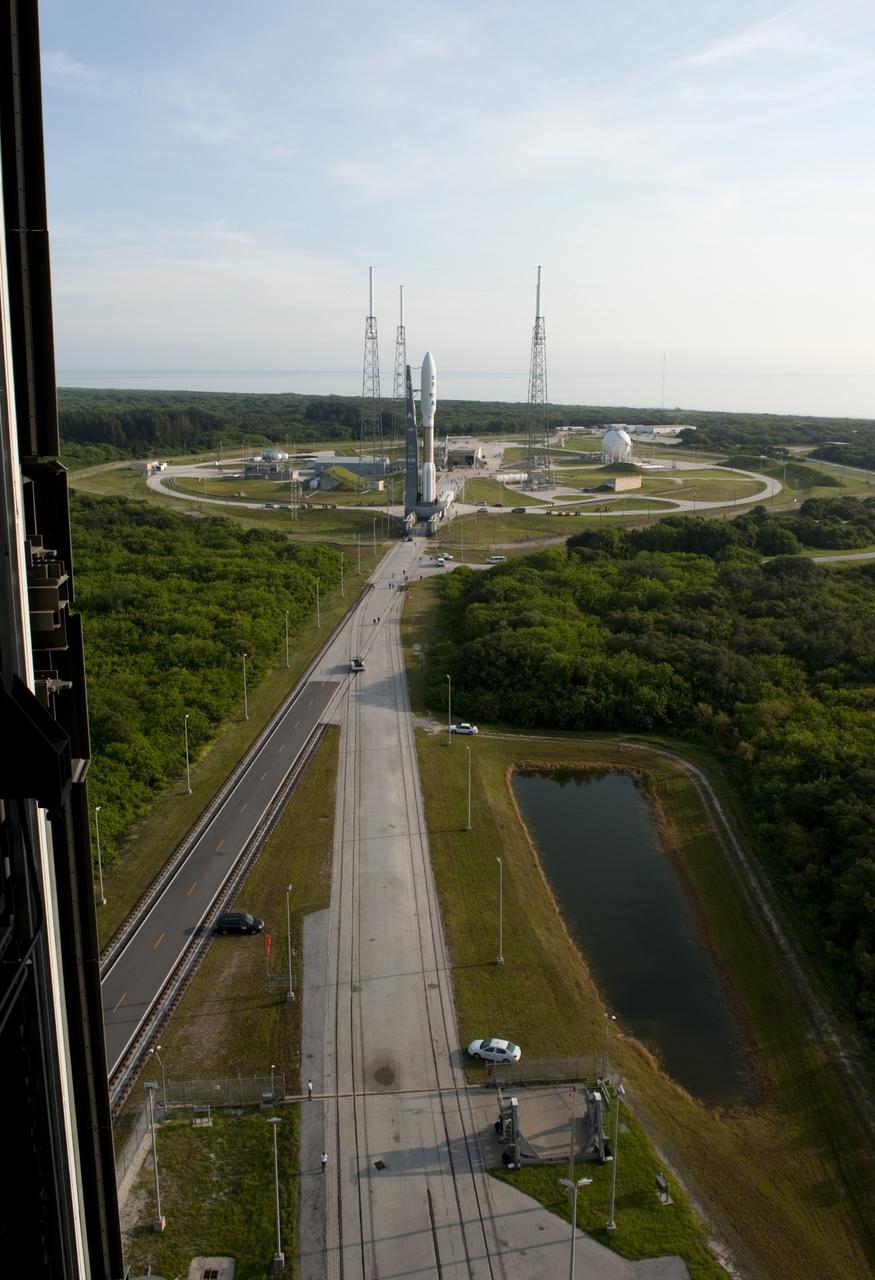
CAPE CANAVERAL, Fla. -- On Cape Canaveral Air Force Station in Florida, the Vertical Integration Facility offers a unique vantage point to view the United Launch Alliance Atlas V-551 launch vehicle as it nears the launch stand on Space Launch Complex 41. Atop the rocket is NASA's Juno spacecraft, enclosed in its payload fairing. Liftoff is planned during a launch window which extends from 11:34 a.m. to 12:43 p.m. EDT on Aug. 5. The solar-powered spacecraft will orbit Jupiter's poles 33 times to find out more about the gas giant's origins, structure, atmosphere and magnetosphere and investigate the existence of a solid planetary core. NASA's Jet Propulsion Laboratory, Pasadena, Calif., manages the Juno mission for the principal investigator, Scott Bolton, of Southwest Research Institute in San Antonio. The Juno mission is part of the New Frontiers Program managed at NASA's Marshall Space Flight Center in Huntsville, Ala. Lockheed Martin Space Systems, Denver, built the spacecraft. Launch management for the mission is the responsibility of NASA's Launch Services Program at the Kennedy Space Center in Florida. For more information, visit www.nasa.gov/juno. Photo credit: NASA/Kim Shiflett
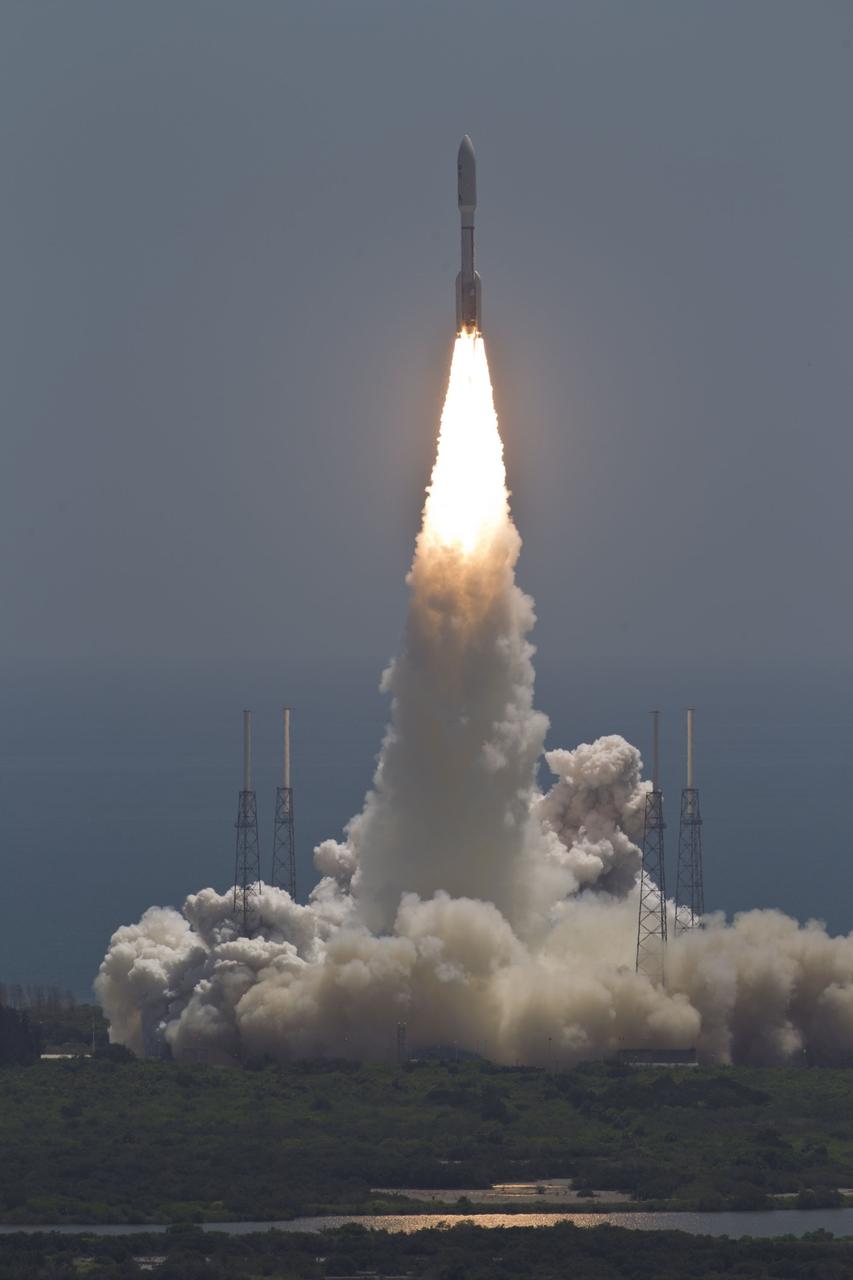
CAPE CANAVERAL, Fla. -- NASA's Juno planetary probe, enclosed in its payload fairing atop a United Launch Alliance Atlas V-551 launch vehicle, rushes above the towers of the lightning protection system at Space Launch Complex 41 on Cape Canaveral Air Force Station in Florida. Liftoff was at 12:25 p.m. EDT Aug. 5. The solar-powered spacecraft will orbit Jupiter's poles 33 times to find out more about the gas giant's origins, structure, atmosphere and magnetosphere and investigate the existence of a solid planetary core. NASA's Jet Propulsion Laboratory, Pasadena, Calif., manages the Juno mission for the principal investigator, Scott Bolton, of Southwest Research Institute in San Antonio. The Juno mission is part of the New Frontiers Program managed at NASA's Marshall Space Flight Center in Huntsville, Ala. Lockheed Martin Space Systems, Denver, built the spacecraft. Launch management for the mission is the responsibility of NASA's Launch Services Program at the Kennedy Space Center in Florida. For more information, visit www.nasa.gov/juno. Photo credit: Courtesy of Scott Andrews
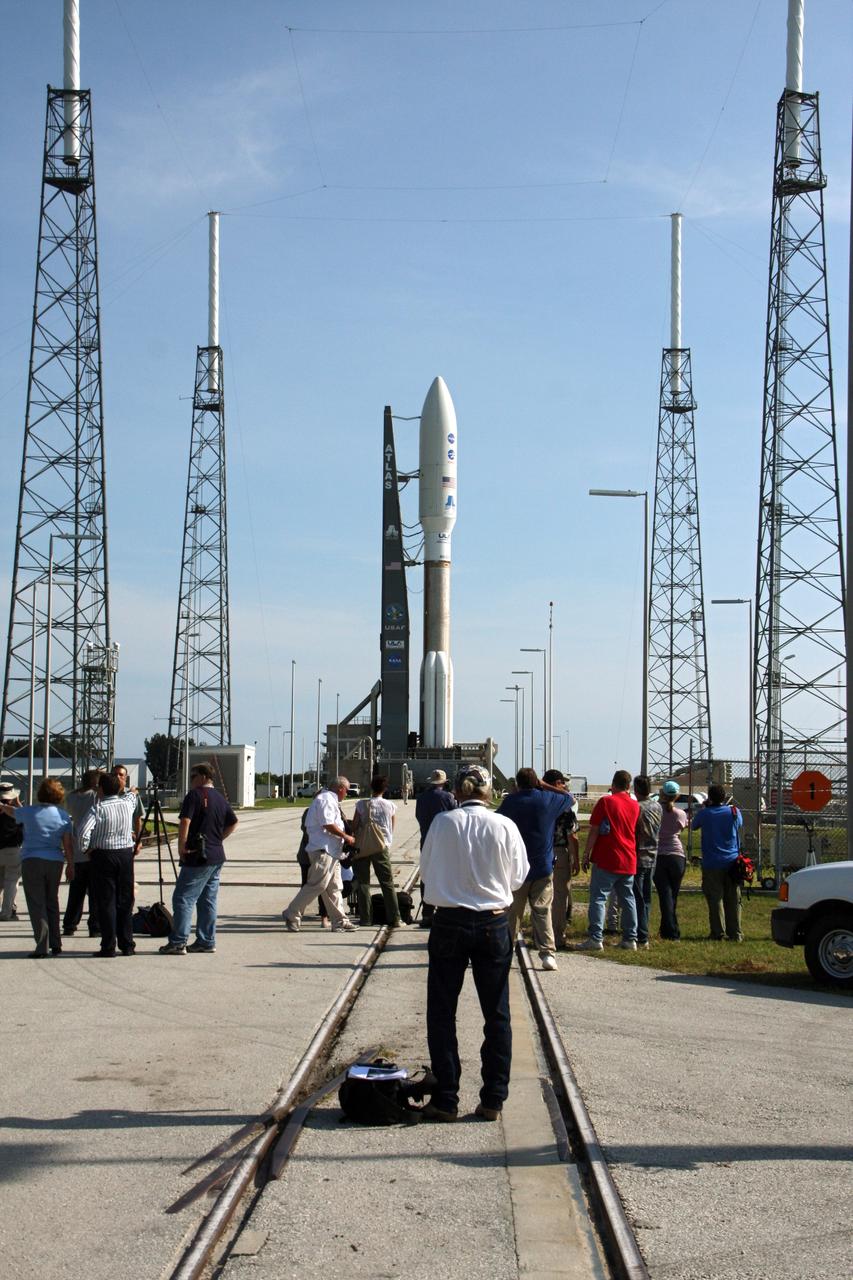
CAPE CANAVERAL, Fla. -- On Cape Canaveral Air Force Station in Florida, representatives of media outlets worldwide photograph the 197-foot-tall United Launch Alliance Atlas V-551 launch vehicle carrying NASA's Juno spacecraft upon its arrival on the launch pad at Space Launch Complex 41. Liftoff is planned during a launch window which extends from 11:34 a.m. to 12:43 p.m. EDT on Aug. 5. The solar-powered spacecraft will orbit Jupiter's poles 33 times to find out more about the gas giant's origins, structure, atmosphere and magnetosphere and investigate the existence of a solid planetary core. NASA's Jet Propulsion Laboratory, Pasadena, Calif., manages the Juno mission for the principal investigator, Scott Bolton, of Southwest Research Institute in San Antonio. The Juno mission is part of the New Frontiers Program managed at NASA's Marshall Space Flight Center in Huntsville, Ala. Lockheed Martin Space Systems, Denver, built the spacecraft. Launch management for the mission is the responsibility of NASA's Launch Services Program at the Kennedy Space Center in Florida. For more information, visit www.nasa.gov/juno. Photo credit: NASA/Ken Thornsley
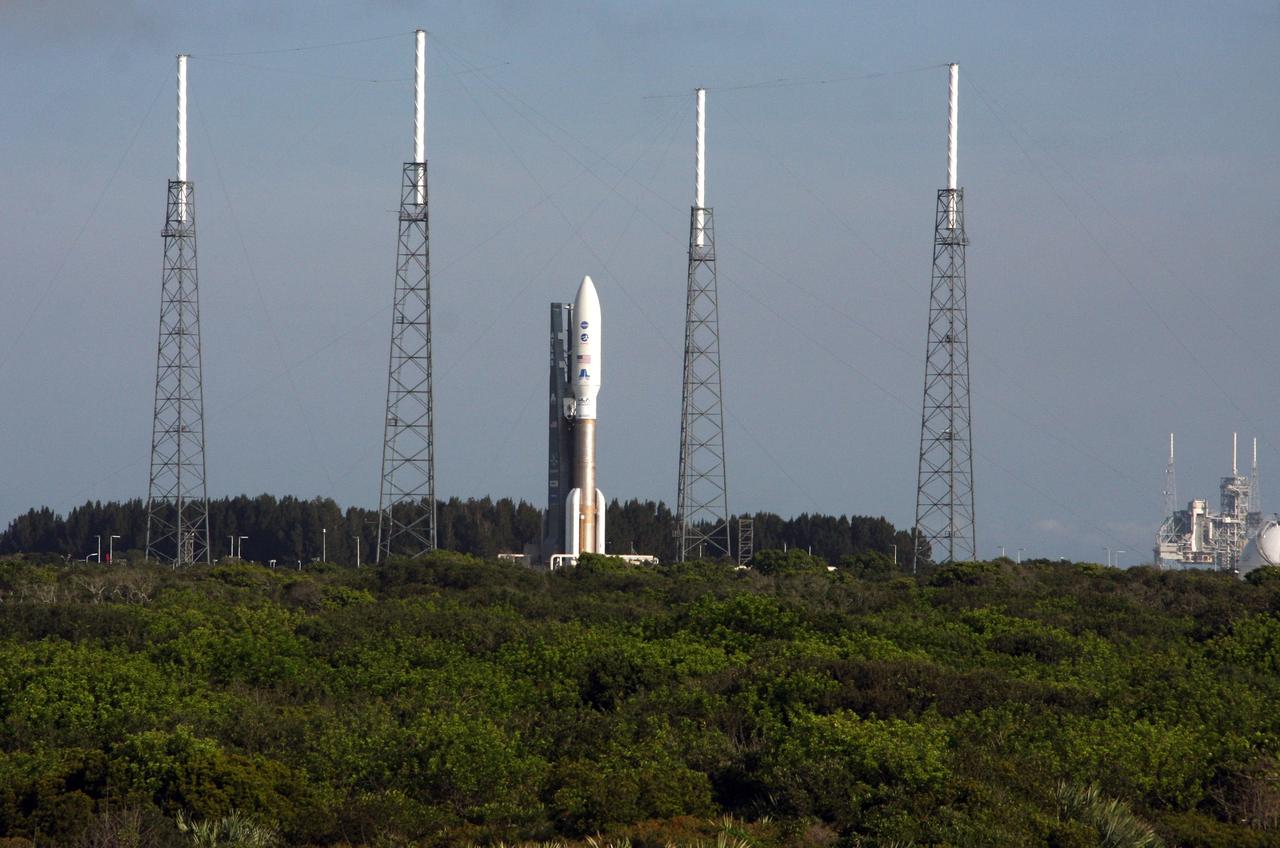
CAPE CANAVERAL, Fla. -- On Cape Canaveral Air Force Station in Florida, the 197-foot-tall United Launch Alliance Atlas V-551 launch vehicle carrying NASA's Juno spacecraft has arrived on the launch pad at Space Launch Complex 41. On Kennedy Space Center property, at right, is Launch Pad 39A, which supported the last space shuttle launch in July. Liftoff is planned during a launch window which extends from 11:34 a.m. to 12:43 p.m. EDT on Aug. 5. The solar-powered spacecraft will orbit Jupiter's poles 33 times to find out more about the gas giant's origins, structure, atmosphere and magnetosphere and investigate the existence of a solid planetary core. NASA's Jet Propulsion Laboratory, Pasadena, Calif., manages the Juno mission for the principal investigator, Scott Bolton, of Southwest Research Institute in San Antonio. The Juno mission is part of the New Frontiers Program managed at NASA's Marshall Space Flight Center in Huntsville, Ala. Lockheed Martin Space Systems, Denver, built the spacecraft. Launch management for the mission is the responsibility of NASA's Launch Services Program at the Kennedy Space Center in Florida. For more information, visit www.nasa.gov/juno. Photo credit: NASA/Ken Thornsley