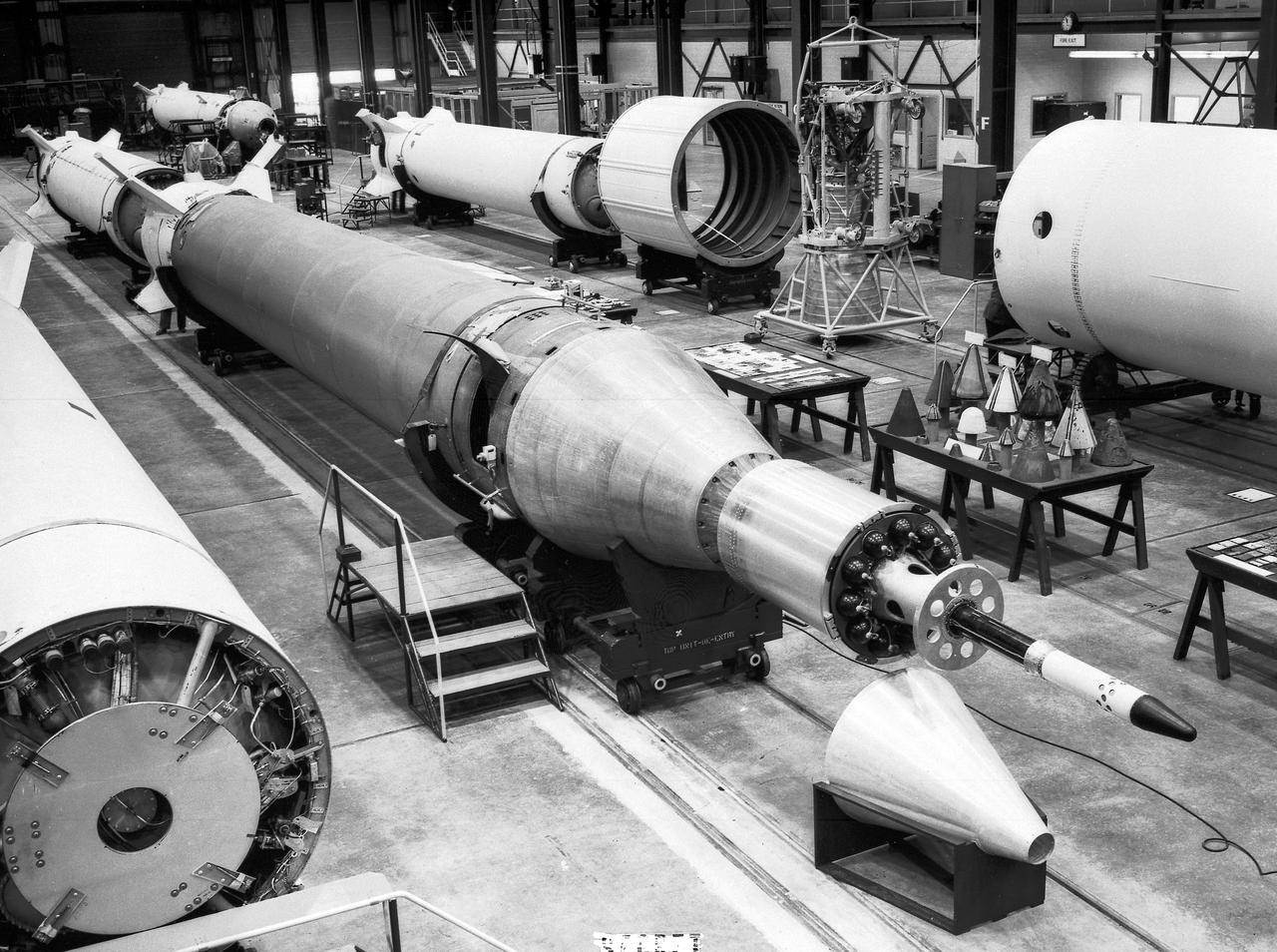
Jupiter-C Missile No. 27 assembly at the Army Ballistic Missile Agency (ABMA), Redstone Arsenal, in Huntsville, Aalabama. The Jupiter-C was a modification of the Redstone Missile, and originally developed as a nose cone re-entry test vehicle for the Jupiter Intermediate Range Ballistic Missile (IRBM). Jupiter-C successfully launched the first American Satellite, Explorer 1, in orbit on January 31, 1958.
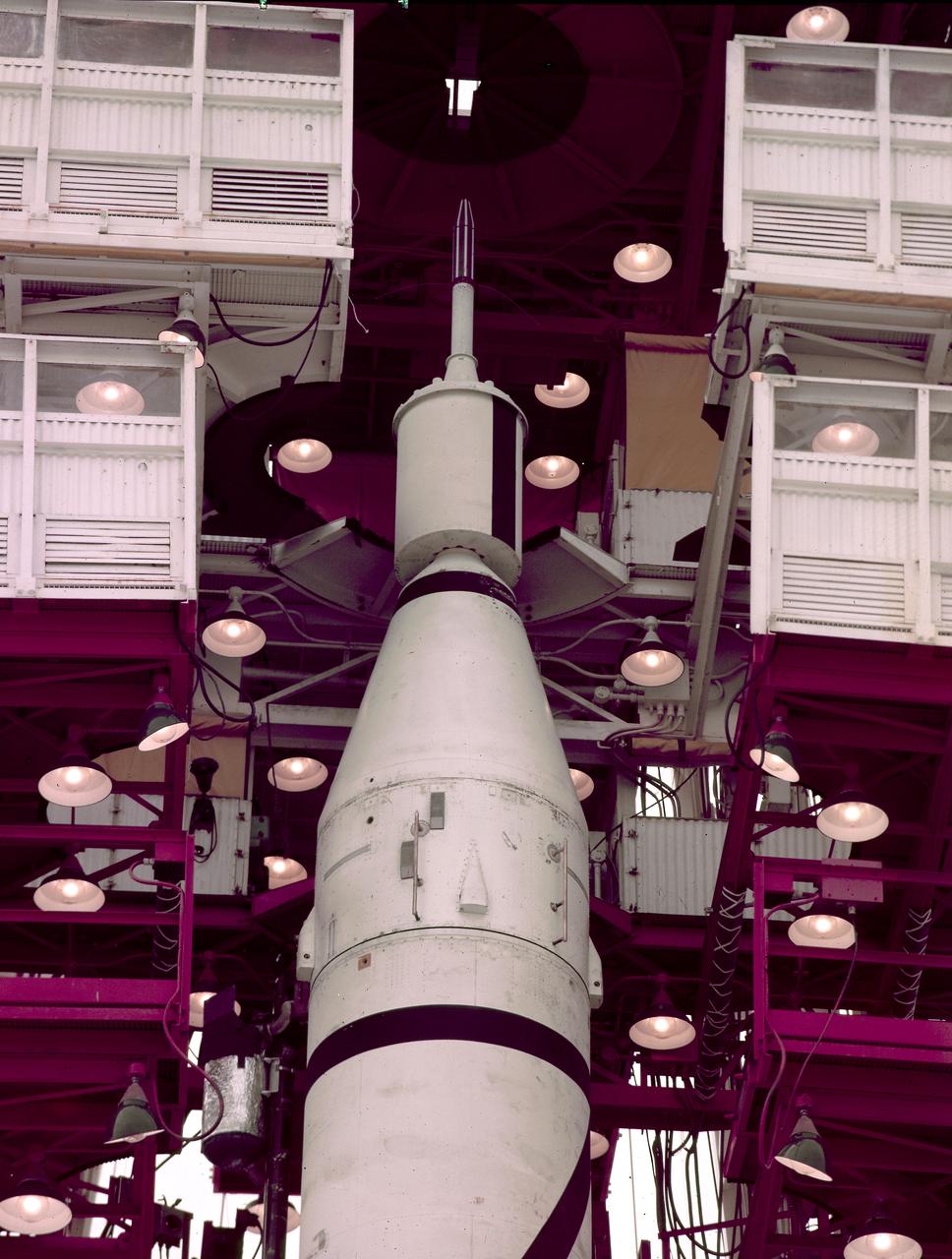
Explorer 1 atop a Jupiter-C in gantry. Jupiter-C carrying the first American satellite, Explorer 1, was successfully launched on January 31, 1958. The Jupiter-C launch vehicle consisted of a modified version of the Redstone rocket's first stage and two upper stages of clustered Baby Sergeant rockets developed by the Jet Propulsion Laboratory and later designated as Juno boosters for space launches
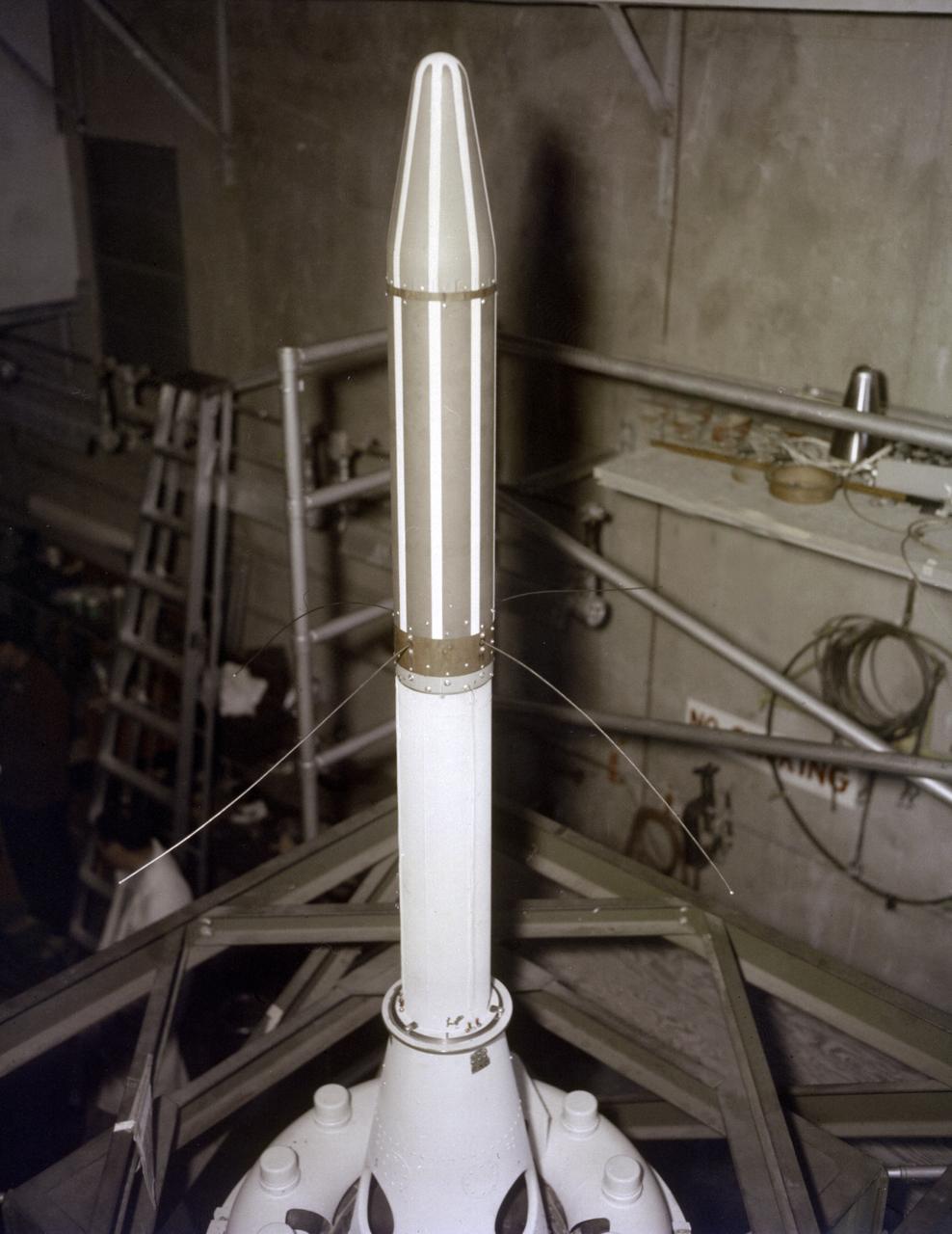
Explorer 1 satellite. This photo was taken during the installation of Explorer-1, the first United States' Earth-orbiting satellite, to its launch vehicle, Jupiter-C, in January 1958
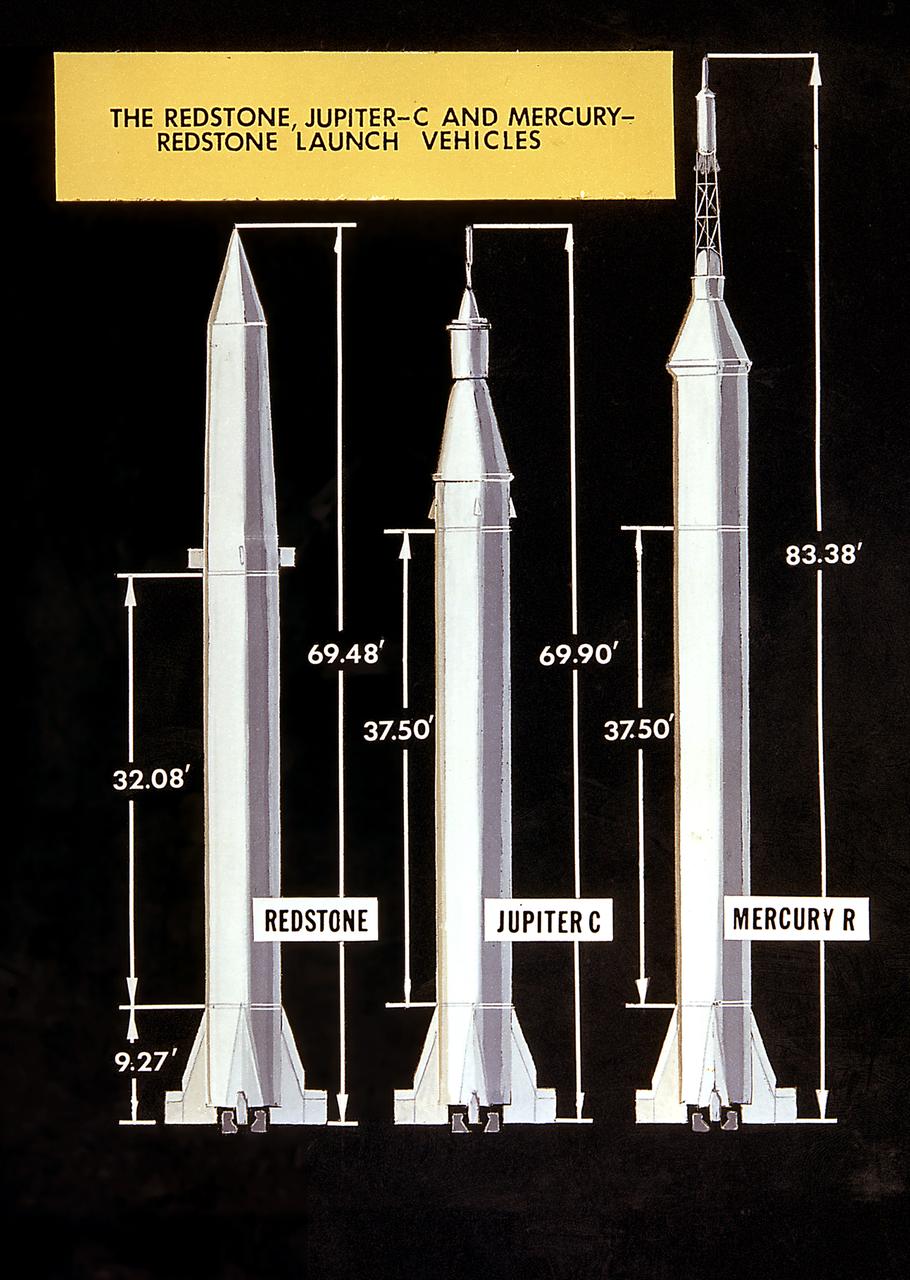
This is a comparison illustration of the Redstone, Jupiter-C, and Mercury Redstone launch vehicles. The Redstone ballistic missile was a high-accuracy, liquid-propelled, surface-to-surface missile. Originally developed as a nose cone re-entry test vehicle for the Jupiter intermediate range ballistic missile, the Jupiter-C was a modification of the Redstone missile and successfully launched the first American Satellite, Explorer-1, in orbit on January 31, 1958. The Mercury Redstone lifted off carrying the first American, astronaut Alan Shepard, in his Mercury spacecraft Freedom 7, on May 5, 1961.
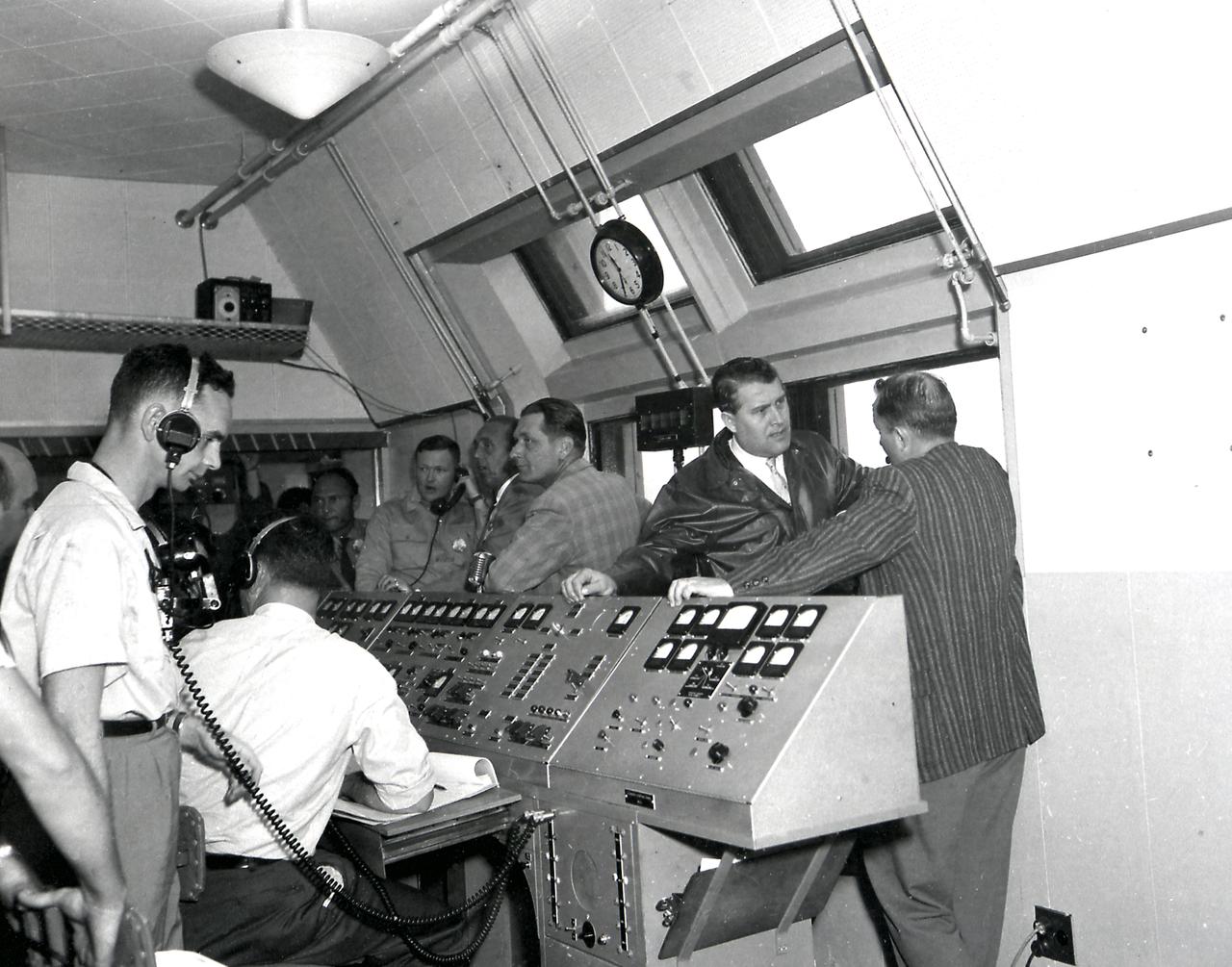
Dr. von Braun inside the blockhouse during the launch of the Jupiter C/Explorer III in March 1958.

Activities in a blockhouse during the launch of Jupiter-C/Explorer 1 on January 31, 1958
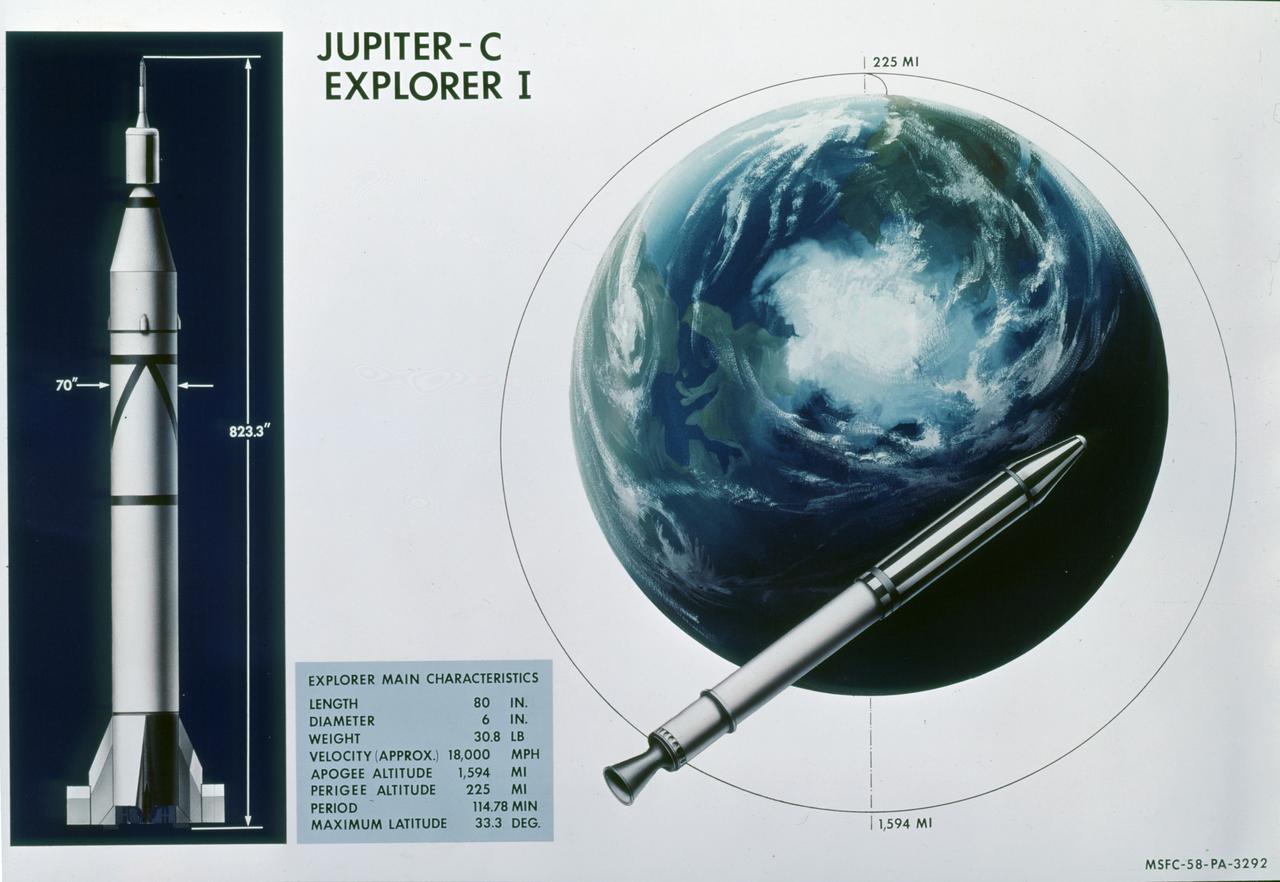
This illustration shows the main characteristics of the Jupiter C launch vehicle and its payload, the Explorer I satellite. The Jupiter C, America's first successful space vehicle, launched the free world's first scientific satellite, Explorer 1, on January 31, 1958. The four-stage Jupiter C measured almost 69 feet in length. The first stage was a modified liquid fueled Redstone missile. This main stage was about 57 feet in length and 70 inches in diameter. Fifteen scaled down SERGENT solid propellant motors were used in the upper stages. A "tub" configuration mounted on top of the modified Redstone held the second and third stages. The second stage consisted of 11 rockets placed in a ring formation within the tub. Inserted into the ring of second stage rockets was a cluster of 3 rockets making up the third stage. A fourth stage single rocket and the satellite were mounted atop the third stage. This "tub", all upper stages, and the satellite were set spirning prior to launching. The complete upper assembly measured 12.5 feet in length. The Explorer I carried the radiation detection experiment designed by Dr. James Van Allen and discovered the Van Allen Radiation Belt.
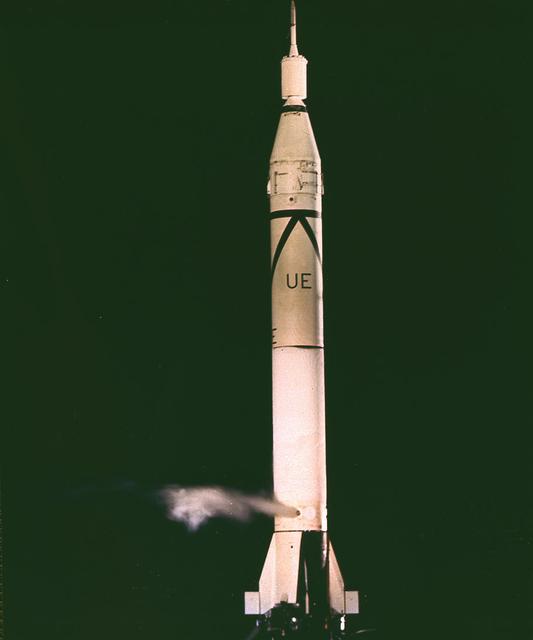
Juno I, a slightly modified Jupiter-C launch vehicle, shortly before the January 31, 1958 launch of America's first satellite, Explorer I. The Jupiter-C, developed by Dr. Wernher von Braun and the rocket team at Redstone Arsenal in Huntsville, Alabama, consisted of a modified version of the Redstone rocket's first stage and two upper stages of clustered Baby Sergeant rockets developed by the Jet Propulsion Laboratory.
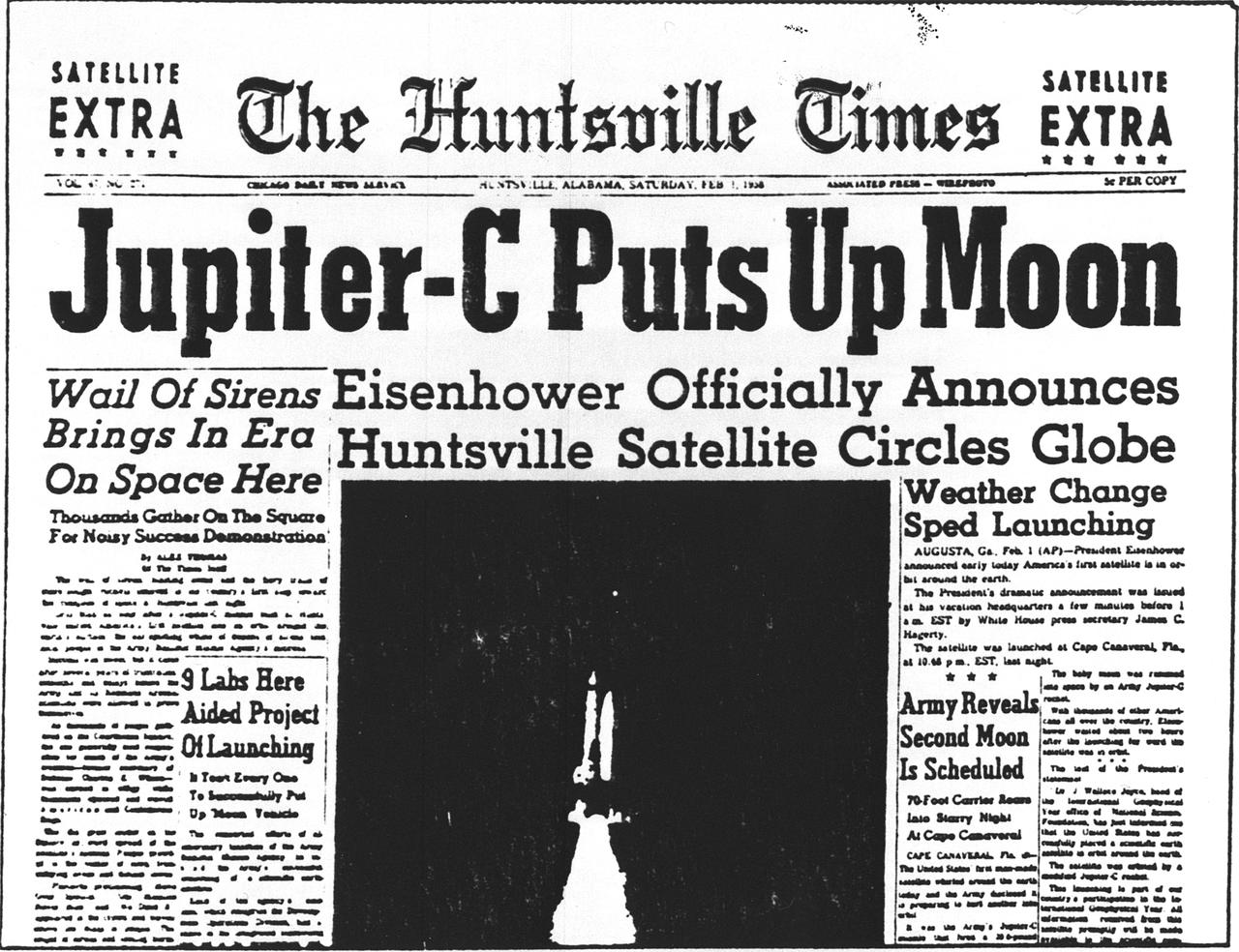
In January 1958, a modified Redstone rocket lifted the first American satellite into orbit just 3 months after the the von Braun team received the go-ahead. This modified Redstone rocket was known as a Jupiter-C. Its satellite payload was called Explorer I.
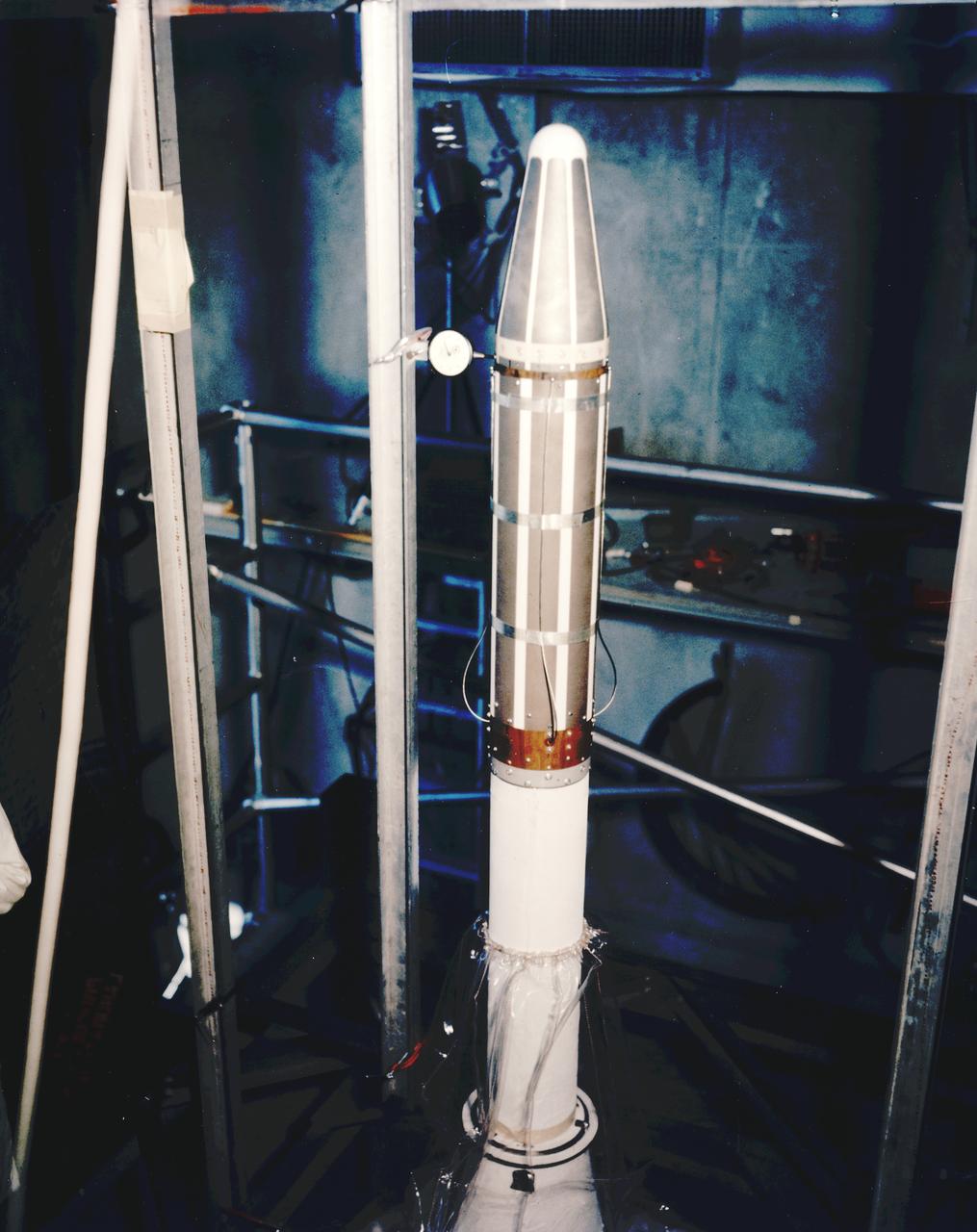
America’s first scientific satellite, the Explorer I, carried the radiation detection experiment designed by Dr. James Van Allen and discovered the Van Allen Radiation Belt. It was launched aboard a modified redstone rocket known as the Jupiter C, developed by Dr. von Braun’s rocket team at Redstone Arsenal in Huntsville, Alabama. The satellite launched on January 31, 1958, just 3 months after the the von Braun team received the go-ahead.

Launch of Jupiter-C/Explorer 1 at Cape Canaveral, Florida on January 31, 1958. After the Russian Sputnik 1 was launched in October 1957, the launching of an American satellite assumed much greater importance. After the Vanguard rocket exploded on the pad in December 1957, the ability to orbit a satellite became a matter of national prestige. On January 31, 1958, slightly more than four weeks after the launch of Sputnik.The ABMA (Army Ballistic Missile Agency) in Redstone Arsenal, Huntsville, Alabama, in cooperation with the Jet Propulsion Laboratory, launched a Jupiter from Cape Canaveral, Florida. The rocket consisted of a modified version of the Redstone rocket's first stage and two upper stages of clustered Baby Sergeant rockets developed by the Jet Propulsion Laboratory and later designated as Juno boosters for space launches
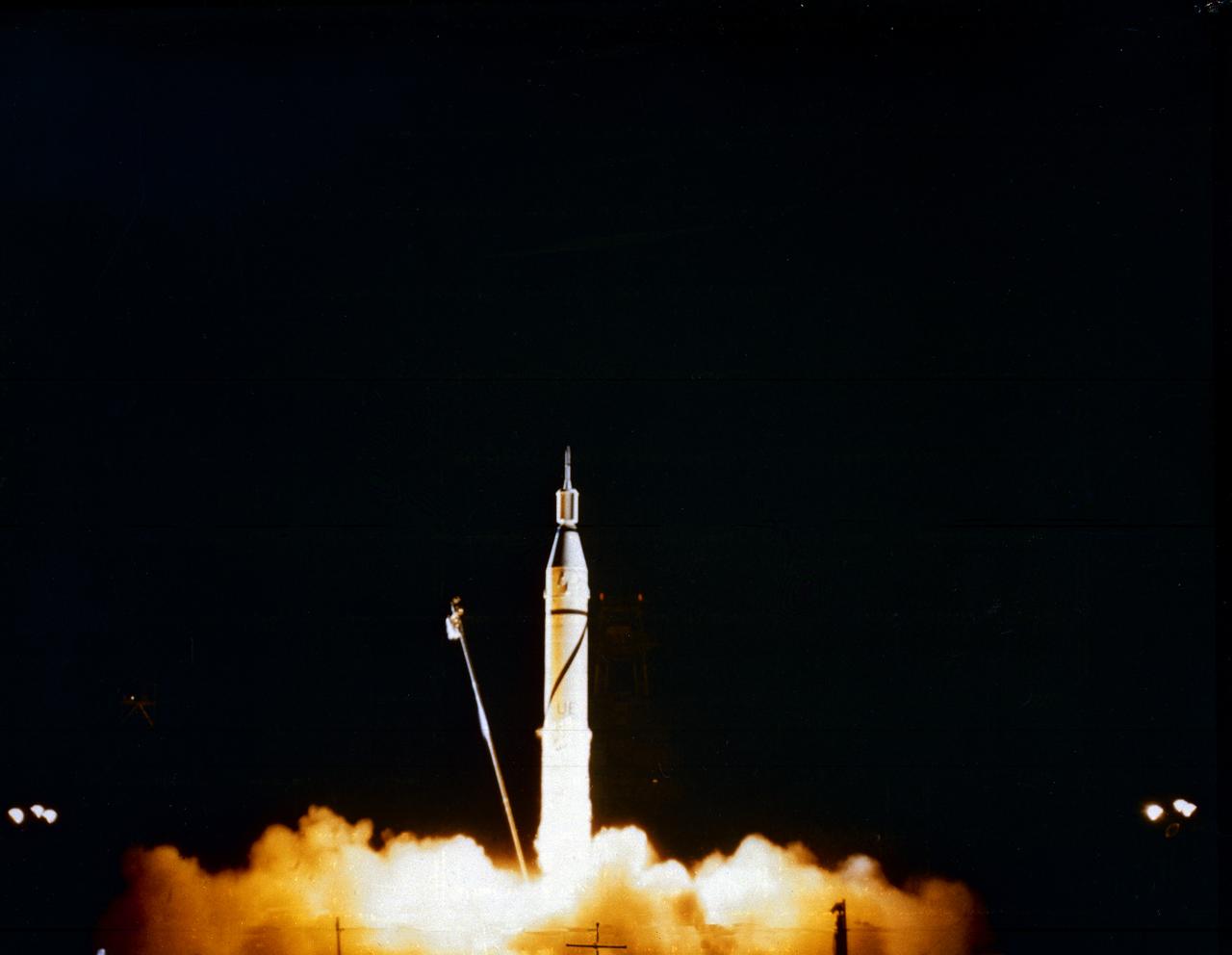
Launch of Jupiter-C/Explorer 1 at Cape Canaveral, Florida on January 31, 1958. After the Russian Sputnik 1 was launched in October 1957, the launching of an American satellite assumed much greater importance. After the Vanguard rocket exploded on the pad in December 1957, the ability to orbit a satellite became a matter of national prestige. On January 31, 1958, slightly more than four weeks after the launch of Sputnik.The ABMA (Army Ballistic Missile Agency) in Redstone Arsenal, Huntsville, Alabama, in cooperation with the Jet Propulsion Laboratory, launched a Jupiter from Cape Canaveral, Florida. The rocket consisted of a modified version of the Redstone rocket's first stage and two upper stages of clustered Baby Sergeant rockets developed by the Jet Propulsion Laboratory and later designated as Juno boosters for space launches
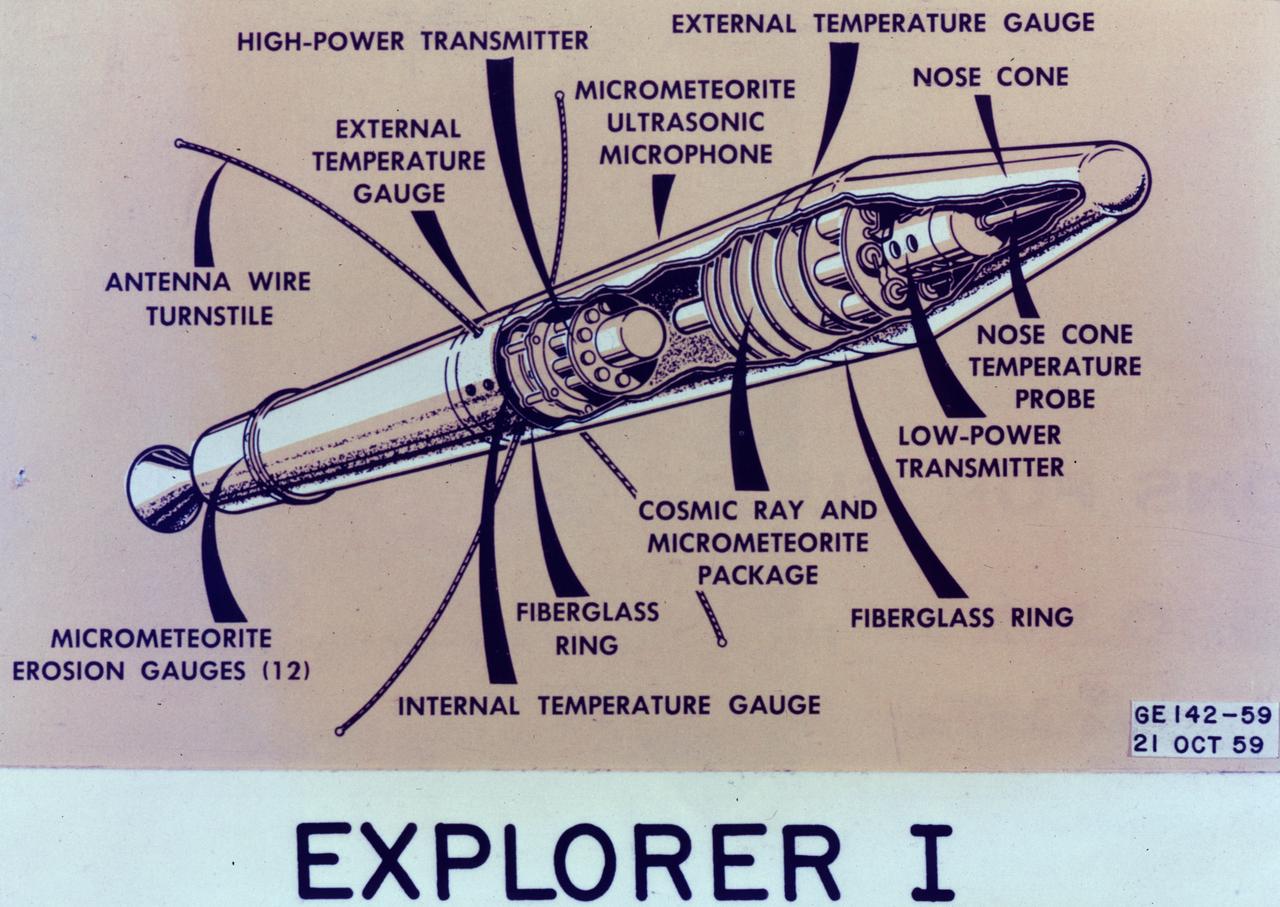
This image is a cutaway illustration of the Explorer I satellite with callouts. The Explorer I satellite was America's first scientific satellite launched aboard the Jupiter C launch vehicle on January 31, 1958. The Explorer I carried the radiation detection experiment designed by Dr. James Van Allen and discovered the Van Allen Radiation Belt.
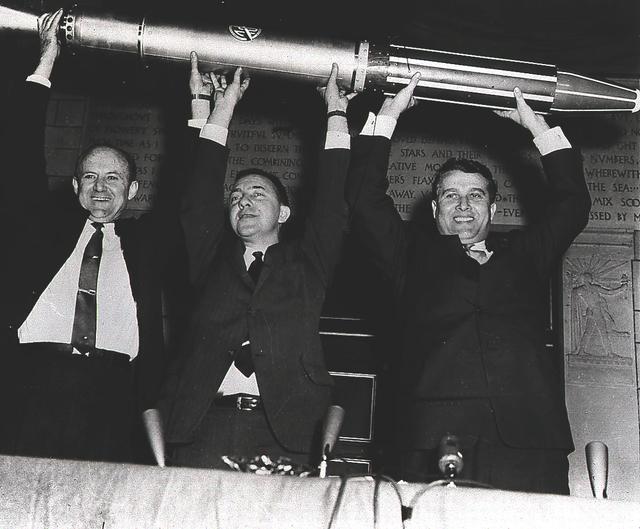
Jet Propulsion Laboratory Director Dr. William Pickering, Dr. James van Allen of the State University of Iowa, and Army Ballistic missionile Agency Technical Director Dr. Wernher von Braun triumphantly display a model of the Explorer I, America's first satellite, shortly after the satellite's launch on January 31, 1958. The Jet Propulsion Laboratory packed and tested the payload, a radiation detection experiment designed by Dr. van Allen. Dr. von Braun's rocket team at Redstone Arsenal in Huntsville, Alabama, developed the Juno I launch vehicle, a modified Jupiter-C.
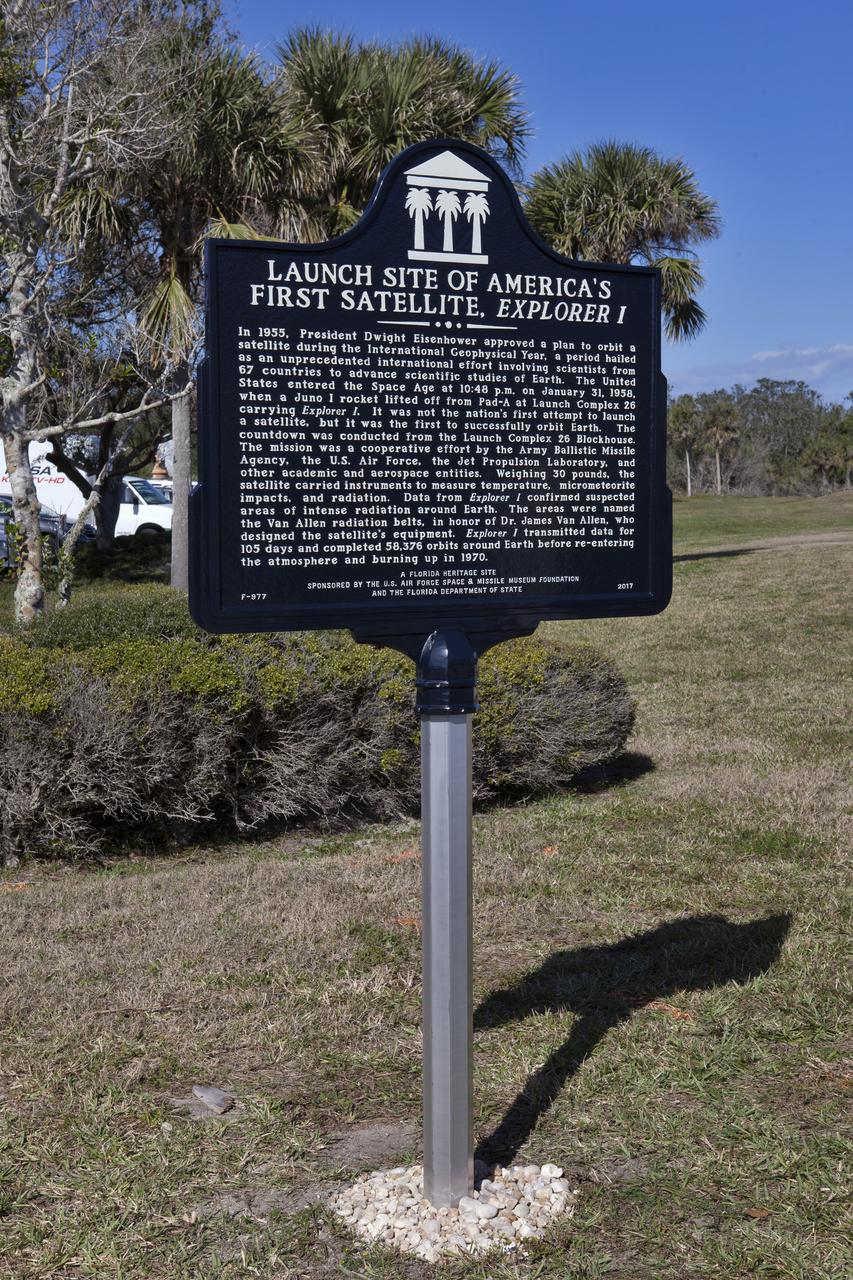
During a ceremony at Cape Canaveral Air Force Station's Space launch Complex 26 a historical marker has been unveiled noting the launch of America's first satellite, Explorer 1. The satellite was launched atop a Jupiter C rocket on Jan. 31, 1958. During operation, the satellite's cosmic ray detector discovered radiation belts around Earth which were named for Dr. James Van Allen, principal investigator for the satellite.
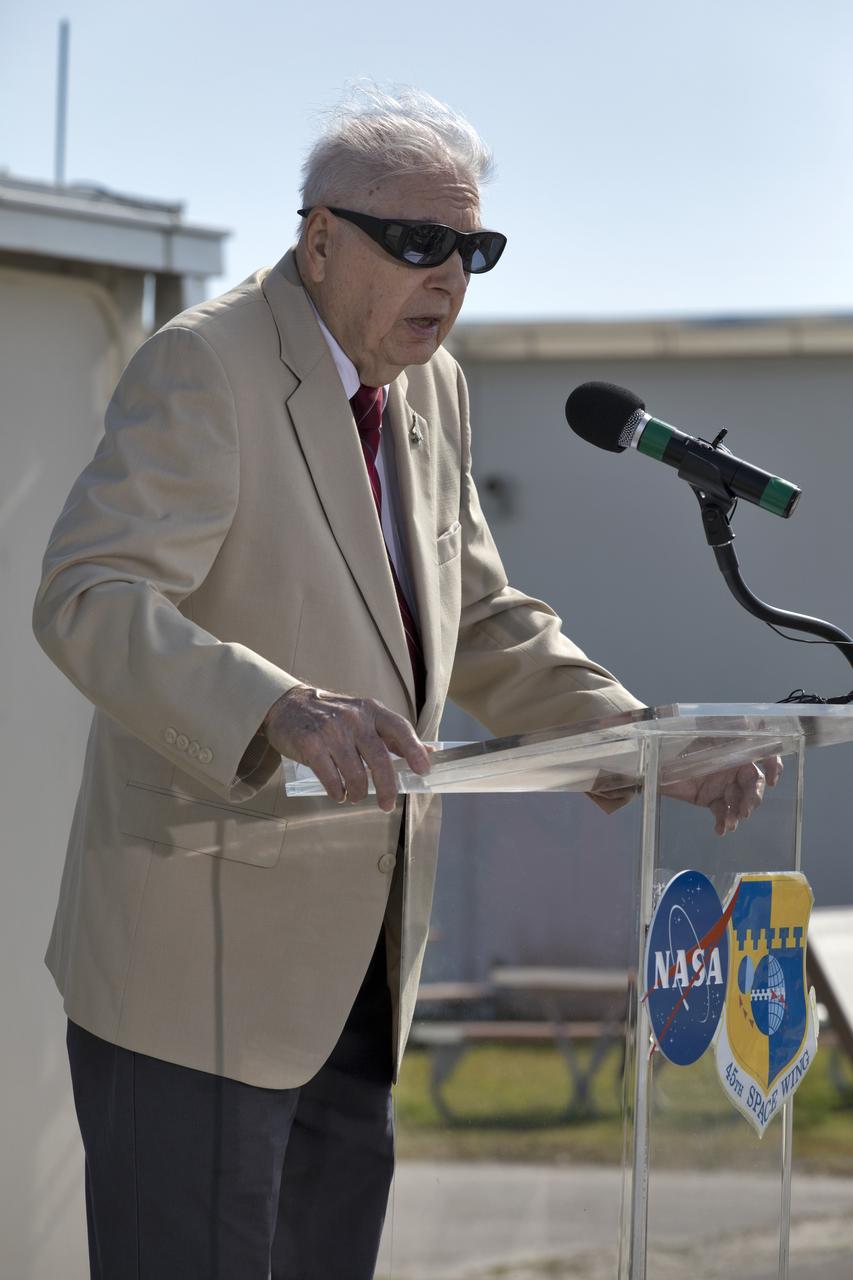
Dr. John Meisenheimer, launch weather officer for Explorer 1, speaks to guests at an event celebrating the 60th anniversary of America's first satellite. The ceremony took place in front of the Space Launch Complex 26 blockhouse at Cape Canaveral Air Force Station where the Explorer 1 satellite was launched atop a Jupiter C rocket on Jan. 31, 1958. During operation, the satellite's cosmic ray detector discovered radiation belts around Earth which were named for Dr. James Van Allen, principal investigator for the satellite.
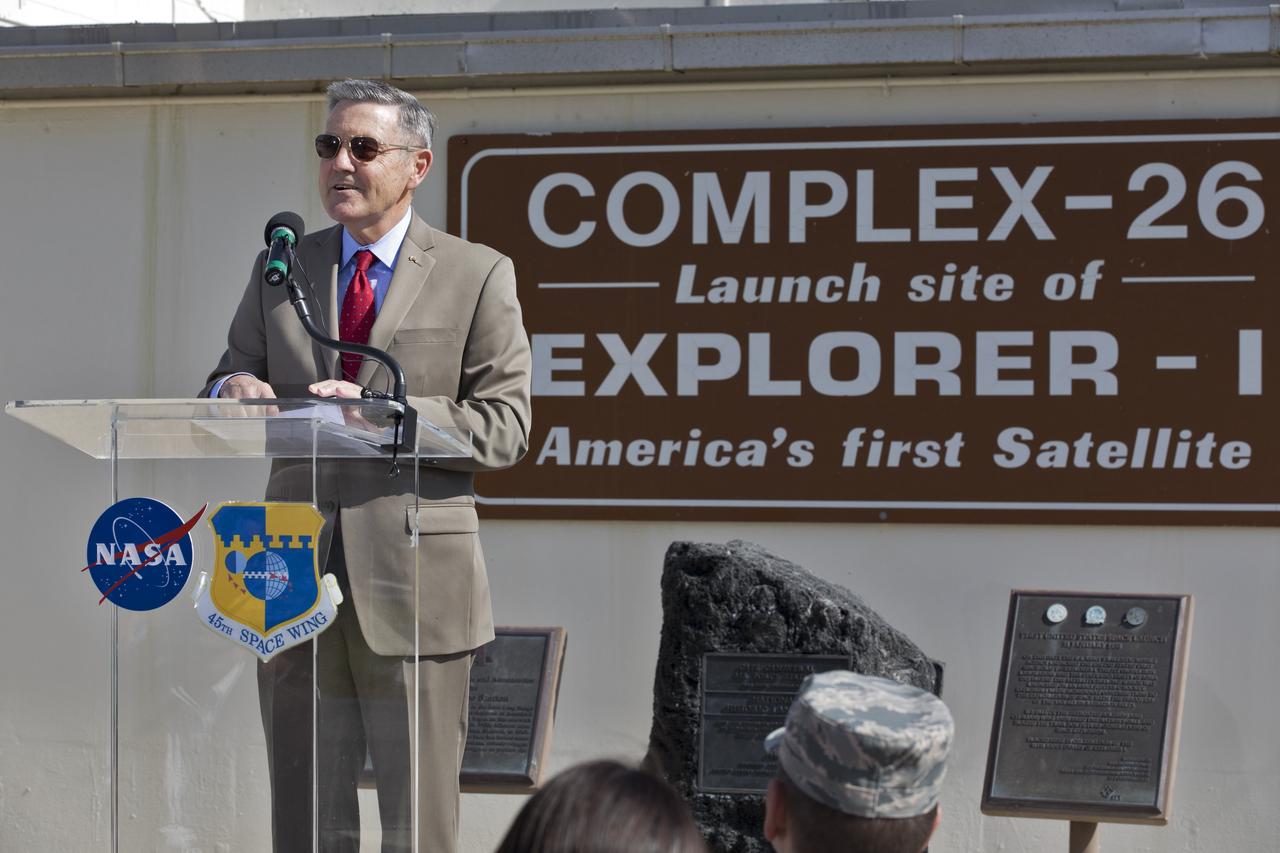
Kennedy Space Center Director Bob Cabana speaks to guests at an event celebrating the 60th anniversary of America's first satellite. The ceremony took place in front of the Space Launch Complex 26 blockhouse at Cape Canaveral Air Force Station where the Explorer 1 satellite was launched atop a Jupiter C rocket on Jan. 31, 1958. During operation, the satellite's cosmic ray detector discovered radiation belts around Earth which were named for Dr. James Van Allen, principal investigator for the satellite.

Tori McLendon of NASA Communications, speaks to guests at an event celebrating the 60th anniversary of America's first satellite. The ceremony took place in front of the Space Launch Complex 26 blockhouse at Cape Canaveral Air Force Station where the Explorer 1 satellite was launched atop a Jupiter C rocket on Jan. 31, 1958. During operation, the satellite's cosmic ray detector discovered radiation belts around Earth which were named for Dr. James Van Allen, principal investigator for the satellite.

Dr. John Meisenheimer, launch weather officer for Explorer 1, speaks to guests at an event celebrating the 60th anniversary of America's first satellite. The ceremony took place in front of the Space Launch Complex 26 blockhouse at Cape Canaveral Air Force Station where the Explorer 1 satellite was launched atop a Jupiter C rocket on Jan. 31, 1958. During operation, the satellite's cosmic ray detector discovered radiation belts around Earth which were named for Dr. James Van Allen, principal investigator for the satellite.

Brig. Gen. Wayne Monteith, 45th Space Wing commander and director of the Eastern Range, right, speaks with Launch team members who supported the launch of America's first satellite, Explorer 1. They spoke following an event celebrating the 60th anniversary of America's first satellite. The ceremony took place in front of the Space Launch Complex 26 blockhouse at Cape Canaveral Air Force Station where the Explorer 1 satellite was launched atop a Jupiter C rocket on Jan. 31, 1958. During operation, the satellite's cosmic ray detector discovered radiation belts around Earth which were named for Dr. James Van Allen, principal investigator for the satellite.

During a ceremony at Cape Canaveral Air Force Station's Space Launch Complex 26 a historical marker is unveiled noting the launch of America's first satellite, Explorer 1. From the left, Ray Sands, chairman of the Air Force Space and Missile Foundation -- sponsor of the marker, Brig. Gen. Wayne Monteith, 45th Space Wing commander and director of the Eastern Range and Kennedy Space Center Director Bob Cabana. The Explorer 1 satellite was launched atop a Jupiter C rocket on Jan. 31, 1958. During operation, the satellite's cosmic ray detector discovered radiation belts around Earth which were named for Dr. James Van Allen, principal investigator for the satellite.
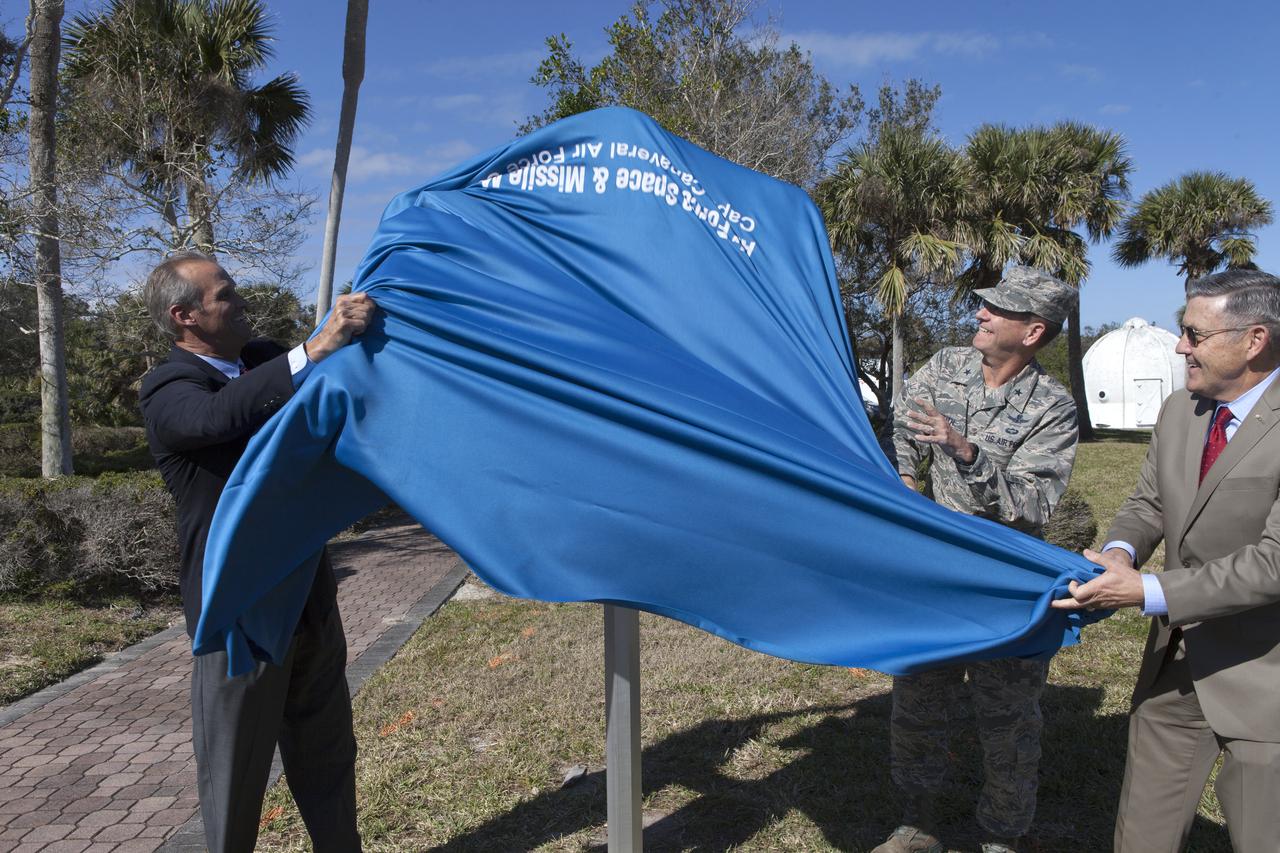
During a ceremony at Cape Canaveral Air Force Station's Space Launch Complex 26 a historical marker is unveiled noting the launch of America's first satellite, Explorer 1. From the left, Ray Sands, chairman of the Air Force Space and Missile Foundation -- sponsor of the marker, Brig. Gen. Wayne Monteith, 45th Space Wing commander and director of the Eastern Range and Kennedy Space Center Director Bob Cabana. The Explorer 1 satellite was launched atop a Jupiter C rocket on Jan. 31, 1958. During operation, the satellite's cosmic ray detector discovered radiation belts around Earth which were named for Dr. James Van Allen, principal investigator for the satellite.
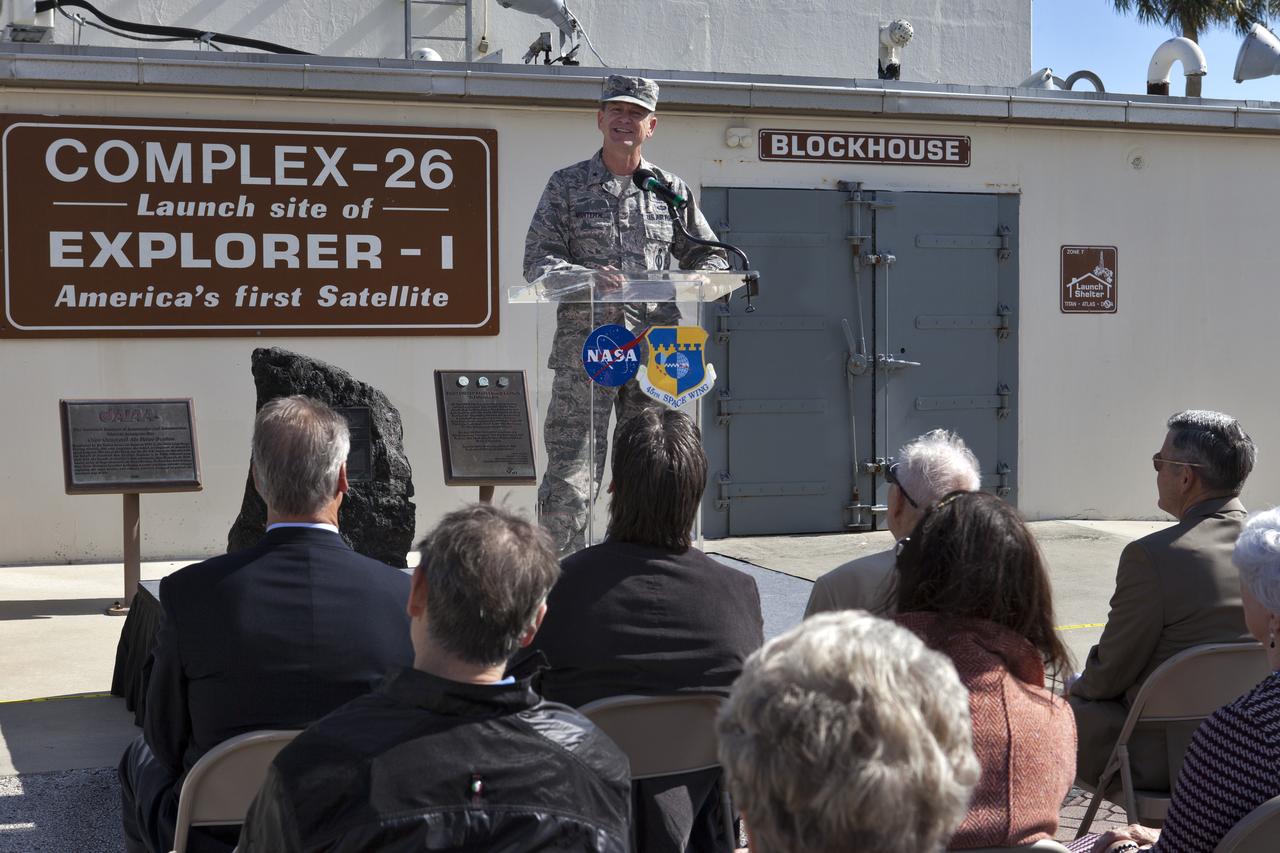
Brig. Gen. Wayne Monteith, 45th Space Wing commander and director of the Eastern Range, speaks to guests at an event celebrating the 60th anniversary of America's first satellite. The ceremony took place in front of the Space Launch Complex 26 blockhouse at Cape Canaveral Air Force Station where the Explorer 1 satellite was launched atop a Jupiter C rocket on Jan. 31, 1958. During operation, the satellite's cosmic ray detector discovered radiation belts around Earth which were named for Dr. James Van Allen, principal investigator for the satellite.

During a ceremony at Cape Canaveral Air Force Station's Space Launch Complex 26 a historical marker has been unveiled noting the launch of America's first satellite, Explorer 1. From the left, Ray Sands, chairman of the Air Force Space and Missile Foundation -- sponsor of the marker, Brig. Gen. Wayne Monteith, 45th Space Wing commander and director of the Eastern Range and Kennedy Space Center Director Bob Cabana. The Explorer 1 satellite was launched atop a Jupiter C rocket on Jan. 31, 1958. During operation, the satellite's cosmic ray detector discovered radiation belts around Earth which were named for Dr. James Van Allen, principal investigator for the satellite.
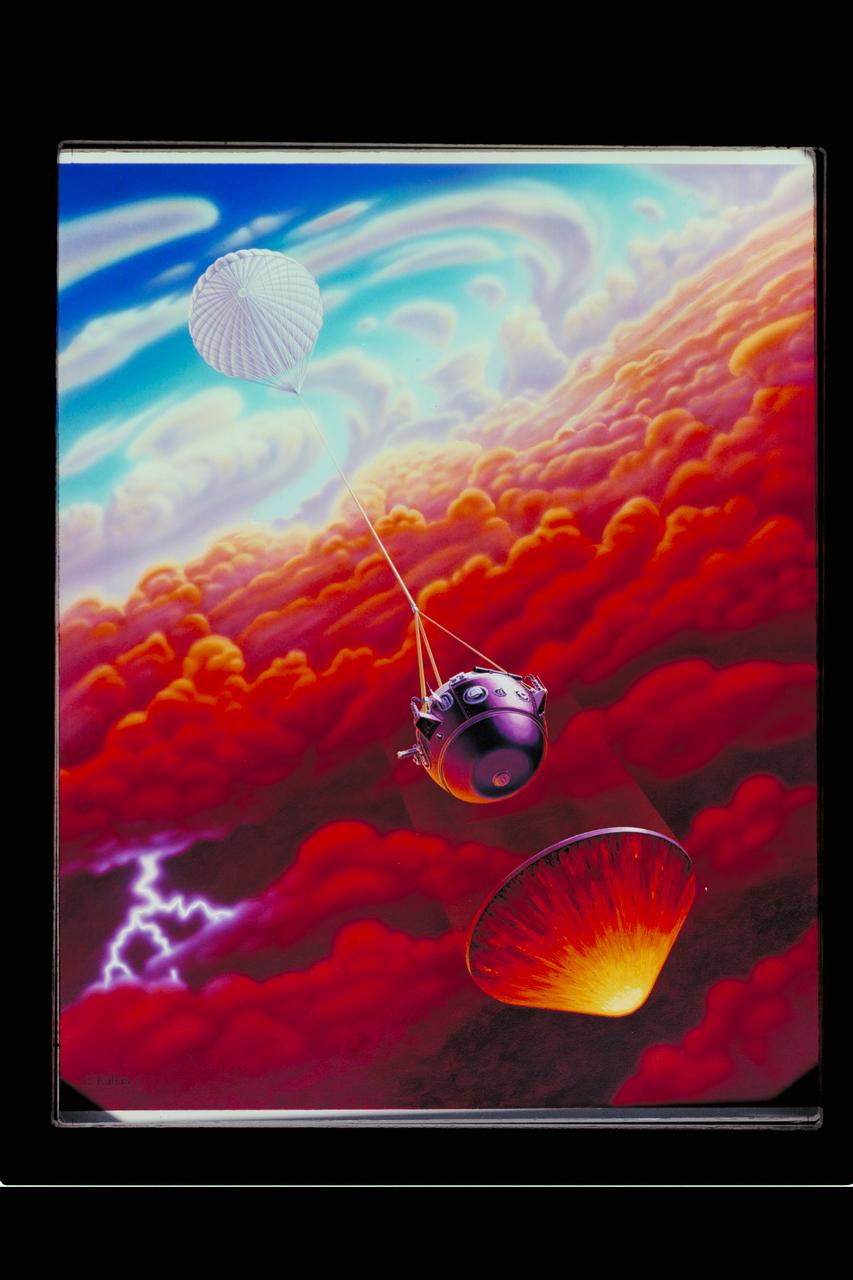
Artist: C Kallas Jupiter Mission: Pioneer Galileo Entry Probe Artwork (heatshield separation) (jpl ref: 4S30599)
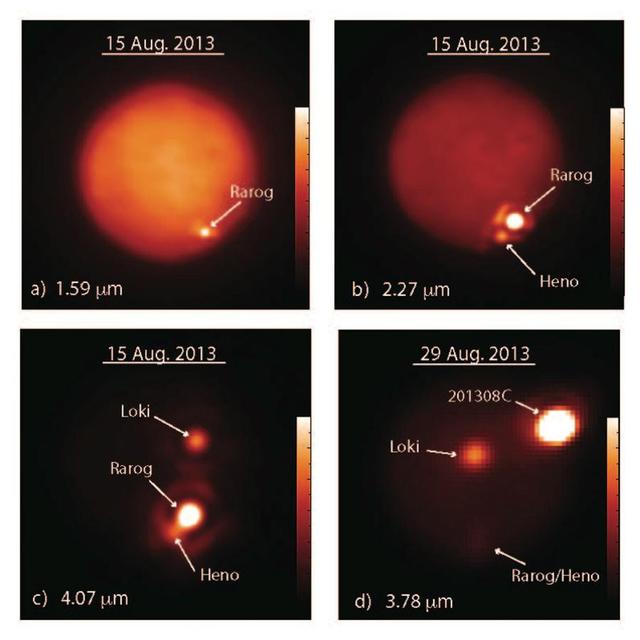
These images show Jupiter moon Io obtained at different infrared wavelengths with the W. M. Keck Observatory 10-meter Keck II telescope on Aug. 15, 2013 a-c, and the Gemini North telescope on Aug. 29, 2013 d.
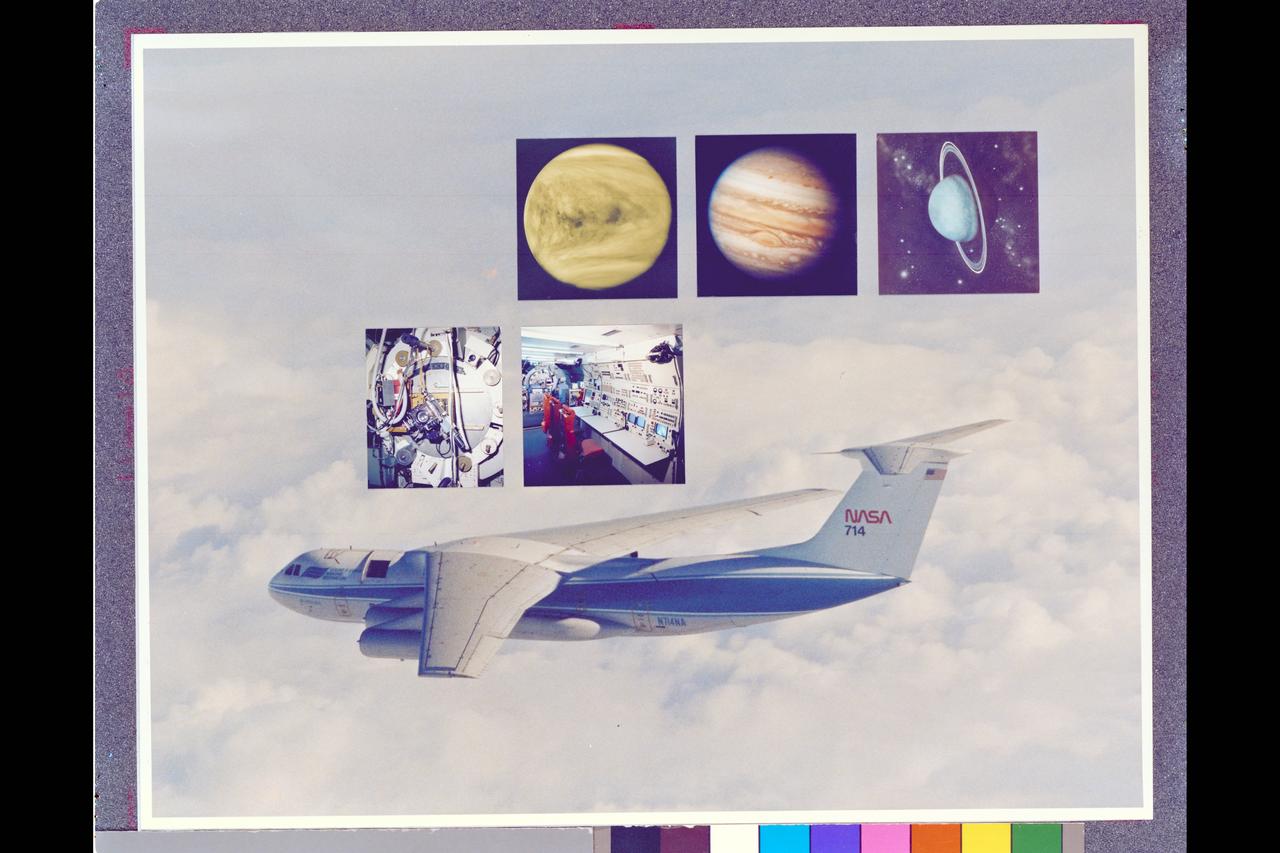
Composite Art C-141 KAO Airborne Astronomy Composite shows A/C AC80-0006-2, Venus AC78-9140, Jupiter AC79-0143-1, Uranus AC77-0359, Console AC75-1345 and Telescope AC81-0299-17
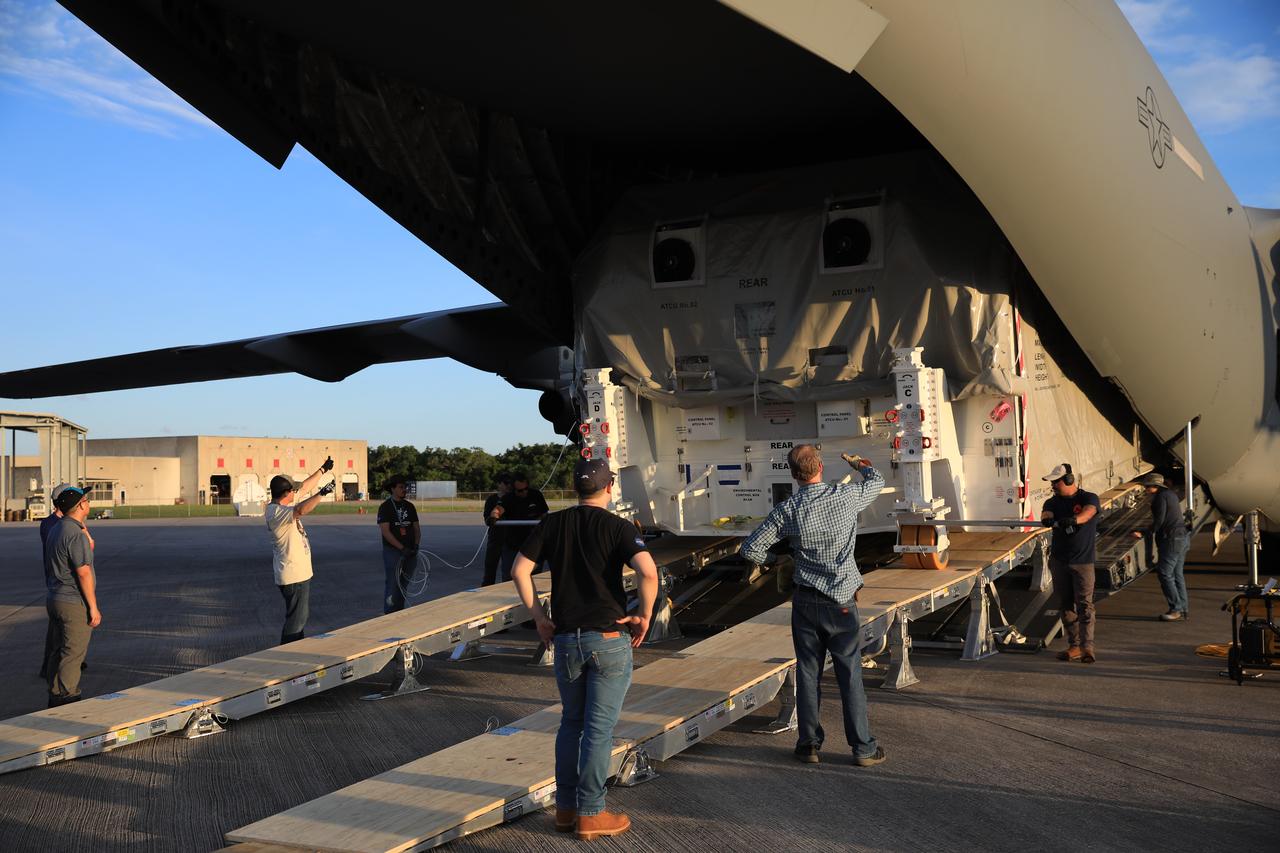
Technicians offload NASA’s largest planetary mission spacecraft, Europa Clipper, from a United States Air Force C-17 Globemaster III transport aircraft at the Launch and Landing Facility at NASA’s Kennedy Space Center in Florida on Thursday, May 23, 2024. Crews will prepare it for launch aboard a SpaceX Falcon Heavy rocket from Launch Complex 39A at the Florida spaceport, targeting liftoff in October. Europa Clipper will help determine if life-sustaining conditions exist below the surface of Jupiter’s fourth largest moon, Europa.
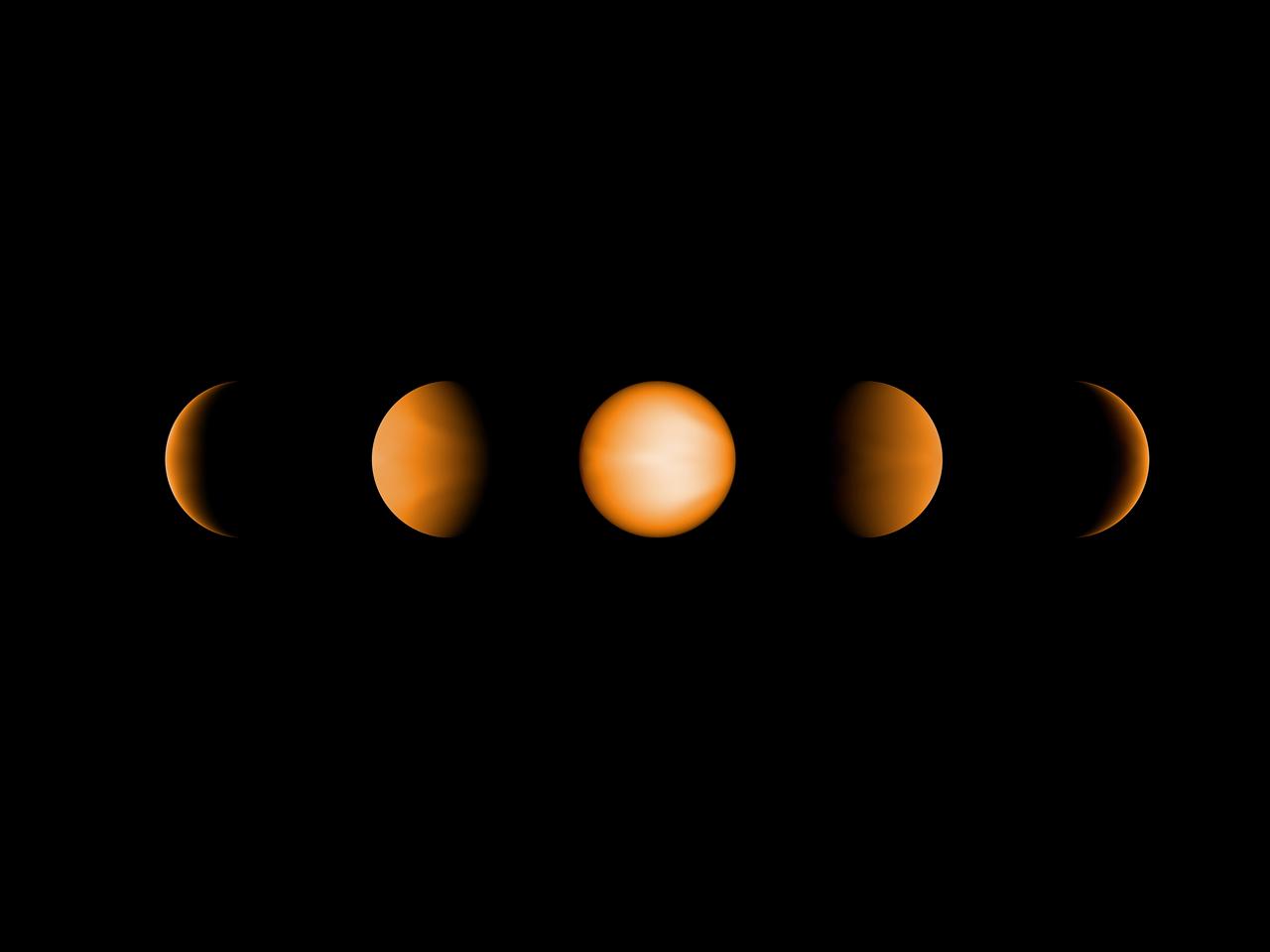
These simulated views of the ultrahot Jupiter WASP-121b show what the planet might look like to the human eye from five different vantage points, illuminated to different degrees by its parent star. The images were created using a computer simulation being used to help scientists understand the atmospheres of these ultra-hot planets. Ultrahot Jupiters reflect almost no light, rather like charcoal. However, the daysides of ultrahot Jupiters have temperatures of between 3600°F and 5400°F (2000°C and 3000°C), so the planets produce their own glow, like a hot ember. The orange color in this simulated image is thus from the planet's own heat. The computer model was based on observations of WASP-121b conducted using NASA's Spitzer and Hubble space telescopes. https://photojournal.jpl.nasa.gov/catalog/PIA22565

Teams offload NASA’s largest planetary mission spacecraft, Europa Clipper, from a United States Air Force C-17 Globemaster III transport aircraft onto the flatbed of a heavy-lift truck at the Launch and Landing Facility at NASA’s Kennedy Space Center in Florida on Thursday, May 23, 2024. Crews transported Europa Clipper to the Payload Hazardous Servicing Facility at Kennedy to prepare it for launch aboard a SpaceX Falcon Heavy rocket later this year from Launch Complex 39A at the Florida spaceport. Europa Clipper will help determine if conditions exist below the surface Jupiter’s fourth largest moon, Europa, that could support life.
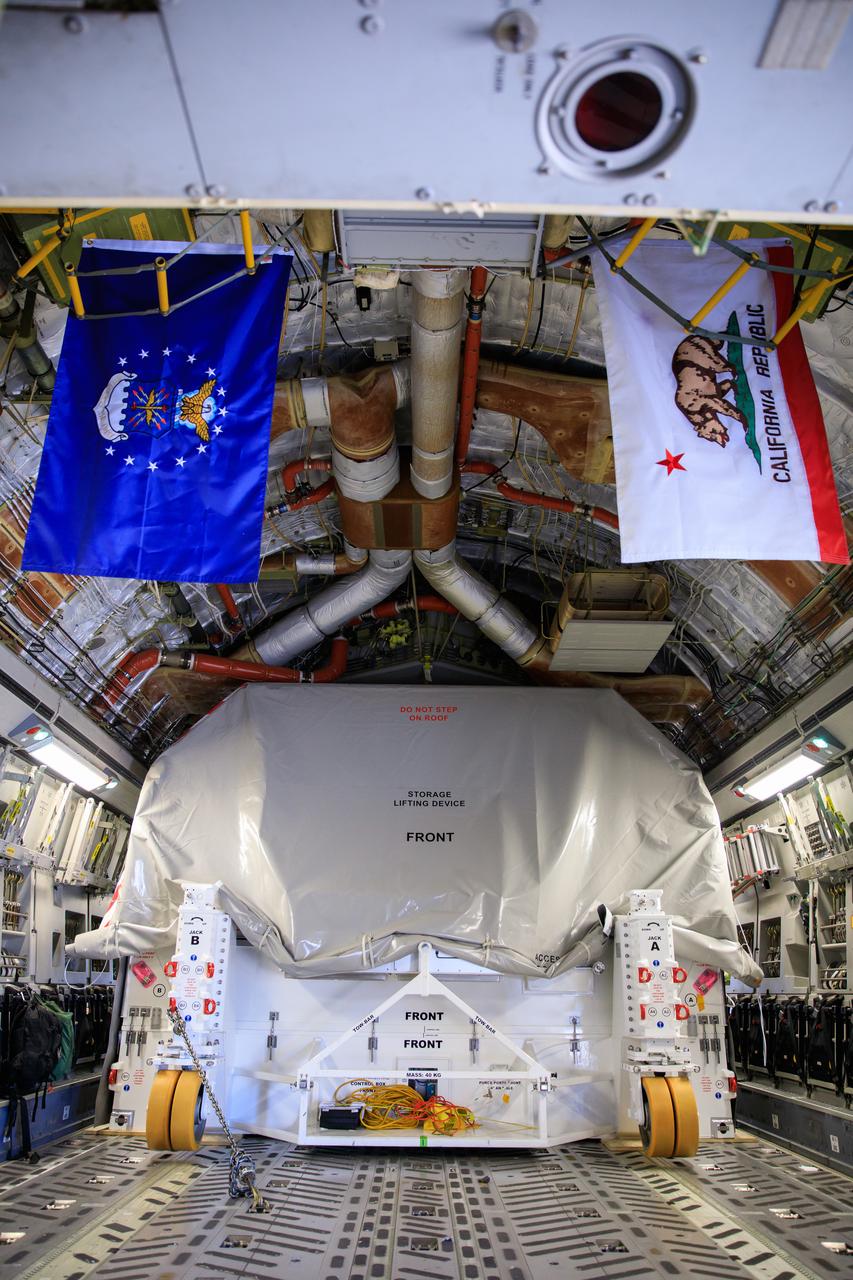
Teams offload NASA’s largest planetary mission spacecraft, Europa Clipper, from a United States Air Force C-17 Globemaster III transport aircraft onto the flatbed of a heavy-lift truck at the Launch and Landing Facility at NASA’s Kennedy Space Center in Florida on Thursday, May 23, 2024. Crews transported Europa Clipper to the Payload Hazardous Servicing Facility at Kennedy to prepare it for launch aboard a SpaceX Falcon Heavy rocket later this year from Launch Complex 39A at the Florida spaceport. Europa Clipper will help determine if conditions exist below the surface Jupiter’s fourth largest moon, Europa, that could support life.

Teams offload NASA’s largest planetary mission spacecraft, Europa Clipper, from a United States Air Force C-17 Globemaster III transport aircraft onto the flatbed of a heavy-lift truck at the Launch and Landing Facility at NASA’s Kennedy Space Center in Florida on Thursday, May 23, 2024. Crews transported Europa Clipper to the Payload Hazardous Servicing Facility at Kennedy to prepare it for launch aboard a SpaceX Falcon Heavy rocket later this year from Launch Complex 39A at the Florida spaceport. Europa Clipper will help determine if conditions exist below the surface Jupiter’s fourth largest moon, Europa, that could support life.
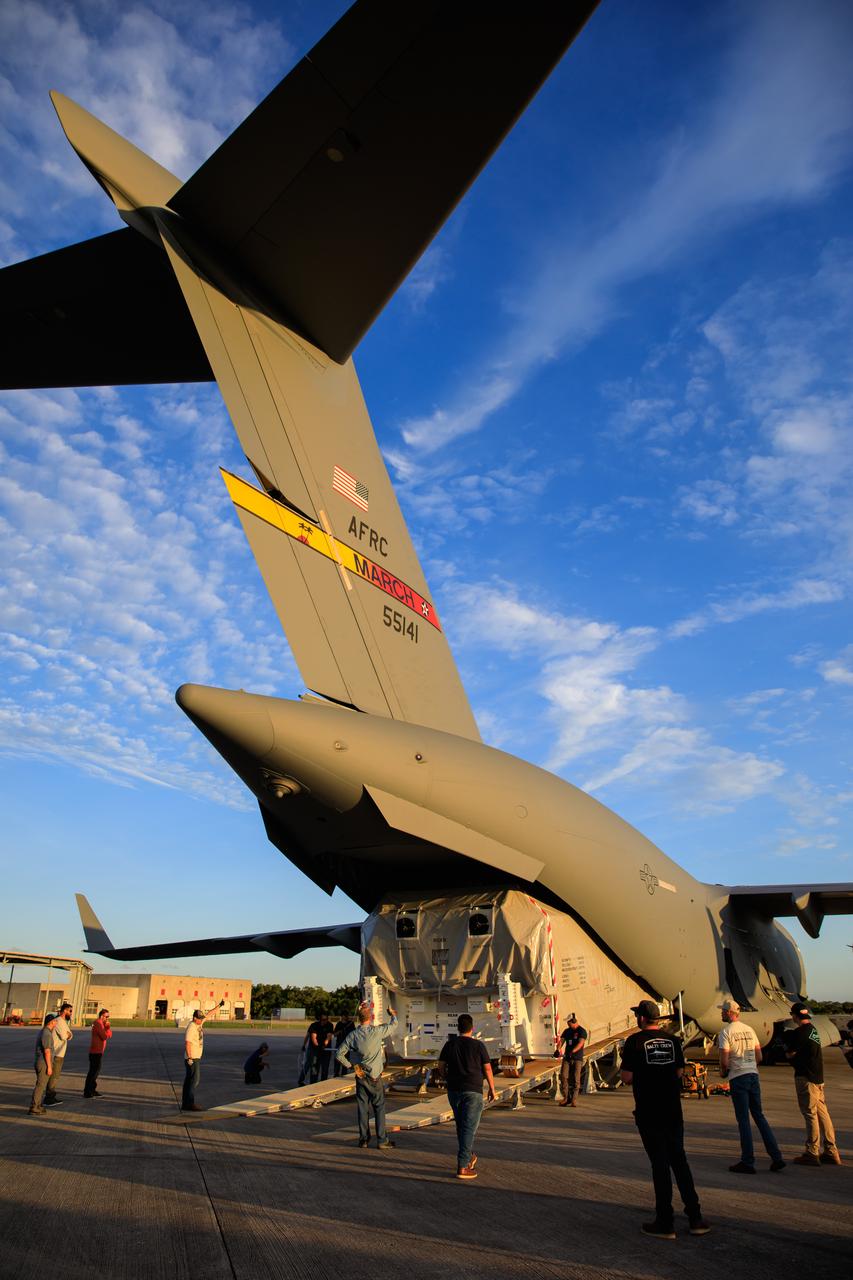
Teams offload NASA’s largest planetary mission spacecraft, Europa Clipper, from a United States Air Force C-17 Globemaster III transport aircraft onto the flatbed of a heavy-lift truck at the Launch and Landing Facility at NASA’s Kennedy Space Center in Florida on Thursday, May 23, 2024. Crews transported Europa Clipper to the Payload Hazardous Servicing Facility at Kennedy to prepare it for launch aboard a SpaceX Falcon Heavy rocket later this year from Launch Complex 39A at the Florida spaceport. Europa Clipper will help determine if conditions exist below the surface Jupiter’s fourth largest moon, Europa, that could support life.

Teams offload NASA’s largest planetary mission spacecraft, Europa Clipper, from a United States Air Force C-17 Globemaster III transport aircraft onto the flatbed of a heavy-lift truck at the Launch and Landing Facility at NASA’s Kennedy Space Center in Florida on Thursday, May 23, 2024. Crews transported Europa Clipper to the Payload Hazardous Servicing Facility at Kennedy to prepare it for launch aboard a SpaceX Falcon Heavy rocket later this year from Launch Complex 39A at the Florida spaceport. Europa Clipper will help determine if conditions exist below the surface Jupiter’s fourth largest moon, Europa, that could support life.
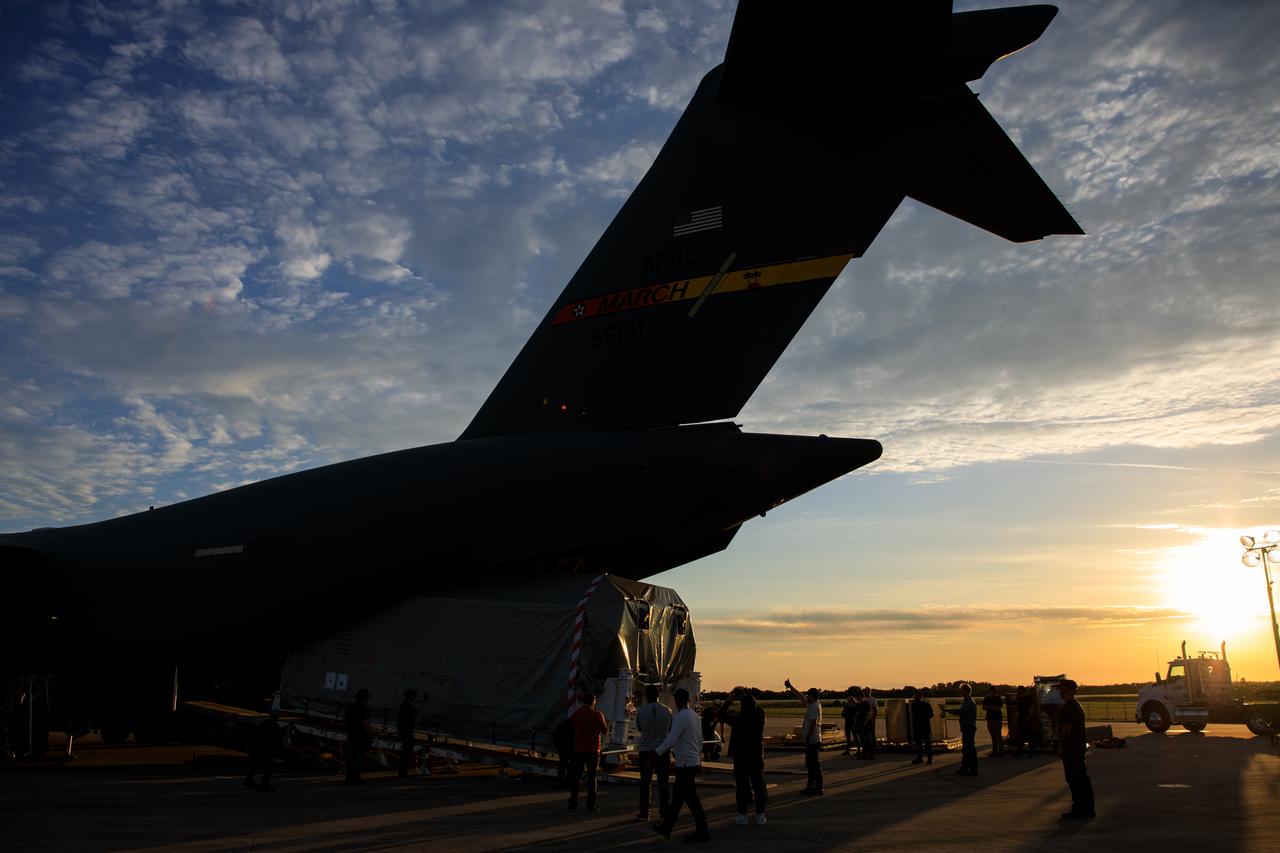
Teams offload NASA’s largest planetary mission spacecraft, Europa Clipper, from a United States Air Force C-17 Globemaster III transport aircraft onto the flatbed of a heavy-lift truck at the Launch and Landing Facility at NASA’s Kennedy Space Center in Florida on Thursday, May 23, 2024. Crews transported Europa Clipper to the Payload Hazardous Servicing Facility at Kennedy to prepare it for launch aboard a SpaceX Falcon Heavy rocket later this year from Launch Complex 39A at the Florida spaceport. Europa Clipper will help determine if conditions exist below the surface Jupiter’s fourth largest moon, Europa, that could support life.

A United States Air Force C-17 Globemaster III transport aircraft carrying NASA’s largest planetary mission spacecraft, Europa Clipper, arrives at the Launch and Landing Facility at the agency's Kennedy Space Center in Florida on Thursday, May 23, 2024. Teams spent several hours offloading Europa Clipper then transferring it to the Payload Hazardous Servicing Facility at Kennedy to prepare it for launch aboard a SpaceX Falcon Heavy rocket later this year from Launch Complex 39A at the Florida spaceport. Europa Clipper will help determine if life-sustaining conditions exist below the surface Jupiter’s fourth largest moon, Europa.
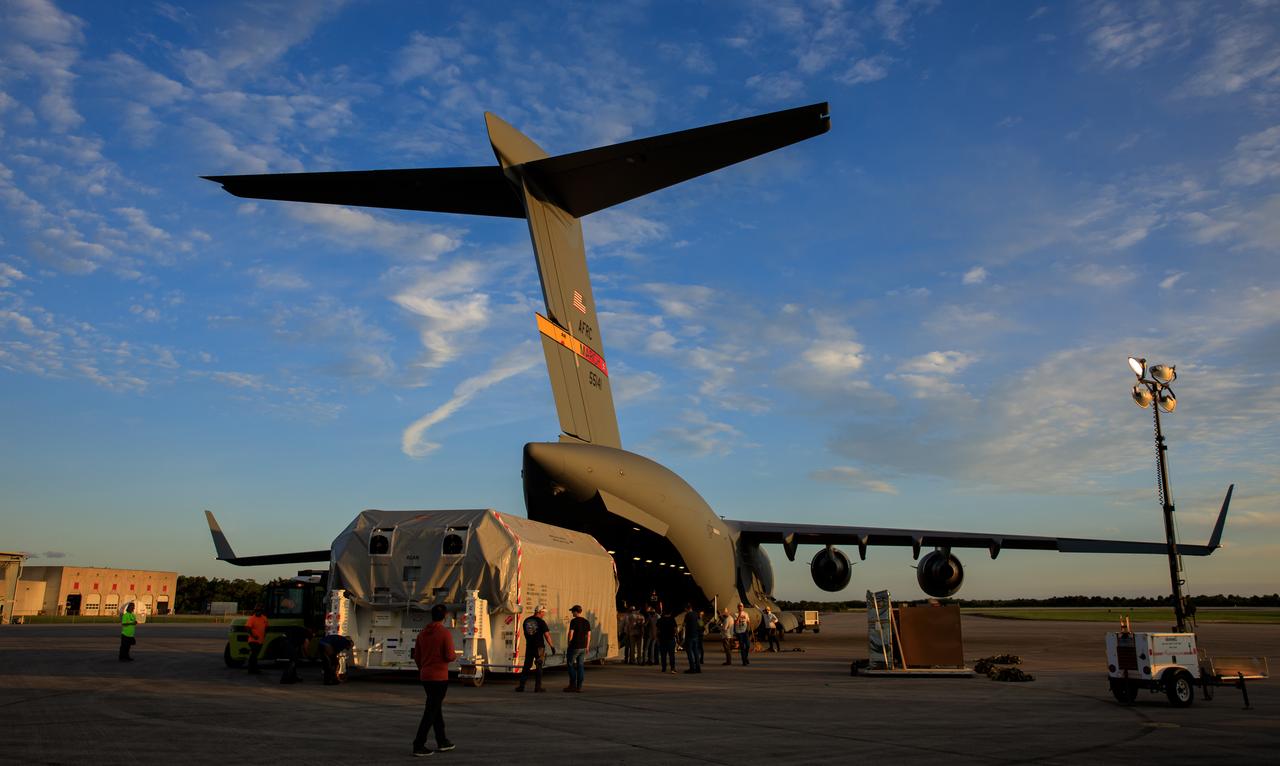
Teams offload NASA’s largest planetary mission spacecraft, Europa Clipper, from a United States Air Force C-17 Globemaster III transport aircraft onto the flatbed of a heavy-lift truck at the Launch and Landing Facility at NASA’s Kennedy Space Center in Florida on Thursday, May 23, 2024. Crews transported Europa Clipper to the Payload Hazardous Servicing Facility at Kennedy to prepare it for launch aboard a SpaceX Falcon Heavy rocket later this year from Launch Complex 39A at the Florida spaceport. Europa Clipper will help determine if conditions exist below the surface Jupiter’s fourth largest moon, Europa, that could support life.

Teams offload NASA’s largest planetary mission spacecraft, Europa Clipper, from a United States Air Force C-17 Globemaster III transport aircraft onto the flatbed of a heavy-lift truck at the Launch and Landing Facility at NASA’s Kennedy Space Center in Florida on Thursday, May 23, 2024. Crews transported Europa Clipper to the Payload Hazardous Servicing Facility at Kennedy to prepare it for launch aboard a SpaceX Falcon Heavy rocket later this year from Launch Complex 39A at the Florida spaceport. Europa Clipper will help determine if conditions exist below the surface Jupiter’s fourth largest moon, Europa, that could support life.
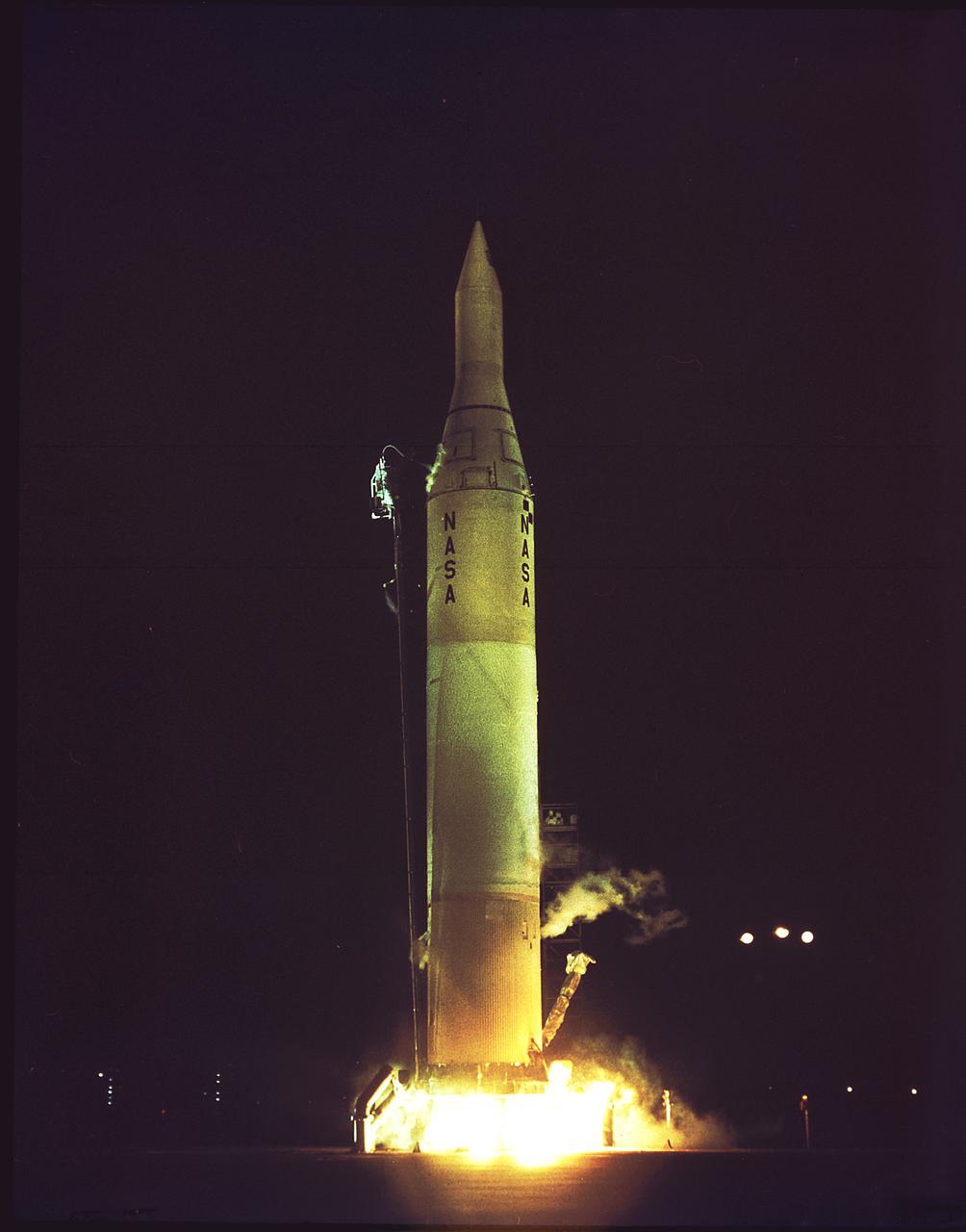
Wernher von Braun and his team were responsible for the Jupiter-C hardware. The family of launch vehicles developed by the team also came to include the Juno II, which was used to launch the Pioneer IV satellite on March 3, 1959. Pioneer IV passed within 37,000 miles of the Moon before going into solar orbit.

This image captures a close-up view of a storm with bright cloud tops in the northern hemisphere of Jupiter. NASA's Juno spacecraft took this color-enhanced image on Feb. 7 at 5:38 a.m. PST (8:38 a.m. EST) during its 11th close flyby of the gas giant planet. At the time, the spacecraft was 7,578 miles (12,195 kilometers) from the tops of Jupiter's clouds at 49.2 degrees north latitude. Citizen scientist Matt Brealey processed the image using data from the JunoCam imager. Citizen scientist Gustavo B C then adjusted colors and embossed Matt Brealey's processing of this storm. https://photojournal.jpl.nasa.gov/catalog/PIA21981 . - Enhanced image by Matt Brealey / Gustavo B C based on images provided courtesy of NASA/JPL-Caltech/SwRI/MSSS
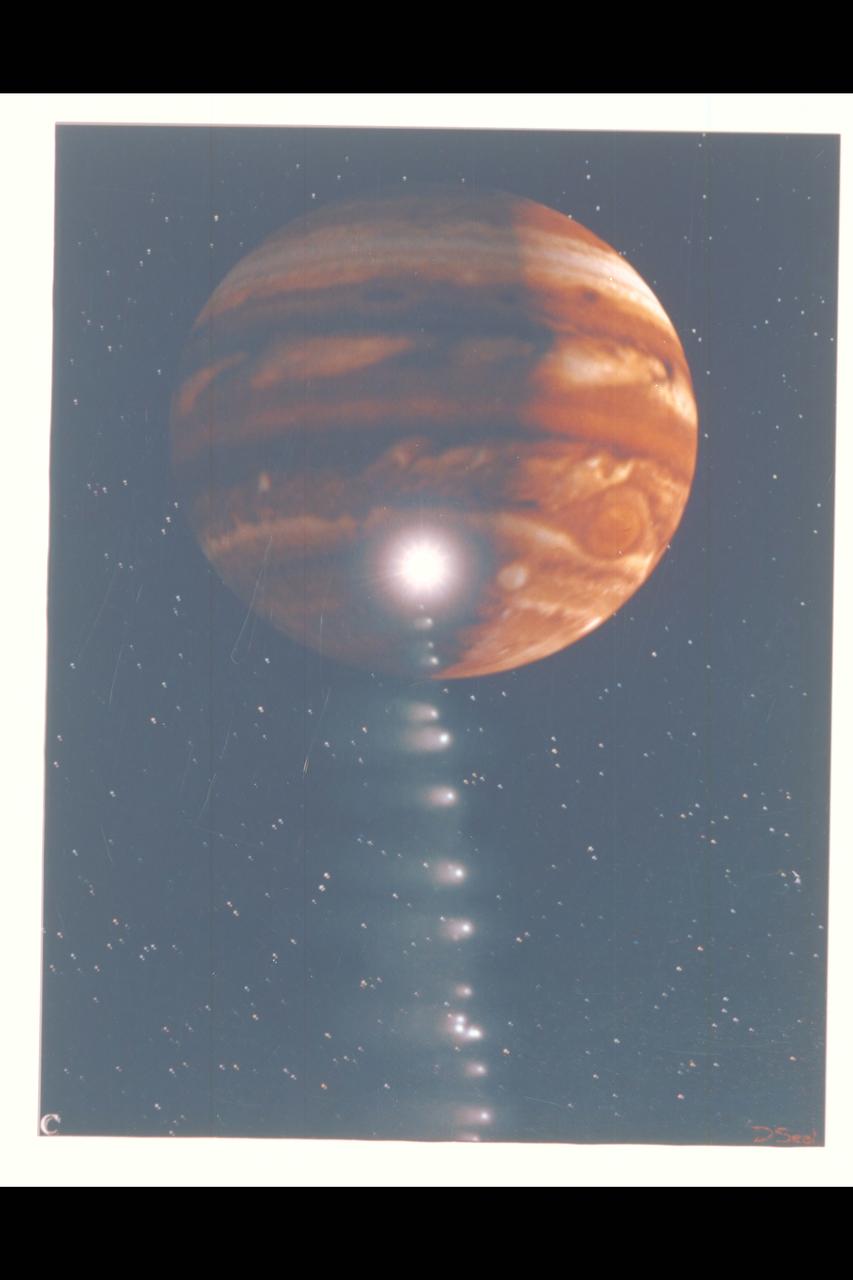
Photo Artwork composite by JPL This depiction of comet Shoemaker-Levy 9 impacting Jupiter is shown from several perspectives. IMAGE C is shown from the Voyager 2 spacecraft, which may observe the event from its unique position at the outer reaches of the solar system. For visual appeal, most of the large cometary fragments are shown close to one another in this image. At the time of Jupiter impact, the fragments will be separated from one another by serveral times the distances shown. This image was created by D.A. Seal of JPL's Mission Design Section using orbital computations provIded by P.W. Chodas and D.K. Yeomans of JPL's Navigation Section.
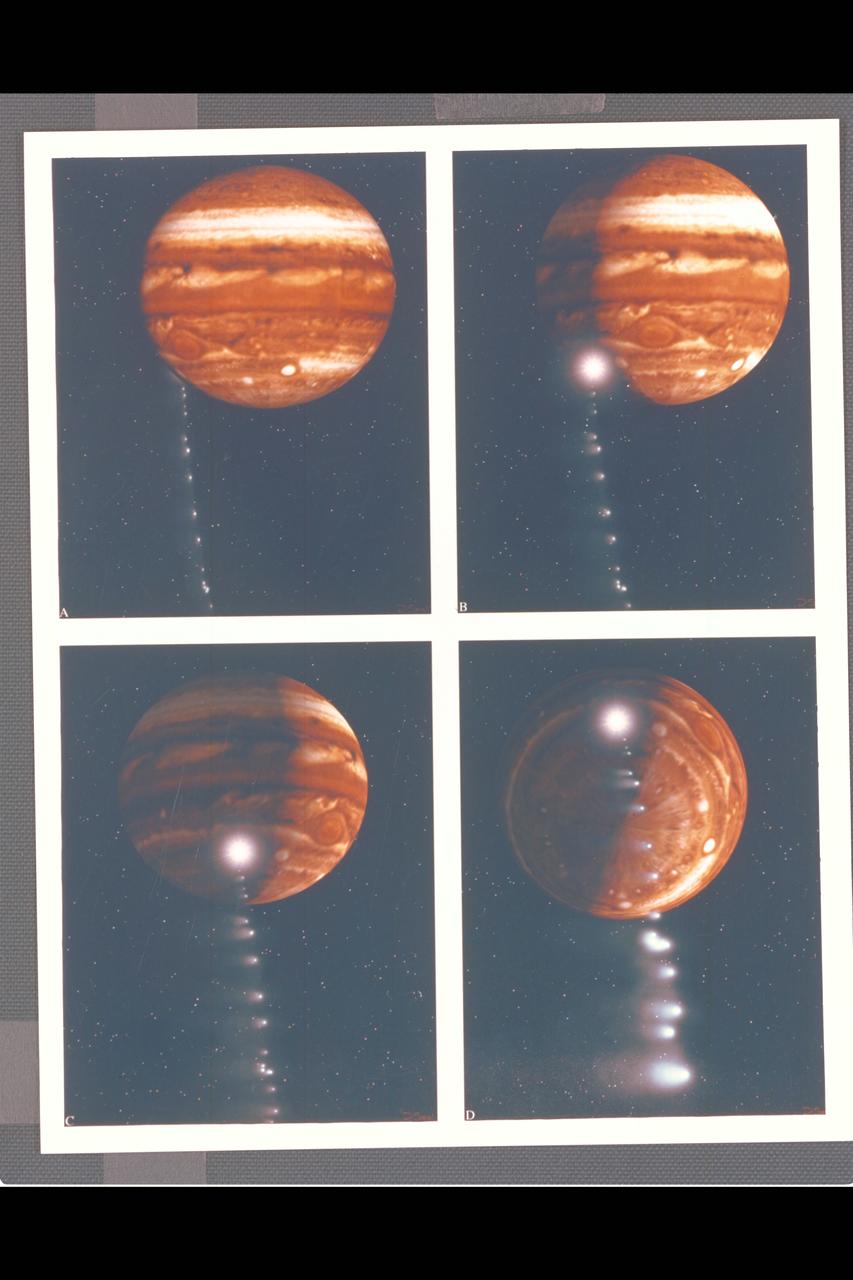
Photo Artwork composite by JPL This depiction of comet Shoemaker-Levy 9 impacting Jupiter is shown from several perspectives. IMAGE A is shown from the perspective of Earth based observers. IMAGE B shows the perspective from Galileo spacecraft which can observe the impact point directly. IMAGE C is shown from the Voyager 2 spacecraft, which may observe the event from its unique position at the outer reaches of the solar system. IMAGE D depicts a generic view from Jupiter's south pole. For visual appeal, most of the large cometary fragments are shown close to one another in this image. At the time of Jupiter impact, the fragments will be separated from one another by serveral times the distances shown. This image was created by D.A. Seal of JPL's Mission Design Section using orbital computations provIded by P.W. Chodas and D.K. Yeomans of JPL's Navigation Section.
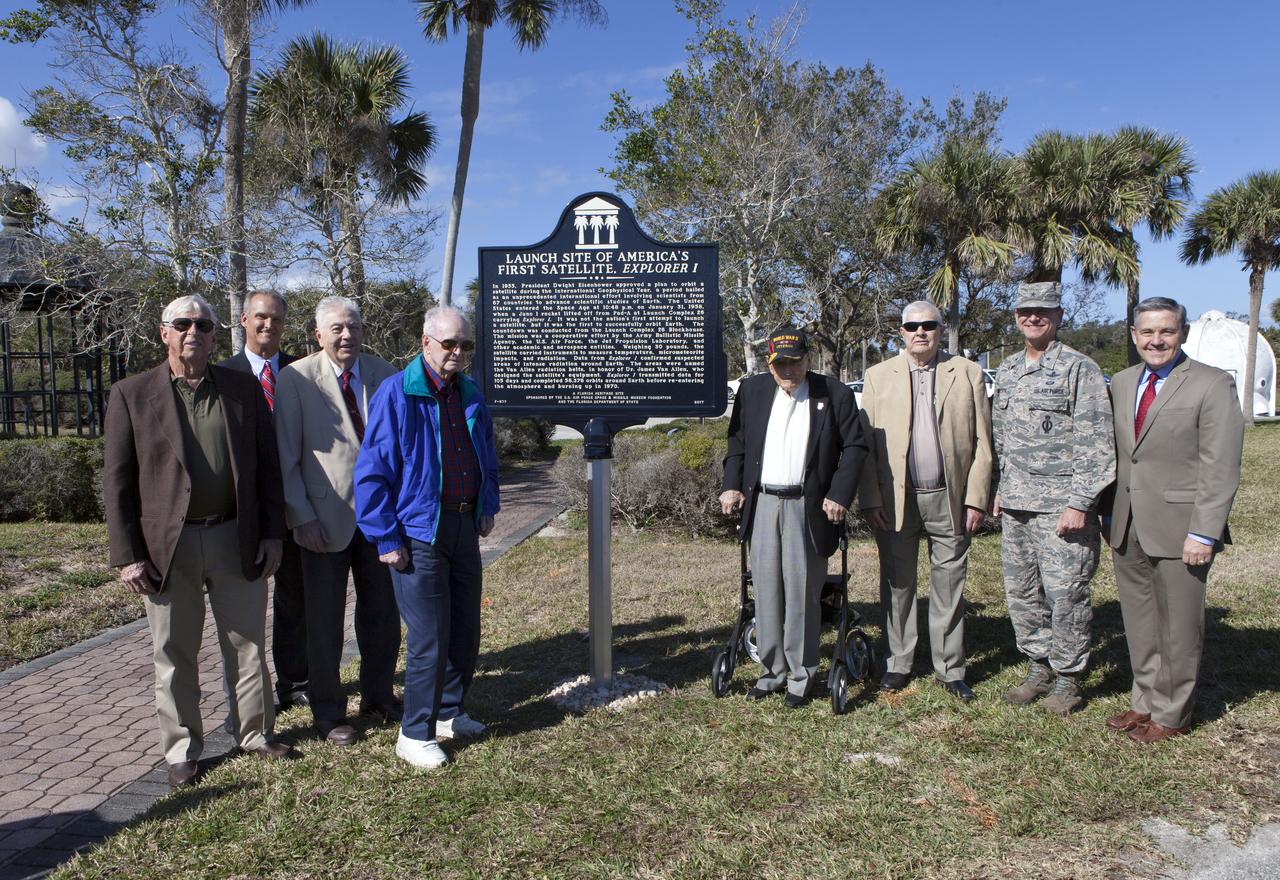
Launch team members who supported the launch of America's first satellite, Explorer 1, pose at a newly unveiled historical marker with Ray Sands, chairman of the Air Force Space and Missile Foundation -- sponsor of the marker, Brig. Gen. Wayne Monteith, 45th Space Wing commander and director of the Eastern Range, and Kennedy Space Center Director Bob Cabana. The event tool place at the site of the launch 60 years ago, Space Launch Complex 26 at Cape Canaveral Air Force Station.

Comet C/2023 A3 (Tsuchinshan-Atlas) illuminates the sky behind NASA’s Europa Clipper spacecraft on the SpaceX Falcon Heavy rocket at Launch Complex 39A on Sunday, Oct. 13, 2024, at the agency’s Kennedy Space Center in Florida ahead of launch to Jupiter’s icy moon, Europa. The spacecraft will complete nearly 50 flybys of Europa to determine if there are conditions suitable for life beyond Earth.

Dr. von Braun is presented with the front page of the Huntsville Times arnouncing the launch of Explorer I, the first U.S. Earth satellite, which was boosted by the Jupiter-C launch vehicle developed by Army Ballistic Missile Agency (ABMA) under the direction of Dr. von Braun. The occasion was the fifth Anniversary of the Explorer I launch in January 1958.
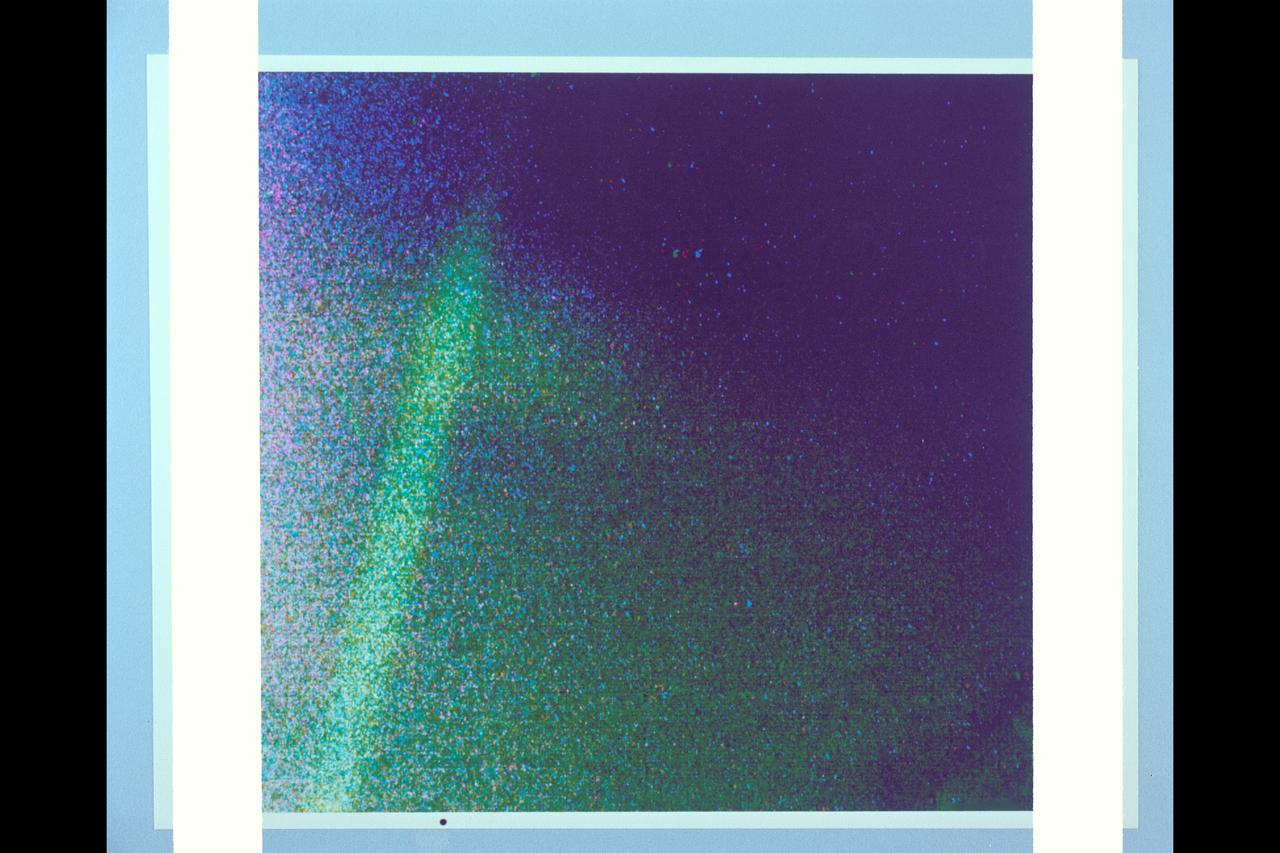
P-21763 C Range: 1,400,000 kilometers (870,000 miles) Jupiter's thin ring of particles was photographed by Voyager 2's telescope-equipped TV camera through three color filters to provide this color representation. During the three long exposures the spacecraft drifted, smearing out the ring image. The linear feature just above the ring is a star trail. True color of the ring cannot be deduced from this photo.
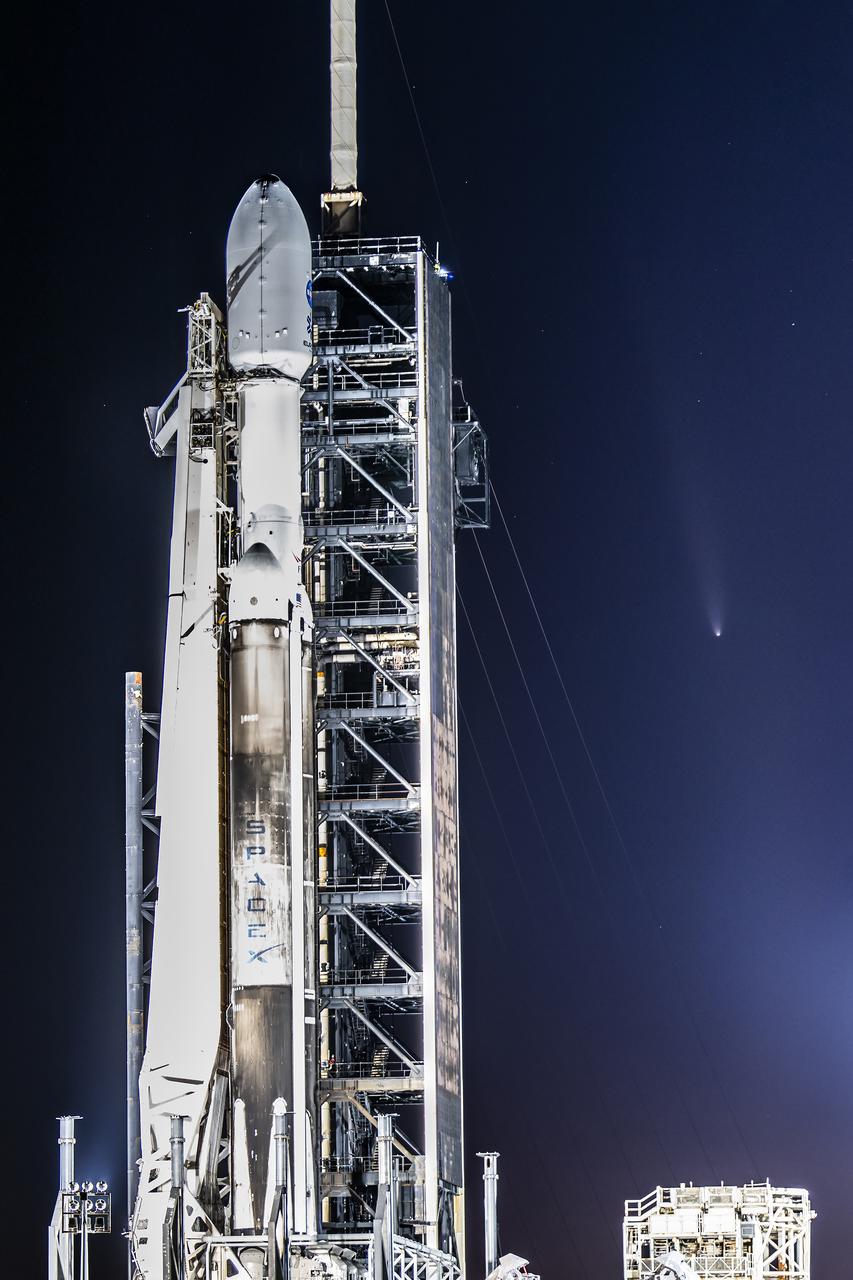
Comet C/2023 A3 (Tsuchinshan-Atlas) illuminates the sky behind NASA’s Europa Clipper spacecraft on the SpaceX Falcon Heavy rocket at Launch Complex 39A on Sunday, Oct. 13, 2024, at the agency’s Kennedy Space Center in Florida ahead of launch to Jupiter’s icy moon, Europa. The spacecraft will complete nearly 50 flybys of Europa to determine if there are conditions suitable for life beyond Earth.
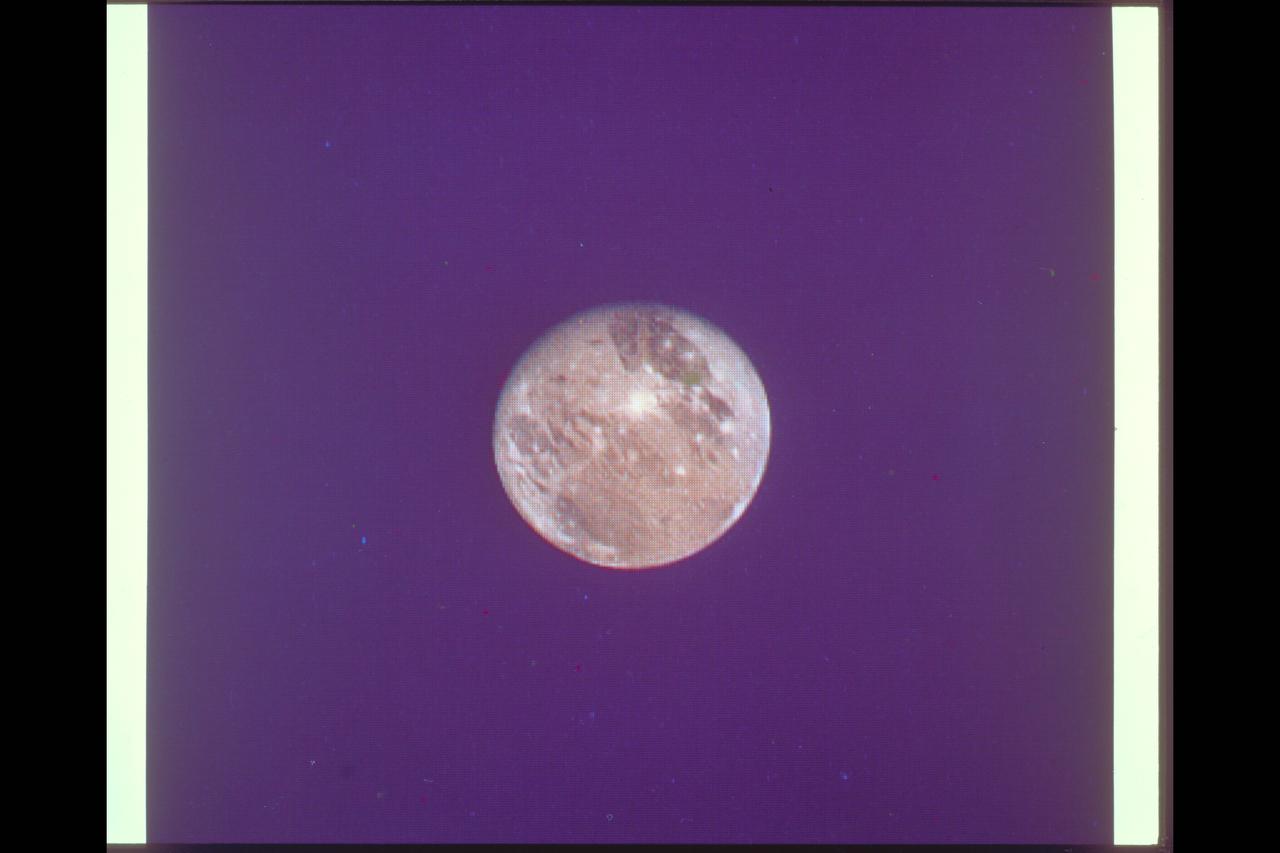
P-21749 C Range: 6 million kilometers (4 million miles) This photograph of Ganymede, the largest satellite of Jupiter, is shown at approximately the same distance as that photographed at close range by Voyager 1 in March. This picture, taken by Voyager 2, illustrates well the light, bluish regions near the north and south poles. It is known that there is exposed water ice on the surface of Ganymede, and pehaps these polar caps are composed of a light covering of water ice or frost. Voyager 2 will pass within 63,000 kilometers (39,000 miles) of Ganymede.
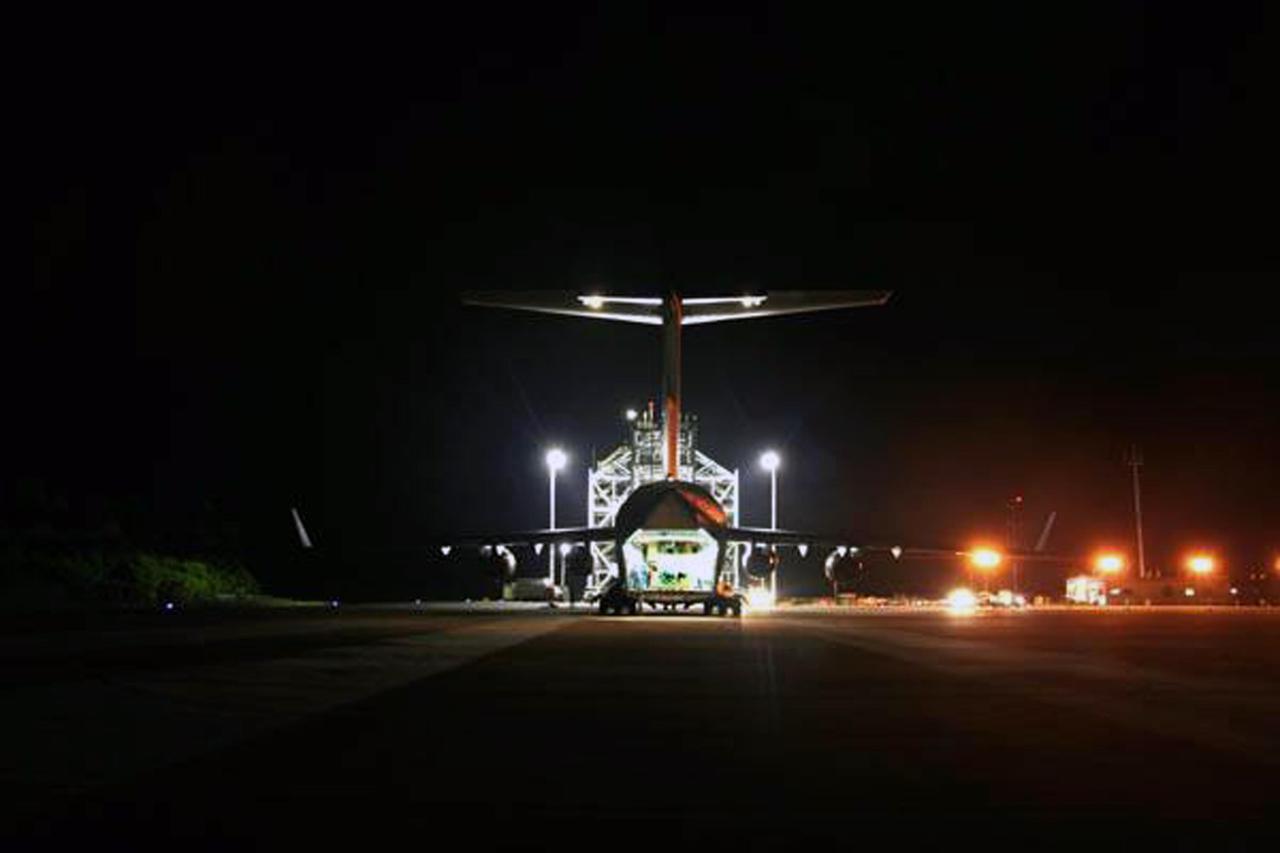
KENNEDY SPACE CENTER, FLA. - A U.S. Air Force C-17 cargo plane sits on NASA Kennedy Space Center’s Shuttle Landing Facility. Inside is the New Horizons spacecraft and affiliated ground support equipment that will be offloaded and transported to the Payload Hazardous Servicing Facility. New Horizons will make the first reconnaissance of Pluto and Charon - a 'double planet' and the last planet in our solar system to be visited by spacecraft. The mission will then visit one or more objects in the Kuiper Belt region beyond Neptune. New Horizons is scheduled to launch in January 2006, swing past Jupiter for a gravity boost and scientific studies in February or March 2007, and reach Pluto and its moon, Charon, in July 2015.
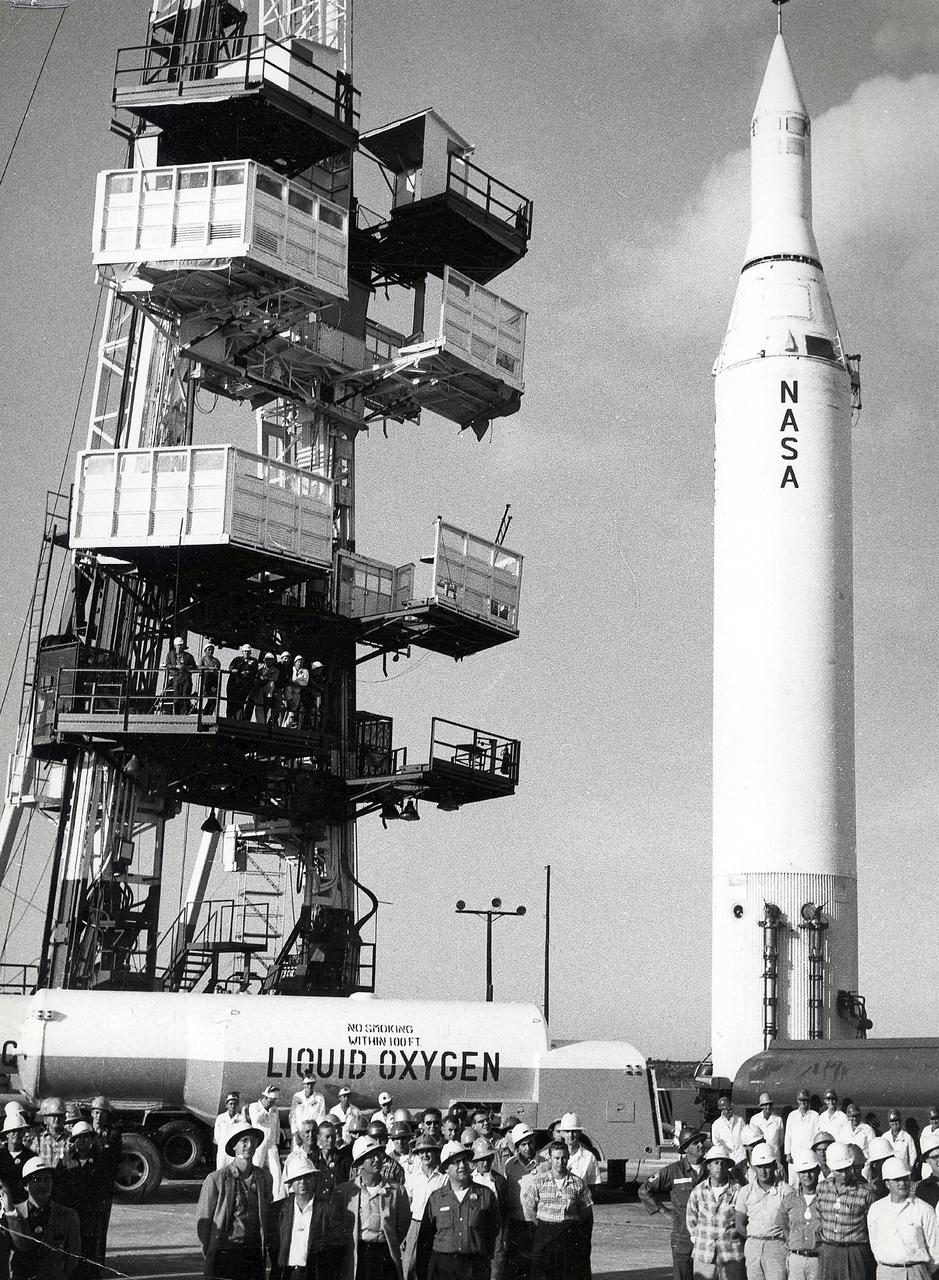
The modified Jupiter C (sometimes called Juno I), used to launch Explorer I, had minimum payload lifting capabilities. Explorer I weighed slightly less than 31 pounds. Juno II was part of America's effort to increase payload lifting capabilities. Among other achievements, the vehicle successfully launched a Pioneer IV satellite on March 3, 1959, and an Explorer VII satellite on October 13, 1959. Responsibility for Juno II passed from the Army to the Marshall Space Flight Center when the Center was activated on July 1, 1960. On November 3, 1960, a Juno II sent Explorer VIII into a 1,000-mile deep orbit within the ionosphere.
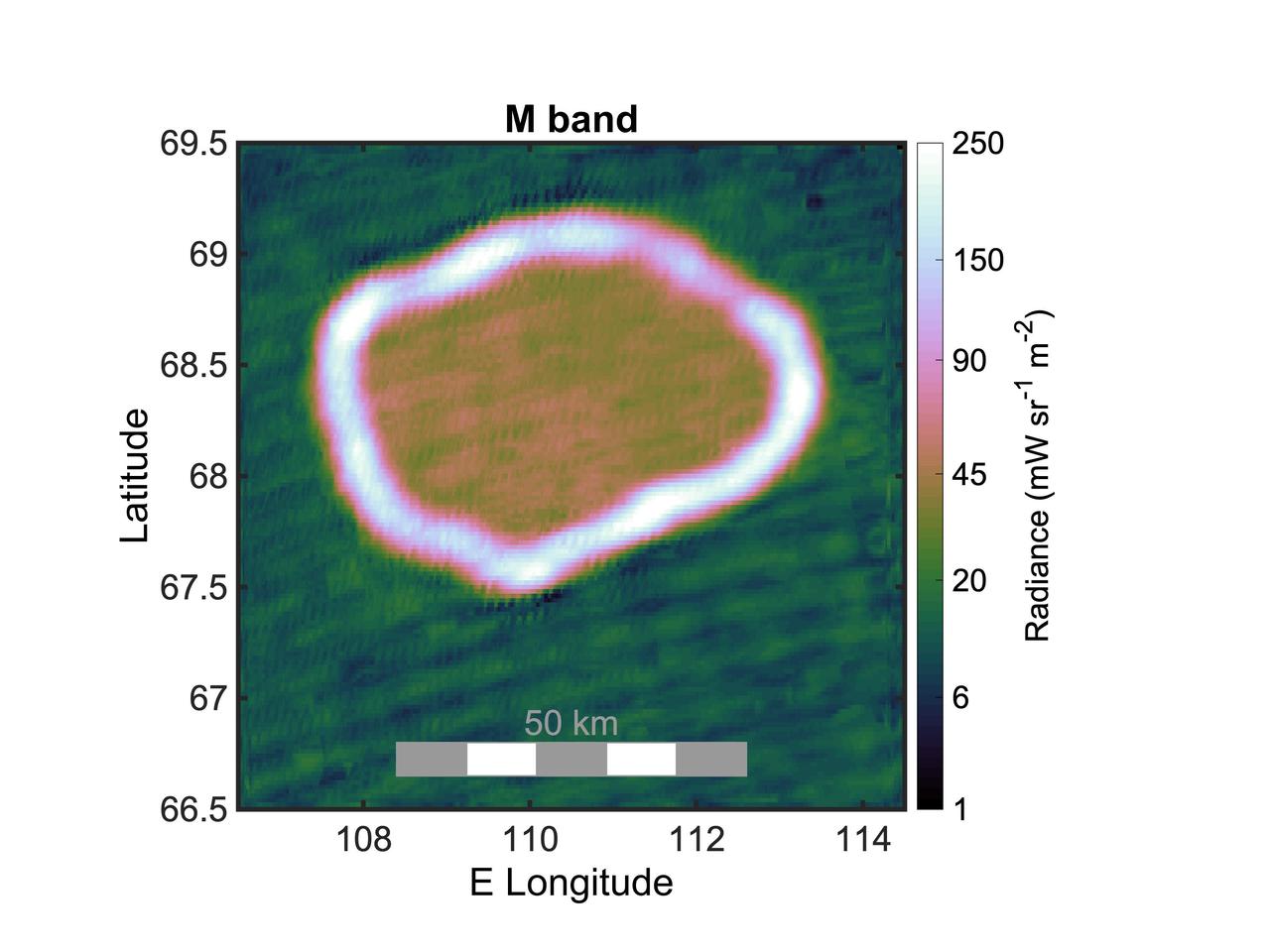
This graphic shows the infrared radiance of Chors Patera, a lava lake on Jupiter's moon Io. It was created using infrared data collected by the JIRAM (Jovian Infrared Auroral Mapper) instrument aboard NASA's Juno spacecraft during a flyby of the moon on Oct. 15, 2023. The lake is about 31 miles (50 kilometers) wide. Juno scientists believe the majority of the lake is covered with a thick crust of molten material (appearing red/green in graphic, inside the white ring) that is approximately minus 45 degrees Fahrenheit (minus 43 degrees Celsius) at its surface. The white ring indicates where lava from Io's interior is directly exposed to space, providing the geologic feature's hottest thermal signature: between 450 and 1,350 F (232 and 732 C). The area in green, outside the lava lake, is very cold: about minus 225 F (minus 143 C). JIRAM "sees" infrared light not visible to the human eye. In this composite image, the measurements of thermal emissions radiated from the planet were in the infrared wavelength between 4.5 and 5 microns. https://photojournal.jpl.nasa.gov/catalog/PIA26371
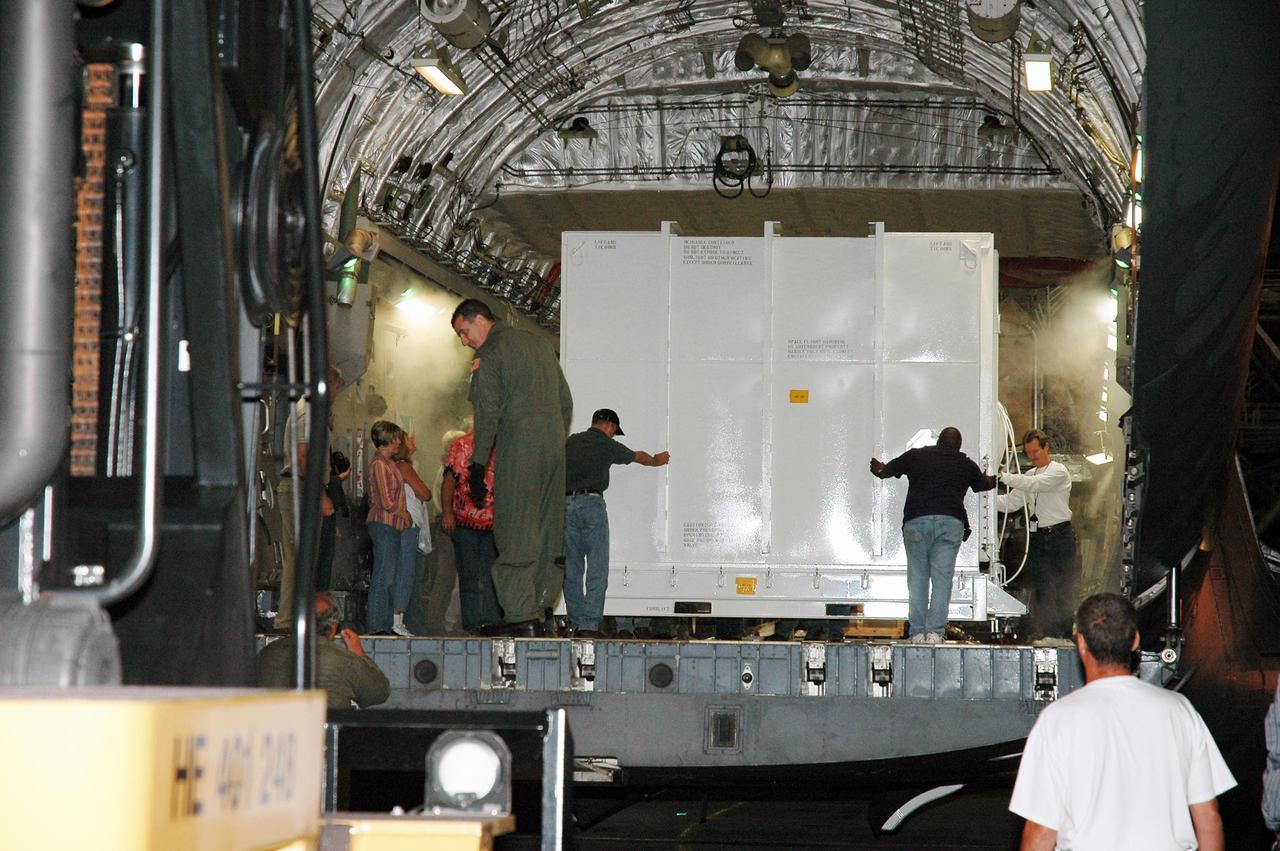
KENNEDY SPACE CENTER, FLA. - In the U.S. Air Force C-17 cargo plane at NASA Kennedy Space Center’s Shuttle Landing Facility, workers move the large shipping container with the New Horizons spacecraft inside. After it is unloaded, the spacecraft will be transported to the Payload Hazardous Servicing Facility. New Horizons is designed to help us understand worlds at the edge of our solar system by making the first reconnaissance of Pluto and Charon - a 'double planet' and the last planet in our solar system to be visited by spacecraft. The mission will then visit one or more objects in the Kuiper Belt region beyond Neptune. New Horizons is scheduled to launch in January 2006, swing past Jupiter for a gravity boost and scientific studies in February or March 2007, and reach Pluto and its moon, Charon, in July 2015.
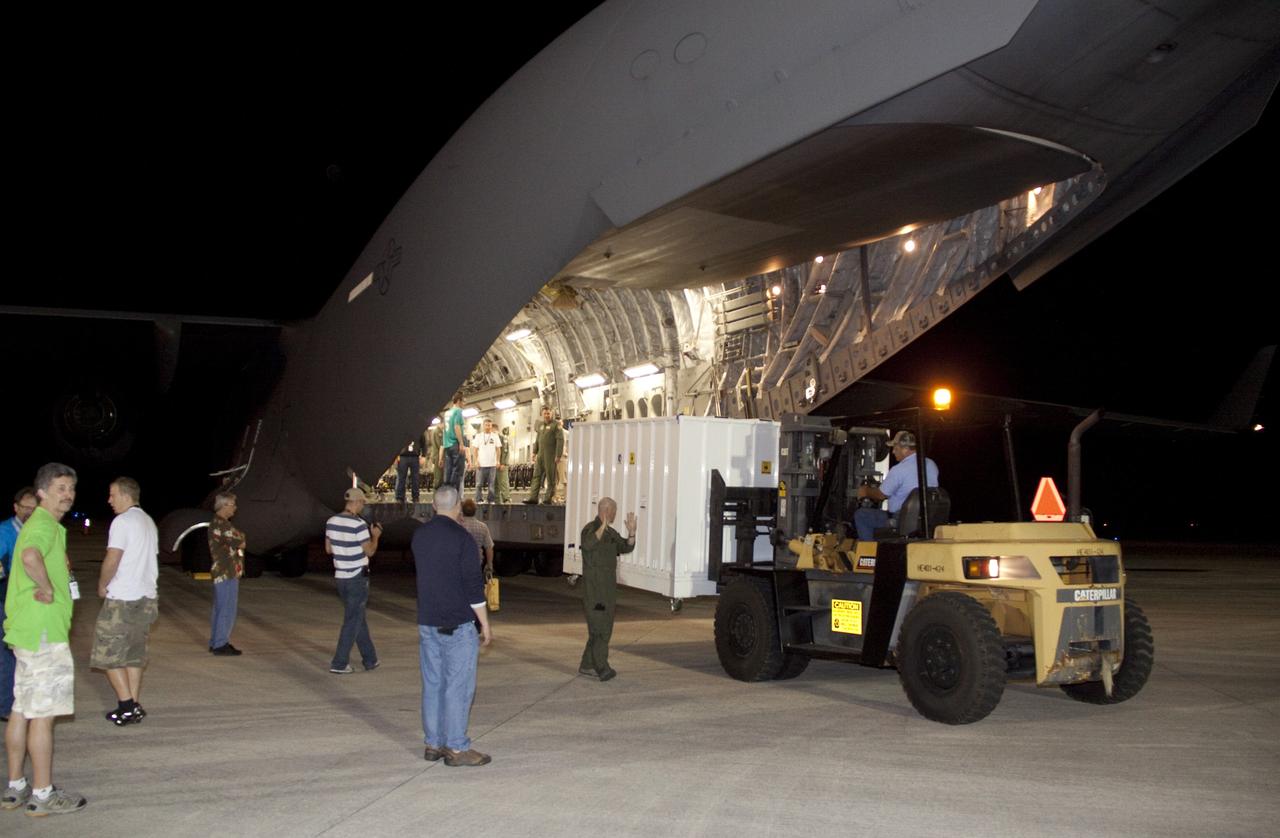
CAPE CANAVERAL, Fla. -- Workers move the container holding NASA's Juno high-gain antenna container away from the ramp of an Air Force C-17 jet at Kennedy Space Center's Shuttle Landing Facility in Florida. The spacecraft and its high-gain antenna was shipped from Lockheed Martin Space Systems in Denver and will be transported to Astrotech's payload processing facility in Titusville, Fla. to begin final preparations for launch. The solar-powered spacecraft will orbit Jupiter's poles 33 times to find out more about the gas giant's origins, structure, atmosphere and magnetosphere and investigate the existence of a solid planetary core. Juno is scheduled to launch aboard an Atlas V rocket from Cape Canaveral, Fla. Aug. 5. For more information visit, www.nasa.gov/juno. Photo credit: NASA/Jack Pfaller
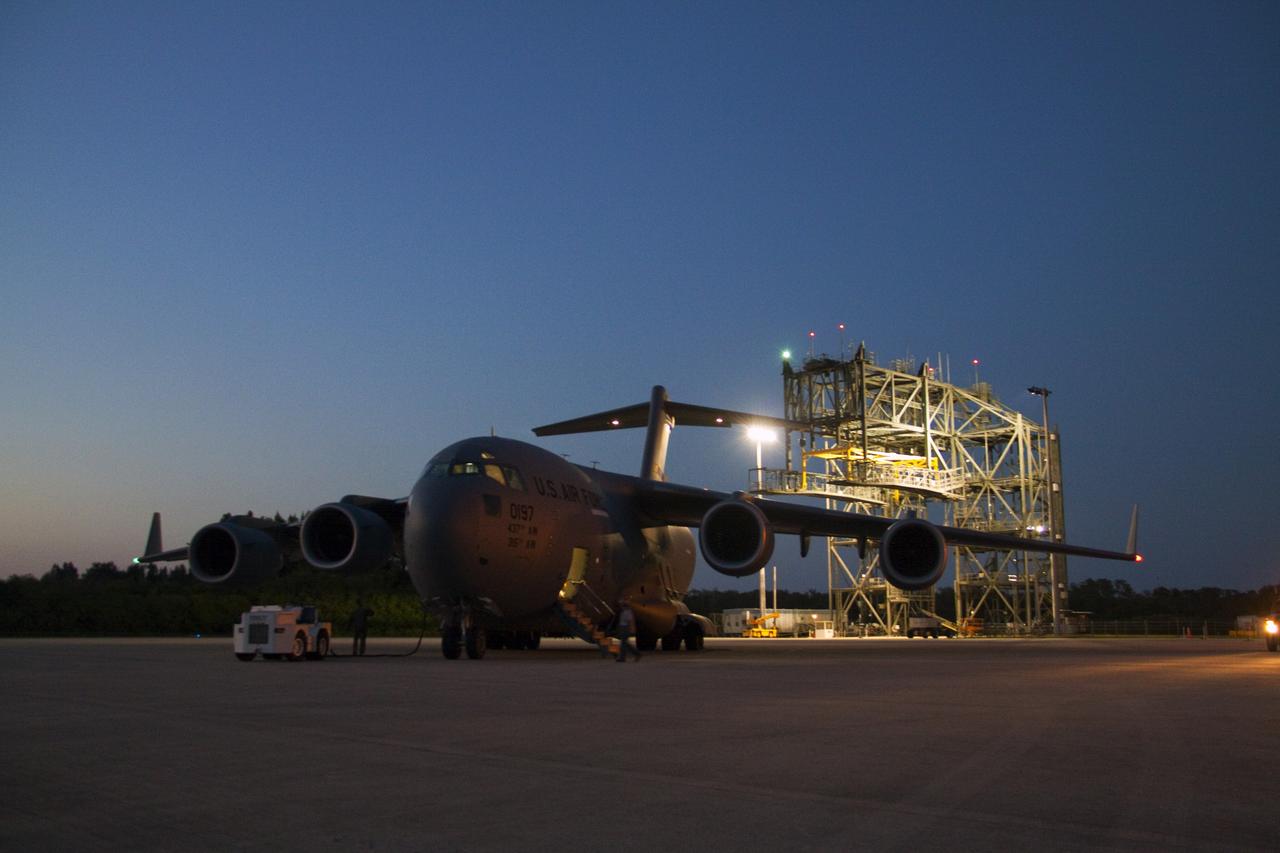
CAPE CANAVERAL, Fla. -- NASA's Juno spacecraft arrives at Kennedy Space Center's Shuttle Landing Facility in Florida aboard an Air Force C-17 jet. Juno was shipped from Lockheed Martin Space Systems in Denver and will be transported to Astrotech's payload processing facility in Titusville, Fla. to begin final preparations for launch. The solar-powered spacecraft will orbit Jupiter's poles 33 times to find out more about the gas giant's origins, structure, atmosphere and magnetosphere and investigate the existence of a solid planetary core. Juno is scheduled to launch aboard an Atlas V rocket from Cape Canaveral, Fla. Aug. 5. For more information visit, www.nasa.gov/juno. Photo credit: NASA/Jack Pfaller

KENNEDY SPACE CENTER, FLA. - A U.S. Air Force C-17 cargo plane arrives at NASA Kennedy Space Center’s Shuttle Landing Facility. It is carrying the New Horizons spacecraft, as well as other equipment. After it is unloaded, the spacecraft will be transported to the Payload Hazardous Servicing Facility. New Horizons is designed to help us understand worlds at the edge of our solar system by making the first reconnaissance of Pluto and Charon - a 'double planet' and the last planet in our solar system to be visited by spacecraft. The mission will then visit one or more objects in the Kuiper Belt region beyond Neptune. New Horizons is scheduled to launch in January 2006, swing past Jupiter for a gravity boost and scientific studies in February or March 2007, and reach Pluto and its moon, Charon, in July 2015.
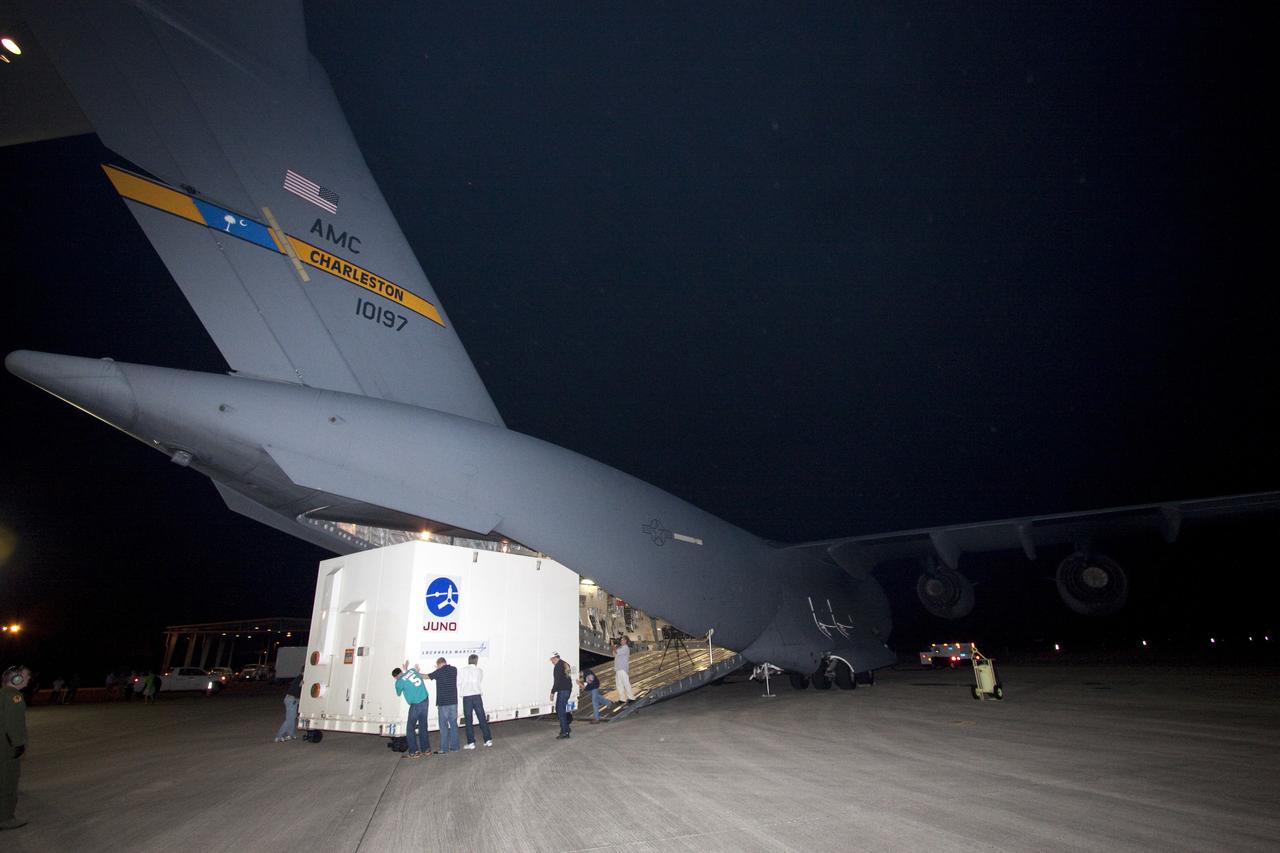
CAPE CANAVERAL, Fla. -- Workers move the container holding NASA's Juno spacecraft away from the ramp of an Air Force C-17 jet at Kennedy Space Center's Shuttle Landing Facility in Florida. Juno was shipped from Lockheed Martin Space Systems in Denver and will be transported to Astrotech's payload processing facility in Titusville, Fla. to begin final preparations for launch. The solar-powered spacecraft will orbit Jupiter's poles 33 times to find out more about the gas giant's origins, structure, atmosphere and magnetosphere and investigate the existence of a solid planetary core. Juno is scheduled to launch aboard an Atlas V rocket from Cape Canaveral, Fla. Aug. 5. For more information visit, www.nasa.gov/juno. Photo credit: NASA/Jack Pfaller
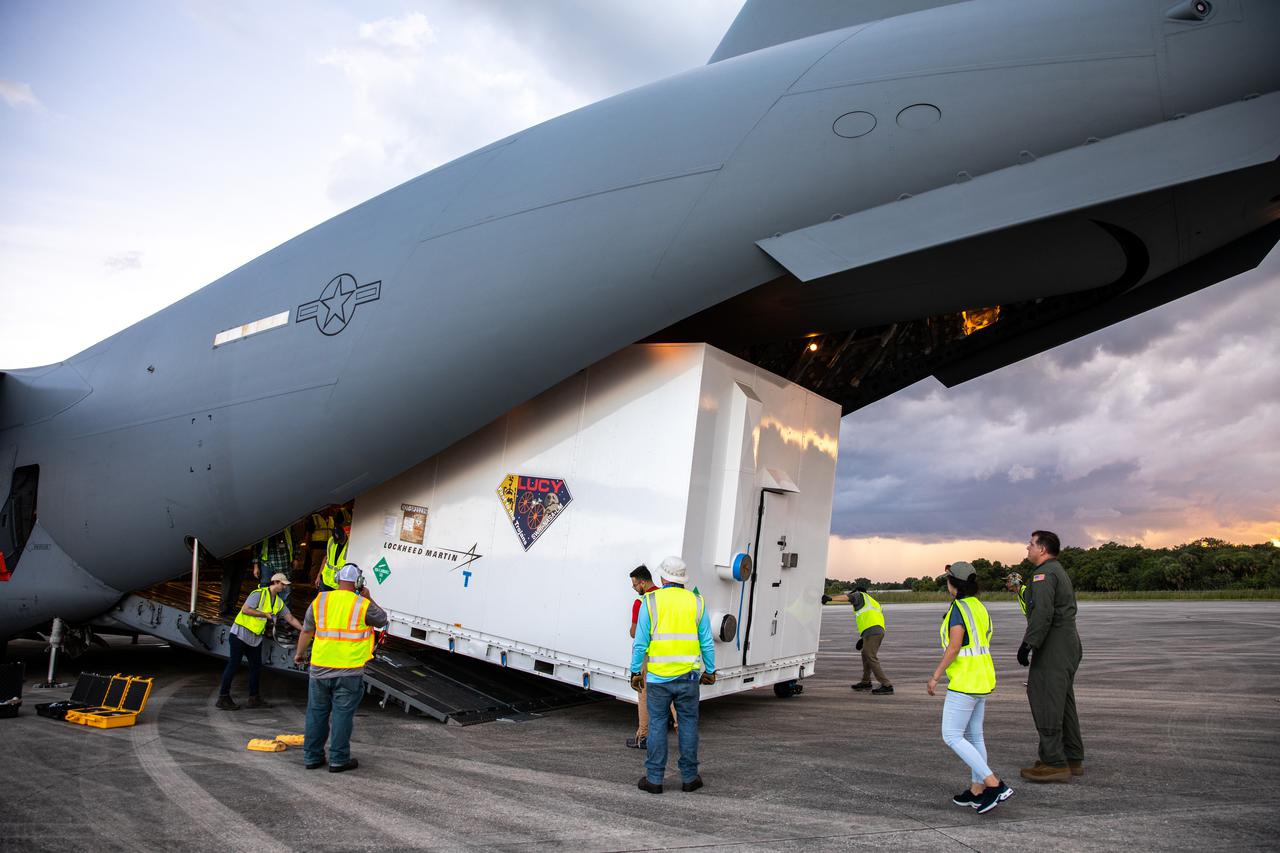
The shipping container holding NASA's Lucy spacecraft is unloaded from a United States Air Force C-17 cargo plane, stationed out of Charleston Air Force Base in South Carolina, on the runway of the Launch and Landing Facility at Kennedy Space Center in Florida on July 30, 2021. From there, the Lucy spacecraft will move to the Astrotech Space Operations payload processing facility in nearby Titusville, Florida, before its scheduled launch on a United Launch Alliance (ULA) Atlas V rocket from Cape Canaveral Space Force Station on October 16, 2021. The Lucy mission will be the first space mission to explore a diverse population of small bodies known as the Jupiter Trojan asteroids. The launch is being managed by NASA's Launch Services Program based at Kennedy, America's multi-user spaceport.
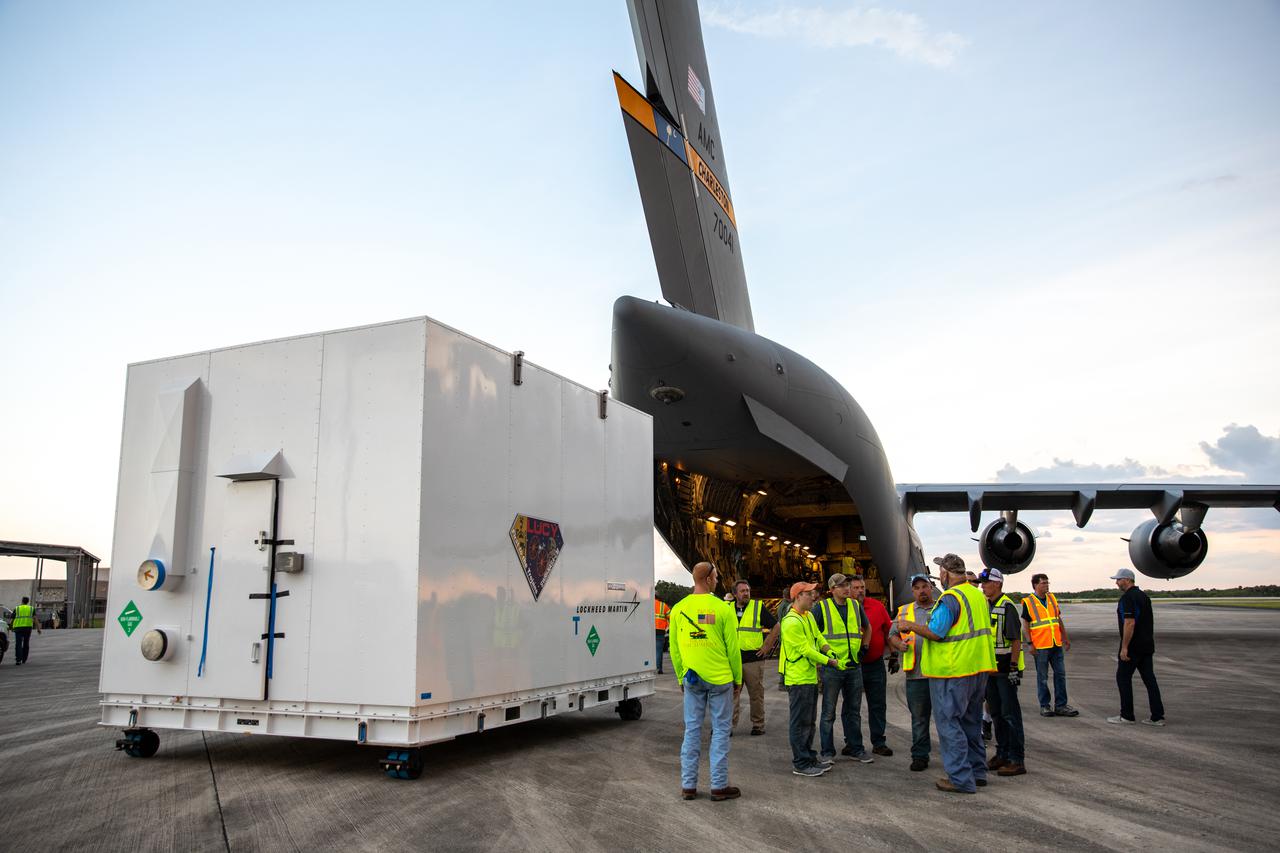
The shipping container holding NASA's Lucy spacecraft is unloaded from an Air Force C-17 cargo aircraft on the runway of the Launch and Landing Facility at Kennedy Space Center in Florida on July 30, 2021. From there, the Lucy spacecraft will move to the Astrotech Space Operations payload processing facility in nearby Titusville, Florida, before its scheduled launch on a United Launch Alliance (ULA) Atlas V rocket from Cape Canaveral Space Force Station on October 16, 2021. The Lucy mission will be the first space mission to explore a diverse population of small bodies known as the Jupiter Trojan asteroids. The launch is being managed by NASA's Launch Services Program based at Kennedy, America's premier multi-user spaceport.
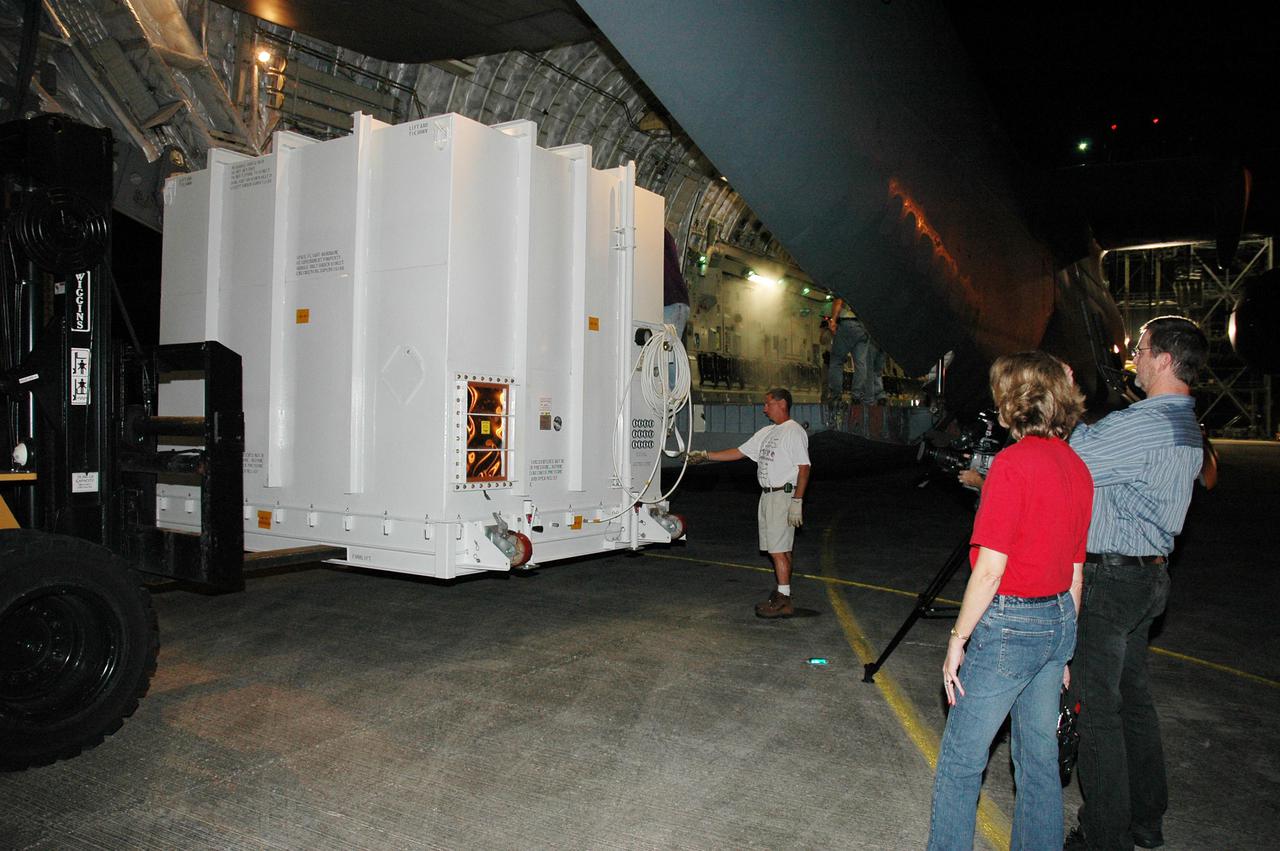
KENNEDY SPACE CENTER, FLA. - At NASA Kennedy Space Center’s Shuttle Landing Facility, the shipping container with the New Horizons spacecraft inside is moved away from the U.S. Air Force C-17 cargo plane. The spacecraft will be placed on a transporter and moved to the Payload Hazardous Servicing Facility. New Horizons is designed to help us understand worlds at the edge of our solar system by making the first reconnaissance of Pluto and Charon - a 'double planet' and the last planet in our solar system to be visited by spacecraft. The mission will then visit one or more objects in the Kuiper Belt region beyond Neptune. New Horizons is scheduled to launch in January 2006, swing past Jupiter for a gravity boost and scientific studies in February or March 2007, and reach Pluto and its moon, Charon, in July 2015.
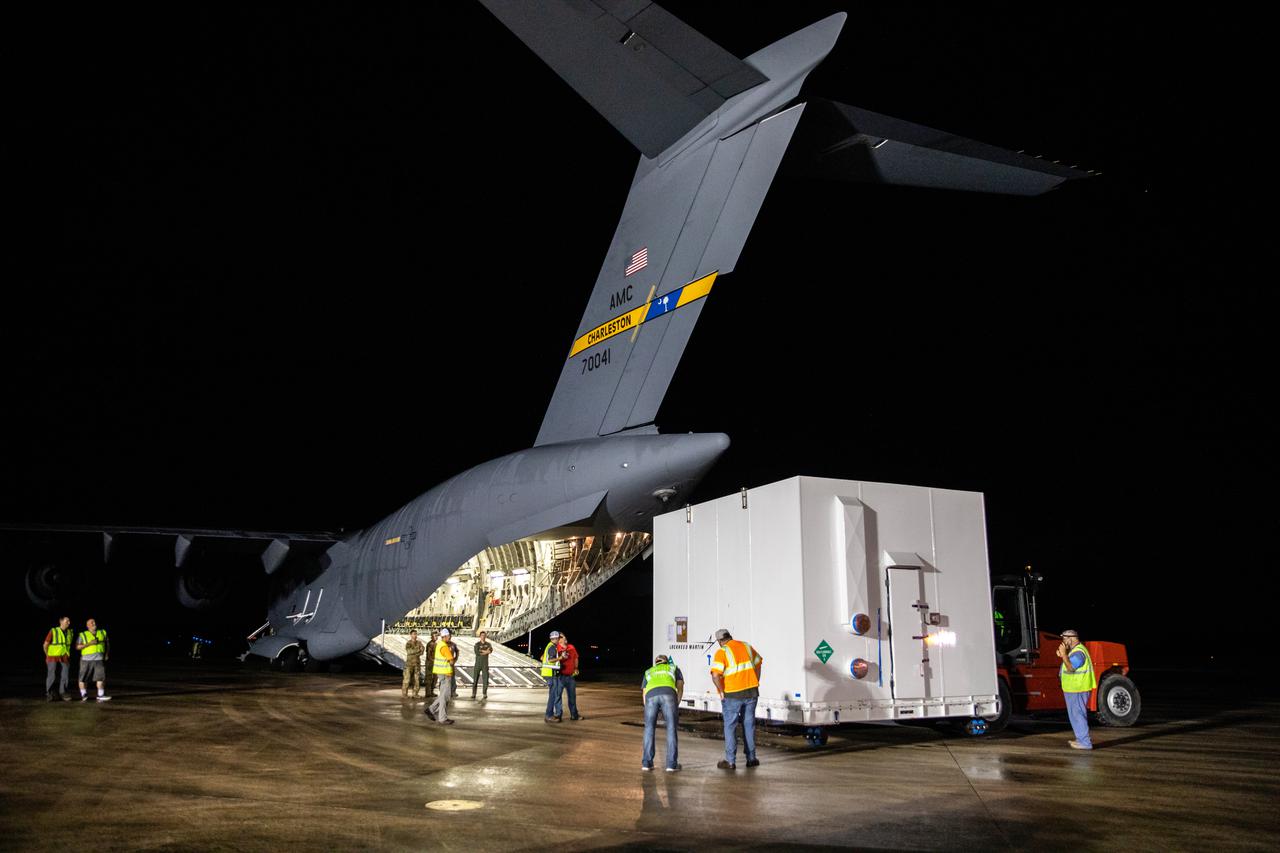
The shipping container holding NASA's Lucy spacecraft is unloaded from a United States Air Force C-17 cargo plane, stationed out of Charleston Air Force Base in South Carolina, on the runway of the Launch and Landing Facility at Kennedy Space Center in Florida on July 30, 2021. From there, the Lucy spacecraft will move to the Astrotech Space Operations payload processing facility in nearby Titusville, Florida, before its scheduled launch on a United Launch Alliance (ULA) Atlas V rocket from Cape Canaveral Space Force Station on October 16, 2021. The Lucy mission will be the first space mission to explore a diverse population of small bodies known as the Jupiter Trojan asteroids. The launch is being managed by NASA's Launch Services Program based at Kennedy, America's multi-user spaceport.
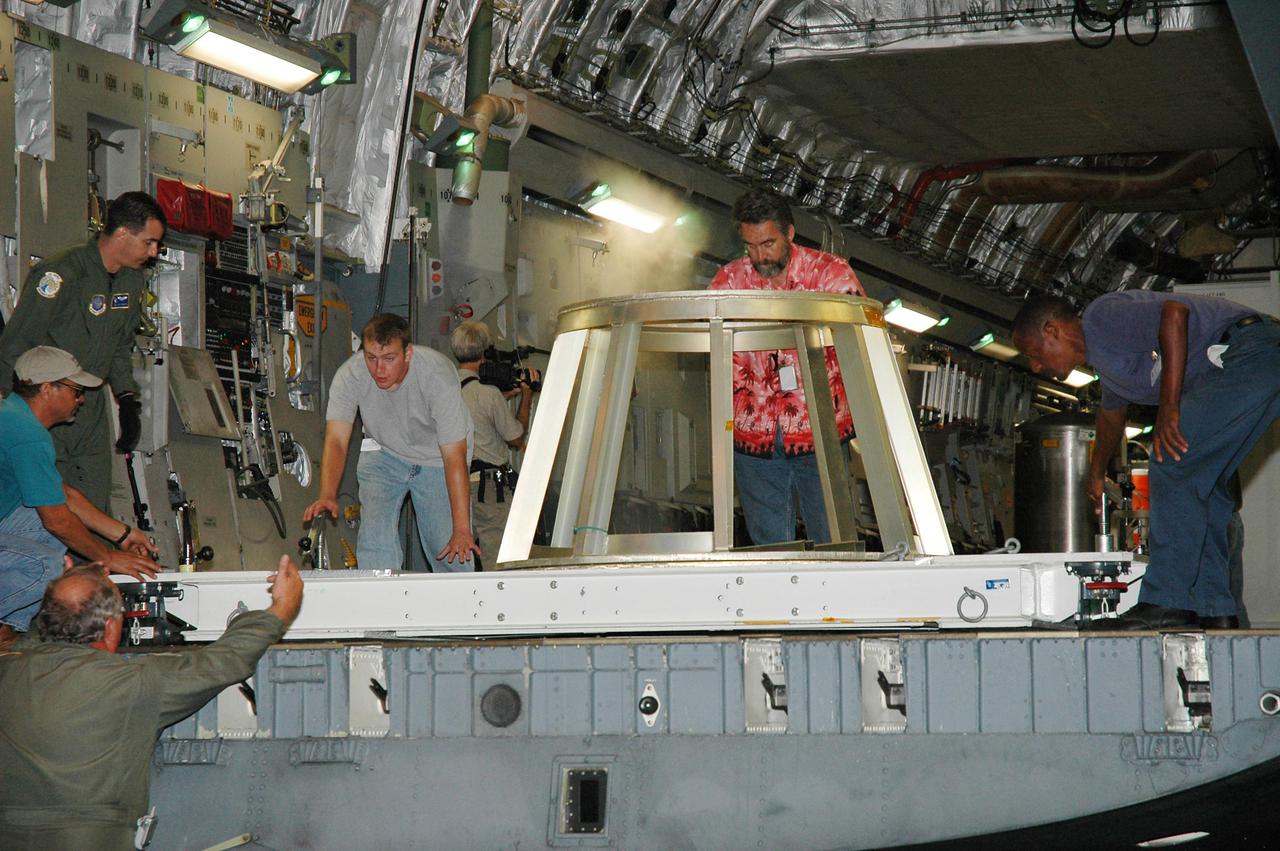
KENNEDY SPACE CENTER, FLA. - At NASA Kennedy Space Center’s Shuttle Landing Facility, workers offload a stand from a U.S. Air Force C-17 cargo plane. The plane delivered the New Horizons spacecraft and other equipment. After it is unloaded, the spacecraft will be transported to the Payload Hazardous Servicing Facility. The test stand will hold the spacecraft during checkout. New Horizons is designed to help us understand worlds at the edge of our solar system by making the first reconnaissance of Pluto and Charon - a 'double planet' and the last planet in our solar system to be visited by spacecraft. The mission will then visit one or more objects in the Kuiper Belt region beyond Neptune. New Horizons is scheduled to launch in January 2006, swing past Jupiter for a gravity boost and scientific studies in February or March 2007, and reach Pluto and its moon, Charon, in July 2015.
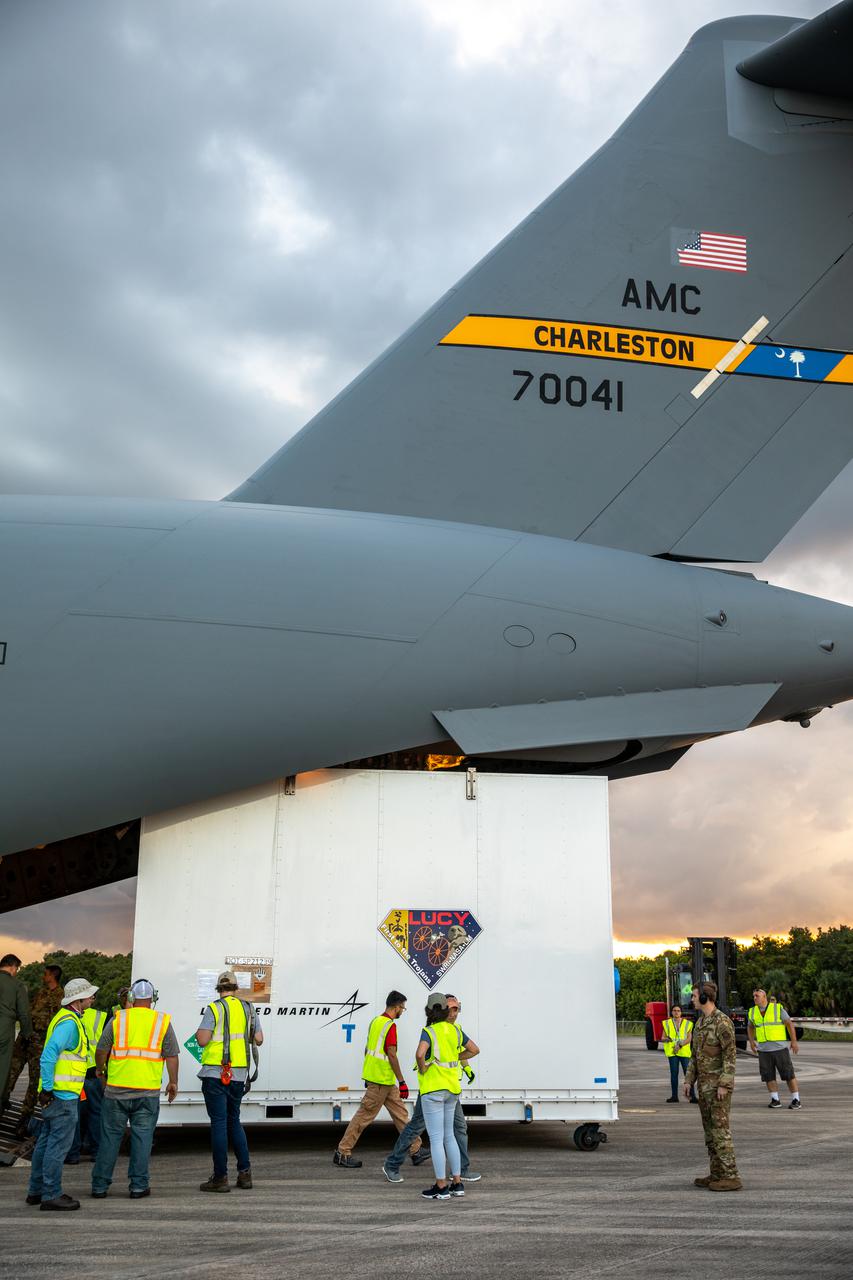
The shipping container holding NASA's Lucy spacecraft is unloaded from an Air Force C-17 cargo aircraft on the runway of the Launch and Landing Facility at Kennedy Space Center in Florida on July 30, 2021. From there, the Lucy spacecraft will move to the Astrotech Space Operations payload processing facility in nearby Titusville, Florida, before its scheduled launch on a United Launch Alliance (ULA) Atlas V rocket from Cape Canaveral Space Force Station on October 16, 2021. The Lucy mission will be the first space mission to explore a diverse population of small bodies known as the Jupiter Trojan asteroids. The launch is being managed by NASA's Launch Services Program based at Kennedy, America's premier multi-user spaceport.
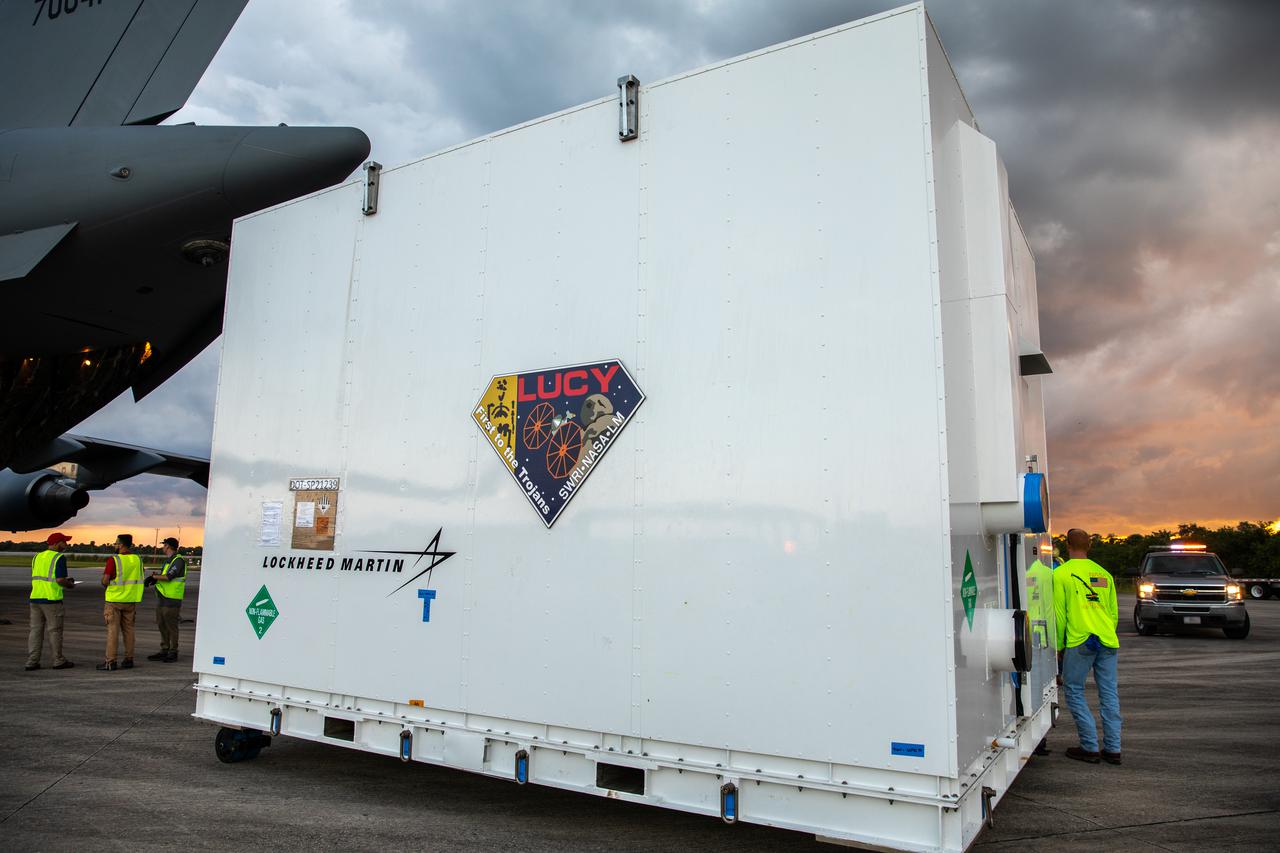
The shipping container holding NASA's Lucy spacecraft is unloaded from an Air Force C-17 cargo aircraft on the runway of the Launch and Landing Facility at Kennedy Space Center in Florida on July 30, 2021. From there, the Lucy spacecraft will move to the Astrotech Space Operations payload processing facility in nearby Titusville, Florida, before its scheduled launch on a United Launch Alliance (ULA) Atlas V rocket from Cape Canaveral Space Force Station on October 16, 2021. The Lucy mission will be the first space mission to explore a diverse population of small bodies known as the Jupiter Trojan asteroids. The launch is being managed by NASA's Launch Services Program based at Kennedy, America's premier multi-user spaceport.
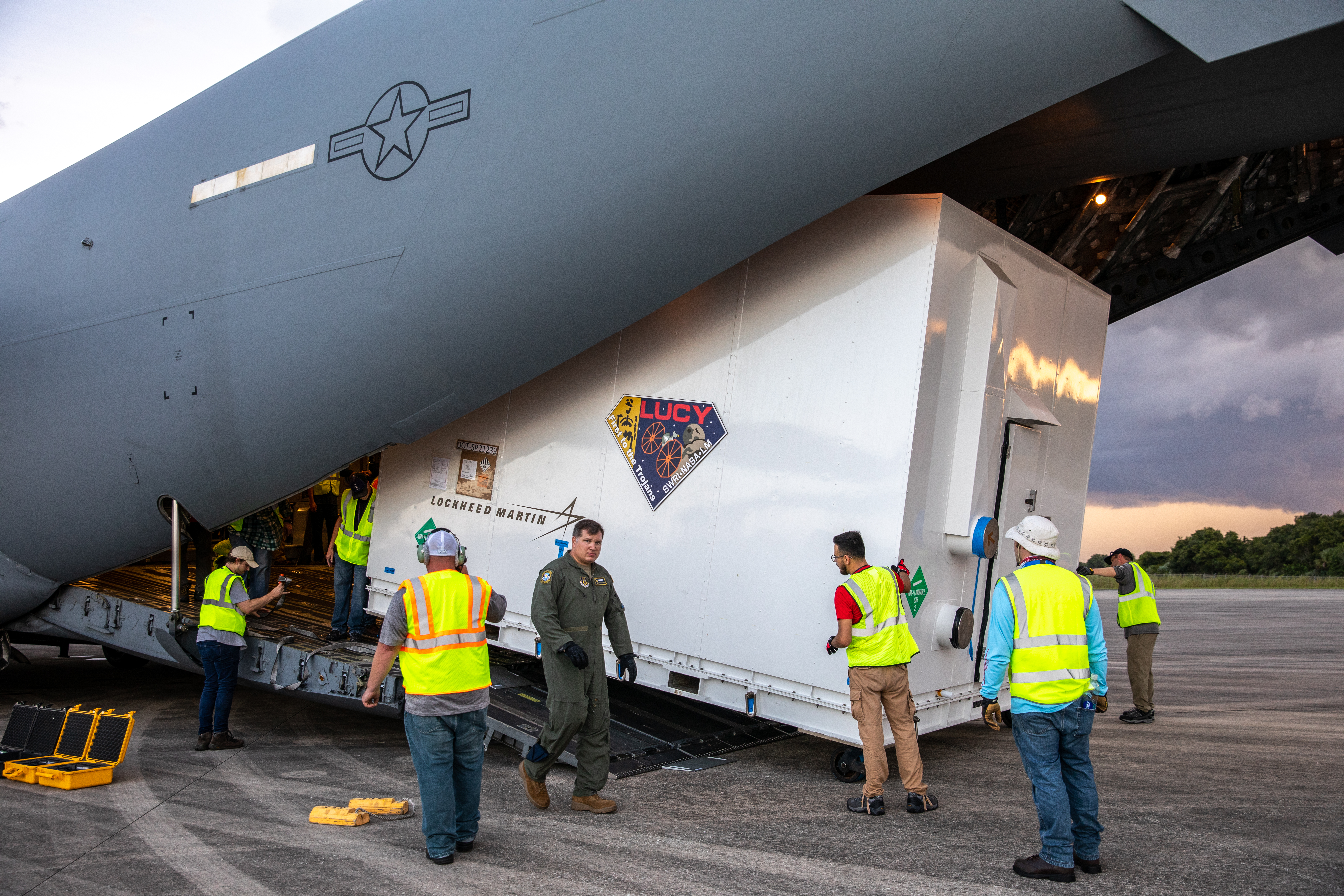
The shipping container holding NASA's Lucy spacecraft is unloaded from a United States Air Force C-17 cargo plane, stationed out of Charleston Air Force Base in South Carolina, on the runway of the Launch and Landing Facility at Kennedy Space Center in Florida on July 30, 2021. From there, the Lucy spacecraft will move to the Astrotech Space Operations payload processing facility in nearby Titusville, Florida, before its scheduled launch on a United Launch Alliance (ULA) Atlas V rocket from Cape Canaveral Space Force Station on October 16, 2021. The Lucy mission will be the first space mission to explore a diverse population of small bodies known as the Jupiter Trojan asteroids. The launch is being managed by NASA's Launch Services Program based at Kennedy, America's multi-user spaceport.
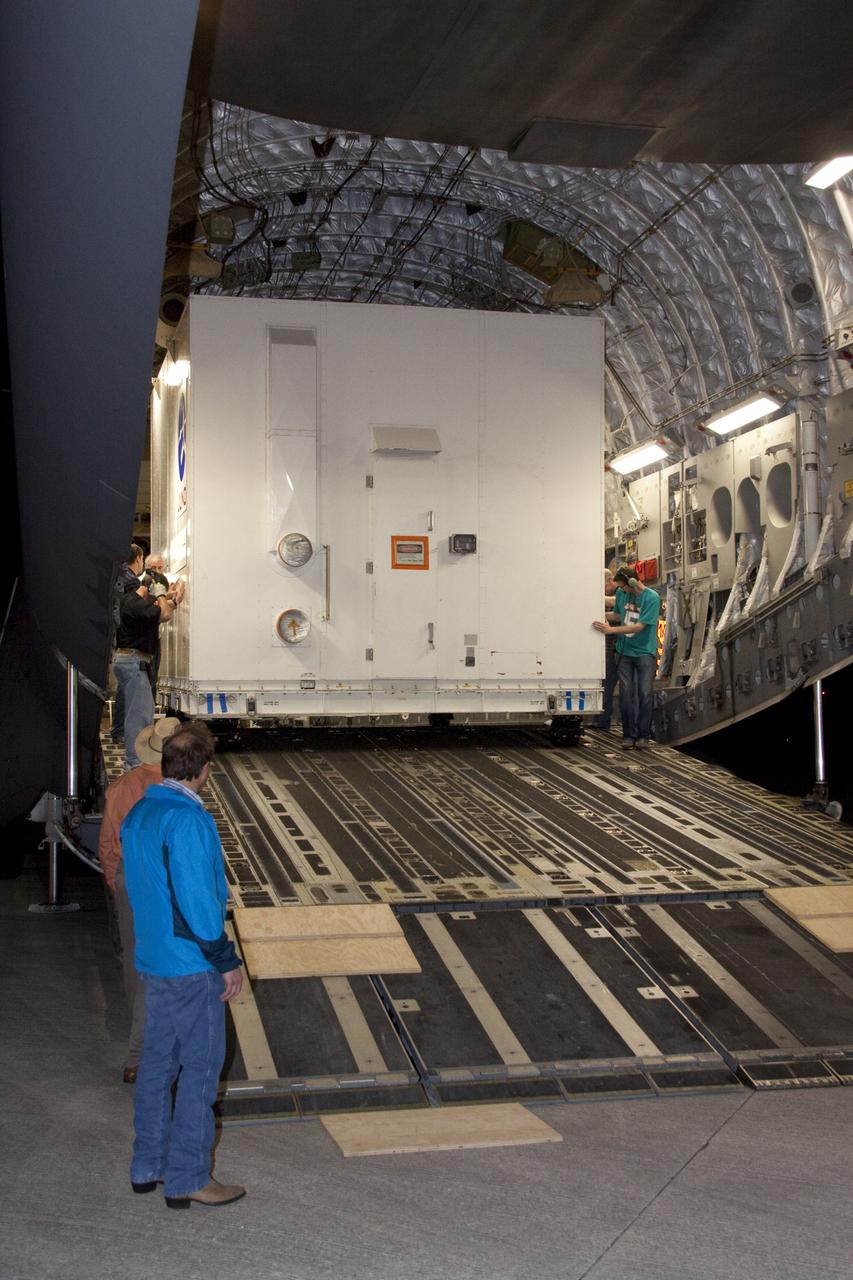
CAPE CANAVERAL, Fla. -- Workers guide the container holding NASA's Juno spacecraft down the ramp of an Air Force C-17 jet at Kennedy Space Center's Shuttle Landing Facility in Florida. Juno was shipped from Lockheed Martin Space Systems in Denver and will be transported to Astrotech's payload processing facility in Titusville, Fla. to begin final preparations for launch. The solar-powered spacecraft will orbit Jupiter's poles 33 times to find out more about the gas giant's origins, structure, atmosphere and magnetosphere and investigate the existence of a solid planetary core. Juno is scheduled to launch aboard an Atlas V rocket from Cape Canaveral, Fla. Aug. 5. For more information visit, www.nasa.gov/juno. Photo credit: NASA/Jack Pfaller
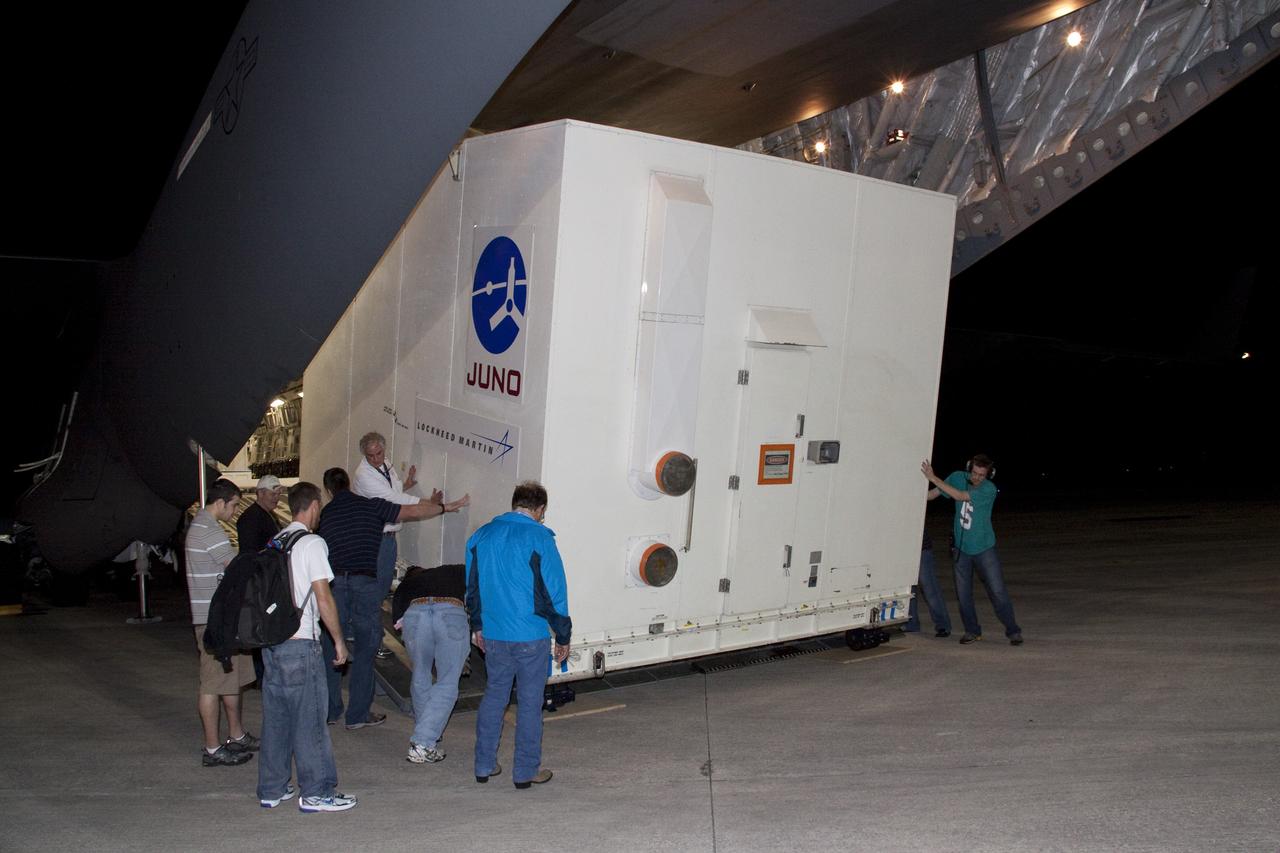
CAPE CANAVERAL, Fla. -- Workers guide the container holding NASA's Juno spacecraft down the ramp of an Air Force C-17 jet at Kennedy Space Center's Shuttle Landing Facility in Florida. Juno was shipped from Lockheed Martin Space Systems in Denver and will be transported to Astrotech's payload processing facility in Titusville, Fla. to begin final preparations for launch. The solar-powered spacecraft will orbit Jupiter's poles 33 times to find out more about the gas giant's origins, structure, atmosphere and magnetosphere and investigate the existence of a solid planetary core. Juno is scheduled to launch aboard an Atlas V rocket from Cape Canaveral, Fla. Aug. 5. For more information visit, www.nasa.gov/juno. Photo credit: NASA/Jack Pfaller
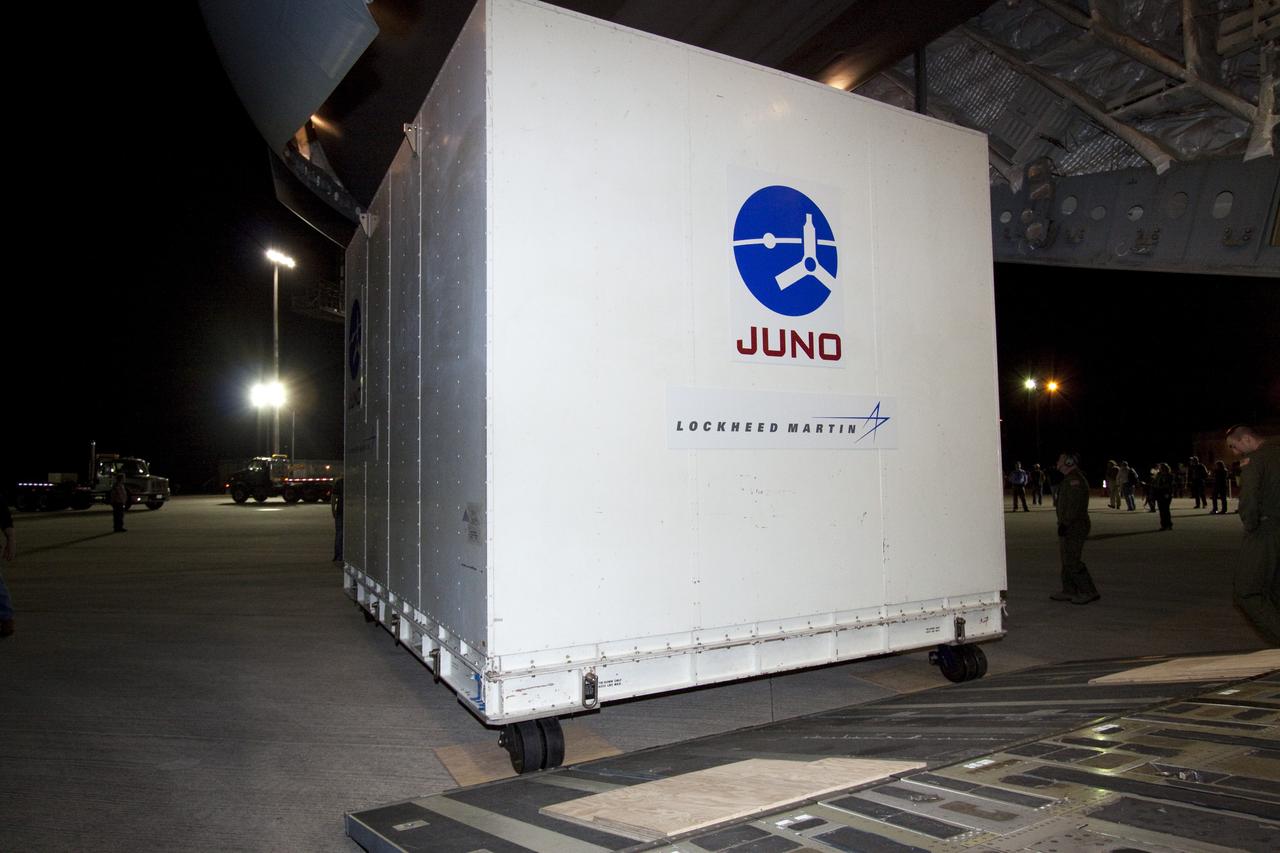
CAPE CANAVERAL, Fla. -- The container holding NASA's Juno spacecraft rests on the tarmac at Kennedy Space Center's Shuttle Landing Facility in Florida after unloading from an Air Force C-17 jet. Juno was shipped from Lockheed Martin Space Systems in Denver and will be transported to Astrotech's payload processing facility in Titusville, Fla. to begin final preparations for launch. The solar-powered spacecraft will orbit Jupiter's poles 33 times to find out more about the gas giant's origins, structure, atmosphere and magnetosphere and investigate the existence of a solid planetary core. Juno is scheduled to launch aboard an Atlas V rocket from Cape Canaveral, Fla. Aug. 5. For more information visit, www.nasa.gov/juno. Photo credit: NASA/Jack Pfaller

A United States Air Force C-17 cargo plane, stationed out of Charleston Air Force Base in South Carolina, holding NASA's Lucy spacecraft lands on the runway of the Launch and Landing Facility at Kennedy Space Center in Florida on July 30, 2021. From there, the Lucy spacecraft will move to the Astrotech Space Operations payload processing facility in nearby Titusville, Florida, before its scheduled launch on a United Launch Alliance (ULA) Atlas V rocket from Cape Canaveral Space Force Station on October 16, 2021. The Lucy mission will be the first space mission to explore a diverse population of small bodies known as the Jupiter Trojan asteroids. The launch is being managed by NASA's Launch Services Program based at Kennedy, America's multi-user spaceport.
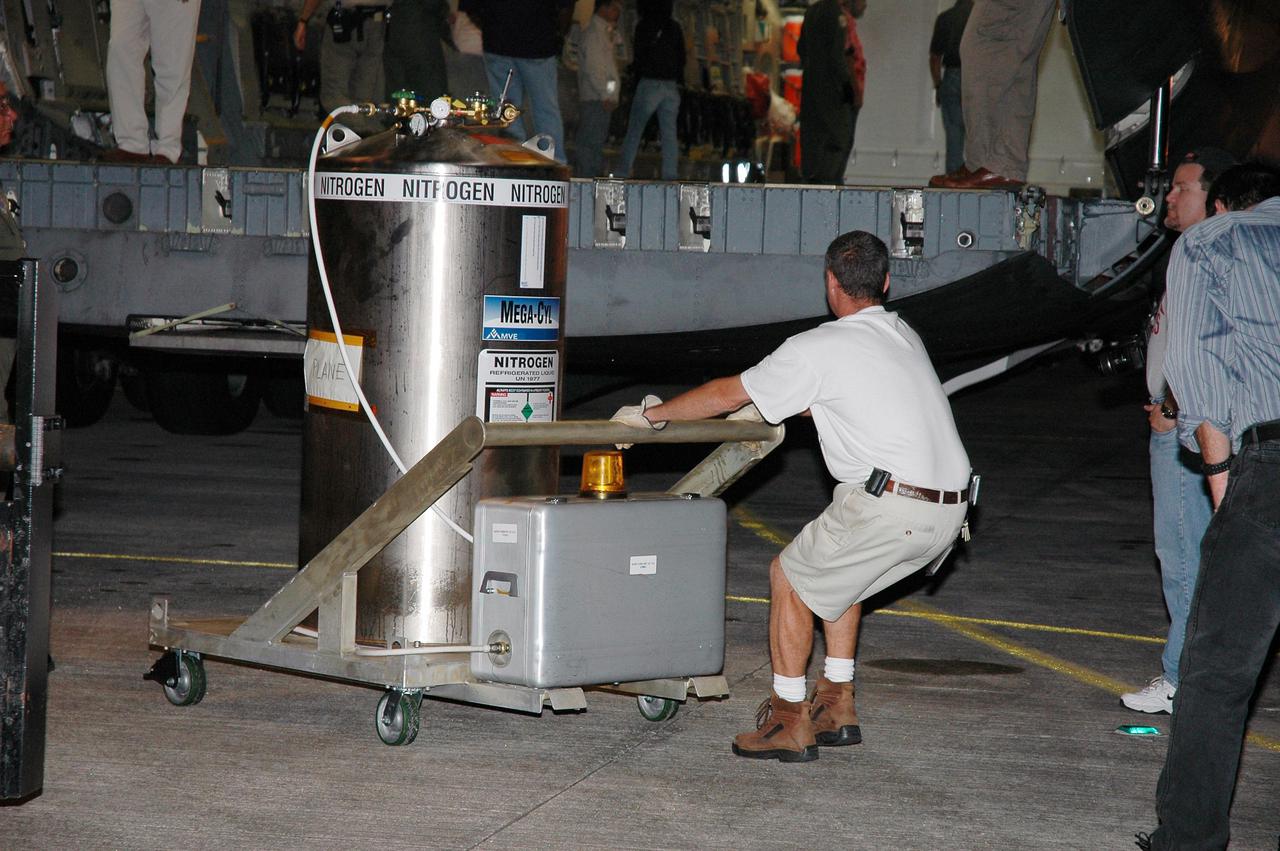
KENNEDY SPACE CENTER, FLA. - At NASA Kennedy Space Center’s Shuttle Landing Facility, workers move a nitrogen tank to a nearby transporter. The equipment is part of the cargo delivered aboard a U.S. Air Force C-17 cargo plane (in the background), primarily the Pluto New Horizons spacecraft. After it is unloaded, the spacecraft will be transported to the Payload Hazardous Servicing Facility. The nitrogen provides a purge to keep components cool and dry during processing.New Horizons is designed to help us understand worlds at the edge of our solar system by making the first reconnaissance of Pluto and Charon - a 'double planet' and the last planet in our solar system to be visited by spacecraft. The mission will then visit one or more objects in the Kuiper Belt region beyond Neptune. New Horizons is scheduled to launch in January 2006, swing past Jupiter for a gravity boost and scientific studies in February or March 2007, and reach Pluto and its moon, Charon, in July 2015.
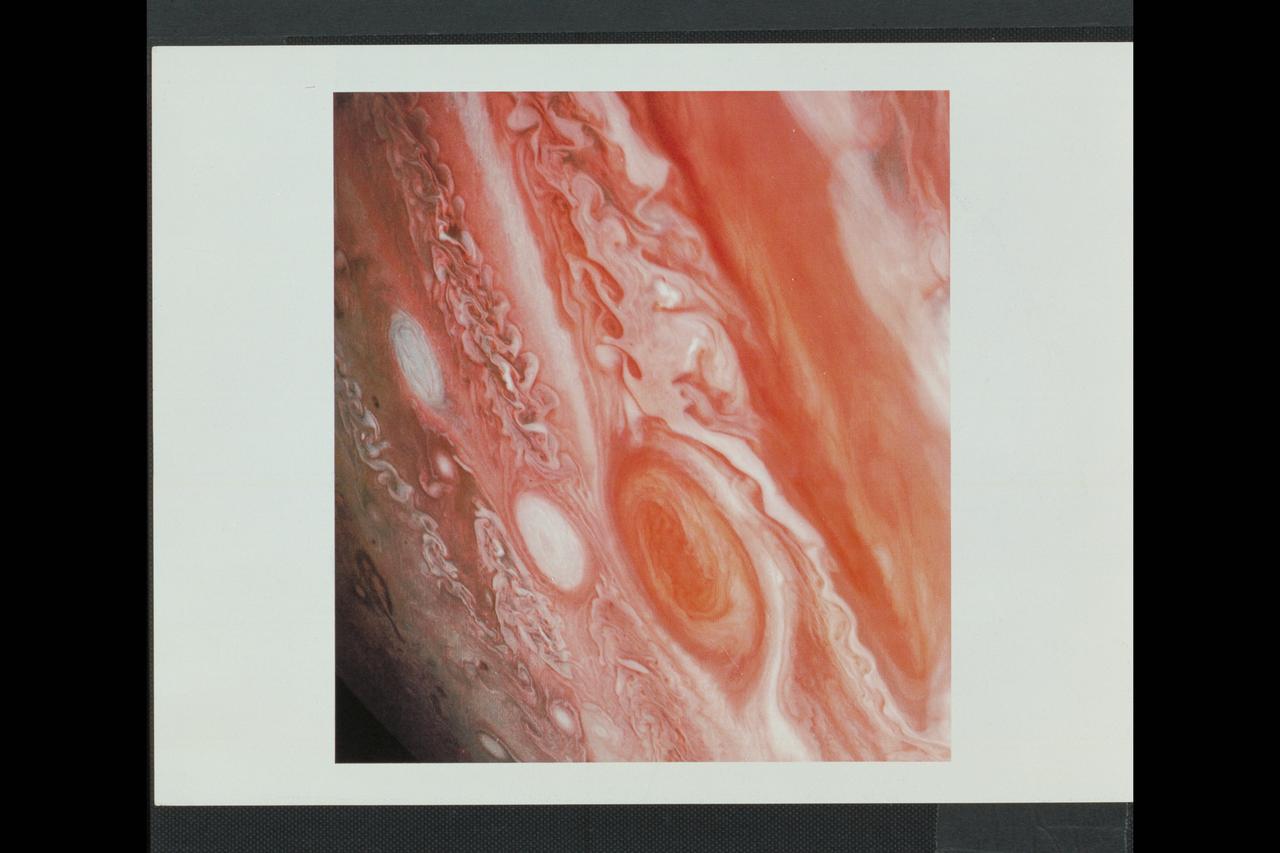
P-21742 C Range: 6 million kilometers (3.72 million miles) This Voyager 2 image shows the region of Jupiter extending from the equator to the southern polar latitudes in the neighborhood of the Great Red Spot. A white oval, different from the one observed in a similiar position at the time of the Voyager 1 encounter, is situated south of the Great Red Spot. The region of white clouds now extends from east of the red spot and around its northern boundary, preventing small cloud vortices from circling the feature. The disturbed region west of the red spot has also changed since the equivalent Voyager 1 image. It shows more small scale structure and cloud vortices being formed out of the wave structures.
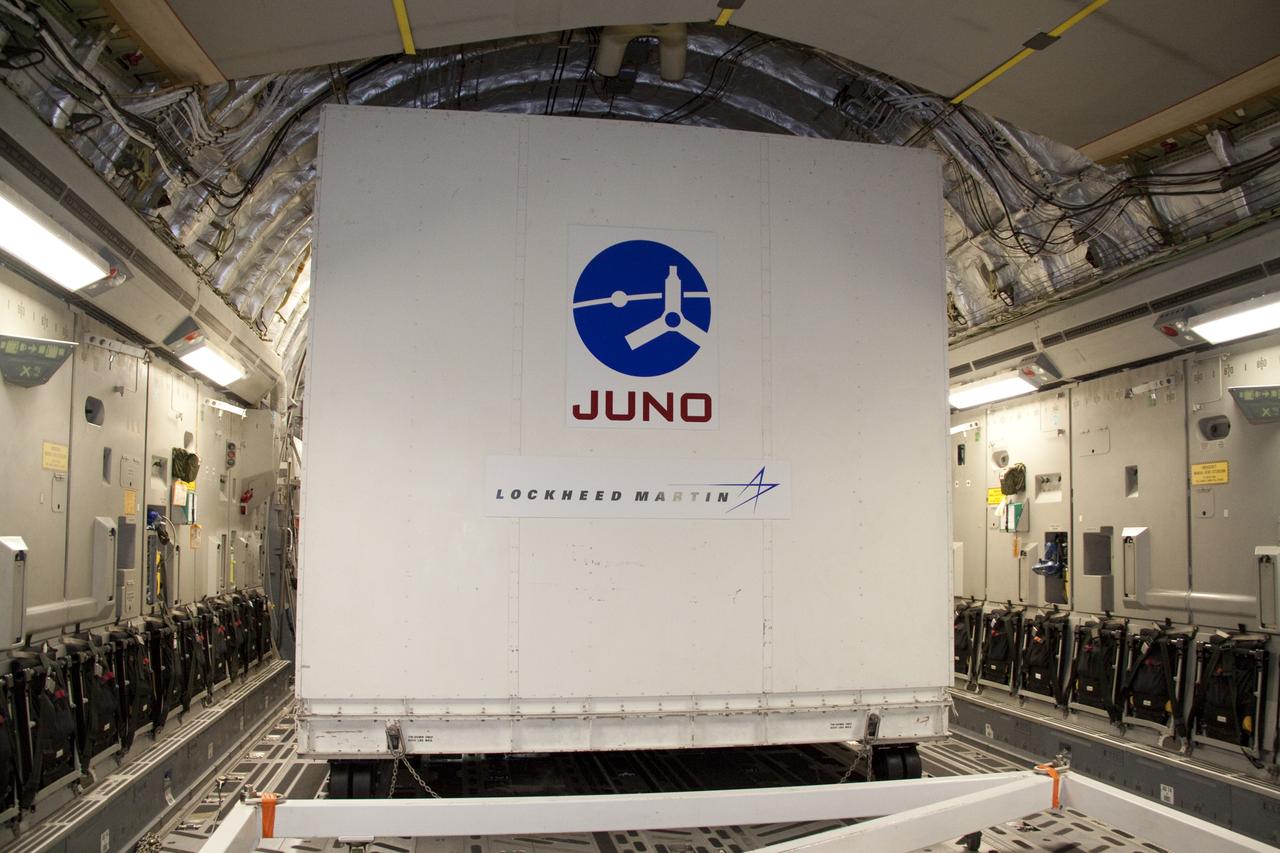
CAPE CANAVERAL, Fla. -- NASA's Juno spacecraft arrives at Kennedy Space Center's Shuttle Landing Facility in Florida aboard an Air Force C-17 jet. Juno was shipped from Lockheed Martin Space Systems in Denver and will be transported to Astrotech's payload processing facility in Titusville, Fla. to begin final preparations for launch. The solar-powered spacecraft will orbit Jupiter's poles 33 times to find out more about the gas giant's origins, structure, atmosphere and magnetosphere and investigate the existence of a solid planetary core. Juno is scheduled to launch aboard an Atlas V rocket from Cape Canaveral, Fla. Aug. 5. For more information visit, www.nasa.gov/juno. Photo credit: NASA/Jack Pfaller
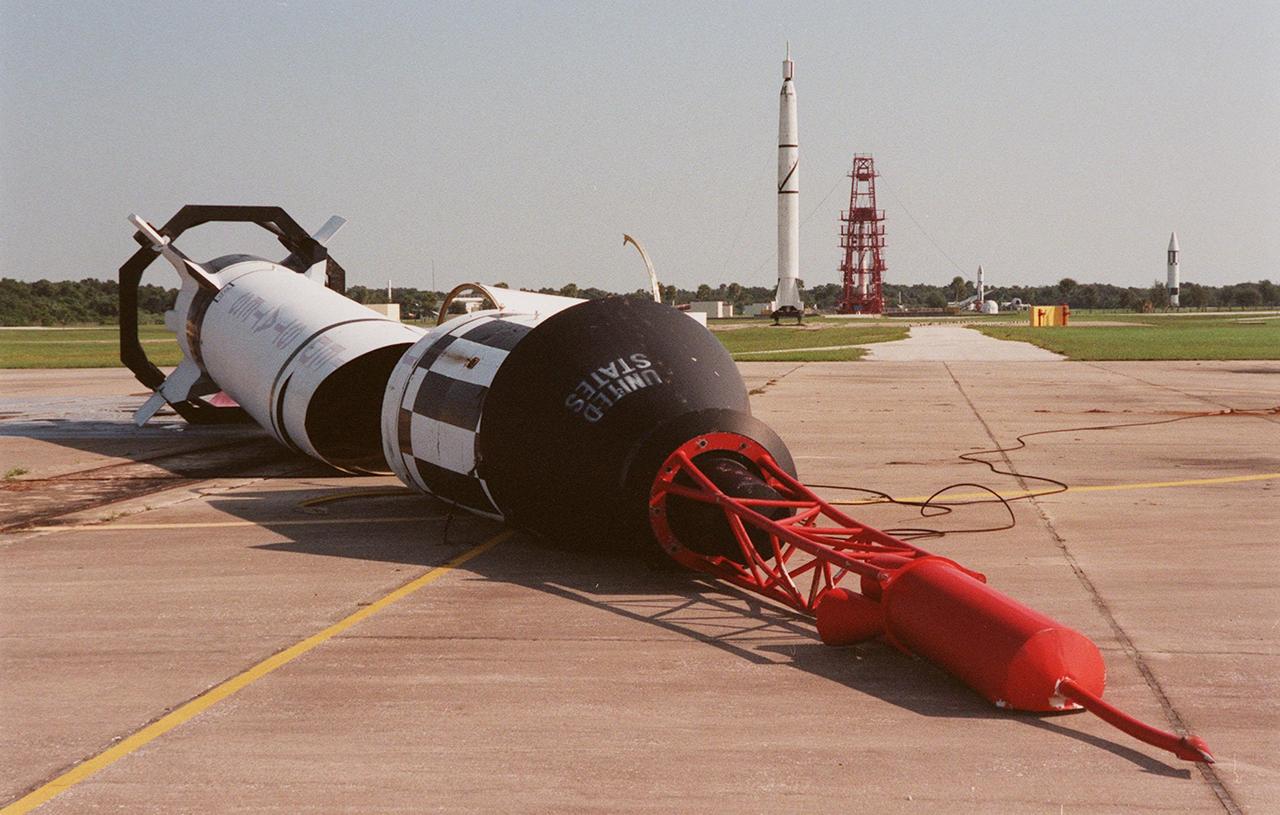
At Cape Canaveral Air Station's Complex 5/6, a Redstone rocket lies broken on the pad after Hurricane Floyd passed along the East Coast of Florida, Sept. 14-15. Still standing behind it are the Explorer I (center) and Jupiter C (right) rockets. The complex, now dismantled, was the site of the first manned launch May 5, 1961. At a weather tower located between Shuttle Launch Pad 39A and Launch Complex 41, the highest winds recorded during the superstorm were 91 mph from the NNW at 4:50 a.m. on Wednesday, Sept. 15. The maximum sustained winds were recorded at 66 mph. The highest amount of rain recorded at KSC was 2.82 inches as the eye of Hurricane Floyd passed 121 miles east of Cape Canaveral at 4 a.m. Wednesday. A preliminary review of conditions at the Kennedy Space Center was positive, however, after the worst of Hurricane Floyd passed. There appeared to be no major damage to NASA assets, including the launch pads, the four Space Shuttle Orbiters, and flight hardware
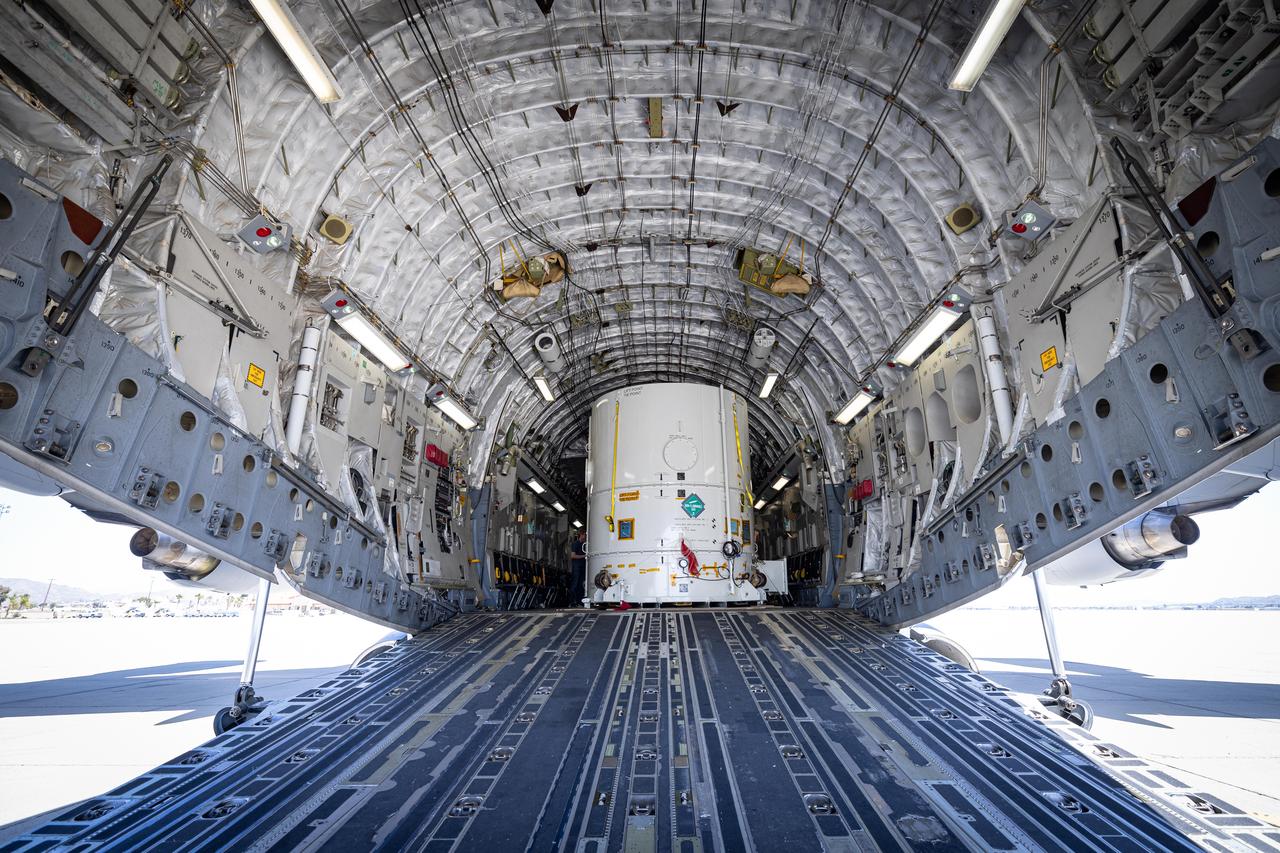
The main body of NASA's Europa Clipper spacecraft is seen in its shipping container, just after arriving aboard a C-17 cargo plane at March Air Reserve Base in Riverside County, California. From there it was delivered by truck to the agency's Jet Propulsion Laboratory in Southern California, where, over the next two years, engineers and technicians will finish assembling the craft by hand. Then it will be tested to make sure it can withstand the journey to Jupiter's icy moon Europa. The Johns Hopkins Applied Physics Laboratory (APL) in Laurel, Maryland, designed and built the spacecraft body in collaboration with JPL and NASA's Goddard Space Flight Center in Greenbelt, Maryland. Set to launch in October 2024, Europa Clipper will conduct nearly 50 flybys of Europa, which scientists are confident harbors an internal ocean containing twice as much water as Earth's oceans combined. And the moon may currently have conditions suitable for supporting life. The spacecraft's nine science instruments will gather data on the moon's atmosphere, surface, and interior – information that scientists will use to gauge the depth and salinity of the ocean, the thickness of the ice crust, and potential plumes that may be venting subsurface water into space. https://photojournal.jpl.nasa.gov/catalog/PIA25238
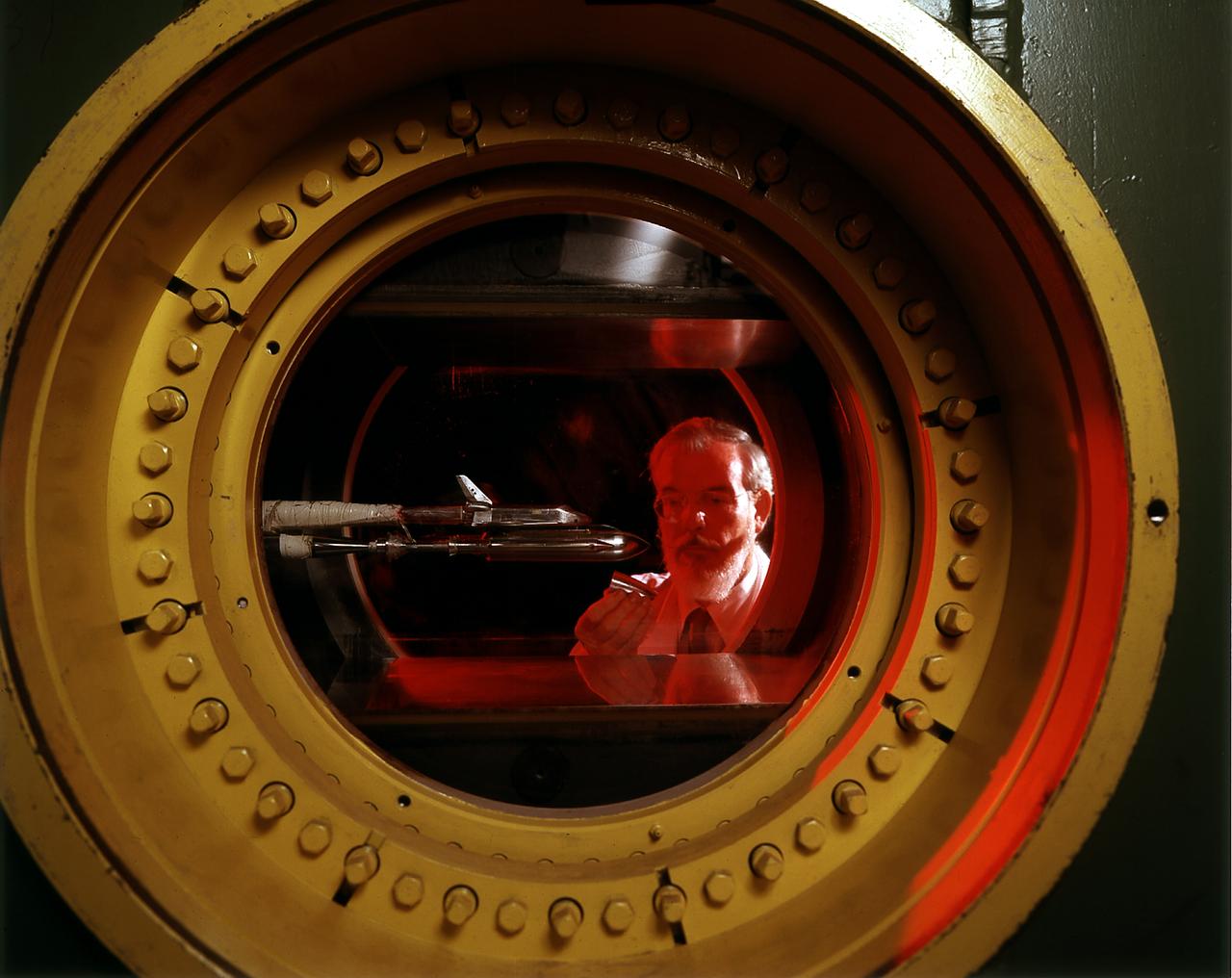
An engineer at the Marshall Space Flight Center (MSFC) observes a model of the Space Shuttle Orbiter being tested in the MSFC's 14x14-Inch Trisonic Wind Tunnel. The 14-Inch Wind Tunnel is a trisonic wind tunnel. This means it is capable of running subsonic, below the speed of sound; transonic, at or near the speed of sound (Mach 1,760 miles per hour at sea level); or supersonic, greater than Mach 1 up to Mach 5. It is an intermittent blowdown tunnel that operates by high pressure air flowing from storage to either vacuum or atmospheric conditions. The MSFC 14x14-Inch Trisonic Wind Tunnel has been an integral part of the development of the United States space program Rocket and launch vehicles from the Jupiter-C in 1958, through the Saturn family up to the current Space Shuttle and beyond have been tested in this Wind Tunnel. MSFC's 14x14-Inch Trisonic Wind Tunnel, as with most other wind tunnels, is named after the size of the test section. The 14-Inch Wind Tunnel, as in the past, will continue to play a large but unseen role in the development of America's space program.

This photograph shows an overall view of the Marshall Space Flight Center's (MSFC's) 14x14-Inch Trisonic Wind Tunnel. The 14-Inch Wind Tunnel is a trisonic wind tunnel. This means it is capable of running subsonic, below the speed of sound; transonic, at or near the speed of sound (Mach 1, 760 miles per hour at sea level); or supersonic, greater than Mach 1 up to Mach 5. It is an intermittent blowdown tunnel that operates by high pressure air flowing from storage to either vacuum or atmospheric conditions. The MSFC 14x14-Inch Trisonic Wind Tunnel has been an integral part of the development of the United States space program Rocket and launch vehicles from the Jupiter-C in 1958, through the Saturn family up to the current Space Shuttle and beyond have been tested in this Wind Tunnel. MSFC's 14x14-Inch Trisonic Wind Tunnel, as with most other wind tunnels, is named after the size of the test section. The 14-Inch Wind Tunnel, as in the past, will continue to play a large but unseen role in the development of America's space program.
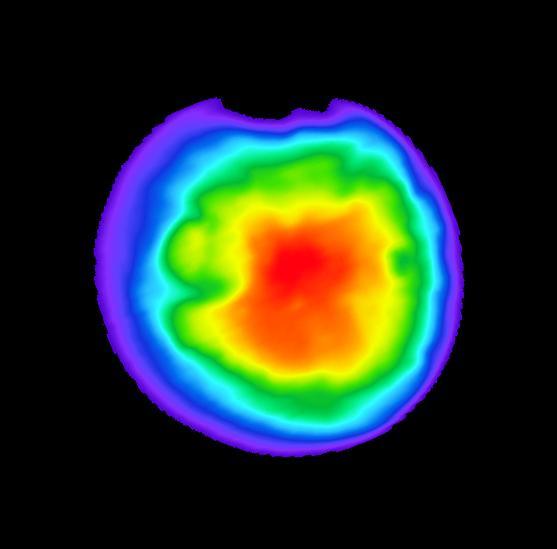
Europa Clipper, en route to the Jupiter system to investigate the icy moon Europa, swung by Mars on March 1, 2025, to use the planet's gravity to help shape the spacecraft's trajectory. The mission took the opportunity to capture infrared images of the Red Planet using the orbiter's Europa Thermal Imaging System (E-THEMIS) to calibrate the instrument. This picture is a colorized composite of several images captured by E-THEMIS from about a million miles (1.6 million kilometers) away. Warm colors represent relatively warm temperatures; red areas are about 32 degrees Fahrenheit (0 degrees Celsius), and purple regions are about minus 190 degrees F (minus 125 degrees C). The temperature variations reflect the time of day on Mars, which was noon, with the center of the globe warmest because the Sun was shining directly onto the planet, near the equator, from behind the Europa Clipper spacecraft. The instrument captured the image data in long-wave infrared wavelengths of about 7 to 14 micrometers. Europa Clipper launched from NASA's Kennedy Space Center in Florida on Oct. 14, 2024, and will arrive at the Jupiter system in 2030 to conduct about 50 flybys of Europa. The mission's main science goal is to determine whether there are places below Europa's surface that could support life. The mission's three main science objectives are to determine the thickness of the moon's icy shell and its surface interactions with the ocean below, to investigate its composition, and to characterize its geology. The mission's detailed exploration of Europa will help scientists better understand the astrobiological potential for habitable worlds beyond our planet. https://photojournal.jpl.nasa.gov/catalog/PIA26566

This artist's concept shows what the TRAPPIST-1 planetary system may look like, based on available data about the planets' diameters, masses and distances from the host star. The system has been revealed through observations from NASA's Spitzer Space Telescope and the ground-based TRAPPIST (TRAnsiting Planets and PlanetesImals Small Telescope) telescope, as well as other ground-based observatories. The system was named for the TRAPPIST telescope. The seven planets of TRAPPIST-1 are all Earth-sized and terrestrial, according to research published in 2017 in the journal Nature. TRAPPIST-1 is an ultra-cool dwarf star in the constellation Aquarius, and its planets orbit very close to it. They are likely all tidally locked, meaning the same face of the planet is always pointed at the star, as the same side of our moon is always pointed at Earth. This creates a perpetual night side and perpetual day side on each planet. TRAPPIST-1b and c receive the most light from the star and would be the warmest. TRAPPIST-1e, f and g all orbit in the habitable zone, the area where liquid water is most likely to be detected. But any of the planets could potentially harbor liquid water, depending on their compositions. In the imagined planets shown here, TRAPPIST-1b is shown as a larger analogue to Jupiter's moon Io. TRAPPIST-1d is depicted with a narrow band of water near the terminator, the divide between a hot, dry day and an ice-covered night side. TRAPPIST-1e and TRAPPIST-1f are both shown covered in water, but with progressively larger ice caps on the night side. TRAPPIST-1g is portrayed with an atmosphere like Neptune's, although it is still a rocky world. TRAPPIST-1h, the farthest from the star, would be the coldest. It is portrayed here as an icy world, similar to Jupiter's moon Europa, but the least is known about it. http://photojournal.jpl.nasa.gov/catalog/PIA21422
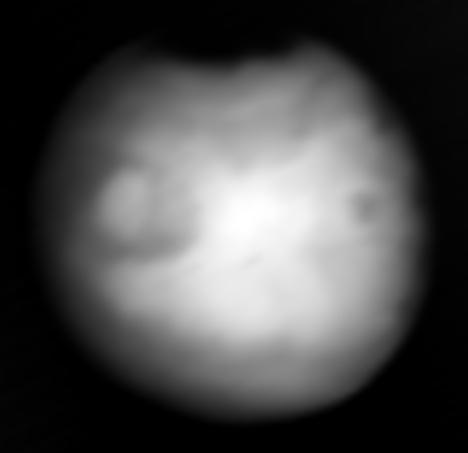
Europa Clipper, en route to the Jupiter system to investigate the icy moon Europa, swung by Mars on March 1, 2025, to use the planet's gravity to help shape the spacecraft's trajectory. The mission took the opportunity to capture to capture infrared images of the Red Planet using the orbiter's Europa Thermal Imaging System (E-THEMIS) to calibrate the instrument. This picture is a composite of several images captured by E-THEMIS, showing Mars' surface temperatures from about a million miles (1.6 million kilometers) away. Bright regions are relatively warm, with temperatures of about 32 degrees Fahrenheit (0 degrees Celsius). Darker areas are colder. The darkest region at the top is the northern polar cap and is about minus 190 F (minus 125 C). The temperature variations reflect the time of day on Mars, which was noon, with the center of the globe warmest because the Sun was shining directly onto the planet, near the equator, from behind Europa Clipper. Other variations reflect different surface features, with the fine-grained dust at the region near the equator being warm and coarser, rockier materials staying cooler. The instrument captured the images data in long-wave infrared wavelengths of about 7 to 14 micrometers. Europa Clipper launched from NASA's Kennedy Space Center in Florida on Oct. 14, 2024, and will arrive at the Jupiter system in 2030 to conduct about 50 flybys of Europa. The mission's main science goal is to determine whether there are places below Europa's surface that could support life. The mission's three main science objectives are to determine the thickness of the moon's icy shell and its surface interactions with the ocean below, to investigate its composition, and to characterize its geology. The mission's detailed exploration of Europa will help scientists better understand the astrobiological potential for habitable worlds beyond our planet. https://photojournal.jpl.nasa.gov/catalog/PIA26565
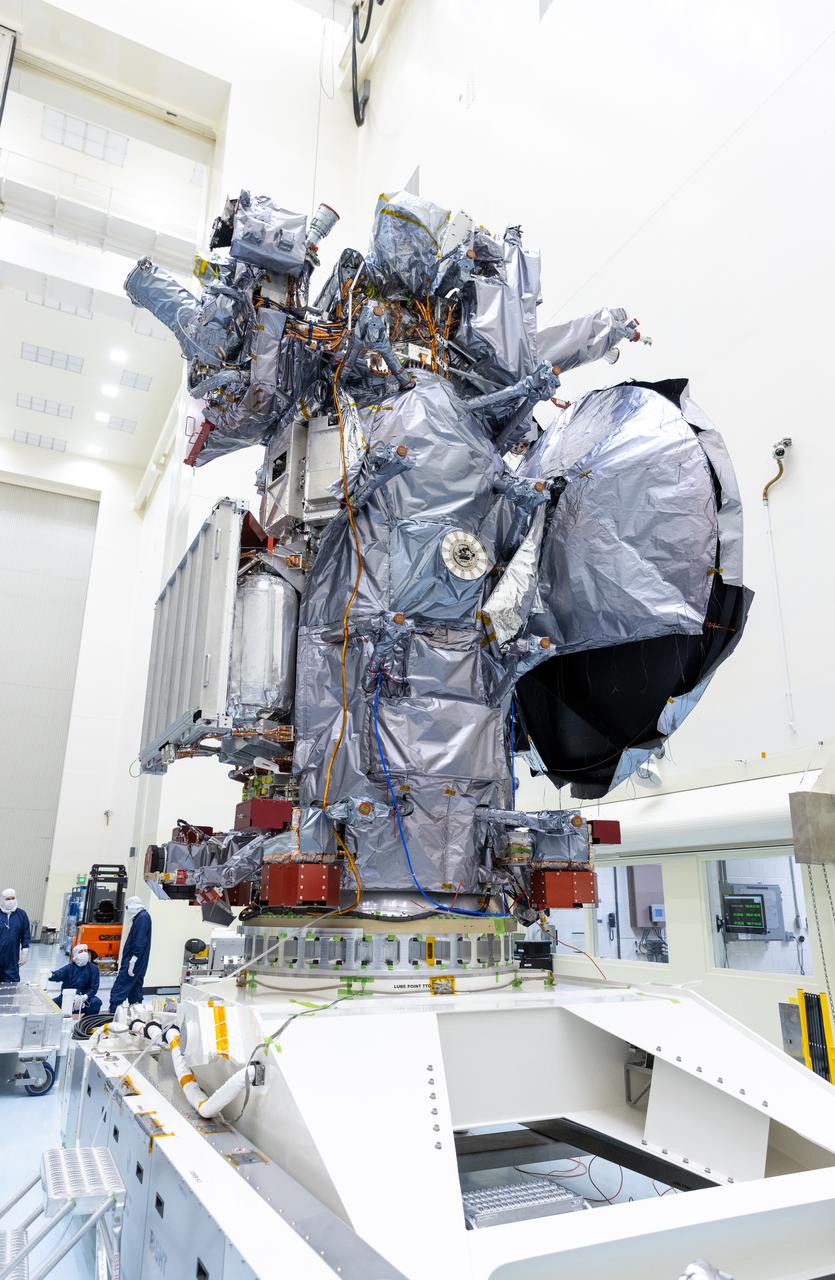
Technicians prepare to install the nearly 10 feet (3 meters) wide dish-shaped high-gain antenna to NASA’s Europa Clipper, a spacecraft to study Jupiter’s icy moon, at the agency’s Payload Hazardous Servicing Facility at Kennedy Space Center in Florida on Tuesday, June 18, 2024. The spacecraft will perform a series of flybys of the Jupiter moon Europa to gather data on its atmosphere, icy crust, and the ocean underneath, and the high-gain antenna will send the research data to scientists on Earth to determine if the moon can support habitable condition. The Europa Clipper spacecraft is scheduled to launch atop a SpaceX Falcon Heavy rocket from Kennedy’s Launch Complex 39A no earlier than October 2024.
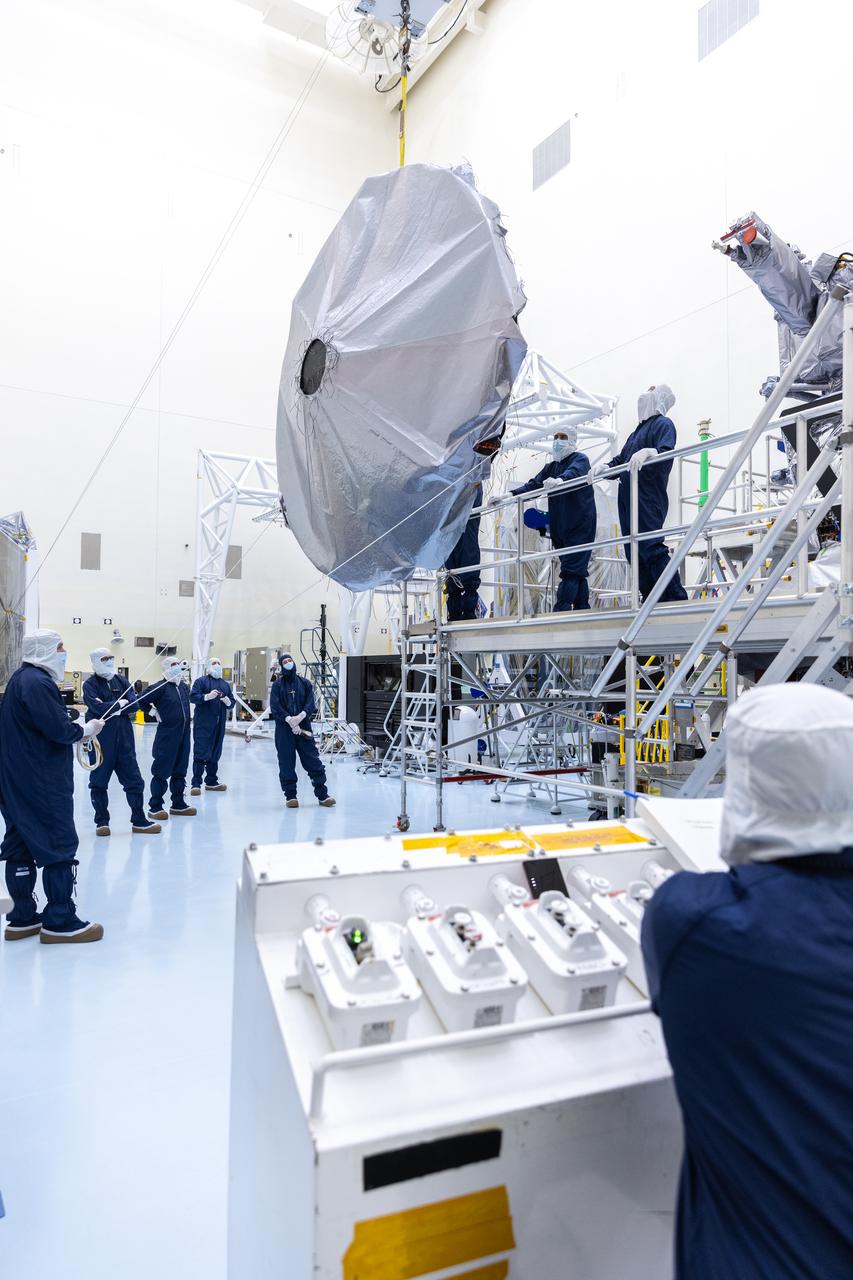
Technicians prepare to install the nearly 10 feet (3 meters) wide dish-shaped high-gain antenna to NASA’s Europa Clipper, a spacecraft to study Jupiter’s icy moon, at the agency’s Payload Hazardous Servicing Facility at Kennedy Space Center in Florida on Monday, June 17, 2024. The spacecraft will perform a series of flybys of the Jupiter moon Europa to gather data on its atmosphere, icy crust, and the ocean underneath, and the high-gain antenna will send the research data to scientists on Earth to determine if the moon can support habitable condition. The Europa Clipper spacecraft is scheduled to launch atop a SpaceX Falcon Heavy rocket from Kennedy’s Launch Complex 39A no earlier than October 2024.
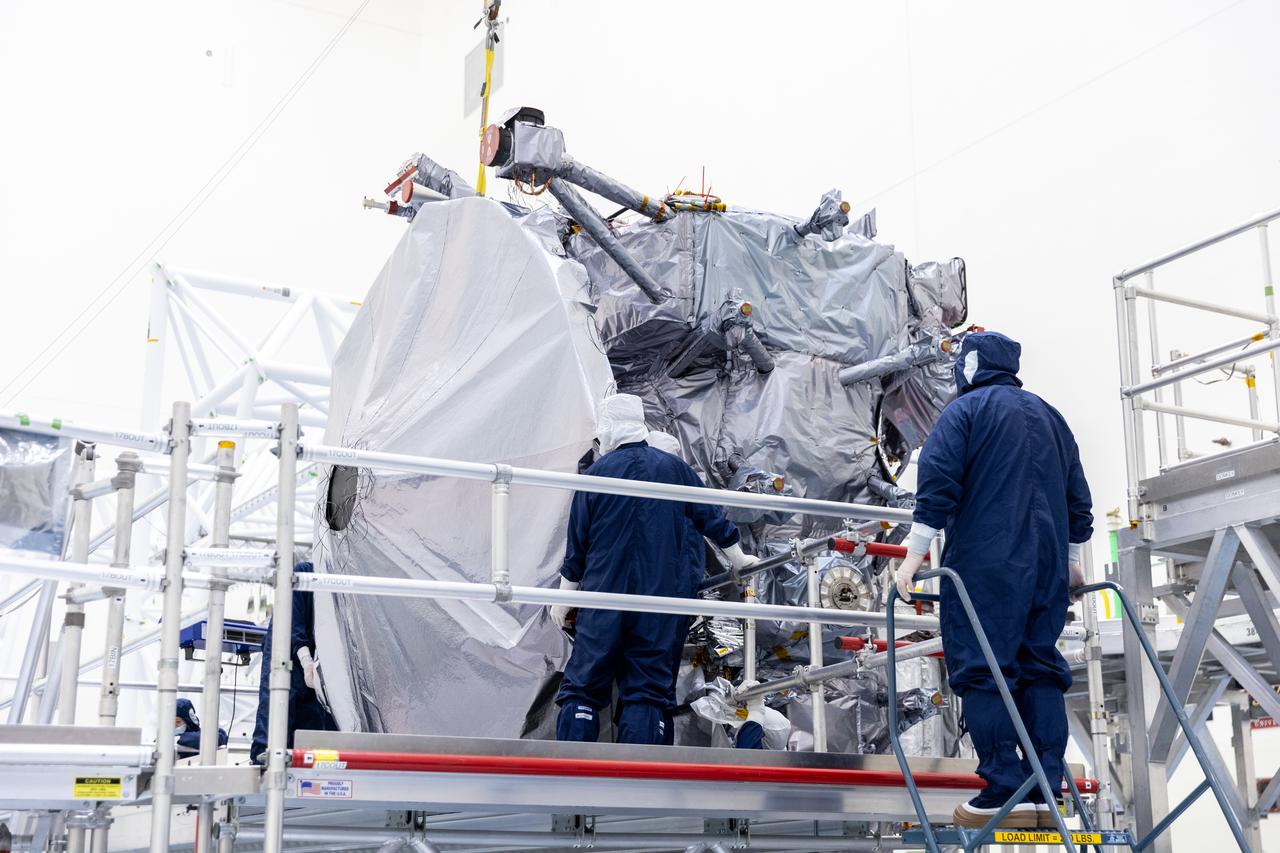
Technicians prepare to install the nearly 10 feet (3 meters) wide dish-shaped high-gain antenna to NASA’s Europa Clipper, a spacecraft to study Jupiter’s icy moon, at the agency’s Payload Hazardous Servicing Facility at Kennedy Space Center in Florida on Monday, June 17, 2024. The spacecraft will perform a series of flybys of the Jupiter moon Europa to gather data on its atmosphere, icy crust, and the ocean underneath, and the high-gain antenna will send the research data to scientists on Earth to determine if the moon can support habitable condition. The Europa Clipper spacecraft is scheduled to launch atop a SpaceX Falcon Heavy rocket from Kennedy’s Launch Complex 39A no earlier than October 2024.
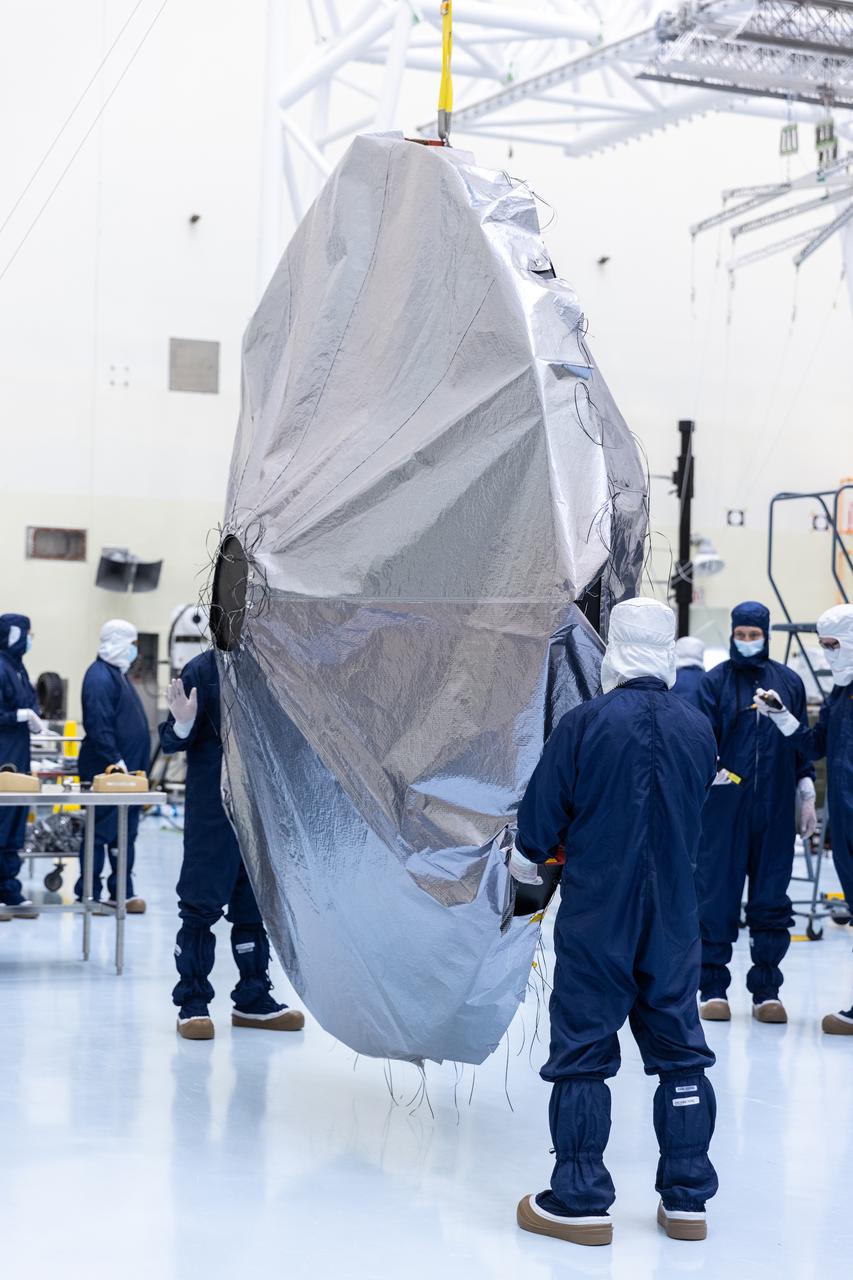
Technicians prepare to install the nearly 10 feet (3 meters) wide dish-shaped high-gain antenna to NASA’s Europa Clipper, a spacecraft to study Jupiter’s icy moon, at the agency’s Payload Hazardous Servicing Facility at Kennedy Space Center in Florida on Monday, June 17, 2024. The spacecraft will perform a series of flybys of the Jupiter moon Europa to gather data on its atmosphere, icy crust, and the ocean underneath, and the high-gain antenna will send the research data to scientists on Earth to determine if the moon can support habitable condition. The Europa Clipper spacecraft is scheduled to launch atop a SpaceX Falcon Heavy rocket from Kennedy’s Launch Complex 39A no earlier than October 2024.
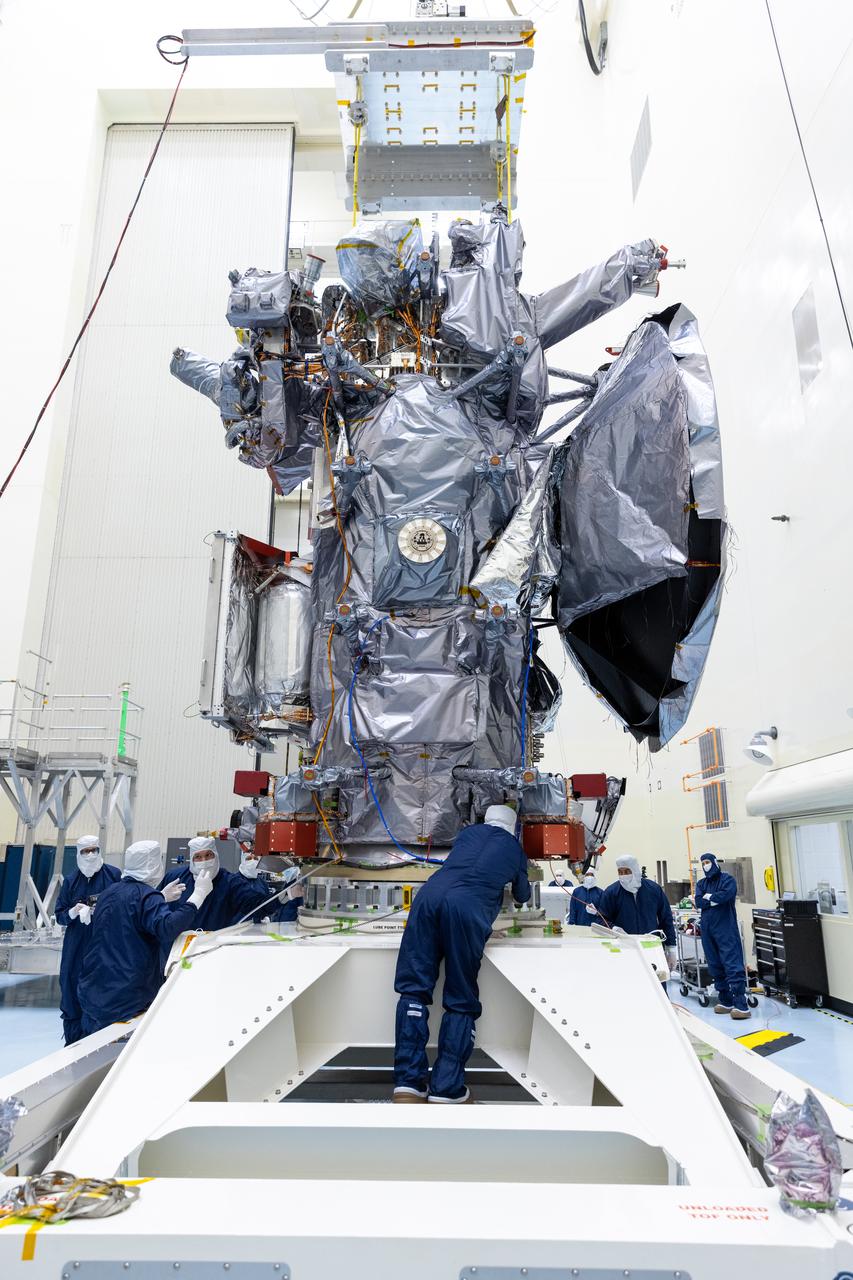
Technicians prepare to install the nearly 10 feet (3 meters) wide dish-shaped high-gain antenna to NASA’s Europa Clipper, a spacecraft to study Jupiter’s icy moon, at the agency’s Payload Hazardous Servicing Facility at Kennedy Space Center in Florida on Tuesday, June 18, 2024. The spacecraft will perform a series of flybys of the Jupiter moon Europa to gather data on its atmosphere, icy crust, and the ocean underneath, and the high-gain antenna will send the research data to scientists on Earth to determine if the moon can support habitable condition. The Europa Clipper spacecraft is scheduled to launch atop a SpaceX Falcon Heavy rocket from Kennedy’s Launch Complex 39A no earlier than October 2024.
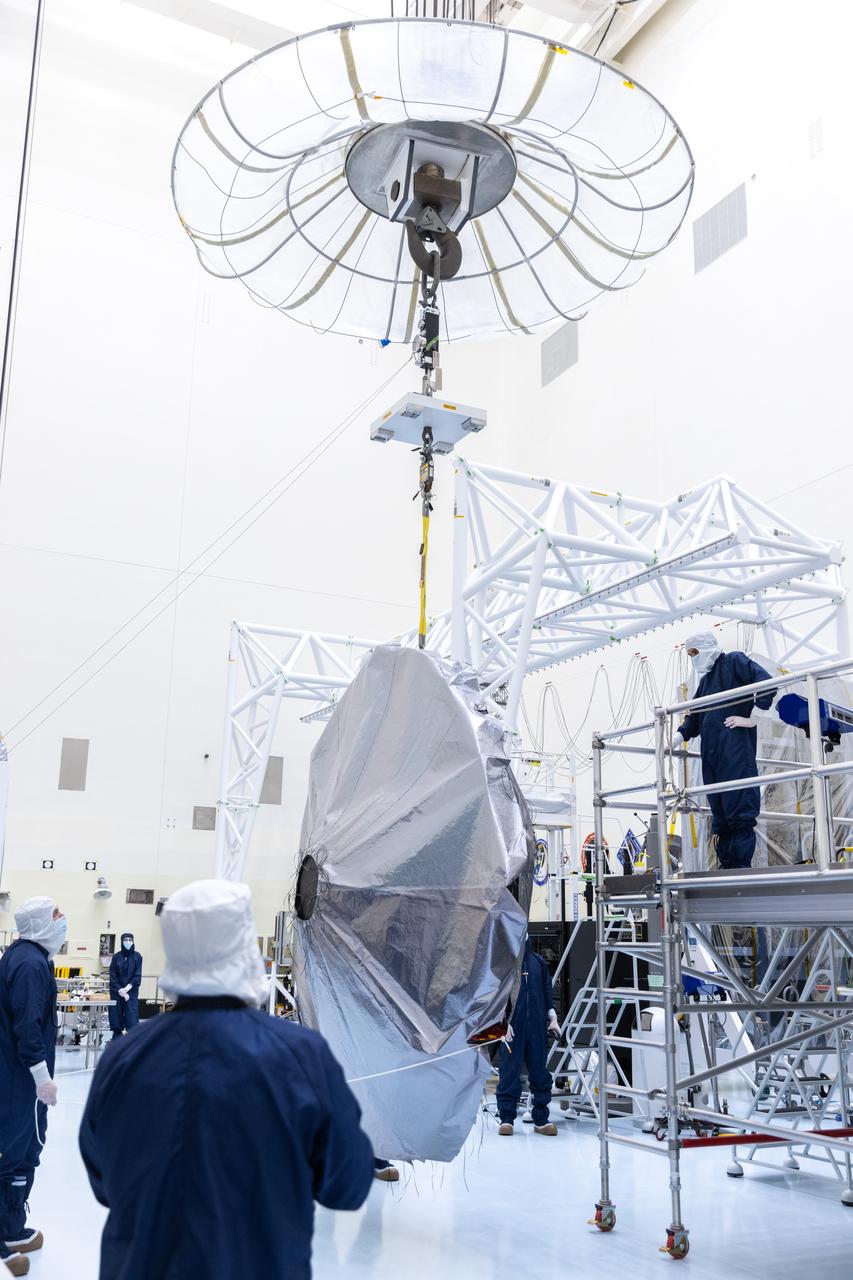
Technicians prepare to install the nearly 10 feet (3 meters) wide dish-shaped high-gain antenna to NASA’s Europa Clipper, a spacecraft to study Jupiter’s icy moon, at the agency’s Payload Hazardous Servicing Facility at Kennedy Space Center in Florida on Monday, June 17, 2024. The spacecraft will perform a series of flybys of the Jupiter moon Europa to gather data on its atmosphere, icy crust, and the ocean underneath, and the high-gain antenna will send the research data to scientists on Earth to determine if the moon can support habitable condition. The Europa Clipper spacecraft is scheduled to launch atop a SpaceX Falcon Heavy rocket from Kennedy’s Launch Complex 39A no earlier than October 2024.
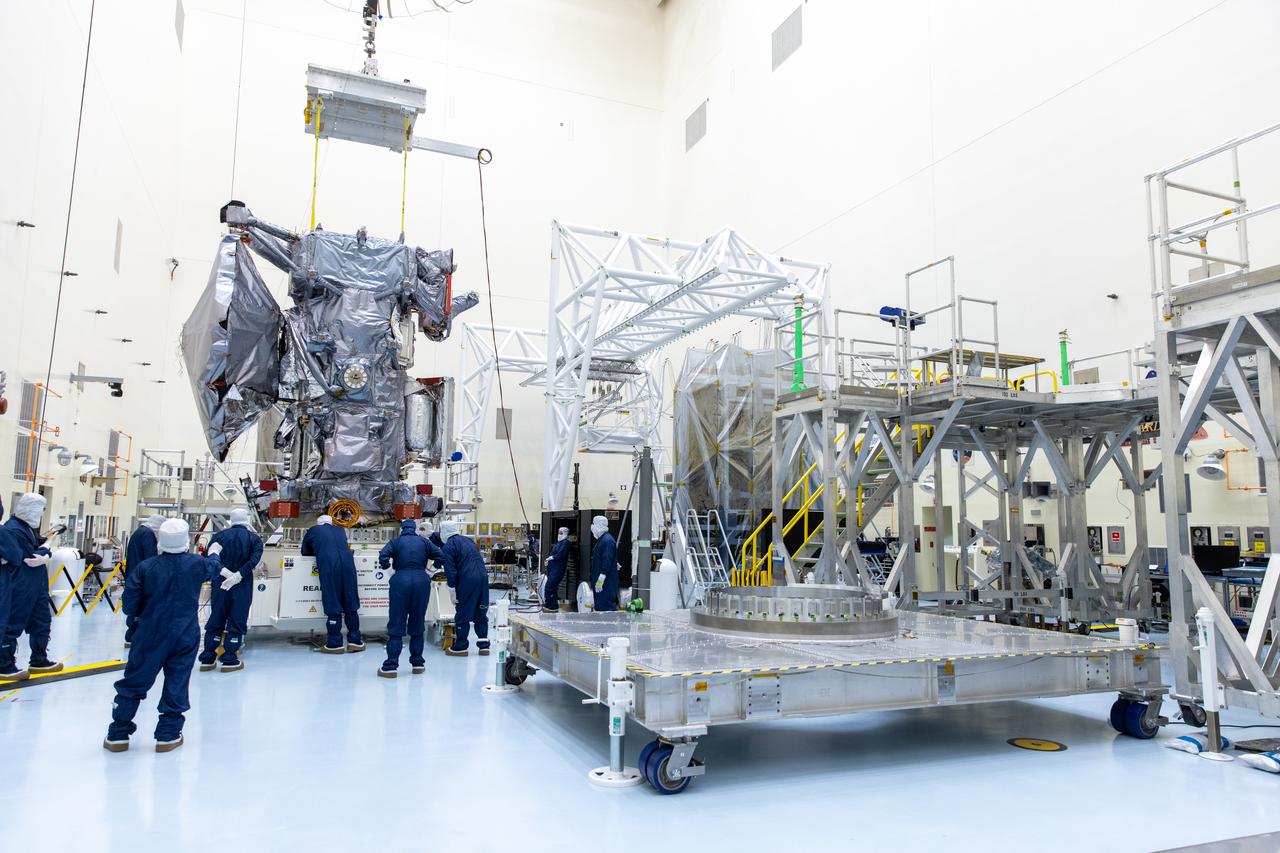
Technicians prepare to install the nearly 10 feet (3 meters) wide dish-shaped high-gain antenna to NASA’s Europa Clipper, a spacecraft to study Jupiter’s icy moon, at the agency’s Payload Hazardous Servicing Facility at Kennedy Space Center in Florida on Tuesday, June 18, 2024. The spacecraft will perform a series of flybys of the Jupiter moon Europa to gather data on its atmosphere, icy crust, and the ocean underneath, and the high-gain antenna will send the research data to scientists on Earth to determine if the moon can support habitable condition. The Europa Clipper spacecraft is scheduled to launch atop a SpaceX Falcon Heavy rocket from Kennedy’s Launch Complex 39A no earlier than October 2024.
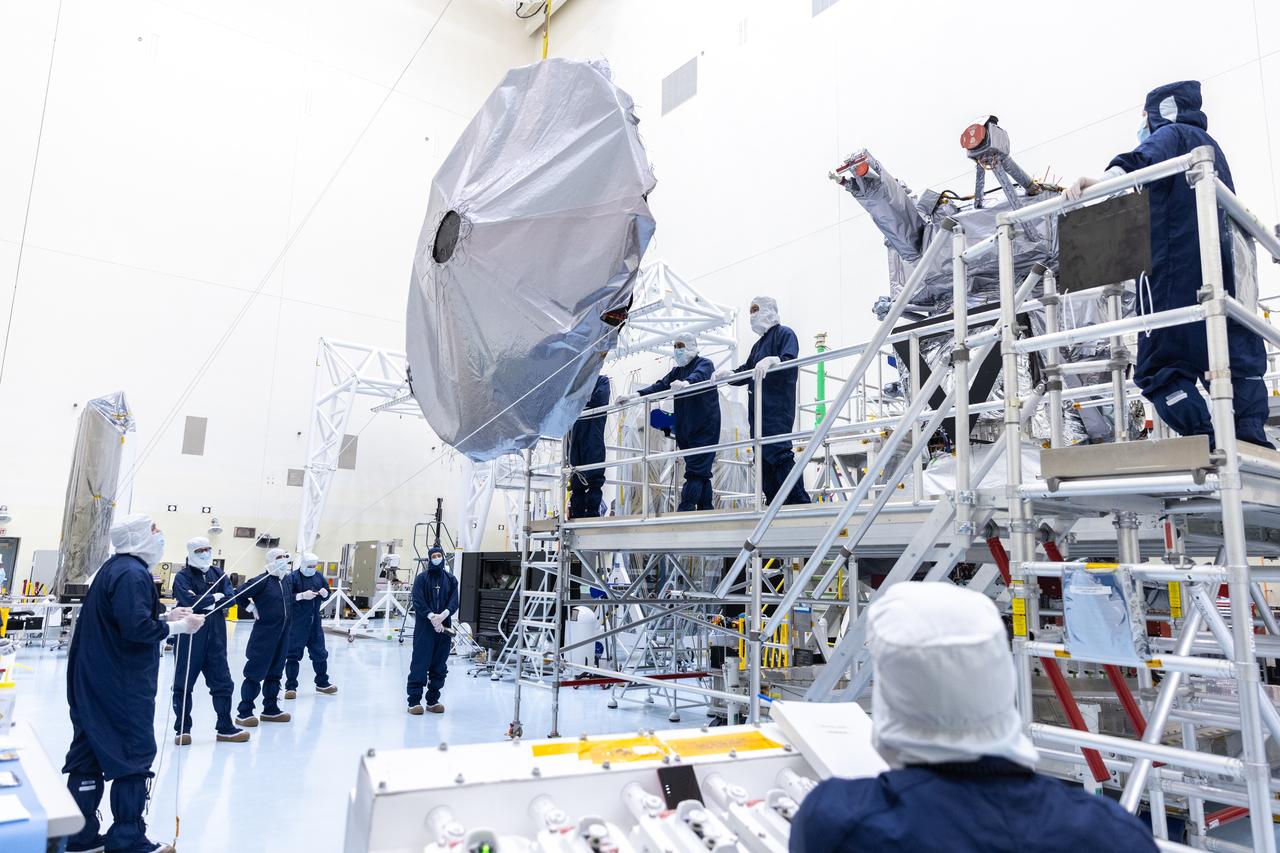
Technicians prepare to install the nearly 10 feet (3 meters) wide dish-shaped high-gain antenna to NASA’s Europa Clipper, a spacecraft to study Jupiter’s icy moon, at the agency’s Payload Hazardous Servicing Facility at Kennedy Space Center in Florida on Monday, June 17, 2024. The spacecraft will perform a series of flybys of the Jupiter moon Europa to gather data on its atmosphere, icy crust, and the ocean underneath, and the high-gain antenna will send the research data to scientists on Earth to determine if the moon can support habitable condition. The Europa Clipper spacecraft is scheduled to launch atop a SpaceX Falcon Heavy rocket from Kennedy’s Launch Complex 39A no earlier than October 2024.
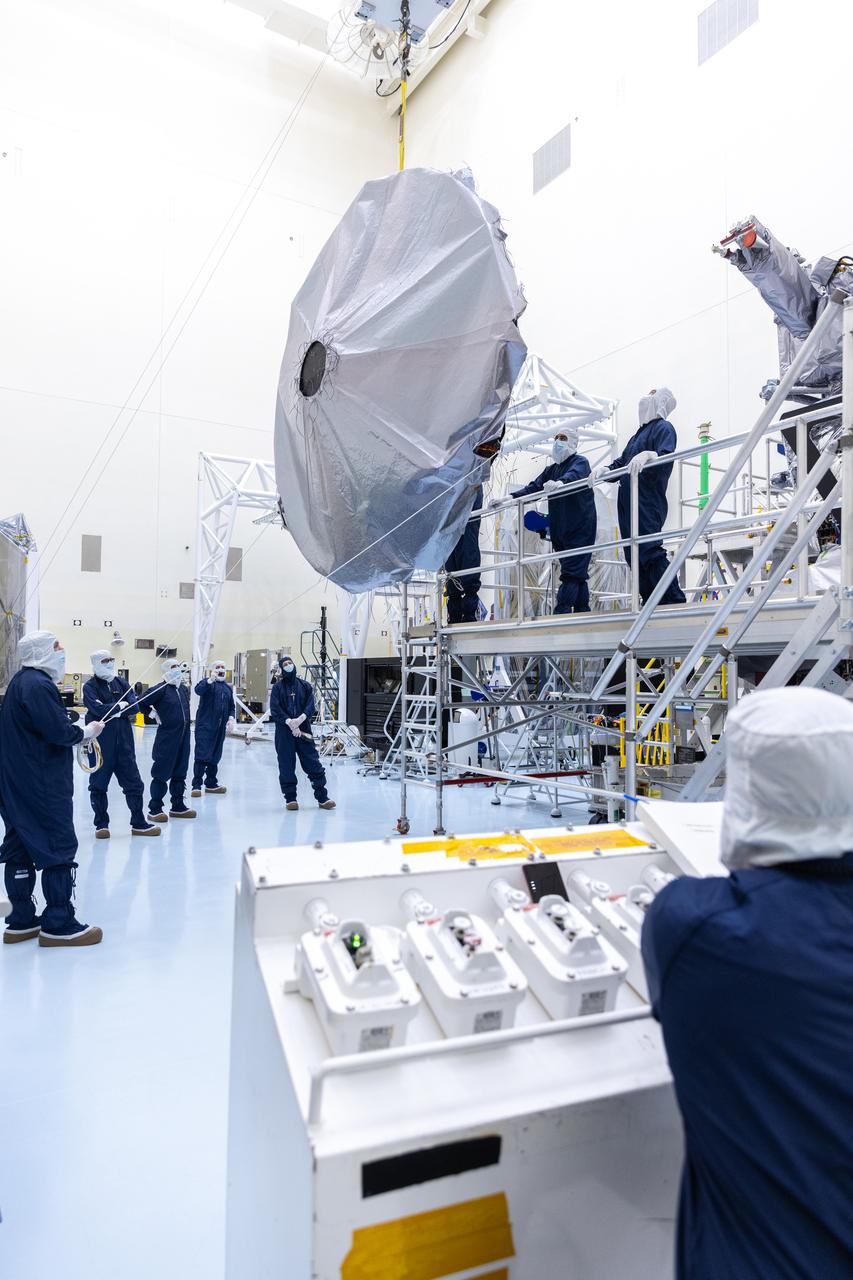
Technicians prepare to install the nearly 10 feet (3 meters) wide dish-shaped high-gain antenna to NASA’s Europa Clipper, a spacecraft to study Jupiter’s icy moon, at the agency’s Payload Hazardous Servicing Facility at Kennedy Space Center in Florida on Monday, June 17, 2024. The spacecraft will perform a series of flybys of the Jupiter moon Europa to gather data on its atmosphere, icy crust, and the ocean underneath, and the high-gain antenna will send the research data to scientists on Earth to determine if the moon can support habitable condition. The Europa Clipper spacecraft is scheduled to launch atop a SpaceX Falcon Heavy rocket from Kennedy’s Launch Complex 39A no earlier than October 2024.
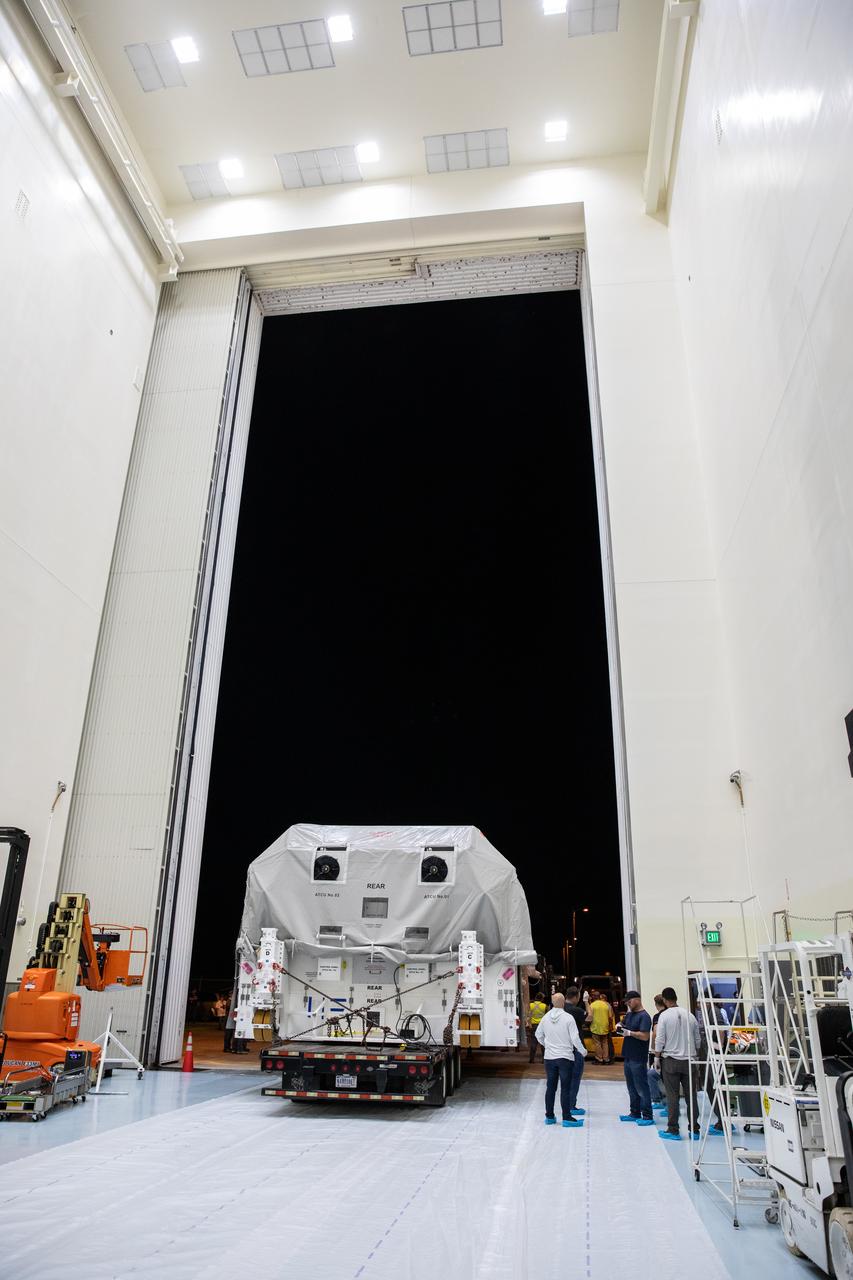
NASA’s largest planetary mission spacecraft, Europa Clipper, arrives at the Payload Hazardous Servicing Facility at the agency’s Kennedy Space Center in Florida on Thursday, May 23, 2024. Slated to launch aboard a SpaceX Falcon Heavy rocket later this year from Launch Complex 39A at Kennedy, Europa Clipper will help determine if life-sustaining conditions exist below the surface Jupiter’s fourth largest moon, Europa.
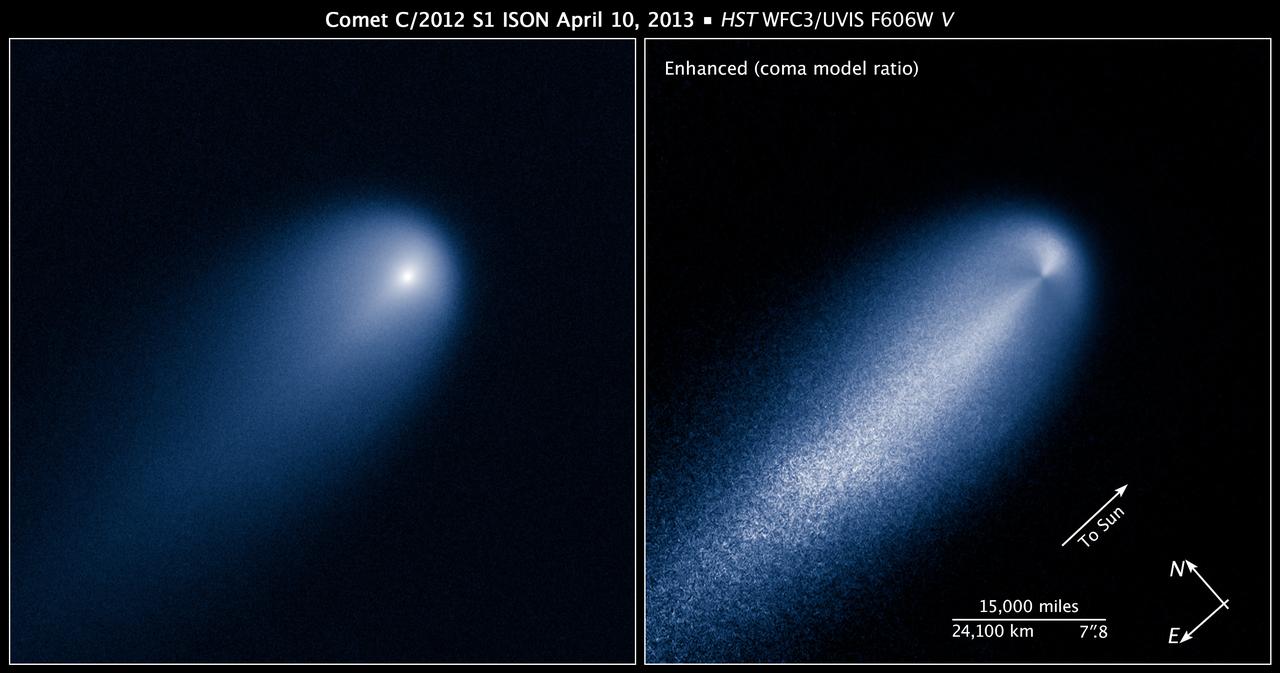
This NASA Hubble Space Telescope image of Comet (C/2012 S1) ISON was photographed on April 10, 2013, when the comet was slightly closer than Jupiter's orbit at a distance of 394 million miles from Earth. Even at that great distance the comet is already active as sunlight warms the surface and causes frozen volatiles to boil off. Astronomers used such early images to try to measure the size of the nucleus, in order to predict whether the comet would stay intact when it slingshots around the sun -- at 700,000 miles above the sun's surface -- on Nov. 28, 2013. The comet's dusty coma, or head of the comet, is approximately 3,100 miles across, or 1.2 times the width of Australia. A dust tail extends more than 57,000 miles, far beyond Hubble's field of view. This image was taken in visible light. The blue false color was added to bring out details in the comet structure. Credit: NASA/ ESA/STScI/AURA -------- More details on Comet ISON: Comet ISON began its trip from the Oort cloud region of our solar system and is now travelling toward the sun. The comet will reach its closest approach to the sun on Thanksgiving Day -- 28 Nov 2013 -- skimming just 730,000 miles above the sun's surface. If it comes around the sun without breaking up, the comet will be visible in the Northern Hemisphere with the naked eye, and from what we see now, ISON is predicted to be a particularly bright and beautiful comet. Catalogued as C/2012 S1, Comet ISON was first spotted 585 million miles away in September 2012. This is ISON's very first trip around the sun, which means it is still made of pristine matter from the earliest days of the solar system’s formation, its top layers never having been lost by a trip near the sun. Comet ISON is, like all comets, a dirty snowball made up of dust and frozen gases like water, ammonia, methane and carbon dioxide -- some of the fundamental building blocks that scientists believe led to the formation of the planets 4.5 billion years ago. NASA has been using a vast fleet of spacecraft, instruments, and space- and Earth-based telescope, in order to learn more about this time capsule from when the solar system first formed. The journey along the way for such a sun-grazing comet can be dangerous. A giant ejection of solar material from the sun could rip its tail off. Before it reaches Mars -- at some 230 million miles away from the sun -- the radiation of the sun begins to boil its water, the first step toward breaking apart. And, if it survives all this, the intense radiation and pressure as it flies near the surface of the sun could destroy it altogether. This collection of images show ISON throughout that journey, as scientists watched to see whether the comet would break up or remain intact. The comet reaches its closest approach to the sun on Thanksgiving Day -- Nov. 28, 2013 -- skimming just 730,000 miles above the sun’s surface. If it comes around the sun without breaking up, the comet will be visible in the Northern Hemisphere with the naked eye, and from what we see now, ISON is predicted to be a particularly bright and beautiful comet. ISON stands for International Scientific Optical Network, a group of observatories in ten countries who have organized to detect, monitor, and track objects in space. ISON is managed by the Keldysh Institute of Applied Mathematics, part of the Russian Academy of Sciences. <b><a href="http://www.nasa.gov/audience/formedia/features/MP_Photo_Guidelines.html" rel="nofollow">NASA image use policy.</a></b> <b><a href="http://www.nasa.gov/centers/goddard/home/index.html" rel="nofollow">NASA Goddard Space Flight Center</a></b> enables NASA’s mission through four scientific endeavors: Earth Science, Heliophysics, Solar System Exploration, and Astrophysics. Goddard plays a leading role in NASA’s accomplishments by contributing compelling scientific knowledge to advance the Agency’s mission. <b>Follow us on <a href="http://twitter.com/NASA_GoddardPix" rel="nofollow">Twitter</a></b> <b>Like us on <a href="http://www.facebook.com/pages/Greenbelt-MD/NASA-Godd</b>
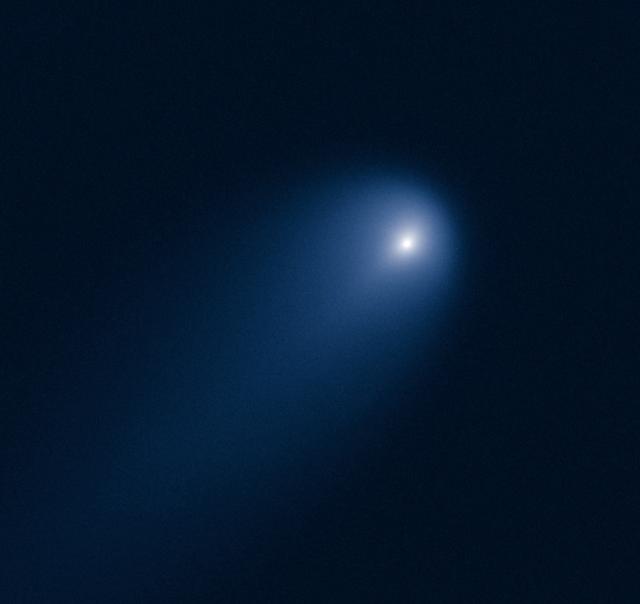
This NASA Hubble Space Telescope image of Comet (C/2012 S1) ISON was photographed on April 10, 2013, when the comet was slightly closer than Jupiter's orbit at a distance of 394 million miles from Earth. Even at that great distance the comet is already active as sunlight warms the surface and causes frozen volatiles to boil off. Astronomers used such early images to try to measure the size of the nucleus, in order to predict whether the comet would stay intact when it slingshots around the sun -- at 700,000 miles above the sun's surface -- on Nov. 28, 2013. The comet's dusty coma, or head of the comet, is approximately 3,100 miles across, or 1.2 times the width of Australia. A dust tail extends more than 57,000 miles, far beyond Hubble's field of view. This image was taken in visible light. The blue false color was added to bring out details in the comet structure. Credit: NASA/ ESA/STScI/AURA -------- More details on Comet ISON: Comet ISON began its trip from the Oort cloud region of our solar system and is now travelling toward the sun. The comet will reach its closest approach to the sun on Thanksgiving Day -- 28 Nov 2013 -- skimming just 730,000 miles above the sun's surface. If it comes around the sun without breaking up, the comet will be visible in the Northern Hemisphere with the naked eye, and from what we see now, ISON is predicted to be a particularly bright and beautiful comet. Catalogued as C/2012 S1, Comet ISON was first spotted 585 million miles away in September 2012. This is ISON's very first trip around the sun, which means it is still made of pristine matter from the earliest days of the solar system’s formation, its top layers never having been lost by a trip near the sun. Comet ISON is, like all comets, a dirty snowball made up of dust and frozen gases like water, ammonia, methane and carbon dioxide -- some of the fundamental building blocks that scientists believe led to the formation of the planets 4.5 billion years ago. NASA has been using a vast fleet of spacecraft, instruments, and space- and Earth-based telescope, in order to learn more about this time capsule from when the solar system first formed. The journey along the way for such a sun-grazing comet can be dangerous. A giant ejection of solar material from the sun could rip its tail off. Before it reaches Mars -- at some 230 million miles away from the sun -- the radiation of the sun begins to boil its water, the first step toward breaking apart. And, if it survives all this, the intense radiation and pressure as it flies near the surface of the sun could destroy it altogether. This collection of images show ISON throughout that journey, as scientists watched to see whether the comet would break up or remain intact. The comet reaches its closest approach to the sun on Thanksgiving Day -- Nov. 28, 2013 -- skimming just 730,000 miles above the sun’s surface. If it comes around the sun without breaking up, the comet will be visible in the Northern Hemisphere with the naked eye, and from what we see now, ISON is predicted to be a particularly bright and beautiful comet. ISON stands for International Scientific Optical Network, a group of observatories in ten countries who have organized to detect, monitor, and track objects in space. ISON is managed by the Keldysh Institute of Applied Mathematics, part of the Russian Academy of Sciences. <b><a href="http://www.nasa.gov/audience/formedia/features/MP_Photo_Guidelines.html" rel="nofollow">NASA image use policy.</a></b> <b><a href="http://www.nasa.gov/centers/goddard/home/index.html" rel="nofollow">NASA Goddard Space Flight Center</a></b> enables NASA’s mission through four scientific endeavors: Earth Science, Heliophysics, Solar System Exploration, and Astrophysics. Goddard plays a leading role in NASA’s accomplishments by contributing compelling scientific knowledge to advance the Agency’s mission. <b>Follow us on <a href="http://twitter.com/NASA_GoddardPix" rel="nofollow">Twitter</a></b> <b>Like us on <a href="http://www.facebook.com/pages/Greenbelt-MD/NASA-Godd</b>
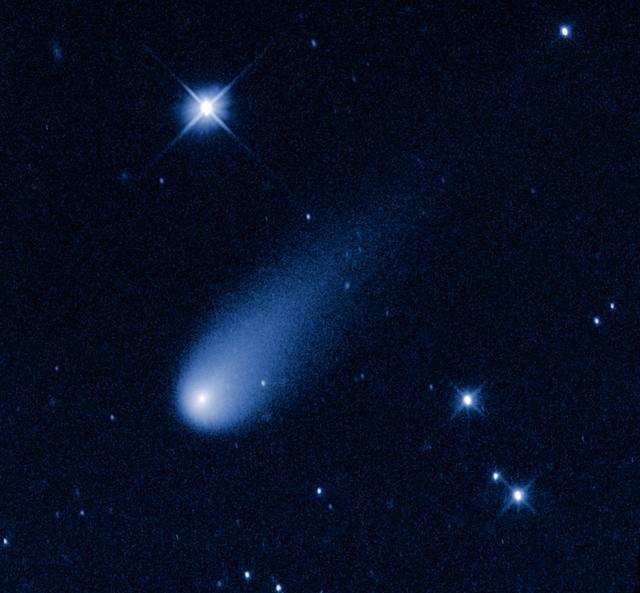
Superficially resembling a skyrocket, Comet ISON is hurtling toward the Sun at a whopping 48,000 miles per hour. Its swift motion is captured in this image taken May 8, 2013, by NASA's Hubble Space Telescope. At the time the image was taken, the comet was 403 million miles from Earth, between the orbits of Mars and Jupiter. Unlike a firework, the comet is not combusting, but in fact is pretty cold. Its skyrocket-looking tail is really a streamer of gas and dust bleeding off the icy nucleus, which is surrounded by a bright, star-like-looking coma. The pressure of the solar wind sweeps the material into a tail, like a breeze blowing a windsock. As the comet warms as it moves closer to the Sun, its rate of sublimation will increase. The comet will get brighter and the tail grows longer. The comet is predicted to reach naked-eye visibility in November. The comet is named after the organization that discovered it, the Russia-based International Scientific Optical Network. This false-color, visible-light image was taken with Hubble's Wide Field Camera 3. Credit: NASA, ESA, and the Hubble Heritage Team (STScI/AURA) -------- More details on Comet ISON: Comet ISON began its trip from the Oort cloud region of our solar system and is now travelling toward the sun. The comet will reach its closest approach to the sun on Thanksgiving Day -- 28 Nov 2013 -- skimming just 730,000 miles above the sun's surface. If it comes around the sun without breaking up, the comet will be visible in the Northern Hemisphere with the naked eye, and from what we see now, ISON is predicted to be a particularly bright and beautiful comet. Catalogued as C/2012 S1, Comet ISON was first spotted 585 million miles away in September 2012. This is ISON's very first trip around the sun, which means it is still made of pristine matter from the earliest days of the solar system’s formation, its top layers never having been lost by a trip near the sun. Comet ISON is, like all comets, a dirty snowball made up of dust and frozen gases like water, ammonia, methane and carbon dioxide -- some of the fundamental building blocks that scientists believe led to the formation of the planets 4.5 billion years ago. NASA has been using a vast fleet of spacecraft, instruments, and space- and Earth-based telescope, in order to learn more about this time capsule from when the solar system first formed. The journey along the way for such a sun-grazing comet can be dangerous. A giant ejection of solar material from the sun could rip its tail off. Before it reaches Mars -- at some 230 million miles away from the sun -- the radiation of the sun begins to boil its water, the first step toward breaking apart. And, if it survives all this, the intense radiation and pressure as it flies near the surface of the sun could destroy it altogether. This collection of images show ISON throughout that journey, as scientists watched to see whether the comet would break up or remain intact. The comet reaches its closest approach to the sun on Thanksgiving Day -- Nov. 28, 2013 -- skimming just 730,000 miles above the sun’s surface. If it comes around the sun without breaking up, the comet will be visible in the Northern Hemisphere with the naked eye, and from what we see now, ISON is predicted to be a particularly bright and beautiful comet. ISON stands for International Scientific Optical Network, a group of observatories in ten countries who have organized to detect, monitor, and track objects in space. ISON is managed by the Keldysh Institute of Applied Mathematics, part of the Russian Academy of Sciences. <b><a href="http://www.nasa.gov/audience/formedia/features/MP_Photo_Guidelines.html" rel="nofollow">NASA image use policy.</a></b> <b><a href="http://www.nasa.gov/centers/goddard/home/index.html" rel="nofollow">NASA Goddard Space Flight Center</a></b> enables NASA’s mission through four scientific endeavors: Earth Science, Heliophysics, Solar System Exploration, and Astrophysics. Goddard plays a leading role in NASA’s accomplishments by contributing compelling scienti