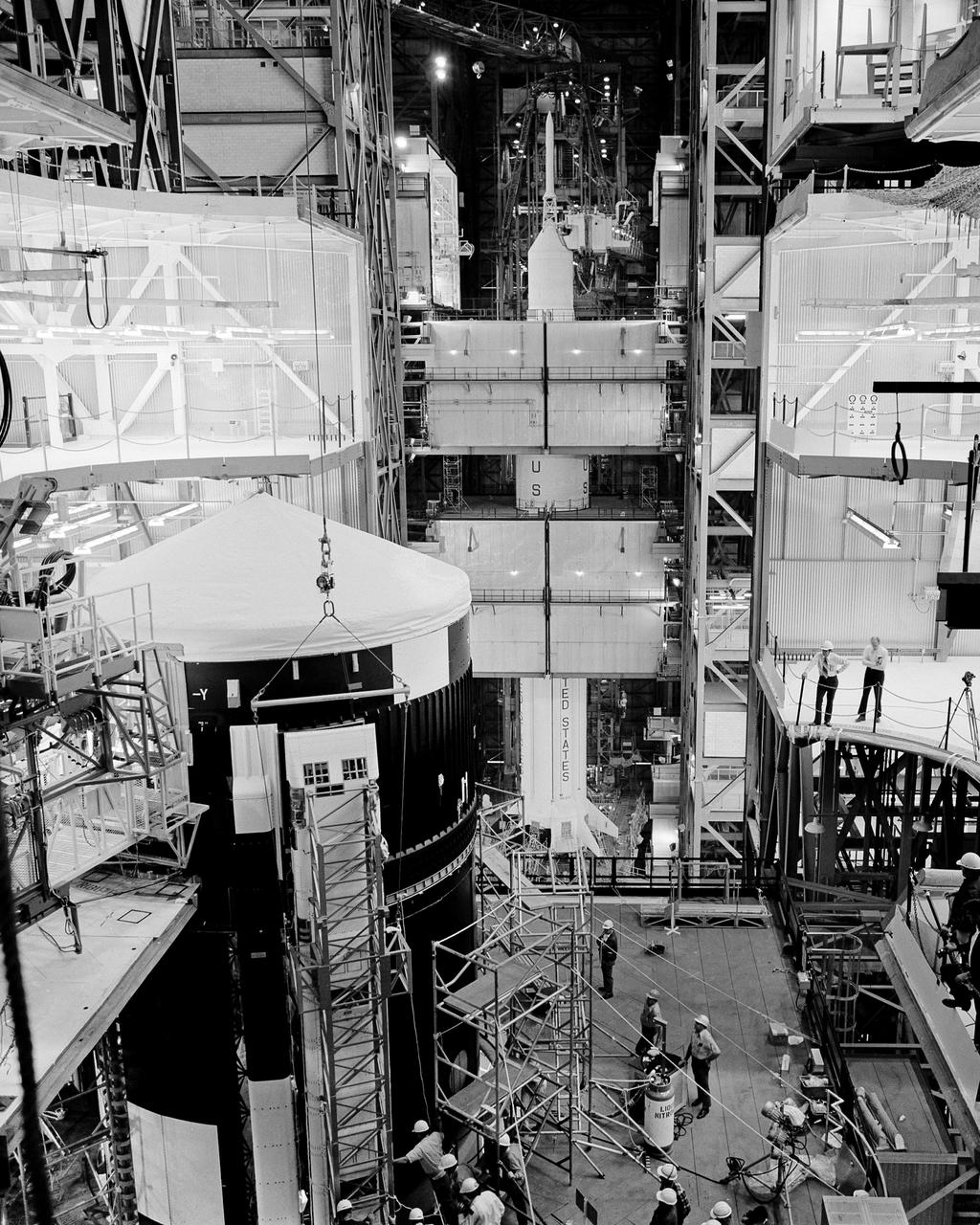
CAPE KENNEDY, Fla. -- At the Kennedy Space Center in Florida, one of Skylab 1's solar cell arrays is installed on the orbital space station in High Bay 2 of the Vehicle Assembly Building. Skylab 2 launch vehicle is in high bay 1, visible in the background. Each of the two solar cell arrays on the space station that will be deployed in orbit is designed to provide 10,500 watts of power. All power needed to operate the station and the Apollo Telescope mount will be taken from the arrays. Each array will have almost 1,177 square feet of surface area to turn sunlight into electrical power. Skylab 1 is schedule for launch April 30, 1973 and Skylab 2, carrying the astronauts Charles Conrad Jr., Dr. Joseph P. Kerwin and Paul J. Weitz to dock with the space station and enter it to live and work for 28 days, will be launched a day later. Photo Credit: NASA
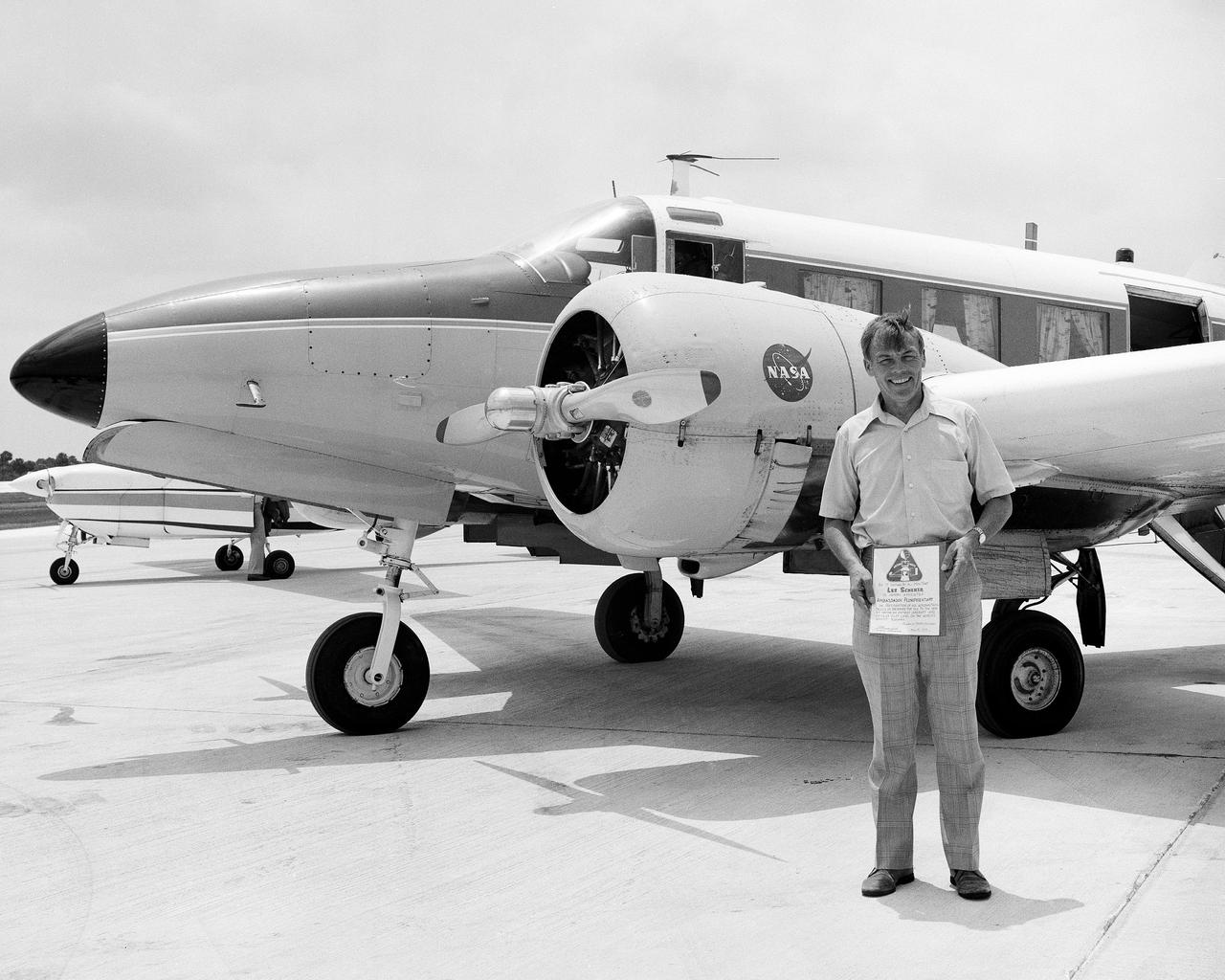
CAPE CANAVERAL, Fla. -- Kennedy Space Center Director Lee Scherer receives an Ambassador Plenipotentary certificate after successfully landing the NASA-6 aircraft on the runway at the Shuttle Landing Facility. This was the first touchdown of an aircraft on Kennedy's Shuttle Landing Facility. The certificate reads: 'Be it known that Lee Scherer is hereby appointed Ambassador Plenipotentary in recognition of his aeronautical skills in bringing the old to the new by having an antique aircraft and an antique pilot land on the world's newest runway. Photo Credit: NASA
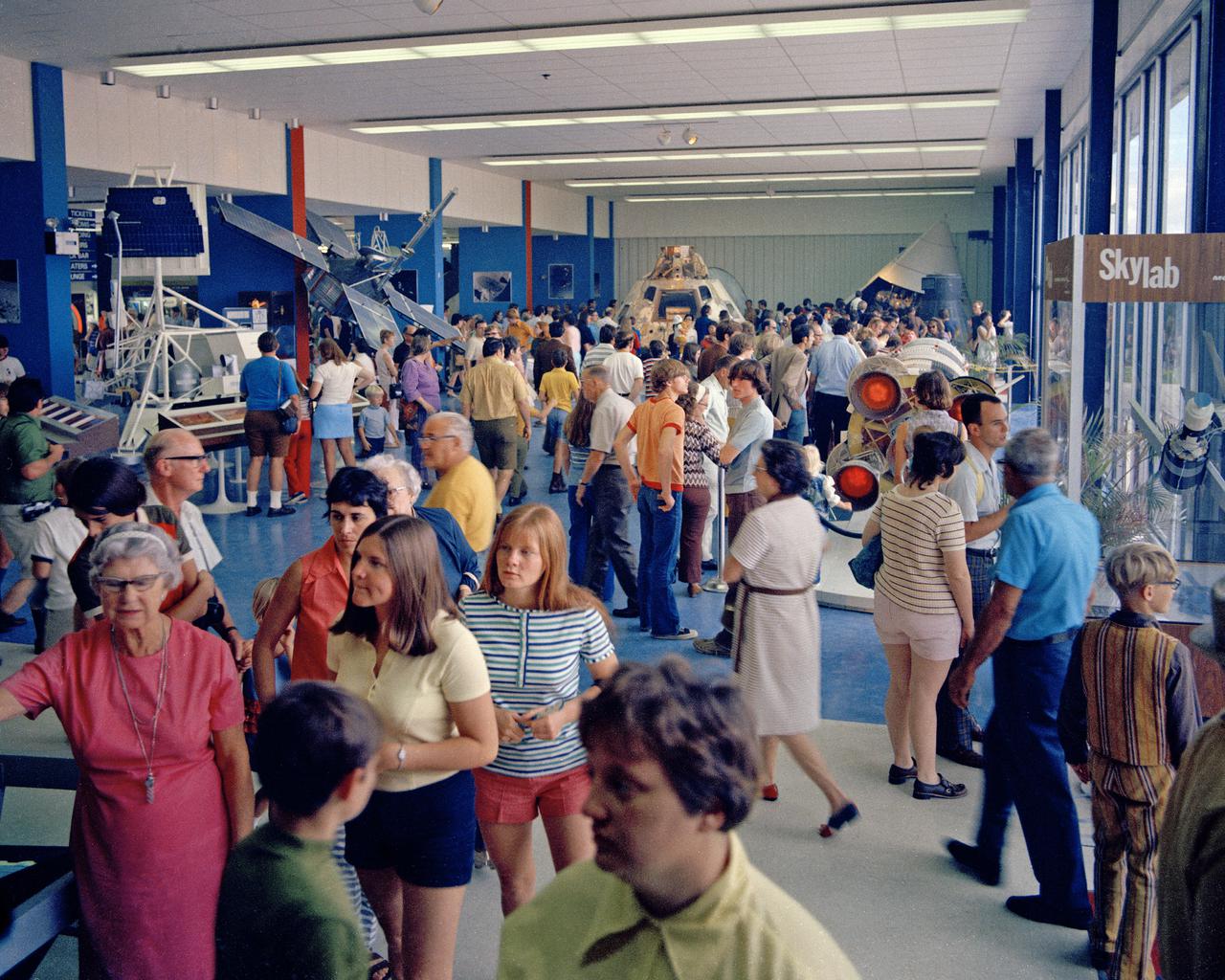
CAPE KENNEDY, Fla. -- At the Kennedy Space Center in Florida, the Christmas season brought large crowds at Visitors Information Center. Photo Credit: NASA
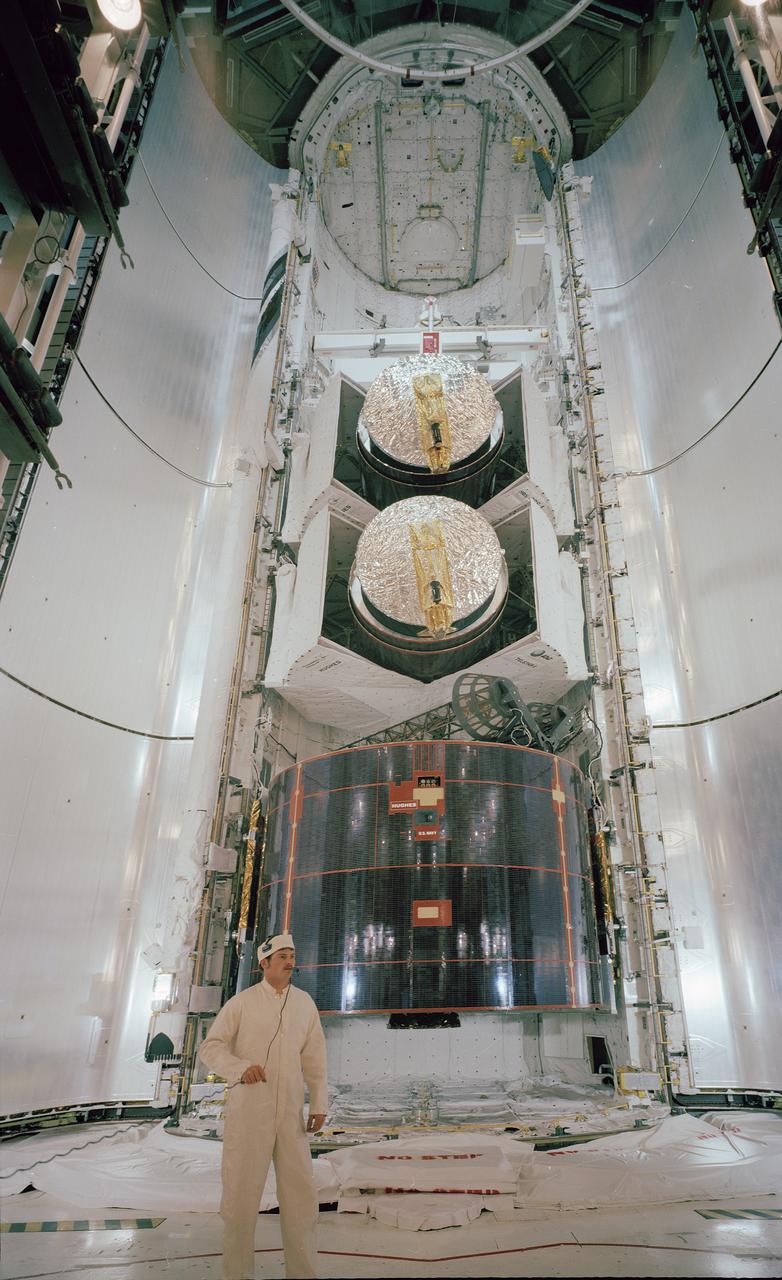
CAPE CANAVERAL, Fla. -- At the Kennedy Space Center in Florida, the payloads for the STS-41D space shuttle flight are shown loaded in Discovery’s cargo bay. With the orbiter in the vertical position at Launch Pad 39A, the payloads are, from top to bottom, OAST-1 a 102-foot-tall, 13-foot-wide Office of Application and Space Technology solar panel), the Satellite Business System SBS-D , Telstar 3-C, and Syncom IV-2. The six day mission is scheduled for launch on Aug. 29, 1984. The six crew members are Commander Henry W. Hartsfield Jr., Pilot Michael L. Coats, Mission Specialists Judith A. Resnik, Steven A. Hawley, Richard M. Mullane, and Payload Specialist Charles D. Walker. Photo Credit: NASA
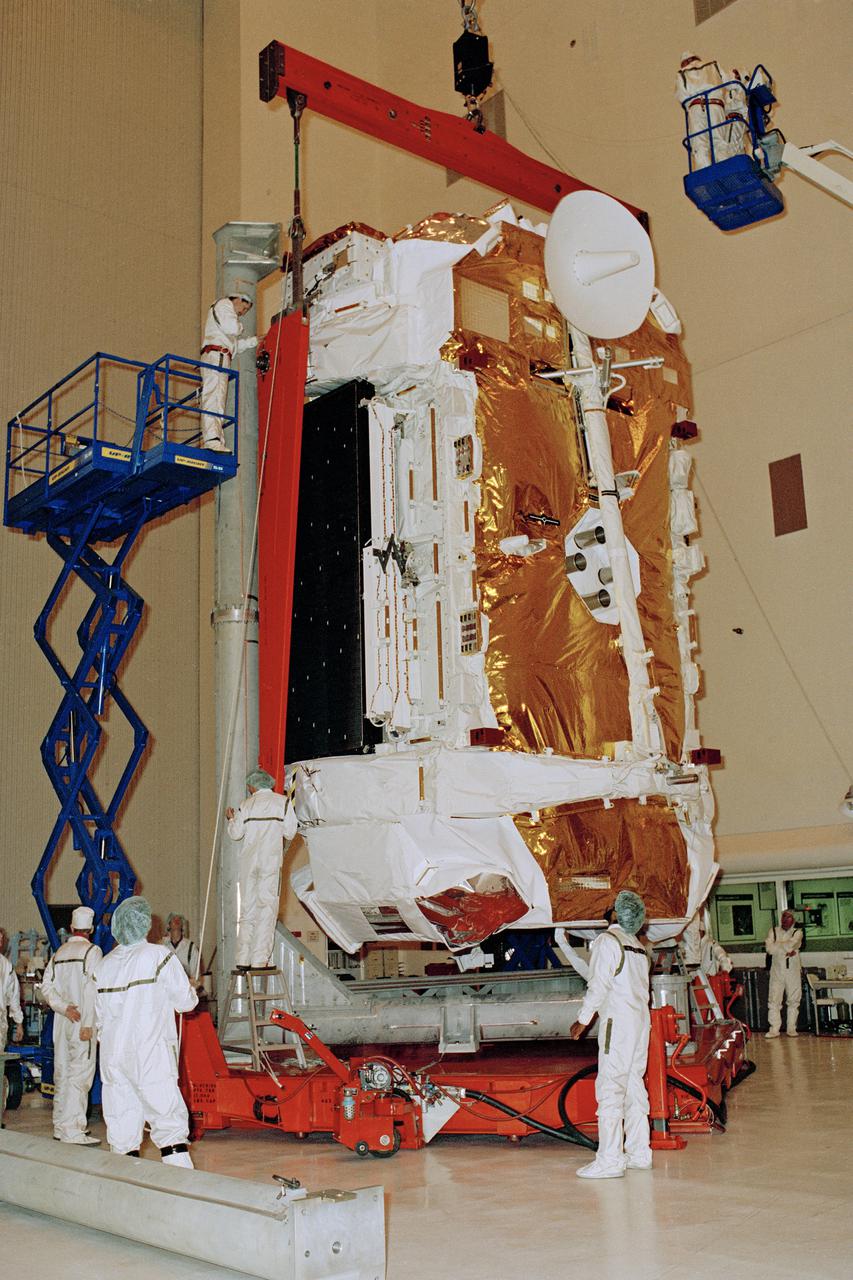
CAPE CANAVERAL, Fla. -- In the Payload Hazardous Servicing Facility at the Kennedy Space Center in Florida, technicians tilt the massive Gamma ray Observatory GRO upright for installation onto the transporter which will carry it to the Vertical Processing Facility. The spacecraft is scheduled to fly aboard the space shuttle Atlantis on STS-37. As the second of four great observatories planned by NASA, GRO will study the celestial gamma rays believed to be a record of cosmic change and evolution. Photo Credit: NASA
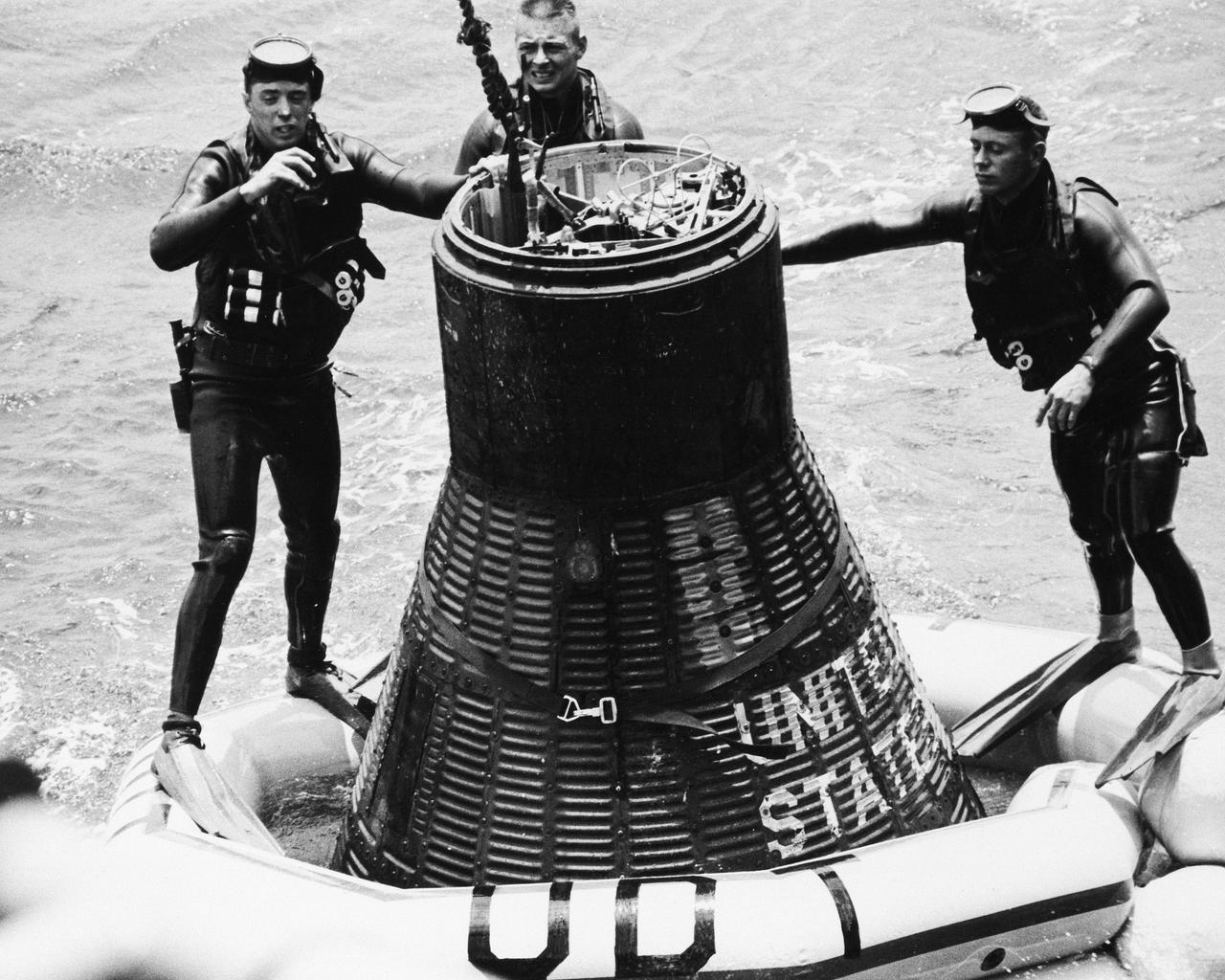
USS KEARSARGE. -- Three U.S. Navy frogmen attach a floatation collar to the Faith 7 Mercury spacecraft minutes after the spacecraft splashed down in the Pacific Ocean less than four miles from the aircraft carrier USS Kearsarge, and within sight of those on board. Photo Credit: NASA

CAPE KENNEDY, Fla. -- At the Kennedy Space Center in Florida, the Skylab space station, atop a modified Saturn V rocket, lifted off May 14, 1973, from Launch Complex 39A, ten minutes later the 100-ton space station reached orbit, where it will be visited by three astronaut crews during the next eight months. The first crew, consisting of Charles Conrad Jr., mission commander, Dr. Joseph P. Kerwin, science pilot, and Paul J. Weitz, pilot, will live and work in Skylab nearly a month. NASA directs the Skylab Program, which is designed to gain new knowledge in space for improving life on Earth. Its investigations and experiments will help develop new methods of learning about the Earth's environment and resources. It also will examine man's ability to live and work in space for extended periods, and provide new information about the sun. Two additional manned visits to Skylab will follow in August and November. Photo Credit: NASA
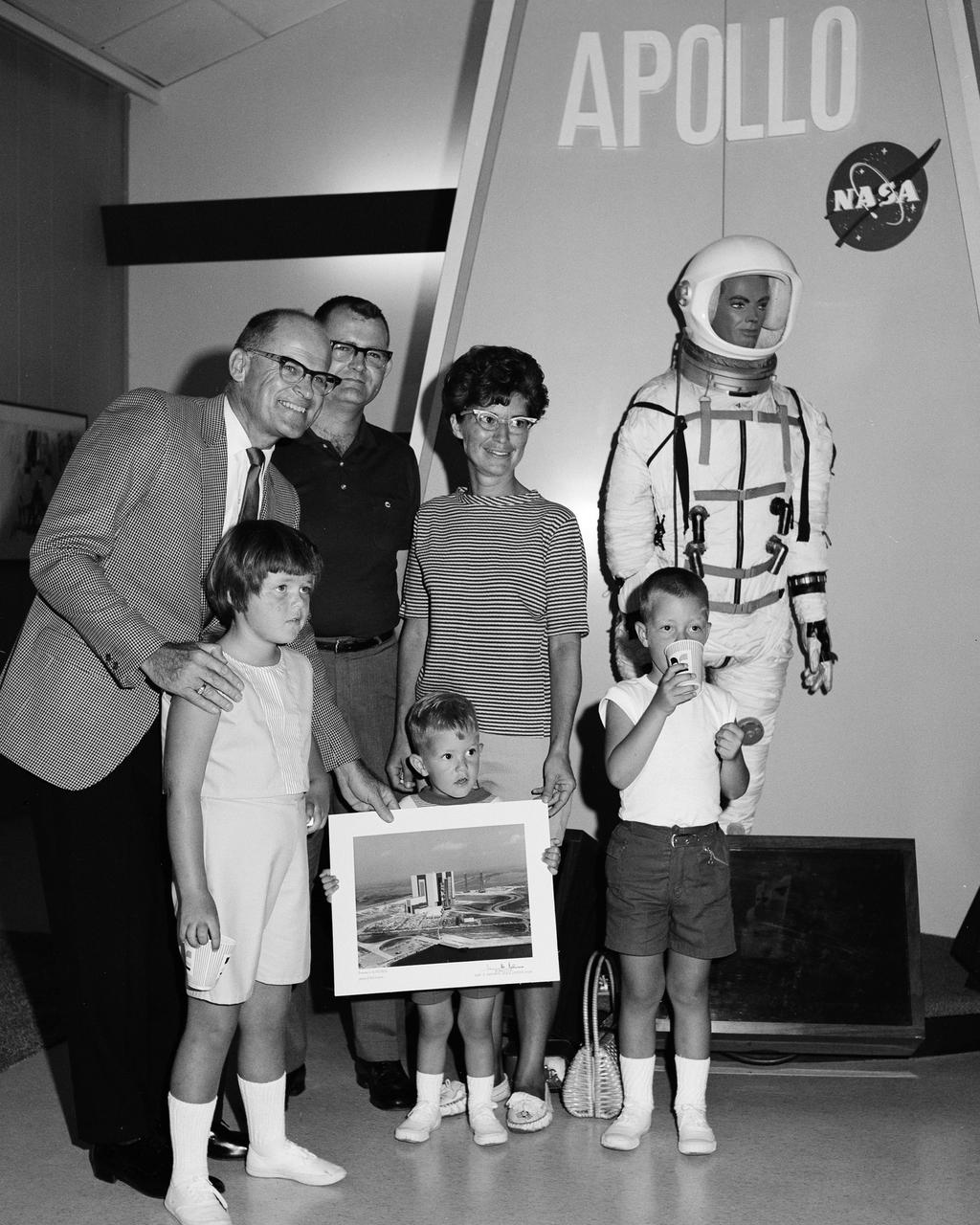
CAPE KENNEDY, Fla. -- At the Kennedy Space Center in Florida, the 500,000th visitor to take a NASA escorted bus tour, Donald A. Jackson of Sabina, Ohio, was welcomed at the new Visitor Information Center on Merritt Island by deputy center director Albert F. Siepert, left. Jackson toured the center with his wife, Sue, and their three children, Cheryl, Craig and Doug. Jackson works for the National Cash Register Co. The 500,000th visitor was recorded less than an hour after the Visitor Information Center was officially opened to the public at 8:45 a.m. The NASA tours were begun July 22, 1966, and since that time visitors from every state in the nation and more than 60 nations have toured the space center. Photo Credit: NASA
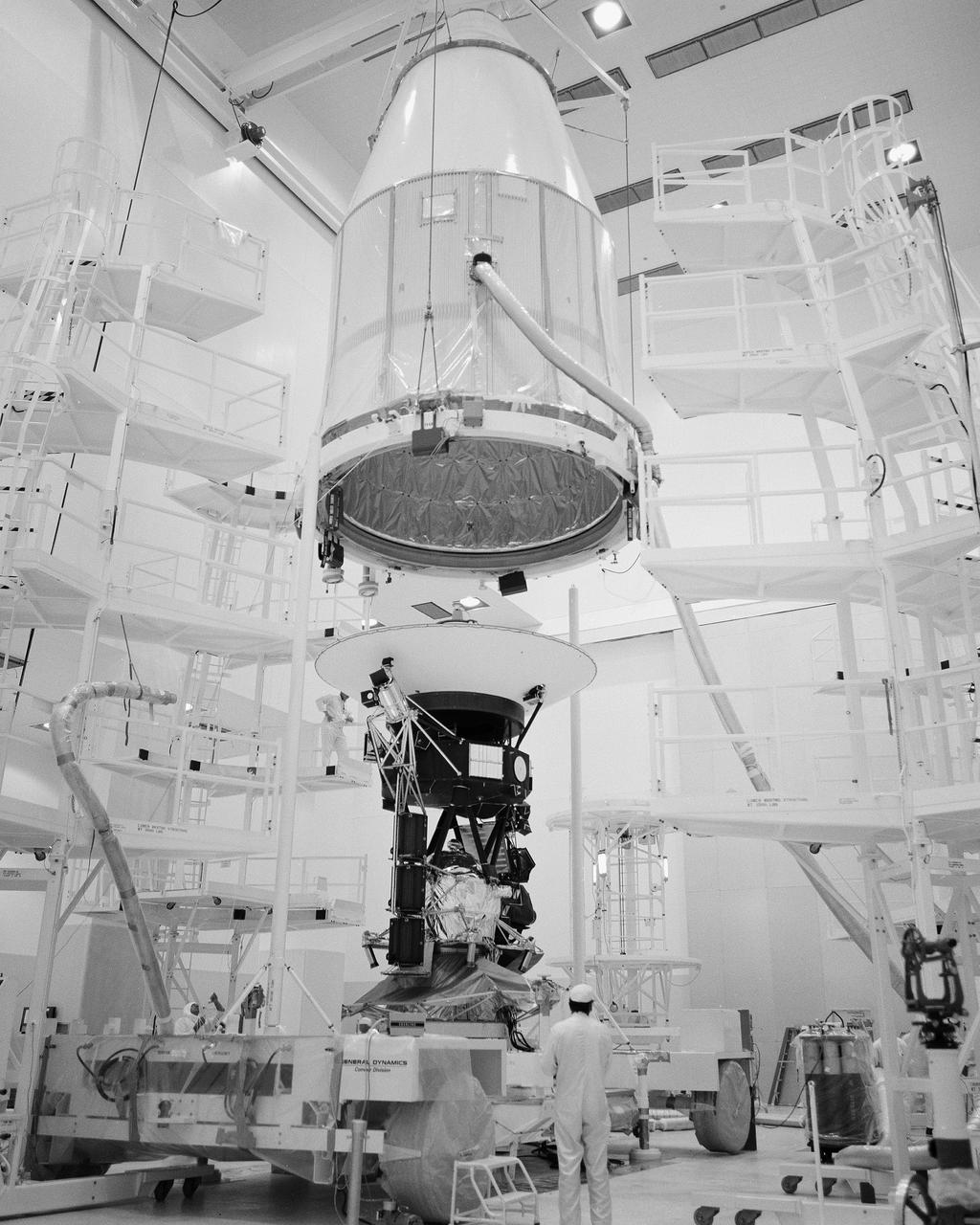
CAPE CANAVERAL, Fla. -- At the Spacecraft Assembly and Encapsulation Facility-1 at the Kennedy Space Center in Florida, the Voyager spacecraft for the first of two missions to be launched toward the outer planets was encapsulated within the payload fairing which will protect it during launch. The 1,800 pound spacecraft is to be mated with Titan_Centaur 7 at Launch Complex 41 and sent on a mission to Jupiter and Saturn no earlier than Aug. 20, 1977. Photo Credit: NASA
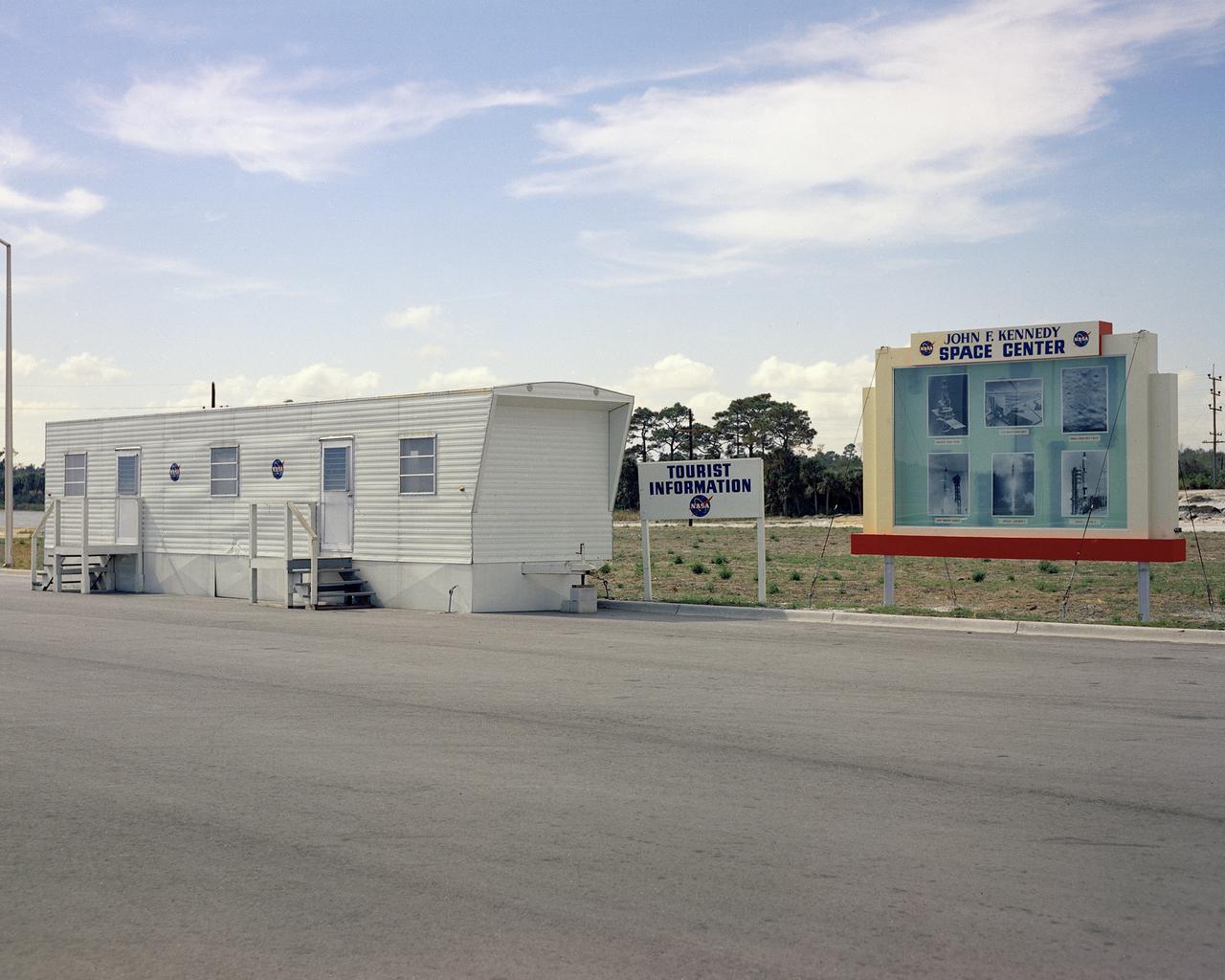
CAPE KENNEDY, Fla. -- An exterior view of the NASA Kennedy Space Center tourist information center located at the west end of NASA- Indian River Causeway. Beginning in November 1964, Sunday drive-through tours are available. Photo Credit: NASA

CAPE CANAVERAL, Fla. -- At the Kennedy Space Center in Florida, the Ulysses spacecraft with two attached upper stages –- a payload assist module and an inertial upper stage -- is transferred into the payload canister. Transport from the Vertical Processing Facility to the Payload Changeout Room at the Launch Pad 39B was scheduled for Aug. 27, 1990. The payload will be vertically installed in the cargo bay of the space shuttle Discovery after the shuttle is brought to the pad in September. Ulysses will be deployed during STS-41, set for a launch period extending from Oct. 5 through Oct. 23, 1990. Photo Credit: NASA
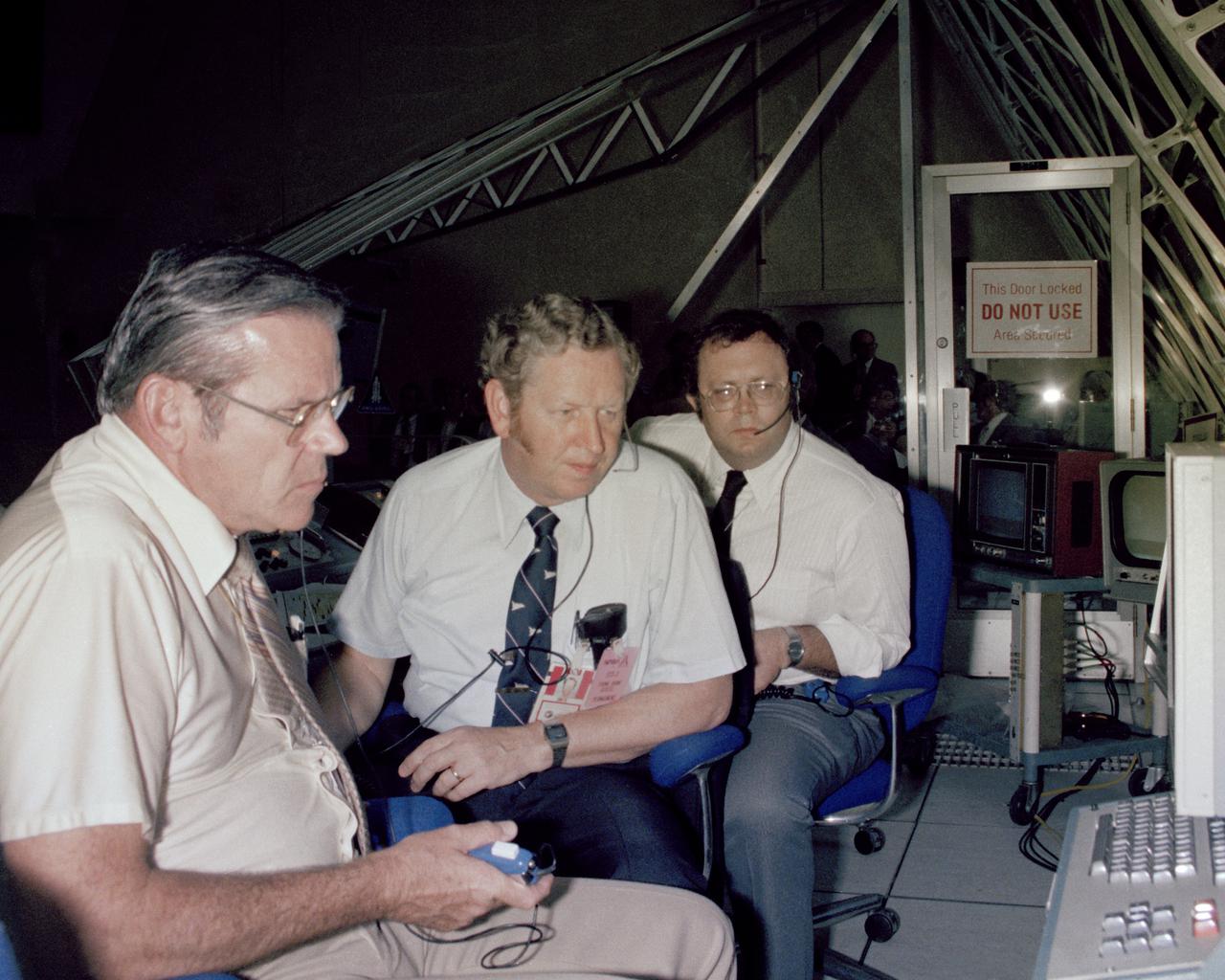
CAPE CANAVERAL, Fla. -- At the Kennedy Space Center in Florida, senior NASA managers monitor Columbia’s progress from their stations in Firing Room 1 following today’s liftoff of the space shuttle on its third journey into space. From left to right are George Page, shuttle launch director, Kenned director Richard Smith and Tom Utsman, Kennedy’s director of technical support. Photo Credit: NASA
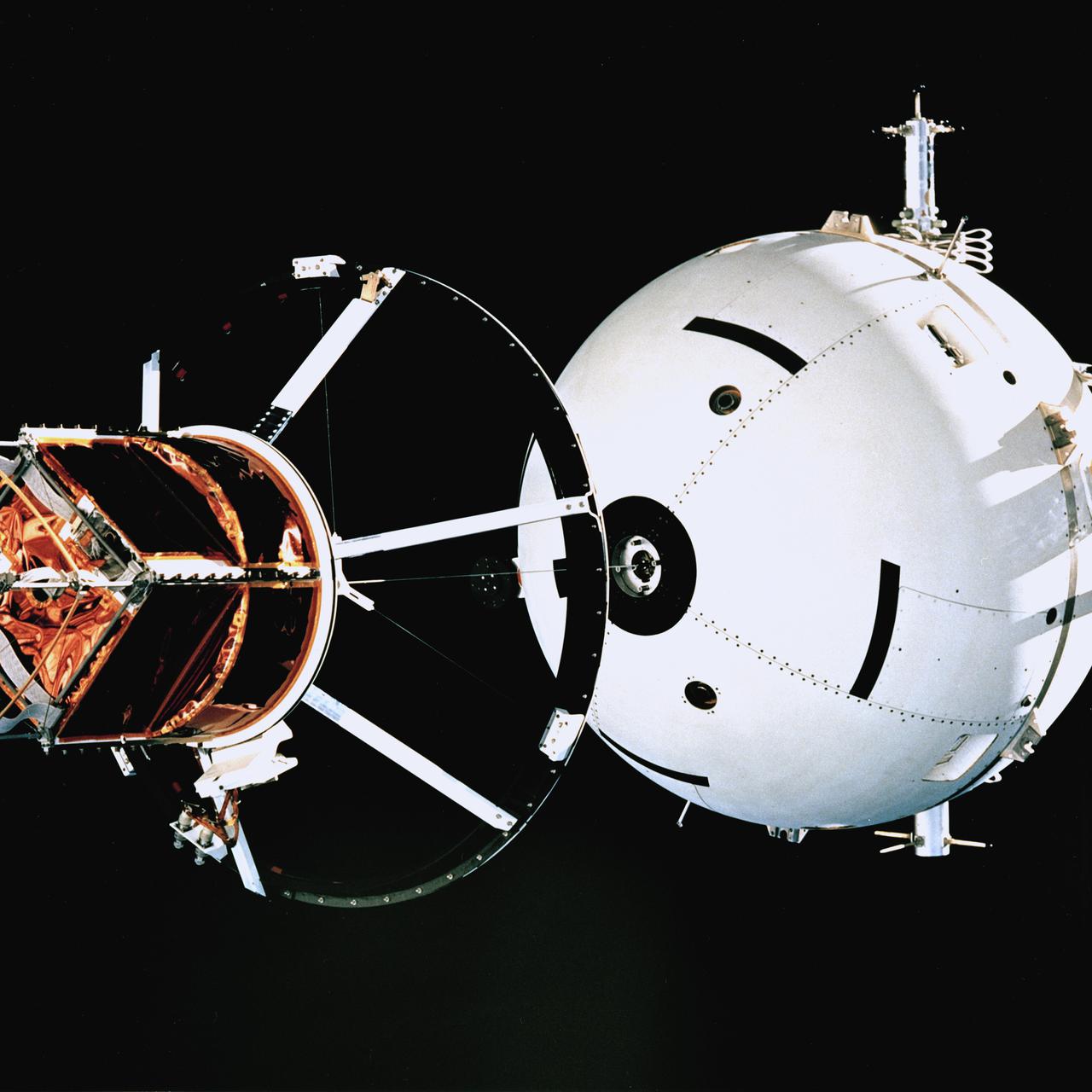
ONBOARD ATLANTIS -- A 70mm handheld camera was used by the STS-46 crewmembers to capture this medium closeup view of early operations with the Tethered Satellite System. The sphere can be seen moving away from the ring structure on the boom device in Atlantis’ cargo bay. Photo Credit: NASA
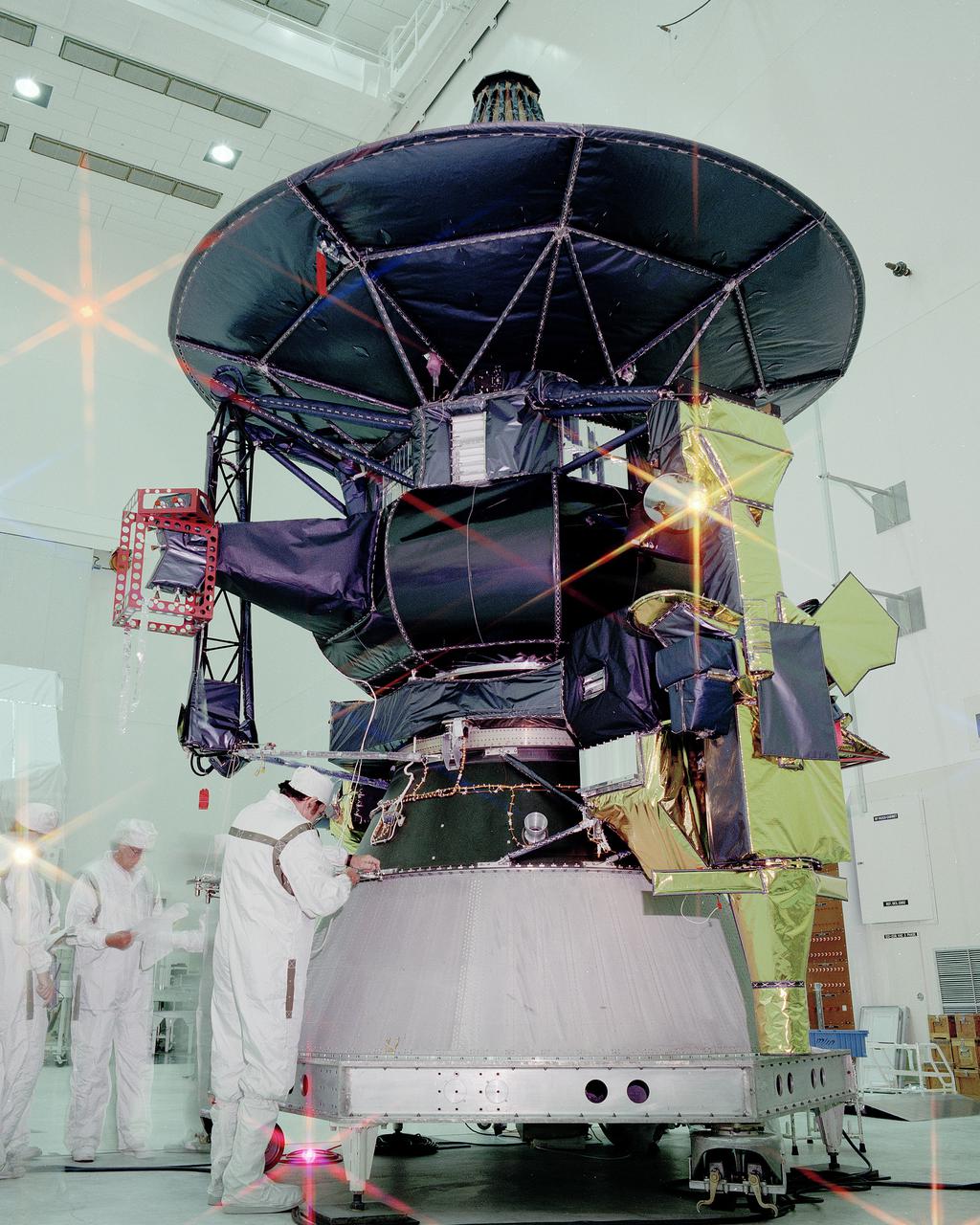
CAPE CANAVERAL, Fla. -- At the Kennedy Space Center’s SAEF-2 planetary spacecraft checkout facility, technicians work on the spacecraft Galileo prior to moving it to the Vertical Processing Facility for mating with an Inertial Upper Stage. Galileo is scheduled to be launched aboard Atlantis on space shuttle mission STS-34, Oct. 12, 1989 and sent to the planet Jupiter, a journey which will take more than six years to complete. In December 1995, as the two and one half ton spacecraft orbits Jupiter with its 10 scientific instruments, a probe will be released to parachute into the Jovian atmosphere. Photo Credit: NASA
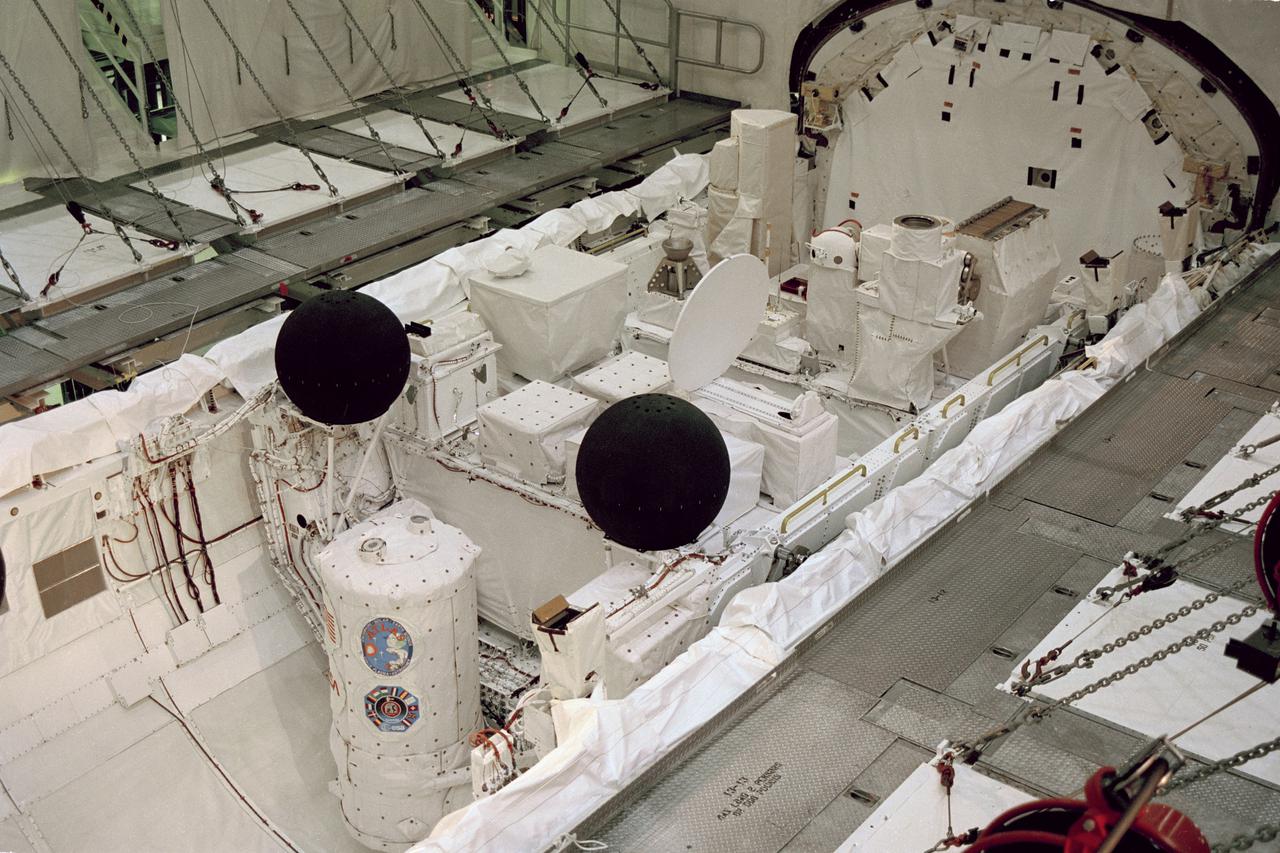
CAPE CANAVERAL, Fla. -- In bay 2 of the Orbiter processing Facility at the Kennedy Space Center in Florida, the payload bay doors are about to be closed on the space shuttle Atlantis, locking in the primary payload for its upcoming flight -- the Atmospheric Laboratory for Applications and Science-1. The payload features many elements of the spacelab modular laboratory system designed for the space shuttle program by the European Space Agency. The pallets are outfitted with an array of experiments spanning four disciplines: solar physics, atmospheric science, space plasma physics and astronomy. Atlantis is nearly ready for transfer to the Vehicle Assembly Building for mating with the external tank and solid rocket boosters. Liftoff on STS-45 is targeted for spring of 1992 from Launch Pad 39A. Photo Credit: NASA
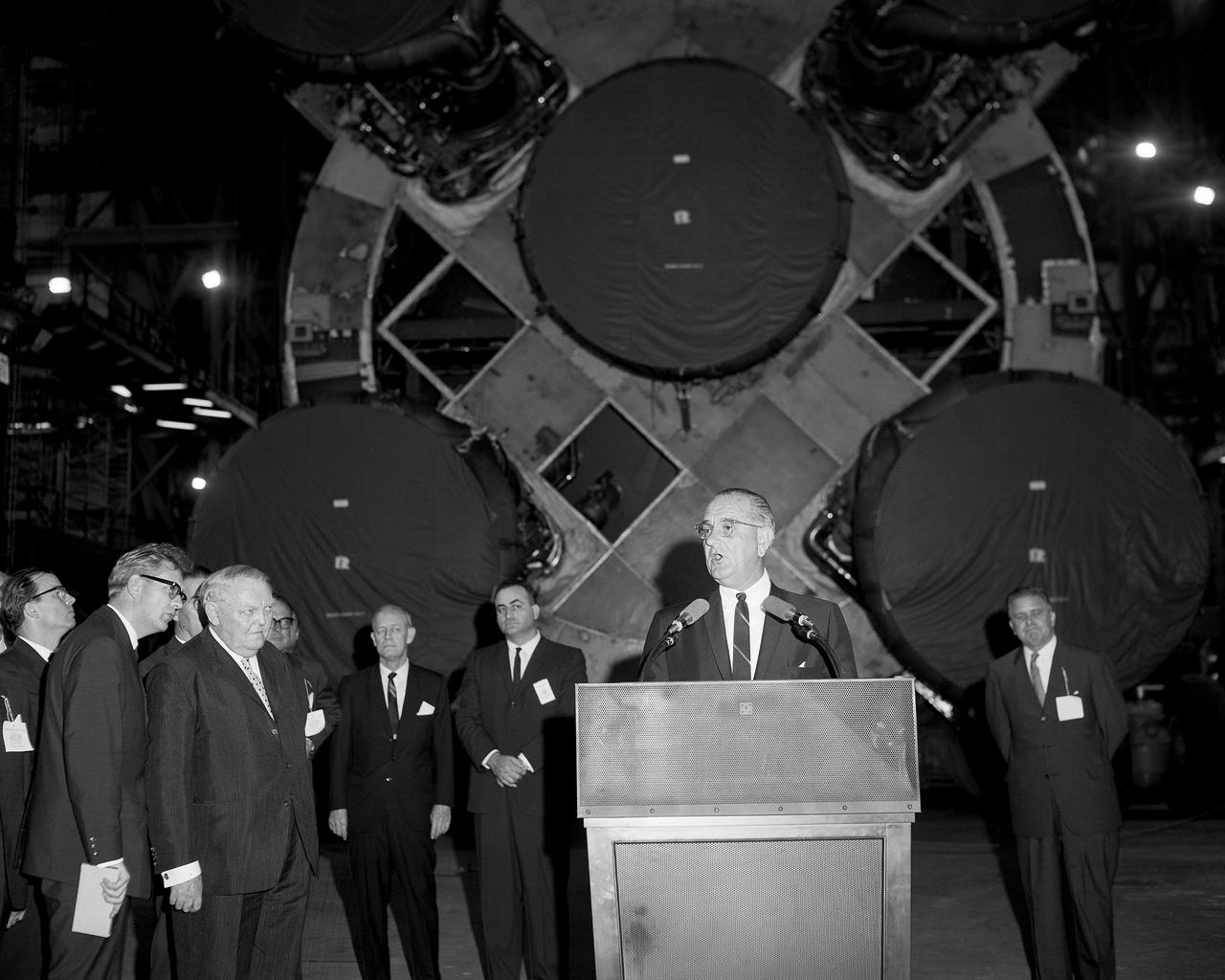
CAPE KENNEDY, Fla. -- At the Kennedy Space Center in Florida, President Lyndon B. Johnson speaks in the Vehicle Assembly Bulling with West German Chancellor Erhard on left, NASAS Administrator James Webb on right, and NASA Director of launch operations, Rocco Petrone, behind President Johnson. In the background is the first stage of a Saturn V rocket which will be used to launch astronauts to the moon as part of the Apollo Program. Photo Credit: NASA
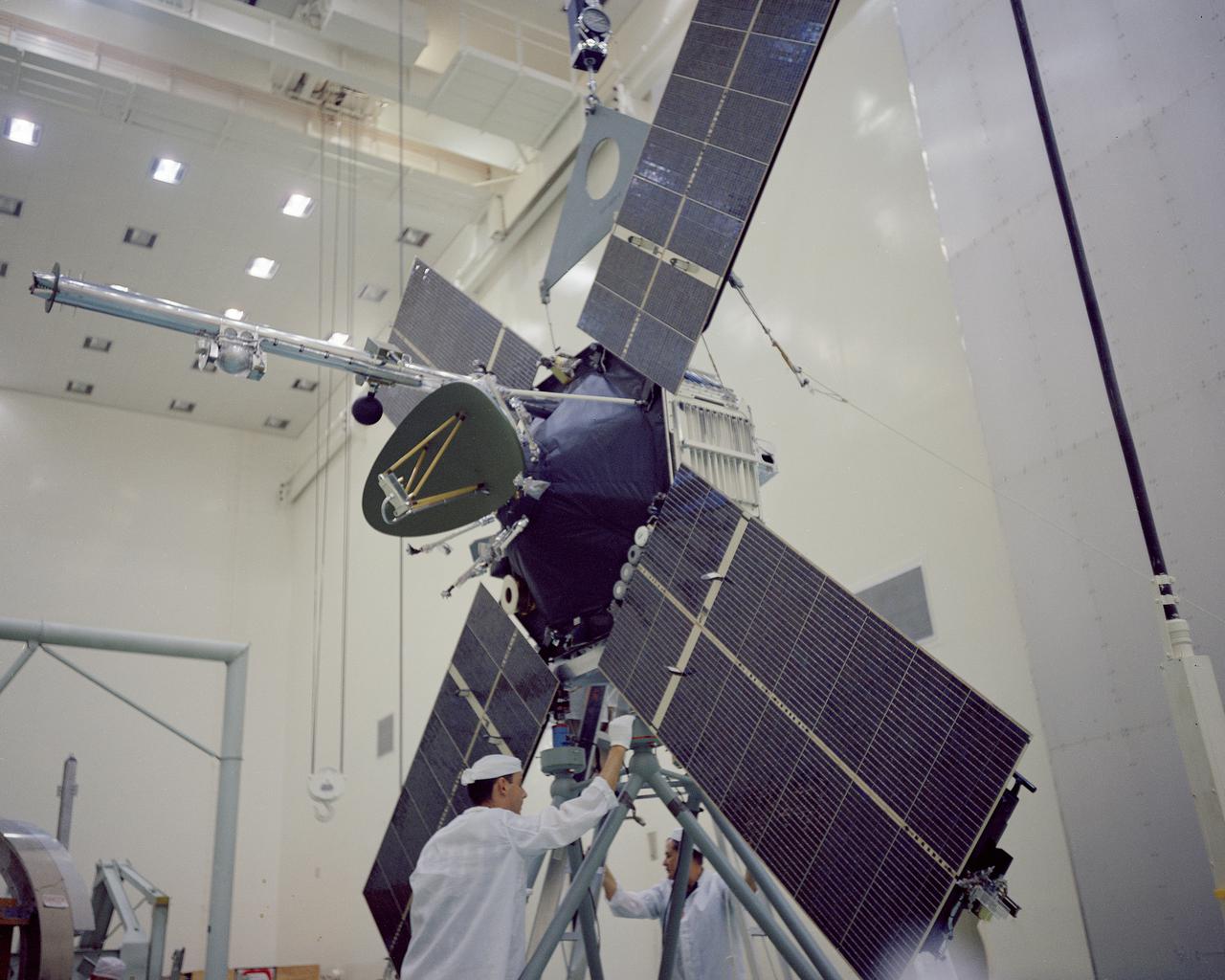
CAPE KENNEDY, Fla. -- In the AO Building at Cape Kennedy Air Force Station in Florida, the Mariner 3 spacecraft is processed prior to mating with its payload faring. Mariner is one of two identical deep-space probes designed and built by the Jet Propulsion Laboratory for NASA's Mariner Mars 1964 project. Mariner 3 is intended to conduct close-up scientific observations of Mars and transmit information back to Earth on interplanetary space and the space surrounding the Red Planet. Photo Credit: NASA
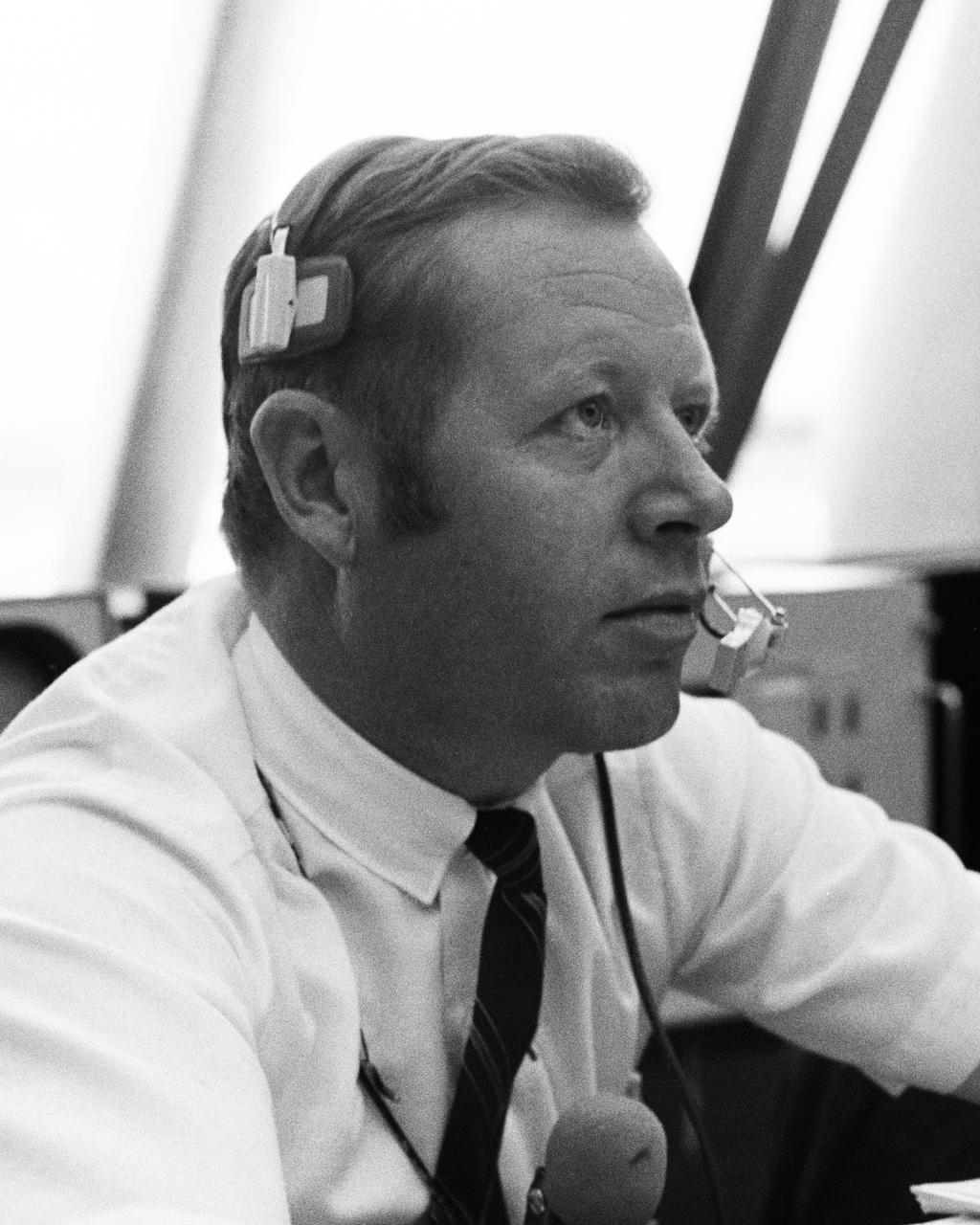
CAPE CANAVERAL, Fla. - Jack King, retired from Communications and Public Relations with United Space Alliance who earlier served as NASA Kennedy Space Center's first chief of Public Information. Photo credit: NASA

CAPE CANAVERAL, Fla. – Two NASA railroad locomotives at the Kennedy Space Center in Florida is part of the space agency's railroad operation to not only move equipment at Kennedy, but to transport hardware to and from contractor facilities across the nation. Photo credit: NASA
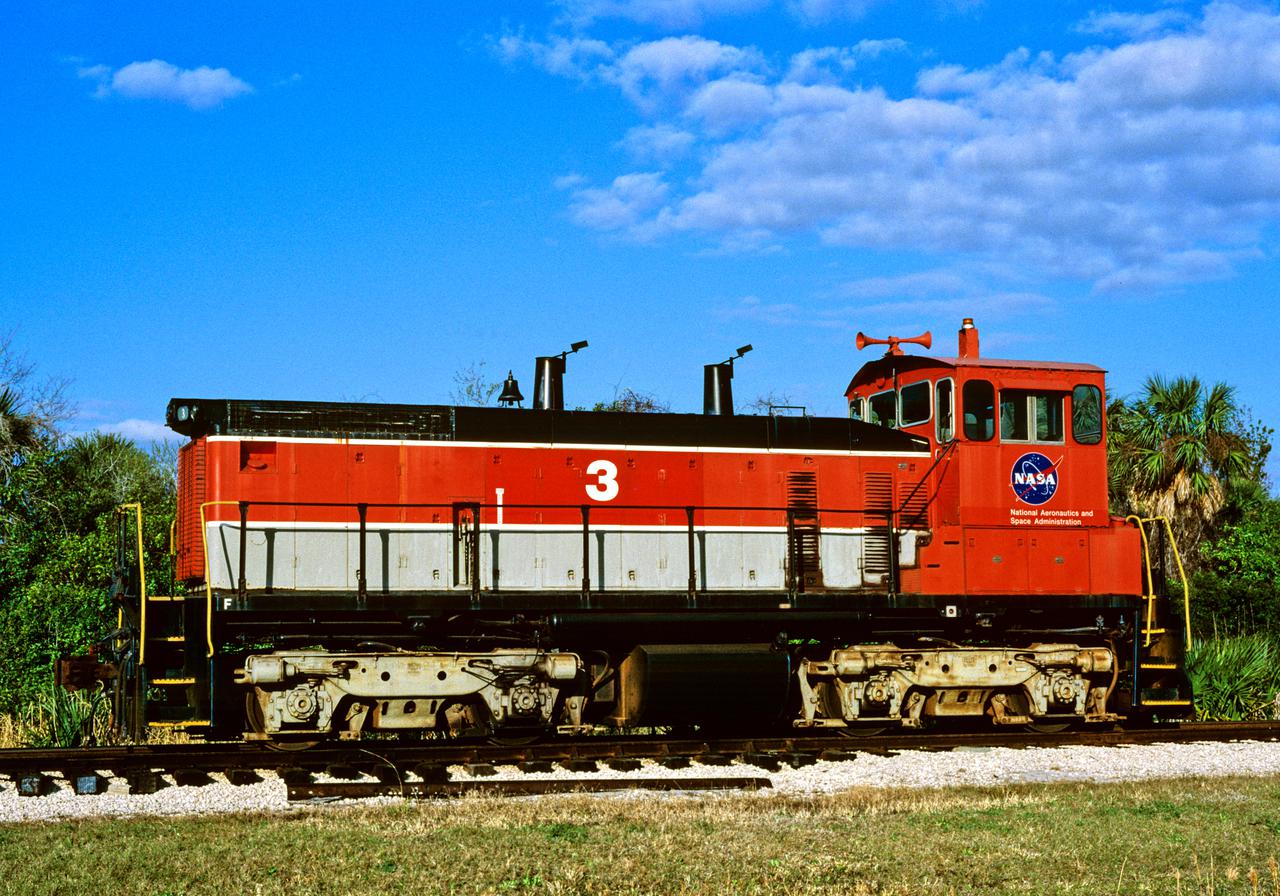
CAPE CANAVERAL, Fla. – A NASA railroad locomotive at the Kennedy Space Center in Florida is part of the space agency's railroad operation to not only move equipment at Kennedy, but to transport hardware to and from contractor facilities across the nation. Photo credit: NASA
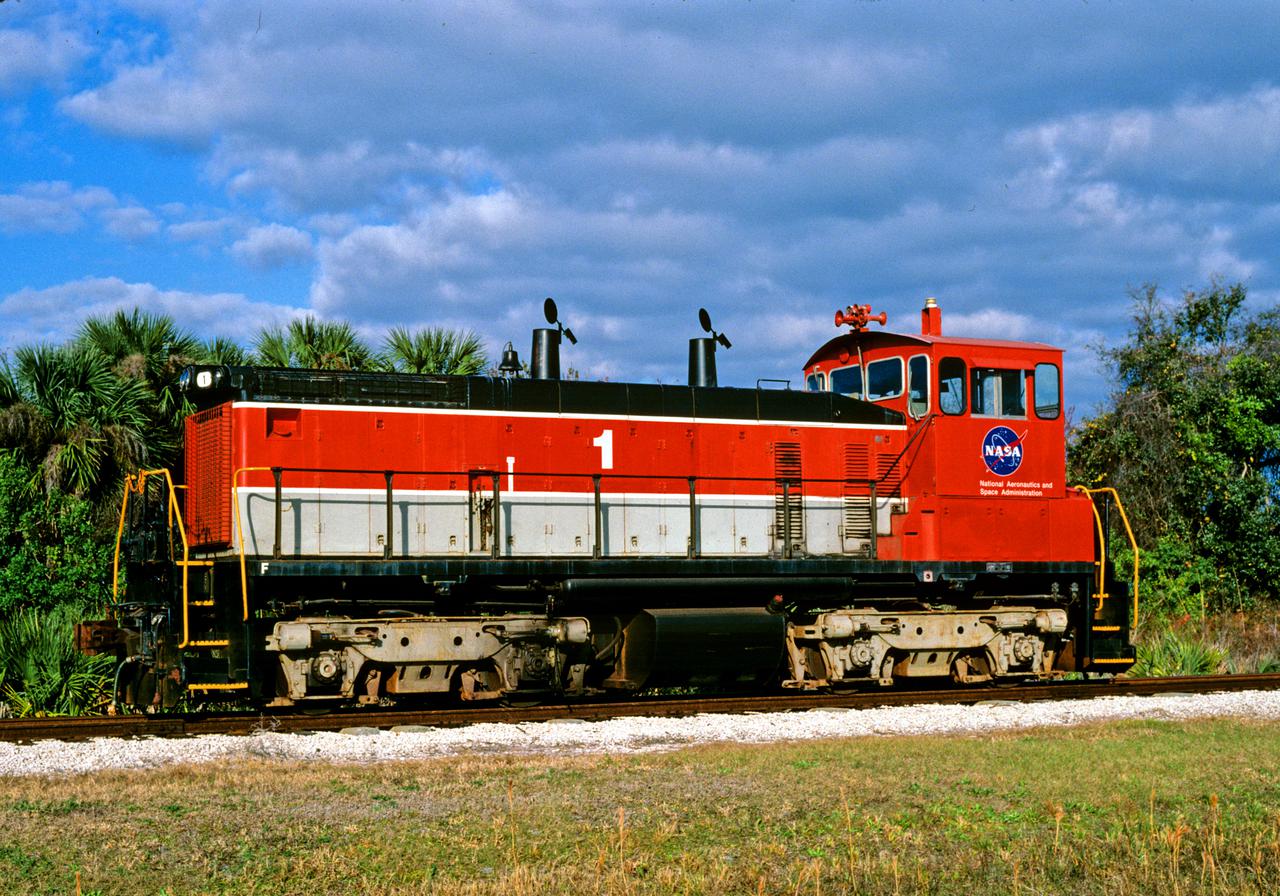
CAPE CANAVERAL, Fla. – A NASA railroad locomotive at the Kennedy Space Center in Florida is part of the space agency's railroad operation to not only move equipment at Kennedy, but to transport hardware to and from contractor facilities across the nation. Photo credit: NASA
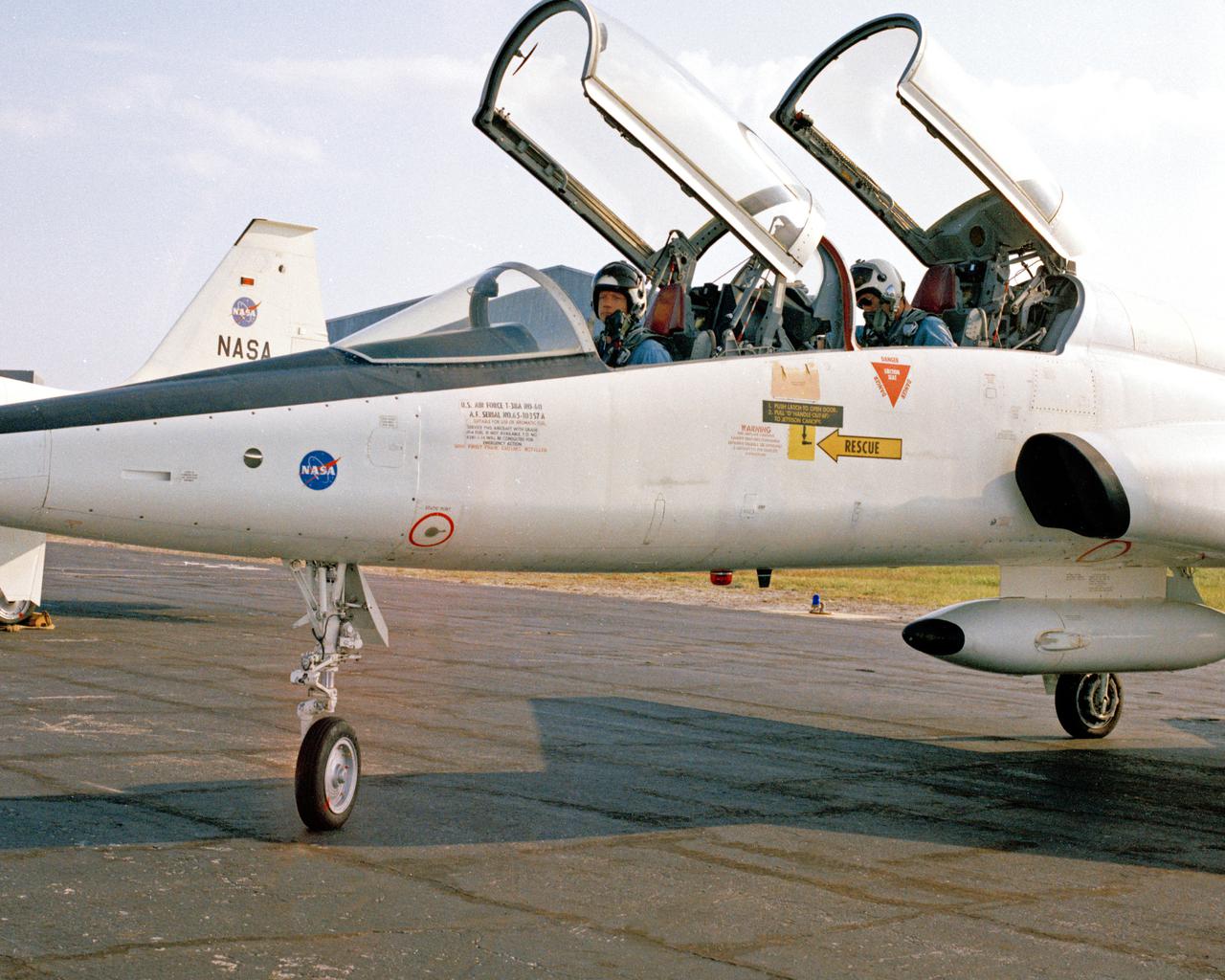
PATRICK AFB, Fla. – In preparation of the nation’s first lunar landing mission, Apollo 11 crew members arrive at Patrick Air Force Base, Florida. Mission commander Neil A. Armstrong is in the front seat of the T-38 jet, with chief astronaut and director of flight crew operations, Donald K. Slayton, in the back. Lift off atop a Saturn V launch vehicle is scheduled for July 16, 1969. During Apollo 11 the command module, Columbia, will remain in orbit around the moon while the lunar module, Eagle, carrying Armstrong and Aldrin, lands on the lunar surface. During 2½ hours of surface exploration, the crew plans to collect lunar surface material for analysis back on Earth. For more: http:__www-pao.ksc.nasa.gov_history_apollo_apollo-11_apollo-11.htm Photo credit: NASA
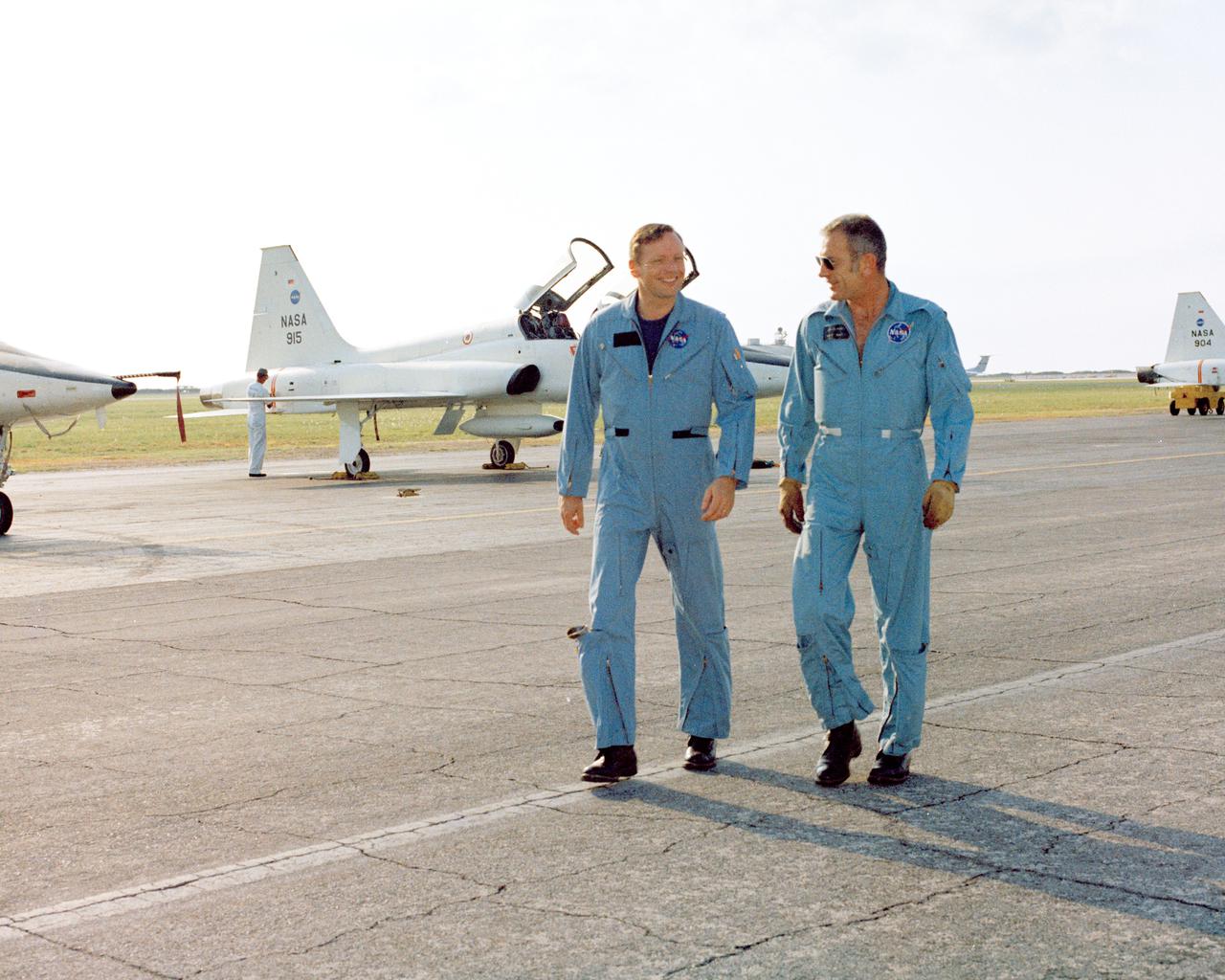
PATRICK AFB, Fla. – Apollo 11 commander Neil A. Armstrong, left, and Donald K. Slayton, chief astronaut and director of flight crew operations, just arrived at Patrick Air Force Base in a T-38 jet in preparation of the nation’s first lunar landing mission. Lift off atop a Saturn V launch vehicle is scheduled for July 16, 1969. During Apollo 11 the command module, Columbia, will remain in orbit around the moon while the lunar module, Eagle, carrying Armstrong and Aldrin, lands on the lunar surface. During 2½ hours of surface exploration, the crew plans to collect lunar surface material for analysis back on Earth. For more: http:__www-pao.ksc.nasa.gov_history_apollo_apollo-11_apollo-11.htm Photo credit: NASA
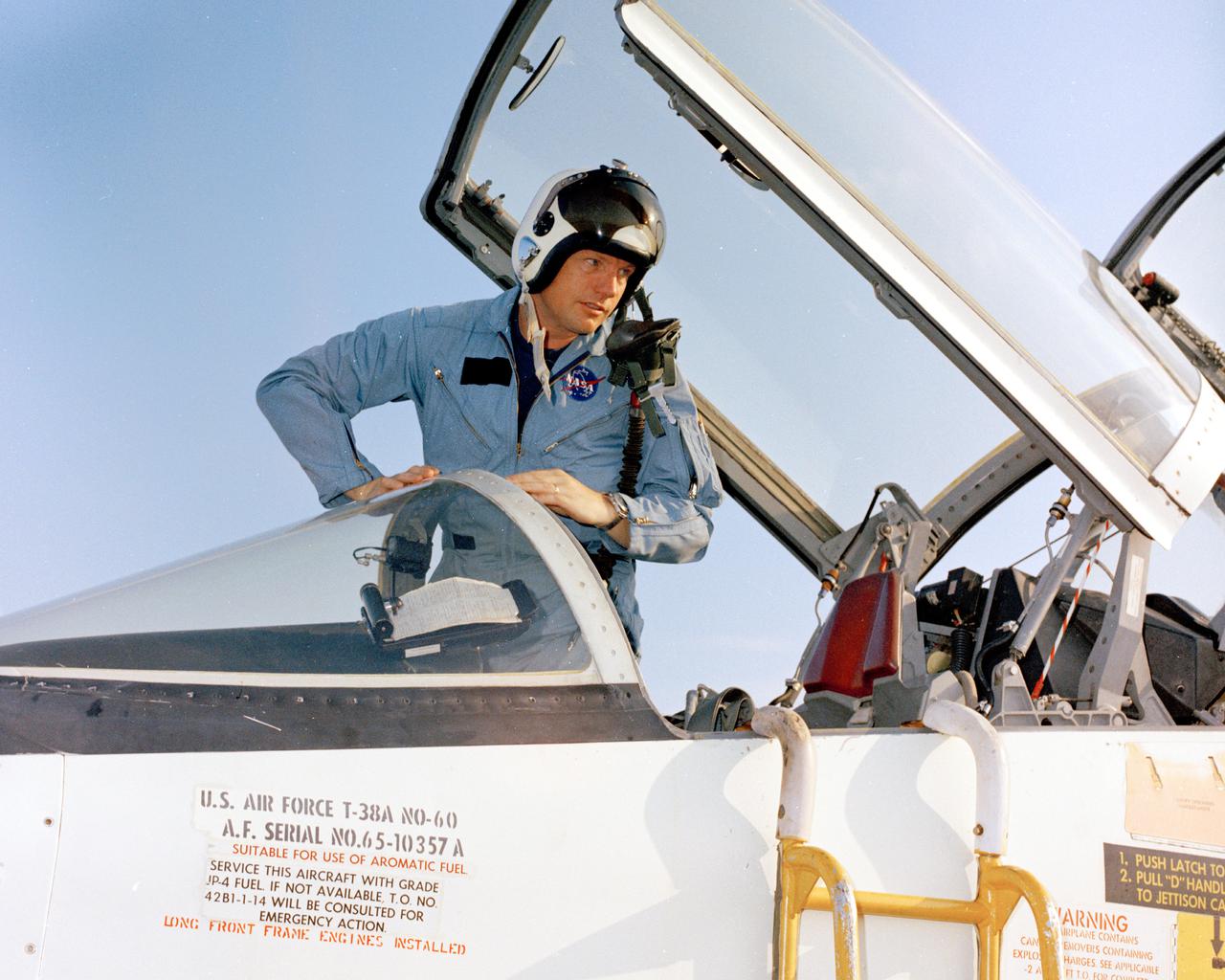
PATRICK AFB, Fla. – In preparation of the nation’s first lunar landing mission, Apollo 11 crew members arrive at Patrick Air Force Base, Florida. Mission commander Neil Armstrong climbs out of a T-38 jet. Lift off atop a Saturn V launch vehicle is scheduled for July 16, 1969. During Apollo 11 the command module, Columbia, will remain in orbit around the moon while the lunar module, Eagle, carrying Armstrong and Aldrin, lands on the lunar surface. During 2½ hours of surface exploration, the crew plans to collect lunar surface material for analysis back on Earth. For more: http:__www-pao.ksc.nasa.gov_history_apollo_apollo-11_apollo-11.htm Photo credit: NASA
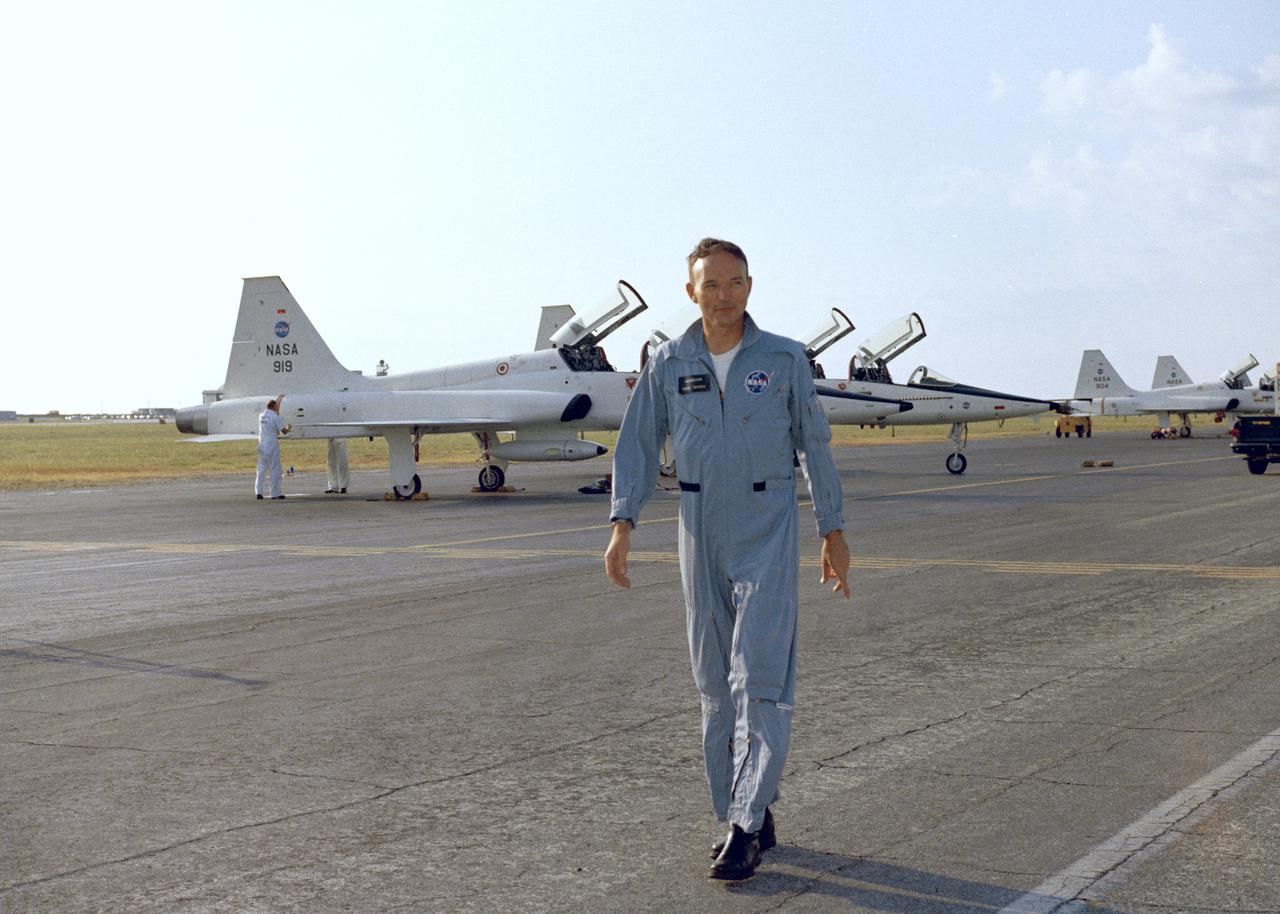
PATRICK AFB, Fla. – Apollo 11 command module pilot Michael Collins, just arrived at Patrick Air Force Base in a T-38 jet in preparation of the nation’s first lunar landing mission. Lift off atop a Saturn V launch vehicle is scheduled for July 16, 1969. During Apollo 11, the command module, Columbia, will remain in orbit around the moon while the lunar module, Eagle, carrying Armstrong and Aldrin, lands on the lunar surface. During 2½ hours of surface exploration, the crew plans to collect lunar surface material for analysis back on Earth. For more: http:__www-pao.ksc.nasa.gov_history_apollo_apollo-11_apollo-11.htm Photo credit: NASA
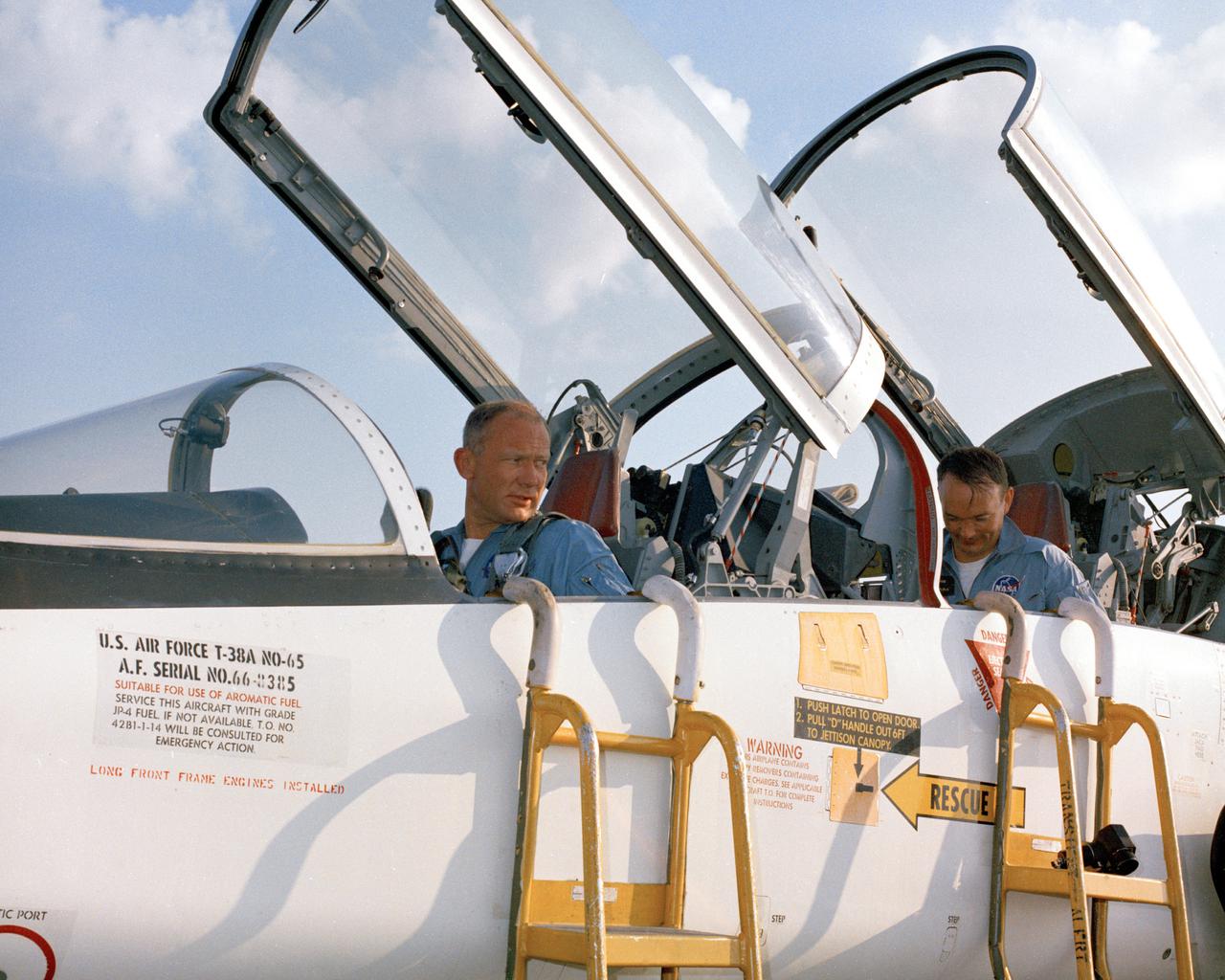
PATRICK AFB, Fla. – In preparation of the nation’s first lunar landing mission, Apollo 11 crew members arrive at Patrick Air Force Base, Florida. Lunar module pilot Edwin E. Buzz Aldrin Jr. is in the front seat of the T-38 jet, with command module pilot Michael Collins, in the back. Lift off atop a Saturn V launch vehicle is scheduled for July 16, 1969. During Apollo 11 the command module, Columbia, will remain in orbit around the moon while the lunar module, Eagle, carrying Armstrong and Aldrin, lands on the lunar surface. During 2½ hours of surface exploration, the crew plans to collect lunar surface material for analysis back on Earth. For more: http:__www-pao.ksc.nasa.gov_history_apollo_apollo-11_apollo-11.htm Photo credit: NASA
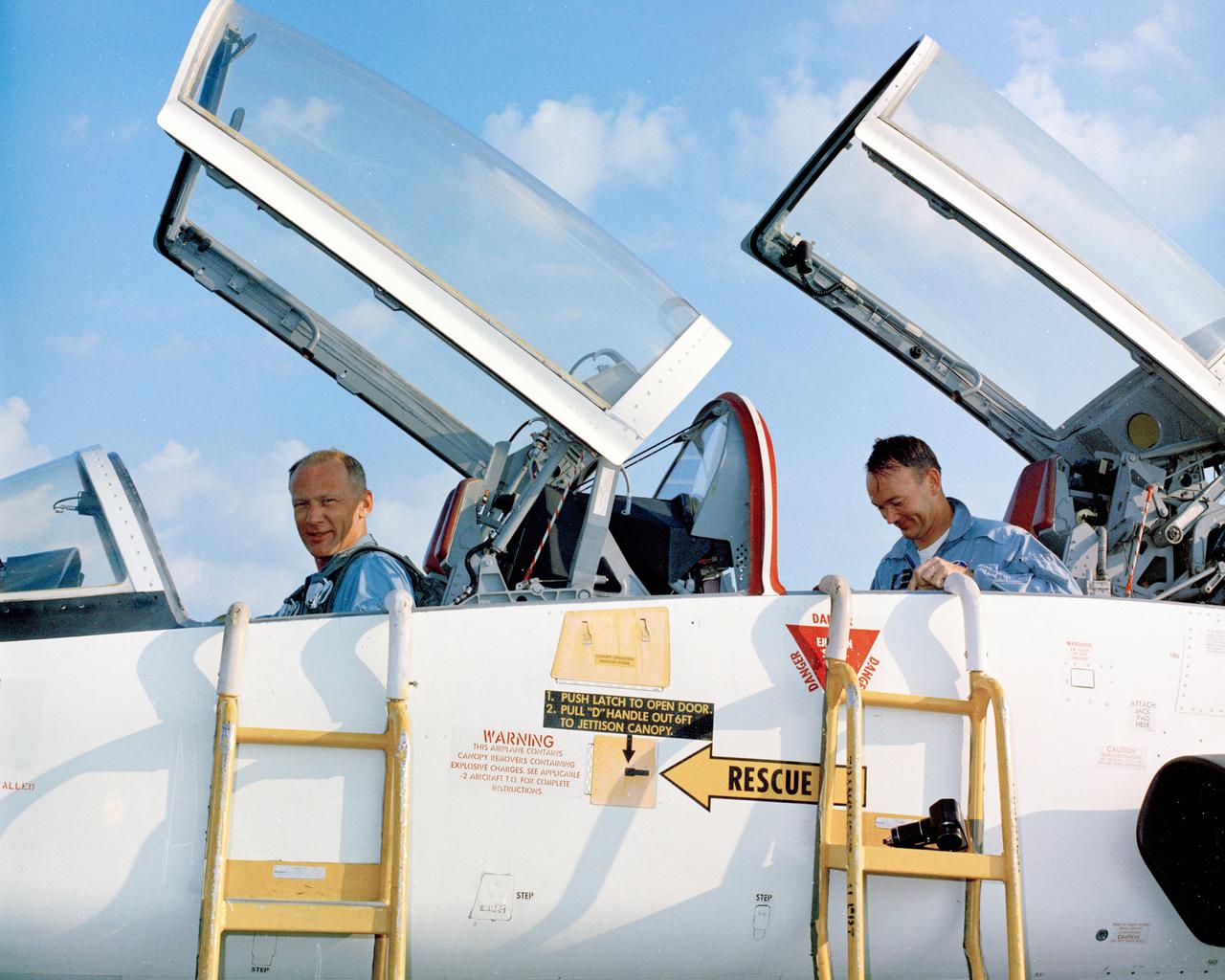
PATRICK AFB, Fla. – In preparation of the nation’s first lunar landing mission, Apollo 11 crew members arrive at Patrick Air Force Base, Florida. Lunar module pilot Edwin E. Buzz Aldrin Jr. is in the front seat of the T-38 jet, with command module pilot Michael Collins, in the back. Lift off atop a Saturn V launch vehicle is scheduled for July 16, 1969. During Apollo 11 the command module, Columbia, will remain in orbit around the moon while the lunar module, Eagle, carrying Armstrong and Aldrin, lands on the lunar surface. During 2½ hours of surface exploration, the crew plans to collect lunar surface material for analysis back on Earth. For more: http:__www-pao.ksc.nasa.gov_history_apollo_apollo-11_apollo-11.htm Photo credit: NASA
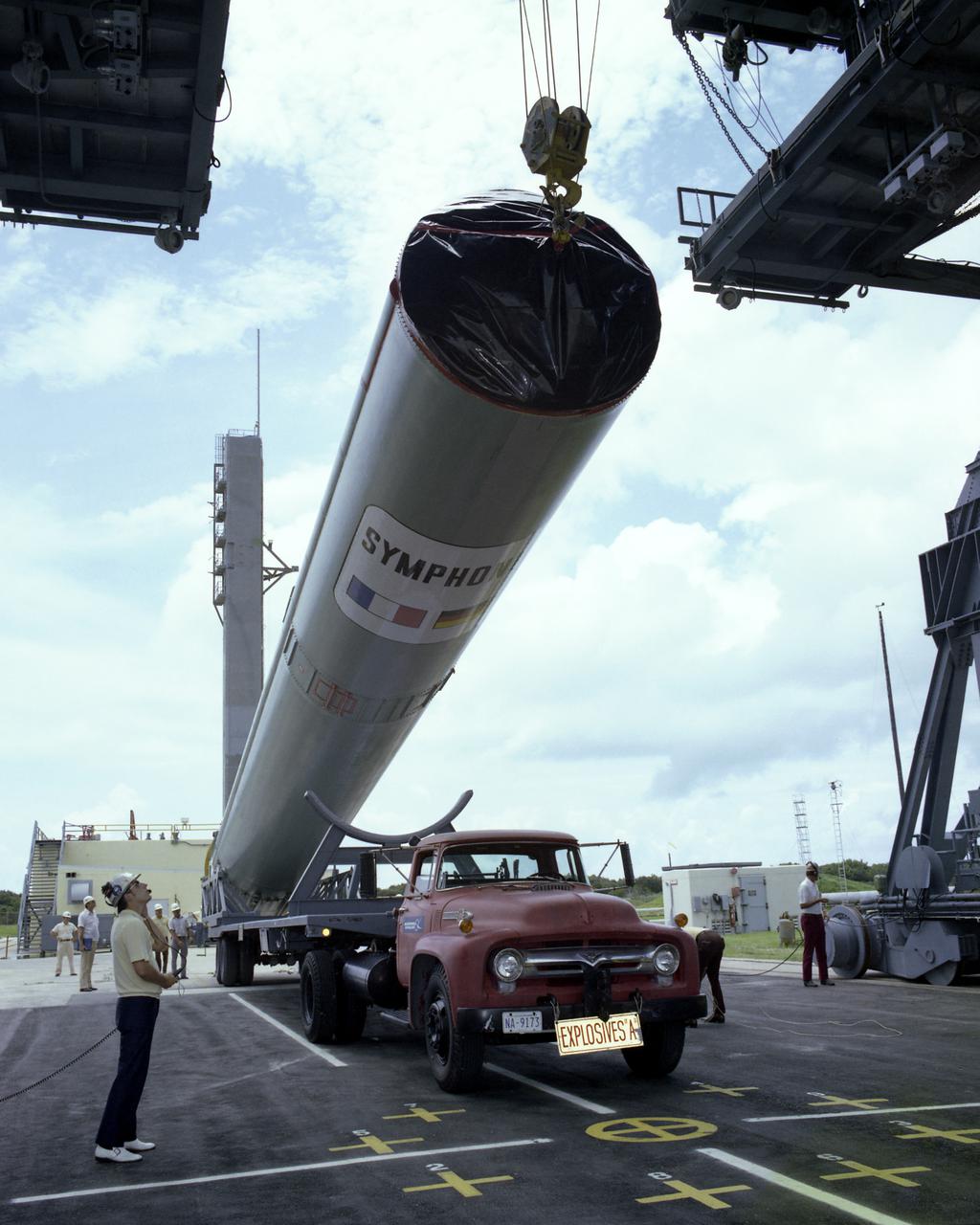
CAPE CANAVERAL, Fla. -- Erection of the first stage of the Delta launch vehicle for Symphonie-B at Complex 17-A on Cape Canaveral Air Force Station. Photo credit: NASA
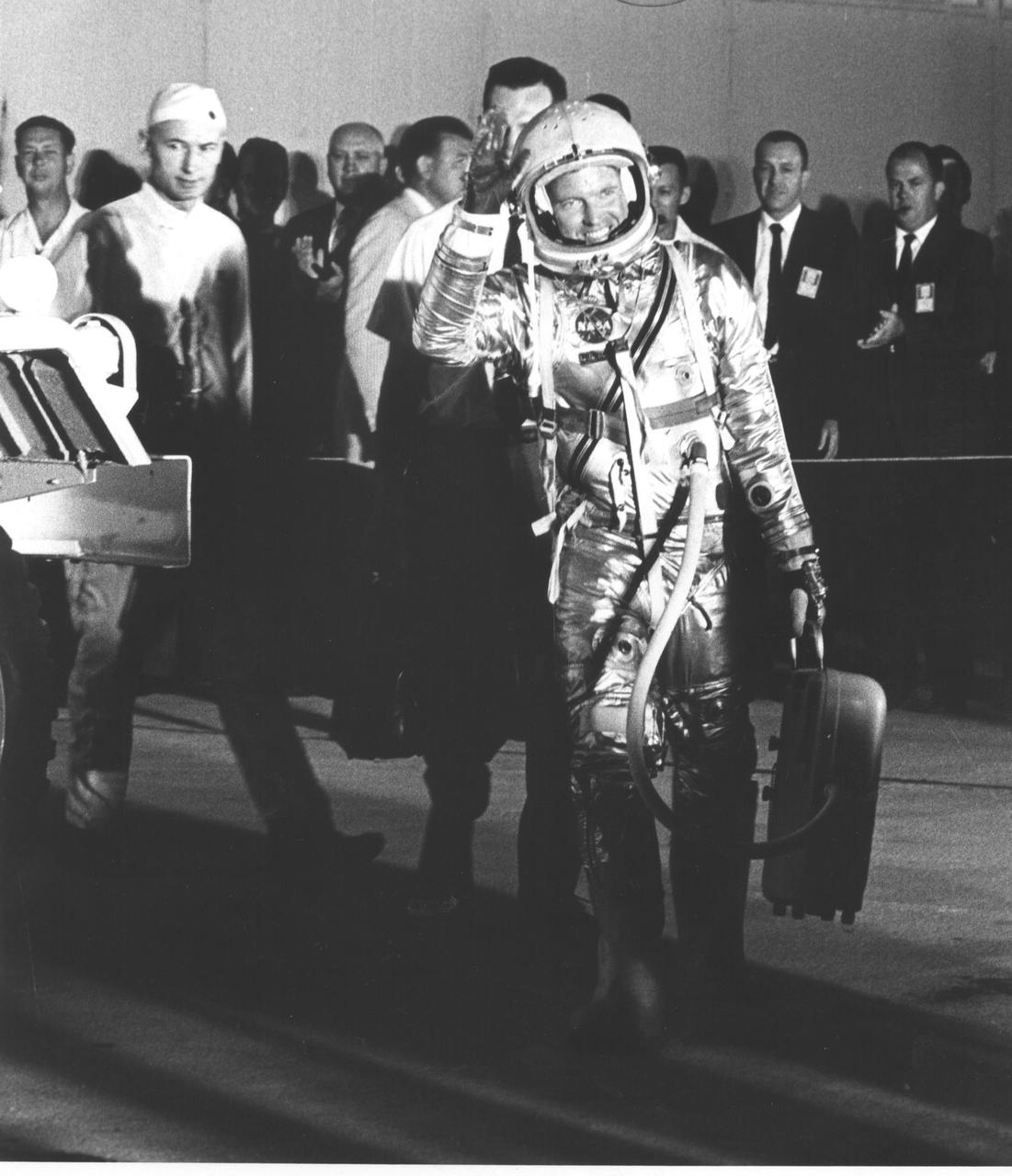
CAPE CANAVERAL, FLA. -- Hangar 'S' -- Mercury workers and news media are greeted by astronaut L. Gordon Cooper as he leaves Hangar 'S' for Pad 14 to start his 22-orbit mission, MA-9.
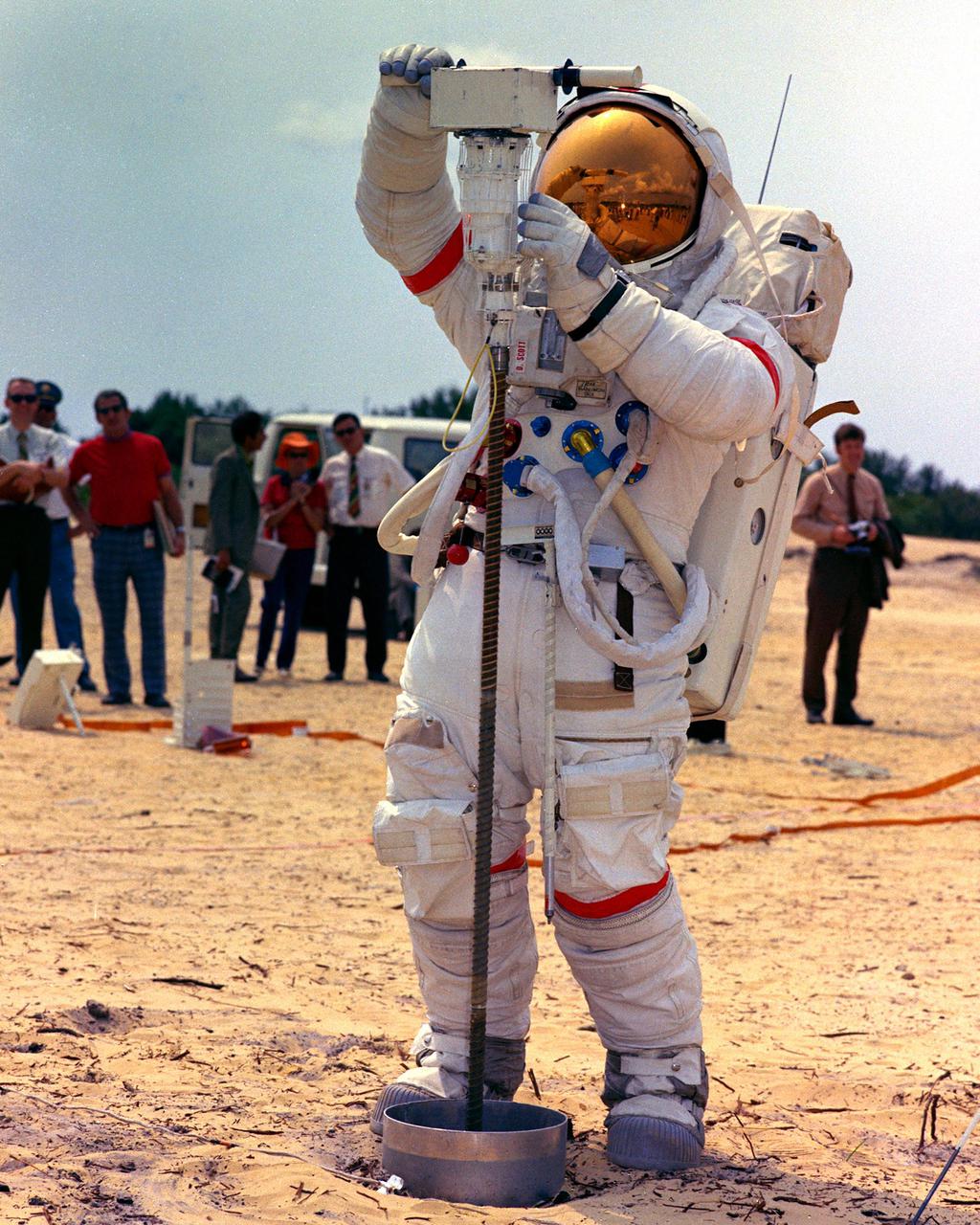
KENNEDY SPACE CENTER, FLA. - Apollo 15 Commander David R. Scott operates the battery-powered Lunar Surface Drill during a training exercise at a man-made replica of the Moon's Hadley-Apennine region at the Kennedy Space Center. During his upcoming mission, scheduled to begin no earlier than July 26, 1971, Scott will drill to a depth of about 10 feet to obtain lunar surface core samples and conduct the Heat Flow Experiment. This experiment is designed to measure the rate of heat loss from the interior of the Moon. Lunar Module Pilot James B. Irwin will accompany Scott on the surface while Astronaut Alfred M. Worden will pilot the Command Module while in lunar orbit.

CAPE CANAVERAL, Fla. - Renamed the Mission Control Center, the facility continued to be the flight control through the first three missions of Project Gemini. The Mercury Mission Control Center in Florida played a key role in the United States' early spaceflight program. Located at Cape Canaveral Air Force Station, the original part of the building was constructed between 1956 and 1958, with additions in 1959 and 1963. The facility officially was transferred to NASA on Dec. 26, 1963, and served as mission control during all the Project Mercury missions, as well as the first three flights of the Gemini Program, when it was renamed Mission Control Center. With its operational days behind, on June 1, 1967, the Mission Control Center became a stop on the public tour of NASA facilities until the mid-90s. In 1999, much of the equipment and furnishings from the Flight Control Area were moved to the Kennedy Space Center Visitor Complex where they became part of the exhibit there. The building was demolished in spring 2010. Photo credit: NASA
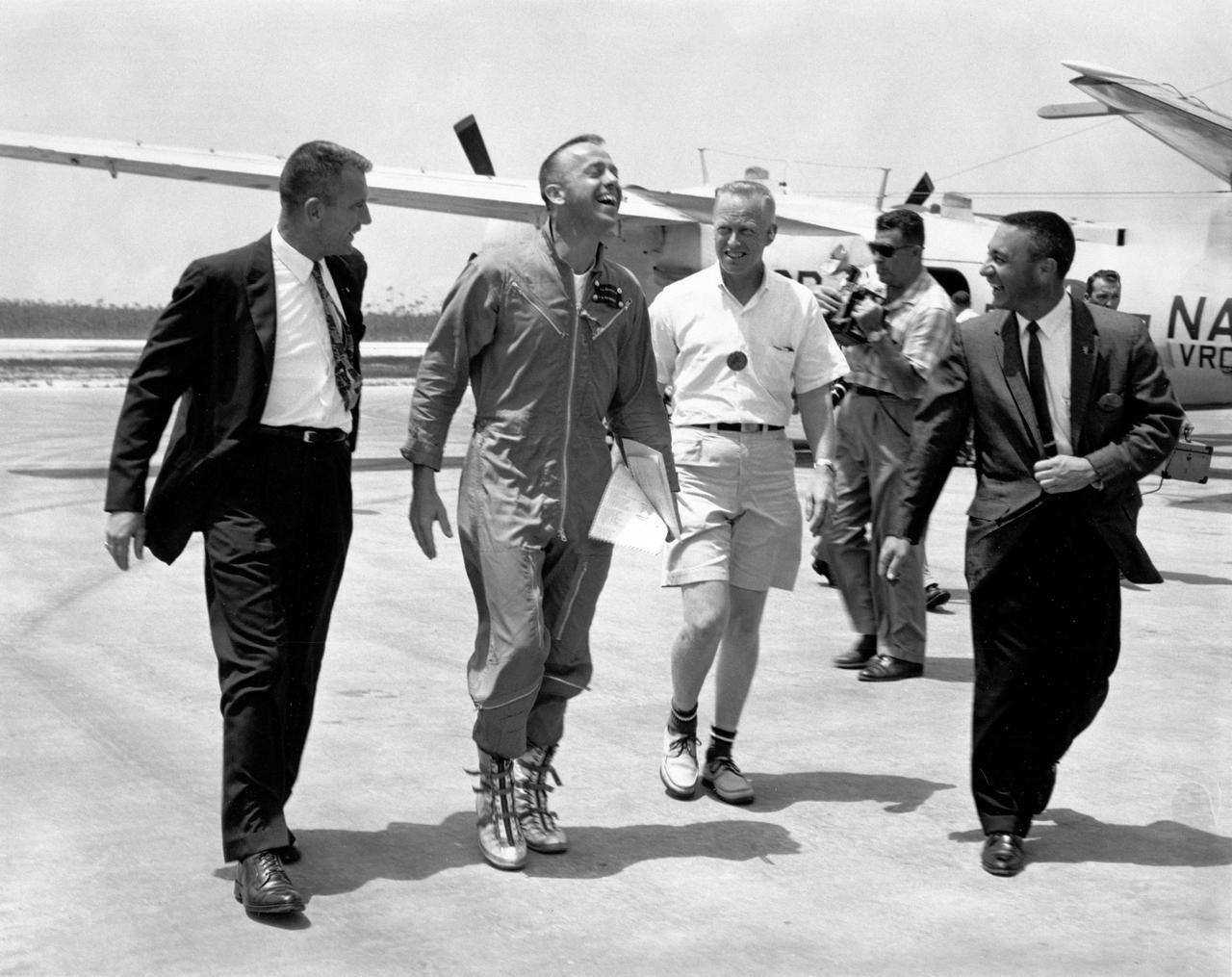
KENNEDY SPACE CENTER, FLA. - Astronauts Deke Slayton, far left, and Virgil Grissom, far right, were on hand to greet Astronaut Alan B. Shepard at Grand Bahama Island after his historic first U.S. manned suborbital flight. Just behind Astronaut Shepard is Dr. Keith Lyndell.
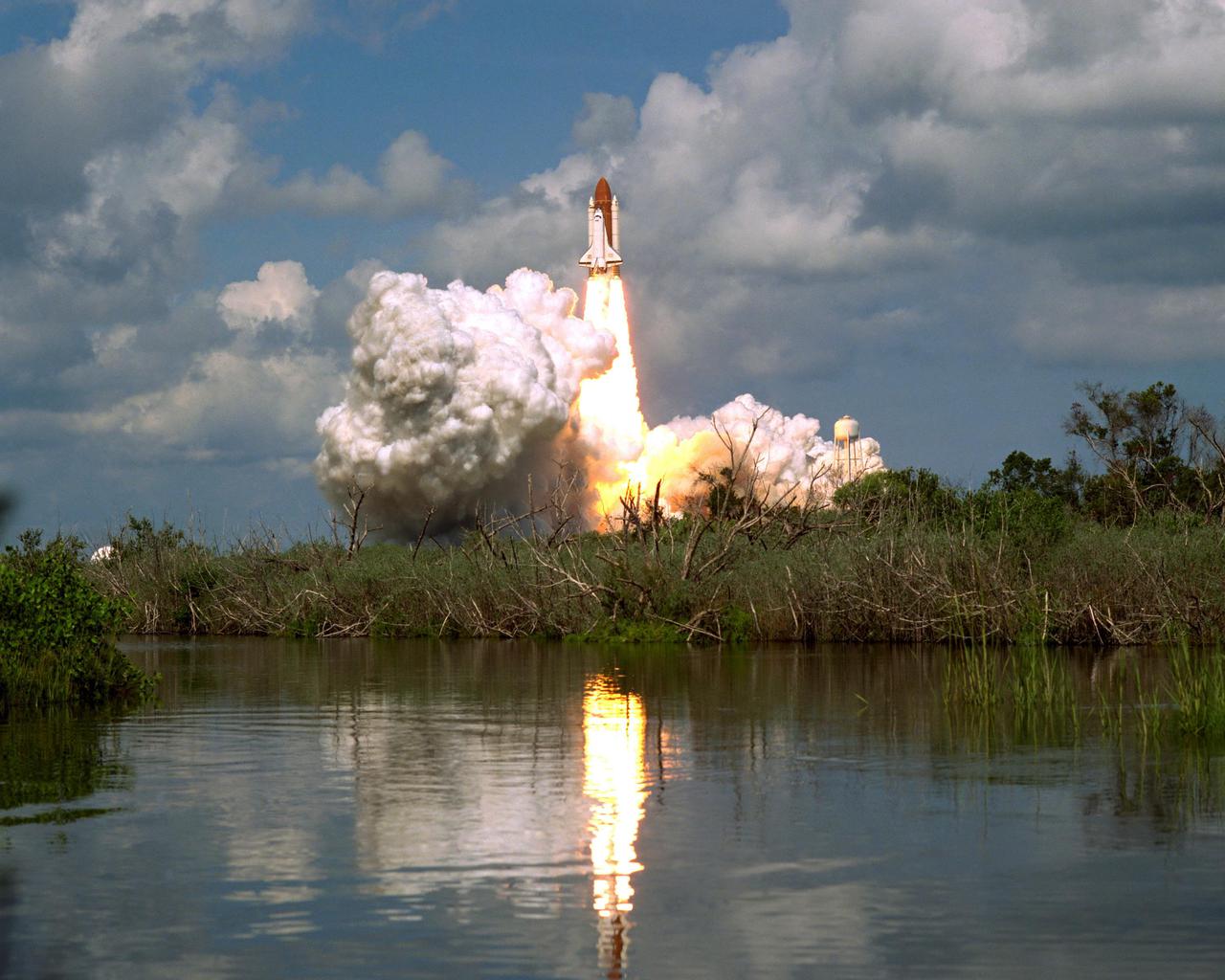
KENNEDY SPACE CENTER, FLA. -- The STS-34 Space Shuttle Atlantis lifts off from pad 39-B at 12:53 p.m. EDT, marking the beginning of a five-day mission in space. Atlantis is carrying a crew of five and the spacecraft Galileo, wich will be making a six-year trip to Jupiter..
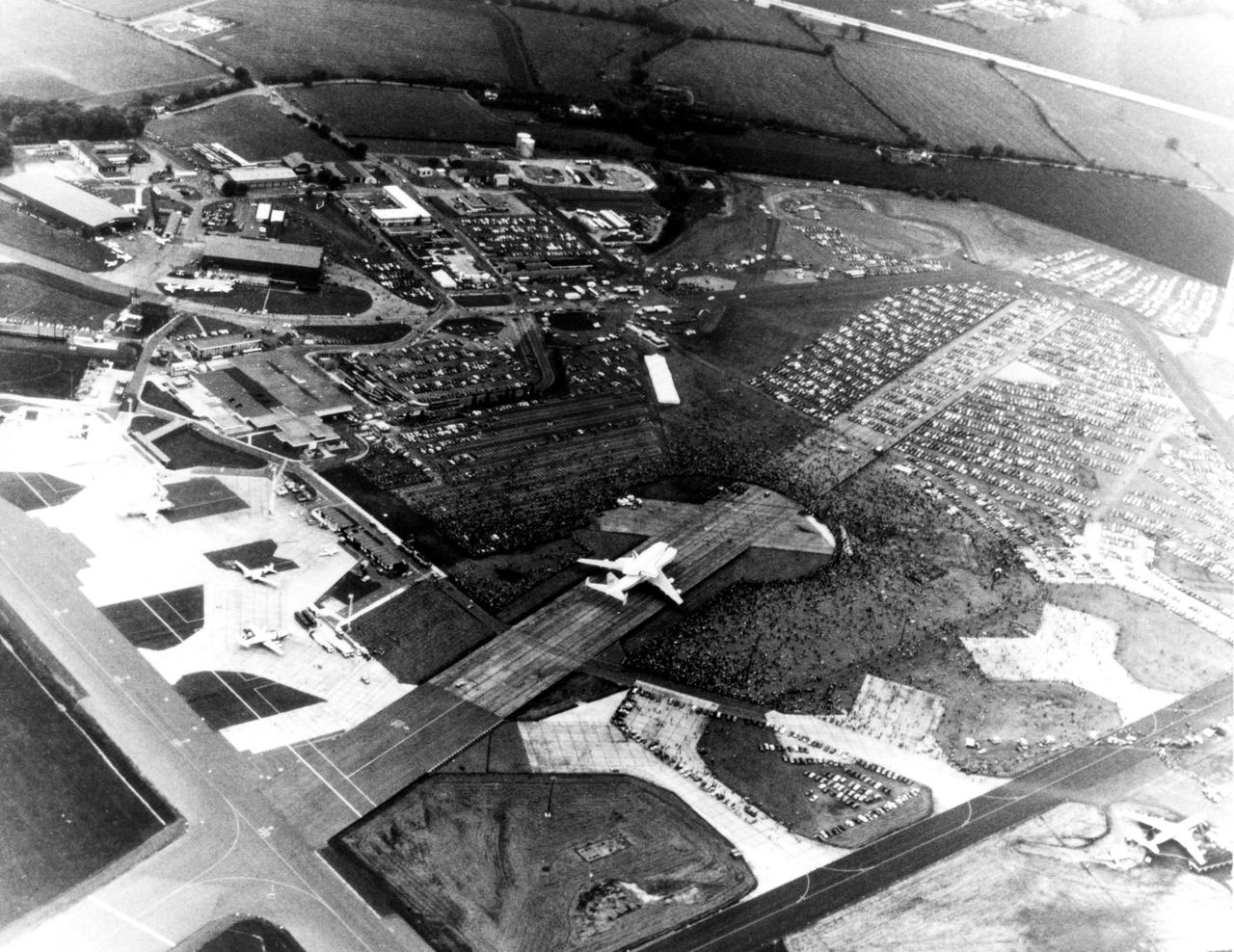
KENNEDY SPACE CENTER, FLA. -- Thousands of Britons surround the Space Shuttle Orbiter Enterprise at Stansted Airport, near London. The Enterprise atop its 747 carrier aircraft was viewed in London, Bonn-Cologne, West Germany, Rome and Ottawa, Canada, in addition to being shown at the Paris Air Show in June 1983.
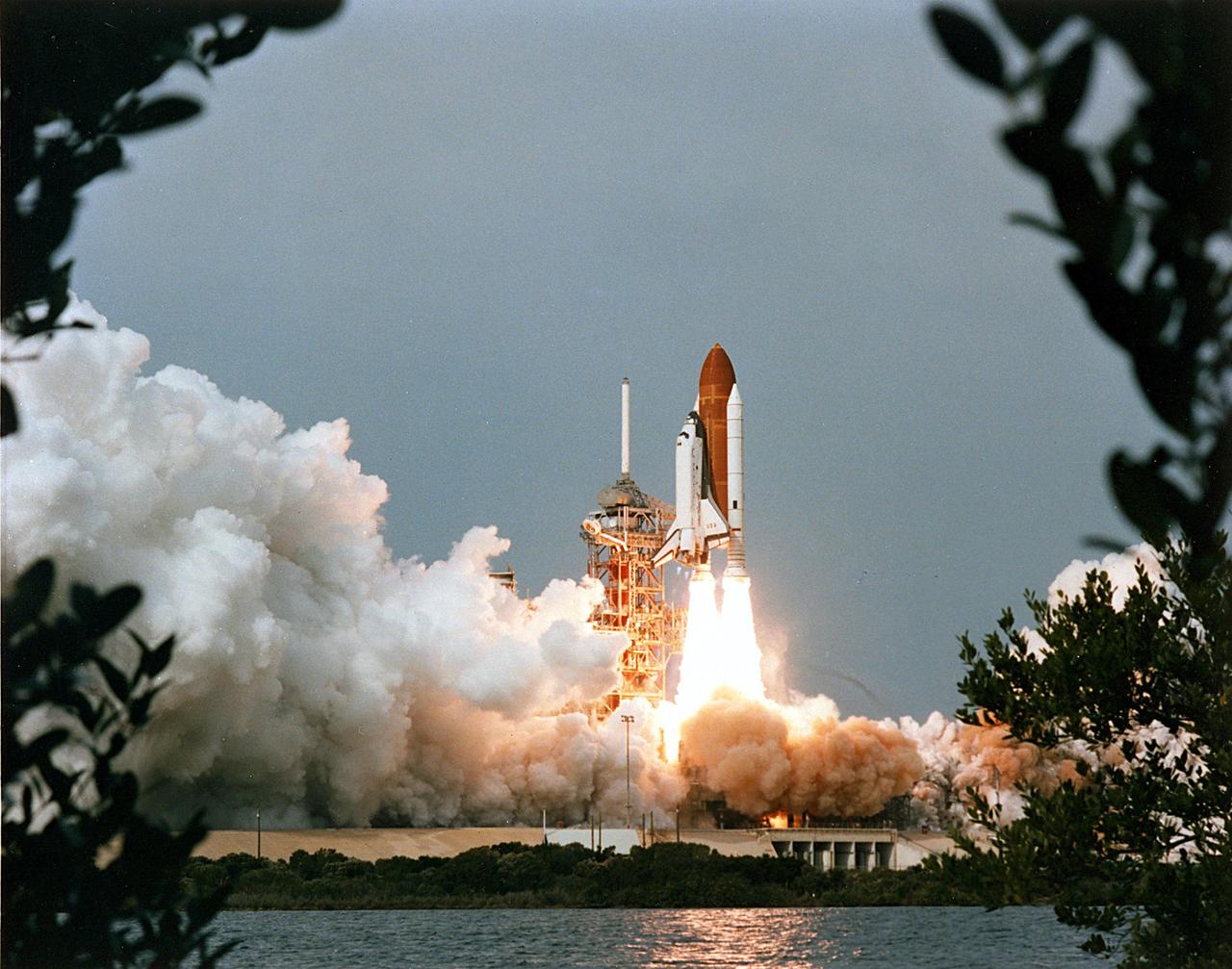
KENNEDY SPACE CENTER, FLA. -- Columbia launches on mission STS-9 from Launch Pad 39-A. This is the first Shuttle flight with six crew members: Commander John W. Young, Pilot Brewster H. Shaw Jr., Mission Specialists Owen K. Garriott and Robert A.R. Parker, and Payload Specialists Byron K. Lichtenberg and Ulf Merbold, who is with the European Space Agency (ESA). The flight carries the first Spacelab mission and first astronaut to represent ESA.
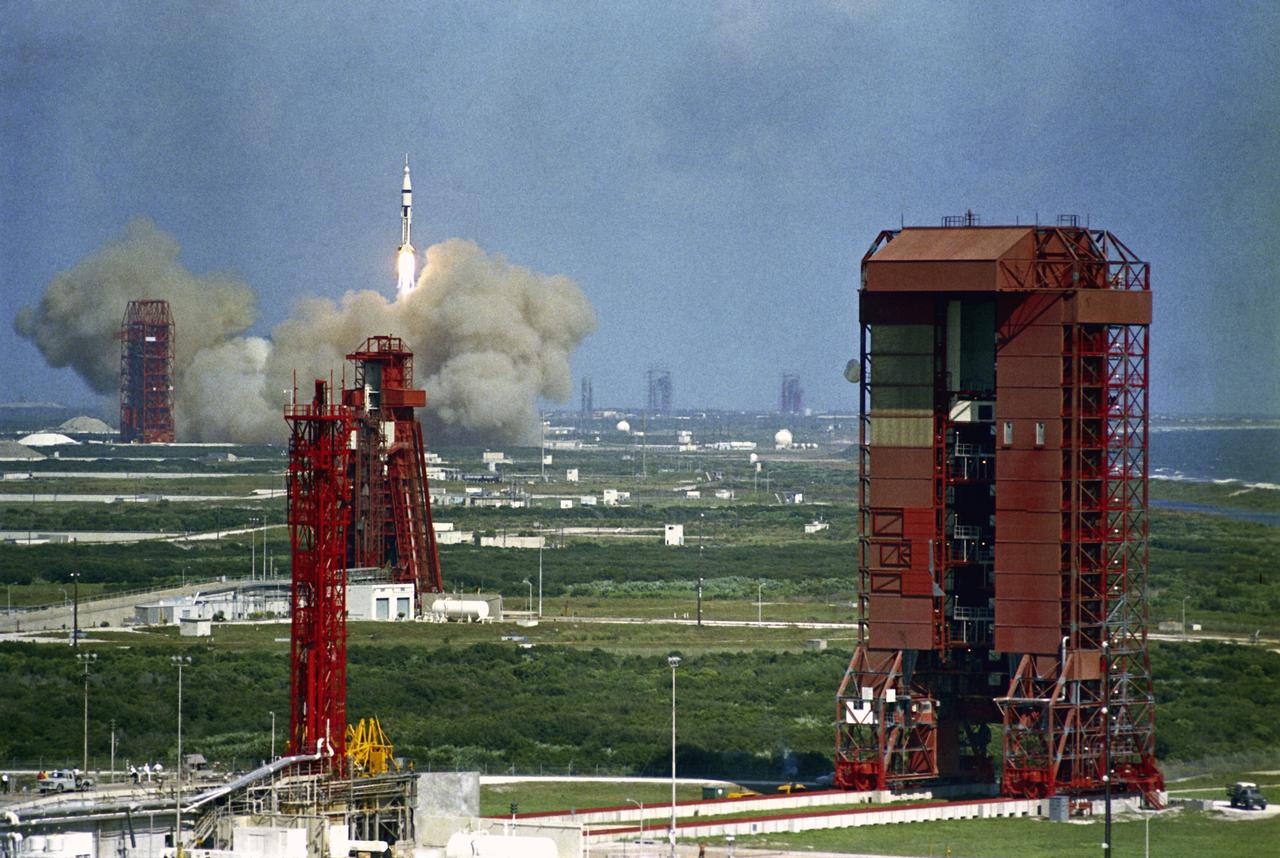
CAPE CANAVERAL, Fla. -- The Apollo 7 spacecraft, atop a Saturn IB rocket, lifts off from Complex 34, Cape Kennedy, at 11:03 a.m. EDT. The spacecraft achieved orbit to begin an 11-day mission. The flight is intended to qualify Apollo for a manned flight to the moon. Photo credit: NASA
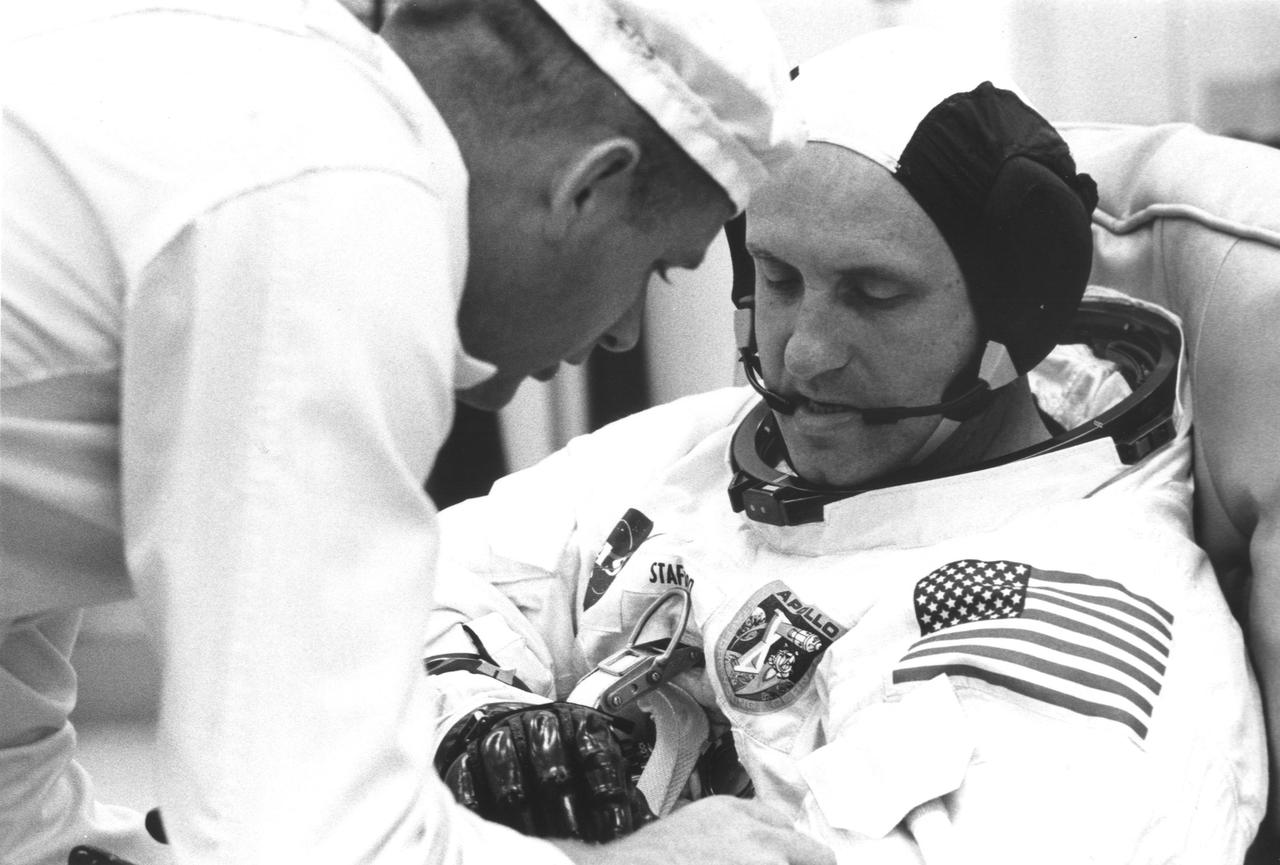
KENNEDY SPACE CENTER, FLA. -- A technician helps astronaut Thomas P. Stafford, Apollo 10 commander, suit up for the Countdown Demonstration Test (CDDT) which ended successfully at 1:01 p.m. today. The CDDT is a dress rehearsal for the launch of Apollo 10 from Pad B at Launch Complex 39 May 18 at 12:49 p.m.
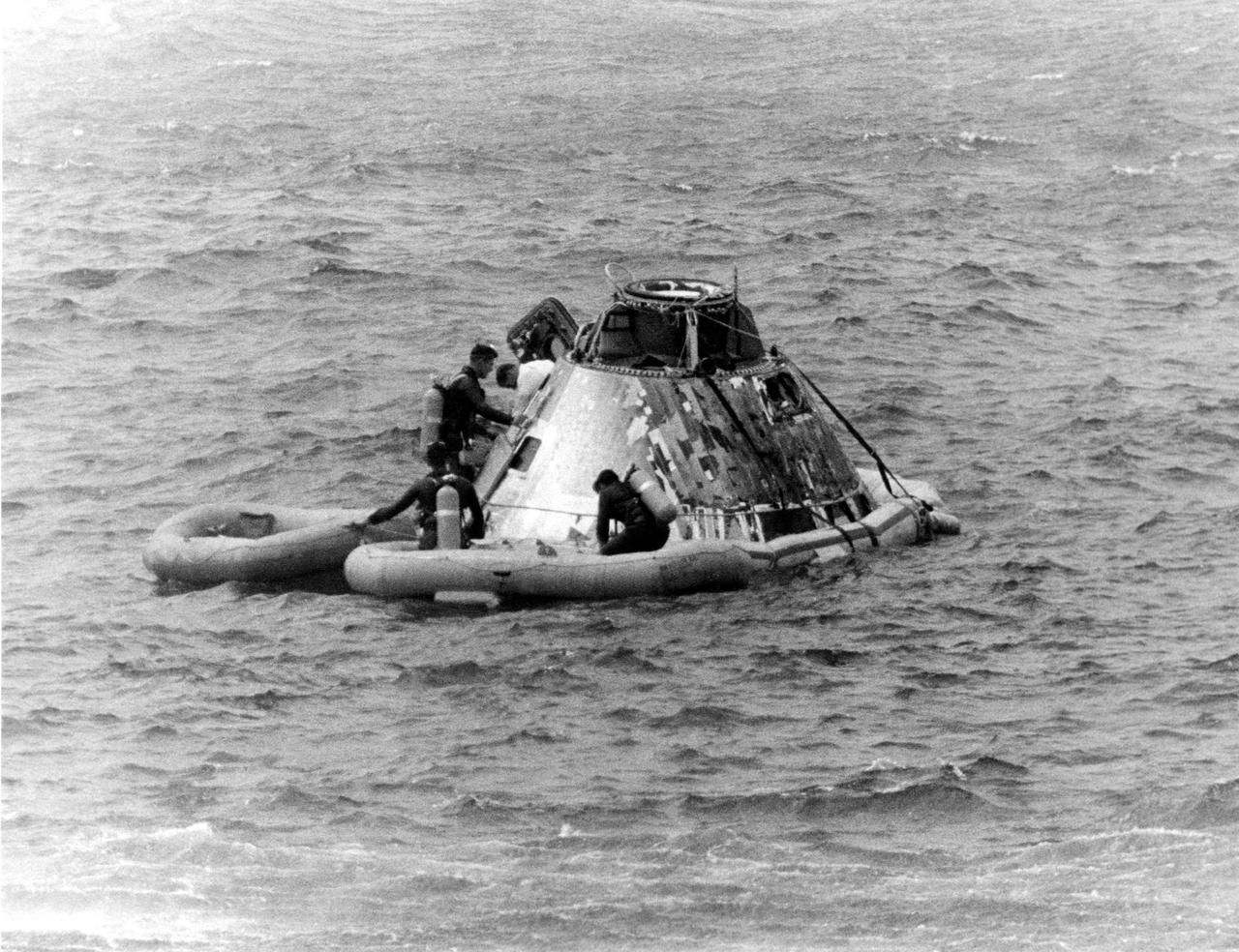
KENNEDY SPACE CENTER, FLA. -- Pararescueman helps Apollo 9 Command Module Pilot David R. Scott from the spacecraft today during recovery at completion of the 10-day Earth orbital flight with James A. McDivitt and Russell L. Schweickart, still in the spacecraft. The astronauts splashed down less than five miles from the USS Guadalcanal, prime recovery ship, at the beginning of their 152nd revolution. During the highly successful flight, they extensively tested the lunar module spacecraft, paving the way for a similar one to carry Americans to the Moon later this year. They were lalunched March 3 by an Apollo_Saturn V space vehicle from the Kennedy Space Center at the start of NASA's third manned mission using an Apollo spacecraft.
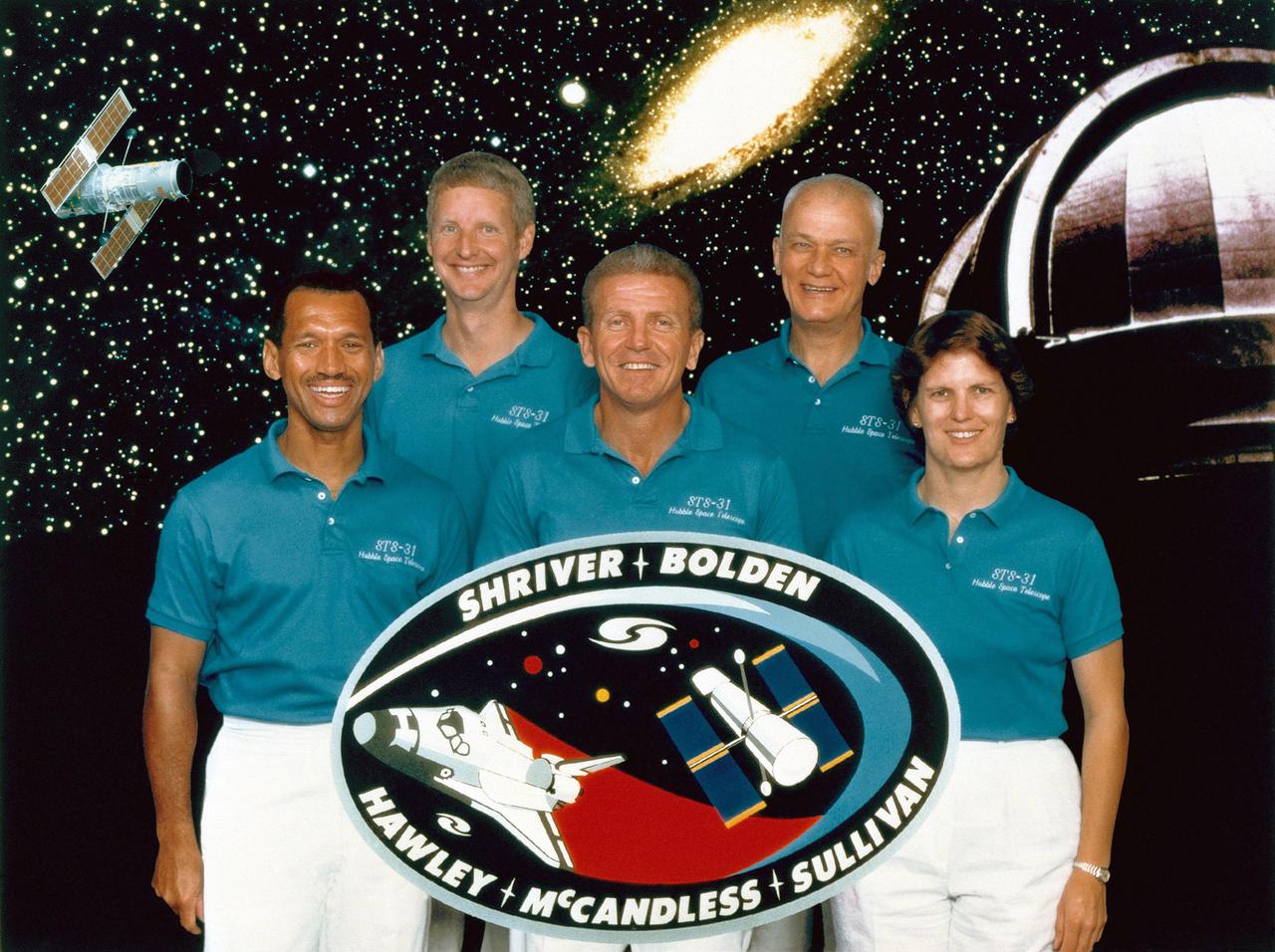
KENNEDY SPACE CENTER, FLA. -- STS-31 crew portrait: Mission Commander Loren J. Shriver, center front; other crew members are (L to R) Pilot Charles F. Bolden Jr. and Mission Specialists Steven A. Hawley, Bruce McCandless II and Kathryn D. Sullivan. Primary payload on the mission is the Hubble Space Telescope, to be deployed ina 380-statute-mile orbit.
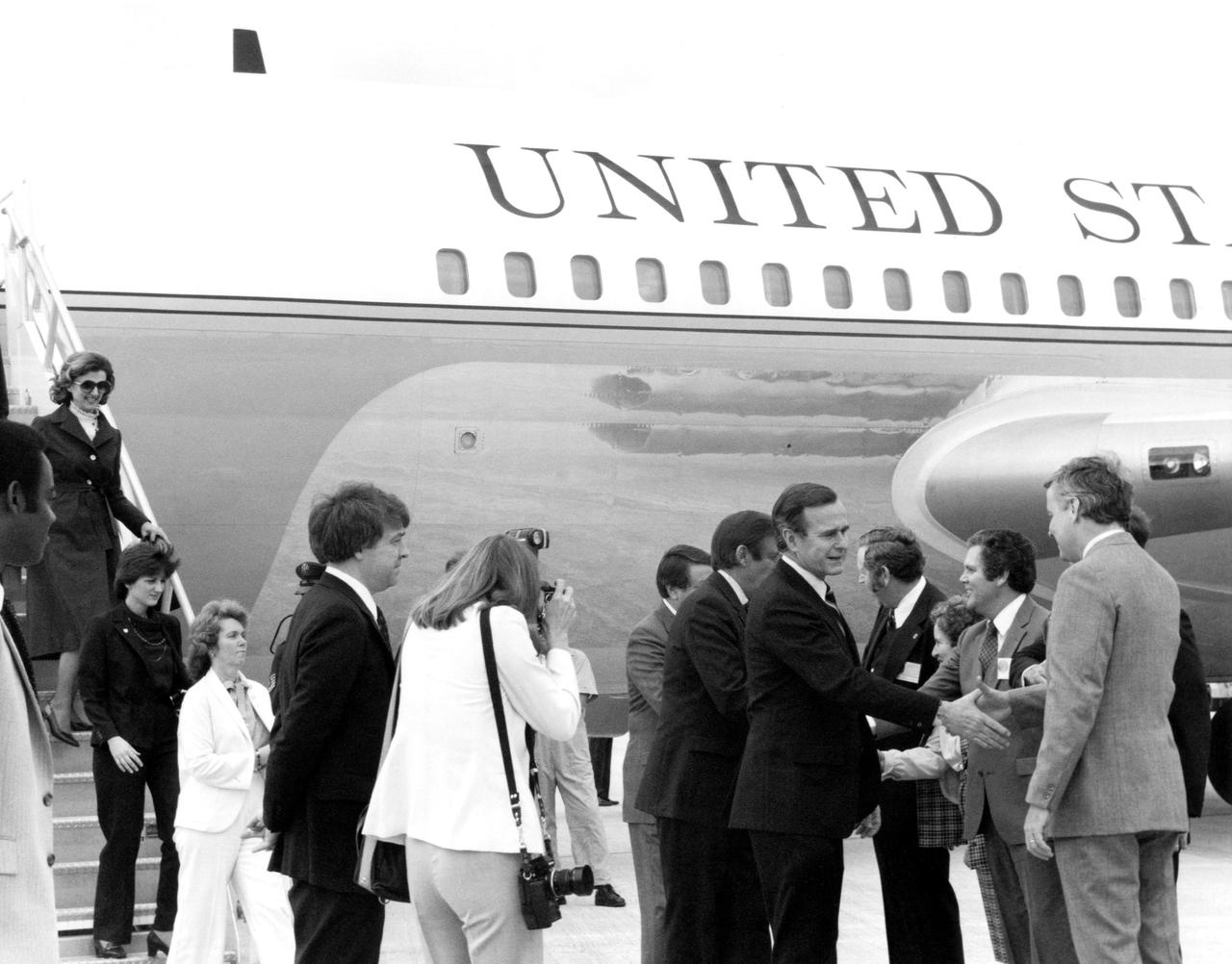
KENNEDY SPACE CENTER, FLA. -- Vice President George H.W. Bush, center left, is welcomed to KSC's Shuttle Landing facility. At the Center for the Spacelab Arrival Ceremony, the vice president is greeted by, from left, Center Director Richard G. Smith; Mrs. Smith; U.S. Rep. Ronnie Flippo, D-Ala.; an Robert Allnut, director of external affairs for NASA Headquarters. In the welcoming party but not pictured was U.S. Rep. Bill Nelson, D-Fla.
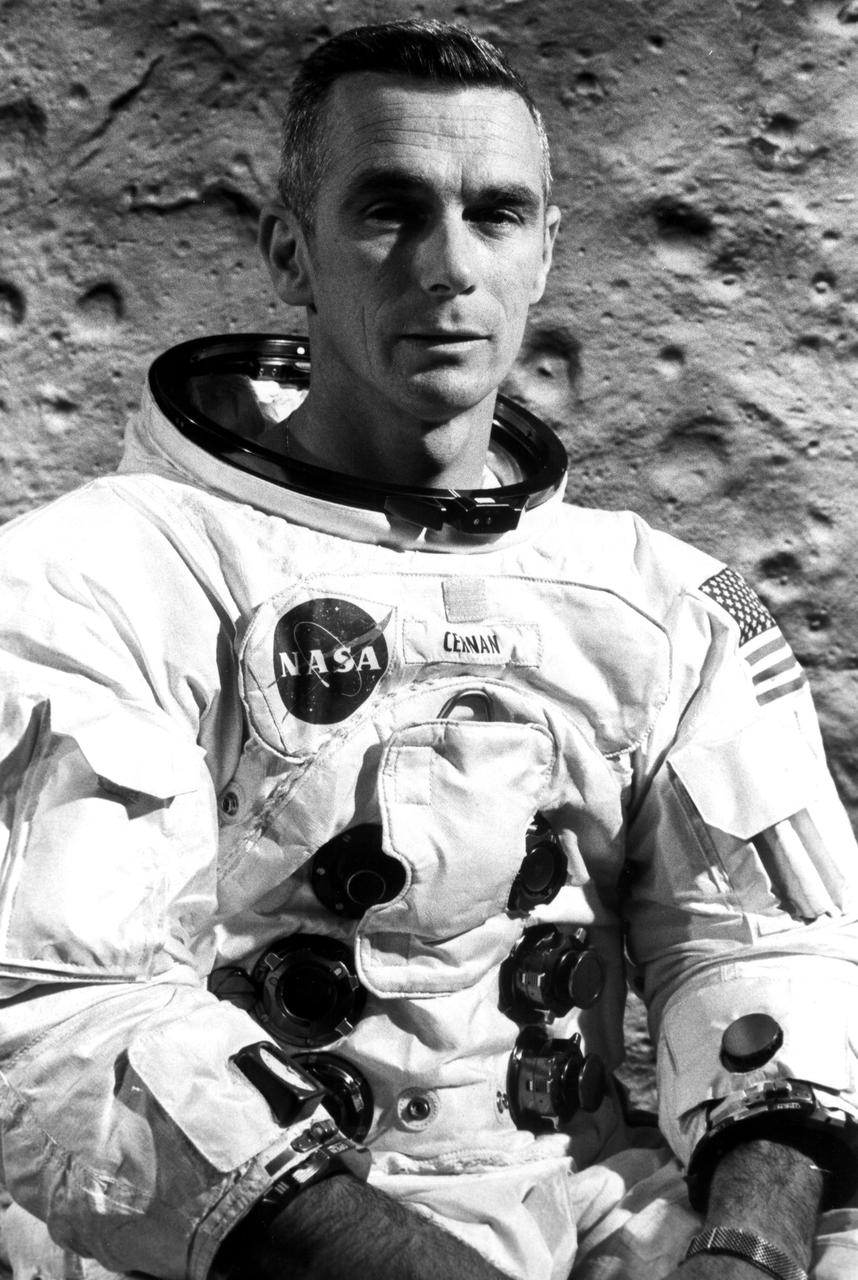
KENNEDY SPACE CENTER, FLA. -- Astronaut Eugene A. Cernan is lunar module pilot for Apollo 10, scheduled for launch from the nation's spaceport on May 18. Cernan and Apollo 10 Commander Thomas P. Stafford are to detach the lunar module after the spacecraft enters lunar orbit and drop down to within 10 miles of the Moon's pockmarked surface before rejoining John W. Young, command module pilot, orbiting the Moon in the command_service module. The Apollo 10 mission is a dress rehearsal for a manned lunar landing later this year.
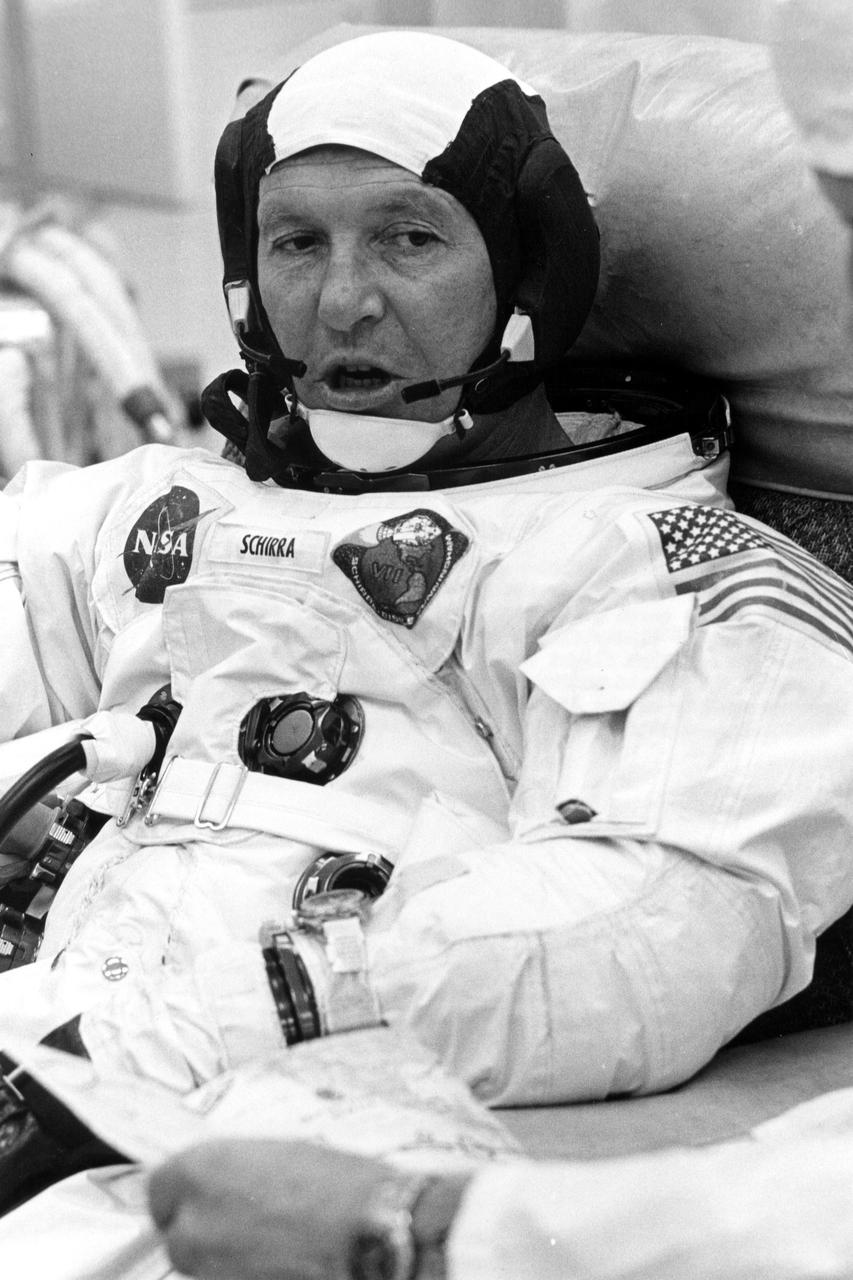
KENNEDY SPACE CENTER, FLA. -- Astsronaut Walter M. Schirra Jr. relaxes prior to boarding the Apollo 7 spacecraft, which rocketed into Earth orbit from Cape Kennedy this morning. Purpose of the 11-day flight is to qualify the Apollo spacecraft for a future flight to the moon. Other Apollo 7 pilots are Donn Eisele and Walter Cunningham. This is the first manned mission of the Apollo series. It is conducted by the National Aeronautics and Space Administration.
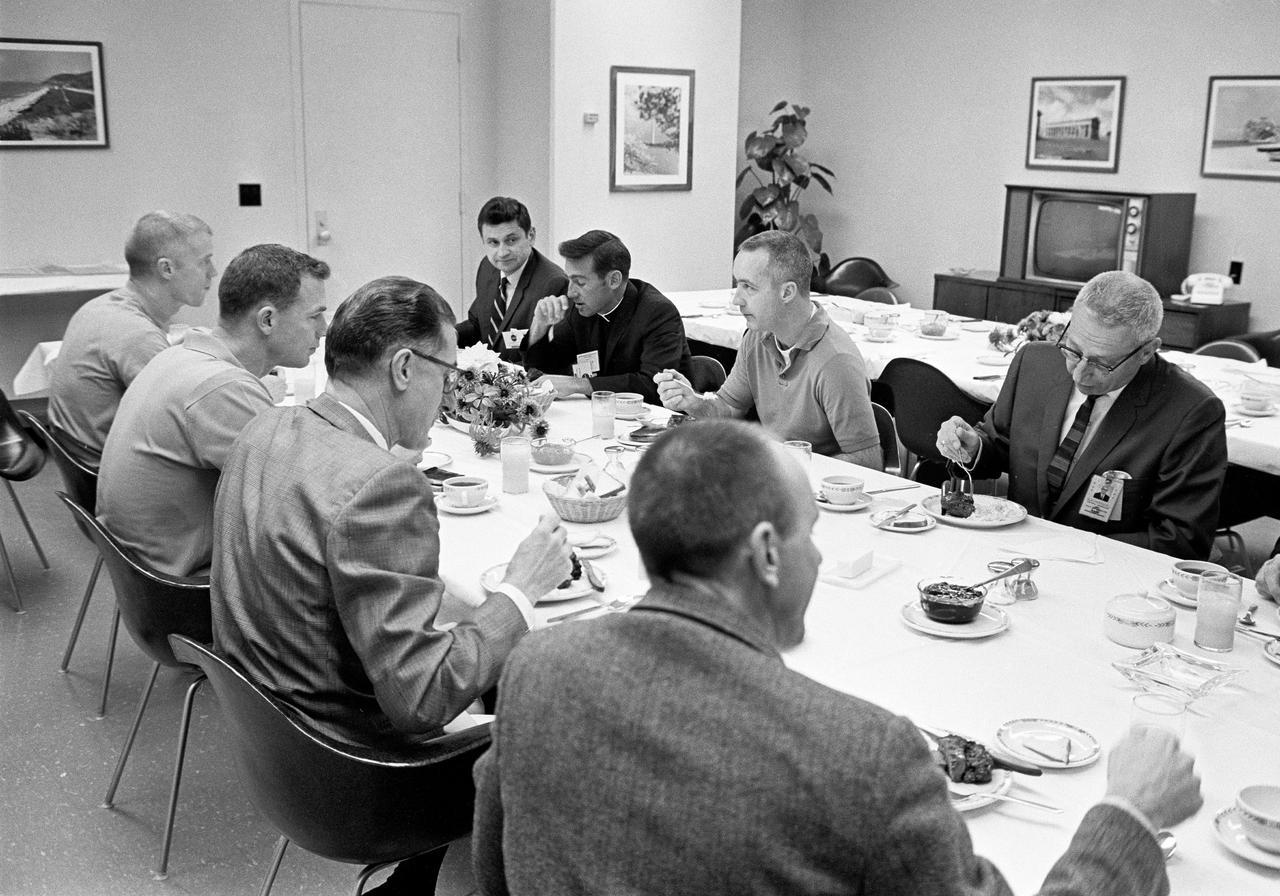
CAPE CANAVERAL, Fla. -- Apollo 9 astronauts James A. McDivitt, David R. Scott, and Russell L. Schweickart breakfast today with mission officials in their crew quarters at the Kennedy Space Center a few hours prior to their scheduled launch into Earth orbit. Seated in the foreground, left to right, are astronauts Schweickart and Scott Brig. Gen. C. H. Bolendar, manager, Lunar Module and backup Lunar Module Pilot Alan L. Bean. Across the table, left to right, George Skurla, Grumman Aircraft Base Manager at the Spaceport McDivitt's clergyman from his home church at Nassau Bay, Texas, The Rev. Laurence Connelly McDivitt and Kenneth Kleinknecht, manager, Command and Service Modules at the Manned Spacecraft Center. Grumman builds the two-man lunar module spacecraft that will be tested during the planned 10-day space mission. Photo credit: NASA
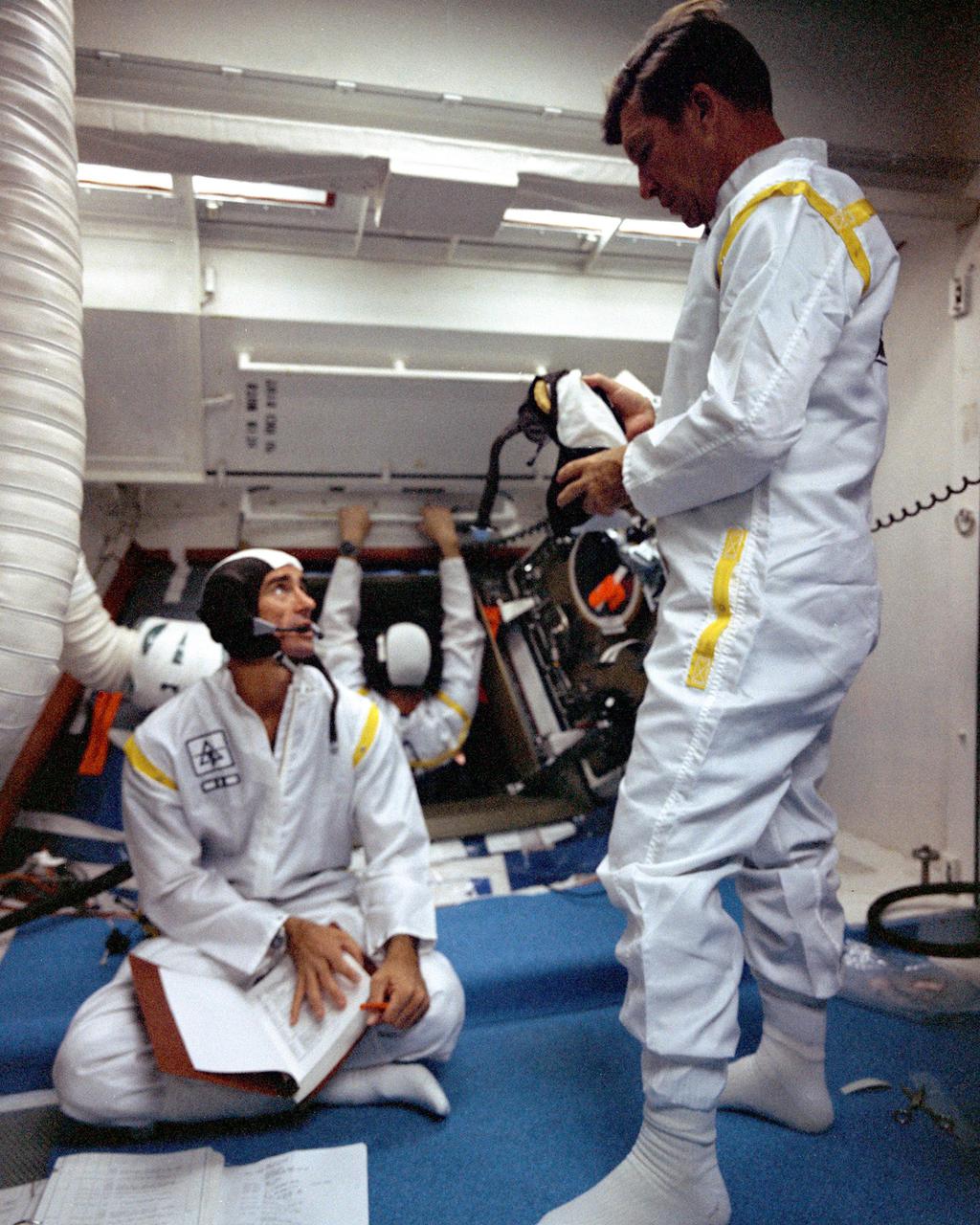
KENNEDY SPACE CENTER, FLA. - Apollo 7 Command Module Pilot Donn F. Eisele enters the spacecraft at Pad 34 while fellow crew members, Commander Walter M. Schirra Jr., left, and Lunar Module Pilot Walter Cunningham hold a brief discussion before they repeat that portion of the Plugs-Out test at the pad. The tests are being conducted in preparation for the scheduled launch of Apollo 7, the first manned lunar orbital mission.

CAPE CANAVERAL, Fla. -- Launch of Delta 114, Symphonie-2, second in a series of French-West German experimental communications satellites, from Complex 17-A at Cape Canaveral Air Force Station at 9:42 p.m. EDT. Photo credit: NASA Photo credit: NASA
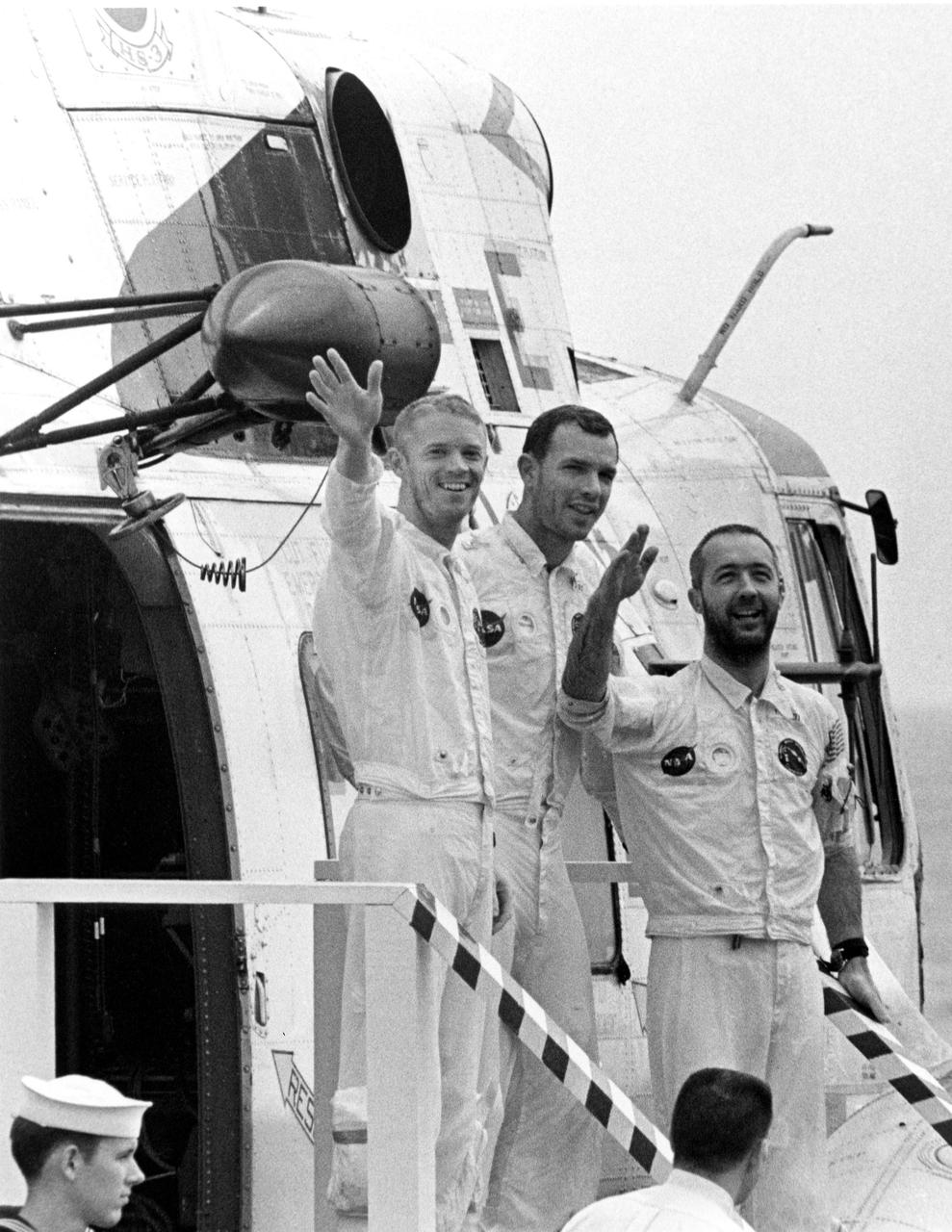
KENNEDY SPACE CENTER, FLA. -- One hour after their Apollo 9 spacecraft splashed down today in the Atlantic Ocean, waving astronauts, left to right, Russell L. Schweickart, David R. Scott and James A. McDivitt, descend stairway on to main deck of the USS Guadalcanal, prime recovery ship. The helicopter flew them from their impact point a short distance to the ship, originally positioned less than five miles from where they splashed down. The 10-day Earth orbital mission proved the feasibility of the lunar module for manned descent to the Moon's surface, scheduled to take place later this year. They wre launched March 3, 1969, from the Kennedy Space Center aboard an Apollo_Saturn V space vehicle. The National Aeronautics and Space Administration directs the Apollo program.
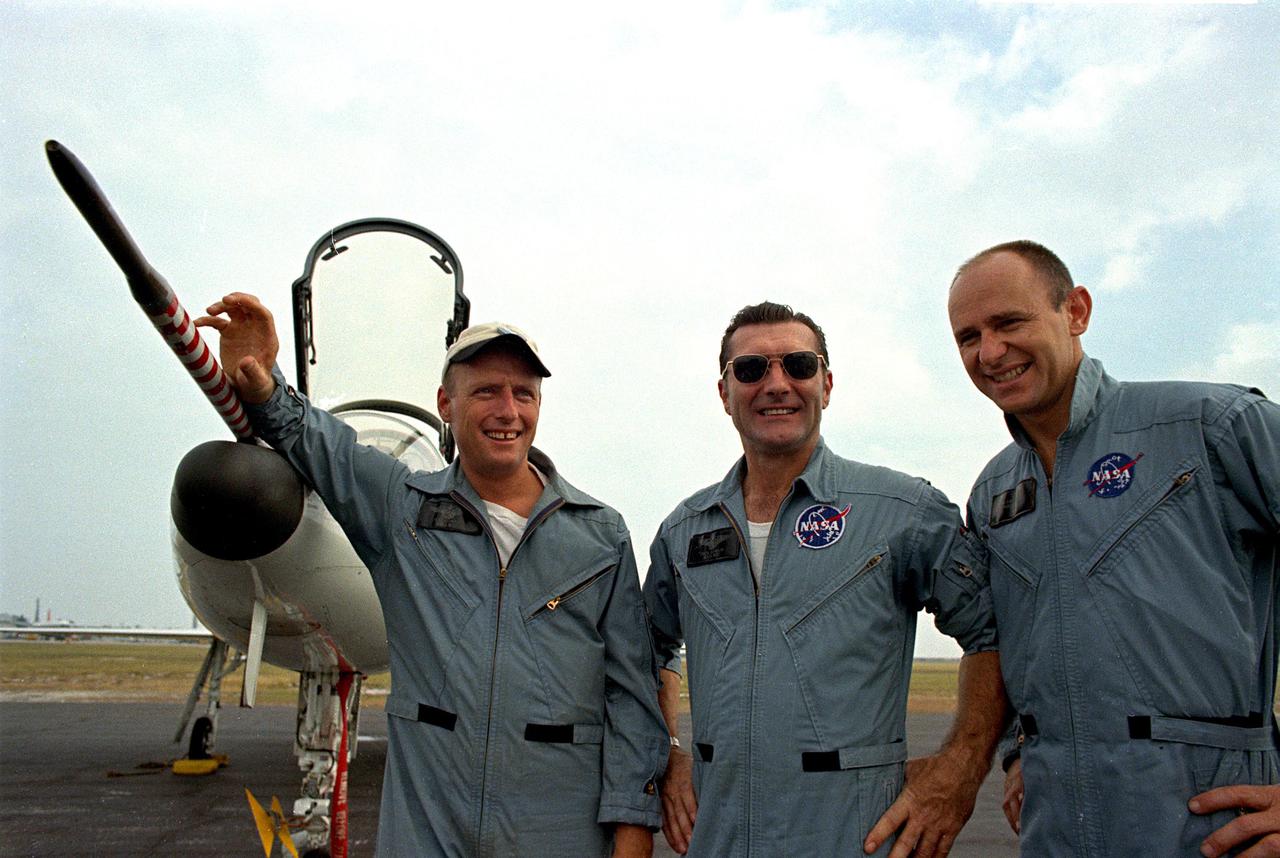
KENNEDY SPACE CENTER, FLA. - The Apollo 12 astronauts, left to right, Charles Conrad Jr., Richard F. Gordon, and Alan L. Bean, pose in front of a NASA T-38 training aircraft at Patrick Air Force Base. Eacht astronaut piloted his own T-38, performing aerobatics in preparation for their mission, the second manned lunar landing.
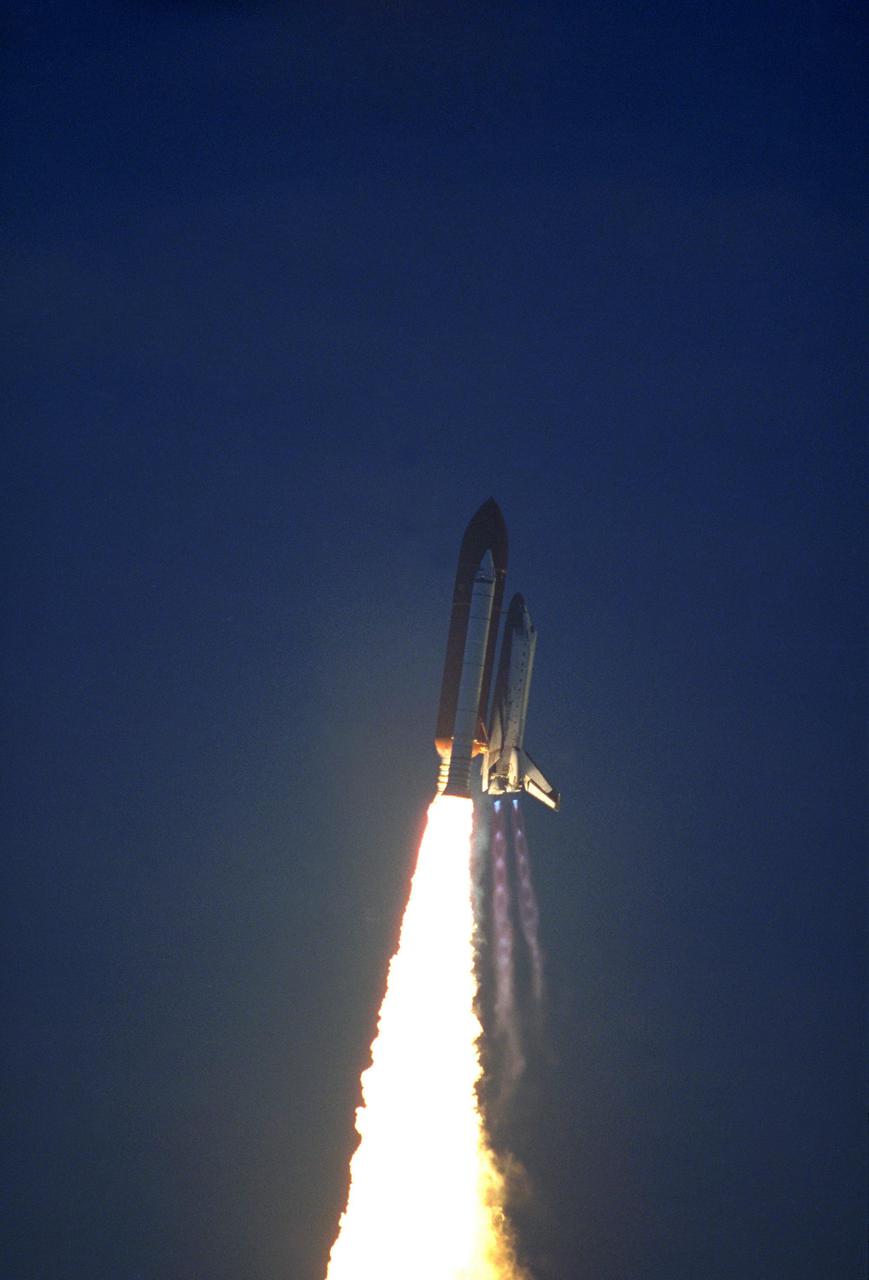
KENNEDY SPACE CENTER, FLA. -- STS-32R lifts off from Pad 39-A at 7:35 a.m. EST. Columbia is scheduled to deploy the Syncom IV-5 defense communications satellite and retrieve NASA's Long duration Exposure Facility (LDEF) during a 10-day mission, the longest Shuttle flight to date. The mission also includes a variety of experiments, including Protein Crystal Growth. This photo was taken from the Shuttle Training Aircraft.
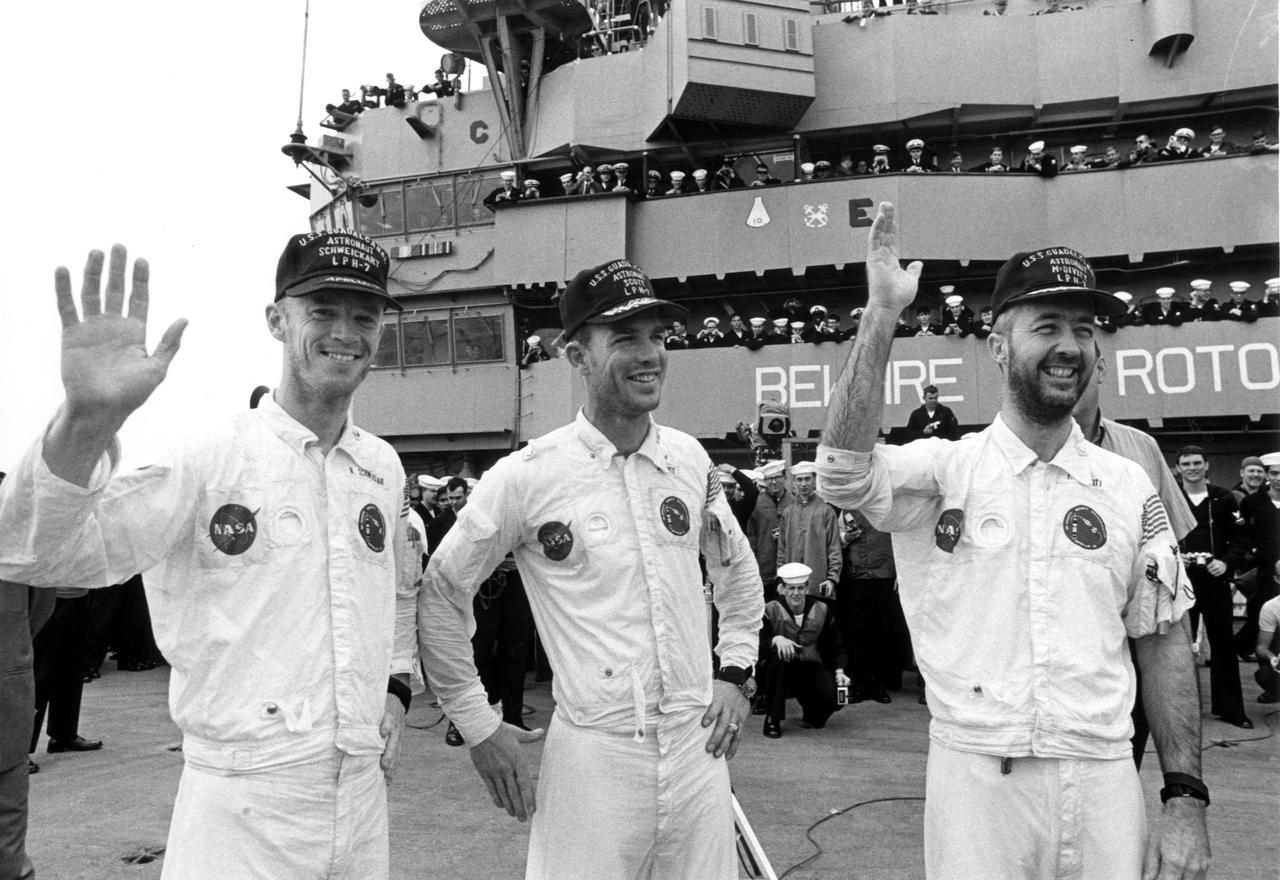
KENNEDY SPACE CENTER, FLA. -- Wearing flight caps presented to them by the crew of the USS Guadalcanal, bearded Apollo 9 astronauts (left to right) Russell L. Schweickart, David R. Scott and James A. McDivitt, wave to well-wishers aboard the recovery ship at the completion of their 10-day Earth orbital mission. Their spacecraft splashed down 780 nautical miles southeast of Cape Kennedy at 12:01 p.m. EST, March 13, 1969. During the textbook mission, the space pilots verified a lunar module spacecraft similar to the one that is to land Americans on the Moon later this year. Their flight began March 3 when they were launched by an Apollo_Saturn V rocket from the Kennedy Space Center. The National Aeronautics and Space Administration directs the Apollo program.
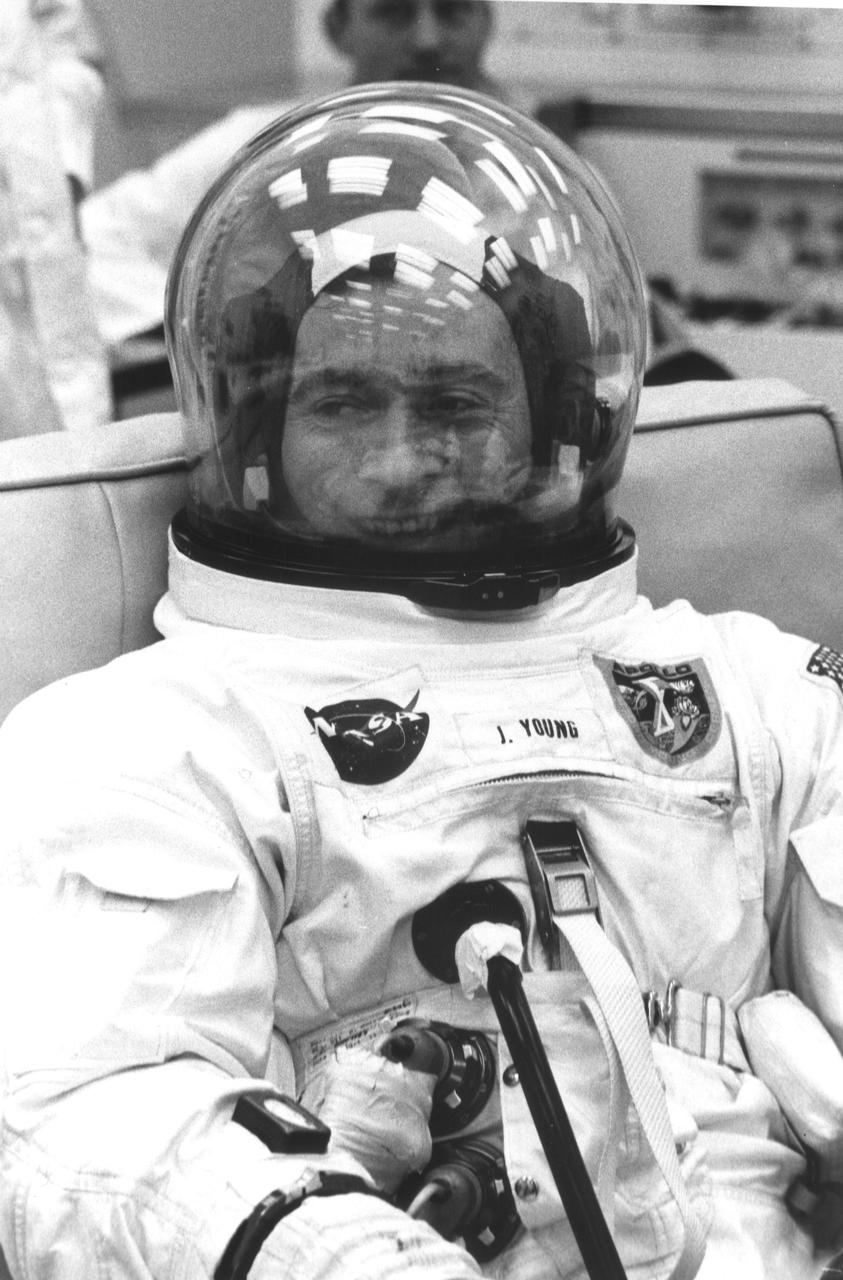
KENNEDY SPACE CENTER, FLA. -- Astronaut John W. Young suits up for the Apollo 10 Countdown Demonstration Test (CDDT) which ended successfully at 1:01 p.m. today, clearing the way for a May 18 launch. Young, command module pilot, will keep lonely vigil in lunar orbit while Thomas P. Stafford, commander, and Eugene A. Cernan, lunar module pilot, drop to within 10 miles of the Moon in the lunar module before returning to the parent spacecraft.

CAPE CANAVERAL, Fla. -- Astronaut M. Scott Carpenter assists astronaut John H. Glenn Jr. with equipment adjustments during MA-6 activities. Photo credit: NASA
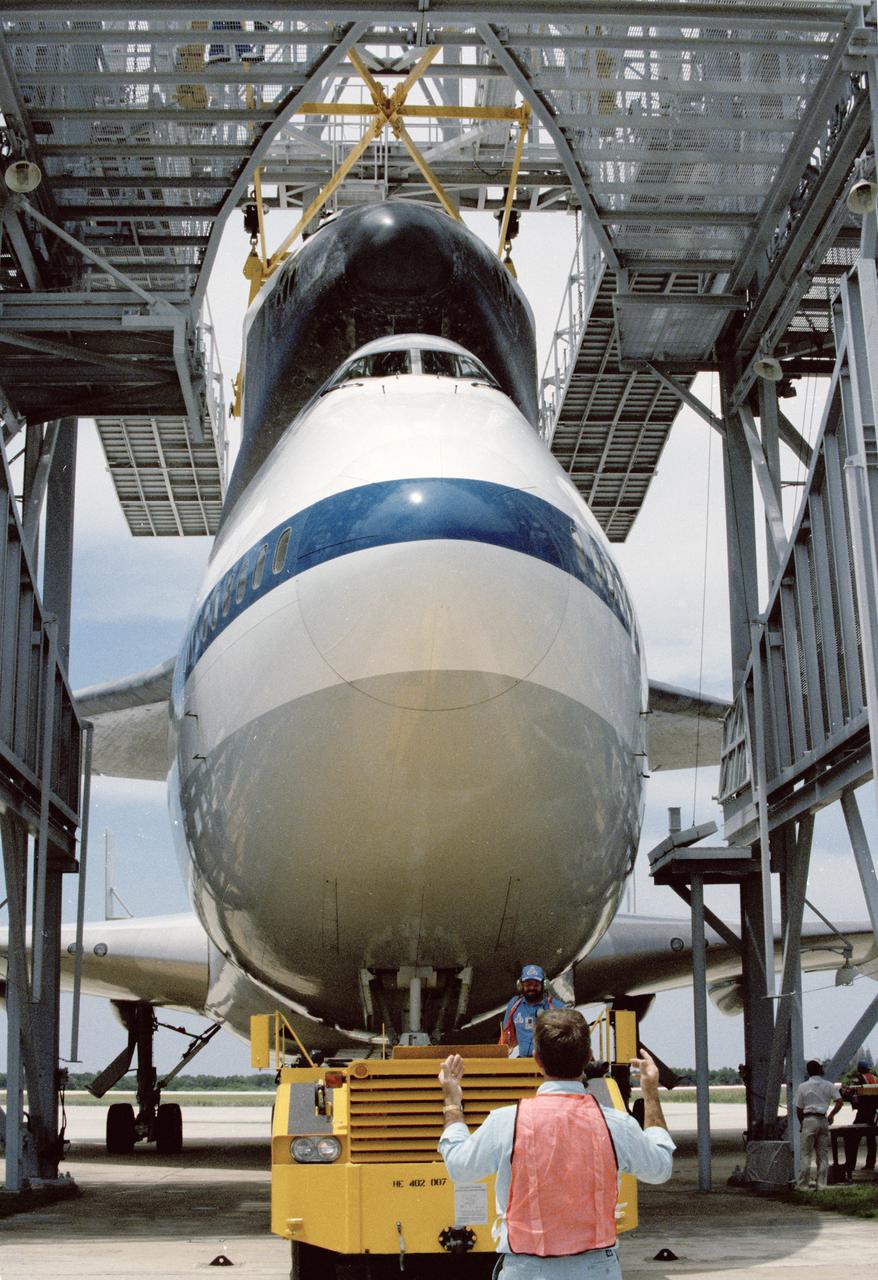
CAPE CANAVERAL, Fla. -- Space shuttle mission STS-31 comes full circle as the orbiter Discovery returns to KSC atop the shuttle carrier aircraft. Coaxing the duo into the mate_demate device at the SLF are John Goleno, driving the towing vehicle, and directing him, Peter Seidel. Photo credit: NASA
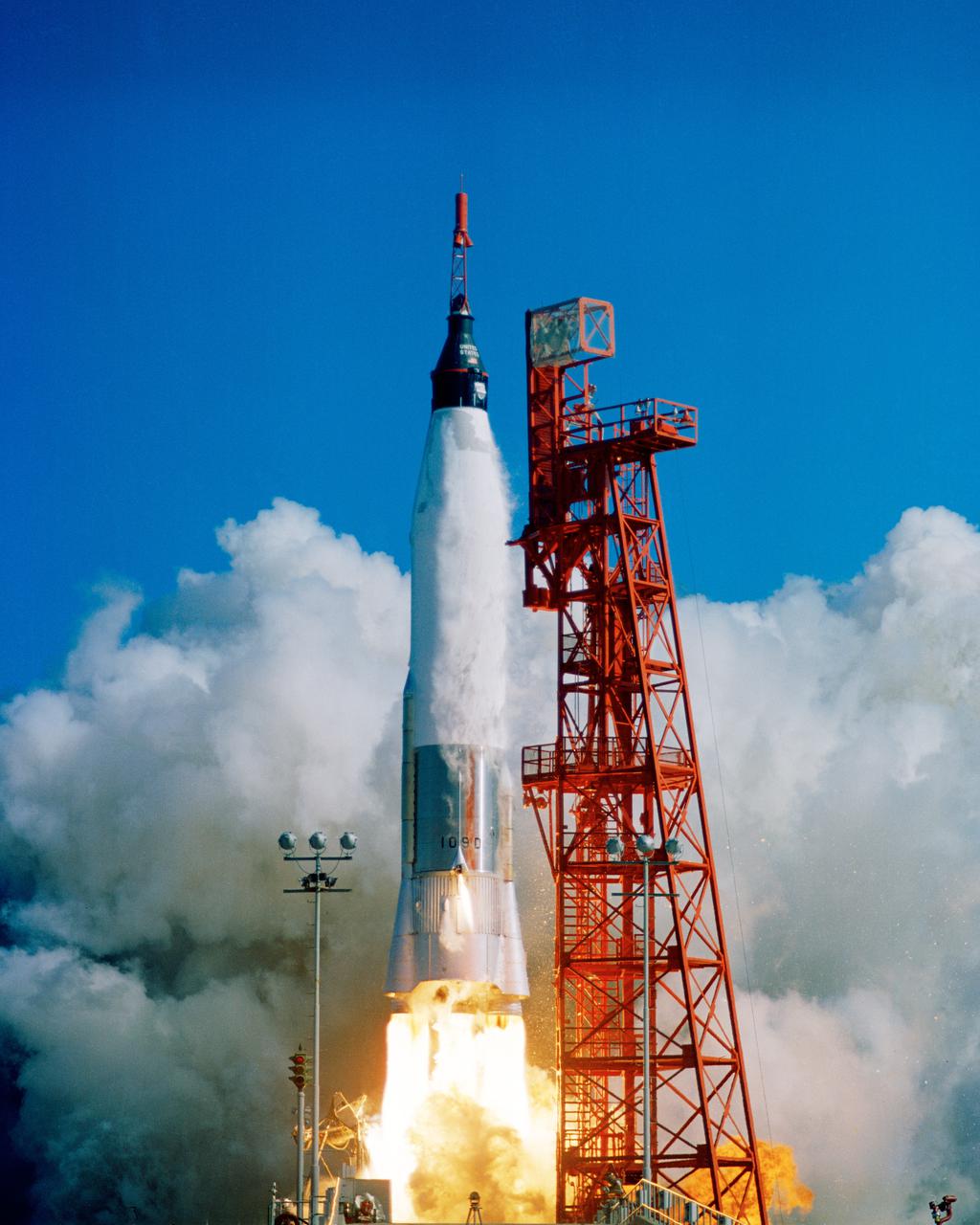
CAPE CANAVERAL, Fla. -- Launch of Friendship 7, the first manned orbital space flight. Astronaut John Glenn aboard, the Mercury-Atlas rocket is launched from Pad 14. Photo credit: NASA
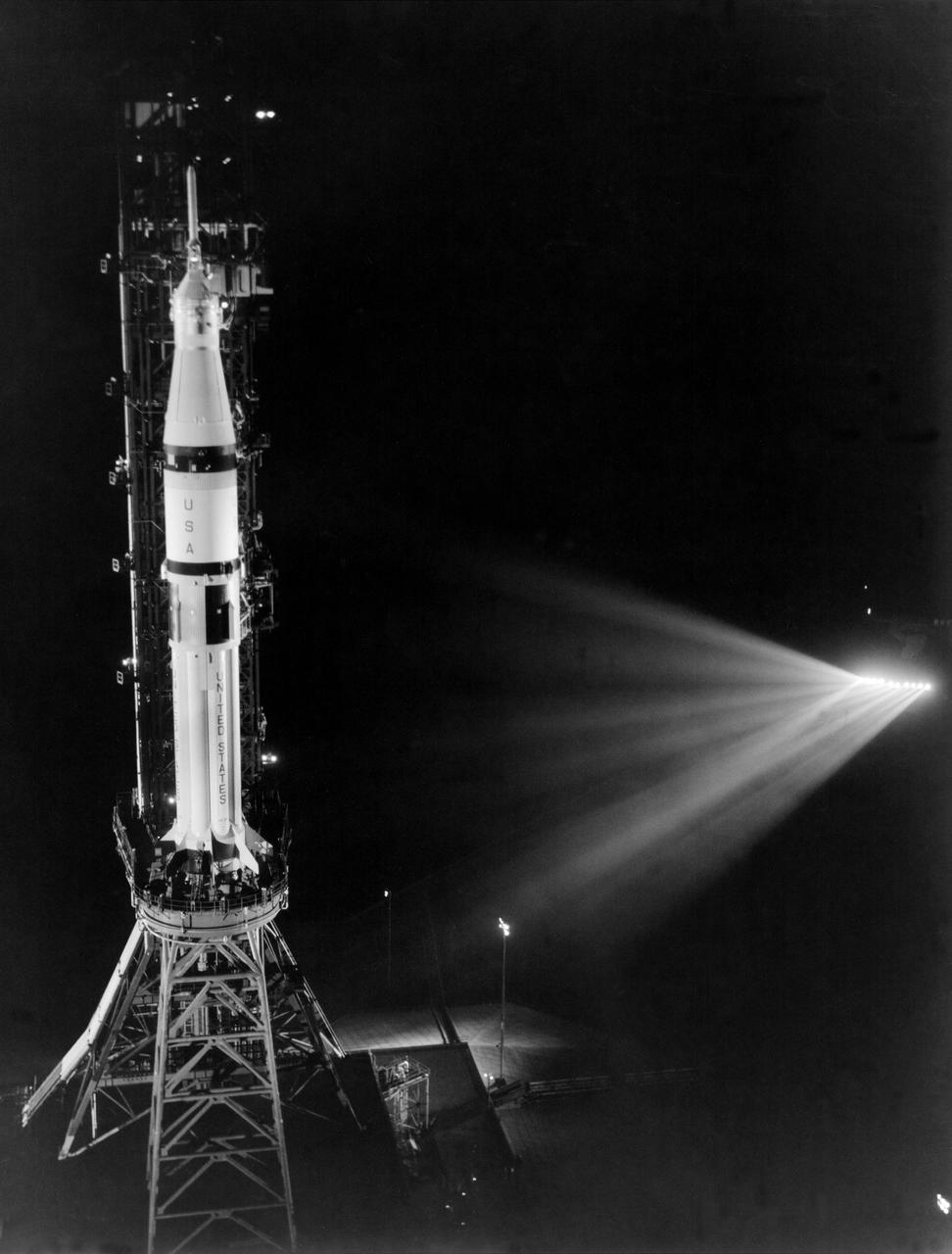
KENNEDY SPACE CENTER, FLA. -- As seen from the Mobile Service Structure as it is being rolled back to its park site, the ASTP Saturn IB launch vehicle sits on its pedestal during the Countdown Demonstration Test. The test is a step-by-step dress rehearsal for the July 15 mission, which culminates with a simulated T-zero and launch with the stages of the rocket fueled as they will be on launch day. Following the simulated launch, the propellants will be offloaded. The terminal portion of the test will be repeated tomorrow with the ASTP astronauts Thomas Stafford, Vance Brand and Donald Slayton aboard the spacecraft.
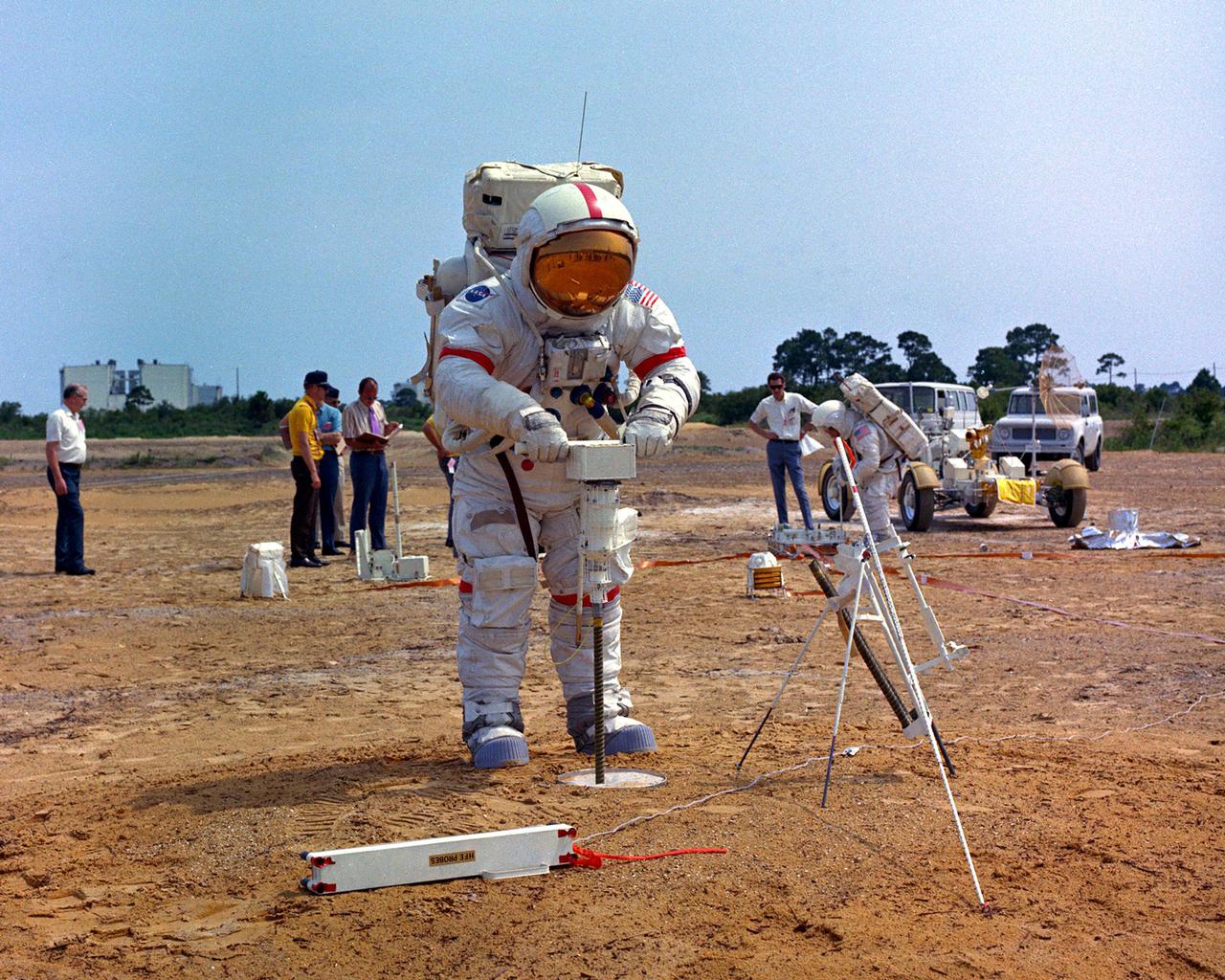
KENNEDY SPACE CENTER, FLA. - Apollo 15 Commander David R. Scott operates the battery-powered Lunar Surface Drill during a training exercise at a man-made replica of the Moon's Hadley-Apennine region at the Kennedy Space Center. During his upcoming mission, scheduled to begin no earlier than July 26, 1971, Scott will drill to a depth of about 10 feet to obtain lunar surface core samples and conduct the Heat Flow Experiment. This experiment is designed to measure the rate of heat loss from the interior of the Moon. Lunar Module Pilot James B. Irwin will accompany Scott on the surface while Astronaut Alfred M. Worden will pilot the Command Module while in lunar orbit.
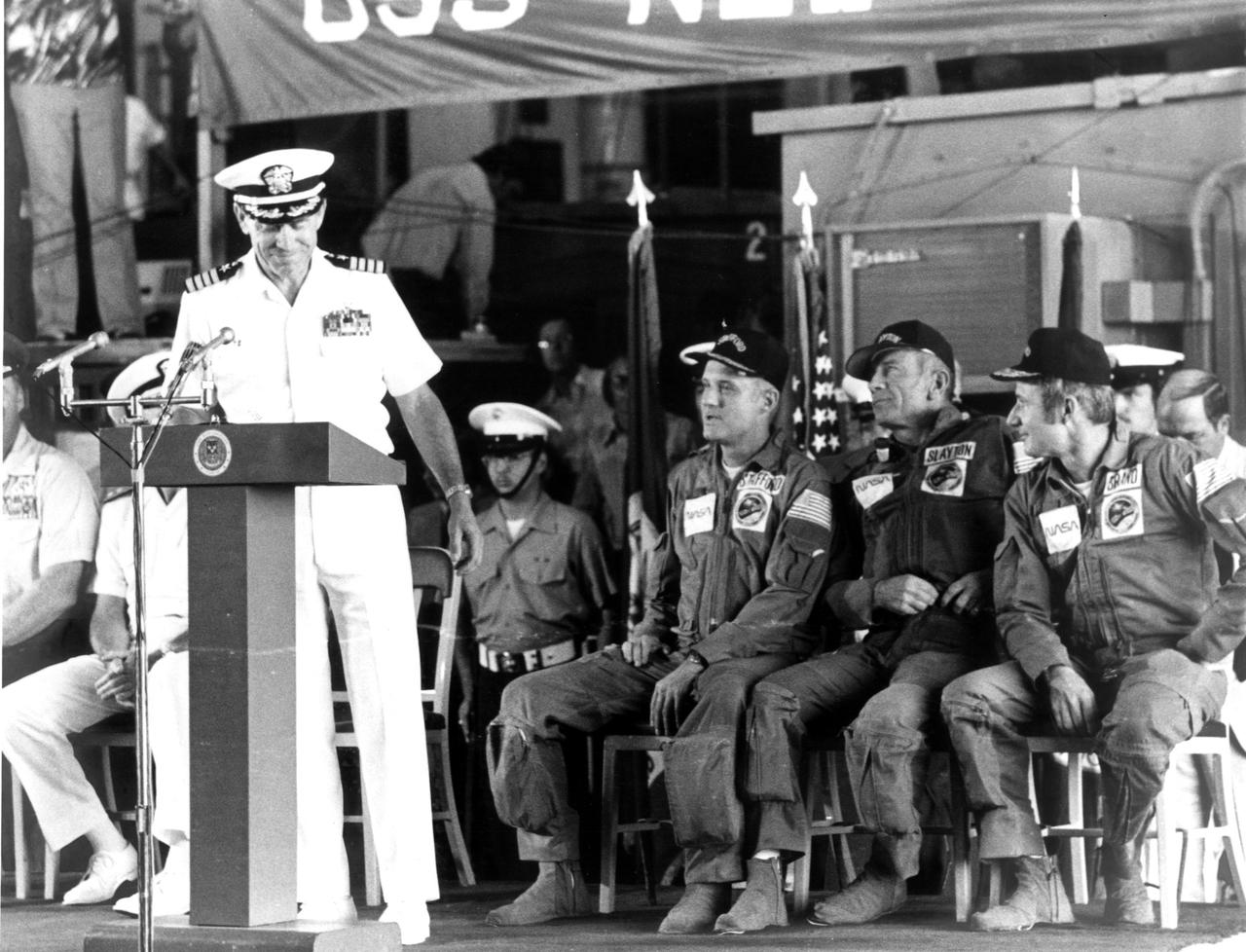
KENNEDY SPACE CENTER, FLA. -- The Commanding Officer of the USS New Orleans, Captain Ralph E. Neiger, welcomes aboard ASTP astronauts Thomas Stafford, Donald Slayton and Vance Brand. The astronauts splashed down in the Pacific Ocean west of Hawaii at 5:18 p.m. today, ending the nine-day ASTP mission. Themission was highlighted by the rendezvous and docking with a Soviet Soyuz spacecraft in Earth orbit.
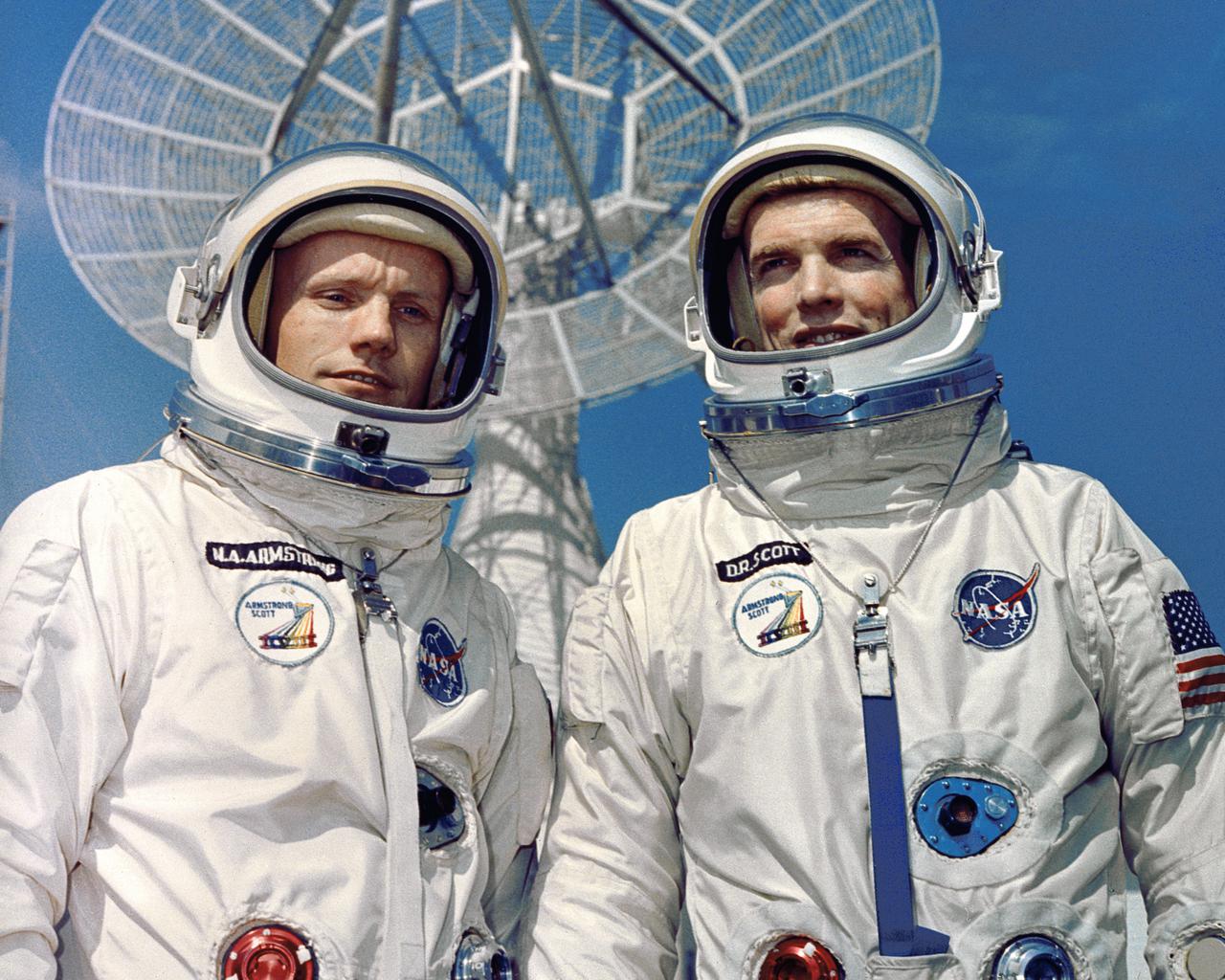
CAPE CANAVERAL, Fla. – Gemini 8 astronauts Neil A. Armstrong, command pilot, and David R. Scott, pilot, during a photosSession for the press outside Mission Control Center, Cape Kennedy. Photo credit: NASA
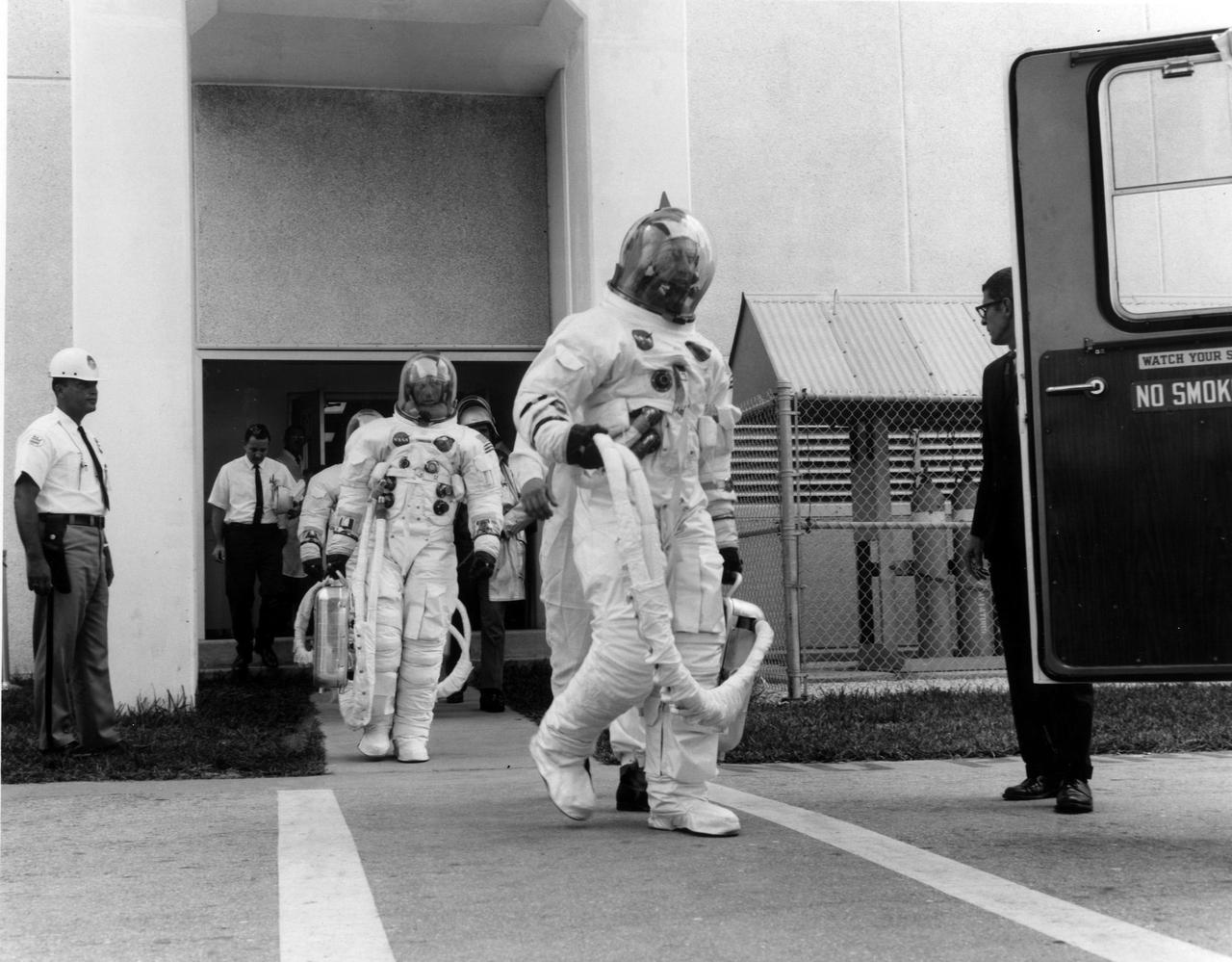
KENNEDY SPACE CENTER, FLA. -- Apollo 7 prime crew members, front to back, Donn F. Eisele, Walter M. Schirra Jr. and Walter Cunningham, leave the Kennedy Space Center's Manned Spacecraft Operations Building for a 20-minute ride in a transfer van to Cape Kennedy's Launch Complex 34, where they participated in a Space Vehicle Emergency Egress Test. The trio will pilot the National Aeronautics and Space Administration's first manned Apollo mission.
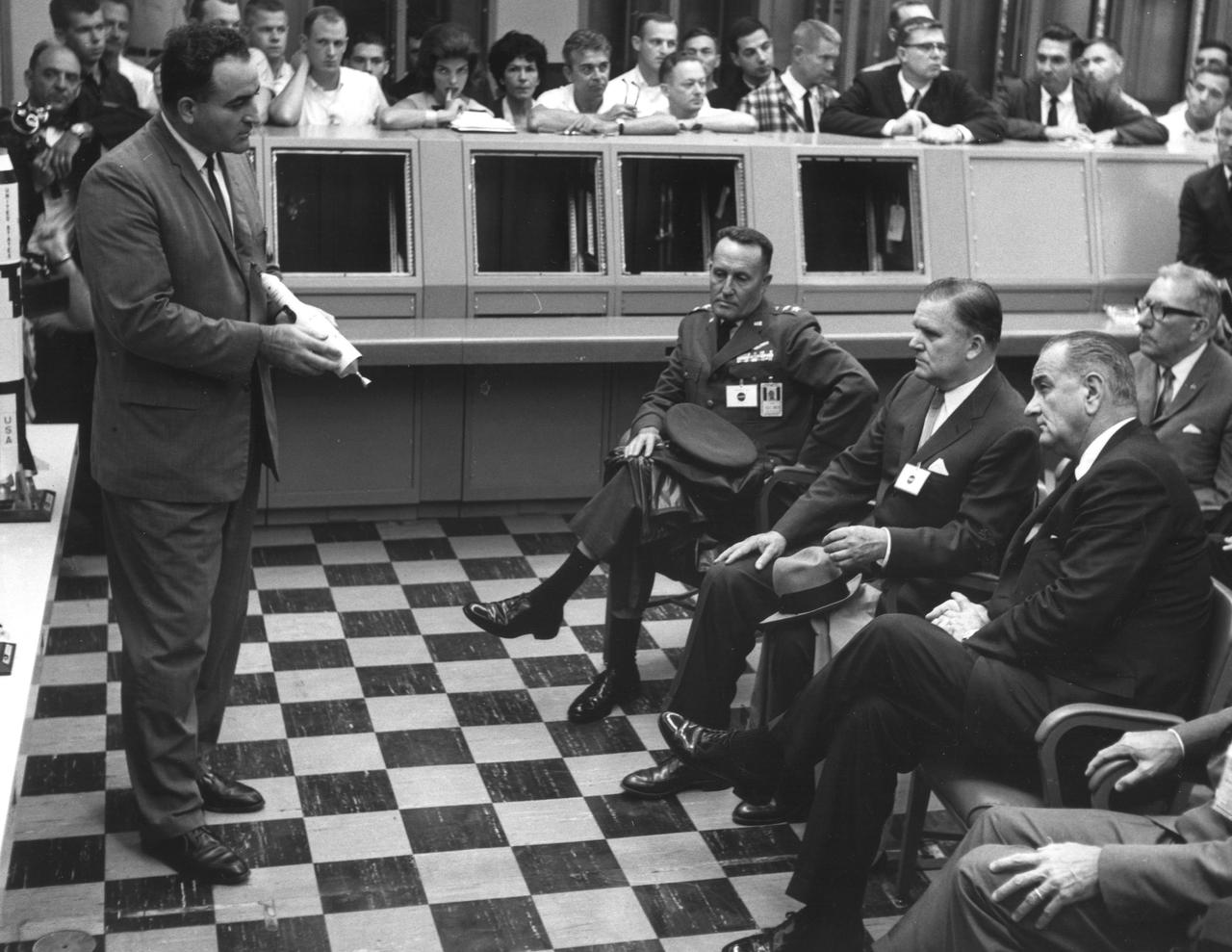
KENNEDY SPACE CENTER, FLA. -- President Lyndon B. Johnson (seated at right), NASA Administrator James T. Webb (seated, center) and Major General Vincent G. Huston (seated, left), commander, Air Force Eastern Test Range, are briefed by Rocco A. Petrone (left), director of Kennedy Space Center Launch Operations, during the Sept. 15, 1964 visit.
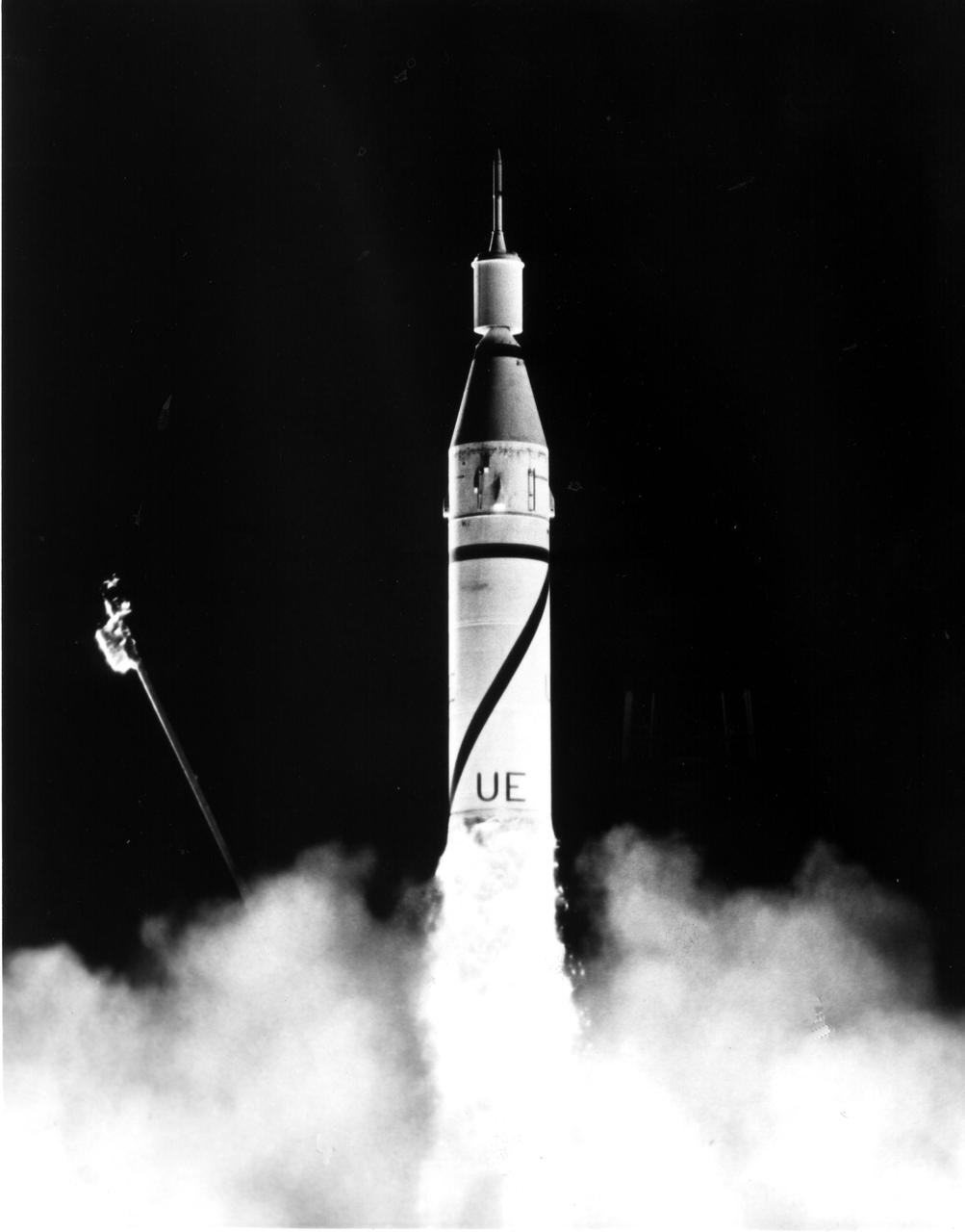
KENNEDY SPACE CENTER, FLA. -- Explorer I launched Jan. 31, 1958.
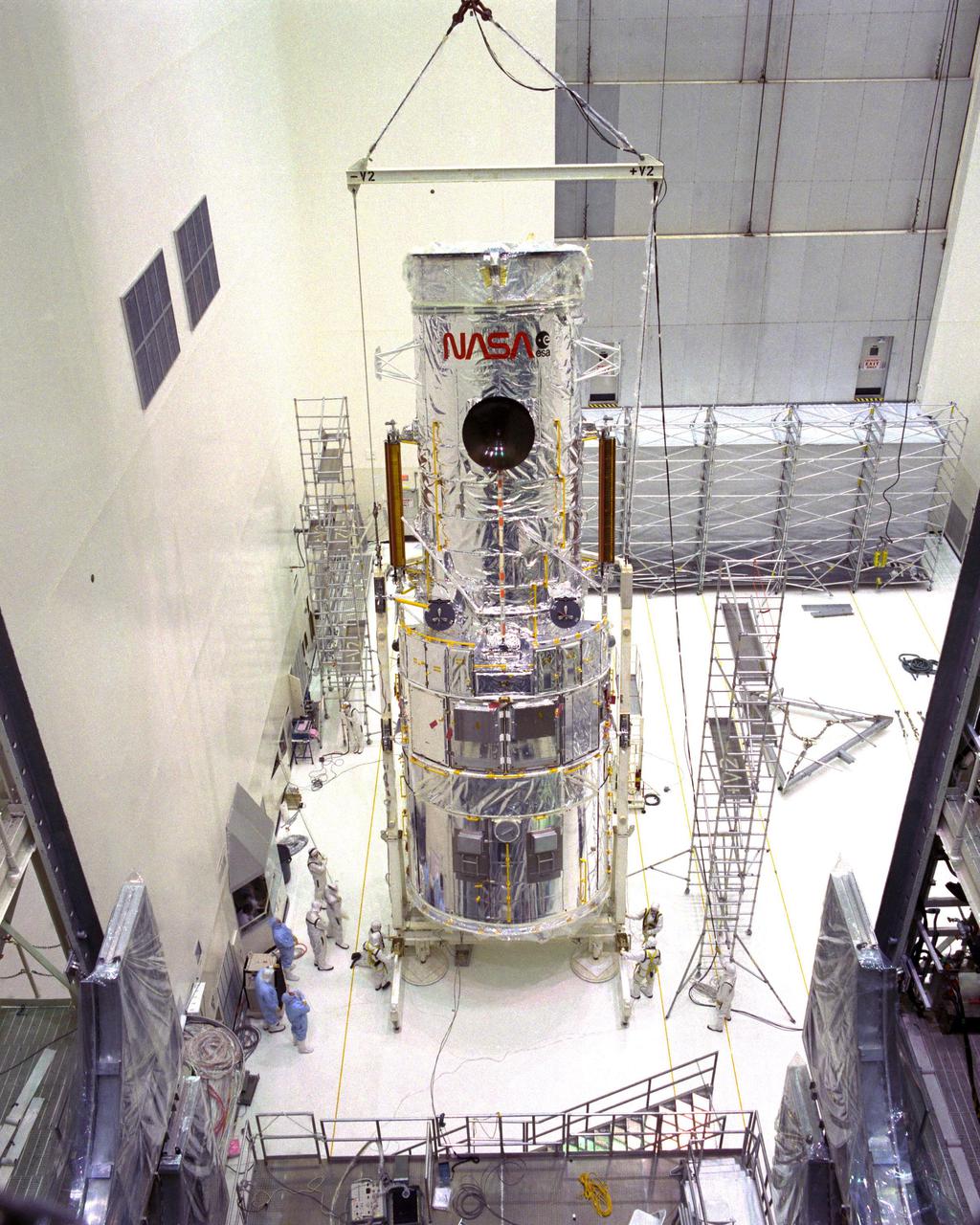
CAPE CANAVERAL, Fla. -- At the Kennedy Space Center in Florida, the Hubble Space Telescope is lifted into the vertical position in the Vertical Processing Facility as work begins to process the 94-inch primary mirror telescope for launch on the Discovery on STS-31 in March 1990. With Hubble, astronomers will be able to view 97 percent of the known universe, and will be able to get pictures unlimited and undistorted by the Earth’s atmosphere. Compared with Earth-based observatories, Hubble will be able to view celestial objects that are 50 times fainter, provide images that are 10 times sharper, and see objects that are seven times further away. Photo Credit: NASA
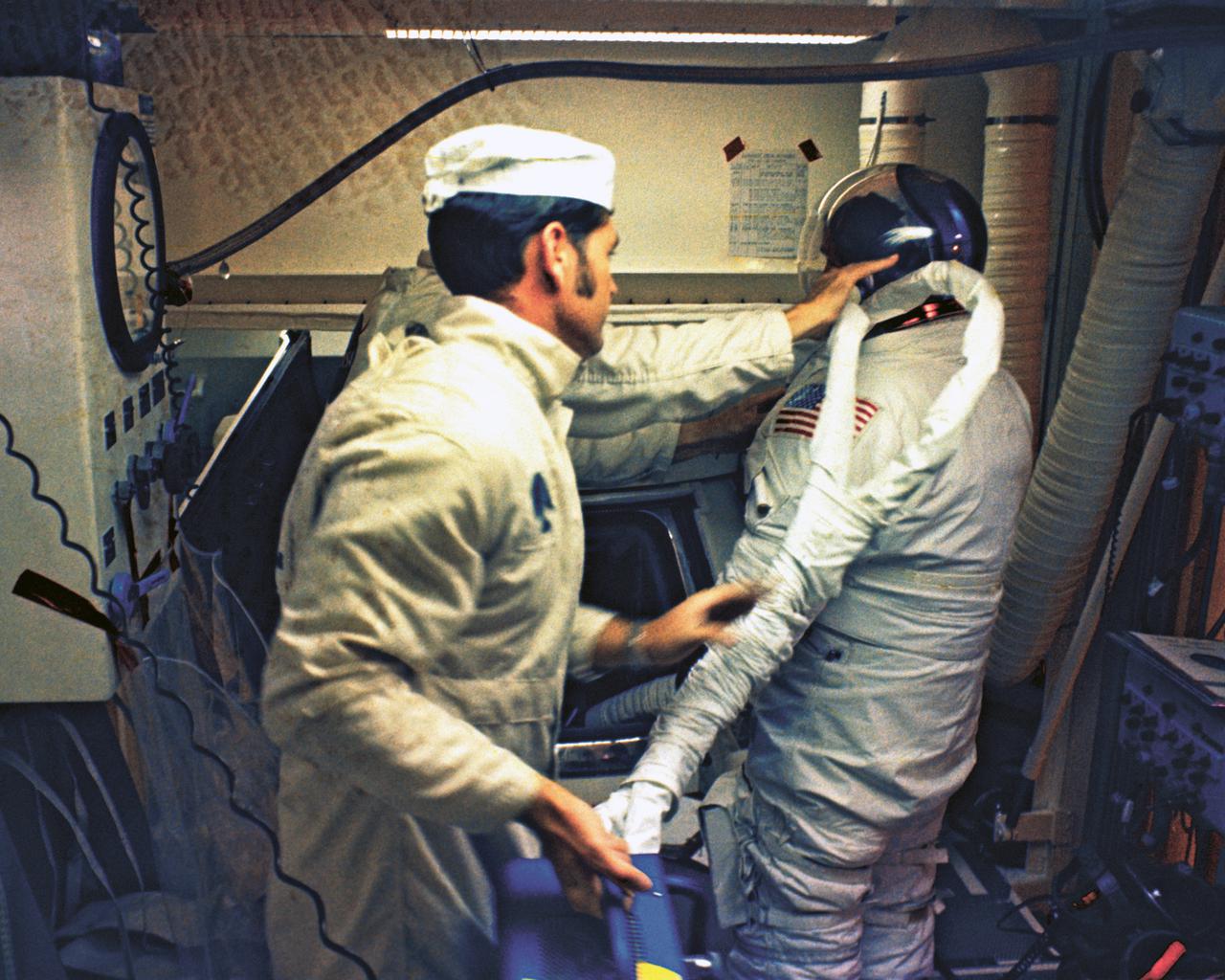
CAPE CANAVERAL, Fla. – The Apollo 15 crew climbs inside the Apollo capsule on launch day before lifting off on a mission to the moon. Photo credit: NASA
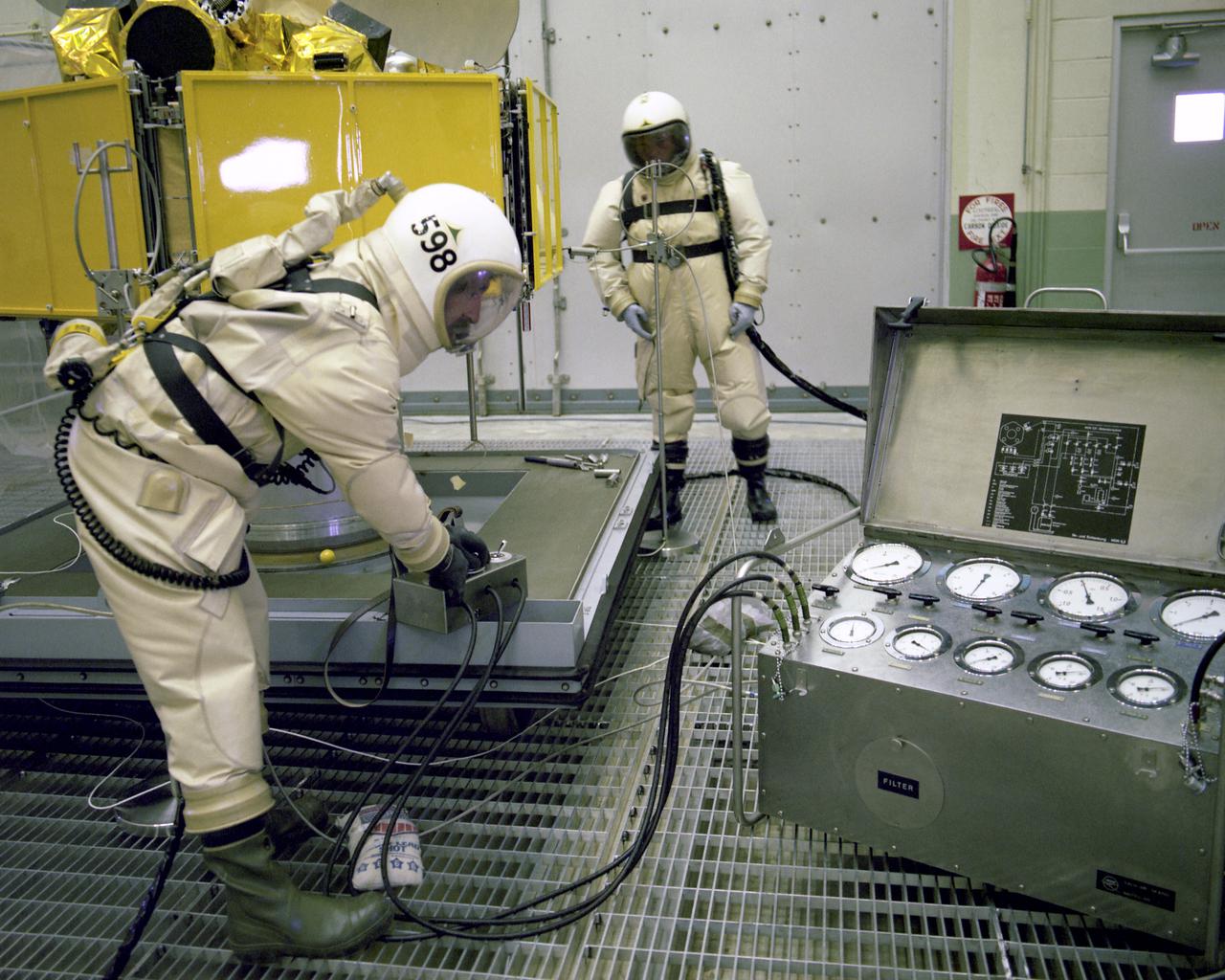
CAPE CANAVERAL, Fla. -- Technicians in protective suits loaded the Symphonie-B spacecraft with propellants in the Spin Test Facility at Cape Canaveral Air Force Station today. The French-West German experimental communications satellite is to be launched by KSC's Unmanned Launch Operations Directorate aboard a Delta rocket from Complex 17 in late August or early September. The satellite will be placed in a synchronous orbit 22,300 miles above the equator south of the West African 'Bulge,' joining Symphonie-1 in handling communications between ground stations in Europe, South America, portions of North America and the Mideast. Photo credit: NASA Photo credit: NASA
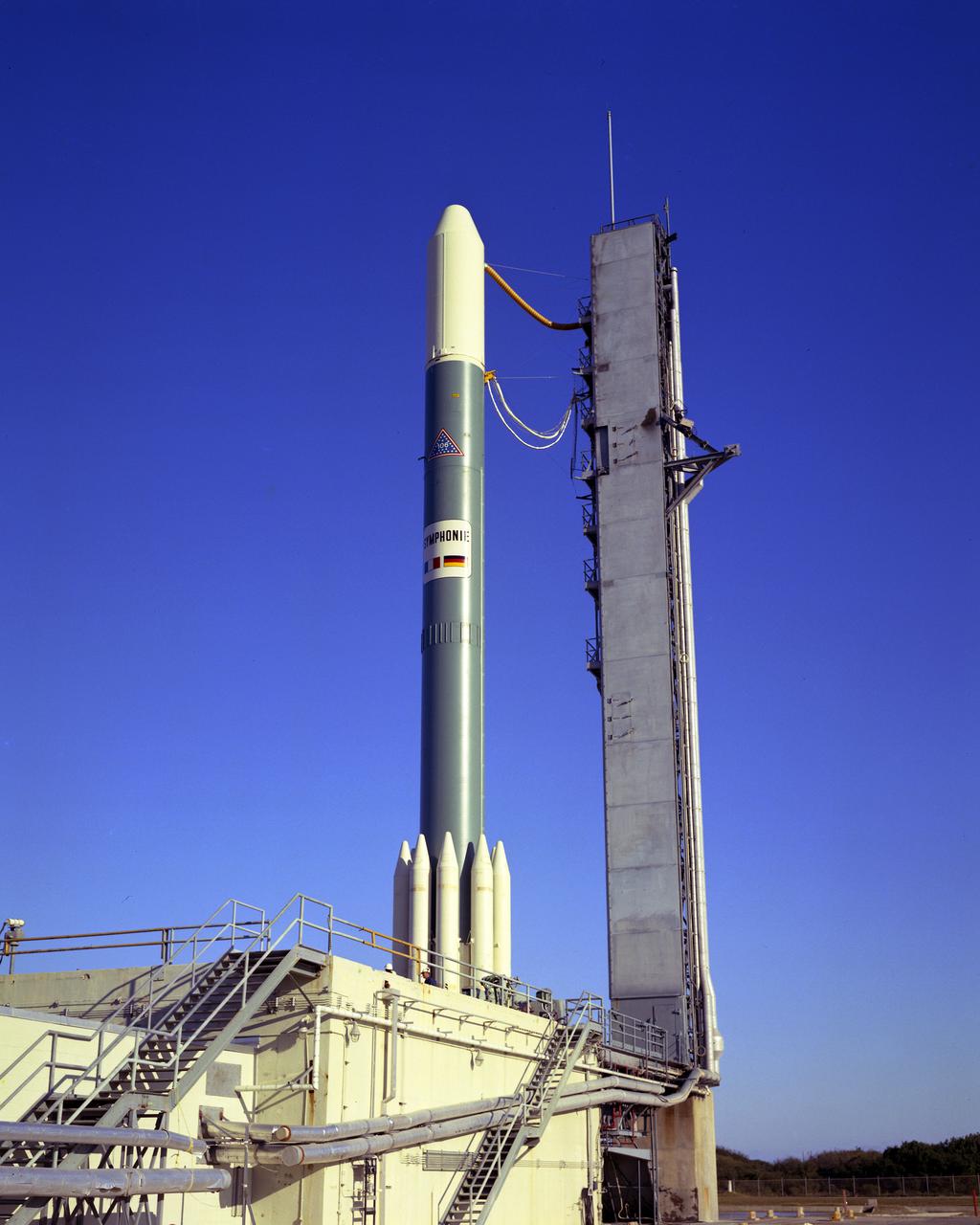
CAPE CANAVERAL, Fla. -- Prelaunch of Symphonie-A on Complex 17-B, a communications satellite for Franco-German industrial consortium. Photo credit: NASA
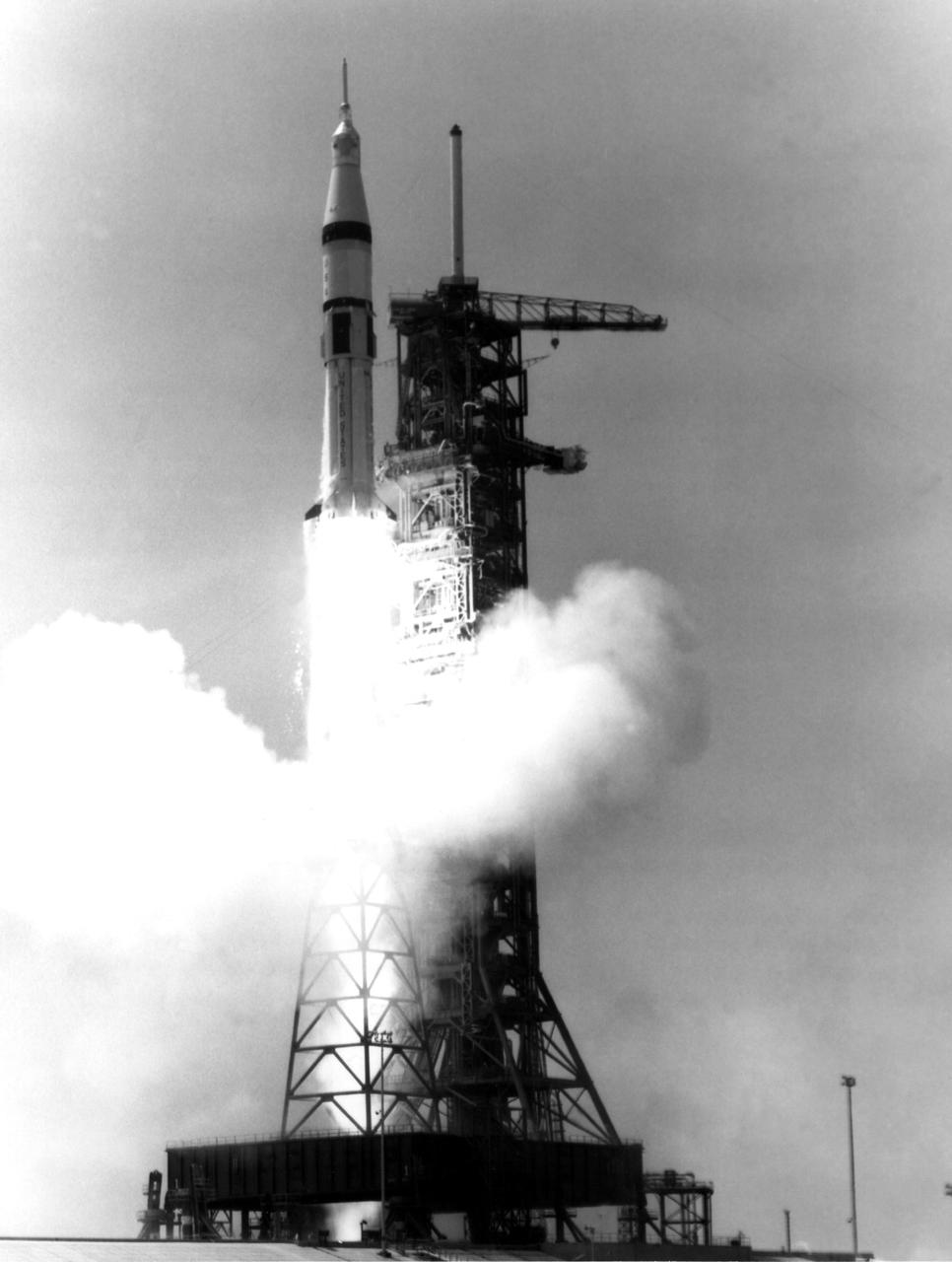
KENNEDY SPACE CENTER, FLA. -- The Apollo Soyuz Test Project Saturn IB launch vehicle thundered away from KSC's Launch Complex 39B at 3:50 p.m. today. Aboard the Apollo Command Module were ASTP astronauts Thomas Stafford, Vance Brand and Donald Slayton. The astronauts will rendezvous and dock with a Soyuz spacecraft, launched this morning from the Baykonur launch facility in the Soviet Union, carrying Soviet cosmonauts Aleksey Leonov and Valeriy Kubasov. The ASTP launches mark the first time that manned spacecraft of two nations have met in space for joint engineering and scientific investigations.

CAPE CANAVERAL, Fla. – The Apollo 13 crew walks to the launch pad on April 11, 1970, for launch on their mission. Photo credit: NASA
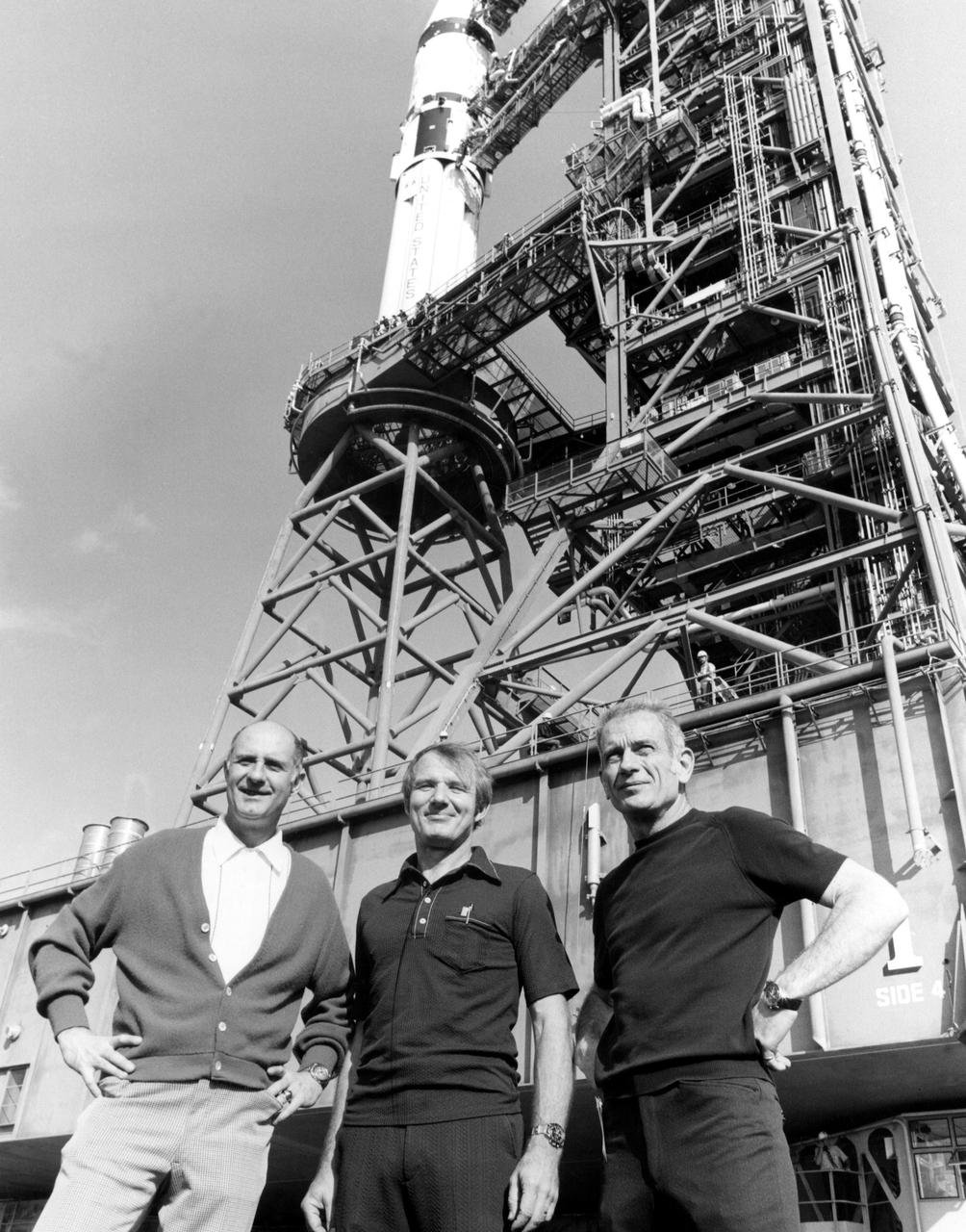
KENNEDY SPACE CENTER, FLA. -- U.S. astronauts Thomas Stafford (left), Vance Brand (center) and Donald Slayton pose in front of their Apollo Soyuz Test Project space vehicle during rollout ceremonies at KSC. The 224-foot-tall Saturn IB launch vehicle began its five-mile journey from the Vehicle Assembly Building to Complex 39's Pad at 8 a.m. The ASTP launch is scheduled for 3:50 p.m. EDT on July 15. During the mission the U.S. Apollo spacecraft will rendezvous and dock with the Soviet Soyuz spacecraft. It will be history's first international manned space flight.
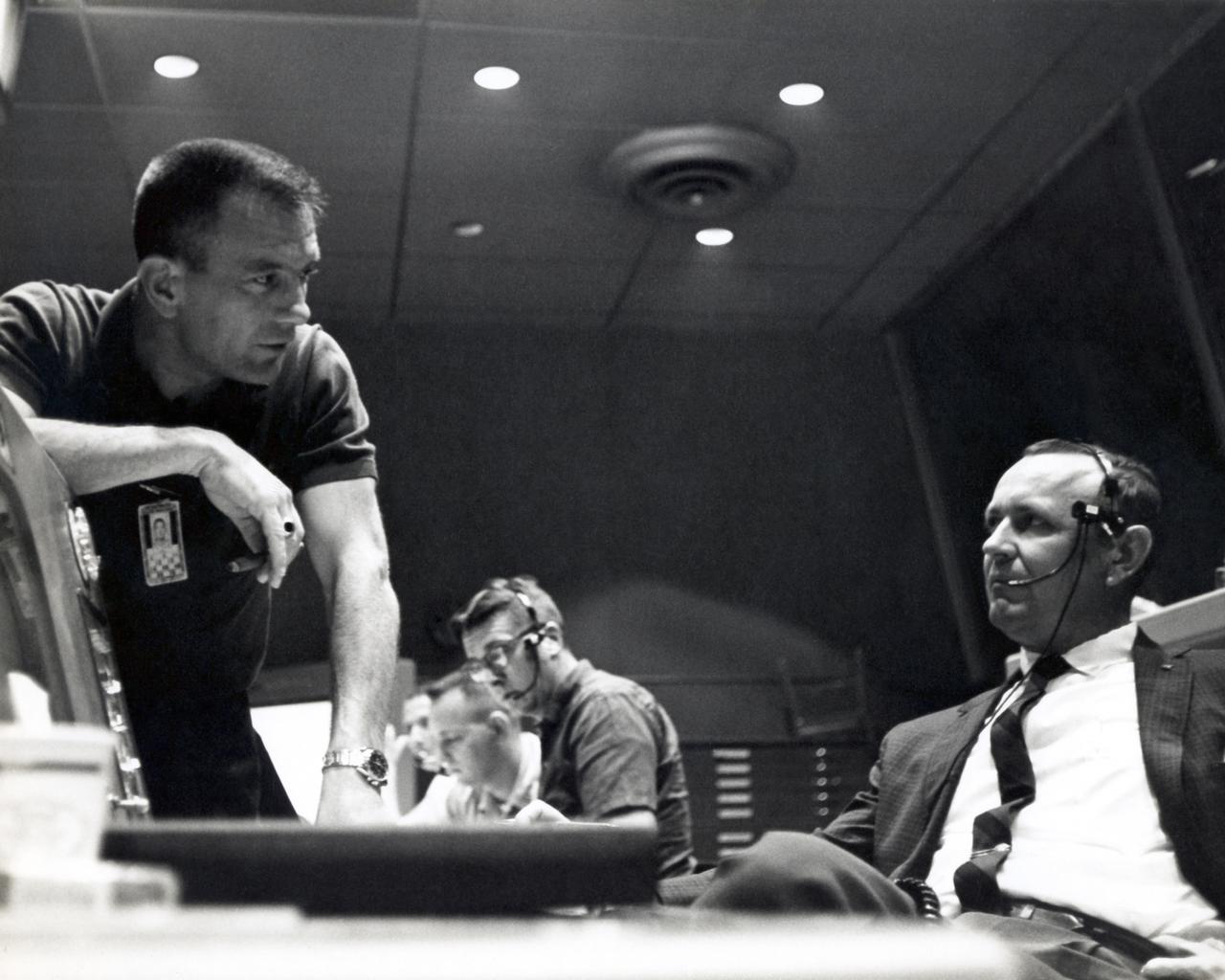
CAPE CANAVERAL, Fla. - Inside Mercury Mission Control, astronaut Deke Slayton left discusses a point with Christopher Kraft, Mercury's flight director, during preparations for astronaut Gordon Cooper's Faith 7 launch, which took place on May 15, 1963. The Mercury Mission Control Center in Florida played a key role in the United States' early spaceflight program. Located at Cape Canaveral Air Force Station, the original part of the building was constructed between 1956 and 1958, with additions in 1959 and 1963. The facility officially was transferred to NASA on Dec. 26, 1963, and served as mission control during all the Project Mercury missions, as well as the first three flights of the Gemini Program, when it was renamed Mission Control Center. With its operational days behind, on June 1, 1967, the Mission Control Center became a stop on the public tour of NASA facilities until the mid-90s. In 1999, much of the equipment and furnishings from the Flight Control Area were moved to the Kennedy Space Center Visitor Complex where they became part of the exhibit there. The building was demolished in spring 2010. Photo credit: NASA
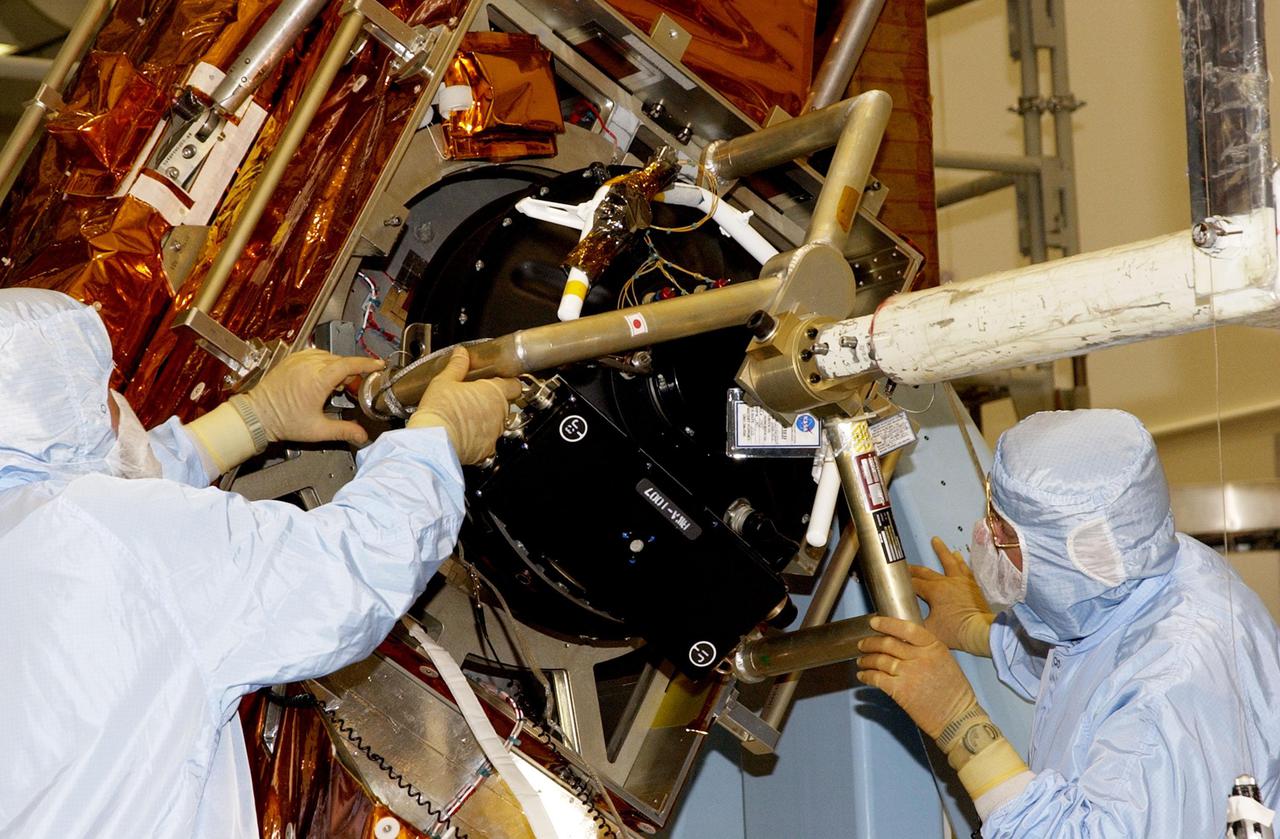
KENNEDY SPACE CENTER, FLA. - Workers in the Vertical Processing Facility check the position of the Hubble Space Telescope's replacement Reaction Wheel Actuator on the Large Orbital Protective Enclosure (LOPE), which is contained in the Multi-Use Lightweight Equipment (MULE) for flight. Part of Hubble's Pointing Control System, the actuators receiving information from sensors and physically adjust Hubble's position and orientation so that Hubble can view the required celestial bodies. The reaction wheels work by rotating a large flywheel up to 3000 rpm or braking it to exchange momentum with the spacecraft which will make Hubble turn. The RWA is part of the payload on mission STS-109, the Hubble Servicing Mission, scheduled to launch Feb. 28, 2002
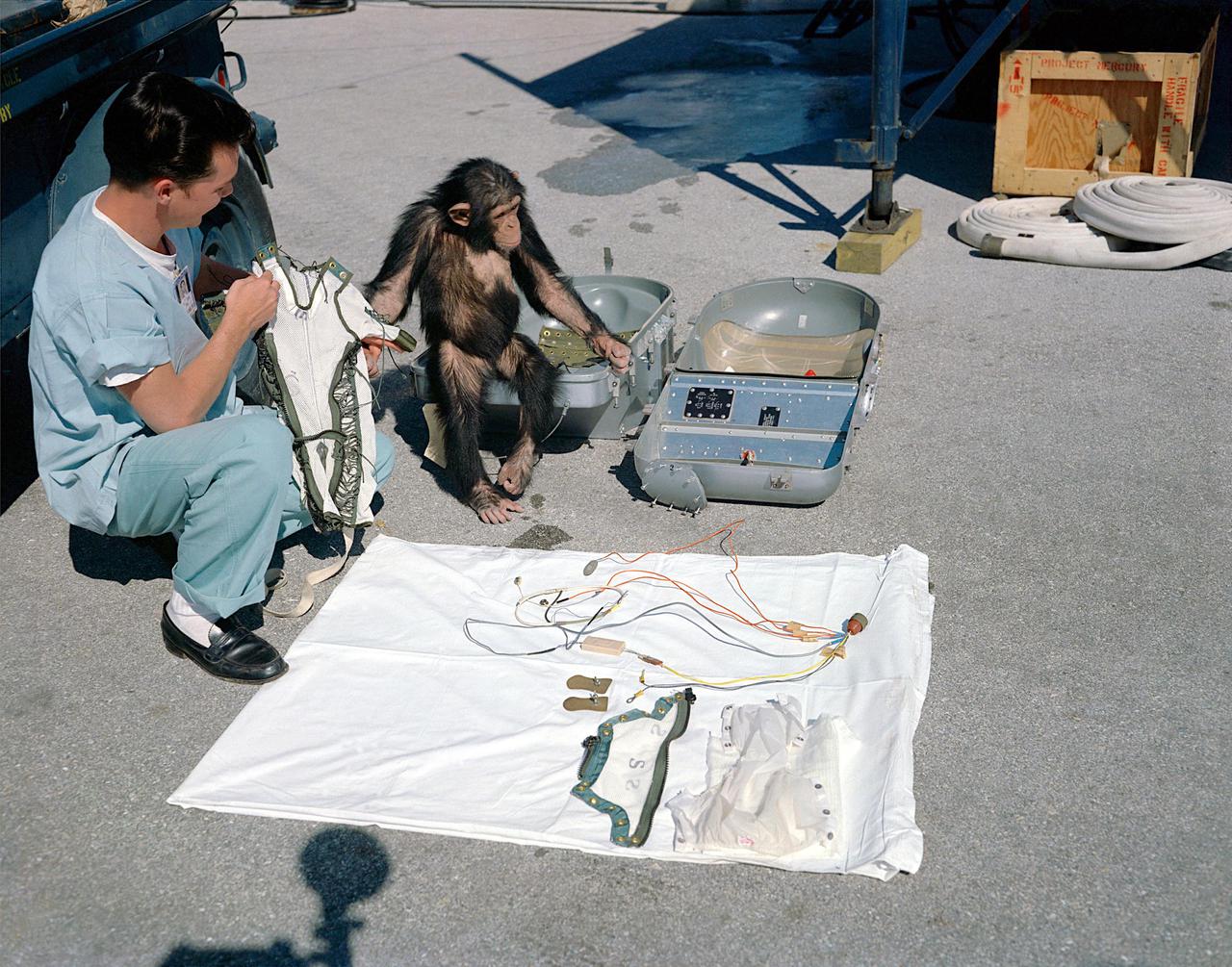
KENNEDY SPACE CENTER, FLA. - The chimp Ham (primate #65) and a technician goes over the equipment in Hangar S that is going to be used for Ham's suborbital flight. Ham is scheduled to be launched aboard a Mercury-Redstone 2 from Launch Pad 5 on January 31, 1961.
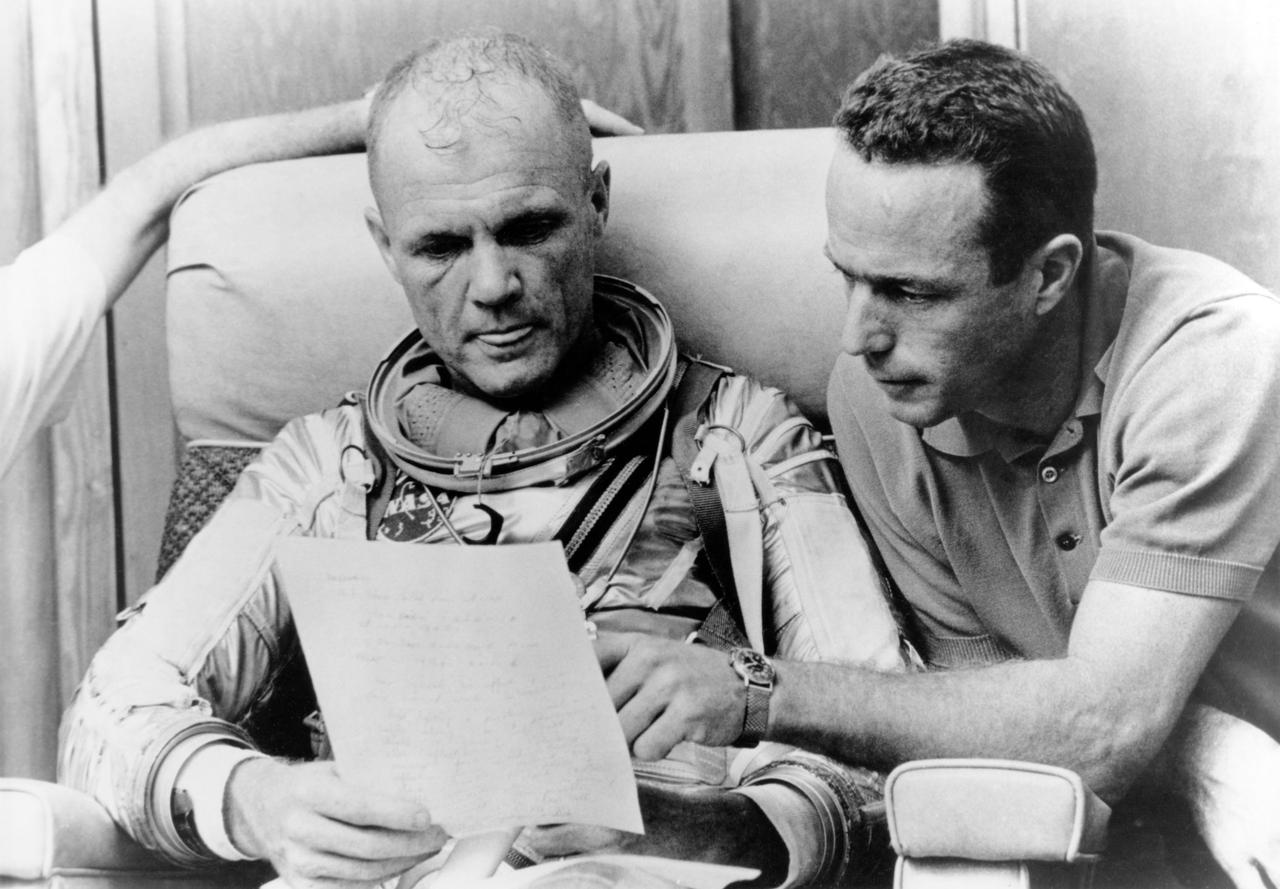
CAPE CANAVERAL, Fla. --Prime astronaut John Glenn and backup pilot Scott Carpenter check over notes after a simulated flight prior to the Mercury-Atlas 6 mission. Photo credit: NASA
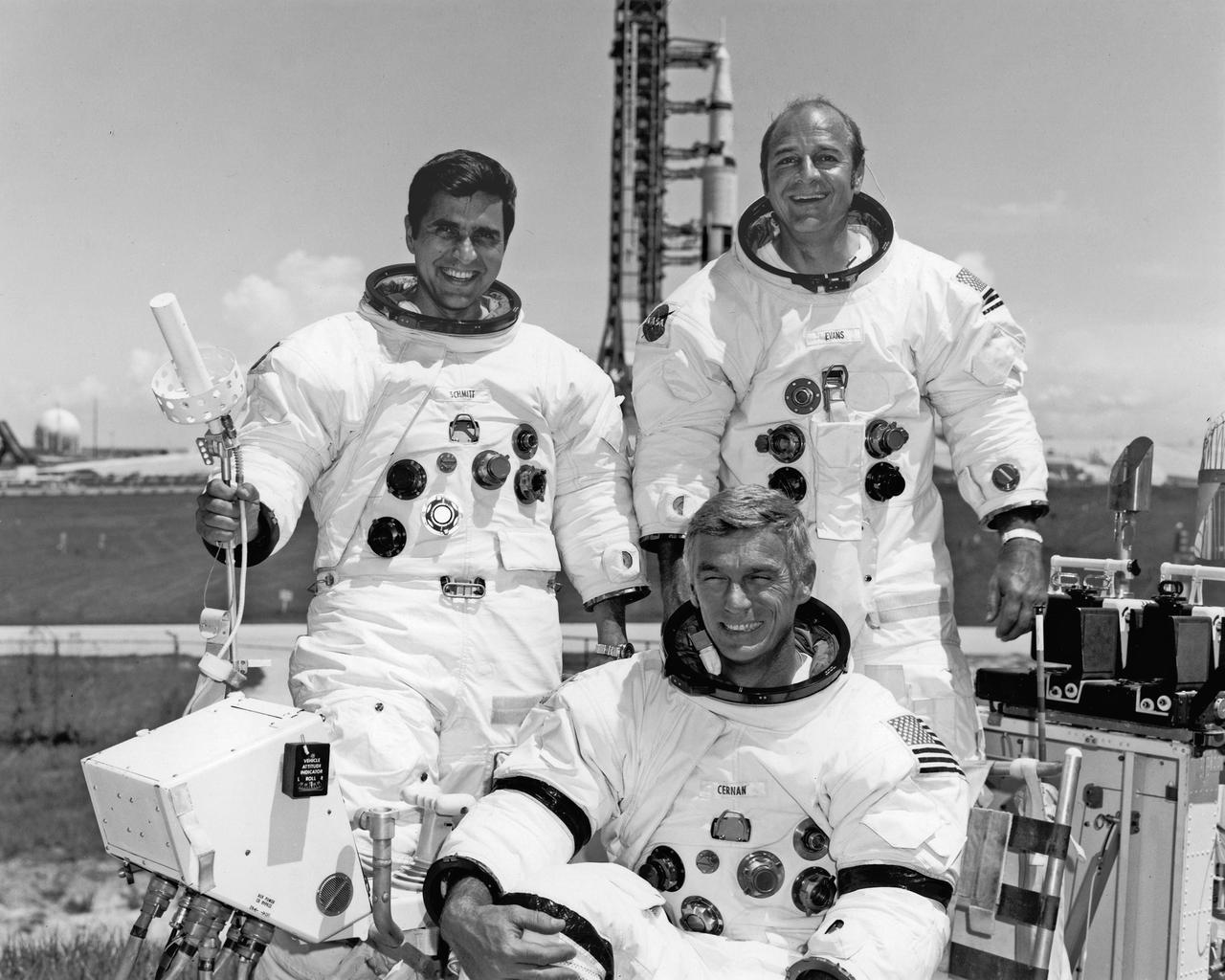
CAPE CANAVERAL, Fla. -- The Apollo 17 crew took time out from training to pose for the press after the Space Vehicle for their Manned Lunar Landing Mission was moved to Pad A, Complex 39 today. Apollo 17 Commander Eugene A Cernan sits at the controls of the One-G Lunar Roving Vehicle Simulator used to simulate operations on the Moon’s surface. With Cernan are Lunar Module Pilot Dr. Harrison H. “Jack” Schmitt, left and Command Module Plot Ronald A. Evans. The Apollo 17 Space Vehicle, scheduled for launch from KSC on the sixth U.S. Manned Lunar Landing Mission on December 6, 1972 is in the background. Photo credit: NASA
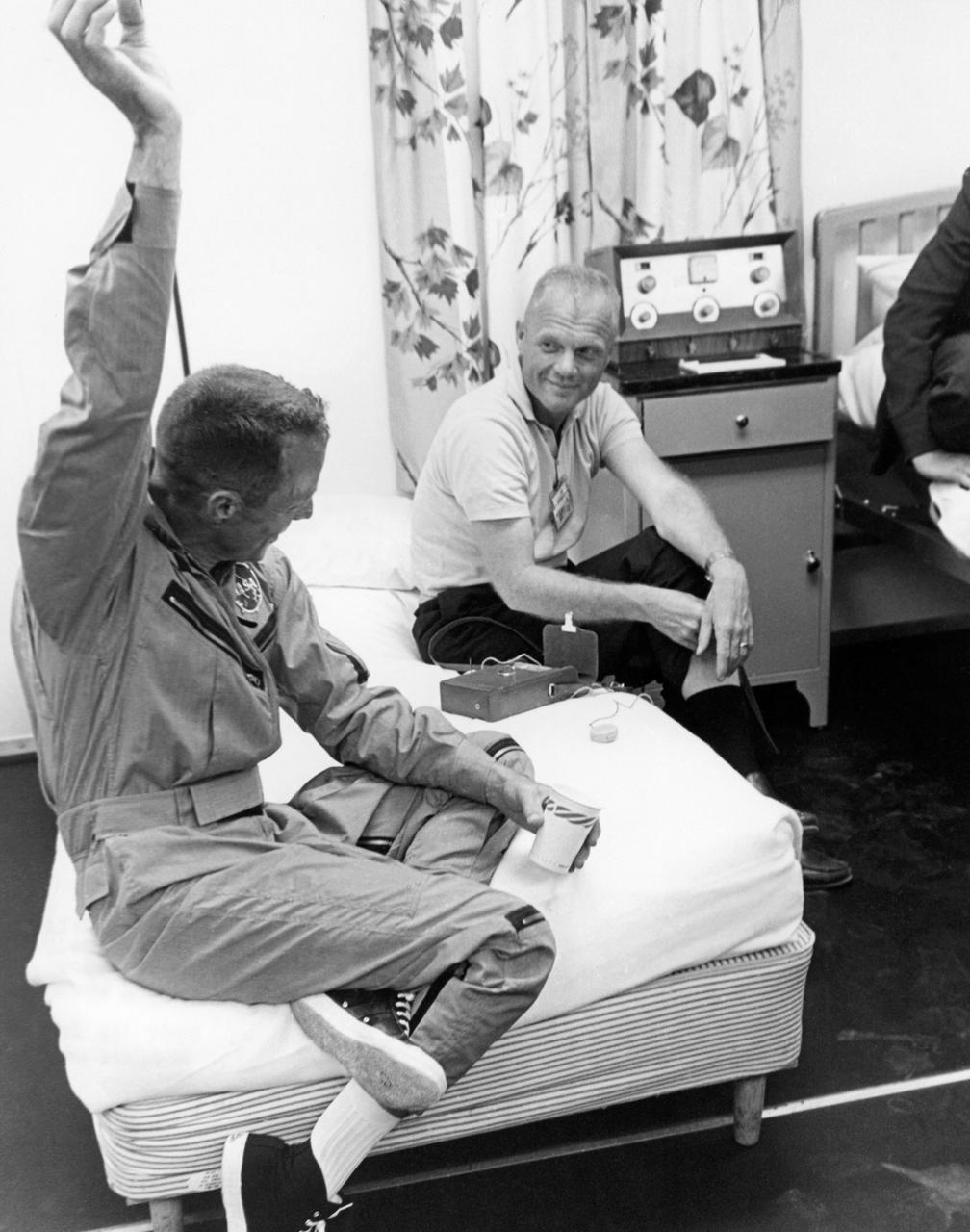
CAPE CANAVERAL, Fla. -- Scott Carpenter demonstrates a point to John Glenn while relaxing after his three-orbit MA-7 spaceflight. Photo credit: NASA
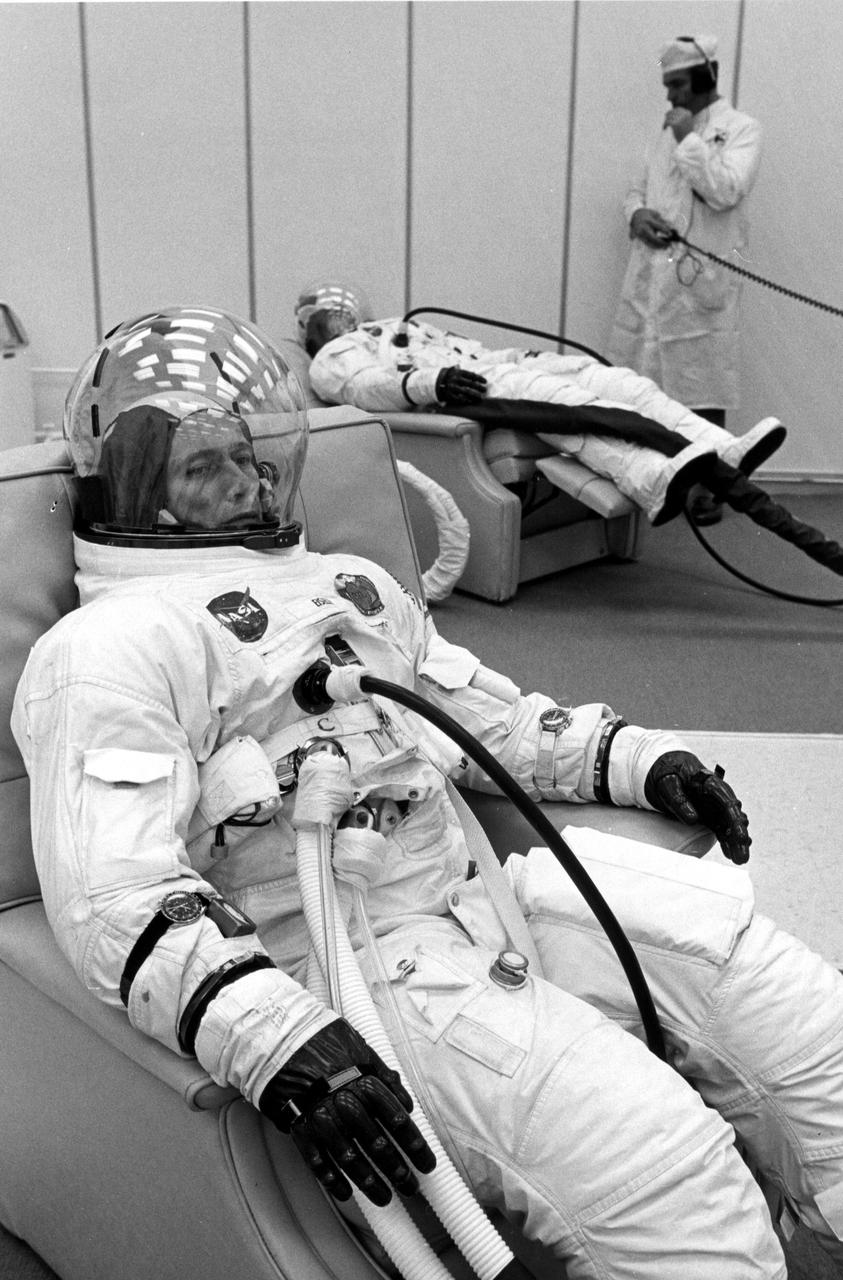
KENNEDY SPACE CENTER, FLA. -- Apollo 7 astronauts Donn F. Eisele, foreground, and Walter Cunningham, rear, undergo spacesuit checks today prior to their Earth orbital mission with Walter M. Schirra Jr., not shown. The three space pilots lifted off atop a Saturn 1B space vehicle from Cape Kennedy's Launch Complex 34 at 11:03 a.m. EDT, Oct. 11, 1968. The National Aeronautics and Space Administration's first manned Apollo flight is designed to verify spacecraft systems for future lunar voyages.
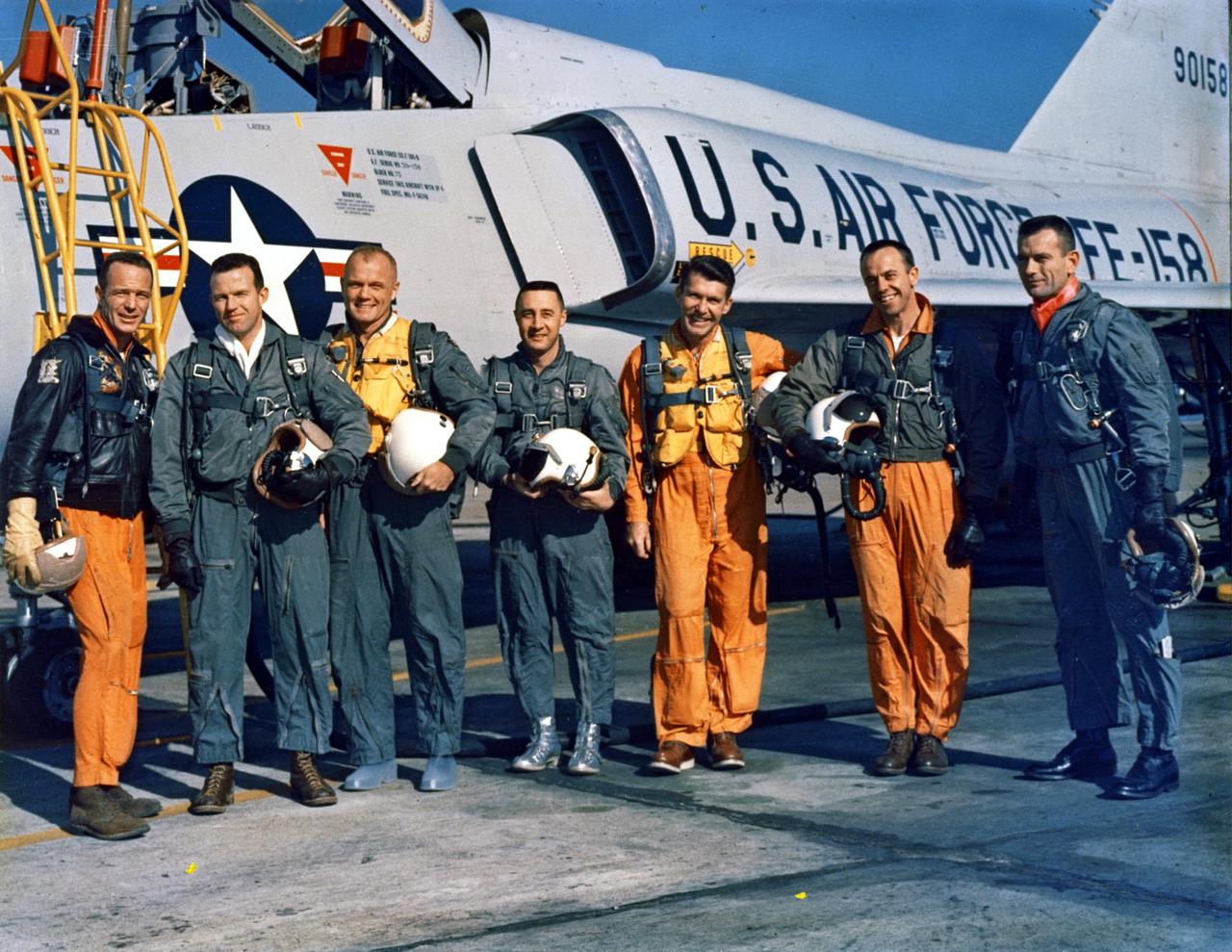
CAPE CANAVERAL, FLA. -- The Original Seven Mercury Astronauts pose beside an Air Force F-102 jet. Standing, left to right, are M. Scott Carpenter, L. Gordon Cooper, John H. Glenn Jr., Virgil I. 'Gus' Grissom, Walter M. Schirra Jr., Alan B. Shepherd Jr., and Donald K. 'Deke' Slayton.
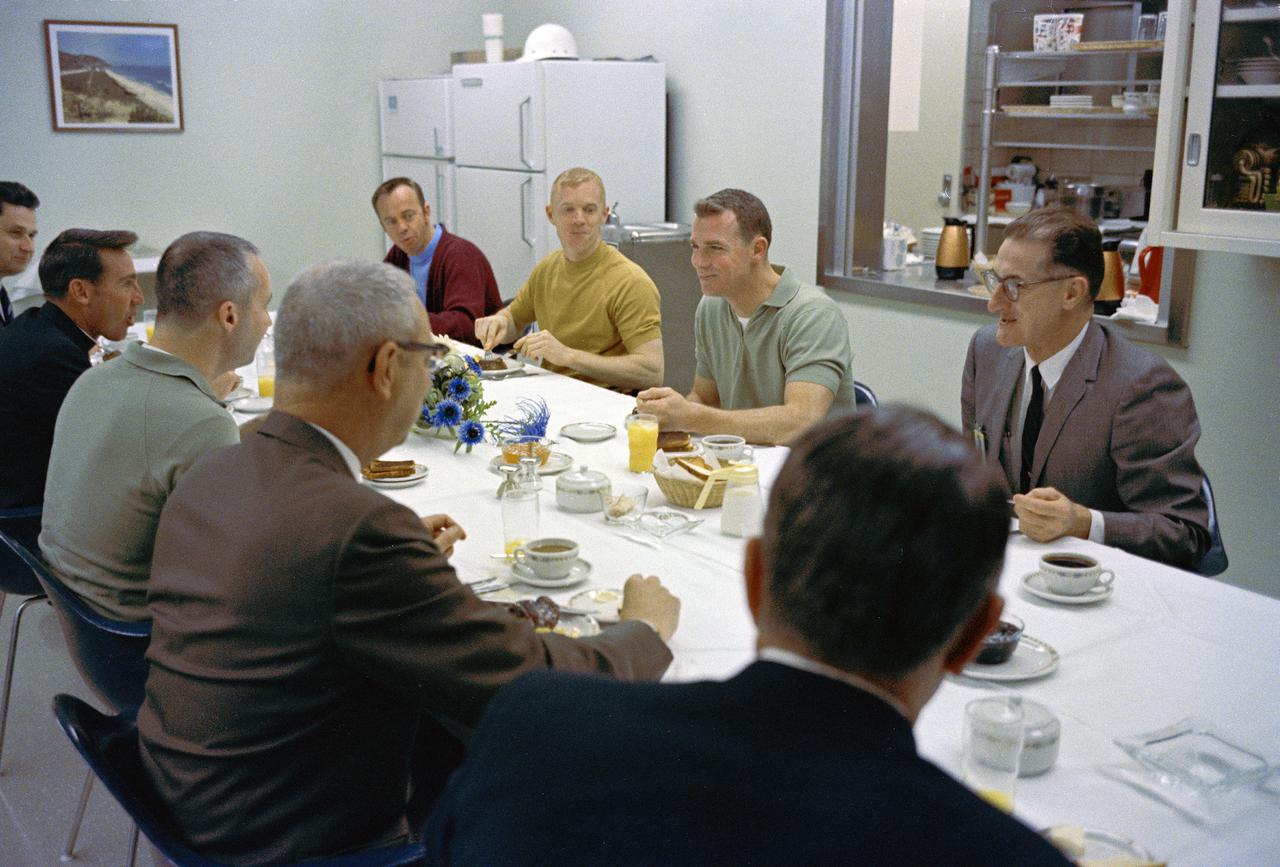
CAPE CANAVERAL, Fla. -- Apollo 9 Astronauts James A. McDivitt, David R. Scott, and Russell L. Schweickart breakfast with guests in their crew quarters of few hours before their launch into Earth orbit to test the Lunar Module spacecraft. Left to right across the table are Brig. Gen. C.H. Bolender, Scott, Schweickart, and Alan Shepard, Chief of the Astronaut Office and America's first man in space. Foreground, second from left, is Kenneth Kleinknect astronaut McDivitt his clergyman from Nassau Bay, Texas, The Rev. Laurence Connelly and George Skurla, Grumman Aircraft base manager at the spaceport. Grumman builds the Lunar Module spacecraft. Photo credit: NASA
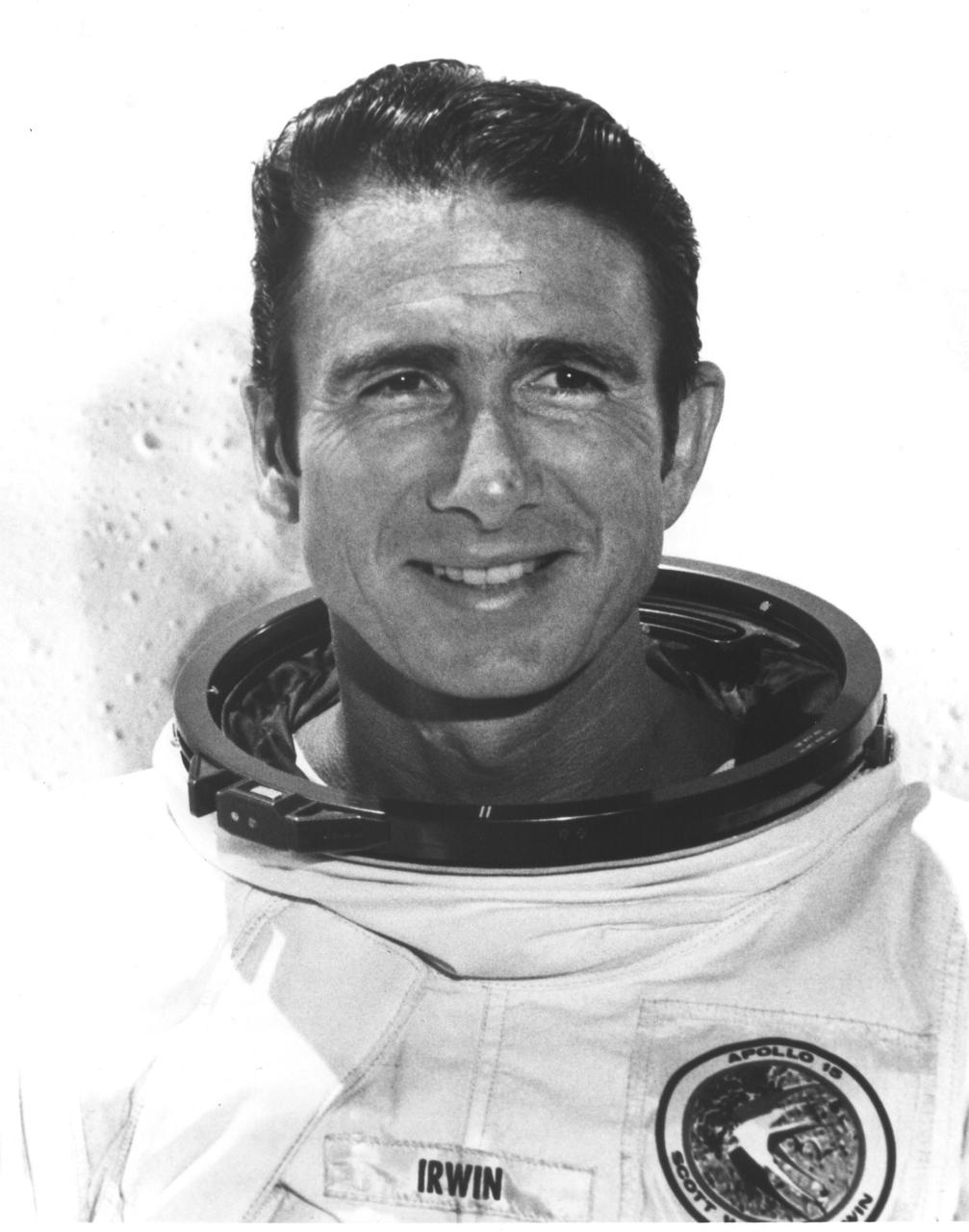
KENNEDY SPACE CENTER, FLA. -- Apollo 15 Lunar Module Pilot James B. Irwin will be making his first space flight when he is launched to the Moon with astronauts David R. Scott and AlfredN. Worden. Irwin and Scott will conduct three traverses of the Moon's Hadley-Apennine region while Worden maintains the command module in lunar orbit and conducts experiments. They will be launched to the Moon no earlier than July 26, 1971.

KENNEDY SPACE CENTER, FLA. -- The first flight of Challenger on mission STS-6. The primary payload is the first Tracking and Data Relay Satellite-1. The mission also is using the first lightweight external tank and lightweight solid rocket booster casings. The crew comprises Commander Paul J. Weitz, Pilot Karol J. Bobko, and Mission Specialists Donald H. Peterson and F. Story Musgrave.
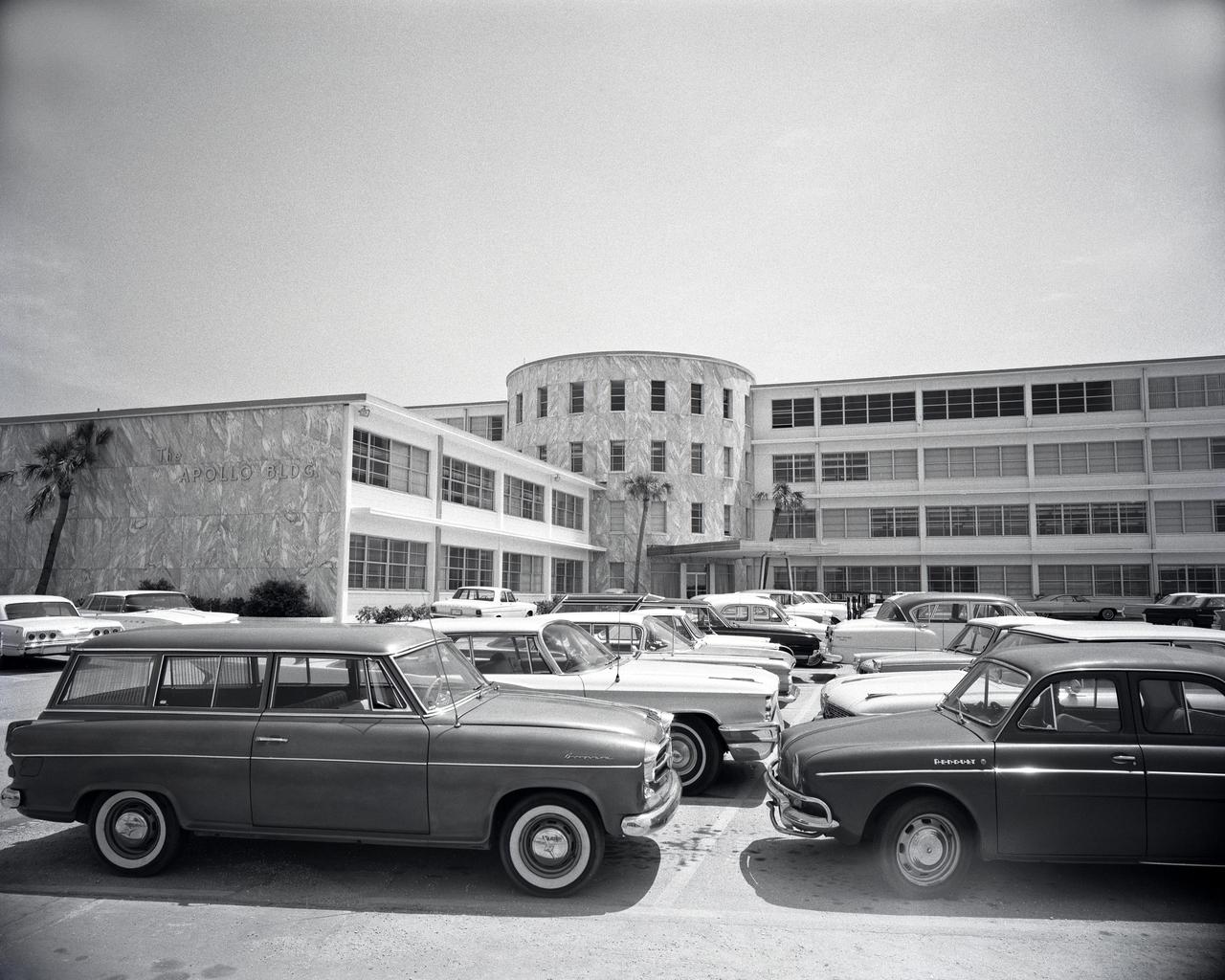
CAPE CANAVERAL, Fla. -- Apollo Office Building, Cocoa Beach, FL. NASA PIO photo. Photo credit: NASA
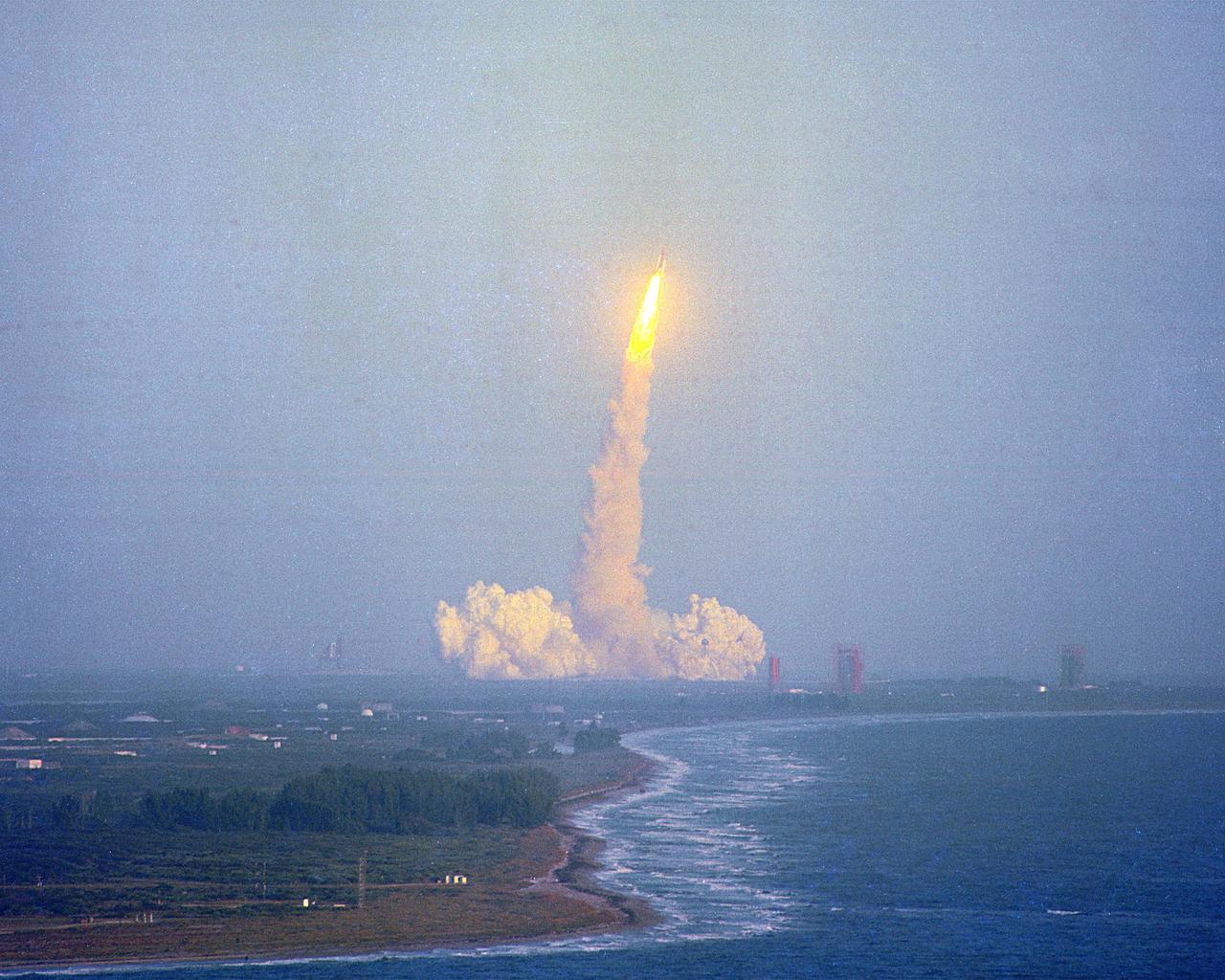
KENNEDY SPACE CENTER, FLA. -- Columbia launches from Launch Pad 39A on mission STS-5.
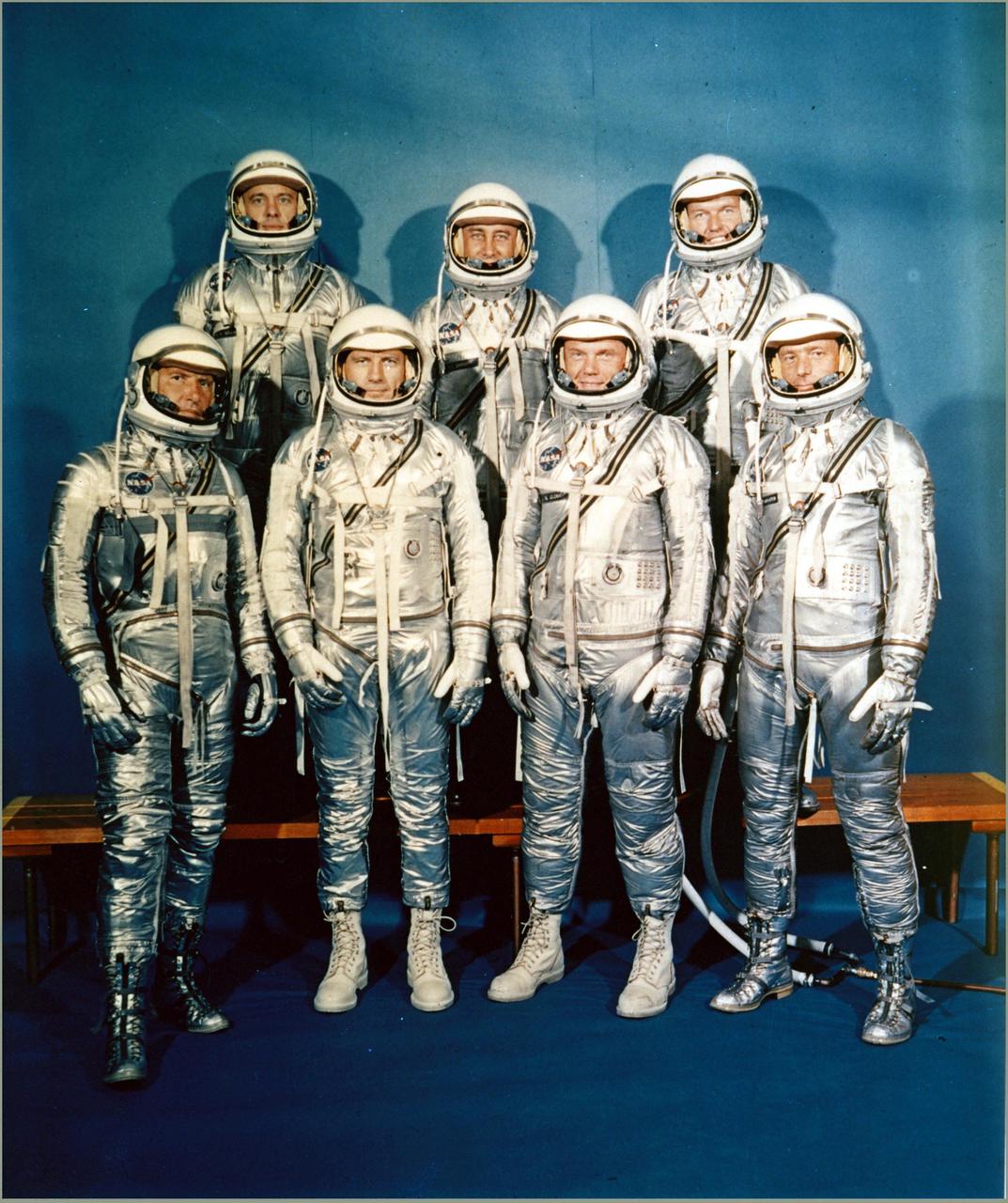
MANNED SPACECRAFT CENTER, HOUSTON, TX. -- FIRST ASTRONAUT TEAM -- Project Mercury Astronauts, whose selection was announced on April 9, 1959, only six months after the National Aeronautics and Space Administration was formally established on Oct. 1, 1958, included: front row, left to right, Walter H. Schirra Jr., Donald K. Slayton, John H. Glenn Jr., and Scott Carpenter back row, Alan B. Shepard Jr., Virgil I. 'Gus' Grissom, and L. Gordon Cooper.
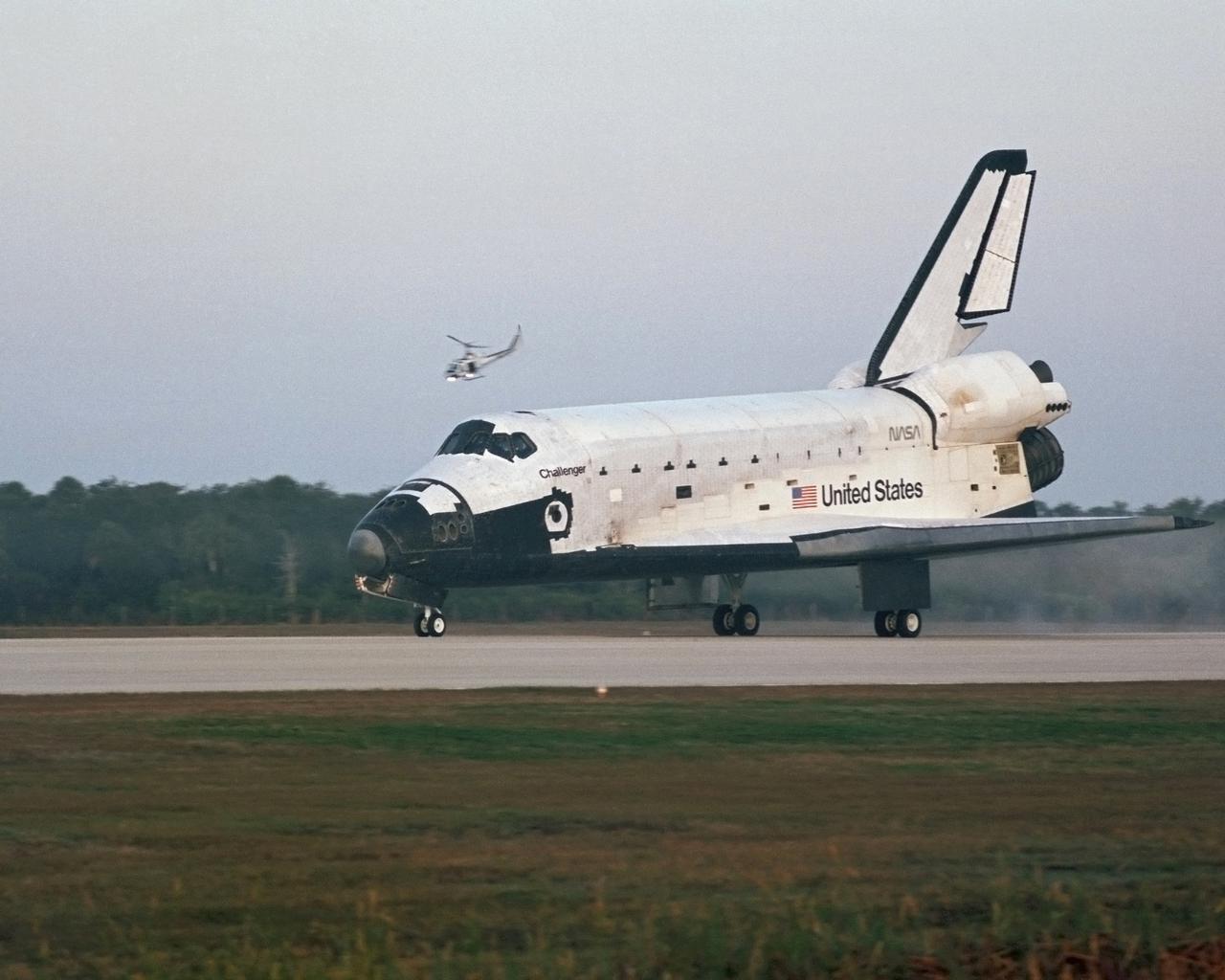
CAPE CANAVERAL, Fla. -- Commander Vance Brand and Pilot Robert 'Hoot' Gibson guide spaceship Challenger to the first-ever landing at Kennedy Space Center. The historic touchdown occurred at 7:15:55 a.m. EST, Feb. 11, 1984. Also aboard were Mission Specialists Bruce McCandless II, Ronald McNair and Robert Stewart. Photo credit: NASA

CAPE CANAVERAL, Fla. -- The crew of 41B STS-11, the first spaceflight in history to begin and conclude a mission at the same site, leave the flight deck of orbiter Challenger to be greeted by George Abbey, director of Flight Crew Operations. In ascending order, the crew members are Vance Brand, mission commander mission Pilot Robert L.'Hoot' Gibson and Mission Specialists Robert L. Stewart, Ronald E. McNair and Bruce McCandless II. Challenger touched down at 7:15:55 a.m. EST on Feb. 11, rolling 10,700 feet before coming to a stop on the Kennedy Space Center's 15,000-foot-long runway. Photo credit: NASA
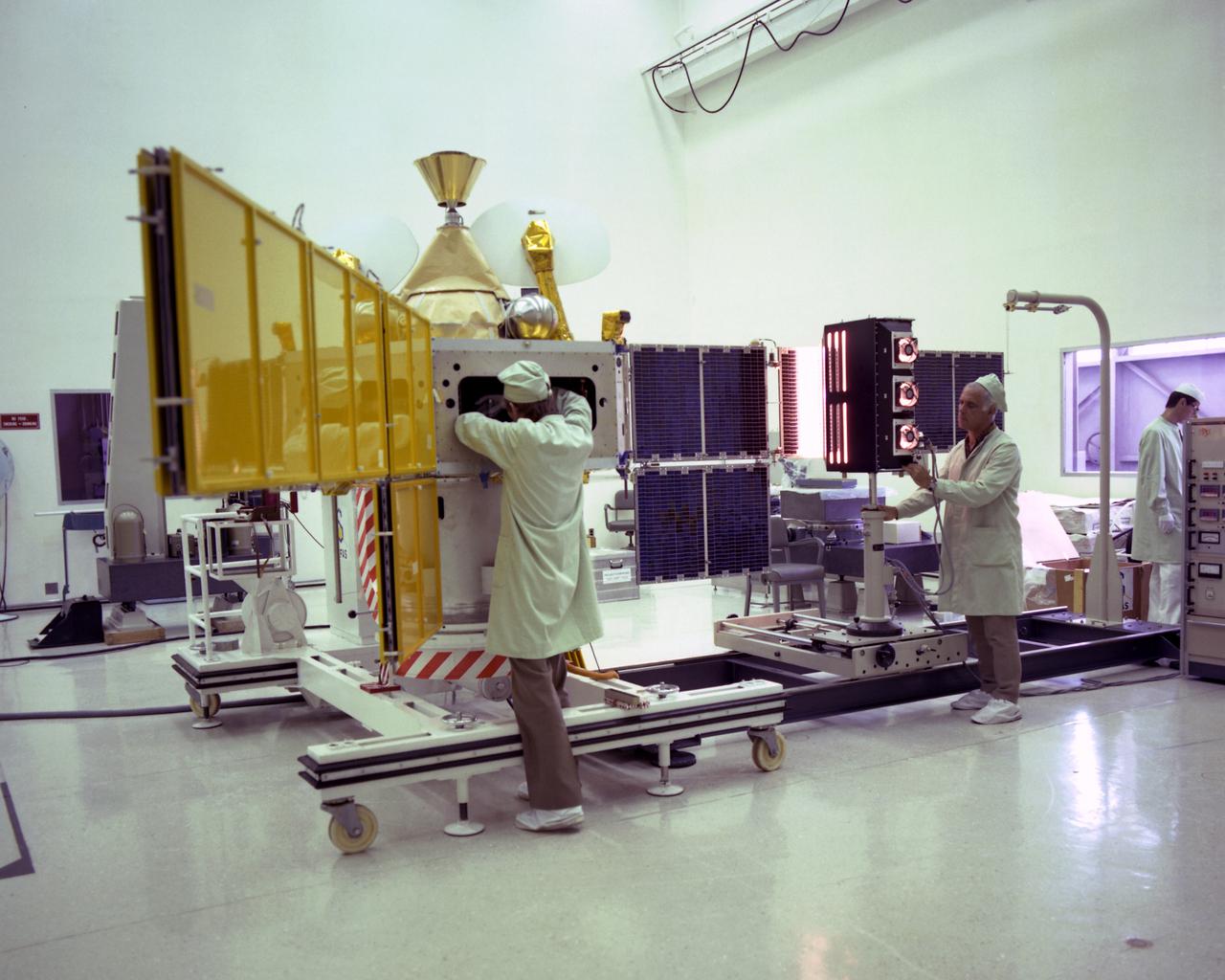
CAPE CANAVERAL, Fla. -- Technicians check out the Symphonie-B spacecraft during launch preparations at KSC. Symphonie is a synchronous-orbit communications satellite, jointly owned and managed by West Germany and France. Photo credit: NASA
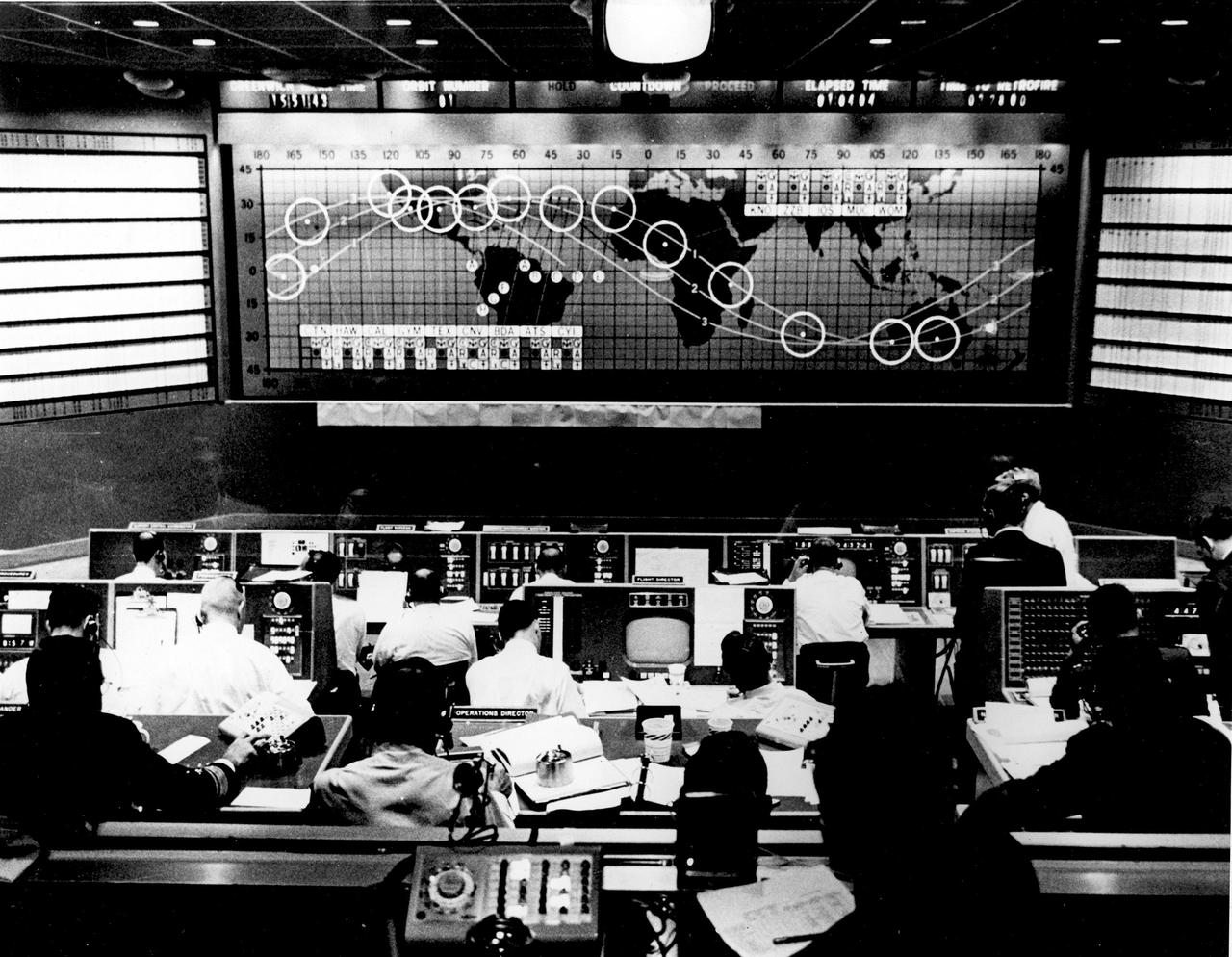
CAPE CANAVERAL, Fla. - Flight controllers gather inside Mercury Mission Control during the first orbit of John Glenn's Friendship 7 mission, which launched on Feb. 20, 1962. The Mercury Mission Control Center in Florida played a key role in the United States' early spaceflight program. Located at Cape Canaveral Air Force Station, the original part of the building was constructed between 1956 and 1958, with additions in 1959 and 1963. The facility officially was transferred to NASA on Dec. 26, 1963, and served as mission control during all the Project Mercury missions, as well as the first three flights of the Gemini Program, when it was renamed Mission Control Center. With its operational days behind, on June 1, 1967, the Mission Control Center became a stop on the public tour of NASA facilities until the mid-90s. In 1999, much of the equipment and furnishings from the Flight Control Area were moved to the Kennedy Space Center Visitor Complex where they became part of the exhibit there. The building was demolished in spring 2010. Photo credit: NASA
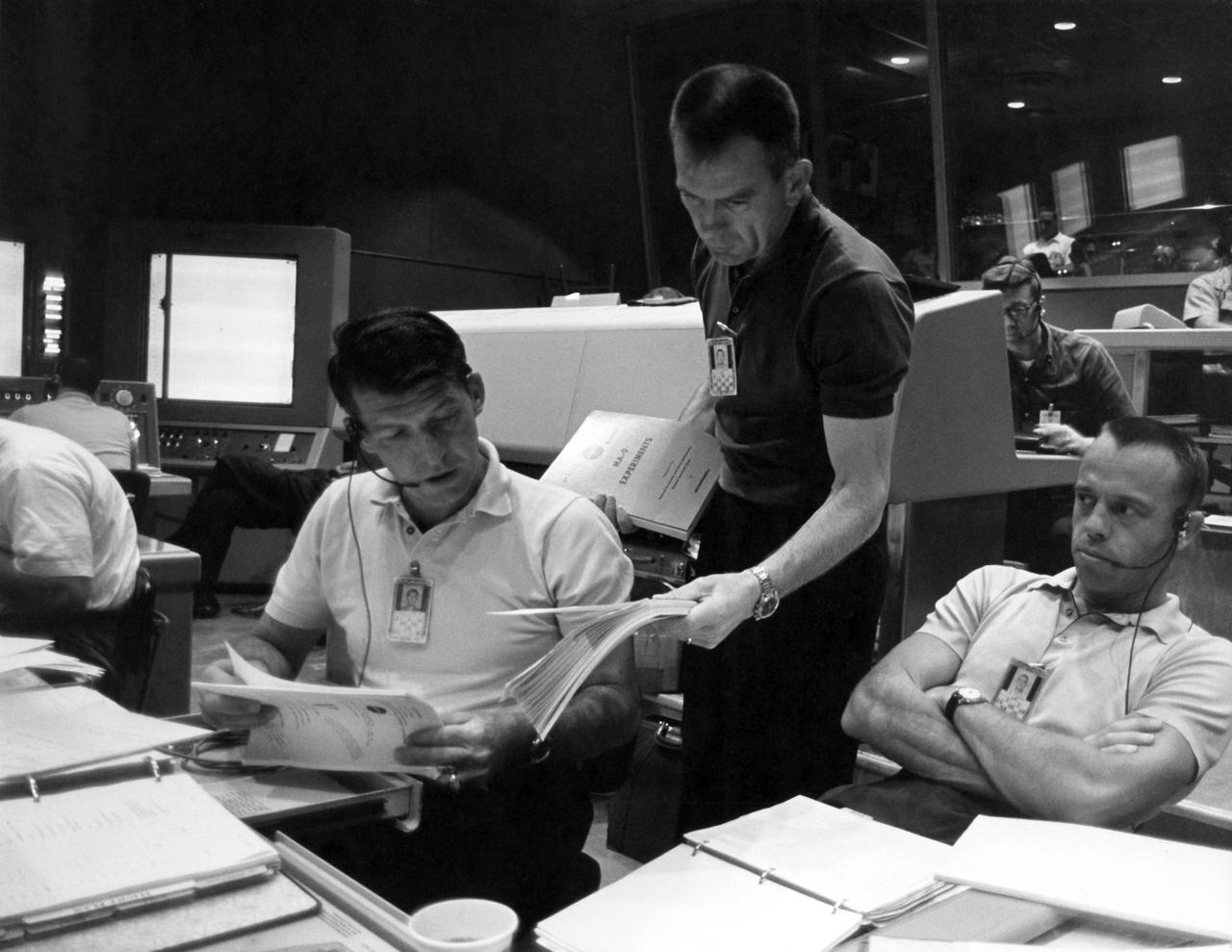
CAPE CANAVERAL, Fla. - Mercury astronauts, from left, Wally Schirra, Deke Slayton and Alan Shepard work inside the Mercury Control Center where they were stationed during the Faith 7 mission of astronaut Gordon Cooper, launched on May 15, 1963. This was the final mission of the Mercury Program. The Mercury Mission Control Center in Florida played a key role in the United States' early spaceflight program. Located at Cape Canaveral Air Force Station, the original part of the building was constructed between 1956 and 1958, with additions in 1959 and 1963. The facility officially was transferred to NASA on Dec. 26, 1963, and served as mission control during all the Project Mercury missions, as well as the first three flights of the Gemini Program, when it was renamed Mission Control Center. With its operational days behind, on June 1, 1967, the Mission Control Center became a stop on the public tour of NASA facilities until the mid-90s. In 1999, much of the equipment and furnishings from the Flight Control Area were moved to the Kennedy Space Center Visitor Complex where they became part of the exhibit there. The building was demolished in spring 2010. Photo credit: NASA
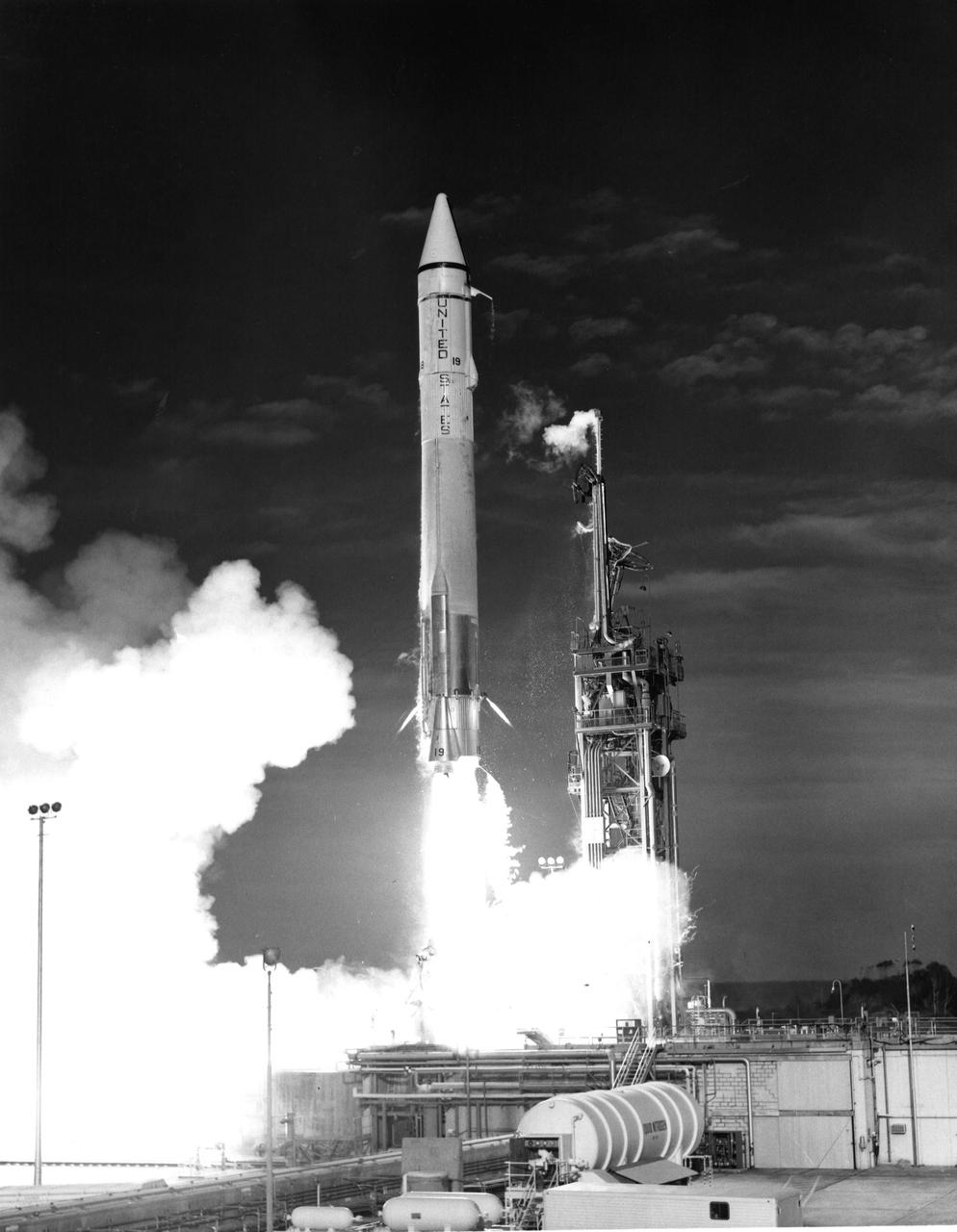
KENNEDY SPACE CENTER, FLA. - An Atlas-Centaur was launched at 5:22 p.m. EST today to send Mariner 7 on its way to Mars. The second Mars probe to be launched by the KSC Unmanned Launch Operations Directorate this year, Mariner 7 will join a sister spacecraft on a journey that will carry them within 2,000 miles of the red planet this summer. Mariner 6 was launched from Cape Kennedy on Feb. 24 and is to investigate the Martian equatorial area while Mariner 7 will concentrate on the South Polar Cap.
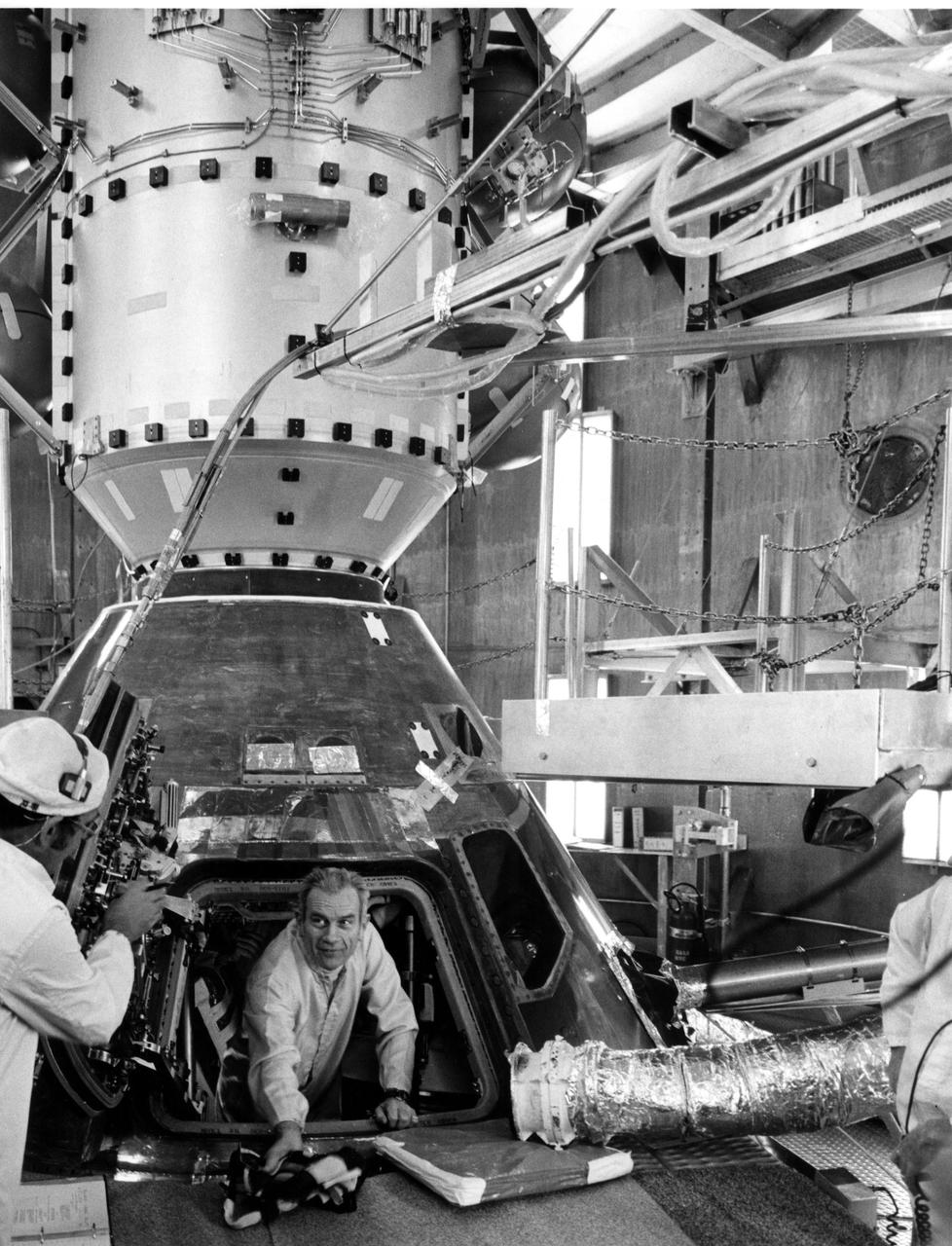
KENNEDY SPACE CENTER, FLA. -- Astronaut Donald Slayton is shown in the Apollo Command Module for July's Apollo-Soyuz Test Project space mission. Slayton was at KSC for fit checks between the Apollo and the Docking Module, which will be used during the mission as a link between the Soviet Soyuz and American Apollo.
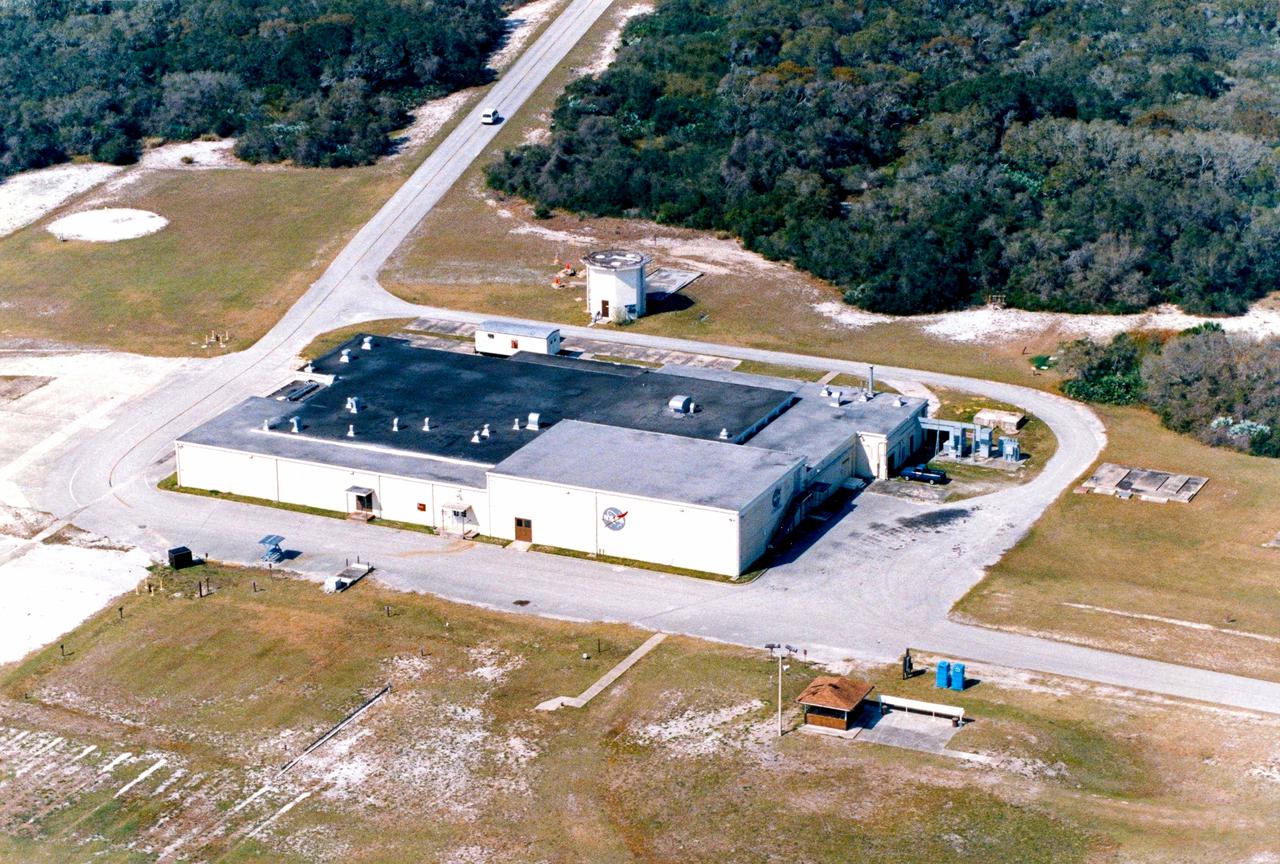
CAPE CANAVERAL, Fla. - With its operational days behind, on June 1, 1967, the Mission Control Center became a stop on the public tour of NASA facilities offered through the Kennedy Space Center Visitor’s Center, now called the Visitor Complex. Tours of the facility continued until the mid-90s. The Mercury Mission Control Center in Florida played a key role in the United States' early spaceflight program. Located at Cape Canaveral Air Force Station, the original part of the building was constructed between 1956 and 1958, with additions in 1959 and 1963. The facility officially was transferred to NASA on Dec. 26, 1963, and served as mission control during all the Project Mercury missions, as well as the first three flights of the Gemini Program, when it was renamed Mission Control Center. In 1999, much of the equipment and furnishings from the Flight Control Area were moved to the Kennedy Space Center Visitor Complex where they became part of the exhibit there. The building was demolished in spring 2010. Photo credit: NASA
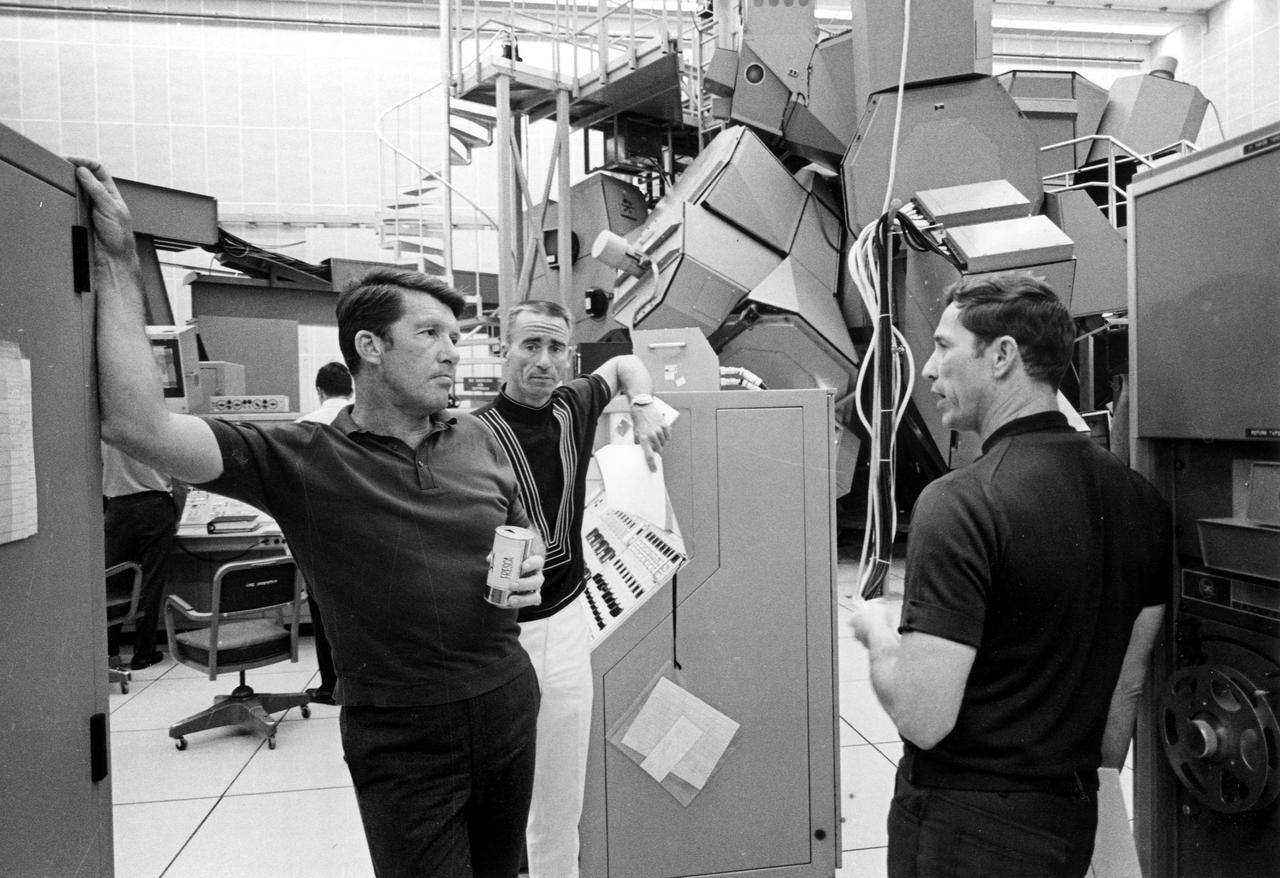
KENNEDY SPACE CENTER, FLA. -- Apollo 7 astronauts, left to right, Walter Schirra, Walter Cunningham and Donn Eisele pause during a practice mission yesterday within Kennedy Space Center's Flight Crew Training Building. The trio spent several hours in the Apollo mission simulator, rear, in preparation for their upcoming mission. The National Aeronautics and Space Administration's first manned Apollo flight is scheduled to begin no earlier than Oct. 11, 1968.
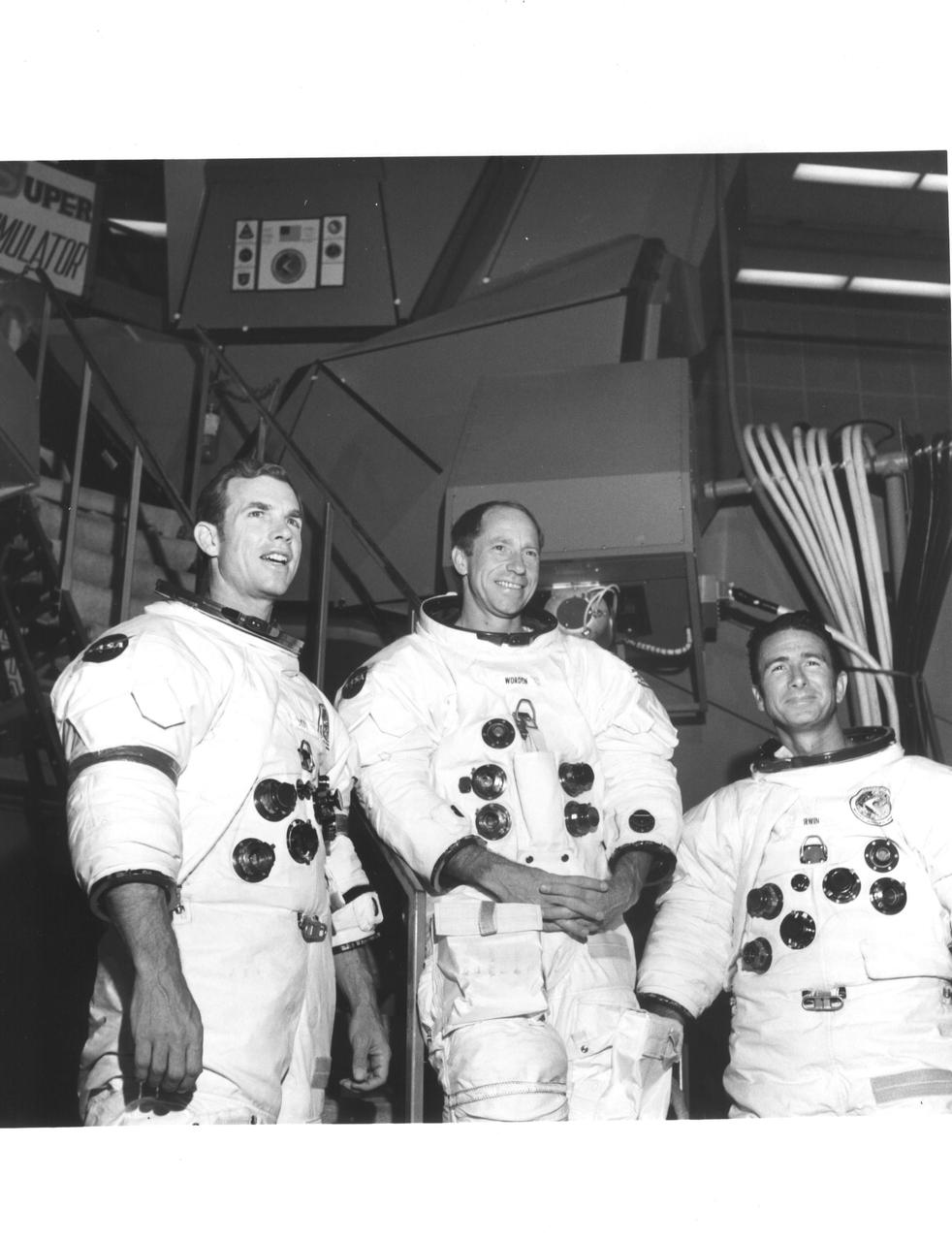
KENNEDY SPACE CENTER, FLA. -- The Apollo 15 astronauts pause in front of a mission simulator during a training exercise at the Kennedy Space Center. The trio will be launched to the Moon no earlier than July 26, 1971. They are, left to right, David R. Scott, commander; Alfred N. Worden, command module pilot; and James B. Irwin, lunar module pilot.

KENNEDY SPACE CENTER, FLA. -- Astronaut Donn F. Eisele adjusts communications carrier prior to the start of an 11-day Earth orbital mission in the Apollo 7 spacecraft. The communications carrier contains microphones and earphones. Flying with Eisele aboard Apollo 7 are astronauts Walter M. Schirra Jr. and Walter Cunningham. Purpose of the flight, conducted by the National Aeronautics and Space Administration, is to qualify the Apollo spacecraft for a future flight to the moon.
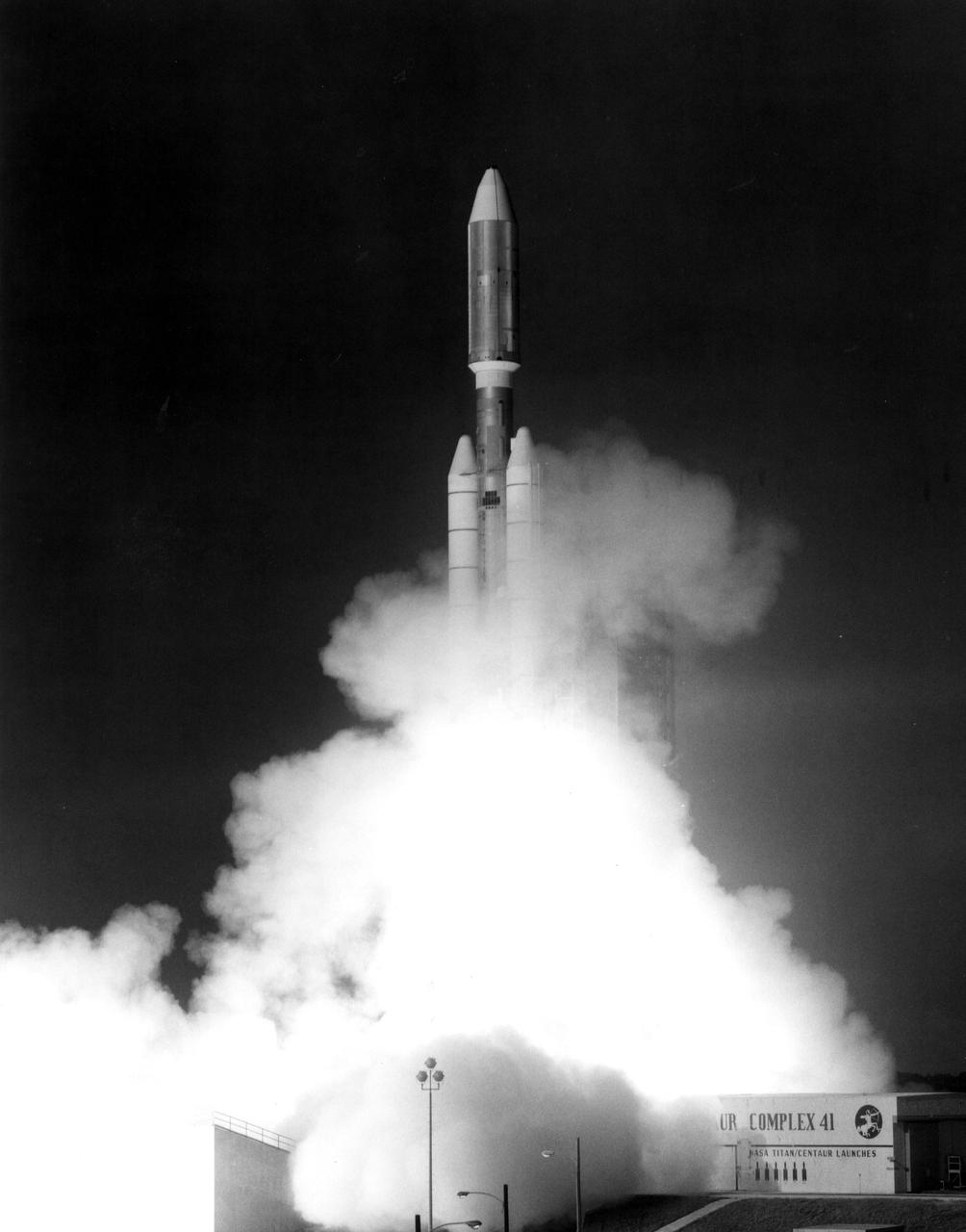
KENNEDY SPACE CENTER, FLA. -- Voyager-1 was launched atop Titan_Centaur-6 at Launch Complex 41 at 8:56 a.m. EDT today, joining its sister spacecraft, Voyager-2, on a mission to the outer planets.
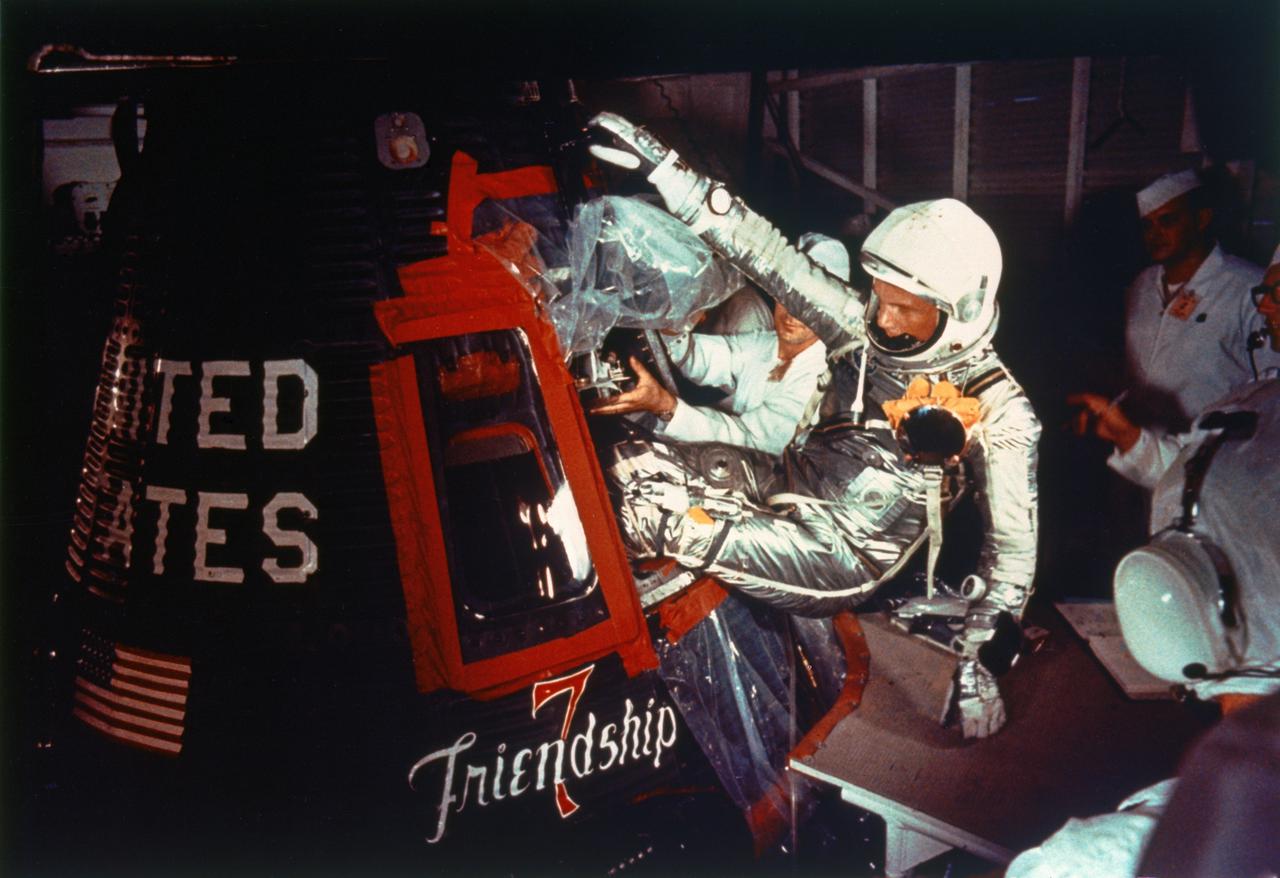
CAPE CANAVERAL, Fla. -- Overall view of astronaut John H. Glenn Jr. as he commences entrance into spacecraft Friendship 7 prior to MA-6 launch operations. Photo credit: NASA
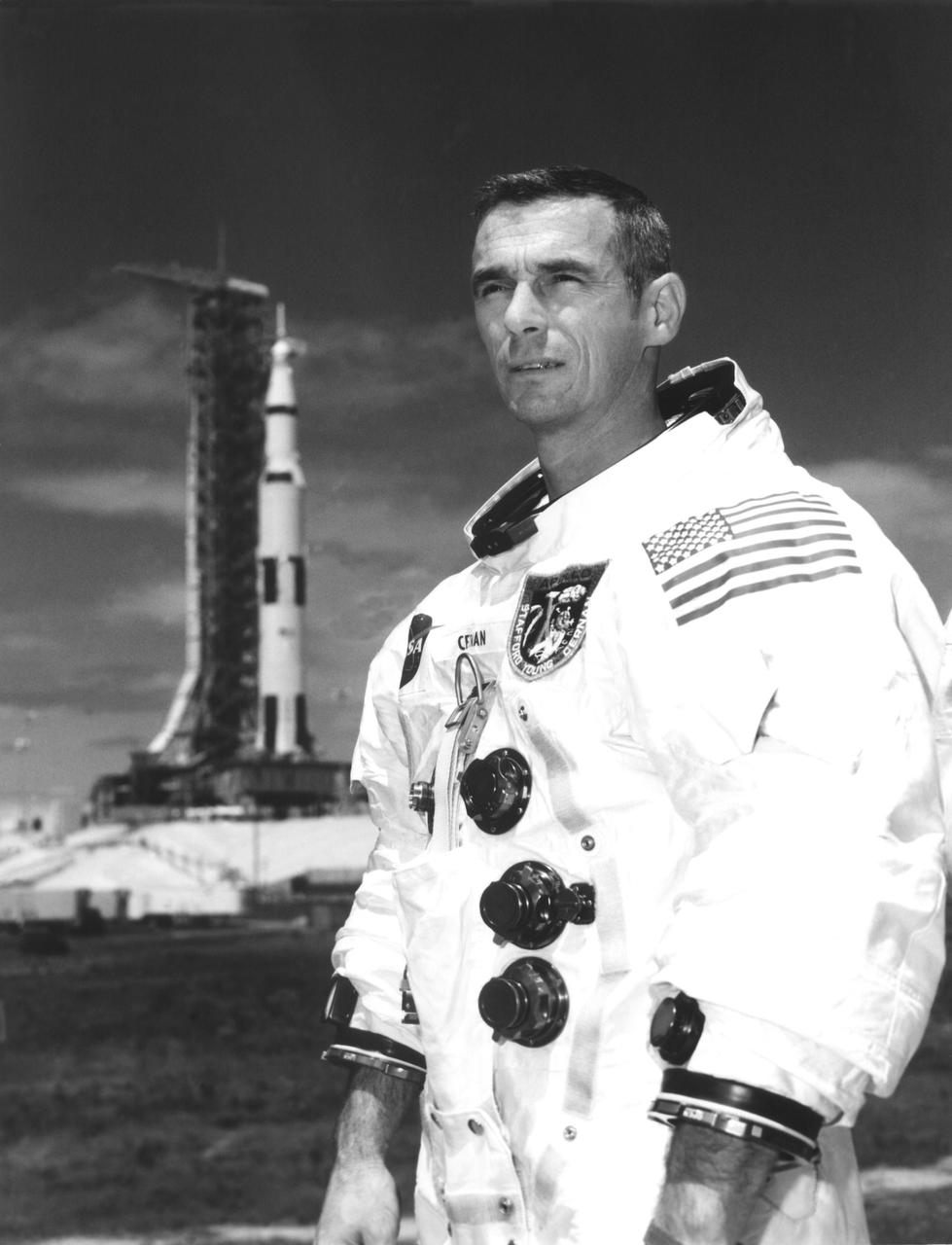
KENNEDY SPACE CENTER, FLA. -- Astronaut Eugene A. Cernan is lunar module pilot for the Apollo 10 lunar orbit mission scheduled for launch from KSC on May 18. Cernan and Apollo 10 commander Thomas P. Stafford will detach the lunar module from the command_service module and drop to within 10 miles of the lunar surface before rejoining John W. Young, command module pilot, in the parent spacecraft.
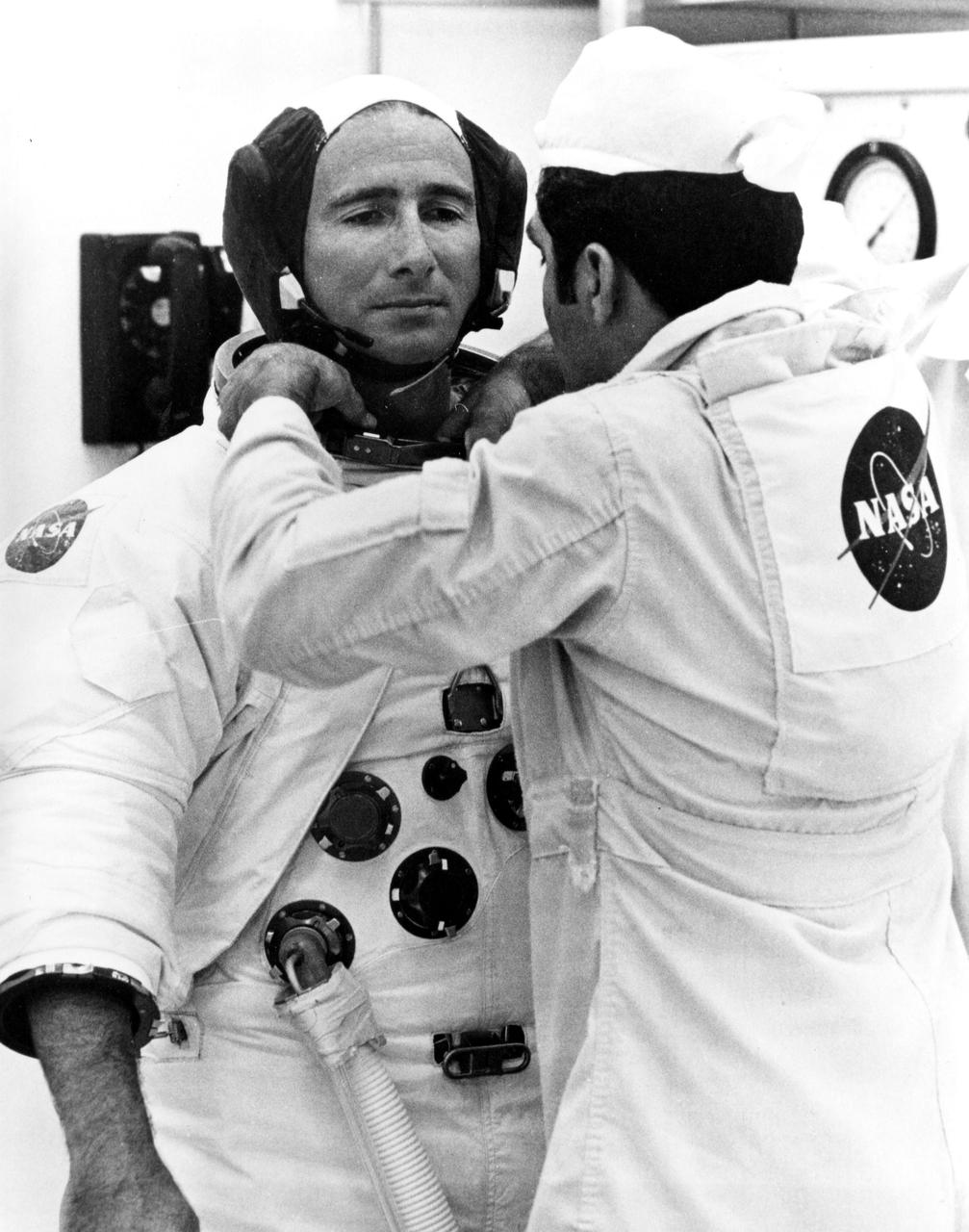
KENNEDY SPACE CENTER, FLA. -- A technician adjusts the spacesuit of Apollo 15 Lunar Module Pilot James B. Irwin prior to his launch to the Moon today with astronauts David R. Scott and Alfred N. Worden. The National Aeronautics and Space Administration directs the Apollo program.
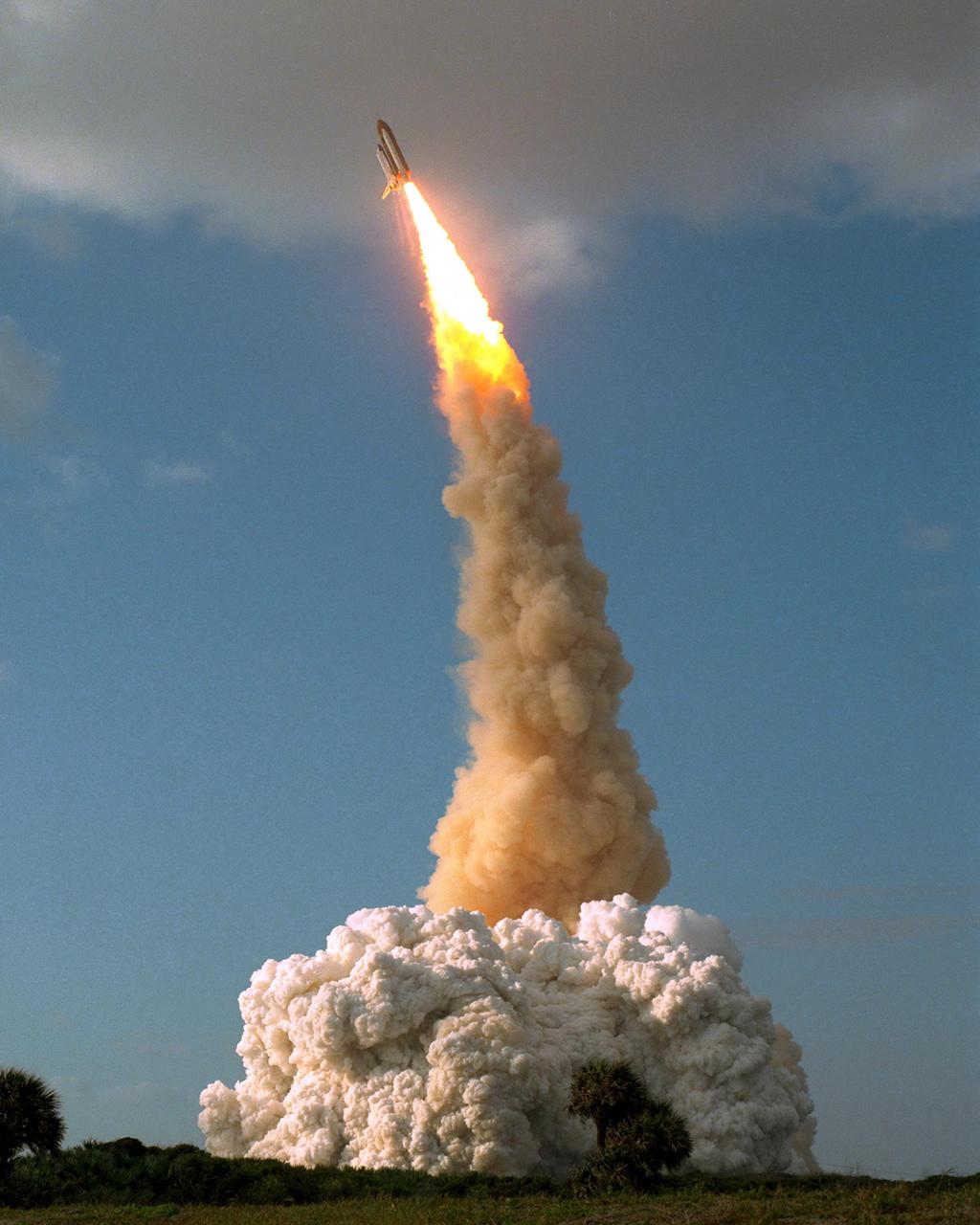
KENNEDY SPACE CENTER, FLA. -- The Space Shuttle Discovery lifts off from Pad 39-B at 8:33 a.m. EDT carrying a crew of five and the Hubble Space Telescope. STS-31 crew members are Commander Loren Shriver, Pilot Charles Bolden and Mission Specialists Steven Hawley, Bruce McCandless II and Kathryn Sullivan.
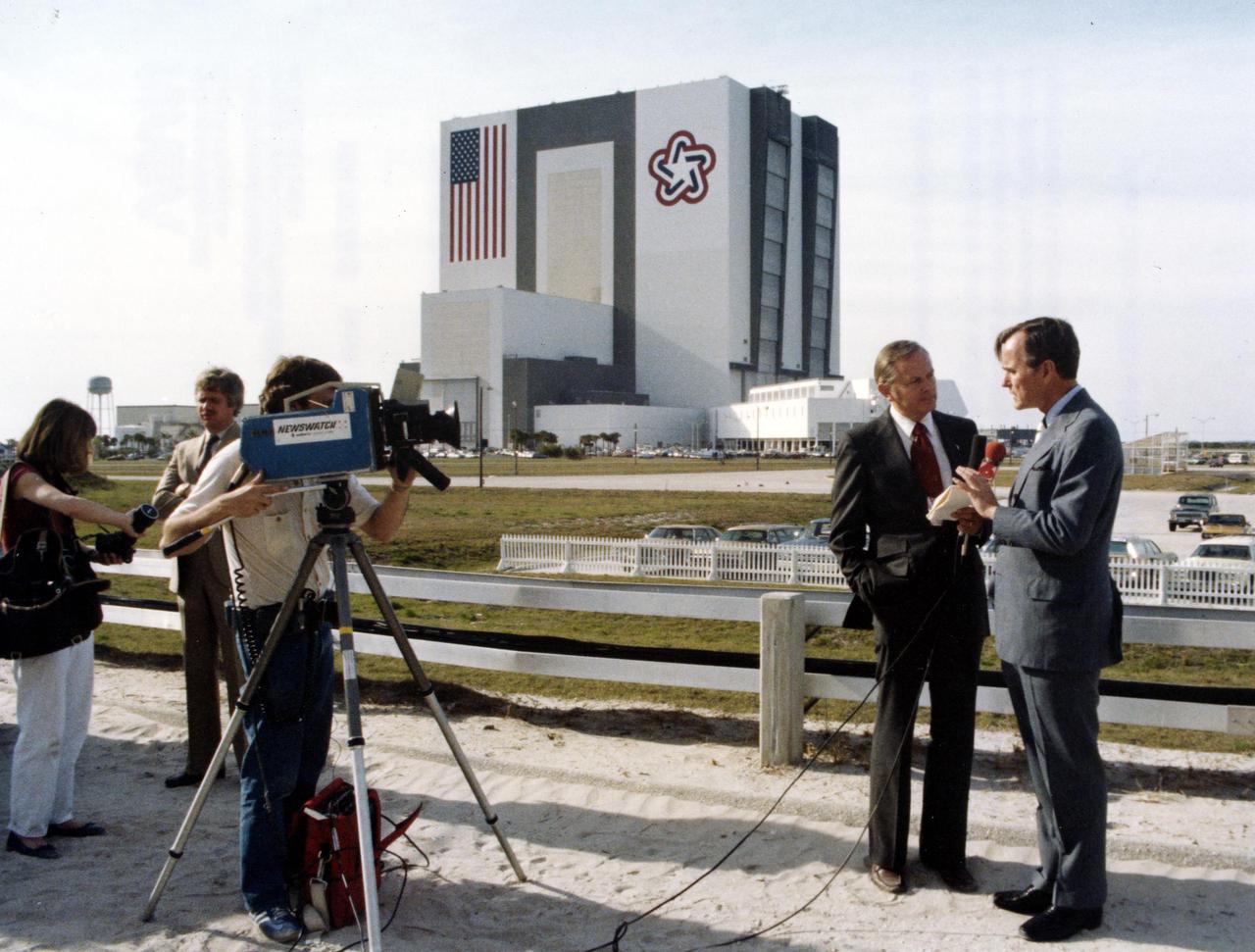
KENNEDY SPACE CENTER, FLA. -- Vice President George H. W. Bush, on a tour of KSC and Space Shuttle launch facilities, is interviewed at the Launch Complex 39 Press Site by Ben Aycrigg, anchorman for WDBO-TV News, Orlando.
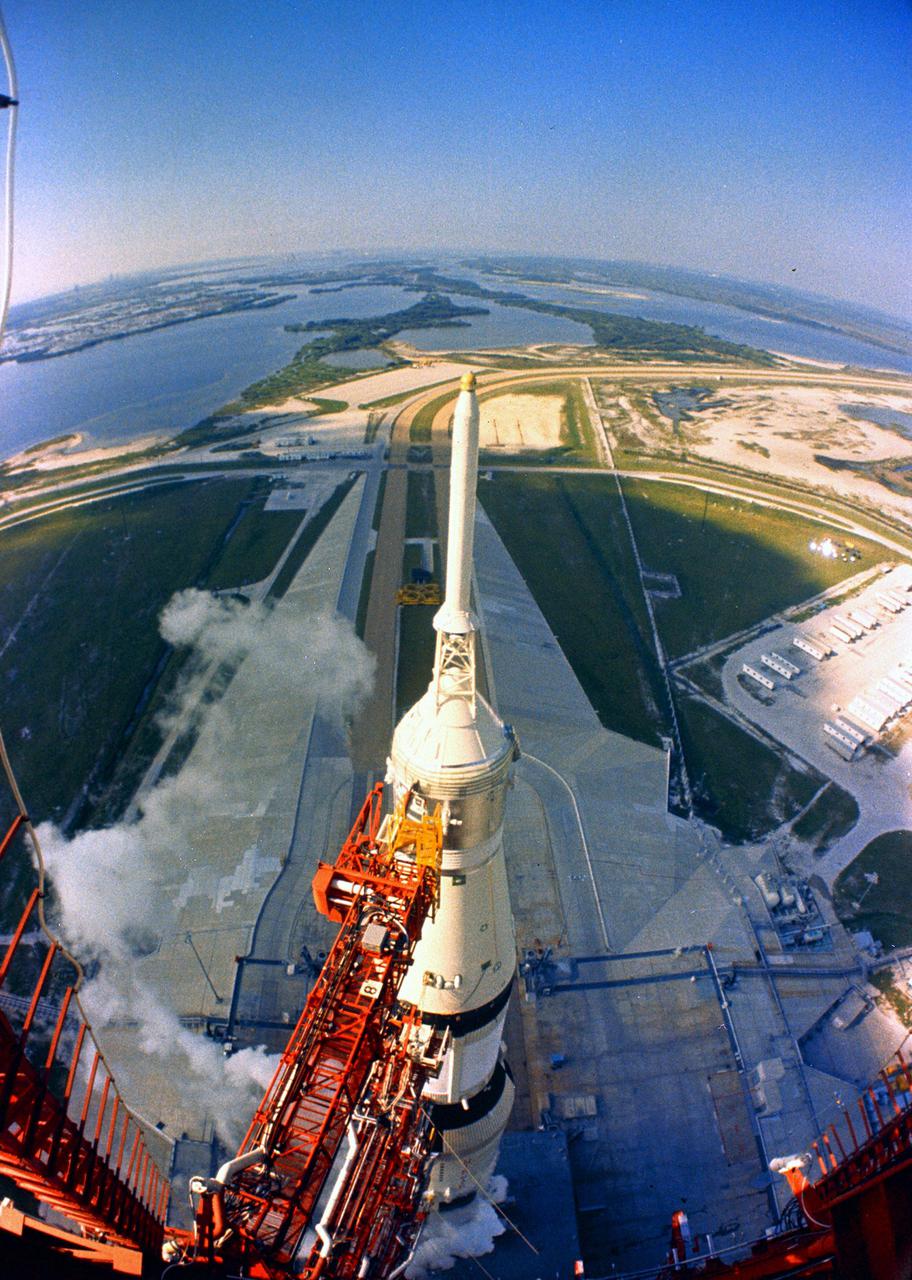
KENNEDY SPACE CENTER, FLA. - The Apollo 15 Saturn V Space Vehicle is seen from a camera located at the mobile launcher's 360-foot level at Launch Pad 39A during venting of the liquid oxygen during the 'wet' portion of the Countdown Demonstration Test today. Astronauts David R. Scott, Commander; James B. Irwin, Lunar Module Pilot; and Alfred M. Worden, Jr., Command Module Pilot, will participate tomorrow in the 'dry' portion of the Countdown Demonstration Test (CDDT), as a final dress rehearsal for the launch to the Moon, scheduled for no earlier than July 26, 1971.
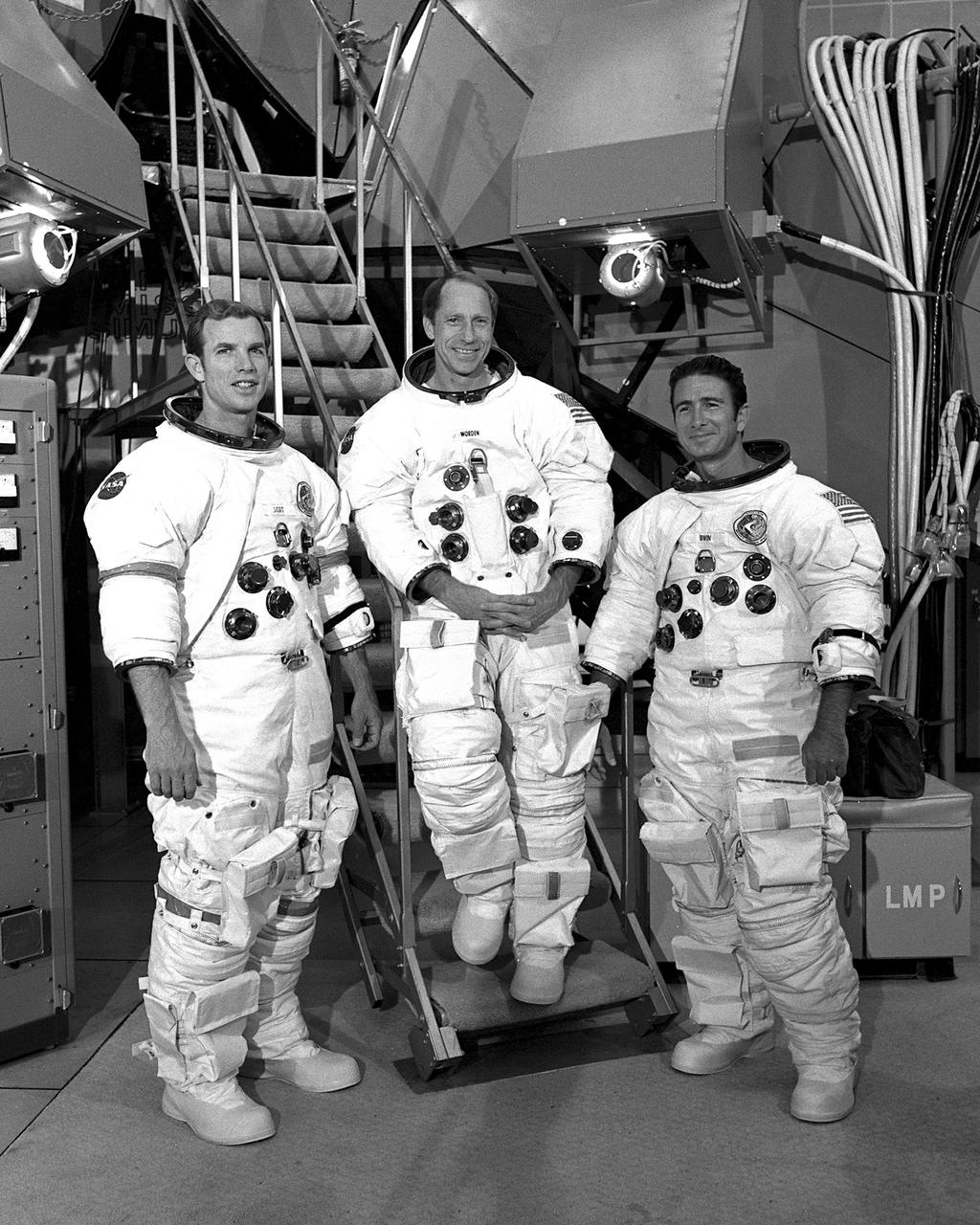
KENNEDY SPACE CENTER, FLA. - The Apollo 15 flight crew, Commander David R. Scott, Lunar Module Pilot James B. Irwin, and Command Module Pilot Alfred M. Worden, Jr., participate in a mission simulation in the Command Module and the Lunar Module.