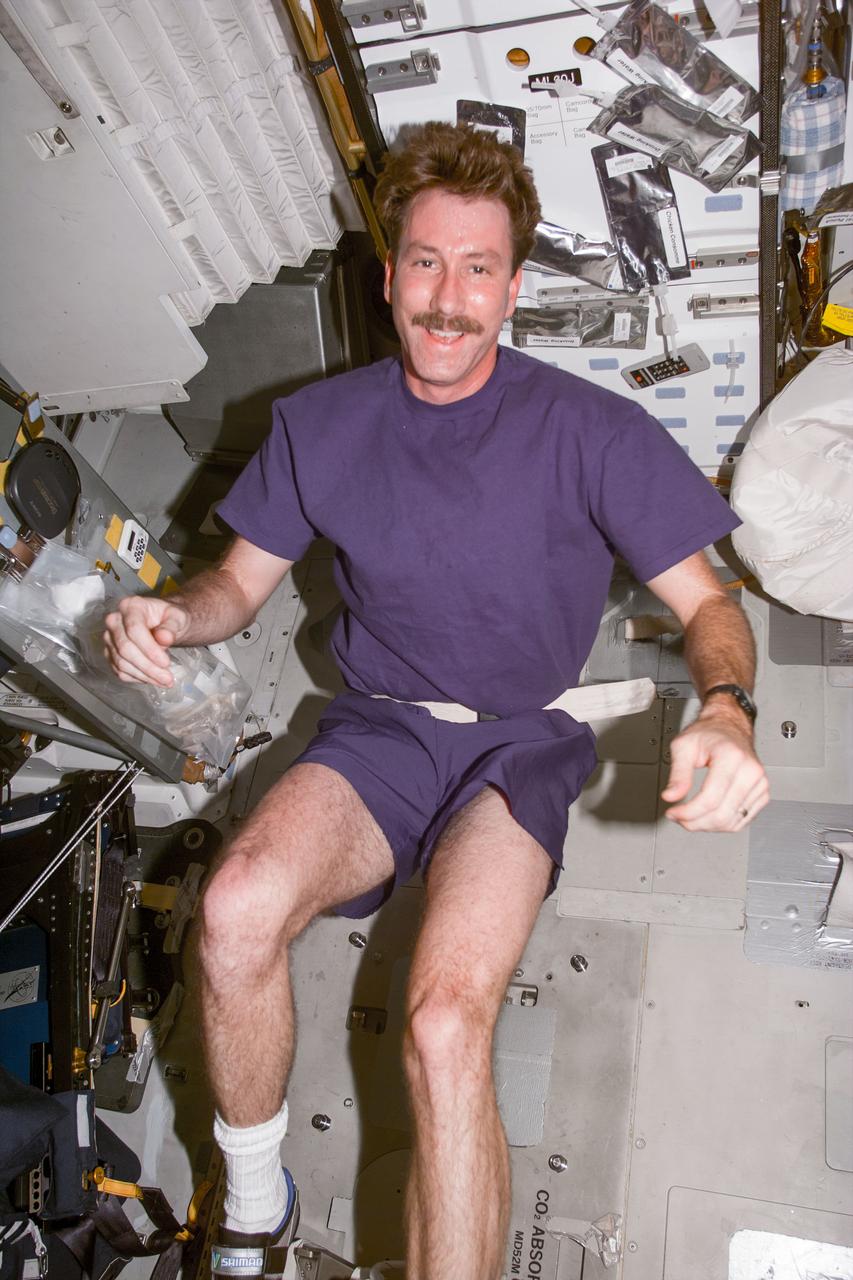
S96-E-5156 (02 June 1999)--- Astronaut Kent V. Rominger works out on the bicycle ergometer on Discovery. The photo was taken with an electronic still camera (ESC) at 02:23:46 GMT, June 2, 1999.
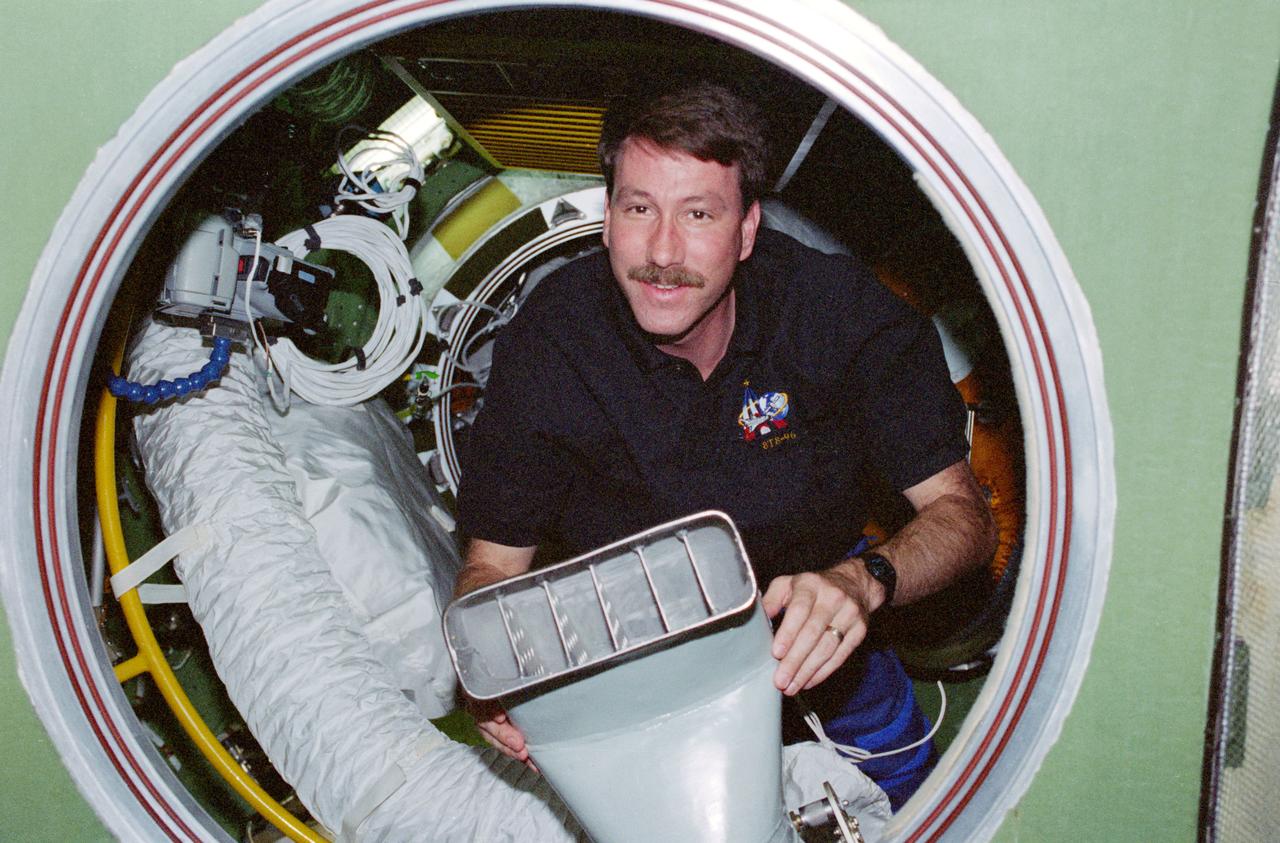
STS096-357-013 (27 May - 6 June 1999) --- Astronaut Kent V. Rominger, mission commander, participates in the move of supplies from Discovery to the International Space Station (ISS). Rominger was joined by four other American astronauts, a Canadian astronaut and a Russian cosmonaut for almost ten days in space, most of which were devoted to preparing the ISS.
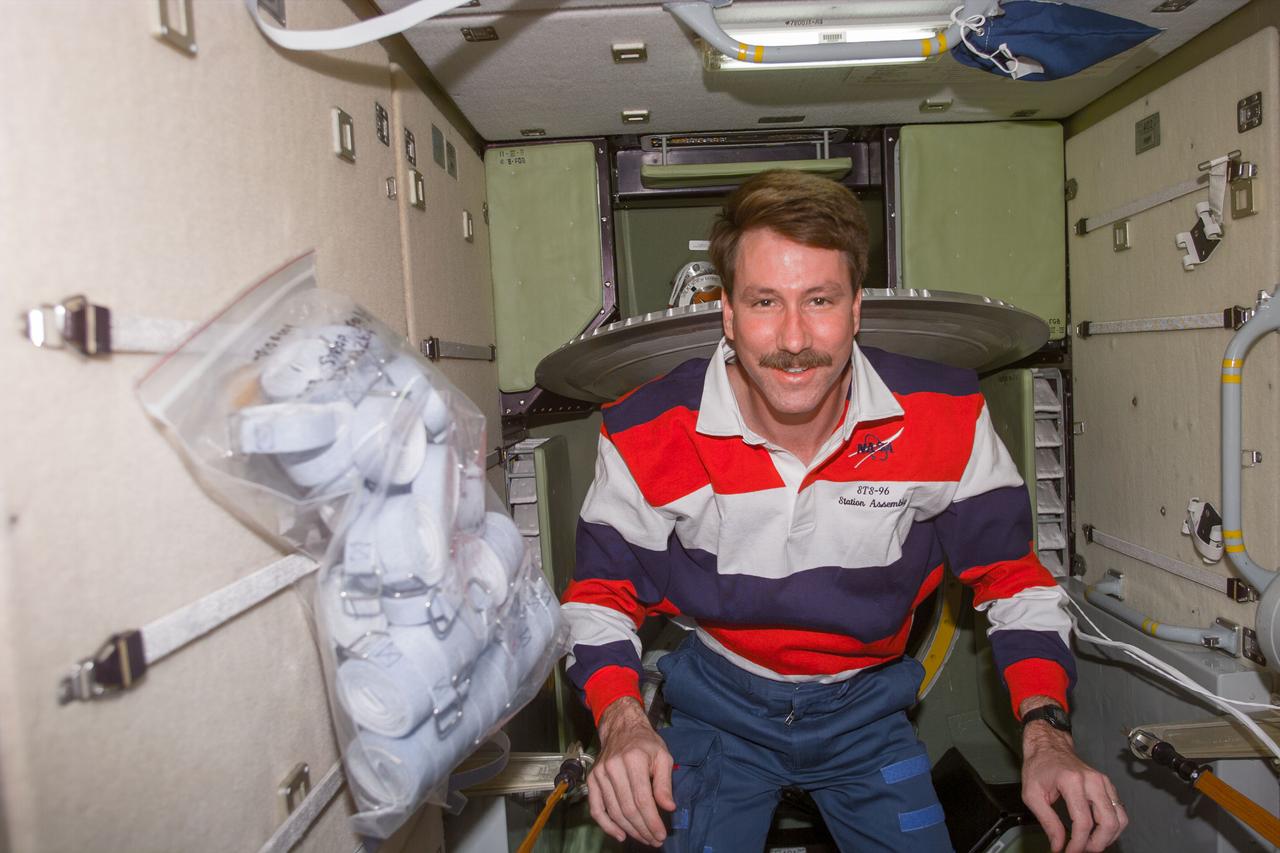
S96-E-5162 (2 June 1999) --- Astronaut Kent V. Rominger, mission commander, eyes the end of chores designed to prepare the International Space Station (ISS) for occupation. The photo was taken with an electronic still camera (ESC) at 05:58:53 GMT, June 2, 1999.
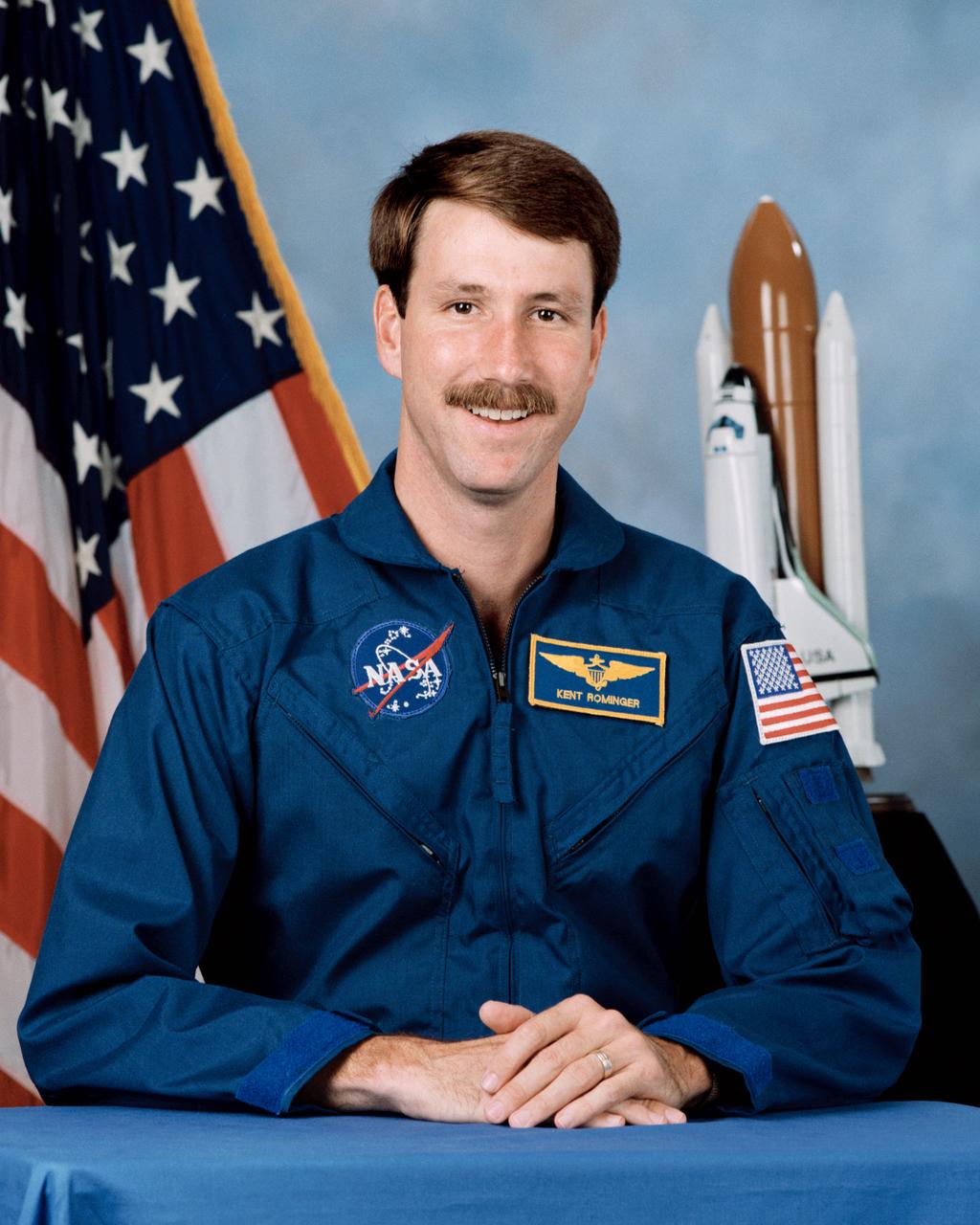
S92-44961 (9 Sept. 1992) --- Astronaut Kent V. Rominger, pilot.
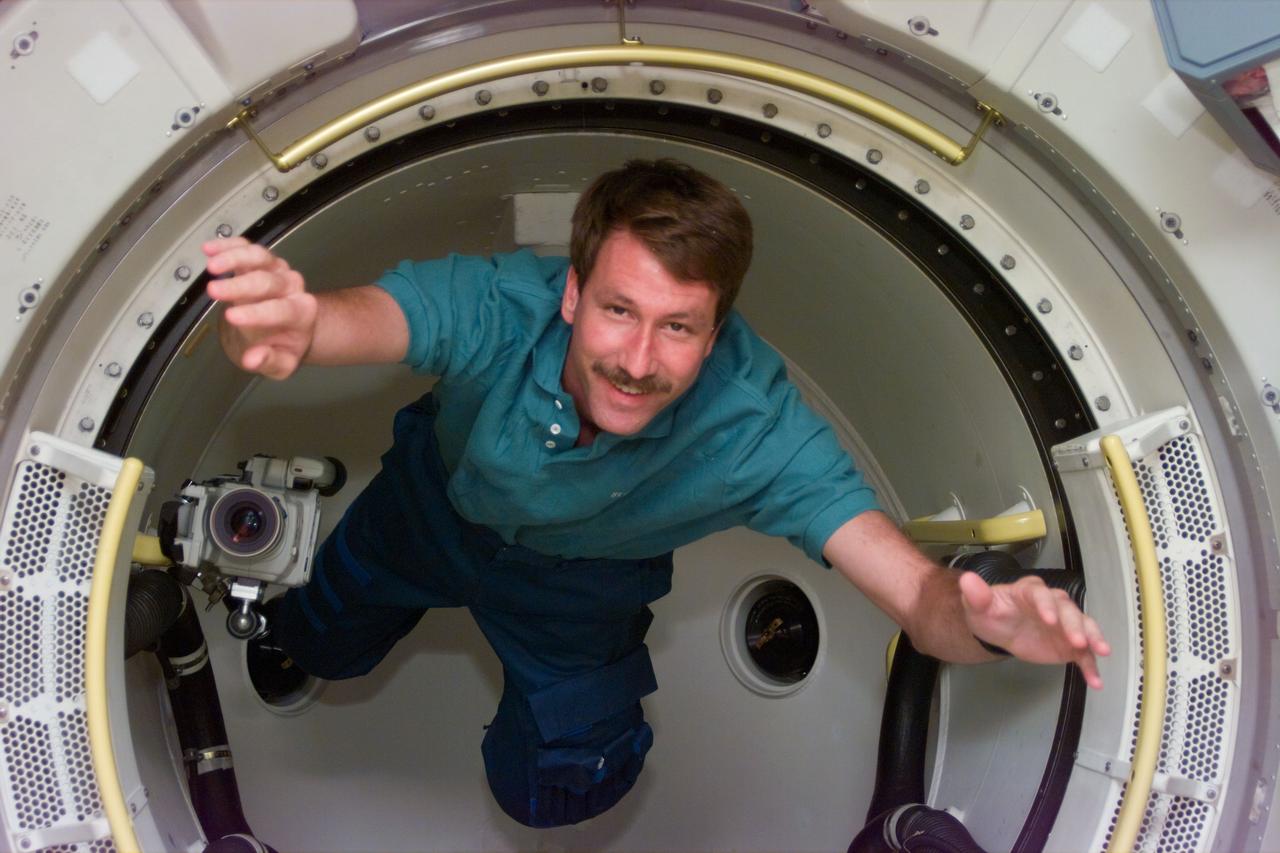
STS073-E-5053 (26 Oct. 1995) --- Astronaut Kent V. Rominger, STS-73 pilot, floats through a tunnel connecting the space shuttle Columbia's cabin and its science module. Rominger is one of seven crewmembers in the midst of a 16-day multi-faceted mission aboard Columbia. For the next week and a half, the crew will continue working in shifts around the clock on a diverse assortment of United States Microgravity Laboratory (USML-2) experiments located in the science module. Fields of study include fluid physics, materials science, biotechnology, combustion science and commercial space processing technologies. The frame was exposed with an Electronic Still Camera (ESC).

STS073-356-018 (20 October - 5 November 1995) --- Astronaut Kent V. Rominger, pilot, demonstrates an age-old trash-compacting method on the middeck of the Earth-orbiting Space Shuttle Columbia. Following a meal, Rominger had collected the residue wrappers, etc. and filled a plastic bag. Following his compacting maneuvers, Rominger went on to deposit the sack into a temporary trash-stowage area beneath the middeck. Making his first flight into space, Rominger joined four other NASA astronauts and two guest researchers for more than two weeks' research in support of the United States Microgravity Laboratory (USML-2) mission.
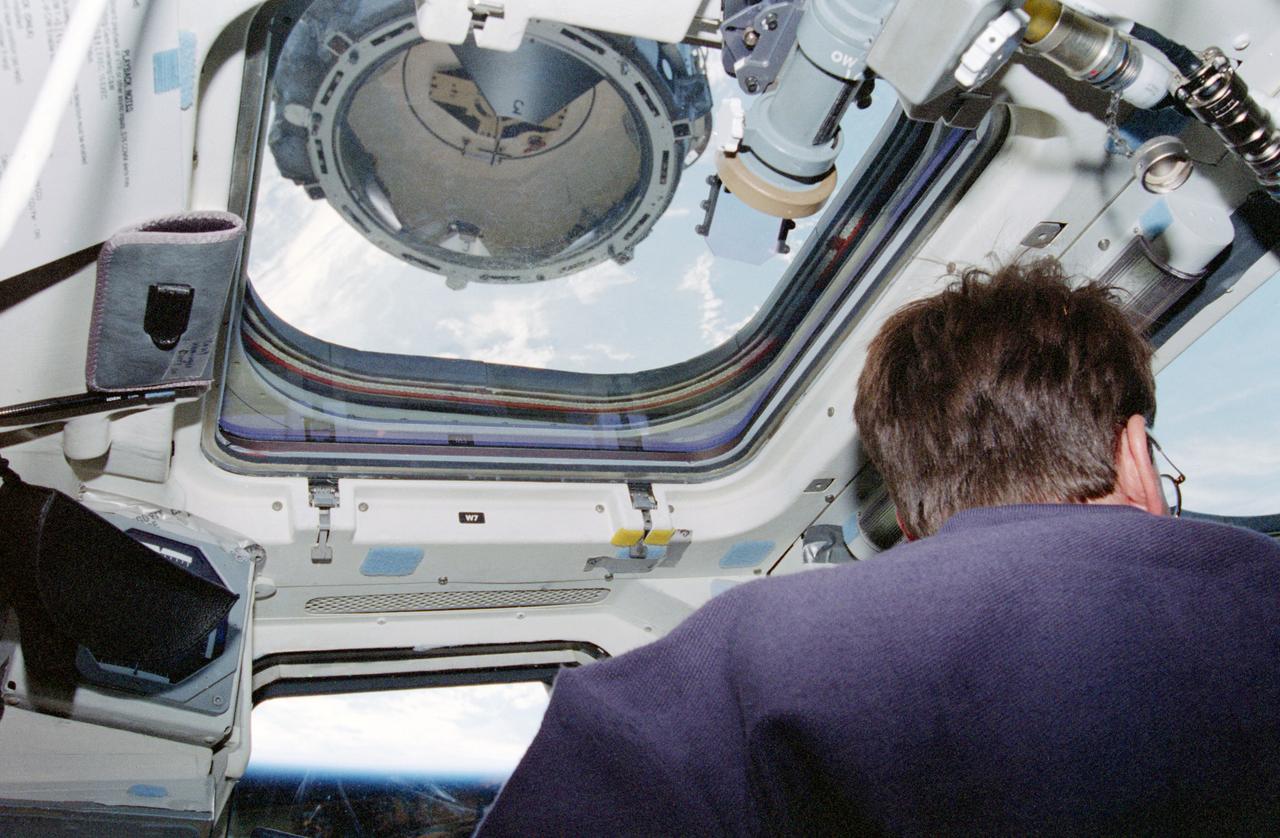
STS096-361-025 (29 May 1999) --- Astronaut Kent V. Rominger, mission commander, is about to accomplish the successful docking of Discovery to the International Space Station (ISS). Rominger is at the shuttle's controls on the aft flight deck. The docking mechanism of the approaching station is just a few meters away on the other side of the overhead window. Rominger was joined by four other American astronauts, a Canadian astronaut and a Russian cosmonaut for almost ten days in space, most of which were devoted to preparing the ISS.
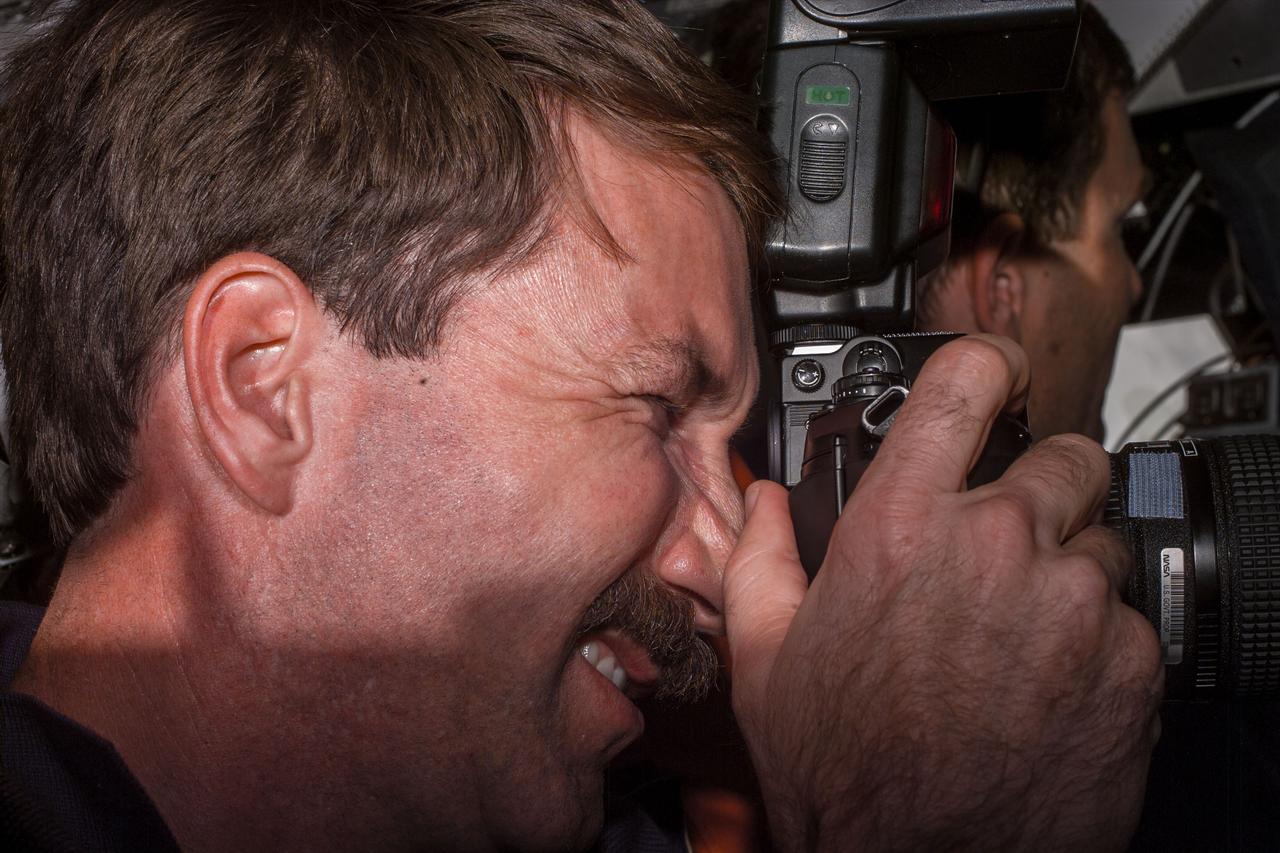
S96-E-5061 (29 May 1999) --- Astronaut Kent V. Rominger, mission commander, takes a picture on Discovery's flight deck shortly after the shuttle had docked with the International Space Station (ISS). Astronaut Rick D. Husband, pilot, can be seen in the background. The photo was taken at 04:38:10 GMT, May 29, 1999.
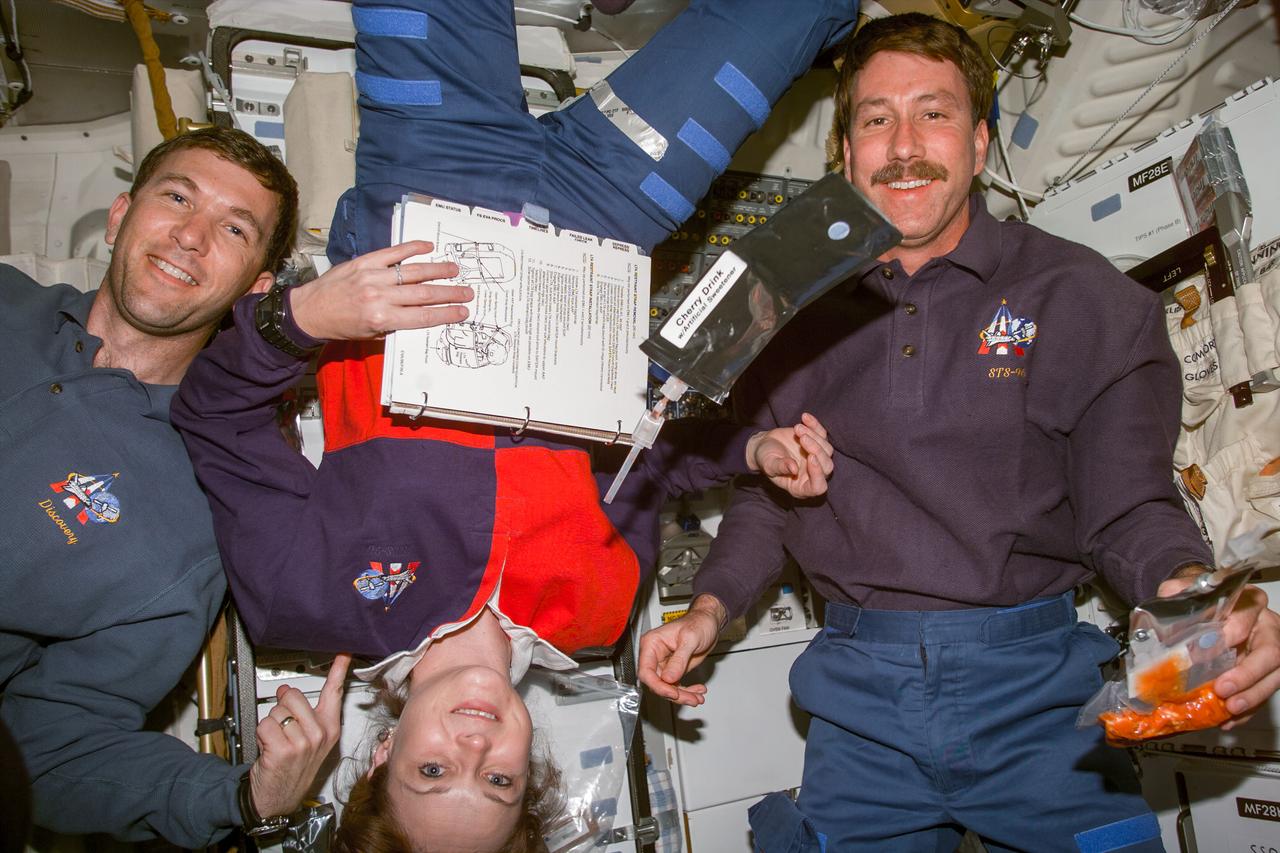
S96-E-5017 (29 May 1999) --- Three of Discovery's seven crew members are pictured during a break from activity on the mission's fourth day in space. From the left are Rick D. Husband, pilot; Tamara Jernigan, mission specialist, and Kent V. Rominger, commander. The photo was taken with an electronic still camera (ESC) at 09:50:34 GMT, May 29, 1999.
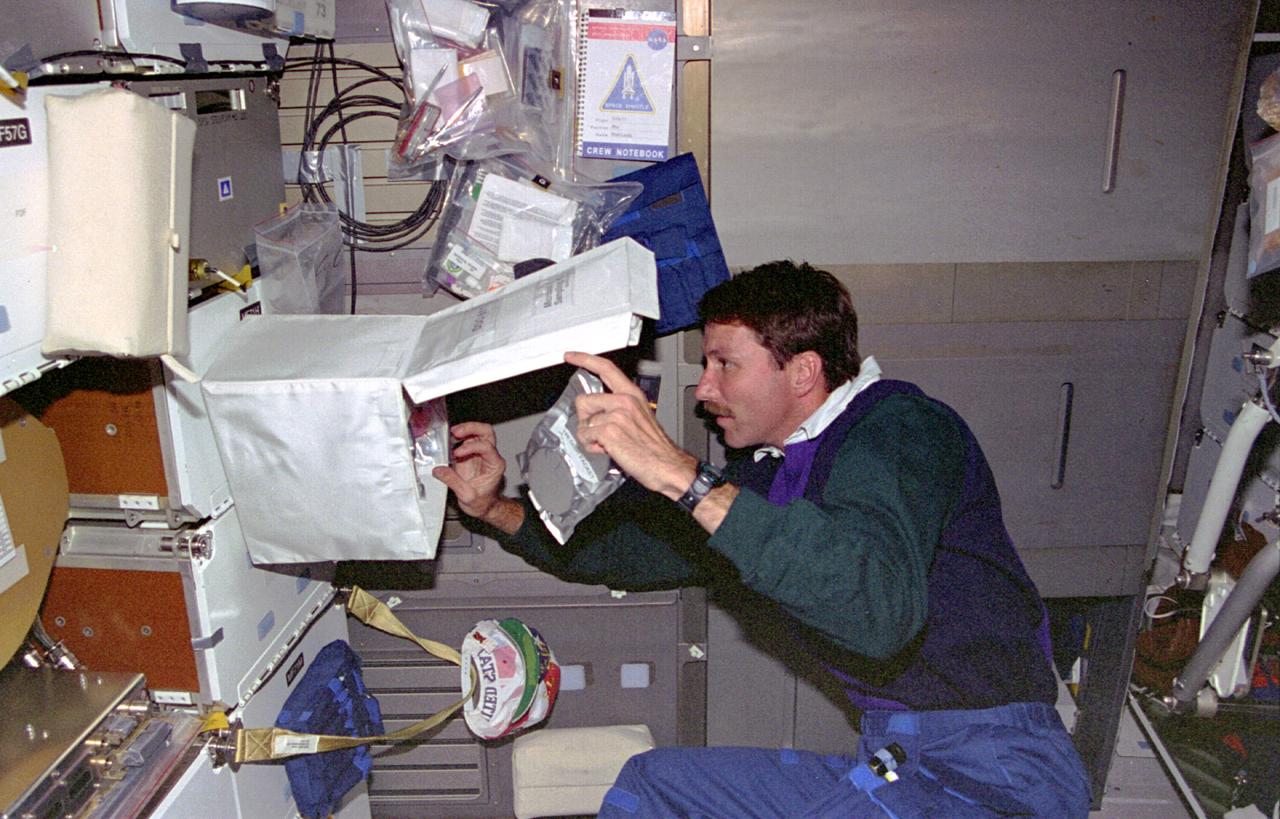
STS073-352-008 (20 October - 5 November 1995) --- On the middeck of the Earth-orbiting Space Shuttle Columbia, astronaut Kent V. Rominger, STS-73 pilot, retrieves gear necessary for sampling of the air. In addition to his pilot duties and the performance of tasks in support of the U.S. Microgravity Laboratory (USML-2) mission, Rominger and other crew members pitched in with housekeeping chores as part of their 16-days of Earth-orbit activity.
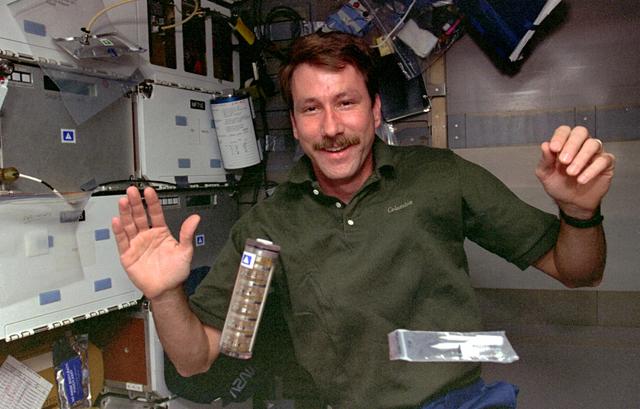
STS073-351-009 (20 October - 5 November 1995) --- Astronaut Kent V. Rominger, STS-73 pilot, retrieves a protein sample on the middeck of the Earth-orbiting Space Shuttle Columbia. Rominger, along with four other NASA astronauts and two guest researchers, spent 16 full days in space in support of the United States Microgravity Laboratory (USML-2) mission.
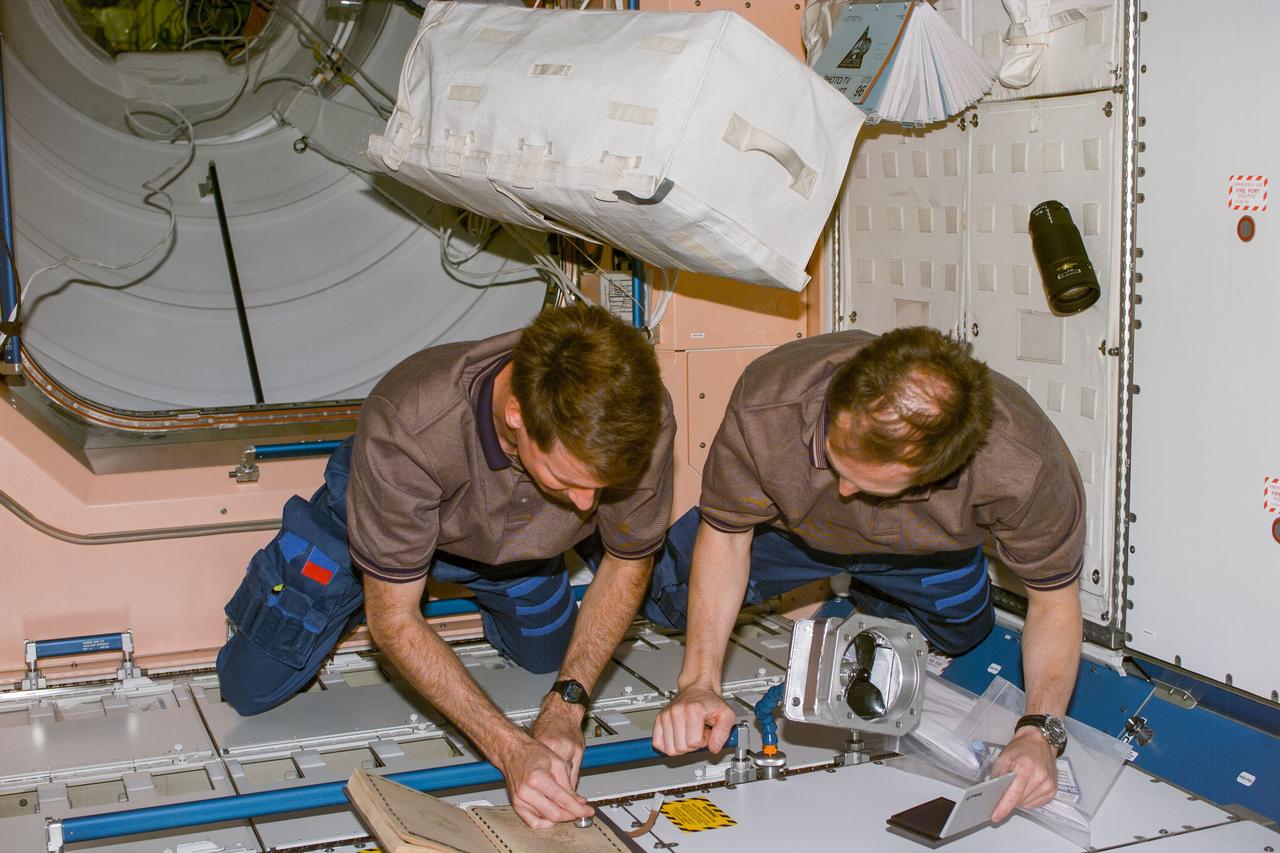
S96-E-5200 (03 June 1999) --- Astronaut Kent V. Rominger (left) and cosmonaut Valery I. Tokarev put on the finishing touches of their assigned chores in preparation of the International Space Station (ISS). The photograph was taken with an electronic still camera (ESC) at 03:58:28 GMT, June 3, 1999.
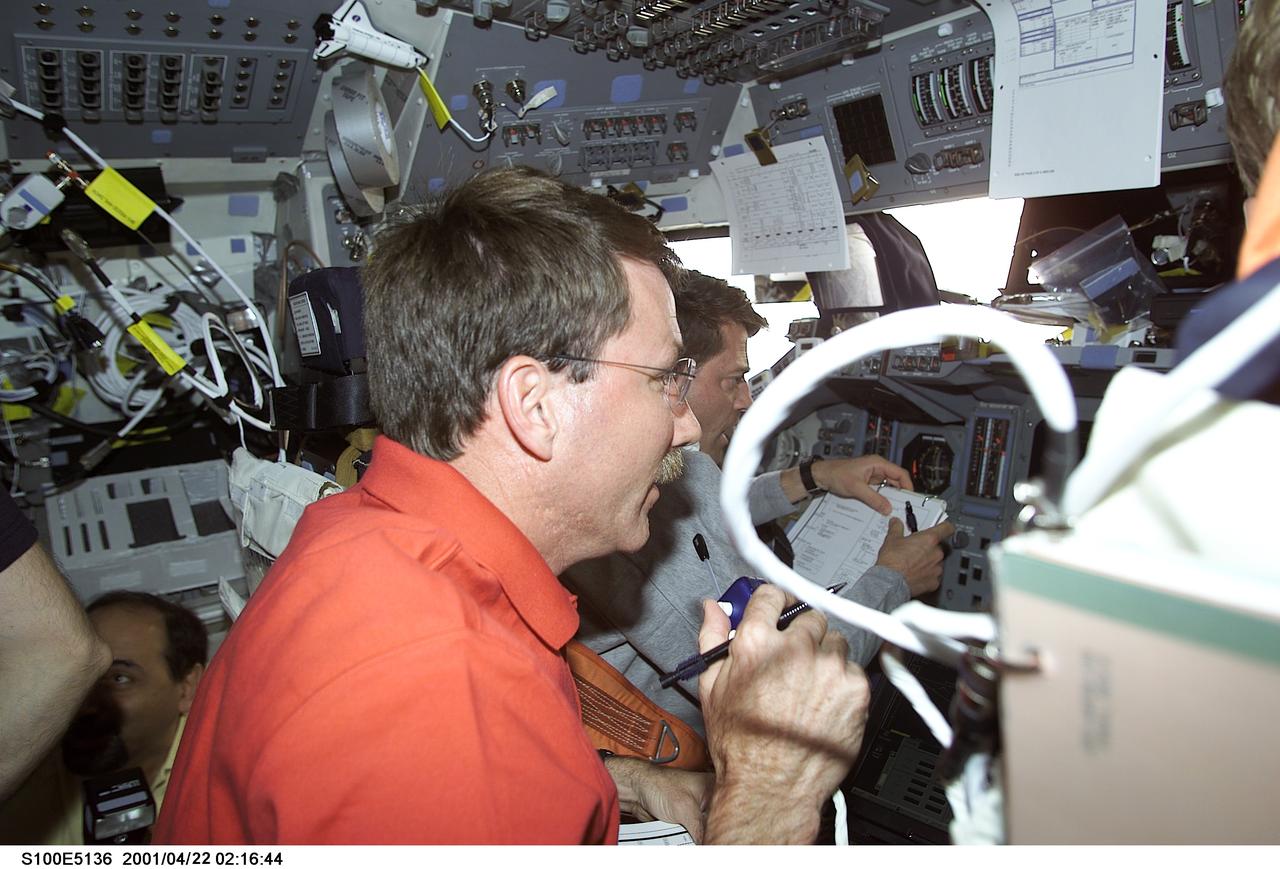
S100-E-5136 (21 April 2001) --- On Endeavour's forward flight deck, astronauts Kent V. Rominger (foreground), mission commander, and Jeffrey S. Ashby, pilot, synchronize their efforts during pre-docking operations with the International Space Station (ISS). The image was recorded with a digital still camera.
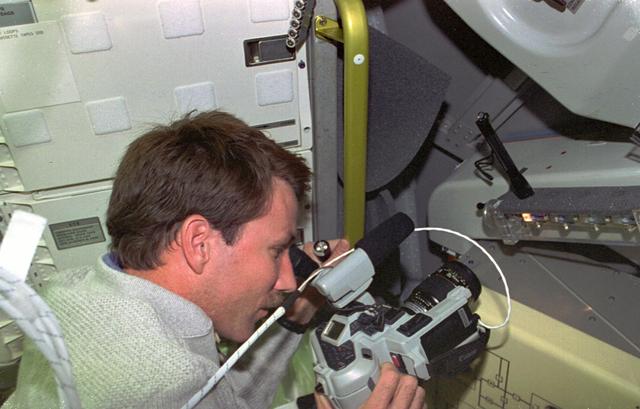
STS073-131-014 (20 October-5 November 1995) --- Astronaut Kent V. Rominger, STS-73 pilot, uses a camcorder to record progress in the Hand-Held Diffusion Test Cell (HHDTC) experiment. This test dealt with crystal growth by liquid-to-liquid diffusion. Four HHDTC units containing four test cells each produced protein crystals by diffusing one liquid to another. Rominger joined four other NASA astronauts and two guest researchers for 16 days of in-space United States Microgravity Laboratory 2 (USML-2) research aboard the Space Shuttle Columbia.
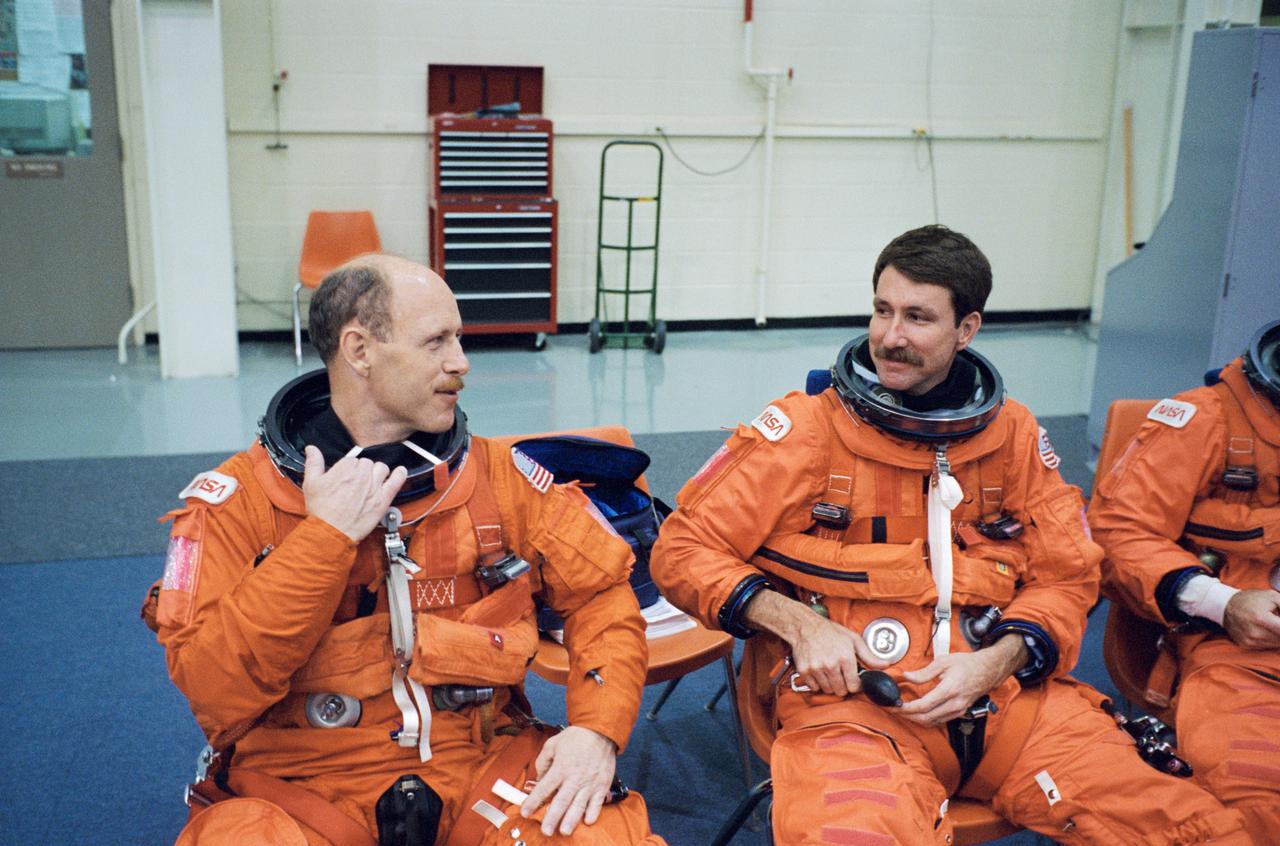
S95-09140 (27 Apr. 1995) --- Attired in training versions of the Space Shuttle partial pressure launch and entry garment, astronauts Kenneth D. Bowersox (left) and Kent V. Rominger prepare to rehearse an emergency situation with the Space Shuttle. The two are commander and pilot, respectively, for the United States Microgravity Laboratory (USML-2) mission. Bowersox was pilot for the USML-1 mission. The emergency egress training exercises took place in the Systems Integration Facility at the Johnson Space Center (JSC).
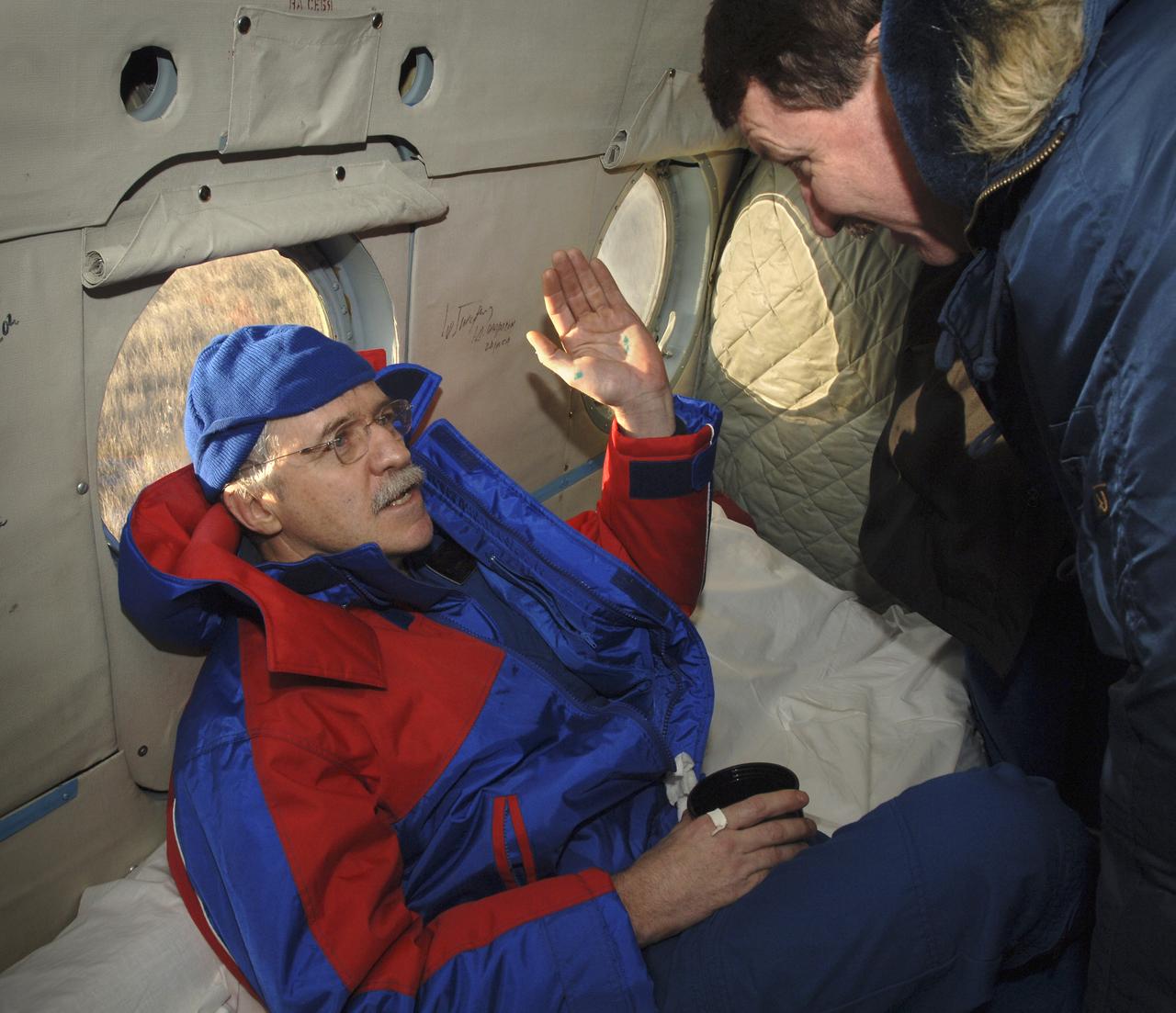
NASA astronaut John Phillips talks with astronaut Kent Rominger onboard a Russian Search and Rescue helicopter as they prepare to fly to Kustanay, Kazakhstan, following touchdown, Tuesday, Oct. 11, 2005, near Arlalyk, Kazakhstan. Members of the 11th expedition to the international space station, astronaut John Phillips and cosmonaut Sergei Krikalev, landed after a six-month mission in orbit. Along with American businessman Greg Olsen, who visited the station for more than a week, Phillips and Krikalev returned to Earth aboard a Russian Soyuz spacecraft. Photo Credit: (NASA/Bill Ingalls)
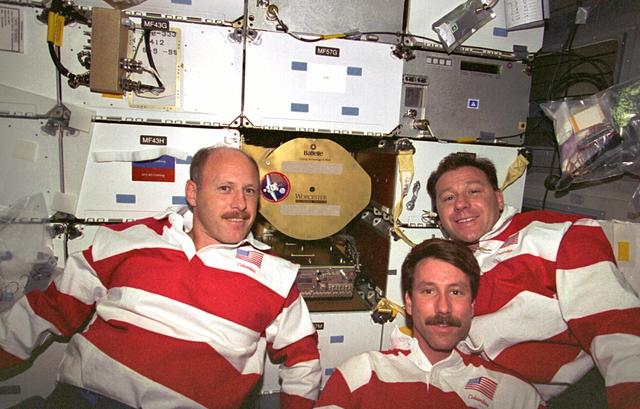
STS073-337-021 (20 October - 5 November 1995) --- Three members of the crew check out the Zeolite Crystal Growth (ZCG) on the middeck of the Earth-orbiting Space Shuttle Columbia. Left to right are astronauts Kenneth D. Bowersox and Kent V. Rominger, mission commander and pilot, respectively, and payload specialist Albert Sacco Jr. ZCG evaluated Zeolite crystallization and growth in the microgravity environment aboard Columbia in order to achieve high yields of large, nearly perfect crystals in space. Zeolites are complex arrangements of silica and alumina that occur naturally as well as synthetically.
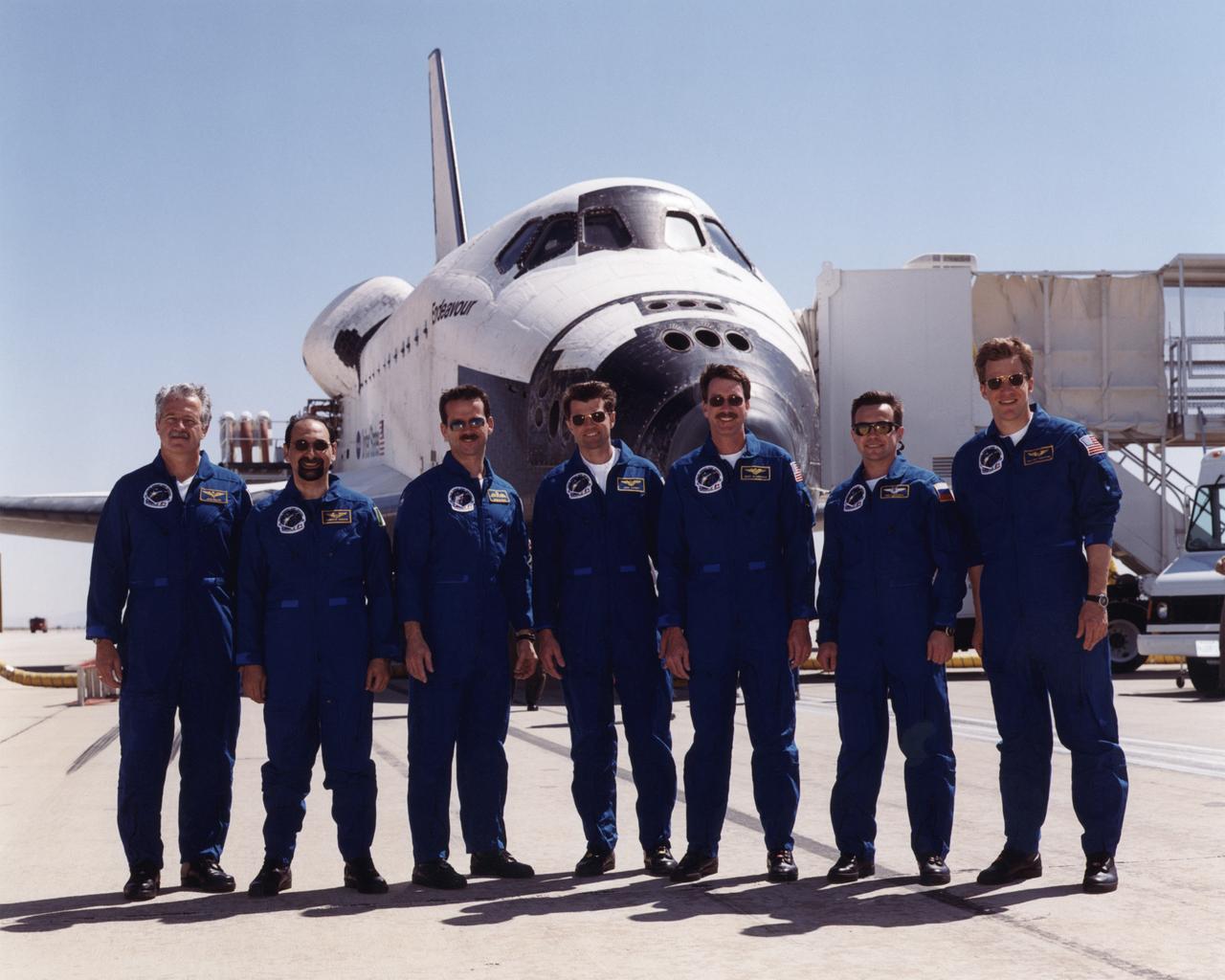
The crew of Space Shuttle mission STS-100 gathered in front of the shuttle Endeavour following landing at Edwards Air Force Base, California, 9:11 am, May 1, 2001. From left to right: John L. Phillips, mission specialist (U.S.); Umberto Guidoni, mission specialist (European Space Agency); Chris A. Hadfield, mission specialist (Canadian Space Agency); Jeffrey S. Ashby, pilot (U.S.); Kent V. Rominger, commander (U.S.); Yuri V. Lonchakov, mission specialist (Russia); Scott E. Prazynski, mission specialist (U.S.).
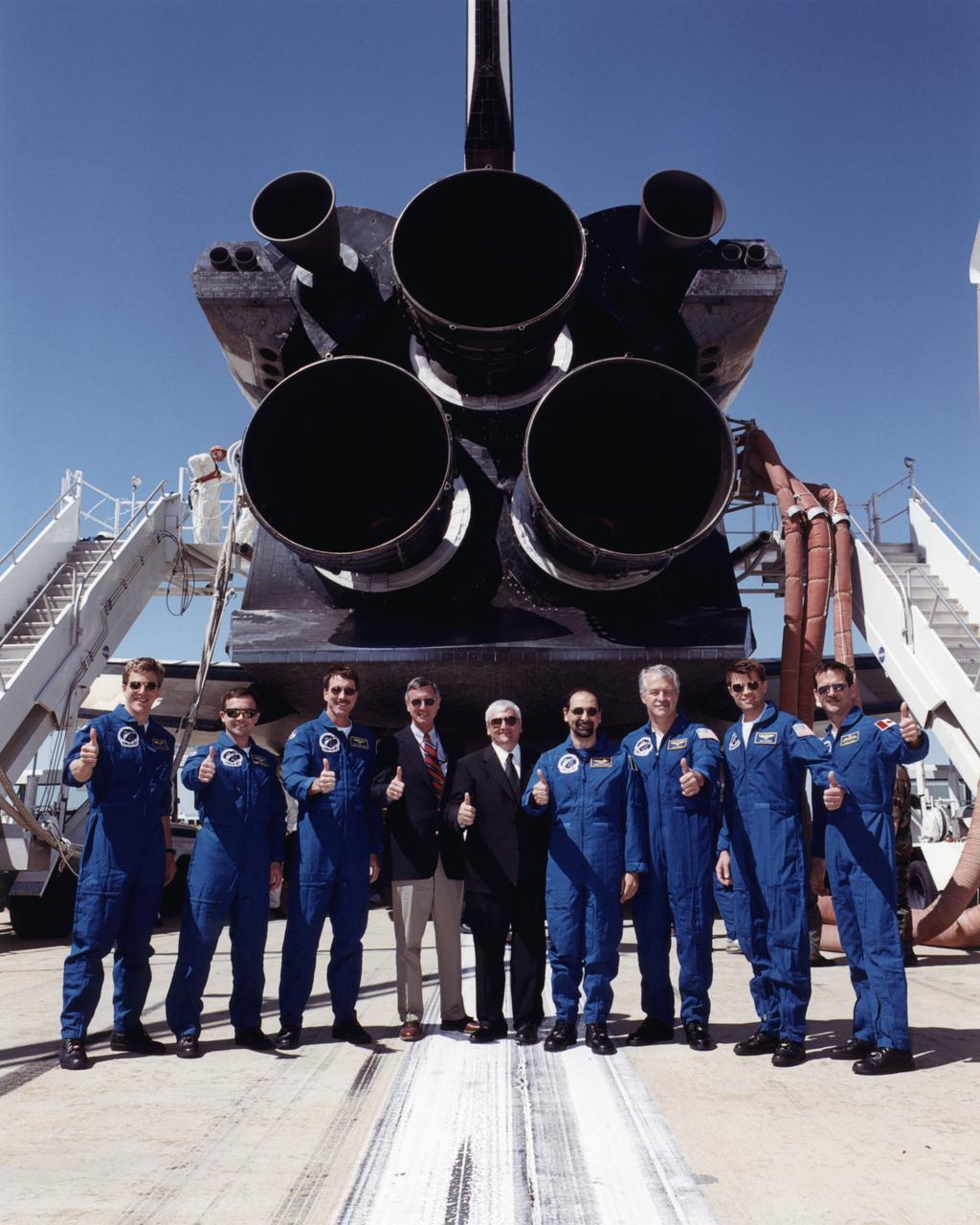
A happy "thumbs up" from the crew of the Space Shuttle Endeavour and NASA Dryden Flight Research Center officials heralded the successful completion of mission STS-100. Standing by the shuttle's rocket nozzles from left to right: Scott E. Prazynski, mission specialist (U.S.); Yuri V. Lonchakov, mission specialist (Russia); Kent V. Rominger, commander (U.S.); Wally Sawyer, NASA Dryden Flight Research Center deputy director; Kevin Petersen, NASA Dryden Flight Research Center director; Umberto Guidoni, mission specialist (European Space Agency); John L. Phillips, mission specialist (U.S.); Jeffrey S. Ashby, pilot (U.S.); and Chris A. Hadfield, mission specialist (Canadian Space Agency). The mission landed at Edwards Air Force Base, California, on May 1, 2001.
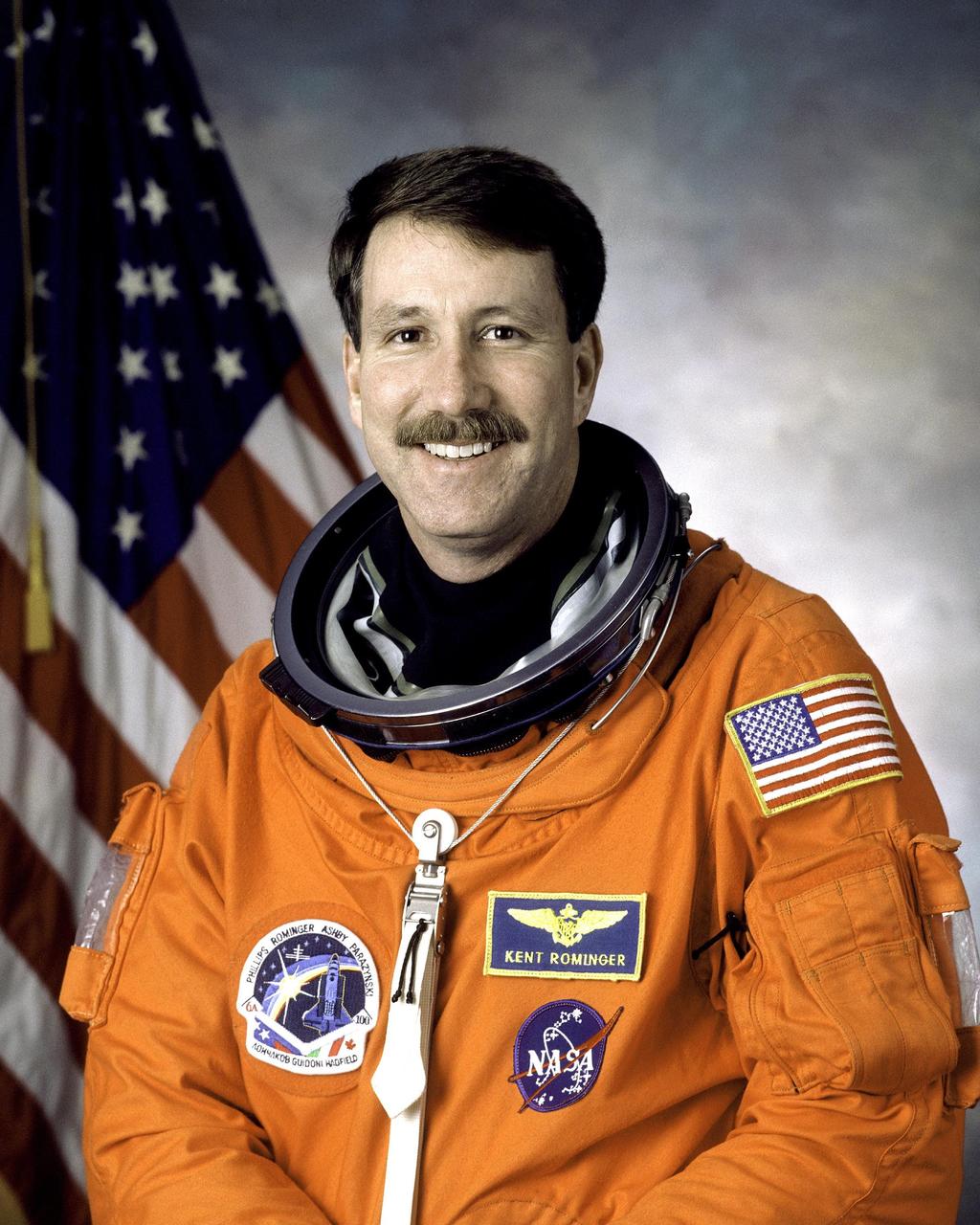
JOHNSON SPACE CENTER, HOUSTON, TEXAS: Official portrait of Kent V. Rominger, mission commander
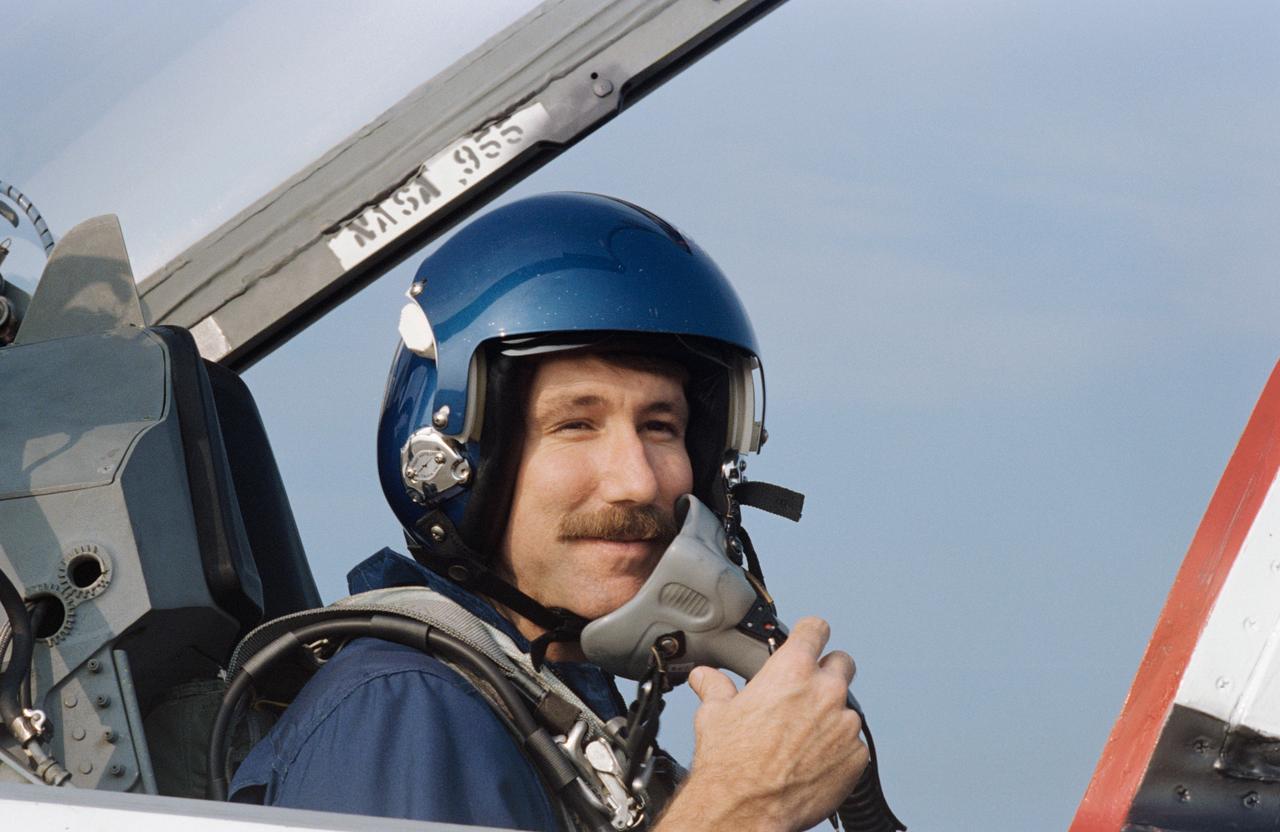
S95-17155 (24 Aug. 1995) --- Astronaut Kent V. Rominger sits in the forward station of a NASA T-38 jet trainer. Rominger was named last year as pilot for the U.S. Microgravity Laboratory (USML-2) mission, scheduled for next year.
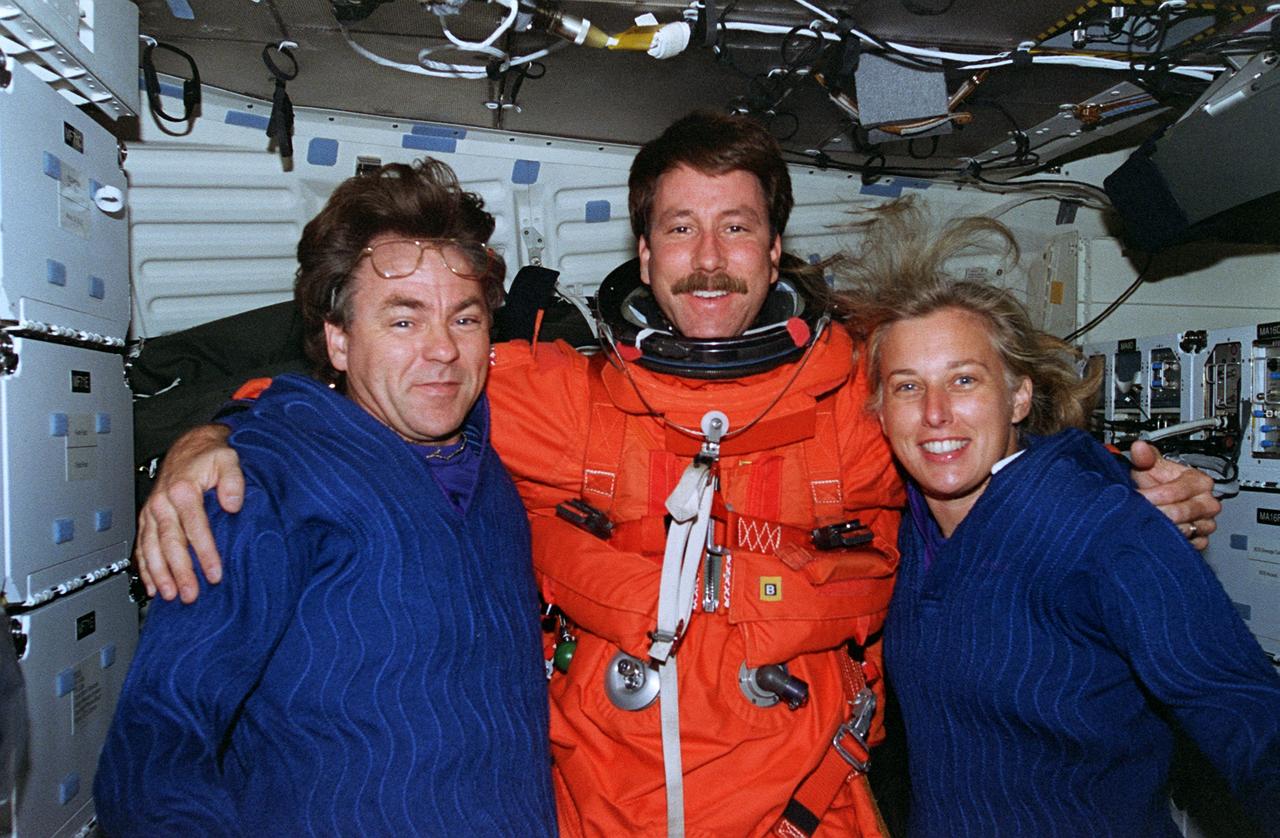
STS085-364-008 (19 August 1997) --- One of the final pictures taken during the STS-85 mission was this frame, exposed on the mid-deck during preparations for the August 19, 1997 entry. Left to right are payload specialist Bjarni V. Tryggvason, with astronauts Kent V. Rominger, pilot, and N. Jan Davis, payload commander. Rominger has already donned his partial pressure launch and entry suit, while Tryggvason and Davis have put on their blue under garments but have yet to don their escape suits.
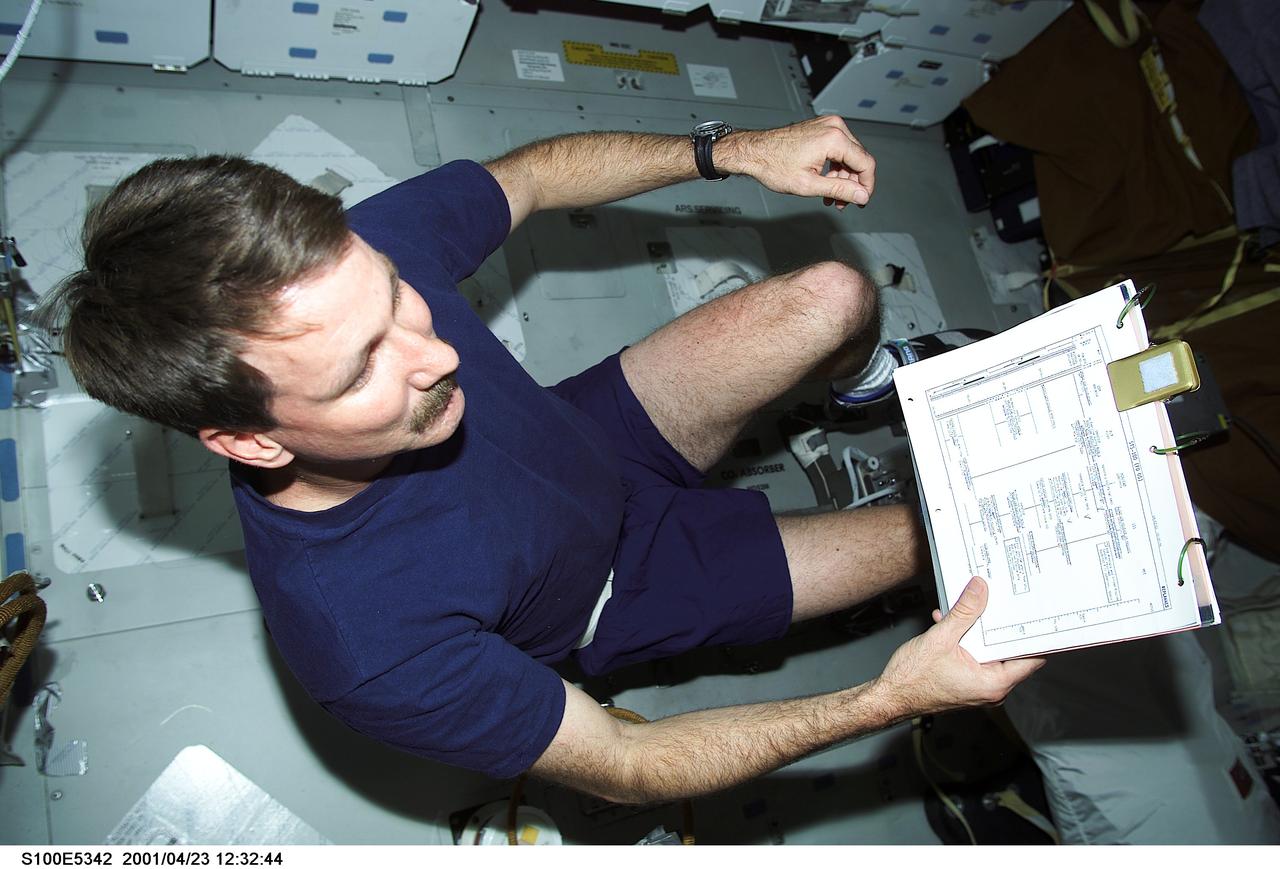
S100-E-5342 (23 April 2001) --- Astronaut Kent V. Rominger, STS-100 mission commander, economizes his time as he looks over flight data while working out on an ergometer device on the middeck of the Space Shuttle Endeavour. The scene was recorded with a digital still camera.
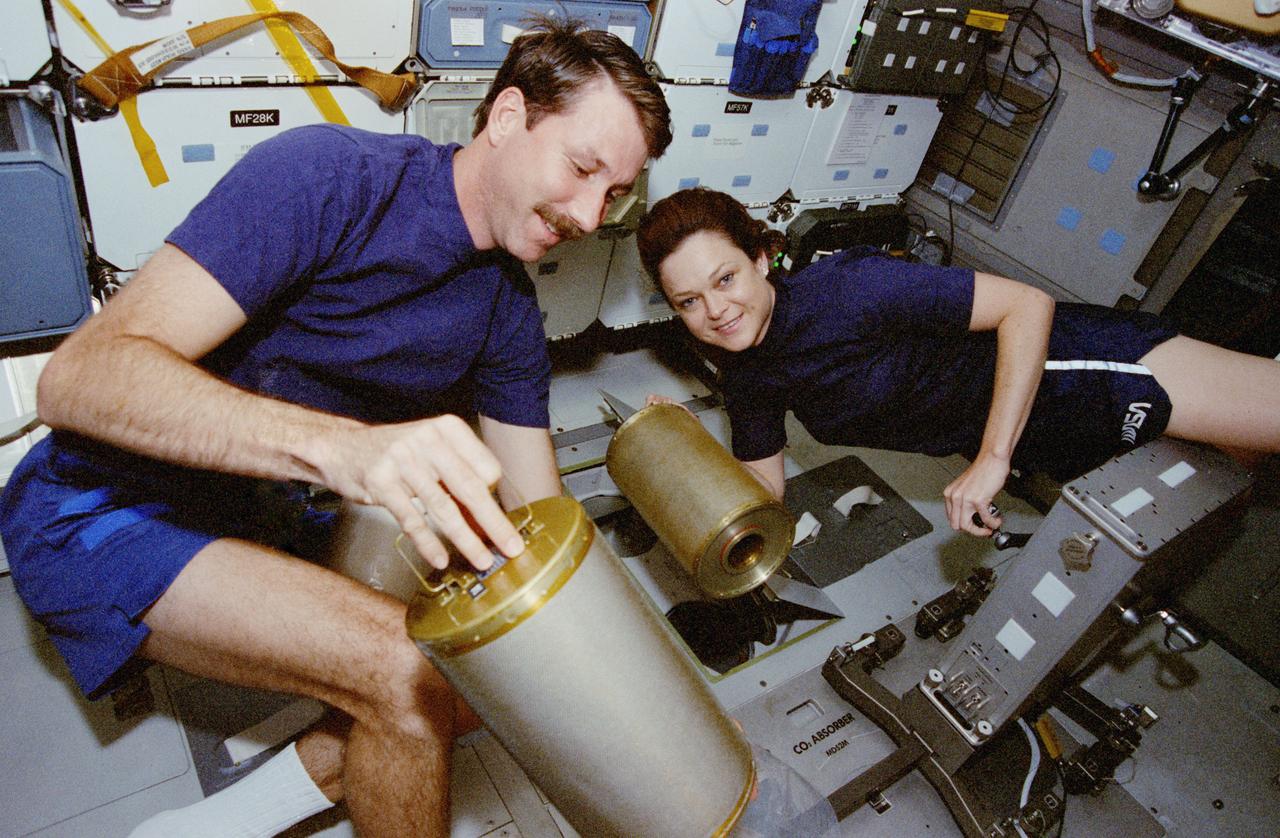
STS080-331-030 (19 Nov.-7 Dec. 1996) --- Astronauts Kent V. Rominger, STS-80 pilot, and Tamara E. Jernigan, mission specialist, perform a routine housekeeping chore during the space shuttle Columbia's record stay in Earth-orbit. The two are changing out the lithium hydroxide canisters beneath the middeck.

STS085-330-034 (7 - 19 August 1997) --- From the left, astronauts Curtis L. Brown, Jr., mission commander; Robert L. Curbeam, Jr., mission specialist; and Kent V. Rominger, pilot, are pictured on the Space Shuttle Discovery's flight deck during a checkout of flight control systems.
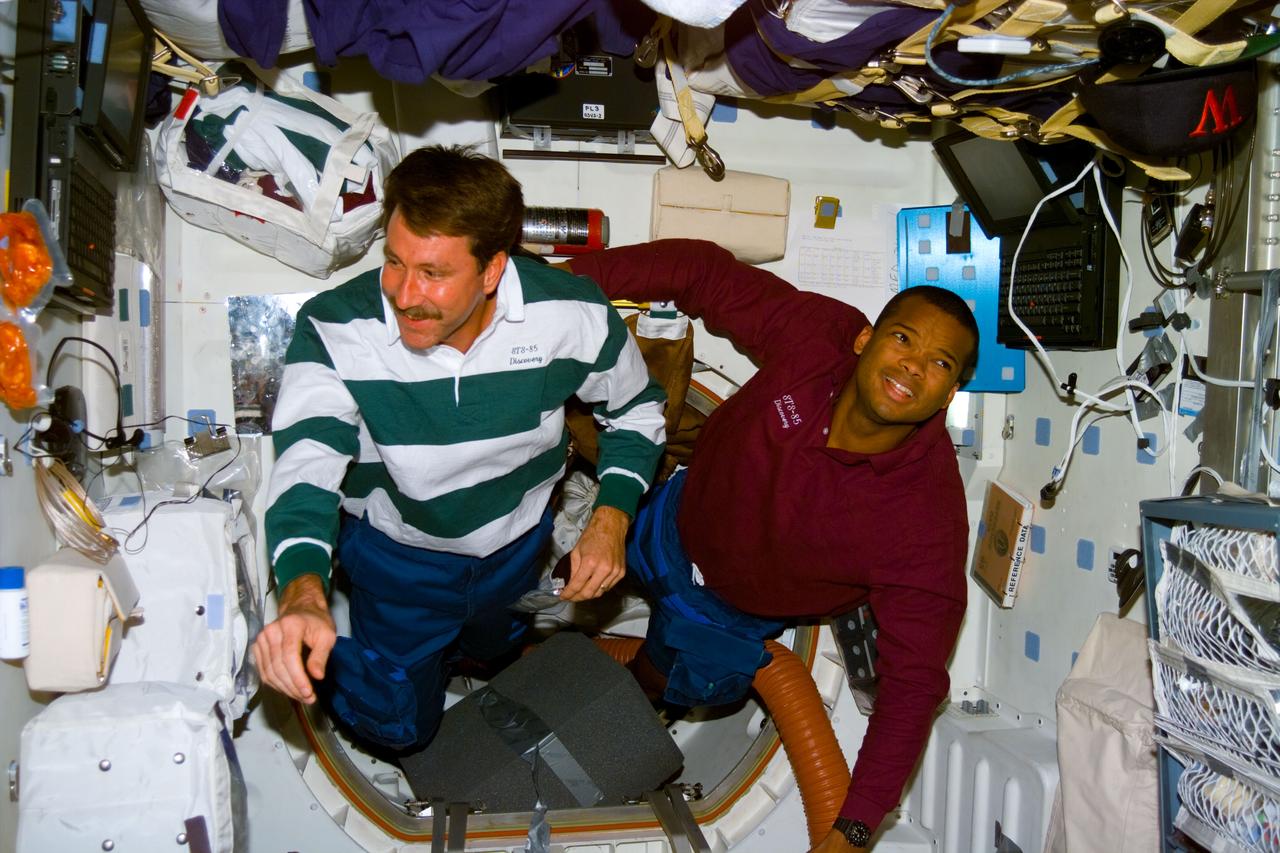
S85-E-5090 (14 August 1997) --- Astronauts Kent V. Rominger (left), pilot, and Robert L. Curbeam Jr., mission specialist, float onto the middeck of the Earth-orbiting Space Shuttle Discovery during flight day 8 activity.
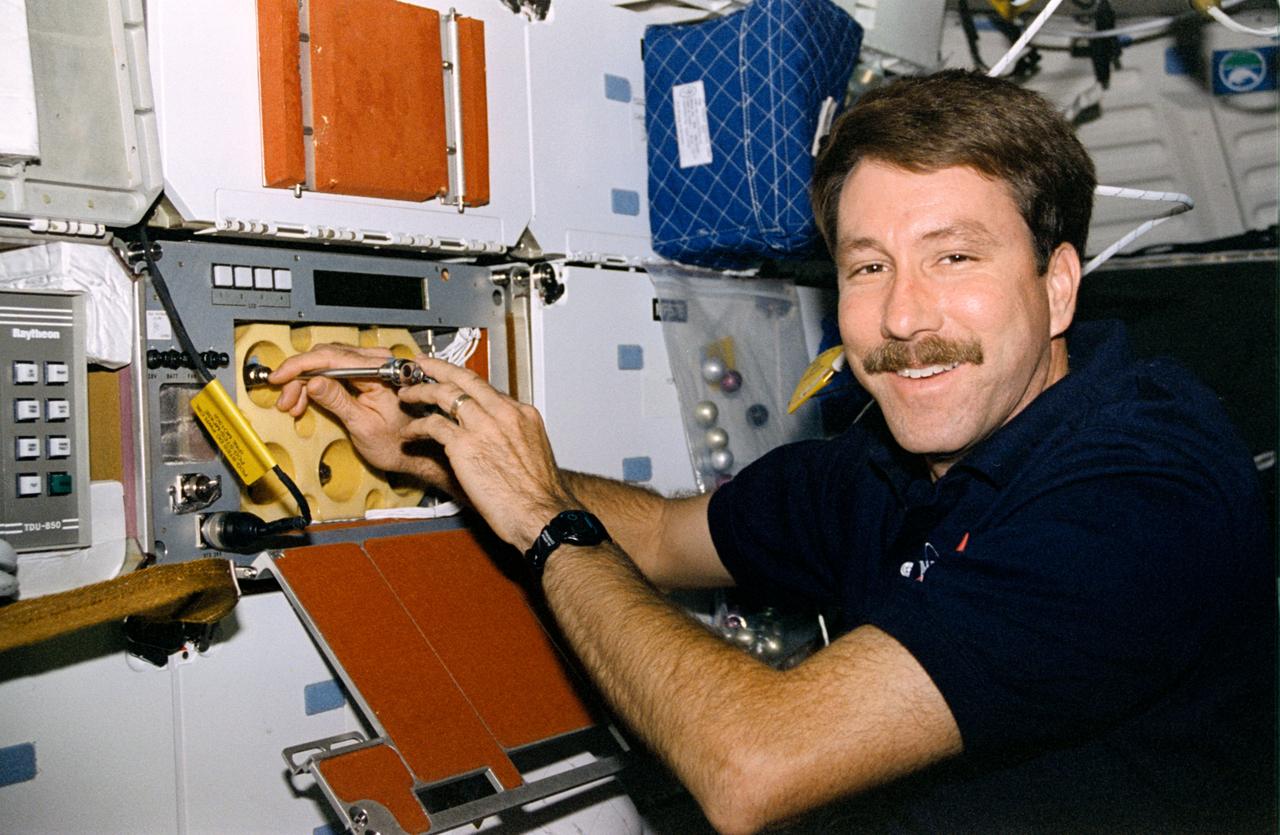
STS085-324-007 (7 - 19 August 1997) --- Astronaut Kent V. Rominger, pilot, uses a tool to deactivate the Protein Crystal Growth (PCG) experiment on the mid-deck of the Space Shuttle Discovery near the end of the 12-day STS-85 flight.
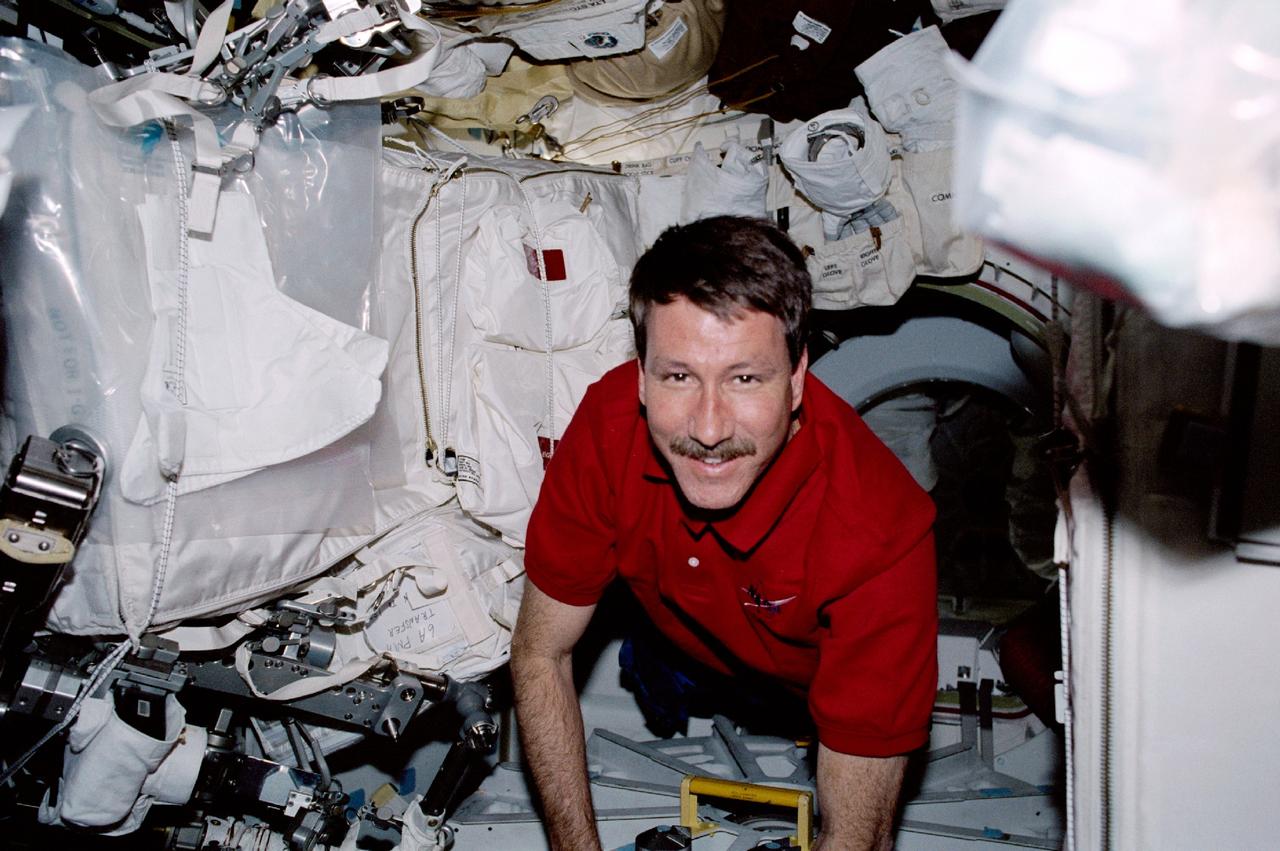
STS100-337-010 (19 April - 1 May 2001) --- Astronaut Kent V. Rominger, STS-100 mission commander, floats near the airlock hatch onboard the Earth-orbiting Space Shuttle Endeavour. The airlock is the scene of important preparations and follow-up tasks for two scheduled space walks on the STS-100 mission.
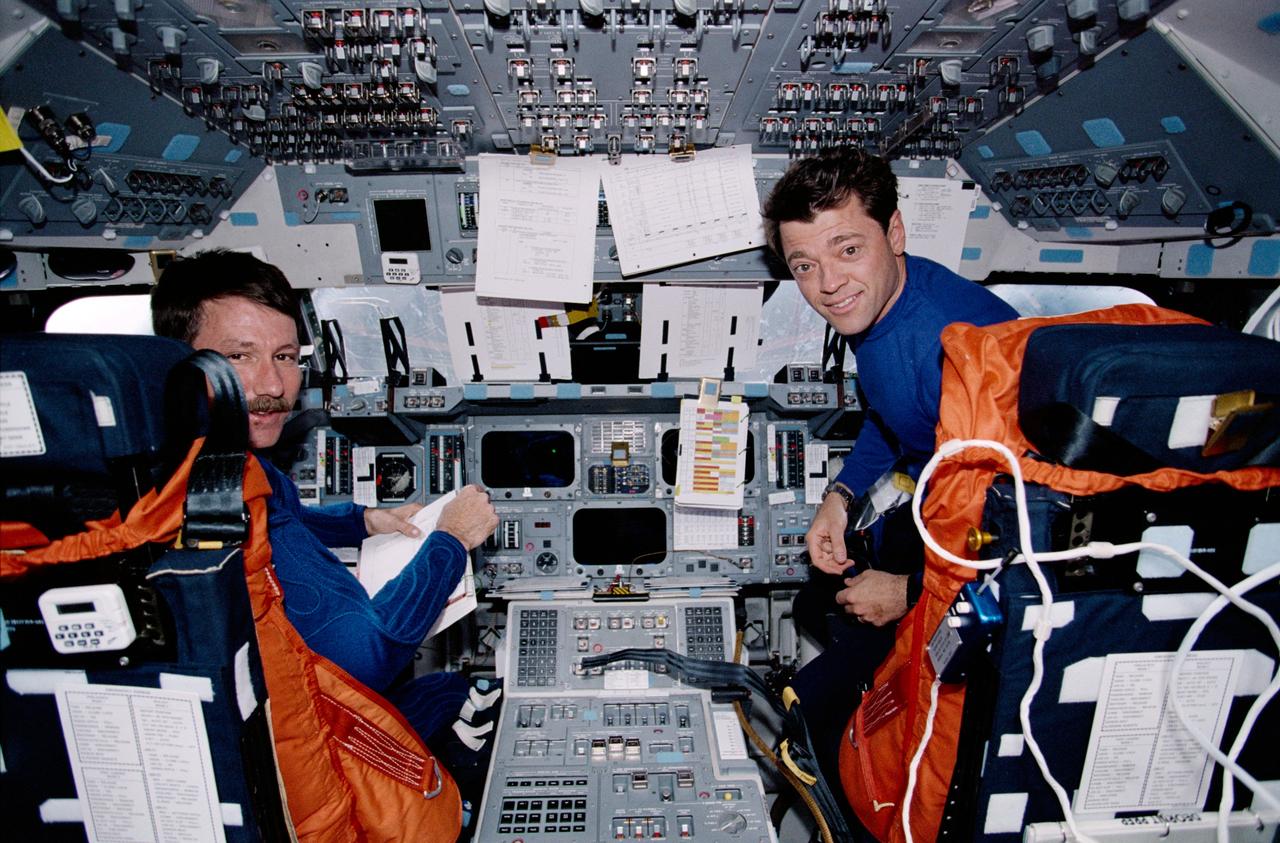
STS100-363-034 (19 April-1 May 2001) --- Astronauts Kent V. Rominger (left) and Jeffrey S. Ashby, STS-100 commander and pilot, respectively, are photographed on the flight deck of the Space Shuttle Endeavour during de-orbit preparations.
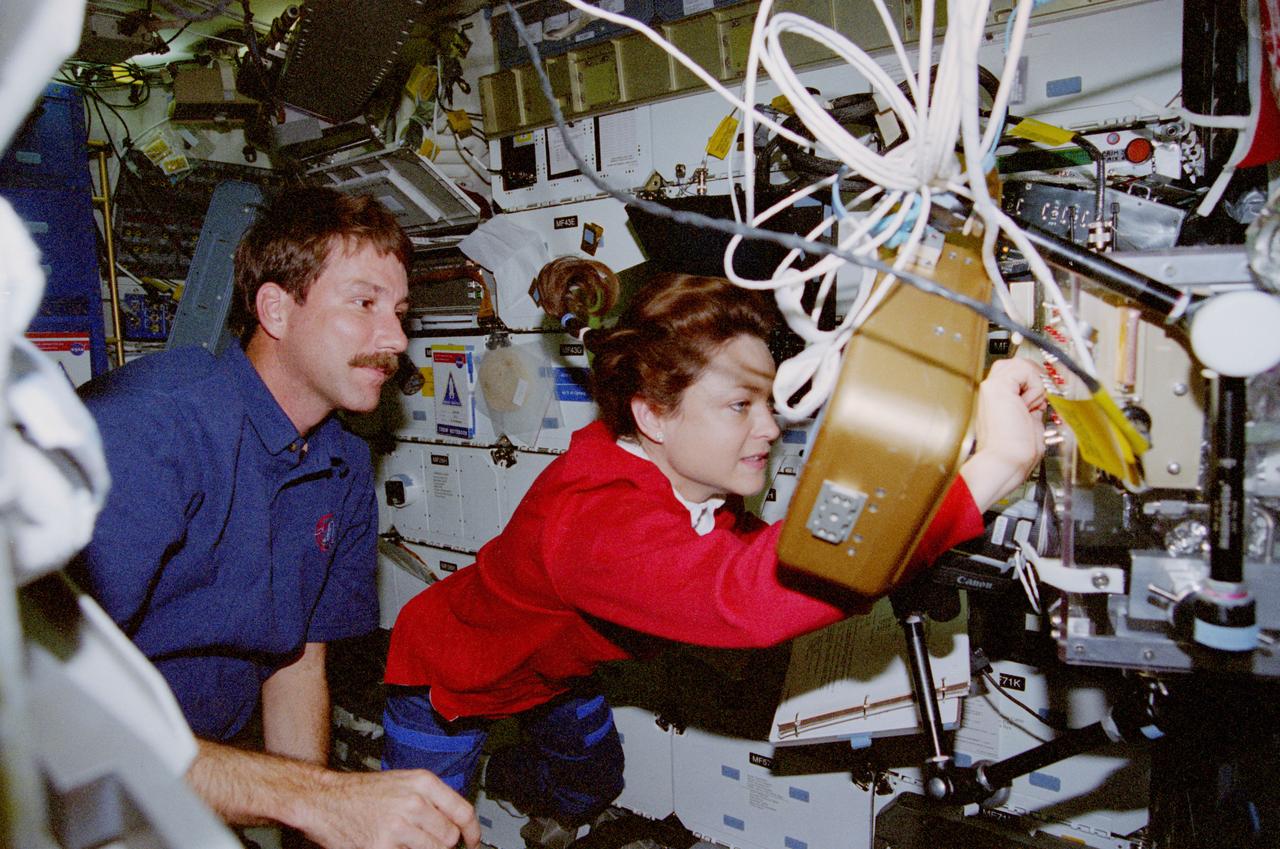
STS080-345-008 (19 Nov.-7 Dec. 1996) --- Continuing with a heavy agenda of middeck science, astronaut Tamara E. Jernigan, STS-80 mission specialist, works with the Capillary Pumped Loop (CPL) experiment while astronaut Kent V. Rominger, pilot, offers a hand.
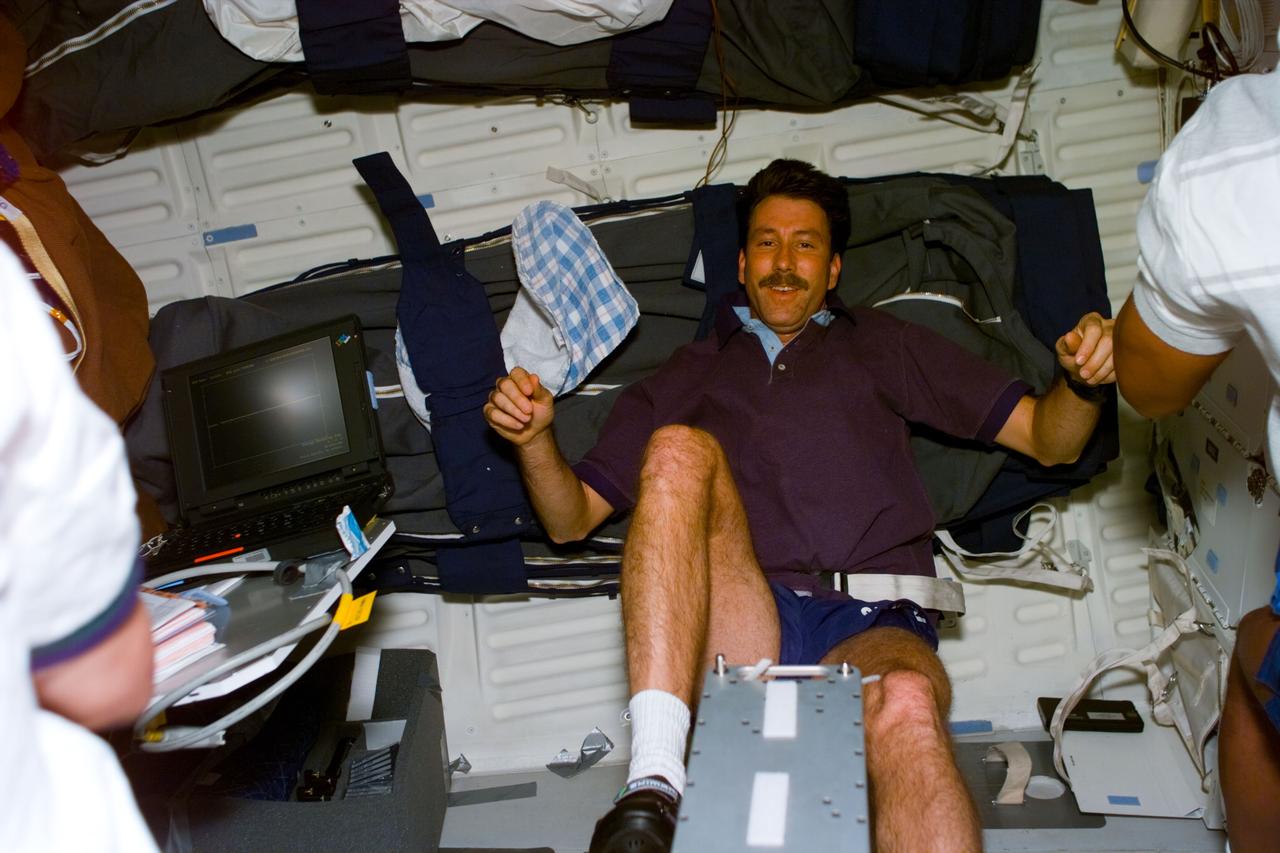
S85-E-5003 (7-19 August 1997) --- Astronaut Kent V. Rominger, pilot, works out on the bicycle ergometer on the Space Shuttle Discovery's mid-deck. Crew members devoted about 30 minutes each flight day to exercise on the bike. This view was taken with the Electronic Still Camera (ESC).
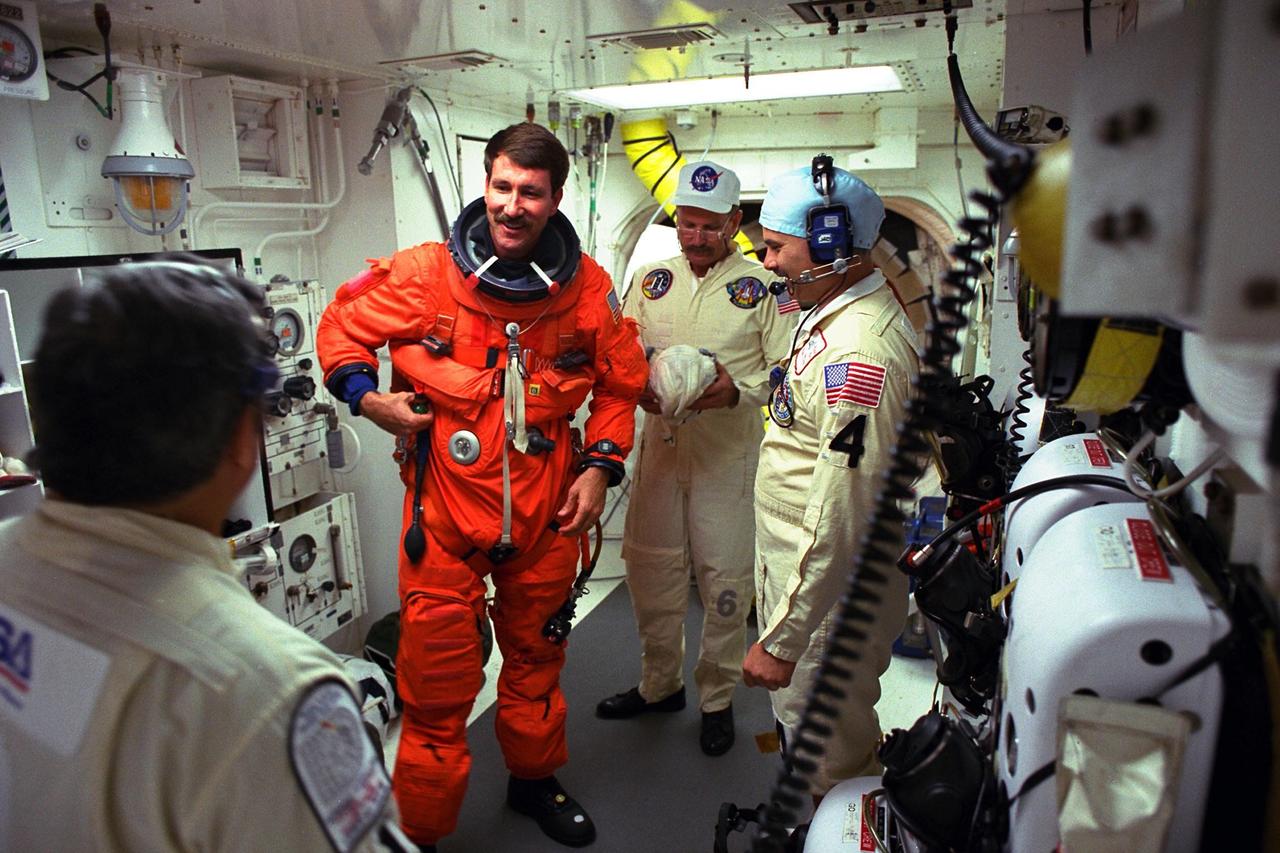
STS-85 Pilot Kent V. Rominger visits with white room closeout crew members Mike Mangione (left foreground), Jack Burritt (center), and Chris Meinert at Launch Pad 39A as they assist him with his ascent/reentry flight suit before he enters the crew cabin of the Space Shuttle orbiter Discovery
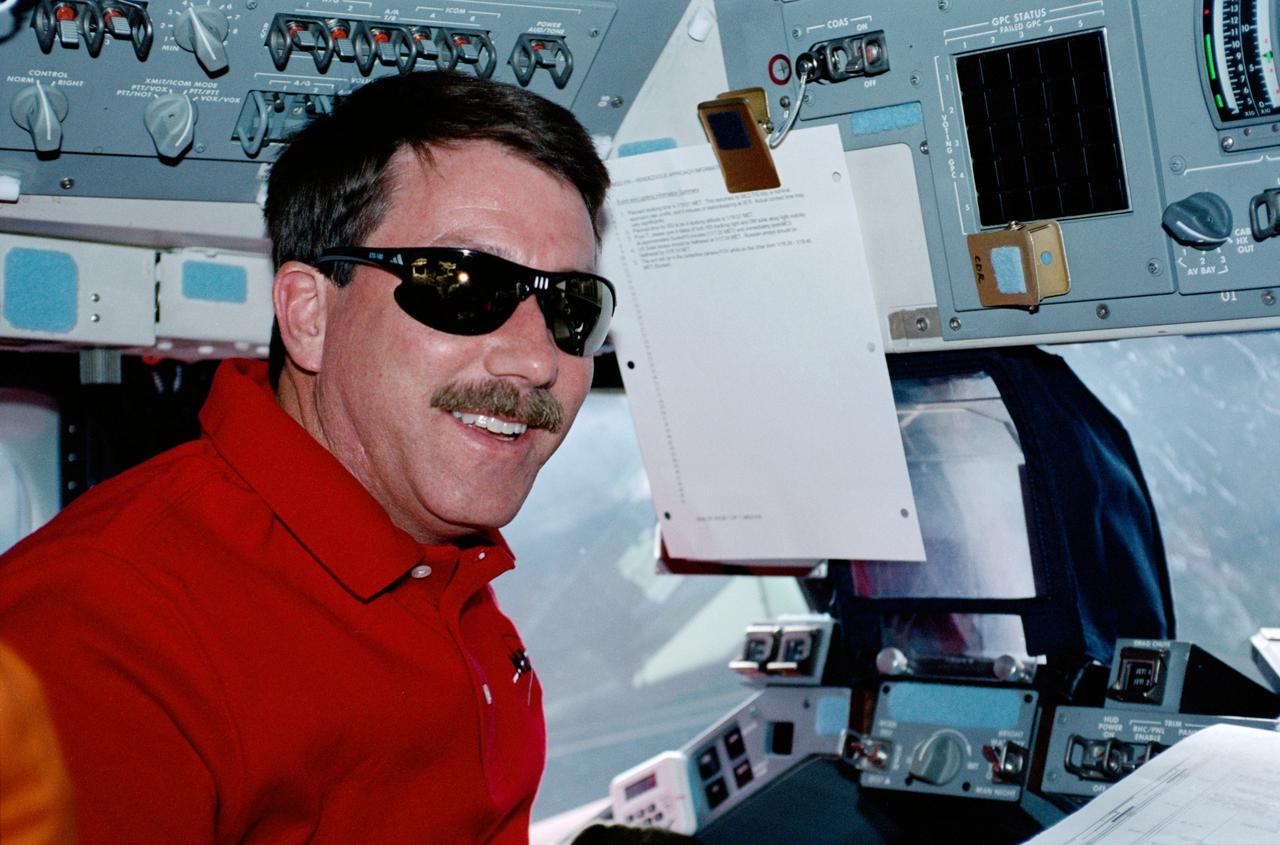
STS100-303-004 (19 April-1 May 2001) --- Astronaut Kent V. Rominger, STS-100 commander, looks over a procedures checklist at the commander's station on the forward flight deck of the Earth-orbiting Space Shuttle Endeavour.
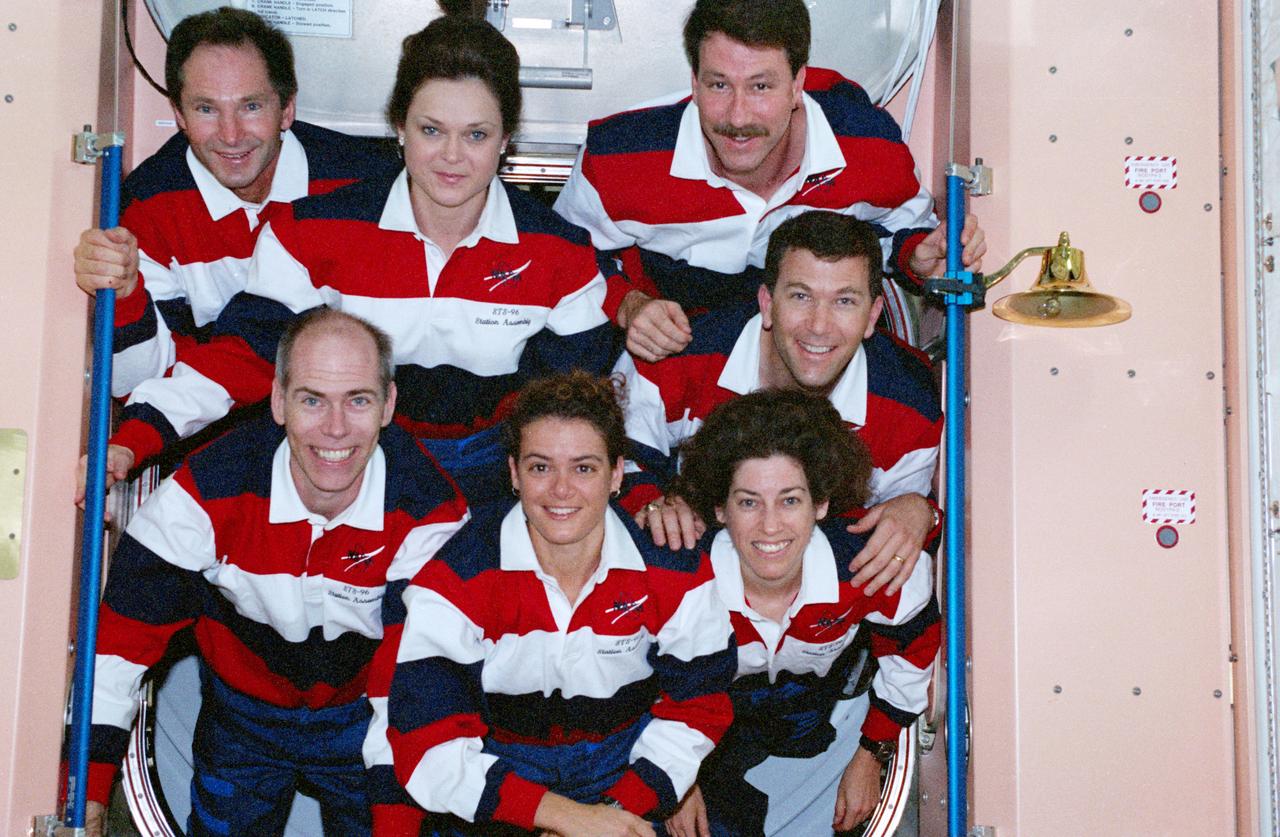
STS096-380-019 (27 May - 6 June 1999) --- The seven crew members for the STS-96 mission pose for the traditional inflight crew portrait in the hatch way of the U.S.-built Unity node for the International Space Station (ISS). From to left to right, bottom, are astronauts Daniel T. Barry, Julie Payette and Ellen Ochoa. On top are cosmonaut Valery I. Tokarev, along with astronauts Tamara E. Jernigan and Kent V. Rominger. Astronaut Rick D. Husband is between Rominger and Ochoa. Payette represents the Canadian Space Agency (CSA) and Tokarev is with the Russian Space Agency (RSA).
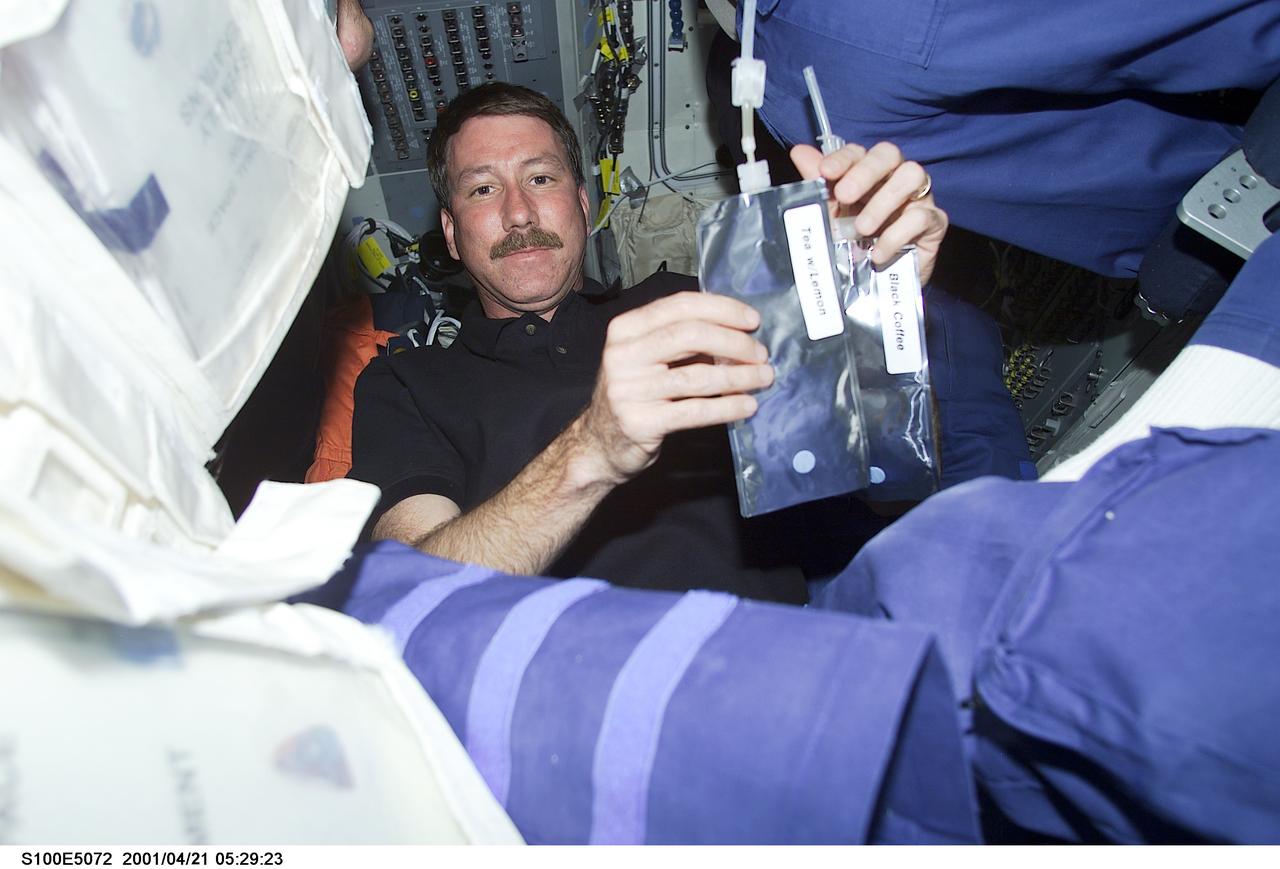
S100-E-5072 (21 April 2001) --- Astronaut Kent V. Rominger, mission commander for STS-100, is pictured on the middeck of the Space Shuttle Endeavour as the shuttle steadily makes its way toward the International Space Station (ISS) following an April 19 launch. Rominger is taking a brief pause from a very heavy work agenda that'll only get busier once the shuttle and the orbiting outpost have docked. The mission commander is obviously trying to decide between black coffee (right) or tea with lemon. This image was recorded by a fellow crew member using a digital still camera.
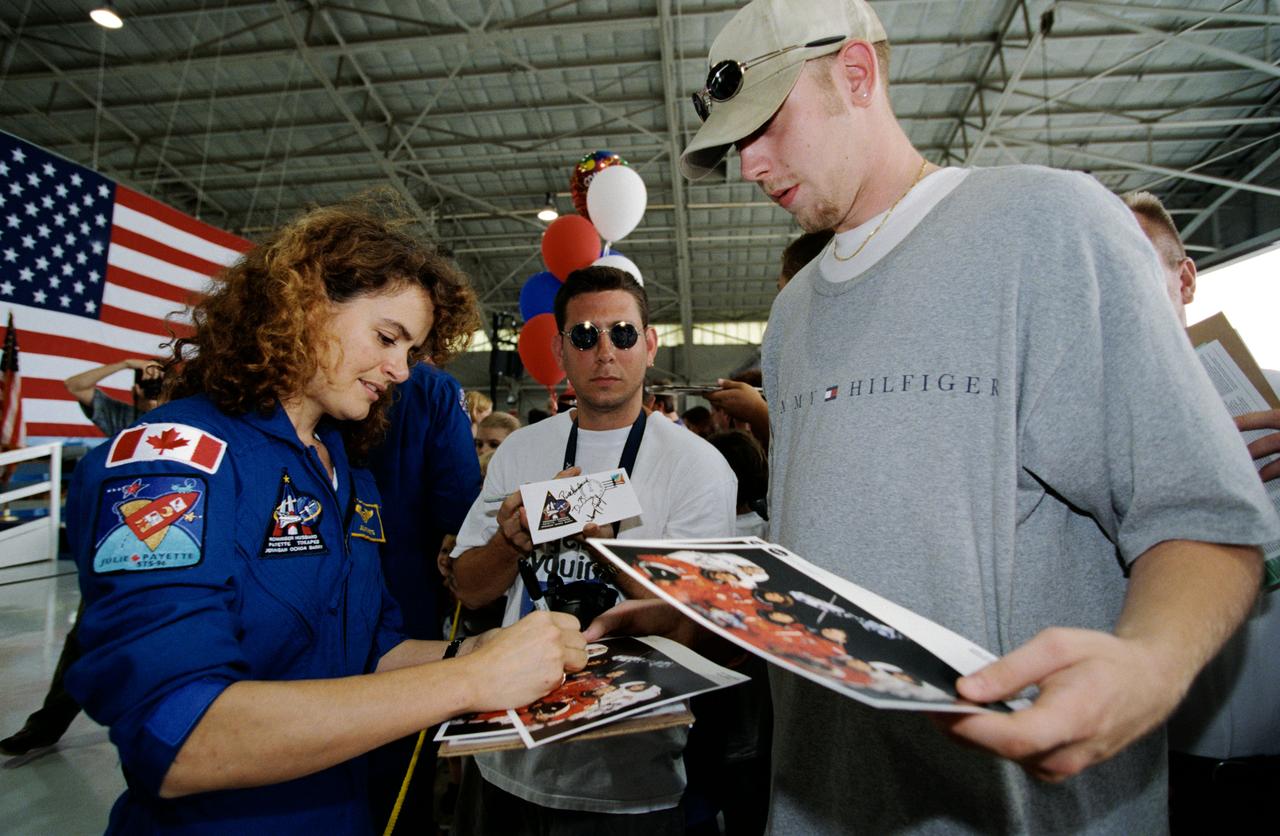
Photographic documentation showing the STS-96 crew return ceremony at Ellington Field. Views include: pilot Rick D. Husband with his two children, Mission Specialist (MS) Daniel T. Barry is partially visible behind him (05966); MS Ellen Ochoa holds a baby (05967); slanted side view of the stage with mission commander Kent V. Rominger at the podium, and seated behind him (left to right): Mr. George Abbey, JSC director, MS Valery Tokarev, MS Julie Payette, MS Daniel T. Barry, MS Ellen Ochoa, MS Tamara E. Jernigan and pilot Rick D. Husband (05968); Payette sign photographs for visitors (05969); Tokarev at the podium (05970); Husband at the podium (05971); Ochoa at the podium (05972); Rominger at the podium (05973); Tokarev signs photographs for visitors (05974); front, wide shot showing MS Tamara E. Jernigan at the podium, and seated behind her (left to right); Mr. George Abbey, MS Valery Tokarev, MS Julie Payette, MS Daniel T. Barry, MS Ellen Ochoa, pilot Rick D. Husband and mission commander Kent V. Rominger (05975); Jernigan signs photographs for visitors (05976).
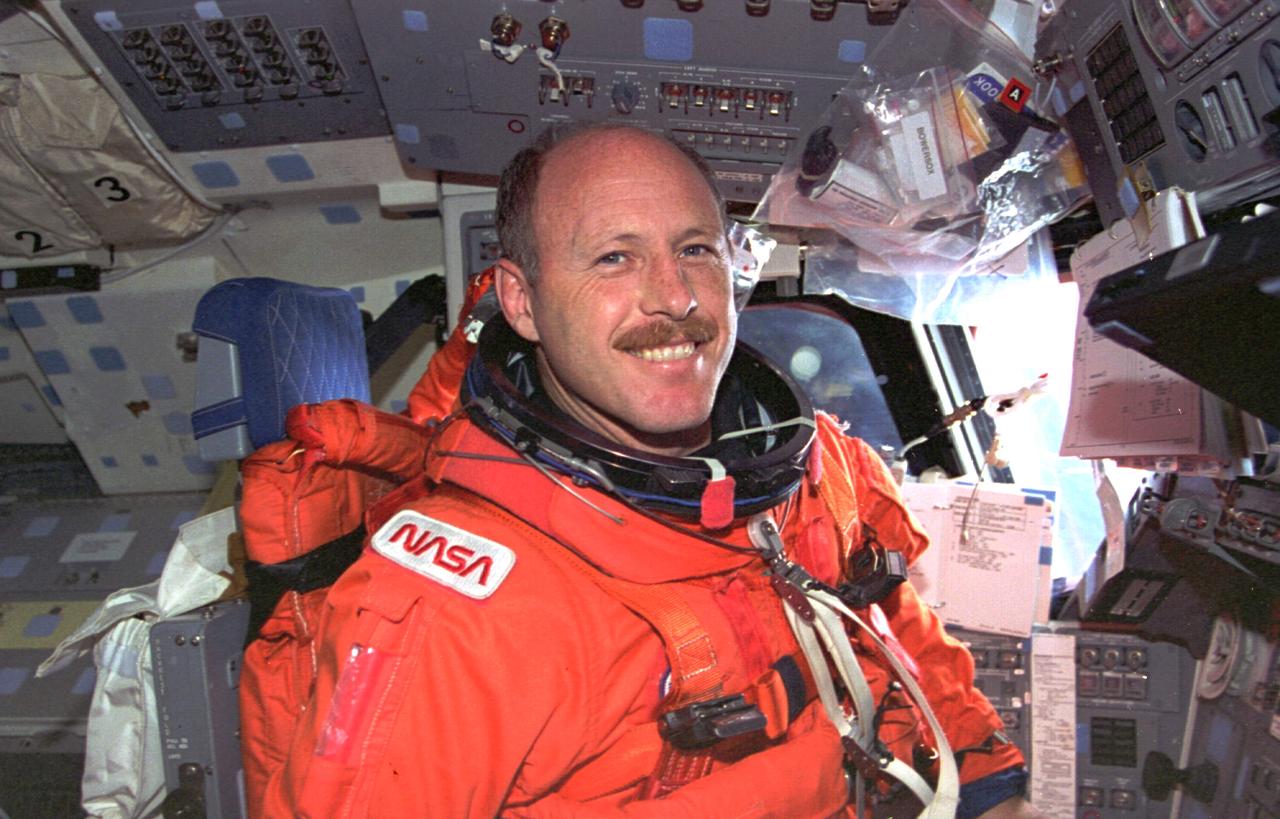
STS073-164-025 (5 November 1995) --- The countenance of astronaut Kenneth D. Bowersox signifies the near completion of a successful 16-day mission in Earth-orbit aboard the Space Shuttle Columbia. Bowersox, attired in the shuttle launch and entry garment, mans the commander's station prior to the entry phase of the flight.
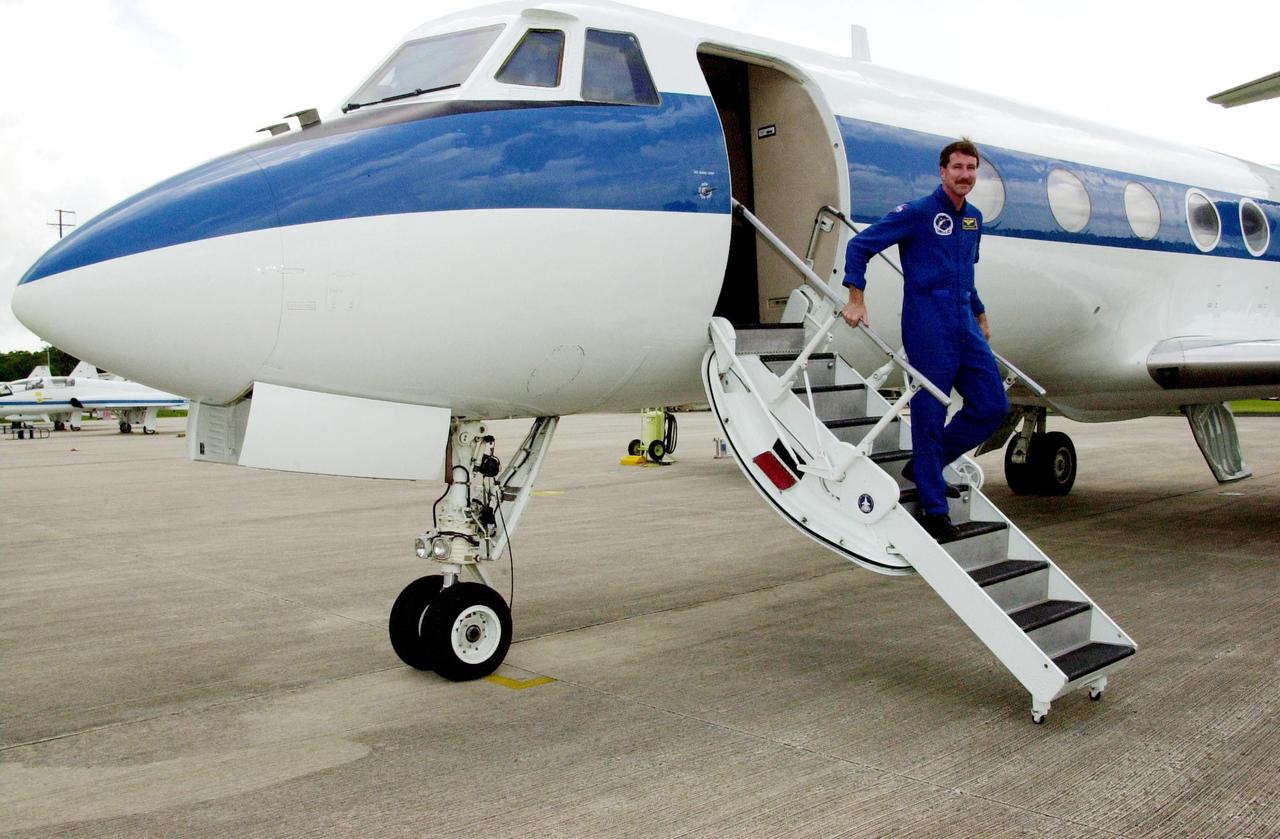
KENNEDY SPACE CENTER, FLA. -- Astronaut Kent Rominger exits the Shuttle Training Aircraft (STA) after flying weather reconnaissance for the landing of Endeavour, returning from mission STS-111. Low cloud cover and other unfavorable weather conditions resulted in the third day of wave off on two landing opportunities. Endeavour successfully landed at Edwards Air Force Base, Calif., completing 217 orbits and a 5.8-million-mile journey

STS080-701-004 (19 Nov.-7 Dec. 1996) --- The STS-80 crew used a pre-set 70mm camera onboard the space shuttle Columbia's middeck to record its traditional inflight crew portrait. Back row, left to right, astronauts Kenneth D. Cockrell, mission commander; Tamara E. Jernigan, mission specialist; and Kent V. Rominger, pilot. Front row, astronauts Thomas D. Jones (left) and Story Musgrave, both mission specialists.
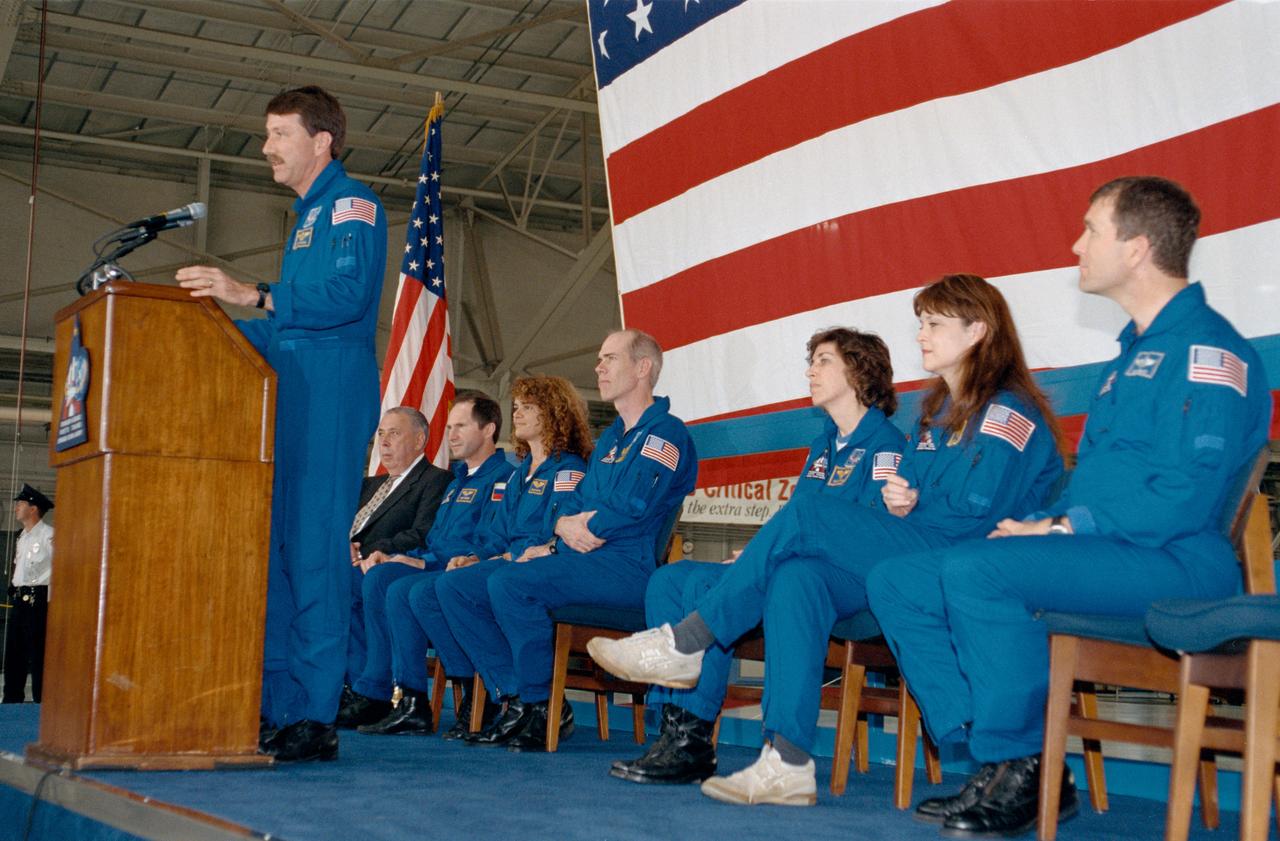
S99-05968 (7 June 1999) --- Astronaut Kent V. Rominger, mission commander, speaks to crowd on hand at Ellington Field's Hangar 990 following crew arrival. In the background, from the left, are JSC Director George W.S. Abbey and cosmonaut Valeriy I. Tokarev along with astronauts Julie Payette, Daniel T. Barry, Ellen Ocoa and Tamara E. Jernigan, all mission specialists; and Rick D. Husband, pilot. Tokarev represents the Russian Space Agency (RSA) and Payette, the Canadian Space Agency (CSA).

S85-E-5087 (14 August 1997) --- From the left, astronaut Stephen K. Robinson, mission specialist, aims a camera through Discovery's aft windows facing the cargo bay while Robert L. Curbeam Jr., mission specialist, and Kent V. Rominger, pilot, look on. Clouds over Earth are visible in the background through the overhead windows.
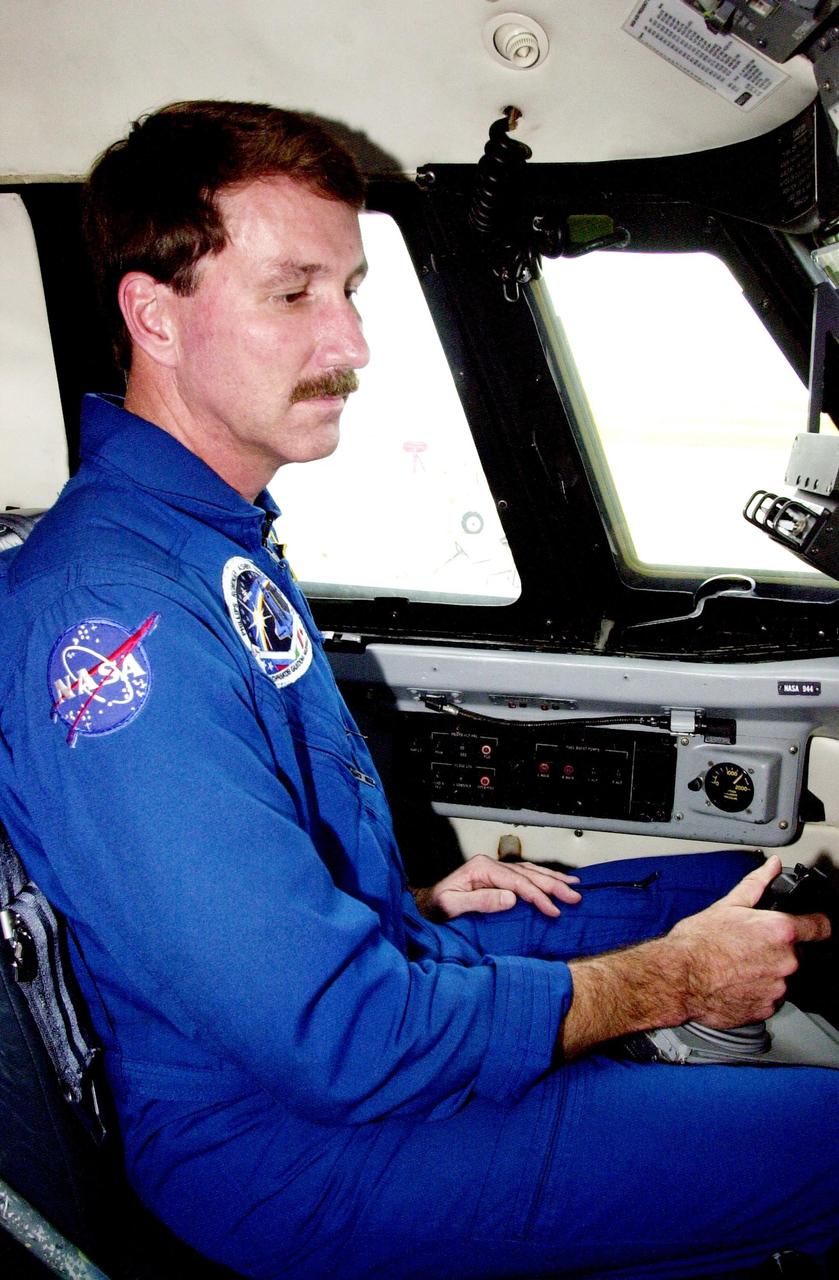
KENNEDY SPACE CENTER, FLA. - Astronaut Kent Rominger sits in the cockpit of a Shuttle Training Aircraft (STA) after flying weather reconnaissance for the landing of Endeavour, returning from mission STS-111. Low cloud cover and other unfavorable weather conditions resulted in the third day of wave off on two landing opportunities. Endeavour successfully landed at Edwards Air Force Base, Calif., completing 217 orbits and a 5.8-million-mile journey
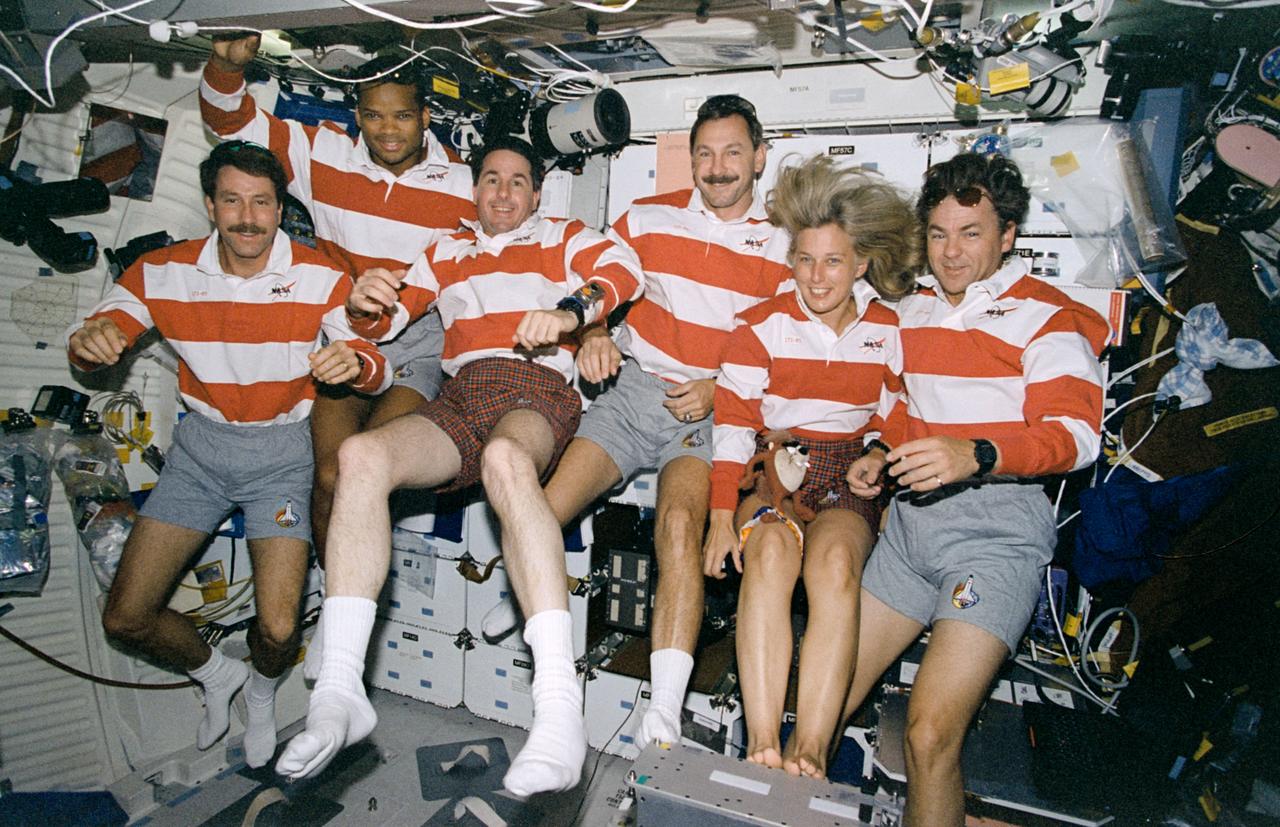
STS085-326-016 (7 - 19 August 1997) --- An impromptu in-flight crew portrait was snapped while the crew members were setting up for a more balanced portrait on the Space Shuttle Discovery's mid-deck. Left to right are astronauts Kent V. Rominger, Robert L. Curbeam, Stephen K. Robinson, Curtis L. Brown, Jr., N. Jan Davis and Bjarni V. Tryggvason.
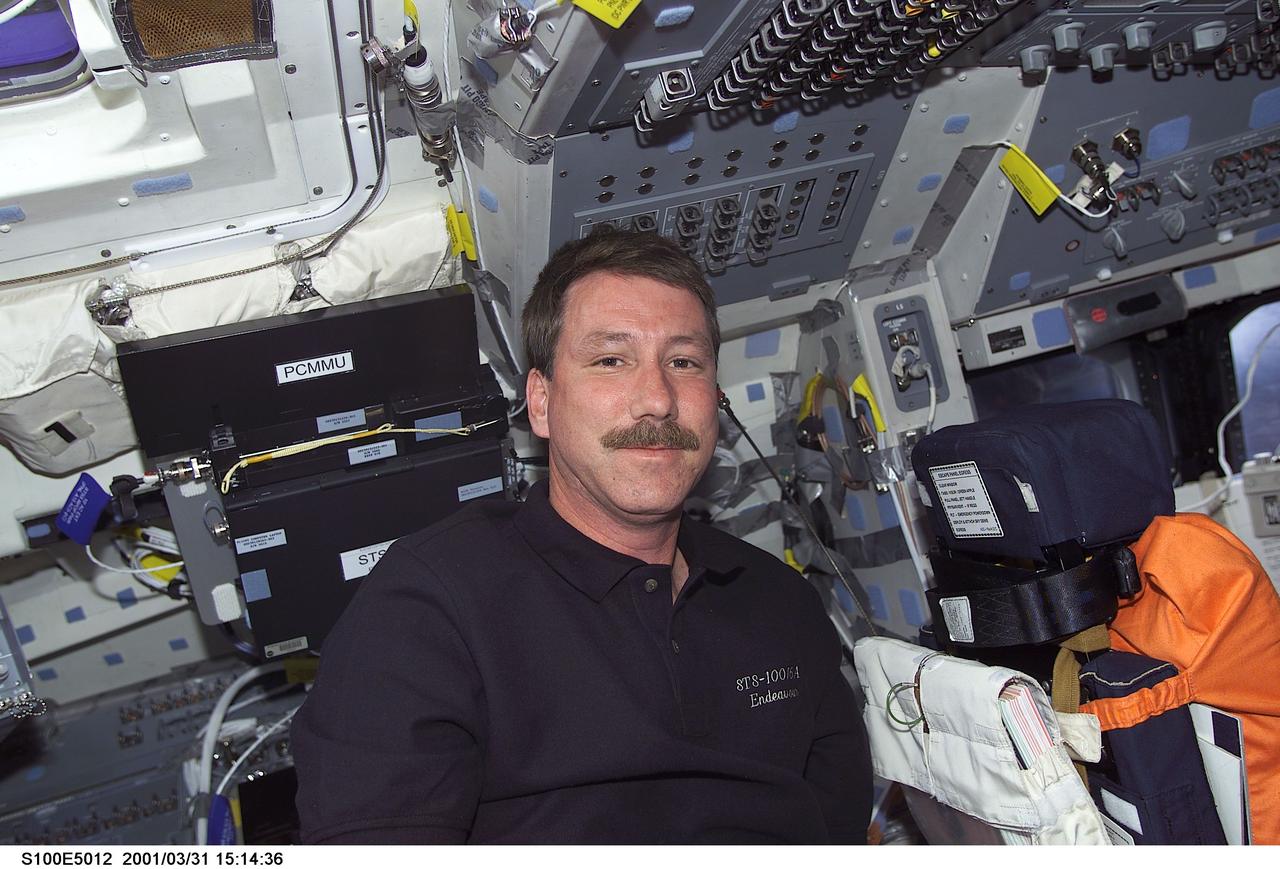
S100-E-5012 (20 April 2001)--- Astronaut Kent V. Rominger, mission commander for STS-100, is pictured on the aft flight deck of the Space Shuttle Endeavour as the shuttle steadily makes its way toward the International Space Station (ISS) following an April 19 launch. This image was recorded by a fellow crew member using a digital still camera.
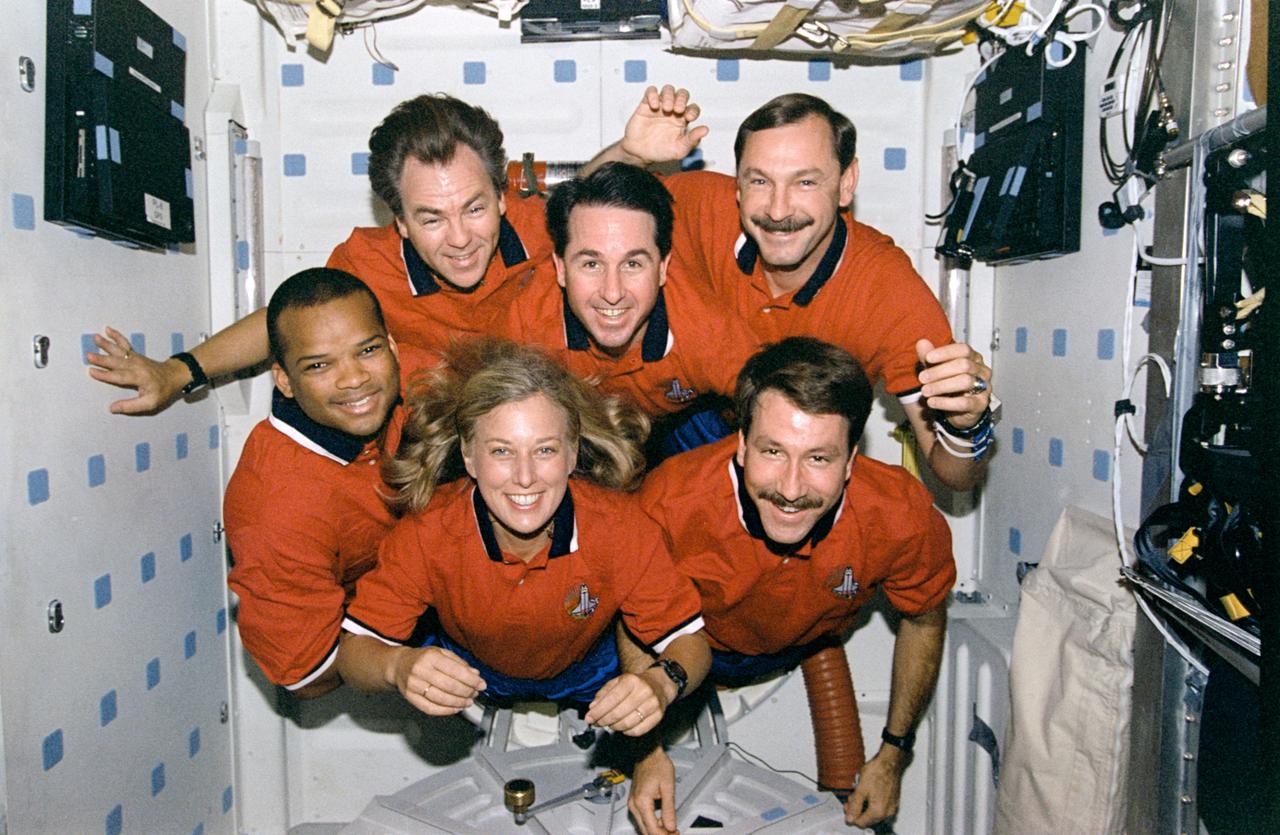
STS085-320-020 (7 - 19 August 1997) --- For their traditional in-flight crew portrait, the six crew members for this mission float on the mid-deck of the Space Shuttle Discovery. On top, left to right, are Bjarni Tryggvason, payload specialist of the Canadian Space Agency (CSA); along with astronauts Stephen K. Robinson, mission specialist; and Curtis L. Brown, Jr., mission commander. On bottom, from the left, are astronauts Robert L. Curbeam, Jr., mission specialist; N. Jan Davis, payload commander; and Kent V. Rominger, pilot.
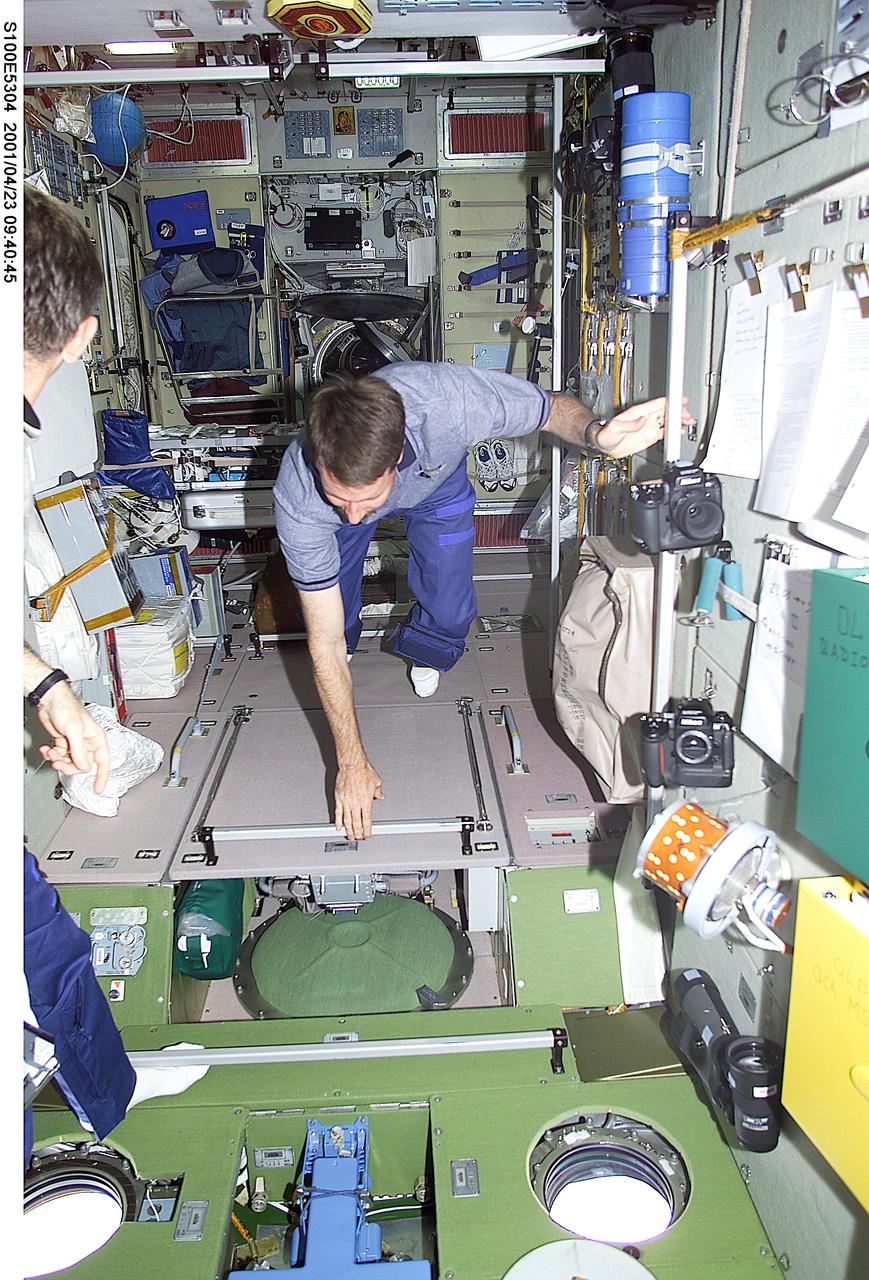
S100-E-5304 (23 April 2001) --- Astronaut Kent V. Rominger, STS-100 mission commander, tours the Zvezda Service Module on the International Space Station (ISS) not long after the seven-member STS-100 crew went aboard the orbital outpost and reunited with the station's second crew. The image was recorded with a digital still camera.
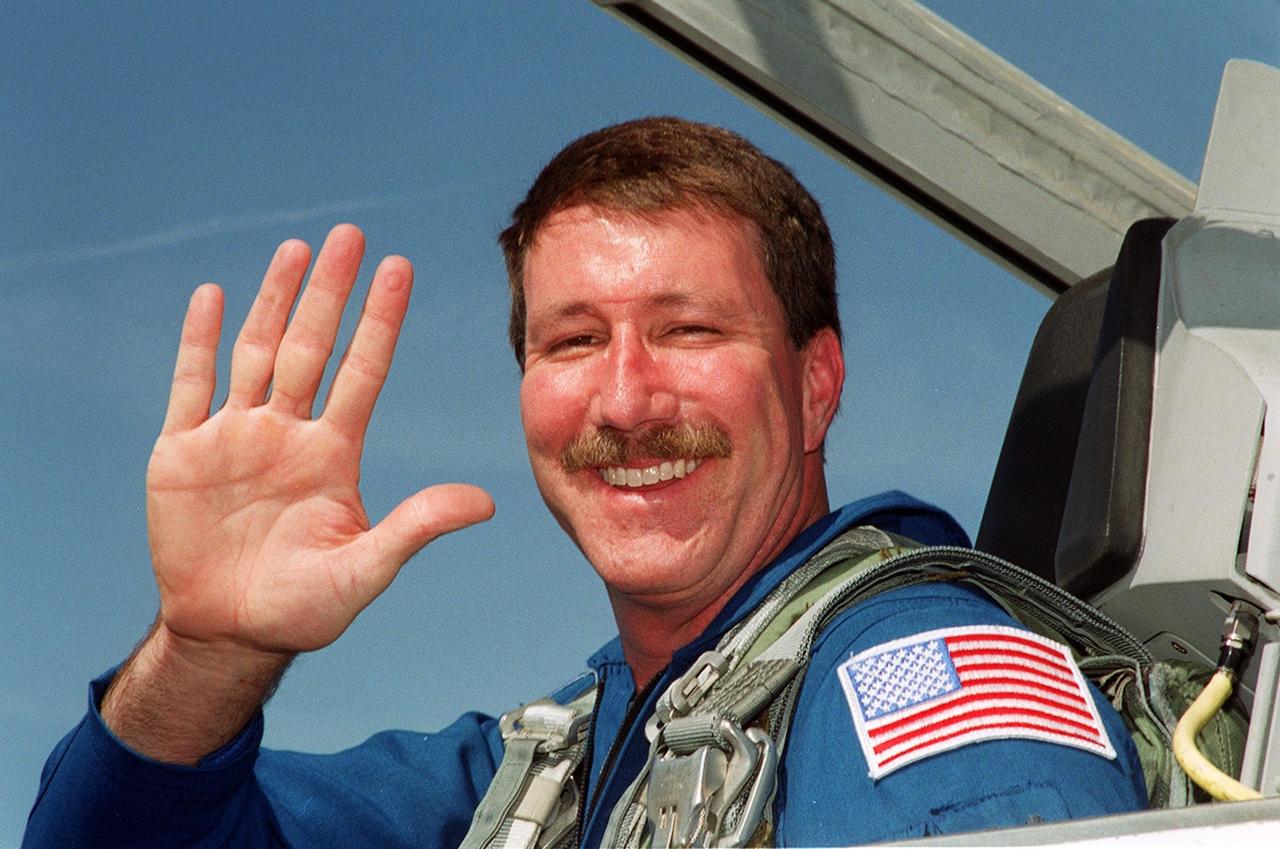
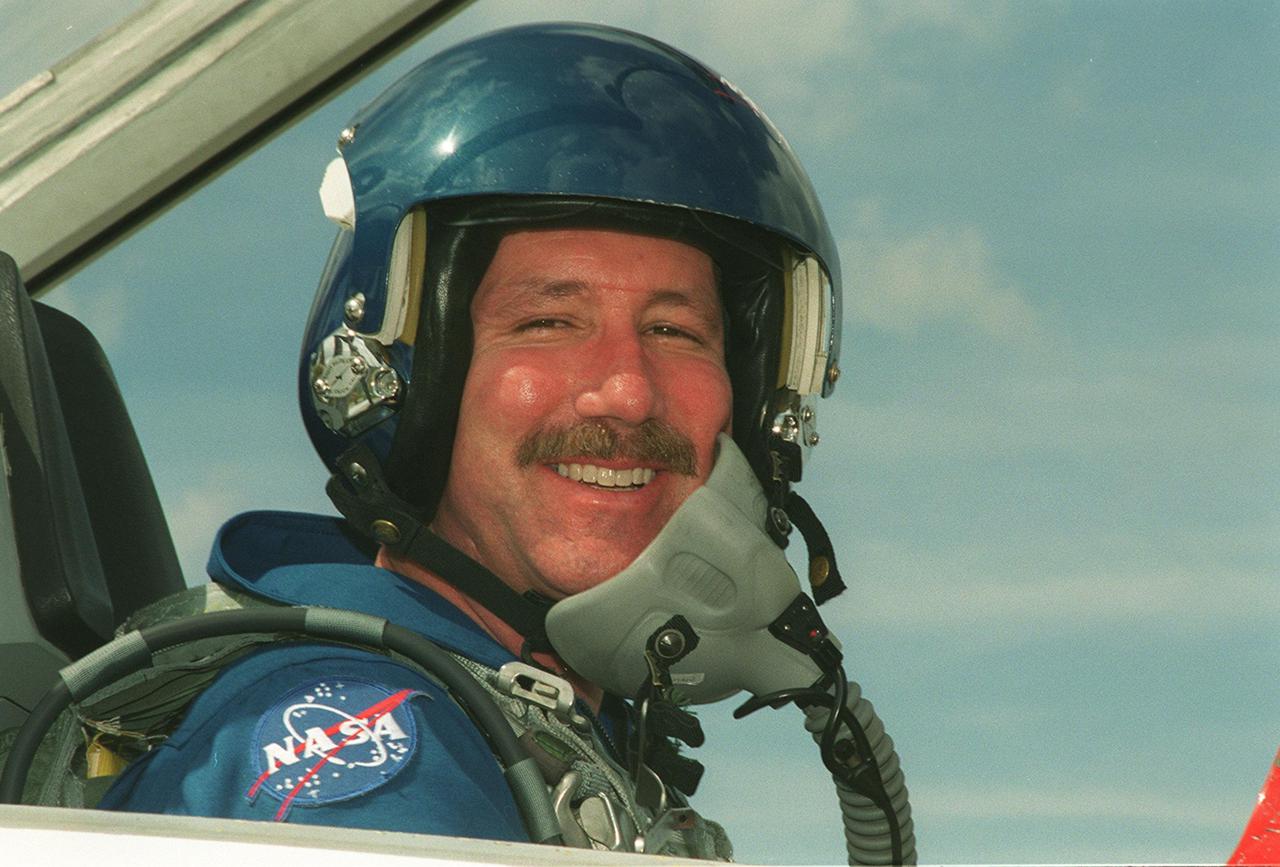
STS-100 Commander Kent V. Rominger arrives at the KSC Shuttle Landing Facility aboard a T-38 jet aircraft to get ready for launch. The 11-day mission to the International Space Station will deliver and integrate the Spacelab Logistics Pallet/Launch Deployment Assembly, which includes the Space Station Remote Manipulator system and the UHF Antenna, and the Multi-Purpose Logistics Module Raffaello. Liftoff on mission STS-100 is scheduled at 2:41 p.m. EDT April 19
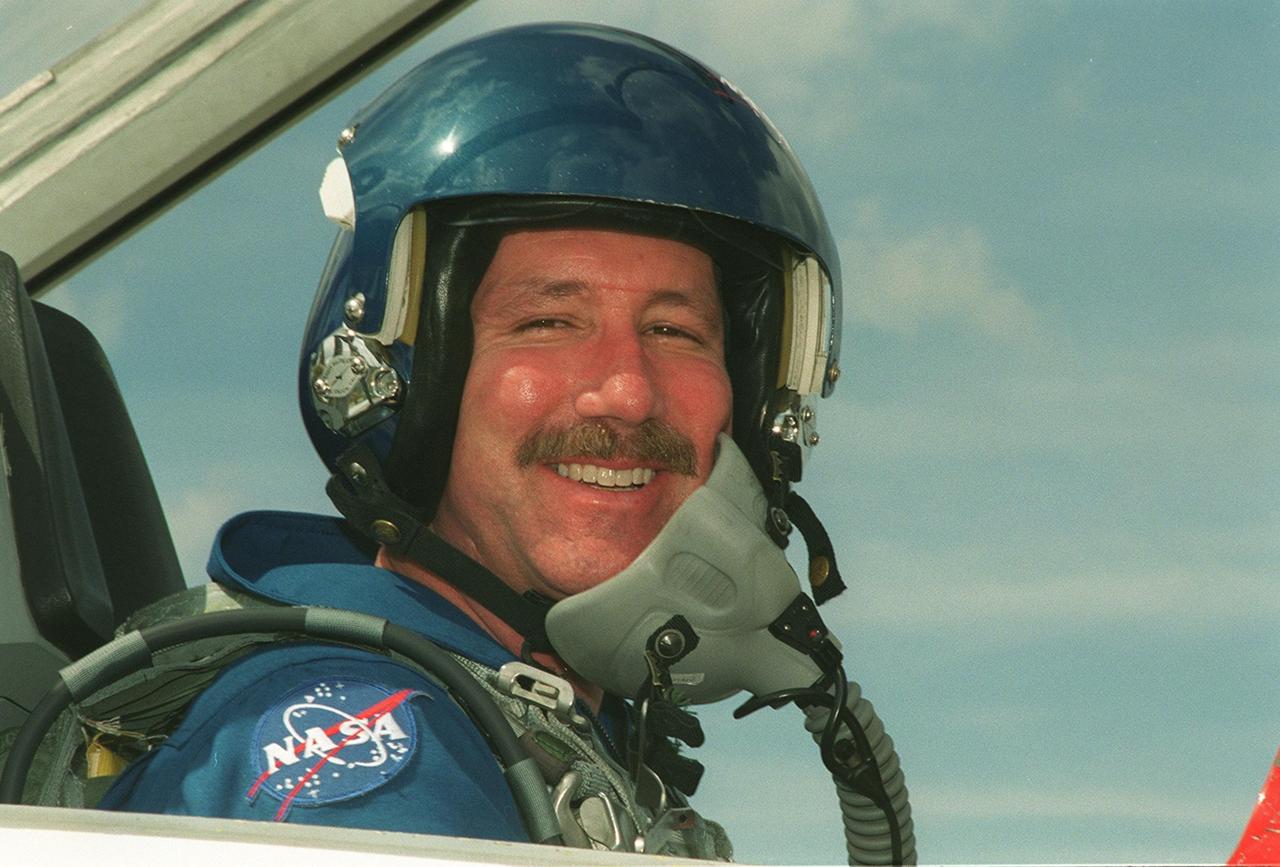
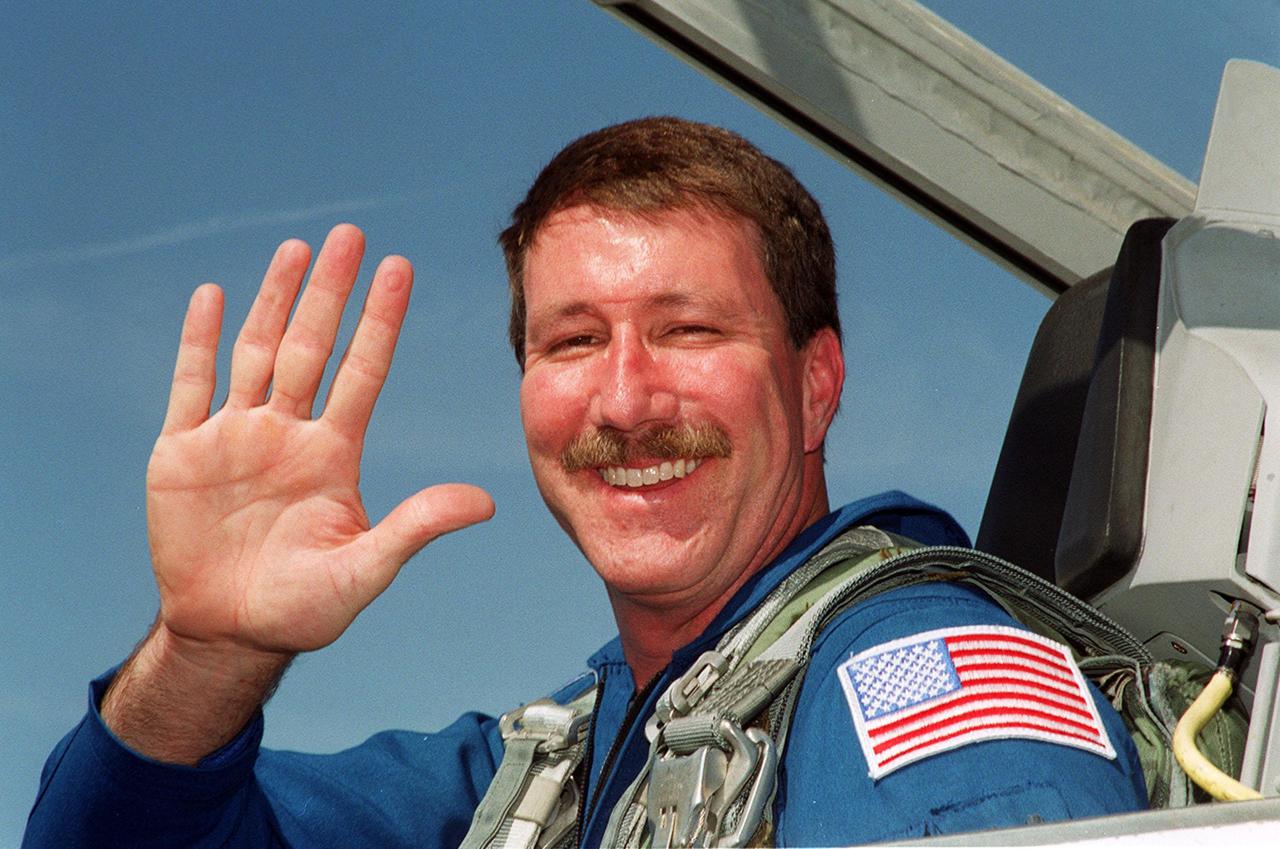
STS-100 Commander Kent V. Rominger returns to KSC to complete Terminal Countdown Demonstration Test activities that were postponed earlier. The TCDT includes emergency escape training, payload bay walkdown, and a simulated launch countdown. The primary payload comprises the Canadian robotic arm, SSRMS, and Multi-Purpose Logistics Module, Raffaello. Launch of Space Shuttle Endeavour on mission STS-100 is targeted for April 19 at 2:41 p.m. EDT from Launch Pad 39A
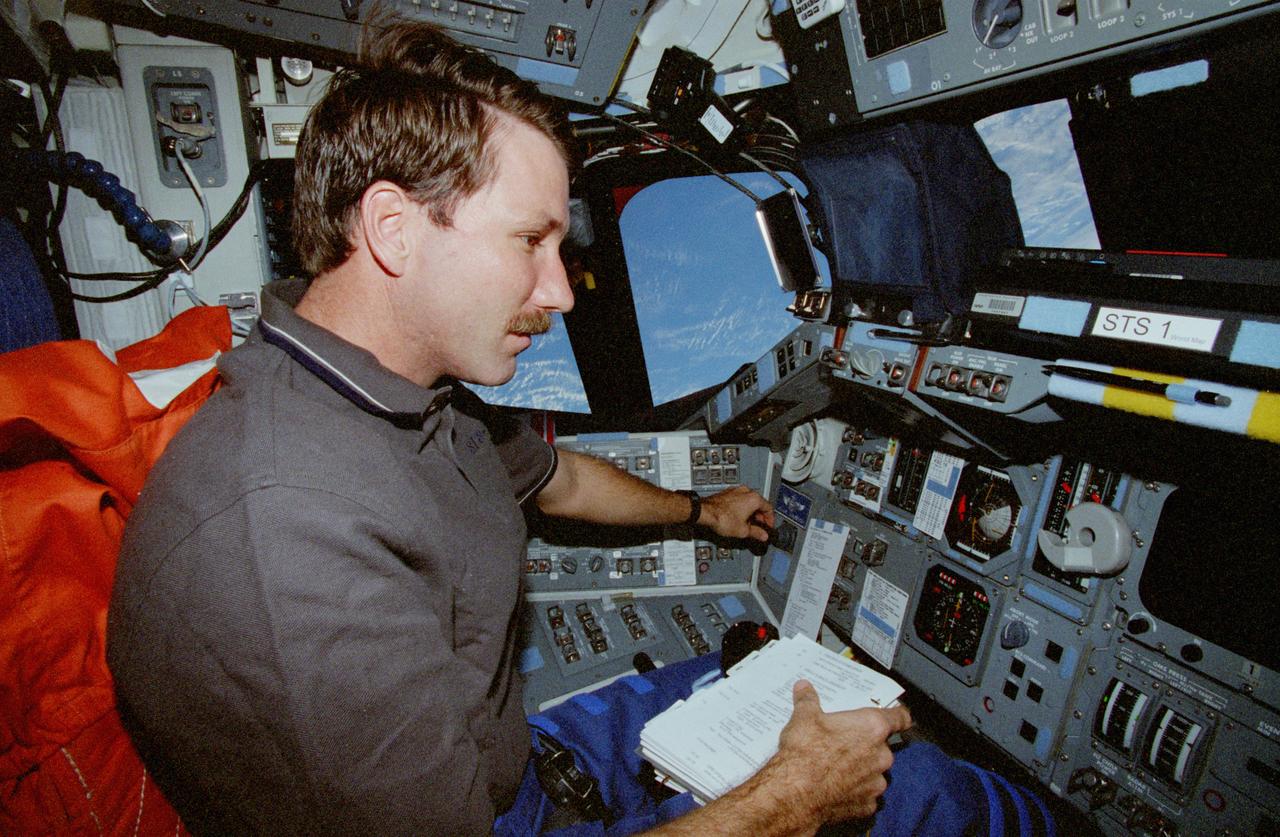
STS080-341-032 (19 Nov.-7 Dec. 1996) --- Astronaut Kent V. Rominger, STS-80 pilot, occupies the commander's station aboard the space shuttle Columbia during station keeping operations with the Orbiting Retrievable Far and Extreme Ultraviolet Spectrometer-Shuttle Pallet Satellite (ORFEUS-SPAS). Earth, actually some 190 nautical miles away, appears to be just beyond arm's length on Columbia's port side.
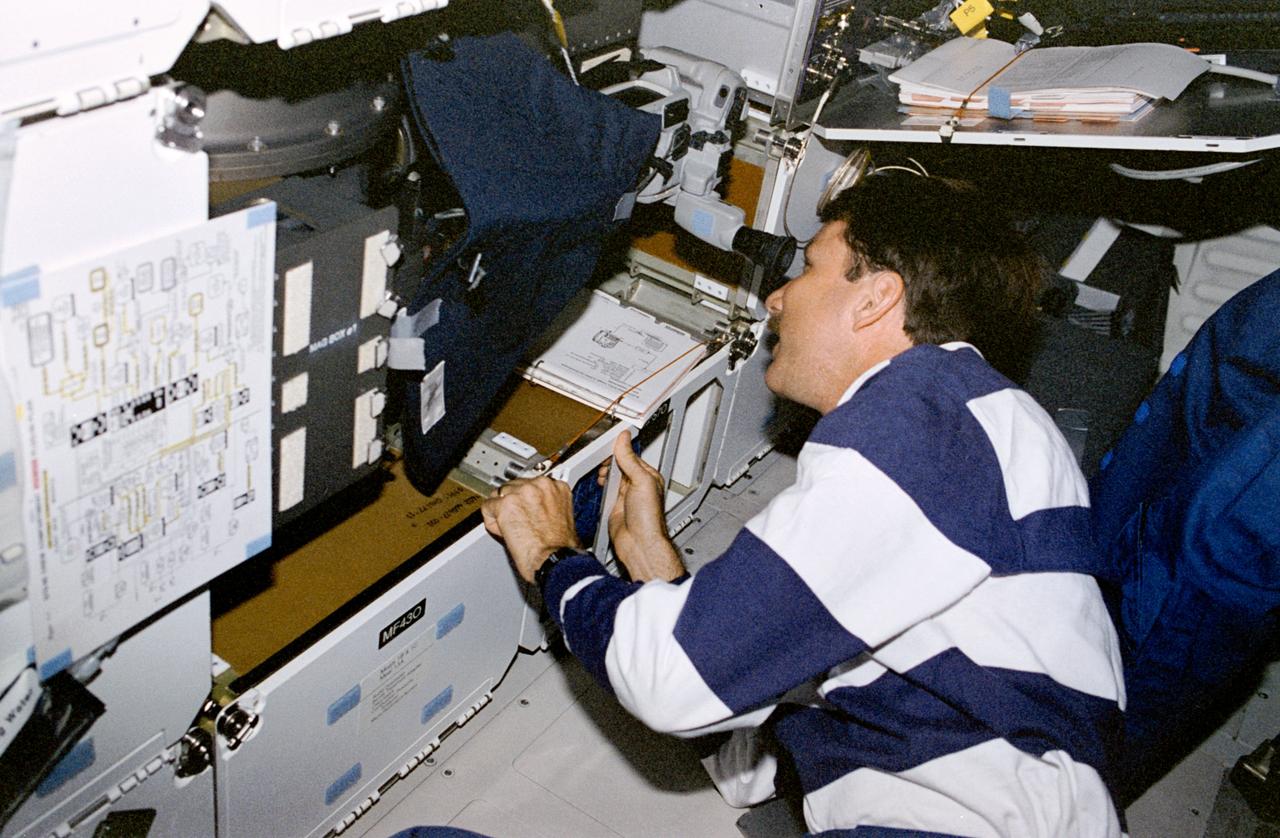
STS085-339-006 (7 - 19 August 1997) --- Astronaut Kent V. Rominger, pilot, checks on the Solid Surface Combustion Experiment (SSCE) on the mid-deck of the Space Shuttle Discovery. The experiment, which occupies the space of four lockers, consists of a Polymethyl Methacrylate (PMMA) fuel sample internally mounted in the center of a pressurized chamber. Two windows orthogonal to each other in the chamber wall allow viewing by a 16mm camera of the side edge and top of the PMMA sample.

STS080-S-002 (August 1996) --- These five NASA astronauts are in training for the STS-80 mission, scheduled for launch aboard the Space Shuttle Columbia in the fall of this year. From the left are astronauts Kent V. Rominger, pilot; Tamara E. Jernigan, Story Musgrave and Thomas D. Jones, all mission specialists; and Kenneth D. Cockrell, mission commander.
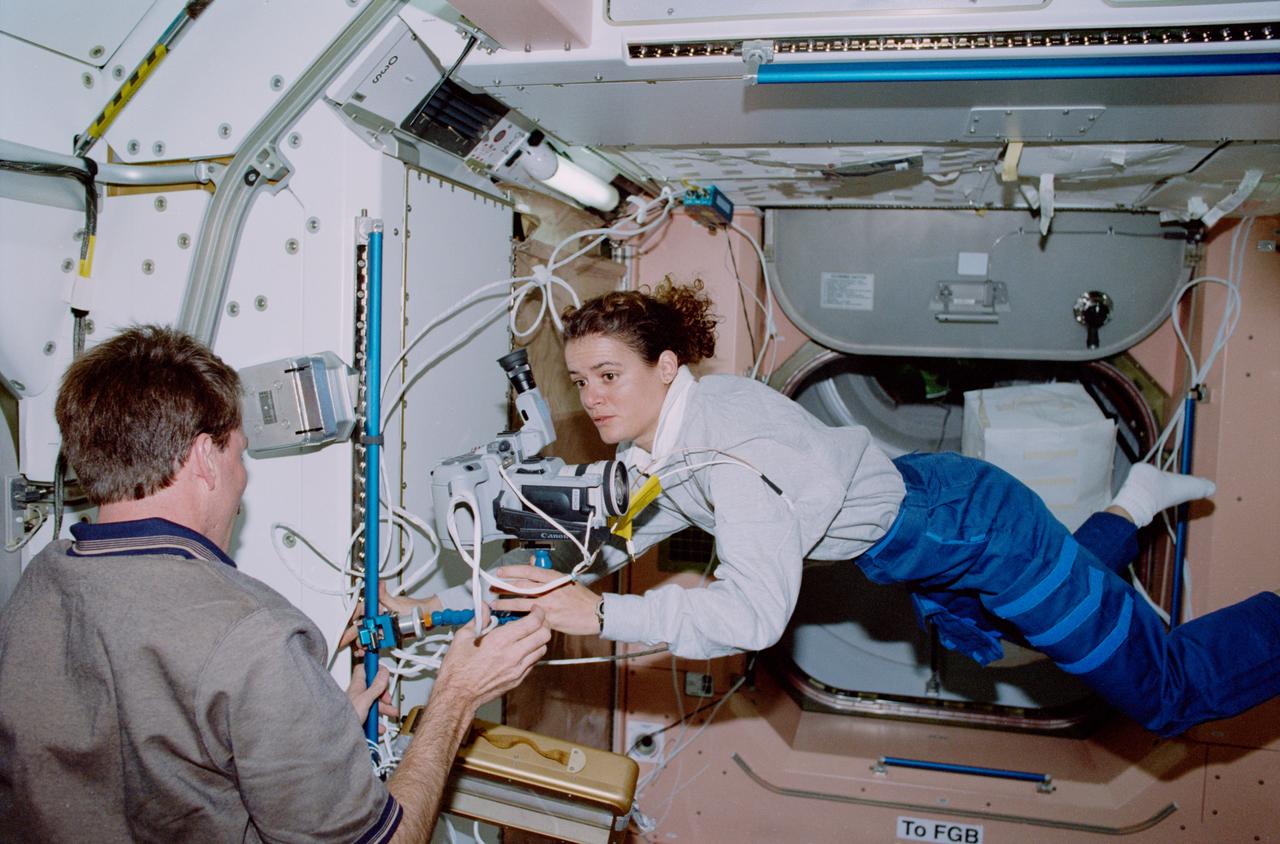
STS096-407-011 (27 May - 6 June 1999) --- Astronauts Kent V. Rominger, mission commander, and Julie Payette, mission specialist, participate in the overall chore of STS-96 of preparing International Space Station (ISS) for occupancy. The two are in the U.S.-built Unity node near the hatch leading to the Russian-built Zarya or FGB. Payette, an alumnus of the 1996 class of astronaut trainees, represents the Canadian Space Agency (CSA).
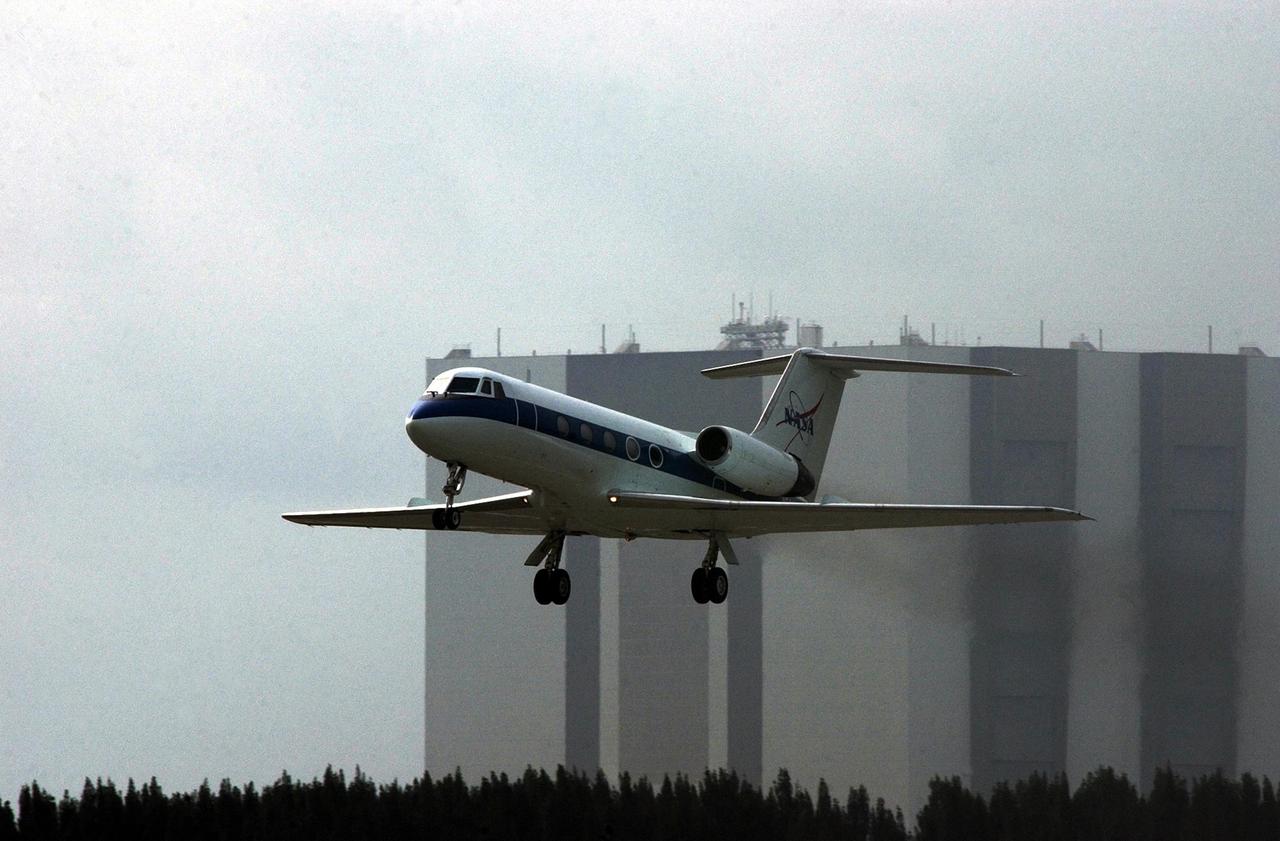
KENNEDY SPACE CENTER, FLA. -- A Shuttle Training Aircraft (STA) approaches the Shuttle Landing Facility after flying weather reconnaissance for the landing of Endeavour, returning from mission STS-111. Low cloud cover and other unfavorable weather conditions resulted in the wave off of two landing opportunities. The STA was flown by astronaut Kent Rominger
STS-100 Commander Kent V. Rominger returns to KSC to complete Terminal Countdown Demonstration Test activities that were postponed earlier. The TCDT includes emergency escape training, payload bay walkdown, and a simulated launch countdown. The primary payload comprises the Canadian robotic arm, SSRMS, and Multi-Purpose Logistics Module, Raffaello. Launch of Space Shuttle Endeavour on mission STS-100 is targeted for April 19 at 2:41 p.m. EDT from Launch Pad 39A
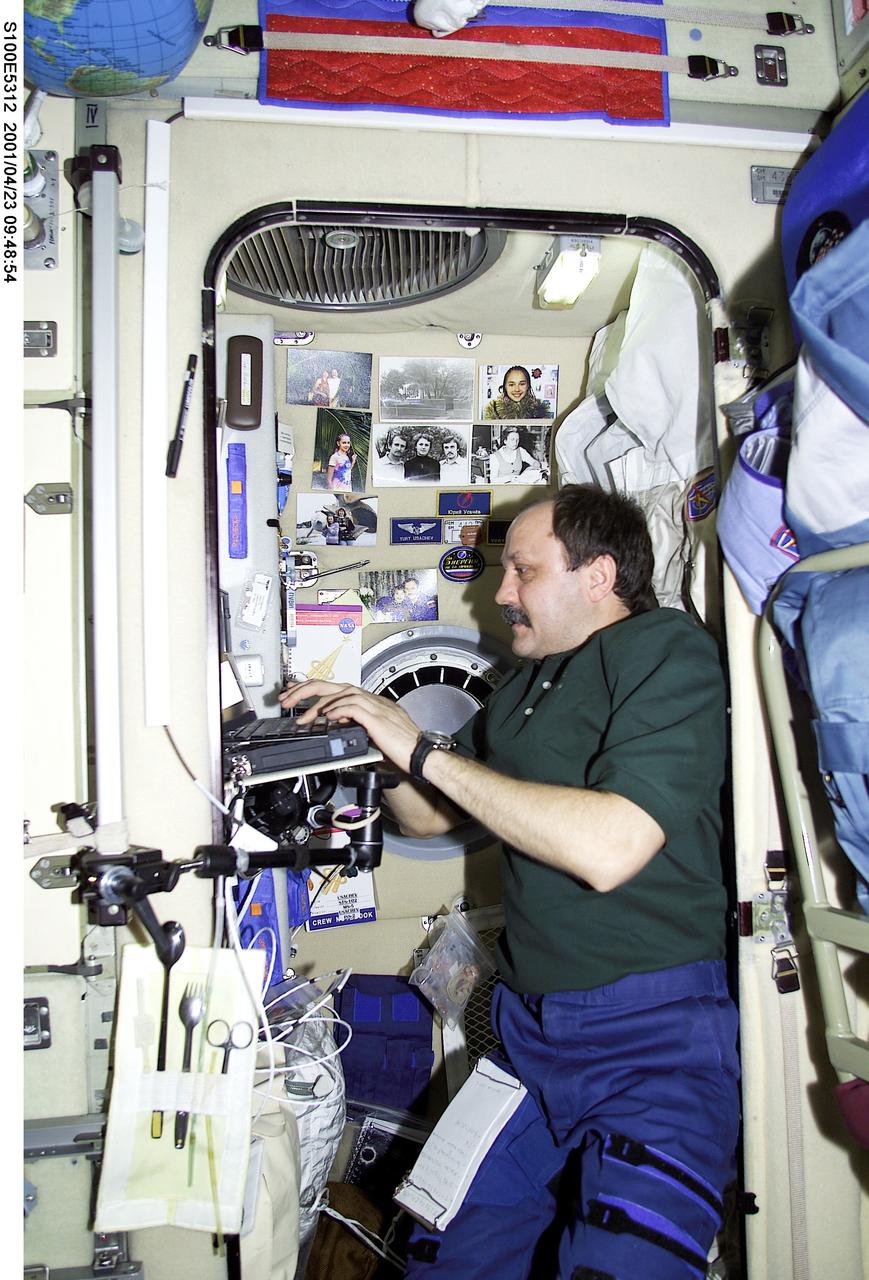
S100-E-5312 (23 April 2001) --- Astronaut Kent V. Rominger, STS-100 mission commander, tours the Zvezda Service Module on the International Space Station (ISS) not long after the seven-member STS-100 crew went aboard the orbital outpost and reunited with the station's second crew. The image was recorded with a digital still camera.
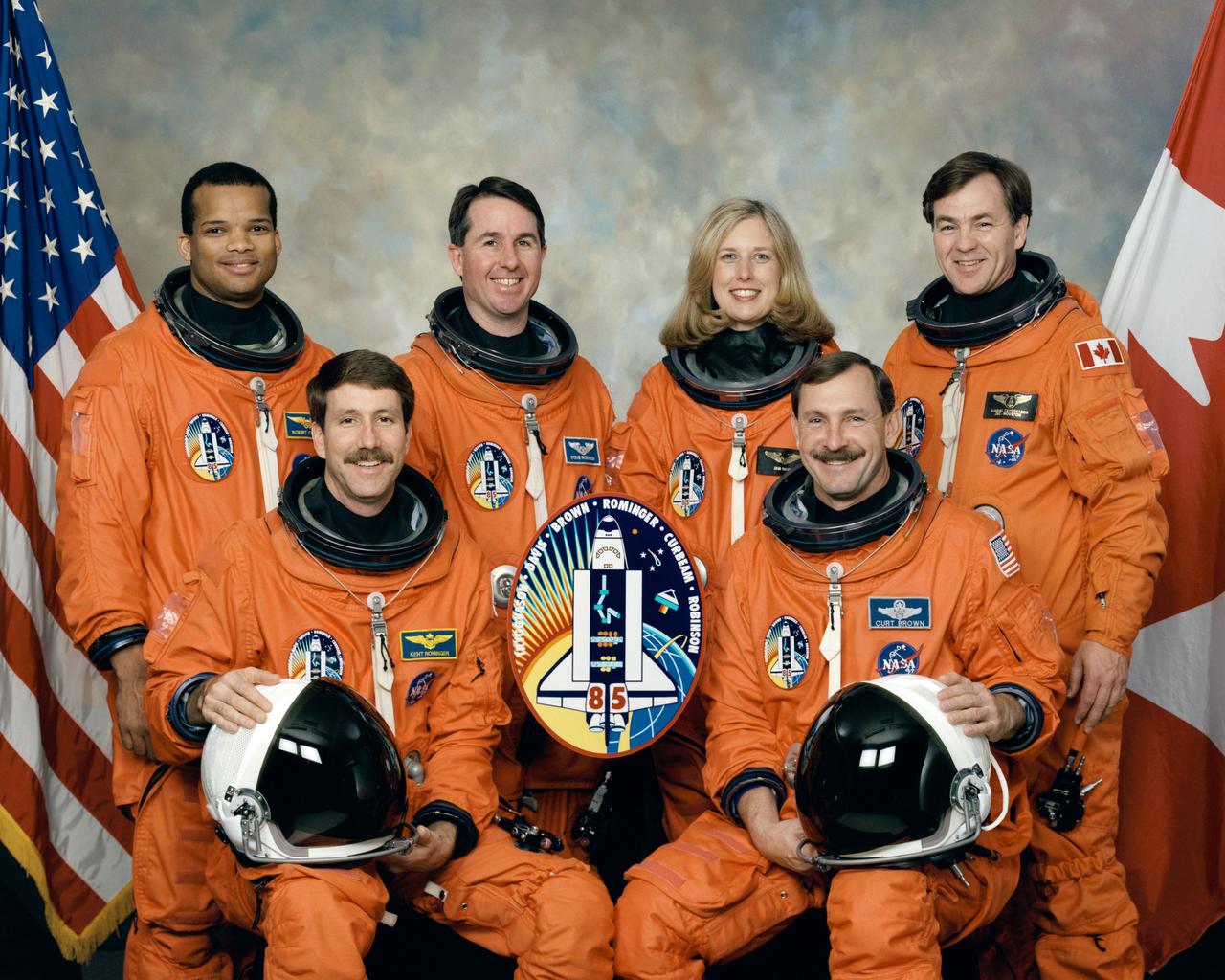
STS085-S-002 (May 1997) --- Five NASA astronauts and a Canadian payload specialist pause from their training schedule to pose for the traditional crew portrait for their mission. In front are astronauts Curtis L. Brown, Jr. (right), mission commander, and Kent V. Rominger, pilot. On the back row, from the left, are astronauts Robert L. Curbeam, Jr., Stephen K. Robinson and N. Jan Davis, all mission specialists, along with the Canadian Space Agency’s (CSA) payload specialist Bjarni Tryggvason.
STS-100 Commander Kent V. Rominger arrives at the KSC Shuttle Landing Facility aboard a T-38 jet aircraft to get ready for launch. The 11-day mission to the International Space Station will deliver and integrate the Spacelab Logistics Pallet_Launch Deployment Assembly, which includes the Space Station Remote Manipulator system and the UHF Antenna, and the Multi-Purpose Logistics Module Raffaello. Liftoff on mission STS-100 is scheduled at 2:41 p.m. EDT April 19
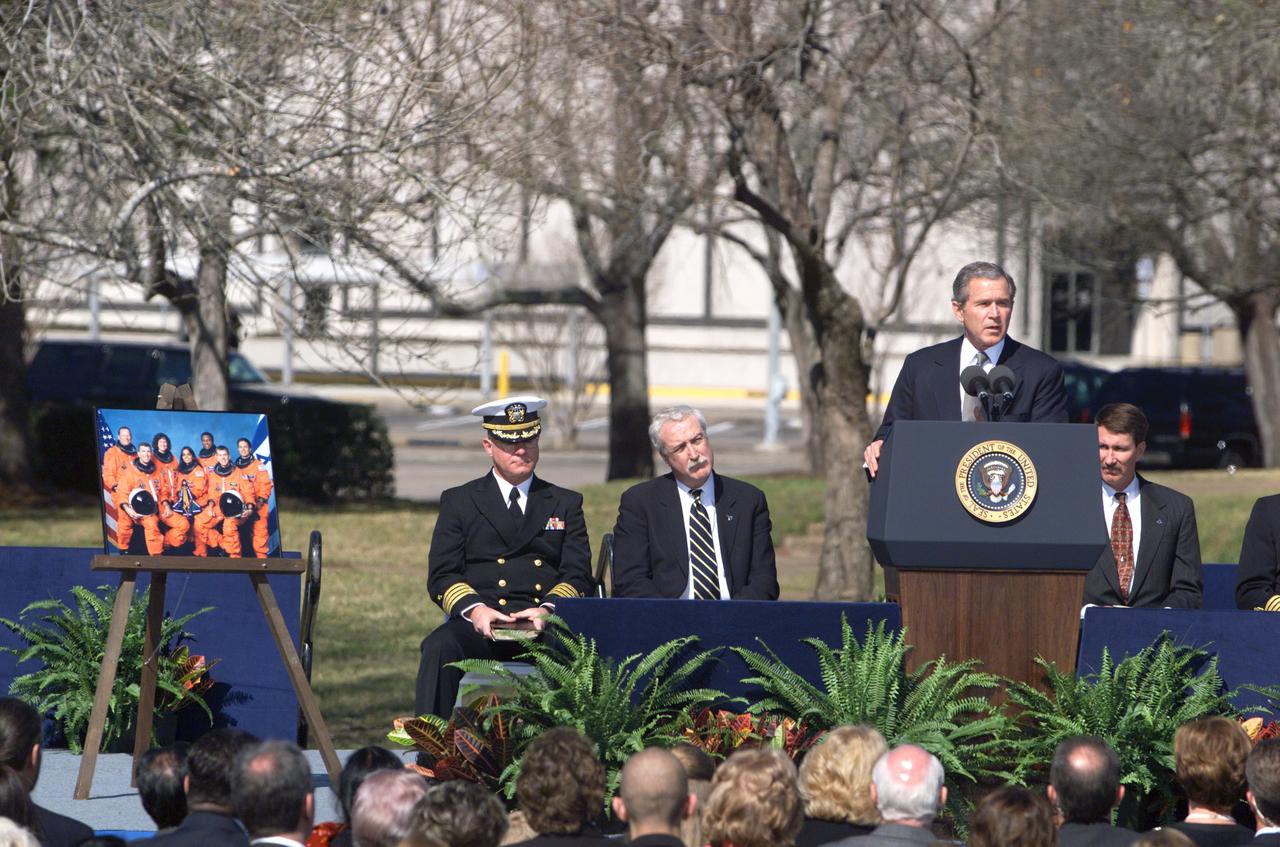
JSC2003-E-05938 (4 February 2003) --- President George W. Bush addresses the crowd on the mall of the Johnson Space Center during the memorial for the Columbia astronauts. Seated from the left are Captain Gene Theriot, Chaplain Corps (USN); NASA Administrator Sean O’Keefe; and astronaut Kent V. Rominger, Chief of the Astronaut Office. A portrait of the STS-107 Columbia crew is visible at left.
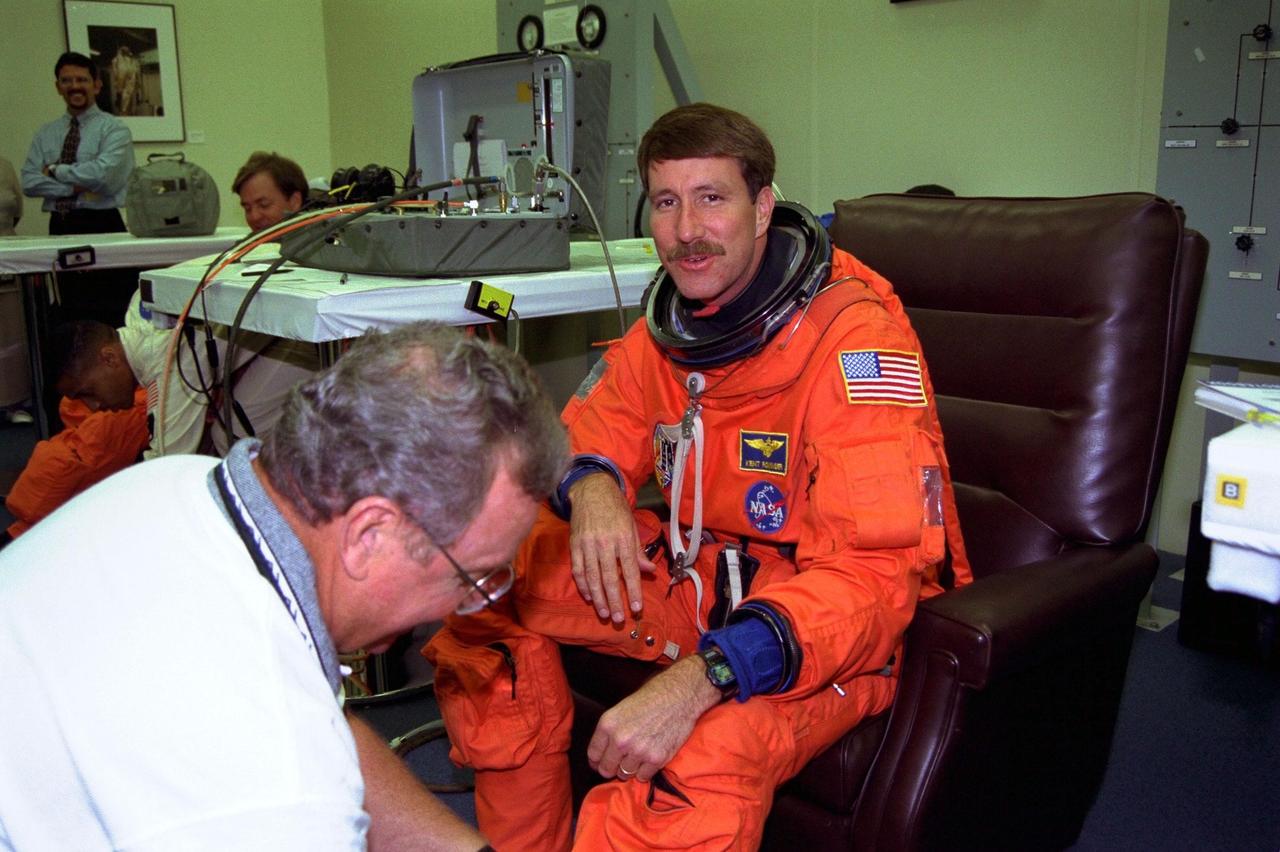
STS-85 Pilot Kent V. Rominger is assisted with his ascent/reentry flight suit in the Operations and Checkout (O&C) Building. He is a commander in the Navy and is on his third Shuttle mission. Rominger previously flew in this capacity on STS-73 and STS-80. He holds a master’s degree in aeronautical engineering and has more than 4,500 hours of flight time and 685 carrier landings. Rominger will assist Commander Curtis L. Brown, Jr. with all phases of the space flight and during the test of International Space Station rendezvous procedures during the Cryogenic Infrared Spectrometers and Telescopes for the Atmosphere-Shuttle Pallet Satellite-2 (CRISTA-SPAS-2) free-flyer retrieval. He will also be busy with the many and varied tasks associated with monitoring and maintaining the orbiter. In addition, Rominger will operate the Solid Surface Combustion Middeck Experiment. The primary payload aboard the Space Shuttle orbiter Discovery is the CRISTA-SPAS-2. Other payloads on the 11-day mission include the Manipulator Flight Demonstration (MFD), and Technology Applications and Science-1 (TAS-1) and International Extreme Ultraviolet Hitchhiker-2 (IEH-2) experiments
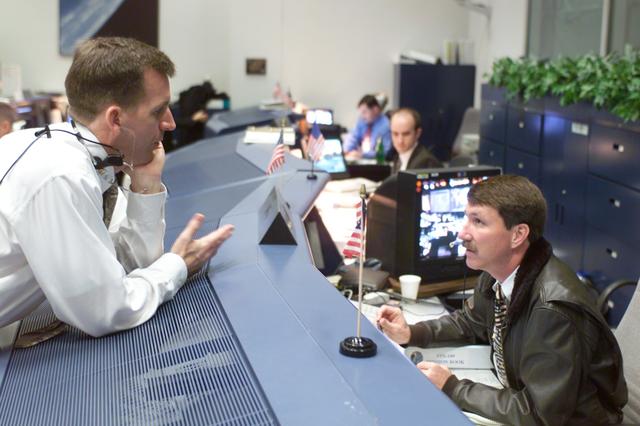
JSC2002-E-08157 (1 March 2002) --- Astronaut Kent V. Rominger (seated), and LeRoy Cain are photographed at the Mission Operation Directorate (MOD) console in the shuttle flight control room (WFCR) in Houston's Mission Control Center (MCC). Several hundred miles away in Florida, the STS-109 crewmembers were awaiting countdown in the crew cabin of the Space Shuttle Columbia on the launch pad at the Kennedy Space Center (KSC). As soon as the vehicle cleared the tower in Florida, the Houston-based team of flight controllers took over the ground control of the mission. Rominger is the Deputy Director of the Flight Crew Operations Directorate (FCOD) and was the STS-109 FCOD management representative in the MCC. Cain was the Weather Flight Director for the mission’s ascent phase, coordinating weather issues for lead Ascent Flight Director John Shannon (out of frame).
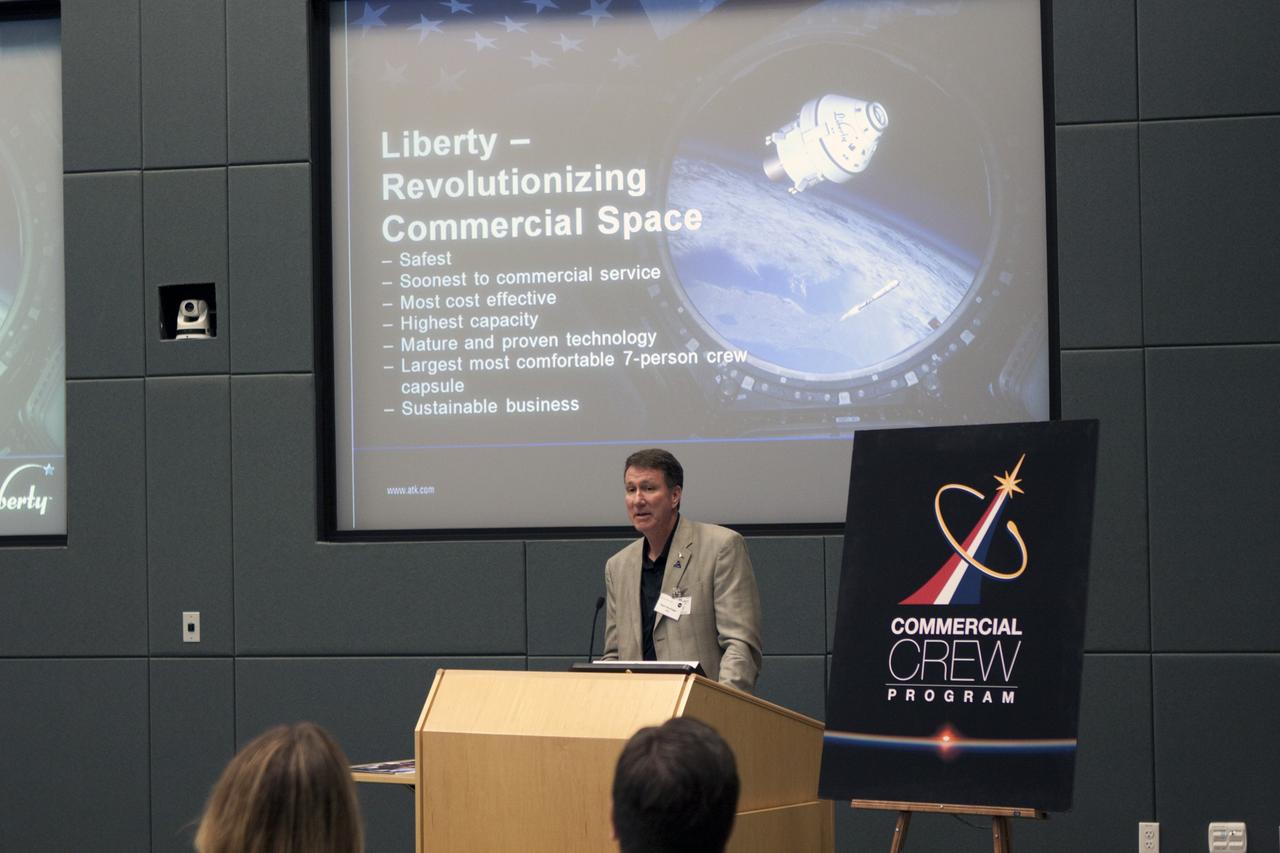
CAPE CANAVERAL, Fla. - Kent Rominger of Alliant Techsystems Inc., or ATK, addresses participants of the International Space University in a session in Operations Support Building II at the Kennedy Space Center, Fla., on July 3. Rominger served as pilot for three space shuttle missions and was commander on two. He retired from NASA in September 2006 to accept a position with ATK Launch Systems in Utah. The International Space University is a nine-week intensive course designed for post-graduate university students and professionals during the summer. The program is hosted by a different country each year, providing a unique educational experience for participants from around the world. NASA Kennedy Space Center and the Florida Institute of Technology are co-hosting this year's event which runs from June 4 to Aug. 3. There are about 125 participants representing 31 countries. For more information, visit http://www.isunet.edu Photo credit: NASA/Jim Grossmann
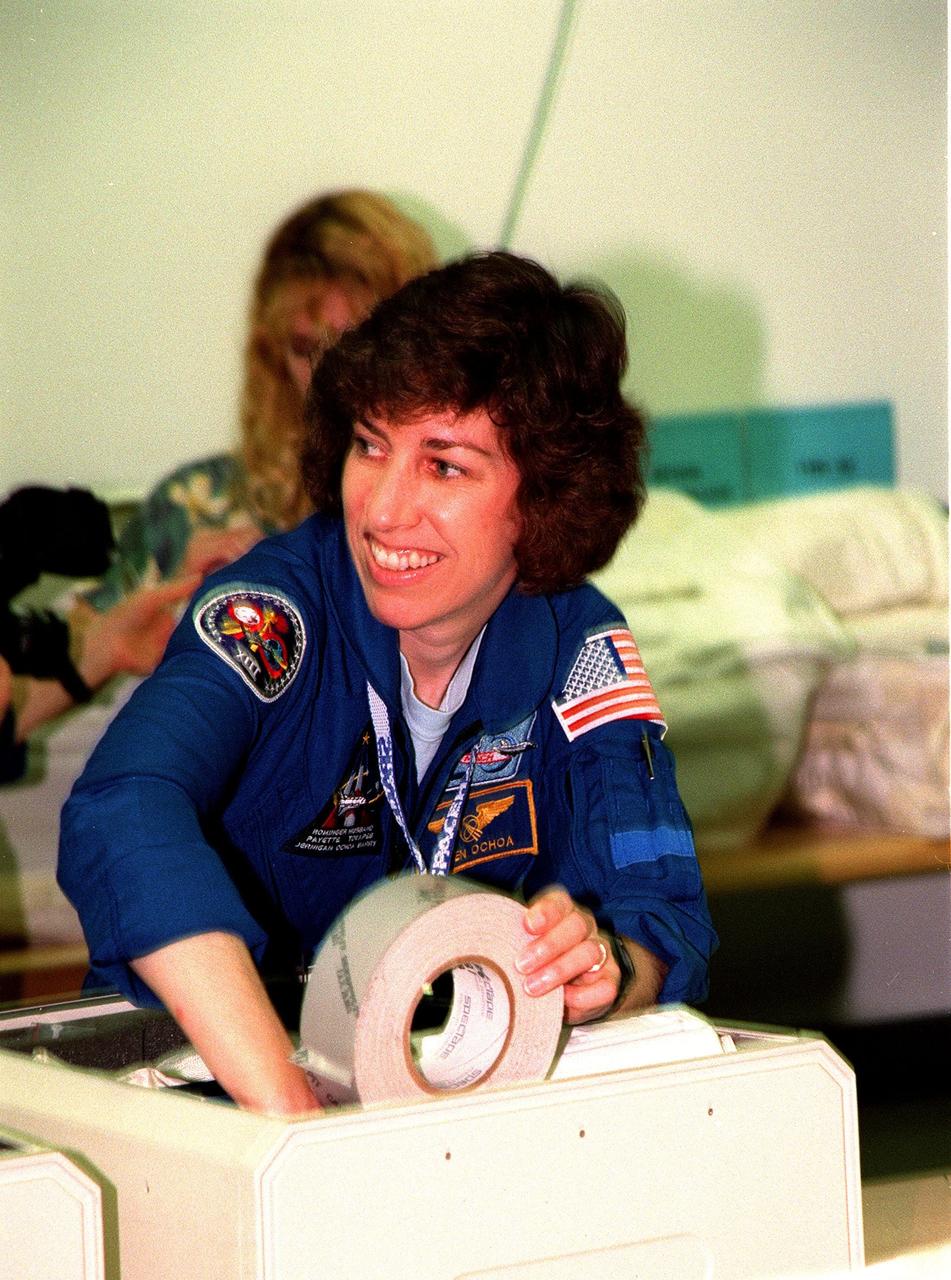
KENNEDY SPACE CENTER, FLA. -- STS-96 Mission Specialist Ellen Ochoa gets a hands-on look at equipment at the SPACEHAB Facility. Members of the STS-96 crew are taking part in a bench review at SPACEHAB as part of familiarization activities for their upcoming mission. The crew also includes Commander Kent V. Rominger, Pilot Rick Husband and Mission Specialists Tamara E. Jernigan, Daniel Barry, Julie Payette and Valery Ivanovich Tokarev. Payette is with the Canadian Space Agency and Tokarev with the Russian Space Agency. Mission STS-96 is the second flight in construction of the International Space Station and will include the SPACEHAB. The 10-day mission is targeted for launch on May 24, 1999, at Launch Pad 39B
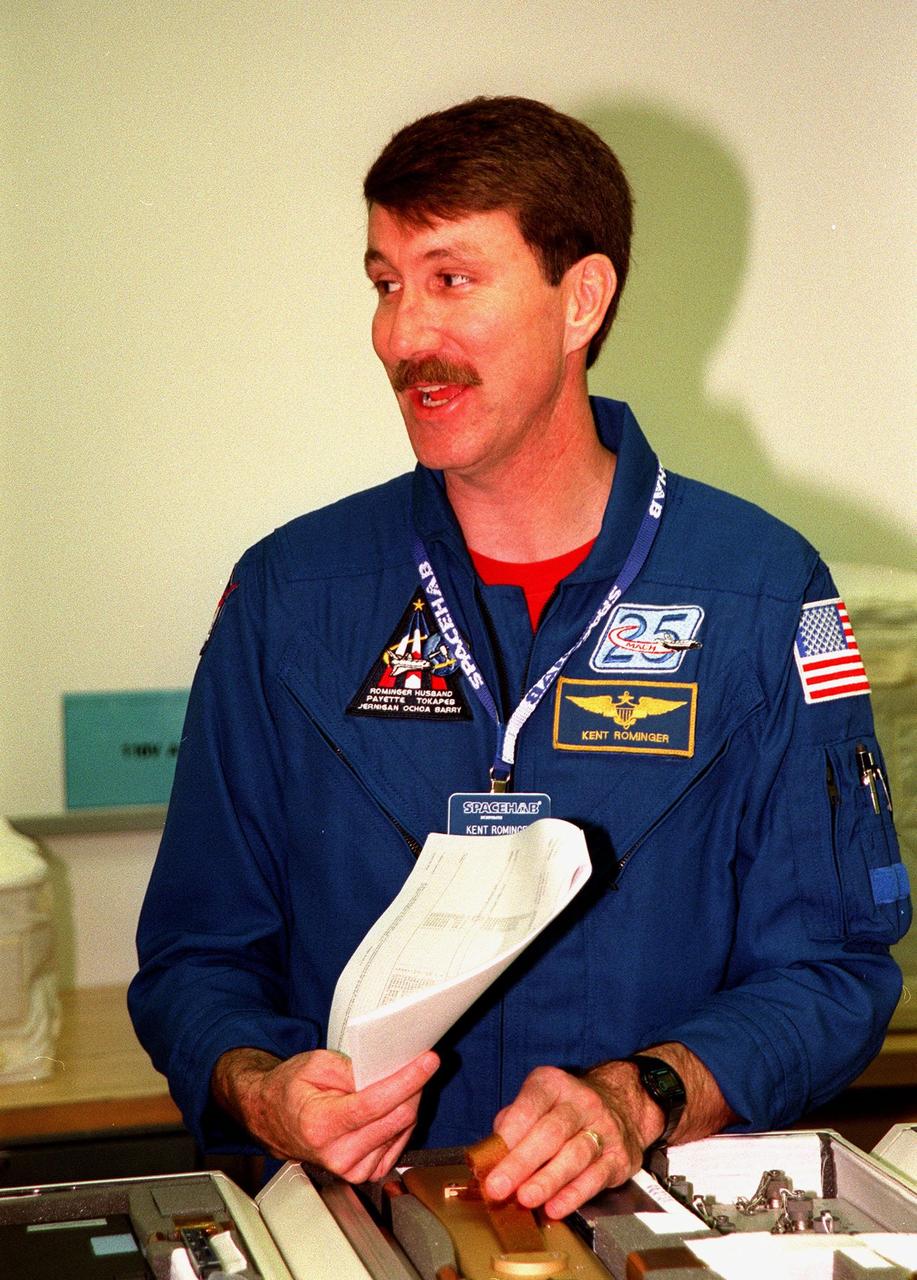
KENNEDY SPACE CENTER, FLA. -- STS-96 Commander Kent V. Rominger gets a hands-on look at equipment at the SPACEHAB Facility. Members of the STS-96 crew are taking part in a bench review at SPACEHAB as part of familiarization activities for their upcoming mission. The crew also includes Pilot Rick Husband and Mission Specialists Ellen Ochoa, Tamara E. Jernigan, Daniel Barry, Julie Payette and Valery Ivanovich Tokarev. Payette is with the Canadian Space Agency and Tokarev with the Russian Space Agency. Mission STS-96 is the second flight in construction of the International Space Station and will include the SPACEHAB. The 10-day mission is targeted for launch on May 24, 1999, at Launch Pad 39B
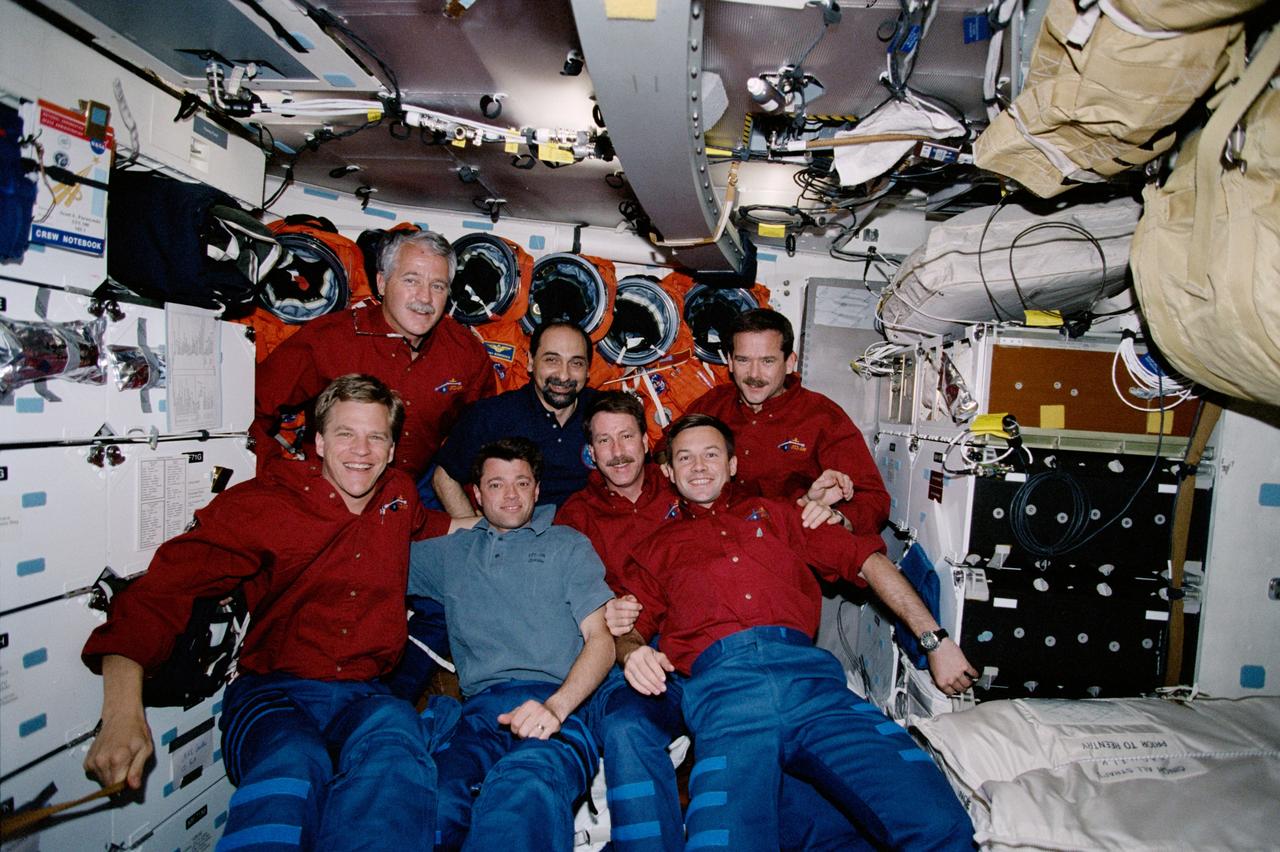
The STS-100 crew pose for their inflight crew photograph on the middeck of Endeavour, Orbiter Vehicle (OV) 105, during the STS-100 mission. Front row from left to right are: Mission Specialist (MS) Scott E. Parazynski, Pilot Jeffrey S. Ashby, Commander Kent V. Rominger and MS / Cosmonaut Yuri V. Lonchakov. Back row: MS John L. Phillips, MS Umberto Guidoni and MS Chris A. Hadfield. Lonchakov represents Rosaviakosmos. Guidoni represents European Space Agency (ESA). Hadfield represents Canadian Space Agency (CSA). This image was selected by the STS-100 crew for use in public presentations.
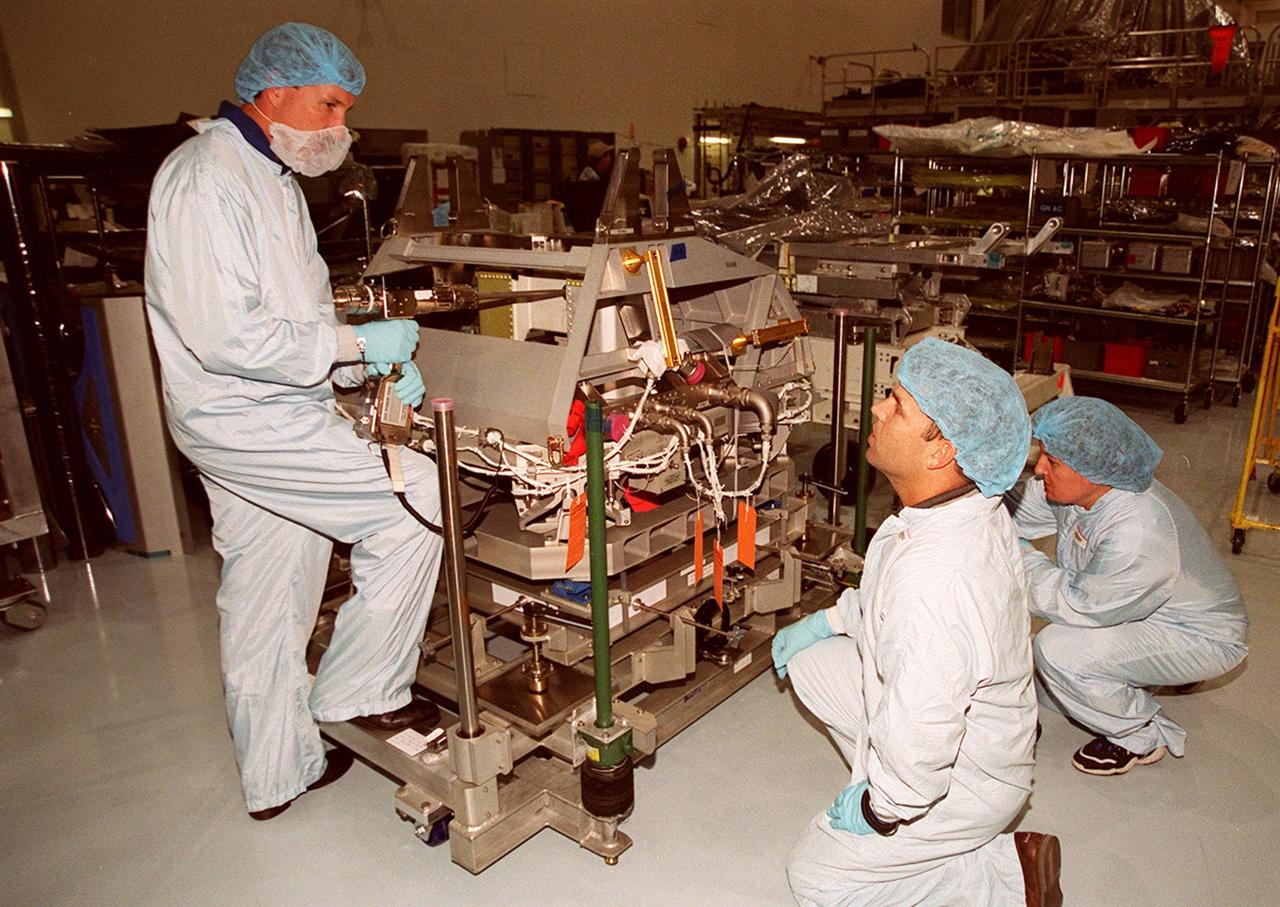
In the Space Station Processing Facility, STS-100 Commander Kent Rominger (left) listens to directions from the worker in the foreground. Another worker waits nearby. Mission STS-100, scheduled to launch April 19, 2001, will include Raffaello as well as the Space Station Remote Manipulator System (SSRMS) as its payload. MPLMs are pressurized modules that will serve as the International Space Station's “moving vans,” carrying laboratory racks filled with equipment, experiments and supplies to and from the station aboard the Space Shuttle. The SSRMS is the primary means of transferring payloads between the orbiter payload bay and the International Space Station for assembly
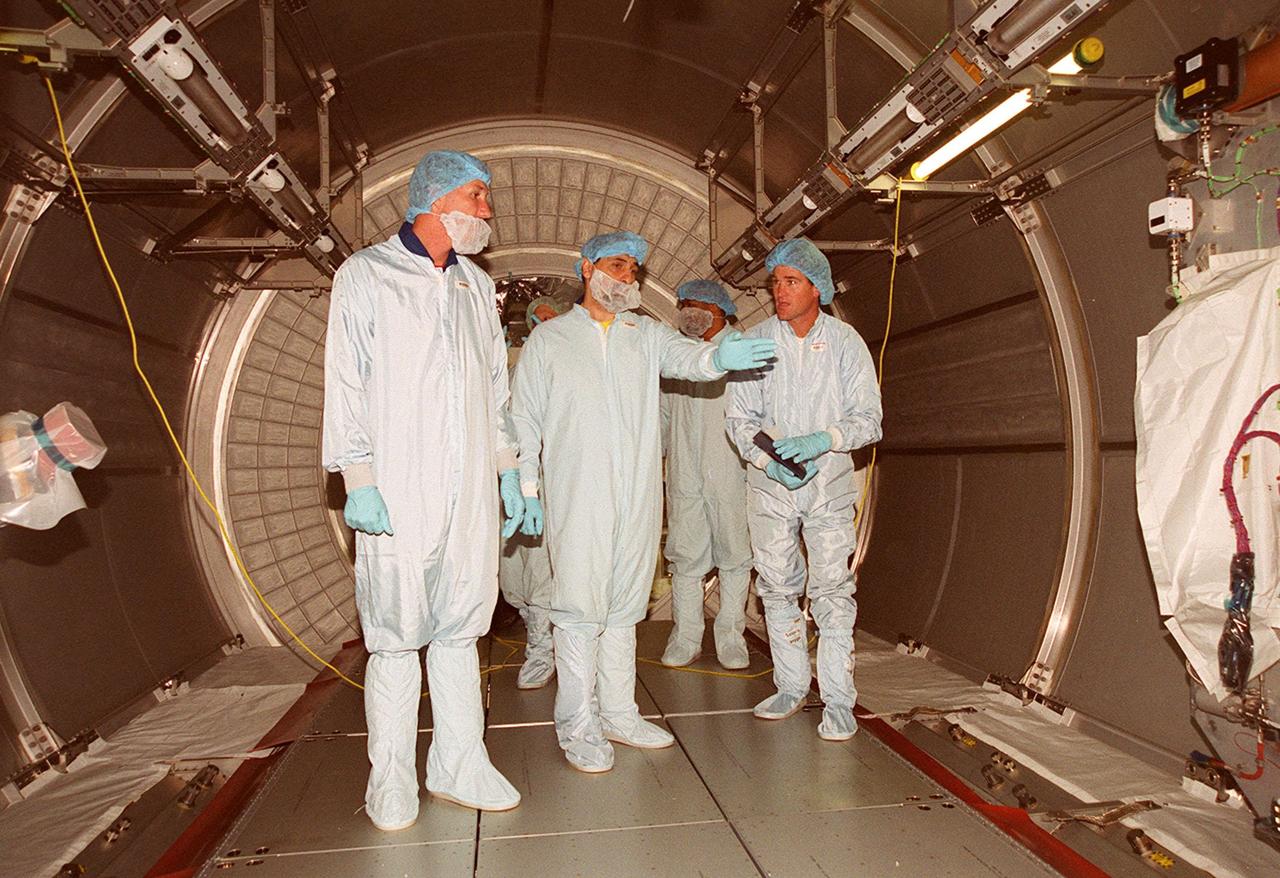
STS-100 Commander Kent Rominger and Mission Specialist Umberto Guidoni, who is with the European Space Agency, look over the inside of Raffaello, a Multi-Purpose Logistics Module. Mission STS-100, scheduled to launch April 19, 2001, will include Raffaello as well as the Space Station Remote Manipulator System (SSRMS) as its payload. MPLMs are pressurized modules that will serve as the International Space Station's “moving vans,” carrying laboratory racks filled with equipment, experiments and supplies to and from the station aboard the Space Shuttle. The SSRMS is the primary means of transferring payloads between the orbiter payload bay and the International Space Station for assembly
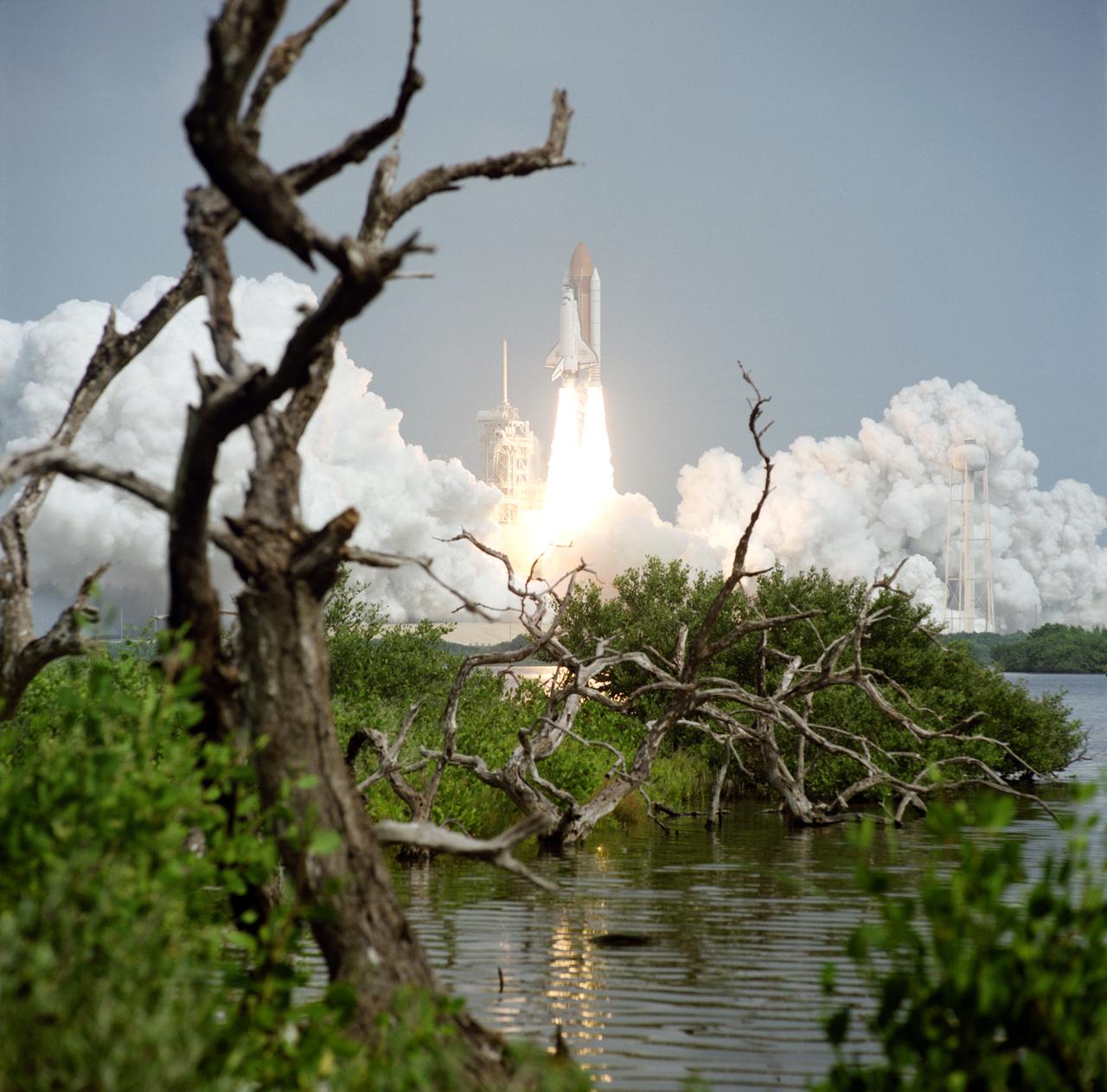
STS085-S-009 (7 August 1997) --- The Space Shuttle Discovery has cleared the launch tower in this low-angle, 35mm frame, and is headed toward an eleven-day mission in Earth-orbit in support of the STS-85 mission. Launch from Pad 39A, at the Kennedy Space Center (KSC), occurred at 10:41 a.m. (EDT), August 7, 1997. Onboard the spacecraft were astronauts Curtis L. Brown, Jr., commander; Kent V. Rominger, pilot; N. Jan Davis, payload commander; and Stephen K. Robinson and Robert L. Curbeam, Jr., both mission specialists; along with payload specialist Bjarni V. Tryggvason, a Canadian Space Agency (CSA) astronaut.
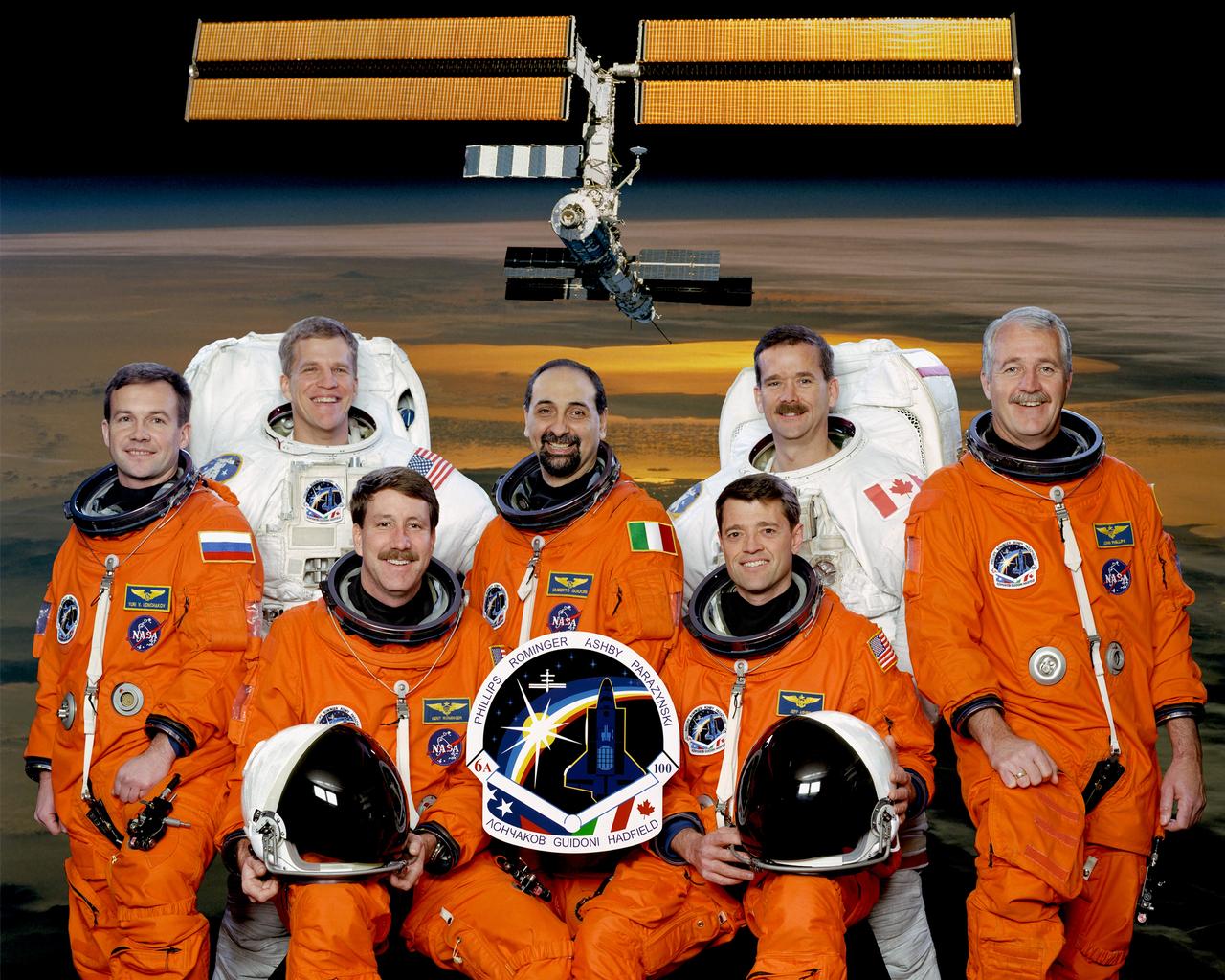
STS100-S-002 (March 2001) --- These international astronauts and cosmonaut have been in training in a number of venues for the April 2001 visit to the International Space Station (ISS). Seated are astronauts Kent V. Rominger (left) and Jeffrey S. Ashby, commander and pilot, respectively, for the STS-100 mission. Standing, from the left, are cosmonaut Yuri V. Lonchakov, with astronauts Scott E. Parazynski, Umberto Guidoni, Chris A. Hadfield and John L. Phillips, all mission specialists. Guidoni represents the European Space Agency (ESA); Hadfield is with the Canadian Space Agency (CSA) and Lonchakov is affiliated with Rosaviakosmos.
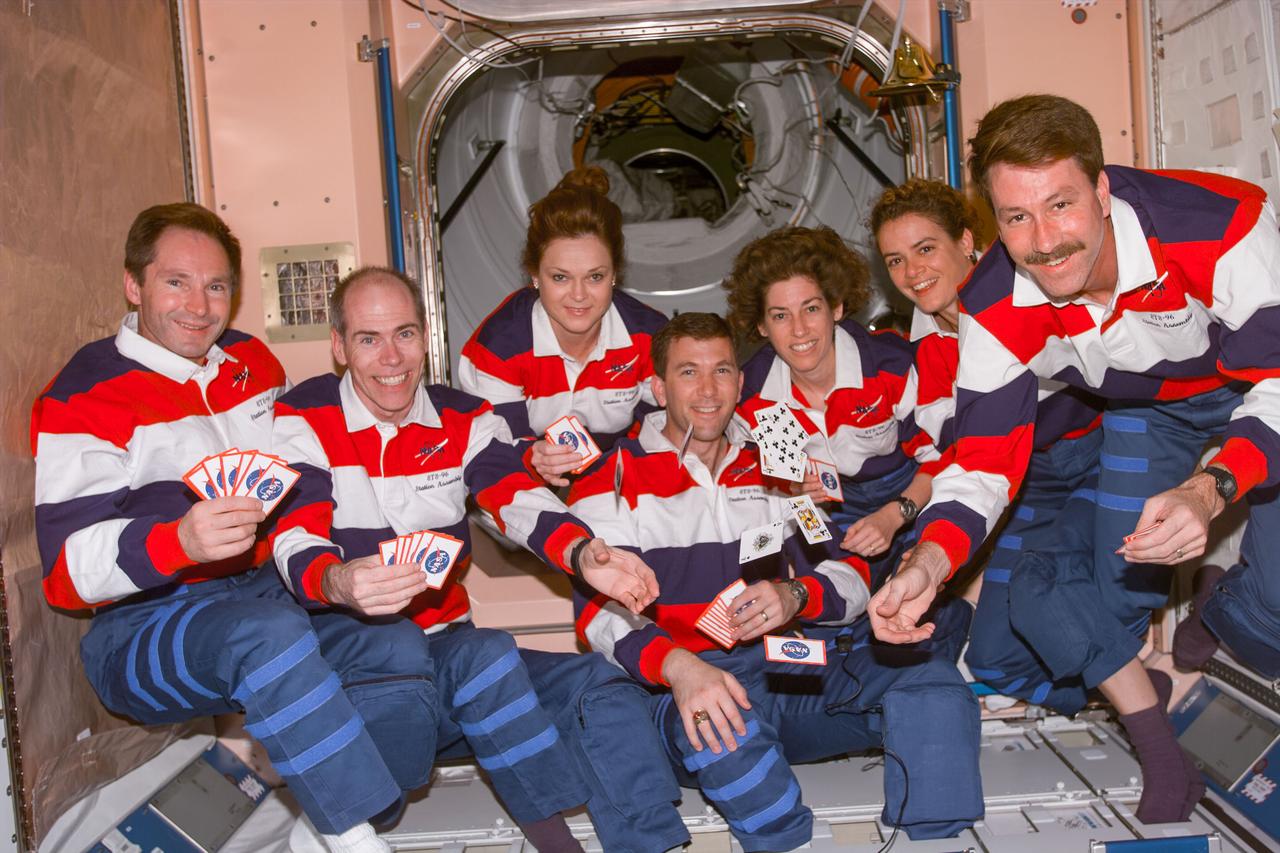
S96-E-5173 (2 June 1999) --- A pre-set electronic still camera (ESC) recorded this image of the STS-96 crewmembers playing cards on a break aboard the International Space Station (ISS). From the left are cosmonaut Valery I. Tokarev, Daniel T. Barry, Tamara E. Jernigan, Rick D. Husband, Ellen Ochoa, Julie Payette and Kent V. Rominger. Tokarev represents the Russian Space Agency (RSA) and Payette represents the Canadian Space Agency (CSA). The photograph was taken at 11:13:59 GMT, June 2, 1999.
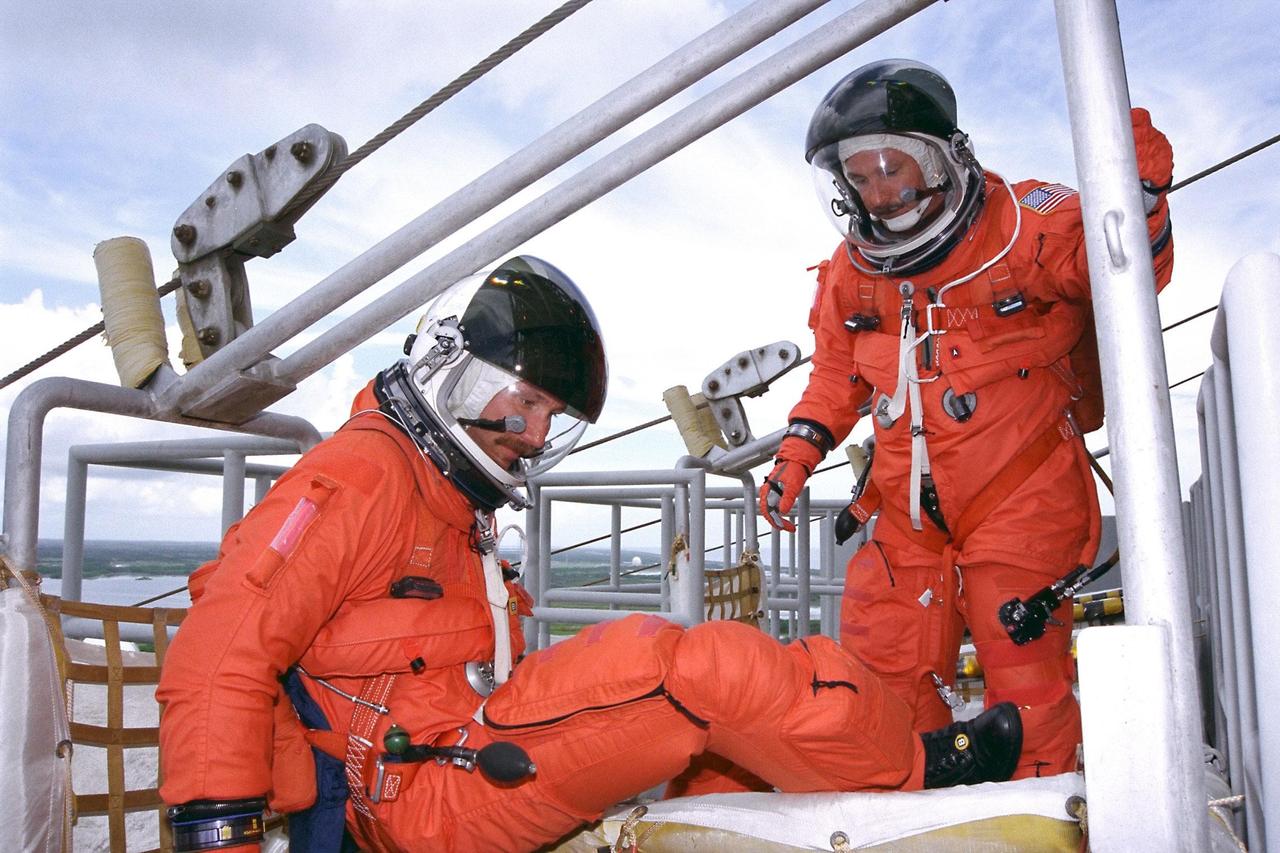
KENNEDY SPACE CENTER, Fla. -- STS-85 Pilot Kent V. Rominger (left) and Commander Curtis L. Brown, Jr. exit an emergency egress slidewire basket at the 195-foot level of Launch Pad 39A during Terminal Countdown Demonstration Test (TCDT) activities for that mission. The primary payload aboard the Space Shuttle orbiter Discovery is the Cryogenic Infrared Spectrometers and Telescopes for the Atmosphere-2 (CRISTA-SPAS-2). Other STS-85 payloads include the Manipulator Flight Demonstration (MFD), and Technology Applications and Science-1 (TAS-1) and International Extreme Ultraviolet Hitchhiker-2 (IEH-2)
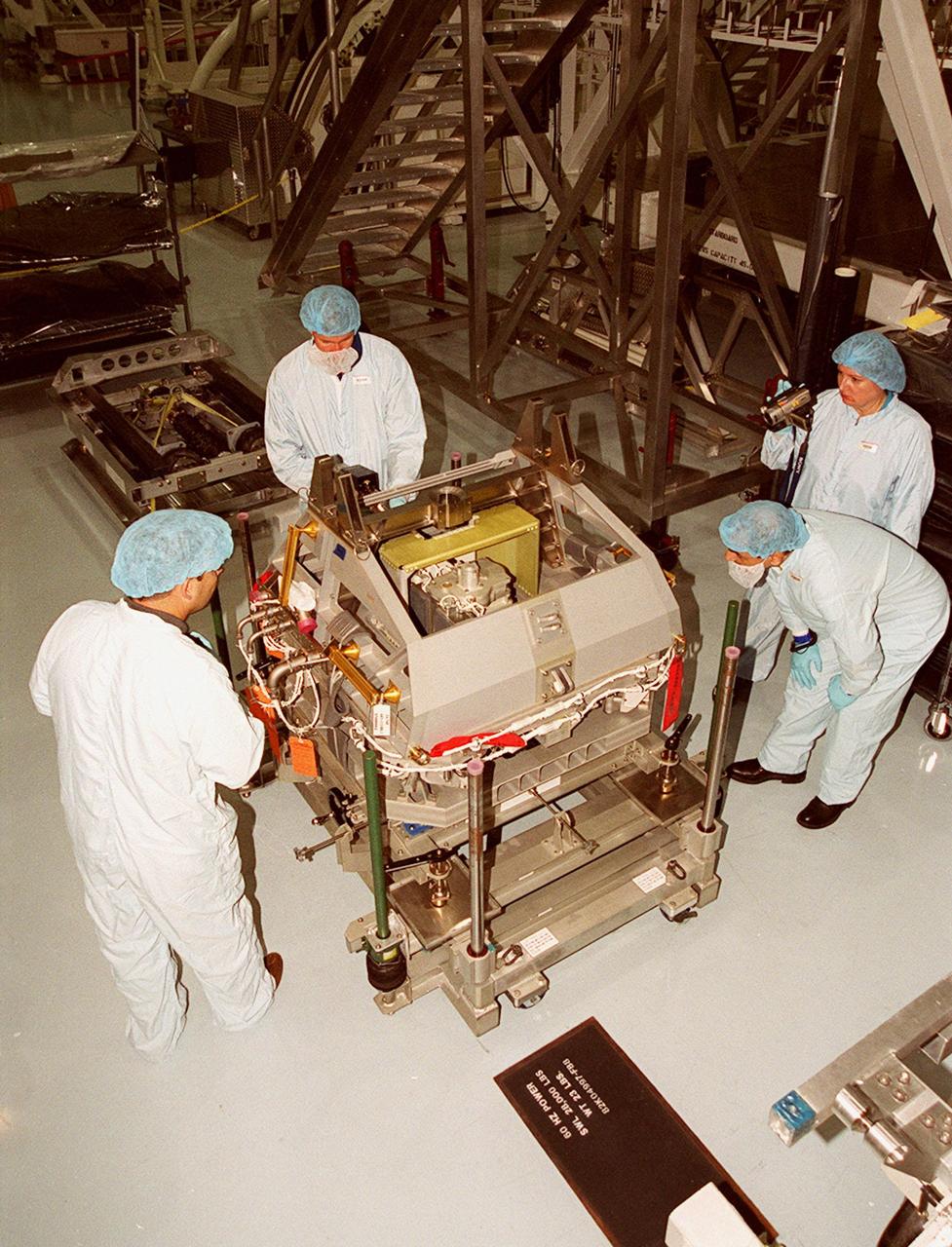
With workers (far left and far right) looking on, STS-100 Commander Kent Rominger tries out a piece of equipment while Mission Specialist Umberto Guidoni (leaning over) watches. Guidoni is with the European Space Agency. Mission STS-100, scheduled to launch April 19, 2001, will include Raffaello as well as the Space Station Remote Manipulator System (SSRMS) as its payload. MPLMs are pressurized modules that will serve as the International Space Station's “moving vans,” carrying laboratory racks filled with equipment, experiments and supplies to and from the station aboard the Space Shuttle. The SSRMS is the primary means of transferring payloads between the orbiter payload bay and the International Space Station for assembly
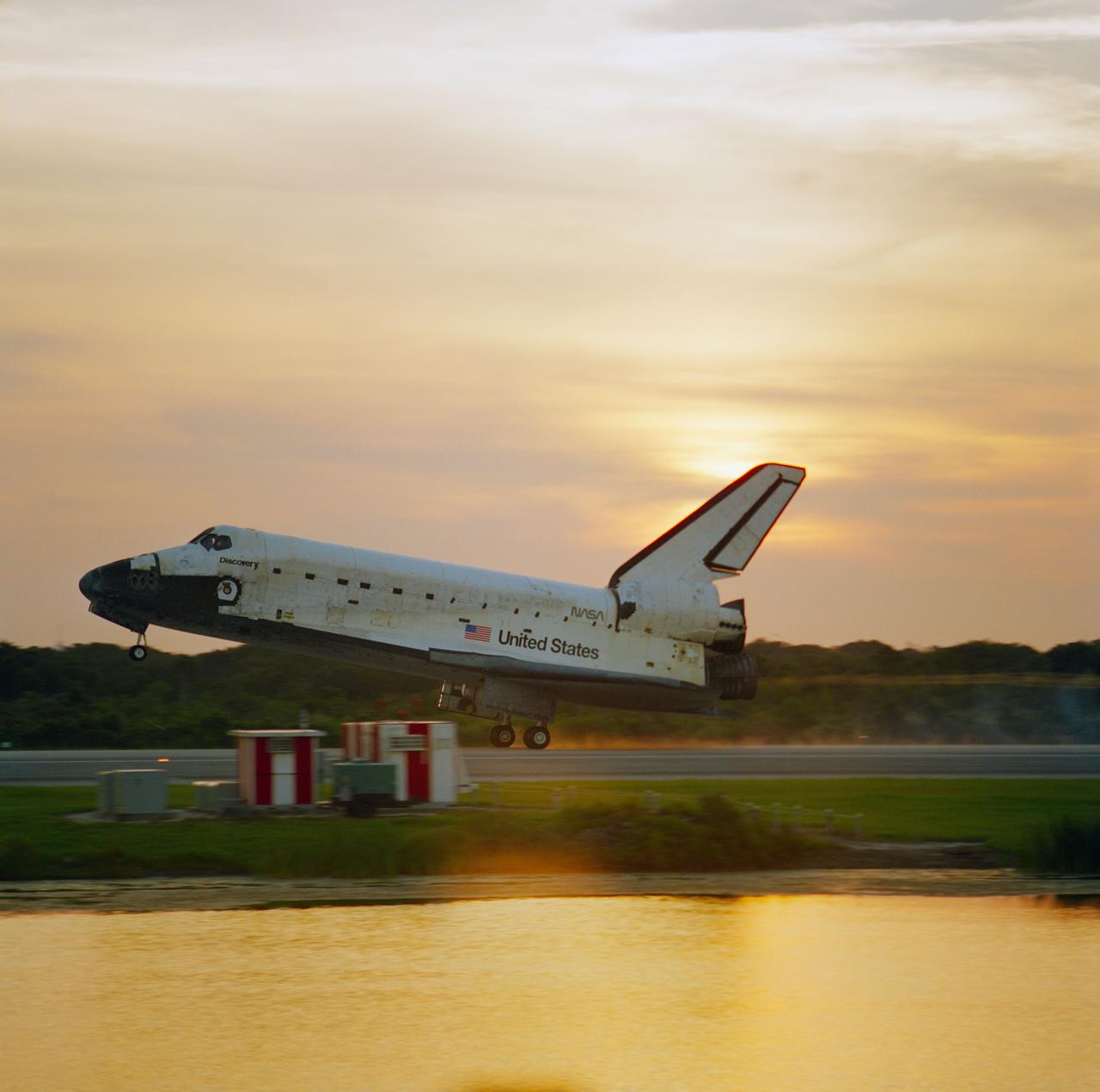
STS085-S-014 (19 Aug. 1997) --- The main landing gear of the space shuttle Discovery touches down on Runway 33 at the Kennedy Space Center to mark the successful completion of 12-day STS-85 mission. Landing occurred at 7:08 a.m. (EDT) on Aug. 19, 1997. Onboard were astronauts Curtis L. Brown, mission commander; Kent V. Rominger, pilot; N. Jan Davis, payload commander; and Robert L. Curbeam and Stephen K. Robinson, both mission specialists; along with payload specialist Bjarni Tryggvason, representing the Canadian Space Agency. Photo credit: NASA
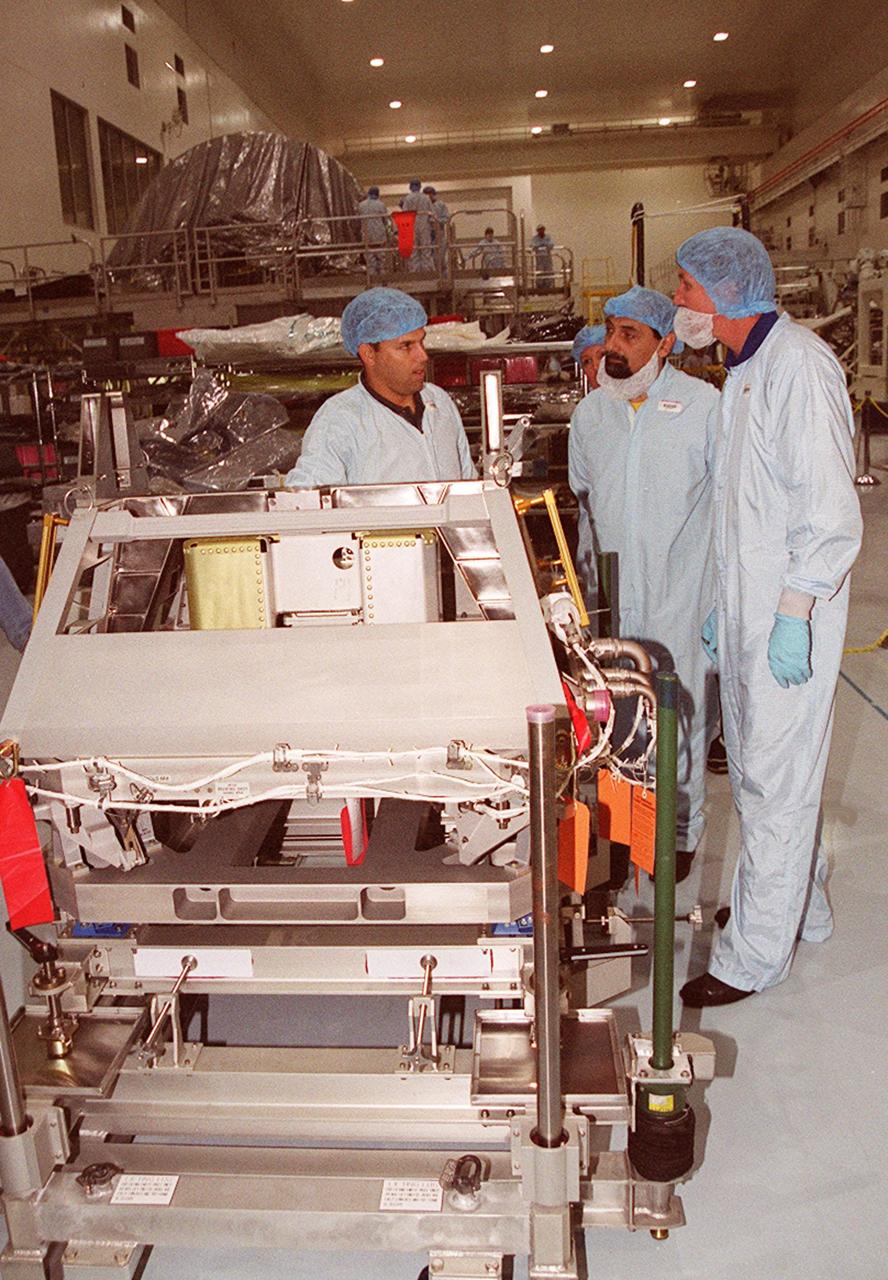
A worker (left) in the Space Station Processing Facility explains use of the equipment in the foreground to STS-100 Mission Specialist Umberto Guidoni (center) and Commander Kent Rominger (right). Guidoni is with the European Space Agency. Mission STS-100, scheduled to launch April 19, 2001, will include the Multi-Purpose Logistics Module (MPLM) Raffaello and the Space Station Remote Manipulator System (SSRMS) as its payload. MPLMs are pressurized modules that will serve as the International Space Station's “moving vans,” carrying laboratory racks filled with equipment, experiments and supplies to and from the station aboard the Space Shuttle. The SSRMS is the primary means of transferring payloads between the orbiter payload bay and the International Space Station for assembly
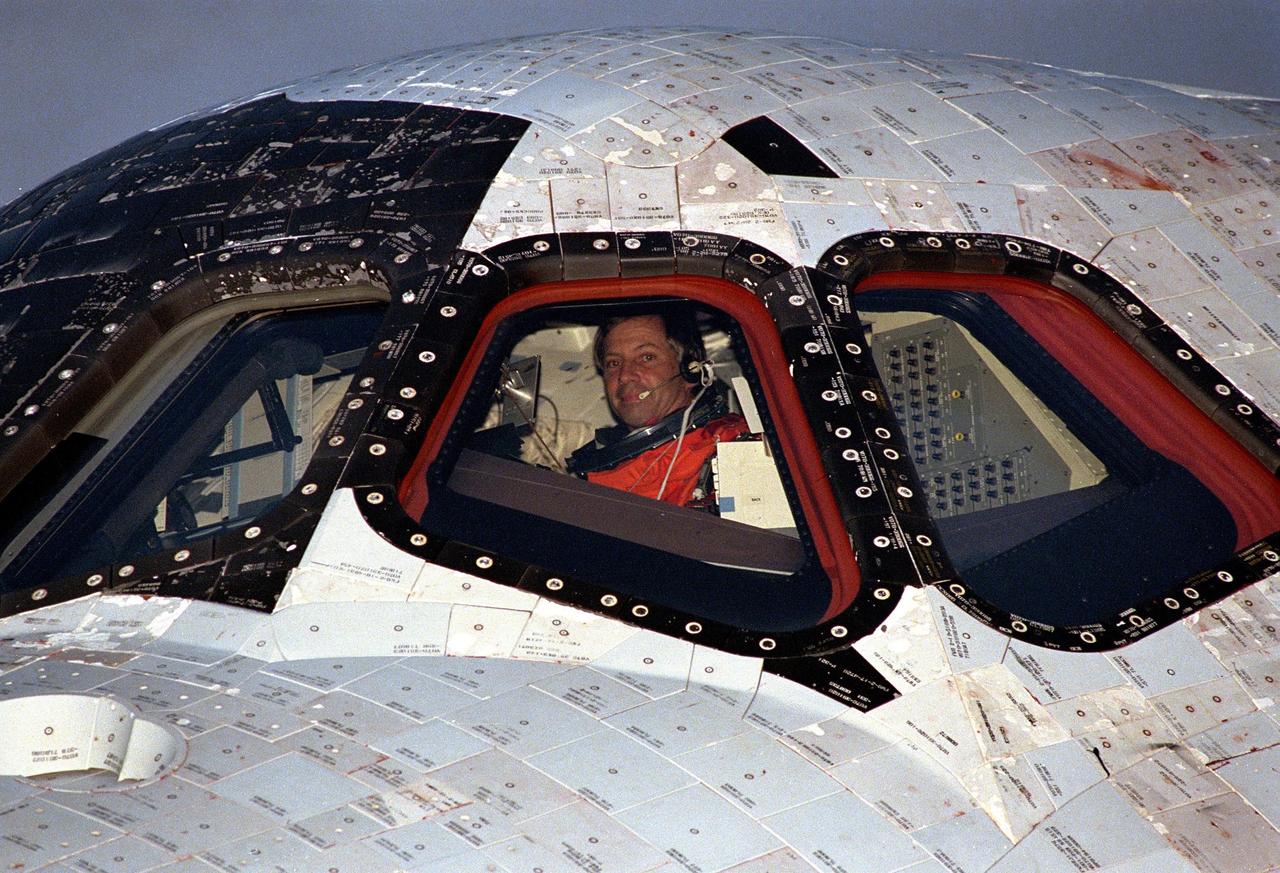
KENNEDY SPACE CENTER, FLA. -- STS-80 Commander Kenneth D. Cockrell peers out the window of the orbiter Columbia minutes after guiding the spacecraft to a successful landing on KSC’s Runway 33. Main gear touchdown occurred at 6:49:04 a.m. EST, Dec. 7. On board with Cockrell are four fellow crew members, Pilot Kent V. Rominger, and Mission Specialists Story Musgrave, Thomas D. Jones, and Tamara E. Jernigan, and the two primary payloads of the mission, the Wake Shield Facility-3 (WSF-3) and the Orbiting and Retrievable Far and Extreme Ultraviolet Spectrometer-Shuttle Pallet Satellite II (ORFEUS-SPAS II).
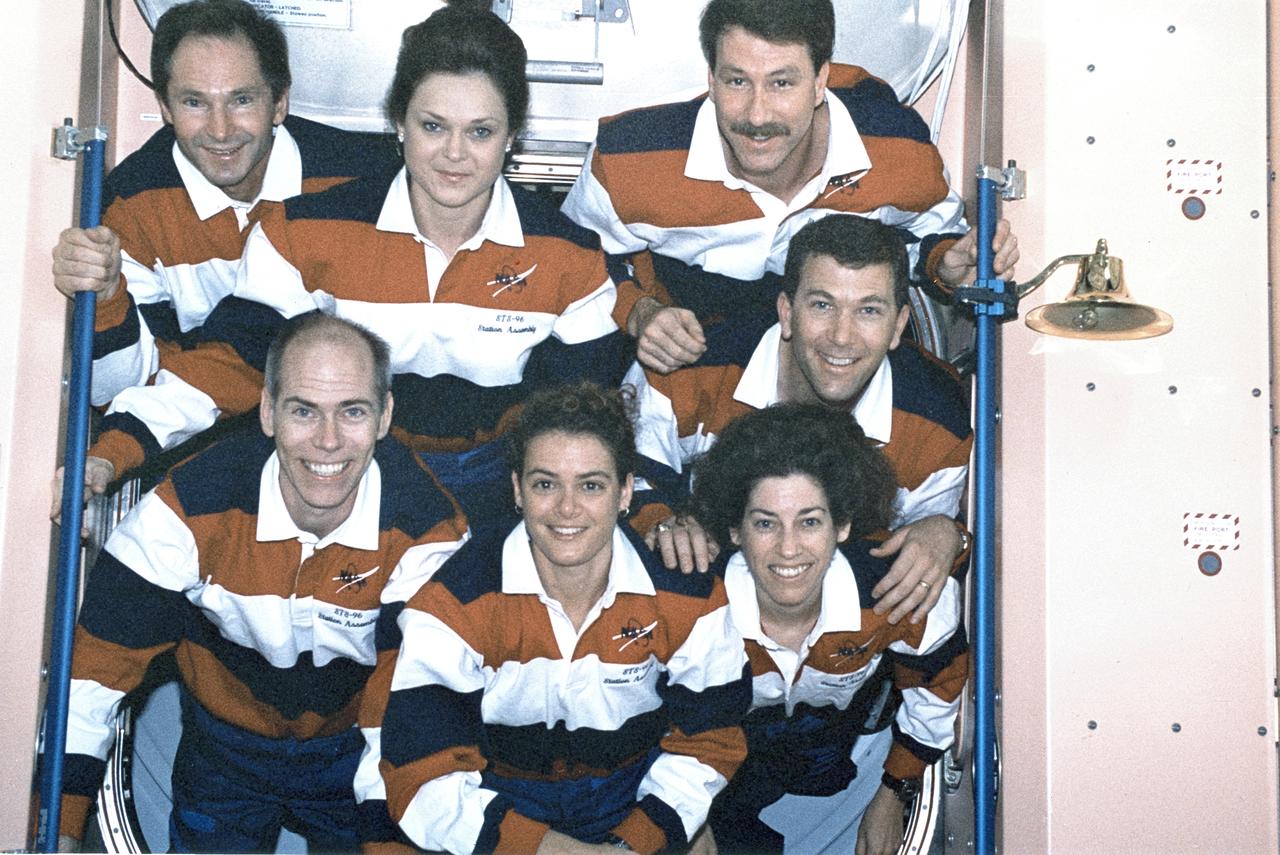
The STS-96 crew paused for an International Space Station (ISS) onboard group photo. Pictured on the bottom row (left to right) are Mission Specialists Daniel Barry, Julie Payette, and Ellen Ochoa. Pictured on the top row (left to right) are Cosmonaut Valery Ivanovich Tokarev, and Tamara Jernigan, Mission Specialists; Kent Rominger, Commander; and Rick Husband, Pilot. STS-96 was the second ISS assembly flight and the first flight to dock with the station. The 10 day mission crew launched aboard the Space Shuttle Orbiter Discovery on May 27, 1999.
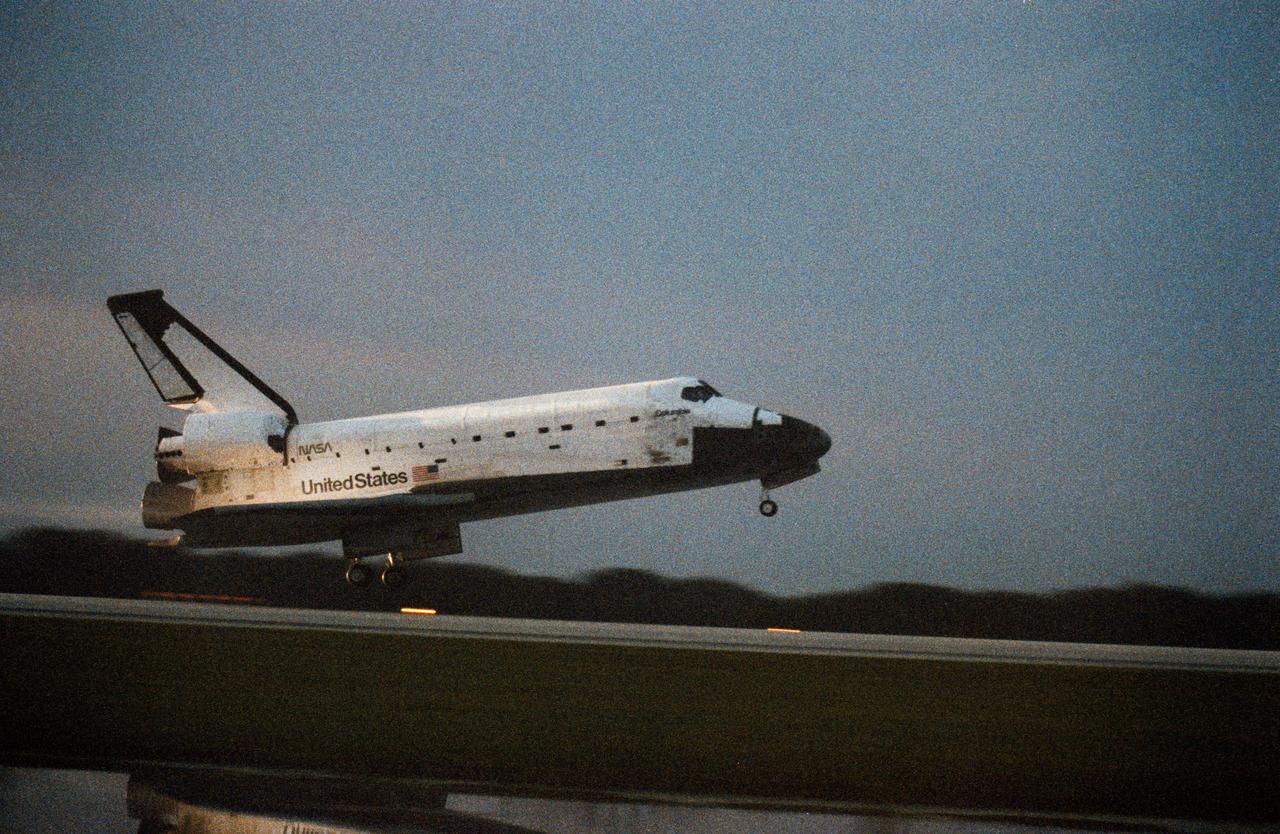
STS080-S-009 (7 Dec. 1996) --- Just prior to main gear touchdown, the space shuttle Columbia is pictured during landing on Runway 33 at the Kennedy Space Center's (KSC) Shuttle Landing Facility (SLF). Landing occurred at 6:49 a.m. (EST), Dec. 7, 1996 marking a total duration only eight hours short of 18 days. The landing is the 33rd at KSC for the Space Transportation System (STS). Crewmembers aboard were astronauts Kenneth D. Cockrell, mission commander; and Kent V. Rominger, pilot; along with Story Musgrave, Tamara E. Jernigan and Thomas D. Jones, all mission specialists.
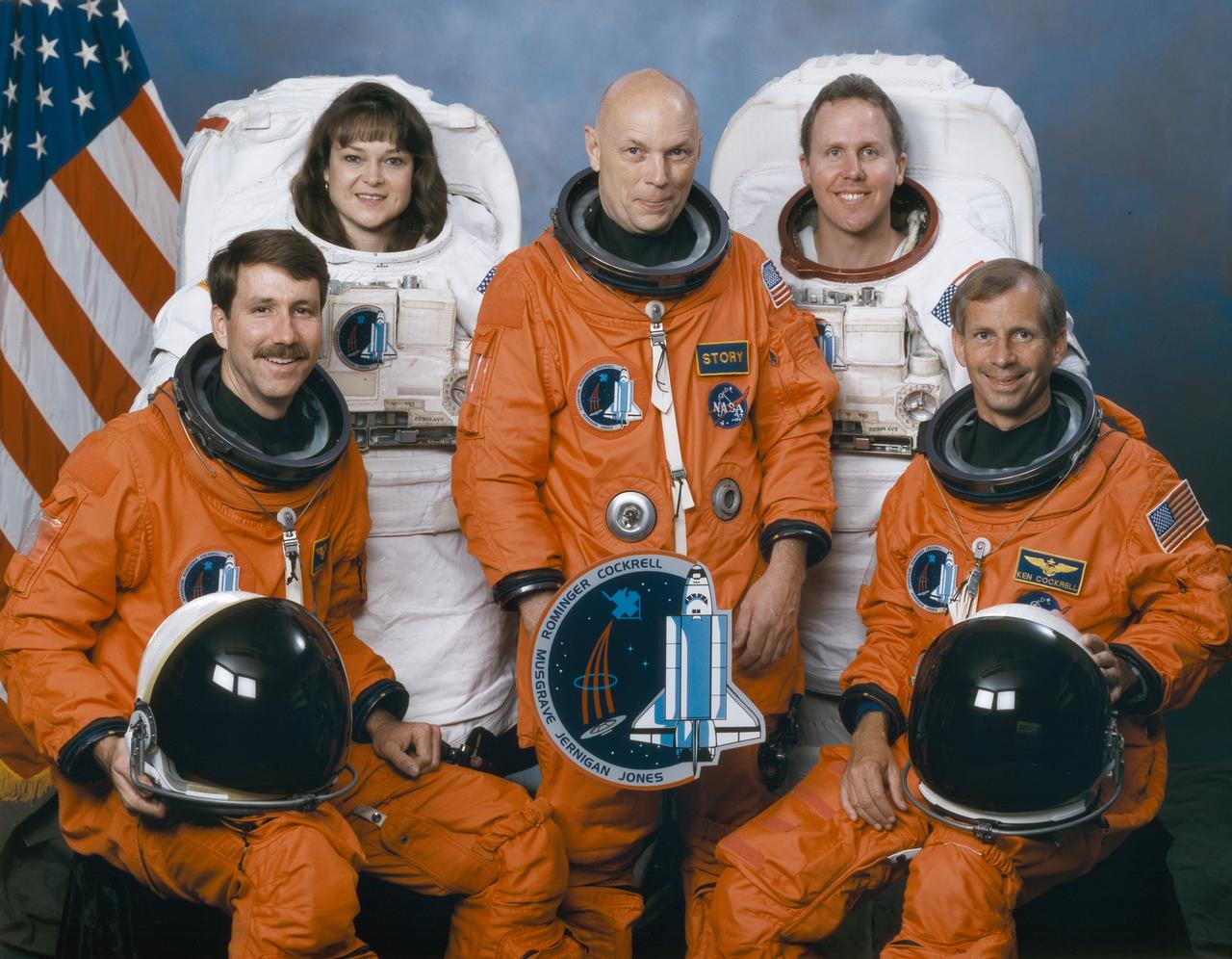
The crew assigned to the STS-79 mission included (seated left to right) Kent V. Rominger, pilot; and Kenneth D. Cockrell, commander. Standing (left to right) are mission specialists Tamara E. Jernigan, F. Story Musgrave, and Thomas D. Jones. Launched aboard the Space Shuttle Columbia on November 19, 1996 at 2:55:47 pm (EST), the STS-80 mission marked the final flight of 1996. The crew successfully deployed and operated the Orbiting and Retrievable Far and Extreme Ultraviolet Spectrometer-Shuttle Pallet Satellite II (ORFEUS-SPAS II), and deployed and retrieved the Wake Shield Facility-3 (WSF-3).
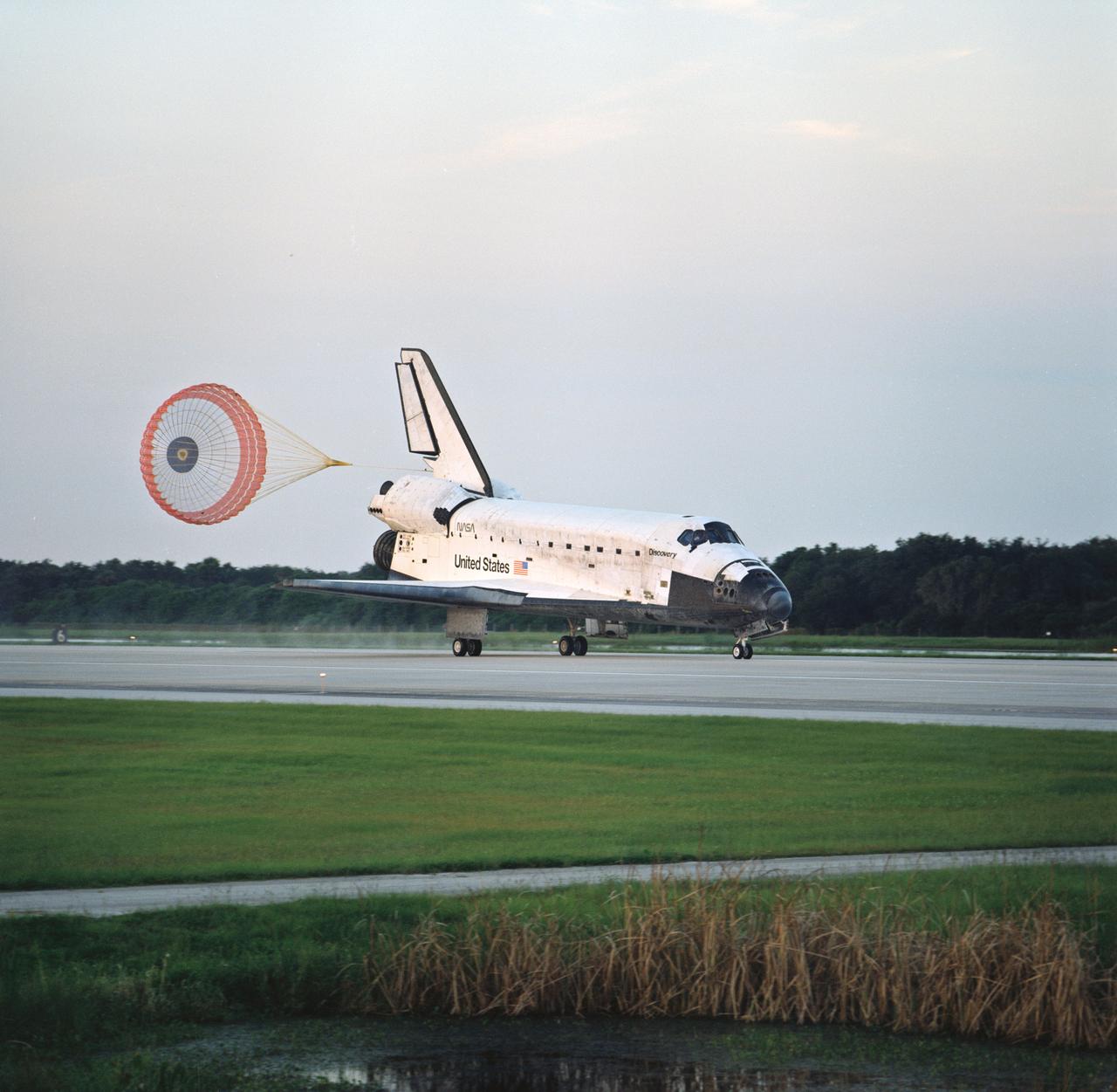
STS085-S-013 (19 August 1997) --- The drag chute of the Space Shuttle Discovery is fully deployed in this scene of the spacecraft's landing on runway 33 at the Kennedy Space Center (KSC). The landing, at 7:08 a.m. (EDT), August 19, 1997, marked the completion of a successful 12-day STS-85 mission. Onboard were astronauts Curtis L. Brown, Jr., mission commander; Kent V. Rominger, pilot; N. Jan Davis, payload commander; and Robert L. Curbeam, Jr., and Stephen K. Robinson, both mission specialists; along with payload specialist Bjarni Tryggvason, representing the Canadian Space Agency (CSA).
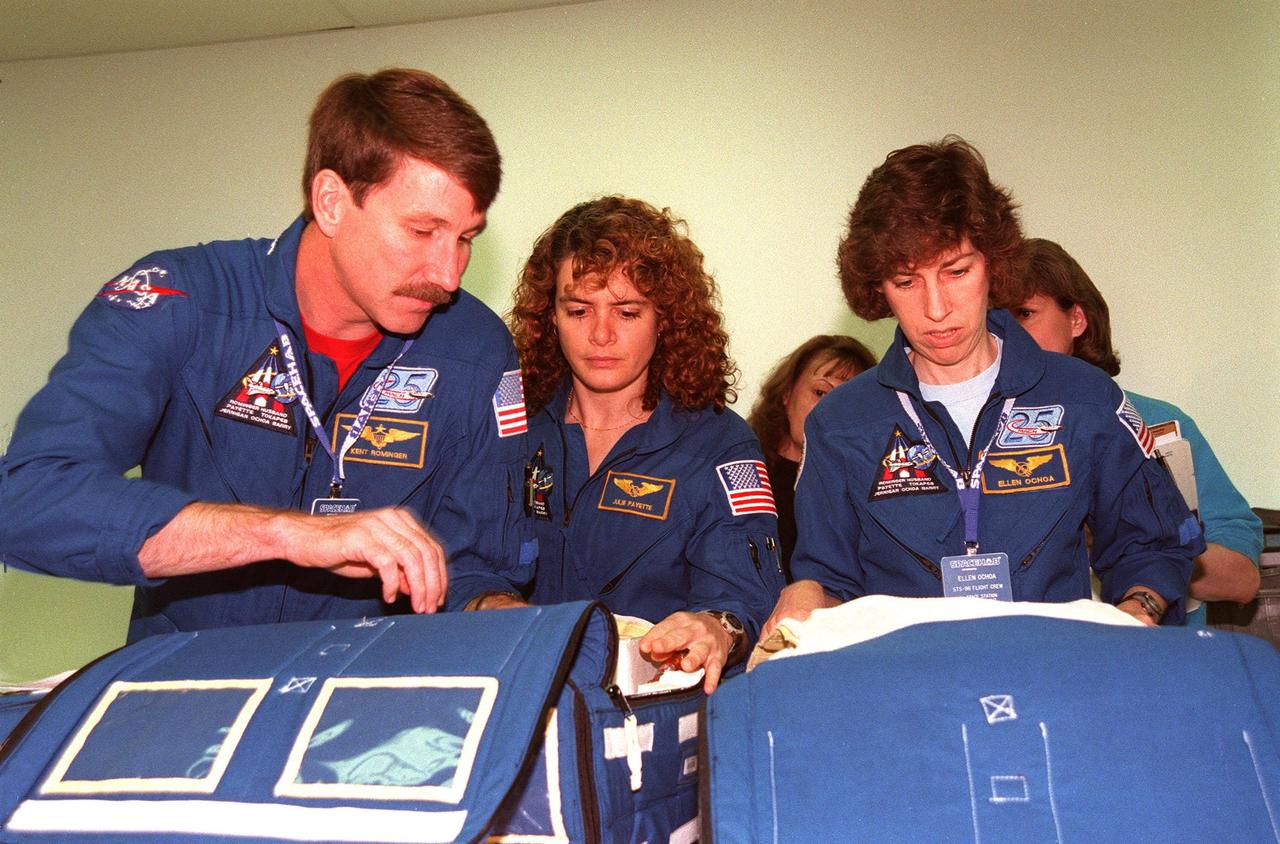
KENNEDY SPACE CENTER, FLA. -- (From left) STS-96 Commander Kent V. Rominger and Mission Specialists Julie Payette and Ellen Ochoa look over equipment at the SPACEHAB Facility. Members of the STS-96 crew are taking part in a bench review at SPACEHAB as part of familiarization activities for their upcoming mission. The crew also includes Pilot Rick Husband and Mission Specialists Tamara E. Jernigan, Daniel Barry, and Valery Ivanovich Tokarev. Payette is with the Canadian Space Agency and Tokarev with the Russian Space Agency. Mission STS-96 is the second flight in construction of the International Space Station and will include the SPACEHAB. The 10-day mission is targeted for launch on May 24, 1999, at Launch Pad 39B

STS073-S-002 (July 1995) --- These five astronauts and two United States Microgravity Laboratory (USML) payload specialists pause from a rigid training schedule for the STS-73 crew portrait. On the front row, left to right, are Albert Sacco Jr., payload specialist; Kent V. Rominger, pilot; Michael E. Lopez-Alegria, mission specialist. On the back row are, left to right, Catherine G. Coleman, mission specialist; Kenneth D. Bowersox, commander; Fred W. Leslie, payload specialist; and Kathryn C. Thornton, payload commander.
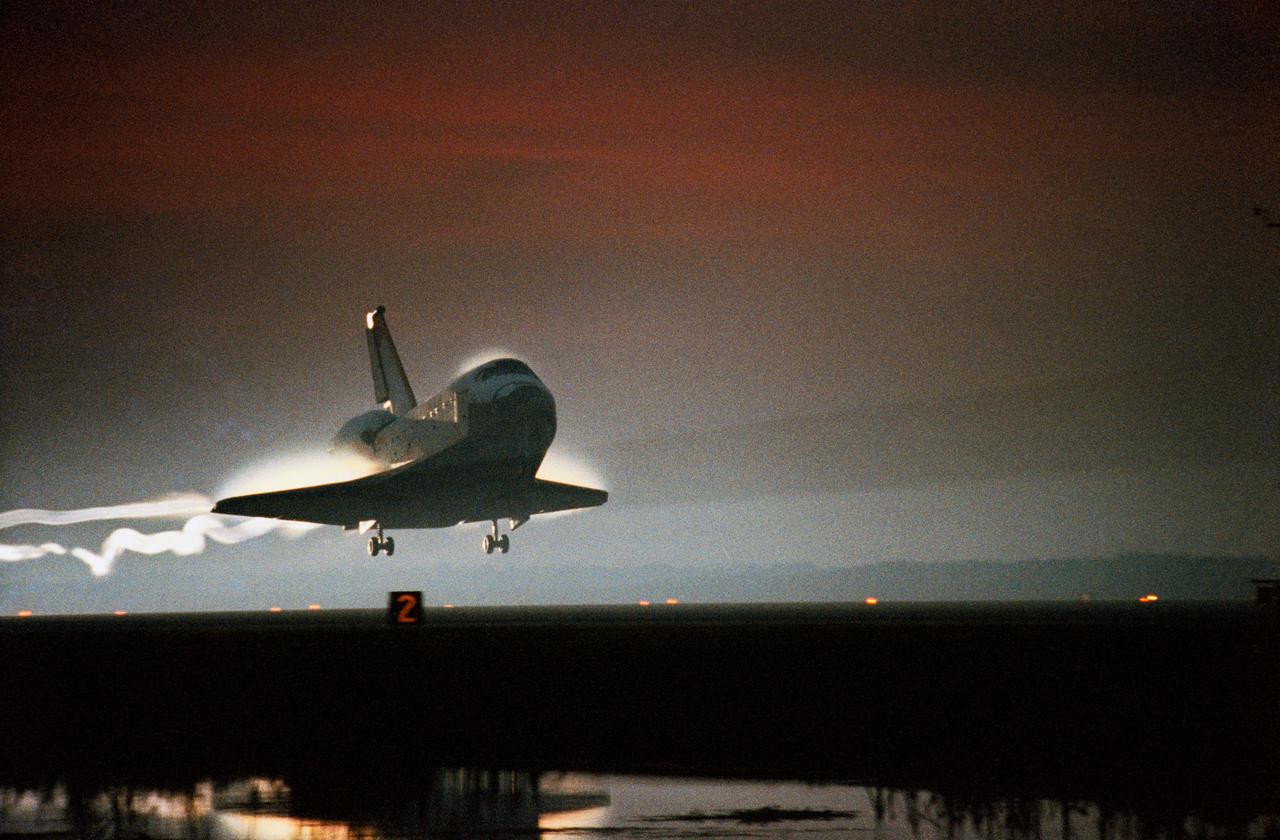
STS080-S-008 (7 Dec. 1996) --- Just prior to dawn, the space shuttle Columbia heads for a landing on Runway 33 at the Kennedy Space Center's (KSC) Shuttle Landing Facility (SLF) to successfully complete a 17-day mission. Landing occurred just before dawn, at 6:49 a.m. (EST). The landing is the 33rd at KSC for the Space Transportation System (STS). Crew members aboard were astronauts Kenneth D. Cockrell, mission commander; and Kent V. Rominger, pilot; along with Story Musgrave, Tamara E. Jernigan and Thomas D. Jones, all mission specialists.
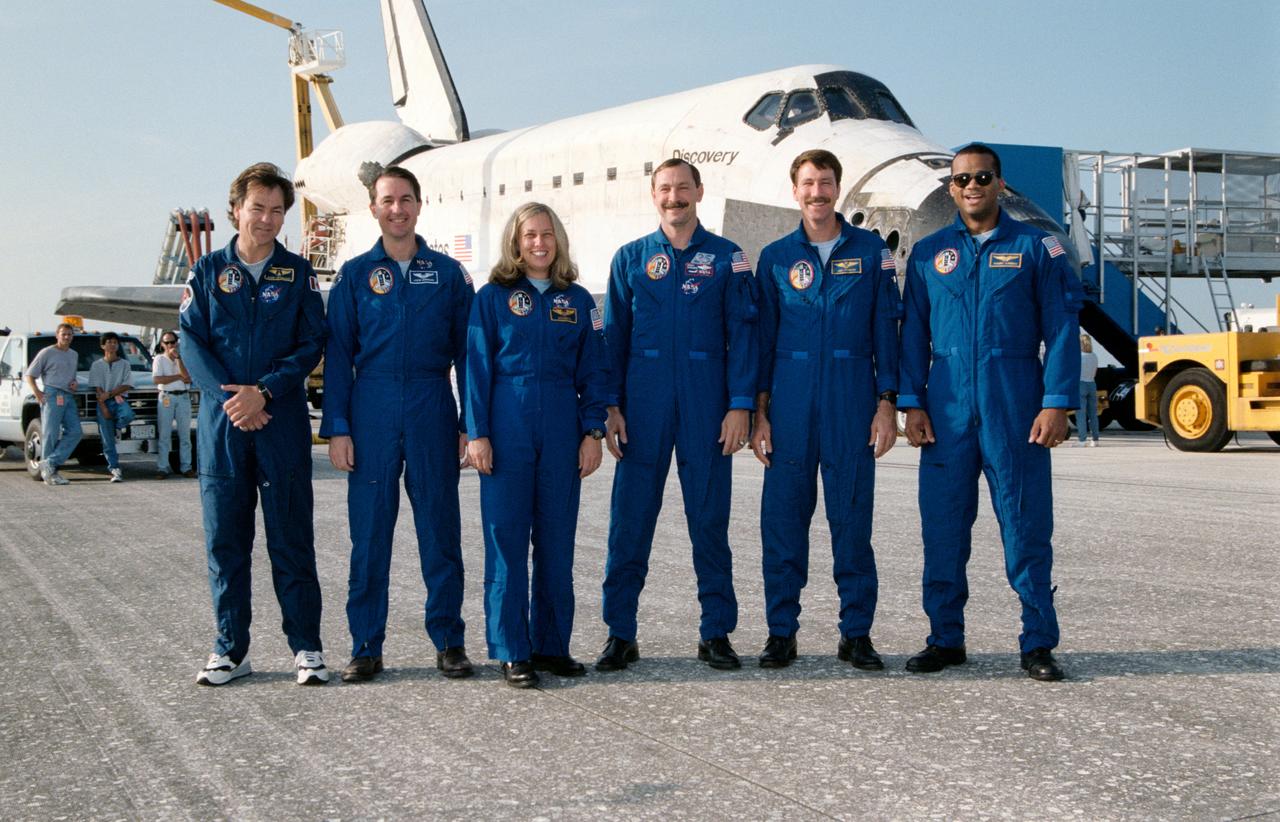
STS085-S-011 (19 August 1997) --- Following the landing of the Space Shuttle Discovery on runway 33 at the Kennedy Space Center (KSC), the six member crew poses for a final crew portrait. The landing, at 7:08 a.m. (EDT), August 19, 1997, marked the completion of a successful 12-day STS-85 mission. Left to right are payload specialist Bjarni Tryggvason of the Canadian Space Agency (CSA), along with astronauts Stephen K. Robinson, mission specialist; N. Jan Davis, payload commander; Curtis L. Brown, Jr., mission commander; Kent V. Rominger, pilot; and Robert L. Curbeam, Jr., mission specialist.
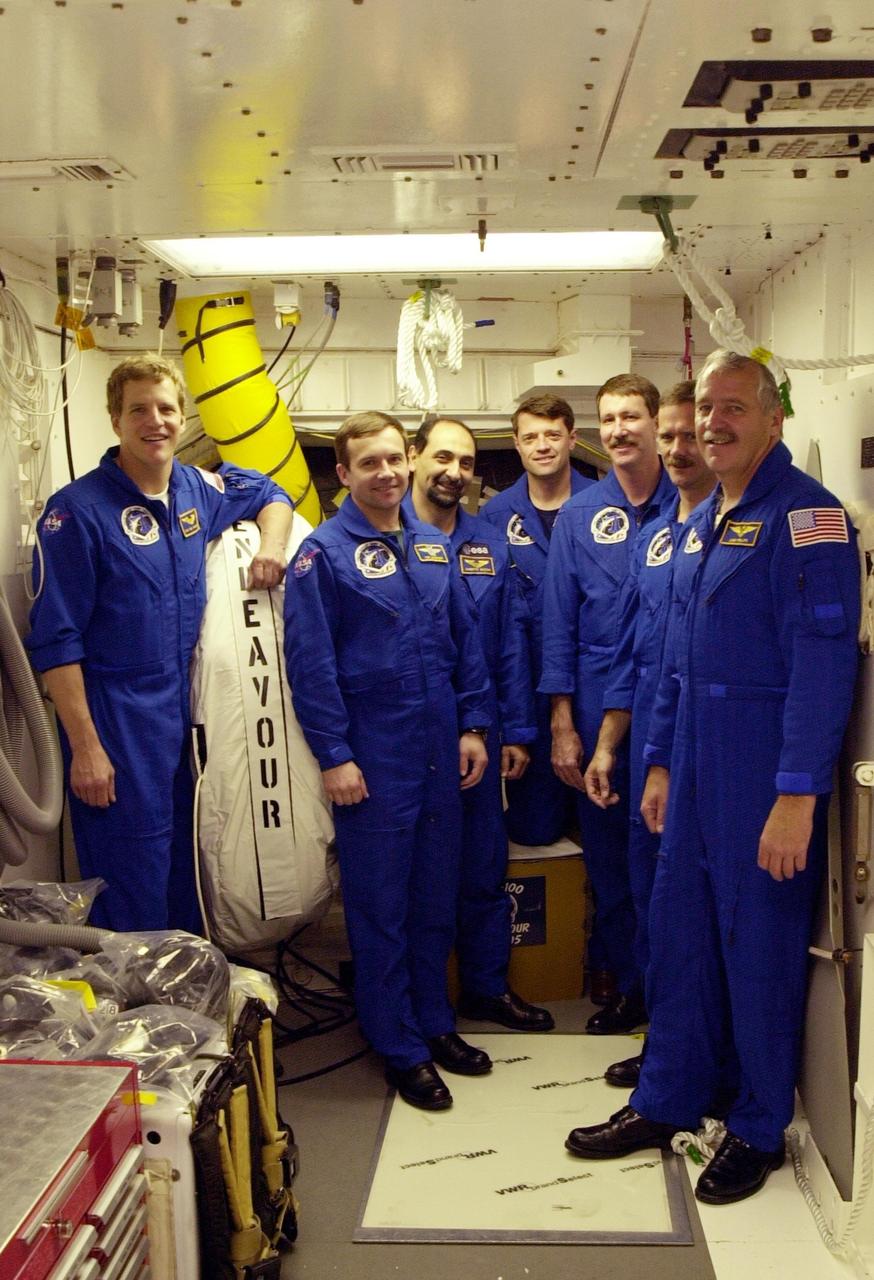
The crew on mission STS-100 poses in the White Room during Terminal Countdown Demonstration Test activities. Standing, from left, are Mission Specialists Scott E. Parazynski, Yuri Lonchakov, and Umberto Guidoni; Pilot Jeffrey S. Ashby; Commander Kent V. Rominger; Mission Specialist Chris A. Hadfield; and Mission Specialist John L. Phillips. The TCDT includes emergency escape training, payload bay walkdown, and a simulated launch countdown. Launch of Space Shuttle Endeavour on mission STS-100 is targeted for April 19 at 2:41 p.m. EDT from Launch Pad 39A
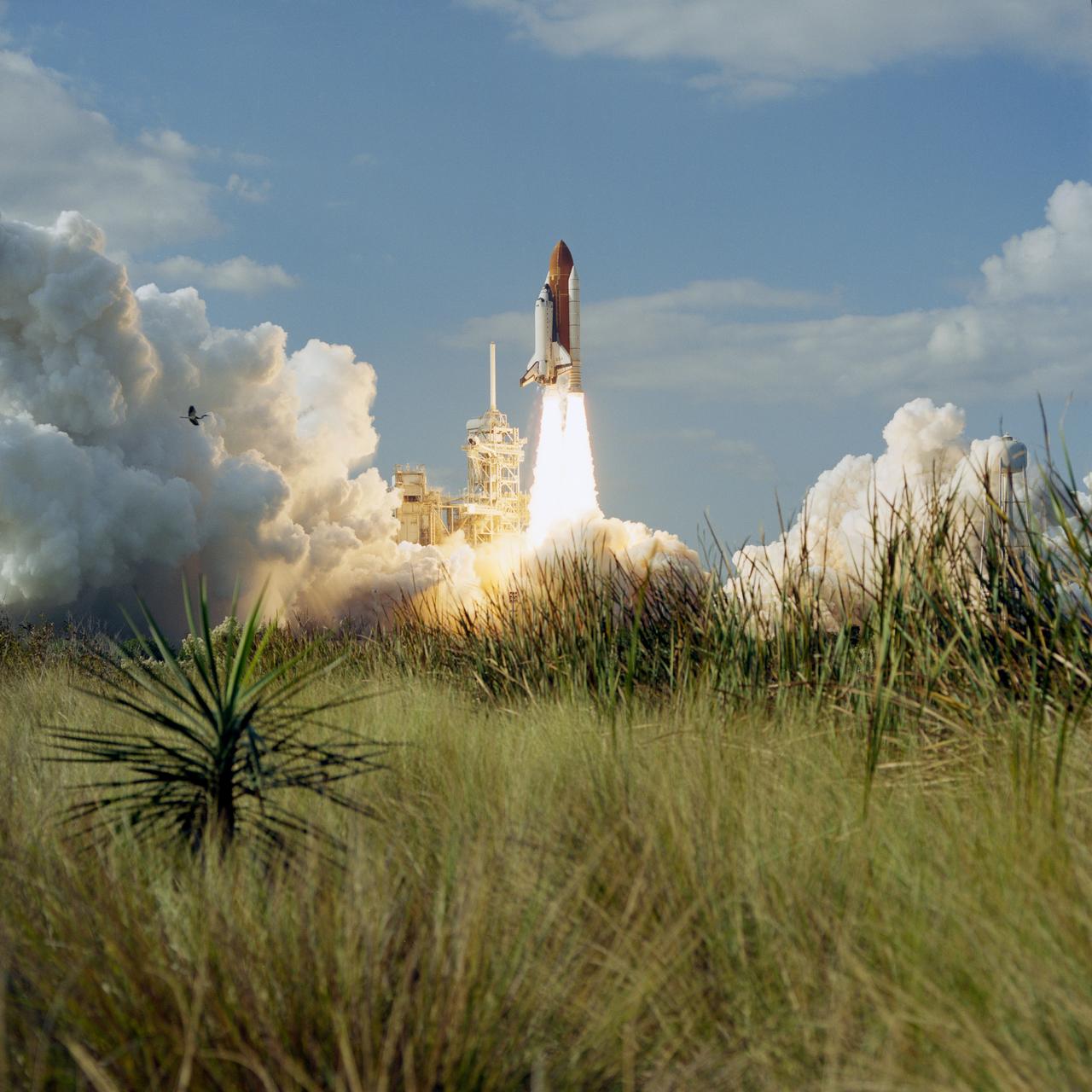
STS080-S-005 (19 Nov. 1996) --- The space shuttle Columbia lifts off from the Kennedy Space Center's (KSC) Launch Pad 39B at 2:55:47 p.m. (EST), Nov. 19, 1996. Onboard are astronauts Kenneth D. Cockrell, mission commander; Kent V. Rominger, pilot; along with Story Musgrave, Tamara E. Jernigan and Thomas D. Jones, all mission specialists. The two primary payloads for STS-80 stowed in Columbia's cargo bay for later deployment and testing are the Wake Shield Facility (WSF-3) and the Orbiting and Retrievable Far and Extreme Ultraviolet Spectrometer (ORFEUS) with its associated Shuttle Pallet Satellite (SPAS).
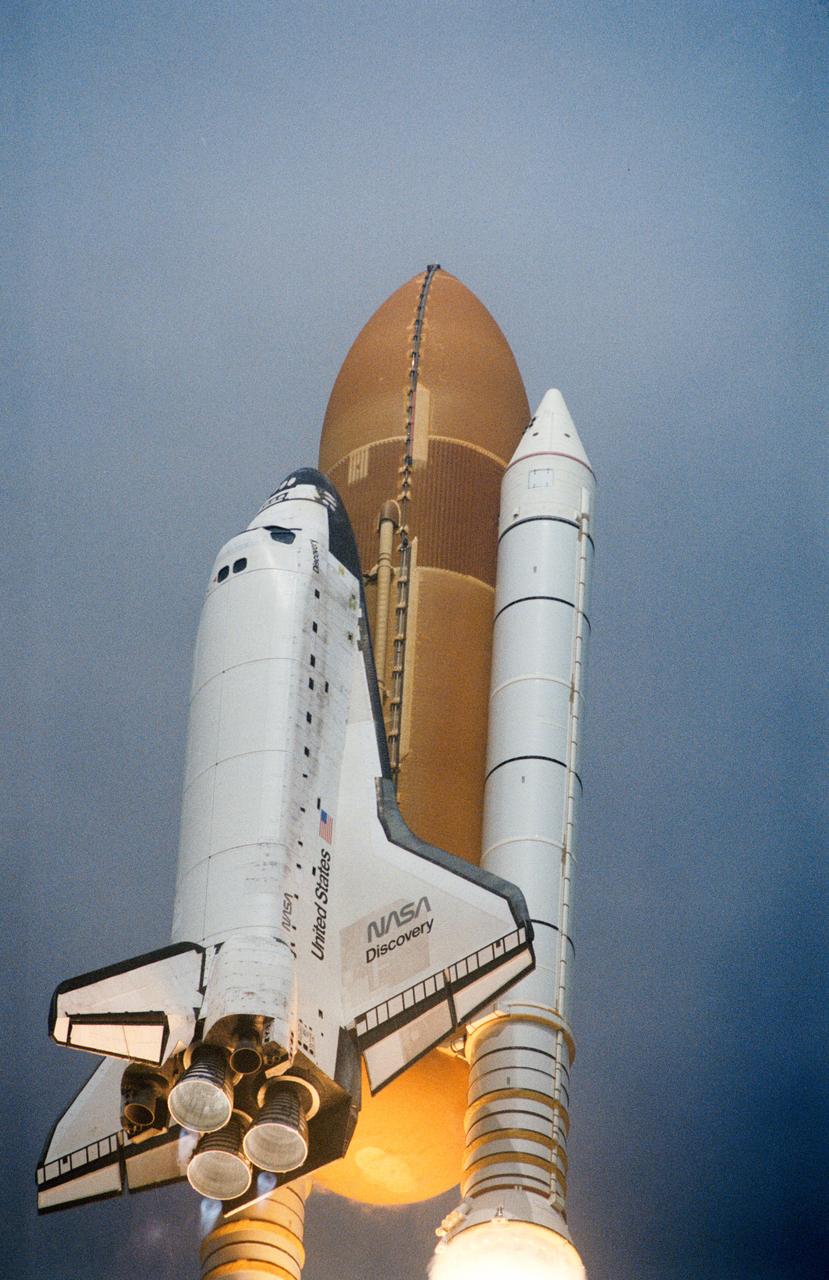
STS085-S-006 (7 August 1997) --- The Space Shuttle Discovery has cleared the launch tower at Pad 39A, at the Kennedy Space Center (KSC), in this low-angle, 35mm frame, and is headed toward an eleven-day mission in Earth-orbit in support of the STS-85 mission. Launch occurred at 10:41 a.m. (EDT), August 7, 1997. Onboard the spacecraft were astronauts Curtis L. Brown, Jr., commander; Kent V. Rominger, pilot; N. Jan Davis, payload commander; and Stephen K. Robinson and Robert L. Curbeam, Jr., both mission specialists; along with payload specialist Bjarni V. Tryggvason, a Canadian Space Agency (CSA) astronaut.
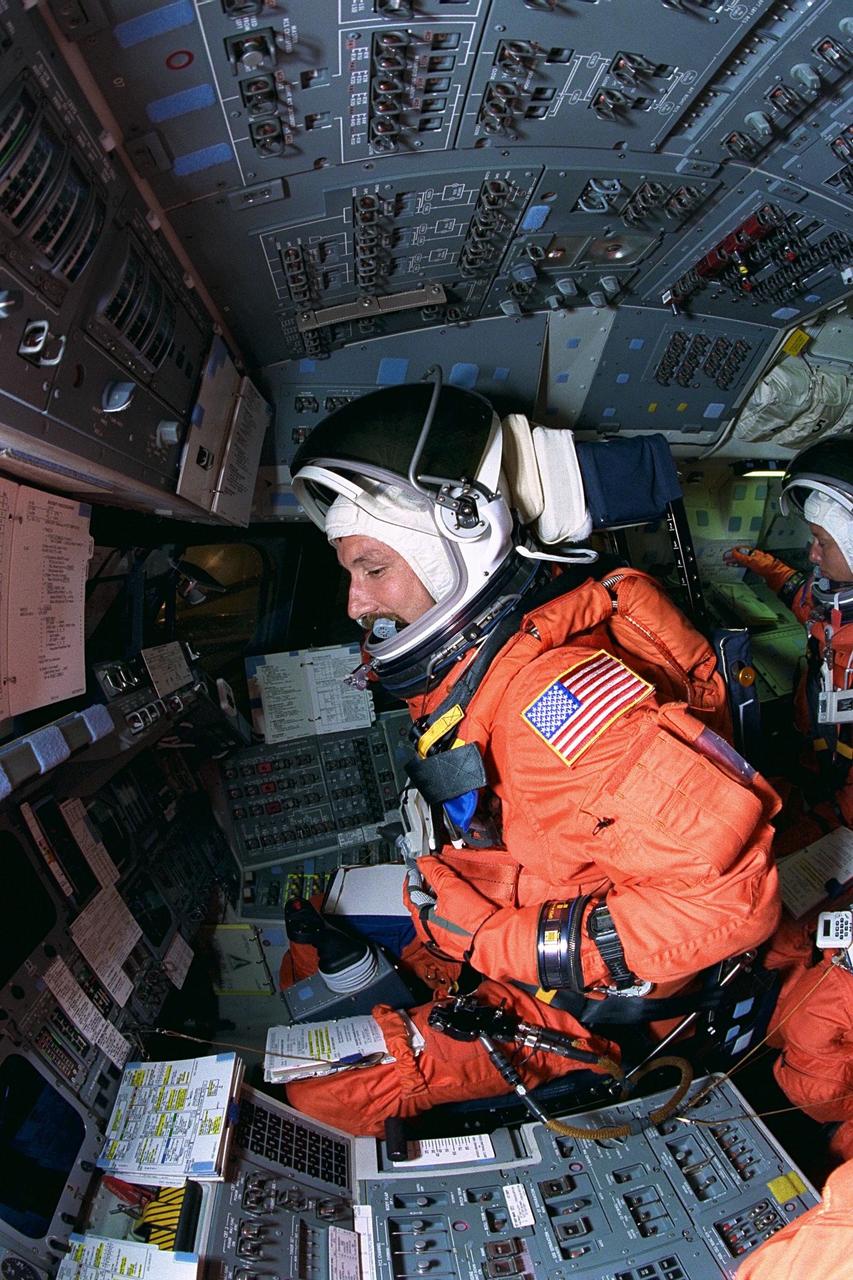
KENNEDY SPACE CENTER, FLA. -- STS-85 Pilot Kent V. Rominger goes through countdown procedures on the flight deck aboard the Space Shuttle orbiter Discovery during Terminal Countdown Demonstration Test (TCDT) activities for that mission. The TCDT includes a simulation of the final launch countdown. The primary payload aboard the Space Shuttle orbiter Discovery is the Cryogenic Infrared Spectrometers and Telescopes for the Atmosphere-2 (CRISTA-SPAS-2). Other STS-85 payloads include the Manipulator Flight Demonstration (MFD), and Technology Applications and Science-1 (TAS-1) and International Extreme Ultraviolet Hitchhiker-2 (IEH-2) experiments
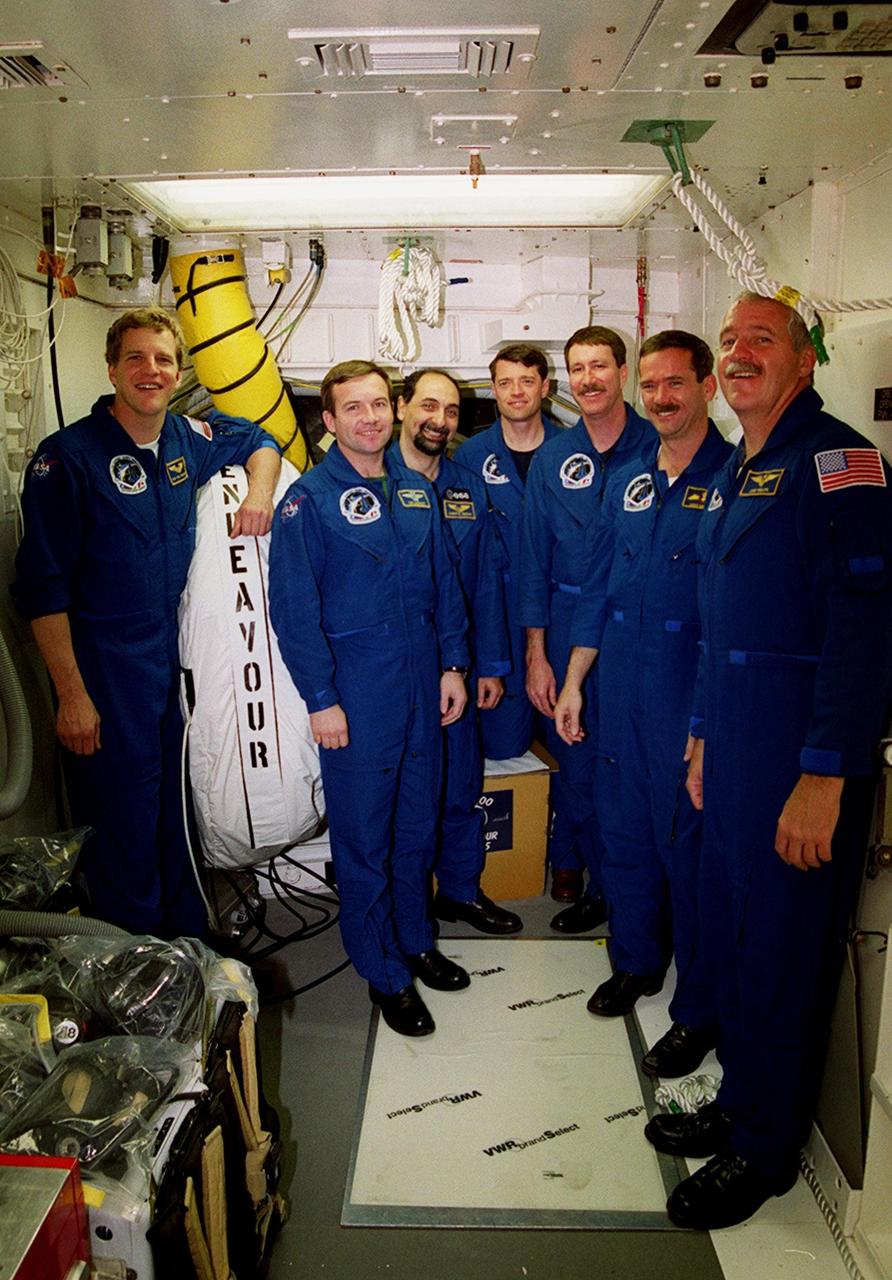
The crew on mission STS-100 poses in the White Room during Terminal Countdown Demonstration Test activities. Standing, from left, are Mission Specialists Scott E. Parazynski, Yuri Lonchakov, and Umberto Guidoni; Pilot Jeffrey S. Ashby; Commander Kent V. Rominger; and Mission Specialists Chris A. Hadfield and John L. Phillips. The TCDT includes emergency escape training, payload bay walkdown, and a simulated launch countdown. The primary payload comprises the Canadian robotic arm, SSRMS, and Multi-Purpose Logistics Module, Raffaello. Launch of Space Shuttle Endeavour on mission STS-100 is targeted for April 19 at 2:41 p.m. EDT from Launch Pad 39A
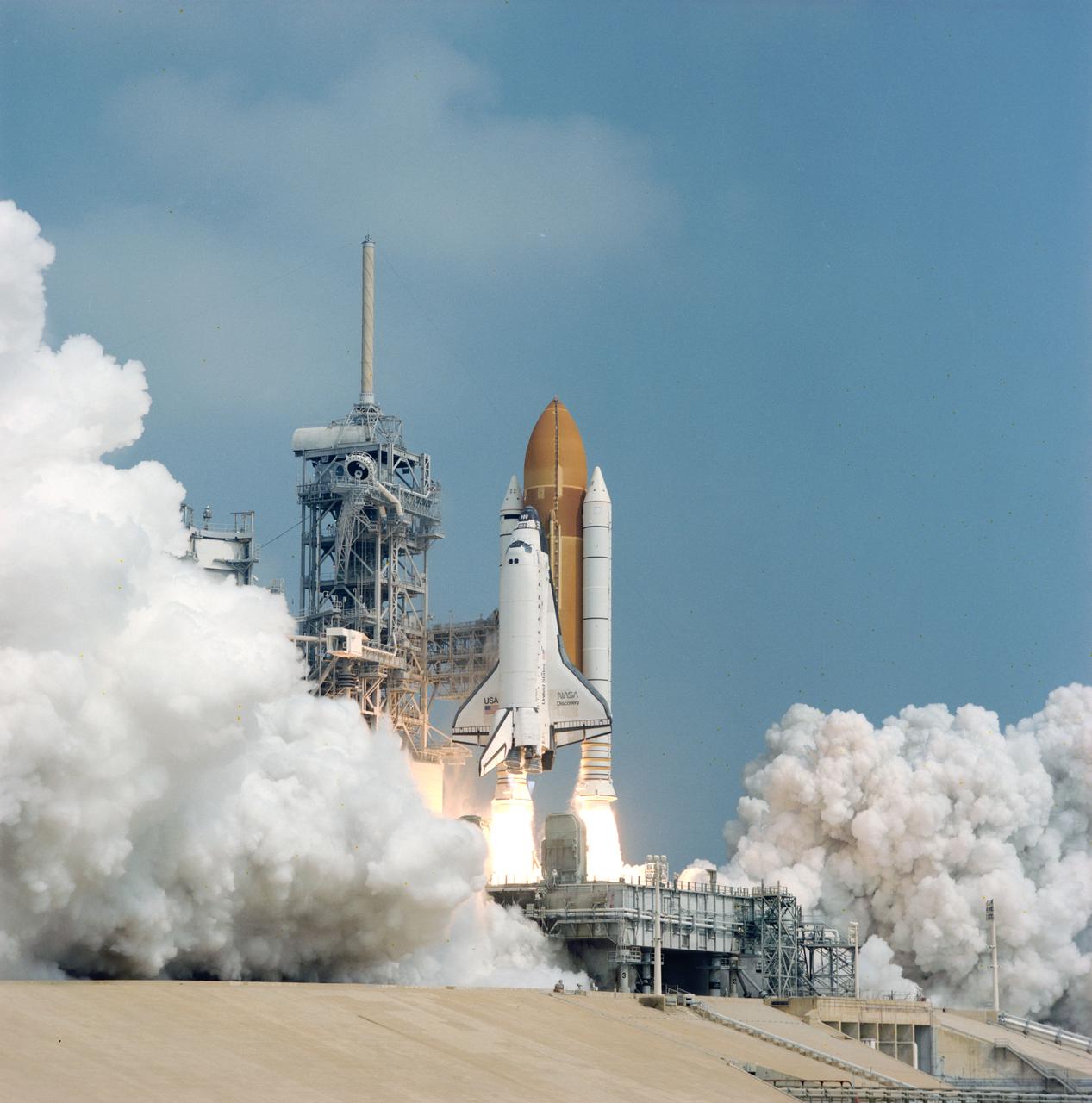
STS085-S-005 (7 August 1997) --- In this scene moments after ignition at Launch Pad 39A, at the Kennedy Space Center (KSC), the Space Shuttle Discovery heads toward an eleven-day mission in Earth-orbit in support of the STS-85 mission. Launch occurred at 10:41 a.m. (EDT), August 7, 1997. Onboard the spacecraft were astronauts Curtis L. Brown, Jr., commander; Kent V. Rominger, pilot; N. Jan Davis, payload commander; and Stephen K. Robinson and Robert L. Curbeam, Jr., both mission specialists; along with payload specialist Bjarni V. Tryggvason, a Canadian Space Agency (CSA) astronaut.
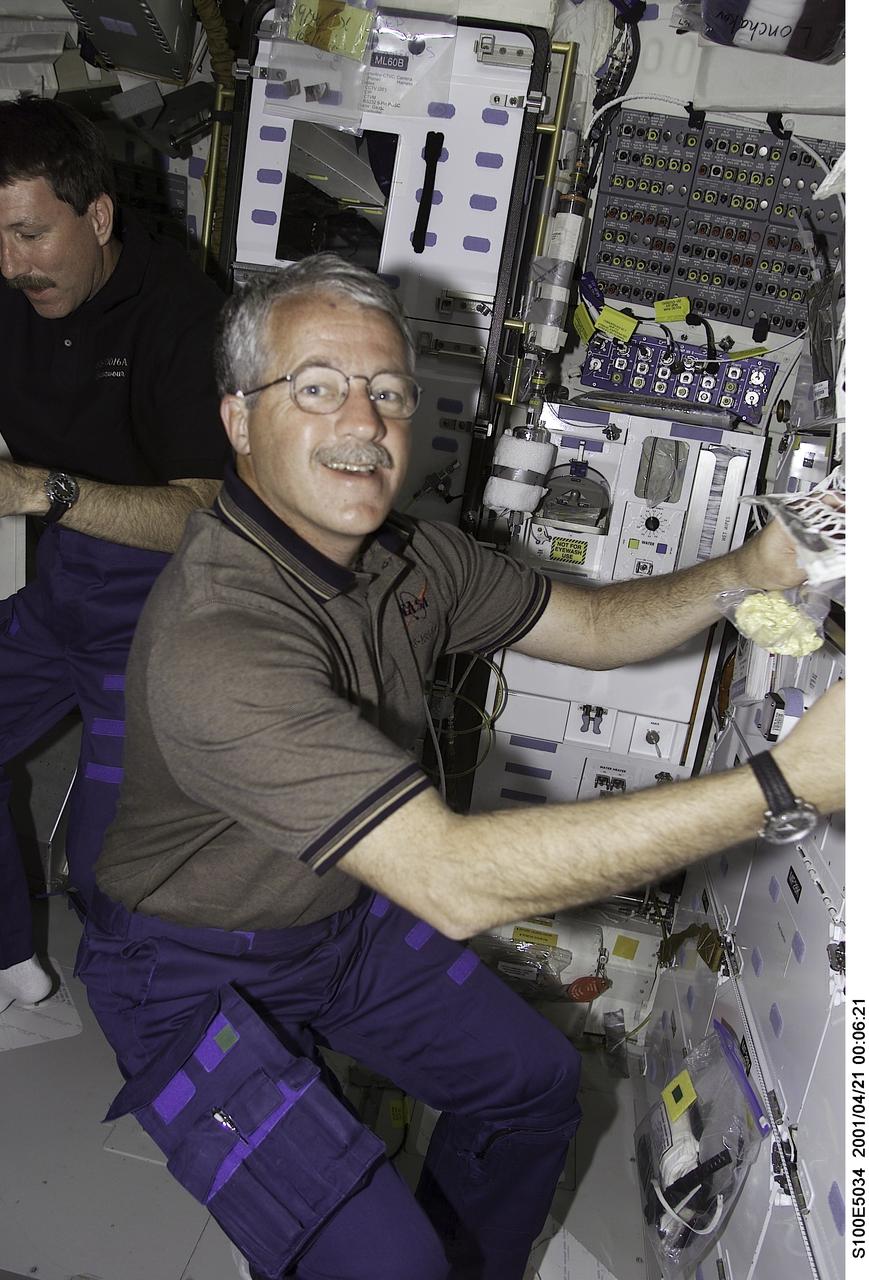
S100-E-5034 (21 April 2001) --- Astronauts Kent V. Rominger (background), STS-100 commander, and John L. Phillips, mission specialist, are seen on the middeck of the Space Shuttle Endeavour as the crew anticipates its union with the International Space Station (ISS). Assigned space-walking astronauts Chris A. Hadfield and Scott E. Parazynski (both out of frame) were later joined on the middeck by spacewalk coordinator Phillips in conducting some final checks of the suits and hardware that were to be used during the next day's planned 6-hour, 30-minute spacewalk. The image was recorded with a digital still camera.
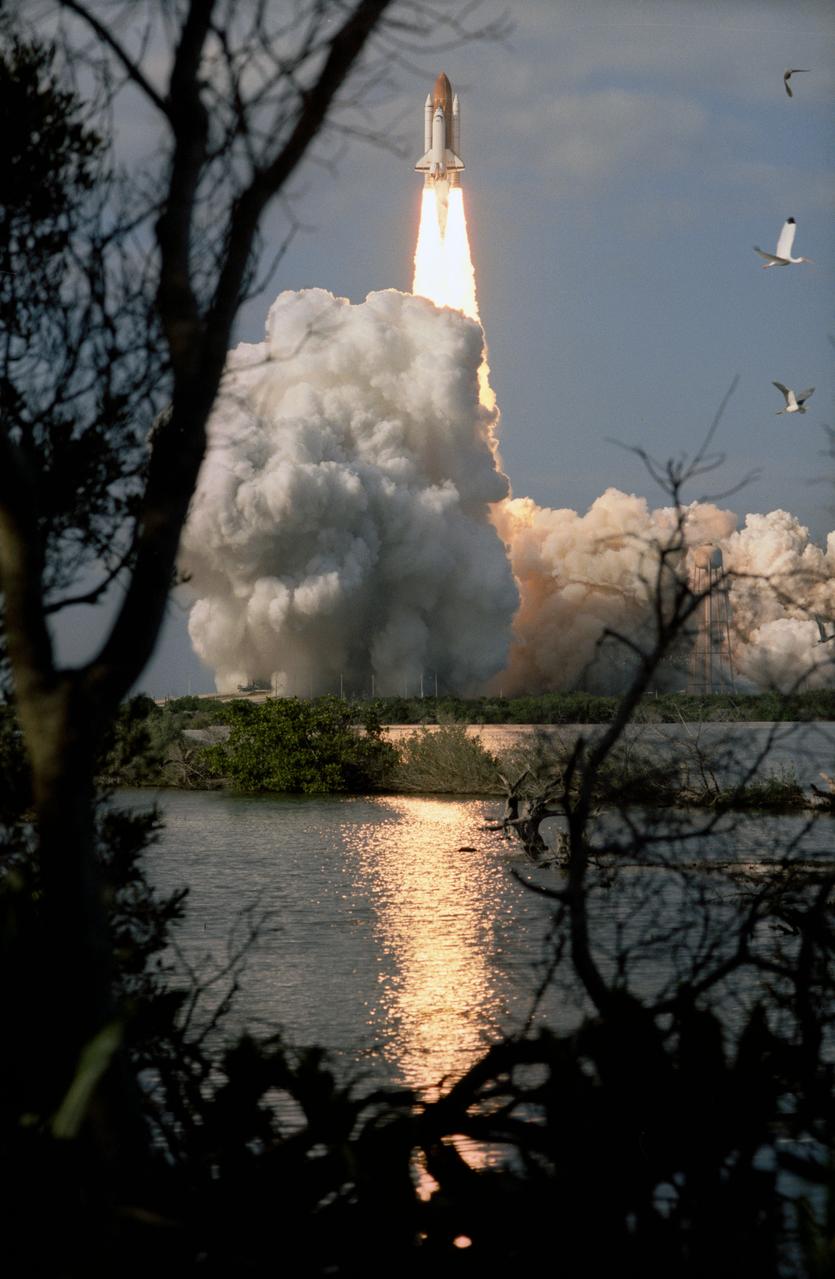
STS080-S-003 (19 Nov. 1996) --- The space shuttle Columbia lifts off from the Kennedy Space Center's (KSC) Launch Pad 39B at 2:55:47 p.m. (EST), November 19, 1996. Onboard are astronauts Kenneth D. Cockrell, mission commander; Kent V. Rominger, pilot; along with Story Musgrave, Tamara E. Jernigan and Thomas D. Jones, all mission specialists. The two primary payloads for STS-80 stowed in Columbia's cargo bay for later deployment and testing are the Wake Shield Facility (WSF-3) and the Orbiting and Retrievable Far and Extreme Ultraviolet Spectrometer (ORFEUS) with its associated Shuttle Pallet Satellite (SPAS).
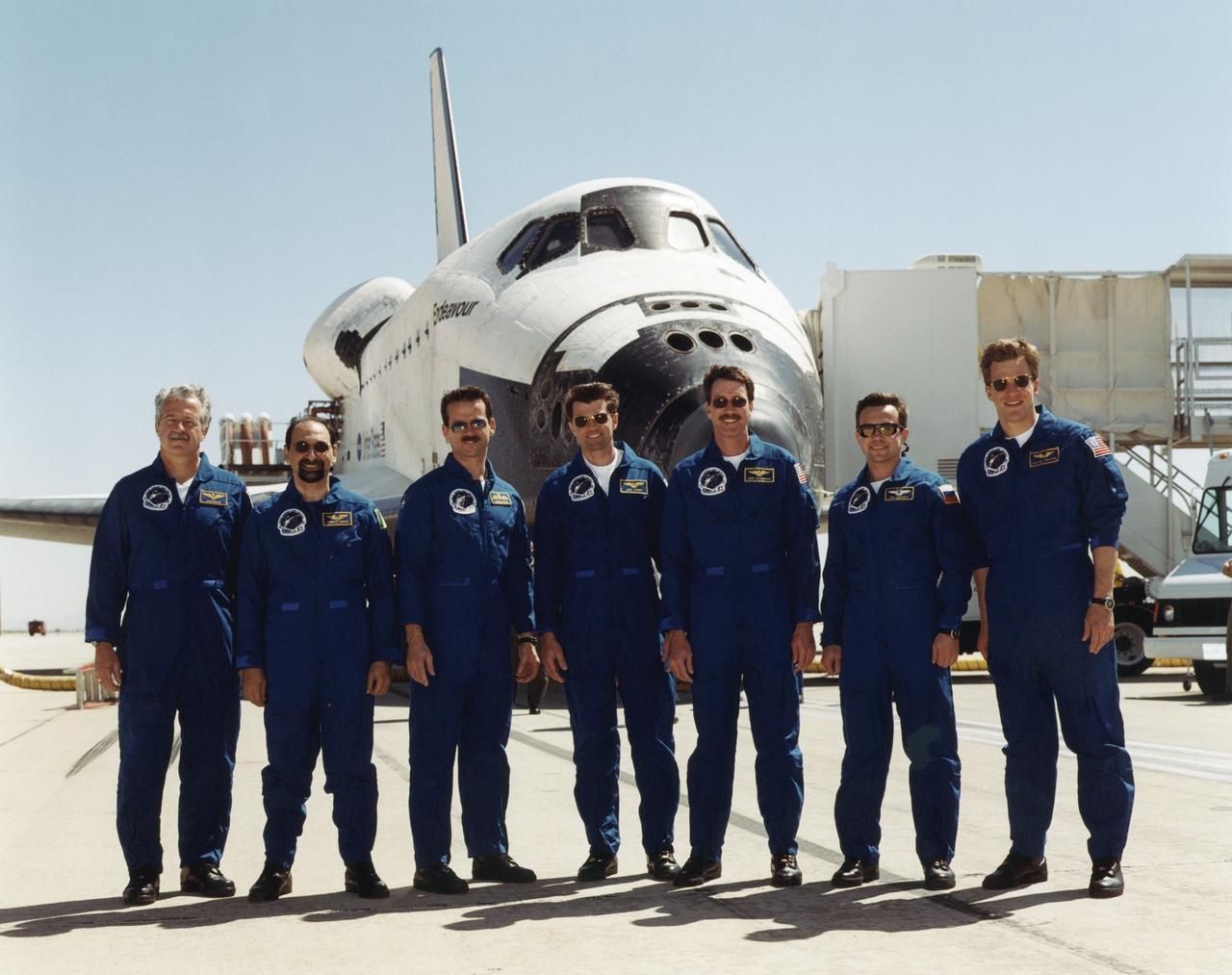
STS100-S-022 (1 May 2001) --- Six astronauts and a cosmonaut pose with their "home away from home" after the Shuttle Endeavour touched down on a desert runway at Edwards Air Force Base in California to complete the STS-100 mission. From the left are astronauts John L. Phillips, Umberto Guidoni, Chris A. Hadfield, Jeffrey S. Ashby and Kent V. Rominger, along with cosmonaut Yuri V. Lonchakov and astronaut Scott E. Parazynski. Guidoni is with the European Space Agency (ESA); Hadfield represents the Canadian Space Agency; and Lonchakov is associated with Rosaviakosmos. Touchdown occurred at 9:11 a.m. (PDT), May 1, 2001.
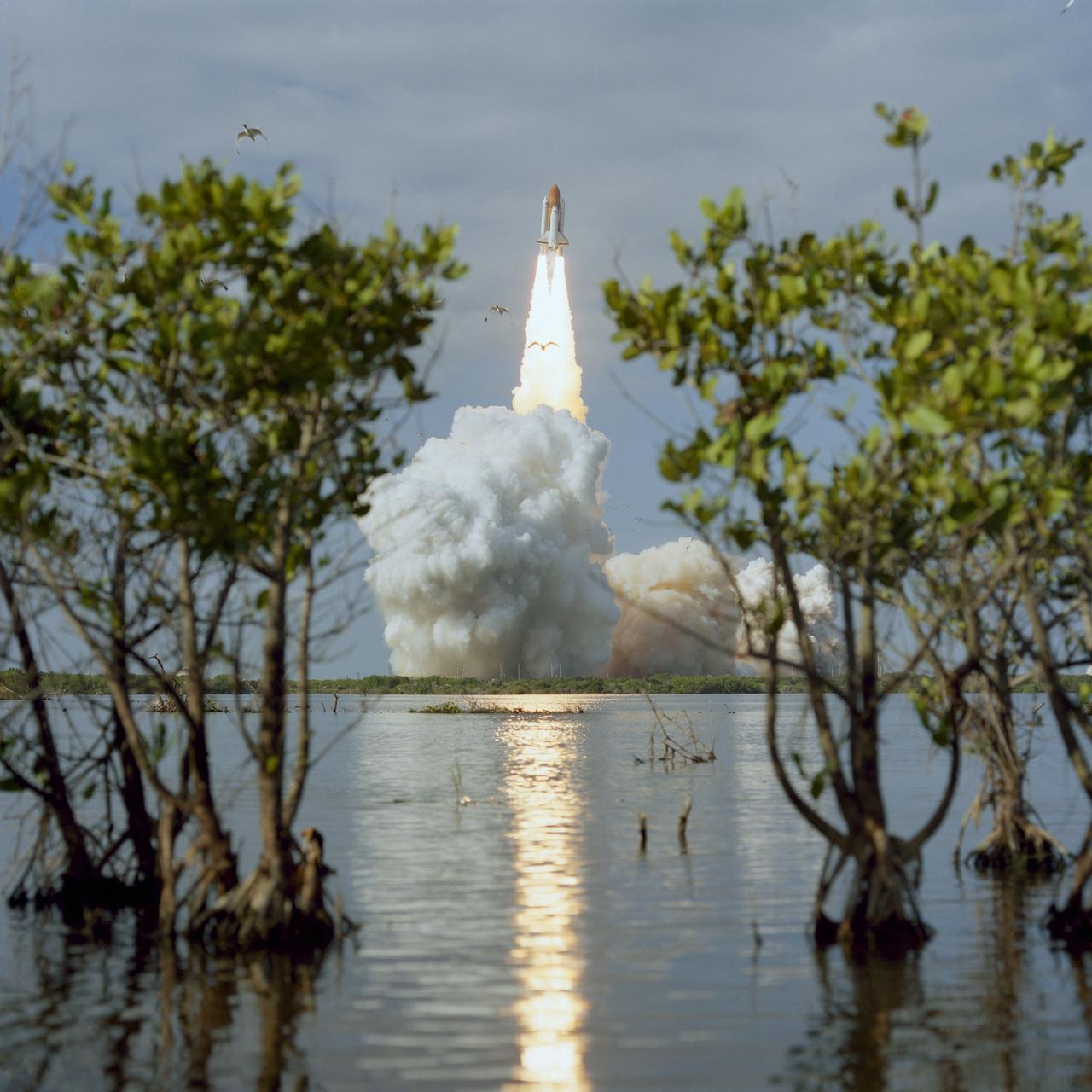
STS080-S-006 (19 Nov. 1996) --- The space shuttle Columbia lifts off from the Kennedy Space Center's (KSC) Launch Pad 39B at 2:55:47 p.m. (EST), Nov. 19, 1996. Onboard are astronauts Kenneth D. Cockrell, mission commander; Kent V. Rominger, pilot; along with Story Musgrave, Tamara E. Jernigan and Thomas D. Jones, all mission specialists. The two primary payloads for STS-80 stowed in Columbia's cargo bay for later deployment and testing are the Wake Shield Facility (WSF-3) and the Orbiting and Retrievable Far and Extreme Ultraviolet Spectrometer (ORFEUS) with its associated Shuttle Pallet Satellite (SPAS).
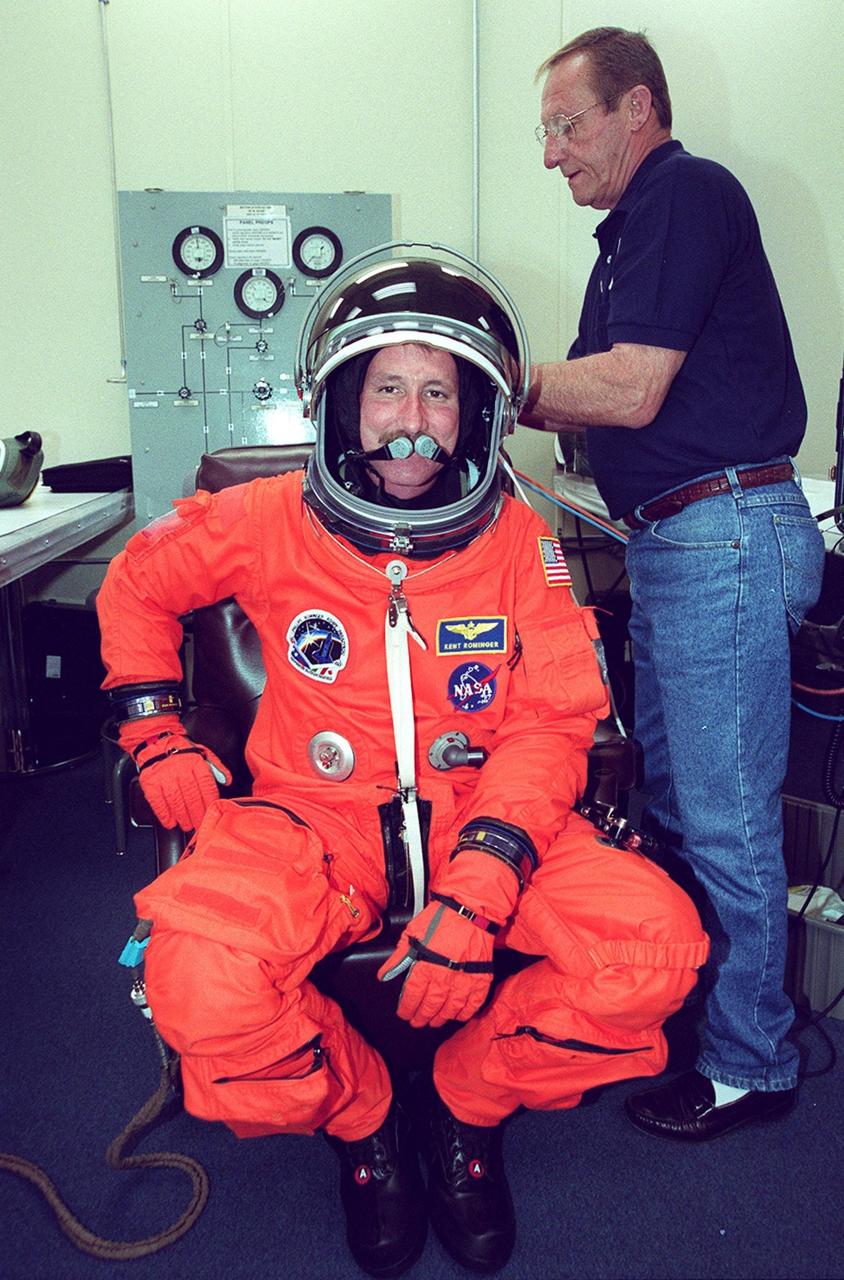
A suit technician helps STS-100 Commander Kent V. Rominger adjust his helmet during suitup for launch in the Operations and Checkout Building. The 11-day mission to the International Space Station will deliver and integrate the Spacelab Logistics Pallet/Launch Deployment Assembly, which includes the Space Station Remote Manipulator system and the UHF Antenna, and the Multi-Purpose Logistics Module Raffaello. The mission includes two planned spacewalks for installation of the SSRMS. The mission is also the inaugural flight of Raffaello, carrying resupply stowage racks and resupply/return stowage platforms. Liftoff on mission STS-100 is scheduled at 2:41 p.m. EDT April 19
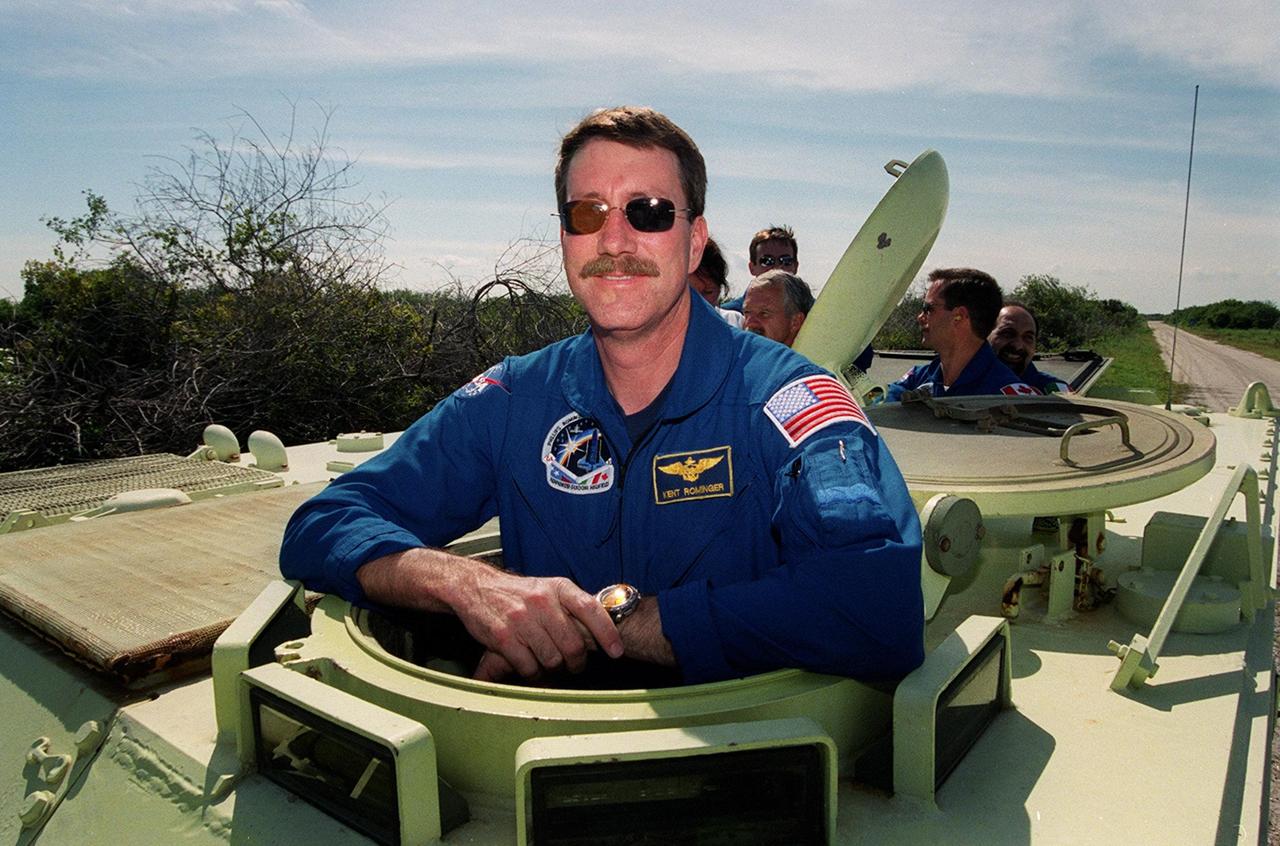
STS-100 Commander Kent V. Rominger is ready to take the wheel on the M-113 armored carrier that could be used by the crew in the event of an emergency at the pad during which the crew must make a quick exit from the area. Driving the tracked vehicle is part of Terminal Countdown Demonstration Test activities, which include emergency escape training, payload walkdown and a simulated launch countdown. The primary payload on mission STS-100 comprises the Canadian robotic arm, SSRMS, and Multi-Purpose Logistics Module, Raffaello. Launch of Space Shuttle Endeavour on mission STS-100 is targeted for April 19 at 2:41 p.m. EDT from Launch Pad 39A
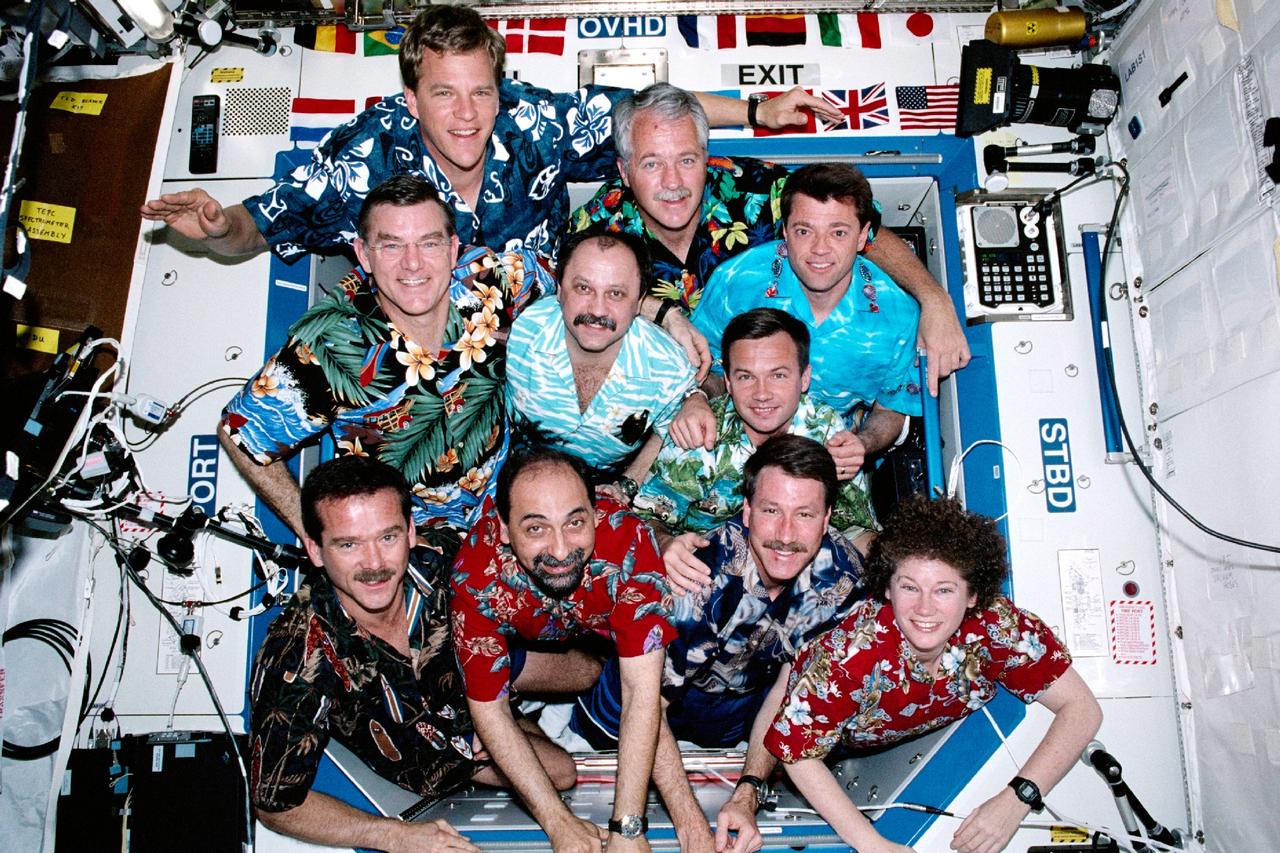
STS100-341-003 (19 April-1 May 2001) --- STS-100 and Expedition Two crewmembers pose for traditional in-flight portrait in Destiny laboratory. Bottom, from left, Chris A. Hadfield, Umberto Guidoni, Kent V. Rominger and Susan J. Helms. Middle row, James S. Voss, Yury V. Usachev and Yuri V. Lonchakov. Top, Scott E. Parazynski, John L. Phillips and Jeffrey S. Ashby. Guidoni represents the European Space Agency (ESA); Lonchakov and Usachev are with Rosaviakosmos and Hadfield is associated with the Canadian Space Agency (CSA).
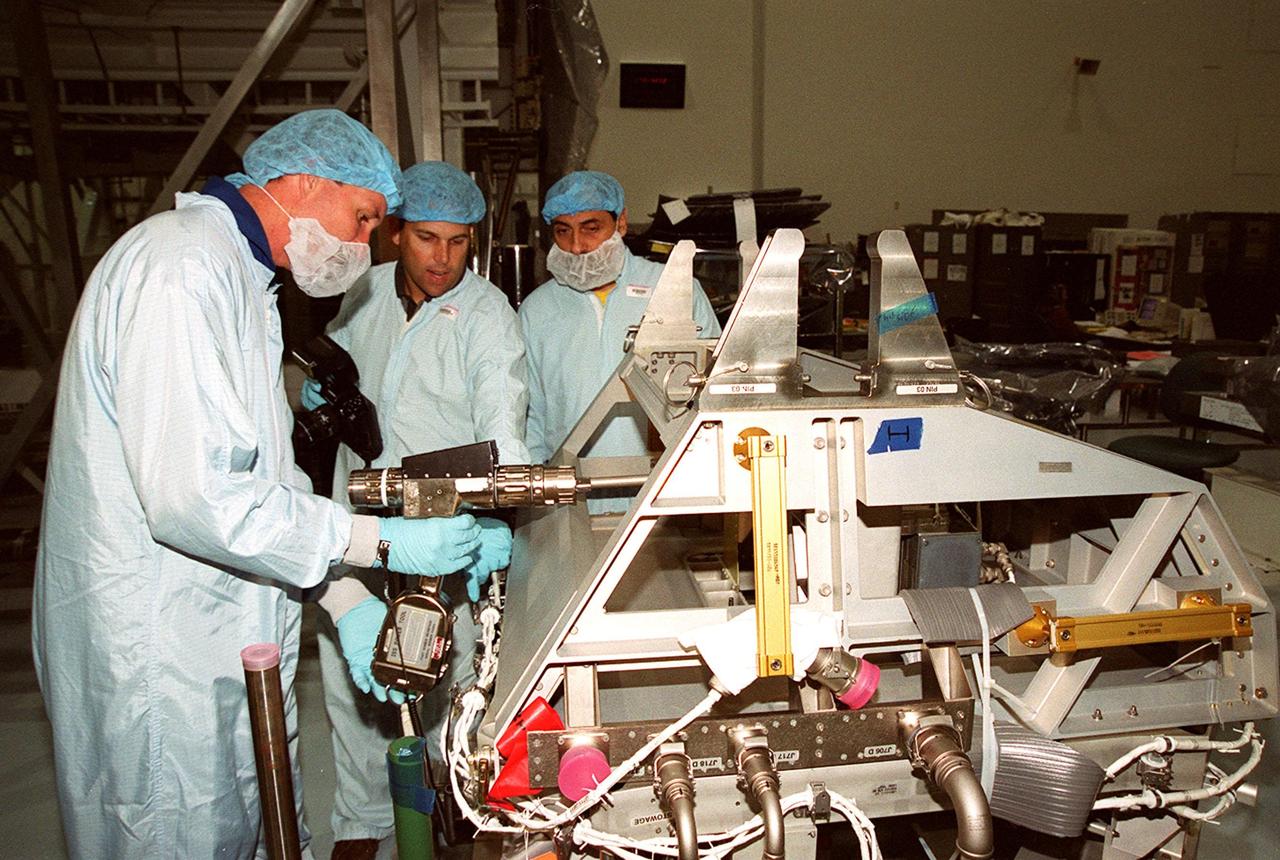
In the Space Station Processing Facility, STS-100 Commander Kent Rominger (left) tries out a piece of equipment while a worker (center) gives directions. Looking on at right is Mission Specialist Umberto Guidoni, with the European Space Agency. Mission STS-100, scheduled to launch April 19, 2001, will include Raffaello as well as the Space Station Remote Manipulator System (SSRMS) as its payload. MPLMs are pressurized modules that will serve as the International Space Station's “moving vans,” carrying laboratory racks filled with equipment, experiments and supplies to and from the station aboard the Space Shuttle. The SSRMS is the primary means of transferring payloads between the orbiter payload bay and the International Space Station for assembly
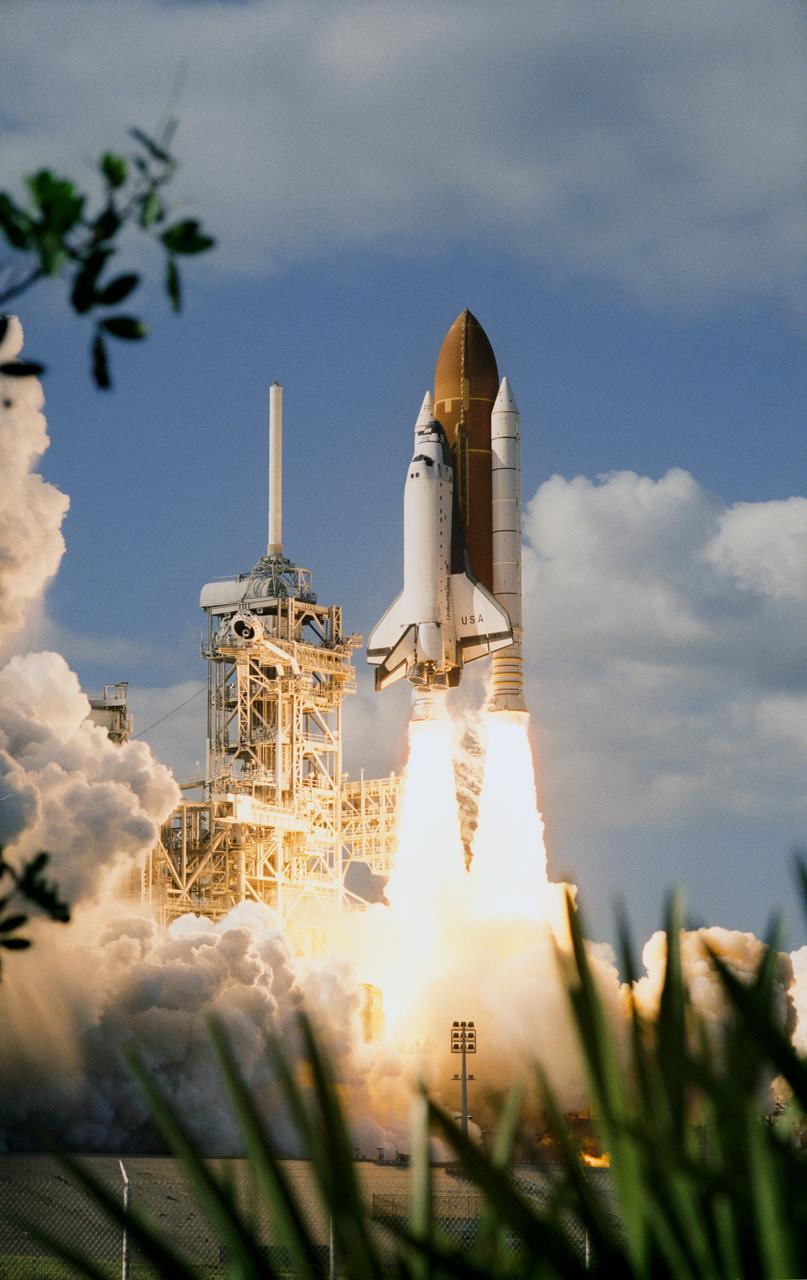
STS080-S-004 (19 Nov. 1996) --- The space shuttle Columbia lifts off from the Kennedy Space Center's (KSC) Launch Pad 39B at 2:55:47 p.m. (EST), Nov. 19, 1996. Onboard are astronauts Kenneth D. Cockrell, STS-80 mission commander; Kent V. Rominger, pilot; along with Story Musgrave, Tamara E. Jernigan and Thomas D. Jones, all mission specialists. The two primary payloads for STS-80 stowed in Columbia's cargo bay for later deployment and testing are the Wake Shield Facility (WSF-3) and the Orbiting and Retrievable Far and Extreme Ultraviolet Spectrometer (ORFEUS) with its associated Shuttle Pallet Satellite (SPAS).
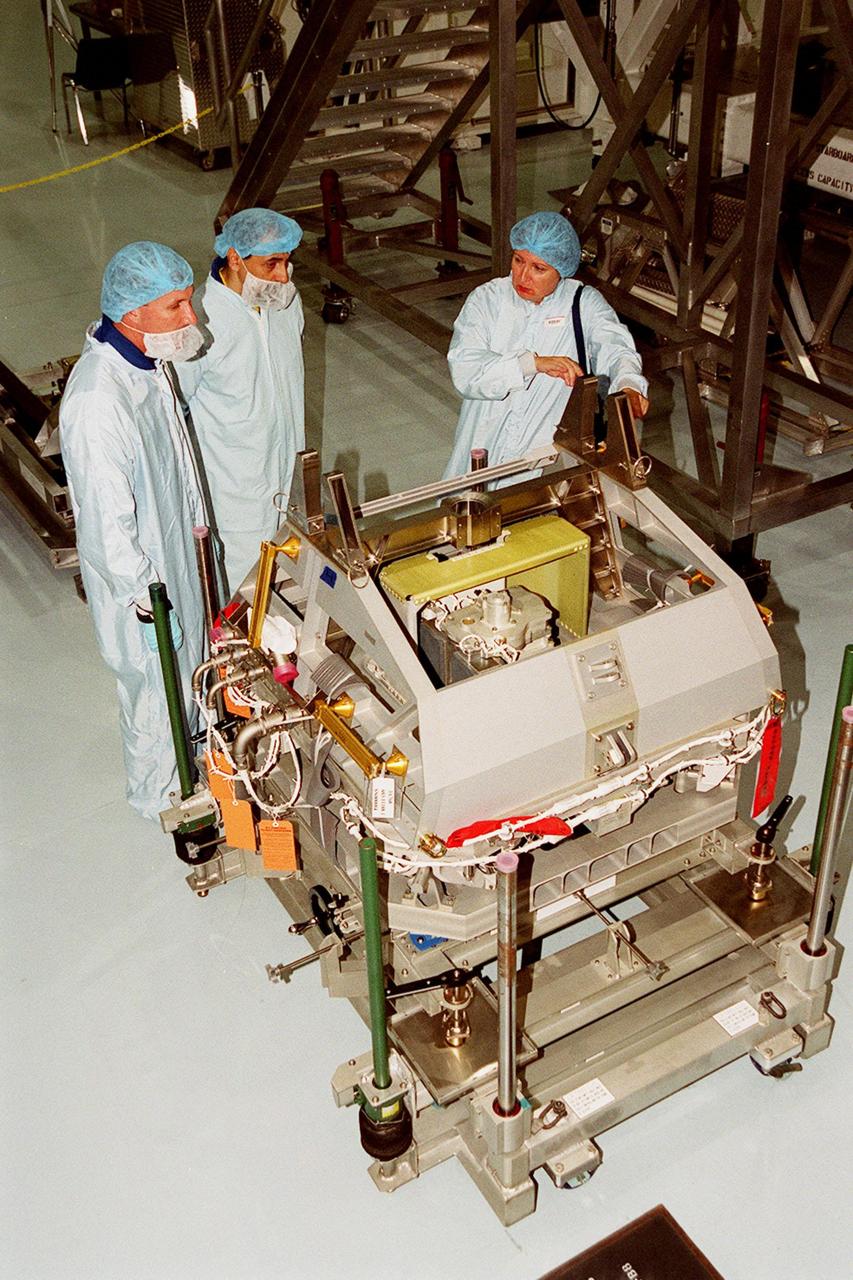
In the Space Station Processing Facility, STS-100 Commander Kent Rominger and Mission Specialist Umberto Guidoni, who is with the European Space Agency, look over equipment on the floor. Mission STS-100, scheduled to launch April 19, 2001, will include the Multi-Purpose Logistics Module (MPLM) Raffaello and the Space Station Remote Manipulator System (SSRMS) as its payload. MPLMs are pressurized modules that will serve as the International Space Station's “moving vans,” carrying laboratory racks filled with equipment, experiments and supplies to and from the station aboard the Space Shuttle. The SSRMS is the primary means of transferring payloads between the orbiter payload bay and the International Space Station for assembly
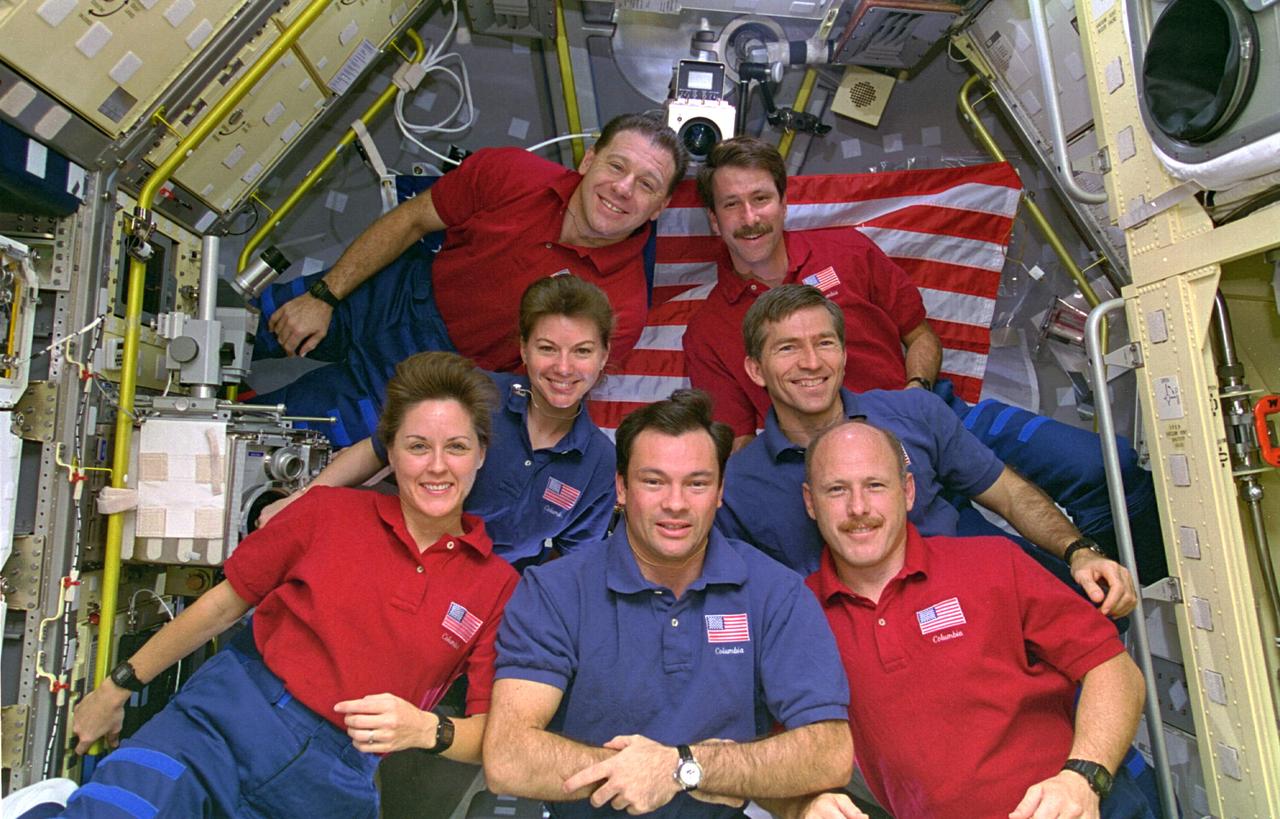
STS073-303-015 (20 October - 5 November 1995) --- The crew members picked the site of their busy workdays as the setting for the traditional in-flight crew portrait, as personnel from both work shifts assembled in the science module supporting the U.S. Microgravity Laboratory (USML-2) mission. Astronaut Michael E. Lopez-Alegria, mission specialist, has his arms folded at front center. The others pictured, counter-clockwise from that point, are Kathryn C. Thornton, payload commander; Catherine G. Coleman, mission specialist; Albert Sacco, payload specialist; Kent V. Rominger, pilot; Fred W. Leslie, payload specialist; and Kenneth D. Bowersox, mission commander.
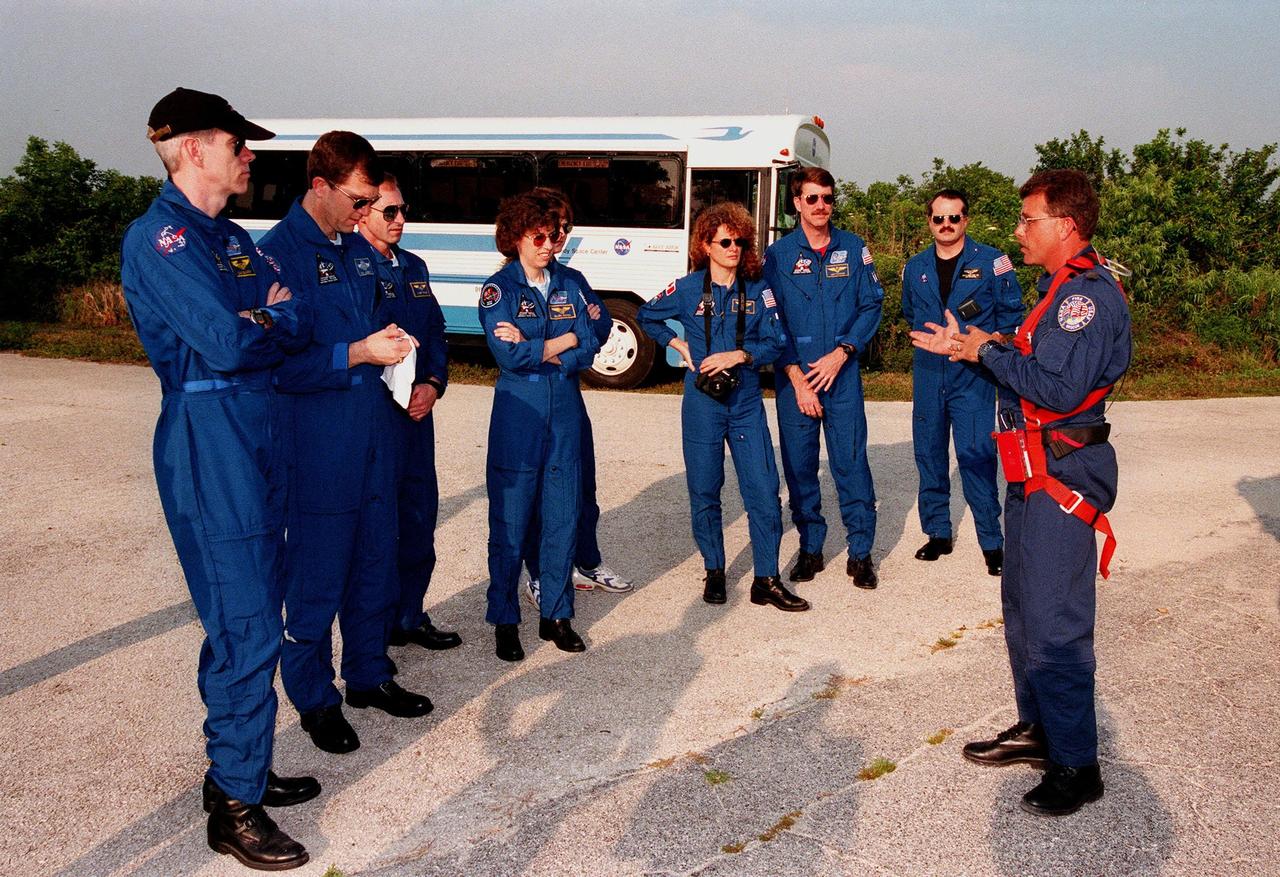
The STS-96 crew listen to Capt. Steve Kelly, with Space Gateway Support, who is assisting with emergency egress training during Terminal Countdown Demonstration Test (TCDT) activities. The TCDT also provides simulated countdown exercises and opportunities to inspect the mission payloads in the orbiter's payload bay. From left are Mission Specialist Daniel Barry (M.D., Ph.D.), Pilot Rick Douglas Husband, Mission Specialists Valery Ivanovich Tokarev, Ellen Ochoa (Ph.D.), Tamara E. Jernigan (Ph.D.) and Julie Payette, and Commander Kent V. Rominger. Next to Rominger is Douglas Hamilton, Canadian flight surgeon. Payette is with the Canadian Space Agency. Tokarev represents the Russian Space Agency. Mission STS-96, which is scheduled for liftoff on May 20 at 9:32 a.m., is a logistics and resupply mission for the International Space Station, carrying such payloads as a Russian crane, the Strela; a U.S.-built crane; the Spacehab Oceaneering Space System Box (SHOSS), a logistics items carrier; and STARSHINE, a student-led experiment