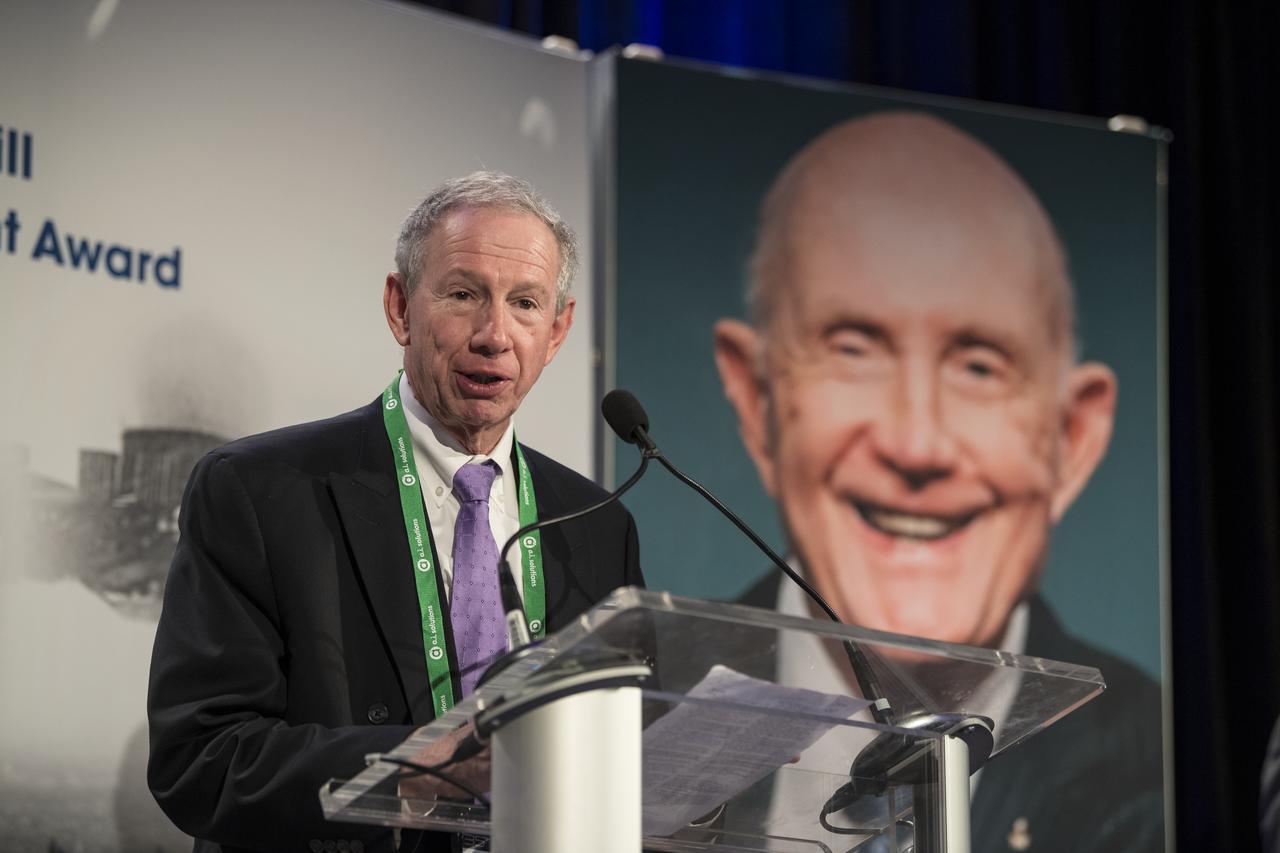
Former NASA Administrator Mike Griffin introduces General Thomas Patten Stafford, former NASA astronaut, Air Force officer and test pilot speaks at an event where he received the General James E. Hill Lifetime Achievement Award, at the Space Symposium, Tuesday, April 9, 2019, at Broadmoor Hall in Colorado Springs, Colorado. Former and current NASA Administrators were in attendance. Photo credit: (NASA/Aubrey Gemignani)
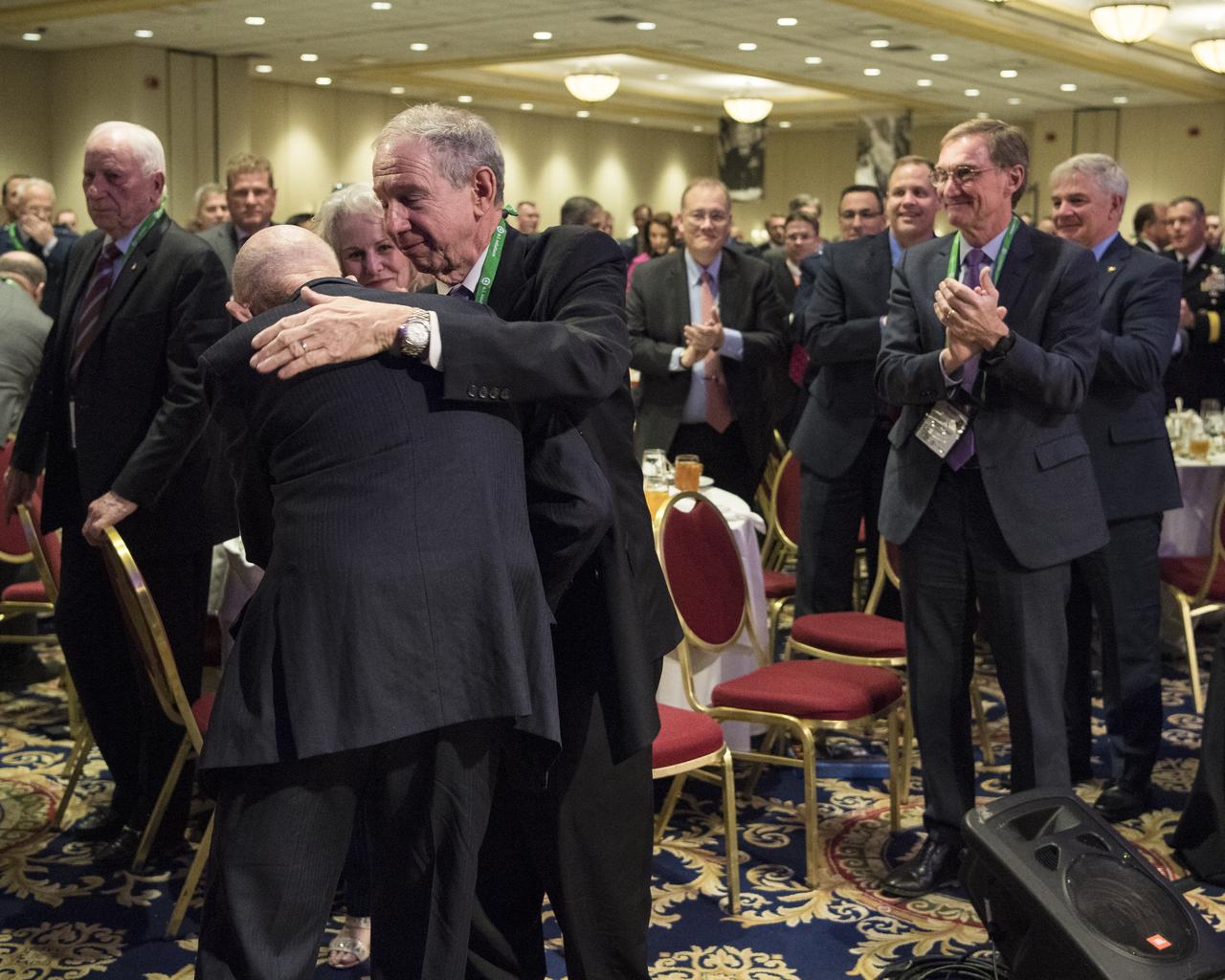
Former NASA Administrator Mike Griffin congratulates General Thomas Patten Stafford, former NASA astronaut, Air Force officer and test pilot at an event where he received the General James E. Hill Lifetime Achievement Award, at the Space Symposium, Tuesday, April 9, 2019, at Broadmoor Hall in Colorado Springs, Colorado. Photo credit: (NASA/Aubrey Gemignani)
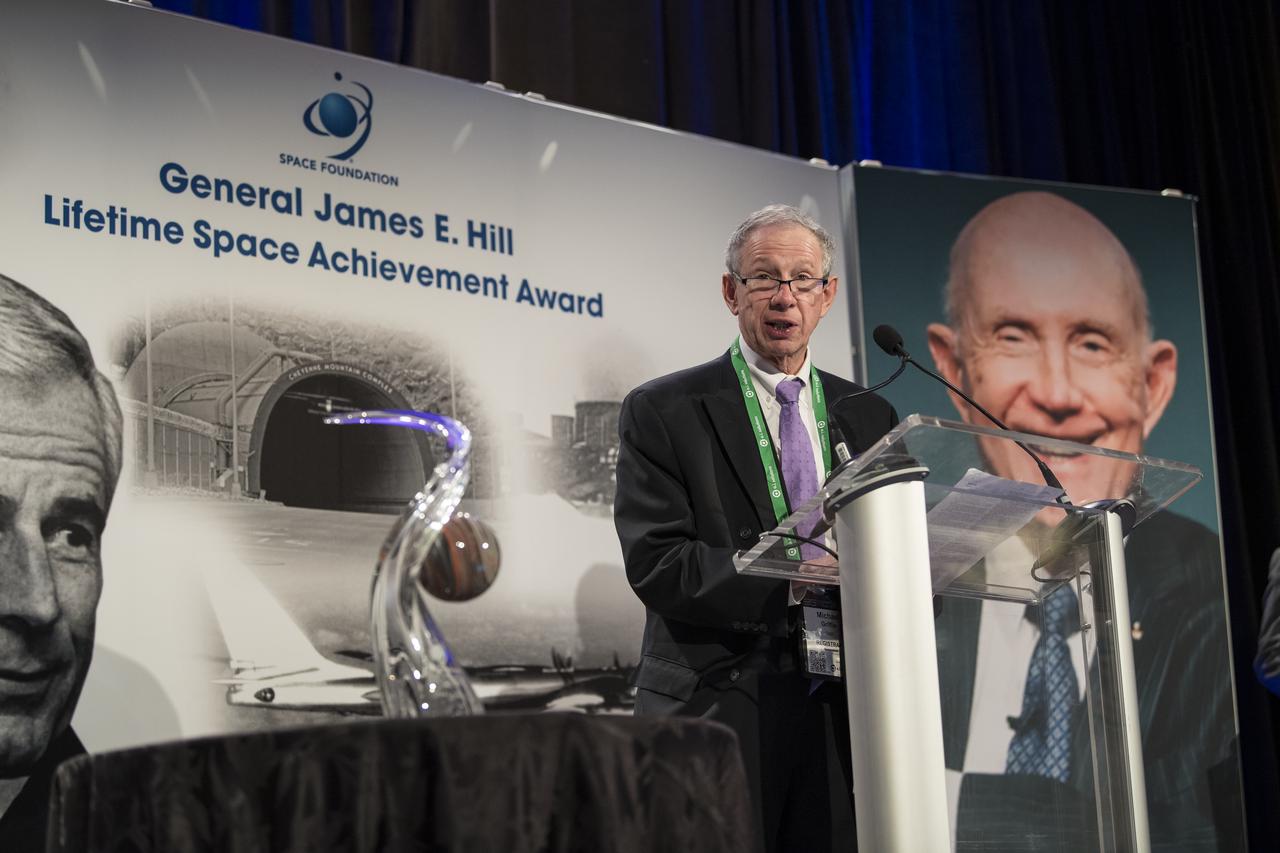
Former NASA Administrator Mike Griffin introduces General Thomas Patten Stafford, former NASA astronaut, Air Force officer and test pilot speaks at an event where he received the General James E. Hill Lifetime Achievement Award, at the Space Symposium, Tuesday, April 9, 2019, at Broadmoor Hall in Colorado Springs, Colorado. Former and current NASA Administrators were in attendance. Photo credit: (NASA/Aubrey Gemignani)
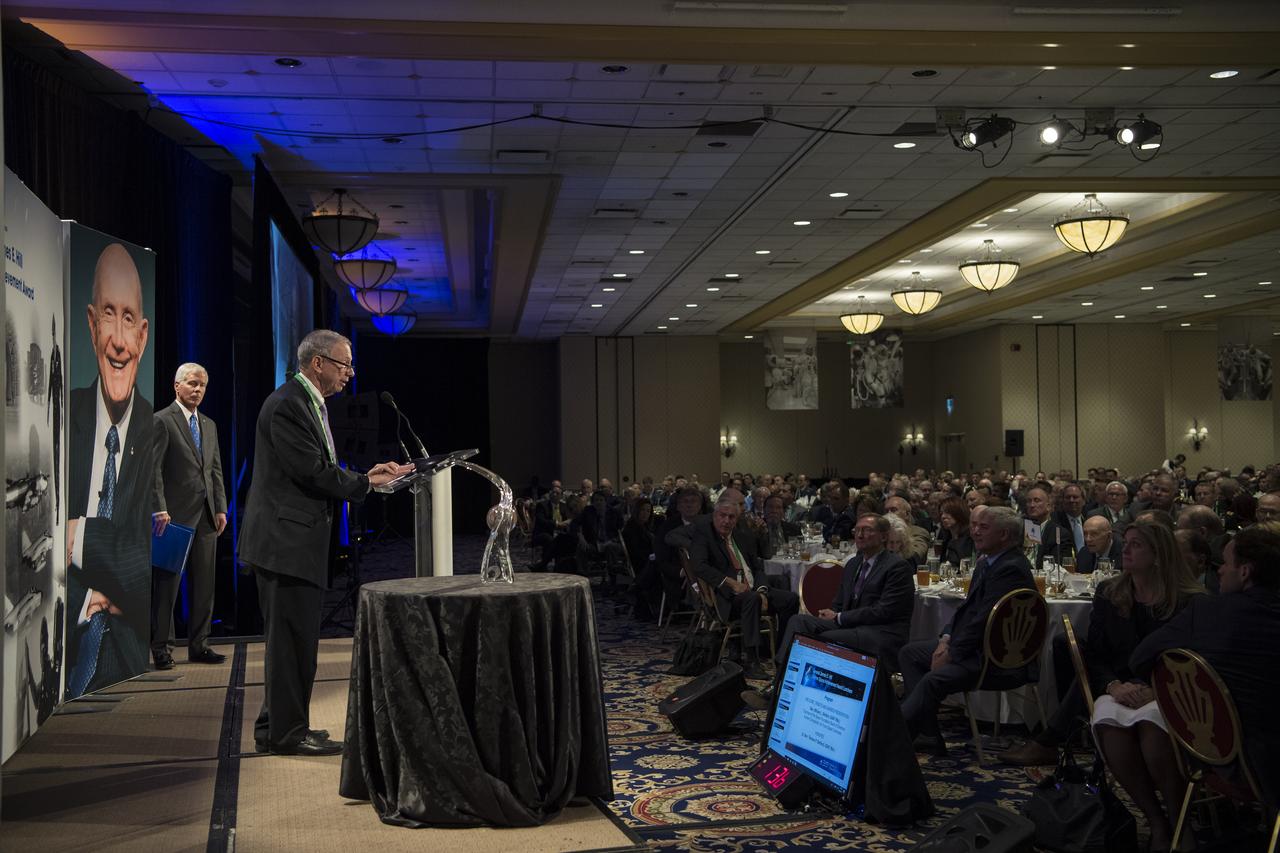
Former NASA Administrator Mike Griffin introduces General Thomas Patten Stafford, former NASA astronaut, Air Force officer and test pilot speaks at an event where he received the General James E. Hill Lifetime Achievement Award, at the Space Symposium, Tuesday, April 9, 2019, at Broadmoor Hall in Colorado Springs, Colorado. Former and current NASA Administrators were in attendance. Photo credit: (NASA/Aubrey Gemignani)
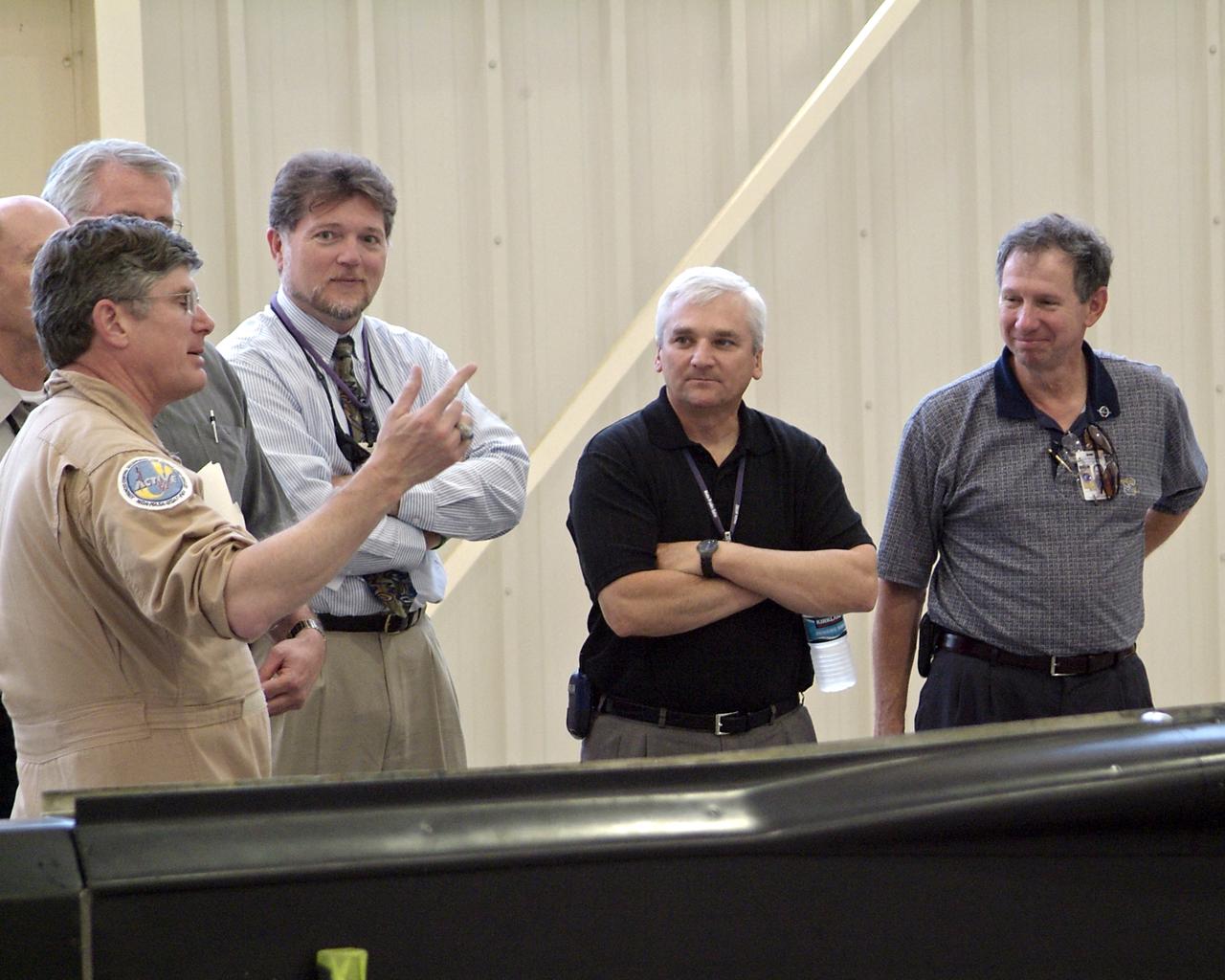
NASA Dryden research pilot Jim Smolka (left) details a recent flight experiment on a modified F-15B research aircraft to test range program manager Jerry McKee, center director Kevin Petersen and NASA Administrator Michael Griffin (right) during Griffin's initial visit to NASA's Dryden Flight Research Center on Tuesday, May 24.
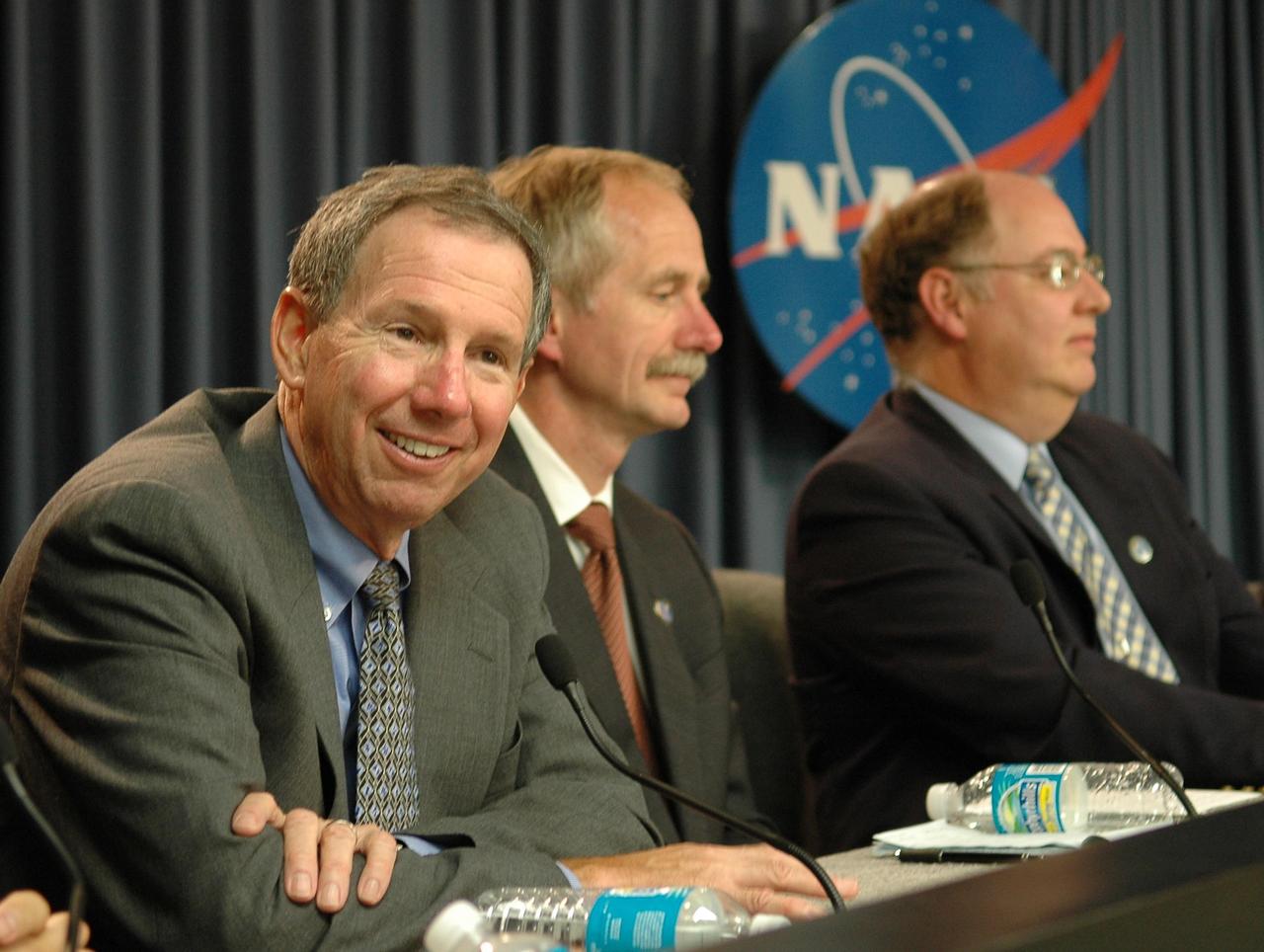
KENNEDY SPACE CENTER, FLA. - At a press conference following the Flight Readiness Review, a thorough assessment of preparations for the mission, NASA Administrator Mike Griffin is amused by a question from the media. Next to Griffin on the dais are Bill Gerstenmaier, associate administrator for Space Operations, and Wayne Hale, Space Shuttle Program manager. Also present at the conference, but not pictured, is Mike Leinbach, NASA launch director. Griffin confirmed the final launch date of Aug. 27 for mission STS-115. Mission STS-115 continues the assembly of the International Space Station with the installation of the truss segments P3 and P4. Liftoff of Space Shuttle Atlantis on mission STS-115 is targeted at approximately 4:30 p.m. EDT on Aug. 27. Photo credit: NASA/Kim Shiflett

KENNEDY SPACE CENTER, FLA. -- STS-120 Commander Pamela Melroy is greeted by NASA Administrator Mike Griffin. His wife, Rebecca Griffin, is at his side. Behind Griffin is Associate Administrator for NASA Space Operations William Gerstenmaier. Melroy and the Discovery crew completed the 15-day mission STS-120, with an on-time landing at 1:01:16 p.m. Wheel stop was at 1:02:07 p.m. Mission elapsed time was 15 days, 2 hours, 24 minutes and 2 seconds. Mission STS-120 continued the construction of the station with the installation of the Harmony Node 2 module and the relocation of the P6 truss. Photo credit: NASA//Kim Shiflett
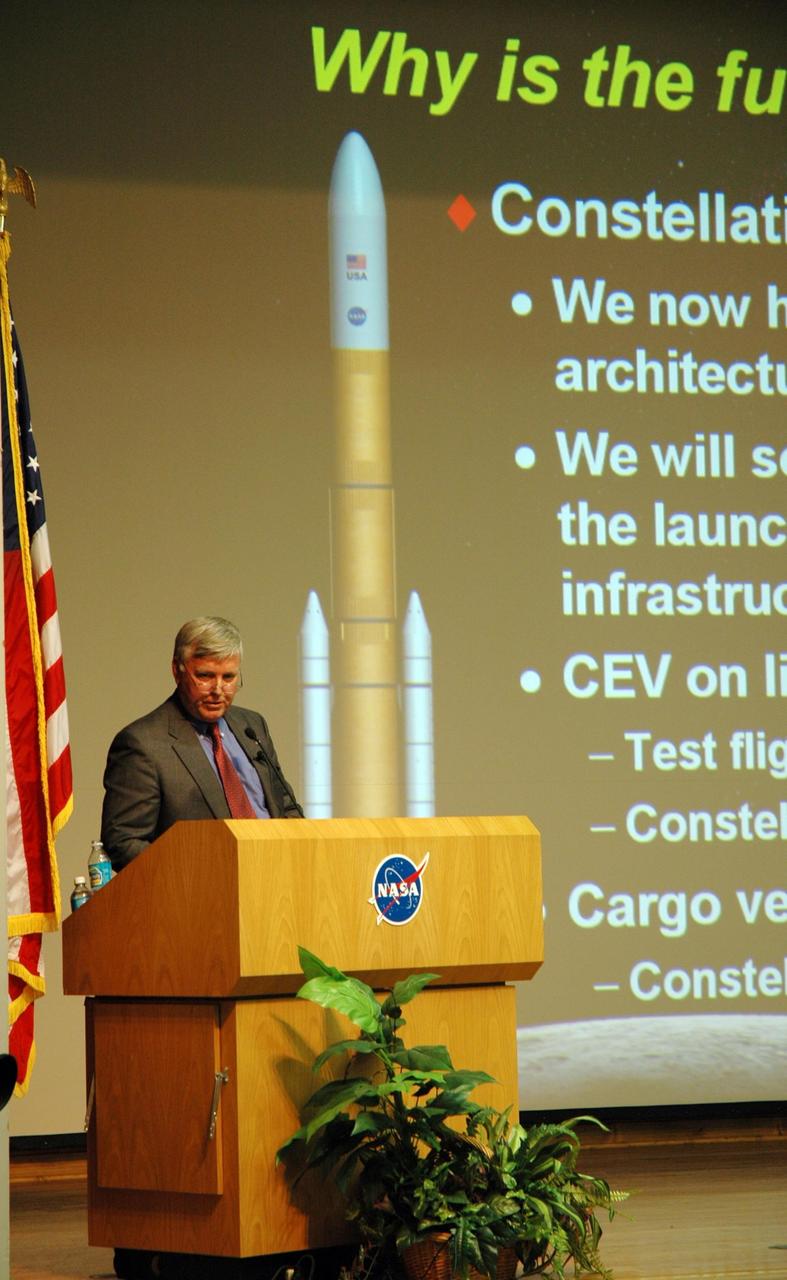
KENNEDY SPACE CENTER, FLA. - In NASA Kennedy Space Center’s training auditorium, Center Director Jim Kennedy talks to employees about the NASA budget and its impact on the Center. The all-hands meeting followed a press conference held by NASA Administrator Mike Griffin on the agency’s budget. Photo credit: NASA/Jim Grossmann
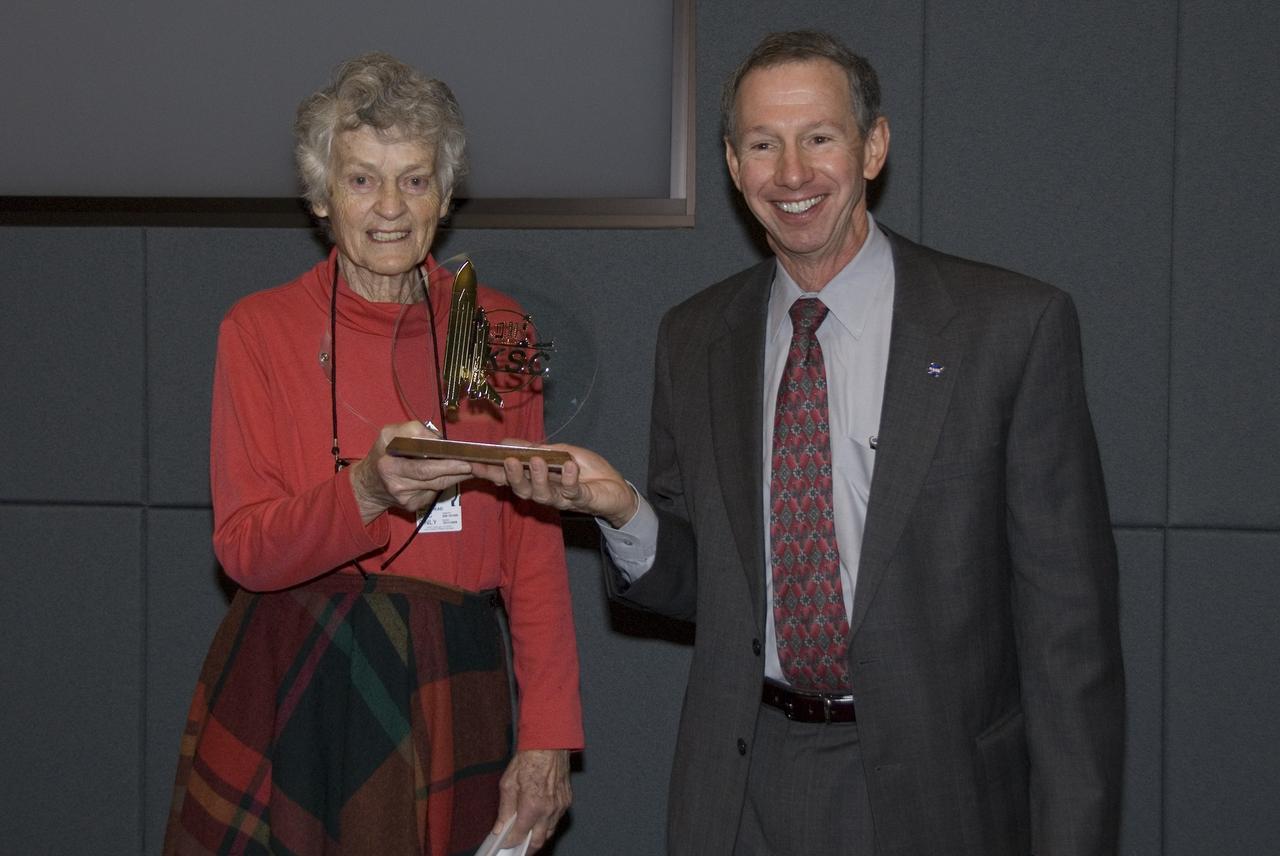
CAPE CANAVERAL, Fla. – Virginia Whitehead receives NASA’s Lifetime Achievement Award from Mike Griffin at a ceremony shortly before the STS-126 Flight Readiness Review at the OSB II on Oct. 30. Whitehead has worked at NASA's Kennedy Space Center for 34 years.
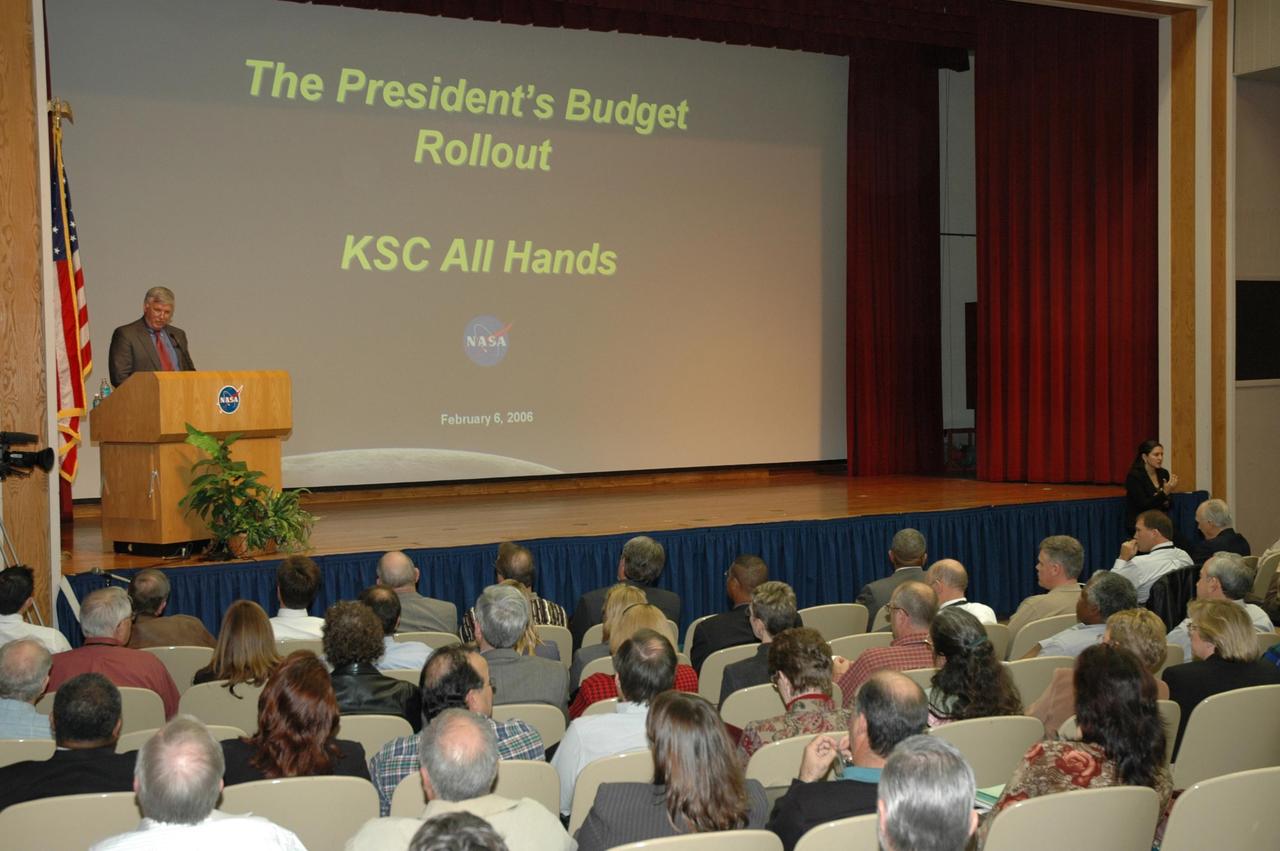
KENNEDY SPACE CENTER, FLA. - In NASA Kennedy Space Center’s training auditorium, Center Director Jim Kennedy talks to employees about the NASA budget and its impact on the Center. The all-hands meeting followed a press conference held by NASA Administrator Mike Griffin on the agency’s budget. Photo credit: NASA/Jim Grossmann
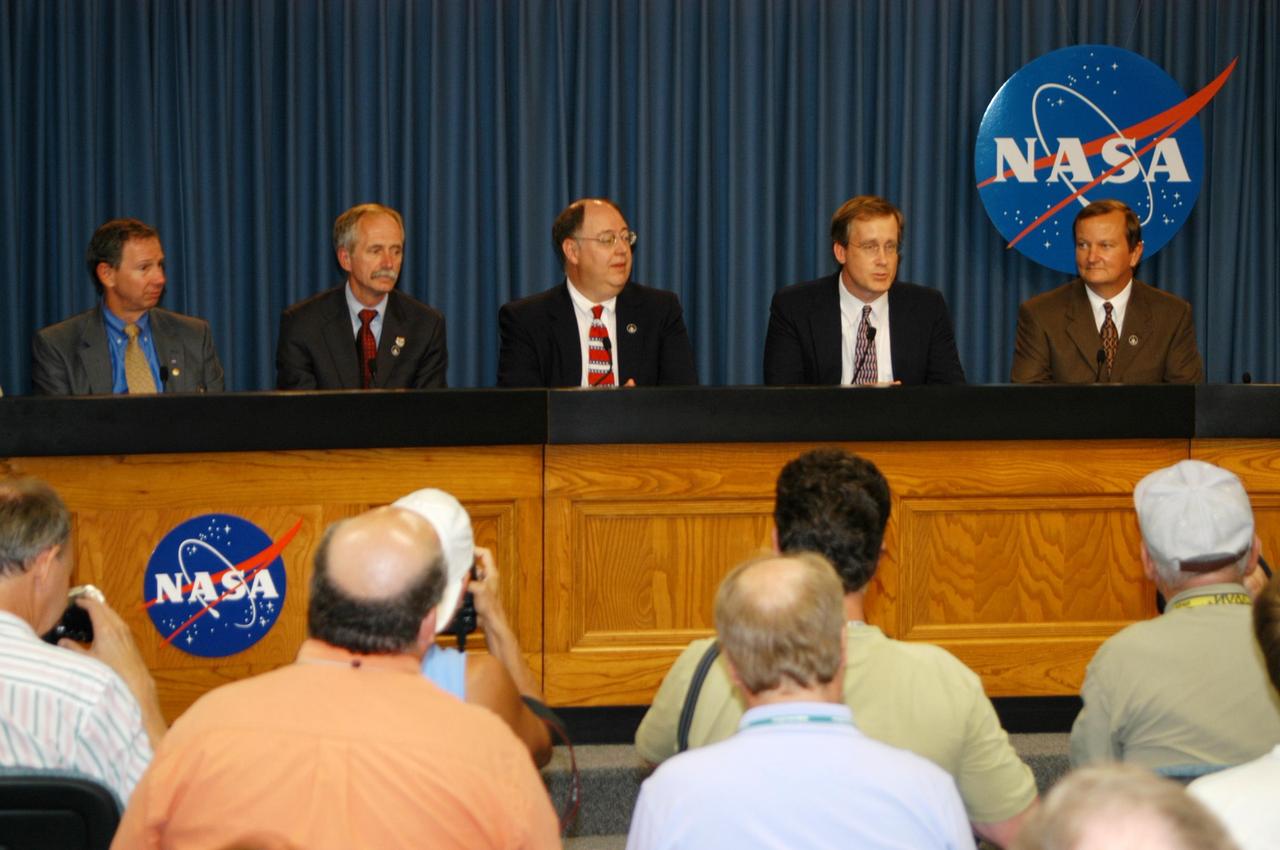
KENNEDY SPACE CENTER, FLA. - At a post-launch briefing, Shuttle Program Manager Wayne Hale, center, briefs the media about the successful launch of Space Shuttle Discovery on mission STS-121. Seated with him are, left to right, NASA Administrator Mike Griffin, NASA Associate Administrator for Space Operations Mission Bill Gerstenmaier, Chief of the Mission Management Team John Shannon, and Shuttle Launch Director Mike Leinbach. Liftoff of Discovery was on time at 2:30 p.m. EDT.
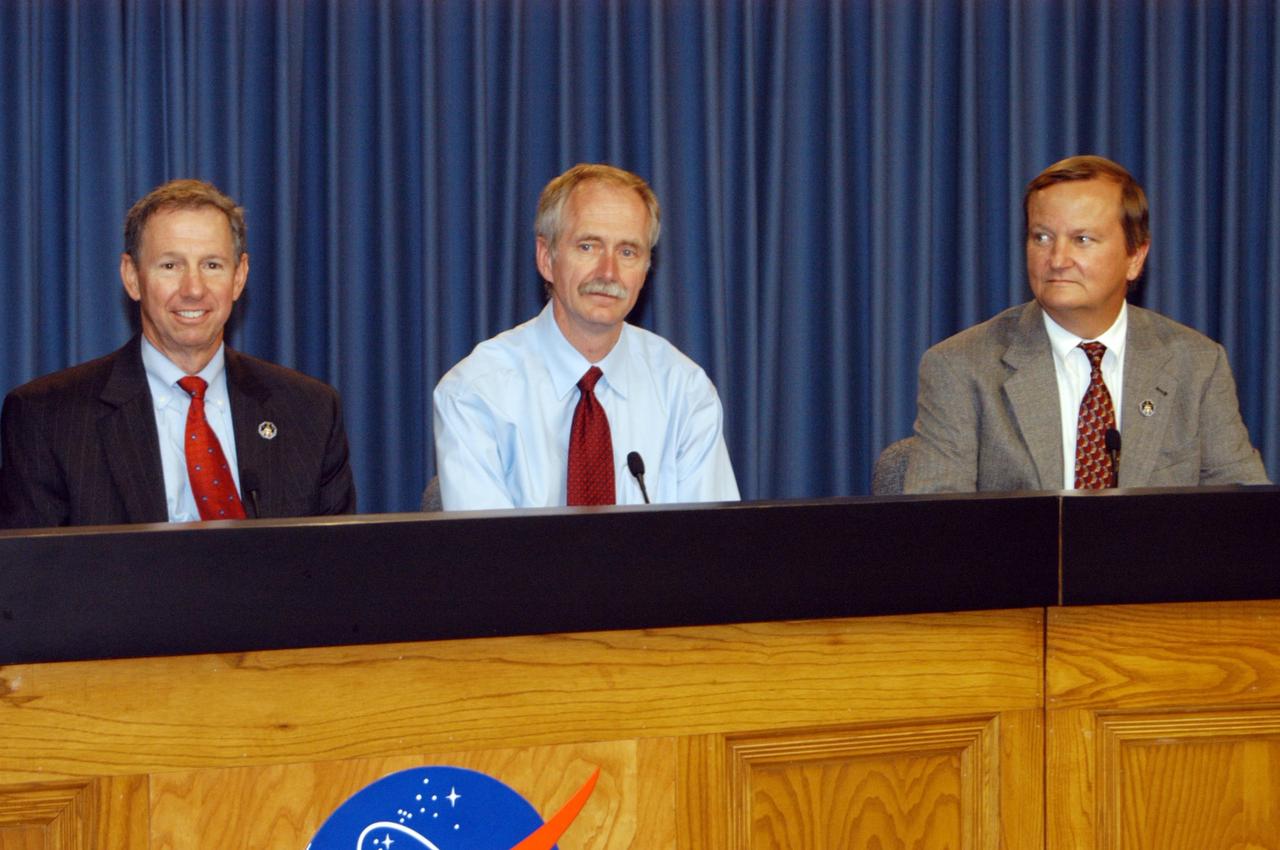
KENNEDY SPACE CENTER, FLA. - A press conference after the landing of the orbiter Discovery and mission STS-121 crew features NASA Administrator Mike Griffin, Associate Administrator for Space Operations Bill Gerstenmaier and Shuttle Launch Director Mike Leinbach. Discovery traveled 5.3 million miles, landing on orbit 202. Mission elapsed time was 12 days, 18 hours, 37 minutes and 54 seconds. The landing is the 62nd at Kennedy Space Center and the 32nd for Discovery. Photo credit: NASA/George Shelton
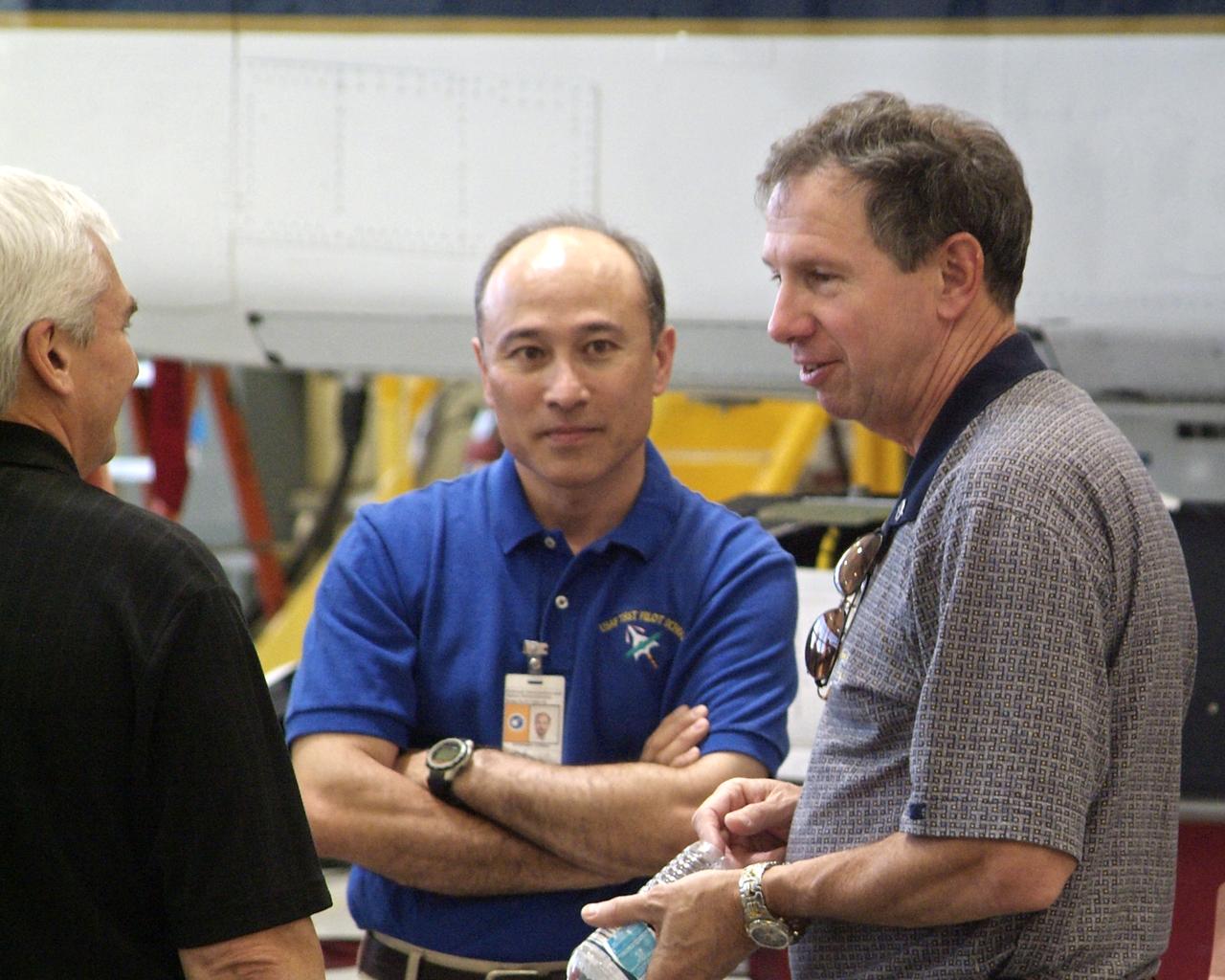
New NASA Administrator Michael Griffin (right) shares a moment with Director Kevin Petersen (left) and F-15B project manager Stephen Corda (center) during Griffin's visit to NASA Dryden Flight Research Center on Tuesday, May 24.
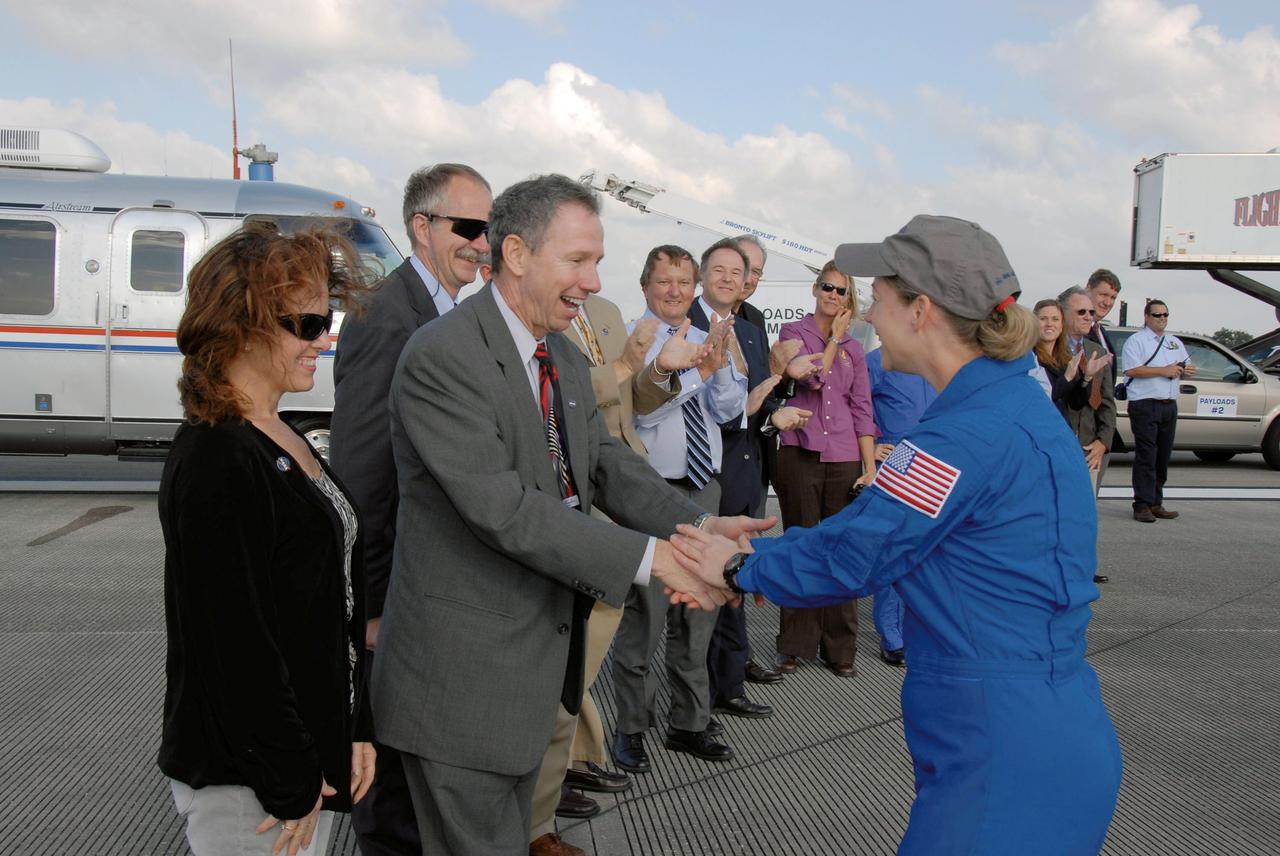
STS120-S-091 (7 Nov. 2007) --- NASA Administrator Mike Griffin and his wife Rebecca Griffin (left) greet astronaut Pam Melroy, STS-120 commander, at NASA's Kennedy Space Center. Behind Griffin is Associate Administrator for NASA Space Operations William Gerstenmaier. Melroy and the Space Shuttle Discovery crew completed the 15-day STS-120 mission, with an on-time landing at 1:01:16 p.m. (EST). Wheel stop was at 1:02:07 p.m. Mission elapsed time was 15 days, 2 hours, 24 minutes and 2 seconds. The STS-120 crew continued the construction of the station with the installation of the Harmony Node 2 module and the relocation of the P6 truss.
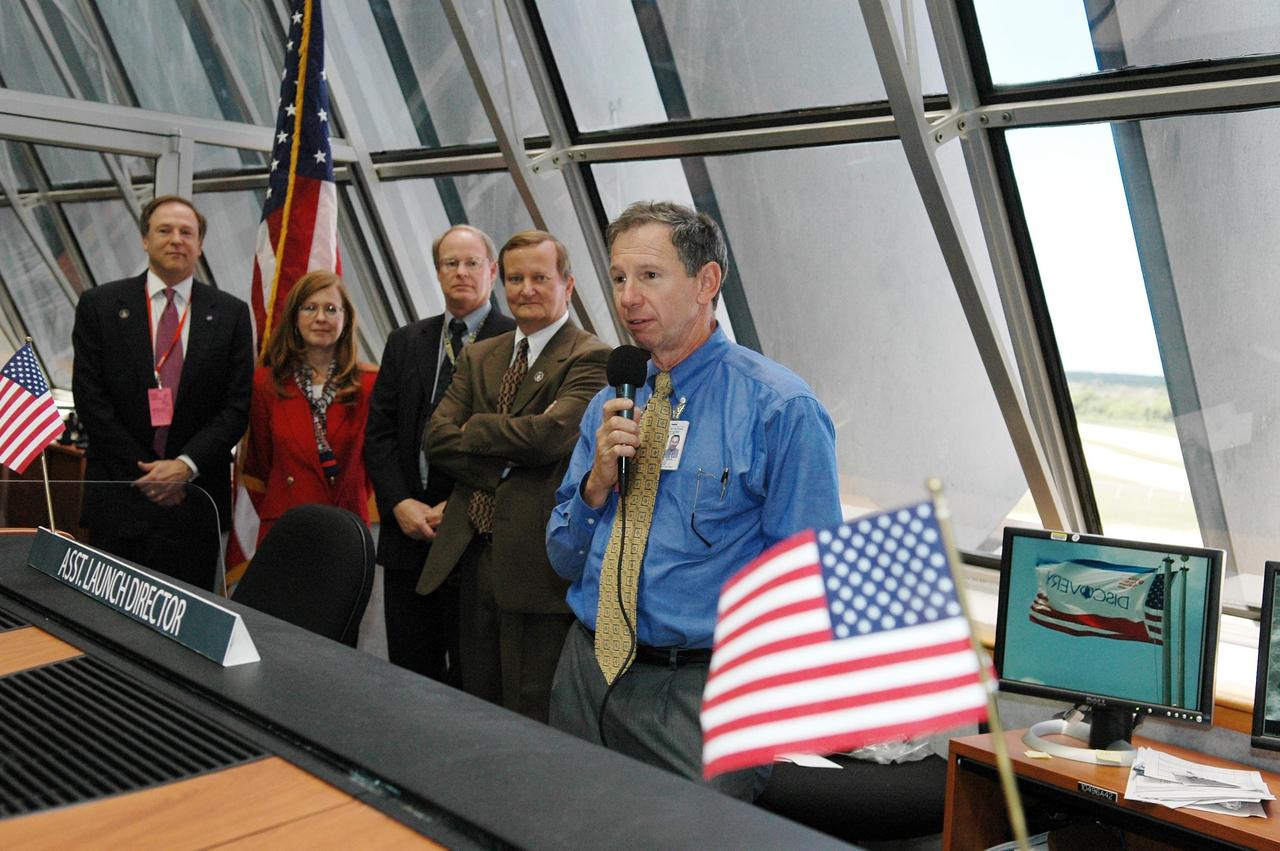
KENNEDY SPACE CENTER, FLA. - In Firing Room 4 of the Launch Control Center, NASA Administrator Mike Griffin congratulates the launch team on the successful launch of Space Shuttle Discovery on mission STS-121. The launch was the first ever to take place on Independence Day. Liftoff was on-time at 2:38 p.m. EDT. Others next to Griffin are (left to right) David R. Mould, assistant administrator for NASA Public Affairs ; Lisa Malone, director of External Relations at Kennedy; Bruce Buckingham, news chief at the NASA News Center at Kennedy; and Mike Leinbach, Shuttle Program director. During the 12-day mission, the STS-121 crew of seven will test new equipment and procedures to improve shuttle safety, as well as deliver supplies and make repairs to the International Space Station. Landing is scheduled for July 16 or 17 at Kennedy's Shuttle Landing Facility. Photo credit: NASA/Kim Shiflett
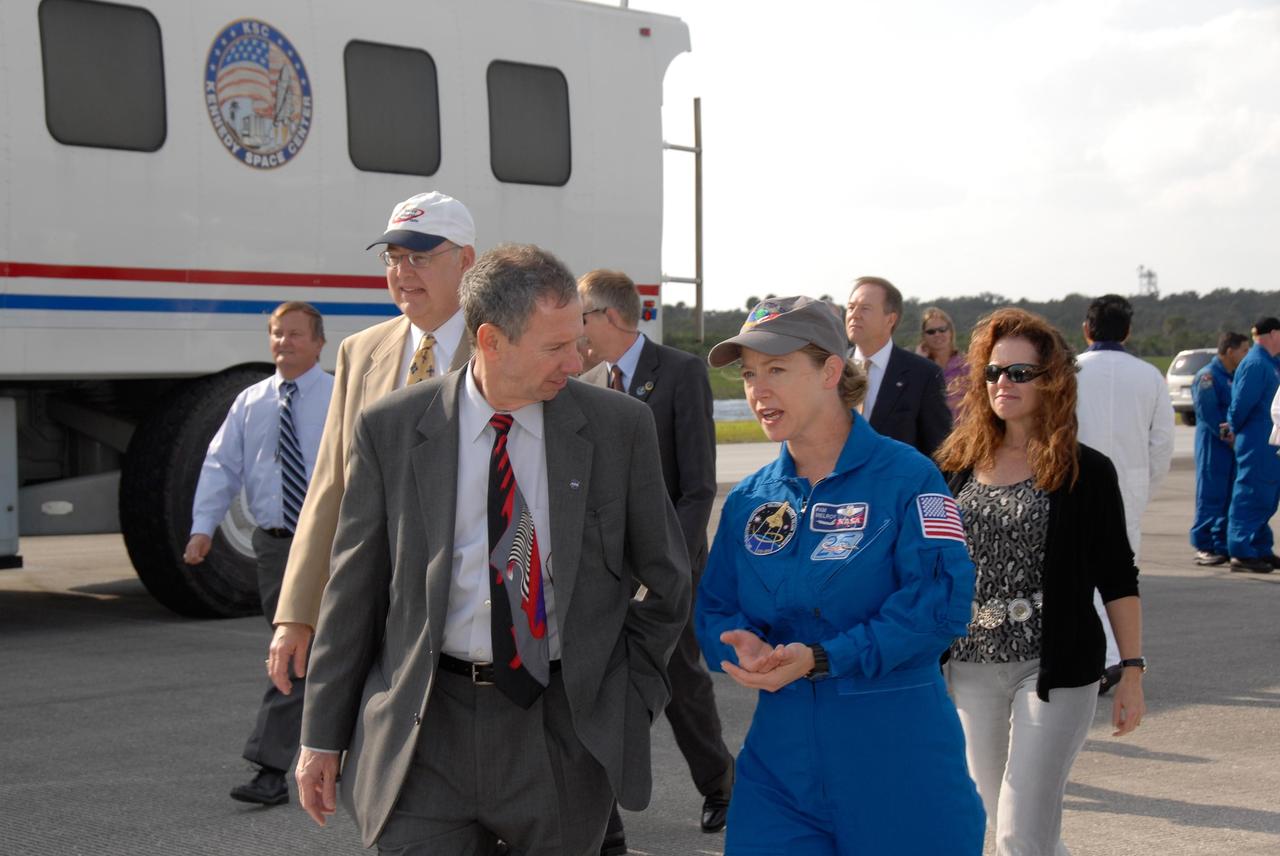
KENNEDY SPACE CENTER, FLA. -- NASA Administrator Mike Griffin talks to STS-120 Commander Pamela Melroy as they walk across the Shuttle Landing Facility at NASA's Kennedy Space Center. On the left are Shuttle Launch Director Mike Leinbach and Shuttle Program Manager Wayne Hale. At right is Rebecca Griffin, wife of the administrator. Melroy and the Discovery crew completed the 15-day mission STS-120, with an on-time landing at 1:01:16 p.m. Wheel stop was at 1:02:07 p.m. Mission elapsed time was 15 days, 2 hours, 24 minutes and 2 seconds. Mission STS-120 continued the construction of the station with the installation of the Harmony Node 2 module and the relocation of the P6 truss. Photo credit: NASA/Kim Shiflett
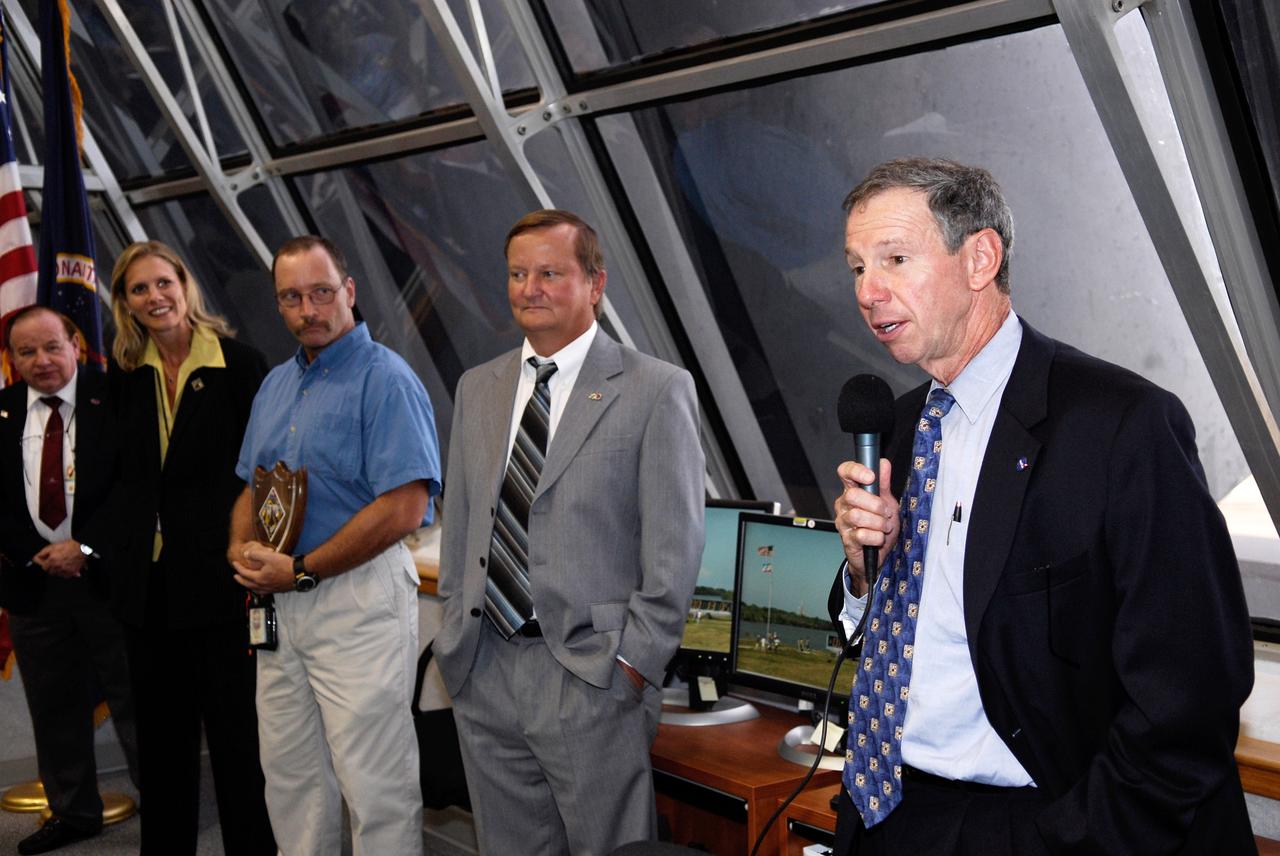
CAPE CANAVERAL, Fla. -- After the successful launch of space shuttle Discovery on its STS-124 mission, NASA Administrator Mike Griffin (right) congratulates the team in the firing room at NASA's Kennedy Space Center. Second from left is NASA Flow Director Stephanie Stilson; next to Griffin is Shuttle Launch Director Mike Leinbach. Launch was on time at 5:02 p.m. EDT. Discovery is making its 35th flight. The STS-124 mission is the 26th in the assembly of the space station. It is the second of three flights launching components to complete the Japan Aerospace Exploration Agency's Kibo laboratory. The shuttle crew will install Kibo's large Japanese Pressurized Module and its remote manipulator system, or RMS. The 14-day flight includes three spacewalks. Photo credit: NASA/Kim Shiflett
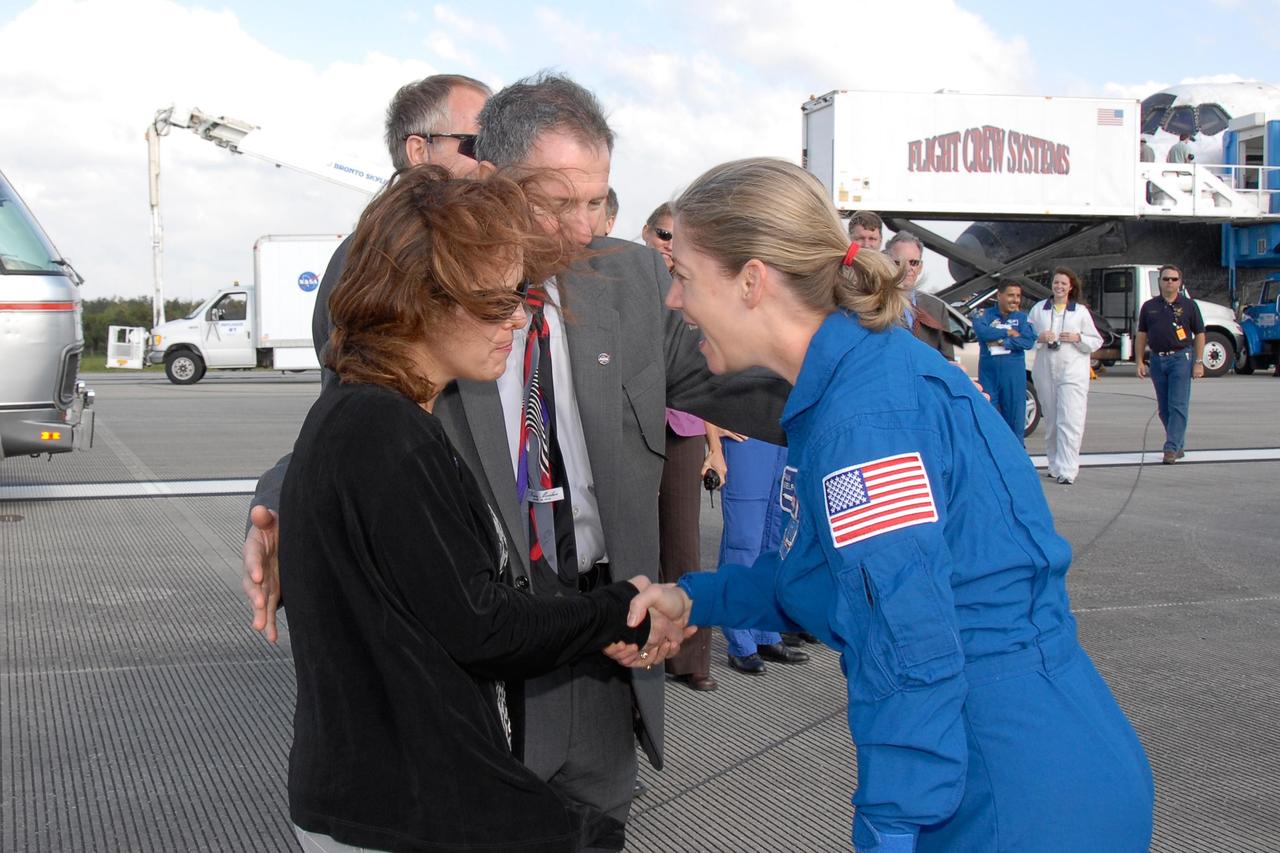
KENNEDY SPACE CENTER, FLA. -- STS-120 Commander Pamela Melroy is greeted by NASA Administrator Mike Griffin and his wife, Rebecca Griffin. Melroy and the Discovery crew completed the 15-day mission STS-120, with an on-time landing at 1:01:16 p.m. Wheel stop was at 1:02:07 p.m. Mission elapsed time was 15 days, 2 hours, 24 minutes and 2 seconds.Mission STS-120 continued the construction of the station with the installation of the Harmony Node 2 module and the relocation of the P6 truss. Photo credit: NASA//Kim Shiflett
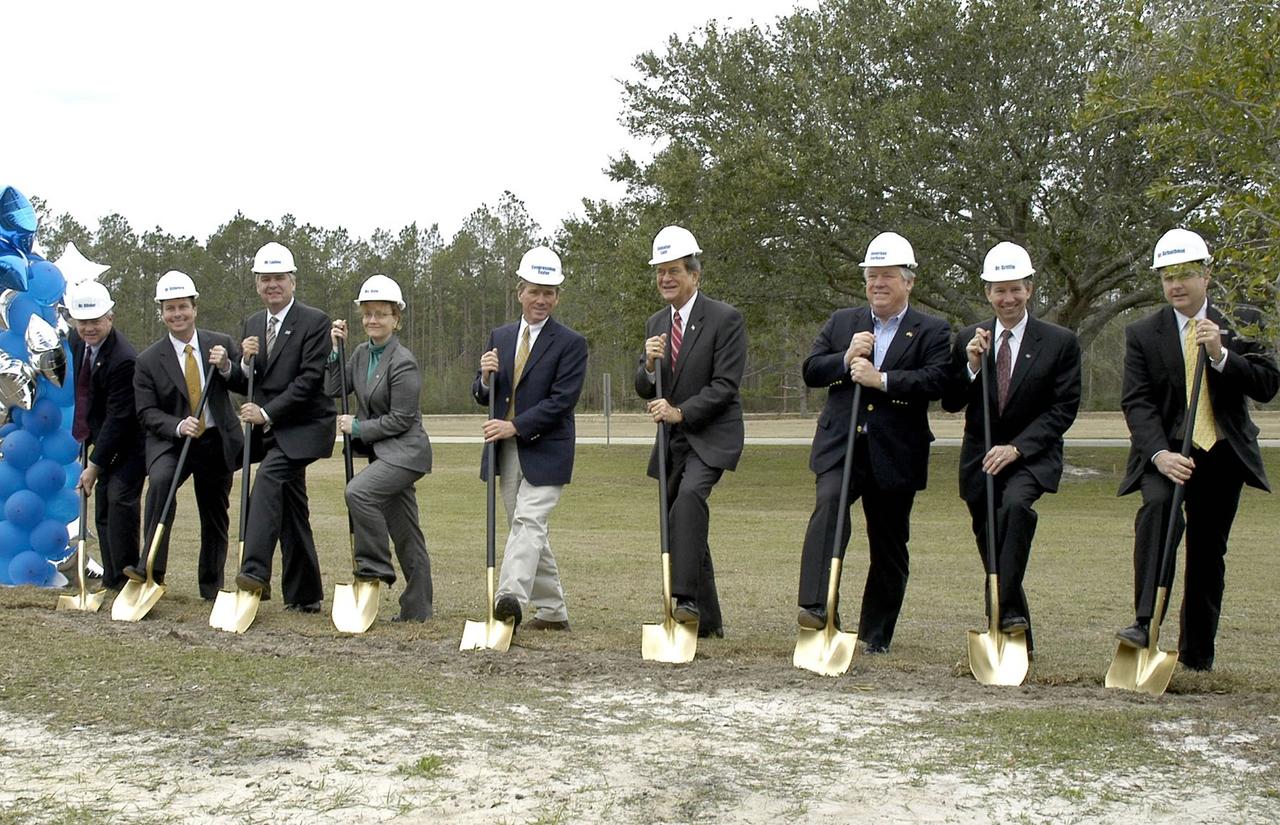
NASA officials and elected leaders were on hand for the groundbreaking ceremony of the NASA Shared Services Center Feb. 24, 2006, on the grounds of Stennis Space Center. The NSSC provides agency centralized administrative processing, human resources, procurement and financial services. From left, Louisiana Economic Development Secretary Mike Olivier, Stennis Space Center Director Rick Gilbrech, Computer Sciences Corp. President Michael Laphen, NASA Deputy Administrator Shana Dale, Rep. Gene Taylor, Sen. Trent Lott, Mississippi Gov. Haley Barbour, NASA Administrator Mike Griffin and Shared Services Center Executive Director Arbuthnot use golden shovels to break ground at the site.
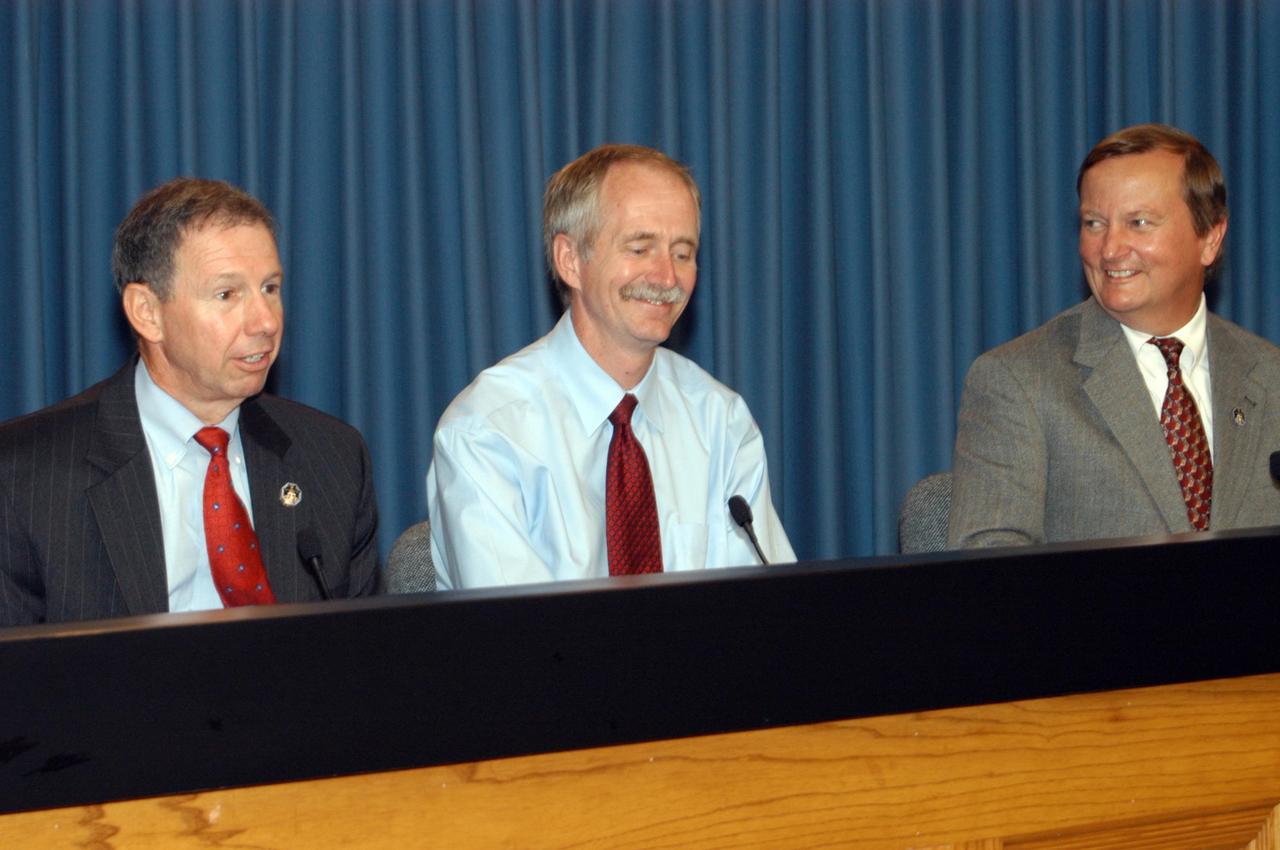
KENNEDY SPACE CENTER, FLA. - A press conference after the landing of the orbiter Discovery and mission STS-121 crew features NASA Administrator Mike Griffin, Associate Administrator for Space Operations Bill Gerstenmaier and Shuttle Launch Director Mike Leinbach. A few of the questions from the media evoked smiles from the panelists. Discovery traveled 5.3 million miles, landing on orbit 202. Mission elapsed time was 12 days, 18 hours, 37 minutes and 54 seconds. The landing is the 62nd at Kennedy Space Center and the 32nd for Discovery. Photo credit: NASA/George Shelton
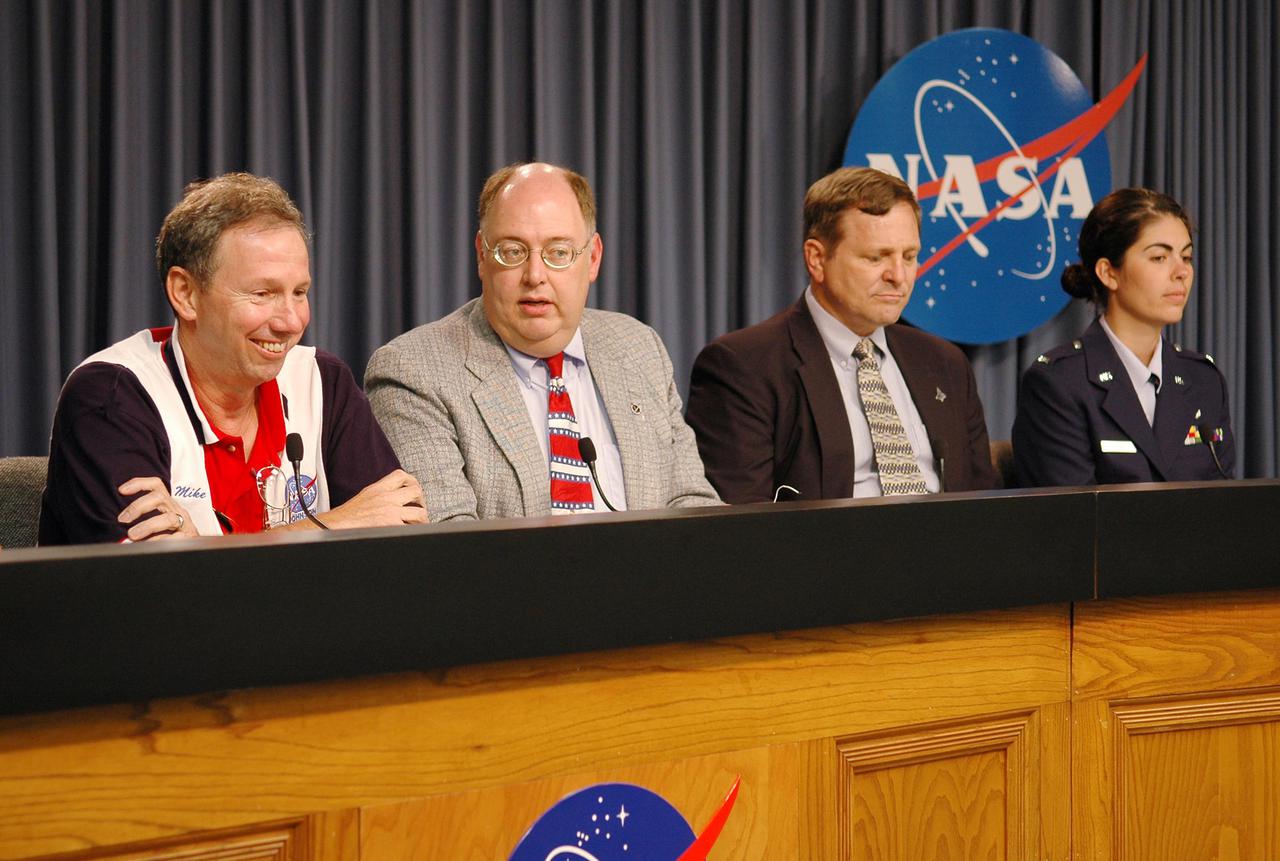
KENNEDY SPACE CENTER, FLA. - At the STS-114 Launch Readiness Press Conference at NASA Kennedy Space Center, NASA officials confirm the July 26 launch. Seated from left are NASA Administrator Mike Griffin, Space Shuttle Deputy Program Manager Wayne Hale, Shuttle Processing Director Mike Wetmore and launch weather officer 1st Lt. Mindy Chavez, with the U.S. Air Force 45th Weather Squadron. Liftoff of Space Shuttle Discovery on the Return to Flight mission STS-114 is scheduled for 10:39 a.m. EDT July 26 from Launch Pad 39B.
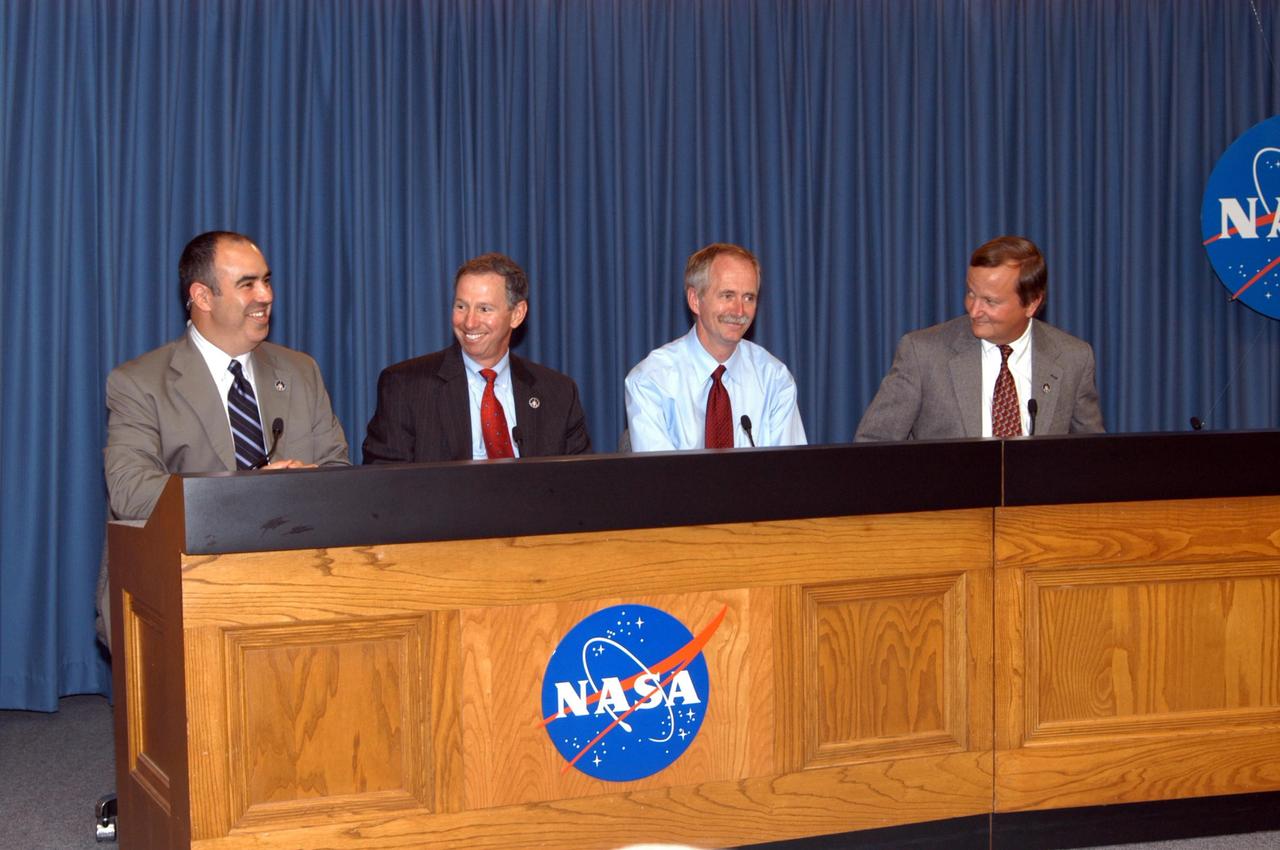
KENNEDY SPACE CENTER, FLA. - A press conference after the landing of the orbiter Discovery and mission STS-121 crew features NASA and Kennedy Space Center senior management. From left, NASA Public Affairs Dean Acosta moderated questions posed to NASA Administrator Mike Griffin, Associate Administrator for Space Operations Bill Gerstenmaier and Shuttle Launch Director Mike Leinbach. Discovery traveled 5.3 million miles, landing on orbit 202. Mission elapsed time was 12 days, 18 hours, 37 minutes and 54 seconds. The landing is the 62nd at Kennedy Space Center and the 32nd for Discovery. Photo credit: NASA/George Shelton
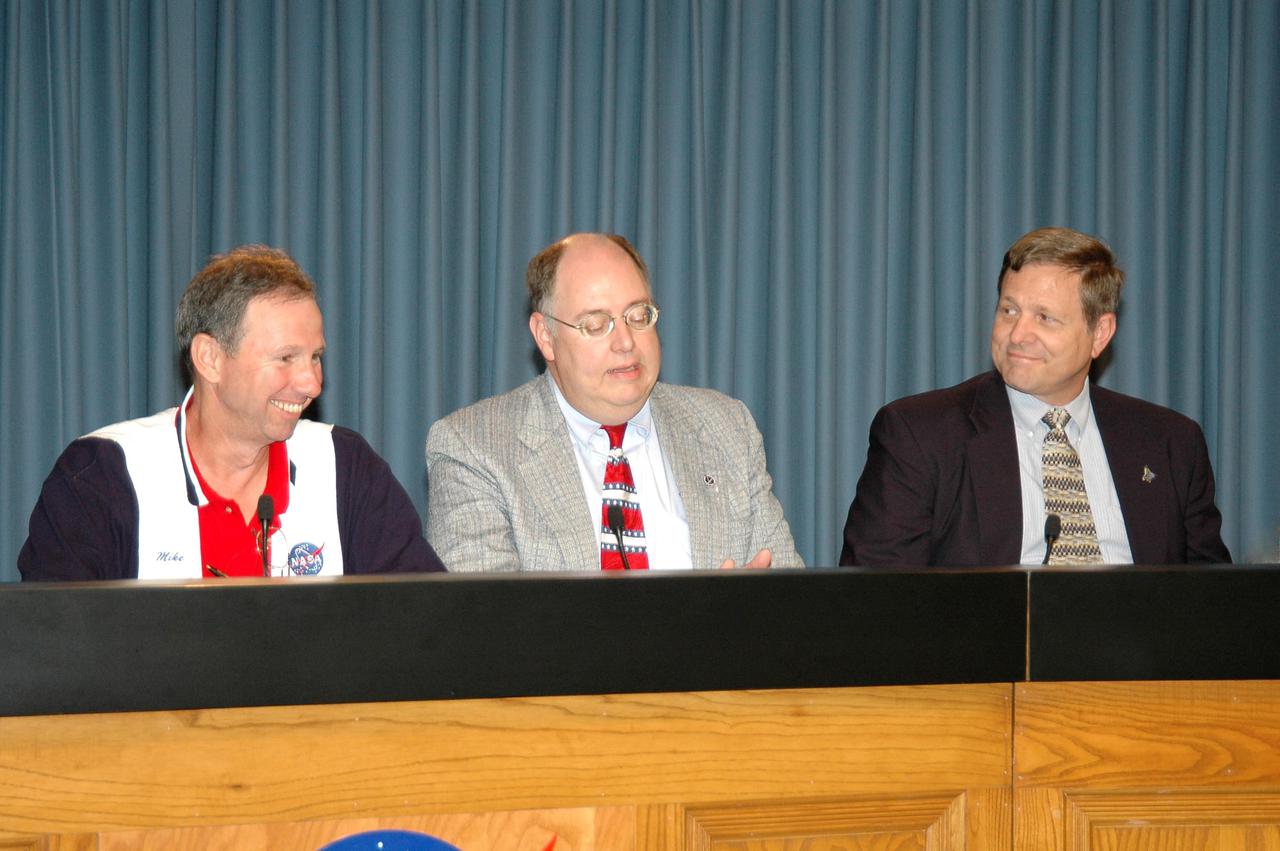
KENNEDY SPACE CENTER, FLA. - At the STS-114 Launch Readiness Press Conference at NASA Kennedy Space Center, Space Shuttle Deputy Program Manager Wayne Hale (center) answers a question from the media. At the conference, NASA officials confirmed the July 26 launch. Others seated with Hale on the stage are NASA Administrator Mike Griffin (left) and Shuttle Processing Director Mike Wetmore (right). Not pictured is launch weather officer 1st Lt. Mindy Chavez, with the U.S. Air Force 45th Weather Squadron. Liftoff of Space Shuttle Discovery on the Return to Flight mission STS-114 is scheduled for 10:39 a.m. EDT July 26 from Launch Pad 39B.
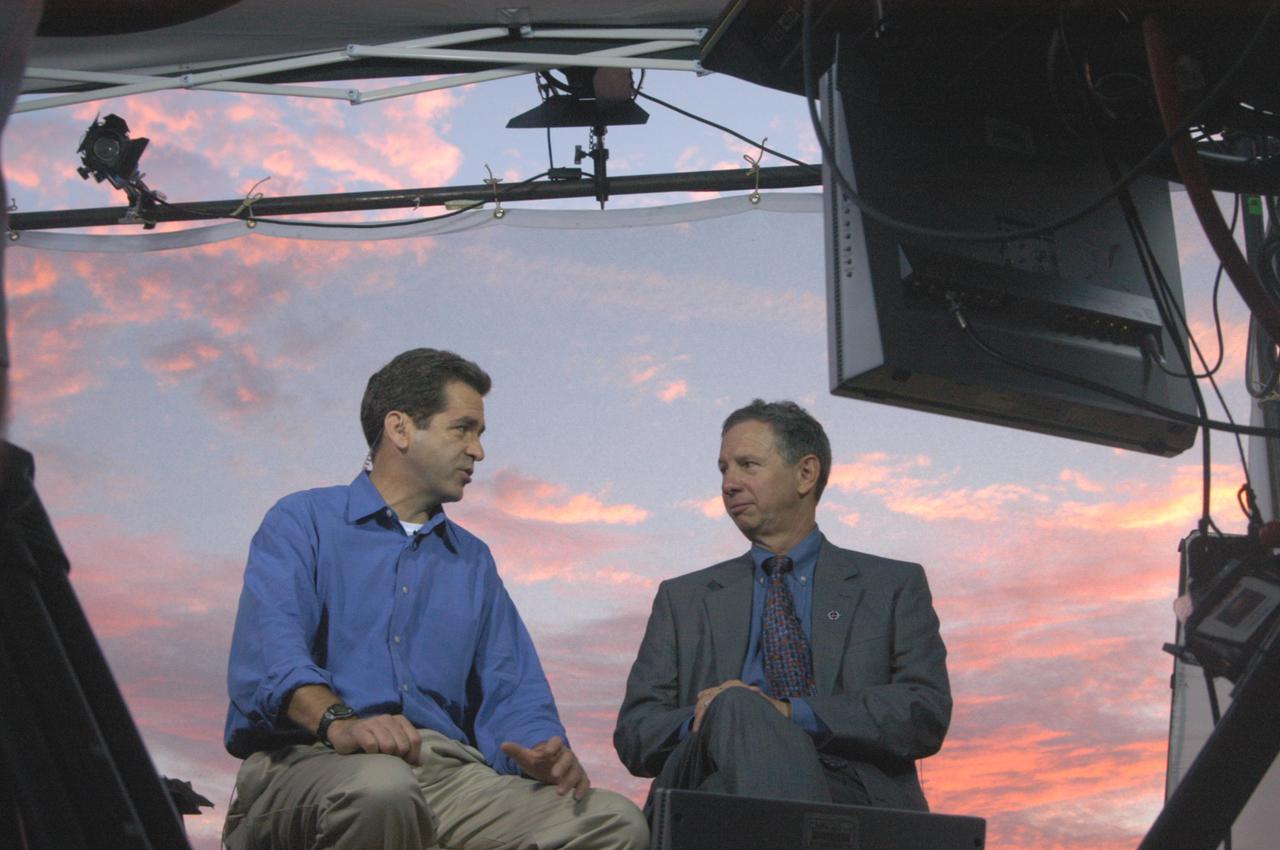
KENNEDY SPACE CENTER, FLA. - Against a sunrise-painted sky at NASA Kennedy Space Center, co-anchor on CNN’s American Morning, talks on air with NASA Administrator Mike Griffin about the pending 3:51 p.m. launch of Space Shuttle Discovery on the historic Return to Flight mission STS-114. It is the 114th Space Shuttle flight and the 31st for Discovery. The 12-day mission is expected to end with touchdown at the Shuttle Landing Facility at 11:06 a.m. July 25.
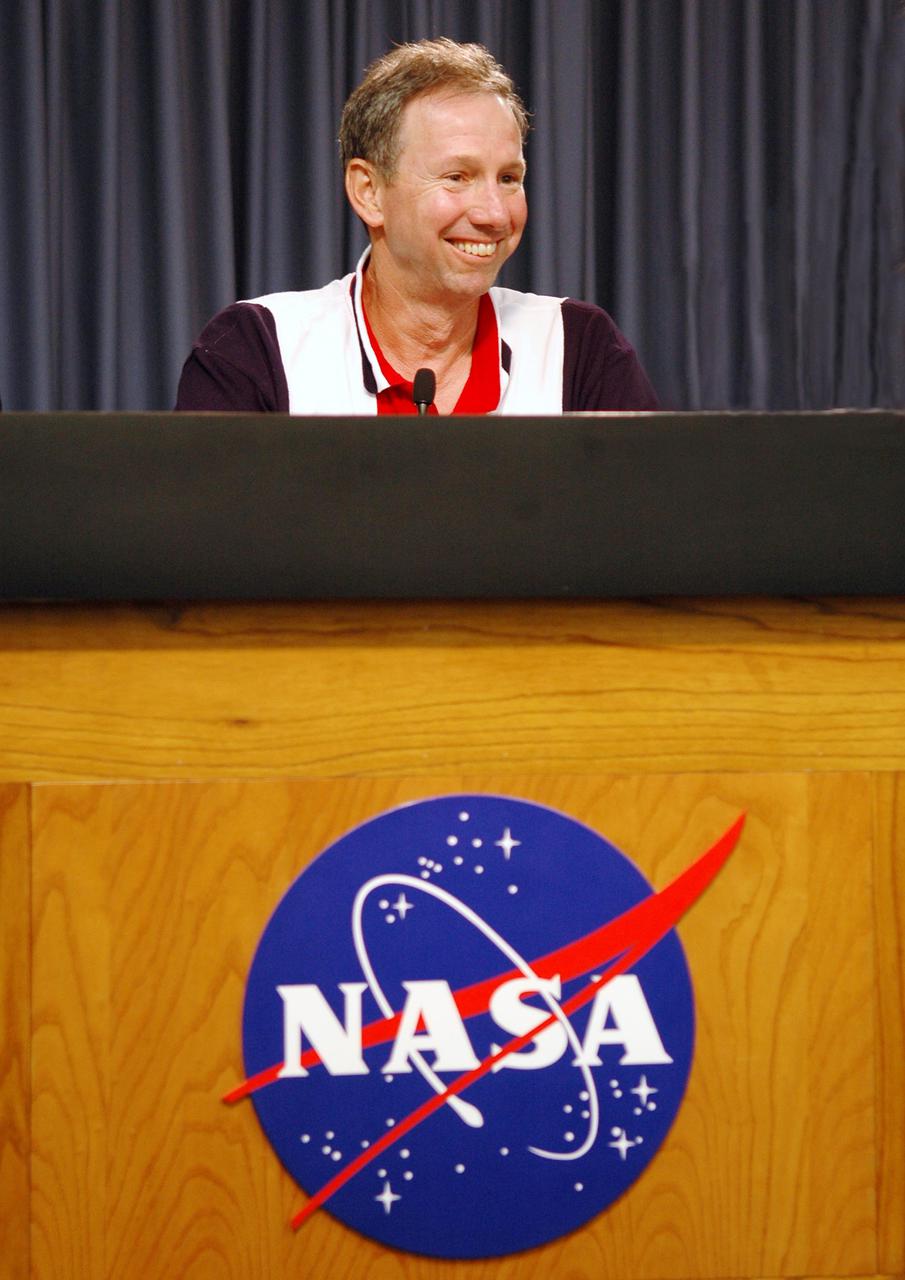
KENNEDY SPACE CENTER, FLA. - At the STS-114 Launch Readiness Press Conference at NASA Kennedy Space Center, NASA Administrator Mike Griffin was pleased to confirm the July 26 launch of Space Shuttle Discovery on the Return to Flight mission STS-114 scheduled for 10:39 a.m. EDT July 26 from Launch Pad 39B. Liftoff of Space Shuttle Discovery on the Return to Flight mission STS-114 is scheduled for 10:39 a.m. EDT July 26 from Launch Pad 39B.
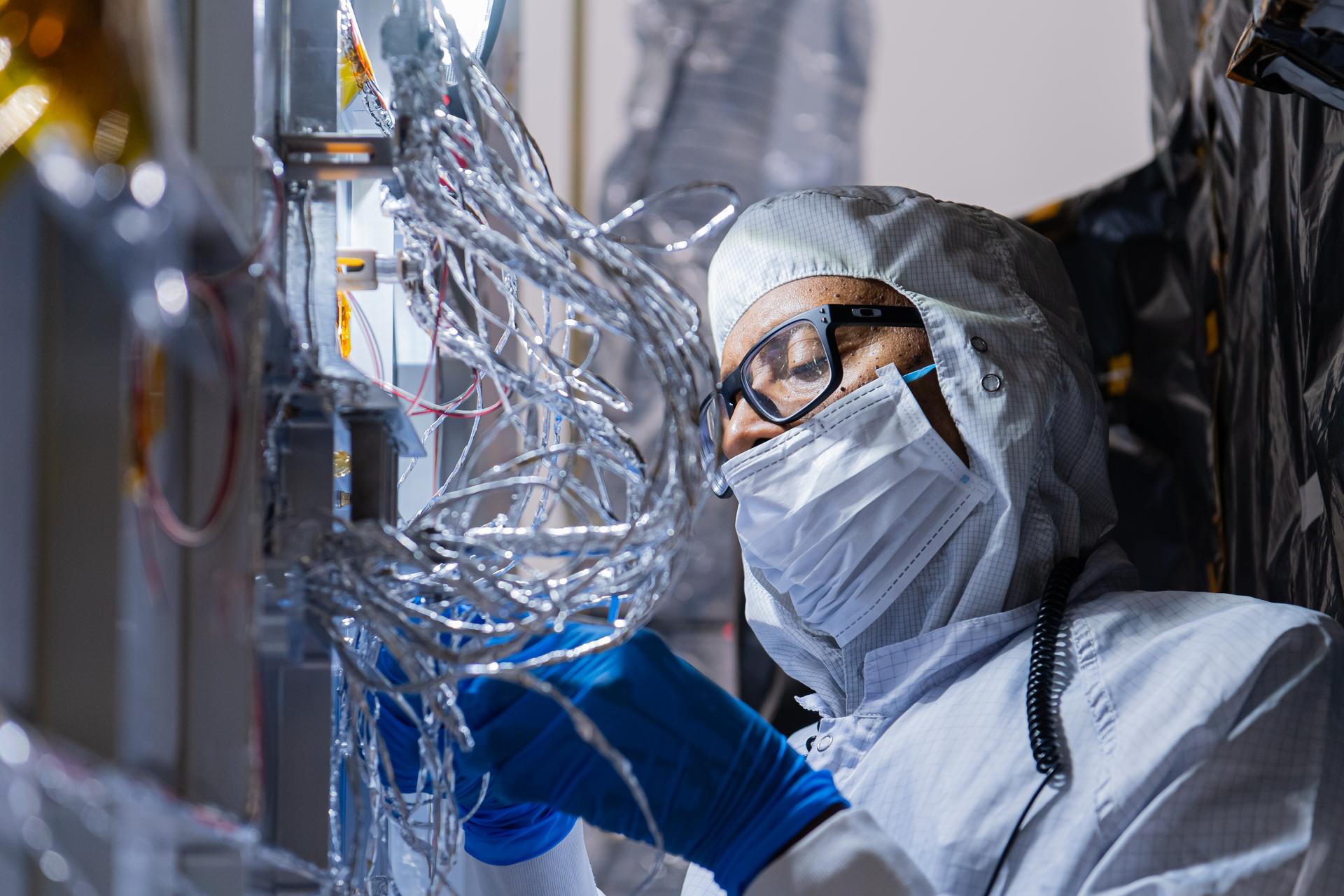
OSAM-1 Electrical Engineer Gregory Griffin tapes hardware on the underside of the OSAM-1 Servicing Payload inside cleanroom at Goddard Space Flight Center, Greenbelt Md., Aug 19, 2024. This photo has been reviewed by the Export Control Office, project Management, and Maxar release authority and is released for public view. NASA/Mike Guinto
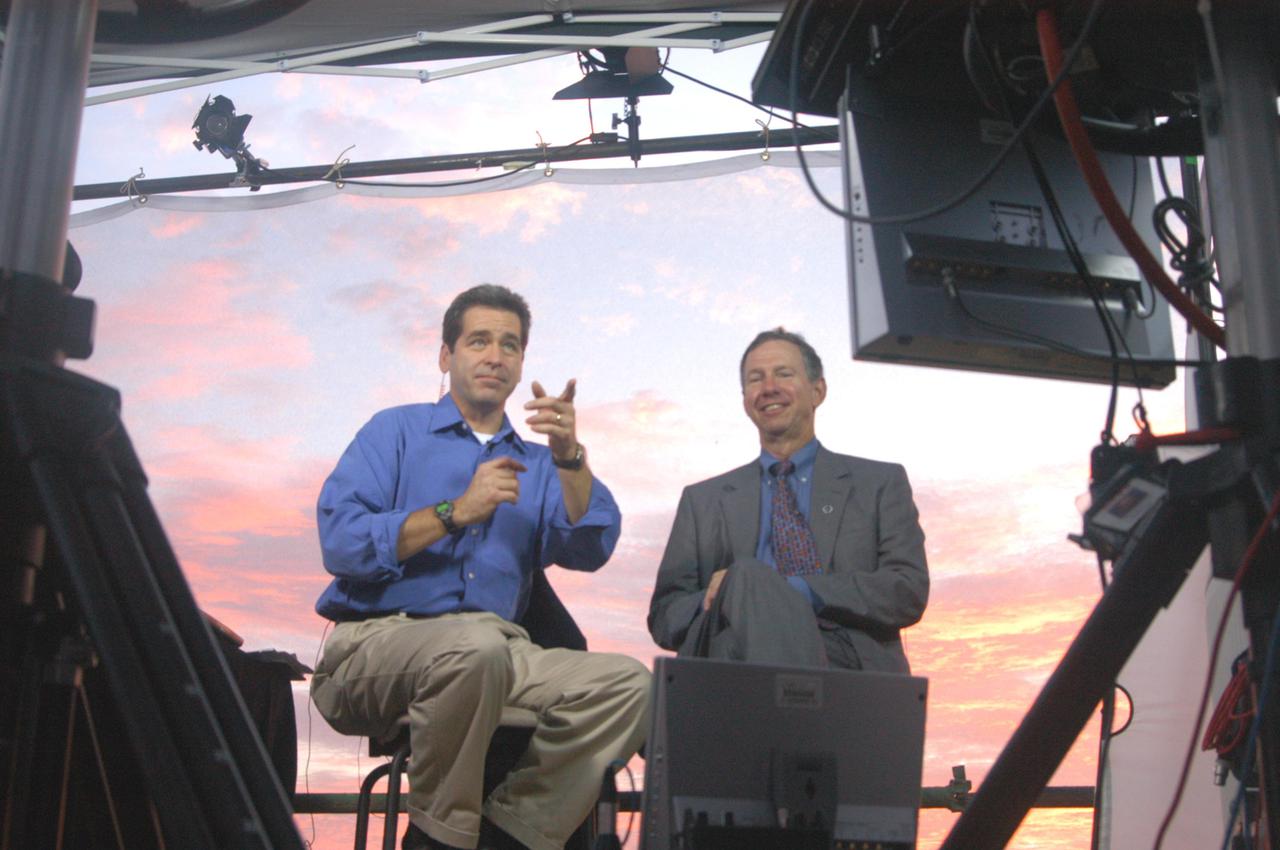
KENNEDY SPACE CENTER, FLA. - Against a sunrise-painted sky at NASA Kennedy Space Center, Miles O’Brien (left), co-anchor on CNN’s American Morning, talks on air with NASA Administrator Mike Griffin about the pending launch of Space Shuttle Discovery on the historic Return to Flight mission STS-114. It is the 114th Space Shuttle flight and the 31st for Discovery. The 12-day mission is expected to end with touchdown at the Shuttle Landing Facility at 11:06 a.m. July 25.
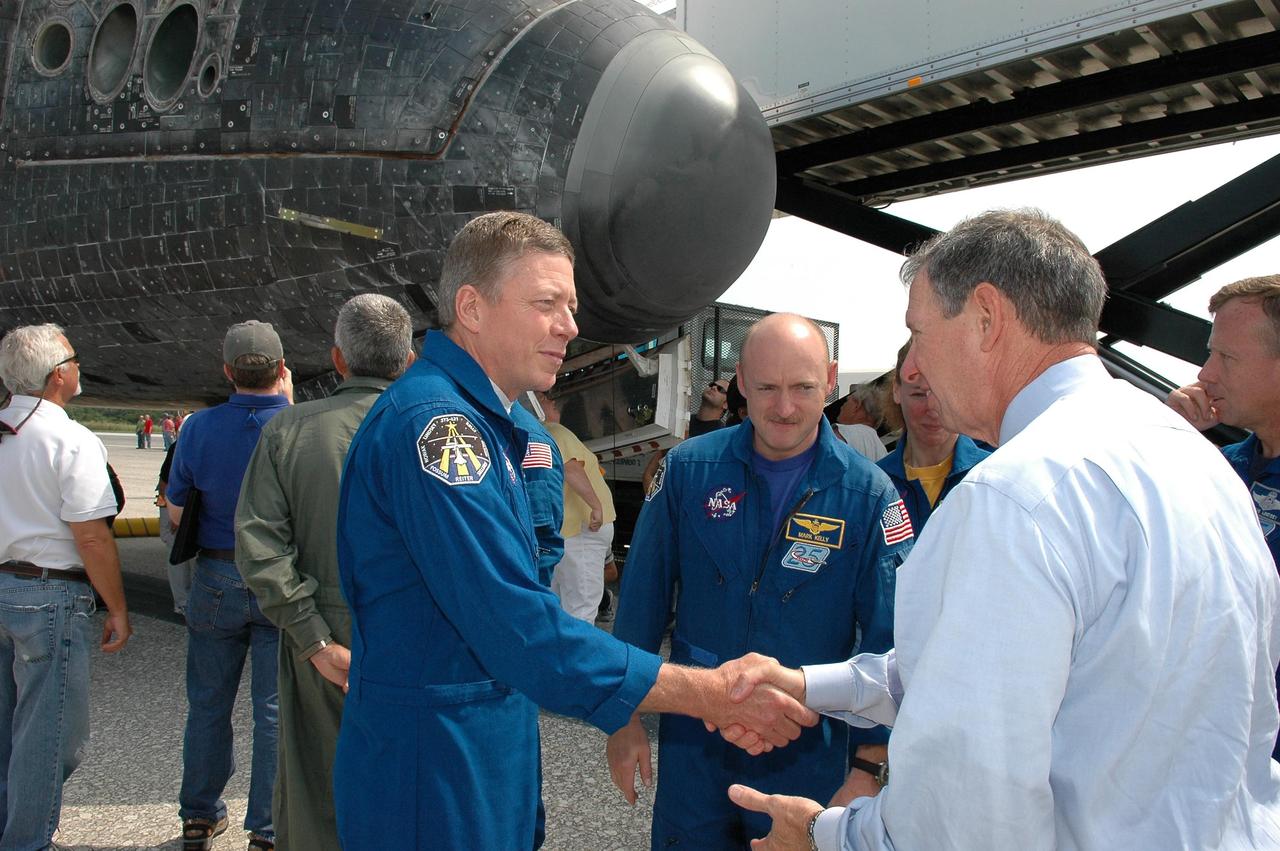
KENNEDY SPACE CENTER, FLA. - During the traditional post-flight walk-around after the landing of an orbiter, NASA Administrator Mike Griffin (right) congratulates STS-121 Mission Specialist Michael Fossum on the successful mission. Fossum participated in three spacewalks, along with Mission Specialist Piers Sellers, to repair and replace equipment. Next to Fossum are Pilot Mark Kelly, Mission Specialist Lisa Nowak and (behind Griffin) Commander Steven Lindsey. Discovery's smooth and perfect landing was on time at 9:14 a.m. EDT on Runway 15 of NASA's Shuttle Landing Facility after traveling 5.3 million miles on 202 orbits. Mission elapsed time was 12 days, 18 hours, 37 minutes and 54 seconds. The landing is the 62nd at Kennedy Space Center and the 32nd for Discovery. Photo credit: NASA/Kim Shiflett
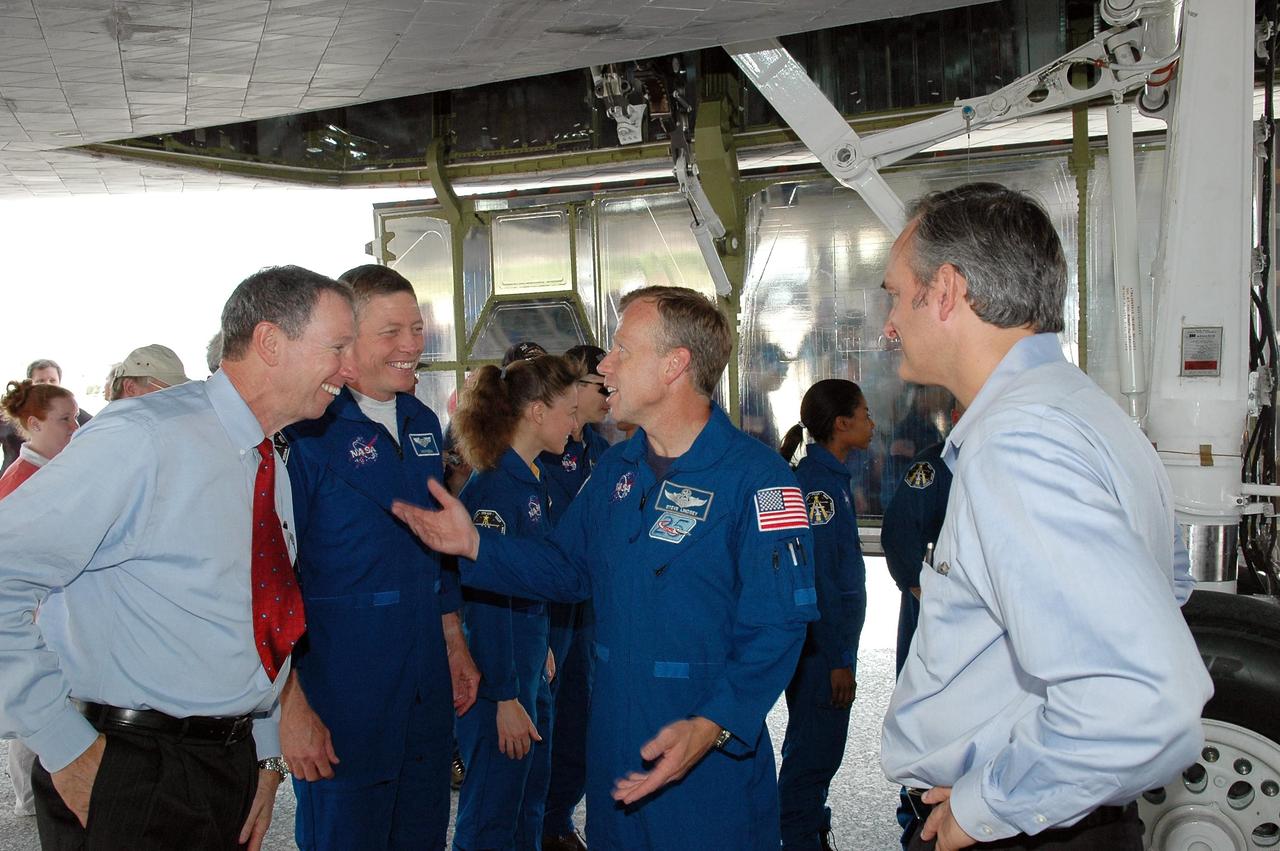
KENNEDY SPACE CENTER, FLA. - NASA Administrator Mike Griffin talks with Commander Steven Lindsey (gesturing) after the crew looked over the orbiter Discovery, above them. Between Griffin and Lindsey are Mission Specialists Michael Fossum and Lisa Nowak. Mission Specialist Stephanie Wilson is behind Lindsey; Associate Administrator Rex Geveden is at right. The post-flight walk-around is a tradition. Discovery's smooth and perfect landing was on time at 9:14 a.m. EDT on Runway 15 of NASA's Shuttle Landing Facility after traveling 5.3 million miles on 202 orbits. Mission elapsed time was 12 days, 18 hours, 37 minutes and 54 seconds. The landing is the 62nd at Kennedy Space Center and the 32nd for Discovery. Photo credit: NASA/Kim Shiflett
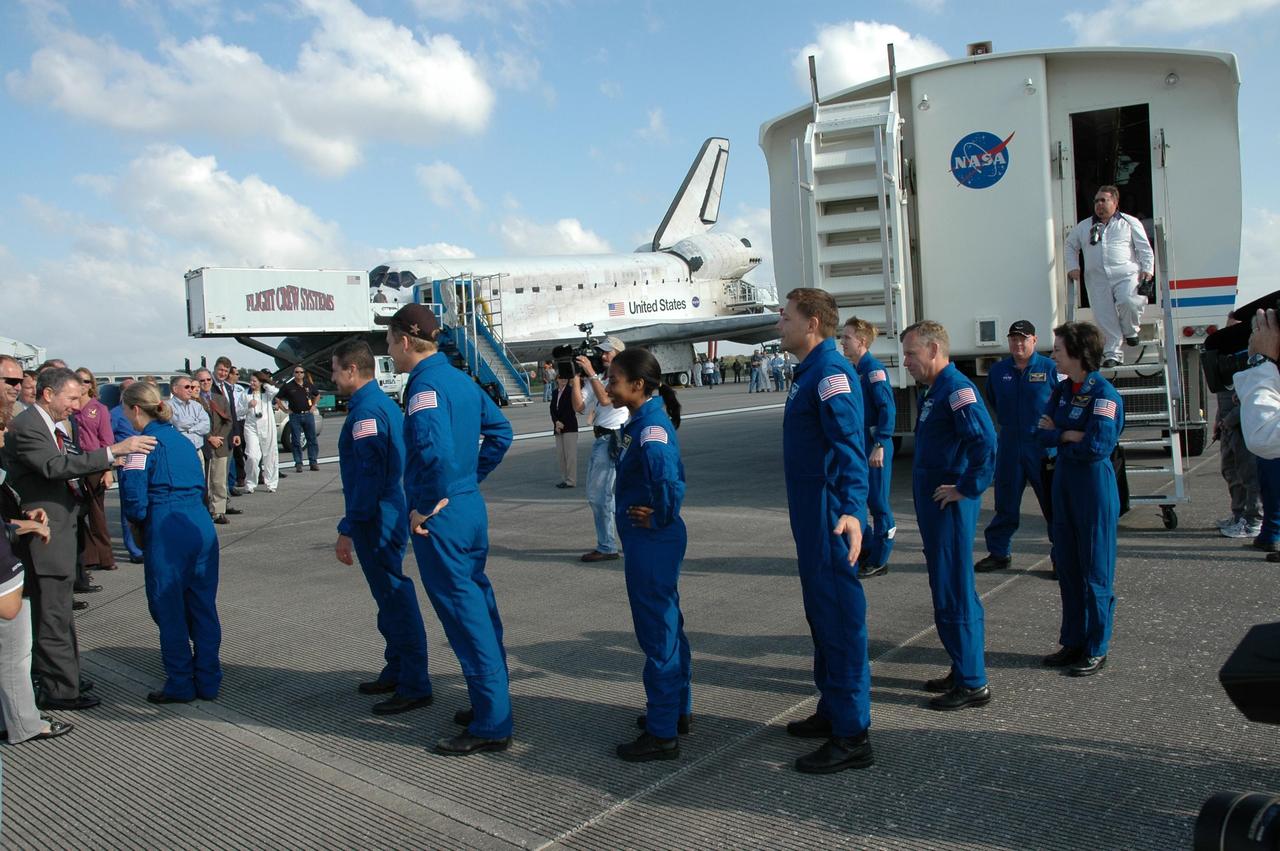
KENNEDY SPACE CENTER, FLA. -- The STS-120 crew exit the crew transport vehicle to be greeted by NASA Administrator Mike Griffin and others. Griffin is at left, talking to Commander Pamela Melroy. Behind her, from left are Pilot George Zamka and mission specialists Scott Parazynski, Stephanie Wilson and Doug Wheelock. Behind Wheelock is Chief of the Astronaut Corps Steven Lindsey and Director of Flight Crew Operations Ellen Ochoa, both from Johnson Space Center. The crew completed a 15-day mission to the International Space Station with a smooth landing on Runway 33. Main gear touchdown was 1:01:16 p.m. Wheel stop was at 1:02:07 p.m. Mission elapsed time was 15 days, 2 hours, 24 minutes and 2 seconds. Mission STS-120 continued the construction of the station with the installation of the Harmony Node 2 module and the relocation of the P6 truss. Photo credit: NASA/Jim Grossmann
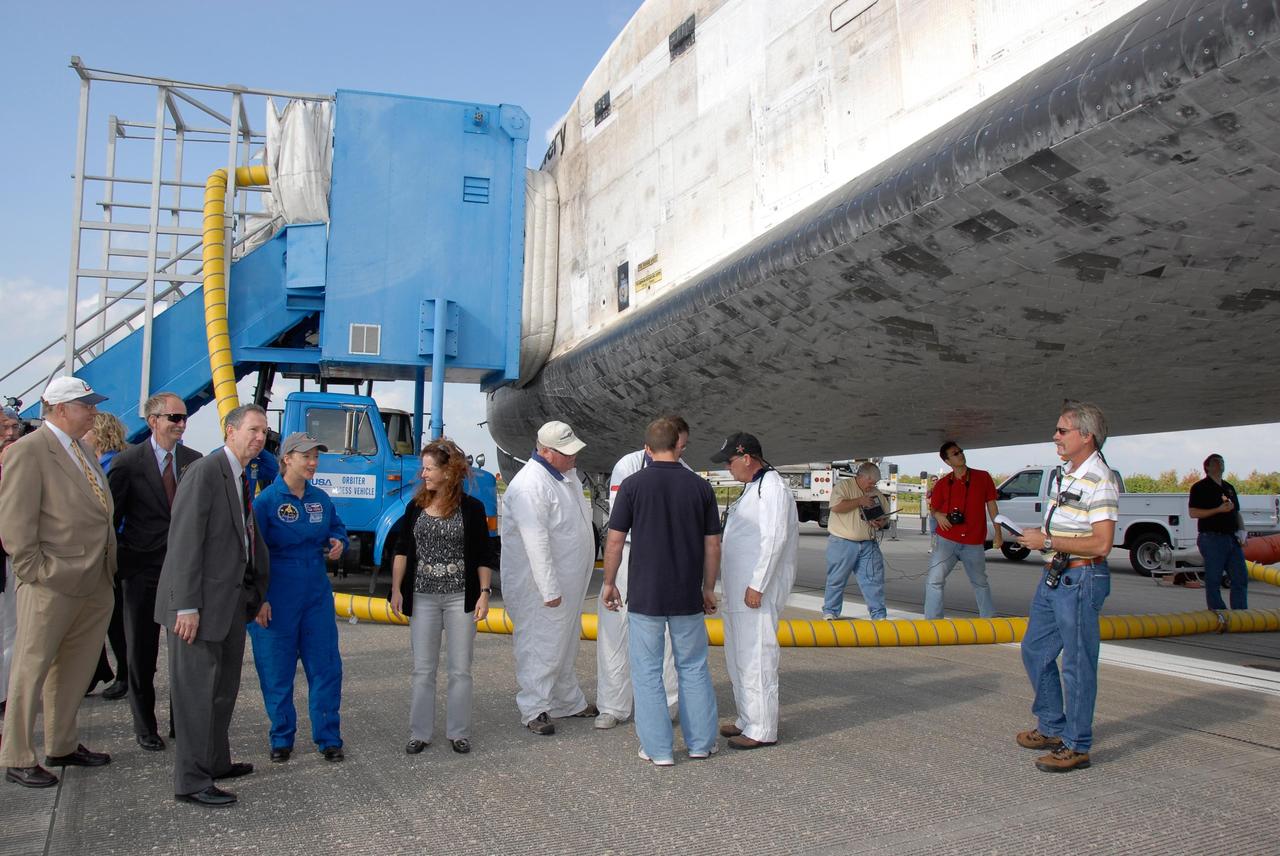
KENNEDY SPACE CENTER, FLA. -- At center, STS-120 Commander Pamela Melroy begins a checkout of space shuttle Discovery. With her are, from left, Shuttle Program Manager Wayne Hale, Associate Administrator for NASA Space Operations William Gerstenmaier and NASA Administrator Mike Griffin. On the right is Rebecca Griffin, wife of the administrator. Melroy and the Discovery crew completed the 15-day mission STS-120, with an on-time landing at 1:01:16 p.m. Wheel stop was at 1:02:07 p.m. Mission elapsed time was 15 days, 2 hours, 24 minutes and 2 seconds. Mission STS-120 continued the construction of the station with the installation of the Harmony Node 2 module and the relocation of the P6 truss. Photo credit: NASA/Kim Shiflett
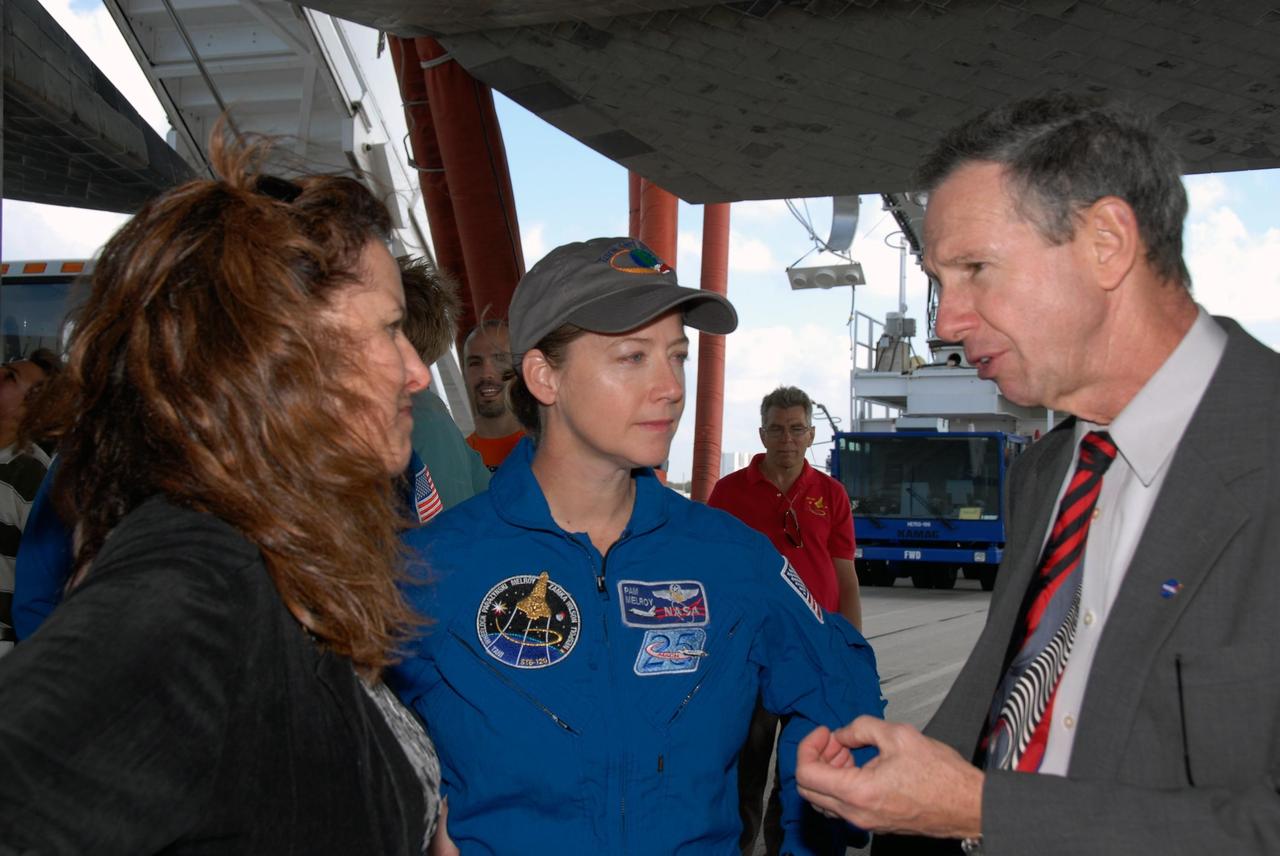
KENNEDY SPACE CENTER, FLA. -- Standing underneath space shuttle Discovery on the Shuttle Landing Facility at NASA's Kennedy Space Center, NASA Administrator Mike Griffin, right, talks with STS-120 Commander Pamela Melroy, center, after the landing of the vehicle. At left is Rebecca Griffin, wife of the administrator. The Discovery crew completed the 15-day mission STS-120, with an on-time landing at 1:01:16 p.m. Wheel stop was at 1:02:07 p.m. Mission elapsed time was 15 days, 2 hours, 24 minutes and 2 seconds. Mission STS-120 continued the construction of the station with the installation of the Harmony Node 2 module and the relocation of the P6 truss. Photo credit: NASA/Kim Shiflett
STS120-S-093 (7 Nov. 2007) --- Standing underneath Space Shuttle Discovery on the Shuttle Landing Facility at NASA's Kennedy Space Center, NASA Administrator Mike Griffin (right) talks with astronaut Pam Melroy (center), STS-120 commander, after the landing of the vehicle. At left is Rebecca Griffin, wife of the administrator. The Discovery crew completed the 15-day STS-120 mission, with an on-time landing at 1:01:16 p.m. (EST). Wheel stop was at 1:02:07 p.m. Mission elapsed time was 15 days, 2 hours, 24 minutes and 2 seconds. The STS-120 crew continued the construction of the station with the installation of the Harmony Node 2 module and the relocation of the P6 truss.
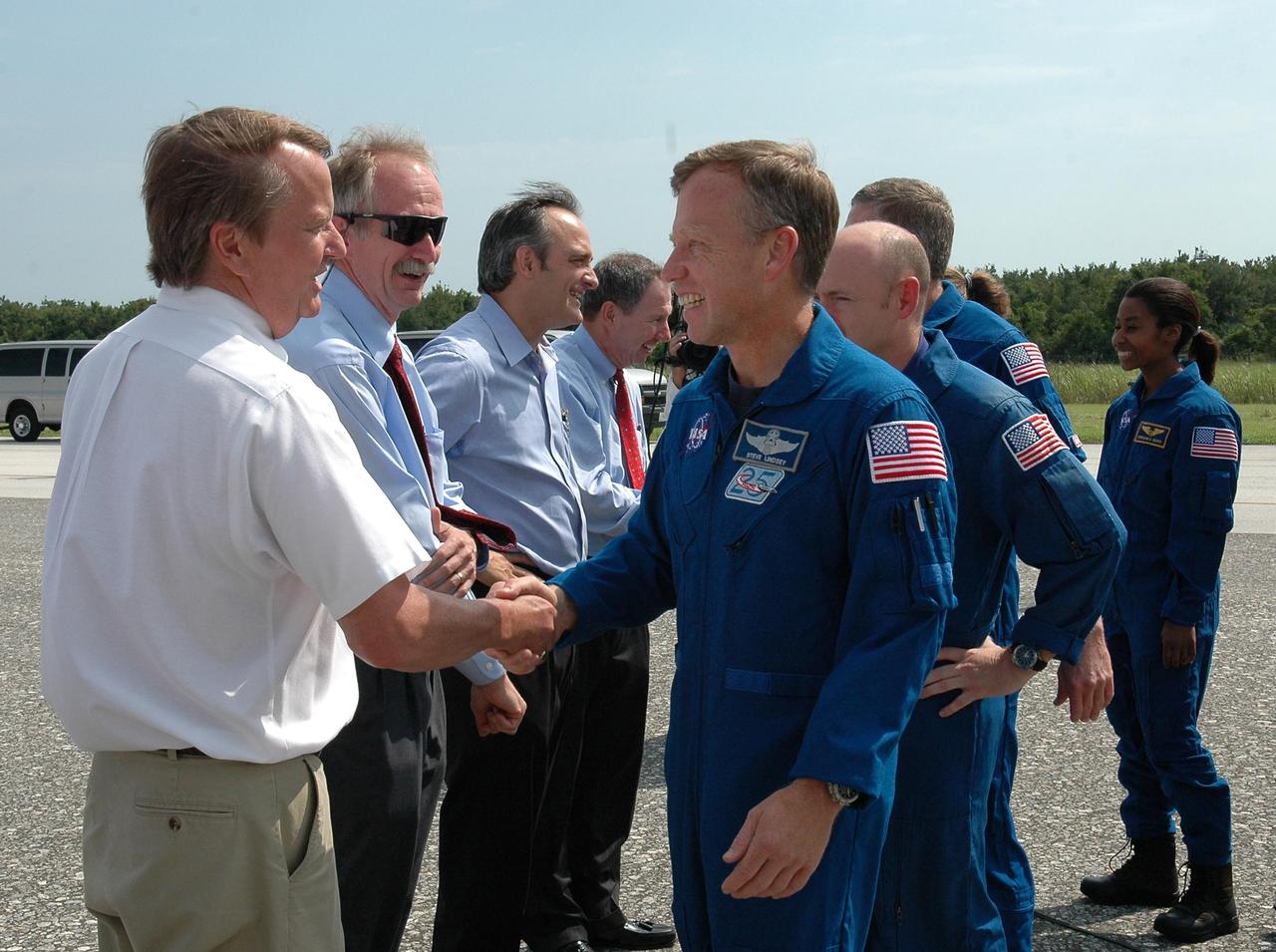
KENNEDY SPACE CENTER, FLA. - (From left) Shuttle Launch Director Mike Leinbach, Associate Administrator for Space Operations Bill Gerstenmaier, Associate Administrator Rex Geveden and NASA Administrator Mike Griffin greet STS-121 Commander Steven Lindsey, Pilot Mike Kelly and Mission Specialists Michael Fossum and Stephanie Wilson. Not visible are Mission Specialists Piers Sellers and Lisa Nowak. Mission Specialist Thomas Reiter, who launched with the crew on July 4, remained on the station to join the Expedition 13 crew there. Discovery's smooth and perfect landing was on time at 9:14 a.m. EDT on Runway 15 of NASA's Shuttle Landing Facility after traveling 5.3 million miles on 202 orbits. Mission elapsed time was 12 days, 18 hours, 37 minutes and 54 seconds. The landing is the 62nd at Kennedy Space Center and the 32nd for Discovery. Photo credit: NASA/Kim Shiflett
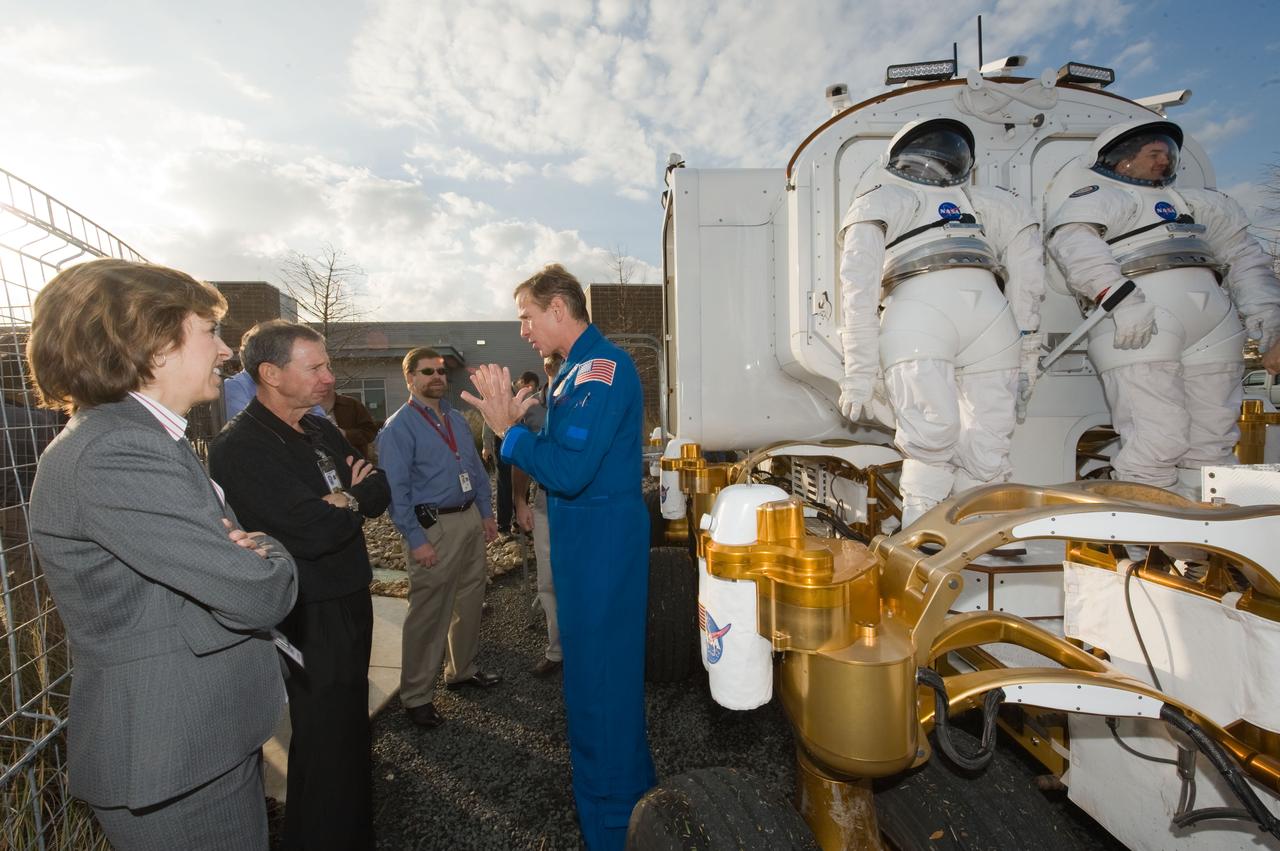
NASA Administrator Mike Griffen having breakfast with the STS-119 crew, then receiving a tour of the Small Pressurized Rover demonstration. Photo Date: January 9, 2009 Location: Bldg. 27 - Astronaut Quarantine. Photographer: R.Markowitz, x37739
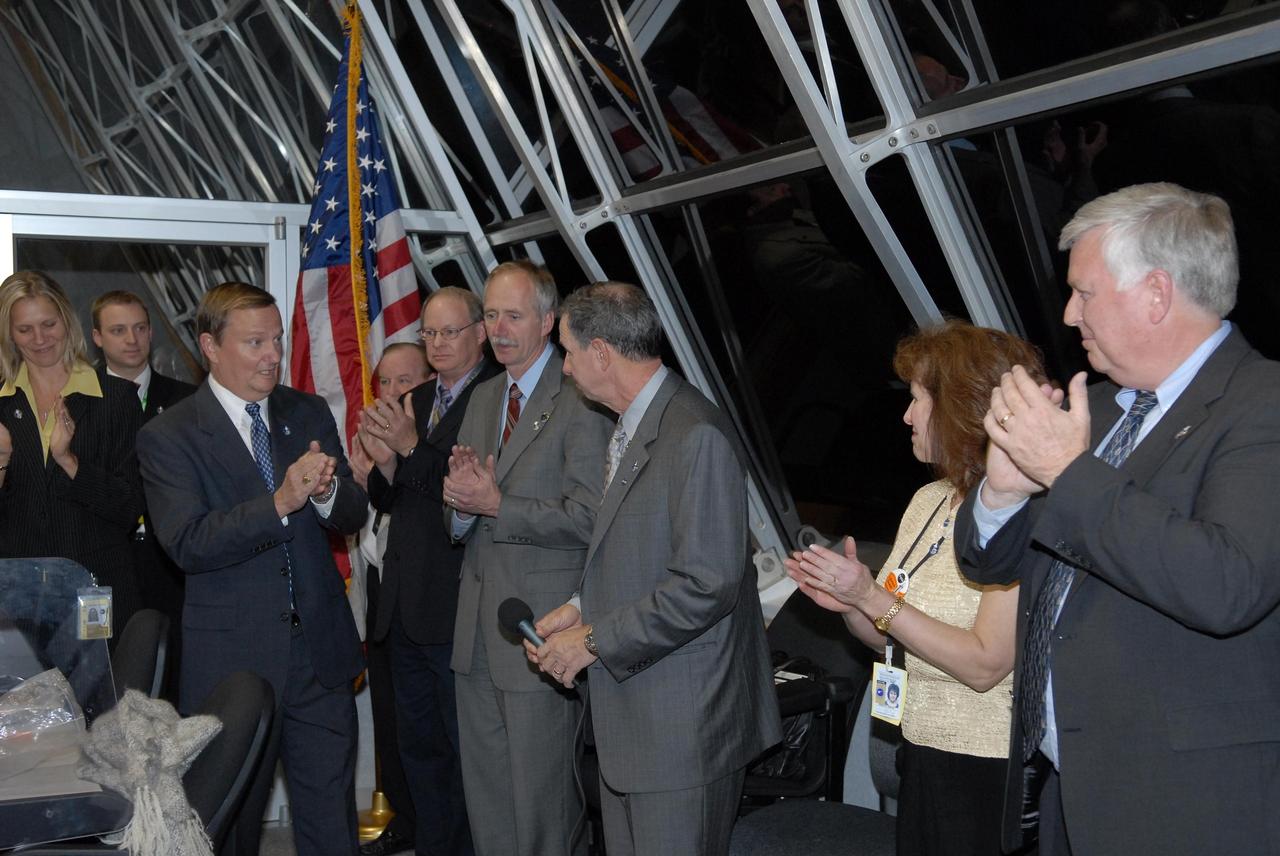
KENNEDY SPACE CENTER, FLA. -- In the firing room at the Launch Control Center, Shuttle Launch Director Mike Leinbach applauds with other NASA officials the successful second launch attempt of Space Shuttle Discovery on mission STS-116. Liftoff occurred on time at 8:47 p.m. EST. Standing left to right are NASA Flow Director for Discovery Stephanie Stilson, Leinbach, NASA KSC News Chief Bruce Buckingham, Associate Administrator for Space Operations Mission William Gerstenmaier, NASA Administrator Mike Griffin, Mrs. Griffin, and Kennedy Space Center Director Jim Kennedy. The first launch attempt on Dec. 7 was postponed due a low cloud ceiling over Kennedy Space Center. This is Discovery's 33rd mission and the first night launch since 2002. The 20th shuttle mission to the International Space Station, STS-116 carries another truss segment, P5. It will serve as a spacer, mated to the P4 truss that was attached in September. After installing the P5, the crew will reconfigure and redistribute the power generated by two pairs of U.S. solar arrays. Landing is expected Dec. 21 at KSC. Photo credit: NASA/Kim Shiflett
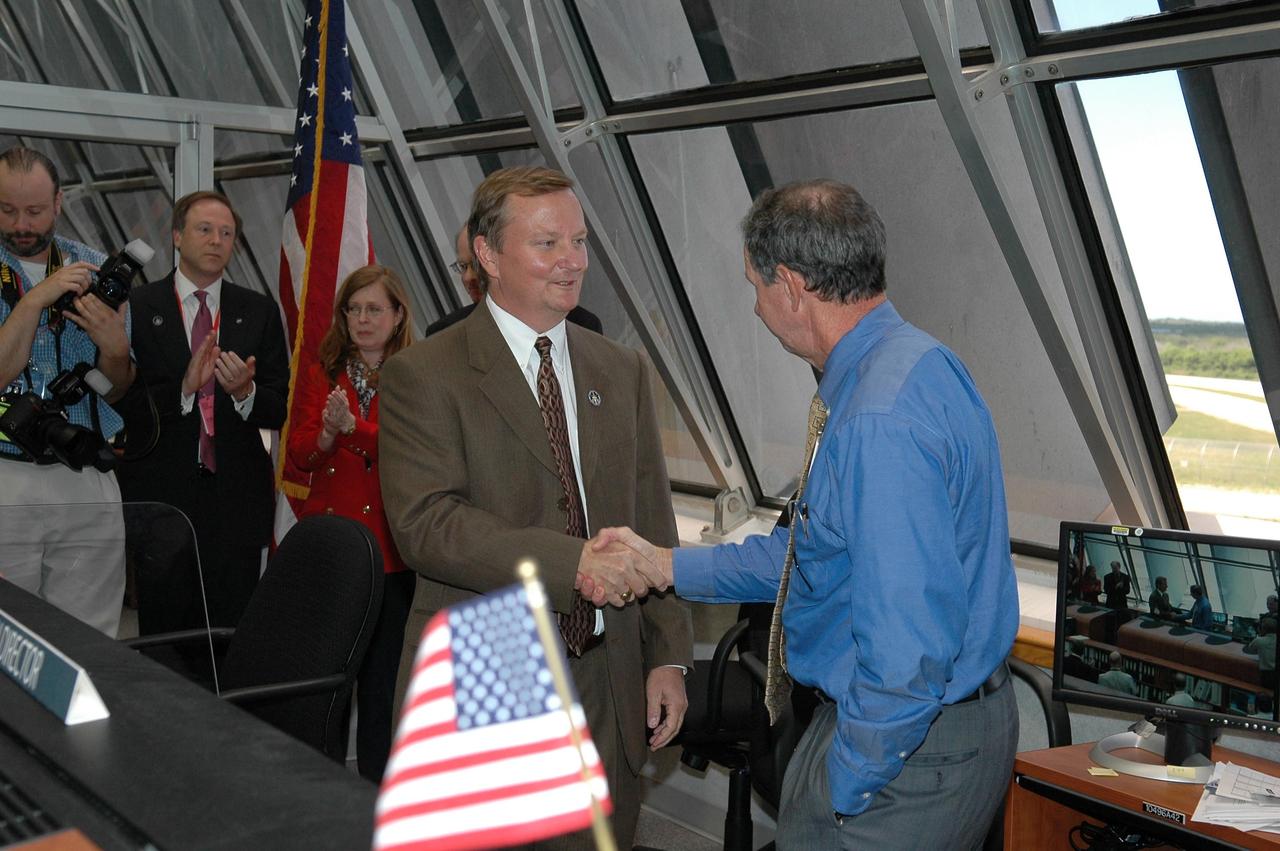
KENNEDY SPACE CENTER, FLA. - In Firing Room 4 of the Launch Control Center, Shuttle Launch Director Mike Leinbach (center) is congratulated by NASA Administrator Mike Griffin (right) for the successful launch of Space Shuttle Discovery on mission STS-121. The launch was the first ever to take place on Independence Day. Behind Leinbach are David R. Mould, assistant administrator for Public Affairs NASA, and Lisa Malone, director of External Relations at Kennedy. Liftoff was on-time at 2:38 p.m. EDT. During the 12-day mission, the STS-121 crew of seven will test new equipment and procedures to improve shuttle safety, as well as deliver supplies and make repairs to the International Space Station. Landing is scheduled for July 16 or 17 at Kennedy's Shuttle Landing Facility. Photo credit: NASA/Kim Shiflett
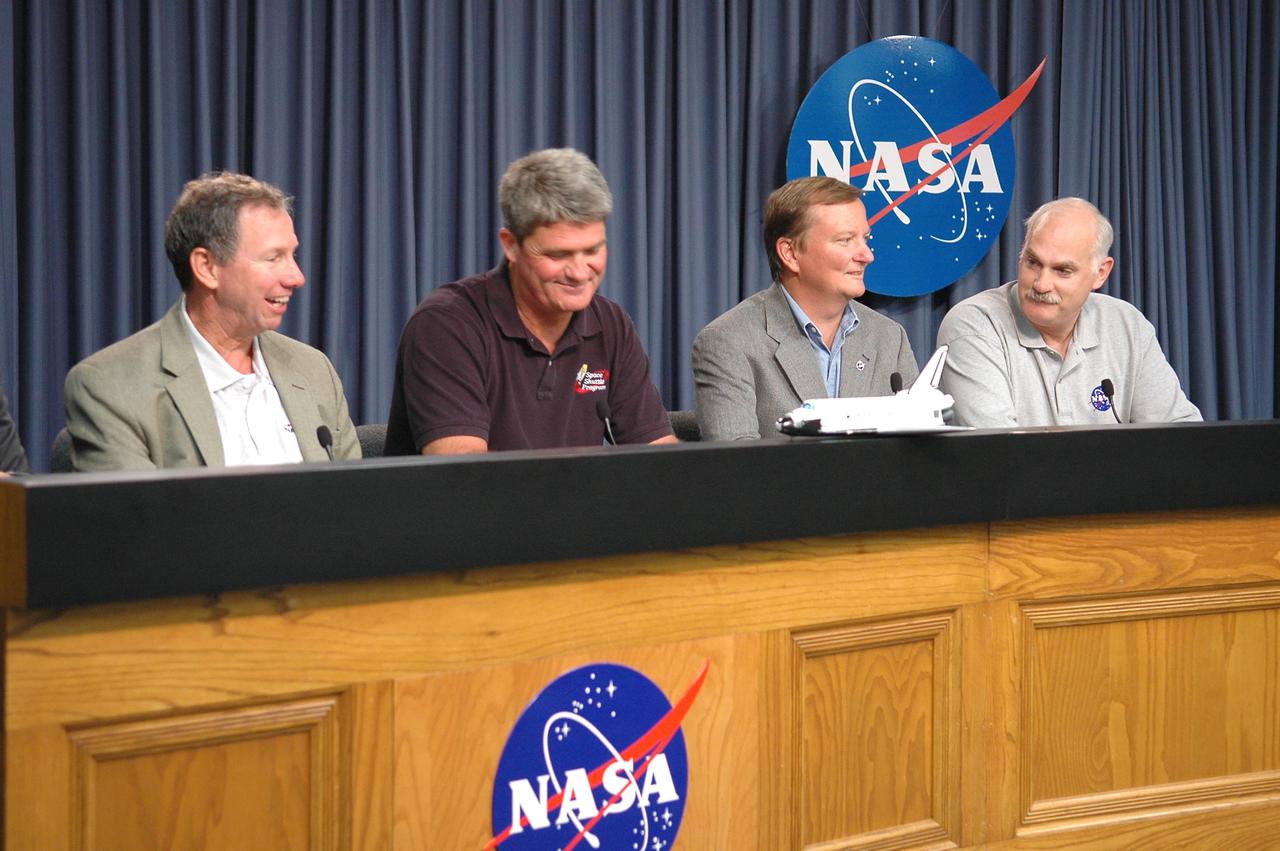
KENNEDY SPACE CENTER, FLA. - At a post-landing briefing, mission management cannot help smiling over the good news that Space Shuttle Discovery safely landed at Edwards Air Force Base in California. From left are NASA Administrator Mike Griffin, Space Shuttle Program Manager Bill Parsons, Shuttle Launch Director Mike Leinbach and Associate Administrator of NASA’s Space Operations Mission Directorate Bill Readdy. A landing at Kennedy Space Center was deferred due to weather concerns. The California landing occurred at 8:11 a.m. EDT, guided by Mission Commander Eileen Collins. Discovery spent two weeks in space on Return to Flight mission STS-114, where the crew demonstrated new methods to inspect and repair the Shuttle in orbit. The crew also delivered supplies, outfitted and performed maintenance on the International Space Station. A number of these tasks were conducted during three spacewalks.
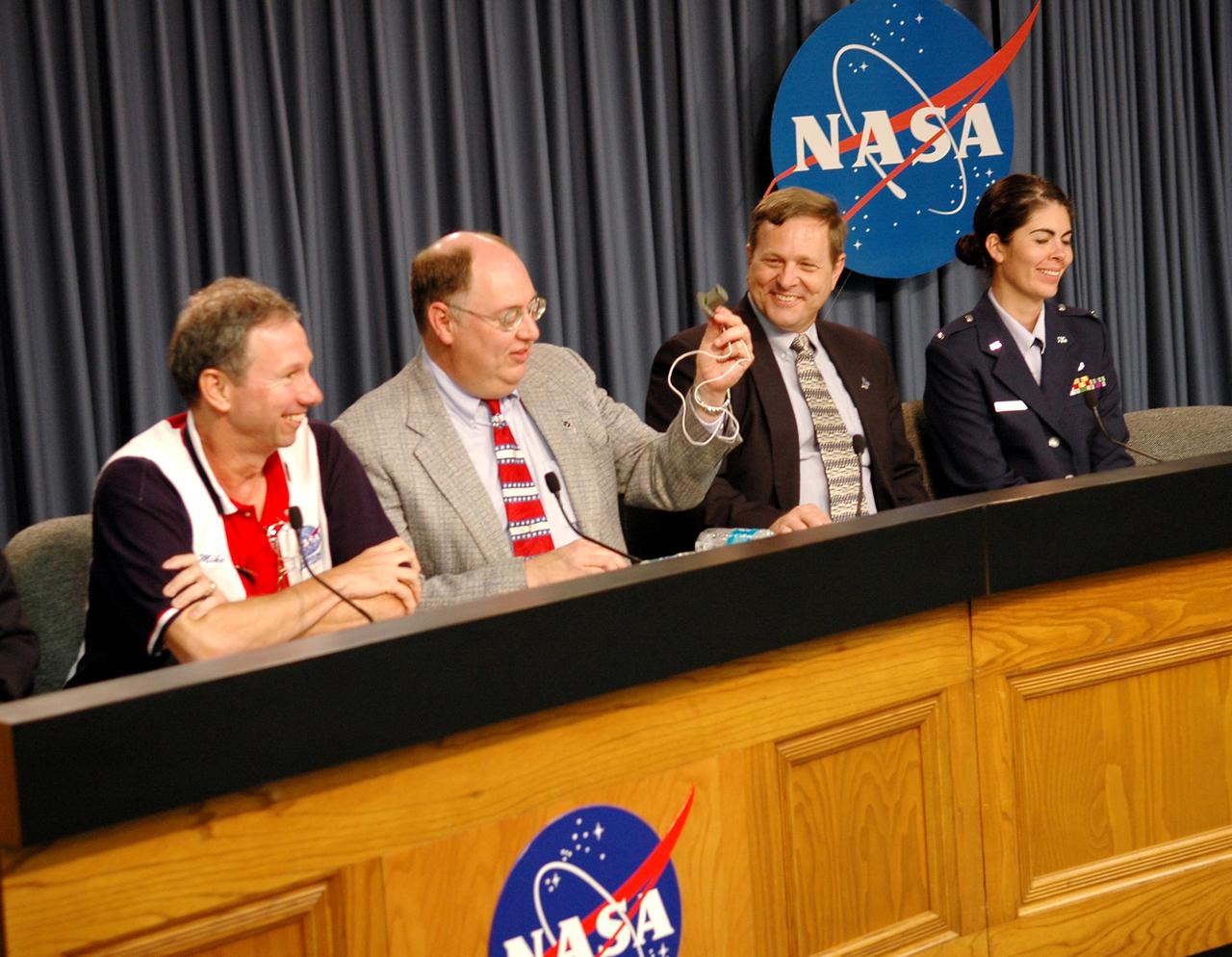
KENNEDY SPACE CENTER, FLA. - At the STS-114 Launch Readiness Press Conference at NASA Kennedy Space Center, the plan to launch July 26 is confirmed. Seated from left are NASA Administrator Mike Griffin, Space Shuttle Deputy Program Manager Wayne Hale, Shuttle Processing Director Mike Wetmore and launch weather officer 1st Lt. Mindy Chavez, with the U.S. Air Force 45th Weather Squadron. Hale is holding an ECO (engine cut-off) sensor similar to the one in Space Shuttle Discovery’s External Tank that had a faulty reading in the first launch attempt. Liftoff of Space Shuttle Discovery on the Return to Flight mission STS-114 is scheduled for 10:39 a.m. EDT July 26 from Launch Pad 39B.
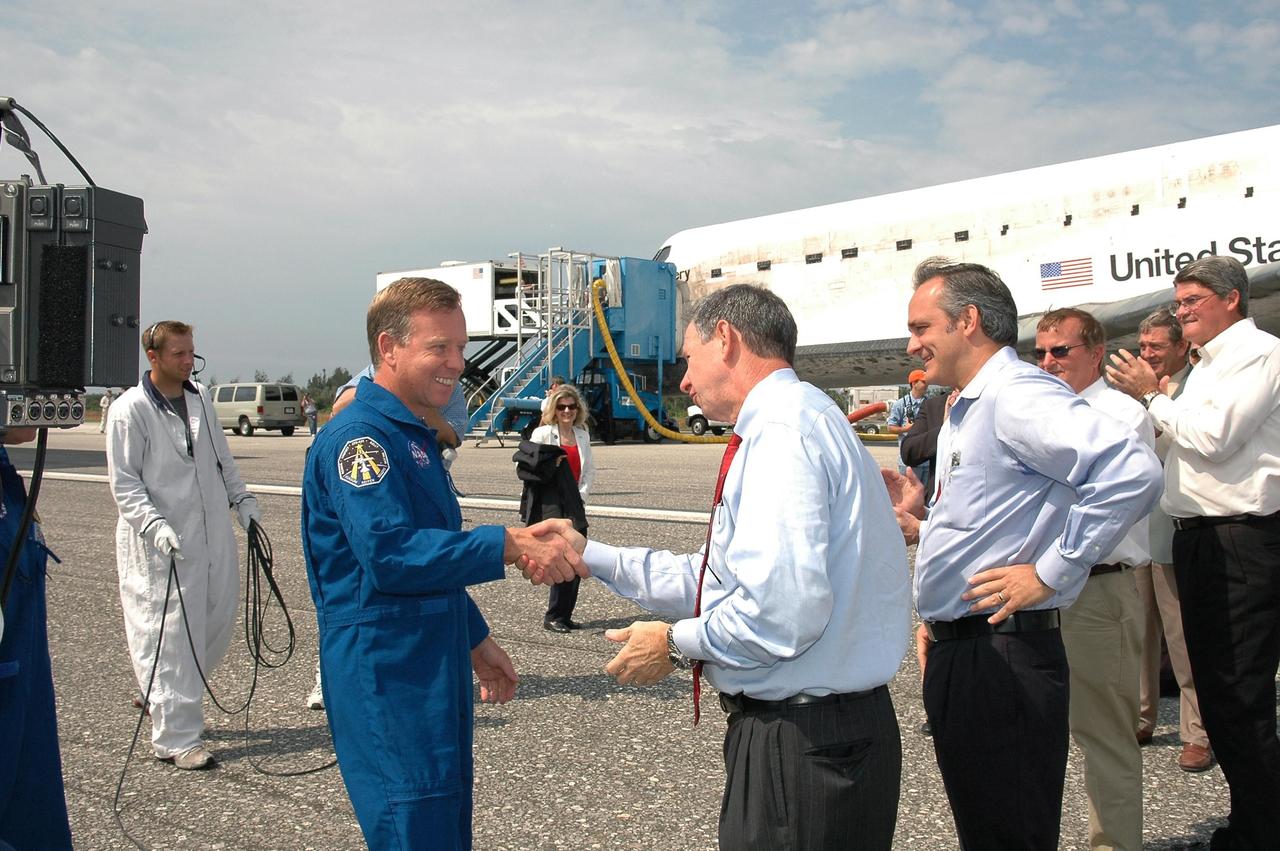
KENNEDY SPACE CENTER, FLA. - STS-121 Mission Commander Steven Lindsey is greeted by NASA Administrator Mike Griffin, Associate Administrator Rex Geveden, Shuttle Launch Director Mike Leinbach, KSC Deputy Director Bill Parsons and other senior managers after leaving the orbiter Discovery, in the background. The rest of the crew are Pilot Mark Kelly and Mission Specialists Piers Sellers, Lisa Nowak and Stephanie Wilson. Mission Specialist Thomas Reiter, who launched with the crew on July 4, remained on the station to join the Expedition 13 crew there. Discovery's smooth and perfect landing was on time at 9:14 a.m. EDT on Runway 15 of NASA's Shuttle Landing Facility after traveling 5.3 million miles on 202 orbits. Mission elapsed time was 12 days, 18 hours, 37 minutes and 54 seconds. The landing is the 62nd at Kennedy Space Center and the 32nd for Discovery. Photo credit: NASA/Kim Shiflett
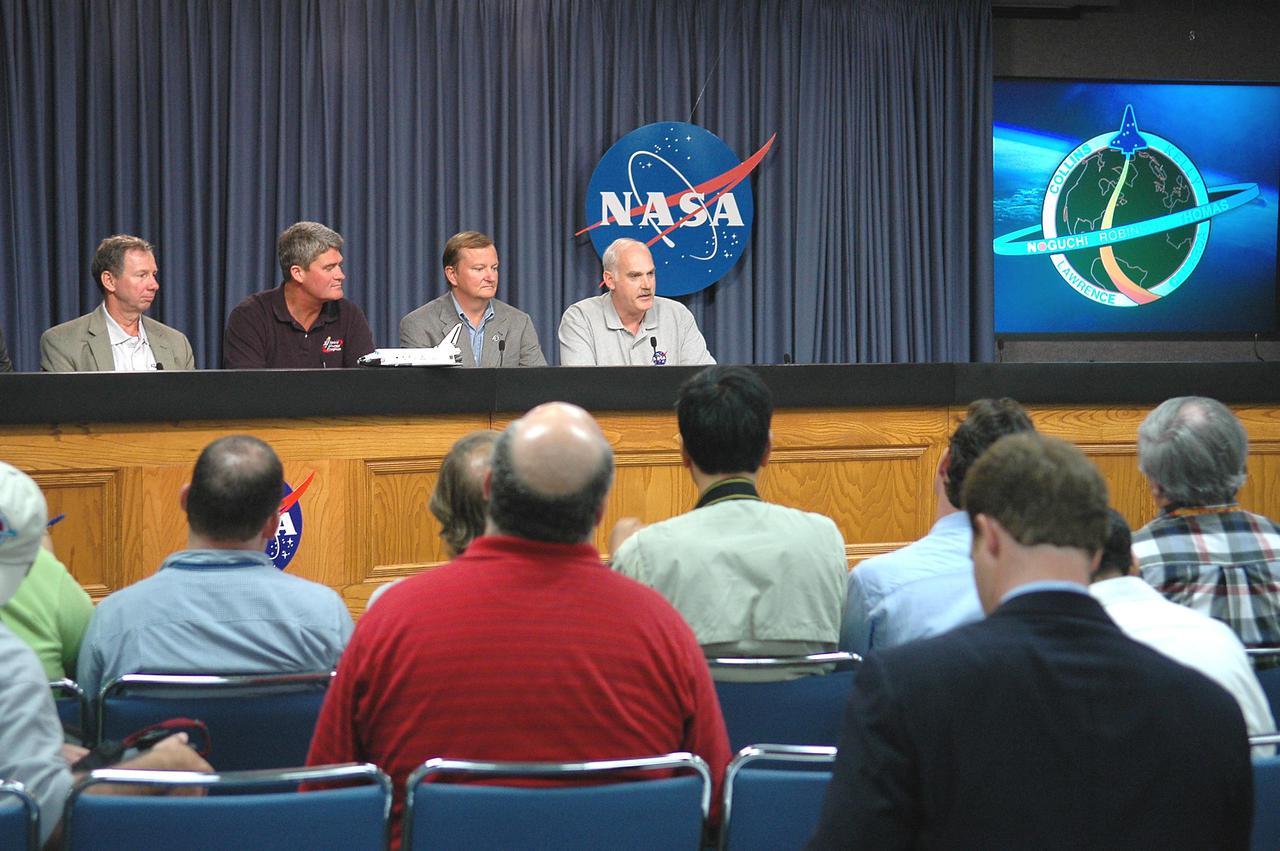
KENNEDY SPACE CENTER, FLA. - At a post-landing briefing, NASA Administrator Mike Griffin, Space Shuttle Program Manager Bill Parsons, Shuttle Launch Director Mike Leinbach and Associate Administrator of NASA’s Space Operations Mission Directorate Bill Readdy respond to questions from the media. Space Shuttle Discovery safely landed at Edwards Air Force Base in California at 8:11 a.m. EDT, guided by Mission Commander Eileen Collins. Discovery spent two weeks in space on Return to Flight mission STS-114, where the crew demonstrated new methods to inspect and repair the Shuttle in orbit. The crew also delivered supplies, outfitted and performed maintenance on the International Space Station. A number of these tasks were conducted during three spacewalks.
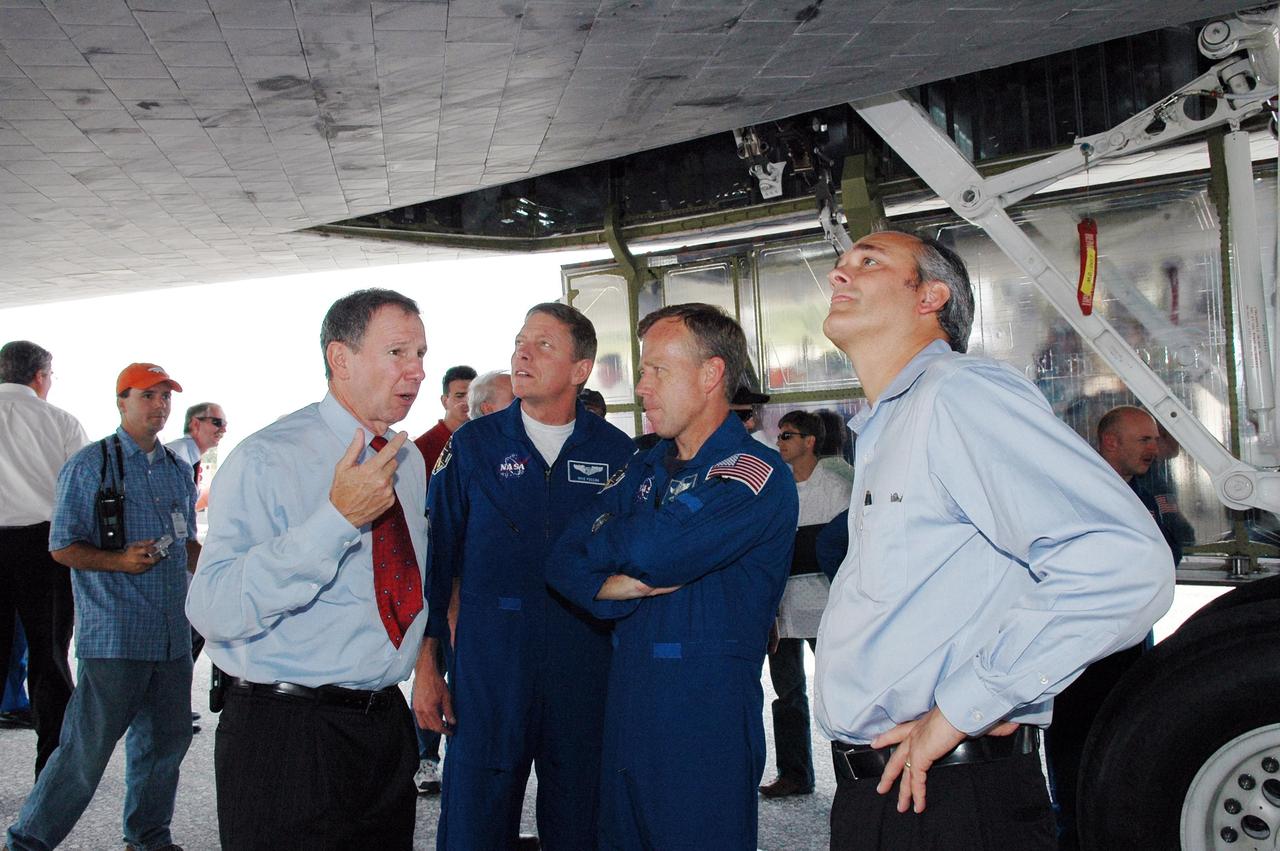
KENNEDY SPACE CENTER, FLA. - During the traditional post-flight walk-around after the landing of an orbiter, crew members Michael Fossum, mission specialist, and Steven Lindsey, commander, talk with NASA Administrator Mike Griffin (left). At right is Associate Administrator Rex Geveden. Discovery's smooth and perfect landing was on time at 9:14 a.m. EDT on Runway 15 of NASA's Shuttle Landing Facility after traveling 5.3 million miles on 202 orbits. Mission elapsed time was 12 days, 18 hours, 37 minutes and 54 seconds. The landing is the 62nd at Kennedy Space Center and the 32nd for Discovery. Photo credit: NASA/Kim Shiflett
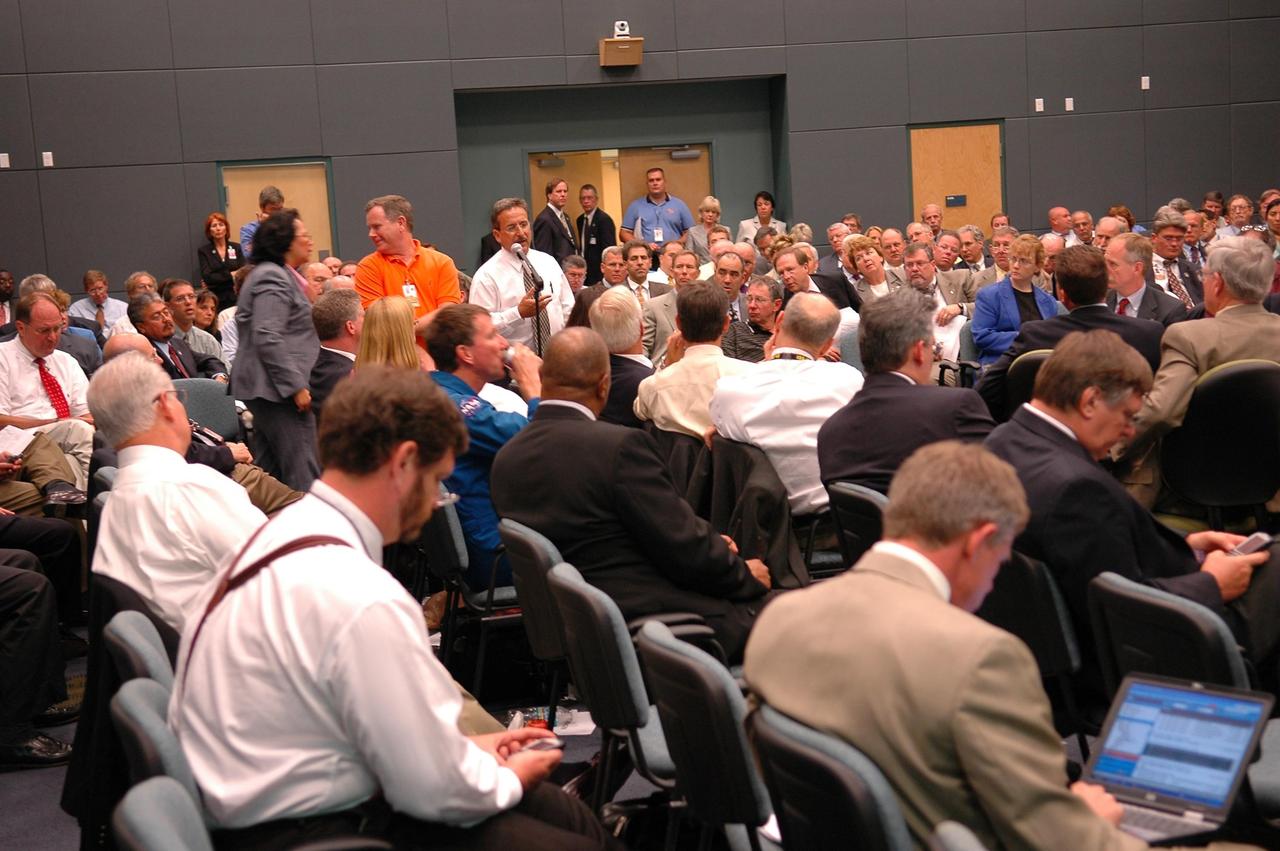
KENNEDY SPACE CENTER, FLA. - Space Shuttle Program and mission managers meet for the traditional Flight Readiness Review, a thorough assessment of preparations for the mission. Listening to a comment from attendees is NASA Administrator Mike Griffin (fourth to the right of the speaker) and Associate Administrator for Space Operations William Gerstenmaier and KSC Deputy Director Bill Parsons, at far right. The June 16-17 meeting is designed to produce a number of key decisions about Discovery's mission, STS-121, including selection of an official launch date. Photo credit: NASA/Kim Shiflett
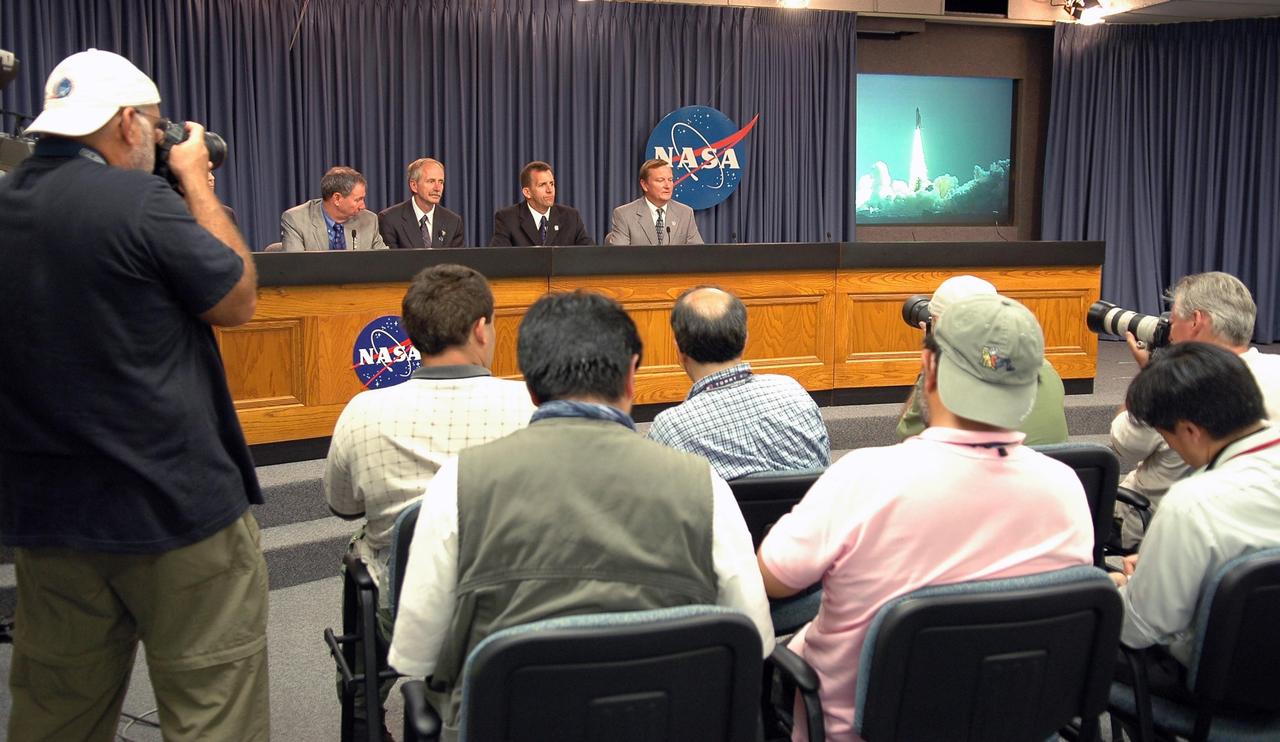
KENNEDY SPACE CENTER, FLA. - Following the successful launch of Space Shuttle Atlantis on mission STS-115, NASA Administrator Michael Griffin, Associate Administrator for Space Operations Mission William Gerstenmaier, Launch Integration Director LeRoy Cain and Shuttle Launch Director Mike Leinbach respond to questions from the media during a post-launch press conference. Mission STS-115 is the 116th space shuttle flight, the 27th flight for orbiter Atlantis, and the 19th U.S. flight to the International Space Station. STS-115 is scheduled to last 11 days with a planned landing at KSC. Photo credit: NASA/Kim Shiflett
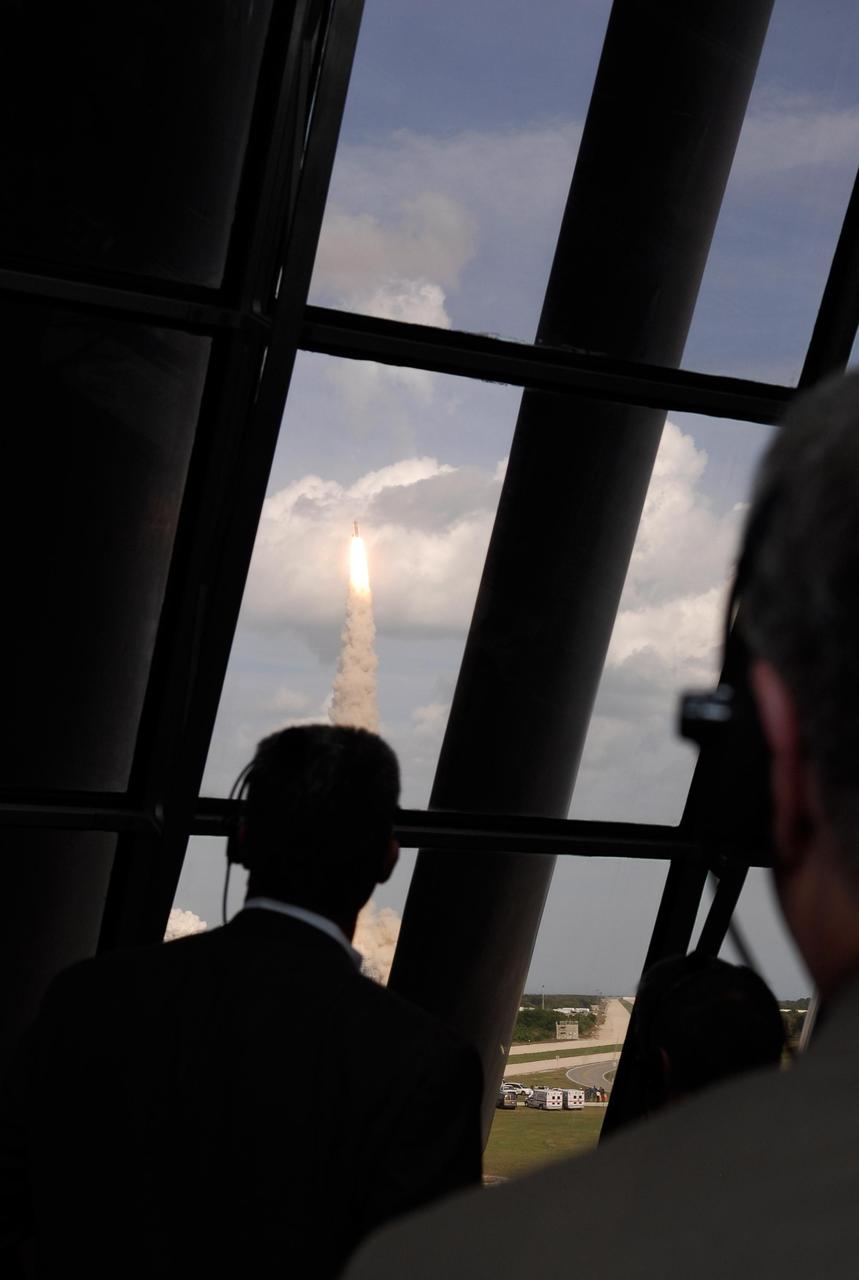
KENNEDY SPACE CENTER, FLA. -- The launch of space shuttle Atlantis is viewed through the windows of the Launch Control Center, where VIPS gathered to watch, including Center Director Bill Parsons, Associate Administrator for NASA Space Operations William H. Gerstenmaier and NASA Administrator Mike Griffin. Liftoff was on time at 2:45 p.m. EST from Launch Pad 39A. The launch is the third attempt for Atlantis since December 2007 to carry the European Space Agency's Columbus laboratory to the International Space Station. During the 11-day mission, the crew's prime objective is to attach the laboratory to the Harmony module, adding to the station's size and capabilities. Photo credit: NASA/Kim Shiflett
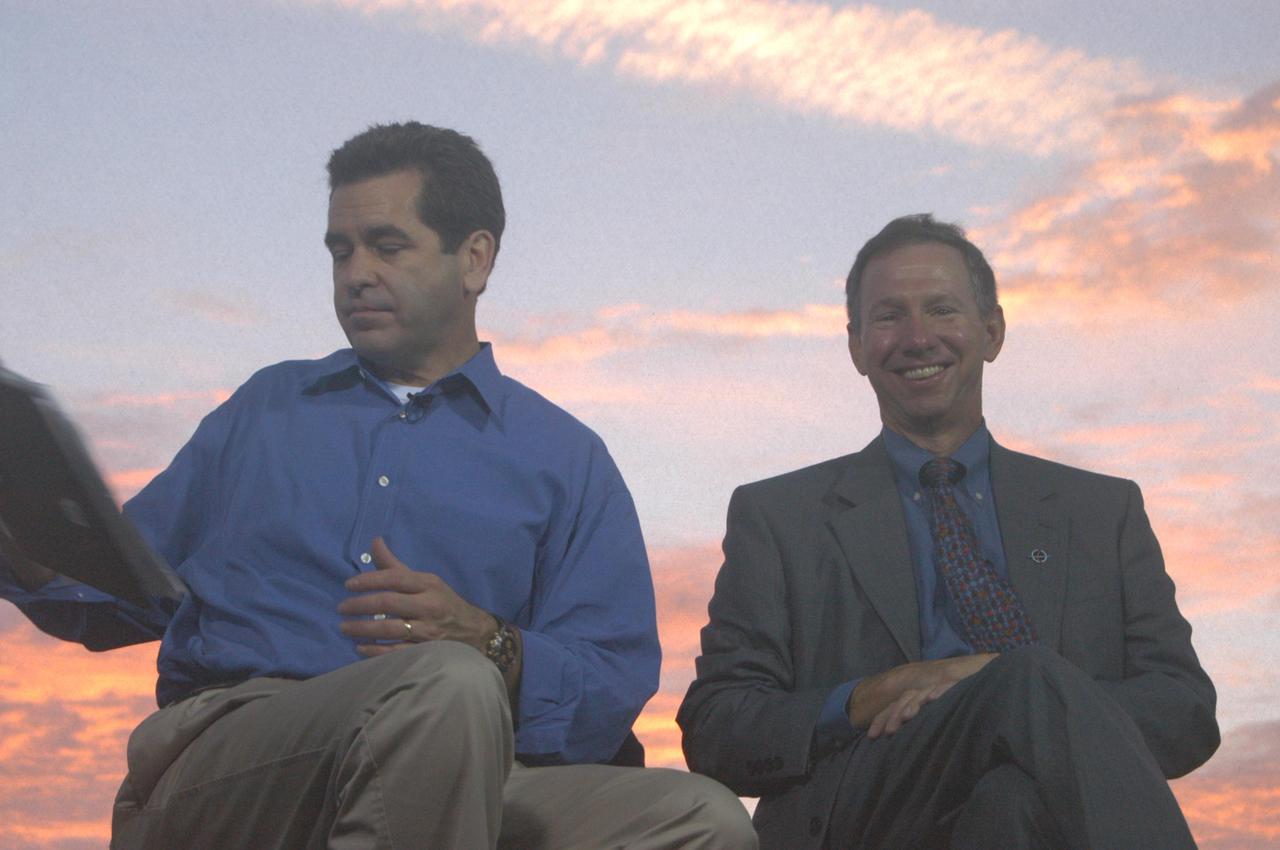
KENNEDY SPACE CENTER, FLA. - Against a sunrise-painted sky at NASA Kennedy Space Center, Miles O’Brien (left), co-anchor on CNN’s American Morning, checks his notes during a talk on air with NASA Administrator Mike Griffin about the pending 3:51 p.m. launch of Space Shuttle Discovery on the historic Return to Flight mission STS-114. It is the 114th Space Shuttle flight and the 31st for Discovery. The 12-day mission is expected to end with touchdown at the Shuttle Landing Facility at 11:06 a.m. July 25.
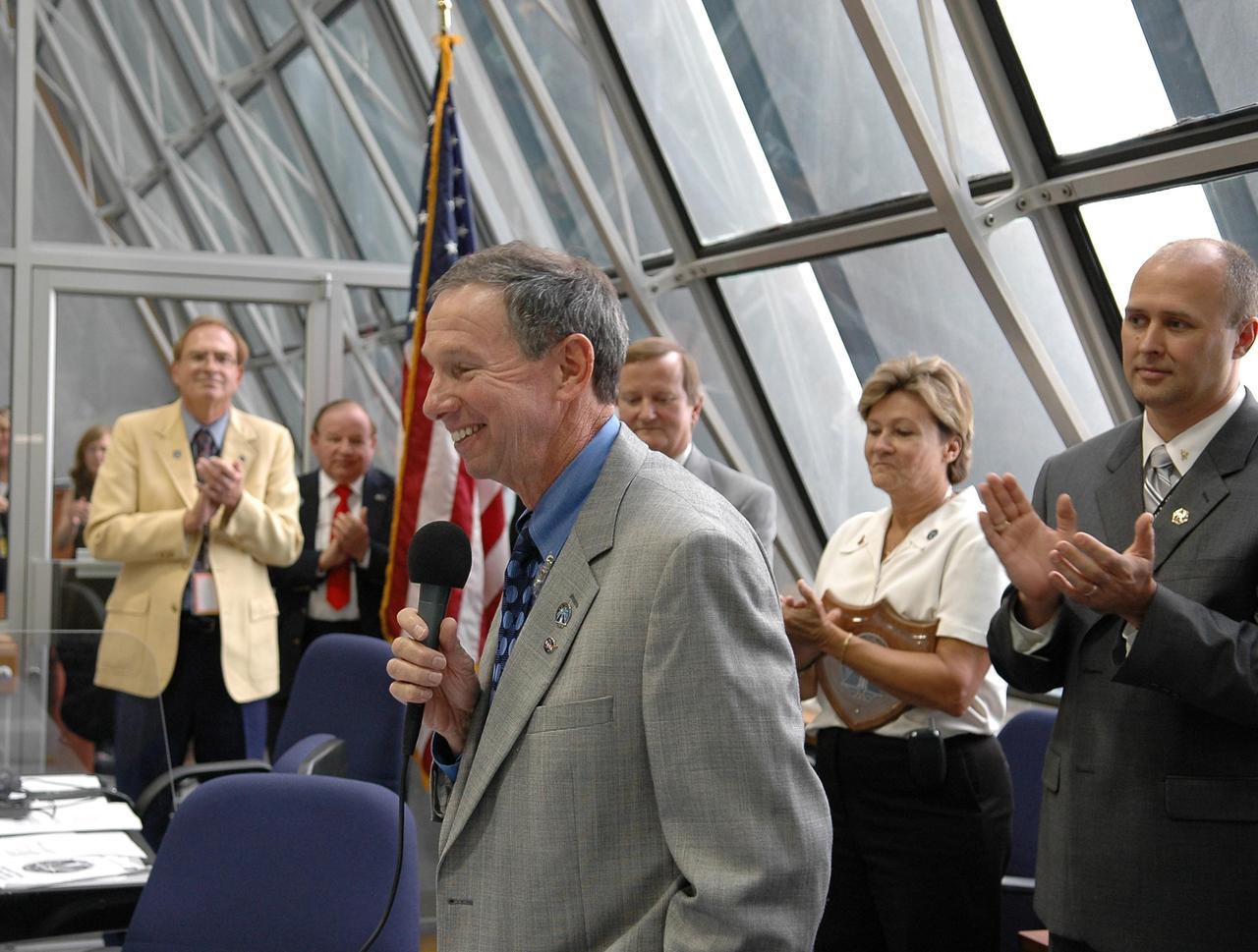
KENNEDY SPACE CENTER, FLA. - Inside the Launch Control Center, NASA Administrator Michael Griffin congratulates the launch team after the liftoff of Space Shuttle Atlantis on mission STS-115. Behind him are (left to right) Shuttle Launch Director Mike Leinbach, Pat Leslie and Robbie Ashley, STS-115 payload manager. Mission STS-115 is the 116th space shuttle flight, the 27th flight for orbiter Atlantis, and the 19th U.S. flight to the International Space Station. Mission STS-115 is scheduled to last 11 days with a planned landing at KSC. Photo credit: NASA/Kim Shiflett
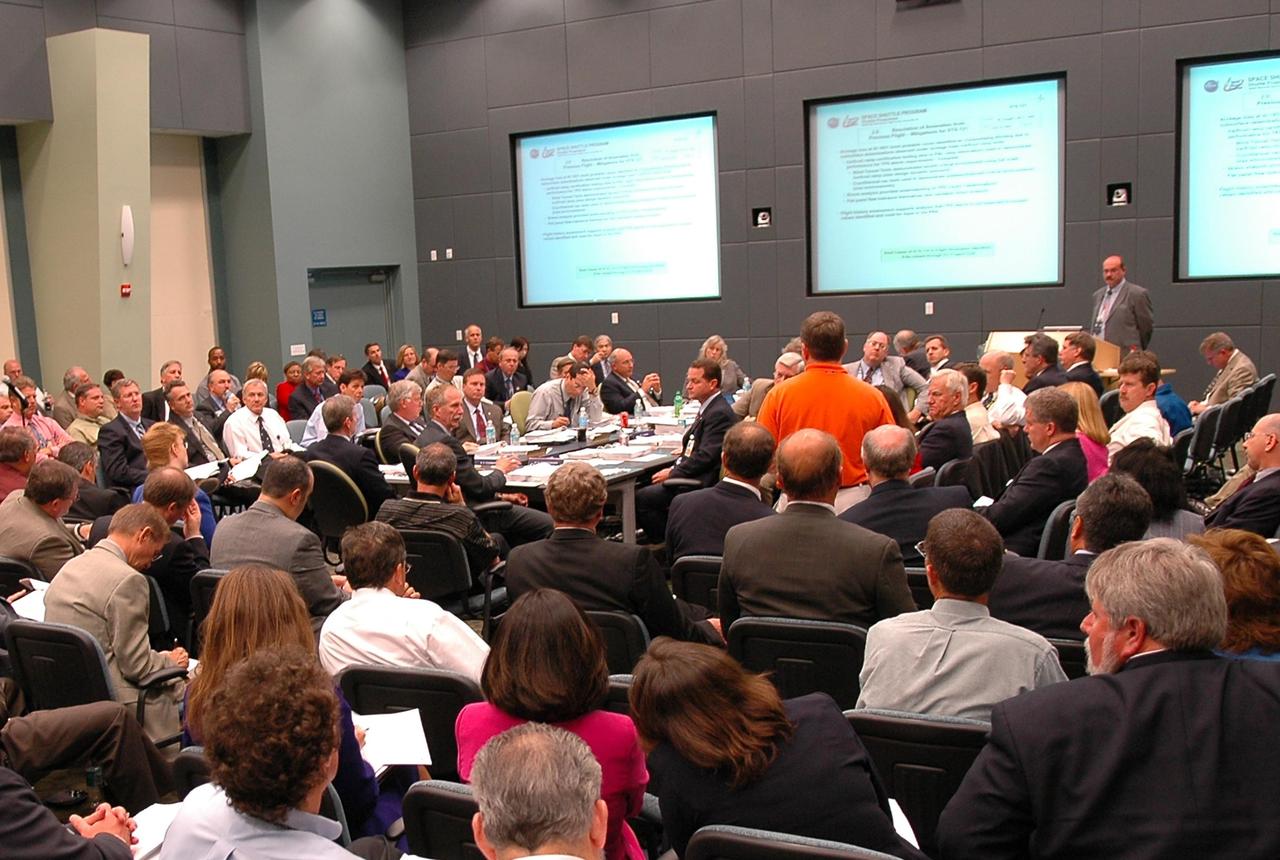
KENNEDY SPACE CENTER, FLA. - Space Shuttle Program and mission managers meet for the traditional Flight Readiness Review, a thorough assessment of preparations for the mission. Among those seated at the table on the left are Center Director Jim Kennedy, Associate Administrator for Space Operations William Gerstenmaier and Marshall Space Flight Center Director Dave King. Shuttle Program Manager Wayne Hale is seated under the center screen on the back wall. Also attending is NASA Administrator Mike Griffin. The June 16-17 meeting is designed to produce a number of key decisions about Discovery's mission, STS-121, including selection of an official launch date. Photo credit: NASA/Kim Shiflett
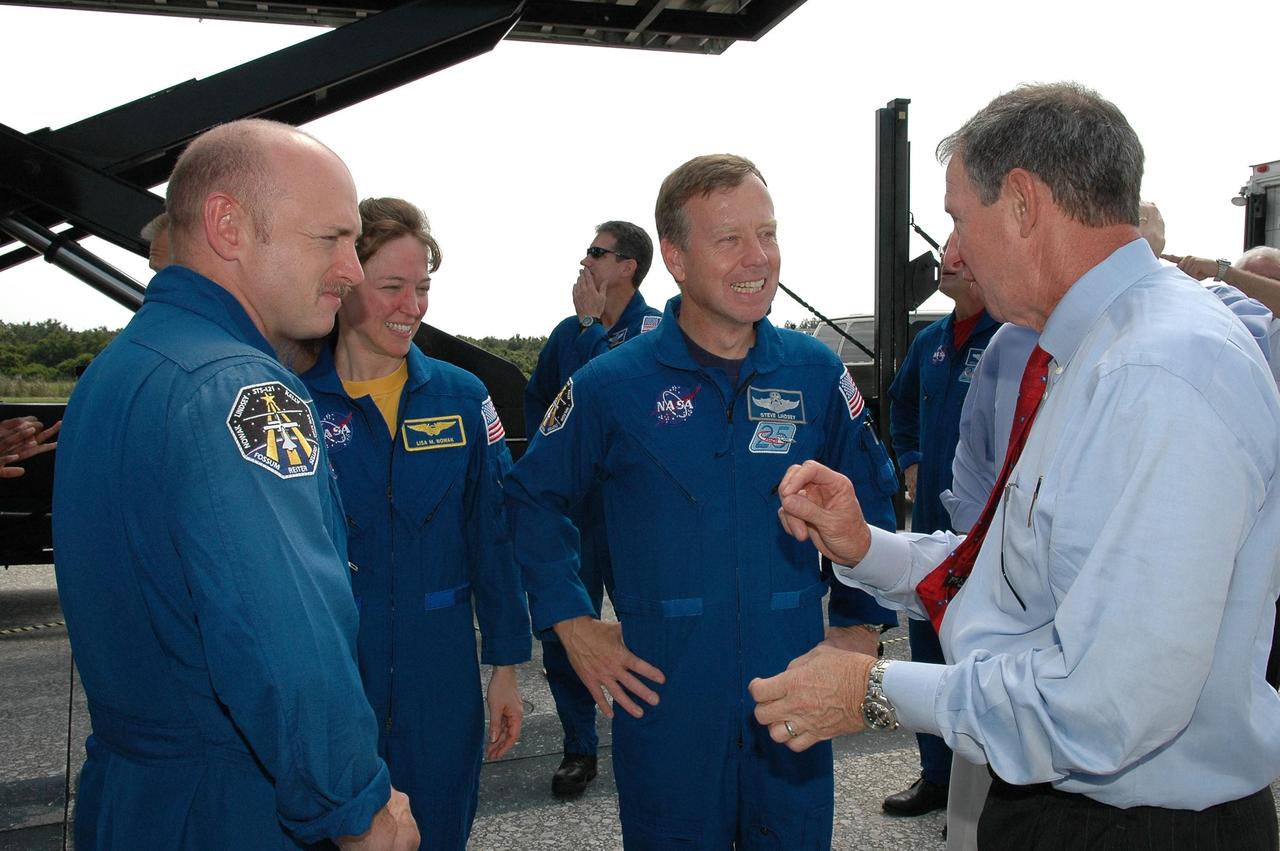
KENNEDY SPACE CENTER, FLA. - During the traditional post-flight walk-around after the landing of an orbiter, NASA Administrator Mike Griffin (right) shares a story with STS-121 Pilot Mark Kelly, Mission Specialist Lisa Nowak and Commander Steven Lindsey. Discovery's smooth and perfect landing was on time at 9:14 a.m. EDT on Runway 15 of NASA's Shuttle Landing Facility after traveling 5.3 million miles on 202 orbits. Mission elapsed time was 12 days, 18 hours, 37 minutes and 54 seconds. The landing is the 62nd at Kennedy Space Center and the 32nd for Discovery. Photo credit: NASA/Kim Shiflett
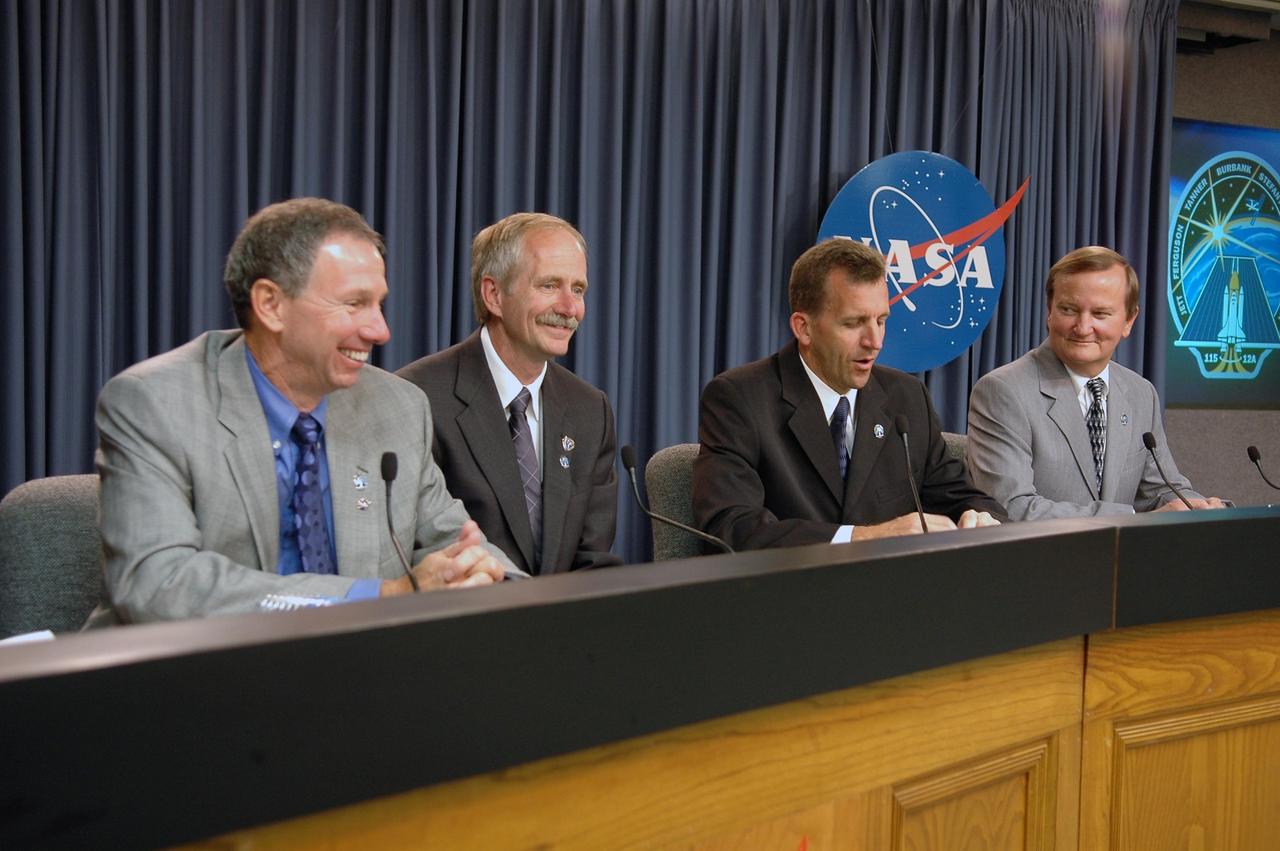
KENNEDY SPACE CENTER, FLA. - NASA and KSC officials discuss the successful launch of Space Shuttle Atlantis on mission STS-115 at a press conference at NASA's Kennedy Space Center. From left are NASA Administrator Michael Griffin, Associate Administrator for Space Operations Mission William Gerstenmaier, Launch Integration Director LeRoy Cain and Shuttle Launch Director Mike Leinbach.Mission STS-115 is the 116th space shuttle flight, the 27th flight for orbiter Atlantis, and the 19th U.S. flight to the International Space Station. STS-115 is scheduled to last 11 days with a planned landing at KSC. Photo credit: NASA/Kim Shiflett
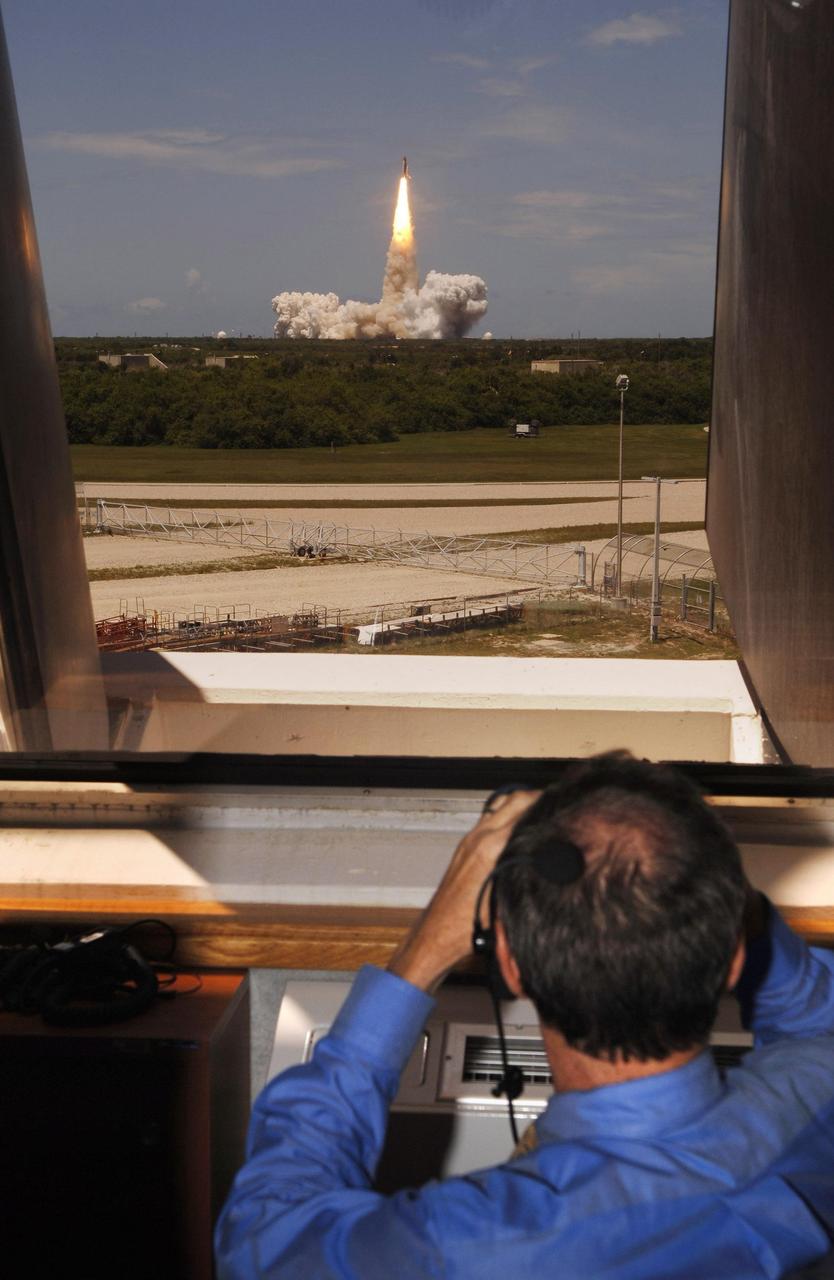
KENNEDY SPACE CENTER, FLA. - From Firing Room 4 of the Launch Control Center, NASA Administrator Mike Griffin uses binoculars to view of the launch of Space Shuttle Discovery (in the background) on mission STS-121. The launch made history as the first to occur on Independence Day. Liftoff was on-time at 2:38 p.m. EDT. During the 12-day mission, the STS-121 crew of seven will test new equipment and procedures to improve shuttle safety, as well as deliver supplies and make repairs to the International Space Station. Landing is scheduled for July 16 or 17 at Kennedy's Shuttle Landing Facility. Photo credit: NASA/Bill Ingalls

KENNEDY SPACE CENTER, FLA. -- Inside the Launch Control Center at NASA's Kennedy Space Center, NASA management watches and waits for the launch of space shuttle Atlantis on the STS-122 mission to the International Space Station. Standing at left is Center Director Bill Parsons. Seated at right are Associate Administrator for NASA Space Operations William H. Gerstenmaier and NASA Administrator Mike Griffin. The launch is the third attempt for Atlantis since December 2007 to carry the European Space Agency's Columbus laboratory to the International Space Station. During the 11-day mission, the crew's prime objective is to attach the laboratory to the Harmony module, adding to the station's size and capabilities. Photo credit: NASA/Kim Shiflett
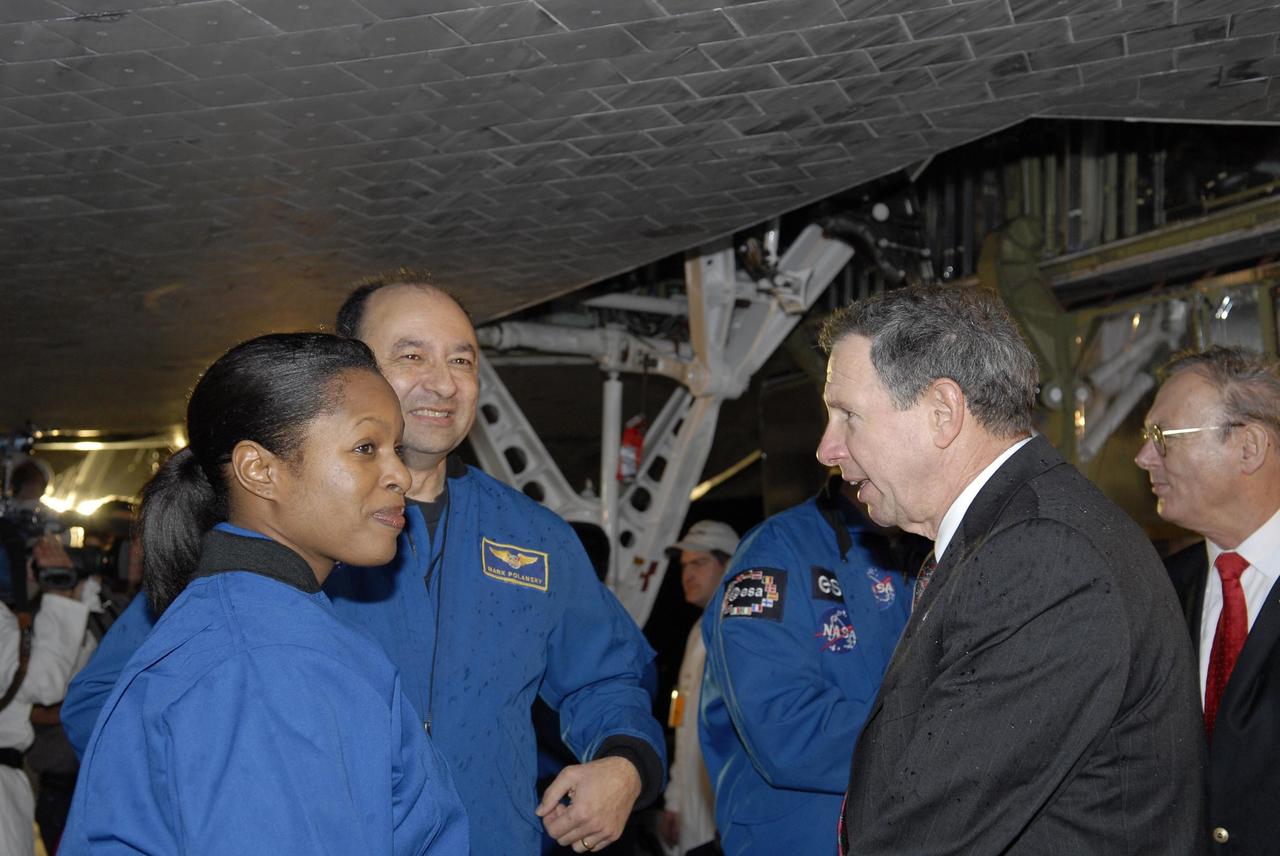
KENNEDY SPACE CENTER, FLA. -- Members of the STS-116 crew are congratulated by NASA Administrator Mike Griffin following the landing of Discovery on Runway 15 at NASA Kennedy Space Center's Shuttle Landing Facility. From left are Mission Specialists Joan Higginbotham, Commander Mark Polansky and Griffin, facing them. Other astronauts aboard Discovery not shown are Pilot William Oefelein; Mission Specialists Robert Curbeam, Nicholas Patrick, and Christer Fuglesang, who represents the European Space Agency; and European Space Agency astronaut Thomas Reiter, who is returning from a 6-month stay on the International Space Station. During the mission, three spacewalks attached the P5 integrated truss structure to the station, and completed the rewiring of the orbiting laboratory's power system. A fourth spacewalk retracted a stubborn solar array. Main gear touchdown was at 5:32 p.m. EST. Nose gear touchdown was at 5:32:12 p.m. and wheel stop was at 5:32:52 p.m. At touchdown -- nominally about 2,500 ft. beyond the runway threshold -- the orbiter is traveling at a speed ranging from 213 to 226 mph. Discovery traveled 5,330,000 miles, landing on orbit 204. Mission elapsed time was 12 days, 20 hours, 44 minutes and 16 seconds. This is the 64th landing at KSC. Photo credit: NASA/Kim Shiflett
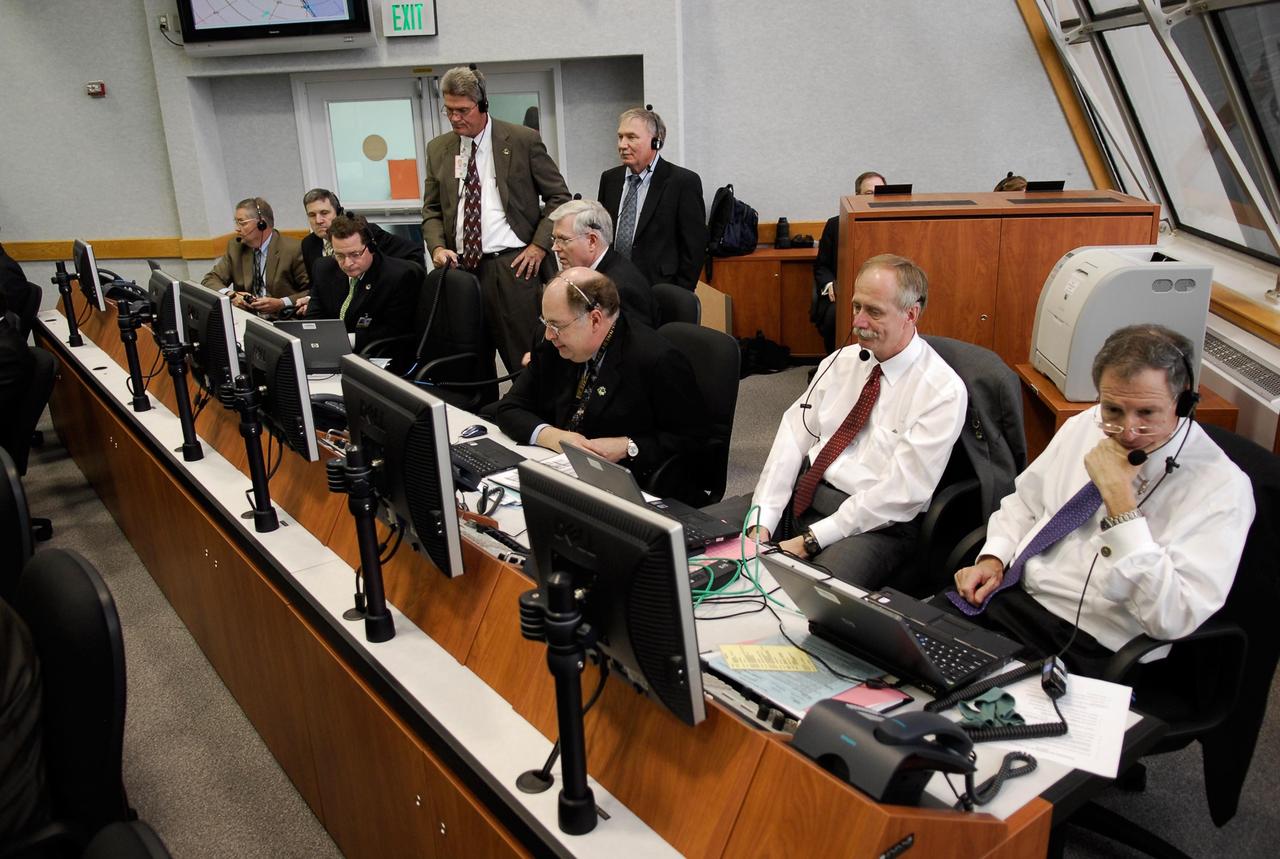
KENNEDY SPACE CENTER, FLA. -- Inside the Launch Control Center at NASA's Kennedy Space Center, NASA management watches and waits for the launch of space shuttle Atlantis on the STS-122 mission to the International Space Station. From right are NASA Administrator Mike Griffin, Associate Administrator for NASA Space Operations William H. Gerstenmaier, Shuttle Program Manager Wayne Hale. Standing on the left is Center Director Bill Parsons. The launch is the third attempt for Atlantis since December 2007 to carry the European Space Agency's Columbus laboratory to the International Space Station. During the 11-day mission, the crew's prime objective is to attach the laboratory to the Harmony module, adding to the station's size and capabilities. Photo credit: NASA/Kim Shiflett
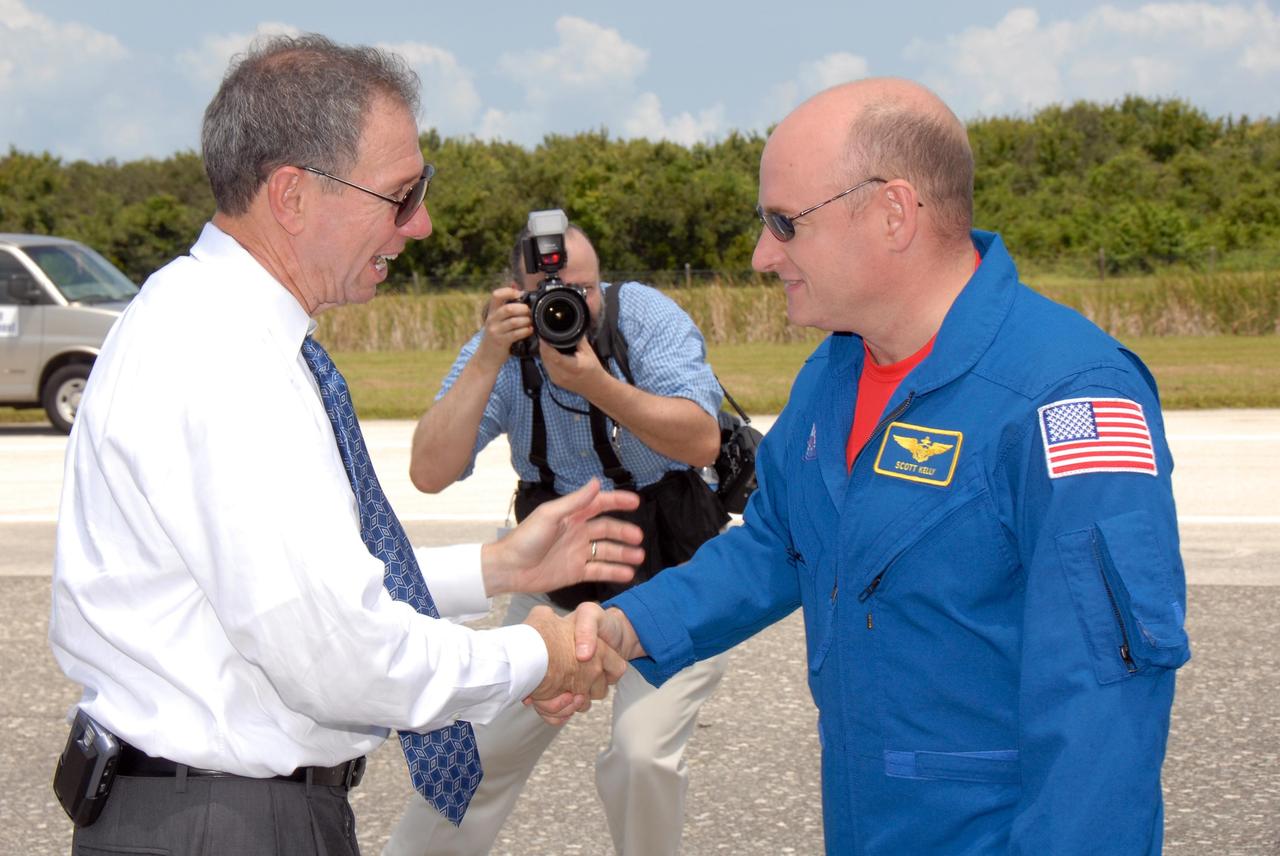
KENNEDY SPACE CENTER, FLA. -- A photographer captures the moment as NASA Administrator Mike Griffin (left) welcomes STS-118 Commander Scott Kelly back to Earth after completing mission STS-118. On the mission, the crew installed a new gyroscope, an external spare parts platform and another truss segment to the expanding station. Endeavour's main gear touched down at 12:32:16 p.m. EDT. Nose gear touchdown was at 12:32:29 p.m. and wheel stop was at 12:33:20 p.m. Endeavour landed on orbit 201. STS-118 was the 119th space shuttle flight, the 22nd flight to the station, the 20th flight for Endeavour and the second of four missions planned for 2007. This was the 65th landing of an orbiter at Kennedy. Photo credit: NASA/Kim Shiflett
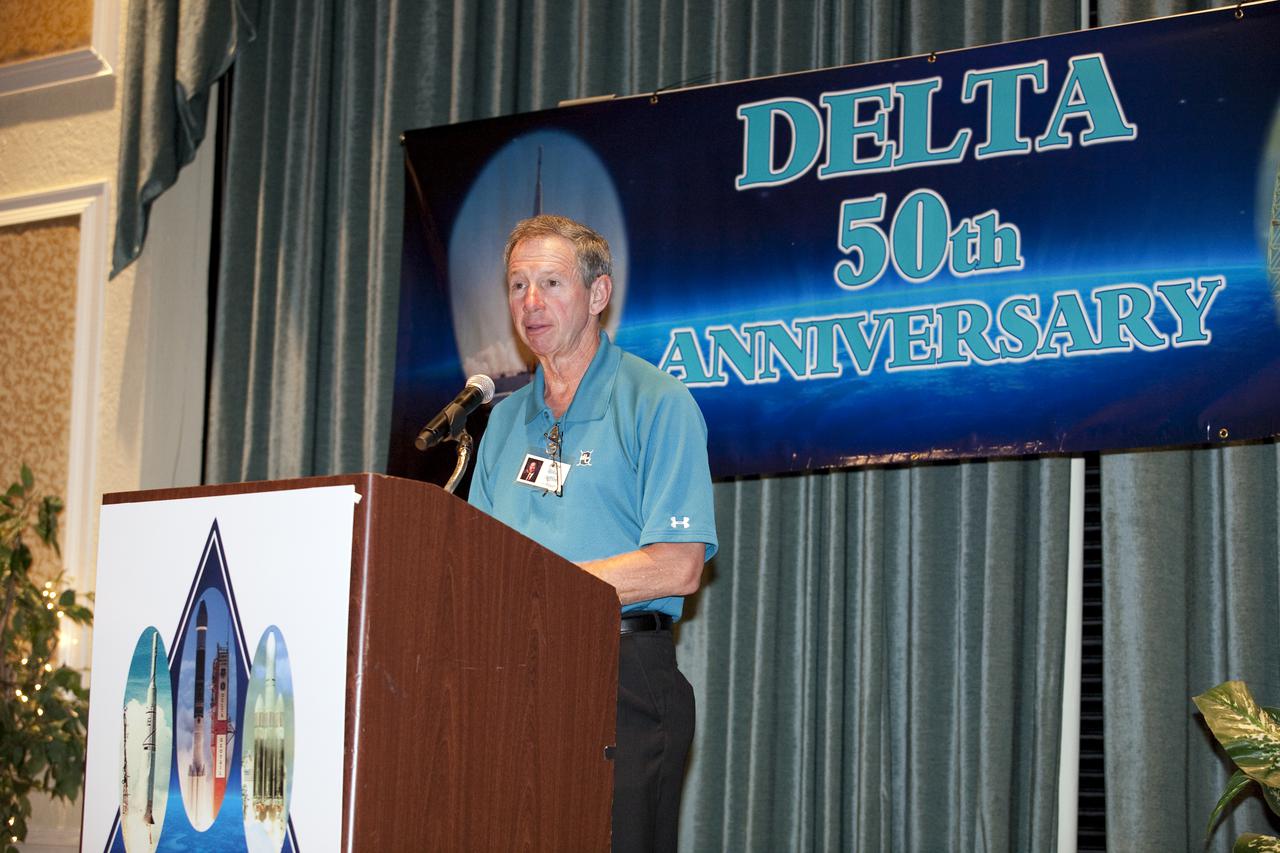
CAPE CANAVERAL, Fla. - Mike Griffin, professor of mechanical and aerospace engineering at the University of Alabama in Huntsville and former NASA administrator, helps the space agency, the U.S. Air Force, United Launch Alliance, Boeing, Pratt and Whitney Rocketdyne, Aerojet and the NASA Alumni League celebrate the Delta expendable launch vehicle program's 50th anniversary at the Radisson Resort in Cape Canaveral, Fla., on May 16. NASA launched the first Delta rocket, which only was intended to be an interim launch vehicle, on May 13, 1960. A half-century later, more than 300 Delta rockets have launched to place crucial weather and environmental satellites into Earth orbit. The vehicles also have sent spacecraft on missions to other planets and comets, and to study the universe. Currently, the Delta II and Delta IV are in use by NASA's Launch Services Program based at Kennedy Space Center in Florida, and are launched by United Launch Alliance. Photo credit: NASA_Amanda Diller
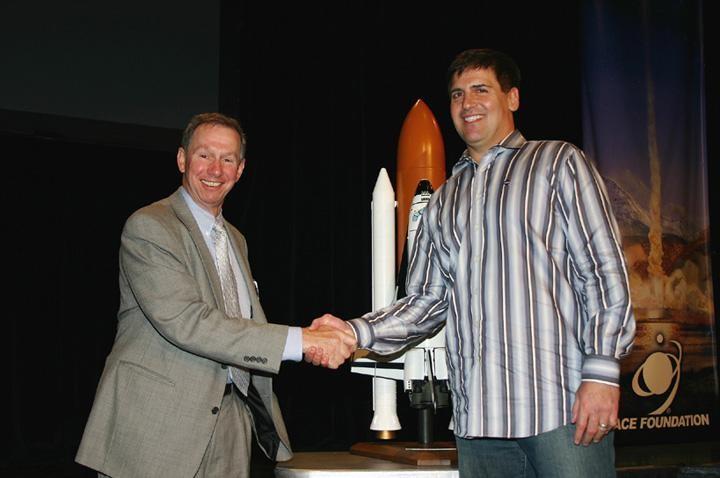
KENNEDY SPACE CENTER, FLA. - NASA Administrator Mike Griffin (left) and HDNet Chairman and President Mark Cuban shake hands after announcing an agreement for HDNet to provide high definition TV coverage of space shuttle launches through 2010. The announcement was made at a news conference held in Colorado Springs, Colo. The news conference was hosted by the Space Foundation during its 22nd National Space Symposium that ended today. HDNet will broadcast the shuttle flights in high definition TV, known as HDTV, which has at least twice the resolution of standard television formats. HDNet also will provide the agency a standard broadcast signal of launches for use by media networks and NASA TV. When possible, it will air HDTV coverage of NASA's expendable rocket launches on its network.
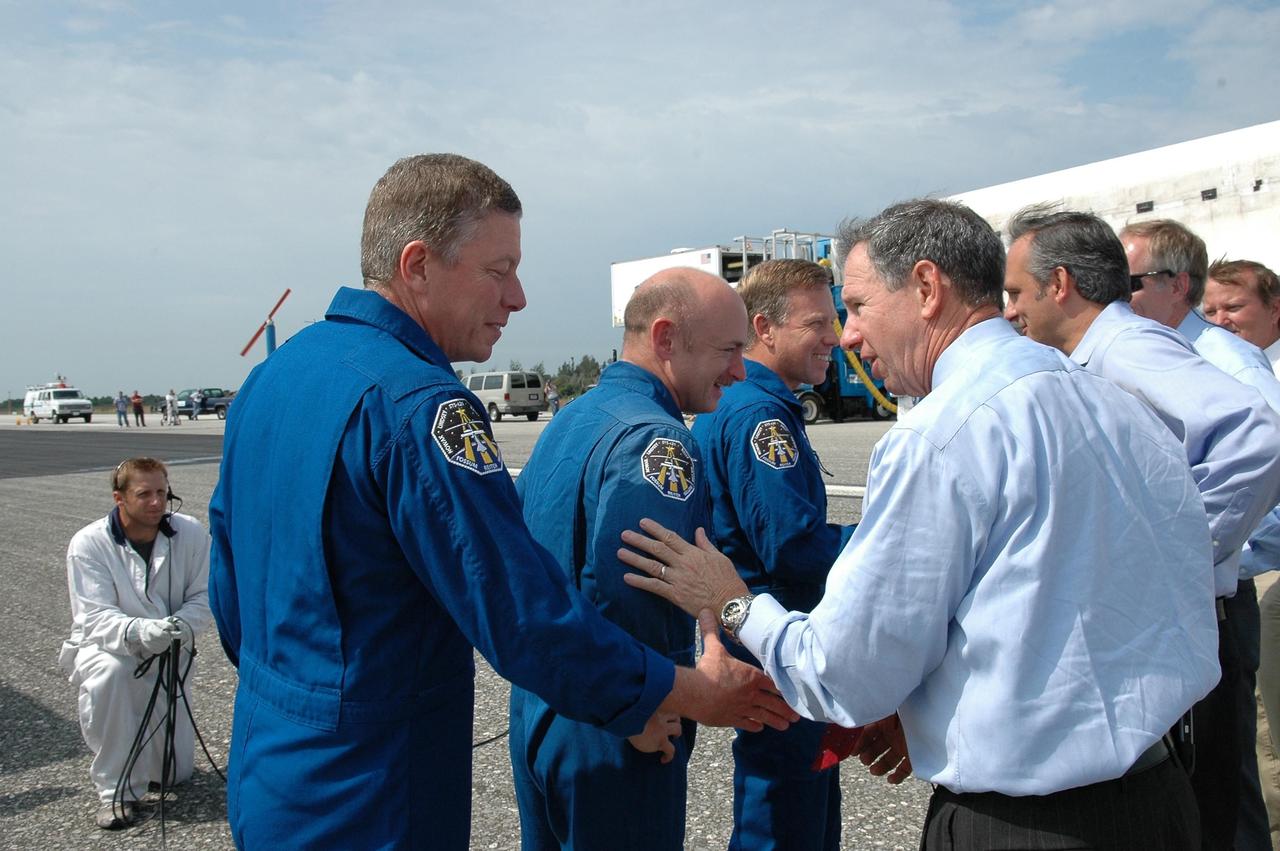
KENNEDY SPACE CENTER, FLA. - (From left) STS-121 Mission Specialist Michael Fossum, Pilot Mark Kelly and Commander Steven Lindsey are greeted by NASA Administrator Mike Griffin (foreground, right), Associate Administrator Rex Geveden and other senior managers after leaving the orbiter Discovery, in the background. The rest of the crew are Mission Specialists Piers Sellers, Lisa Nowak and Stephanie Wilson. Mission Specialist Thomas Reiter, who launched with the crew on July 4, remained on the station to join the Expedition 13 crew there. Discovery's smooth and perfect landing was on time at 9:14 a.m. EDT on Runway 15 of NASA's Shuttle Landing Facility after traveling 5.3 million miles on 202 orbits. Mission elapsed time was 12 days, 18 hours, 37 minutes and 54 seconds. The landing is the 62nd at Kennedy Space Center and the 32nd for Discovery. Photo credit: NASA/Kim Shiflett
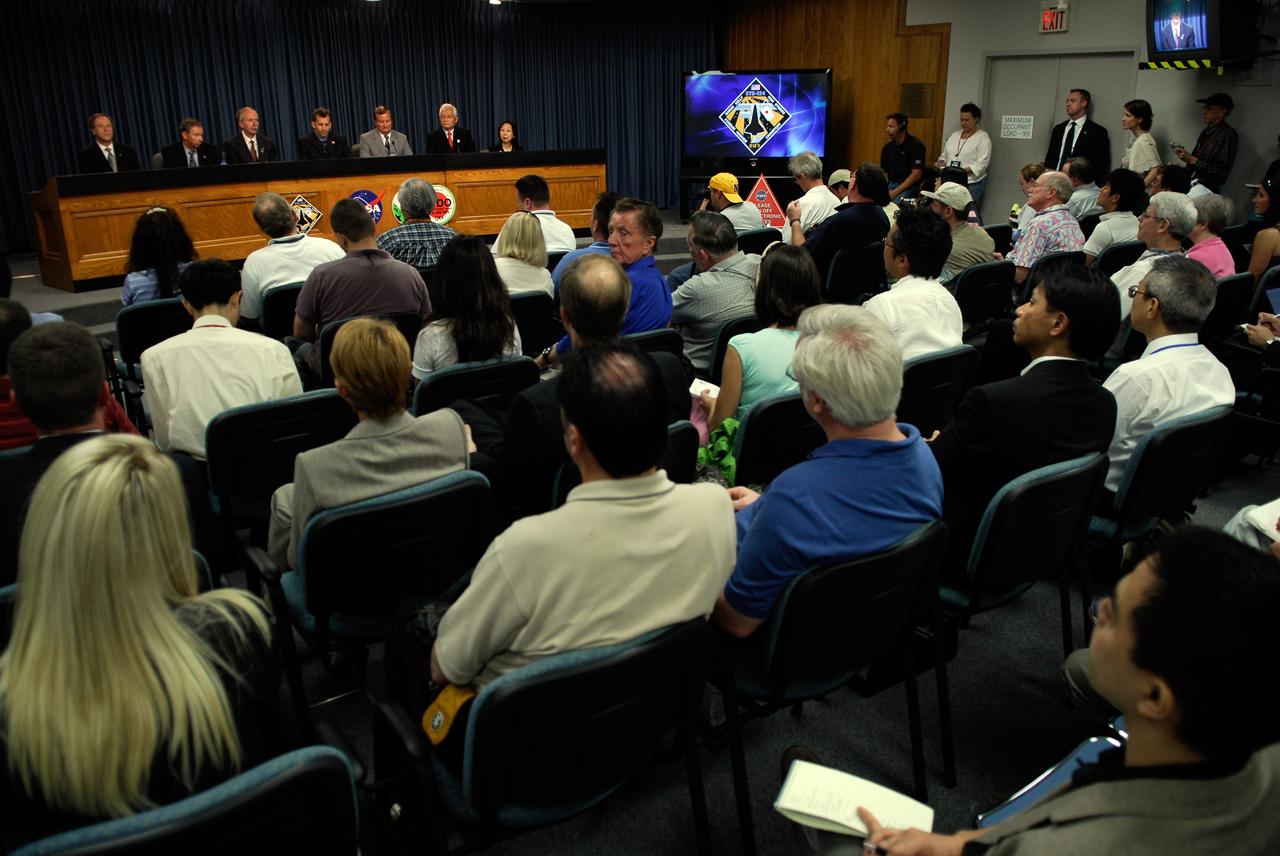
CAPE CANAVERAL, Fla. -- The media fill the NASA's News Center television studio for a news conference with key NASA personnel following the successful launch of space shuttle Discovery on the STS-124 mission. On the stage are (left to right) Public Affairs Officer David Mould as moderator, NASA Administrator Michael Griffin, Associate Administrator for Space Operations Bill Gerstenmaier, Director of Mission Launch Integration LeRoy Cain, Shuttle Launch Director Mike Leinbach, Japan Aerospace Exploration Agency President Dr. Keiji Tachikawa and an interpreter. The STS-124 mission is the 26th in the assembly of the space station. It is the second of three flights launching components to complete the Japan Aerospace Exploration Agency's Kibo laboratory. The shuttle crew will install Kibo's large Japanese Pressurized Module and its remote manipulator system, or RMS. The 14-day flight includes three spacewalks. Photo credit: NASAKim Shiflett
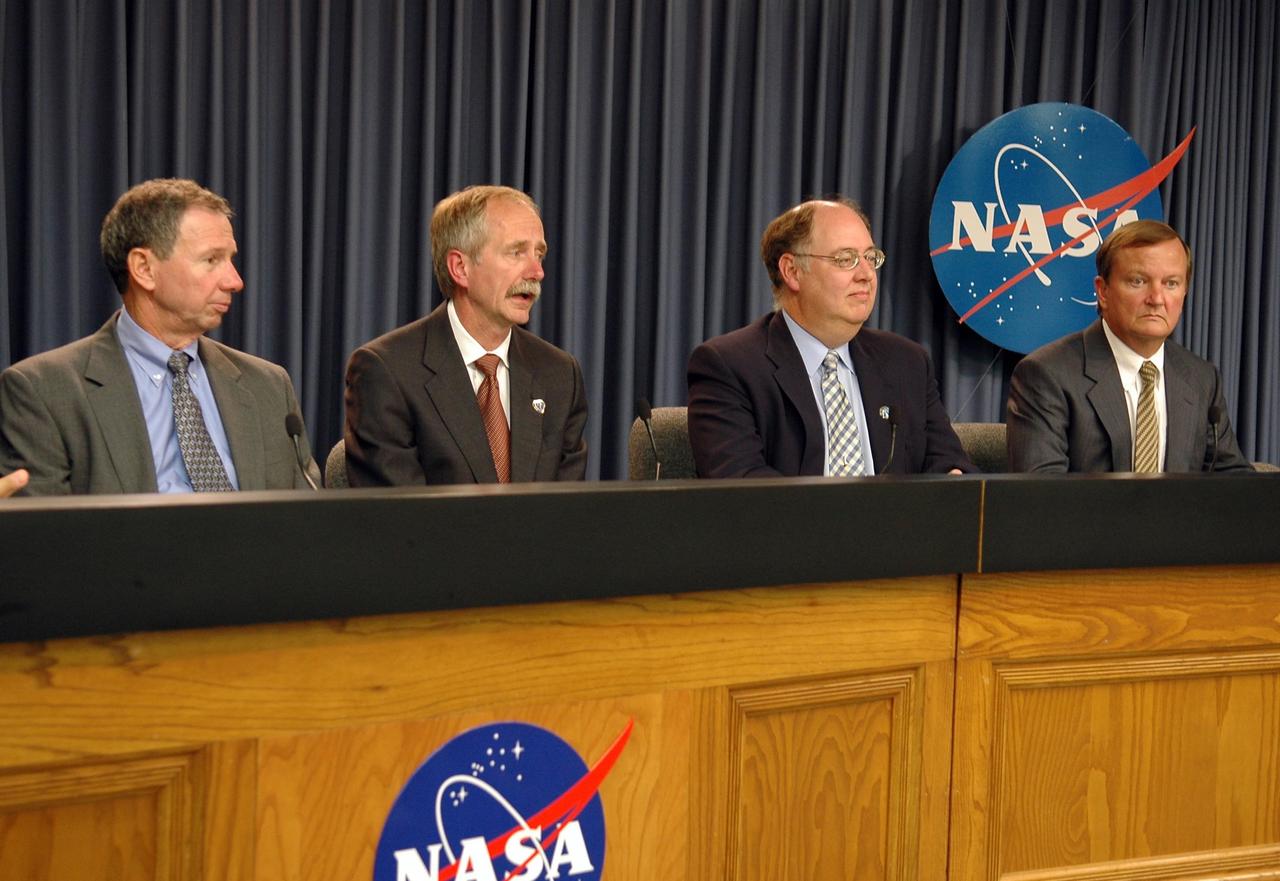
KENNEDY SPACE CENTER, FLA. - At a press conference following the Flight Readiness Review, a thorough assessment of preparations for the mission, NASA officials announce the final launch date of Aug. 27 for mission STS-115. Seated left to right are Michael Griffin, NASA administrator; Bill Gerstenmaier, associate administrator for Space Operations; Wayne Hale, Space Shuttle Program manager; and Mike Leinbach, NASA launch director. They also answered questions from the media. Mission STS-115 continues the assembly of the International Space Station with the installation of the truss segments P3 and P4. Liftoff of Space Shuttle Atlantis on mission STS-115 is targeted at approximately 4:30 p.m. EDT on Aug. 27. Photo credit: NASA/Kim Shiflett
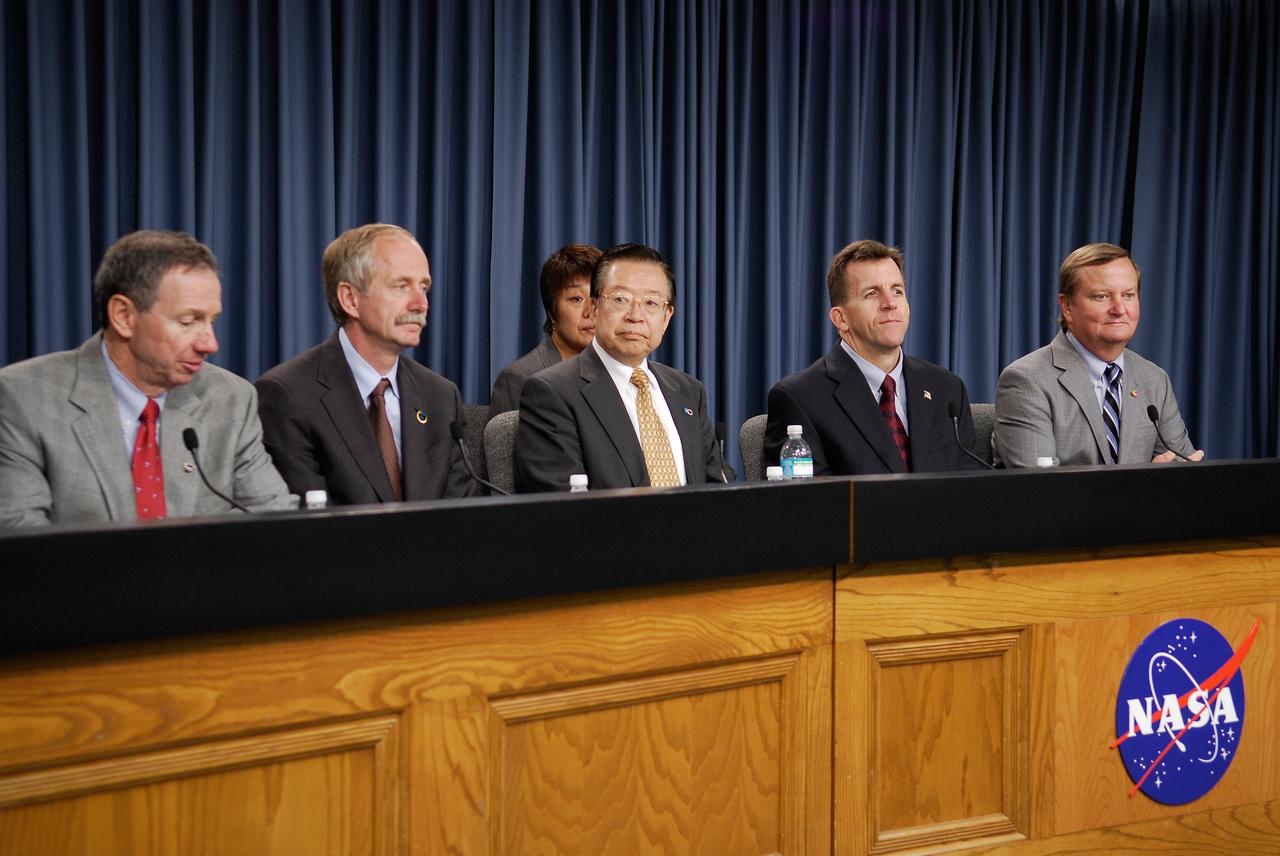
CAPE CANAVERAL, Fla. --- After the successful landing of space shuttle Endeavour to conclude the STS-123 mission, NASA officials hold a media briefing. The participants are, left to right, Michael Griffin, NASA administrator; Bill Gerstenmaier, NASA associate administrator for Space Operations; Kaoru Mamiya, Japan Aerospace Exploration Agency vice president; LeRoy Cain, chair of the mission management team; and Mike Leinbach, NASA space shuttle launch director. Endeavour landed on the second opportunity, on orbit 250, at 8:39:08 p.m. EDT. The STS-123 mission delivered the first segment of the Japan Aerospace Exploration Agency's Kibo laboratory and the Canadian Space Agency's two-armed robotic system, known as Dextre. Photo credit: NASA/Kim Shiflett
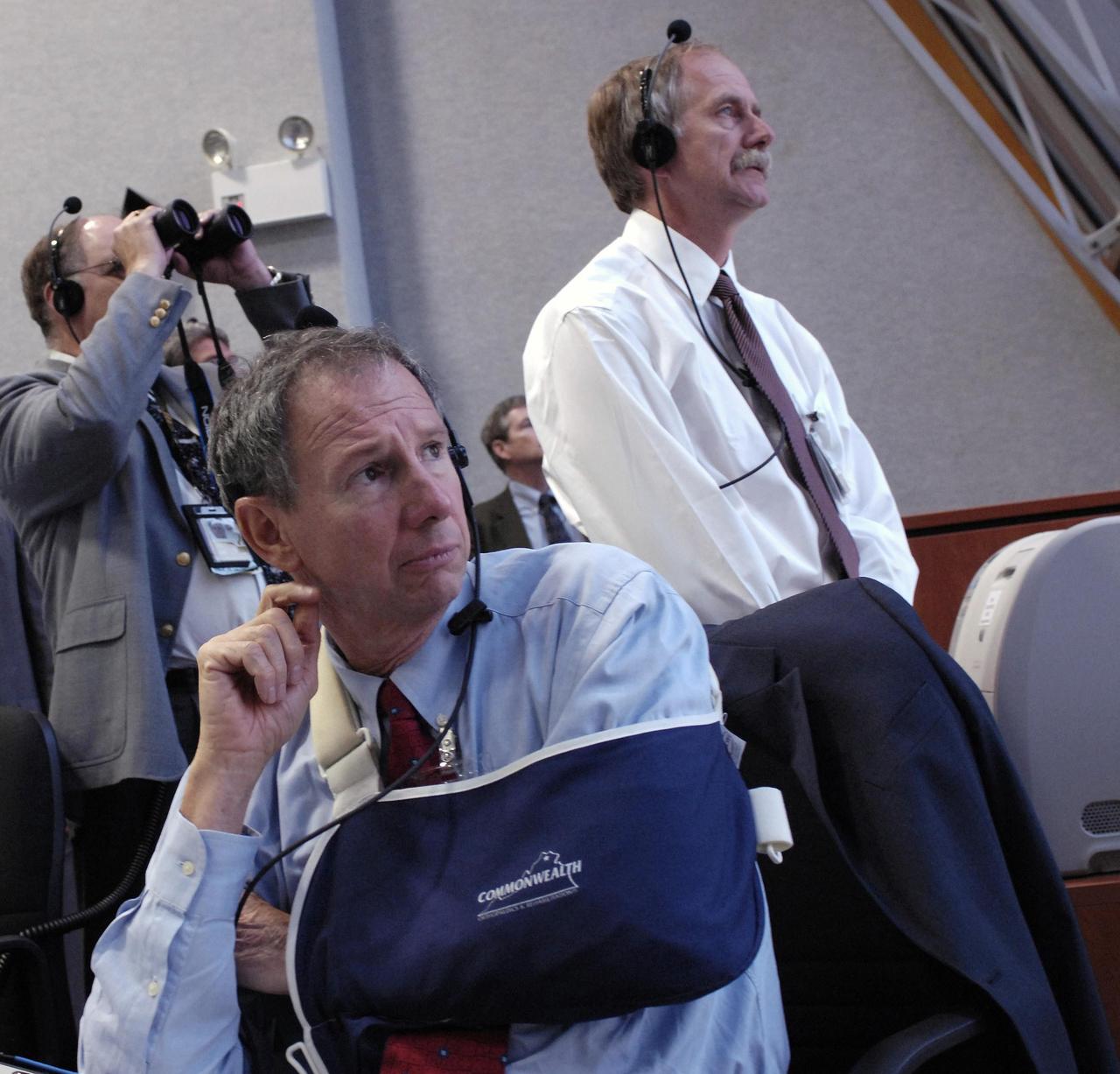
KENNEDY SPACE CENTER, FLA. -- NASA Administrator Mike Griffin (front) and Associate Administrator for NASA Space Operations Mission William Gerstenmaier (right) watch the launch of Space Shuttle Endeavour on mission STS-118 from the Launch Control Center at Kennedy Space Center. The liftoff from Launch Pad 39A was on time at 6:36 p.m. EDT. The mission is the 22nd shuttle flight to the International Space Station. It will continue space station construction by delivering a third starboard truss segment, S5, and other payloads such as the SPACEHAB module and the external stowage platform 3. The 11-day mission may be extended to as many as 14 depending on the test of the Station-to-Shuttle Power Transfer System that will allow the docked shuttle to draw electrical power from the station and extend its visits to the orbiting lab. Photo credit: NASA/Bill Ingalls
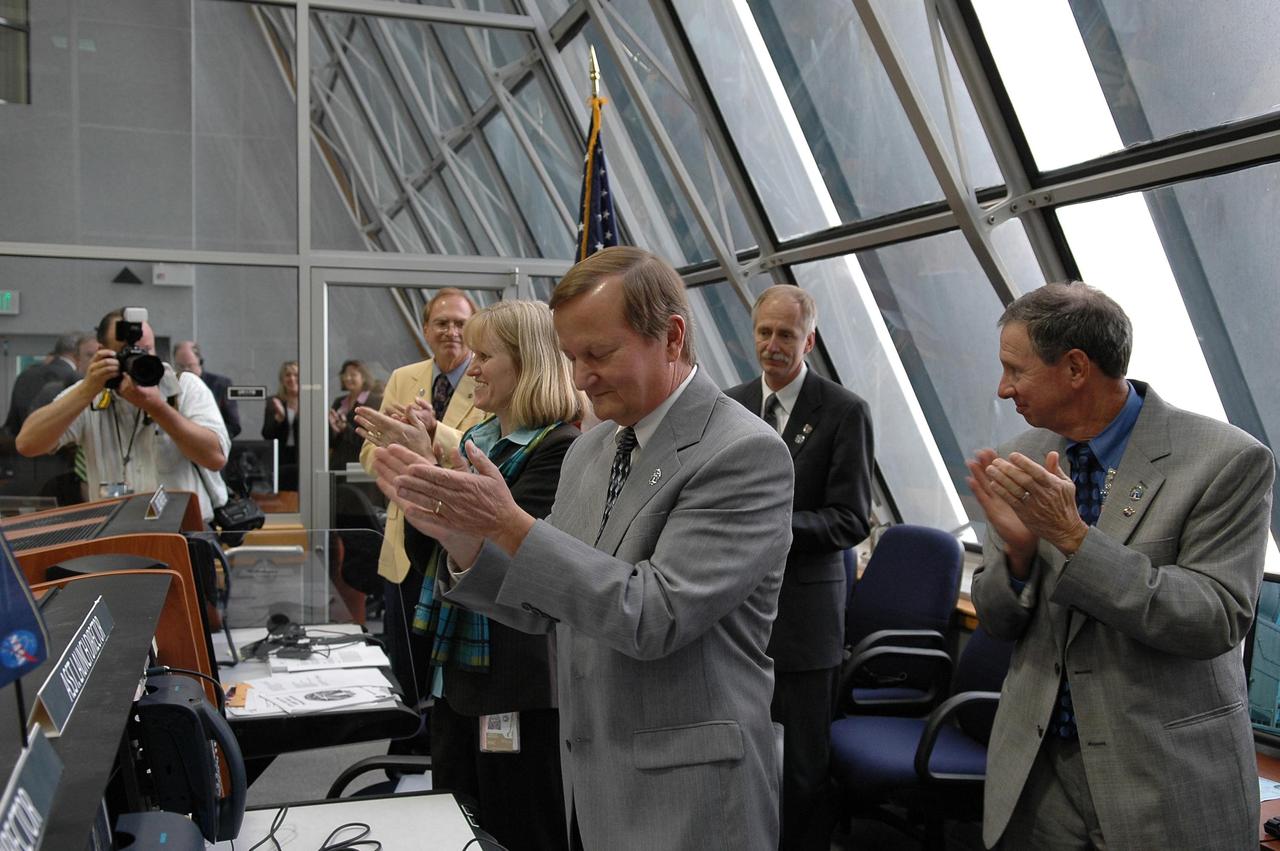
KENNEDY SPACE CENTER, FLA. - Inside the Launch Control Center, NASA and KSC officials applaud the successful launch of Space Shuttle Atlantis on mission STS-115. From right are NASA Administrator Michael Griffin, Associate Administrator for Space Operations Mission William Gerstenmaier, Shuttle Launch Director Mike Leinbach, NASA Flow Director Angie Brewer, and Public Affairs Officer George Diller, who provided commentary leading up to the launch. Mission STS-115 is the 116th space shuttle flight, the 27th flight for orbiter Atlantis, and the 19th U.S. flight to the International Space Station. STS-115 is scheduled to last 11 days with a planned landing at KSC. Photo credit: NASA/Kim Shiflett
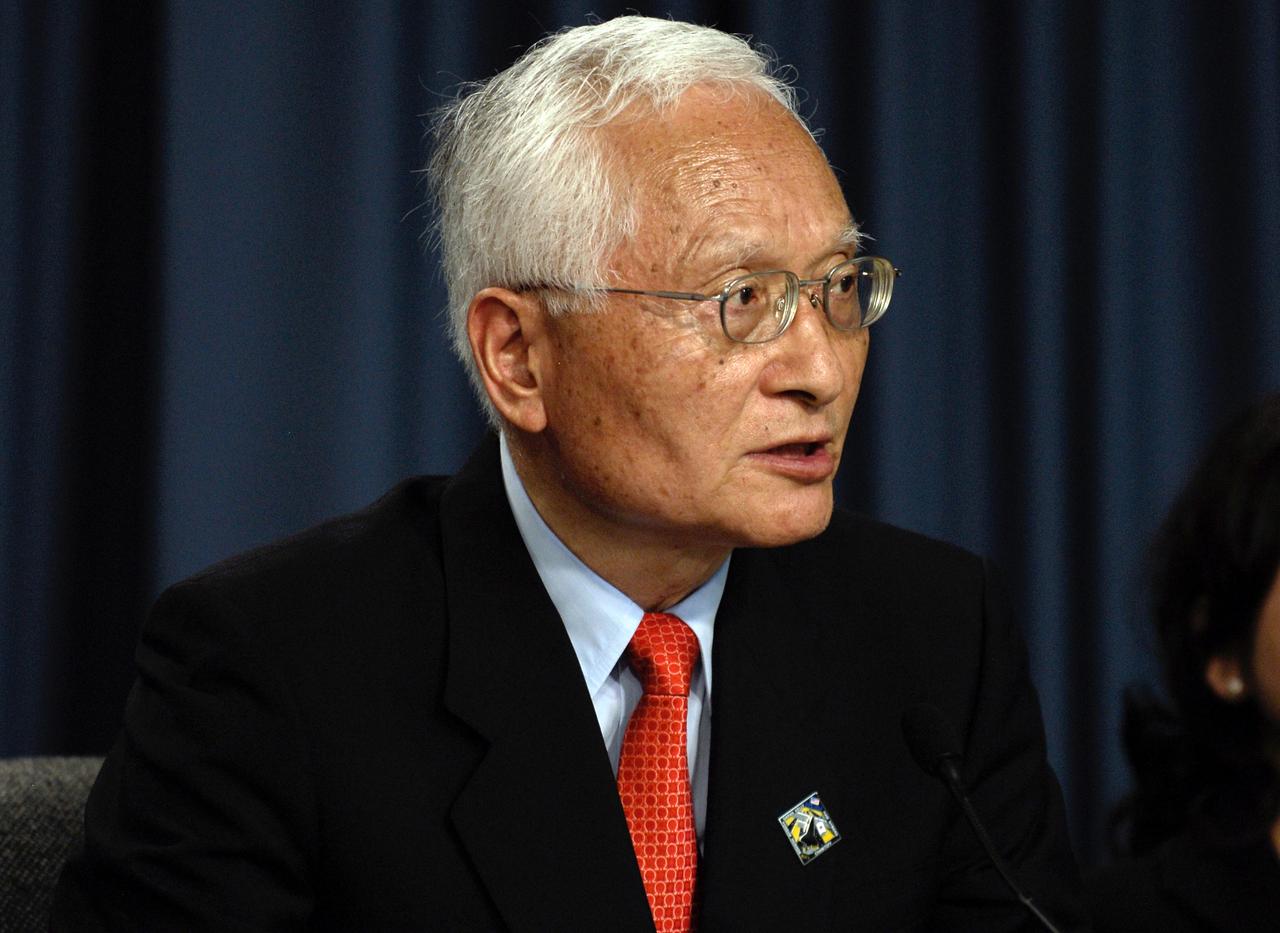
CAPE CANAVERAL, Fla. -- Japan Aerospace Exploration Agency President Dr. Keiji Tachikawa talks to the media during a news conference in NASA's News Center television studio following the successful launch of space shuttle Discovery on the STS-124 mission. Others who participated were NASA Administrator Michael Griffin, Associate Administrator for Space Operations Bill Gerstenmaier, Director of Mission Launch Integration LeRoy Cain and Shuttle Launch Director Mike Leinbach. The STS-124 mission is the 26th in the assembly of the space station. It is the second of three flights launching components to complete the Japan Aerospace Exploration Agency's Kibo laboratory. The shuttle crew will install Kibo's large Japanese Pressurized Module and its remote manipulator system, or RMS. The 14-day flight includes three spacewalks. Photo credit: NASAKim Shiflett
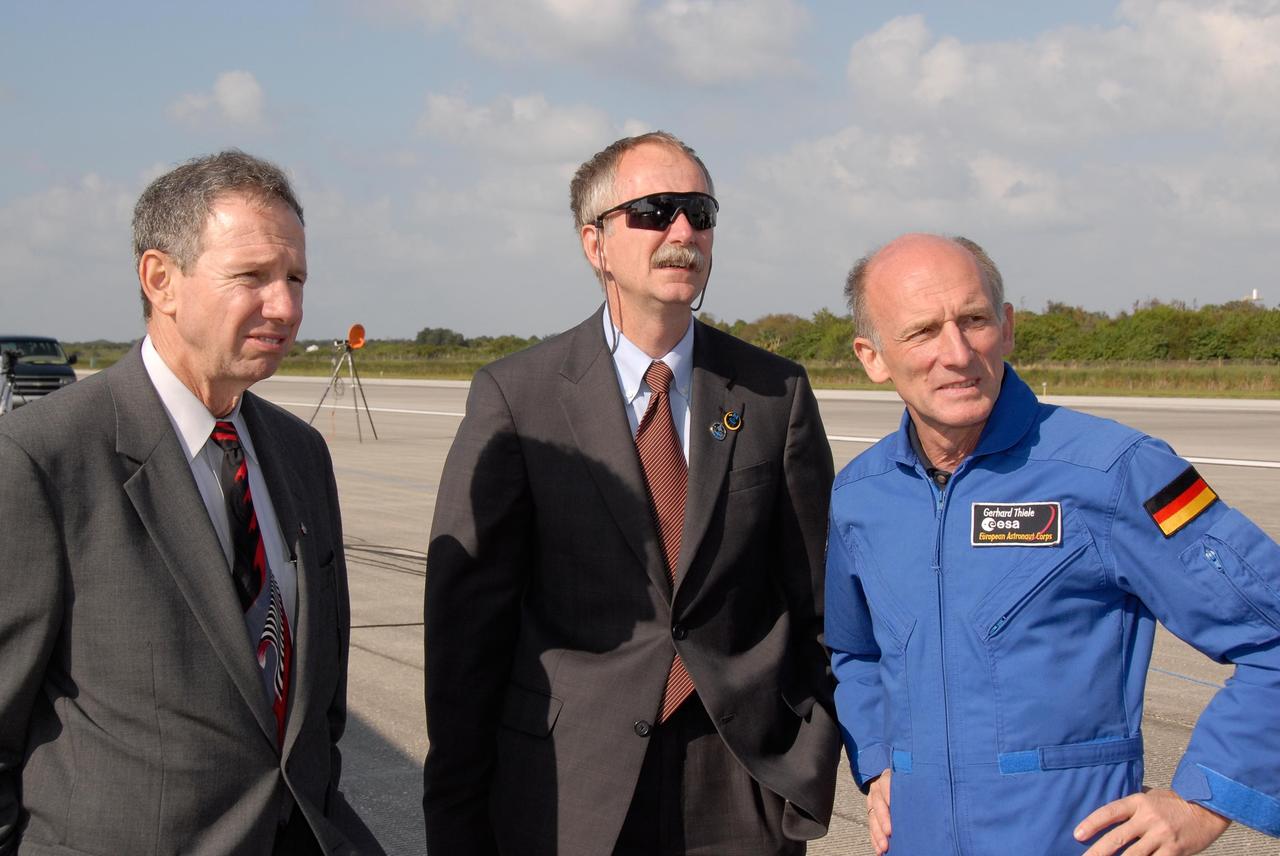
KENNEDY SPACE CENTER, FLA. -- At NASA's Kennedy Space Center, NASA Administrator Mike Griffin, Associate Administrator for NASA Space Operations William Gerstenmaier and European Space Agency astronaut Gerhard Thiele wait to greet the crew of space shuttle Discovery when they exit the crew transport vehicle. Discovery completed the 15-day mission STS-120, with an on-time landing at 1:01:16 p.m. Wheel stop was at 1:02:07 p.m. Mission elapsed time was 15 days, 2 hours, 24 minutes and 2 seconds. Mission STS-120 continued the construction of the station with the installation of the Harmony Node 2 module and the relocation of the P6 truss. Photo credit: NASA//Kim Shiflett
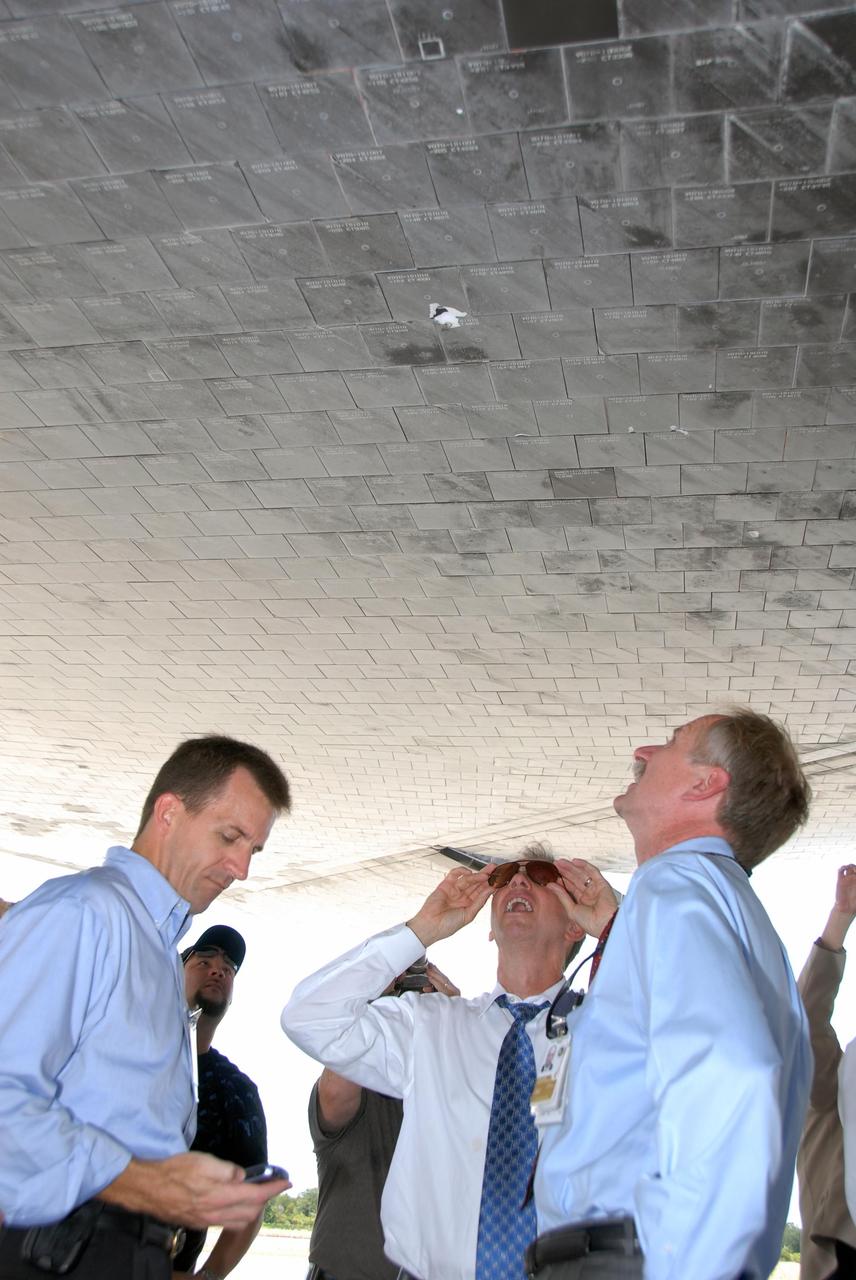
KENNEDY SPACE CENTER, FLA. -- On the Shuttle Landing Facility at NASA's Kennedy Space Center, Mission Launch Integration Director Leroy Cain, NASA Administrator Mike Griffin and Associate Administrator for NASA Space Operations William Gerstenmaier get a closer look at the damaged tiles on the underside of Endeavour. The damage to the tiles occurred from a piece of foam on the external tank during launch of Space Shuttle Endeavour on mission STS-118 on Aug. 8. After extensive engineering analysis of such images and testing on the ground, the Mission Management Team decided the tile did not pose a risk to the crew during re-entry. Endeavour landed safely at 12:32 p.m. EDT at NASA's Kennedy Space Center after a 13-day mission to the International Space Station. The STS-118 mission installed a new gyroscope, an external spare parts platform and another truss segment to the expanding station. Photo credit: NASA/Kim Shiflett
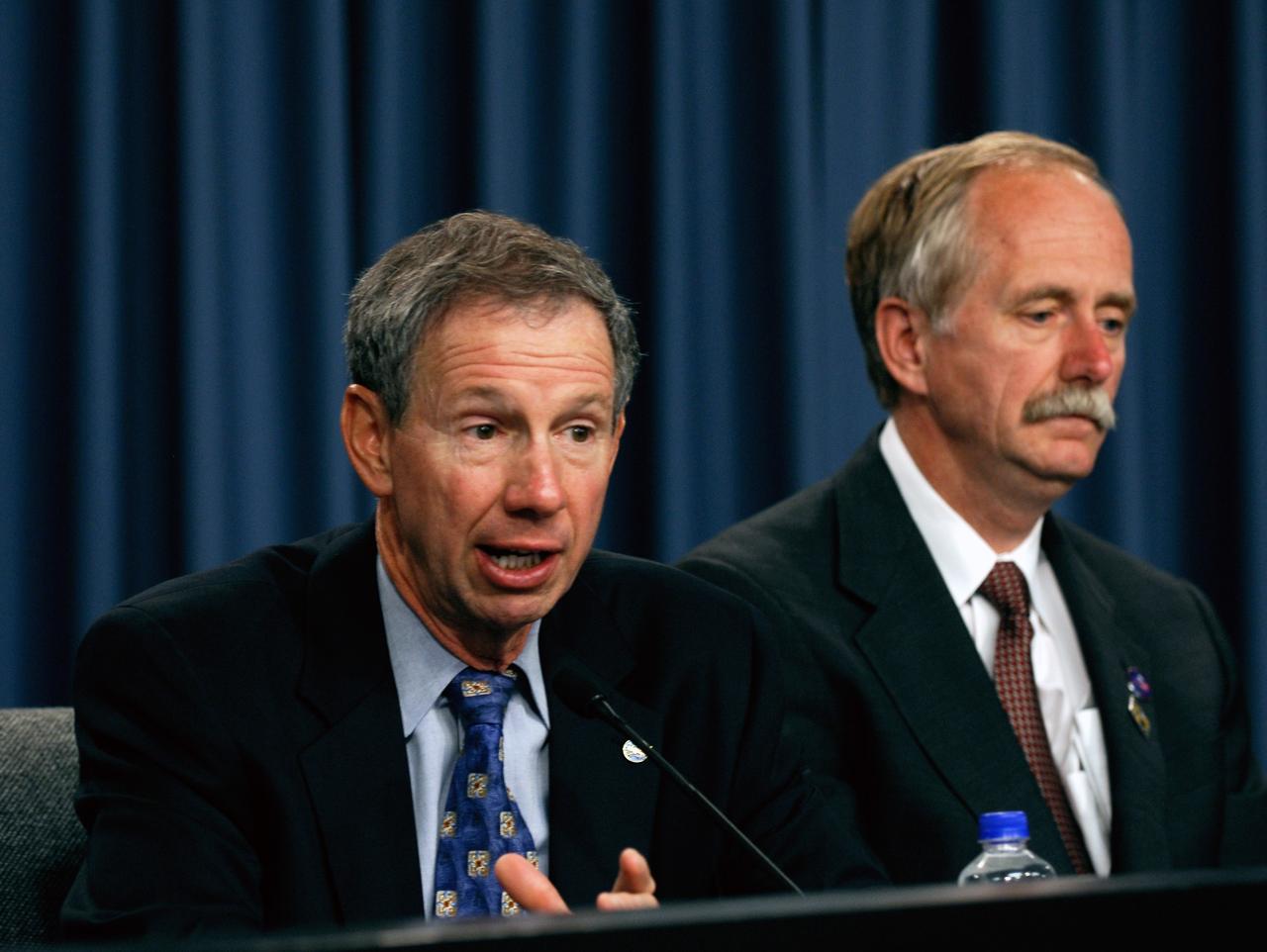
CAPE CANAVERAL, Fla. -- NASA Administrator Michael Griffin responds to a question from the media during a news conference in NASA's News Center television studio following the successful launch of space shuttle Discovery on the STS-124 mission. At right is Associate Administrator for Space Operations Bill Gerstenmaier. Others who participated were Director of Mission Launch Integration LeRoy Cain, Shuttle Launch Director Mike Leinbach and Japan Aerospace Exploration Agency President Dr. Keiji Tachikawa. The STS-124 mission is the 26th in the assembly of the space station. It is the second of three flights launching components to complete the Japan Aerospace Exploration Agency's Kibo laboratory. The shuttle crew will install Kibo's large Japanese Pressurized Module and its remote manipulator system, or RMS. The 14-day flight includes three spacewalks. Photo credit: NASAKim Shiflett
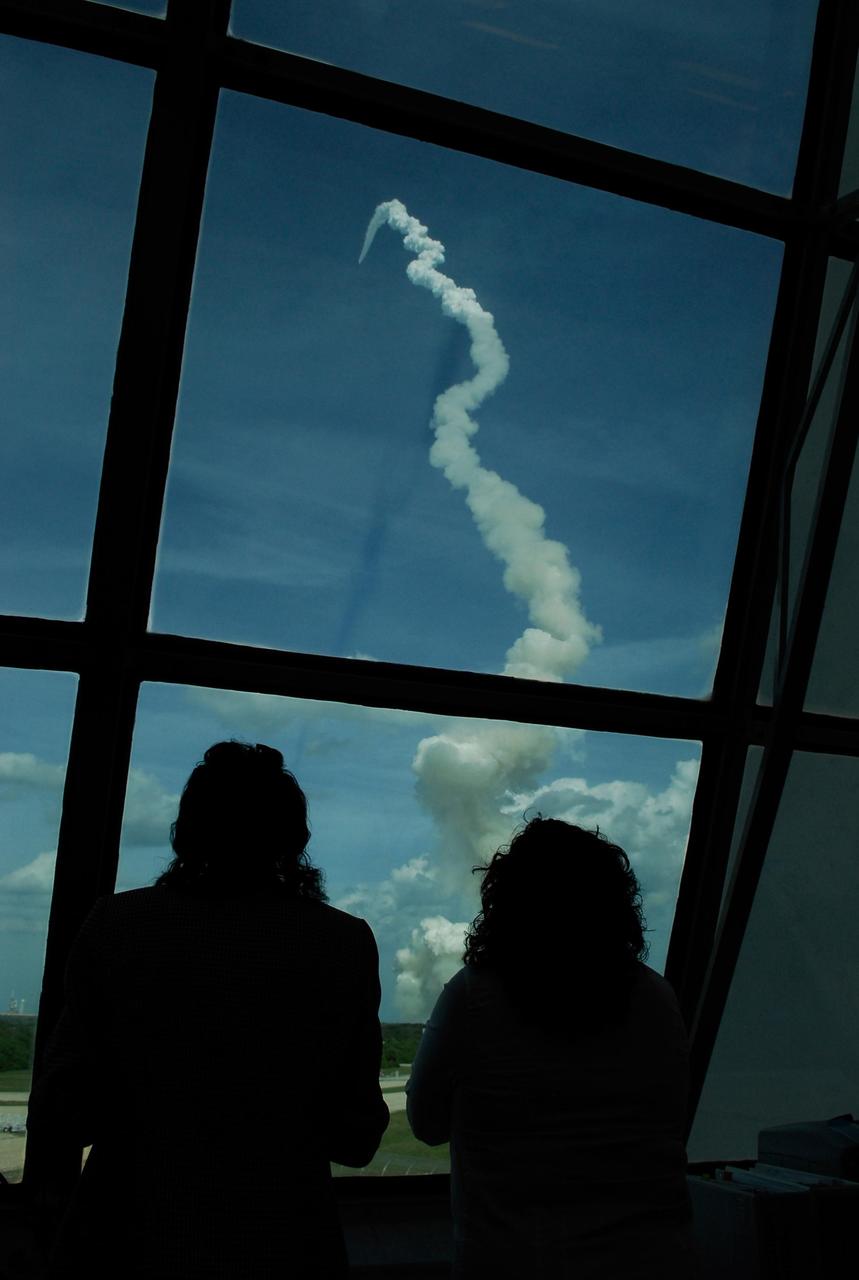
KENNEDY SPACE CENTER, FLA. -- Leaving a wavy contrail in its wake, the launch of space shuttle Atlantis is viewed through the windows of the Launch Control Center, where VIPS gathered to watch, including Center Director Bill Parsons, Associate Administrator for NASA Space Operations William H. Gerstenmaier and NASA Administrator Mike Griffin. Liftoff was on time at 2:45 p.m. EST from Launch Pad 39A. The launch is the third attempt for Atlantis since December 2007 to carry the European Space Agency's Columbus laboratory to the International Space Station. During the 11-day mission, the crew's prime objective is to attach the laboratory to the Harmony module, adding to the station's size and capabilities. Photo credit: NASA/Kim Shiflett
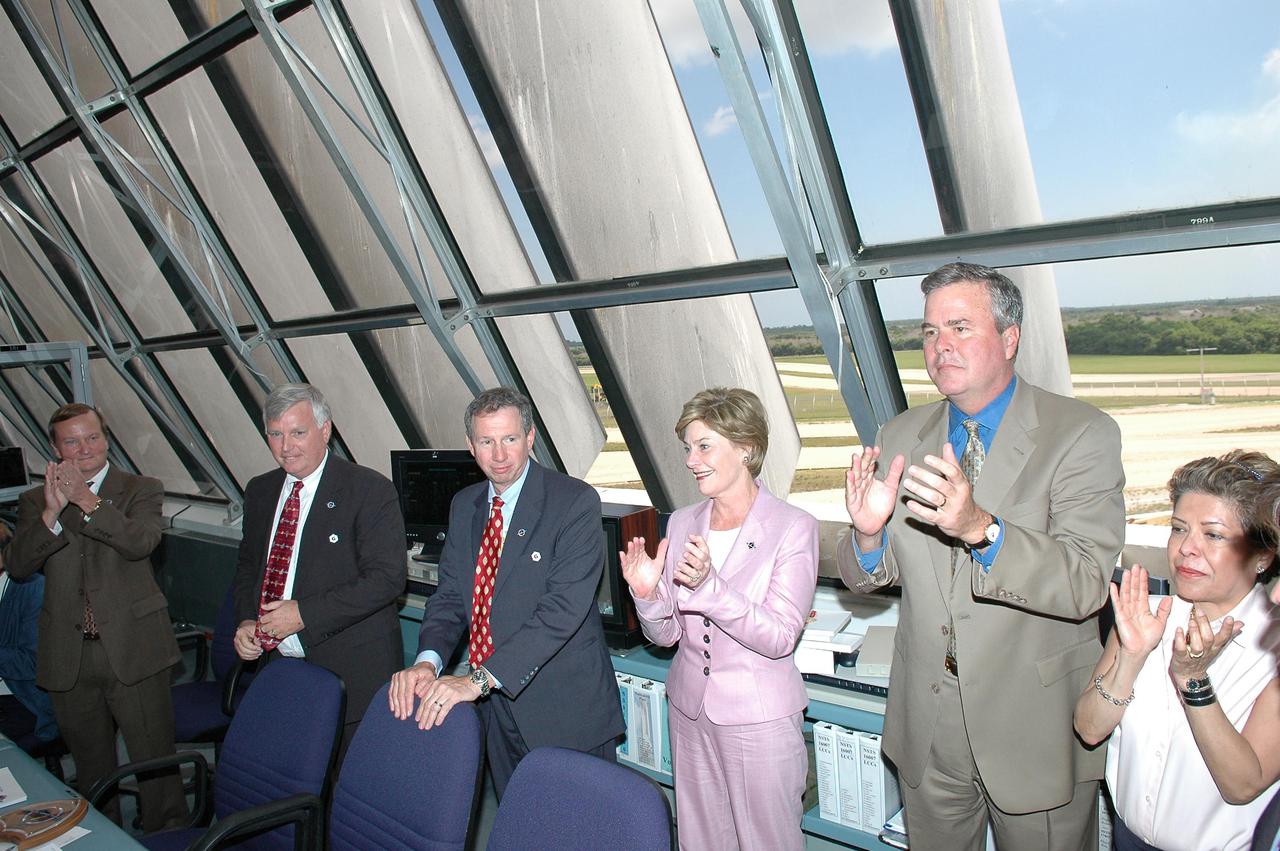
KENNEDY SPACE CENTER, FLA. - In the Launch Control Center at NASA Kennedy Space Center, First Lady Laura Bush congratulates the launch team for a successful launch of Space Shuttle Discovery on Return to Flight mission STS-114. From left are Shuttle Launch Director Mike Leinbach, Center Director Jim Kennedy, NASA Administrator Mike Griffin, Mrs. Bush, Florida Gov. Jeb Bush and his wife, Columba. On this mission to the International Space Station the crew will perform inspections on-orbit for the first time of all of the Reinforced Carbon-Carbon (RCC) panels on the leading edge of the wings and the Thermal Protection System tiles using the new Canadian-built Orbiter Boom Sensor System and the data from 176 impact and temperature sensors. Mission Specialists will also practice repair techniques on RCC and tile samples during a spacewalk in the payload bay. During two additional spacewalks, the crew will install the External Stowage Platform-2, equipped with spare part assemblies, and a replacement Control Moment Gyroscope contained in the Lightweight Multi-Purpose Experiment Support Structure. The 12-day mission is expected to end with touchdown at the Shuttle Landing Facility on Aug. 7.
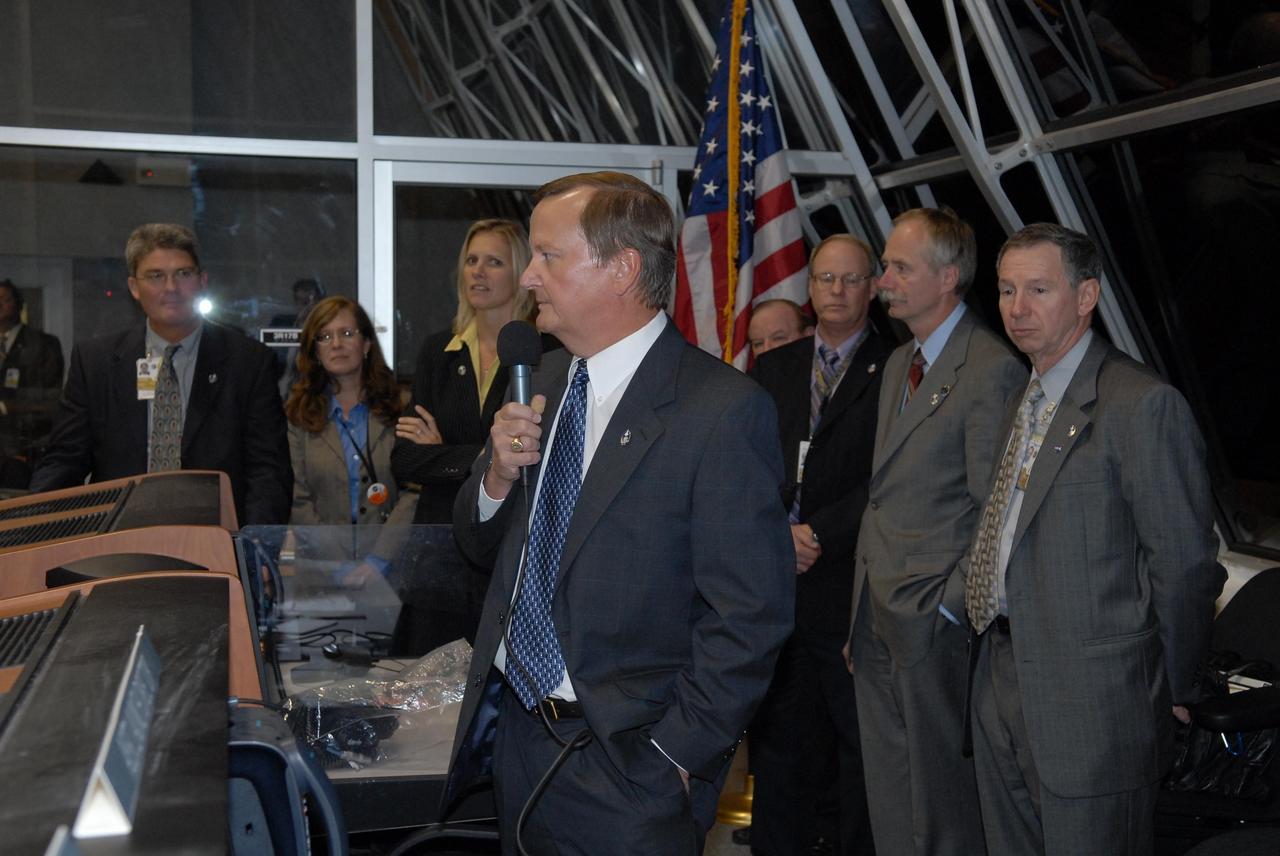
KENNEDY SPACE CENTER, FLA. -- In the firing room at the Launch Control Center, Shuttle Launch Director Mike Leinbach (center, with microphone) commends the mission management team for the successful second launch attempt of Space Shuttle Discovery on mission STS-116. Liftoff occurred on time at 8:47 p.m. EST. Others in the room are (left to right), Deputy Director Bill Parsons, External Relations Director Lisa Malone, NASA Flow Director for Discovery Stephanie Stilson, NASA KSC News Chief Bruce Buckingham, Associate Administrator for Space Operations Mission William Gerstenmaier and NASA Administrator Mike Griffin. This was the second launch attempt for mission STS-116. The first launch attempt on Dec. 7 was postponed due a low cloud ceiling over Kennedy Space Center. This is Discovery's 33rd mission and the first night launch since 2002. The 20th shuttle mission to the International Space Station, STS-116 carries another truss segment, P5. It will serve as a spacer, mated to the P4 truss that was attached in September. After installing the P5, the crew will reconfigure and redistribute the power generated by two pairs of U.S. solar arrays. Landing is expected Dec. 21 at KSC. Photo credit: NASA/Kim Shiflett
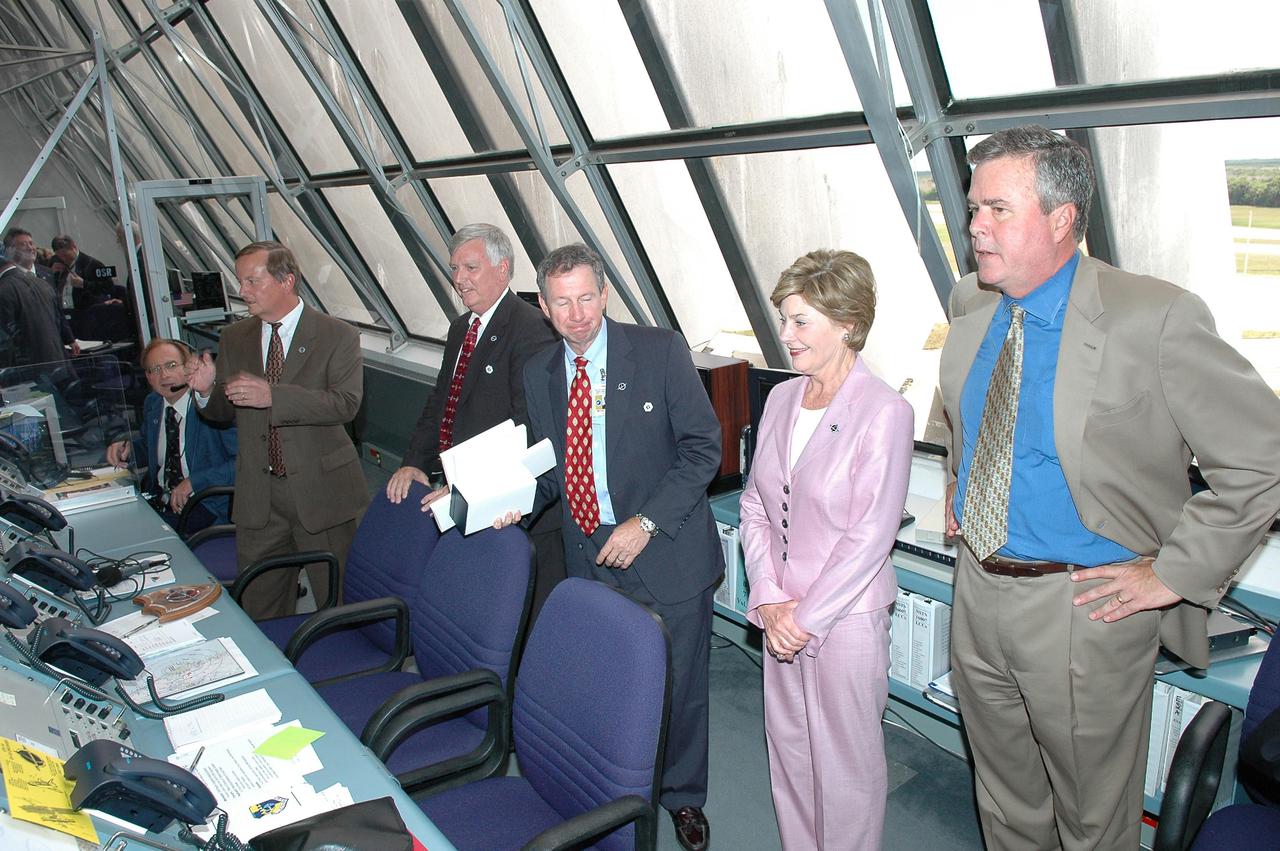
KENNEDY SPACE CENTER, FLA. - In the Launch Control Center at NASA Kennedy Space Center, First Lady Laura Bush congratulates NASA officials for a successful launch of Space Shuttle Discovery on Return to Flight mission STS-114. From left are NASA launch commentator George Diller, Shuttle Launch Director Mike Leinbach, Center Director Jim Kennedy, NASA Administrator Mike Griffin, Mrs. Bush and Florida Gov. Jeb Bush. On this mission to the International Space Station the crew will perform inspections on-orbit for the first time of all of the Reinforced Carbon-Carbon (RCC) panels on the leading edge of the wings and the Thermal Protection System tiles using the new Canadian-built Orbiter Boom Sensor System and the data from 176 impact and temperature sensors. Mission Specialists will also practice repair techniques on RCC and tile samples during a spacewalk in the payload bay. During two additional spacewalks, the crew will install the External Stowage Platform-2, equipped with spare part assemblies, and a replacement Control Moment Gyroscope contained in the Lightweight Multi-Purpose Experiment Support Structure. The 12-day mission is expected to end with touchdown at the Shuttle Landing Facility on Aug. 7.
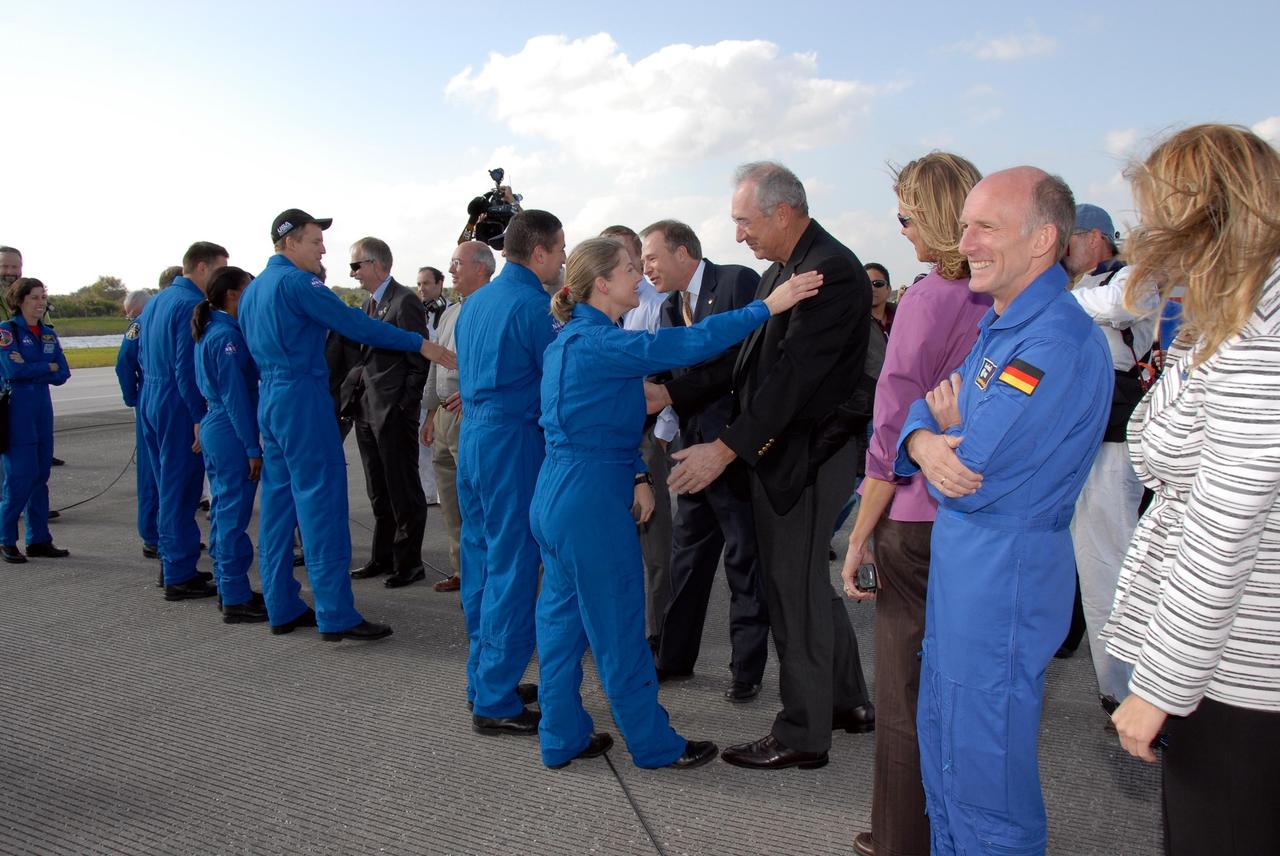
KENNEDY SPACE CENTER, FLA. -- The STS-120 crew members are greeted by NASA and Kennedy VIPs after completing their successful mission. From left are STS-120 mission specialists Doug Wheelock, Stephanie Wilson and Scott Parazynski, Pilot George Zamka and Commander Pamela Melroy. The NASA VIPs include NASA Administrator Mike Griffin, Associate Administrator for NASA Space Operations William Gerstenmaier and Shuttle Program Manager Wayne Hale. The lineup also includes Shuttle Launch Director Mike Leinbach. Melroy and the Discovery crew completed the 15-day mission STS-120, with an on-time landing at 1:01:16 p.m. Wheel stop was at 1:02:07 p.m. Mission elapsed time was 15 days, 2 hours, 24 minutes and 2 seconds. Mission elapsed time was 15 days, 2 hours, 24 minutes and 2 seconds. Mission STS-120 continued the construction of the station with the installation of the Harmony Node 2 module and the relocation of the P6 truss. Photo credit: NASA/Kim Shiflett
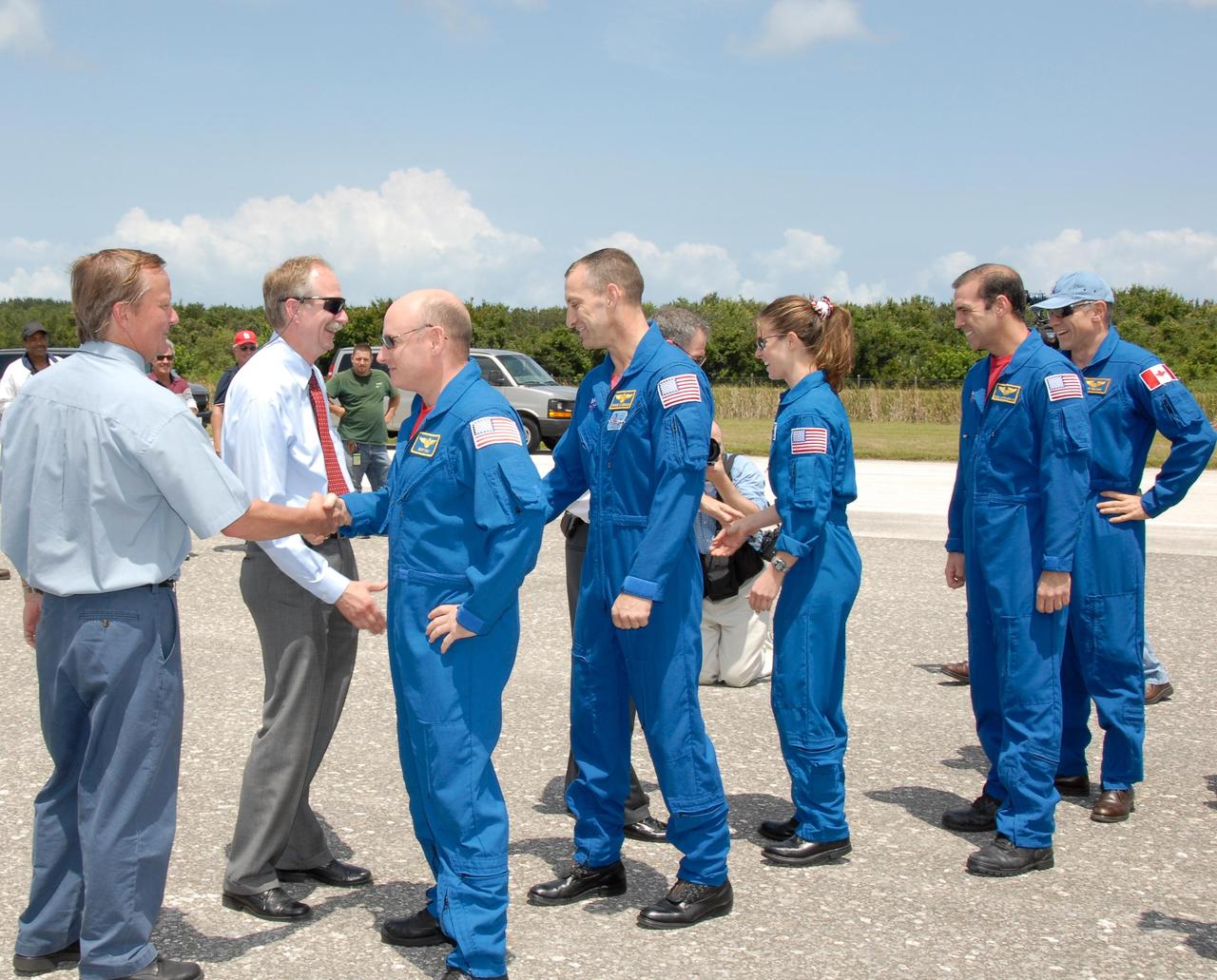
KENNEDY SPACE CENTER, FLA. -- The STS-118 crew is welcomed back to Earth by NASA officials after completing mission STS-118. From left are Shuttle Launch Director Mike Leinbach, Associate Administrator for Space Operations William Gerstenmaier, Commander Scott Kelly, Pilot Charlie Hobaugh, NASA Administrator Mike Griffin, and Mission Specialists Tracy Caldwell, Rick Mastracchio and Canadian astronaut Dave Williams. On the mission, the crew installed a new gyroscope, an external spare parts platform and another truss segment to the expanding station. Endeavour's main gear touched down at 12:32:16 p.m. EDT. Nose gear touchdown was at 12:32:29 p.m. and wheel stop was at 12:33:20 p.m. Endeavour landed on orbit 201. STS-118 was the 119th space shuttle flight, the 22nd flight to the station, the 20th flight for Endeavour and the second of four missions planned for 2007. This was the 65th landing of an orbiter at Kennedy. Photo credit: NASA/Kim Shiflett
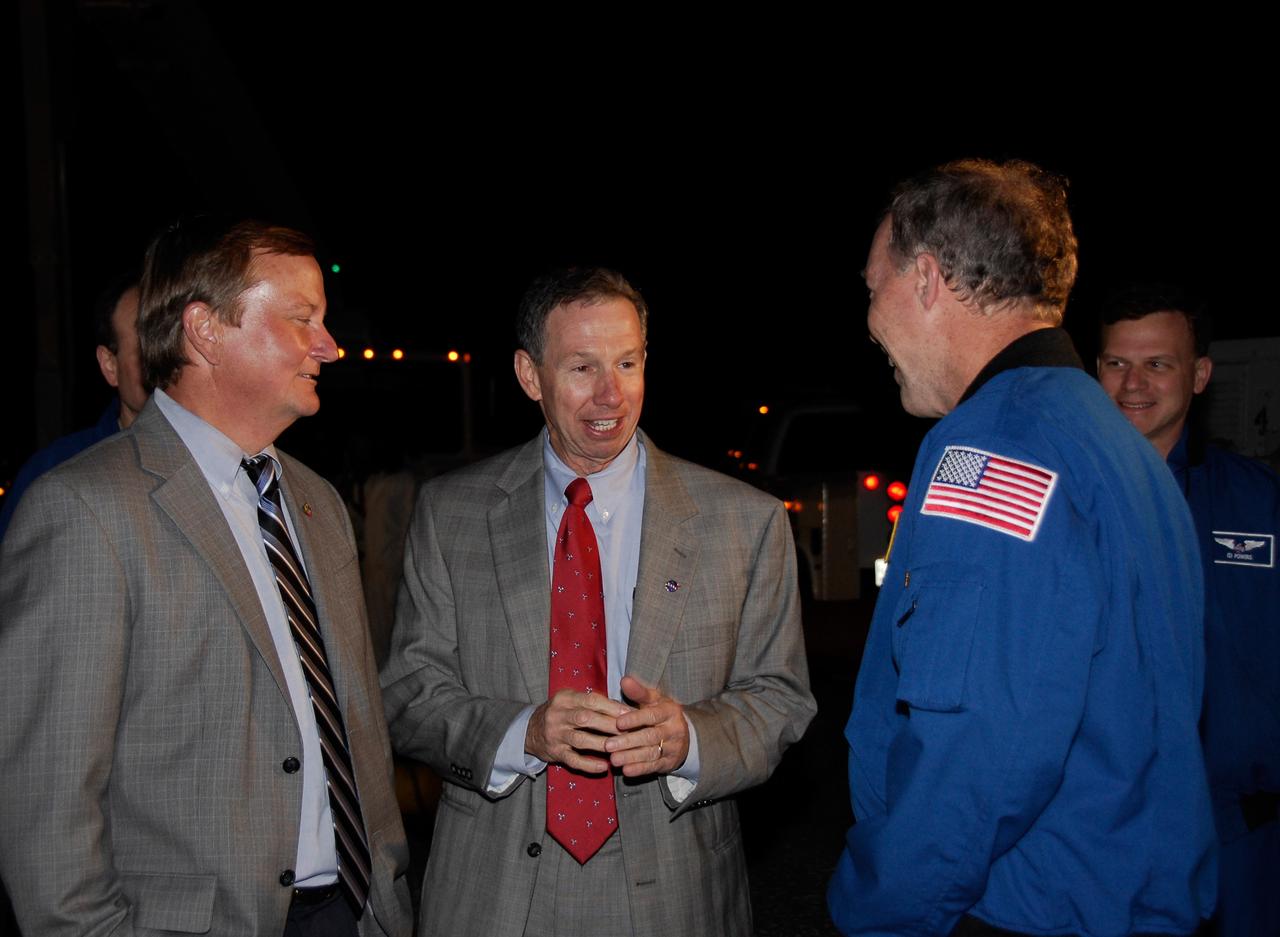
CAPE CANAVERAL, Fla. --- STS-123 Commander Dominic Gorie, right, is greeted by Space Shuttle Launch Director Mike Leinbach, left, and NASA Administrator Mike Griffin at NASA Kennedy Space Center's Shuttle Landing Facility. Space shuttle Endeavour landed on Runway 15 to end the STS-123 mission, a 16-day flight to the International Space Station. This was the 16th night landing at Kennedy. The main landing gear touched down at 8:39:08 p.m. EDT. The nose landing gear touched down at 8:39:17 p.m. and wheel stop was at 8:40:41 p.m. The mission completed nearly 6.6 million miles. The landing was on the second opportunity after the first was waved off due to unstable weather in the Kennedy Space Center area. The STS-123 mission delivered the first segment of the Japan Aerospace Exploration Agency's Kibo laboratory and the Canadian Space Agency's two-armed robotic system, known as Dextre. Photo credit: NASA/Kim Shiflett
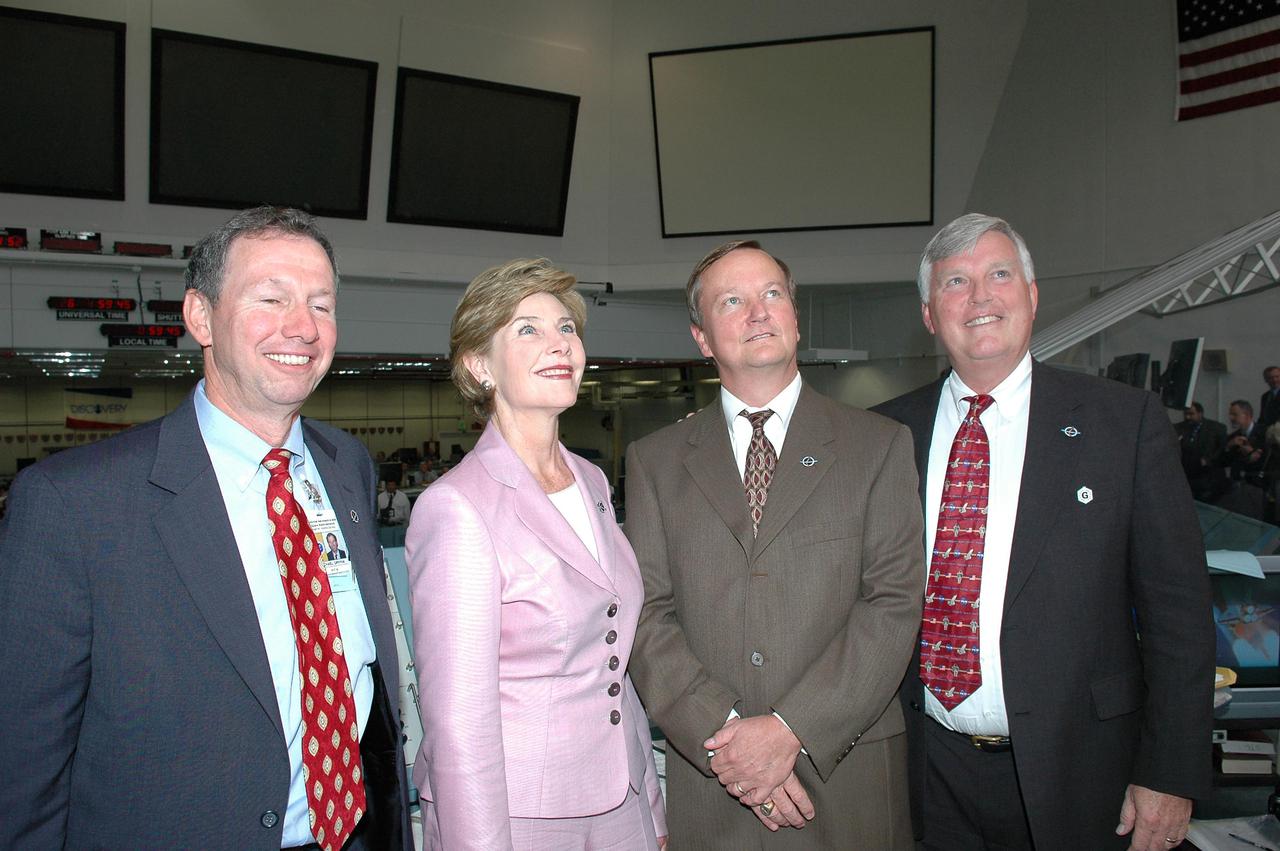
KENNEDY SPACE CENTER, FLA. - In the Launch Control Center at NASA Kennedy Space Center, NASA Administrator Mike Griffin, First Lady Laura Bush, Shuttle Launch Director Mike Leinbach and Center Director Jim Kennedy watch a replay of the successful launch of Space Shuttle Discovery on Return to Flight mission STS-114. She is only the third First Lady to witness a Space Shuttle launch at KSC. On this mission to the International Space Station the crew will perform inspections on-orbit for the first time of all of the Reinforced Carbon-Carbon (RCC) panels on the leading edge of the wings and the Thermal Protection System tiles using the new Canadian-built Orbiter Boom Sensor System and the data from 176 impact and temperature sensors. Mission Specialists will also practice repair techniques on RCC and tile samples during a spacewalk in the payload bay. During two additional spacewalks, the crew will install the External Stowage Platform-2, equipped with spare part assemblies, and a replacement Control Moment Gyroscope contained in the Lightweight Multi-Purpose Experiment Support Structure. The 12-day mission is expected to end with touchdown at the Shuttle Landing Facility on Aug. 7.
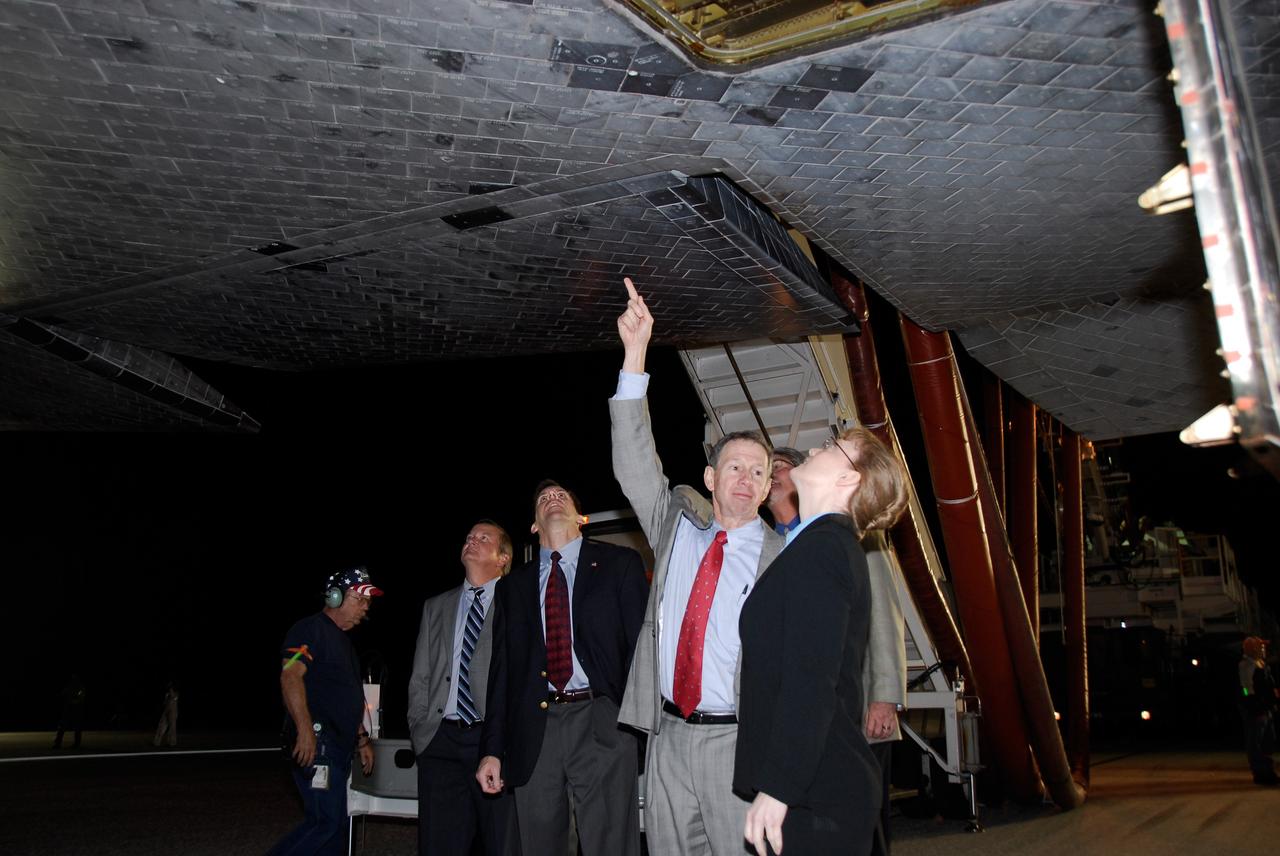
CAPE CANAVERAL, Fla. --- NASA managers examine the thermal protection system tile under space shuttle Endeavour on Runway 15 at Kennedy Space Center's Shuttle Landing Facility at the end of the STS-123 mission, a 16-day flight to the International Space Station. From left are a member of the convoy crew, Shuttle Launch Director Mike Leinbach, Mission Management Team Chairman LeRoy Cain, NASA Administrator Mike Griffin and NASA Deputy Administrator Shana Dale. Behind them is Kennedy Space Center Director Bill Parsons. This was the 16th night landing at Kennedy. The main landing gear touched down at 8:39:08 p.m. EDT. The nose landing gear touched down at 8:39:17 p.m. and wheel stop was at 8:40:41 p.m. The mission completed nearly 6.6 million miles. The landing was on the second opportunity after the first was waved off due to unstable weather in the Kennedy Space Center area. The STS-123 mission delivered the first segment of the Japan Aerospace Exploration Agency's Kibo laboratory and the Canadian Space Agency's two-armed robotic system, known as Dextre. Photo credit: NASA/Kim Shiflett
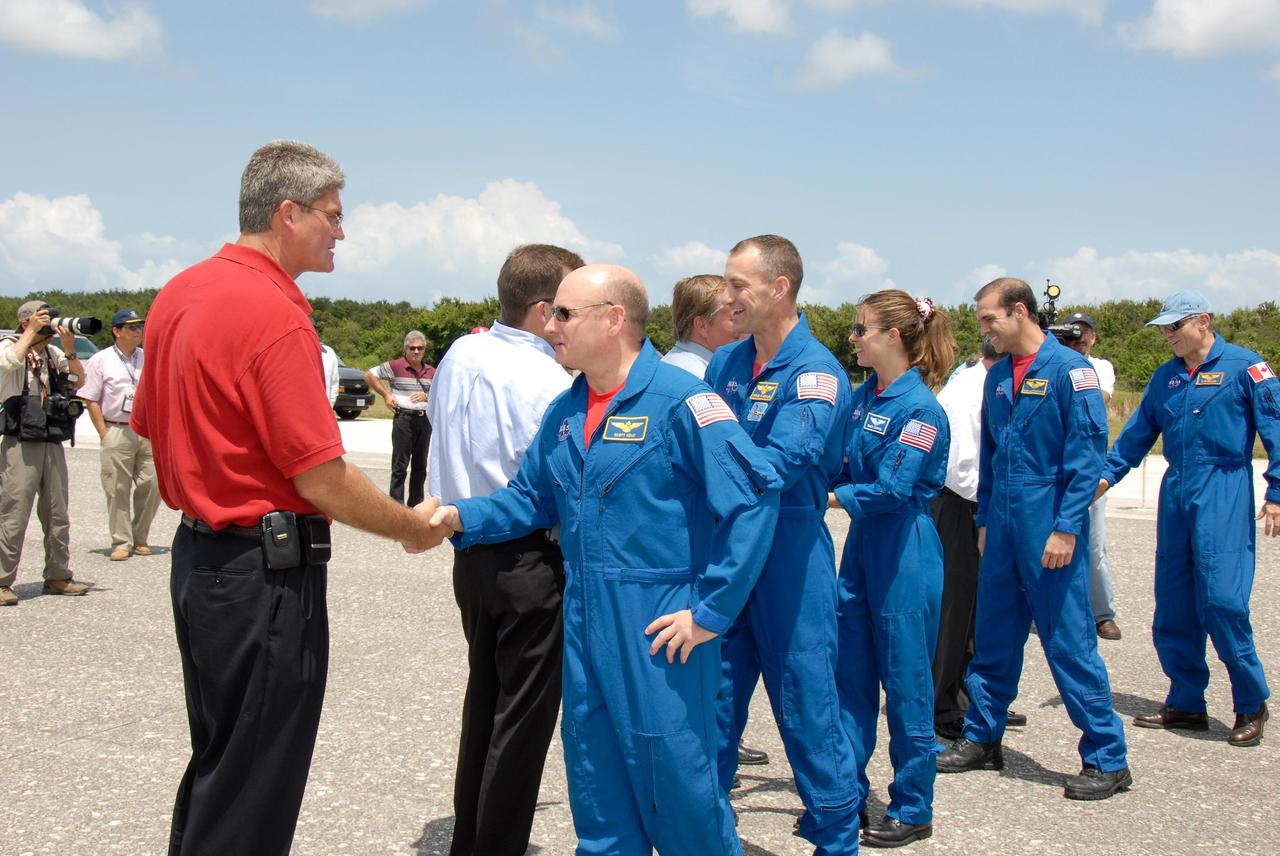
KENNEDY SPACE CENTER, FLA. -- The STS-118 crew is welcomed back to Earth by NASA officials after completing mission STS-118. From left are KSC Director Bill Parsons, Mission Launch Integration Director Leroy Cain, Commander Scott Kelly, Shuttle Launch Director Mike Leinbach, Pilot Charlie Hobaugh, and Mission Specialists Tracy Caldwell, Rick Mastracchio and Canadian astronaut Dave Williams. NASA Administrator Mike Griffin also greeted the astronauts. On the mission, the crew installed a new gyroscope, an external spare parts platform and another truss segment to the expanding station. Endeavour's main gear touched down at 12:32:16 p.m. EDT. Nose gear touchdown was at 12:32:29 p.m. and wheel stop was at 12:33:20 p.m. Endeavour landed on orbit 201. STS-118 was the 119th space shuttle flight, the 22nd flight to the station, the 20th flight for Endeavour and the second of four missions planned for 2007. This was the 65th landing of an orbiter at Kennedy. Photo credit: NASA/Kim Shiflett
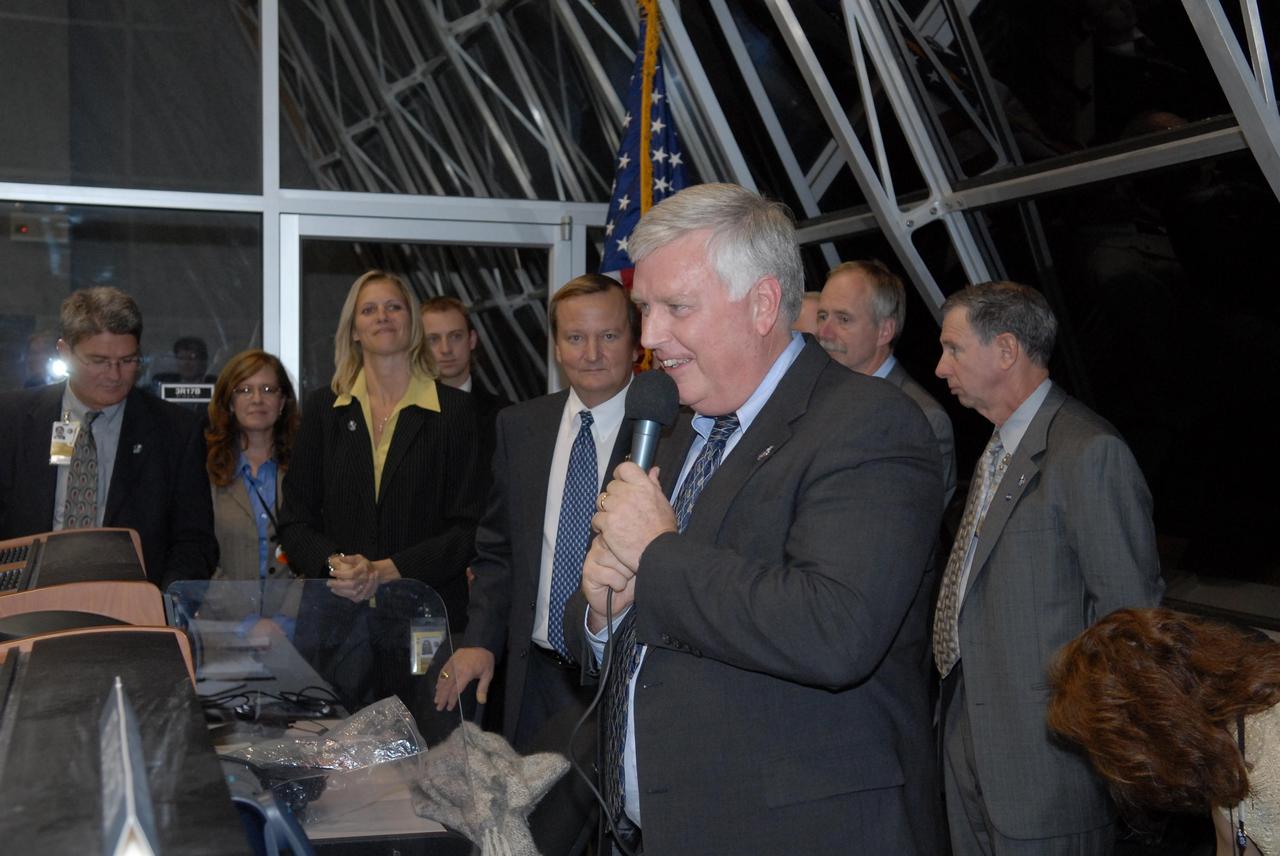
KENNEDY SPACE CENTER, FLA. -- In the firing room at the Launch Control Center, Kennedy Space Center Director Jim Kennedy (with microphone) congratulates the team for successful second launch attempt of Space Shuttle Discovery on mission STS-116. Liftoff occurred on time at 8:47 p.m. EST. Others in the room are (left to right), Deputy Director Bill Parsons, External Relations Director Lisa Malone, NASA Flow Director for Discovery Stephanie Stilson, Shuttle Launch Director Mike Leinbach, Associate Administrator for Space Operations Mission William Gerstenmaier and NASA Administrator Mike Griffin. The first launch attempt on Dec. 7 was postponed due a low cloud ceiling over Kennedy Space Center. This is Discovery's 33rd mission and the first night launch since 2002. The 20th shuttle mission to the International Space Station, STS-116 carries another truss segment, P5. It will serve as a spacer, mated to the P4 truss that was attached in September. After installing the P5, the crew will reconfigure and redistribute the power generated by two pairs of U.S. solar arrays. Landing is expected Dec. 21 at KSC. Photo credit: NASA/Kim Shiflett
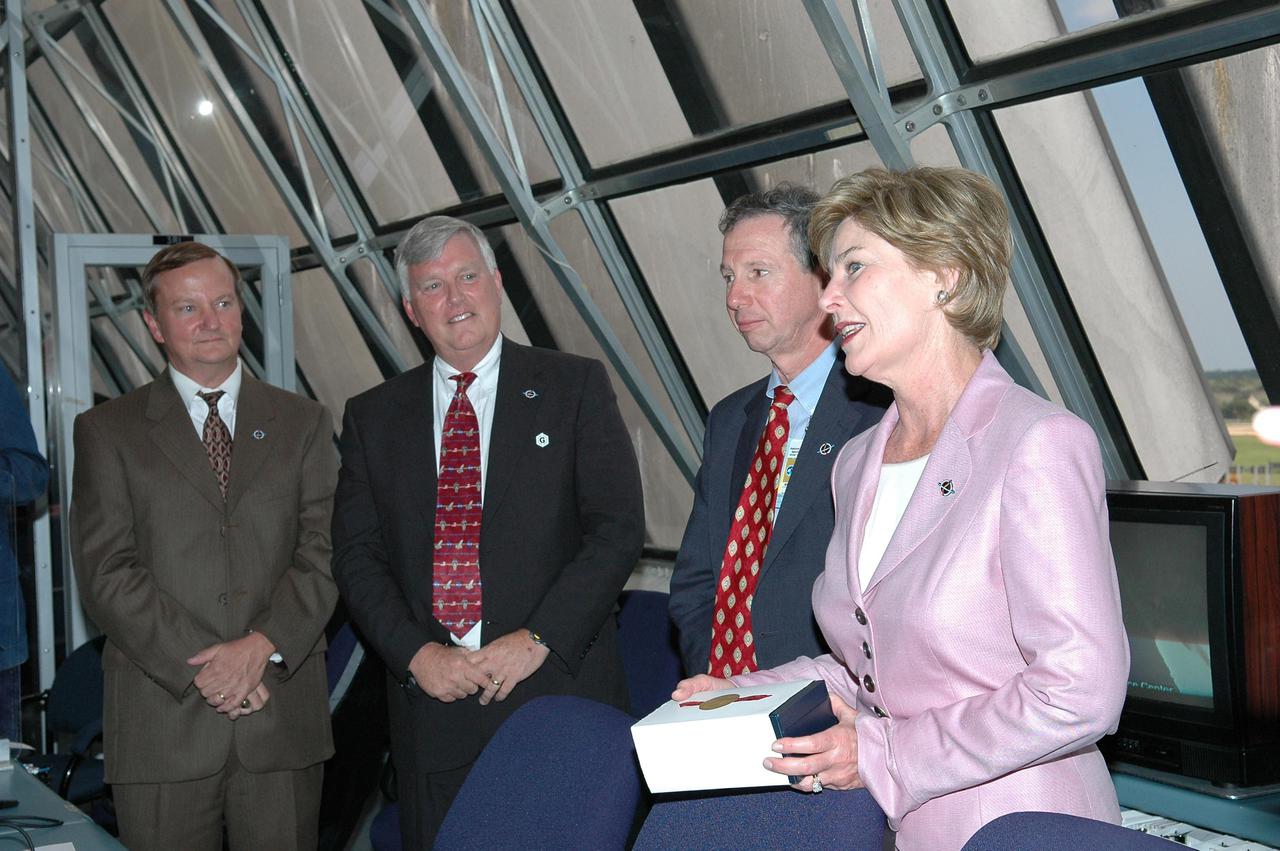
KENNEDY SPACE CENTER, FLA. - In the Launch Control Center at NASA Kennedy Space Center, First Lady Laura Bush talks to the launch team after the successful launch of Space Shuttle Discovery on Return to Flight mission STS-114. NASA officials with her are, from left, Shuttle Launch Director Mike Leinbach, Center Director Jim Kennedy and NASA Administrator Mike Griffin. On this mission to the International Space Station the crew will perform inspections on-orbit for the first time of all of the Reinforced Carbon-Carbon (RCC) panels on the leading edge of the wings and the Thermal Protection System tiles using the new Canadian-built Orbiter Boom Sensor System and the data from 176 impact and temperature sensors. Mission Specialists will also practice repair techniques on RCC and tile samples during a spacewalk in the payload bay. During two additional spacewalks, the crew will install the External Stowage Platform-2, equipped with spare part assemblies, and a replacement Control Moment Gyroscope contained in the Lightweight Multi-Purpose Experiment Support Structure. The 12-day mission is expected to end with touchdown at the Shuttle Landing Facility on Aug. 7.
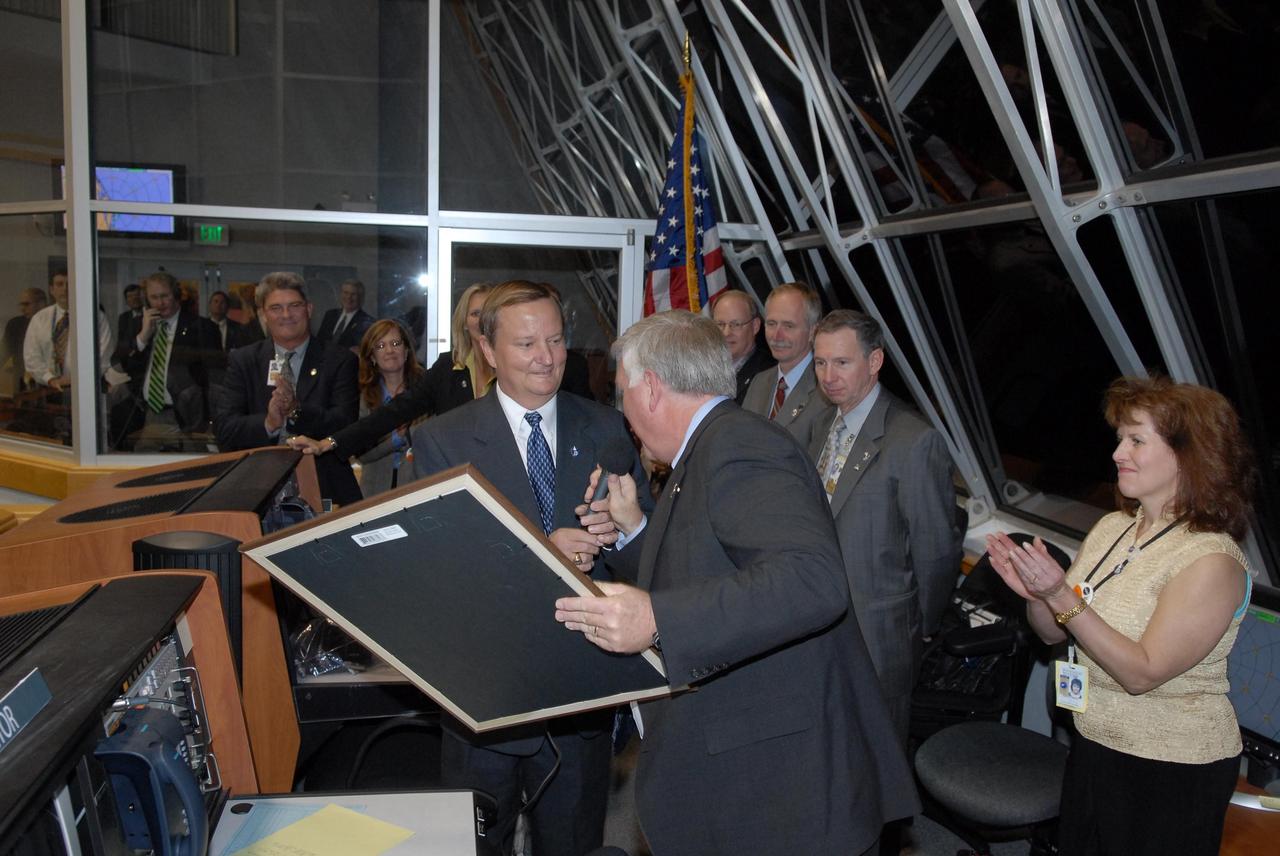
KENNEDY SPACE CENTER, FLA. -- In the firing room at the Launch Control Center, Shuttle Launch Director Mike Leinbach presents a memento of the night's successful launch of Space Shuttle Discovery to Kennedy Space Center Director Jim Kennedy, who is retiring in January. Behind Leinbach and Kennedy are, left to right, Deputy Director Bill Parsons, External Relations Director Lisa Malone, NASA Flow Director for Discovery Stephanie Stilson, NASA KSC News Chief Bruce Buckingham, Associate Administrator for Space Operations Mission William Gerstenmaier and NASA Administrator Mike Griffin and his wife, Becky. This was the second launch attempt for mission STS-116. The first launch attempt on Dec. 7 was postponed due a low cloud ceiling over Kennedy Space Center. This is Discovery's 33rd mission and the first night launch since 2002. The 20th shuttle mission to the International Space Station, STS-116 carries another truss segment, P5. It will serve as a spacer, mated to the P4 truss that was attached in September. After installing the P5, the crew will reconfigure and redistribute the power generated by two pairs of U.S. solar arrays. Landing is expected Dec. 21 at KSC. Photo credit: NASA/Kim Shiflett
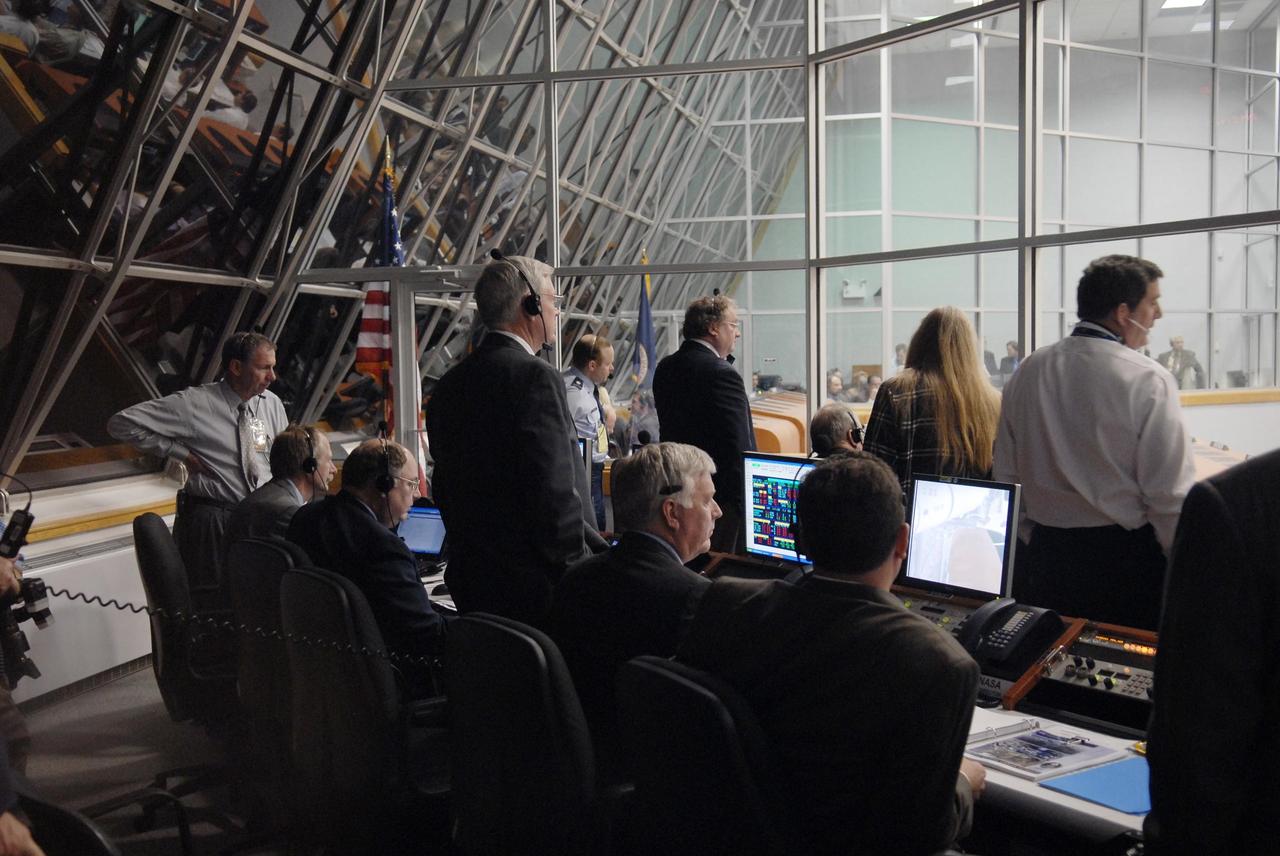
KENNEDY SPACE CENTER, FLA. -- In the firing room, NASA officials wait for the countdown of the second launch attempt of Space Shuttle Discovery on mission STS-116. At the consoles, from left, are NASA Administrator Mike Griffin, Associate Administrator for Space Operations Mission William Gerstenmaier, Johnson Space Center Director Mike Coats, Kennedy Space Center Director Jim Kennedy and Marshall Space Flight Center Director Dave King. This was the second launch attempt for mission STS-116. The first launch attempt on Dec. 7 was postponed due a low cloud ceiling over Kennedy Space Center. This is Discovery's 33rd mission and the first night launch since 2002. The 20th shuttle mission to the International Space Station, STS-116 carries another truss segment, P5. It will serve as a spacer, mated to the P4 truss that was attached in September. After installing the P5, the crew will reconfigure and redistribute the power generated by two pairs of U.S. solar arrays. Landing is expected Dec. 21 at KSC. Photo credit: NASA/Kim Shiflett
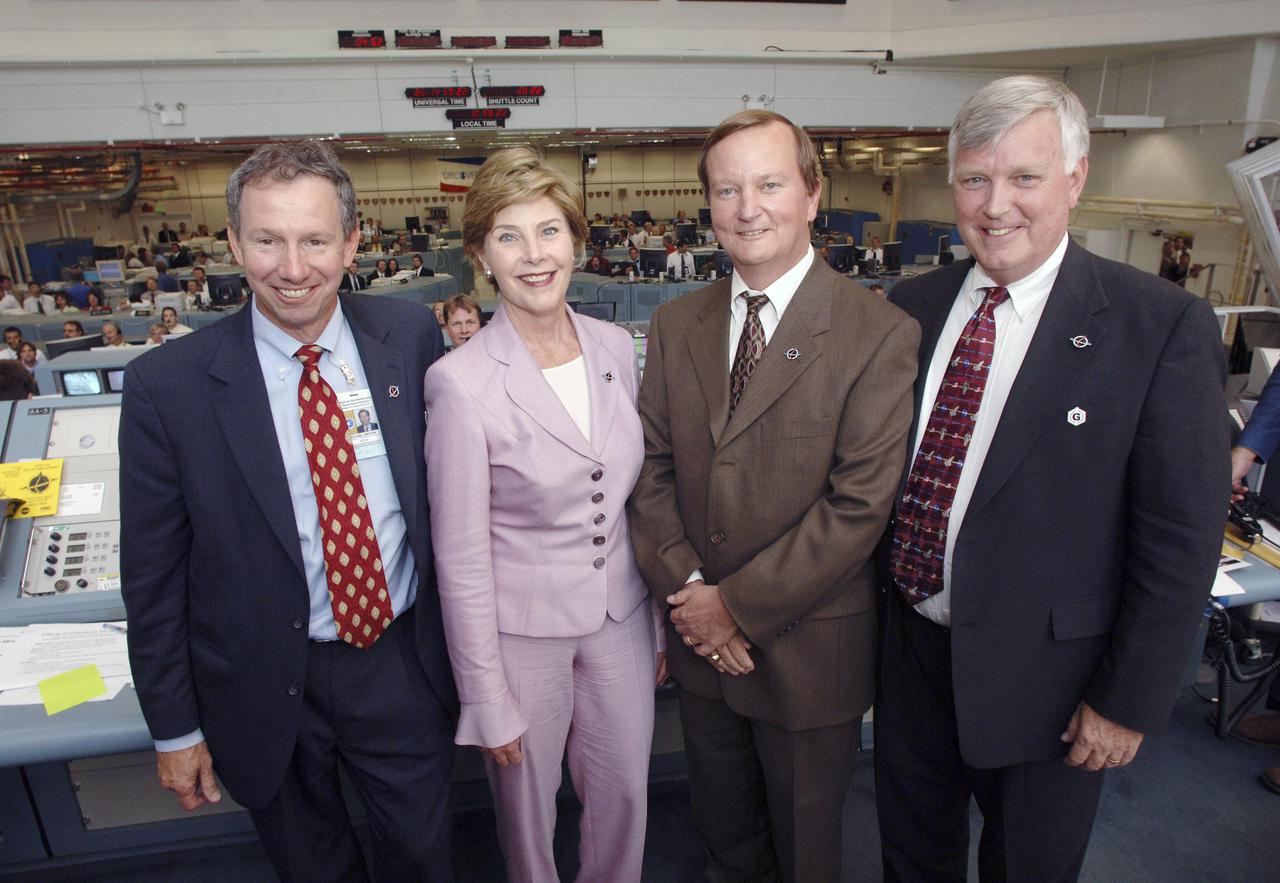
KENNEDY SPACE CENTER, FLA. - In the Launch Control Center at NASA Kennedy Space Center, NASA Administrator Mike Griffin, First Lady Laura Bush, Shuttle Launch Director Mike Leinbach and Center Director Jim Kennedy pose for a photograph. Mrs. Bush witnessed the historic launch of Space Shuttle Discovery on Return to Flight mission STS-114. She is only the third First Lady to witness a Space Shuttle launch at KSC. On this mission to the International Space Station the crew will perform inspections on-orbit for the first time of all of the Reinforced Carbon-Carbon (RCC) panels on the leading edge of the wings and the Thermal Protection System tiles using the new Canadian-built Orbiter Boom Sensor System and the data from 176 impact and temperature sensors. Mission Specialists will also practice repair techniques on RCC and tile samples during a spacewalk in the payload bay. During two additional spacewalks, the crew will install the External Stowage Platform-2, equipped with spare part assemblies, and a replacement Control Moment Gyroscope contained in the Lightweight Multi-Purpose Experiment Support Structure. The 12-day mission is expected to end with touchdown at the Shuttle Landing Facility on Aug. 7. (Photo Credit: Bill Ingalls)
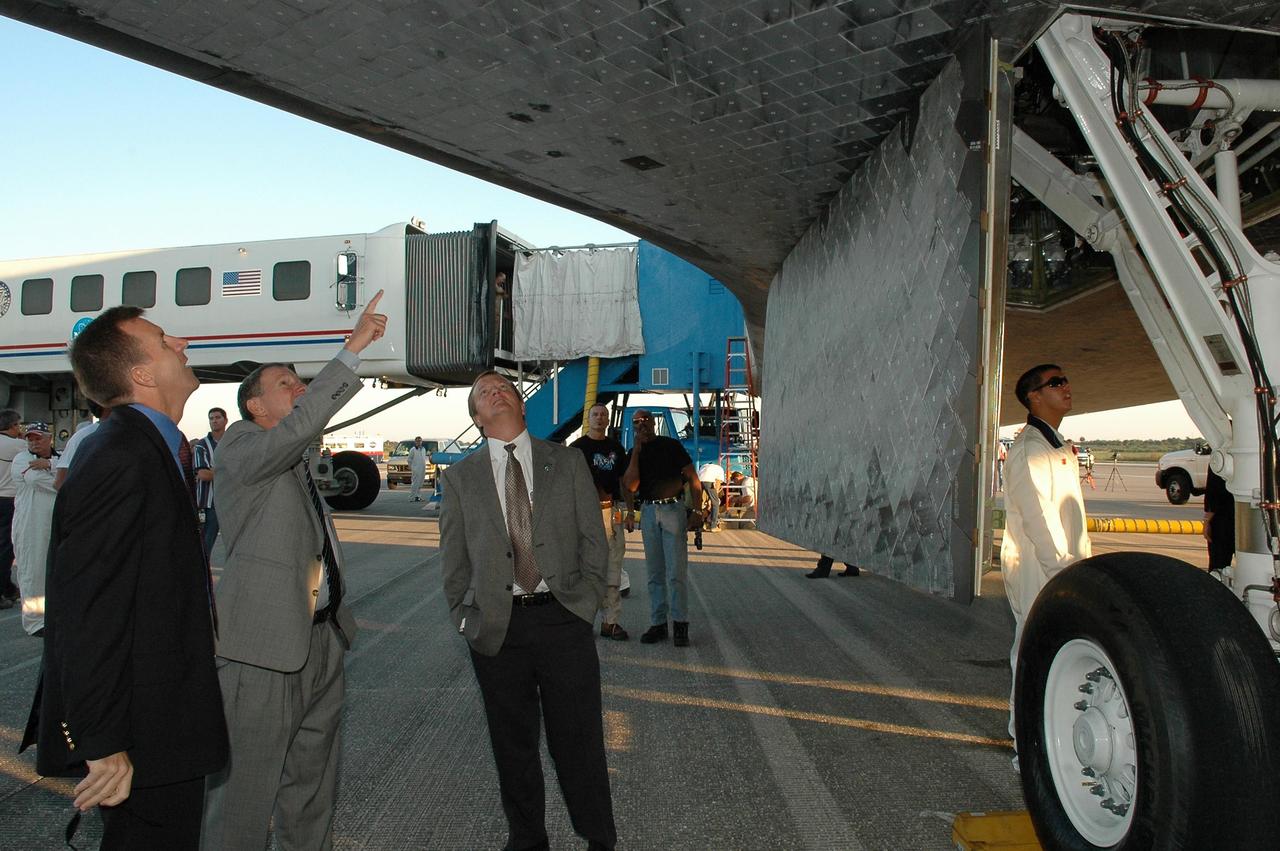
KENNEDY SPACE CENTER, FLA. - Before welcoming the STS-115 crew on their return from space, NASA officials look at the underside of the orbiter Atlantis on the Shuttle Landing Facility. From left are Mission Launch Integration Director LeRoy Cain, NASA Administrator Michael Griffin and Shuttle Launch Director Mike Leinbach. During the mission, astronauts completed three spacewalks to attach the P3/P4 integrated truss structure to the International Space Station. Main gear touchdown was at 6:21:30 a.m. EDT. Nose gear touchdown was at 6:21:36 a.m. and wheel stop was at 6:22:16 a.m. At touchdown -- nominally about 2,500 ft. beyond the runway threshold -- the orbiter is traveling at a speed ranging from 213 to 226 mph. Atlantis traveled 4.9 million miles, landing on orbit 187. Mission elapsed time was 11 days, 19 hours, six minutes. This is the 15th night landing at KSC and the 23rd night landing overall. Photo credit: NASA/Kim Shiflett
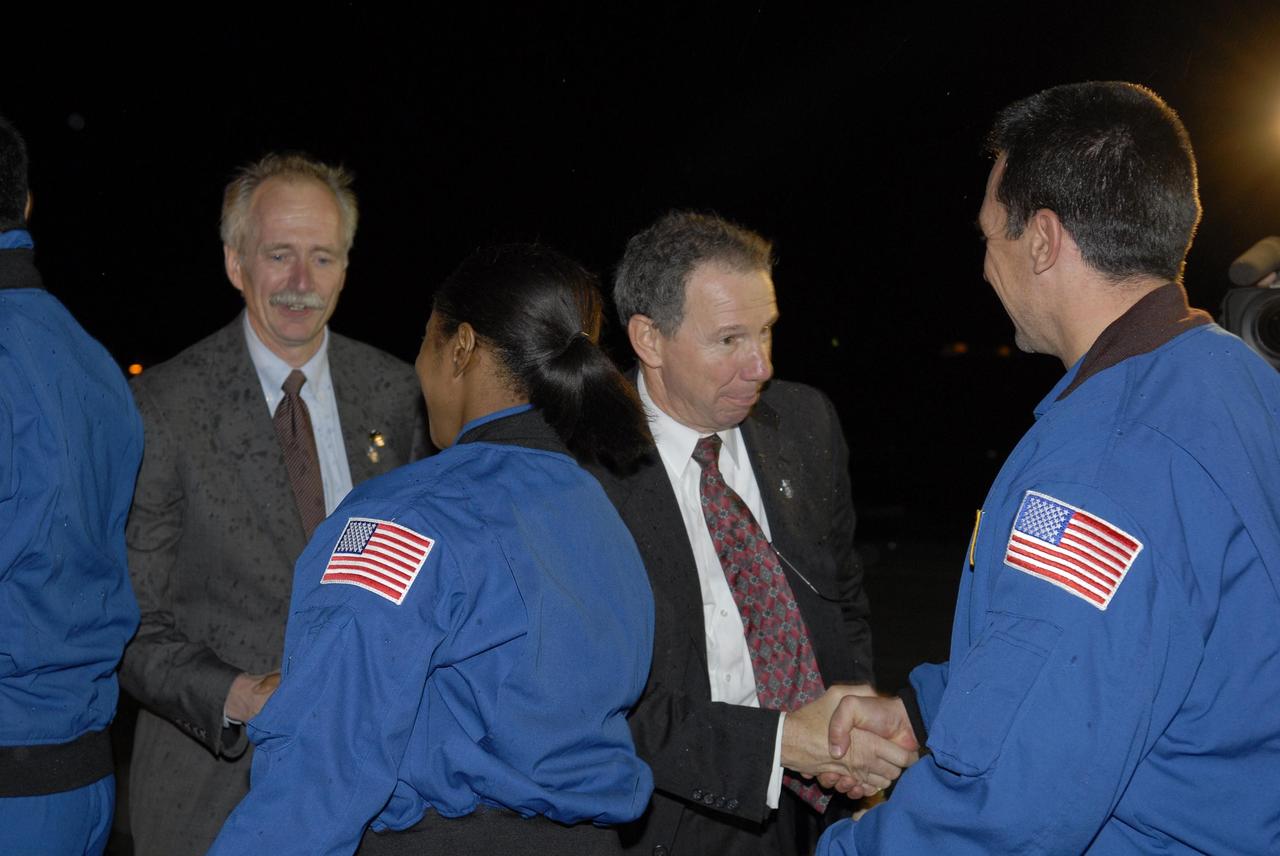
KENNEDY SPACE CENTER, FLA. -- NASA Associate Administrator for Space Operations Bill Gerstenmaier congratulates STS-116 Mission Specialist Joan Higginbotham on a job well done as NASA Administrator Mike Griffin shakes hands with STS-116 Pilot William Oefelein following the landing of Space Shuttle Discovery on Runway 15 at NASA Kennedy Space Center's Shuttle Landing Facility. During the STS-116 mission, three spacewalks attached the P5 integrated truss structure to the station, and completed the rewiring of the orbiting laboratory's power system. A fourth spacewalk retracted a stubborn solar array. Main gear touchdown was at 5:32 p.m. EST. Nose gear touchdown was at 5:32:12 p.m. and wheel stop was at 5:32:52 p.m. At touchdown -- nominally about 2,500 ft. beyond the runway threshold -- the orbiter is traveling at a speed ranging from 213 to 226 mph. Discovery traveled 5,330,000 miles, landing on orbit 204. Mission elapsed time was 12 days, 20 hours, 44 minutes and 16 seconds. This is the 64th landing at KSC. Photo credit: NASA/Kim Shiflett
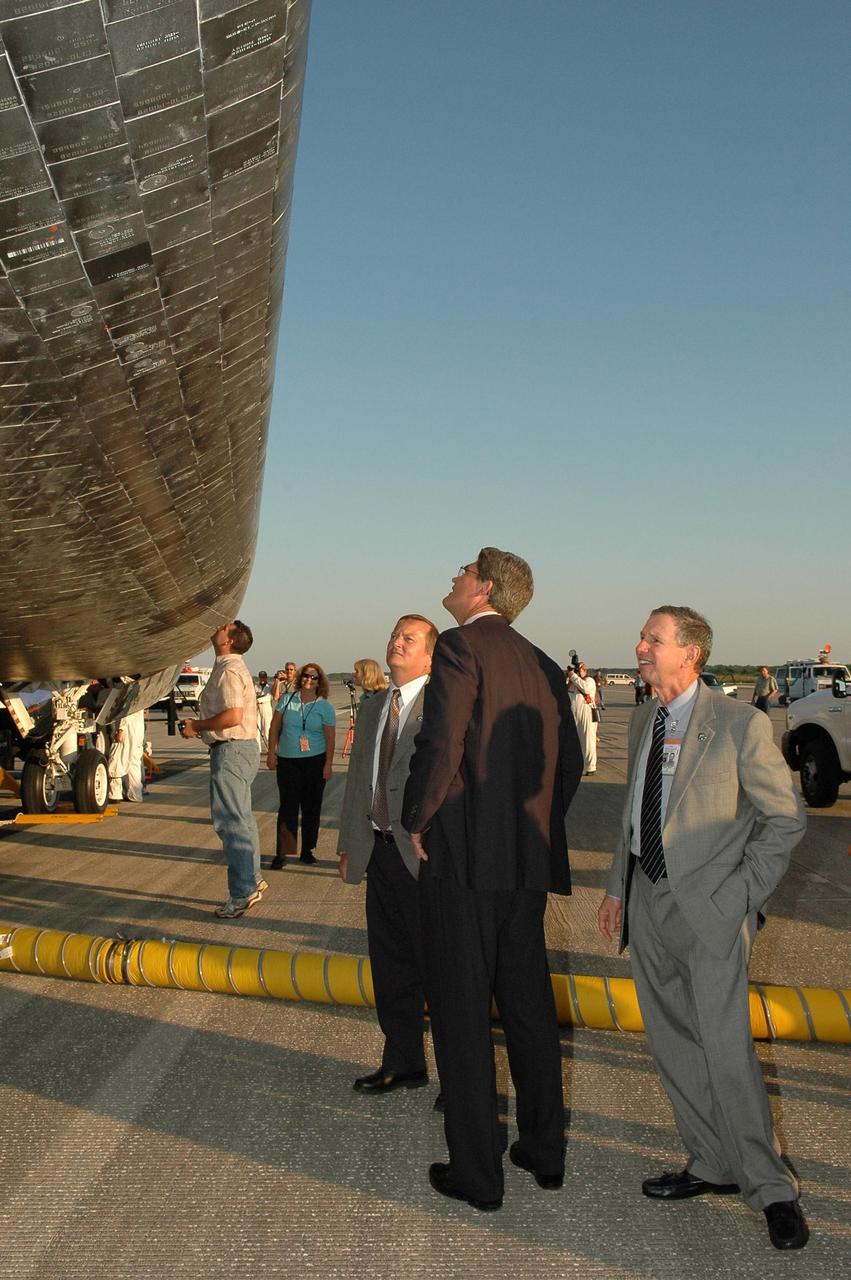
KENNEDY SPACE CENTER, FLA. - Before welcoming the STS-115 crew on their return from space, NASA officials look at the underside of the orbiter Atlantis on the Shuttle Landing Facility. From right are NASA Administrator Michael Griffin, KSC Deputy Director Bill Parsons and Shuttle Launch Director Mike Leinbach. During the mission, astronauts completed three spacewalks to attach the P3/P4 integrated truss structure to the International Space Station. Main gear touchdown was at 6:21:30 a.m. EDT. Nose gear touchdown was at 6:21:36 a.m. and wheel stop was at 6:22:16 a.m. At touchdown -- nominally about 2,500 ft. beyond the runway threshold -- the orbiter is traveling at a speed ranging from 213 to 226 mph. Atlantis traveled 4.9 million miles, landing on orbit 187. Mission elapsed time was 11 days, 19 hours, six minutes. This is the 15th night landing at KSC and the 23rd night landing overall. Photo credit: NASA/Kim Shiflett
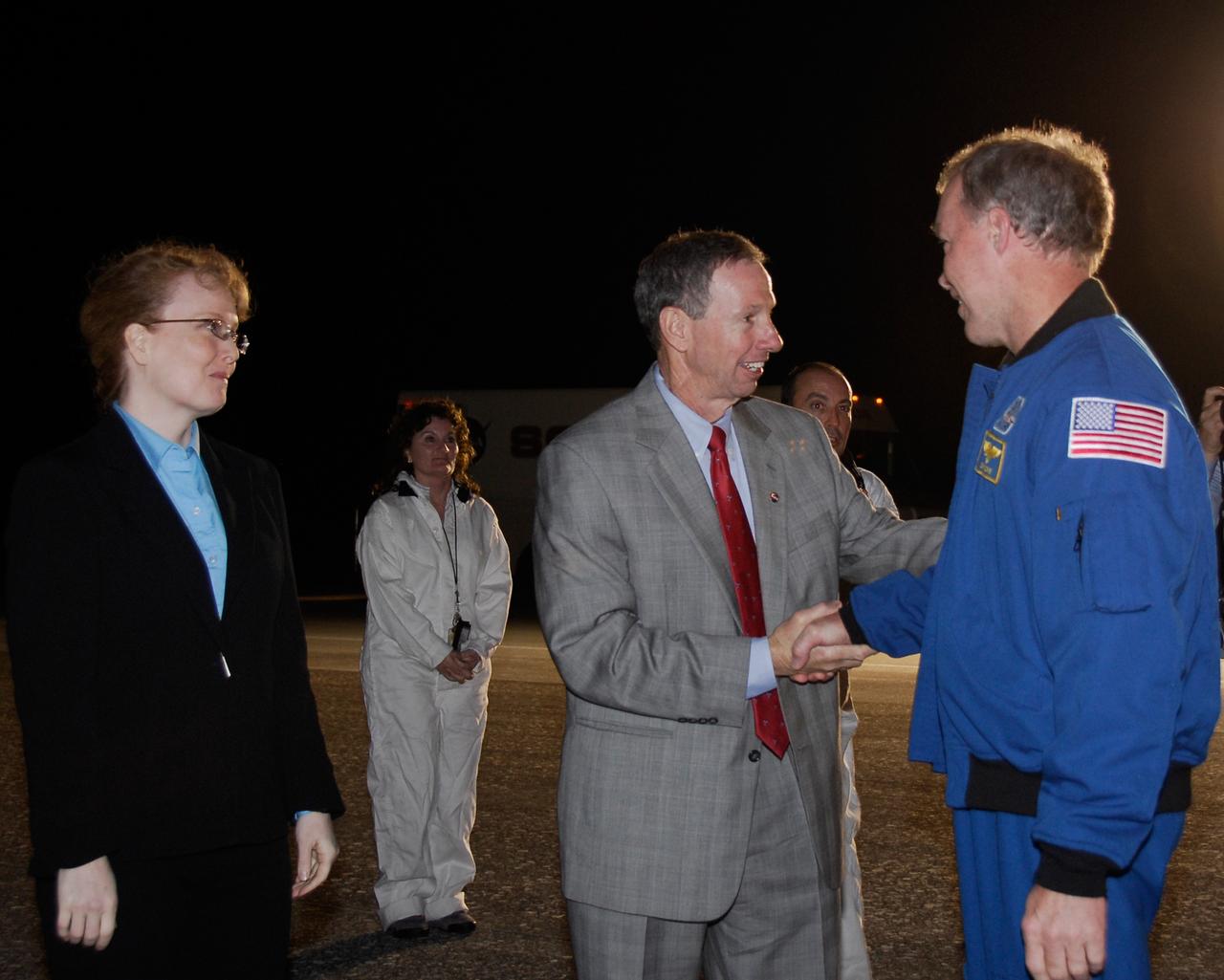
CAPE CANAVERAL, Fla. --- At NASA Kennedy Space Center's Shuttle Landing Facility, STS-123 Commander Dominic Gorie, right, is welcomed back from orbit by NASA Deputy Administrator Shana Dale, left, and NASA Administrator Mike Griffin as Media Coordinator MaryAnn Chevalier looks on. Space shuttle Endeavour landed on Runway 15 to end the STS-123 mission, a 16-day flight to the International Space Station. This was the 16th night landing at Kennedy. The main landing gear touched down at 8:39:08 p.m. EDT. The nose landing gear touched down at 8:39:17 p.m. and wheel stop was at 8:40:41 p.m. The mission completed nearly 6.6 million miles. The landing was on the second opportunity after the first was waved off due to unstable weather in the Kennedy Space Center area. The STS-123 mission delivered the first segment of the Japan Aerospace Exploration Agency's Kibo laboratory and the Canadian Space Agency's two-armed robotic system, known as Dextre. Photo credit: NASA/Kim Shiflett
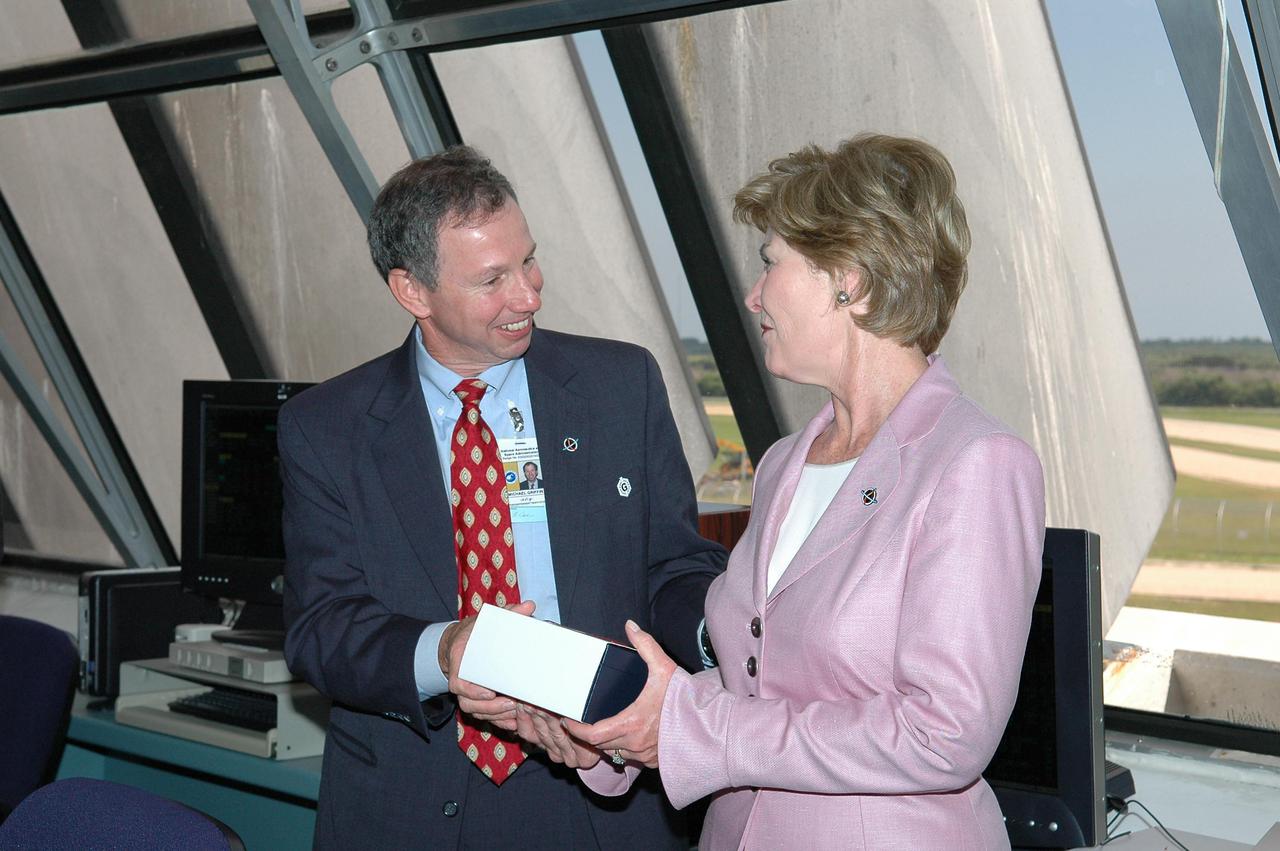
KENNEDY SPACE CENTER, FLA. - In the Launch Control Center at NASA Kennedy Space Center, NASA Administrator Mike Griffin (left) presents a gift to First Lady Laura Bush on the occasion of her first Space Shuttle launch. She witnessed the historic launch of Space Shuttle Discovery on Return to Flight mission STS-114. On this mission to the International Space Station the crew will perform inspections on-orbit for the first time of all of the Reinforced Carbon-Carbon (RCC) panels on the leading edge of the wings and the Thermal Protection System tiles using the new Canadian-built Orbiter Boom Sensor System and the data from 176 impact and temperature sensors. Mission Specialists will also practice repair techniques on RCC and tile samples during a spacewalk in the payload bay. During two additional spacewalks, the crew will install the External Stowage Platform-2, equipped with spare part assemblies, and a replacement Control Moment Gyroscope contained in the Lightweight Multi-Purpose Experiment Support Structure. The 12-day mission is expected to end with touchdown at the Shuttle Landing Facility on Aug. 7.

CAPE CANAVERAL, Fla. --- NASA Administrator Mike Griffin poses for a portrait with representatives of the Japan Aerospace Exploration Agency, or JAXA, under space shuttle Endeavour. On the left is JAXA Director Kuniaki Shiraki, and on the right is JAXA Vice President Kaoru Mamiya. JAXA is one of NASA's international partners in the development and operation of the International Space Station. The shuttle landed on Runway 15 at Kennedy Space Center's Shuttle Landing Facility at the end of the STS-123 mission, a 16-day flight to the International Space Station. This was the 16th night landing at Kennedy. The main landing gear touched down at 8:39:08 p.m. EDT. The nose landing gear touched down at 8:39:17 p.m. and wheel stop was at 8:40:41 p.m. The mission completed nearly 6.6 million miles. The landing was on the second opportunity after the first was waved off due to unstable weather in the Kennedy Space Center area. The STS-123 mission delivered the first segment of the Japan Aerospace Exploration Agency's Kibo laboratory and the Canadian Space Agency's two-armed robotic system, known as Dextre. Photo credit: NASA/Kim Shiflett
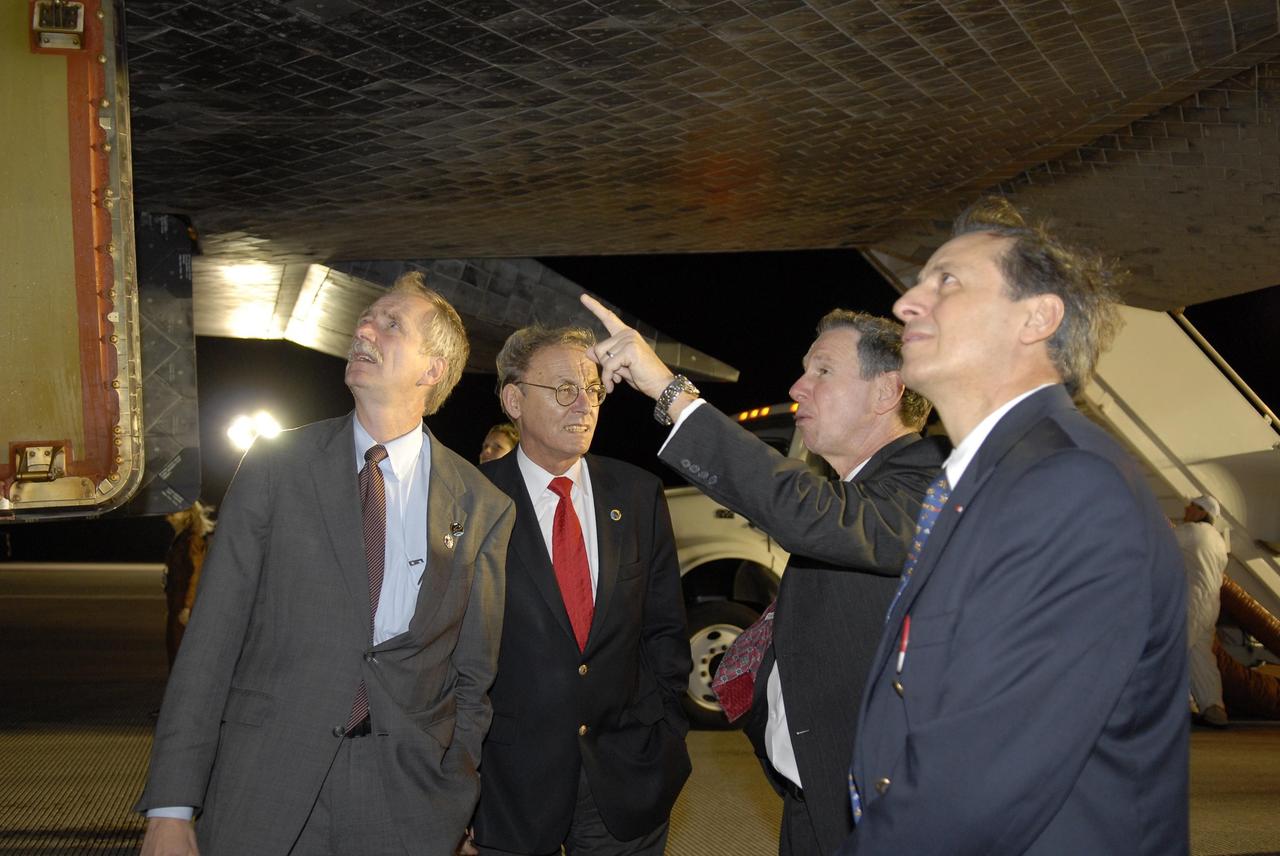
KENNEDY SPACE CENTER, FLA. -- Bill Gerstenmaier, NASA associate administrator for Space Operations; Sigmar Wittig, head of the DLR, the German Space Agency; Mike Griffin, NASA administrator; and Michel Tognini, head of the European Astronaut Center, examine the thermal protection system tiles beneath Space Shuttle Discovery following the landing of mission STS-116 on Runway 15 at NASA Kennedy Space Center's Shuttle Landing Facility. During the STS-116 mission, three spacewalks attached the P5 integrated truss structure to the station, and completed the rewiring of the orbiting laboratory's power system. A fourth spacewalk retracted a stubborn solar array. Main gear touchdown was at 5:32 p.m. EST. Nose gear touchdown was at 5:32:12 p.m. and wheel stop was at 5:32:52 p.m. At touchdown -- nominally about 2,500 ft. beyond the runway threshold -- the orbiter is traveling at a speed ranging from 213 to 226 mph. Discovery traveled 5,330,000 miles, landing on orbit 204. Mission elapsed time was 12 days, 20 hours, 44 minutes and 16 seconds. This is the 64th landing at KSC. Photo credit: NASA/Kim Shiflett
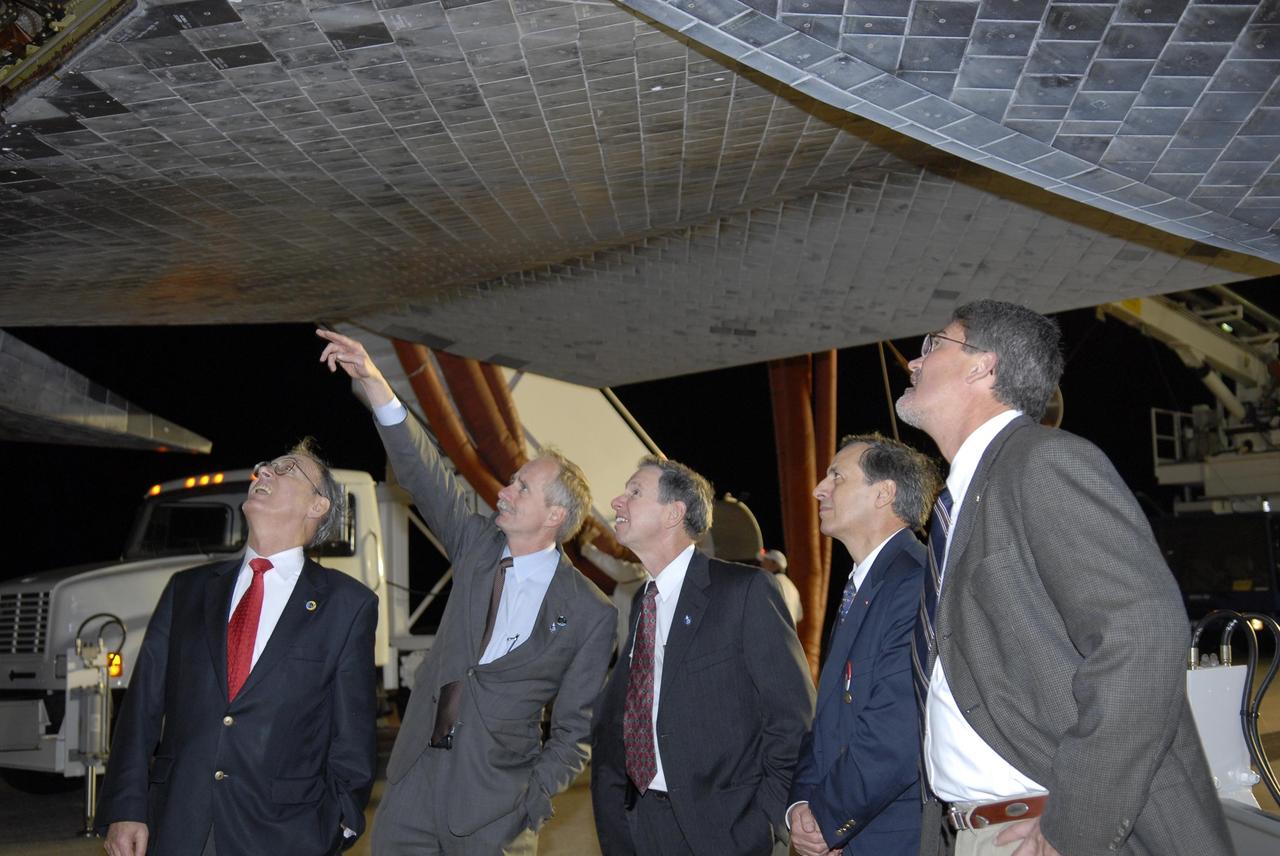
KENNEDY SPACE CENTER, FLA. -- Sigmar Wittig, head of the DLR, the German Space Agency; Bill Gerstenmaier, NASA associate administrator for Space Operations; Mike Griffin, NASA administrator; Michel Tognini, head of the European Astronaut Center; and Bill Parsons, Kennedy Space Center deputy director, examine the thermal protection system tiles beneath Space Shuttle Discovery following the landing of mission STS-116 on Runway 15 at NASA Kennedy Space Center's Shuttle Landing Facility. During the STS-116 mission, three spacewalks attached the P5 integrated truss structure to the station, and completed the rewiring of the orbiting laboratory's power system. A fourth spacewalk retracted a stubborn solar array. Main gear touchdown was at 5:32 p.m. EST. Nose gear touchdown was at 5:32:12 p.m. and wheel stop was at 5:32:52 p.m. At touchdown -- nominally about 2,500 ft. beyond the runway threshold -- the orbiter is traveling at a speed ranging from 213 to 226 mph. Discovery traveled 5,330,000 miles, landing on orbit 204. Mission elapsed time was 12 days, 20 hours, 44 minutes and 16 seconds. This is the 64th landing at KSC. Photo credit: NASA/Kim Shiflett
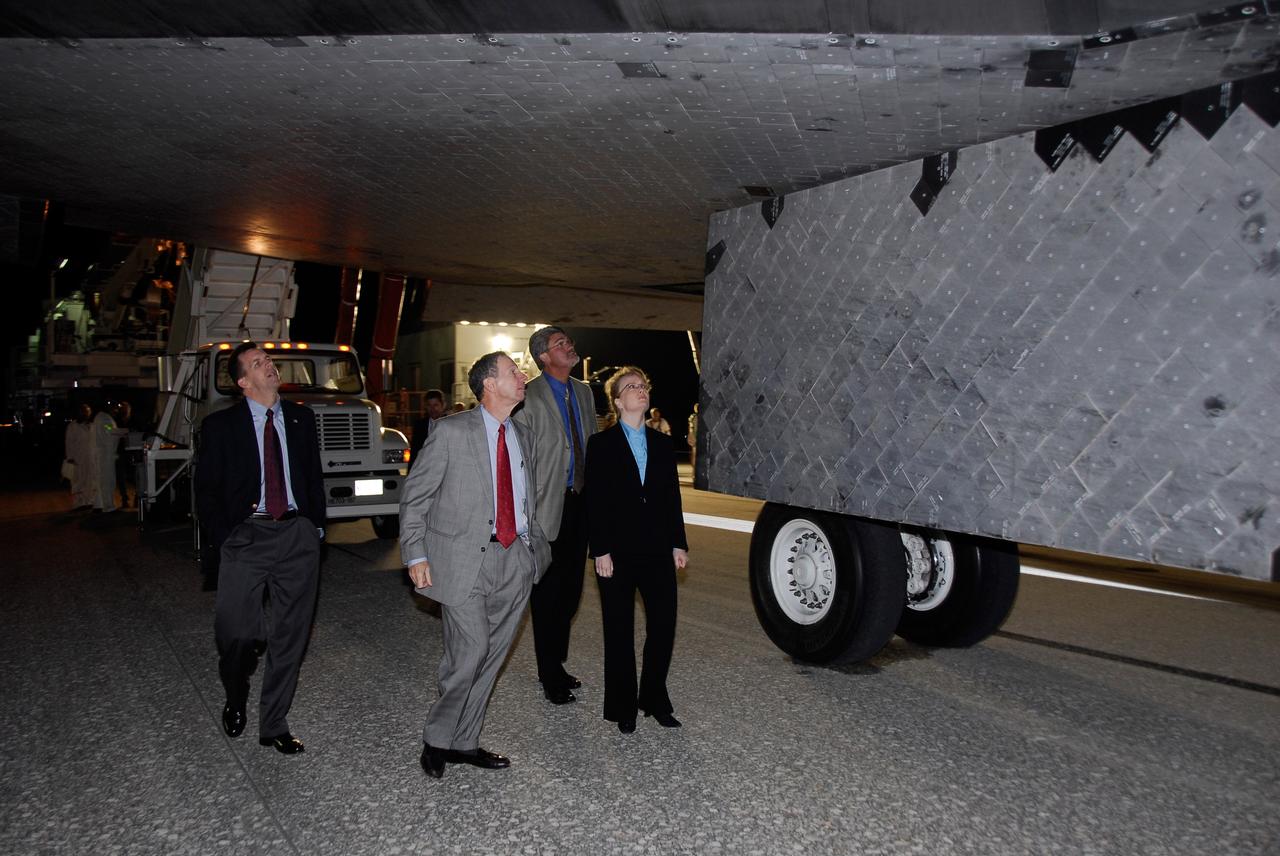
CAPE CANAVERAL, Fla. --- NASA managers examine the thermal protection system tile under space shuttle Endeavour on Runway 15 at Kennedy Space Center's Shuttle Landing Facility at the end of the STS-123 mission, a 16-day flight to the International Space Station. From left are Mission Management Team Chairman LeRoy Cain, NASA Administrator Mike Griffin, Kennedy Space Center Director Bill Parsons and NASA Deputy Administrator Shana Dale. This was the 16th night landing at Kennedy. The main landing gear touched down at 8:39:08 p.m. EDT. The nose landing gear touched down at 8:39:17 p.m. and wheel stop was at 8:40:41 p.m. The mission completed nearly 6.6 million miles. The landing was on the second opportunity after the first was waved off due to unstable weather in the Kennedy Space Center area. The STS-123 mission delivered the first segment of the Japan Aerospace Exploration Agency's Kibo laboratory and the Canadian Space Agency's two-armed robotic system, known as Dextre. Photo credit: NASA/Kim Shiflett