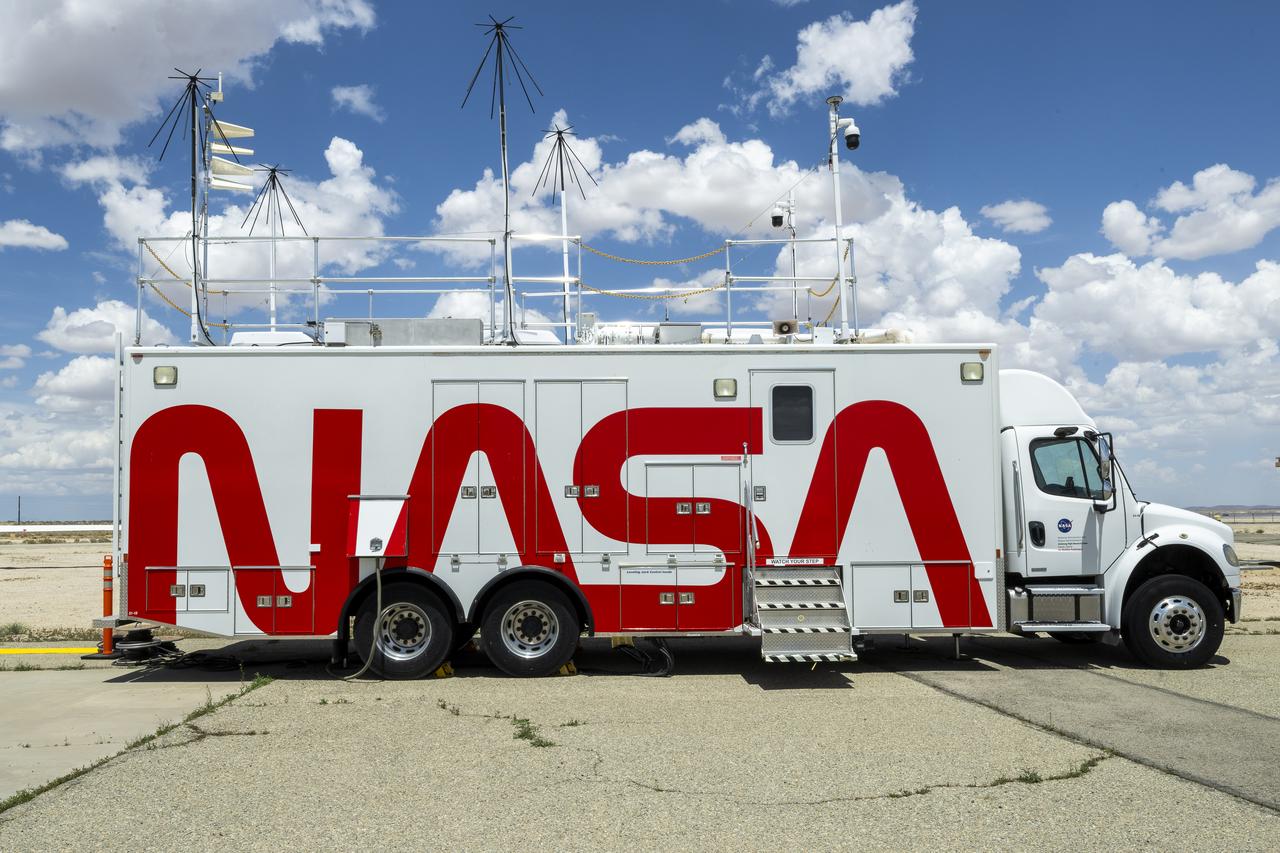
Housed at NASA’s Armstrong Flight Research Center in Edwards, California, this Mobile Operations Facility, seen here deployed on May 1, 2025, to support Advanced Air Mobility research for NASA’s Air Mobility Pathfinders project.
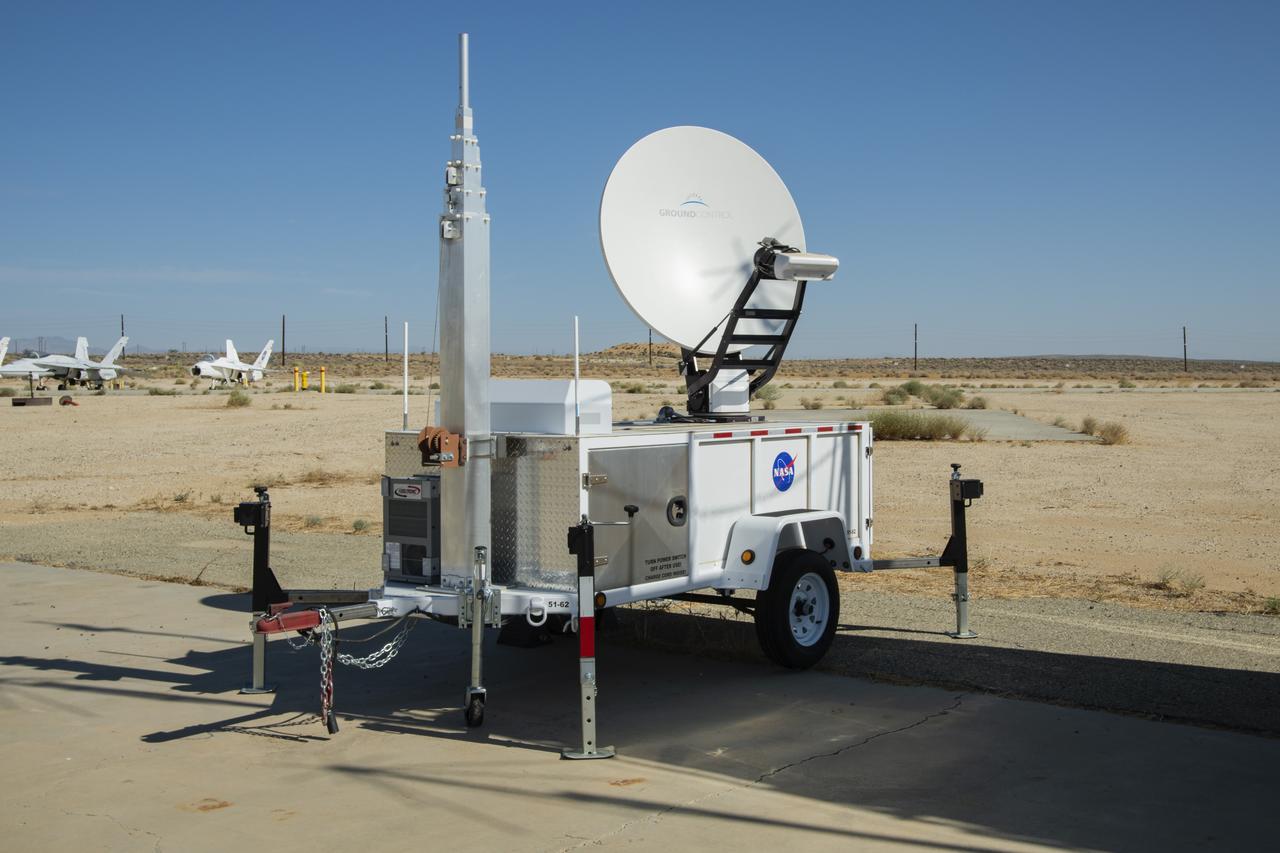
NASA Advanced Air Mobility project’s National Campaign mobile testing trailer is pictured at NASA Armstrong Flight Research Center in Edwards California on July 20, 2022. This trailer supports the Mobile Operations Facility’s data transmission when deployed to test locations.
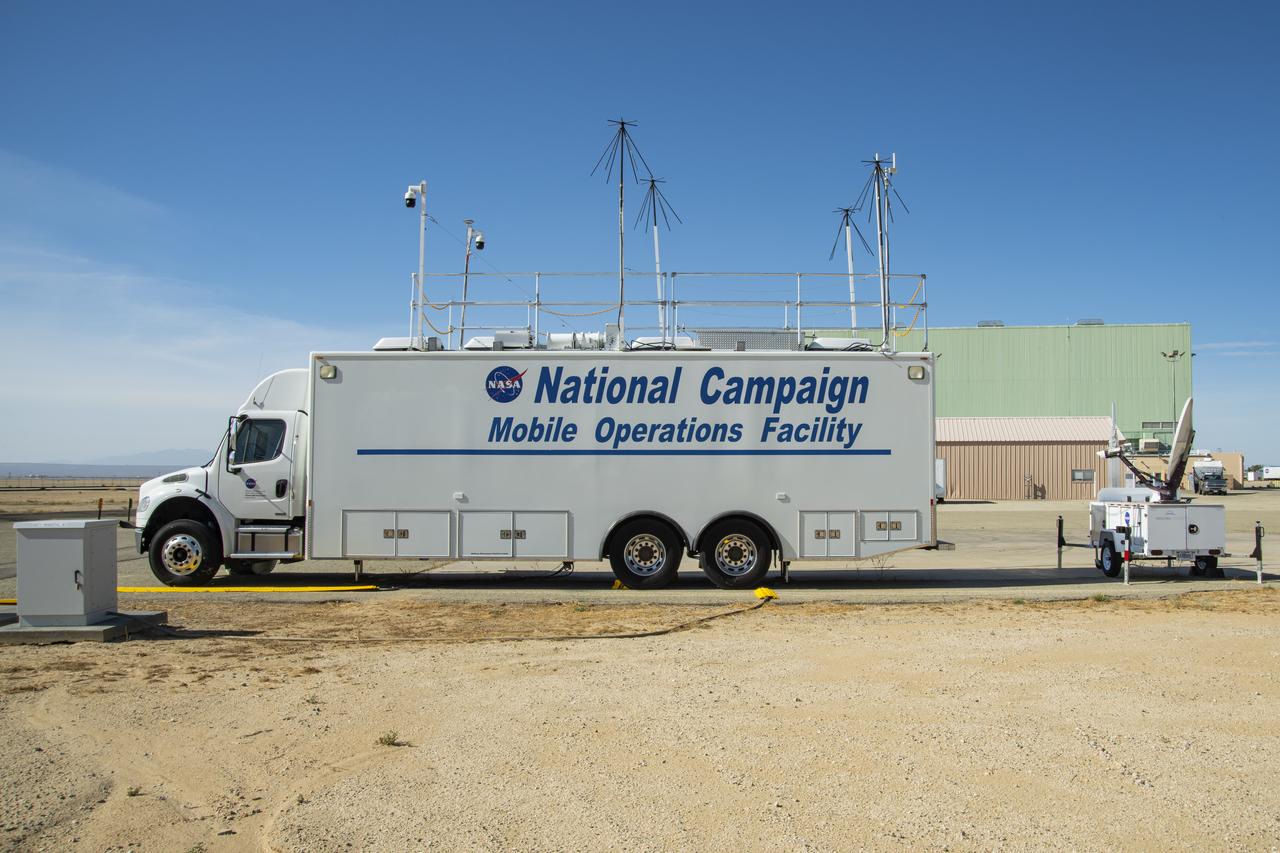
New decals are shown in this image of NASA's Mobile Operations Facility at NASA Armstrong Flight Research Center in Edwards, California on July 20, 2022. NASA's Advanced Air Mobility Project’s National Campaign uses the vehicle for mobile testing efforts.
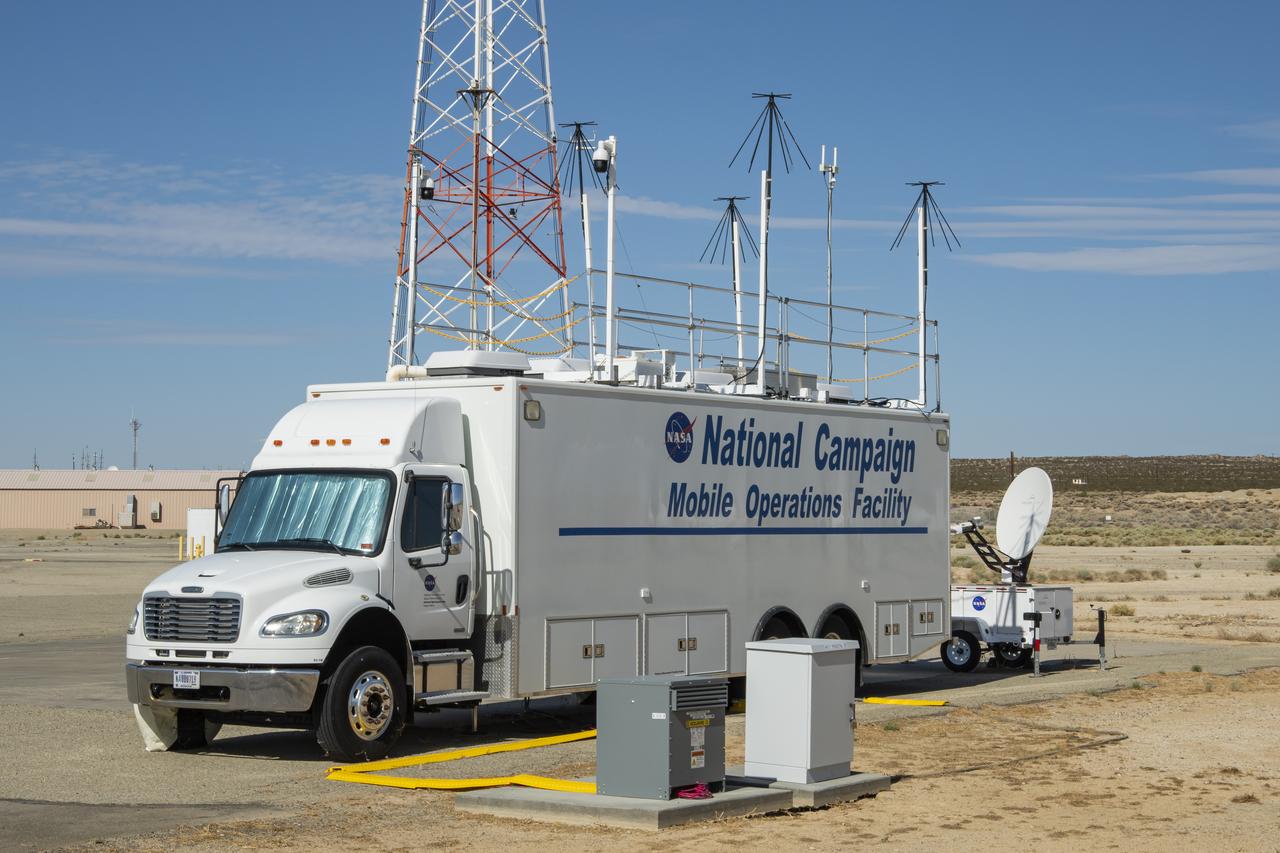
Photos taken on July 20, 2022, show new logos added to the side of the National Campaign’s upgraded Mobile Operations Facility, which has been outfitted to obtain and transmit data from anywhere in the country. This mobile command unit is housed at NASA Armstrong Flight Research Center in Edwards, California.
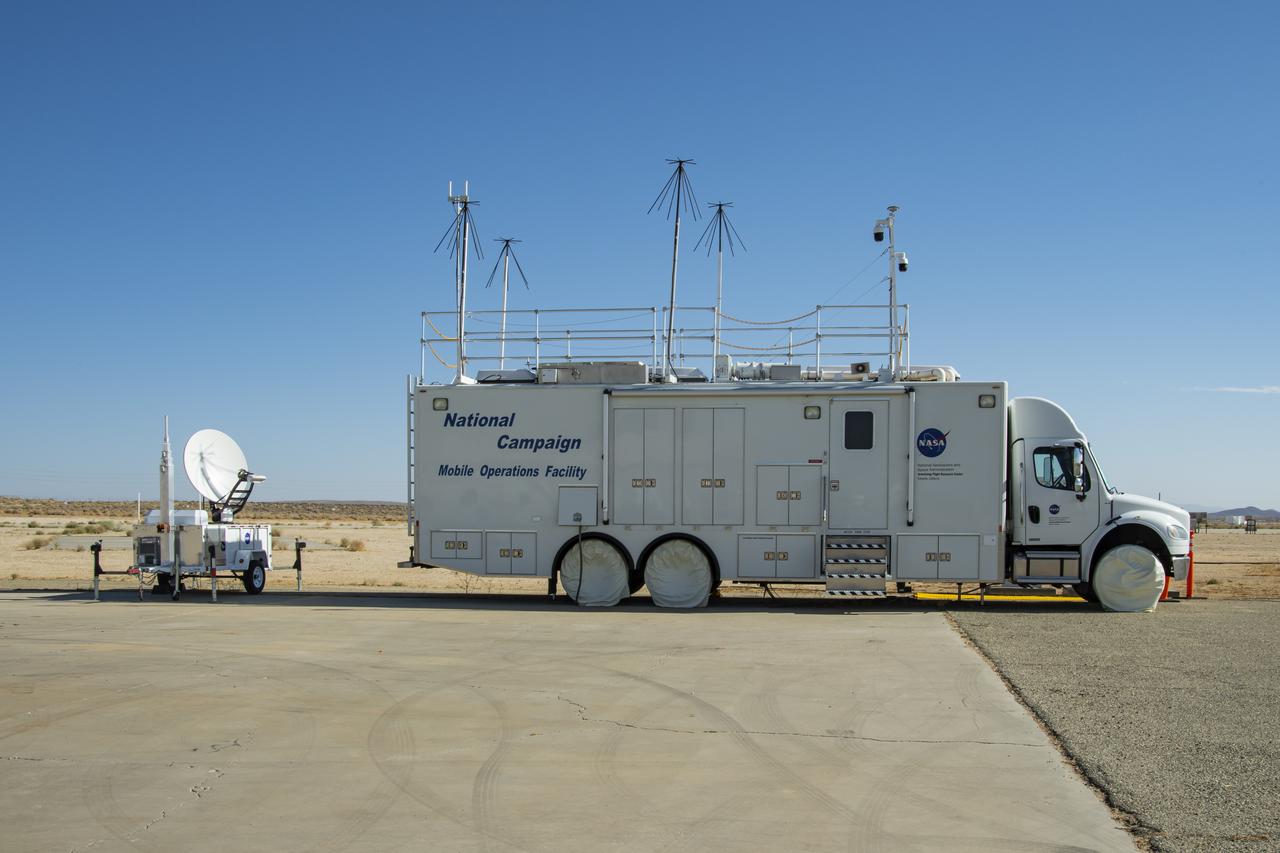
The NASA Mobile Operations Facility sports new decals while parked at NASA Armstrong Flight Research Center in Edwards, California on July 20, 2022. This vehicle, also known as the MOF, is a mission control and data collection center on wheels. NASA's Advanced Air Mobility project uses it for testing.
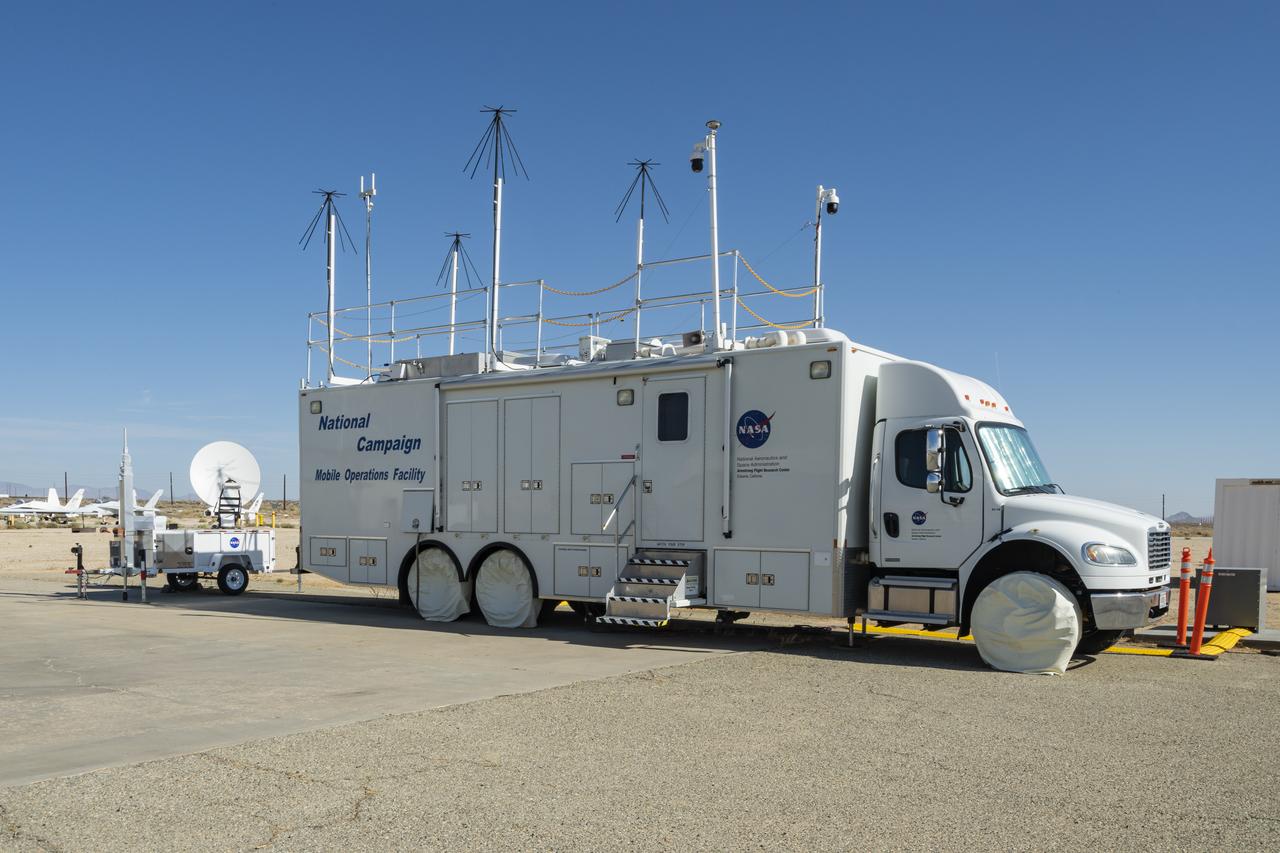
The upgraded NASA Mobile Operations Facility, a mission control and data collection center on wheels, is shown parked at NASA’s Armstrong Flight Research Center in Edwards, California on July 20, 2022. This vehicle is used for NASA's Advanced Air Mobility project’s National Campaign testing.
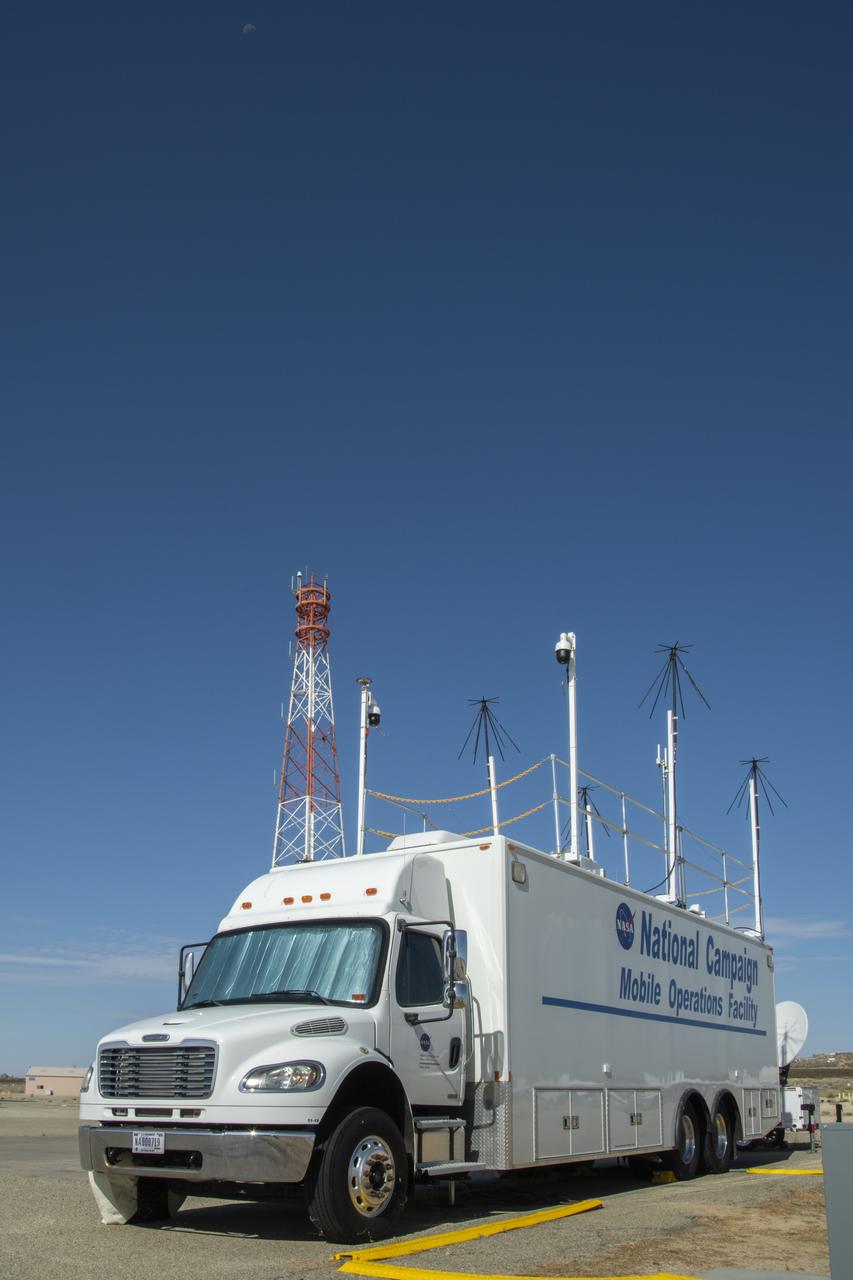
Housed at NASA Armstrong Flight Research Center in Edwards, California, the Advanced Air Mobility project's National Campaign upgraded the Mobile Operations Facility, pictured here on July 20, 2022. This command center on wheels is a key piece of NASA's AAM testing.
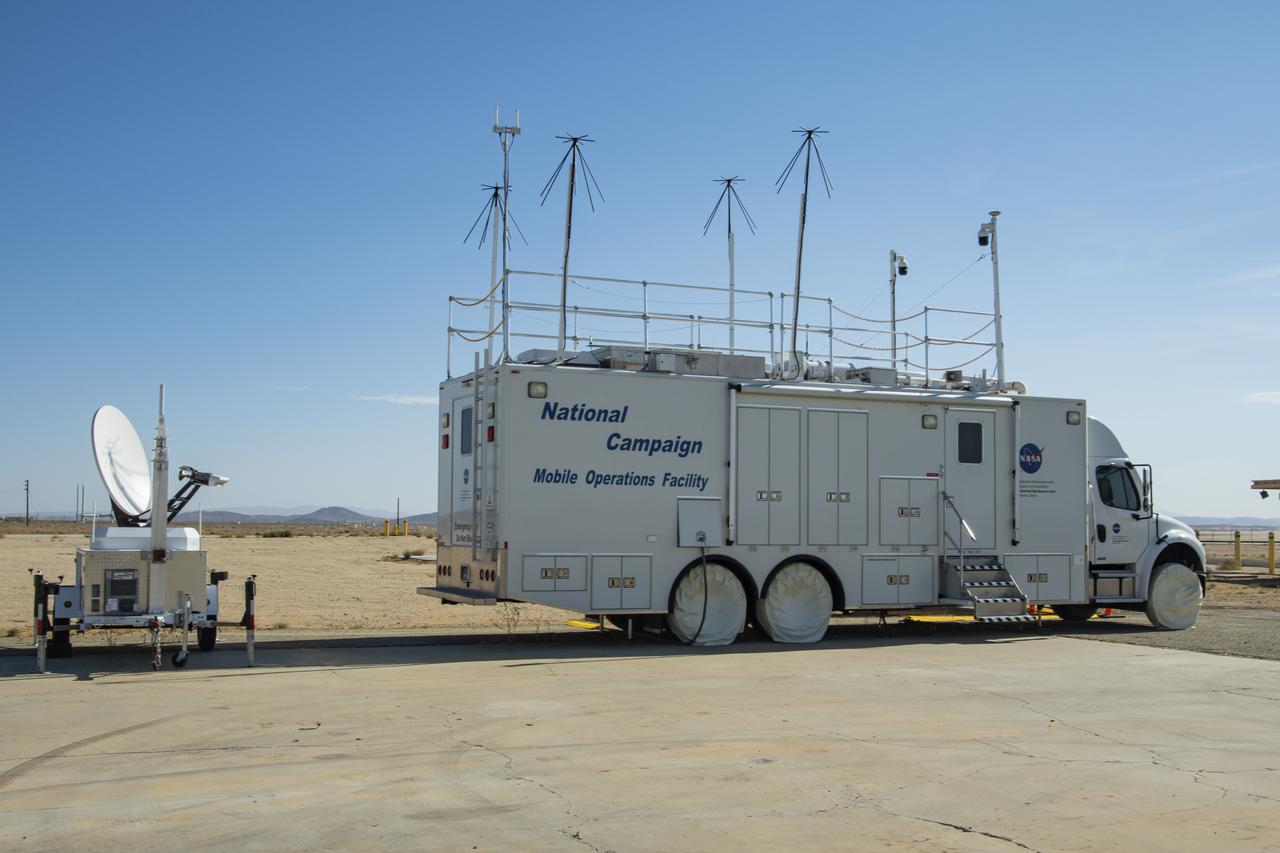
This specially outfitted mission control center, called the Mobile Operations Facility, can travel to any flight-testing site to obtain and transmit critical data. Here it is shown at NASA Armstrong Flight Research Center in Edwards, California on July 20, 2022. The data collected from the vehicle is used by NASA's Advanced Air Mobility project’s National Campaign.
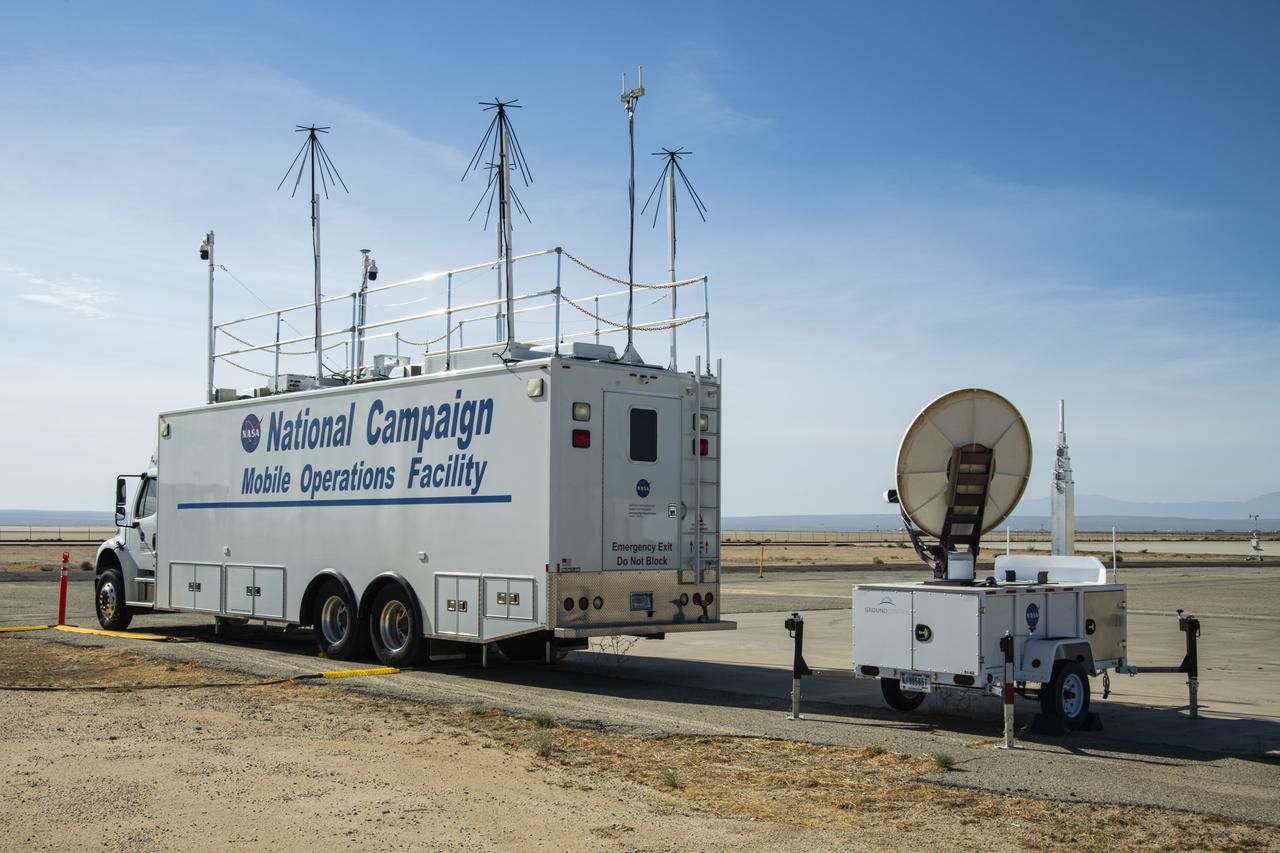
NASA's Mobile Operations Facility is shown here with new decals at NASA Armstrong Flight Research Center in Edwards, California on July 20, 2022. Antennas, sensors, and radar communications, housed inside and outside of the vehicle, help monitor aircraft and transmit data. NASA's Advanced Air Mobility project’s National Campaign uses the vehicle for testing.
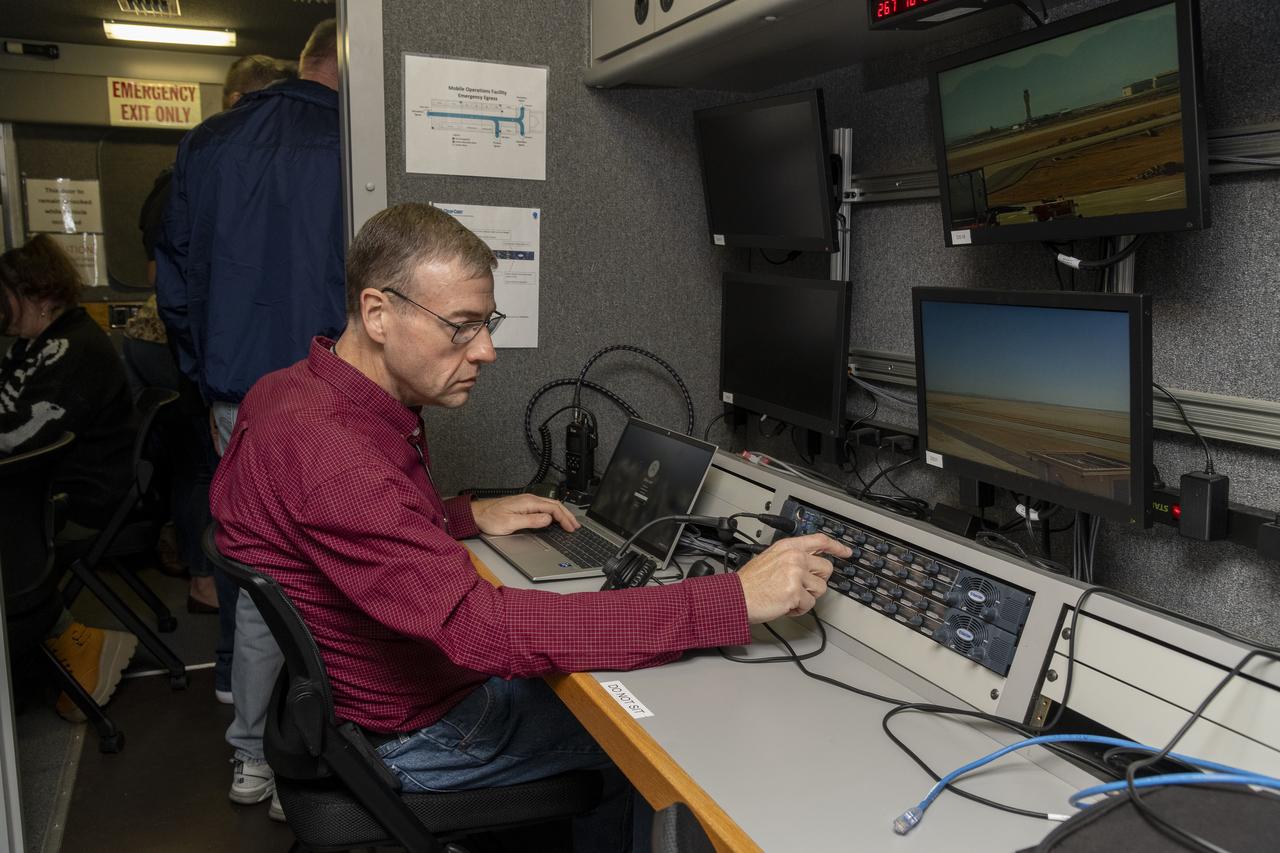
Working in the Mobile Operations Facility at NASA’s Armstrong Flight Research Center in Edwards, California, NASA Advanced Air Mobility researcher Dennis Iannicca adjusts a control board to capture Automatic Dependent Surveillance-Broadcast (ADS-B) data during test flights. The data will be used to understand ADS-B signal loss scenarios for air taxi flights in urban areas.
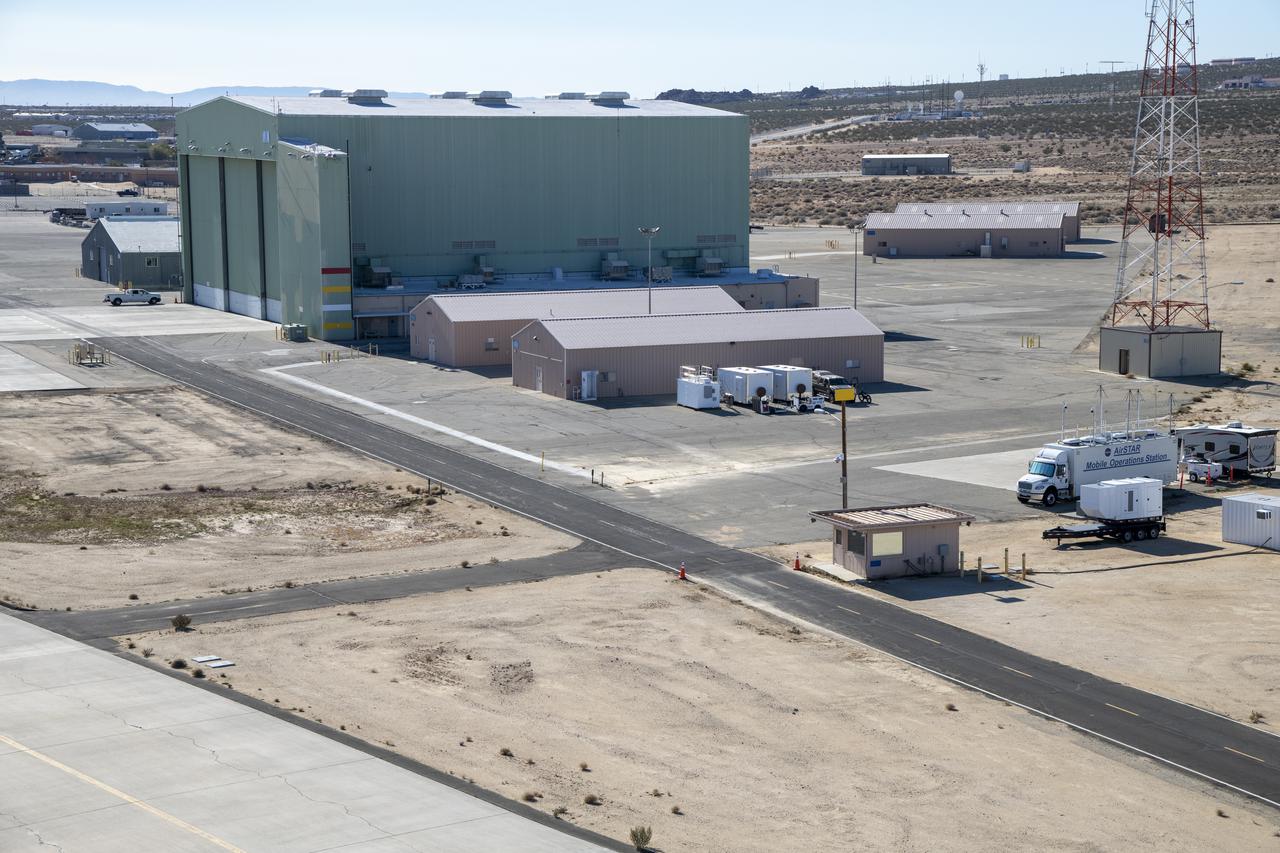
An aerial image taken by one of NASA’s photographers during recent helicopter flights shows a view of the building 4833 structure and the mobile operating facility at NASA’s Armstrong Flight Research Center in Edwards, California. NASA’s Advanced Air Mobility National Campaign uses the mobile operations facility vehicle shown in the lower right corner during test operations. The red, yellow, and white building markings applied to building 4833 are used to provide visual aids to the pilot during handling qualities testing used to research advanced air mobility flight requirements.
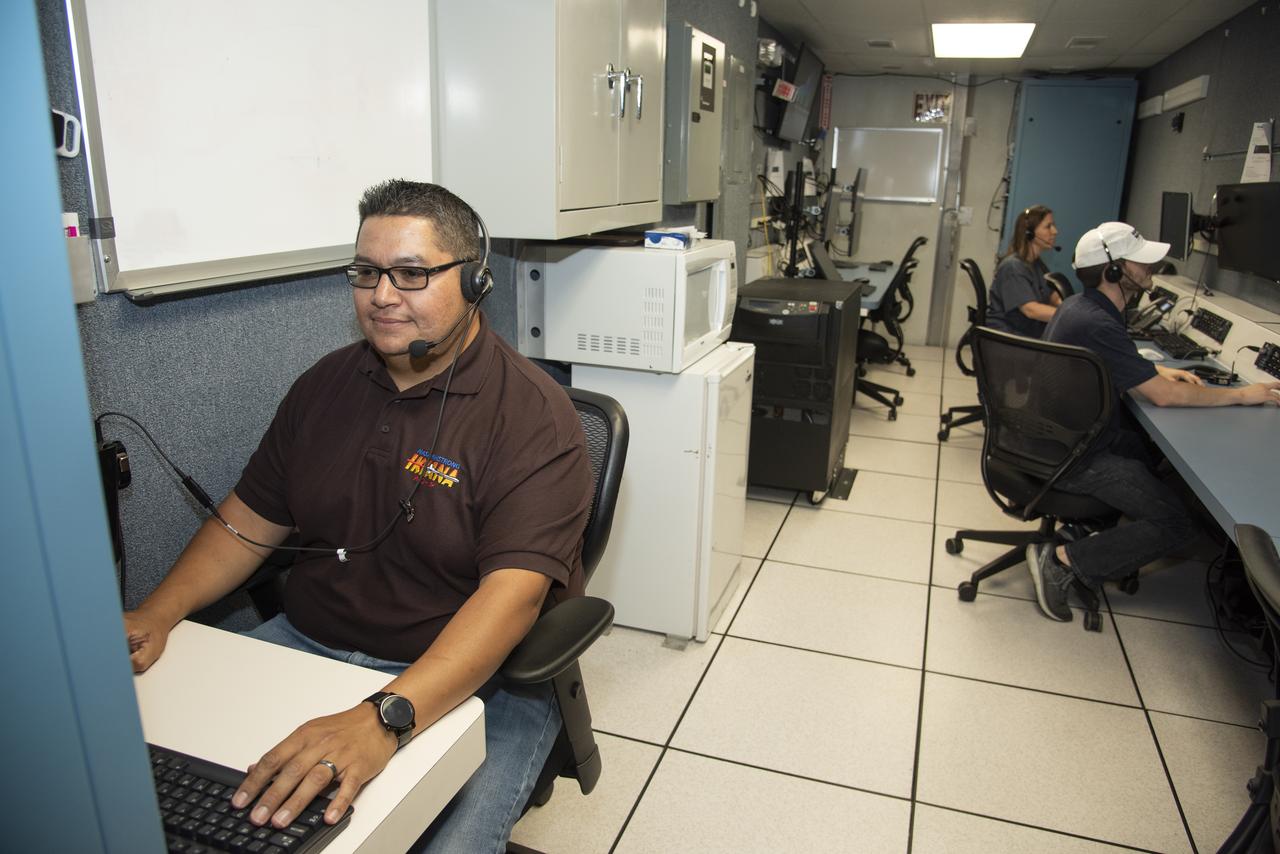
Jesus Vazquez, Zach Springer and Sonja Belcher, from left, are at stations in the Mobile Operations Facility 5 at NASA’s Armstrong Flight Research Center in California. The mobile station support included the Pad Abort-1 test of the Orion Launch Abort System at White Sands, New Mexico, the first Dream Chaser air launch and most recently supported the TigerShark remotely piloted aircraft for the Unmanned Aircraft Systems Integration in the National Airspace System flights.
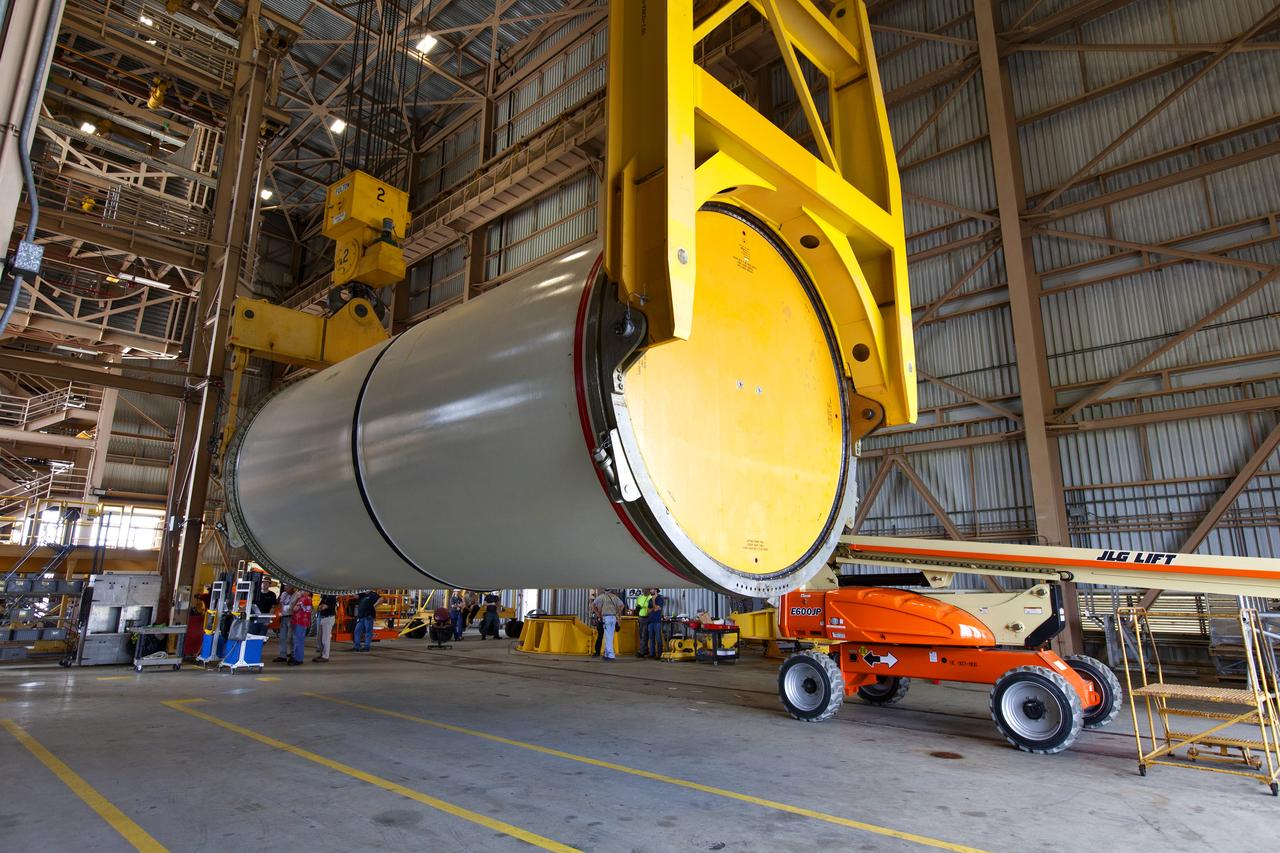
Jacobs technicians, on the Test and Operations Support Contract, practice crane operations with an inert booster rocket segment in the Rotation, Processing and Surge Facility on June 22, 2018, at NASA's Kennedy Space Center in Florida. Dual cranes were used to move the segment from vertical to horizontal, a maneuver known as a "breakover rotation." As part of routine processing operations for the agency's Space Launch System (SLS) rocket, the RPSF team will receive all of the solid rocket fuel segments for inspection and preparation prior to transporting them to the Vehicle Assembly Building for stacking on the mobile launcher. Many pathfinding operations are being done to prepare for launch of the SLS and Orion spacecraft on Exploration Mission-1 and deep space missions.
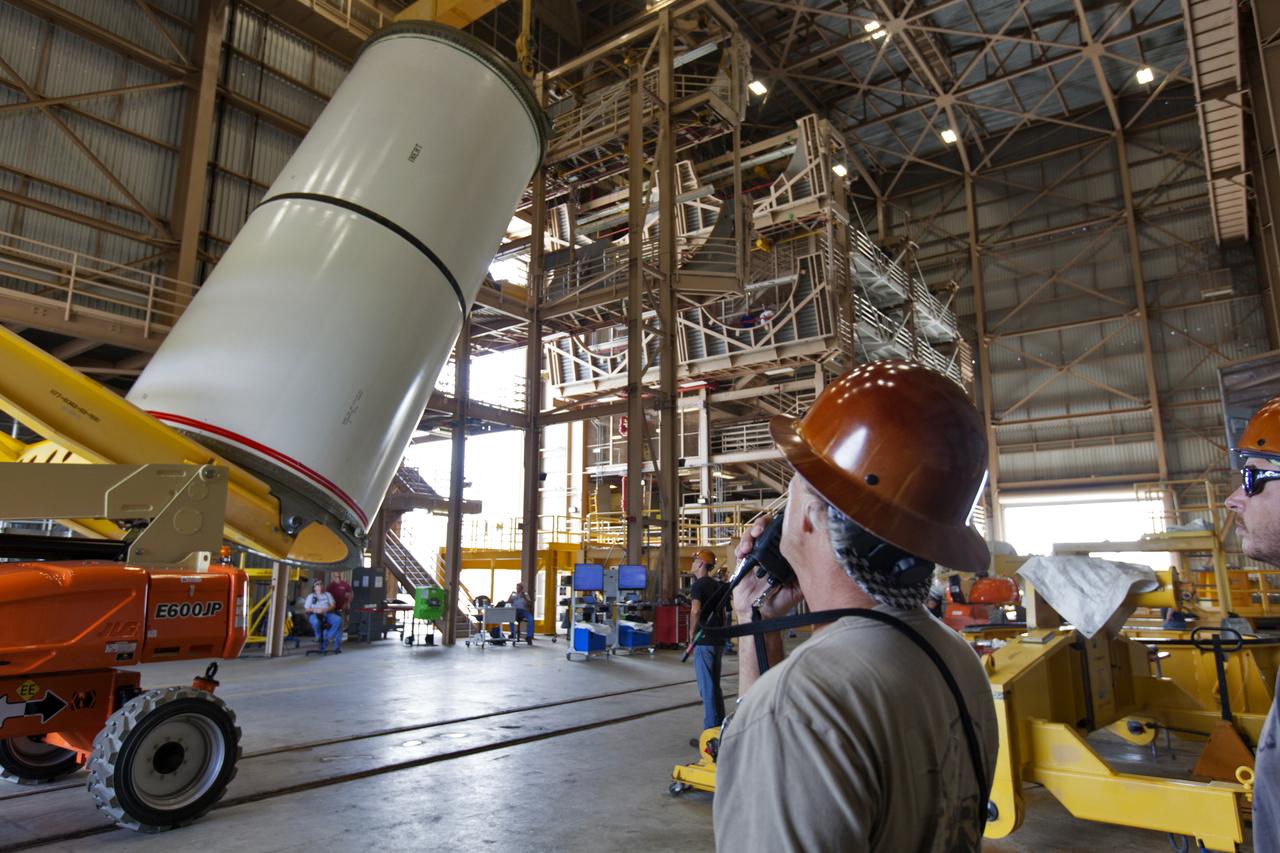
Jacobs technicians, on the Test and Operations Support Contract, practice crane operations with an inert booster rocket segment in the Rotation, Processing and Surge Facility on June 22, 2018, at NASA's Kennedy Space Center in Florida. Dual cranes are being used to move the segment from vertical to horizontal, a maneuver known as a "breakover rotation." As part of routine processing operations for the agency's Space Launch System (SLS) rocket, the RPSF team will receive all of the solid rocket fuel segments for inspection and preparation prior to transporting them to the Vehicle Assembly Building for stacking on the mobile launcher. Many pathfinding operations are being done to prepare for launch of the SLS and Orion spacecraft on Exploration Mission-1 and deep space missions.
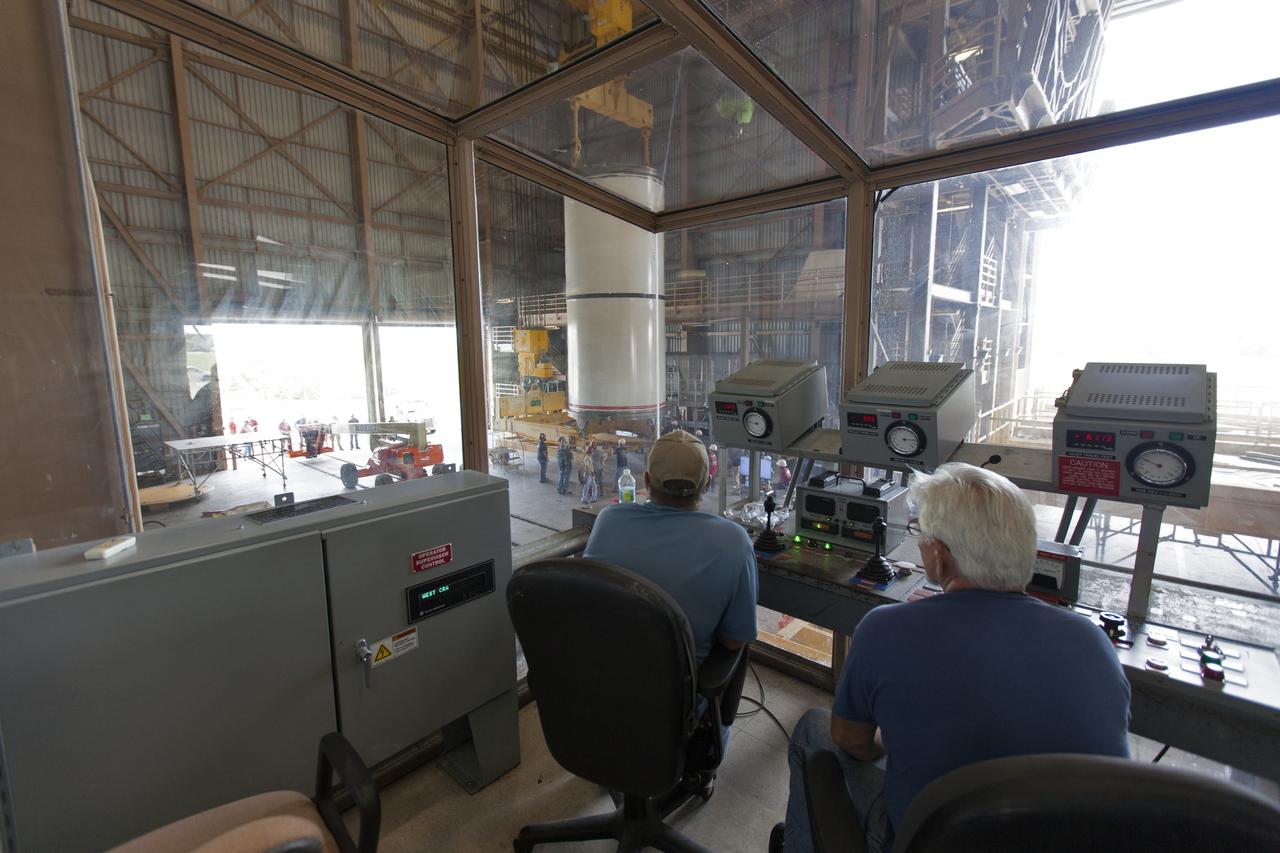
Jacobs technicians, on the Test and Operations Support Contract, practice crane operations with an inert booster rocket segment in the Rotation, Processing and Surge Facility on June 22, 2018, at NASA's Kennedy Space Center in Florida. Dual cranes are being used to move the segment from vertical to horizontal, a maneuver known as a "breakover rotation." As part of routine processing operations for the agency's Space Launch System (SLS) rocket, the RPSF team will receive all of the solid rocket fuel segments for inspection and preparation prior to transporting them to the Vehicle Assembly Building for stacking on the mobile launcher. Many pathfinding operations are being done to prepare for launch of the SLS and Orion spacecraft on Exploration Mission-1 and deep space missions.
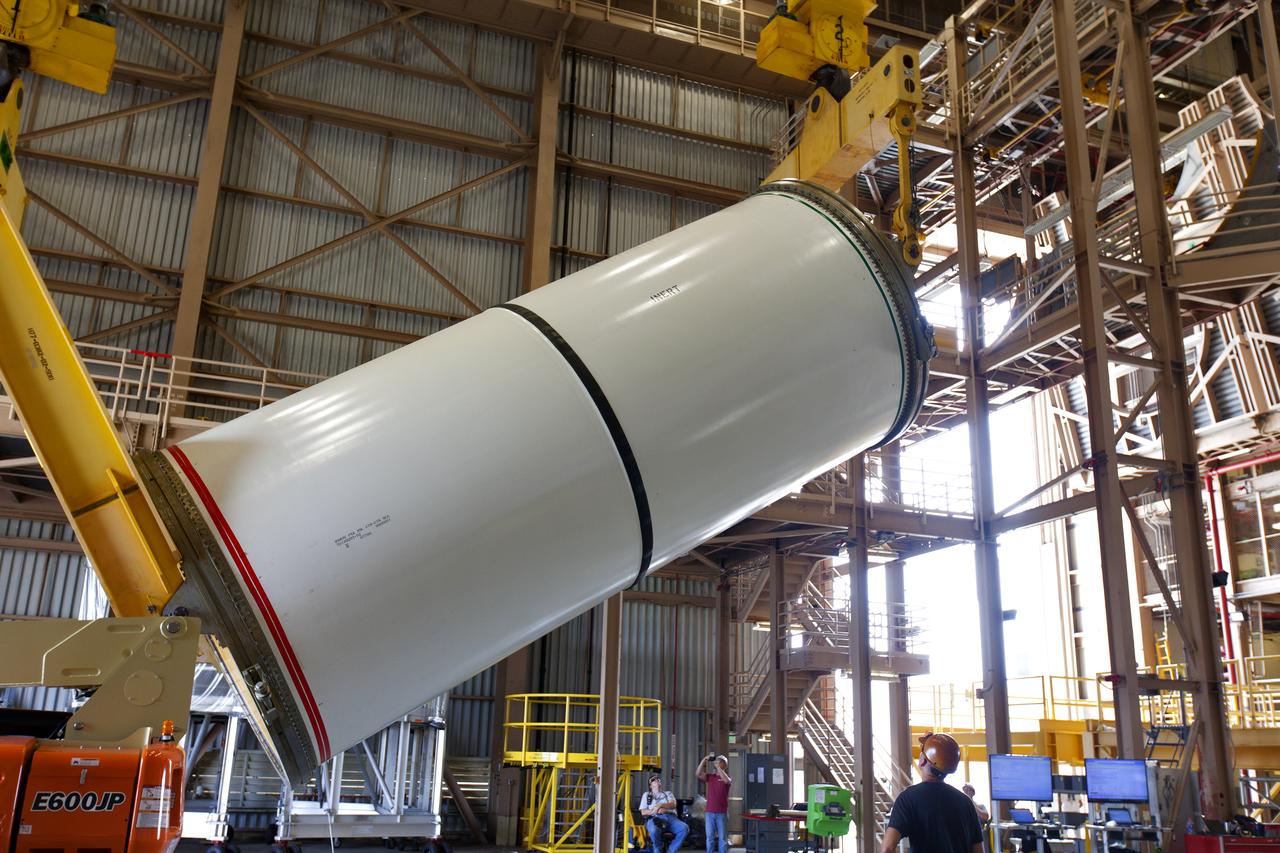
Jacobs technicians, on the Test and Operations Support Contract, practice crane operations with an inert booster rocket segment in the Rotation, Processing and Surge Facility on June 22, 2018, at NASA's Kennedy Space Center in Florida. Dual cranes are used to move the segment from vertical to horizontal, a maneuver known as a "breakover rotation." As part of routine processing operations for the agency's Space Launch System (SLS) rocket, the RPSF team will receive all of the solid rocket fuel segments for inspection and preparation prior to transporting them to the Vehicle Assembly Building for stacking on the mobile launcher. Many pathfinding operations are being done to prepare for launch of the SLS and Orion spacecraft on Exploration Mission-1 and deep space missions.
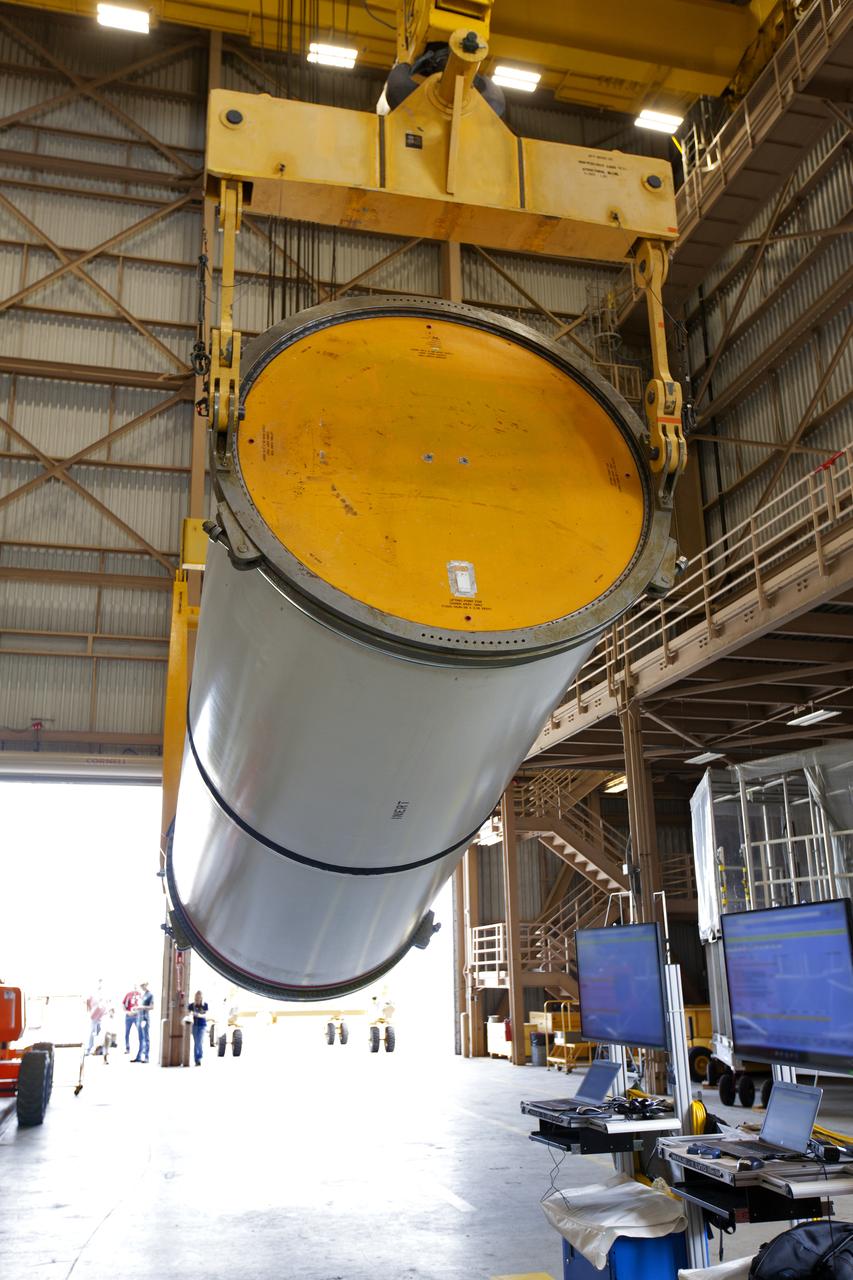
Jacobs technicians, on the Test and Operations Support Contract, practice crane operations with an inert booster rocket segment in the Rotation, Processing and Surge Facility on June 22, 2018, at NASA's Kennedy Space Center in Florida. Dual cranes are used to move the segment from vertical to horizontal, a maneuver known as a "breakover rotation." As part of routine processing operations for the agency's Space Launch System (SLS) rocket, the RPSF team will receive all of the solid rocket fuel segments for inspection and preparation prior to transporting them to the Vehicle Assembly Building for stacking on the mobile launcher. Many pathfinding operations are being done to prepare for launch of the SLS and Orion spacecraft on Exploration Mission-1 and deep space missions.
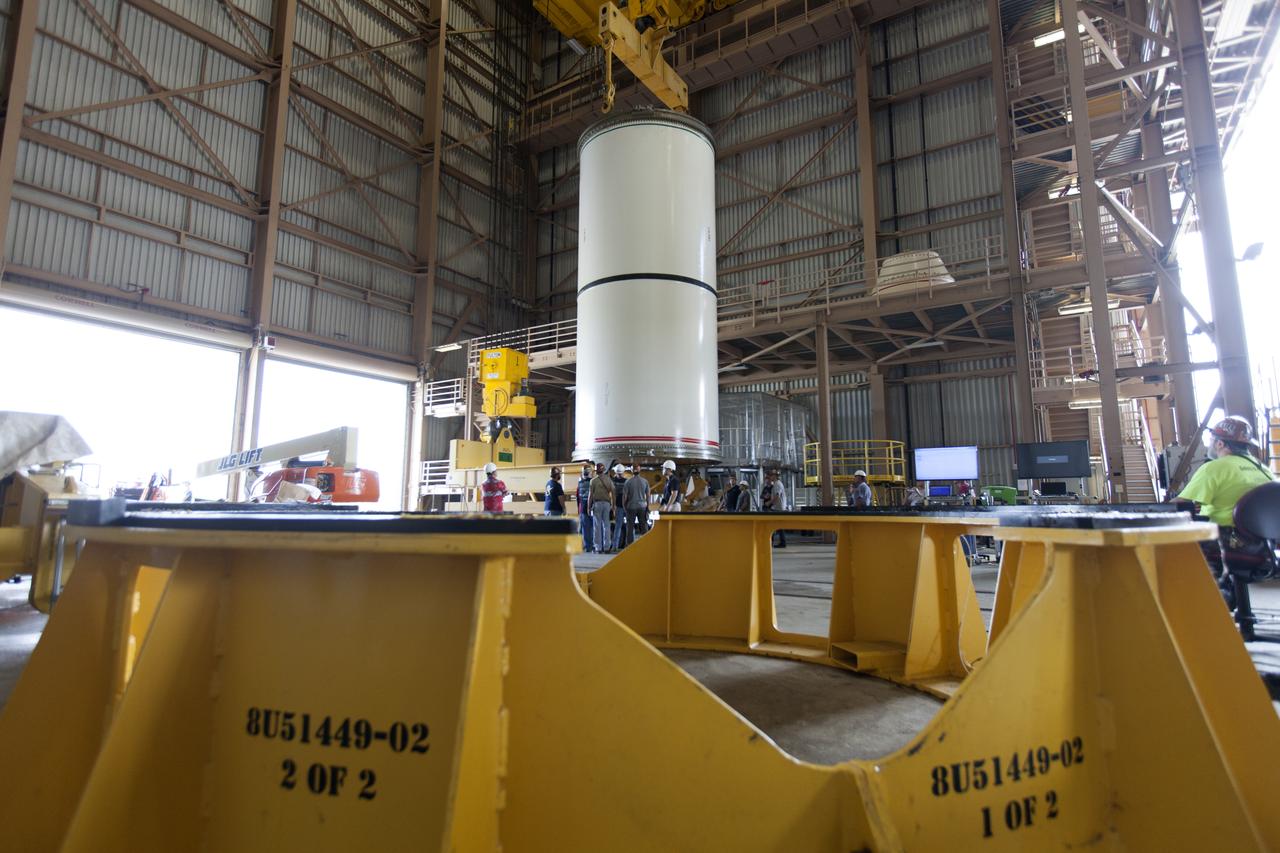
Jacobs technicians, on the Test and Operations Support Contract, practice crane operations with an inert booster rocket segment in the Rotation, Processing and Surge Facility on June 22, 2018, at NASA's Kennedy Space Center in Florida. Dual cranes are being used to move the segment from vertical to horizontal, a maneuver known as a "breakover rotation." As part of routine processing operations for the agency's Space Launch System (SLS) rocket, the RPSF team will receive all of the solid rocket fuel segments for inspection and preparation prior to transporting them to the Vehicle Assembly Building for stacking on the mobile launcher. Many pathfinding operations are being done to prepare for launch of the SLS and Orion spacecraft on Exploration Mission-1 and deep space missions.
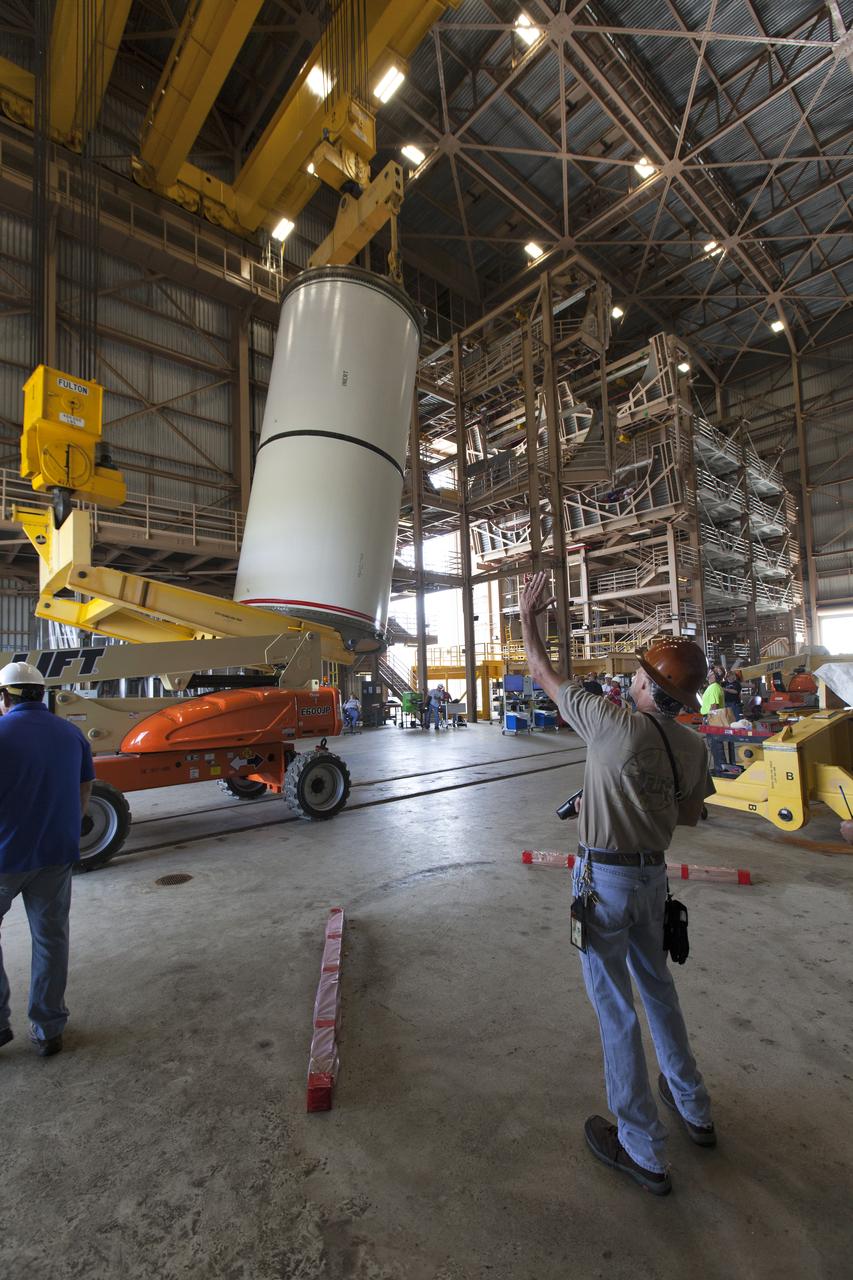
Jacobs technicians, on the Test and Operations Support Contract, practice crane operations with an inert booster rocket segment in the Rotation, Processing and Surge Facility on June 22, 2018, at NASA's Kennedy Space Center in Florida. Dual cranes are being used to move the segment from vertical to horizontal, a maneuver known as a "breakover rotation." As part of routine processing operations for the agency's Space Launch System (SLS) rocket, the RPSF team will receive all of the solid rocket fuel segments for inspection and preparation prior to transporting them to the Vehicle Assembly Building for stacking on the mobile launcher. Many pathfinding operations are being done to prepare for launch of the SLS and Orion spacecraft on Exploration Mission-1 and deep space missions.
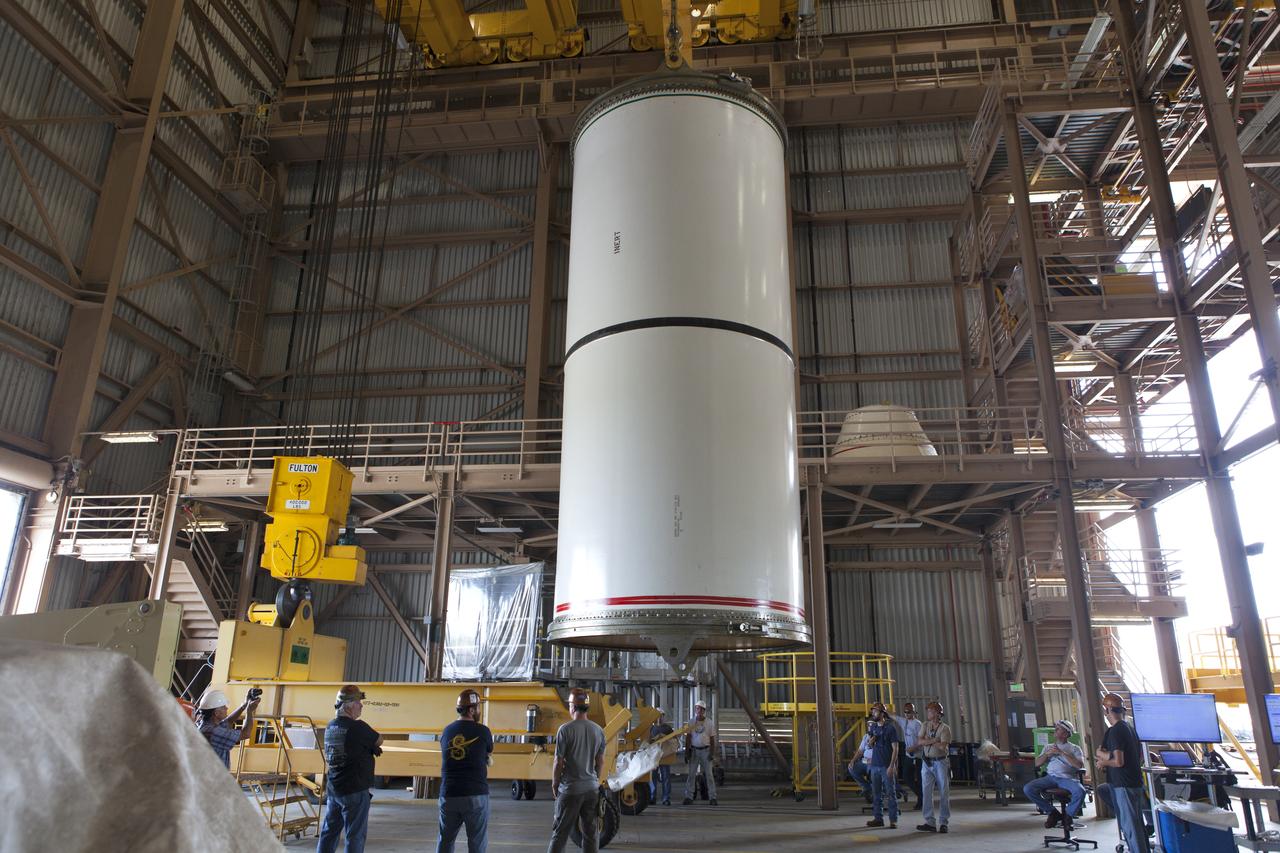
Jacobs technicians, on the Test and Operations Support Contract, practice crane operations with an inert booster rocket segment in the Rotation, Processing and Surge Facility on June 22, 2018, at NASA's Kennedy Space Center in Florida. Dual cranes are being used to move the segment from vertical to horizontal, a maneuver known as a "breakover rotation." As part of routine processing operations for the agency's Space Launch System (SLS) rocket, the RPSF team will receive all of the solid rocket fuel segments for inspection and preparation prior to transporting them to the Vehicle Assembly Building for stacking on the mobile launcher. Many pathfinding operations are being done to prepare for launch of the SLS and Orion spacecraft on Exploration Mission-1 and deep space missions.
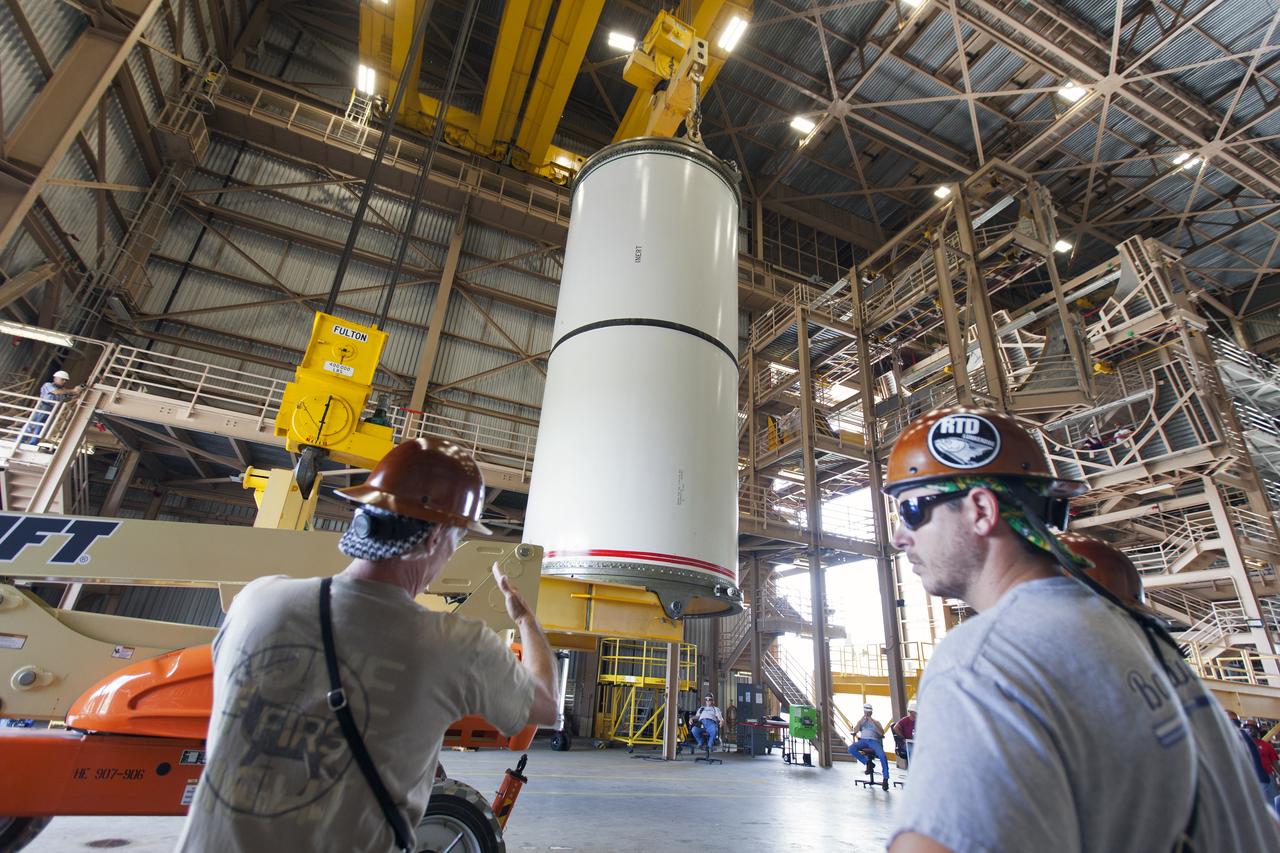
Jacobs technicians, on the Test and Operations Support Contract, practice crane operations with an inert booster rocket segment in the Rotation, Processing and Surge Facility on June 22, 2018, at NASA's Kennedy Space Center in Florida. Dual cranes are being used to move the segment from vertical to horizontal, a maneuver known as a "breakover rotation." As part of routine processing operations for the agency's Space Launch System (SLS) rocket, the RPSF team will receive all of the solid rocket fuel segments for inspection and preparation prior to transporting them to the Vehicle Assembly Building for stacking on the mobile launcher. Many pathfinding operations are being done to prepare for launch of the SLS and Orion spacecraft on Exploration Mission-1 and deep space missions.
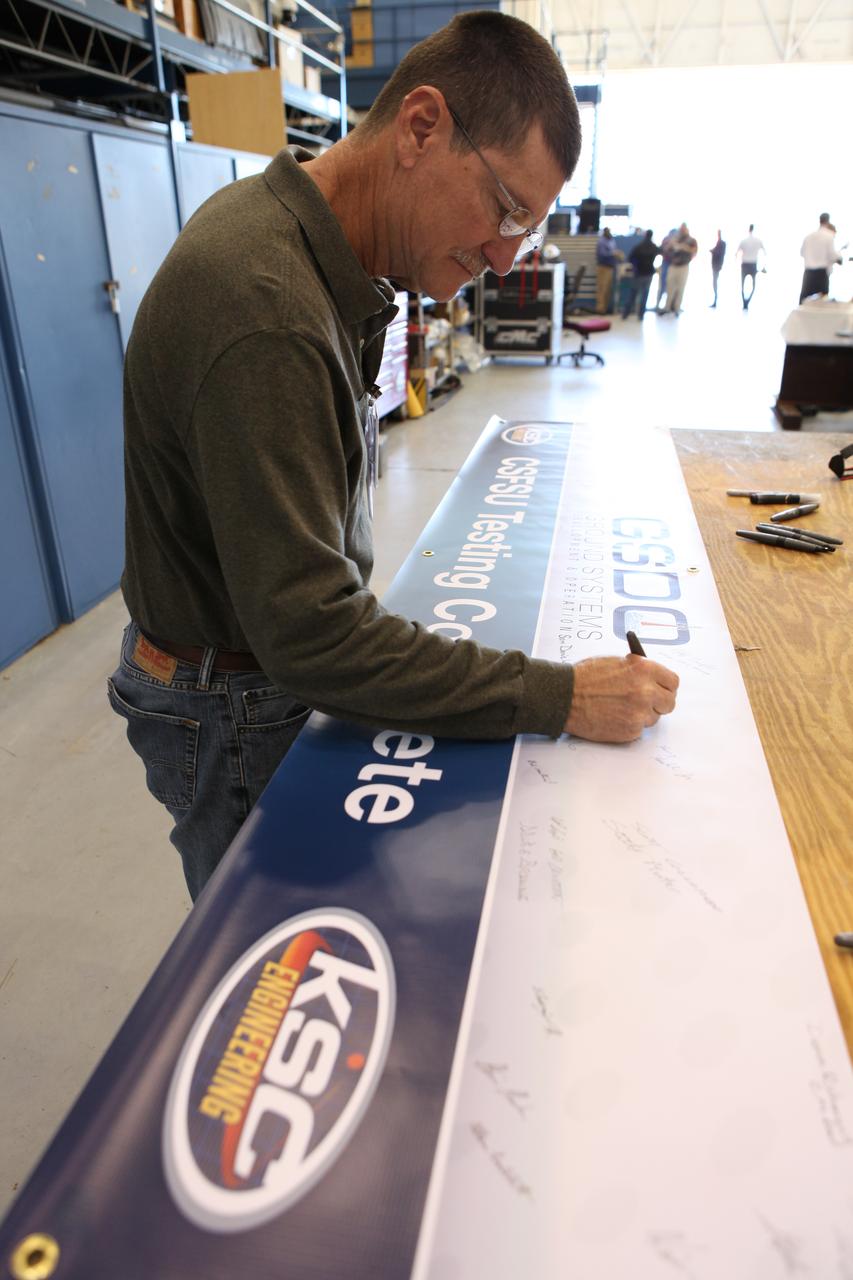
A NASA technician signs the banner inside a support building at the Launch Equipment Test Facility at Kennedy Space Center in Florida. Testing of the Core Stage Forward Skirt Umbilical (CSFSU) for NASA's Space Launch System is complete and the umbilical has been transported to the mobile launcher area. The umbilical will be prepared for installation on the tower of the mobile launcher. The CSFSU will be mated to the core stage forward skirt to provide commodities to the SLS rocket, and then disconnect and swing away before launch. Its main purpose is to provide conditioned air and gaseous nitrogen to the SLS Core Stage Forward Skirt. The center’s Engineering Directorate and the Ground Systems Development and Operations Program are overseeing processing and testing of the umbilicals.
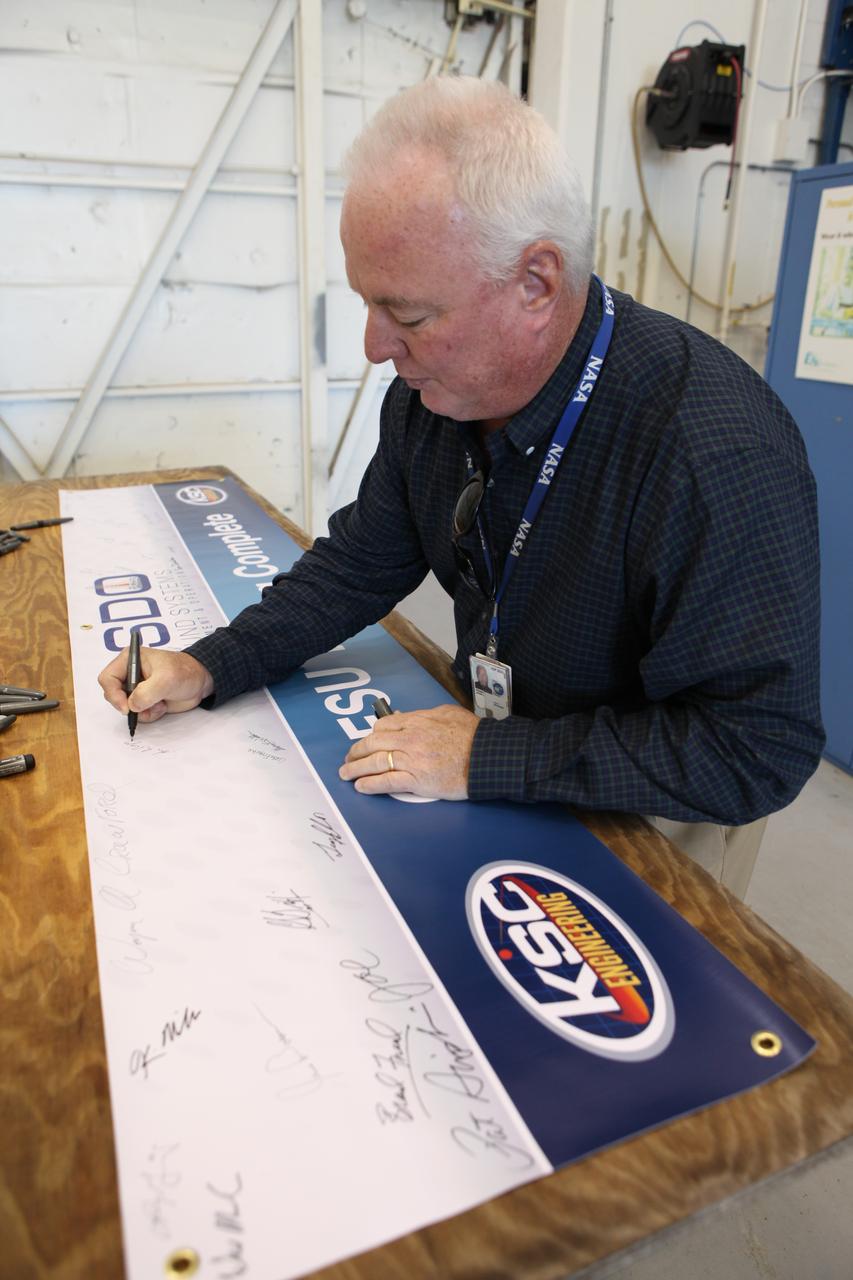
A NASA engineer signs the banner inside a support building at the Launch Equipment Test Facility at Kennedy Space Center in Florida. Testing of the Core Stage Forward Skirt Umbilical (CSFSU) for NASA's Space Launch System is complete and the umbilical has been transported to the mobile launcher area. The umbilical will be prepared for installation on the tower of the mobile launcher. The CSFSU will be mated to the core stage forward skirt to provide commodities to the SLS rocket, and then disconnect and swing away before launch. Its main purpose is to provide conditioned air and gaseous nitrogen to the SLS Core Stage Forward Skirt. The center’s Engineering Directorate and the Ground Systems Development and Operations Program are overseeing processing and testing of the umbilicals.
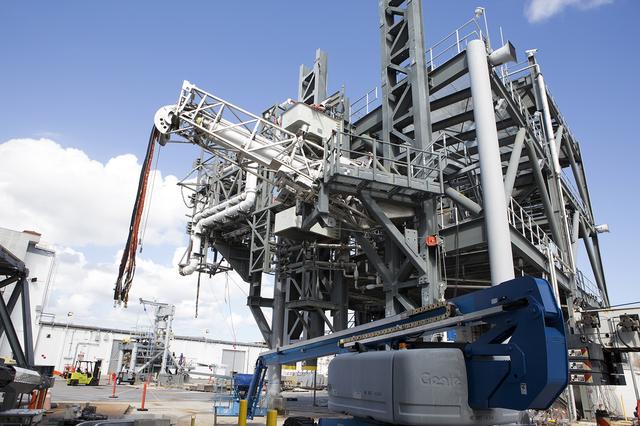
Testing of the Orion Service Module Umbilical (OSMU) was completed at the Launch Equipment Test Facility at NASA’s Kennedy Space Center in Florida. The OSMU was attached to Vehicle Motion Simulator 1 for a series of simulated launch tests to validate it for installation on the mobile launcher. The mobile launcher tower will be equipped with a number of lines, called umbilicals that will connect to the Space Launch System rocket and Orion spacecraft for Exploration Mission-1 (EM-1). The OSMU will be located high on the mobile launcher tower and, prior to launch, will transfer liquid coolant for the electronics and air for the Environmental Control System to the Orion service module that houses these critical systems to support the spacecraft. Kennedy's Engineering Directorate is providing support to the Ground Systems Development and Operations Program for testing of the OSMU. EM-1 is scheduled to launch in 2018.
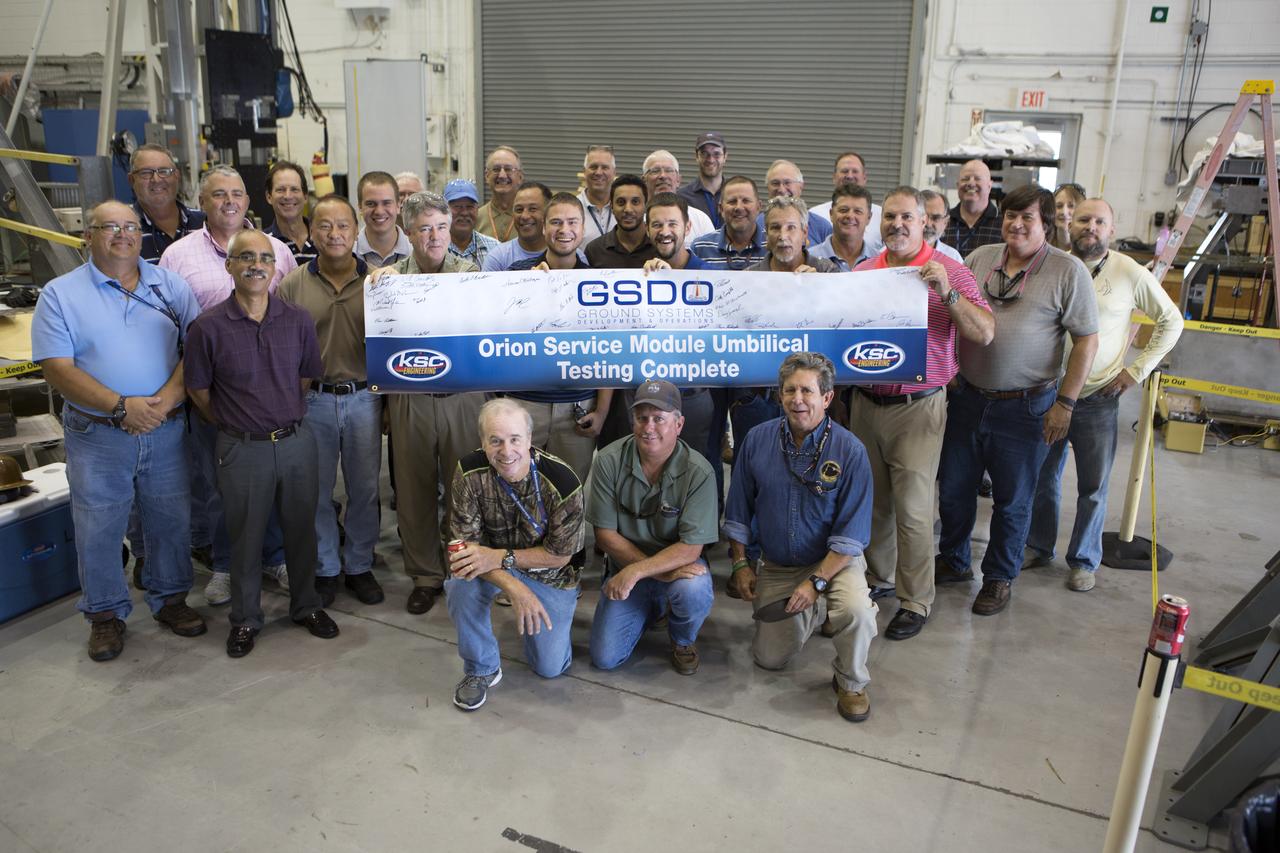
Testing of the Orion Service Module Umbilical (OSMU) was completed at the Launch Equipment Test Facility at NASA’s Kennedy Space Center in Florida. The OSMU was attached to Vehicle Motion Simulator 1 for a series of simulated launch tests to validate it for installation on the mobile launcher. The test team gathered with a special banner during an event to mark the end of testing. The mobile launcher tower will be equipped with a number of lines, called umbilicals that will connect to the Space Launch System rocket and Orion spacecraft for Exploration Mission-1 (EM-1). The OSMU will be located high on the mobile launcher tower and, prior to launch, will transfer liquid coolant for the electronics and air for the Environmental Control System to the Orion service module that houses these critical systems to support the spacecraft. Kennedy's Engineering Directorate is providing support to the Ground Systems Development and Operations Program for testing of the OSMU. EM-1 is scheduled to launch in 2018.

Testing of the Orion Service Module Umbilical (OSMU) was completed at the Launch Equipment Test Facility at NASA’s Kennedy Space Center in Florida. The OSMU was attached to Vehicle Motion Simulator 1 for a series of simulated launch tests to validate it for installation on the mobile launcher. One of the test team members signs a banner during an event to mark the end of testing. The mobile launcher tower will be equipped with a number of lines, called umbilicals that will connect to the Space Launch System rocket and Orion spacecraft for Exploration Mission-1 (EM-1). The OSMU will be located high on the mobile launcher tower and, prior to launch, will transfer liquid coolant for the electronics and air for the Environmental Control System to the Orion service module that houses these critical systems to support the spacecraft. Kennedy's Engineering Directorate is providing support to the Ground Systems Development and Operations Program for testing of the OSMU. EM-1 is scheduled to launch in 2018.
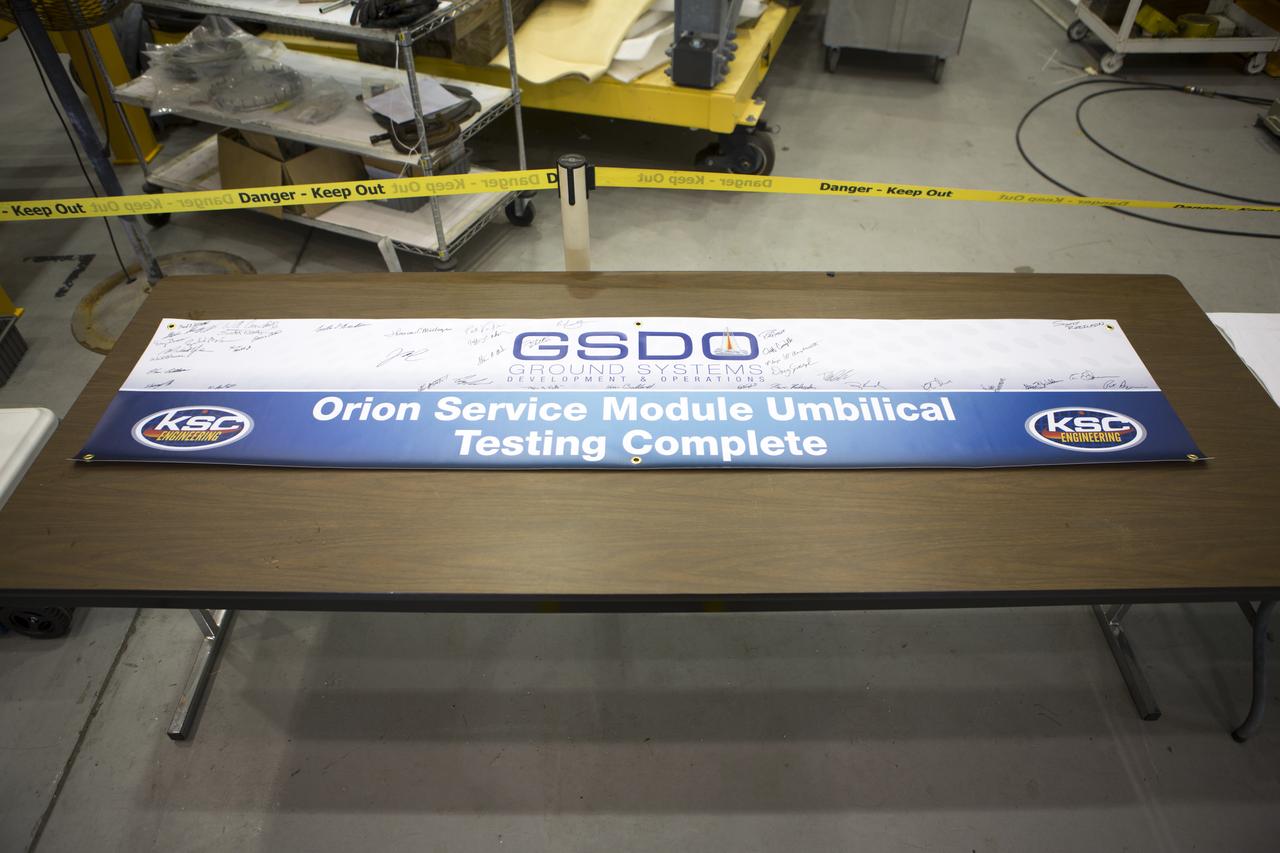
Testing of the Orion Service Module Umbilical (OSMU) was completed at the Launch Equipment Test Facility at NASA’s Kennedy Space Center in Florida. The OSMU was attached to Vehicle Motion Simulator 1 for a series of simulated launch tests to validate it for installation on the mobile launcher. The test team signed a special banner during an event to mark the end of testing. The mobile launcher tower will be equipped with a number of lines, called umbilicals that will connect to the Space Launch System rocket and Orion spacecraft for Exploration Mission-1 (EM-1). The OSMU will be located high on the mobile launcher tower and, prior to launch, will transfer liquid coolant for the electronics and air for the Environmental Control System to the Orion service module that houses these critical systems to support the spacecraft. Kennedy's Engineering Directorate is providing support to the Ground Systems Development and Operations Program for testing of the OSMU. EM-1 is scheduled to launch in 2018.
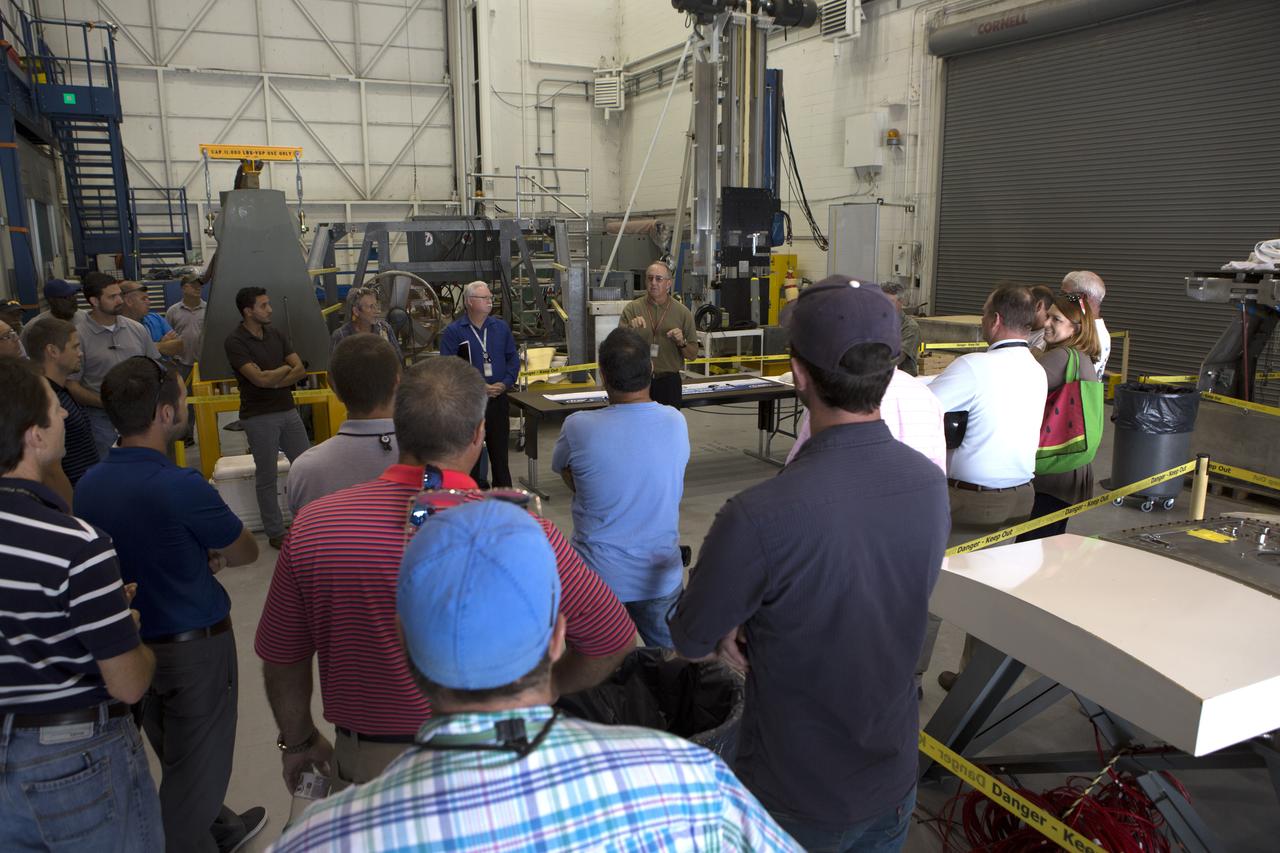
Testing of the Orion Service Module Umbilical (OSMU) was completed at the Launch Equipment Test Facility at NASA’s Kennedy Space Center in Florida. The OSMU was attached to Vehicle Motion Simulator 1 for a series of simulated launch tests to validate it for installation on the mobile launcher. Patrick Simpkins, director of Engineering, speaks to the test team during an event to mark the end of testing. The mobile launcher tower will be equipped with a number of lines, called umbilicals that will connect to the Space Launch System rocket and Orion spacecraft for Exploration Mission-1 (EM-1). The OSMU will be located high on the mobile launcher tower and, prior to launch, will transfer liquid coolant for the electronics and air for the Environmental Control System to the Orion service module that houses these critical systems to support the spacecraft. Kennedy's Engineering Directorate is providing support to the Ground Systems Development and Operations Program for testing of the OSMU. EM-1 is scheduled to launch in 2018.
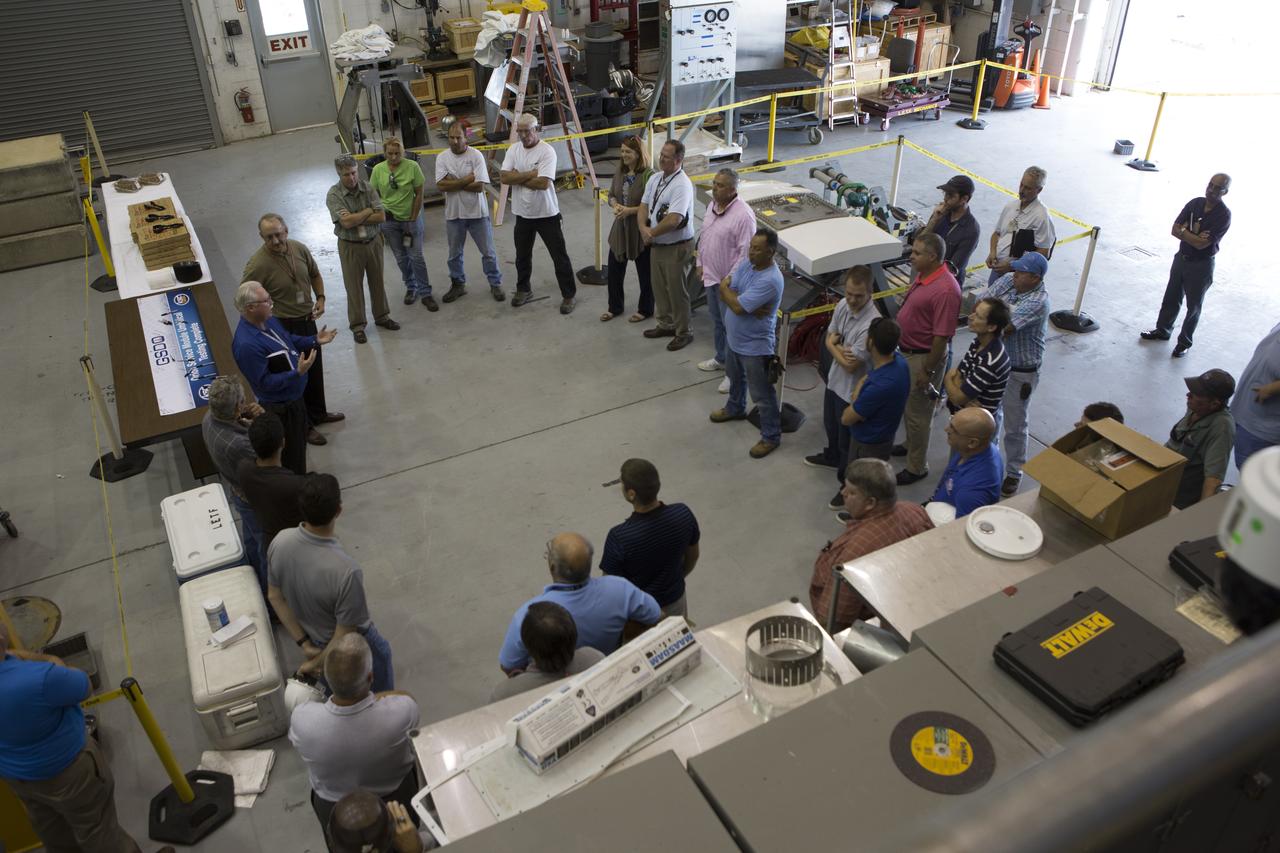
Testing of the Orion Service Module Umbilical (OSMU) was completed at the Launch Equipment Test Facility at NASA’s Kennedy Space Center in Florida. The OSMU was attached to Vehicle Motion Simulator 1 for a series of simulated launch tests to validate it for installation on the mobile launcher. The test team gathered for an event to mark the end of testing. The mobile launcher tower will be equipped with a number of lines, called umbilicals that will connect to the Space Launch System rocket and Orion spacecraft for Exploration Mission-1 (EM-1). The OSMU will be located high on the mobile launcher tower and, prior to launch, will transfer liquid coolant for the electronics and air for the Environmental Control System to the Orion service module that houses these critical systems to support the spacecraft. Kennedy's Engineering Directorate is providing support to the Ground Systems Development and Operations Program for testing of the OSMU. EM-1 is scheduled to launch in 2018.
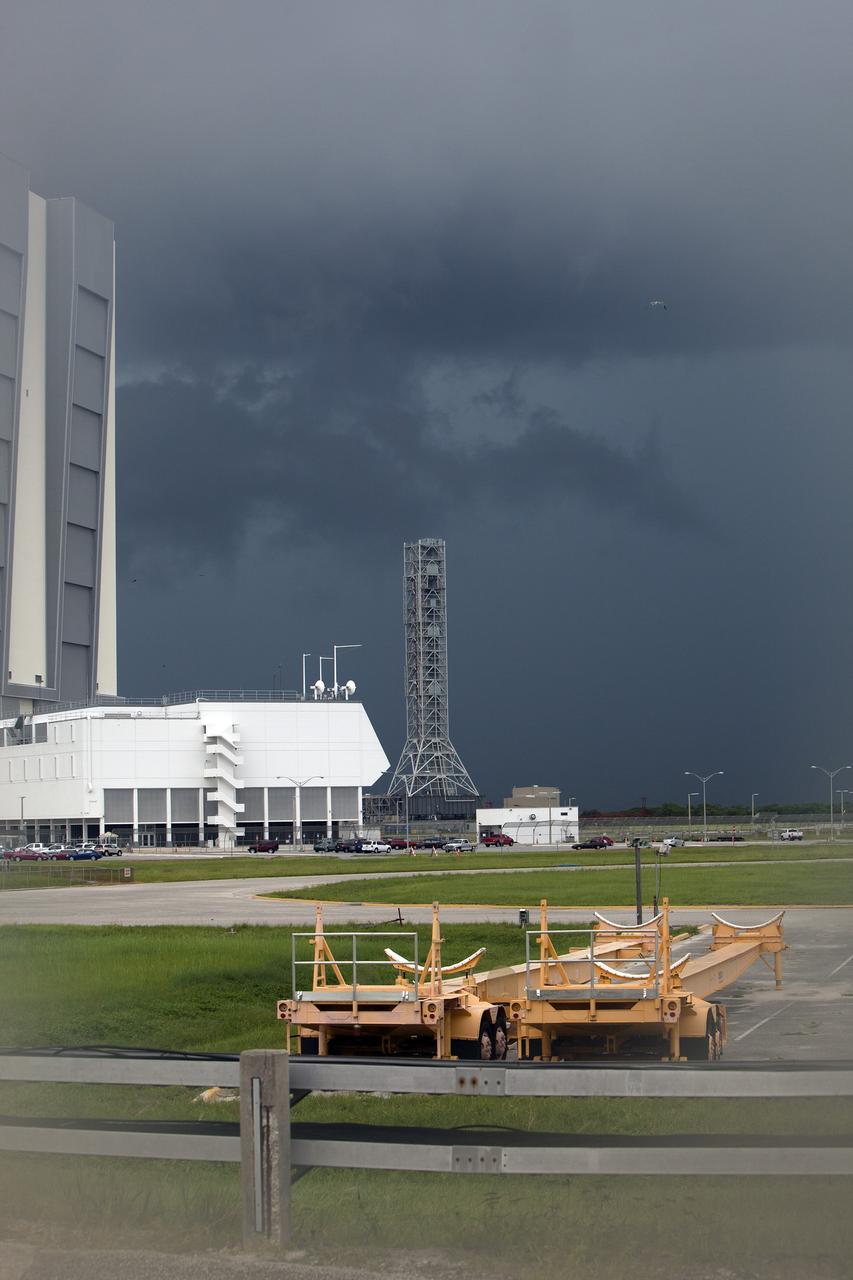
CAPE CANAVERAL, Fla. – A storm moves in over Launch Complex 39 at NASA’s Kennedy Space Center in Florida. At center is the mobile launcher that will support NASA's Space Launch System heavy-lift rocket, under development. At left is the Launch Control Center and the Vehicle Assembly Building. Kennedy's Ground Support Development and Operations Program is hard at work transforming the center's facilities into a multi-user spaceport, when the weather permits. For more on Kennedy Space Center, visit http://www.nasa.gov/kennedy. Photo credit: NASA/Ben Smegelsky
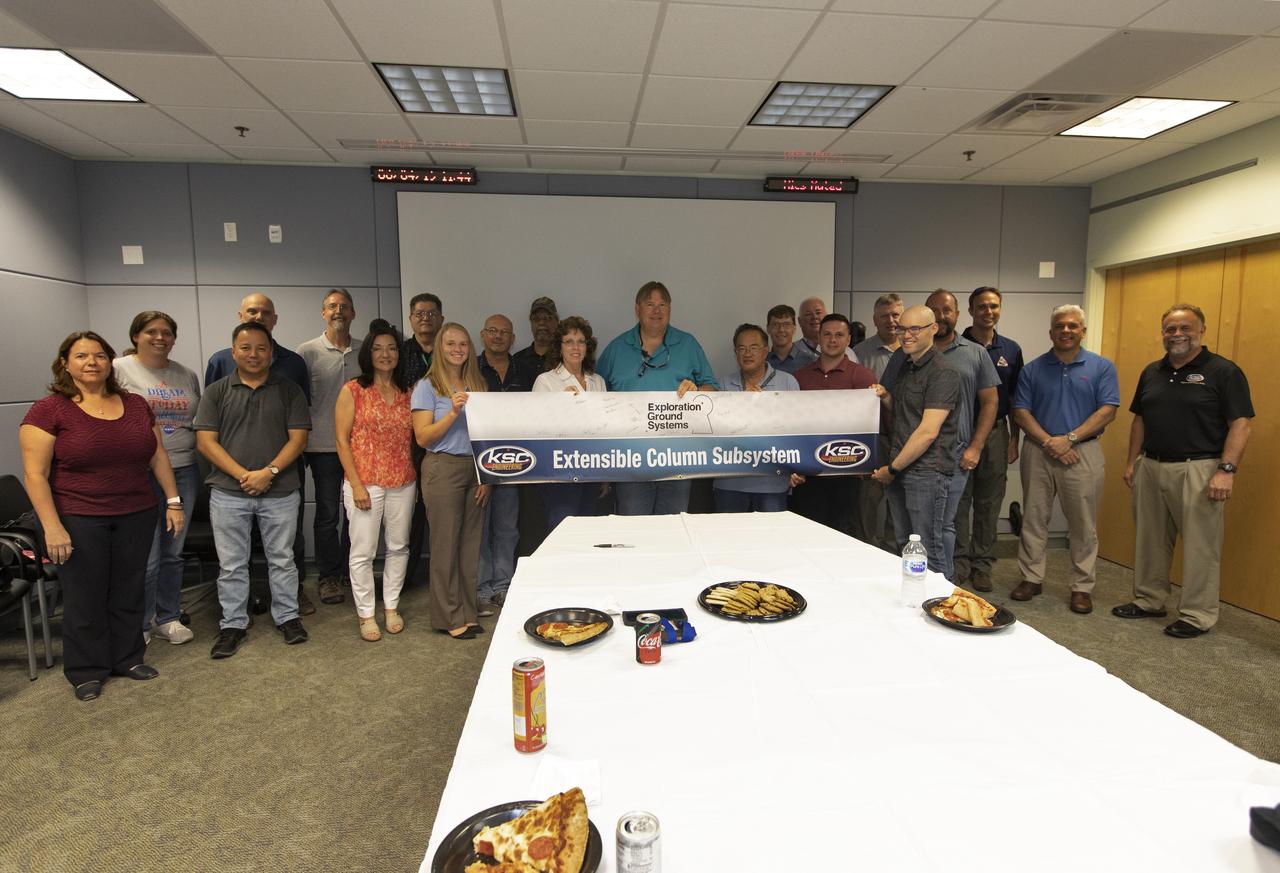
Engineers celebrate the completion of the Extensible Column Subsystem (XCS) project during a banner event held in Operations Support Building II at Kennedy Space Center. The XCS team successfully executed an aggressive schedule, receiving outstanding support from the fabrication contractor, Met-Con. Full functional testing occurred at Met-Con’s facility, with no mechanical or structural issues. All four columns and the test fixture have been delivered to Kennedy. Full-scale testing will take place when the Mobile Launcher gets to the pad later this summer.
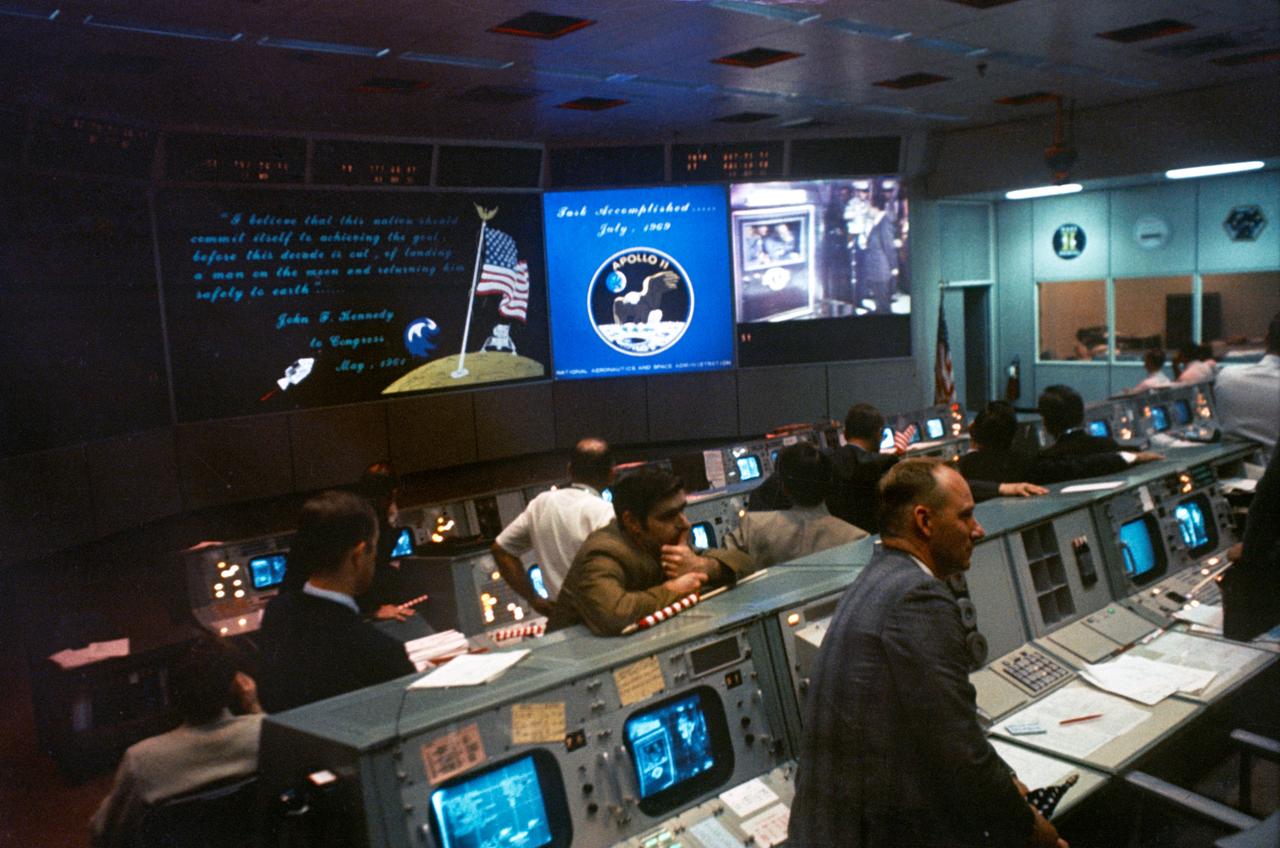
S69-40301 (24 July 1969) --- Overall view of the Mission Operations Control Room (MOCR) in the Mission Control Center (MCC), Building 30, Manned Spacecraft Center (MSC), at the conclusion of the Apollo 11 lunar landing mission. The television monitor shows President Richard M. Nixon greeting the Apollo 11 astronauts aboard the USS Hornet in the Pacific recovery area. Astronauts Neil A. Armstrong, Michael Collins, and Edwin E. Aldrin Jr. are inside the Mobile Quarantine Facility (MQF).
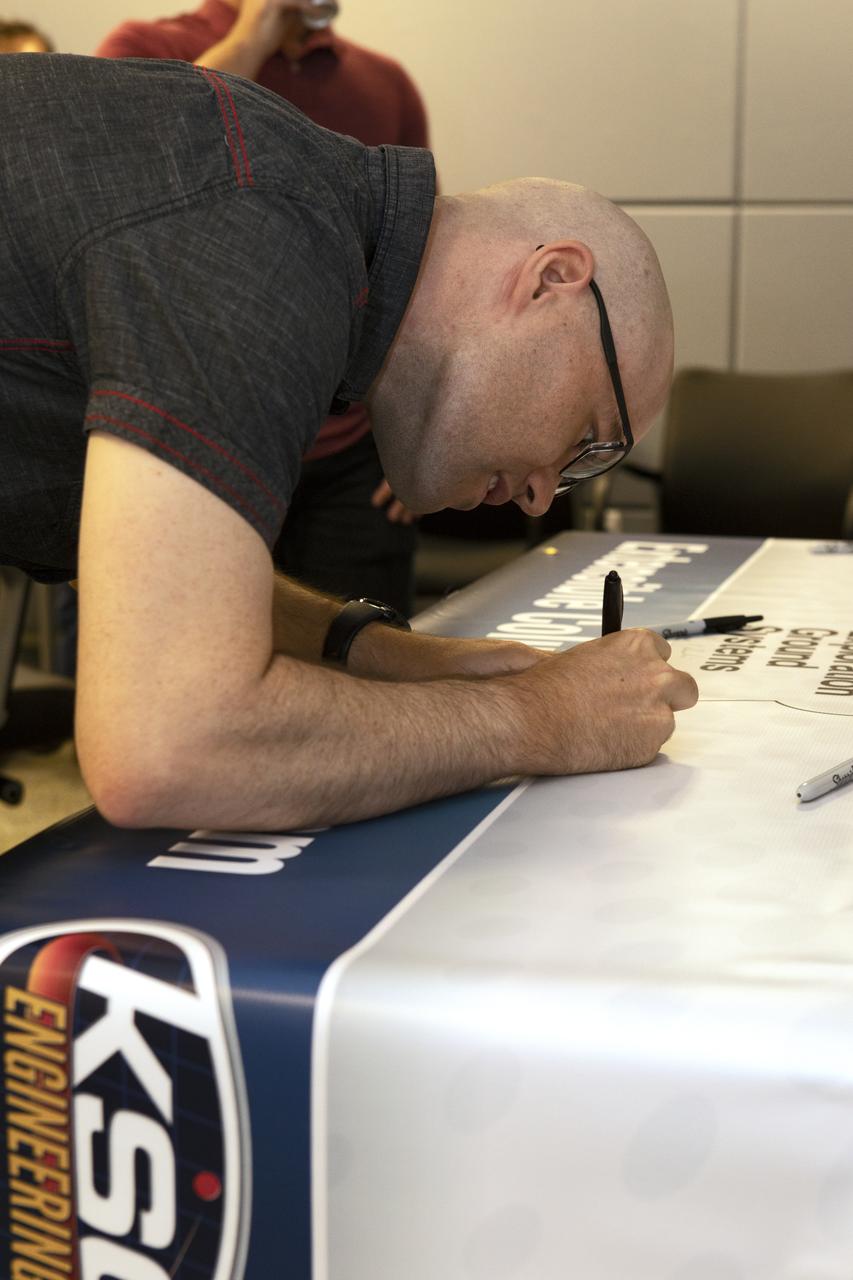
Engineers celebrate the completion of the Extensible Column Subsystem (XCS) project during a banner event held in Operations Support Building II at Kennedy Space Center. The XCS team successfully executed an aggressive schedule, receiving outstanding support from the fabrication contractor, Met-Con. Full functional testing occurred at Met-Con’s facility, with no mechanical or structural issues. All four columns and the test fixture have been delivered to Kennedy. Full-scale testing will take place when the Mobile Launcher gets to the pad later this summer.

Engineers celebrate the completion of the Extensible Column Subsystem (XCS) project during a banner event held in Operations Support Building II at Kennedy Space Center. The XCS team successfully executed an aggressive schedule, receiving outstanding support from the fabrication contractor, Met-Con. Full functional testing occurred at Met-Con’s facility, with no mechanical or structural issues. All four columns and the test fixture have been delivered to Kennedy. Full-scale testing will take place when the Mobile Launcher gets to the pad later this summer.
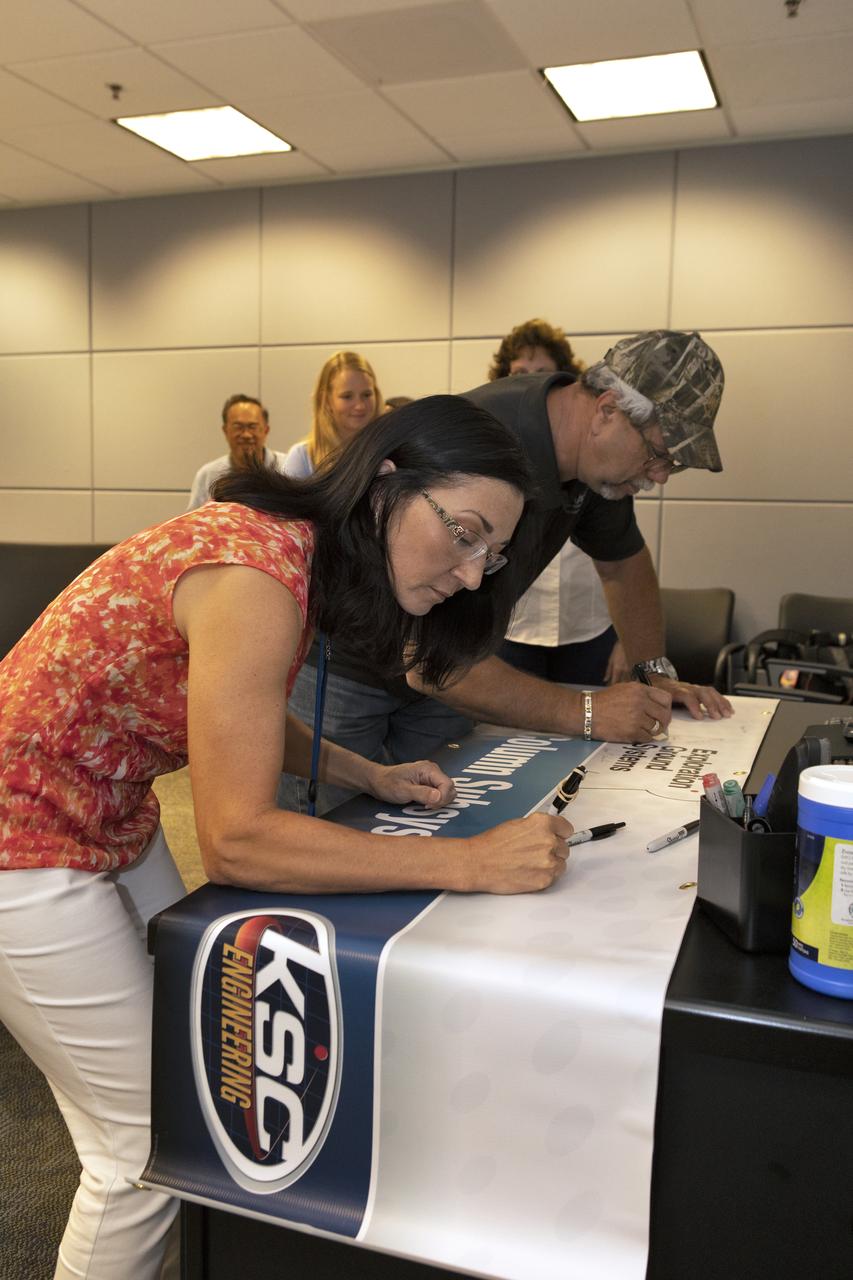
Engineers celebrate the completion of the Extensible Column Subsystem (XCS) project during a banner event held in Operations Support Building II at Kennedy Space Center. The XCS team successfully executed an aggressive schedule, receiving outstanding support from the fabrication contractor, Met-Con. Full functional testing occurred at Met-Con’s facility, with no mechanical or structural issues. All four columns and the test fixture have been delivered to Kennedy. Full-scale testing will take place when the Mobile Launcher gets to the pad later this summer.

STS-48 Mission Specialist (MS) James F. Buchli, wearing an extravehicular mobility unit (EMU), is watched by SCUBA-equipped divers as the platform he is standing on is lowered into JSC's Weightless Environment Training Facility (WETF) Bldg 29 pool. When completely underwater, Buchli will be released from the platform and will perform contingency extravehicular activity (EVA) operations. This underwater simulation of a spacewalk is part of the training required for Buchli's upcoming mission aboard Discovery, Orbiter Vehicle (OV) 103.
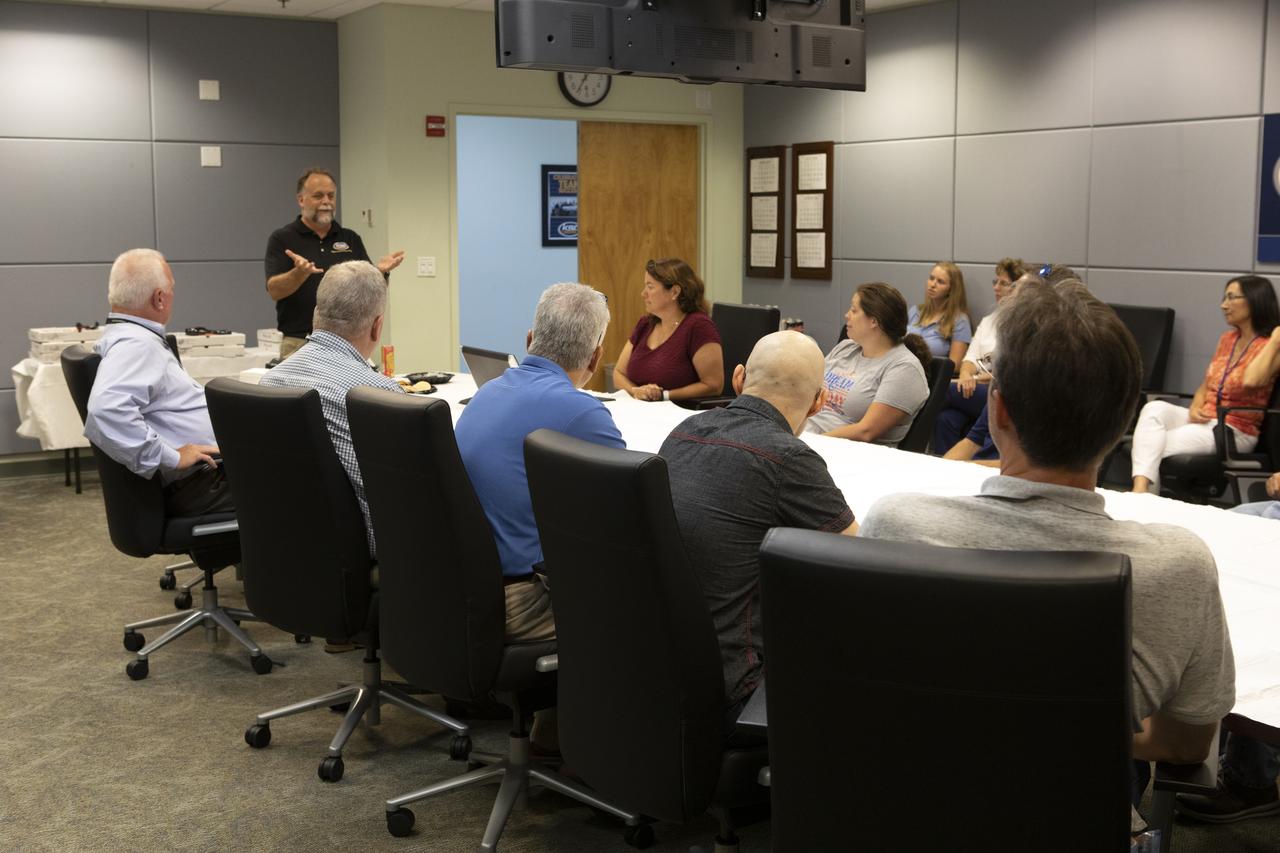
Engineers celebrate the completion of the Extensible Column Subsystem (XCS) project during a banner event held in Operations Support Building II at Kennedy Space Center. The XCS team successfully executed an aggressive schedule, receiving outstanding support from the fabrication contractor, Met-Con. Full functional testing occurred at Met-Con’s facility, with no mechanical or structural issues. All four columns and the test fixture have been delivered to Kennedy. Full-scale testing will take place when the Mobile Launcher gets to the pad later this summer.

Engineers celebrate the completion of the Extensible Column Subsystem (XCS) project during a banner event held in Operations Support Building II at Kennedy Space Center. The XCS team successfully executed an aggressive schedule, receiving outstanding support from the fabrication contractor, Met-Con. Full functional testing occurred at Met-Con’s facility, with no mechanical or structural issues. All four columns and the test fixture have been delivered to Kennedy. Full-scale testing will take place when the Mobile Launcher gets to the pad later this summer.
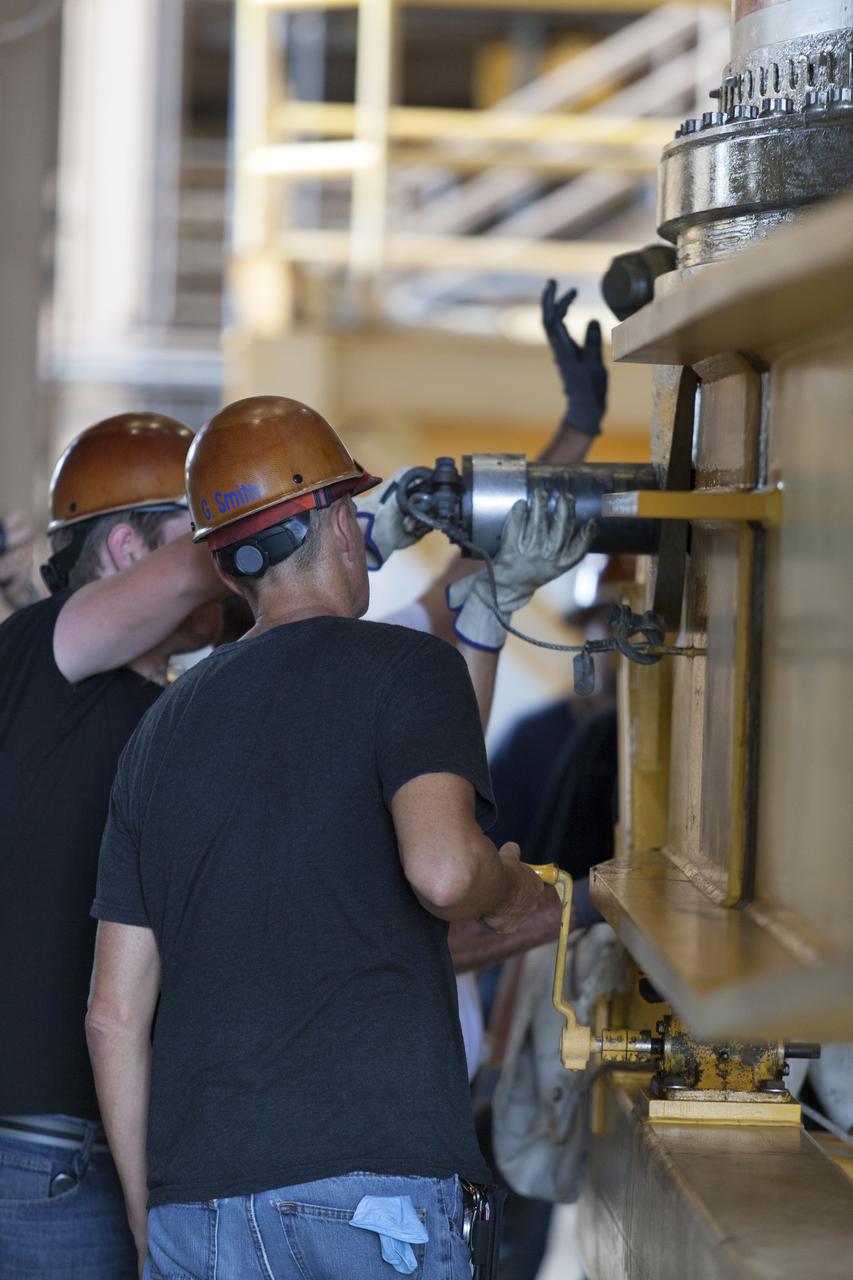
Jacobs technicians, on the Test and Operations Support Contract, check bolt fittings as they practice crane operations with an inert booster rocket segment in the Rotation, Processing and Surge Facility on June 22, 2018, at NASA's Kennedy Space Center in Florida. Dual cranes are being used to move the segment from vertical to horizontal, a maneuver known as a "breakover rotation." As part of routine processing operations for the agency's Space Launch System (SS) rocket, the RPSF team will receive all of the solid rocket fuel segments for inspection and preparation prior to transporting them to the Vehicle Assembly Building for stacking on the mobile launcher. Many pathfinding operations are being done to prepare for launch of the SLS and Orion spacecraft on Exploration Mission-1 and deep space missions.
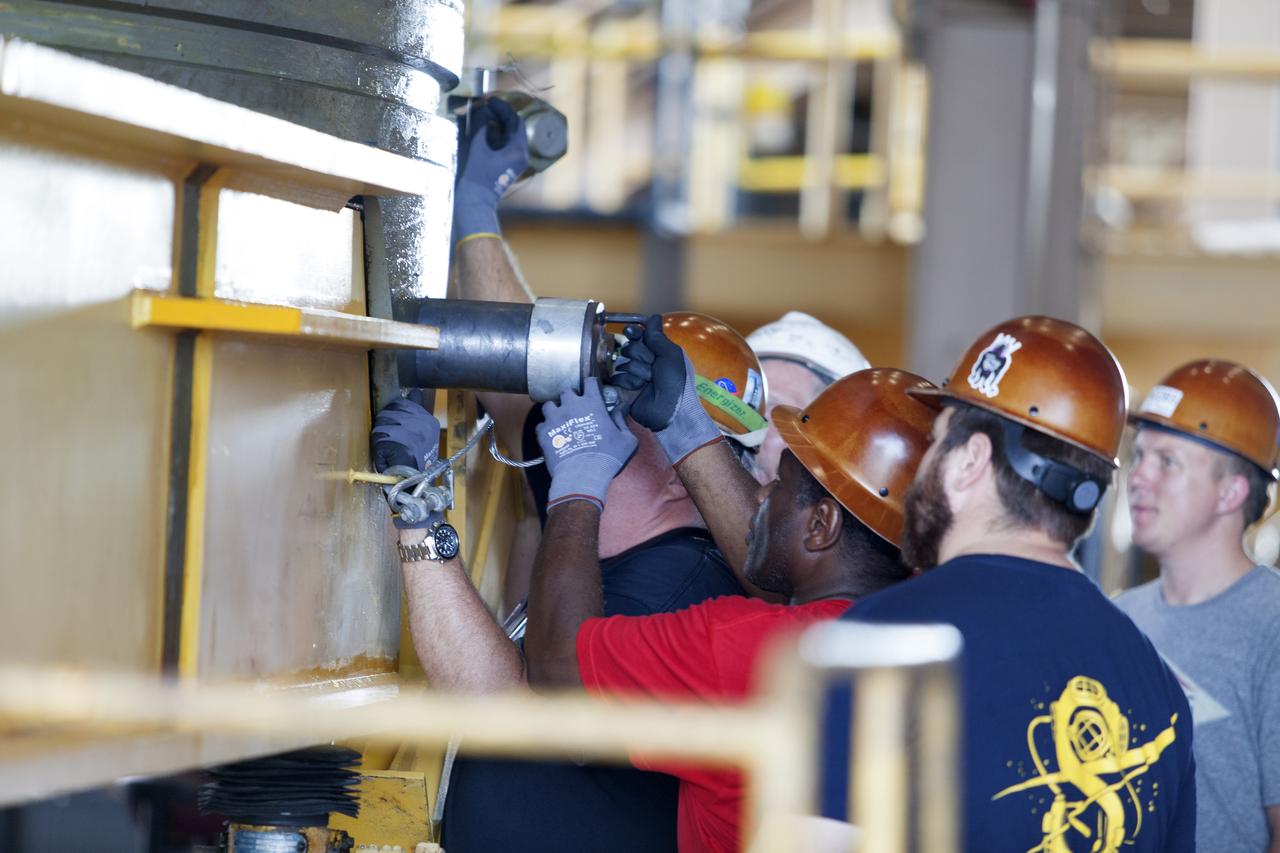
Jacobs technicians, on the Test and Operations Support Contract, check bolt fittings as they practice crane operations with an inert booster rocket segment in the Rotation, Processing and Surge Facility on June 22, 2018, at NASA's Kennedy Space Center in Florida. Dual cranes are being used to move the segment from vertical to horizontal, a maneuver known as a "breakover rotation." As part of routine processing operations for the agency's Space Launch System (SLS) rocket, the RPSF team will receive all of the solid rocket fuel segments for inspection and preparation prior to transporting them to the Vehicle Assembly Building for stacking on the mobile launcher. Many pathfinding operations are being done to prepare for launch of the SLS and Orion spacecraft on Exploration Mission-1 and deep space missions.
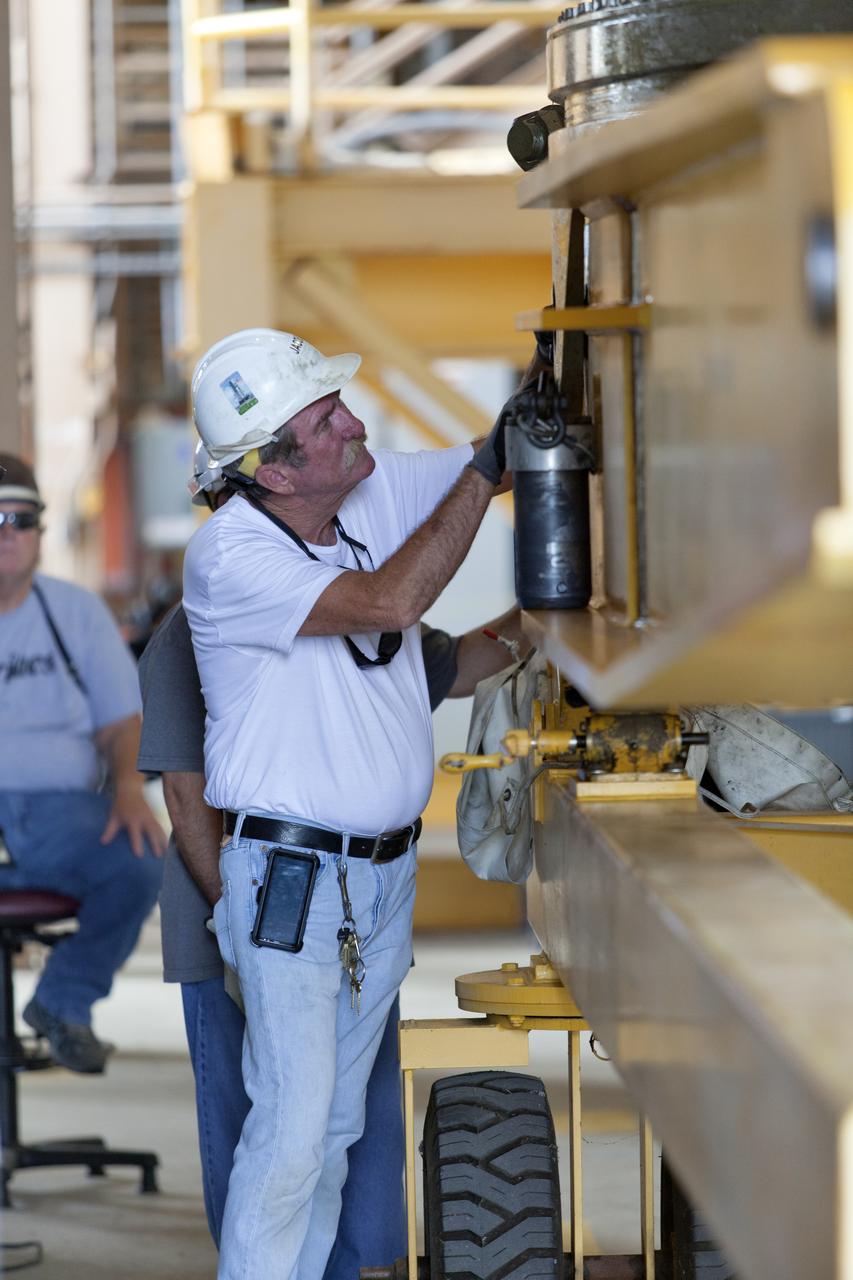
A Jacobs technician, on the Test and Operations Support Contract, checks bolt fittings during practice crane operations with an inert booster rocket segment in the Rotation, Processing and Surge Facility on June 22, 2018, at NASA's Kennedy Space Center in Florida. Dual cranes will be used to move the segment from vertical to horizontal, a maneuver known as a "breakover rotation." As part of routine processing operations for the agency's Space Launch System (SLS) rocket, the RPSF team will receive all of the solid rocket fuel segments for inspection and preparation prior to transporting them to the Vehicle Assembly Building for stacking on the mobile launcher. Many pathfinding operations are being done to prepare for launch of the SLS and Orion spacecraft on Exploration Mission-1 and deep space missions.
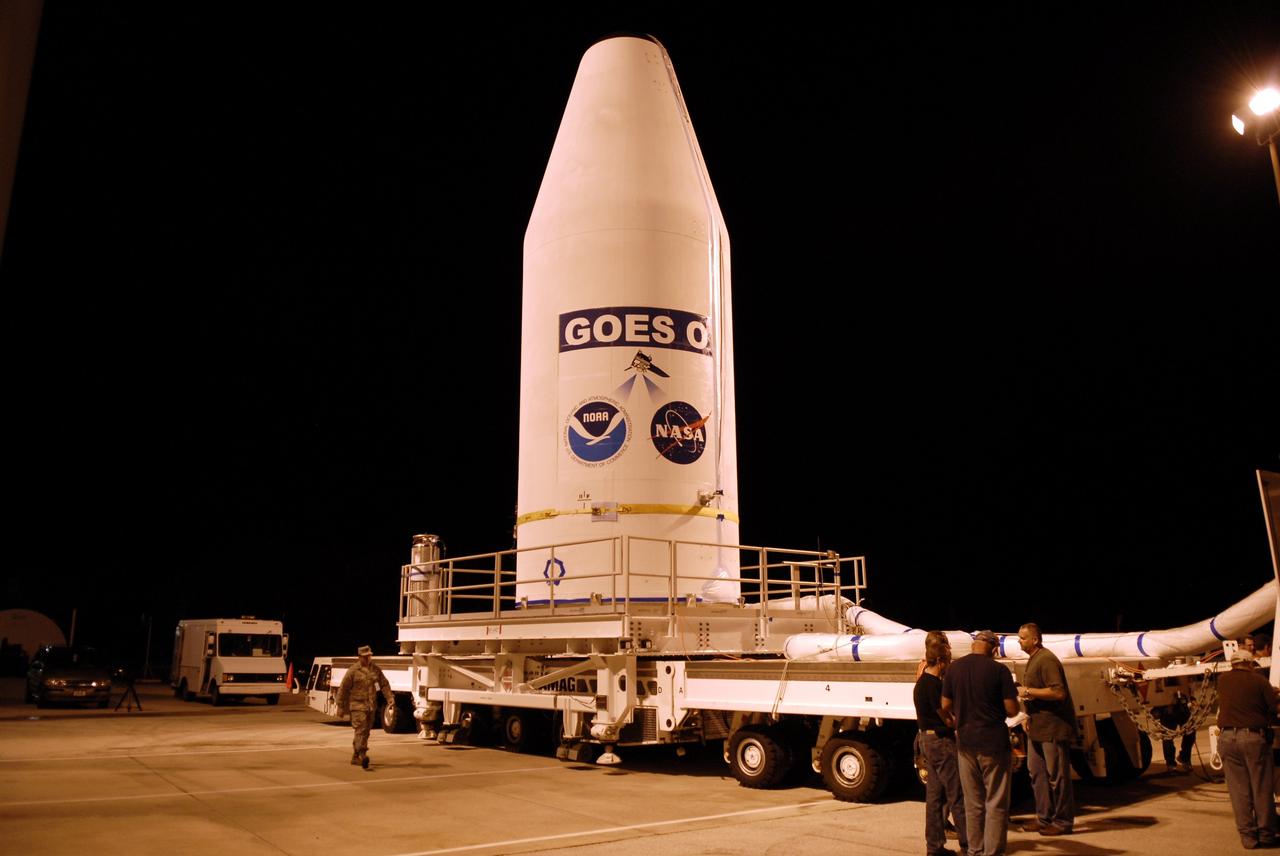
CAPE CANAVERAL, Fla. – At Cape Canaveral Air Force Station in Florida, the GOES-O satellite is being transported from the Astrotech payload processing facility in Titusville, Fla., to Launch Complex 37. There it will be lifted into the mobile service tower and mated with the United Launch Alliance Delta IV expendable launch vehicle. The GOES-O satellite is targeted to launch no earlier than June 26. The latest Geostationary Operational Environmental Satellite, GOES-O was developed by NASA for the National Oceanic and Atmospheric Administration, or NOAA. The GOES satellites continuously provide observations of 60 percent of the Earth including the continental United States, providing weather monitoring and forecast operations as well as a continuous and reliable stream of environmental information and severe weather warnings. Once in orbit, GOES-O will be designated GOES-14, and NASA will provide on-orbit checkout and then transfer operational responsibility to NOAA. Photo credit: NASA/Kim Shiflett
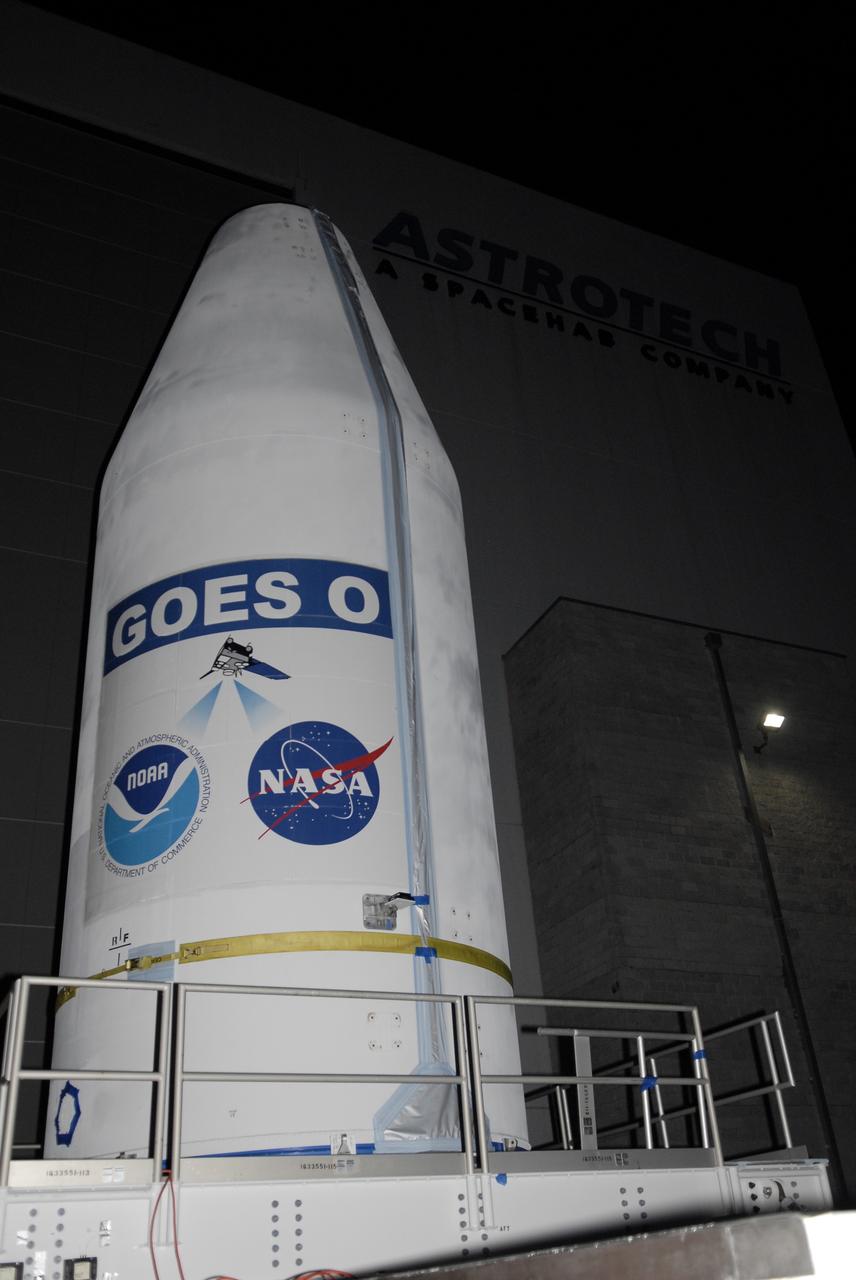
CAPE CANAVERAL, Fla. – At Cape Canaveral Air Force Station in Florida, the GOES-O satellite is ready to be transported from the Astrotech payload processing facility in Titusville, Fla., to Launch Complex 37. There it will be lifted into the mobile service tower and mated with the United Launch Alliance Delta IV expendable launch vehicle. The GOES-O satellite is targeted to launch no earlier than June 26. The latest Geostationary Operational Environmental Satellite, GOES-O was developed by NASA for the National Oceanic and Atmospheric Administration, or NOAA. The GOES satellites continuously provide observations of 60 percent of the Earth including the continental United States, providing weather monitoring and forecast operations as well as a continuous and reliable stream of environmental information and severe weather warnings. Once in orbit, GOES-O will be designated GOES-14, and NASA will provide on-orbit checkout and then transfer operational responsibility to NOAA. Photo credit: NASA/Kim Shiflett
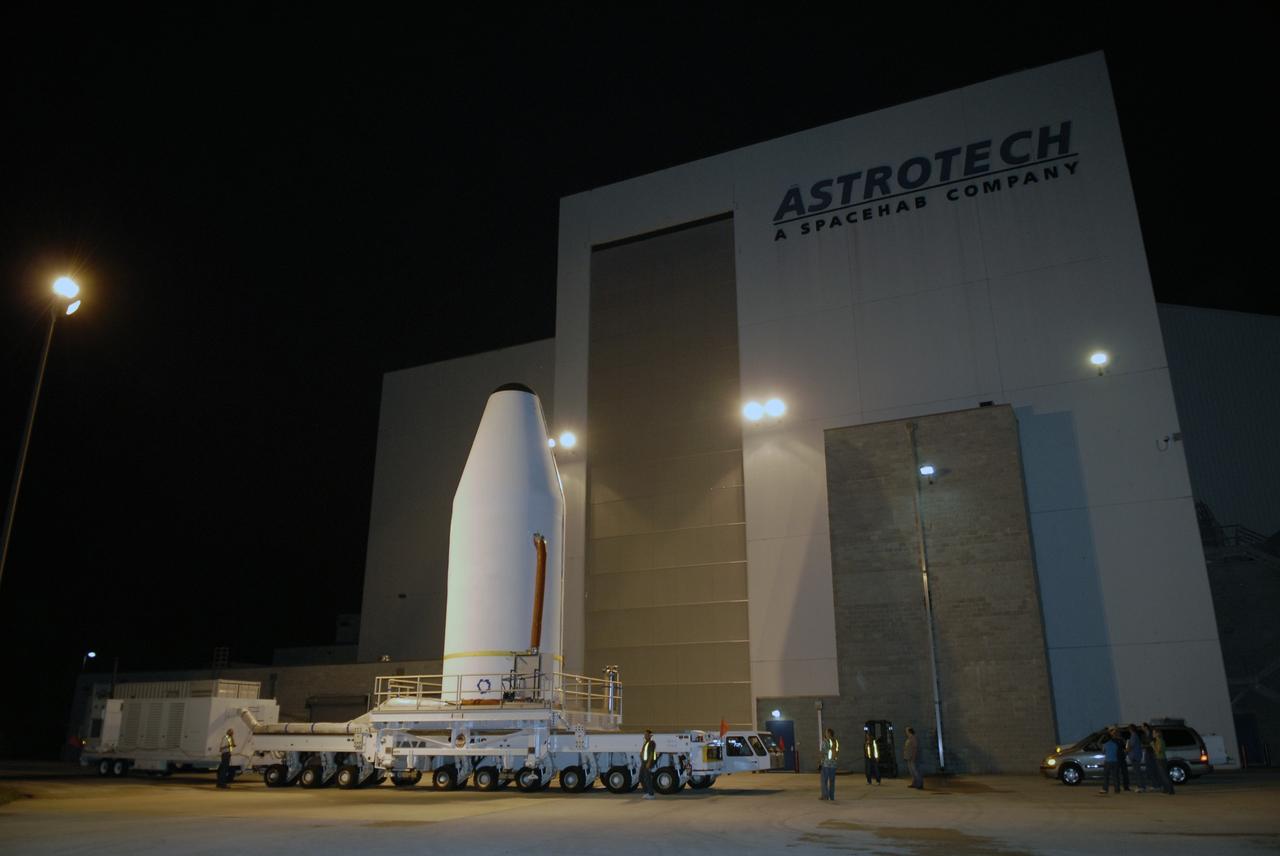
CAPE CANAVERAL, Fla. – At Cape Canaveral Air Force Station in Florida, the GOES-O satellite is being transported from the Astrotech payload processing facility in Titusville, Fla., to Launch Complex 37. There it will be lifted into the mobile service tower and mated with the United Launch Alliance Delta IV expendable launch vehicle. The GOES-O satellite is targeted to launch no earlier than June 26. The latest Geostationary Operational Environmental Satellite, GOES-O was developed by NASA for the National Oceanic and Atmospheric Administration, or NOAA. The GOES satellites continuously provide observations of 60 percent of the Earth including the continental United States, providing weather monitoring and forecast operations as well as a continuous and reliable stream of environmental information and severe weather warnings. Once in orbit, GOES-O will be designated GOES-14, and NASA will provide on-orbit checkout and then transfer operational responsibility to NOAA. Photo credit: NASA/Kim Shiflett
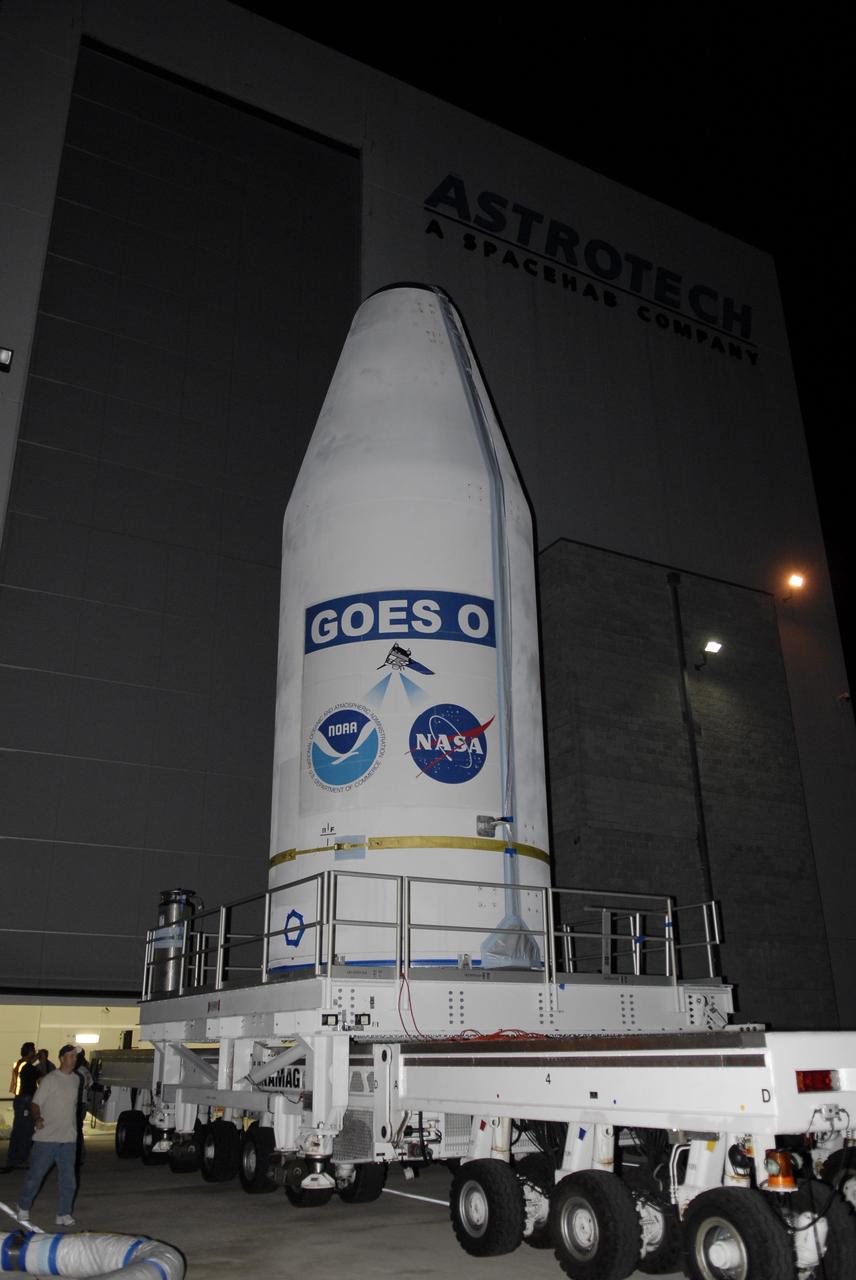
CAPE CANAVERAL, Fla. – At Cape Canaveral Air Force Station in Florida, the GOES-O satellite is being transported from the Astrotech payload processing facility in Titusville, Fla., to Launch Complex 37. There it will be lifted into the mobile service tower and mated with the United Launch Alliance Delta IV expendable launch vehicle. The GOES-O satellite is targeted to launch no earlier than June 26. The latest Geostationary Operational Environmental Satellite, GOES-O was developed by NASA for the National Oceanic and Atmospheric Administration, or NOAA. The GOES satellites continuously provide observations of 60 percent of the Earth including the continental United States, providing weather monitoring and forecast operations as well as a continuous and reliable stream of environmental information and severe weather warnings. Once in orbit, GOES-O will be designated GOES-14, and NASA will provide on-orbit checkout and then transfer operational responsibility to NOAA. Photo credit: NASA/Kim Shiflett
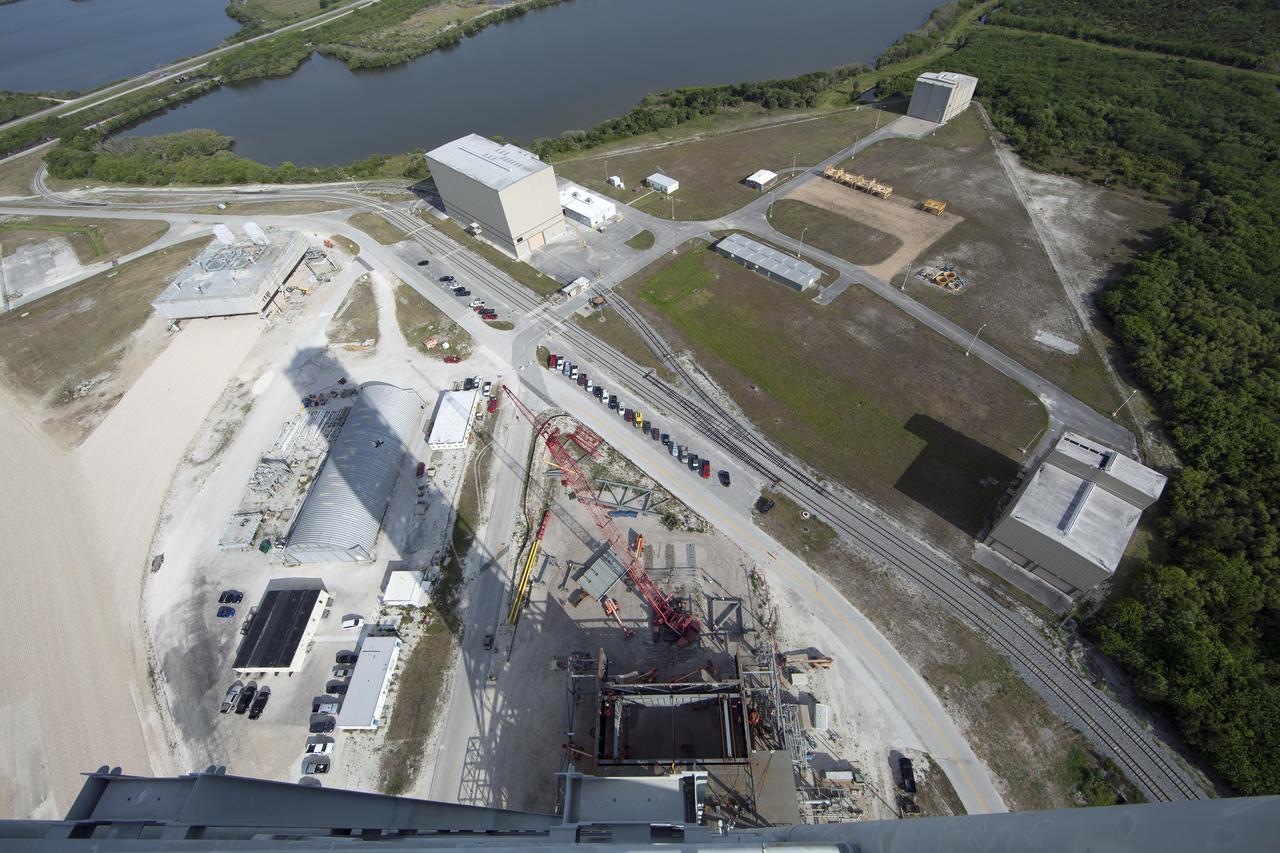
CAPE CANAVERAL, Fla. -- Modifications continue on the Mobile Launcher, or ML, at the Mobile Launcher Park Site at NASA’s Kennedy Space Center in Florida. In a view looking down from the top of the ML is the base of the ML and various facilities in the Launch Complex 39 area. The ML is being modified and strengthened to accommodate the weight, size and thrust at launch of NASA's Space Launch System, or SLS, and Orion spacecraft. In 2013, the agency awarded a contract to J.P. Donovan Construction Inc. of Rockledge, Fla., to modify the ML, which is one of the key elements of ground support equipment that is being upgraded by the Ground Systems Development and Operations Program office at Kennedy. The existing 24-foot exhaust hole is being enlarged and strengthened for the larger, heavier SLS rocket. The ML will carry the SLS rocket and Orion spacecraft to Launch Pad 39B for its first mission, Exploration Mission-1, in 2017. Photo credit: NASA/Daniel Casper
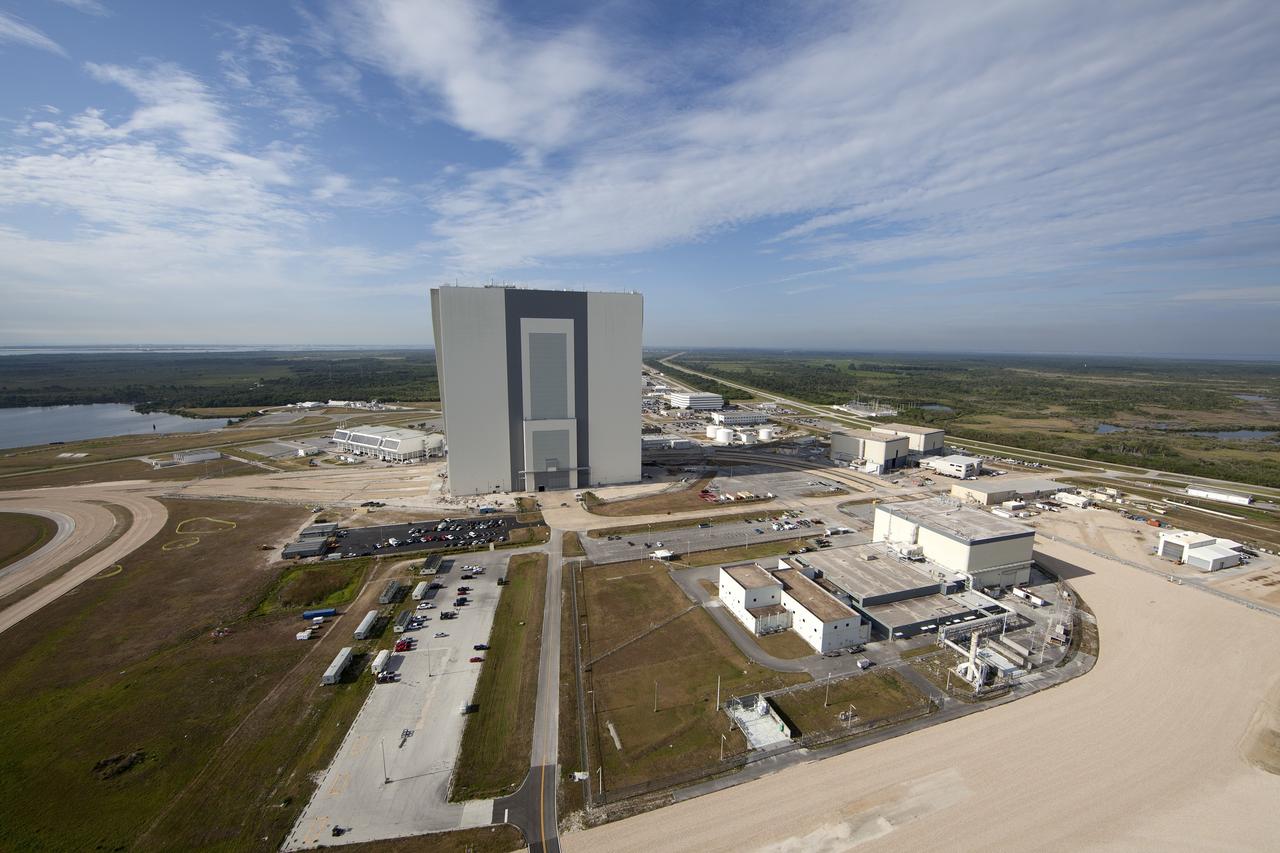
CAPE CANAVERAL, Fla. -- Modifications continue on the Mobile Launcher, or ML, at the Mobile Launcher Park Site at NASA’s Kennedy Space Center in Florida. In view from the top of the ML is the Vehicle Assembly Building, the Launch Control Center at left and various other facilities in the Launch Complex 39 area. The ML is being modified and strengthened to accommodate the weight, size and thrust at launch of NASA's Space Launch System, or SLS, and Orion spacecraft. In 2013, the agency awarded a contract to J.P. Donovan Construction Inc. of Rockledge, Fla., to modify the ML, which is one of the key elements of ground support equipment that is being upgraded by the Ground Systems Development and Operations Program office at Kennedy. The existing 24-foot exhaust hole is being enlarged and strengthened for the larger, heavier SLS rocket. The ML will carry the SLS rocket and Orion spacecraft to Launch Pad 39B for its first mission, Exploration Mission-1, in 2017. Photo credit: NASA/Daniel Casper
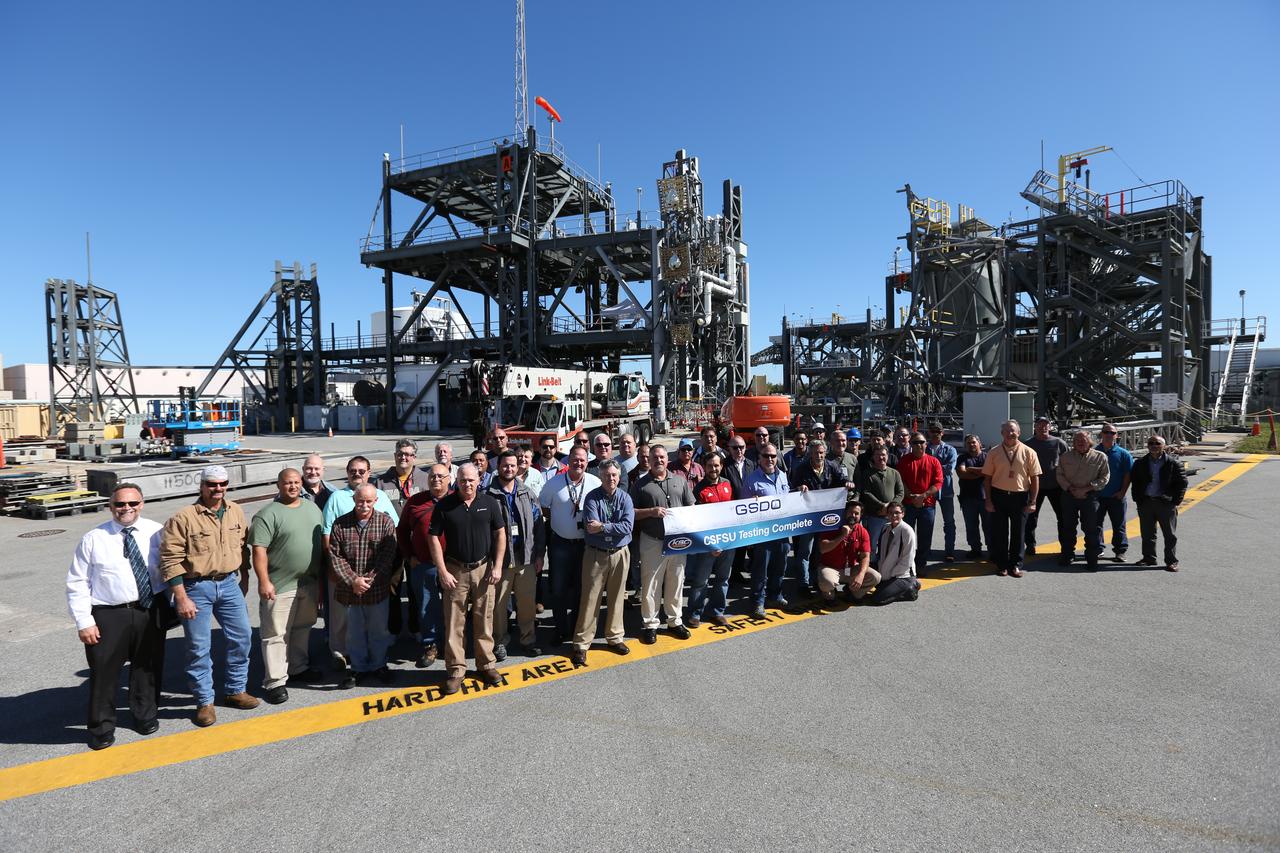
The test team holds a signed banner at the Launch Equipment Test Facility at Kennedy Space Center in Florida. Behind them are some of the test structures used to test the launch umbilicals. Testing of the Core Stage Forward Skirt Umbilical (CSFSU) for NASA's Space Launch System is complete and the umbilical has been transported to the mobile launcher area. The umbilical will be prepared for installation on the tower of the mobile launcher. The CSFSU will be mated to the core stage forward skirt to provide commodities to the SLS rocket, and then disconnect and swing away before launch. Its main purpose is to provide conditioned air and gaseous nitrogen to the SLS Core Stage Forward Skirt. The center’s Engineering Directorate and the Ground Systems Development and Operations Program are overseeing processing and testing of the umbilicals.
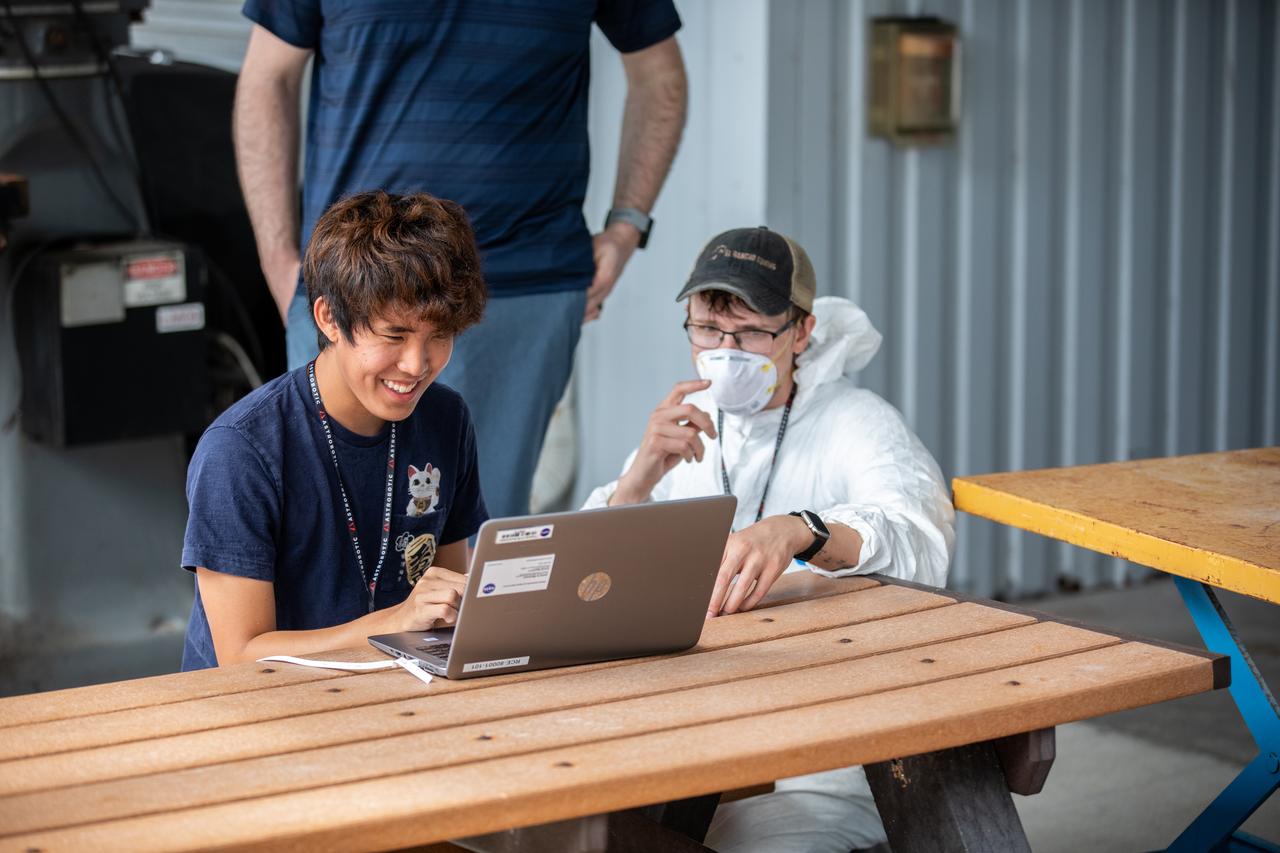
Senior Software Engineer Taylor Whitaker (right) and Software Engineering intern Ashten Akemoto create a mobility routine for Astrobotic’s CubeRover – a lightweight, modular planetary rover – using the company’s ground software at NASA’s Kennedy Space Center in Florida on June 30, 2022. Astrobotic – a Pittsburgh-based space robotics company – is using the spaceport’s Swamp Works facility and the Granular Mechanics and Regolith Operations Laboratory to conduct mobility testing of their rover. The laboratory’s regolith bin, which holds approximately 120 tons of lunar regolith simulant, will help depict how the company’s CubeRover would perform on the Moon. NASA’s Small Business Innovation Research program provided the funding for initial development, and a $2 million Tipping Point award from the agency has provided additional funding for continued development into a more mature rover.
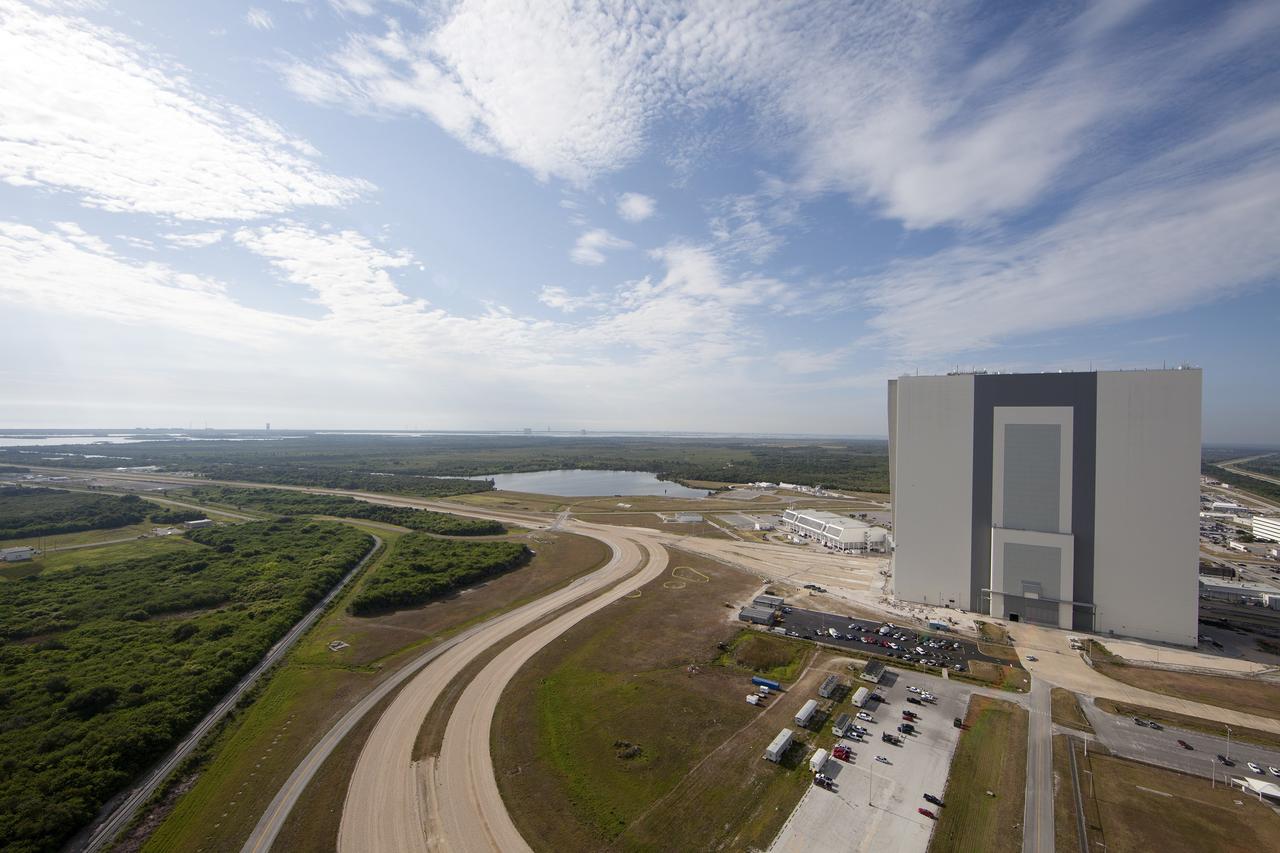
CAPE CANAVERAL, Fla. -- Modifications continue on the Mobile Launcher, or ML, at the Mobile Launcher Park Site at NASA’s Kennedy Space Center in Florida. In view from the top of the ML is the Vehicle Assembly Building, the Launch Control Center at left and various other facilities in the Launch Complex 39 area. The ML is being modified and strengthened to accommodate the weight, size and thrust at launch of NASA's Space Launch System, or SLS, and Orion spacecraft. In 2013, the agency awarded a contract to J.P. Donovan Construction Inc. of Rockledge, Fla., to modify the ML, which is one of the key elements of ground support equipment that is being upgraded by the Ground Systems Development and Operations Program office at Kennedy. The existing 24-foot exhaust hole is being enlarged and strengthened for the larger, heavier SLS rocket. The ML will carry the SLS rocket and Orion spacecraft to Launch Pad 39B for its first mission, Exploration Mission-1, in 2017. Photo credit: NASA/Daniel Casper
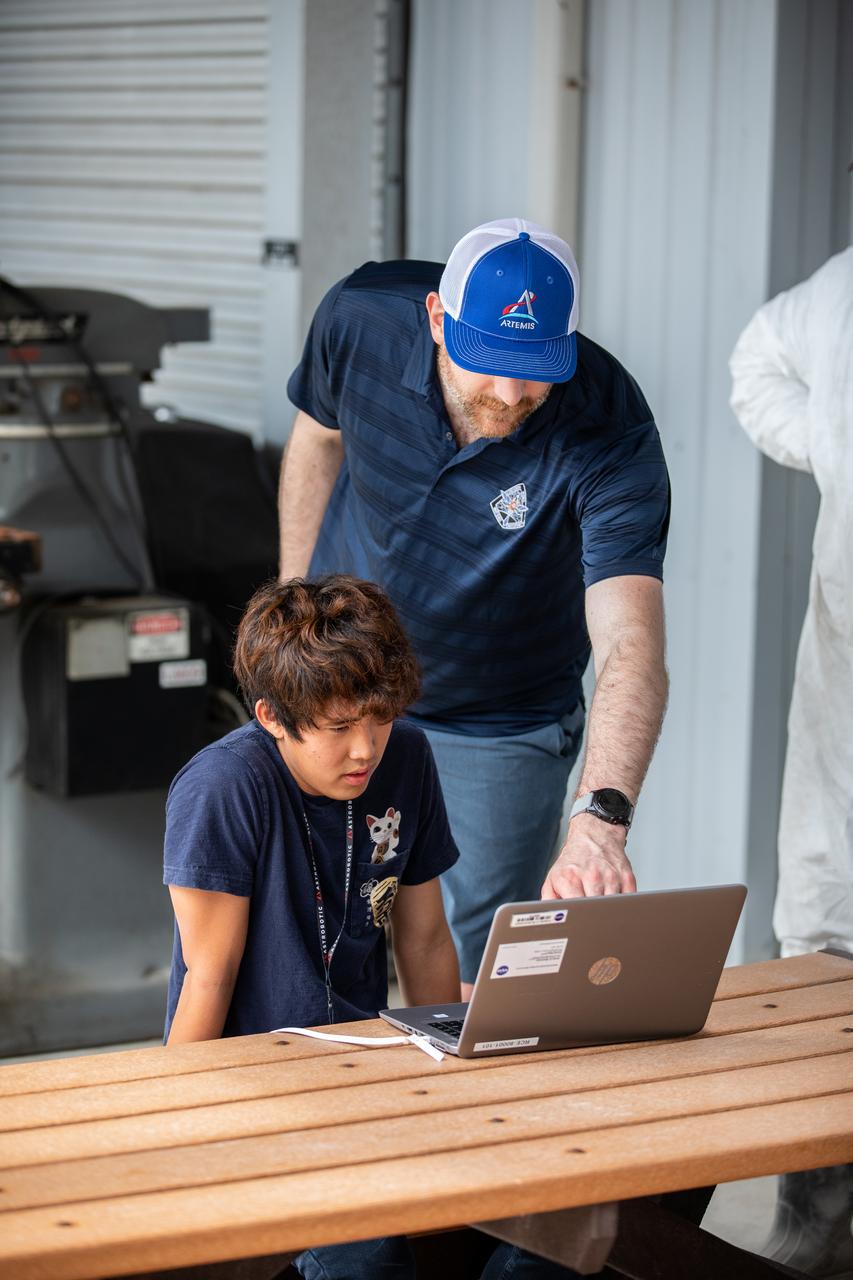
Robotics Software Engineer II Chris Rampolla (right) and Software Engineering intern Ashten Akemoto issue commands to Astrobotic’s CubeRover using the company’s ground software during mobility testing at NASA’s Kennedy Space Center in Florida on June 30, 2022. Astrobotic – a Pittsburgh-based space robotics company – is using the spaceport’s Swamp Works facility and the Granular Mechanics and Regolith Operations Laboratory to conduct mobility testing of their rover. The laboratory’s regolith bin, which holds approximately 120 tons of lunar regolith simulant, will help depict how the company’s CubeRover would perform on the Moon. NASA’s Small Business Innovation Research program provided the funding for initial development, and a $2 million Tipping Point award has provided additional funding for continued development into a more mature rover.
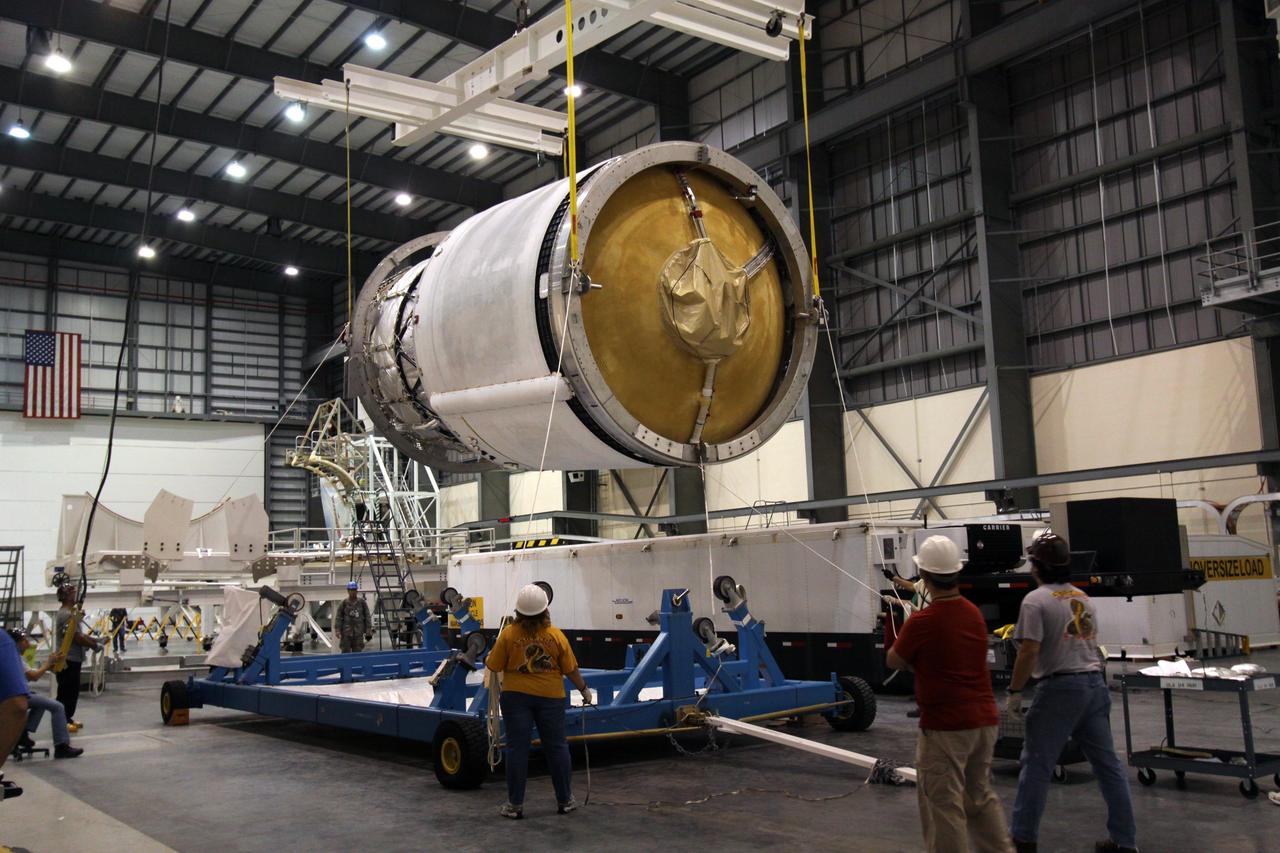
CAPE CANAVERAL, Fla. – Workers move the second stage of a Delta IV from its transporter toward a mobile work stand in the Horizontal Integration Facility at Launch Complex 37 on Cape Canaveral Air Force Station in Florida. This United Launch Alliance Delta IV rocket is the vehicle slated to launch GOES-P, the latest Geostationary Operational Environmental Satellite developed by NASA for the National Oceanic and Atmospheric Administration, or NOAA. Processing of the Delta IV is on track for launch, targeted for March 4, 2010. For information on GOES-P, visit http://goespoes.gsfc.nasa.gov/goes/spacecraft/n_p_spacecraft.html. Photo credit: NASA/Jack Pfaller
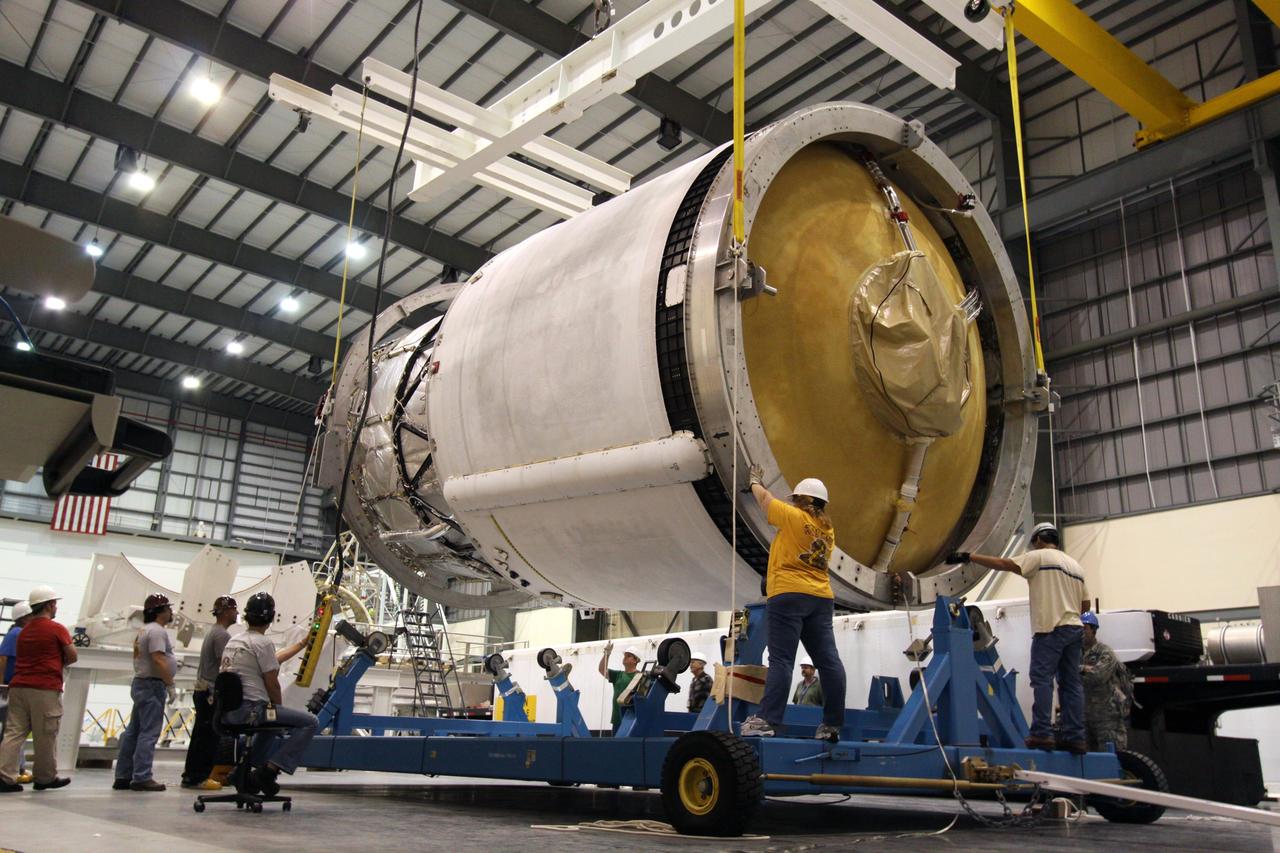
CAPE CANAVERAL, Fla. – Workers position the second stage of a Delta IV onto a mobile work stand in the Horizontal Integration Facility at Launch Complex 37 on Cape Canaveral Air Force Station in Florida. This United Launch Alliance Delta IV rocket is the vehicle slated to launch GOES-P, the latest Geostationary Operational Environmental Satellite developed by NASA for the National Oceanic and Atmospheric Administration, or NOAA. Processing of the Delta IV is on track for launch, targeted for March 4, 2010. For information on GOES-P, visit http://goespoes.gsfc.nasa.gov/goes/spacecraft/n_p_spacecraft.html. Photo credit: NASA/Jack Pfaller
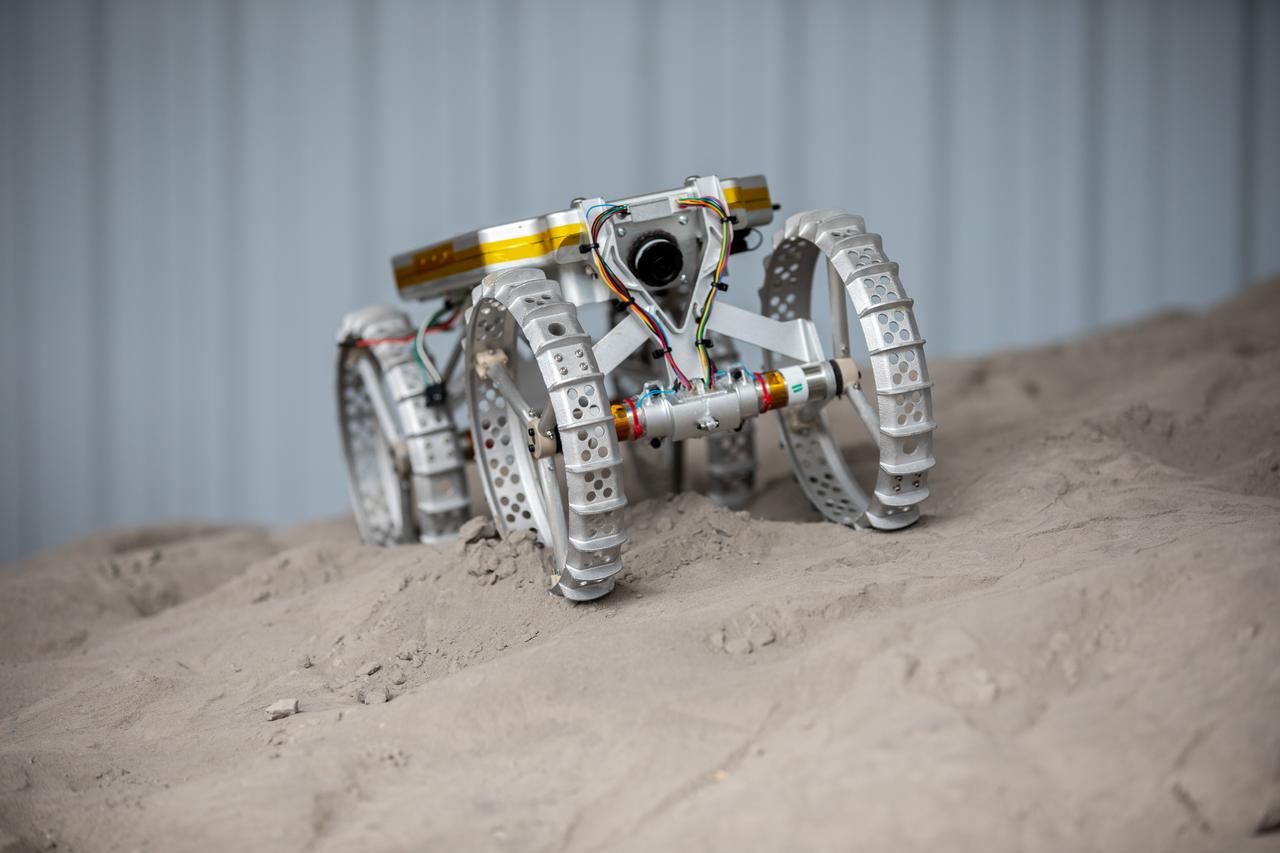
Astrobotic’s CubeRover – a lightweight, modular planetary rover – undergoes mobility testing inside the Granular Mechanics and Regolith Operations (GMRO) Laboratory’s regolith pit at NASA Kennedy Space Center’s Swamp Works facility on June 30, 2022. Astrobotic – a Pittsburgh-based space robotics company – is using the GMRO lab’s regolith bin, which holds approximately 120 tons of lunar regolith simulant, to depict how the company’s CubeRover would perform on the Moon. NASA’s Small Business Innovation Research program provided the funding for initial development, and a $2 million Tipping Point award from the agency has provided additional funding for continued development into a more mature rover.
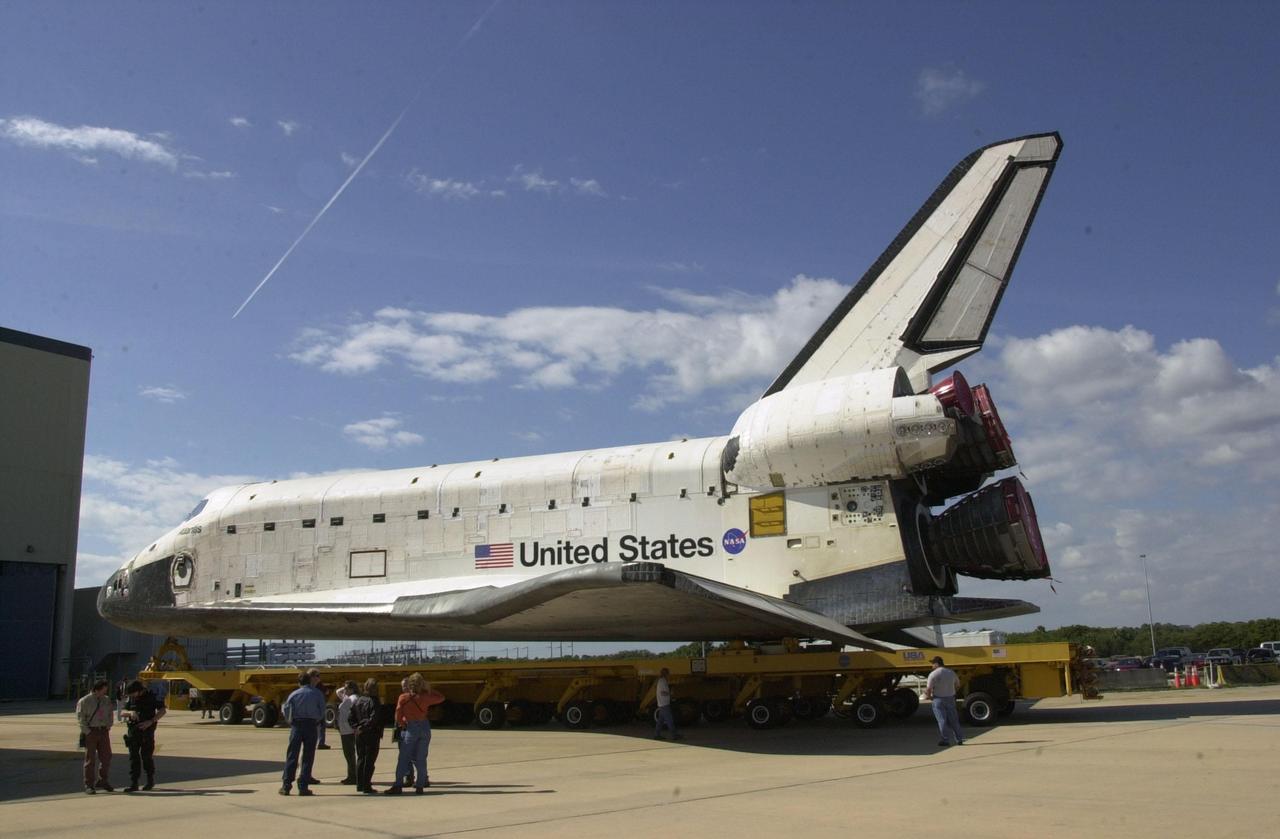
KENNEDY SPACE CENTER, FLA. -- Orbiter Atlantis rolls out of the Orbiter Processing Facility on its way to the Vehicle Assembly Building for space vehicle mate. As part of final preparations before transfer to the launch pad, Atlantis will be lifted vertically into its VAB high bay and mated to the twin solid rocket boosters and external tank. The STS-110 mission resumes International Space Station assembly operations with the delivery of the S0 truss, which will support solar panels providing additional power to the Station. The payload will also include the first part of a Mobile Transporter that will provide a moveable base for the Station’s Canadian robotic arm. STS-110 is scheduled for launch April 4
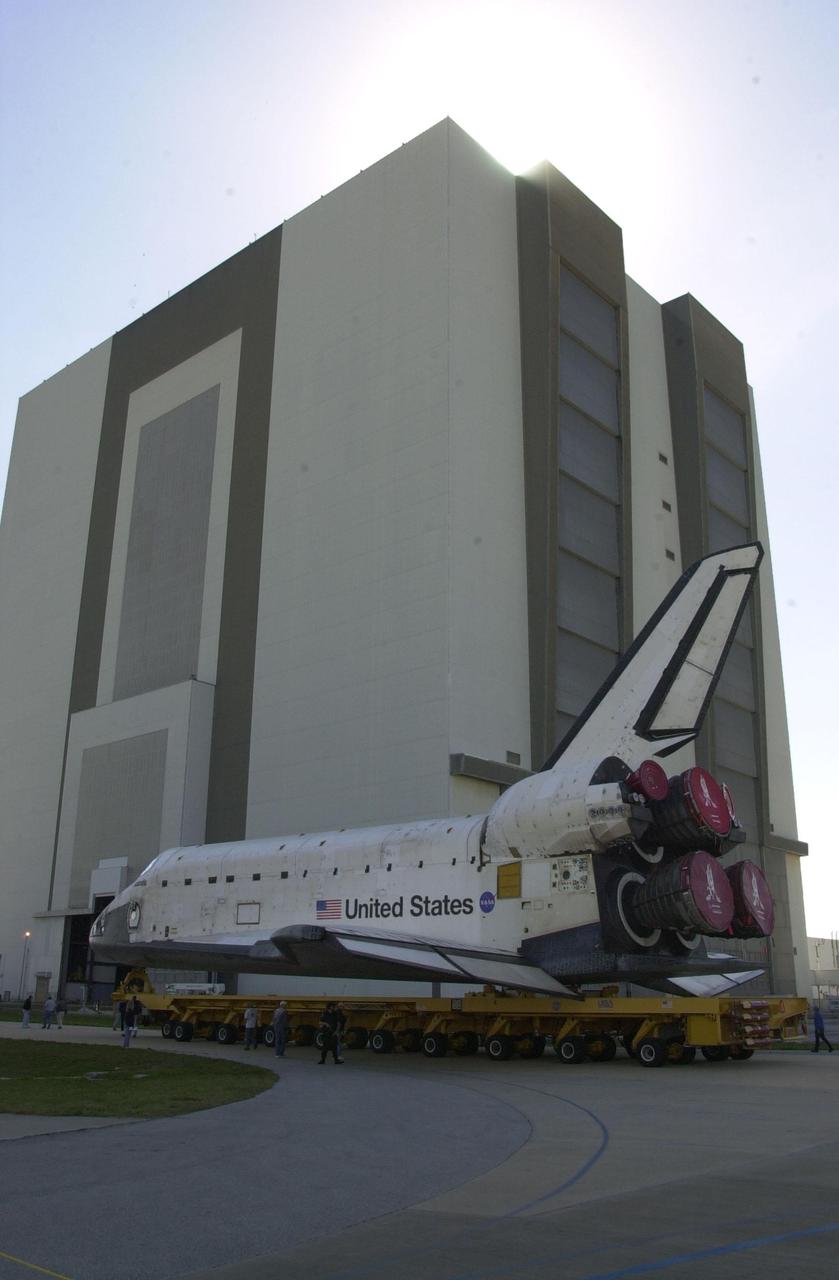
KENNEDY SPACE CENTER, Fla. - After leaving the Orbiter Processing Facility, Orbiter Atlantis nears the Vehicle Assembly Building for space vehicle mate. As part of final preparations before transfer to the launch pad, Atlantis will be lifted vertically into its VAB high bay and mated to the twin solid rocket boosters and external tank. The STS-110 mission resumes International Space Station assembly operations with the delivery of the S0 truss, which will support solar panels providing additional power to the Station. The payload will also include the first part of a Mobile Transporter that will provide a moveable base for the Station’s Canadian robotic arm. STS-110 is scheduled for launch April 4
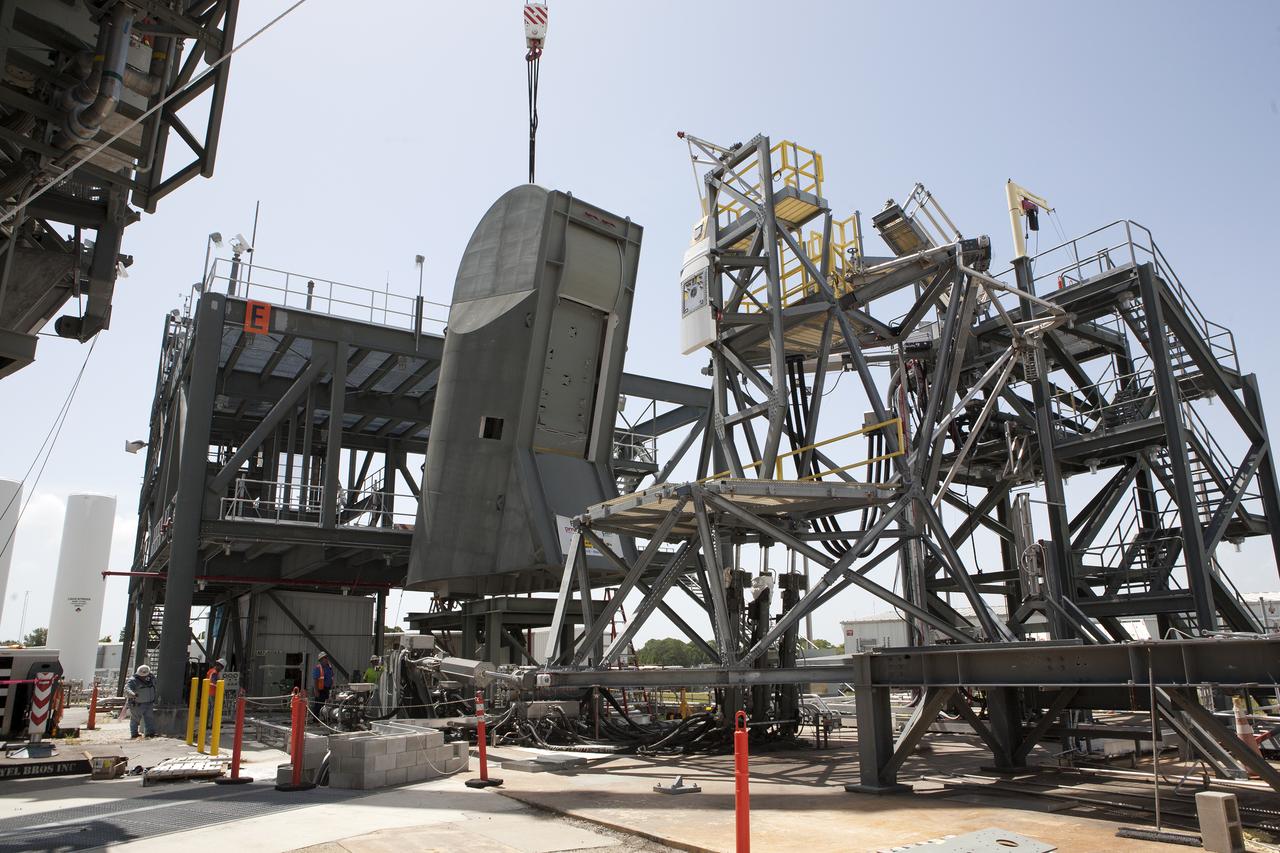
Technician monitors the progress as a crane lowers the first Tail Service Mast Umbilical (TSMU) onto a test stand at the Launch Equipment Test Facility at NASA’s Kennedy Space Center in Florida. Two TSMUs will provide liquid propellants and power to the Space Launch System (SLS) rocket’s core stage engine. Both TSMUs will connect to the zero-level deck on the mobile launcher, providing fuel and electricity to the SLS rocket before it launches on Exploration Mission 1. The TSMU will undergo testing and validation at the LETF to verify it is functioning properly. The center’s Engineering Directorate and the Ground Systems Development and Operations Program are overseeing processing and testing of the umbilicals.
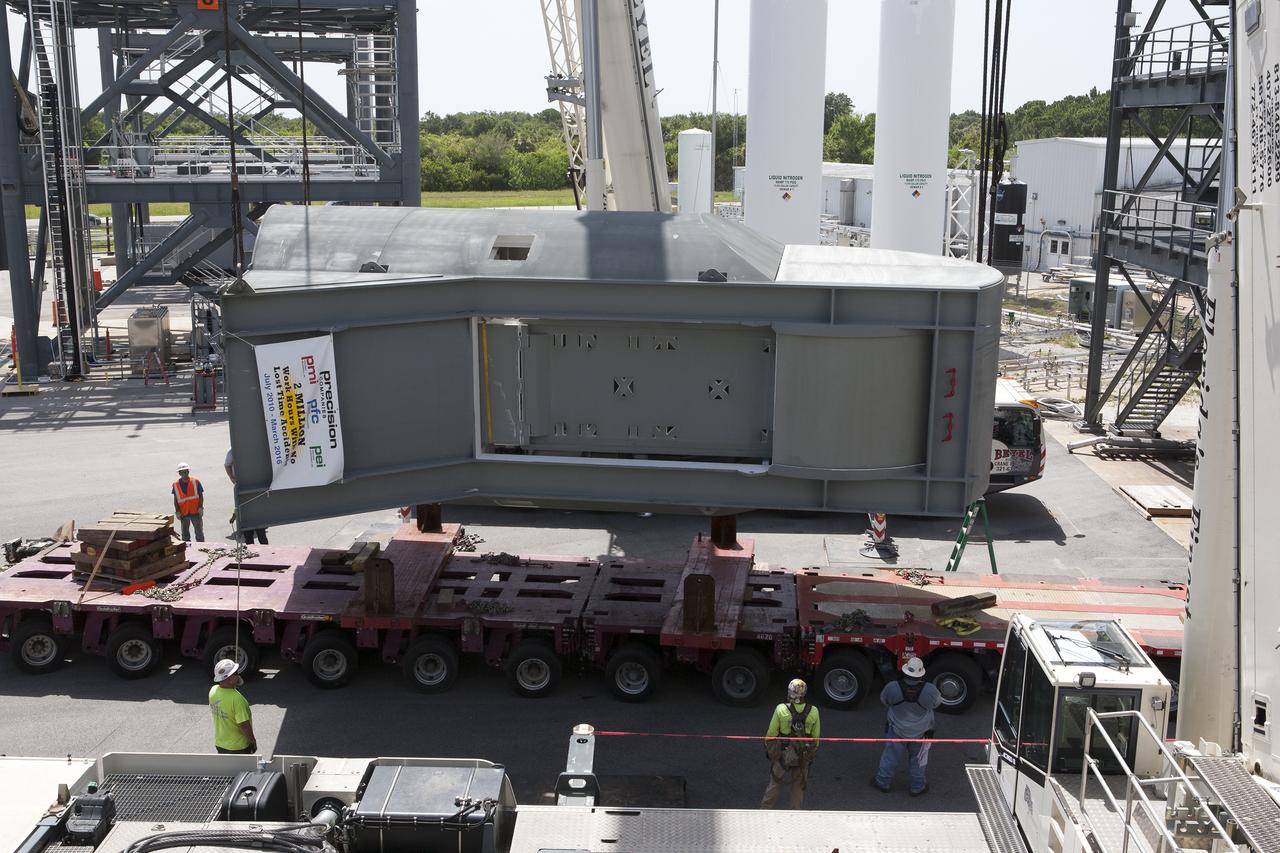
Technicians assist as a crane is used to lift the first Tail Service Mast Umbilical (TSMU) up from the flatbed of the transport truck at the Launch Equipment Test Facility (LETF) at NASA’s Kennedy Space Center in Florida. Two TSMUs will provide liquid propellants and power to the Space Launch System (SLS) rocket’s core stage engine. Both TSMUs will connect to the zero-level deck on the mobile launcher, providing fuel and electricity to the SLS rocket before it launches on Exploration Mission 1. The TSMU will undergo testing and validation at the LETF to verify it is functioning properly. The center’s Engineering Directorate and the Ground Systems Development and Operations Program are overseeing processing and testing of the umbilicals.
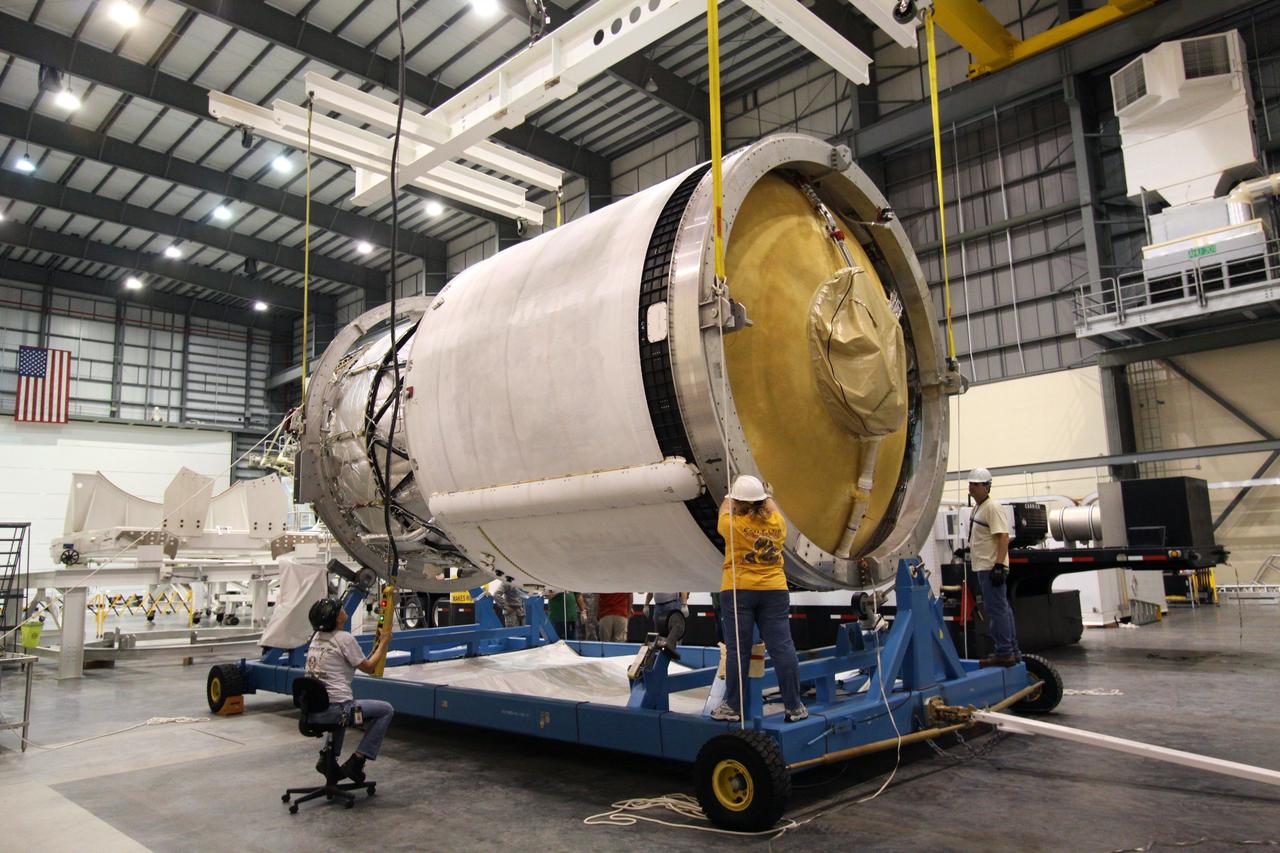
CAPE CANAVERAL, Fla. – Workers adjust the second stage of a Delta IV on its mobile work stand in the Horizontal Integration Facility at Launch Complex 37 on Cape Canaveral Air Force Station in Florida. This United Launch Alliance Delta IV rocket is the vehicle slated to launch GOES-P, the latest Geostationary Operational Environmental Satellite developed by NASA for the National Oceanic and Atmospheric Administration, or NOAA. Processing of the Delta IV is on track for launch, targeted for March 4, 2010. For information on GOES-P, visit http://goespoes.gsfc.nasa.gov/goes/spacecraft/n_p_spacecraft.html. Photo credit: NASA/Jack Pfaller
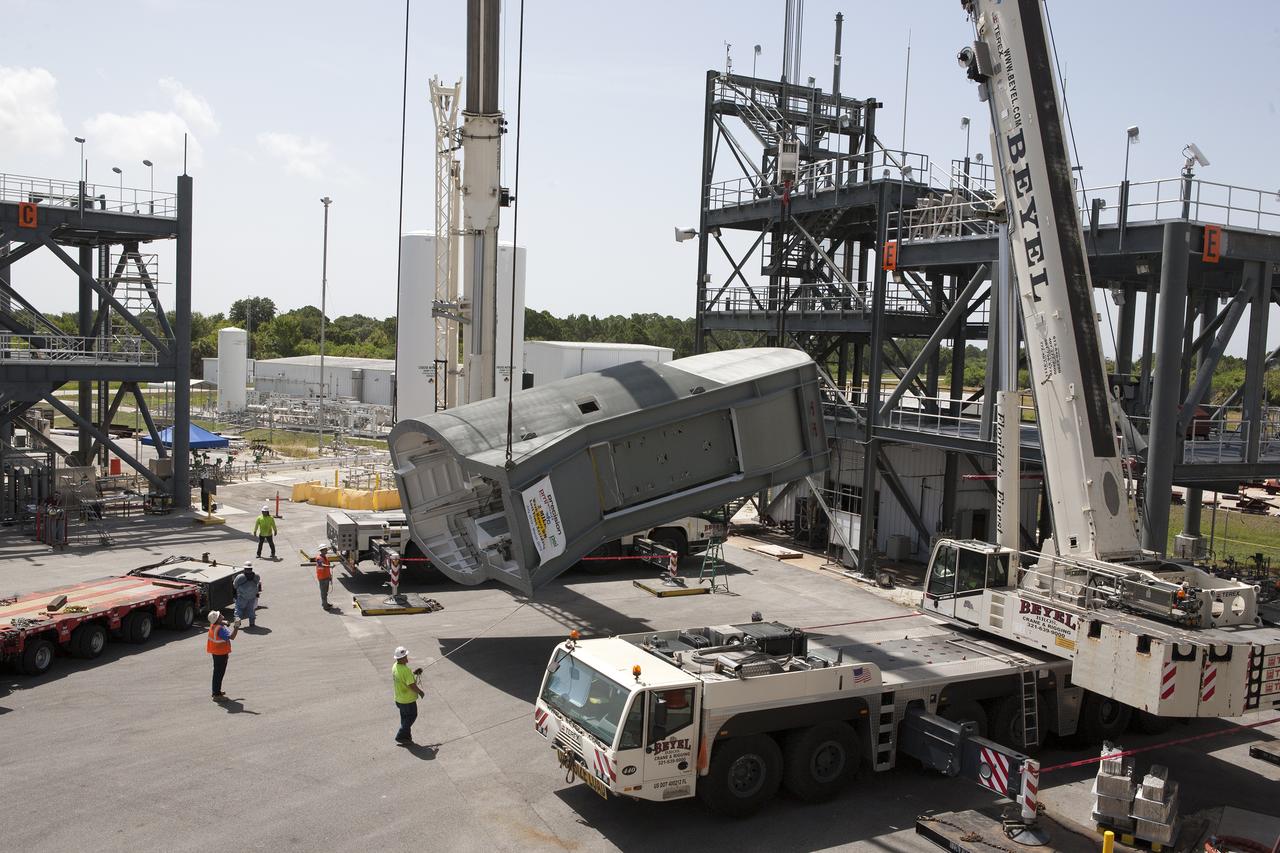
Technicians assist as a crane is used to lift the first Tail Service Mast Umbilical (TSMU) away from the flatbed of the transport truck at the Launch Equipment Test Facility (LETF) at NASA’s Kennedy Space Center in Florida. Two TSMUs will provide liquid propellants and power to the Space Launch System (SLS) rocket’s core stage engine. Both TSMUs will connect to the zero-level deck on the mobile launcher, providing fuel and electricity to the SLS rocket before it launches on Exploration Mission 1. The TSMU will undergo testing and validation at the LETF to verify it is functioning properly. The center’s Engineering Directorate and the Ground Systems Development and Operations Program are overseeing processing and testing of the umbilicals.
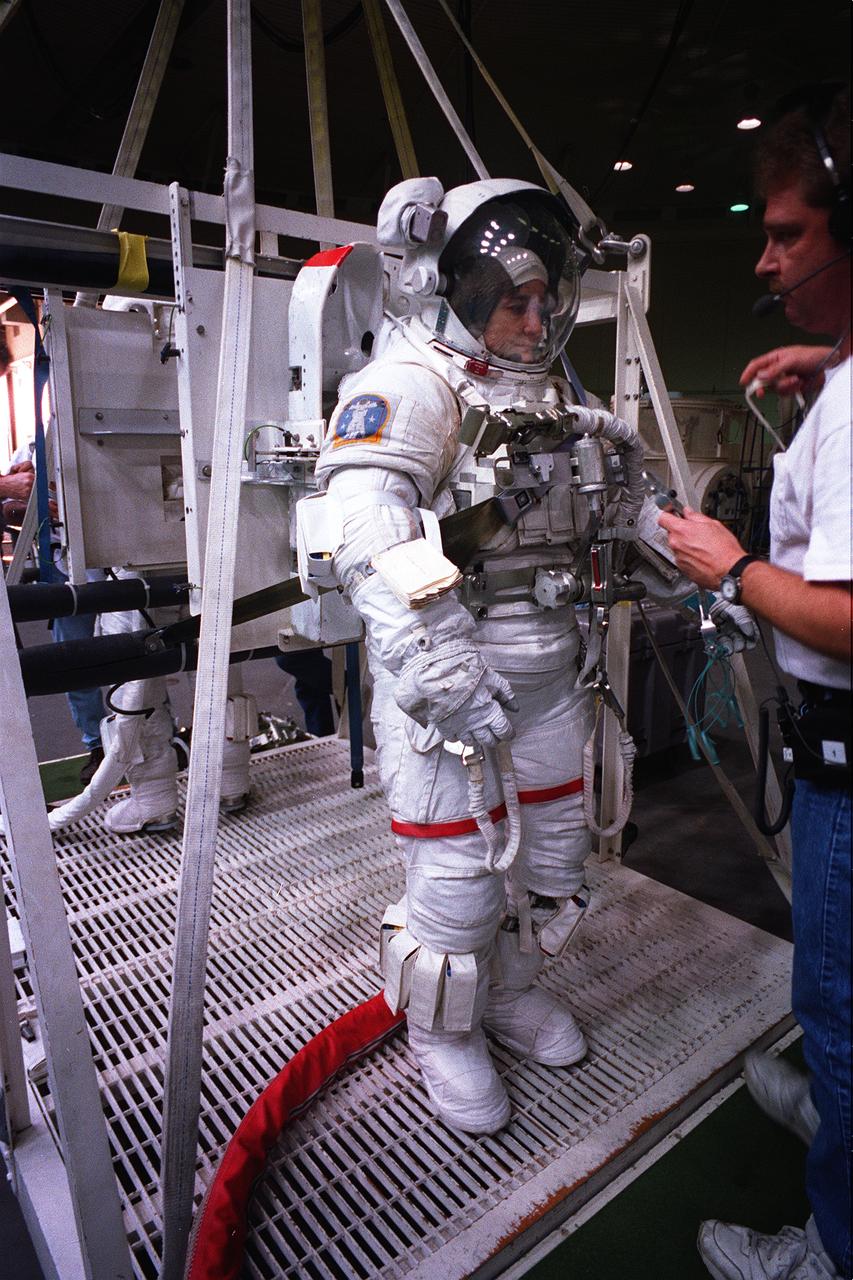
Astronaut and mission specialist, Linda Godwin, makes a final check of her respiration system before submersion into a 25 ft deep pool at the Johnson Space Center’s (JSC) Weightless Environment Training Facility (WET-F). Wearing a high fidelity training version of the Extravehicular Mobility Unit (EMU) space suit, Godwin simulated STS-76 Extravehicular Activity (EVA) chores in the pool. Launched aboard the Space Shuttle Atlantis in March of 1996, STS-76 marked the third U.S. Shuttle-Mir docking during which Godwin, along with astronaut and mission specialist Michael R. (Rich) Clifford, performed the first Extravehicular Activity (EVA) during Mir-Shuttle docked operations.
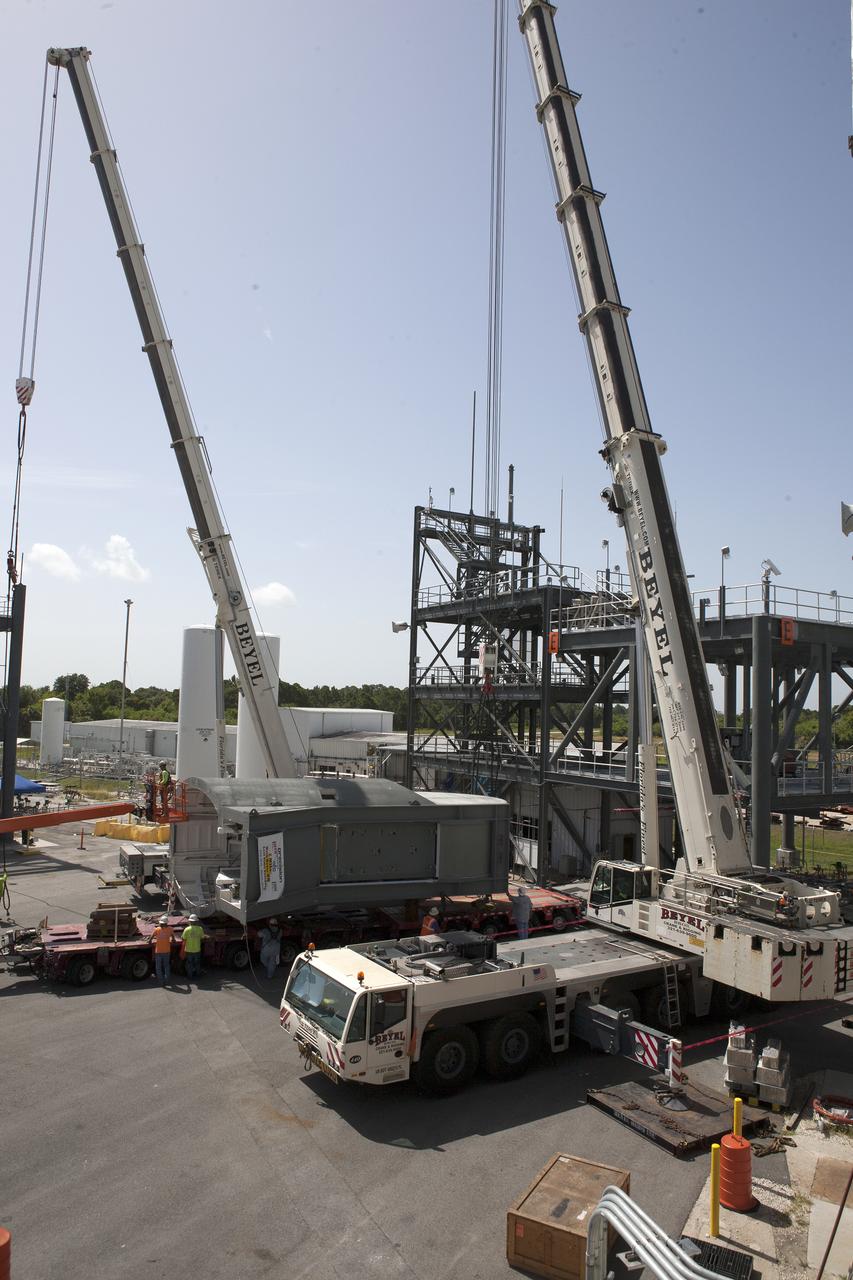
A crane is prepared to help lift the first Tail Service Mast Umbilical (TSMU) for NASA’s Space Launch System (SLS) at the Launch Equipment Test Facility (LETF) at NASA’s Kennedy Space Center in Florida. Two TSMUs will provide liquid propellants and power to the Space Launch System (SLS) rocket’s core stage engine. Both TSMUs will connect to the zero-level deck on the mobile launcher, providing fuel and electricity to the SLS rocket before it launches on Exploration Mission 1. The TSMU will undergo testing and validation at the LETF to verify it is functioning properly. The center’s Engineering Directorate and the Ground Systems Development and Operations Program are overseeing processing and testing of the umbilicals.
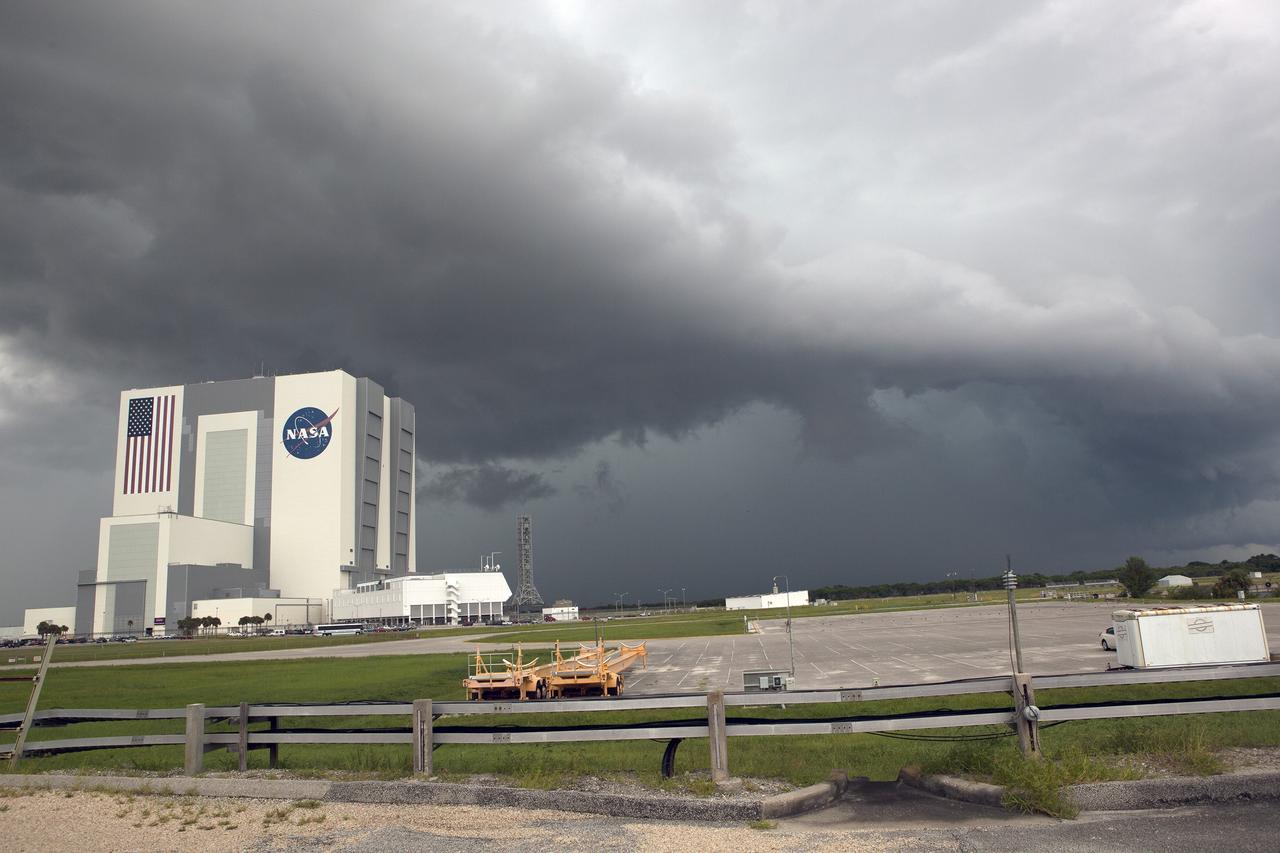
CAPE CANAVERAL, Fla. – A menacing thunderstorm hovers over Launch Complex 39 at NASA’s Kennedy Space Center in Florida. At left are the behemoth Vehicle Assembly Building, the Launch Control Center and the mobile launcher that will support NASA's Space Launch System heavy-lift rocket, under development. Kennedy's Ground Support Development and Operations Program is hard at work transforming the center's facilities into a multi-user spaceport, when the weather permits. For more on Kennedy Space Center, visit http://www.nasa.gov/kennedy. Photo credit: NASA/Ben Smegelsky
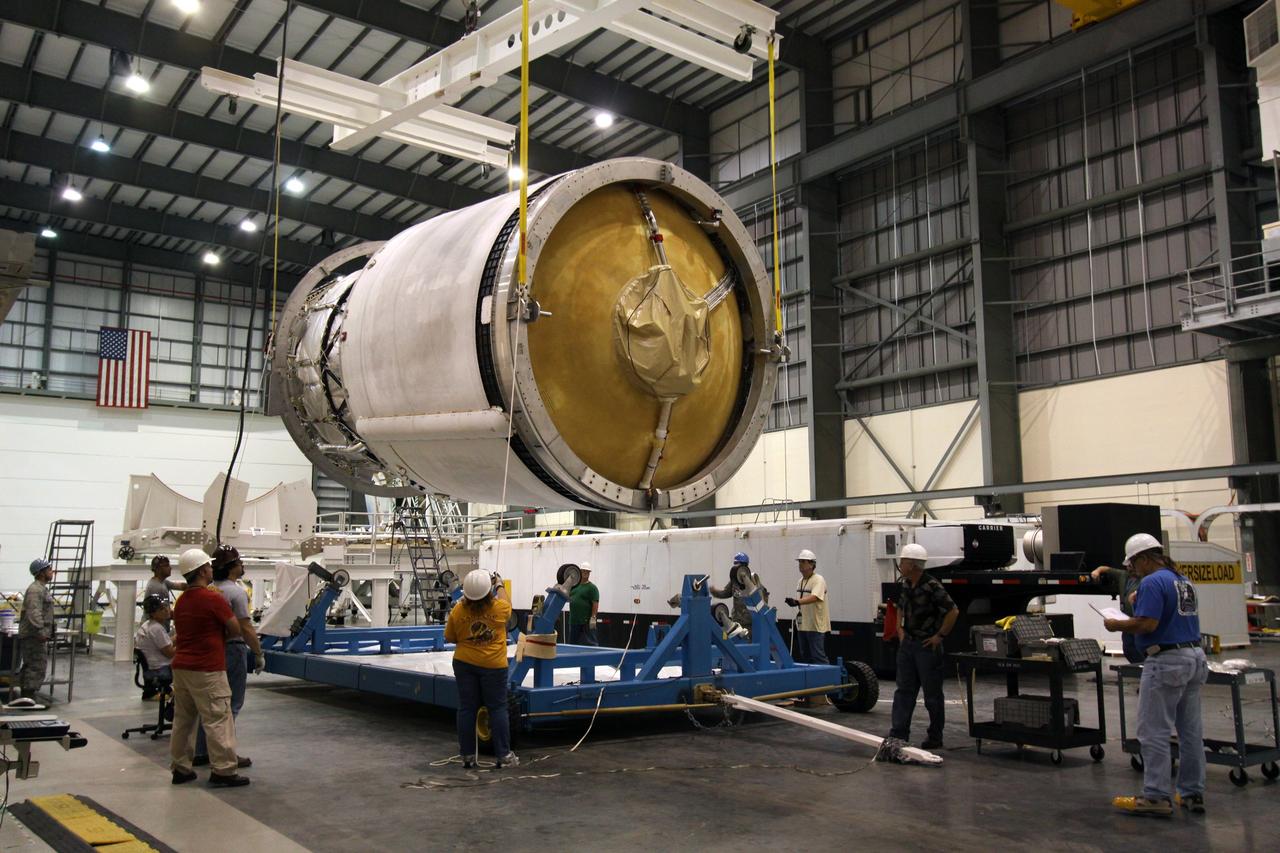
CAPE CANAVERAL, Fla. – Workers lower the second stage of a Delta IV onto a mobile work stand in the Horizontal Integration Facility at Launch Complex 37 on Cape Canaveral Air Force Station in Florida. This United Launch Alliance Delta IV rocket is the vehicle slated to launch GOES-P, the latest Geostationary Operational Environmental Satellite developed by NASA for the National Oceanic and Atmospheric Administration, or NOAA. Processing of the Delta IV is on track for launch, targeted for March 4, 2010. For information on GOES-P, visit http://goespoes.gsfc.nasa.gov/goes/spacecraft/n_p_spacecraft.html. Photo credit: NASA/Jack Pfaller
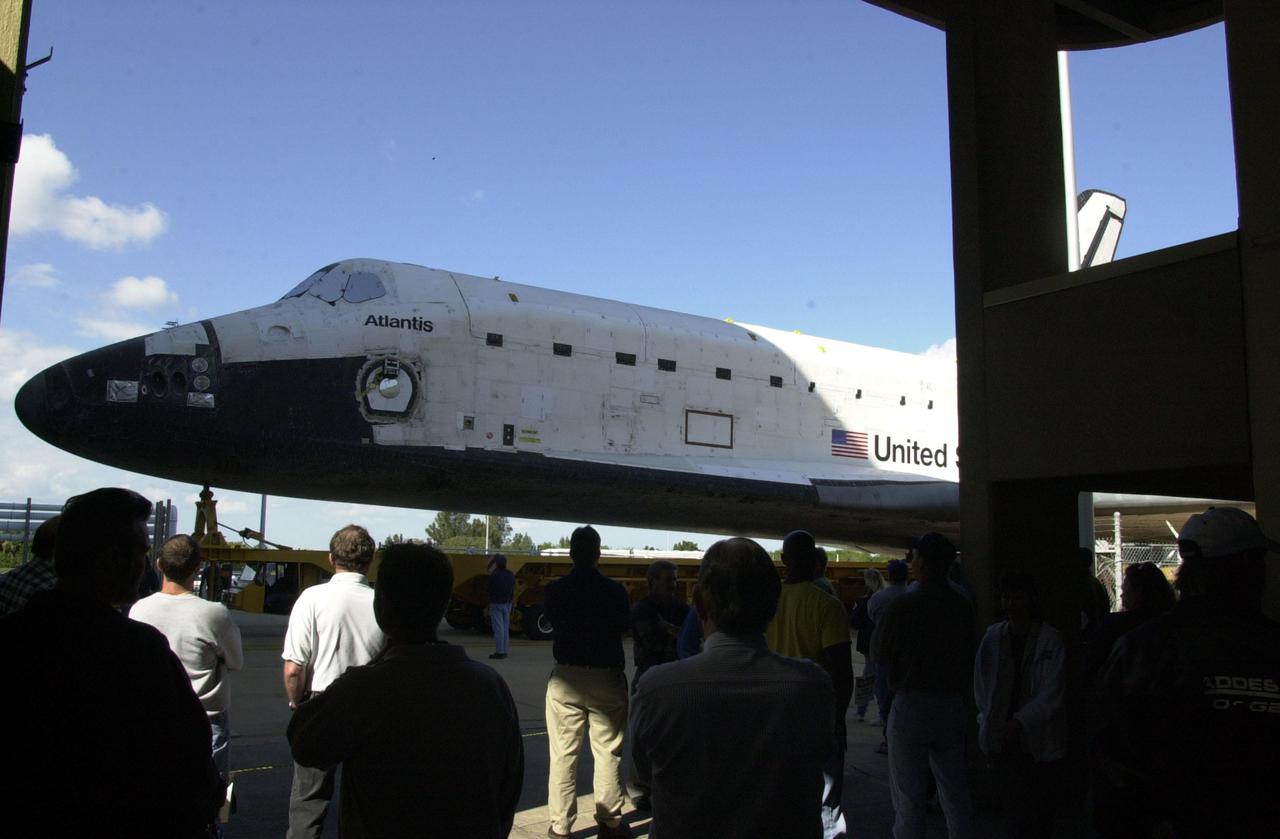
KENNEDY SPACE CENTER, Fla. - Employees watch as Orbiter Atlantis rolls out of the Orbiter Processing Facility on its way to the Vehicle Assembly Building for space vehicle mate. As part of final preparations before transfer to the launch pad, Atlantis will be lifted vertically into its VAB high bay and mated to the twin solid rocket boosters and external tank. The STS-110 mission resumes International Space Station assembly operations with the delivery of the S0 truss, which will support solar panels providing additional power to the Station. The payload will also include the first part of a Mobile Transporter that will provide a moveable base for the Station’s Canadian robotic arm. STS-110 is scheduled for launch April 4
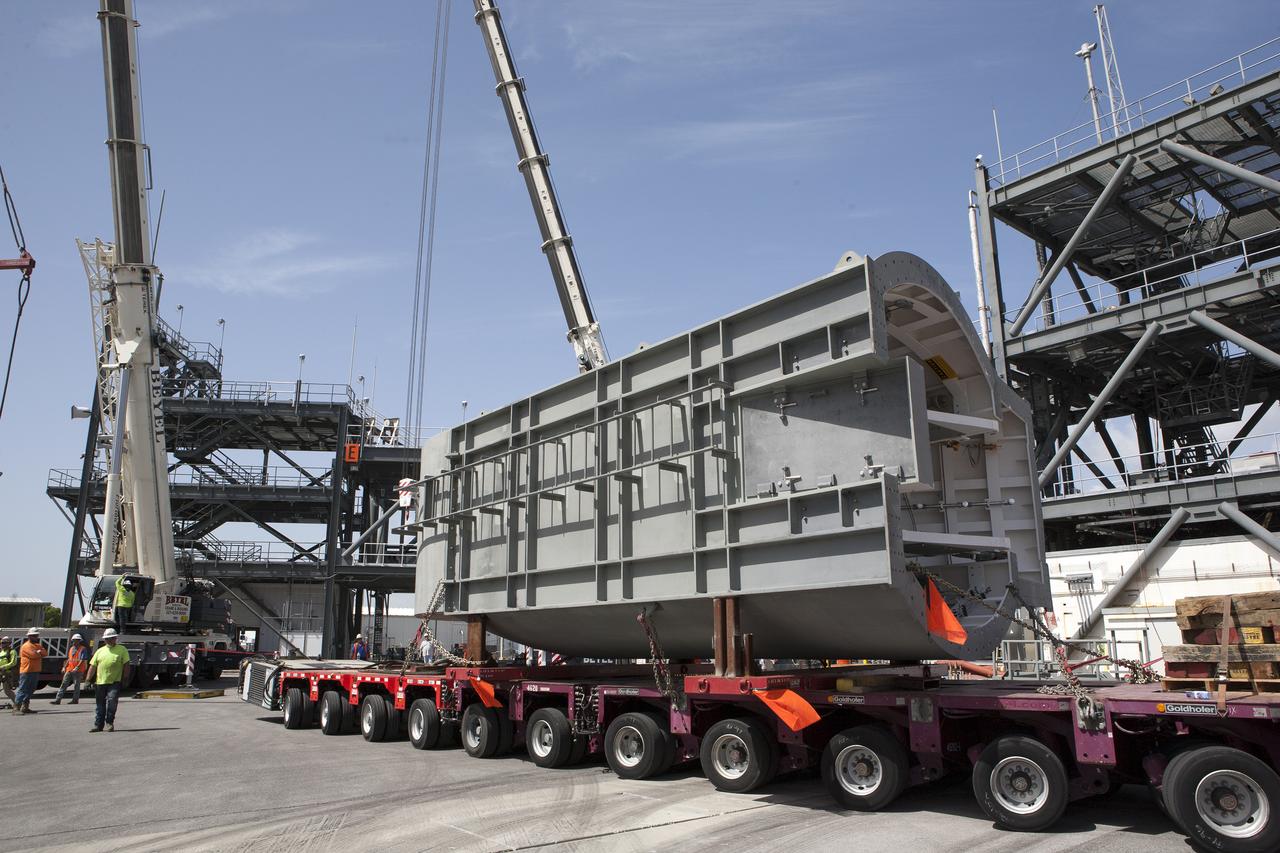
A crane is attached to the first Tail Service Mast Umbilical (TSMU) for NASA’s Space Launch System (SLS) at the Launch Equipment Test Facility at NASA’s Kennedy Space Center in Florida. Two TSMUs will provide liquid propellants and power to the Space Launch System (SLS) rocket’s core stage engine. Both TSMUs will connect to the zero-level deck on the mobile launcher, providing fuel and electricity to the SLS rocket before it launches on Exploration Mission 1. The TSMU will undergo testing and validation at the LETF to verify it is functioning properly. The center’s Engineering Directorate and the Ground Systems Development and Operations Program are overseeing processing and testing of the umbilicals.
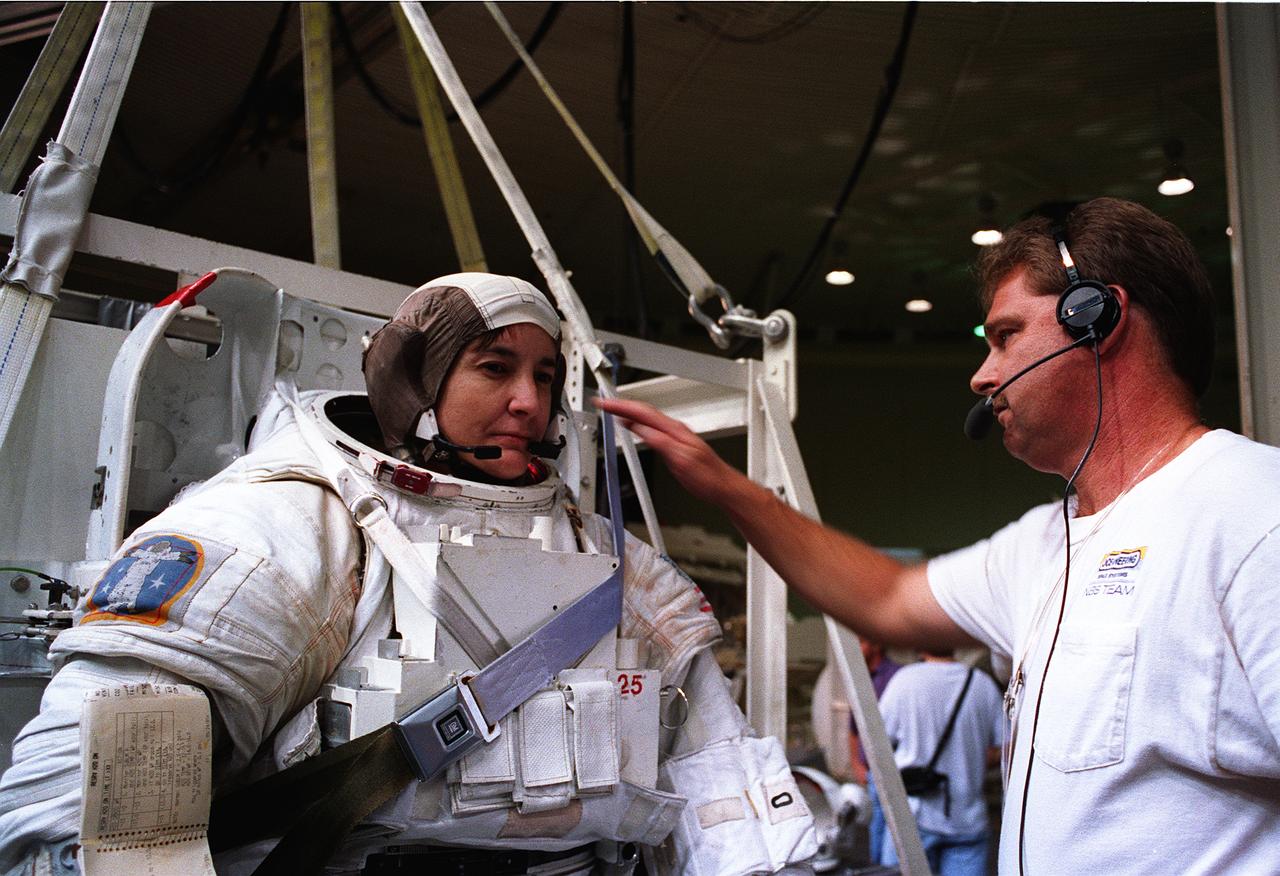
Astronaut and mission specialist, Linda Godwin, checks communications systems before submersion into a 25 ft deep pool at the Johnson Space Center’s (JSC) Weightless Environment Training Facility (WET-F). Wearing a high fidelity training version of the Extravehicular Mobility Unit (EMU) space suit, Godwin simulated STS-76 Extravehicular Activity (EVA) chores in the pool. Launched aboard the Space Shuttle Atlantis in March of 1996, STS-76 marked the third U.S. Shuttle-Mir docking during which Godwin, along with astronaut and mission specialist Michael R. ( Rich) Clifford, performed the first Extravehicular Activity (EVA) during Mir-Shuttle docked operations.
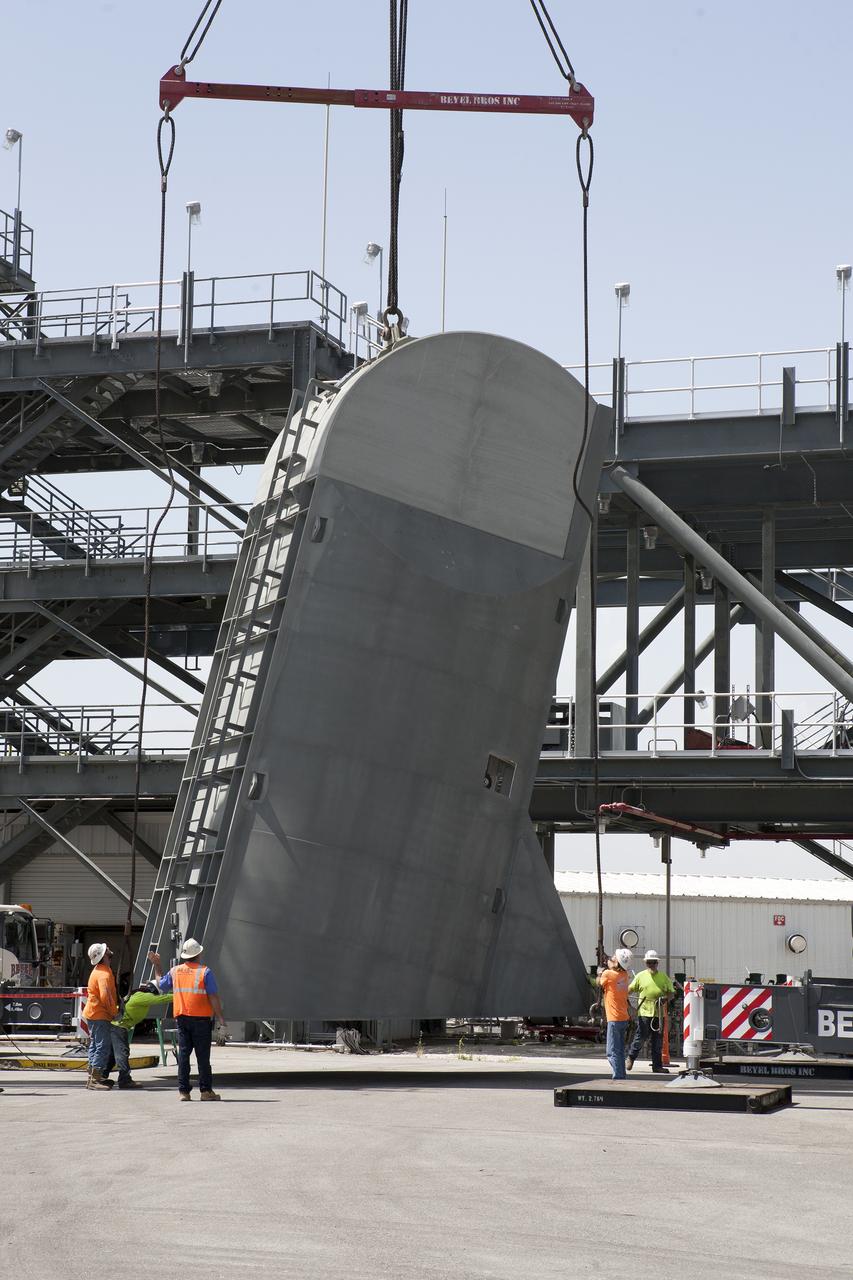
Technicians assist as a crane is used to lift the first Tail Service Mast Umbilical (TSMU) into the vertical position at the Launch Equipment Test Facility (LETF) at NASA’s Kennedy Space Center in Florida. Two TSMUs will provide liquid propellants and power to the Space Launch System (SLS) rocket’s core stage engine. Both TSMUs will connect to the zero-level deck on the mobile launcher, providing fuel and electricity to the SLS rocket before it launches on Exploration Mission 1. The TSMU will undergo testing and validation at the LETF to verify it is functioning properly. The center’s Engineering Directorate and the Ground Systems Development and Operations Program are overseeing processing and testing of the umbilicals.
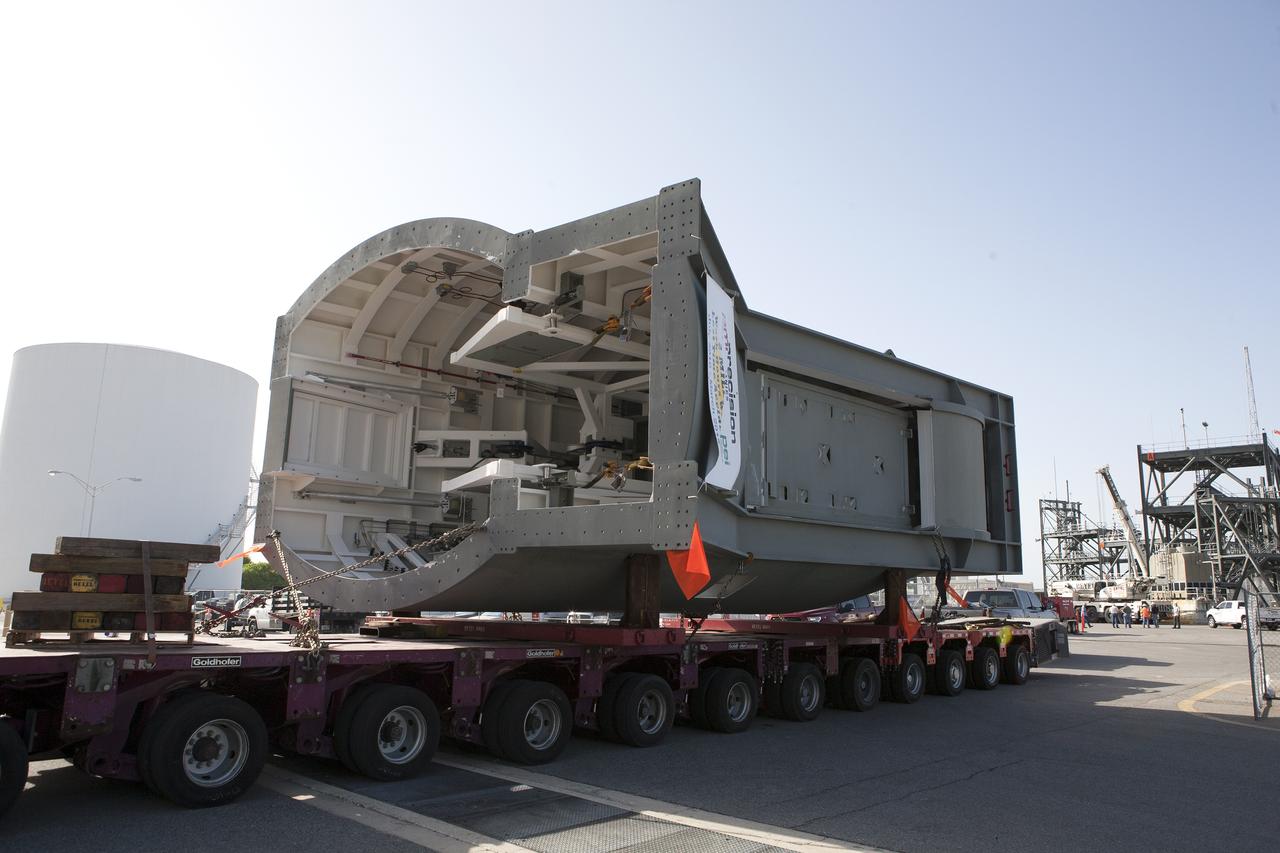
A heavy-lift transport truck arrives at the Launch Equipment Test Facility (LETF) at NASA’s Kennedy Space Center in Florida, with the first of two Tail Service Mast Umbilicals (TSMU) for NASA’s Space Launch System (SLS). Two TSMUs will provide liquid propellants and power to the Space Launch System (SLS) rocket’s core stage engine. Both TSMUs will connect to the zero-level deck on the mobile launcher, providing fuel and electricity to the SLS rocket before it launches on Exploration Mission 1. The TSMU will undergo testing and validation at the LETF to verify it is functioning properly. The center’s Engineering Directorate and the Ground Systems Development and Operations Program are overseeing processing and testing of the umbilicals.
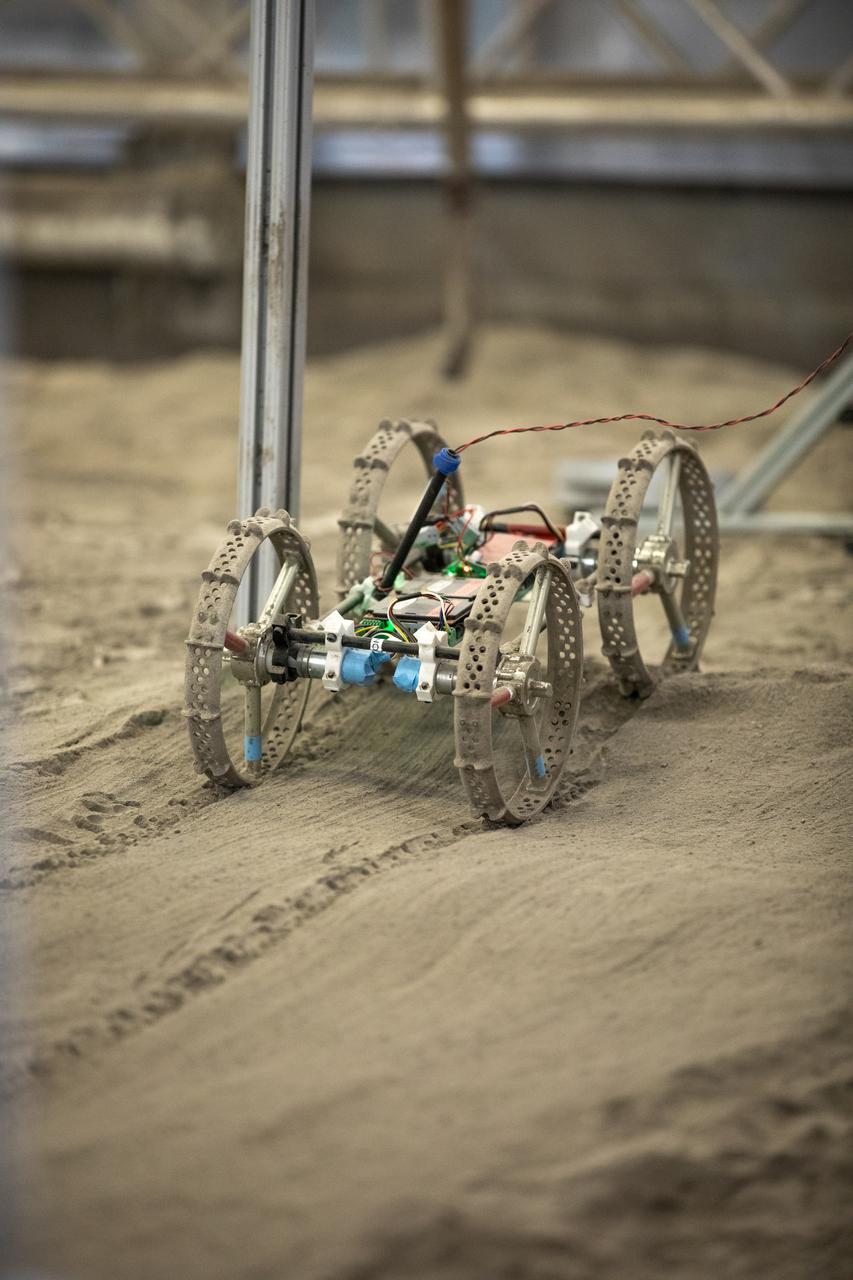
Astrobotic’s mass-offloaded CubeRover – a lightweight, modular planetary rover – undergoes mobility testing inside the Granular Mechanics and Regolith Operations (GMRO) Laboratory’s regolith pit at NASA Kennedy Space Center’s Swamp Works facility on June 30, 2022. Astrobotic – a Pittsburgh-based space robotics company – is using the GMRO lab’s regolith bin, which holds approximately 120 tons of lunar regolith simulant, to depict how the company’s CubeRover would perform on the Moon. NASA’s Small Business Innovation Research program provided the funding for initial development, and a $2 million Tipping Point award from the agency has provided additional funding for continued development into a more mature rover.
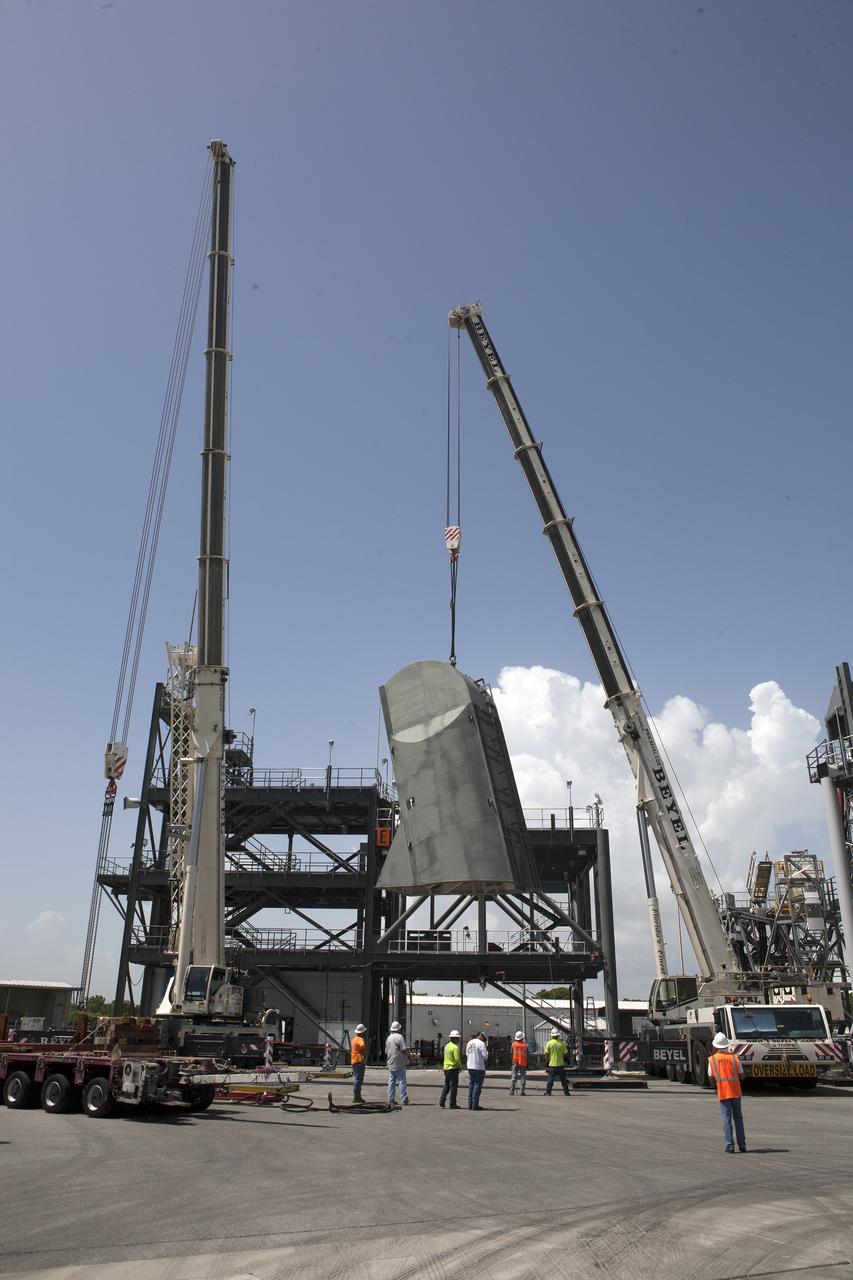
A crane lifts the first Tail Service Mast Umbilical (TSMU) up for placement on a test stand at the Launch Equipment Test Facility at NASA’s Kennedy Space Center in Florida. Two TSMUs will provide liquid propellants and power to the Space Launch System (SLS) rocket’s core stage engine. Both TSMUs will connect to the zero-level deck on the mobile launcher, providing fuel and electricity to the SLS rocket before it launches on Exploration Mission 1. The TSMU will undergo testing and validation at the LETF to verify it is functioning properly. The center’s Engineering Directorate and the Ground Systems Development and Operations Program are overseeing processing and testing of the umbilicals.
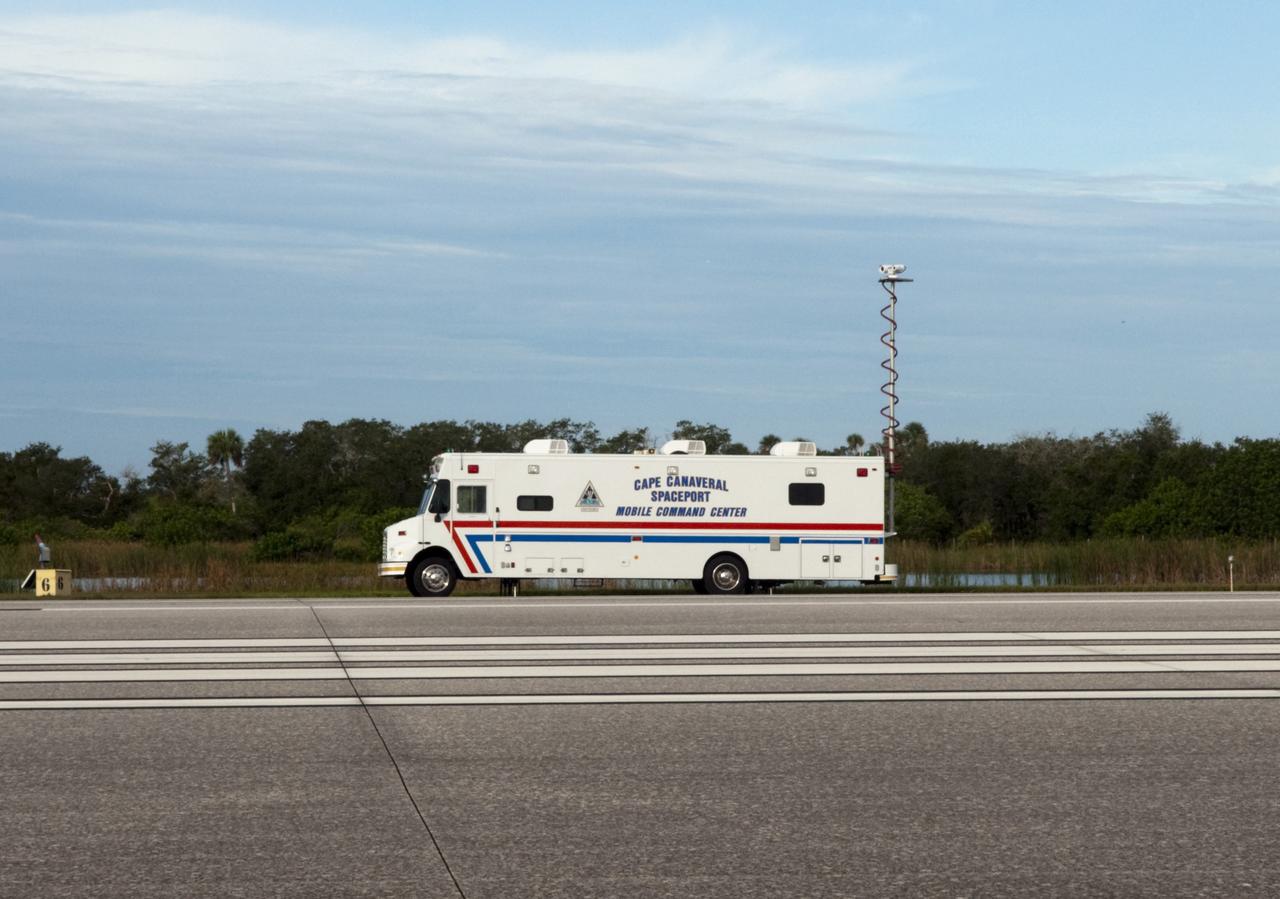
CAPE CANAVERAL, Fla. -- The Cape Canaveral Spaceport Mobile Command Center vehicle participates in the aviation safety exercise during Emergency Response Safety Training at the Shuttle Landing Facility, Runway 33, at NASA’s Kennedy Space Center in Florida. The simulated helicopter mishap exercise was conducted to evaluate emergency response and mishap investigations of aircraft at Kennedy. Participants included Air Rescue Fire Fighters, Flight Operations, Disaster Preparedness, Security, and Safety. NASA mandates simulated aviation safety training take place every two years. Photo credit: NASA/Kim Shiflett
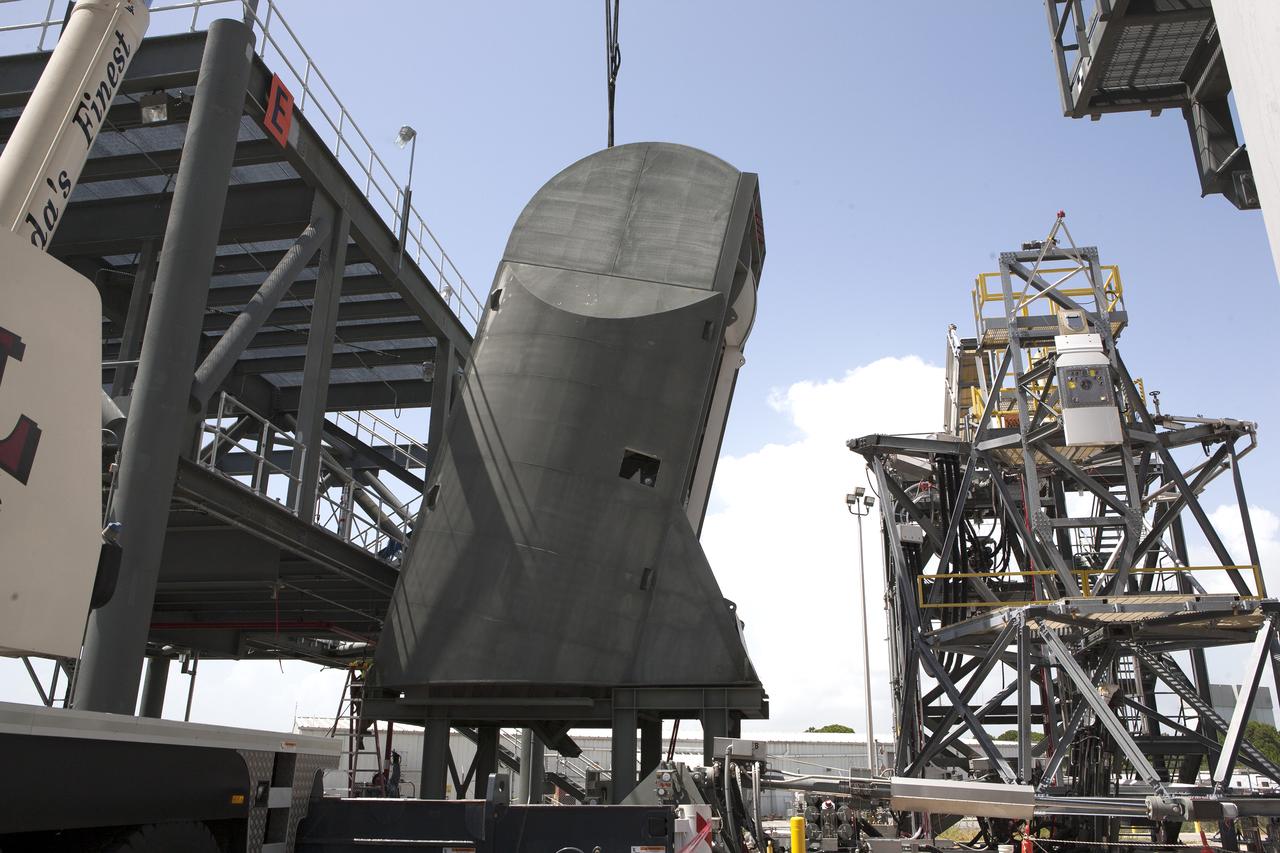
A crane lowers the first Tail Service Mast Umbilical (TSMU) onto a test stand at the Launch Equipment Test Facility at NASA’s Kennedy Space Center in Florida. Two TSMUs will provide liquid propellants and power to the Space Launch System (SLS) rocket’s core stage engine. Both TSMUs will connect to the zero-level deck on the mobile launcher, providing fuel and electricity to the SLS rocket before it launches on Exploration Mission 1. The TSMU will undergo testing and validation at the LETF to verify it is functioning properly. The center’s Engineering Directorate and the Ground Systems Development and Operations Program are overseeing processing and testing of the umbilicals.
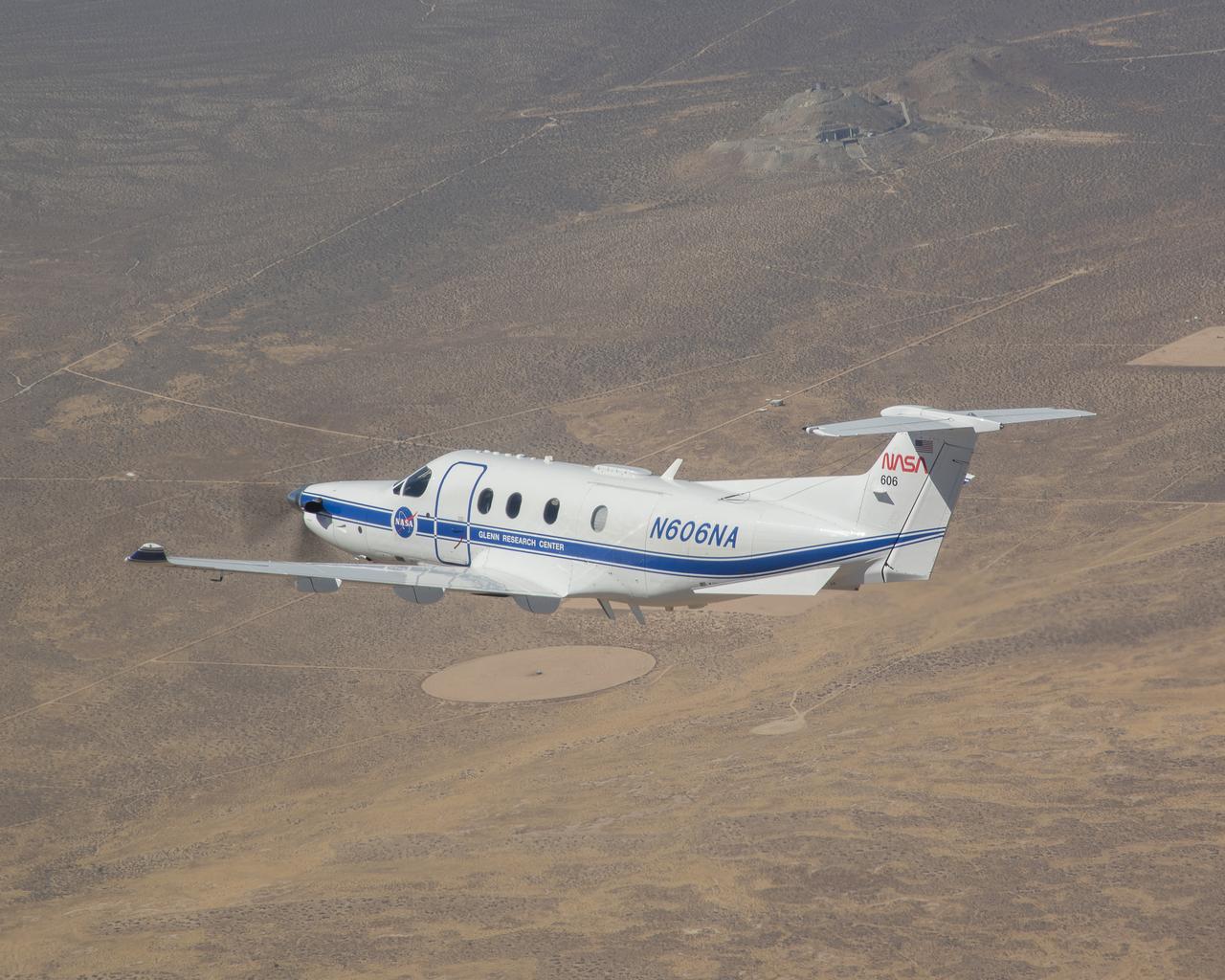
Equipped with state-of-the-art technology to test and evaluate communication, navigation, and surveillance systems, NASA’s Pilatus PC-12 flies over the Mojave Desert near Armstrong Flight Research Center in Edwards, California. Based at Glenn Research Center in Cleveland, the Pilatus PC-12 runs a series of familiarization flights for NASA Armstrong pilots before a test series evaluating ADS-B or Automatic Dependent Surveillance Broadcast systems for advanced air mobility applications in the desert flight test range on Sept. 18, 2024. Airborne work during familiarization flights includes several approach and landings, with an emphasis on avionics, then medium altitude air-work with steep turns, slow flight, and stall demonstrations to qualitatively understand the handling characteristics of the aircraft. The flights lasted about 60 to 90 minutes on average.
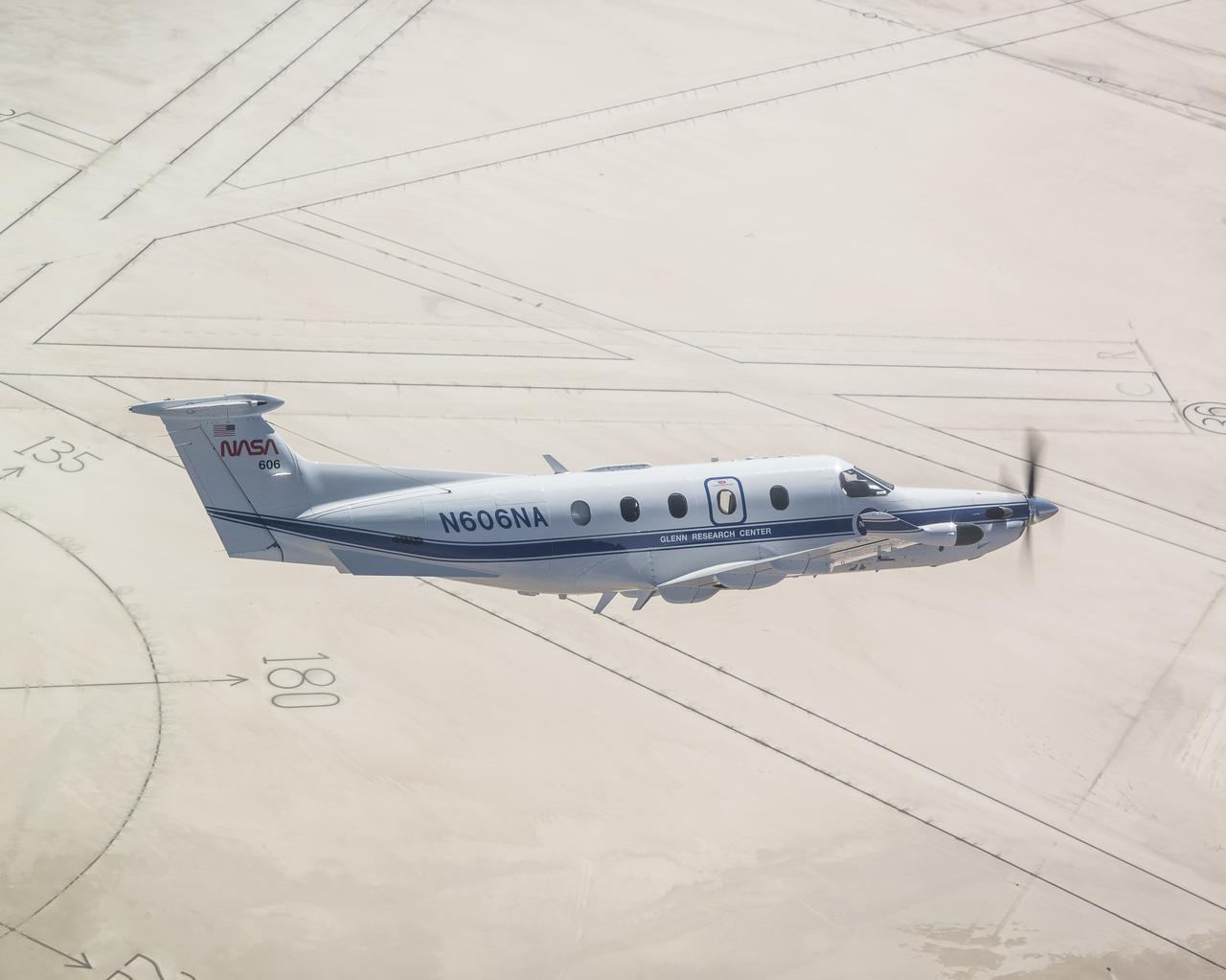
Based out of NASA’s Glenn Research Center in Cleveland, the Pilatus PC-12 is flying over the compass rose in the Roger’s Dry Lakebed at NASA’s Armstrong Flight Research Center, in Edwards, California. The compass rose is more than 4,000 feet in diameter and aligned to magnetic north, to test navigation equipment on aircraft. The Pilatus PC-12 tests communications technology for the emerging Advanced Air Mobility ecosystem. Pilots and crew from both centers perform familiarization flights to prepare for Automatic Dependent Surveillance Broadcast (ADS-B) systems tests between the aircraft and ping-Stations on the ground at Armstrong Flight Research Center. These flights are the first cross-center activity with the Pilatus-PC-12 at Armstrong Flight Research Center.
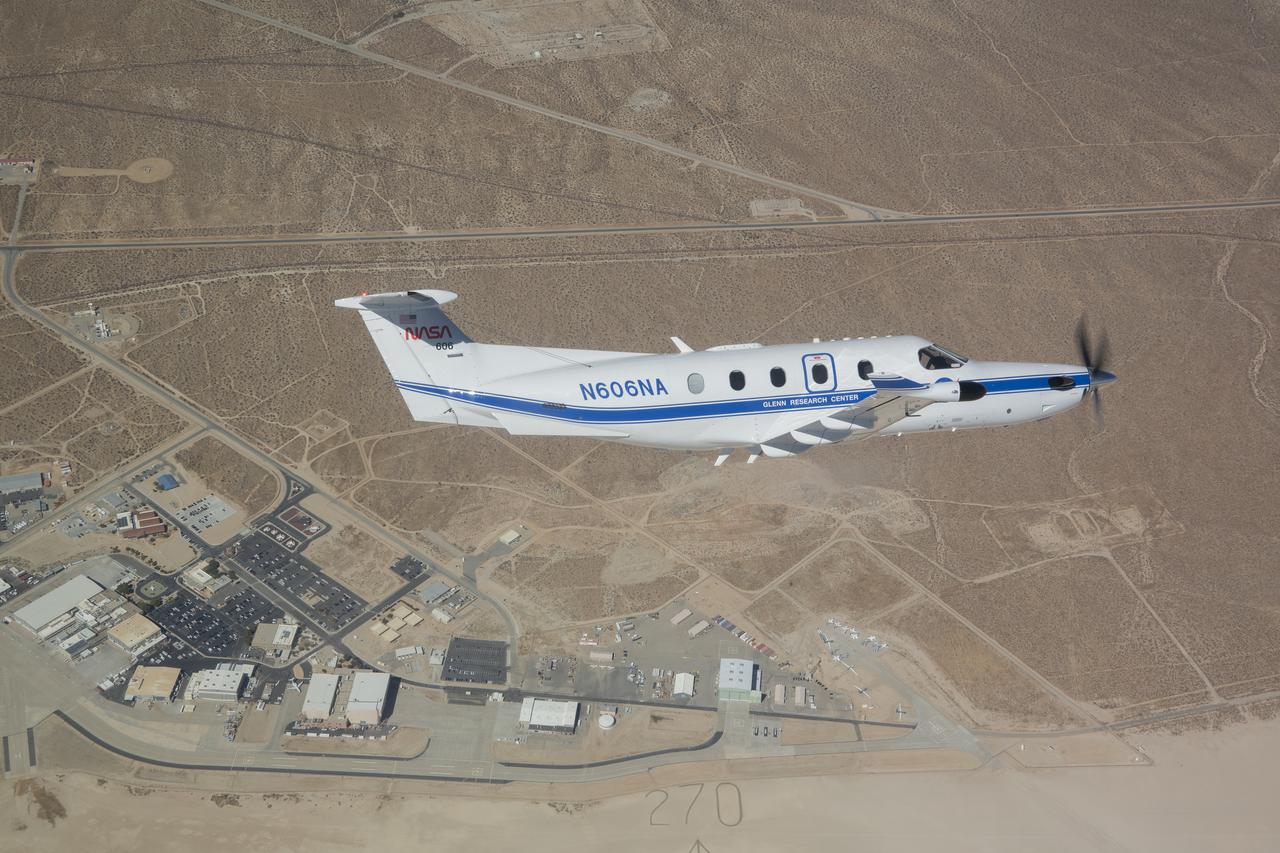
NASA’s Pilatus PC-12, based out of NASA’s Glenn Research Center in Cleveland, is seen flying over NASA’s Armstrong Flight Research Center in Edwards, California. On Sept. 18, 2024, NASA pilots and crew from both centers flew the PC-12 over the Mojave Desert in a series of familiarization flights. Familiarization flights involve egress training, preflight walkaround, interior preflight, engine start, taxi, and takeoff.
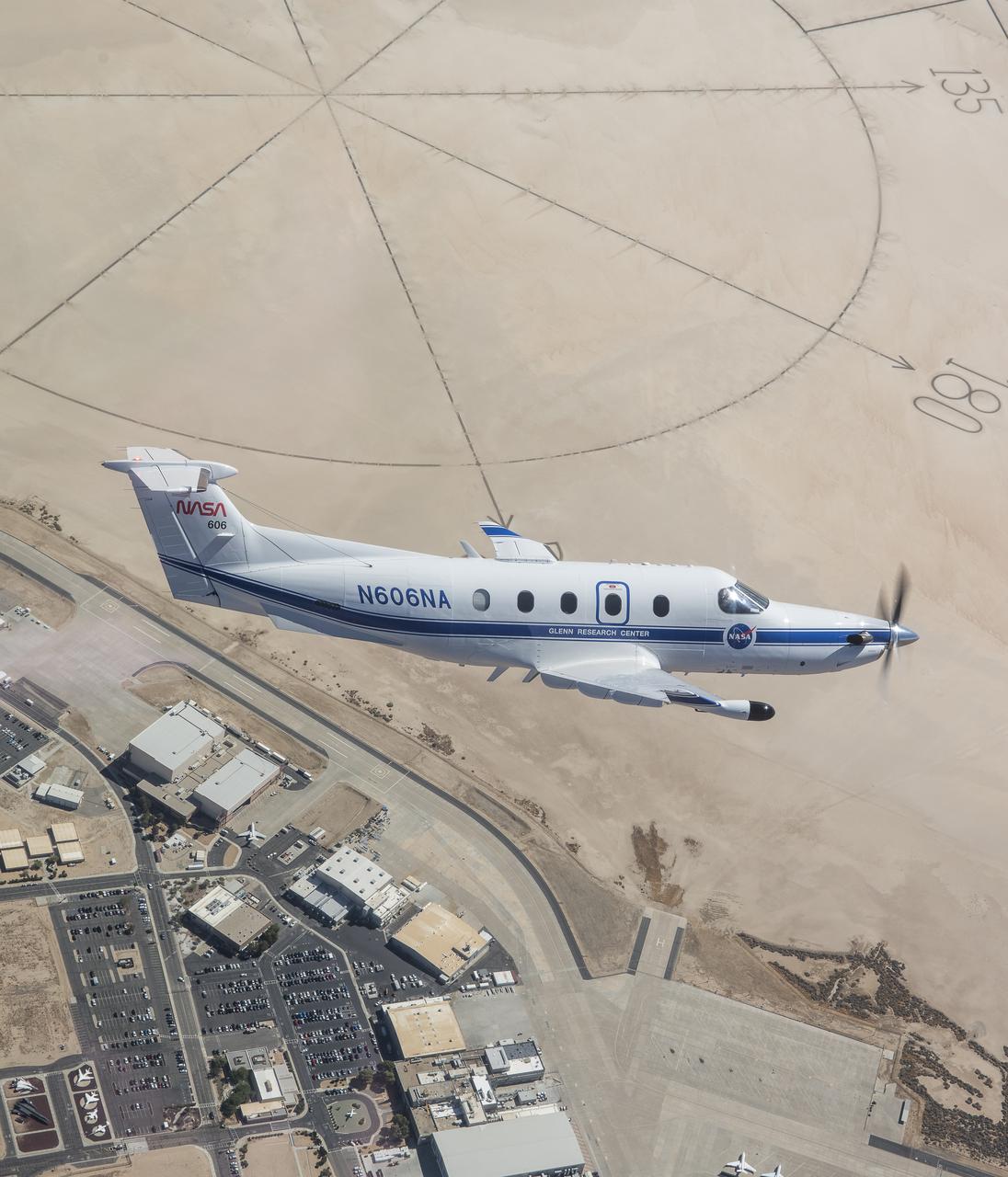
Used as a directional indicator the compass rose guides pilots flying test and experimental aircraft like the Pilatus PC-12 in the vast airspace over NASA’s Armstrong Flight Research Center in Edwards, California. This Pilatus PC-12 based out of NASA’s Glenn Research Center in Cleveland is being flown for a series of familiarization flights for NASA’s Armstrong pilots and crew. These familiarization flights supported communication, navigation and surveillance evaluations for Advanced Air Mobility research.
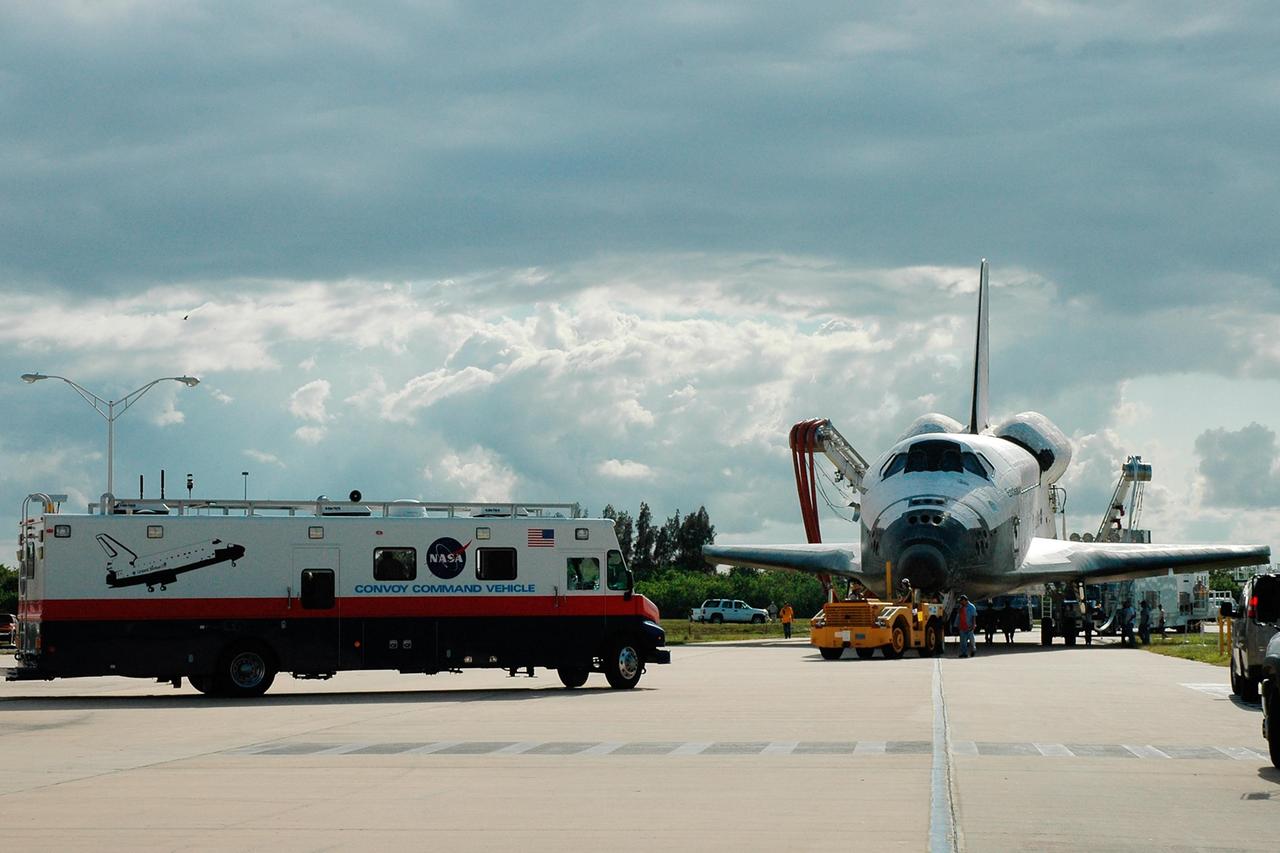
KENNEDY SPACE CENTER, FLA. -- The orbiter Endeavour is towed toward the Orbiter Processing Facility, known as the OPF. At left is the Convoy Command Vehicle. The mobile command center is the prime vehicle to control critical communications between the orbiter, the crew and the Launch Control Center after a shuttle landing to monitor the health of the shuttle orbiter systems and to direct convoy operations at the Shuttle Landing Facility. Endeavour returned to Earth Aug. 21 from mission STS-118, landing at Kennedy at 12:32 p.m. EDT. In the OPF bay 2, Endeavour will incur thermal protection system inspections and numerous other post-flight inspections before processing starts for its next voyage into space. Endeavour will next fly on mission STS-123 targeted for Feb. 14, 2008. Photo credit: NASA/Jack Pfaller
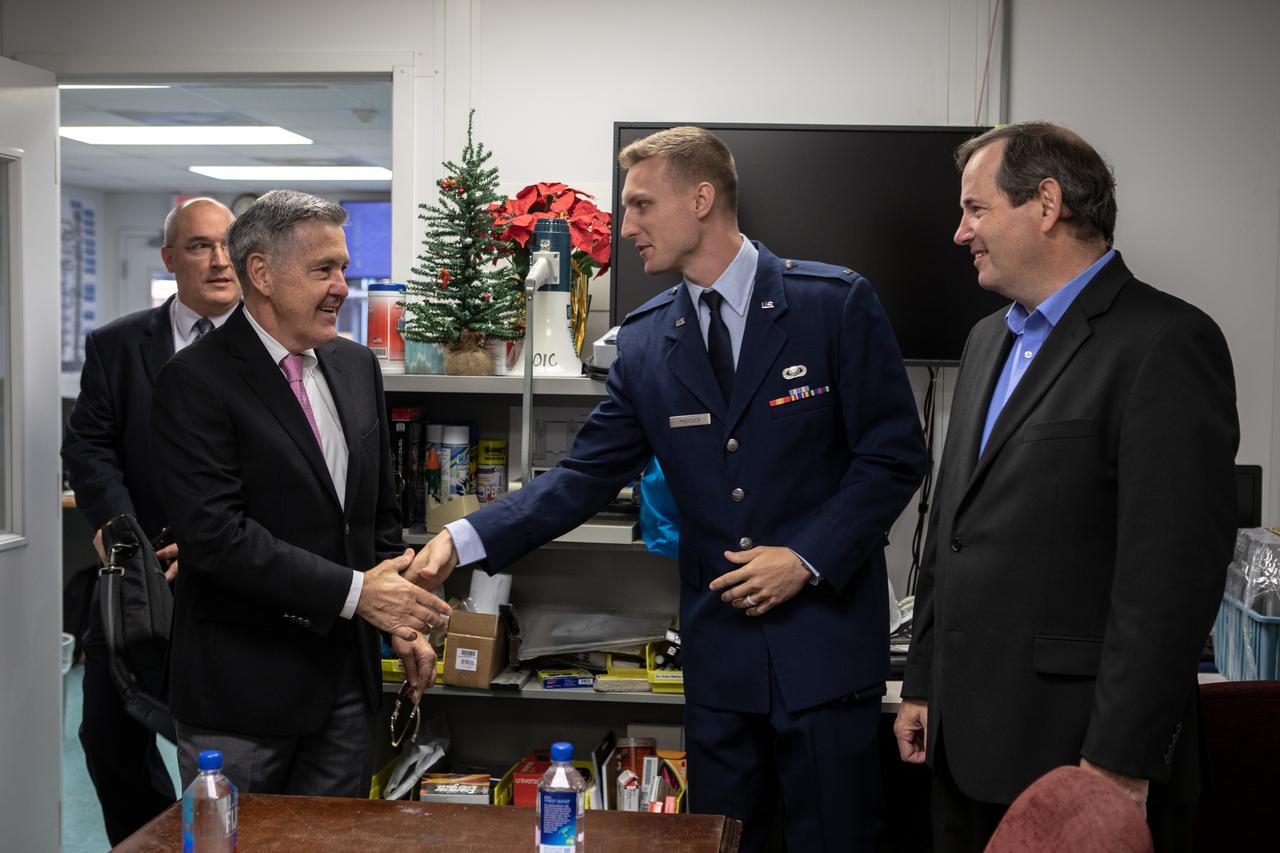
Just before a ribbon cutting ceremony on Aug. 16, 2019, in High Bay 2 of the Vehicle Assembly (VAB) at NASA’s Kennedy Space Center in Florida, Center Director Bob Cabana, at left, shakes hands with First Lieutenant Alex Priesser, U.S. Air Force, 45th Space Wing. At far right is Jim Williams, director of media operations, 45th Space Wing. The VAB is getting its first commercial tenant. Northrop Grumman signed a Reimbursable Space Act Agreement with NASA for use of the facilities. The company will assemble and test its new OmegA rocket inside the massive facility’s High Bay 2. The company also will modify the space shuttle-era mobile launcher platform-3 to serve as the launch vehicle’s assembly and launch platform. Northrop Grumman is developing the OmegA rocket, an intermediate/heavy-class launch vehicle, as part of a launch services agreement with the U.S. Air Force.

The 2017 class of astronaut candidates pause for a group photograph on the deck of the mobile launcher during a familiarization tour at NASA's Kennedy Space Center in Florida. The candidates toured center facilities, including the Neil Armstrong Operations and Checkout Building high bay; the Launch Control Center, Launch Pad 39B, and the Vehicle Assembly Building. They also toured Boeing's Commercial Crew and Cargo Facility, United Launch Alliance's Space Launch Complex 41 at Cape Canaveral Air Force Station, and SpaceX's Launch Pad 39A at Kennedy. The candidates will spend about two years getting to know the space station systems and learning how to spacewalk, speak Russian, control the International Space Station's robotic arm and fly T-38s, before they're eligible to be assigned to a mission.
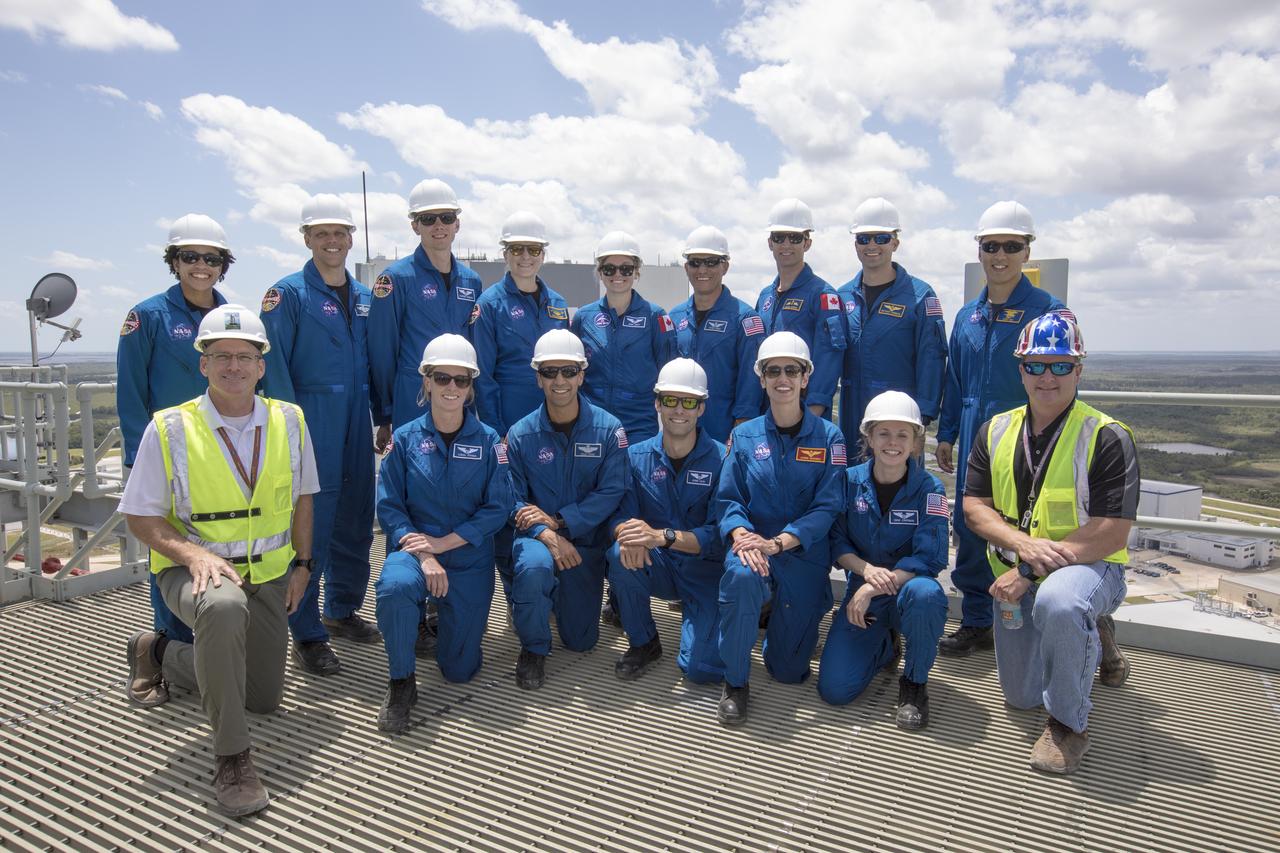
The 2017 class of astronaut candidates pause for a group photograph on the deck of the mobile launcher during a familiarization tour at NASA's Kennedy Space Center in Florida. The candidates toured center facilities, including the Neil Armstrong Operations and Checkout Building high bay; the Launch Control Center, Launch Pad 39B and the Vehicle Assembly Building. They also toured Boeing's Commercial Crew and Cargo Facility, United Launch Alliance's Space Launch Complex 41 at Cape Canaveral Air Force Station, and SpaceX's Launch Pad 39A at Kennedy. The candidates will spend about two years getting to know the space station systems and learning how to spacewalk, speak Russian, control the International Space Station's robotic arm and fly T-38s, before they're eligible to be assigned to a mission.
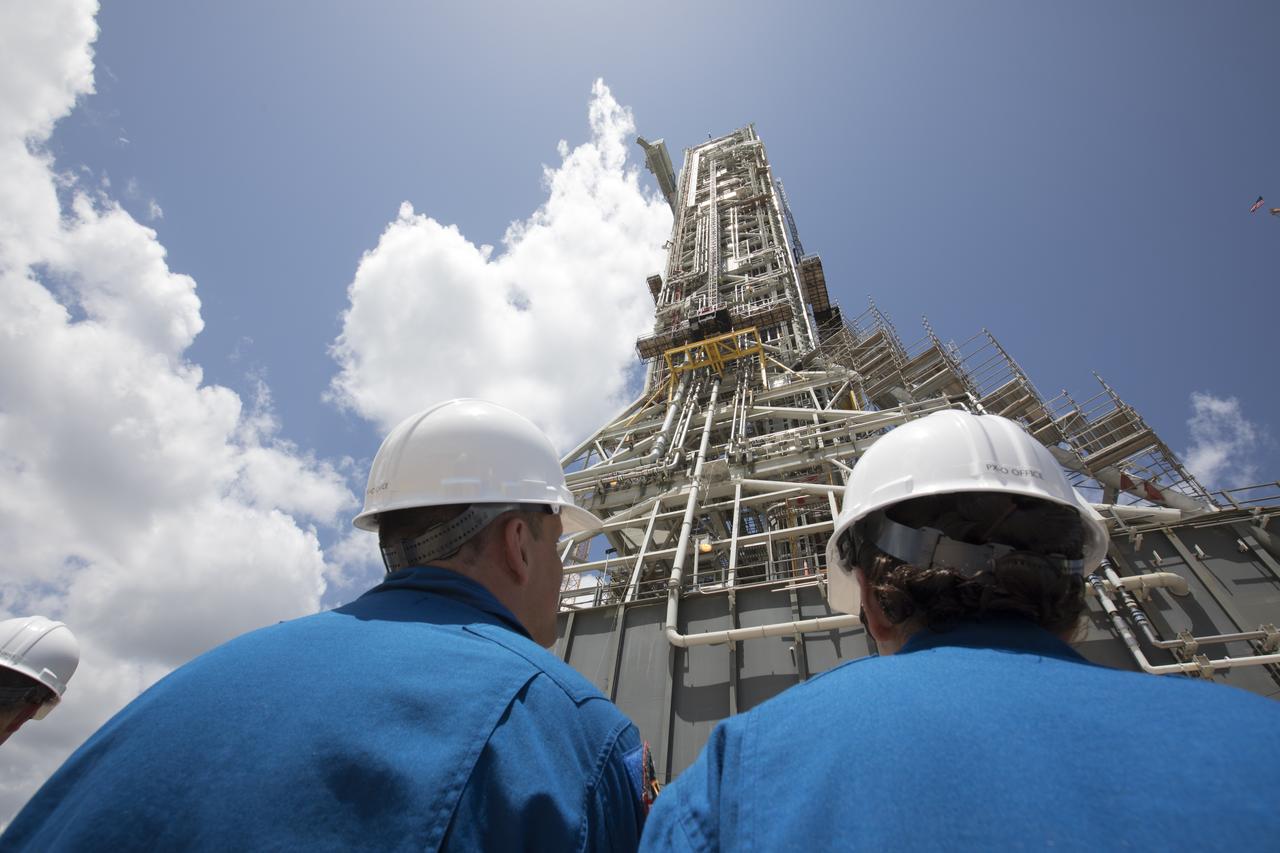
The 2017 class of astronaut candidates get a close-up view of the mobile launcher during a familiarization tour at NASA's Kennedy Space Center in Florida. The candidates toured center facilities, including the Neil Armstrong Operations and Checkout Building high bay; the Launch Control Center, Launch Pad 39B, and the Vehicle Assembly Building. They also toured Boeing's Commercial Crew and Cargo Facility, United Launch Alliance's Space Launch Complex 41 at Cape Canaveral Air Force Station, and SpaceX's Launch Pad 39A at Kennedy. The candidates will spend about two years getting to know the space station systems and learning how to spacewalk, speak Russian, control the International Space Station's robotic arm and fly T-38s, before they're eligible to be assigned to a mission.
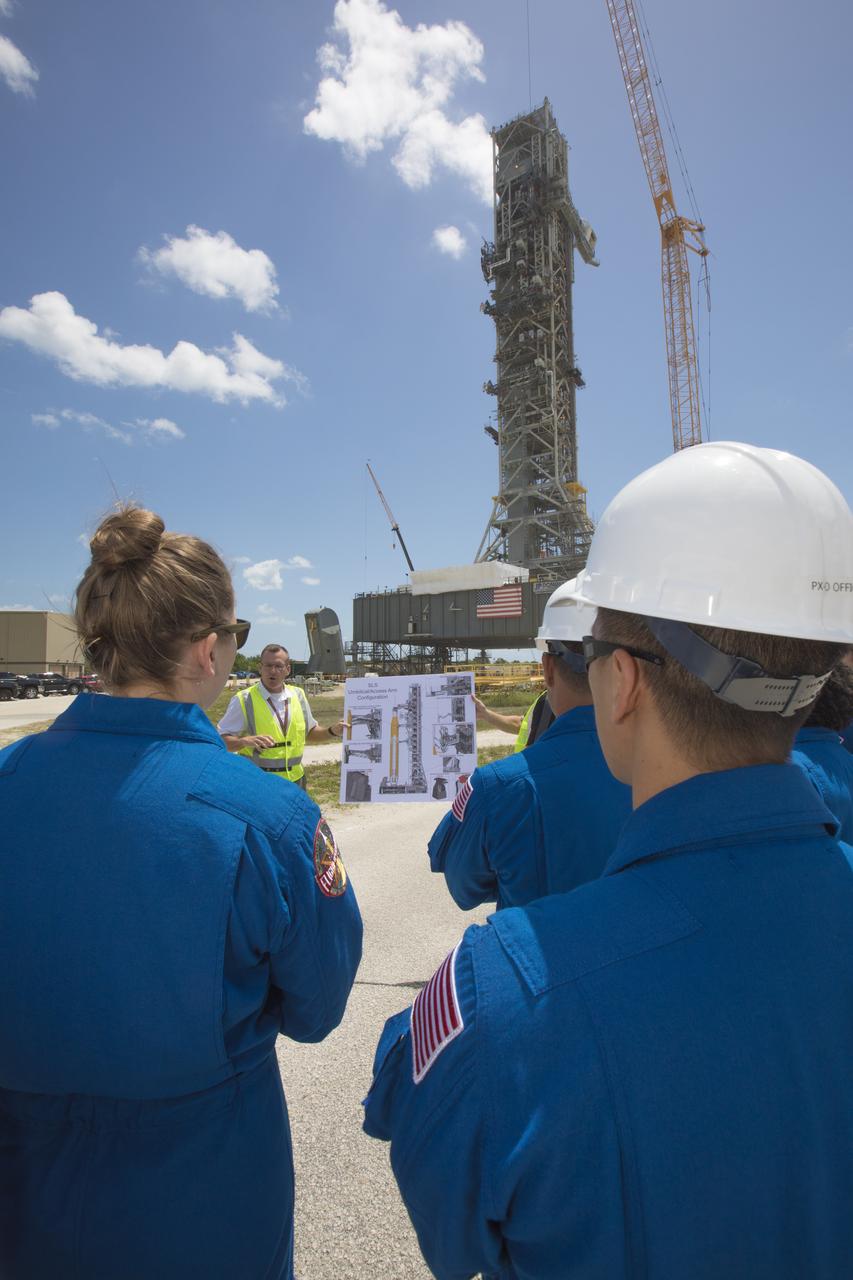
The 2017 class of astronaut candidates view the mobile launcher during a familiarization tour at NASA's Kennedy Space Center in Florida. The candidates toured center facilities, including the Neil Armstrong Operations and Checkout Building high bay; the Launch Control Center, Launch Pad 39B, and the Vehicle Assembly Building. They also toured Boeing's Commercial Crew and Cargo Facility, United Launch Alliance's Space Launch Complex 41 at Cape Canaveral Air Force Station, and SpaceX's Launch Pad 39A at Kennedy. The candidates will spend about two years getting to know the space station systems and learning how to spacewalk, speak Russian, control the International Space Station's robotic arm and fly T-38s, before they're eligible to be assigned to a mission.
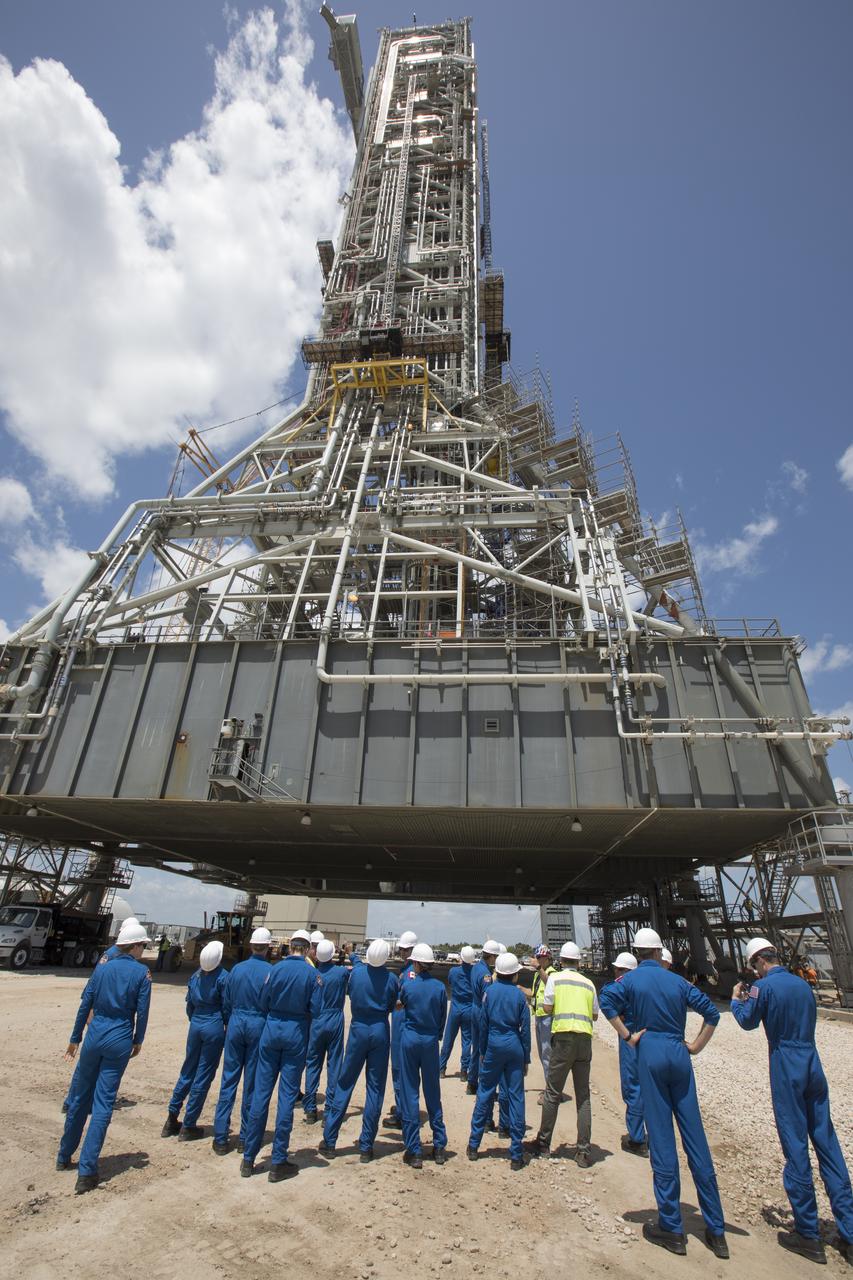
The 2017 class of astronaut candidates get a close-up view of the mobile launcher during a familiarization tour at NASA's Kennedy Space Center in Florida. The candidates toured center facilities, including the Neil Armstrong Operations and Checkout Building high bay; the Launch Control Center, Launch Pad 39B, and the Vehicle Assembly Building. They also toured Boeing's Commercial Crew and Cargo Facility, United Launch Alliance's Space Launch Complex 41 at Cape Canaveral Air Force Station, and SpaceX's Launch Pad 39A at Kennedy. The candidates will spend about two years getting to know the space station systems and learning how to spacewalk, speak Russian, control the International Space Station's robotic arm and fly T-38s, before they're eligible to be assigned to a mission.
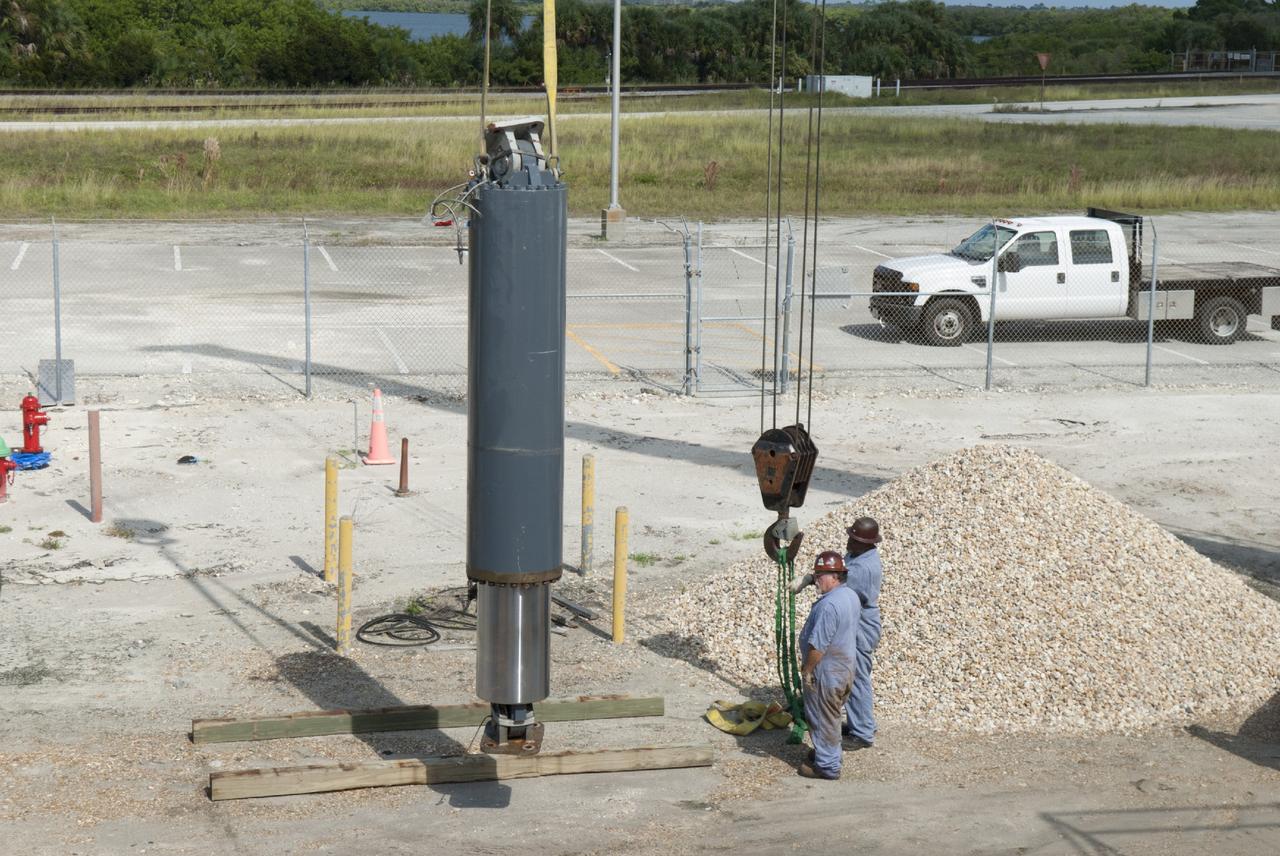
CAPE CANAVERAL, Fla. – Ground support equipment technicians monitor the progress as one of the jacking, equalizing and leveling, or JEL, hydraulic cylinders is lowered to the ground after it was removed from crawler-transporter 1. The work is being performed at the crawler transporter maintenance facility at NASA’s Kennedy Space Center in Florida. Sixteen new JEL hydraulic cylinders will be installed on CT-1 to increase load carrying capacity and reliability. The Ground Systems Development and Operations Program at Kennedy continues to upgrade CT-1 as part of its general maintenance. CT-1 could be available to carry commercial launch vehicles to the launch pad. The crawler-transporters were used to carry the mobile launcher platform and space shuttle to Launch Complex 39 for space shuttle launches for 30 years. Photo credit: NASA/Tim Jacobs
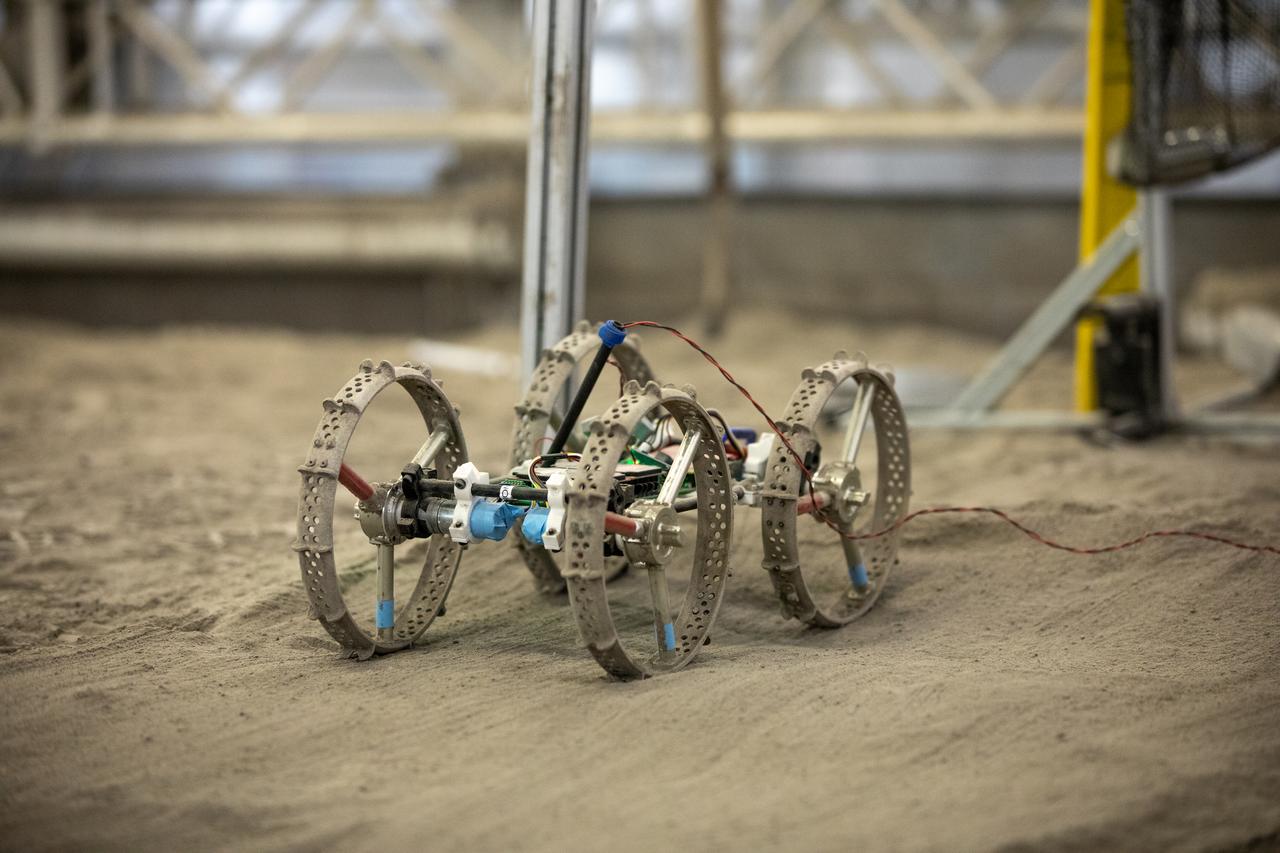
A mass-offloaded version of Astrobotic’s CubeRover – a lightweight, modular planetary rover – is used to simulate mobility in low lunar gravity inside the Granular Mechanics and Regolith Operations (GMRO) Laboratory’s regolith pit at NASA Kennedy Space Center’s Swamp Works facility on June 30, 2022. Astrobotic – a Pittsburgh-based space robotics company – is using the GMRO lab’s regolith bin, which holds approximately 120 tons of lunar regolith simulant, to depict how the company’s CubeRover would perform on the Moon. NASA’s Small Business Innovation Research program provided the funding for initial development, and a $2 million Tipping Point award from the agency has provided additional funding for continued development into a more mature rover.
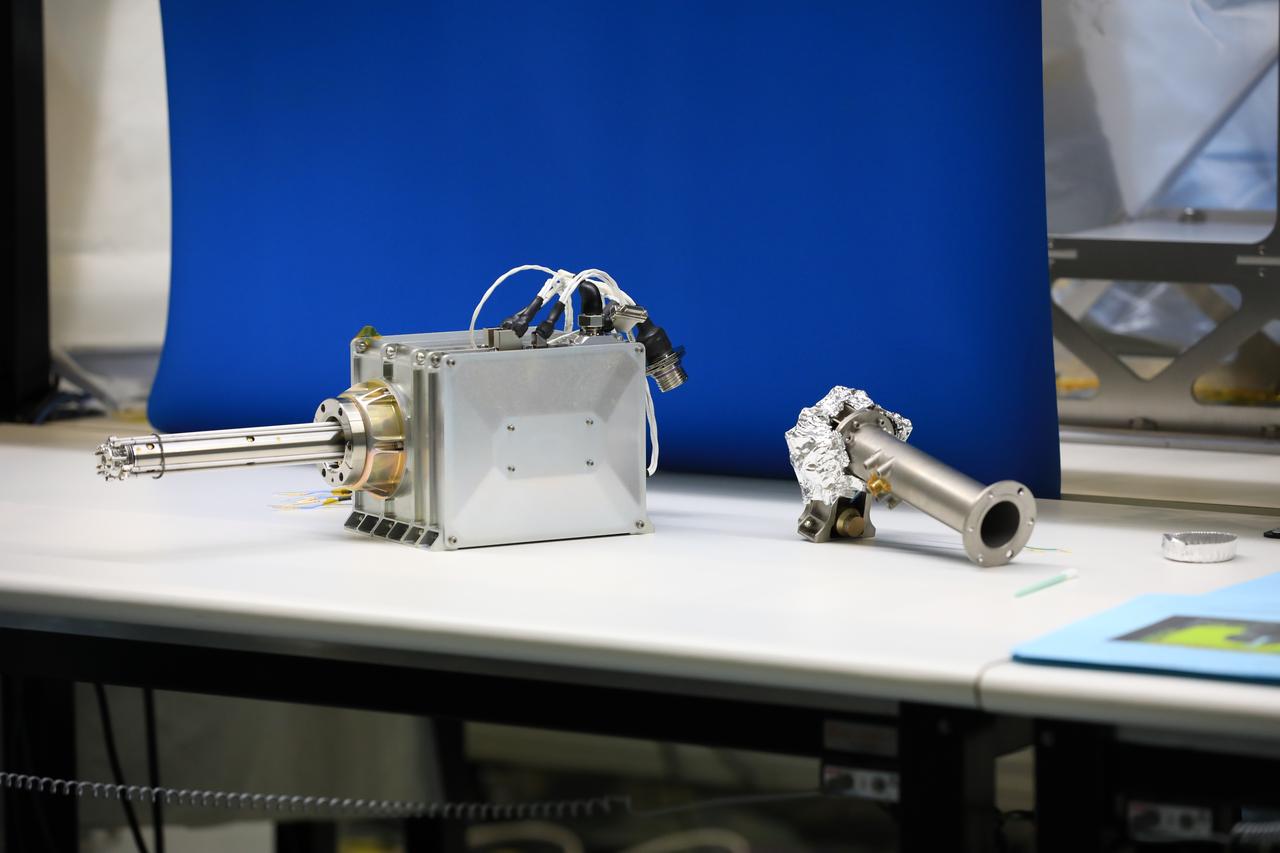
Instruments for the Mass Spectrometer observing lunar operations (MSolo) are in view inside the Space Station Processing Facility at NASA’s Kennedy Space Center in Florida on Sept. 25, 2020. MSolo is a commercial off-the-shelf mass spectrometer modified to work in space and it will help analyze the chemical makeup of landing sites on the Moon, as well as study water on the lunar surface. This work is preparing MSolo hardware for a robotic mission as part of the Commercial Lunar Payload Services (CLPS) launching to exploring Lacus Mortis, a large crater on the near side of the Moon in 2021. A future mission will send a mobile robot named the Volatiles Investigating Polar Exploration Rover (VIPER) to the Moon to prospect for water. VIPER will have several instruments that will allow it to detect and sample water including MSolo, the Neutron Spectrometer System, the Near Infrared Volatiles Spectrometer System and The Regolith and Ice Drill for Exploring New Terrain (TRIDENT).
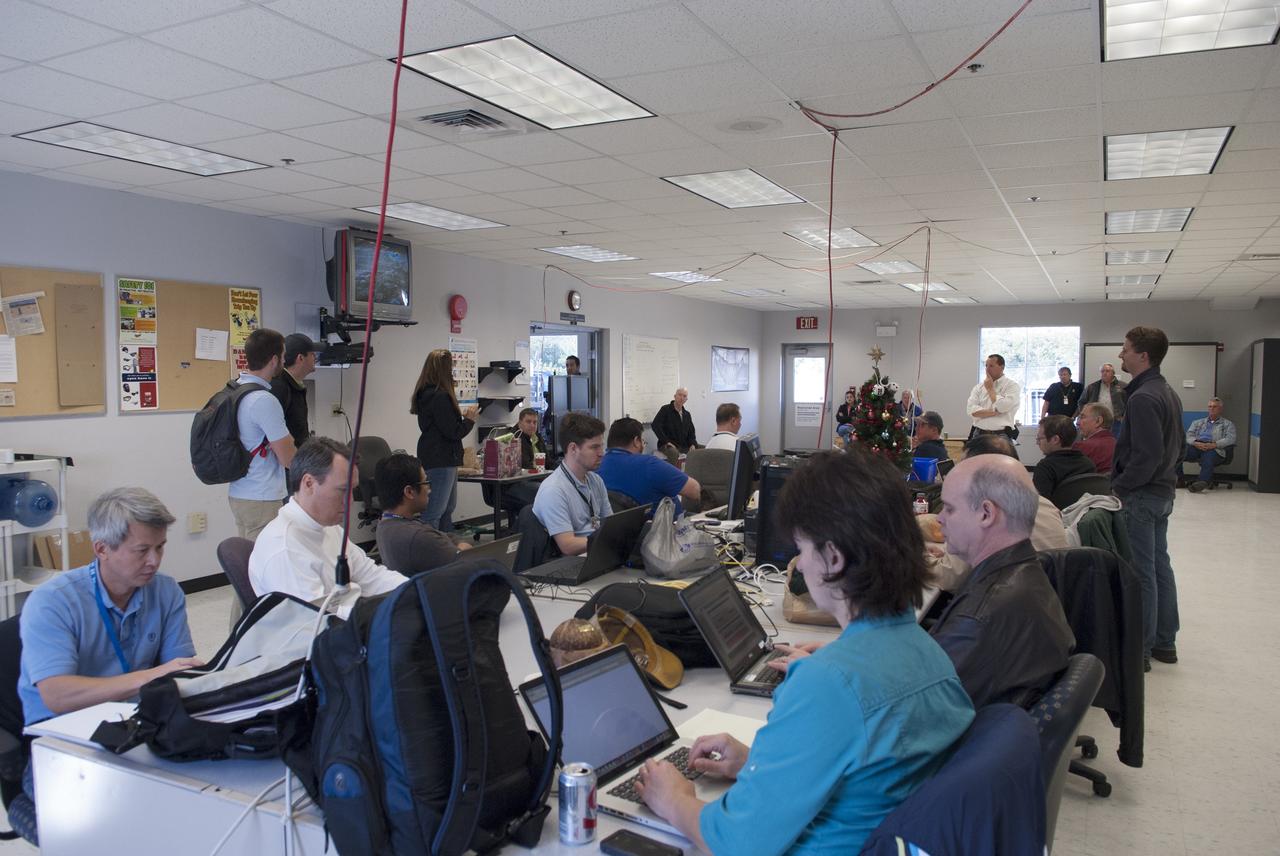
CAPE CANAVERAL, Fla. – Engineers and controllers in a mobile control room prepare for flight number 15 of NASA's Project Morpheus prototype lander at the north end of the Shuttle Landing Facility, or SLF, at NASA’s Kennedy Space Center in Florida. The lander will take off from the ground over a flame trench and use its autonomous landing and hazard avoidance technology, or ALHAT sensors, to survey the hazard field to determine safe landing sites. Project Morpheus tests NASA’s ALHAT and an engine that runs on liquid oxygen and methane, which are green propellants. These new capabilities could be used in future efforts to deliver cargo to planetary surfaces. Project Morpheus is being managed under the Advanced Exploration Systems, or AES, Division in NASA’s Human Exploration and Operations Mission Directorate. For more information on Project Morpheus, visit http://morpheuslander.jsc.nasa.gov/. Photo credit: NASA/Jim Grossmann
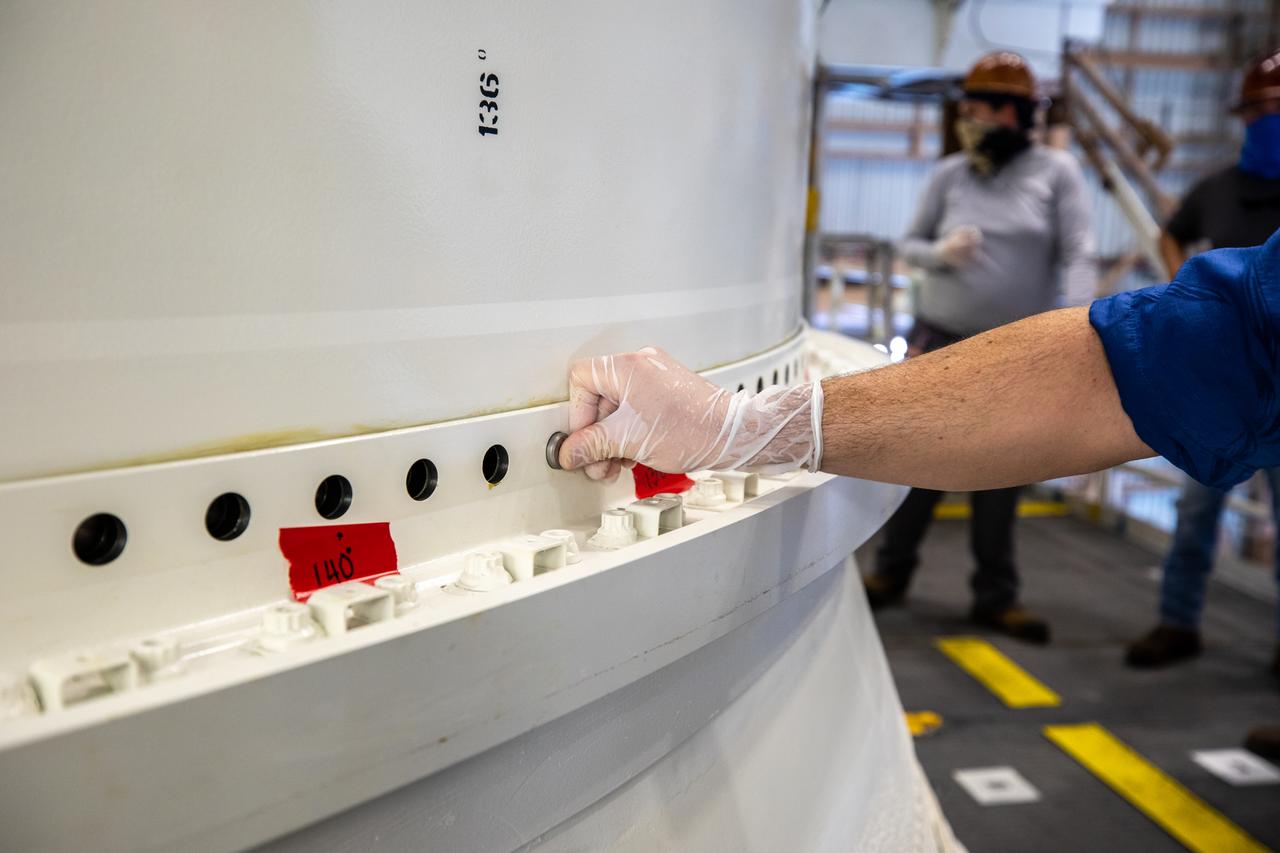
Inside the Rotation, Processing and Surge Facility at NASA’s Kennedy Space Center in Florida, Pablo Martinez, a handling, mechanical and structures engineer on the Jacobs Technology Inc. Test and Operations Support Contract, inserts the first of many pins that will secure the Space Launch System’s (SLS) right-hand motor segment to the rocket’s right-hand aft skirt. The right-hand motor segment is one of five segments that makes up one of two solid rocket boosters. Once the aft segments are mated to the two aft skirts, they will be moved to the Vehicle Assembly Building for stacking on the mobile launcher. Manufactured by Northrop Grumman in Utah, the twin boosters provide more than 75 percent of the total SLS thrust at launch. Under the Artemis program, NASA will land the first woman and the next man on the Moon by 2024. The first in a series of increasingly complex missions, Artemis I will test the Orion spacecraft and SLS as an integrated system ahead of crewed flights to the Moon.
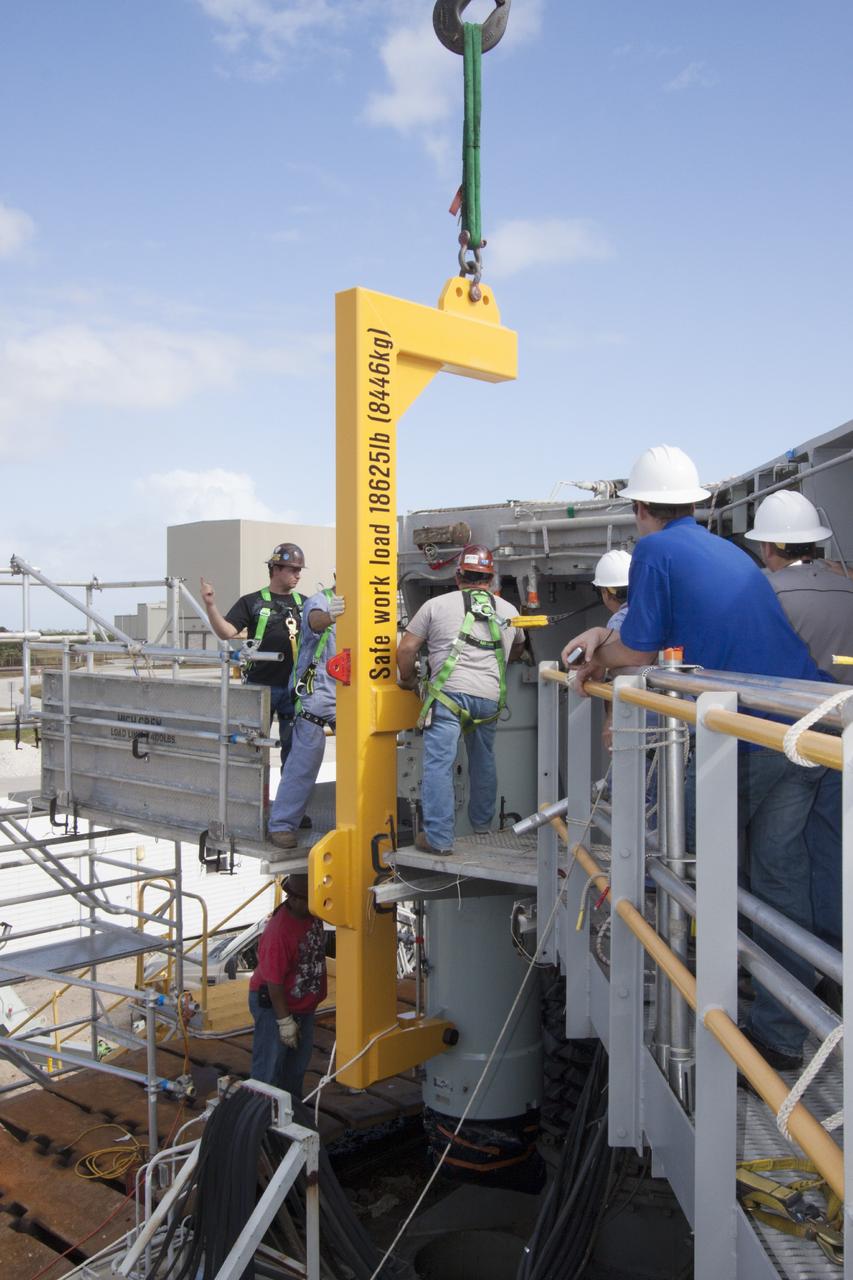
CAPE CANAVERAL, Fla. – Ground support equipment technicians assist as a crane is used to move a new jacking, equalizing and leveling, or JEL, hydraulic cylinder closer for installation on crawler-transporter 1 at the crawler transporter maintenance facility at NASA’s Kennedy Space Center in Florida. New JEL hydraulic cylinders will be installed on CT-1 to test them for increased load carrying capacity and reliability. The Ground Systems Development and Operations Program at Kennedy continues to upgrade CT-1 as part of its general maintenance. CT-1 could be available to carry a variety of launch vehicles to the launch pad. Two crawler-transporters were used to carry the mobile launcher platform and space shuttle to Launch Complex 39 for space shuttle launches for 30 years. Photo credit: NASA/Jim Grossmann
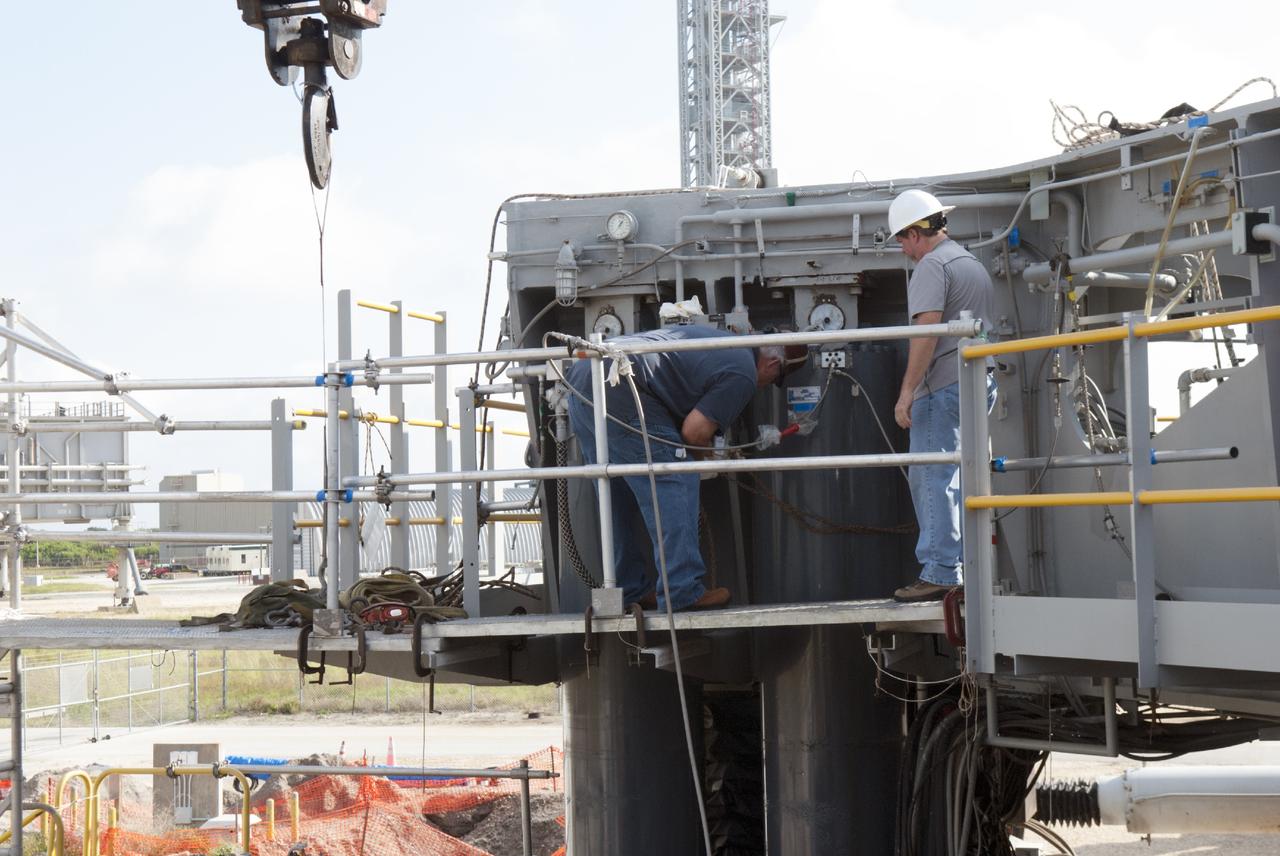
CAPE CANAVERAL, Fla. – Ground support equipment technicians prepare to remove the jacking, equalizing and leveling, or JEL, hydraulic cylinders from crawler-transporter 1 at the crawler transporter maintenance facility at NASA’s Kennedy Space Center in Florida. Sixteen new JEL hydraulic cylinders will be installed on CT-1 to increase load carrying capacity and reliability. The Ground Systems Development and Operations Program at Kennedy continues to upgrade CT-1 as part of its general maintenance. CT-1 could be available to carry commercial launch vehicles to the launch pad. The crawler-transporters were used to carry the mobile launcher platform and space shuttle to Launch Complex 39 for space shuttle launches for 30 years. Photo credit: NASA/Tim Jacobs
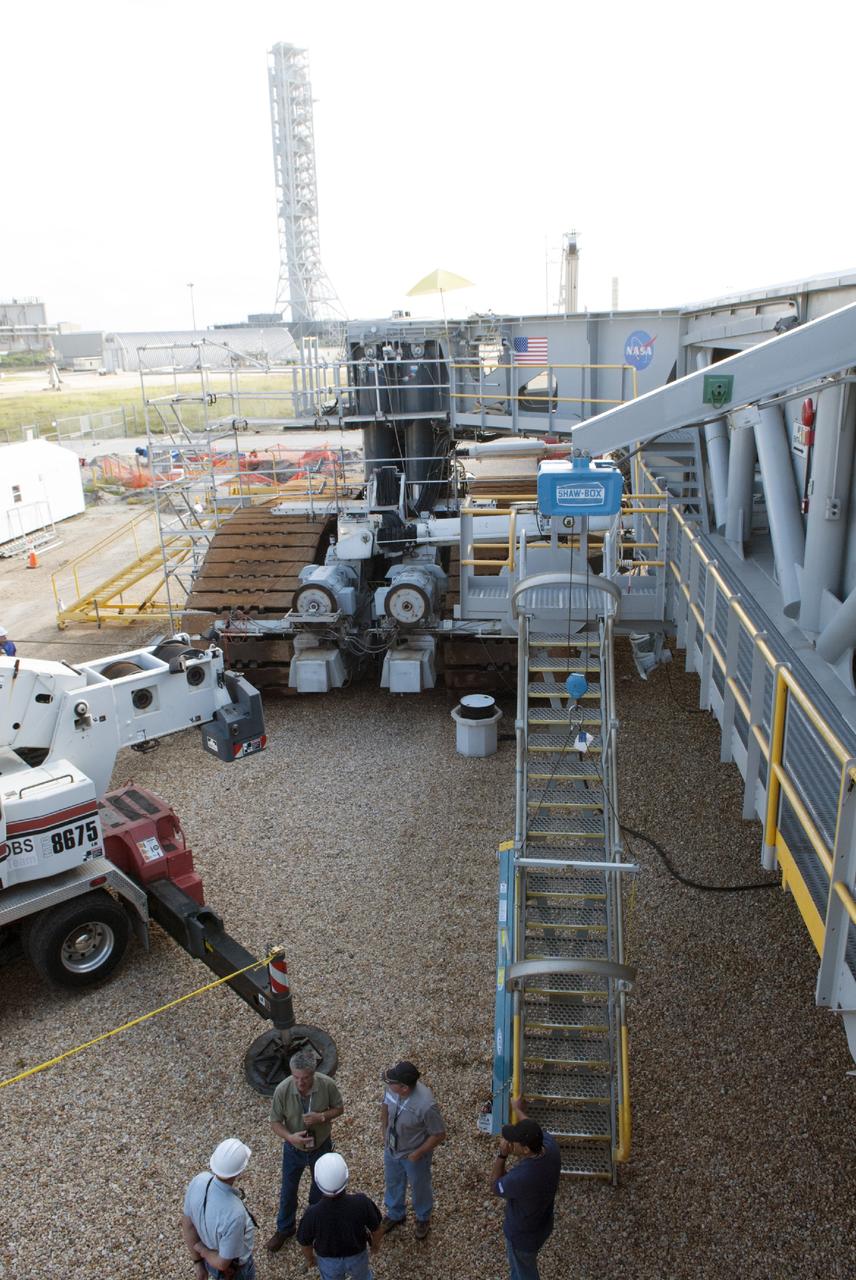
CAPE CANAVERAL, Fla. – Preparations are underway to begin removing the jacking, equalizing and leveling, or JEL, hydraulic cylinders from crawler-transporter 1 at the crawler transporter maintenance facility at NASA’s Kennedy Space Center in Florida. Sixteen new JEL hydraulic cylinders will be installed on CT-1 to increase load carrying capacity and reliability. The Ground Systems Development and Operations Program at Kennedy continues to upgrade CT-1 as part of its general maintenance. CT-1 could be available to carry commercial launch vehicles to the launch pad. The crawler-transporters were used to carry the mobile launcher platform and space shuttle to Launch Complex 39 for space shuttle launches for 30 years. Photo credit: NASA/Tim Jacobs
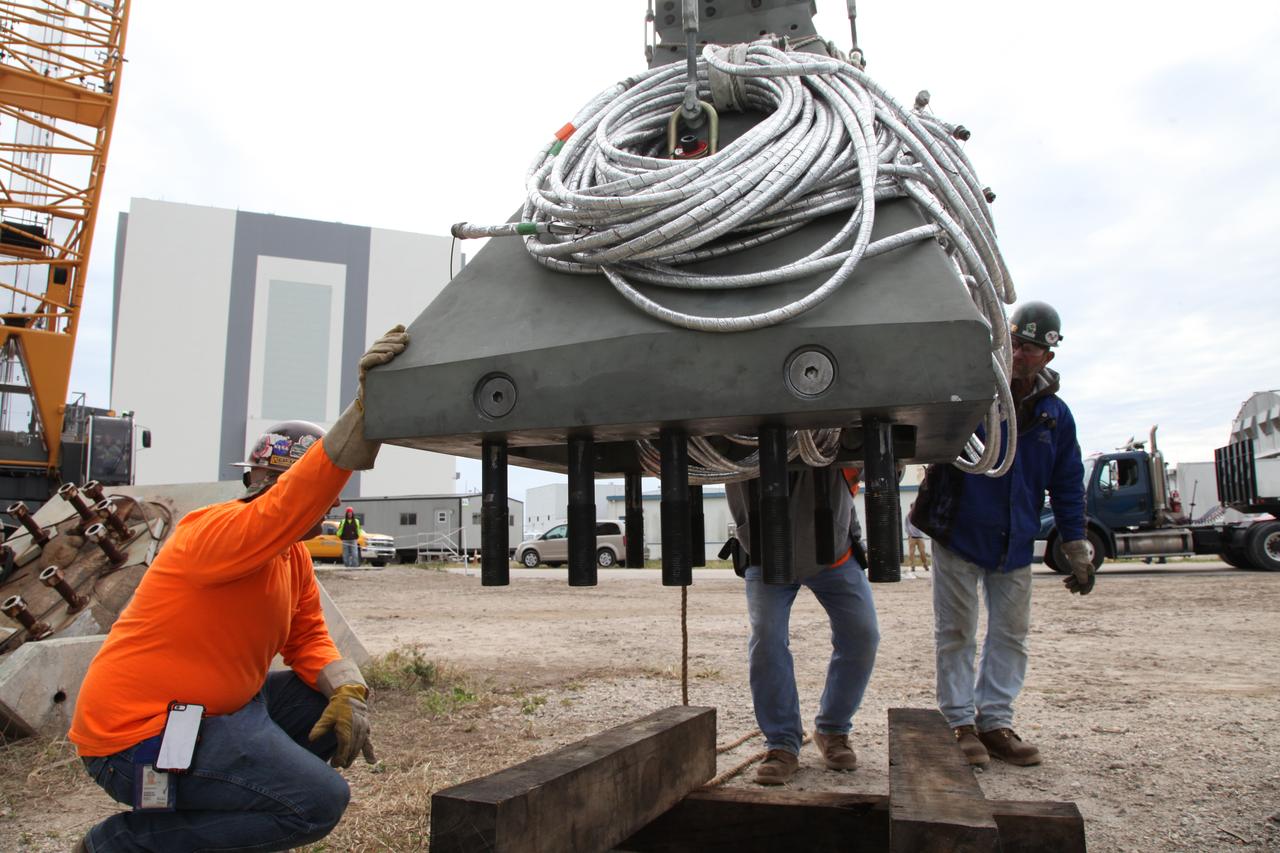
Construction workers assist as a crane is used to lower a vertical support post for NASA's Space Launch System (SLS) onto a platform at the Mobile Launcher Yard at NASA's Kennedy Space Center in Florida. Two ASEUs and the first of the vertical support posts underwent a series of tests at the Launch Equipment Test Facility to confirm they are functioning properly and ready to support the SLS for launch. The ASEUs will connect to the SLS rocket at the bottom outer edge of each booster and provide electrical power and data connections to the rocket until it lifts off from the launch pad. The eight VSPs will support the load of the solid rocket boosters, with four posts for each of the boosters. The center’s Engineering Directorate and the Ground Systems Development and Operations Program are overseeing processing and testing of the umbilicals.
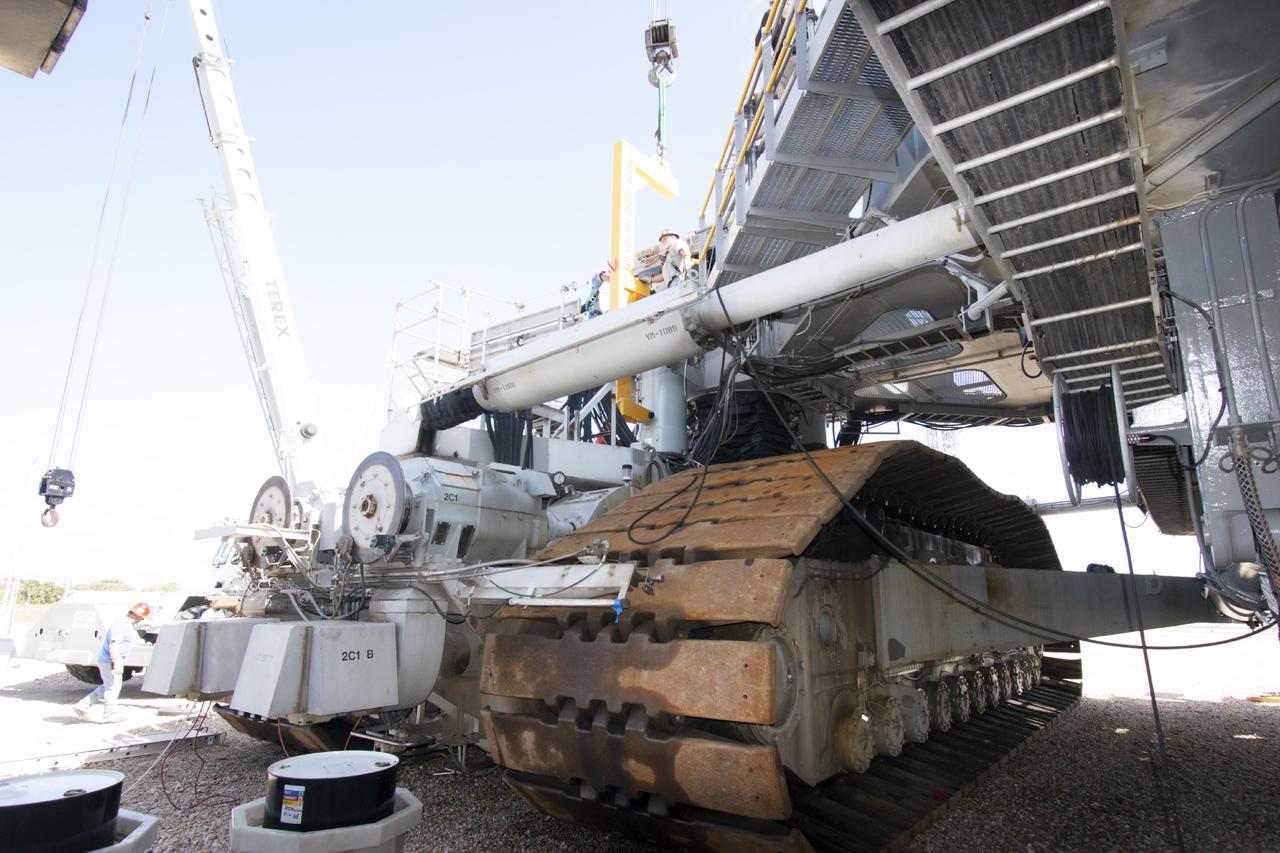
CAPE CANAVERAL, Fla. – Ground support equipment technicians assist as a crane moves a new jacking, equalizing and leveling, or JEL, hydraulic cylinder close for installation on crawler-transporter 1 at the crawler transporter maintenance facility at NASA’s Kennedy Space Center in Florida. New JEL hydraulic cylinders will be installed on CT-1 to test them for increased load carrying capacity and reliability. The Ground Systems Development and Operations Program at Kennedy continues to upgrade CT-1 as part of its general maintenance. CT-1 could be available to carry a variety of launch vehicles to the launch pad. Two crawler-transporters were used to carry the mobile launcher platform and space shuttle to Launch Complex 39 for space shuttle launches for 30 years. Photo credit: NASA/Jim Grossmann
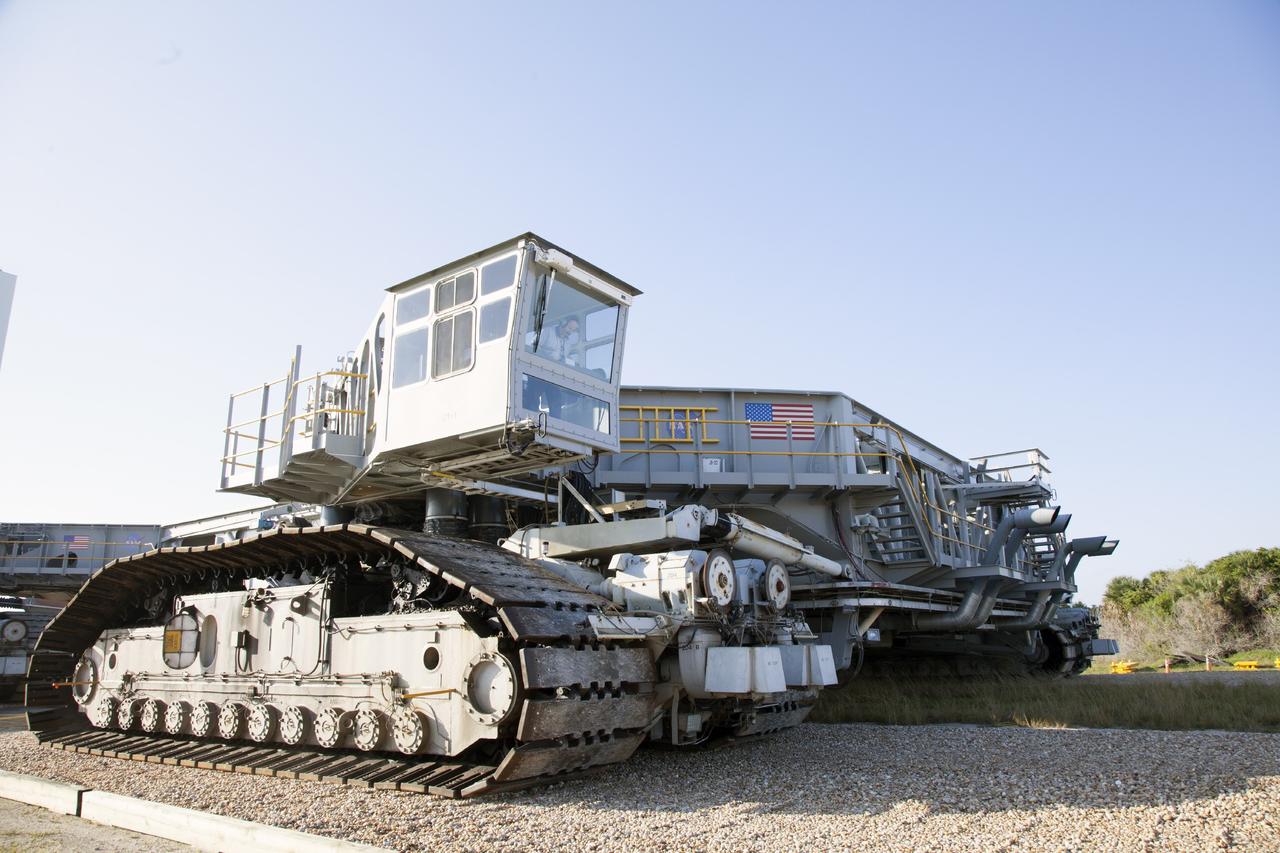
CAPE CANAVERAL, Fla. -- Crawler-transporter 1 continues its trek from the crawler transporter maintenance facility to Launch Pad 39A at NASA’s Kennedy Space Center in Florida. New jacking, equalizing and leveling, or JEL, hydraulic cylinders were installed on CT-1 and are being tested for increased load carrying capacity and reliability. The Ground Systems Development and Operations Program at Kennedy continues to upgrade the crawler-transporter as part of its general maintenance. CT-1 could be available to carry a variety of launch vehicles to the launch pad. Two crawler-transporters were used to carry the mobile launcher platform and space shuttle to Launch Complex 39 for space shuttle launches for 30 years. Photo credit: NASA/Daniel Casper
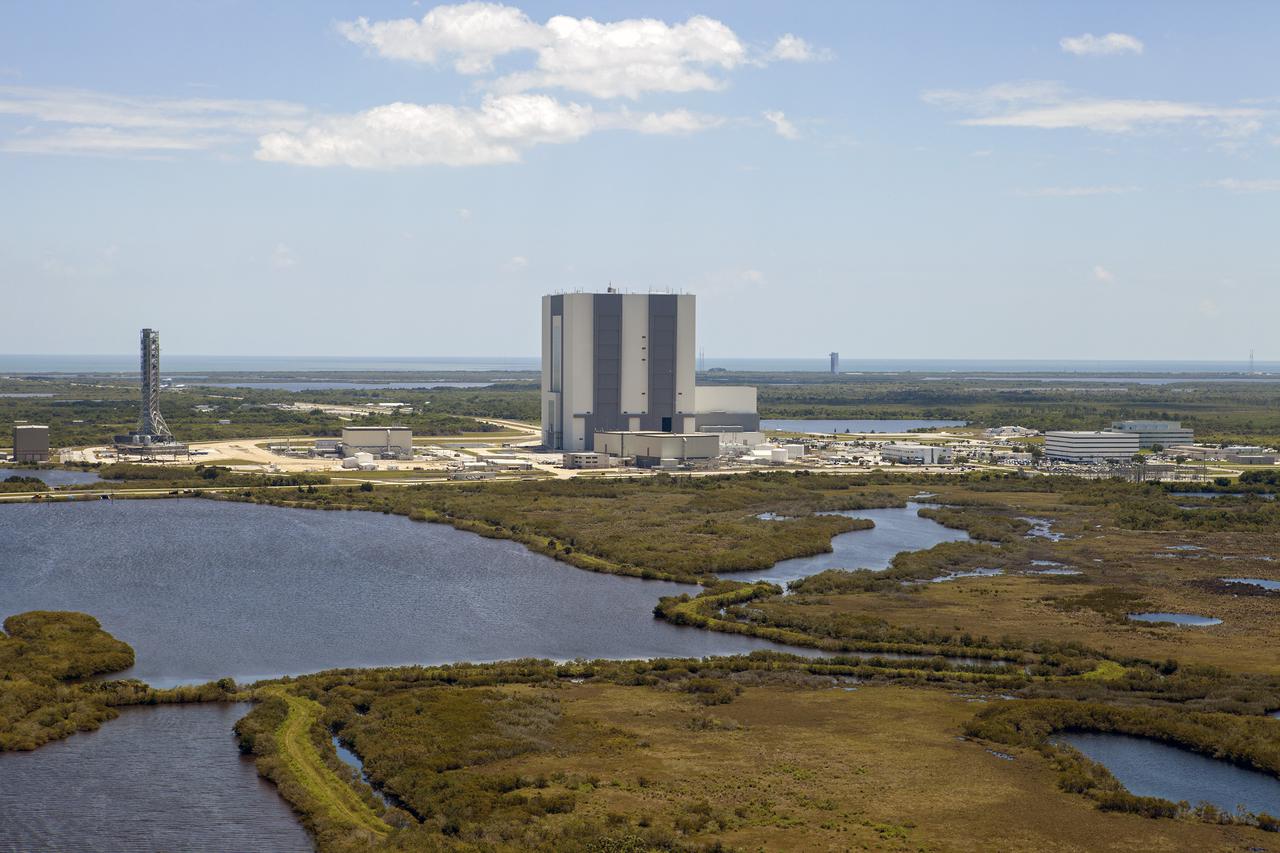
CAPE CANAVERAL, Fla. – An aerial view of the Vehicle Assembly Building and other buildings in the Launch Complex 39 area at NASA’s Kennedy Space Center in Florida. To the left is the mobile launcher that will be used to transport NASA’s Space Launch System rocket and the Orion crew capsule to Launch Pad 39B. Upgrades are underway at Pad B and other facilities in the Launch Complex 39 area. The Ground Systems Development and Operations, or GSDO, Program office at Kennedy is leading the center’s transformation from a historically government-only launch complex to a spaceport that can safely handle a variety of rockets and spacecraft, including NASA’s Space Launch System. For more information about GSDO, visit: http:__go.nasa.gov_groundsystems. Photo credit: NASA_Kim Shiflett
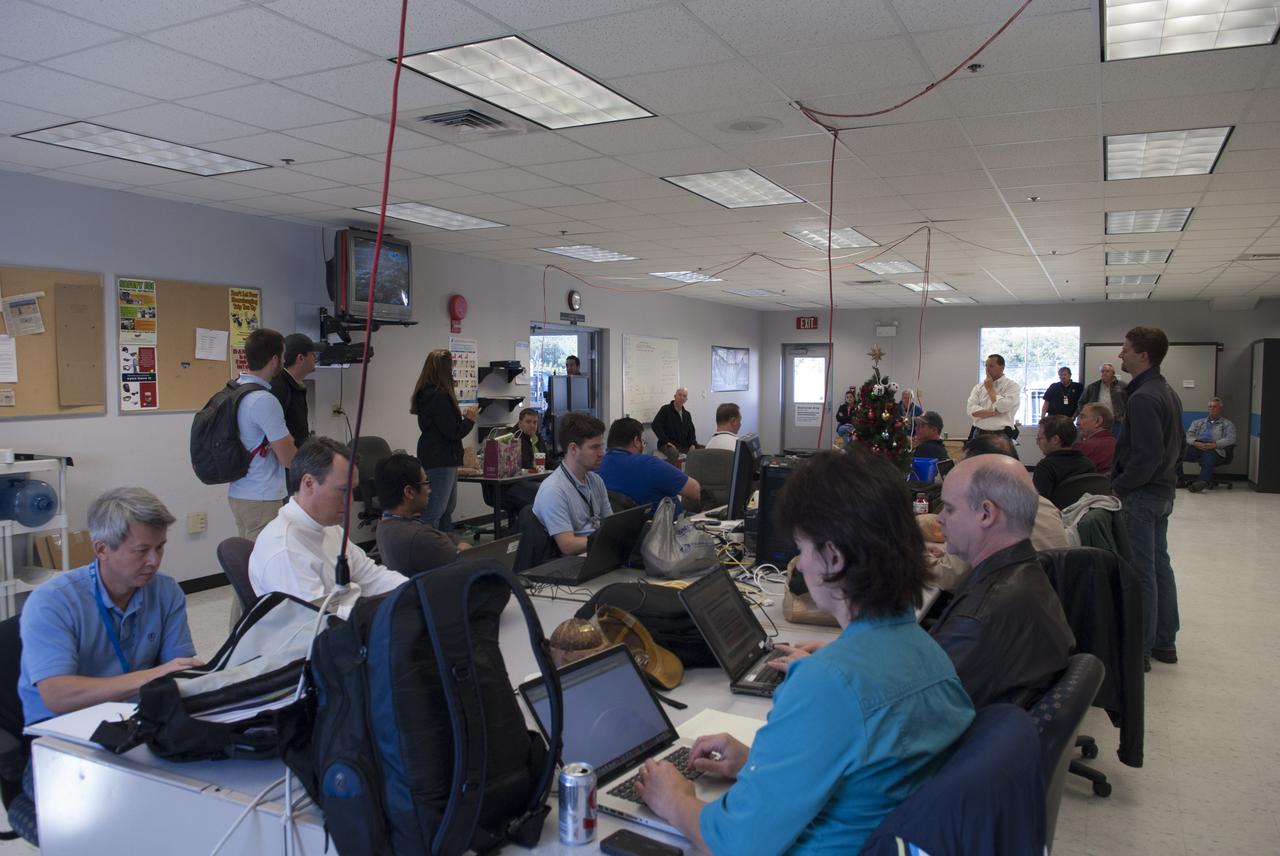
Engineers and controllers in a mobile control room prepare for flight number 15 of NASA's Project Morpheus prototype lander at the north end of the Shuttle Landing Facility, or SLF, at NASA’s Kennedy Space Center in Florida. The lander will take off from the ground over a flame trench and use its autonomous landing and hazard avoidance technology, or ALHAT sensors, to survey the hazard field to determine safe landing sites. Project Morpheus tests NASA’s ALHAT and an engine that runs on liquid oxygen and methane, which are green propellants. These new capabilities could be used in future efforts to deliver cargo to planetary surfaces. Project Morpheus is being managed under the Advanced Exploration Systems, or AES, Division in NASA’s Human Exploration and Operations Mission Directorate.
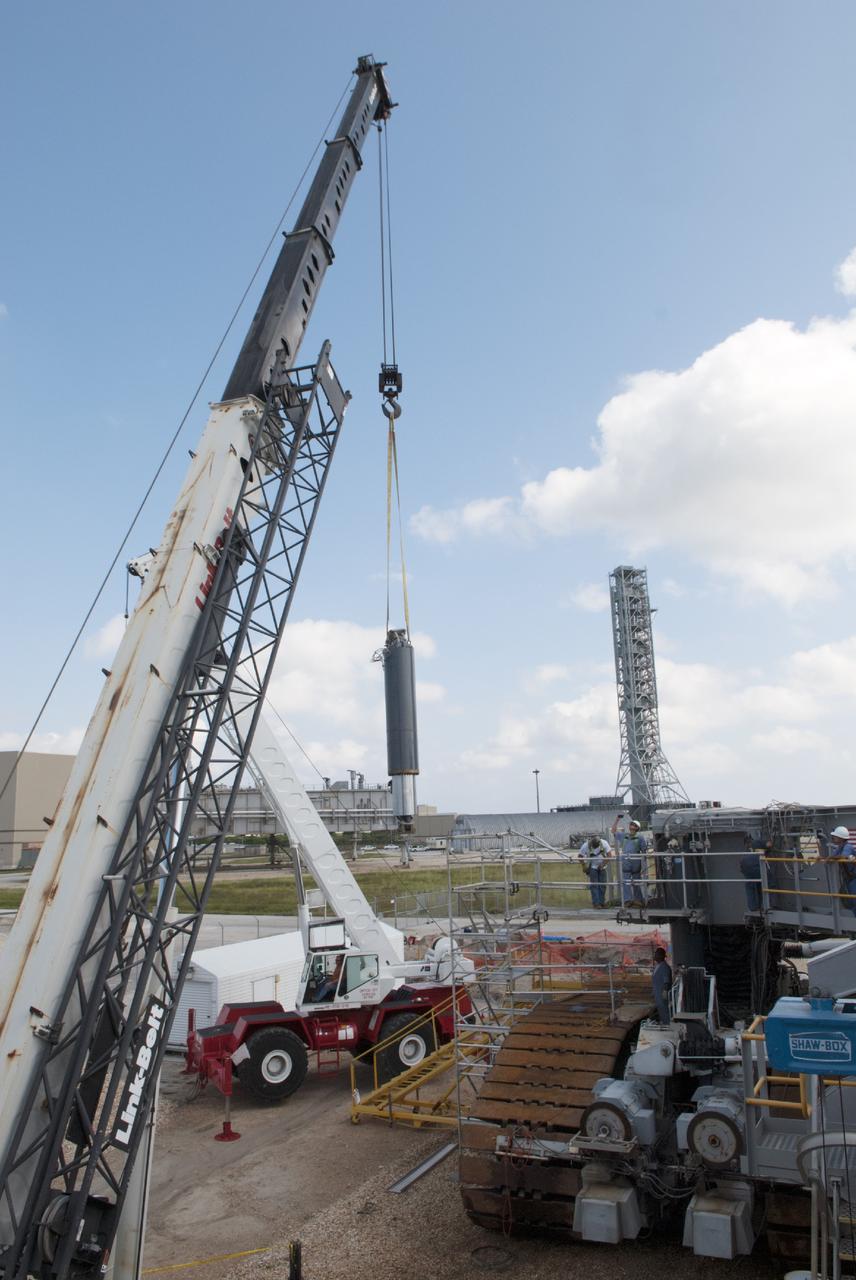
CAPE CANAVERAL, Fla. – One of the jacking, equalizing and leveling, or JEL, hydraulic cylinders is lifted away from crawler-transporter 1 at the crawler transporter maintenance facility at NASA’s Kennedy Space Center in Florida. Sixteen new JEL hydraulic cylinders will be installed on CT-1 to increase load carrying capacity and reliability. The Ground Systems Development and Operations Program at Kennedy continues to upgrade CT-1 as part of its general maintenance. CT-1 could be available to carry commercial launch vehicles to the launch pad. The crawler-transporters were used to carry the mobile launcher platform and space shuttle to Launch Complex 39 for space shuttle launches for 30 years. Photo credit: NASA/Tim Jacobs
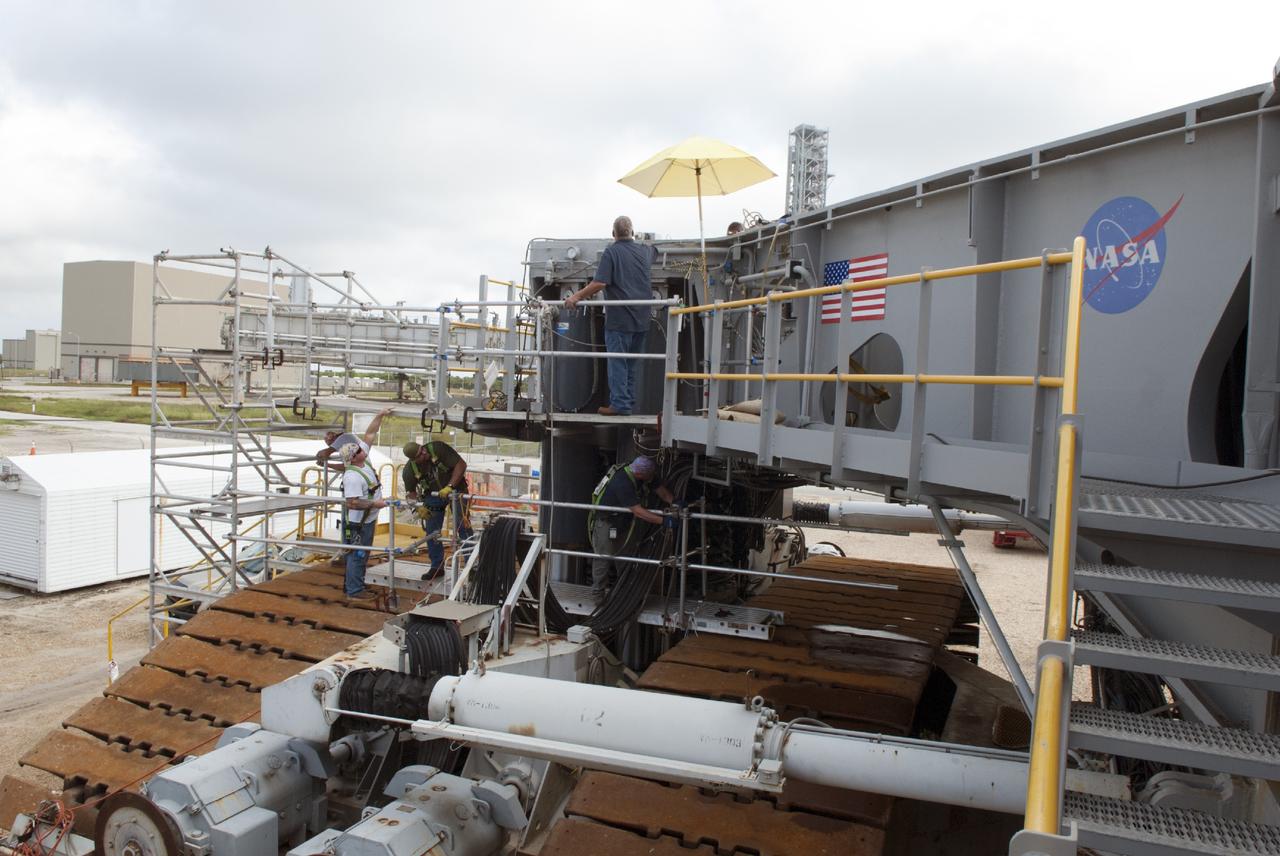
CAPE CANAVERAL, Fla. – Preparations are underway to begin removing the jacking, equalizing and leveling, or JEL, hydraulic cylinders from crawler-transporter 1 at the crawler transporter maintenance facility at NASA’s Kennedy Space Center in Florida. Sixteen new JEL hydraulic cylinders will be installed on CT-1 to increase load carrying capacity and reliability. The Ground Systems Development and Operations Program at Kennedy continues to upgrade CT-1 as part of its general maintenance. CT-1 could be available to carry commercial launch vehicles to the launch pad. The crawler-transporters were used to carry the mobile launcher platform and space shuttle to Launch Complex 39 for space shuttle launches for 30 years. Photo credit: NASA/Tim Jacobs
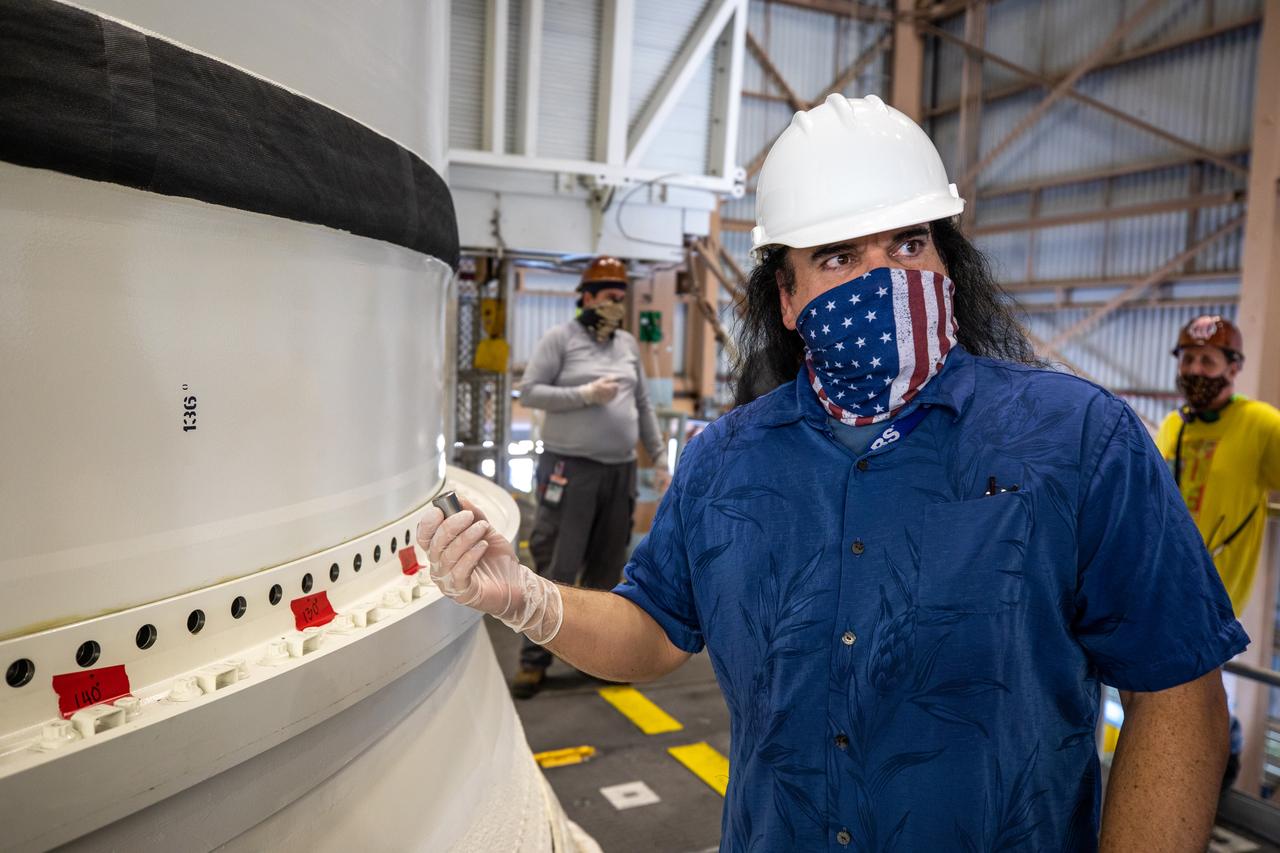
Inside the Rotation, Processing and Surge Facility at NASA’s Kennedy Space Center in Florida, Pablo Martinez, a handling, mechanical and structures engineer on the Jacobs Technology Inc. Test and Operations Support Contract, prepares to insert the first of many pins that will secure the Space Launch System’s (SLS) right-hand motor segment to the rocket’s right-hand aft skirt. The right-hand motor segment is one of five segments that makes up one of two solid rocket boosters. Once the aft segments are mated to the two aft skirts, they will be moved to the Vehicle Assembly Building for stacking on the mobile launcher. Manufactured by Northrop Grumman in Utah, the twin boosters provide more than 75 percent of the total SLS thrust at launch. Under the Artemis program, NASA will land the first woman and the next man on the Moon by 2024. The first in a series of increasingly complex missions, Artemis I will test the Orion spacecraft and SLS as an integrated system ahead of crewed flights to the Moon.