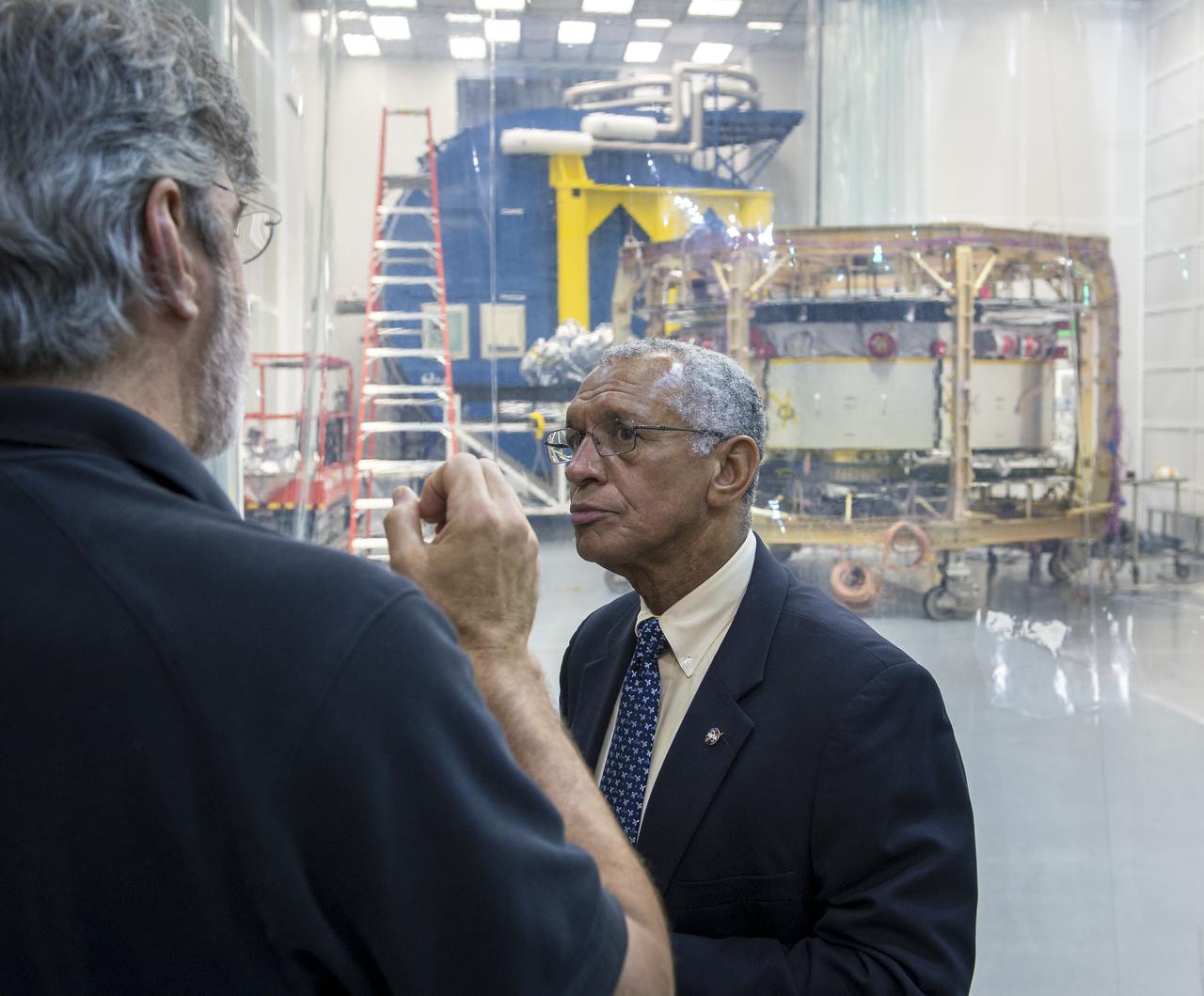
NASA Administrator Charles Bolden listens to Magnetospheric Multiscale (MMS) Mission Project Manager Craig Tooley talk about the MMS mission outside of a Naval Research Laboratory cleanroom where one of four Magnetospheric Multiscale (MMS) spacecraft is currently undergoing testing, Monday, August 4, 2014, in Washington. The Magnetospheric Multiscale, or MMS, mission will study the mystery of how magnetic fields around Earth connect and disconnect, explosively releasing energy via a process known as magnetic reconnection. The four identical spacecraft are scheduled to launch in 2015 from Cape Canaveral and will orbit around Earth in varying formations through the dynamic magnetic system surrounding our planet to provide the first three-dimensional views of the magnetic reconnection process. The goal of the STP Program is to understand the fundamental physical processes of the space environment from the sun to Earth, other planets, and the extremes of the solar system boundary. Photo Credit: (NASA/Bill Ingalls)
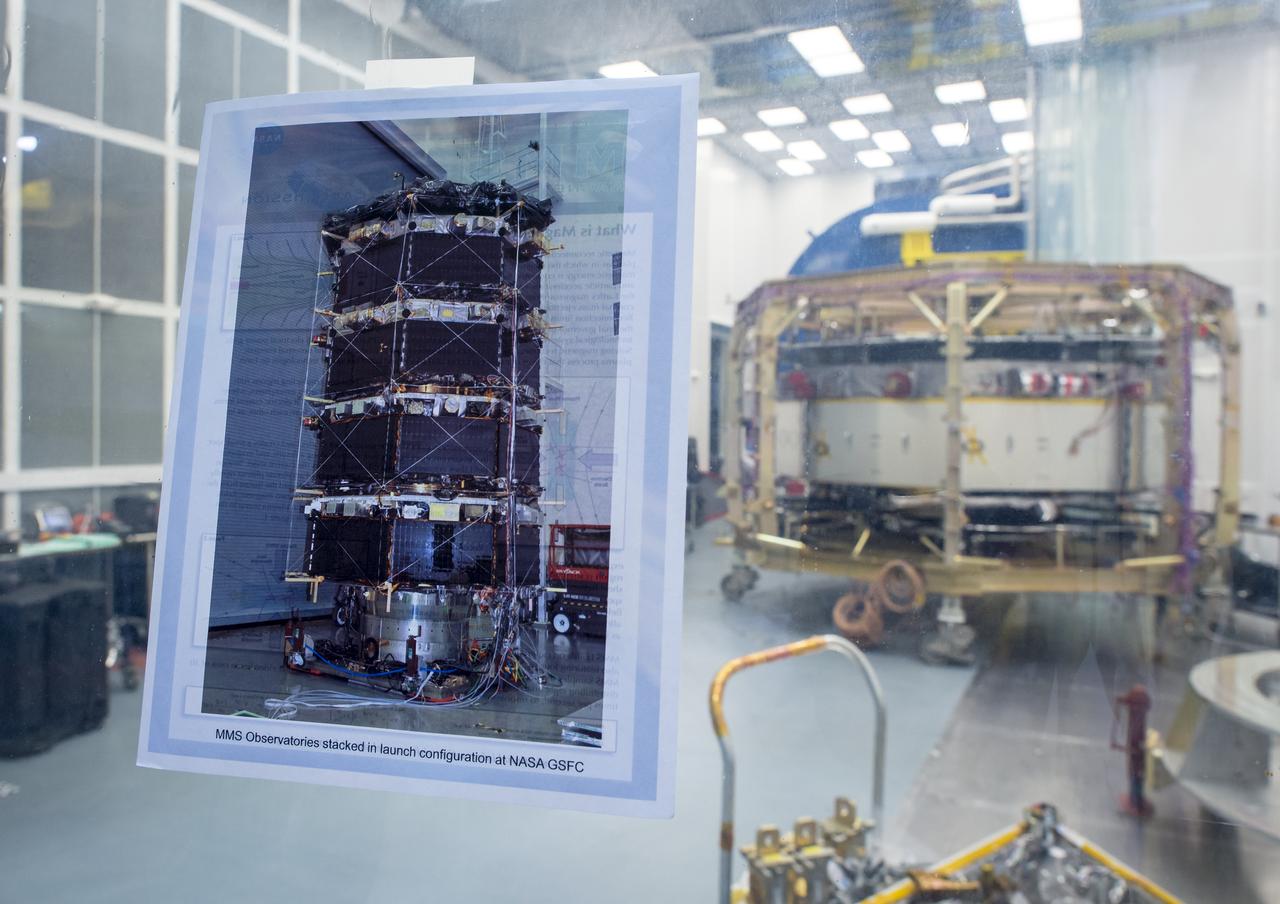
A photograph showing what all four Magnetospheric Multiscale (MMS) spacecraft look like when stacked is seen taped to the window of a Naval Research Laboratory cleanroom where one of the four spacecraft is undergoing testing, Monday, August 4, 2014, in Washington. The Magnetospheric Multiscale, or MMS, mission will study the mystery of how magnetic fields around Earth connect and disconnect, explosively releasing energy via a process known as magnetic reconnection. The four identical spacecraft are scheduled to launch in 2015 from Cape Canaveral and will orbit around Earth in varying formations through the dynamic magnetic system surrounding our planet to provide the first three-dimensional views of the magnetic reconnection process. The goal of the STP Program is to understand the fundamental physical processes of the space environment from the sun to Earth, other planets, and the extremes of the solar system boundary. Photo Credit: (NASA/Bill Ingalls)

jsc2022e084482 (11/02/2022) --- A preflight view of the Space Test Program-Houston 9-Neutron Radiation Detection Instrument (STP-H9-NeRDI). Image courtesy of U.S. Naval Research Laboratory.

jsc2022e084483 (10/27/2022) --- A Preflight view of the Space Test Program-Houston 9-Neutron Radiation Detection Instrument (STP-H9-NeRDI) during thermal vacuum testing. Image courtesy of U.S. Naval Research Laboratory.

jsc2022e084485 (10/14/2022) --- A preflight view of the Space Test Program-Houston 9-Neutron Radiation Detection Instrument (STP-H9-NeRDI) during vibration testing. Image courtesy of U.S. Naval Research Laboratory.
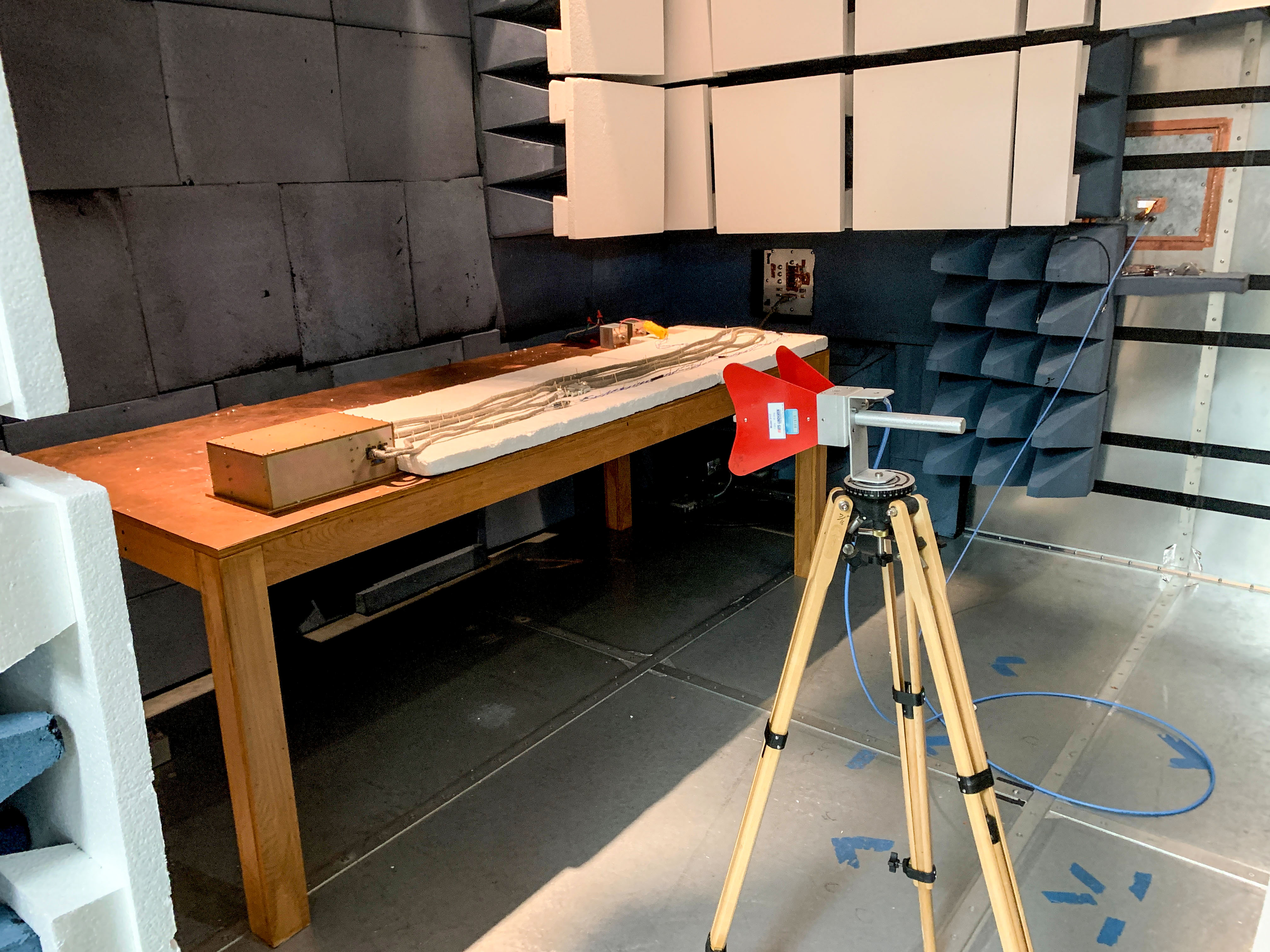
jsc2022e084484 (11/2/2022) --- A preflight view if the Space Test Program-Houston 9-Neutron Radiation Detection Instrument (STP-H9-NeRDI) during electromagnetic interference testing. Image courtesy of U.S. Naval Research Laboratory.
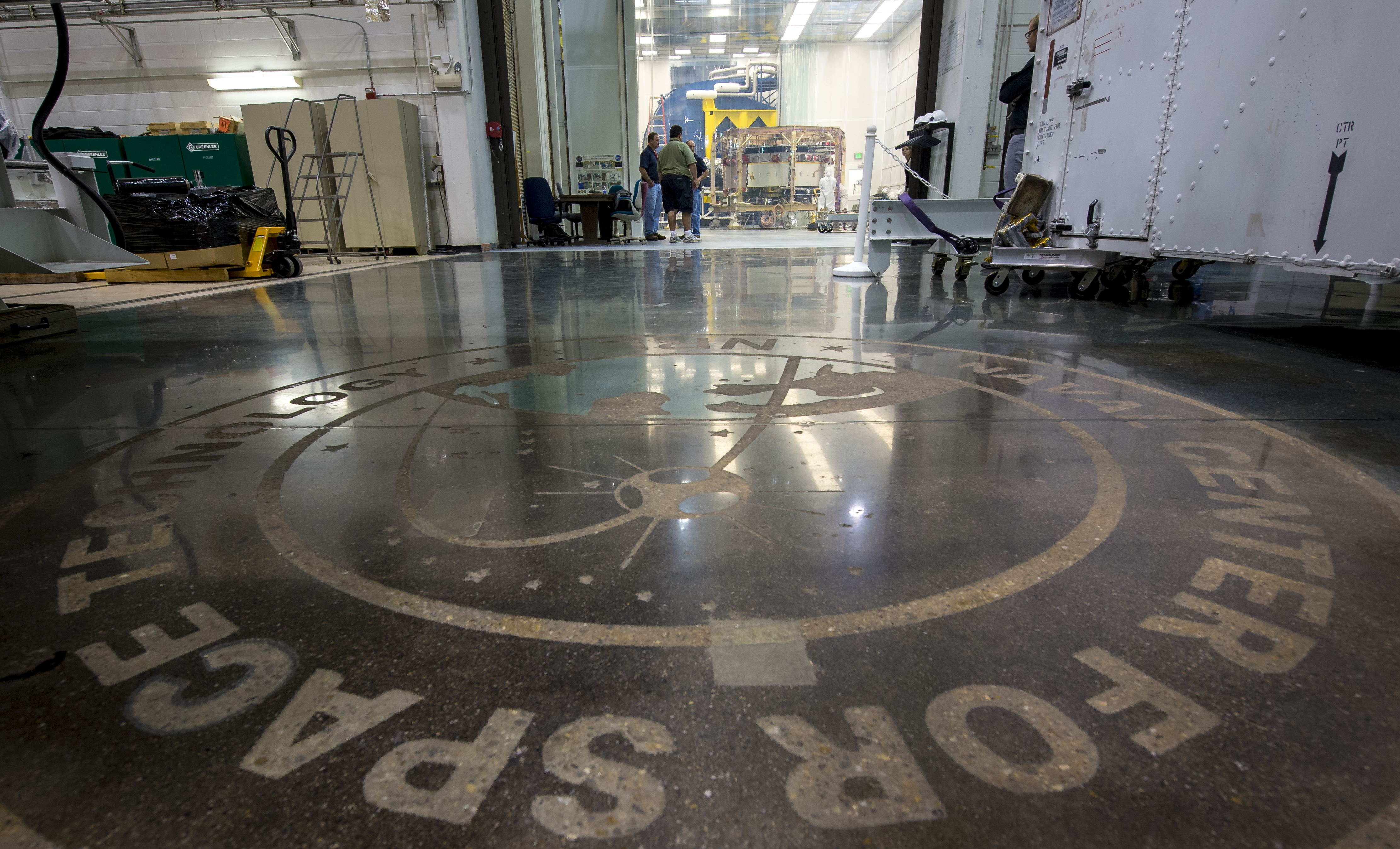
One of four Magnetospheric Multiscale (MMS) spacecraft, in the background, is seen in a cleanroom at the Naval Research Lab’s, Naval Center for Space Technology, Monday, August 4, 2014, in Washington. The Magnetospheric Multiscale, or MMS, mission will study the mystery of how magnetic fields around Earth connect and disconnect, explosively releasing energy via a process known as magnetic reconnection. The four identical spacecraft are scheduled to launch in 2015 from Cape Canaveral and will orbit around Earth in varying formations through the dynamic magnetic system surrounding our planet to provide the first three-dimensional views of the magnetic reconnection process. The goal of the STP Program is to understand the fundamental physical processes of the space environment from the sun to Earth, other planets, and the extremes of the solar system boundary. Photo Credit: (NASA/Bill Ingalls)
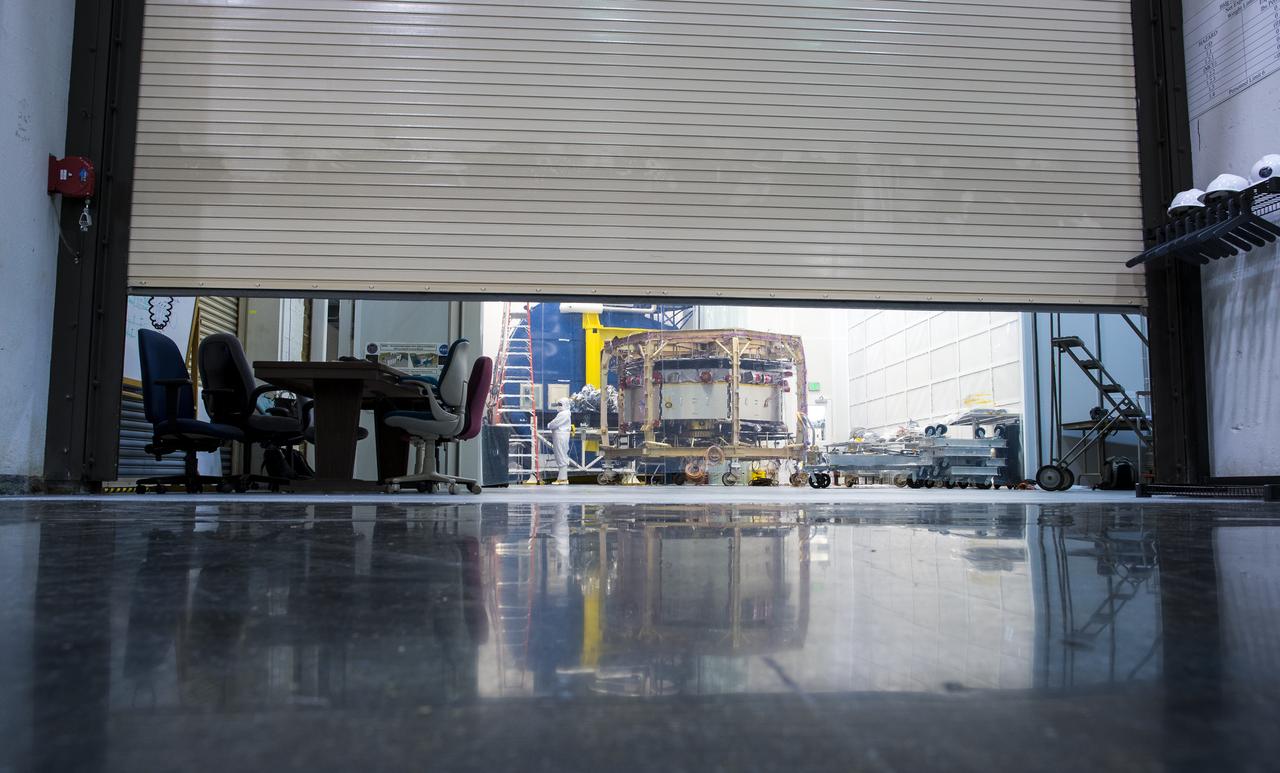
One of four Magnetospheric Multiscale (MMS) spacecraft, in the background, is seen in a cleanroom at the Naval Research Lab’s, Naval Center for Space Technology, Monday, August 4, 2014, in Washington. The Magnetospheric Multiscale, or MMS, mission will study the mystery of how magnetic fields around Earth connect and disconnect, explosively releasing energy via a process known as magnetic reconnection. The four identical spacecraft are scheduled to launch in 2015 from Cape Canaveral and will orbit around Earth in varying formations through the dynamic magnetic system surrounding our planet to provide the first three-dimensional views of the magnetic reconnection process. The goal of the STP Program is to understand the fundamental physical processes of the space environment from the sun to Earth, other planets, and the extremes of the solar system boundary. Photo Credit: (NASA/Bill Ingalls)
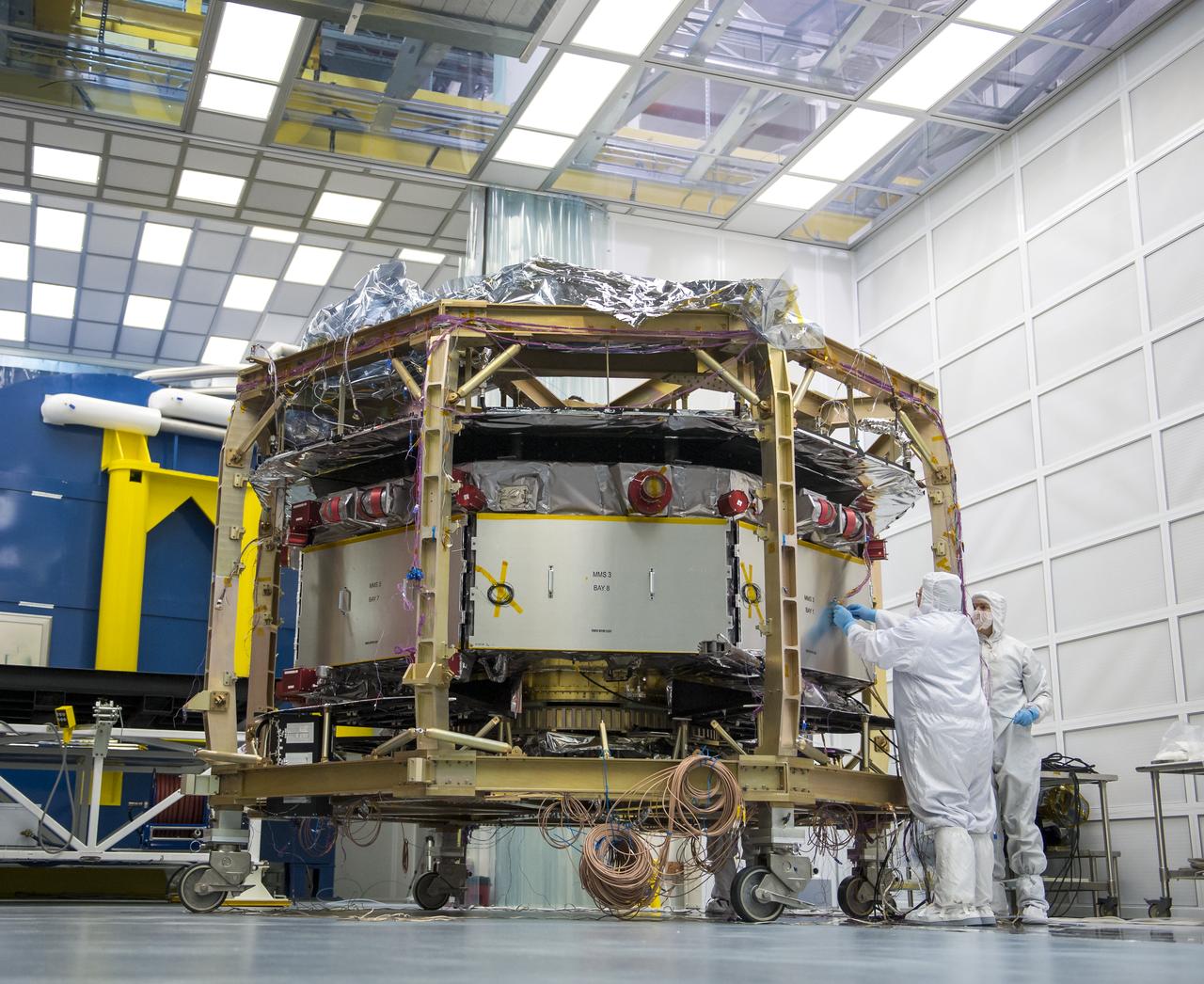
Engineers work on one of four Magnetospheric Multiscale (MMS) spacecraft in a cleanroom at the Naval Research Lab, Monday, August 4, 2014, in Washington. The Magnetospheric Multiscale, or MMS, mission will study the mystery of how magnetic fields around Earth connect and disconnect, explosively releasing energy via a process known as magnetic reconnection. The four identical spacecraft are scheduled to launch in 2015 from Cape Canaveral and will orbit around Earth in varying formations through the dynamic magnetic system surrounding our planet to provide the first three-dimensional views of the magnetic reconnection process. The goal of the STP Program is to understand the fundamental physical processes of the space environment from the sun to Earth, other planets, and the extremes of the solar system boundary. Photo Credit: (NASA/Bill Ingalls)

From left, Ray Sadler, Ted Powers, and Walter Hargis align load pads on the aircraft surface of a F/A-18E from the Naval Air Systems Command (NAVAIR) in Patuxent River, Maryland. The aircraft is in NASA’s Armstrong Flight Research Center Flight Loads Laboratory in Edwards, California, for the center’s biggest load calibrations tests. This testing is needed before the aircraft can serve as a test vehicle for determining if it can safely manage maneuvers and proposed upgrades.
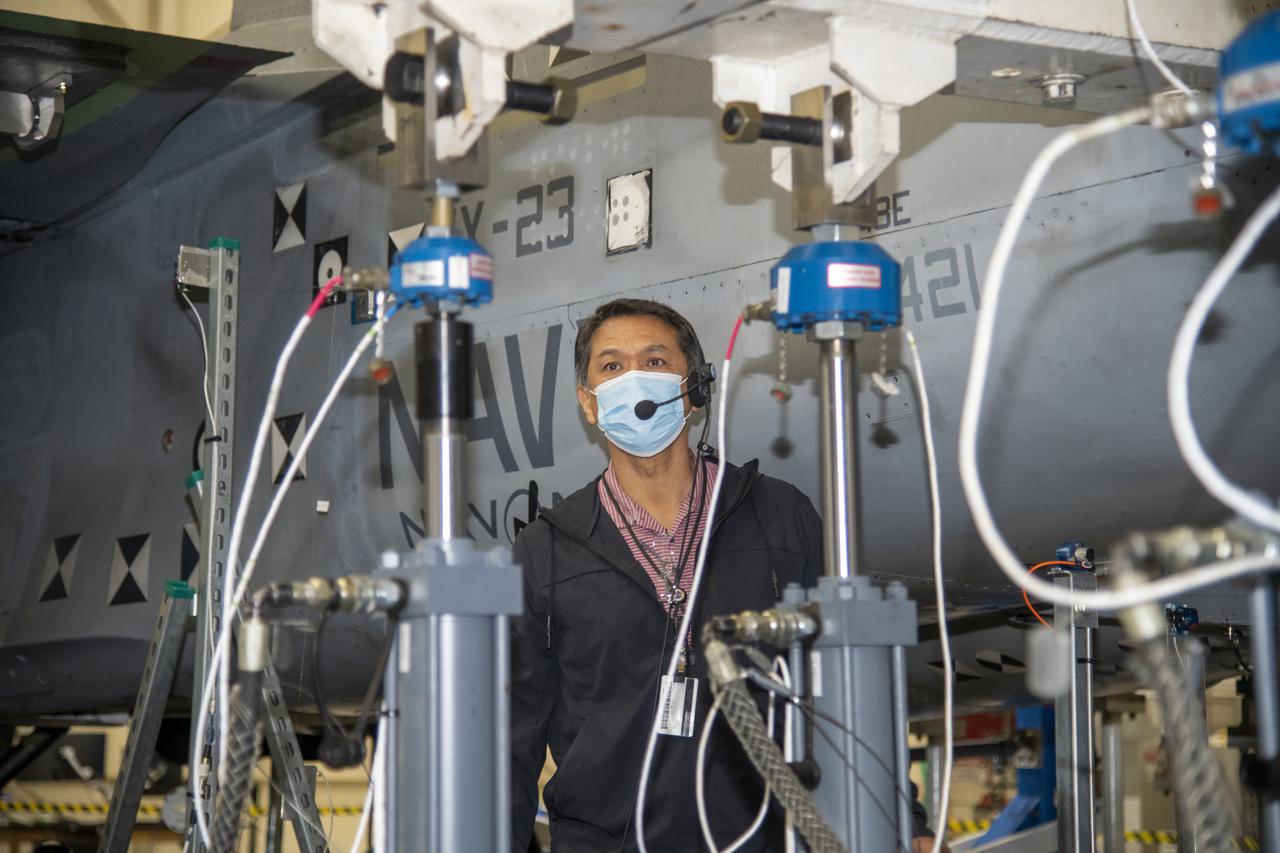
Larry Hudson does an inspection after the actuator on the F/A-18E from the Naval Air Systems Command (NAVAIR) in Patuxent River, Maryland, is pinned to the horizontal tail load test fixture. The aircraft is in NASA’s Armstrong Flight Research Center Flight Loads Laboratory in Edwards, California, for the center’s biggest load calibrations tests. This testing is needed before the aircraft can serve as a test vehicle for determining if it can safely manage maneuvers and proposed upgrades.
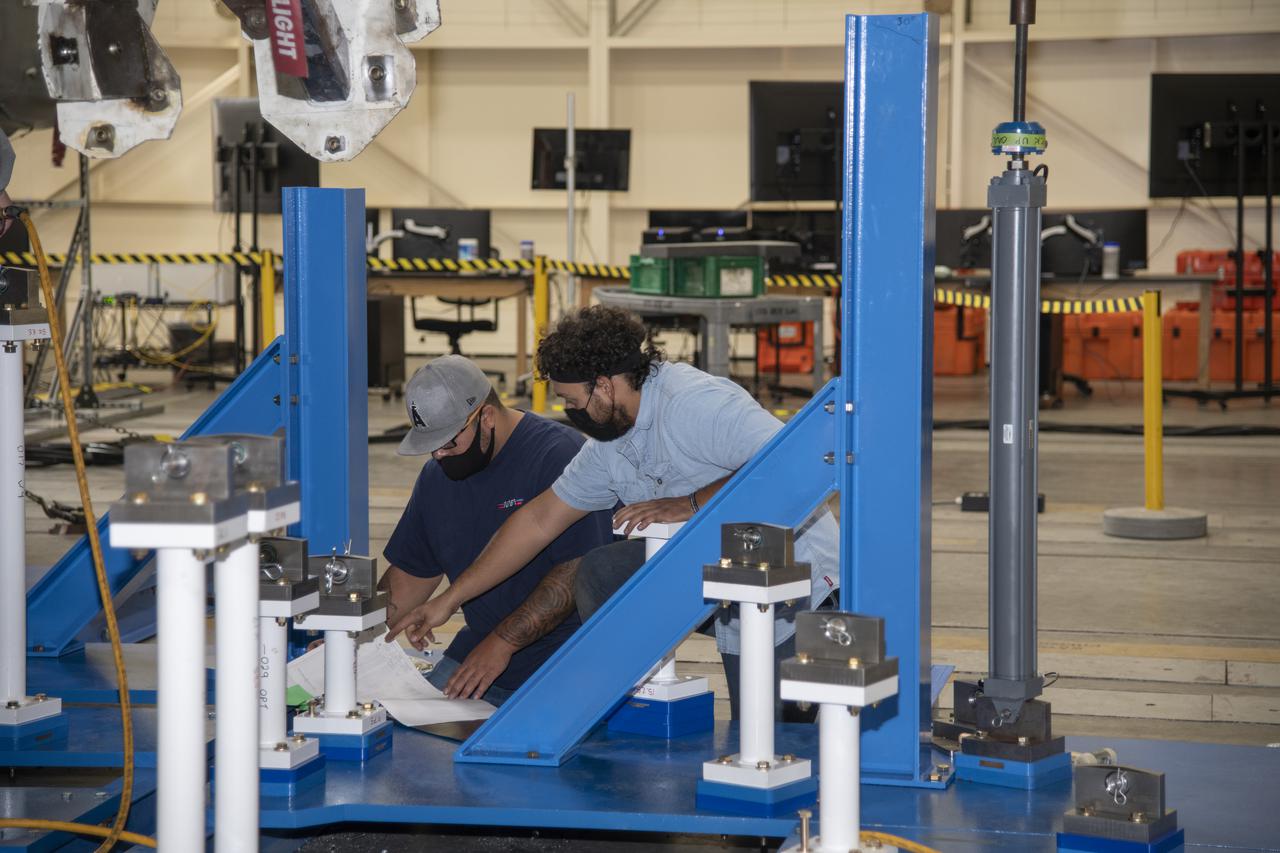
From left, Dominic Barela and Lucas Oramas review a drawing for installing the wing load test fixturing on a F/A-18E from the Naval Air Systems Command (NAVAIR) in Patuxent River, Maryland. The aircraft is in NASA’s Armstrong Flight Research Center Flight Loads Laboratory in Edwards, California, for the center’s biggest load calibrations tests. This testing is needed before the aircraft can serve as a test vehicle for determining if it can safely manage maneuvers and proposed upgrades.
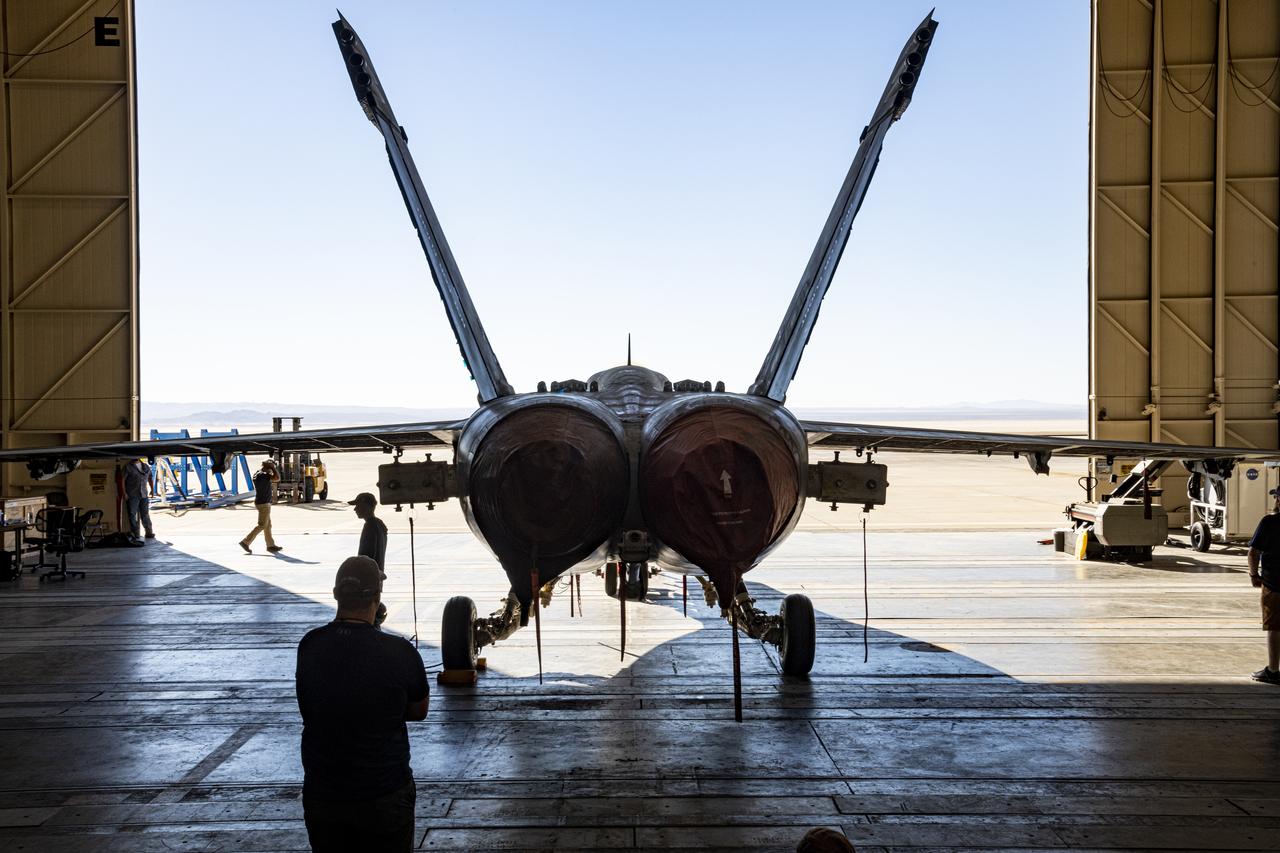
This rear view shows an F/A-18E from the Naval Air Systems Command (NAVAIR) in Patuxent River, Maryland. The aircraft is in NASA’s Armstrong Flight Research Center Flight Loads Laboratory in Edwards, California, where it underwent the center’s biggest load calibrations tests. This testing will permit the aircraft to serve as a test vehicle to determine if it can safely manage maneuvers and proposed upgrades.
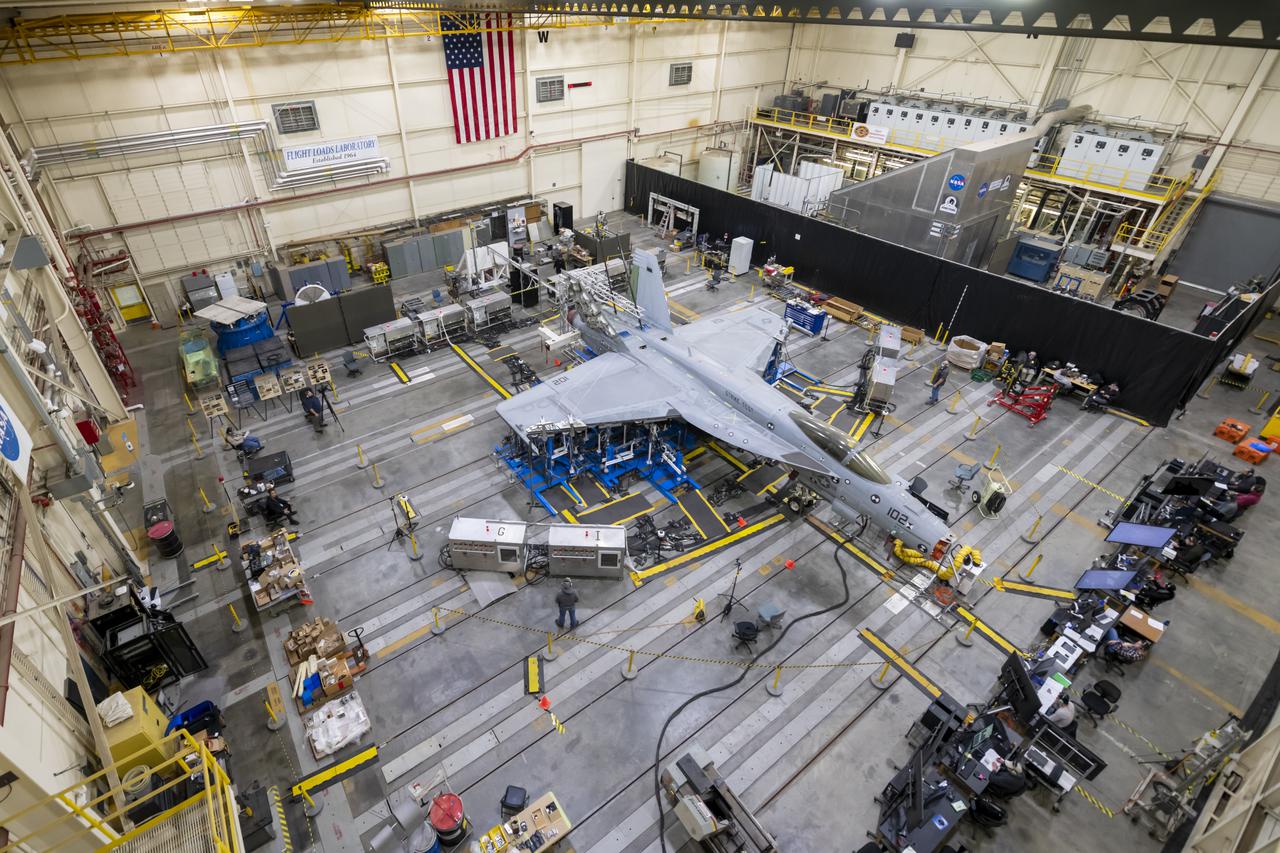
A top view shows the wing loading test configuration and testing area of an F/A-18E from the Naval Air Systems Command (NAVAIR) in Patuxent River; Maryland. The aircraft is in NASA's Armstrong Flight Research Center Flight Loads Laboratory in Edwards; California; for the center's biggest load calibrations tests. This testing is needed before the aircraft can serve as a test vehicle for determining if it can safely manage maneuvers and proposed upgrades.
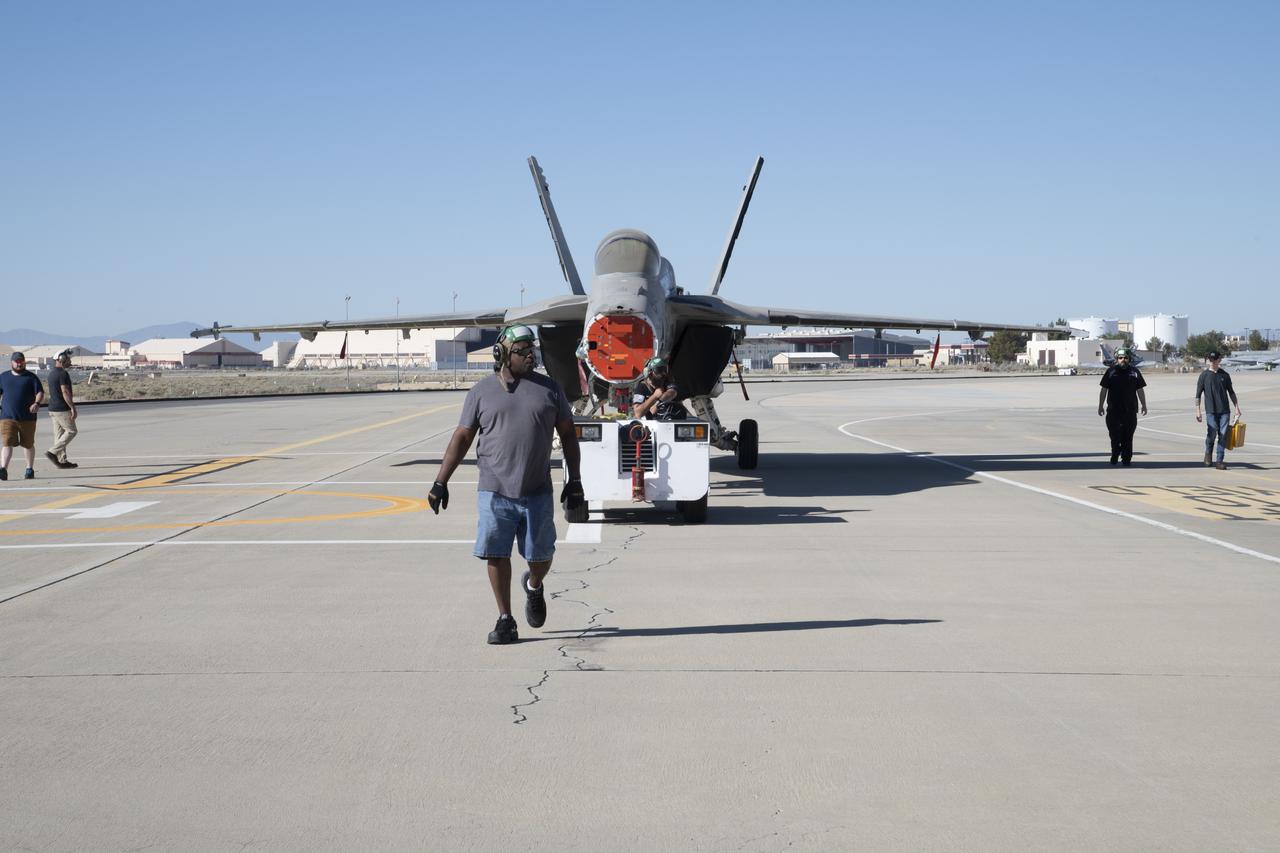
An F/A-18E from the Naval Air Systems Command (NAVAIR) in Patuxent River, Maryland, is moved from NASA’s Armstrong Flight Research Center Flight Loads Laboratory in Edwards, California, to a hangar where it will undergo final preparations to return to its squadron. The aircraft underwent the center’s biggest load calibrations tests. The testing will permit the aircraft to serve as a test vehicle to determine if it can safely manage maneuvers and proposed upgrades.
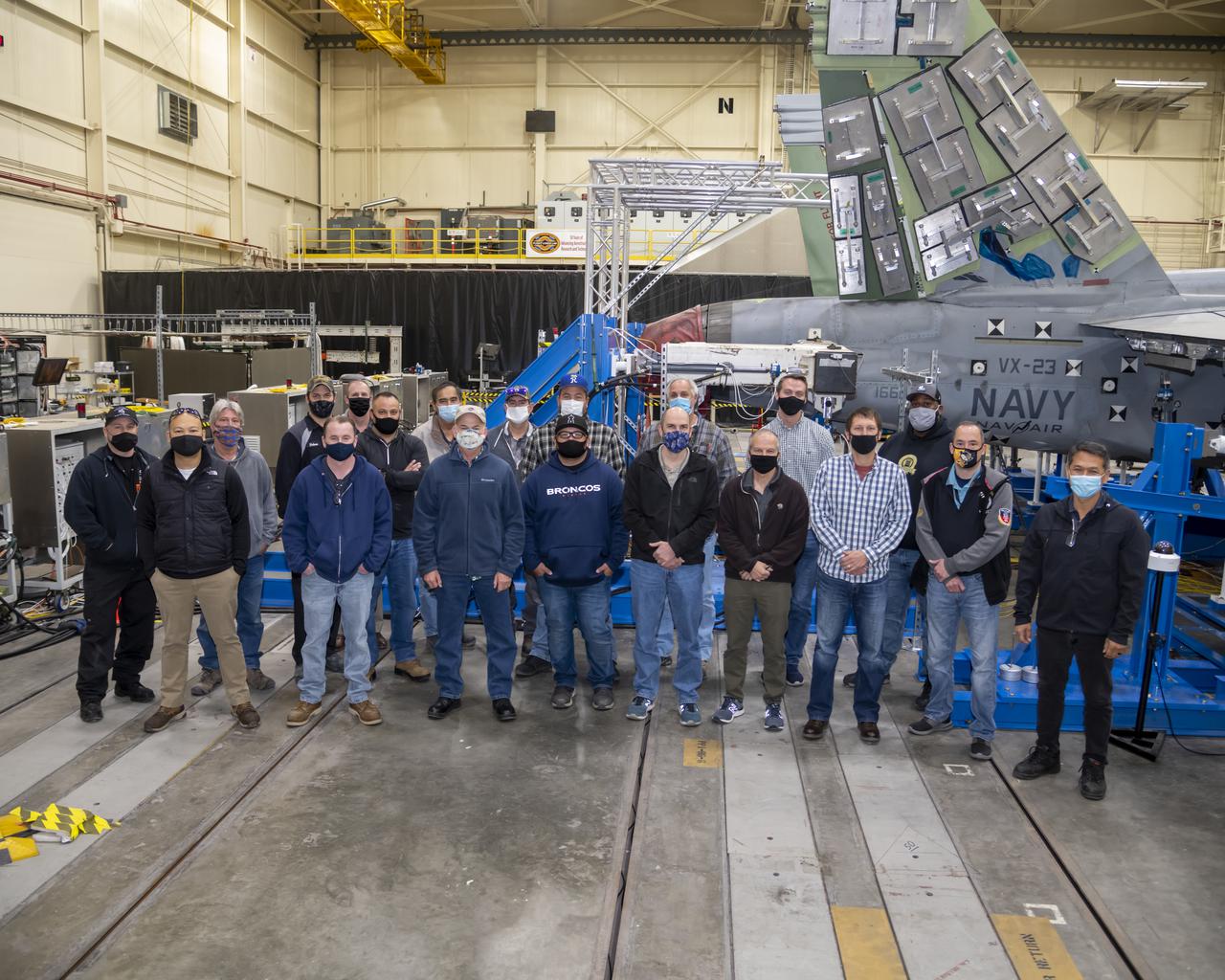
– A team working on tests on a F/A-18E from the Naval Air Systems Command (NAVAIR) in Patuxent River, Maryland, stand by the aircraft. The F/A-18E is in NASA’s Armstrong Flight Research Center Flight Loads Laboratory in Edwards, California, for the center’s biggest load calibrations tests. This testing is needed before the aircraft can serve as a test vehicle for determining if it can safely manage maneuvers and proposed upgrades.

The load pad bonding process for the vertical tails was a preliminary step in the process to test the F/A-18E from the Naval Air Systems Command (NAVAIR) in Patuxent River, Maryland. The aircraft is in NASA’s Armstrong Flight Research Center Flight Loads Laboratory in Edwards, California, for the center’s biggest load calibrations tests. This testing is needed before the aircraft can serve as a test vehicle for determining if it can safely manage maneuvers and proposed upgrades.
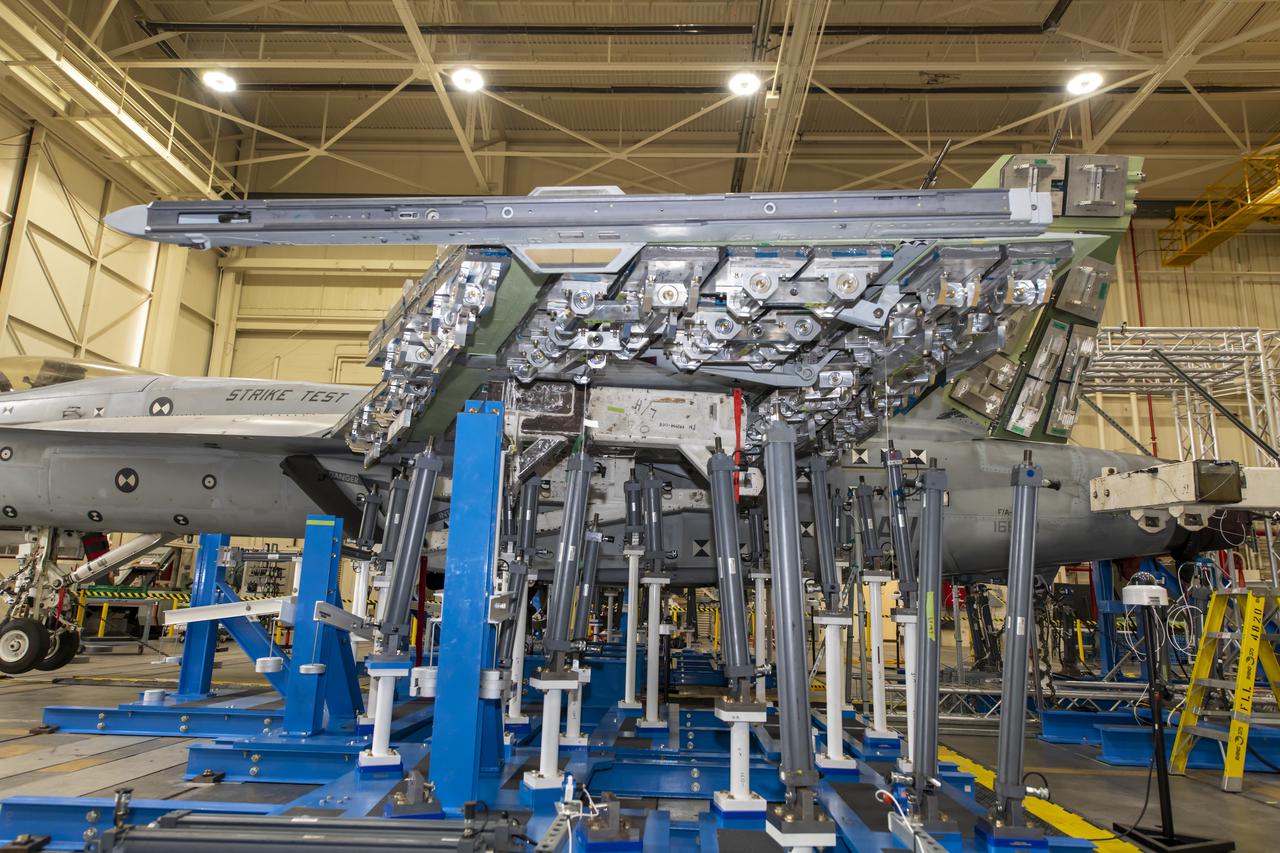
– Installation of wing load test hardware is installed under the wing of a F/A-18E from the Naval Air Systems Command (NAVAIR) in Patuxent River, Maryland. The aircraft is in NASA’s Armstrong Flight Research Center Flight Loads Laboratory in Edwards, California, for the center’s biggest load calibrations tests. This testing is needed before the aircraft can serve as a test vehicle for determining if it can safely manage maneuvers and proposed upgrades.
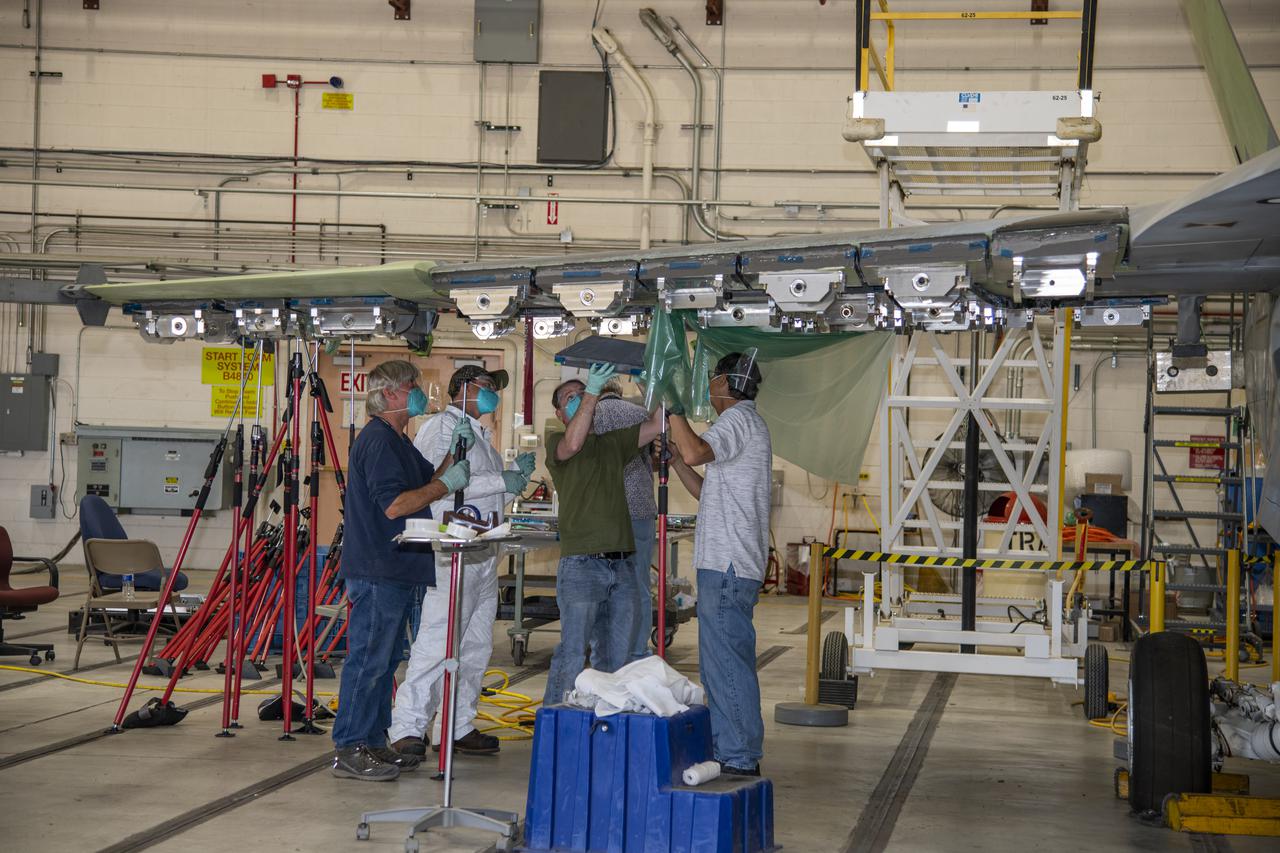
From left, Wally Hargis, Ray Sadler, Chris Mount, and Ronnie Haraguchi place a load pad on the aircraft surface of a F/A-18E from the Naval Air Systems Command (NAVAIR) in Patuxent River, Maryland. The aircraft is in NASA’s Armstrong Flight Research Center Flight Loads Laboratory in Edwards, California, for the center’s biggest load calibrations tests. This testing is needed before the aircraft can serve as a test vehicle for determining if it can safely manage maneuvers and proposed upgrades.
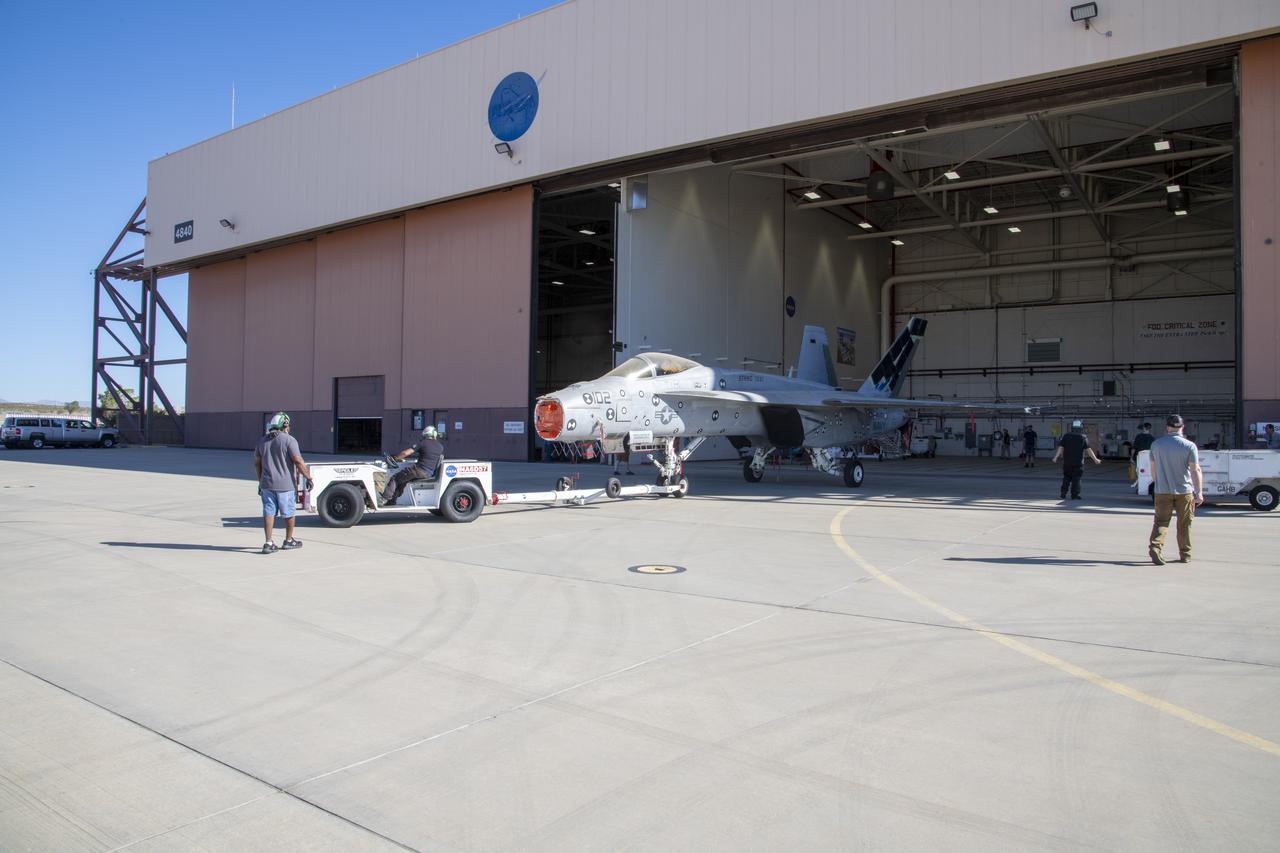
An F/A-18E from the Naval Air Systems Command (NAVAIR) in Patuxent River, Maryland, is moved from NASA’s Armstrong Flight Research Center Flight Loads Laboratory in Edwards, California, to a hangar where it will undergo final preparations to return to its squadron. The aircraft underwent the center’s biggest load calibrations tests. The testing will permit the aircraft to serve as a test vehicle to determine if it can safely manage maneuvers and proposed upgrades.

The jacks are lowered to remove them from under the F/A-18E from the Naval Air Systems Command (NAVAIR) in Patuxent River, Maryland. The aircraft is in NASA’s Armstrong Flight Research Center Flight Loads Laboratory in Edwards, California, for the center’s biggest load calibrations tests. This testing is needed before the aircraft can serve as a test vehicle for determining if it can safely manage maneuvers and proposed upgrades.
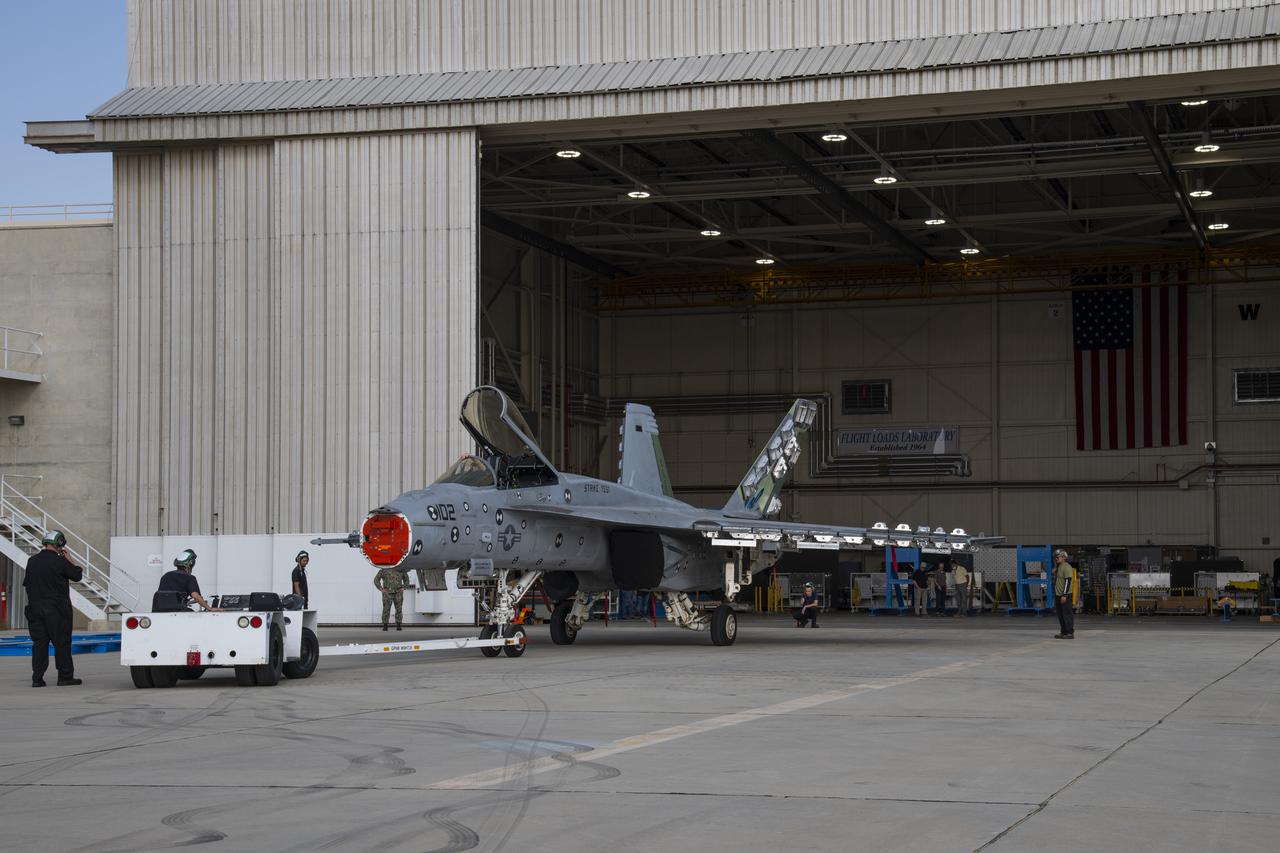
The Naval Air Systems Command (NAVAIR) in Patuxent River, Maryland F/A-18E is moved to NASA’s Armstrong Flight Research Center Flight Loads Laboratory in Edwards, California. NASA Armstrong is working on its biggest load calibrations tests on an F/A-18E Super Hornet. This testing is needed before the aircraft can serve as a test vehicle for determining if it can safely manage maneuvers and proposed upgrades.
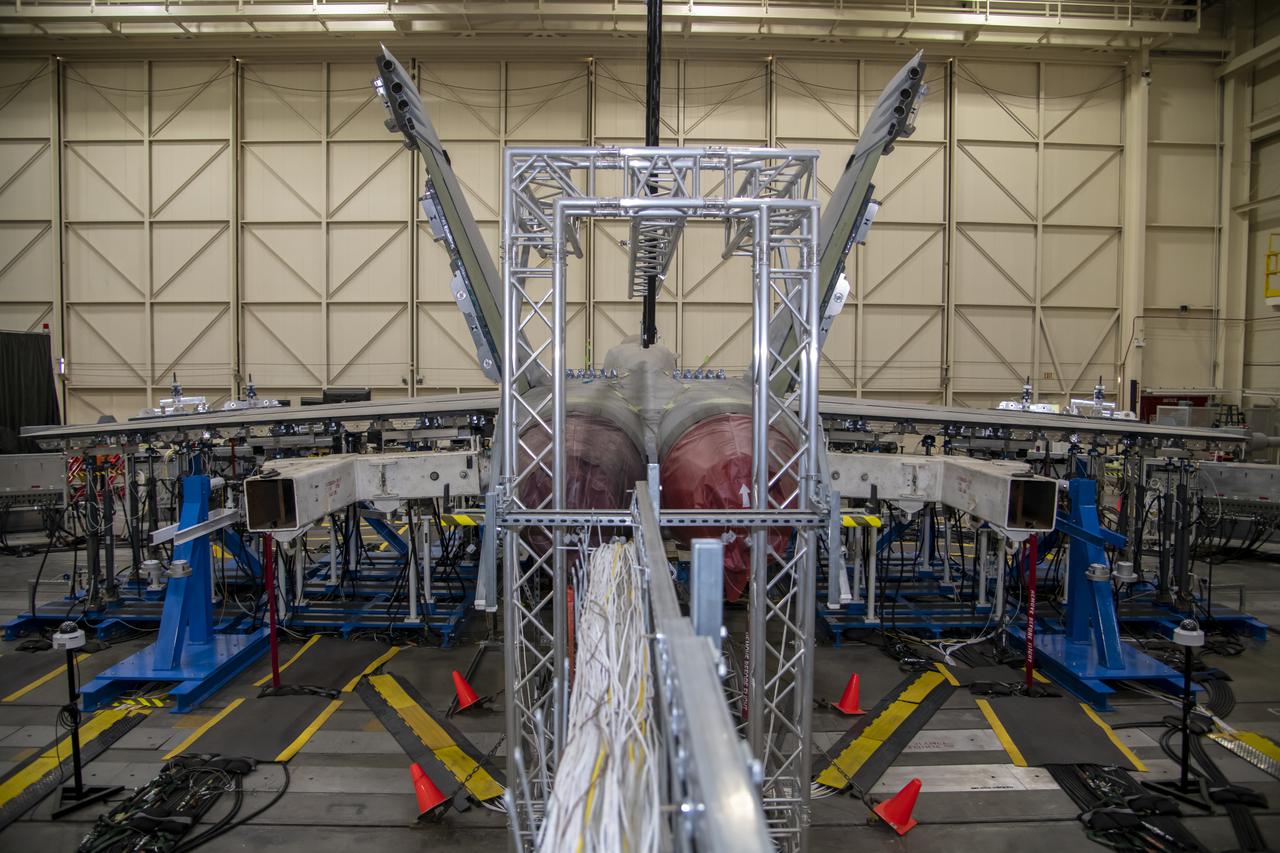
This rear view shows the wing loading test configuration and testing area of an F/A-18E from the Naval Air Systems Command (NAVAIR) in Patuxent River, Maryland. The aircraft is in NASA's Armstrong Flight Research Center Flight Loads Laboratory in Edwards, California, for the center's biggest load calibrations tests. This testing is needed before the aircraft can serve as a test vehicle for determining if it can safely manage maneuvers and proposed upgrades
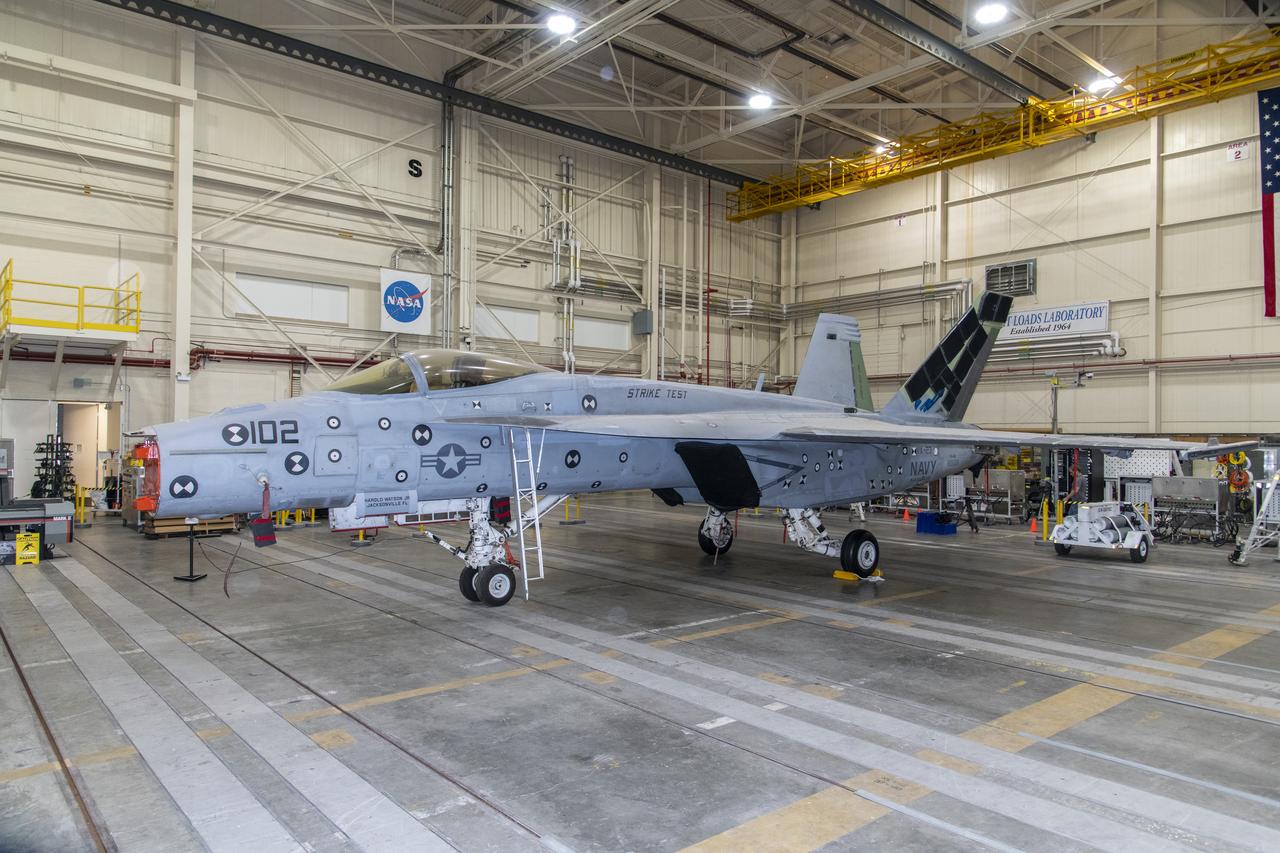
This right-side view shows an F/A-18E from the Naval Air Systems Command (NAVAIR) in Patuxent River, Maryland. The aircraft is in NASA’s Armstrong Flight Research Center Flight Loads Laboratory in Edwards, California, where it underwent the center’s biggest load calibrations tests. This testing will permit the aircraft to serve as a test vehicle for determining if it can safely manage maneuvers and proposed upgrades.
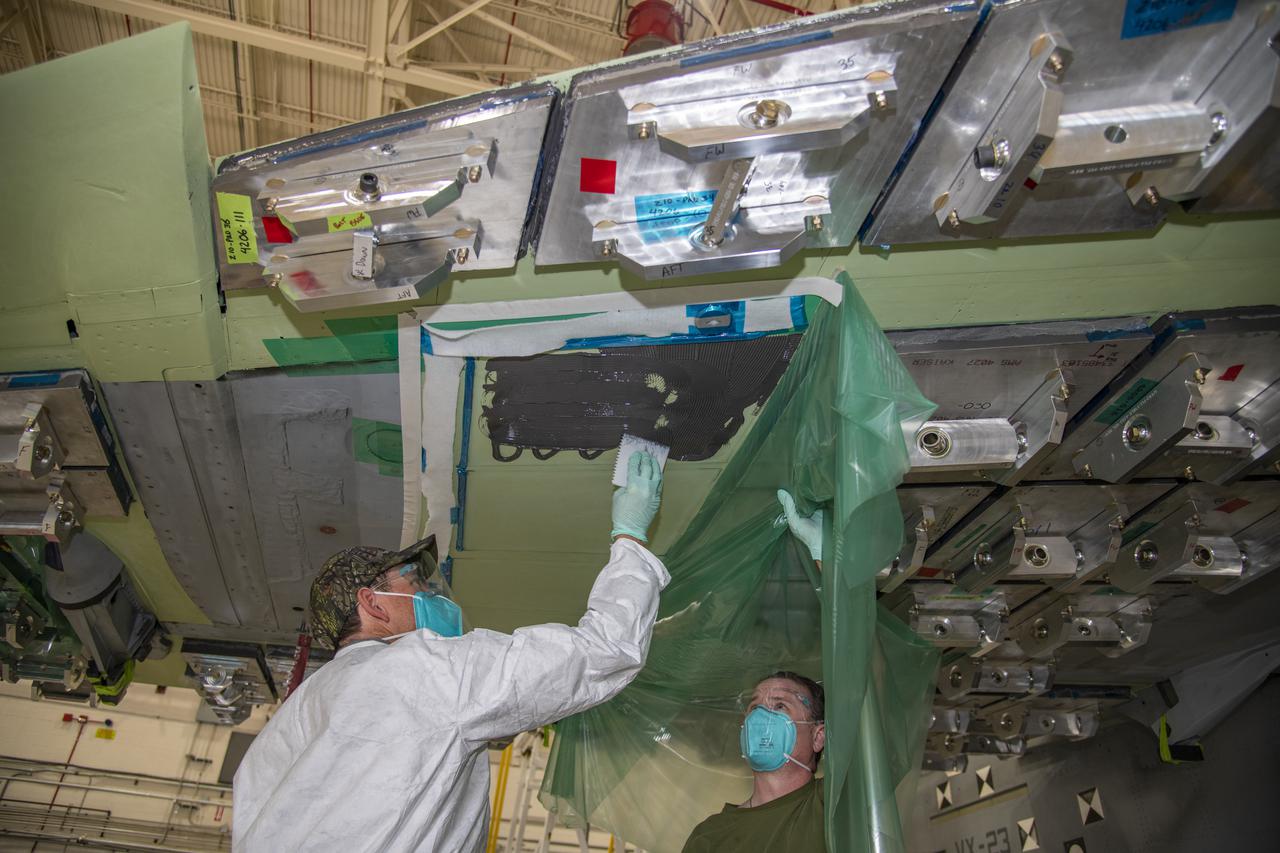
Ray Sadler, left, and Chris Mount spread tank sealant on the aircraft surface of a F/A-18E from the Naval Air Systems Command (NAVAIR) in Patuxent River, Maryland. The aircraft is in NASA’s Armstrong Flight Research Center Flight Loads Laboratory in Edwards, California, for the center’s biggest load calibrations tests. This testing is needed before the aircraft can serve as a test vehicle for determining if it can safely manage maneuvers and proposed upgrades.
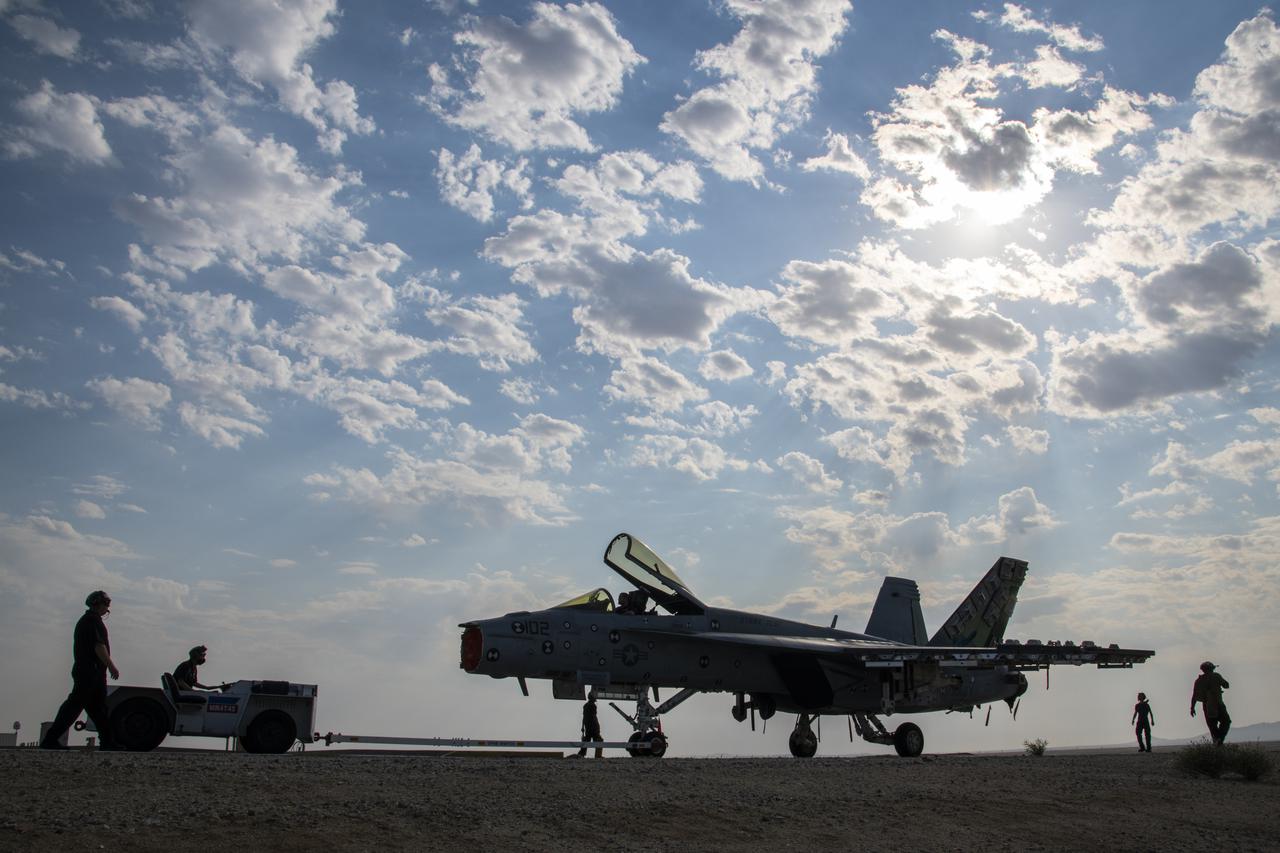
The Naval Air Systems Command (NAVAIR) in Patuxent River, Maryland F/A-18E is moved to NASA’s Armstrong Flight Research Center Flight Loads Laboratory in Edwards, California. NASA Armstrong is working on its biggest load calibrations tests on an F/A-18E Super Hornet. This testing is needed before the aircraft can serve as a test vehicle for determining if it can safely manage maneuvers and proposed upgrades.
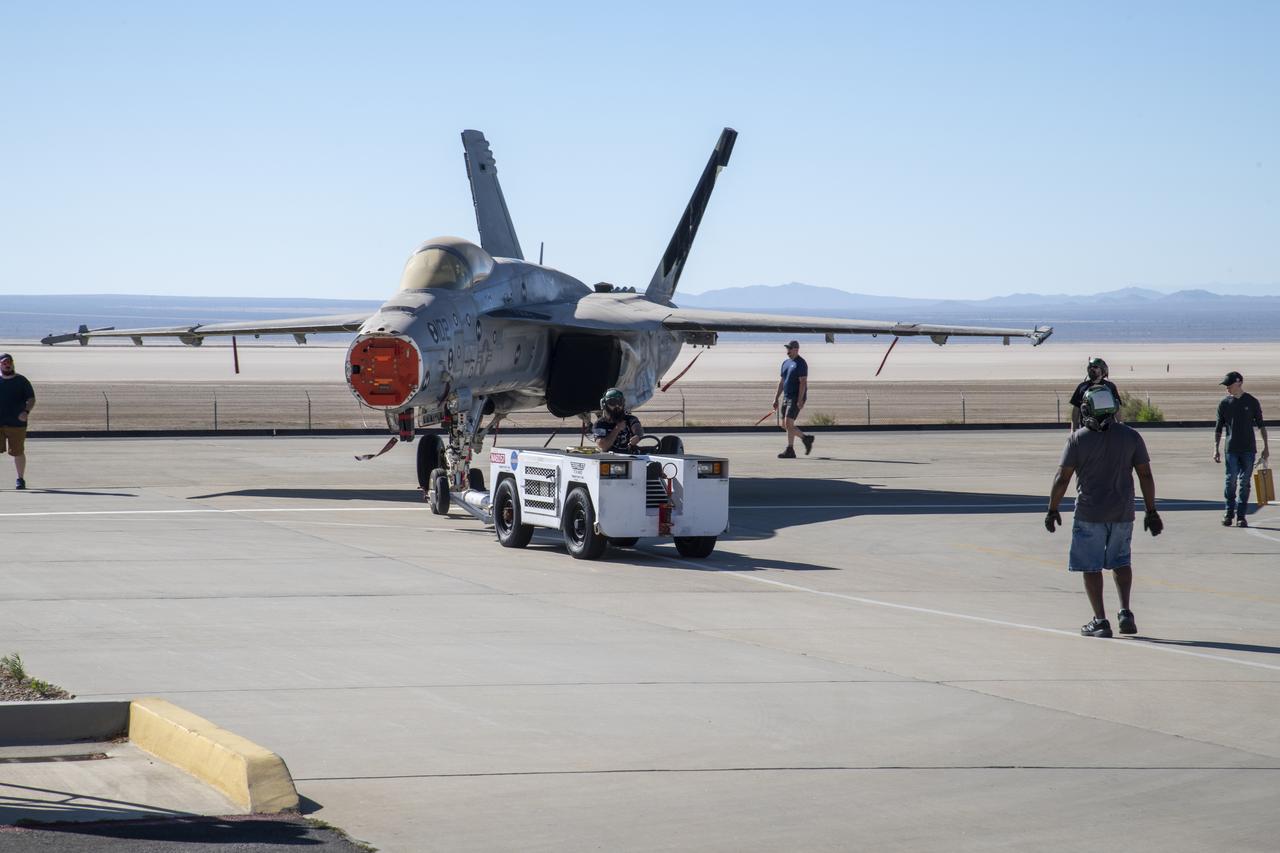
An F/A-18E from the Naval Air Systems Command (NAVAIR) in Patuxent River, Maryland, is moved from NASA’s Armstrong Flight Research Center Flight Loads Laboratory in Edwards, California, to a hangar where it will undergo final preparations to return to its squadron. The aircraft underwent the center’s biggest load calibrations tests. The testing will permit the aircraft to serve as a test vehicle to determine if it can safely manage maneuvers and proposed upgrades.
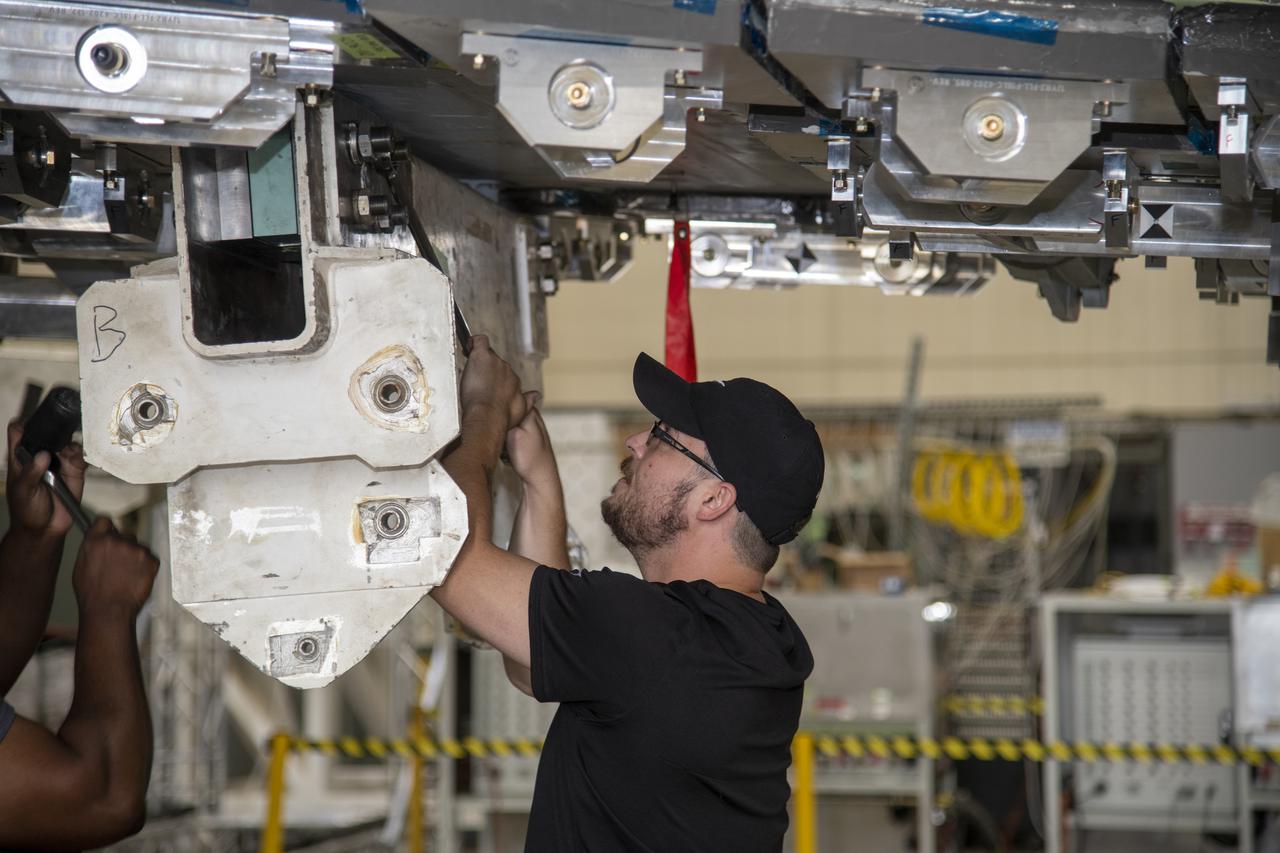
The outboard pylon load fixture is secured for the F/A-18E from the Naval Air Systems Command (NAVAIR) in Patuxent River, Maryland. The aircraft is in NASA’s Armstrong Flight Research Center Flight Loads Laboratory in Edwards, California, for the center’s biggest load calibrations tests. This testing is needed before the aircraft can serve as a test vehicle for determining if it can safely manage maneuvers and proposed upgrades.
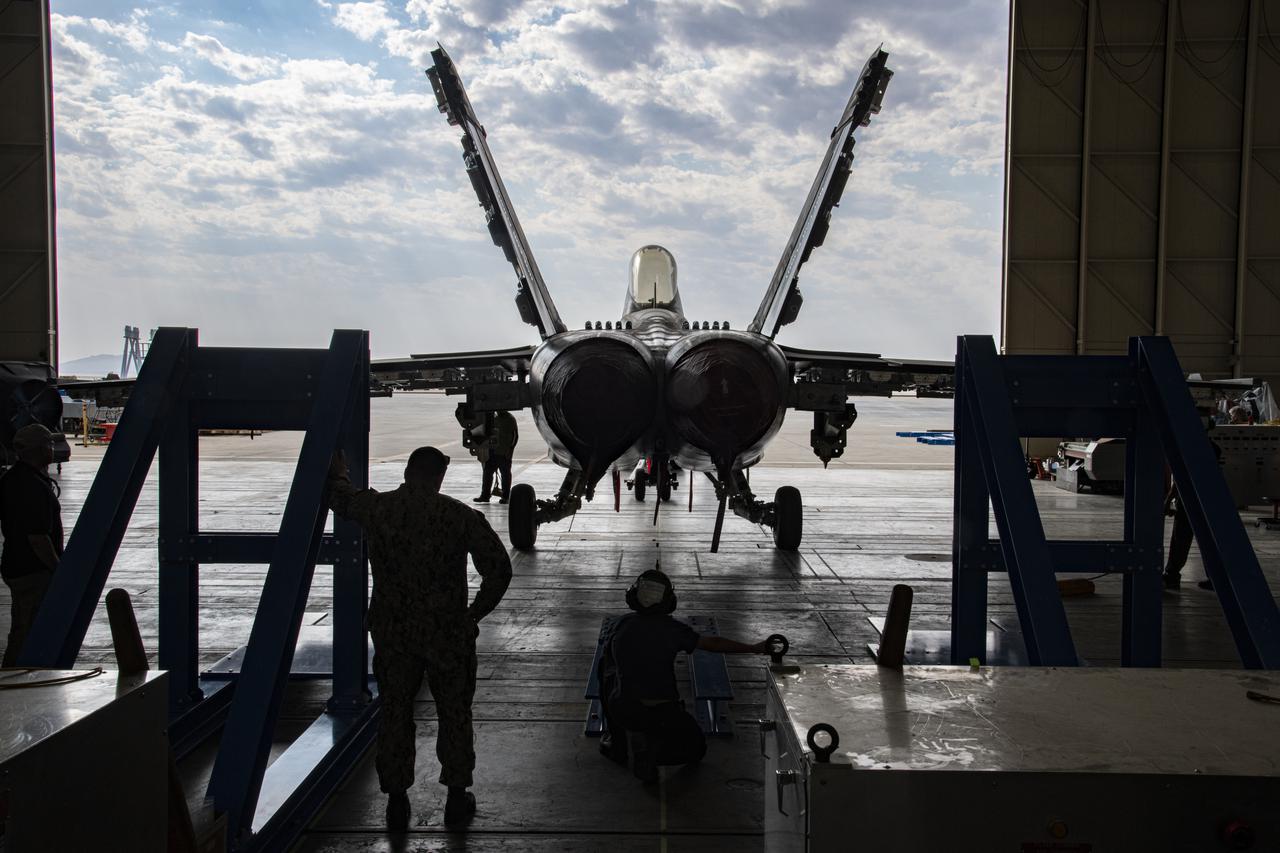
The Naval Air Systems Command (NAVAIR) in Patuxent River, Maryland F/A-18E is moved to NASA’s Armstrong Flight Research Center Flight Loads Laboratory in Edwards, California. NASA Armstrong is working on its biggest load calibrations tests on an F/A-18E Super Hornet. This testing is needed before the aircraft can serve as a test vehicle for determining if it can safely manage maneuvers and proposed upgrades.
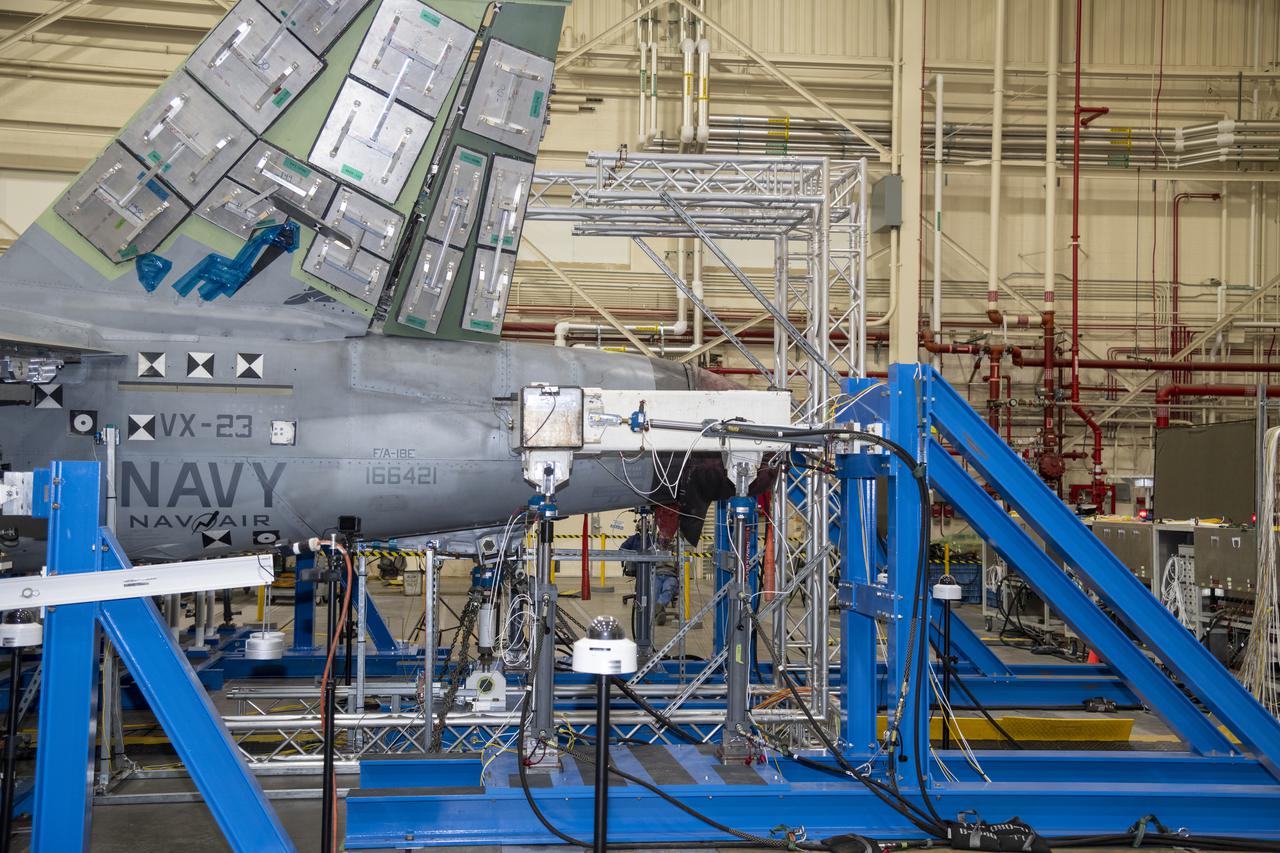
The horizontal tail is under test load on a F/A-18E from the Naval Air Systems Command (NAVAIR) in Patuxent River, Maryland. The aircraft is in NASA’s Armstrong Flight Research Center Flight Loads Laboratory in Edwards, California, for the center’s biggest load calibrations tests. This testing is needed before the aircraft can serve as a test vehicle for determining if it can safely manage maneuvers and proposed upgrades.
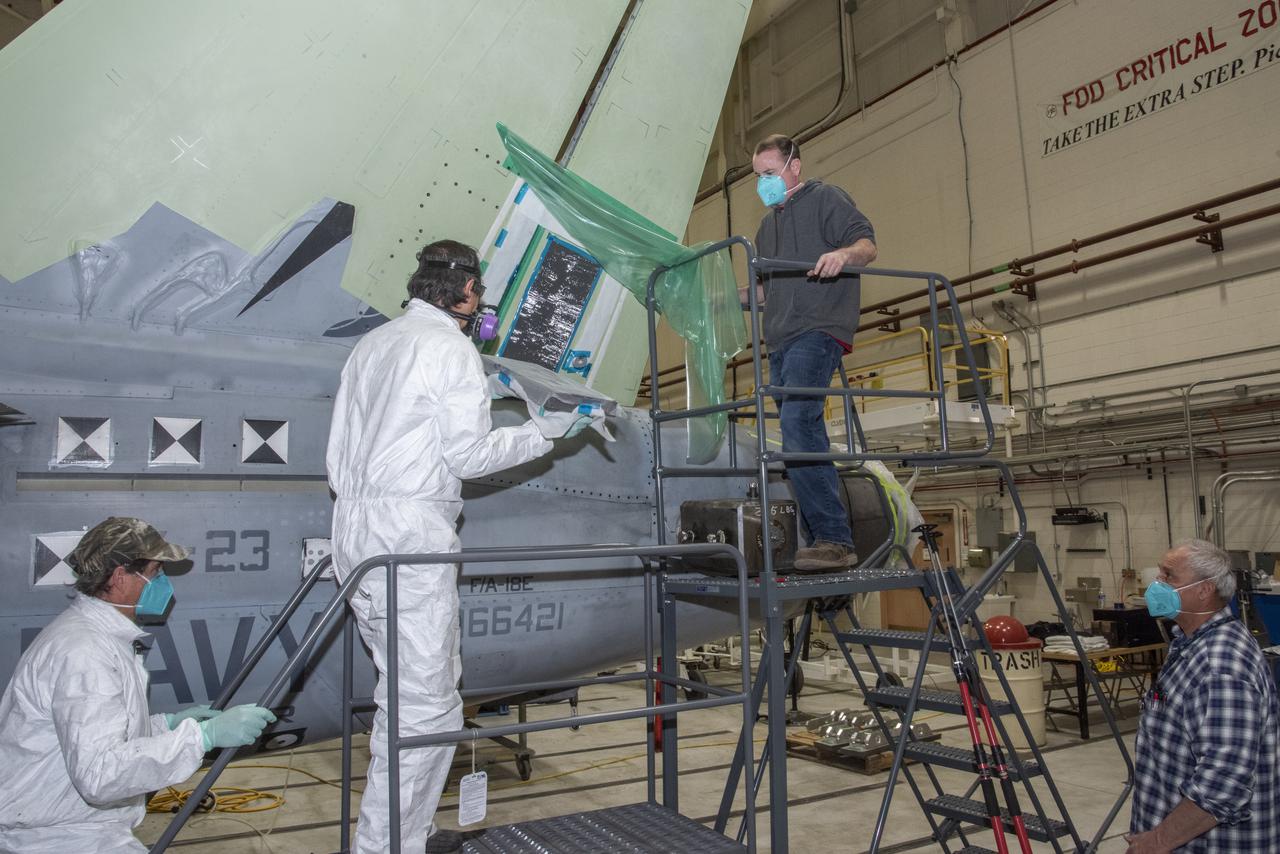
The load pad bonding process for the vertical tails was a preliminary step in the process to test the F/A-18E from the Naval Air Systems Command (NAVAIR) in Patuxent River, Maryland. The aircraft is in NASA’s Armstrong Flight Research Center Flight Loads Laboratory in Edwards, California, for the center’s biggest load calibrations tests. This testing is needed before the aircraft can serve as a test vehicle for determining if it can safely manage maneuvers and proposed upgrades.
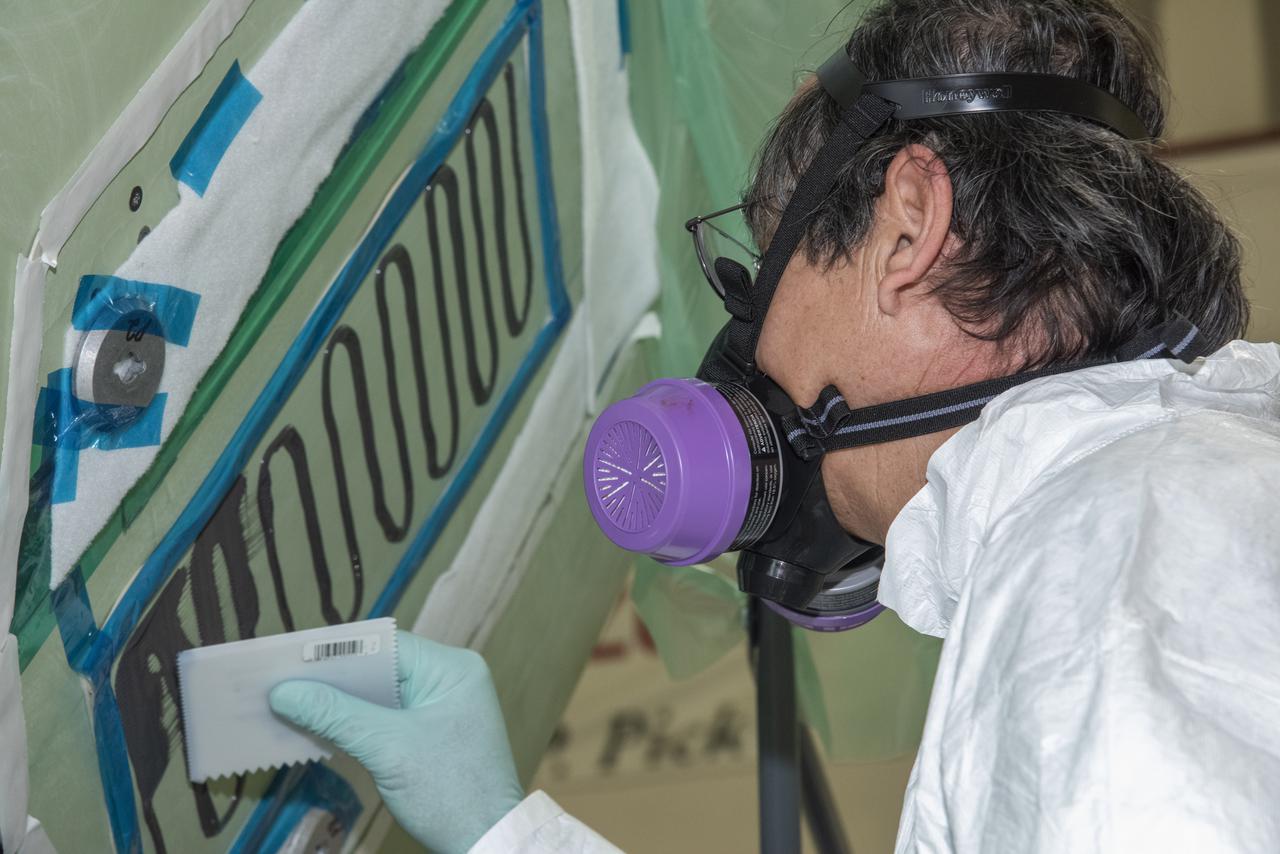
The load pad bonding process for the vertical tails was a preliminary step in the process to test the F/A-18E from the Naval Air Systems Command (NAVAIR) in Patuxent River, Maryland. The aircraft is in NASA’s Armstrong Flight Research Center Flight Loads Laboratory in Edwards, California, for the center’s biggest load calibrations tests. This testing is needed before the aircraft can serve as a test vehicle for determining if it can safely manage maneuvers and proposed upgrades.
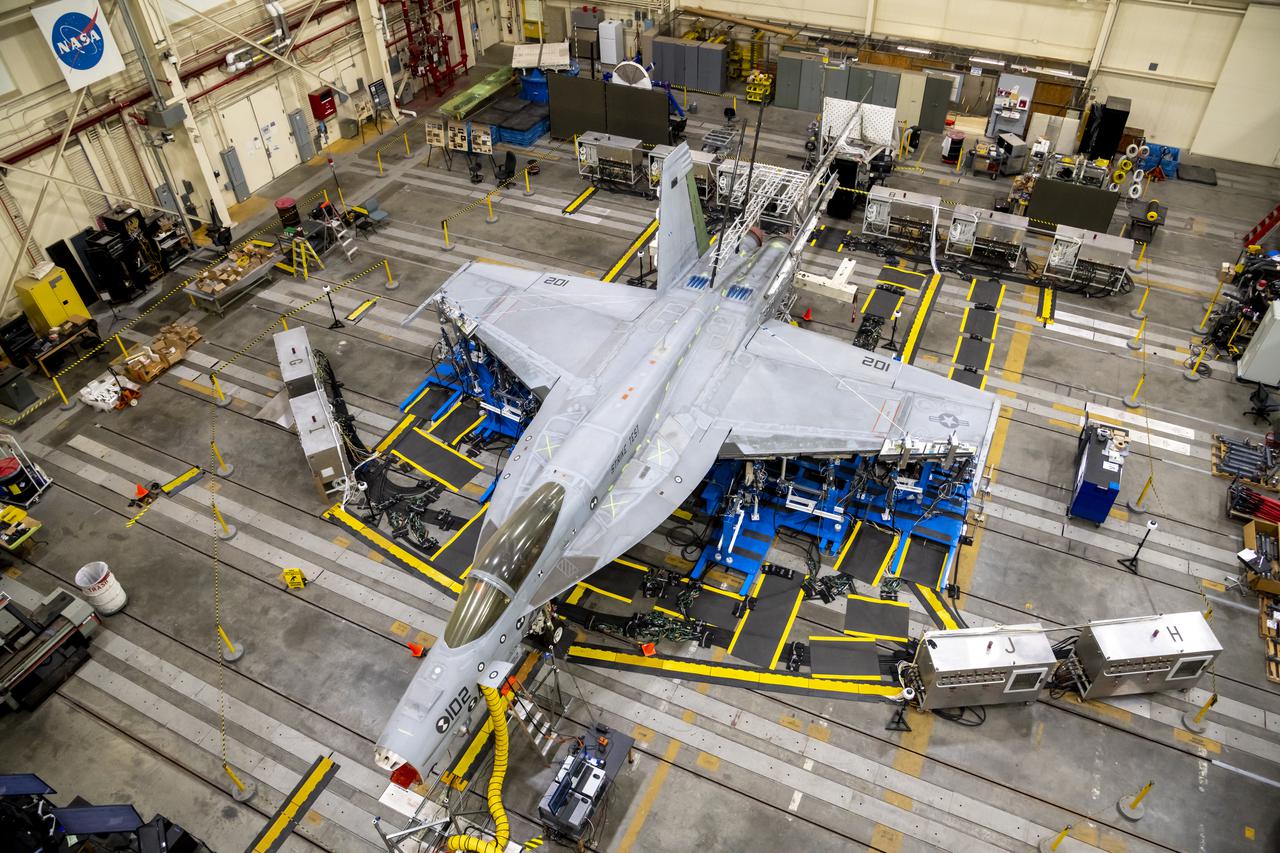
A top view shows the wing loading test configuration of a F/A-18E from the Naval Air Systems Command (NAVAIR) in Patuxent River, Maryland. The aircraft is in NASA’s Armstrong Flight Research Center Flight Loads Laboratory in Edwards, California, for the center’s biggest load calibrations tests. This testing is needed before the aircraft can serve as a test vehicle for determining if it can safely manage maneuvers and proposed upgrades.
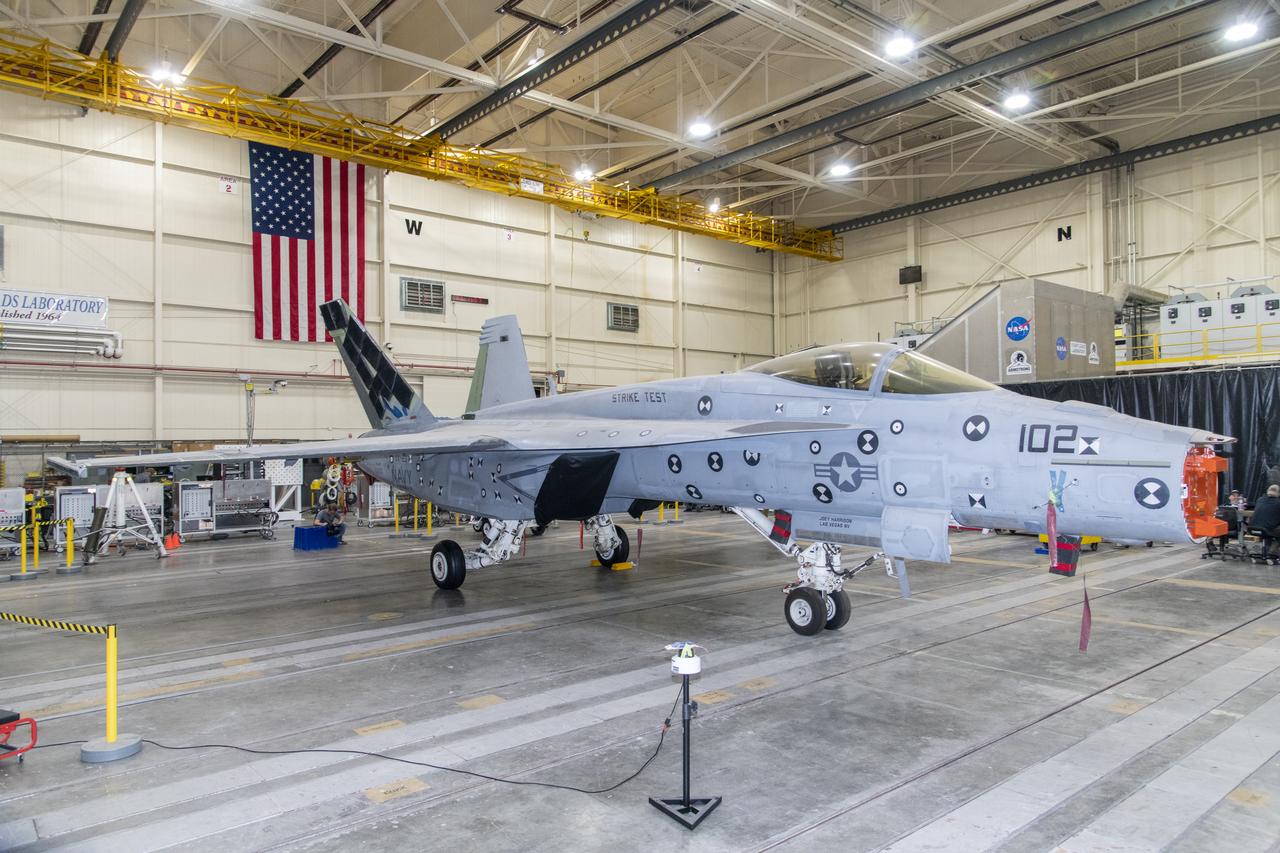
This left-side view shows an F/A-18E from the Naval Air Systems Command (NAVAIR) in Patuxent River, Maryland. The aircraft is in NASA’s Armstrong Flight Research Center Flight Loads Laboratory in Edwards, California, where it underwent the center’s biggest load calibrations tests. This testing will permit the aircraft to serve as a test vehicle to determine if it can safely manage maneuvers and proposed upgrades.
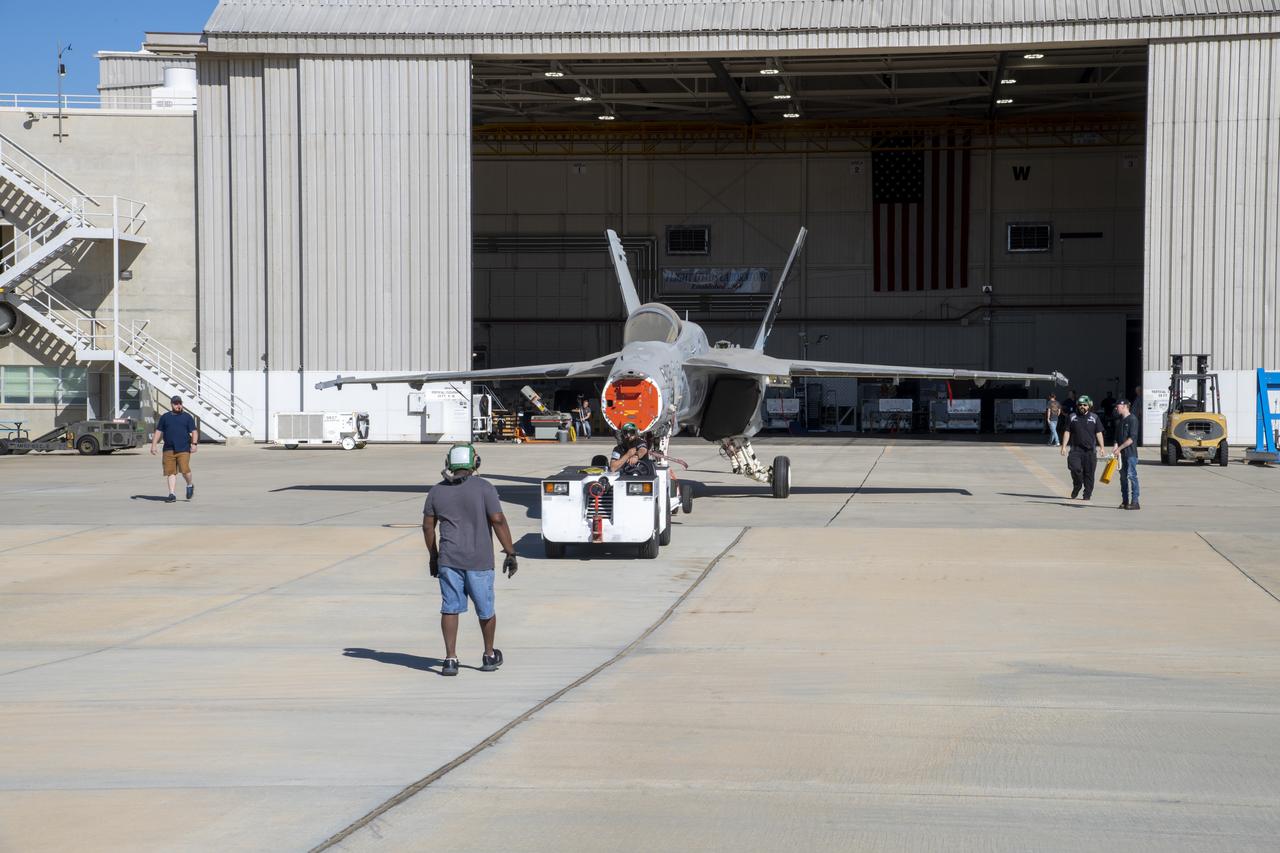
An F/A-18E from the Naval Air Systems Command (NAVAIR) in Patuxent River, Maryland, is moved from NASA’s Armstrong Flight Research Center Flight Loads Laboratory in Edwards, California, to a hangar where it will undergo final preparations to return to its squadron. The aircraft underwent the center’s biggest load calibrations tests. The testing will permit the aircraft to serve as a test vehicle to determine if it can safely manage maneuvers and proposed upgrades.
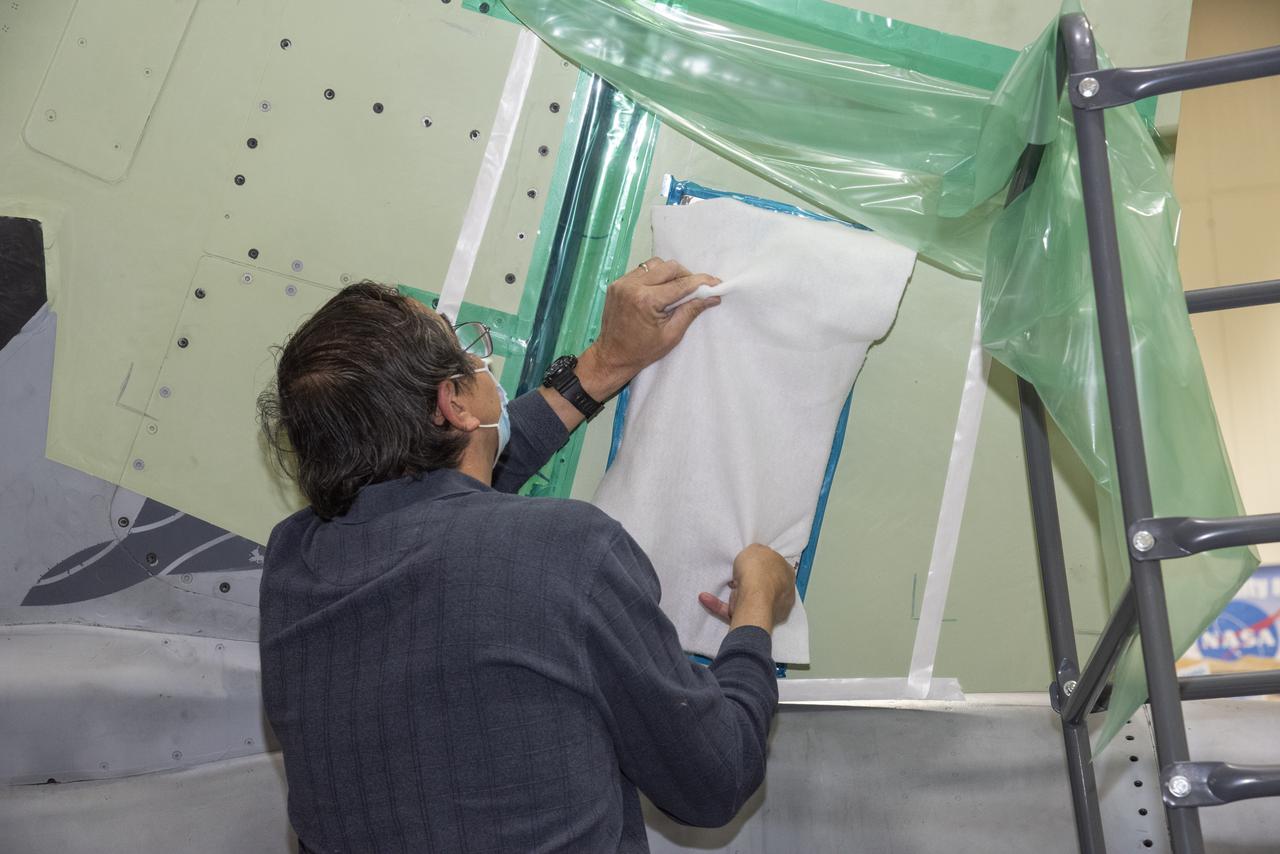
The load pad bonding process for the vertical tails was a preliminary step in the process to test the F/A-18E from the Naval Air Systems Command (NAVAIR) in Patuxent River, Maryland. The aircraft is in NASA’s Armstrong Flight Research Center Flight Loads Laboratory in Edwards, California, for the center’s biggest load calibrations tests. This testing is needed before the aircraft can serve as a test vehicle for determining if it can safely manage maneuvers and proposed upgrades.
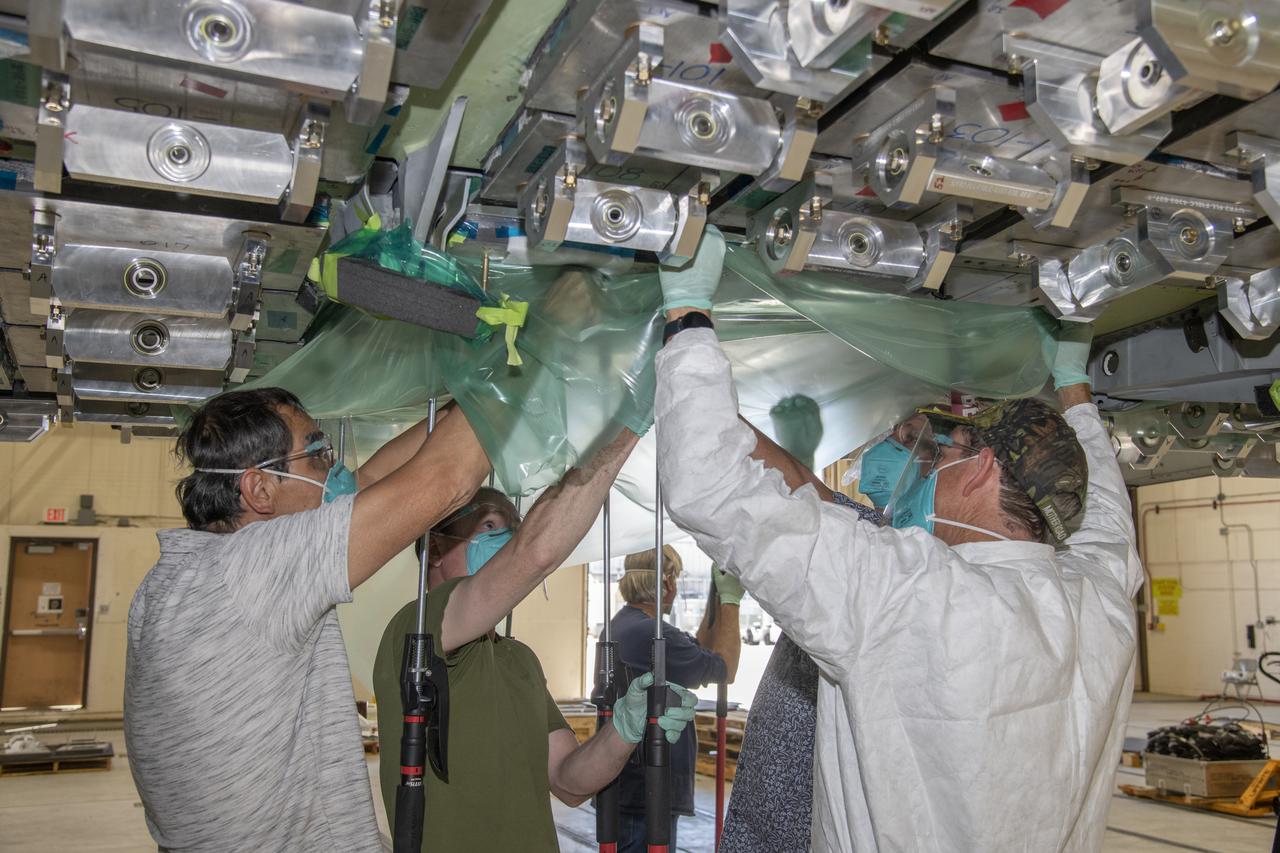
From left, Ronnie Haraguchi, Chris Mount, and Ray Sadler vacuum bag load pads on the aircraft surface of a F/A-18E from the Naval Air Systems Command (NAVAIR) in Patuxent River, Maryland. The aircraft is in NASA's Armstrong Flight Research Center Flight Loads Laboratory in Edwards, California, for the center's biggest load calibrations tests. This testing is needed before the aircraft can serve as a test vehicle for determining if it can safely manage maneuvers and proposed upgrades.
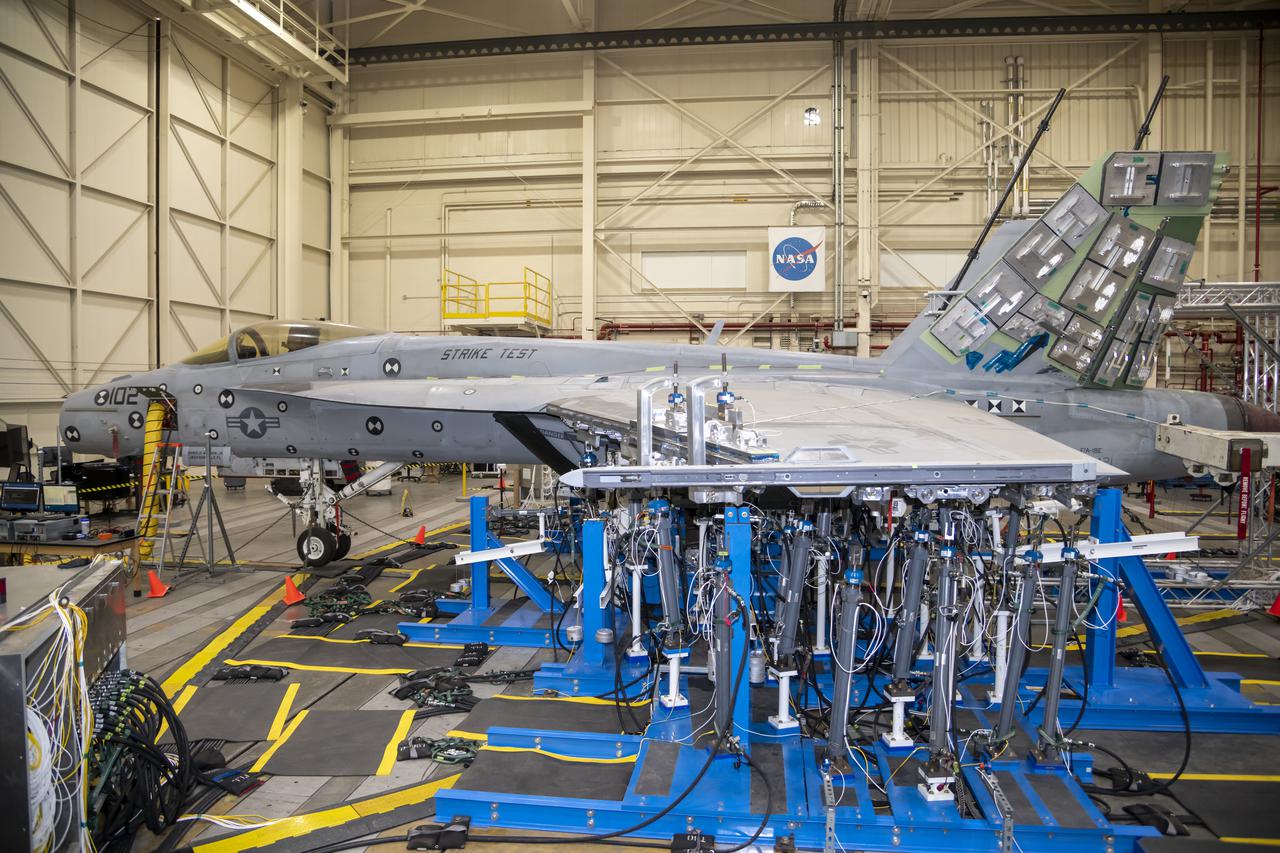
Left wing load hardware is setup for testing a F/A-18E from the Naval Air Systems Command (NAVAIR) in Patuxent River, Maryland. The aircraft is in NASA's Armstrong Flight Research Center Flight Loads Laboratory in Edwards, California, for the center's biggest load calibrations tests. This testing is needed before the aircraft can serve as a test vehicle for determining if it can safely manage maneuvers and proposed upgrades.
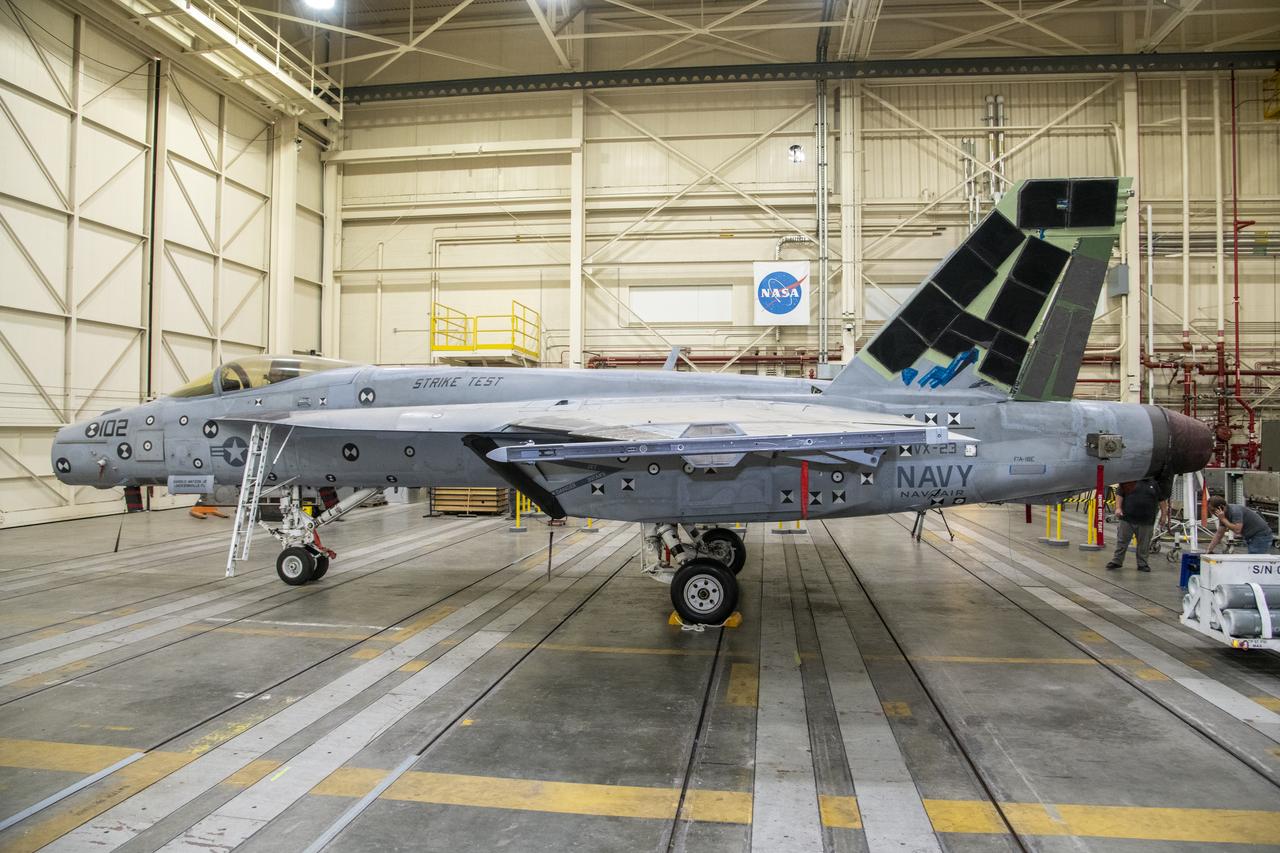
This right-side view shows an F/A-18E from the Naval Air Systems Command (NAVAIR) in Patuxent River, Maryland. The aircraft is in NASA’s Armstrong Flight Research Center Flight Loads Laboratory in Edwards, California, where it underwent the center’s biggest load calibrations tests. This testing will permit the aircraft to serve as a test vehicle to determine if it can safely manage maneuvers and proposed upgrades.

Load pads are bonded to the aircraft surface of a F/A-18E from the Naval Air Systems Command (NAVAIR) in Patuxent River, Maryland, while under pressure. The aircraft is in NASA’s Armstrong Flight Research Center Flight Loads Laboratory in Edwards, California, for the center’s biggest load calibrations tests. This testing is needed before the aircraft can serve as a test vehicle for determining if it can safely manage maneuvers and proposed upgrades
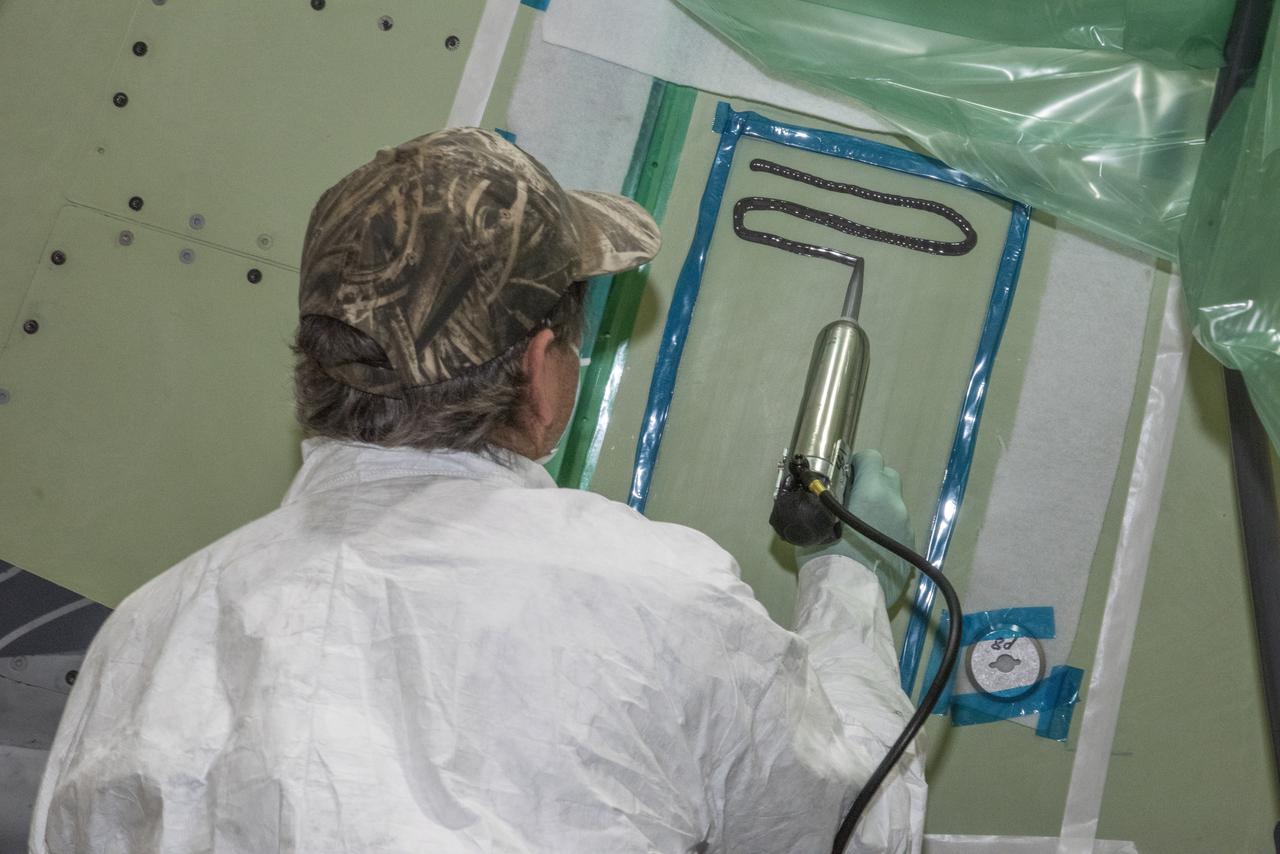
The load pad bonding process for the vertical tails was a preliminary step in the process to test the F/A-18E from the Naval Air Systems Command (NAVAIR) in Patuxent River, Maryland. The aircraft is in NASA’s Armstrong Flight Research Center Flight Loads Laboratory in Edwards, California, for the center’s biggest load calibrations tests. This testing is needed before the aircraft can serve as a test vehicle for determining if it can safely manage maneuvers and proposed upgrades.
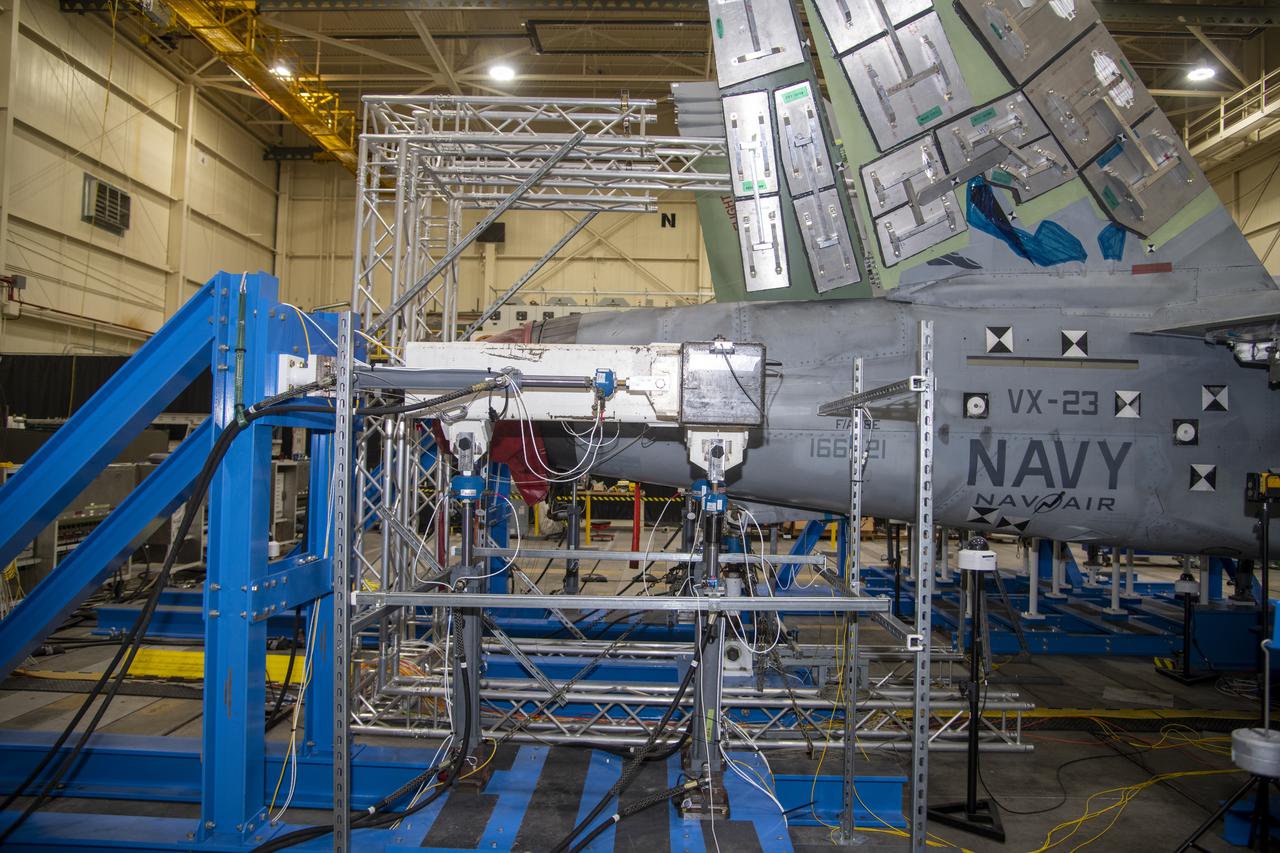
– Hydraulic actuators are pinned to horizontal tail test fixture for testing a F/A-18E from the Naval Air Systems Command (NAVAIR) in Patuxent River, Maryland. The aircraft is in NASA’s Armstrong Flight Research Center Flight Loads Laboratory in Edwards, California, for the center’s biggest load calibrations tests. This testing is needed before the aircraft can serve as a test vehicle for determining if it can safely manage maneuvers and proposed upgrades.
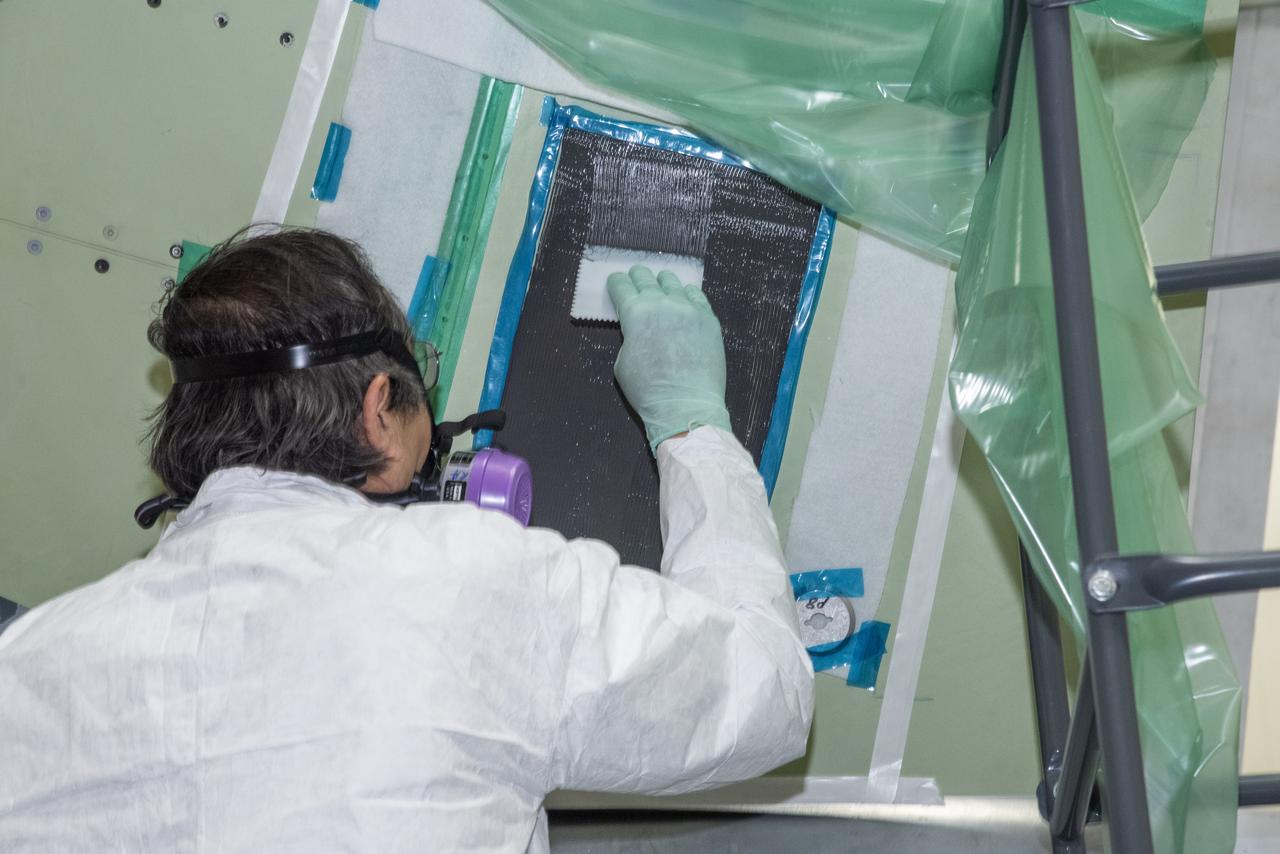
The load pad bonding process for the vertical tails was a preliminary step in the process to test the F/A-18E from the Naval Air Systems Command (NAVAIR) in Patuxent River, Maryland. The aircraft is in NASA’s Armstrong Flight Research Center Flight Loads Laboratory in Edwards, California, for the center’s biggest load calibrations tests. This testing is needed before the aircraft can serve as a test vehicle for determining if it can safely manage maneuvers and proposed upgrades.
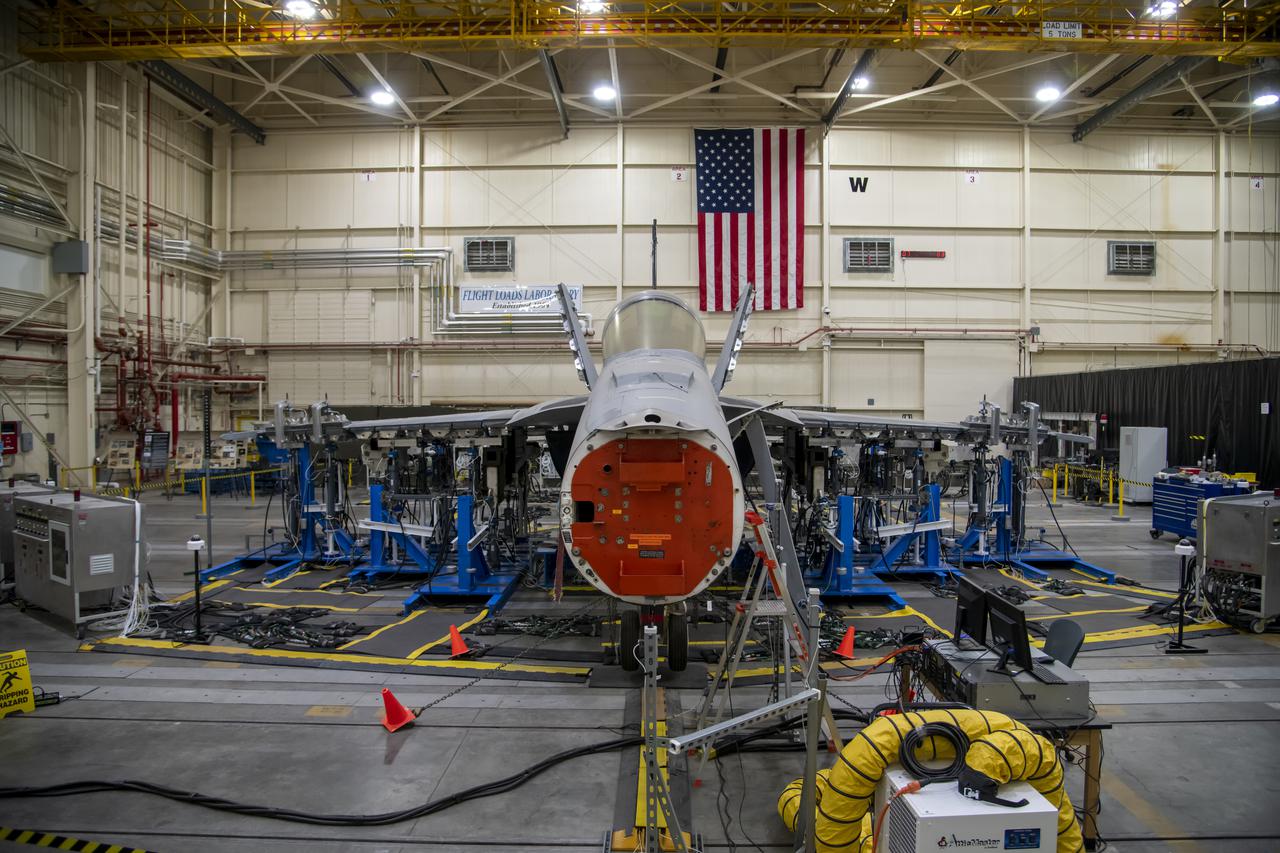
This front view shows the wing loading test configuration and testing area of an F/A-18E from the Naval Air Systems Command (NAVAIR) in Patuxent River, Maryland. The aircraft is in NASA's Armstrong Flight Research Center Flight Loads Laboratory in Edwards, California, for the center's biggest load calibrations tests. This testing is needed before the aircraft can serve as a test vehicle for determining if it can safely manage maneuvers and proposed upgrades.
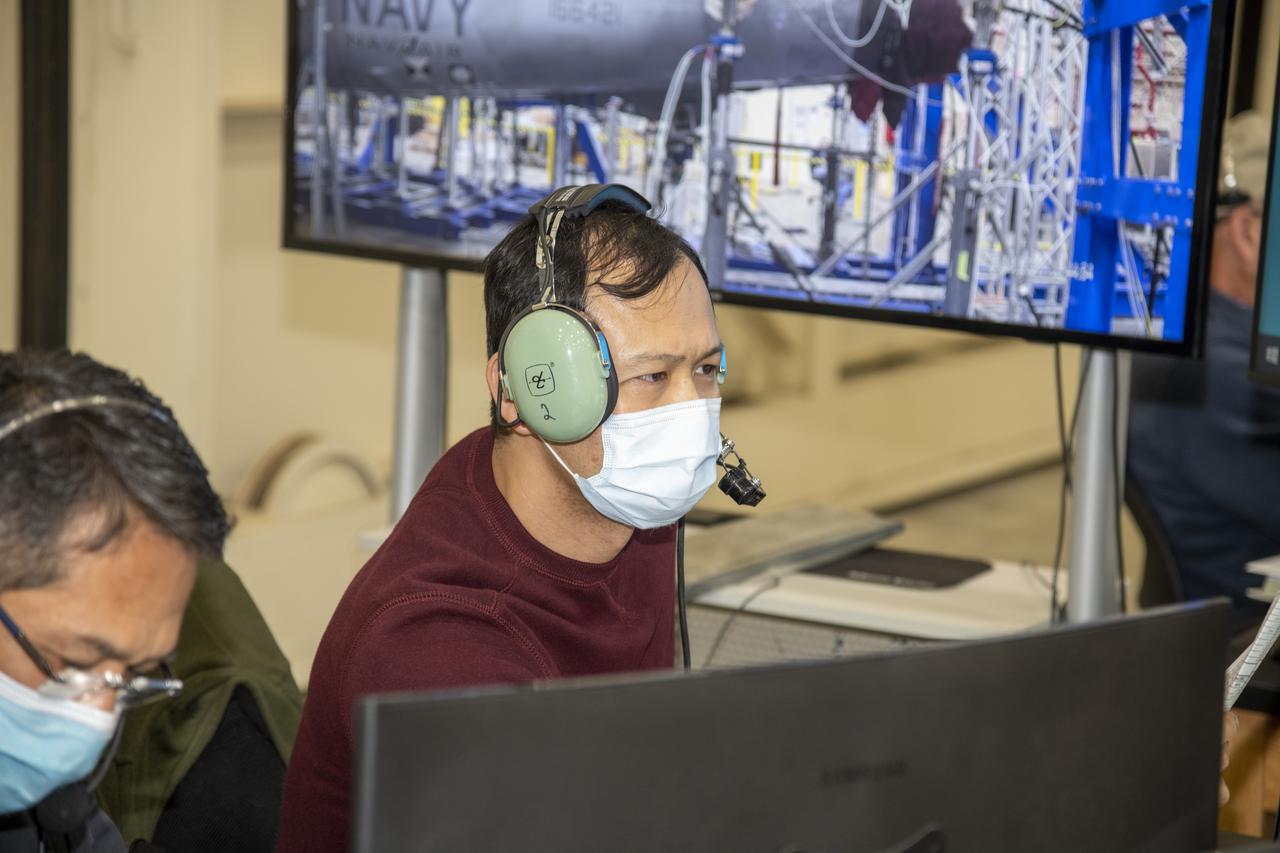
Larry Hudson and Tony Chen inspect test data during horizontal tail testing on a F/A-18E from the Naval Air Systems Command (NAVAIR) in Patuxent River, Maryland. The aircraft is in NASA's Armstrong Flight Research Center Flight Loads Laboratory in Edwards, California, for the center's biggest load calibrations tests. This testing is needed before the aircraft can serve as a test vehicle for determining if it can safely manage maneuvers and proposed upgrades.
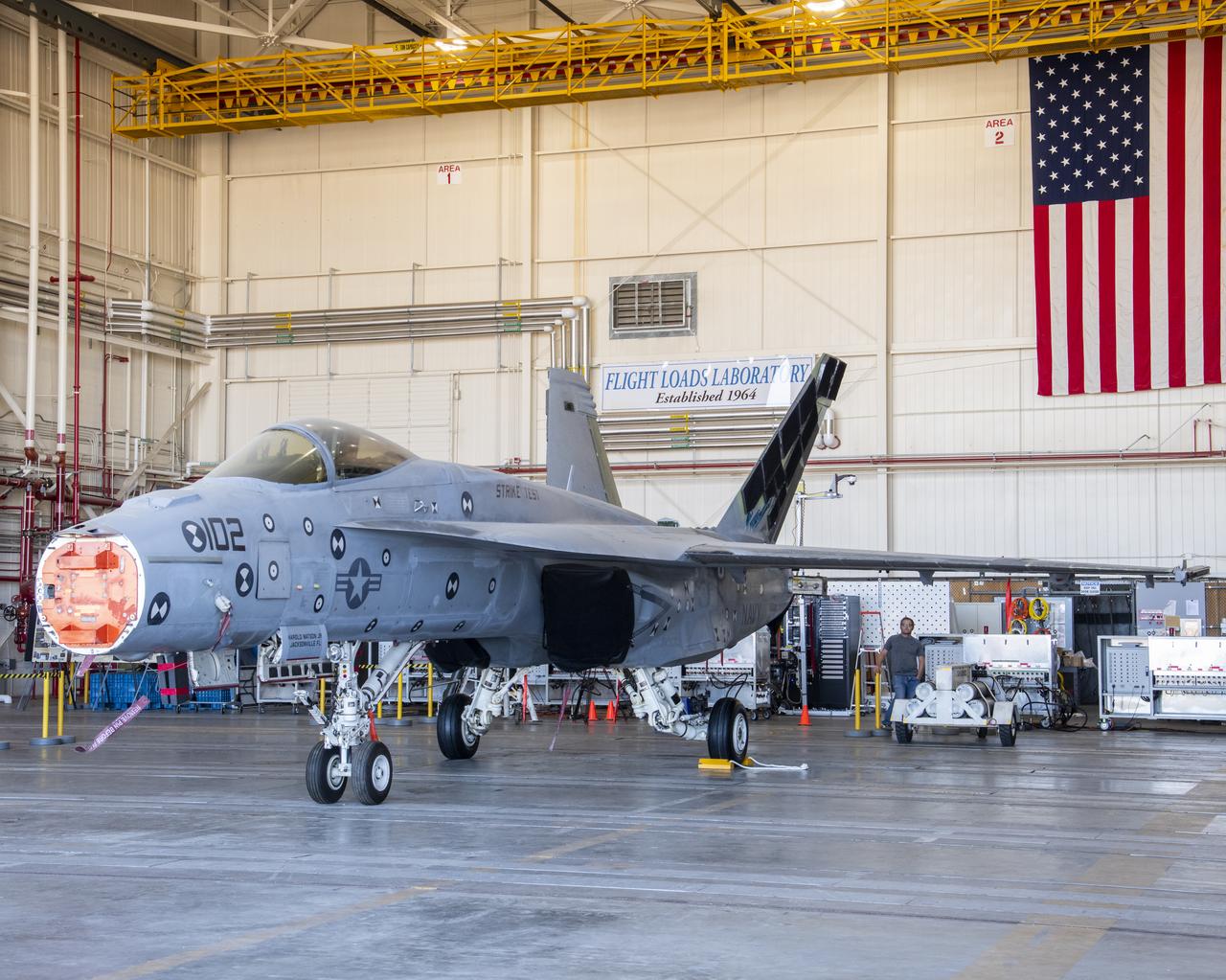
This front view shows an F/A-18E from the Naval Air Systems Command (NAVAIR) in Patuxent River, Maryland. The aircraft is in NASA’s Armstrong Flight Research Center Flight Loads Laboratory in Edwards, California, where it underwent the center’s biggest load calibrations tests. This testing will permit the aircraft to serve as a test vehicle to determine if it can safely manage maneuvers and proposed upgrades.
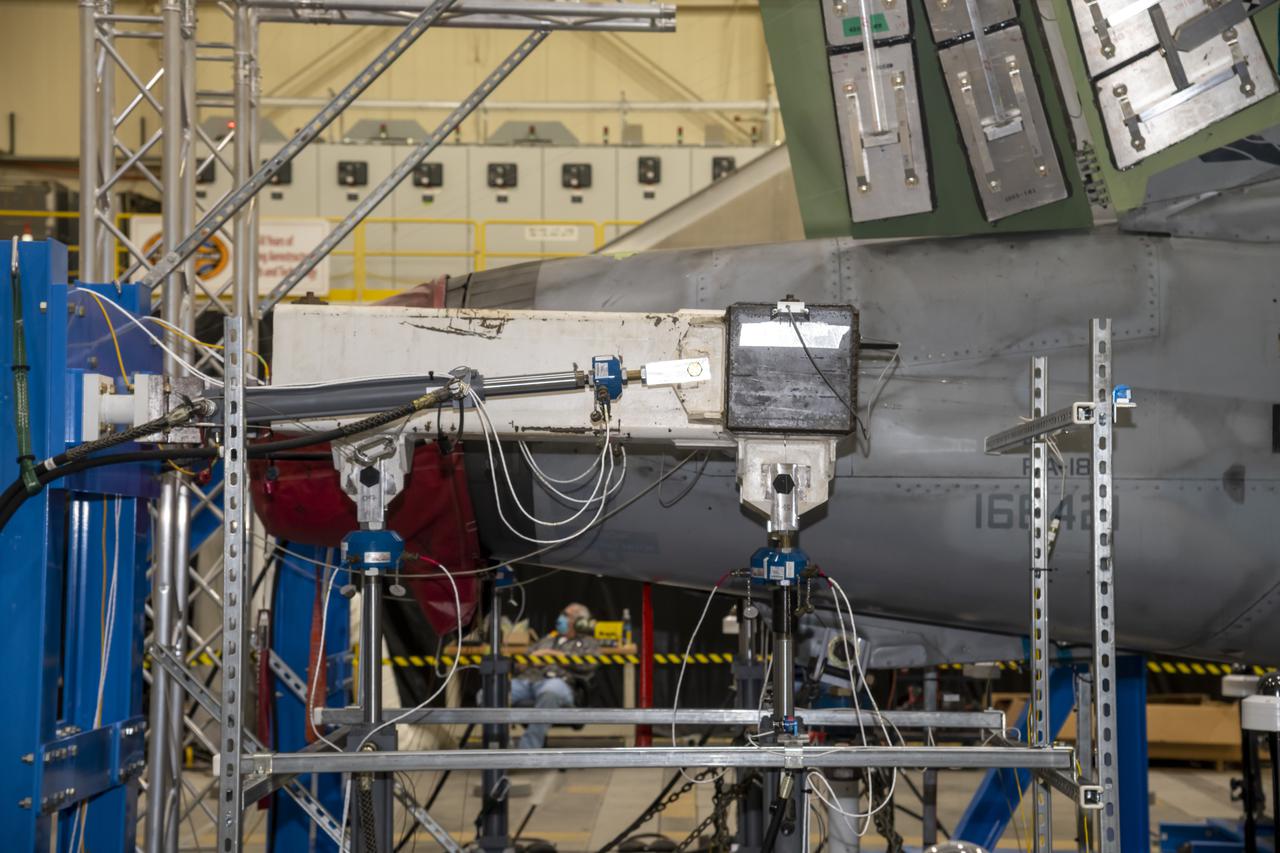
The horizontal tail is under test load on a F/A-18E from the Naval Air Systems Command (NAVAIR) in Patuxent River, Maryland. The aircraft is in NASA’s Armstrong Flight Research Center Flight Loads Laboratory in Edwards, California, for the center’s biggest load calibrations tests. This testing is needed before the aircraft can serve as a test vehicle for determining if it can safely manage maneuvers and proposed upgrades.
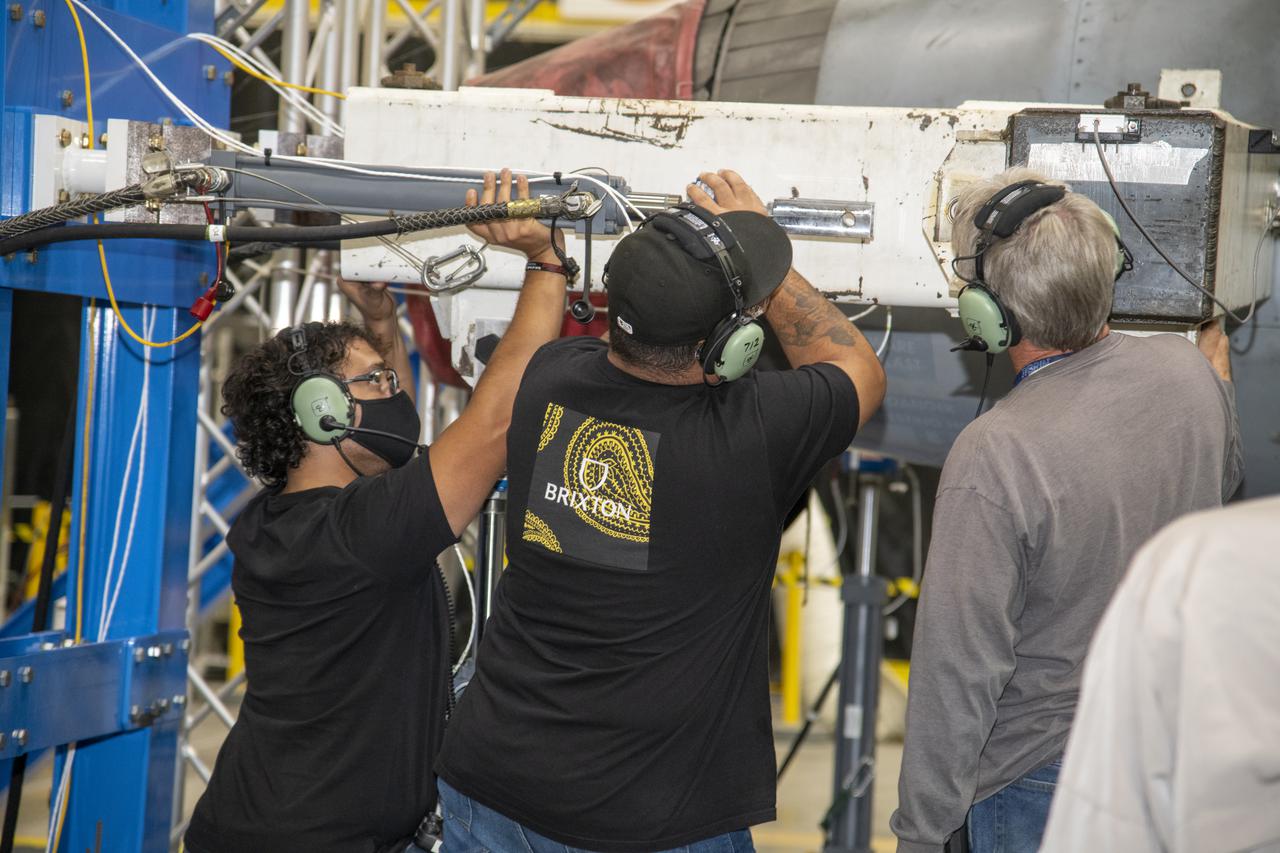
The actuator on the F/A-18E from the Naval Air Systems Command (NAVAIR) in Patuxent River, Maryland, is positioned for pinning to the horizontal tail load test fixture. The aircraft is in NASA’s Armstrong Flight Research Center Flight Loads Laboratory in Edwards, California, for the center’s biggest load calibrations tests. This testing is needed before the aircraft can serve as a test vehicle for determining if it can safely manage maneuvers and proposed upgrades.
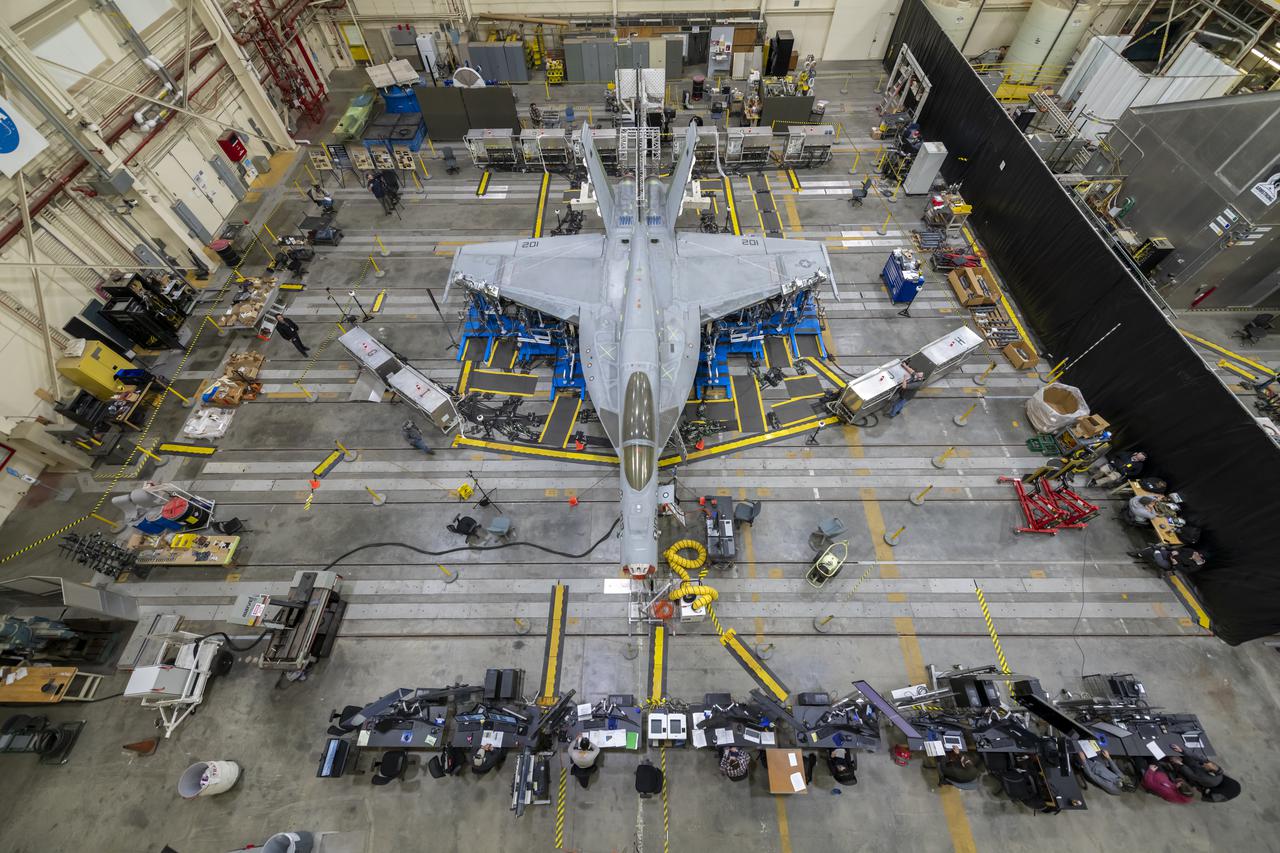
A center top view shows the wing loading test configuration and testing area of an F/A-18E from the Naval Air Systems Command (NAVAIR) in Patuxent River; Maryland. The aircraft is in NASA's Armstrong Flight Research Center Flight Loads Laboratory in Edwards; California; for the center's biggest load calibrations tests. This testing is needed before the aircraft can serve as a test vehicle for determining if it can safely manage maneuvers and proposed upgrades.
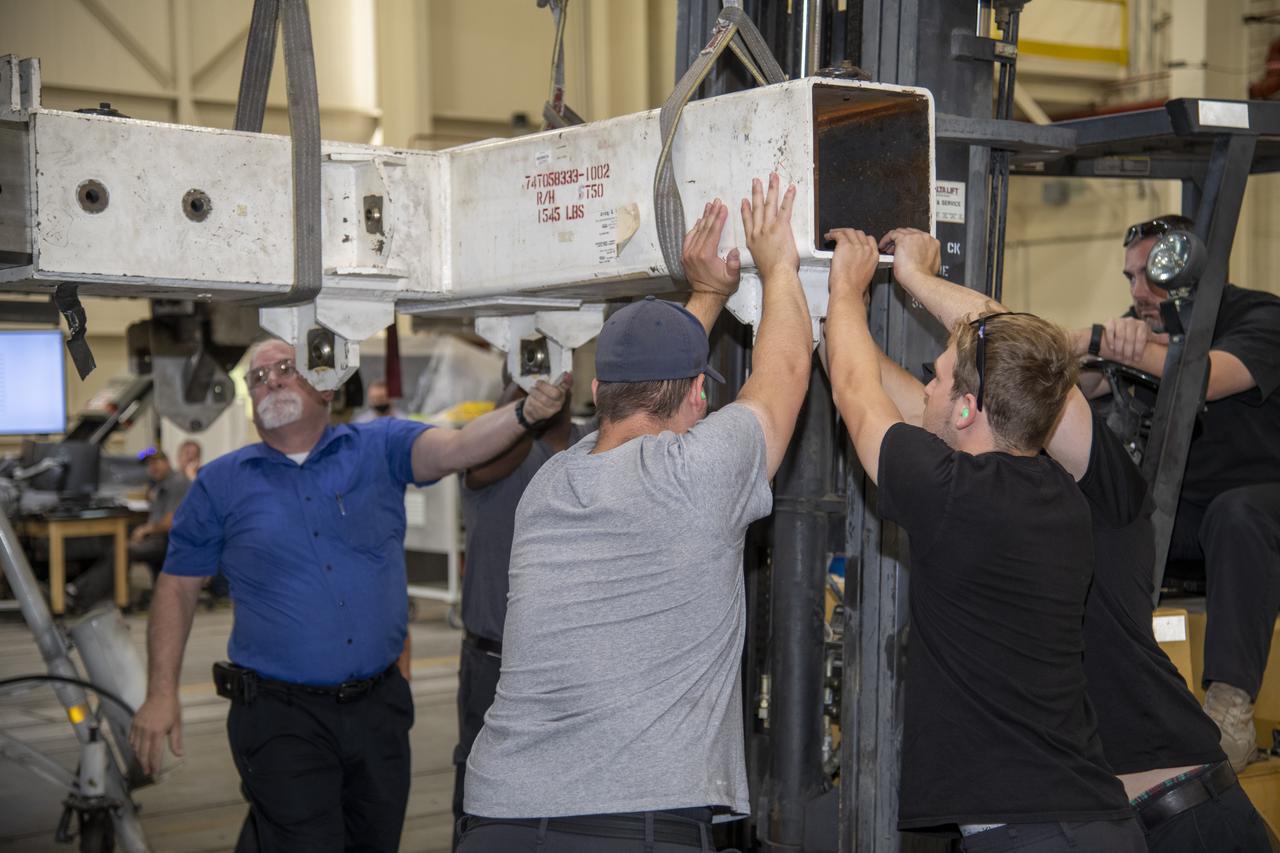
The horizontal tail and load fixture is moved into position for testing the F/A-18E from the Naval Air Systems Command (NAVAIR) in Patuxent River, Maryland. The aircraft is in NASA’s Armstrong Flight Research Center Flight Loads Laboratory in Edwards, California, for the center’s biggest load calibrations tests. This testing is needed before the aircraft can serve as a test vehicle for determining if it can safely manage maneuvers and proposed upgrades.
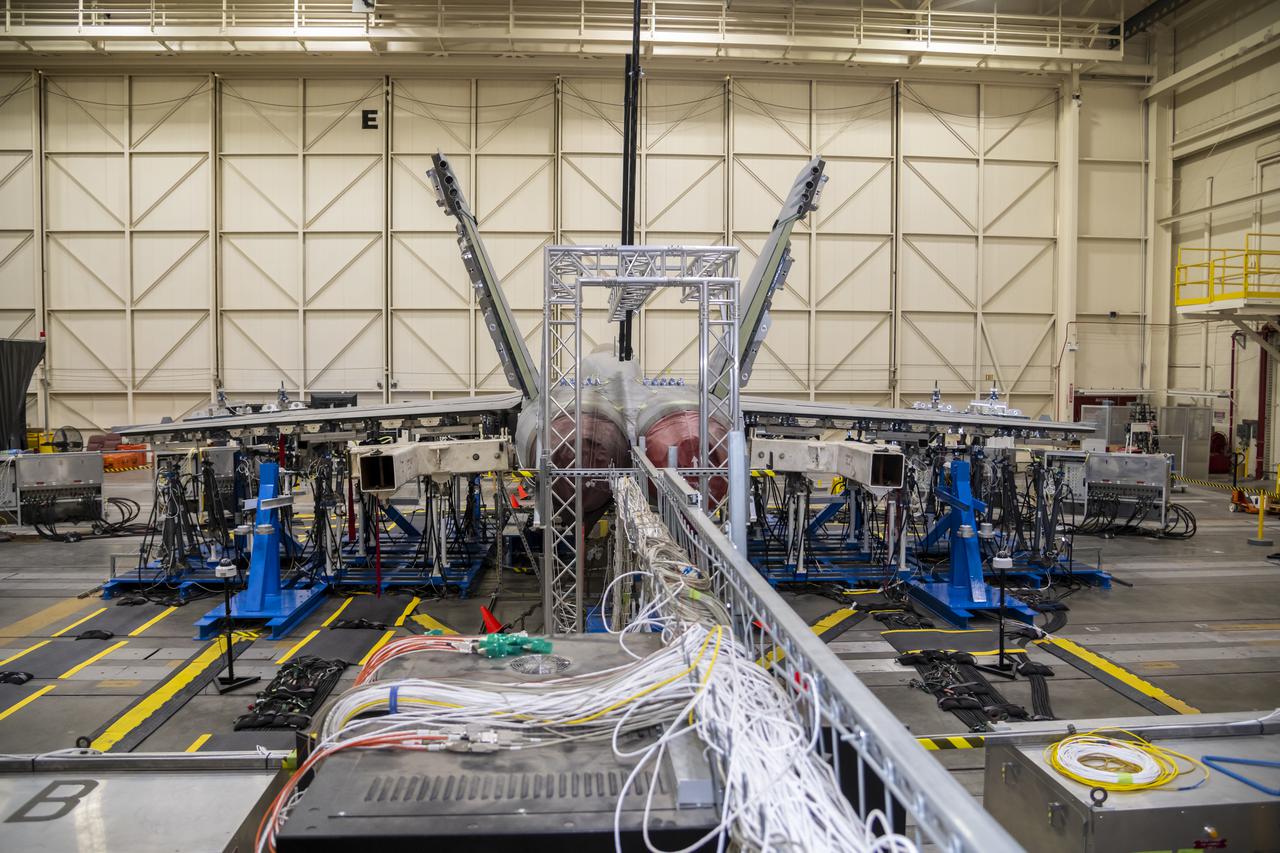
Instrumentation wire extends from the aft end of a F/A-18E from the Naval Air Systems Command (NAVAIR) in Patuxent River, Maryland. The aircraft is in NASA’s Armstrong Flight Research Center Flight Loads Laboratory in Edwards, California, for the center’s biggest load calibrations tests. This testing is needed before the aircraft can serve as a test vehicle for determining if it can safely manage maneuvers and proposed upgrades.
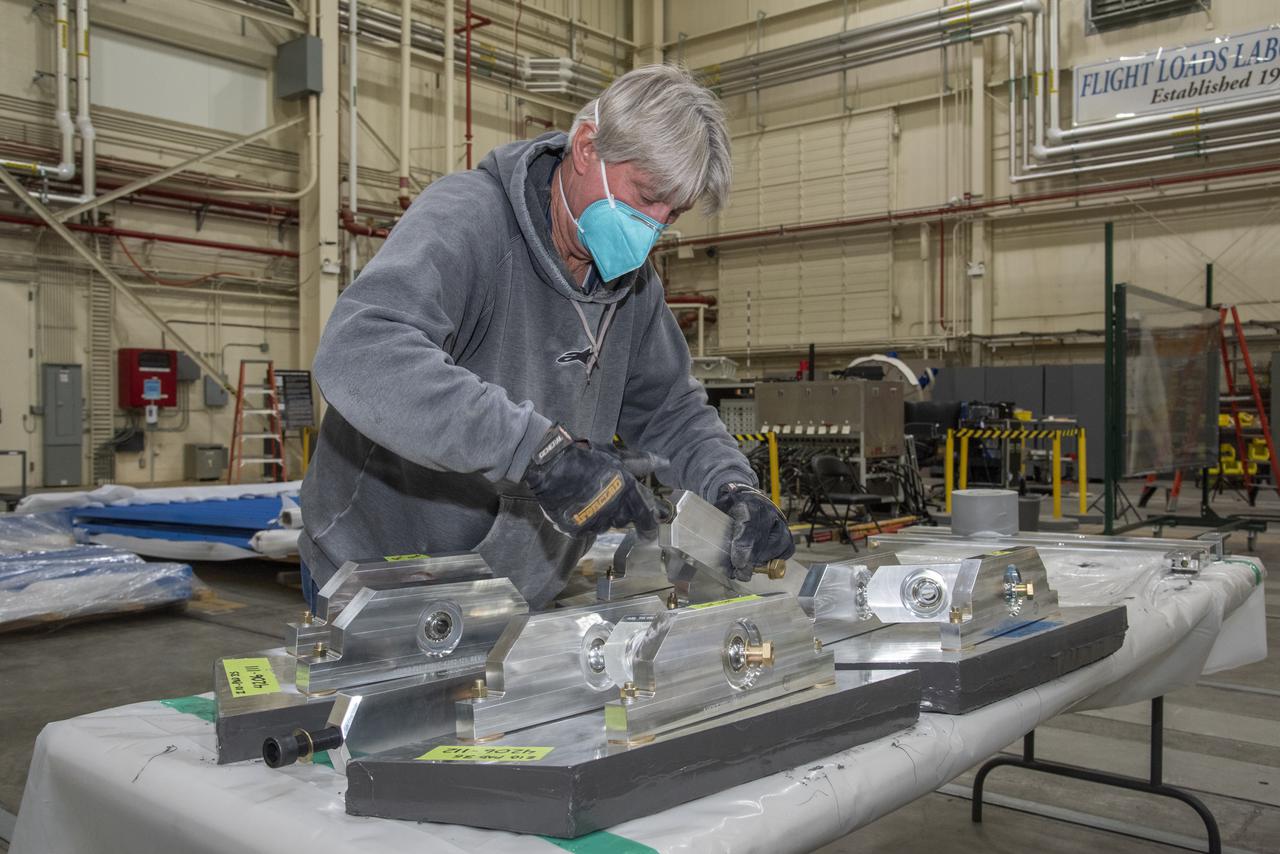
Assembled test structures called whiffle trees, which are needed to distribute prescribed hydraulic actuator loads, are attached to load pads to test the F/A-18E from the Naval Air Systems Command (NAVAIR) in Patuxent River, Maryland. The aircraft is in NASA’s Armstrong Flight Research Center Flight Loads Laboratory in Edwards, California, for the center’s biggest load calibrations tests. This testing is needed before the aircraft can serve as a test vehicle for determining if it can safely manage maneuvers and proposed upgrades.
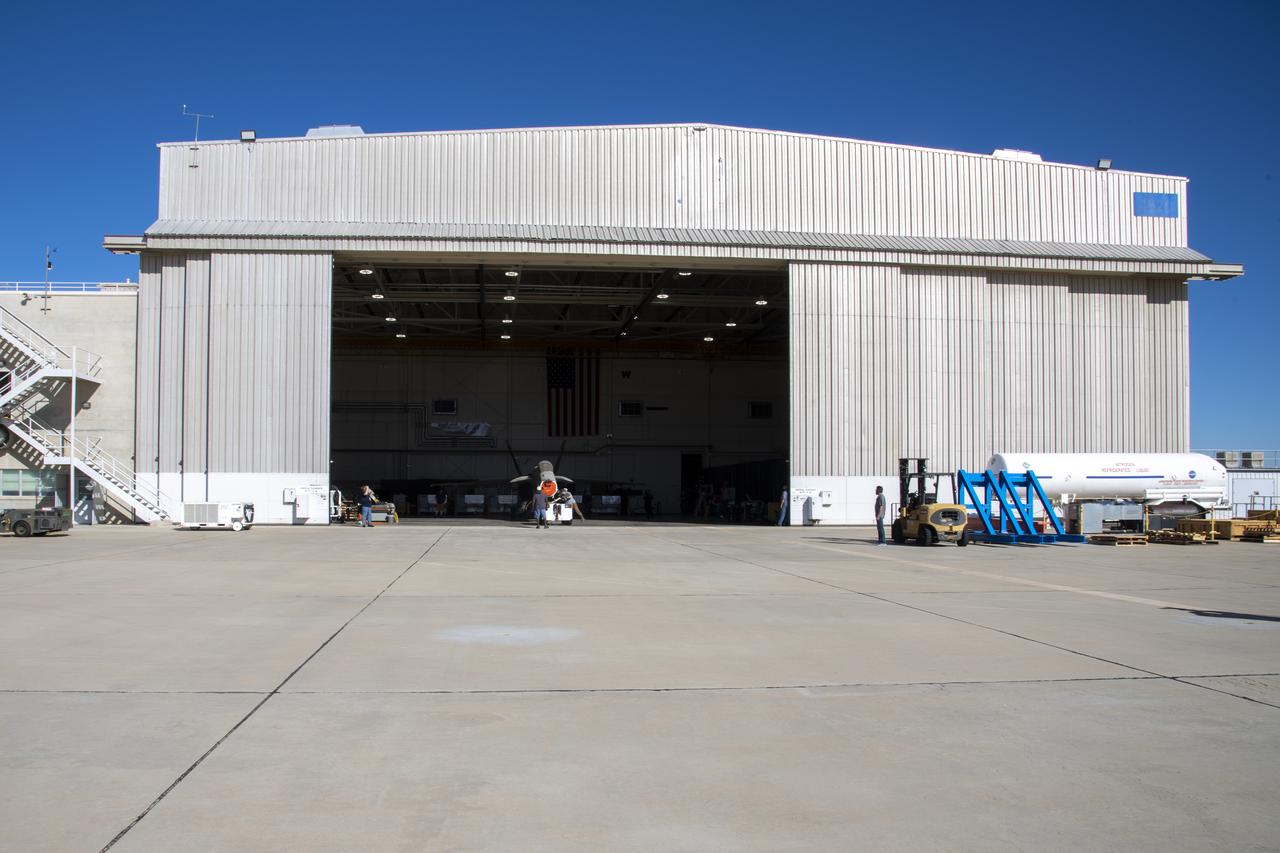
An F/A-18E from the Naval Air Systems Command (NAVAIR) in Patuxent River, Maryland, is moved from NASA’s Armstrong Flight Research Center Flight Loads Laboratory in Edwards, California, to a hangar where it will undergo final preparations to return to its squadron. The aircraft underwent the center’s biggest load calibrations tests. The testing will permit the aircraft to serve as a test vehicle to determine if it can safely manage maneuvers and proposed upgrades.
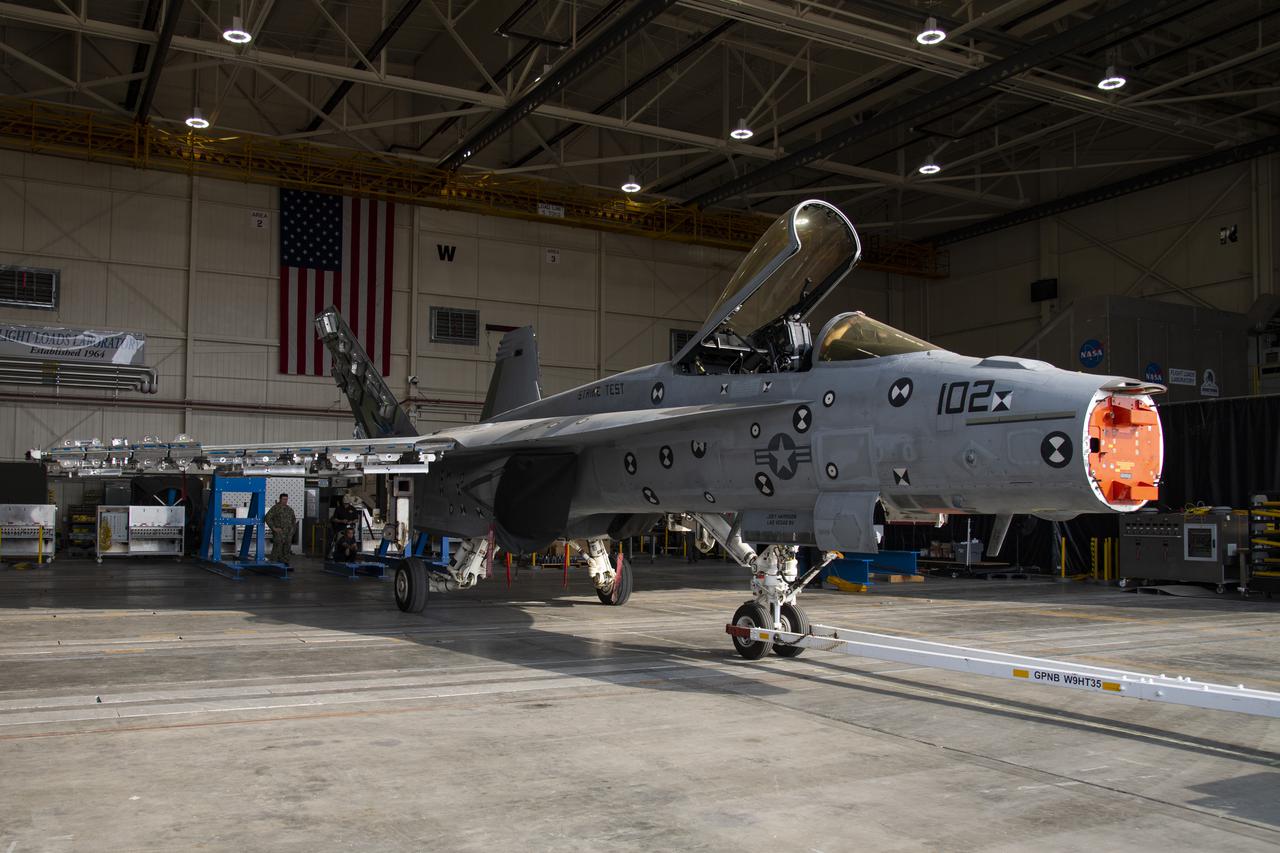
The Naval Air Systems Command (NAVAIR) in Patuxent River, Maryland F/A-18E is moved to NASA’s Armstrong Flight Research Center Flight Loads Laboratory in Edwards, California. NASA Armstrong is working on its biggest load calibrations tests on an F/A-18E Super Hornet. This testing is needed before the aircraft can serve as a test vehicle for determining if it can safely manage maneuvers and proposed upgrades.
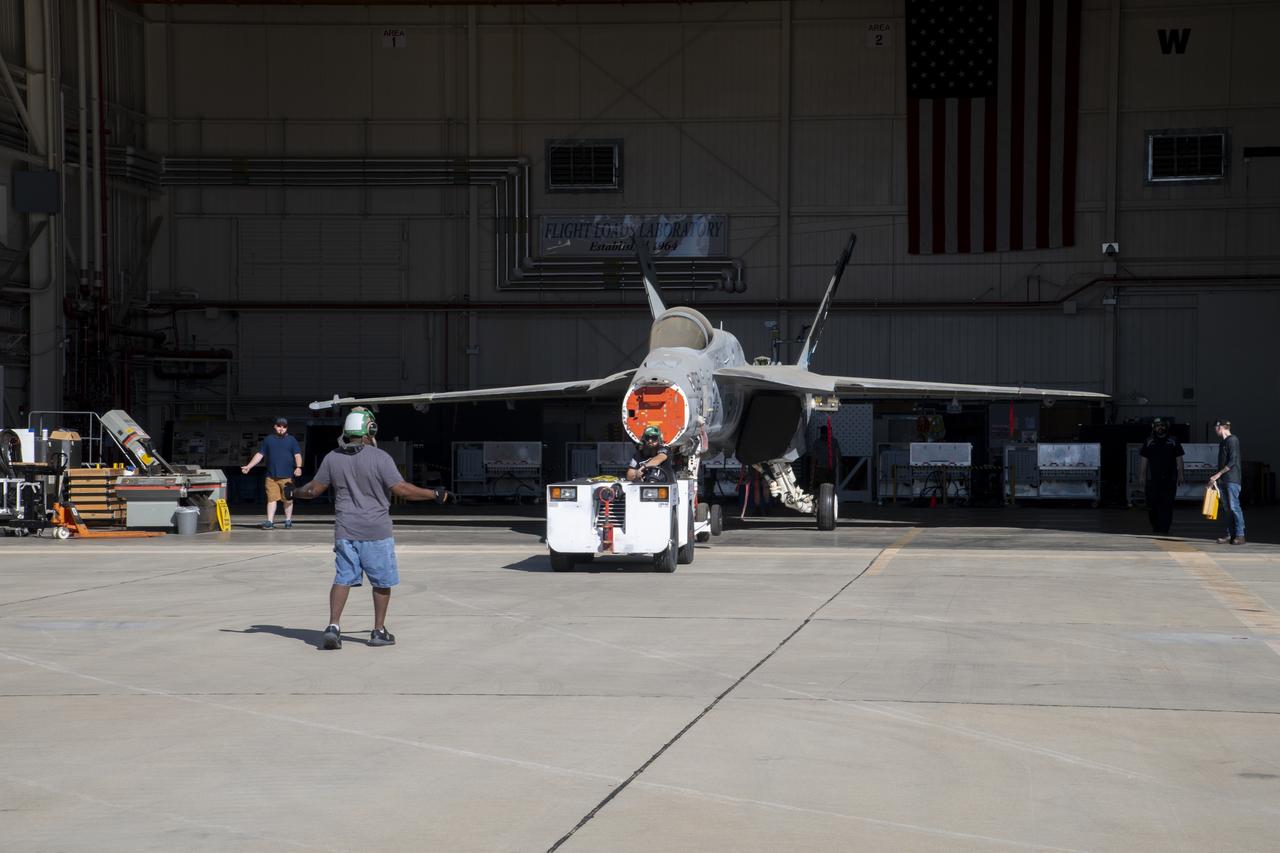
An F/A-18E from the Naval Air Systems Command (NAVAIR) in Patuxent River, Maryland, is moved from NASA’s Armstrong Flight Research Center Flight Loads Laboratory in Edwards, California, to a hangar where it will undergo final preparations to return to its squadron. The aircraft underwent the center’s biggest load calibrations tests. The testing will permit the aircraft to serve as a test vehicle to determine if it can safely manage maneuvers and proposed upgrades.
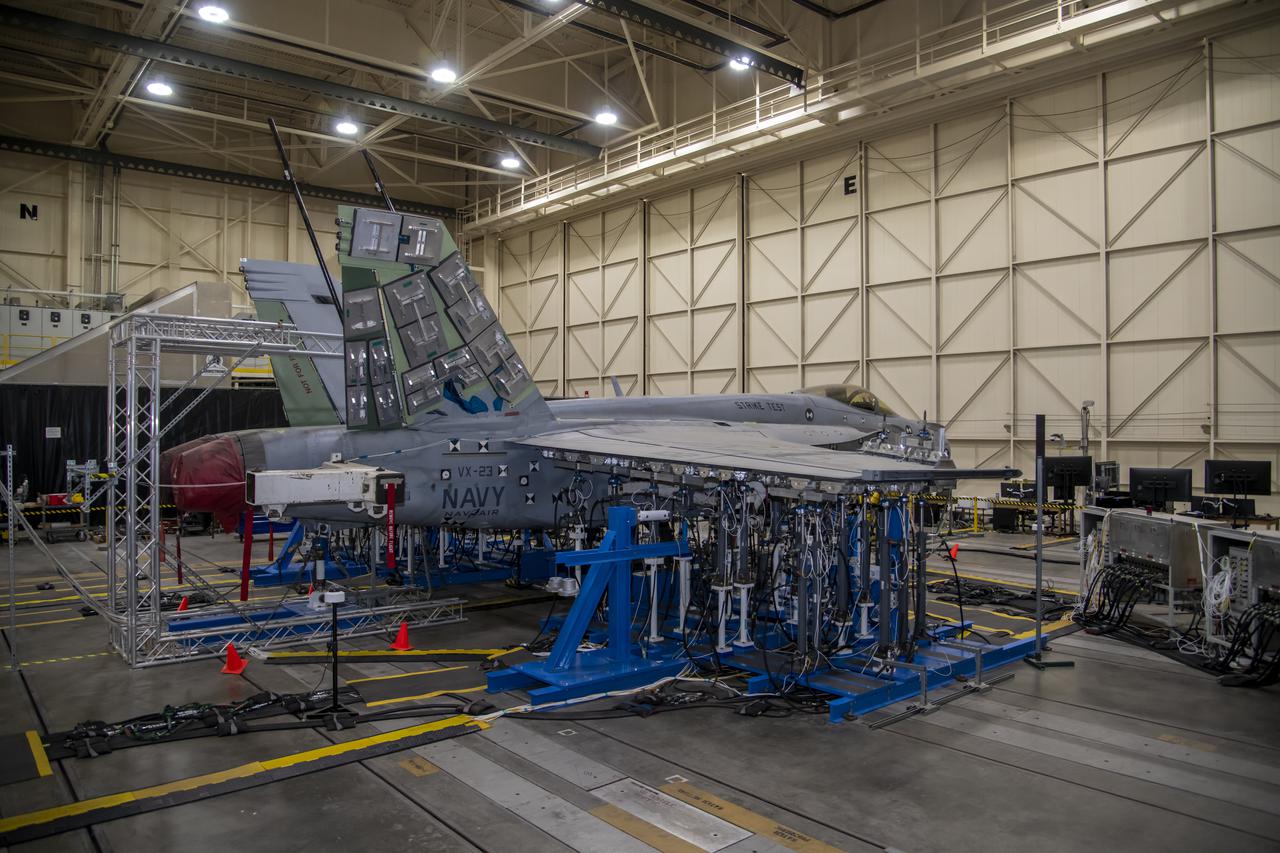
This rear view of the right wing load hardware shows the setup for testing a F/A-18E from the Naval Air Systems Command (NAVAIR) in Patuxent River, Maryland. The aircraft is in NASA's Armstrong Flight Research Center Flight Loads Laboratory in Edwards, California, for the center's biggest load calibrations tests. This testing is needed before the aircraft can serve as a test vehicle for determining if it can safely manage maneuvers and proposed upgrades.
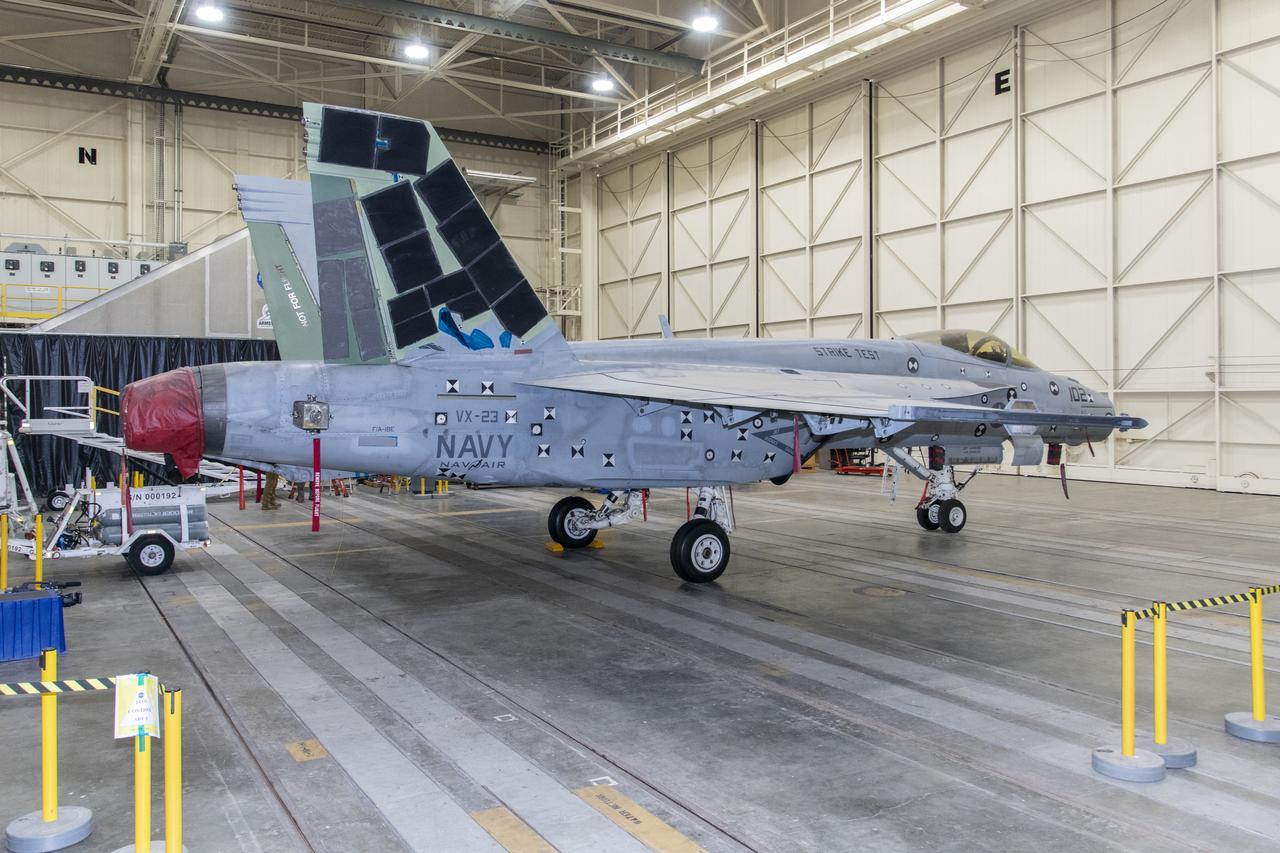
This left-side view shows an F/A-18E from the Naval Air Systems Command (NAVAIR) in Patuxent River, Maryland. The aircraft is in NASA’s Armstrong Flight Research Center Flight Loads Laboratory in Edwards, California, where it underwent the center’s biggest load calibrations tests. This testing will permit the aircraft to serve as a test vehicle to determine if it can safely manage maneuvers and proposed upgrades.
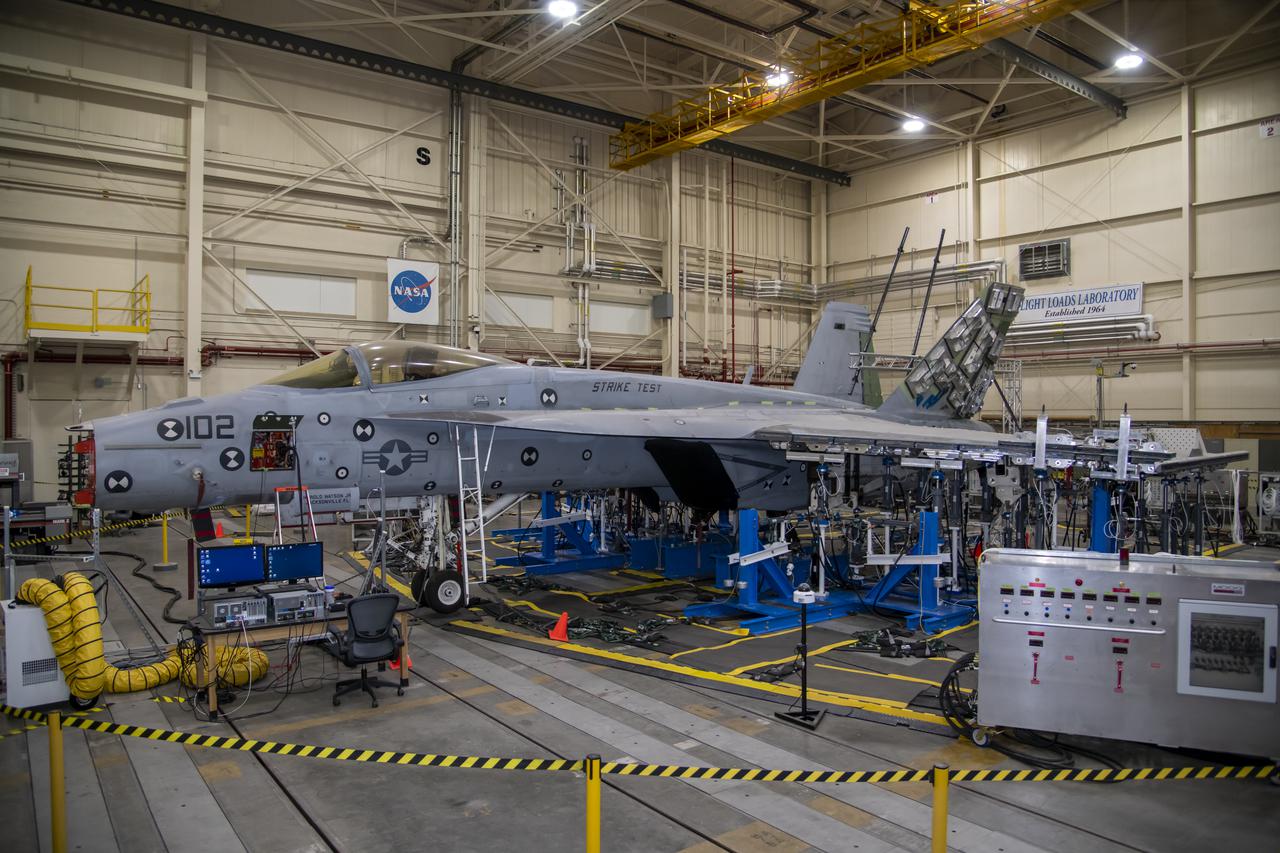
This view shows the left wing loading test configuration and testing area of an F/A-18E from the Naval Air Systems Command (NAVAIR) in Patuxent River, Maryland. The aircraft is in NASA's Armstrong Flight Research Center Flight Loads Laboratory in Edwards, California, for the center's biggest load calibrations tests. This testing is needed before the aircraft can serve as a test vehicle for determining if it can safely manage maneuvers and proposed upgrades.
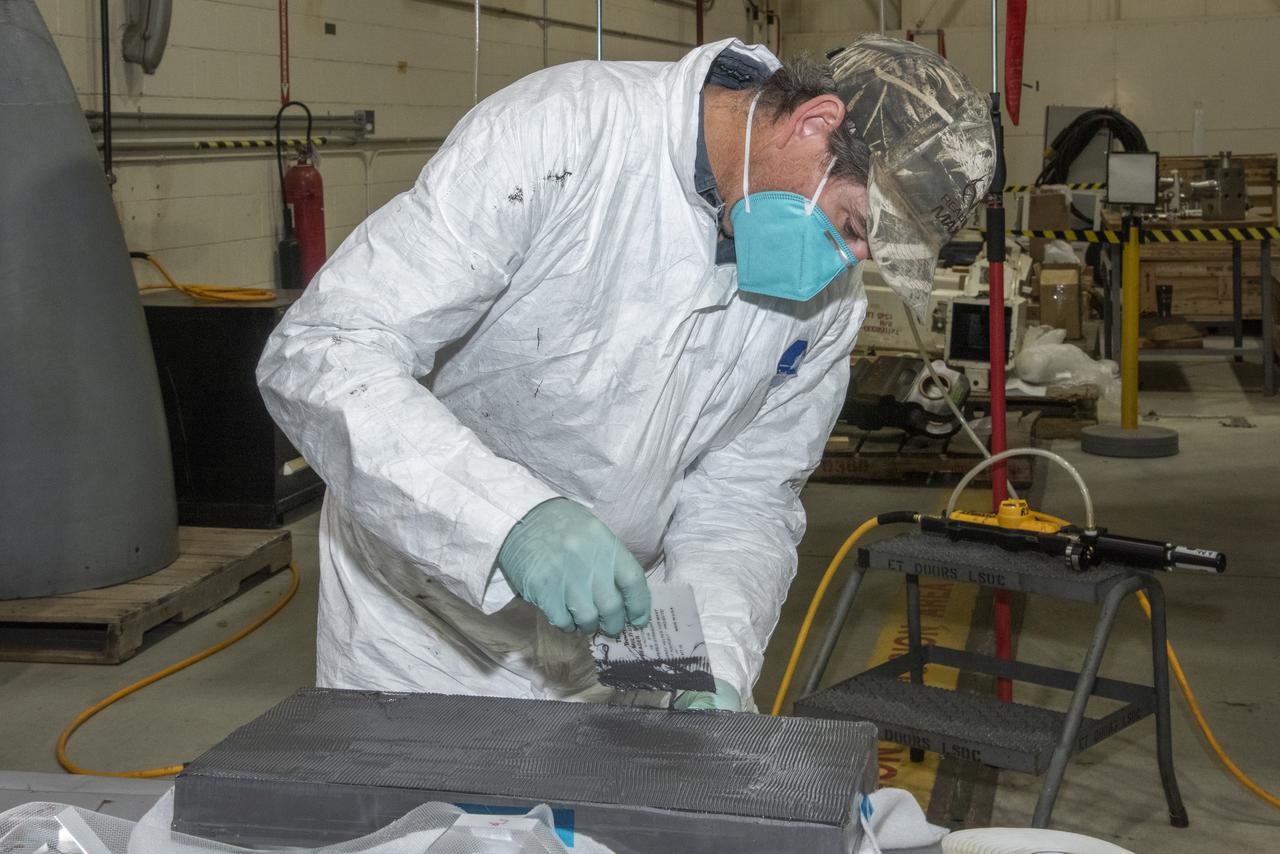
The load pad bonding process for the vertical tails was a preliminary step in the process to test the F/A-18E from the Naval Air Systems Command (NAVAIR) in Patuxent River, Maryland. The aircraft is in NASA’s Armstrong Flight Research Center Flight Loads Laboratory in Edwards, California, for the center’s biggest load calibrations tests. This testing is needed before the aircraft can serve as a test vehicle for determining if it can safely manage maneuvers and proposed upgrades.
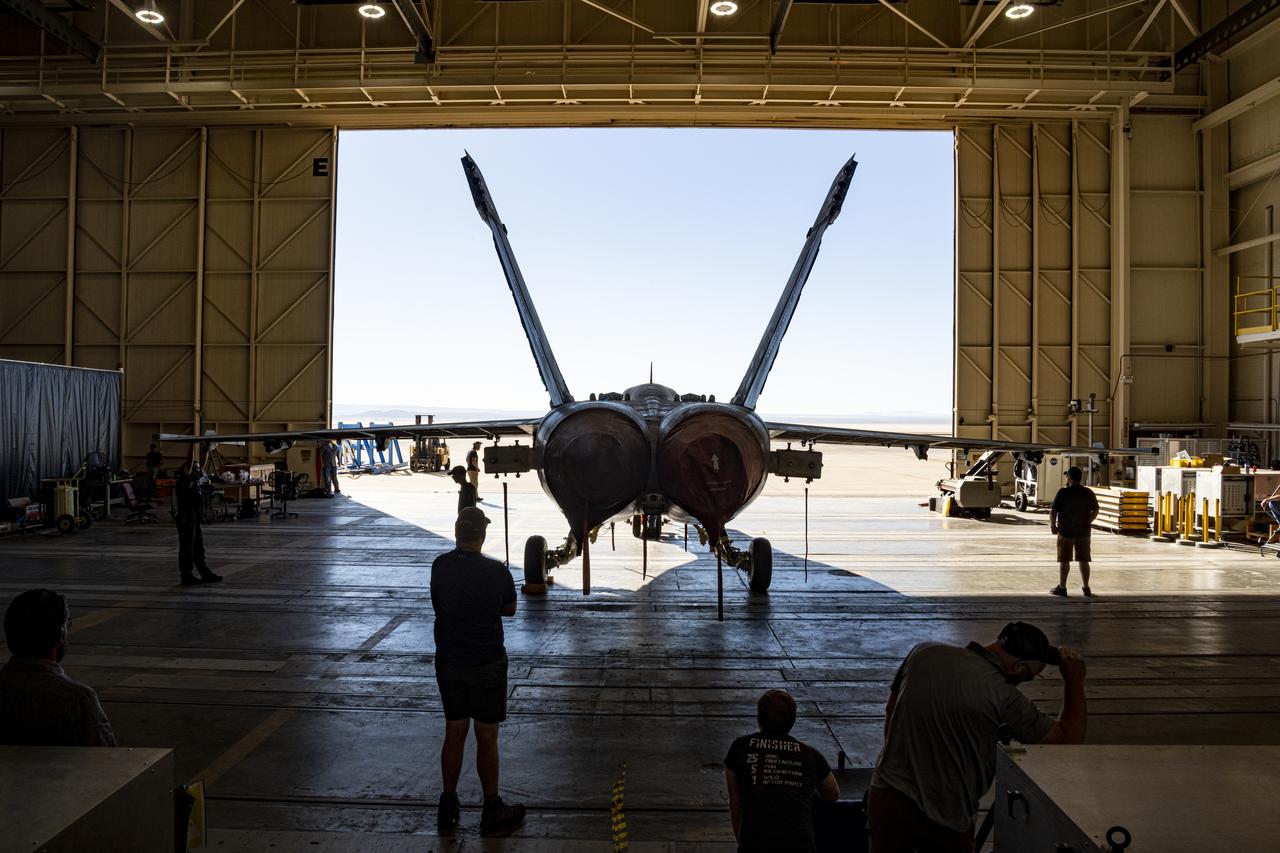
This rear view shows an F/A-18E from the Naval Air Systems Command (NAVAIR) in Patuxent River, Maryland. The aircraft is in NASA’s Armstrong Flight Research Center Flight Loads Laboratory in Edwards, California, where it underwent the center’s biggest load calibrations tests. This testing will permit the aircraft to serve as a test vehicle to determine if it can safely manage maneuvers and proposed upgrades.
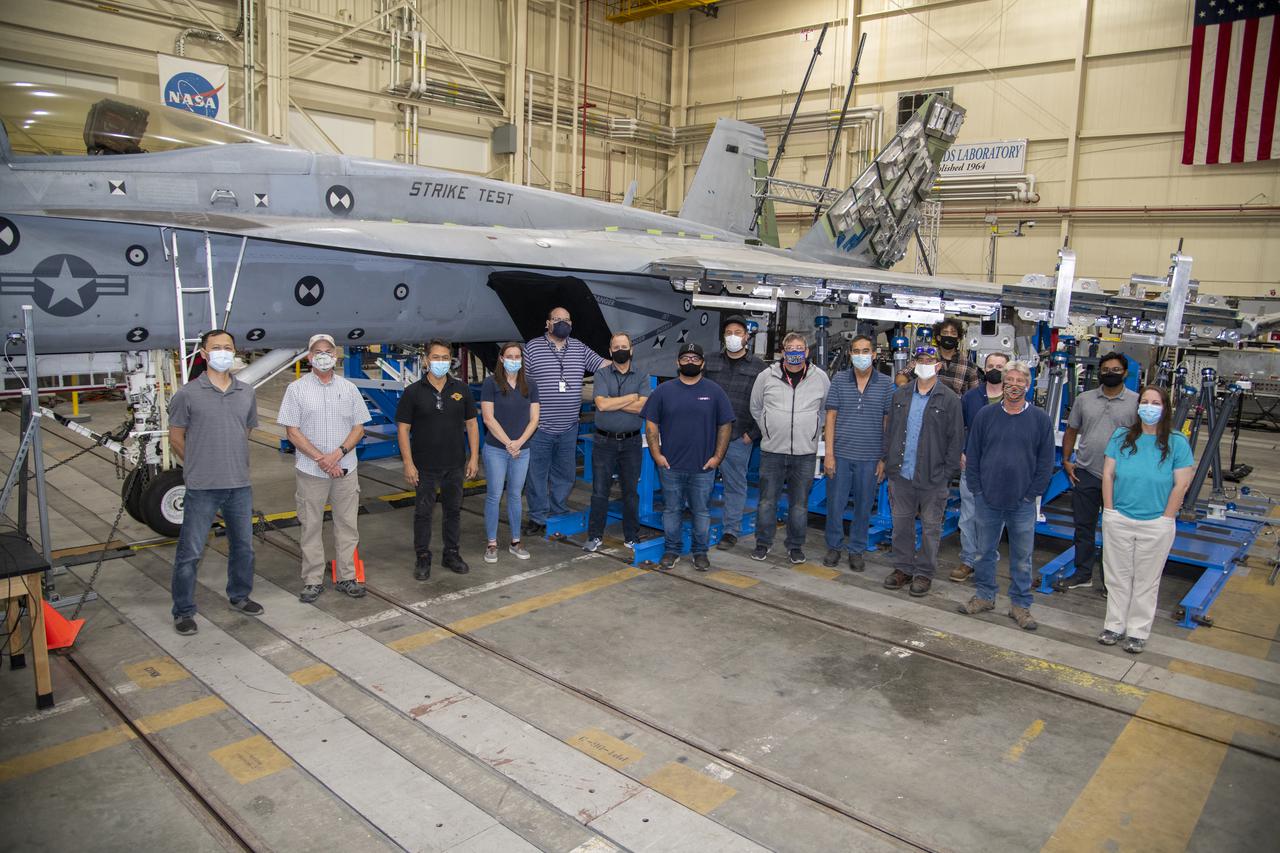
The team who worked on the load testing of the horizontal tails stands by the F/A-18E from the Naval Air Systems Command (NAVAIR) in Patuxent River, Maryland. The aircraft is in NASA’s Armstrong Flight Research Center Flight Loads Laboratory in Edwards, California, for the center’s biggest load calibrations tests. This testing is needed before the aircraft can serve as a test vehicle for determining if it can safely manage maneuvers and proposed upgrades.
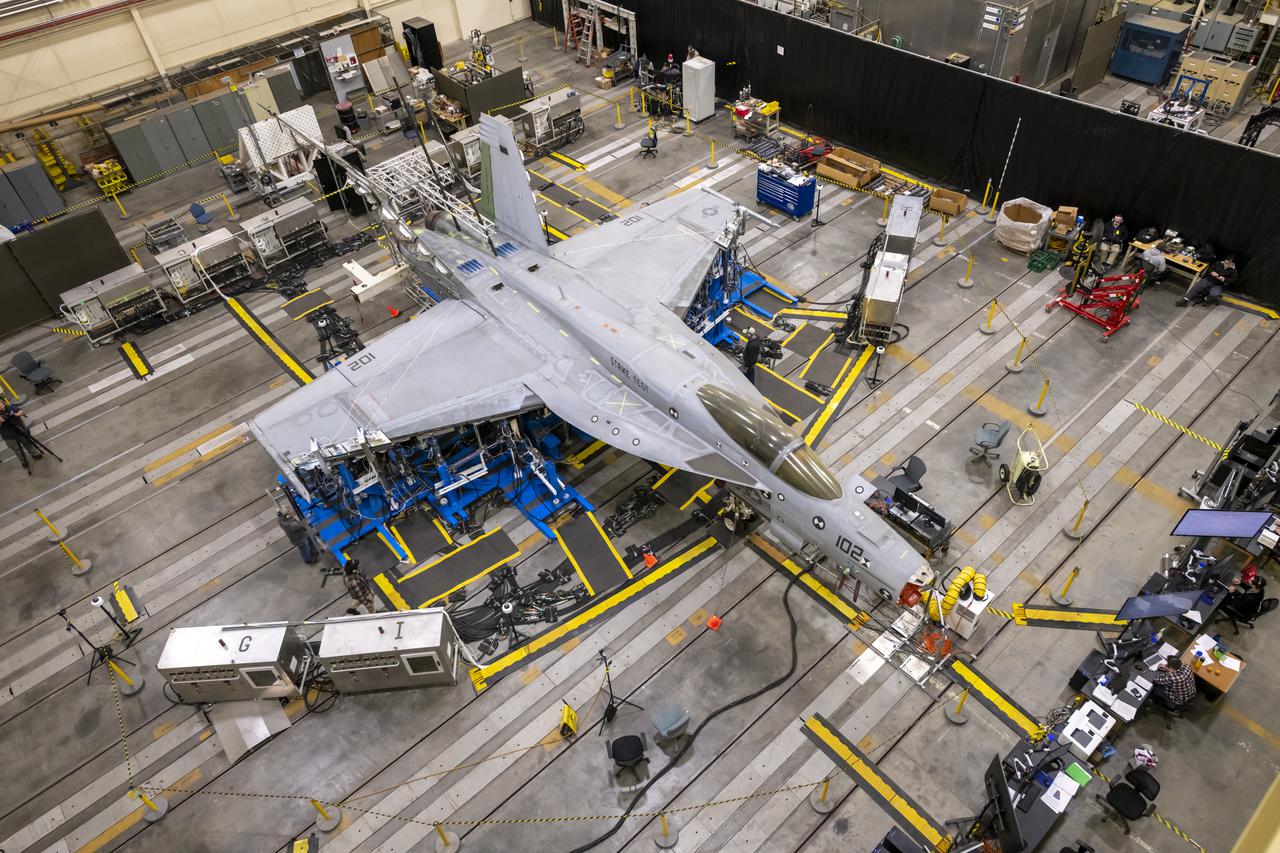
A top view shows the wing loading test configuration of an F/A-18E from the Naval Air Systems Command (NAVAIR) in Patuxent River; Maryland. The aircraft is in NASA's Armstrong Flight Research Center Flight Loads Laboratory in Edwards; California; for the center's biggest load calibrations tests. This testing is needed before the aircraft can serve as a test vehicle for determining if it can safely manage maneuvers and proposed upgrades.
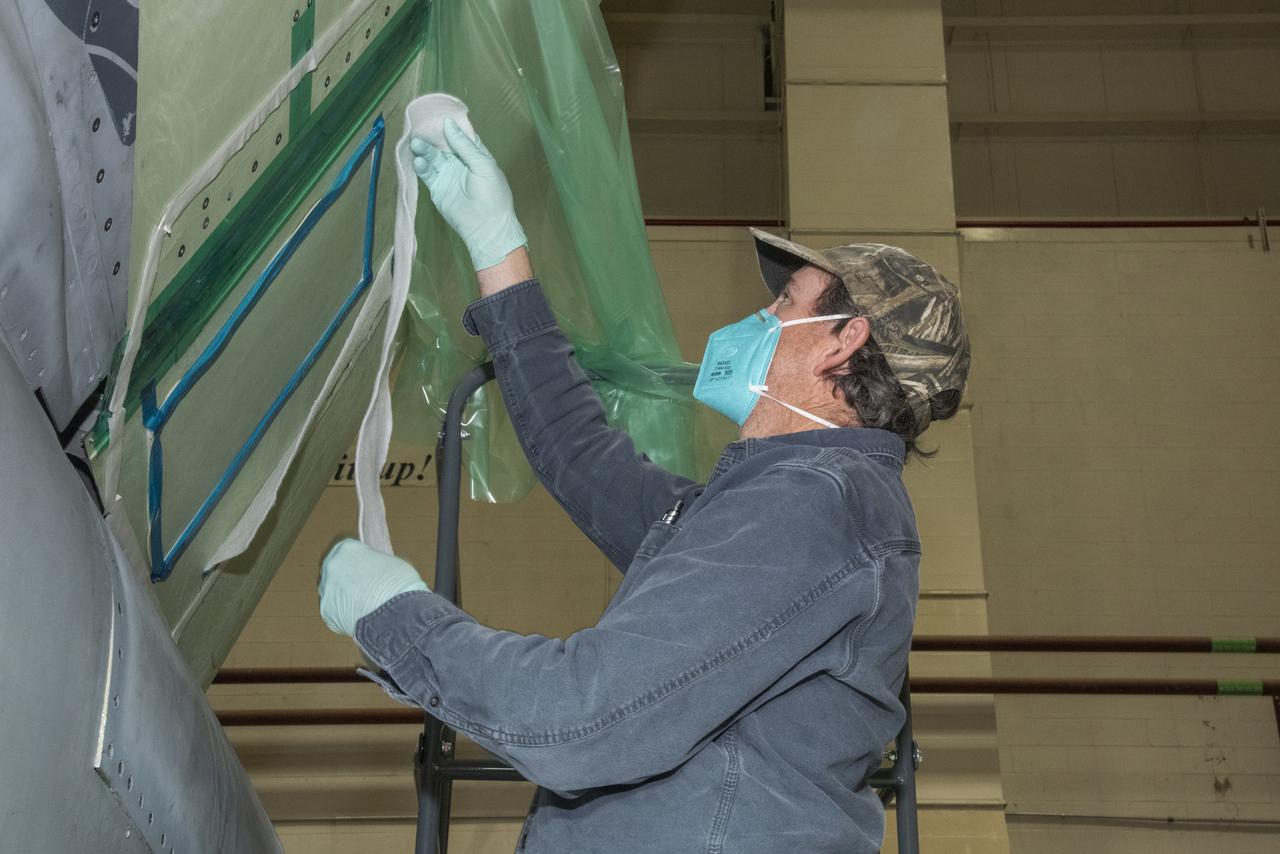
The load pad bonding process for the vertical tails was a preliminary step in the process to test the F/A-18E from the Naval Air Systems Command (NAVAIR) in Patuxent River, Maryland. The aircraft is in NASA’s Armstrong Flight Research Center Flight Loads Laboratory in Edwards, California, for the center’s biggest load calibrations tests. This testing is needed before the aircraft can serve as a test vehicle for determining if it can safely manage maneuvers and proposed upgrades.
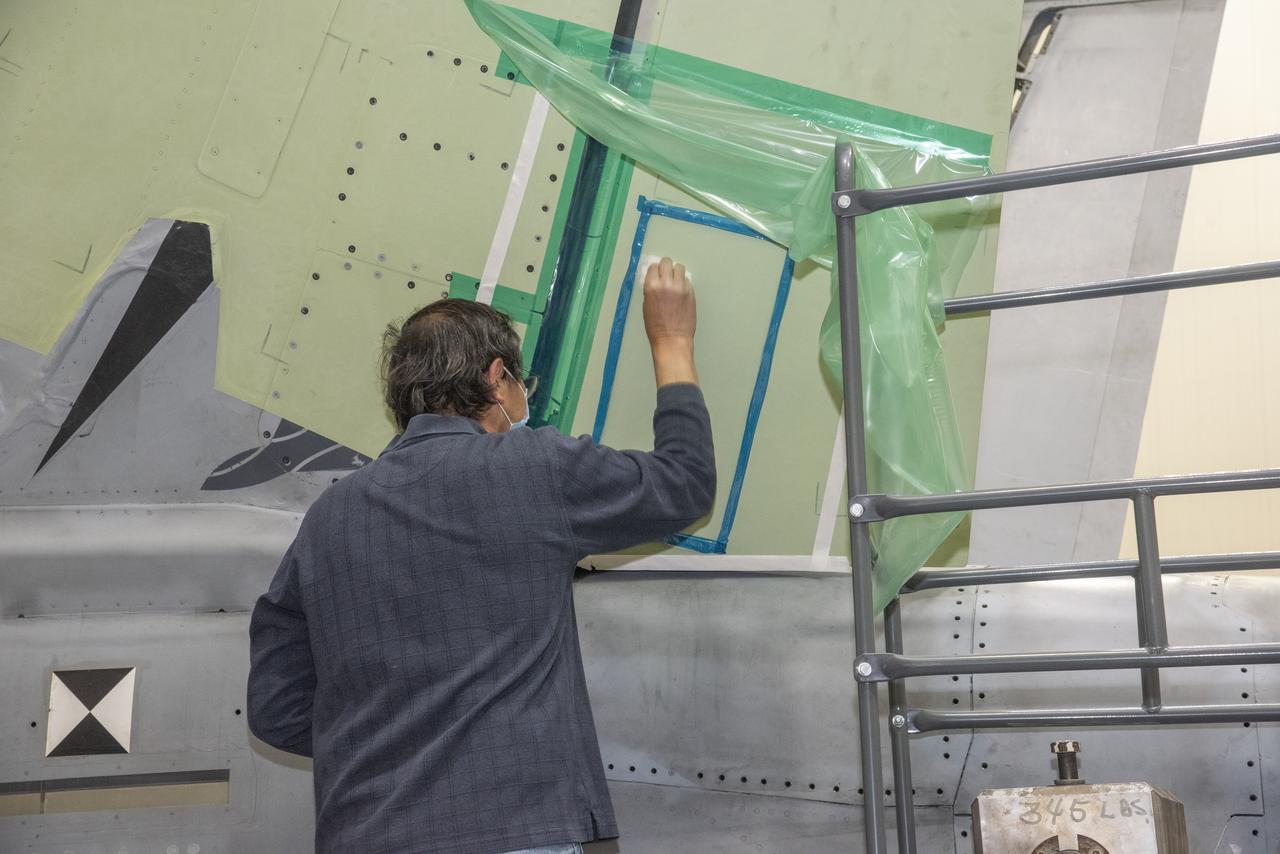
The load pad bonding process for the vertical tails was a preliminary step in the process to test the F/A-18E from the Naval Air Systems Command (NAVAIR) in Patuxent River, Maryland. The aircraft is in NASA’s Armstrong Flight Research Center Flight Loads Laboratory in Edwards, California, for the center’s biggest load calibrations tests. This testing is needed before the aircraft can serve as a test vehicle for determining if it can safely manage maneuvers and proposed upgrades.
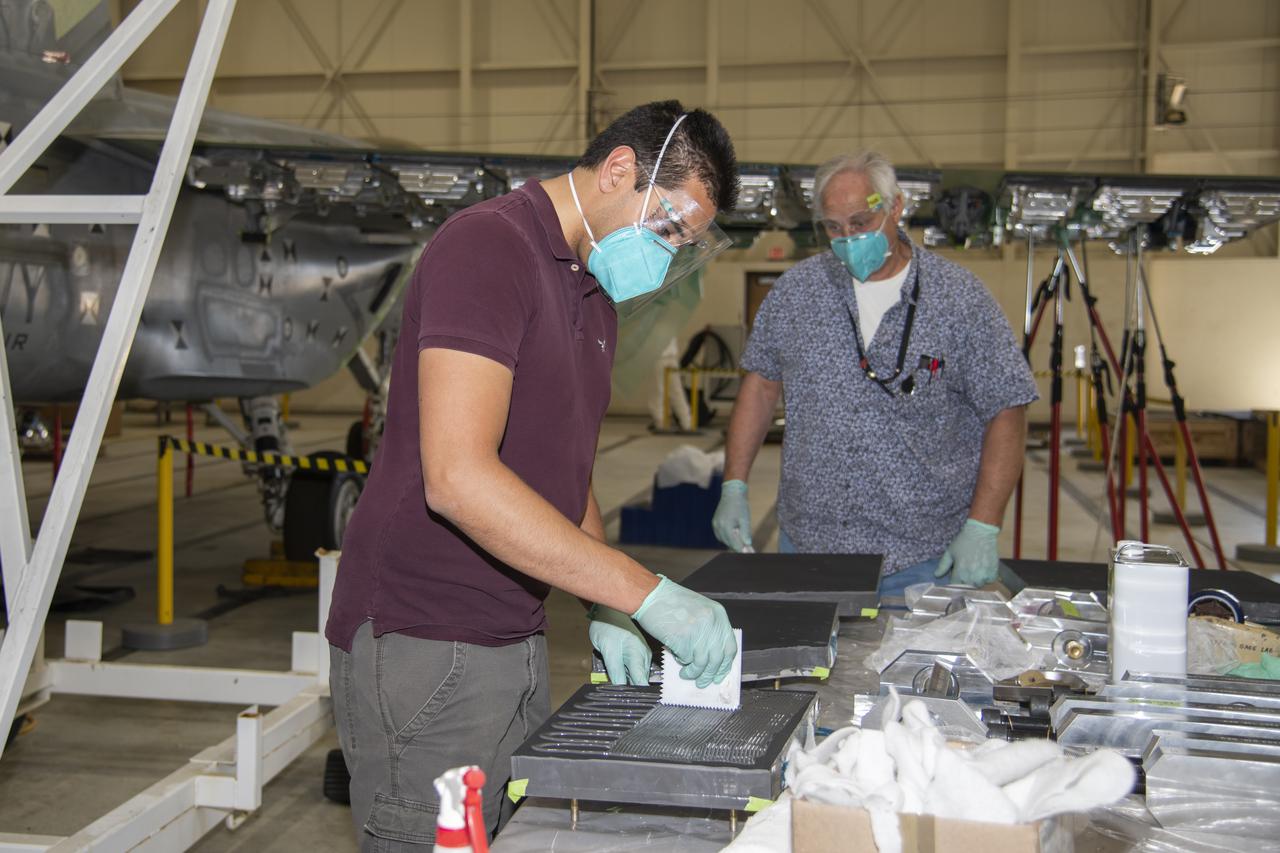
Jeremy Woellner, from left, and Ted Powers spread tank sealant on rubber load pads, a step in the process to test a F/A-18E from the Naval Air Systems Command (NAVAIR) in Patuxent River, Maryland. The aircraft is in NASA’s Armstrong Flight Research Center Flight Loads Laboratory in Edwards, California, for the center’s biggest load calibrations tests. This testing is needed before the aircraft can serve as a test vehicle for determining if it can safely manage maneuvers and proposed upgrades.

Walter Hargis, left, and Chris Mount apply tank sealant on the aircraft surface of a F/A-18E from the Naval Air Systems Command (NAVAIR) in Patuxent River, Maryland. The aircraft is in NASA’s Armstrong Flight Research Center Flight Loads Laboratory in Edwards, California, for the center’s biggest load calibrations tests. This testing is needed before the aircraft can serve as a test vehicle for determining if it can safely manage maneuvers and proposed upgrades.
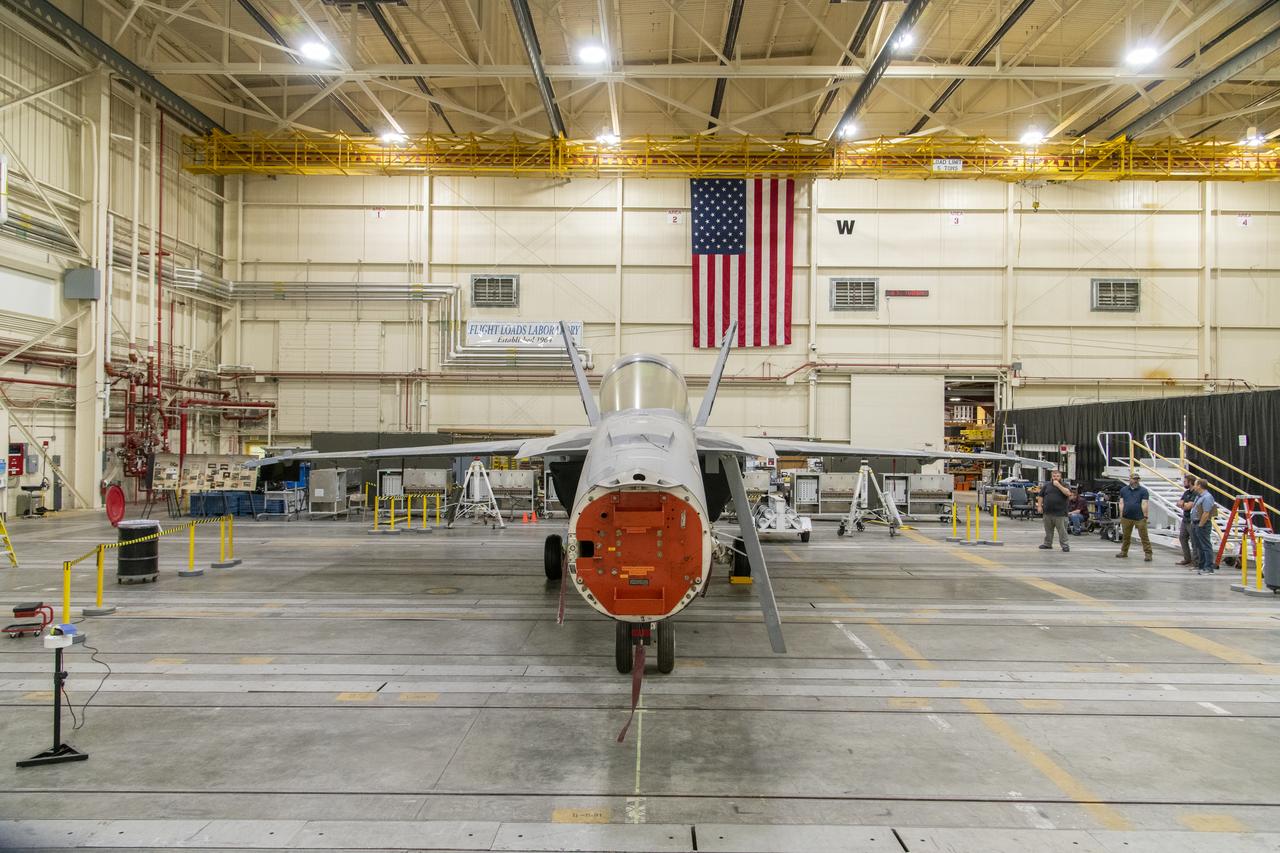
This front view shows an F/A-18E from the Naval Air Systems Command (NAVAIR) in Patuxent River, Maryland. The aircraft is in NASA’s Armstrong Flight Research Center Flight Loads Laboratory in Edwards, California, where it underwent the center’s biggest load calibrations tests. This testing will permit the aircraft to serve as a test vehicle to determine if it can safely manage maneuvers and proposed upgrades.

An F/A-18E from the Naval Air Systems Command (NAVAIR) in Patuxent River, Maryland, is moved from NASA’s Armstrong Flight Research Center Flight Loads Laboratory in Edwards, California, to a hangar where it will undergo final preparations to return to its squadron. The aircraft underwent the center’s biggest load calibrations tests. The testing will permit the aircraft to serve as a test vehicle to determine if it can safely manage maneuvers and proposed upgrades.
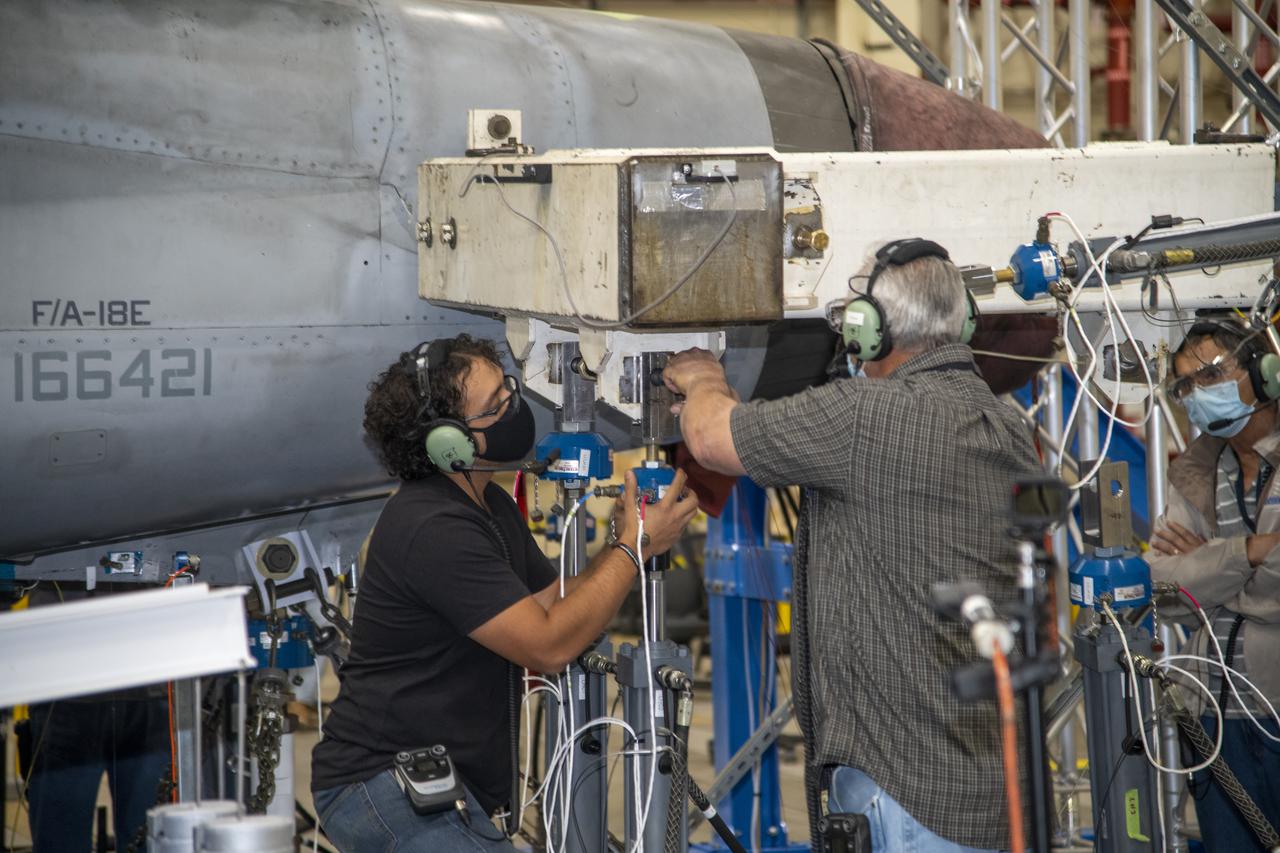
The actuator on the F/A-18E from the Naval Air Systems Command (NAVAIR) in Patuxent River, Maryland, is pinned to the horizontal tail load test fixture. The aircraft is in NASA’s Armstrong Flight Research Center Flight Loads Laboratory in Edwards, California, for the center’s biggest load calibrations tests. This testing is needed before the aircraft can serve as a test vehicle for determining if it can safely manage maneuvers and proposed upgrades.
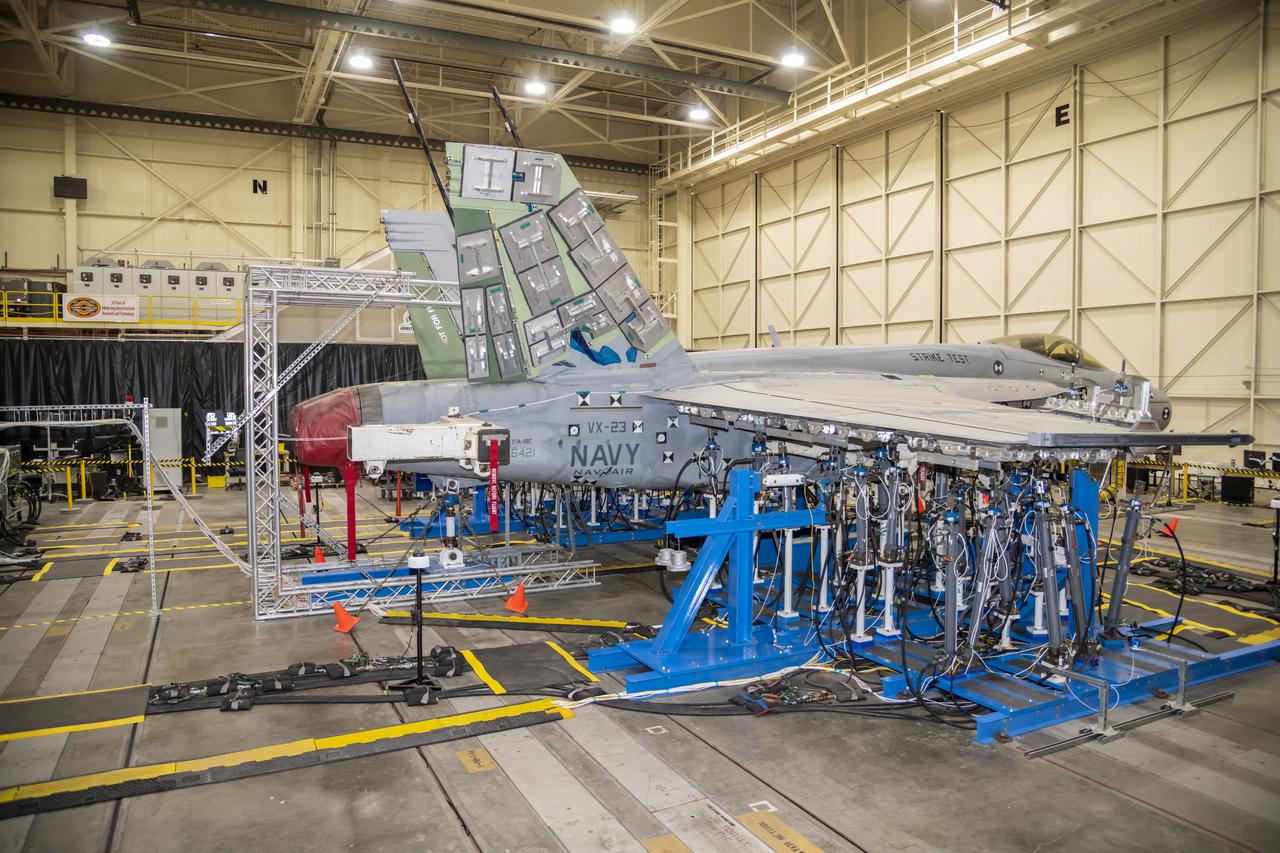
Wing load test hardware is setup under wing of a F/A-18E from the Naval Air Systems Command (NAVAIR) in Patuxent River, Maryland. The aircraft is in NASA’s Armstrong Flight Research Center Flight Loads Laboratory in Edwards, California, for the center’s biggest load calibrations tests. This testing is needed before the aircraft can serve as a test vehicle for determining if it can safely manage maneuvers and proposed upgrades.
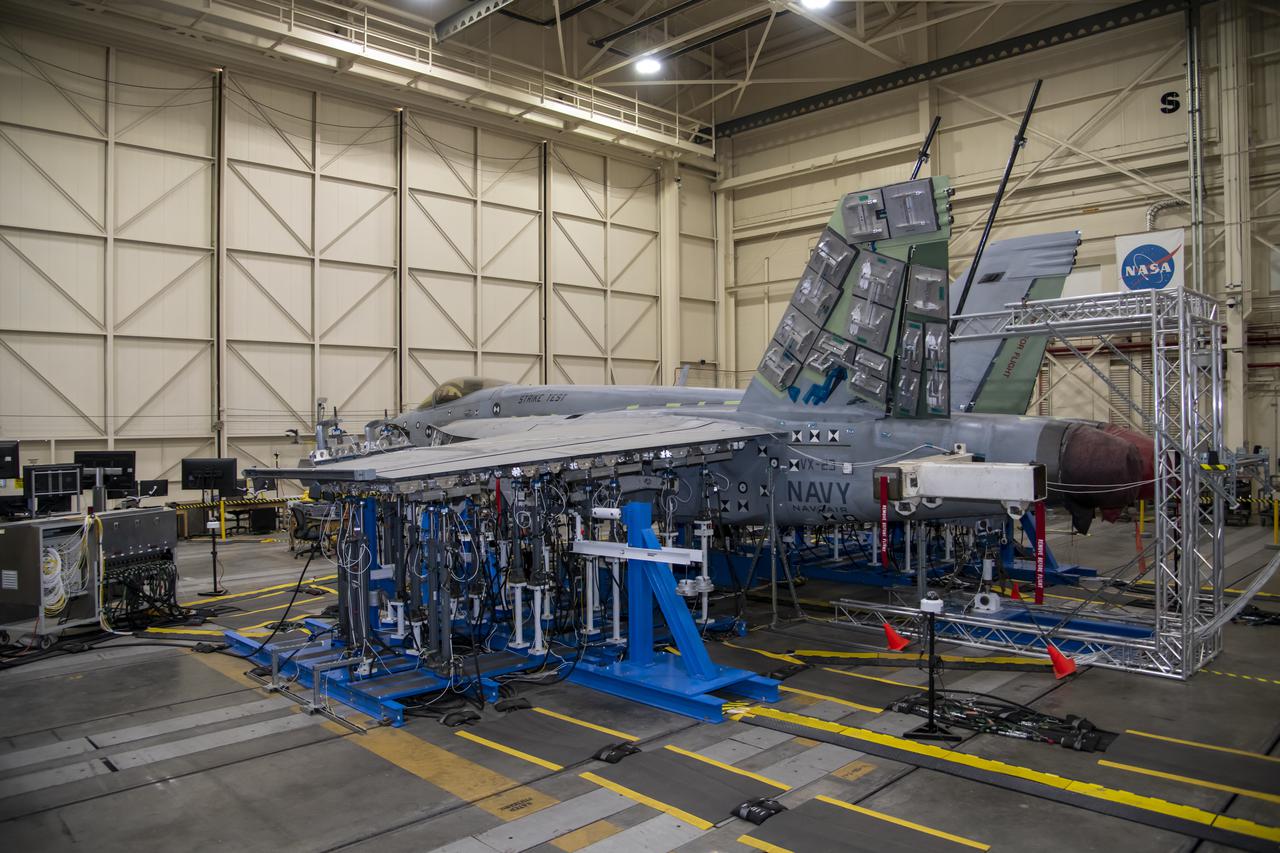
This rear view of the left wing load hardware shows the setup for testing a F/A-18E from the Naval Air Systems Command (NAVAIR) in Patuxent River, Maryland. The aircraft is in NASA's Armstrong Flight Research Center Flight Loads Laboratory in Edwards, California, for the center's biggest load calibrations tests. This testing is needed before the aircraft can serve as a test vehicle for determining if it can safely manage maneuvers and proposed upgrades.Â
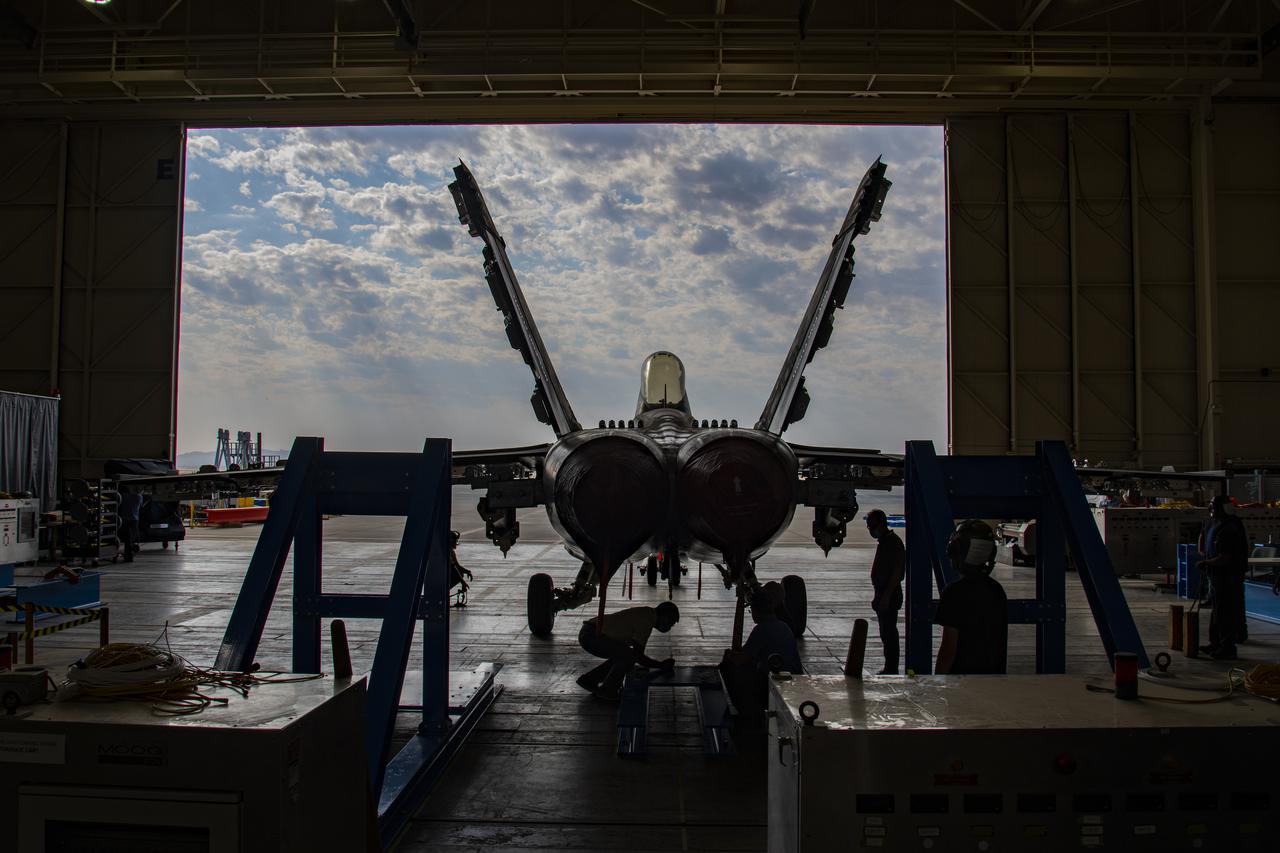
The Naval Air Systems Command (NAVAIR) in Patuxent River, Maryland F/A-18E is moved to NASA’s Armstrong Flight Research Center Flight Loads Laboratory in Edwards, California. NASA Armstrong is working on its biggest load calibrations tests on an F/A-18E Super Hornet. This testing is needed before the aircraft can serve as a test vehicle for determining if it can safely manage maneuvers and proposed upgrades.
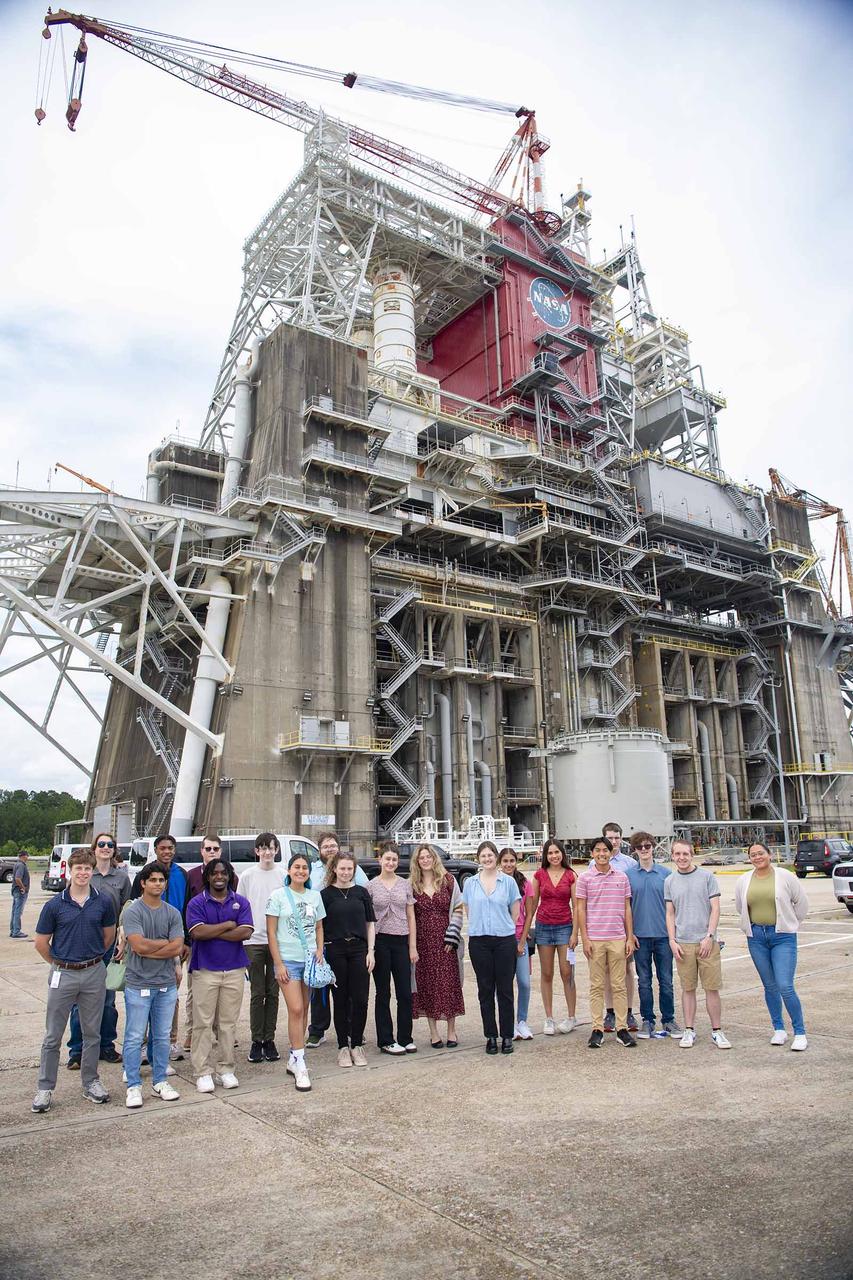
Summer interns with the U.S. Naval Research Laboratory stand in front of the Thad Cochran Test Stand (B-1/B-2) on July 10. NASA Stennis crews are preparing the B-2 side of the stand for future testing of NASA’s exploration upper stage. The more powerful second stage is expected to fly on NASA’s SLS (Space Launch System) rocket for Artemis IV. The Naval Research Laboratory interns visited the stand during an afternoon tour of NASA Stennis. The Naval Research Laboratory is a tenant of the NASA Stennis federal city, where it provides advanced scientific capabilities required to bolster the nation’s position of global naval leadership.
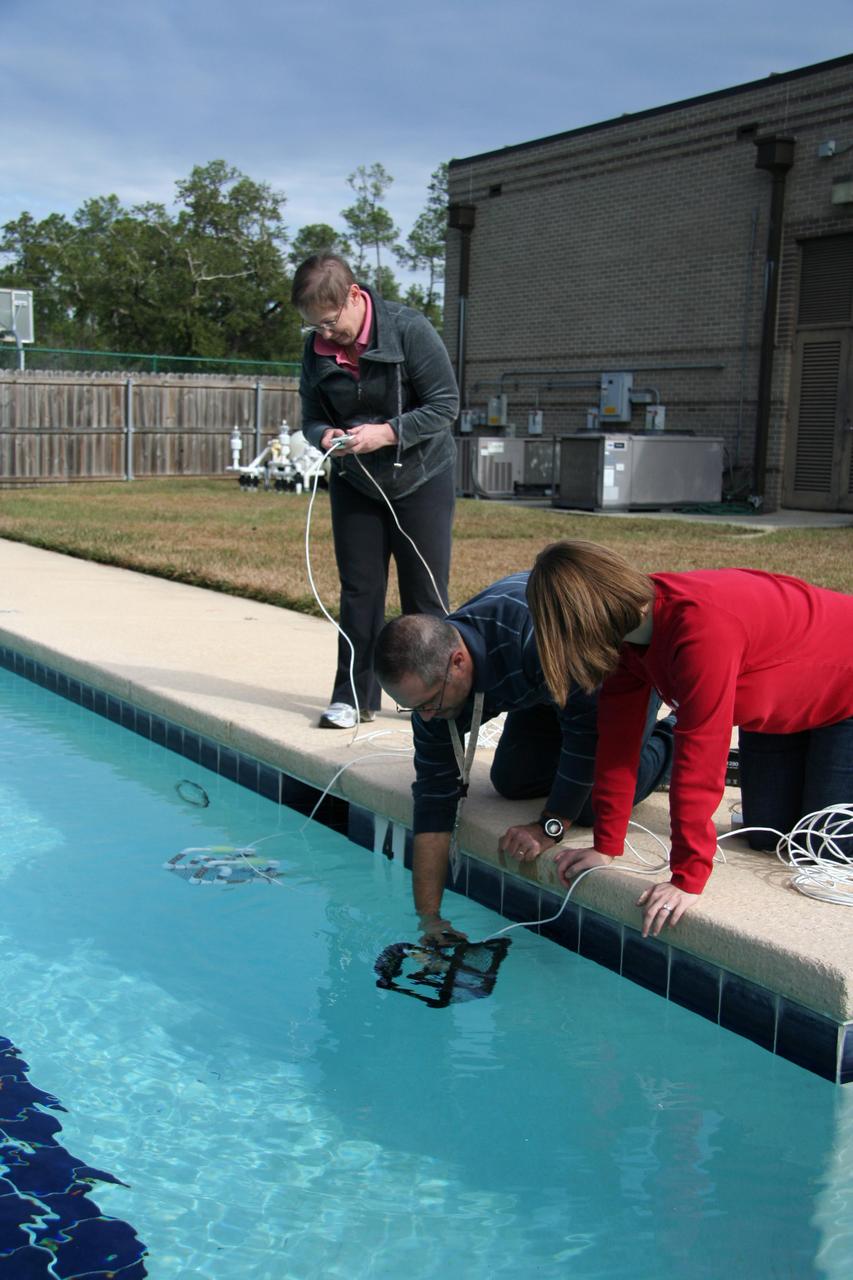
David Lalejini, an employee of the Naval Research Laboratory at NASA's John C. Stennis Space Center, helps a pair of teachers deploy a remotely-operated underwater Sea Perch robot during workshop activities Dec. 11. The Stennis Education Office teamed with Naval Research Laboratory counterparts to conduct a two-day workshop Dec. 10-11 for Louisiana and Mississippi teachers. During the no-cost workshop, teachers learned to build and operate Sea Perch robots. The teachers now can take the Sea Perch Program back to students.
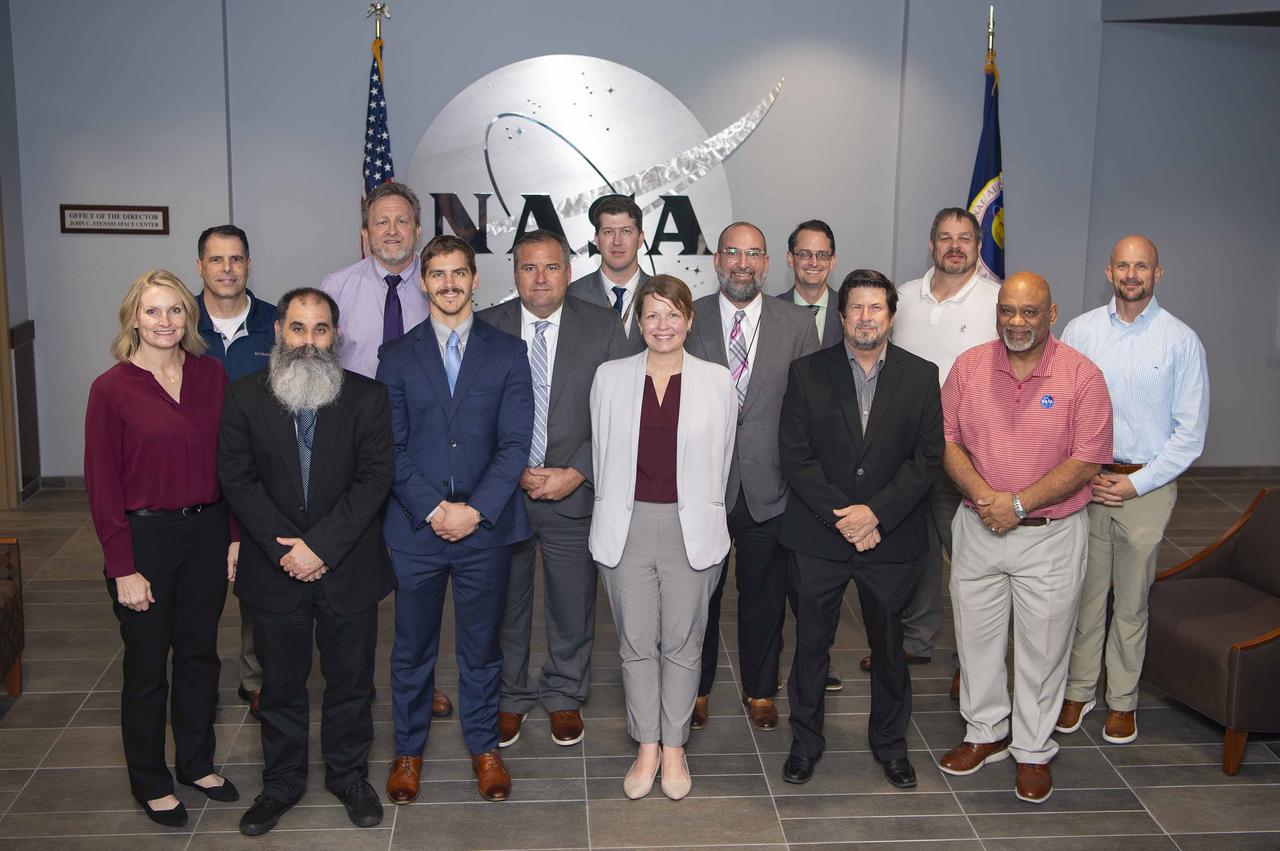
U.S. Navy officials visited with NASA Stennis leaders Nov. 13 for a meet-and-greet opportunity, also receiving an overview briefing about the work and operations of south Mississippi site. Participants in the gathering included (left to right): Anita Harrell, executive director of the NASA Shared Services Center; Joe Schuyler, director of the NASA Stennis Engineering and Test Directorate; Herschel Mims, a management support specialist with the Naval Oceanography Operations Command; Rodney McKellip, NASA Stennis associate director; Francis Prikasky, an electronics engineer and information technology administrator with the Naval Oceanographic Office; Robert Gavagnie, a contract specialist with the Naval Oceanographic Office; James “Brett” English, information systems security manager with the Naval Meteorology and Oceanography Command; Dr. Brooke Jones, head of the Ocean Forecasting Division for the Fleet Numerical Meteorology and Oceanography Center; Maxwell Williamson, a physical scientists with the Naval Oceanographic Office; Dr. Benjamin Phrampus, a research geophysicist with the Naval Research Laboratory; Gary Benton, director of the NASA Stennis Safety and Mission Assurance Directorate; Thom Rich, associate director of the NASA Stennis Center Operations Directorate; Ken Newton, director of service delivery for the NASA Shared Services Center; and Eli Ouder, director of the NASA Stennis/NASA Shared Services Center Office of Procurement.
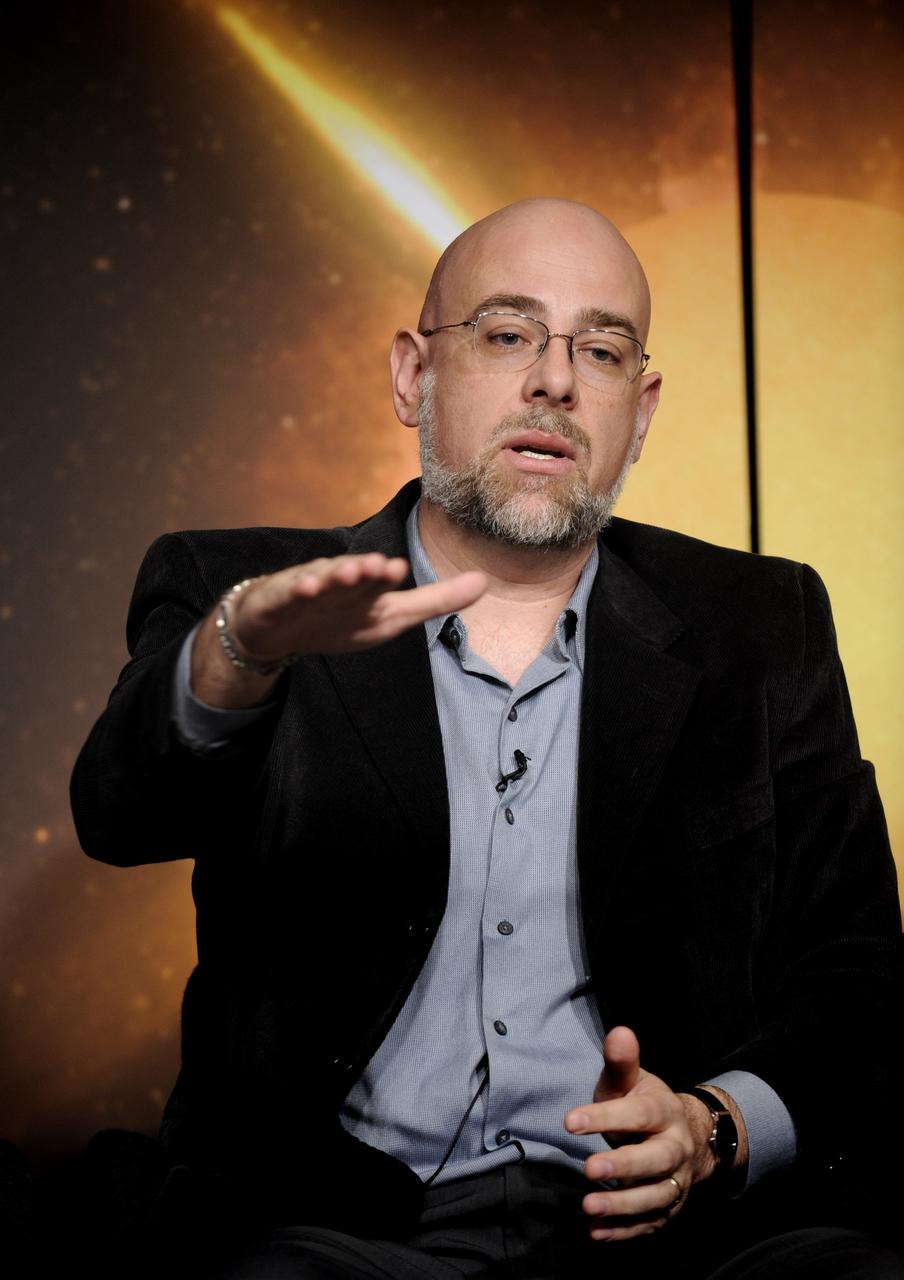
Angelo Vourlidas, project scientist, Sun Earth Connection Coronal and Heliospheric Investigation, at the Naval Research Laboratory makes a comment during a Science Update on the STEREO mission at NASA Headquarters in Washington, Tuesday, April 14, 2009. Photo Credit: (NASA/Paul E. Alers)
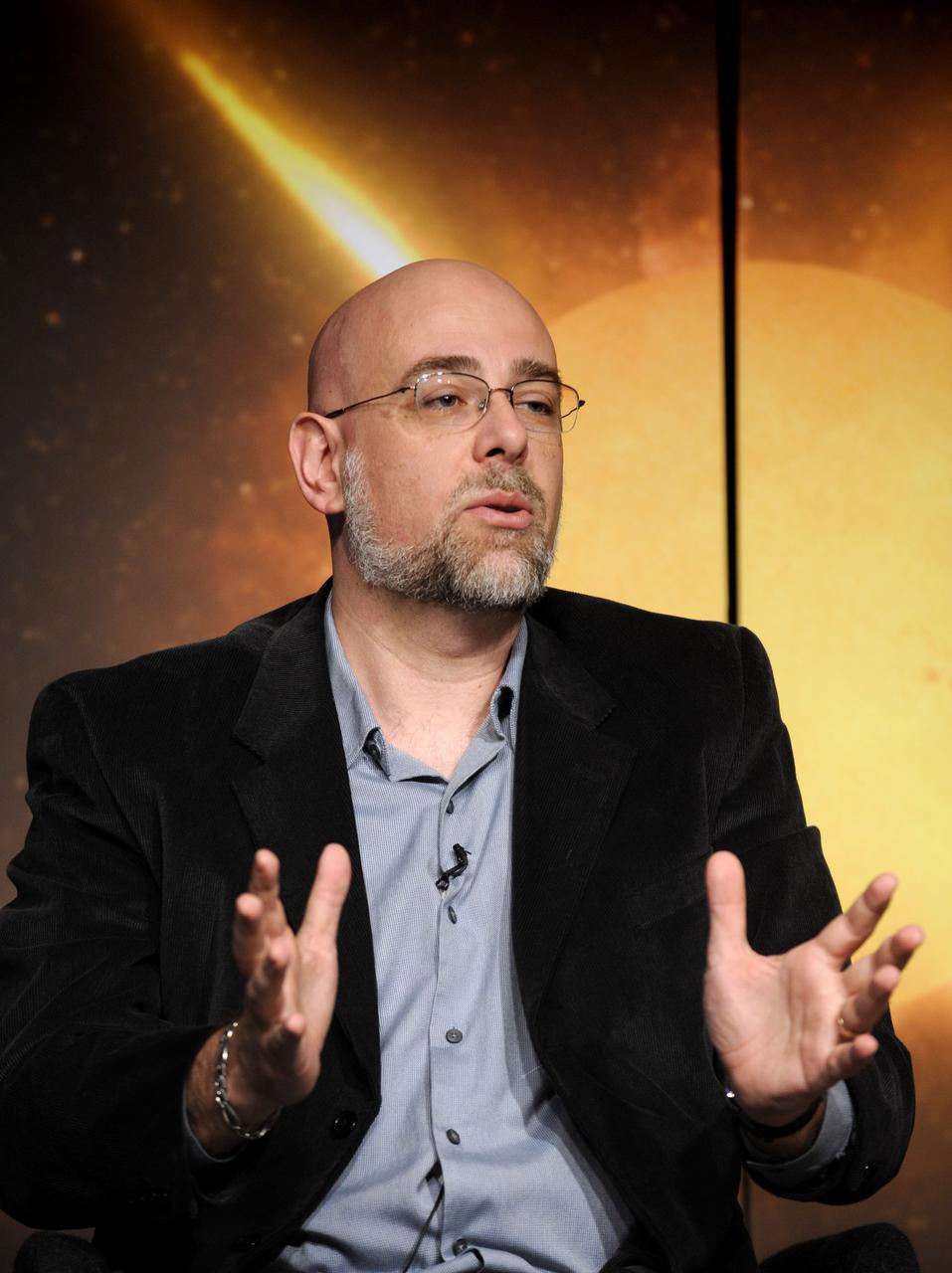
Angelo Vourlidas, project scientist, Sun Earth Connection Coronal and Heliospheric Investigation, at the Naval Research Laboratory, makes a comment during a Science Update on the STEREO mission at NASA Headquarters in Washington, Tuesday, April 14, 2009. Photo Credit: (NASA/Paul E. Alers)
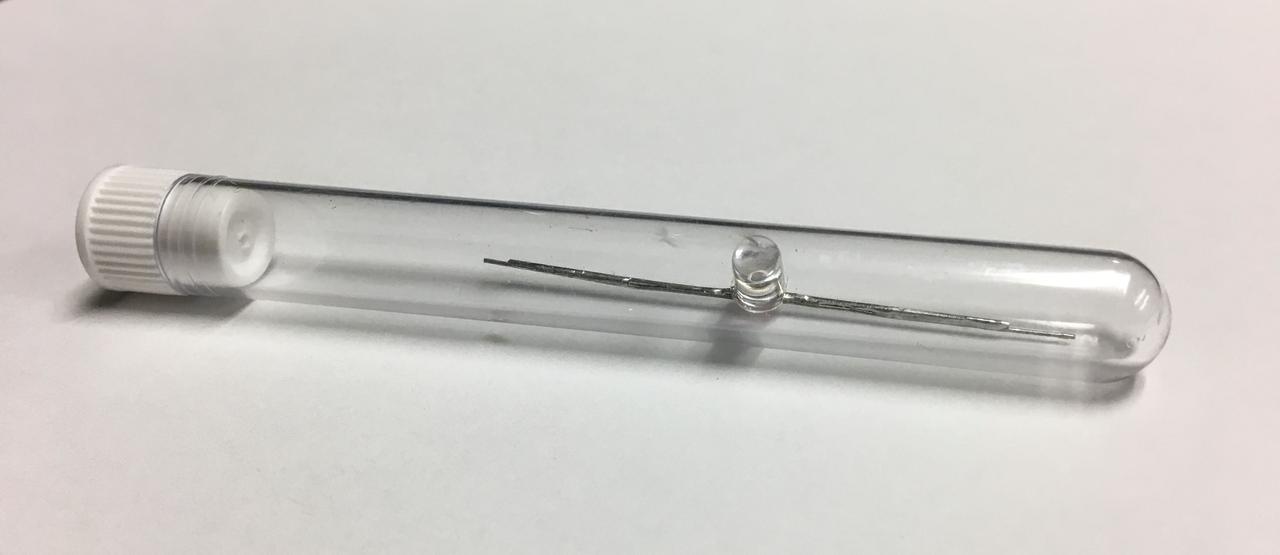
jsc2019e056551 (9/6/2019) --- Preflight imagery of the LEctenna device. LEctenna demonstrates how to transmit energy wirelessly using microwave signals in the form of wifi. This is done by using a LEctenna device which converts the microwave into electricity which powers an LED bulb. Image courtesy of: Naval Research Laboratory.
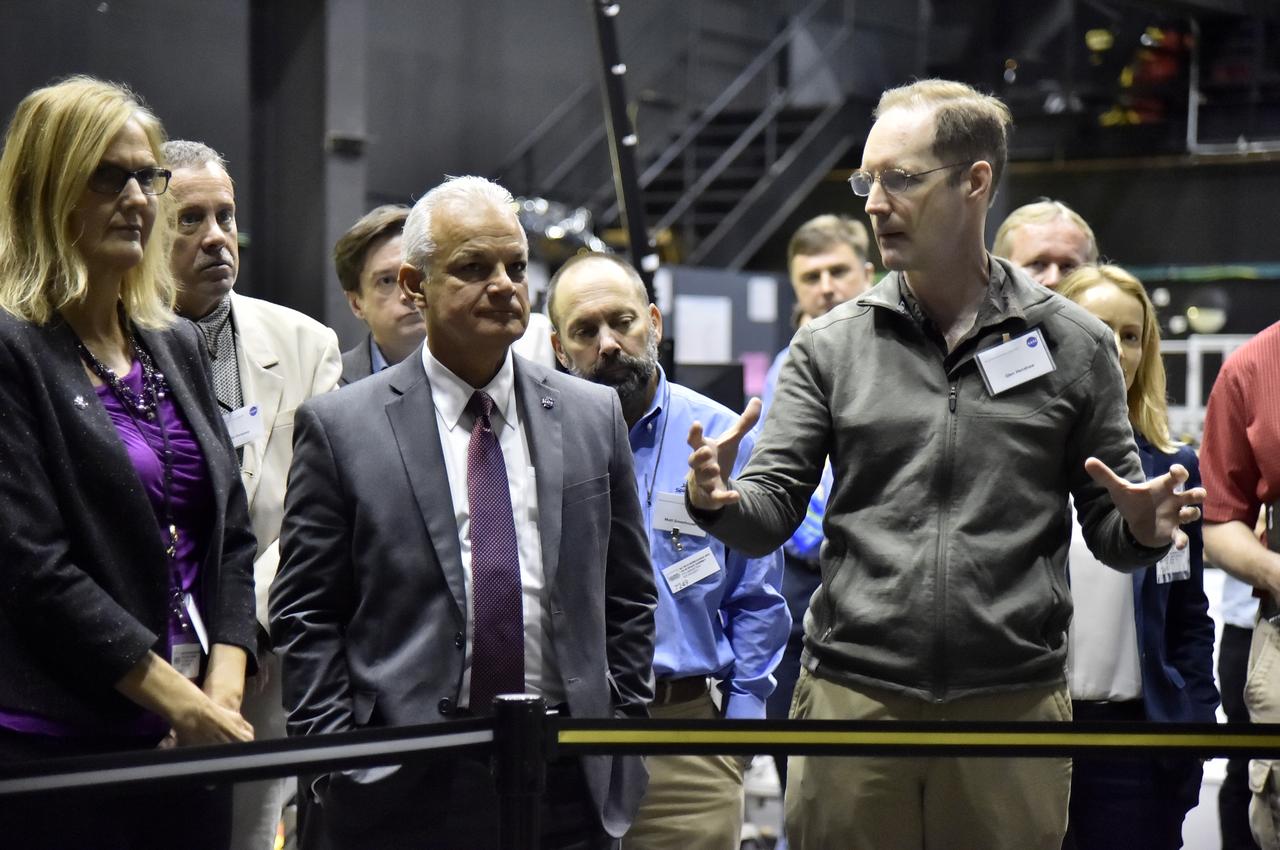
WASHINGTON, D.C.---S&T Partnership Forum In-Space Assembly Technical Interchange Meeting-On September 6th 2017, many of the United States government experts on In-Space Assembly met at the U.S. Naval Research Lab to discuss both technology development and in-space applications that would advance national capabilities in this area. Expertise from NASA, USAF, NRO, DARPA and NRL met in this meeting which was coordinated by the NASA Headquarters, Office of the Chief Technologist. This technical interchange meeting was the second meeting of the members of this Science and Technology Partnership Forum. Glen Henshaw of Code 8231 talks to the group in the Space Robotics Lab.
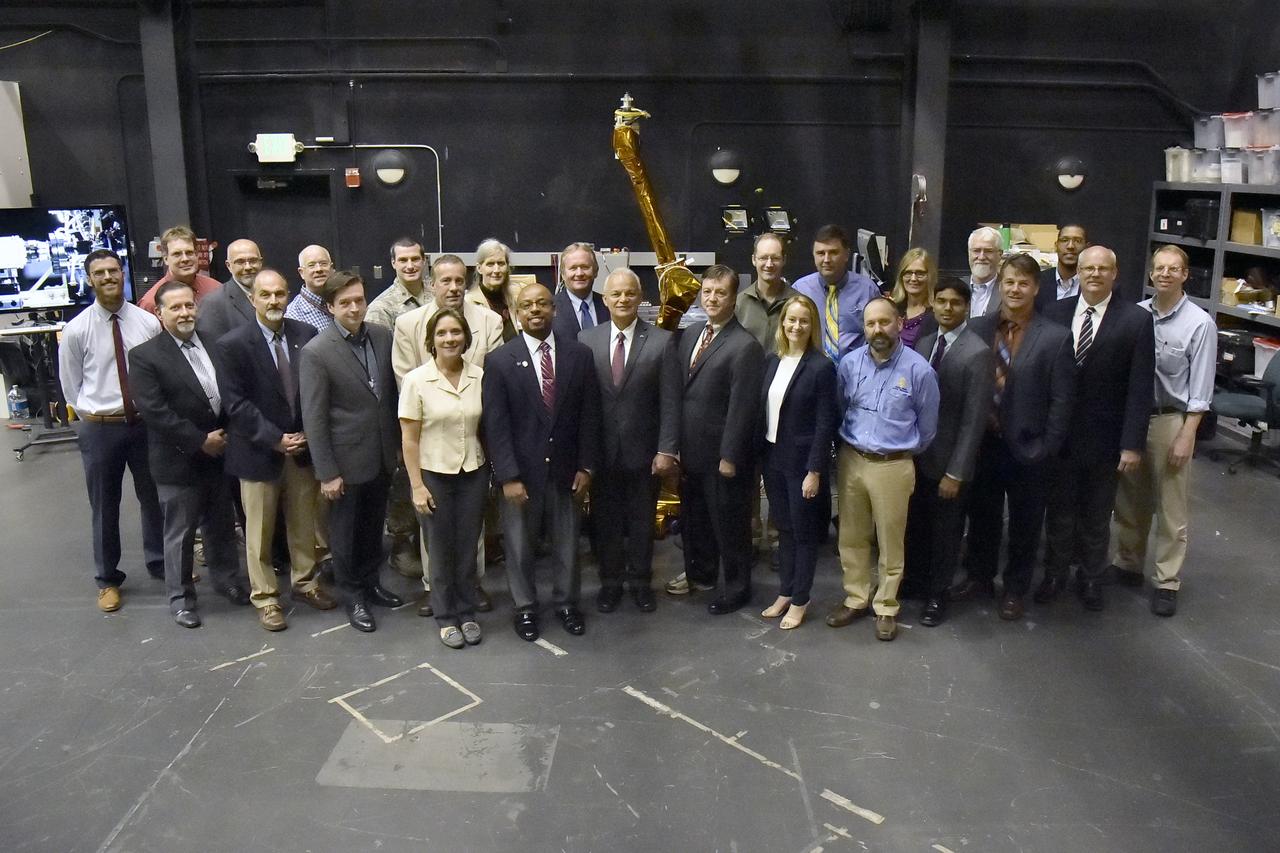
WASHINGTON, D.C.---S&T Partnership Forum In-Space Assembly Technical Interchange Meeting-On September 6th 2017, many of the United States government experts on In-Space Assembly met at the U.S. Naval Research Lab to discuss both technology development and in-space applications that would advance national capabilities in this area. Expertise from NASA, USAF, NRO, DARPA and NRL met in this meeting which was coordinated by the NASA Headquarters, Office of the Chief Technologist. This technical interchange meeting was the second meeting of the members of this Science and Technology Partnership Forum.
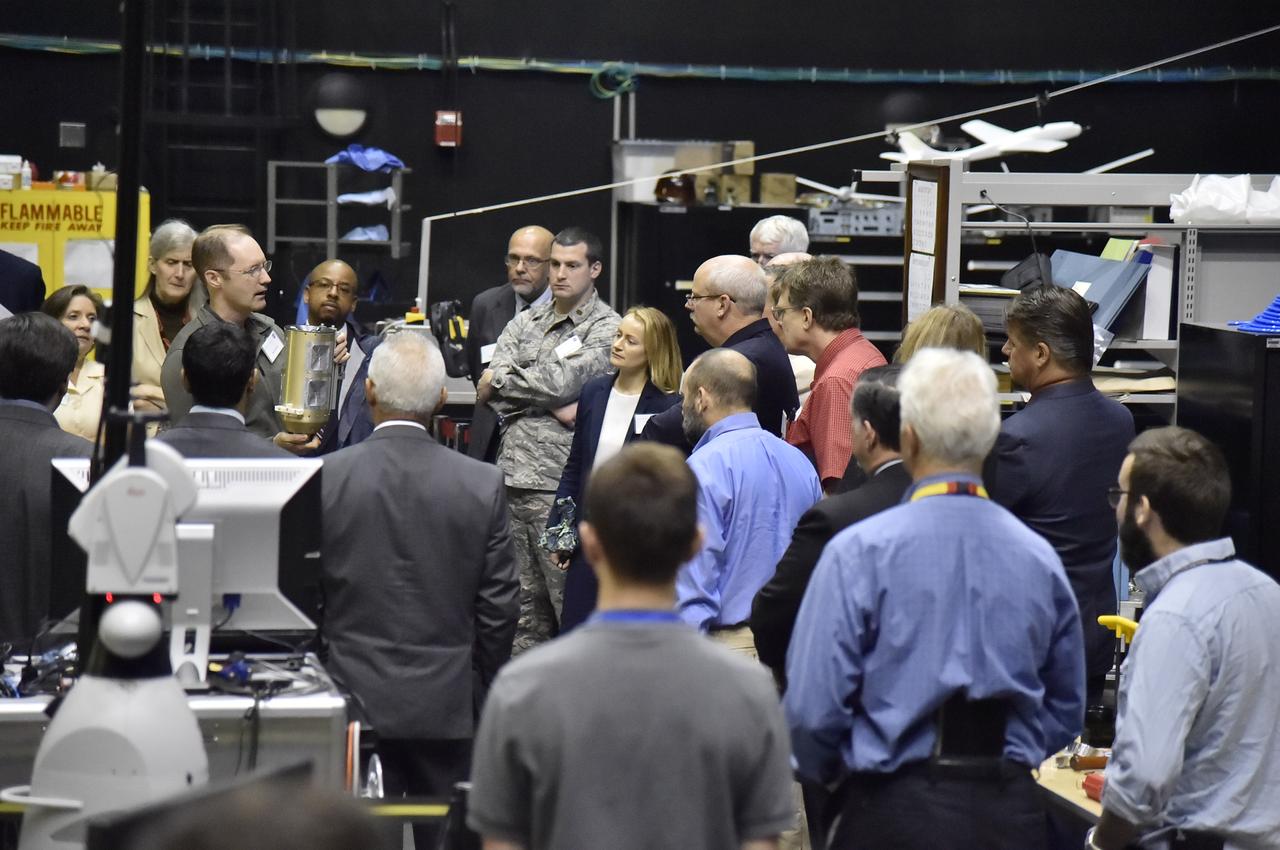
WASHINGTON, D.C.---S&T Partnership Forum In-Space Assembly Technical Interchange Meeting-On September 6th 2017, many of the United States government experts on In-Space Assembly met at the U.S. Naval Research Lab to discuss both technology development and in-space applications that would advance national capabilities in this area. Expertise from NASA, USAF, NRO, DARPA and NRL met in this meeting which was coordinated by the NASA Headquarters, Office of the Chief Technologist. This technical interchange meeting was the second meeting of the members of this Science and Technology Partnership Forum. Glen Henshaw of Code 8231 talks to the group in the Space Robotics Lab.
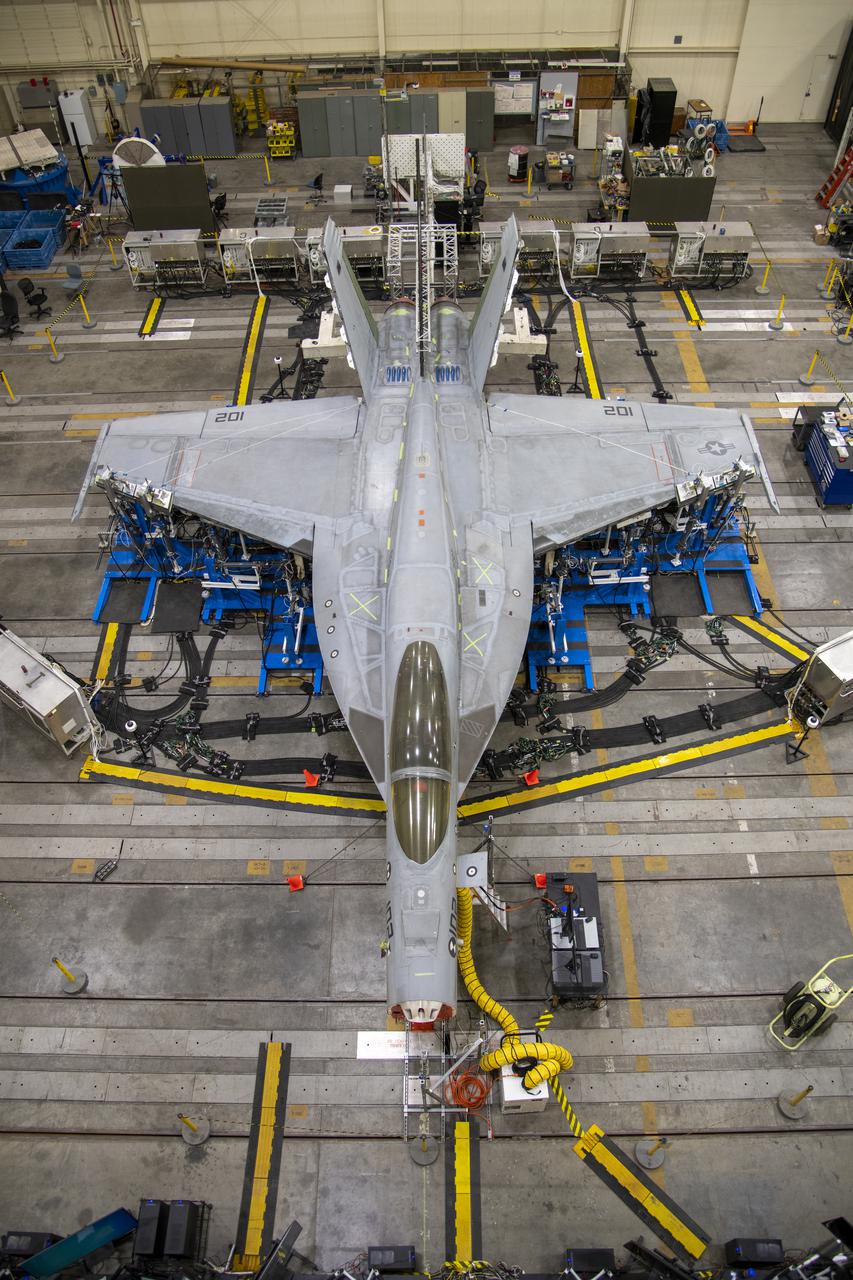
NASA’s Armstrong Flight Research Center Flight Loads Laboratory in Edwards, California, is working on one of its biggest load calibrations tests on an F/A-18E Super Hornet from the Naval Air Systems Command (NAVAIR) in Patuxent River, Maryland. This testing is needed before the aircraft can serve as a test vehicle for determining if it can safely manage maneuvers and proposed upgrades. This is a view of the test setup for the wing loads testing that is set to begin in December 2021.
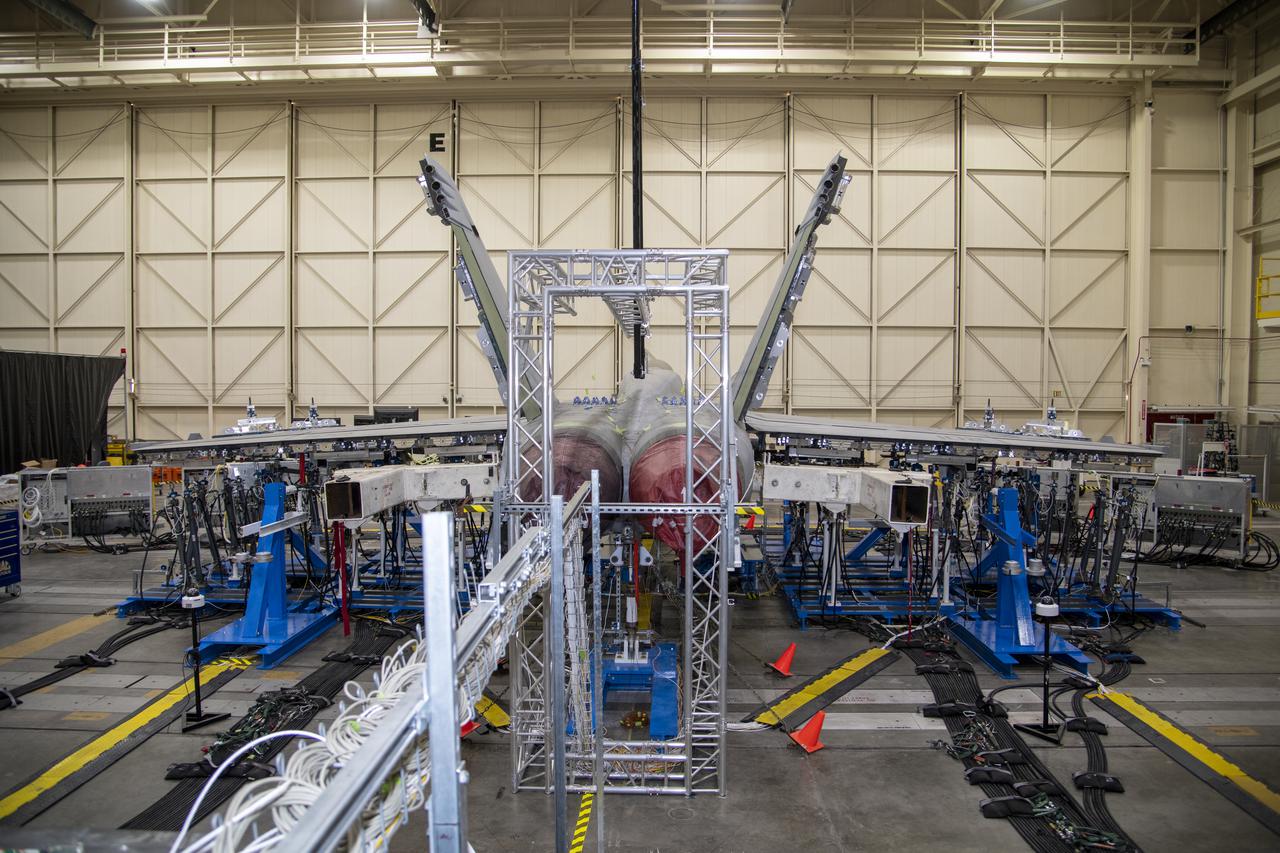
NASA’s Armstrong Flight Research Center Flight Loads Laboratory in Edwards, California, is working on one of its biggest load calibrations tests on an F/A-18E Super Hornet from the Naval Air Systems Command (NAVAIR) in Patuxent River, Maryland. This testing is needed before the aircraft can serve as a test vehicle for determining if it can safely manage maneuvers and proposed upgrades. This is a view of the test setup for the wing loads testing that is set to begin in December 2021.
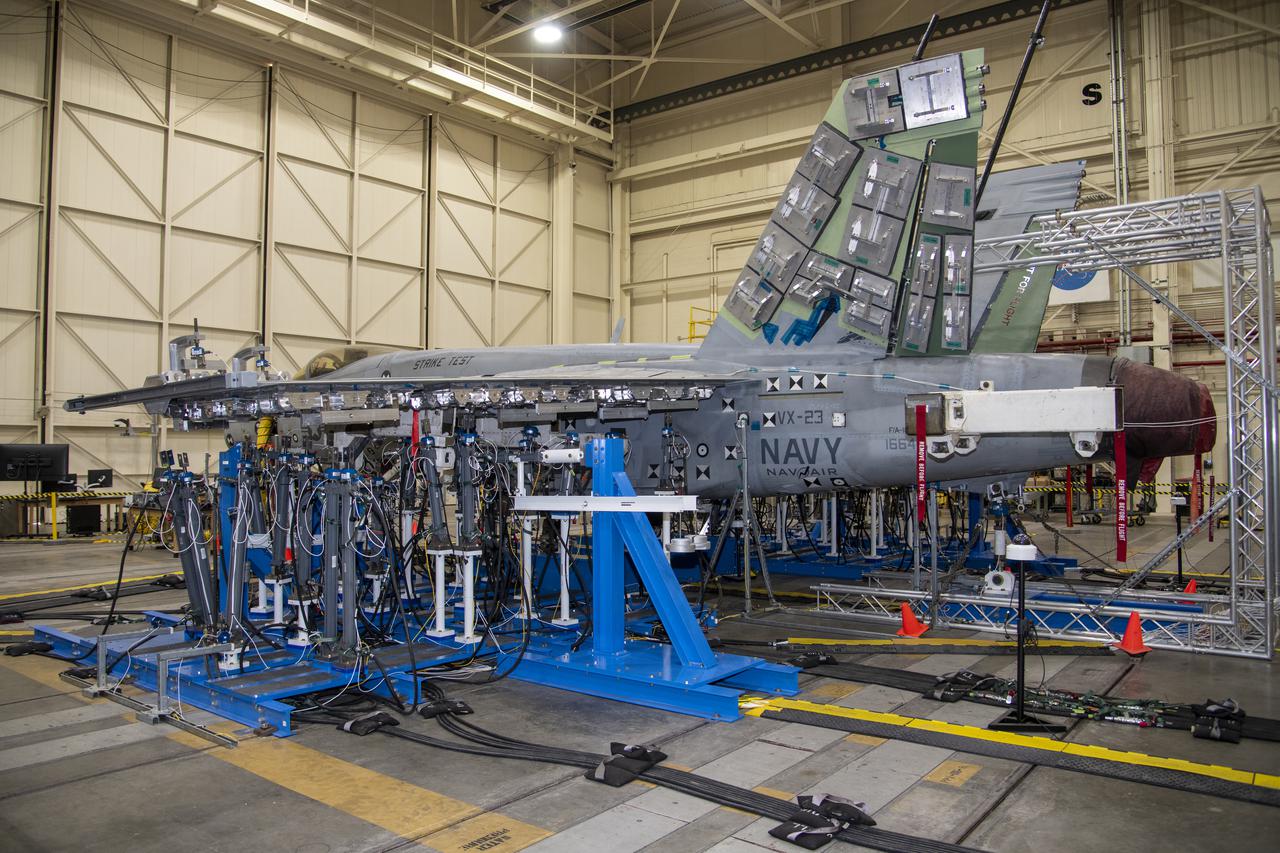
NASA’s Armstrong Flight Research Center Flight Loads Laboratory in Edwards, California, is working on one of its biggest load calibrations tests on an F/A-18E Super Hornet from the Naval Air Systems Command (NAVAIR) in Patuxent River, Maryland. This testing is needed before the aircraft can serve as a test vehicle for determining if it can safely manage maneuvers and proposed upgrades. This is a view of the test setup for the wing loads testing that is set to begin in December 2021.

NASA’s Armstrong Flight Research Center Flight Loads Laboratory in Edwards, California, is working on one of its biggest load calibrations tests on an F/A-18E Super Hornet from the Naval Air Systems Command (NAVAIR) in Patuxent River, Maryland. This testing is needed before the aircraft can serve as a test vehicle for determining if it can safely manage maneuvers and proposed upgrades. This is a view of the test setup for the wing loads testing that is set to begin in December 2021.
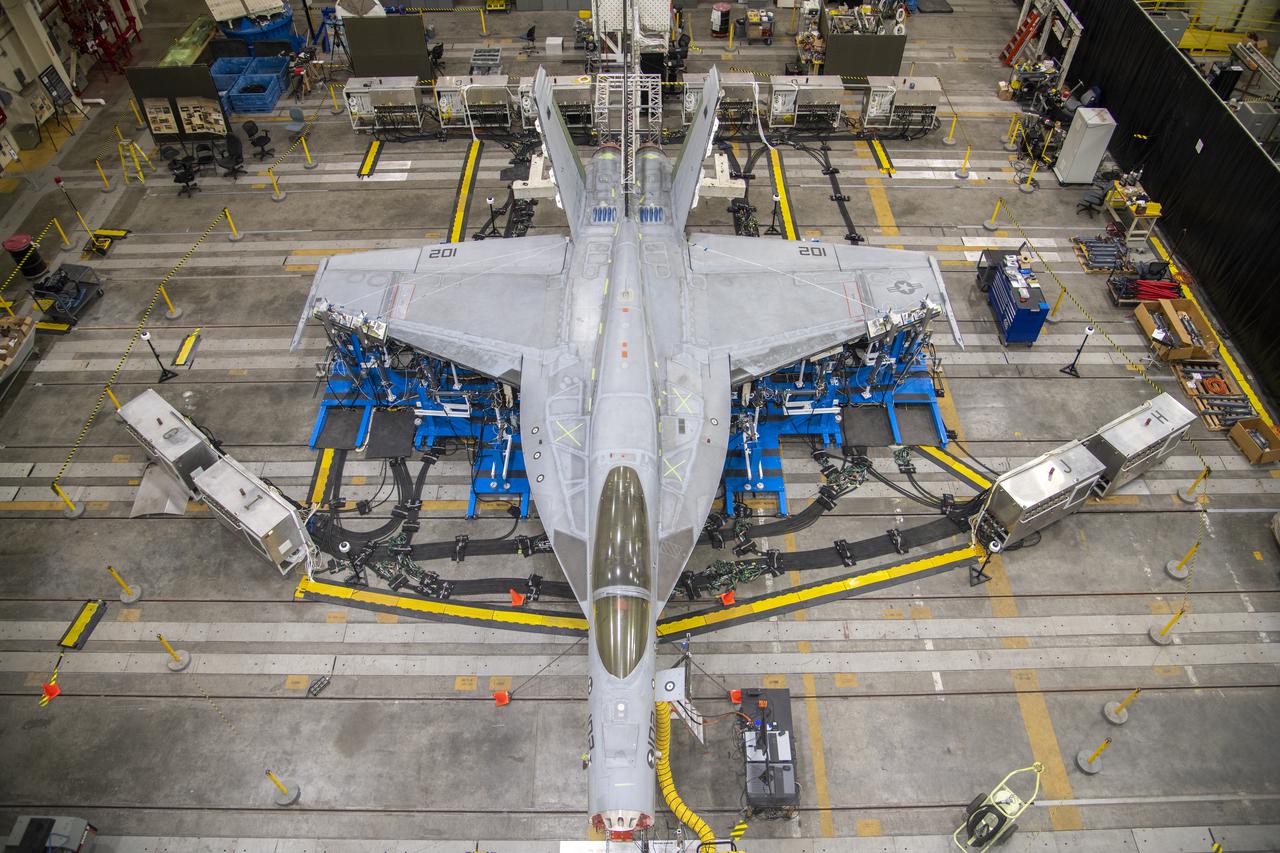
NASA’s Armstrong Flight Research Center Flight Loads Laboratory in Edwards, California, is working on one of its biggest load calibrations tests on an F/A-18E Super Hornet from the Naval Air Systems Command (NAVAIR) in Patuxent River, Maryland. This testing is needed before the aircraft can serve as a test vehicle for determining if it can safely manage maneuvers and proposed upgrades. This is a view of the test setup for the wing loads testing that is set to begin in December 2021.
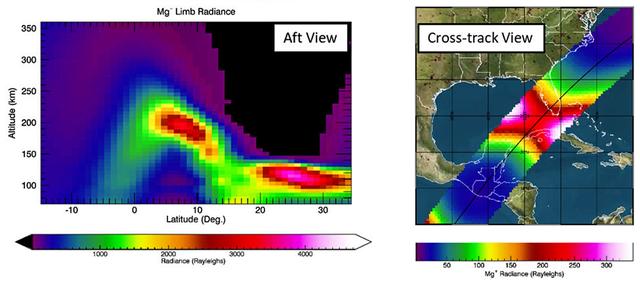
jsc2022e091371 (12/7/2022) --- A view of a simulation of the STP-H9-ECLIPSE observations of the Mg+ emission mapping scheme. The left panel (aft view) shows the observations along the orbit plane used to infer the vertical ion distribution. The right panel (cross-track view) shows the map of the Mg+ emission cross-track beneath the ISS orbit. These two data sets are simultaneously tomographically inverted to infer the 3D ion distribution. Image courtesy of the Naval Research Laboratory.
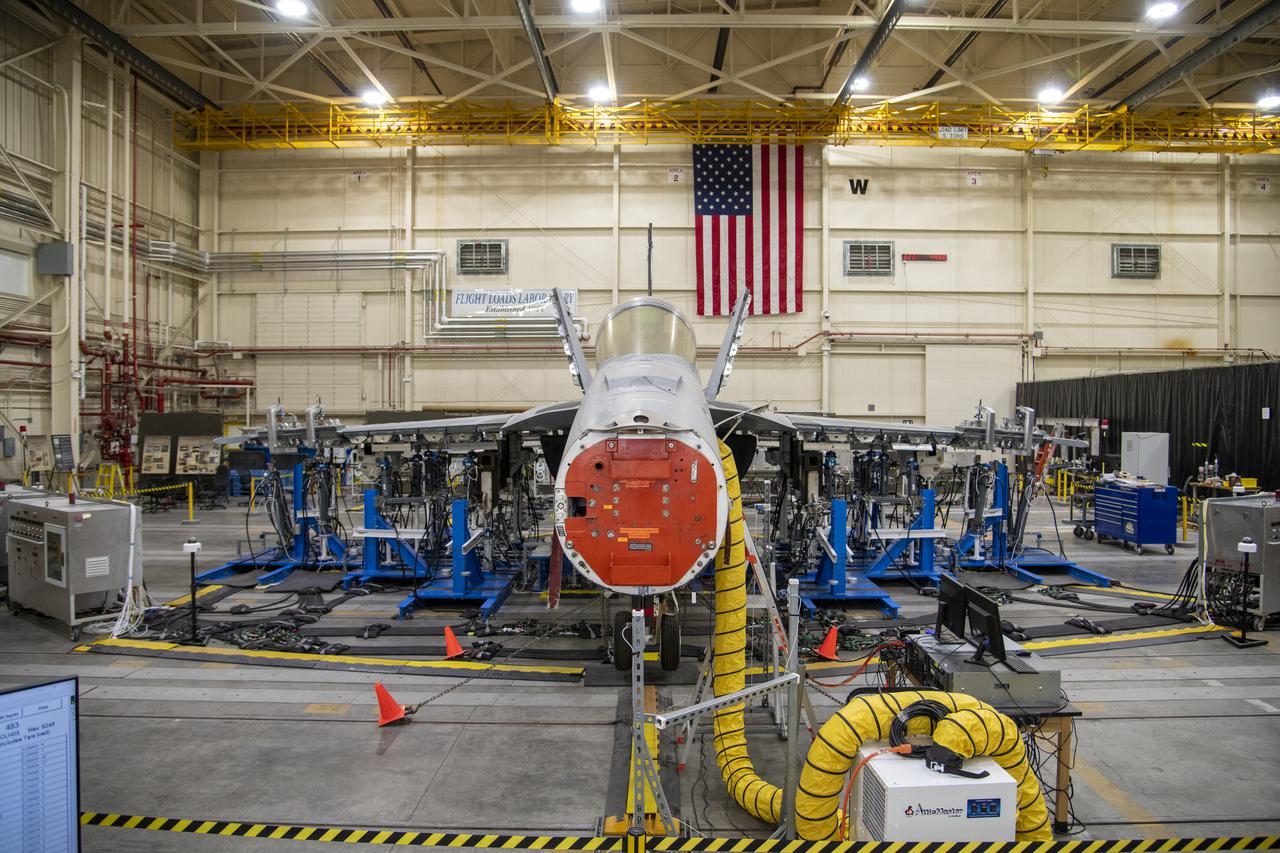
NASA’s Armstrong Flight Research Center Flight Loads Laboratory in Edwards, California, is working on one of its biggest load calibrations tests on an F/A-18E Super Hornet from the Naval Air Systems Command (NAVAIR) in Patuxent River, Maryland. This testing is needed before the aircraft can serve as a test vehicle for determining if it can safely manage maneuvers and proposed upgrades. This is a view of the test setup for the wing loads testing that is set to begin in December 2021.
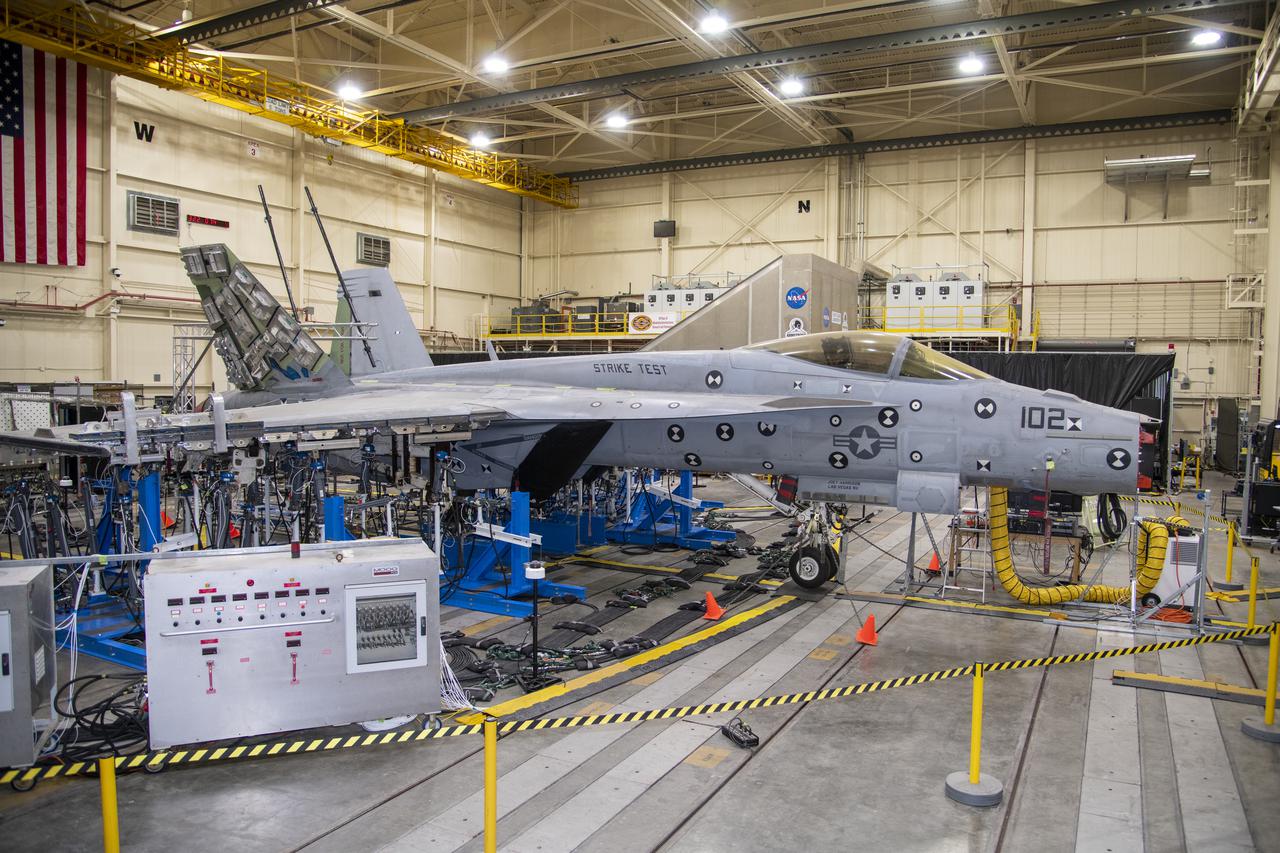
NASA’s Armstrong Flight Research Center Flight Loads Laboratory in Edwards, California, is working on one of its biggest load calibrations tests on an F/A-18E Super Hornet from the Naval Air Systems Command (NAVAIR) in Patuxent River, Maryland. This testing is needed before the aircraft can serve as a test vehicle for determining if it can safely manage maneuvers and proposed upgrades. This is a view of the test setup for the wing loads testing that is set to begin in December 2021.
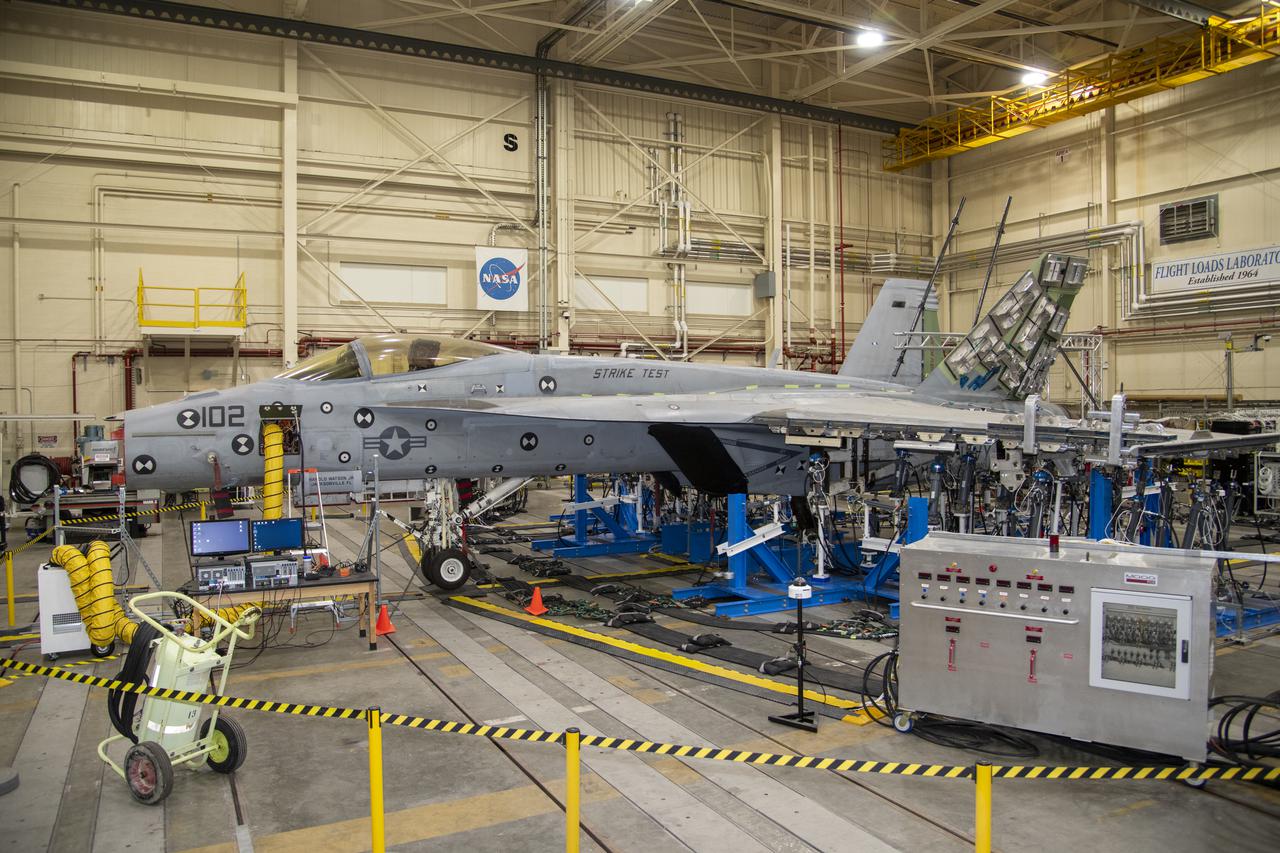
NASA’s Armstrong Flight Research Center Flight Loads Laboratory in Edwards, California, is working on one of its biggest load calibrations tests on an F/A-18E Super Hornet from the Naval Air Systems Command (NAVAIR) in Patuxent River, Maryland. This testing is needed before the aircraft can serve as a test vehicle for determining if it can safely manage maneuvers and proposed upgrades. This is a view of the test setup for the wing loads testing that is set to begin in December 2021.
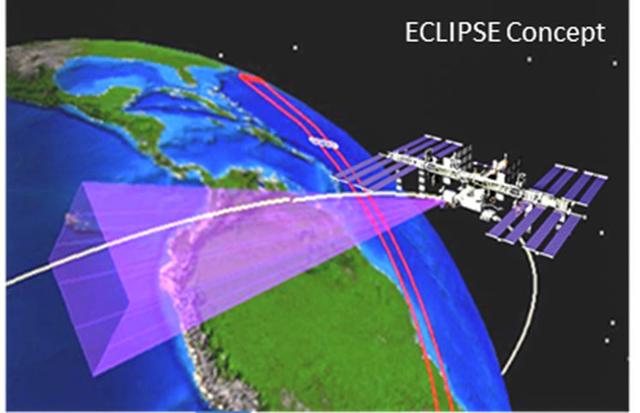
jsc2022e091370 (12/7/2022) --- The Space Test Program - Houston 9 - Experiment for Characterizing the Lower Ionosphere and Production of Sporadic-E (STP-H9-ECLIPSE) investigation scans its photometer fields of view (FOV) along the orbit plane looking behind the International Space Station to measure the vertical distribution of airglow emissions and cross-track below the ISS to observe the horizontal distribution of the airglow emissions. The observations are tomographically inverted to infer the 3D ionospheric structure. Image courtesy of the Naval Research Laboratory.
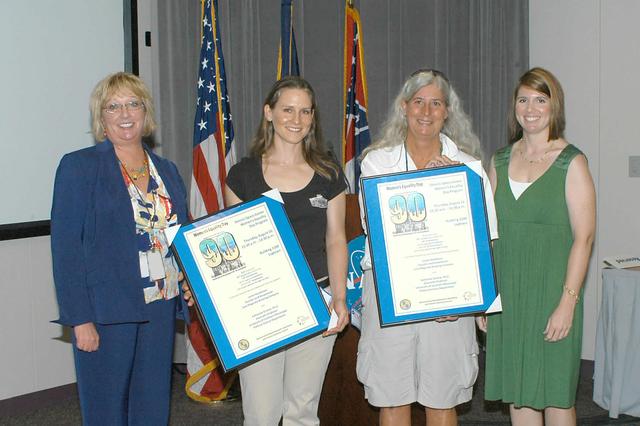
NASA's John C. Stennis Space Center celebrated Women's Equality Day with a program featuring presentations from a pair of area women - Leslie Henderson, founder and brewmaster of Lazy Magnolia Brewing Co. in Kiln, Miss., and Kathanne Greene, associate professor of political science at the University of Southern Mississippi in Hattiesburg. Shown are (l to r): Jo Ann Larson, Stennis Equal Opportunity officer; Henderson; Greene; and Shannon Breland, public affairs officer for the Naval Research Laboratory at Stennis and a member of the Stennis Diversity Council.
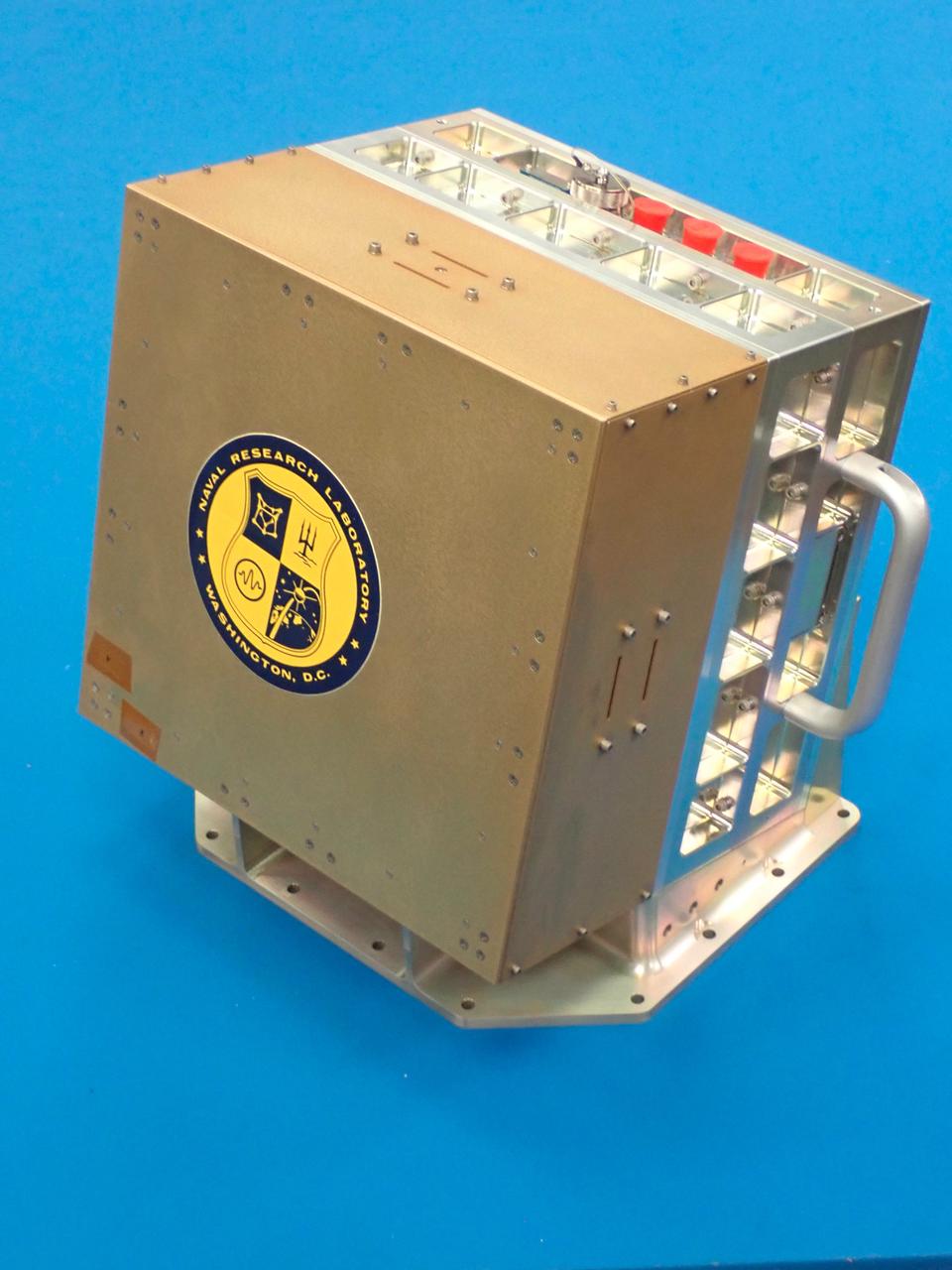
jsc2025e044725 (5/12/2025) --- A gamma-ray spectrometer and imager that uses large-volume cadmium zinc telluride (CZT) is part of the Space Test Program-Houston 10-cadmium Zinc TElluride Radiation Imager (STP-H10-TERI) investigation. The primary science objective of TERI is to qualify this technology for future space operations. Image courtesy of Daniel Shy, High Energy Space Environment Branch, Space Science Division at Naval Research Laboratory.
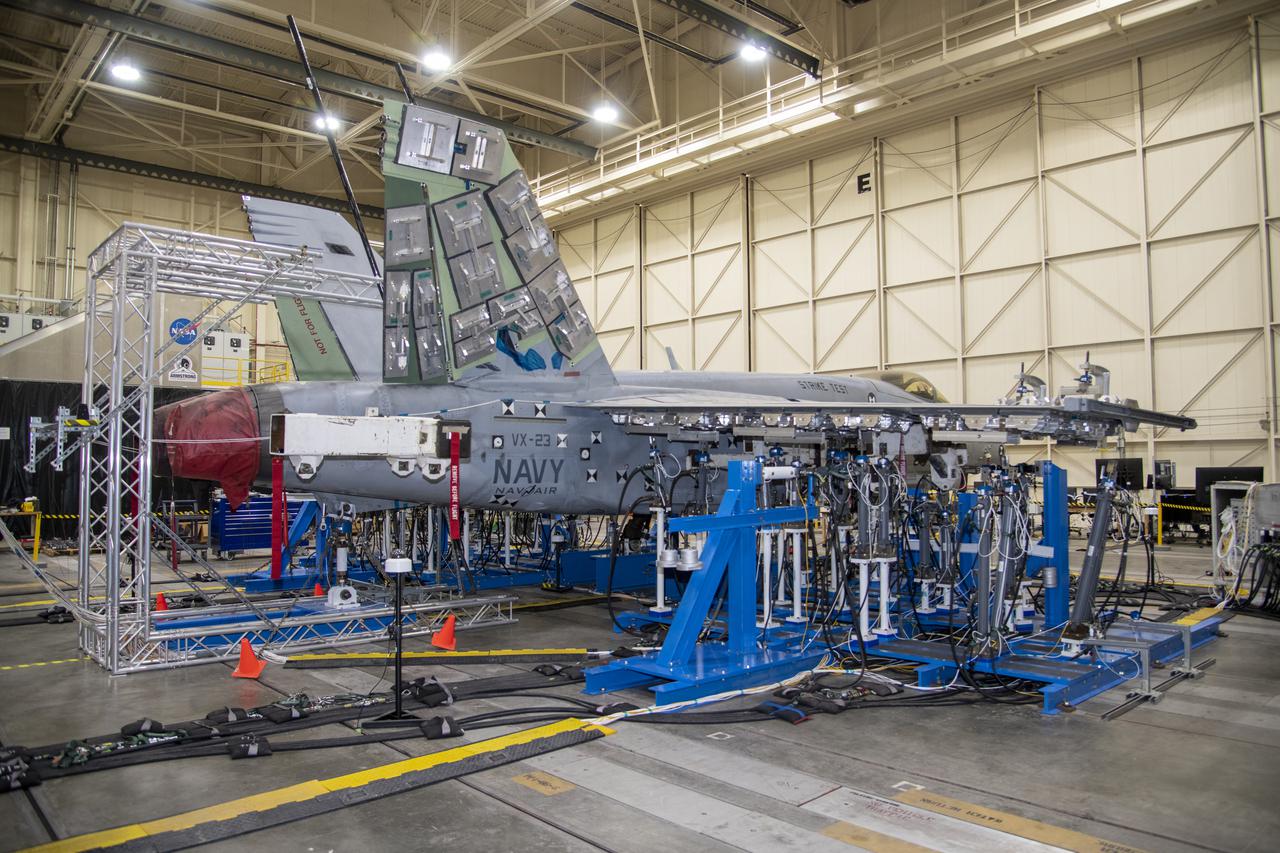
NASA’s Armstrong Flight Research Center Flight Loads Laboratory in Edwards, California, is working on one of its biggest load calibrations tests on an F/A-18E Super Hornet from the Naval Air Systems Command (NAVAIR) in Patuxent River, Maryland. This testing is needed before the aircraft can serve as a test vehicle for determining if it can safely manage maneuvers and proposed upgrades. This is a view of the test setup for the wing loads testing that is set to begin in December 2021.
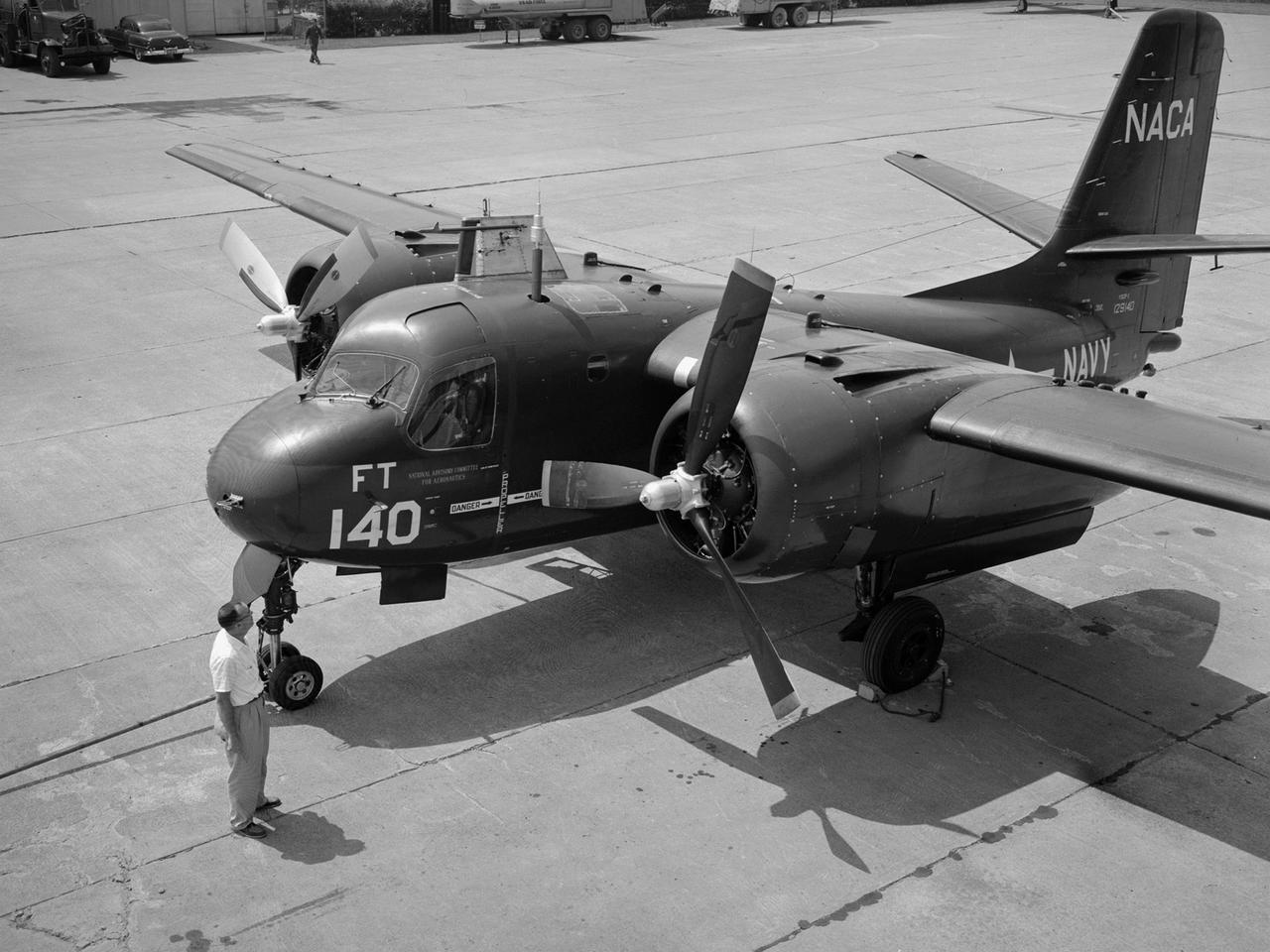
The NACA’s Lewis Flight Propulsion Laboratory acquired the Grumman S2F-1 Tracker from the Navy in 1955 to study icing instrumentation. Lewis’s icing research program was winding down at the time. The use of jet engines was increasing thus reducing the threat of ice accumulation. Nonetheless Lewis continued research on the instrumentation used to detect icing conditions. The S2F-1 Tracker was a carrier-based submarine hunter for the Navy. Grumman developed the Tracker as a successor to its Korean War-era Guardian patrol aircraft. Prototypes first flew in late 1952 and battle-ready versions entered Naval service in early 1954. The Navy utilized the Trackers to protect fleets from attack.
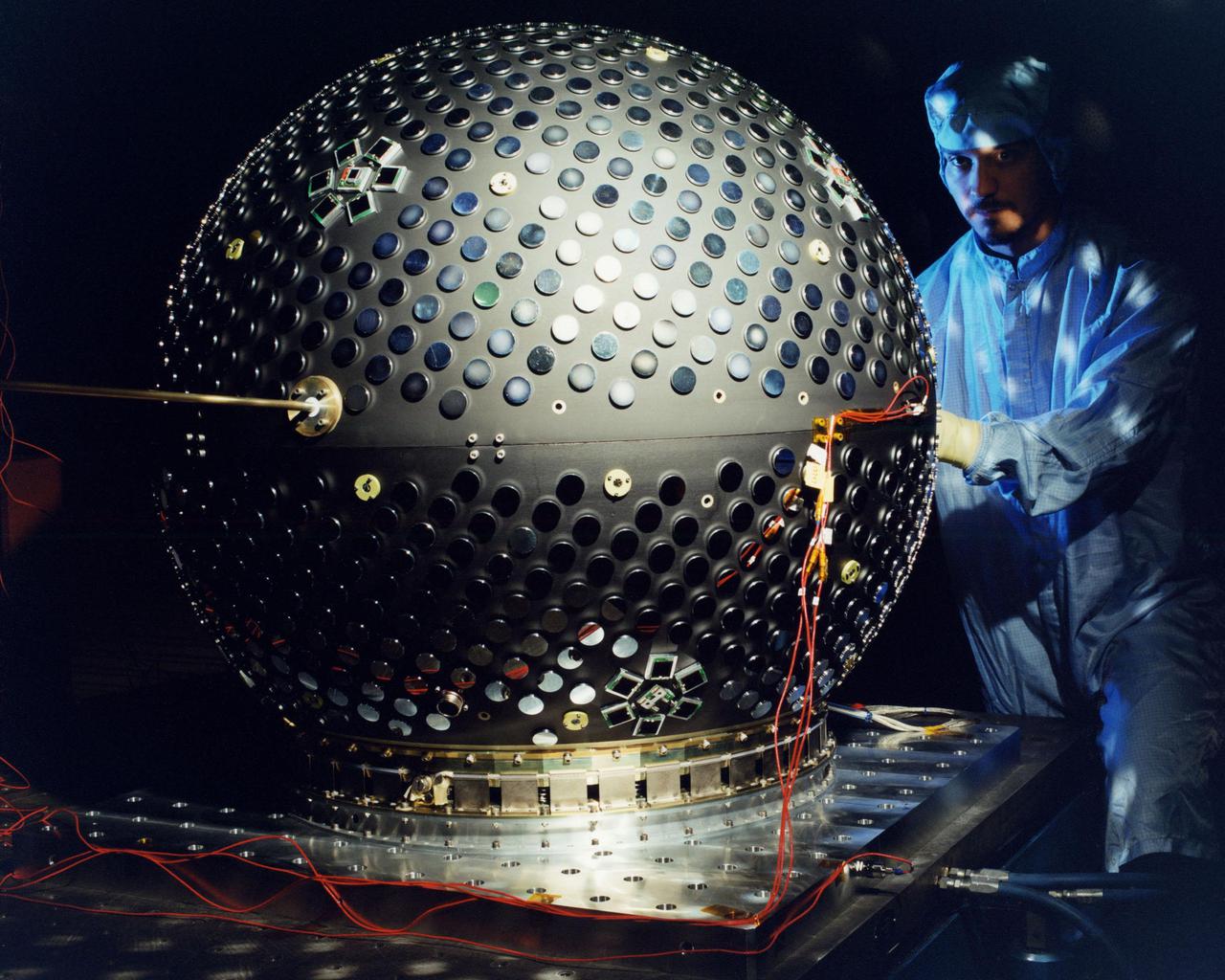
KODIAK ISLAND, Alaska -- A technician performs final testing on Starshine 3 at the Naval Research Laboratory in Washington, D.C., to prepare for the launch of the Kodiak Star at Kodiak Island, Alaska. The first orbital launch to take place from Alaska's Kodiak Launch Complex, Kodiak Star is scheduled to lift off on a Lockheed Martin Athena I launch vehicle on Sept. 17 during a two-hour window that extends from 5:00 to 7:00 p.m. ADT. The payloads aboard include the Starshine 3, sponsored by NASA, and the PICOSat, PCSat and Sapphire, sponsored by the Department of Defense (DoD) Space Test Program.
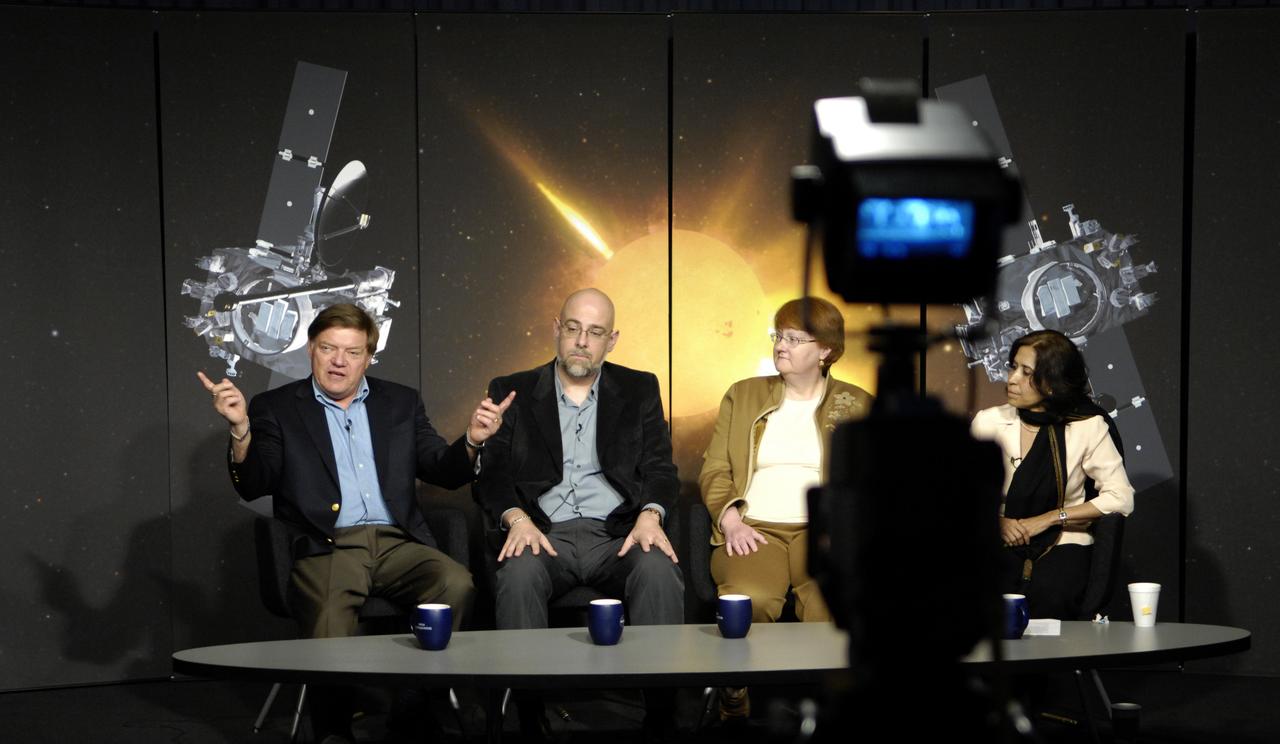
Michael Kaiser, project scientist, Solar Terrestrial Relations Observatory (STEREO) at Goddard Space Flight Center, left, makes a comment during a Science Update on the STEREO mission at NASA Headquarters in Washington, Tuesday, April 14, 2009, as Angelo Vourlidas, project scientist, Sun Earth Connection Coronal and Heliospheric Investigation, at the Naval Research Laboratory, second from left, Toni Galvin, principal investigator, Plasma and Superthermal Ion Composition instrument at the University of New Hampshire and Madhulika Guhathakurta, STEREO program scientist, right, look on. Photo Credit: (NASA/Paul E. Alers)
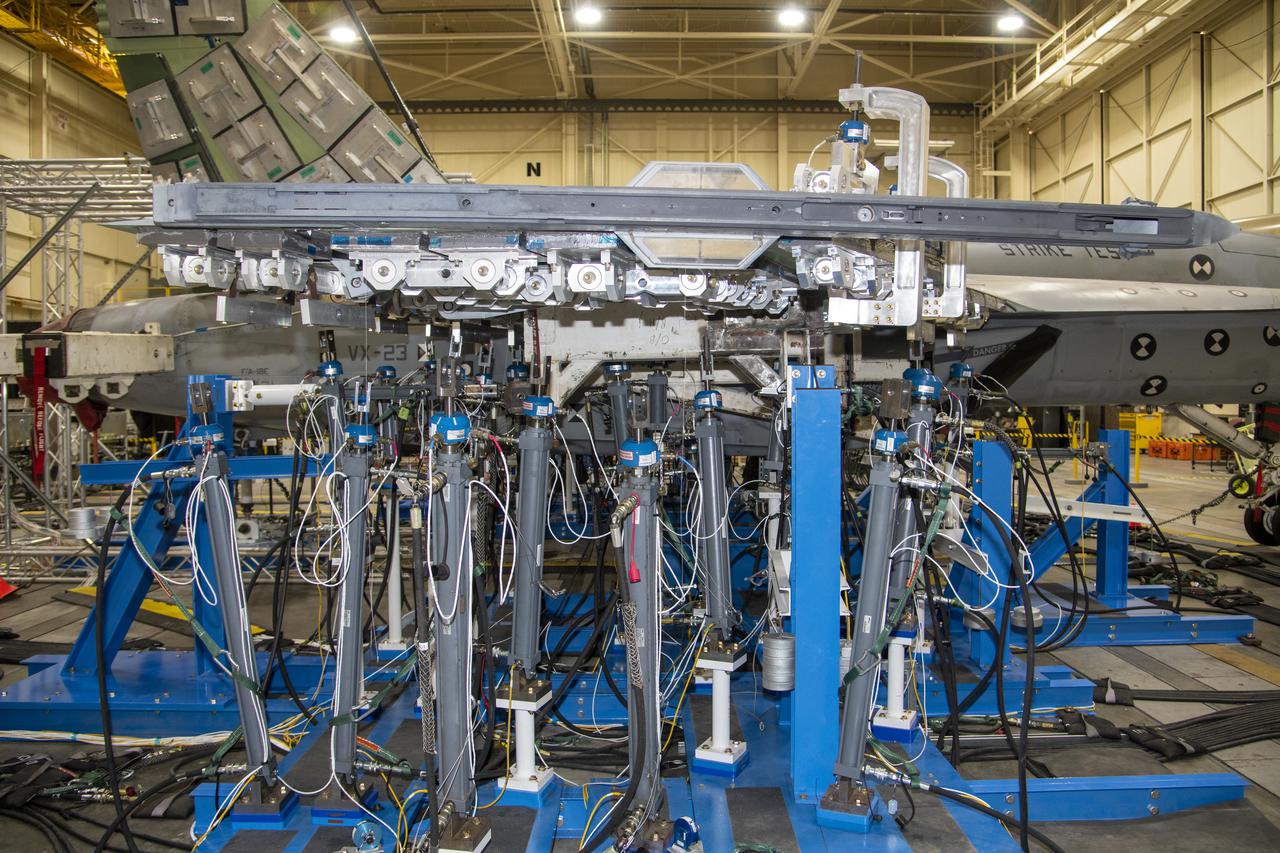
NASA’s Armstrong Flight Research Center Flight Loads Laboratory in Edwards, California, is working on one of its biggest load calibrations tests on an F/A-18E Super Hornet from the Naval Air Systems Command (NAVAIR) in Patuxent River, Maryland. This testing is needed before the aircraft can serve as a test vehicle for determining if it can safely manage maneuvers and proposed upgrades. The horizontal tail spindle testing, the first of three phases, wrapped up in October 2021. The next phase focuses on wing loads testing that is set to begin in December 2021.
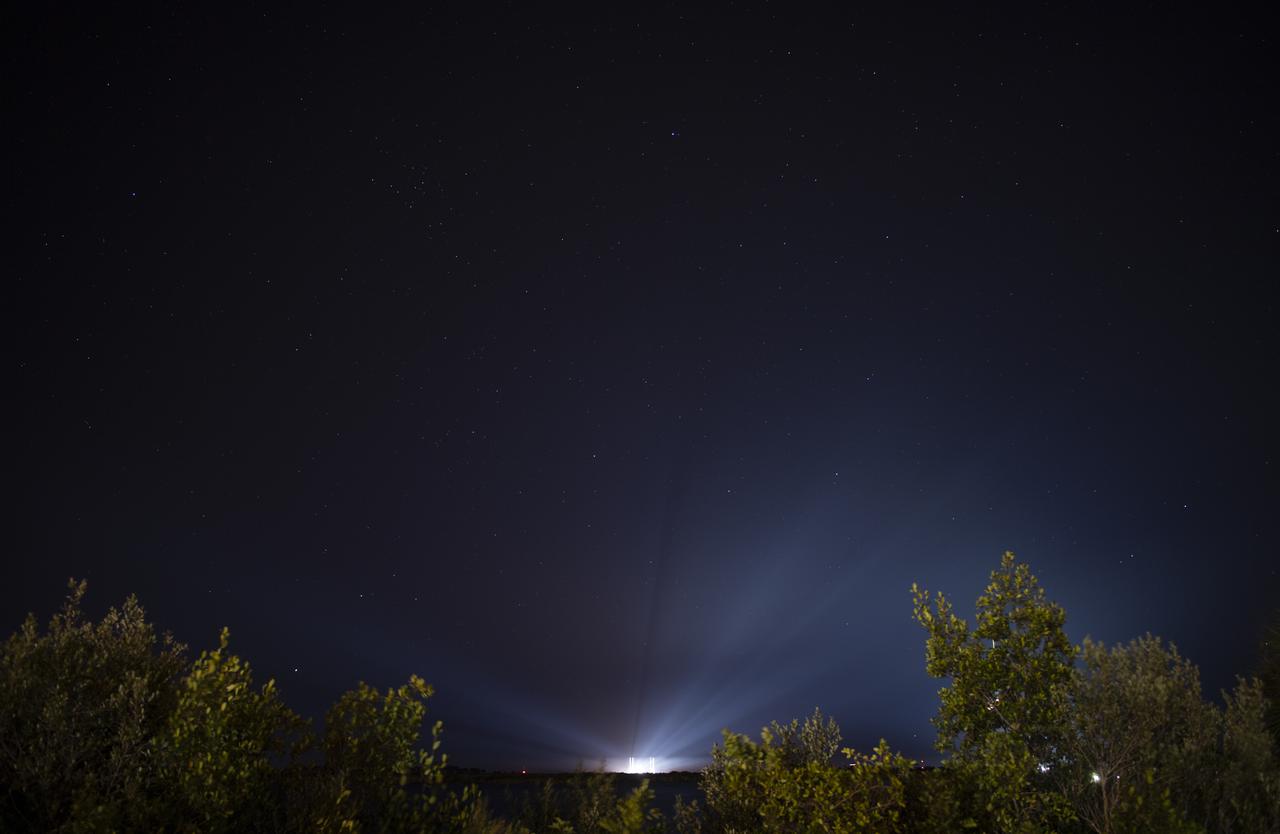
A United Launch Alliance Atlas V rocket carrying the Department of Defense’s Space Test Program 3 (STP-3) mission is seen illuminated by spotlights at Space Launch Complex 41 at Cape Canaveral Space Force Station, Tuesday, Dec. 7, 2021, from NASA’s Kennedy Space Center in Florida. The mission’s Space Test Program Satellite-6 (STPSat-6) spacecraft hosts NASA’s Laser Communications Relay Demonstration (LCRD) and the NASA-U.S. Naval Research Laboratory Ultraviolet Spectro-Coronagraph (UVSC) Pathfinder. Photo Credit: (NASA/Joel Kowsky)
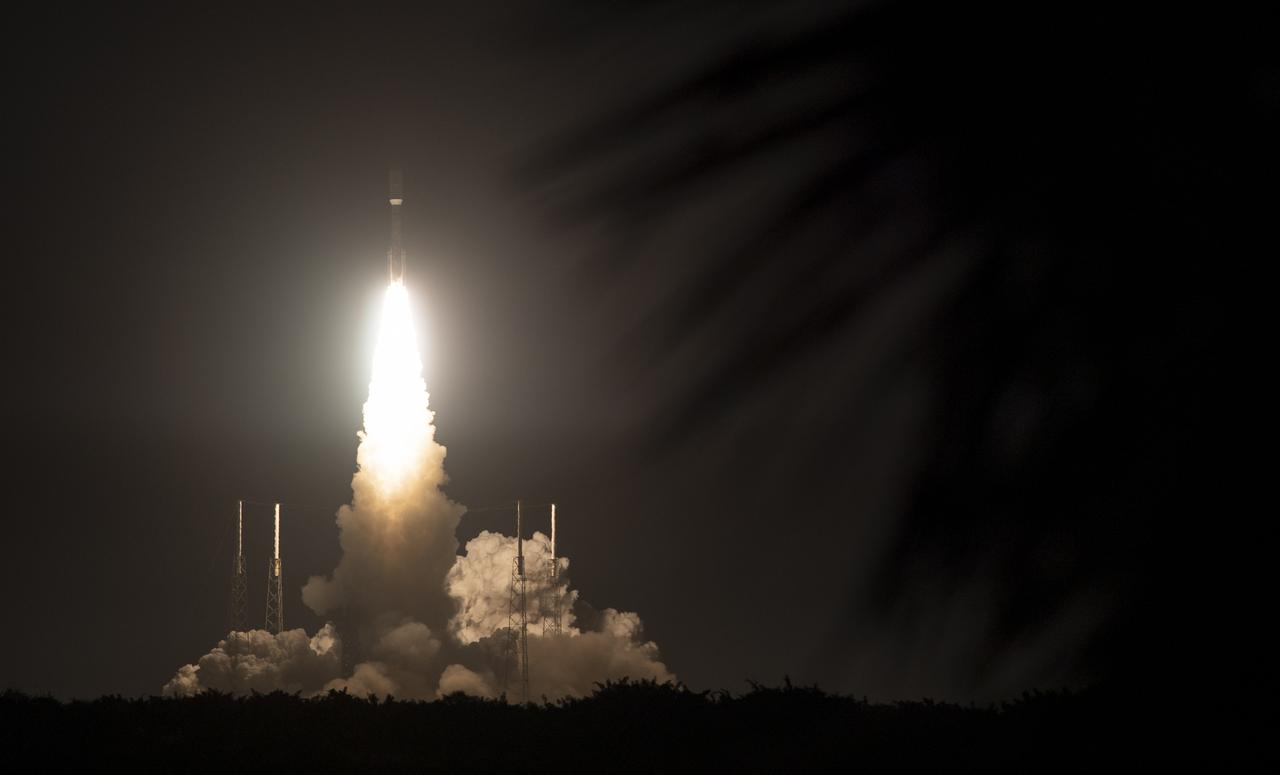
A United Launch Alliance Atlas V rocket launches on the Department of Defense’s Space Test Program 3 (STP-3) mission from Space Launch Complex 41 at Cape Canaveral Space Force Station, Tuesday, Dec. 7, 2021, from NASA’s Kennedy Space Center in Florida. The mission’s Space Test Program Satellite-6 (STPSat-6) spacecraft hosts NASA’s Laser Communications Relay Demonstration (LCRD) and the NASA-U.S. Naval Research Laboratory Ultraviolet Spectro-Coronagraph (UVSC) Pathfinder. Photo Credit: (NASA/Joel Kowsky)