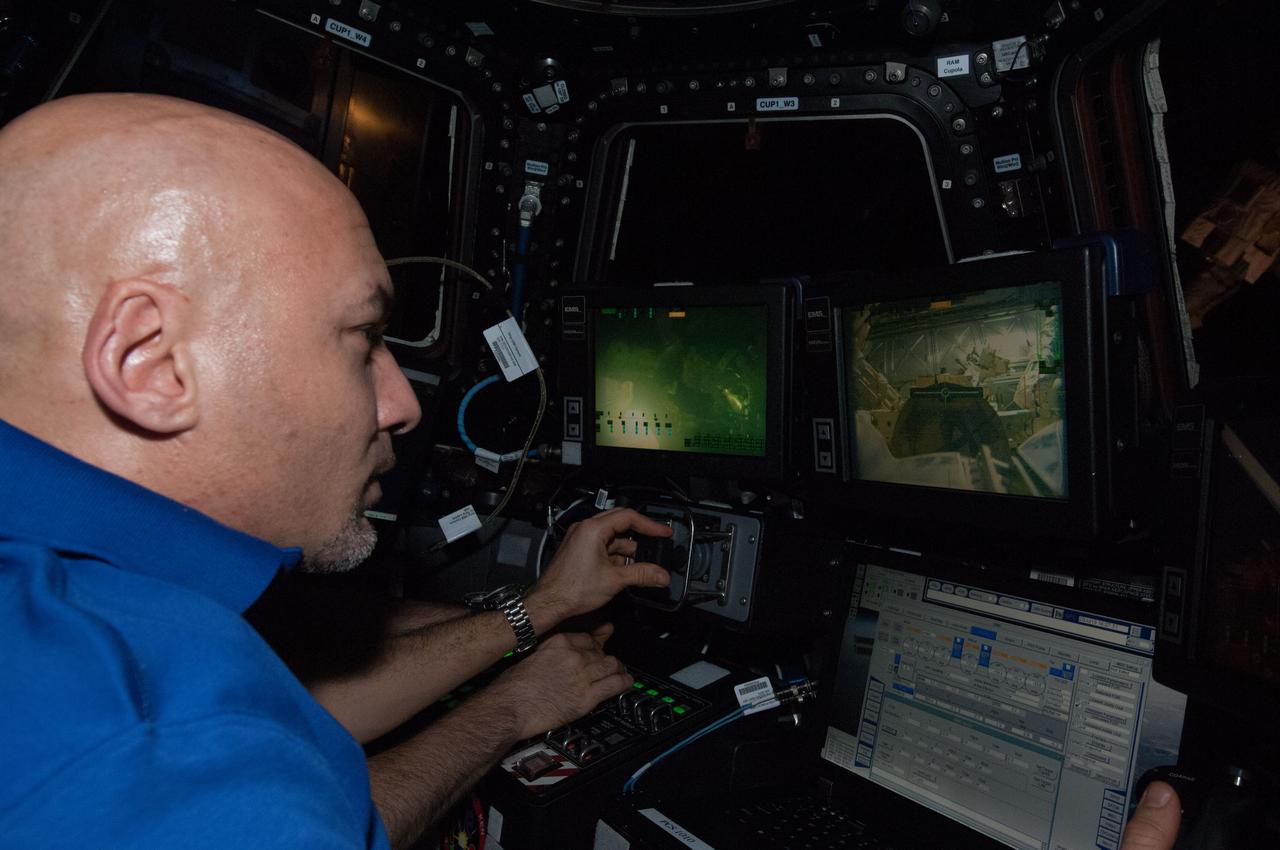
ISS036-E-026283 (29 July 2013) --- In the International Space Station?s Cupola, European Space Agency astronaut Luca Parmitano, Expedition 36 flight engineer, participates in an onboard training activity in preparation for the grapple and berthing of the Japanese ?Kounotori? H2 Transfer Vehicle-4 (HTV-4) set for August 9.
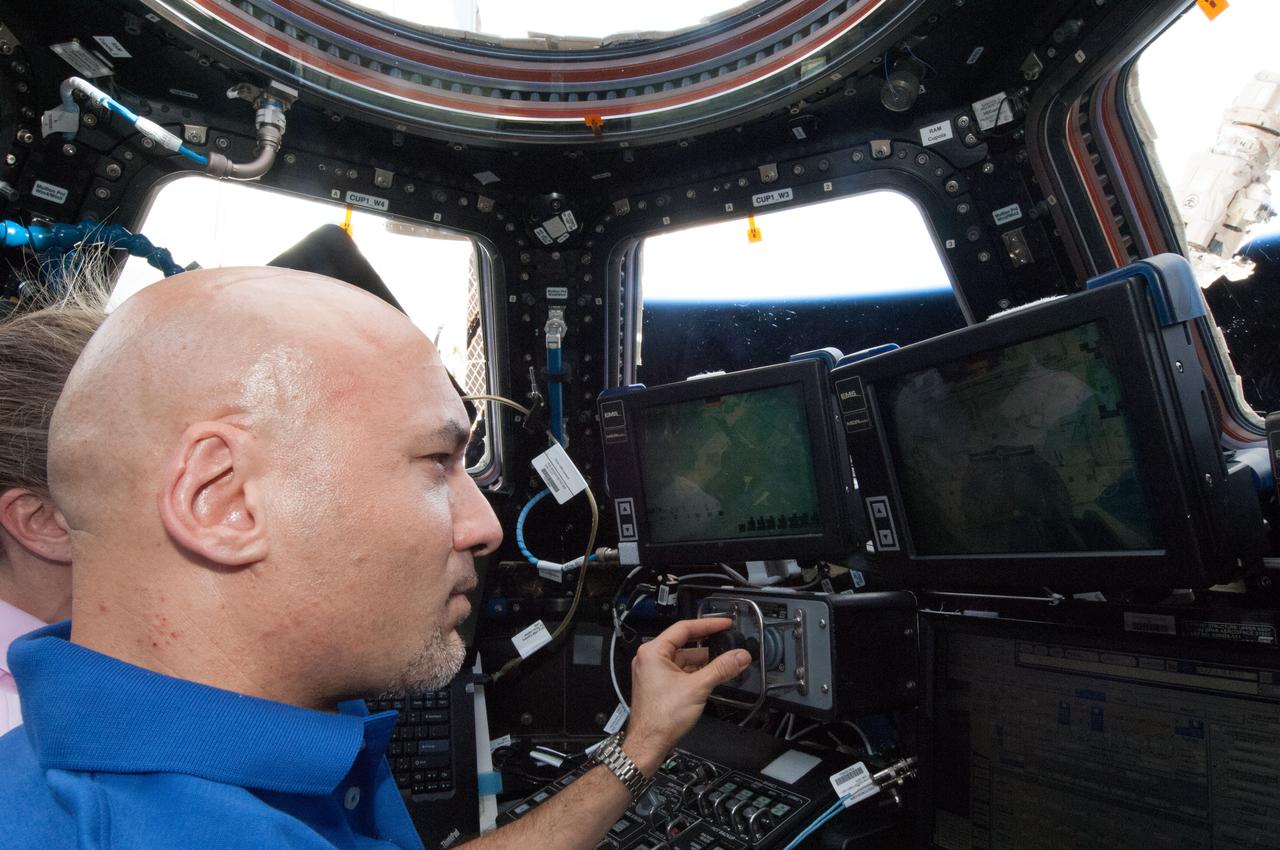
ISS036-E-026326 (29 July 2013) --- In the International Space Station?s Cupola, European Space Agency astronaut Luca Parmitano, Expedition 36 flight engineer, participates in an onboard training activity in preparation for the grapple and berthing of the Japanese ?Kounotori? H2 Transfer Vehicle-4 (HTV-4) set for August 9.
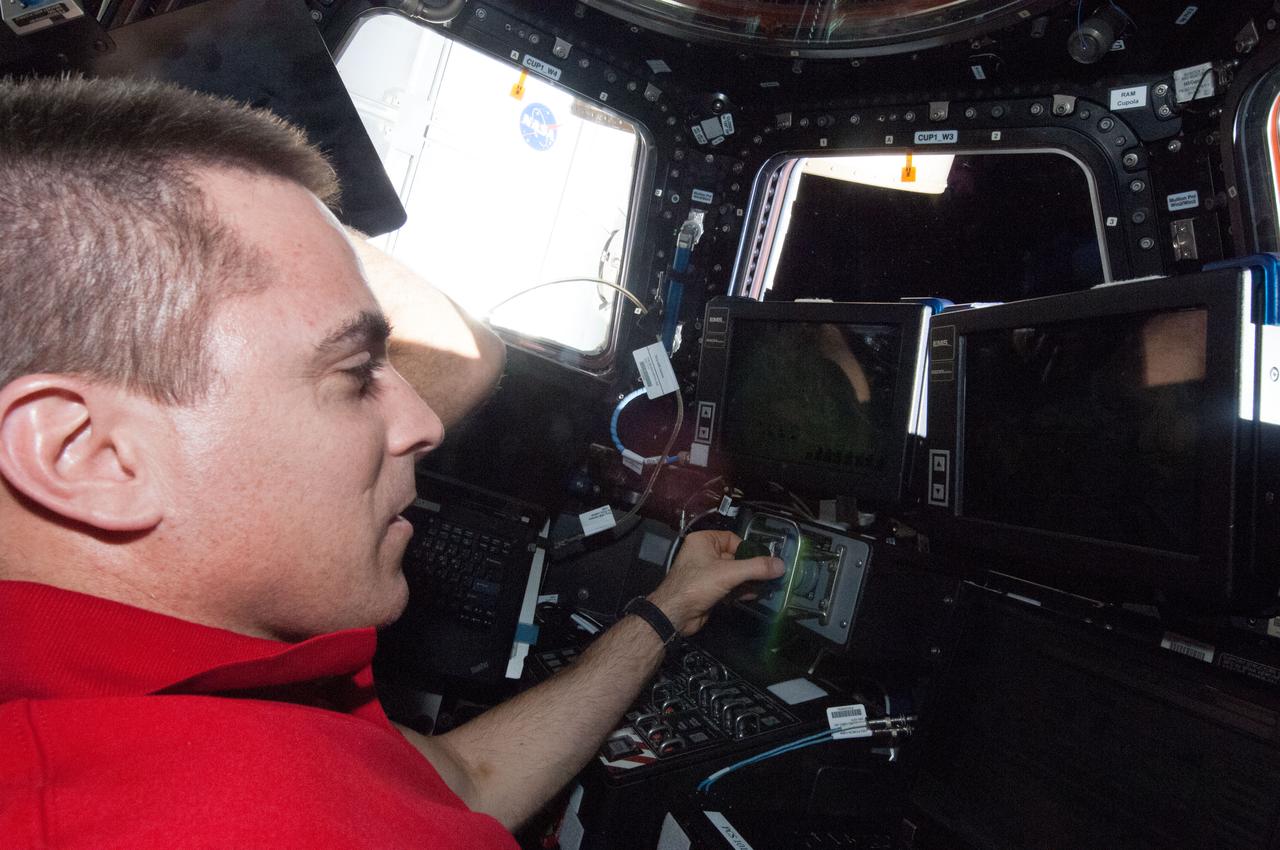
ISS036-E-026298 (29 July 2013) --- In the International Space Station?s Cupola, NASA astronaut Chris Cassidy, Expedition 36 flight engineer, participates in an onboard training activity in preparation for the grapple and berthing of the Japanese ?Kounotori? H2 Transfer Vehicle-4 (HTV-4) set for August 9.
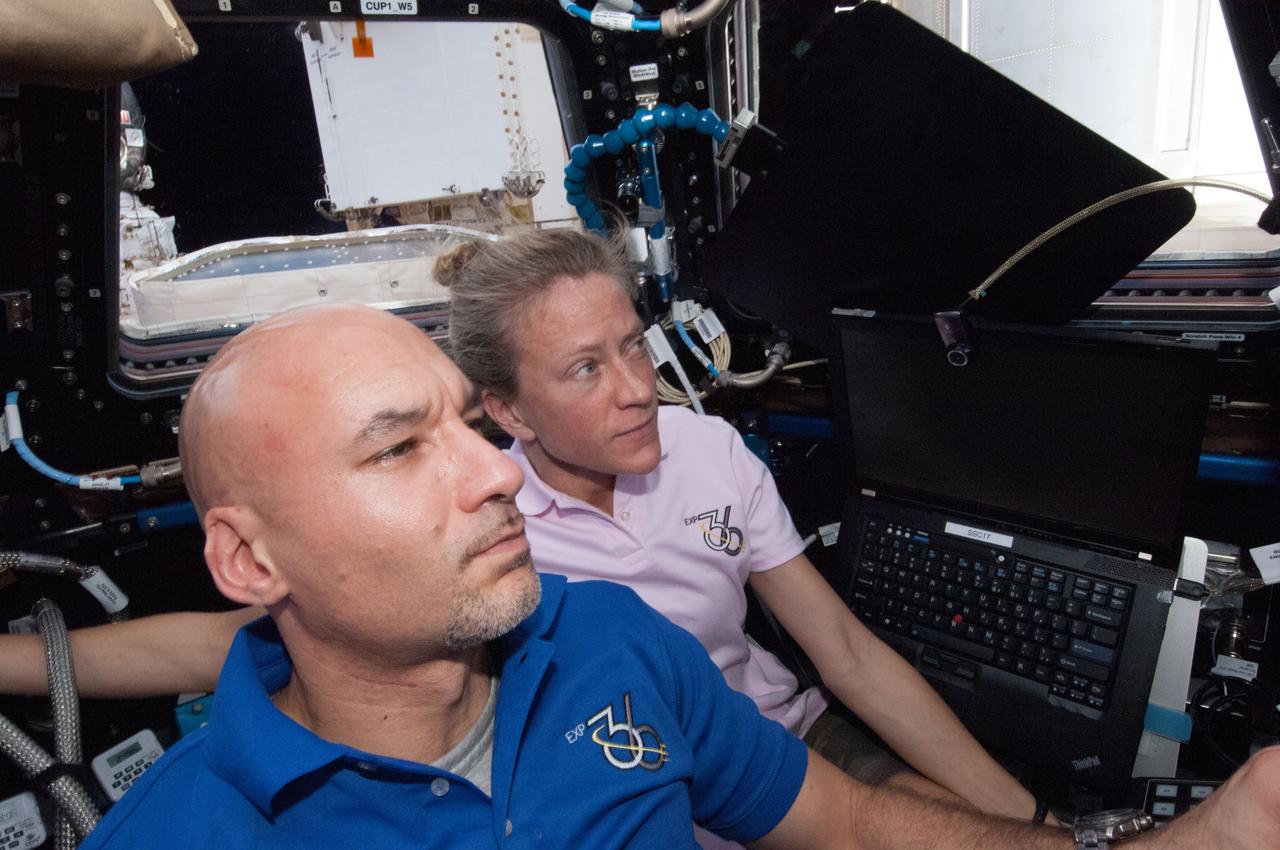
ISS036-E-026332 (29 July 2013) --- In the International Space Station?s Cupola, European Space Agency astronaut Luca Parmitano and NASA astronaut Karen Nyberg, both Expedition 36 flight engineers, participate in an onboard training activity in preparation for the grapple and berthing of the Japanese ?Kounotori? H2 Transfer Vehicle-4 (HTV-4) set for August 9.
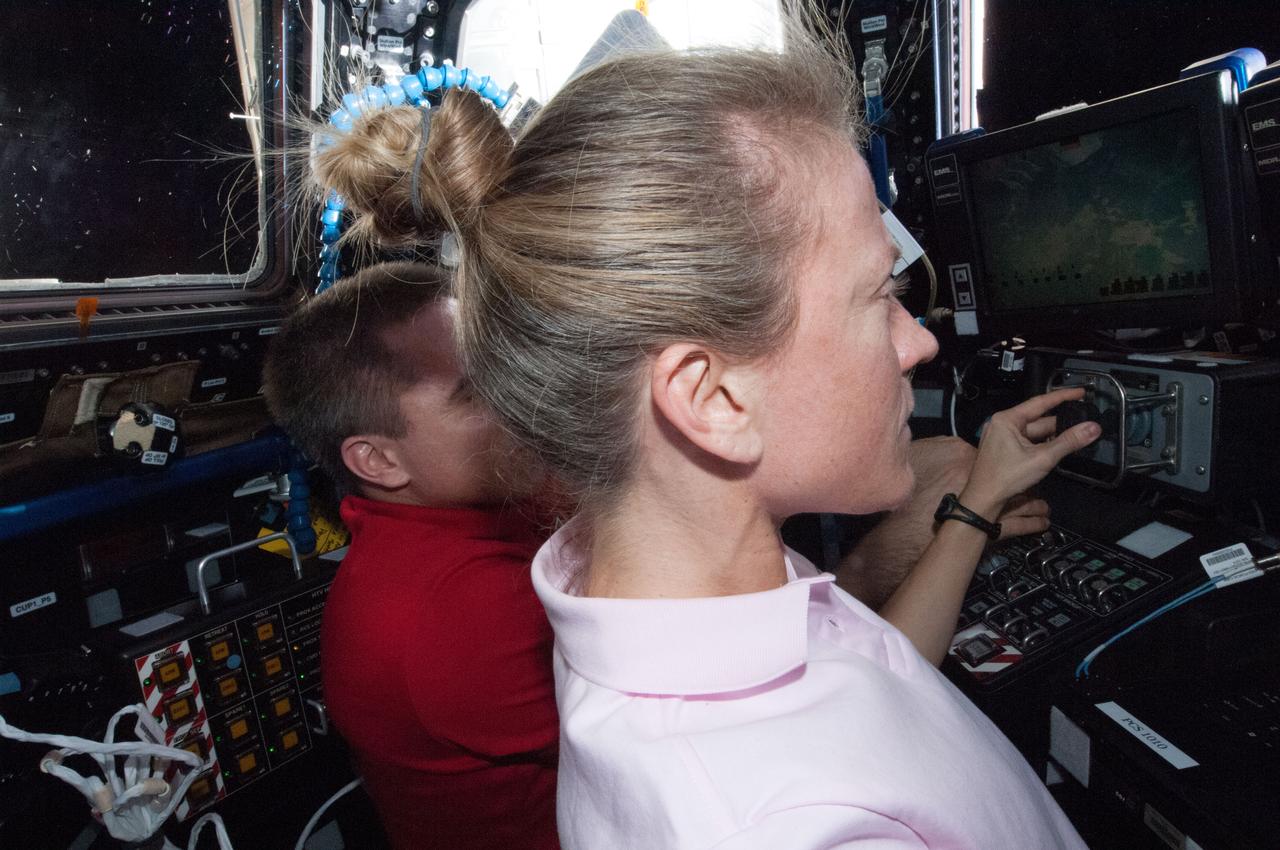
ISS036-E-026306 (29 July 2013) --- In the International Space Station?s Cupola, NASA astronauts Karen Nyberg and Chris Cassidy (partially obscured), both Expedition 36 flight engineers, participate in an onboard training activity in preparation for the grapple and berthing of the Japanese ?Kounotori? H2 Transfer Vehicle-4 (HTV-4) set for August 9.
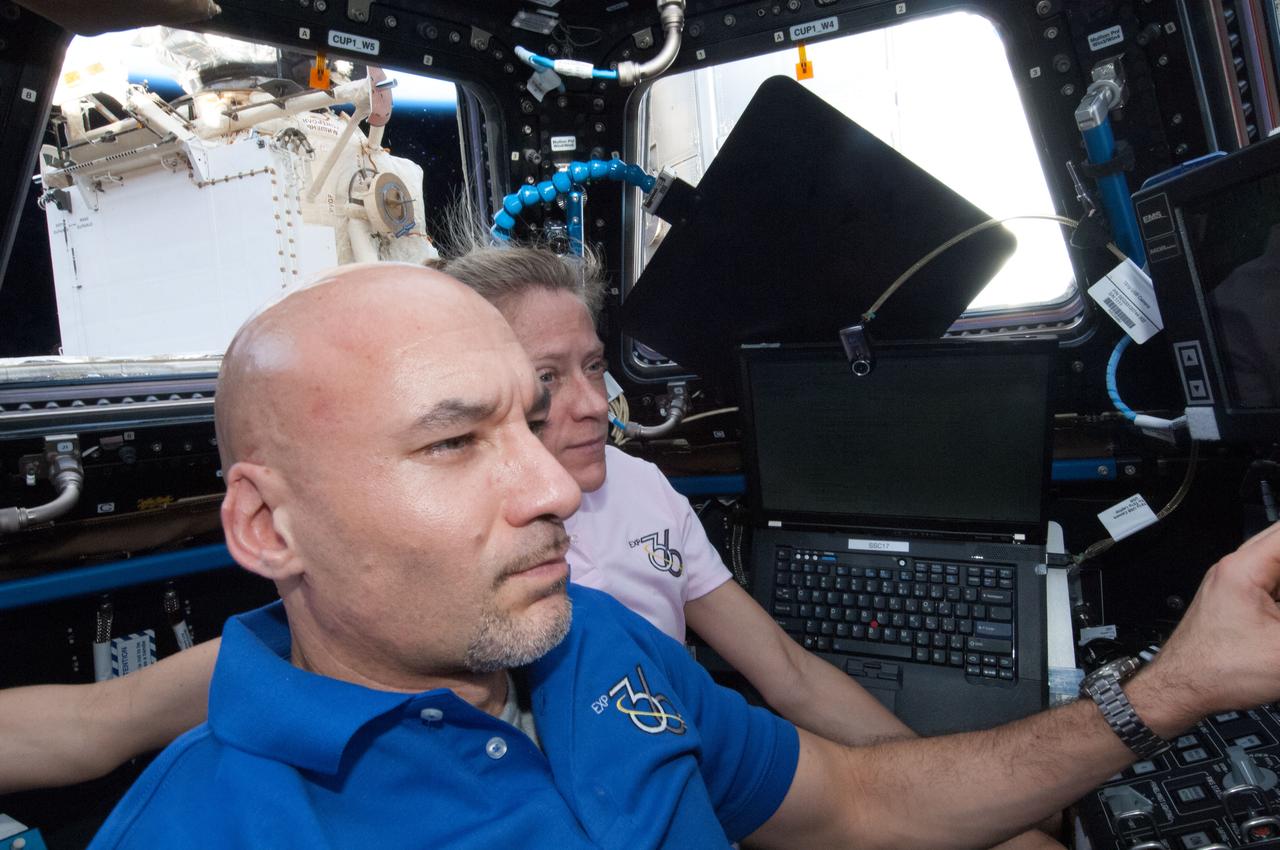
ISS036-E-026331 (29 July 2013) --- In the International Space Station?s Cupola, European Space Agency astronaut Luca Parmitano and NASA astronaut Karen Nyberg, both Expedition 36 flight engineers, participate in an onboard training activity in preparation for the grapple and berthing of the Japanese ?Kounotori? H2 Transfer Vehicle-4 (HTV-4) set for August 9.
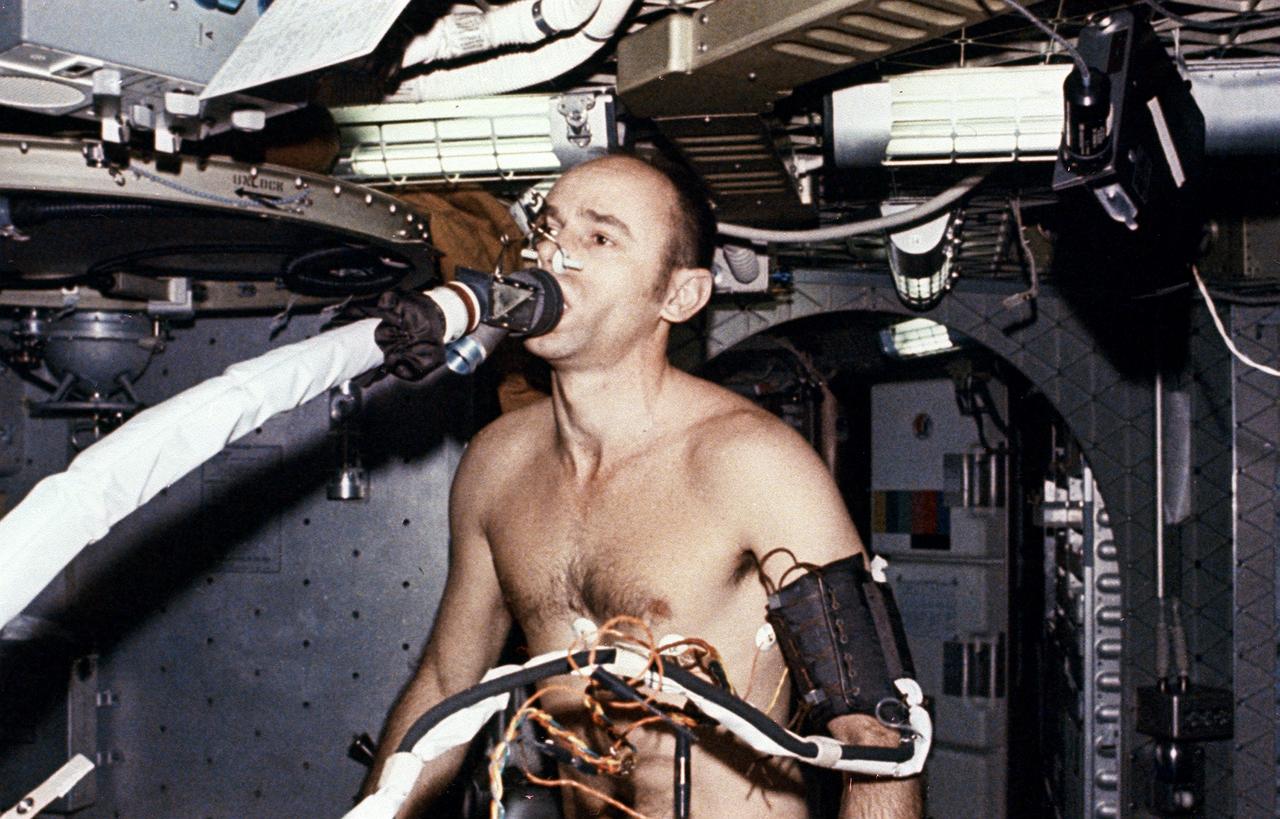
This Skylab-3 onboard photograph shows Astronaut Allen Bean on the ergometer, breathing into the metabolic analyzer. Skylab's Metabolic Activity experiment (M171), a medical evaluation facility, was designed to measure astronauts' metabolic changes while on long-term space missions. The experiment obtained information on astronauts' physiological capabilities and limitations and provided data useful in the design of future spacecraft and work programs. Physiological responses to physical activity was deduced by analyzing inhaled and exhaled air, pulse rate, blood pressure, and other selected variables of the crew while they performed controlled amounts of physical work with a bicycle ergometer.
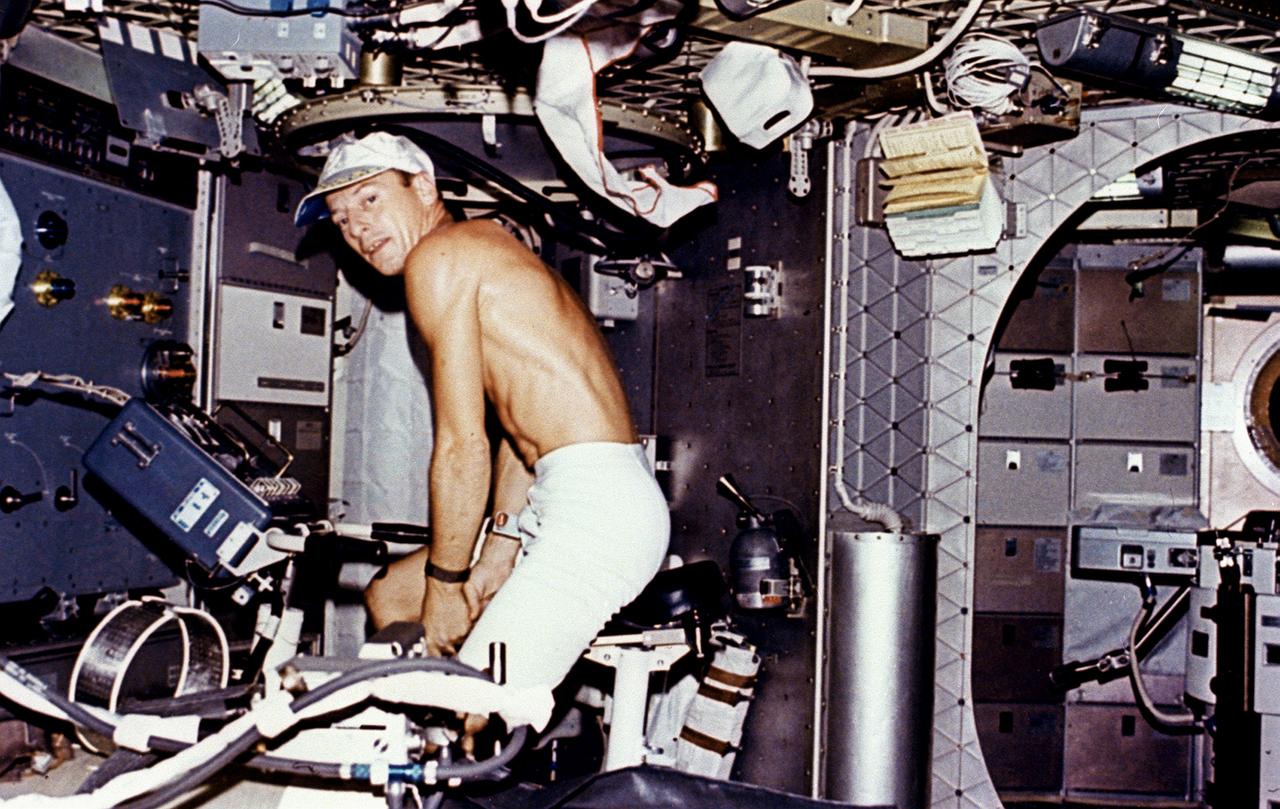
This Skylab-2 onboard photograph shows astronaut Charles "Pete" Conrad exercising on a stationary bicycle (ergometer) used for monitoring the metabolism of the astronauts. The ergometer was used to conduct both Vectorcardiogram experiment (M093) and Metabolic Activity experiment (M171). Experiment M093 was a medical evaluation designed to monitor changes in astronauts' cardiovascular systems, while Experiment M171 was to measure astronauts' metabolic changes during long-duration space missions.
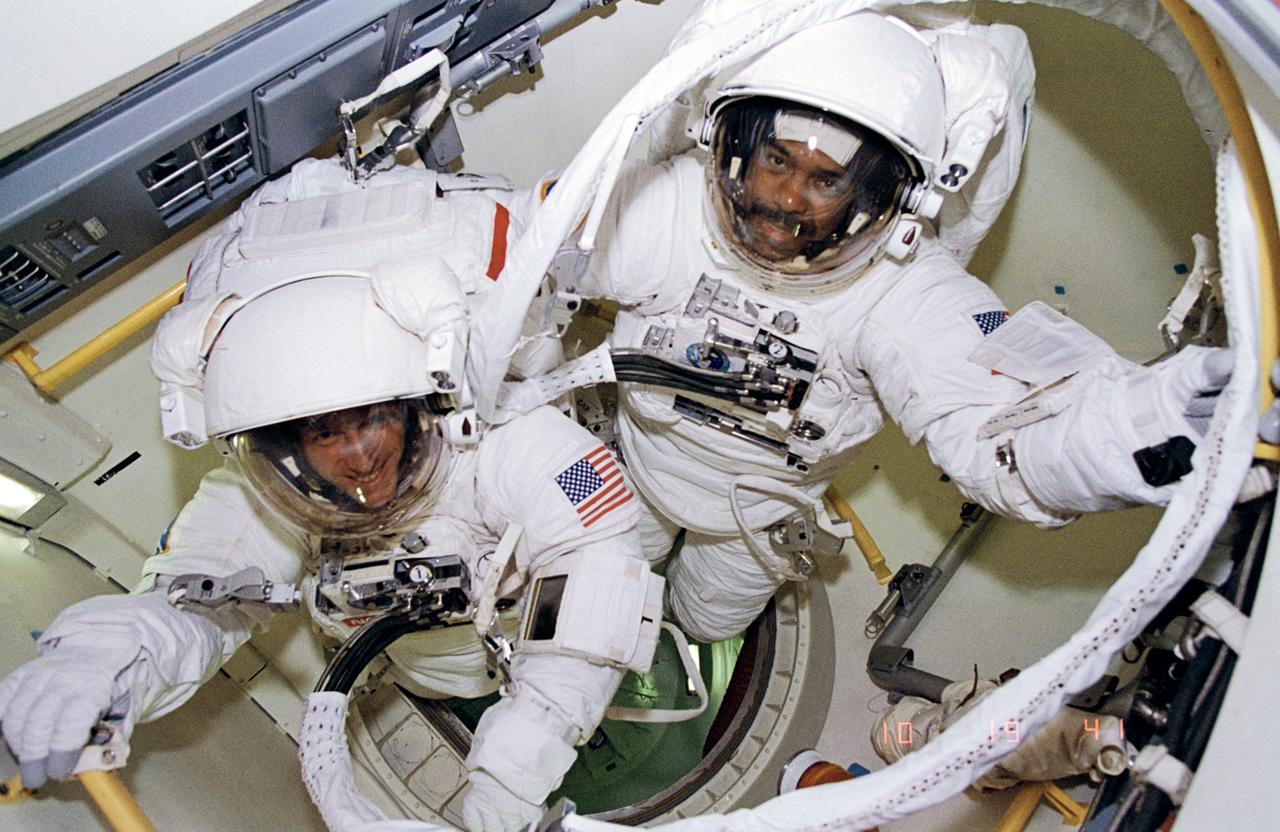
STS063-67-024 (9 Feb. 1995) --- Astronauts Bernard A. Harris Jr., STS-63 payload commander, (top right) and C. Michael Foale, mission specialist, are ready to egress airlock for an extravehicular activity (EVA). Others onboard the space shuttle Discovery were astronauts James D. Wetherbee, mission commander; Eileen M. Collins, pilot; mission specialists Janice E. Voss, and cosmonaut Vladimir G. Titov. Photo credit: NASA
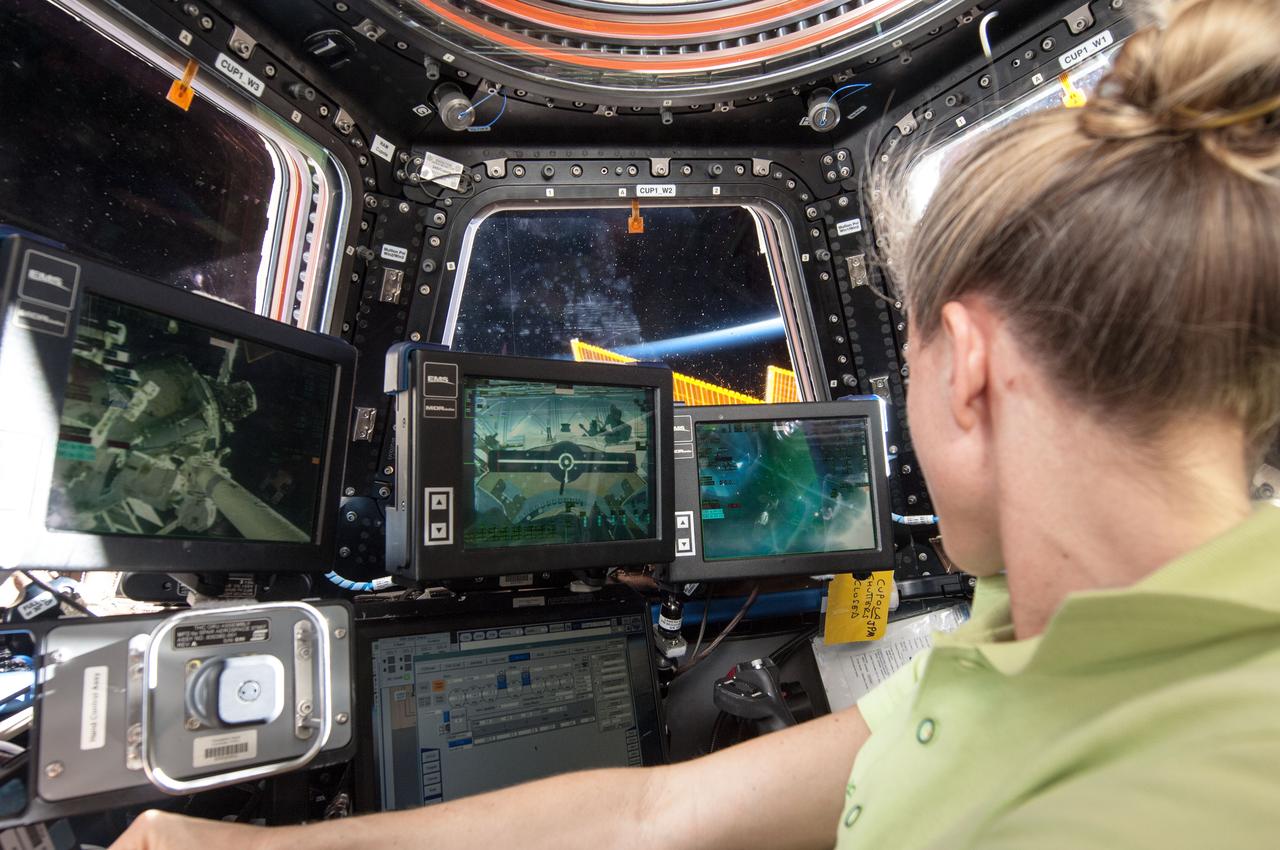
ISS036-E-029229 (5 Aug. 2013) --- At the robotics workstation in the International Space Station?s Cupola, NASA astronaut Karen Nyberg, Expedition 36 flight engineer, participates in onboard training activity in preparation for the grapple and berthing of the Japanese "Kounotori" H2 Transfer Vehicle-4 (HTV-4) set for August 9. Nyberg and NASA astronaut Chris Cassidy will use Canadarm2, the station's Canadian Space Agency-provided robotic arm, to reach out and capture the vehicle for its installation on the Earth-facing port of the Harmony node

41D-12-020 (6 Sept 1984) --- Astronaut Judith A. Resnik, mission specialist, anchors herself on the flight deck (out of frame) to take a peek at mid-deck activity aboard the Earth-orbiting Space Shuttle Discovery. Among the many stationary and portable cameras onboard the flight are (left to right) TV camera, a data acquisition motion picture camera and the IMAX.
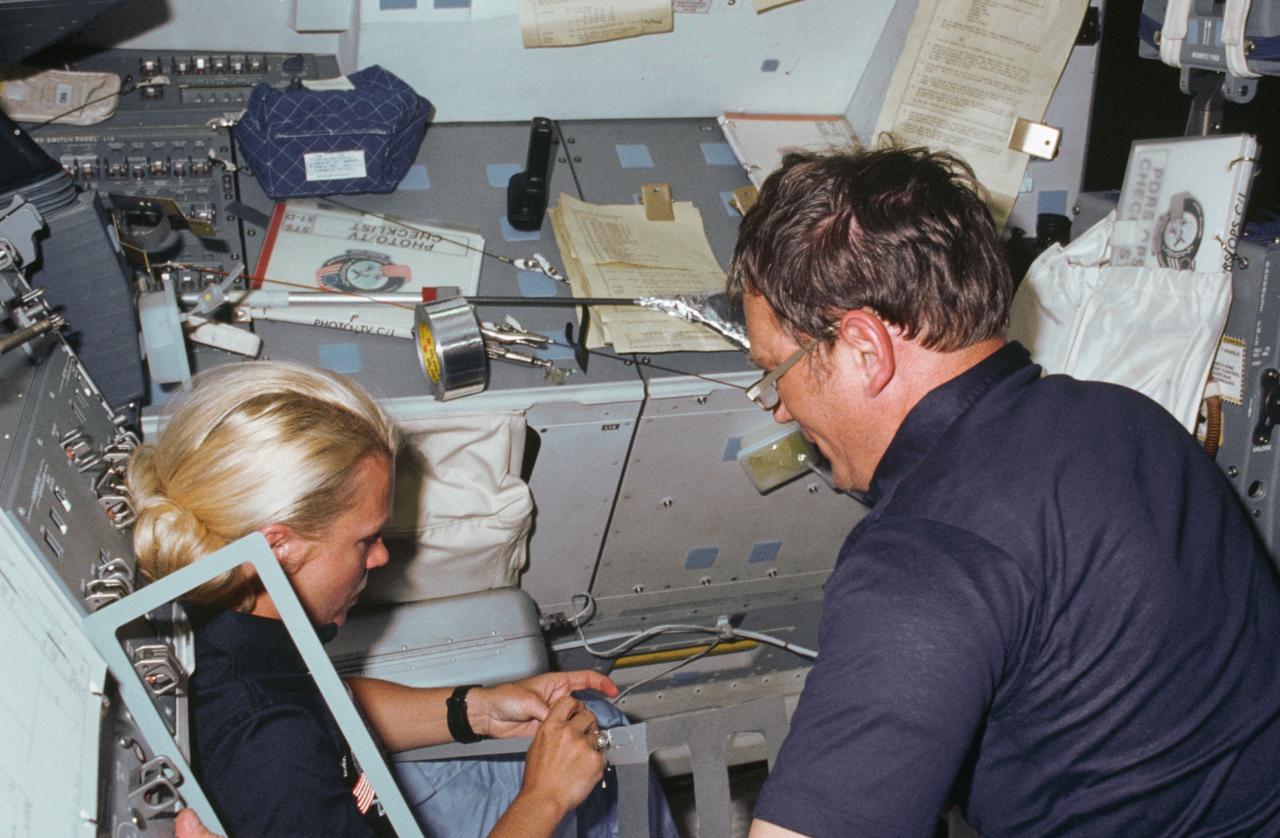
51D-04-015 (15 April 1985) --- Astronaut Rhea Seddon and Karol J. Bobko continue work on snag-type extension for the Remote Manipulator System (RMS) as part of an effort to activate a lever on a troubled communications satellite. Since the crew learned soon after deployment of the Syncom IV (LEASAT) spacecraft that it was not functioning properly plans were formulated for a rendezvous in space between the Discovery and the satellite. A fly swatter-like extension and another resembling a LaCrosse stick were fashioned from onboard supplies and furnishings. Stowage lockers nearby serve as a work bench for the two. At various times during the seven-day mission, the majority of the seven-member crew participated in the tool-making and preparations for an extravehicular activity (EVA) by the flights other two mission specialists -- Jeffrey A. Hoffman and S. David Griggs -- to connect the two tools to the RMS. Bobko is mission commander and Dr. Seddon, a mission specialist.
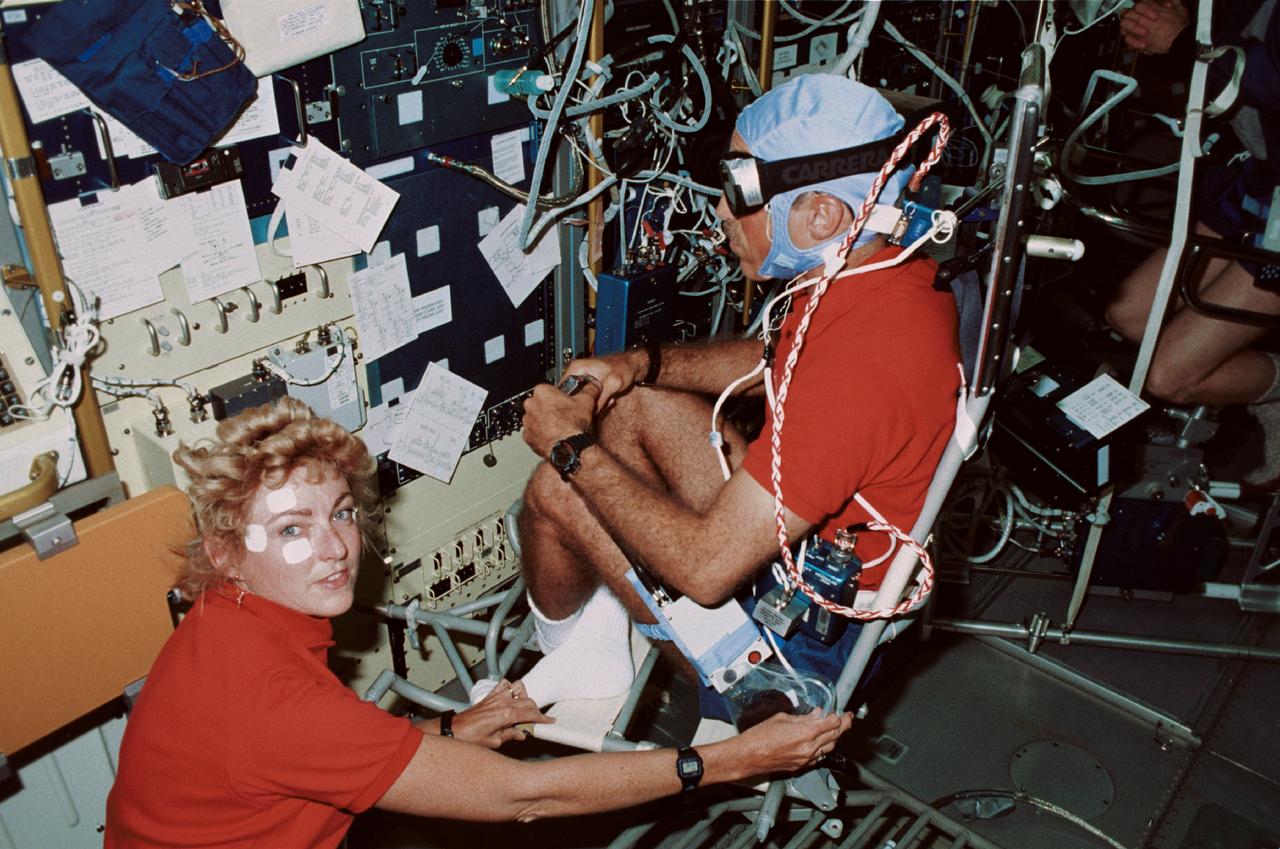
STS040-211-020 (5-14 June 1991) --- Vestibular experiment activities were captured onboard Columbia's Spacelab Life Sciences (SLS-1) module in this 35mm scene. Astronaut James P. Bagian, STS-40 mission specialist, is in a rotating chair while wearing an accelometer and electrodes to record head motion and horizontal and vertical eye movements during the rotations. Payload specialist Millie Hughes-Fulford, lower left, assists with the test.
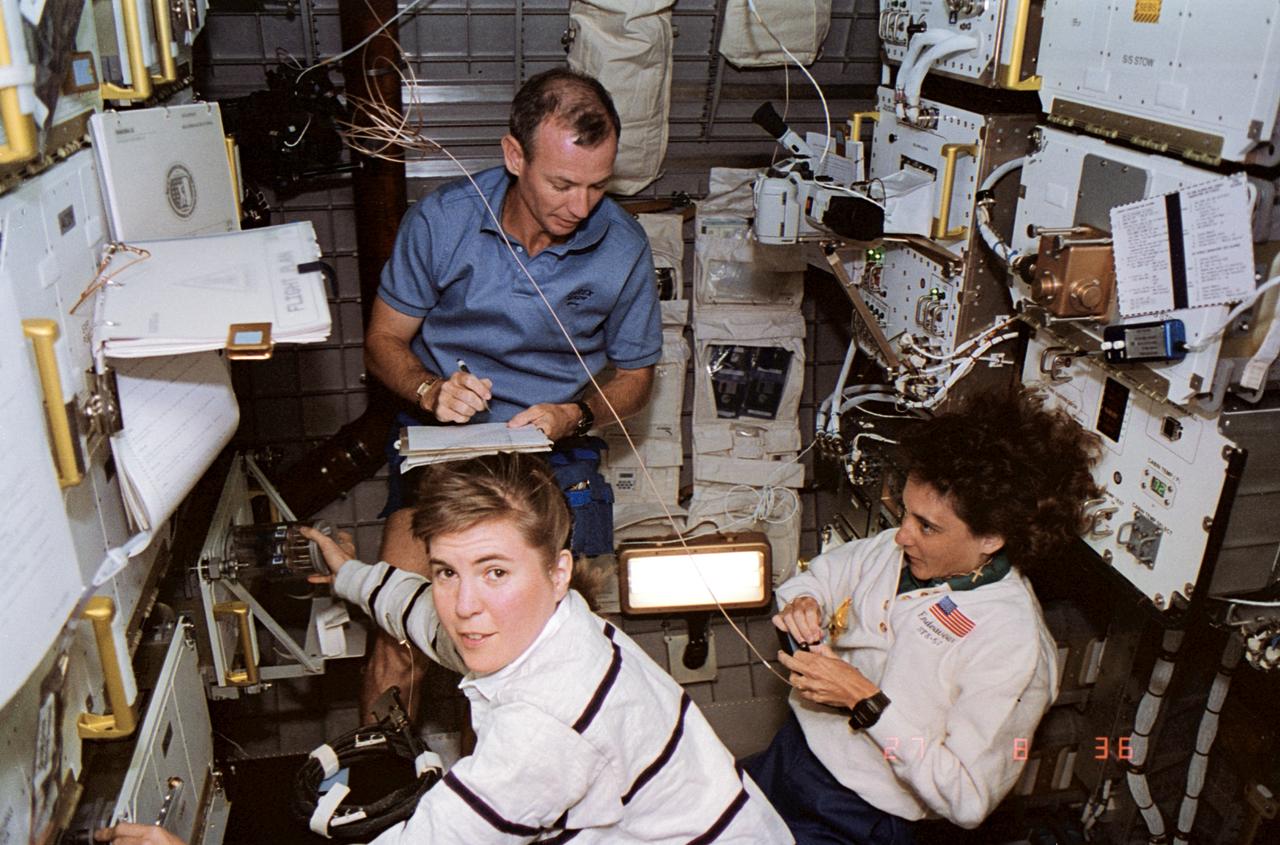
STS057-39-001 (27 June 1993) --- This high angle shot inside the SPACEHAB module, onboard the Space Shuttle Endeavour, typifies the pace of activity conducted there during the ten-day STS-57 mission. Astronaut Janice E. Voss (foreground), mission specialist, works with biomaterials products, while astronauts Brian Duffy, pilot, and Nancy J. Sherlock, mission specialist, participate in other tasks.
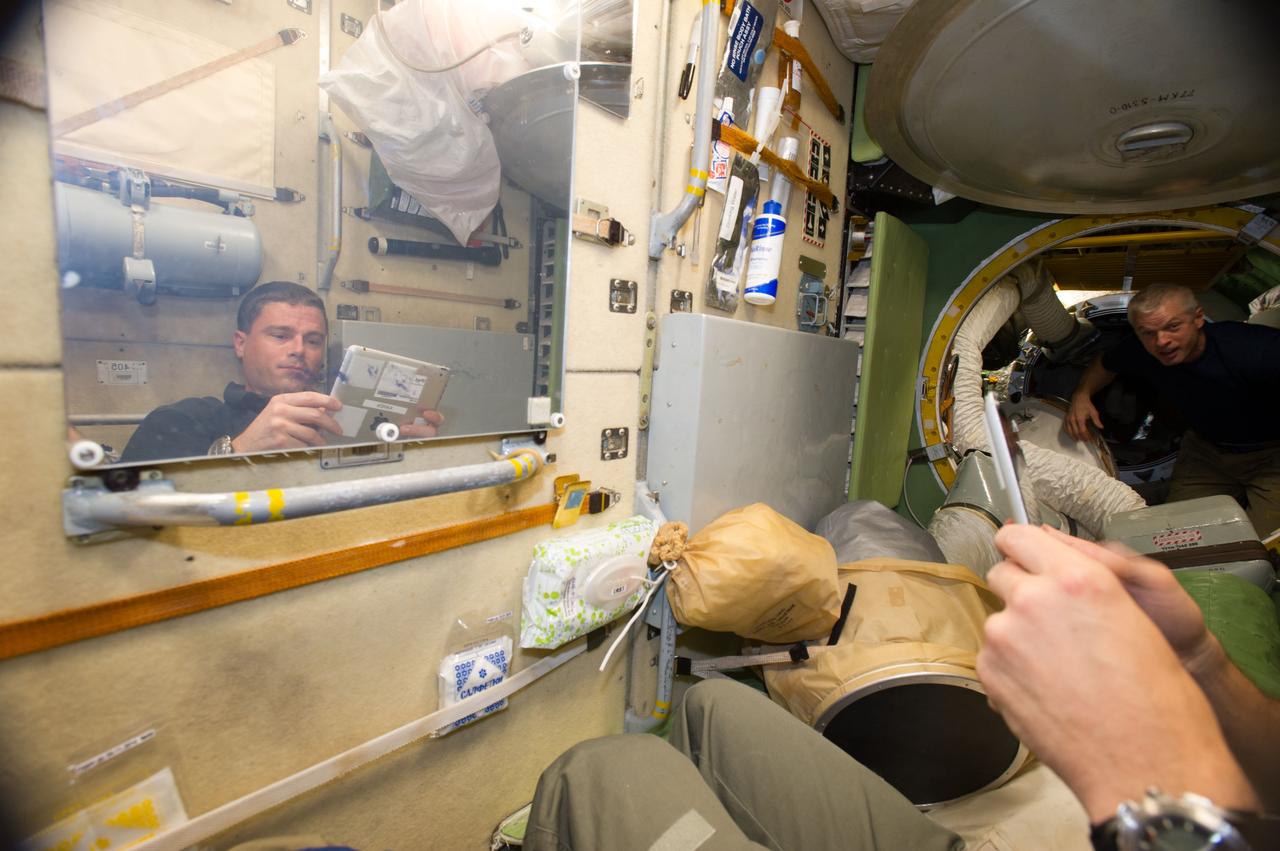
ISS040-E-008052 (6 June 2014) --- NASA astronaut Reid Wiseman, Expedition 40 flight engineer, is pictured in the reflection of a mirror using a computer in the Russian section of the International Space Station. NASA astronaut Steve Swanson, commander, is visible in the background.
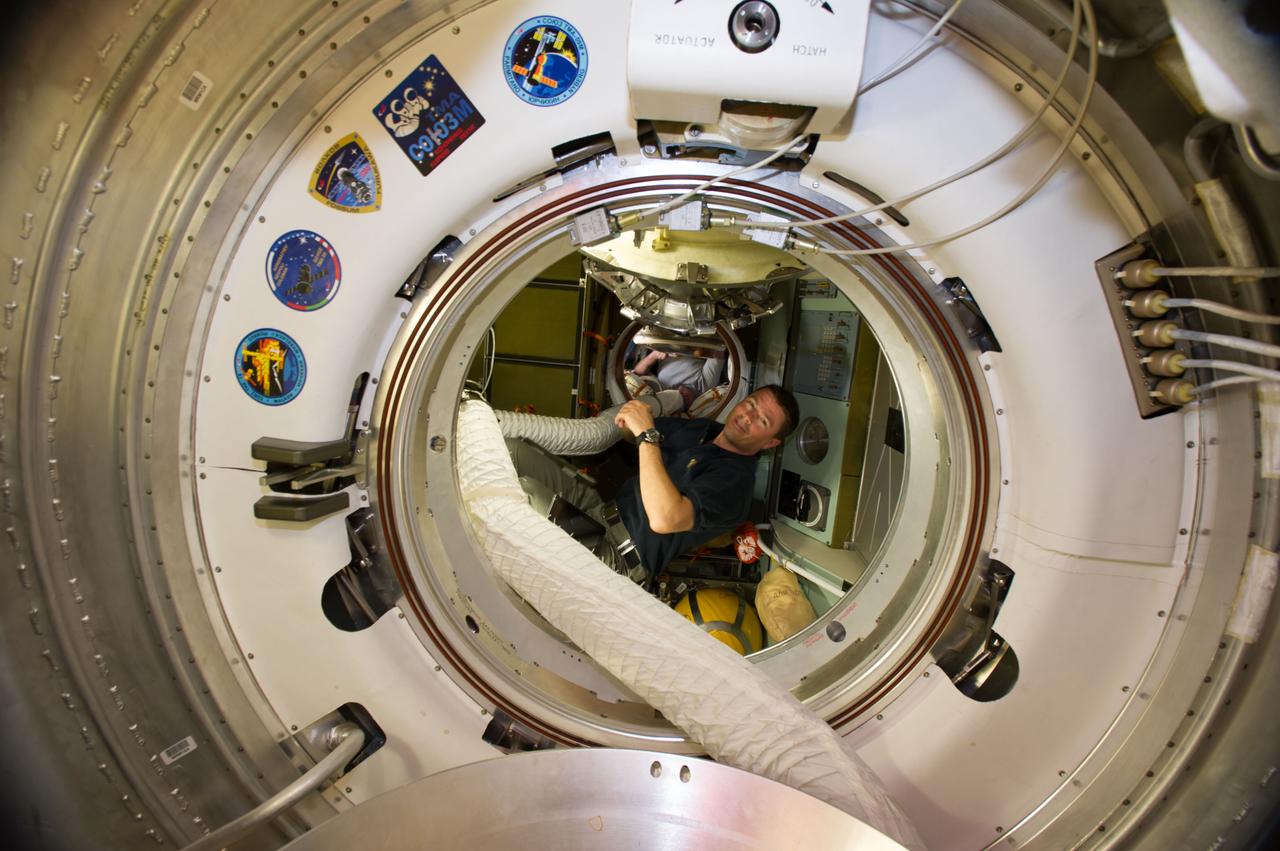
NASA astronaut Reid Wiseman,Expedition 40 flight engineer,is pictured in the Russian segment of the International Space Station.
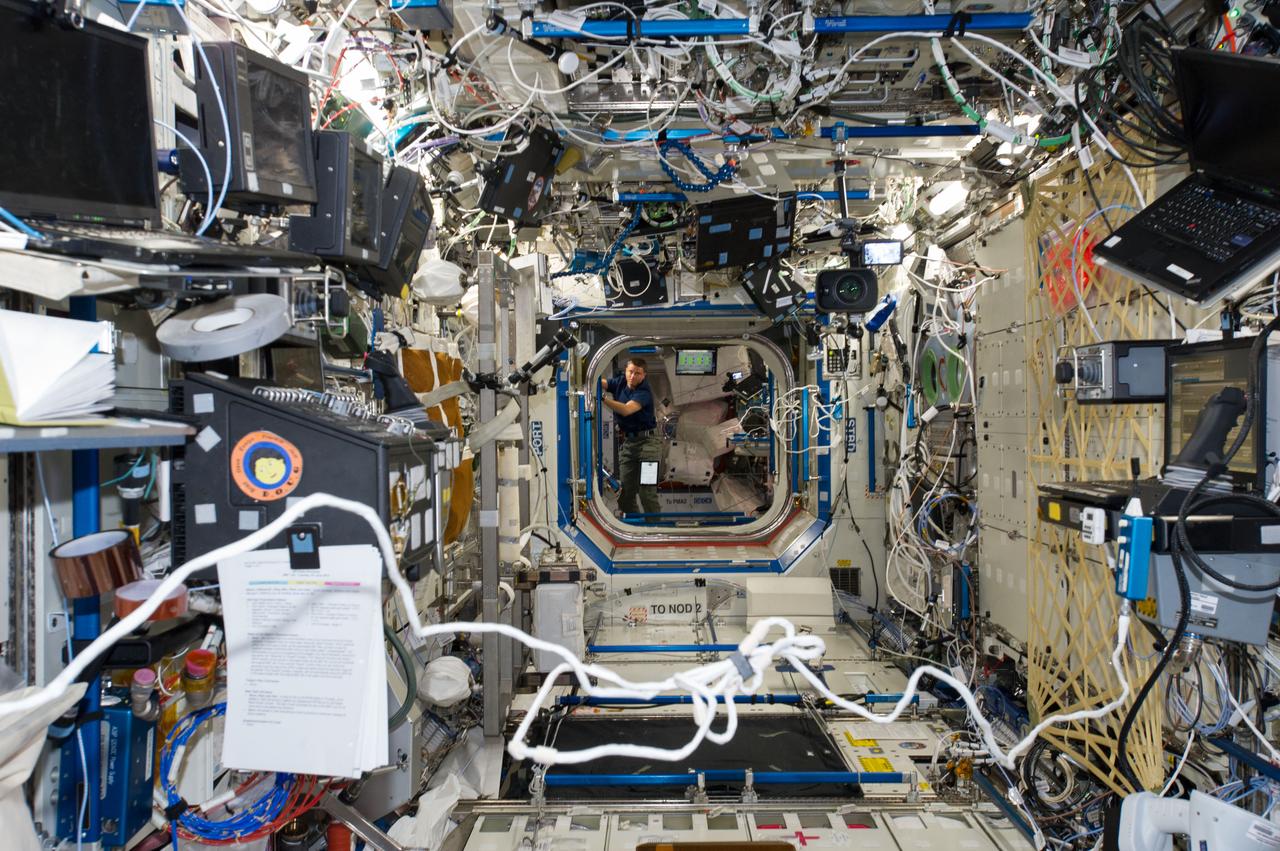
ISS040-E-006890 (3 June 2014) --- Photographed from the Destiny laboratory, NASA astronaut Reid Wiseman, Expedition 40 flight engineer, is pictured in the Harmony node of the International Space Station.
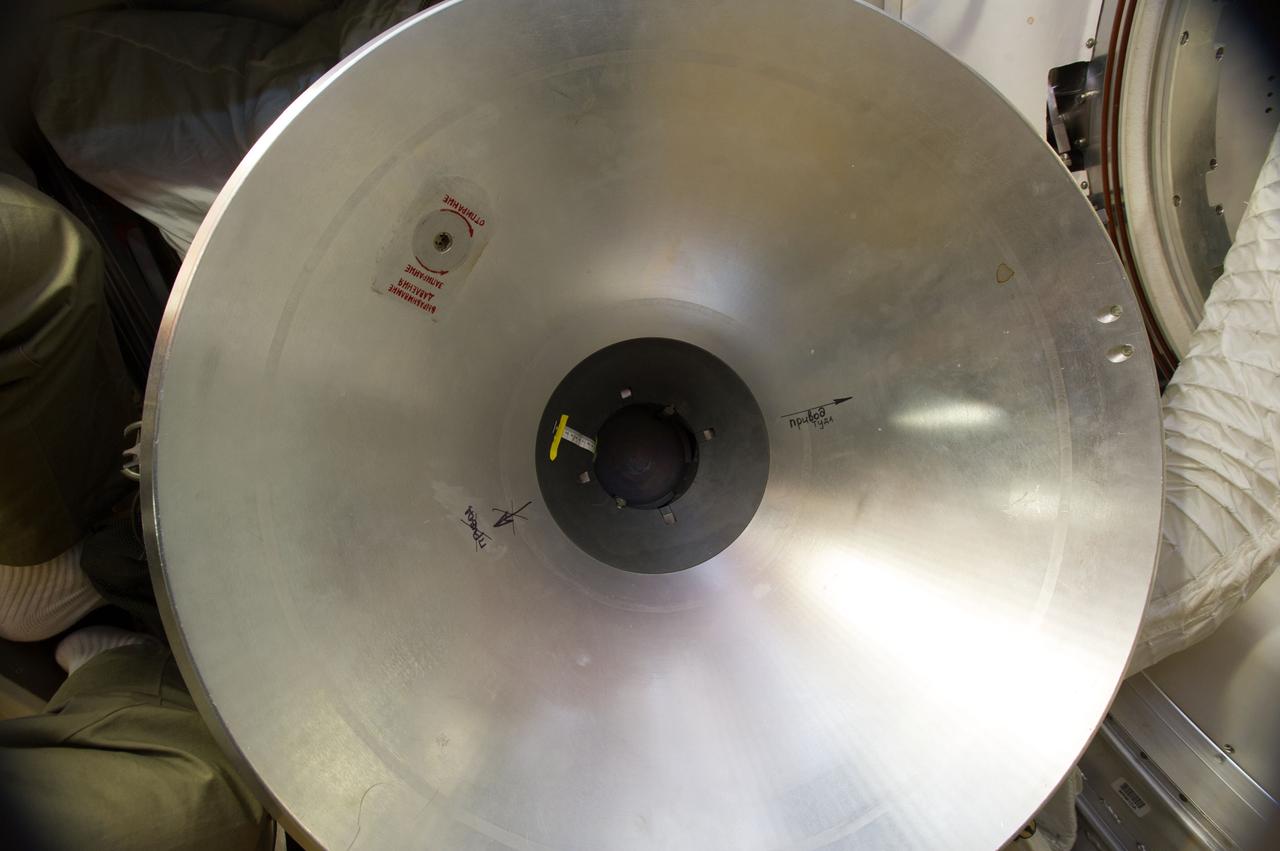
Close-up view of Progress #421 (ÐÐ) docking cone showing scuff marks / scratches during closure leak checks by the Expedition 40 crew.
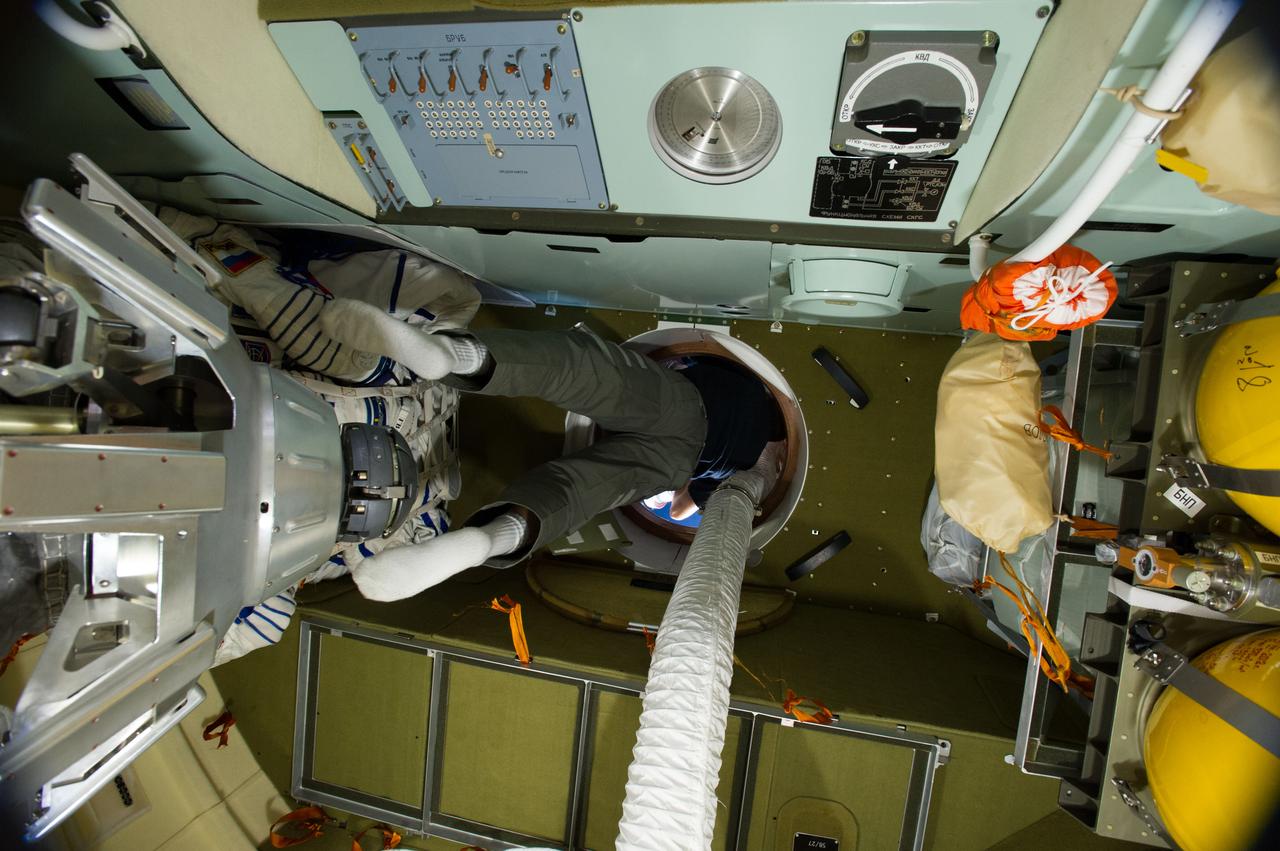
NASA Astronaut Reid Wiseman (back to camera),Expedition 40 flight engineer,is pictured in the Rassvet Mini-Research Module 1 (MRM-1) hatch of the International Space Station.
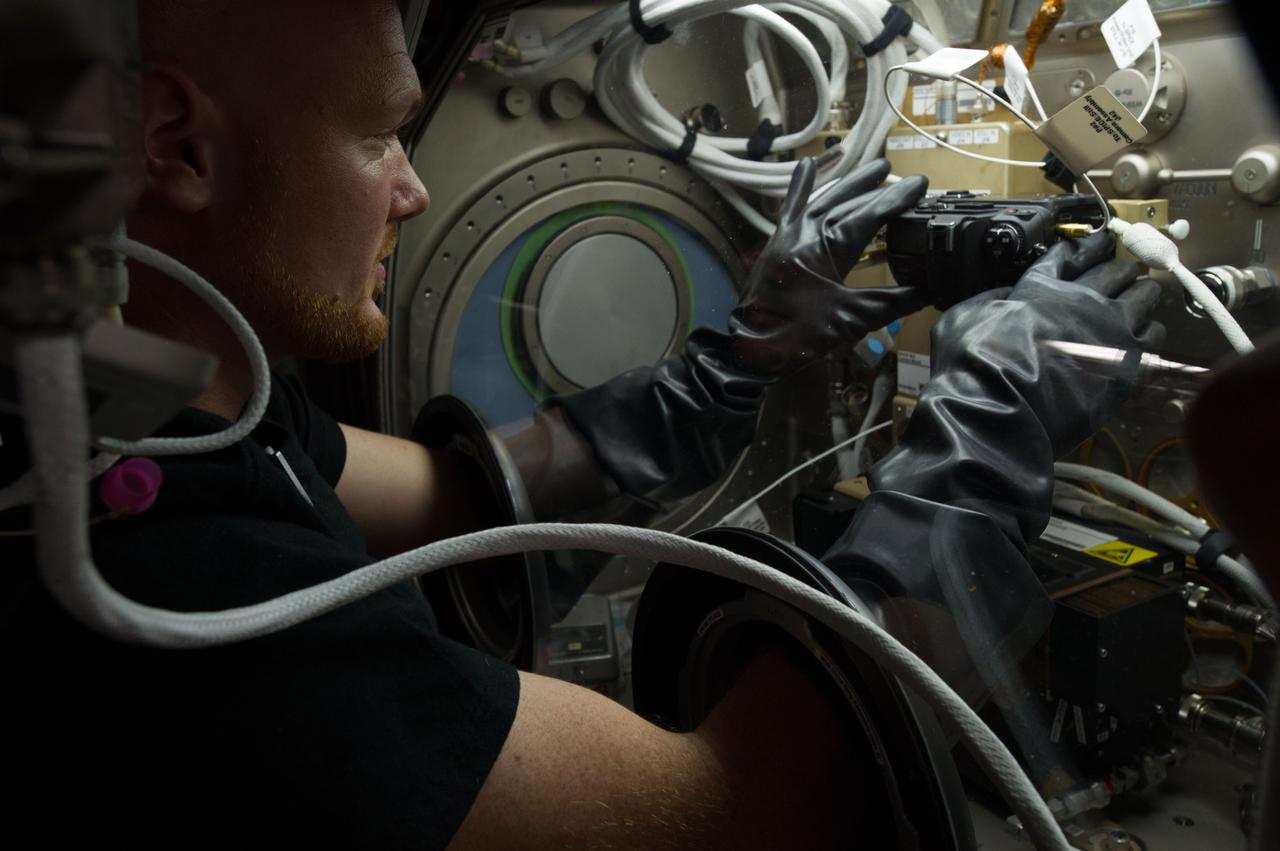
ISS040-E-012309 (16 June 2014) --- European Space Agency astronaut Alexander Gerst, Expedition 40 flight engineer, conducts two flame tests for a combustion experiment known as the Burning and Suppression of Solids (BASS) in the Microgravity Science Glovebox (MSG) in the Destiny laboratory of the International Space Station. The experiment seeks to provide insight on how flames burn in space compared to Earth which may provide fire safety benefits aboard future spacecraft.
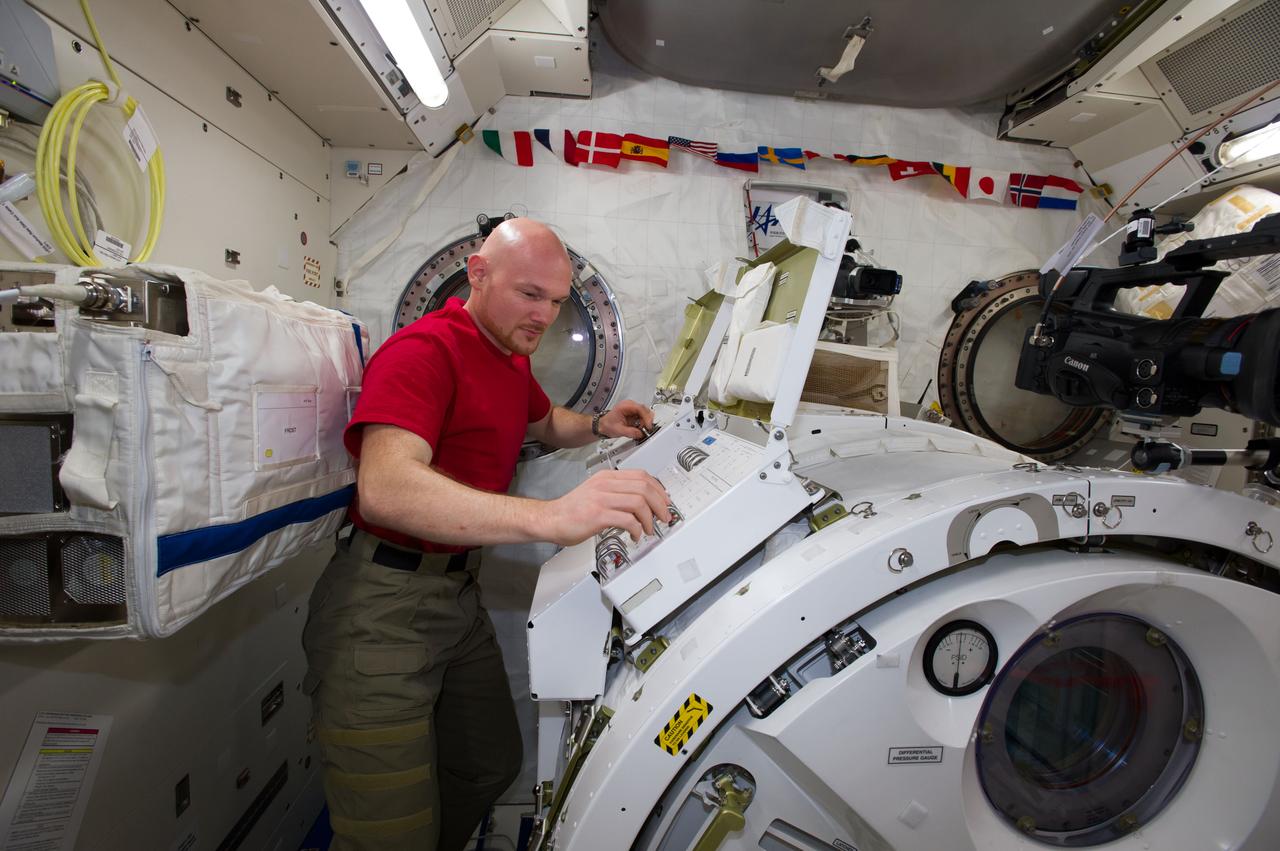
ISS040-E-096126 (18 Aug. 2014) --- In the International Space Station?s Kibo laboratory, European Space Agency astronaut Alexander Gerst, Expedition 40 flight engineer, depressurizes the Kibo airlock in preparation for a series of NanoRacks CubeSat miniature satellite deployments. The first two pairs of nanosatellites are scheduled for deployment on Aug. 19. The Planet Labs Dove satellites that were carried to the station aboard the Orbital Sciences Cygnus commercial cargo craft are being deployed between Aug. 19 and Aug. 25.
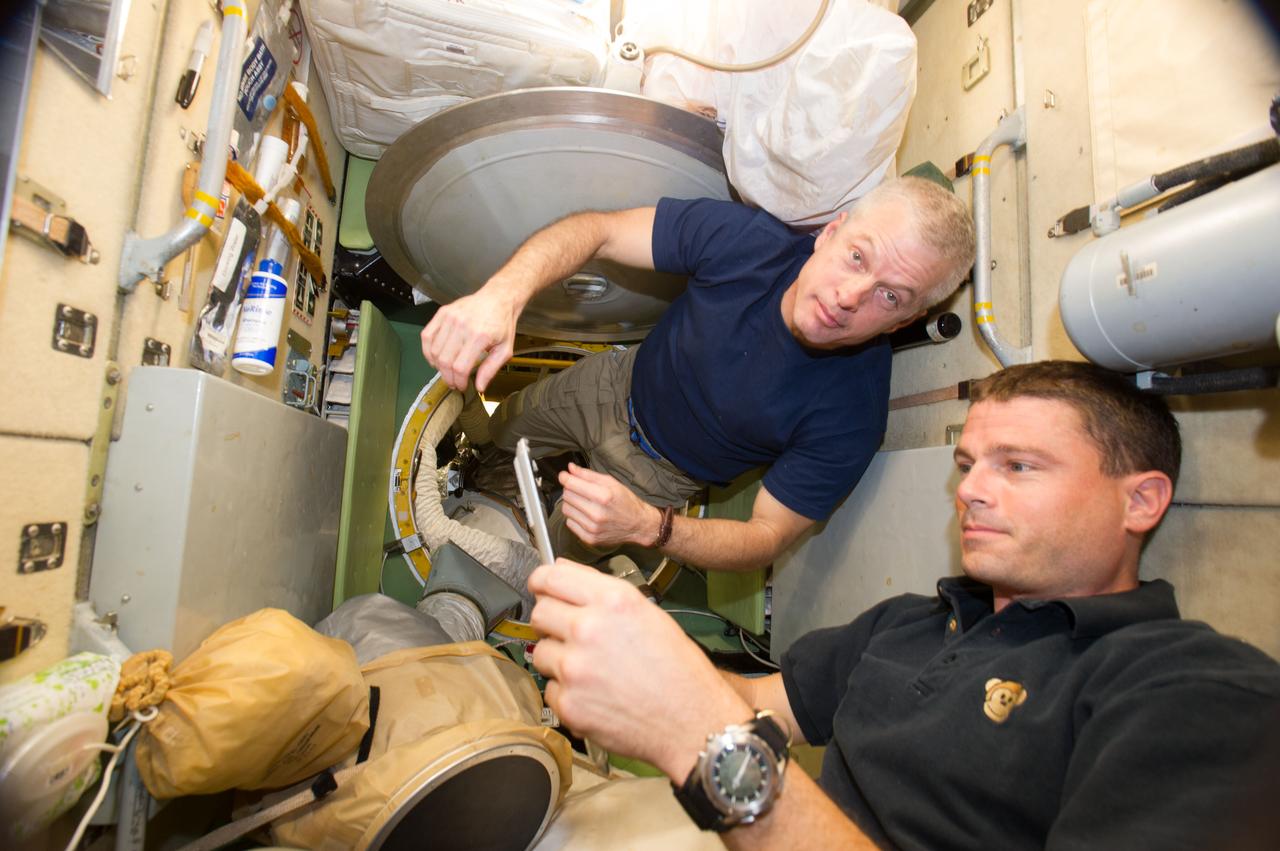
NASA astronaut Reid Wiseman,Expedition 40 flight engineer, and NASA Astronaut Steve Swanson, Commander, are photographed in the Russian section of the International Space Station.
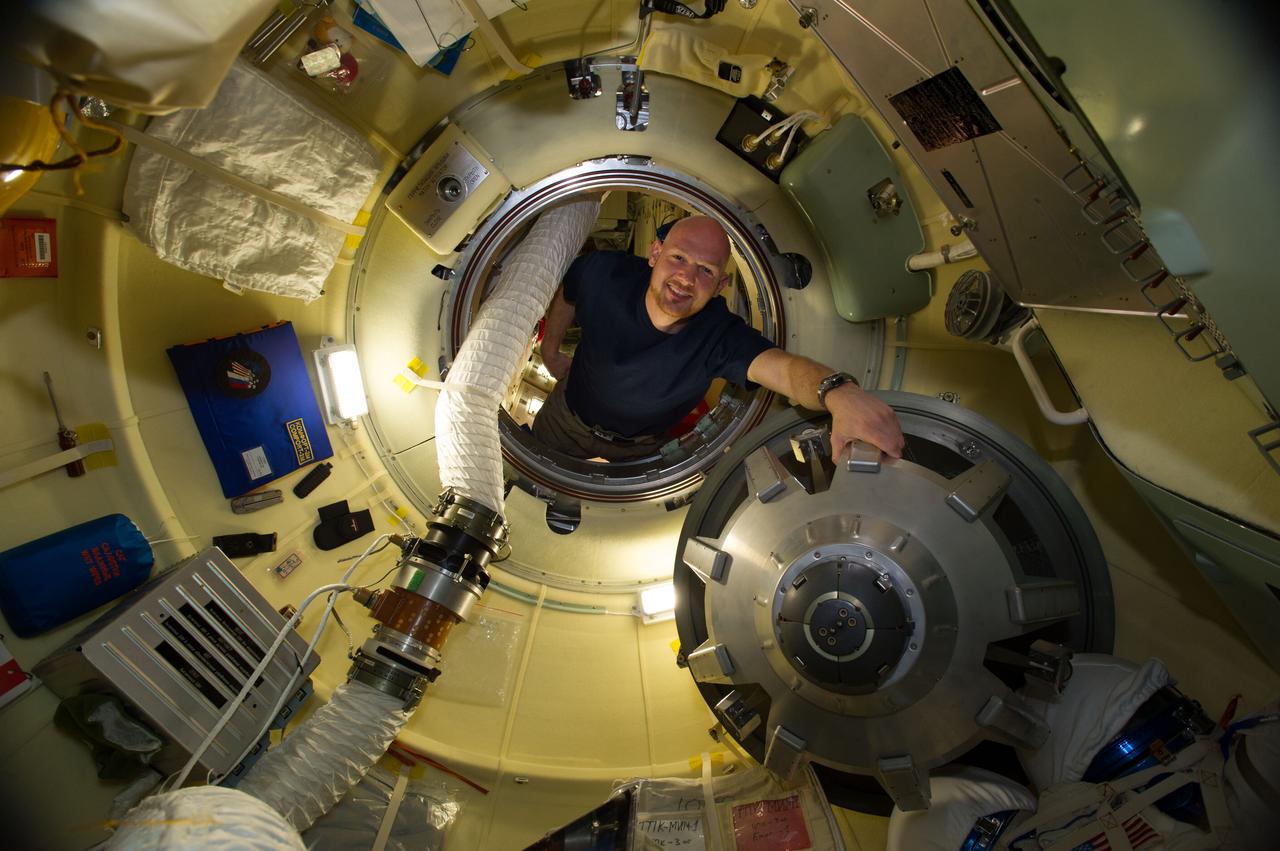
ISS040-E-008044 (6 June 2014) --- European Space Agency astronaut Alexander Gerst, Expedition 40 flight engineer, is pictured in the Rassvet Mini-Research Module 1 (MRM-1) hatch of the International Space Station.
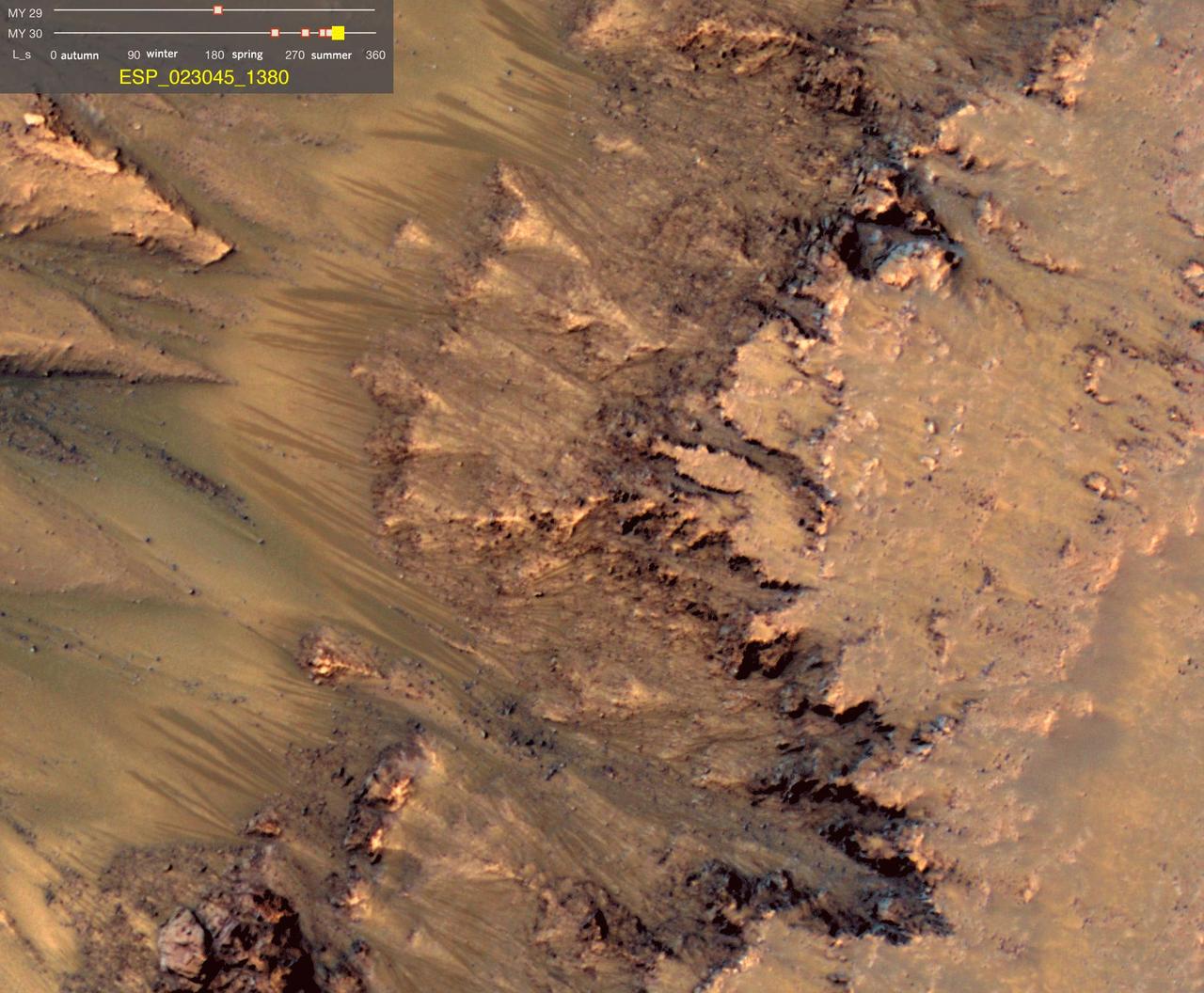
This image comes from observations of Newton crater by the HiRISE camera onboard NASA Mars Reconnaissance Orbiter; warm-season features might be evidence of salty liquid water active on Mars today.
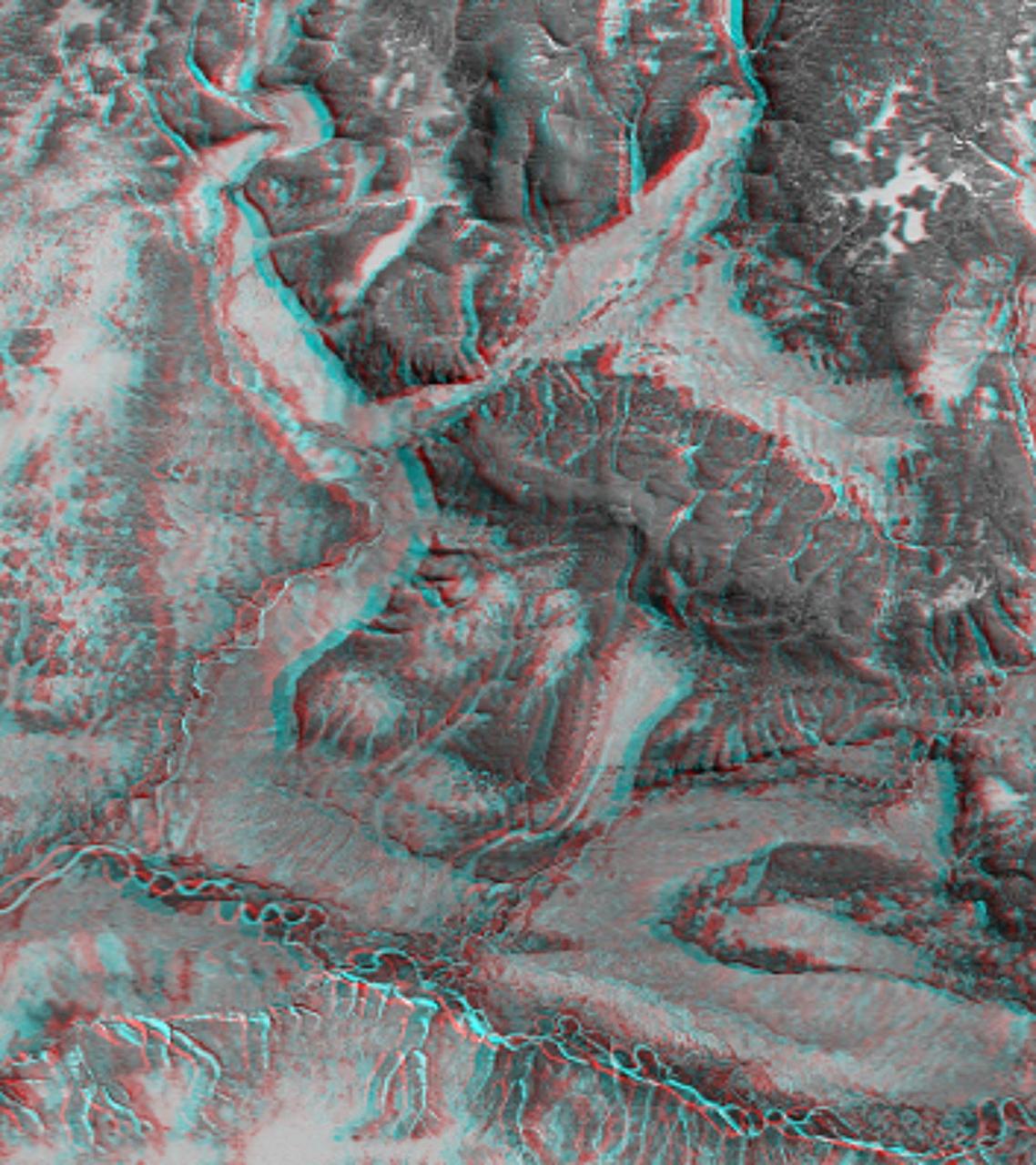
This 3-D anaglyph shows an area on the western side of the volcanically active Kamchatka Peninsula, Russia as seen by the instrument onboard NASA Shuttle Radar Topography Mission. 3D glasses are necessary to view this image.
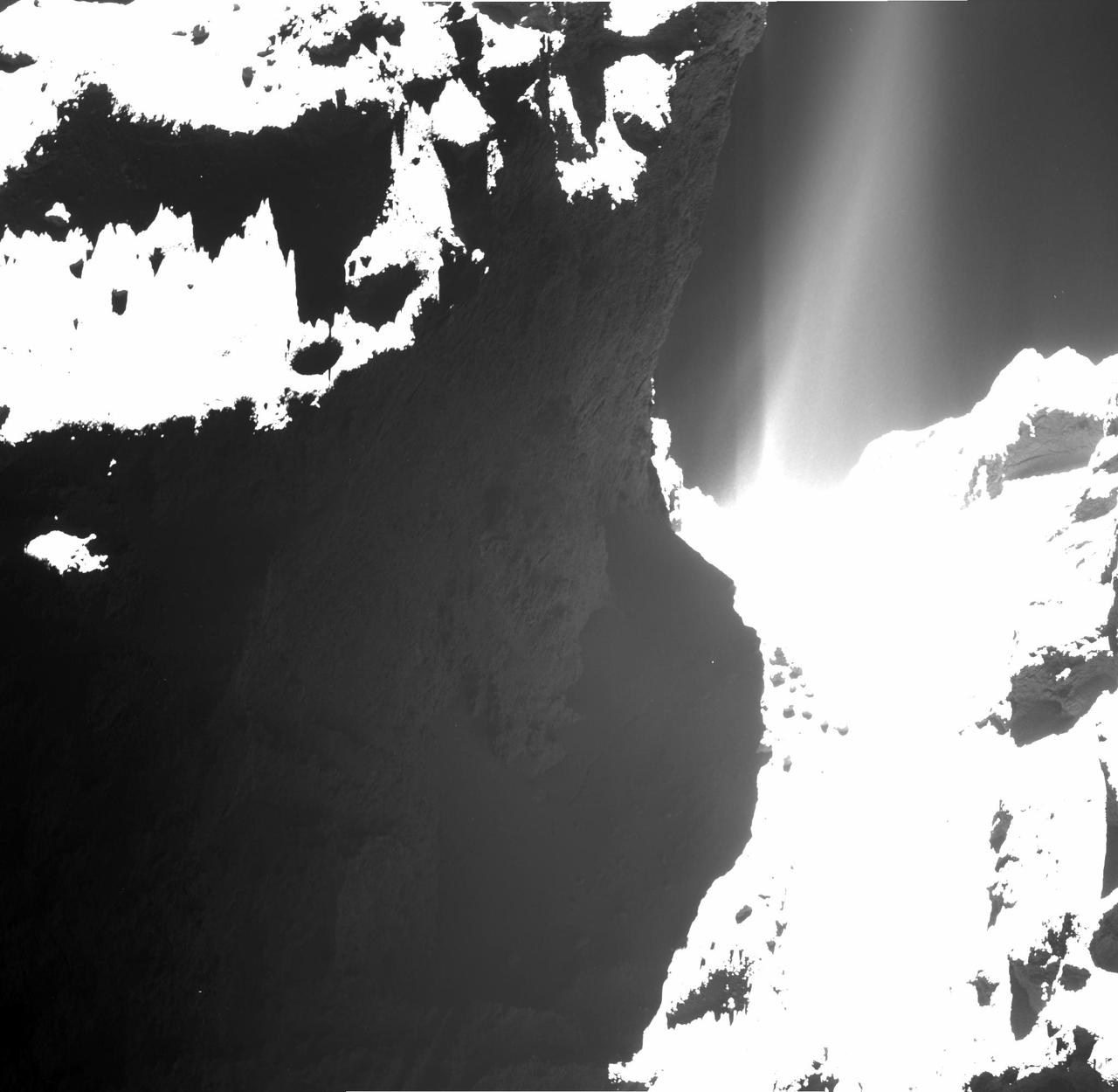
This image was taken by the Optical, Spectroscopic, and Infrared Remote Imaging System, Rosetta main onboard scientific imaging system, on Sept. 10, 2014. Jets of cometary activity can be seen along almost the entire body of the comet.
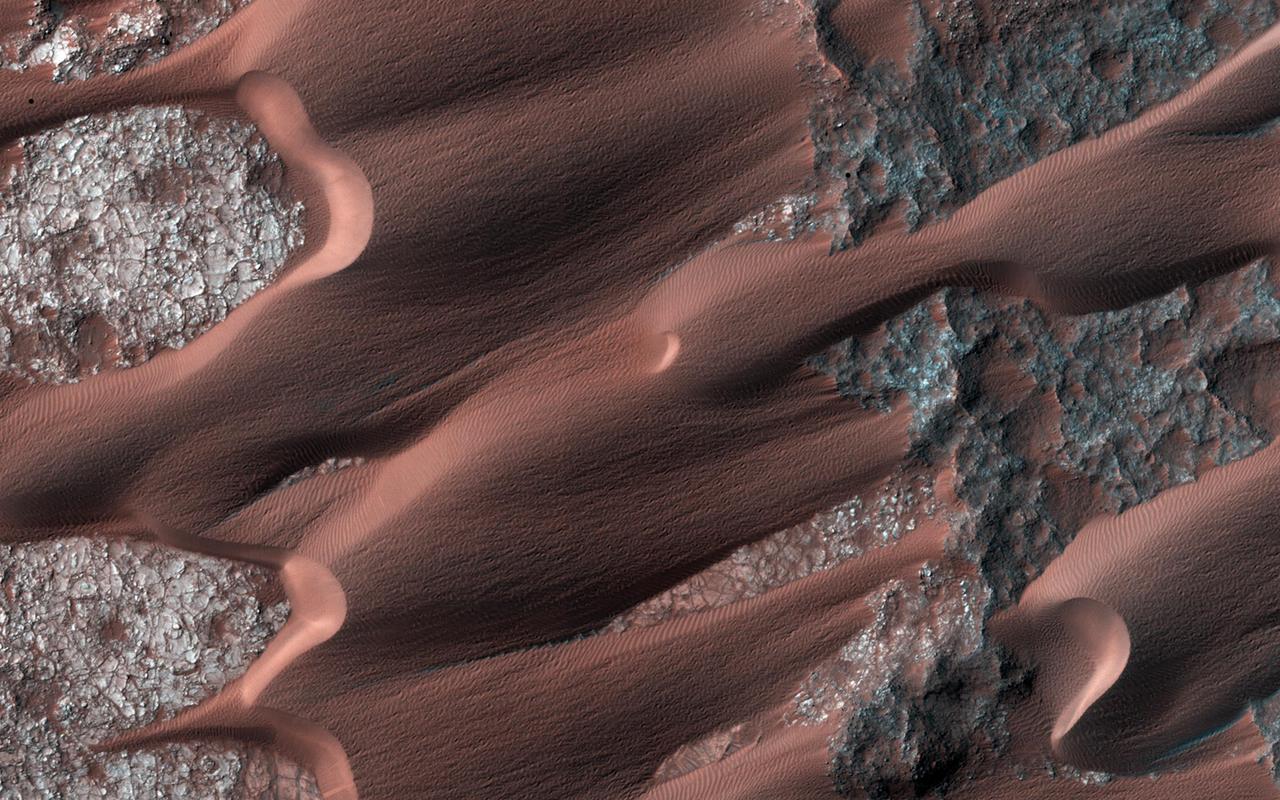
Nili Patera is one of the most active dune fields on Mars. Continuously monitored by the HiRise instrument onboard NASA Mars Reconnaissance Orbiter, a new image is acquired about every six weeks.
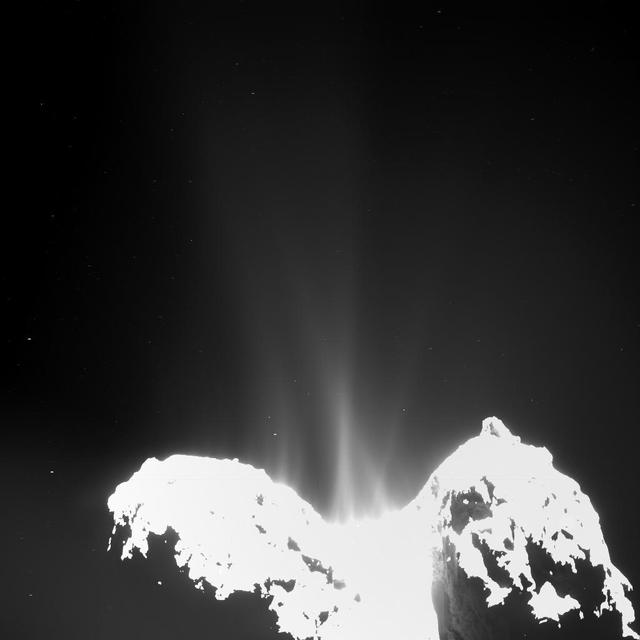
This image was taken by the Optical, Spectroscopic, and Infrared Remote Imaging System, Rosetta main onboard scientific imaging system, on Sept. 10, 2014. Jets of cometary activity can be seen along almost the entire body of the comet. http://photojournal.jpl.nasa.gov/catalog/PIA18886
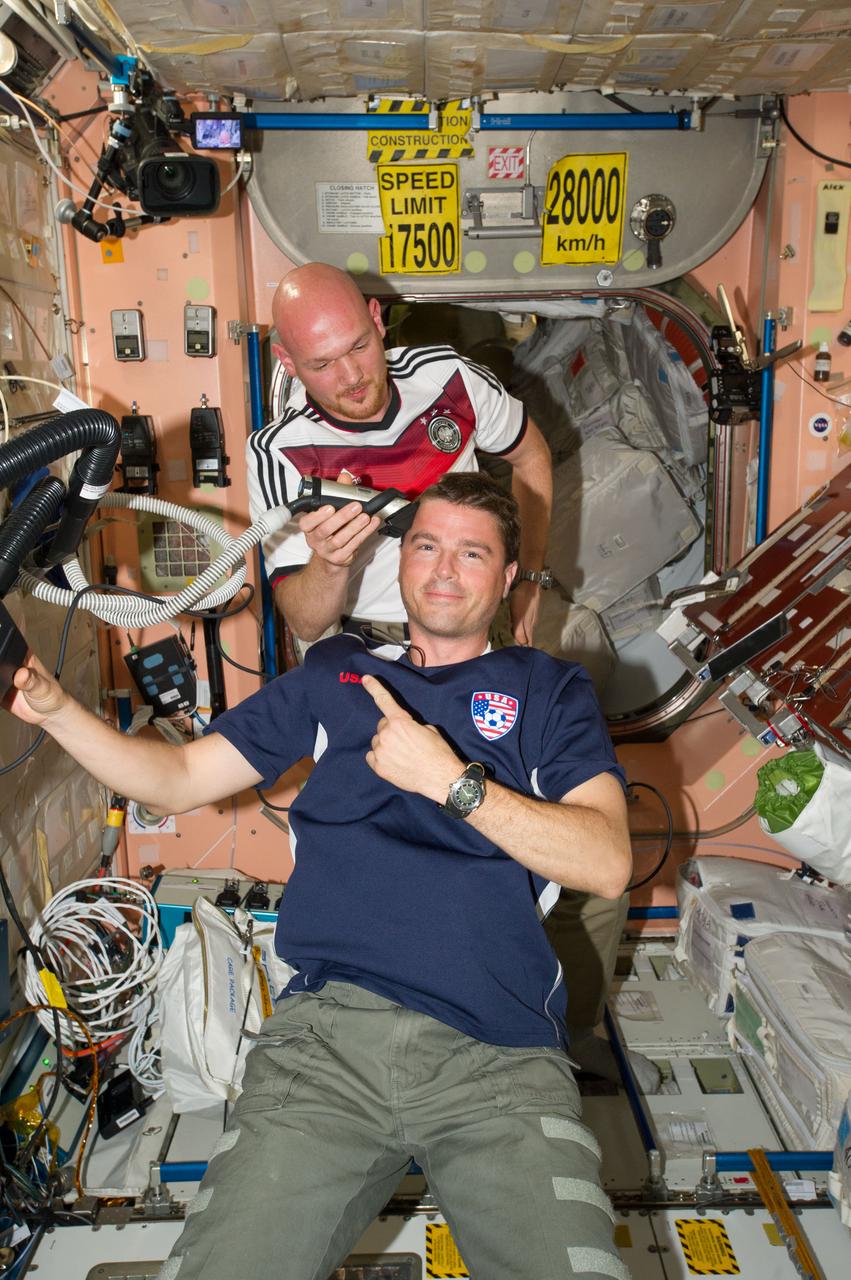
ISS040-E-020378 (26 June 2014) --- European Space Agency astronaut Alexander Gerst, Expedition 40 flight engineer, shaves the head of NASA astronaut Reid Wiseman, flight engineer, in the Unity node of the International Space Station. Gerst used hair clippers fashioned with a vacuum device to garner freshly cut hair. A friendly World Cup Soccer-related agreement between the crew members representing the USA, and Gerst, a German citizen who represents the European Space Agency, called for the American losers of a German-USA match to have their heads shaved. The German team won the match 1-0.
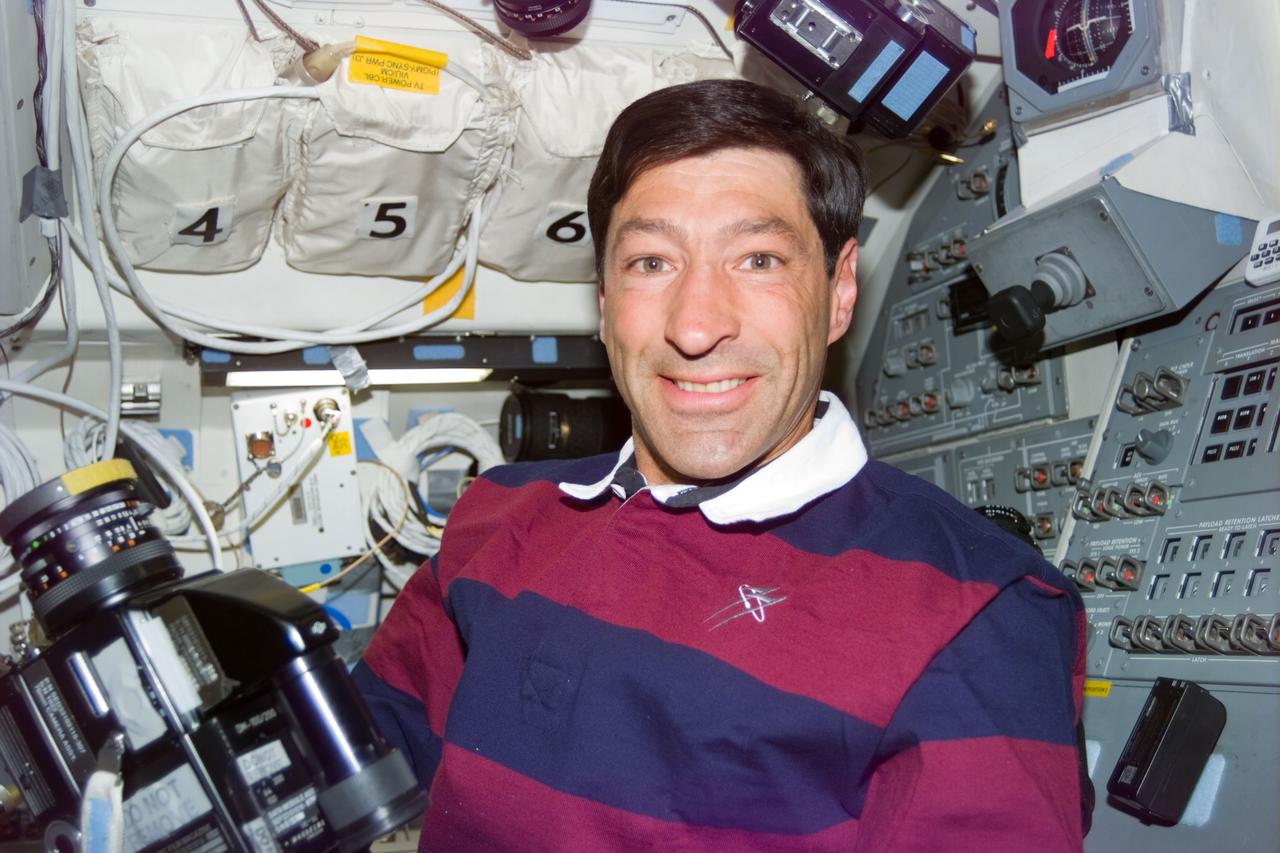
S77-E-5078 (24 May 1996) --- On the Space Shuttle Endeavour's aft flight deck, astronaut Mario Runco, Jr., mission specialist, grabs a hand-held 70mm camera and prepares to take still pictures of an Earth observation target of opportunity. A pair of windows just out of frame above Runco's head provide the crew members with a prime operating perspective of Earth observation targets. A crew mate exposed the image with an Electronic Still Camera (ESC).
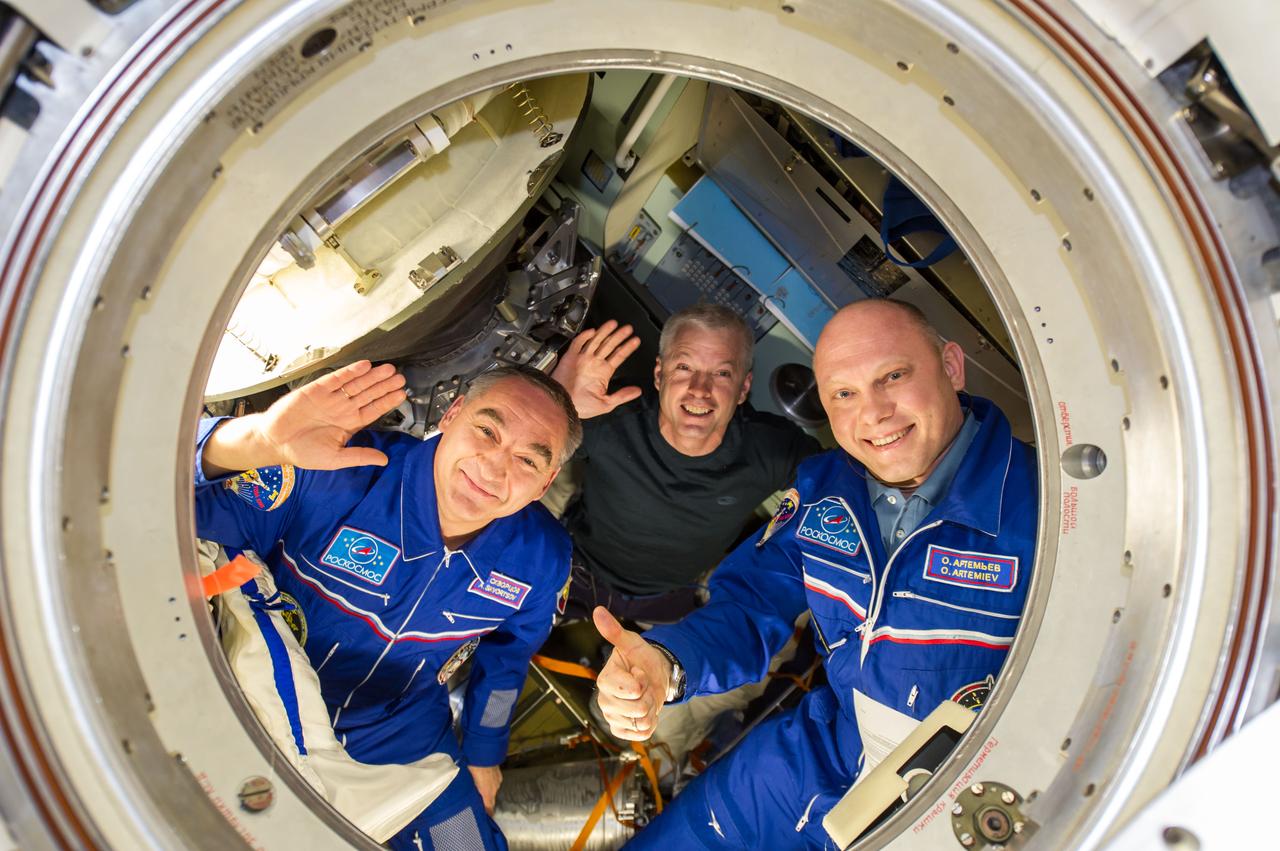
ISS040-E-139846 (10 Sept. 2014) --- NASA astronaut Steve Swanson (center), Expedition 40 commander; along with Russian cosmonauts Alexander Skvortsov (left) and Oleg Artemyev, both flight engineers, are pictured in the Soyuz TMA-12M capsule which will return them back to Earth after serving more than five months onboard the orbital outpost. Undocking from the International Space Station’s Poisk Mini-Research Module 2 (MRM2) occurred at 7:01 p.m. (EDT) on Sept. 10, 2014.
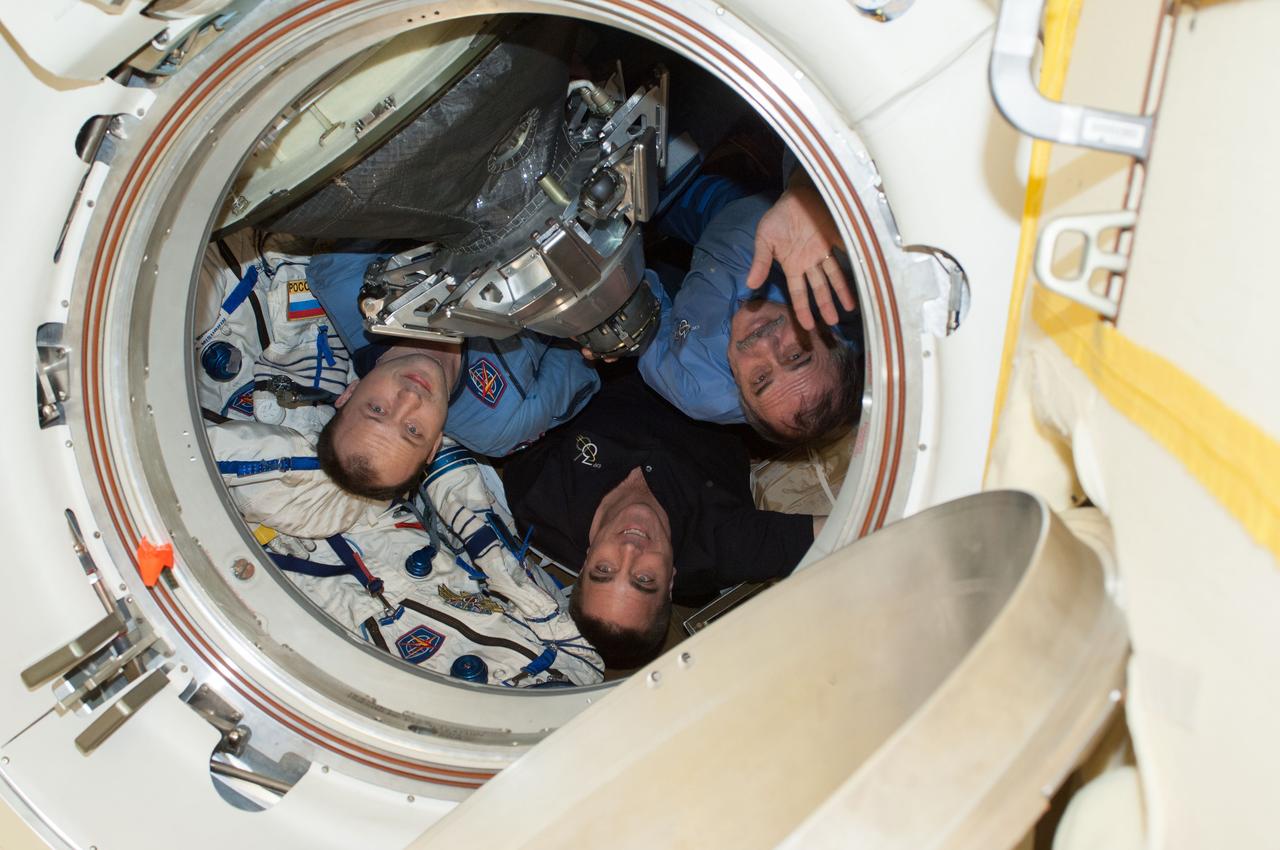
ISS036-E-048267 (10 Sept. 2013) --- Russian cosmonaut Pavel Vinogradov (right), Expedition 36 commander; along with NASA astronaut Chris Cassidy (center) and Russian cosmonaut Alexander Misurkin, both flight engineers, are pictured in the Soyuz TMA-08M spacecraft currently docked to the Poisk Mini-Research Module 2 (MRM2) of the International Space Station. The trio is preparing to undock from Poisk in their Soyuz spacecraft, ending a five-and-a-half month stay at the station.
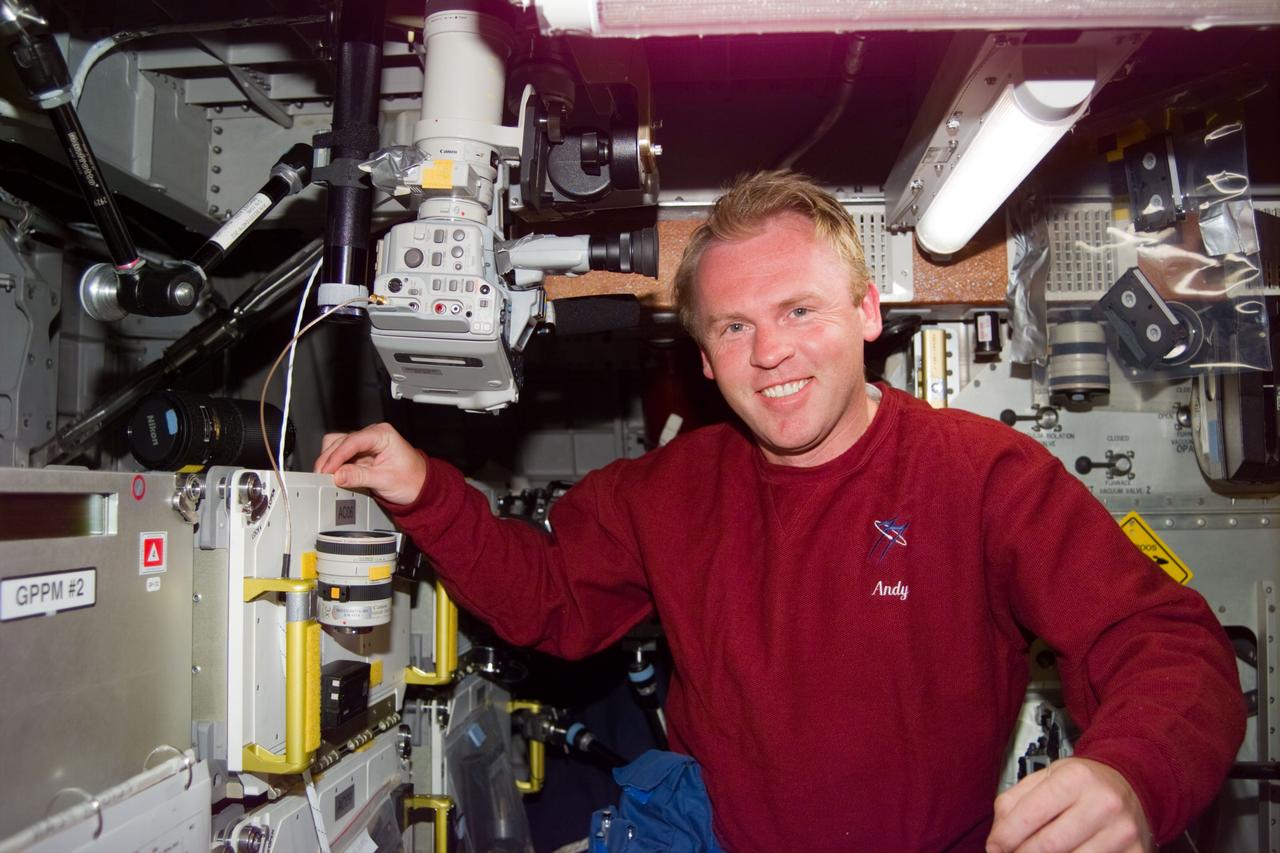
S77-E-5089 (25 May 1996) --- Astronaut Andrew S. W. Thomas, mission specialist, interrupts a Spacehab task to pose for an Electronic Still Camera (ESC) snapshot inside the Spacehab Module onboard the Earth-orbiting Space Shuttle Endeavour. In upper left is the view port which crew members had used for viewing and photographing operations with the Spartan 207/Inflatable Antenna Experiment (IAE). Thomas has his hand on an aft-bulkhead-mounted locker. The Space Experiment Facility (SEF), designed and managed by the University of Alabama, is just behind his left shoulder.
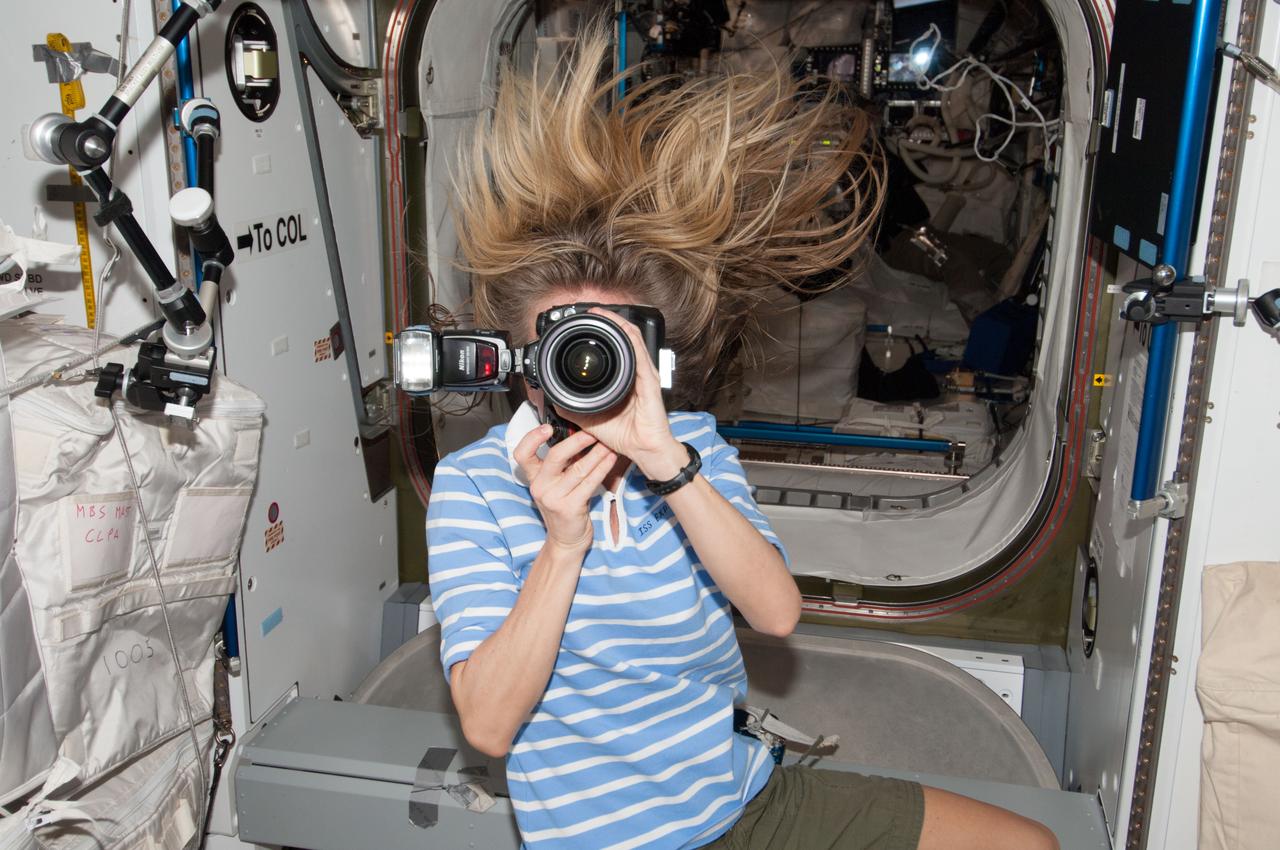
Expedition 37 Flight engineer Karen Nyberg uses a camera to document activities in the Node 2 module. Also sent as Twitter message.

Photo of Astronaut Karen Nyber,Expedition 36 flight engineer,with a snack of peanut butter and chocolate sandwiched between two waffles. Photo taken in the Node 1 module. Also sent as Twitter message.
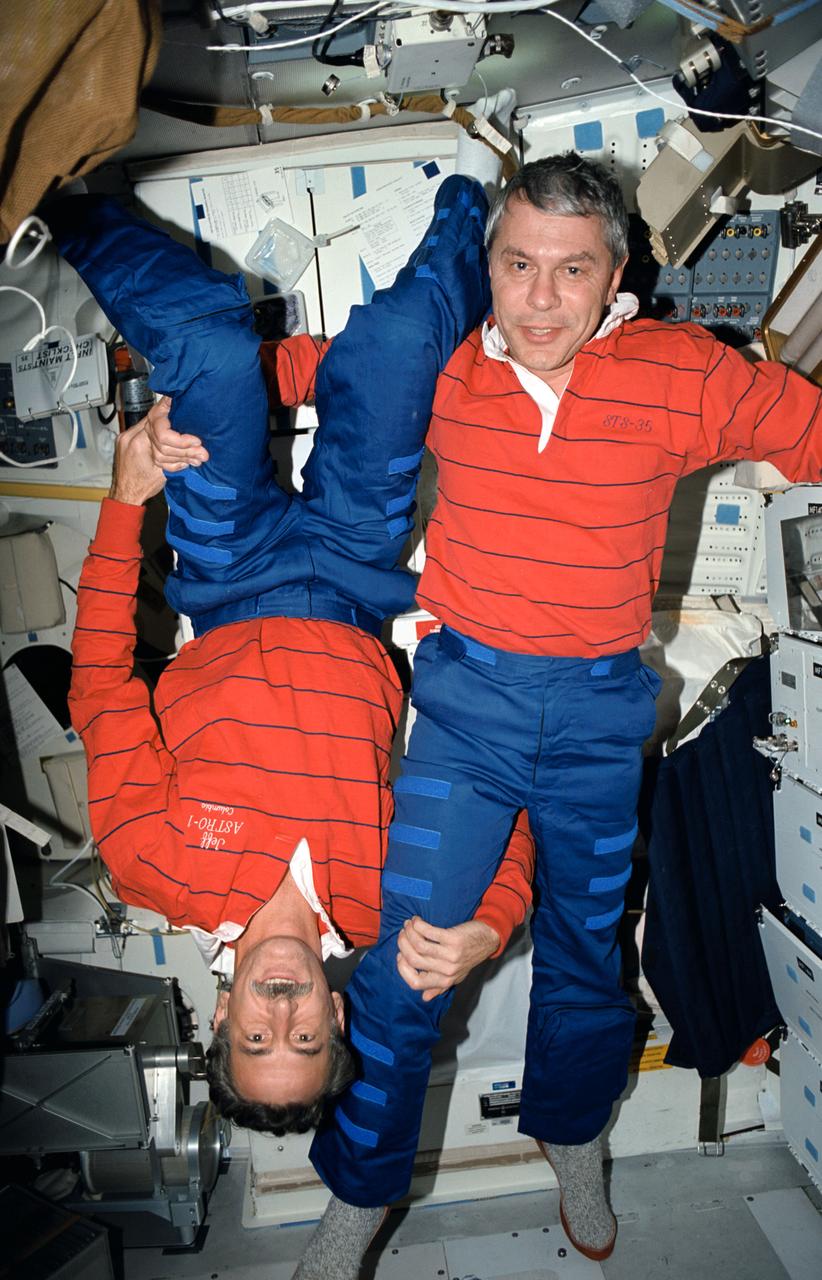
STS035-49-029 (2-10 Dec 1990) --- Posing on the middeck of Columbia, Orbiter Vehicle (OV) 102, are Mission Specialist (MS) Jeffrey A. Hoffman (mustache) and MS Robert A. R. Parker. Determining who is right side up is complicated by the microgravity of space. Hoffman's head is at the middeck floor and his feet are at the ceiling. The two crewmembers are in front of OV-102's port side with the waste collection system (WCS) contingency unit, side hatch, and galley visible behind them.
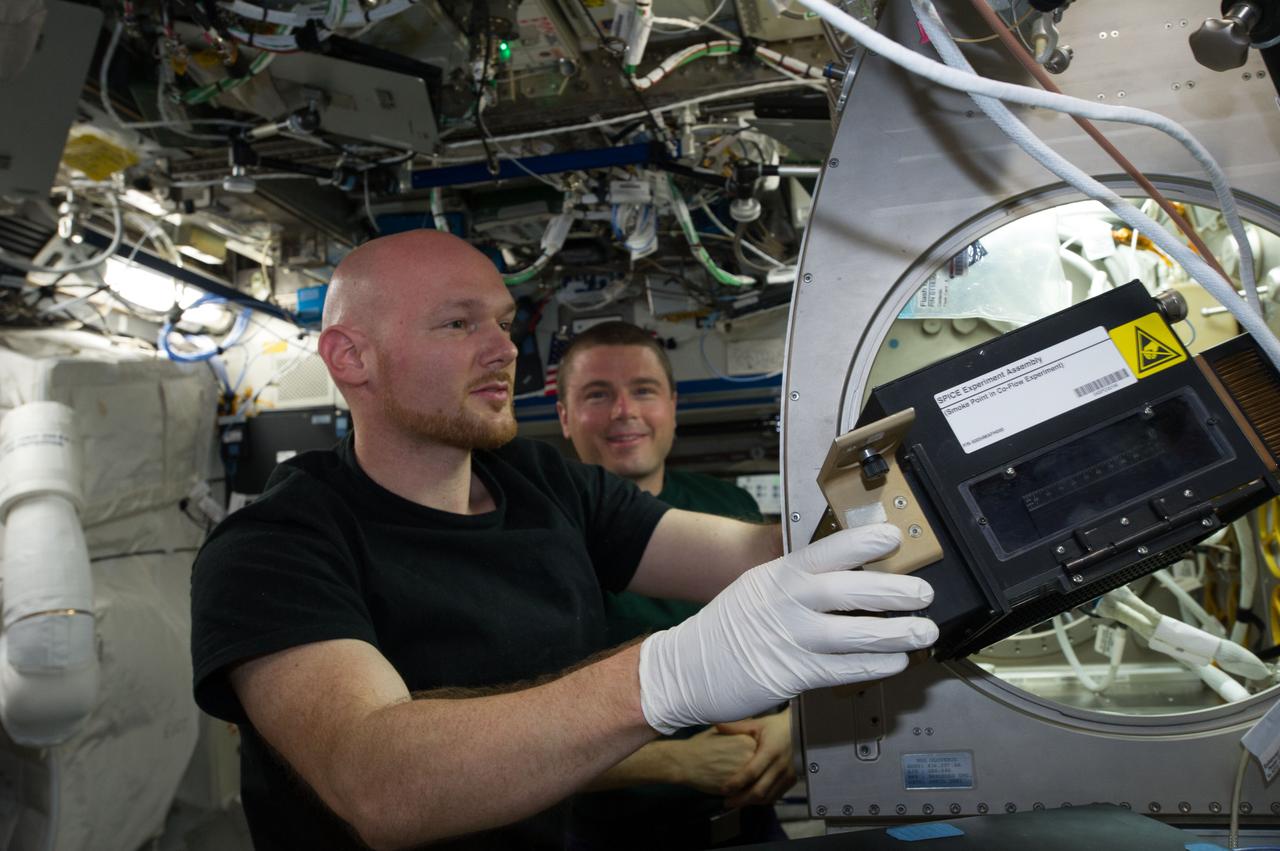
ISS040-E-088800 (5 Aug. 2014) --- European Space Agency astronaut Alexander Gerst, Expedition 40 flight engineer, removes hardware for the combustion experiment known as the Burning and Suppression of Solids (BASS-II) from the Microgravity Science Glovebox (MSG) in the Destiny laboratory of the International Space Station. The experiment seeks to provide insight on how flames burn in space compared to Earth which may provide fire safety benefits aboard future spacecraft. NASA astronaut Reid Wiseman, flight engineer, looks on.
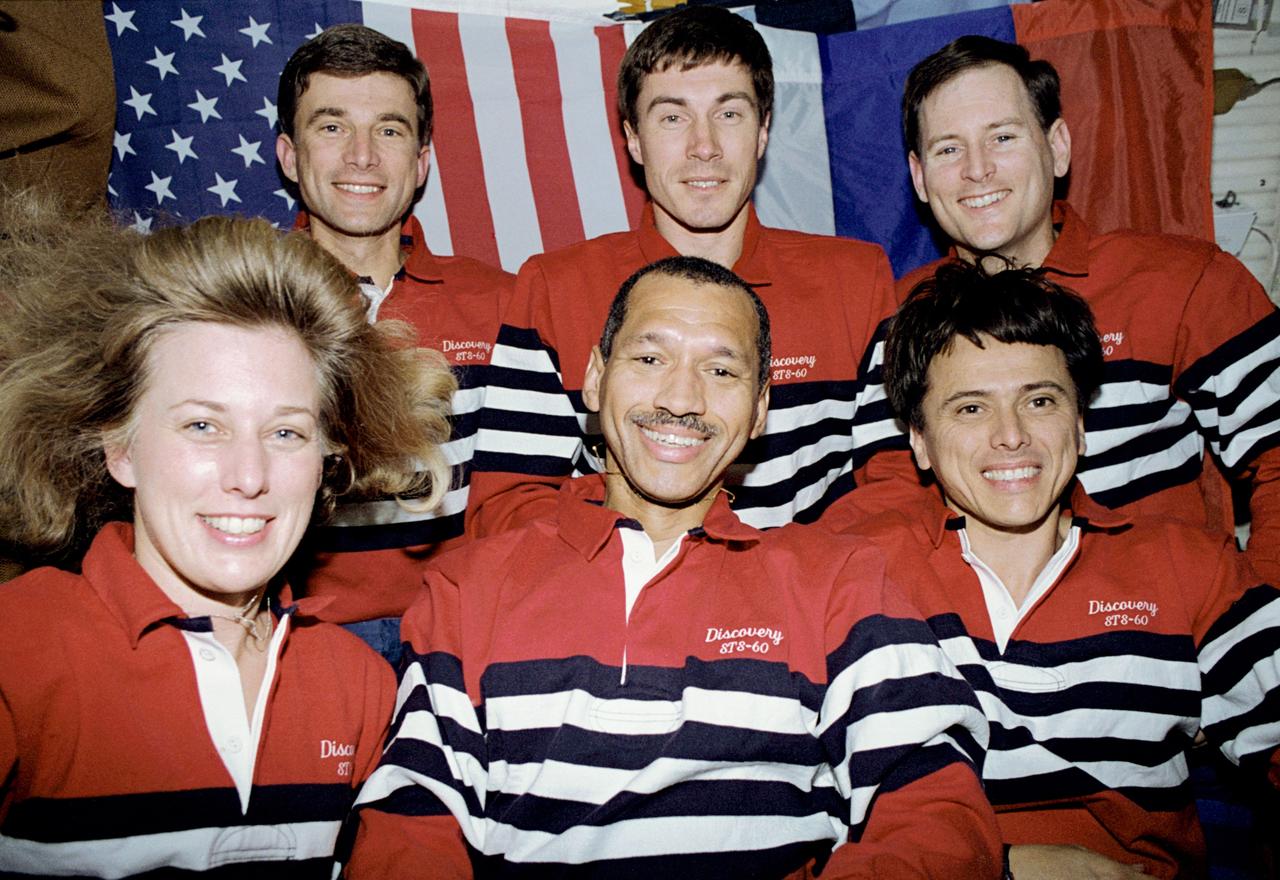
STS060-31-009 (3-11 Feb. 1994) --- The six-member STS-60 crew pose for the traditional in-flight crew portrait, with American and Russian flags forming the backdrop on the space shuttle Discovery’s middeck. Left to right (front row) are N. Jan Davis, Charles F. Bolden Jr. and Franklin R. Chang-Diaz; and (back row) Ronald M. Sega, Sergei K. Krikalev and Kenneth S. Reightler Jr. Photo credit: NASA or National Aeronautics and Space Administration
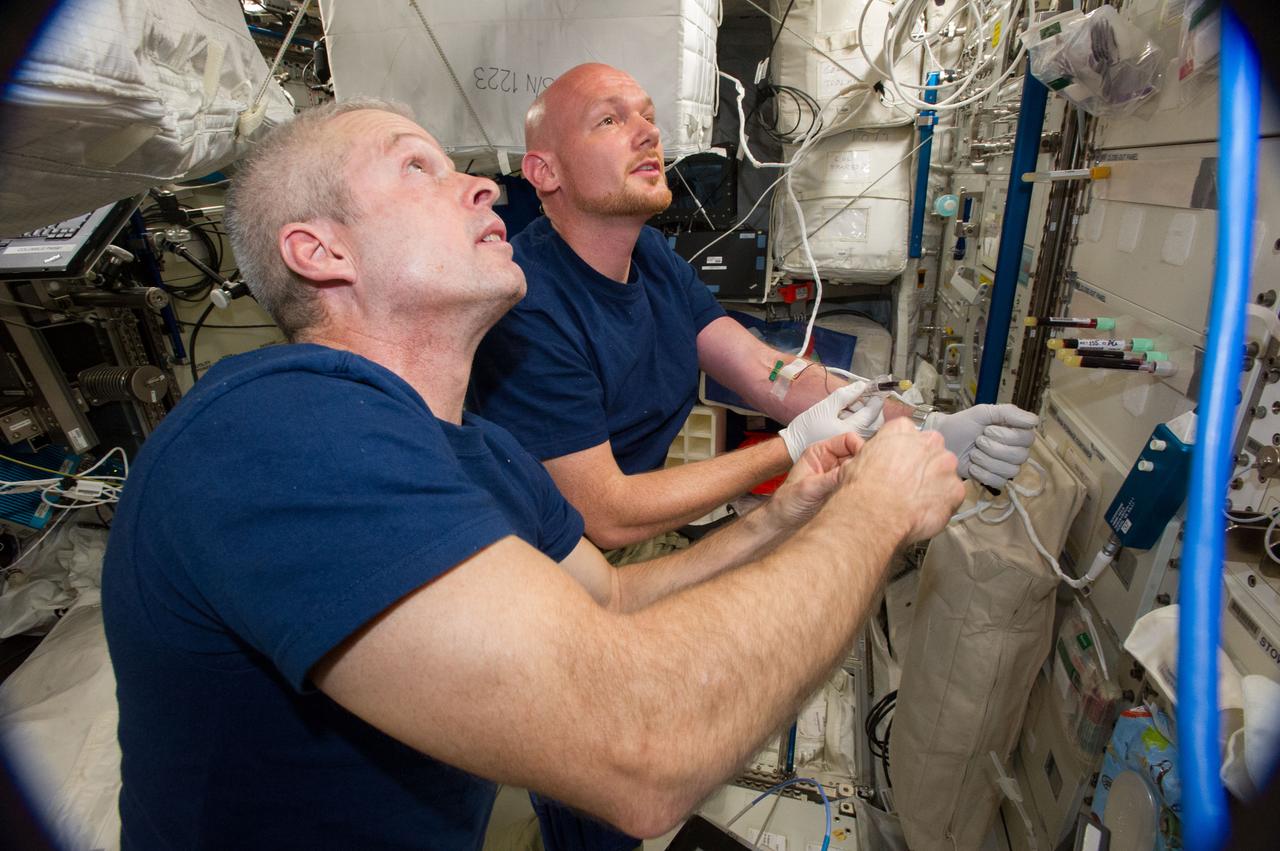
Astronaut Alexander Gerst,Expedition 40 flight engineer (background),and Expedition 40 Commander Steve Swanson are photographed performing blood sample collection in the Columbus module as part of HRF Generic Frozen Blood Collection Operations.
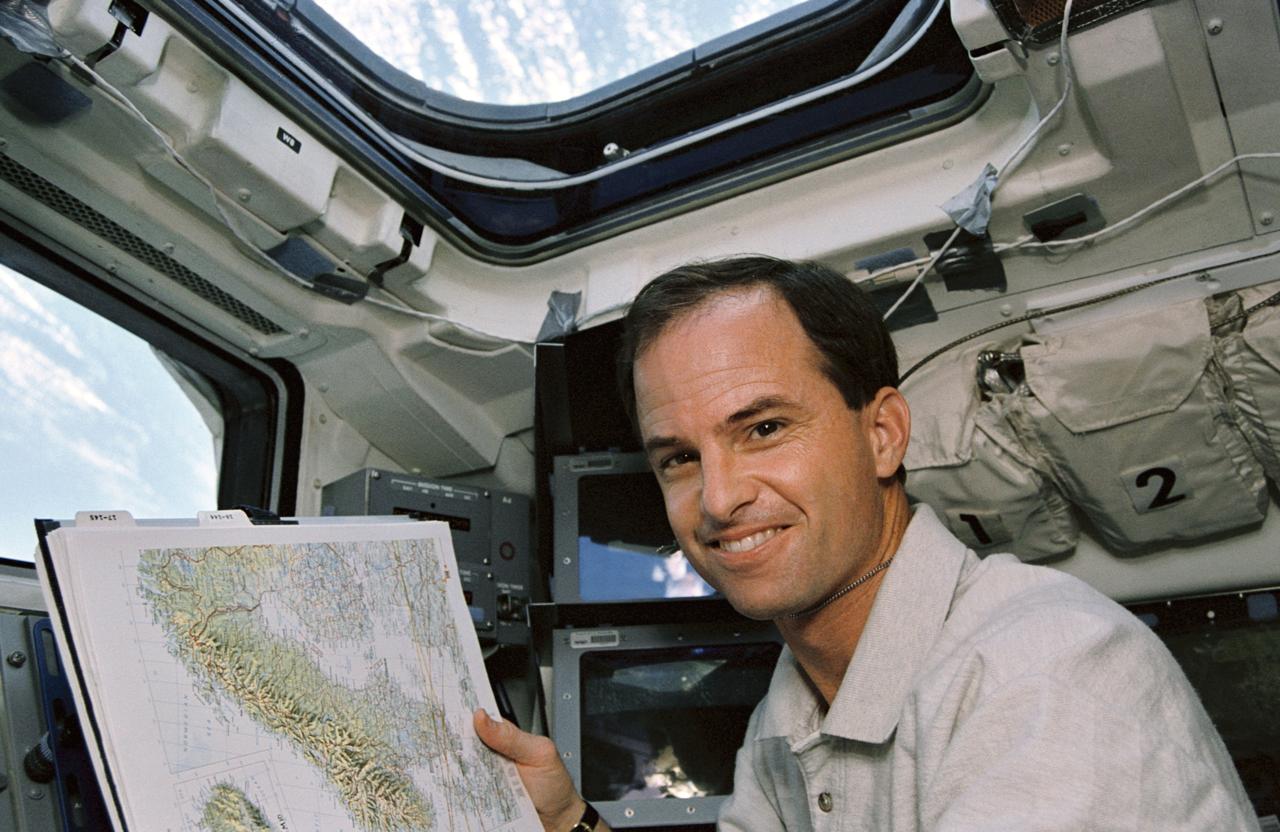
STS059-16-032 (9-20 April 1994) --- Astronaut Kevin P. Chilton, pilot, displays a map of Scandinavia on the Space Shuttle Endeavour's flight deck. Large scale maps such as this were used by the crew to locate specific sites of interest to the Space Radar Laboratory scientists. The crew then photographed the sites at the same time as the radar in the payload bay imaged them. Chilton was joined in space by five other NASA astronauts for a week and a half of support to the Space Radar Laboratory (SRL-1) mission and other tasks.

ISS040-E-139800 (10 Sept. 2014) --- NASA astronaut Steve Swanson, Expedition 40 commander, is pictured in the Soyuz TMA-12M capsule which will return him back to Earth along with Russian cosmonauts Alexander Skvortsov and Oleg Artemyev, both flight engineers. Undocking from the International Space Station’s Poisk Mini-Research Module 2 (MRM2) occurred at 7:01 p.m. (EDT) on Sept. 10, 2014.
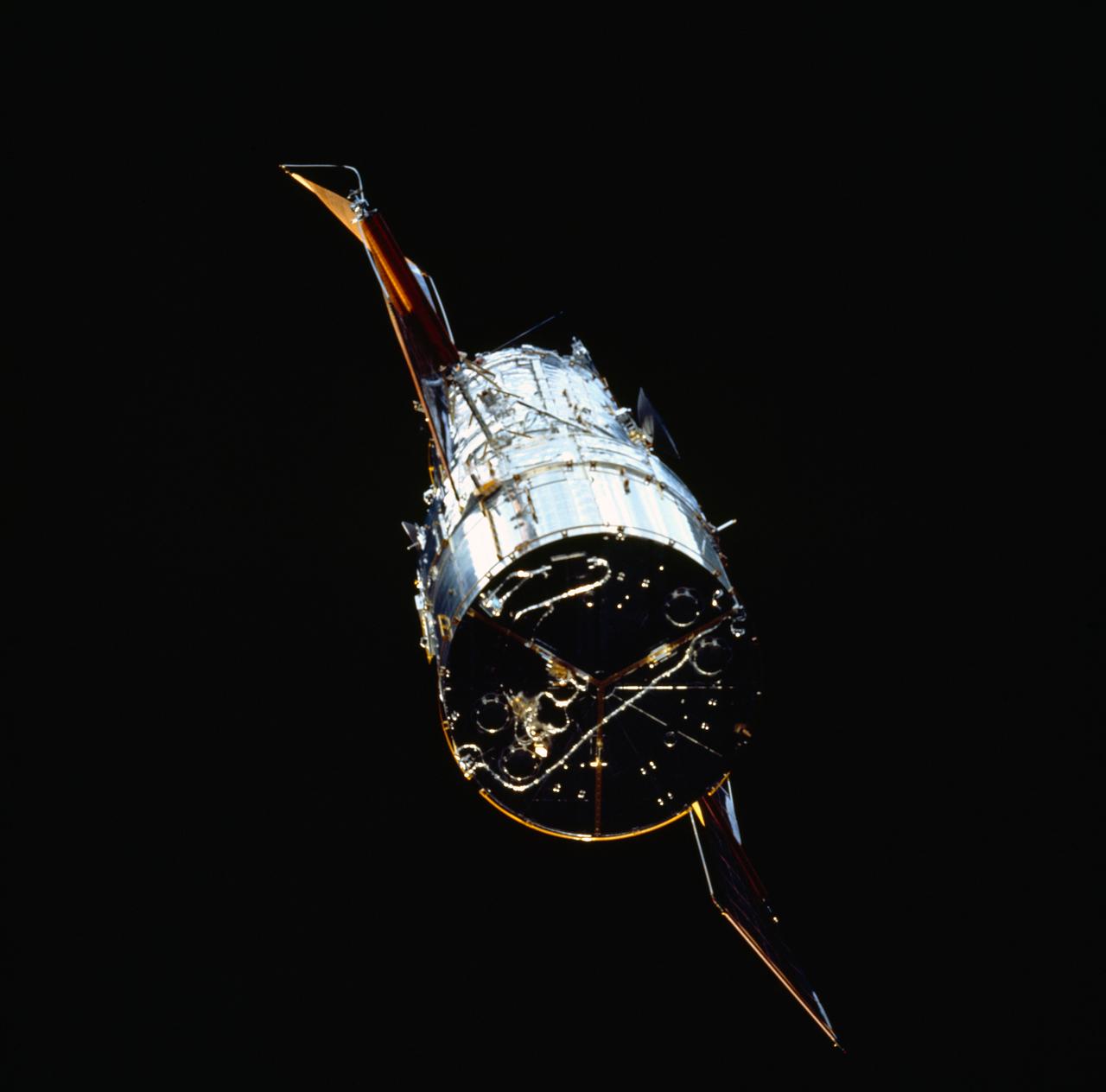
STS061-73-040 (4 Dec 1993) --- Backdropped against the blackness of space, the Hubble Space Telescope (HST) nears the Space Shuttle Endeavour. With the aid of the Remote Manipulator System (RMS), the STS-61 crew members later grappled the spacecraft and berthed it in the cargo bay for five-days of servicing chores by four space walkers.
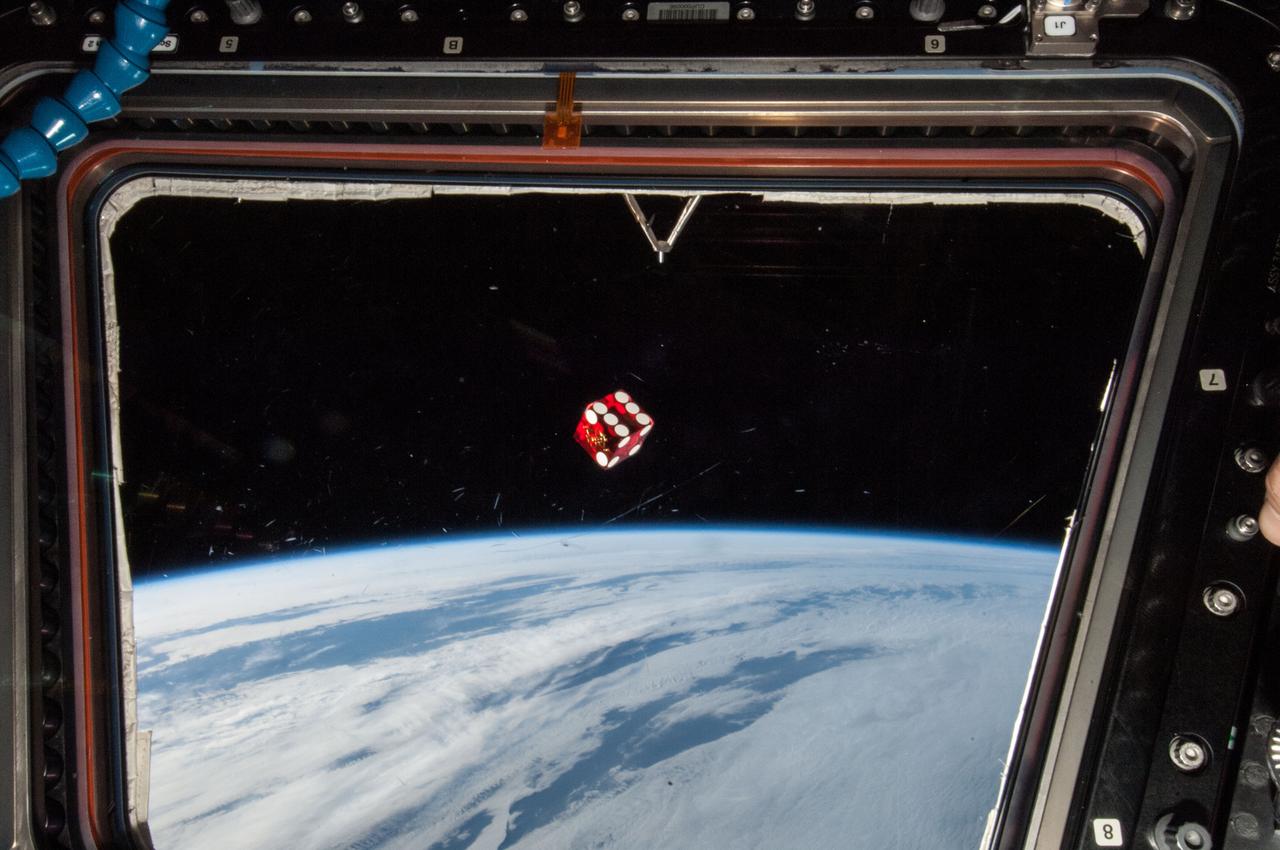
ISS040-E-006093 (31 May 2014) --- With a few explanatory words attached to a message to Earth, Expedition 40 Flight Engineer Reid Wiseman of NASA sent down this image of a single piece of dice floating in front of one of the windows in the Cupola of the Earth-orbiting International Space Station. Wiseman commented, "This one is just for us board game players, table top strategy gamers, (etc.) whose dice collection behaviour borders on hoarding."
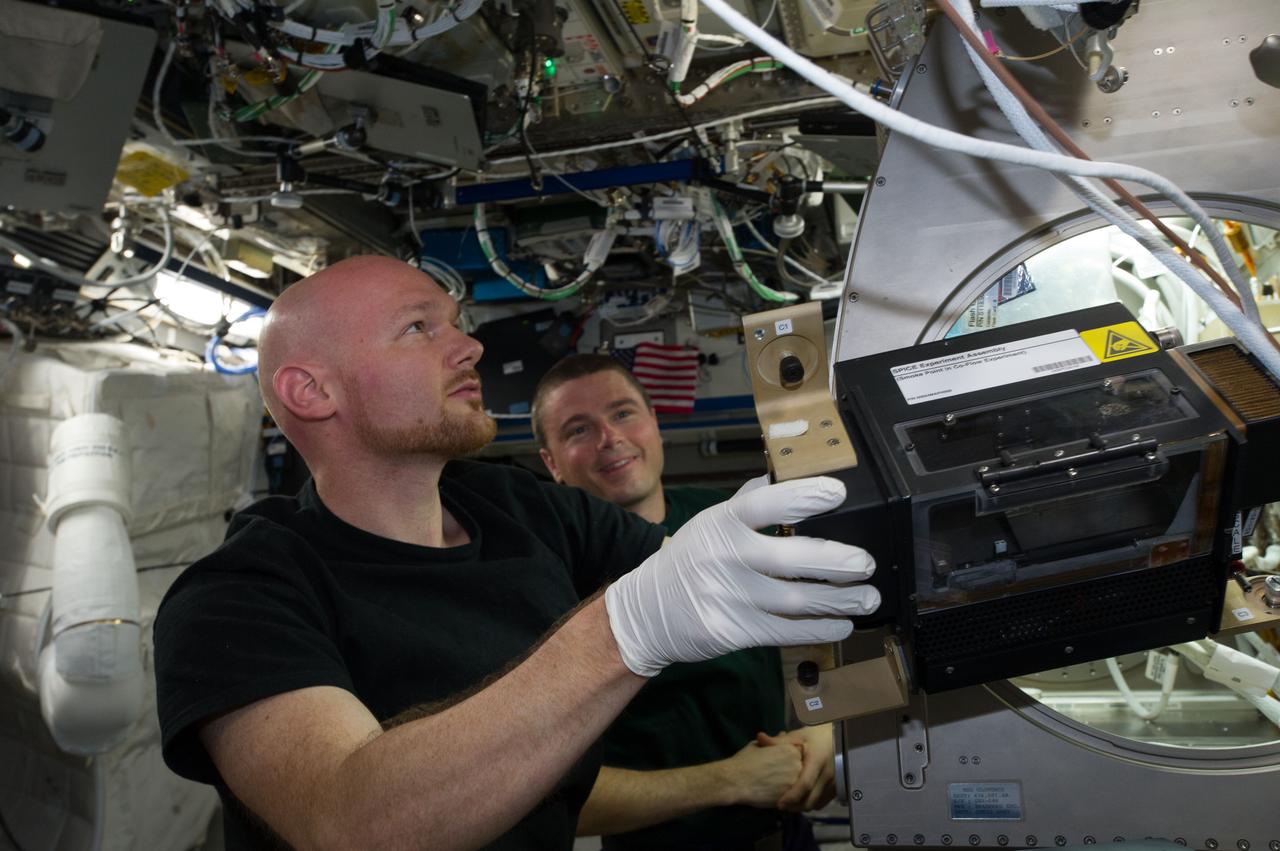
ISS040-E-088801 (5 Aug. 2014) --- European Space Agency astronaut Alexander Gerst, Expedition 40 flight engineer, removes hardware for the combustion experiment known as the Burning and Suppression of Solids (BASS-II) from the Microgravity Science Glovebox (MSG) in the Destiny laboratory of the International Space Station. The experiment seeks to provide insight on how flames burn in space compared to Earth which may provide fire safety benefits aboard future spacecraft. NASA astronaut Reid Wiseman, flight engineer, looks on.
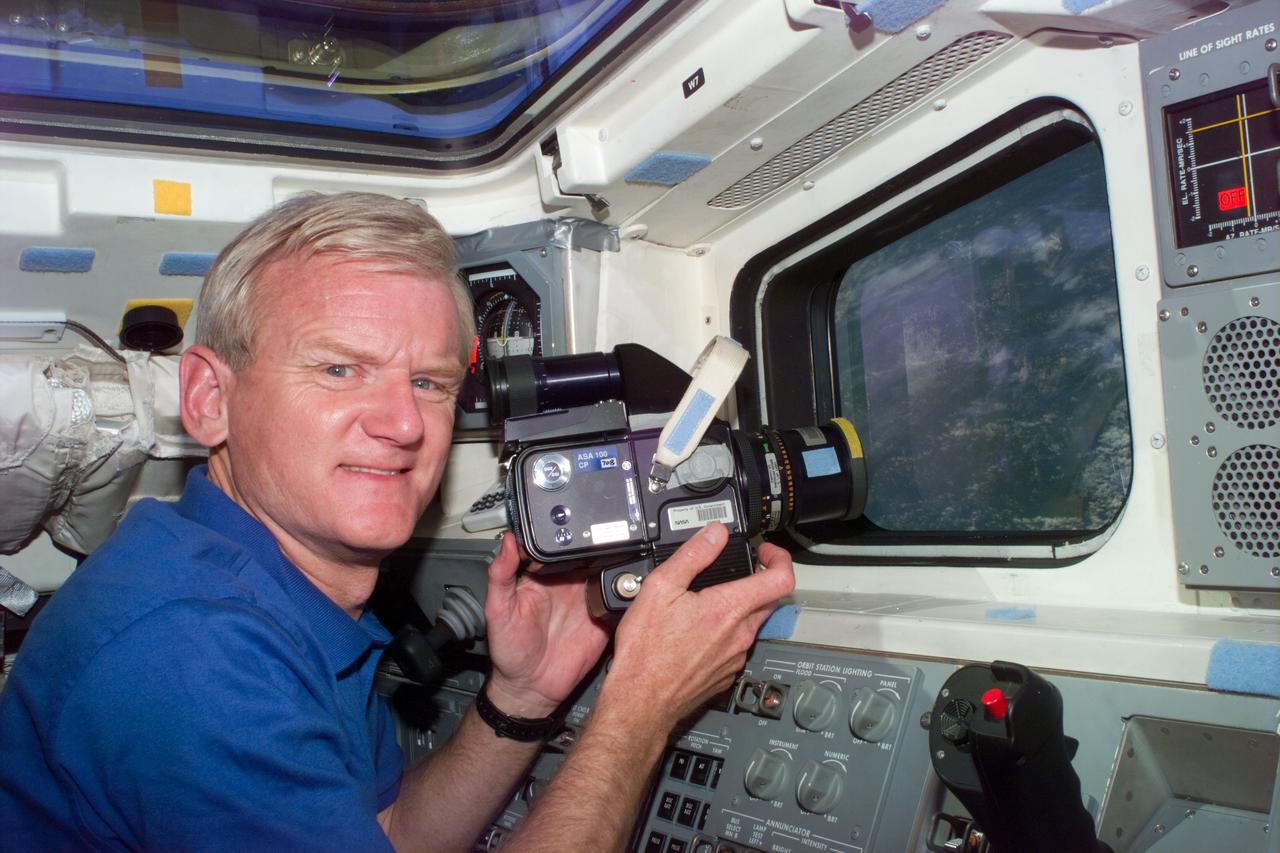
S77-E-5109 (26 May 1996) --- Astronaut John H. Casper, commander, pauses during a photography session on the aft flight deck of the Space Shuttle Endeavour. The scene was recorded with an Electronic Still Camera (ESC).
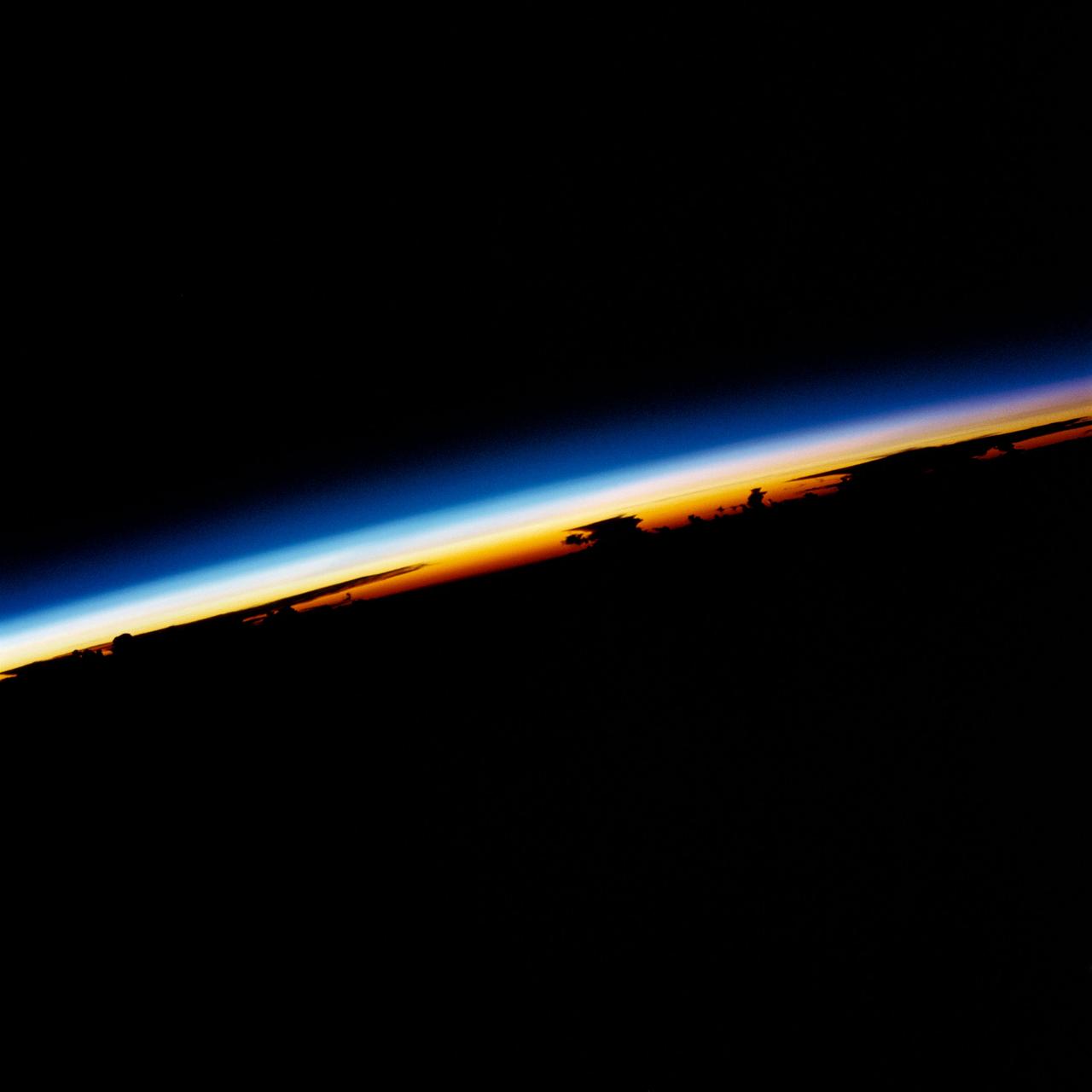
41D-32-14 (30 Aug 1984) --- A rainbow-like sunrise over the Philippine Sea greeted the six crew members aboard the Earth-orbiting Space Shuttle Discovery on its first day in space. A 70mm camera was used to record the scene at 3:08:14 p.m. (CDT), August 30, 1984, during Discovery's sixth orbit of a six-day mission. The spacecraft was above a position on Earth centered at 21.1 degrees north and 12.9 degrees east (about 250 miles north - northeast of the Philippine Islands). The scene was shown as one of the Post-Flight Press Conference (PFPC) visuals by the crew on September 12, 1984.
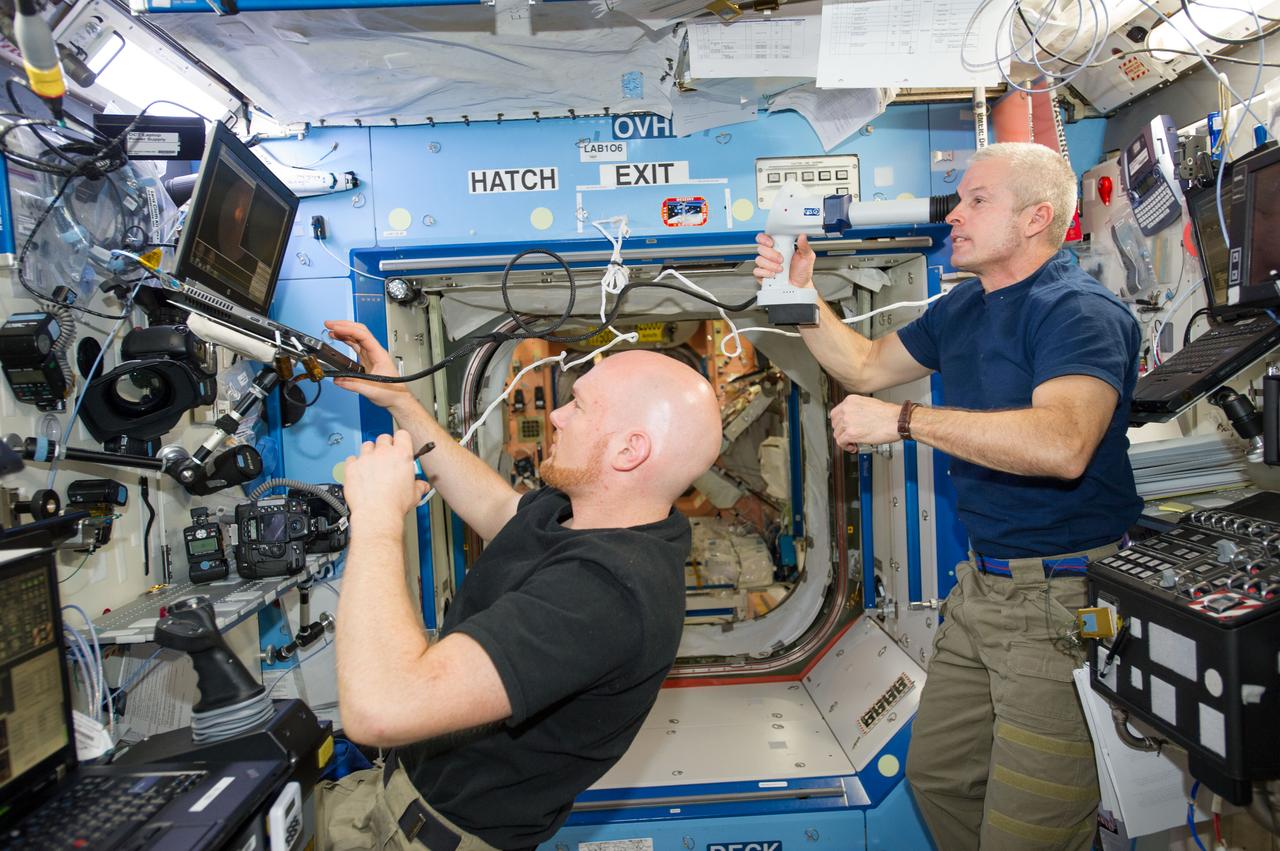
European Space Agency astronaut Alexander Gerst, Expedition 40 flight engineer, and NASA astronaut Steve Swanson, commander, gather around a computer in the Unity node of the International Space Station after the German-USA soccer match.
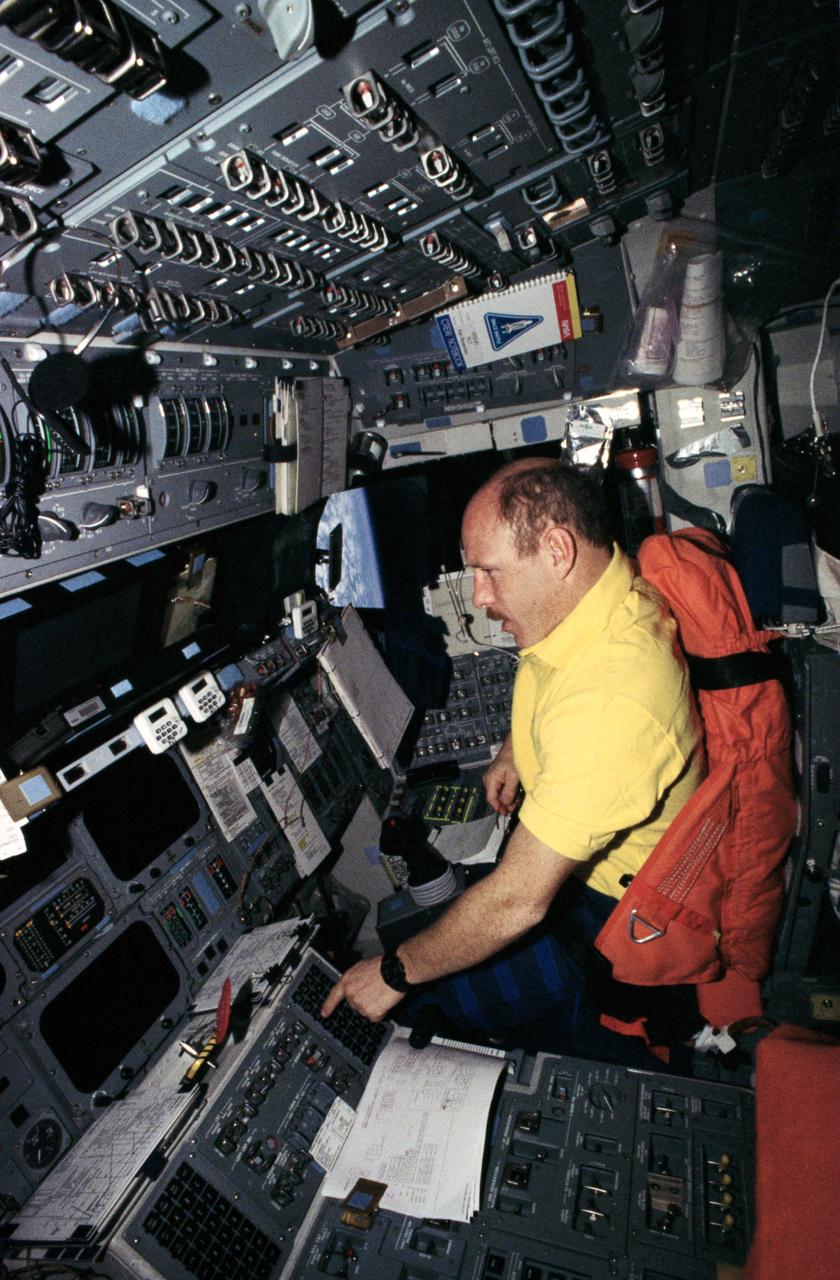
STS061-53-010 (4 Dec 1993) --- Astronaut Kenneth D. Bowersox mans the pilot's station on the Space Shuttle Endeavour during the eleven-day mission to service the Hubble Space Telescope (HST). Bowersox was one of three crew members who remained in the crew cabin while astronauts conducted a total of five space walks to perform various tasks on the HST.
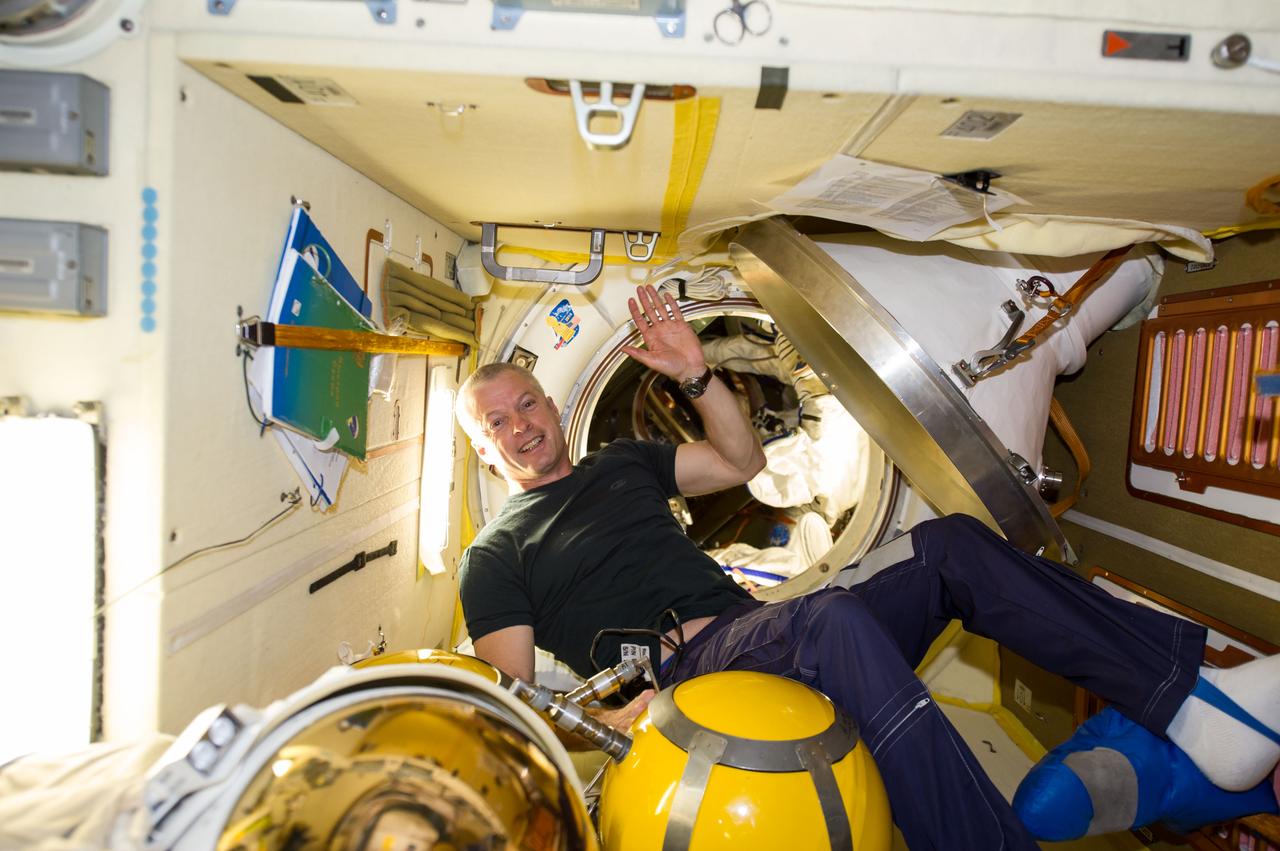
ISS040-E-139784 (10 Sept. 2014) --- In the Poisk Mini-Research Module 2 (MRM2), NASA astronaut Steve Swanson, Expedition 40 commander, waves good-bye prior to entering the Soyuz TMA-12M capsule which will return him back to Earth along with Russian cosmonauts Alexander Skvortsov and Oleg Artemyev, both flight engineers. Undocking occurred at 7:01 p.m. (EDT) on Sept. 10, 2014.

Astronaut Karen Nyberg,Expedition 36 flight engineer,is photographed holding a drink packet in the Node 2 module.
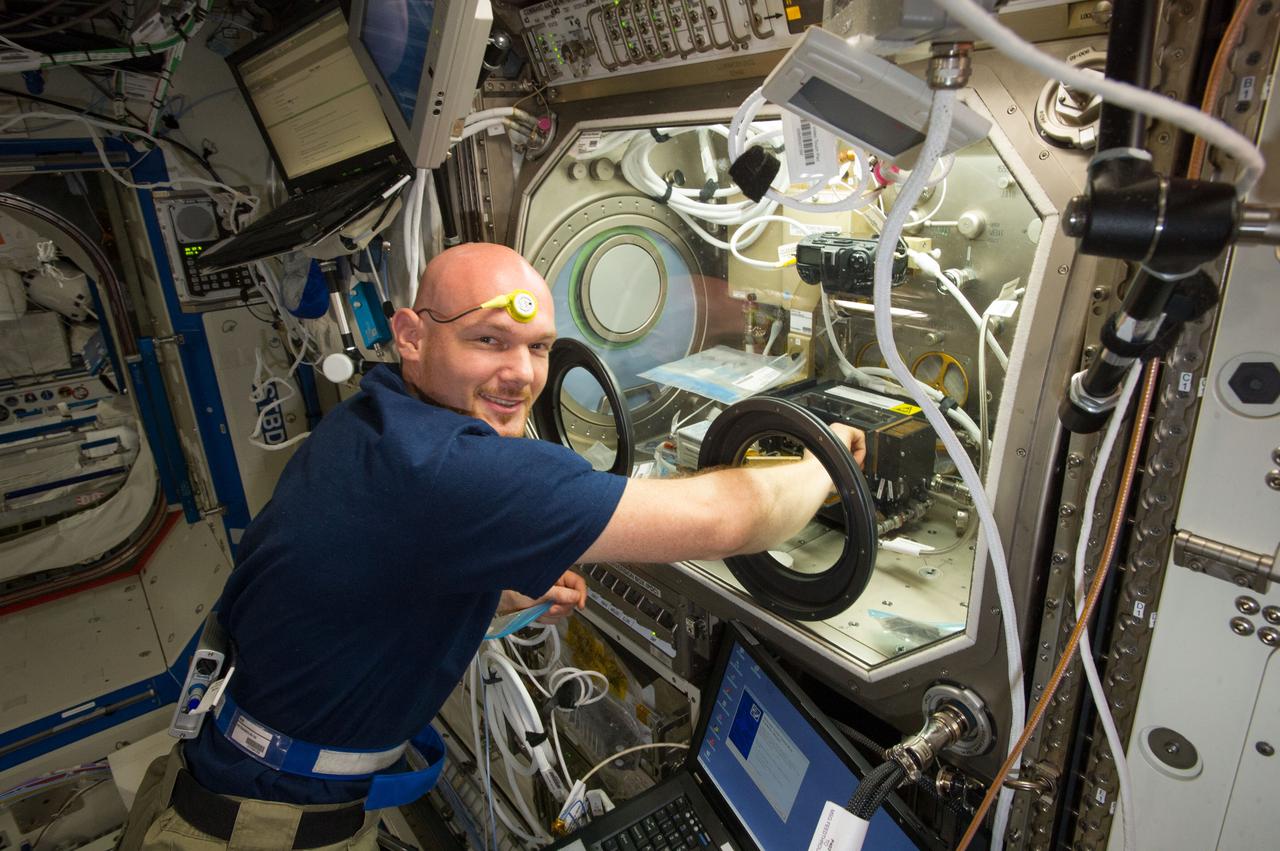
ISS040-E-011005 (13 June 2014) --- European Space Agency astronaut Alexander Gerst, Expedition 40 flight engineer, works with samples and hardware for a combustion experiment known as the Burning and Suppression of Solids (BASS) in the Microgravity Science Glovebox (MSG) in the Destiny laboratory of the International Space Station. He is wearing a Drager Double Sensor on his forehead which is used on the Circadian Rhythms Experiment. This experiment examines the hypothesis that long-term spaceflights significantly affect the synchronization of the circadian rhythms in humans due to changes of a non-24 hour light-dark cycle.
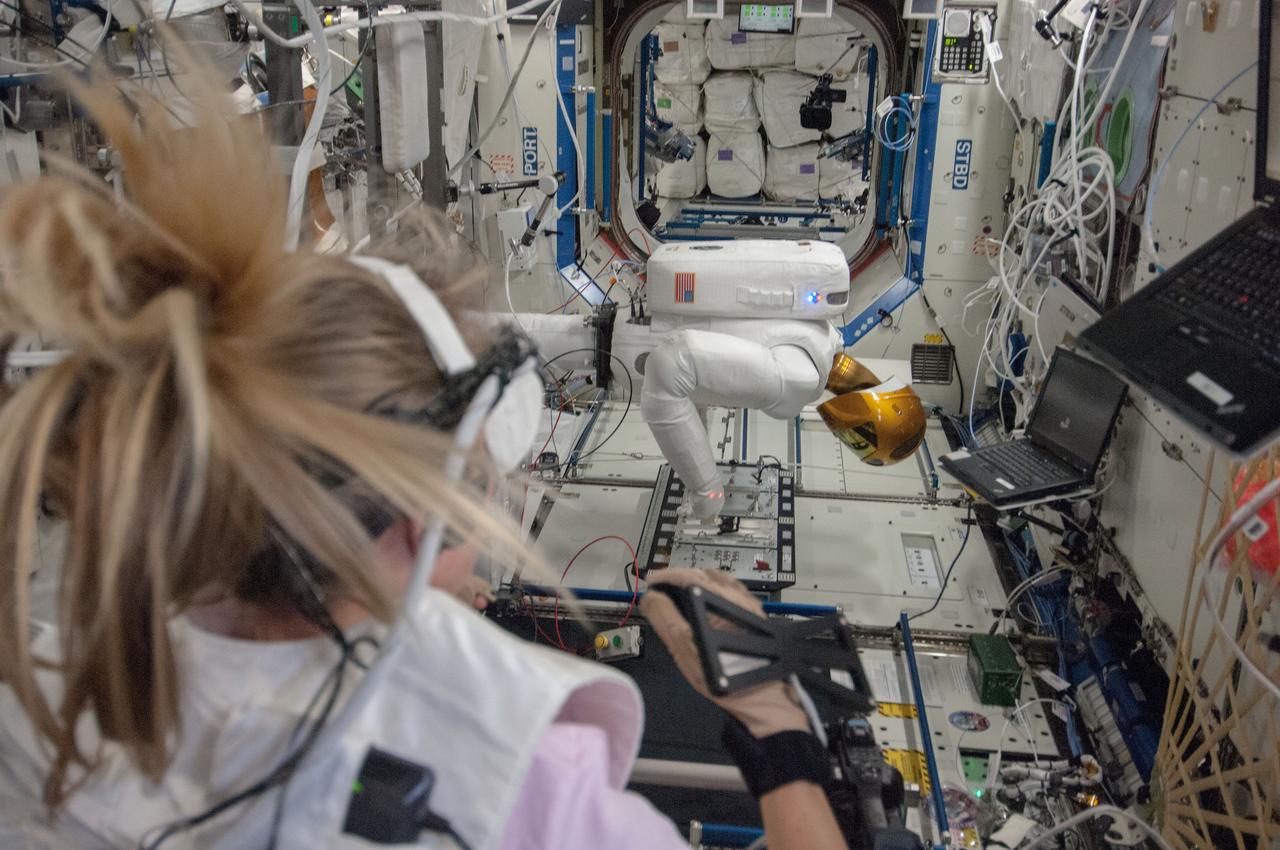
View of Astronaut Karen Nyberg, Expedition 36 flight engineer, performing Robonaut Teleops activities with Robonaut 2,the first humanoid robot in space,in the Destiny laboratory of the International Space Station. Sent also as Twitter message.
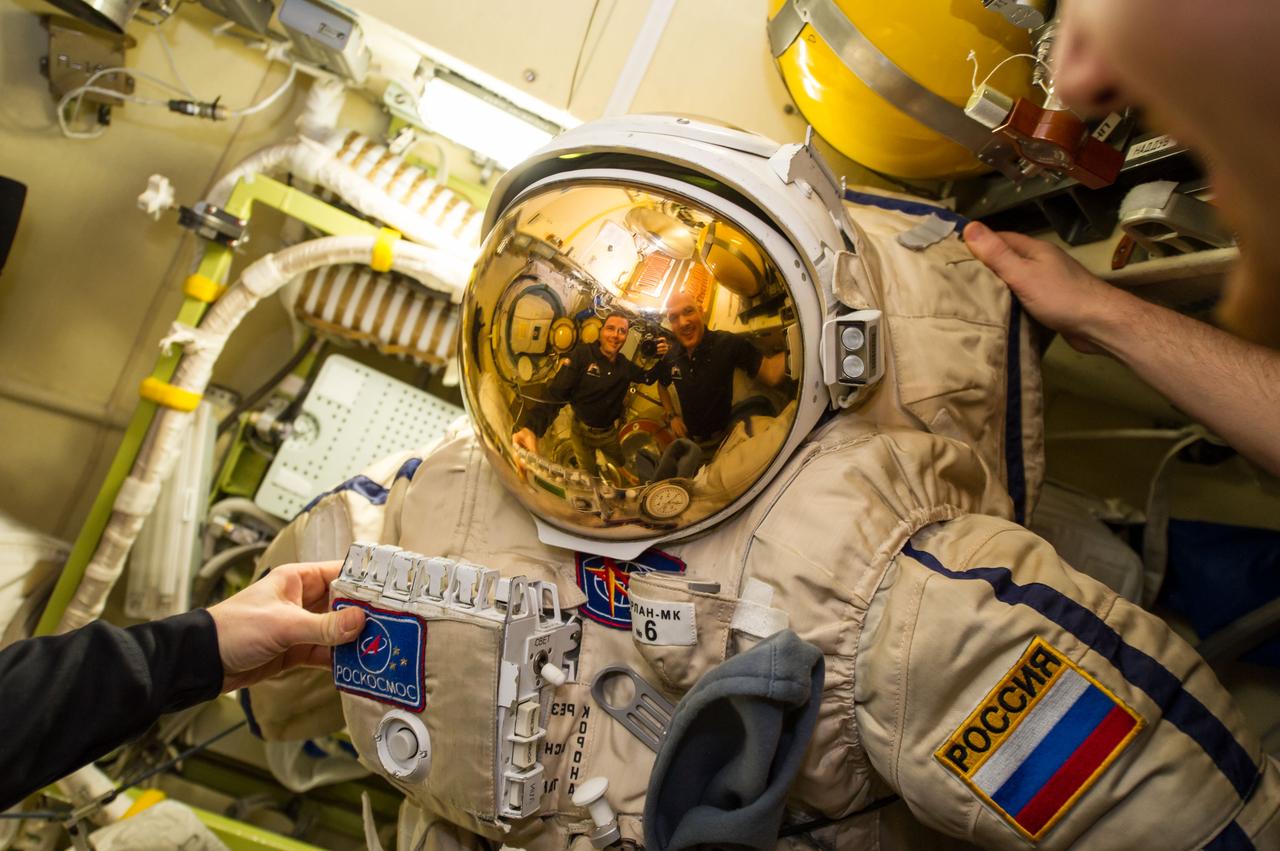
ISS040-E-139809 (10 Sept. 2014) --- An unoccupied Russian Orlan spacesuit is pictured in the Russian segment of the International Space Station. Visible in the reflections of the helmet visor are NASA astronaut Reid Wiseman (left with still camera) and European Space Agency astronaut Alexander Gerst, both Expedition 40/41 flight engineers.
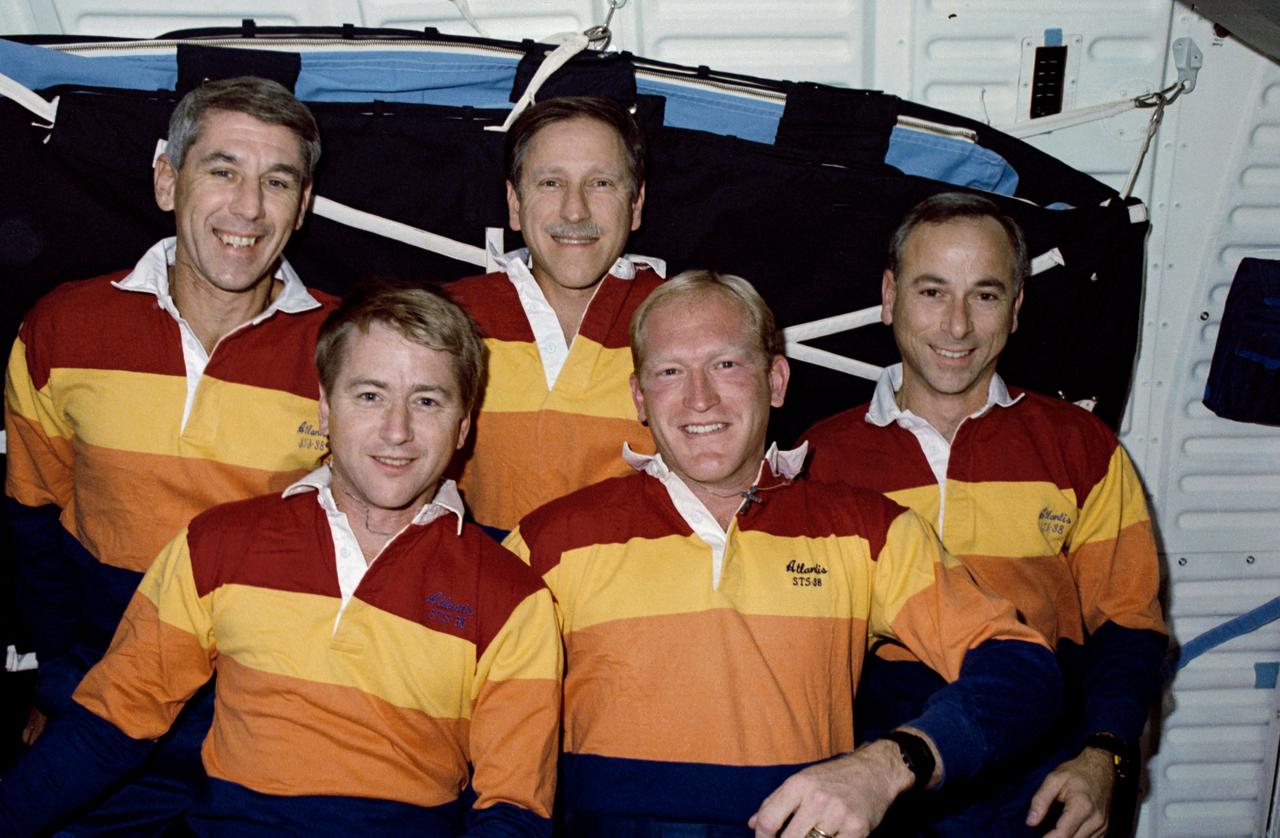
STS038-28-016 (20 Nov 1990) --- STS-38 crewmembers pose on Atlantis', Orbiter Vehicle (OV) 104's, middeck for traditional onboard (in-space) portrait. Wearing red, yellow, and orange crew polo shirts are (right to left) Mission Specialist (MS) Robert C. Springer, Pilot Frank L. Culbertson, Commander Richard O. Covey, MS Charles D. Gemar, and MS Carl J. Meade.
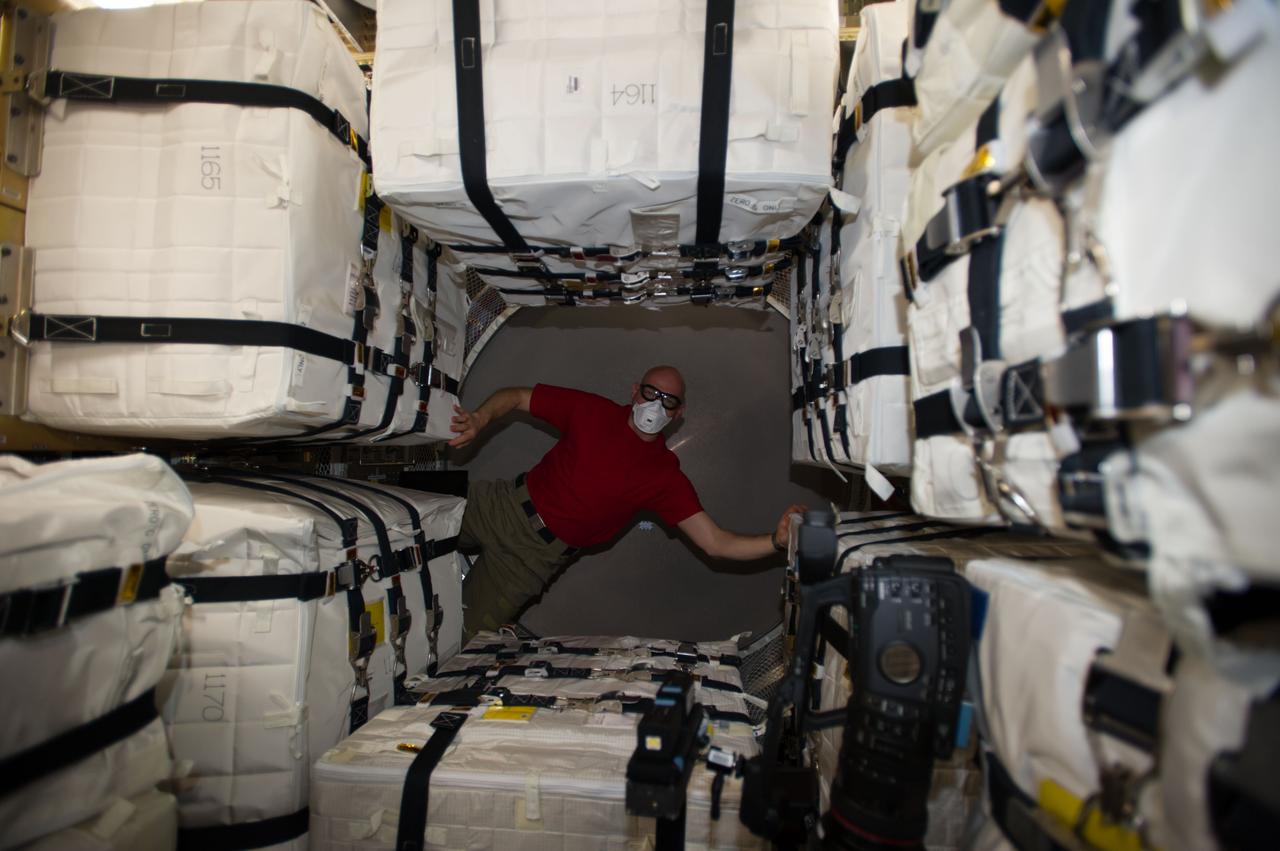
ISS040-E-091969 (13 Aug. 2014) --- Surrounded by stowage containers, European Space Agency astronaut Alexander Gerst, Expedition 40 flight engineer, is pictured in the newly-attached "Georges Lemaitre" Automated Transfer Vehicle-5 (ATV-5) of the International Space Station.
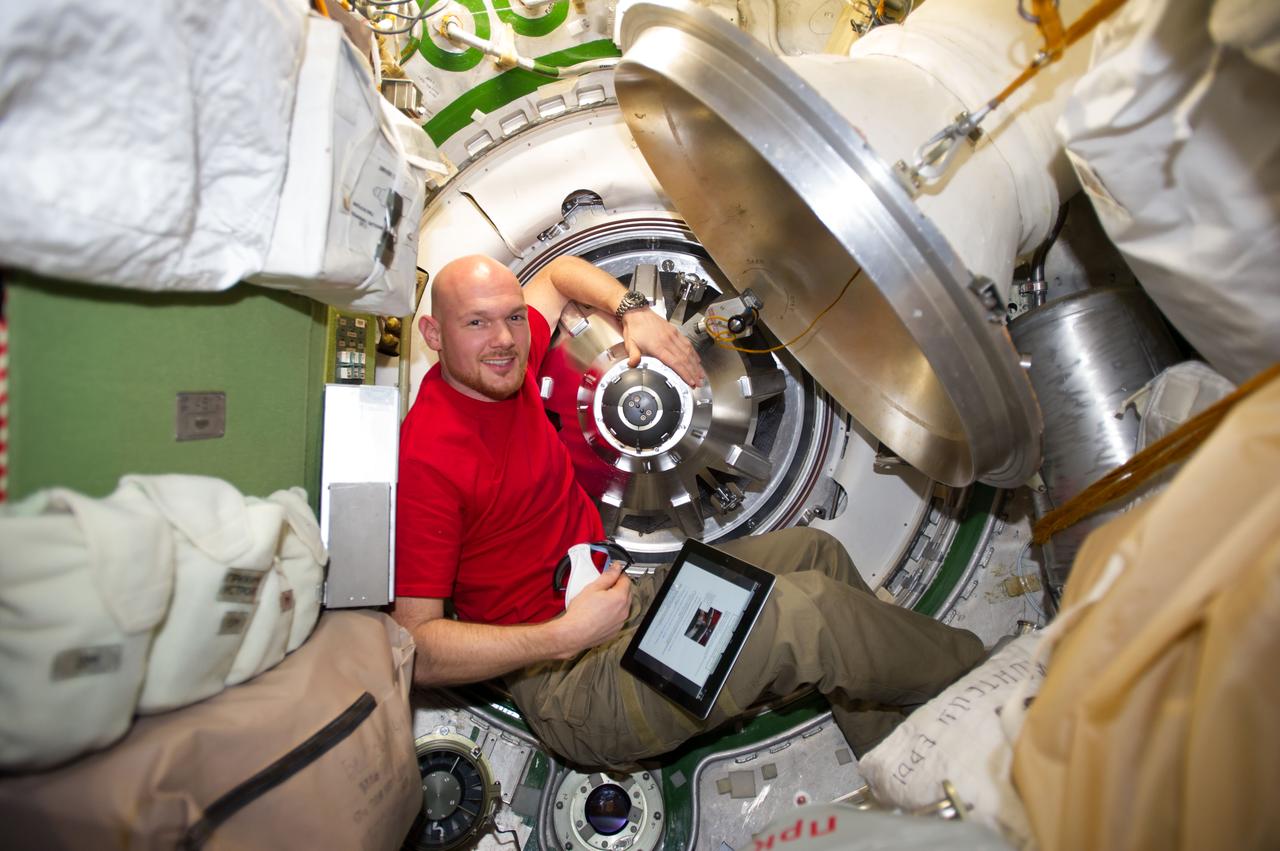
ISS040-E-091918 (13 Aug. 2014) --- European Space Agency astronaut Alexander Gerst, Expedition 40 flight engineer, prepares to remove the docking mechanism to gain access to the hatch of the newly attached "Georges Lemaitre" Automated Transfer Vehicle-5 (ATV-5).
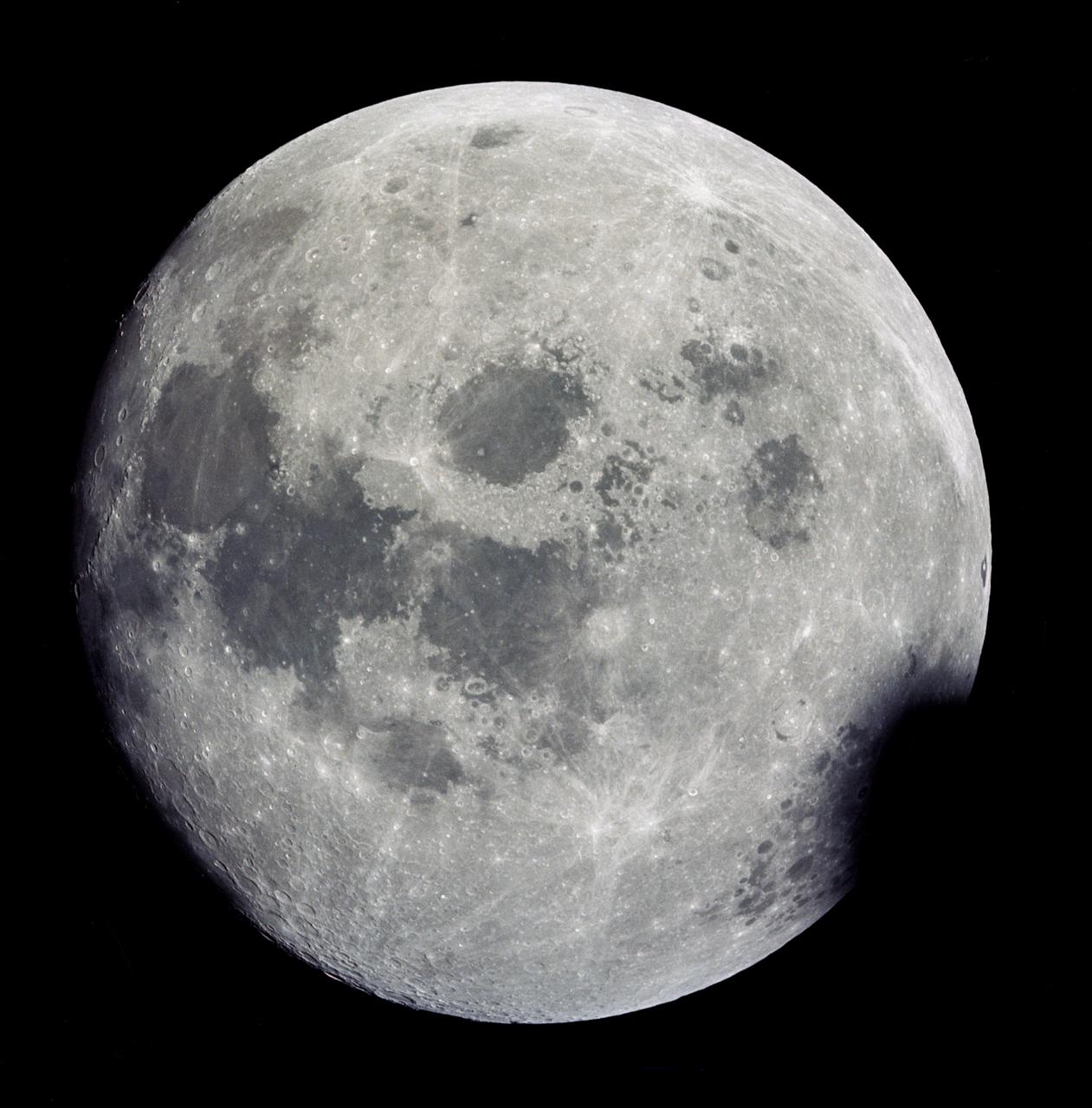
AS13-60-8703 (11-17 April 1970) --- This outstanding view of a near full moon was photographed from the Apollo 13 spacecraft during its trans-Earth journey homeward. Though the explosion of the oxygen tank in the Service Module (SM) forced the cancellation of the scheduled lunar landing, Apollo 13 made a pass around the moon prior to returning to Earth. Some of the conspicuous lunar features include the Sea of Crisis, the Sea of Fertility, the Sea of Tranquility, the Sea of Serenity, the Sea of Nectar, the Sea of Vapors, the Border Sea, Smyth's Sea, the crater Langrenus, and the crater Tsiolkovsky.
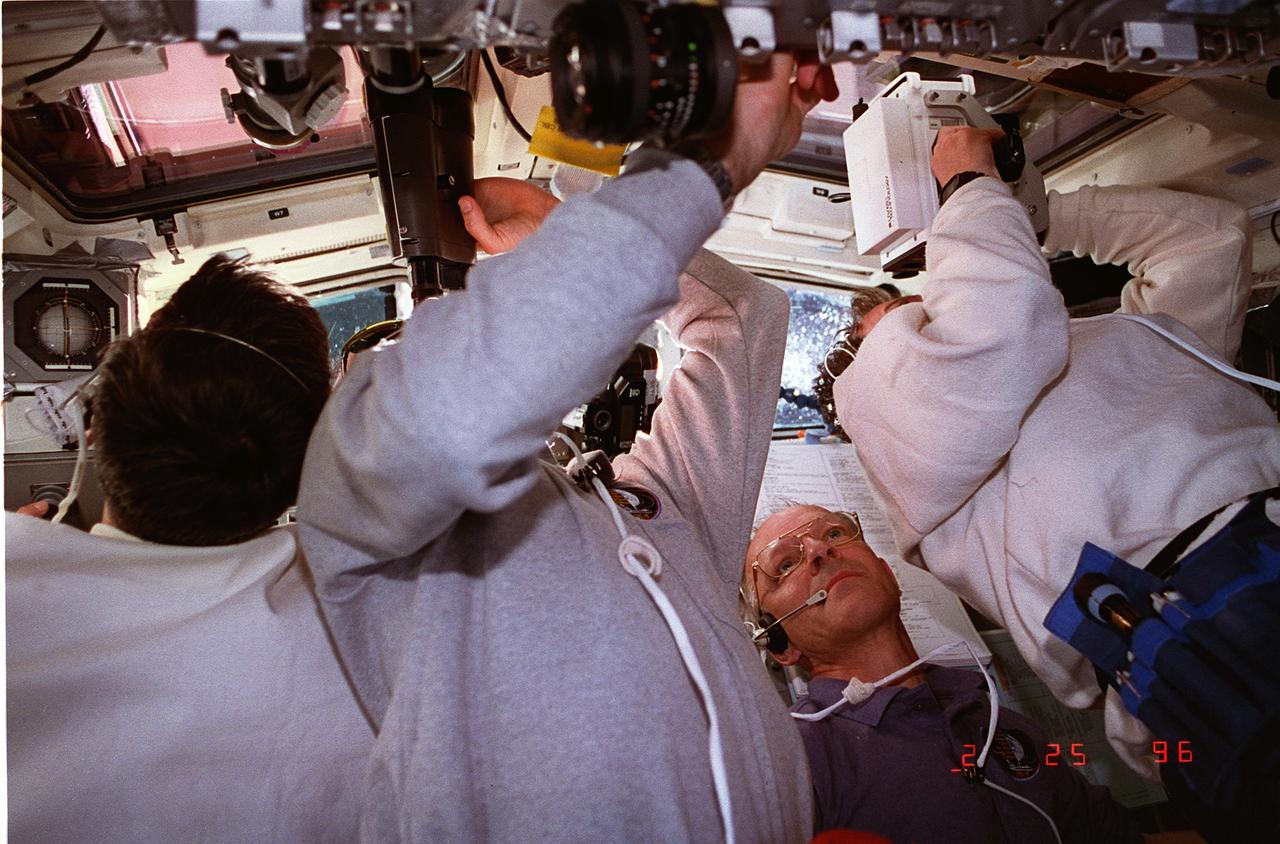
STS075-328-026 (25 Feb. 1996) --- Astronaut Claude Nicollier is the only clearly identifiable crewmember in this scene on the aft flight deck, captured during the busy chores associated with deployment of the Tethered Satellite System (TSS). The seven member crew was launched aboard the space shuttle Columbia on Feb. 22, 1996, and landed on March 9, 1996. Crewmembers were Andrew M. Allen, mission commander; Scott J. Horowitz, pilot; Franklin R. Chang-Diaz, payload commander; and Maurizio Cheli, European Space Agency (ESA); Jeffrey A. Hoffman and Nicollier, ESA, all mission specialists; along with payload specialist Umberto Guidoni of the Italian Space Agency (ASI).
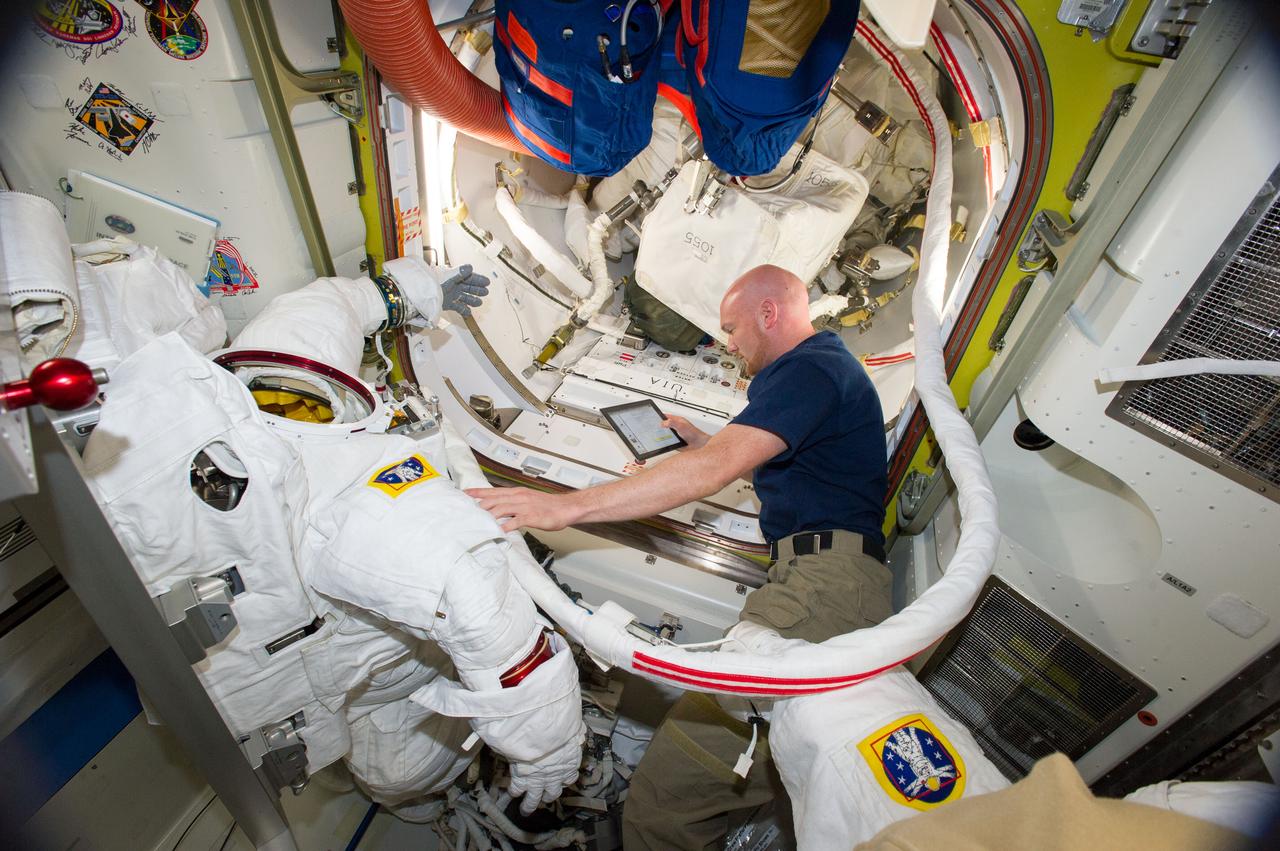
ISS040-E-010971 (12 June 2014) --- European Space Agency astronaut Alexander Gerst, Expedition 40 flight engineer, performs a checkout on an Extravehicular Mobility Unit (EMU) spacesuit in the Quest airlock of the International Space Station.
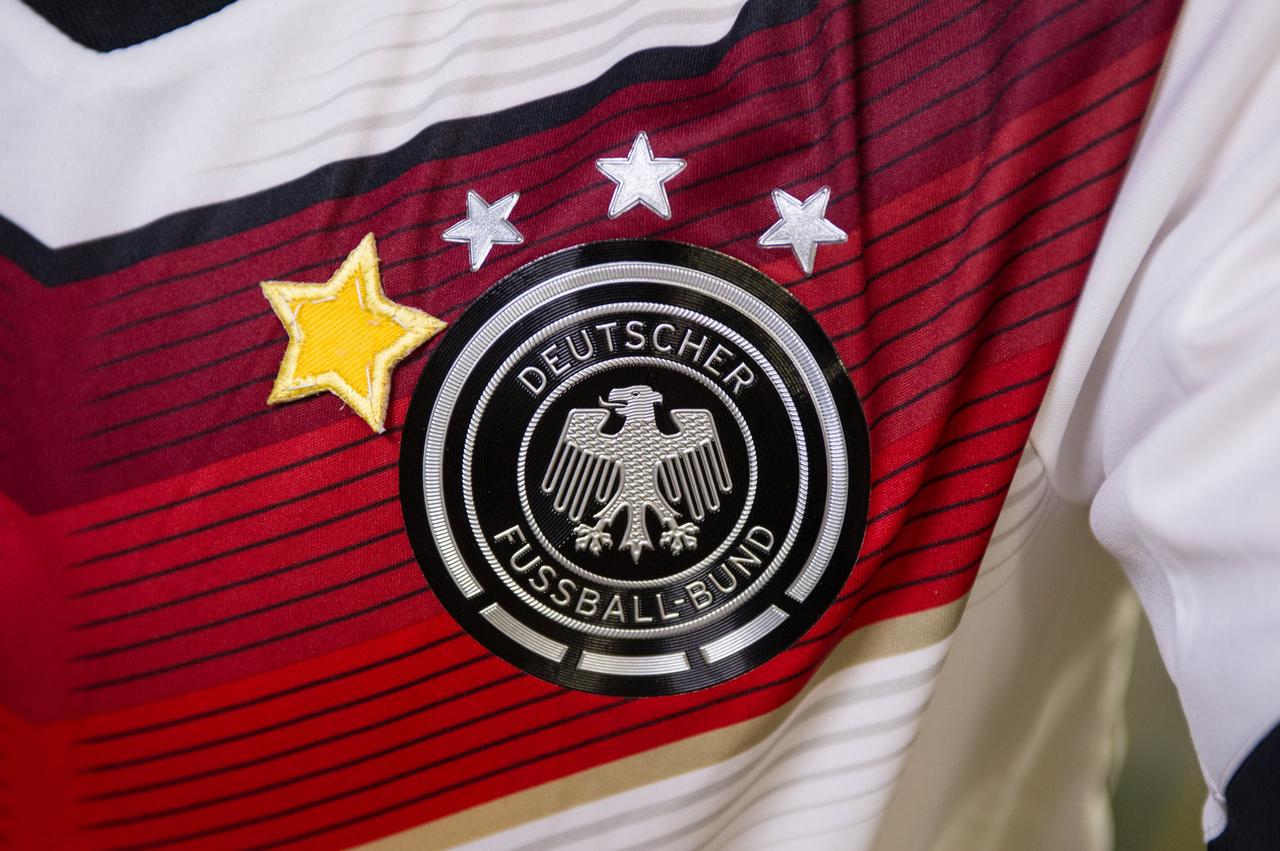
View of an Expedition 40 crewmember shirt with stars over a patch that reads Deutscher Fussbal-Bund.
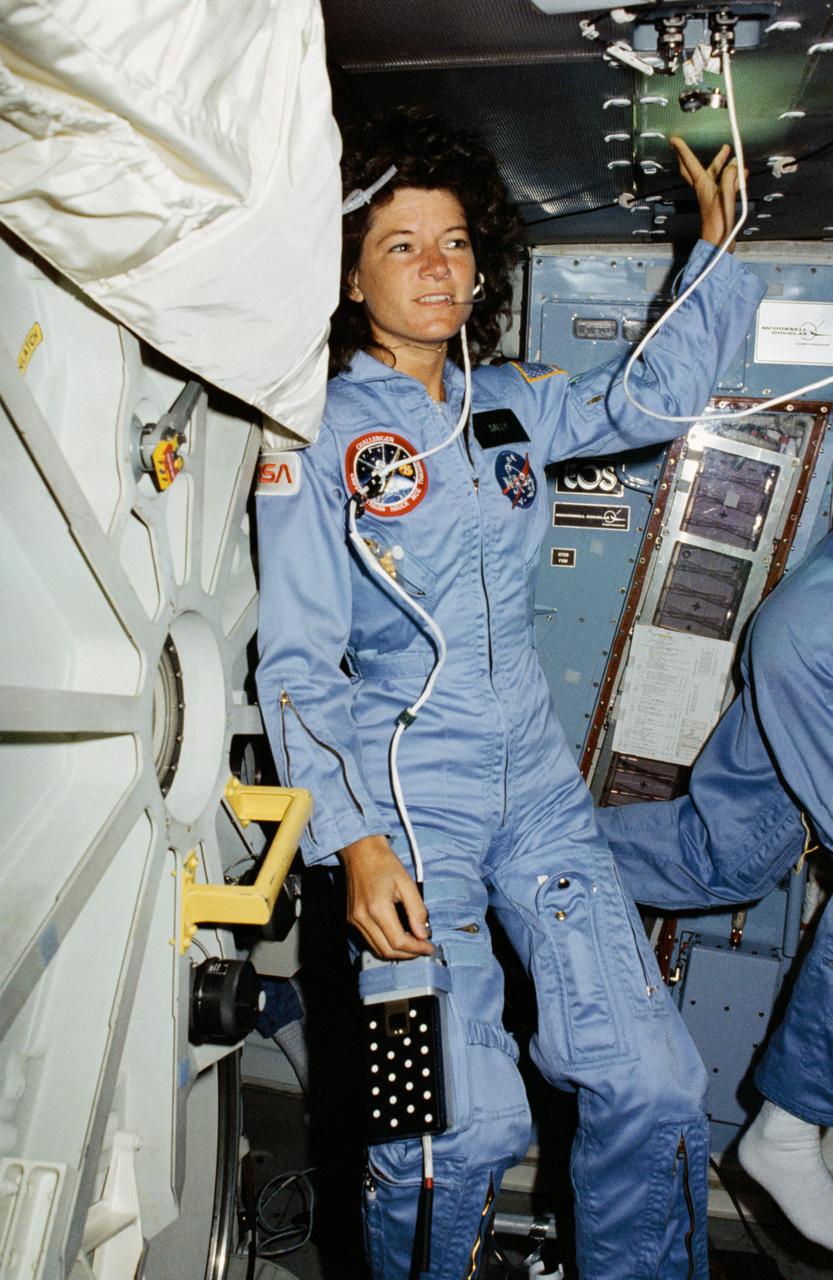
STS007-02-020 (21 June 1983) --- Astronaut Sally K. Ride, STS-7 mission specialist, STS-7 mission specialist, stands in the mid deck of the orbiting Space Shuttle Challenger near one of the experiment with which she has devoted a great deal of time. The continuous flow electrophoresis system (CFES) experiment, about the size of a household refrigerator, stands nearby. One of her fellow crewmembers moves partially out of frame in the background. The tube on her face is part of a communications system linking Dr. Ride to ground controllers in Houston.
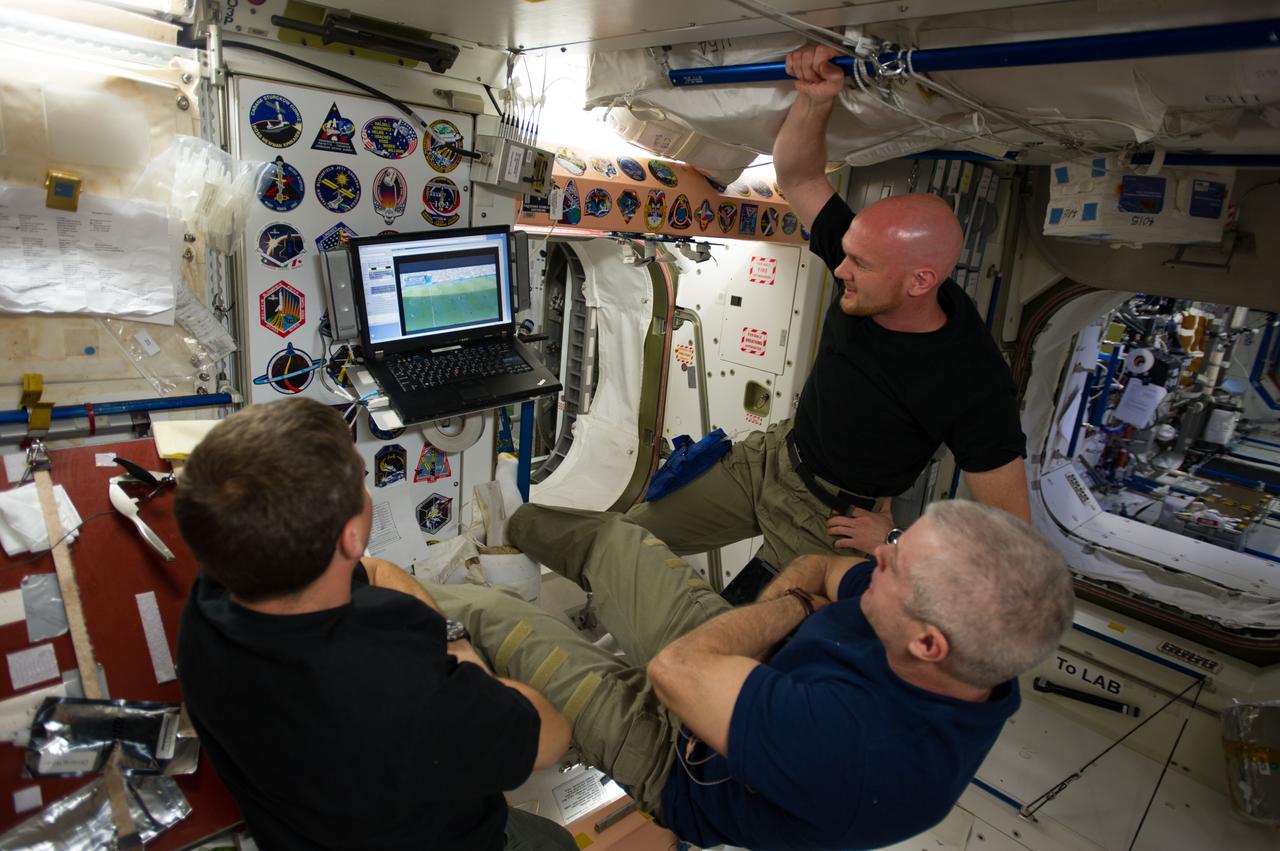
ISS040-E-012313 (17 June 2014) --- From left, Expedition 40 crew members Reid Wiseman and Steve Swanson of NASA and ESA astronaut Alexander Gerst take a break to watch ten minutes of live World Cup matches between science experiments while living and working aboard the International Space Station. Swanson is Expedition 40 commander and the others are flight engineers.
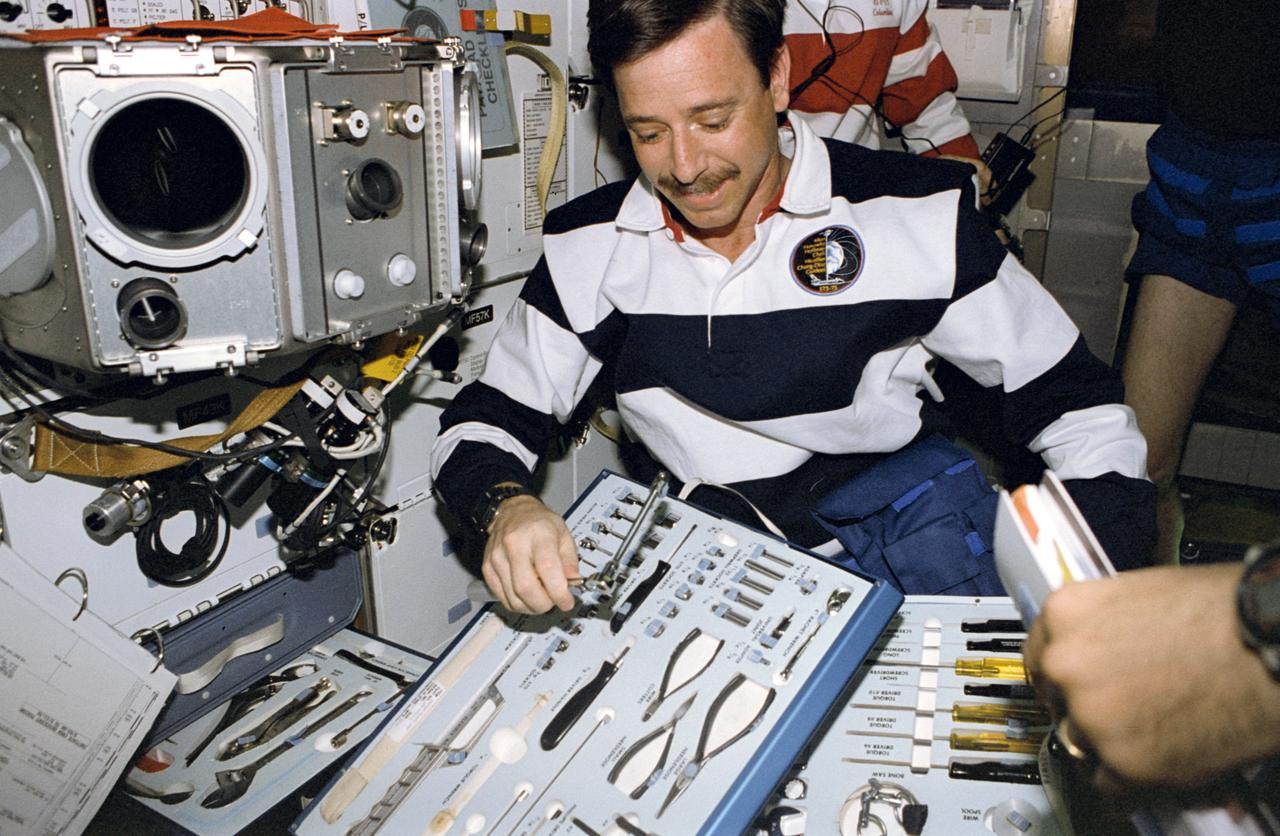
STS075-333-032 (22 Feb.- 9 March 1996) --- Astronaut Scott J. Horowitz, pilot, looks over tools he may use to perform an Inflight Maintenance (IFM) chore on the mid deck of the Earth-orbiting space shuttle Columbia. The glovebox facility is at upper left. Horowitz joined four other astronauts and an international payload specialist for 16 days of scientific research in Earth-orbit.
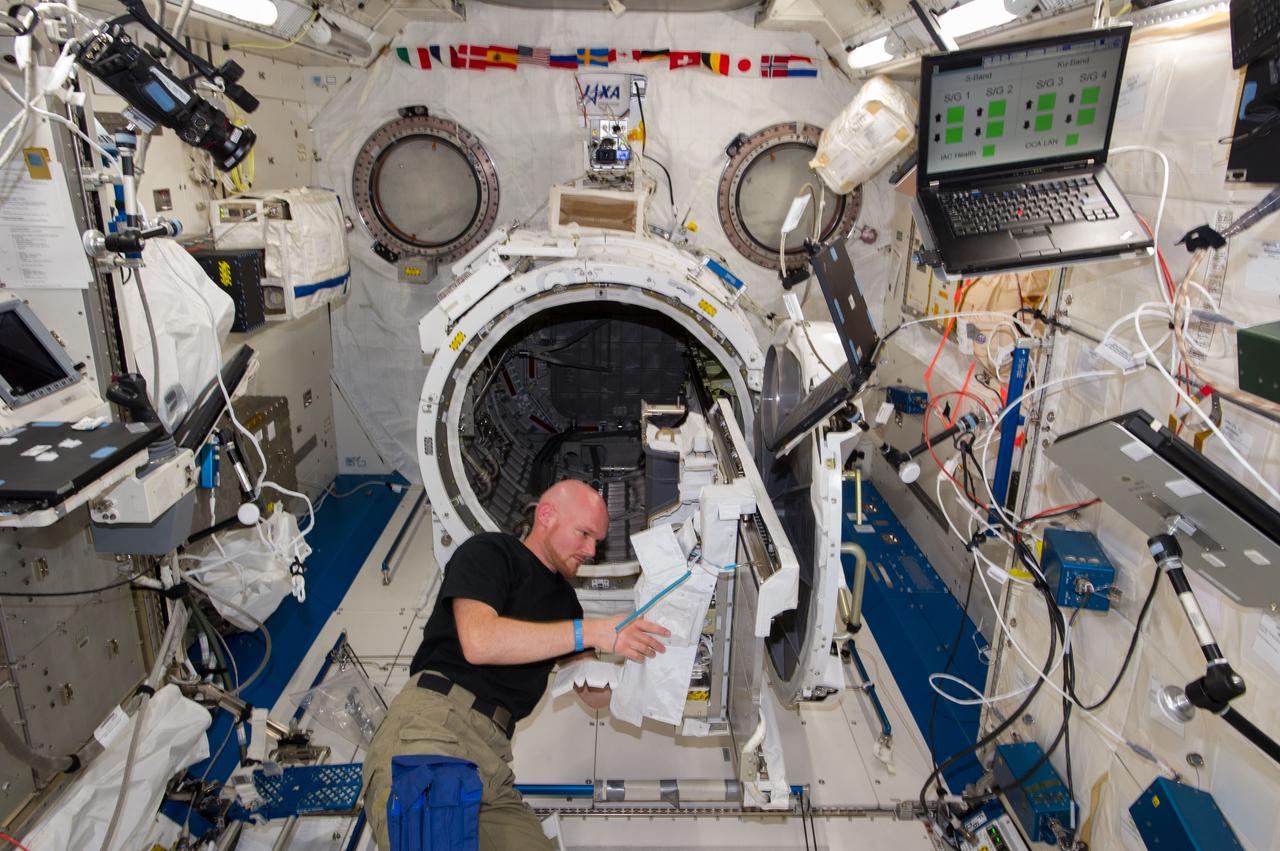
ISS040-E-019318 (25 June 2014) --- In the International Space Station?s Kibo laboratory, European Space Agency astronaut Alexander Gerst, Expedition 40 flight engineer, prepares to transfer a multi-purpose experiment platform and a robotic arm known as the Small Fine Arm through the Kibo module?s scientific airlock. The Small Fine Arm, which attaches to the Kibo?s larger main arm, handles delicate operations involved in exchanging experiments and payloads located on the Exposed Facility.
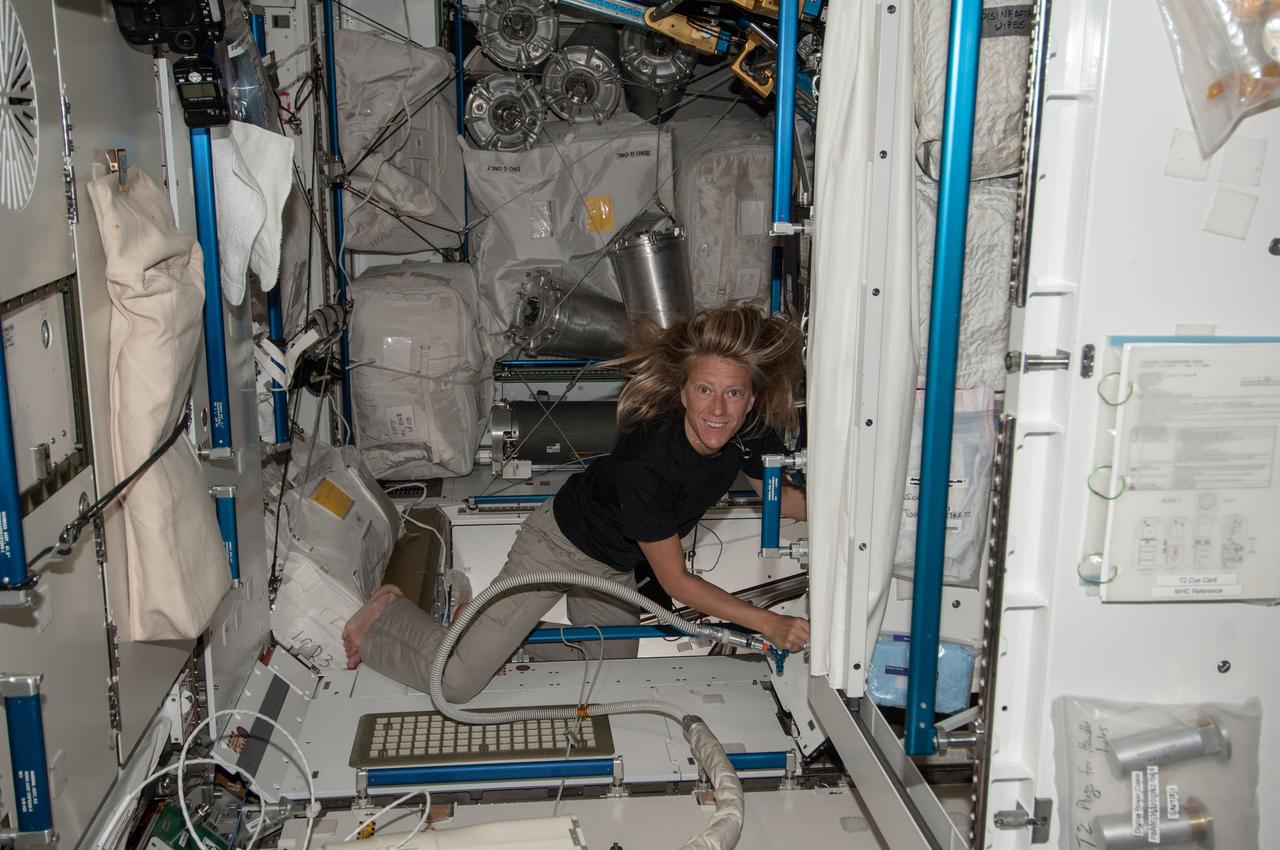
Astronaut Karen Nyberg,Expedition 36 flight engineer,is photographed at work in the U.S. Laboratory module.
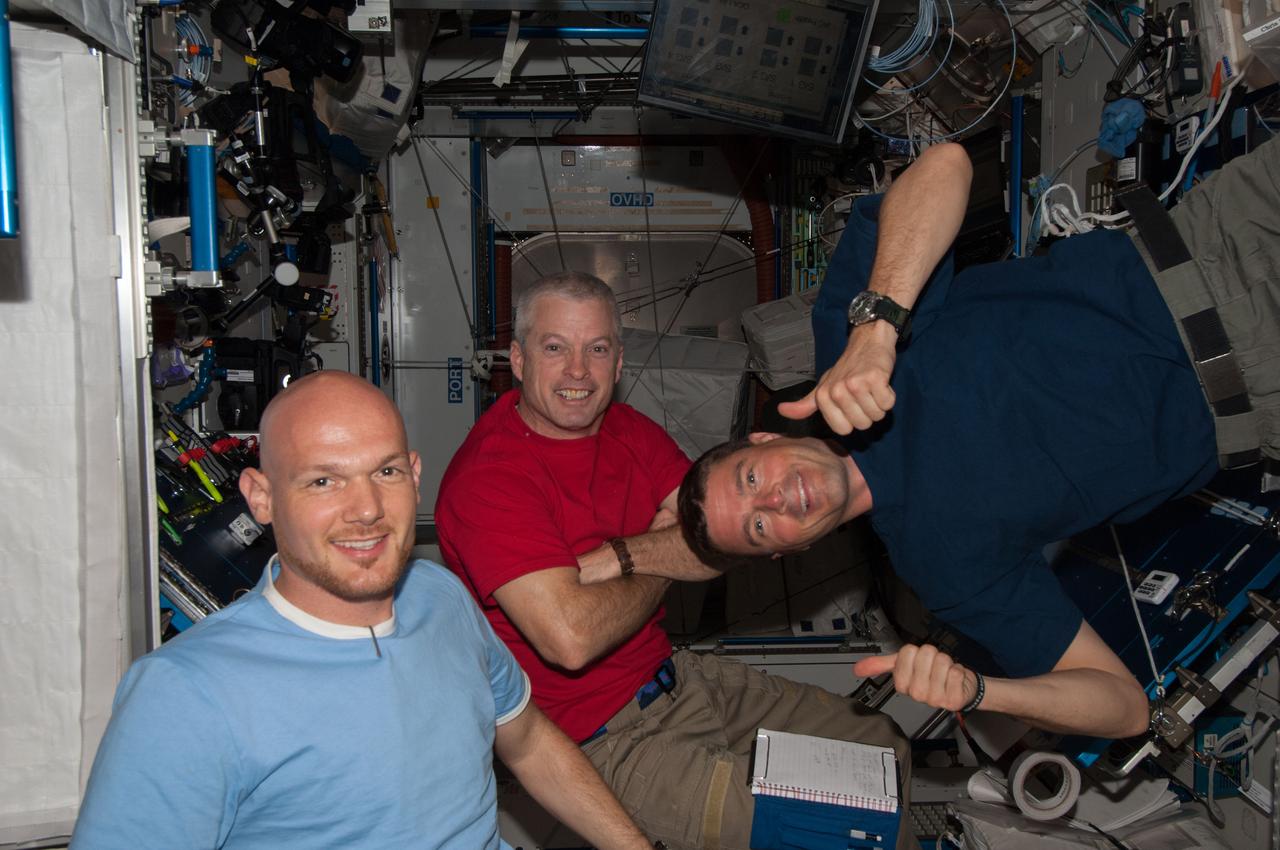
ISS040-E-006033 (29 May 2014) --- NASA astronaut Steve Swanson (center), Expedition 40 commander; along with European Space Agency astronaut Alexander Gerst (left) and NASA astronaut Reid Wiseman, both flight engineers, give a “thumbs up” signal in the Harmony node of the International Space Station.
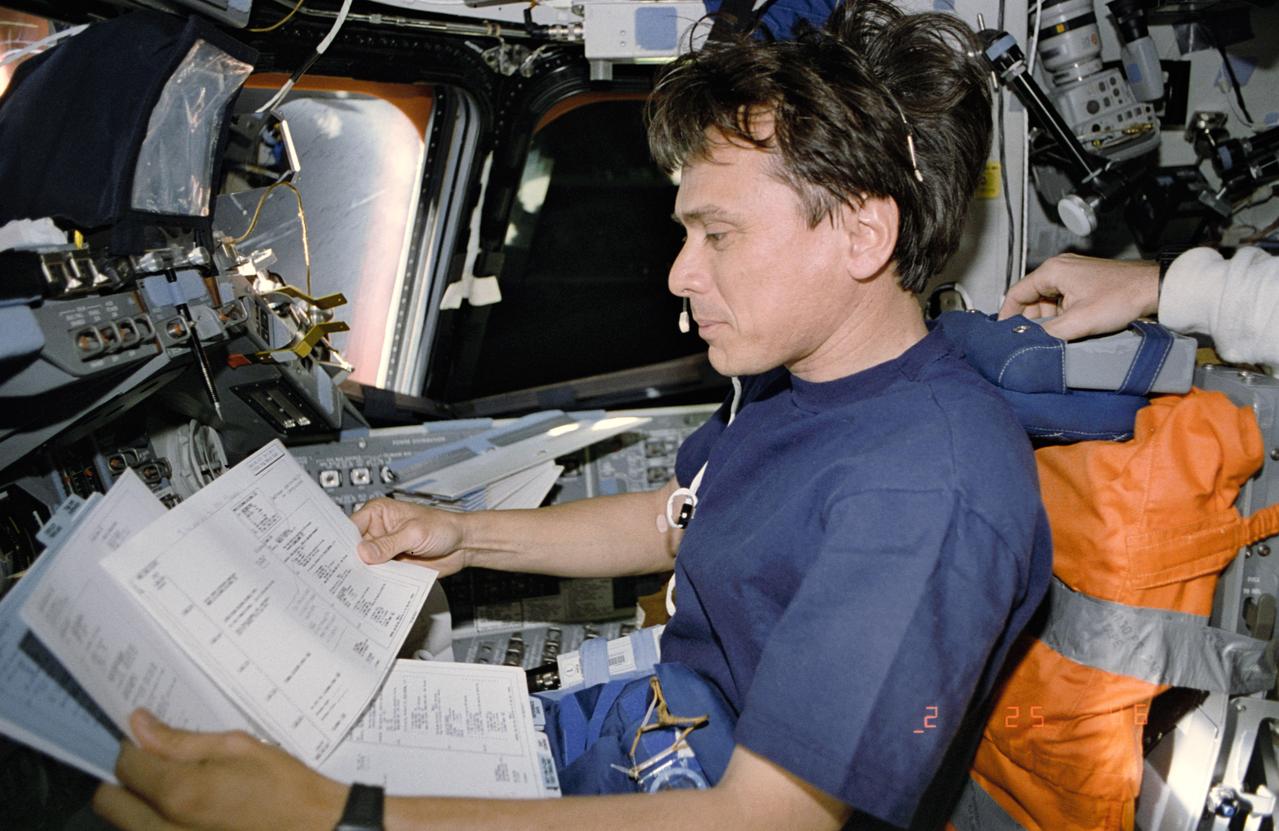
STS075-328-018 (25 Feb. 1996) --- Astronaut Franklin R. Chang-Diaz, STS-75 payload commander, is busy at the pilot's station during operations to deploy the Tethered Satellite System (TSS). His five crew mates (out of frame) were also on the flight deck, of the Earth-orbiting space shuttle Columbia, during the busy deployment activities.
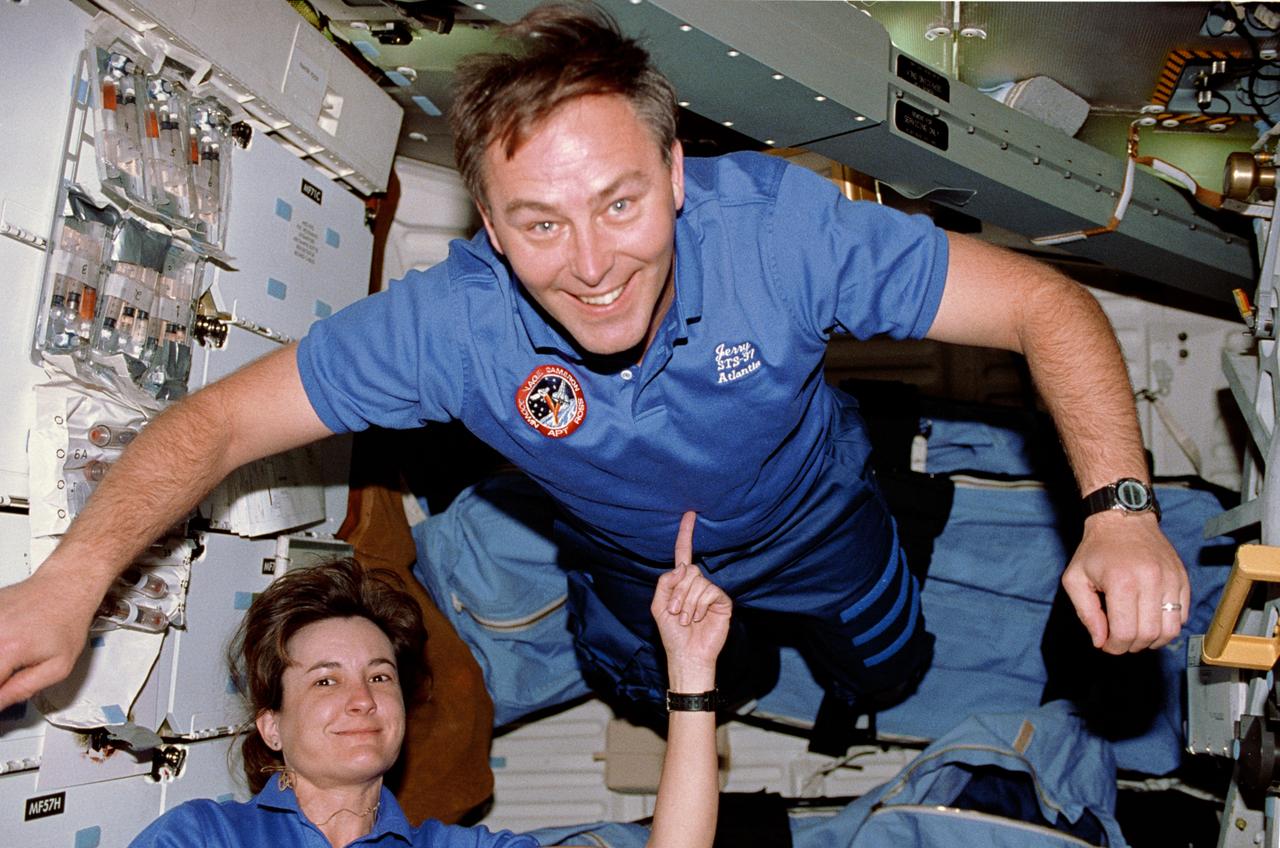
STS037-29-002 (5-11 April 1991) --- Astronauts Linda M. Godwin and Jerry L. Ross perform a balancing act on Atlantis' middeck. With little effort Godwin is able to hold Ross up near the ceiling with her index finger. Although the area the two occupy is very small, a number of articles are seen, including two sleep restraints, the escape pole and Bioserve ITA Materials Dispersion Apparatus bioprocessing test bed (attached to stowage lockers at left). This was one of the visuals used by the STS-37 crewmembers during their April 19 post-flight press conference at the Johnson Space Center (JSC).
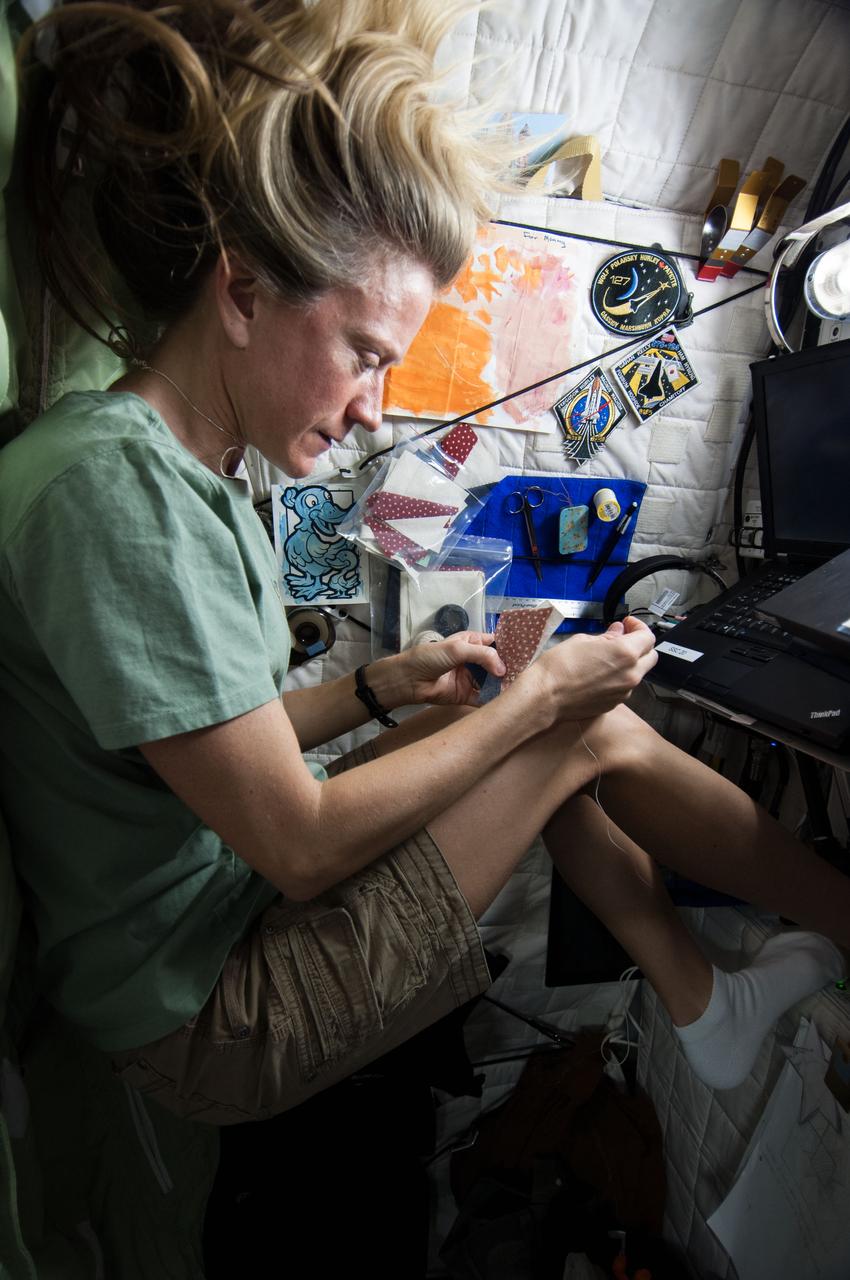
ISS036-E-028784 (3 July 2013) --- Expedition 36 Flight Engineer Karen Nyberg uses some of her off-duty time on the International Space Station for sewing -- one of her many hobbies.

STS064-23-025 (9-20 Sept. 1994) --- With scissors in hand, astronaut Jerry M. Linenger, STS-64 mission specialist, prepares to cut off a lengthy sheet of correspondence from ground controllers. Called the Thermal Imaging Printing System (TIPS), the message center occupies a stowage locker on the space shuttle Discovery's middeck. Astronaut L. Blaine Hammond, pilot, retrieves a clothing item from a nearby locker. Photo credit: NASA or National Aeronautics and Space Administration
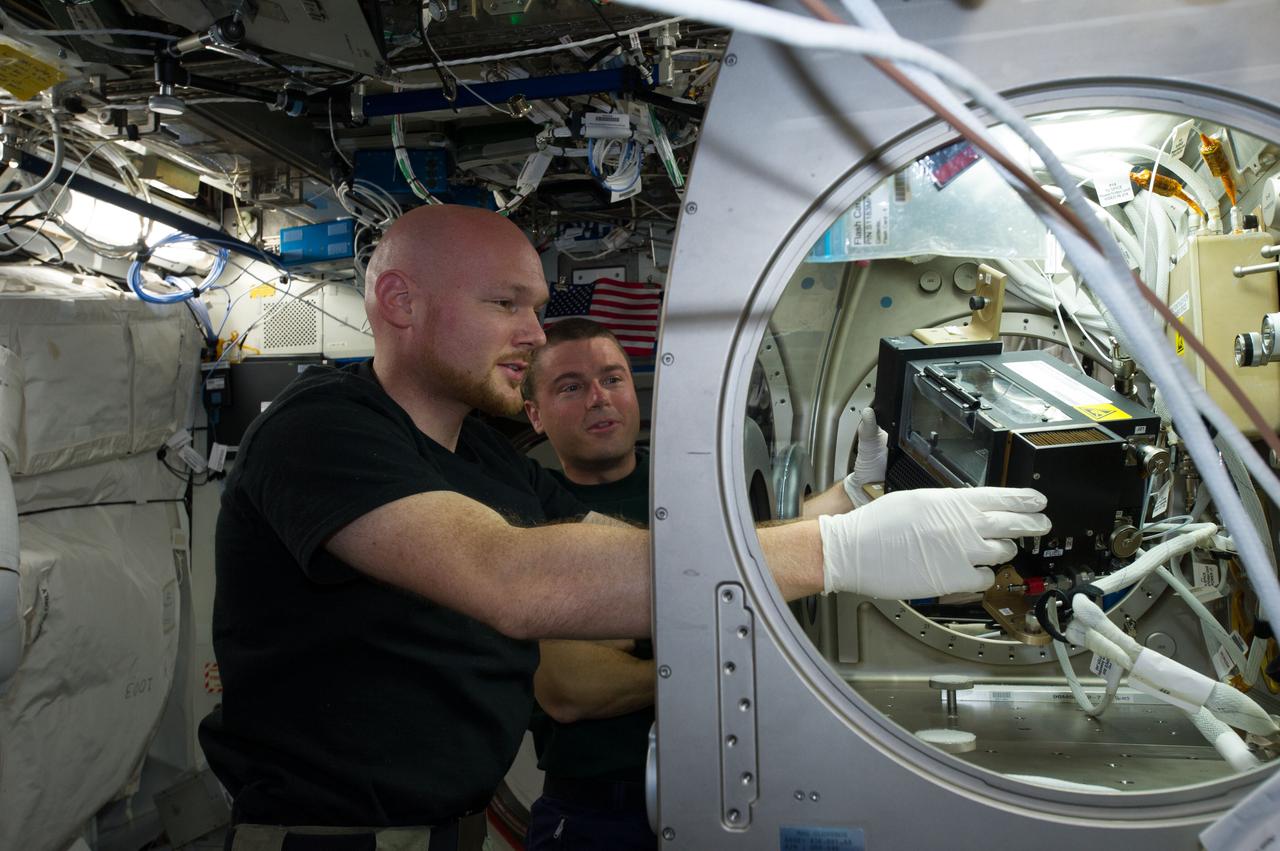
ISS040-E-088798 (5 Aug. 2014) --- European Space Agency astronaut Alexander Gerst, Expedition 40 flight engineer, removes hardware for the combustion experiment known as the Burning and Suppression of Solids (BASS-II) from the Microgravity Science Glovebox (MSG) in the Destiny laboratory of the International Space Station. The experiment seeks to provide insight on how flames burn in space compared to Earth which may provide fire safety benefits aboard future spacecraft. NASA astronaut Reid Wiseman, flight engineer, looks on.
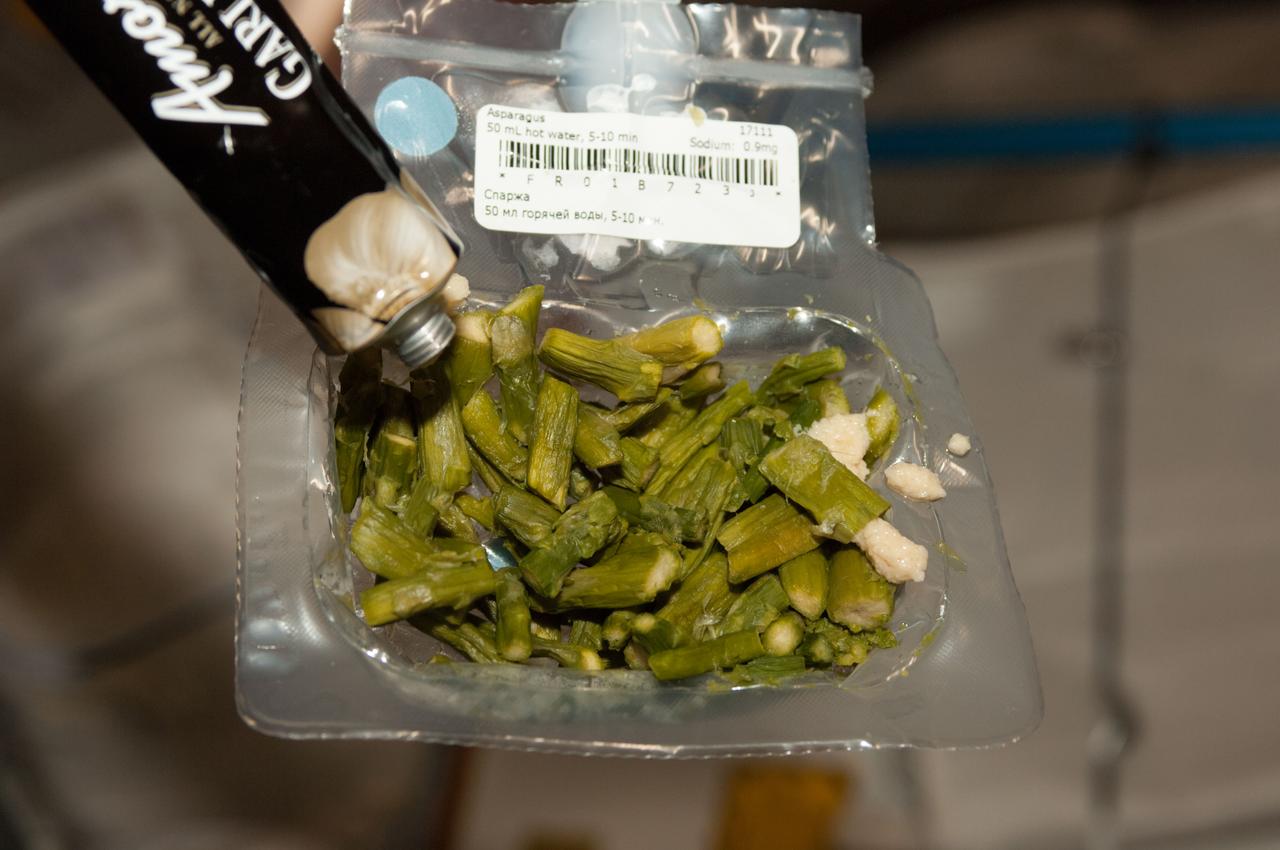
View of a bag of asparagus and garlic paste about to be rehydrated documented by the Expedition 36 crew. Also sent as Twitter message.
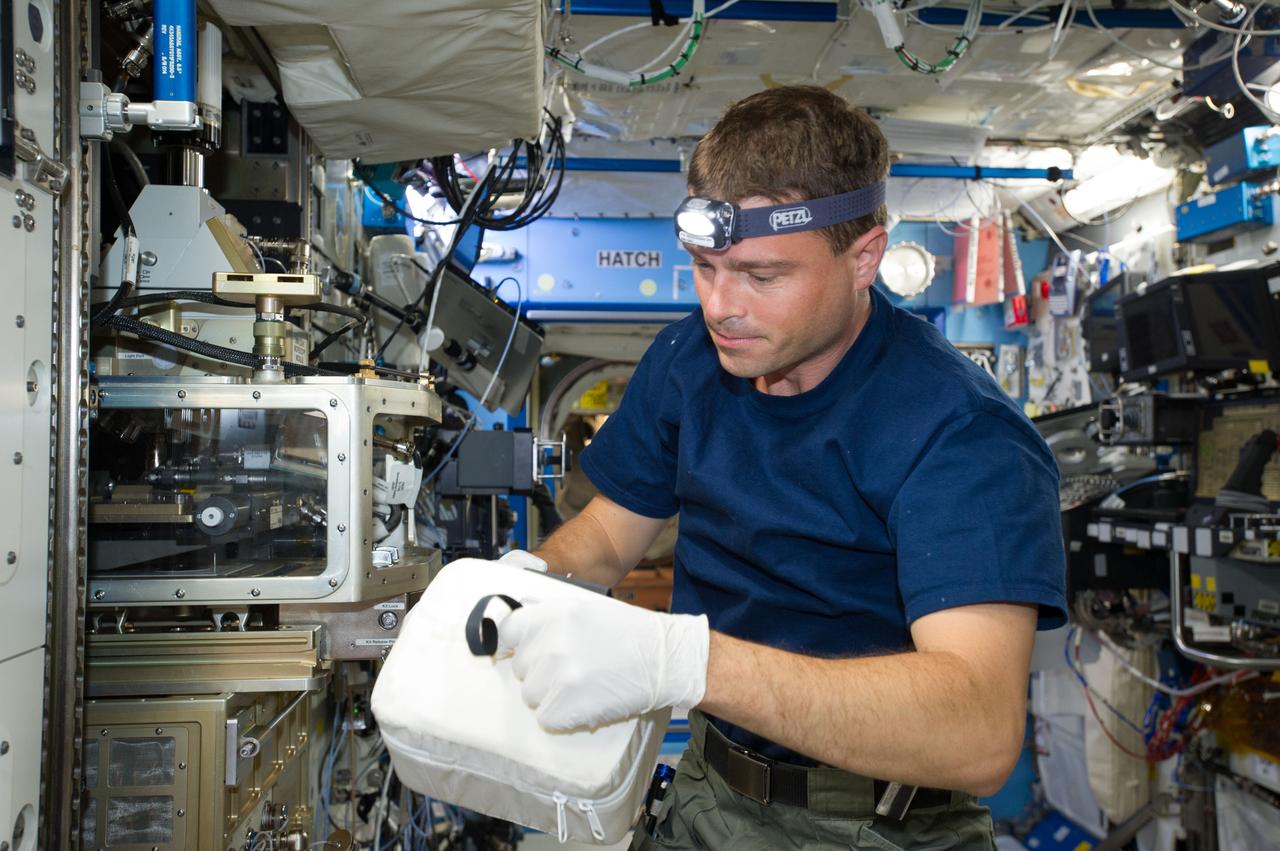
ISS040-E-007368 (5 June 2014) --- NASA astronaut Reid Wiseman, Expedition 40 flight engineer, works with Advanced Colloids Experiment (ACE) samples in the Destiny laboratory of the International Space Station.
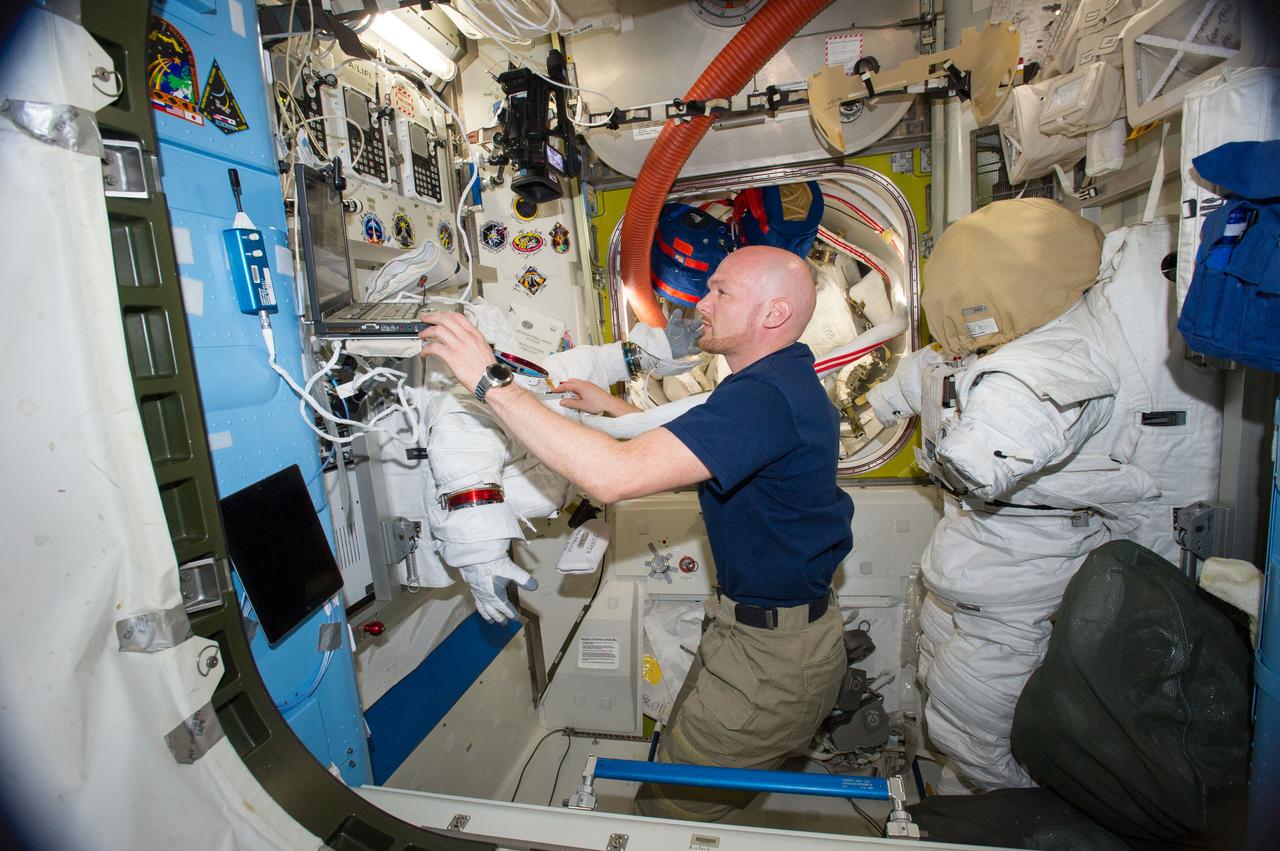
ISS040-E-010972 (12 June 2014) --- European Space Agency astronaut Alexander Gerst, Expedition 40 flight engineer, uses a computer while working on an Extravehicular Mobility Unit (EMU) spacesuit in the Quest airlock of the International Space Station.
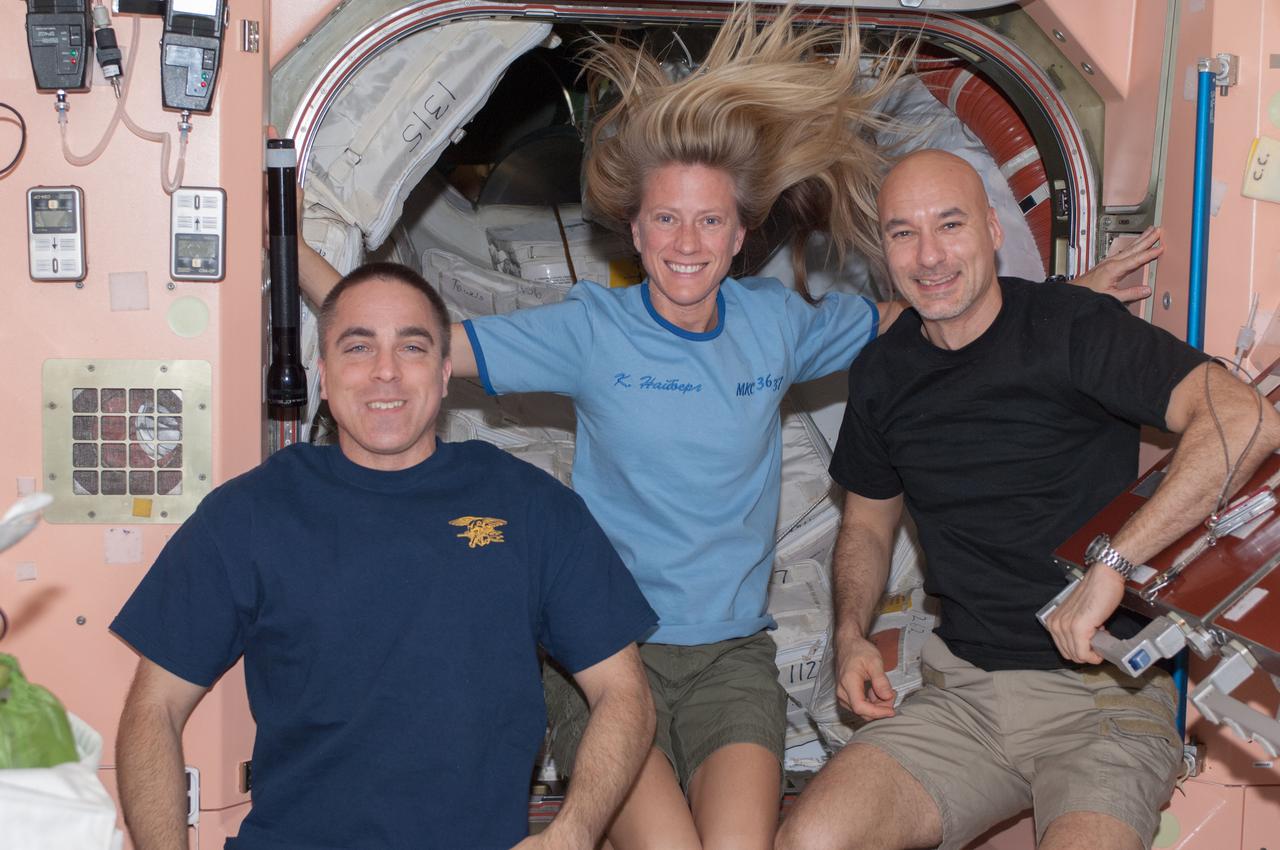
View of Astronauts Chris Cassidy (left),Karen Nyberg (center) and European Space Agency astronaut Luca Parmitano,all Expedition 36 flight engineers,in the Node 1 module.
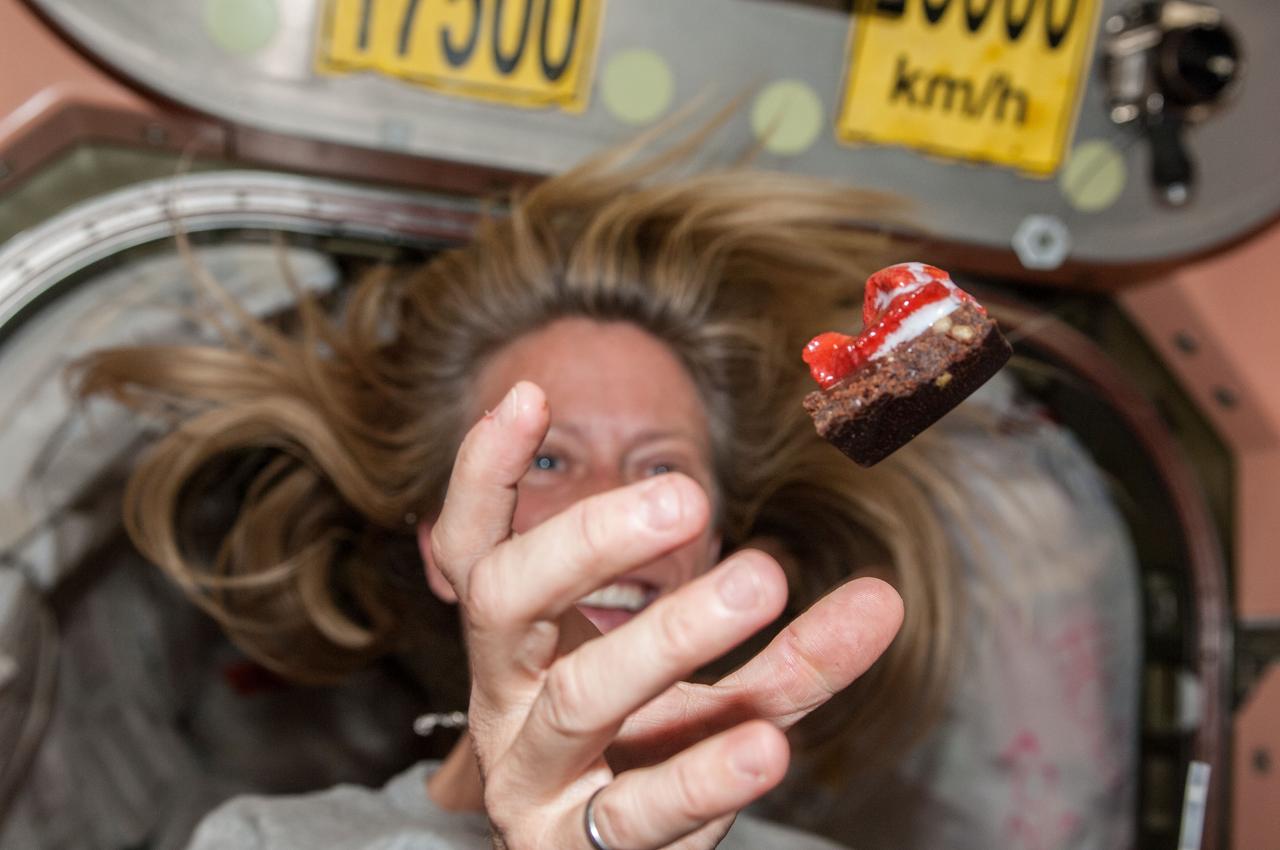
Expedition 36 Flight Engineer Karen Nyberg of NASA floats a piece of food in front her in the Node 1 module during meal time.

European Space Agency astronaut Alexander Gerst,Expedition 40 flight engineer,works with samples and hardware for a combustion experiment known as the Burning and Suppression of Solids (BASS) in the Microgravity Science Glovebox (MSG) in the Destiny laboratory of the International Space Station.
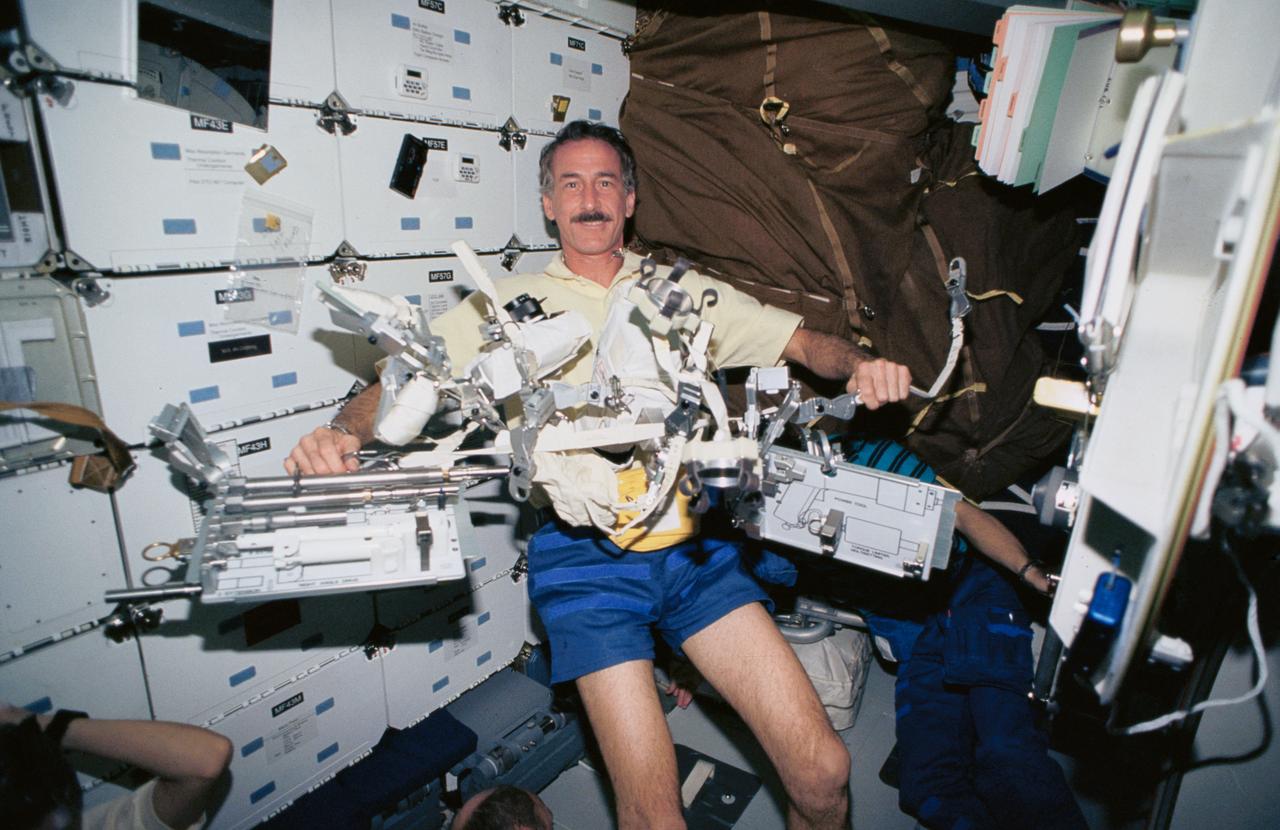
STS061-03-029 (2013 Dec 1993) --- Astronaut Jeffrey A. Hoffman displays tools used in the five space walks on the STS-61 Hubble Space Telescope (HST) repair mission. Hoffman was one of four space walkers making use of the variegated gear.
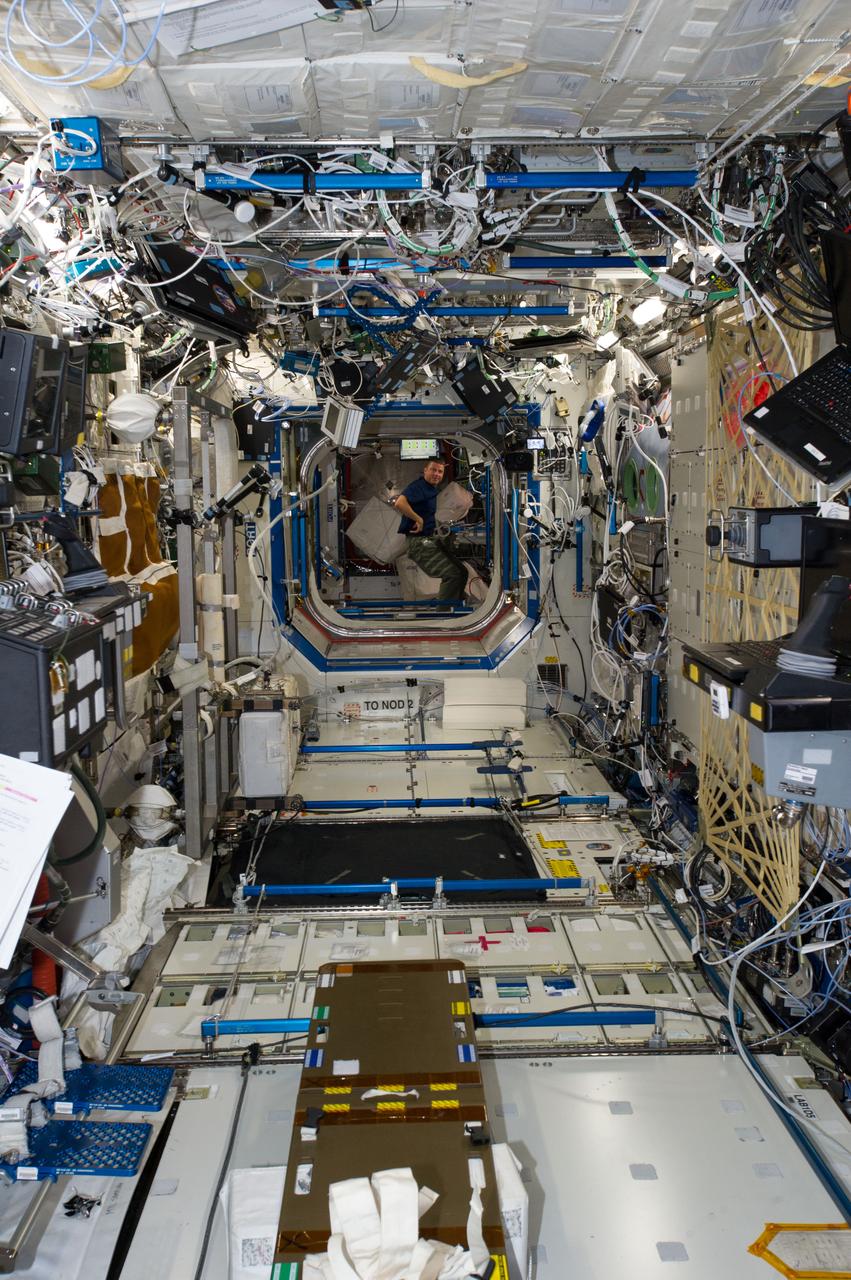
ISS040-E-006702 (2 June 2014) --- Looking through the Destiny laboratory, NASA astronaut Reid Wiseman, Expedition 40 flight engineer, is pictured in the background while working in the Harmony node of the International Space Station.
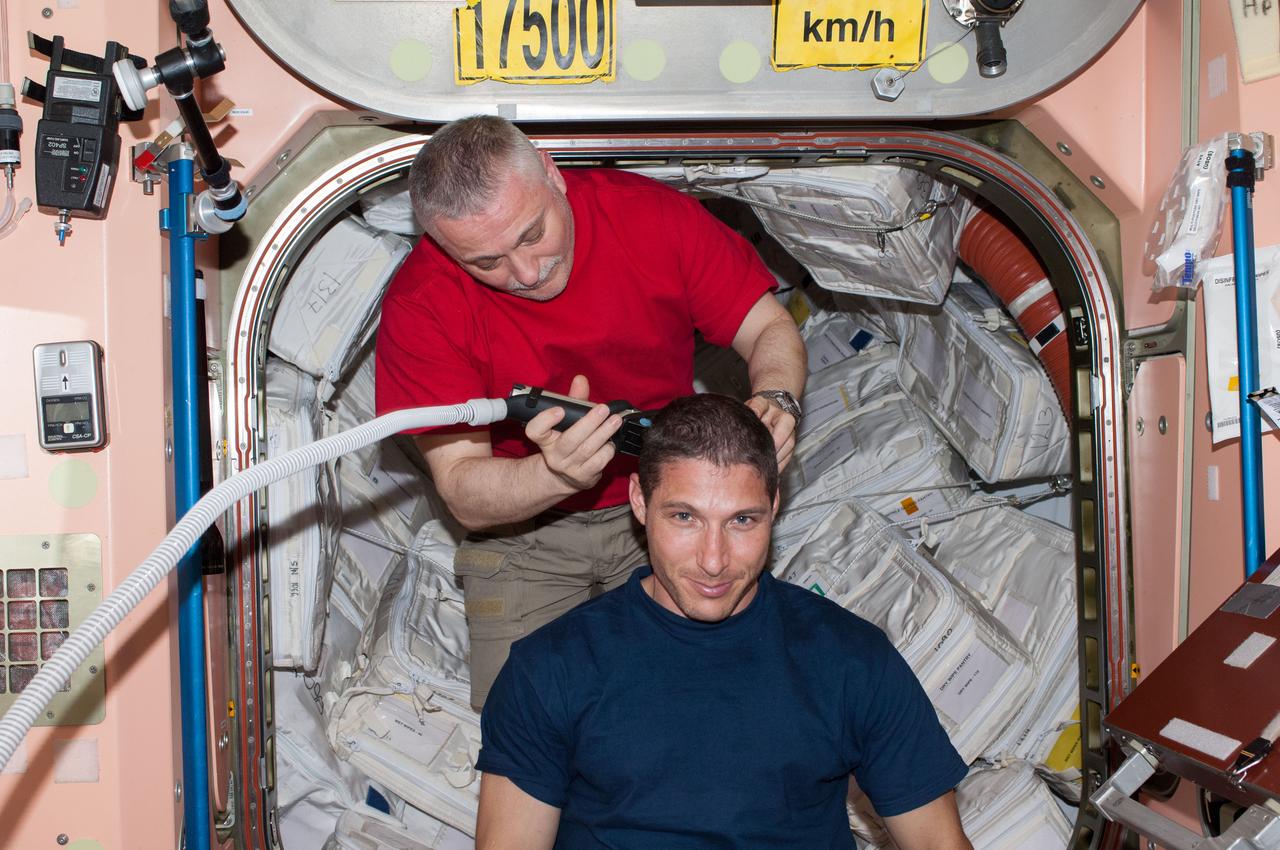
ISS037-E-006568 (5 Oct. 2013) --- Russian cosmonaut Fyodor Yurchikhin, Expedition 37 commander, trims the hair of NASA astronaut Michael Hopkins, flight engineer, in the Node 1 module, called Unity. Yurchikhin used hair clippers fashioned with a vacuum device to garner freshly cut hair.

STS036-21-032 (3 March 1990) --- The five astronaut crewmembers for STS-36 pose for an inflight group portrait on the forward flight deck of Atlantis, Orbiter Vehicle (OV) 104. They are (left to right) Commander John O. Creighton, Mission Specialist (MS) David C. Hilmers, MS Richard M. Mullane, MS Pierre J. Thuot, and Pilot John H. Casper. Creighton is positioned in the commanders seat and Casper in the pilot?s seat. Overhead control panels appear above the astronauts. The astronauts spent four days, 10 hours and 19 minutes aboard OV-104 for the Department of Defense (DOD) dedicated mission.
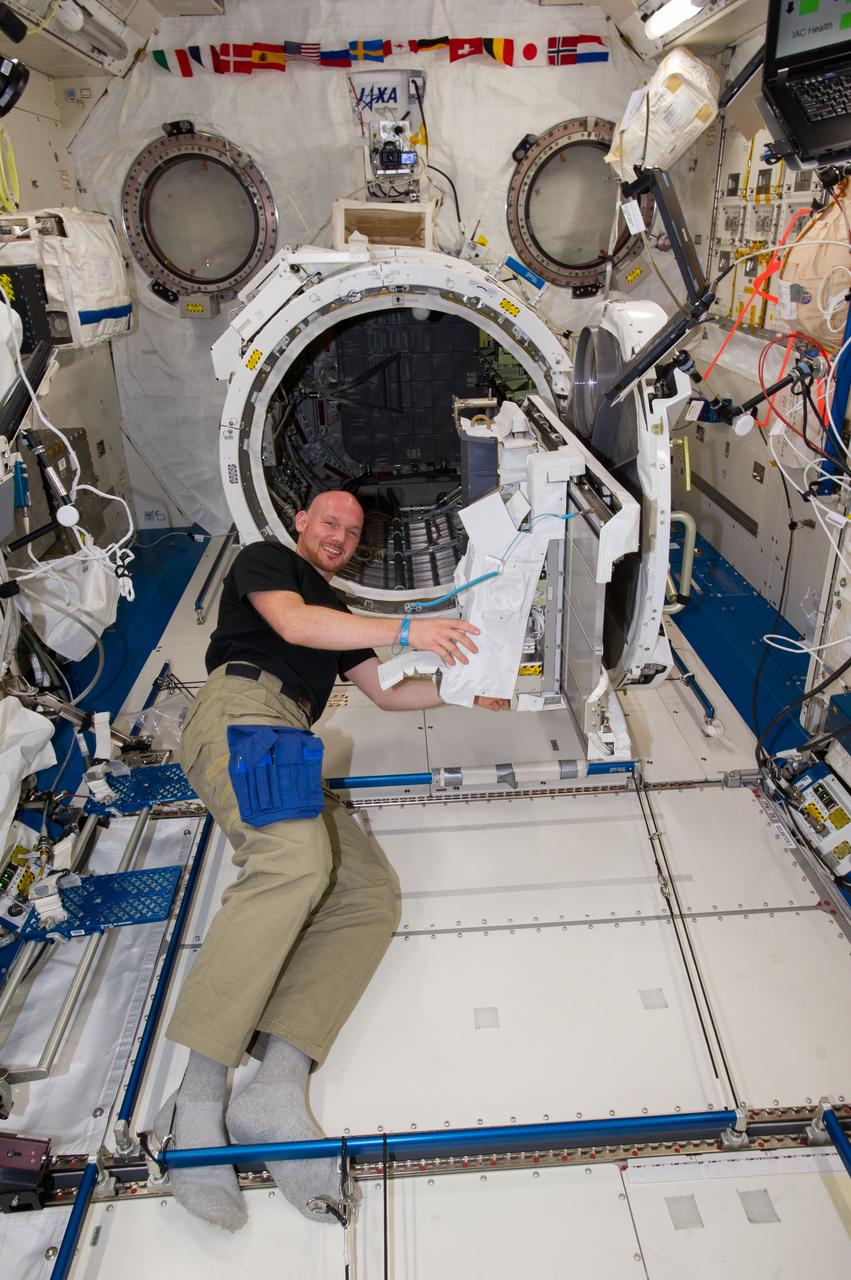
ISS040-E-019312 (25 June 2014) --- In the International Space Station?s Kibo laboratory, European Space Agency astronaut Alexander Gerst, Expedition 40 flight engineer, prepares to transfer a multi-purpose experiment platform and a robotic arm known as the Small Fine Arm through the Kibo module?s scientific airlock. The Small Fine Arm, which attaches to the Kibo?s larger main arm, handles delicate operations involved in exchanging experiments and payloads located on the Exposed Facility.
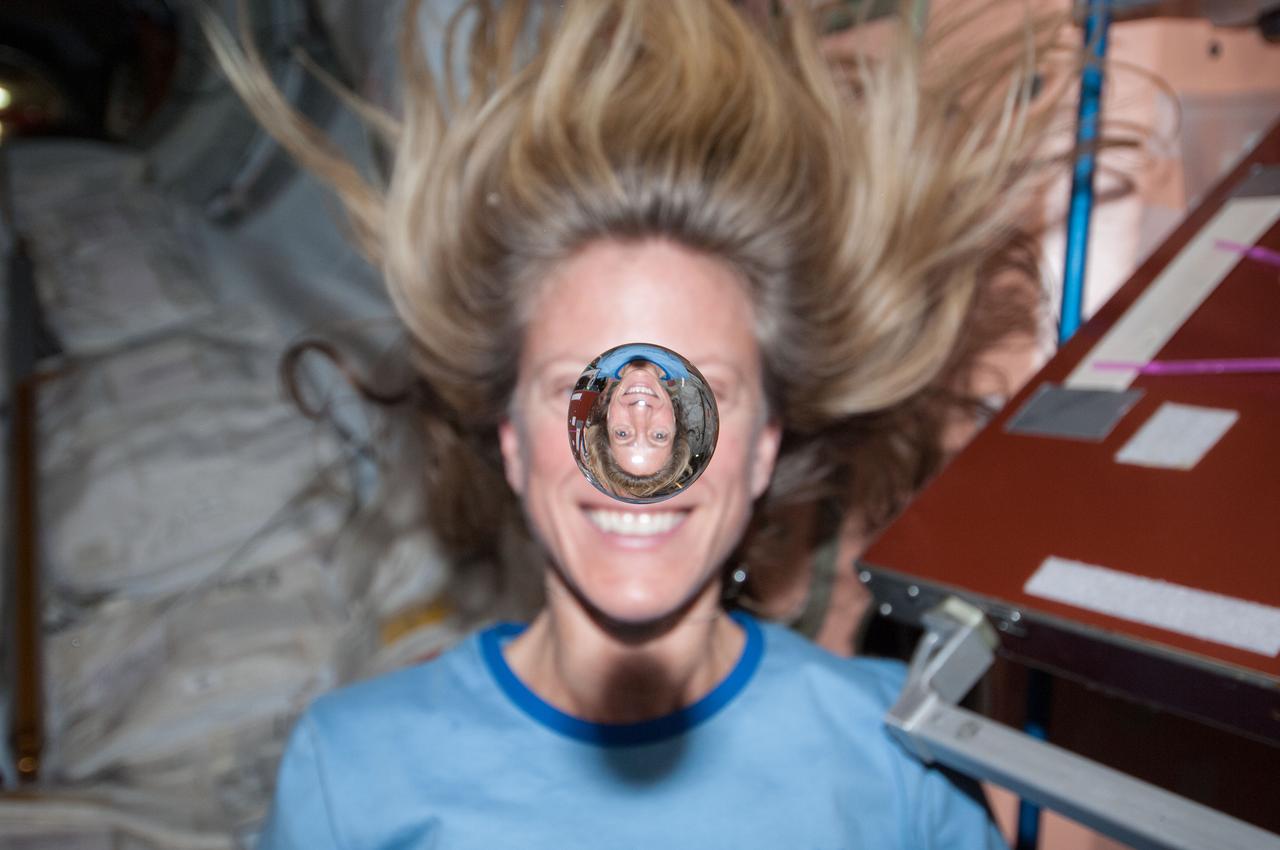
NASA astronaut Karen Nyberger, Expedition 36 flight engineer, watches a water bubble float freely between her and the camera, showing her image refracted in the droplet, while in the Node 1Unity module of the International Space Station.
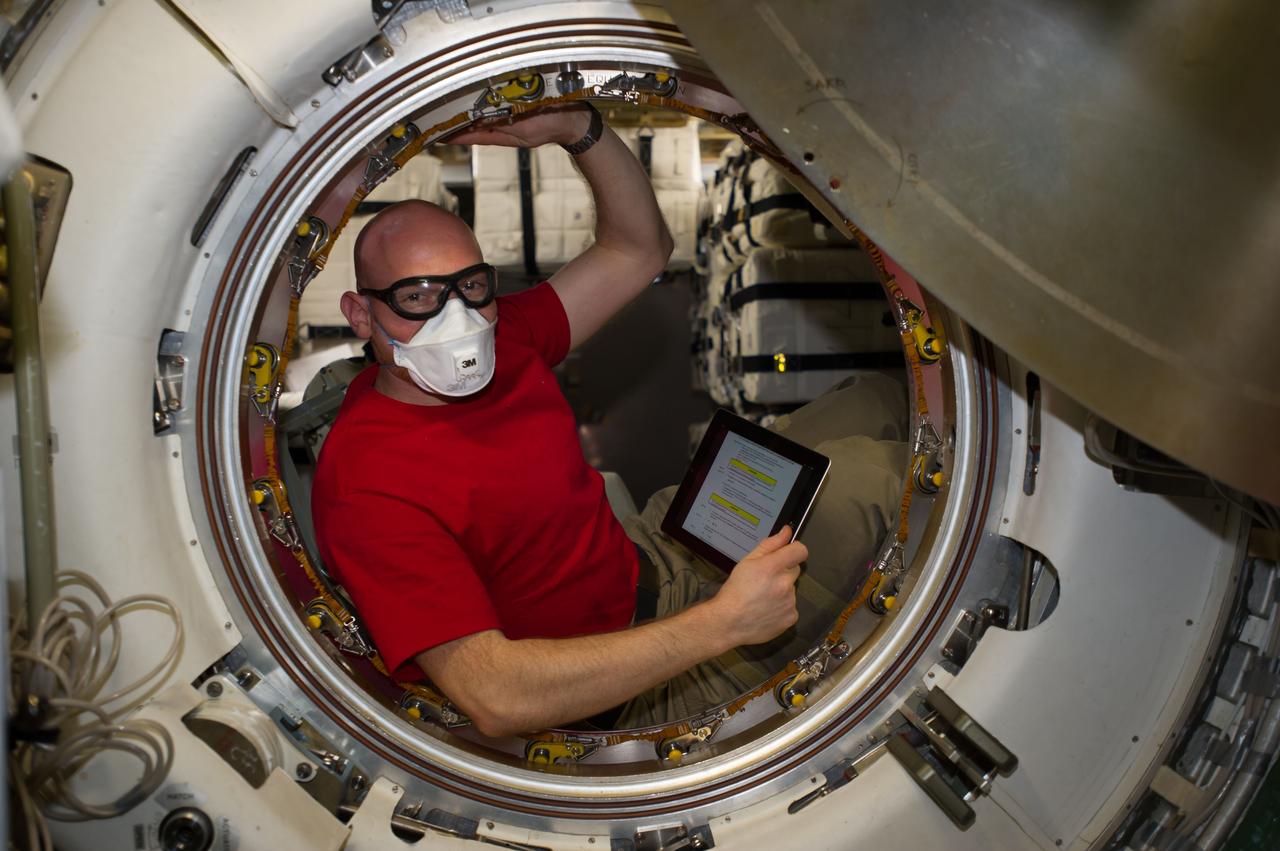
ISS040-E-091979 (13 Aug. 2014) --- European Space Agency astronaut Alexander Gerst, Expedition 40 flight engineer, is pictured in the hatch after removing the docking mechanism of the newly-attached "Georges Lemaitre" Automated Transfer Vehicle-5 (ATV-5) of the International Space Station.
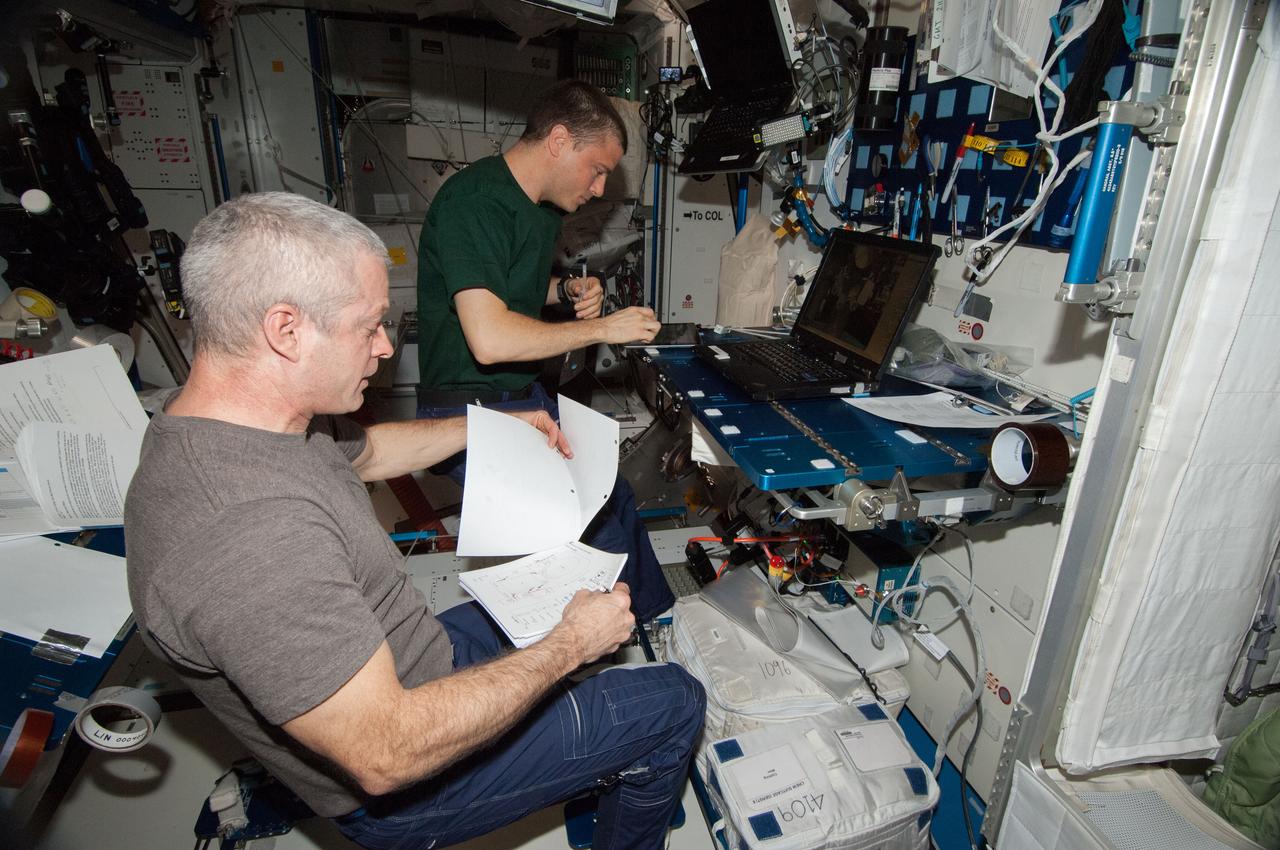
ISS040-E-088730 (4 Aug. 2014) --- In the International Space Station?s Harmony node, NASA astronauts Steve Swanson (foreground), Expedition 40 commander; and Reid Wiseman, flight engineer, perform a portable onboard computer Dynamic Onboard Ubiquitous Graphics (DOUG) software review in preparation for two upcoming U.S. spacewalks.

STS029-04-029 (13-18 March 1989) --- Astronaut Michael L. Coats appears to like the status of the STS-29 flight as he offers a big smile from the commander's station on the flight deck. He takes a momentary break from updating the crew activity plan (CAP) to pose for the photo. This photographic frame was among NASA's third STS-29 photo release. Monday, March 20, 1989. Crew members were astronauts Michael L. Coats, John E. Blaha, James F. Buchli, Robert C. Springer and James P. Bagian. Photo credit: NASA
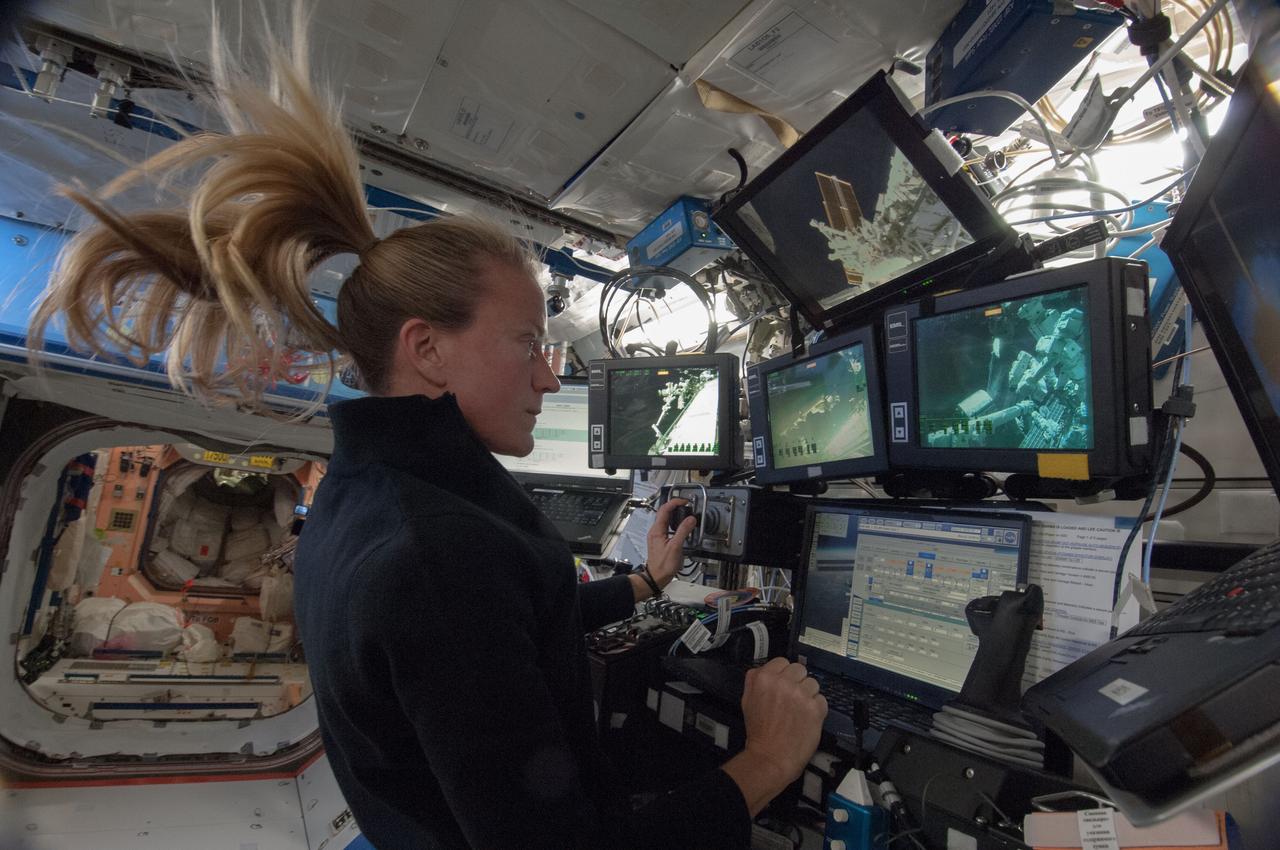
Astronaut Karen Nyberg,Expedition 36 flight engineer,is photographed at the Space Station Remote Manipulator System (SSRMS) controls in the U.S. Laboratory during a session of extravehicular activity (EVA).
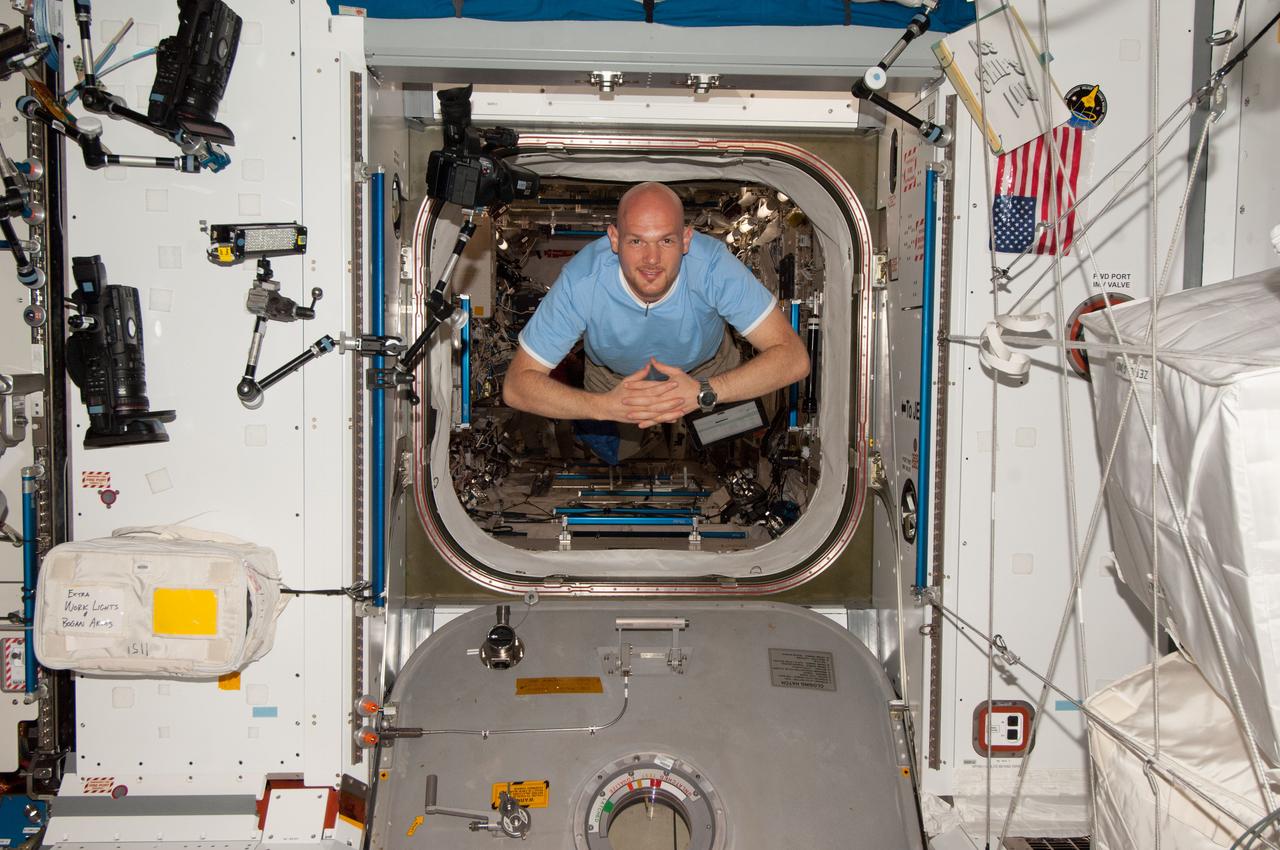
ISS040-E-006039 (30 May 2014) --- European Space Agency astronaut Alexander Gerst, Expedition 40 flight engineer, floats through the hatch between the Kibo laboratory and the Harmony node of the International Space Station.
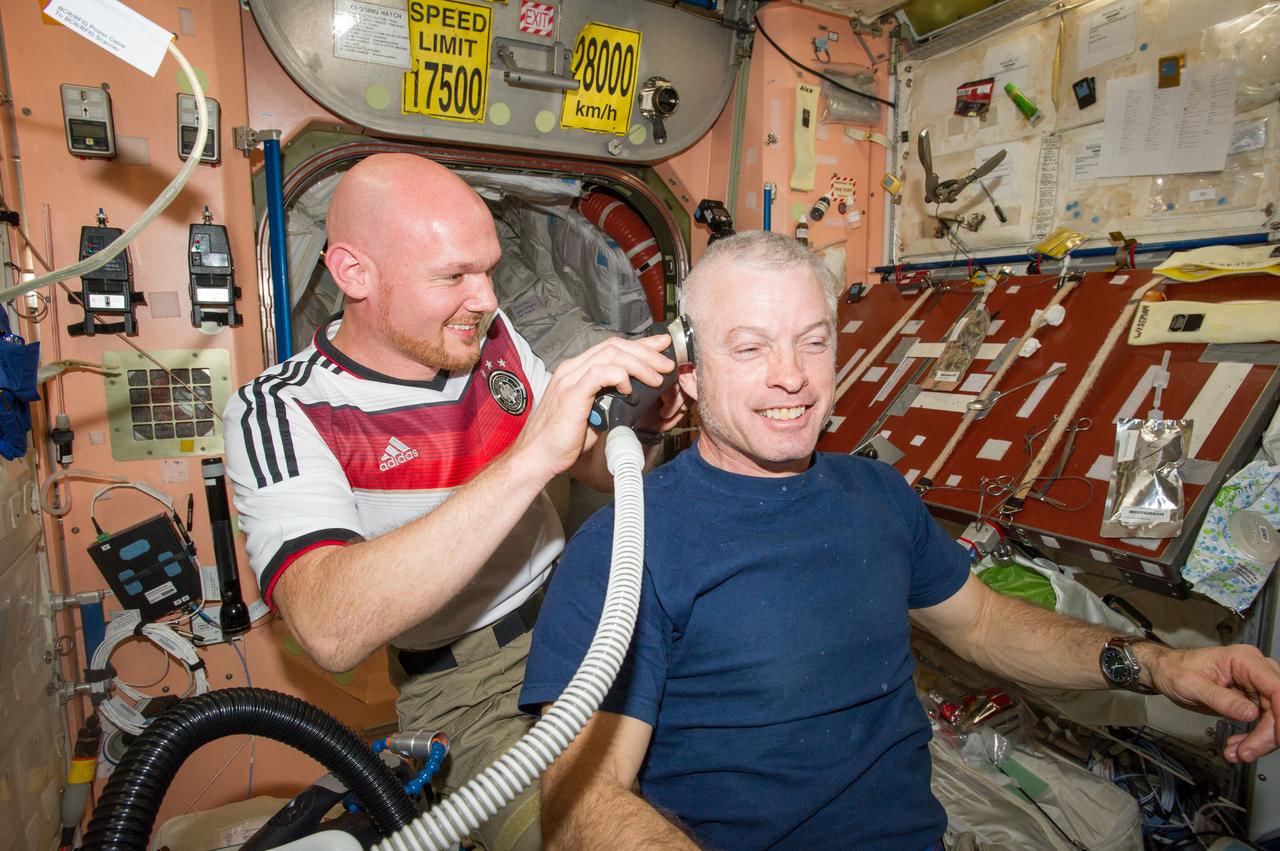
ISS040-E-020368 (26 June 2014) --- European Space Agency astronaut Alexander Gerst, Expedition 40 flight engineer, shaves the head of NASA astronaut Steve Swanson, commander, in the Unity node of the International Space Station. Gerst used hair clippers fashioned with a vacuum device to garner freshly cut hair. A friendly World Cup Soccer-related agreement between the crew members representing the USA, and Gerst, a German citizen who represents the European Space Agency, called for the American losers of a German-USA match to have their heads shaved. The German team won the match 1-0.

Astronaut Reid Wiseman,Expedition 40 flight engineer,is photographed playing with a yoyo in the Node 2 module.
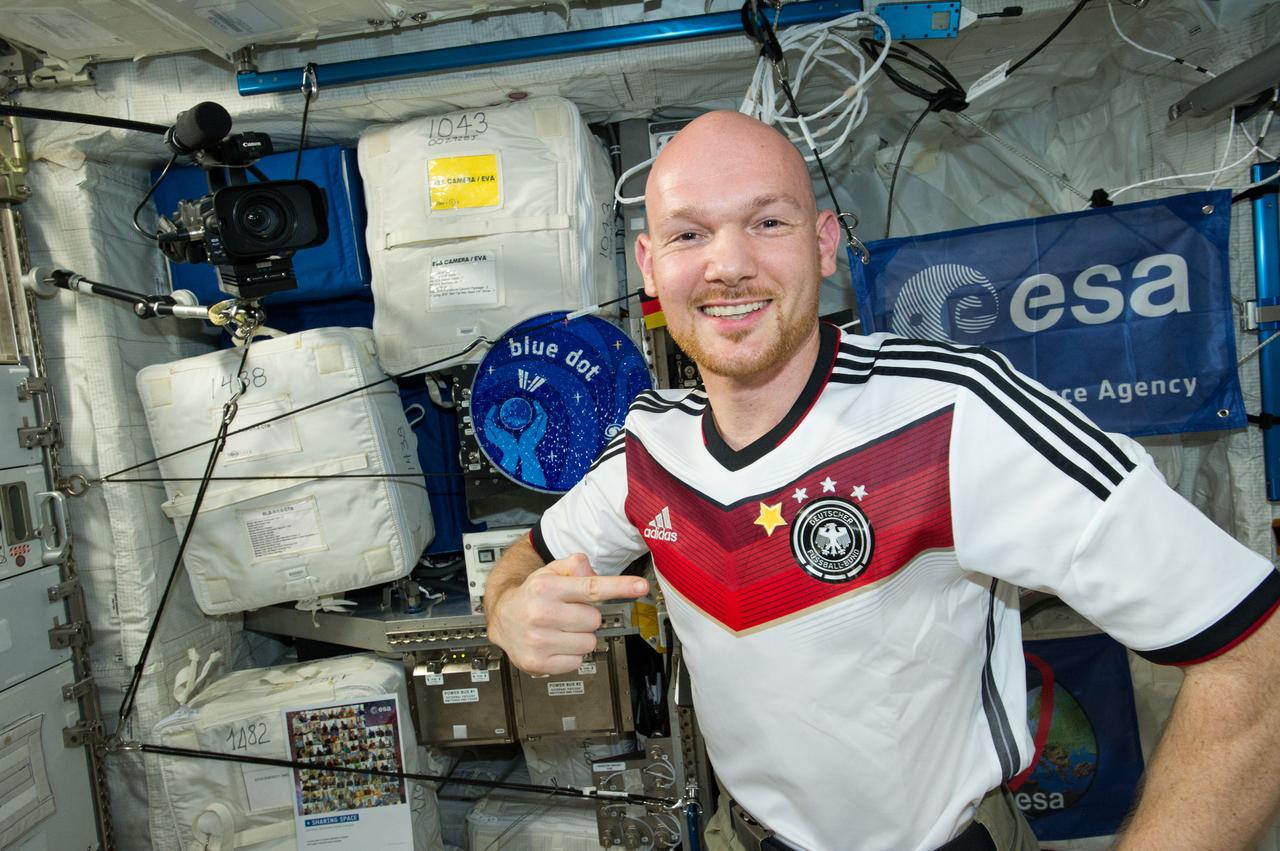
European Space Agency astronaut Alexander Gerst,Expedition 40 flight engineer,sends down a congratulations to the victorious German team after the World Cup finals. Photo taken in Columbus module.
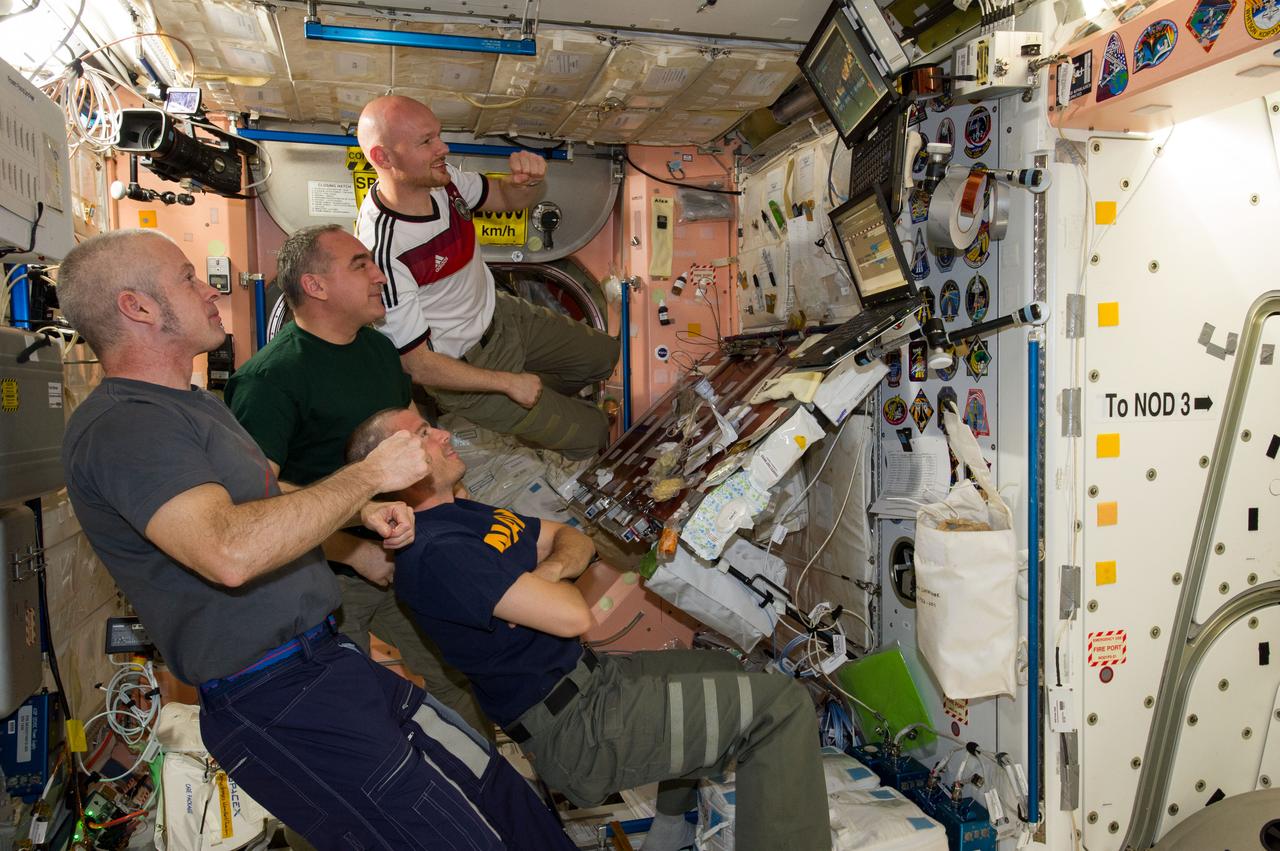
NASA astronaut Steve Swanson (left),Expedition 40 commander; along with European Space Agency astronaut Alexander Gerst (upper left), NASA astronaut Reid Wiseman and Cosmonaut Alexander Skvortsov,all three flight engineers,gather around a computer in Node 1 to watch the World Cup finals.
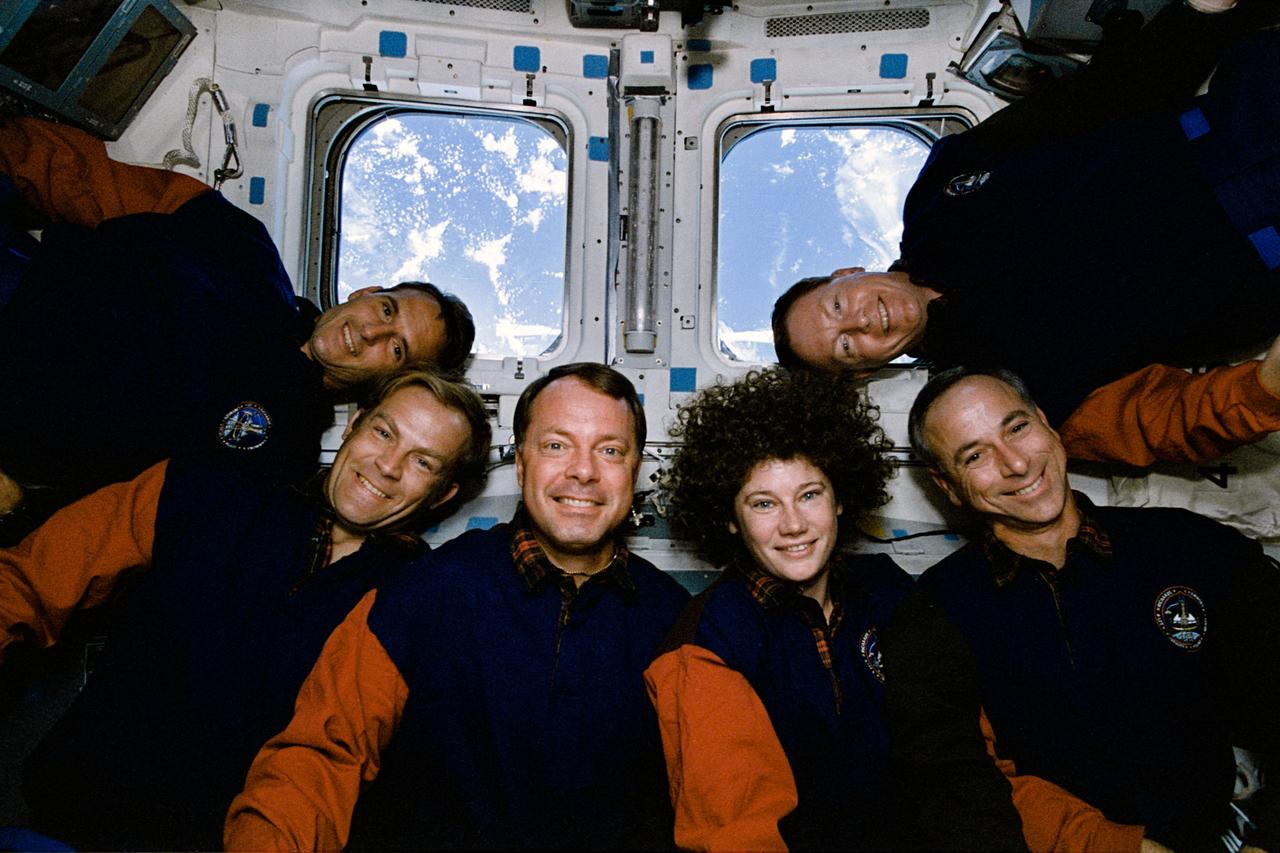
STS064-24-029 (9-20 Sept. 1994) --- In the microgravity of space, 130 nautical miles above Earth, the six STS-64 crew members found a unique setting for the traditional inflight crew portrait. Astronaut Richard N. Richards (upper right), commander, found stability with his back against the overhead in upper right corner. Others, clockwise from the commander, are astronauts Carl J. Meade and Susan J. Helms, mission specialists; L. Blaine Hammond, pilot; and Mark C. Lee and Jerry M. Linenger, both mission specialists. Photo credit: NASA or National Aeronautics and Space Administration
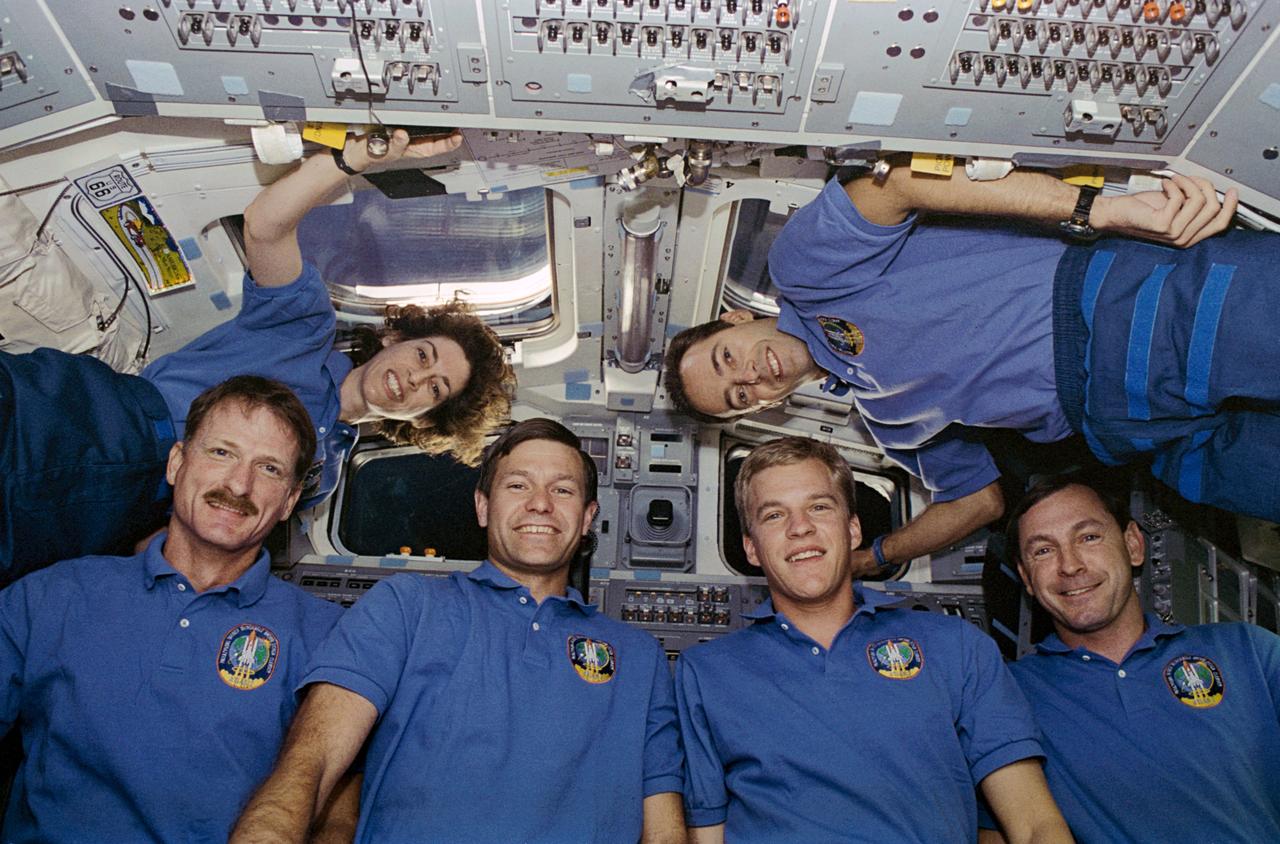
STS066-56-015 (3-14 Nov 1994) --- On the Space Shuttle Atlantis' flight deck, the six crew members pose for the traditional in-flight crew portrait. They include, left to right in lower frame, astronauts Joseph R. Tanner, mission specialist; Donald R. McMonagle, mission commander; Scott E. Parazynski, mission specialist; and Curtis L. Brown, pilot. Floating at top frame are Ellen Ochoa, payload commander; and Jean-François Clervoy, mission specialist, representing the European Space Agency (ESA).
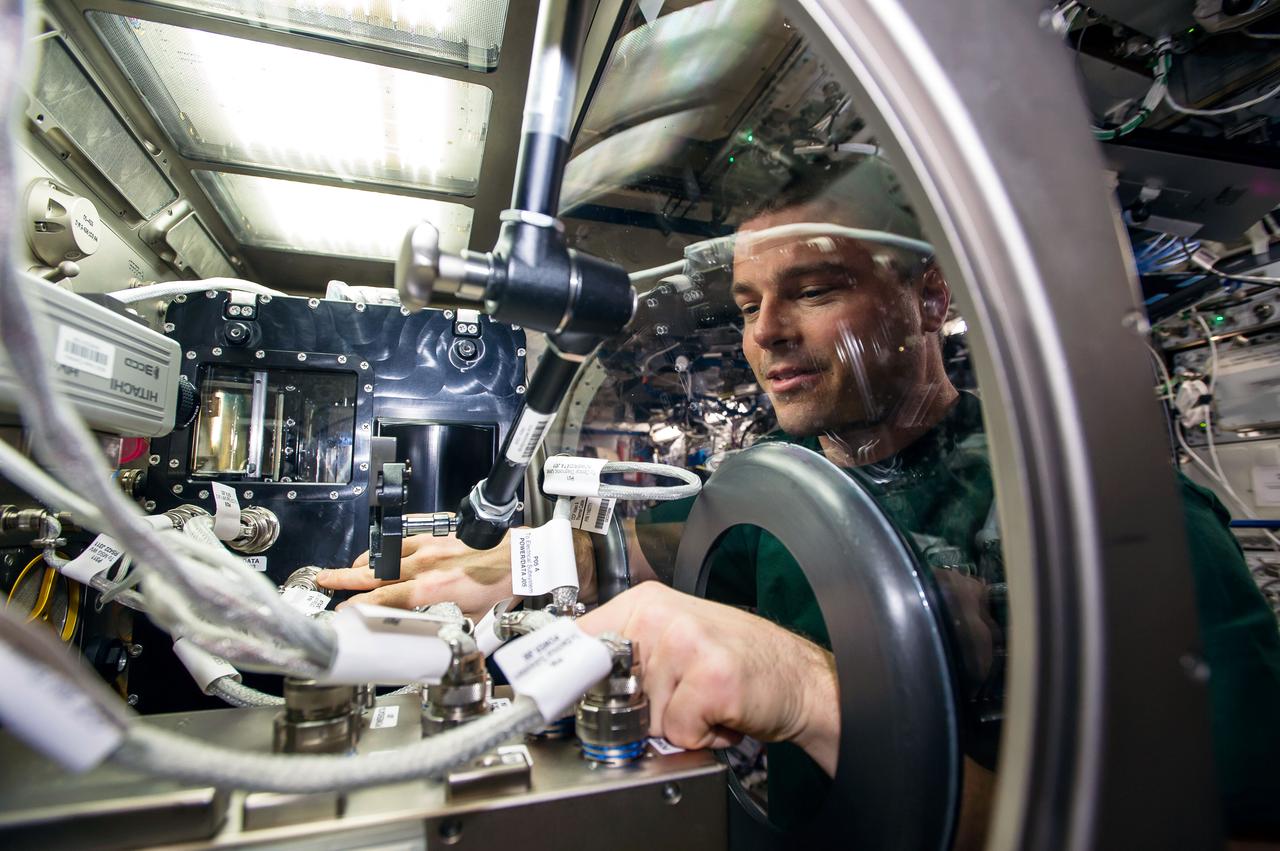
ISS040-E-088856 (5 Aug. 2014) --- NASA astronaut Reid Wiseman, Expedition 40 flight engineer, installs Capillary Channel Flow (CCF) experiment hardware in the Microgravity Science Glovebox (MSG) located in the Destiny laboratory of the International Space Station. CCF is a versatile experiment for studying a critical variety of inertial-capillary dominated flows key to spacecraft systems that cannot be studied on the ground.
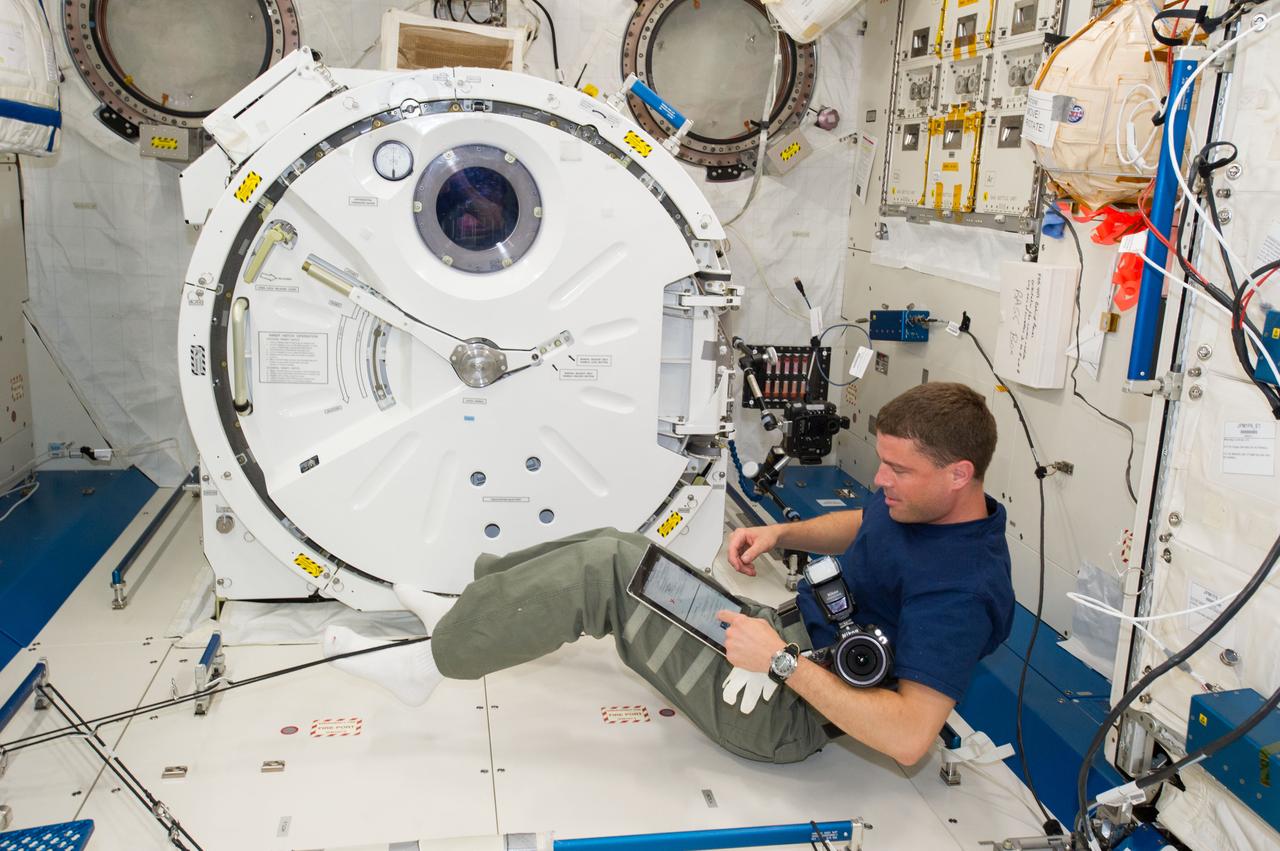
ISS040-E-006891 (3 June 2014) --- NASA astronaut Reid Wiseman, Expedition 40 flight engineer, conducts a session with the Binary Colloidal Alloy Test (BCAT) experiment in the Kibo laboratory of the International Space Station.
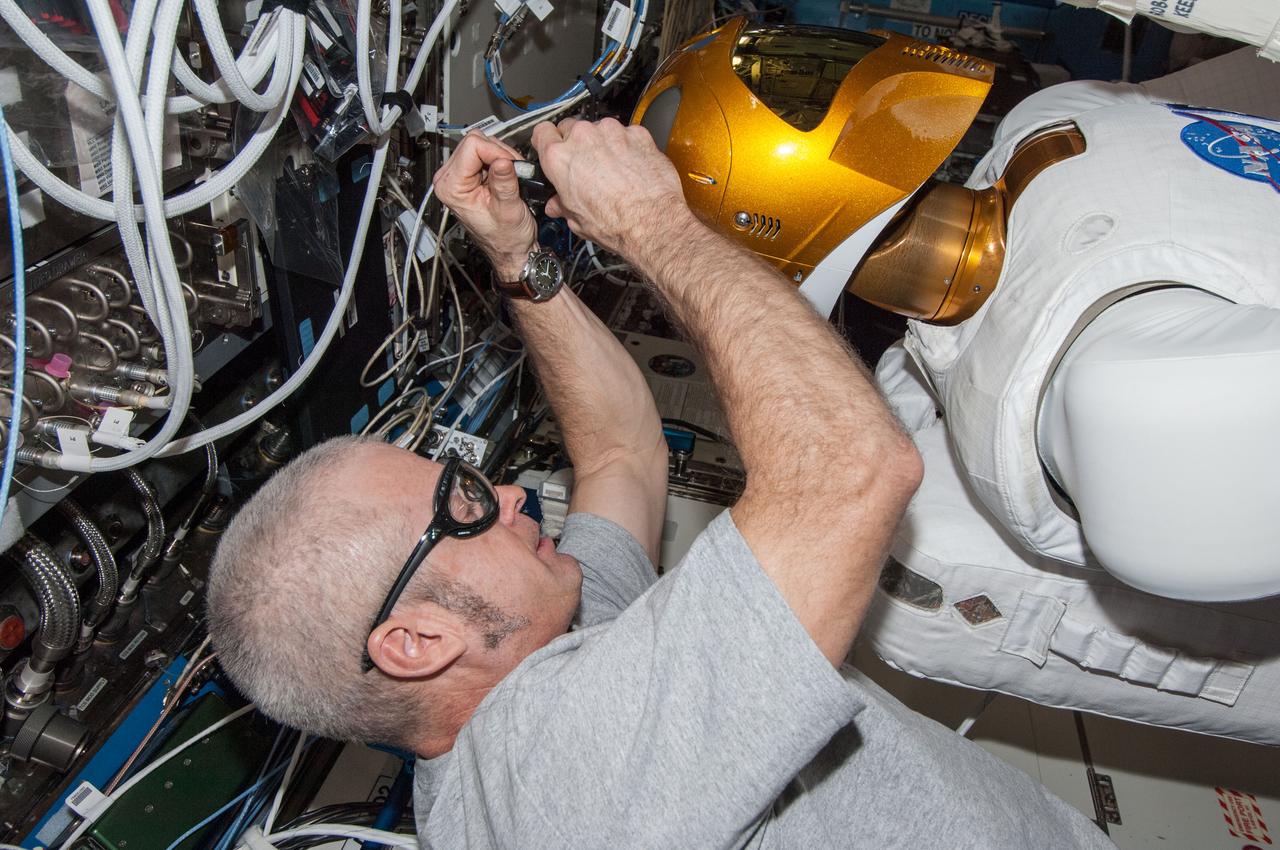
Astronaut Steve Swanson,Expedition 40 Commander,is photographed working with the Robonauts processing unit (or brain) in the U.S. Laboratory module.
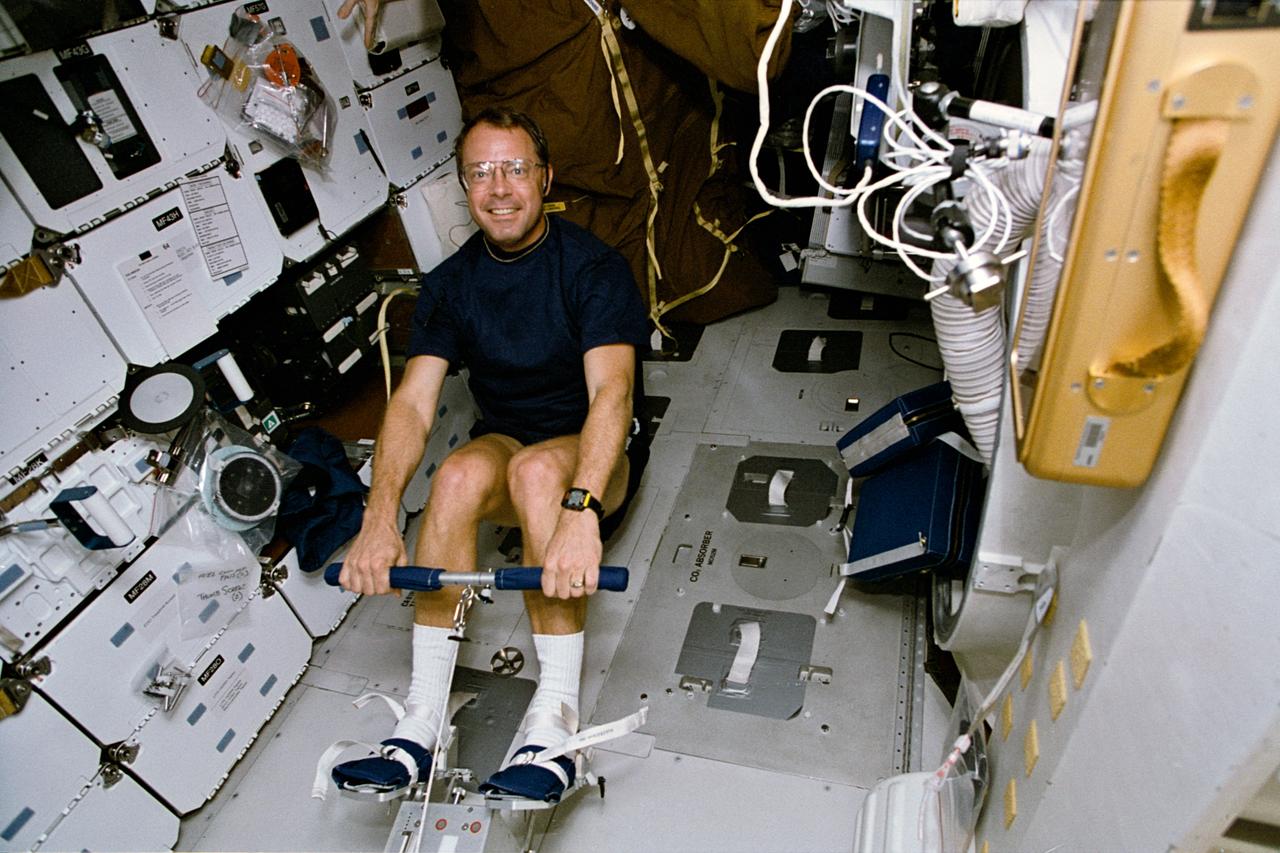
STS064-09-026 (9-20 Sept. 1994) --- Astronaut L. Blaine Hammond, STS-64 pilot, gets microgravity exercise on the rowing machine. This area of the space shuttle Discovery's middeck was also used for the treadmill exercising device. Blaine and five other NASA astronauts spent almost 11 days in Earth orbit in support of the mission. Photo credit: NASA or National Aeronautics and Space Administration
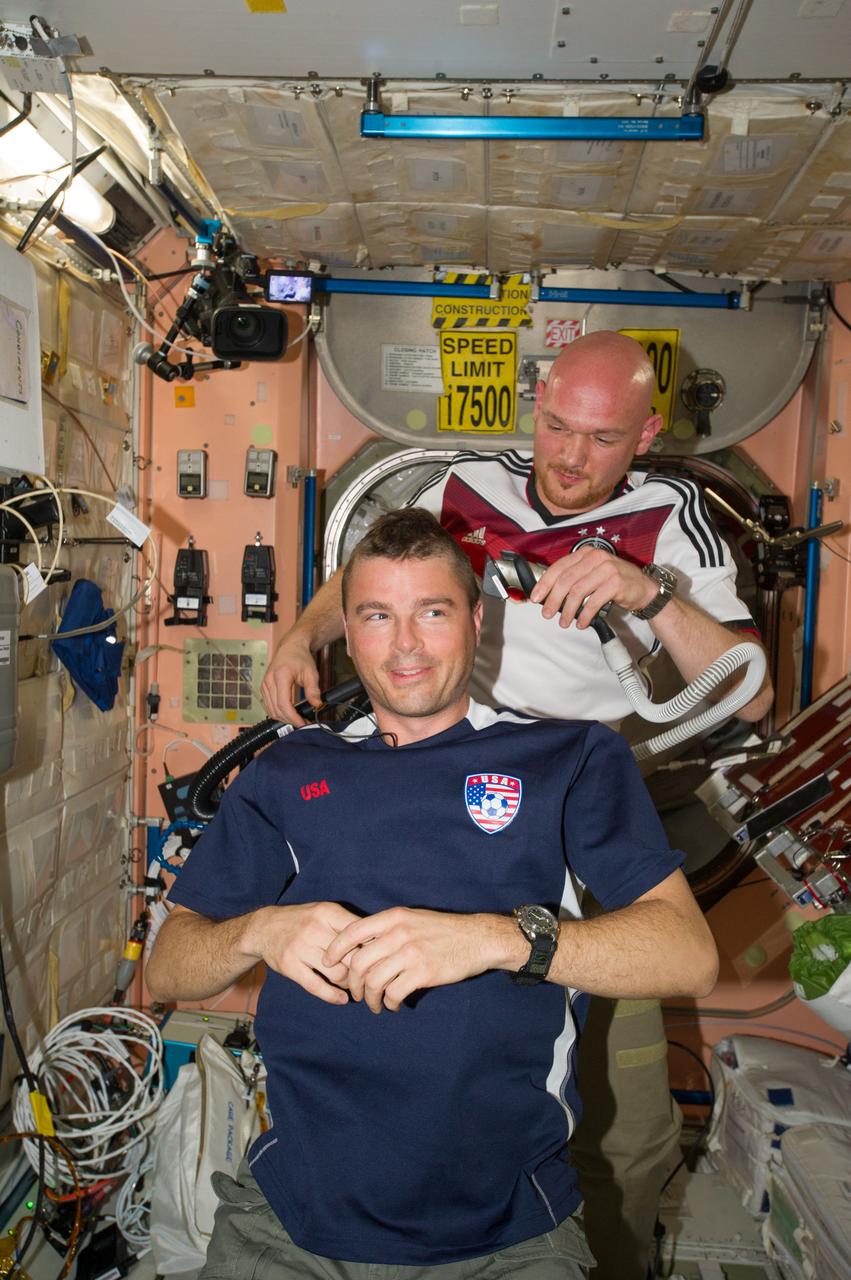
ISS040-E-020384 (26 June 2014) --- European Space Agency astronaut Alexander Gerst, Expedition 40 flight engineer, shaves the head of NASA astronaut Reid Wiseman, flight engineer, in the Unity node of the International Space Station. Gerst used hair clippers fashioned with a vacuum device to garner freshly cut hair. A friendly World Cup Soccer-related agreement between the crew members representing the USA, and Gerst, a German citizen who represents the European Space Agency, called for the American losers of a German-USA match to have their heads shaved. The German team won the match 1-0.
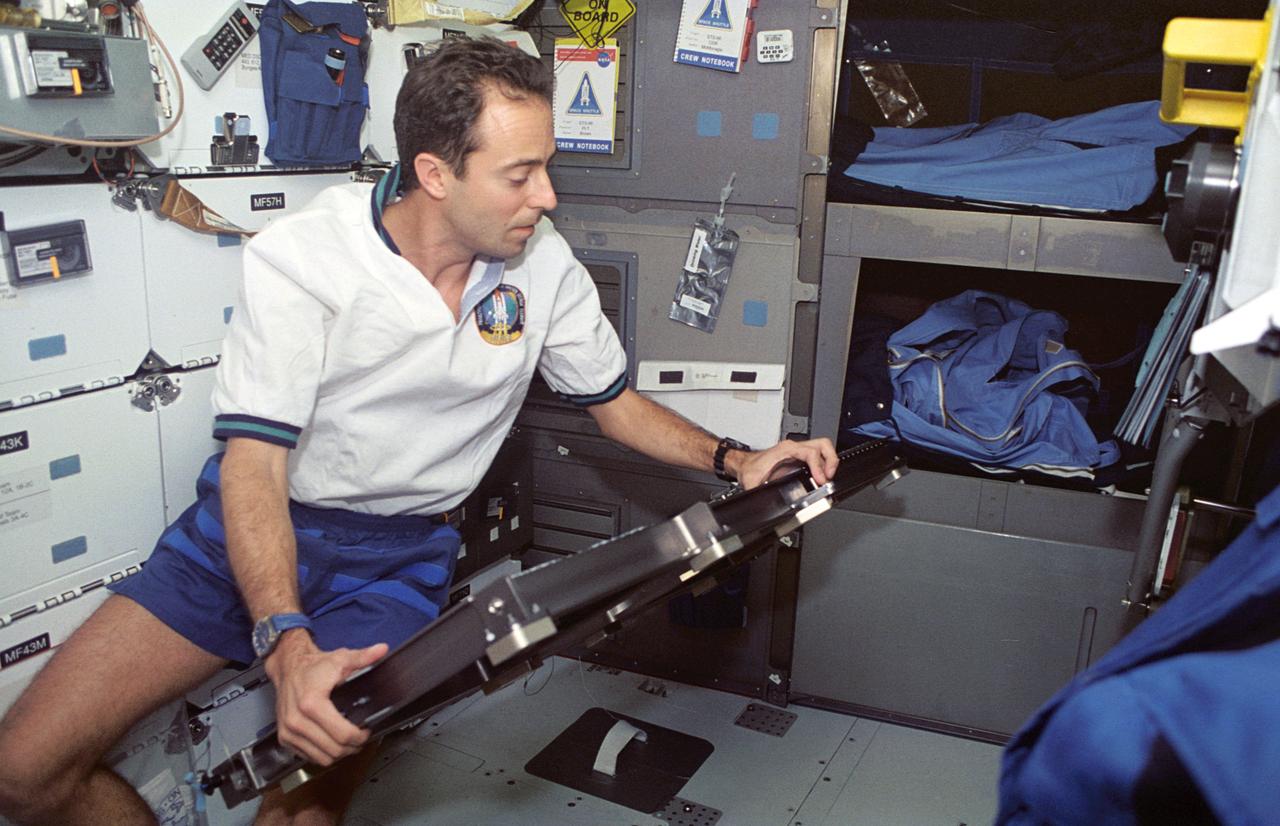
STS066-66-005 (3-14 Nov 1994) --- On the Space Shuttle Atlantis' flight deck, Jean-François Clervoy, mission specialist representing the European Space Agency (ESA), moves a platform for the recumbent seat device which was being evaluated for a future Space Shuttle flight. The platform is just part of the mid-deck arrangement designed to accommodate crew members when the Space Shuttle docks with Russia's Mir Space Station next year. Other crew members onboard Atlantis for the 11-day day Atmospheric Laboratory for Applications and Science (ATLAS-3) mission were astronauts Donald R. McMonagle, Curtis L. Brown, Jr., Ellen Ochoa, Scott E. Parazynski and Joseph R. Tanner.