
AS11-37-5445 (20 July 1969) --- The Apollo 11 Command and Service Modules (CSM) are photographed from the Lunar Module (LM) in lunar orbit during the Apollo 11 lunar landing mission. The lunar surface below is in the north central Sea of Fertility. The coordinates of the center of the picture are 51 degrees east longitude and 1 degree north latitude. About half of the crater Taruntius G is visible in the lower left corner of the picture. Part of Taruntius H can be seen at lower right.
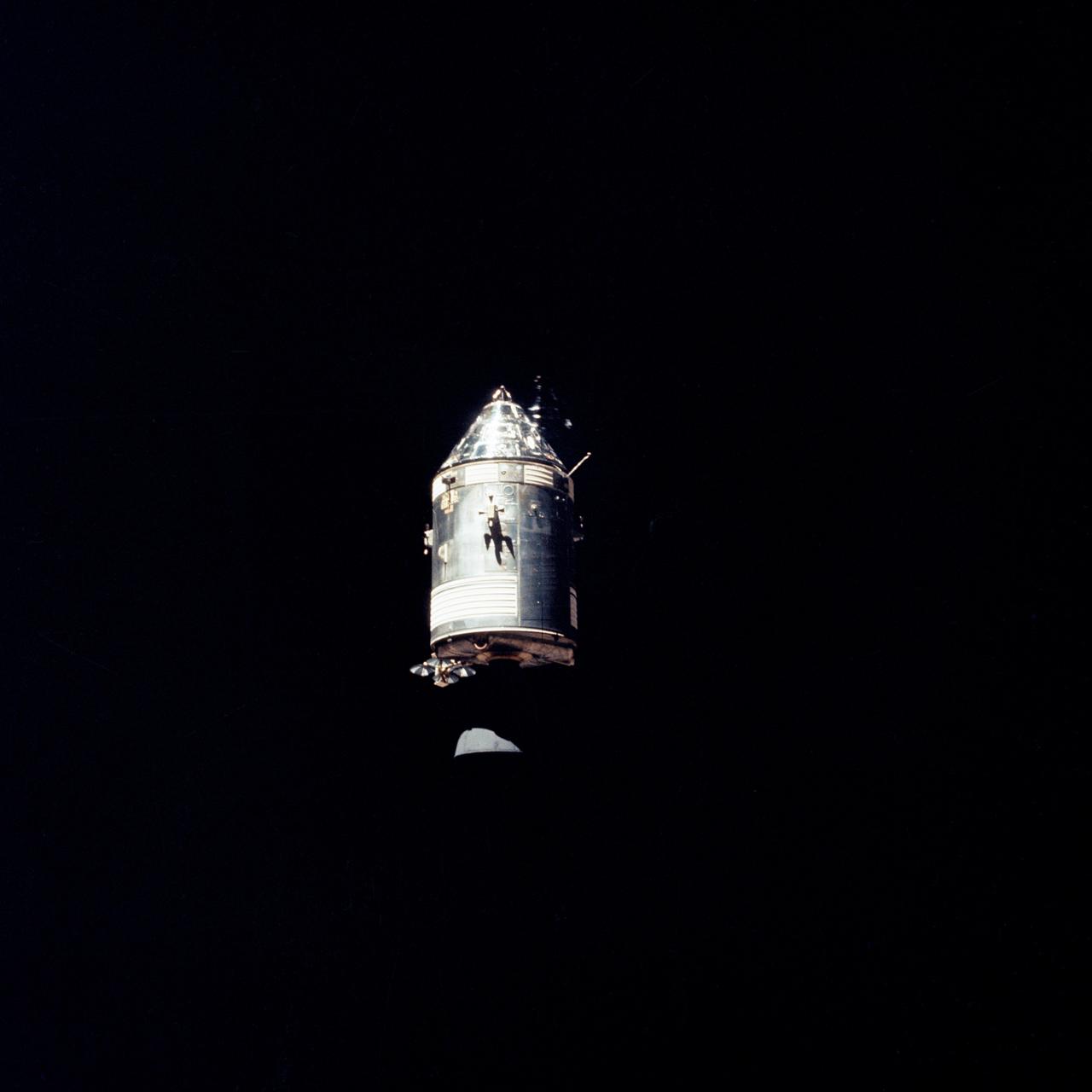
AS14-66-9344 (February 1971) --- The Apollo Command and Service Modules (CSM) are photographed against a black sky background from the Lunar Module (LM) above the moon. While astronauts Alan B. Shepard Jr., commander, and Edgar D. Mitchell, lunar module pilot, descended in the LM "Antares" to explore the Fra Mauro region of the moon, astronaut Stuart A. Roosa , command module pilot, remained with the CSM "Kitty Hawk" in lunar orbit.

AS10-27-3873 (22 May 1969) --- The Apollo 10 Command and Service Modules (CSM) are photographed from the Lunar Module (LM) after CSM/LM separation in lunar orbit. The CSM was about 175 statute miles east of Smyth's Sea and was above the rough terrain which is typical of the lunar far side. The eastward oblique view of the lunar surface is centered near 105 degrees east longitude and 1 degree north latitude. The horizon is approximately 600 kilometers (374 statute miles) away. Numerous bright craters and the absence of shadows show that the sun was almost directly overhead when this photograph was taken.
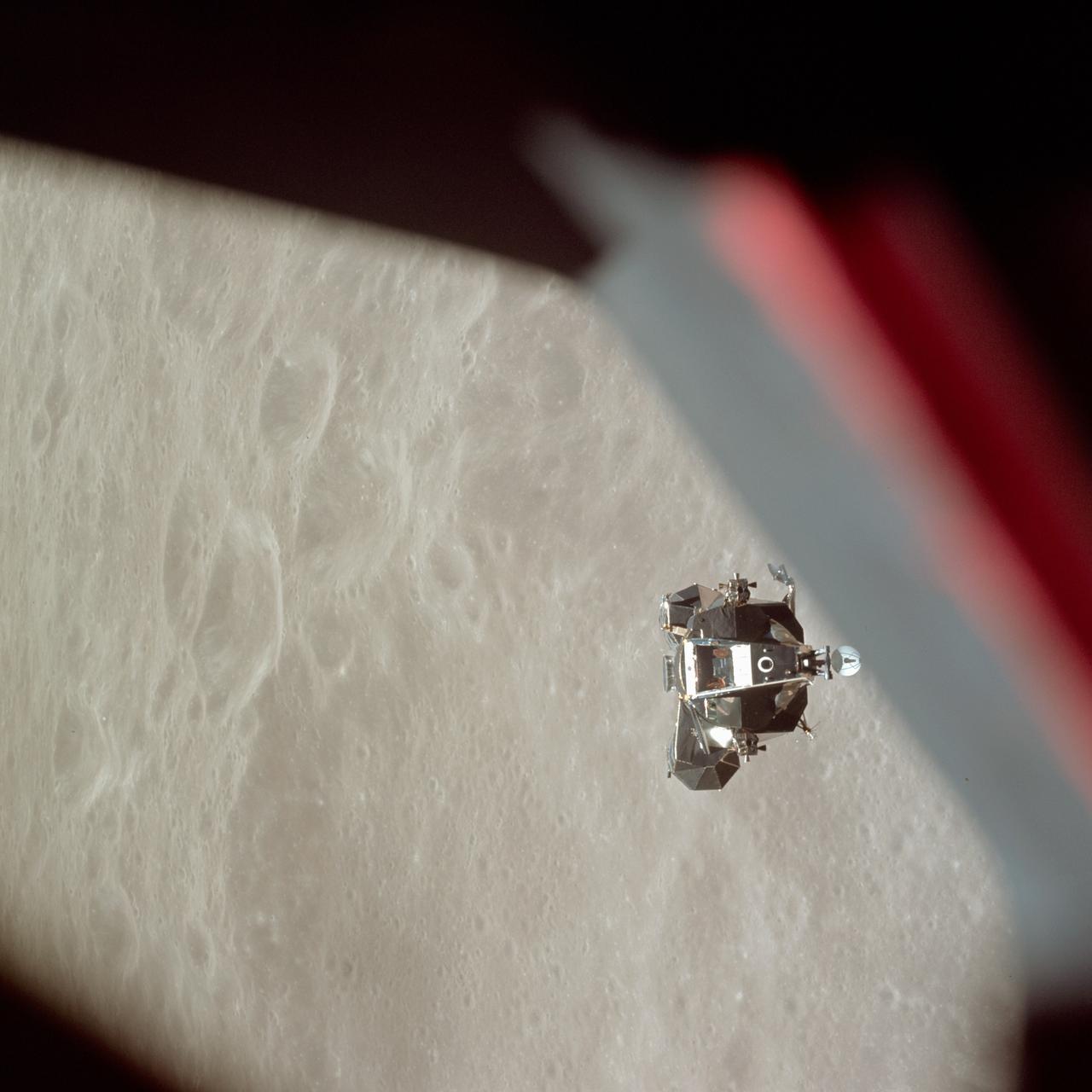
AS10-34-5112 (26 May 1969) --- The ascent stage of the Apollo 10 Lunar Module (LM) is photographed from the Command Module prior to docking in lunar orbit. The LM is approaching the Command and Service Modules from below. The LM descent stage had already been jettisoned. The lunar surface in the background is near, but beyond the eastern limb of the moon as viewed from Earth (about 120 degrees east longitude). The red/blue diagonal line is the spacecraft window.
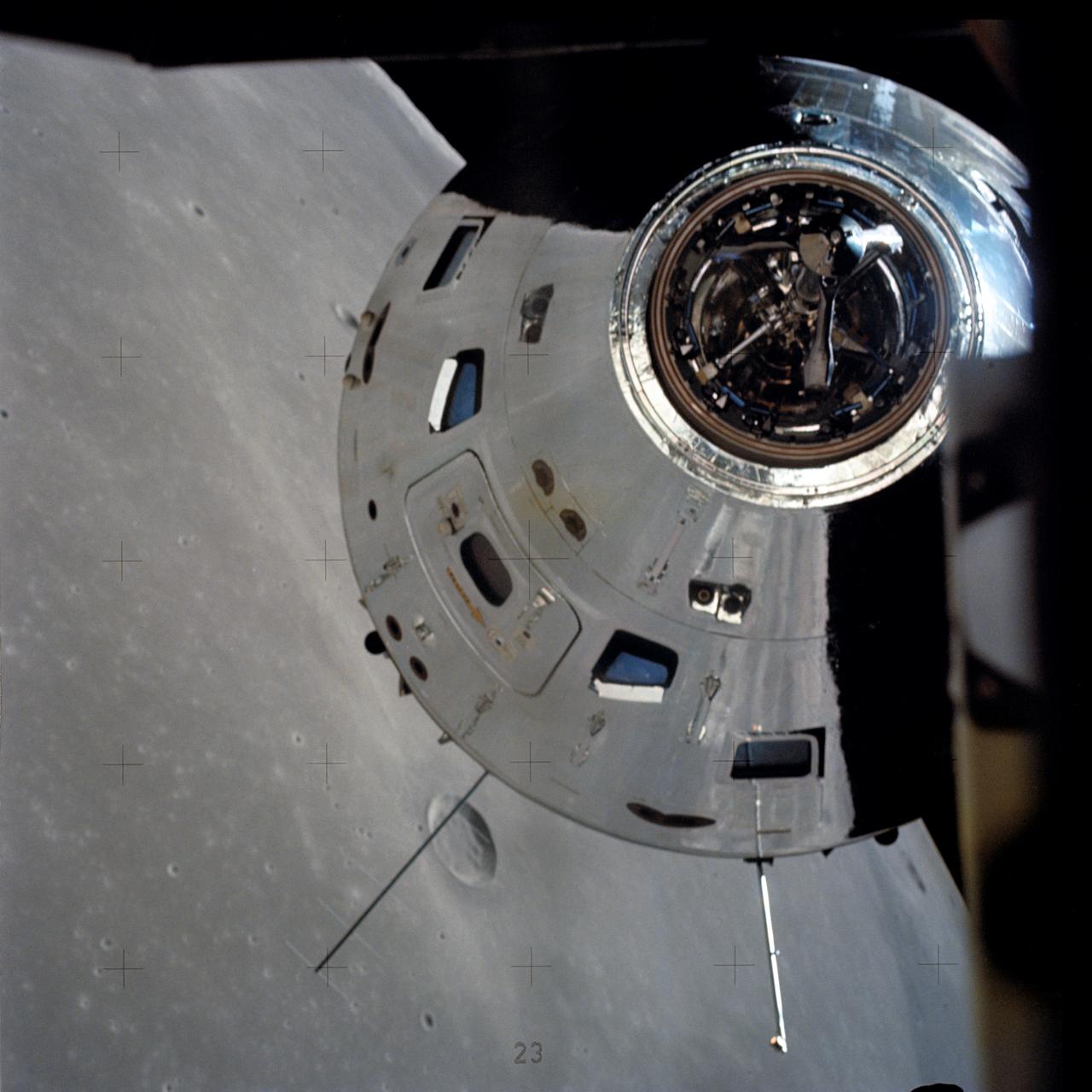
AS17-145-22273 (7-19 Dec. 1972) --- In this view, taken from the Lunar Module (LM), the Command and Service Module (CSM) are seen preparing to rendezvous with the LM. Note the reflection of the lunar surface on the CSM. The CSM, is piloted by Ronald E. Evans; while astronauts Eugene A. Cernan, commander; and Harrison W. Schmitt, lunar module pilot, are onboard the LM, following their extravehicular activities (EVA) on the moon's surface. While astronauts Cernan and Schmitt descended in the LM "Challenger" to explore the Taurus-Littrow region of the moon, astronaut Evans remained with the CSM "America" in lunar orbit.
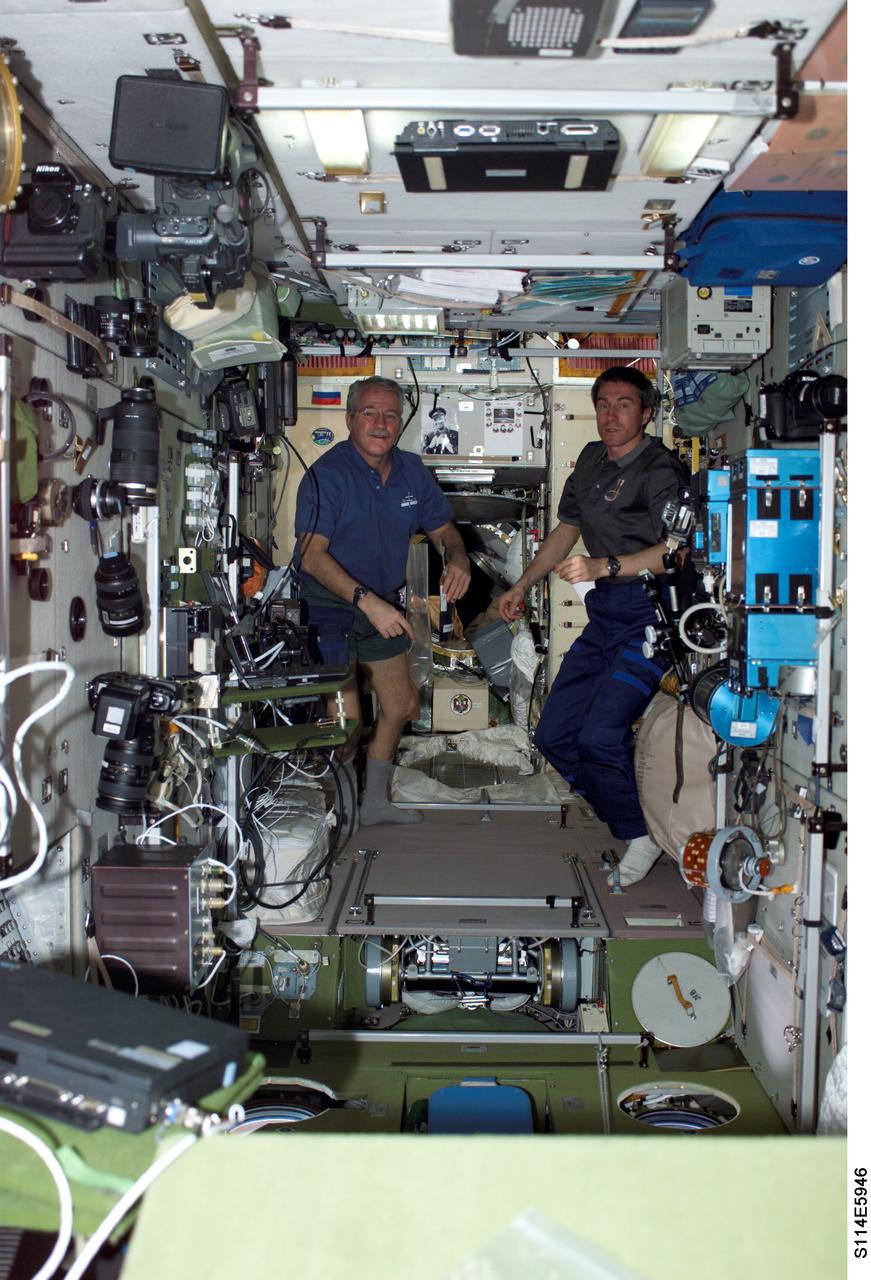
S114-E-5946 (31 July 2005) --- A Sunday morning picture onboard the International Space Station shows the Expedition 11 crew members--John L. Phillips (left) and Sergei Krikalev--in the Zvezda Service Module, while their "guests" from Discovery are at various other locations in the orbital outpost and the Shuttle. Transfer of supplies brought up from Earth still remains one of the high priority activities for the two crews.
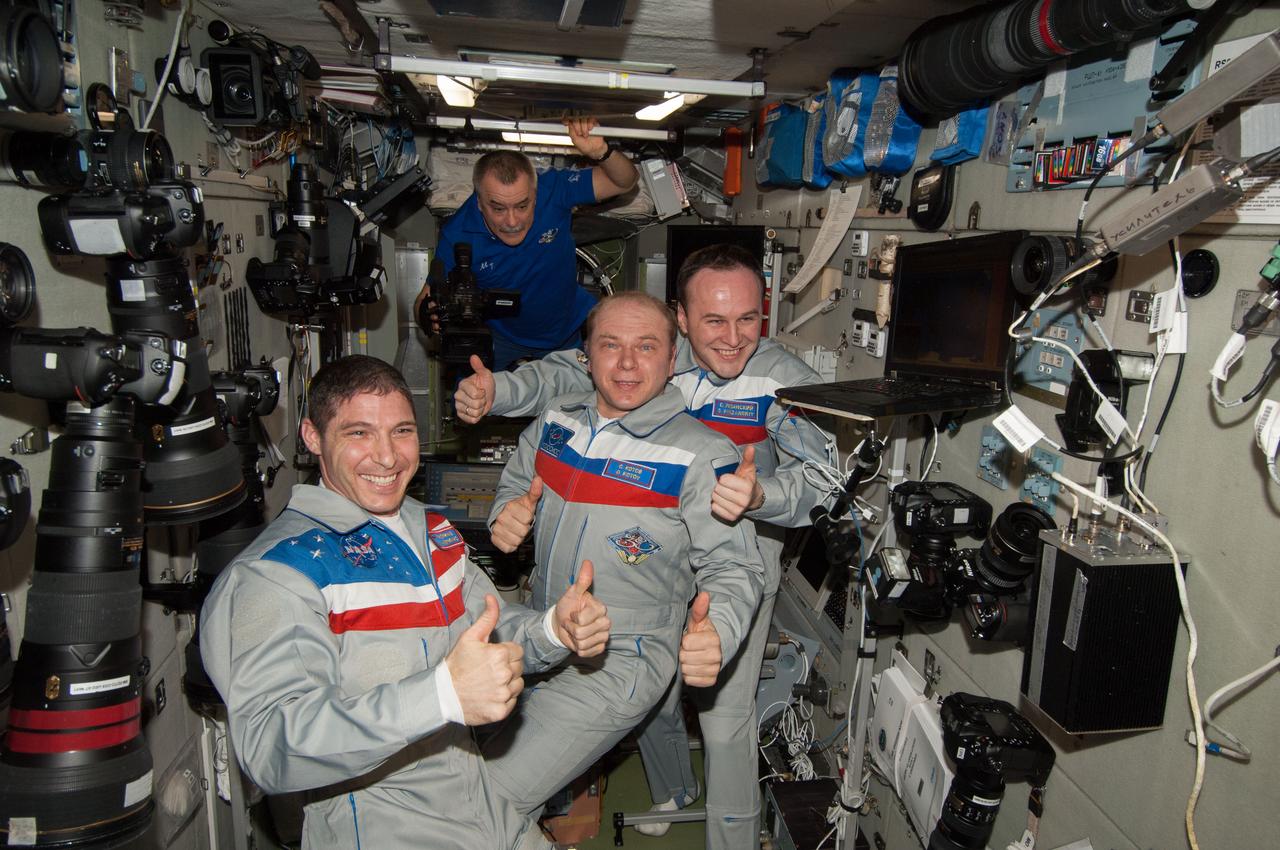
ISS038-E-068951 (10 March 2014) --- In the Zvezda service module of the International Space Station, three members of the Expedition 38 crew give a simultaneous thumbs up signal, which is perhaps a way of saying, "Our work is done here for now and we're ready to return home." From left to right are Expedition 38 Flight Engineer Mike Hopkins of NASA, Commander Oleg Kotov of Russia's Federal Space Agency (Roscosmos) and Flight Engineer Sergey Ryazanskiy of Roscosmos. Expedition 38/39 Flight Engineer Mikhail Tyurin, representing Roscosmos, prepares to record final activities among the three who are departing and the three (out of frame) who are remaining onboard to finish out their stay on the orbital outpost, as part of the Expedition 39 crew.
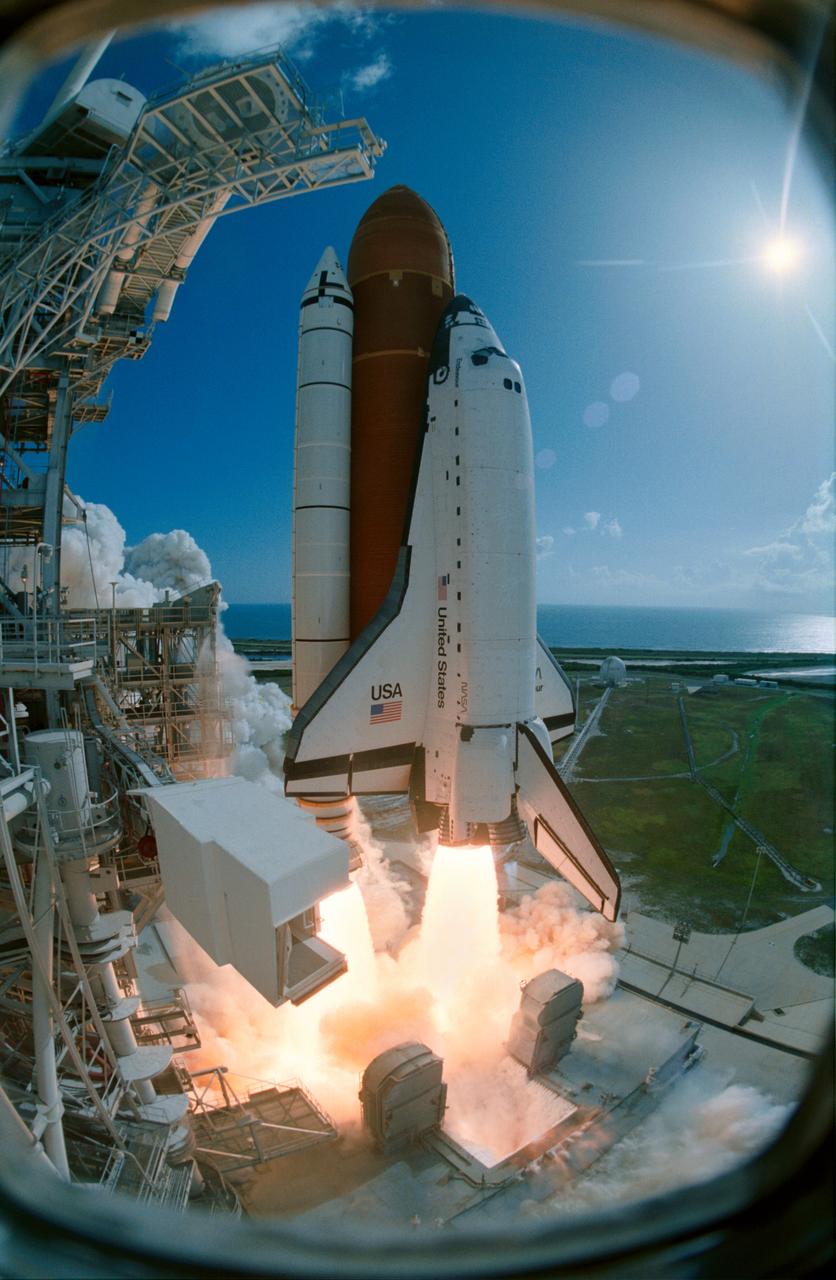
STS057-S-053 (21 June 1993) --- The Space Shuttle Endeavour lifts off Launch Pad 39B as captured on film by an audio-activated camera positioned at the 270-feet level on the Rotating Service Structure (RSS) at Launch Pad 39B. STS-57 launch occurred at 9:07:22 a.m. (EDT), June 21, 1993. The mission represents the first flight of the commercially developed SpaceHab laboratory module and also will feature a retrieval of the European Retrievable Carrier (EURECA). Onboard for Endeavour's fourth flight are a crew of six NASA astronauts; Ronald J. Grabe, mission commander; Brian Duffy, pilot; G. David Low, payload commander; and Nancy J. Sherlock, Peter J. K. (Jeff) Wisoff and Janice E. Voss, all mission specialists. An earlier launch attempt was scrubbed due to unacceptable weather conditions both at the Kennedy Space Center (KSC) and the overseas contingency landing sites.
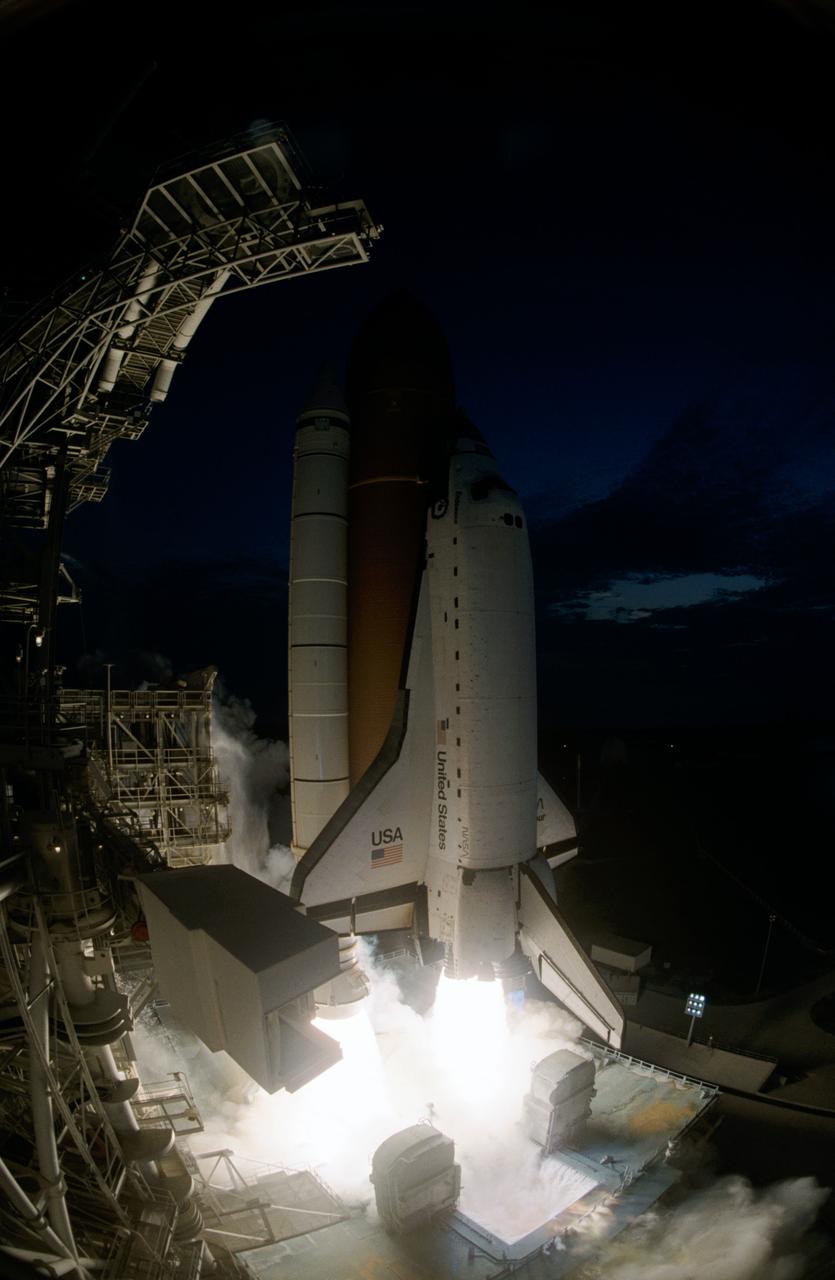
STS077-S-005 (19 May 1996) --- As seen through the ?fish-eye? lens of a 35mm camera at the service structure, the Space Shuttle Endeavour lifts off with six astronauts aboard. It was headed toward the fourth NASA Space Shuttle mission of the year. The launch occurred at 6:30:00 a.m. (EDT), May 19, 1996. Leading the crew onboard is astronaut John H. Casper, mission commander. Other crew members are astronauts Curtis L. Brown, Jr., pilot; along with Daniel W. Bursch, Mario Runco, Jr., Andrew S. W. Thomas and Marc Garneau, all mission specialists. Garneau represents the Canadian Space Agency (CSA). During the approximately 10-day mission, the crew will perform a variety of payload activities, including microgravity research aboard the Spacehab 4 Module, deployment and retrieval of the Spartan 207 and deployment and rendezvous with the Passive Aerodynamically-Stabilized Magnetically-Damped Satellite (PAMS).
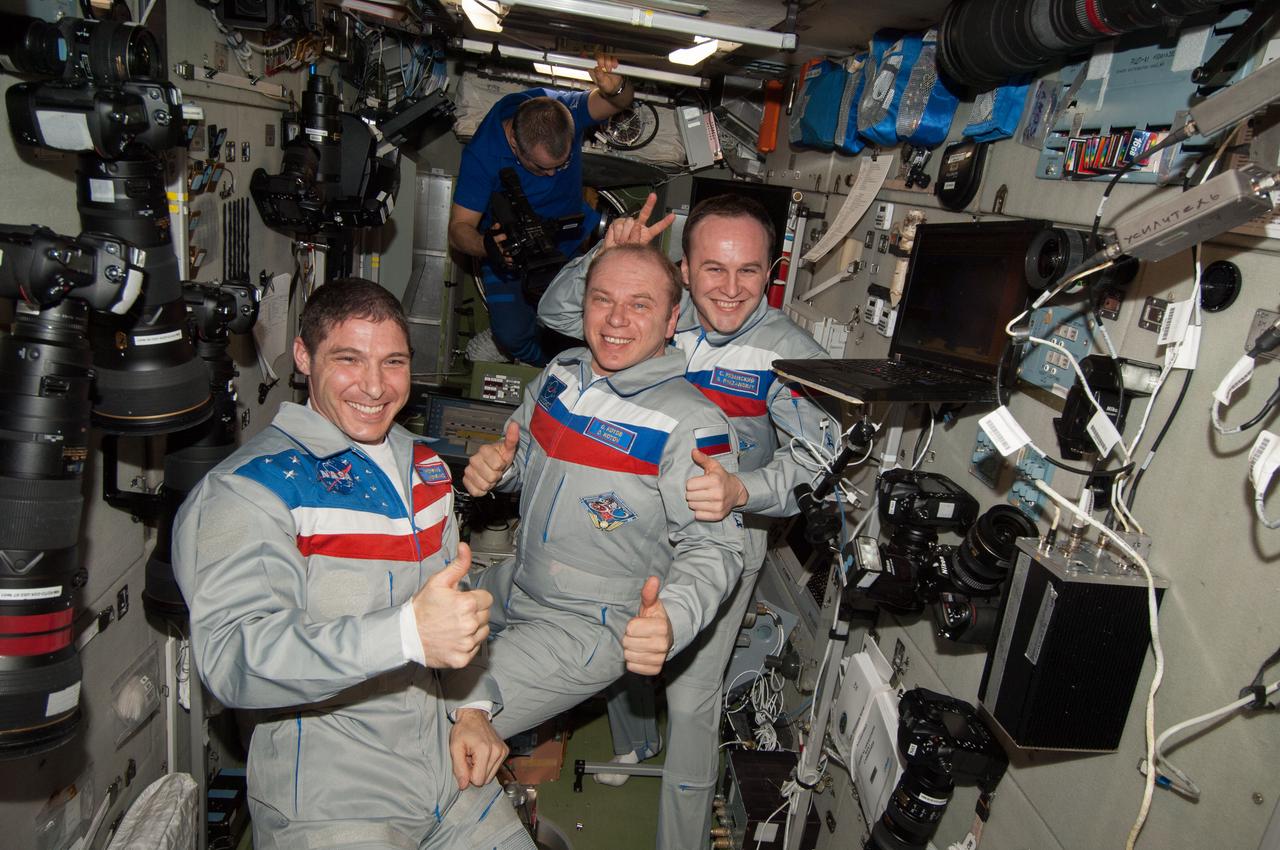
ISS038-E-068952 (10 March 2014) --- In the Zvezda service module of the International Space Station, three members of the Expedition 38 crew give a simultaneous thumbs up signal, which is perhaps a way of saying, "Our work is done here for now and we're ready to return home." From left to right are Expedition 38 Flight Engineer Mike Hopkins of NASA, Commander Oleg Kotov of Russia's Federal Space Agency (Roscosmos) and Flight Engineer Sergey Ryazanskiy of Roscosmos. Expedition 38/39 Flight Engineer Mikhail Tyurin, representing Roscosmos, prepares to record final activities among the three who are departing and the three (out of frame) who are remaining onboard to finish out their stay on the orbital outpost, as part of the Expedition 39 crew.
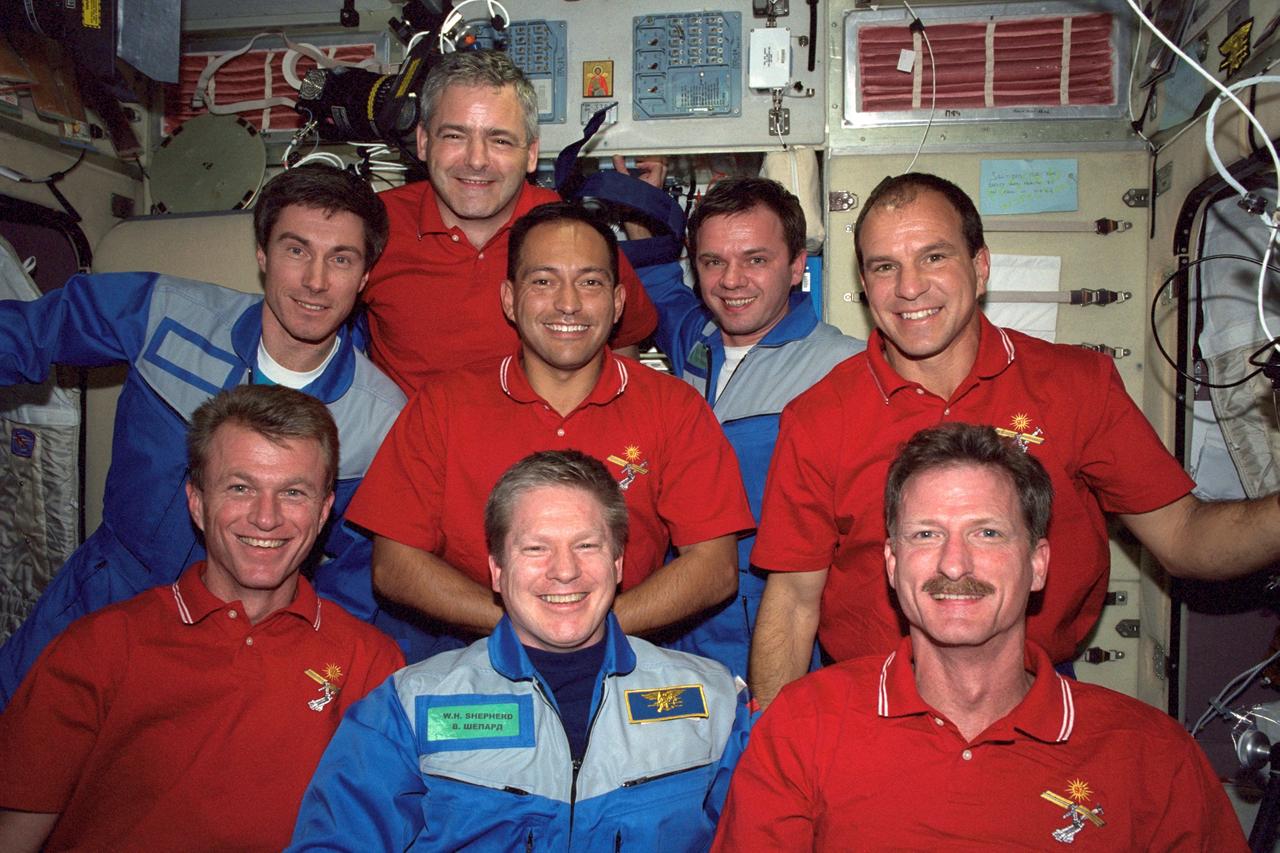
In this image, the five STS-97 crew members pose with the 3 members of the Expedition One crew onboard the International Space Station (ISS) for the first ever traditional onboard portrait taken in the Zvezda Service Module. On the front row, left to right, are astronauts Brent W. Jett, Jr., STS-97 commander; William M. Shepherd, Expedition One mission commander; and Joseph R. Tarner, STS-97 mission specialist. On the second row, from the left are Cosmonaut Sergei K. Krikalev, Expedition One flight engineer; astronaut Carlos I. Noriega, STS-97 mission specialist; cosmonaut Yuri P. Gidzenko, Expedition One Soyuz commander; and Michael J. Bloomfield, STS-97 pilot. Behind them is astronaut Marc Garneau, STS-97 mission specialist representing the Canadian Space Agency (CSA). The primary objective of the STS-97 mission was the delivery, assembly, and activation of the U.S. electrical power system onboard the International Space Station (ISS). The electrical power system, which is built into a 73-meter (240-foot) long solar array structure consists of solar arrays, radiators, batteries, and electronics. The entire 15.4-metric ton (17-ton) package is called the P6 Integrated Truss Segment, and is the heaviest and largest element yet delivered to the station aboard a space shuttle. The electrical system will eventually provide the power necessary for the first ISS crews to live and work in the U.S. segment. The STS-97 crew of five launched aboard the Space Shuttle Orbiter Endeavor on November 30, 2000 for an 11 day mission.

STS116-S-001 (July 2006) --- The STS-116 patch design signifies the continuing assembly of the International Space Station (ISS). The primary mission objective is to deliver and install the P5 truss element. The P5 installation will be conducted during the first of three planned spacewalks, and will involve use of both the shuttle and station robotic arms. The remainder of the mission will include a major reconfiguration and activation of the ISS electrical and thermal control systems, as well as delivery of Zvezda Service Module debris panels, which will increase ISS protection from potential impacts of micro-meteorites and orbital debris. In addition, a single expedition crewmember will launch on STS-116 to remain onboard the station, replacing an expedition crew member that will fly home with the shuttle crew. The crew patch depicts the space shuttle rising above the Earth and ISS. The United States and Swedish flags trail the orbiter, depicting the international composition of the STS-116 crew. The seven stars of the constellation Ursa Major are used to provide direction to the North Star, which is superimposed over the installation location of the P5 truss on ISS. The NASA insignia design for space shuttle flights is reserved for use by the astronauts and for other official use as the NASA Administrator may authorize. Public availability has been approved only in the forms of illustrations by the various news media. When and if there is any change in this policy, which is not anticipated, the change will be publicly announced. Photo credit: NASA
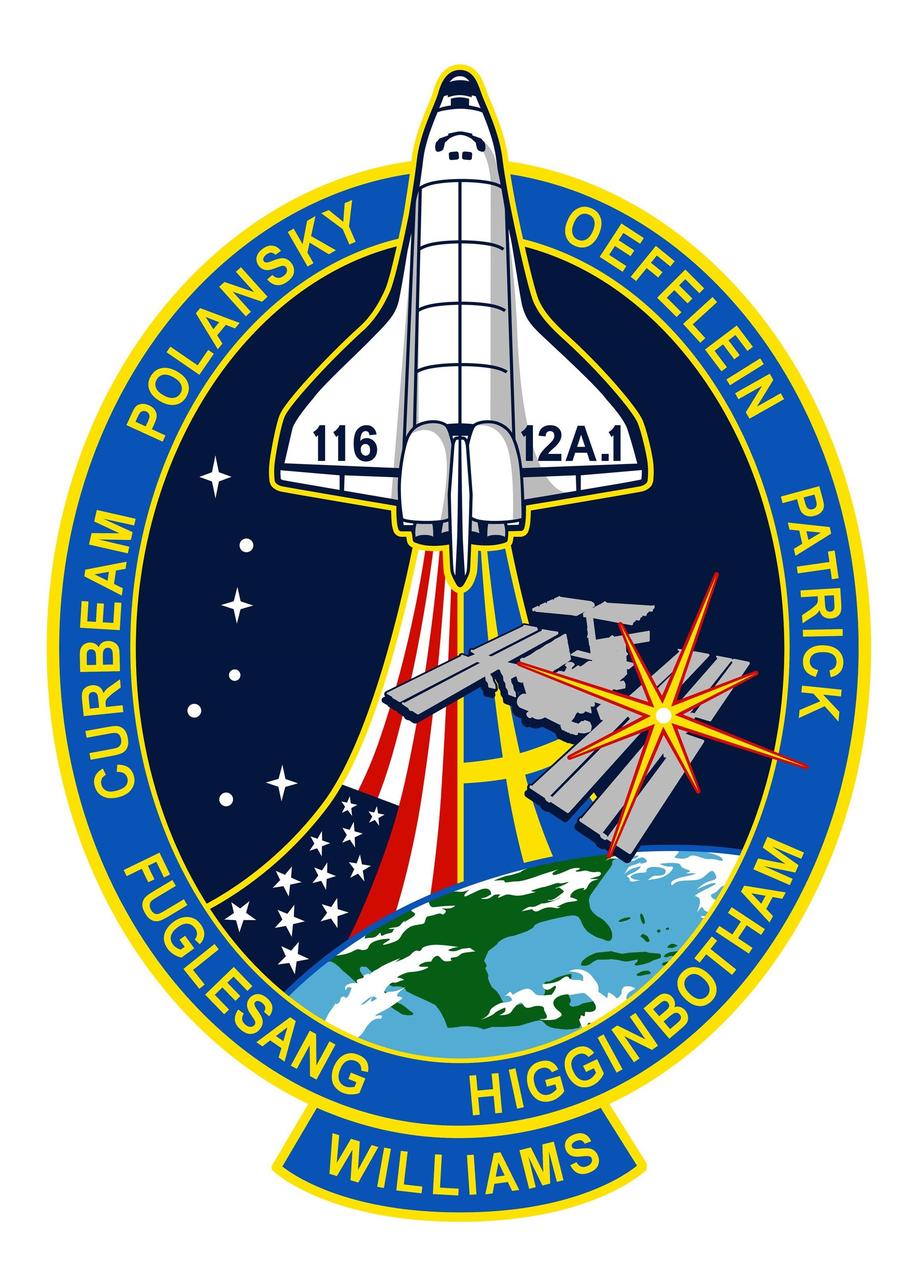
JOHNSON SPACE CENTER, Houston, Texas -- STS116-S-001 (July 2006) - The STS-116 patch design signifies the continuing assembly of the International Space Station (ISS). The primary mission objective is to deliver and install the P5 truss element. The P5 installation will be conducted during the first of three planned spacewalks, and will involve use of both the shuttle and station robotic arms. The remainder of the mission will include a major reconfiguration and activation of the ISS electrical and thermal control systems, as well as delivery of Zvezda Service Module debris panels, which will increase ISS protection from potential impacts of micro-meteorites and orbital debris. In addition, a single expedition crew member will launch on STS-116 to remain onboard the station, replacing an expedition crew member who will fly home with the shuttle crew. The crew patch depicts the space shuttle rising above the Earth and ISS. The United States and Swedish flags trail the orbiter, depicting the international composition of the STS-116 crew. The seven stars of the constellation Ursa Major are used to provide direction to the North Star, which is superimposed over the installation location of the P5 truss on ISS. The NASA insignia design for space shuttle space flights is reserved for use by the astronauts and other official use as the NASA Administrator may authorize. Public availability has been approved only in the form of illustrations by the various news media. When and if there is any change in this policy, which is not anticipated, such will be publicly announced.
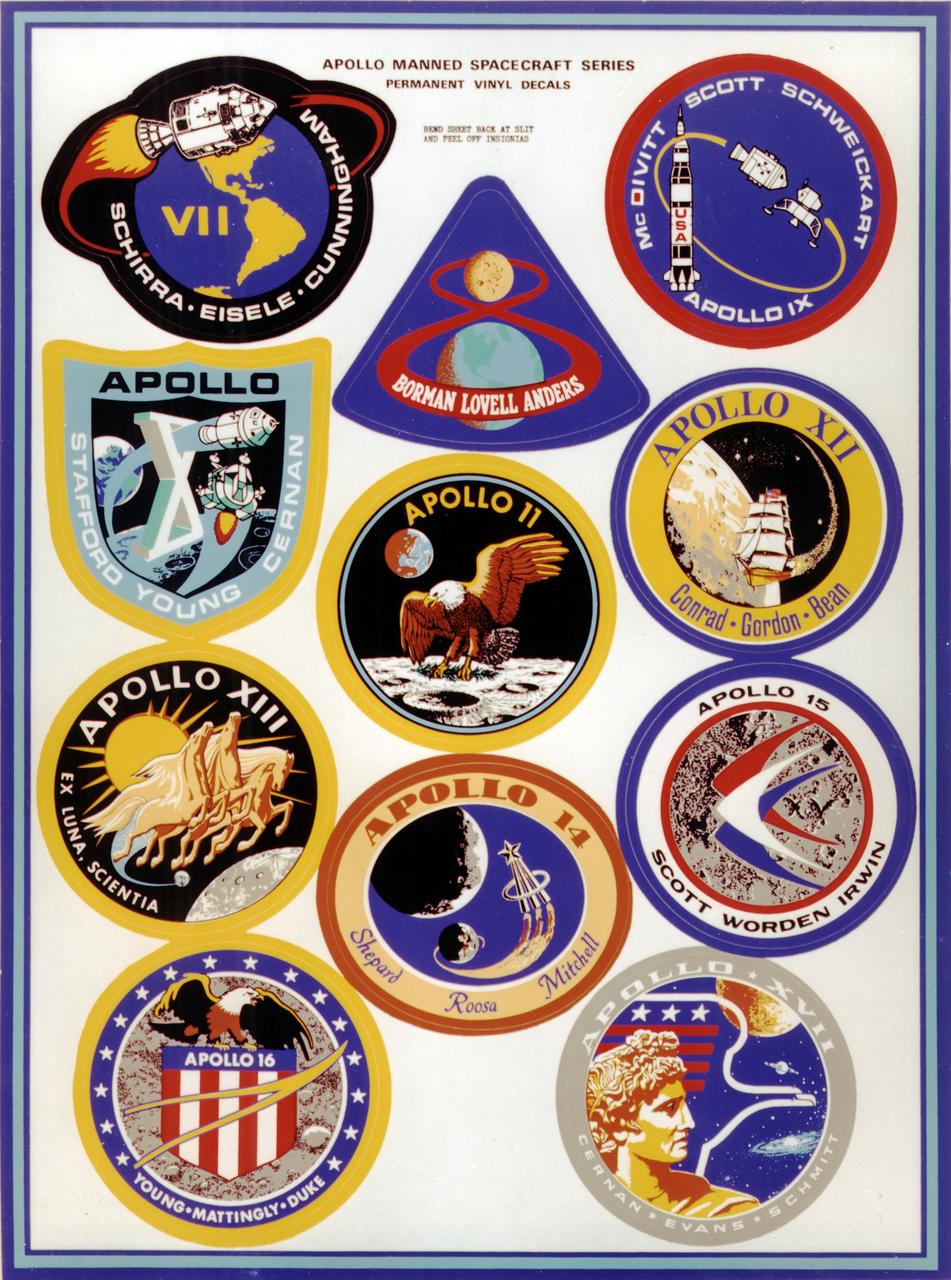
This montage depicts the flight crew patches for the manned Apollo 7 thru Apollo 17 missions. The Apollo 7 through 10 missions were basically manned test flights that paved the way for lunar landing missions. Primary objectives met included the demonstration of the Command Service Module (CSM) crew performance; crew/space vehicle/mission support facilities performance and testing during a manned CSM mission; CSM rendezvous capability; translunar injection demonstration; the first manned Apollo docking, the first Apollo Extra Vehicular Activity (EVA), performance of the first manned flight of the lunar module (LM); the CSM-LM docking in translunar trajectory, LM undocking in lunar orbit, LM staging in lunar orbit, and manned LM-CSM docking in lunar orbit. Apollo 11 through 17 were lunar landing missions with the exception of Apollo 13 which was forced to circle the moon without landing due to an onboard explosion. The craft was,however, able to return to Earth safely. Apollo 11 was the first manned lunar landing mission and performed the first lunar surface EVA. Landing site was the Sea of Tranquility. A message for mankind was delivered, the U.S. flag was planted, experiments were set up and 47 pounds of lunar surface material was collected for analysis back on Earth. Apollo 12, the 2nd manned lunar landing mission landed in the Ocean of Storms and retrieved parts of the unmanned Surveyor 3, which had landed on the Moon in April 1967. The Apollo Lunar Surface Experiments Package (ALSEP) was deployed, and 75 pounds of lunar material was gathered. Apollo 14, the 3rd lunar landing mission landed in Fra Mauro. ALSEP and other instruments were deployed, and 94 pounds of lunar materials were gathered, using a hand cart for first time to transport rocks. Apollo 15, the 4th lunar landing mission landed in the Hadley-Apennine region. With the first use of the Lunar Roving Vehicle (LRV), the crew was bale to gather 169 pounds of lunar material. Apollo 16, the 5th lunar landing mission, landed in the Descartes Highlands for the first study of highlands area. Selected surface experiments were deployed, the ultraviolet camera/spectrograph was used for first time on the Moon, and the LRV was used for second time for a collection of 213 pounds of lunar material. The Apollo program came to a close with Apollo 17, the 6th and final manned lunar landing mission that landed in the Taurus-Littrow highlands and valley area. This mission hosted the first scientist-astronaut, Schmitt, to land on the Moon. The 6th automated research station was set up, and 243 ponds of lunar material was gathered using the LRV.