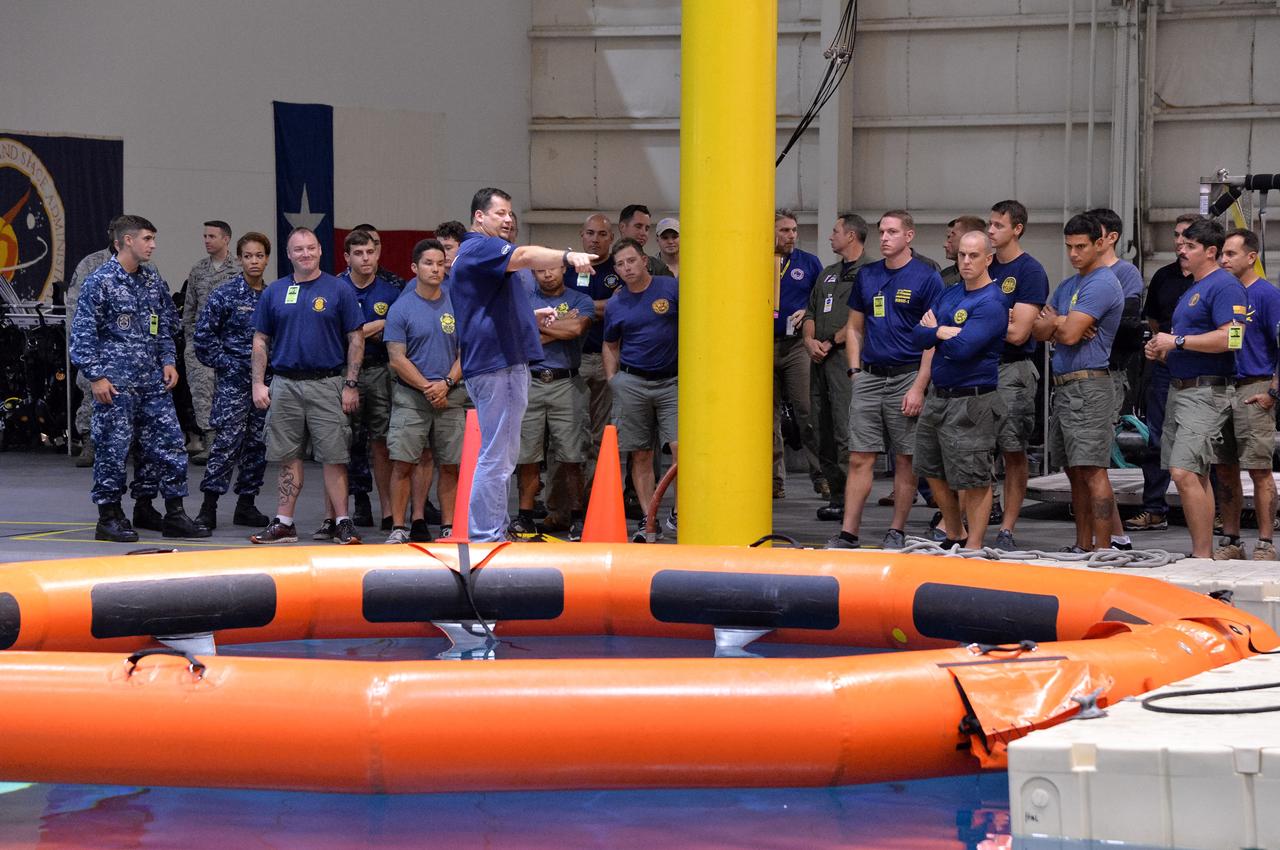
Tim Goddard, NASA Open Water Recovery Operations director, briefs U.S. Navy divers, Air Force pararescuemen and Coast Guard rescue swimmers during training in the Neutral Buoyancy Laboratory at NASA’s Johnson Space Center in Houston. The group is preparing to practice Orion underway recovery techniques using a test version of the Orion spacecraft. Training will help the team prepare for Underway Recovery Test 5 for Exploration Mission 1 aboard the USS San Diego in the Pacific Ocean off the coast of California in October. The Ground Systems Development and Operations Program, along with the U.S. Navy and Lockheed Martin, are preparing the recovery team, hardware and operations to support EM-1 recovery.
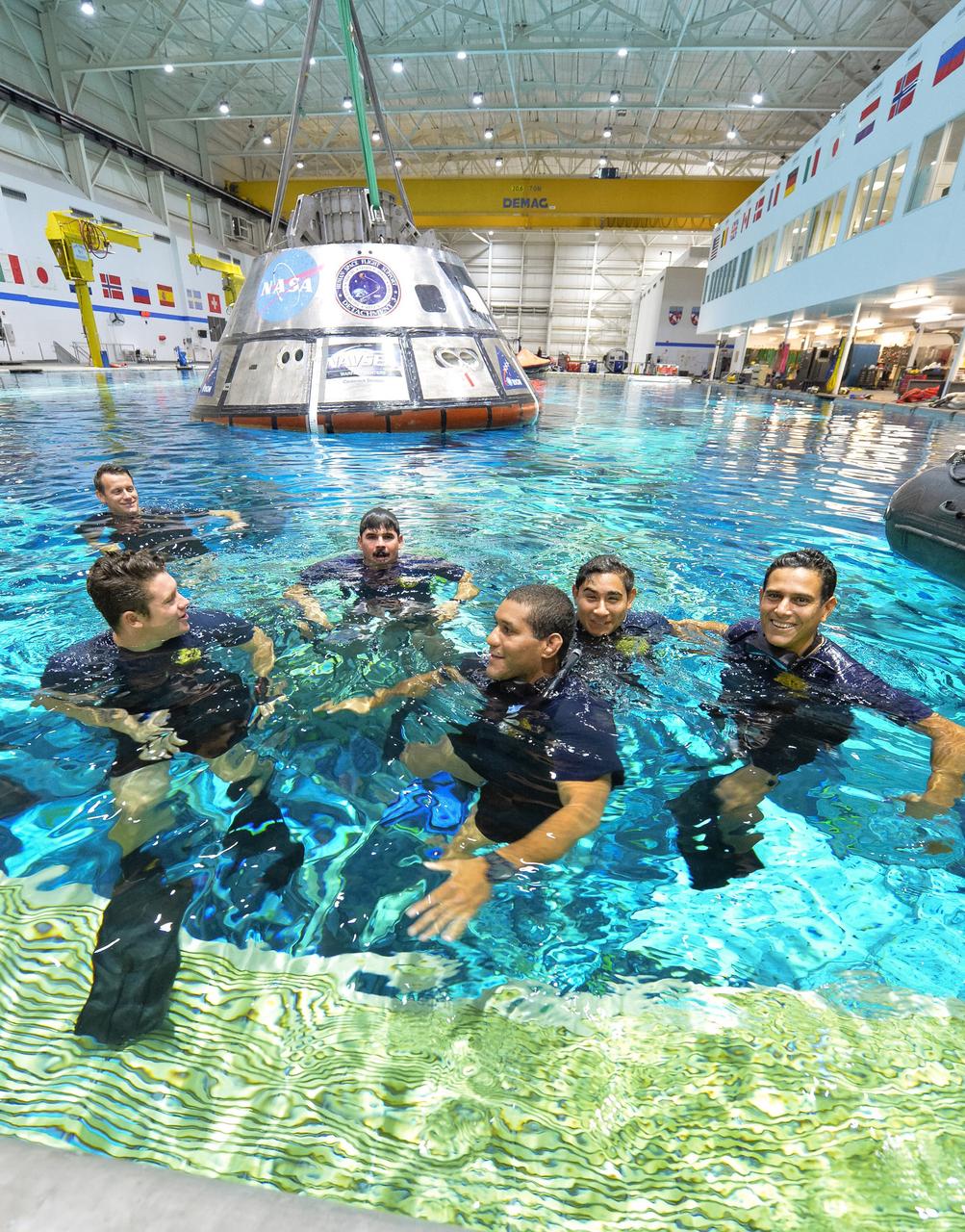
U.S. Navy divers are training in the Neutral Buoyancy Laboratory at NASA’s Johnson Space Center in Houston. Navy divers, Air Force pararescuemen and Coast Guard rescue swimmers practice Orion underway recovery techniques using a test version of the Orion spacecraft. Training will help the team prepare for Underway Recovery Test 5 for Exploration Mission 1 aboard the USS San Diego in the Pacific Ocean off the coast of California in October. The Ground Systems Development and Operations Program, along with the U.S. Navy and Lockheed Martin, are preparing the recovery team, hardware and operations to support EM-1 recovery.
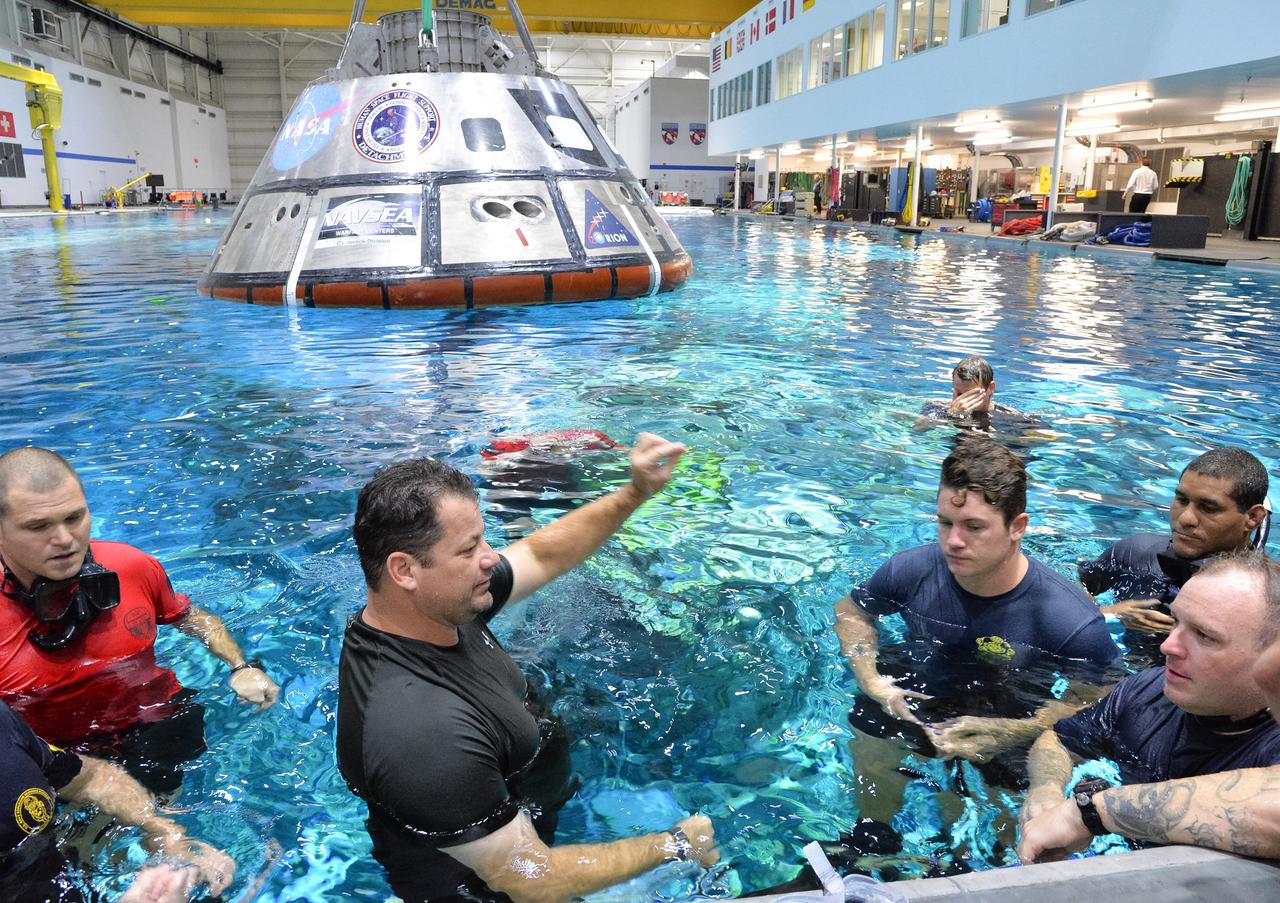
Tim Goddard, center, NASA Open Water Recovery Operations director, reviews recovery procedures with U.S. Navy divers, Air Force pararescuemen and Coast Guard rescue swimmers during training in the Neutral Buoyancy Laboratory at NASA’s Johnson Space Center in Houston. The group is practicing Orion underway recovery techniques using a test version of the Orion spacecraft. Training will help the team prepare for Underway Recovery Test 5 for Exploration Mission 1 aboard the USS San Diego in the Pacific Ocean off the coast of California in October. The Ground Systems Development and Operations Program, along with the U.S. Navy and Lockheed Martin, are preparing the recovery team, hardware and operations to support EM-1 recovery.
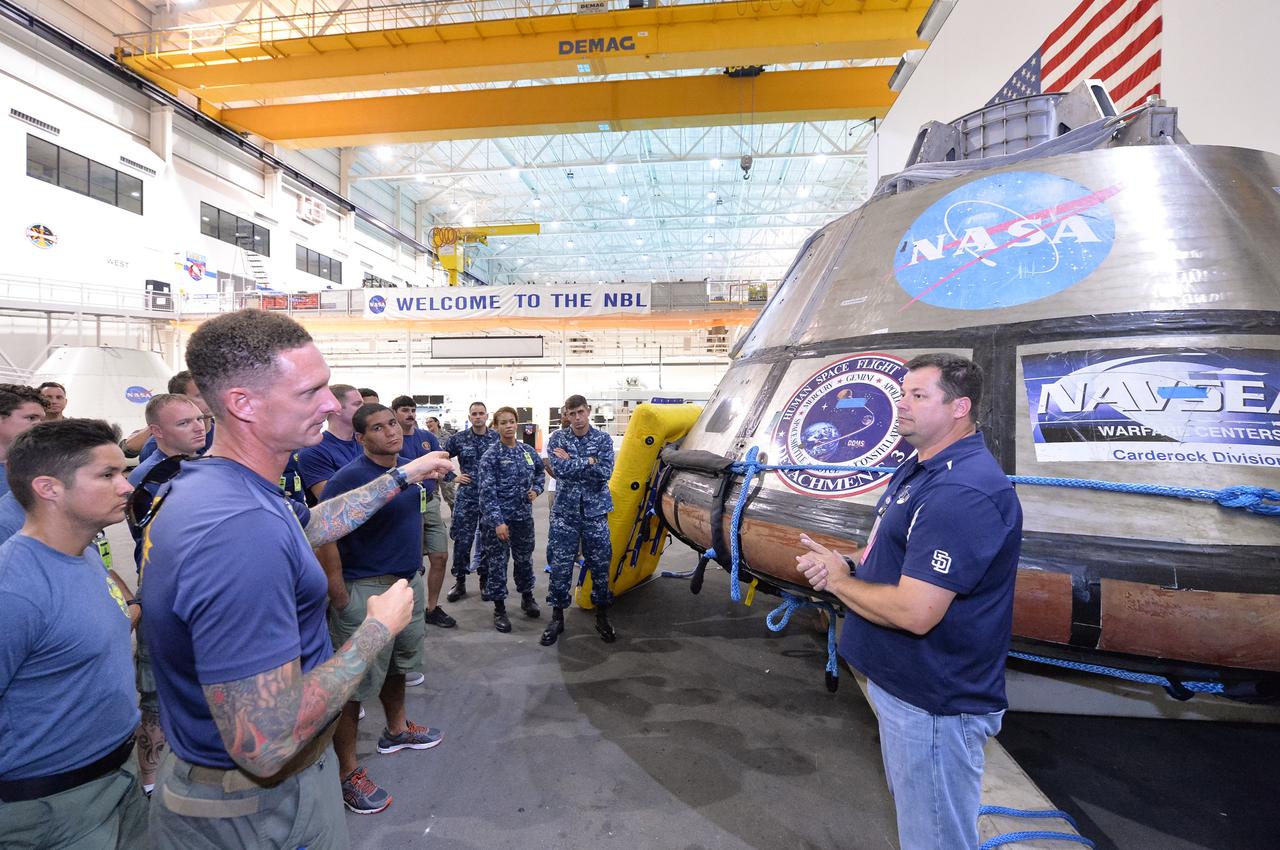
Tim Goddard, far right, NASA Open Water Recovery Operations director, briefs U.S. Navy divers, Air Force pararescuemen and Coast Guard rescue swimmers during training in the Neutral Buoyancy Laboratory at NASA’s Johnson Space Center in Houston. The group is preparing to practice Orion underway recovery techniques using a test version of the Orion spacecraft. Training will help the team prepare for Underway Recovery Test 5 for Exploration Mission 1 aboard the USS San Diego in the Pacific Ocean off the coast of California in October. The Ground Systems Development and Operations Program, along with the U.S. Navy and Lockheed Martin, are preparing the recovery team, hardware and operations to support EM-1 recovery.
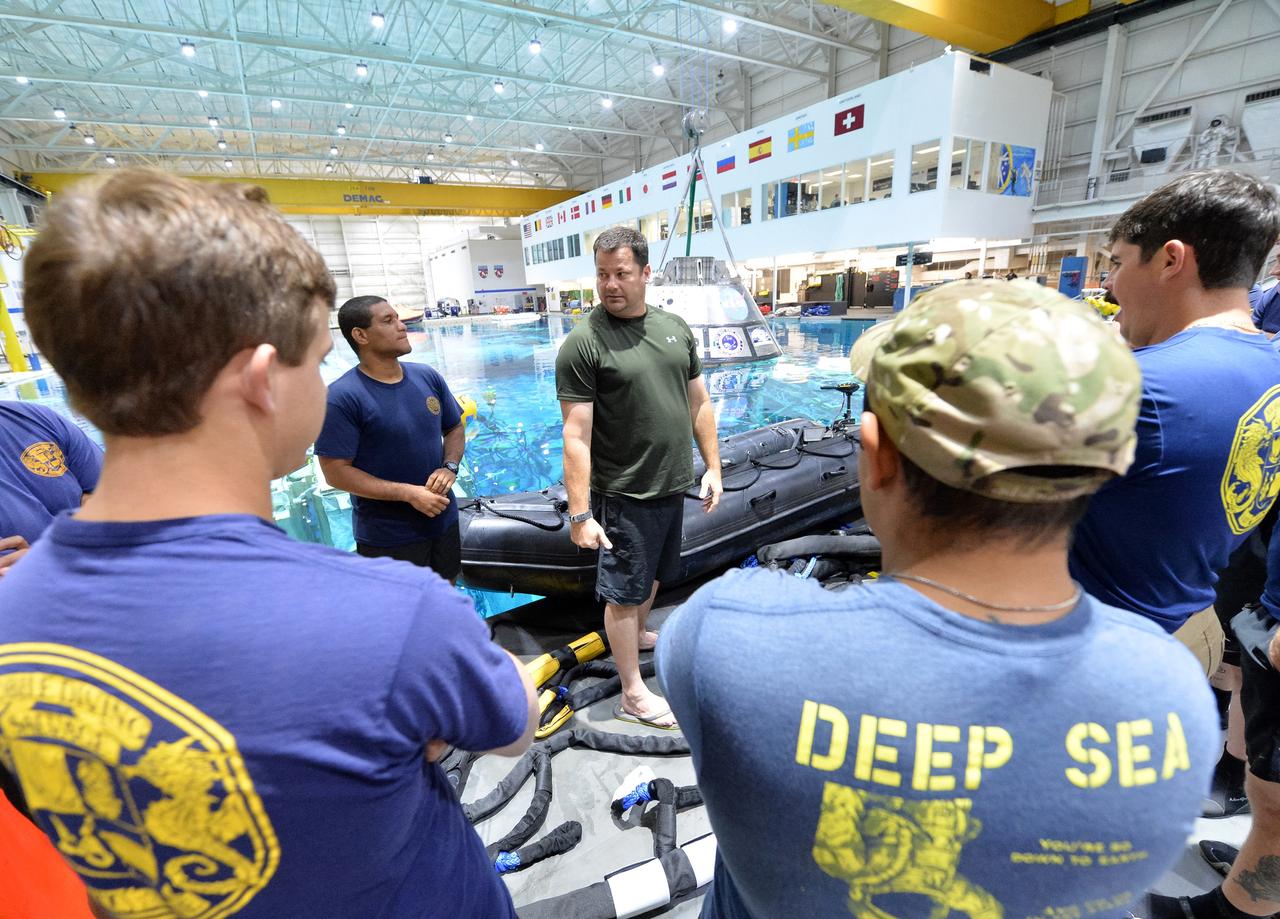
Tim Goddard, center, NASA Open Water Recovery Operations director, briefs U.S. Navy divers, Air Force pararescuemen and Coast Guard rescue swimmers during training in the Neutral Buoyancy Laboratory at NASA’s Johnson Space Center in Houston. The group will practice Orion underway recovery techniques using a test version of the Orion spacecraft. Training will help the team prepare for Underway Recovery Test 5 for Exploration Mission 1 aboard the USS San Diego in the Pacific Ocean off the coast of California in October. The Ground Systems Development and Operations Program, along with the U.S. Navy and Lockheed Martin, are preparing the recovery team, hardware and operations to support EM-1 recovery.
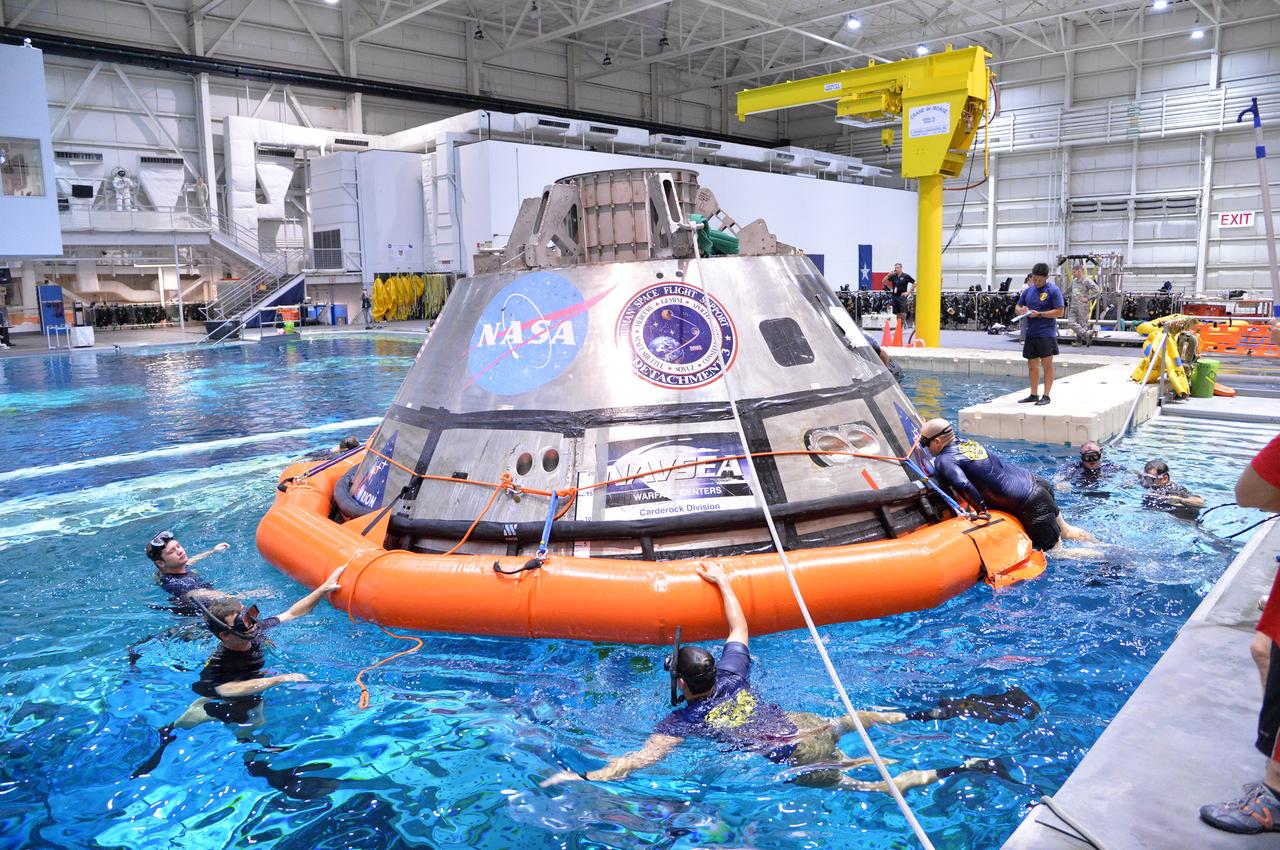
U.S. Navy divers, Air Force pararescuemen and Coast Guard rescue swimmers practice Orion recovery techniques at the Neutral Buoyancy Laboratory (NBL) at the agency’s Johnson Space Center in Houston. The recovery team is practicing underway recovery techniques using a test version of the Orion spacecraft. Training will help the team prepare for Underway Recovery Test 5 for Exploration Mission 1 aboard the USS San Diego in the Pacific Ocean off the coast of California in October. The Ground Systems Development and Operations Program, along with the U.S. Navy and Lockheed Martin, are preparing the recovery team, hardware and operations to support EM-1 recovery.
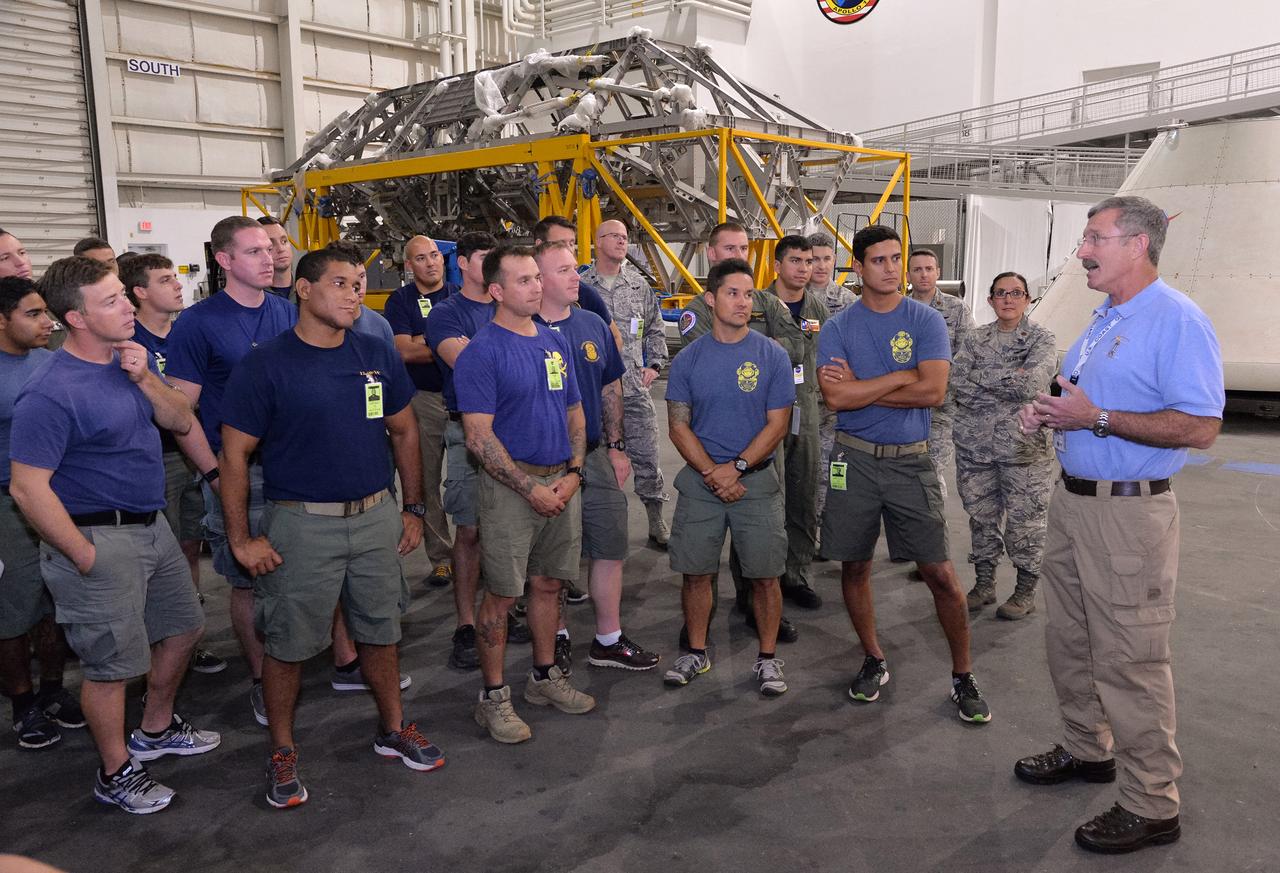
NASA astronaut Dan Burbank speaks to a group of U.S. Navy divers at the Neutral Buoyancy Laboratory (NBL) at the agency’s Johnson Space Center in Houston. Navy divers, Air Force pararescuemen and Coast Guard rescue swimmers are preparing to practice Orion underway recovery techniques with a test version of the Orion spacecraft. Training will help the team prepare for Underway Recovery Test 5 for Exploration Mission 1 aboard the USS San Diego in the Pacific Ocean off the coast of California in October. The Ground Systems Development and Operations Program, along with the U.S. Navy and Lockheed Martin, are preparing the recovery team, hardware and operations to support EM-1 recovery.
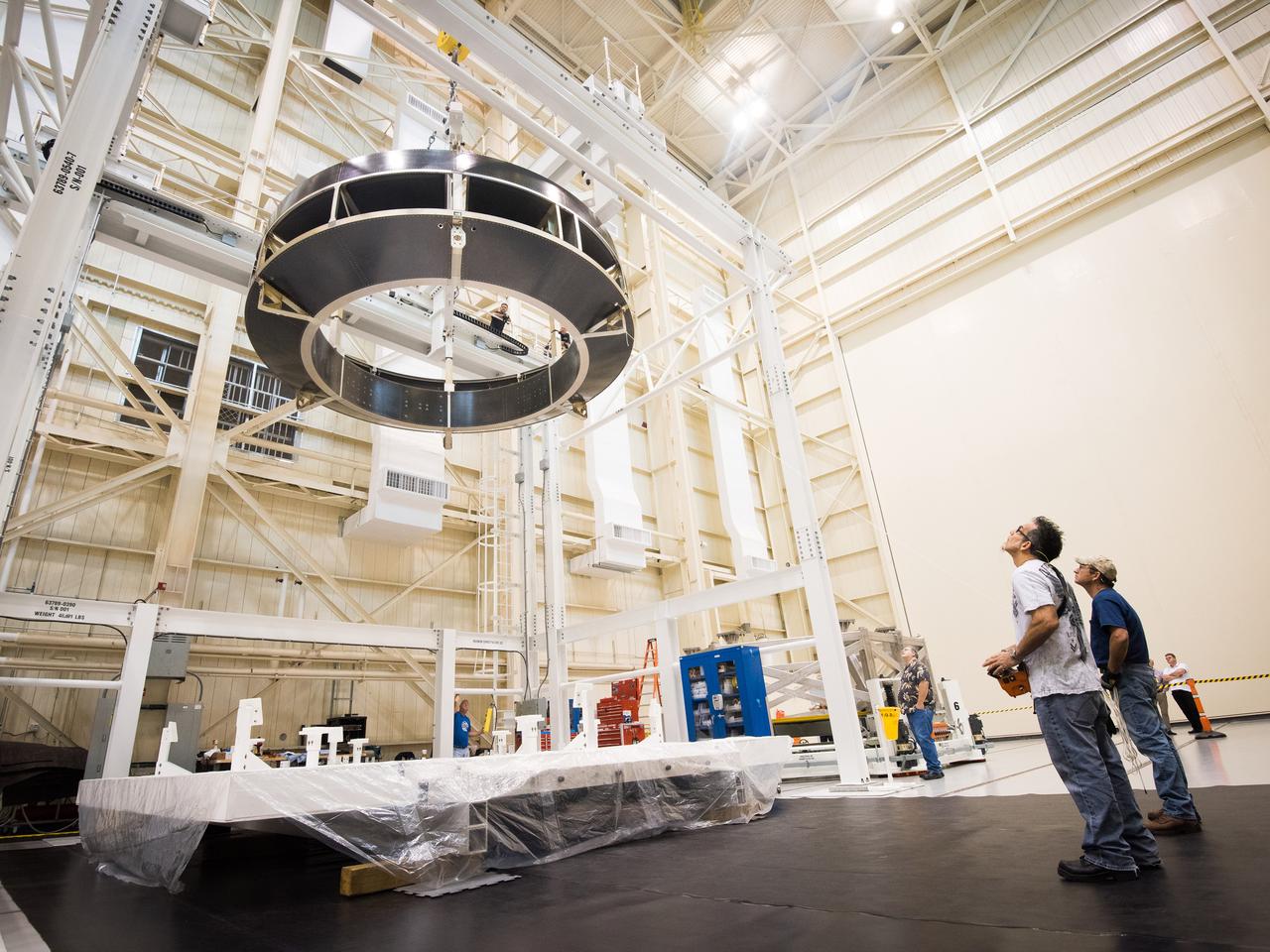
Offloading of the Orion Crew Module Adapter, CMA, at Plum Brook Station. The adapter will connect Orion’s crew module to a service module provided by ESA (European Space Agency). NASA is preparing for a series of tests that will check out the Orion European Service Module, a critical part of the spacecraft that will be launched on future missions to an asteroid and on toward Mars.
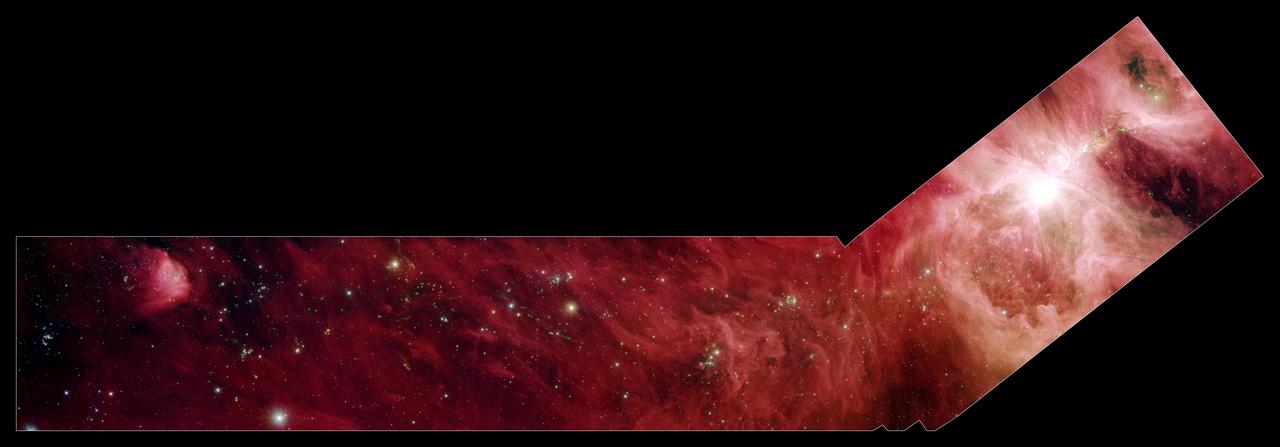
This image composite shows a part of the Orion constellation surveyed by NASA Spitzer Space Telescope. The shape of the main image was designed by astronomers to roughly follow the shape of Orion cloud A, an enormous star-making factory.

The Orion spacecraft delivers the Crew and Science Airlock (represented here by a government reference design) to the Gateway Space Station on the Artemis VI mission. The Mohammed Bin Rashid Space Centre of the United Arab Emirates will provide the airlock for Gateway, humanity's first space station that will orbit the Moon.
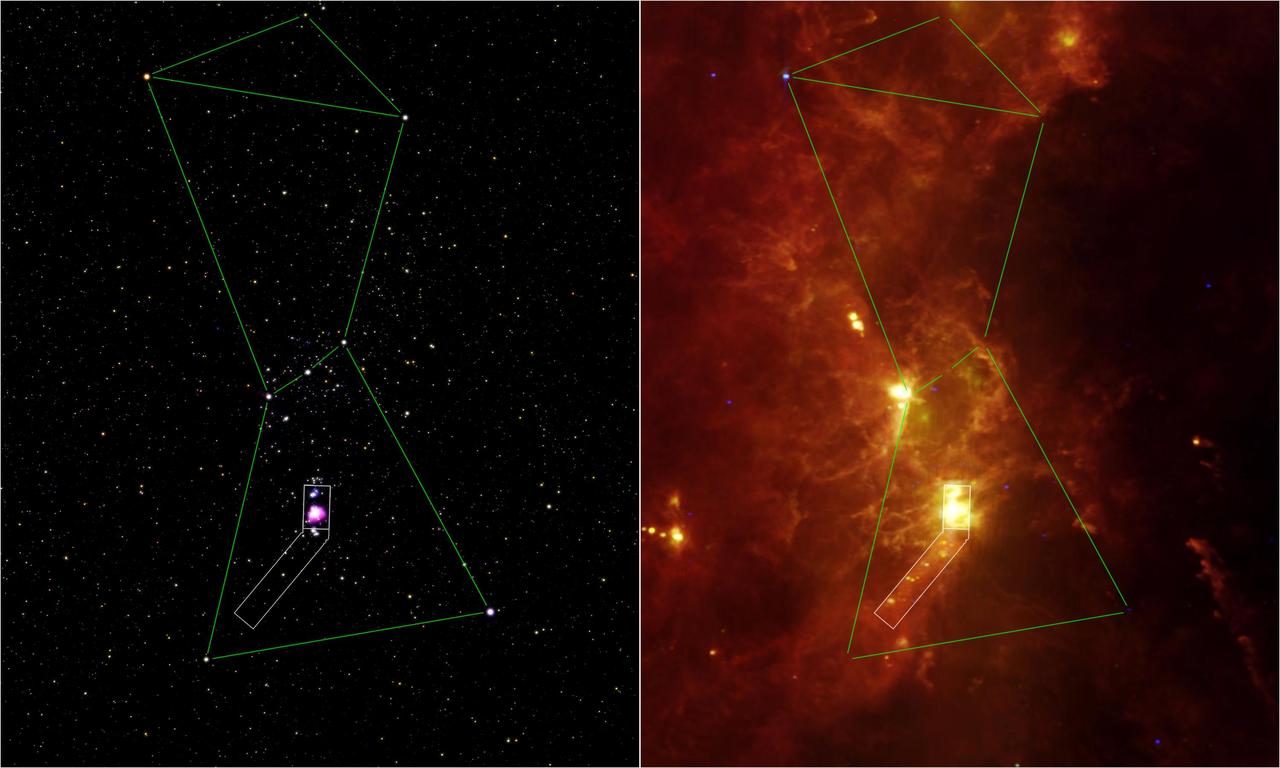
This image composite outlines the region near Orion sword that was surveyed by NASA Spitzer Space Telescope white box. The Orion nebula, our closest massive star-making factory, is the brightest spot near the hunter sword.
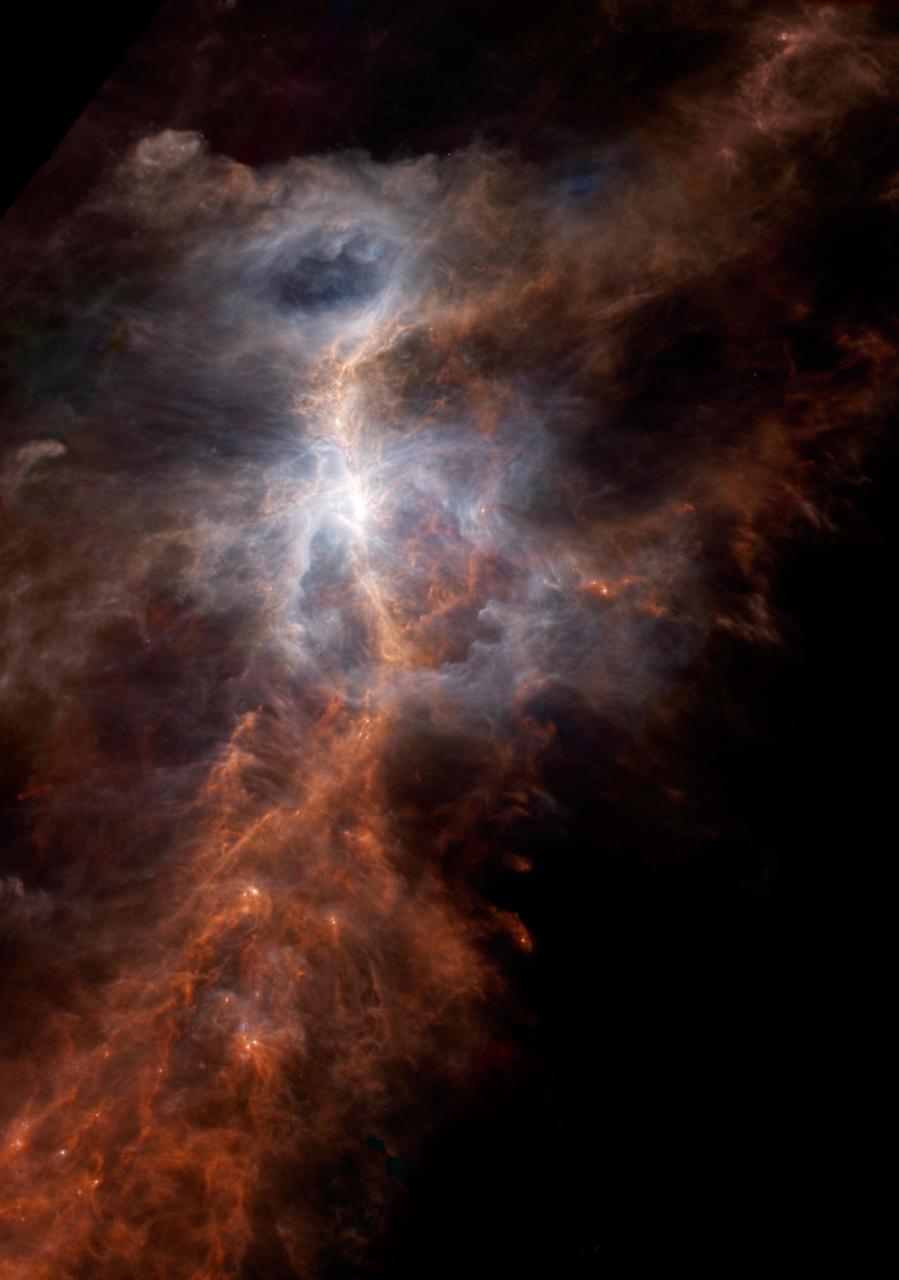
The dusty side of the Sword of Orion is illuminated in this striking infrared image from the European Space Agency's Hershel Space Observatory. This immense nebula is the closest large region of star formation, situated about 1,500 light years away in the constellation of Orion. The parts that are easily observed in visible light, known alternatively as the Orion Nebula or Messier 42, correspond to the light blue regions. This is the glow from the warmest dust, illuminated by clusters of hot stars that have only recently been born in this chaotic region. The red spine of material running from corner to corner reveals colder, denser filaments of dust and gas that are scattered throughout the Orion nebula. In visible light this would be a dark, opaque feature, hiding the reservoir of material from which stars have recently formed and will continue to form in the future. Herschel data from the PACS instrument observations, at wavelengths of 100 and 160 microns, is displayed in blue and green, respectively, while SPIRE 250-micron data is shown in red. Within the inset image, the emission from ionized carbon atoms (C+), overlaid in yellow, was isolated and mapped out from spectrographic data obtained by the HIFI instrument. http://photojournal.jpl.nasa.gov/catalog/PIA21073
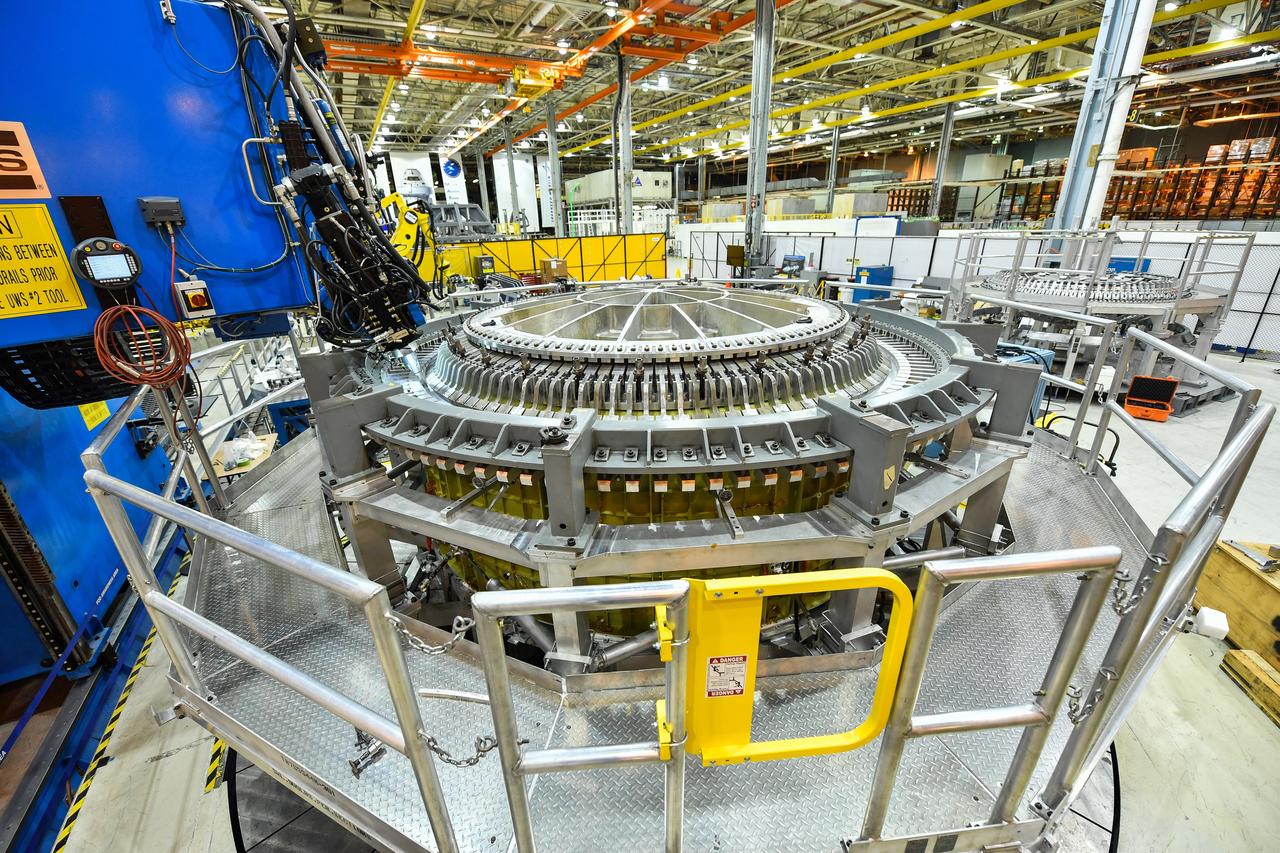
Orion STA PV4 Weld
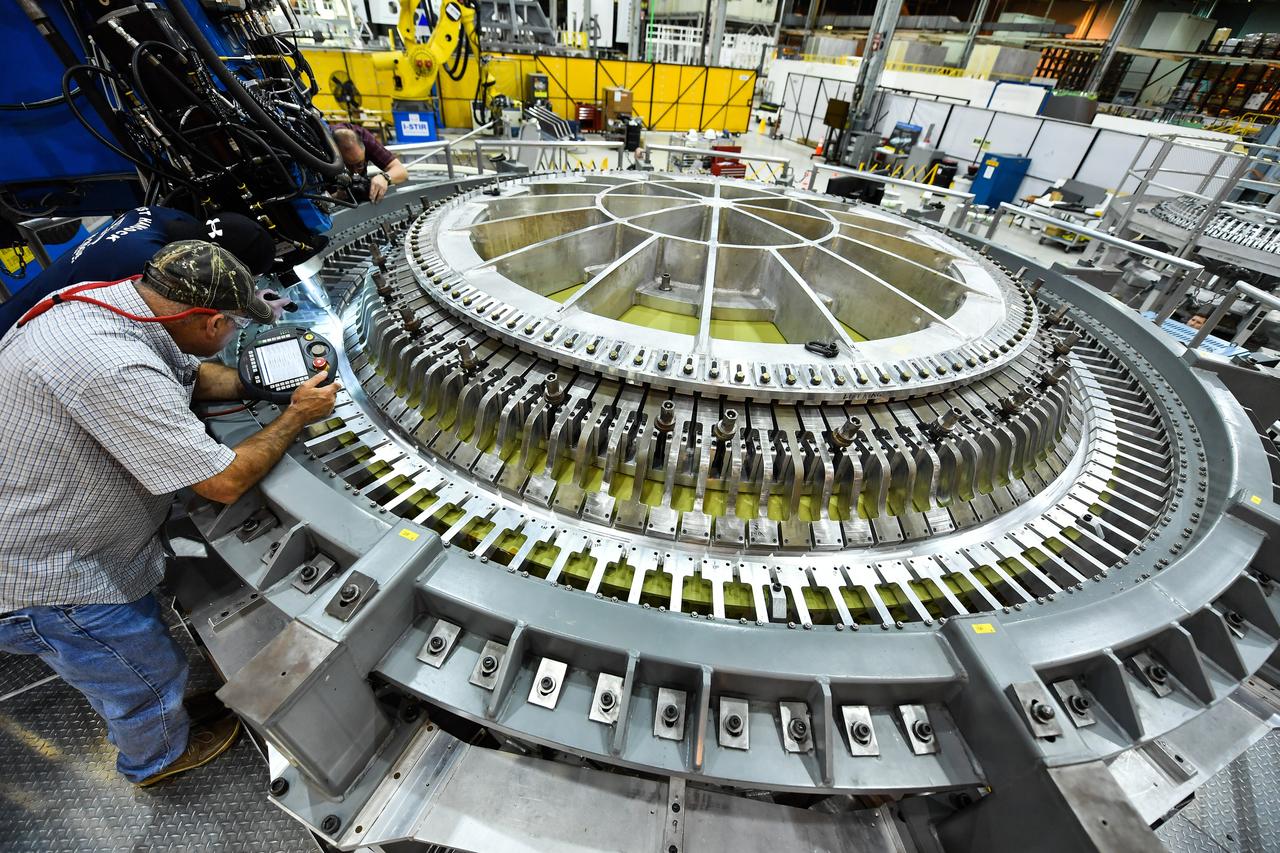
Orion STA PV4 Weld
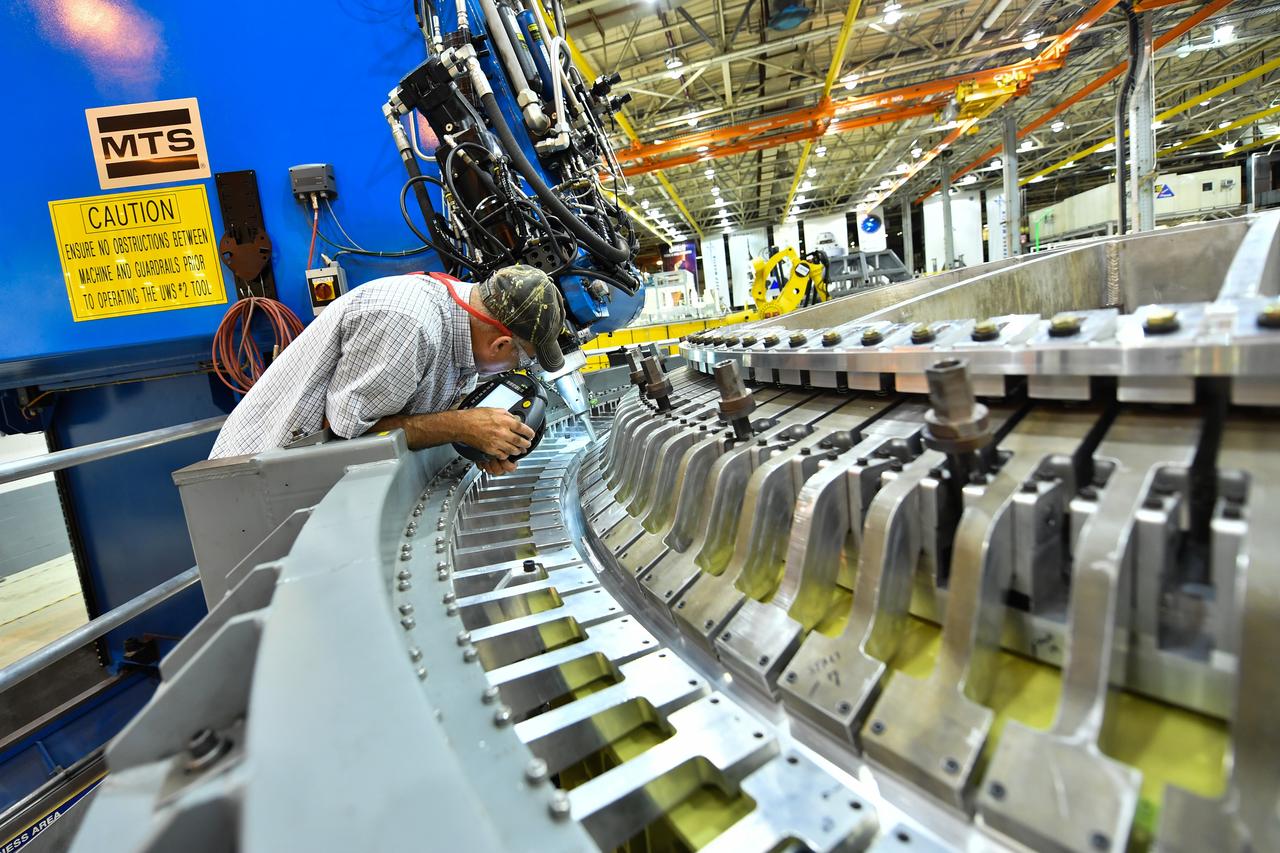
Orion STA PV4 Weld
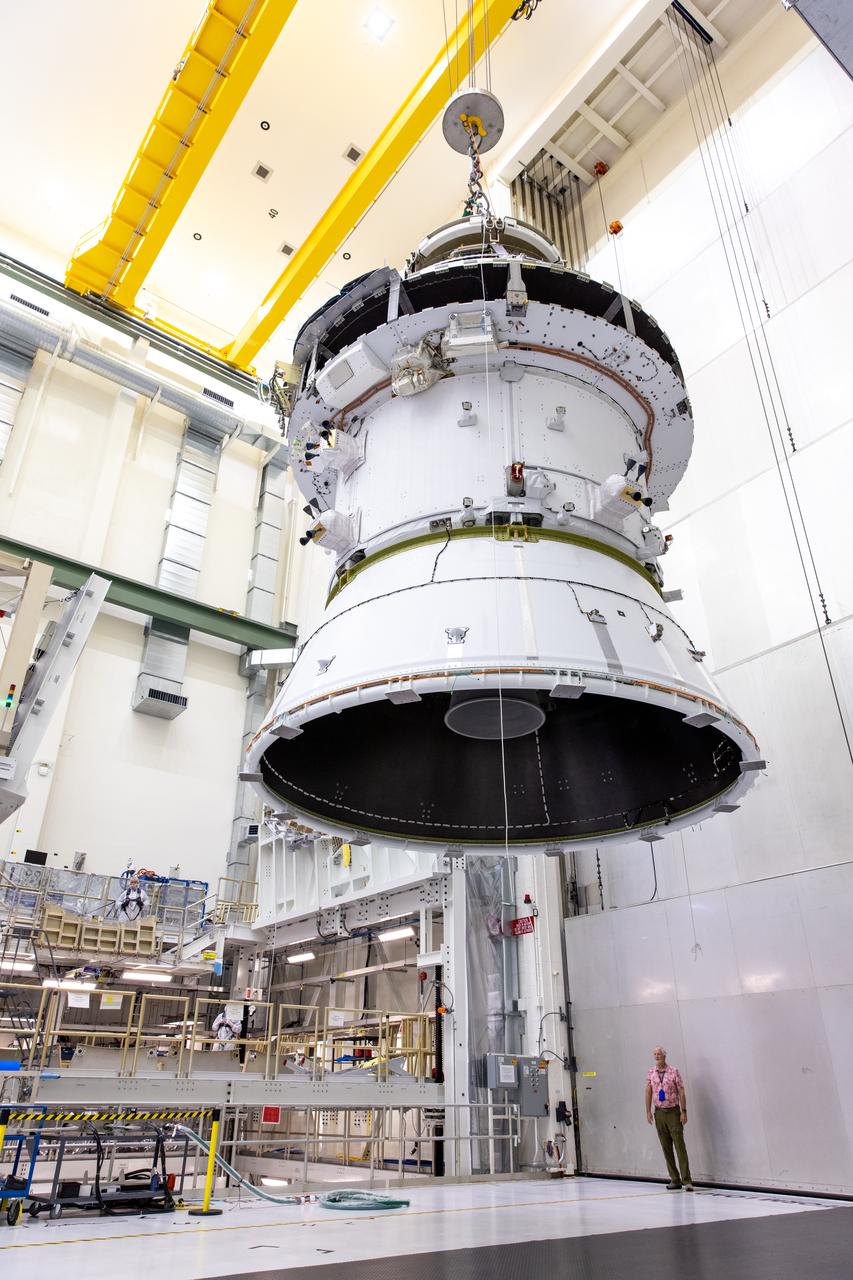
A massive crane lifts NASA’s Orion spacecraft out of the Final Assembly and System Testing cell and moves it to the altitude chamber to complete further testing on Thursday, Nov. 7, 2024, inside the Neil A. Armstrong Operations and Checkout building at NASA's Kennedy Space Center in Florida. The altitude chamber simulates deep space vacuum conditions, and the testing will provide additional data to augment data gained during testing earlier this summer. The Orion spacecraft will carry NASA astronauts Victor Glover, Christina Koch, and Reid Wiseman, as well as CSA (Canadian Space Agency) astronaut Jeremy Hansen, on a 10-day journey around the Moon and back for the Artemis II test flight.
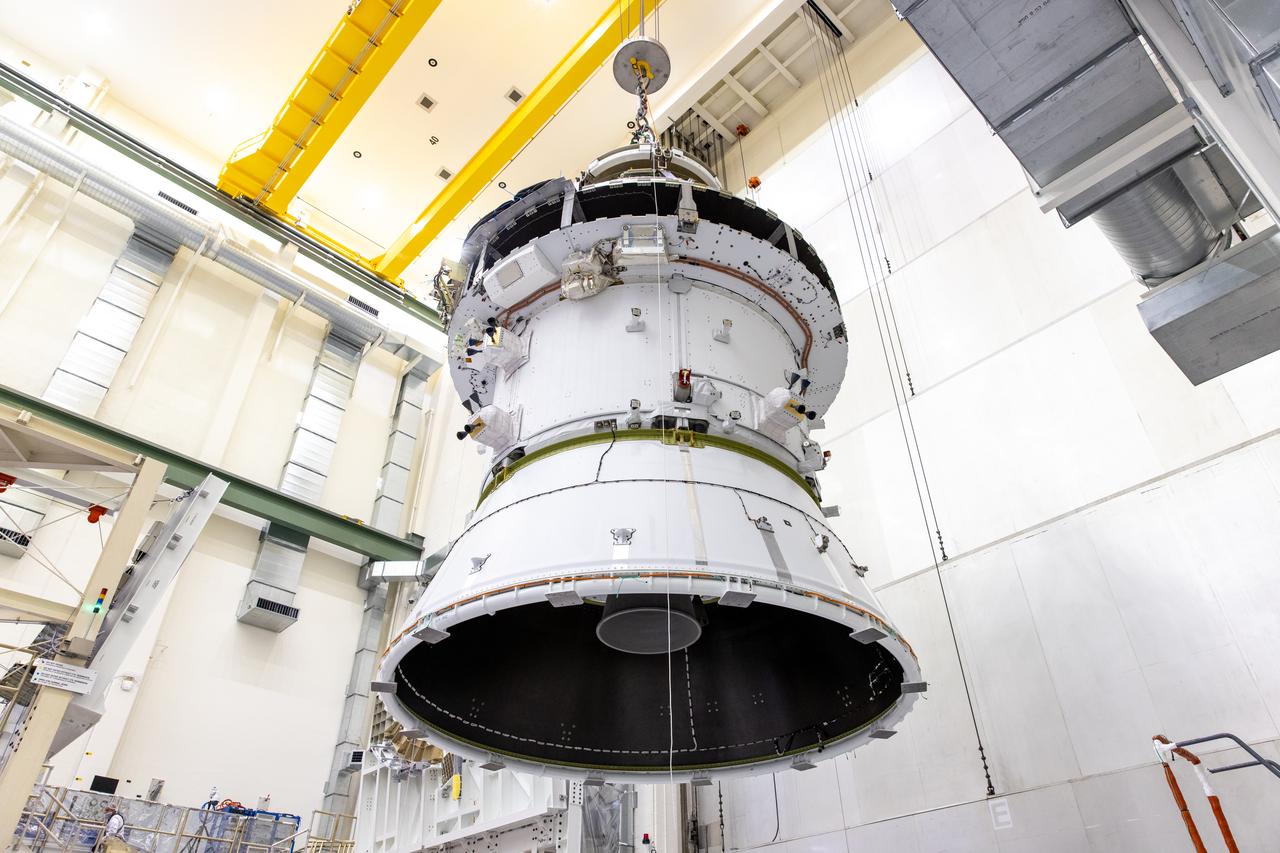
A massive crane lifts NASA’s Orion spacecraft out of the Final Assembly and System Testing cell and moves it to the altitude chamber to complete further testing on Thursday, Nov. 7, 2024, inside the Neil A. Armstrong Operations and Checkout building at NASA's Kennedy Space Center in Florida. The altitude chamber simulates deep space vacuum conditions, and the testing will provide additional data to augment data gained during testing earlier this summer. The Orion spacecraft will carry NASA astronauts Victor Glover, Christina Koch, and Reid Wiseman, as well as CSA (Canadian Space Agency) astronaut Jeremy Hansen, on a 10-day journey around the Moon and back for the Artemis II test flight.
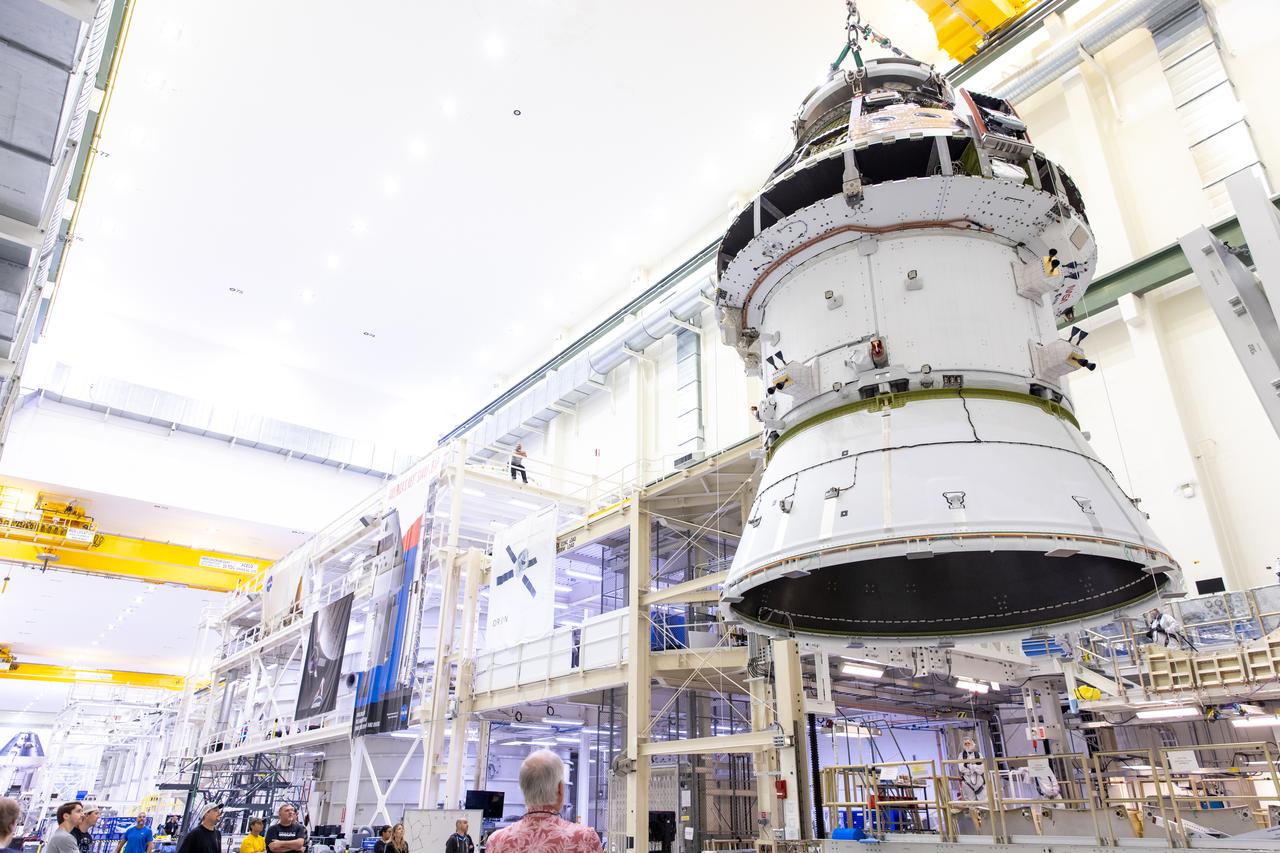
A massive crane lifts NASA’s Orion spacecraft out of the Final Assembly and System Testing cell and moves it to the altitude chamber to complete further testing on Thursday, Nov. 7, 2024, inside the Neil A. Armstrong Operations and Checkout building at NASA's Kennedy Space Center in Florida. The altitude chamber simulates deep space vacuum conditions, and the testing will provide additional data to augment data gained during testing earlier this summer. The Orion spacecraft will carry NASA astronauts Victor Glover, Christina Koch, and Reid Wiseman, as well as CSA (Canadian Space Agency) astronaut Jeremy Hansen, on a 10-day journey around the Moon and back for the Artemis II test flight.
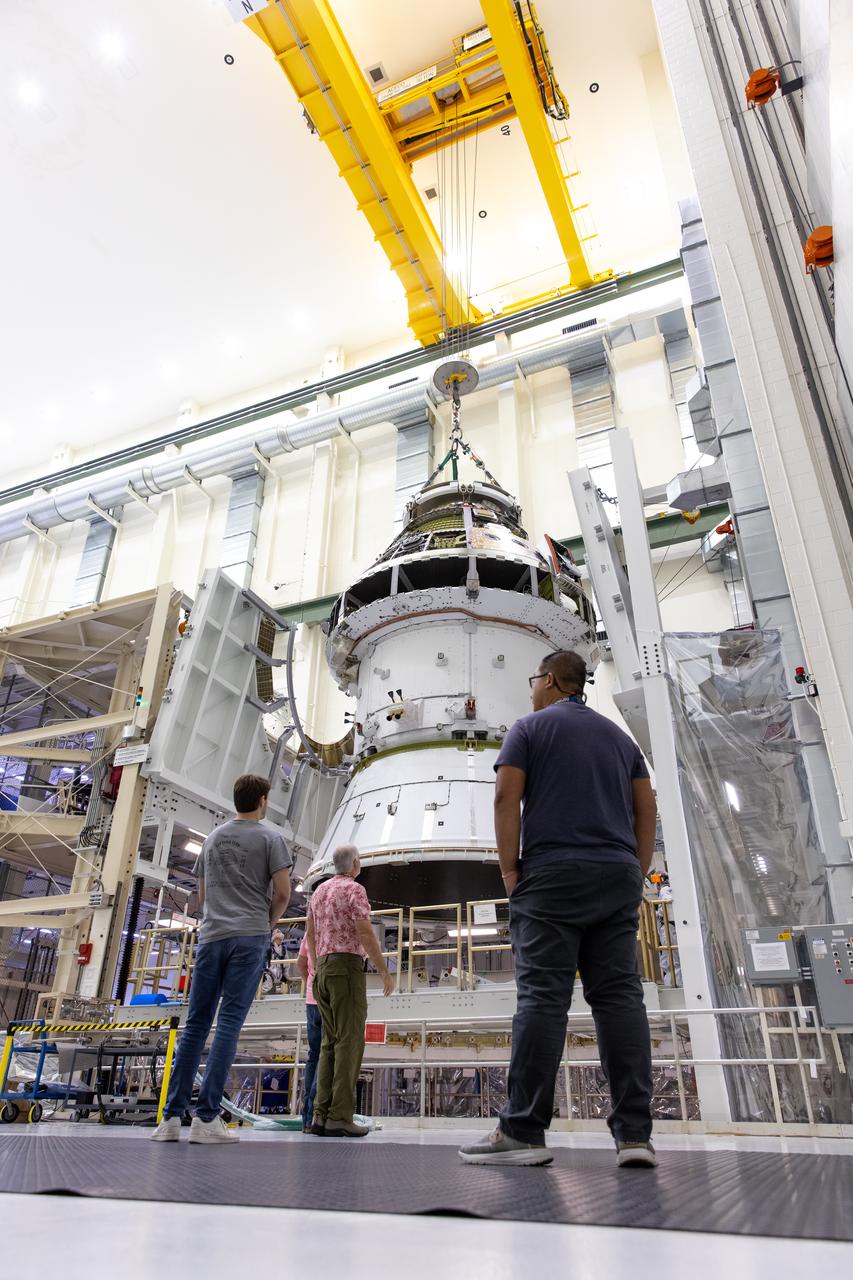
A massive crane lifts NASA’s Orion spacecraft out of the Final Assembly and System Testing cell and moves it to the altitude chamber to complete further testing on Thursday, Nov. 7, 2024, inside the Neil A. Armstrong Operations and Checkout building at NASA's Kennedy Space Center in Florida. The altitude chamber simulates deep space vacuum conditions, and the testing will provide additional data to augment data gained during testing earlier this summer. The Orion spacecraft will carry NASA astronauts Victor Glover, Christina Koch, and Reid Wiseman, as well as CSA (Canadian Space Agency) astronaut Jeremy Hansen, on a 10-day journey around the Moon and back for the Artemis II test flight.

A technician connects support straps to a crane as it prepares to lift NASA’s Orion spacecraft out of the Final Assembly and Systems Testing cell to the altitude chamber inside the Neil A. Armstrong Operations and Checkout building at NASA’s Kennedy Space Center in Florida on Thursday, Nov. 7, 2024. The altitude chamber simulates deep space vacuum conditions, and the testing will provide additional data to augment data gained during testing earlier this summer. The Orion spacecraft will carry NASA astronauts Victor Glover, Christina Koch, and Reid Wiseman, as well as CSA (Canadian Space Agency) astronaut Jeremy Hansen, on a 10-day journey around the Moon and back for the Artemis II test flight.
Help from Orion
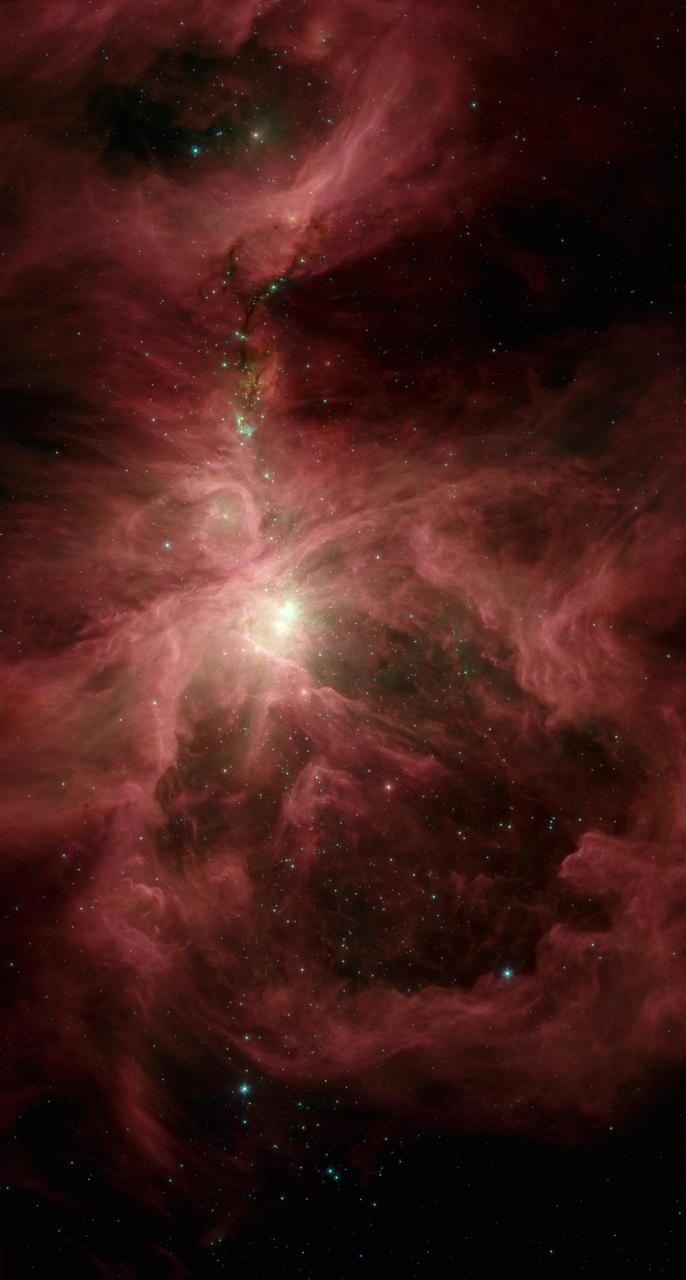
This image from NASA Spitzer Space Telescope shows the Orion nebula, our closest massive star-making factory, 1,450 light-years from Earth. The nebula is close enough to appear to the naked eye as a fuzzy star in the sword of the constellation.

Astronomers using NASA Hubble Space Telescope have found a bow shock around a very young star in the nearby Orion nebula, an intense star-forming region of gas and dust.
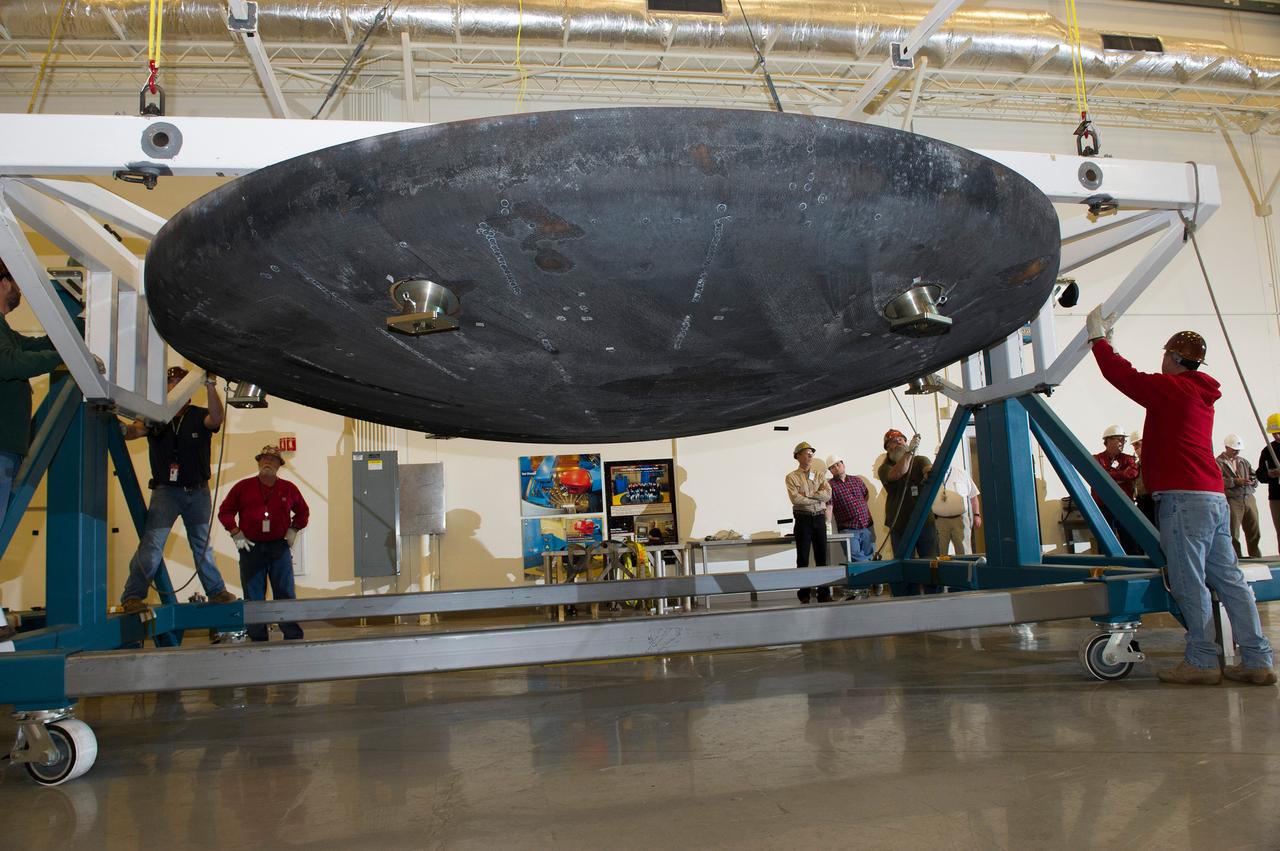
ORION HEAT SHIELD
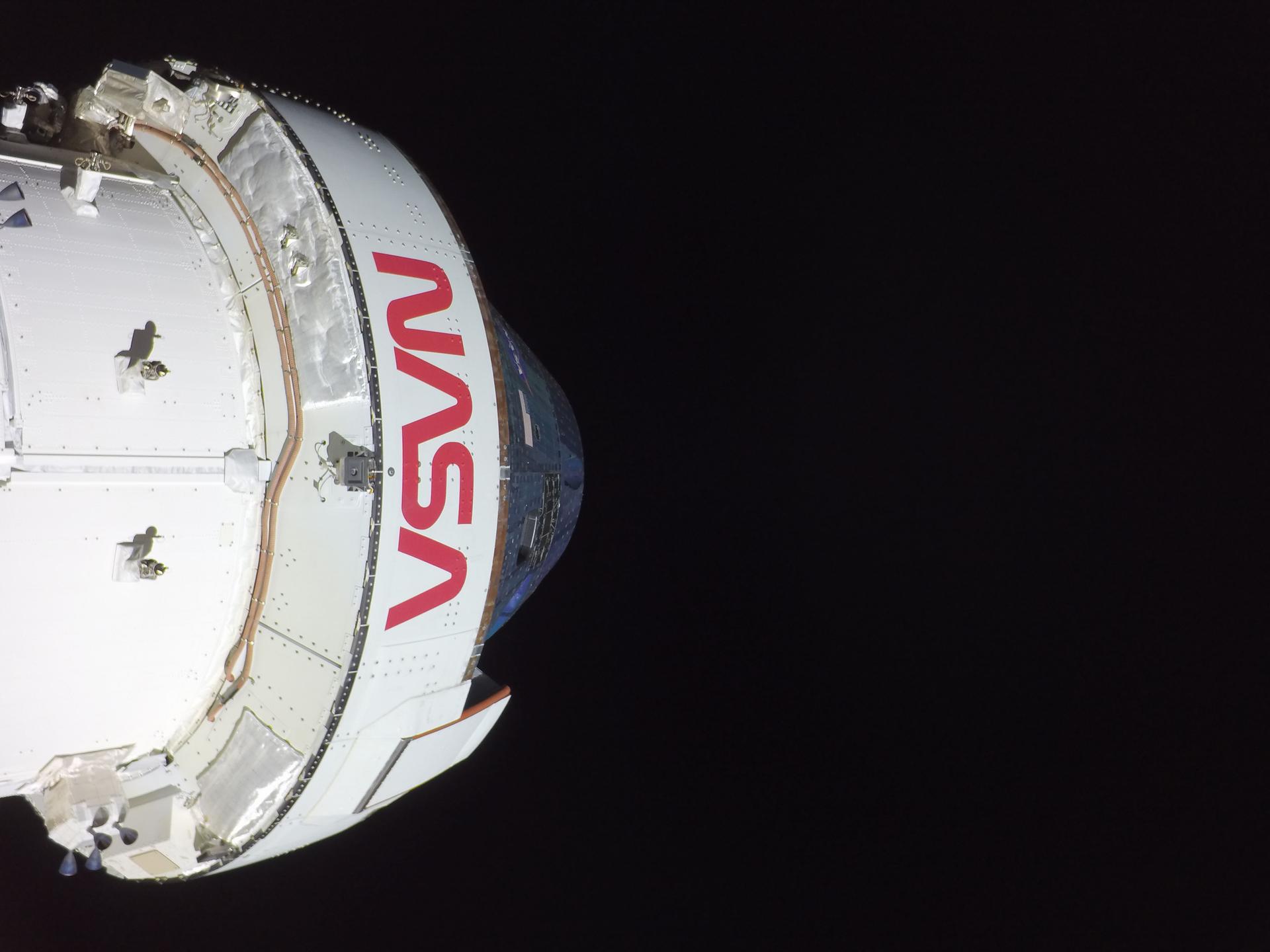
art002e012495 (April 7, 2026) - NASA’s Orion spacecraft is pictured here from one of the cameras mounted on its solar array wings. At the time this photo was taken at 9:03 a.m. ET, the Artemis II crew was in a sleep period ahead of beginning their seventh day into the mission. Credit: NASA

This first high-resolution image, taken on the first day of the Artemis I mission, was captured by a camera on the tip of one of Orion’s solar arrays. The spacecraft was 57,000 miles from Earth when the image was captured, and continues to distance itself from planet Earth as it approaches the Moon and distant retrograde orbit.
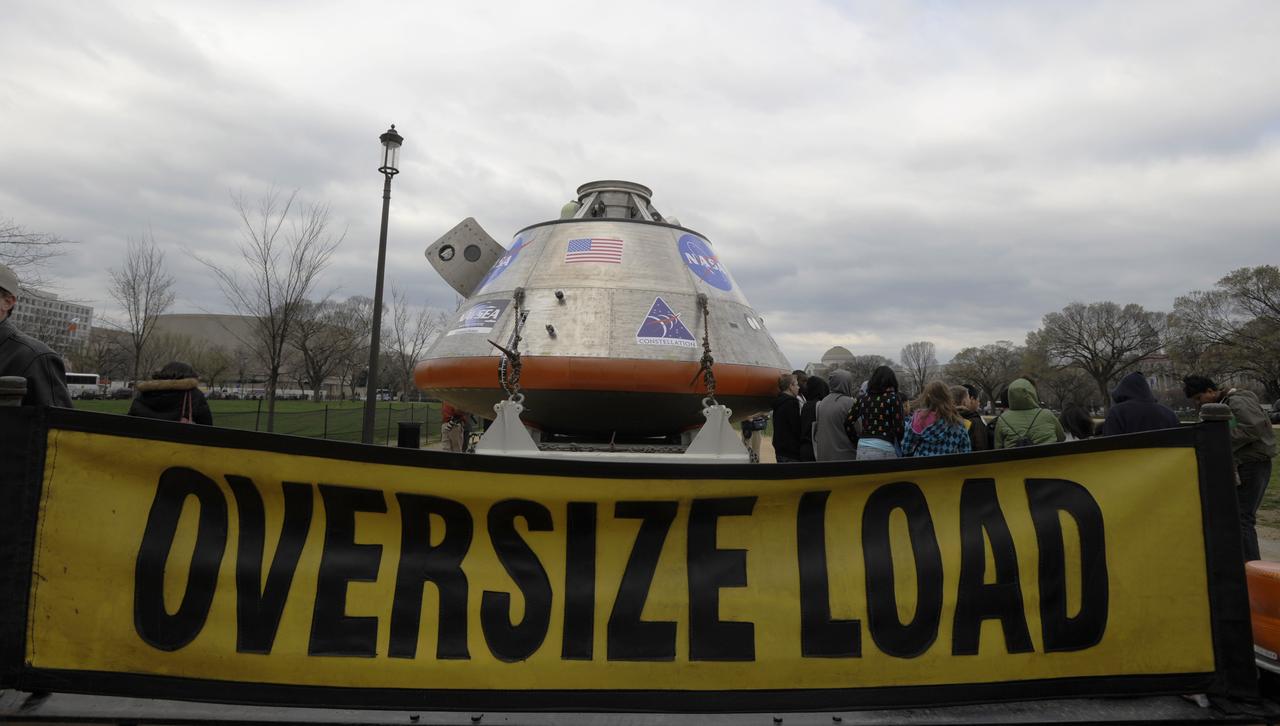
A mock up of the Orion Crew Module is seen on the National Mall in Washington, Monday, March 30, 2009. Orion is the flagship of NASA's programs for space exploration beyond low Earth orbit and a key element of NASA's Constellation Program to explore the moon, Mars and beyond. Photo Credit: (NASA/Paul. E. Alers)
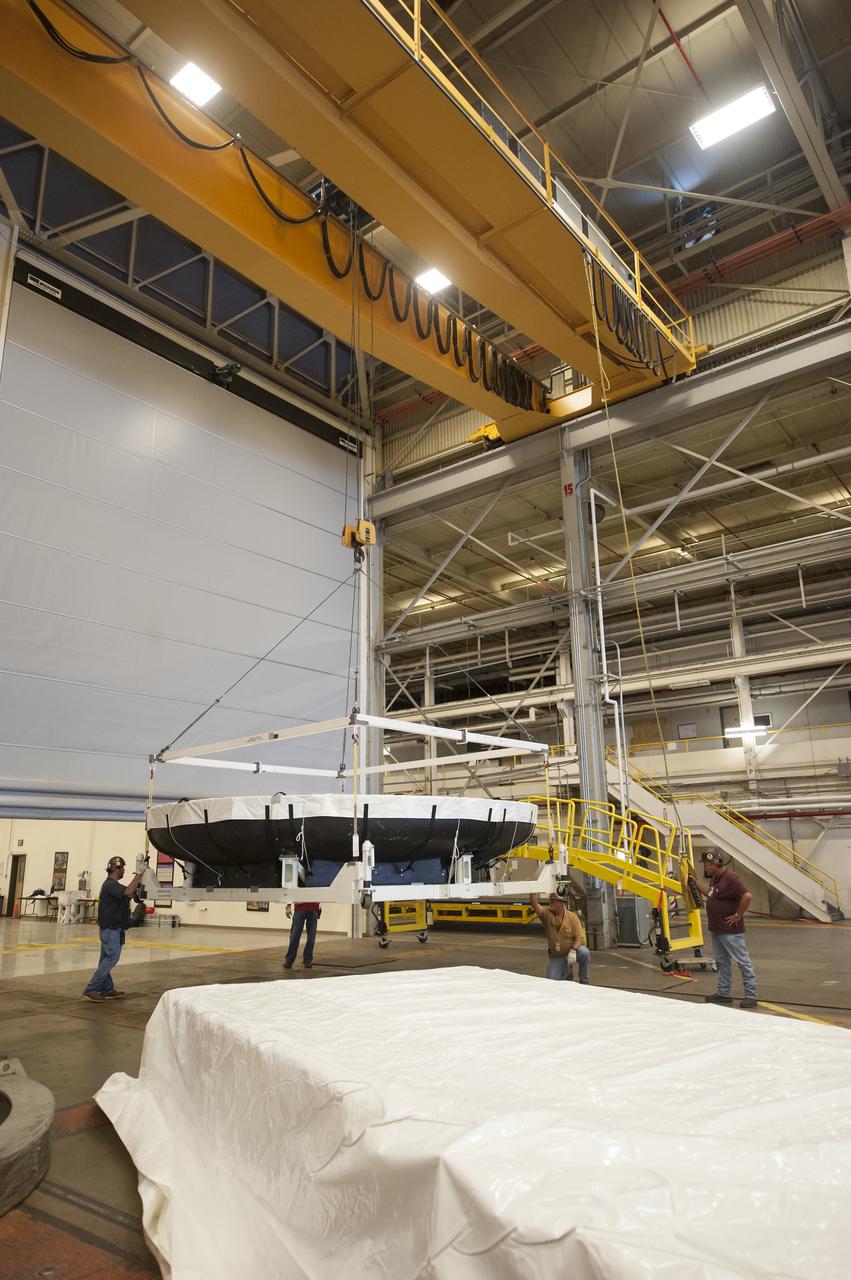
THE ORION HEAT SHIELD, WHICH WAS AT NASA’S MARSHALL SPACE FLIGHT CENTER FROM MARCH-MAY 2015 FOR ENGINEERING AND ANALYSIS, IS READIED FOR DEPARTURE AT THE END OF ITS STAY. THE HEAT SHIELD’S ABLATED SURFACE MATERIAL WAS REMOVED AT MARSHALL FOR ANALYSIS, USING THE CENTER’S STATE-OF-THE-ART SEVEN-AXIS MILLING MACHINE. IT NEXT WILL GO TO NASA’S LANGLEY RESEARCH CENTER FOR WATER-IMPACT TESTING. NASA’S JOHNSON SPACE CENTER LEADS THE ORION PROGRAM FOR NASA.
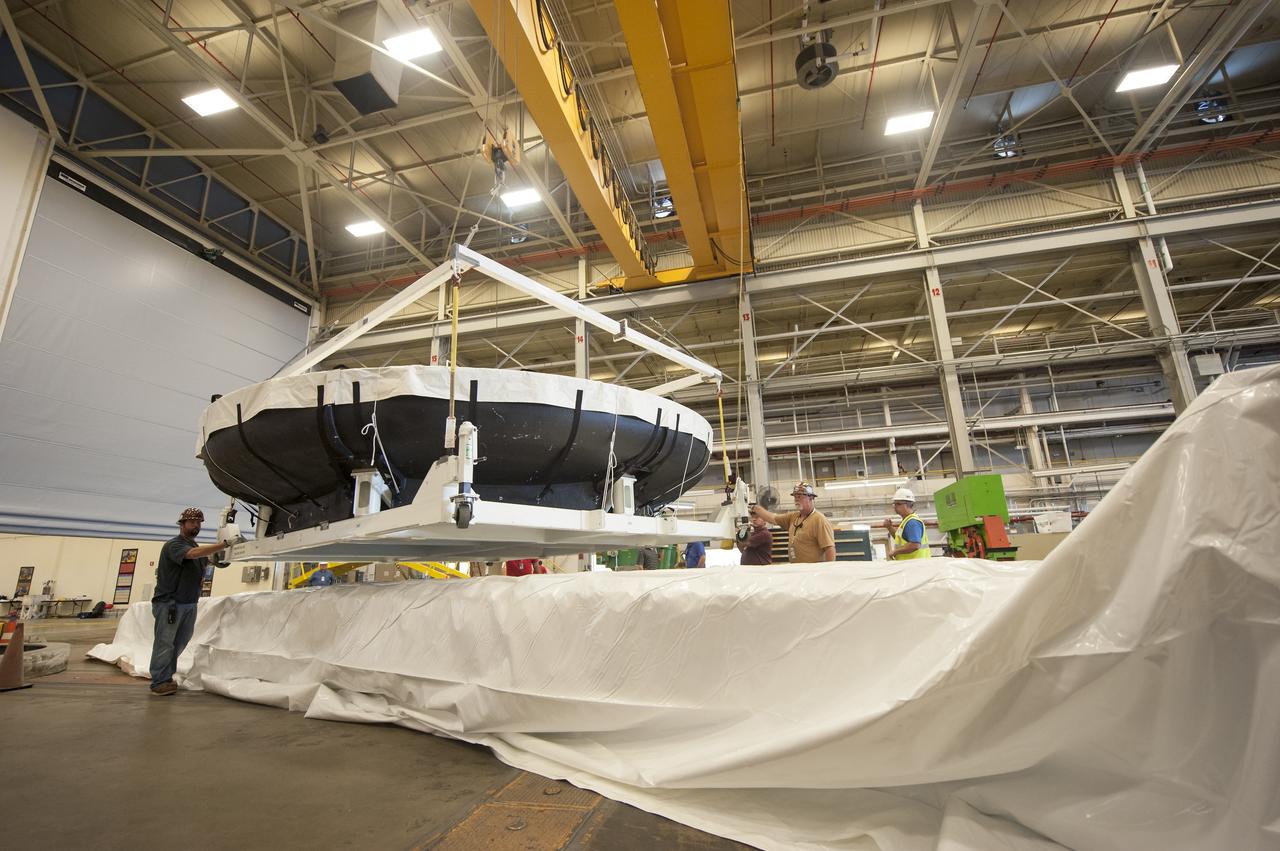
THE ORION HEAT SHIELD, WHICH WAS AT NASA’S MARSHALL SPACE FLIGHT CENTER FROM MARCH-MAY 2015 FOR ENGINEERING AND ANALYSIS, IS READIED FOR DEPARTURE AT THE END OF ITS STAY. THE HEAT SHIELD’S ABLATED SURFACE MATERIAL WAS REMOVED AT MARSHALL FOR ANALYSIS, USING THE CENTER’S STATE-OF-THE-ART SEVEN-AXIS MILLING MACHINE. IT NEXT WILL GO TO NASA’S LANGLEY RESEARCH CENTER FOR WATER-IMPACT TESTING. NASA’S JOHNSON SPACE CENTER LEADS THE ORION PROGRAM FOR NASA.
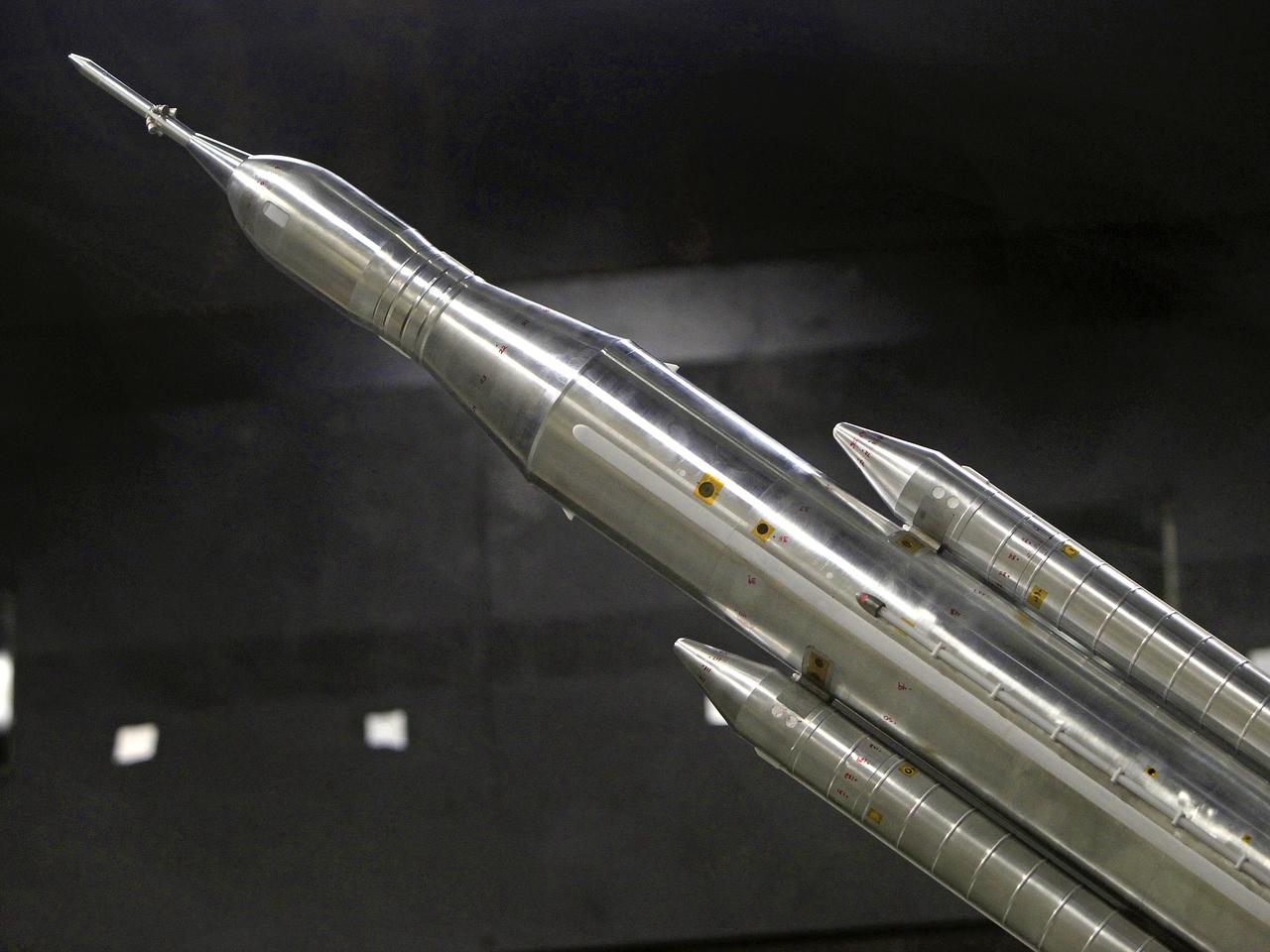
The model of the Space Launch System for the Orion Space Capsule is being prepared for windtunnel test in the 14x22 Subsonic windtunnel at NASA Langley.
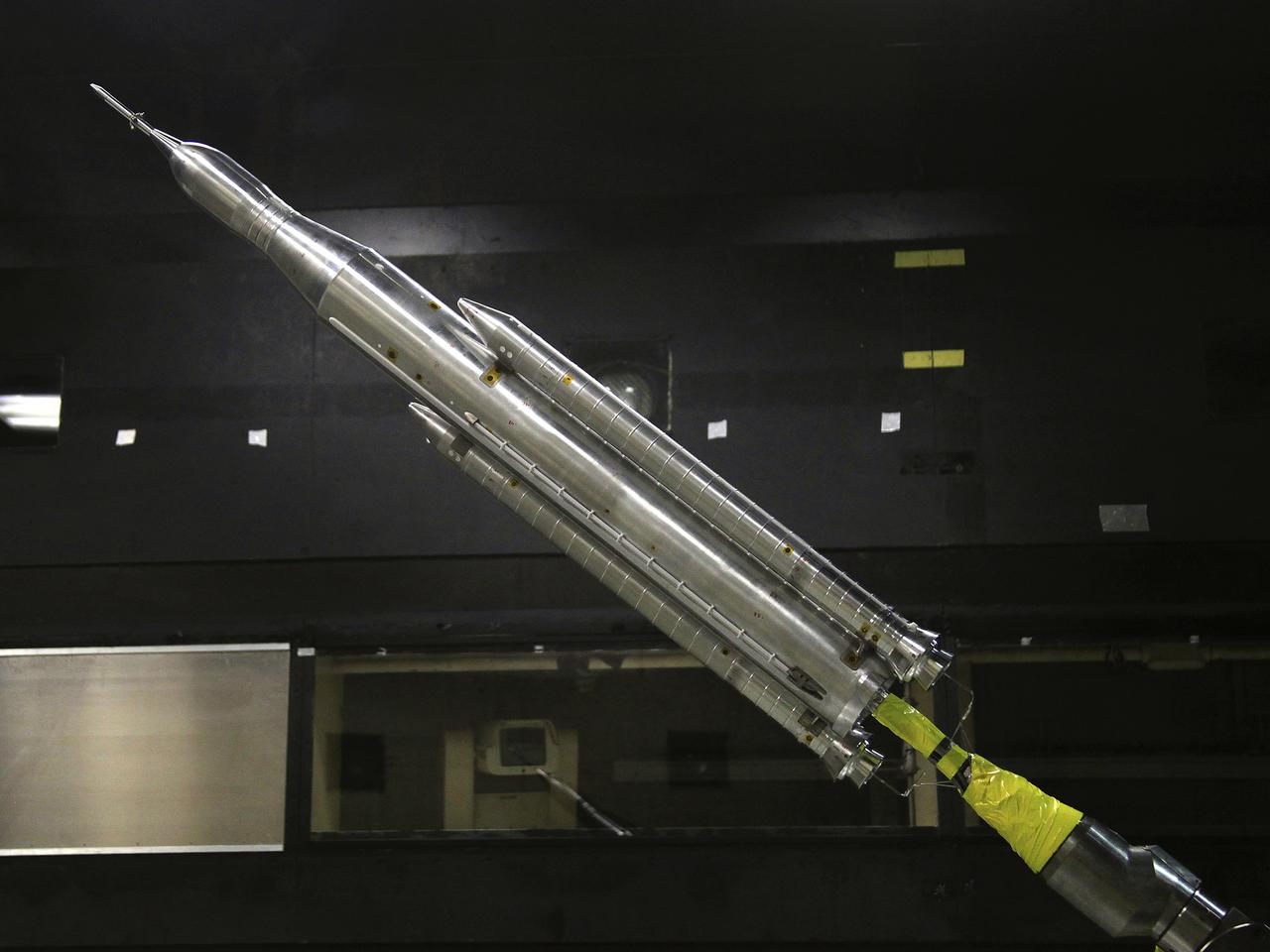
The model of the Space Launch System for the Orion Space Capsule is being prepared for windtunnel test in the 14x22 Subsonic windtunnel at NASA Langley.
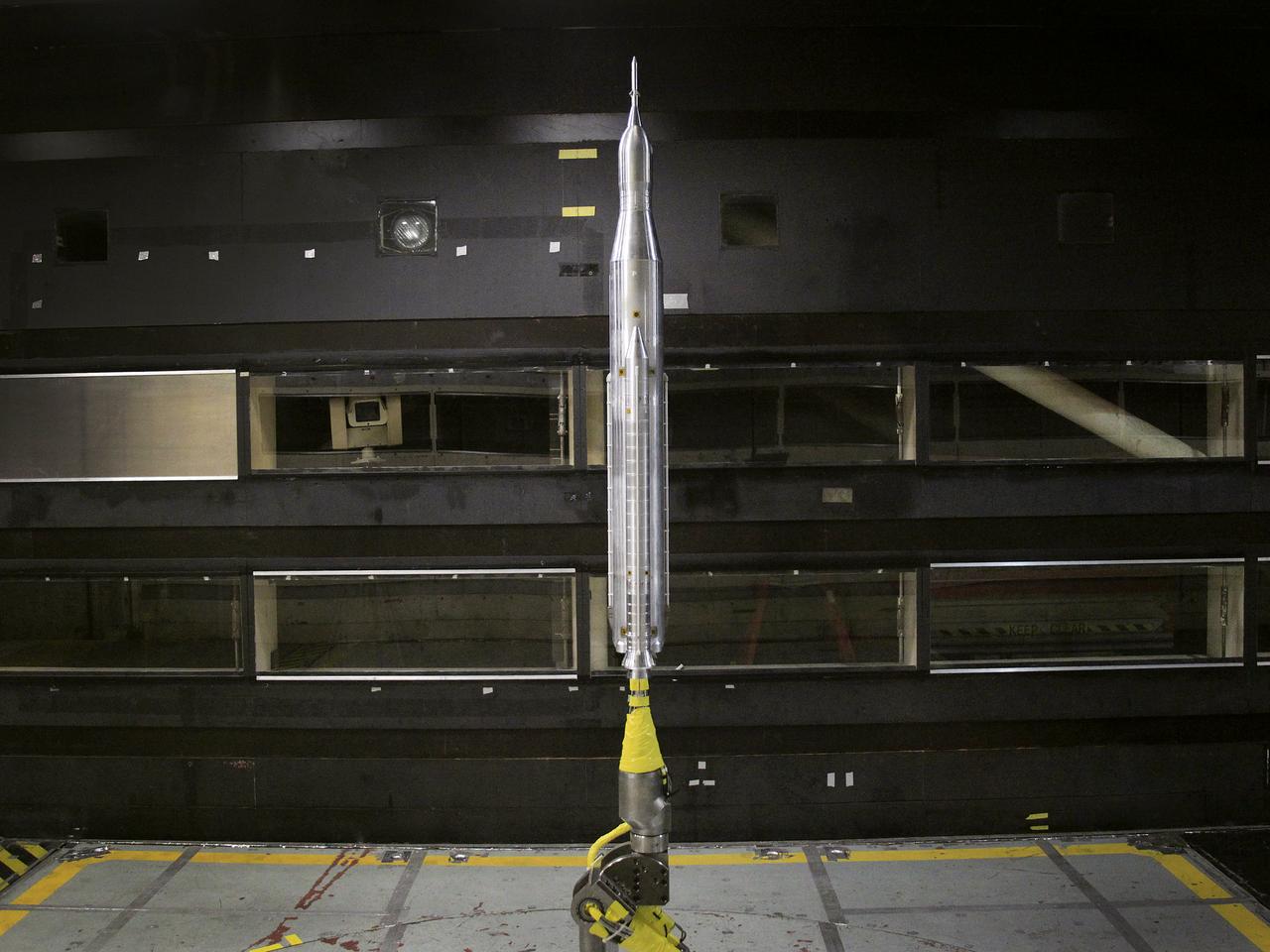
The model of the Space Launch System for the Orion Space Capsule is being prepared for windtunnel test in the 14x22 Subsonic windtunnel at NASA Langley.
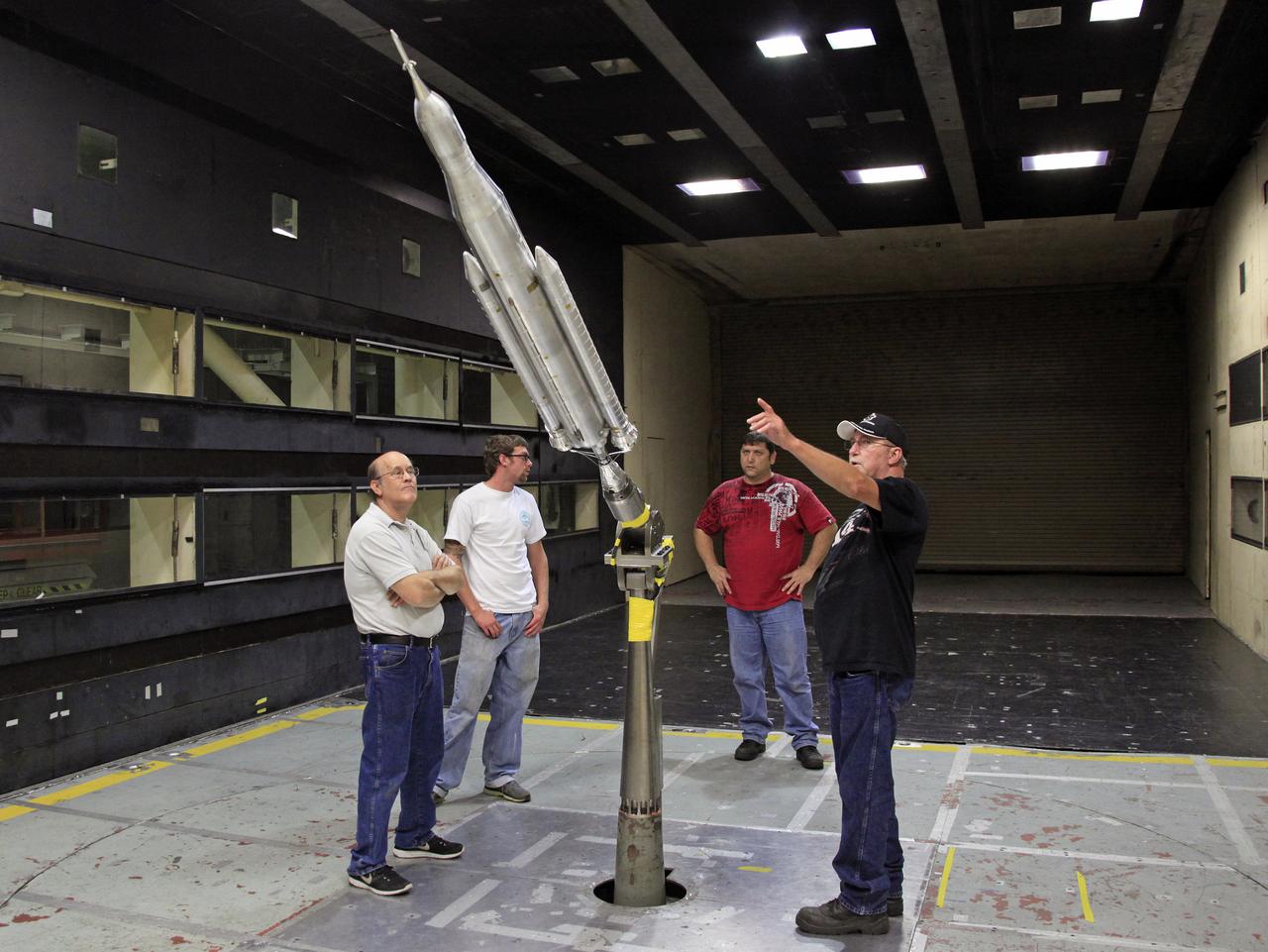
The model of the Space Launch System for the Orion Space Capsule is being prepared for windtunnel test in the 14x22 Subsonic windtunnel at NASA Langley.
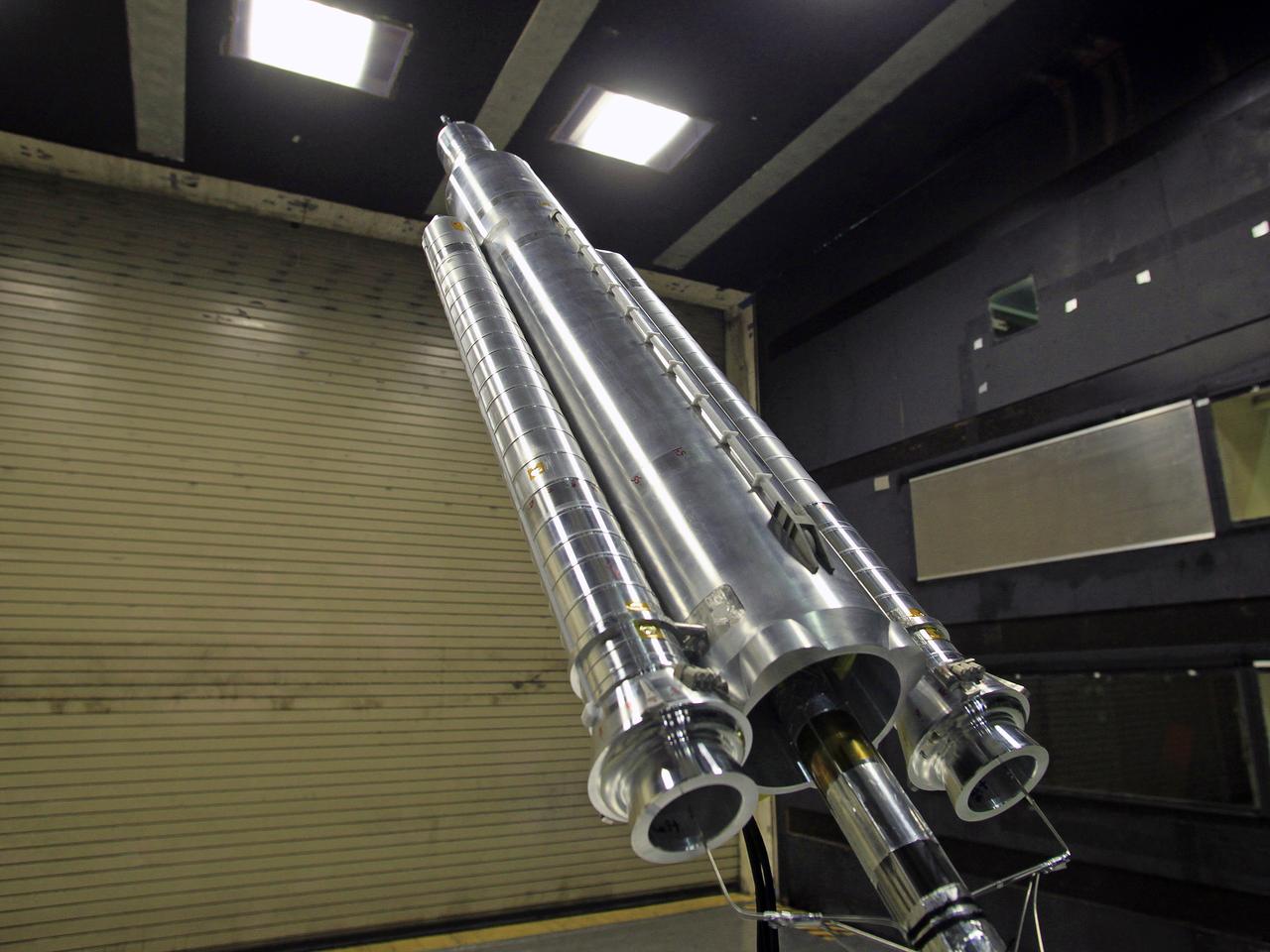
The model of the Space Launch System for the Orion Space Capsule is being prepared for windtunnel test in the 14x22 Subsonic windtunnel at NASA Langley.

Technicians work on the Artemis III Orion crew module inside the Operations and Checkout Building at NASA's Kennedy Space Center in Florida on March 5, 2025.
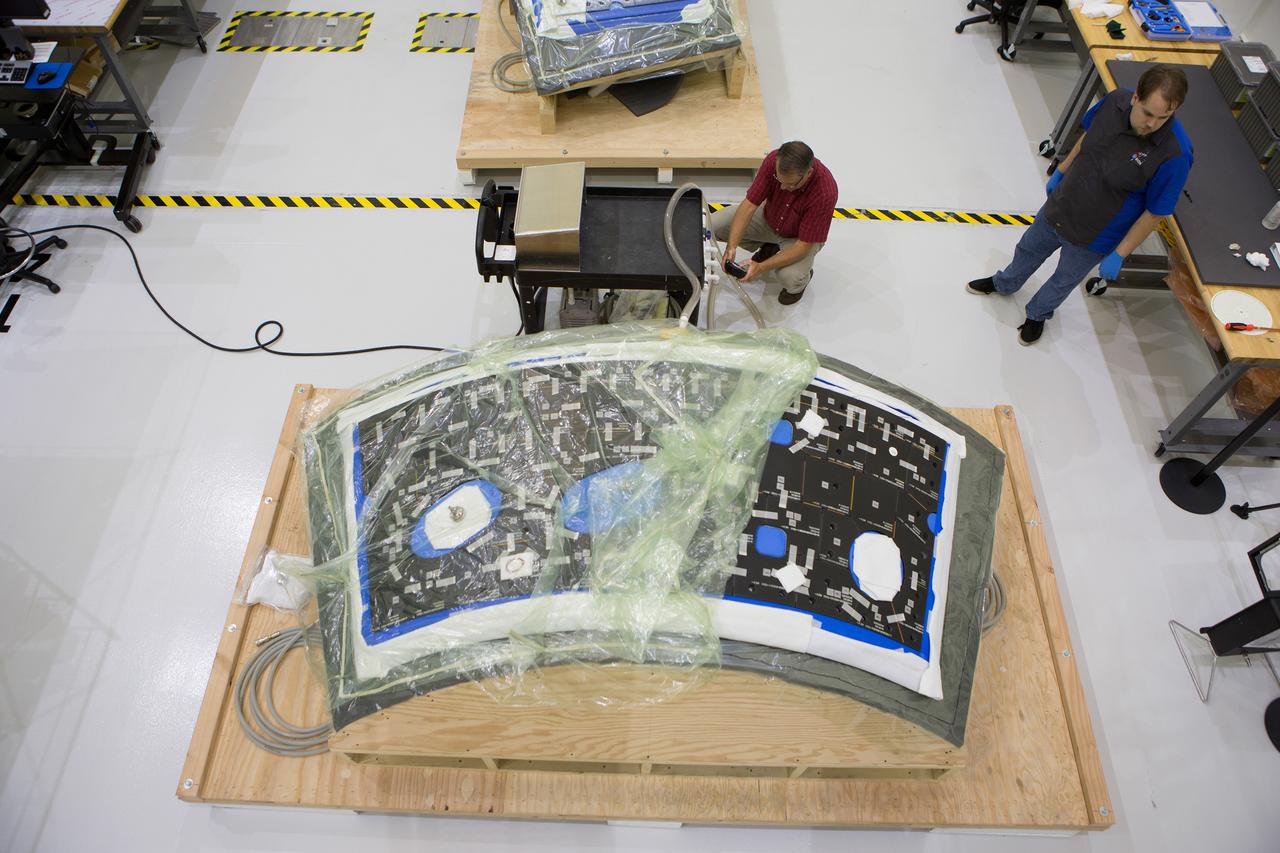
At Kennedy Space Center in Florida, technicians bond thermal protection system tiles to Orion's backshell panels on July 8, 2016...While similar to those used on the space shuttle, Orion only requires about 1,300 tiles compared to more than 24,000 on the shuttle. The tiles, along with the spacecraft’s heat shield, will protect Orion from the 5,000 degree Fahrenheit heat of re-entry.
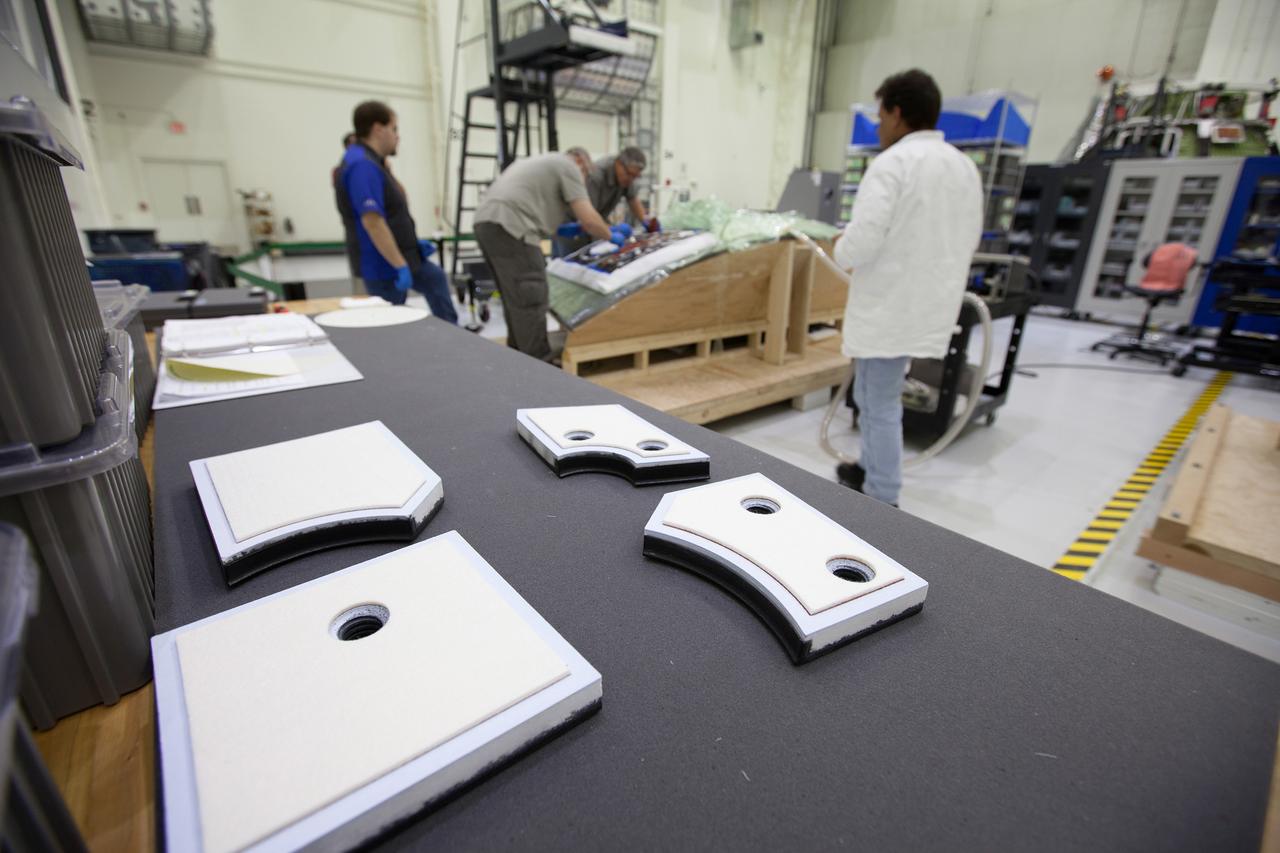
At Kennedy Space Center in Florida, technicians bond thermal protection system tiles to Orion's backshell panels on July 8, 2016...While similar to those used on the space shuttle, Orion only requires about 1,300 tiles compared to more than 24,000 on the shuttle. The tiles, along with the spacecraft’s heat shield, will protect Orion from the 5,000 degree Fahrenheit heat of re-entry.
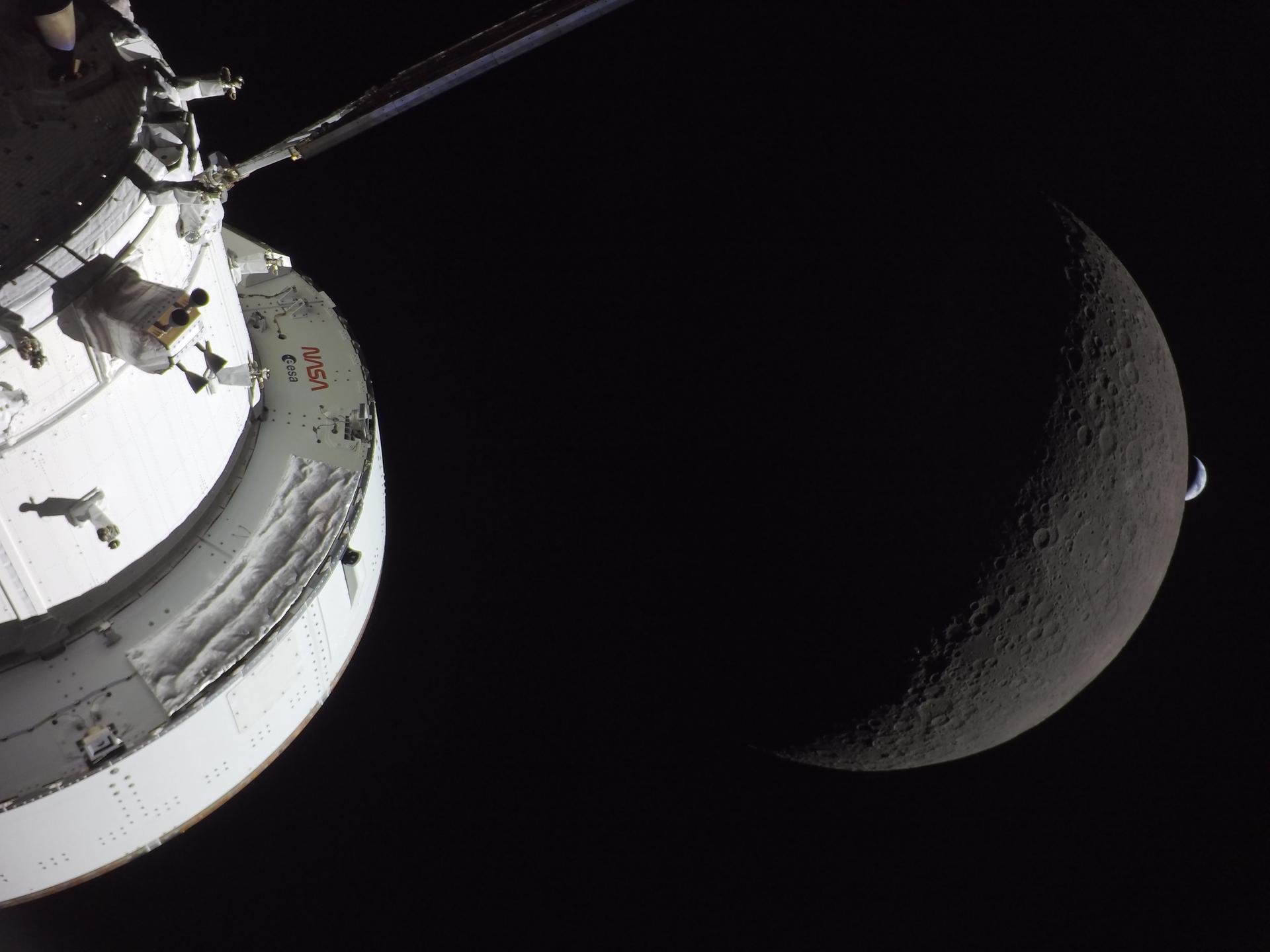
art002e009567 (April 6, 2026) - NASA’s Orion spacecraft captures the Moon and the Earth in one frame during the Artemis II crew’s deep space journey at 6:42 p.m. ET on the sixth day of the mission. The right side of NASA’s Orion spacecraft is seen lit up by the Sun. A waxing crescent Moon is visible behind it. And then, a crescent Earth, tiny compared to the Moon, is about to set below the Moon’s horizon on the right. Credit: NASA
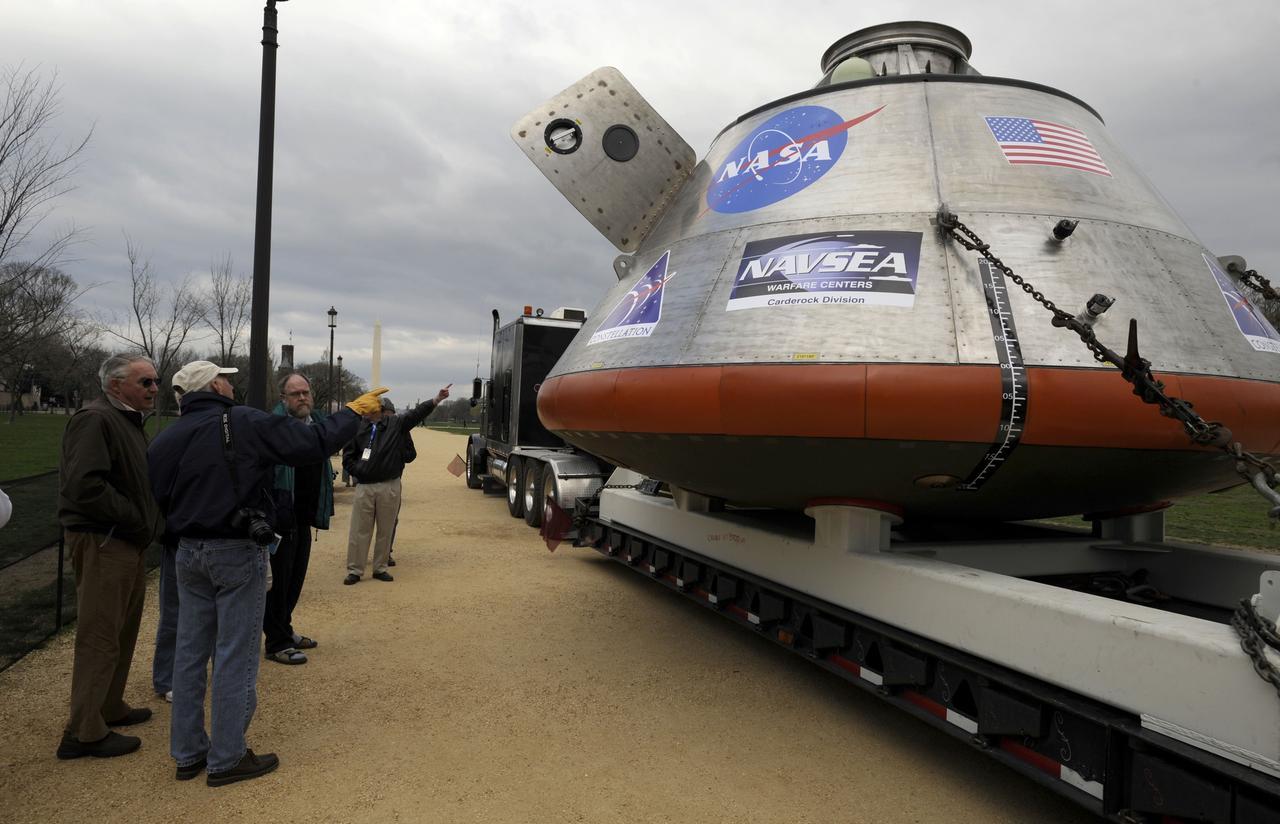
A mock up of the Orion Crew Module is seen, Monday, March 30, 2009, during a news conference on the National Mall in Washington. Orion is the flagship of NASA's programs for space exploration beyond low Earth orbit and a key element of NASA's Constellation Program to explore the Moon, Mars and beyond. Photo Credit: (NASA/Paul. E. Alers)
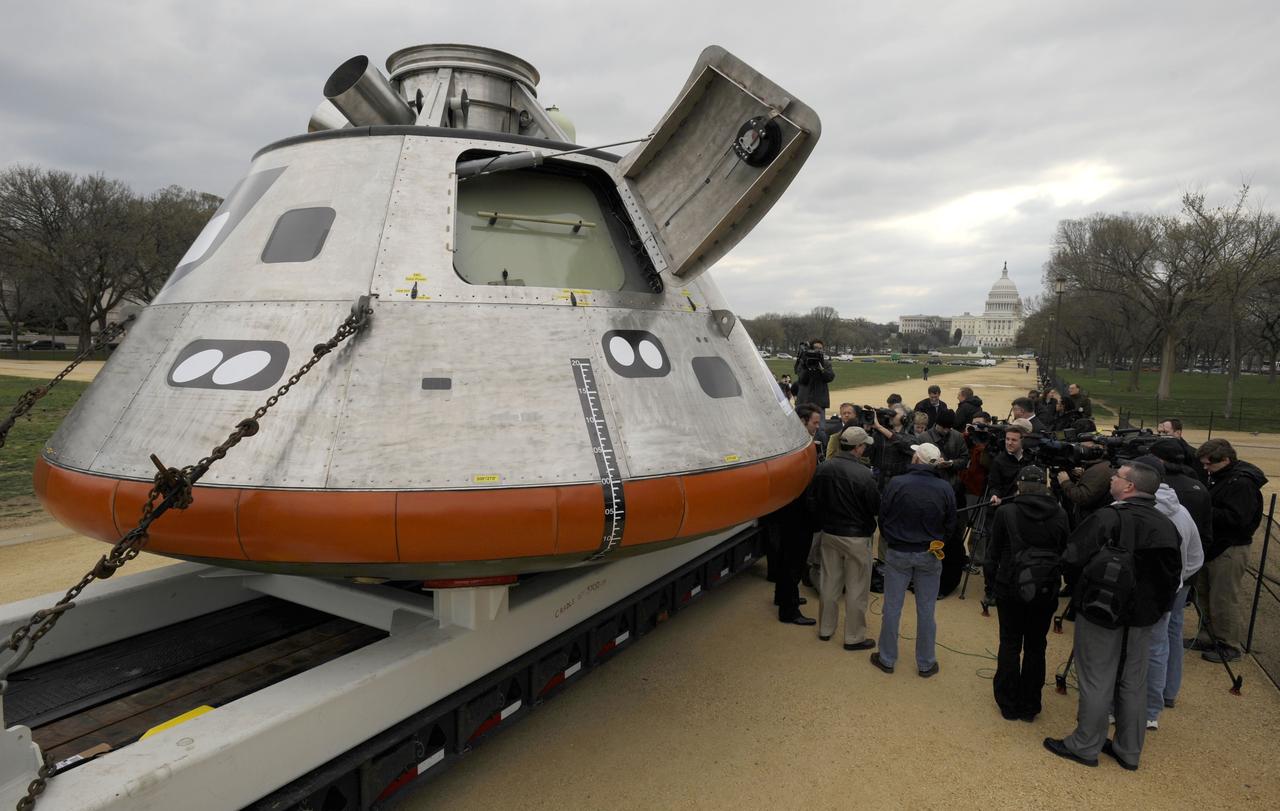
A mock up of the Orion Crew Module is seen, Monday, March 30, 2009, during a news conference on the National Mall in Washington. Orion is the flagship of NASA's programs for space exploration beyond low Earth orbit and a key element of NASA's Constellation Program to explore the Moon, Mars and beyond. Photo Credit: (NASA/Paul. E. Alers)
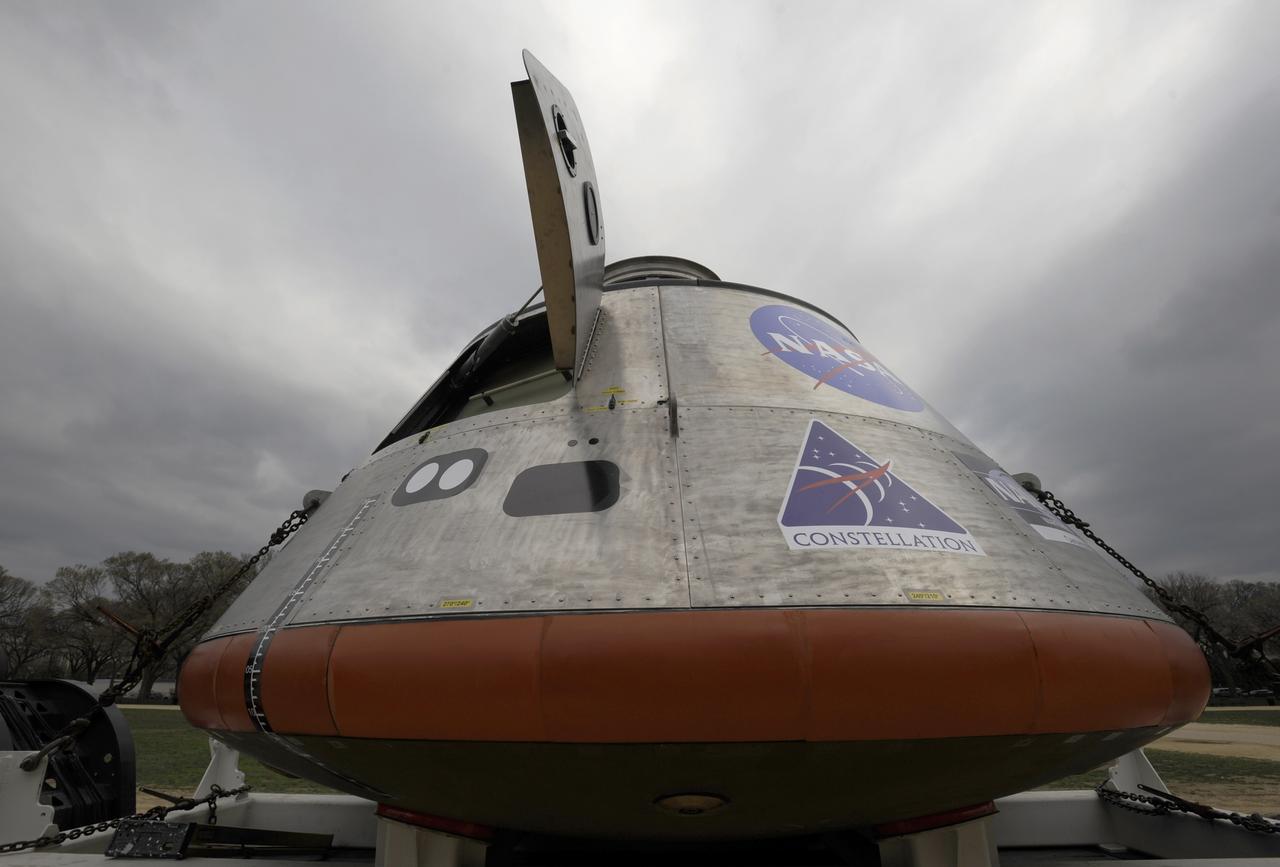
A mock up of the Orion Crew Module is seen, Monday, March 30, 2009, during a news conference on the National Mall in Washington. Orion is the flagship of NASA's programs for space exploration beyond low Earth orbit and a key element of NASA's Constellation Program to explore the Moon, Mars and beyond. Photo Credit: (NASA/Paul. E. Alers)
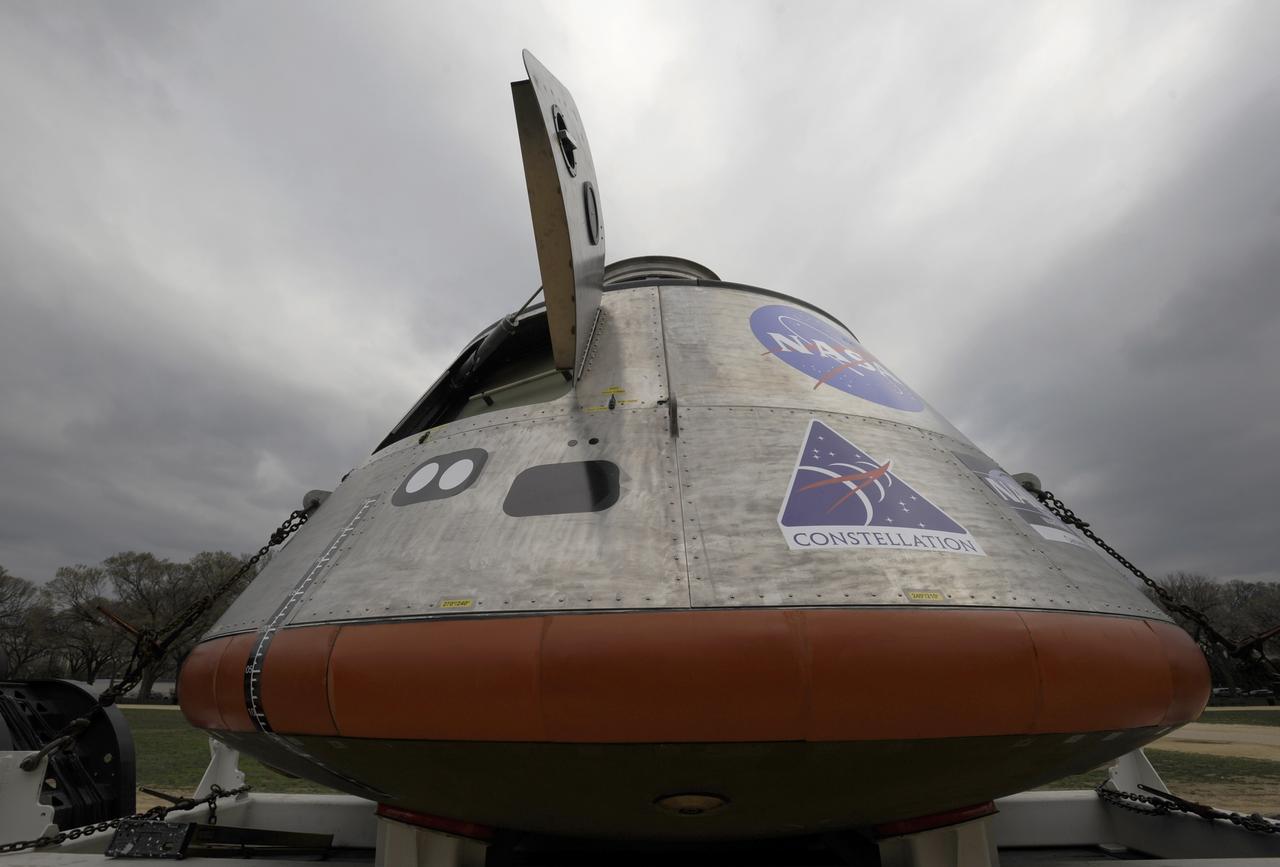
A mock up of the Orion Crew Module is seen, Monday, March 30, 2009, during a news conference on the National Mall in Washington. Orion is the flagship of NASA's programs for space exploration beyond low Earth orbit and a key element of NASA's Constellation Program to explore the Moon, Mars and beyond. Photo Credit: (NASA/Paul. E. Alers)
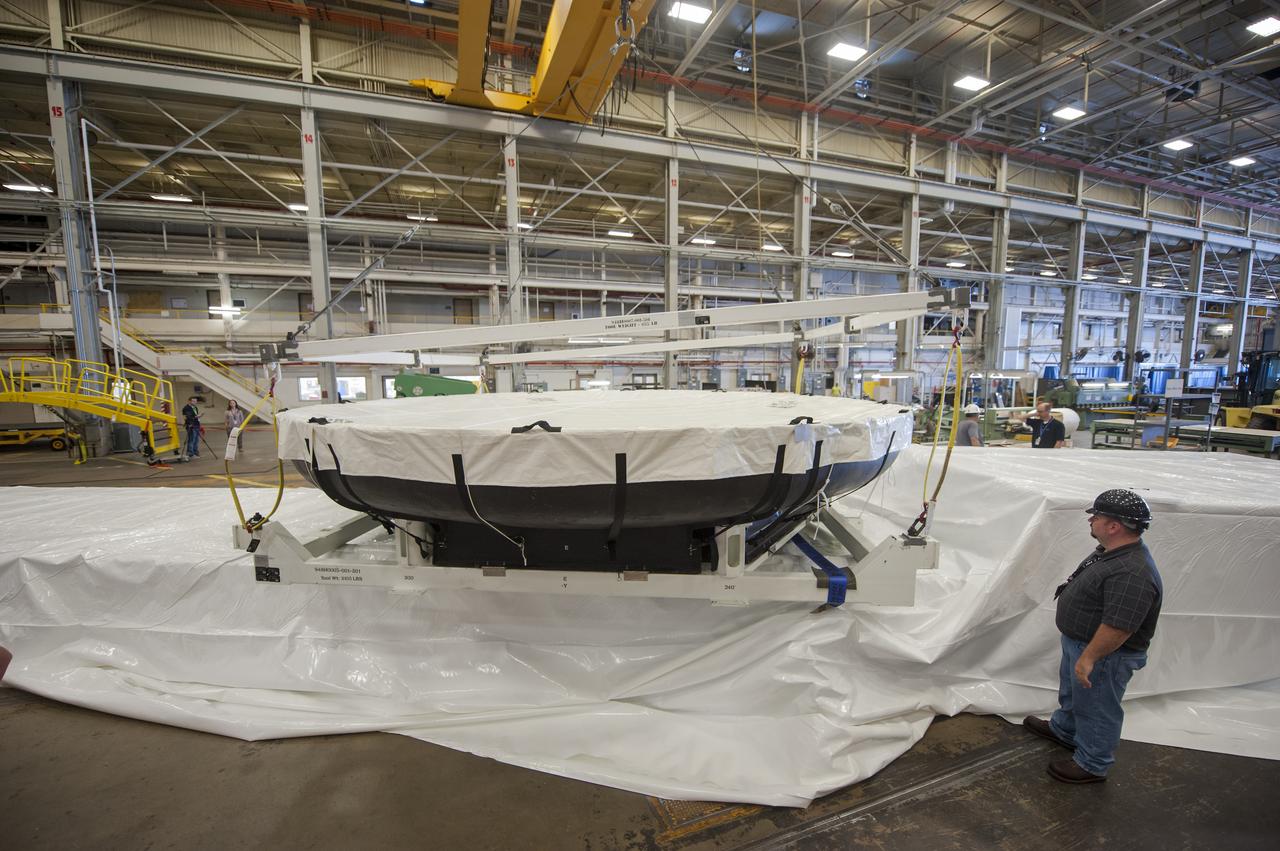
THE ORION HEAT SHIELD, WHICH WAS AT NASA’S MARSHALL SPACE FLIGHT CENTER FROM MARCH-MAY 2015 FOR ENGINEERING AND ANALYSIS, IS READIED FOR DEPARTURE AT THE END OF ITS STAY. THE HEAT SHIELD’S ABLATED SURFACE MATERIAL WAS REMOVED AT MARSHALL FOR ANALYSIS, USING THE CENTER’S STATE-OF-THE-ART SEVEN-AXIS MILLING MACHINE. IT NEXT WILL GO TO NASA’S LANGLEY RESEARCH CENTER FOR WATER-IMPACT TESTING. NASA’S JOHNSON SPACE CENTER LEADS THE ORION PROGRAM FOR NASA.
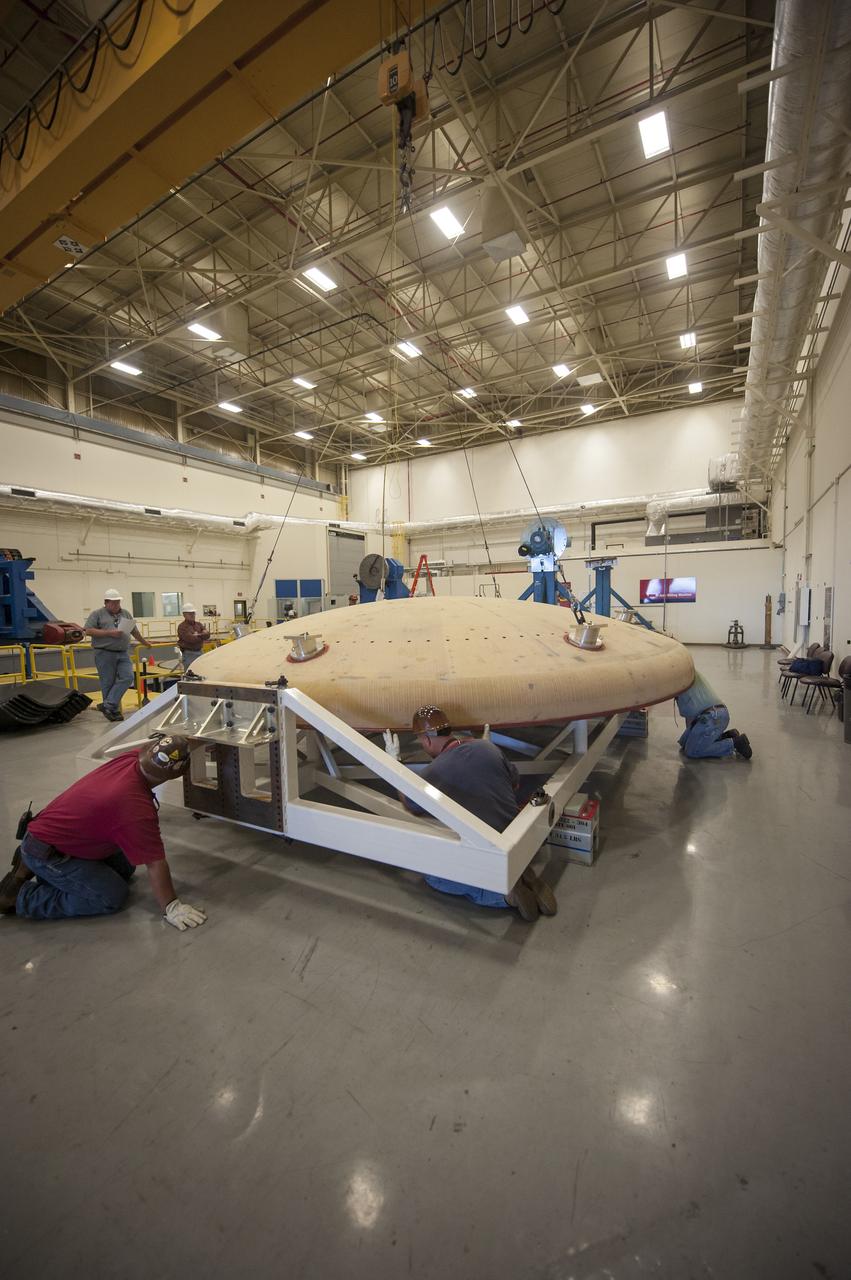
THE ORION HEAT SHIELD, WHICH WAS AT NASA’S MARSHALL SPACE FLIGHT CENTER FROM MARCH-MAY 2015 FOR ENGINEERING AND ANALYSIS, IS READIED FOR DEPARTURE AT THE END OF ITS STAY. THE HEAT SHIELD’S ABLATED SURFACE MATERIAL WAS REMOVED AT MARSHALL FOR ANALYSIS, USING THE CENTER’S STATE-OF-THE-ART SEVEN-AXIS MILLING MACHINE. IT NEXT WILL GO TO NASA’S LANGLEY RESEARCH CENTER FOR WATER-IMPACT TESTING. NASA’S JOHNSON SPACE CENTER LEADS THE ORION PROGRAM FOR NASA.
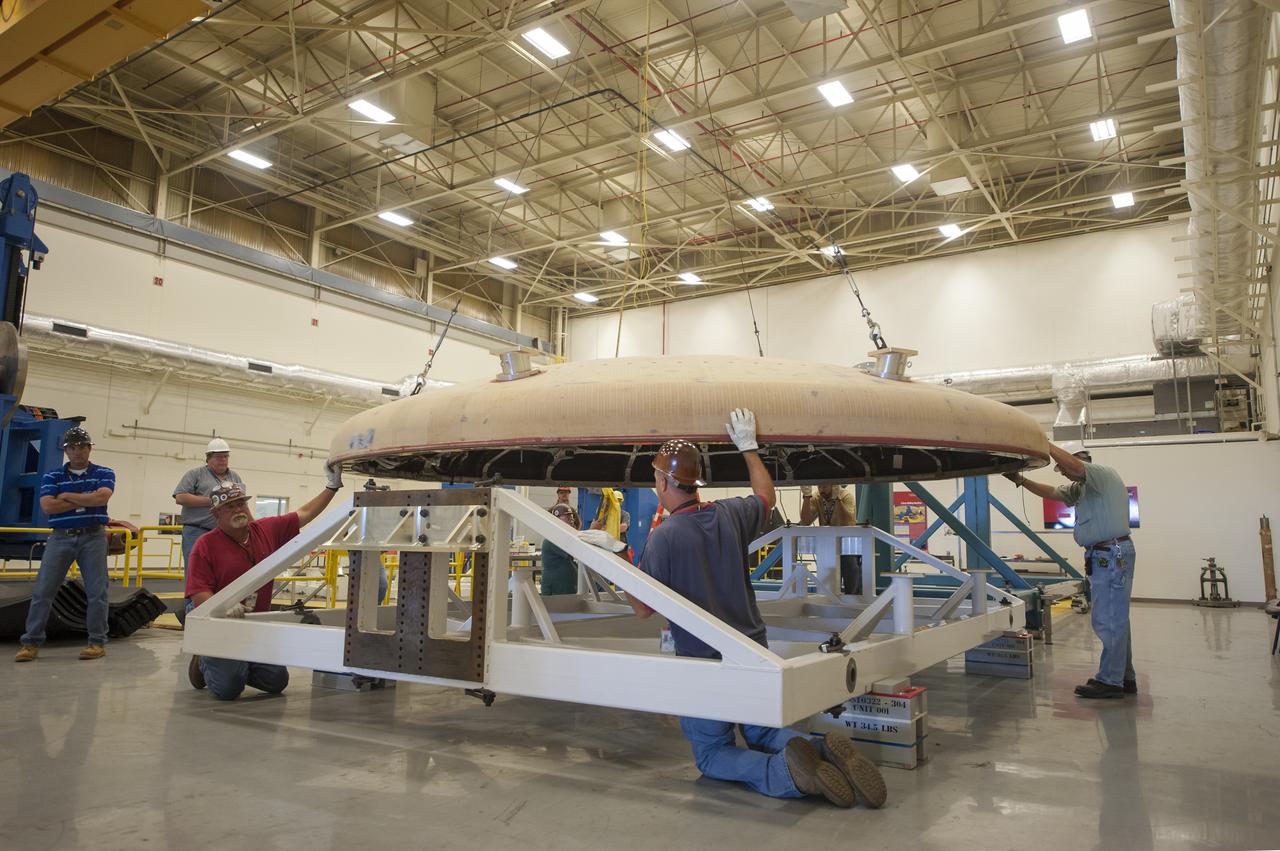
THE ORION HEAT SHIELD, WHICH WAS AT NASA’S MARSHALL SPACE FLIGHT CENTER FROM MARCH-MAY 2015 FOR ENGINEERING AND ANALYSIS, IS READIED FOR DEPARTURE AT THE END OF ITS STAY. THE HEAT SHIELD’S ABLATED SURFACE MATERIAL WAS REMOVED AT MARSHALL FOR ANALYSIS, USING THE CENTER’S STATE-OF-THE-ART SEVEN-AXIS MILLING MACHINE. IT NEXT WILL GO TO NASA’S LANGLEY RESEARCH CENTER FOR WATER-IMPACT TESTING. NASA’S JOHNSON SPACE CENTER LEADS THE ORION PROGRAM FOR NASA.
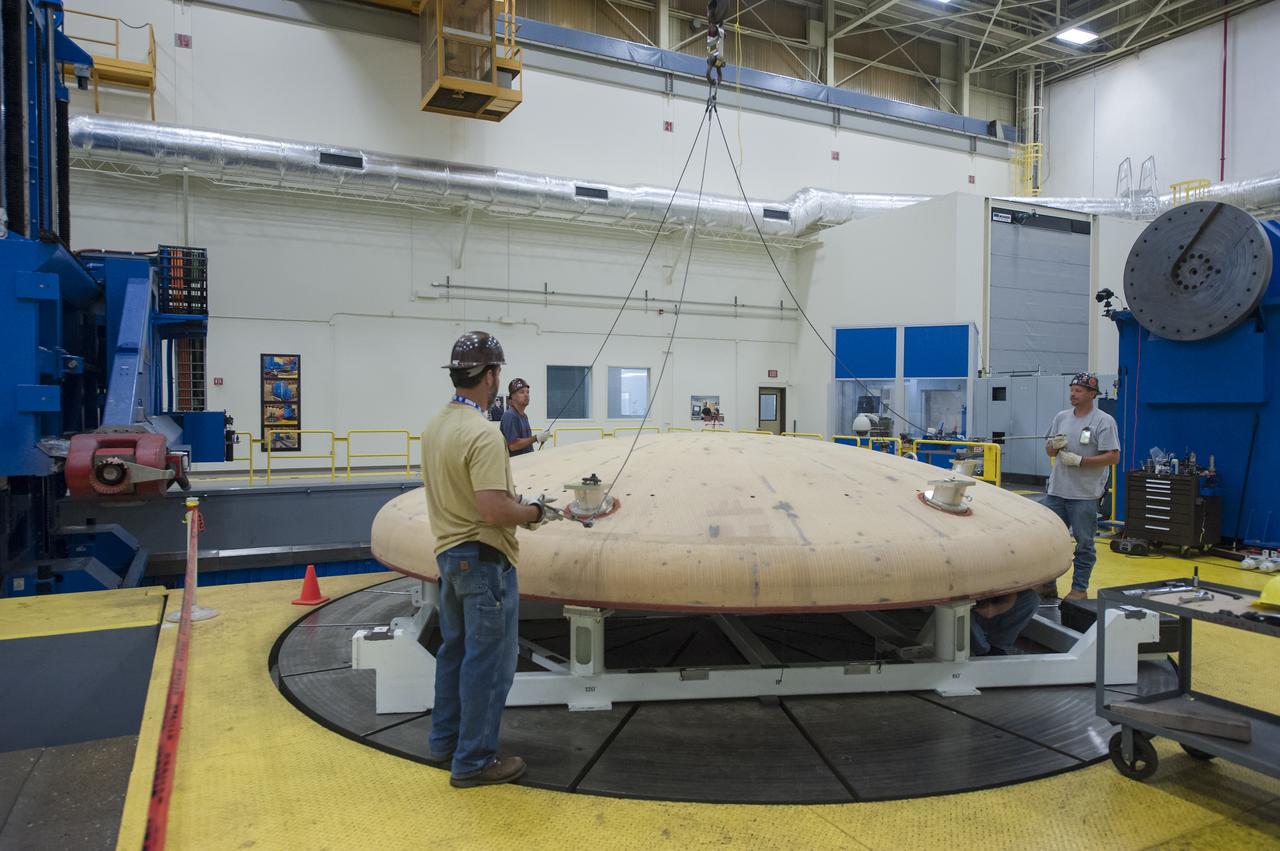
THE ORION HEAT SHIELD, WHICH WAS AT NASA’S MARSHALL SPACE FLIGHT CENTER FROM MARCH-MAY 2015 FOR ENGINEERING AND ANALYSIS, IS READIED FOR DEPARTURE AT THE END OF ITS STAY. THE HEAT SHIELD’S ABLATED SURFACE MATERIAL WAS REMOVED AT MARSHALL FOR ANALYSIS, USING THE CENTER’S STATE-OF-THE-ART SEVEN-AXIS MILLING MACHINE. IT NEXT WILL GO TO NASA’S LANGLEY RESEARCH CENTER FOR WATER-IMPACT TESTING. NASA’S JOHNSON SPACE CENTER LEADS THE ORION PROGRAM FOR NASA.
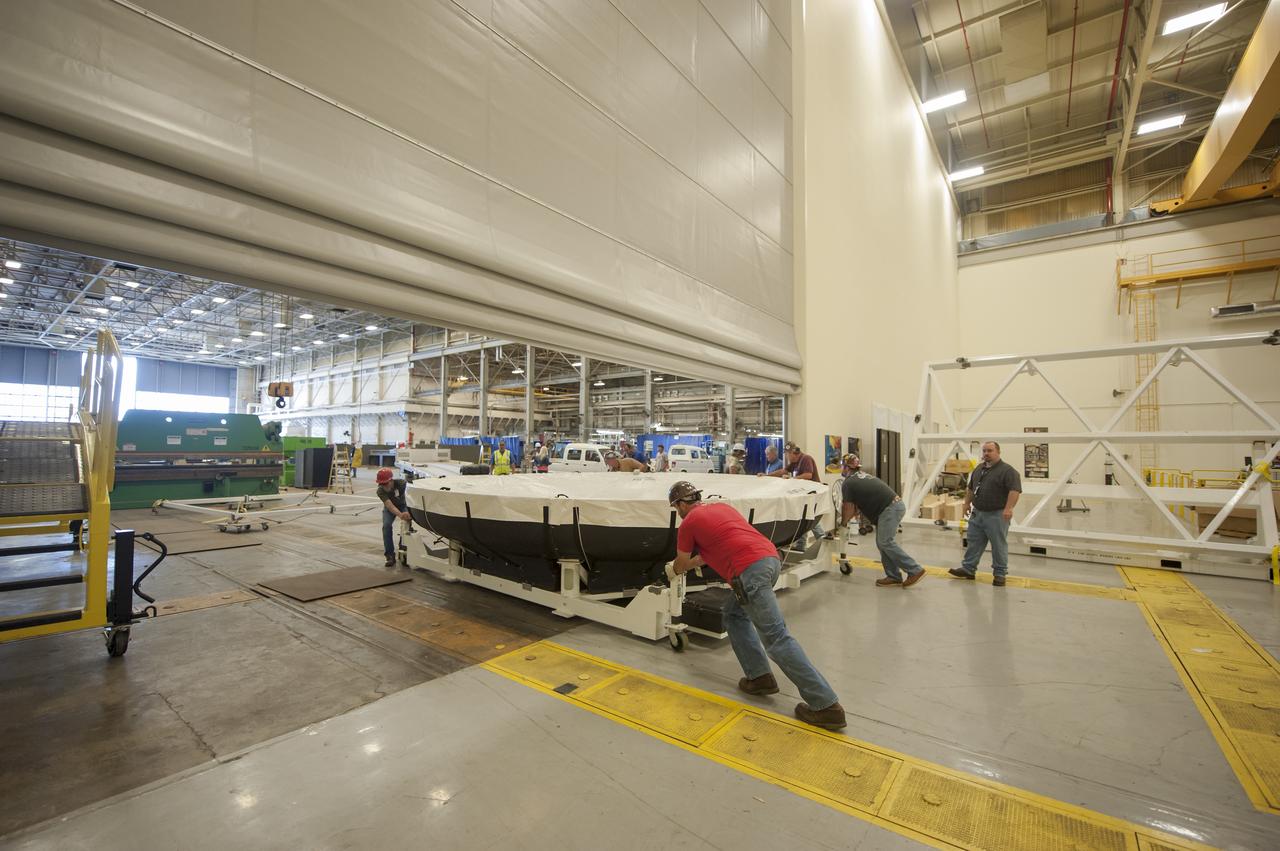
THE ORION HEAT SHIELD, WHICH WAS AT NASA’S MARSHALL SPACE FLIGHT CENTER FROM MARCH-MAY 2015 FOR ENGINEERING AND ANALYSIS, IS READIED FOR DEPARTURE AT THE END OF ITS STAY. THE HEAT SHIELD’S ABLATED SURFACE MATERIAL WAS REMOVED AT MARSHALL FOR ANALYSIS, USING THE CENTER’S STATE-OF-THE-ART SEVEN-AXIS MILLING MACHINE. IT NEXT WILL GO TO NASA’S LANGLEY RESEARCH CENTER FOR WATER-IMPACT TESTING. NASA’S JOHNSON SPACE CENTER LEADS THE ORION PROGRAM FOR NASA.
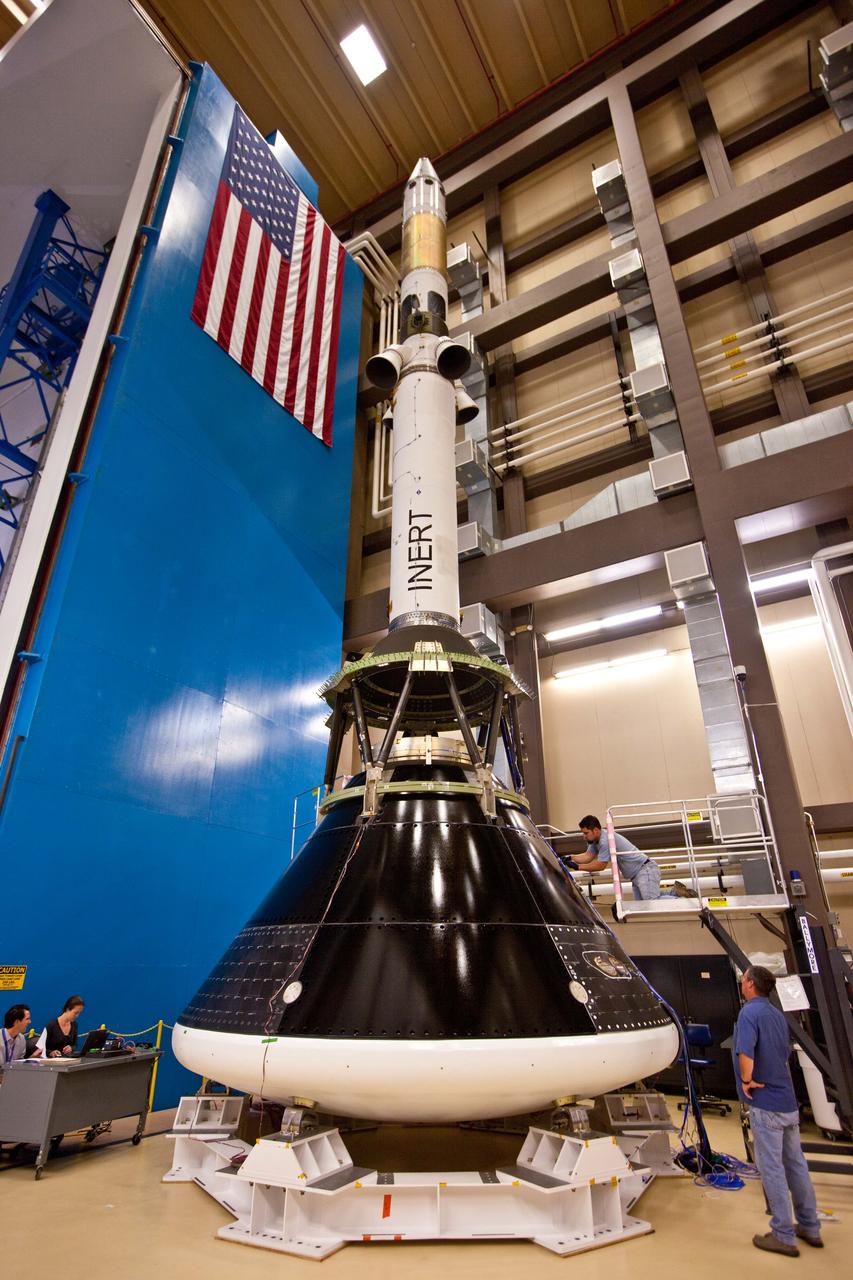
The Orion launch abort system and crew module test articles undergo stacking at Lockheed Martin’s facilities near Denver in preparation for acoustic testing on Aug. 9, 2011. To emulate the sound pressure levels experienced at launch, the tests exposed Orion and its launch abort system to acoustic levels exceeding 150 decibels, while hundreds of instruments record the vehicle’s response. Part of Batch image transfer from Flickr.
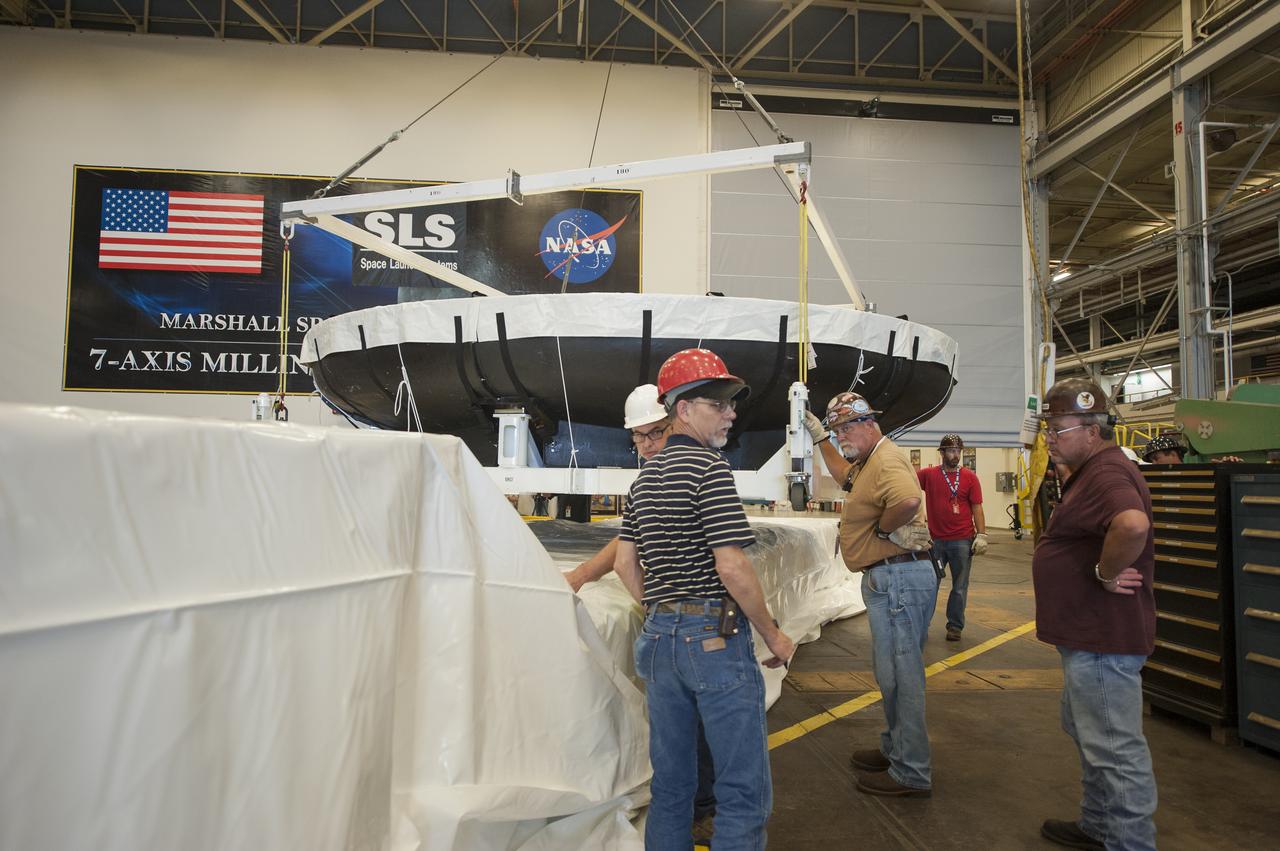
THE ORION HEAT SHIELD, WHICH WAS AT NASA’S MARSHALL SPACE FLIGHT CENTER FROM MARCH-MAY 2015 FOR ENGINEERING AND ANALYSIS, IS READIED FOR DEPARTURE AT THE END OF ITS STAY. THE HEAT SHIELD’S ABLATED SURFACE MATERIAL WAS REMOVED AT MARSHALL FOR ANALYSIS, USING THE CENTER’S STATE-OF-THE-ART SEVEN-AXIS MILLING MACHINE. IT NEXT WILL GO TO NASA’S LANGLEY RESEARCH CENTER FOR WATER-IMPACT TESTING. NASA’S JOHNSON SPACE CENTER LEADS THE ORION PROGRAM FOR NASA.
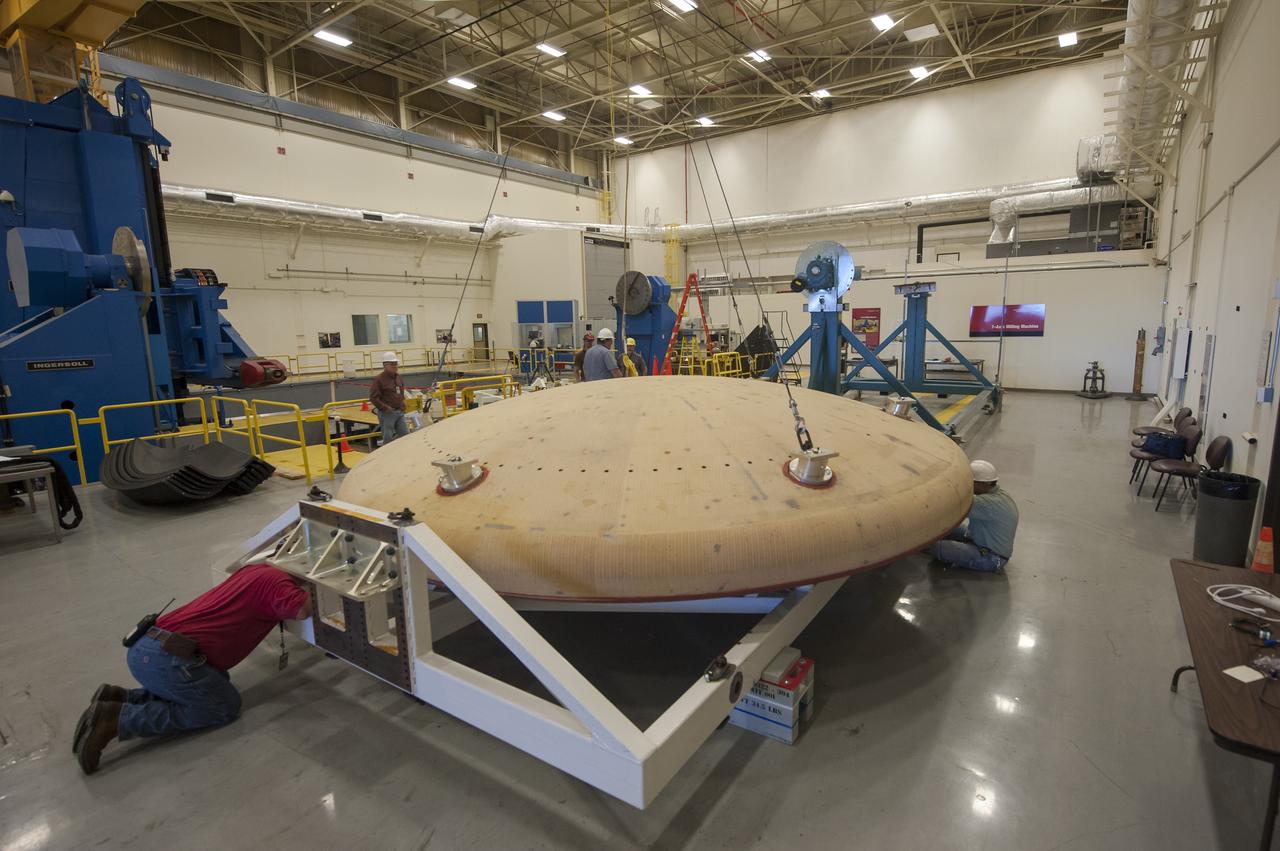
THE ORION HEAT SHIELD, WHICH WAS AT NASA’S MARSHALL SPACE FLIGHT CENTER FROM MARCH-MAY 2015 FOR ENGINEERING AND ANALYSIS, IS READIED FOR DEPARTURE AT THE END OF ITS STAY. THE HEAT SHIELD’S ABLATED SURFACE MATERIAL WAS REMOVED AT MARSHALL FOR ANALYSIS, USING THE CENTER’S STATE-OF-THE-ART SEVEN-AXIS MILLING MACHINE. IT NEXT WILL GO TO NASA’S LANGLEY RESEARCH CENTER FOR WATER-IMPACT TESTING. NASA’S JOHNSON SPACE CENTER LEADS THE ORION PROGRAM FOR NASA.
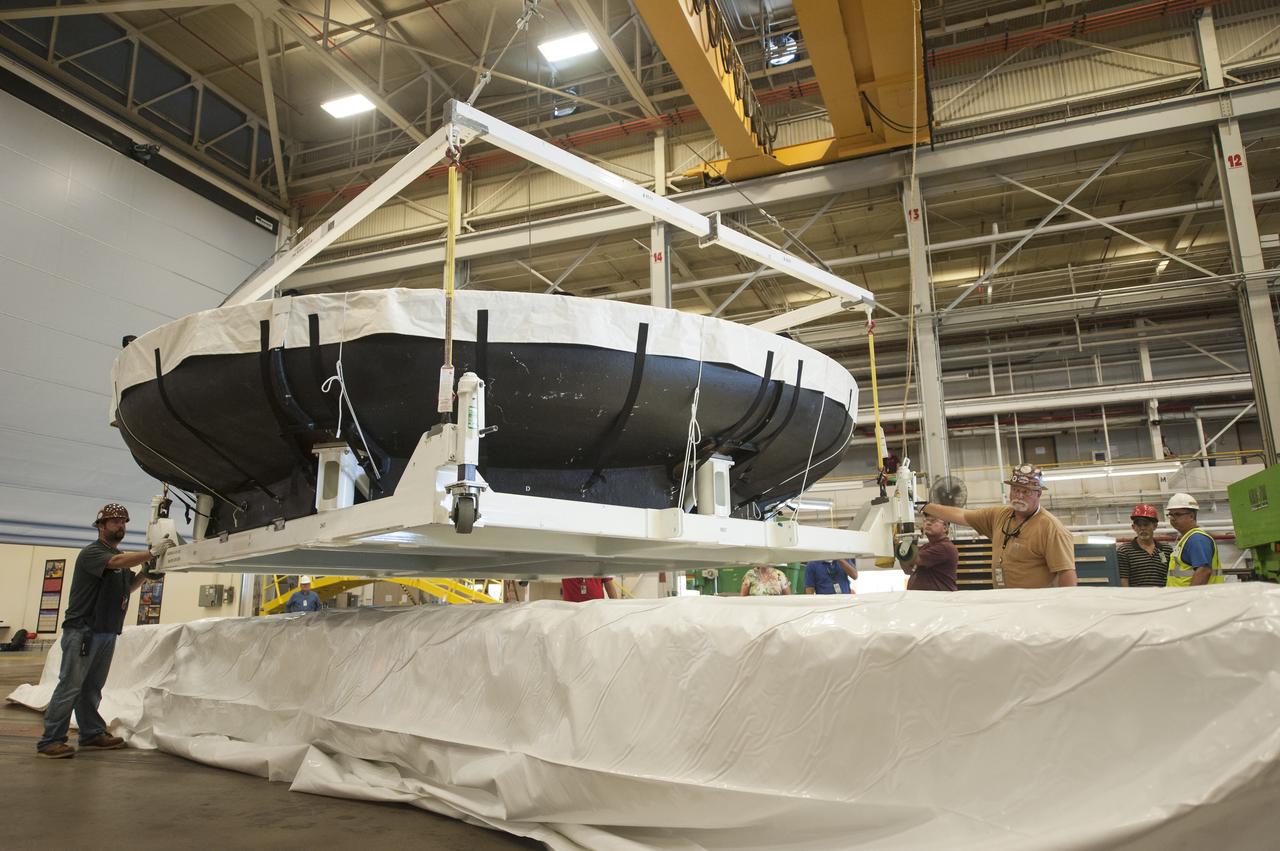
THE ORION HEAT SHIELD, WHICH WAS AT NASA’S MARSHALL SPACE FLIGHT CENTER FROM MARCH-MAY 2015 FOR ENGINEERING AND ANALYSIS, IS READIED FOR DEPARTURE AT THE END OF ITS STAY. THE HEAT SHIELD’S ABLATED SURFACE MATERIAL WAS REMOVED AT MARSHALL FOR ANALYSIS, USING THE CENTER’S STATE-OF-THE-ART SEVEN-AXIS MILLING MACHINE. IT NEXT WILL GO TO NASA’S LANGLEY RESEARCH CENTER FOR WATER-IMPACT TESTING. NASA’S JOHNSON SPACE CENTER LEADS THE ORION PROGRAM FOR NASA.
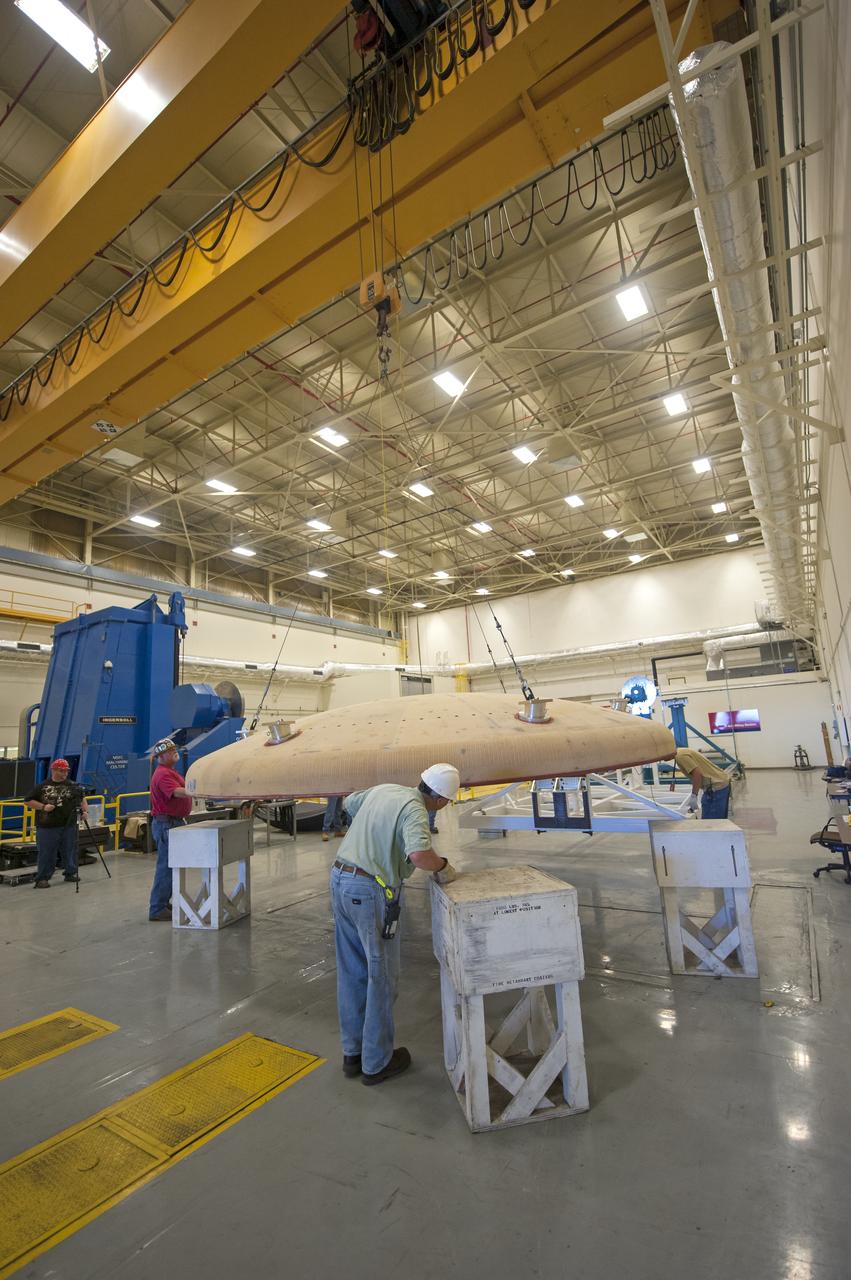
THE ORION HEAT SHIELD, WHICH WAS AT NASA’S MARSHALL SPACE FLIGHT CENTER FROM MARCH-MAY 2015 FOR ENGINEERING AND ANALYSIS, IS READIED FOR DEPARTURE AT THE END OF ITS STAY. THE HEAT SHIELD’S ABLATED SURFACE MATERIAL WAS REMOVED AT MARSHALL FOR ANALYSIS, USING THE CENTER’S STATE-OF-THE-ART SEVEN-AXIS MILLING MACHINE. IT NEXT WILL GO TO NASA’S LANGLEY RESEARCH CENTER FOR WATER-IMPACT TESTING. NASA’S JOHNSON SPACE CENTER LEADS THE ORION PROGRAM FOR NASA.
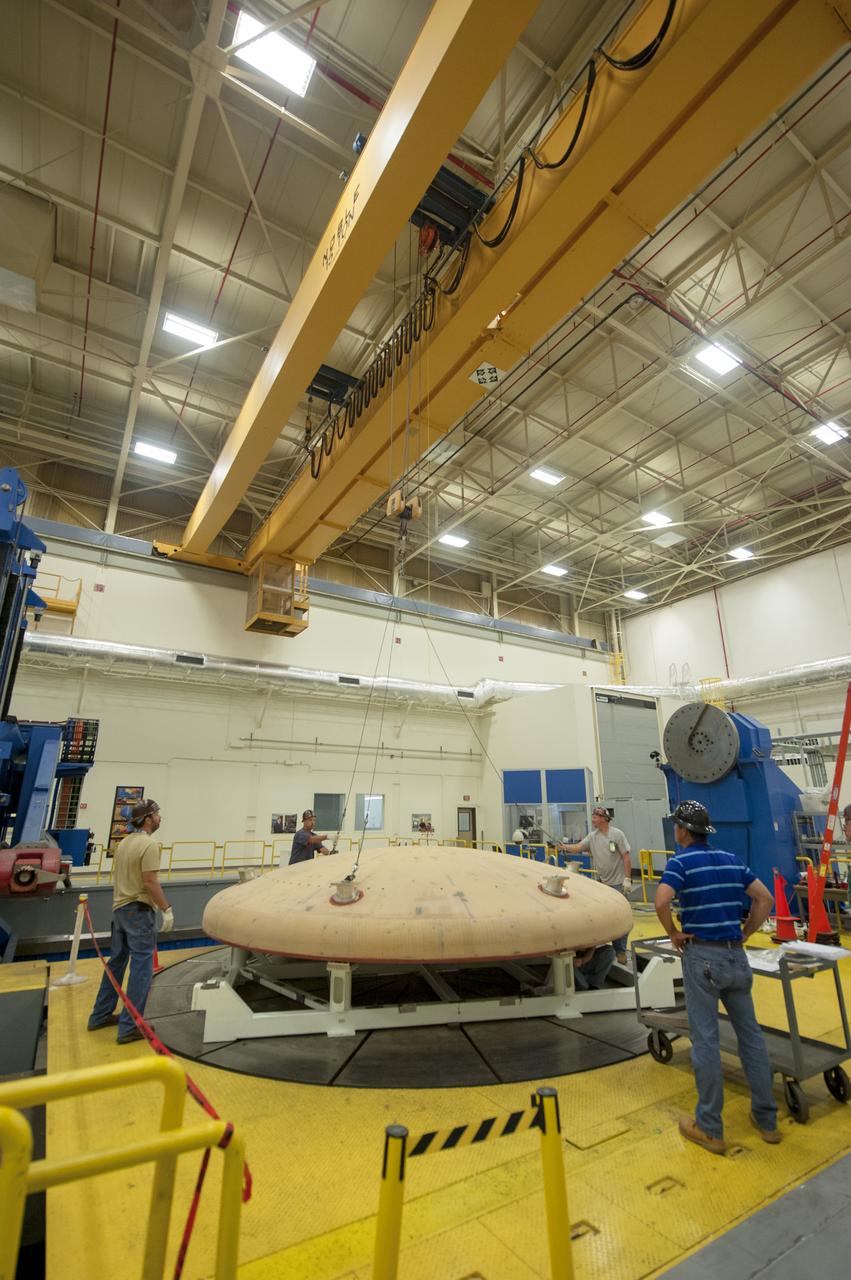
THE ORION HEAT SHIELD, WHICH WAS AT NASA’S MARSHALL SPACE FLIGHT CENTER FROM MARCH-MAY 2015 FOR ENGINEERING AND ANALYSIS, IS READIED FOR DEPARTURE AT THE END OF ITS STAY. THE HEAT SHIELD’S ABLATED SURFACE MATERIAL WAS REMOVED AT MARSHALL FOR ANALYSIS, USING THE CENTER’S STATE-OF-THE-ART SEVEN-AXIS MILLING MACHINE. IT NEXT WILL GO TO NASA’S LANGLEY RESEARCH CENTER FOR WATER-IMPACT TESTING. NASA’S JOHNSON SPACE CENTER LEADS THE ORION PROGRAM FOR NASA.
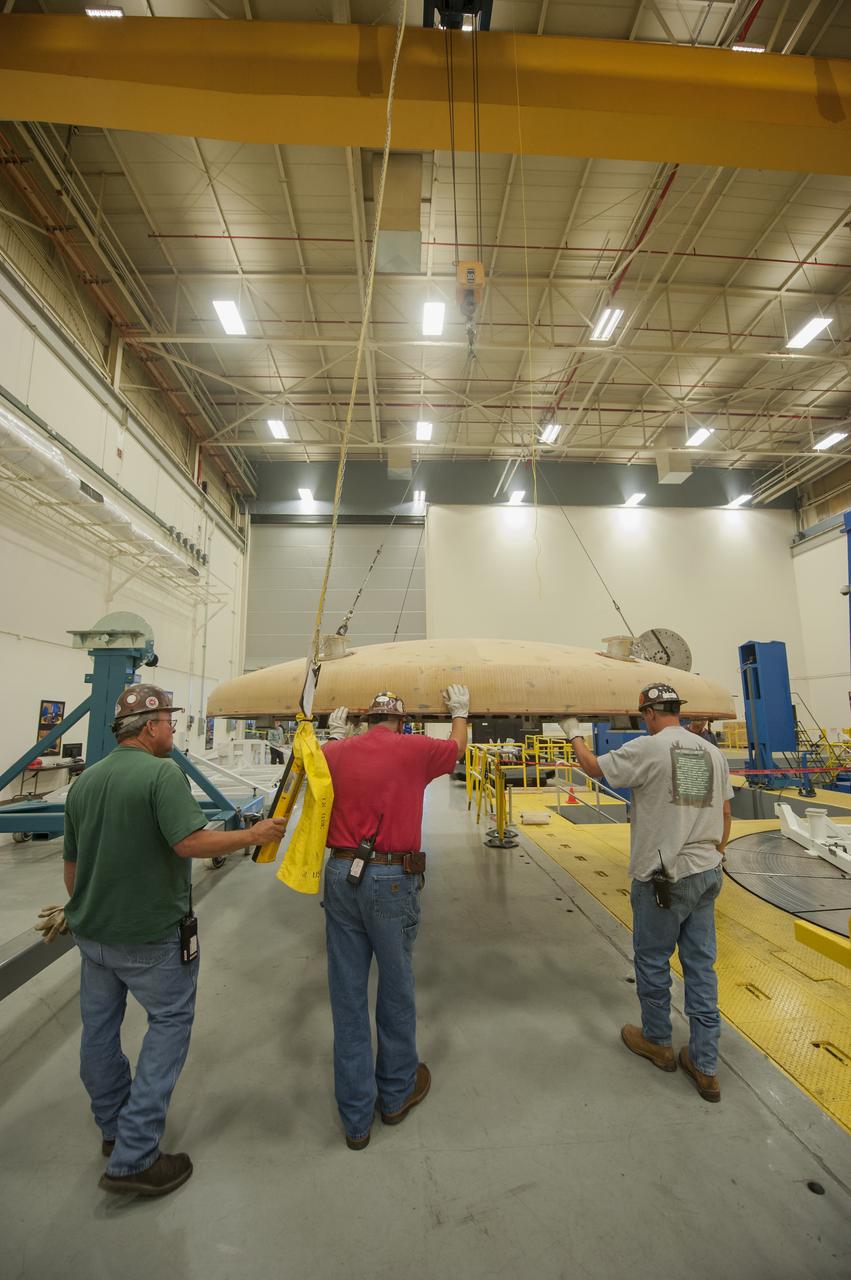
THE ORION HEAT SHIELD, WHICH WAS AT NASA’S MARSHALL SPACE FLIGHT CENTER FROM MARCH-MAY 2015 FOR ENGINEERING AND ANALYSIS, IS READIED FOR DEPARTURE AT THE END OF ITS STAY. THE HEAT SHIELD’S ABLATED SURFACE MATERIAL WAS REMOVED AT MARSHALL FOR ANALYSIS, USING THE CENTER’S STATE-OF-THE-ART SEVEN-AXIS MILLING MACHINE. IT NEXT WILL GO TO NASA’S LANGLEY RESEARCH CENTER FOR WATER-IMPACT TESTING. NASA’S JOHNSON SPACE CENTER LEADS THE ORION PROGRAM FOR NASA.
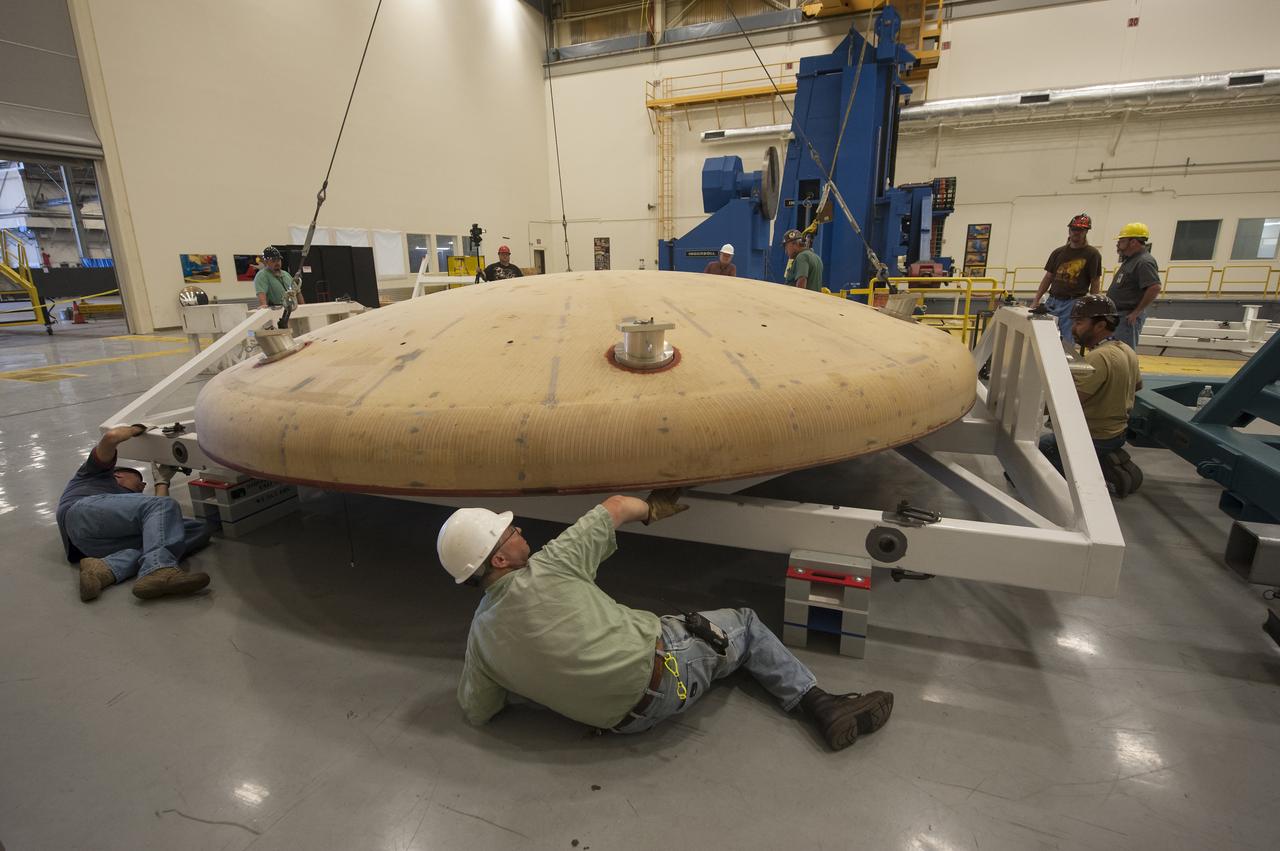
THE ORION HEAT SHIELD, WHICH WAS AT NASA’S MARSHALL SPACE FLIGHT CENTER FROM MARCH-MAY 2015 FOR ENGINEERING AND ANALYSIS, IS READIED FOR DEPARTURE AT THE END OF ITS STAY. THE HEAT SHIELD’S ABLATED SURFACE MATERIAL WAS REMOVED AT MARSHALL FOR ANALYSIS, USING THE CENTER’S STATE-OF-THE-ART SEVEN-AXIS MILLING MACHINE. IT NEXT WILL GO TO NASA’S LANGLEY RESEARCH CENTER FOR WATER-IMPACT TESTING. NASA’S JOHNSON SPACE CENTER LEADS THE ORION PROGRAM FOR NASA.
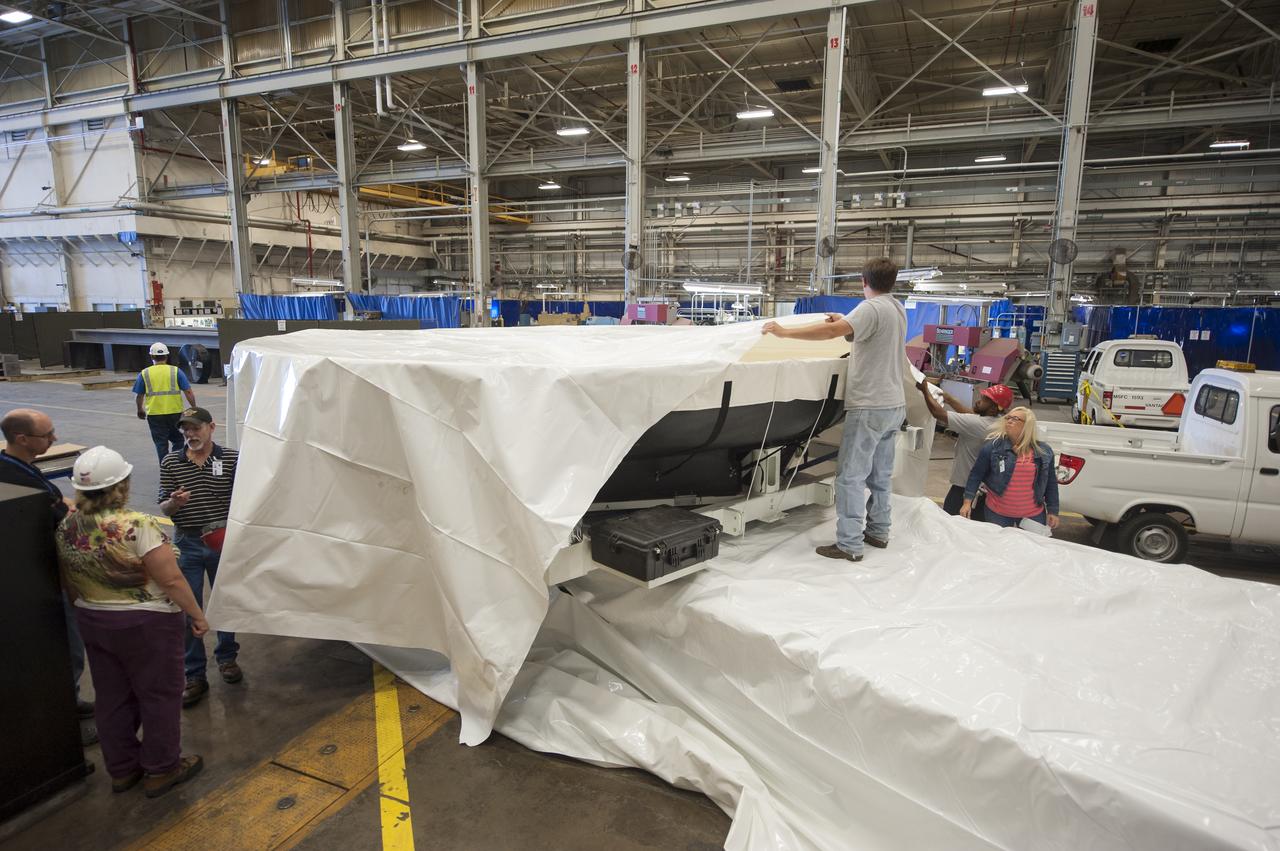
THE ORION HEAT SHIELD, WHICH WAS AT NASA’S MARSHALL SPACE FLIGHT CENTER FROM MARCH-MAY 2015 FOR ENGINEERING AND ANALYSIS, IS READIED FOR DEPARTURE AT THE END OF ITS STAY. THE HEAT SHIELD’S ABLATED SURFACE MATERIAL WAS REMOVED AT MARSHALL FOR ANALYSIS, USING THE CENTER’S STATE-OF-THE-ART SEVEN-AXIS MILLING MACHINE. IT NEXT WILL GO TO NASA’S LANGLEY RESEARCH CENTER FOR WATER-IMPACT TESTING. NASA’S JOHNSON SPACE CENTER LEADS THE ORION PROGRAM FOR NASA.
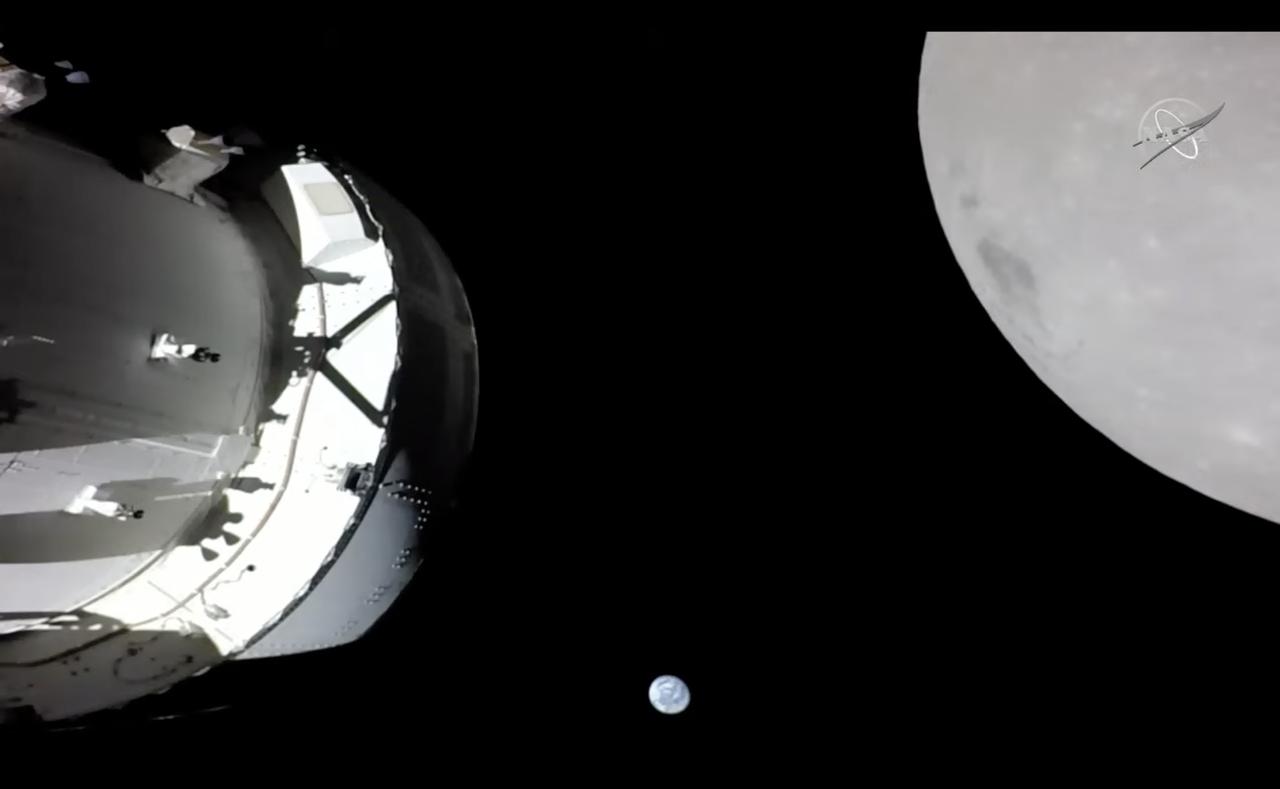
On Nov. 21, 2022, a camera on Orion's solar array wing captured this view of the spacecraft, the Earth and the Moon. Orion was making its outbound powered flyby of the Moon as part of the Artemis I mission, approaching within 80 miles of the lunar surface. Artemis I, the first flight test of NASA's Orion capsule and Space Launch System rocket, launched Nov. 16, 2022, and is scheduled to splashdown Dec. 11.
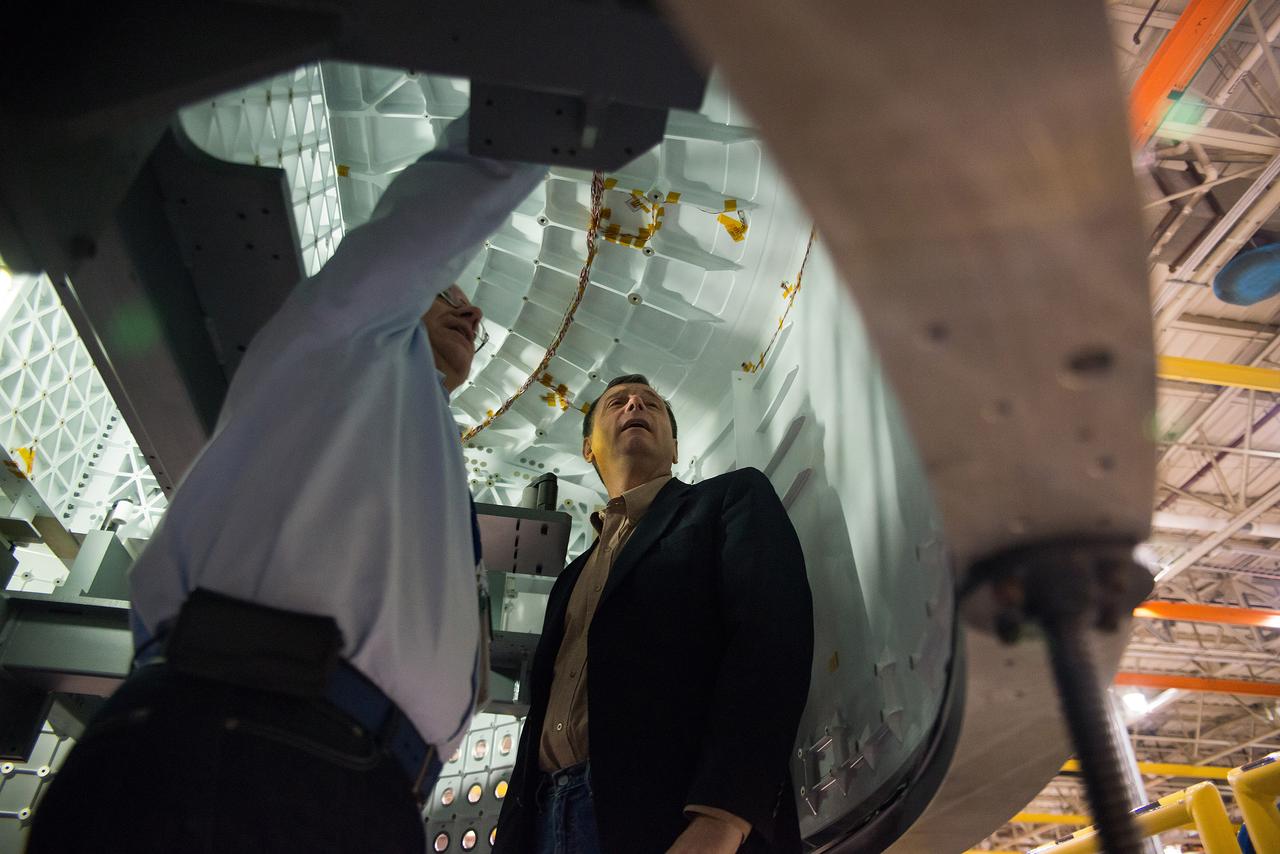
MAF Orion MGMT Visit
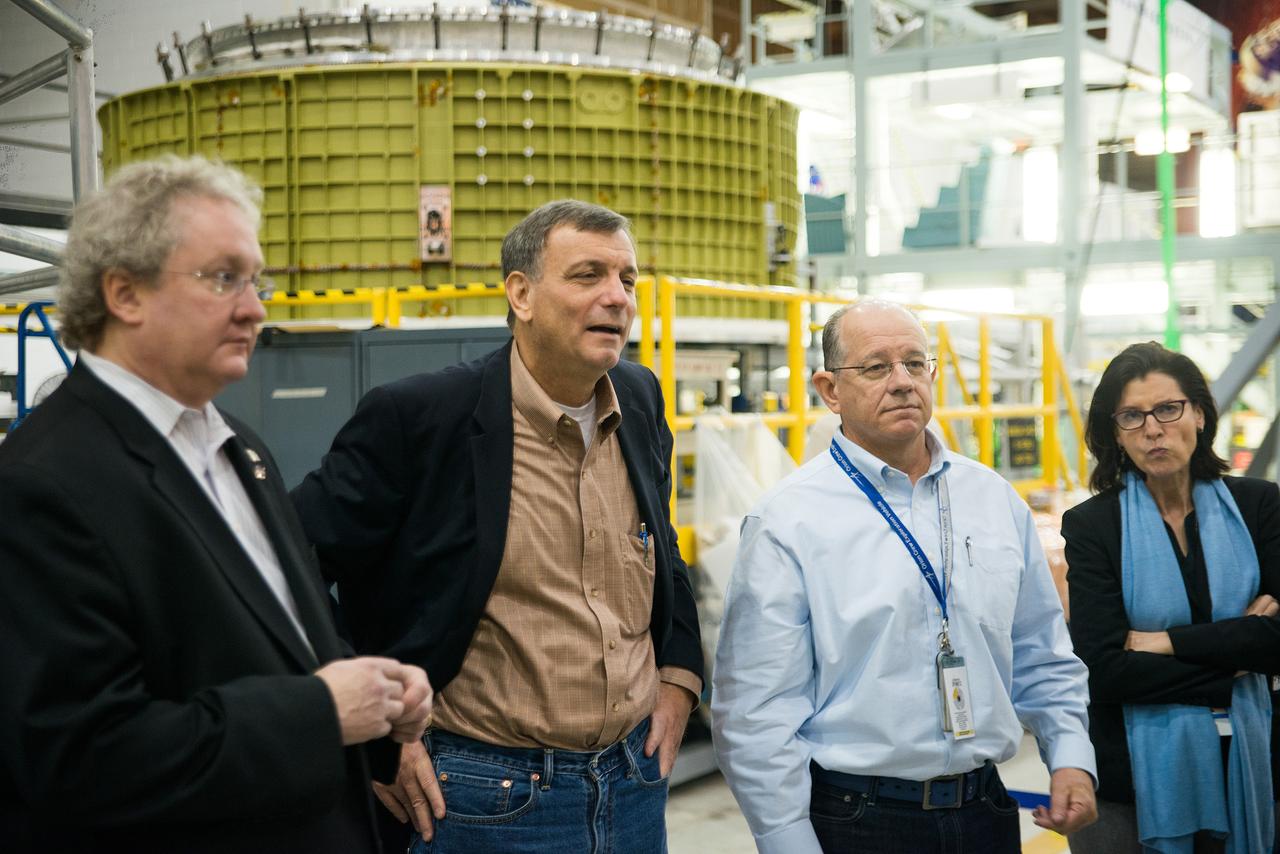
MAF Orion MGMT Visit
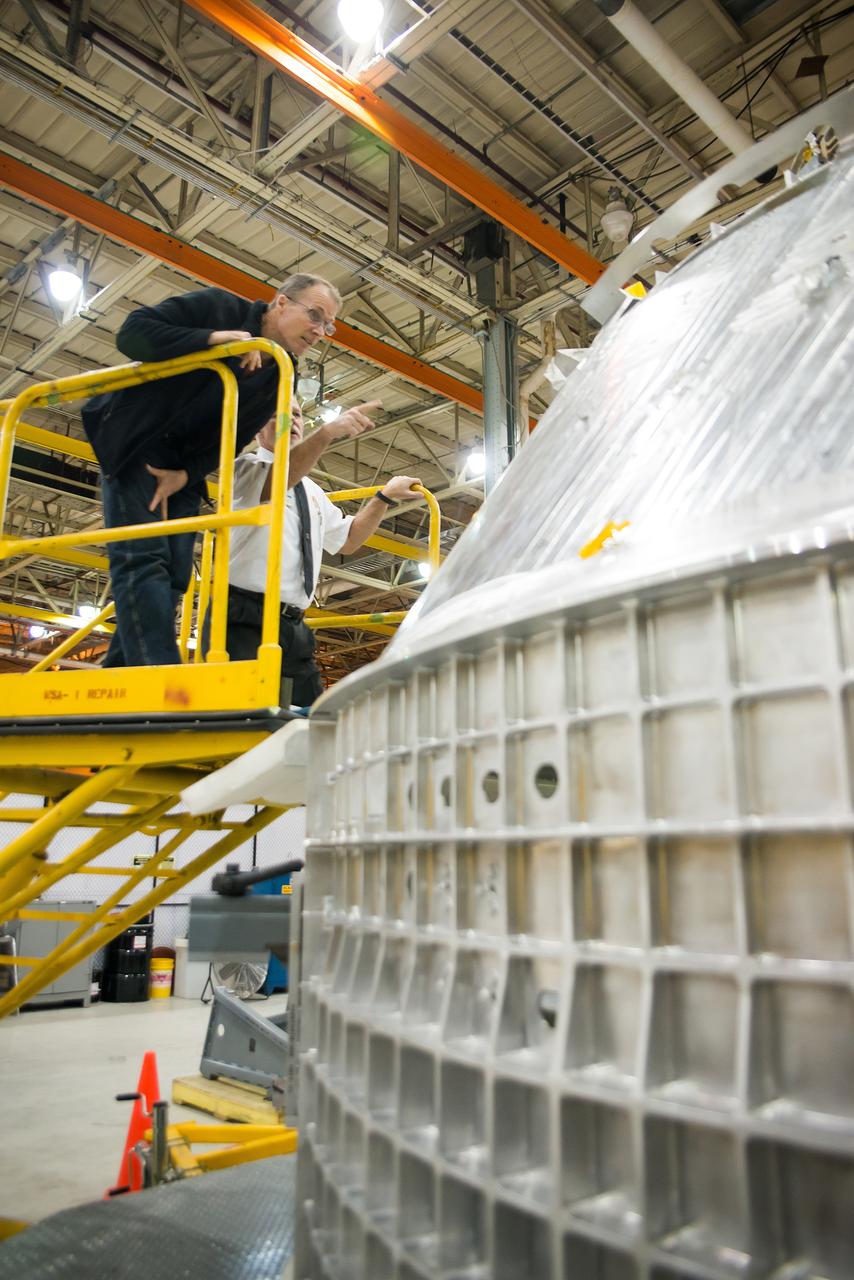
MAF Orion MGMT Visit
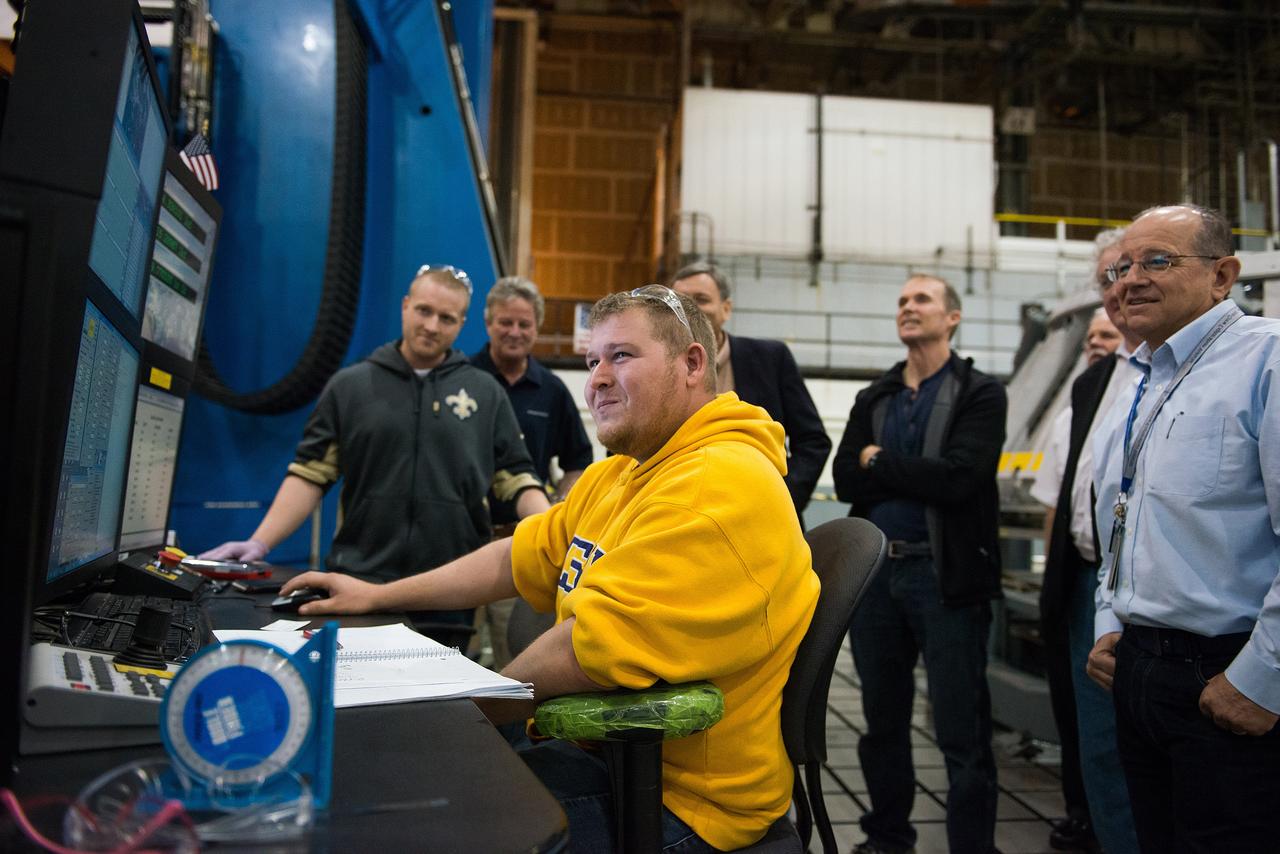
MAF Orion MGMT Visit
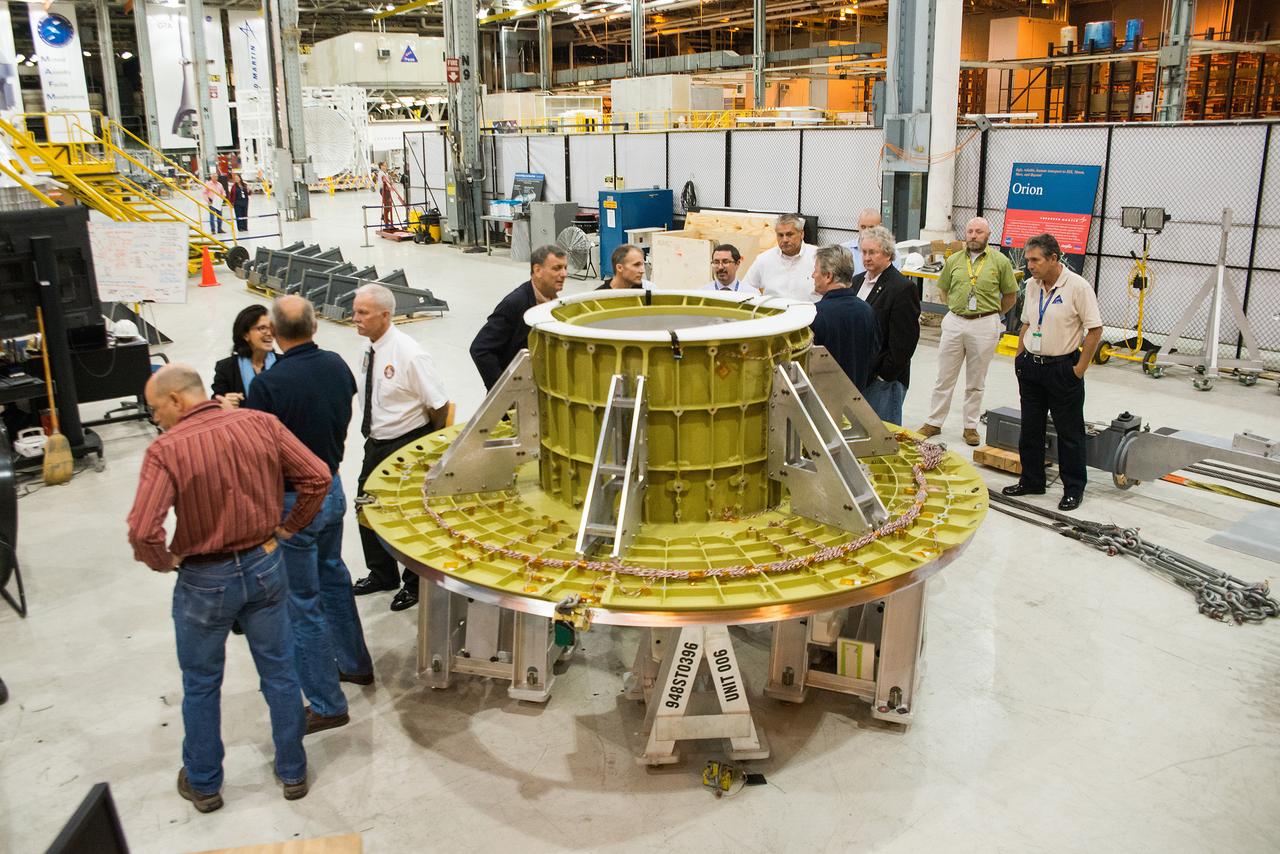
MAF Orion MGMT Visit
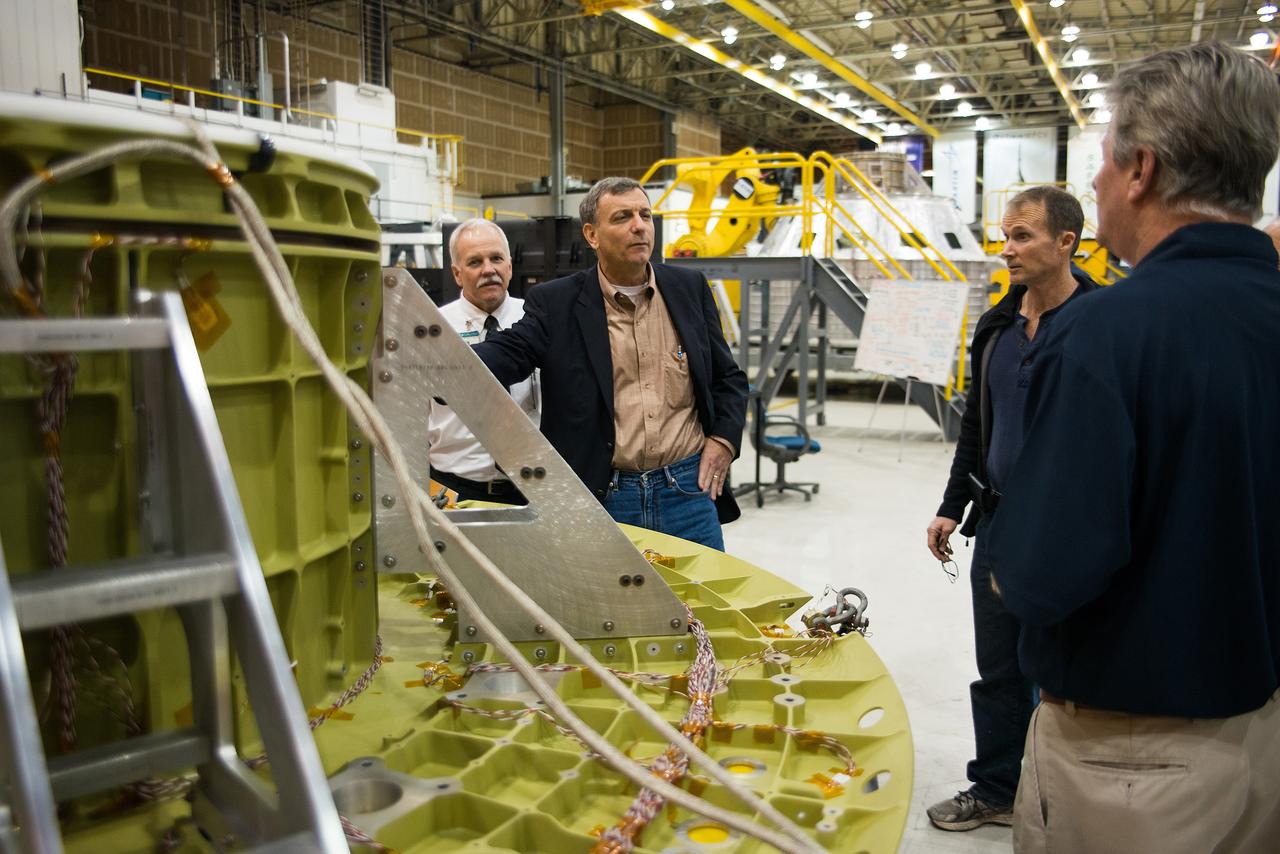
MAF Orion MGMT Visit
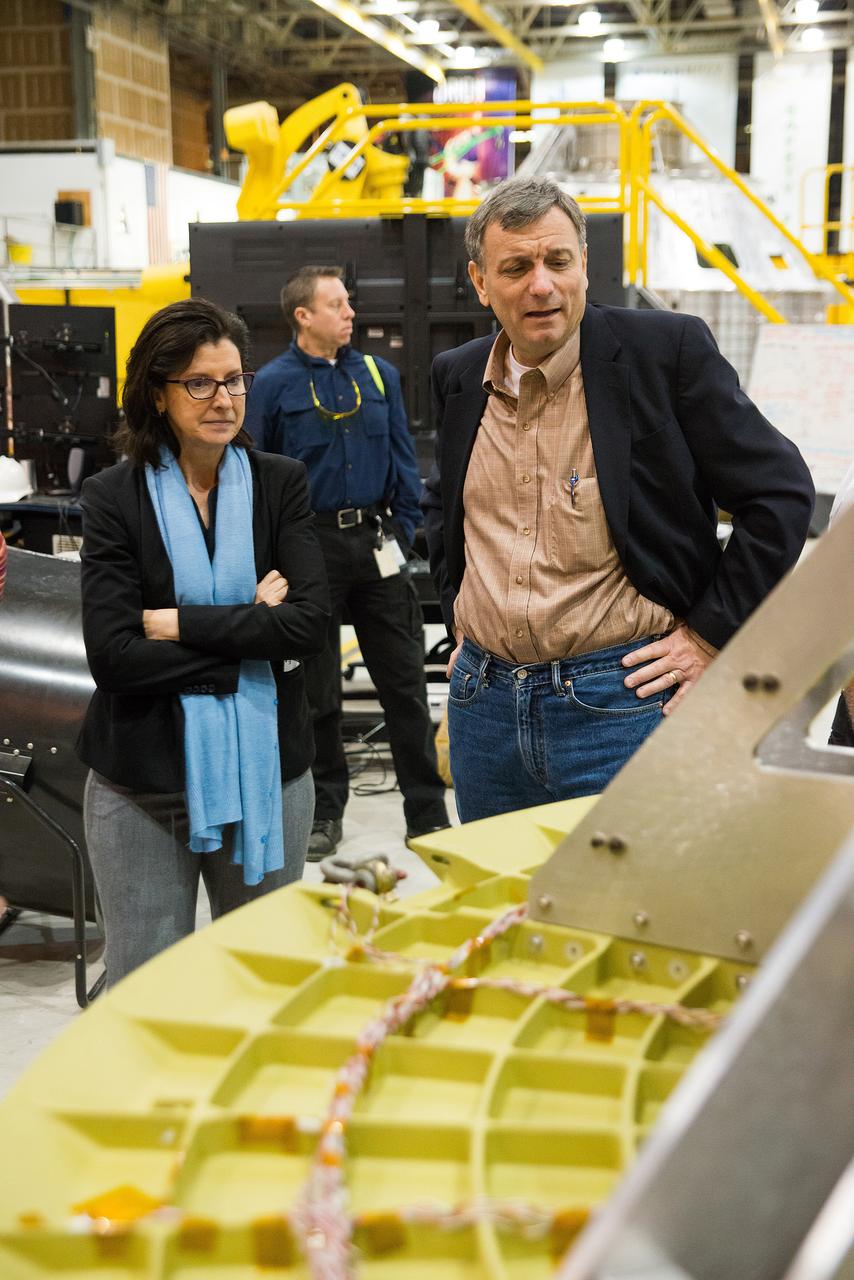
MAF Orion MGMT Visit
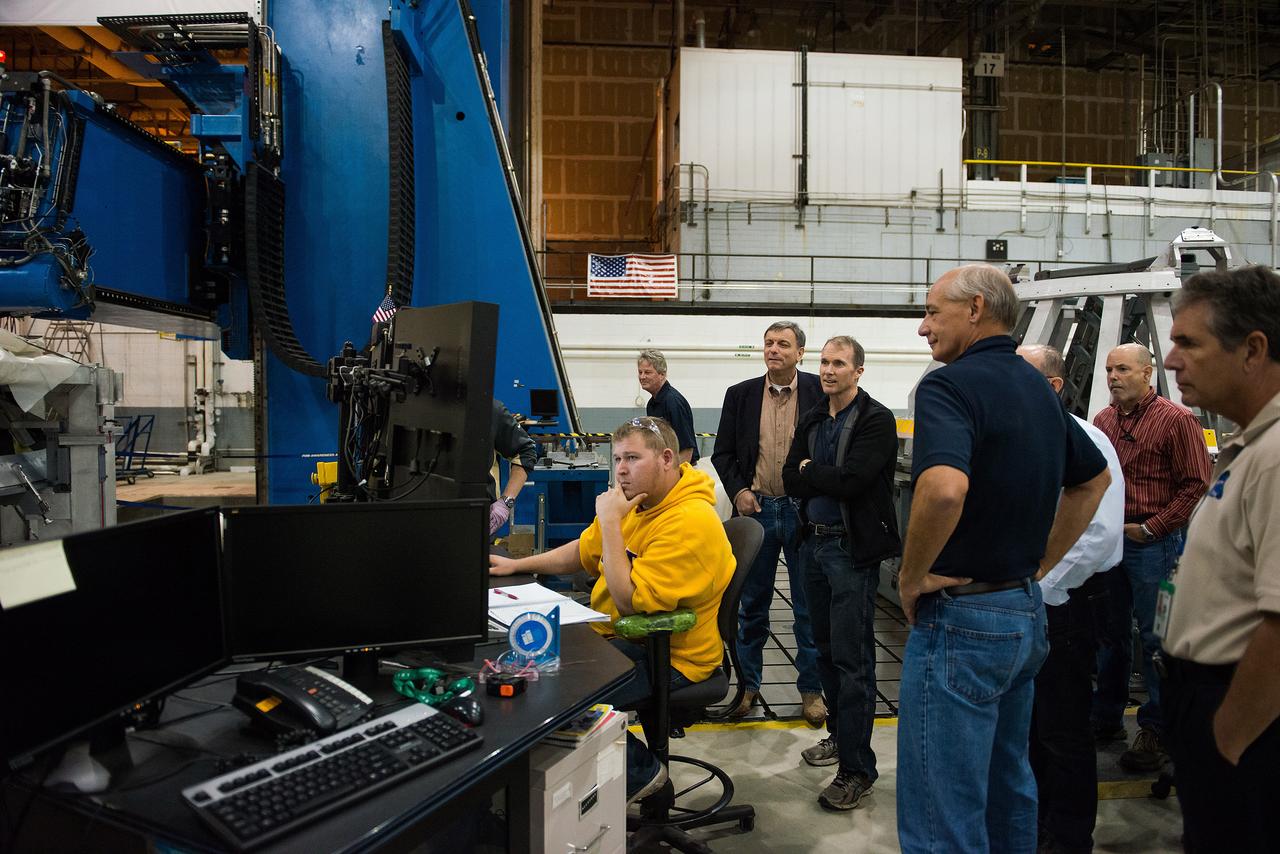
MAF Orion MGMT Visit
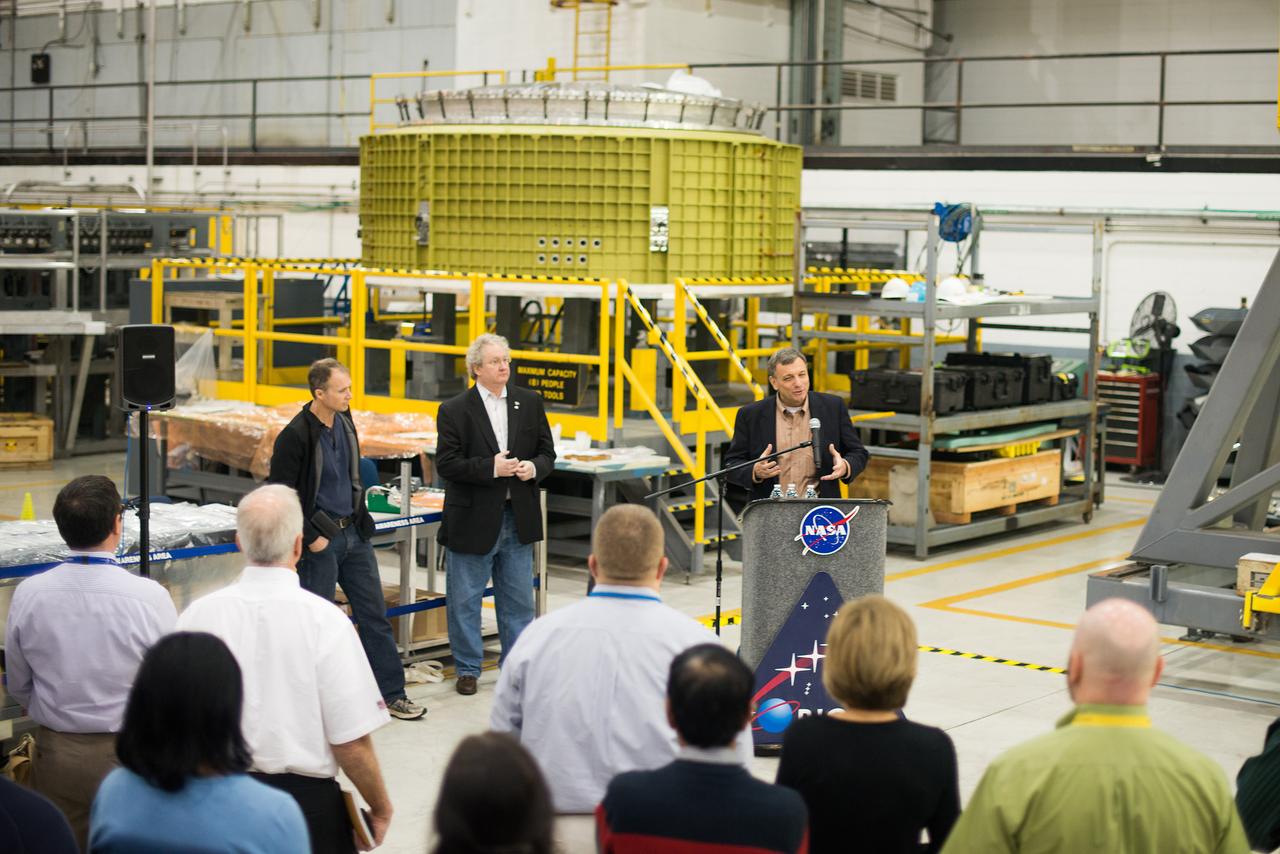
MAF Orion MGMT Visit
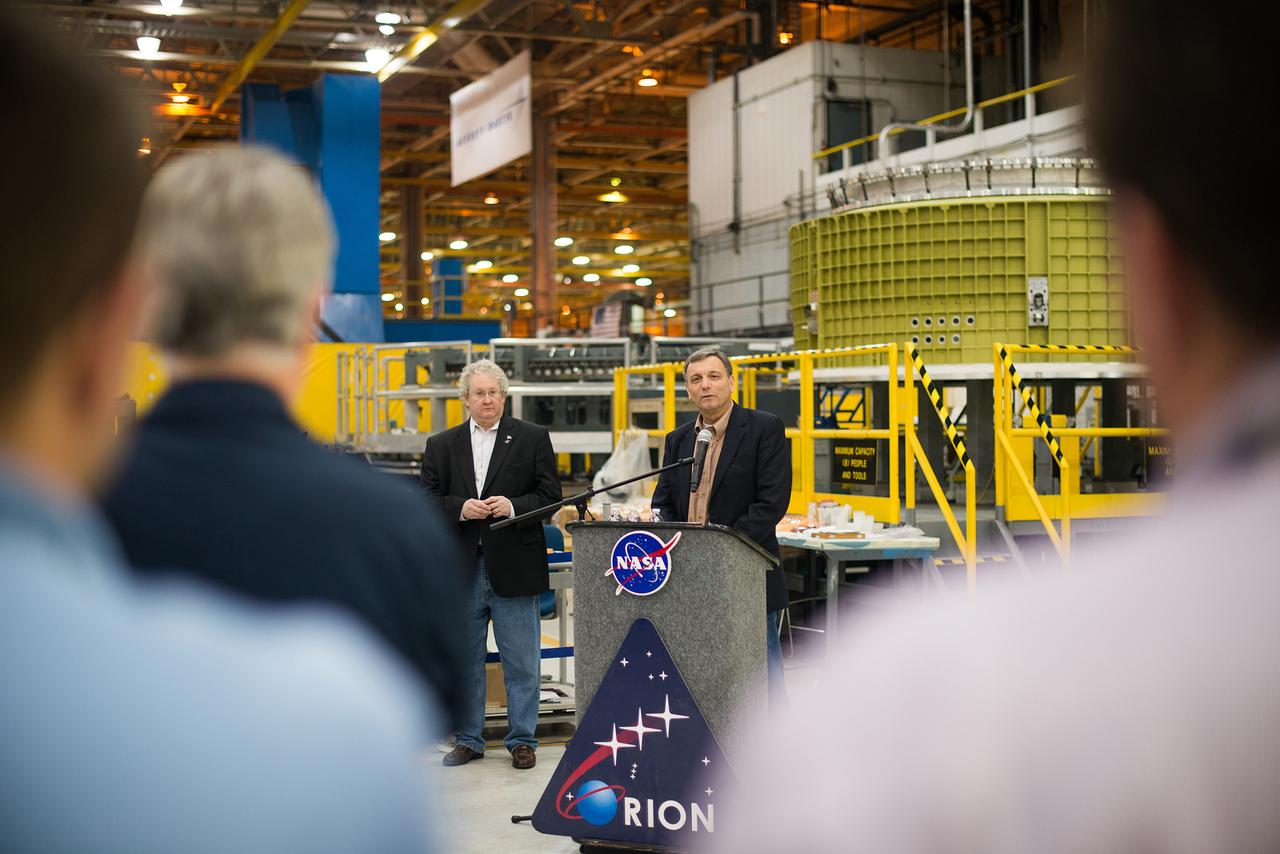
MAF Orion MGMT Visit
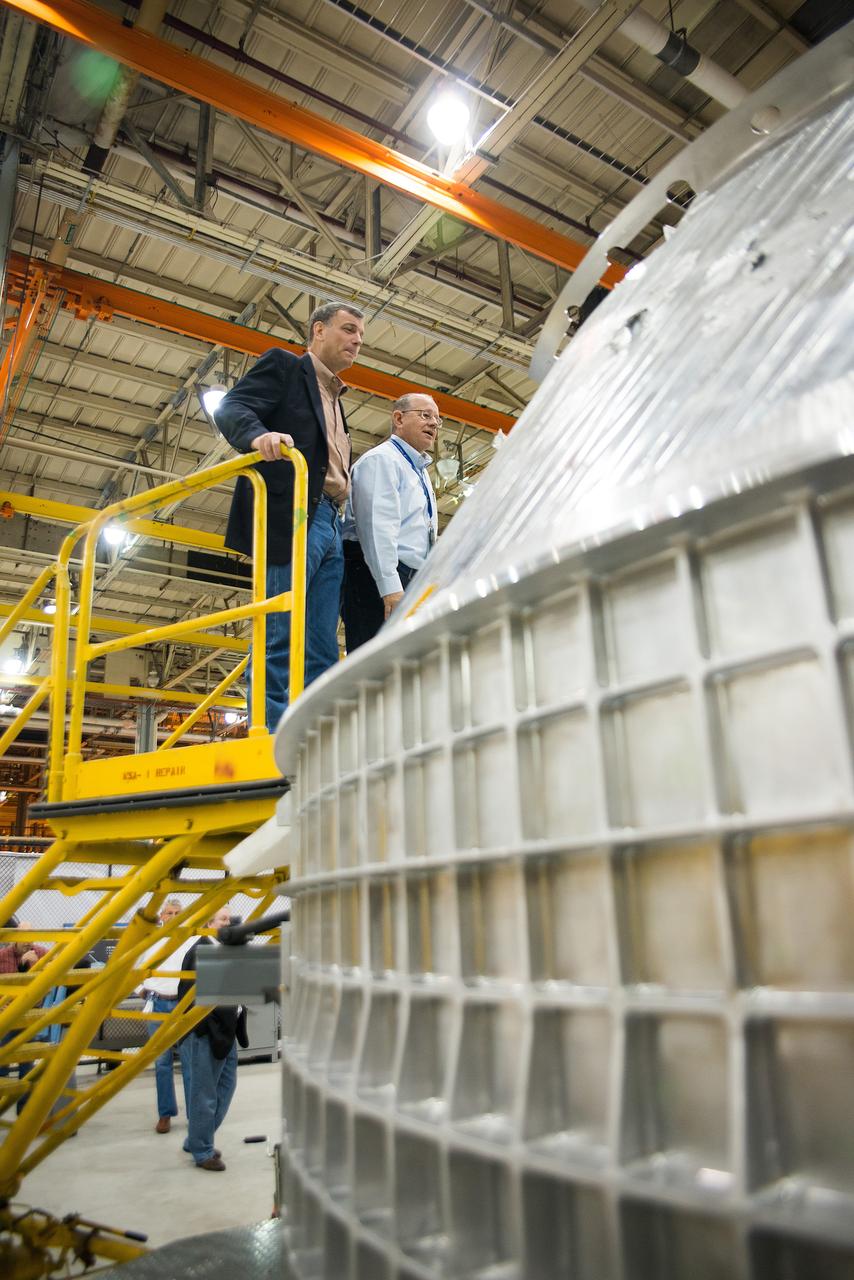
MAF Orion MGMT Visit
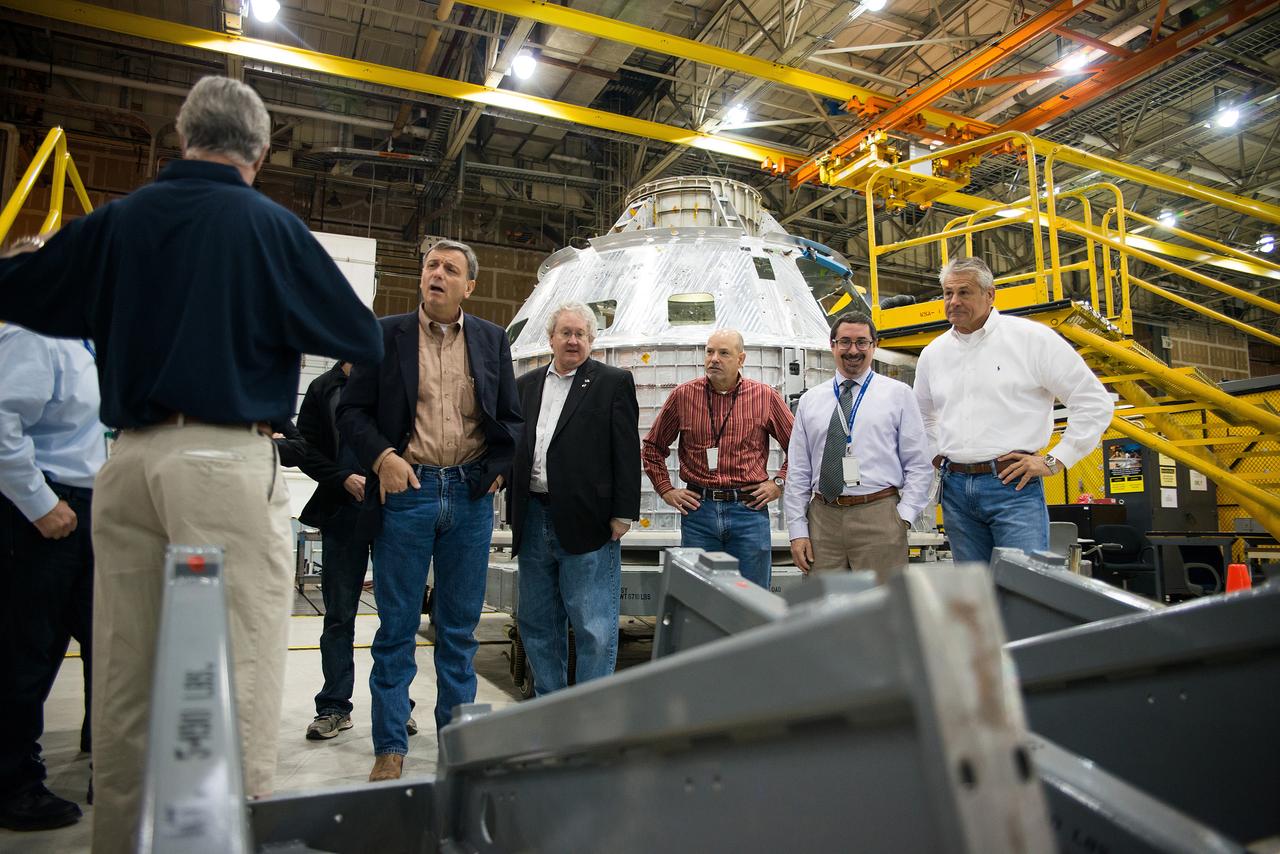
MAF Orion MGMT Visit
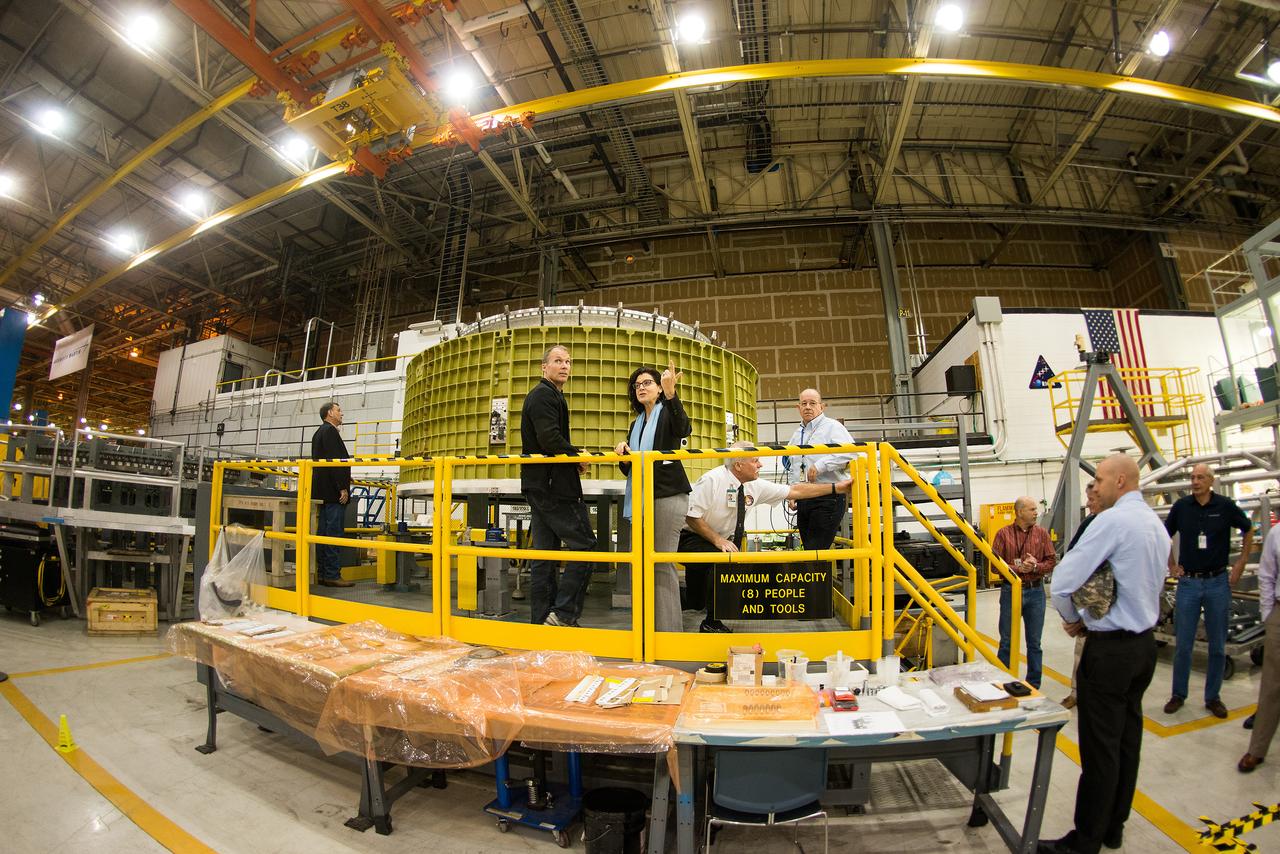
MAF Orion MGMT Visit
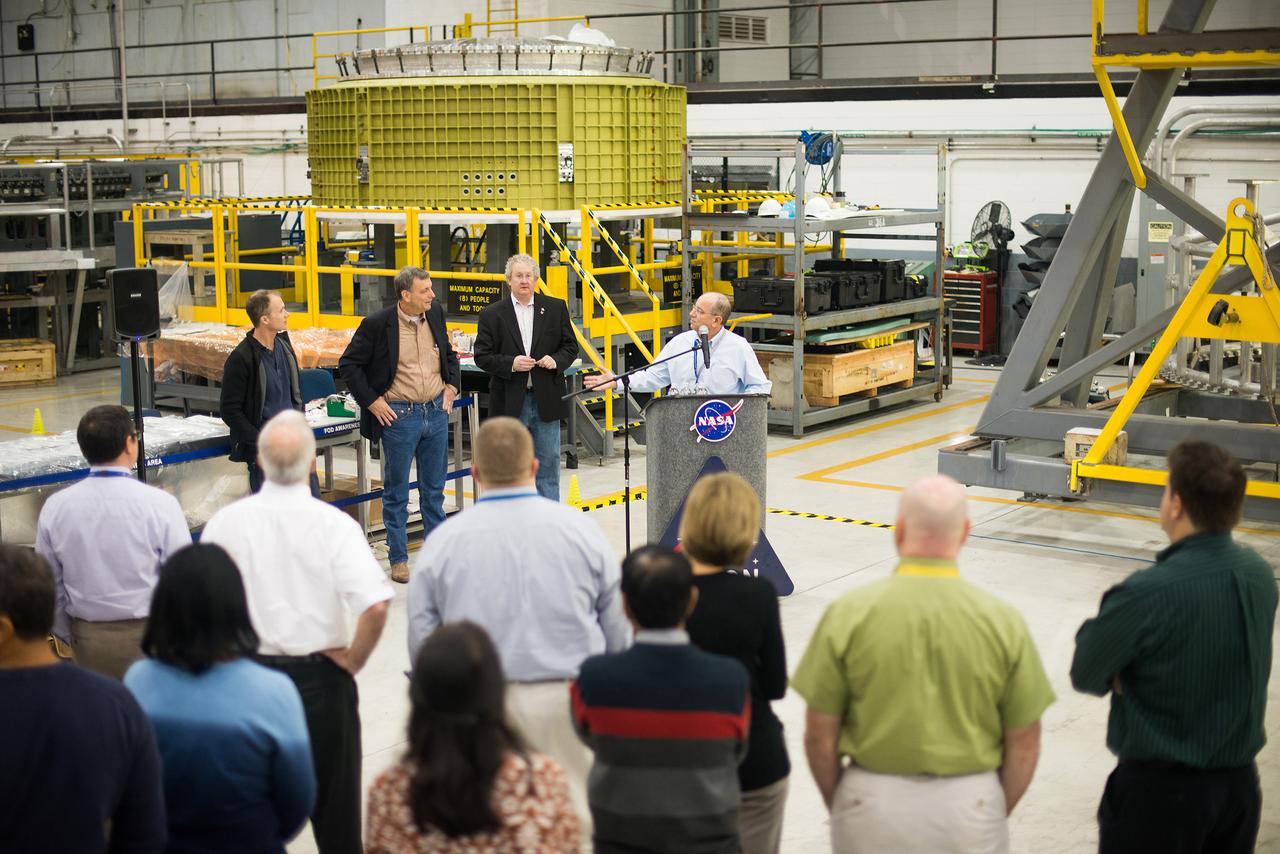
MAF Orion MGMT Visit
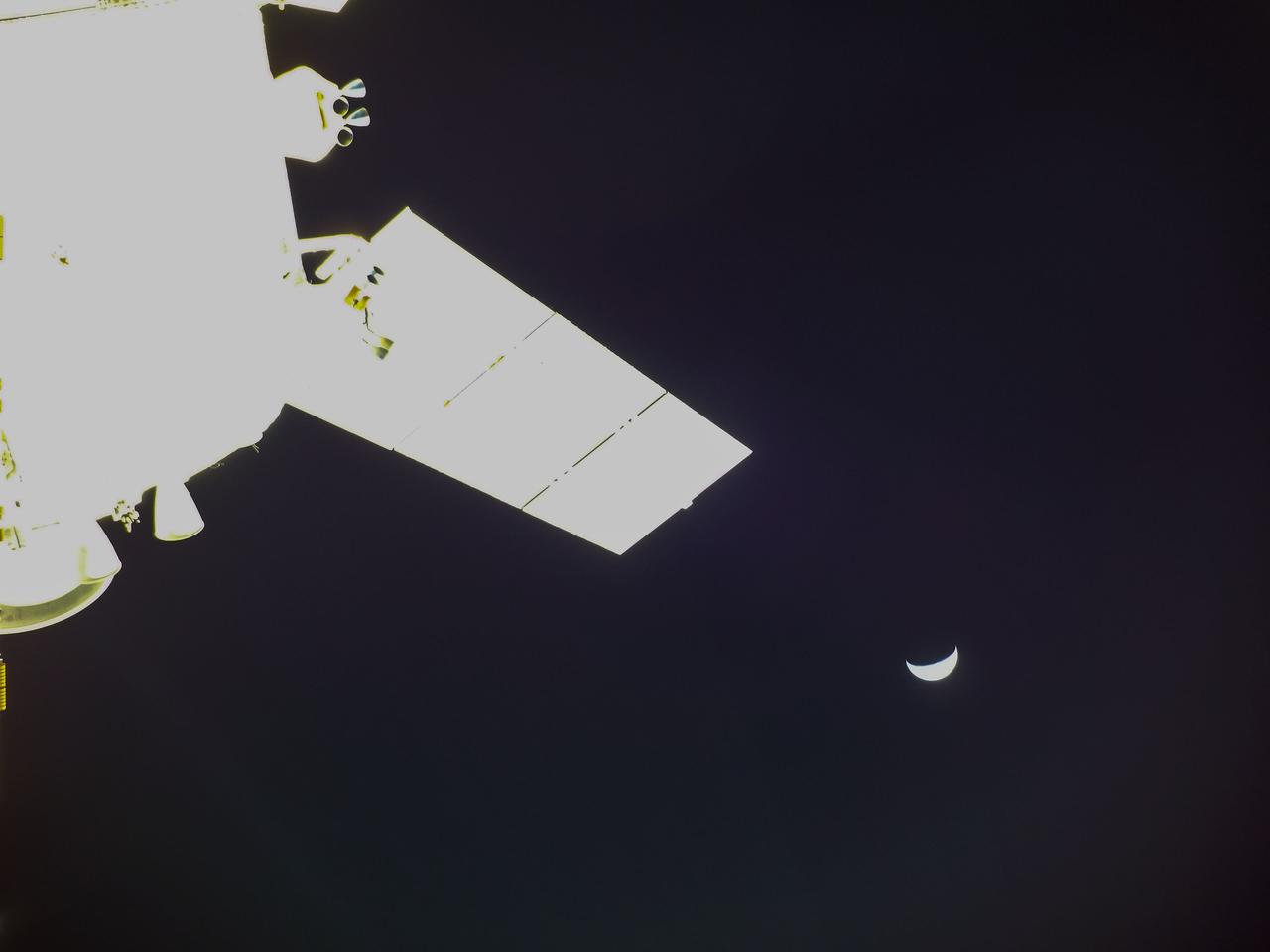
art001e001939 (Dec. 2, 2022) A camera mounted on one of Orion’s four solar arrays captured this image of the Moon on flight day 17 of the 25.5-day Artemis I mission from a distance of more than 222,000 miles. Orion has exited the distant lunar orbit and is heading for a Dec. 11 splashdown in the Pacific Ocean.
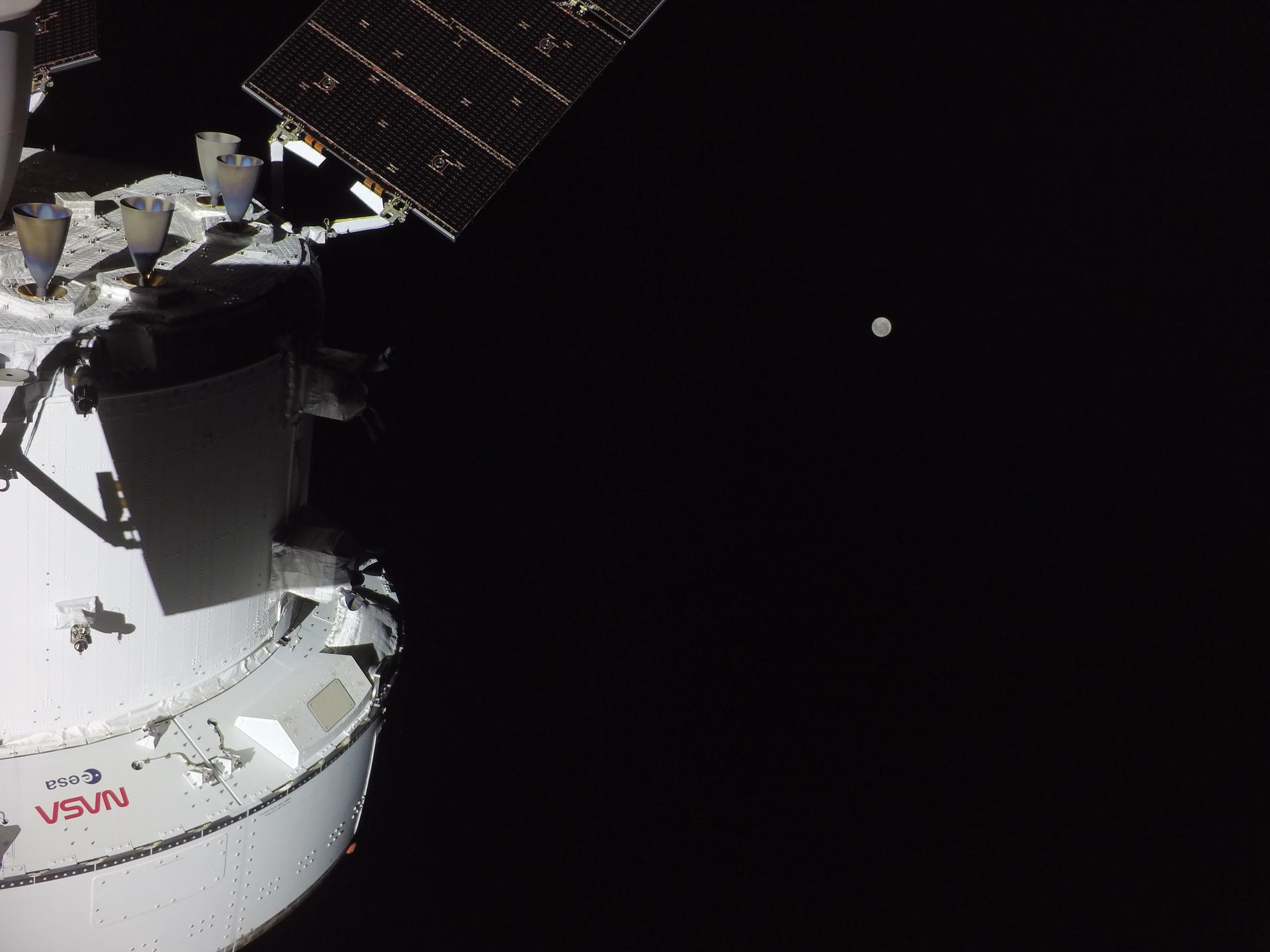
art002e004429 (April 3, 2026) - The Artemis II crew is en route to the Moon on the second flight day of the mission. This photo shows the Orion spacecraft with the Moon in the distance, as captured by a camera on the tip of one of its solar array wings.
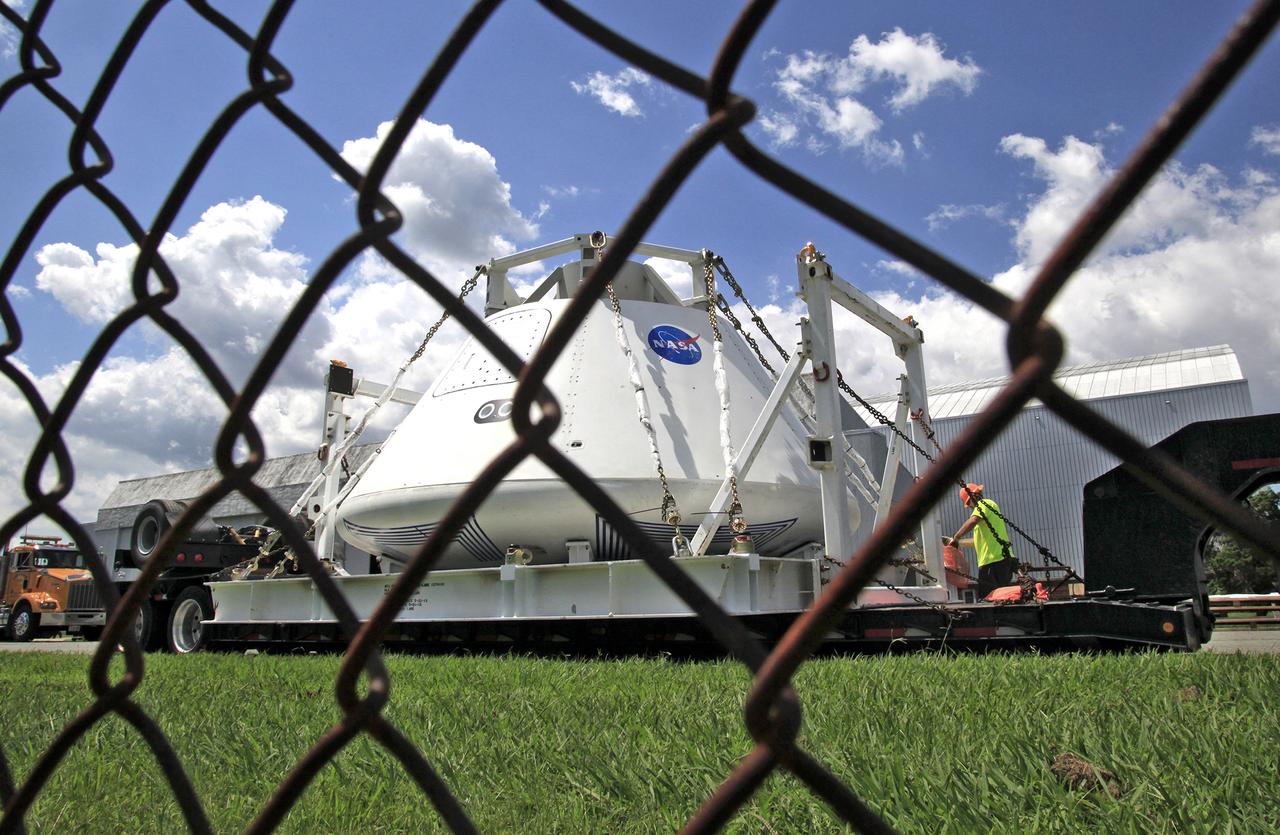
Orion Test Capsule loaded on a flatbed trailer at NASA Langley to be transport to Fort Eustis, VA. where it will be transported by barge to Norfolk Va. for open water recovery test.
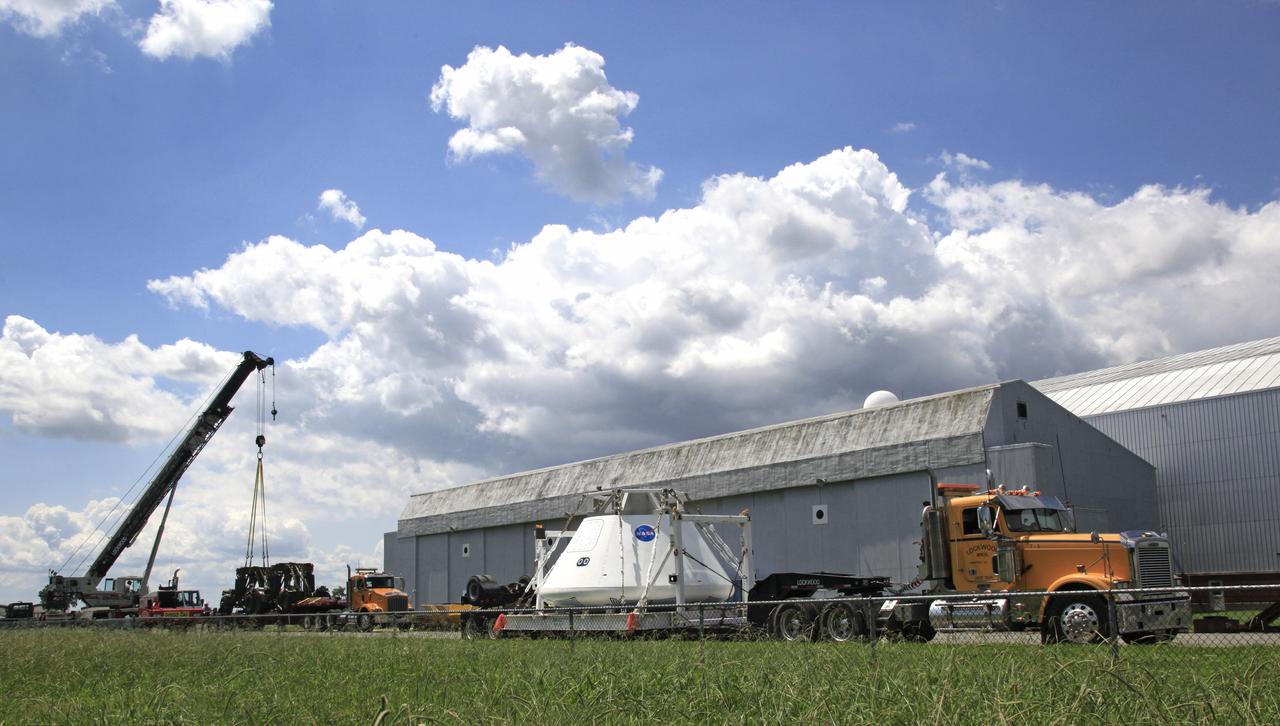
Orion Test Capsule loaded on a flatbed trailer at NASA Langley to be transport to Fort Eustis, VA. where it will be transported by barge to Norfolk Va. for open water recovery test.
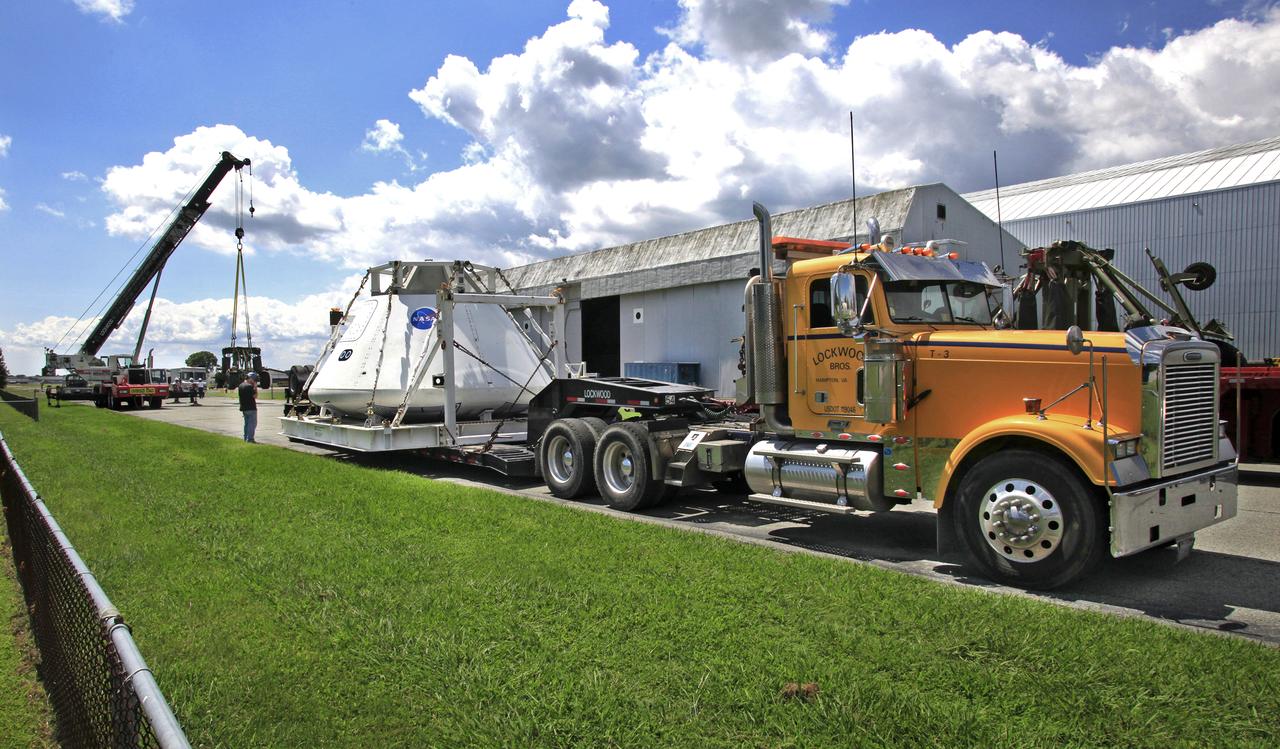
Orion Test Capsule loaded on a flatbed trailer at NASA Langley to be transport to Fort Eustis, VA. where it will be transported by barge to Norfolk Va. for open water recovery test.
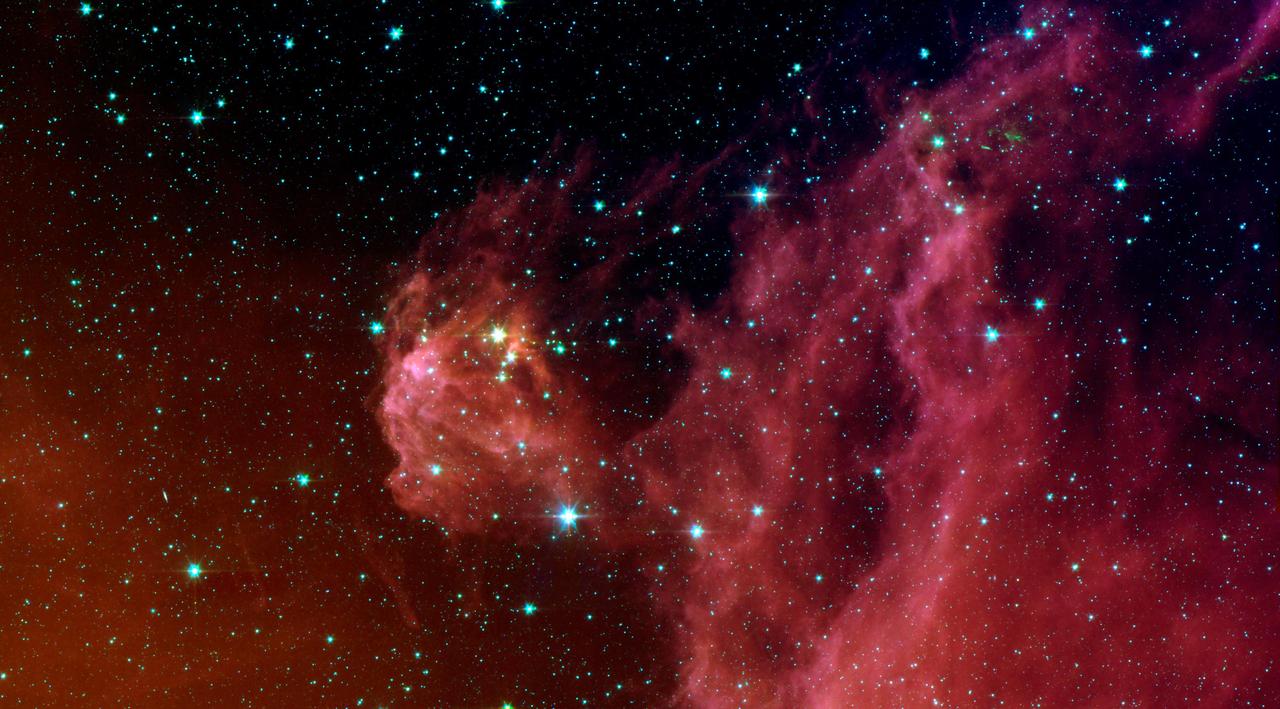
This image from NASA's Spitzer Space Telescope shows infant stars "hatching" in the head of the hunter constellation, Orion. Astronomers suspect that shockwaves from a supernova explosion in Orion's head, nearly three million years ago, may have initiated this newfound birth . The region featured in this Spitzer image is called Barnard 30. It is located approximately 1,300 light-years away and sits on the right side of Orion's "head," just north of the massive star Lambda Orionis. Wisps of red in the cloud are organic molecules called polycyclic aromatic hydrocarbons. These molecules are formed anytime carbon-based materials are burned incompletely. On Earth, they can be found in the sooty exhaust from automobile and airplane engines. They also coat the grills where charcoal-broiled meats are cooked. This image shows infrared light captured by Spitzer's infrared array camera. Light with wavelengths of 8 and 5.8 microns (red and orange) comes mainly from dust that has been heated by starlight. Light of 4.5 microns (green) shows hot gas and dust; and light of 3.6 microns (blue) is from starlight. http://photojournal.jpl.nasa.gov/catalog/PIA09412
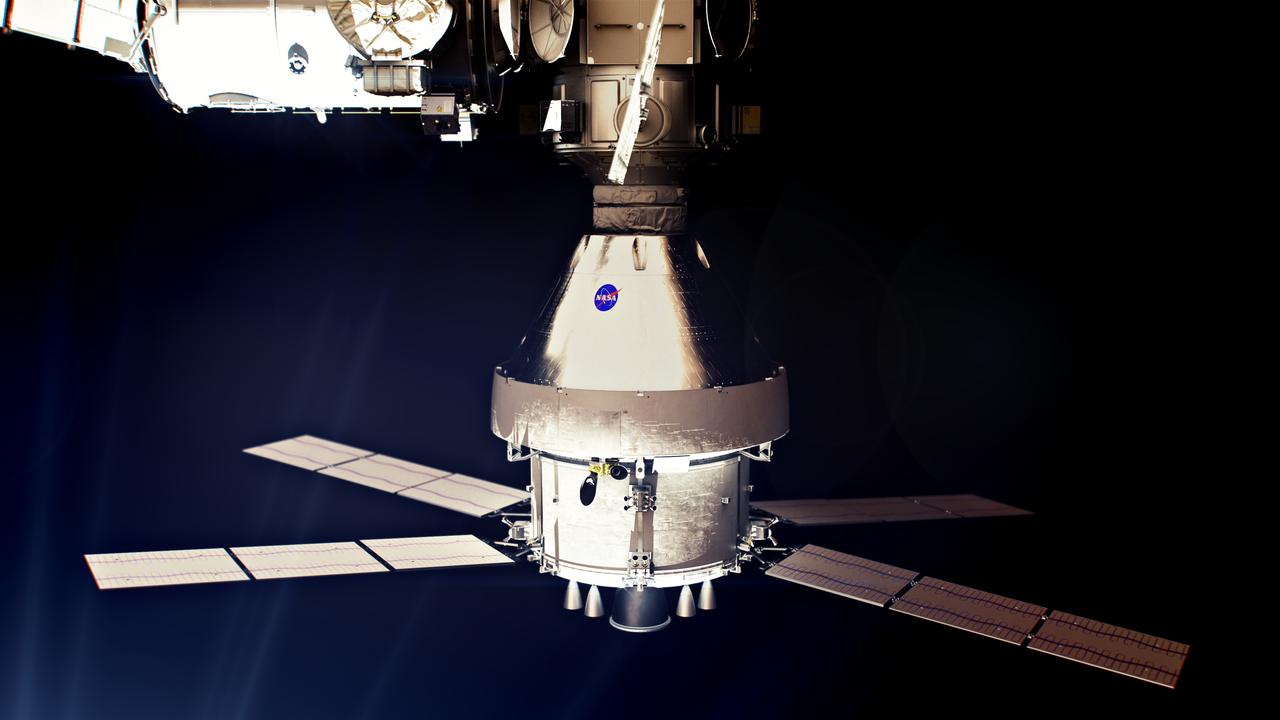
The Orion spacecraft docked to the Gateway space station. Orion will visit Gateway for the first time on the Artemis IV mission when astronauts will use it to deliver the International Habitat (I-Hab) module to Gateway. Orion will return to Gateway to deliver additional elements on Artemis V and VI.
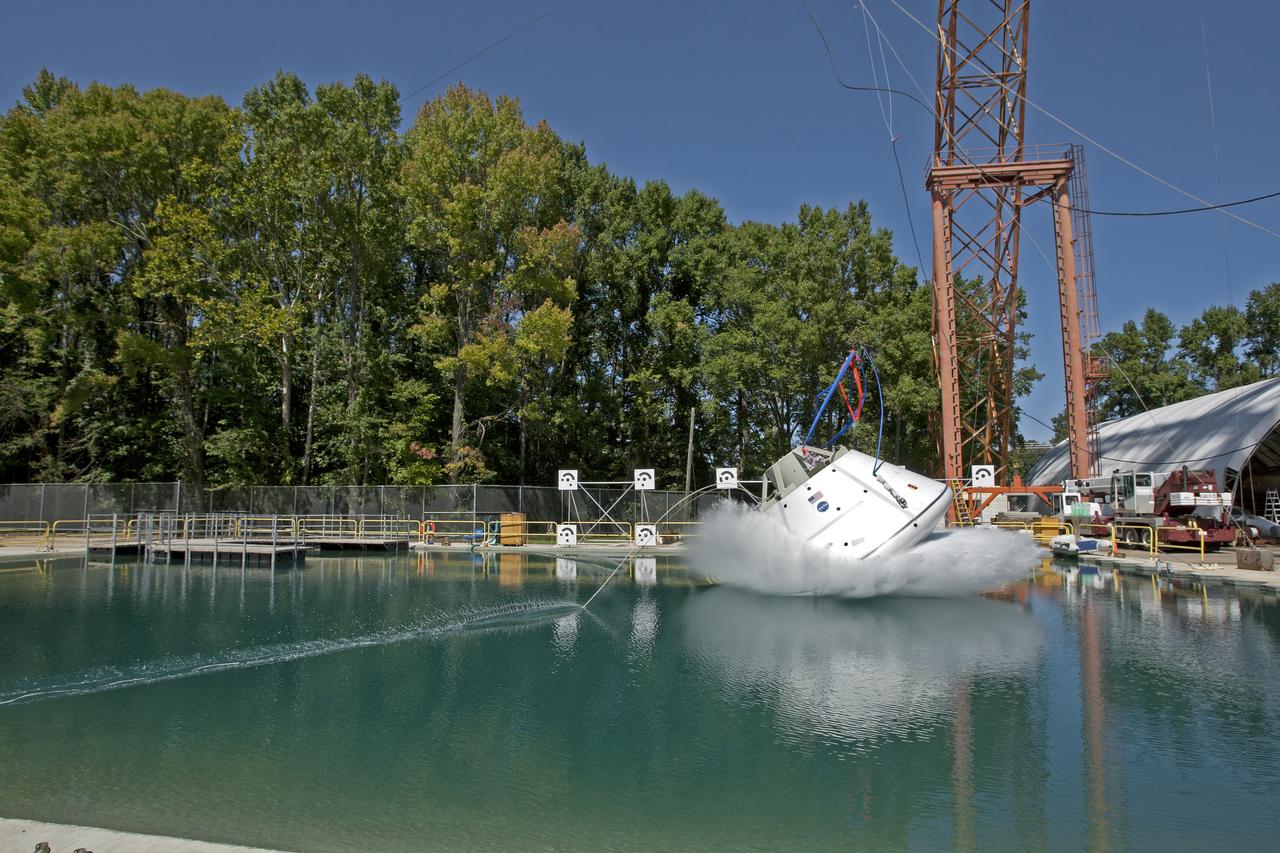
Orion at Hydro Impact Basin Engineers conducted the first test as part of Phase 1 of the Orion boilerplate test article at NASA's Langley Research Center, on Oct. 18.

Orion at Hydro Impact Basin Engineers conducted the first test as part of Phase 1 of the Orion boilerplate test article at NASA's Langley Research Center, on Oct. 18.

Orion at Hydro Impact Basin Engineers conducted the first test as part of Phase 1 of the Orion boilerplate test article at NASA's Langley Research Center, on Oct. 18.

Orion at Hydro Impact Basin Engineers conducted the first test as part of Phase 1 of the Orion boilerplate test article at NASA's Langley Research Center, on Oct. 18.
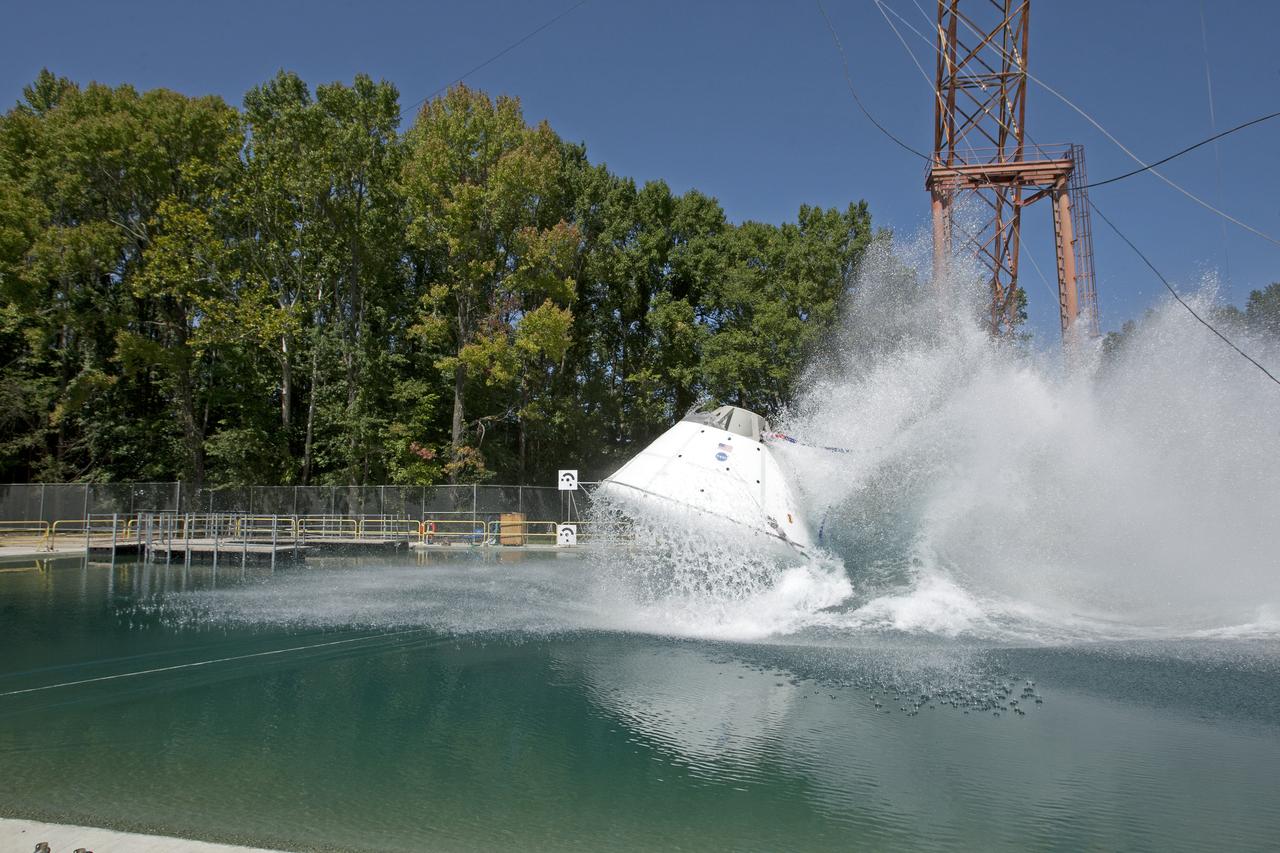
Orion at Hydro Impact Basin Engineers conducted the first test as part of Phase 1 of the Orion boilerplate test article at NASA's Langley Research Center, on Oct. 18.
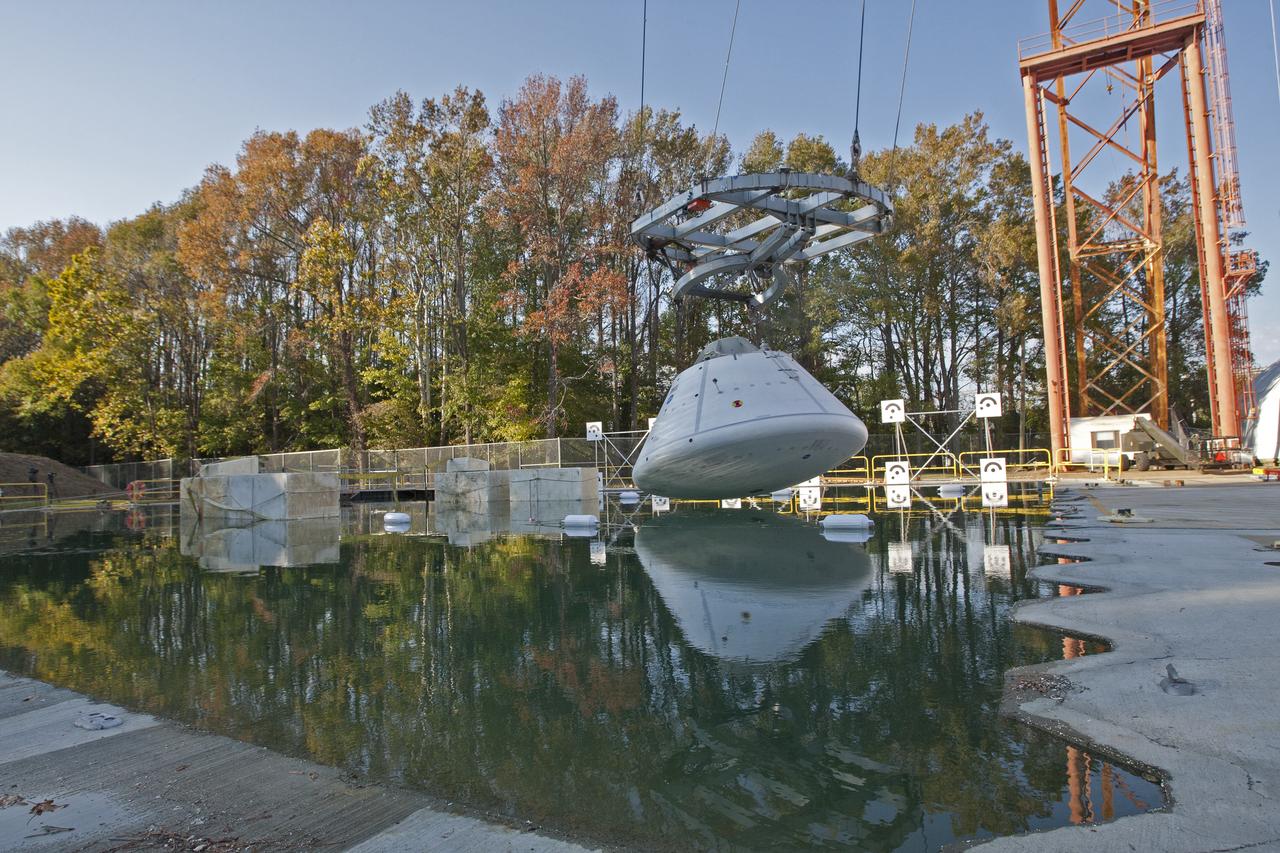
Orion at Hydro Impact Basin Engineers conducted the first test as part of Phase 1 of the Orion boilerplate test article at NASA's Langley Research Center, on Oct. 18.
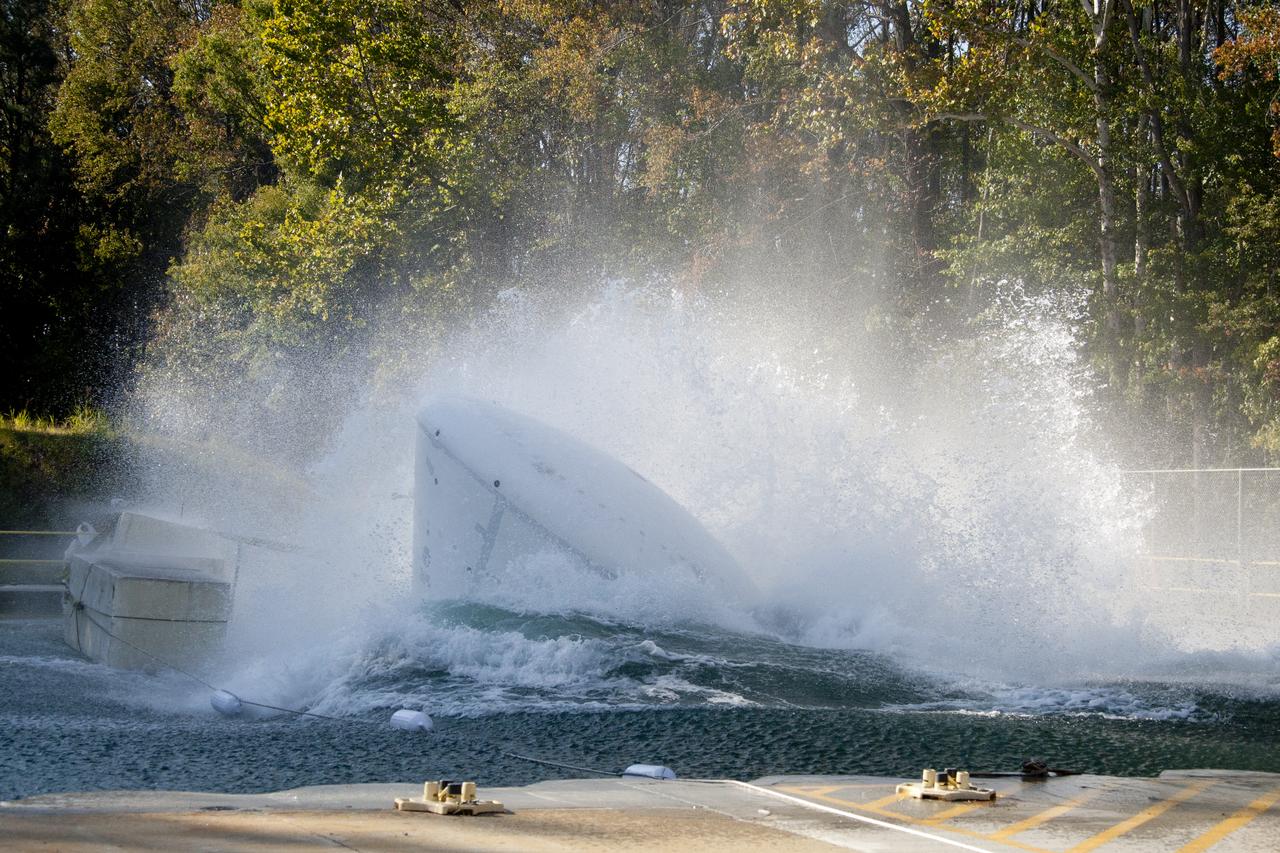
Orion at Hydro Impact Basin Engineers conducted the first test as part of Phase 1 of the Orion boilerplate test article at NASA's Langley Research Center, on Oct. 18.

Orion at Hydro Impact Basin Engineers conducted the first test as part of Phase 1 of the Orion boilerplate test article at NASA's Langley Research Center, on Oct. 18.
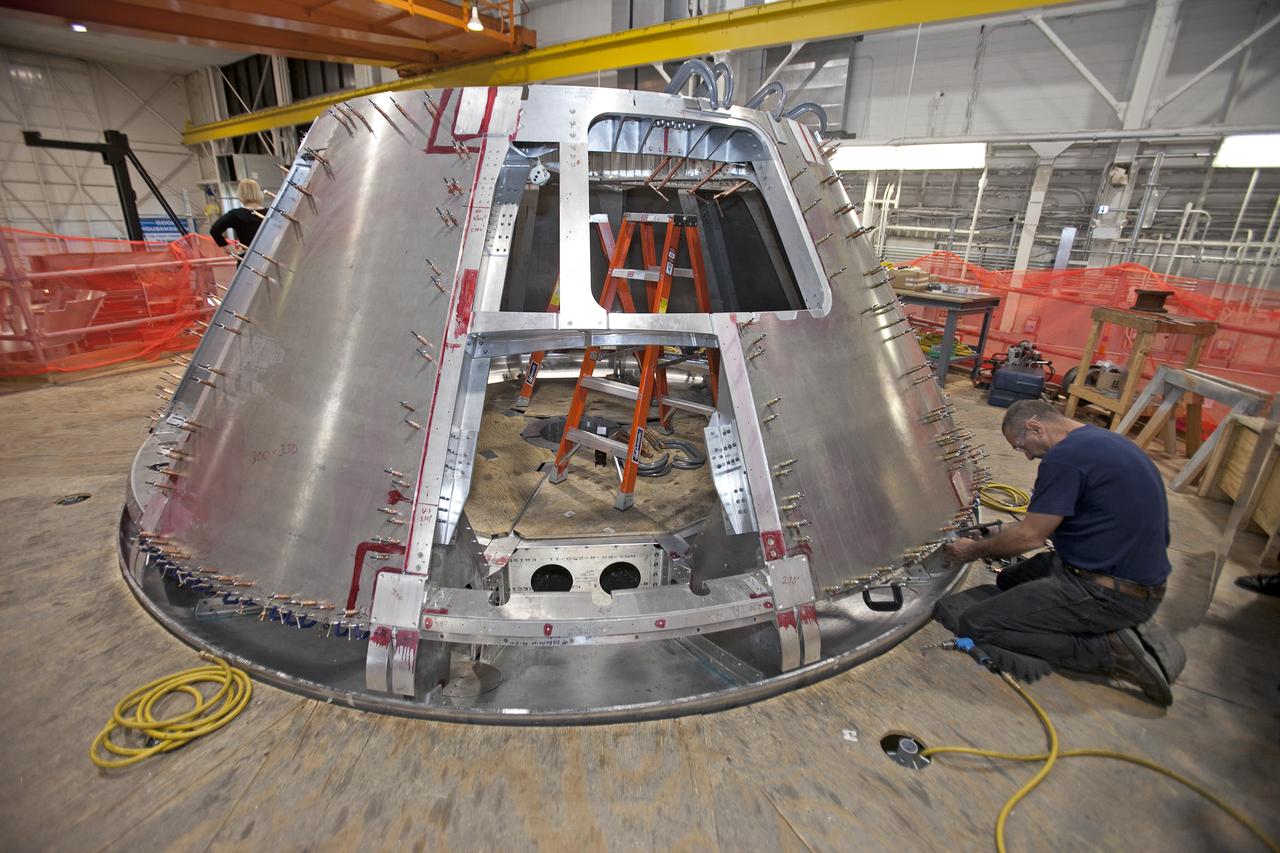
Orion Crew Module KSC Ground Ops Pathfinder Work continues on the fabrication of the Orion Crew Module KSC Ground Operations pathfinder in building 1232A at NASA Langley.

Orion at Hydro Impact Basin Engineers conducted the first test as part of Phase 1 of the Orion boilerplate test article at NASA's Langley Research Center, on Oct. 18.
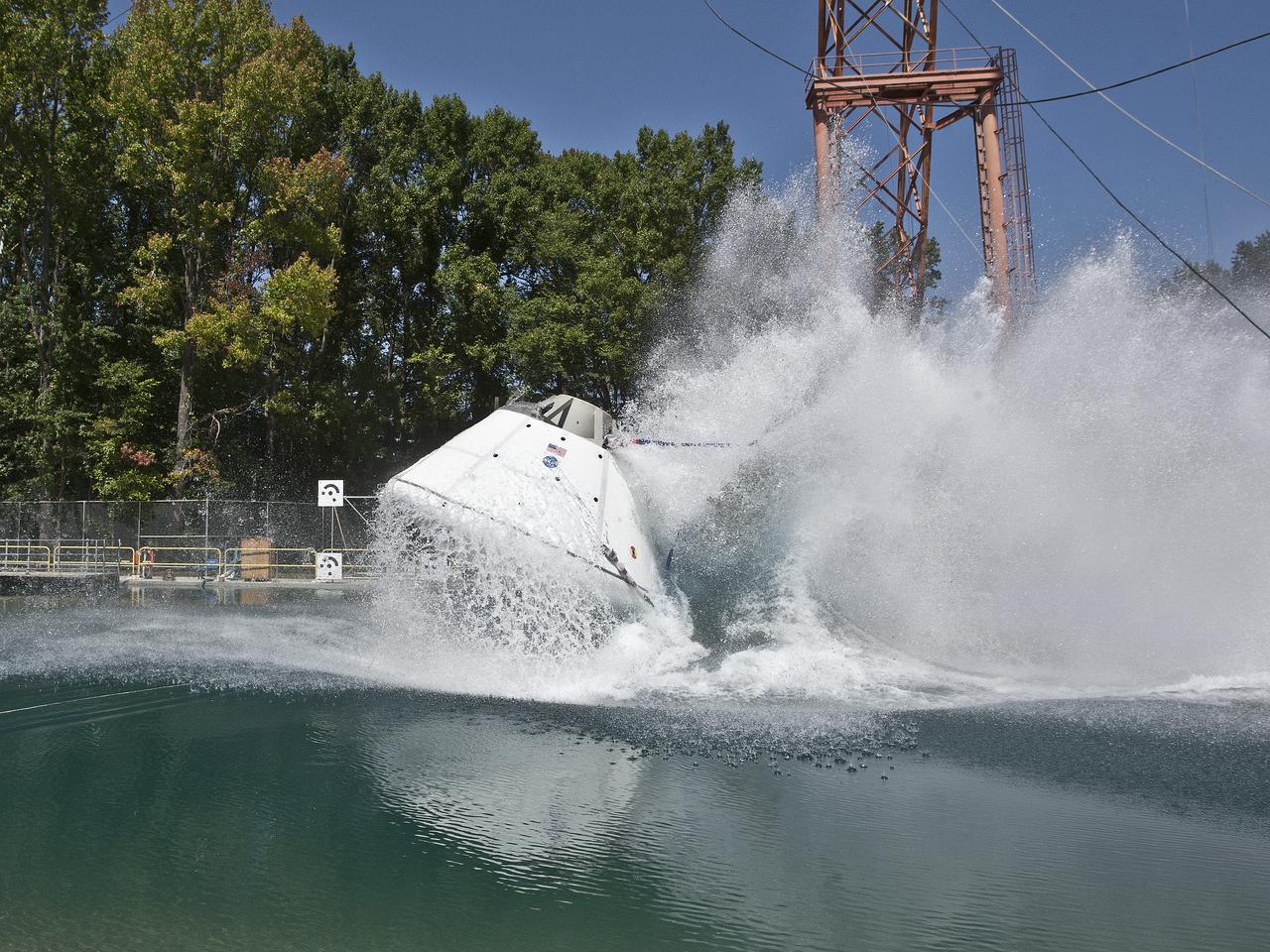
Orion at Hydro Impact Basin Engineers conducted the first test as part of Phase 1 of the Orion boilerplate test article at NASA's Langley Research Center, on Oct. 18.
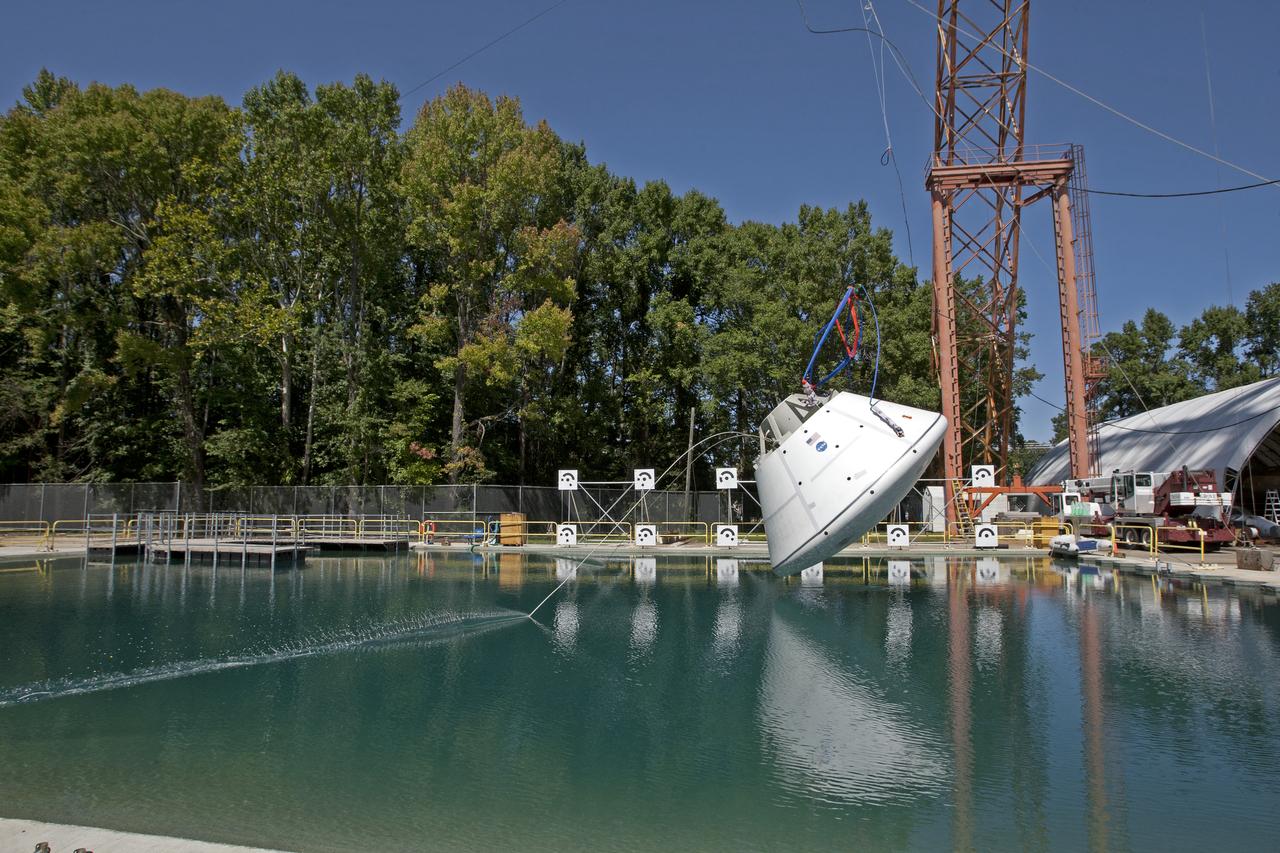
Orion at Hydro Impact Basin Engineers conducted the first test as part of Phase 1 of the Orion boilerplate test article at NASA's Langley Research Center, on Oct. 18.
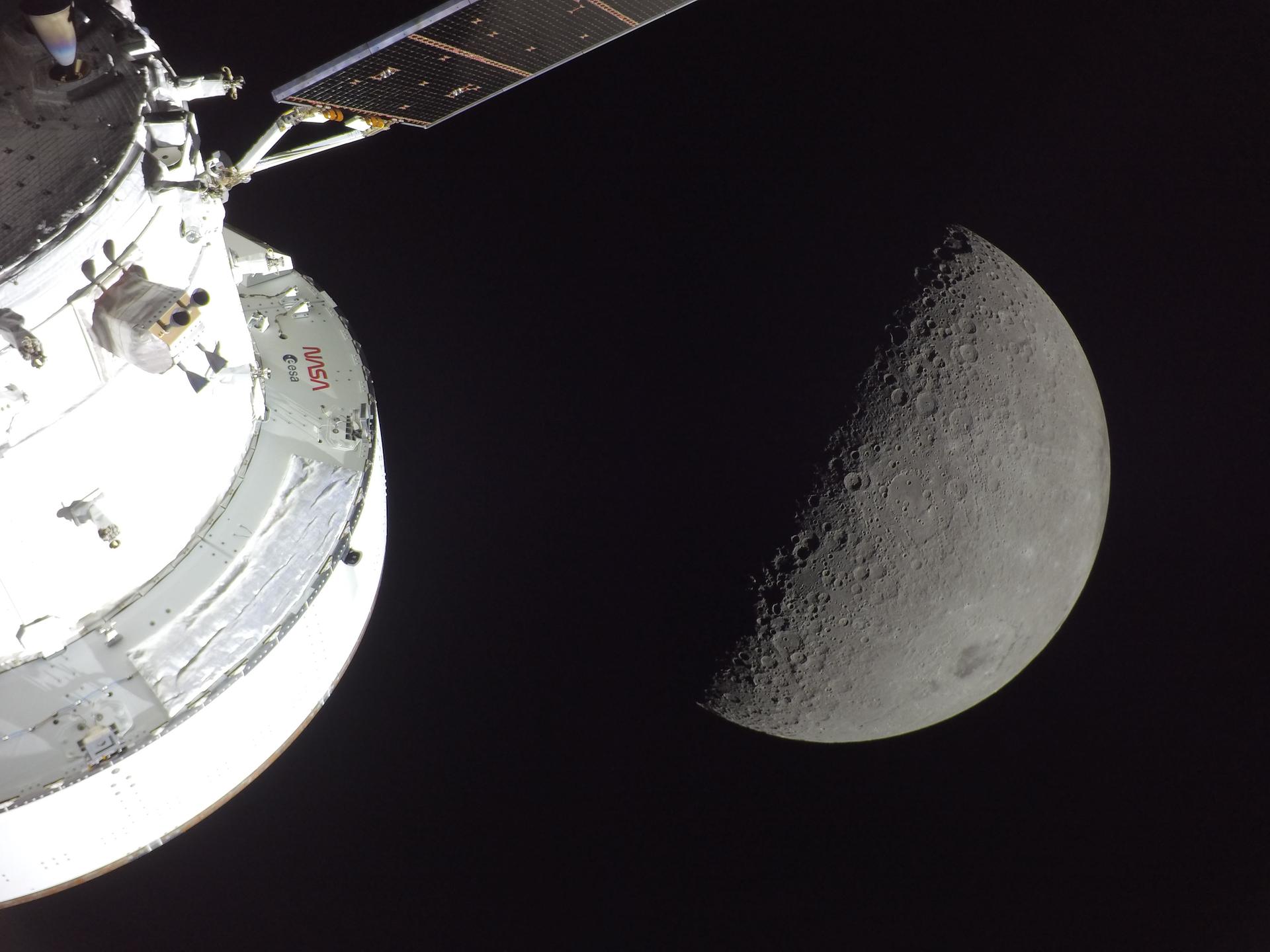
art002e009566 (April 6, 2026) - NASA’s Orion spacecraft is seen in the foreground, lit up by the Sun. A first quarter Moon is visible behind it, with sunlight coming from the right. Near the bottom right edge of the Moon, Orientale basin stands out with a black patch of ancient lava in its center. A 600-mile-wide impact crater ringed by mountains, Orientale straddles the near and far sides of the Moon. Credit: NASA
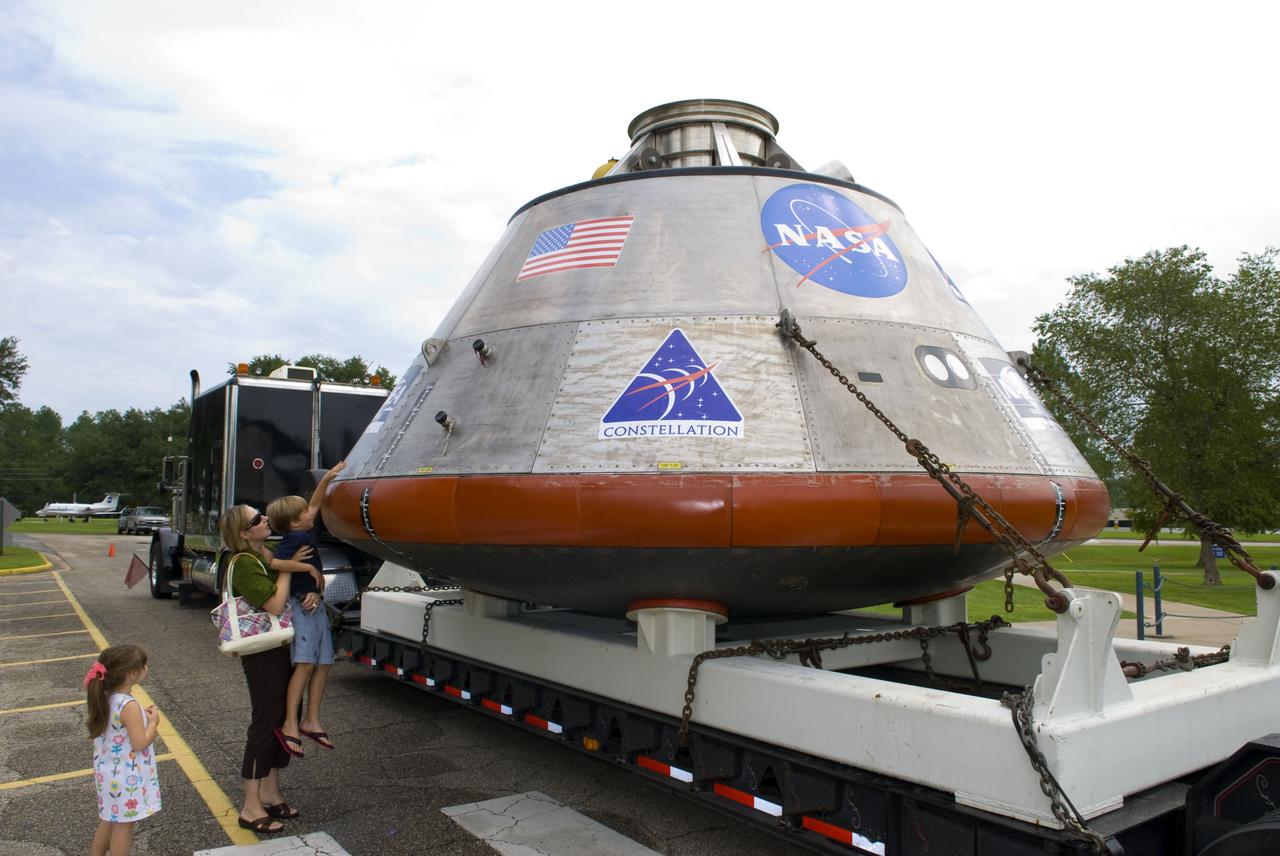
Visitors view a full-scale mockup of NASA's Orion crew exploration vehicle during its one-day display Wednesday at StenniSphere, the visitor center at John C. Stennis Space Center. The mockup is used in tests to study the environment for astronauts and recovery crews after an Orion ocean splashdown. It was en route to Johnson Space Center in Houston for the next phase of testing.
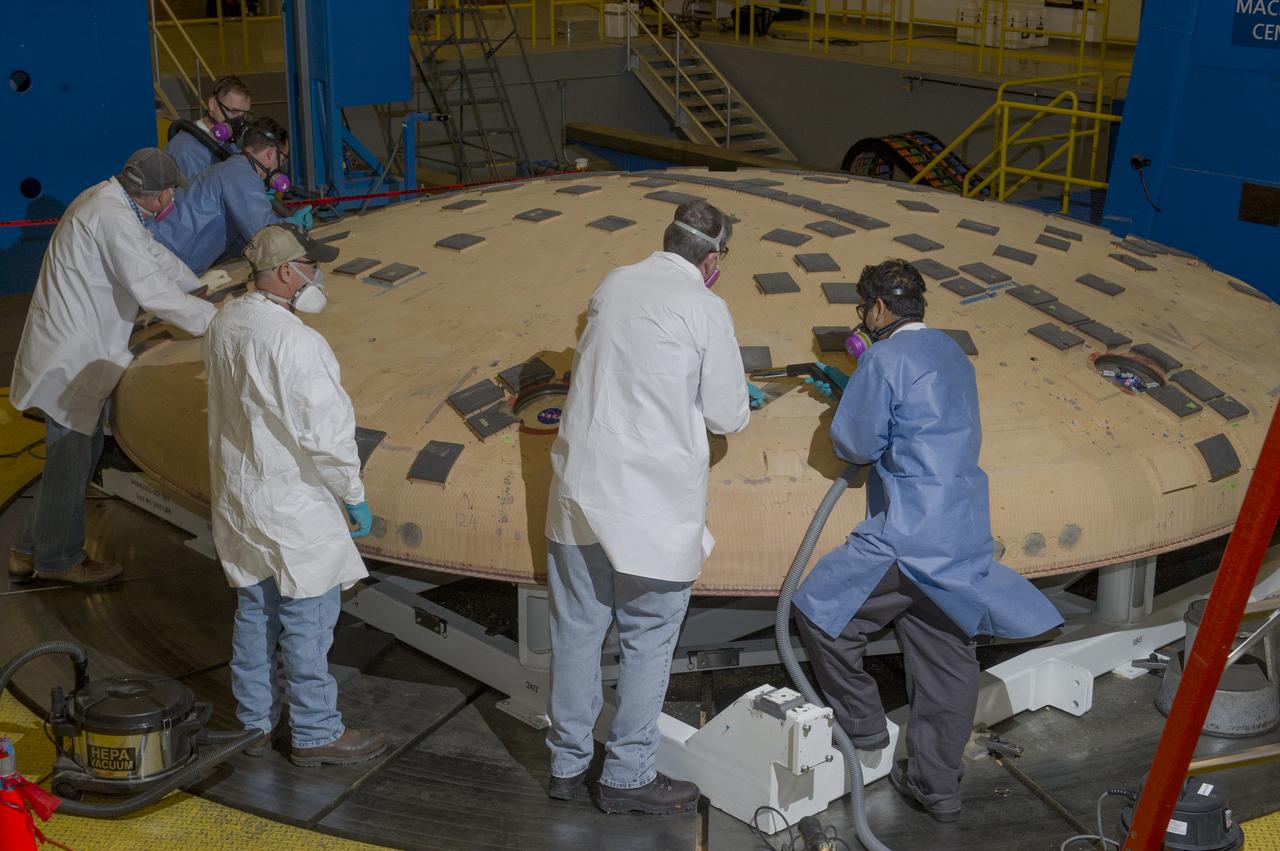
ENGINEERS FROM AMES RESEARCH CENTER AND MARSHALL SPACE FLIGHT CENTER REMOVE AVCOAT SEGMENTS FROM THE SURFACE OF THE ORION HEAT SHIELD, THE PROTECTIVE SHELL DESIGNED TO HELP THE NEXT GENERATION CREW MODULE WITHSTAND THE HEAT OF ATMOSPHERIC REENTRY. THE HEAT SHIELD FLEW TO SPACE DURING THE EFT-1 FULL SCALL FLIGHT TEST OF ORION IN DECEMBER 2014

The Artemis III Orion service module in work inside the Operations and Checkout Building at NASA's Kennedy Space Center in Florida on March 5, 2025.

Technicians work on the Artemis III Orion crew module inside the Operations and Checkout Building at NASA's Kennedy Space Center in Florida on March 5, 2025.
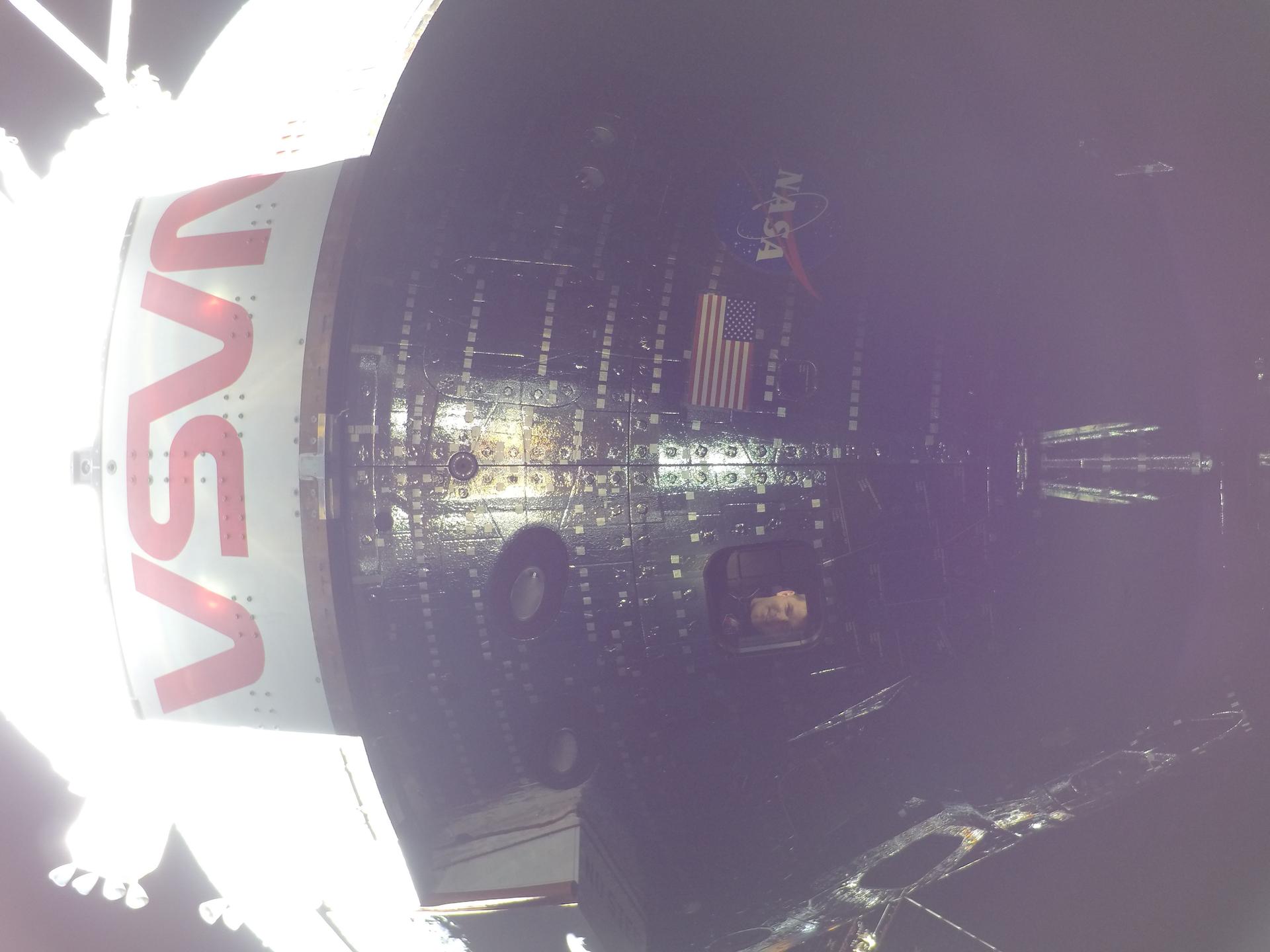
art002e009008 (April 4, 2026) - Artemis II Mission Specialist Jeremy Hansen is seen through a window of the Orion spacecraft while on his way to the Moon. This selfie-style photo was taken using a camera on the end of one of Orion's solar array wings on flight day 4 of the approximately 10-day test flight, when Orion was more than halfway to the Moon.
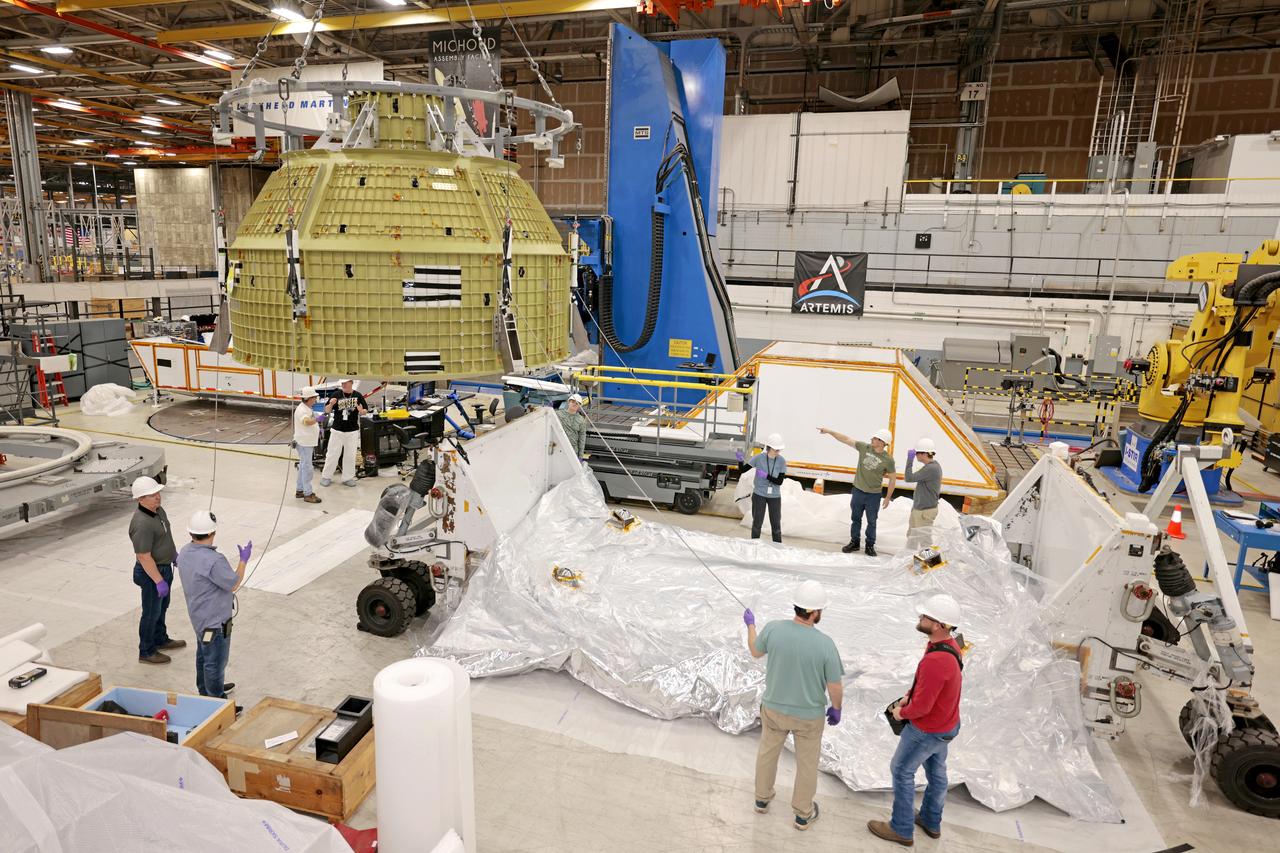
Teams at NASA’s Michoud Assembly Facility in New Orleans prepare the completed Orion pressure vessel for the Artemis IV mission for shipment to NASA’s Kennedy Space Center in Florida. The pressure vessel, which was assembled by lead contractor, Lockheed Martin, is the Orion crew module primary structure – the core upon which all other elements of Orion’s crew module are integrated. The structure is critical to Artemis crews as it holds the pressurized atmosphere astronauts breathe and work in a while in the vacuum of deep space. Once the module arrives at Kennedy’s Vehicle Assembly Building high bay, teams will begin integration of the pressure vessel with the Orion spacecraft crew module adapter and other assembly. With Artemis missions, NASA will land the first woman and the first person of color on the lunar surface, paving the way for human exploration of the Moon and on to Mars. Image credit: NASA/Michael DeMocker
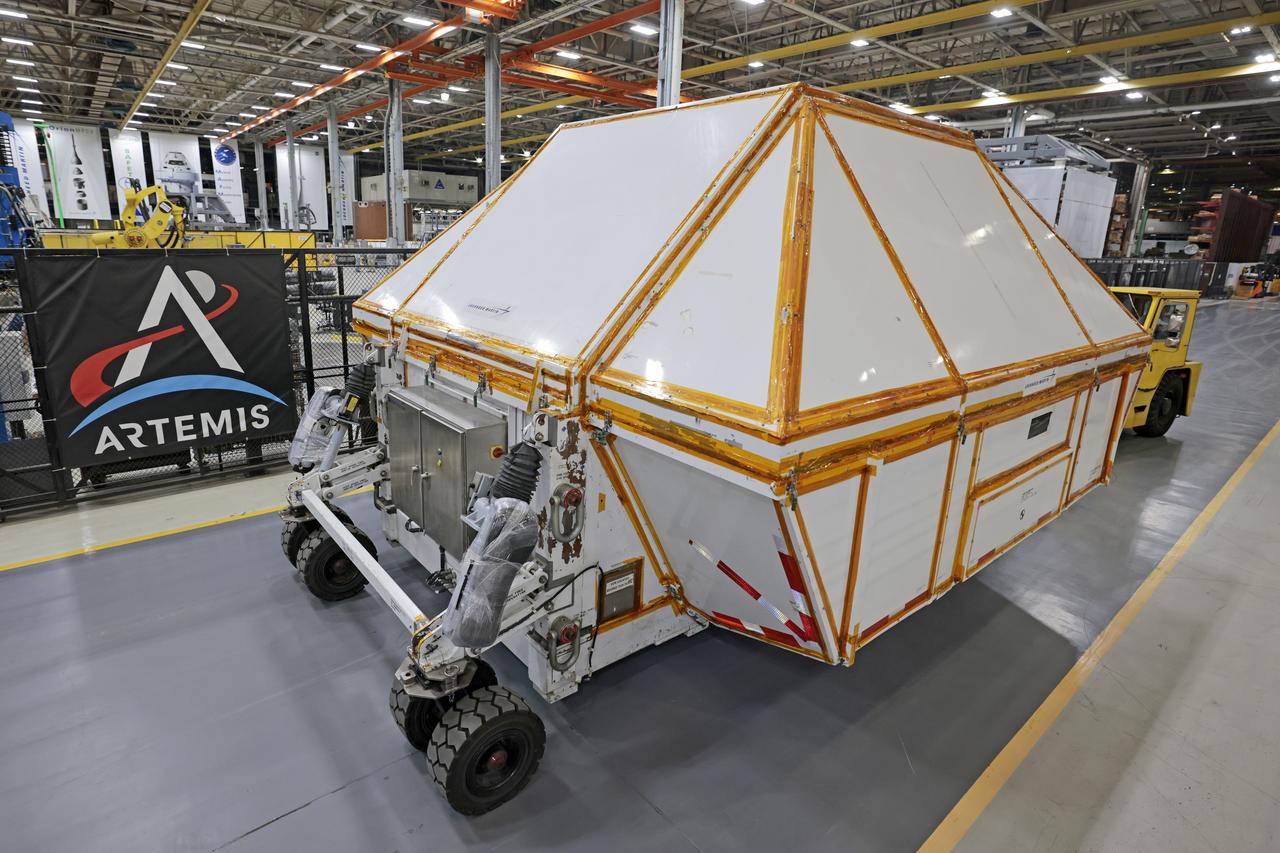
Teams at NASA’s Michoud Assembly Facility in New Orleans prepare the completed Orion pressure vessel for the Artemis IV mission for shipment to NASA’s Kennedy Space Center in Florida. The pressure vessel, which was assembled by lead contractor, Lockheed Martin, is the Orion crew module primary structure – the core upon which all other elements of Orion’s crew module are integrated. The structure is critical to Artemis crews as it holds the pressurized atmosphere astronauts breathe and work in a while in the vacuum of deep space. Once the module arrives at Kennedy’s Vehicle Assembly Building high bay, teams will begin integration of the pressure vessel with the Orion spacecraft crew module adapter and other assembly. With Artemis missions, NASA will land the first woman and the first person of color on the lunar surface, paving the way for human exploration of the Moon and on to Mars. Image credit: NASA/Michael DeMocker
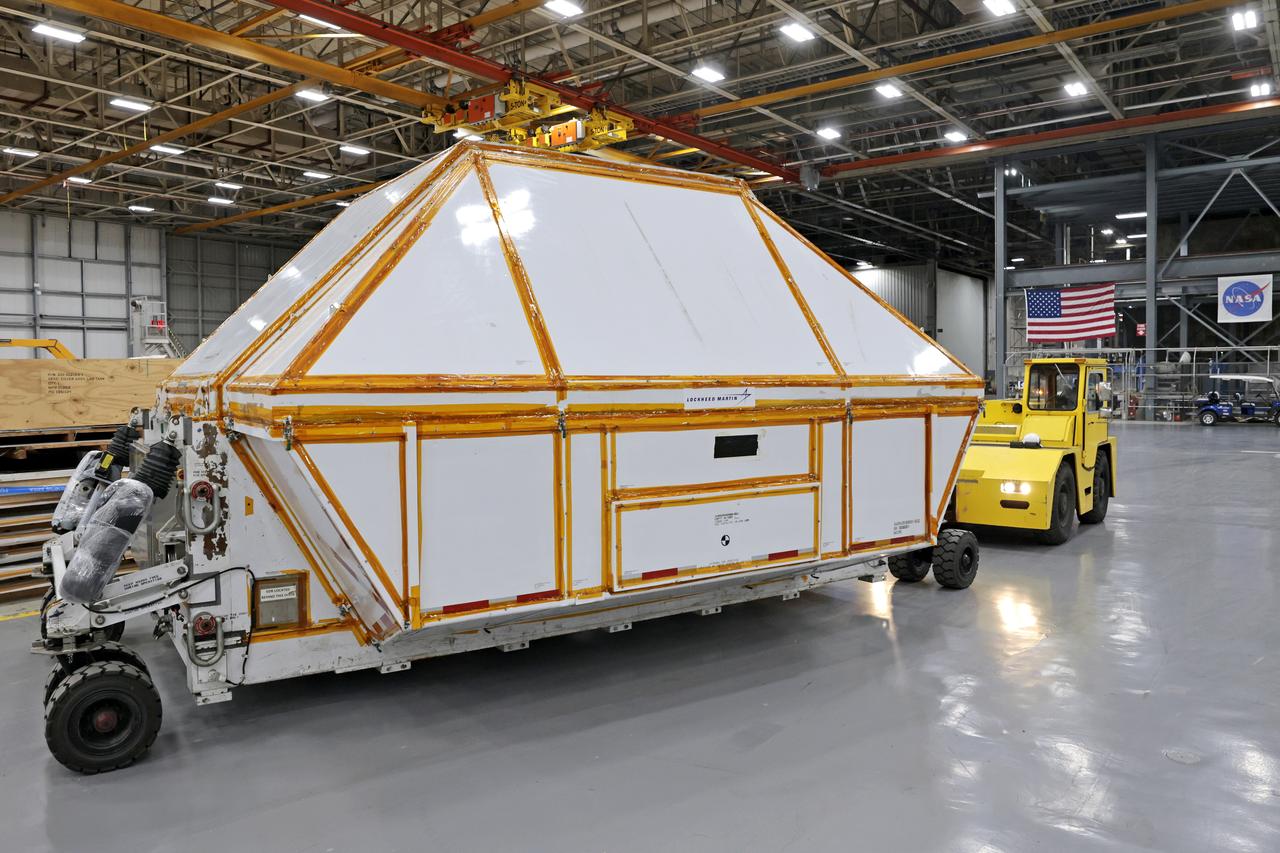
Teams at NASA’s Michoud Assembly Facility in New Orleans prepare the completed Orion pressure vessel for the Artemis IV mission for shipment to NASA’s Kennedy Space Center in Florida. The pressure vessel, which was assembled by lead contractor, Lockheed Martin, is the Orion crew module primary structure – the core upon which all other elements of Orion’s crew module are integrated. The structure is critical to Artemis crews as it holds the pressurized atmosphere astronauts breathe and work in a while in the vacuum of deep space. Once the module arrives at Kennedy’s Vehicle Assembly Building high bay, teams will begin integration of the pressure vessel with the Orion spacecraft crew module adapter and other assembly. With Artemis missions, NASA will land the first woman and the first person of color on the lunar surface, paving the way for human exploration of the Moon and on to Mars. Image credit: NASA/Michael DeMocker
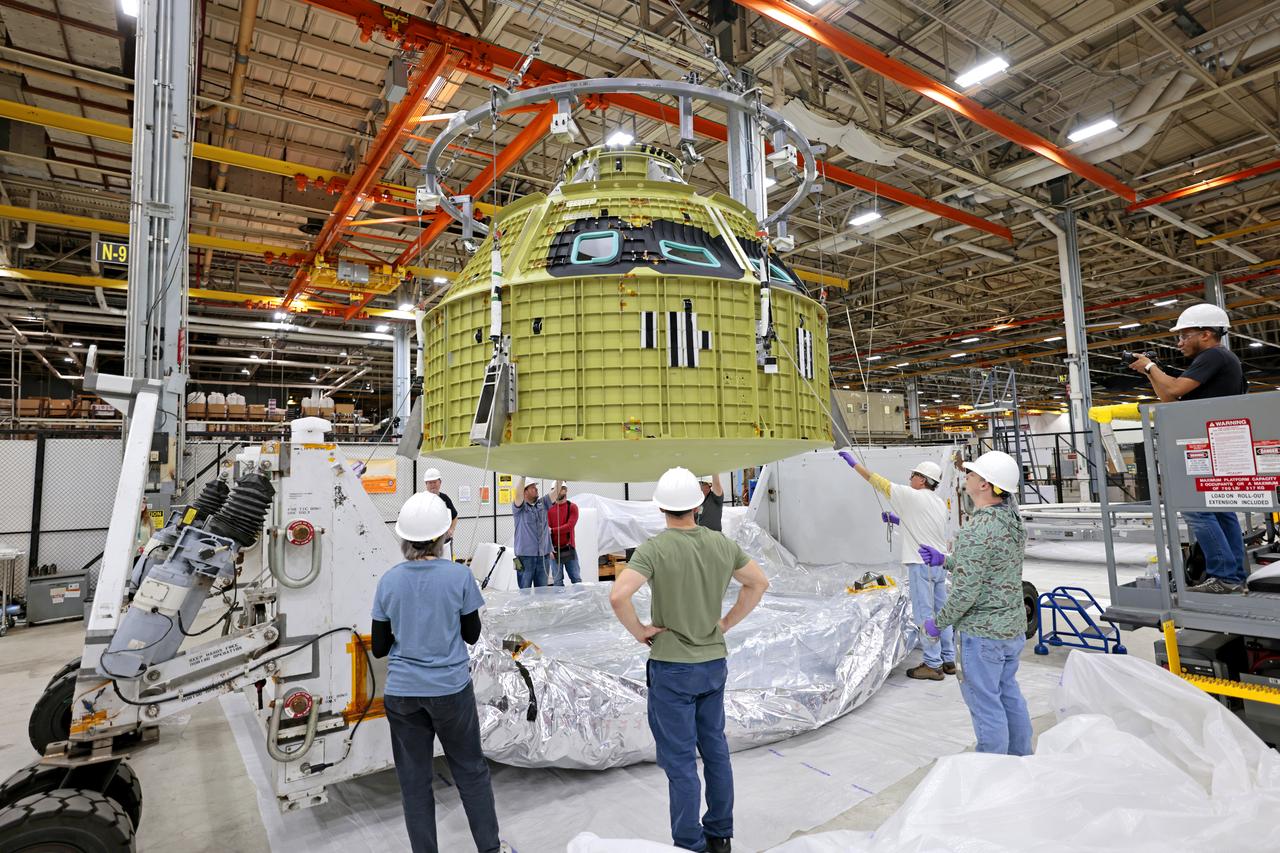
Teams at NASA’s Michoud Assembly Facility in New Orleans prepare the completed Orion pressure vessel for the Artemis IV mission for shipment to NASA’s Kennedy Space Center in Florida. The pressure vessel, which was assembled by lead contractor, Lockheed Martin, is the Orion crew module primary structure – the core upon which all other elements of Orion’s crew module are integrated. The structure is critical to Artemis crews as it holds the pressurized atmosphere astronauts breathe and work in a while in the vacuum of deep space. Once the module arrives at Kennedy’s Vehicle Assembly Building high bay, teams will begin integration of the pressure vessel with the Orion spacecraft crew module adapter and other assembly. With Artemis missions, NASA will land the first woman and the first person of color on the lunar surface, paving the way for human exploration of the Moon and on to Mars. Image credit: NASA/Michael DeMocker