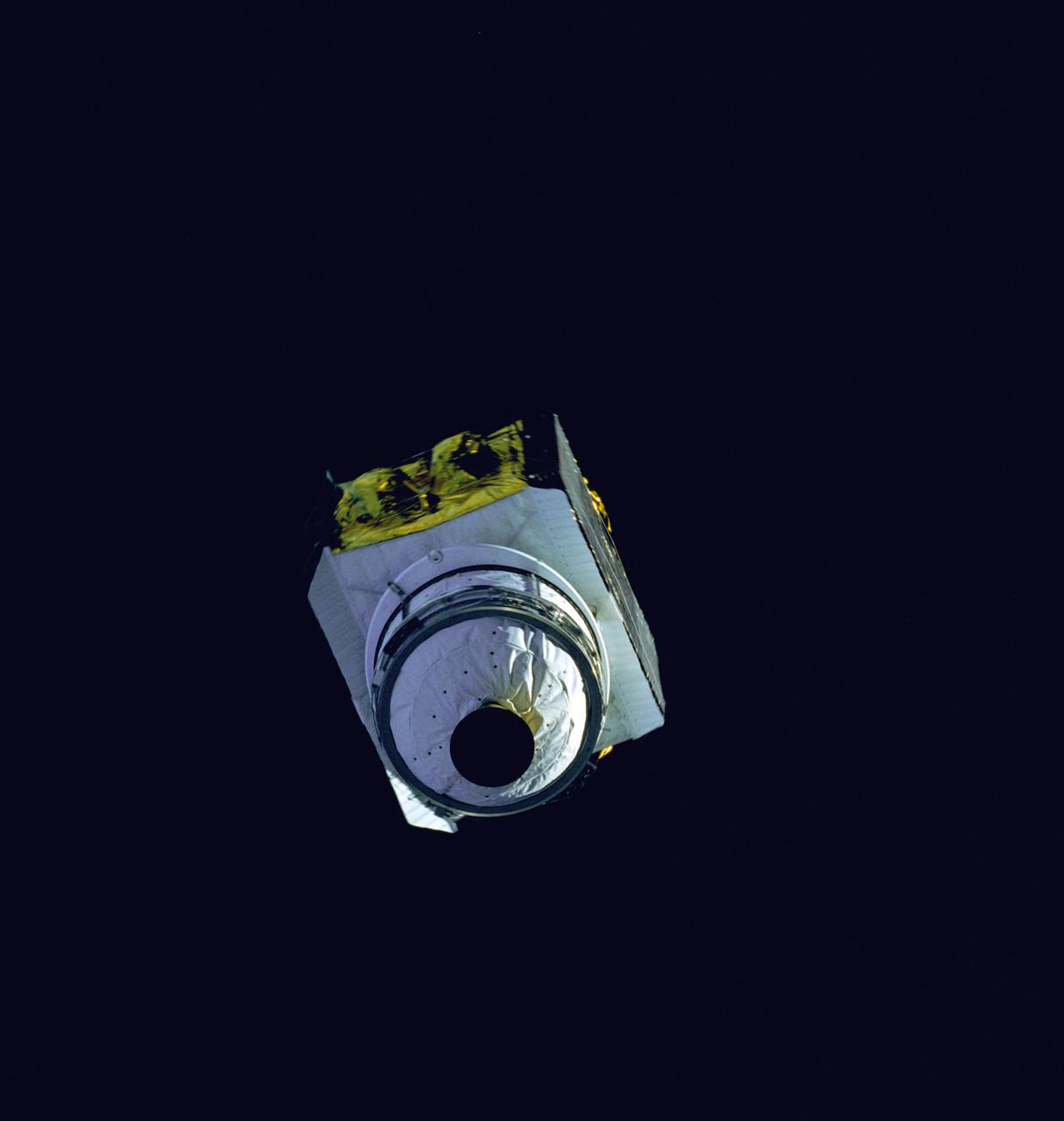
This image of the free-flying SATCOM KU-2 satellite, still attached to a Payload Assist Module-D (PAM-D), was photographed during STS-61B, the 23rd Space Shuttle mission. The SATCOM KU-2 is an RCA communication satellite and was launched on November 26, 1985, aboard the Space Shuttle Orbiter Atlantis. The PAM-D is an upper stage system used to deploy payloads to a required orbit unattainable by the launch vehicle.
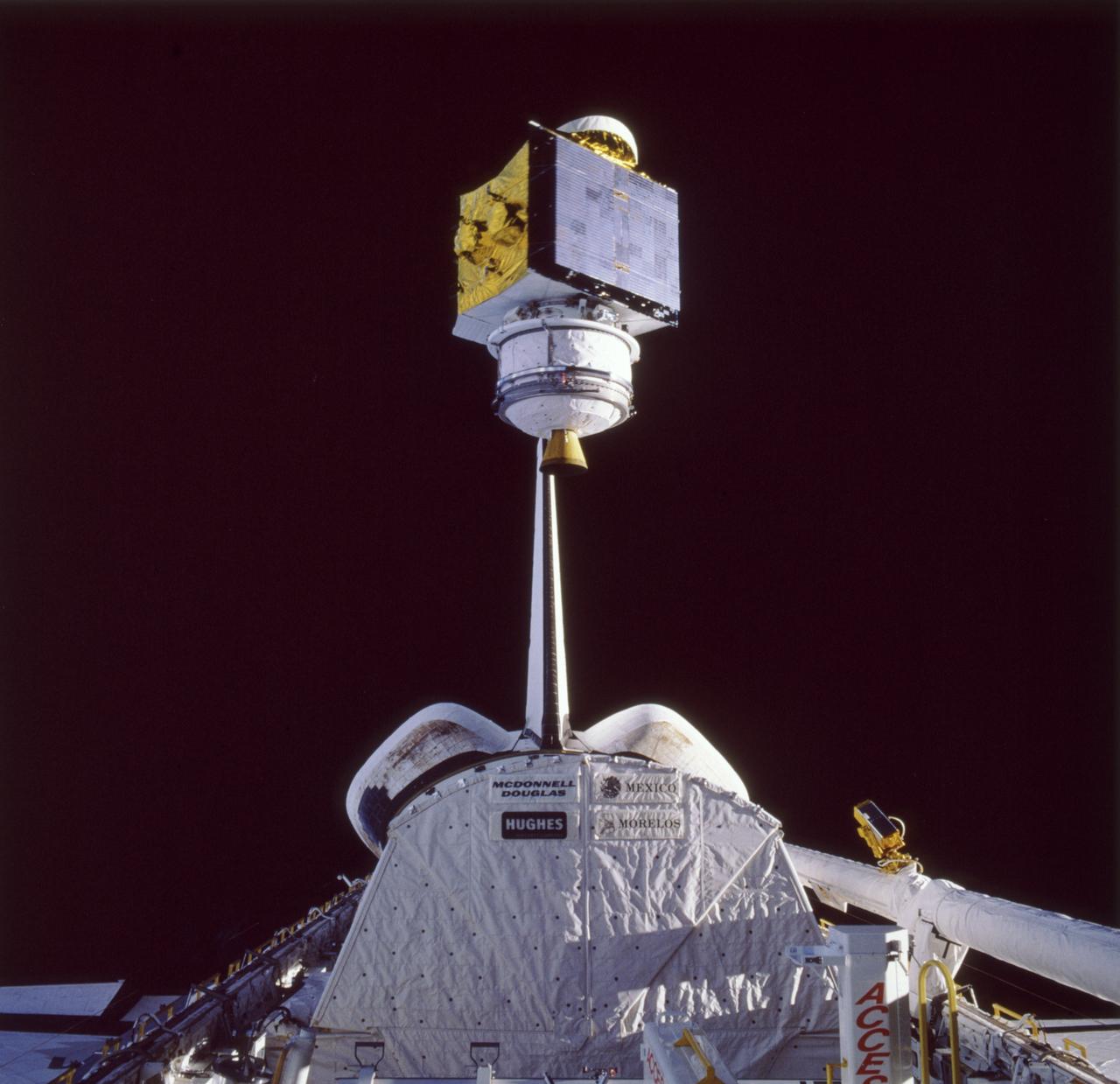
In this photograph the SATCOM KU-2 satellite attached to a Payload Assist Module-D (PAM-D) is being released from the cargo bay of the Space Shuttle Orbiter Atlantis during STS-61B, the 23rd Shuttle Mission. The PAM-D is an upper stage system used to deploy payloads to a required orbit unattainable by the spacecraft. SATCOM KU-2 is an RCA communication satellite and was launched on November 26, 1985.
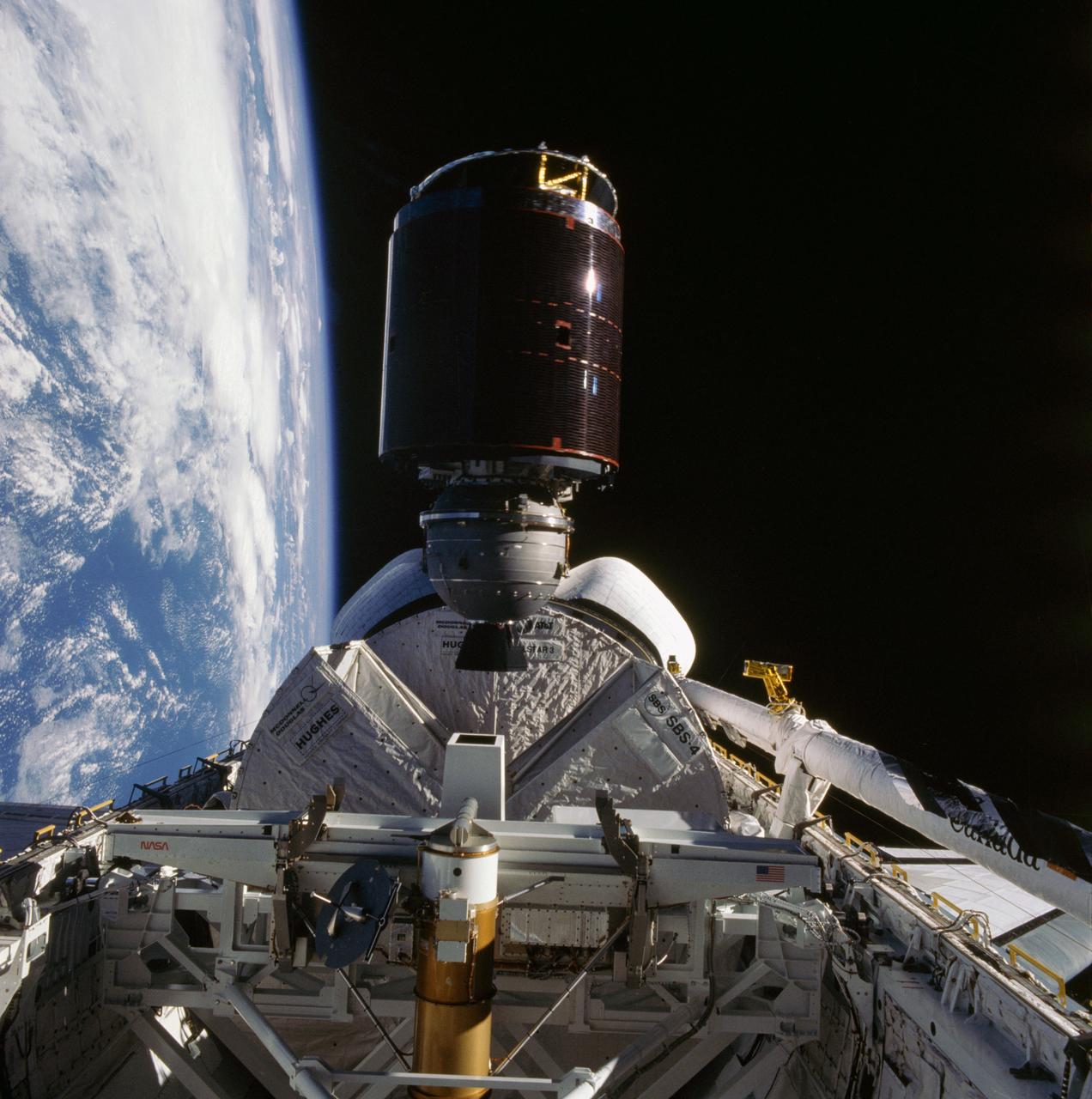
41D-36-034 (30 Aug 1984) --- Less than nine hours after the first launch of the Discovery, its astronaut crewmembers photographed deployment of the SBS-4 communications satellite. The cylindrical spacecraft spins and rises from its cradle-like protective shield to begin life in space. A number of maneuvers will place it in its desired orbit. A 70mm camera, aimed through the spacecraft’s aft flight deck windows, was used to expose the frame.
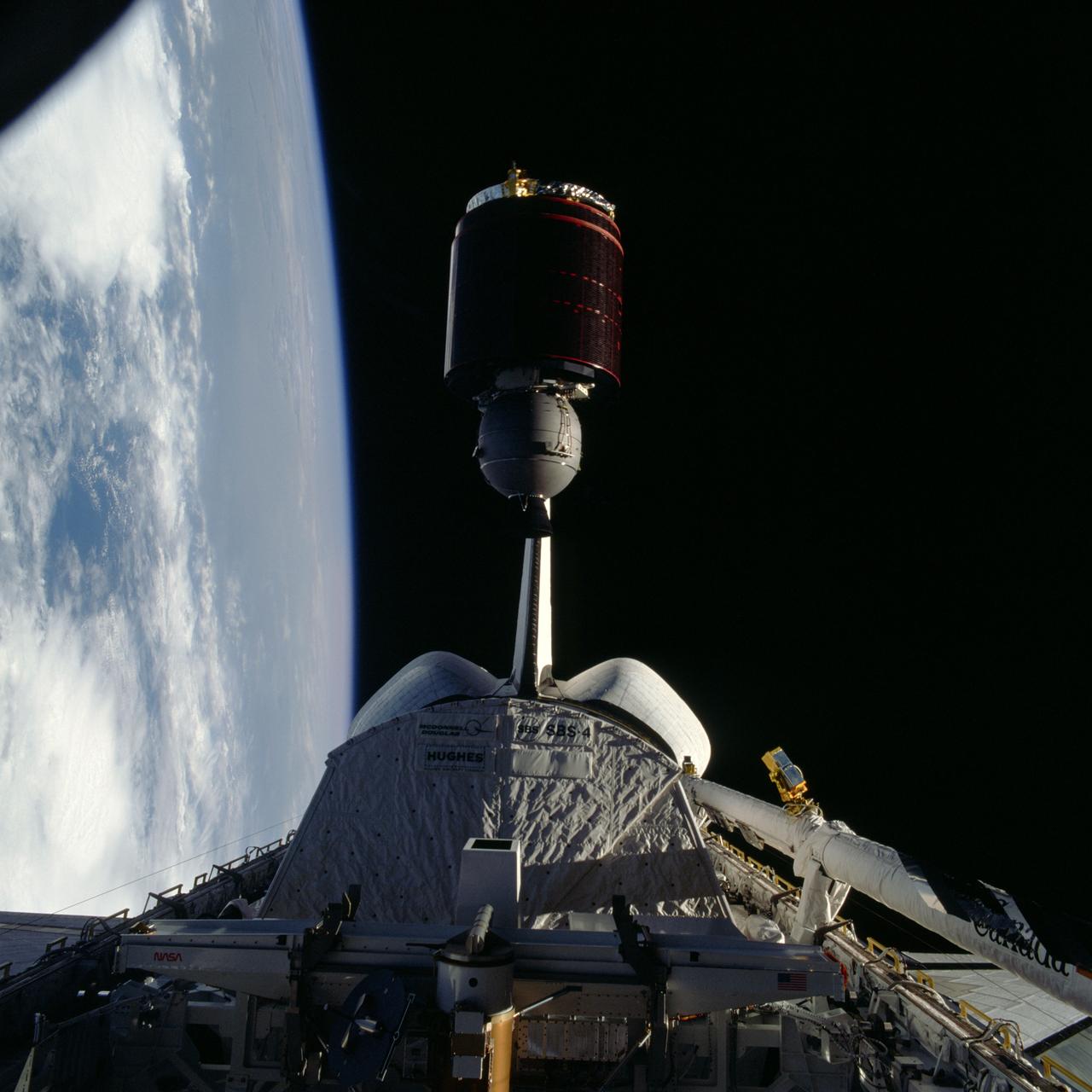
41D-37-050 (1 Sept 1984) --- Telstar, the third of three satellites to be placed into space via the Earth-orbiting Discovery, departs from the cargo bay of the manned vehicle during 41-D's third day in space. The scene was photographed at 9:35 a.m. (CDT), Sept. 1, 1984, with a 70mm handheld hasselblad camera aimed through the windows on the flight deck. Heavy clouds cover much of the water and land mass of Earth in the background.
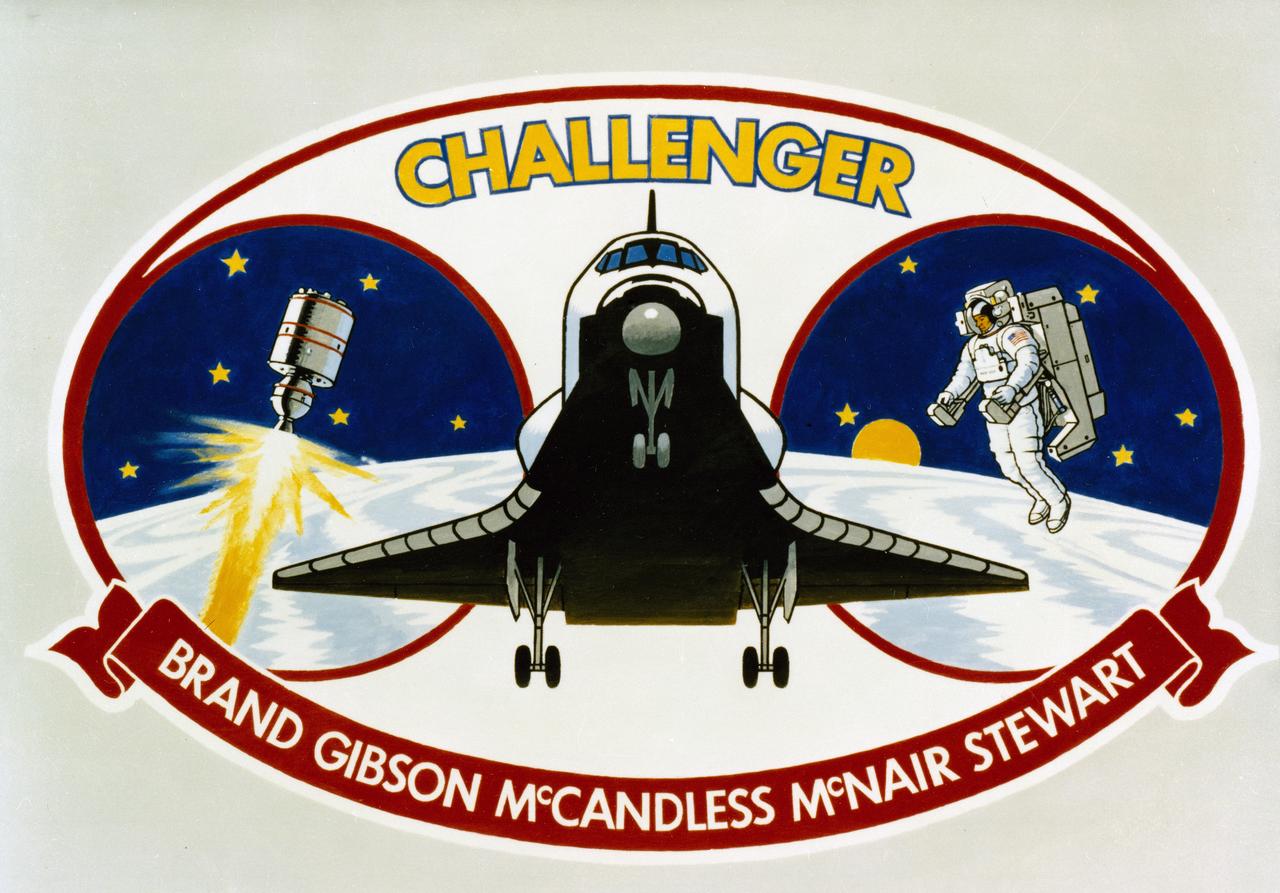
The Space Shuttle Challenger, making its fourth space flight, highlights the 41B insignia. The reusable vehicle is flanked in the oval by an illustration of a Payload Assist Module-D solid rocket motor (PAM-D) for assisted satellite deployment; an astronaut making the first non-tethered extravehicular activity (EVA); and eleven stars.
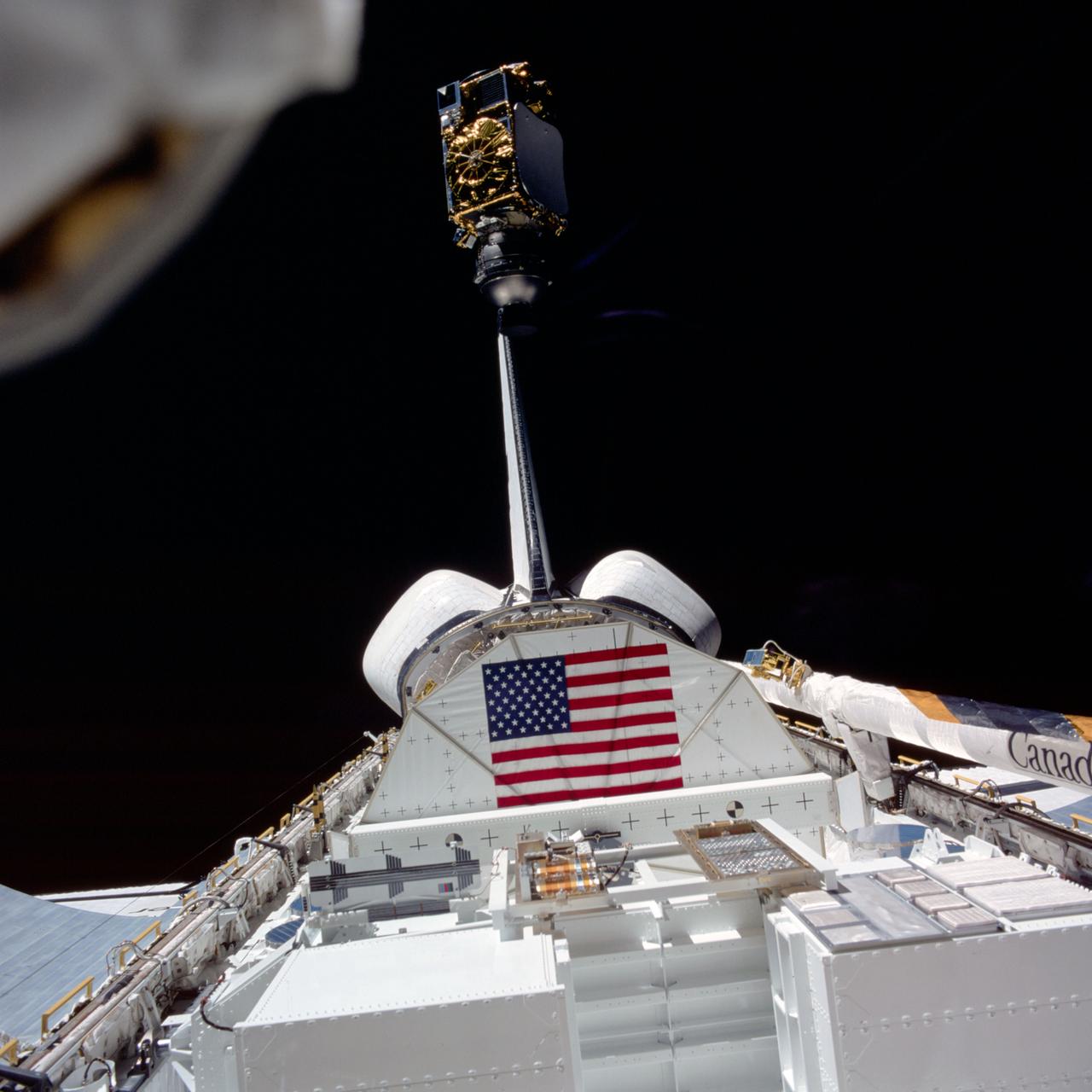
STS008-49-1724 (31 Aug 1983) --- The Indian National Satellite (INSAT) is about to clear the vertical stabilizer of the Earth-orbiting Space Shuttle Challenger and on its way to a higher orbit. The STS-8 mission's Payload Flight Test Article (PFTA) displays the U.S. flag in the middle of the cargo bay, as the Canadian built Remote Manipulator System (RMS) appears to be waiting for its busy agenda of activity with the barbell-shaped test device. This 70mm frame was exposed by a crewmember using a handheld Hasselblad inside Challenger's cabin.
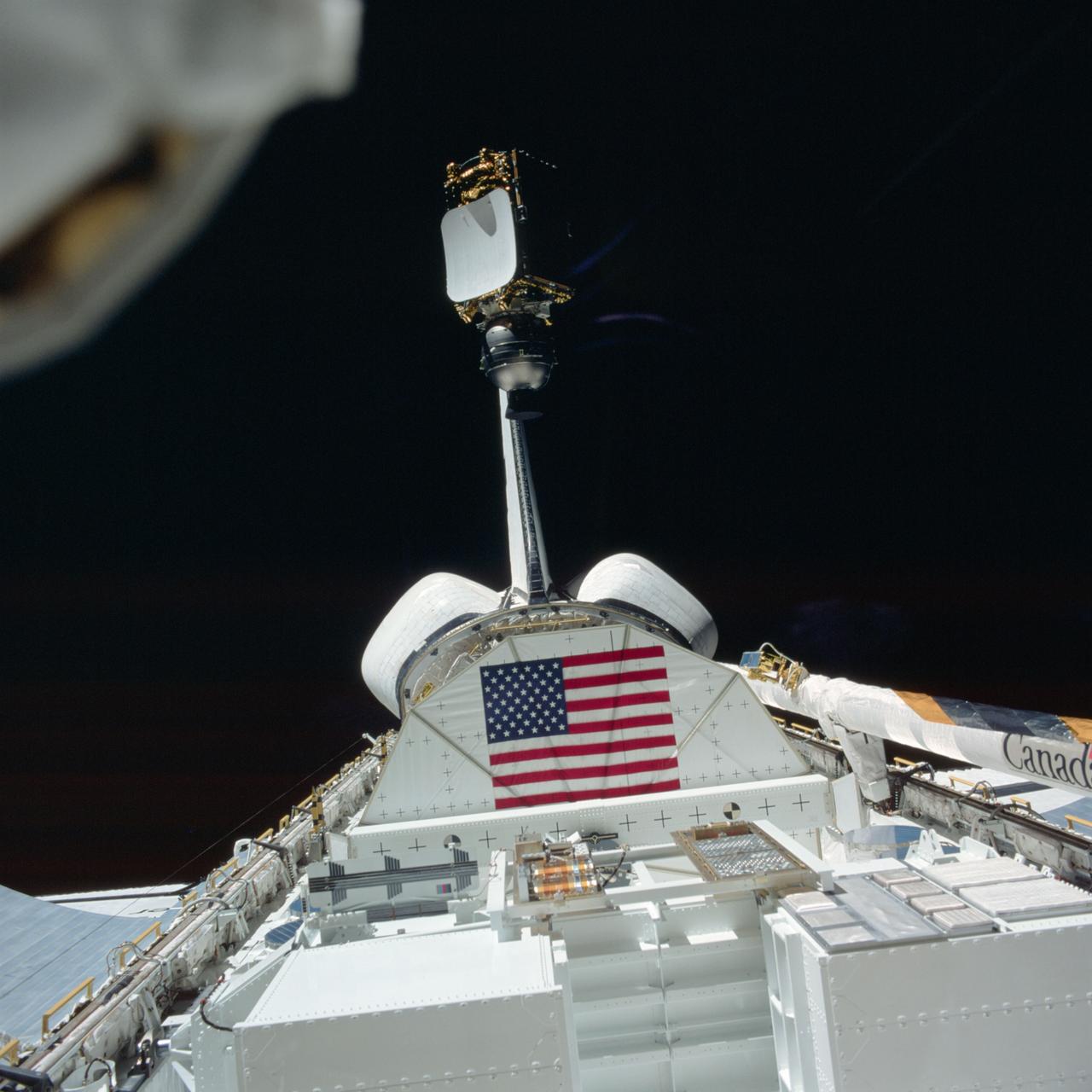
STS008-49-1722 (30 Aug-5 Sept 1983) --- The Indian National Satellite (INSAT) is about to clear the Earth-orbiting Space Shuttle Challenger this 70mm frame exposed with a handheld camera from the aft flight deck. The Payload Flight Test Article (PFTA) displays the United States flag in the middle of the cargo bay and the Canadian built Remote Manipulator System (RMS) appears to be waiting for its busy agenda of activity with the barbell-shaped test device.
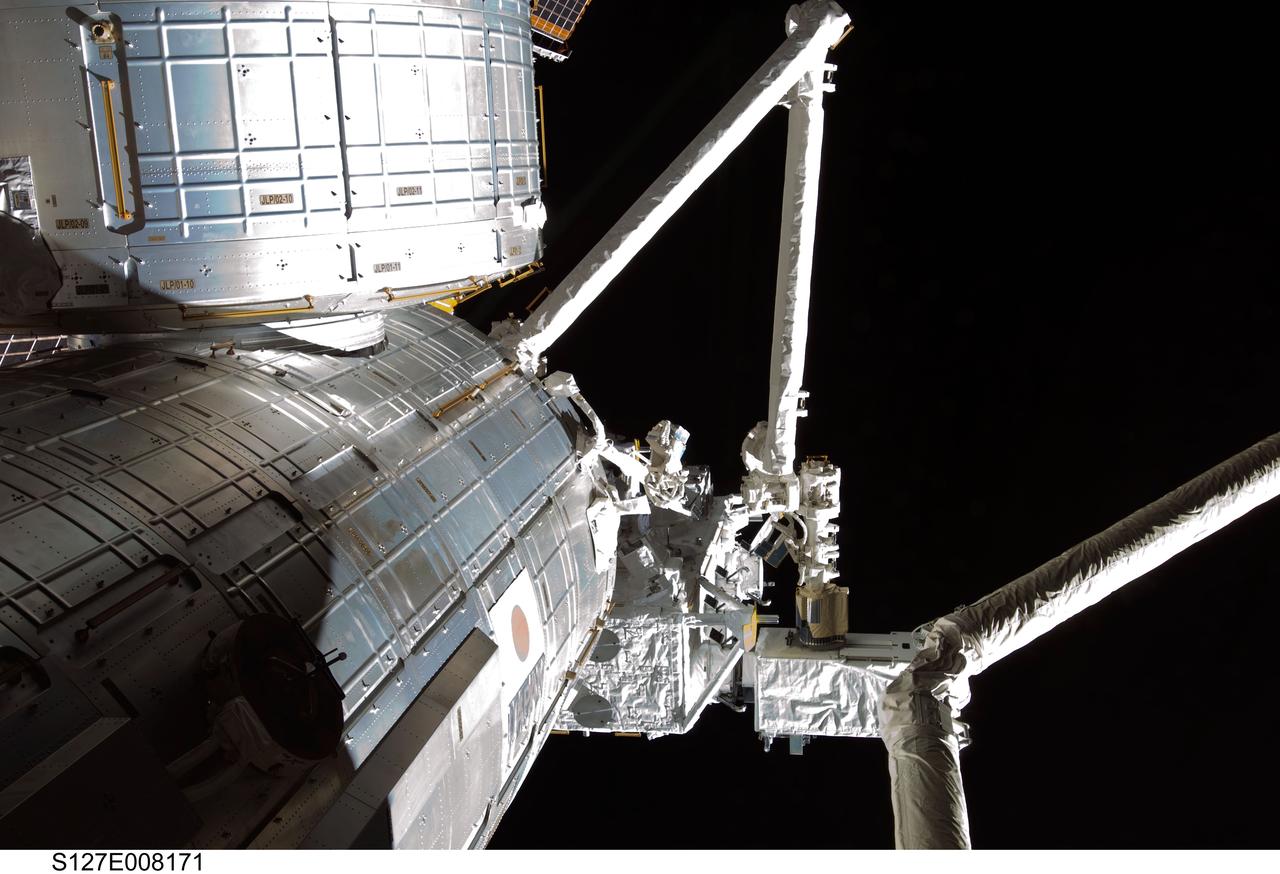
S127-E-008171 (23 July 2009)--- The robotic arm of the Japanese Experiment Module or Kibo assists in the installation of MAXI payload on the Japanese Exposed Facility (JEF) on flight day 9.
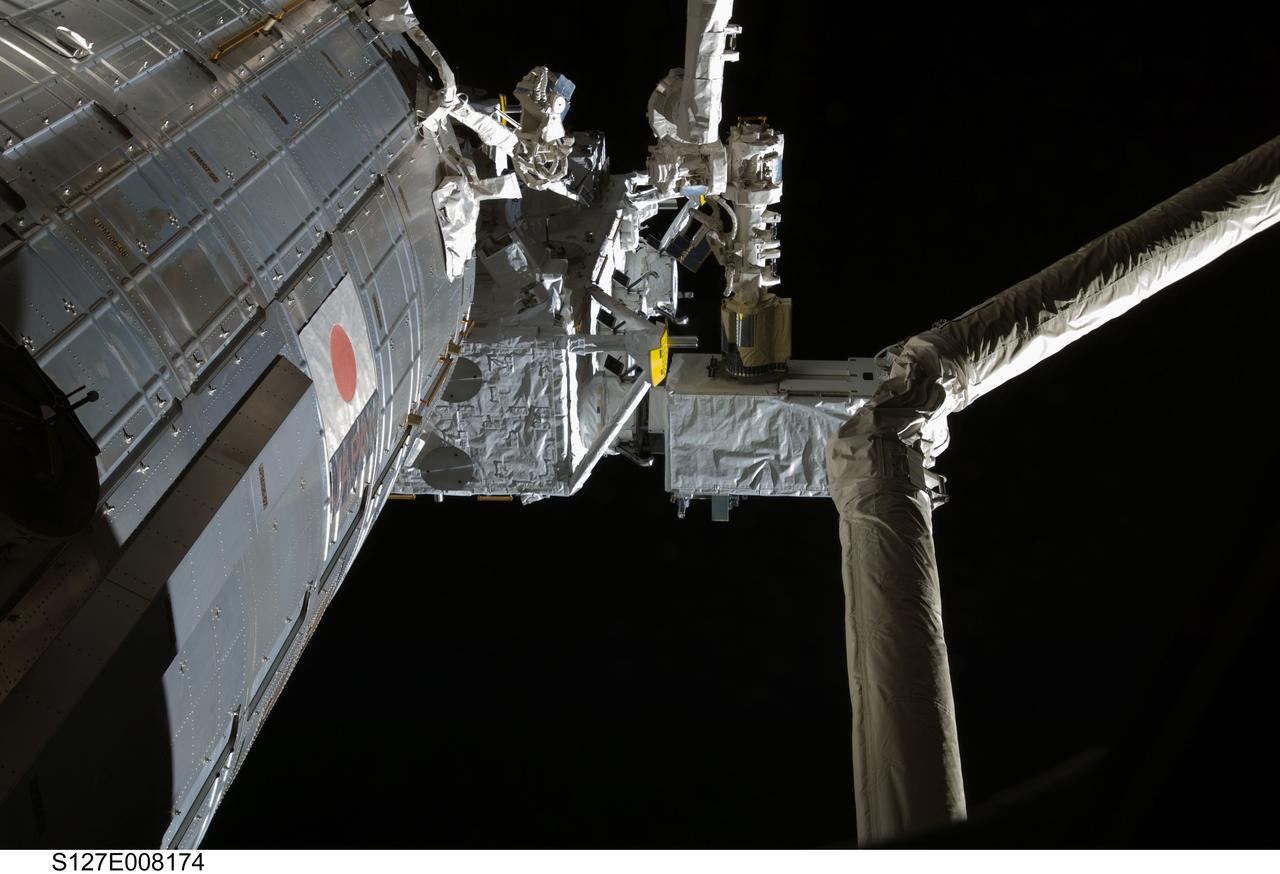
S127-E-008174 (23 July 2009)--- The robotic arm of the Japanese Experiment Module or Kibo assists in the installation of MAXI payload on the Japanese Exposed Facility (JEF) on flight day 9.
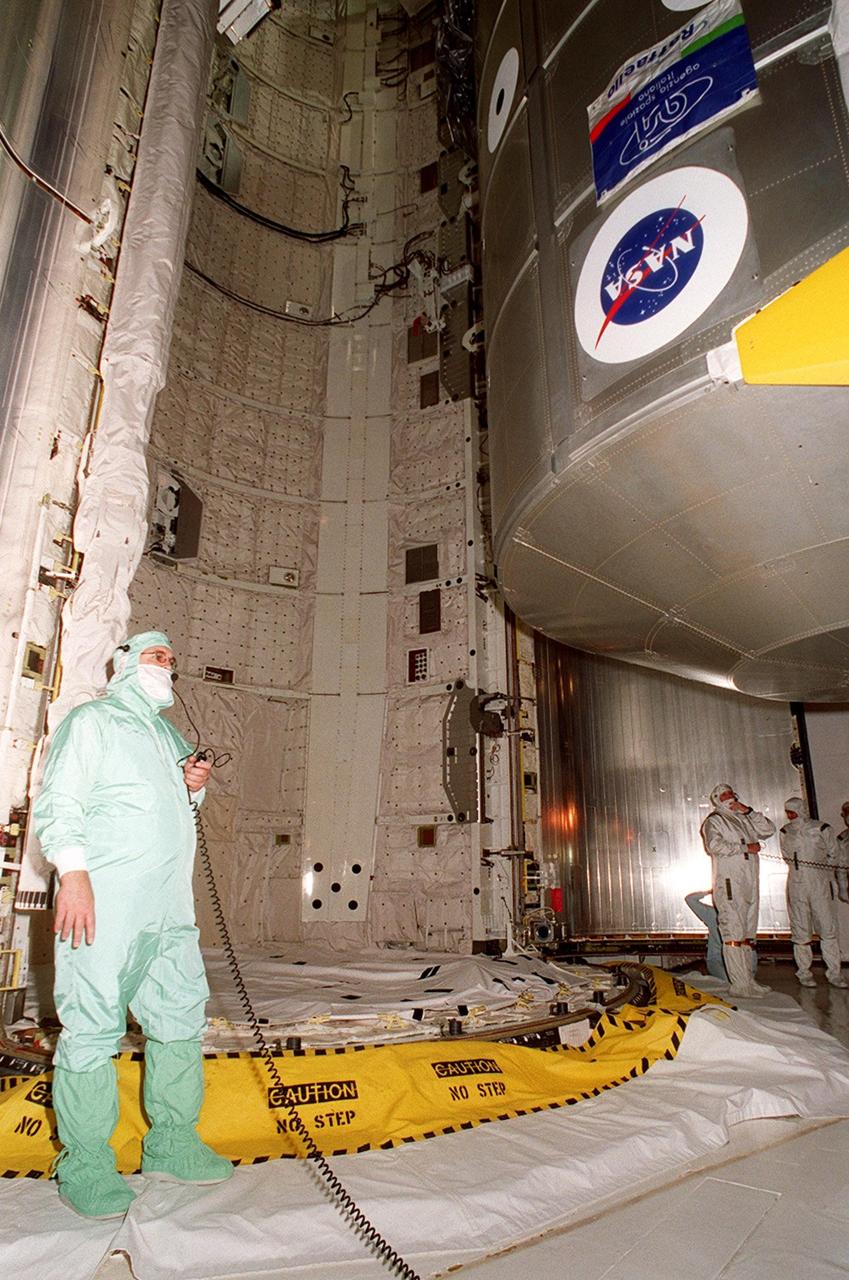
At Launch Pad 39A, the payload on mission STS-100 is in the payload changeout room, from which it will be transferred to the Endeavour’s payload bay. Visible is the Multi-Purpose Logistics Module Raffaello. Above it, but not visible, is the Canadian robotic arm, the SSRMS. Raffaello carries six system racks and two storage racks for the U.S. Lab. The SSRMS is capable of handling large payloads and assisting with docking the Space Shuttle. It is crucial to the continued assembly of the International Space Station. Launch of mission STS-100 is scheduled for April 19 at 2:41 p.m. EDT
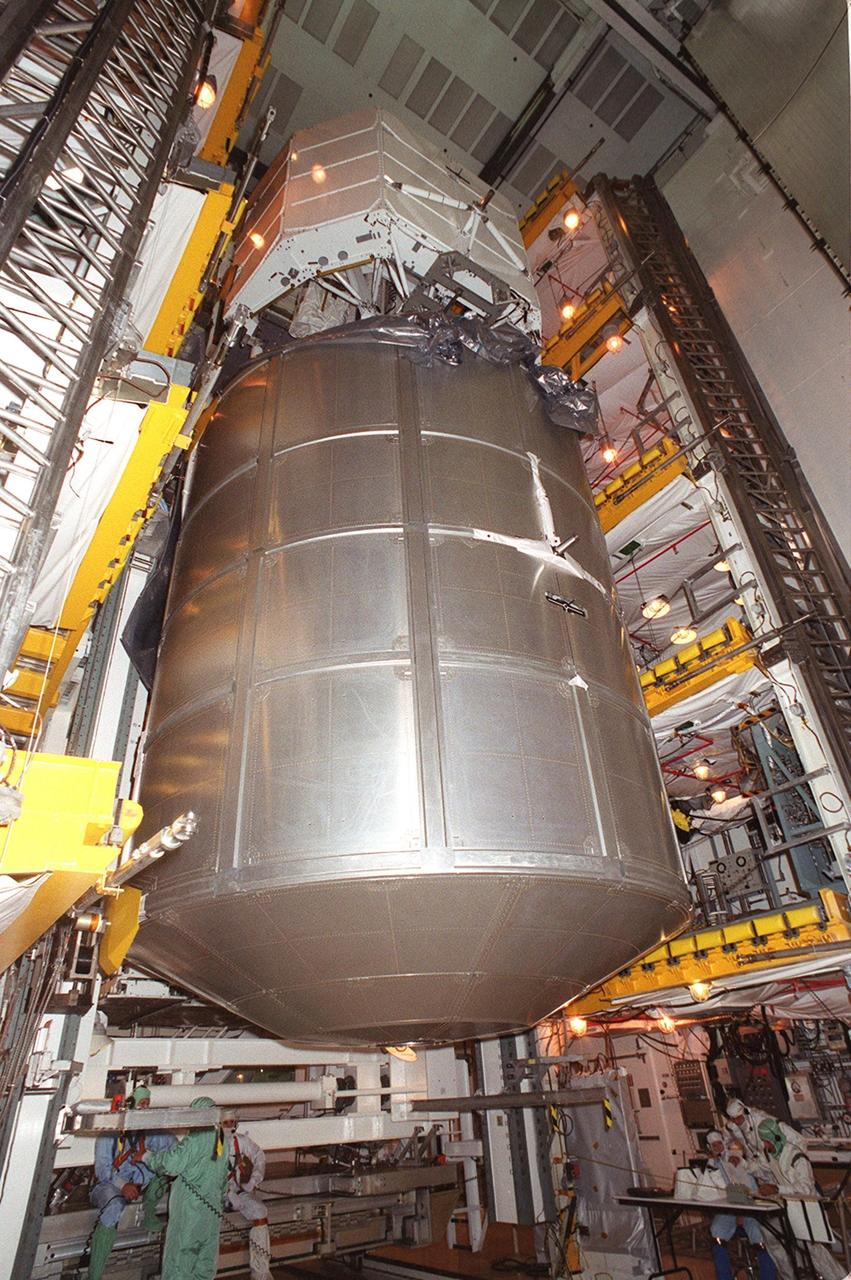
At Launch Pad 39A, the payload on mission STS-100 continues moving out of the payload canister and into the payload changeout room. At the top is the Canadian robotic arm, the SSRMS, and below it is the Multi-Purpose Logistics Module Raffaello. The SSRMS is capable of handling large payloads and assisting with docking the Space Shuttle. It is crucial to the continued assembly of the International Space Station. Raffaello carries six system racks and two storage racks for the U.S. Lab. Launch of mission STS-100 is scheduled for April 19 at 2:41 p.m. EDT
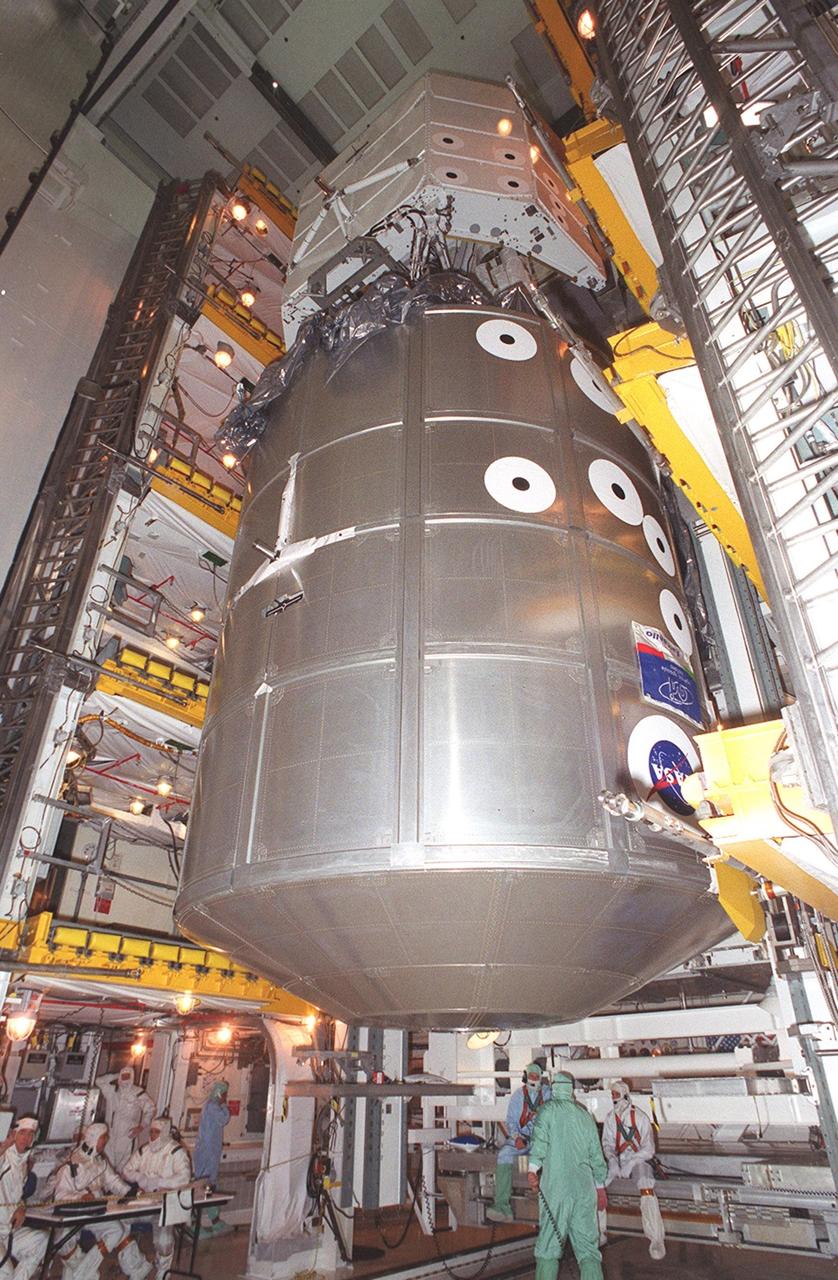
At Launch Pad 39A, the payload on mission STS-100 moves out of the payload canister and into the payload changeout room. At the top is the Canadian robotic arm, the SSRMS, and below it is the Multi-Purpose Logistics Module Raffaello. The SSRMS is capable of handling large payloads and assisting with docking the Space Shuttle. It is crucial to the continued assembly of the International Space Station. Raffaello carries six system racks and two storage racks for the U.S. Lab. Launch of mission STS-100 is scheduled for April 19 at 2:41 p.m. EDT
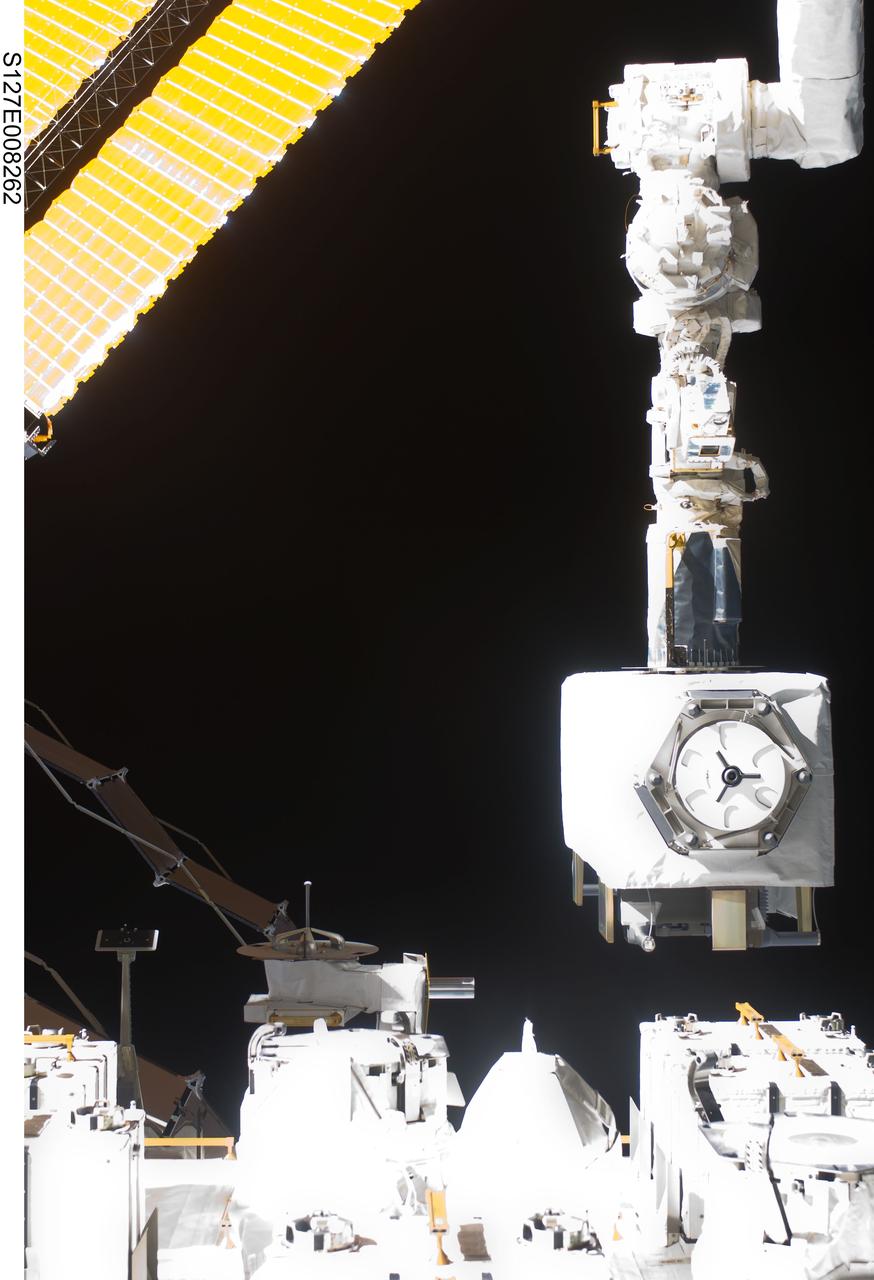
S127-E-008262 (23 July 2009) --- This is a July 23 (flight day 9) view of the robotic arm for the Japanese Experiment Module or Kibo as it assists in the deployment of the JAXA Space Environment Data Acquisition Attached Payload (SEDA-AP) onto the Japanese Exposed Facility Unit (EFU).

iss068e017665 (Oct. 20, 2022) --- The International Space Station's third and newest robotic manipulator, the European robotic arm (ERA), is pictured attached to the Nauka multipurpose laboratory module. The ERA provides additional payload support and spacewalk assistance on the orbiting lab's Russian segment.
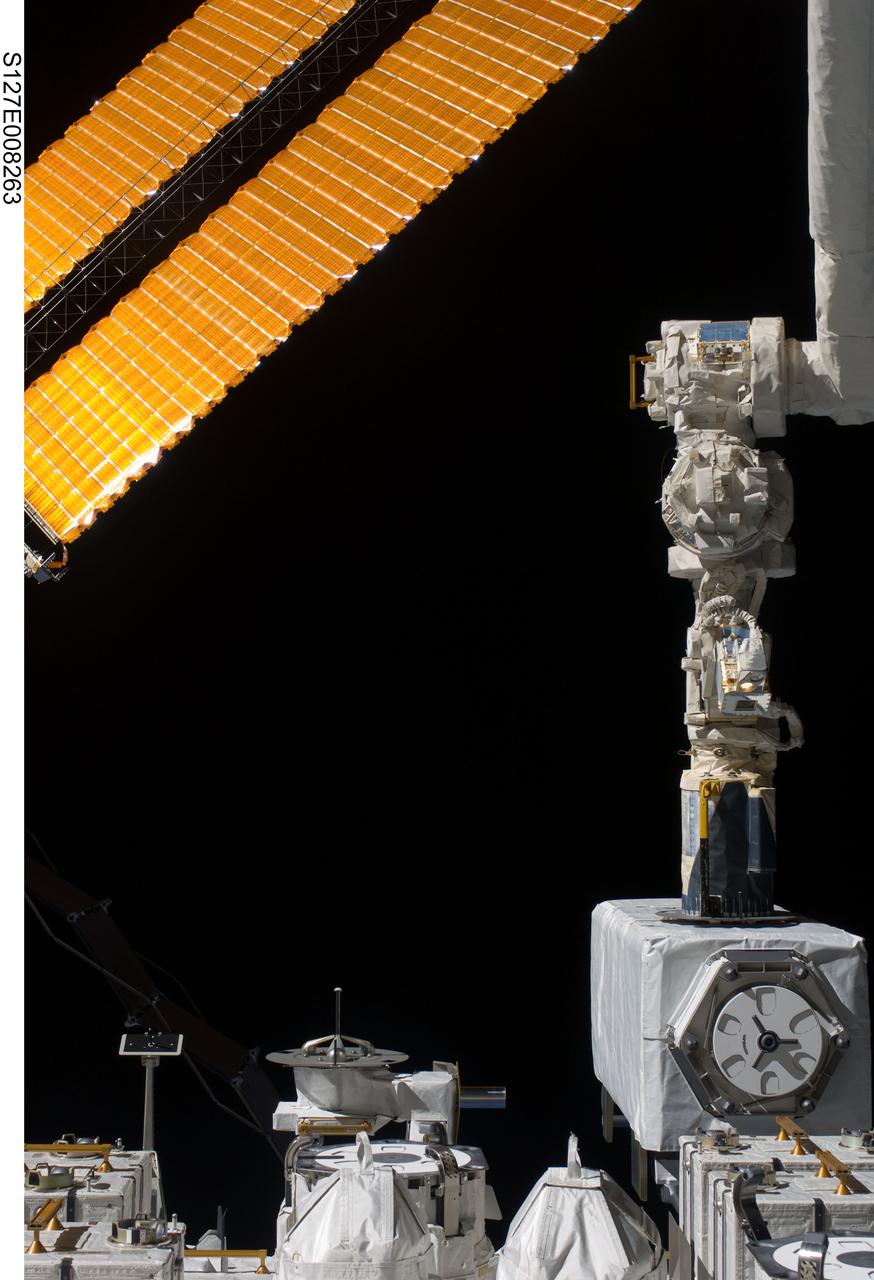
S127-E-008263 (23 July 2009) --- This is a July 23 (flight day 9) view of the robotic arm for the Japanese Experiment Module or Kibo as it assists in the deployment of the JAXA Space Environment Data Acquisition Attached Payload (SEDA-AP) onto the Japanese Exposed Facility Unit (EFU).
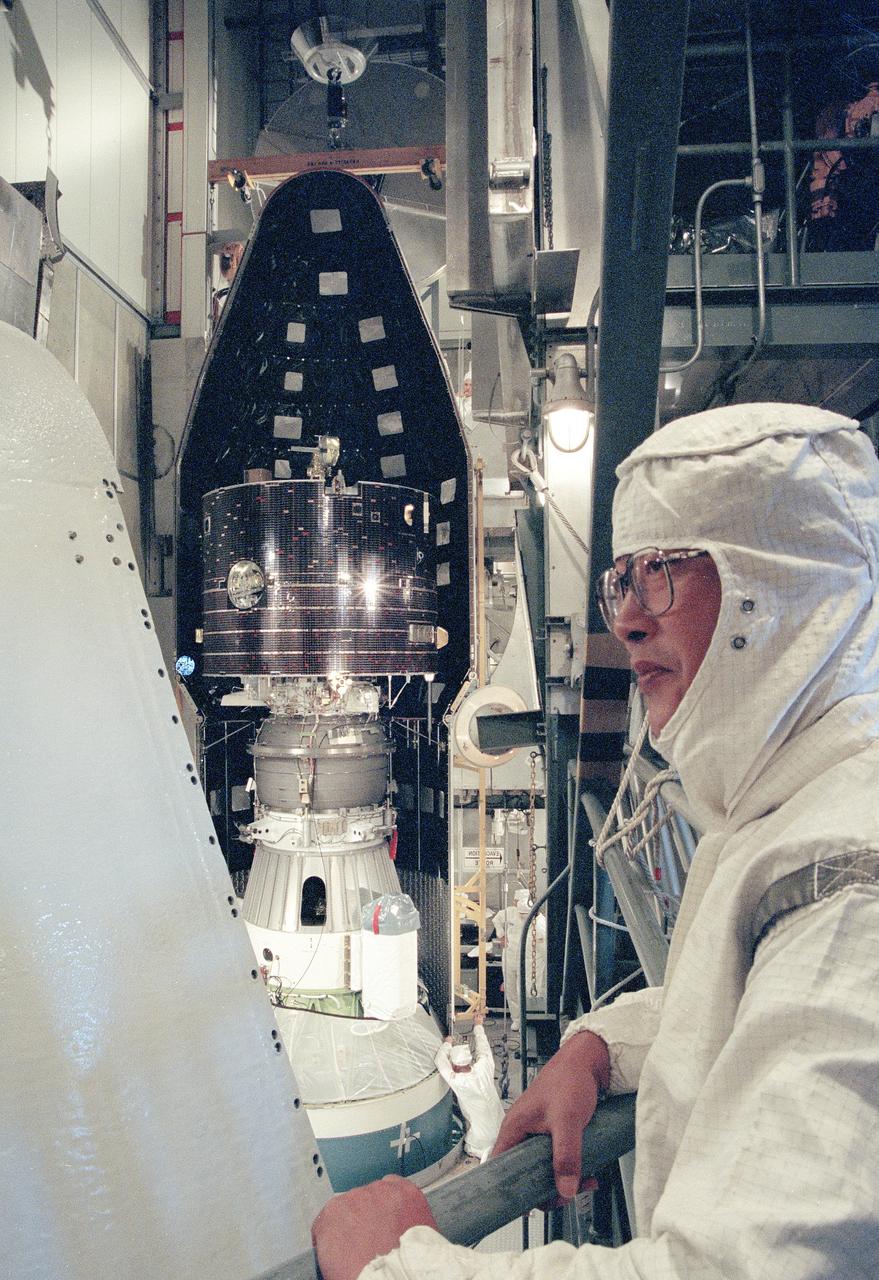
CAPE CANAVERAL, Fla. -- At Cape Canaveral Air Force Station's Launch Complex 17, Pad A, technicians encapsulate the Geotail spacecraft upper and attached Payload Assist Module-D upper stage lower in the protective payload fairing. Geotail and secondary payload Diffuse Ultraviolet Experiment DUVE are scheduled for launch about the Delta II rocket on July 24. The GEOTAIL mission is a collaborative project undertaken by the Institute of Space and Astronautical Science ISAS, Japan Aerospace Exploration Agency JAXA and NASA. Photo Credit: NASA
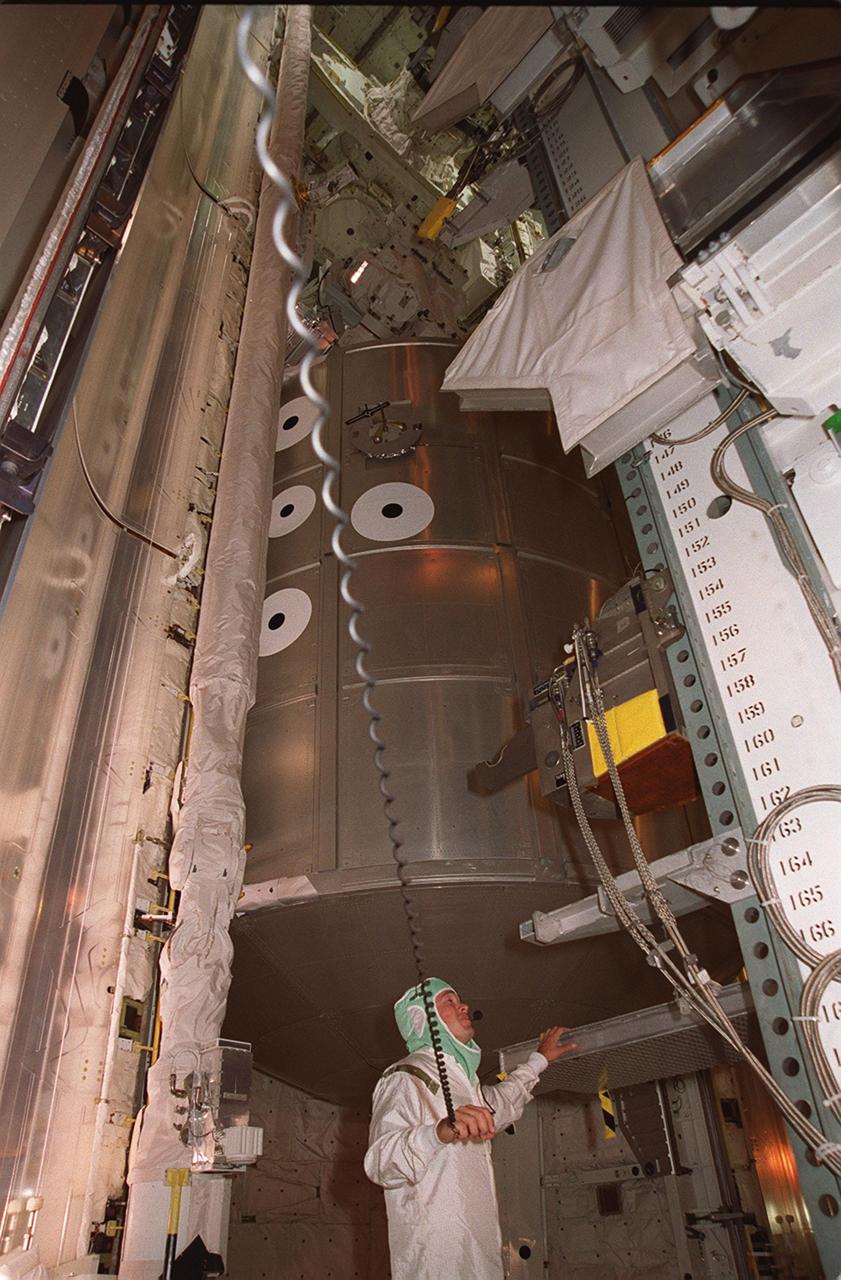
A worker in the Payload Changeout Room, Launch Pad 39A, moves the Payload Ground Handling Mechanism away from the open doors of Space Shuttle Endeavour’s payload bay. The PGHM helped move the STS-100 mission payload into the bay. Visible above and behind the worker is the Multi-Purpose Logistics Module Raffaello, which carries six system racks and two storage racks for the U.S. Lab. Above Raffaello is the Canadian robotic arm, the SSRMS. Capable of handling large payloads and assisting with docking the Space Shuttle, the SSRMS is crucial to the continued assembly of the International Space Station. Launch of mission STS-100 is scheduled for April 19 at 2:41 p.m. EDT
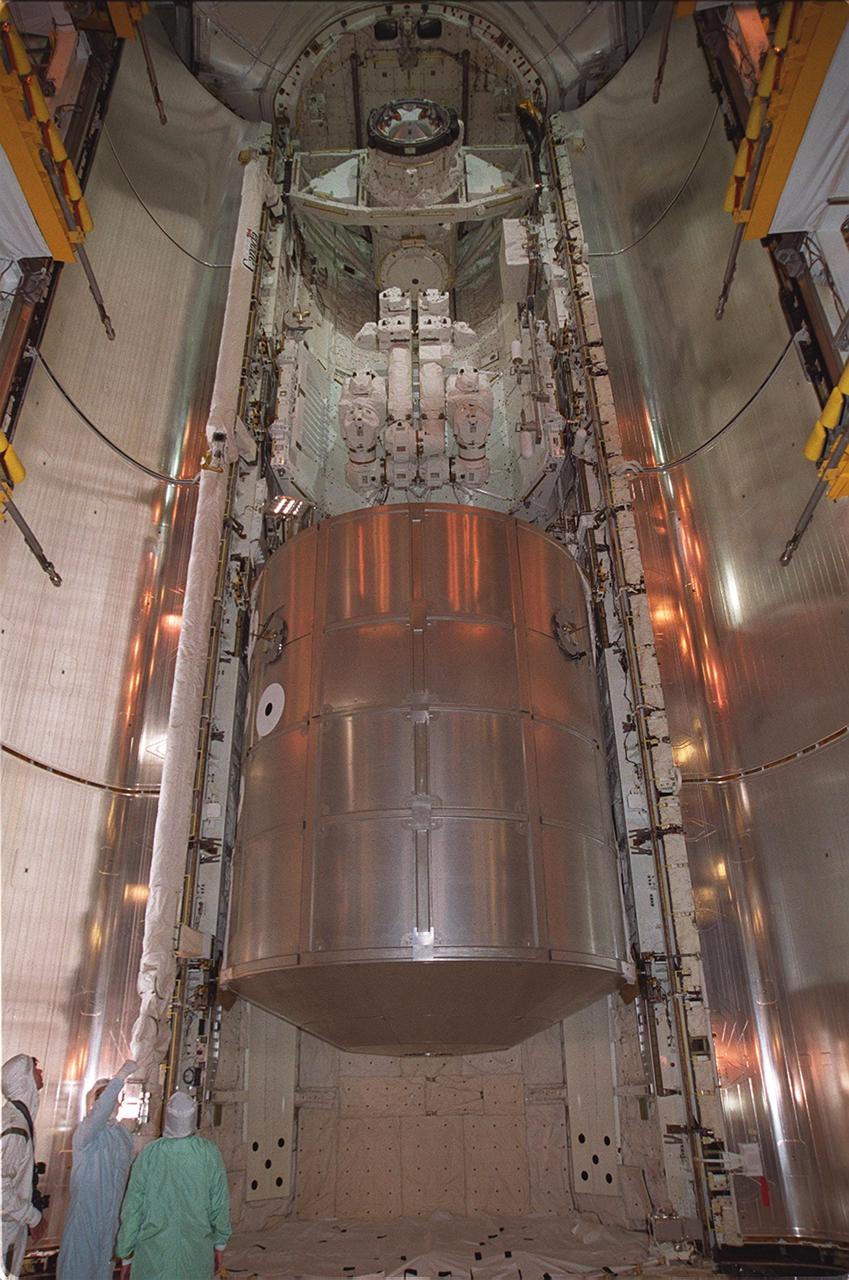
The STS-100 mission payload is transferred into the payload bay of Space Shuttle Endeavour. A t the top is the Canadian robotic arm, the SSRMS, and below it is the Multi-Purpose Logistics Module Raffaello. In the payload bay, the SSRMS is folded up on a u-shaped space lab pallet. The SSRMS is capable of handling large payloads and assisting with docking the Space Shuttle. It is crucial to the continued assembly of the International Space Station. Raffaello carries six system racks and two storage racks for the U.S. Lab. Launch of mission STS-100 is scheduled for April 19 at 2:41 p.m. EDT

CAPE CANAVERAL, Fla. -- At the Kennedy Space Center in Florida, the Ulysses spacecraft with two attached upper stages –- a payload assist module and an inertial upper stage -- is transferred into the payload canister. Transport from the Vertical Processing Facility to the Payload Changeout Room at the Launch Pad 39B was scheduled for Aug. 27, 1990. The payload will be vertically installed in the cargo bay of the space shuttle Discovery after the shuttle is brought to the pad in September. Ulysses will be deployed during STS-41, set for a launch period extending from Oct. 5 through Oct. 23, 1990. Photo Credit: NASA
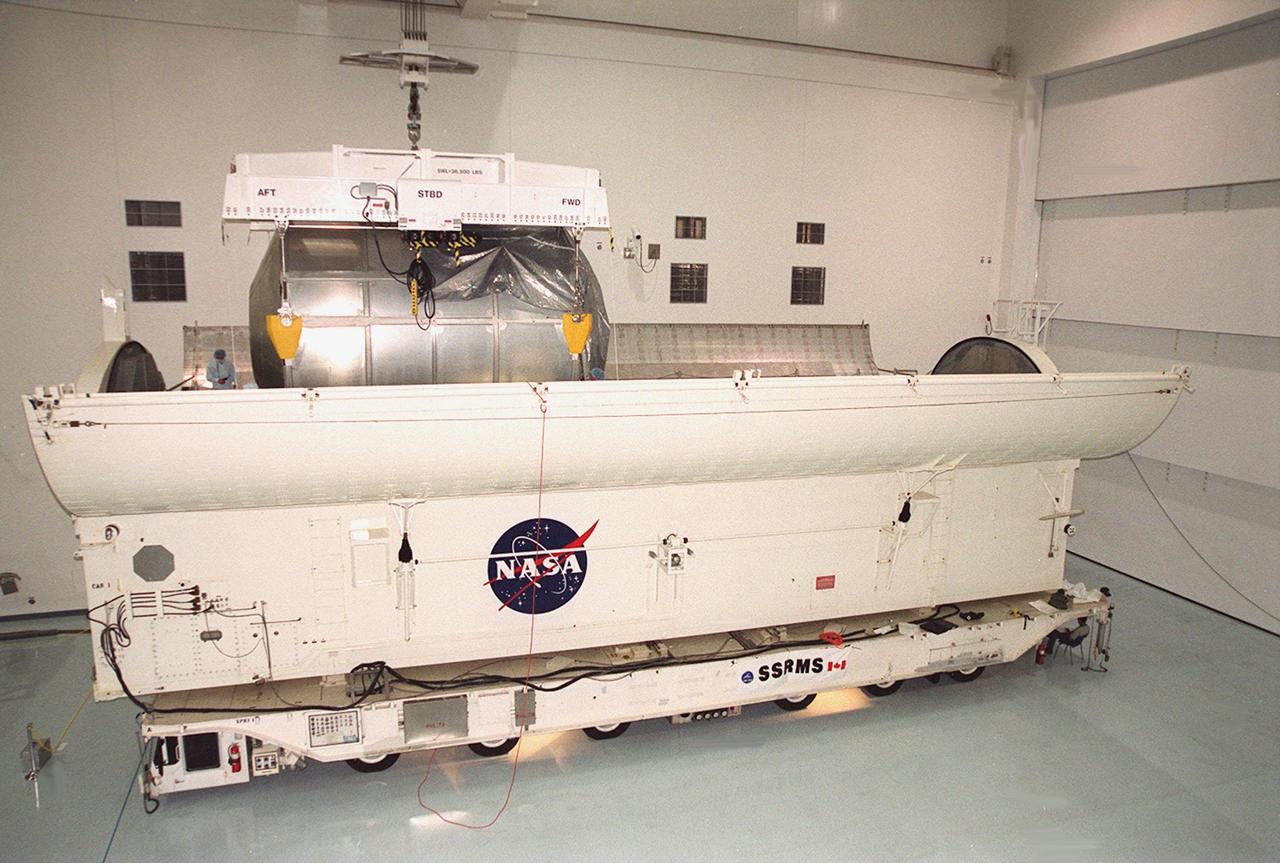
The Multi-Purpose Logistics Module Raffaello is lowered into the payload canister alongside the Canadian robotic arm, SSRMS, already in place. Both elements are part of the payload on mission STS-100 to the International Space Station. Raffaello carries six system racks and two storage racks for the U.S. Lab. The arm has seven motorized joints and is capable of handling large payloads and assisting with docking the Space Shuttle. The SSRMS is self-relocatable with a Latching End Effector so it can be attached to complementary ports spread throughout the Station’s exterior surfaces. Launch of STS-100 is scheduled for April 19, 2001 at 2:41 p.m. EDT from Launch Pad 39A
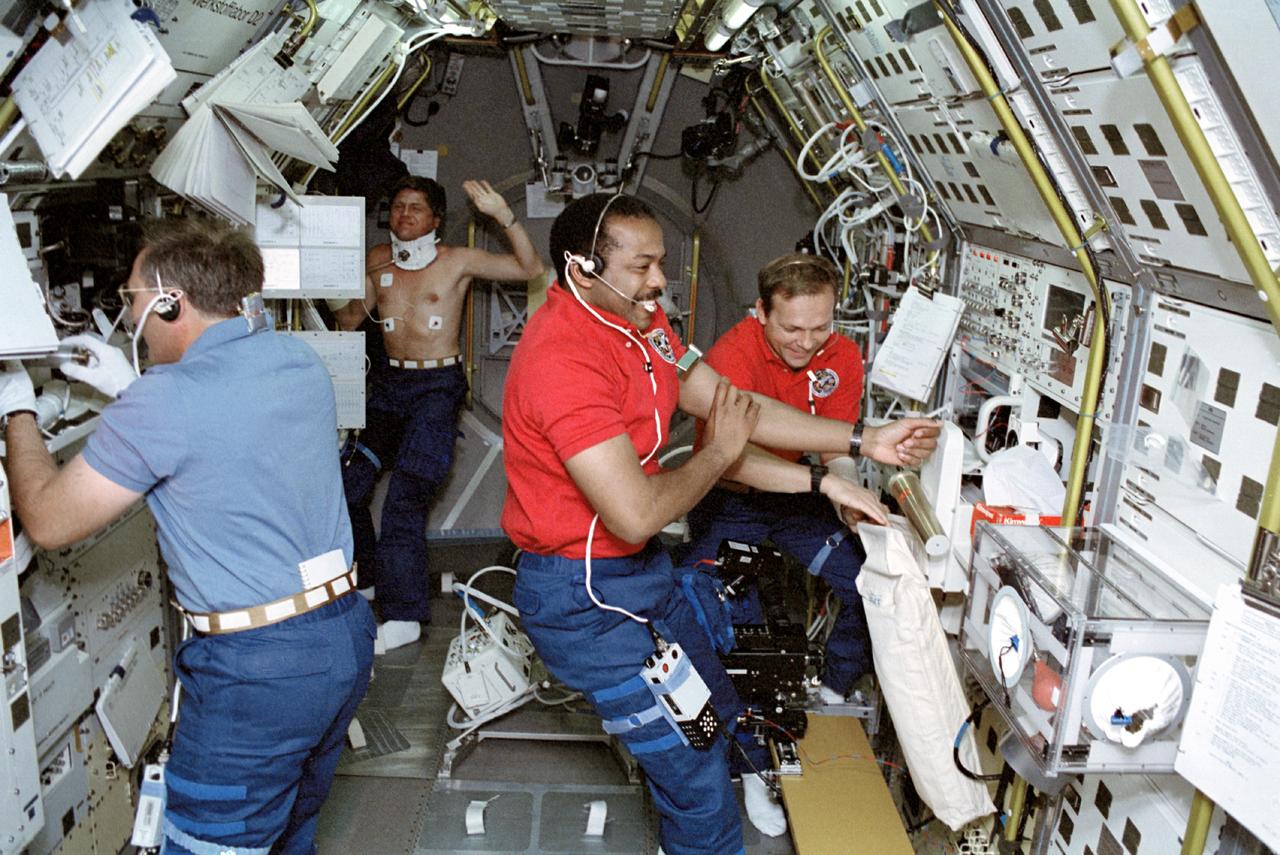
STS055-22-004 (26 April-6 May 1993) --- Four of the seven crew members who spent 10 days aboard the Space Shuttle Columbia are pictured during a brief shift overlap period in the Spacelab D-2 Science Module. Left to right are Jerry L. Ross, Ulrich Walter, Bernard A. Harris, Jr. and Hans Schlegel. Ross, STS-55 payload commander, is changing a sample in a materials processing furnace; Walter, a German payload specialist is in the midst of a baroreflex test and fellow payload specialist Schlegel assists mission specialist and physician Harris with a physiological test at the "Anthrorack".
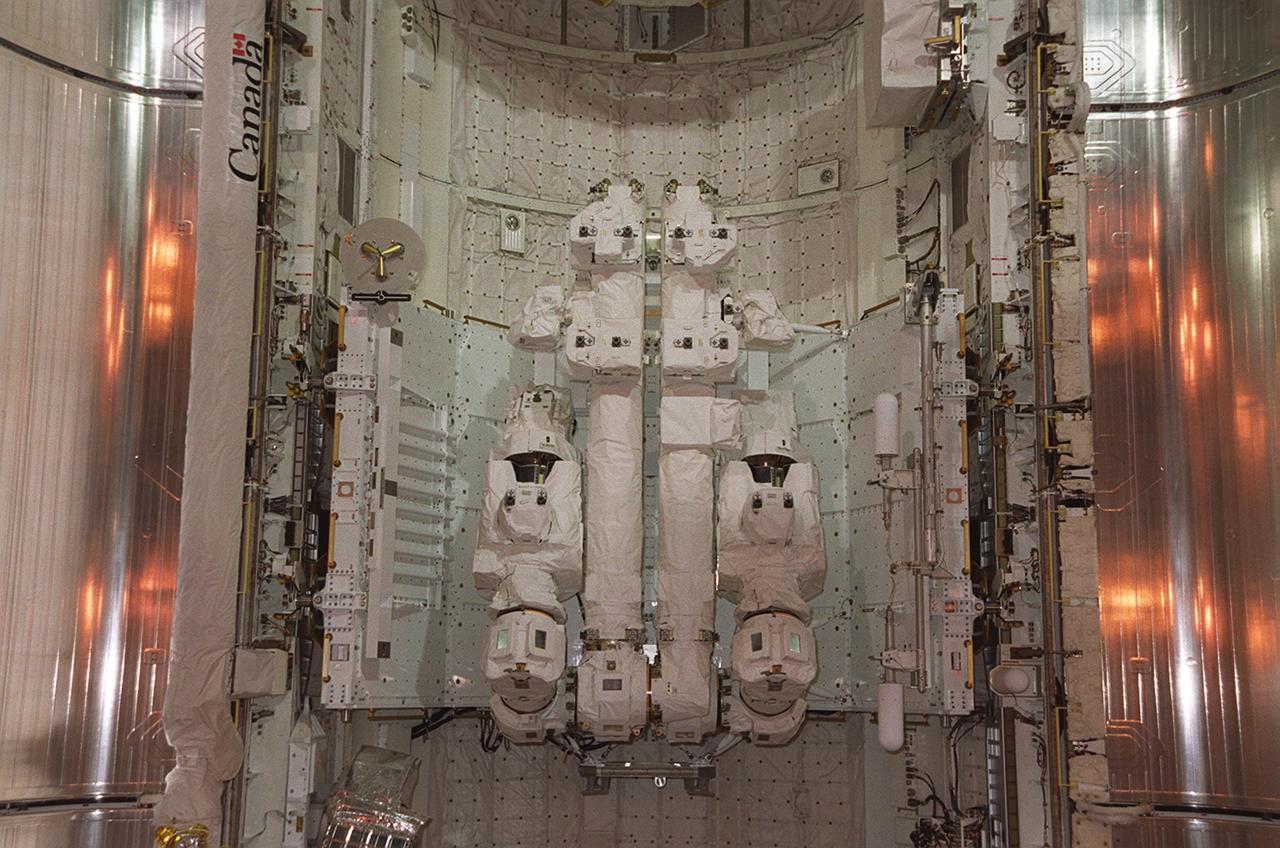
Resting inside the payload bay of Space Shuttle Endeavour is the Canadian robotic arm, the SSRMS. Capable of handling large payloads and assisting with docking the Space Shuttle, the SSRMS is crucial to the continued assembly of the International Space Station. The folded up arm sits on a u-shaped space lab pallet inside the bay. Another part of the payload, not seen, is the Multi-Purpose Logistics Module Raffaello, which carries six system racks and two storage racks for the U.S. Lab. Launch of mission STS-100 is scheduled for April 19 at 2:41 p.m. EDT
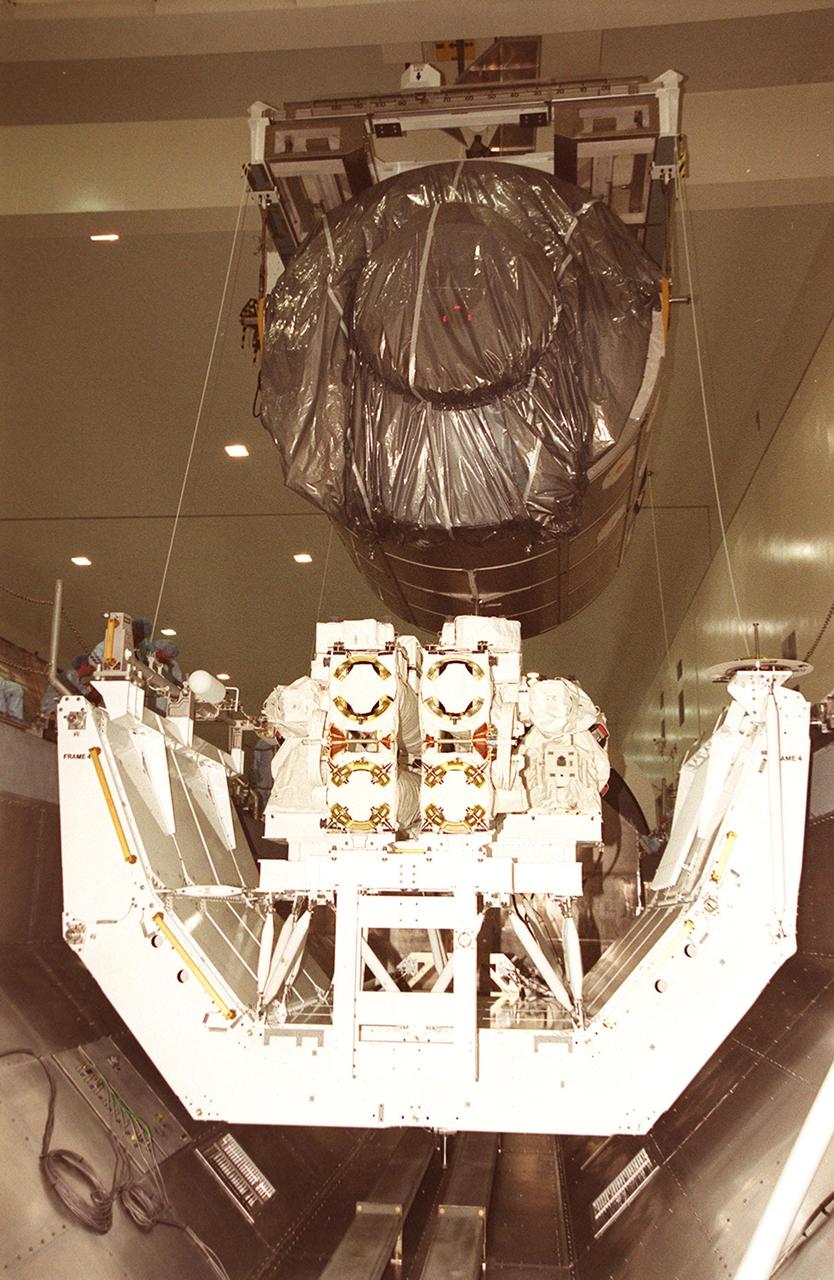
Viewed from the end, the Multi-Purpose Logistics Module Raffaello is lowered into the payload canister behind the Canadian robotic arm, SSRMS, already in place. Both elements are part of the payload on mission STS-100 to the International Space Station. Raffaello carries six system racks and two storage racks for the U.S. Lab. The arm has seven motorized joints and is capable of handling large payloads and assisting with docking the Space Shuttle. The SSRMS is self-relocatable with a Latching End Effector so it can be attached to complementary ports spread throughout the Station’s exterior surfaces. Launch of STS-100 is scheduled for April 19, 2001 at 2:41 p.m. EDT from Launch Pad 39A
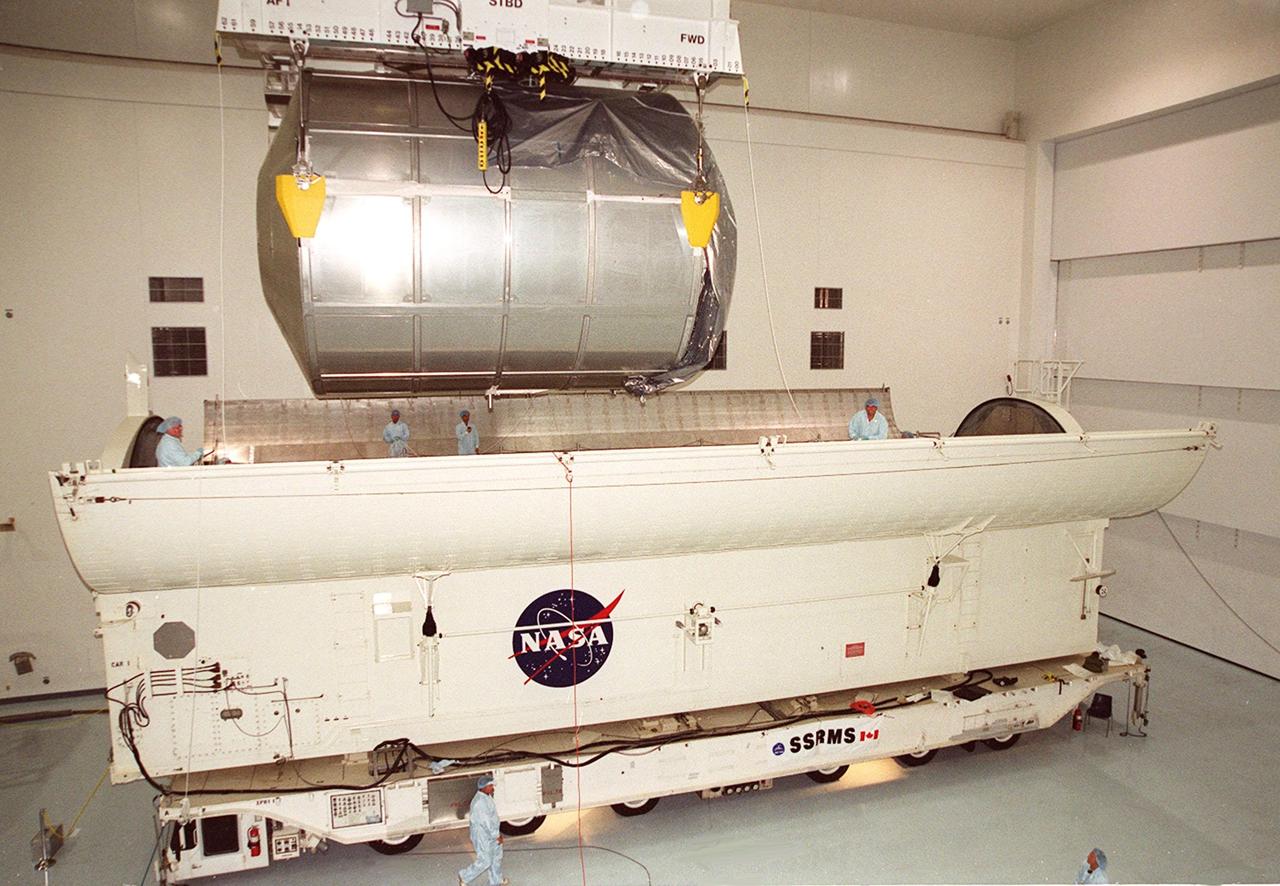
Workers inside the payload canister wait for the Multi-Purpose Logistics Module Raffaello to be lowered inside. It joins the Canadian robotic arm, SSRMS, already in place. Both elements are part of the payload on mission STS-100 to the International Space Station. Raffaello carries six system racks and two storage racks for the U.S. Lab. The arm has seven motorized joints and is capable of handling large payloads and assisting with docking the Space Shuttle. The SSRMS is self-relocatable with a Latching End Effector so it can be attached to complementary ports spread throughout the Station’s exterior surfaces. Launch of STS-100 is scheduled for April 19, 2001 at 2:41 p.m. EDT from Launch Pad 39A
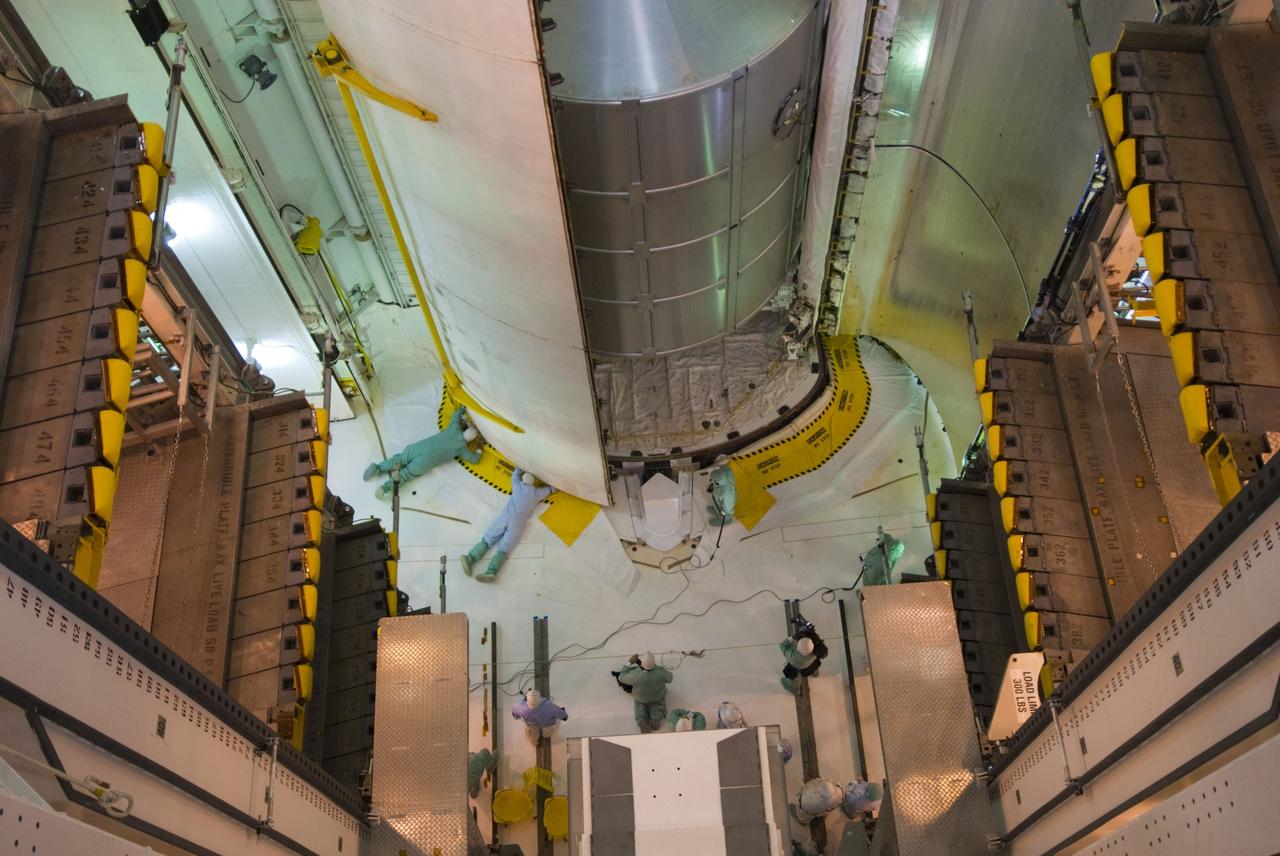
CAPE CANAVERAL, Fla. -- In the payload changeout room at Launch Pad 39A at NASA's Kennedy Space Center in Florida, technicians assist with the closure of space shuttle Atlantis' payload bay doors for flight. The payload arrived at the pad June 16 for installation into Atlantis and includes the Raffaello multi-purpose logistics module packed with supplies and spare parts for the International Space Station. The STS-135 mission also will fly a system to investigate the potential for robotically refueling existing satellites and return a failed ammonia pump module to help NASA better understand the failure mechanism and improve pump designs for future systems. Atlantis and its crew are scheduled to lift off at 11:26 a.m. EDT July 8. STS-135 will be the 33rd flight of Atlantis, the 37th shuttle mission to the space station, and the 135th and final mission of NASA's Space Shuttle Program. For more information, visit www.nasa.gov/shuttle. Photo credit: NASA/Jim Grossmann

From the Payload Changeout Room, members of the STS-100 crew look over part of the mission payload, the SSRMS, in Space Shuttle Endeavour’s payload bay. The SSRMS, or Canadian robotic arm, is capable of handling large payloads and assisting with docking the Space Shuttle. It is crucial to the continued assembly of the International Space Station. The crew is at KSC to complete Terminal Countdown Demonstration Test activities that were postponed earlier. The TCDT includes emergency escape training, payload bay walkdown, and a simulated launch countdown. The primary payload also includes Multi-Purpose Logistics Module, Raffaello. Launch of Space Shuttle Endeavour on mission STS-100 is targeted for April 19 at 2:41 p.m. EDT from Launch Pad 39A

From the Payload Changeout Room, members of the STS-100 crew look over part of the mission payload, the SSRMS, in Space Shuttle Endeavour’s payload bay. The SSRMS, or Canadian robotic arm, is capable of handling large payloads and assisting with docking the Space Shuttle. It is crucial to the continued assembly of the International Space Station. The crew is at KSC to complete Terminal Countdown Demonstration Test activities that were postponed earlier. The TCDT includes emergency escape training, payload bay walkdown, and a simulated launch countdown. The primary payload also includes Multi-Purpose Logistics Module, Raffaello. Launch of Space Shuttle Endeavour on mission STS-100 is targeted for April 19 at 2:41 p.m. EDT from Launch Pad 39A
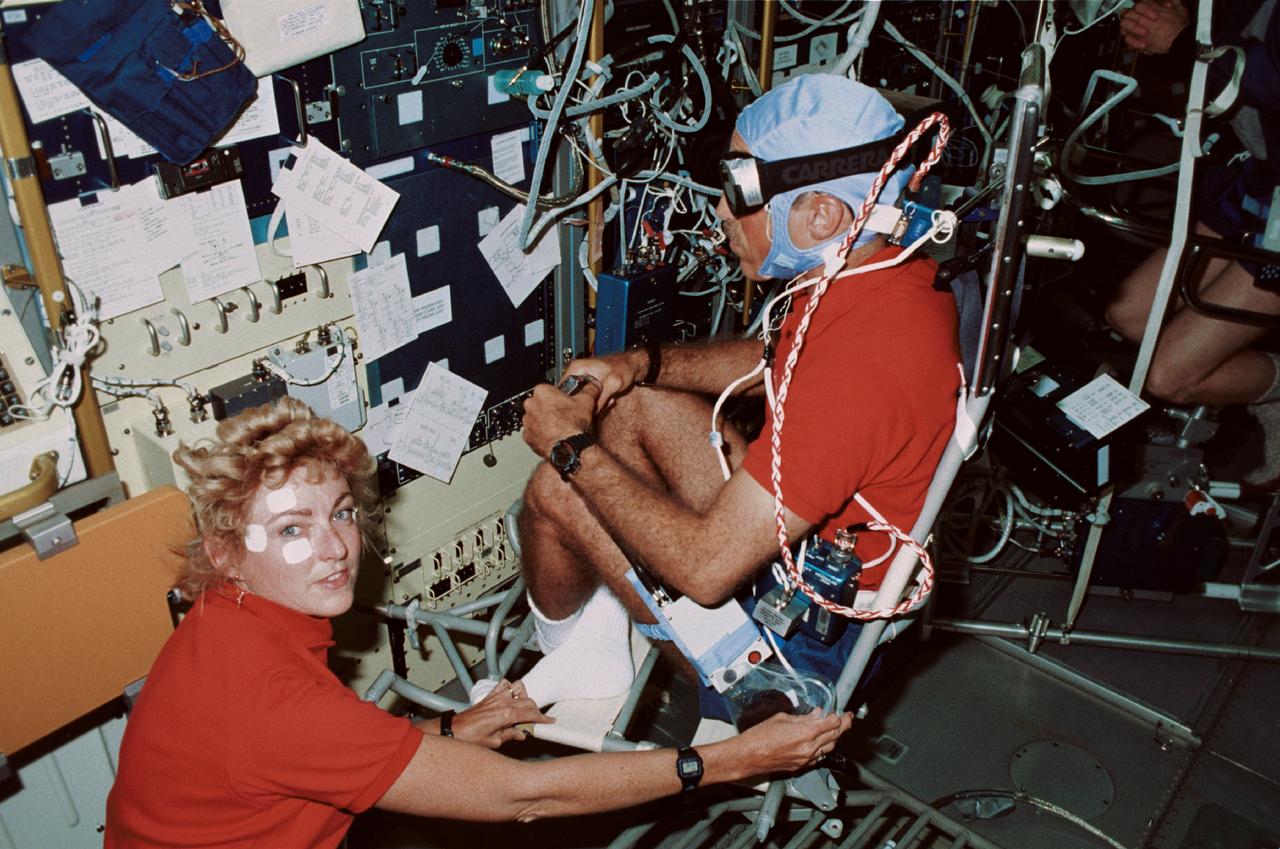
STS040-211-020 (5-14 June 1991) --- Vestibular experiment activities were captured onboard Columbia's Spacelab Life Sciences (SLS-1) module in this 35mm scene. Astronaut James P. Bagian, STS-40 mission specialist, is in a rotating chair while wearing an accelometer and electrodes to record head motion and horizontal and vertical eye movements during the rotations. Payload specialist Millie Hughes-Fulford, lower left, assists with the test.
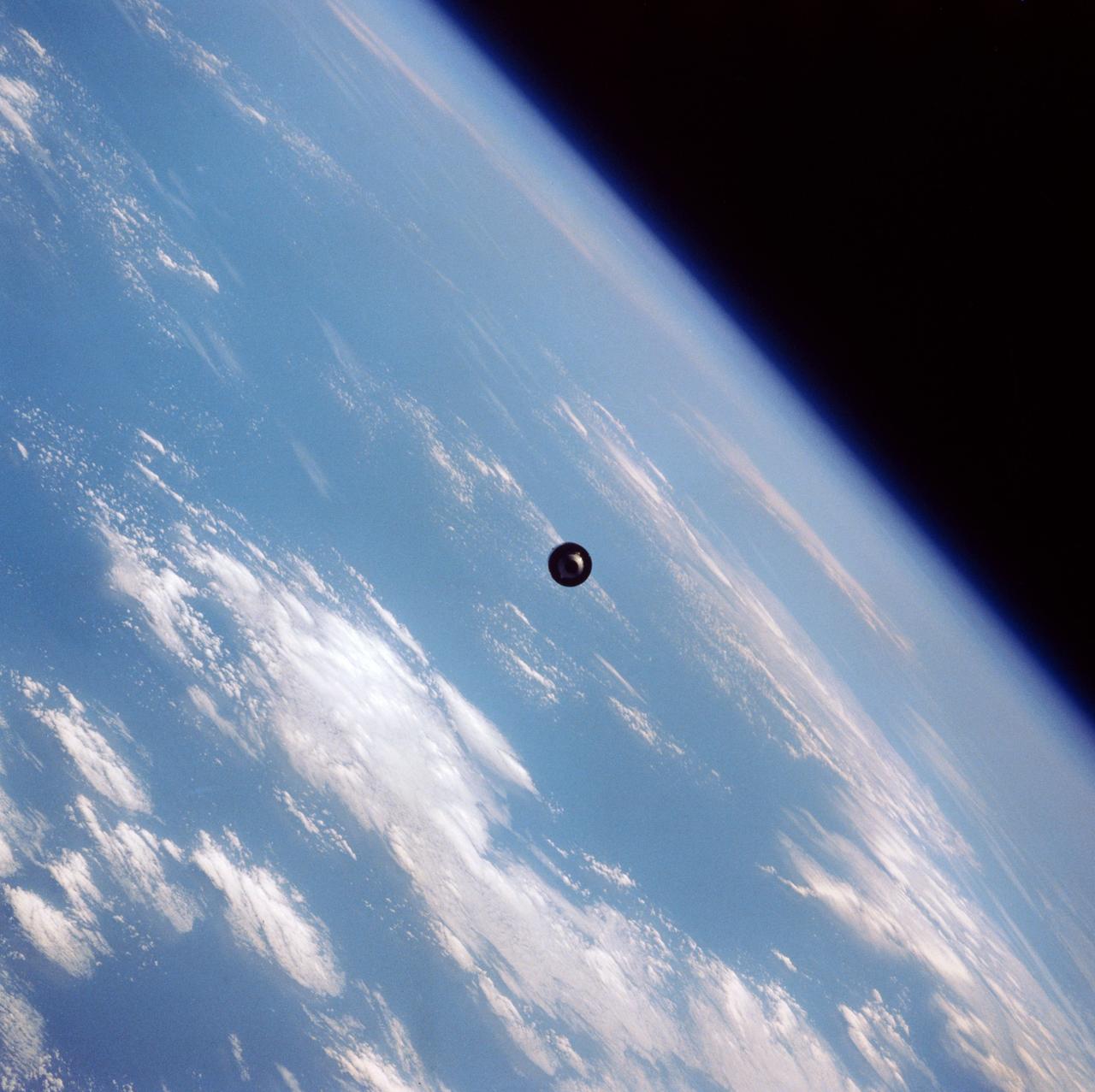
41D-39-068 (1 Sept 1984) --- Quickly moving away from the Space Shuttle Discovery is the Telstar 3 communications satellite, deployed September 1, 1984. The 41-D crew successfully completed three satellite placements, of which this was the last. Telstar was the second 41-D deployed satellite to be equipped with a payload assist module (PAM-D). The frame was exposed with a 70mm camera.
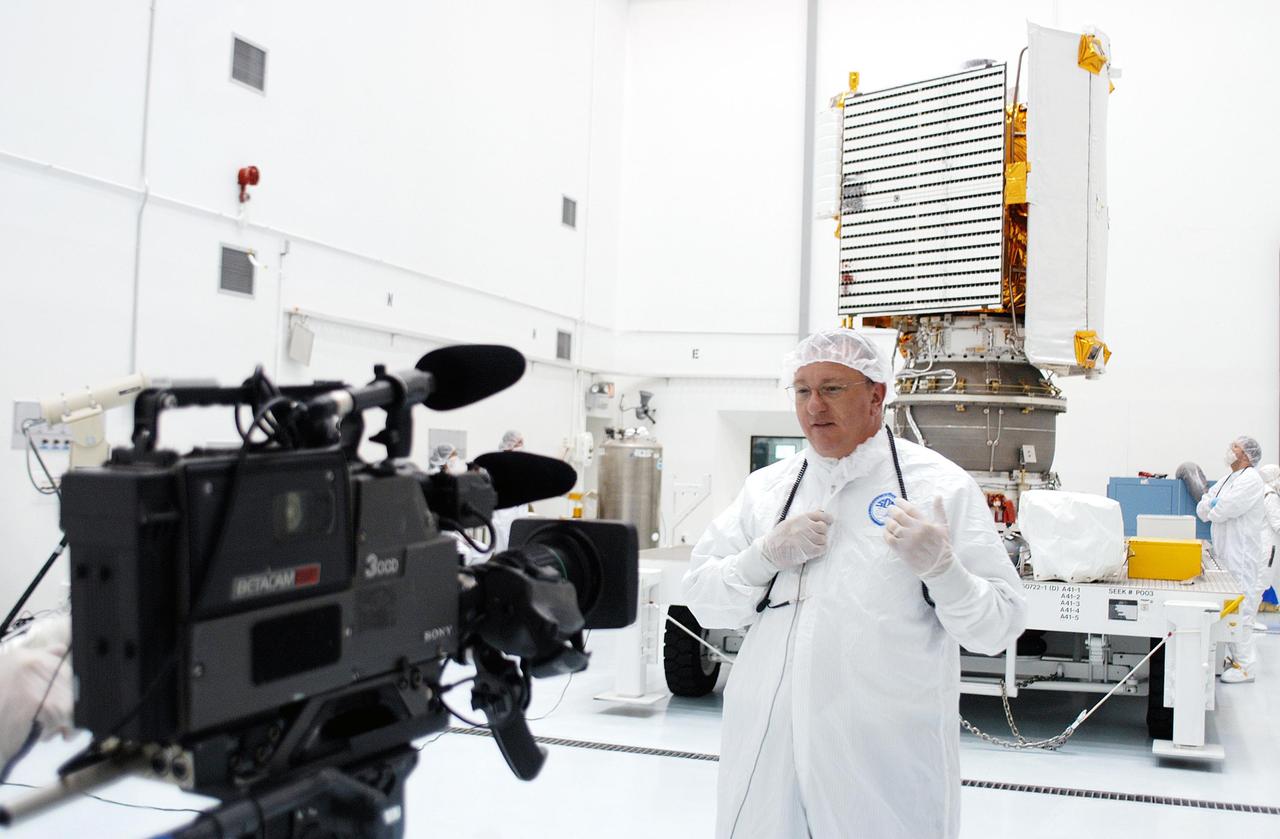
KENNEDY SPACE CENTER, FLA. - Ted Hartka, MESSENGER lead mechanical engineer, with The Johns Hopkins University Applied Physics Laboratory (APL), talks about the MESSENGER spacecraft’s mission to Mercury for the media at a special presentation at Astrotech Space Operations in Titusville, Fla. The spacecraft, mated to the Delta II third stage Payload Assist Module, is in the background. MESSENGER is scheduled to launch Aug. 2 aboard a Boeing Delta II rocket from Pad 17-B, Cape Canaveral Air Force Station, Fla.
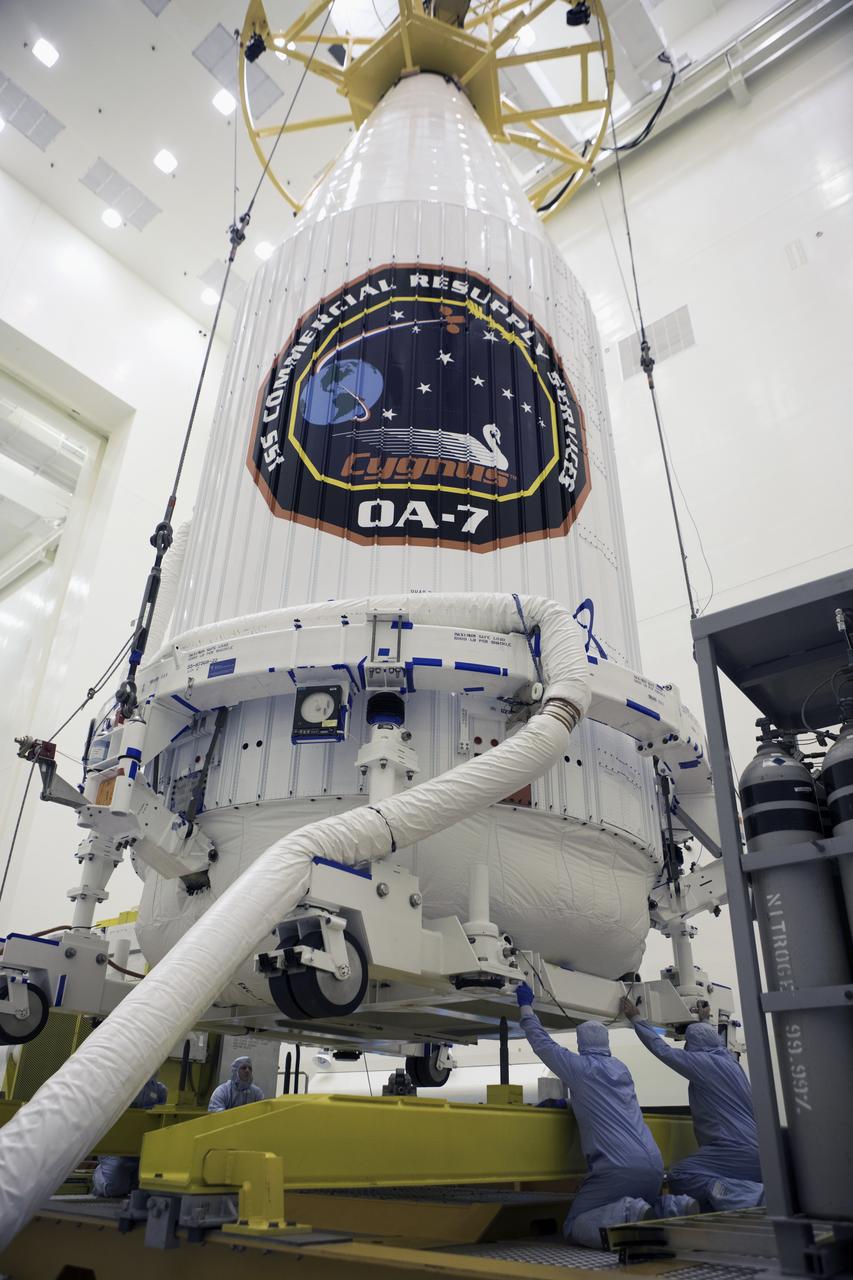
Inside the Payload Hazardous Servicing Facility at NASA's Kennedy Space Center in Florida, technicians assist as a crane lowers the Orbital ATK Cygnus pressurized cargo module, enclosed in its payload fairing, onto a KAMAG transporter. The Orbital ATK CRS-7 commercial resupply services mission to the International Space Station is scheduled to launch atop a United Launch Alliance Atlas V rocket from Space Launch Complex 41 at Cape Canaveral Air Force Station. Cygnus will deliver 7,600 pounds of supplies, equipment and scientific research materials to the space station.
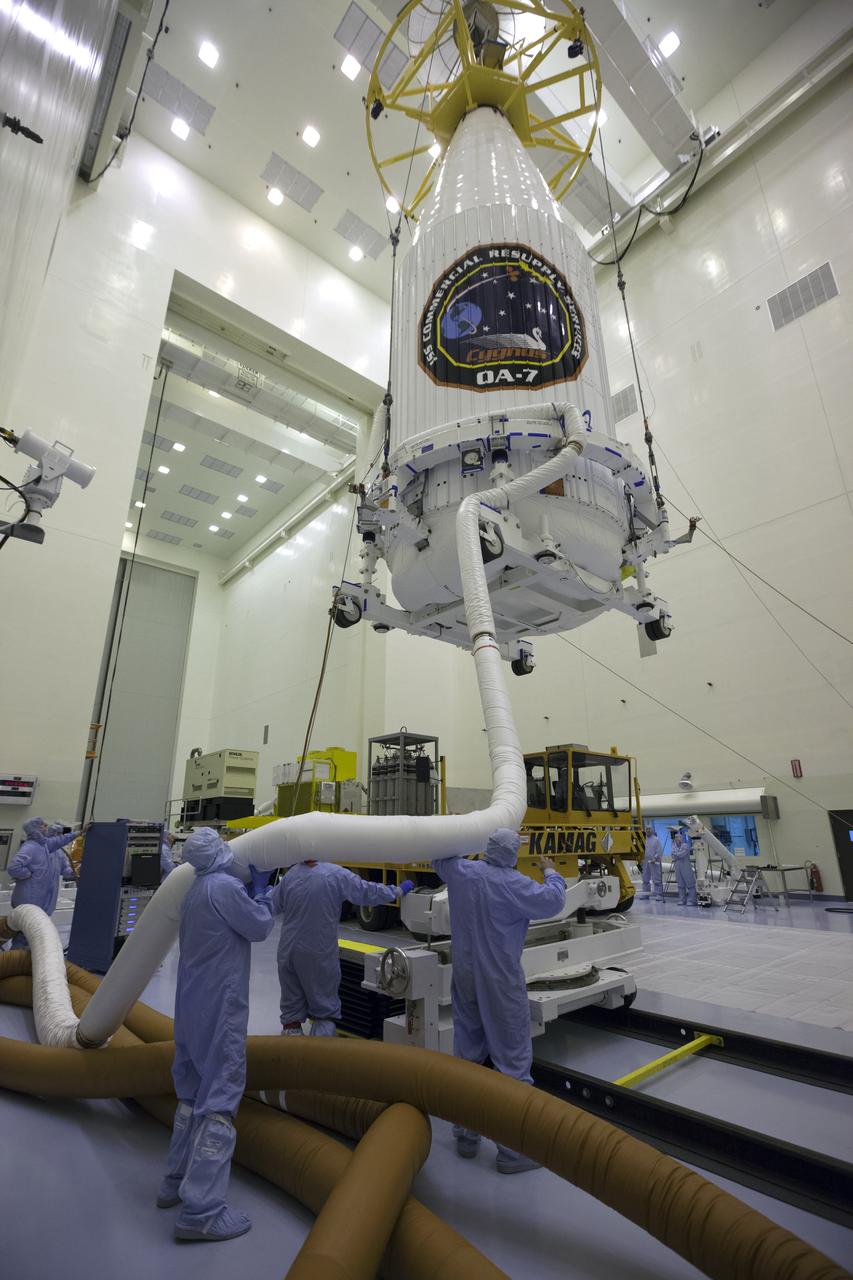
Inside the Payload Hazardous Servicing Facility at NASA's Kennedy Space Center in Florida, technicians assist as a crane is used to lift the Orbital ATK Cygnus pressurized cargo module, enclosed in its payload fairing, for transfer to a KAMAG transporter. The Orbital ATK CRS-7 commercial resupply services mission to the International Space Station is scheduled to launch atop a United Launch Alliance Atlas V rocket from Space Launch Complex 41 at Cape Canaveral Air Force Station. Cygnus will deliver 7,600 pounds of supplies, equipment and scientific research materials to the space station.
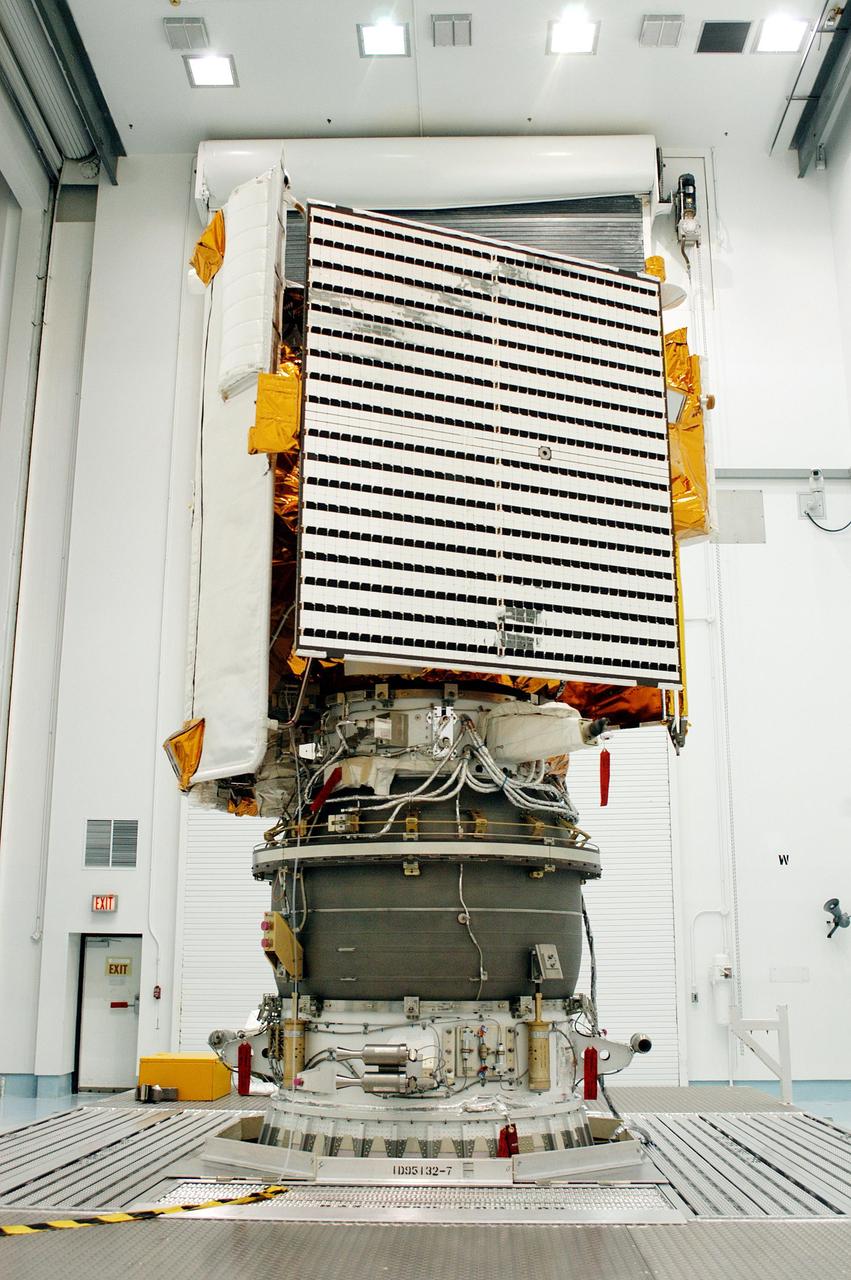
KENNEDY SPACE CENTER, FLA. - The MESSENGER (Mercury Surface, Space Environment, Geochemistry and Ranging) spacecraft, mated to the Delta II third stage Payload Assist Module, is on display at Astrotech Space Operations in Titusville, Fla., for the media. Spokespersons for the event are Dr. Robert Gold, MESSENGER payload manager with The Johns Hopkins University Applied Physics Laboratory (APL); and Ted Hartka, MESSENGER lead mechanical engineer, APL. MESSENGER is scheduled to launch Aug. 2 aboard a Boeing Delta II rocket from Pad 17-B, Cape Canaveral Air Force Station, Fla.
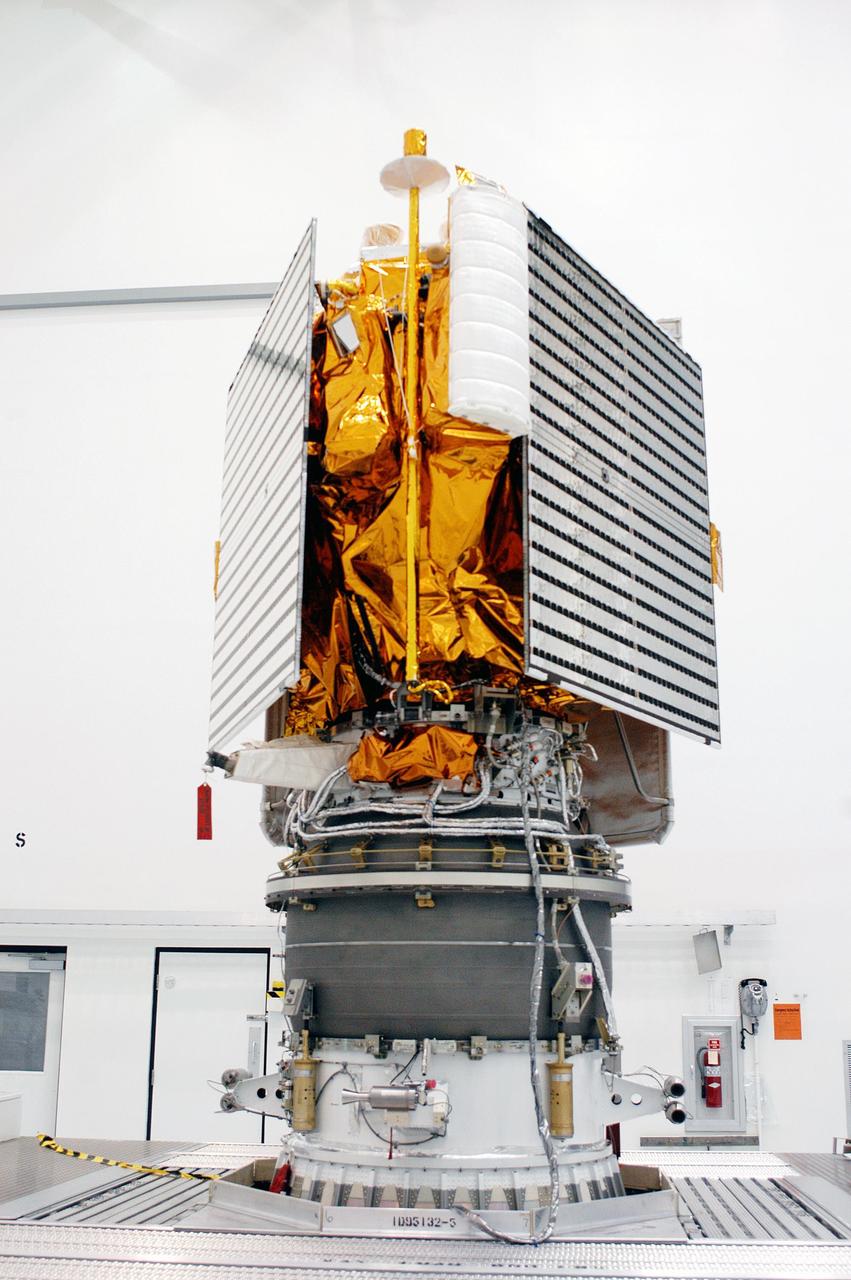
KENNEDY SPACE CENTER, FLA. - The MESSENGER (Mercury Surface, Space Environment, Geochemistry and Ranging) spacecraft, mated to the Delta II third stage Payload Assist Module, is ready for presentation to the media at Astrotech Space Operations in Titusville, Fla. Spokespersons for the event are Dr. Robert Gold, MESSENGER payload manager with The Johns Hopkins University Applied Physics Laboratory (APL); and Ted Hartka, MESSENGER lead mechanical engineer, APL. MESSENGER is scheduled to launch Aug. 2 aboard a Boeing Delta II rocket from Pad 17-B, Cape Canaveral Air Force Station, Fla.
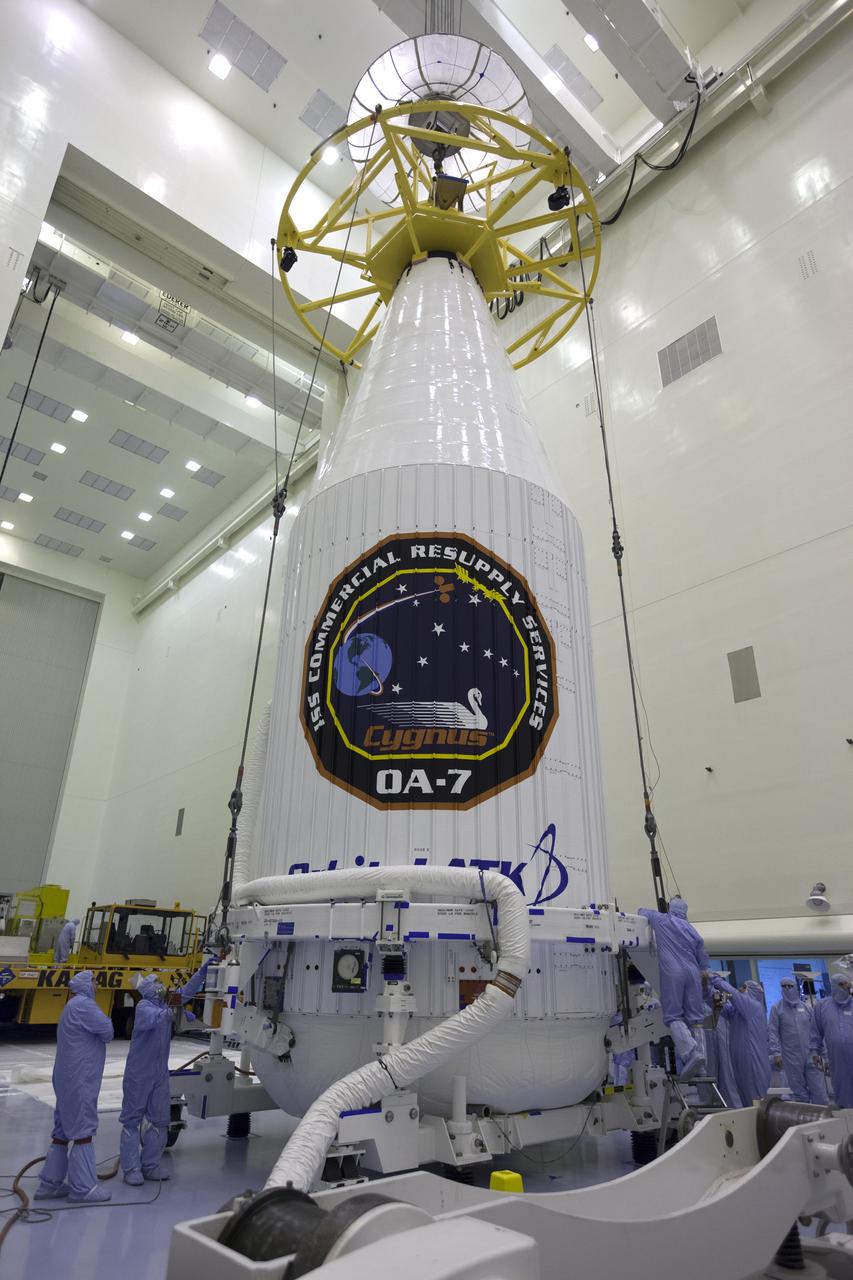
Inside the Payload Hazardous Servicing Facility at NASA's Kennedy Space Center in Florida, technicians assist as a crane is used to lift the Orbital ATK Cygnus pressurized cargo module, enclosed in its payload fairing, for transfer to a KAMAG transporter. The Orbital ATK CRS-7 commercial resupply services mission to the International Space Station is scheduled to launch atop a United Launch Alliance Atlas V rocket from Space Launch Complex 41 at Cape Canaveral Air Force Station. Cygnus will deliver 7,600 pounds of supplies, equipment and scientific research materials to the space station.
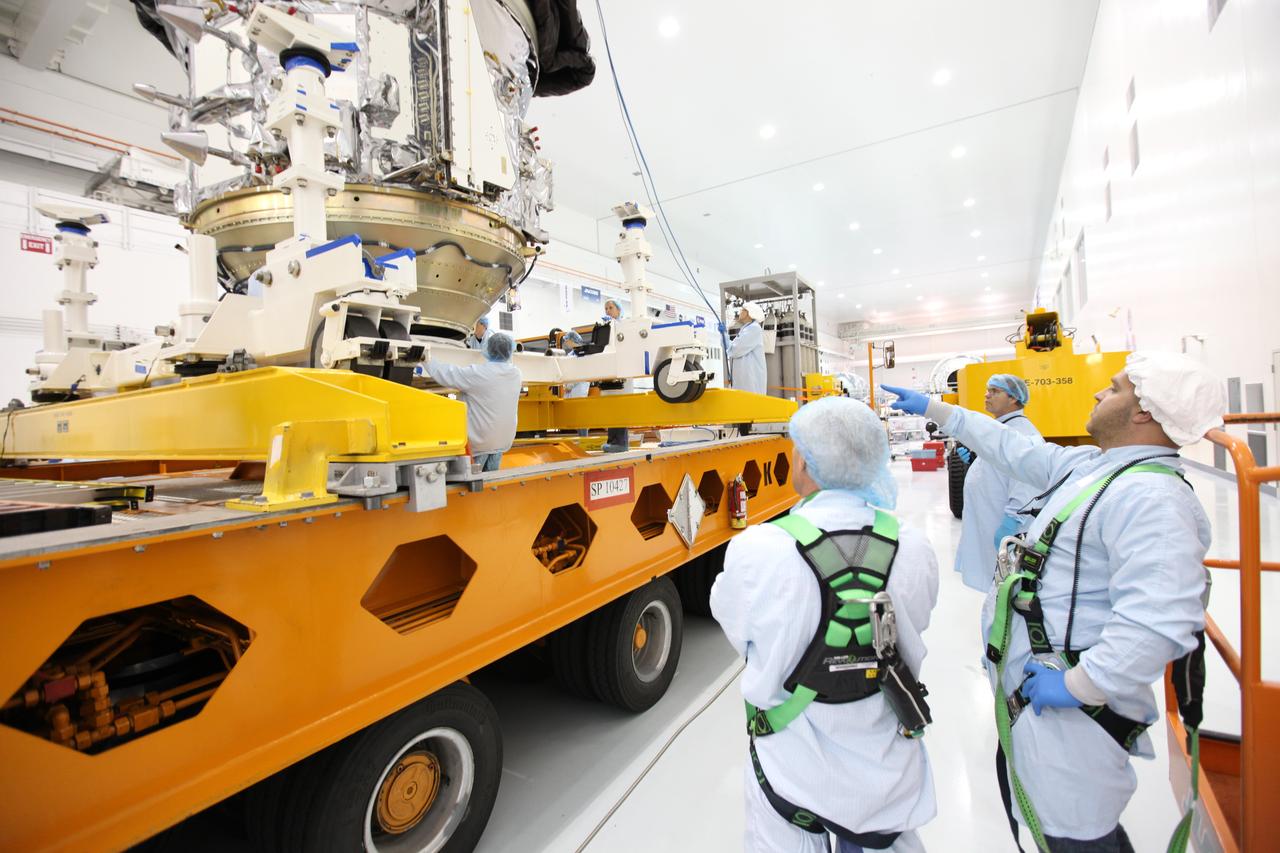
In the Space Station Processing Facility high bay at NASA's Kennedy Space Center in Florida, technicians assist as the Orbital ATK CYGNUS pressurized cargo module is secured on the KAMAG transporter. The module will be transported to the Payload Hazardous Servicing Facility. The Orbital ATK CRS-7 commercial resupply services mission to the International Space Station is scheduled to launch atop a United Launch Alliance Atlas V rocket from Space Launch Complex 41 at Cape Canaveral Air Force Station on March 19, 2017. CYGNUS will deliver thousands of pounds of supplies, equipment and scientific research materials to the space station.
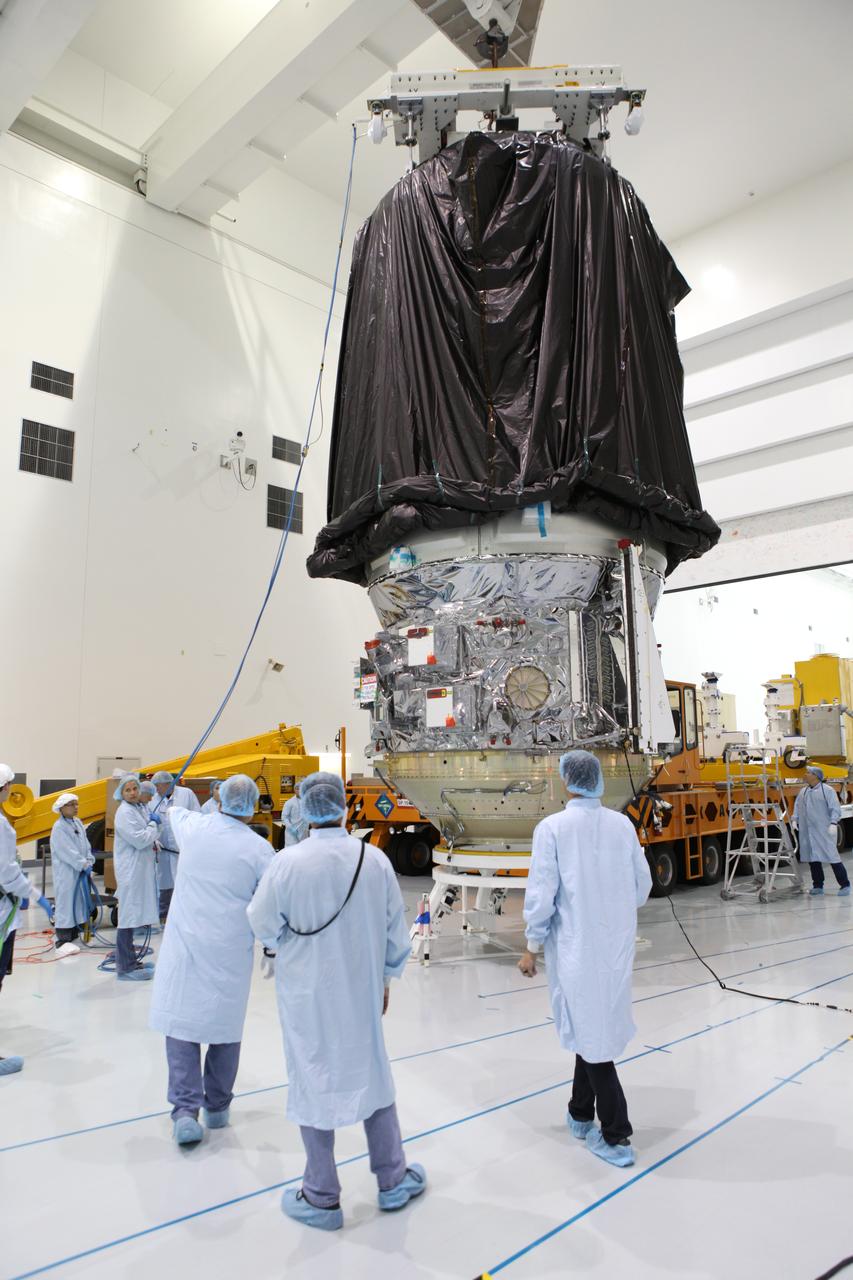
In the Space Station Processing Facility at NASA's Kennedy Space Center in Florida, technicians assist as a crane is used to lower a protective covering over Orbital ATK's CYGNUS pressurized cargo module. The module will be secured on a KAMAG transporter for the trip to the Payload Hazardous Servicing Facility. The Orbital ATK CRS-7 commercial resupply services mission to the International Space Station is scheduled to launch atop a United Launch Alliance Atlas V rocket from Space Launch Complex 41 at Cape Canaveral Air Force Station on March 19, 2017. CYGNUS will deliver thousands of pounds of supplies, equipment and scientific research materials to the space station.
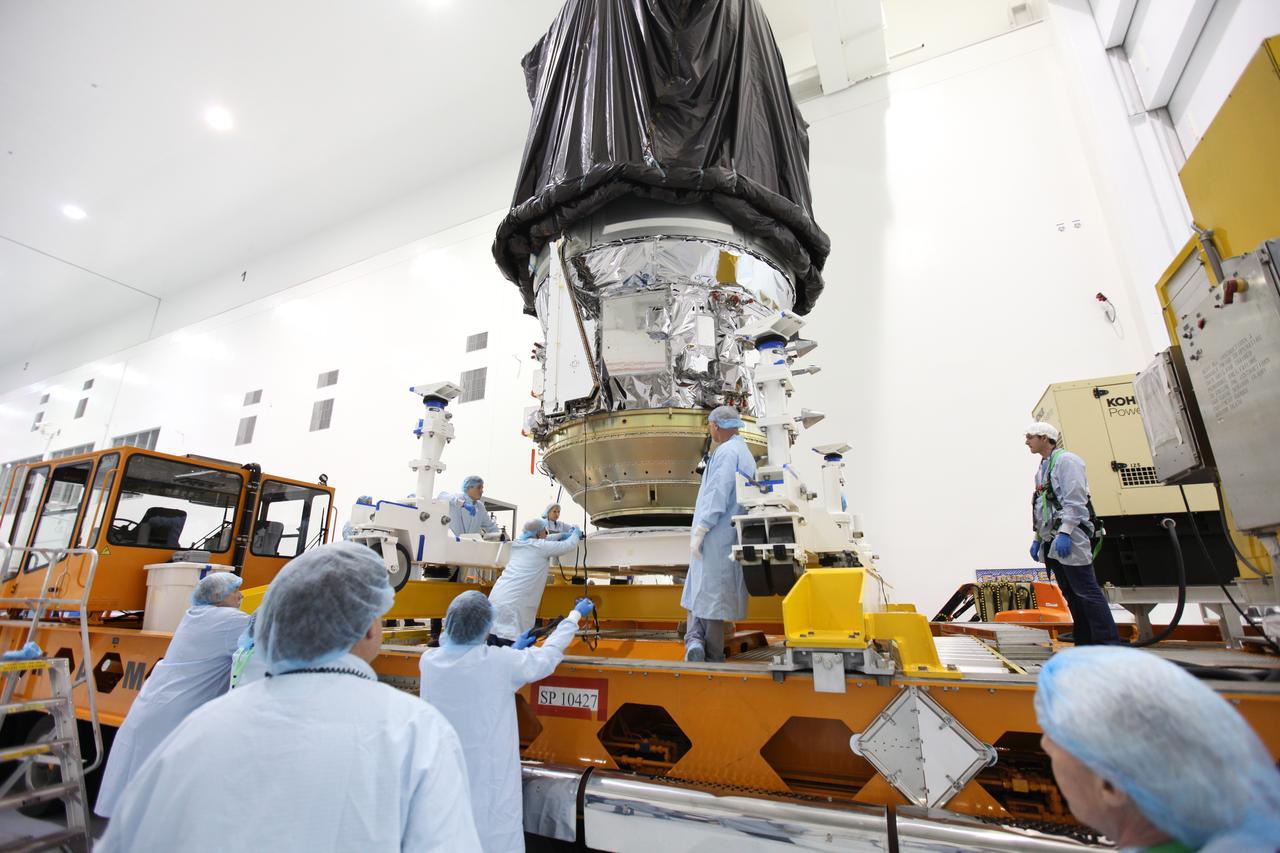
In the Space Station Processing Facility high bay at NASA's Kennedy Space Center in Florida, technicians assist as a crane lowers the Orbital ATK CYGNUS pressurized cargo module onto the KAMAG transporter. The module will be secured on the transporter and moved to the Payload Hazardous Servicing Facility. The Orbital ATK CRS-7 commercial resupply services mission to the International Space Station is scheduled to launch atop a United Launch Alliance Atlas V rocket from Space Launch Complex 41 at Cape Canaveral Air Force Station on March 19, 2017. CYGNUS will deliver thousands of pounds of supplies, equipment and scientific research materials to the space station.
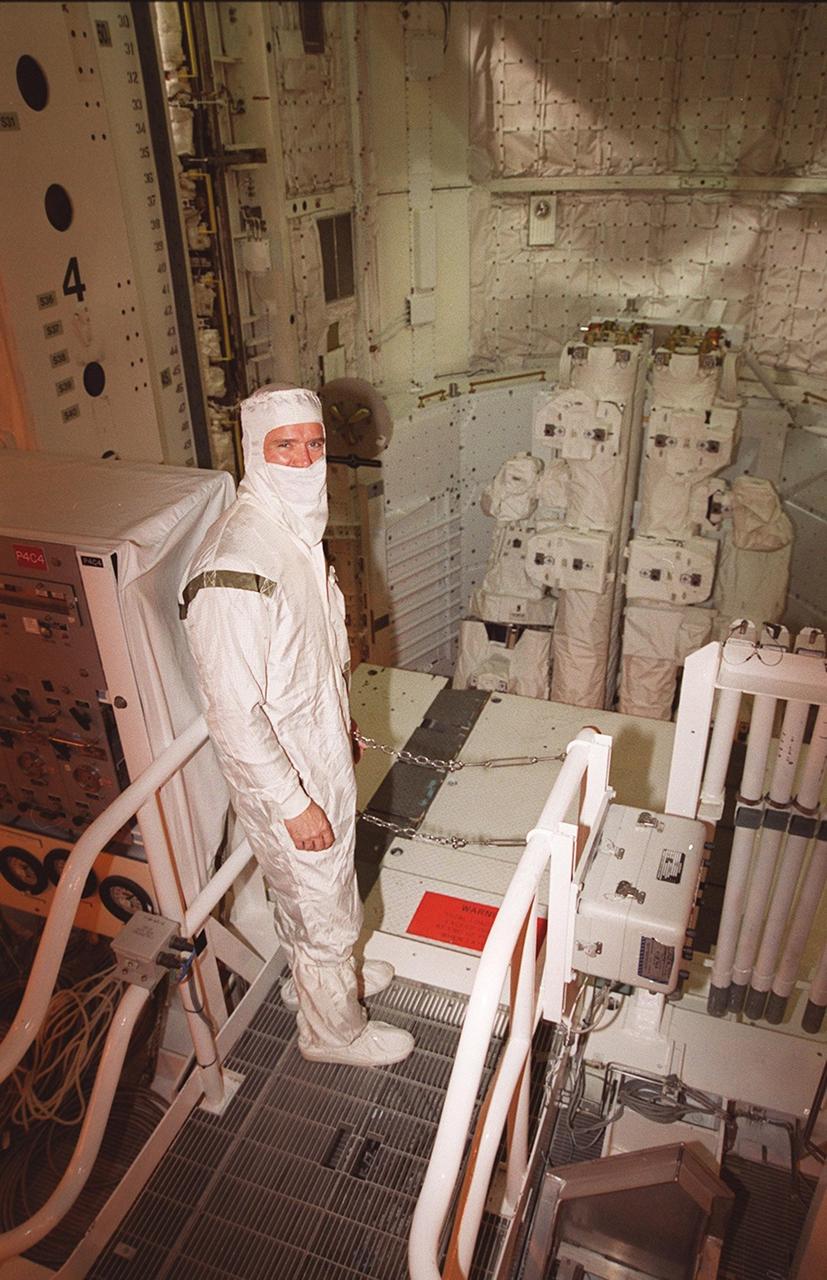
STS-100 Mission Specialist Chris A. Hadfield, who is with the Canadian Space Agency, pauses for the photographer while looking over part of the mission payload, the Canadian robotic arm (SSRMS). The SSRMS is capable of handling large payloads and assisting with docking the Space Shuttle. It is crucial to the continued assembly of the International Space Station. Hadfield and the rest of the crew are at KSC to complete Terminal Countdown Demonstration Test activities that were postponed earlier. The TCDT includes emergency escape training, payload bay walkdown, and a simulated launch countdown. The primary payload also includes Multi-Purpose Logistics Module, Raffaello. Launch of Space Shuttle Endeavour on mission STS-100 is targeted for April 19 at 2:41 p.m. EDT from Launch Pad 39A
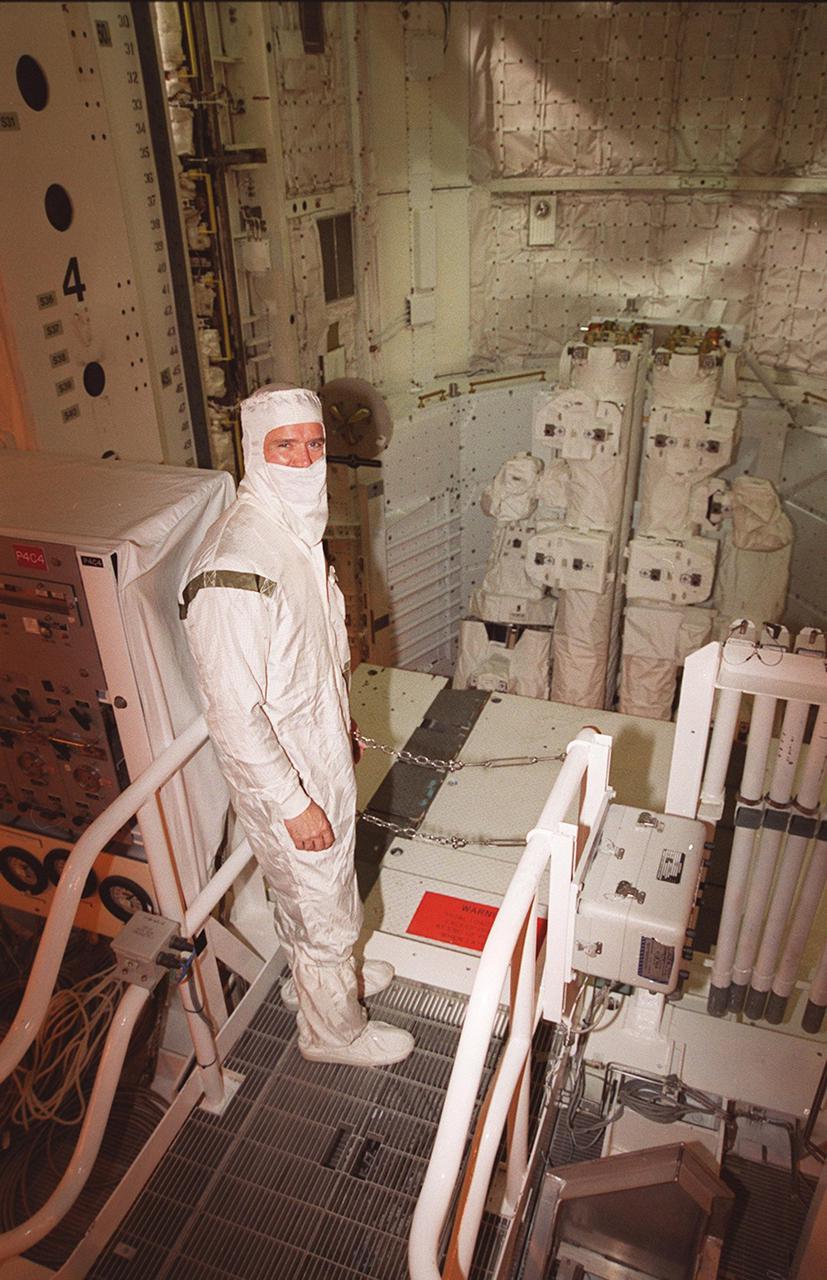
STS-100 Mission Specialist Chris A. Hadfield, who is with the Canadian Space Agency, pauses for the photographer while looking over part of the mission payload, the Canadian robotic arm (SSRMS). The SSRMS is capable of handling large payloads and assisting with docking the Space Shuttle. It is crucial to the continued assembly of the International Space Station. Hadfield and the rest of the crew are at KSC to complete Terminal Countdown Demonstration Test activities that were postponed earlier. The TCDT includes emergency escape training, payload bay walkdown, and a simulated launch countdown. The primary payload also includes Multi-Purpose Logistics Module, Raffaello. Launch of Space Shuttle Endeavour on mission STS-100 is targeted for April 19 at 2:41 p.m. EDT from Launch Pad 39A
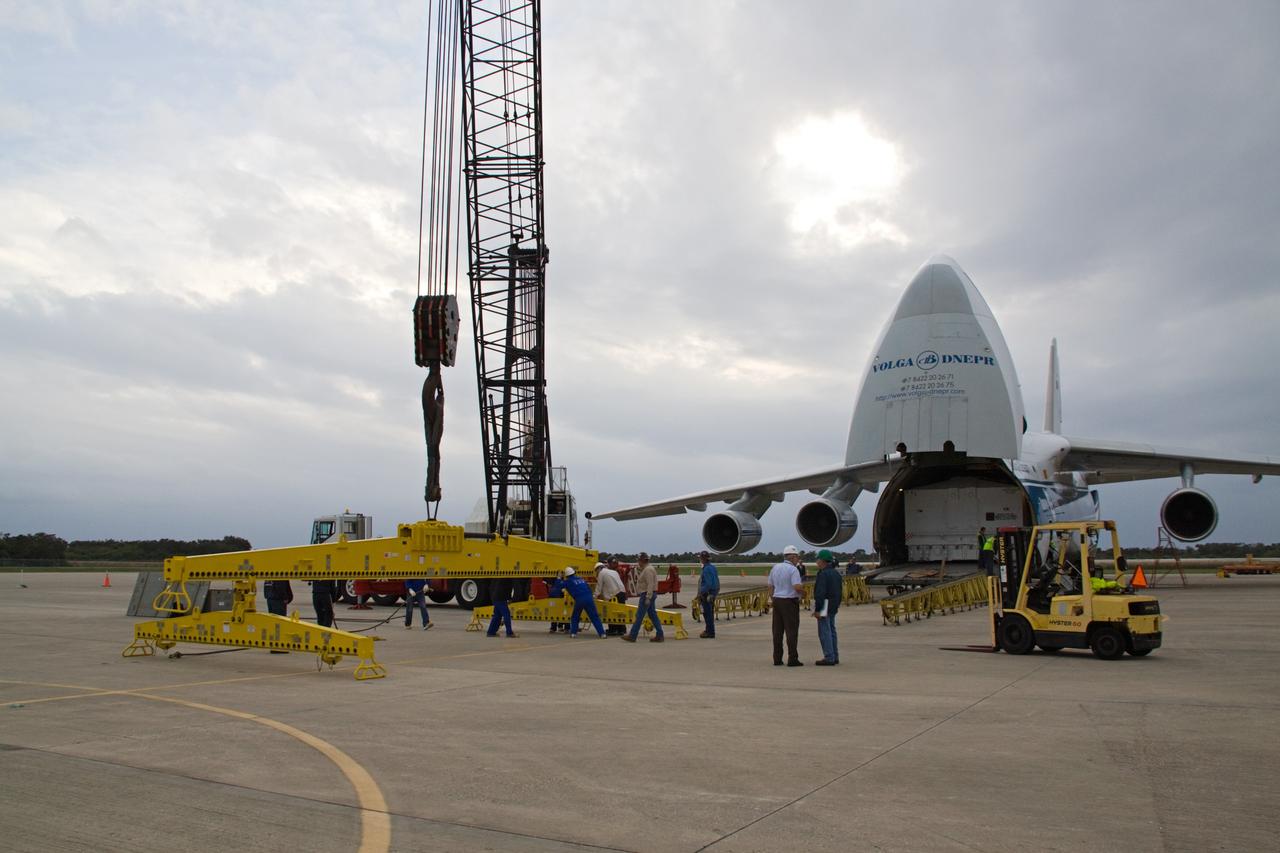
CAPE CANAVERAL, Fla. - At the Shuttle Landing Facility at NASA's Kennedy Space Center in Florida, workers prepare a crane to assist with the offloading of the Russian-built Mini Research Module1, or MRM1, from a Volga-Dnepr Antonov AN-124-100, a Ukranian/Russian aircraft. The second in a series of new pressurized components for Russia, the module, named Rassvet, will be permanently attached to the International Space Station's Zarya module on space shuttle Atlantis' STS-132 mission. An Integrated Cargo Carrier will join the MRM in Atlantis' payload bay. Three spacewalks are planned to store spare components outside the station, including six spare batteries, a boom assembly for the Ku-band antenna and spares for the Canadian Dextre robotic arm extension. A radiator, airlock, and European robotic arm for the Russian Multi-purpose Laboratory Module also will be delivered to the station. Launch is targeted for May 14, 2010. Photo credit: NASA/Jack Pfaller
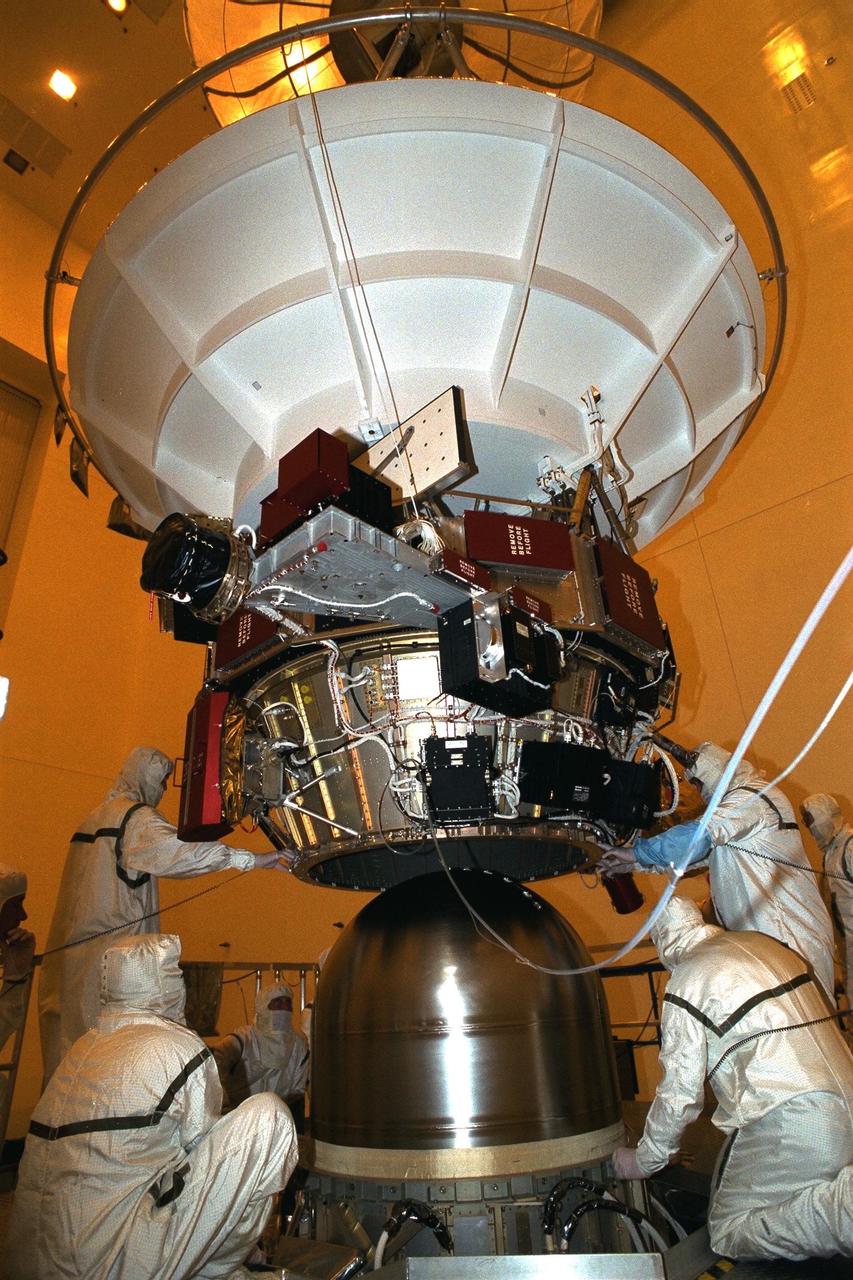
Technicians from the Jet Propulsion Laboratory (JPL) lower the upper equipment module over a propellant tank in the Payload Hazardous Servicing Facility at KSC in July prior to installation on the Cassini orbiter. A four-year, close-up study of the Saturnian system, the Cassini mission is scheduled for launch from Cape Canaveral Air Station in October 1997. The propellant tank will assist with guidance of the orbiter and power during the spacecraft’s voyage and in-orbit periods. It will take seven years for the spacecraft to reach Saturn. Scientific instruments carried aboard the spacecraft will study Saturn’s atmosphere, magnetic field, rings, and several moons. JPL is managing the Cassini project for NASA
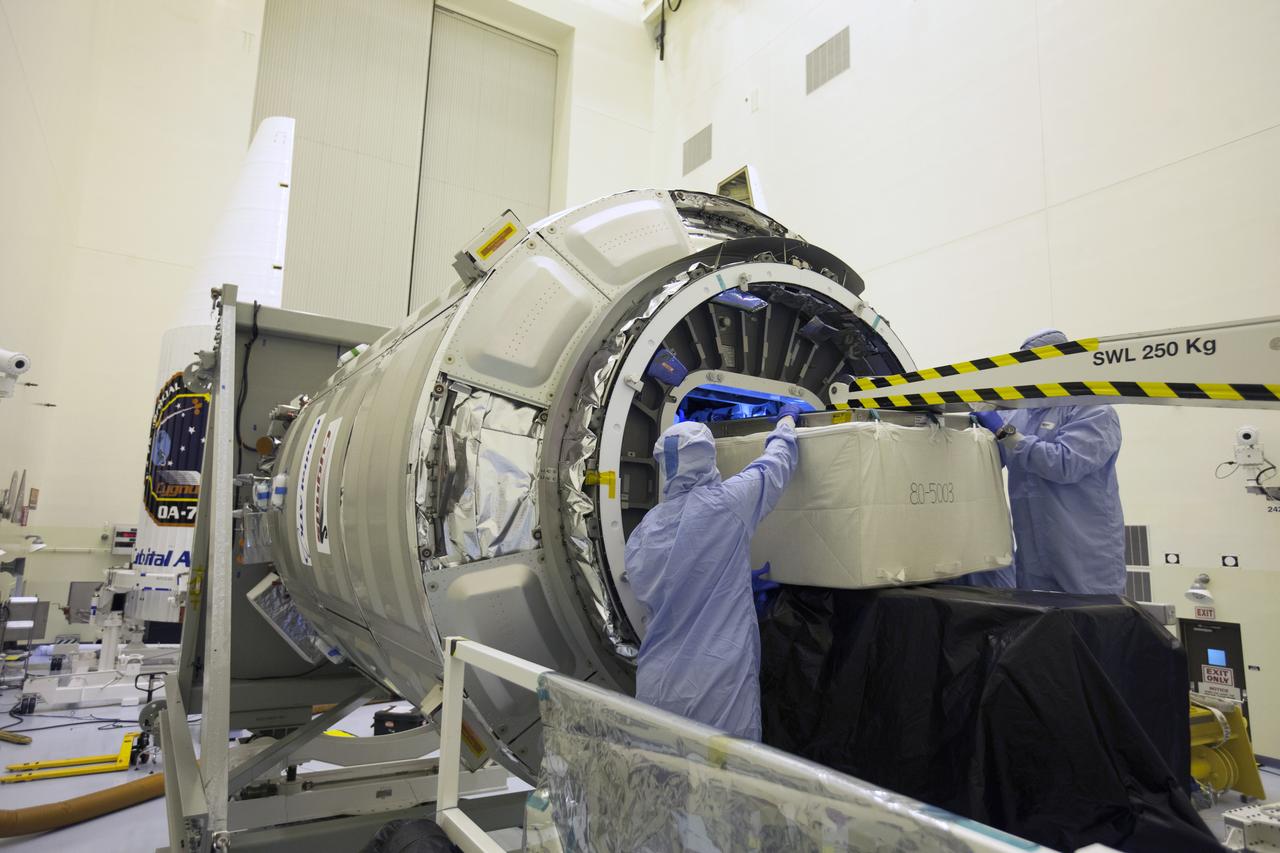
Inside the Payload Hazardous Servicing Facility at NASA's Kennedy Space Center in Florida, technicians use a special mechanism to assist with late cargo installation in the Orbital ATK Cygnus pressurized cargo module. The Orbital ATK CRS-7 commercial resupply services mission to the International Space Station is scheduled to launch atop a United Launch Alliance Atlas V rocket from Space Launch Complex 41 at Cape Canaveral Air Force Station targeted for March 24, 2017. Cygnus will deliver 7,600 pounds of supplies, equipment and scientific research materials to the space station.
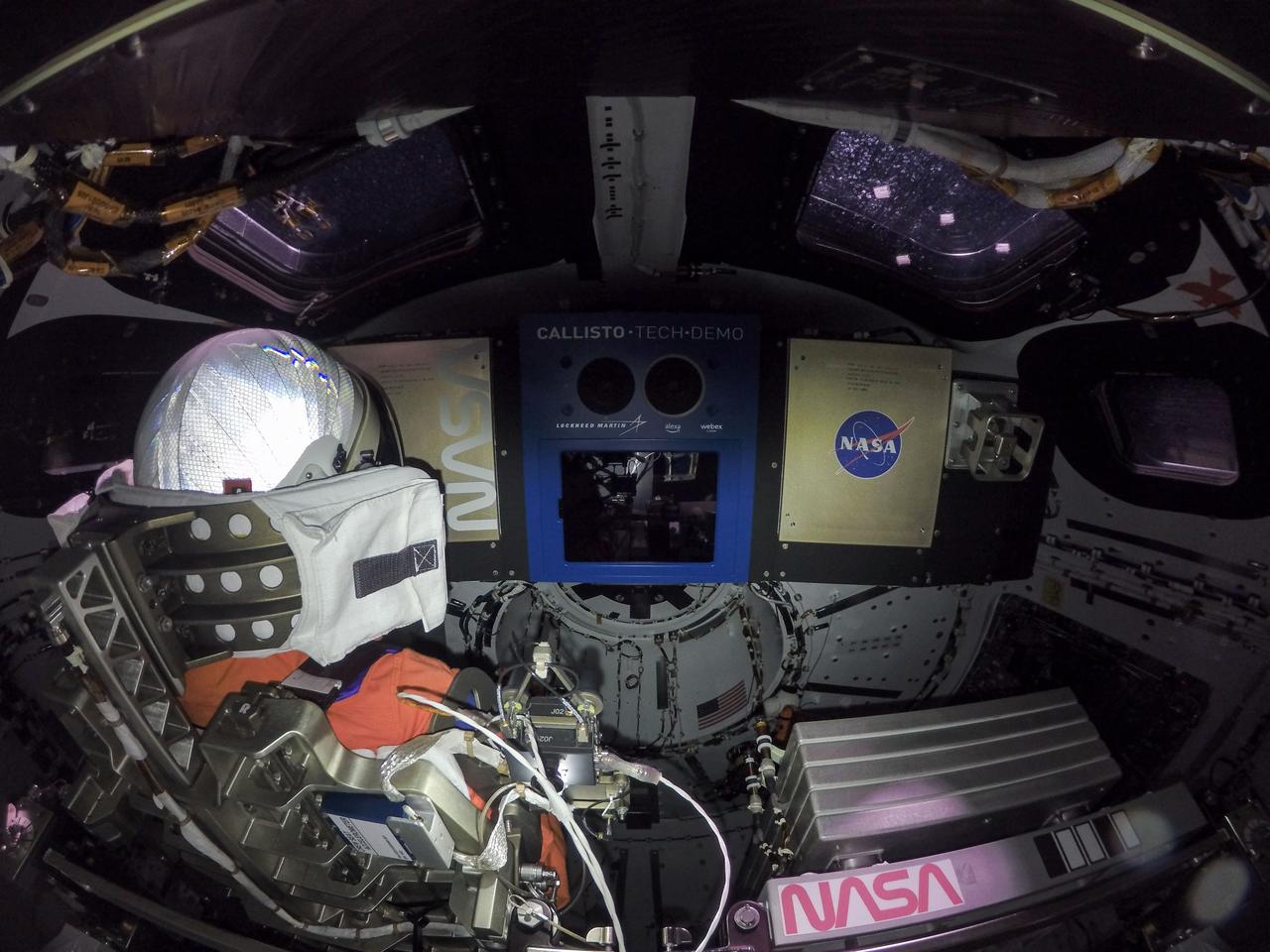
This high-resolution image captures the inside of the Orion crew module on flight day one of the Artemis I mission. At left is Commander Moonikin Campos, a purposeful passenger equipped with sensors to collect data that will help scientists and engineers understand the deep-space environment for future Artemis missions. At center is the Callisto payload, a technology demonstration of voice-activated audio and video technology from Lockheed Martin in collaboration with Amazon and Cisco. Callisto could assist future astronauts on deep-space missions. Below and to the right of Callisto is the Artemis I zero-gravity indicator, astronaut Snoopy.
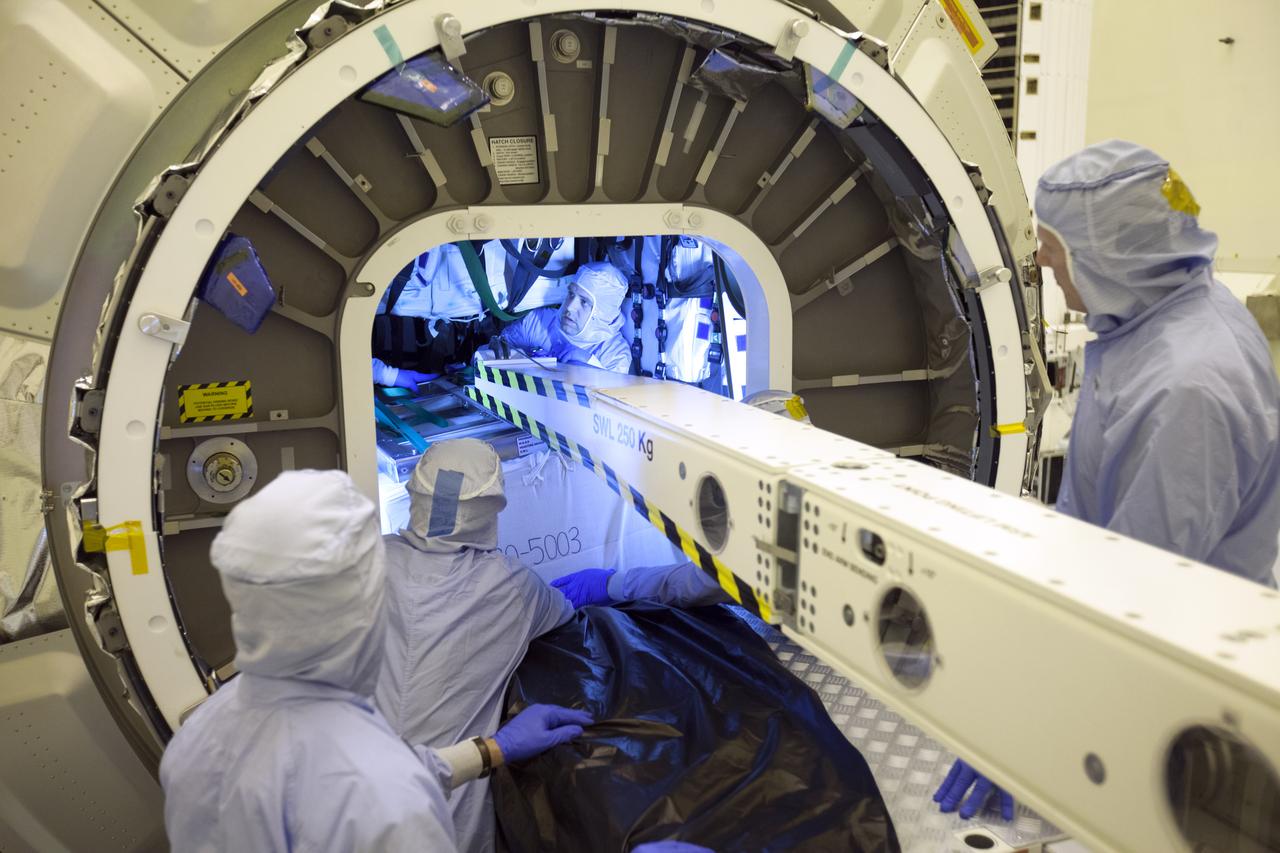
Inside the Payload Hazardous Servicing Facility at NASA's Kennedy Space Center in Florida, technicians use a special mechanism to assist with late cargo installation in the Orbital ATK Cygnus pressurized cargo module. The Orbital ATK CRS-7 commercial resupply services mission to the International Space Station is scheduled to launch atop a United Launch Alliance Atlas V rocket from Space Launch Complex 41 at Cape Canaveral Air Force Station targeted for March 24, 2017. Cygnus will deliver 7,600 pounds of supplies, equipment and scientific research materials to the space station.
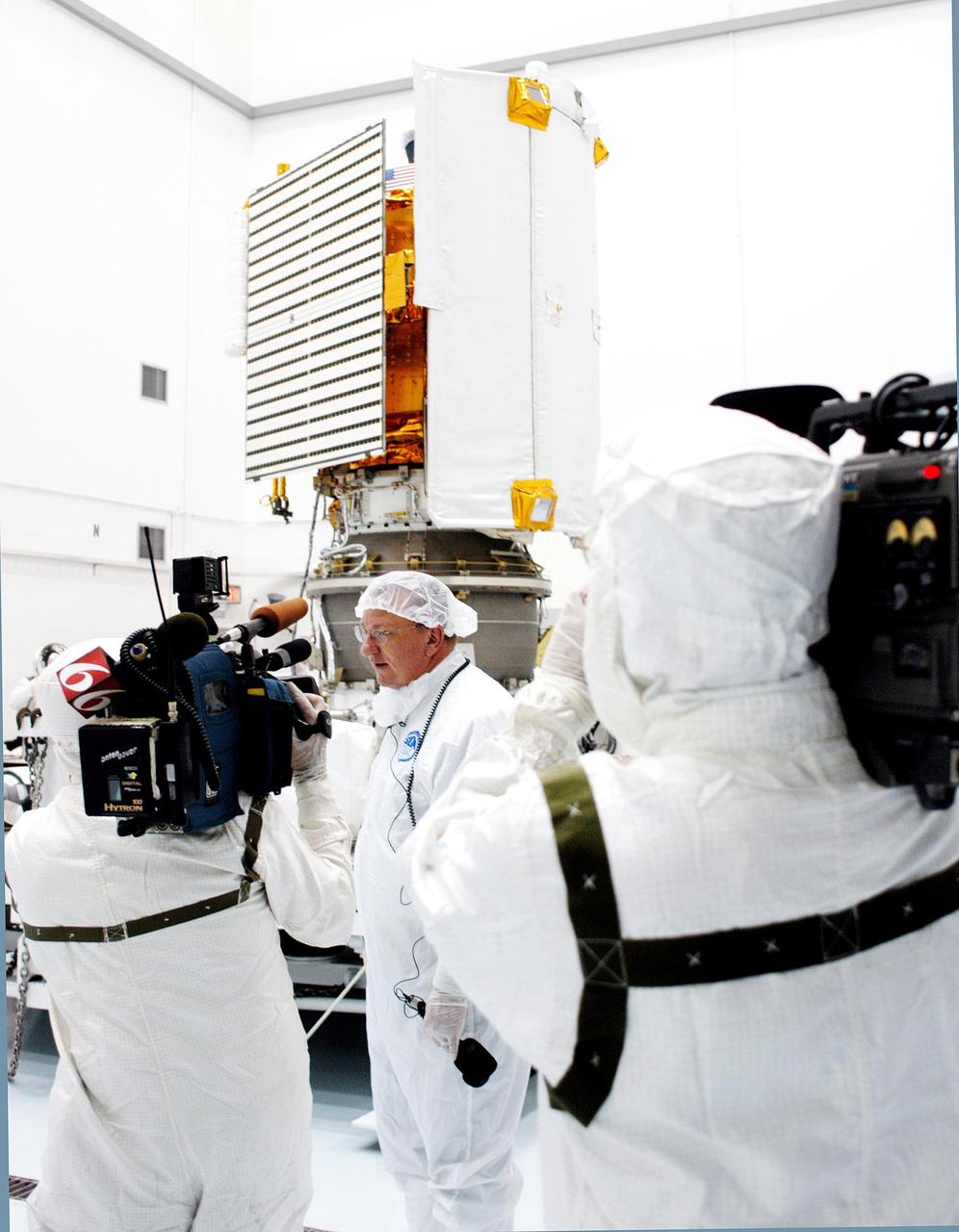
KENNEDY SPACE CENTER, FLA. - At Astrotech Space Operations in Titusville, Fla., members of the media, wearing clean room suits, gather around Ted Hartka, MESSENGER lead mechanical engineer, with The Johns Hopkins University Applied Physics Laboratory (APL). Hartka is talking about the MESSENGER spacecraft’s mission to Mercury. The spacecraft, mated to the Delta II third stage Payload Assist Module, is in the background. MESSENGER is scheduled to launch Aug. 2 aboard a Boeing Delta II rocket from Pad 17-B, Cape Canaveral Air Force Station, Fla.
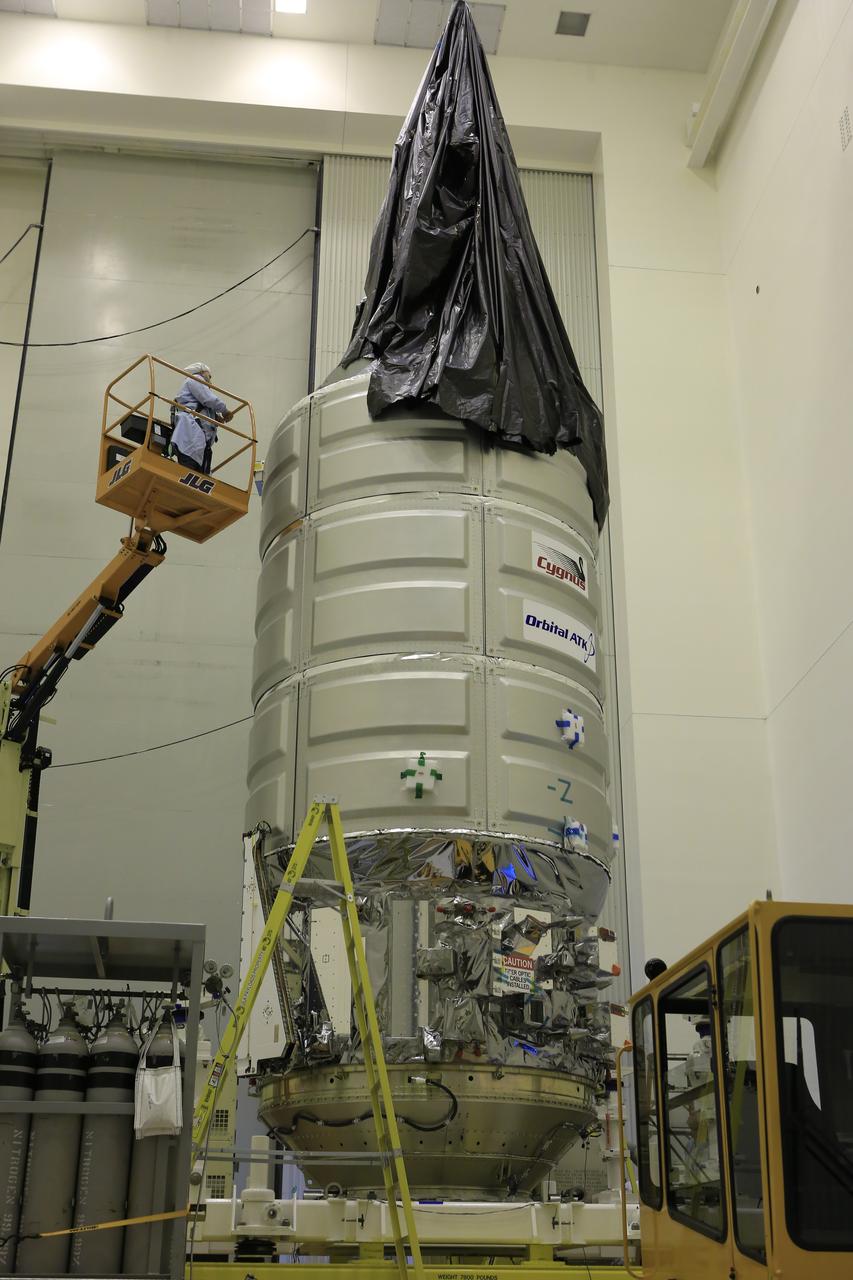
Inside the Payload Hazardous Servicing Facility at NASA's Kennedy Space Center in Florida, technicians assist as a crane is used to remove the protective covering from Orbital ATK's CYGNUS pressurized cargo module on a KAMAG transporter. In the PHSF, Cygnus will be moved to a work stand for final propellant loading and late cargo stowage. The Orbital ATK CRS-7 commercial resupply services mission to the International Space Station is scheduled to launch atop a United Launch Alliance Atlas V rocket from Space Launch Complex 41 at Cape Canaveral Air Force Station on March 19, 2017. CYGNUS will deliver thousands of pounds of supplies, equipment and scientific research materials to the space station.
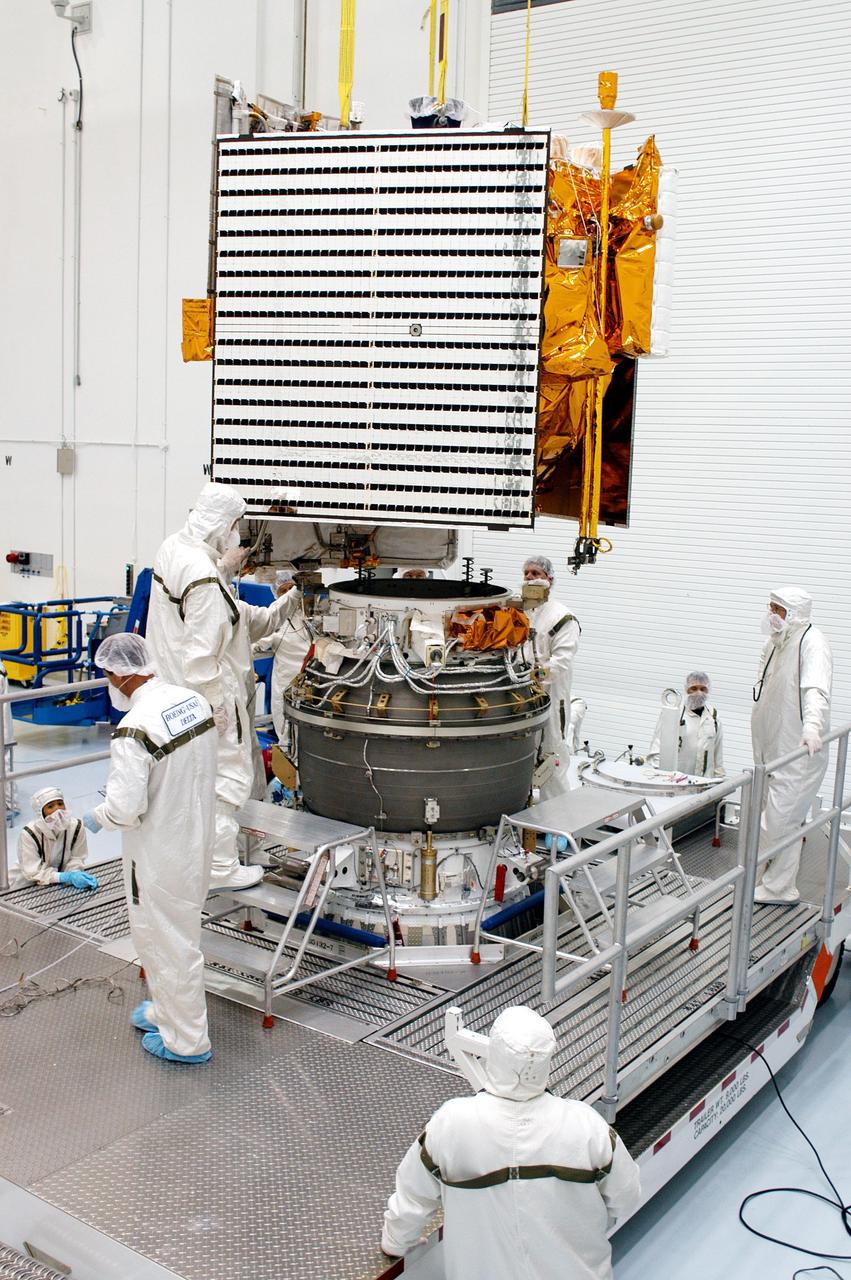
KENNEDY SPACE CENTER, FLA. - Technicians at Astrotech Space Operations in Titusville, Fla., oversee the mating of the MESSENGER spacecraft with the Payload Assist Module, the Boeing Delta II third stage, below it. MESSENGER (Mercury Surface, Space Environment, Geochemistry and Ranging) is scheduled to launch Aug. 2 aboard a Boeing Delta II rocket from Pad 17-B, Cape Canaveral Air Force Station, Fla. It will return to Earth for a gravity boost in July 2005, then fly past Venus twice, in October 2006 and June 2007. It is expected to enter Mercury orbit in March 2011. MESSENGER was built for NASA by the Johns Hopkins University Applied Physics Laboratory in Laurel, Md.
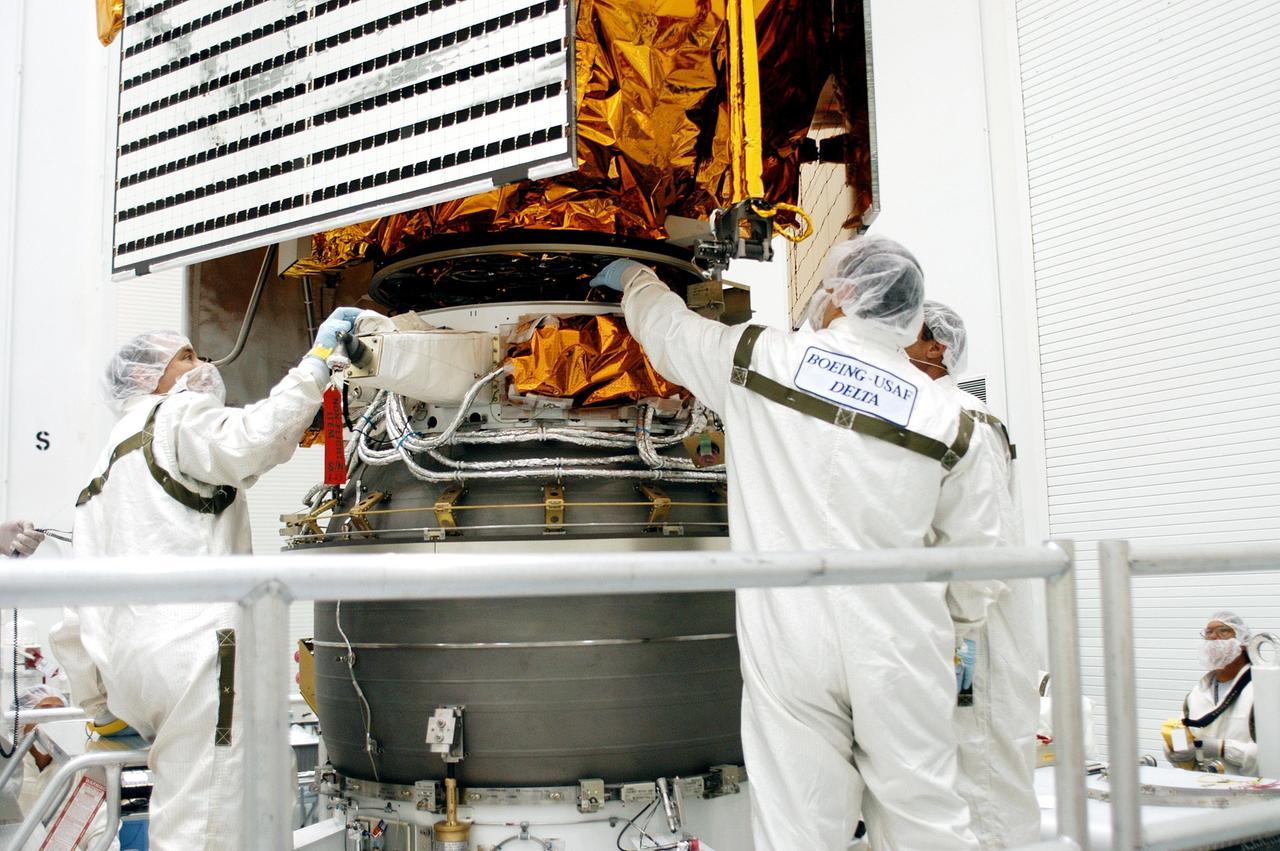
KENNEDY SPACE CENTER, FLA. - Technicians at Astrotech Space Operations in Titusville, Fla., watch closely as the MESSENGER spacecraft is lowered toward the Payload Assist Module, the Boeing Delta II third stage, below for mating. MESSENGER (Mercury Surface, Space Environment, Geochemistry and Ranging) is scheduled to launch Aug. 2 aboard a Boeing Delta II rocket from Pad 17-B, Cape Canaveral Air Force Station, Fla. It will return to Earth for a gravity boost in July 2005, then fly past Venus twice, in October 2006 and June 2007. It is expected to enter Mercury orbit in March 2011. MESSENGER was built for NASA by the Johns Hopkins University Applied Physics Laboratory in Laurel, Md.
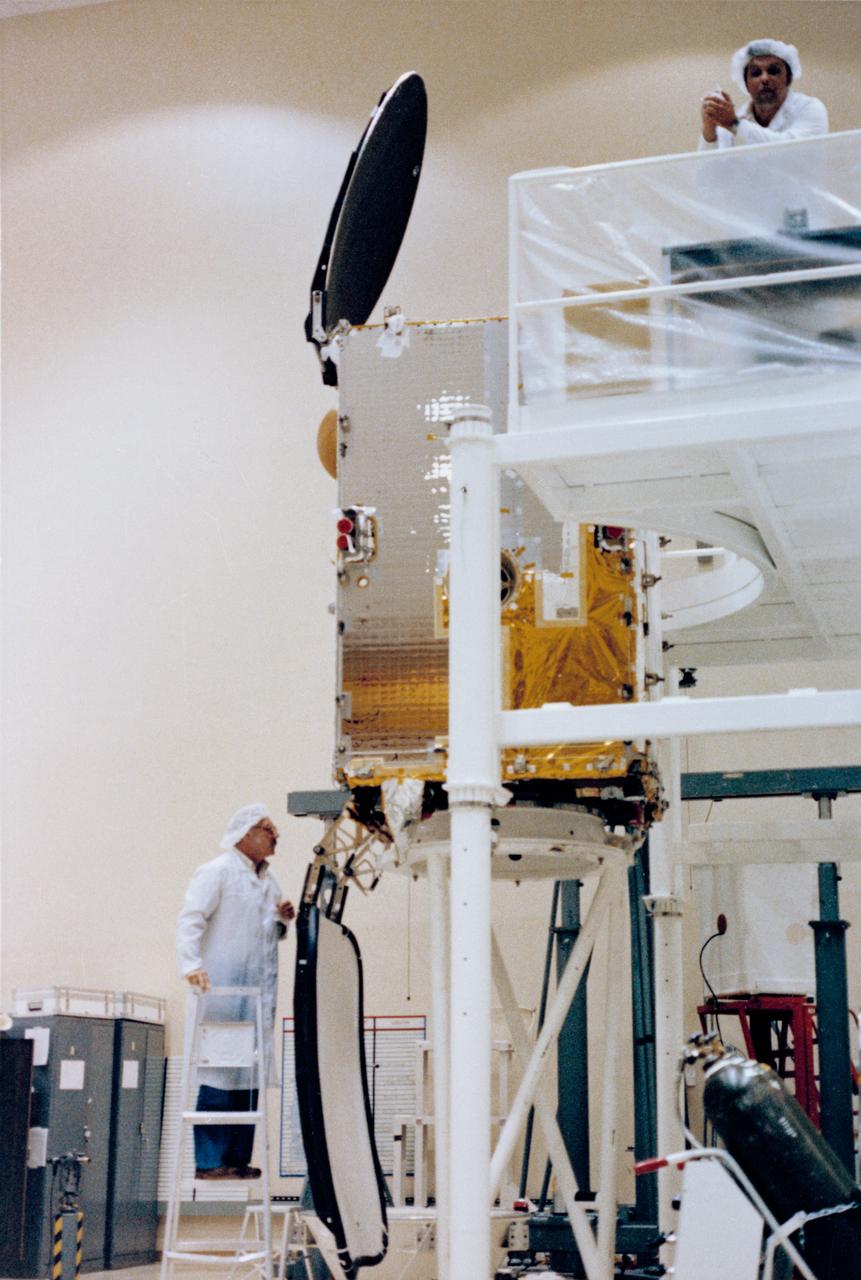
S83-36307 (2 June 1983) --- INSAT 1-B is being prepared for its trip aboard the space shuttle Challenger and its deployment for geosynchronous orbital duties at the Cape Canaveral Air Force Station and at NASA's Kennedy Space Center (KSC). The Indian National Satellite is the second such Indian communications/meteorological spacecraft, the first having been sent into space via a Delta launch vehicle. The STS-8 astronaut crew members and a payload assist module (PAM) will aid the newest INSAT in its deployment steps during NASA?s third Challenger flight in August of this year.
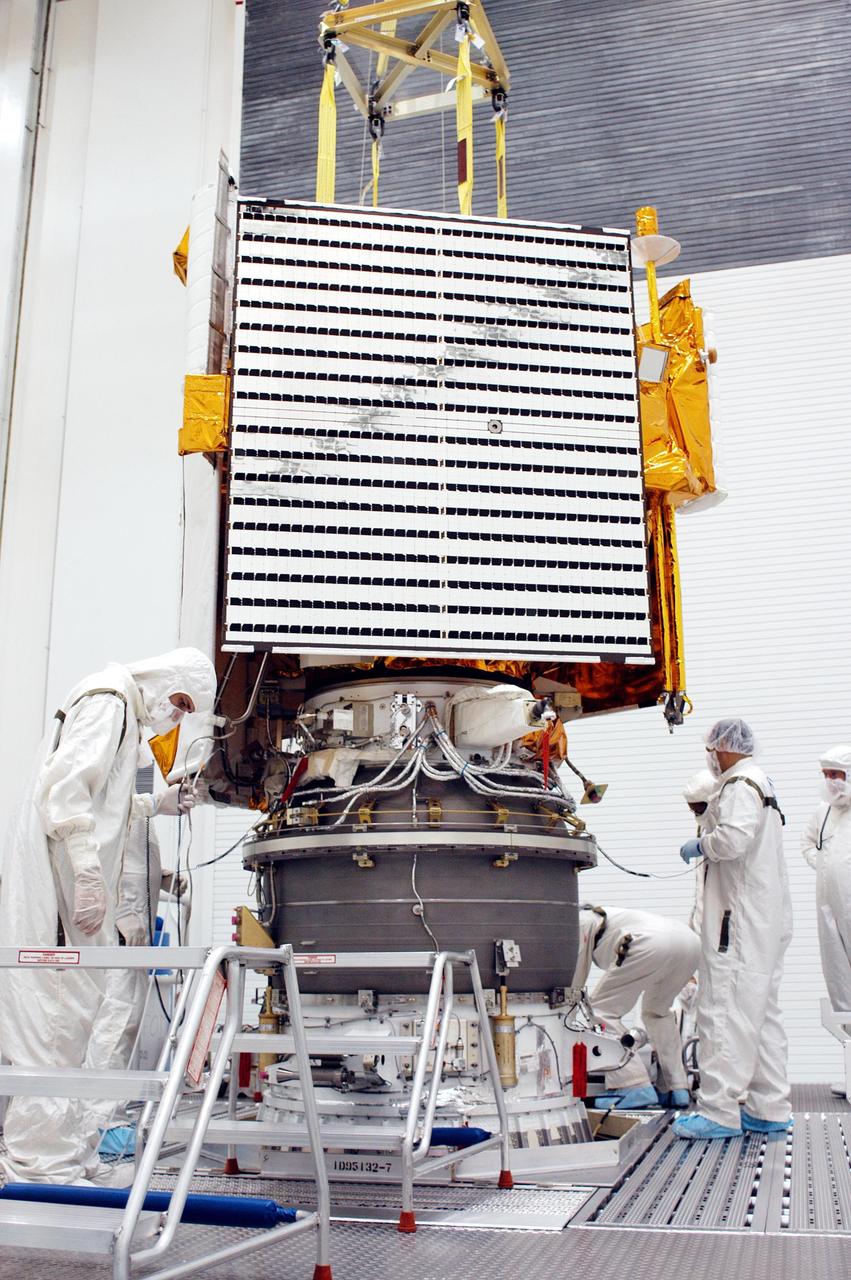
KENNEDY SPACE CENTER, FLA. - Technicians at Astrotech Space Operations in Titusville, Fla., complete the mating of the MESSENGER spacecraft with the Payload Assist Module, the Boeing Delta II third stage, below it. MESSENGER (Mercury Surface, Space Environment, Geochemistry and Ranging) is scheduled to launch Aug. 2 aboard a Boeing Delta II rocket from Pad 17-B, Cape Canaveral Air Force Station, Fla. It will return to Earth for a gravity boost in July 2005, then fly past Venus twice, in October 2006 and June 2007. It is expected to enter Mercury orbit in March 2011. MESSENGER was built for NASA by the Johns Hopkins University Applied Physics Laboratory in Laurel, Md.
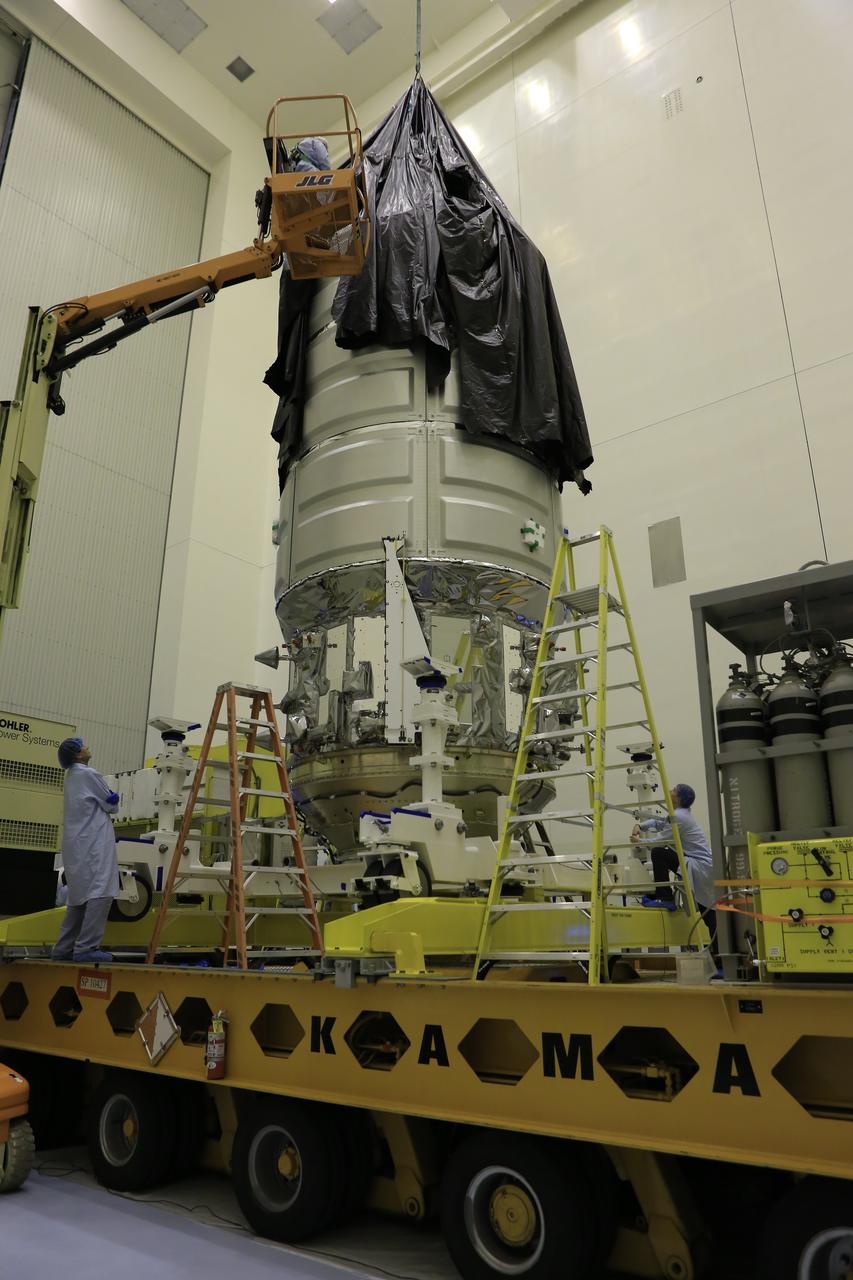
Inside the Payload Hazardous Servicing Facility at NASA's Kennedy Space Center in Florida, technicians assist as a crane is used to remove the protective covering from Orbital ATK's CYGNUS pressurized cargo module on a KAMAG transporter. In the PHSF, Cygnus will be moved to a work stand for final propellant loading and late cargo stowage. The Orbital ATK CRS-7 commercial resupply services mission to the International Space Station is scheduled to launch atop a United Launch Alliance Atlas V rocket from Space Launch Complex 41 at Cape Canaveral Air Force Station on March 19, 2017. CYGNUS will deliver thousands of pounds of supplies, equipment and scientific research materials to the space station.
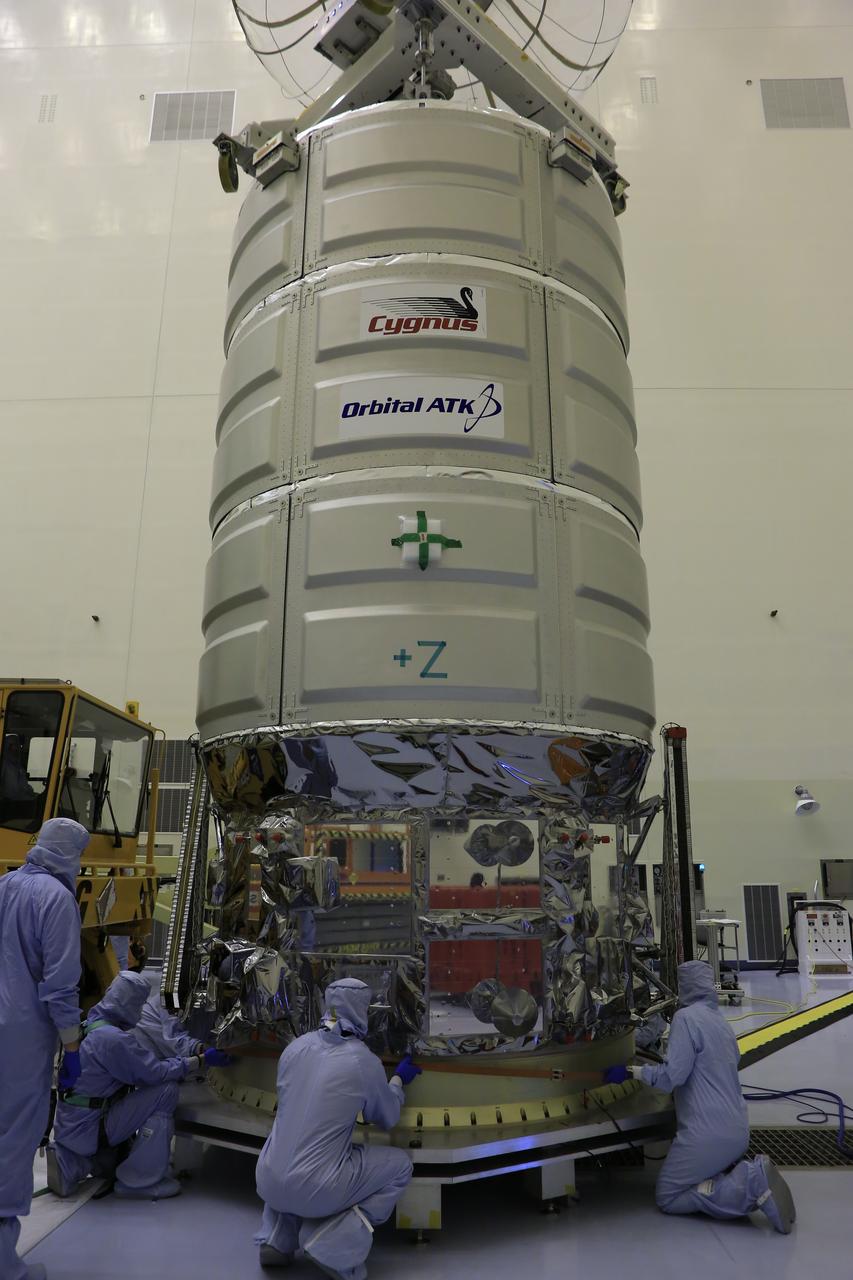
Technicians assist as a crane lowers Orbital ATK's CYGNUS pressurized cargo module onto a work stand inside the Payload Hazardous Servicing Facility at NASA's Kennedy Space Center in Florida. CYGNUS will be secured on the work stand for final propellant loading and late cargo stowage. The Orbital ATK CRS-7 commercial resupply services mission to the International Space Station is scheduled to launch atop a United Launch Alliance Atlas V rocket from Space Launch Complex 41 at Cape Canaveral Air Force Station on March 19, 2017. CYGNUS will deliver thousands of pounds of supplies, equipment and scientific research materials to the space station.

Workers at Launch Complex 17 Pad A, Kennedy Space Center (KSC) encapsulate the Geomagnetic Tail (GEOTAIL) spacecraft (upper) and attached payload Assist Module-D upper stage (lower) in the protective payload fairing. GEOTAIL project was designed to study the effects of Earth's magnetic field. The solar wind draws the Earth's magnetic field into a long tail on the night side of the Earth and stores energy in the stretched field lines of the magnetotail. During active periods, the tail couples with the near-Earth magnetosphere, sometimes releasing energy stored in the tail and activating auroras in the polar ionosphere. GEOTAIL measures the flow of energy and its transformation in the magnetotail and will help clarify the mechanisms that control the imput, transport, storage, release, and conversion of mass, momentum, and energy in the magnetotail.
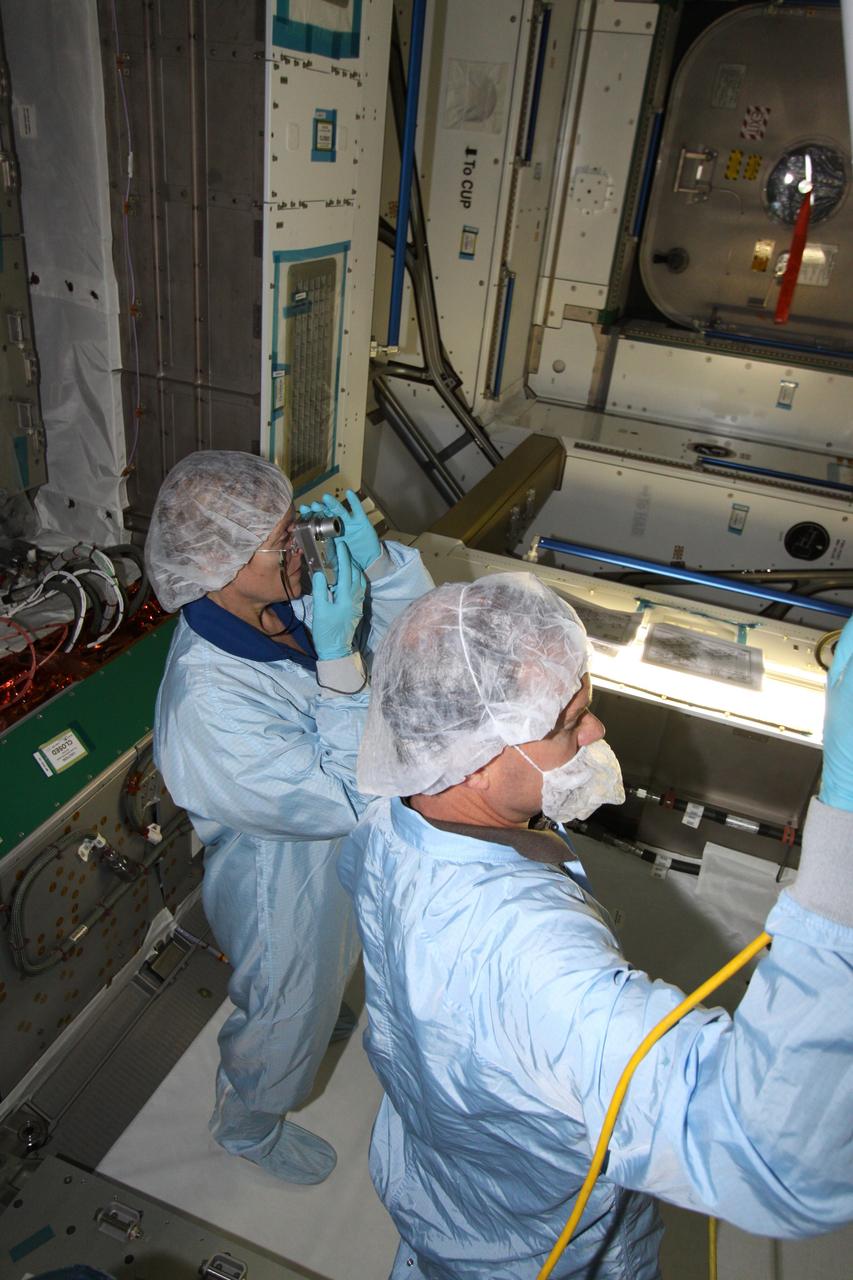
CAPE CANAVERAL, Fla. – Mission specialist Kathryn "Kay" Hire, at left, assigned to the crew of space shuttle Endeavour's STS-130 mission, takes a tour of the Tranquility Node 3 module in the Space Station Processing Facility at NASA's Kennedy Space Center in Florida. Assisting her, at right, is Chris Hardcastle, an STS-130 flight crew representative with United Space Alliance. Tranquility is a pressurized module that will provide room for many of the International Space Station's life support systems. Attached to the node is a cupola, a unique work station with six windows on its sides and one on top. Tranquility is the payload for the STS-130 mission. The module was built for the European Space Agency by Alenia Spazio in Turin, Italy. Cupola resembles a circular bay window that will provide a vastly improved view of the station's exterior. Just under 10 feet in diameter, the module will accommodate two crew members and portable workstations that can control station and robotic activities. The multi-directional view will allow the crew to monitor spacewalks and docking operations, as well as provide a spectacular view of Earth and other celestial objects. Endeavour is targeted to launch Feb. 4, 2010. Photo credit: NASA/Jack Pfaller
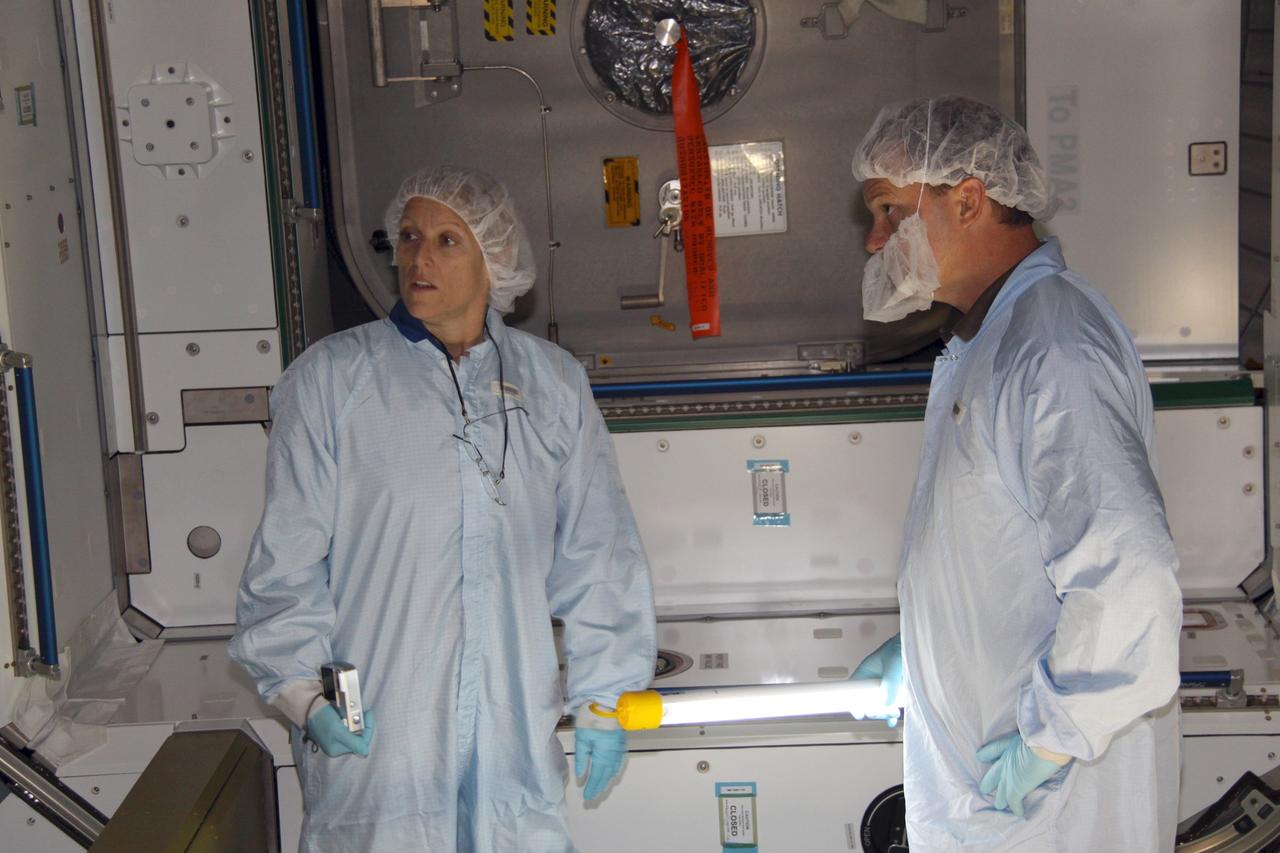
CAPE CANAVERAL, Fla. – Mission specialist Kathryn "Kay" Hire, at left, a crew member on space shuttle Endeavour's STS-130 mission, photographs the interior of the Tranquility Node 3 module in the Space Station Processing Facility at NASA's Kennedy Space Center in Florida. Assisting her, at right, is Chris Hardcastle, an STS-130 flight crew representative with United Space Alliance. Tranquility is a pressurized module that will provide room for many of the International Space Station's life support systems. Attached to the node is a cupola, a unique work station with six windows on its sides and one on top. Tranquility is the payload for the STS-130 mission. The module was built for the European Space Agency by Alenia Spazio in Turin, Italy. Cupola resembles a circular bay window that will provide a vastly improved view of the station's exterior. Just under 10 feet in diameter, the module will accommodate two crew members and portable workstations that can control station and robotic activities. The multi-directional view will allow the crew to monitor spacewalks and docking operations, as well as provide a spectacular view of Earth and other celestial objects. Endeavour is targeted to launch Feb. 4, 2010. Photo credit: NASA/Jack Pfaller
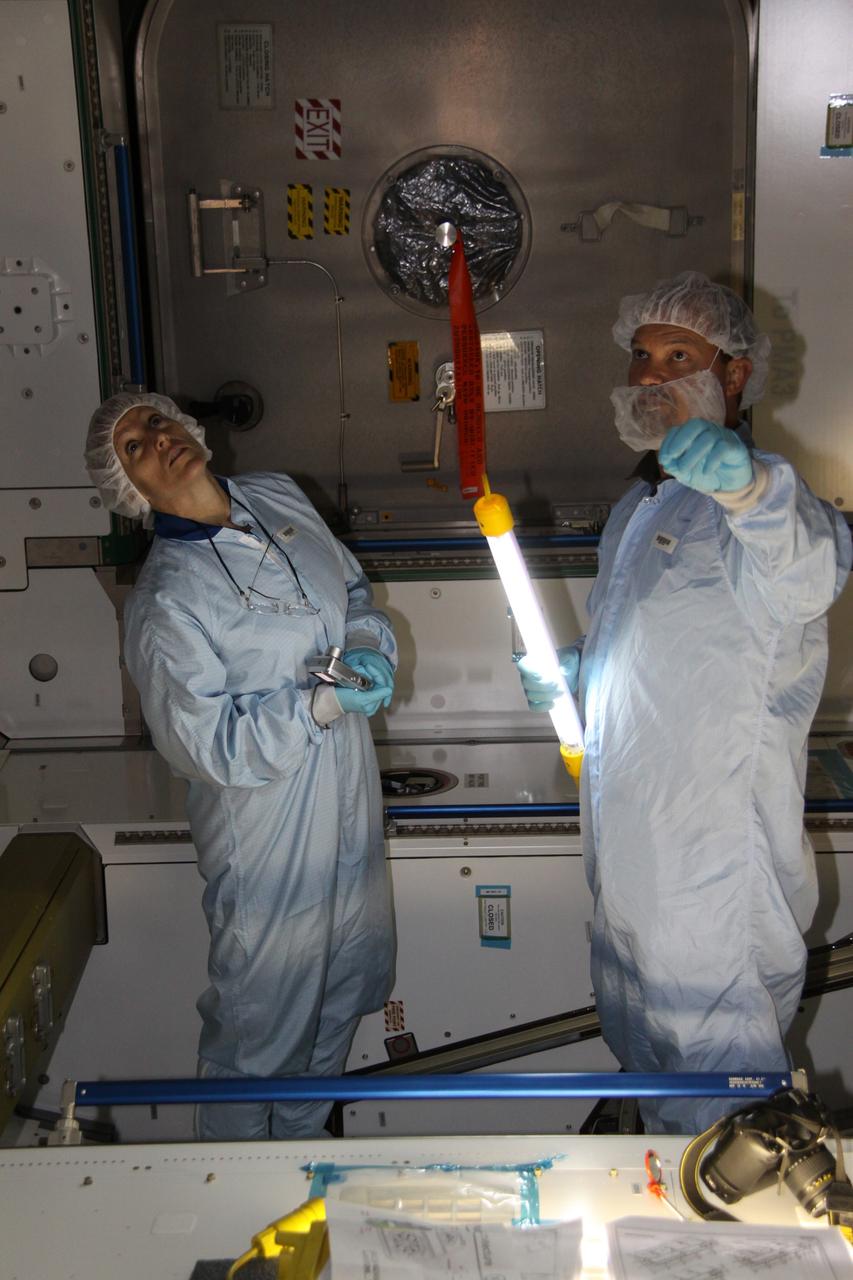
CAPE CANAVERAL, Fla. – Mission specialist Kathryn "Kay" Hire, at left, a crew member on space shuttle Endeavour's STS-130 mission, participates in familiarization training for the Tranquility Node 3 module in the Space Station Processing Facility at NASA's Kennedy Space Center in Florida. Assisting her, at right, is Chris Hardcastle, an STS-130 flight crew representative with United Space Alliance. Tranquility is a pressurized module that will provide room for many of the International Space Station's life support systems. Attached to the node is a cupola, a unique work station with six windows on its sides and one on top. Tranquility is the payload for the STS-130 mission. The module was built for the European Space Agency by Alenia Spazio in Turin, Italy. Cupola resembles a circular bay window that will provide a vastly improved view of the station's exterior. Just under 10 feet in diameter, the module will accommodate two crew members and portable workstations that can control station and robotic activities. The multi-directional view will allow the crew to monitor spacewalks and docking operations, as well as provide a spectacular view of Earth and other celestial objects. Endeavour is targeted to launch Feb. 4, 2010. Photo credit: NASA/Jack Pfaller
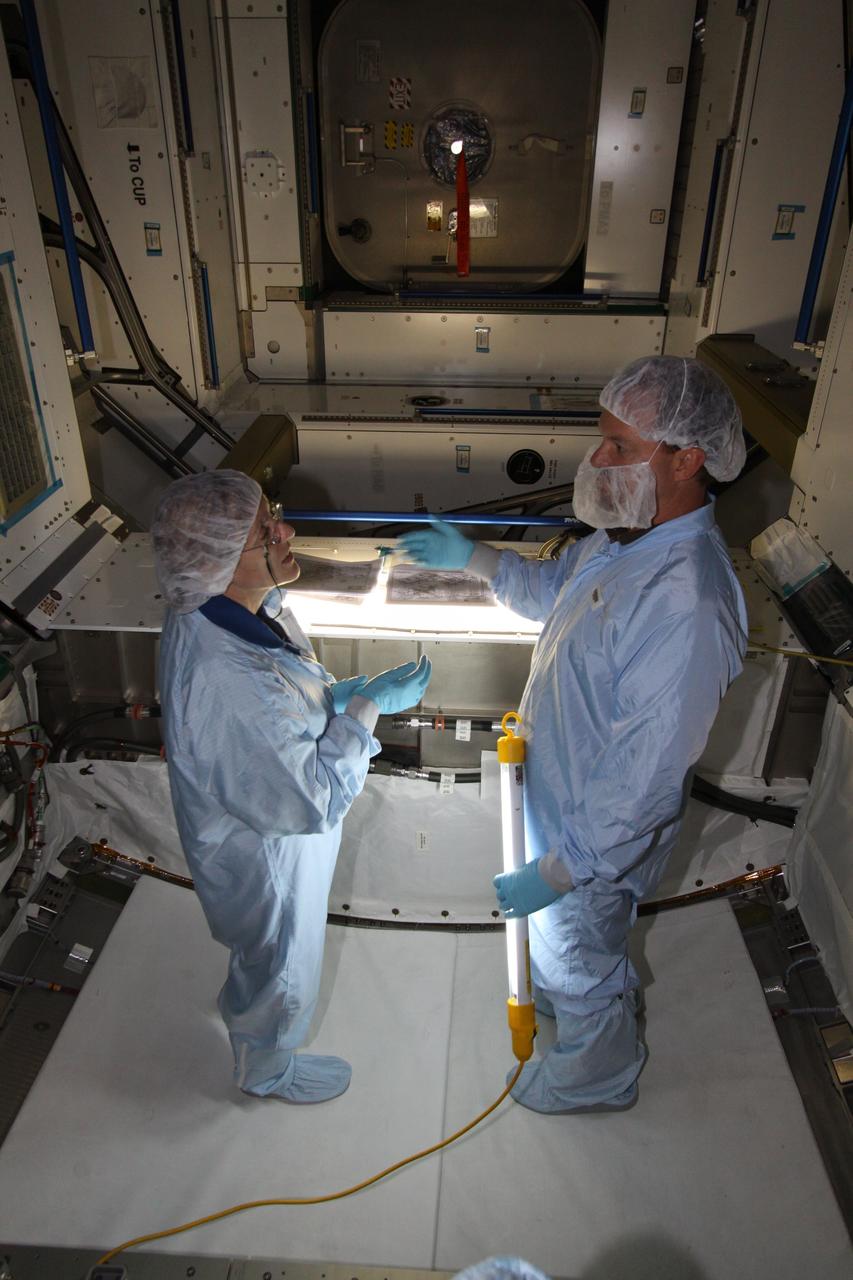
CAPE CANAVERAL, Fla. – Mission specialist Kathryn "Kay" Hire, at left, assigned to the crew of space shuttle Endeavour's STS-130 mission, becomes familiar with the configuration of the Tranquility Node 3 module in the Space Station Processing Facility at NASA's Kennedy Space Center in Florida. Assisting her, at right, is Chris Hardcastle, an STS-130 flight crew representative with United Space Alliance. Tranquility is a pressurized module that will provide room for many of the International Space Station's life support systems. Attached to the node is a cupola, a unique work station with six windows on its sides and one on top. Tranquility is the payload for the STS-130 mission. The module was built for the European Space Agency by Alenia Spazio in Turin, Italy. Cupola resembles a circular bay window that will provide a vastly improved view of the station's exterior. Just under 10 feet in diameter, the module will accommodate two crew members and portable workstations that can control station and robotic activities. The multi-directional view will allow the crew to monitor spacewalks and docking operations, as well as provide a spectacular view of Earth and other celestial objects. Endeavour is targeted to launch Feb. 4, 2010. Photo credit: NASA/Jack Pfaller
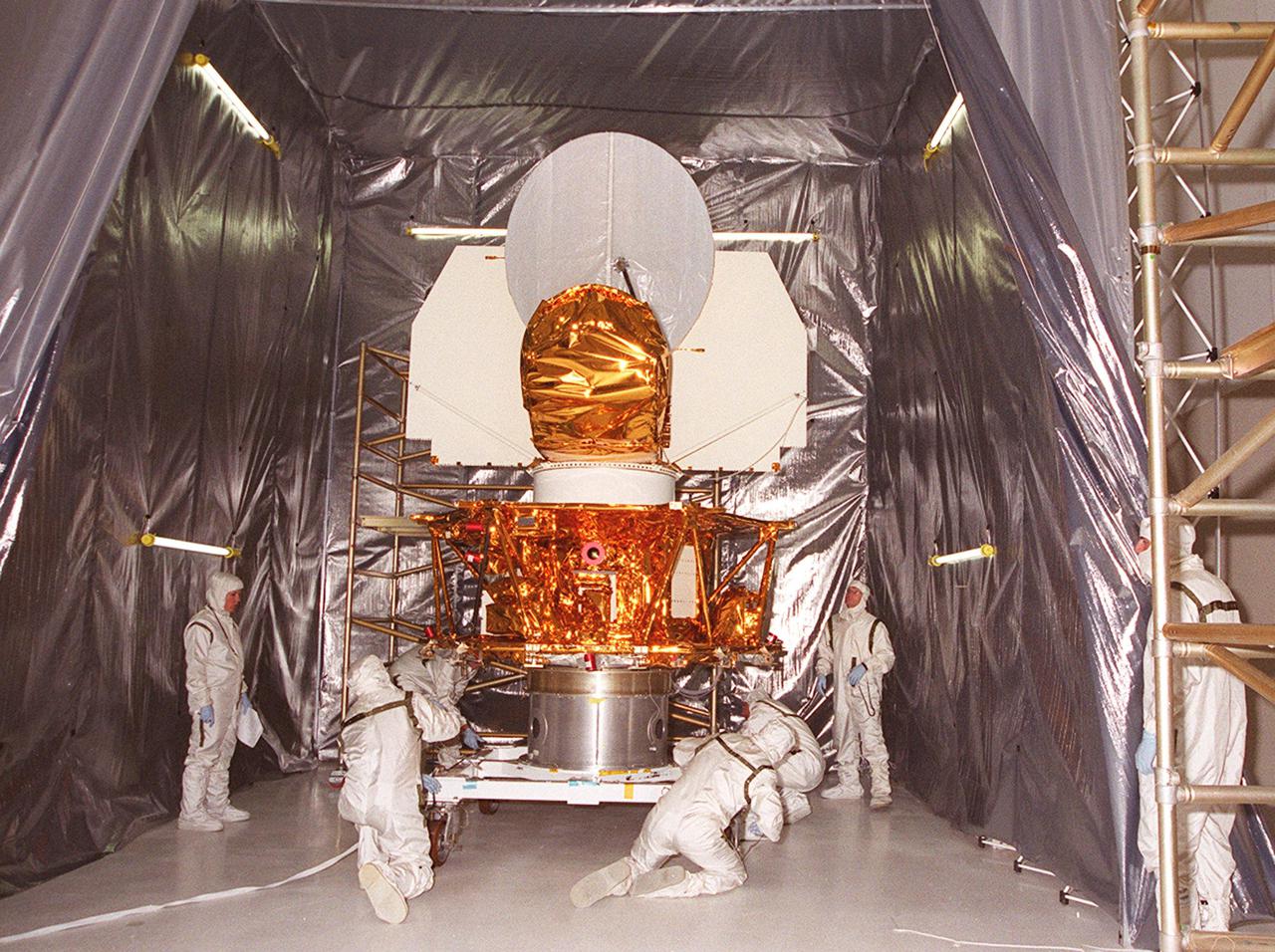
KENNEDY SPACE CENTER, FLA. -- Workers in the Spacecraft Assembly and Encapsulation Facility 2 secure the Microwave Anisotropy Probe (MAP) on a workstand inside a tent. Several milestones must be completed while MAP is at SAEF-2, including antenna installations, solar array installation, solar array deployment and illumination testing, a spacecraft comprehensive performance test, fueling with hydrazine propellant and a spin balance test. MAP will then be ready for integration with the solid propellant Payload Assist Module upper stage booster. MAP is scheduled for launch June 30 from Cape Canaveral Air Force Station on a Delta II rocket into a lunar-assisted trajectory to the Sun-Earth for a 27-month mission. The MAP instrument consists of a set of passively cooled microwave radiometers with 1.4x 1.6-meter diameter primary reflectors to provide the desired angular resolution. MAP measures small fluctuations in the temperature of the cosmic microwave background radiation to an accuracy of one millionth of a degree These measurements should reveal the size, matter content, age, geometry and fate of the universe. They will also reveal the primordial structure that grew to form galaxies and will test ideas about the origins of these primordial structures. The MAP instrument will be continuously shaded from the Sun, Earth, and Moon by the spacecraft. It is a product of Goddard Space Flight Center in partnership with Princeton University
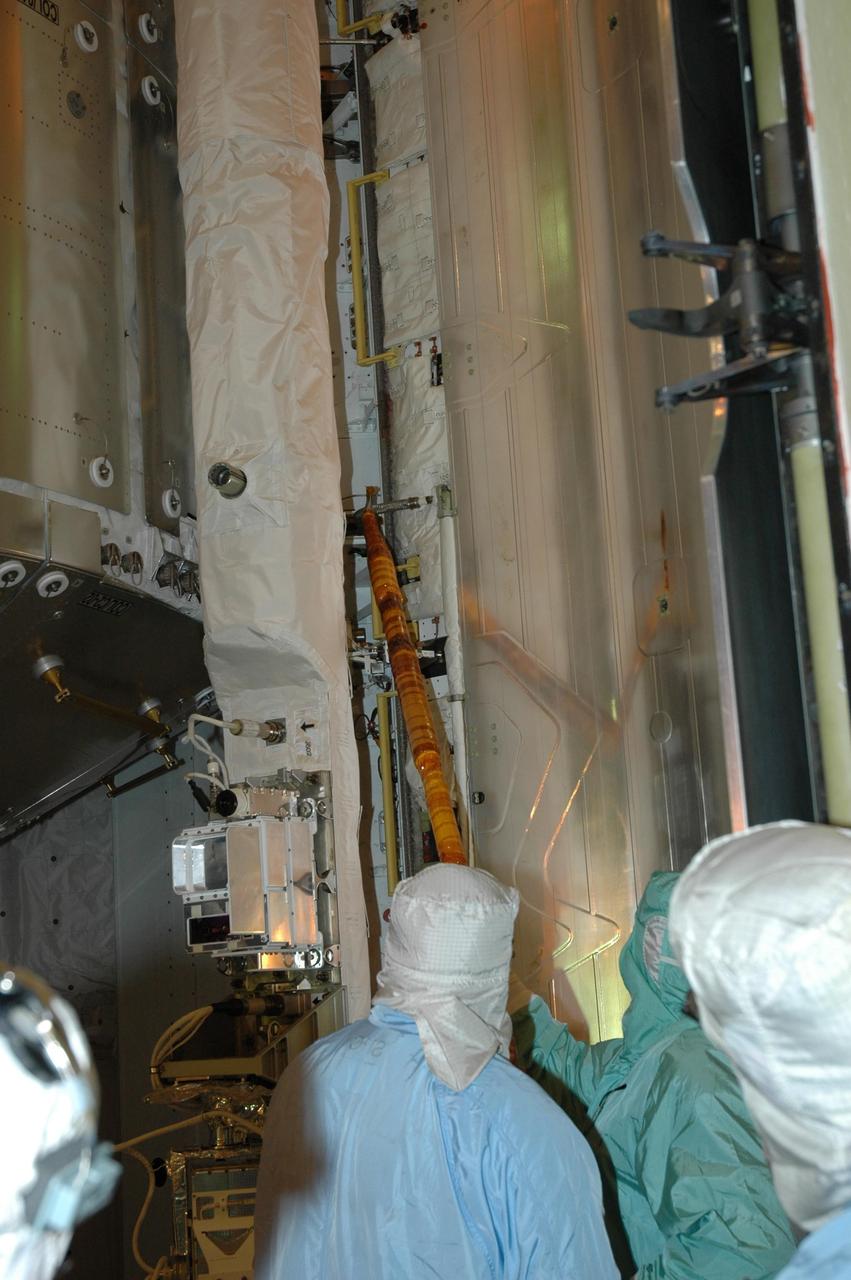
KENNEDY SPACE CENTER, FLA. -- On Launch Pad 39A at NASA's Kennedy Space Center, the payload bay doors are closing on space shuttle Atlantis. During launch preparations, technicians noticed a small section of a braided metal hose that was bent in a shape similar to the Greek letter Omega. The radiator retract hose (seen in the middle), part of the shuttle's cooling system that carries Freon, is designed to flex. Engineers are using a hose assist tool designed to help guide the hose back into the storage box. During the starboard door closure, eight incremental stops were performed. After each stop, the aft hose was adjusted and seated in place utilizing the ladder and hose assist tool. The team was satisfied with the final placement of the hose at door closure. STS-122 is the 121st space shuttle flight, the 29th flight for Atlantis and the 24th flight to the International Space Station. The Columbus laboratory module, built by the European Space Agency, is approximately 23 feet long and 15 feet wide, allowing it to hold 10 large racks of experiments. Atlantis is scheduled to launch at 2:45 p.m. Feb. 7. Photo credit: NASA/Jack Pfaller

KENNEDY SPACE CENTER, FLA. -- In the Spacecraft Assembly and Encapsulation Facility 2, the Microwave Anisotropy Probe (MAP) undergoes testing and checkout. Several milestones must be completed while MAP is at SAEF-2, including antenna and solar array installation, solar array deployment and illumination testing, a spacecraft comprehensive performance test, fueling with hydrazine propellant and a spin balance test. MAP will then be ready for integration with the solid propellant Payload Assist Module upper stage booster. MAP is scheduled for launch June 30 from Cape Canaveral Air Force Station on a Delta II rocket into a lunar-assisted trajectory to the Sun-Earth for a 27-month mission. The MAP instrument consists of a set of passively cooled microwave radiometers with 1.4x 1.6-meter diameter primary reflectors to provide the desired angular resolution. MAP measures small fluctuations in the temperature of the cosmic microwave background radiation to an accuracy of one millionth of a degree These measurements should reveal the size, matter content, age, geometry and fate of the universe. They will also reveal the primordial structure that grew to form galaxies and will test ideas about the origins of these primordial structures. The MAP instrument will be continuously shaded from the Sun, Earth, and Moon by the spacecraft. It is a product of Goddard Space Flight Center in partnership with Princeton University
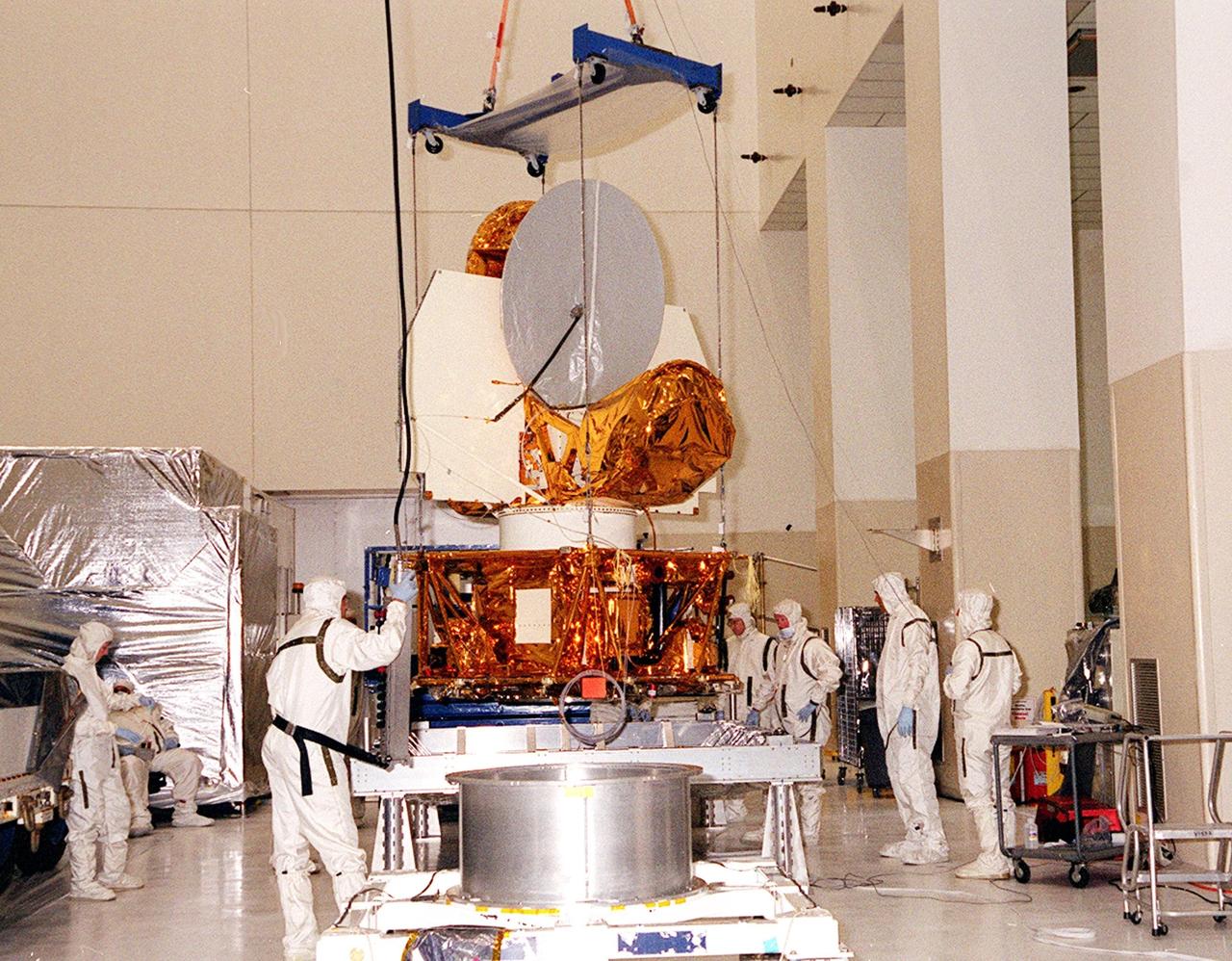
KENNEDY SPACE CENTER, FLA. -- Workers in the Spacecraft Assembly and Encapsulation Facility 2 stand by while the Microwave Anisotropy Probe (MAP) is lifted to place it on a workstand. Several milestones must be completed while MAP is at SAEF-2, including antenna installations, solar array installation, solar array deployment and illumination testing, a spacecraft comprehensive performance test, fueling with hydrazine propellant and a spin balance test. MAP will then be ready for integration with the solid propellant Payload Assist Module upper stage booster. MAP is scheduled for launch June 30 from Cape Canaveral Air Force Station on a Delta II rocket into a lunar-assisted trajectory to the Sun-Earth for a 27-month mission. The MAP instrument consists of a set of passively cooled microwave radiometers with 1.4x 1.6-meter diameter primary reflectors to provide the desired angular resolution. MAP measures small fluctuations in the temperature of the cosmic microwave background radiation to an accuracy of one millionth of a degree These measurements should reveal the size, matter content, age, geometry and fate of the universe. They will also reveal the primordial structure that grew to form galaxies and will test ideas about the origins of these primordial structures. The MAP instrument will be continuously shaded from the Sun, Earth, and Moon by the spacecraft. It is a product of Goddard Space Flight Center in partnership with Princeton University
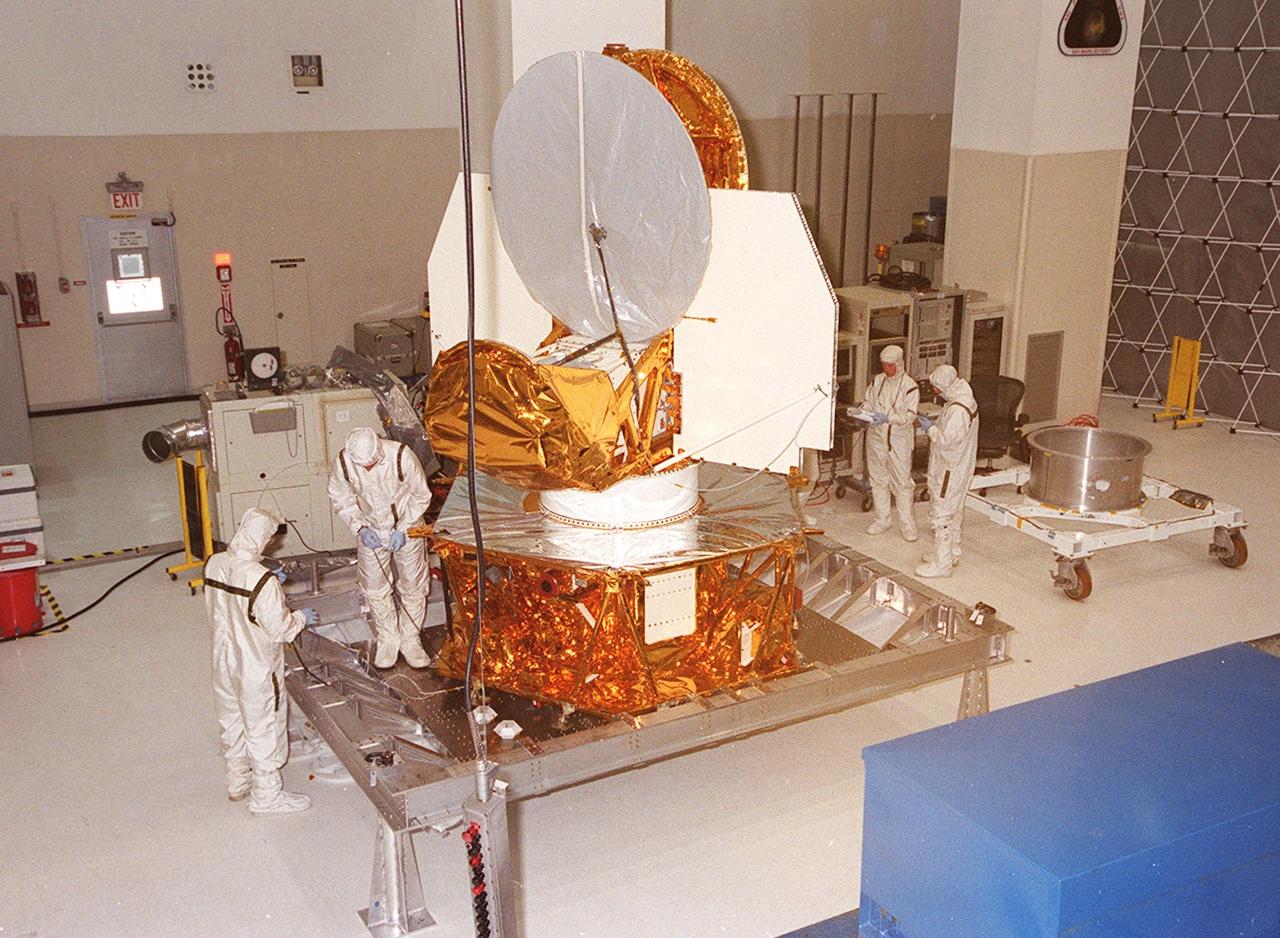
KENNEDY SPACE CENTER, FLA. -- The Microwave Anisotropy Probe (MAP) is worked on in the Spacecraft Assembly and Encapsulation Facility 2. Several milestones must be completed while MAP is at SAEF-2, including antenna installations, solar array installation, solar array deployment and illumination testing, a spacecraft comprehensive performance test, fueling with hydrazine propellant and a spin balance test. MAP will then be ready for integration with the solid propellant Payload Assist Module upper stage booster. MAP is scheduled for launch June 30 from Cape Canaveral Air Force Station on a Delta II rocket into a lunar-assisted trajectory to the Sun-Earth for a 27-month mission. The MAP instrument consists of a set of passively cooled microwave radiometers with 1.4x 1.6-meter diameter primary reflectors to provide the desired angular resolution. MAP measures small fluctuations in the temperature of the cosmic microwave background radiation to an accuracy of one millionth of a degree These measurements should reveal the size, matter content, age, geometry and fate of the universe. They will also reveal the primordial structure that grew to form galaxies and will test ideas about the origins of these primordial structures. The MAP instrument will be continuously shaded from the Sun, Earth, and Moon by the spacecraft. It is a product of Goddard Space Flight Center in partnership with Princeton University
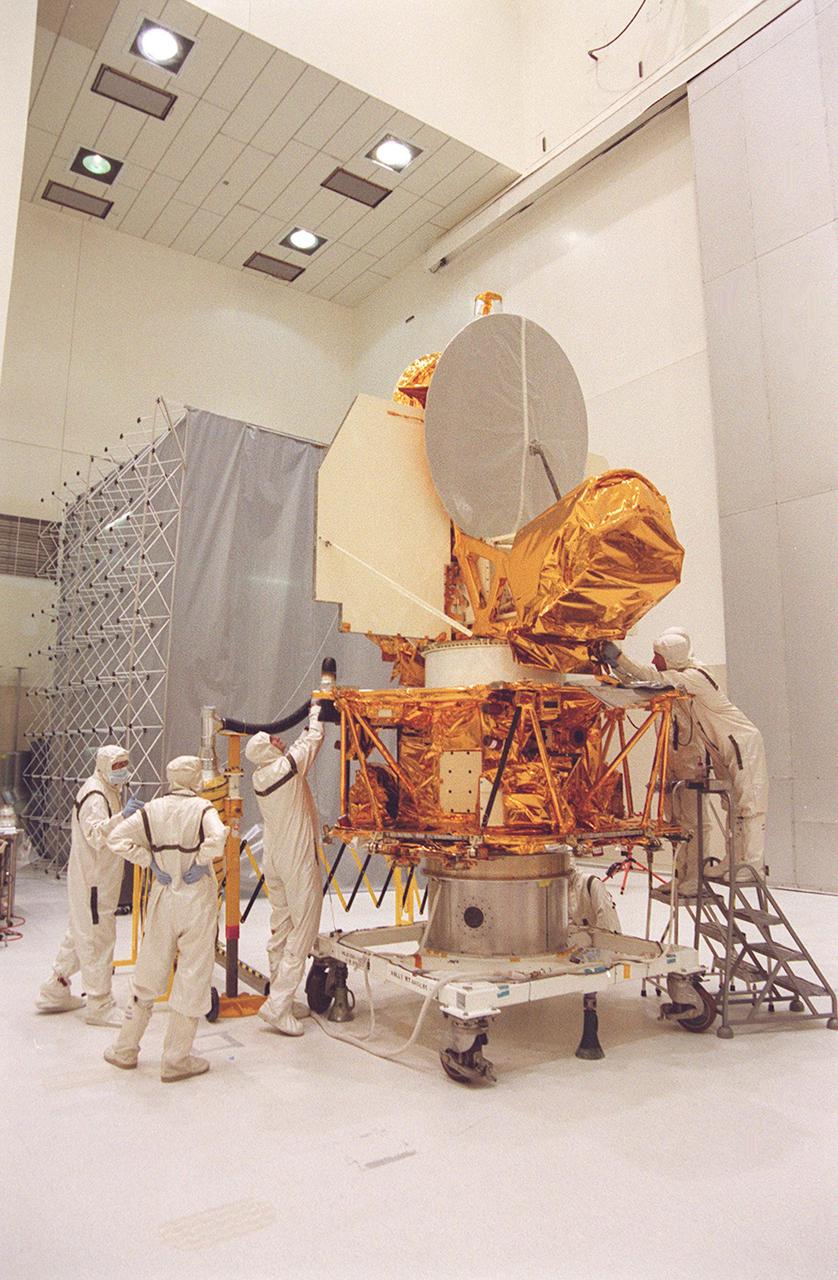
KENNEDY SPACE CENTER, FLA. -- In the Spacecraft Assembly and Encapsulation Facility 2, workers check out parts of the Microwave Anisotropy Probe (MAP. Several milestones must be completed while MAP is at SAEF-2, including antenna and solar array installation, solar array deployment and illumination testing, a spacecraft comprehensive performance test, fueling with hydrazine propellant and a spin balance test. MAP will then be ready for integration with the solid propellant Payload Assist Module upper stage booster. MAP is scheduled for launch June 30 from Cape Canaveral Air Force Station on a Delta II rocket into a lunar-assisted trajectory to the Sun-Earth for a 27-month mission. The MAP instrument consists of a set of passively cooled microwave radiometers with 1.4x 1.6-meter diameter primary reflectors to provide the desired angular resolution. MAP measures small fluctuations in the temperature of the cosmic microwave background radiation to an accuracy of one millionth of a degree These measurements should reveal the size, matter content, age, geometry and fate of the universe. They will also reveal the primordial structure that grew to form galaxies and will test ideas about the origins of these primordial structures. The MAP instrument will be continuously shaded from the Sun, Earth, and Moon by the spacecraft. It is a product of Goddard Space Flight Center in partnership with Princeton University
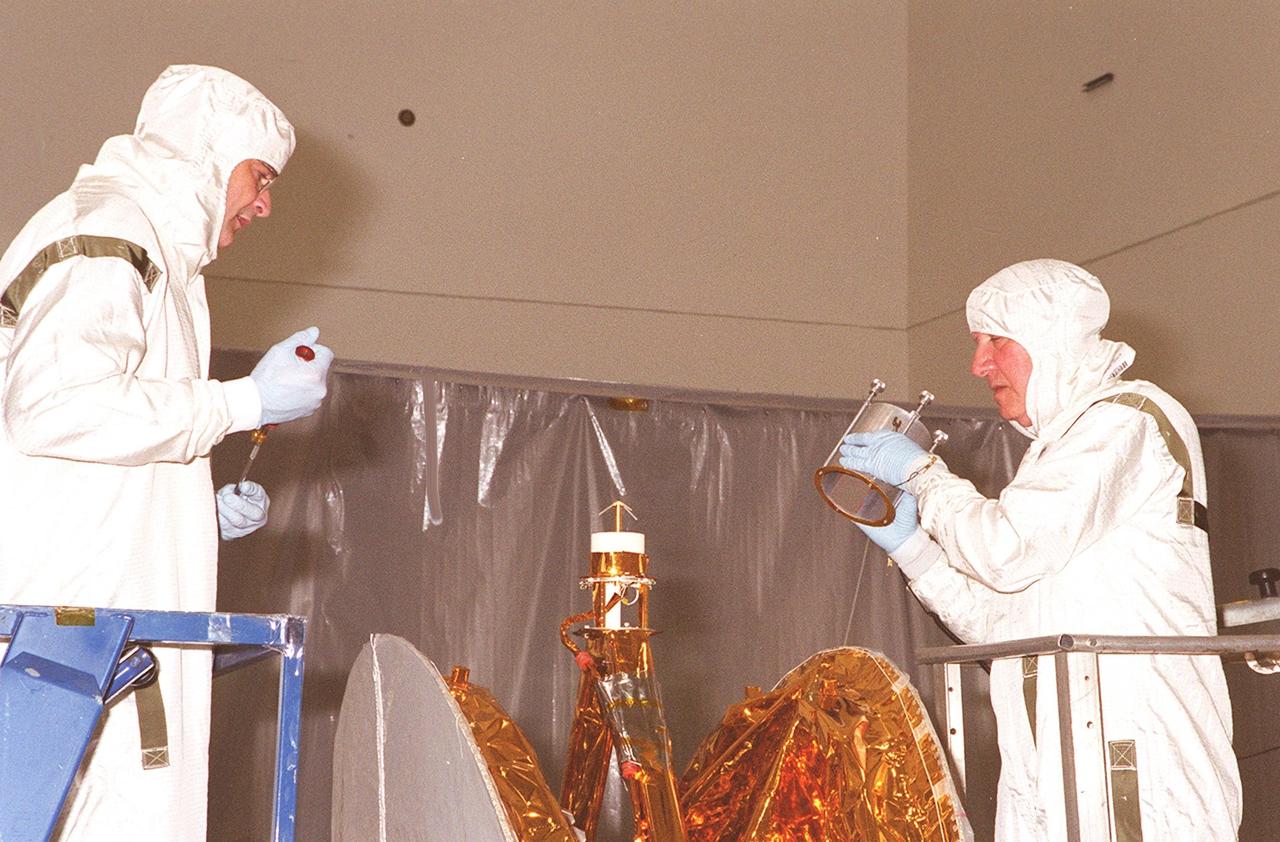
KENNEDY SPACE CENTER, FLA. -- Workers in the Spacecraft Assembly and Encapsulation Facility 2 place an antenna on the Microwave Anisotropy Probe (MAP). Several other milestones must be completed while MAP is at SAEF-2, including solar array installation, solar array deployment and illumination testing, a spacecraft comprehensive performance test, fueling with hydrazine propellant and a spin balance test. MAP will then be ready for integration with the solid propellant Payload Assist Module upper stage booster. MAP is scheduled for launch June 30 from Cape Canaveral Air Force Station on a Delta II rocket into a lunar-assisted trajectory to the Sun-Earth for a 27-month mission. The MAP instrument consists of a set of passively cooled microwave radiometers with 1.4x 1.6-meter diameter primary reflectors to provide the desired angular resolution. MAP measures small fluctuations in the temperature of the cosmic microwave background radiation to an accuracy of one millionth of a degree These measurements should reveal the size, matter content, age, geometry and fate of the universe. They will also reveal the primordial structure that grew to form galaxies and will test ideas about the origins of these primordial structures. The MAP instrument will be continuously shaded from the Sun, Earth, and Moon by the spacecraft. It is a product of Goddard Space Flight Center in partnership with Princeton University
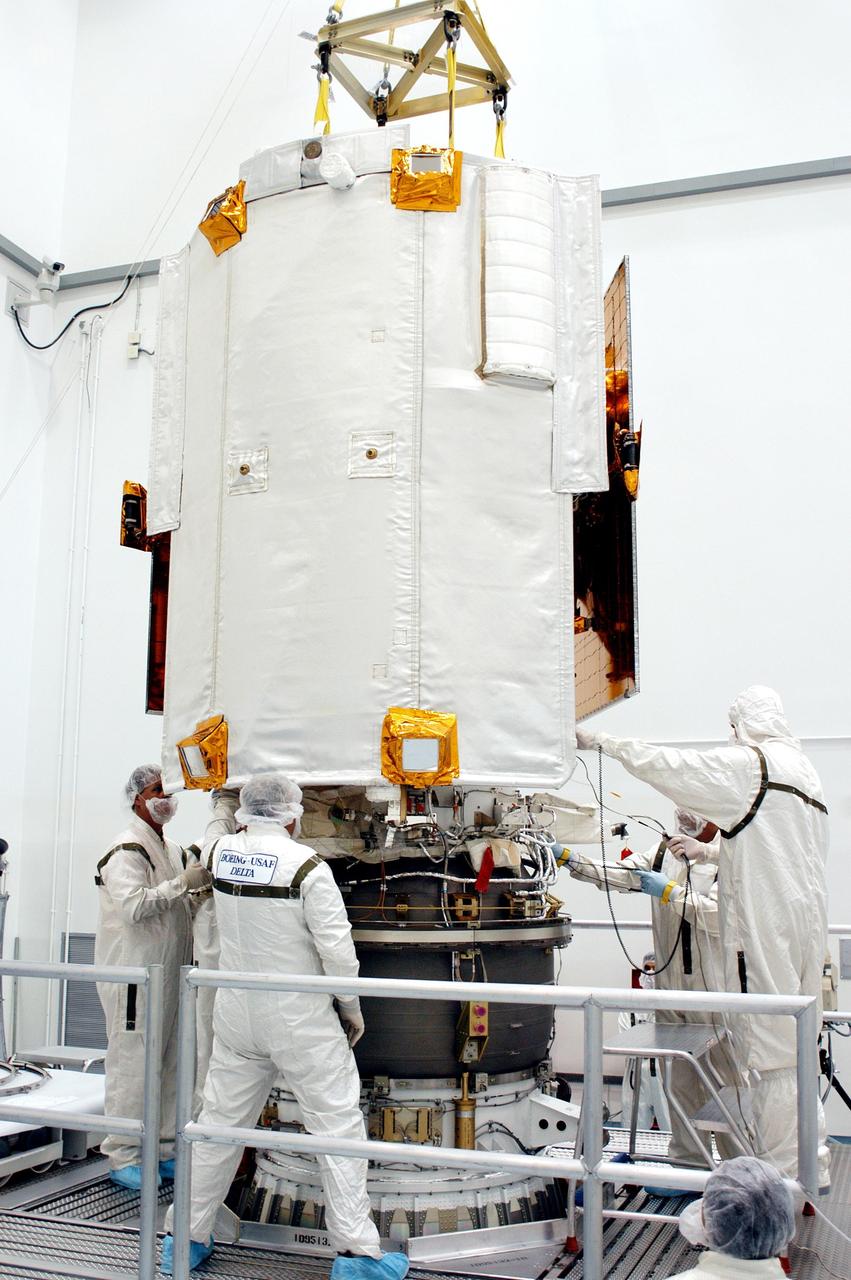
KENNEDY SPACE CENTER, FLA. - Technicians at Astrotech Space Operations in Titusville, Fla., work on the back side of the MESSENGER spacecraft, mating it with the Payload Assist Module, the Boeing Delta II third stage, below. The white panel seen here is the heat-resistant, ceramic cloth sunshade that will enable MESSENGER to operate at room temperature. MESSENGER (Mercury Surface, Space Environment, Geochemistry and Ranging) is scheduled to launch Aug. 2 aboard a Boeing Delta II rocket from Pad 17-B, Cape Canaveral Air Force Station, Fla. It will return to Earth for a gravity boost in July 2005, then fly past Venus twice, in October 2006 and June 2007. It is expected to enter Mercury orbit in March 2011. MESSENGER was built for NASA by the Johns Hopkins University Applied Physics Laboratory in Laurel, Md.
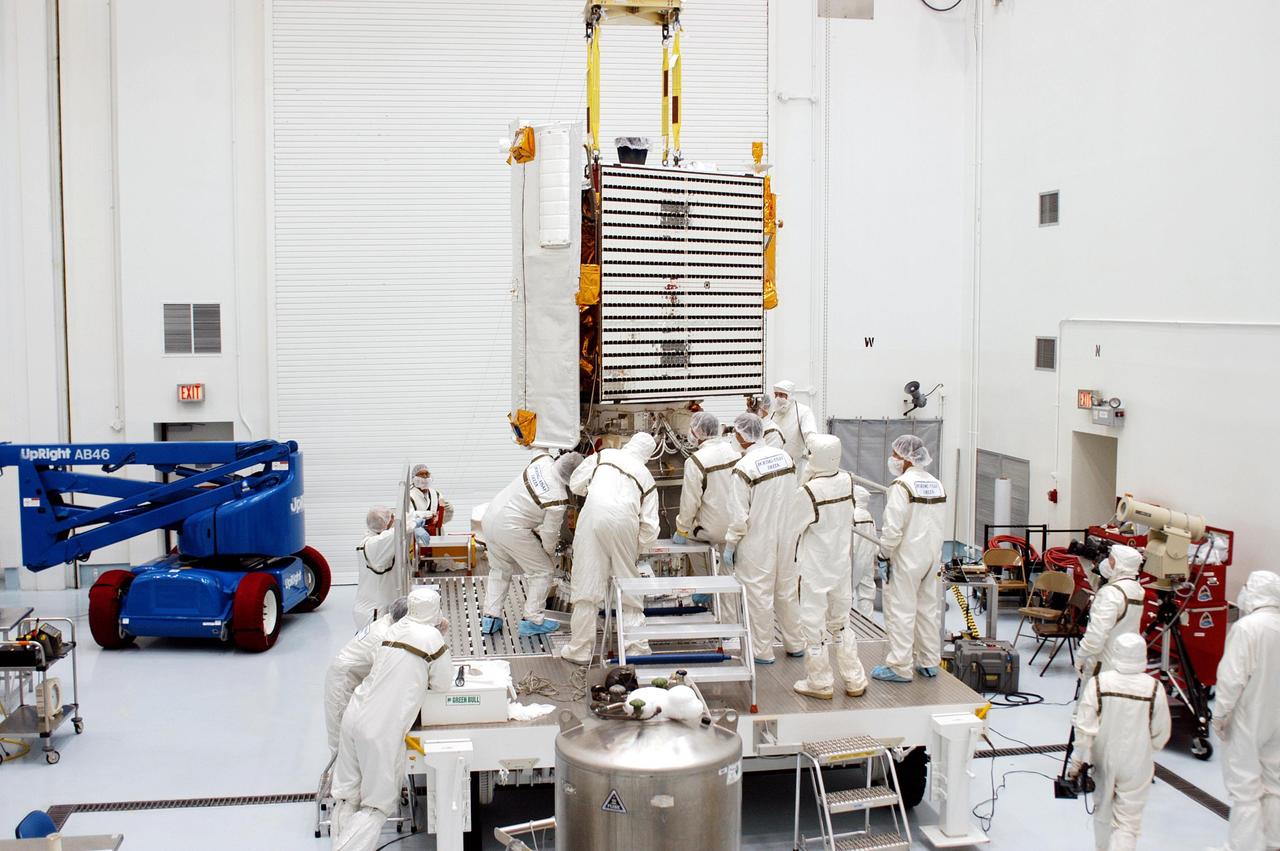
KENNEDY SPACE CENTER, FLA. - Gathered on the work stand, technicians at Astrotech Space Operations in Titusville, Fla., check closely the mating of the MESSENGER spacecraft with the Payload Assist Module, the Boeing Delta II third stage, below it. MESSENGER (Mercury Surface, Space Environment, Geochemistry and Ranging) is scheduled to launch Aug. 2 aboard a Boeing Delta II rocket from Pad 17-B, Cape Canaveral Air Force Station, Fla. It will return to Earth for a gravity boost in July 2005, then fly past Venus twice, in October 2006 and June 2007. It is expected to enter Mercury orbit in March 2011. MESSENGER was built for NASA by the Johns Hopkins University Applied Physics Laboratory in Laurel, Md.
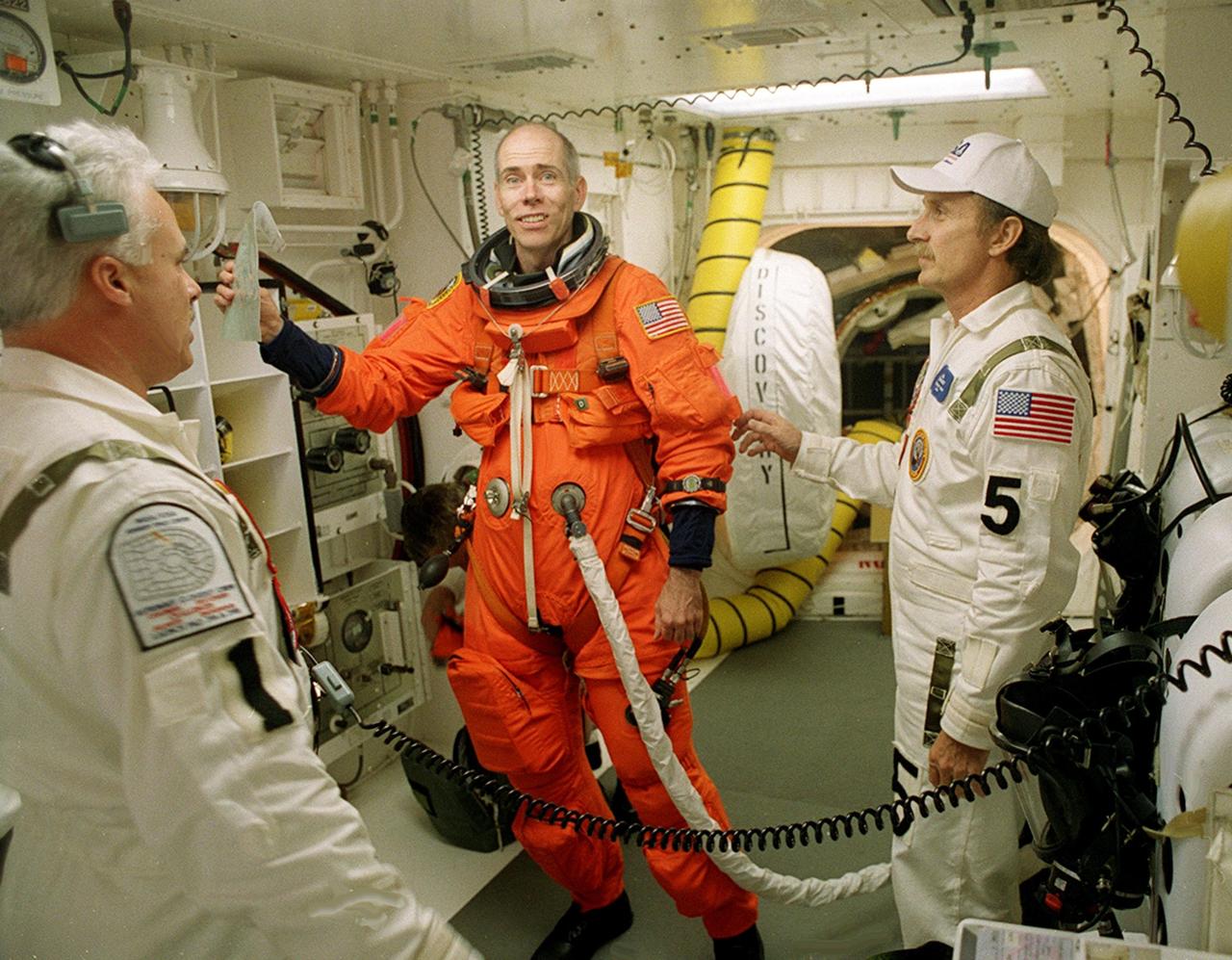
KENNEDY SPACE CENTER, Fla. -- STS-105 Commander Scott Horowitz sends a message home while preparing to enter Space Shuttle Discovery for launch. Assisting with flight equipment are (left) Orbiter Vehicle Closeout Chief Chris Meinert, (right) USA Mechanical Technician Al Schmidt and (behind) NASA Quality Assurance Specialist Ken Strite. The payload on the STS-105 mission to the International Space Station includes the third flight of the Italian-built Multi-Purpose Logistics Module Leonardo, delivering additional scientific racks, equipment and supplies for the Space Station, and the Early Ammonia Servicer (EAS) tank. The EAS, which will be attached to the Station during two spacewalks, contains spare ammonia for the Station's cooling system. Also, the Expedition Three crew is aboard to replace the Expedition Two crew on the Space Station, who will be returning to Earth aboard Discovery after a five-month stay on the Station
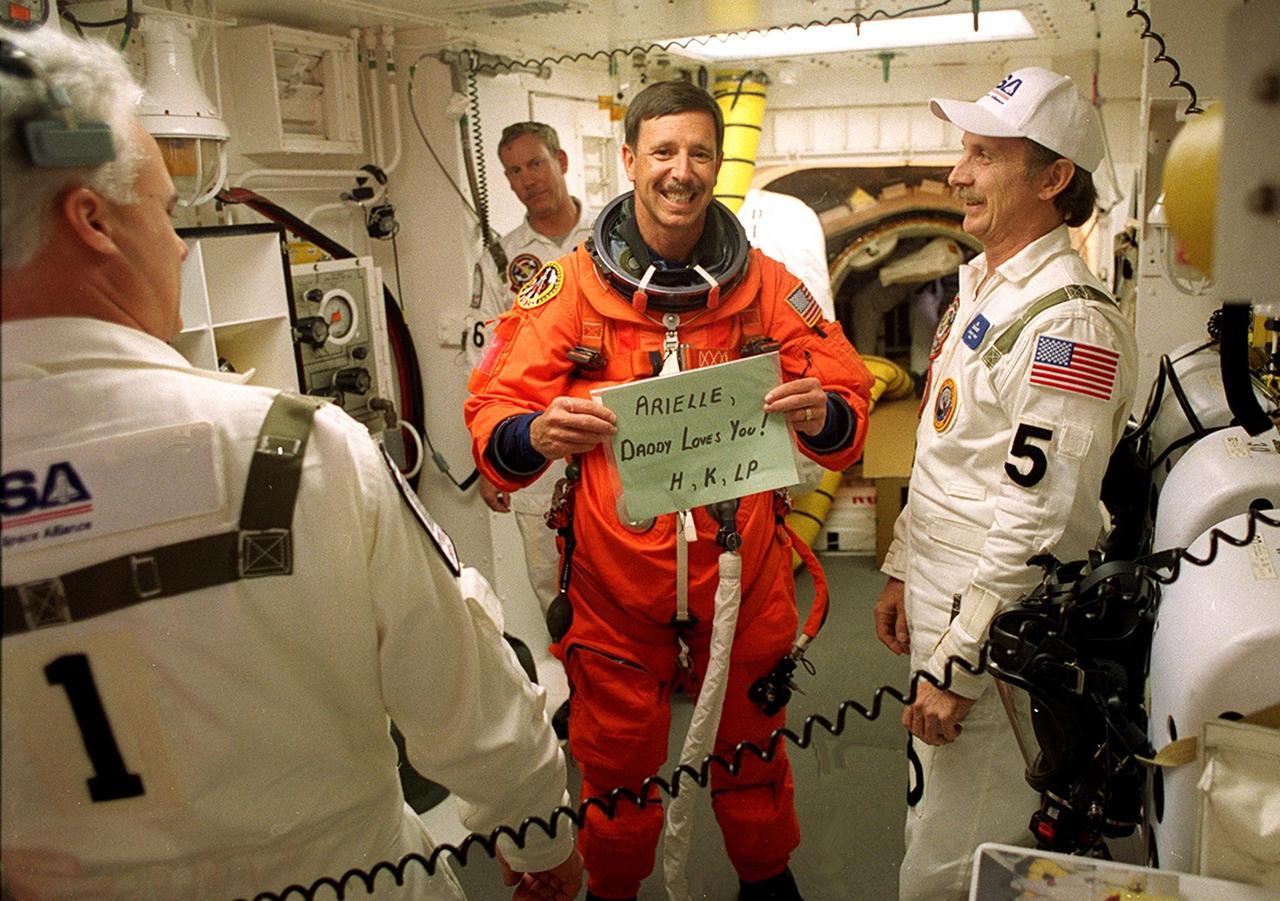
KENNEDY SPACE CENTER, Fla. - STS-105 Commander Scott Horowitz sends a message home while preparing to enter Space Shuttle Discovery for launch. Assisting with flight equipment are (left) Orbiter Vehicle Closeout Chief Chris Meinert, (right) USA Mechanical Technician Al Schmidt and (behind) NASA Quality Assurance Specialist Ken Strite. The payload on the STS-105 mission to the International Space Station includes the third flight of the Italian-built Multi-Purpose Logistics Module Leonardo, delivering additional scientific racks, equipment and supplies for the Space Station, and the Early Ammonia Servicer (EAS) tank. The EAS, which will be attached to the Station during two spacewalks, contains spare ammonia for the Station’s cooling system. Also, the Expedition Three crew is aboard to replace the Expedition Two crew on the International Space Station, who will be returning to Earth aboard Discovery after a five-month stay on the Station
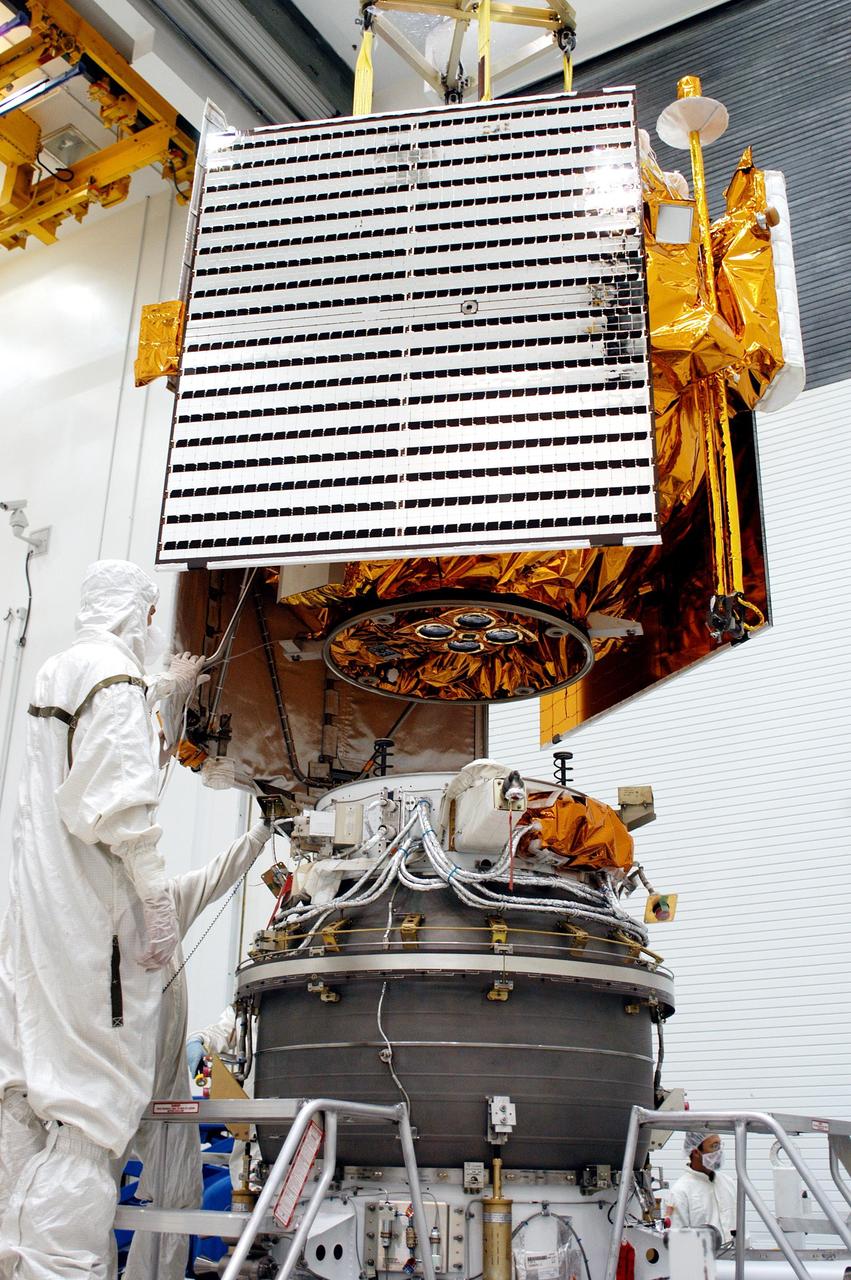
KENNEDY SPACE CENTER, FLA. - At Astrotech Space Operations in Titusville, Fla., the MESSENGER spacecraft is lowered toward the Payload Assist Module, the Boeing Delta II third stage, for mating. MESSENGER (Mercury Surface, Space Environment, Geochemistry and Ranging) is scheduled to launch Aug. 2 aboard a Boeing Delta II rocket from Pad 17-B, Cape Canaveral Air Force Station, Fla. It will return to Earth for a gravity boost in July 2005, then fly past Venus twice, in October 2006 and June 2007. It is expected to enter Mercury orbit in March 2011. MESSENGER was built for NASA by the Johns Hopkins University Applied Physics Laboratory in Laurel, Md. Processing is being done at Astrotech Space Operations in Titusville, Fla.
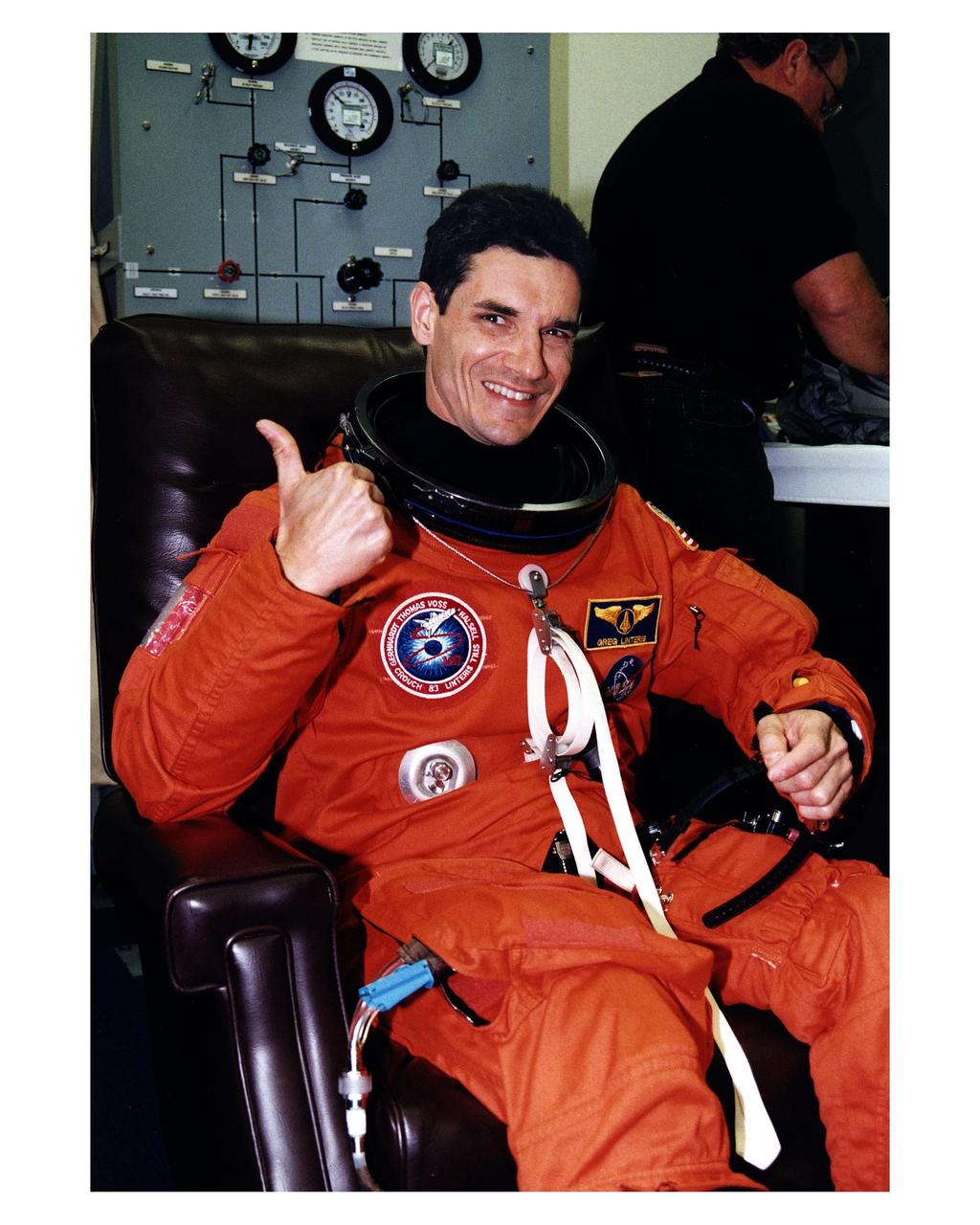
STS-83 Payload Specialist Gregory T. Linteris gives a thumbs-up as he is assisted into his launch/entry suit in the Operations and Checkout (O&C) Building. He holds a doctorate in mechanical and aerospace engineering. Linteris has worked at the National Institute of Standards and Technology and is the Principal Investigator on a NASA microgravity combustion experiments. As a member of the Red team, Linteris will concentrate on three combustion experiments. Two of these experiments are housed in the Combustion Module. He will also be backing up crew members on the other Microgravity Science Laboratory-1 (MSL-1) investigations. He and six fellow crew members will shortly depart the O&C and head for Launch Pad 39A, where the Space Shuttle Columbia will lift off during a launch window that opens at 2:00 p.m. EST, April 4
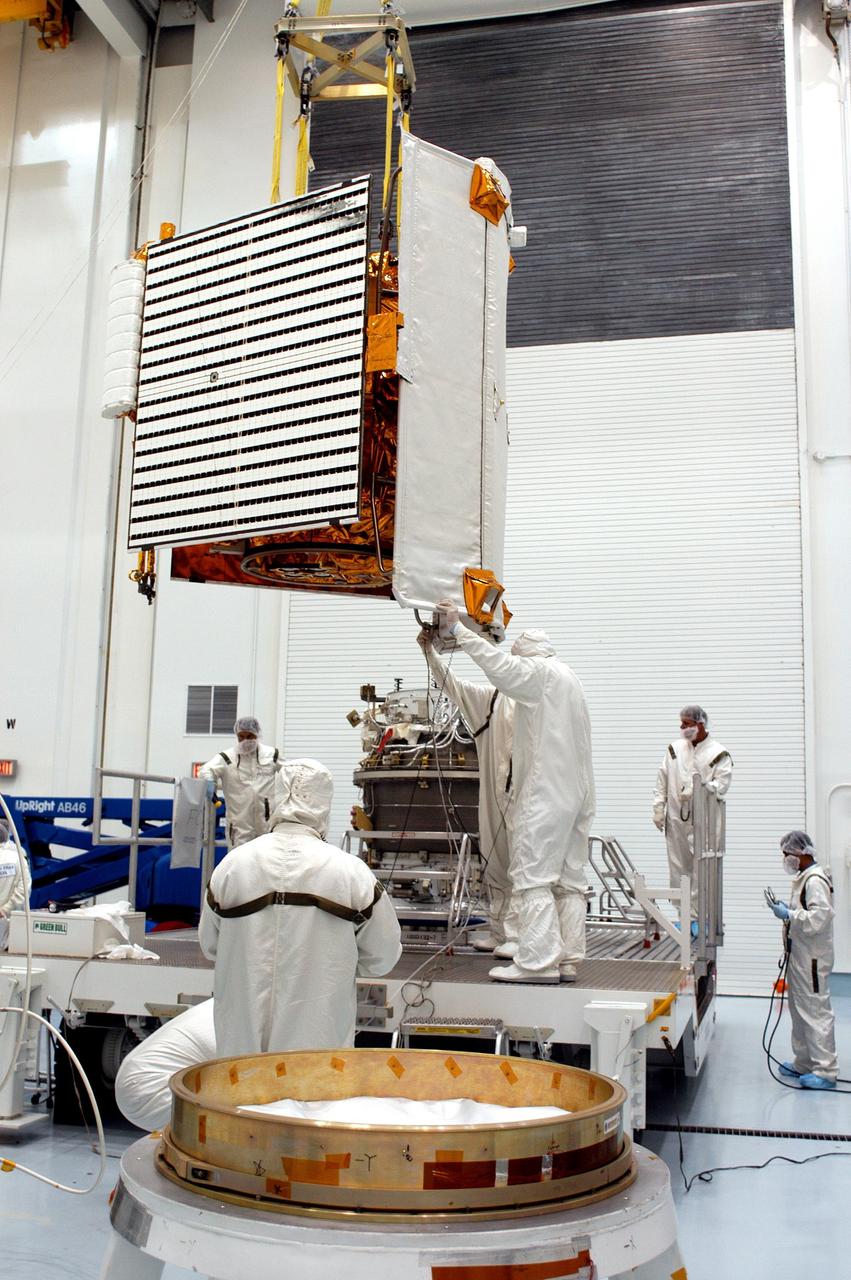
KENNEDY SPACE CENTER, FLA. - An overhead crane lifts the MESSENGER spacecraft from its work stand under the watchful eyes and hands of technicians. The spacecraft is being moved to mate it with the Payload Assist Module, the Boeing Delta II third stage, in the foreground. MESSENGER (Mercury Surface, Space Environment, Geochemistry and Ranging) is scheduled to launch Aug. 2 aboard a Boeing Delta II rocket from Pad 17-B, Cape Canaveral Air Force Station, Fla. It will return to Earth for a gravity boost in July 2005, then fly past Venus twice, in October 2006 and June 2007. It is expected to enter Mercury orbit in March 2011. MESSENGER was built for NASA by the Johns Hopkins University Applied Physics Laboratory in Laurel, Md. Processing is being done at Astrotech Space Operations in Titusville, Fla.
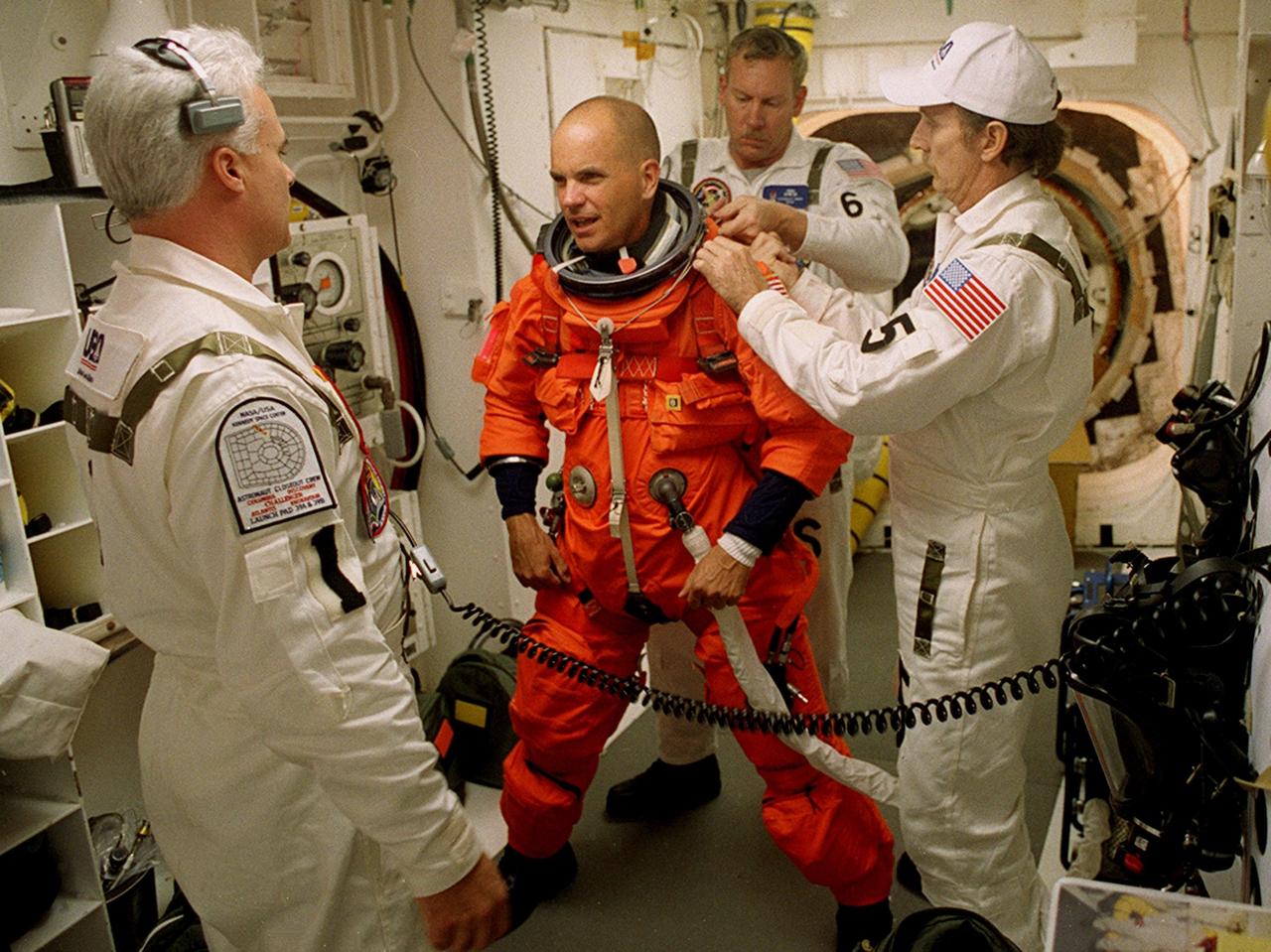
KENNEDY SPACE CENTER, Fla. - STS-105 Pilot Rick Sturckow is assisted with his launch and entry suit before he enters Space Shuttle Discovery for launch. Helping him are (left) Orbiter Vehicle Closeout Chief Chris Meinert, USA Mechanical Technician Al Schmidt (right) and (back) NASA Quality Assurance Specialist Ken Strite. The payload on the STS-105 mission to the International Space Station includes the third flight of the Italian-built Multi-Purpose Logistics Module Leonardo, delivering additional scientific racks, equipment and supplies for the Space Station, and the Early Ammonia Servicer (EAS) tank. The EAS, which will be attached to the Station during two spacewalks, contains spare ammonia for the Station’s cooling system. Also, the Expedition Three crew is aboard to replace the Expedition Two crew on the International Space Station, who will be returning to Earth aboard Discovery after a five-month stay on the Station
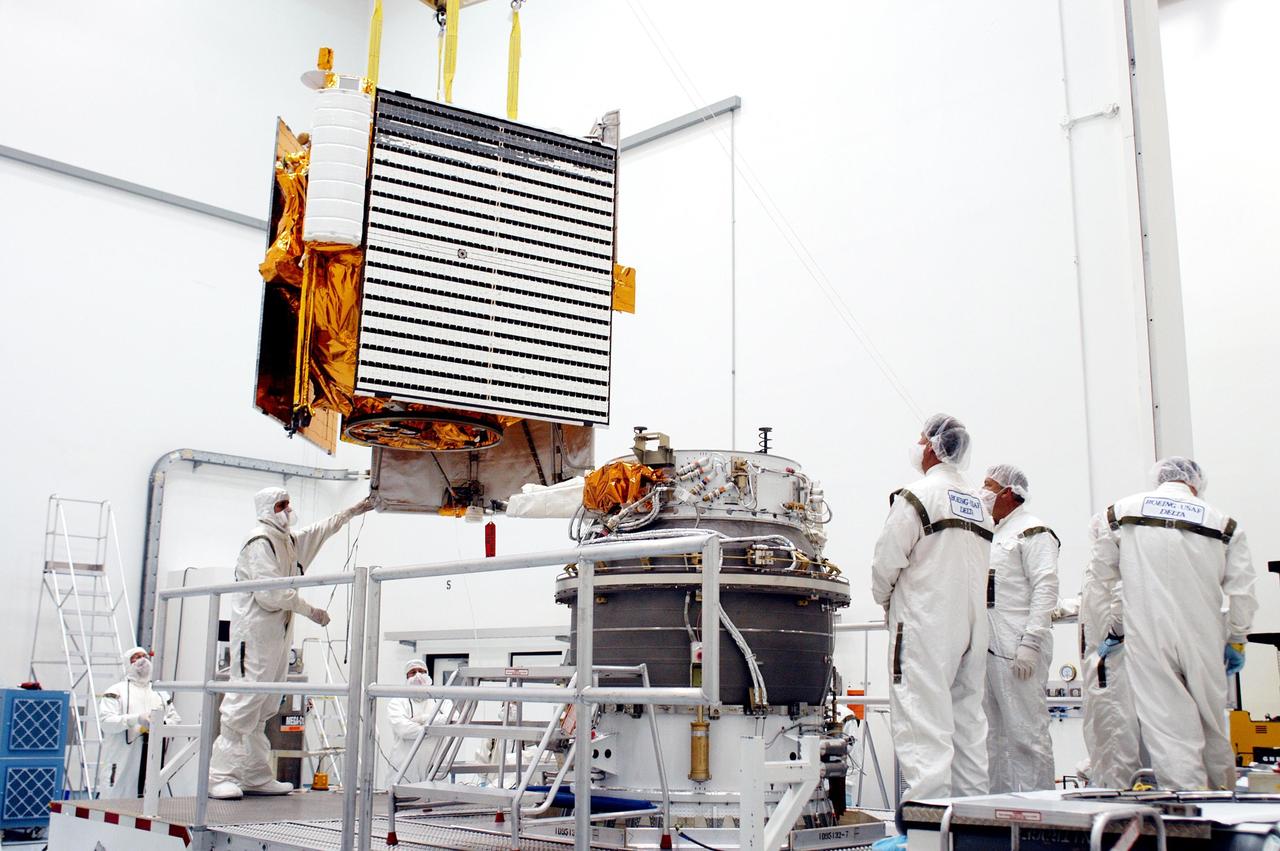
KENNEDY SPACE CENTER, FLA. - An overhead crane moves the MESSENGER spacecraft from its work stand under the watchful eyes and hands of technicians. The spacecraft is being moved to mate it with the Payload Assist Module, the Boeing Delta II third stage, at right. MESSENGER (Mercury Surface, Space Environment, Geochemistry and Ranging) is scheduled to launch Aug. 2 aboard a Boeing Delta II rocket from Pad 17-B, Cape Canaveral Air Force Station, Fla. It will return to Earth for a gravity boost in July 2005, then fly past Venus twice, in October 2006 and June 2007. It is expected to enter Mercury orbit in March 2011. MESSENGER was built for NASA by the Johns Hopkins University Applied Physics Laboratory in Laurel, Md. Processing is being done at Astrotech Space Operations in Titusville, Fla.
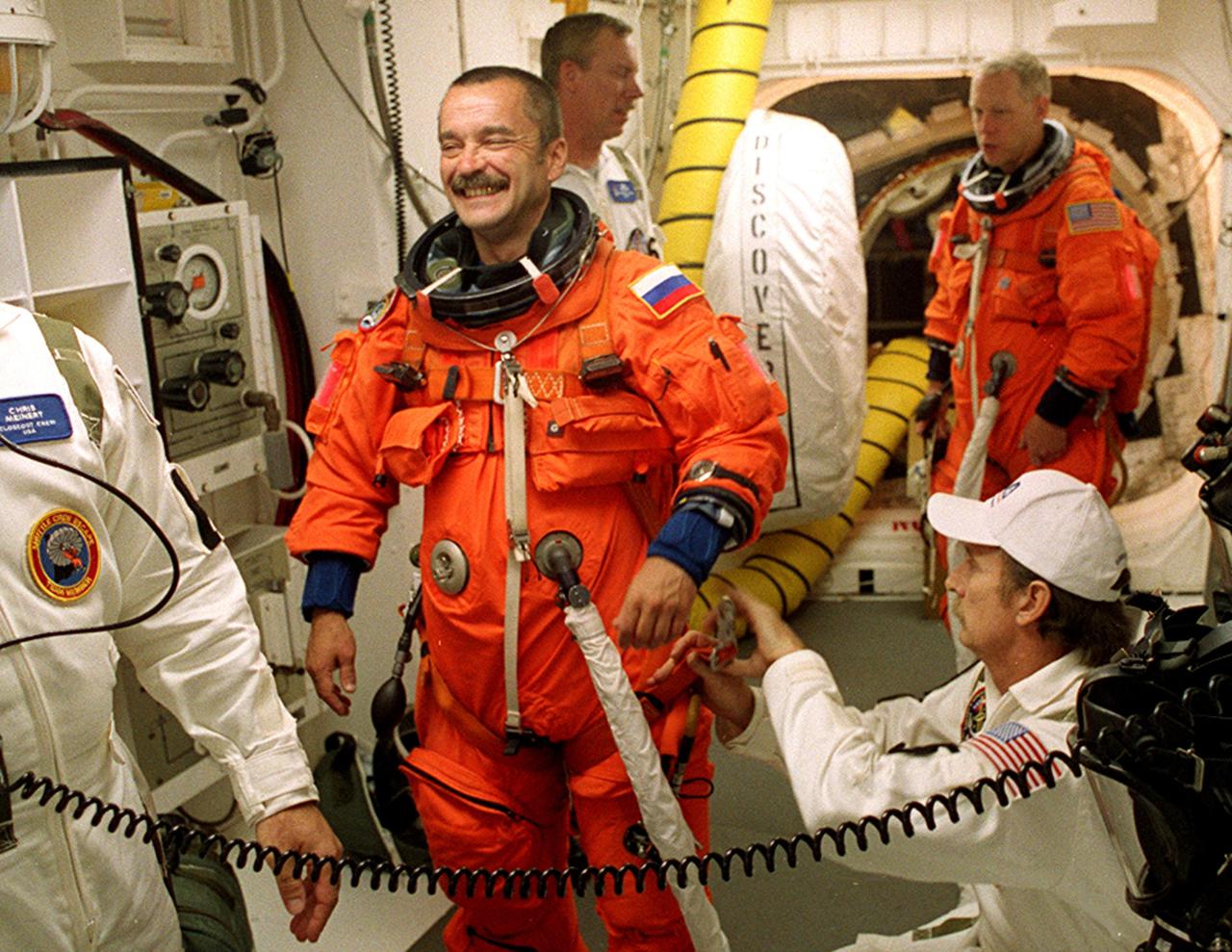
KENNEDY SPACE CENTER, Fla. - In the White Room, Launch Pad 39A, Expedition Three crew member Mikhail Tyurin is assisted with his flight equipment before entering Space Shuttle Discovery for launch. With him are (left) Orbiter Vehicle Closeout Chief Chris Meinert and USA Mechanical Technician Al Schmidt. In the background is STS-105 Mission Specialist Patrick Forrester. The payload on the STS-105 mission to the International Space Station the third flight of the Italian-built Multi-Purpose Logistics Module Leonardo, delivering additional scientific racks, equipment and supplies for the Space Station, and the Early Ammonia Servicer (EAS) tank. The EAS, which will be attached to the Station during two spacewalks, contains spare ammonia for the Station’s cooling system. Also, the Expedition Three crew is aboard to replace the Expedition Two crew on the International Space Station, who will be returning to Earth aboard Discovery after a five-month stay on the Station
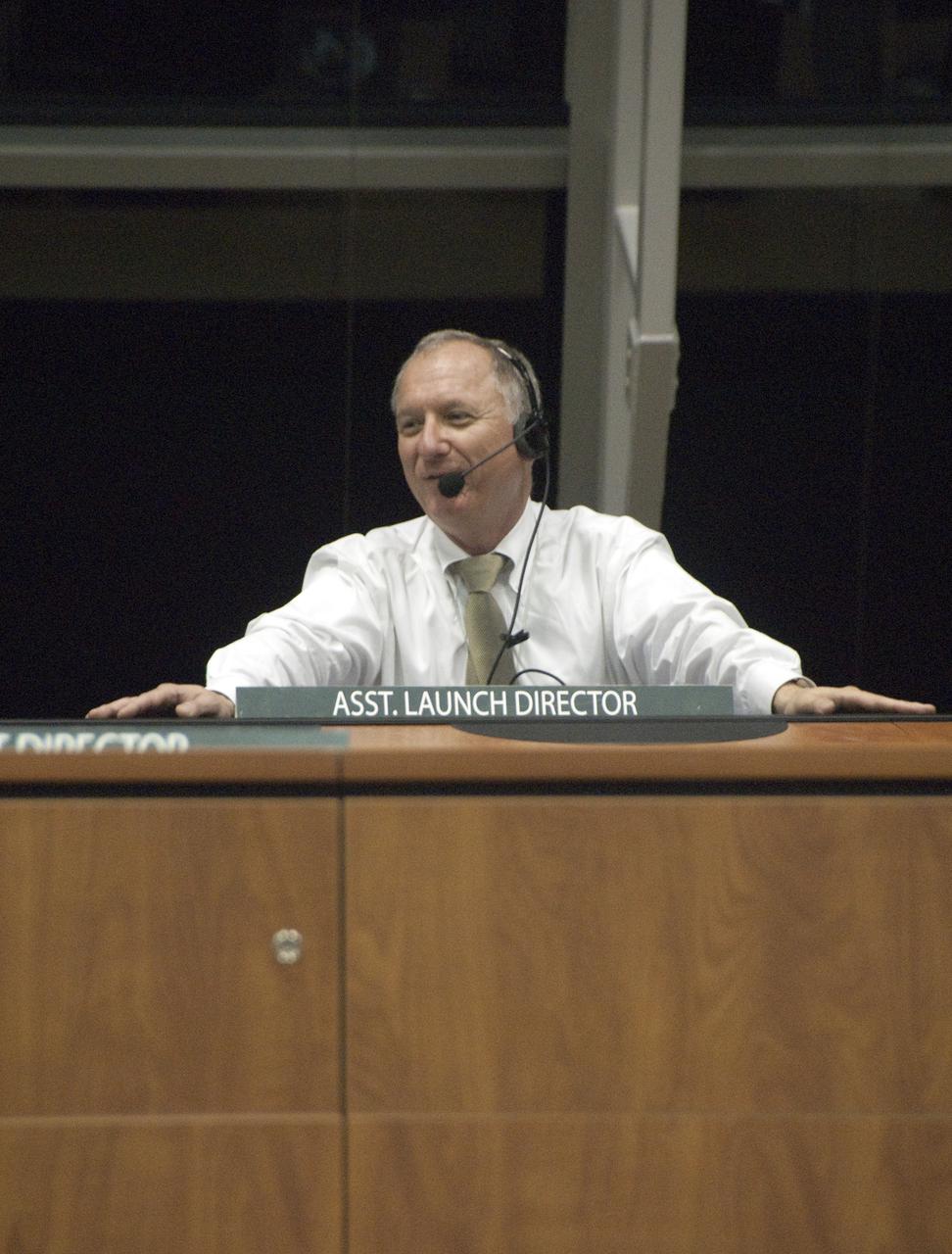
CAPE CANAVERAL, Fla. - In the Launch Control Center at NASA's Kennedy Space Center in Florida, NASA Assistant Launch Director Pete Nickolenko is pleased with the outcome of the tanking operations for space shuttle Atlantis' STS-132 mission being conducted from Firing Room 4. Liftoff of the STS-132 mission is set for 2:20 p.m. EDT on May 14. The six-member STS-132 crew will deliver the Russian-built Mini Research Module-1 to the International Space Station. Named Rassvet, Russian for 'dawn,' the module is the second in a series of new pressurized components for Russia and will be permanently attached to the Earth-facing port of the Zarya control module. Rassvet will be used for cargo storage and will provide an additional docking port to the station. Also aboard Atlantis is an Integrated Cargo Carrier, or ICC, an unpressurized flat bed pallet and keel yoke assembly used to support the transfer of exterior cargo from the shuttle to the station. STS-132 is the 34th mission to the station and the last scheduled flight for Atlantis. For more information on the STS-132 mission objectives, payload and crew, visit http:__www.nasa.gov_mission_pages_shuttle_shuttlemissions_sts132_index.html. Photo Credit: NASA_Cory Huston
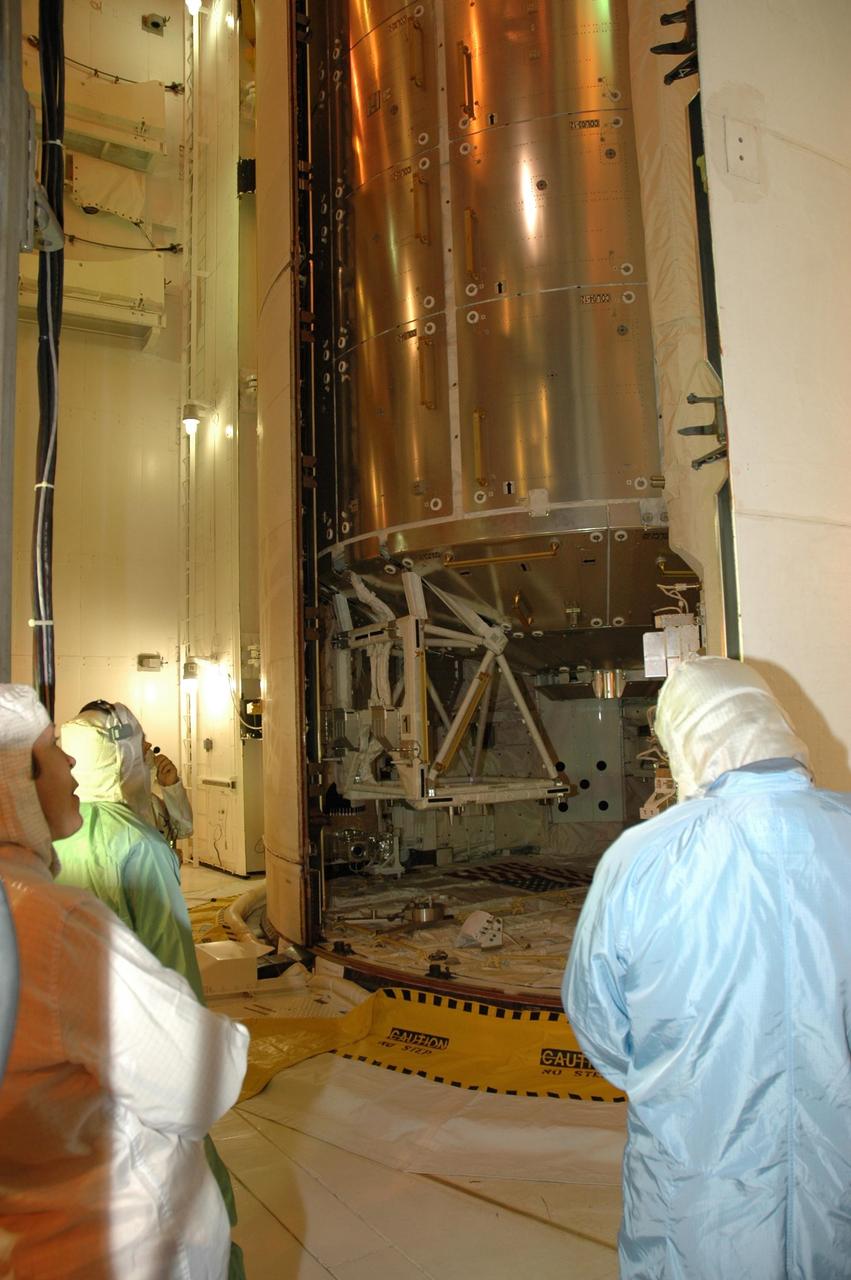
KENNEDY SPACE CENTER, FLA. -- From the payload changeout room on Launch Pad 39A at NASA's Kennedy Space Center, engineers oversee the closing of space shuttle Atlantis' payload bay doors around the cargo -- the Columbus Laboratory seen here. During launch preparations, technicians noticed a small section of a braided metal hose that was bent in a shape similar to the Greek letter Omega. The radiator retract hose, part of the shuttle's cooling system that carries Freon, is designed to flex. Engineers designed a tool to guide the hose back into the storage box. During the starboard door closure, eight incremental stops were performed. After each stop, the aft hose was adjusted and seated in place utilizing the ladder and hose assist tool. The team was satisfied with the final placement of the hose at door closure. STS-122 is the 121st space shuttle flight, the 29th flight for Atlantis and the 24th flight to the International Space Station. The Columbus laboratory module, built by the European Space Agency, is approximately 23 feet long and 15 feet wide, allowing it to hold 10 large racks of experiments. Atlantis is scheduled to launch at 2:45 p.m. Feb. 7. Photo credit: NASA/Jack Pfaller
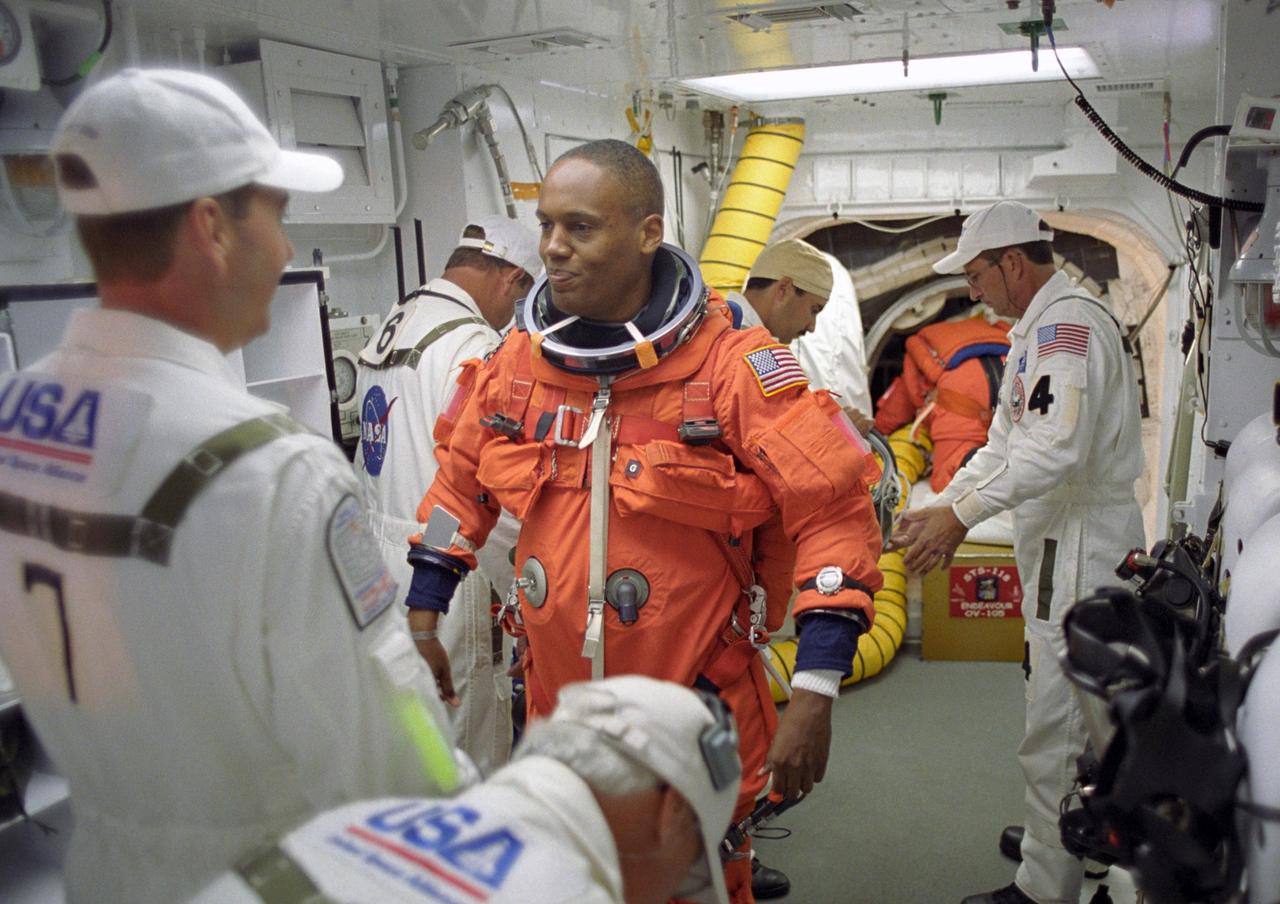
KENNEDY SPACE CENTER, FLA. -- In the White Room on Launch Pad 39A, STS-118 Mission Specialist Alvin Drew is helped with his launch gear by the closeout crew before he enters Space Shuttle Endeavour. Drew is making his first space flight. The outer end of the orbiter access arm ends in an environmental chamber (the White Room) that mates with the orbiter and allows personnel to enter the crew compartment. With assistance, each member of the flight crew dons a parachute pack before crawling through the open hatch into the shuttle. The closeout crew also straps the astronauts into the space shuttle's crew module and takes care of any other last-minute needs that arise. Space Shuttle Endeavour's STS-118 mission is the 22nd shuttle flight to the International Space Station. It will continue space station construction by delivering a third starboard truss segment, S5, and other payloads such as the SPACEHAB module and the external stowage platform 3. Liftoff of Endeavour is scheduled at 6:36 p.m. EDT. Photo credit: NASA/John Kechele, Scott Haun, Tom Farrar
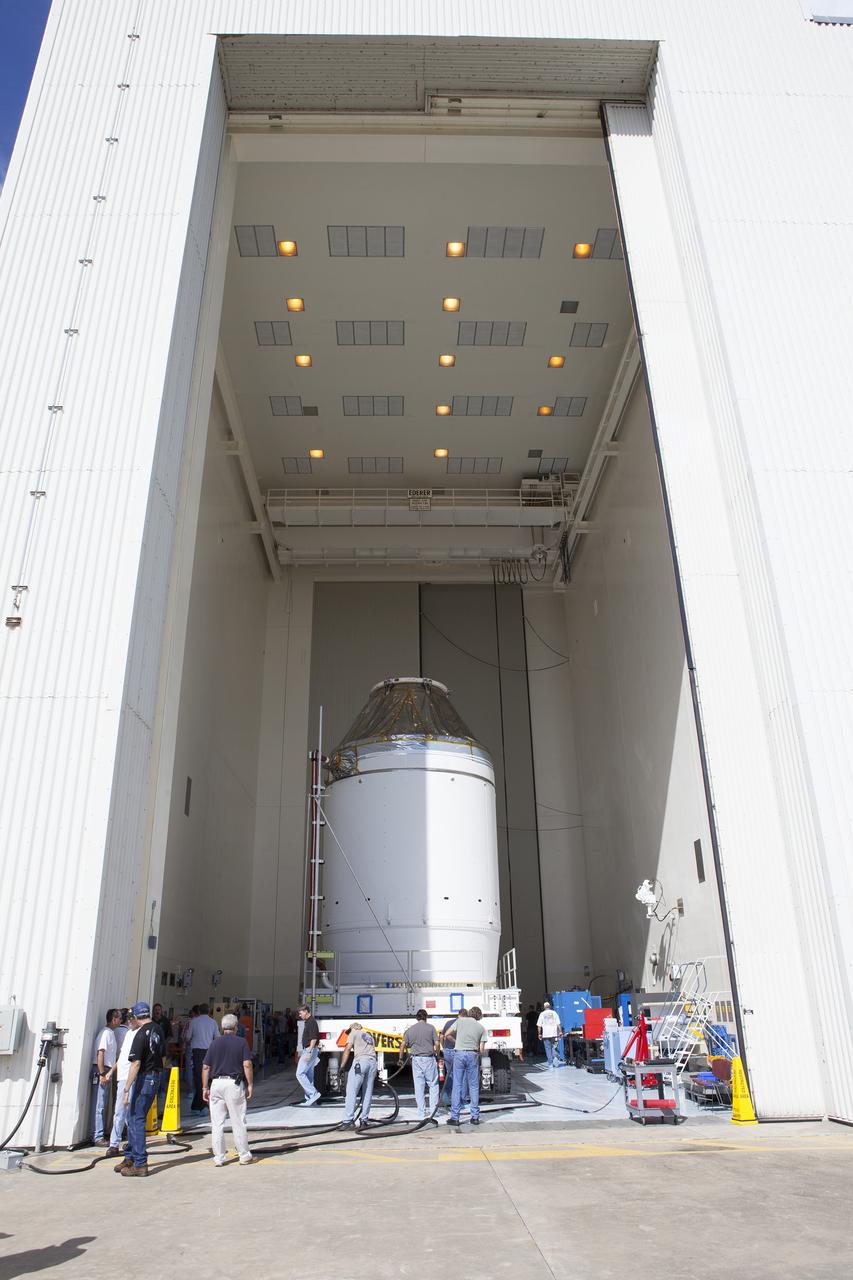
CAPE CANAVERAL, Fla. – Technicians assist as the Orion crew module, stacked atop its service module, is moved into the Payload Hazardous Servicing Facility at NASA's Kennedy Space Center in Florida, where it will be fueled ahead of its December flight. The spacecraft for Exploration Flight Test-1 was moved out of the Neil Armstrong Operations and Checkout Building high bay. Orion is the exploration spacecraft designed to carry astronauts to destinations not yet explored by humans, including an asteroid and Mars. It will have emergency abort capability, sustain the crew during space travel and provide safe re-entry from deep space return velocities. The first unpiloted test flight of the Orion is scheduled to launch atop a United Launch Alliance Delta IV Heavy rocket from Cape Canaveral Air Force Station in Florida to an altitude of 3,600 miles above the Earth's surface. The two-orbit, four-hour flight test will help engineers evaluate the systems critical to crew safety including the heat shield, parachute system and launch abort system. For more information, visit http://www.nasa.gov/orion. Photo credit: NASA/Daniel Casper
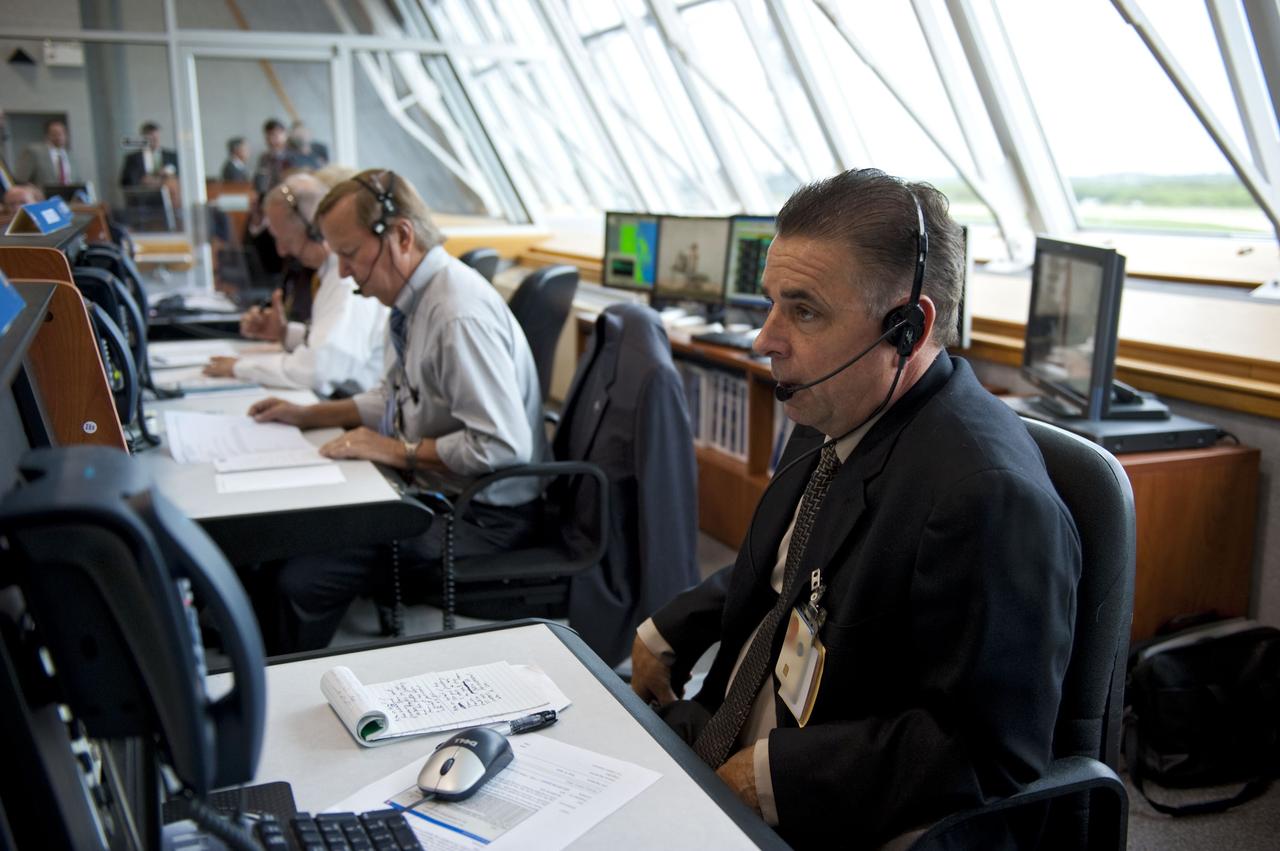
CAPE CANAVERAL, Fla. -- In Firing Room 4 of the Launch Control Center at NASA's Kennedy Space Center in Florida, launch team members monitor the countdown to the launch of space shuttle Atlantis on its STS-135 mission to the International Space Station. Seen here are Assistant Launch Director Pete Nickolenko (background) Shuttle Launch Director Mike Leinbach and Payloads Launch Manager and Deputy Director of ISS and Spacecraft Processing at Kennedy, Bill Dowdell. Atlantis with its crew of four; Commander Chris Ferguson, Pilot Doug Hurley, Mission Specialists Sandy Magnus and Rex Walheim, lifted off at 11:29 a.m. EDT on July 8, 2011 to deliver the Raffaello multi-purpose logistics module packed with supplies and spare parts for the station. Atlantis also will fly the Robotic Refueling Mission experiment that will investigate the potential for robotically refueling existing satellites in orbit. In addition, Atlantis will return with a failed ammonia pump module to help NASA better understand the failure mechanism and improve pump designs for future systems. STS-135 will be the 33rd flight of Atlantis, the 37th shuttle mission to the space station, and the 135th and final mission of NASA's Space Shuttle Program. For more information, visit www.nasa.gov/mission_pages/shuttle/shuttlemissions/sts135/index.html. Photo credit: NASA/Kim Shiflett
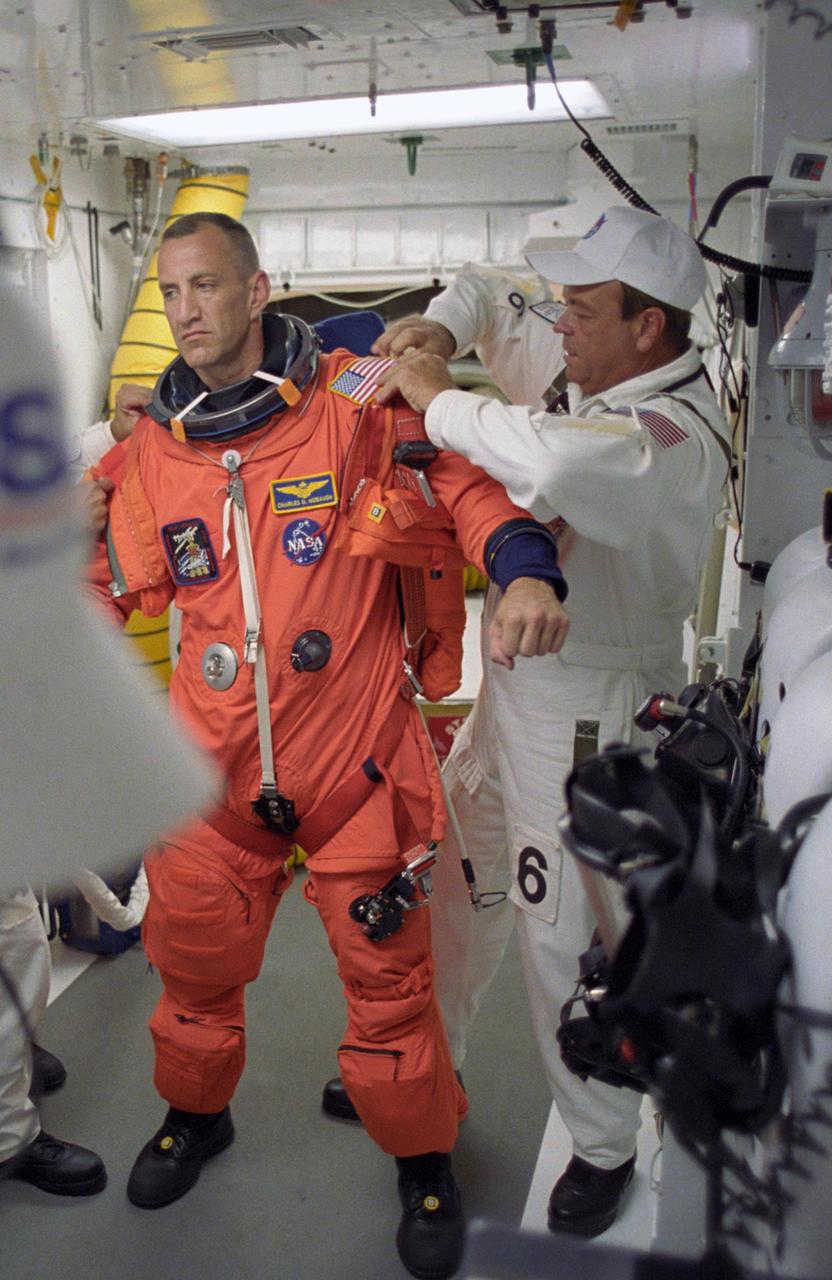
KENNEDY SPACE CENTER, FLA. -- In the White Room on Launch Pad 39A, STS-118 Pilot Charlie Hobaugh is helped by the closeout crew with his parachute before he enters Space Shuttle Endeavour. The outer end of the orbiter access arm ends in an environmental chamber (the White Room) that mates with the orbiter and allows personnel to enter the crew compartment. With assistance, each member of the flight crew dons a parachute pack before crawling through the open hatch into the shuttle. The closeout crew also straps the astronauts into the space shuttle's crew module and takes care of any other last-minute needs that arise. Space Shuttle Endeavour's STS-118 mission is the 22nd shuttle flight to the International Space Station. It will continue space station construction by delivering a third starboard truss segment, S5, and other payloads such as the SPACEHAB module and the external stowage platform 3. Liftoff of Endeavour is scheduled at 6:36 p.m. EDT. Photo credit: NASA/John Kechele, Scott Haun, Tom Farrar

STS130-S-025 (8 Feb. 2010) --- From left, Mike Leinbach, shuttle launch director; Pete Nickolenko, assistant launch director; and Dana Hutcherson, flow director for space shuttle Endeavour, watch the liftoff of Endeavour through the windows of Firing Room 4 in the Launch Control Center at NASA's Kennedy Space Center in Florida. Launch of Endeavour on the STS-130 mission to the International Space Station was at 4:14 a.m. (EST) on Feb. 8, 2010. This was the second launch attempt for Endeavour's STS-130 crew and the final scheduled space shuttle night launch. The first attempt on Feb. 7 was scrubbed due to unfavorable weather. The primary payload for the STS-130 mission to the International Space Station is the Tranquility node, a pressurized module that will provide additional room for crew members and many of the station's life support and environmental control systems. Attached to one end of Tranquility is the Cupola, a unique work area with six windows on its sides and one on top. The Cupola resembles a circular bay window and will provide a vastly improved view of the station's exterior. The multi-directional view will allow the crew to monitor spacewalks and docking operations, as well as provide a spectacular view of Earth and other celestial objects. The module was built in Turin, Italy, by Thales Alenia Space for the European Space Agency.
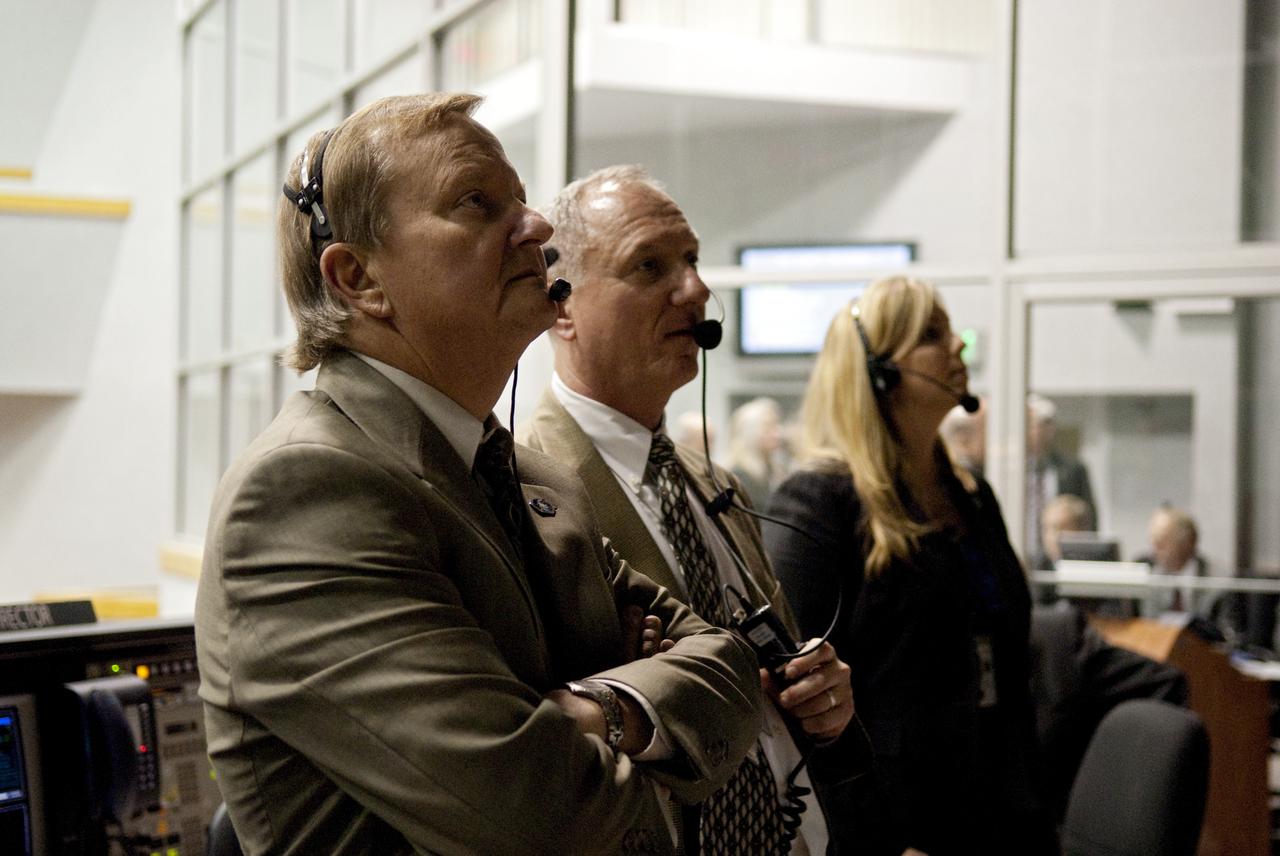
CAPE CANAVERAL, Fla. - From left, Mike Leinbach, shuttle launch director; Pete Nickolenko, assistant launch director; and Dana Hutcherson, flow director for space shuttle Endeavour, watch the liftoff of Endeavour through the windows of Firing Room 4 in the Launch Control Center at NASA's Kennedy Space Center in Florida. Launch of Endeavour on the STS-130 mission to the International Space Station was at 4:14 a.m. EST. This was the second launch attempt for space shuttle Endeavour's STS-130 crew and the final scheduled space shuttle night launch. The first attempt on Feb. 7 was scrubbed due to unfavorable weather. The primary payload for the STS-130 mission to the International Space Station is the Tranquility node, a pressurized module that will provide additional room for crew members and many of the station's life support and environmental control systems. Attached to one end of Tranquility is a cupola, a unique work area with six windows on its sides and one on top. The cupola resembles a circular bay window and will provide a vastly improved view of the station's exterior. The multi-directional view will allow the crew to monitor spacewalks and docking operations, as well as provide a spectacular view of Earth and other celestial objects. The module was built in Turin, Italy, by Thales Alenia Space for the European Space Agency. For information on the STS-130 mission and crew, visit http:__www.nasa.gov_mission_pages_shuttle_shuttlemissions_sts130_index.html. Photo credit: NASA_Kim Shiflett
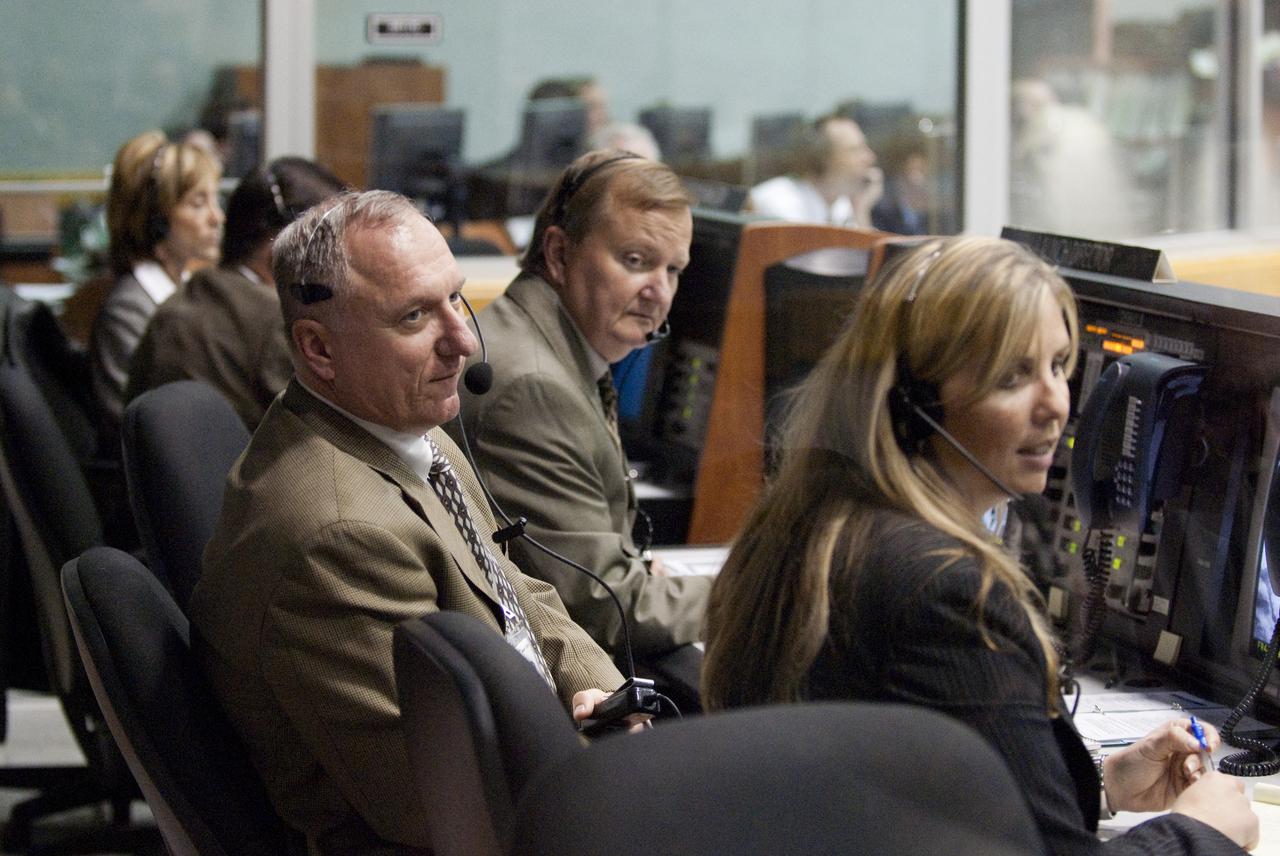
CAPE CANAVERAL, Fla. - In Firing Room 4 in the Launch Control Center at NASA's Kennedy Space Center in Florida, from top, Mike Leinbach, shuttle launch director; Pete Nickolenko, assistant launch director; and Dana Hutcherson, flow director for space shuttle Endeavour, manage the countdown to liftoff of Endeavour. Launch of Endeavour on the STS-130 mission to the International Space Station was at 4:14 a.m. EST. This was the second launch attempt for space shuttle Endeavour's STS-130 crew and the final scheduled space shuttle night launch. The first attempt on Feb. 7 was scrubbed due to unfavorable weather. The primary payload for the STS-130 mission to the International Space Station is the Tranquility node, a pressurized module that will provide additional room for crew members and many of the station's life support and environmental control systems. Attached to one end of Tranquility is a cupola, a unique work area with six windows on its sides and one on top. The cupola resembles a circular bay window and will provide a vastly improved view of the station's exterior. The multi-directional view will allow the crew to monitor spacewalks and docking operations, as well as provide a spectacular view of Earth and other celestial objects. The module was built in Turin, Italy, by Thales Alenia Space for the European Space Agency. For information on the STS-130 mission and crew, visit http:__www.nasa.gov_mission_pages_shuttle_shuttlemissions_sts130_index.html. Photo credit: NASA_Kim Shiflett
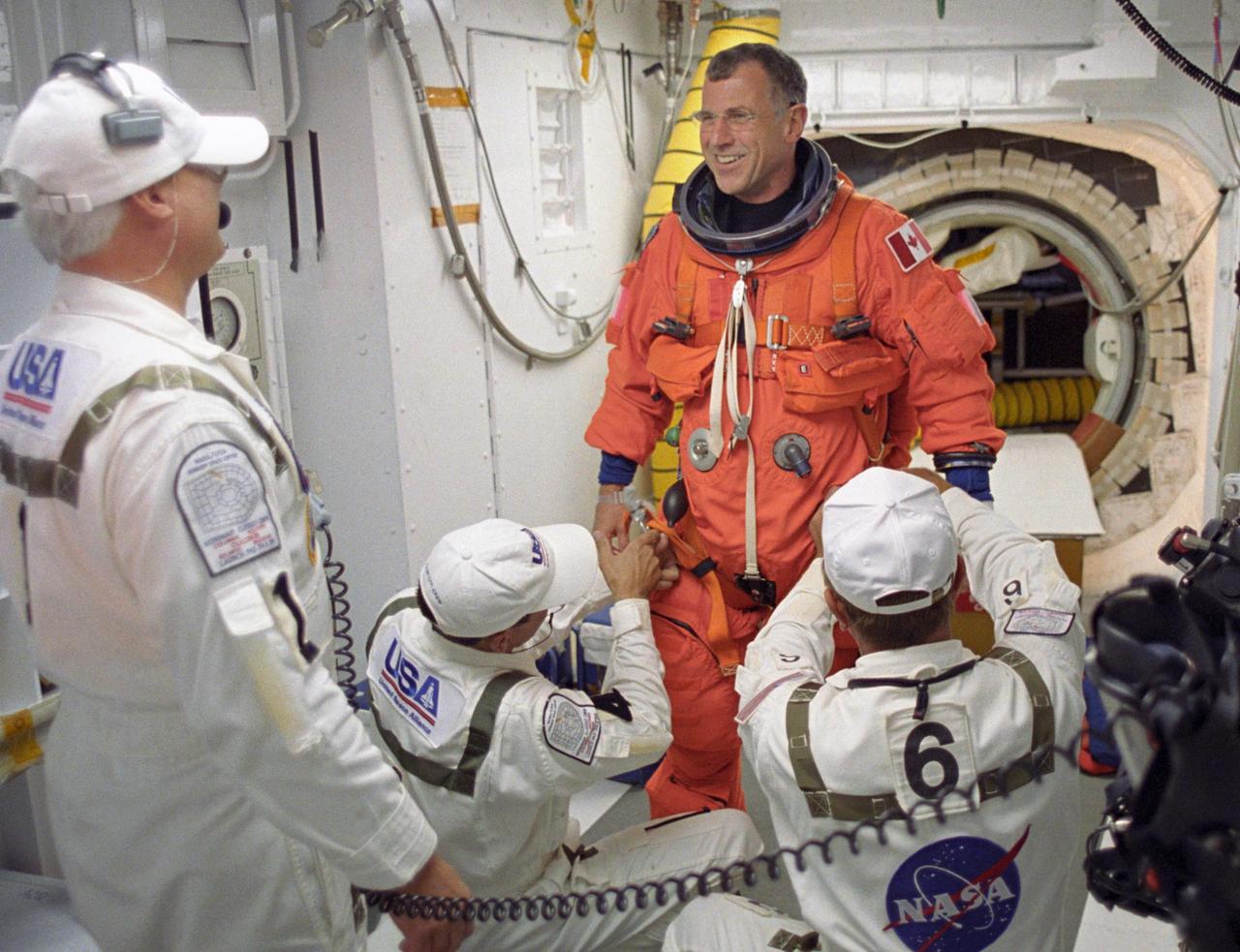
KENNEDY SPACE CENTER, FLA. -- In the White Room on Launch Pad 39A, STS-118 Mission Specialist Dave Williams is helped with his launch gear by the closeout crew before he enters Space Shuttle Endeavour. Williams represents the Canadian Space Agency. The outer end of the orbiter access arm ends in an environmental chamber (the White Room) that mates with the orbiter and allows personnel to enter the crew compartment. With assistance, each member of the flight crew dons a parachute pack before crawling through the open hatch into the shuttle. The closeout crew also straps the astronauts into the space shuttle's crew module and takes care of any other last-minute needs that arise. Space Shuttle Endeavour's STS-118 mission is the 22nd shuttle flight to the International Space Station. It will continue space station construction by delivering a third starboard truss segment, S5, and other payloads such as the SPACEHAB module and the external stowage platform 3. Liftoff of Endeavour is scheduled at 6:36 p.m. EDT. Photo credit: NASA/John Kechele, Scott Haun, Tom Farrar
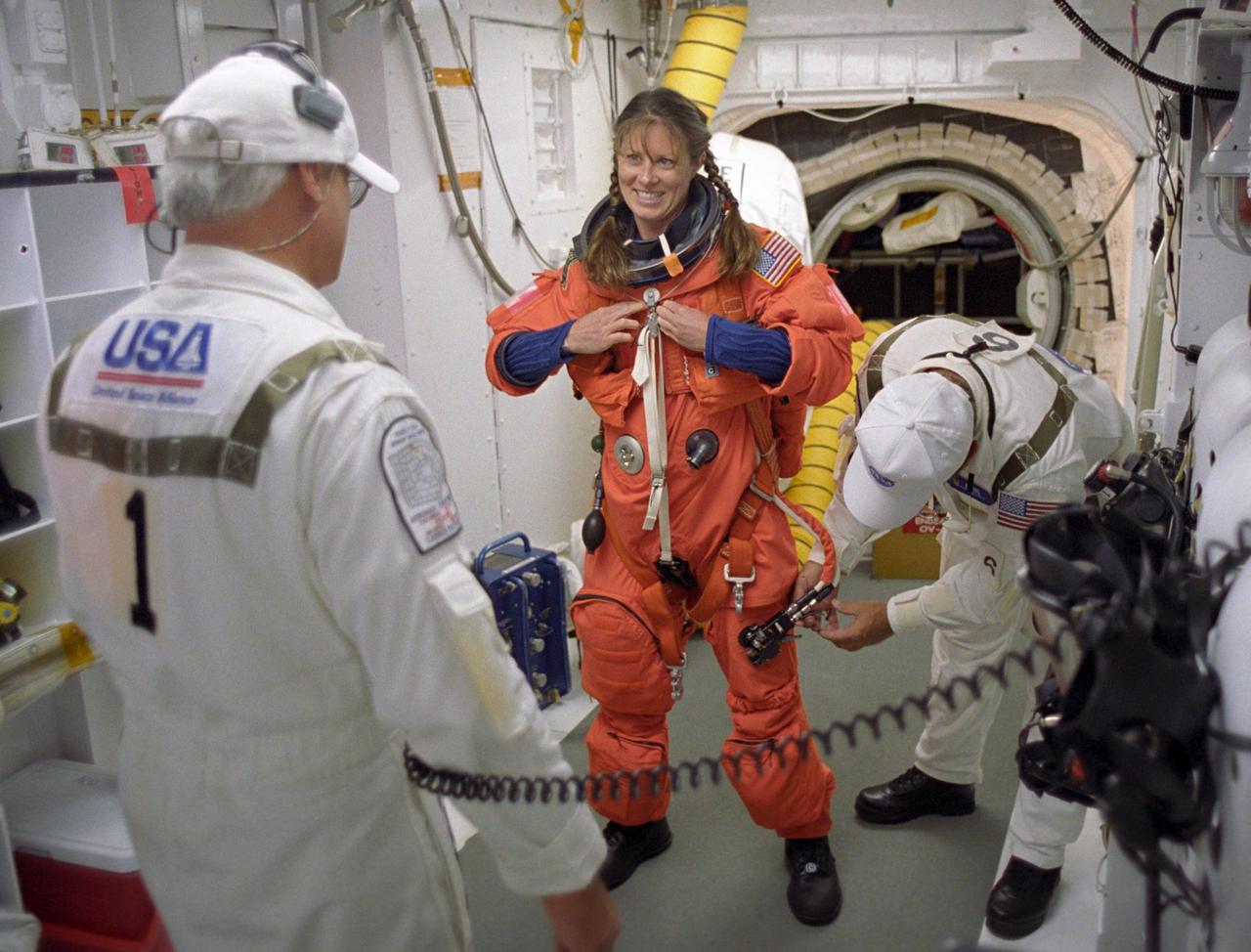
KENNEDY SPACE CENTER, FLA. -- In the White Room on Launch Pad 39A, STS-118 Mission Specialist Tracy Caldwell, with the help of the closeout crew, goes through final preparation of her launch and entry suit before she enters Space Shuttle Endeavour. The outer end of the orbiter access arm ends in an environmental chamber (the White Room) that mates with the orbiter and allows personnel to enter the crew compartment. With assistance, each member of the flight crew dons a parachute pack before crawling through the open hatch into the shuttle. The closeout crew also straps the astronauts into the space shuttle's crew module and takes care of any other last-minute needs that arise. Space Shuttle Endeavour's STS-118 mission is the 22nd shuttle flight to the International Space Station. It will continue space station construction by delivering a third starboard truss segment, S5, and other payloads such as the SPACEHAB module and the external stowage platform 3. Liftoff of Endeavour is scheduled at 6:36 p.m. EDT. Photo credit: NASA/John Kechele, Scott Haun, Tom Farrar
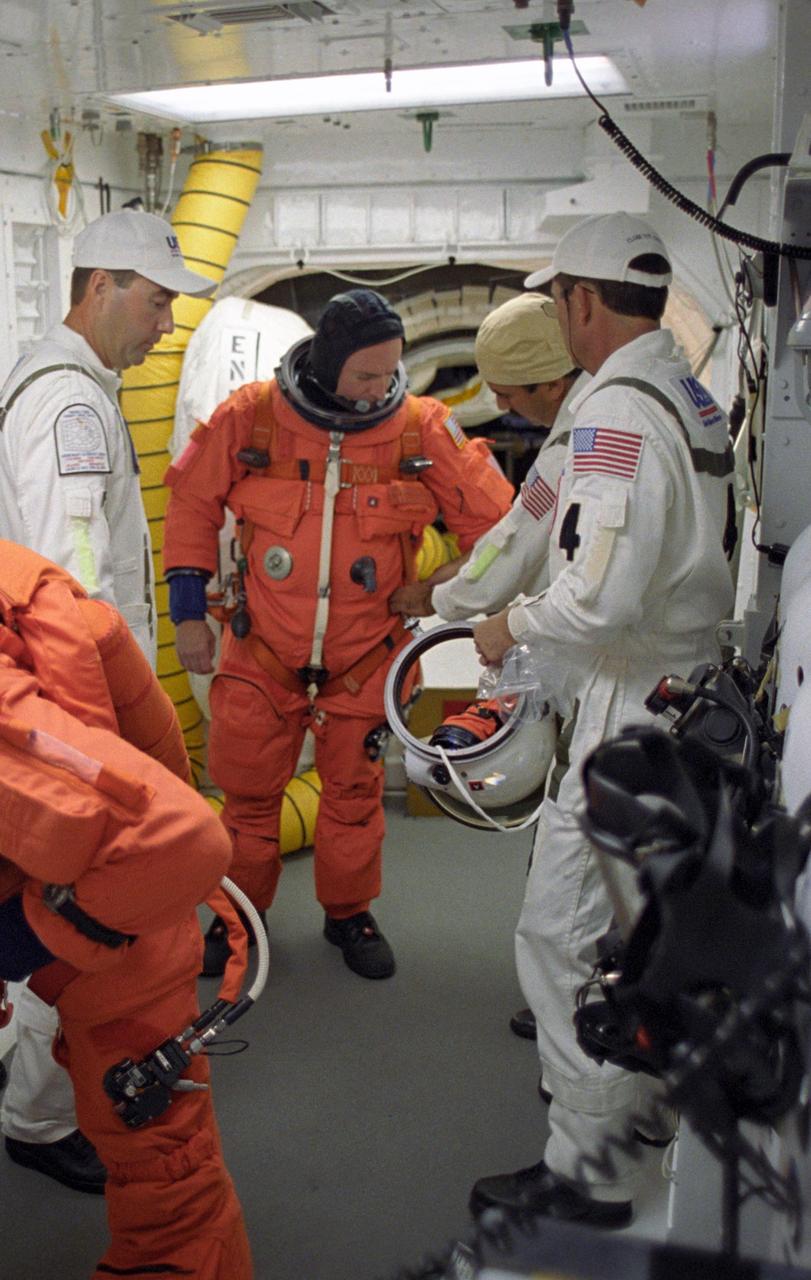
KENNEDY SPACE CENTER, FLA. -- In the White Room on Launch Pad 39A, STS-118 Commander Scott Kelly is helped with his launch gear by the closeout crew before he enters Space Shuttle Endeavour. The outer end of the orbiter access arm ends in an environmental chamber (the White Room) that mates with the orbiter and allows personnel to enter the crew compartment. With assistance, each member of the flight crew dons a parachute pack before crawling through the open hatch into the shuttle. The closeout crew also straps the astronauts into the space shuttle's crew module and takes care of any other last-minute needs that arise. Space Shuttle Endeavour's STS-118 mission is the 22nd shuttle flight to the International Space Station. It will continue space station construction by delivering a third starboard truss segment, S5, and other payloads such as the SPACEHAB module and the external stowage platform 3. Liftoff of Endeavour is scheduled at 6:36 p.m. EDT. Photo credit: NASA/John Kechele, Scott Haun, Tom Farrar
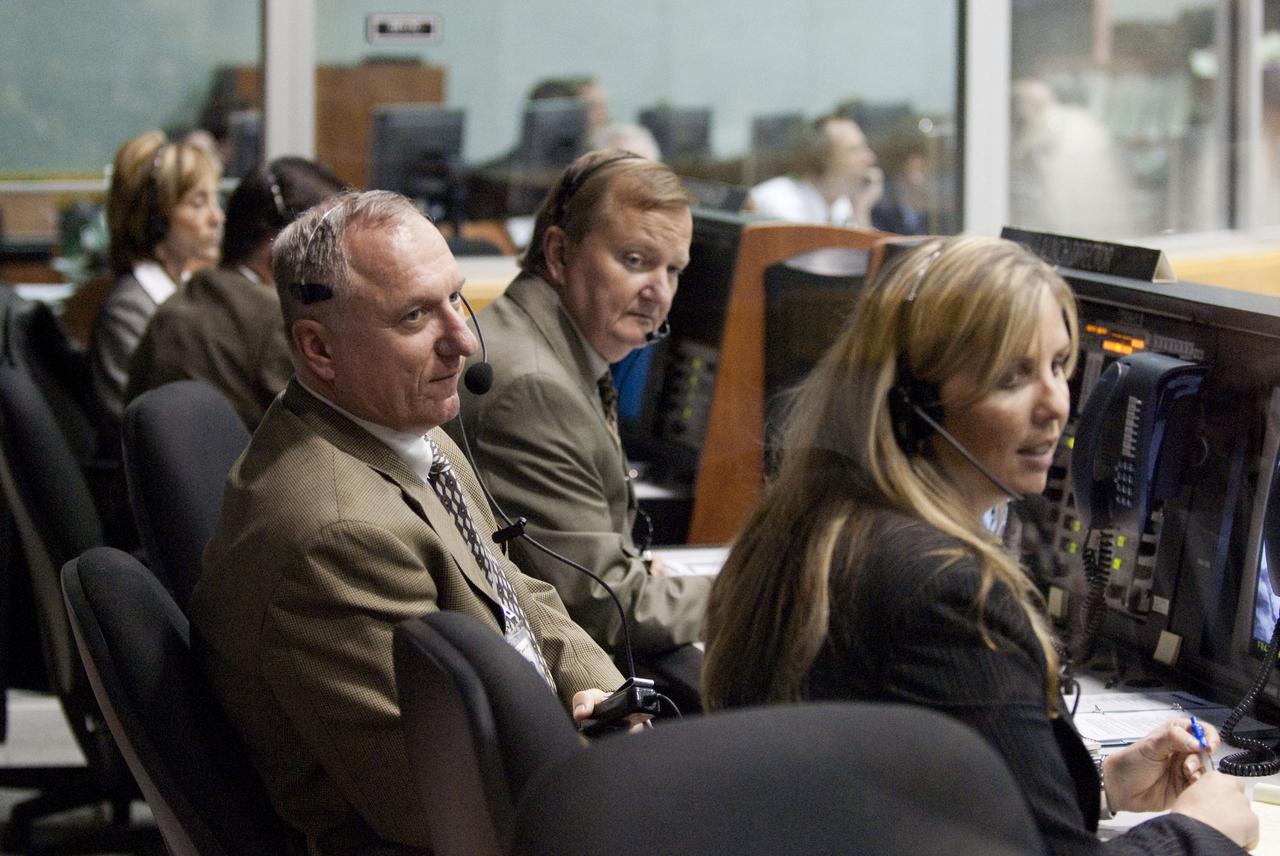
STS130-S-022 (8 Feb. 2010) --- In Firing Room 4 in the Launch Control Center at NASA's Kennedy Space Center in Florida, from top, Mike Leinbach, shuttle launch director; Pete Nickolenko, assistant launch director; and Dana Hutcherson, flow director for space shuttle Endeavour, manage the countdown to liftoff of Endeavour. Launch of Endeavour on the STS-130 mission to the International Space Station was at 4:14 a.m. (EST) on Feb. 8, 2010. This was the second launch attempt for Endeavour's STS-130 crew and the final scheduled space shuttle night launch. The first attempt on Feb. 7 was scrubbed due to unfavorable weather. The primary payload for the STS-130 mission to the International Space Station is the Tranquility node, a pressurized module that will provide additional room for crew members and many of the station's life support and environmental control systems. Attached to one end of Tranquility is the Cupola, a unique work area with six windows on its sides and one on top. The Cupola resembles a circular bay window and will provide a vastly improved view of the station's exterior. The multi-directional view will allow the crew to monitor spacewalks and docking operations, as well as provide a spectacular view of Earth and other celestial objects. The module was built in Turin, Italy, by Thales Alenia Space for the European Space Agency.
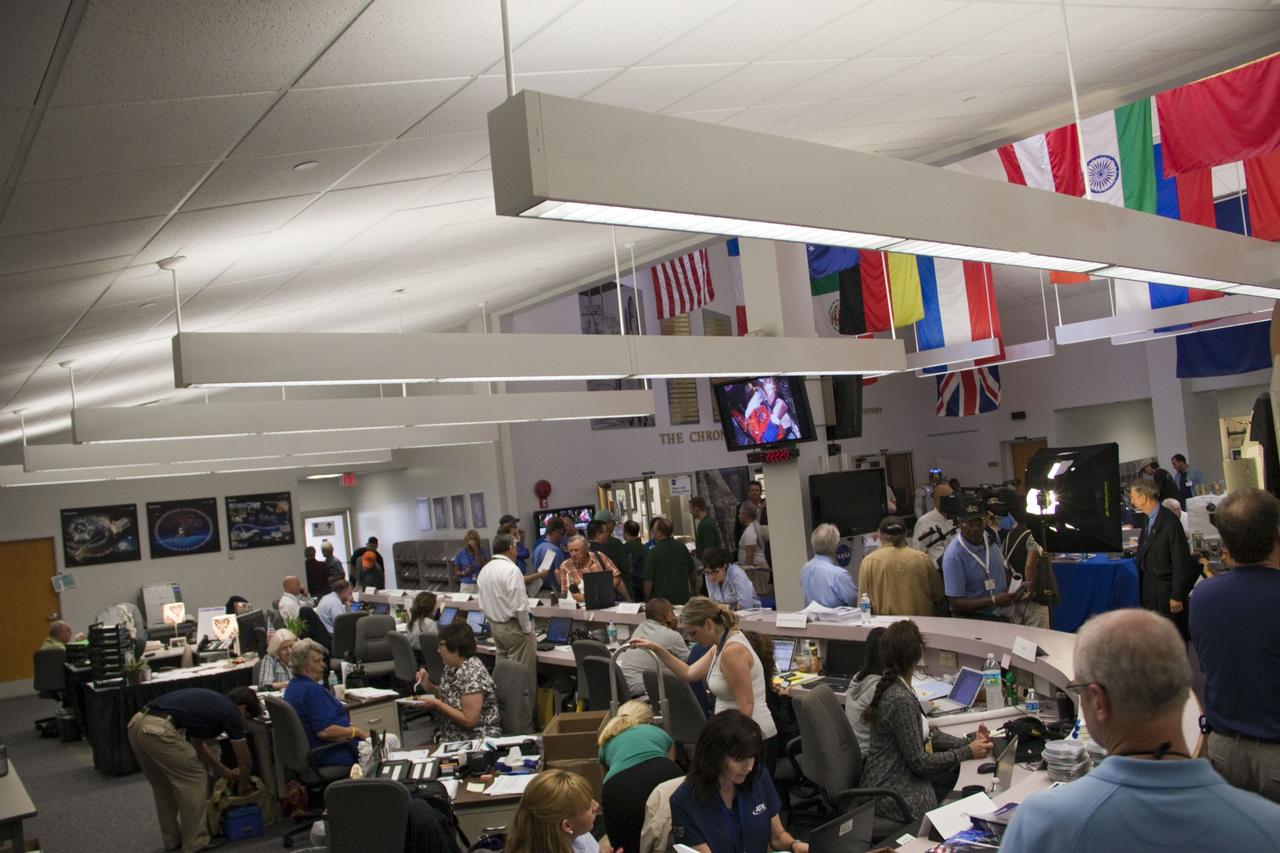
CAPE CANAVERAL, Fla. -- Media from around the globe gather at the NASA News Center at NASA Kennedy Space Center's Press Site in Florida to cover the prelaunch activities and lift off of space shuttle Atlantis on its STS-135 mission to the International Space Station. Volunteers can be seen at their desks answering questions and providing assistance. Atlantis began its final flight, with Commander Chris Ferguson, Pilot Doug Hurley and Mission Specialists Sandy Magnus and Rex Walheim on board, at 11:29 a.m. EDT July 8 to deliver the Raffaello multi-purpose logistics module packed with supplies and spare parts to the station. Also in Atlantis' payload bay is the Robotic Refueling Mission experiment that will investigate the potential for robotically refueling existing satellites in orbit. In addition, Atlantis will return with a failed ammonia pump module to help NASA better understand the failure mechanism and improve pump designs for future systems. STS-135 is the 33rd flight of Atlantis, the 37th shuttle mission to the space station, and the 135th and final mission of NASA's Space Shuttle Program. For more information, visit www.nasa.gov/mission_pages/shuttle/shuttlemissions/sts135/index.html. Photo credit: NASA/Jim Grossmann
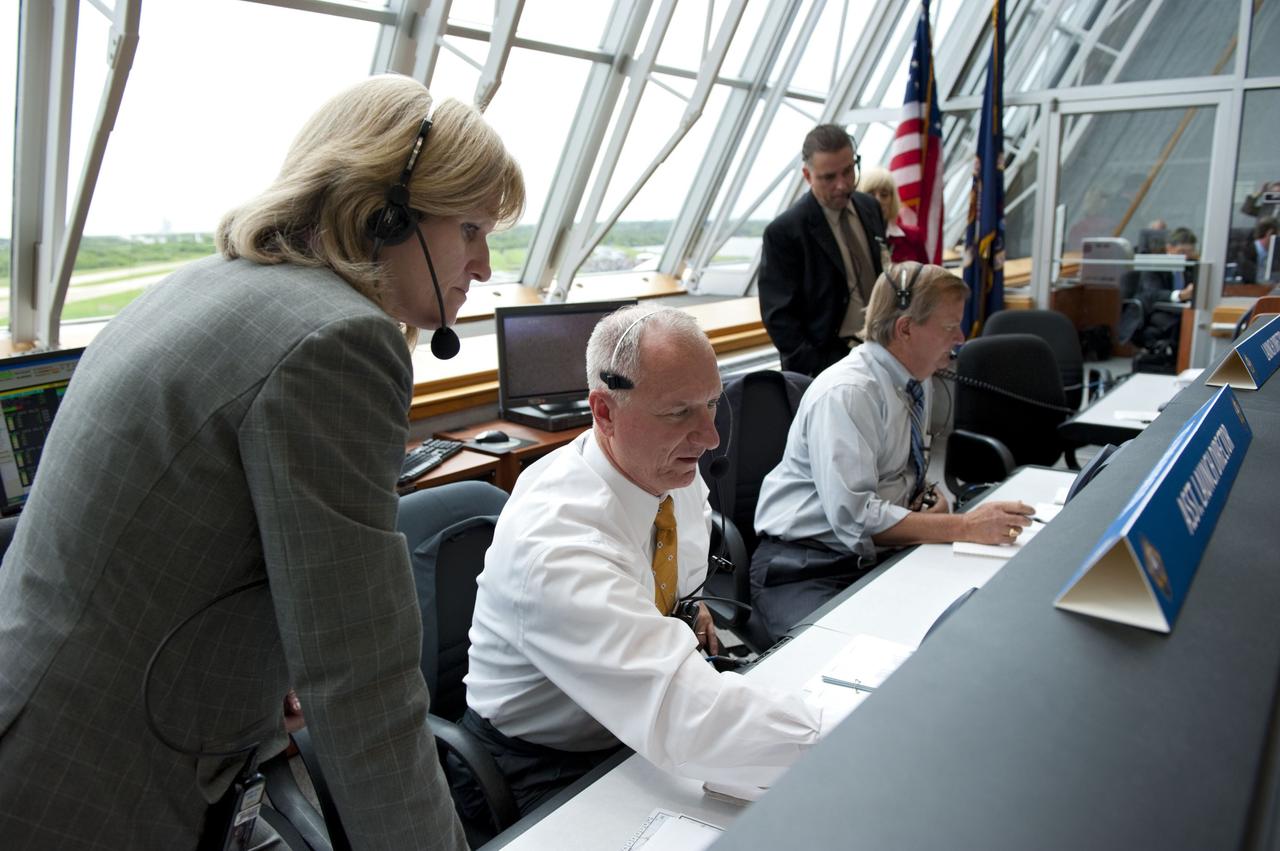
CAPE CANAVERAL, Fla. -- In Firing Room 4 of the Launch Control Center at NASA's Kennedy Space Center in Florida, launch team members monitor the countdown to the launch of space shuttle Atlantis on its STS-135 mission to the International Space Station. Seen here are Atlantis NASA Flow Director Angie Brewer, Assistant Launch Director Pete Nickolenko, Shuttle Launch Director Mike Leinbach and Payloads Launch Manager and Deputy Director of ISS and Spacecraft Processing at Kennedy, Bill Dowdell. Atlantis with its crew of four; Commander Chris Ferguson, Pilot Doug Hurley, Mission Specialists Sandy Magnus and Rex Walheim, lifted off at 11:29 a.m. EDT on July 8, 2011 to deliver the Raffaello multi-purpose logistics module packed with supplies and spare parts for the station. Atlantis also will fly the Robotic Refueling Mission experiment that will investigate the potential for robotically refueling existing satellites in orbit. In addition, Atlantis will return with a failed ammonia pump module to help NASA better understand the failure mechanism and improve pump designs for future systems. STS-135 will be the 33rd flight of Atlantis, the 37th shuttle mission to the space station, and the 135th and final mission of NASA's Space Shuttle Program. For more information, visit www.nasa.gov/mission_pages/shuttle/shuttlemissions/sts135/index.html. Photo credit: NASA/Kim Shiflett
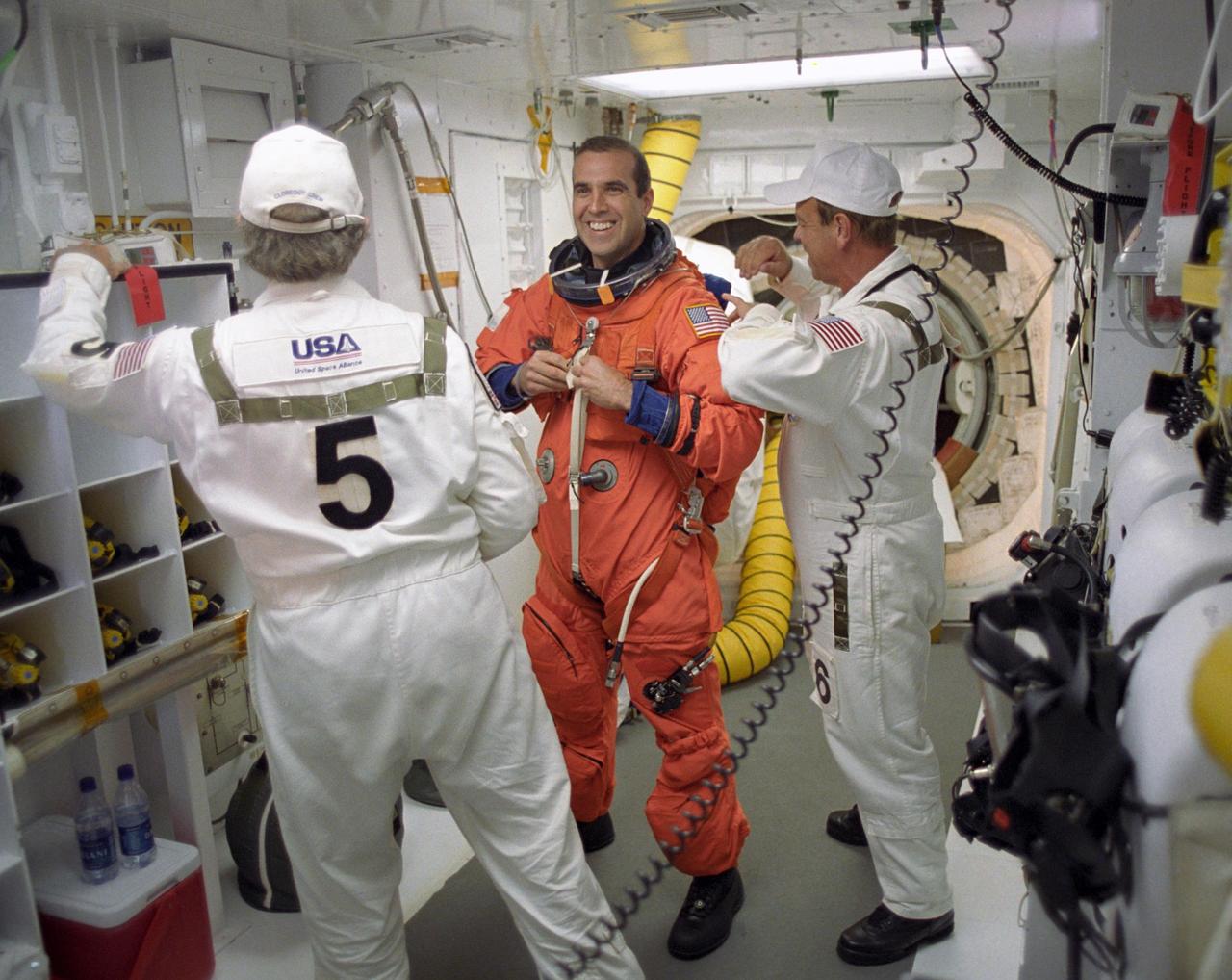
KENNEDY SPACE CENTER, FLA. -- In the White Room on Launch Pad 39A, STS-118 Mission Specialist Rick Mastracchio is helped with his launch gear by the closeout crew before he enters Space Shuttle Endeavour. The outer end of the orbiter access arm ends in an environmental chamber (the White Room) that mates with the orbiter and allows personnel to enter the crew compartment. With assistance, each member of the flight crew dons a parachute pack before crawling through the open hatch into the shuttle. The closeout crew also straps the astronauts into the space shuttle's crew module and takes care of any other last-minute needs that arise. Space Shuttle Endeavour's STS-118 mission is the 22nd shuttle flight to the International Space Station. It will continue space station construction by delivering a third starboard truss segment, S5, and other payloads such as the SPACEHAB module and the external stowage platform 3. Liftoff of Endeavour is scheduled at 6:36 p.m. EDT. Photo credit: NASA/John Kechele, Scott Haun, Tom Farrar
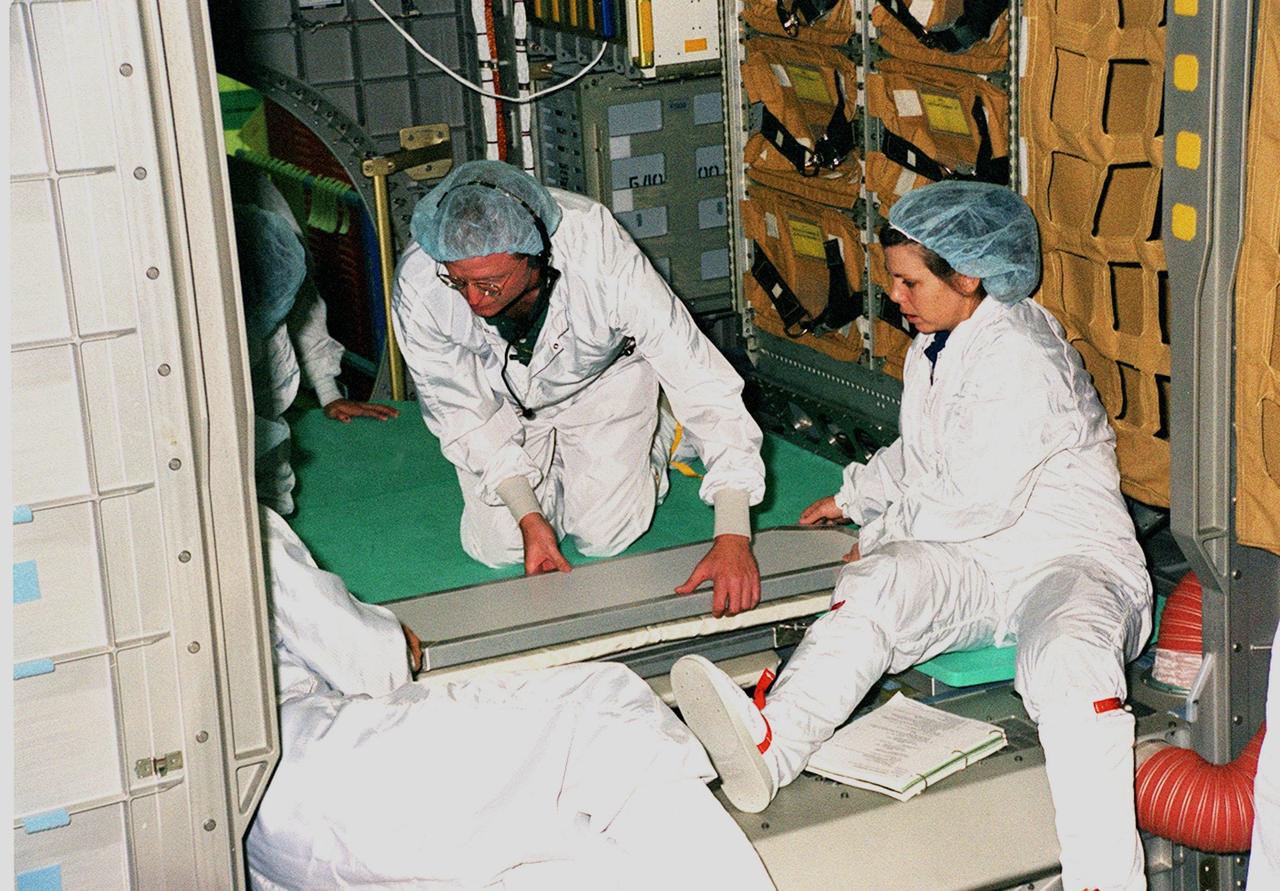
KENNEDY SPACE CENTER, FLA. -- During a Crew Equipment Interface Test (CEIT) at SPACEHAB, in Titusville, Fla., STS-101 crew members check out the SPACEHAB Logistics Double Module that will be part of the payload for their mission. At right is Mission Specialist Mary Ellen Weber (Ph.D.), who is assisted by a SPACEHAB worker. Other crew members taking part in the CEIT are Commander James Donald Halsell Jr., Pilot Scott J. "Doc" Horowitz (Ph.D.), and Mission Specialists Edward Tsang Lu (Ph.D.), Jeffrey N. Williams, and Yuri Malenchenko and Boris W. Morukov, who are with the Russian Space Agency. The primary objective of the STS-101 mission is to complete the initial outfitting of the International Space Station, making it fully ready for the first long-term crew. The seven-member crew will transfer almost two tons of equipment and supplies from SPACEHAB. Additionally, they will unpack a shipment of supplies delivered earlier by a Russian Progress space tug and begin outfitting the newly arrived Zvezda Service Module. Three astronauts will perform two space walks to transfer and install parts of the Russian Strela cargo boom that are attached to SPACEHAB's Integrated Cargo Container, connect utility cables between Zarya and Zvezda, and install a magnetometer/pole assembly on the Service Module. Additional activities for the STS-101 astronauts include working with the Space Experiment Module (SEM-06) and the Mission to America's Remarkable Schools (MARS), two educational initiatives. STS-101 is scheduled for launch no earlier than March 16, 2000
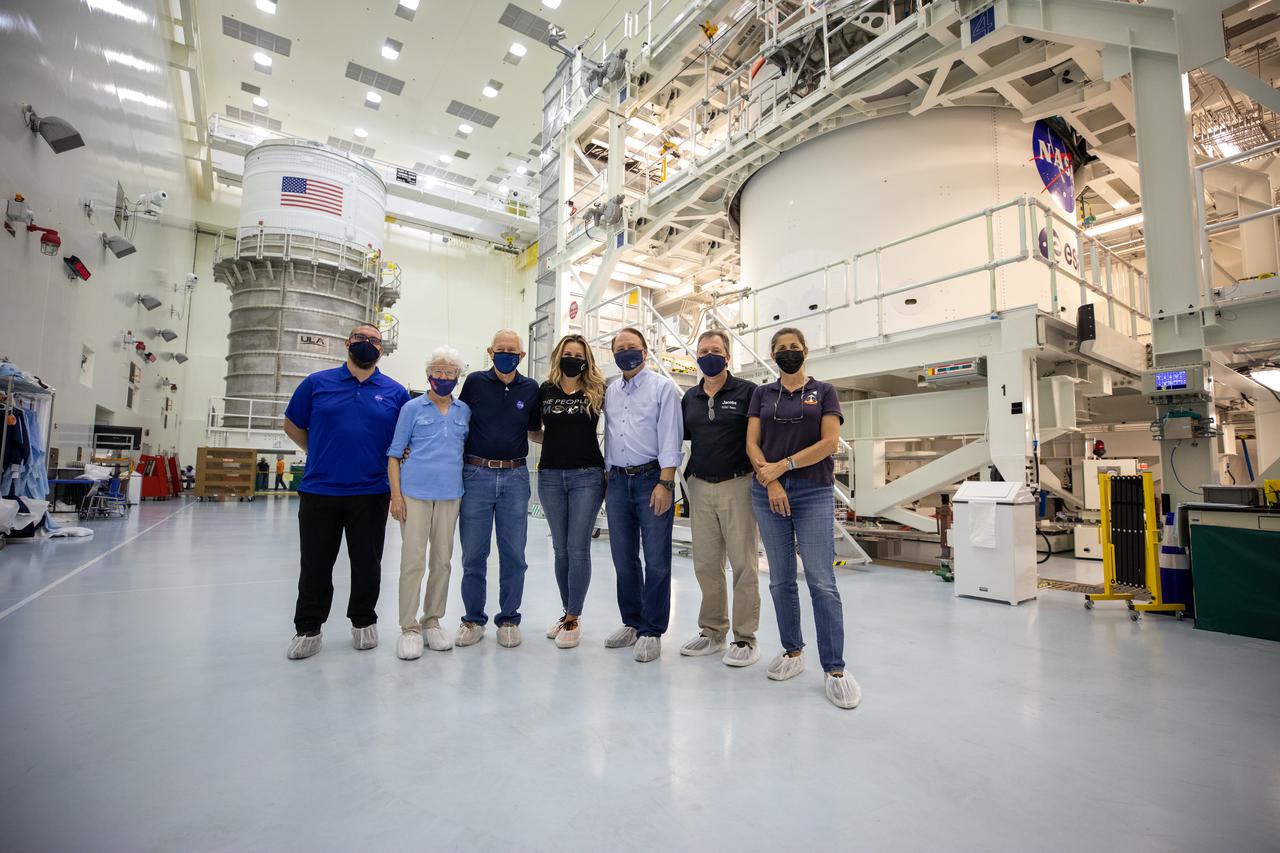
From left to right, Adam Leppek, ARES Corporation (KLXSIII), Deputy Element Operations Manager; Dottie Duke, wife of Charlie Duke; Charlie Duke, NASA Astronaut (former); Christina Korp, Assistant to Charlie Duke; Jim Keys, Pilot; Nick Kindred, Jacobs Technology, Flow Manager; and Nicole Stott, NASA Astronaut (former), shown in the Multi-Payload Processing Facility (MPPF) at NASA's Kennedy Space Center in Florida on May 10, 2021. In the background, on the left, is the Interim Cryogenic Propulsion Stage for the Space Launch System (SLS) rocket. On the right, the NASA “meatball” insignia and ESA (European Space Agency) logos on the European-built service module are visible. Both pieces of hardware will undergo fueling and servicing in the facility ahead of the Artemis I launch by teams from NASA’s Exploration Ground Systems and their primary contractor, Jacobs Technology. The first in a series of increasingly complex missions, Artemis I will test Orion and the Space Launch System rocket as an integrated system prior to crewed flights to the Moon.
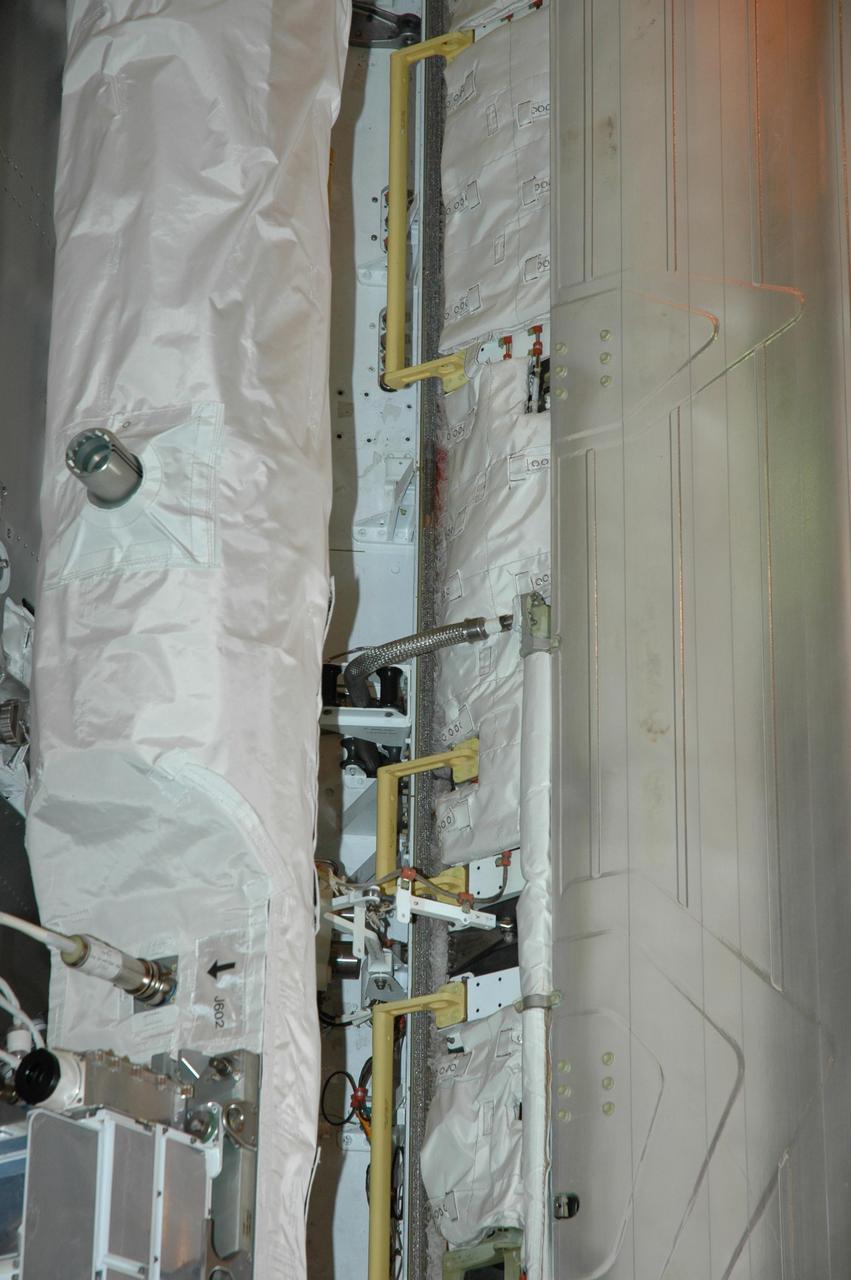
KENNEDY SPACE CENTER, FLA. -- On Launch Pad 39A at NASA's Kennedy Space Center, the payload bay doors are closing on space shuttle Atlantis. During launch preparations, technicians noticed a small section of a braided metal hose that was bent in a shape similar to the Greek letter Omega. The radiator retract hose (seen in the middle), part of the shuttle's cooling system that carries Freon, is designed to flex. Engineers designed a tool to guide the hose back into the storage box. During the starboard door closure, eight incremental stops were performed. After each stop, the aft hose was adjusted and seated in place utilizing the ladder and hose assist tool. The team was satisfied with the final placement of the hose at door closure. STS-122 is the 121st space shuttle flight, the 29th flight for Atlantis and the 24th flight to the International Space Station. The Columbus laboratory module, built by the European Space Agency, is approximately 23 feet long and 15 feet wide, allowing it to hold 10 large racks of experiments. Atlantis is scheduled to launch at 2:45 p.m. Feb. 7. Photo credit: NASA/Jack Pfaller
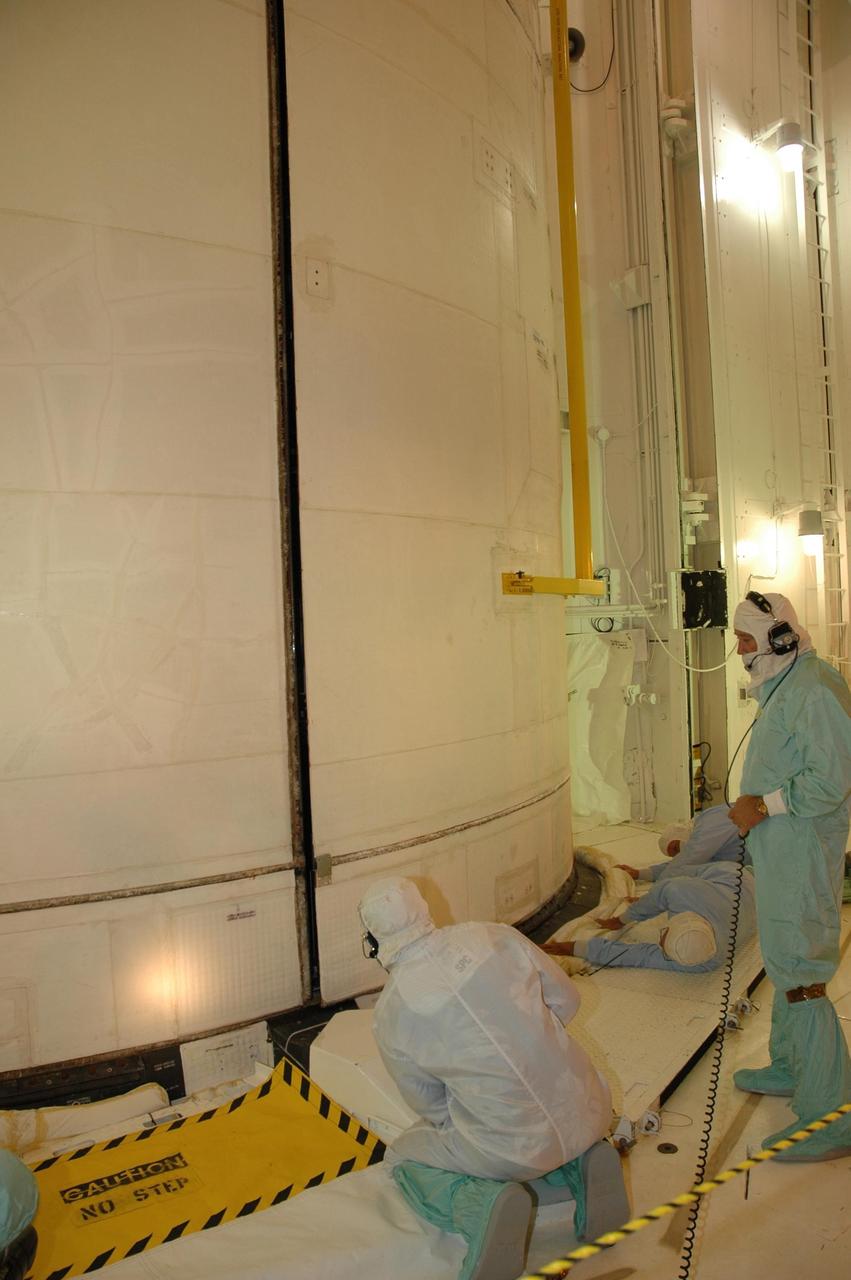
KENNEDY SPACE CENTER, FLA. -- On Launch Pad 39A at NASA's Kennedy Space Center, engineers examine the fit of the payload bay doors on space shuttle Atlantis as they are closing. During launch preparations, technicians noticed a small section of a braided metal hose that was bent in a shape similar to the Greek letter Omega. The radiator retract hose (seen in the middle), part of the shuttle's cooling system that carries Freon, is designed to flex. Engineers designed a tool to guide the hose back into the storage box. During the starboard door closure, eight incremental stops were performed. After each stop, the aft hose was adjusted and seated in place utilizing the ladder and hose assist tool. The team was satisfied with the final placement of the hose at door closure. STS-122 is the 121st space shuttle flight, the 29th flight for Atlantis and the 24th flight to the International Space Station. The Columbus laboratory module, built by the European Space Agency, is approximately 23 feet long and 15 feet wide, allowing it to hold 10 large racks of experiments. Atlantis is scheduled to launch at 2:45 p.m. Feb. 7. Photo credit: NASA/Jack Pfaller
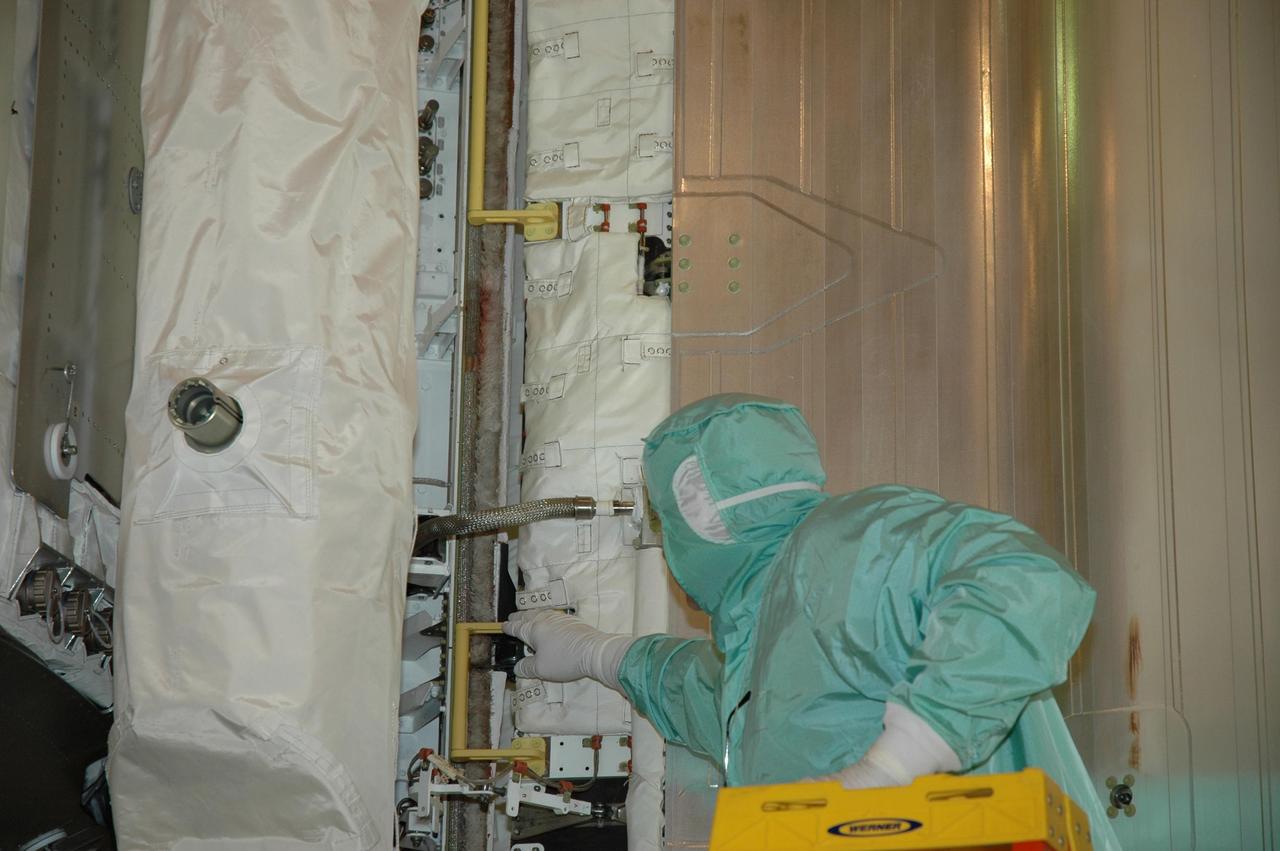
KENNEDY SPACE CENTER, FLA. -- On Launch Pad 39A at NASA's Kennedy Space Center, an engineer checks the progress of payload bay doors closing on space shuttle Atlantis. During launch preparations, technicians noticed a small section of a braided metal hose that was bent in a shape similar to the Greek letter Omega. The radiator retract hose, part of the shuttle's cooling system that carries Freon, is designed to flex. Engineers designed a tool to guide the hose back into the storage box. During the starboard door closure, eight incremental stops were performed. After each stop, the aft hose was adjusted and seated in place utilizing the ladder and hose assist tool. The team was satisfied with the final placement of the hose at door closure. STS-122 is the 121st space shuttle flight, the 29th flight for Atlantis and the 24th flight to the International Space Station. The Columbus laboratory module, built by the European Space Agency, is approximately 23 feet long and 15 feet wide, allowing it to hold 10 large racks of experiments. Atlantis is scheduled to launch at 2:45 p.m. Feb. 7. Photo credit: NASA/Jack Pfaller
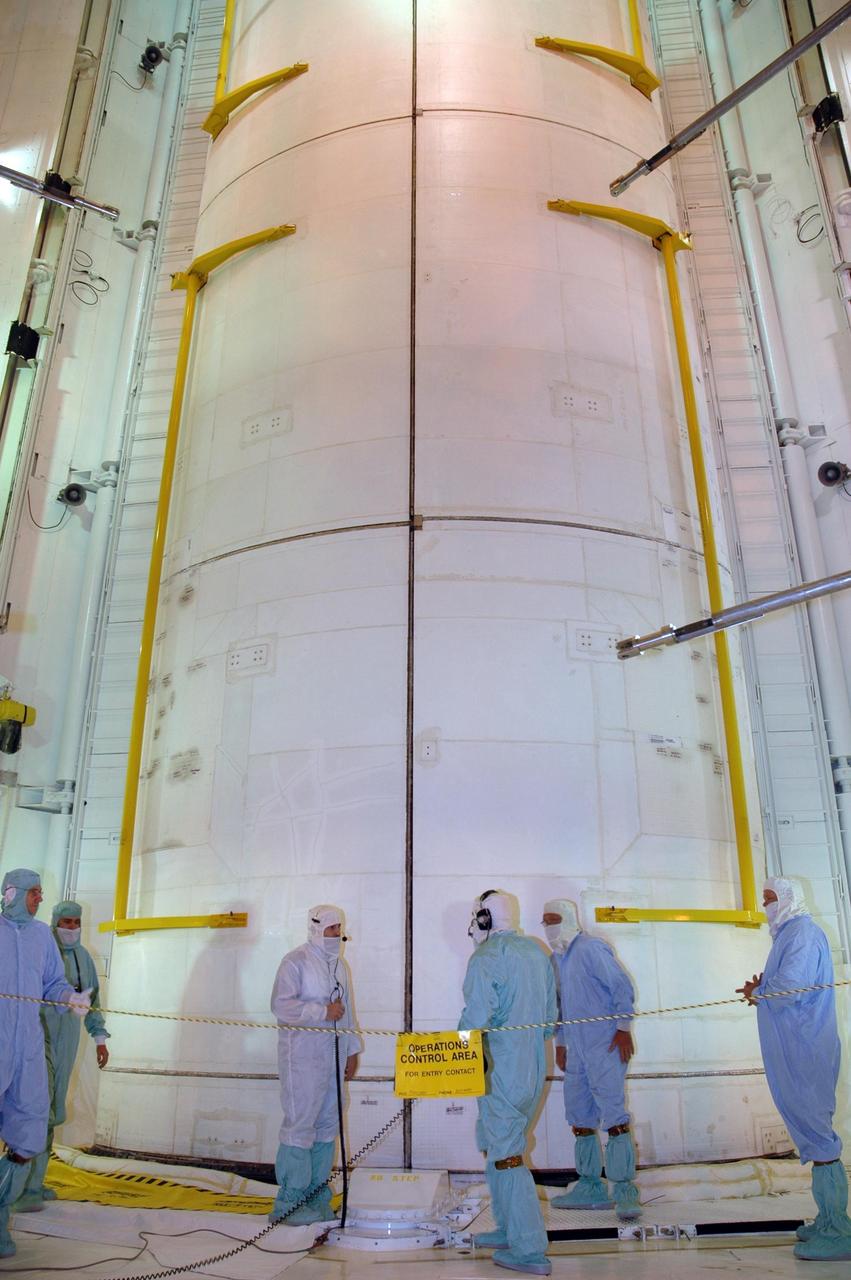
KENNEDY SPACE CENTER, FLA. -- On Launch Pad 39A at NASA's Kennedy Space Center, the payload bay doors on space shuttle Atlantis are successfully closed for launch. During launch preparations, technicians noticed a small section of a braided metal hose that was bent in a shape similar to the Greek letter Omega. The radiator retract hose (seen in the middle), part of the shuttle's cooling system that carries Freon, is designed to flex. Engineers designed a tool to guide the hose back into the storage box. During the starboard door closure, eight incremental stops were performed. After each stop, the aft hose was adjusted and seated in place utilizing the ladder and hose assist tool. The team was satisfied with the final placement of the hose at door closure. STS-122 is the 121st space shuttle flight, the 29th flight for Atlantis and the 24th flight to the International Space Station. The Columbus laboratory module, built by the European Space Agency, is approximately 23 feet long and 15 feet wide, allowing it to hold 10 large racks of experiments. Atlantis is scheduled to launch at 2:45 p.m. Feb. 7. Photo credit: NASA/Jack Pfaller