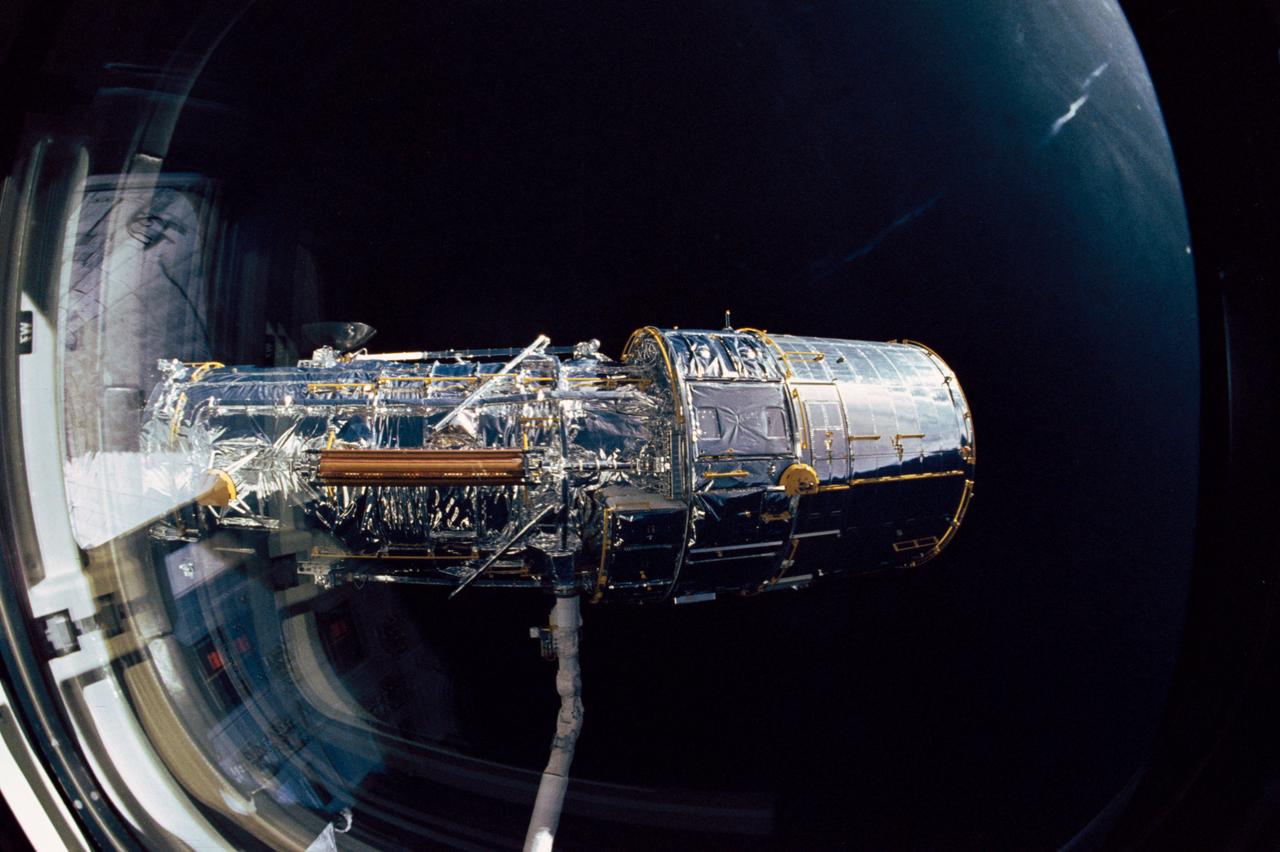
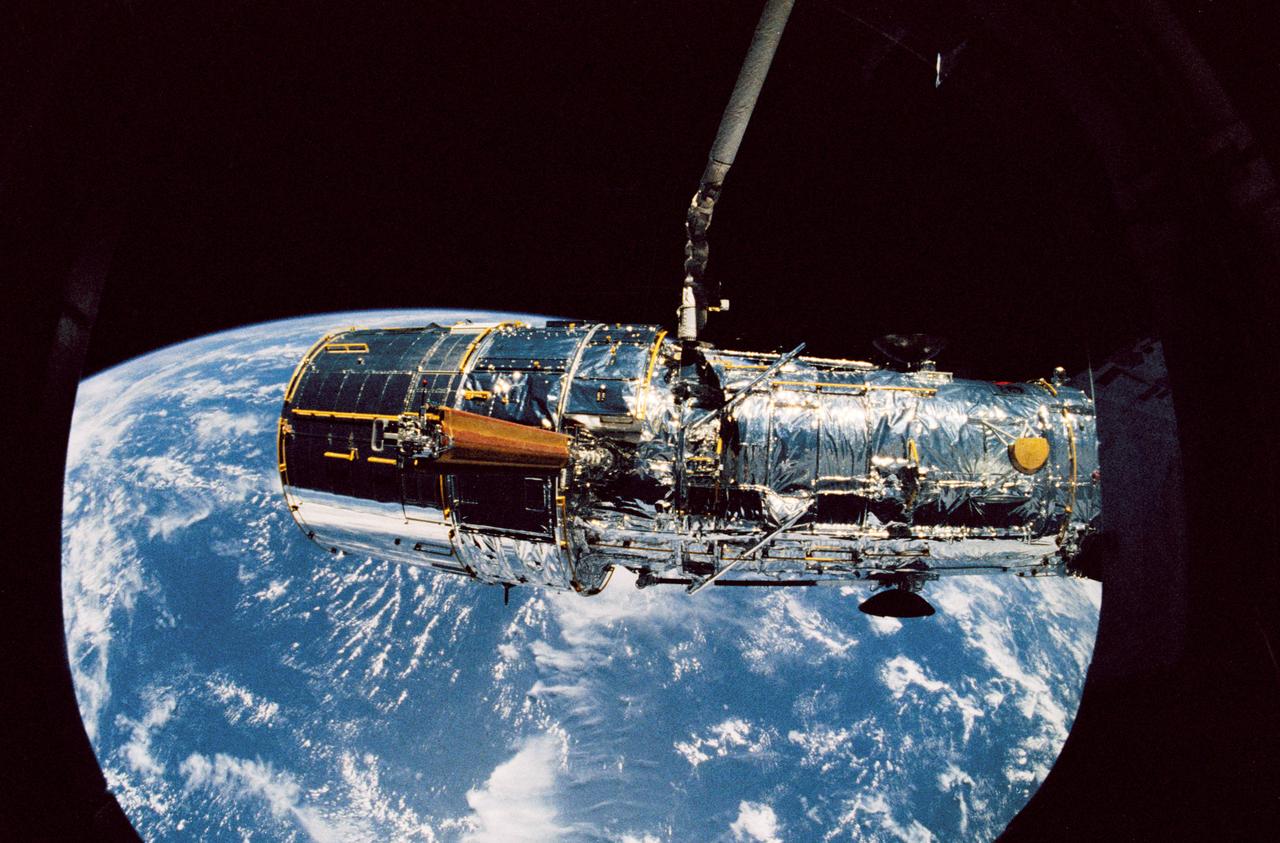
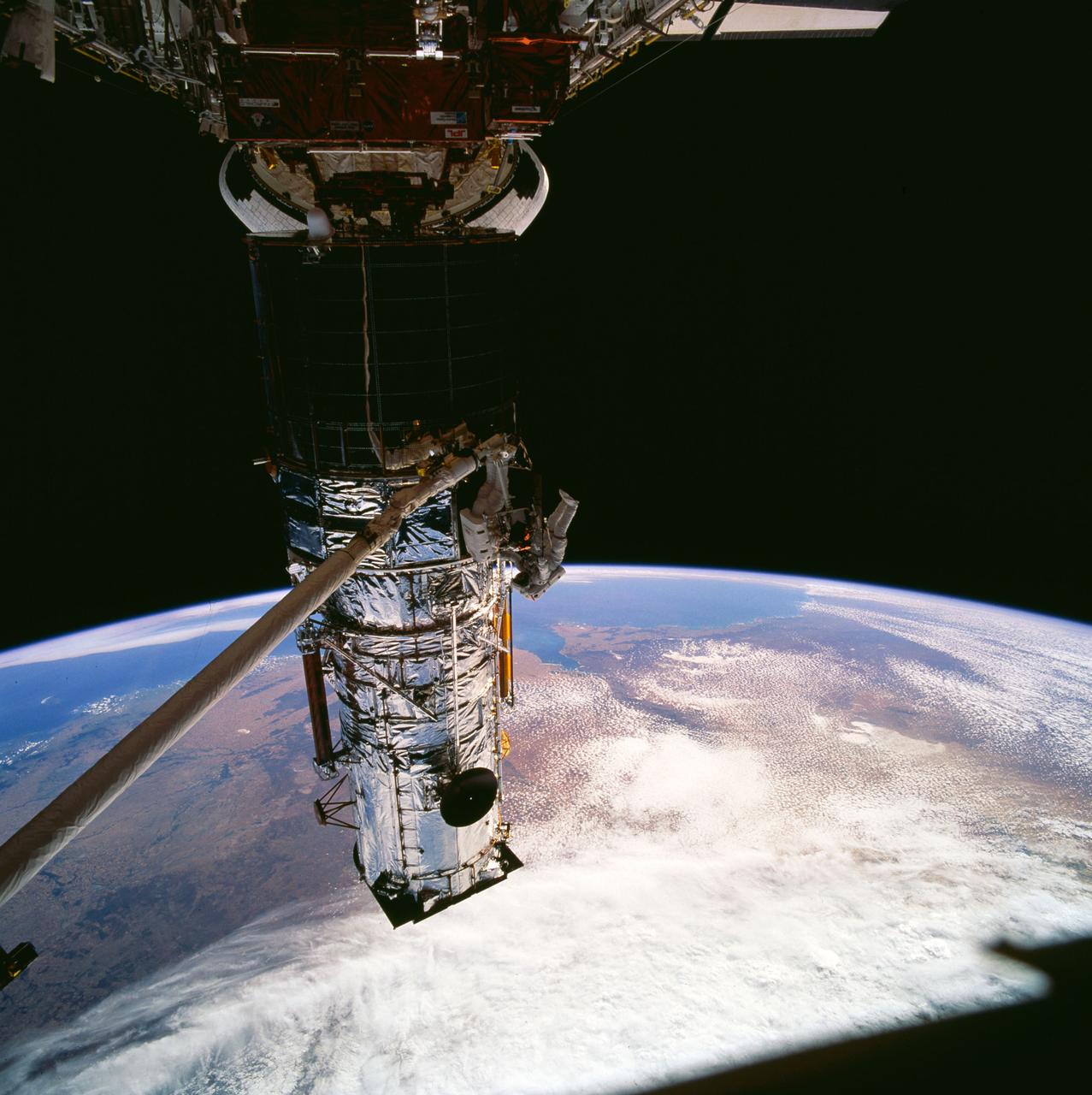
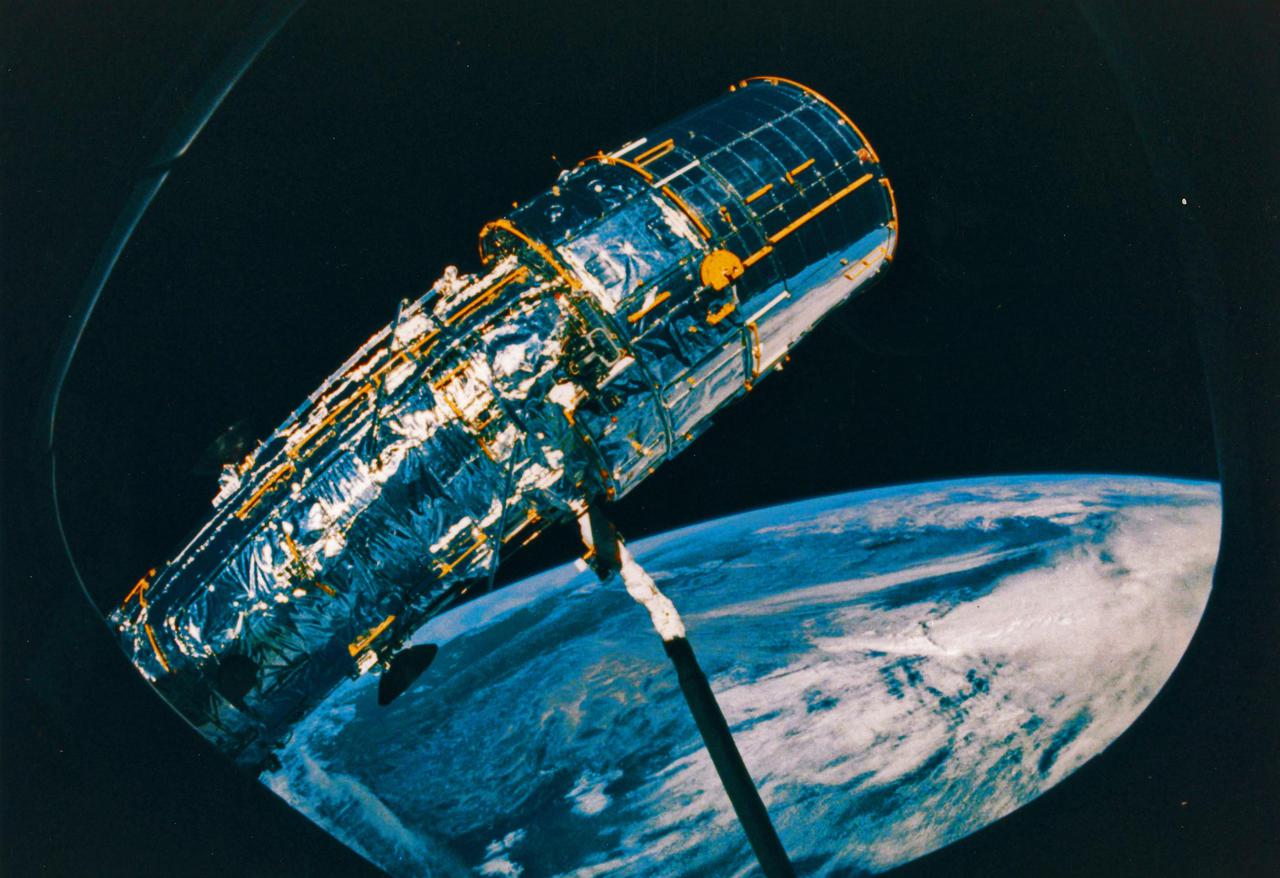
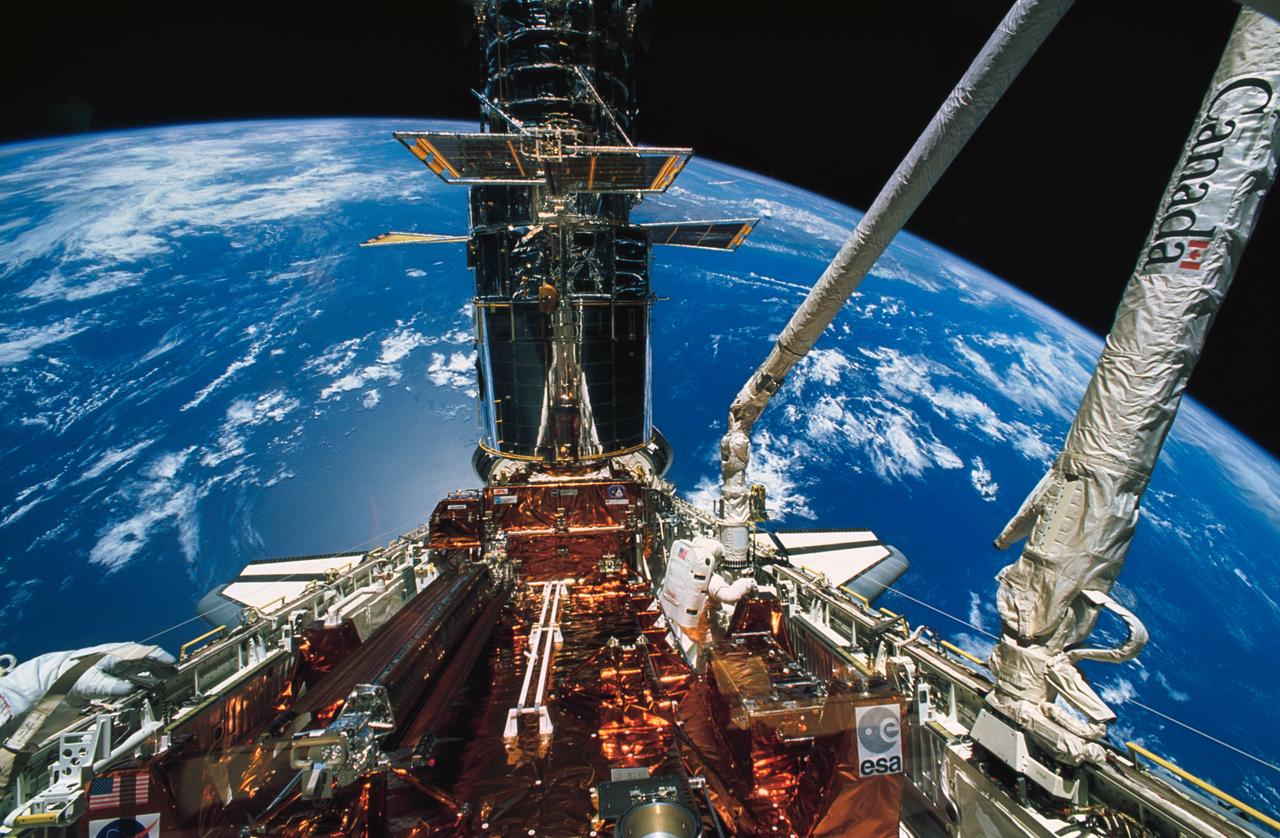
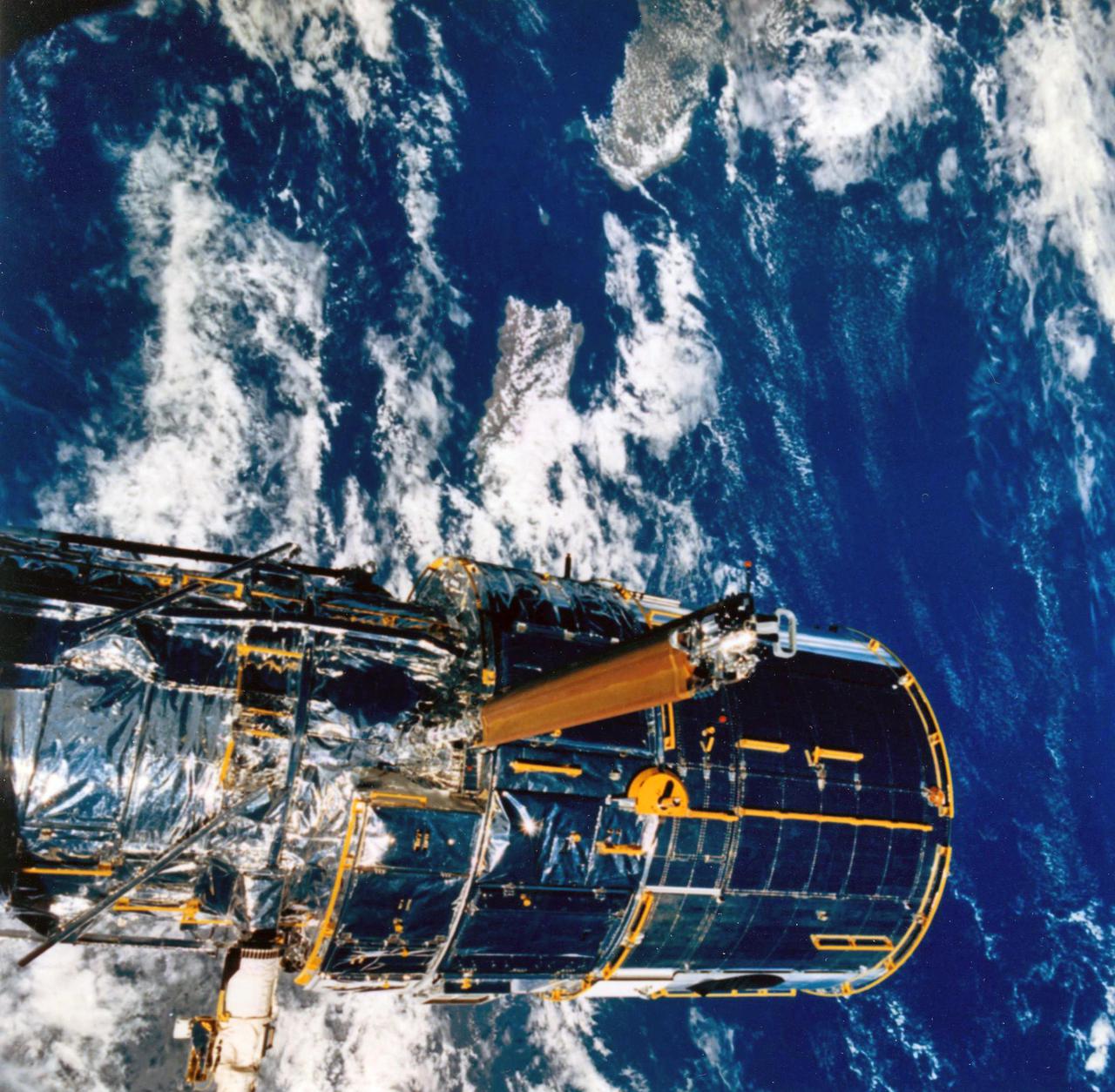
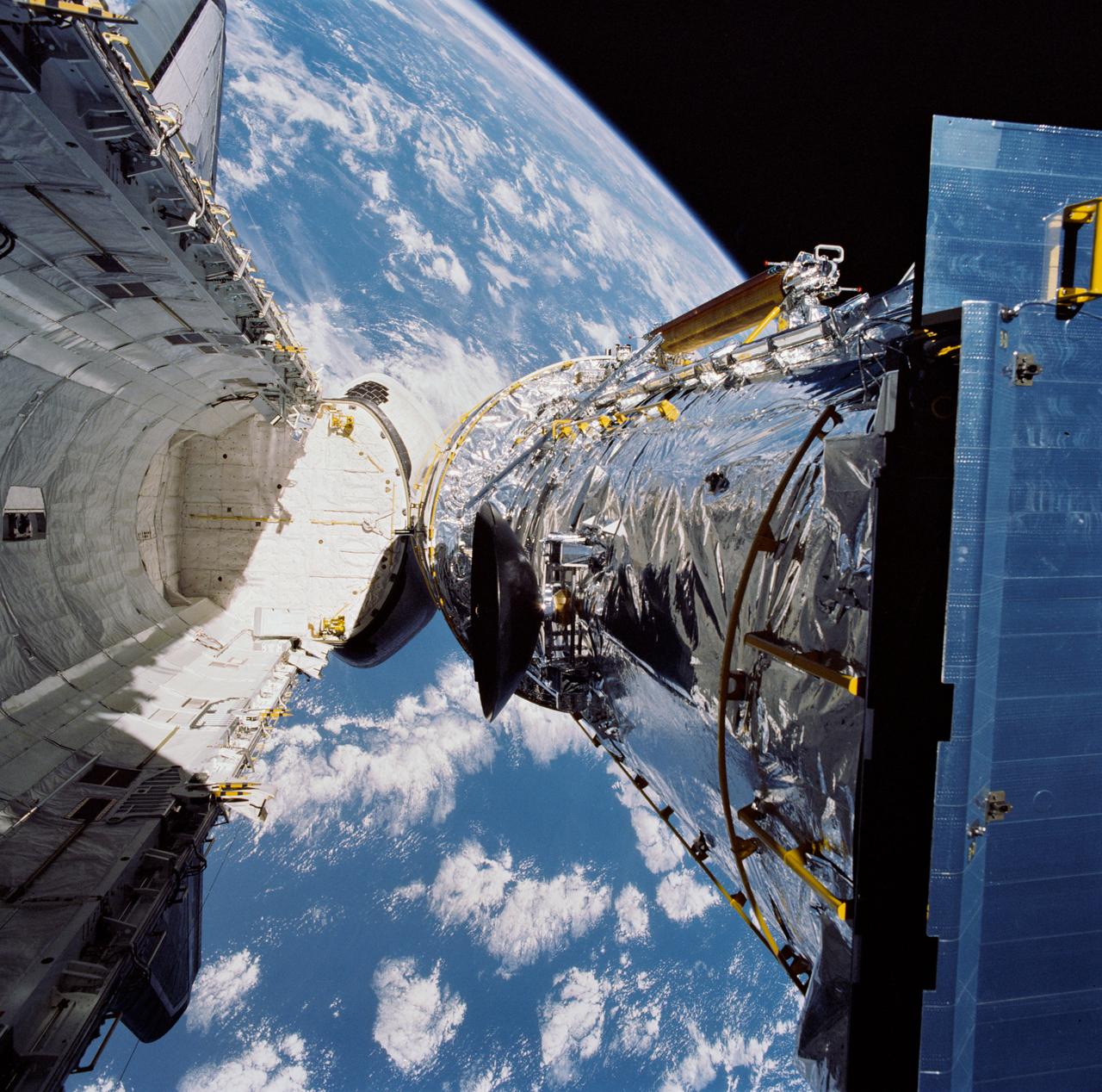
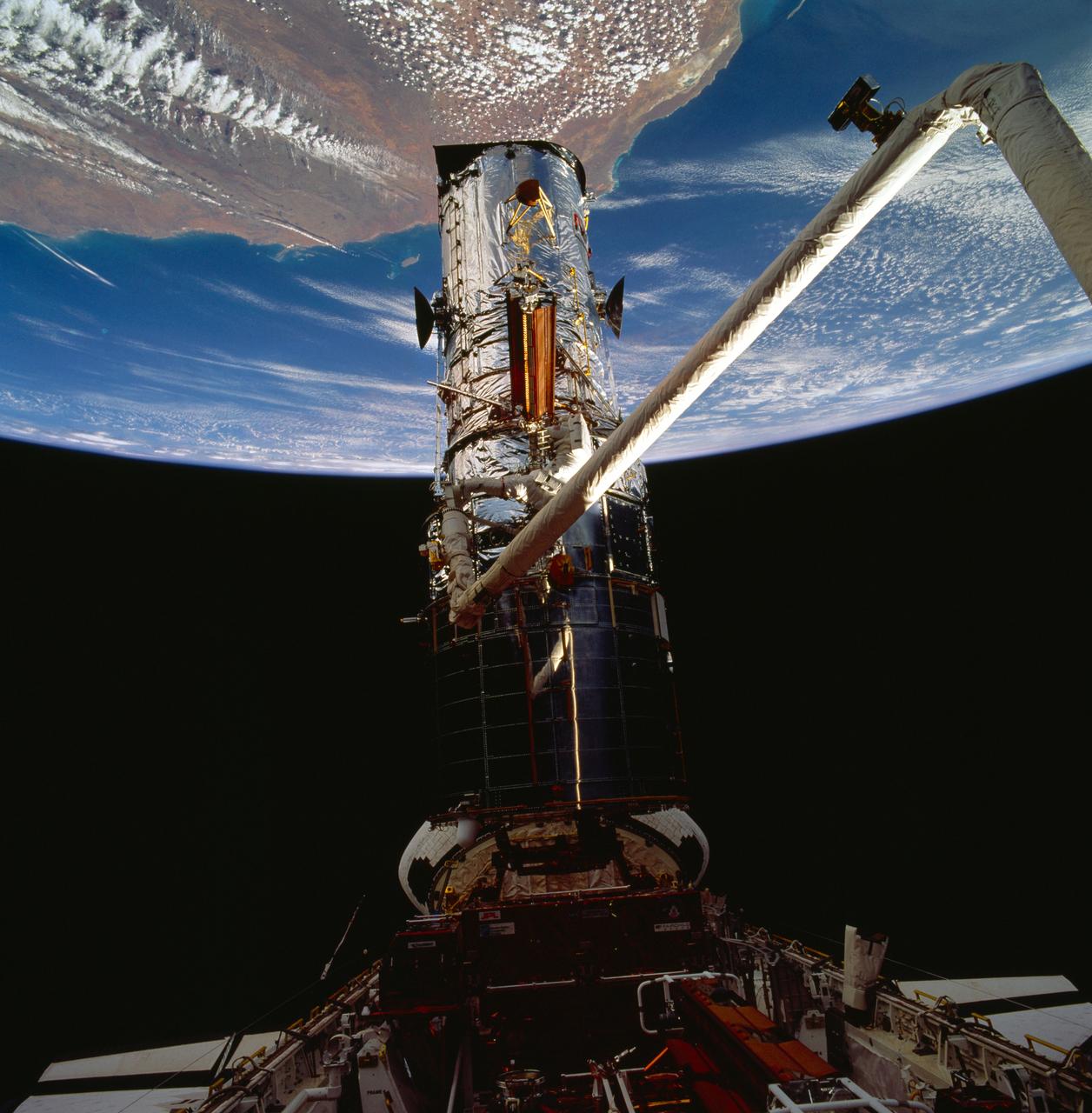
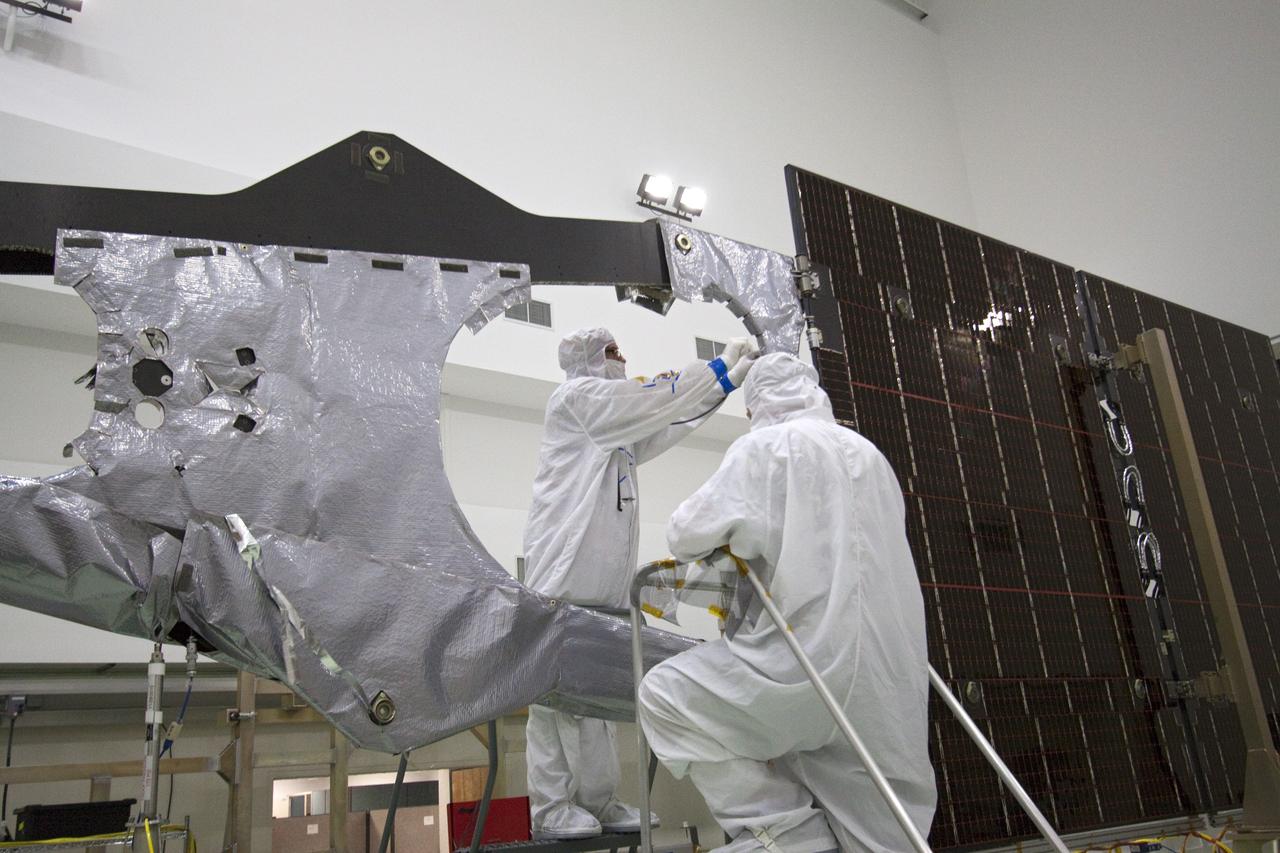
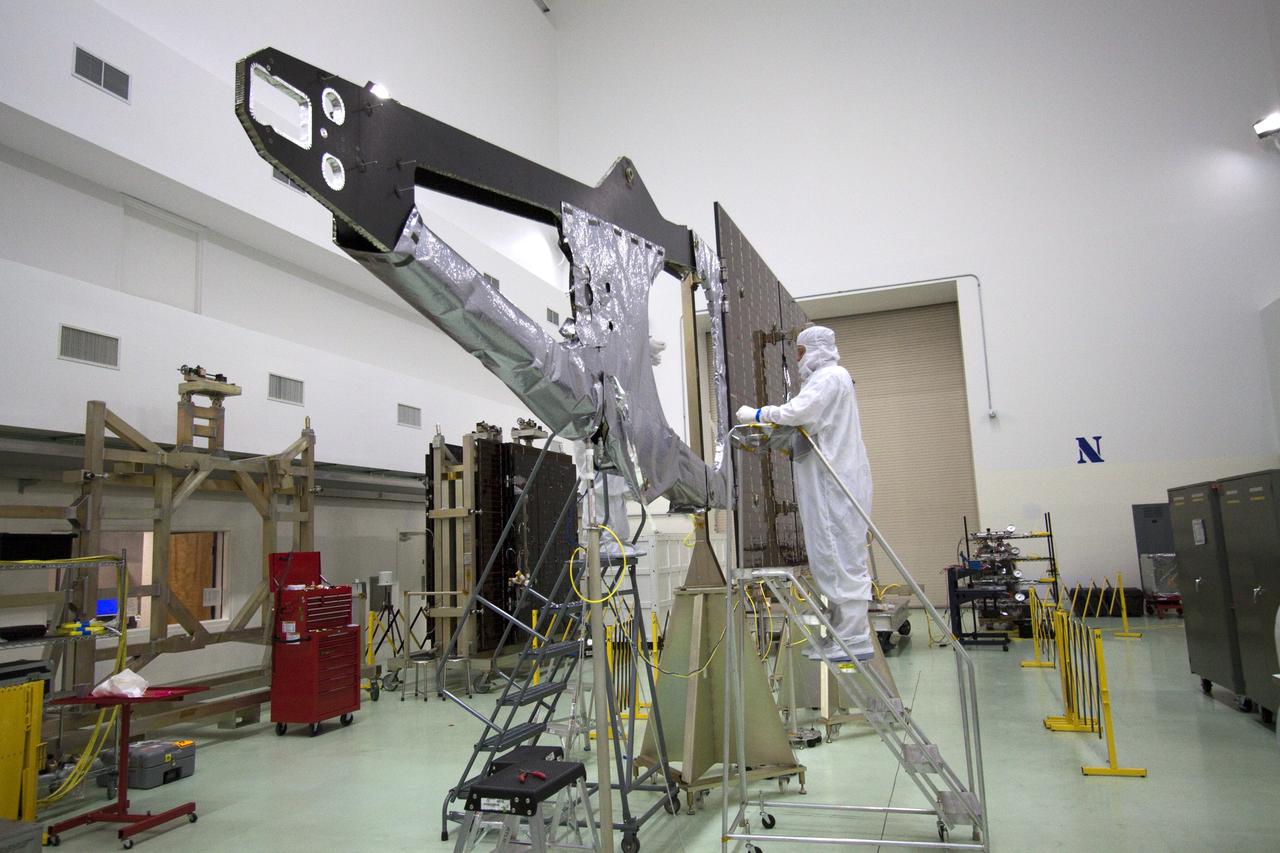
STS031-10-023 (25 April 1990) --- View of the Hubble Space Telescope (HST) on the end of Discovery's Remote Manipulator System (RMS) arm prior to deployment of its antennae and solar array panels.
Hubble Space Telescope (HST) solar array (SA) panel deployment during STS-31
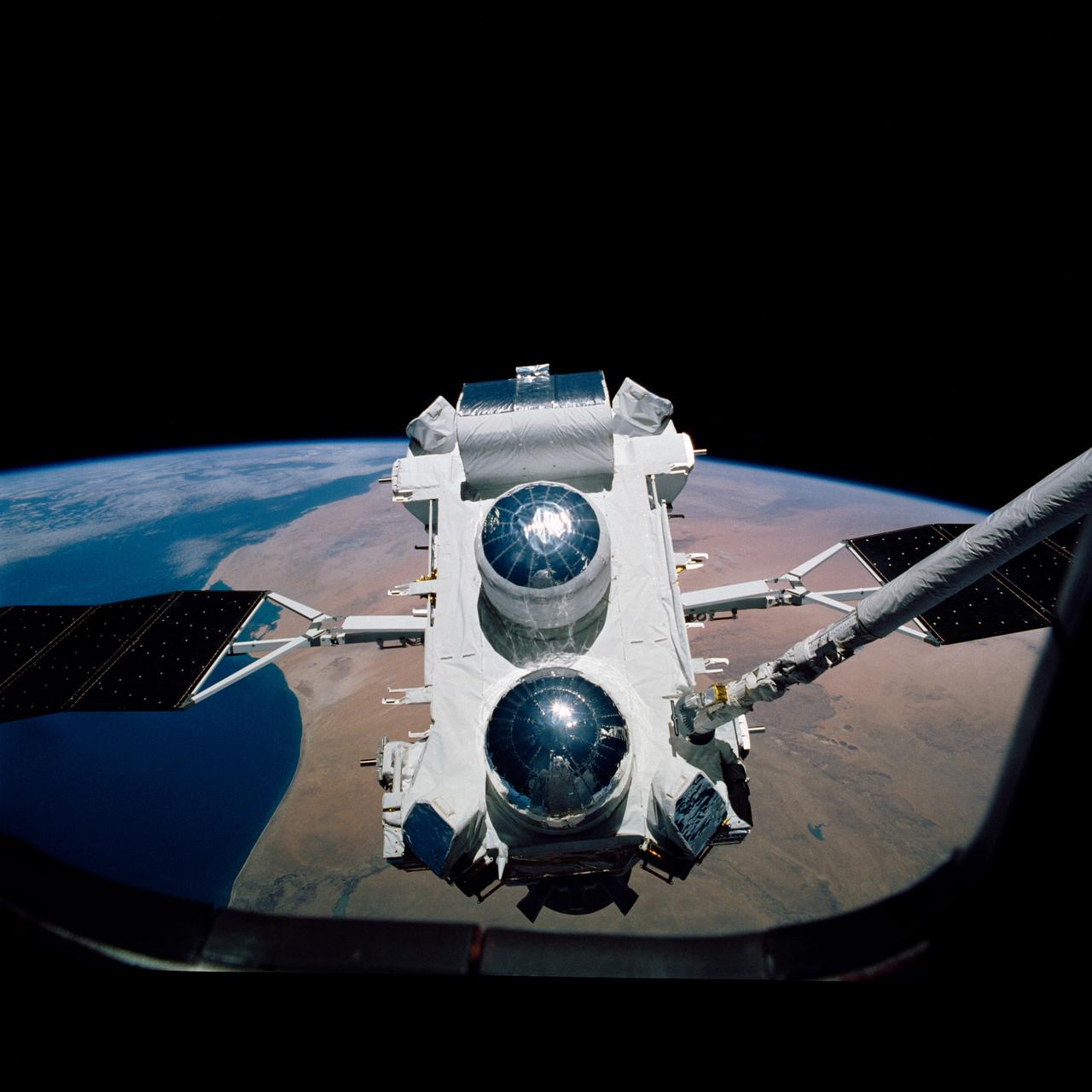
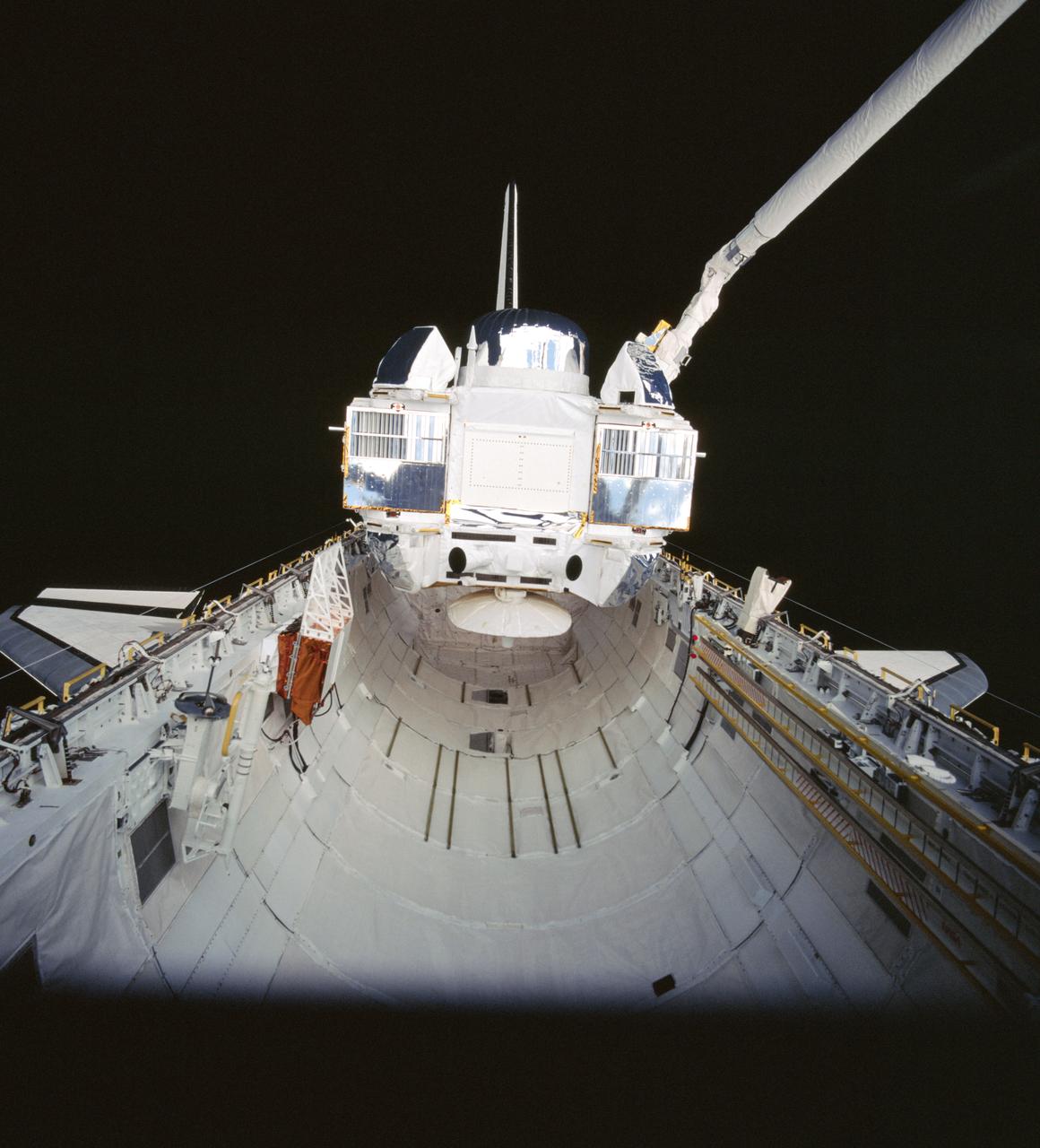
Atlantis', Orbiter Vehicle (OV) 104's, remote manipulator system (RMS) releases Gamma Ray Observatory (GRO) during STS-37 deployment. Visible on the GRO as it drifts away from the RMS end effector are the four complement instruments: the Energetic Gamma Ray Experiment (bottom); Imaging Compton Telescope (COMPTEL) (center); Oriented Scintillation Spectrometer Experiment (OSSE) (top); and Burst and Transient Source Experiment (BATSE) (at four corners). GRO's solar array (SA) panels are extended and are in orbit configuration. View was taken through aft flight deck window which reflects some of the crew compartment interior.
OV-104's RMS releases Gamma Ray Observatory (GRO) during STS-37 deployment
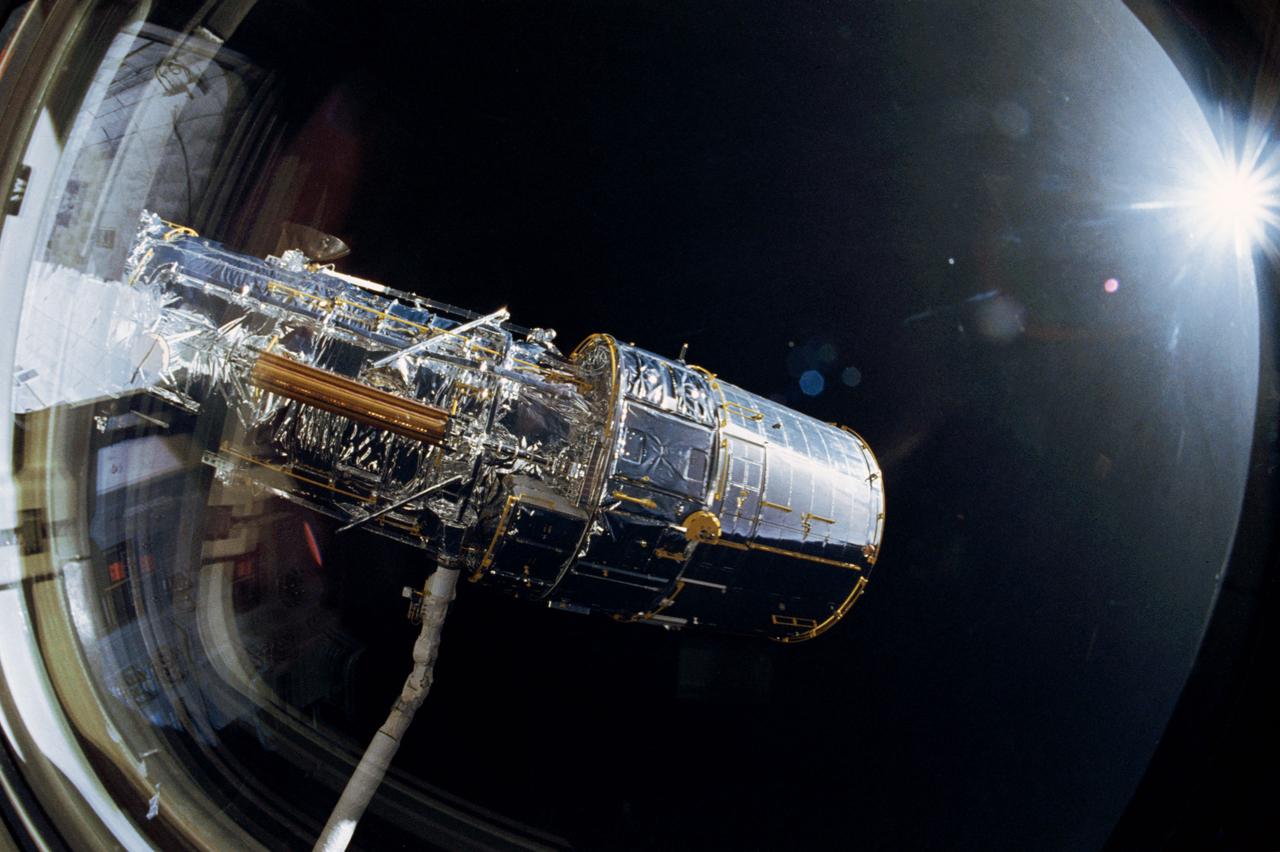
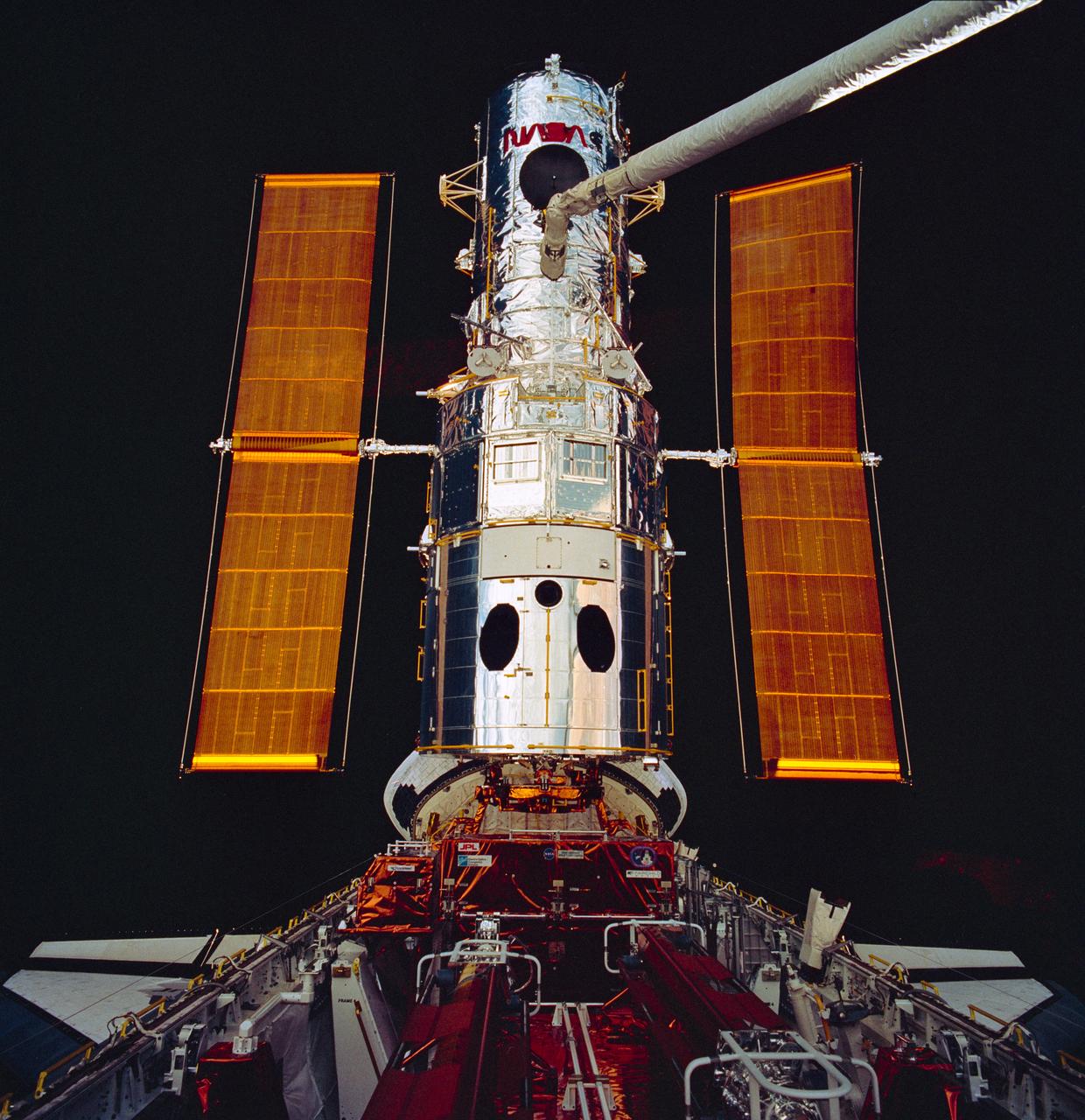
The Hubble Space Telescope (HST), grappled by Discovery's, Orbiter Vehicle (OV) 103's, remote manipulator system (RMS), is held in a pre-deployment position. During STS-31 checkout procedures, the solar array (SA) panels and the high gain antennae (HGA) will be deployed. The starboard SA (center) and the two HGA are stowed along side the Support System Module (SSM) forward shell. The sun highlights HST against the blackness of space.
Hubble Space Telescope (HST) grappled by OV-103's RMS during STS-31 checkout
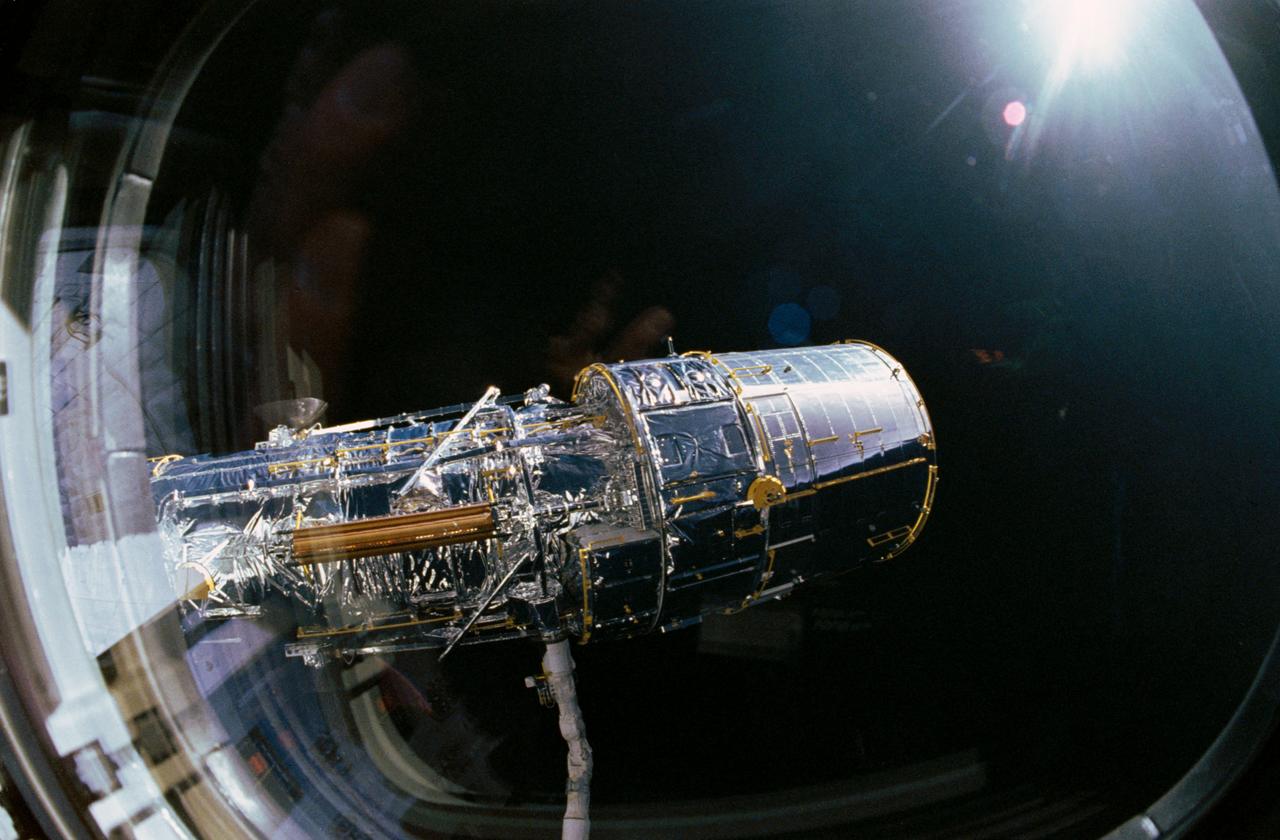
The Hubble Space Telescope (HST), grappled by Discovery's, Orbiter Vehicle (OV) 103's, remote manipulator system (RMS), is oriented in a 90 degree pitch position during STS-31 pre-deployment checkout procedures. The solar array (SA) panel (center) and high gain antennae (HGA) (on either side) are stowed along the Support System Module (SSM) forward shell prior to deployment. The sun highlights HST against the blackness of space.
STS-31 pre-deployment checkout of the Hubble Space Telescope (HST) on OV-103
View taken through overhead window W7 aboard Discovery, Orbiter Vehicle (OV) 103, shows the Hubble Space Telescope (HST) grappled by the remote manipulator system (RMS) and held in a 90 degree pitch position against the blackness of space. The solar array (SA) panel (center) and the high gain antennae (HGA) (on either side) are visible along the Support System Module (SSM) forward shell prior to deployment during STS-31.
STS-31 pre-deployment checkout of the Hubble Space Telescope (HST) on OV-103
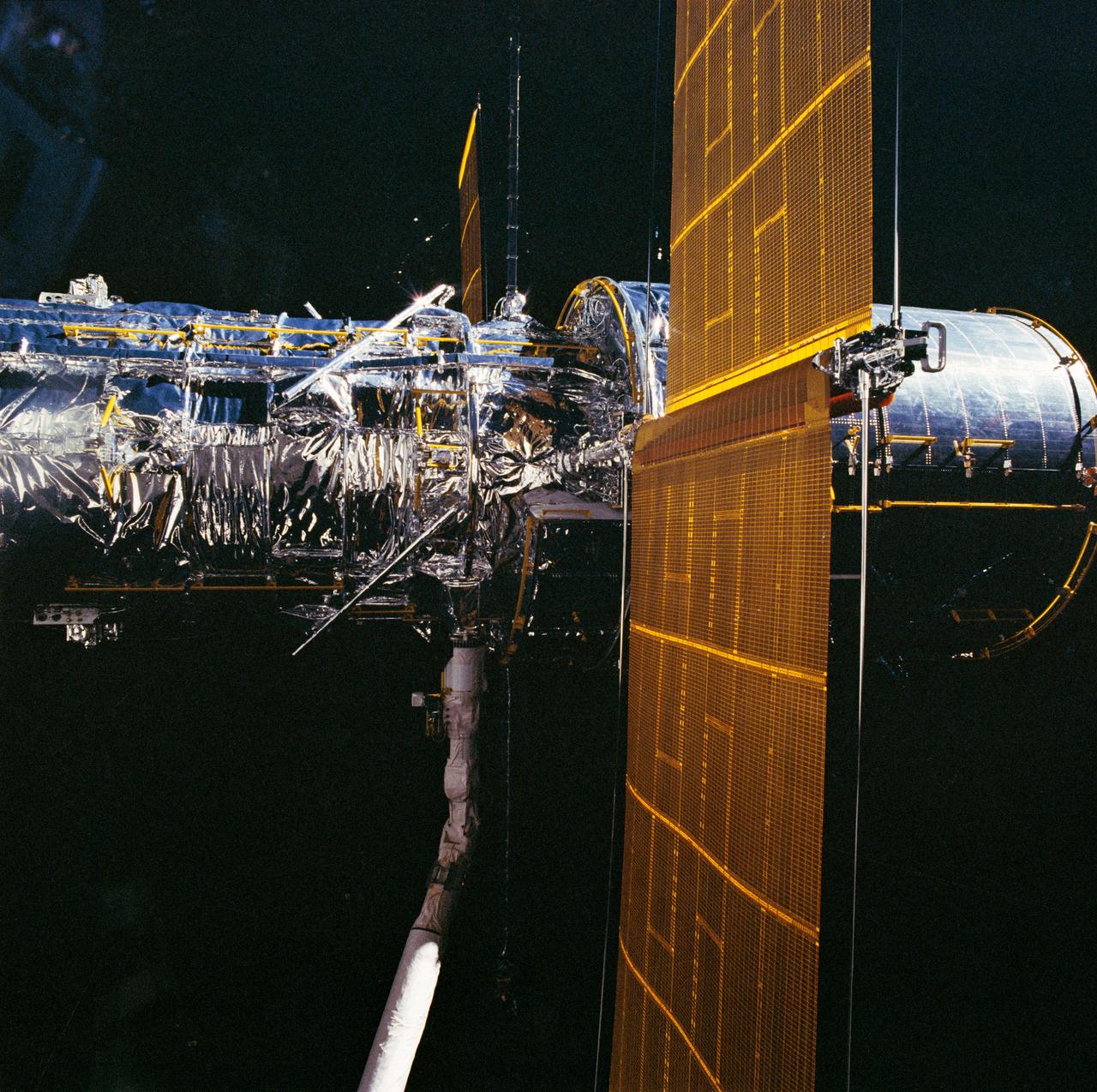
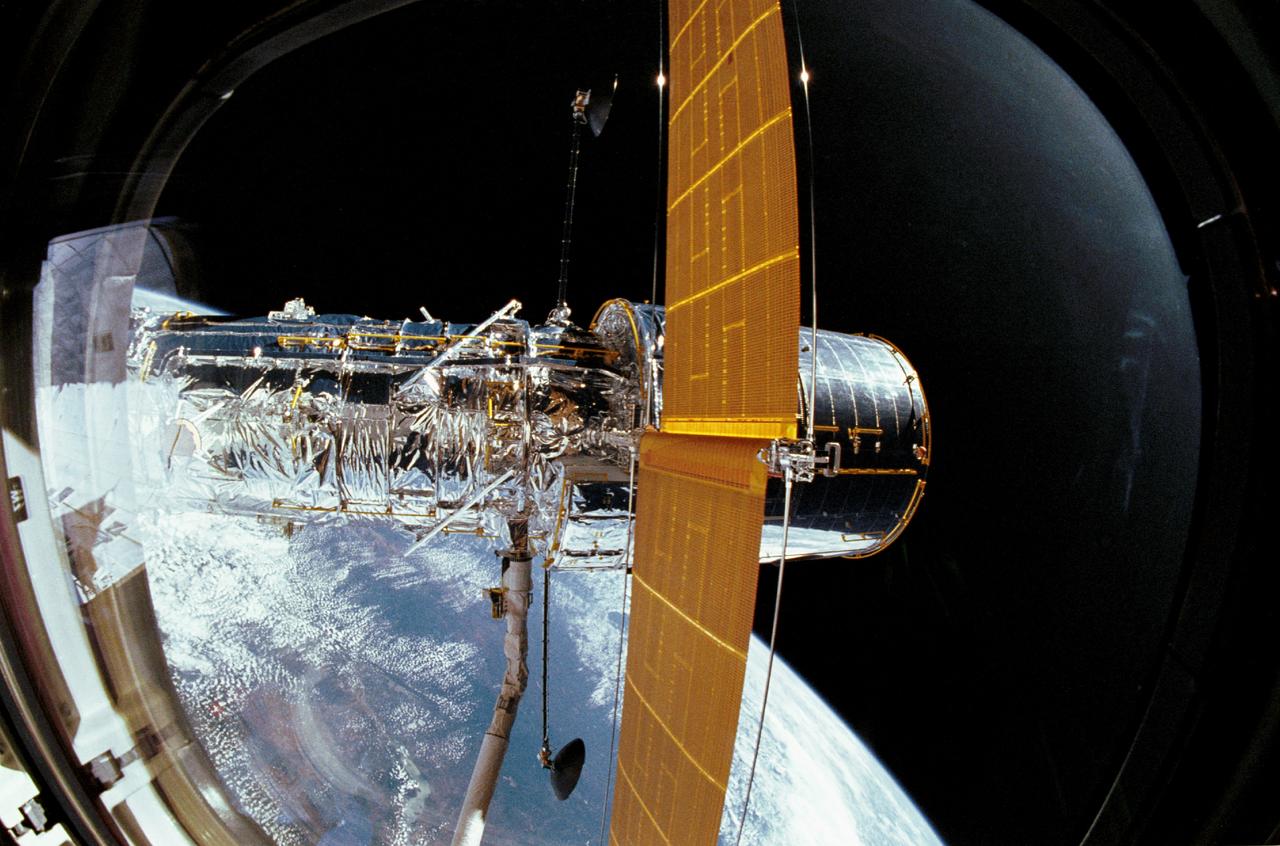
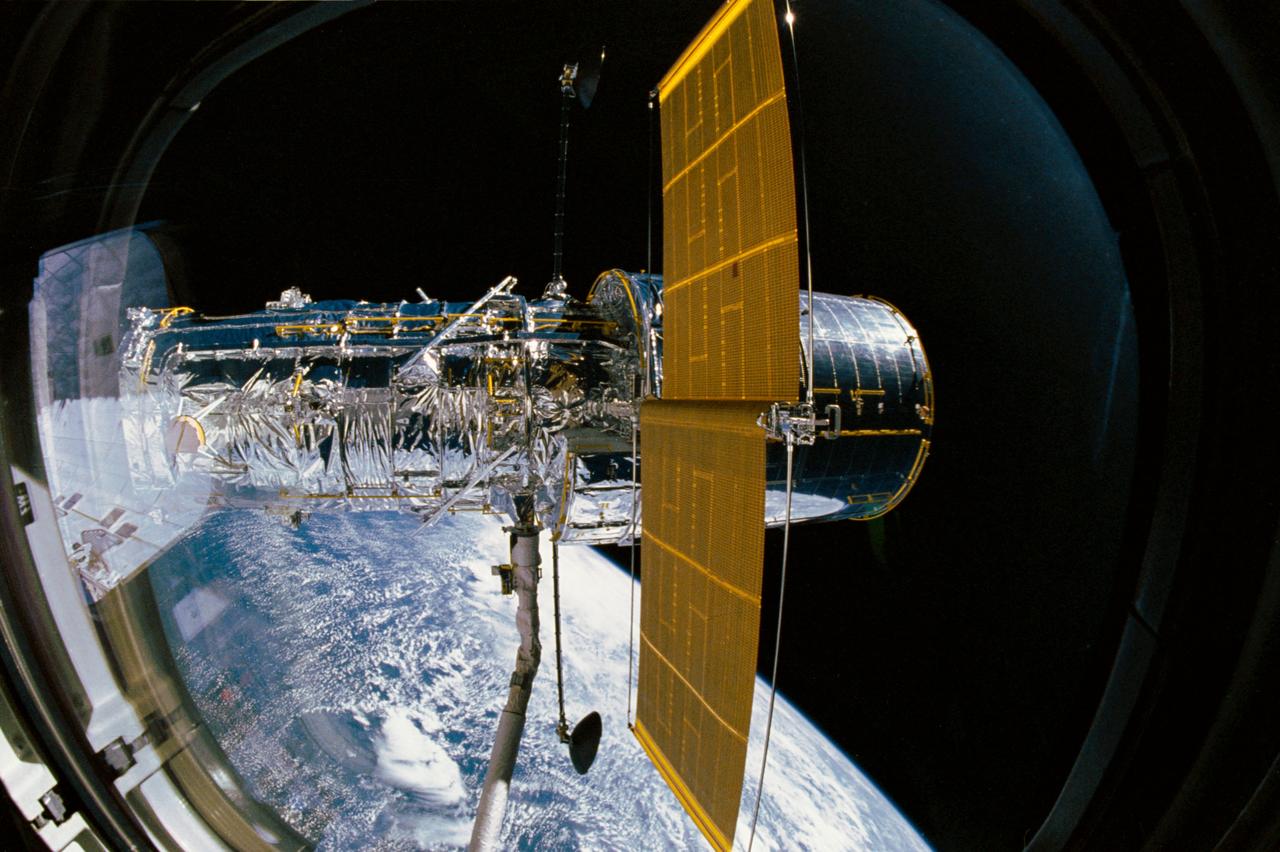
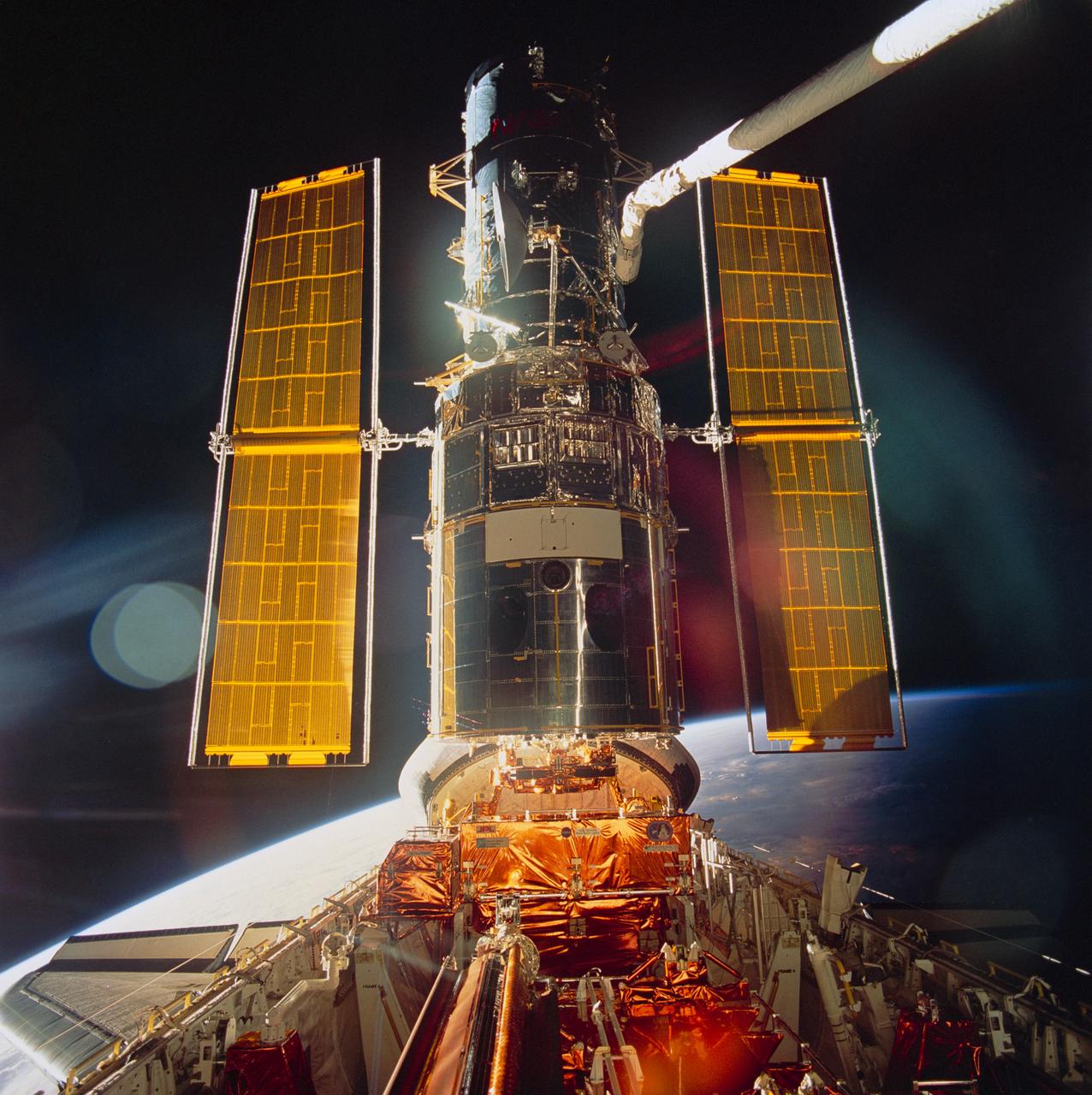
During STS-31, the Hubble Space Telescope (HST), grappled by the remote manipulator system (RMS) end effector, is held against the blackness of space. The two solar array (SA) wings (large gold panels) are fully extended with bistem cassette and secondary deployment mechanism (SDM) handle clearly visible. The two deployed high gain antennae (HGA) masts are parallel to the SA panels. RMS end effector is positioned on the starboard fixture during the predeployment checkout operations above Discovery's, Orbiter Vehicle (OV) 103's, payload bay (PLB).
STS-31 Hubble Space Telescope (HST) is grappled by OV-103 RMS
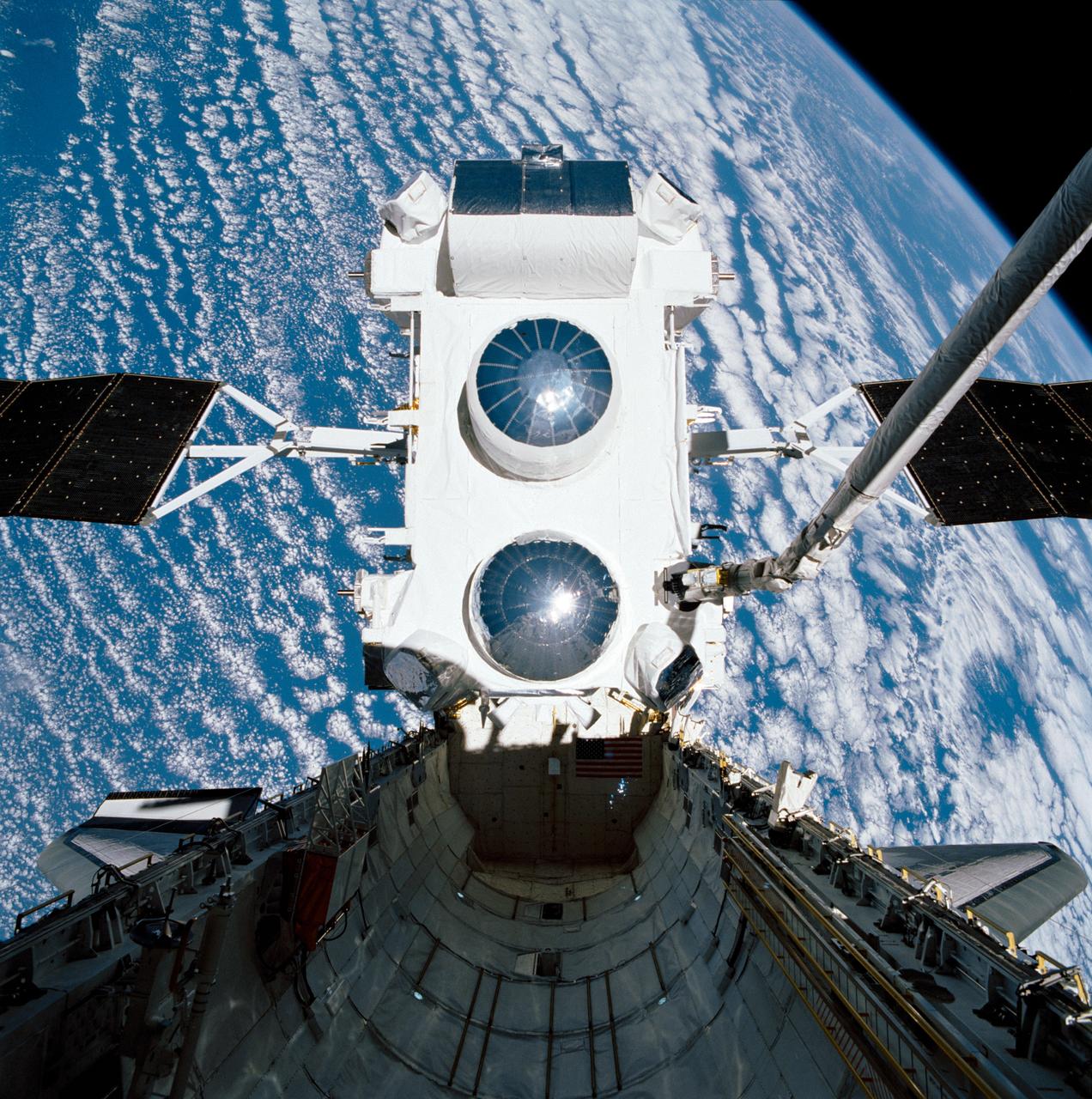
Backdropped against the Earth's surface, the Gamma Ray Observatory (GRO) with its solar array (SA) panels deployed is grappled by the remote manipulator system (RMS) during STS-37 systems checkout. GRO's four complement instruments are visible: the Energetic Gamma Ray Experiment Telescope (EGRET) (at the bottom); the Imaging Compton Telescope (COMPTEL) (center); the Oriented Scintillation Spectrometer Experiment (OSSE) (top); and Burst and Transient Source Experiment (BATSE) (on four corners). The view was taken by STS-37 crew through an aft flight deck overhead window.
STS-37 Gamma Ray Observatory (GRO) grappled by RMS
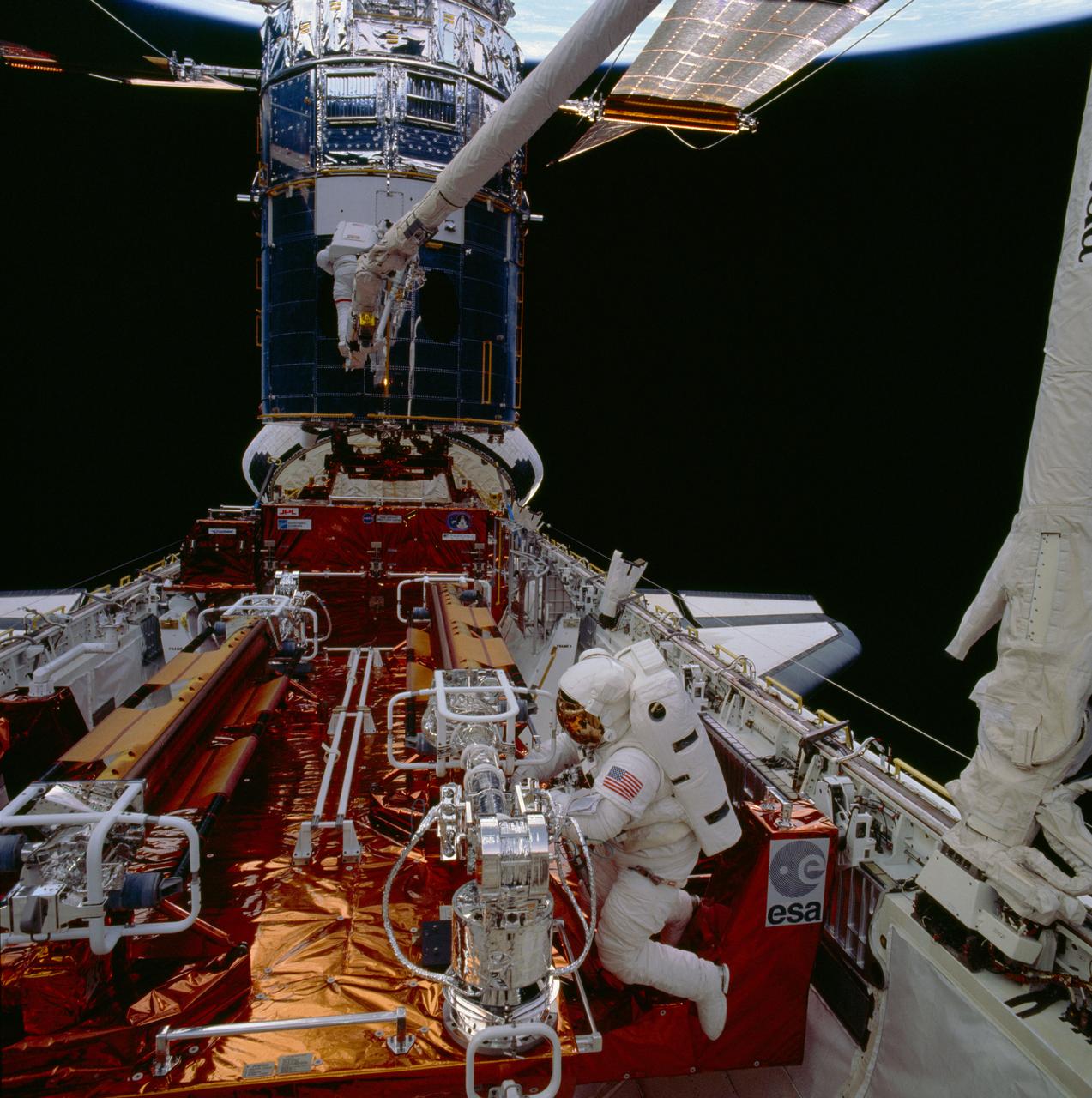
STS061-86-048 (5 Dec 1993) --- Astronauts F. Story Musgrave (foreground) and Jeffrey A. Hoffman are pictured near the end of the first of five extravehicular activity?s (EVA).  Musgrave works at the Solar Array Carrier (SAC) in the Space Shuttle Endeavour's cargo bay.  Hoffman, anchored to a foot restraint mounted on the end of the Space Shuttle Endeavour's Remote Manipulator System (RMS) arm, waits to be maneuvered to the forward payload bay.  The original solar array panels are partially visible at top, while their replacements remain stowed in foreground.  The crew's second pair of space walkers -- astronauts Kathryn C. Thornton and Thomas D. Akers -- later changed the solar arrays on the mission's second EVA.
Astronauts Musgrave and Hoffman during first STS-61 EVA
Held in appendage deploy position by Discovery's, Orbiter Vehicle (OV) 103's, remote manipulator system (RMS), the Hubble Space Telescope's (HST's) starboard solar array (SA) bistem cassette is released from its stowed position on the Support System Module (SSM) forward shell. The spreader bar & bistem begin to unfurl the SA wing. View was taken by an STS-31 crewmember through an overhead window & is backdropped against the surface of the Earth.
STS-31 Hubble Space Telescope (HST) solar array panel deploy aboard OV-103
STS031-03-014 (25 April 1990) --- The Hubble Space Telescope (HST), still in the grasp of Discovery's Remote Manipulator System (RMS), is backdropped over Earth some 332 nautical miles below. In this scene, HST has deployed one of its solar array panels but is yet to have extended the second. This scene was captured with a 35mm camera aimed through an overhead window on aft the flight deck.
STS-31 Hubble Space Telescope (HST) appendage deploy aboard OV-103
STS031-03-009 (25 April 1990) --- The Hubble Space Telescope (HST), still in the grasp of Discovery's remote manipulator system (RMS), is backdropped over Earth some 332 nautical miles below.  In this scene, HST has deployed one of its solar array panels but is yet to have extended the second.  This scene was captured with a 35mm camera aimed through an overhead window on the aft flight deck.
STS-31 Hubble Space Telescope (HST) (SAs & HGAs deployed) is grappled by RMS
STS061-102-010 (9 Dec 1993) --- Astronauts Jeffrey A. Hoffman (left) and F. Story Musgrave team to replace one of two Solar Array Drive Electronics (SADE) units on the Hubble Space Telescope (HST).  Musgrave is standing on a foot restraint mounted on the end of the Space Shuttle Endeavour's Remote Manipulator System (RMS) arm.  The black object, in upper left corner, is part of the window frame, through which this 70mm frame was exposed, inside Endeavour's cabin.
Astronauts Hoffman and Musgrave replace Solar Array Drive Electronics
During STS-31, the Hubble Space Telescope (HST) is held in appendage deploy position by Discovery's, Orbiter Vehicle (OV) 103's, remote manipulator system (RMS) above the payload bay (PLB) and crew compartment cabin. While in this position the solar array (SA) wing bistem cassette (HST center) is deployed from its stowed location along side the Support System Module (SSM) forward shell. A high gain antenna (HGA) remains stowed along the SSM. The Earth's surface and the Earth limb creates a dramatic backdrop.
STS-31 Hubble Space Telescope (HST) solar array (SA) deploy aboard OV-103
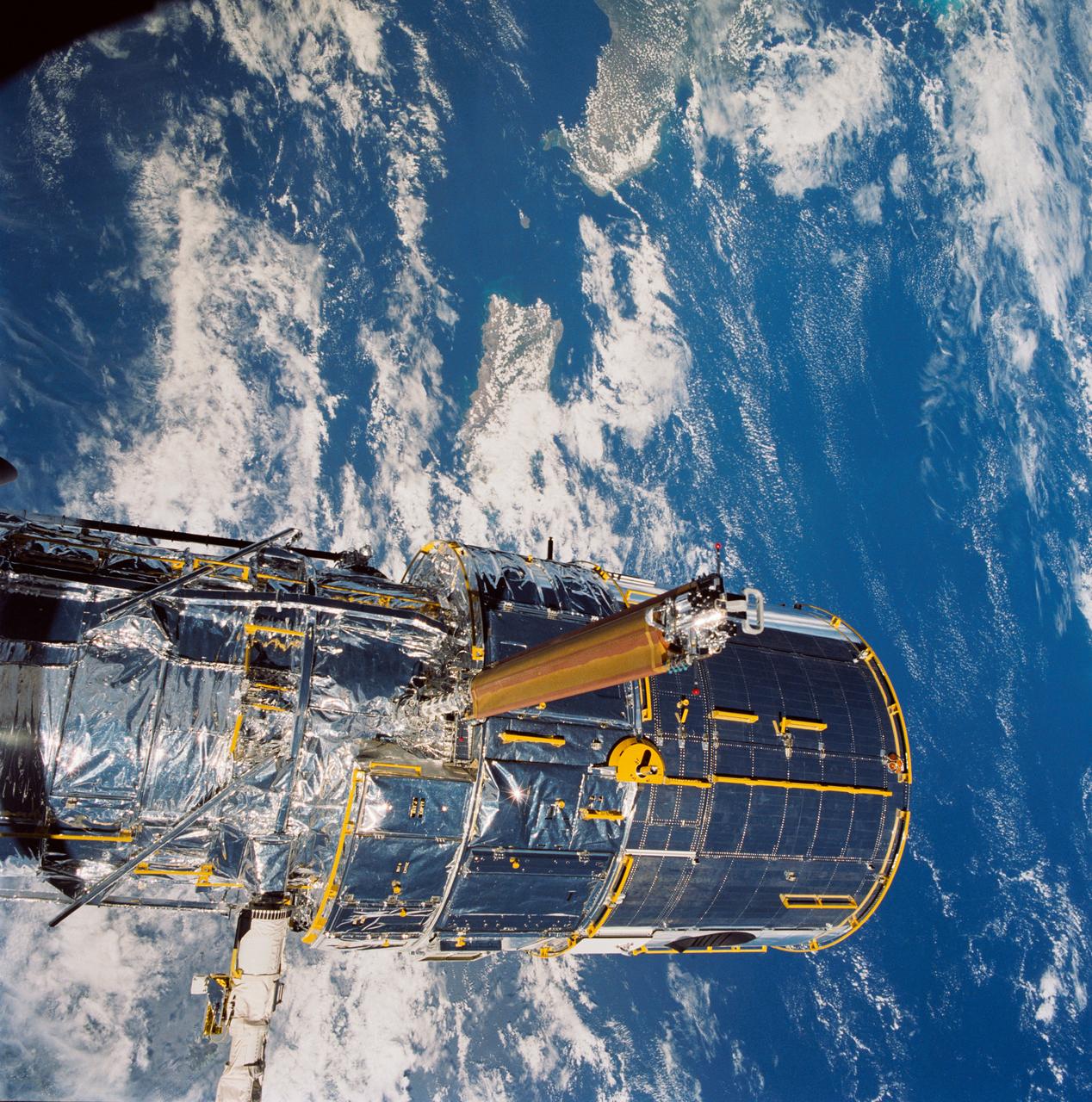
During STS-31, the Hubble Space Telescope (HST) grappled by the remote manipulator system (RMS) end effector is held in appendage deploy position above Discovery, Orbiter Vehicle (OV) 103. The solar array (SA) bistem cassette has been released from its latch fittings. The bistem spreader bars begin to unfurl the SA wing. The secondary deployment mechanism (SDM) handle is visible at the SA end. Stowed against either side of the HST System Support Module (SSM) forward shell are the high-gain antennae (HGA). Puerto Rico and the Dominican Republic are recognizable at the left of the frame.
STS-31 Hubble Space Telescope (HST) pre-deployment procedures aboard OV-103
JOHNSON SPACE CENTER, HOUSTON, TEXAS-- View of the Hubble Space Telescope on Discovery's remote manipulator system arm prior to deployment of Hubble's antennae and solar array panels.
KSC-90pc-0702
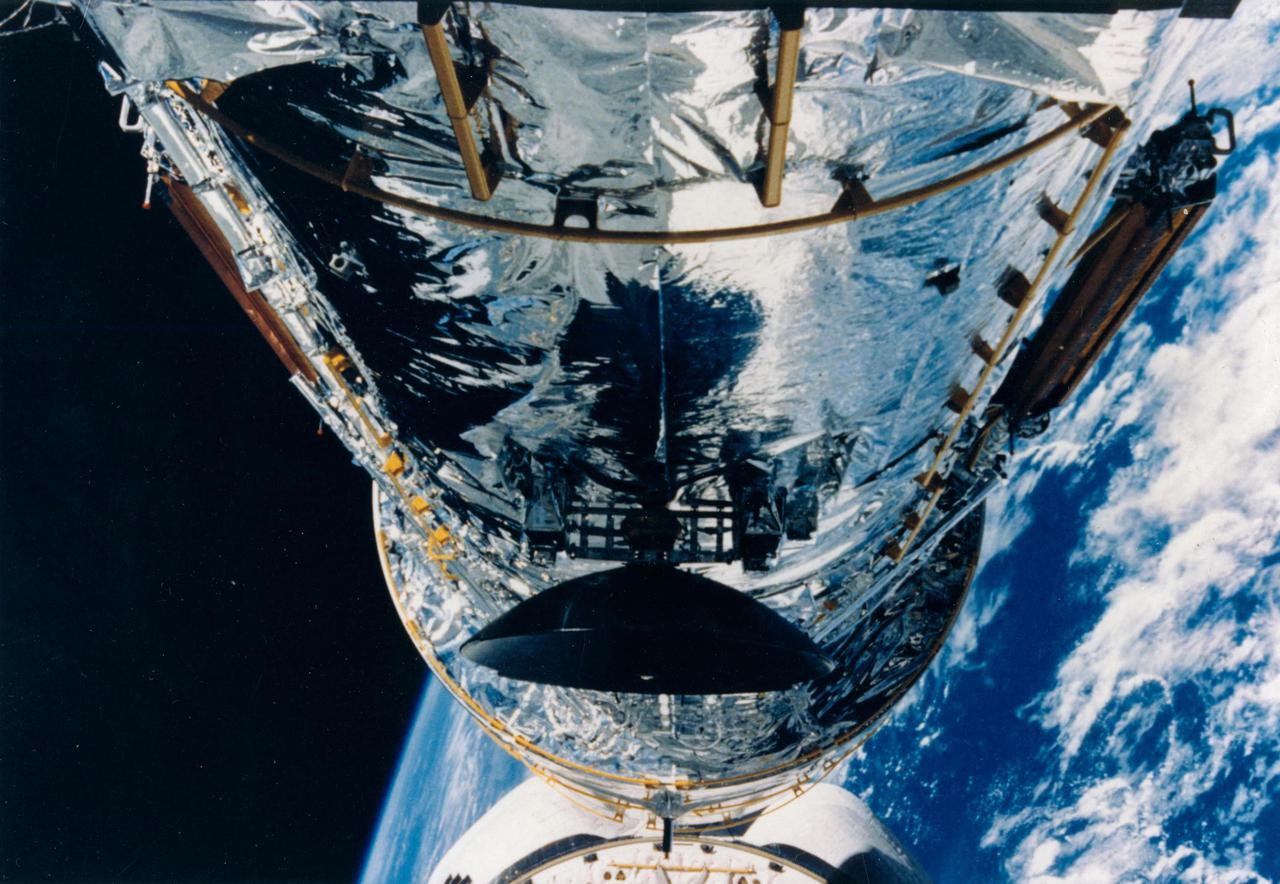
JOHNSON SPACE CENTER, HOUSTON, TEXAS -- View through overhead windows shows remote manipulator system (RMS) arm with telescope in grasp before procedures start to deploy solar array panels and antennae.
KSC-90pc-0701
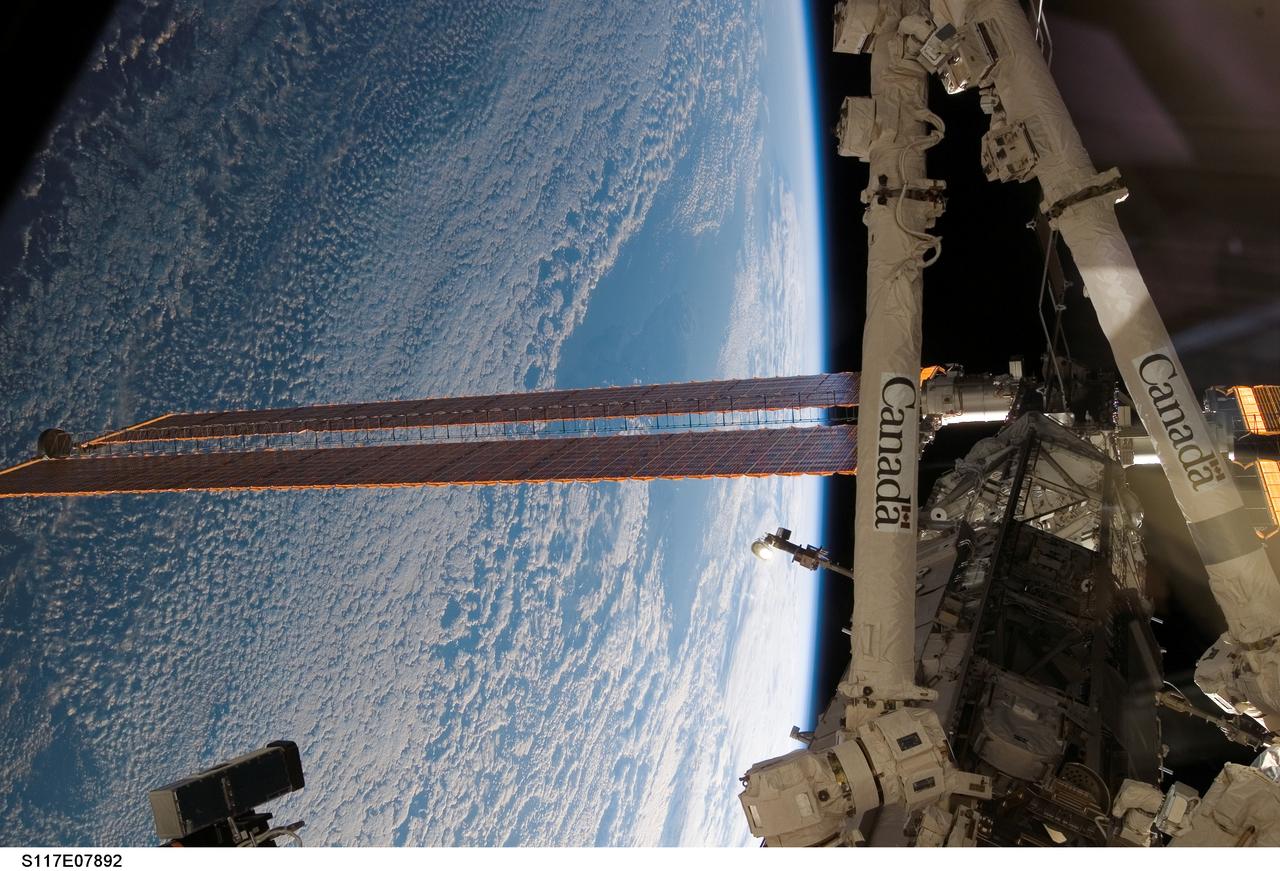
S117-E-07892 (18 June 2007) --- The International Space Station's Canadarm2, or Space Station Remote Manipulator System (SSRMS) and solar array wings are featured in this image photographed by a crewmember on the station while Space Shuttle Atlantis was docked with the orbital complex. The blackness of space and Earth's horizon provides the backdrop for the scene.
S1 and S3 Trusses taken during Joint Operations
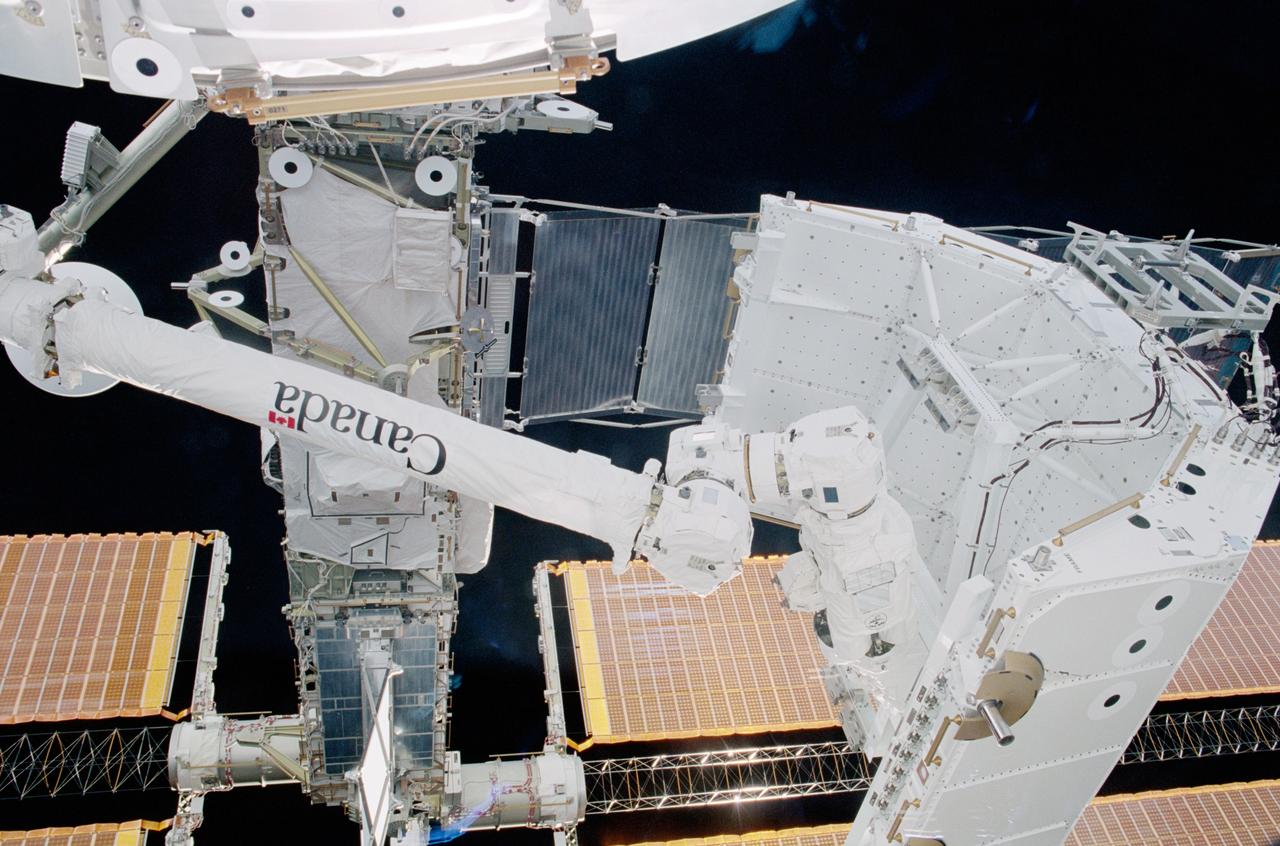
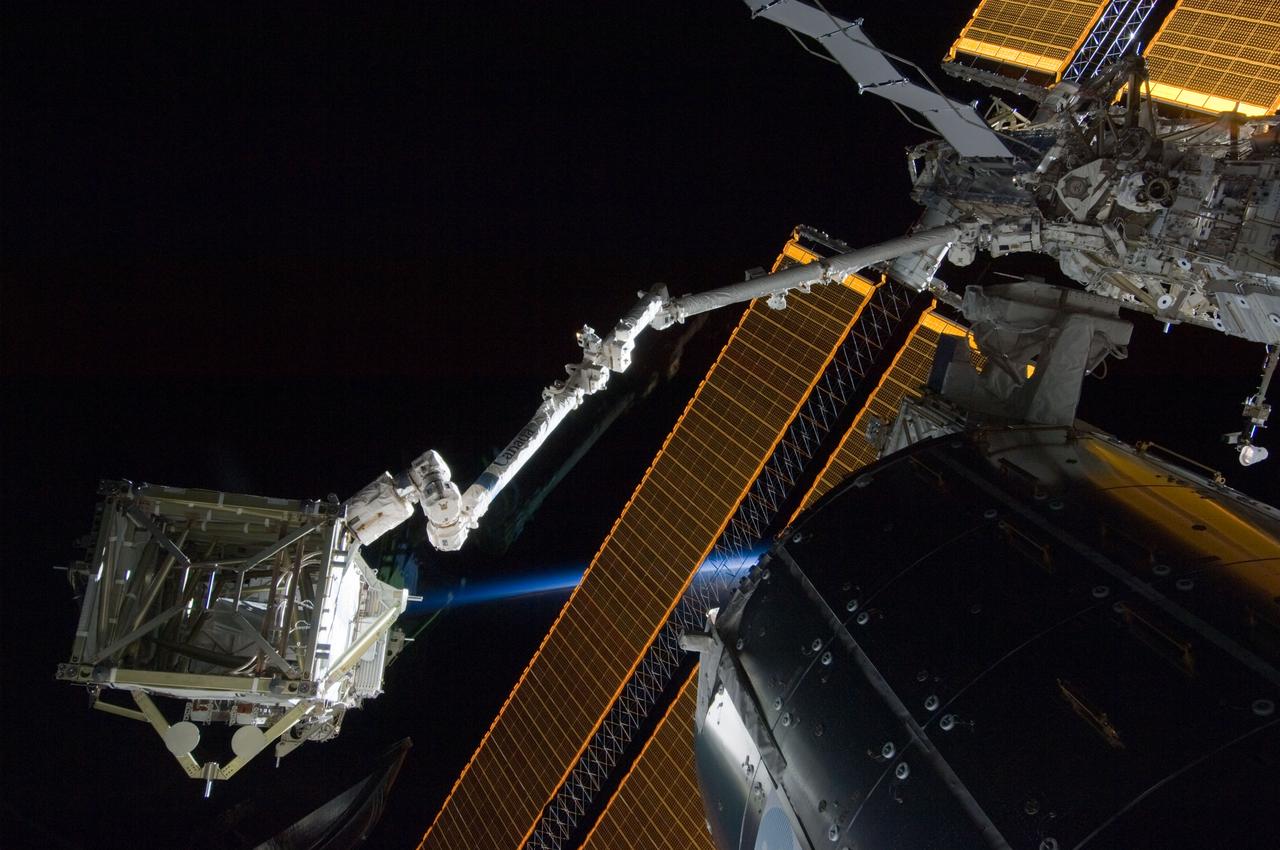
STS100-342-024 (19 April-1 May 2001) --- In the grasp of the newly installed Canadarm2, also known by its technical name, the Space Station Remote Manipulator System (SSRMS), the Spacelab pallet is carefully moved by crewmembers inside the International Space Station (ISS). Sunglint on the station's solar arrays can be seen in the background.
View of the SSRMS end effector grappling the Spacelab Pallet taken during STS-100
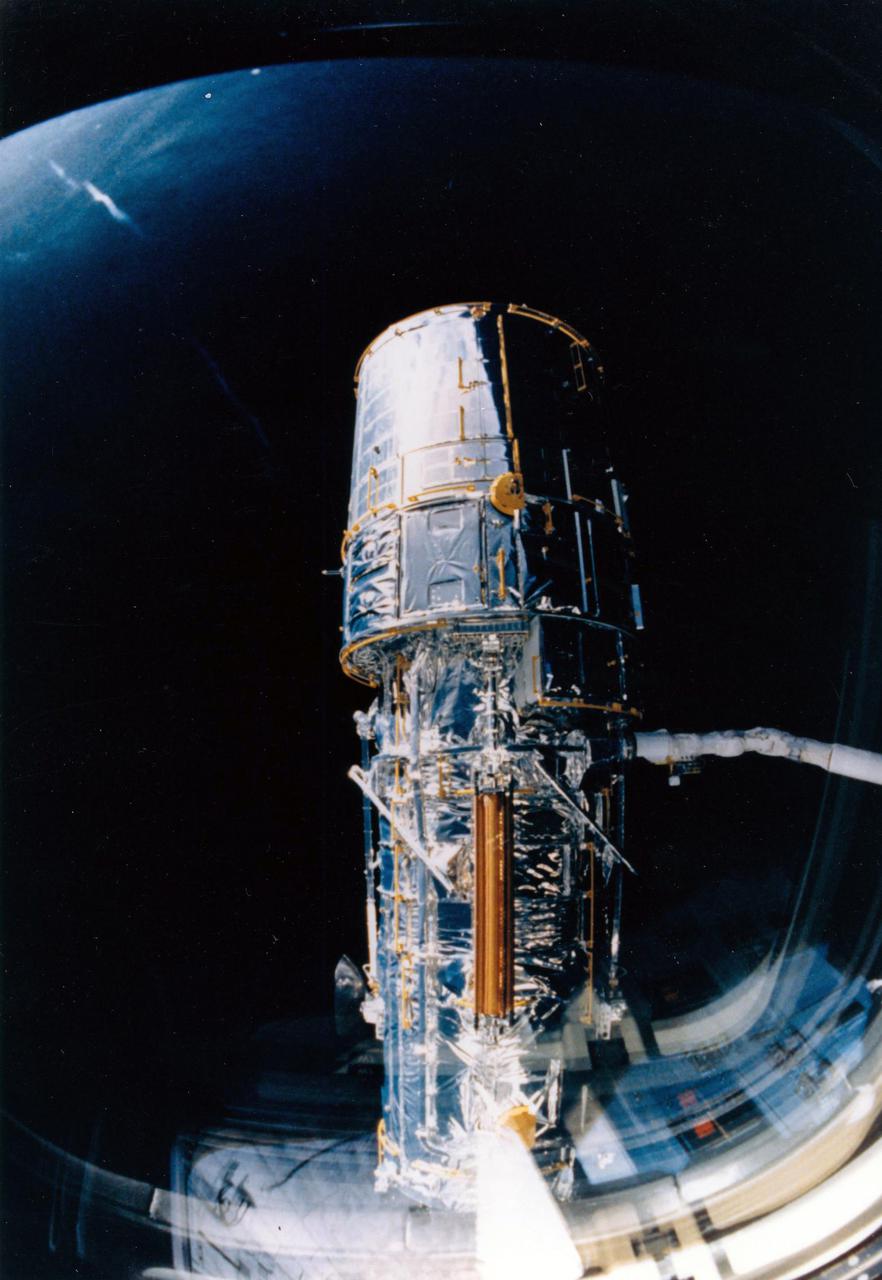
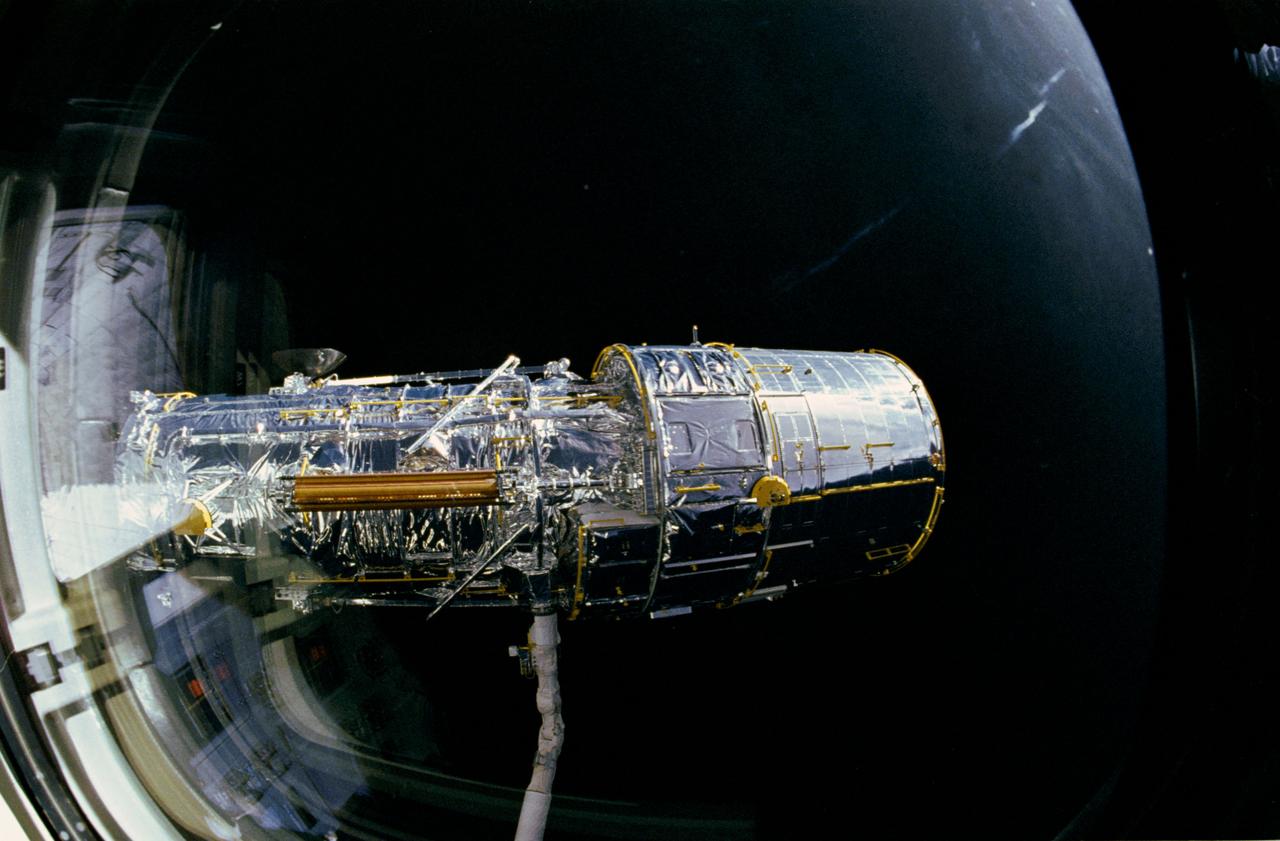
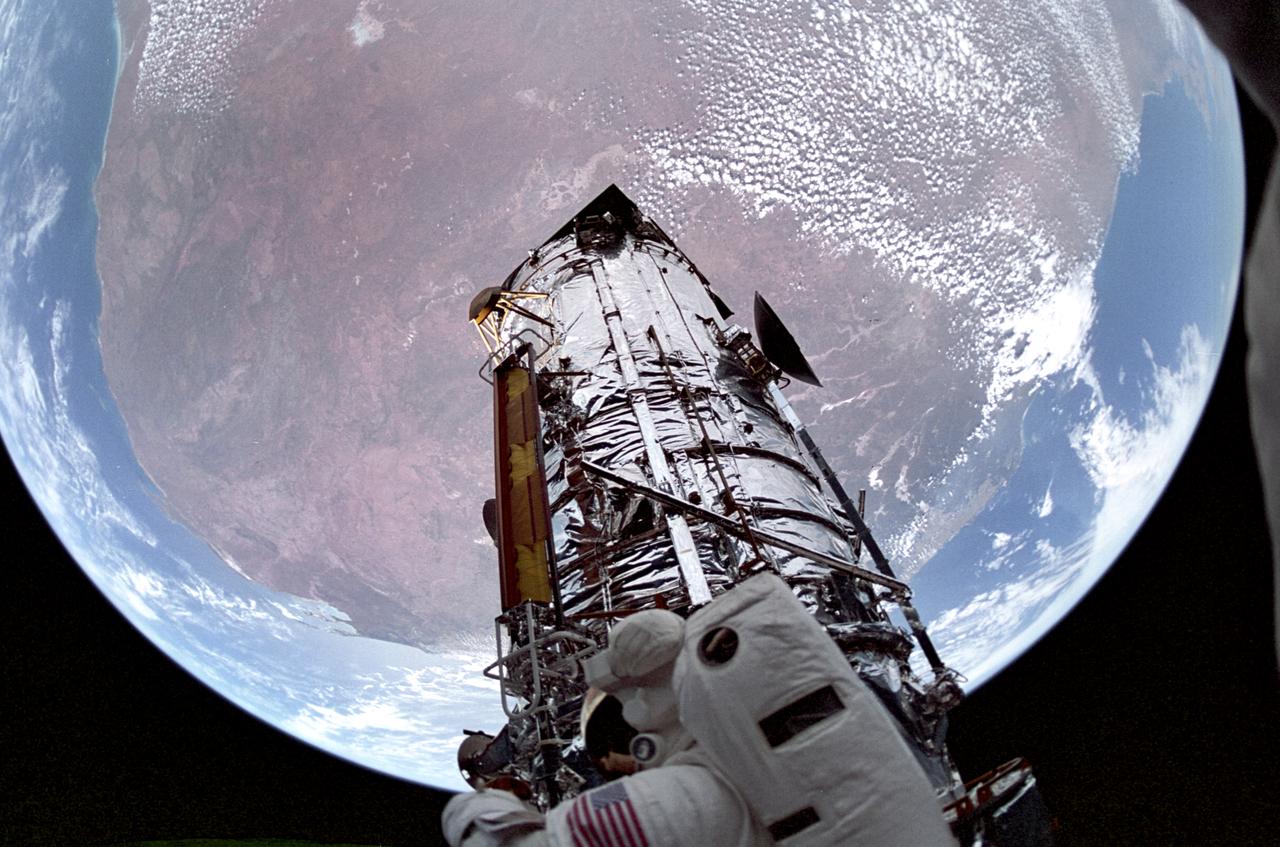
JOHNSON SPACE CENTER, HOUSTON, TEXAS-- STS-31 ONBOARD SCENE -- A medium closeup view photographed with fish-eye lens on a 35mm camera shooting the Hubble Space Telescope (HST) held above Discovery's cargo bay by the remote manipulator system prior to solar array and antennae deployment.
KSC-90pc-0707
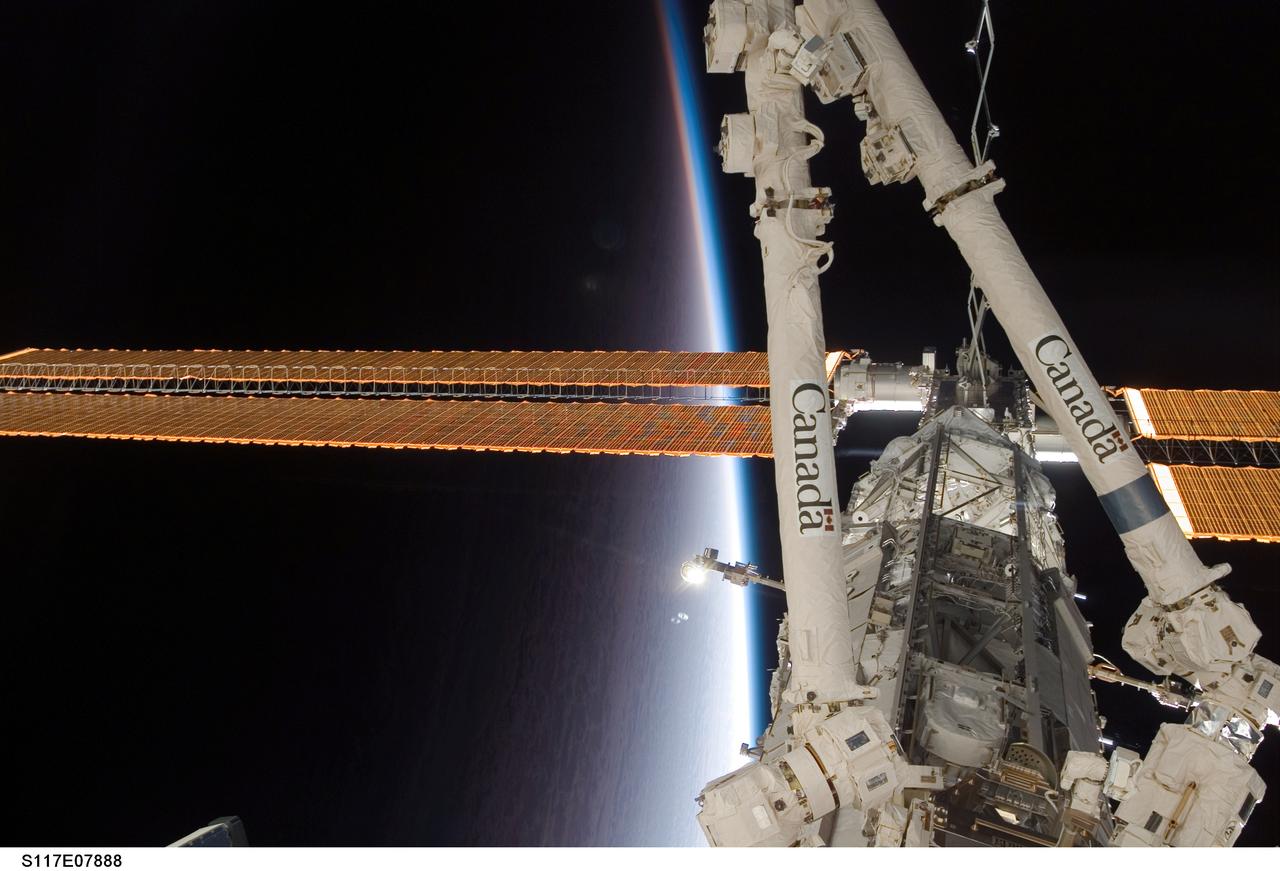
S117-E-07888 (18 June 2007) --- The International Space Station's Canadarm2, or Space Station Remote Manipulator System (SSRMS) and solar array wings are featured in this image photographed by a crewmember on the station while Space Shuttle Atlantis was docked with the orbital complex. The blackness of space and Earth's horizon provides the backdrop for the scene.
S1 and S3 Trusses taken during Joint Operations
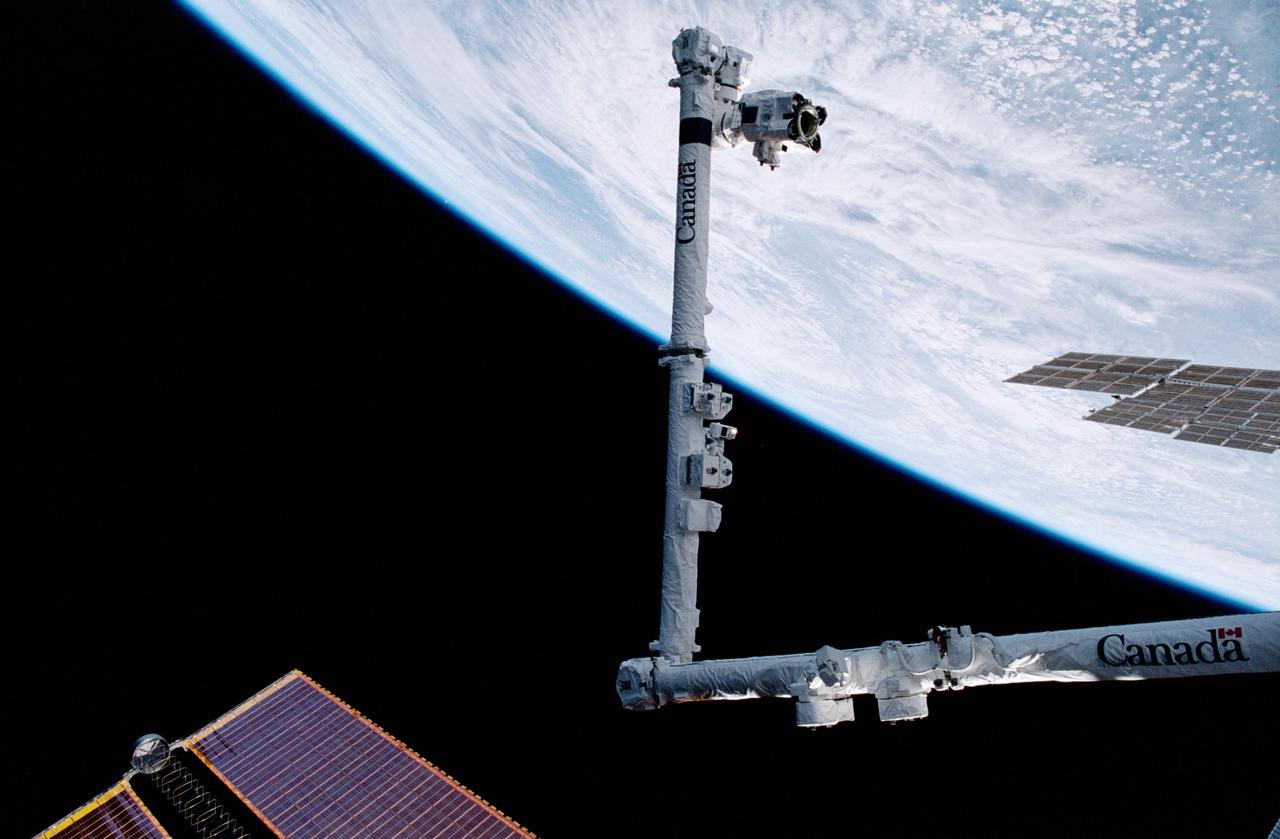
STS100-343-001 (19 April-1 May 2001) --- Extended by a crewmember on the International Space Station (ISS), the Space Station Remote Manipulator System (SSRMS) is backdropped by the blackness of space and the Earth's horizon. A portion of the International Space Station's solar array can be seen in the lower left.
View of the SSRMS against an Earth limb during STS-100
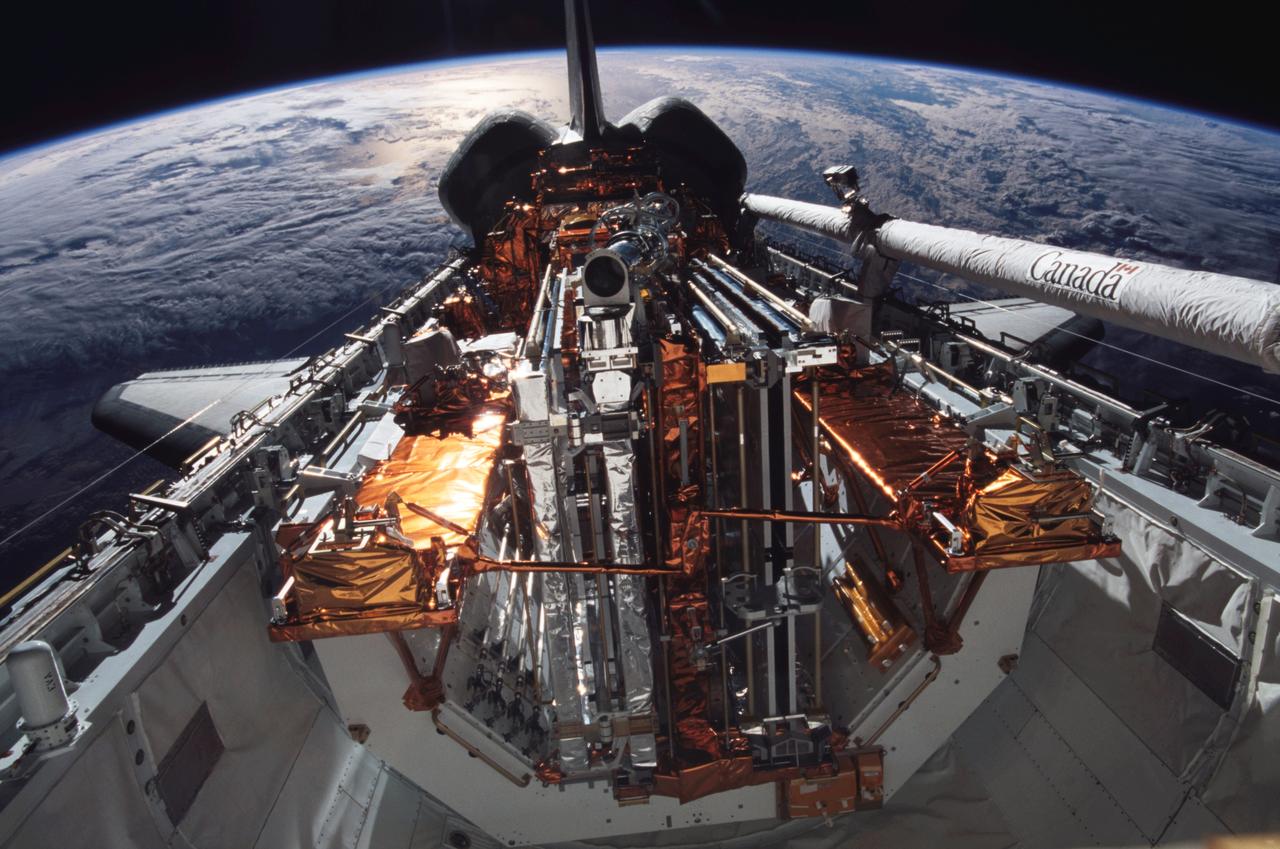
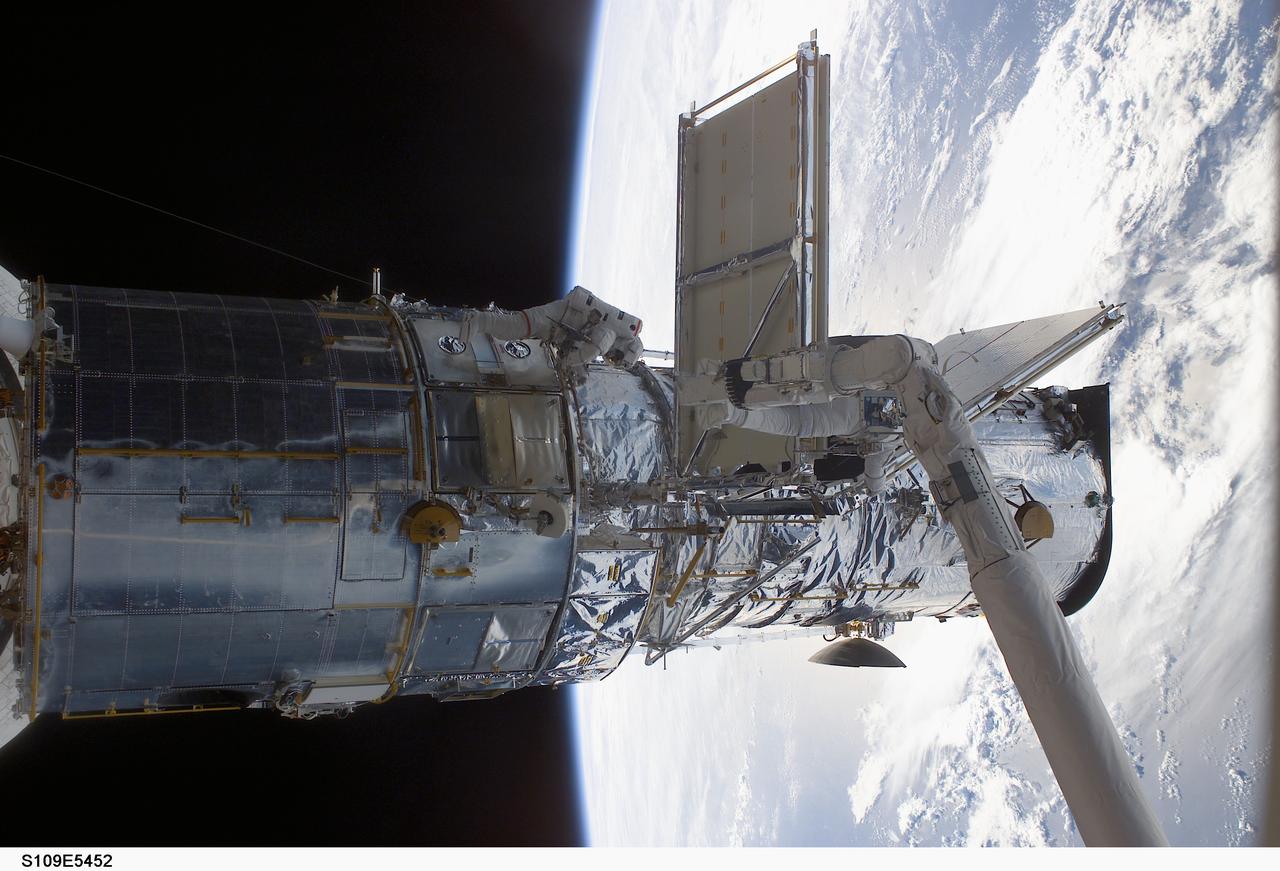
STS109-329-021 (1-12 March 2002) --- The horizon of a blue and white Earth and the blackness of space form the backdrop for this view of the cargo bay of the Space Shuttle Columbia, as seen through windows on the aft flight deck during the STS-109 mission. Pictured in the cargo bay is the Rigid Array Carrier (RAC) holding the new Hubble Solar Arrays. In its stowed position at right center of the frame is the Canadian-built Remote Manipulator System (RMS) arm.
Empty payload bay prior to docking
STS109-328-026 (5 March 2002) --- Perched on the end of the Columbia's remote manipulator system (RMS) arm,  astronaut Michael J. Massimino, removes the old solar array on the port side of the Hubble Space Telescope (HST).  Astronauts Massimino and James H. Newman went on to replace the array with a new one. A day earlier, two other astronauts accomplished the same feat on the starboard side.
EVA 2 - MS Massimino removes old port solar array
STS037-99-098 (7 April 1991) --- Backdropped against clouds over water, the Gamma Ray Observatory (GRO) is still in the grasp of the Space Shuttle Atlantis' Remote Manipulator System (RMS) in this 70mm scene.  A special Extravehicular Activity (EVA) was required by astronauts Jerry L. Ross and Jerome (Jay) Apt to manually extend the high-gain antenna on GRO.  The five-member crew capped off a busy Flight Day 3 by releasing the heavy payload.
STS-37 Gamma Ray Observatory (GRO) held by RMS over OV-104's payload bay
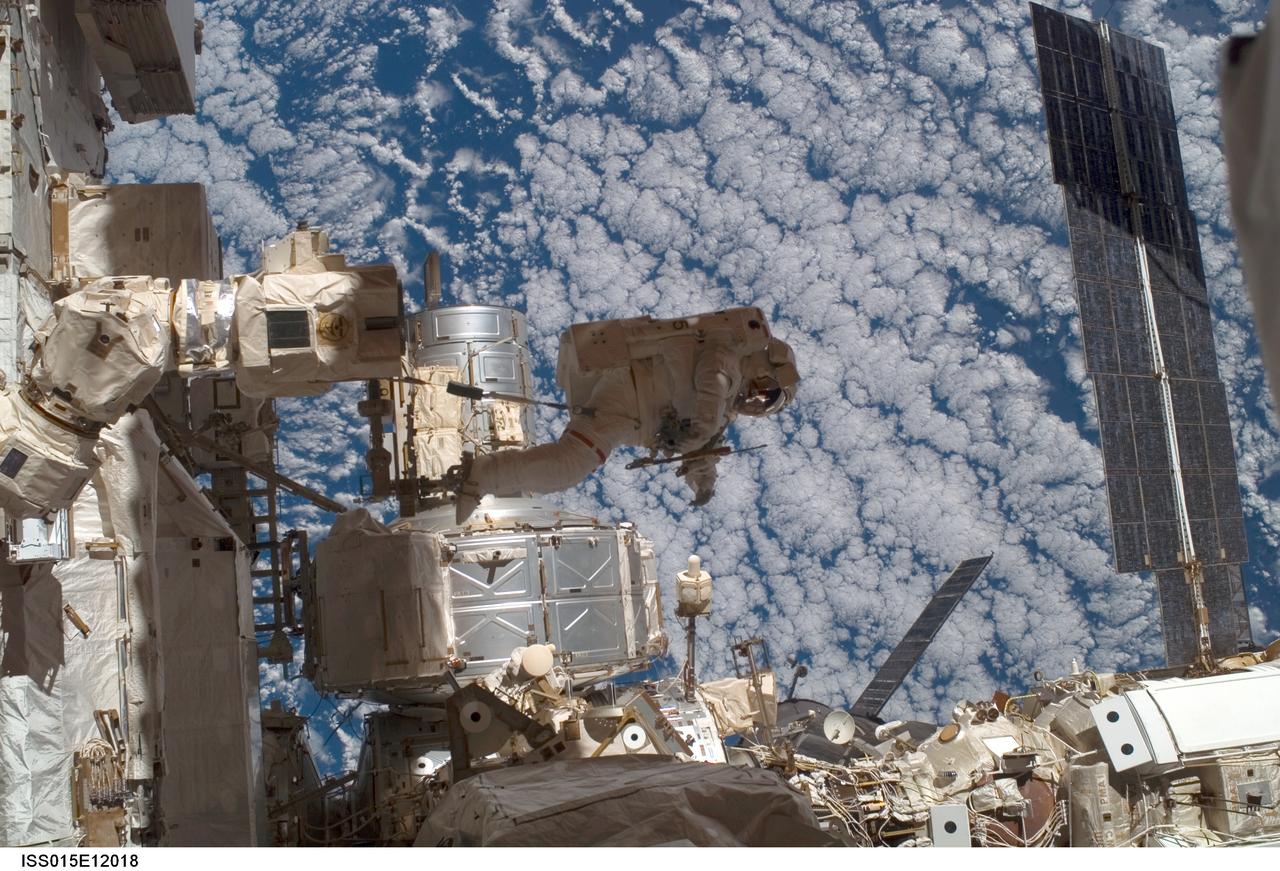
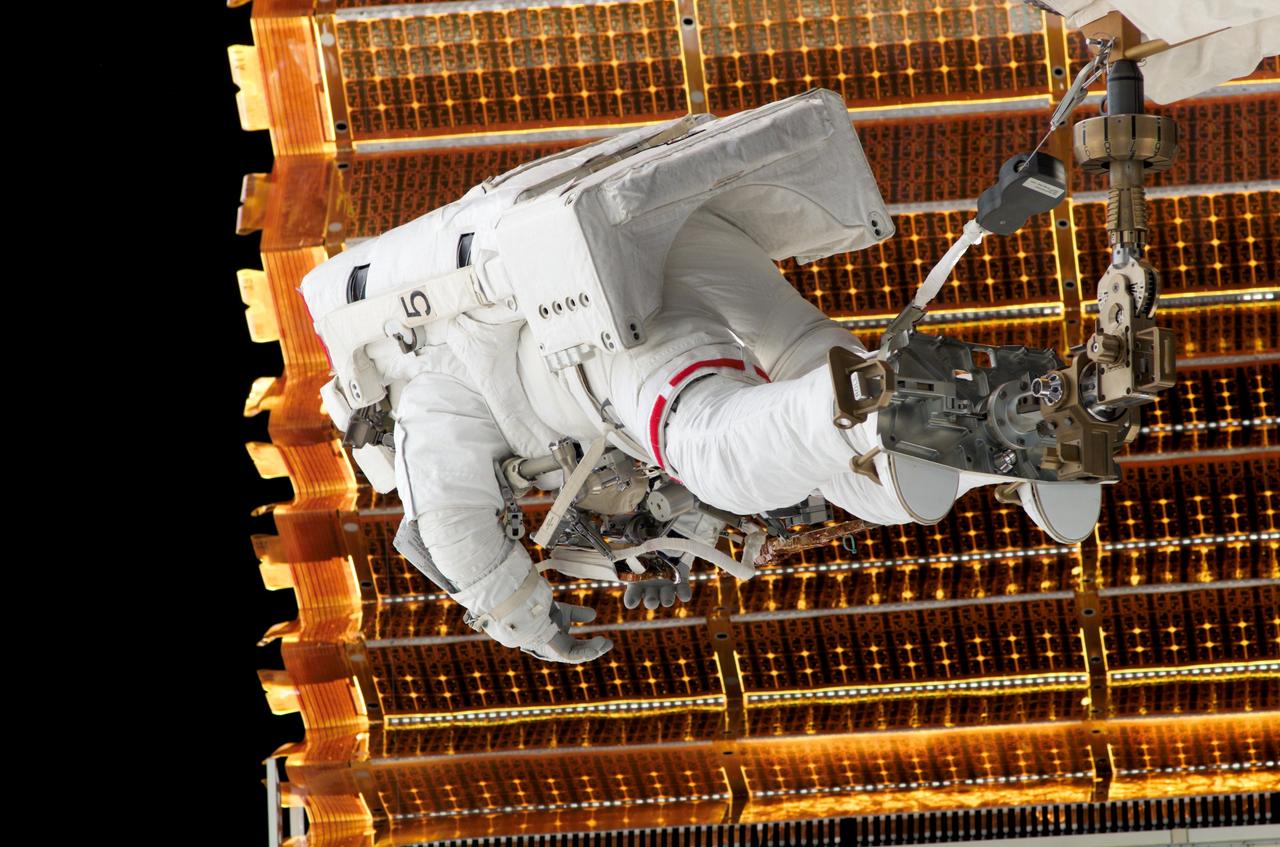
ISS015-E-12018 (13 June 2007) --- Anchored to a foot restraint on the Space Station Remote Manipulator System (SSRMS) or Canadarm2, astronaut Patrick Forrester, STS-117 mission specialist, participates in the mission's second planned session of extravehicular activity (EVA), as construction resumes on the International Space Station. Among other tasks, Forrester and astronaut Steven Swanson (out of frame), mission specialist, removed all of the launch locks holding the 10-foot-wide solar alpha rotary joint in place and began the solar array retraction.
View of Forrester working on ISS construction during STS-117 EVA2
During STS-31 checkout, the Hubble Space Telescope (HST) is held in a pre-deployment position by Discovery's, Orbiter Vehicle (OV) 103's, remote manipulator system (RMS). The view, taken from the crew cabin overhead window W7, shows the starboard solar array (SA) panel (center) and two high gain antennae (HGA) (on either side) stowed along side the Support System Module (SSM) forward shell. The sun highlights HST against the blackness of space.
STS-31 pre-deployment checkout of the Hubble Space Telescope (HST) on OV-103
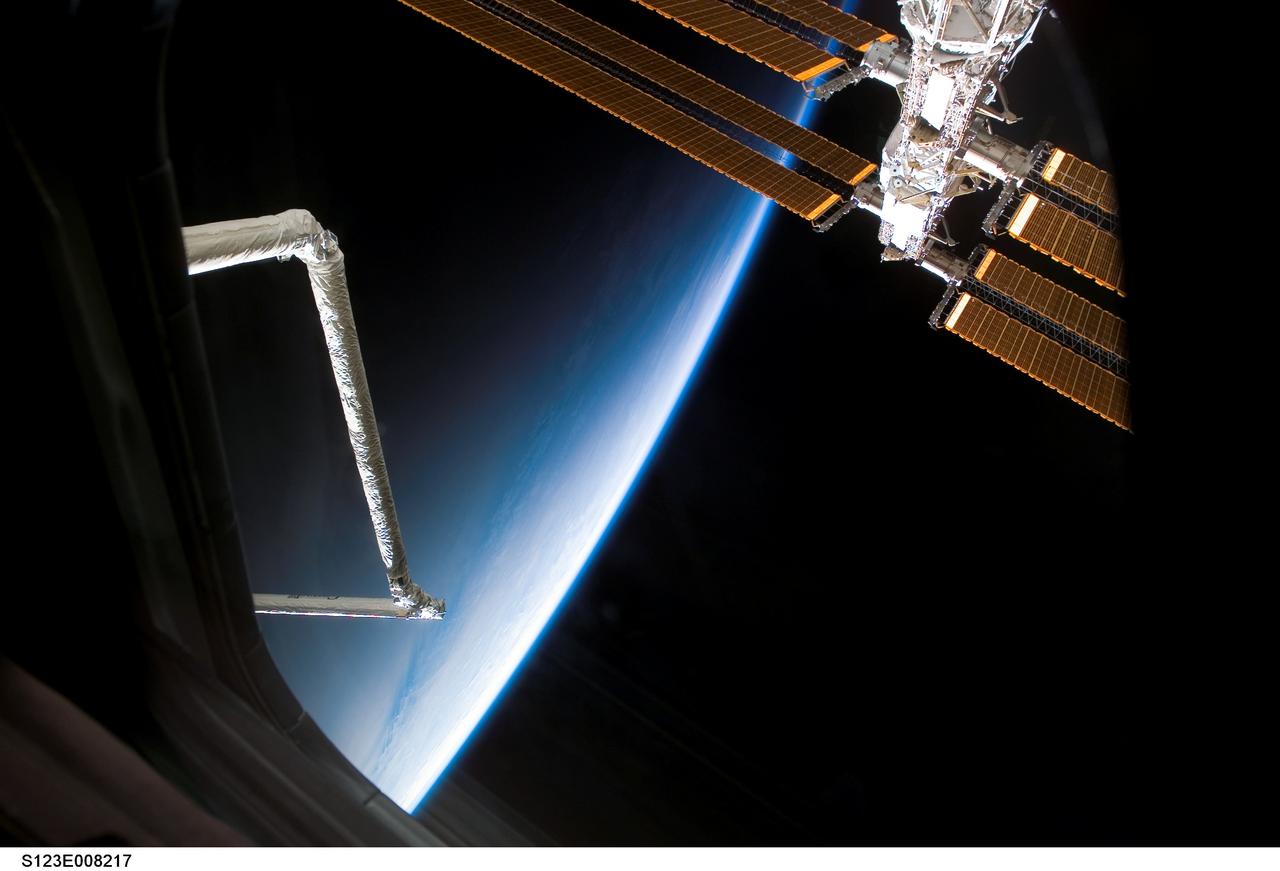
S123-E-008217 (21 March 2008) --- Space Shuttle Endeavour's Remote Manipulator System/Orbiter Boom Sensor System (RMS/OBSS) and a portion of the International Space Station's (ISS) solar array panels are photographed by a STS-123 crewmember through a window on Endeavour while docked with the station. The blackness of space and Earth's horizon provide the backdrop for the scene.
RMS/SSRMS and Solar Arrays taken during Joint Operations
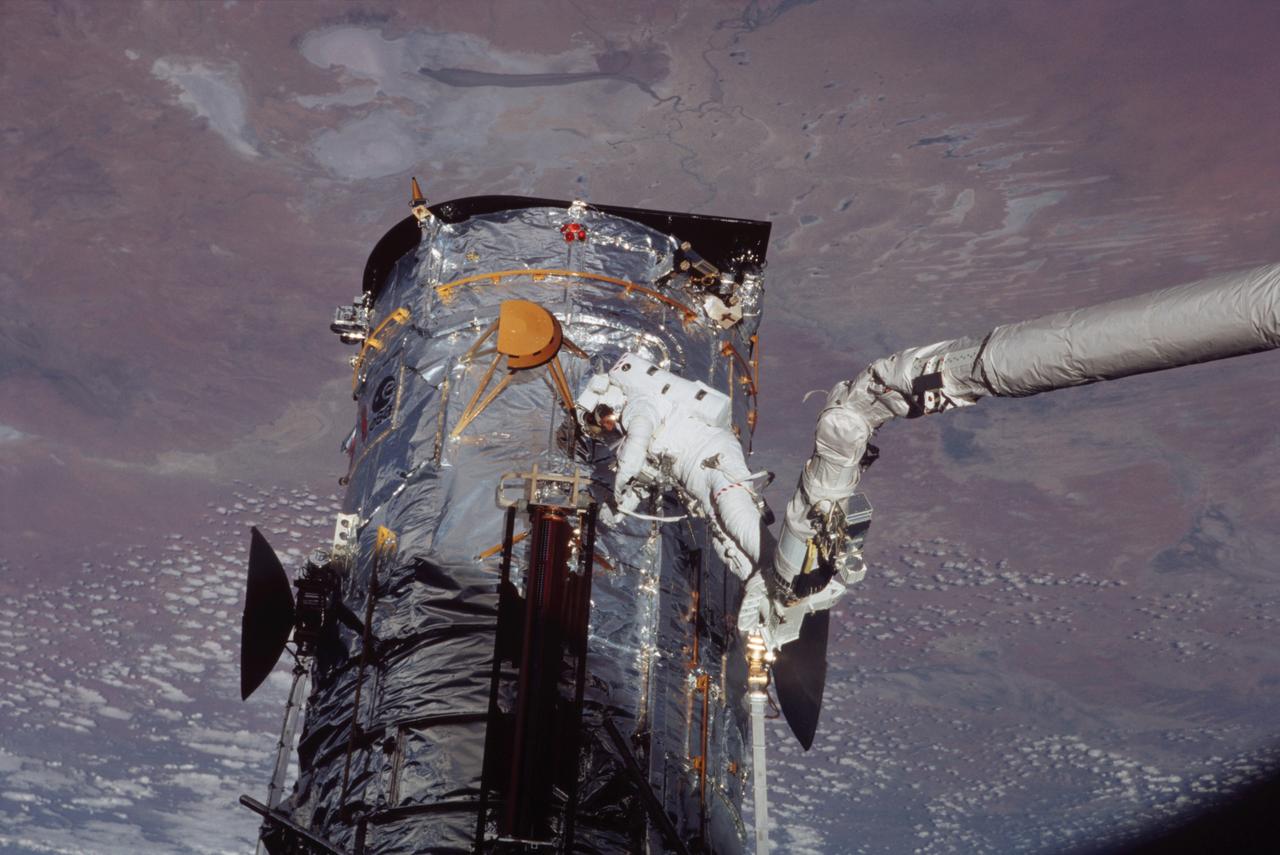
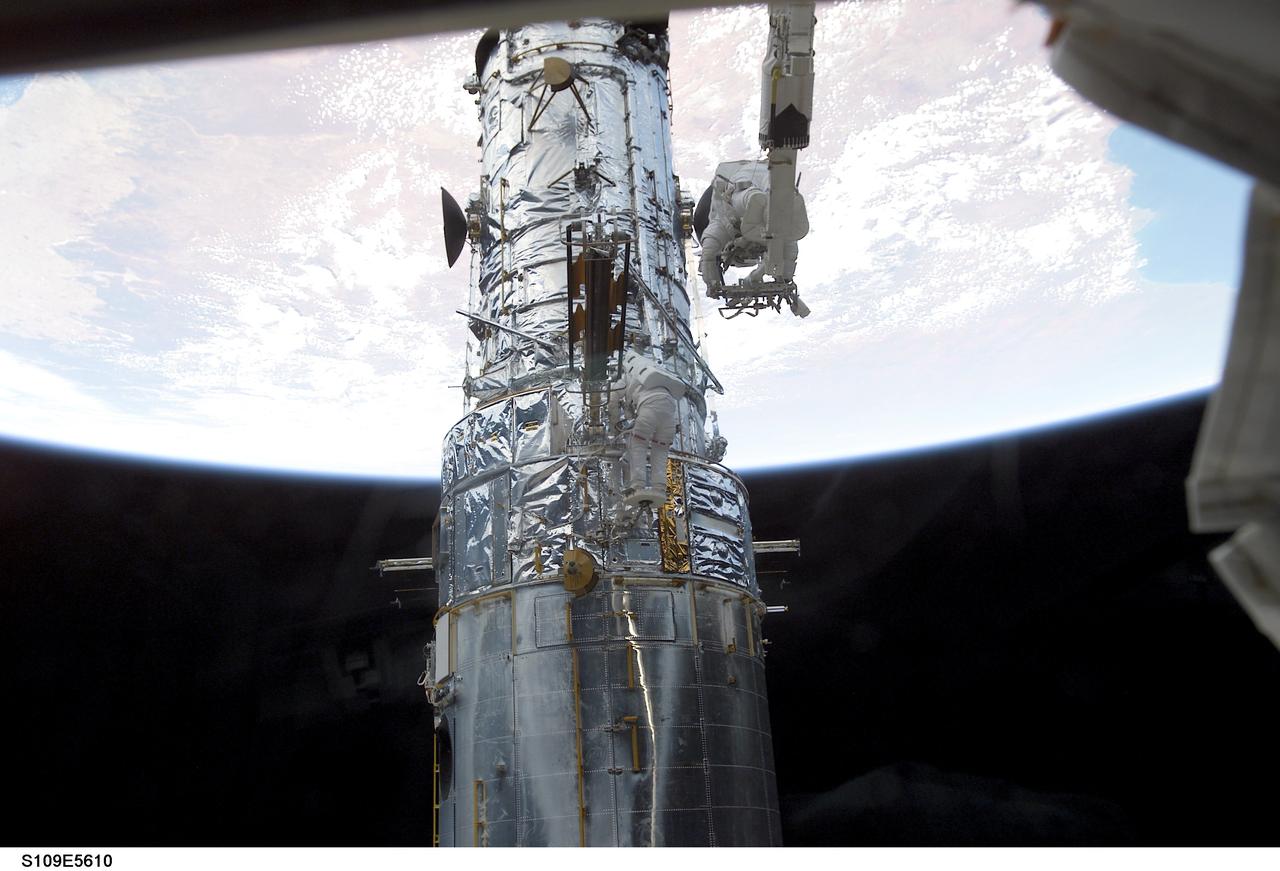
STS109-E-5610 (5 March 2002) --- Astronauts James H. Newman, attached to the Remote Manipulator System (RMS) arm   of the Space Shuttle Columbia, and Michael J. Massimino (barely visible  against the Hubble Space Telescope near center frame) work on the telescope as the shuttle flies over Australia.  This day's space walk went on to see astronauts Newman and  Massimino replace the port solar array on the Hubble. On the previous day astronauts John M. Grunsfeld and Richard M. Linnehan replaced the starboard solar array on the giant telescope. The image was recorded with a digital still camera.
EVA 2 - MS Newman and Massimino over Australia
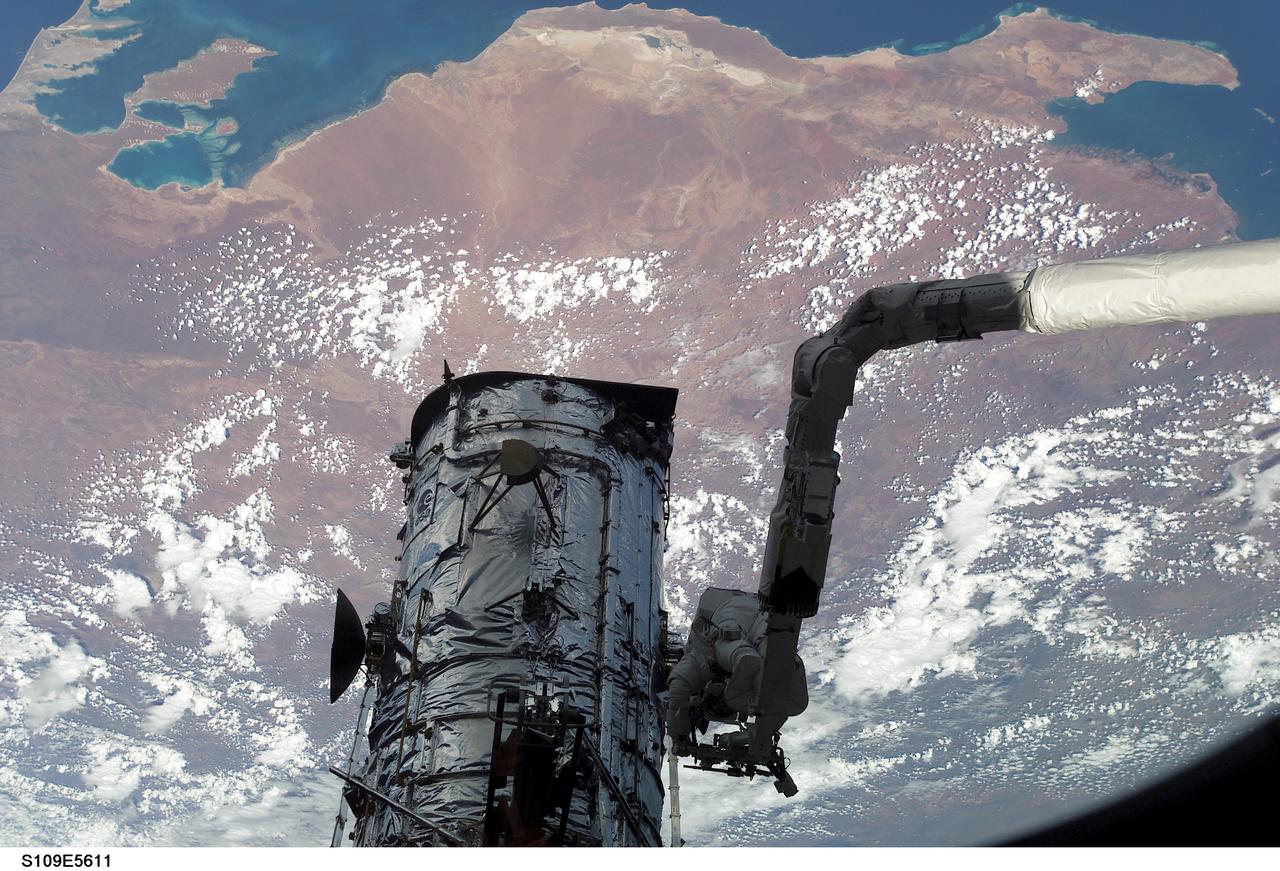
STS109-E-5611 (5 March 2002) --- Astronauts James H. Newman, attached to the Remote Manipulator System (RMS) arm of the Space Shuttle Columbia, and Michael J. Massimino (out of frame) work on the Hubble Space Telescope as the shuttle flies over Western Australia.  This day's space walk went on to see astronauts Newman and  Massimino replace the port solar array on the Hubble. On the previous day astronauts John M. Grunsfeld and Richard M. Linnehan replaced the starboard solar array on the giant telescope. The image was recorded with a digital still camera.
EVA 2 - MS Newman over Australia
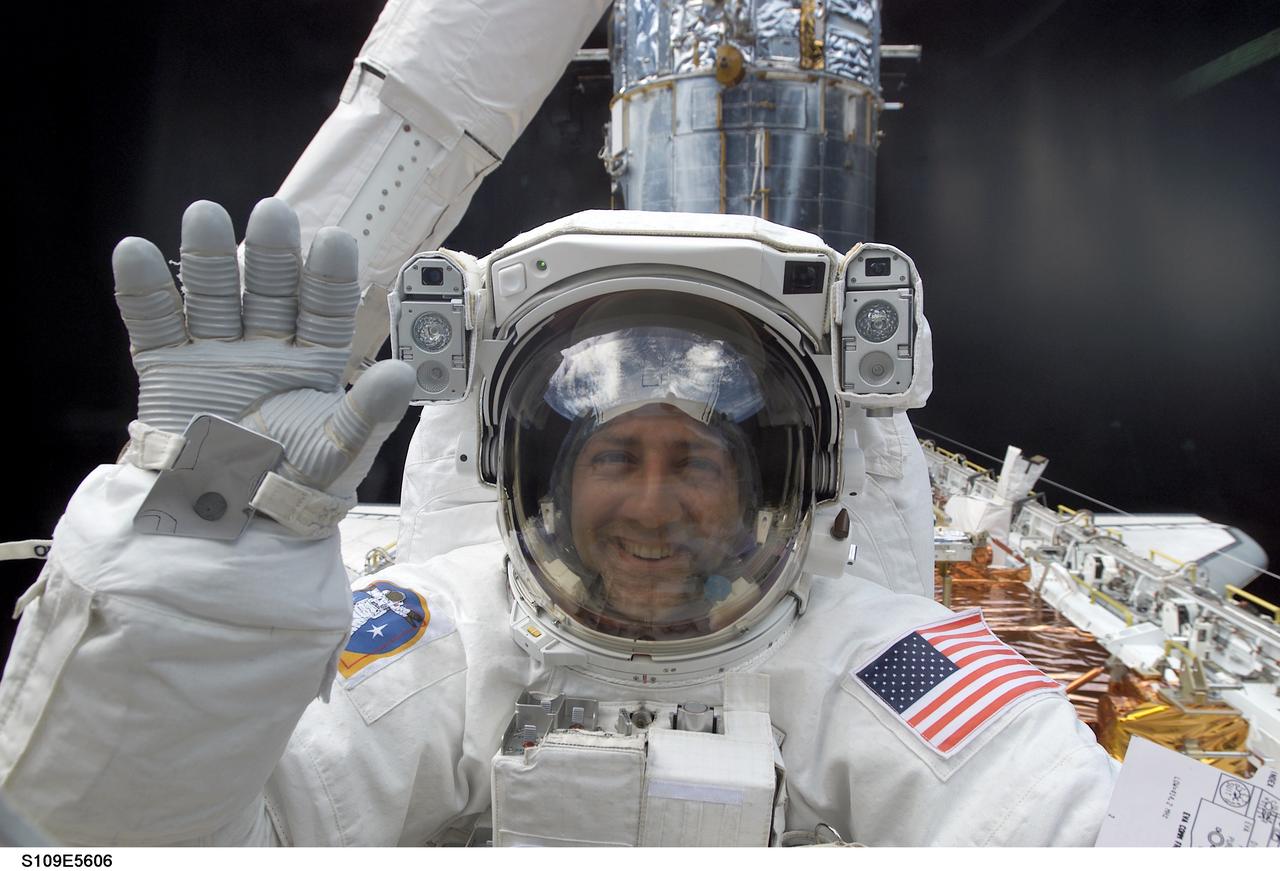
STS109-E-5606 (5 March 2002) --- Astronaut Michael J. Massimino, mission specialist, waves to crewmates on the other side of the aft flight deck windows on Columbia, while equipped with his extravehicular mobility units (EMU) space suit and standing on the end of the Remote Manipulator System (RMS) arm in the shuttle's cargo bay.  This day's space walk went on to see astronauts  James H. Newman and Massimino replace the port solar array on the Hubble Space Telescope (HST), partially visible in the background. On the previous day astronauts John M. Grunsfeld and Richard M. Linnehan replaced the starboard solar array on the giant telescope. The image was recorded with a digital still camera.
EVA 2 - MS Massimino waves to crewmates
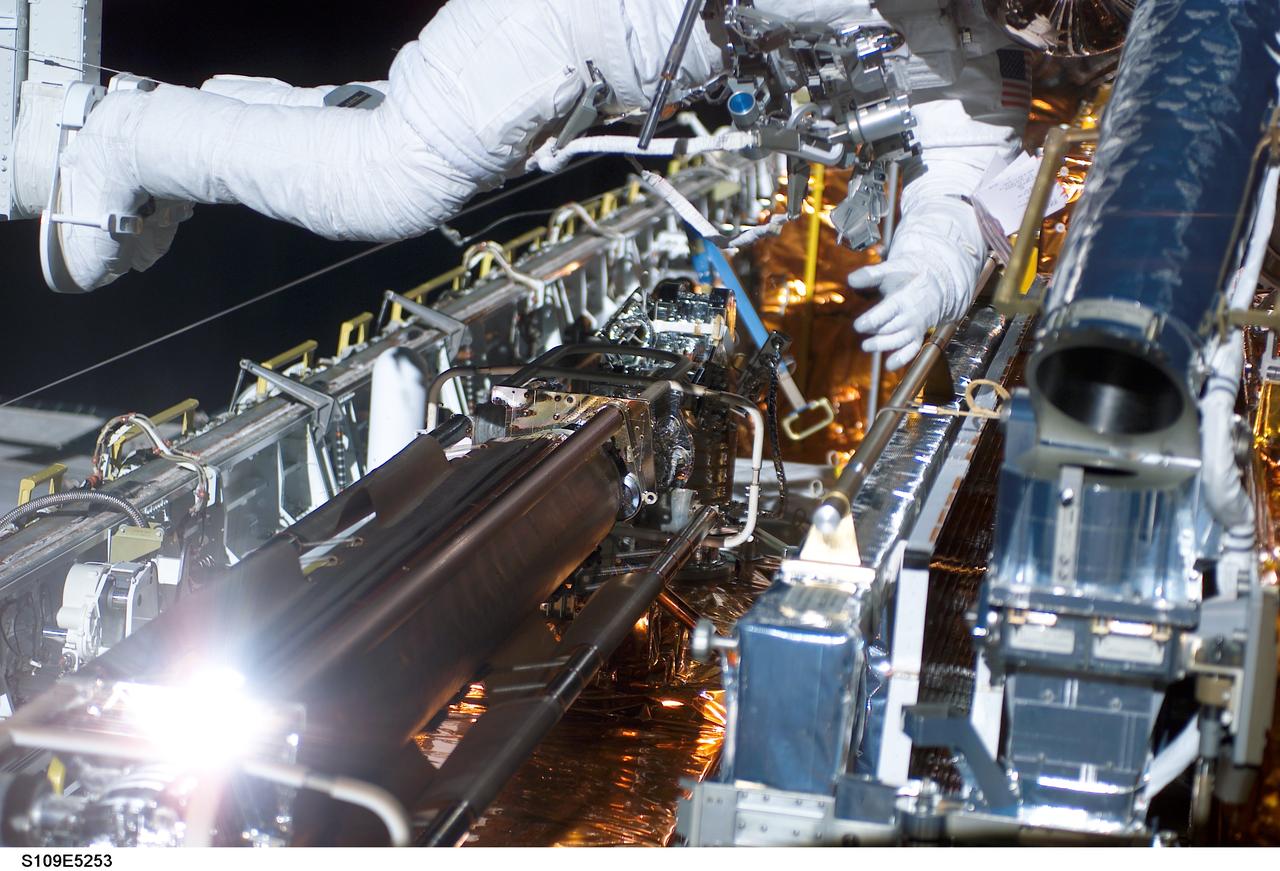
STS109-E-5253 (4 March 2002) --- Astronaut Richard M. Linnehan, mission specialist, is about to wrap up the first phase of a seven-hour space walk in the cargo bay of the Space Shuttle Columbia.  Linnehan's feet are anchored to a  restraint on the end of the Remote Manipulator System (RMS) robotic arm.  The piece of hardware putting on a bright glow in left foreground is the furled old solar array that astronauts Linnehan and John M. Grunsfeld, payload commander, earlier removed from Hubble Space Telescope.  The old array is now latched in Columbia's cargo bay for return to Earth. The two went on to  install the replacement starboard array. The image was recorded with a digital still camera.
STS-109 MS Linnehan and Grunsfeld in payload bay during first EVA
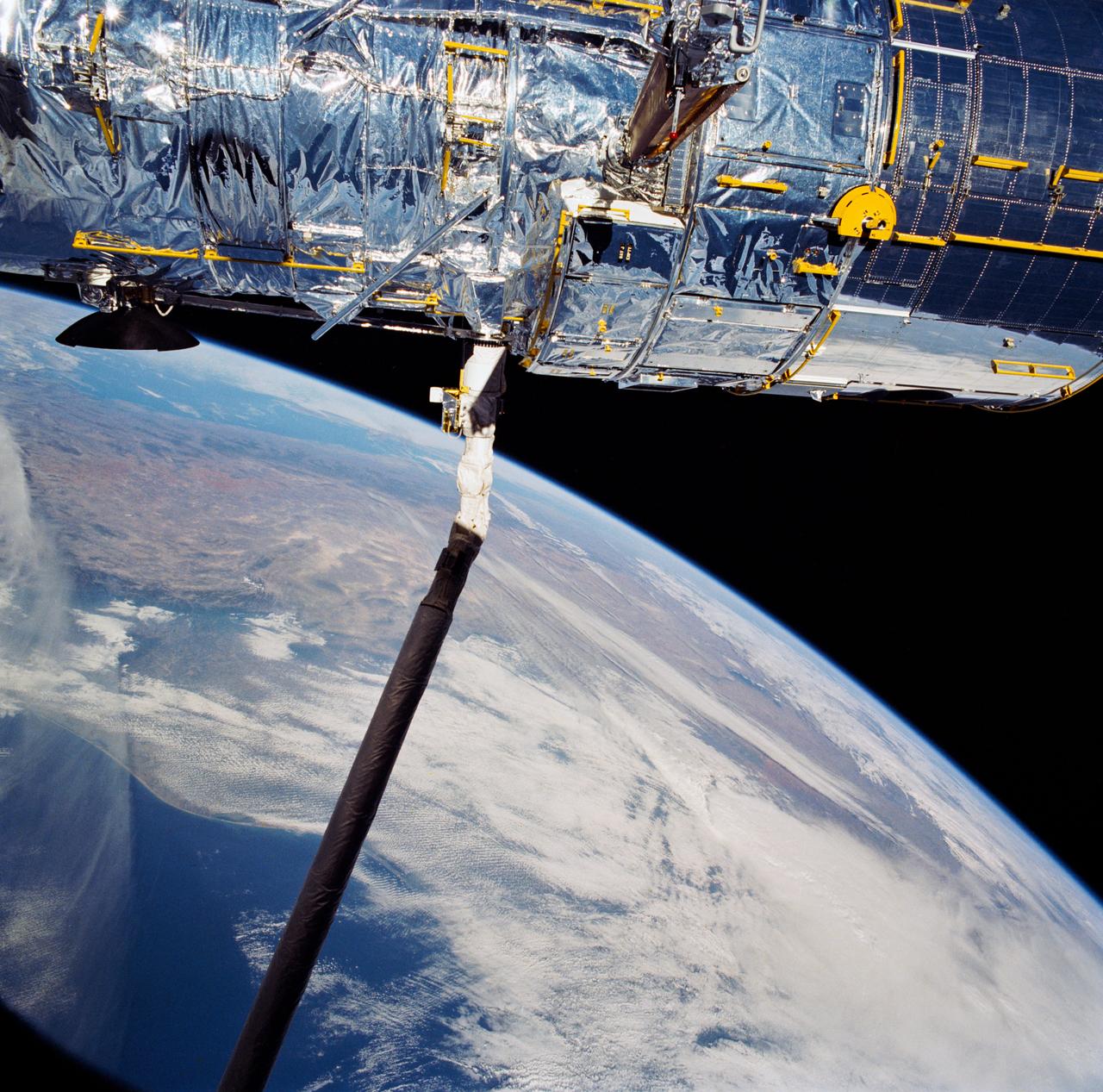
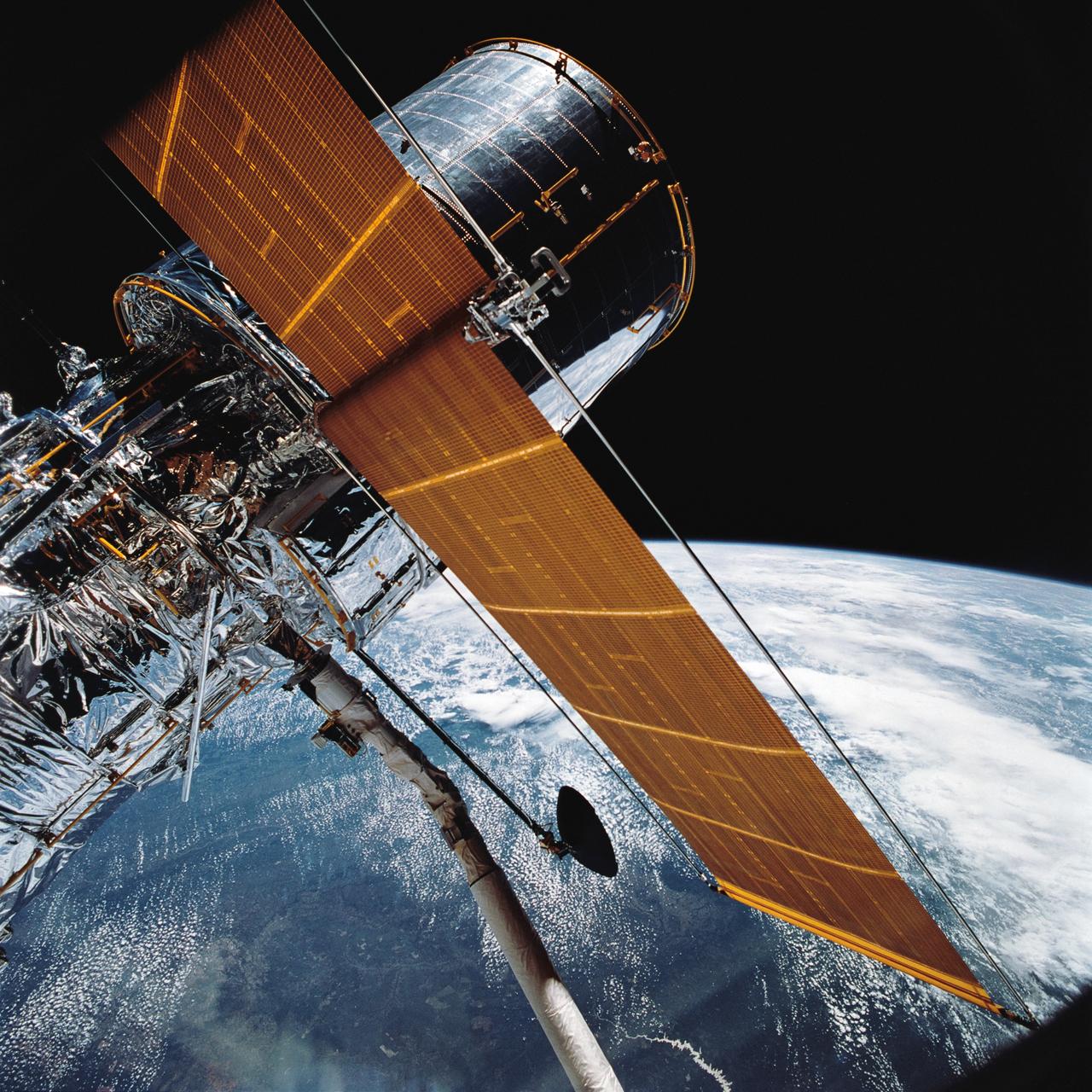
STS031-76-026 (25 April 1990) --- Most of the giant Hubble Space Telescope (HST) can be seen as it is suspended in space by Discovery's Remote Manipulator System (RMS) following the deployment of part of its solar panels and antennae. The photo was taken with a handheld Hasselblad camera. This was among the first photos NASA released on April 30, 1990, from the five-day STS 31 mission.
STS-31 Hubble Space Telescope (HST) (SA & HGA deployed) is grappled by RMS
STS061-48-027 (9 Dec 1993) --- Astronaut F. Story Musgrave moves about in the Space Shuttle Endeavour's cargo bay during the deployment of the solar array panels on the Hubble Space Telescope (HST) during the final of five STS-61 space walks.  The left hand of astronaut Jeffrey A. Hoffman appears at lower left corner.
Astronaut Story Musgrave during deployment of solar array panels on HST
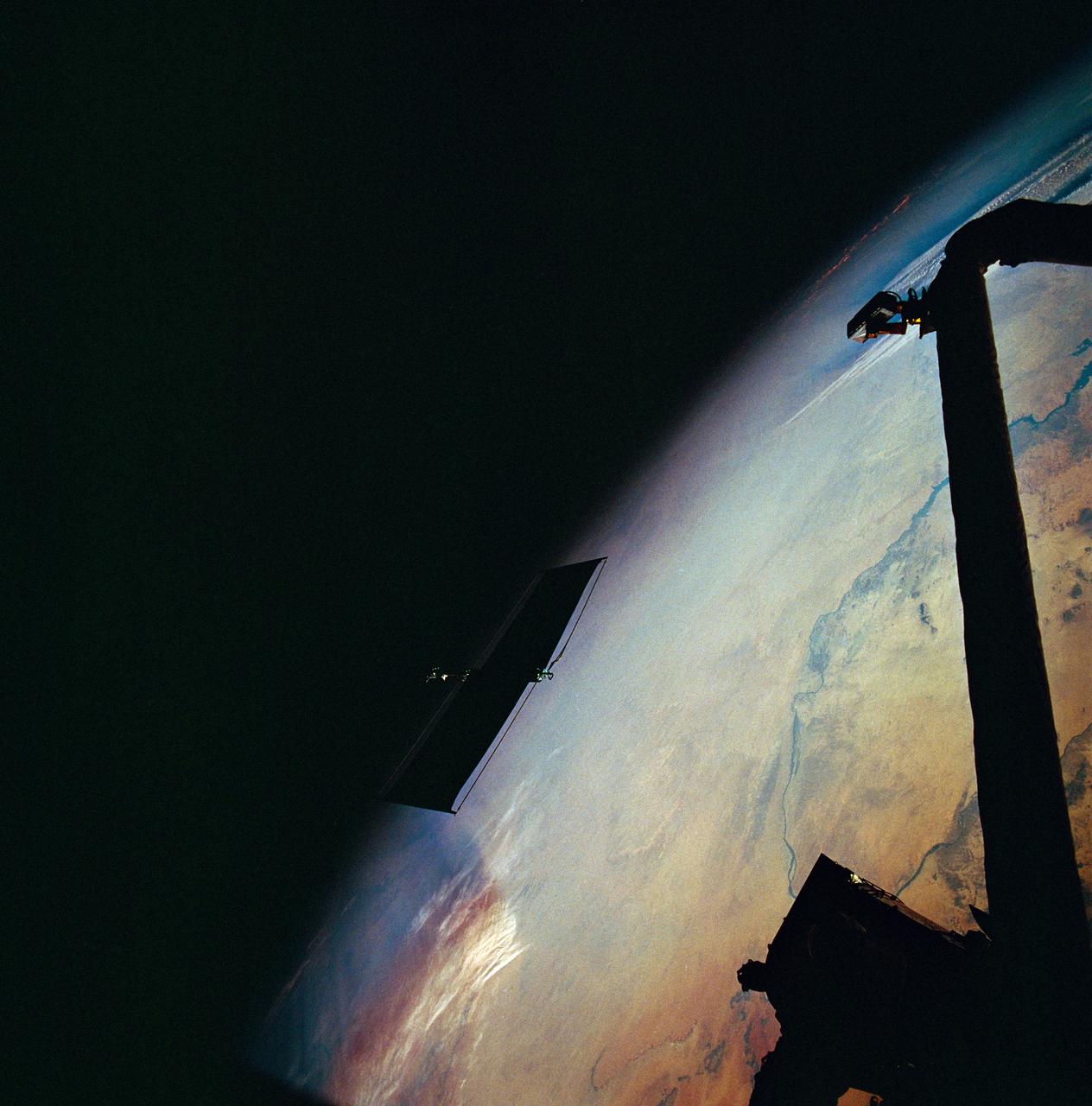
STS061-95-031 (6 Dec 1993) --- The damaged solar array panel removed from the Hubble Space Telescope (HST) is backdropped over northern Sudan.  Astronaut Kathryn C. Thornton, just out of frame at top right, watched the panel after releasing it moments earlier.
Discarded solar array panel removed from Hubble Space telescope
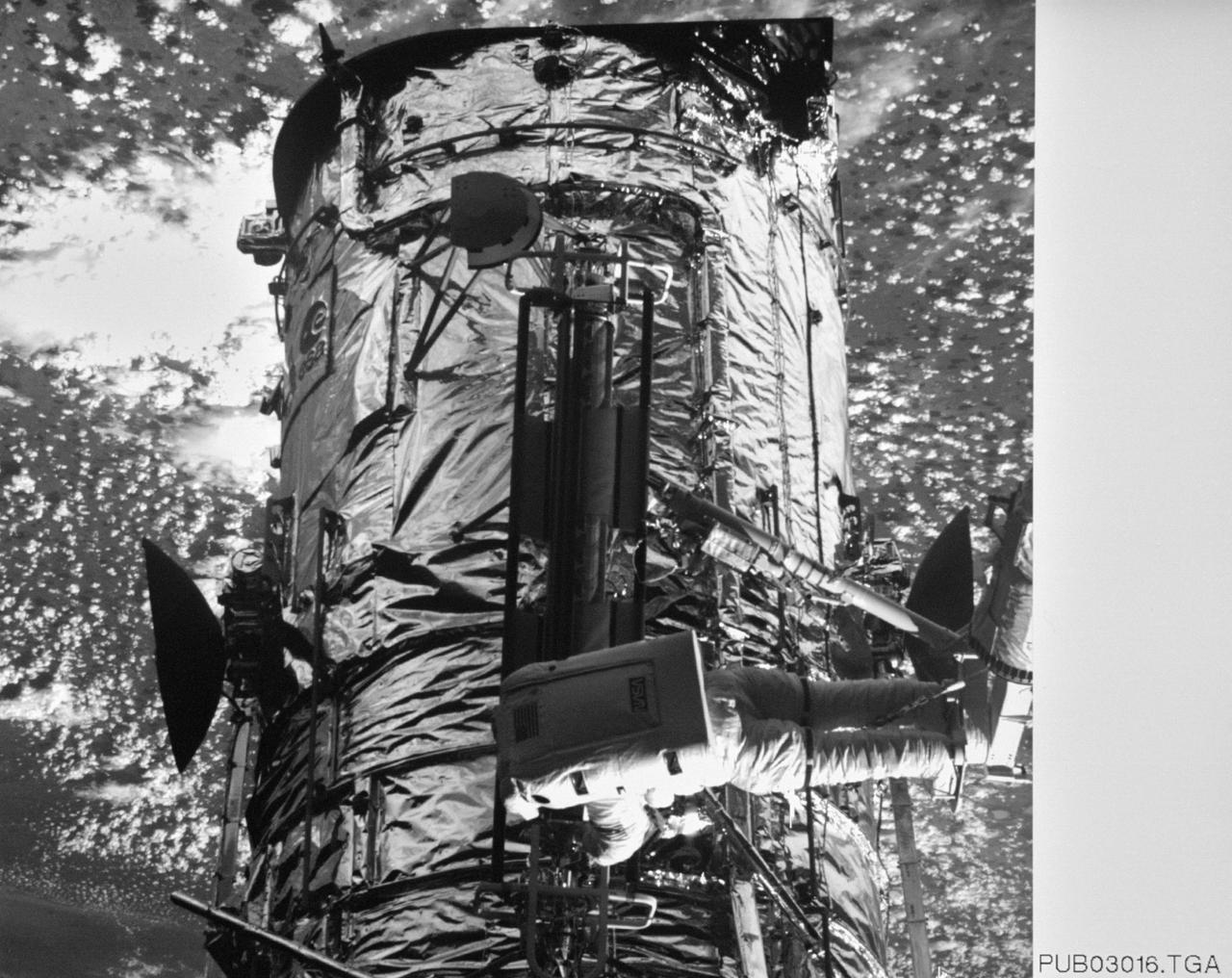
STS061-79-072 (4 Dec 1993) --- The Hubble Space Telescope (HST) is backdropped against the blackness of space in this 70mm frame recorded during a video survey of the spacecraft following the telescope's recent berthing in the Space Shuttle Endeavour's cargo bay.  European Space Agency (ESA) scientist Claude Nicollier controlled the Remote Manipulator System (RMS) arm slowly so that mounted TV cameras could show flight controllers the various areas on the telescope.
Hubble Space Telescoe being surveyed by cameras mounted on the RMS
STS037-99-031 (7 April 1991) --- The Gamma Ray Observatory (GRO) is still in the grasp of Atlantis' remote manipulator system (RMS) in this 70mm scene, photographed from inside the crew cabin.  A special extravehicular activity (EVA) was required by astronauts Jerry L. Ross and Jerome (Jay) Apt to manually extend the high-gain antenna on GRO.  The solar array panels are not yet deployed in this scene.  The five-member crew capped off a busy Flight Day 3 by releasing the heavy payload.
STS-37 payload - Gamma Ray Observatory (GRO) - on RMS in OV-104's payload bay
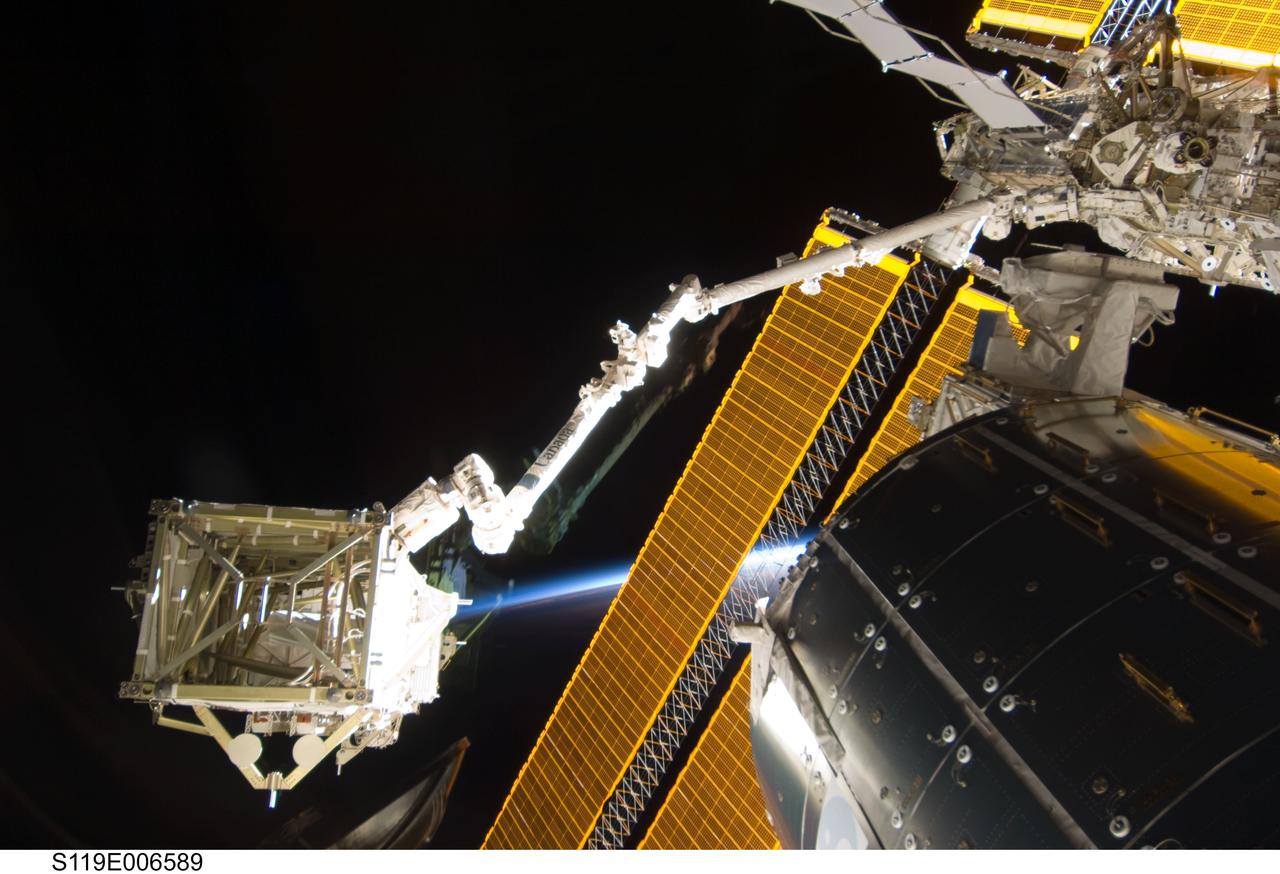
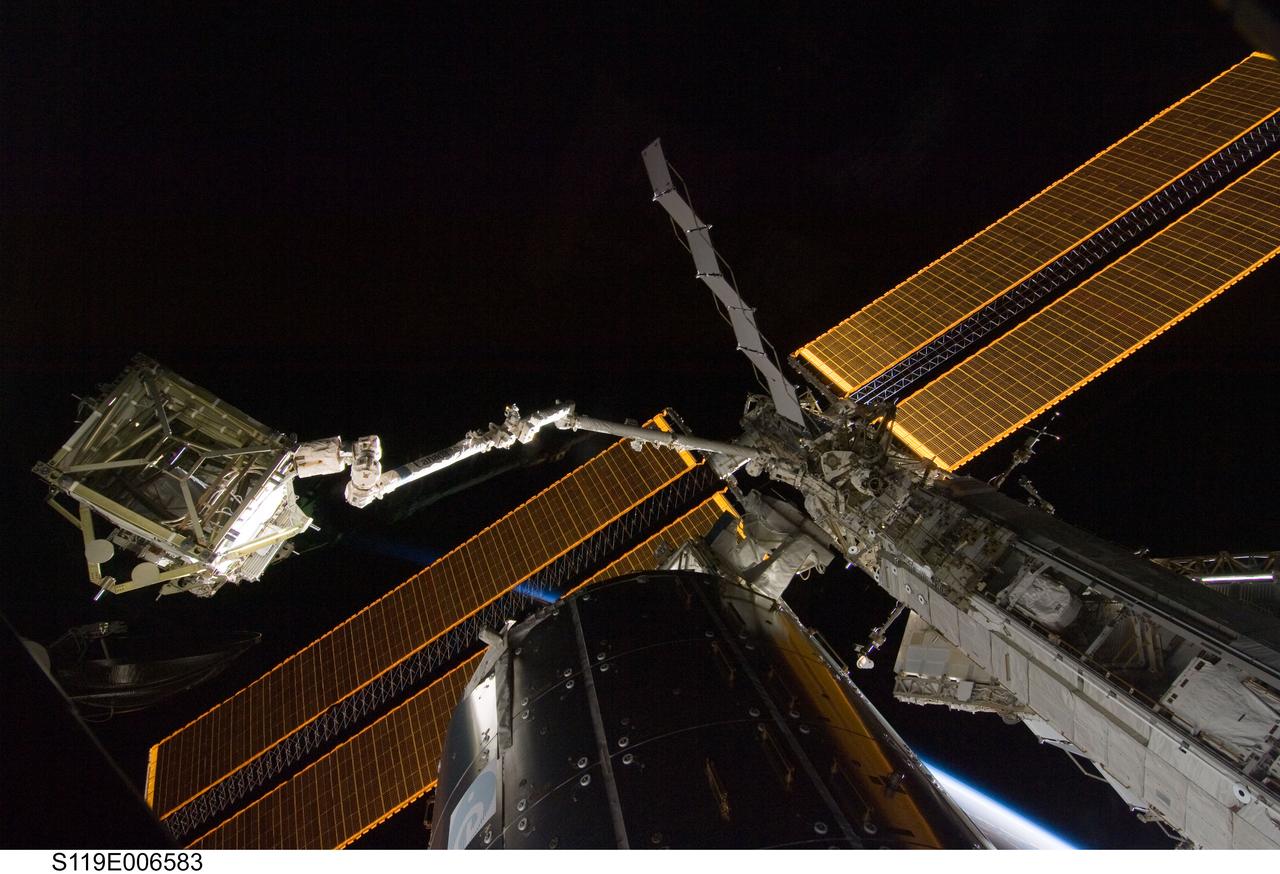
S119-E-006583 (18 March 2009) --- In the grasp of the International Space Station’s robotic Canadarm2, the S6 truss segment was photographed by a STS-119 crewmember while Space Shuttle Discovery is docked with the station. The S6 truss segment was moved from Discovery’s cargo bay by the station’s Canadarm2, handed off to the shuttle’s remote manipulator system (RMS), and then handed back to the station’s robotic arm where it will remain in an overnight parked position. Also visible in the image are the Columbus laboratory, starboard truss and solar array panels.
Space Station Remote Manipulator System (SSRMS) S6 Truss Relocation OPS
STS031-71-095 (25 April 1990) --- The Hubble Space Telescope (HST) is suspended above Discovery's cargo bay some 332 nautical miles above Earth.  The Canadian-built Remote Manipulator System (RMS) arm, controlled from in-cabin by the astronaut crew members of STS-31, held the huge telescope in this position during pre-deployment procedures, which included extension of solar array panels and antennae.  The photo was made with a 70mm handheld Hasselblad camera.
STS-31 pre-deploy check of the Hubble Space Telescope (HST) in OV-103's PLB
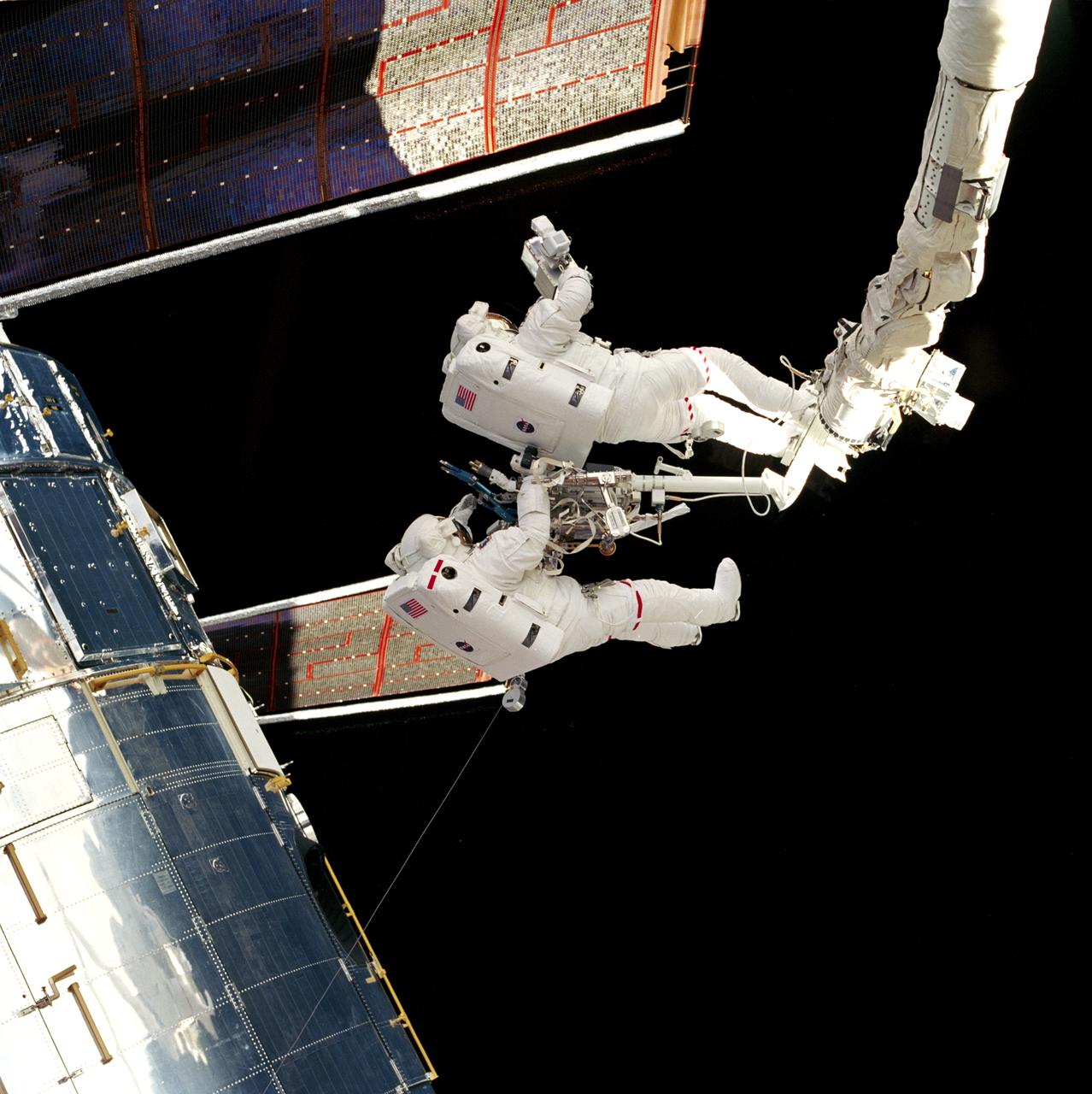
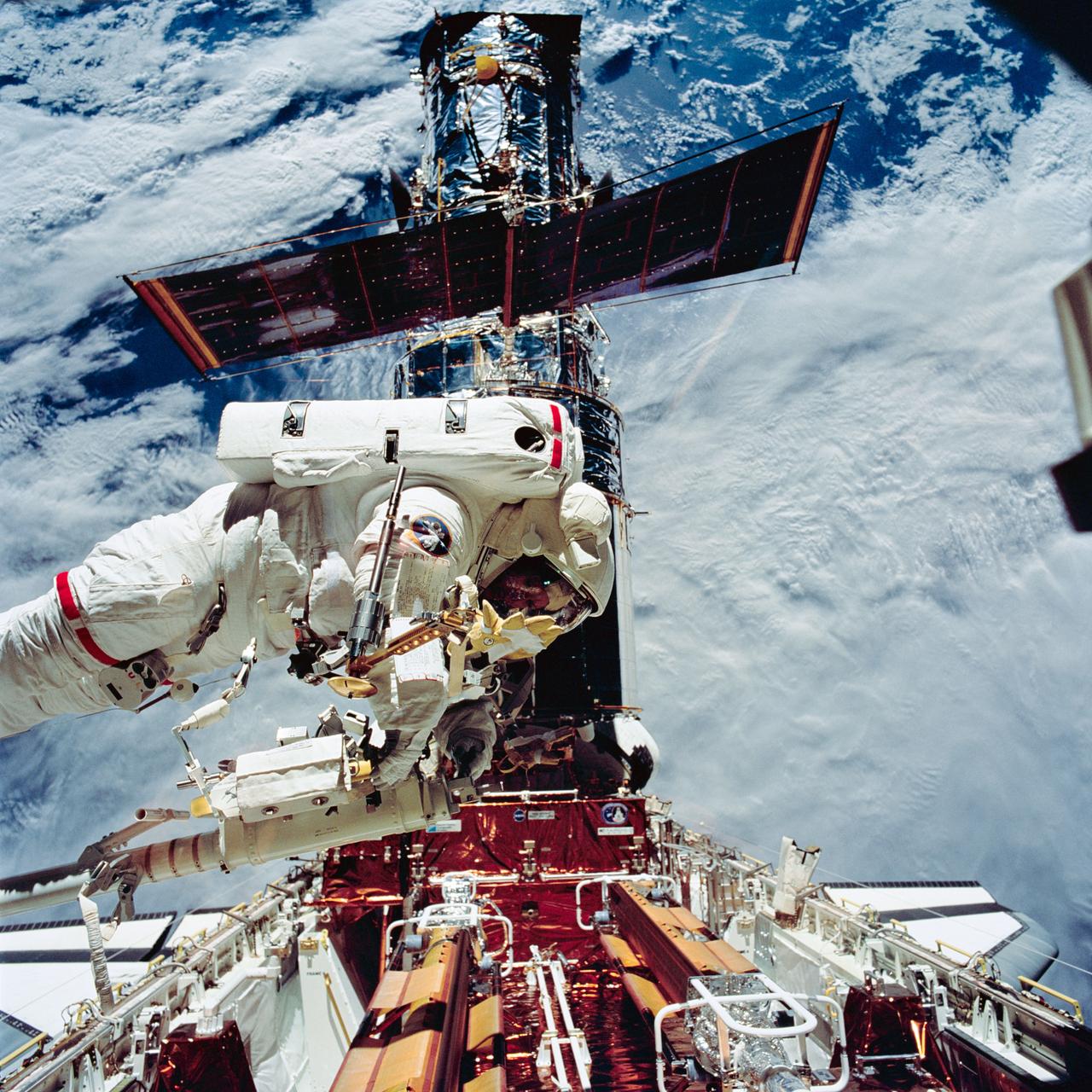
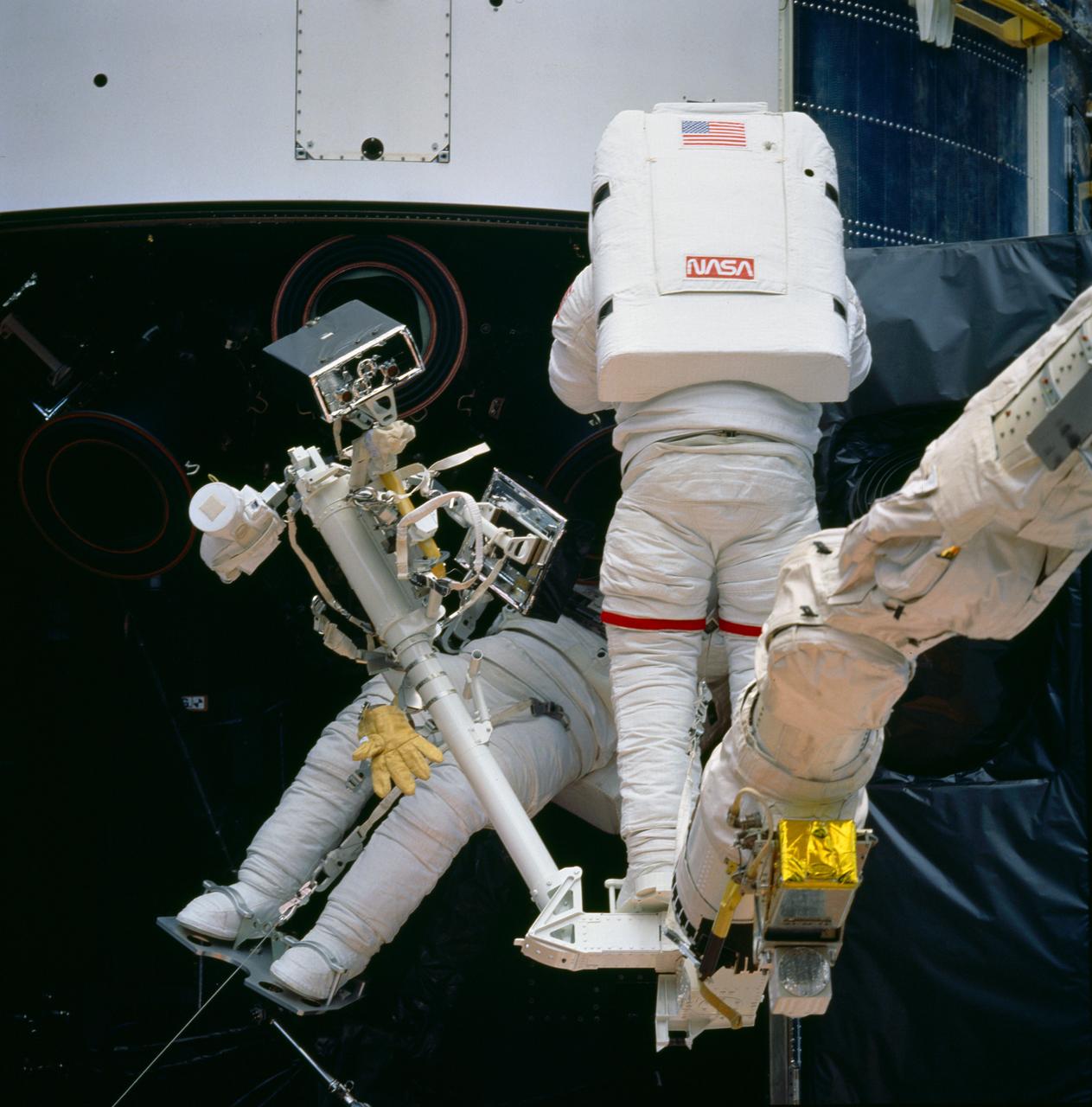
STS082-719-002 (14 Feb. 1997) --- Astronaut Joseph R. Tanner (right) stands on the end of Discovery's Remote Manipulator System (RMS) arm and aims a camera at the solar array panels on the Hubble Space Telescope (HST) as astronaut Gregory J. Harbaugh assists. The second Extravehicular Activity (EVA) photograph was taken with a 70mm camera from inside Discovery's cabin.
EVA 2 activity on Flight Day 5 to survey the HST solar array panels
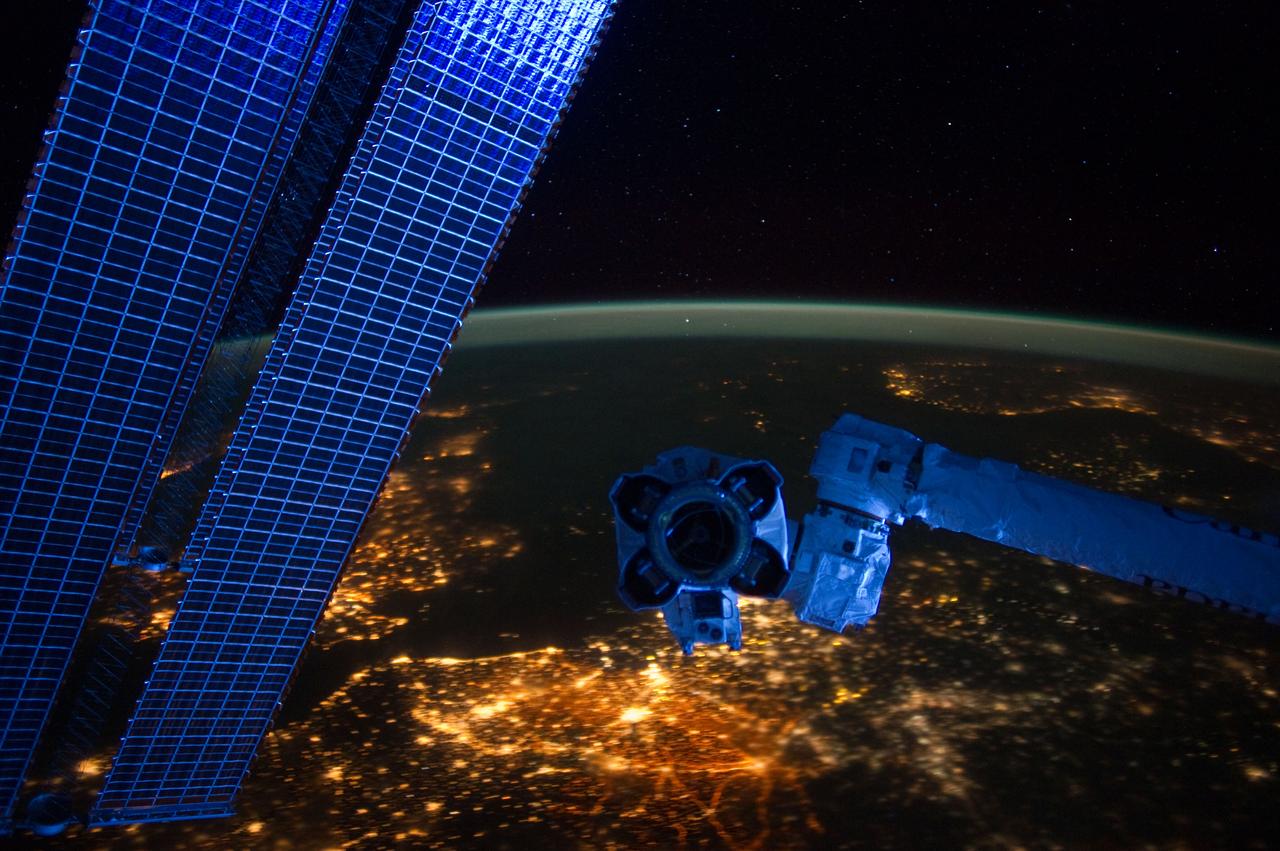
ISS030-E-048067 (22 Jan. 2012) --- With hardware from the Earth-orbiting International Space Station appearing in the near foreground, a night time European panorama reveals city lights from Belgium and the Netherlands at bottom center, the British Isles partially obscured by solar array panels at left, the North Sea at left center, and Scandinavia at right center beneath the end effector of the Space Station Remote Manipulator System or Canadarm2.
Earth Observations taken by Expedition 30 crewmember
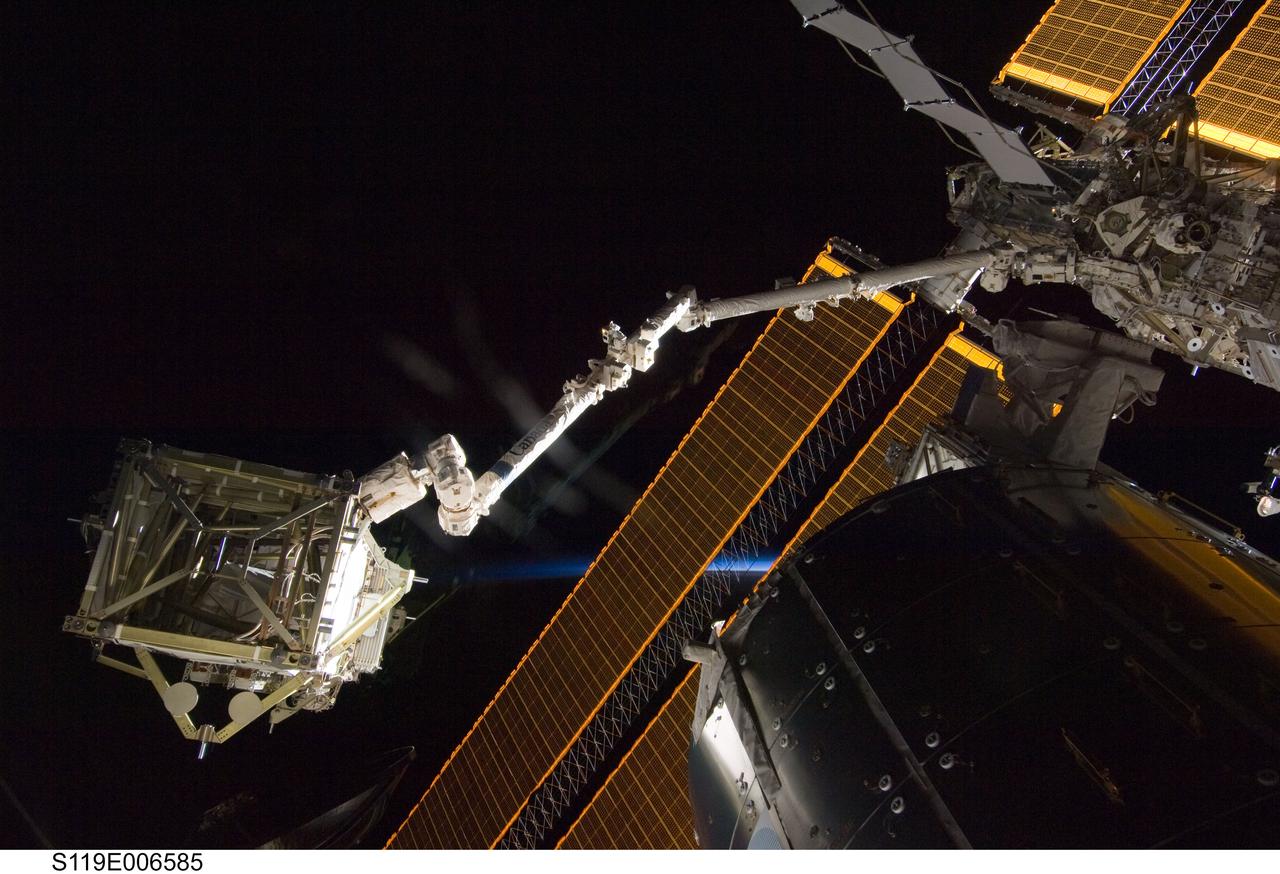
S119-E-006585 (18 March 2009) --- In the grasp of the International Space Station’s robotic Canadarm2, the S6 truss segment was photographed by a STS-119 crewmember while Space Shuttle Discovery is docked with the station. The S6 truss segment was moved from Discovery’s cargo bay by the station’s Canadarm2, handed off to the shuttle’s remote manipulator system (RMS), and then handed back to the station’s robotic arm where it will remain in an overnight parked position. Also visible in the image are the Columbus laboratory, starboard truss and solar array panels.
Space Station Remote Manipulator System (SSRMS) S6 Truss Relocation OPS
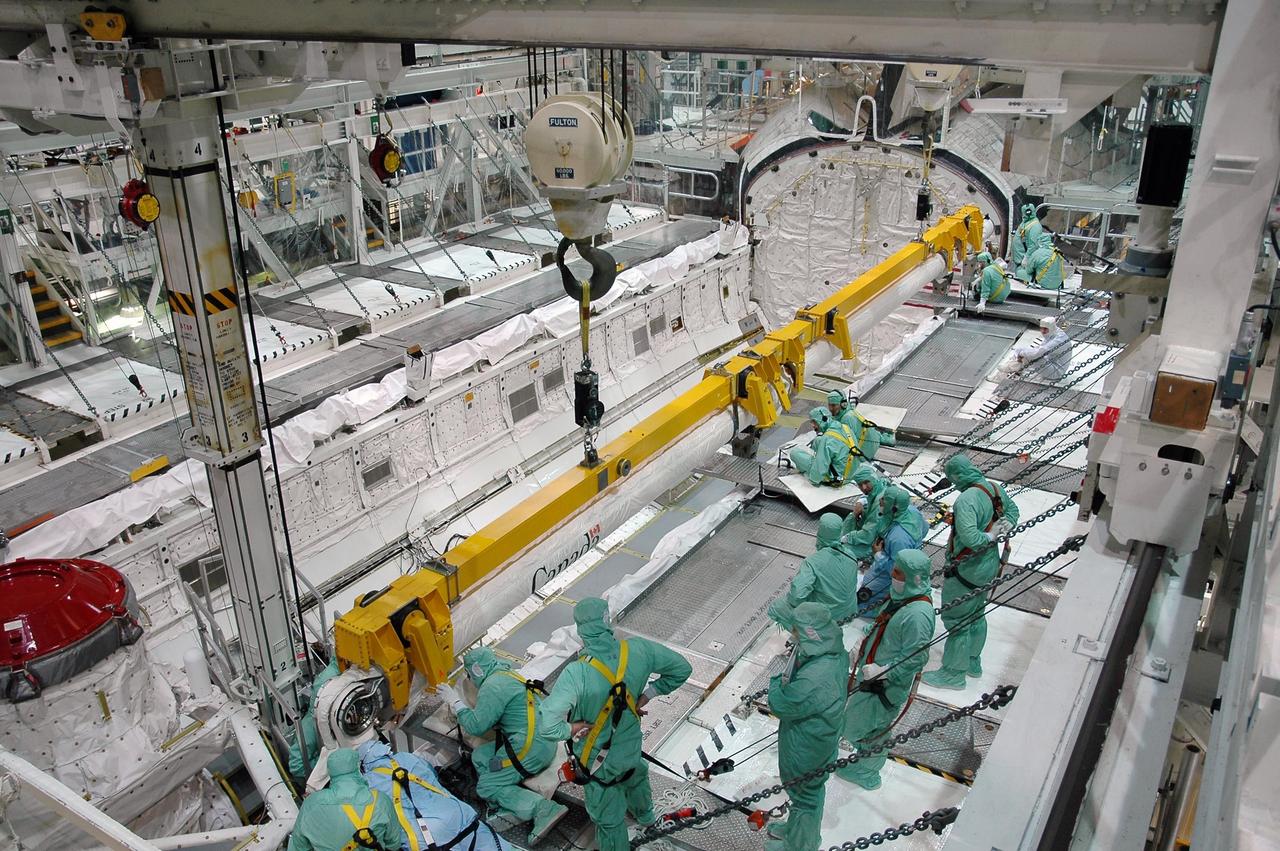
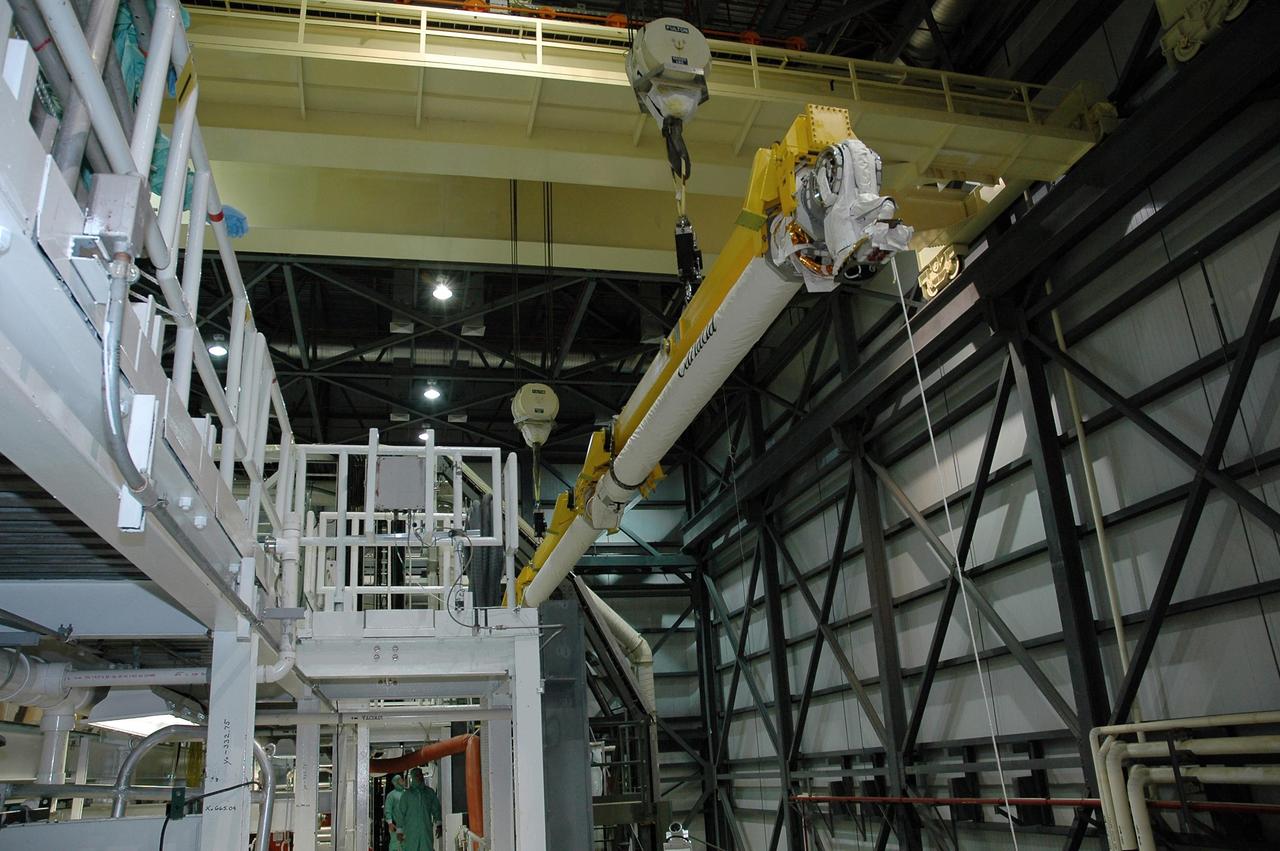
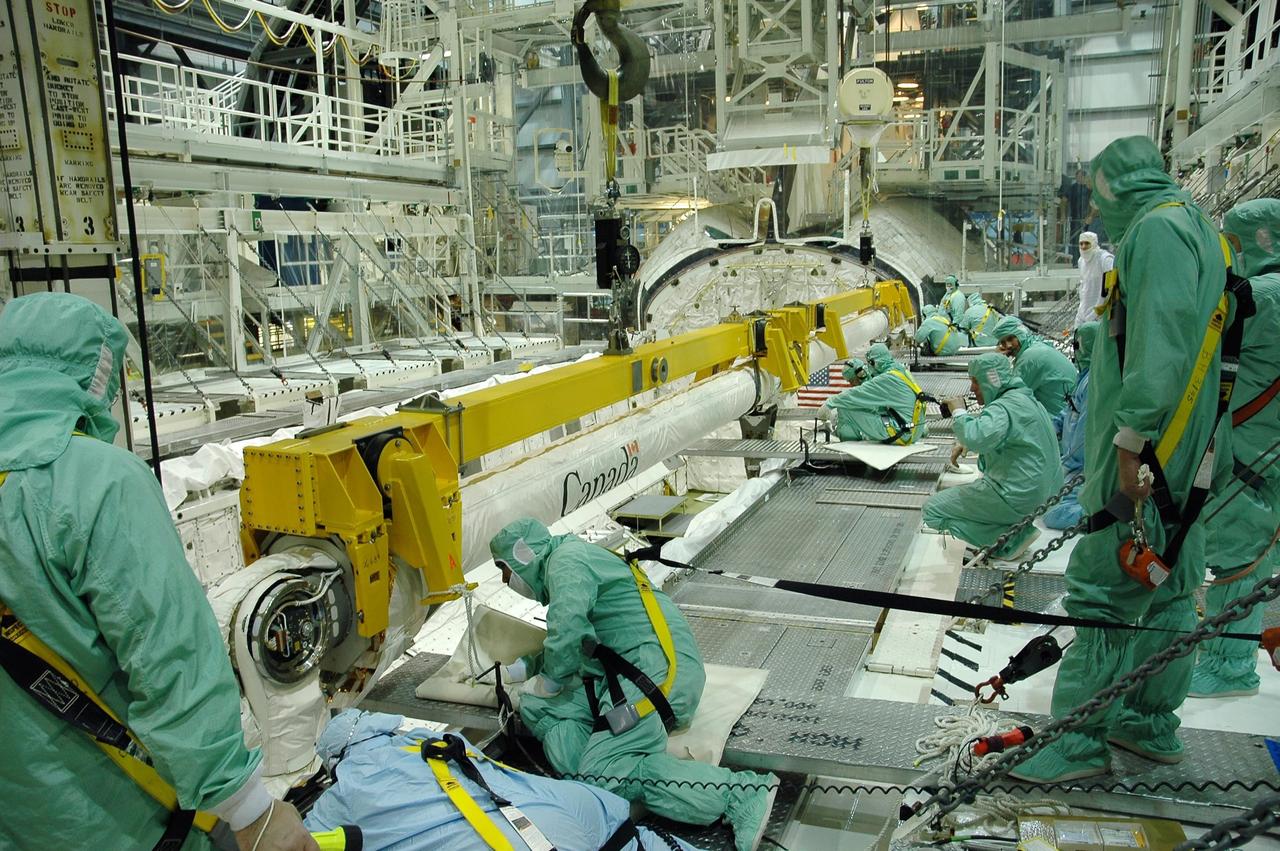
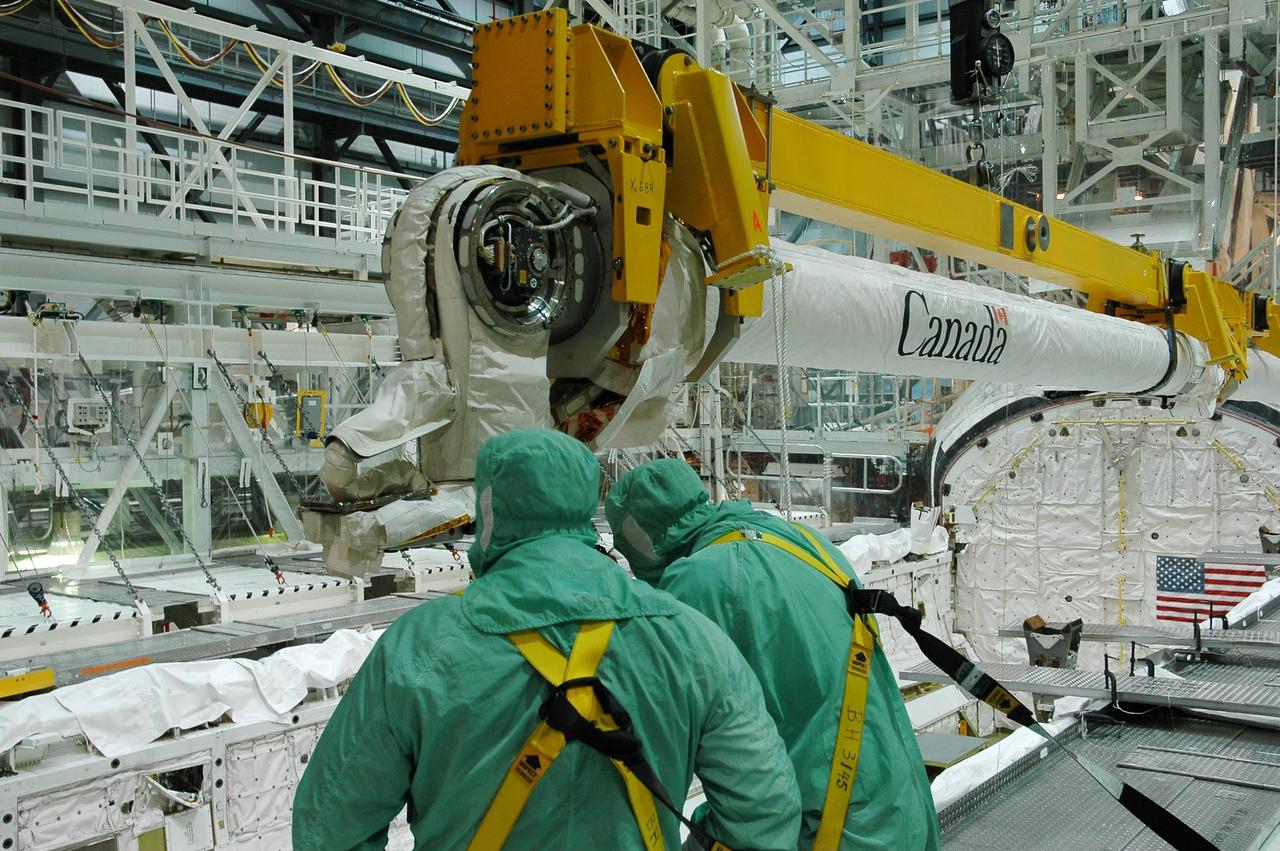
KENNEDY SPACE CENTER, FLA. -   In the Orbiter Processing Facility bay 1 at NASA Kennedy Space Center, overhead cranes lift the remote manipulator system, or boom, to move it to Atlantis’ payload bay for installation. Atlantis is the designated orbiter for mission STS-115, the 19th assembly flight to the International Space Station.  The payload includes the P3/P4 solar arrays. The launch planning window has not been determined yet for STS-115.
KSC-06pd0011
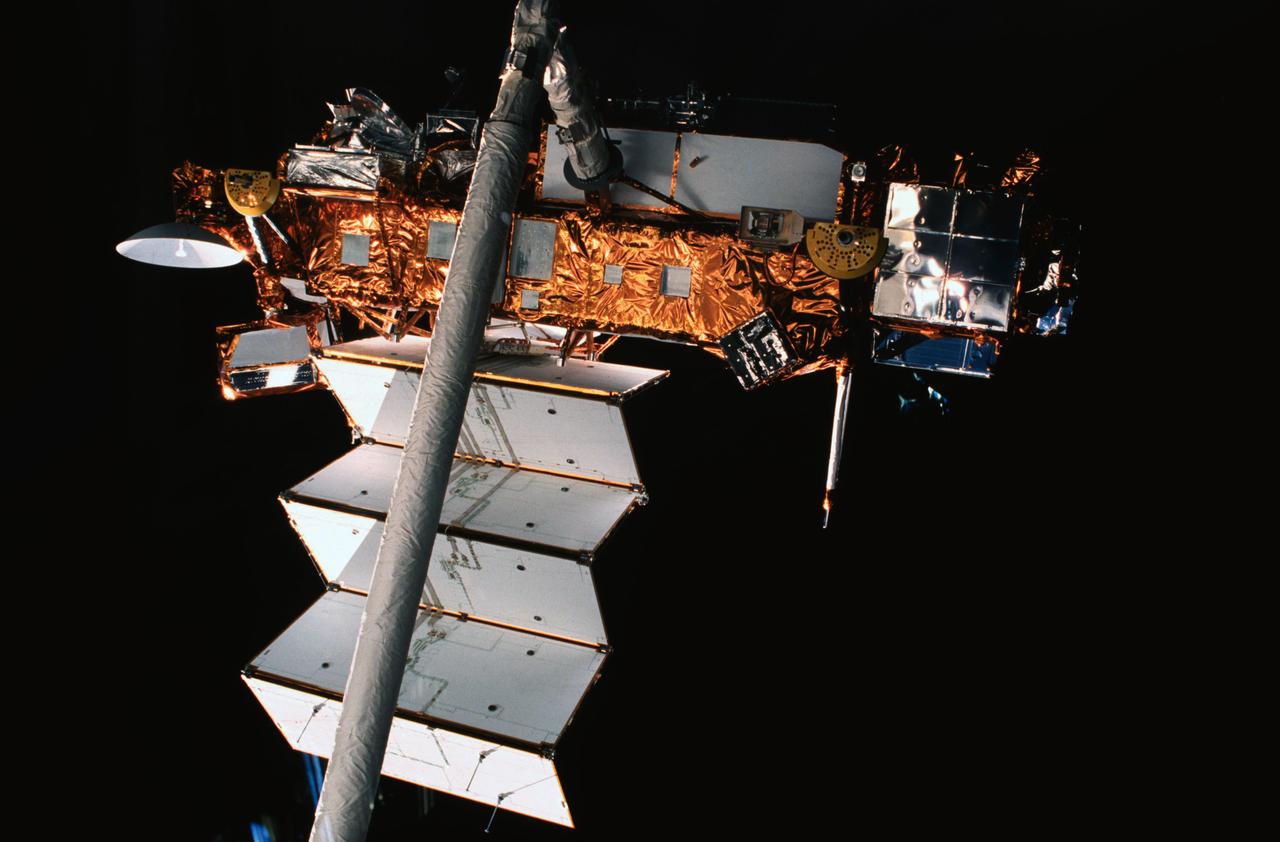
STS048-05-024 (15 Sept 1991) --- The Upper Atmosphere Research Satellite (UARS), in the grasp of the Remote Manipulator System (RMS), was captured on film by a camera aimed through one of the Space Shuttle Discovery's overhead windows.  At the time of the photo, deployment of UARS' solar array panel was in progress.  A few hours later, the huge satellite was free and on its way to a higher orbit.  Data from UARS will enable scientists to study ozone depletion in the stratosphere, or upper atmosphere.  The image was photographed with a 35mm camera.
STS-48 Upper Atmosphere Research Satellite (UARS) grappled by OV-103's RMS
S119-E-006589 (18 March 2009) --- In the grasp of the International Space Station’s robotic Canadarm2, the S6 truss segment was photographed by a STS-119 crewmember while Space Shuttle Discovery is docked with the station. The S6 truss segment was moved from Discovery’s cargo bay by the station’s Canadarm2, handed off to the shuttle’s remote manipulator system (RMS), and then handed back to the station’s robotic arm where it will remain in an overnight parked position. Also visible in the image are the Columbus laboratory, starboard truss and solar array panels.
Space Station Remote Manipulator System (SSRMS) S6 Truss Relocation OPS
S119-E-006596 (18 March 2009) --- In the grasp of the International Space Station’s robotic Canadarm2, the S6 truss segment was photographed by a STS-119 crewmember while Space Shuttle Discovery is docked with the station. The S6 truss segment was moved from Discovery’s cargo bay by the station’s Canadarm2, handed off to the shuttle’s remote manipulator system (RMS), and then handed back to the station’s robotic arm where it will remain in an overnight parked position. Also visible in the image are the Columbus laboratory, starboard truss and solar array panels.
Space Station Remote Manipulator System (SSRMS) S6 Truss Relocation OPS
STS061-95-028 (6 Dec 1993) --- Astronaut Kathryn C. Thornton, on the end of the Space Shuttle Endeavour's Remote Manipulator System (RMS) arm, hovers over equipment associated with servicing chores on the Hubble Space Telescope (HST) during the second extravehicular activity (EVA) on the eleven-day mission.  Astronauts Thornton and Thomas D. Akers changed out the solar array panels during this EVA.
Astronaut Kathryn Thornton during second HST extravehicular activity
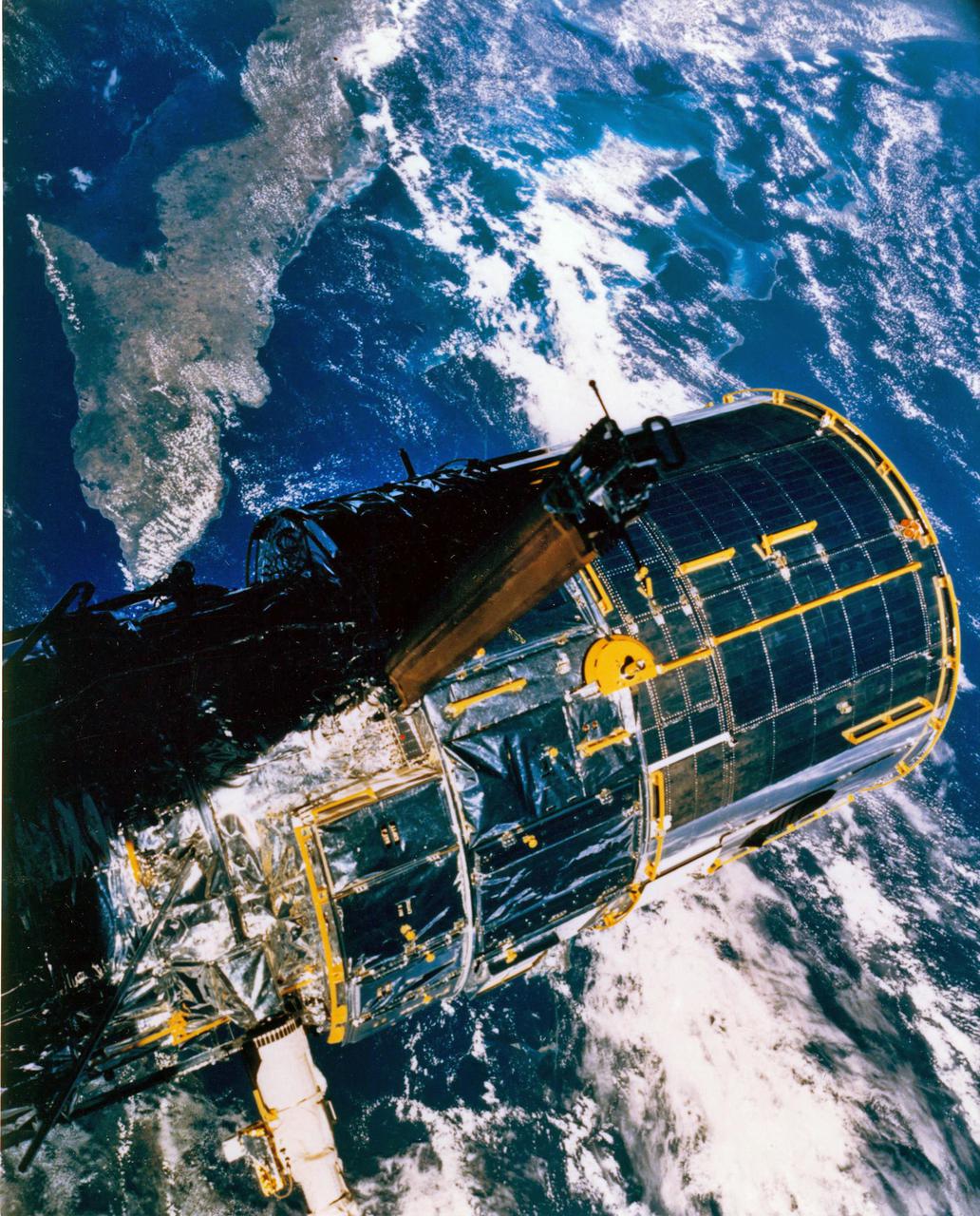
JOHNSON SPACE CENTER, HOUSTON, TEXAS-- STS-31 ONBOARD SCENE -- The Hubble Space Telescope (HST) is suspended in space by Discovery's remote manipulator system prior to deployment of its solar array panels and antennae and its ultimate release.  Puerto Rico and the Dominican Republic are recognizable at left of the frame.  The photo was taken with a handheld Hasselblad camera.  This was among the first photos NASA released on April 30 from the five-day mission.
KSC-90pc-0705
STS109-E-5452 (4 March 2002) --- Astronauts Richard M. Linnehan (partially visible on the end of Columbia's robotic arm), STS-109 mission specialist, and John M. Grunsfeld  (center frame), payload commander, work to replace the starboard solar array on the Hubble Space Telescope (HST). Linnehan works while anchored to a foot restraint connected to the shuttle's Remote Manipulator System (RMS), controlled inside the shuttle's crew cabin by astronaut Nancy J. Currie, mission specialist. The image was   recorded with a digital still camera.
View of STS-109 MS Linnehan and Grunsfeld during EVA 1
JOHNSON SPACE CENTER, HOUSTON, TEXAS-- The Hubble Space Telescope (HST), still in the grasp of Discovery's remote manipulator system, is backdropped over Cuba and the Bahama Islands.  In this scene, it has yet to have deployment of its solar array panels and its high gain antennae.  This scene was captured with a large format AeroLinhof camera used by several previous flight crews to record Earth scenes.
KSC-90pc-0706
S119-E-006588 (18 March 2009) --- In the grasp of the International Space Station’s robotic Canadarm2, the S6 truss segment was photographed by a STS-119 crewmember while Space Shuttle Discovery is docked with the station. The S6 truss segment was moved from Discovery’s cargo bay by the station’s Canadarm2, handed off to the shuttle’s remote manipulator system (RMS), and then handed back to the station’s robotic arm where it will remain in an overnight parked position. Also visible in the image are the Columbus laboratory, starboard truss and solar array panels.
Space Station Remote Manipulator System (SSRMS) S6 Truss Relocation OPS
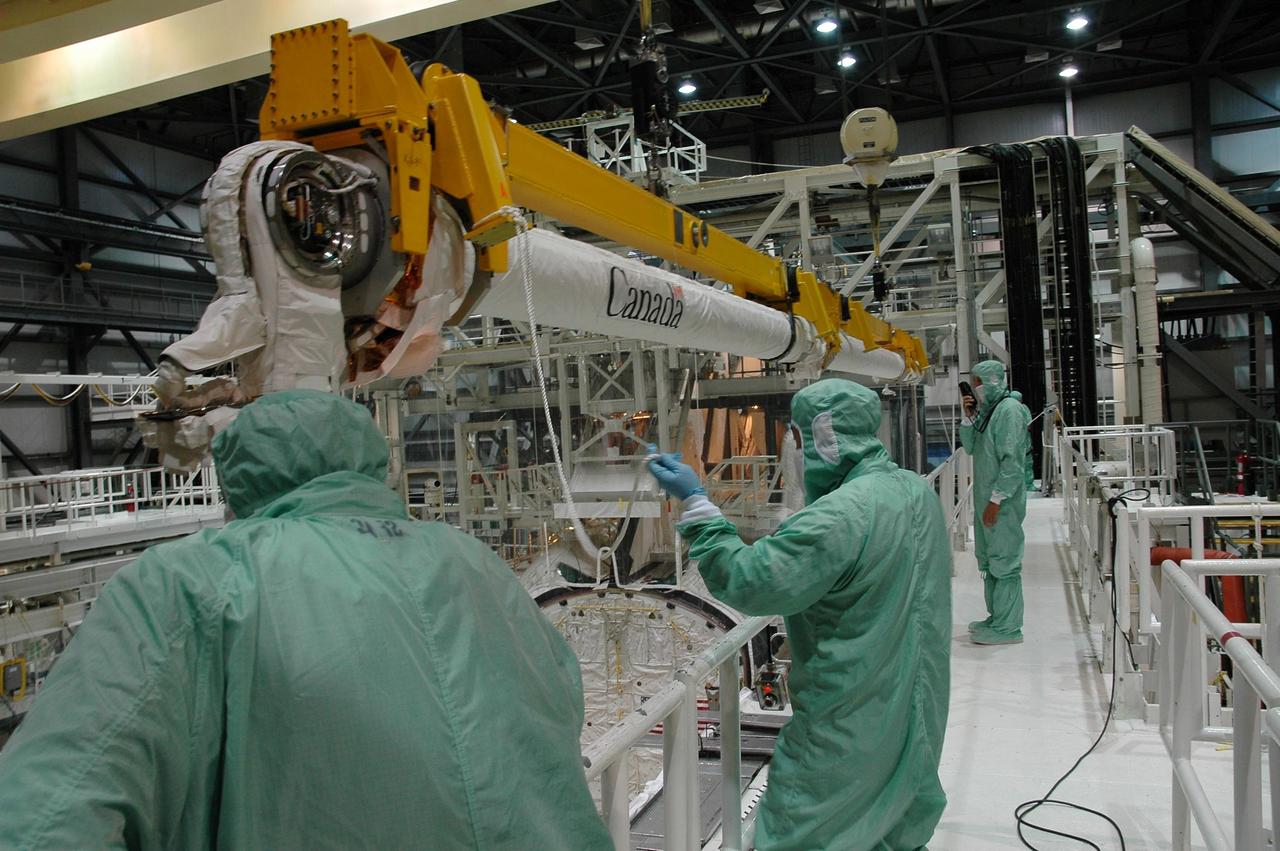
KENNEDY SPACE CENTER, FLA. -   In the Orbiter Processing Facility bay 1 at NASA Kennedy Space Center, engineers stand by as the remote manipulator system, or boom, is lowered toward Atlantis’ payload bay for installation.  Atlantis is the designated orbiter for mission STS-115, the 19th assembly flight to the International Space Station.  The payload includes the P3/P4 solar arrays. The launch planning window has not been determined yet for STS-115.
KSC-06pd0012
KENNEDY SPACE CENTER, FLA. -  In the Orbiter Processing Facility bay 1 at NASA Kennedy Space Center, engineers begin attaching the remote manipulator system, or boom, in Atlantis’ payload bay.  Atlantis is the designated orbiter for mission STS-115, the 19th assembly flight to the International Space Station.  The payload includes the P3/P4 solar arrays. The launch planning window has not been determined yet for STS-115.
KSC-06pd0014
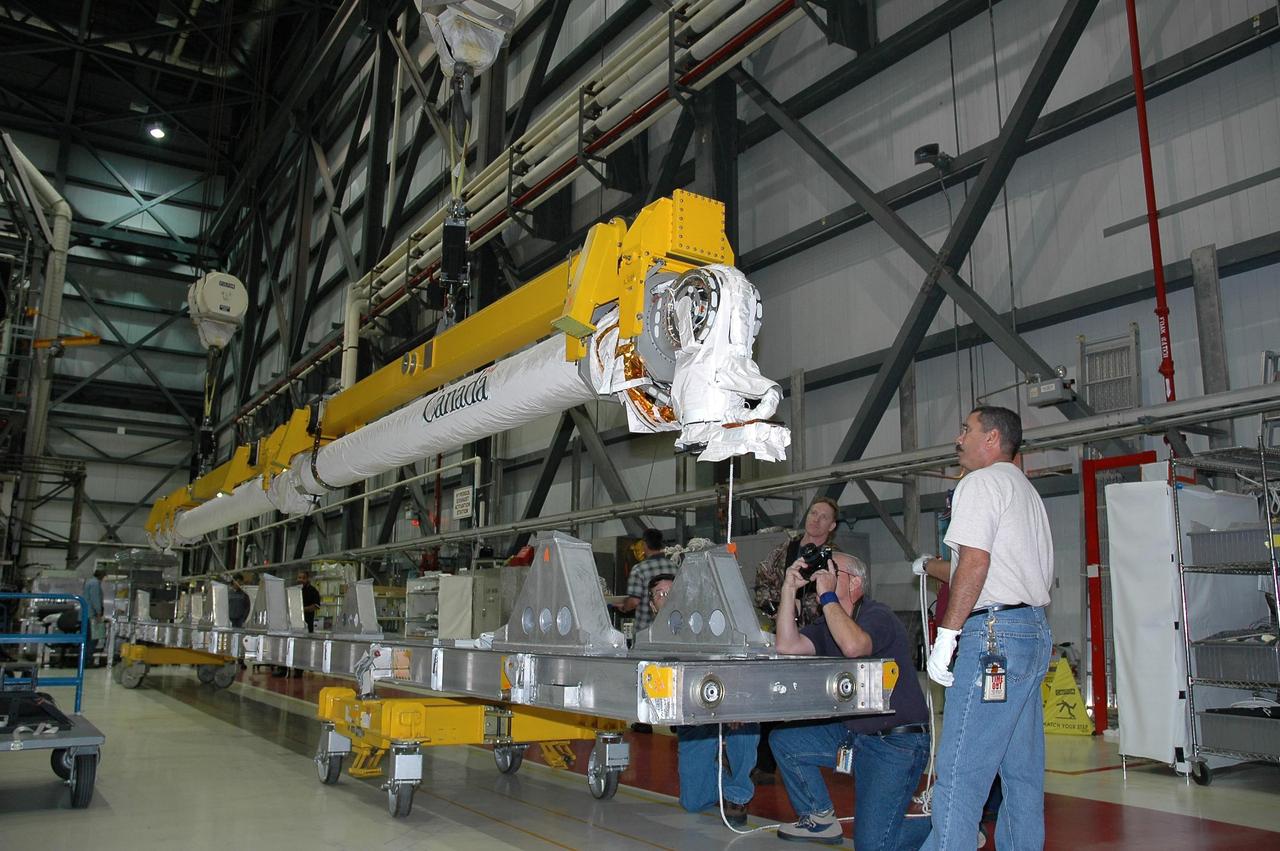
KENNEDY SPACE CENTER, FLA. -   In the Orbiter Processing Facility bay 1 at NASA Kennedy Space Center, the remote manipulator system, or boom, is lifted off a stand via overhead cranes.  The boom will be installed in Atlantis’ payload bay. Atlantis is the designated orbiter for mission STS-115, the 19th assembly flight to the International Space Station.  The payload includes the P3/P4 solar arrays. The launch planning window has not been determined yet for STS-115.
KSC-06pd0010
KENNEDY SPACE CENTER, FLA. -  In the Orbiter Processing Facility bay 1 at NASA Kennedy Space Center, engineers finish attaching the remote manipulator system, or boom, in Atlantis’ payload bay.  Atlantis is the designated orbiter for mission STS-115, the 19th assembly flight to the International Space Station.  The payload includes the P3/P4 solar arrays. The launch planning window has not been determined yet for STS-115.
KSC-06pd0015
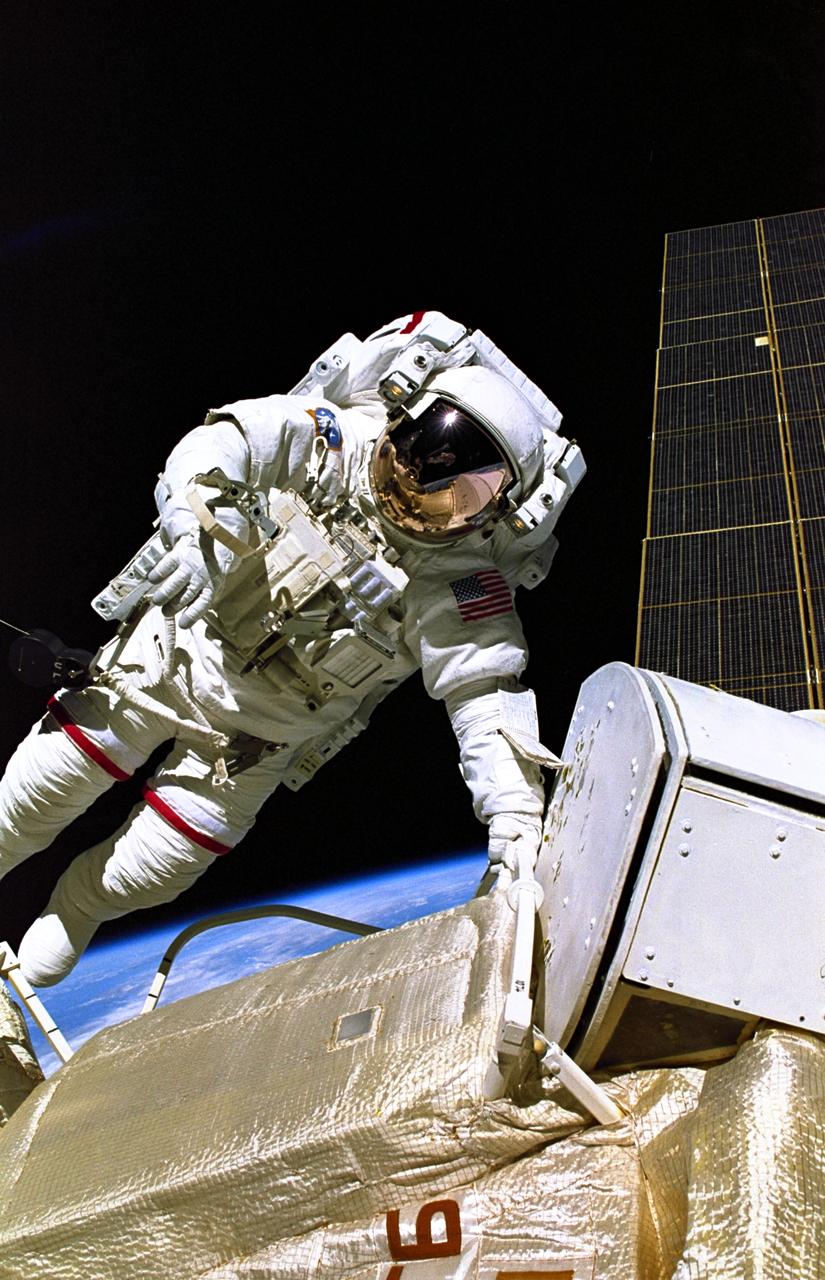
STS088-355-015 (4-15 Dec. 1998) --- Astronaut Jerry L. Ross, STS-88 mission specialist, is pictured during one of three space walks which were conducted on the eleven-day mission.  Perched on the end of Endeavour's remote manipulator system (RMS) arm, astronaut James H. Newman, mission specialist, recorded this image.  Newman can be seen reflected in Ross' helmet visor.  The solar array panel for the Russian-built Zarya module can be seen along right edge.
EVA view of the Nadir (+ZA, plane I) side of FGB / Zarya
KENNEDY SPACE CENTER, FLA. -  In the Orbiter Processing Facility bay 1 at NASA Kennedy Space Center, the remote manipulator system, or boom, is lowered into Atlantis’ payload bay for installation.  Atlantis is the designated orbiter for mission STS-115, the 19th assembly flight to the International Space Station.  The payload includes the P3/P4 solar arrays. The launch planning window has not been determined yet for STS-115.
KSC-06pd0013
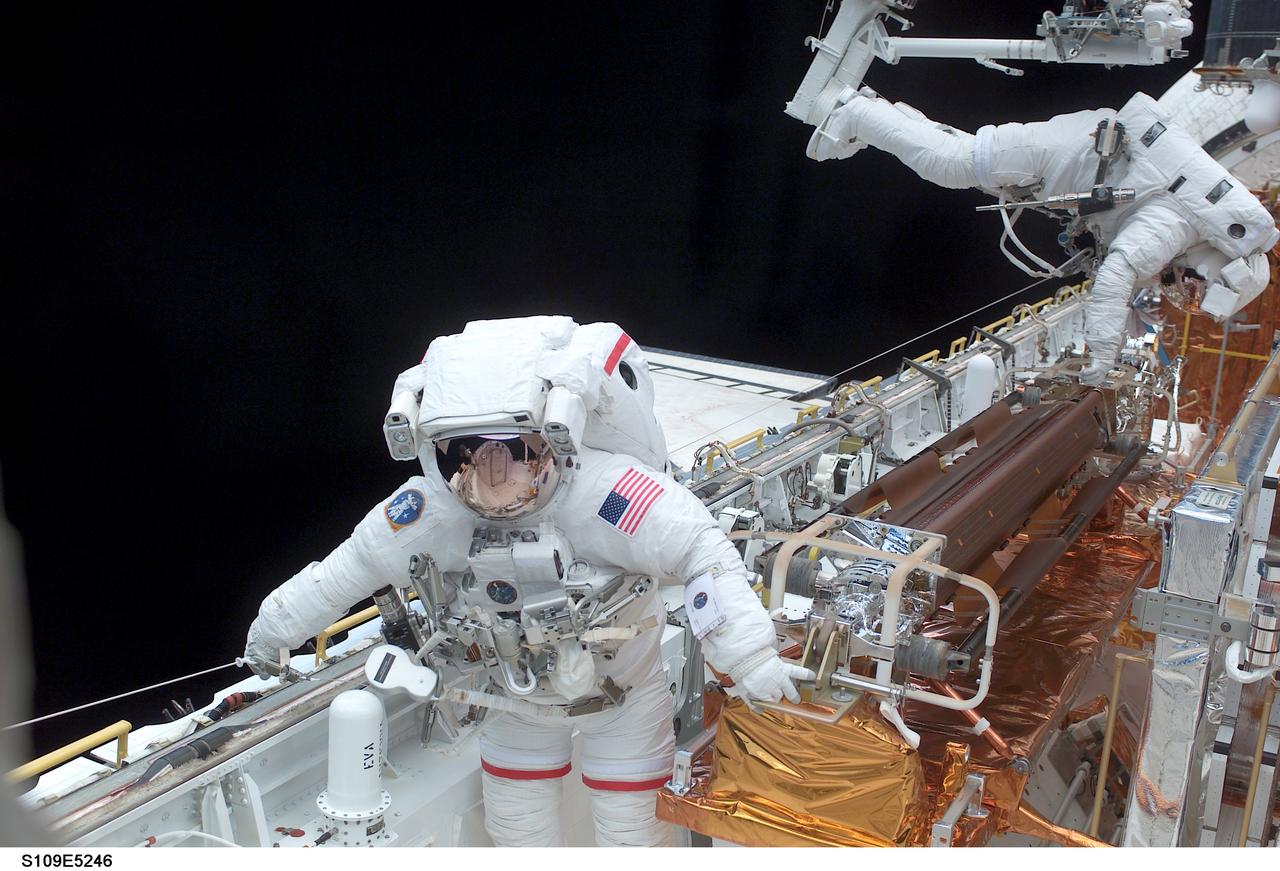
STS109-E-5246 (4 March 2002) ---  Astronaut John M. Grunsfeld (foreground), payload commander, is seen at one end of stowed solar panels in the cargo bay of the Space Shuttle Columbia while astronaut Richard M. Linnehan, mission specialist, uses the Remote Manipulator System's robotic arm to move around at the other end. The two, participating in the first of their assigned STS-109 space walks to perform work on the Hubble Space Telescope (HST), went on to replace the giant telescope’s starboard solar array. Their seven-hour space walk ended at 7:38 a.m. (CST) or 13:38 GMT March 4, 2002.
STS-109 MS Grunsfeld and Linnehan stow old solar array from payload bay
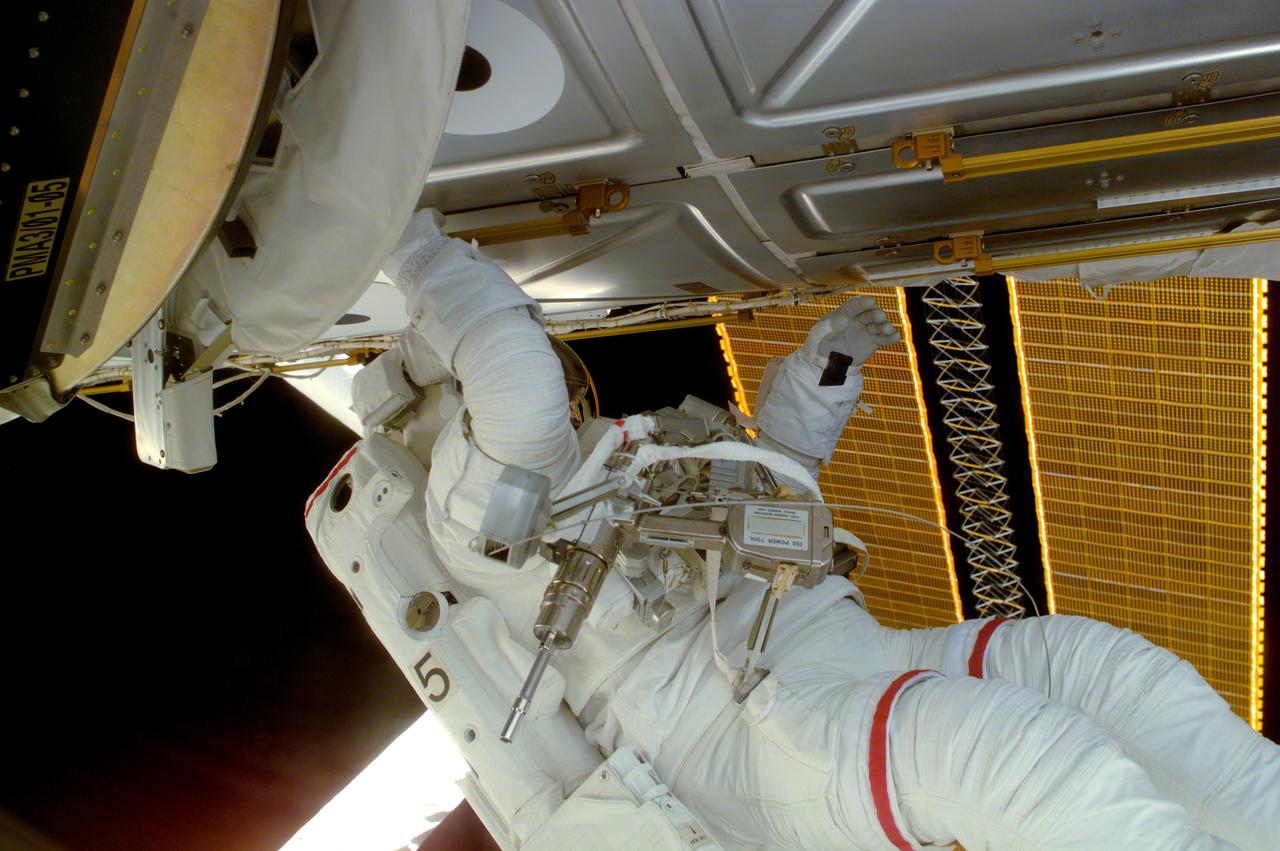
S117-E-07232 (13 June 2007) --- Astronauts  Patrick Forrester and Steven Swanson (out of frame), both STS-117 mission specialists, participate in the mission's second planned session of extravehicular activity (EVA), as construction resumes on the International Space Station. Among other tasks, Forrester, seen here perched on the mobile foot restraint connected to the Canadian-built remote manipulator system (RMS), and Swanson removed all of the launch locks holding the 10-foot-wide solar alpha rotary joint in place and began the solar array retraction.
Forrester prepares to retract the P6 Truss STBD SAW during EVA 2
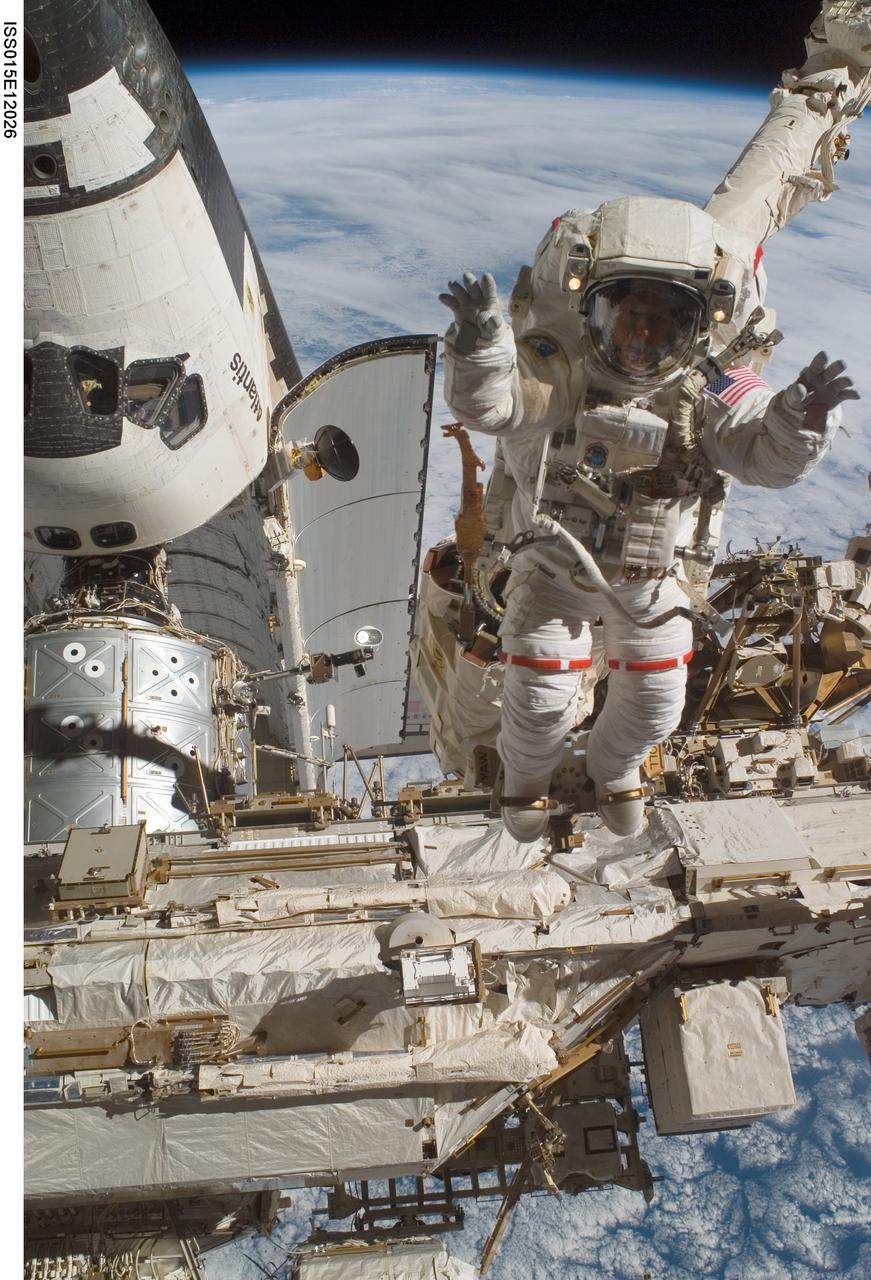
ISS015-E-12026 (13 June 2007) --- Anchored to a foot restraint on the Space Station Remote Manipulator System (SSRMS) or Canadarm2, astronaut Patrick Forrester, STS-117 mission specialist, participates in the mission's second planned session of extravehicular activity (EVA), as construction resumes on the International Space Station. Among other tasks, Forrester and astronaut Steven Swanson (out of frame), mission specialist, removed all of the launch locks holding the 10-foot-wide solar alpha rotary joint in place and began the solar array retraction. Space Shuttle Atlantis docked to the station is visible at left.
View of Forrester on STS-117 EVA2 during Joint Operations with Expedition 15
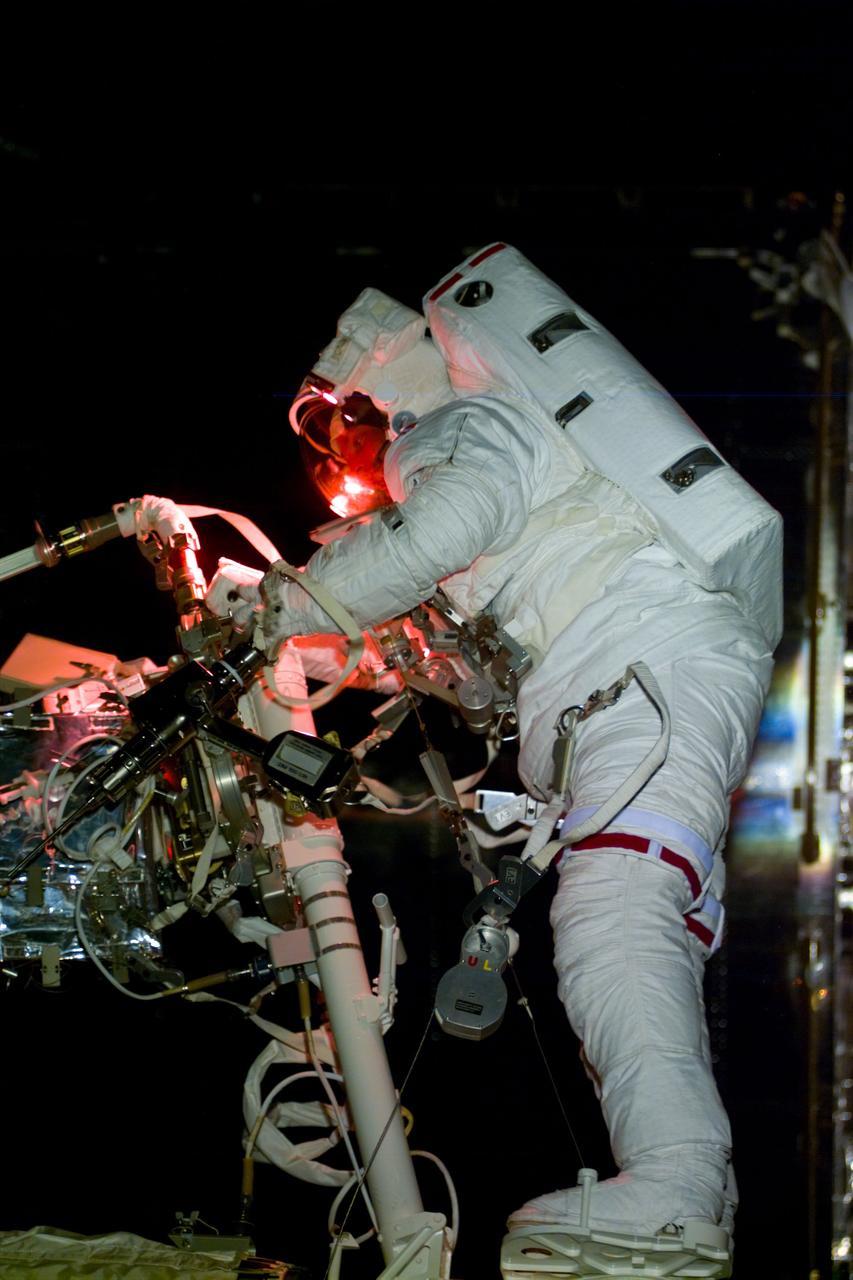
S82-E-5606 (17 Feb. 1997) --- Astronaut Gregory J. Harbaugh at work on Hubble Space Telescope (HST), with the assistance of astronaut Joseph R. Tanner (out of frame) on Remote Manipulator System (RMS).  After replacing the HST's Solar Array Drive Electronics (SADE), Harbaugh and Tanner replaced the Magnetic Sensing System (MSS) protective lids with new, permanent covers; and they installed pre-cut insulation pieces to correct tears in the HST's protective covering caused by temperature changes in space. This view was taken with an Electronic Still Camera (ESC).
EVA 4 activity on Flight Day 7 to service the Hubble Space Telescope
Astronaut Joseph R. Tanner, STS-97 mission specialist, is seen during a session of Extravehicular Activity (EVA), performing work on the International Space Station (ISS). Part of the Remote Manipulator System (RMS) arm and a section of the newly deployed solar array panel are in the background. The primary objective of the STS-97 mission was the delivery, assembly, and activation of the U.S. electrical power system on board the ISS. The electrical power system, which is built into a 73-meter (240-foot) long solar array structure consists of solar arrays, radiators, batteries, and electronics. The entire 15.4-metric ton (17-ton) package is called the P6 Integrated Truss Segment and is the heaviest and largest element yet delivered to the station aboard a space shuttle. The electrical system will eventually provide the power necessary for the first ISS crews to live and work in the U.S. segment. The STS-97 crew of five launched aboard the Space Shuttle Orbiter Endeavor on November 30, 2000 for an 11 day mission.
International Space Station (ISS)
S61-E-011 (5 Dec 1993) --- This view of astronaut Kathryn C. Thornton working on the Hubble Space Telescope (HST) was photographed with an Electronic Still Camera (ESC), and down linked to ground controllers soon afterward.  Thornton, anchored to the end of the Remote Manipulator System (RMS) arm, is installing the +V2 Solar Array Panel as a replacement for the original one removed earlier.  Electronic still photography is a relatively new technology which provides the means for a handheld camera to electronically capture and digitize an image with resolution approaching film quality.  The electronic still camera has flown as an experiment on several other shuttle missions.
Astronaut Kathryn Thornton on HST photographed by Electronic Still Camera
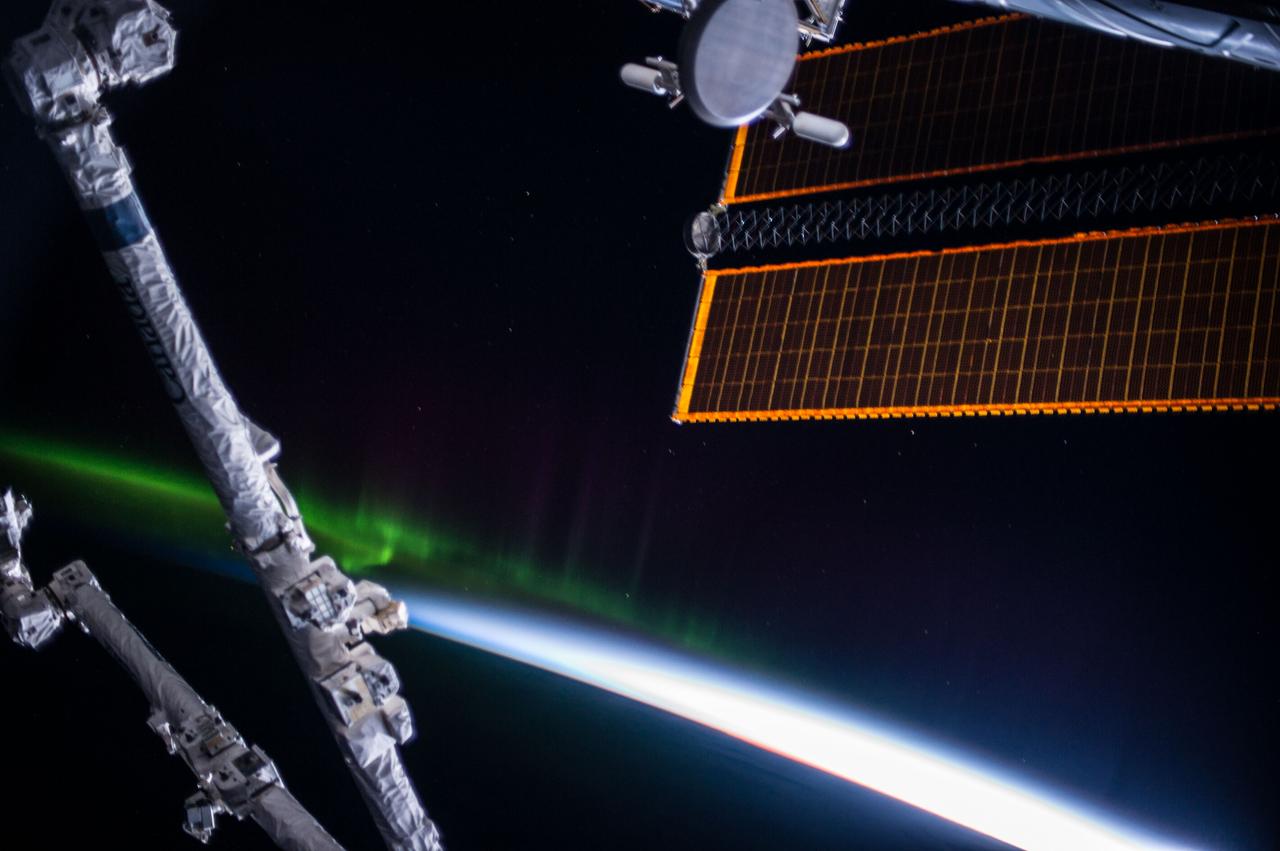
ISS037-E-026746 (4 Nov. 2013) --- One of the Expedition 37 crew members aboard the Earth-orbiting International Space Station took this photograph looking toward Earth's horizon when the complex was 228 miles above a point located 46.6 degrees south latitude and 146.6 degrees east longitude. The space station remote manipulator system arm or Canadarm2 dominates the foreground.  A relatively small appearance of Aurora Australis or the Southern Lights runs from upper left to frame center.  One of the space station's solar array panels is seen in upper right.
SSRMS
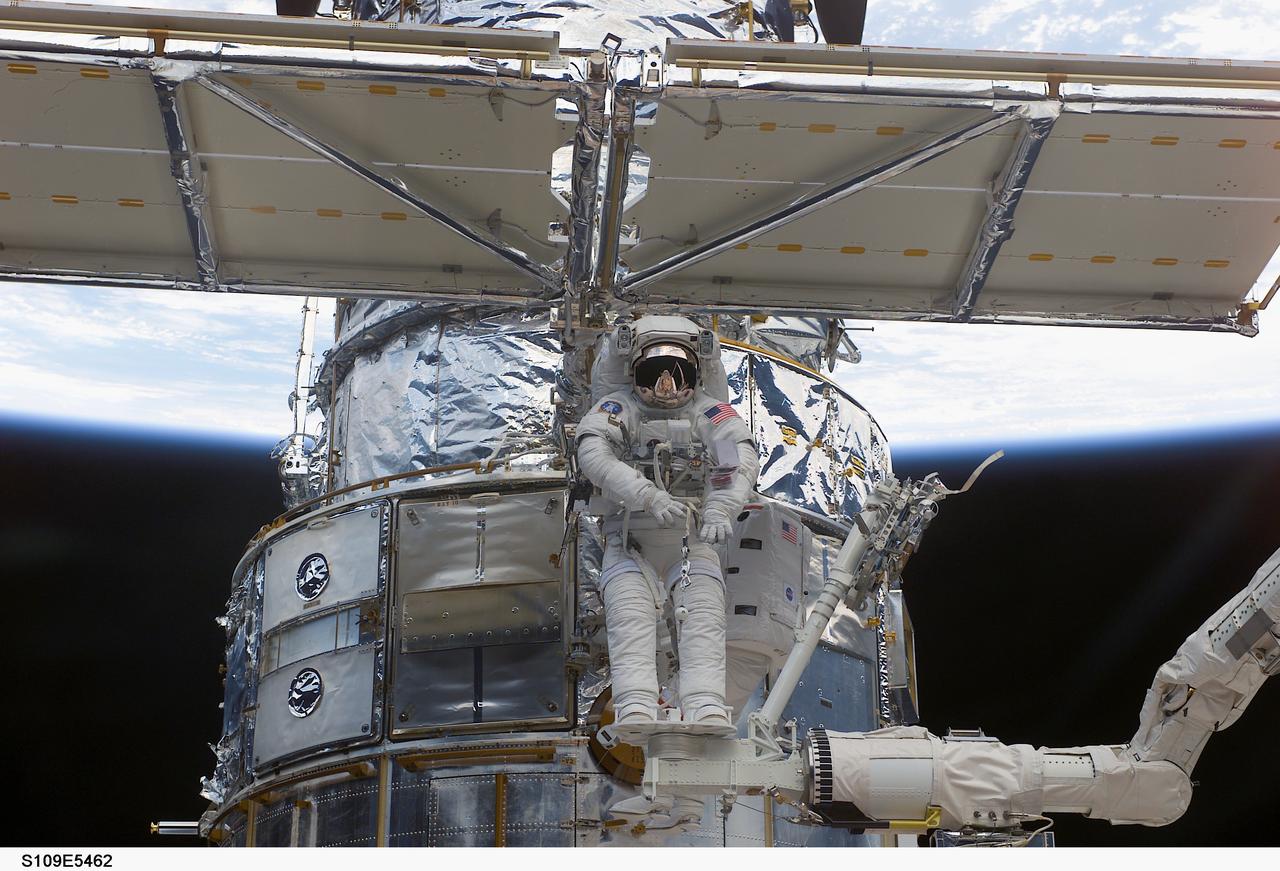
STS109-E-5462 (4 March 2002) --- Astronauts Richard M. Linnehan (facing camera, frame center), STS-109 mission specialist, and John M. Grunsfeld (partially obscured behind Linnehan), payload commander, work to replace the starboard solar array on the Hubble   Space Telescope (HST). Linnehan is standing on a foot restraint connected to the Space Shuttle Columbia's Remote Manipulator System (RMS) robotic arm, controlled inside the shuttle's crew cabin by astronaut Nancy J. Currie, mission specialist. The image was recorded with a digital still camera.
View of STS-109 MS Linnehan and Grunsfeld during EVA 1
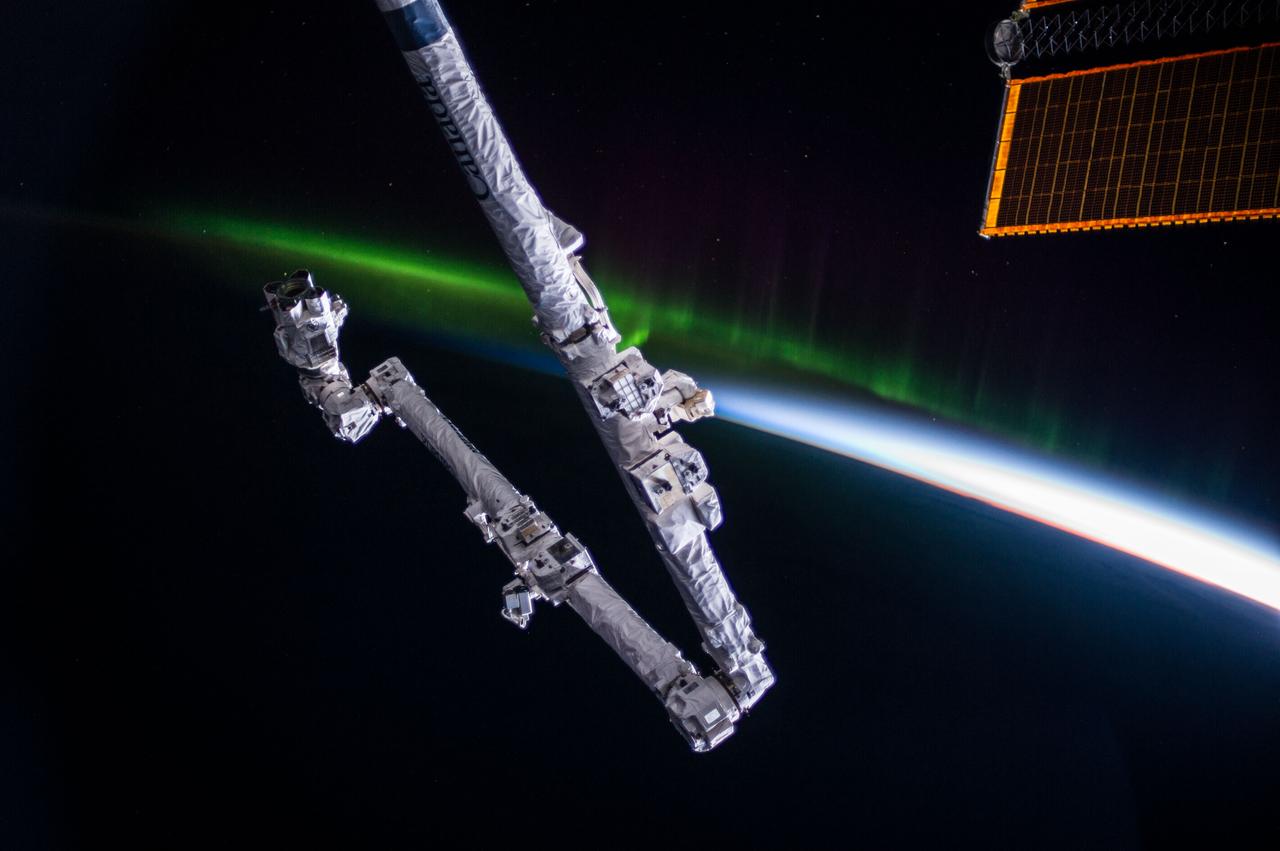
ISS037-E-026748 (4 Nov. 2013) --- One of the Expedition 37 crew members aboard the Earth-orbiting International Space Station took this photograph looking toward Earth's horizon when the complex was 228 miles above a point located 46.6 degrees south latitude and 146.6 degrees east longitude. The space station remote manipulator system arm or Canadarm2 dominates the foreground.  A relatively small appearance of Aurora Australis or the Southern Lights runs from upper left toward frame center. One of the space station's solar array panels is seen in upper right.
SSRMS
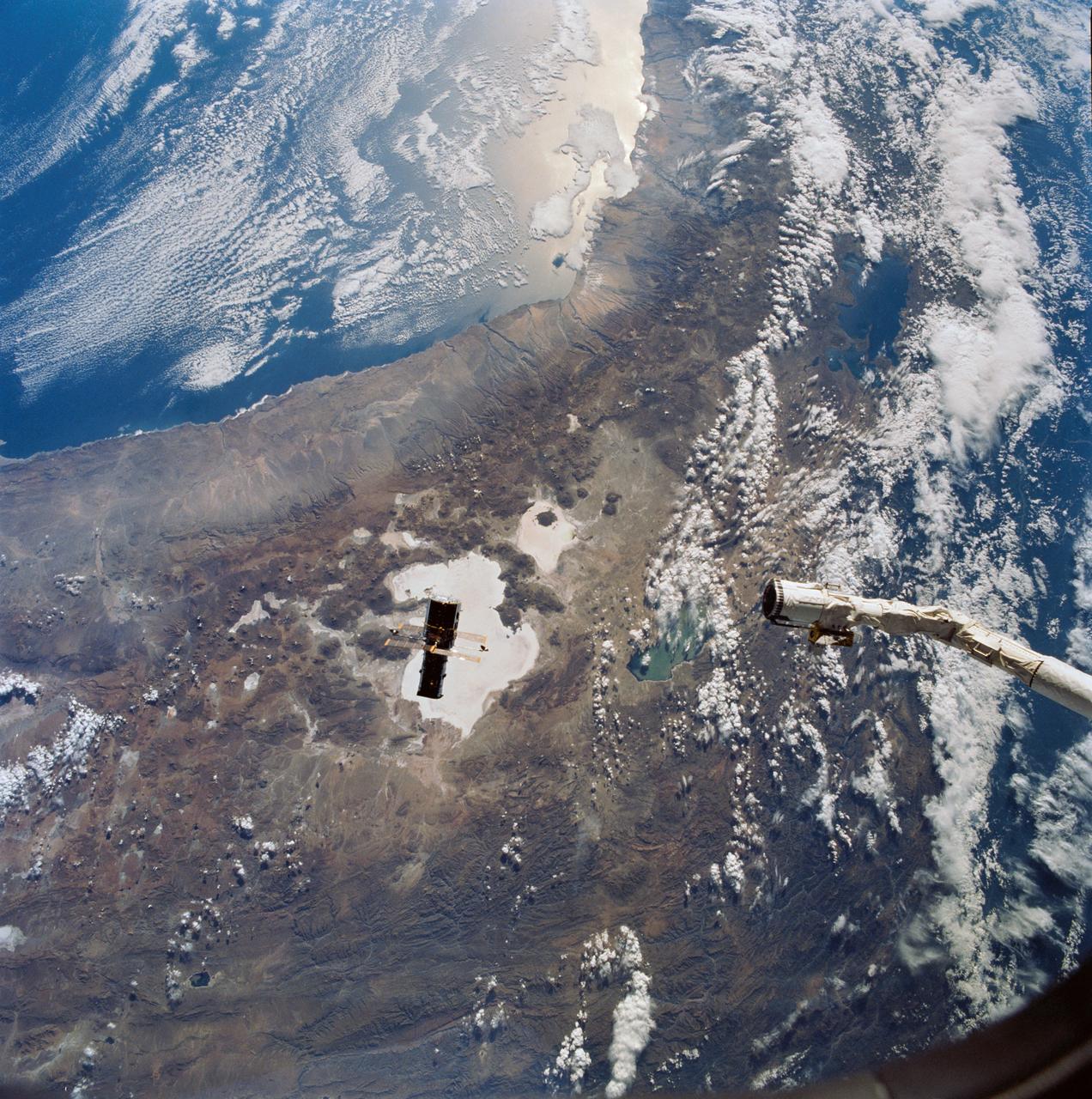
Hubble Space Telescope (HST), with its solar array (SA) wings and high gain antennae (HGA) fully extended,is released from Discovery's, Orbiter Vehicle (OV) 103's, remote manipulator system (RMS) end effector and is set free into Earth orbit by the STS-31 crew. HST drifts away from the end effector over the Andes Mountains.Parts of Bolivia, Peru, Chile, and Argentina are visible. The view covers a huge area of the western half of South America stretching from 14 degrees south latitude to 23 degrees, about 1,000 kilometers.
STS-31 Hubble Space Telescope (HST) drifts away from OV-103's RMS
Backdropped against the Earth, the Hubble Space Telescope (HST)is shown sporting new and modified solar arrays stowed against its barrel. Orbiting Earth at an altitude of 325 nautical miles, an astronaut begins other repairs of the HST while perched atop a foot restraint on shuttle Endeavour's remote manipulator system arm. The 59th and final Shuttle flight of 1993 was one of most challenging and complex marned missions ever attempted. During record five back-to-back space walks totaling 35 hours and 28 minutes, two teams of astronauts completed the first servicing of the HST. The STS-061 mission was launched aboard Space Shuttle Endeavor on December 2, 1993.
Space Shuttle Project
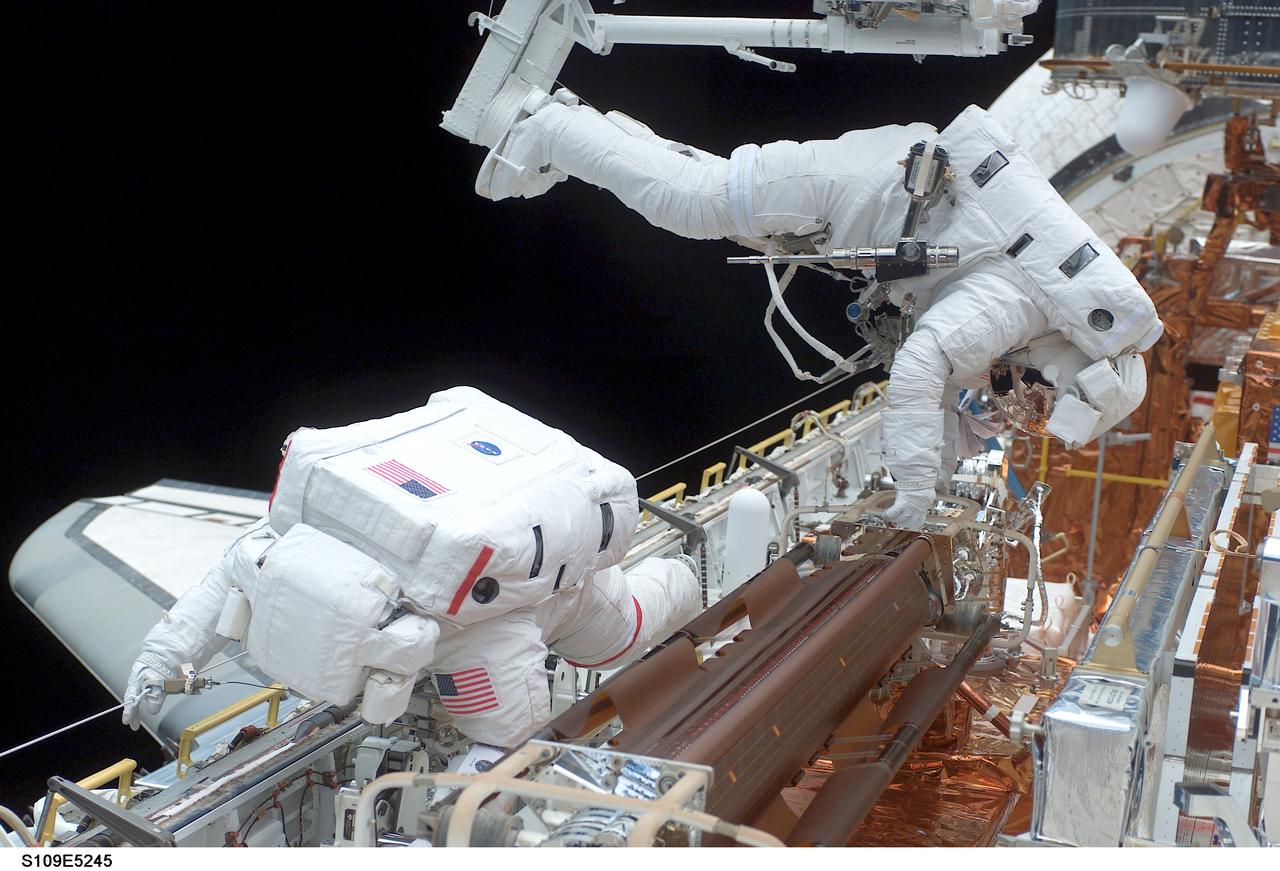
STS109-E-5245 (4 March 2002) ---  Astronaut John M. Grunsfeld (foreground), payload commander, traverses along the longerons of the Space Shuttle Columbia  while astronaut Richard M. Linnehan, mission specialist, uses the Remote Manipulator System's robotic arm to move around. The two, participating in the first of their assigned STS-109 space walks to perform work on the Hubble Space Telescope (HST), went on to replace the giant telescope’s starboard solar array. Their seven-hour space walk ended at 7:38 a.m. (CST) or 13:38 GMT March 4, 2002.
STS-109 MS Grunsfeld and Linnehan stow old solar array from payload bay
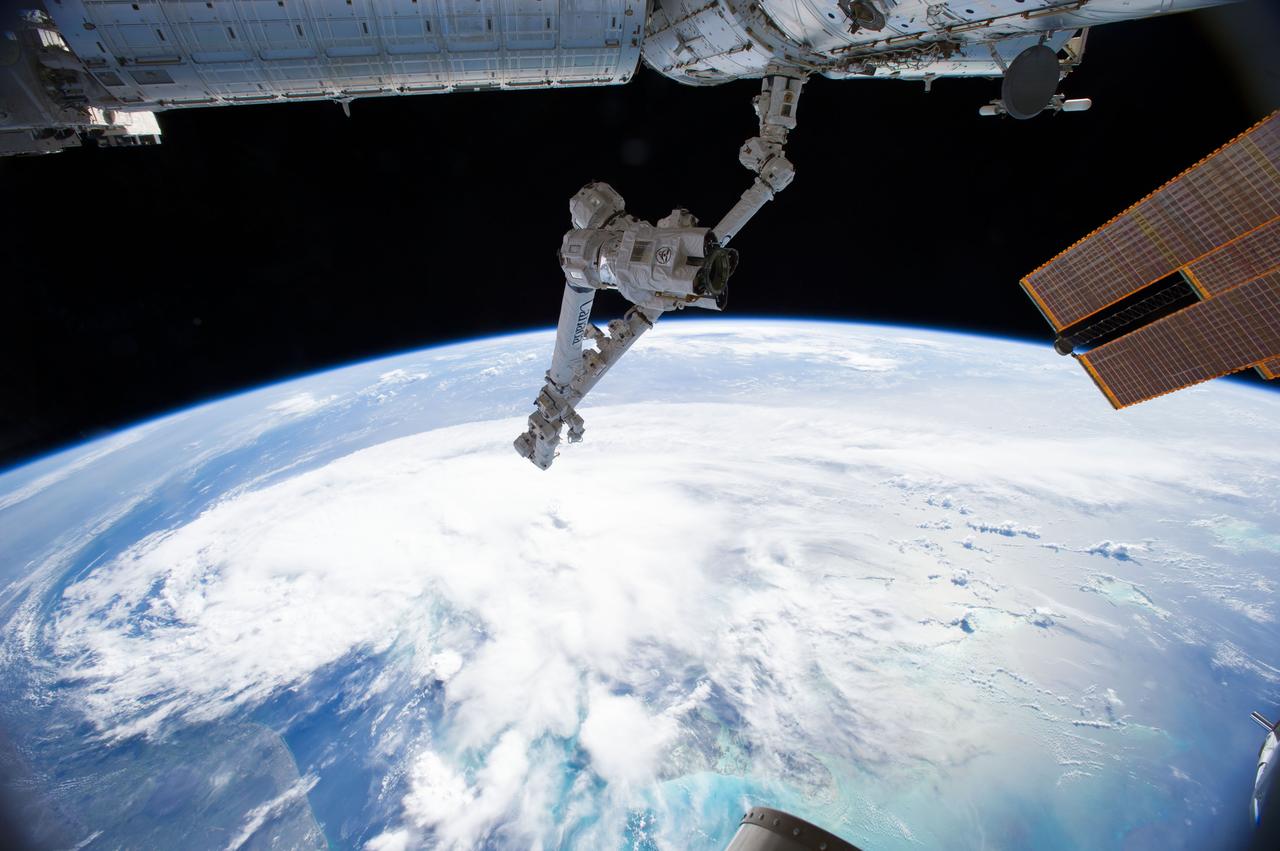
ISS040-E-030559 (2 July 2014) --- One of the Expedition 40 crew members aboard the Earth-orbiting International Space Station, some 227 nautical miles above Earth, photographed this image of Tropical Storm Arthur in the afternoon of July 2, 2014. Arthur was churning in Atlantic waters off the coast of Florida and slowly moving northward at the time the photo was taken. The robotic arm of the Space Station Remote Manipulator System or Canadarm2 is seen at upper center, and the tip of one of the orbital outpost's solar array panels is in upper right.
Earth Observation
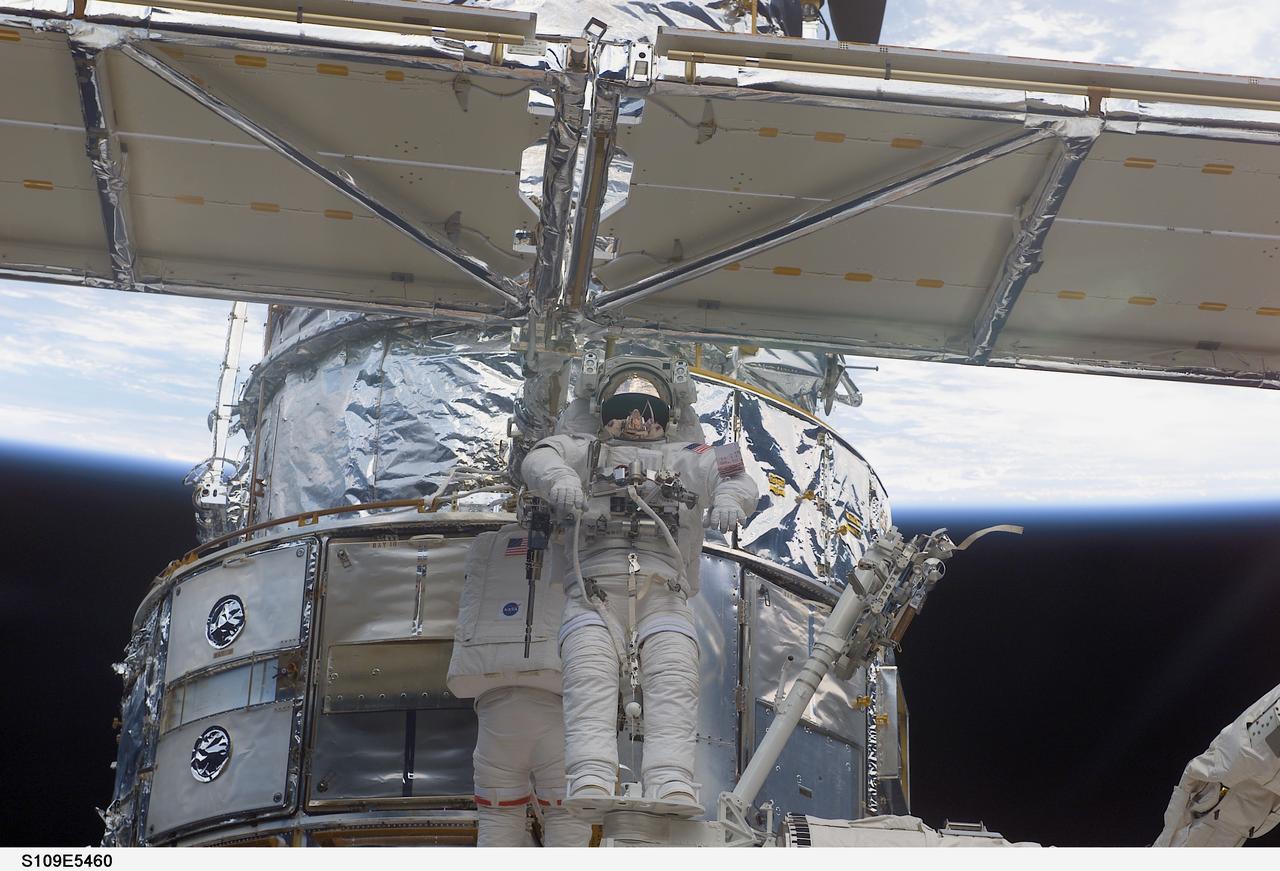
STS109-E-5460 (4 March 2002) --- Astronauts Richard M. Linnehan (facing camera, frame center), STS-109 mission specialist, and John M. Grunsfeld  (partially obscured behind Linnehan),  payload commander, work to replace  the starboard solar array on the Hubble   Space Telescope (HST). Linnehan is standing on a foot restraint connected to the Space Shuttle Columbia's Remote Manipulator System (RMS) robotic arm,  controlled inside the shuttle's crew cabin by astronaut Nancy J. Currie, mission specialist. The image was   recorded with a digital still camera.
View of STS-109 MS Linnehan and Grunsfeld during EVA 1
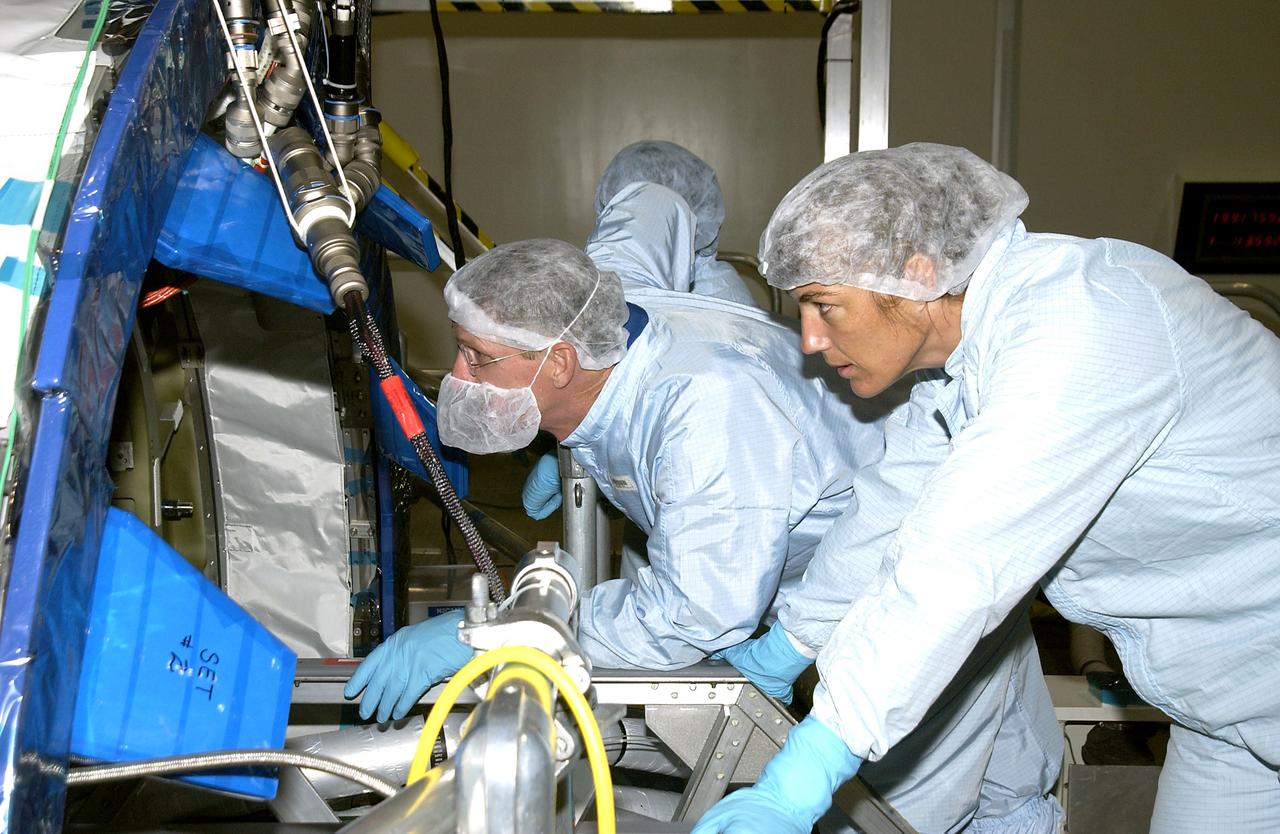
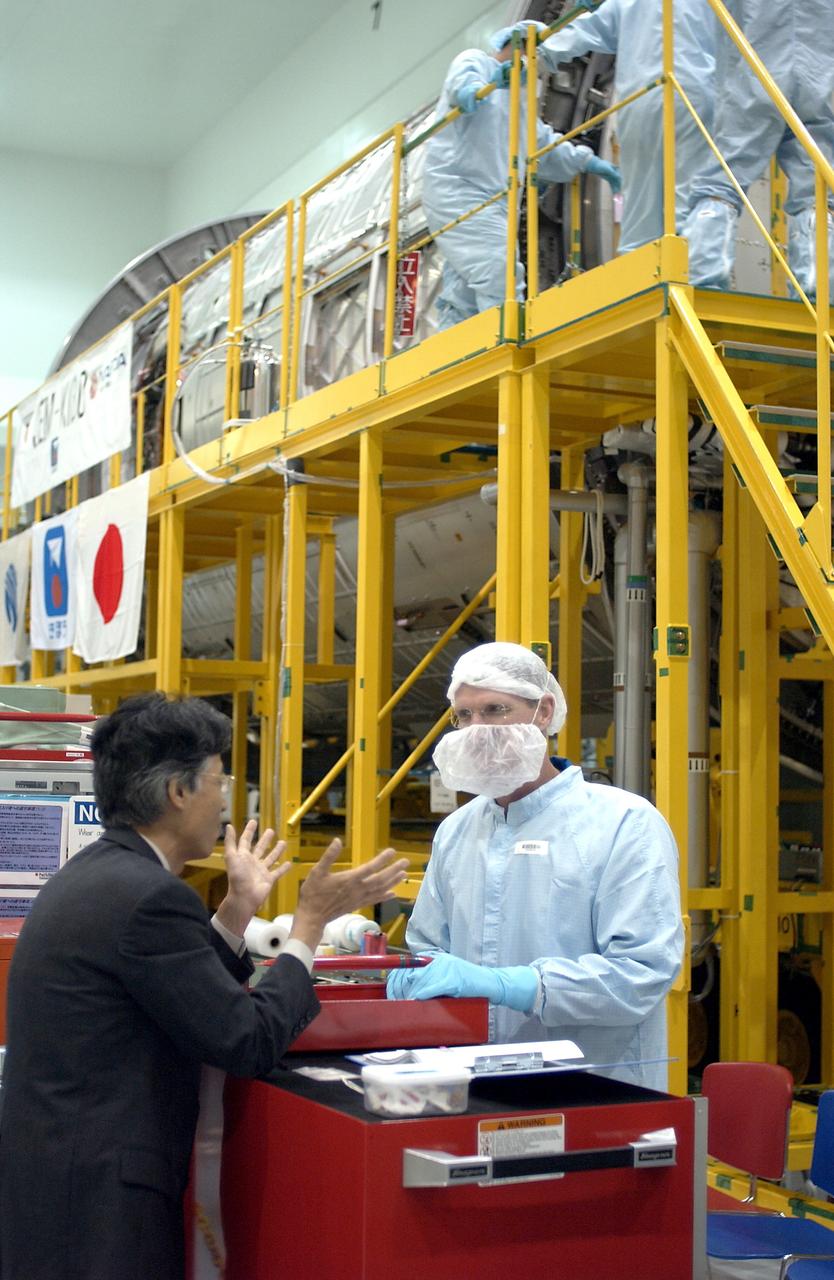
KENNEDY SPACE CENTER, FLA. -  In the Space Station Processing Facility, STS-115 Mission Specialists Joseph Tanner (left) and Heidemarie Stefanyshyn-Piper (right)  look over the Japanese Experiment Module (JEM) Pressurized Module located in the Space Station Processing Facility. Known as Kibo, the JEM consists of six components: two research facilities -- the Pressurized Module and Exposed Facility; a Logistics Module attached to each of them; a Remote Manipulator System; and an Inter-Orbit Communication System unit. Kibo also has a scientific airlock through which experiments are transferred and exposed to the external environment of space. The various components of JEM will be assembled in space over the course of three Space Shuttle missions.  The STS-115  mission will deliver the second port truss segment, the P3/P4 Truss, to attach to the first port truss segment, the P1 Truss, as well as deploy solar array sets 2A and 4A..  The crew is scheduled to activate and check out the Solar Alpha Rotary Joint (SARJ) and deploy the P4 Truss radiator.
KENNEDY SPACE CENTER, FLA. - In the Space Station Processing Facility, STS-115 Mission Specialists Joseph Tanner (left) and Heidemarie Stefanyshyn-Piper (right) look over the Japanese Experiment Module (JEM) Pressurized Module located in the Space Station Processing Facility. Known as Kibo, the JEM consists of six components: two research facilities -- the Pressurized Module and Exposed Facility; a Logistics Module attached to each of them; a Remote Manipulator System; and an Inter-Orbit Communication System unit. Kibo also has a scientific airlock through which experiments are transferred and exposed to the external environment of space. The various components of JEM will be assembled in space over the course of three Space Shuttle missions. The STS-115 mission will deliver the second port truss segment, the P3/P4 Truss, to attach to the first port truss segment, the P1 Truss, as well as deploy solar array sets 2A and 4A.. The crew is scheduled to activate and check out the Solar Alpha Rotary Joint (SARJ) and deploy the P4 Truss radiator.
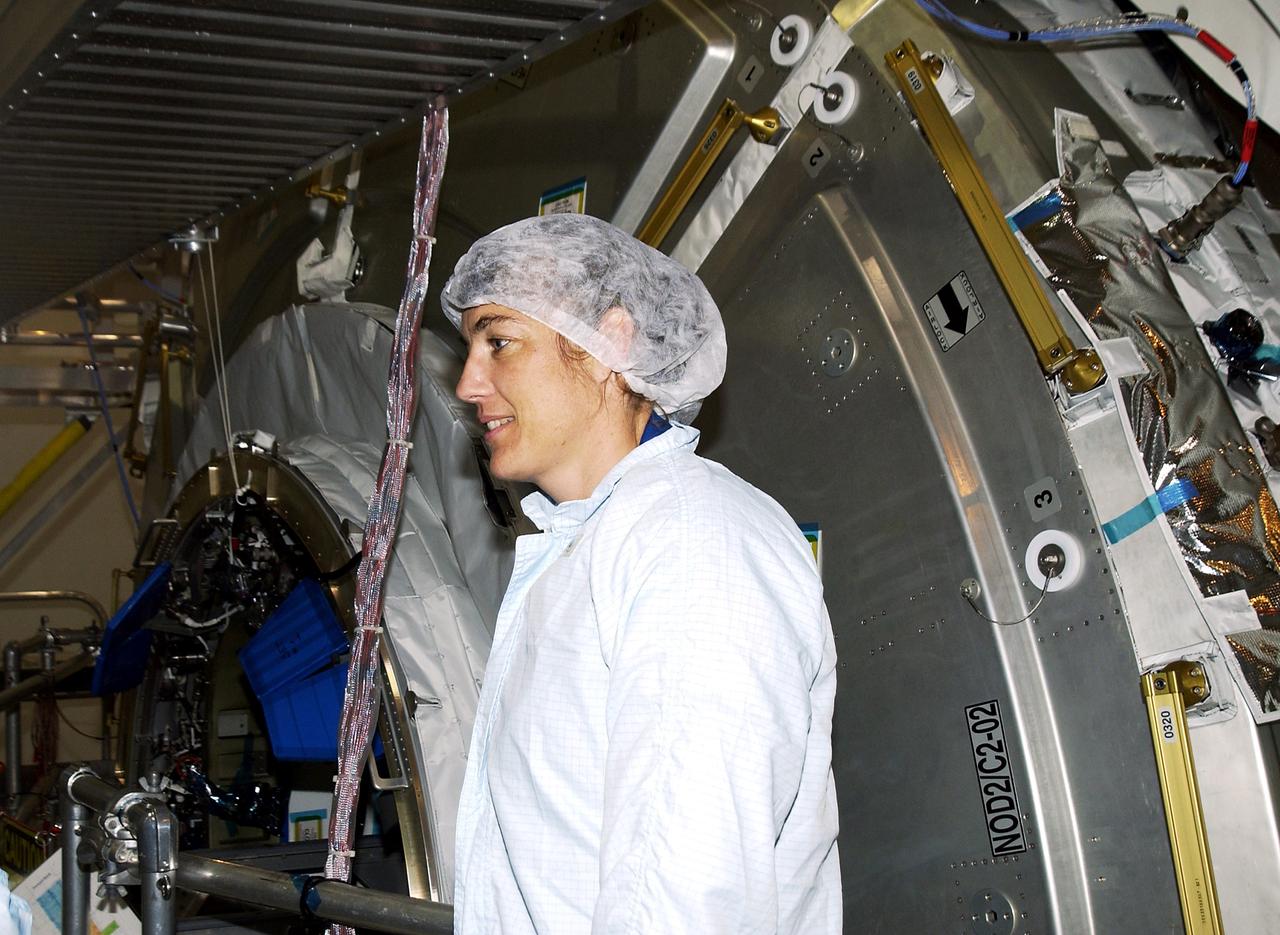
KENNEDY SPACE CENTER, FLA. -   STS-115 Mission Specialist Joseph Tanner is dressed in protective gear to enter the Japanese Experiment Module (JEM) Pressurized Module located in the Space Station Processing Facility. Known as Kibo, the JEM consists of six components: two research facilities -- the Pressurized Module and Exposed Facility; a Logistics Module attached to each of them; a Remote Manipulator System; and an Inter-Orbit Communication System unit. Kibo also has a scientific airlock through which experiments are transferred and exposed to the external environment of space. The various components of JEM will be assembled in space over the course of three Space Shuttle missions.  The STS-115 mission will deliver the second port truss segment, the P3/P4 Truss, to attach to the first port truss segment, the P1 Truss, as well as deploy solar array sets 2A and 4A..  The crew is scheduled to activate and check out the Solar Alpha Rotary Joint (SARJ) and deploy the P4 Truss radiator.
KENNEDY SPACE CENTER, FLA. - STS-115 Mission Specialist Joseph Tanner is dressed in protective gear to enter the Japanese Experiment Module (JEM) Pressurized Module located in the Space Station Processing Facility. Known as Kibo, the JEM consists of six components: two research facilities -- the Pressurized Module and Exposed Facility; a Logistics Module attached to each of them; a Remote Manipulator System; and an Inter-Orbit Communication System unit. Kibo also has a scientific airlock through which experiments are transferred and exposed to the external environment of space. The various components of JEM will be assembled in space over the course of three Space Shuttle missions. The STS-115 mission will deliver the second port truss segment, the P3/P4 Truss, to attach to the first port truss segment, the P1 Truss, as well as deploy solar array sets 2A and 4A.. The crew is scheduled to activate and check out the Solar Alpha Rotary Joint (SARJ) and deploy the P4 Truss radiator.
KENNEDY SPACE CENTER, FLA. - In the Space Station Processing Facility, STS-115 Mission Specialists Heidemarie Stefanyshyn-Piper (left) and Joseph Tanner (center) get ready to check out the Japanese Experiment Module (JEM) Pressurized Module. Known as Kibo, the JEM consists of six components: two research facilities -- the Pressurized Module and Exposed Facility; a Logistics Module attached to each of them; a Remote Manipulator System; and an Inter-Orbit Communication System unit. Kibo also has a scientific airlock through which experiments are transferred and exposed to the external environment of space. The various components of JEM will be assembled in space over the course of three Space Shuttle missions.   The STS-115  mission will deliver the second port truss segment, the P3/P4 Truss, to attach to the first port truss segment, the P1 Truss, as well as deploy solar array sets 2A and 4A..  The crew is scheduled to activate and check out the Solar Alpha Rotary Joint (SARJ) and deploy the P4 Truss radiator.
KENNEDY SPACE CENTER, FLA. - In the Space Station Processing Facility, STS-115 Mission Specialists Heidemarie Stefanyshyn-Piper (left) and Joseph Tanner (center) get ready to check out the Japanese Experiment Module (JEM) Pressurized Module. Known as Kibo, the JEM consists of six components: two research facilities -- the Pressurized Module and Exposed Facility; a Logistics Module attached to each of them; a Remote Manipulator System; and an Inter-Orbit Communication System unit. Kibo also has a scientific airlock through which experiments are transferred and exposed to the external environment of space. The various components of JEM will be assembled in space over the course of three Space Shuttle missions. The STS-115 mission will deliver the second port truss segment, the P3/P4 Truss, to attach to the first port truss segment, the P1 Truss, as well as deploy solar array sets 2A and 4A.. The crew is scheduled to activate and check out the Solar Alpha Rotary Joint (SARJ) and deploy the P4 Truss radiator.
KENNEDY SPACE CENTER, FLA. - In the Space Station Processing Facility, STS-115 Mission Specialist Heidemarie Stefanyshyn-Piper (left) gets ready to check out the Japanese Experiment Module (JEM) Pressurized Module. Known as Kibo, the JEM consists of six components: two research facilities -- the Pressurized Module and Exposed Facility; a Logistics Module attached to each of them; a Remote Manipulator System; and an Inter-Orbit Communication System unit. Kibo also has a scientific airlock through which experiments are transferred and exposed to the external environment of space. The various components of JEM will be assembled in space over the course of three Space Shuttle missions.    The STS-115  mission will deliver the second port truss segment, the P3/P4 Truss, to attach to the first port truss segment, the P1 Truss, as well as deploy solar array sets 2A and 4A..  The crew is scheduled to activate and check out the Solar Alpha Rotary Joint (SARJ) and deploy the P4 Truss radiator.
KENNEDY SPACE CENTER, FLA. - In the Space Station Processing Facility, STS-115 Mission Specialist Heidemarie Stefanyshyn-Piper (left) gets ready to check out the Japanese Experiment Module (JEM) Pressurized Module. Known as Kibo, the JEM consists of six components: two research facilities -- the Pressurized Module and Exposed Facility; a Logistics Module attached to each of them; a Remote Manipulator System; and an Inter-Orbit Communication System unit. Kibo also has a scientific airlock through which experiments are transferred and exposed to the external environment of space. The various components of JEM will be assembled in space over the course of three Space Shuttle missions. The STS-115 mission will deliver the second port truss segment, the P3/P4 Truss, to attach to the first port truss segment, the P1 Truss, as well as deploy solar array sets 2A and 4A.. The crew is scheduled to activate and check out the Solar Alpha Rotary Joint (SARJ) and deploy the P4 Truss radiator.
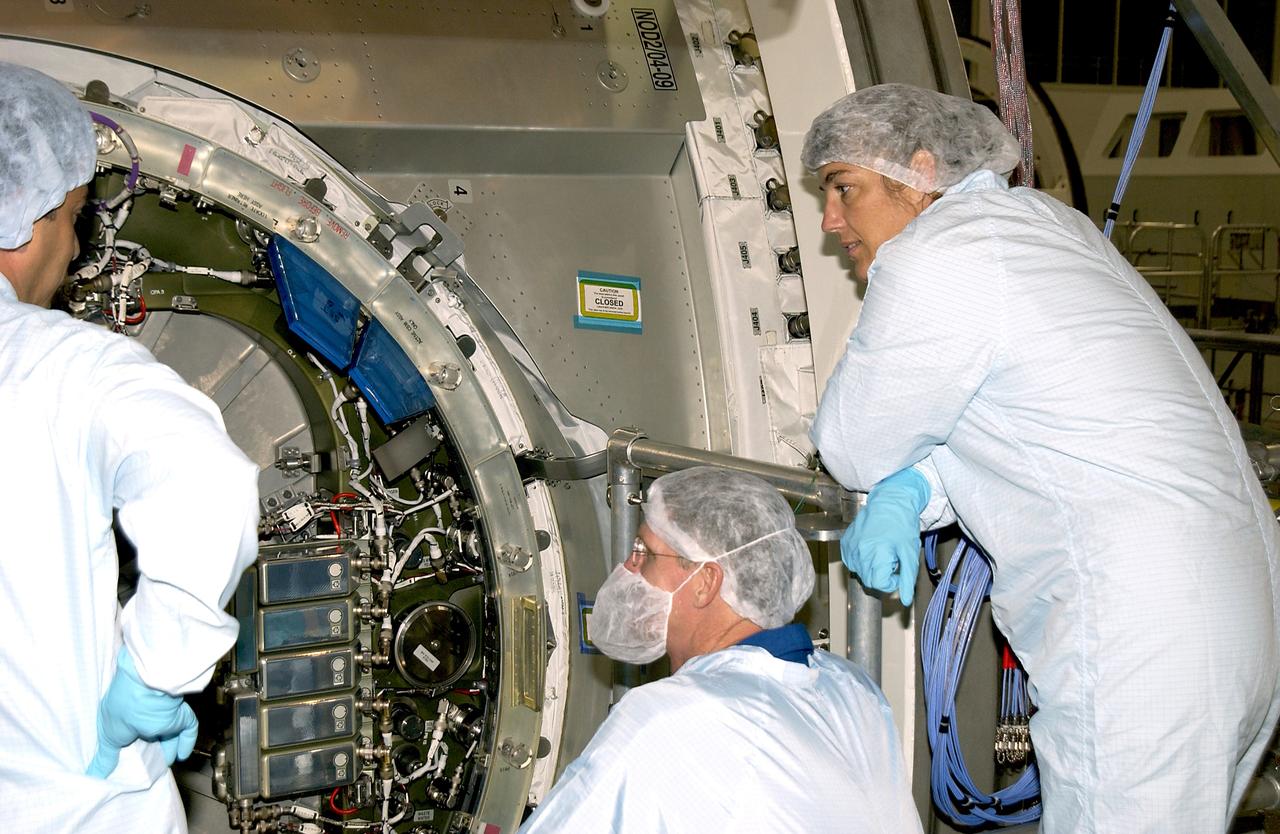
KENNEDY SPACE CENTER, FLA. -  In the Space Station Processing Facility, STS-115 Mission Specialists Joseph Tanner (center) and Heidemarie Stefanyshyn-Piper (right)  look at the inside of the Japanese Experiment Module (JEM) Pressurized Module. Known as Kibo, the JEM consists of six components: two research facilities -- the Pressurized Module and Exposed Facility; a Logistics Module attached to each of them; a Remote Manipulator System; and an Inter-Orbit Communication System unit. Kibo also has a scientific airlock through which experiments are transferred and exposed to the external environment of space. The various components of JEM will be assembled in space over the course of three Space Shuttle missions.    The STS-115  mission will deliver the second port truss segment, the P3/P4 Truss, to attach to the first port truss segment, the P1 Truss, as well as deploy solar array sets 2A and 4A..  The crew is scheduled to activate and check out the Solar Alpha Rotary Joint (SARJ) and deploy the P4 Truss radiator.
KENNEDY SPACE CENTER, FLA. - In the Space Station Processing Facility, STS-115 Mission Specialists Joseph Tanner (center) and Heidemarie Stefanyshyn-Piper (right) look at the inside of the Japanese Experiment Module (JEM) Pressurized Module. Known as Kibo, the JEM consists of six components: two research facilities -- the Pressurized Module and Exposed Facility; a Logistics Module attached to each of them; a Remote Manipulator System; and an Inter-Orbit Communication System unit. Kibo also has a scientific airlock through which experiments are transferred and exposed to the external environment of space. The various components of JEM will be assembled in space over the course of three Space Shuttle missions. The STS-115 mission will deliver the second port truss segment, the P3/P4 Truss, to attach to the first port truss segment, the P1 Truss, as well as deploy solar array sets 2A and 4A.. The crew is scheduled to activate and check out the Solar Alpha Rotary Joint (SARJ) and deploy the P4 Truss radiator.
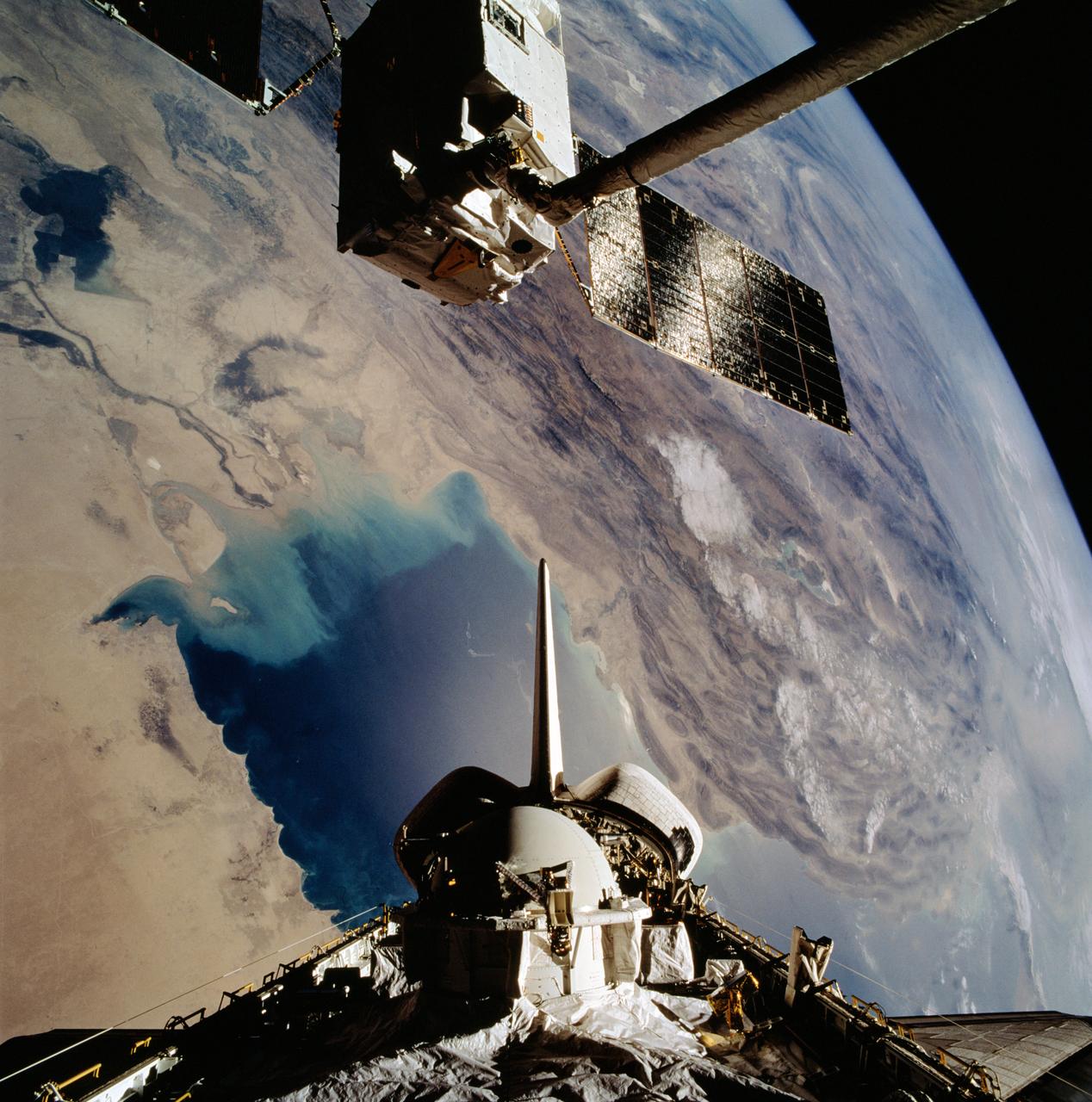
STS046-102-021 (1 Aug 1992) --- The European Space Agency's (ESA) EURECA satellite remains in the grasp of the Space Shuttle Atlantis' Remote Manipulator System (RMS) as the Space Shuttle passes over the Persian Gulf.  Most of the theater of the recent war is visible in the frame.  Parts of Kuwait, Iraq, Iran and Saudi Arabia can be delineated.  The Tethered Satellite System (TSS) remains stowed in the aft cargo bay of Atlantis.
OV-104's RMS grapples EURECA-1L and holds it in deployment position above PLB
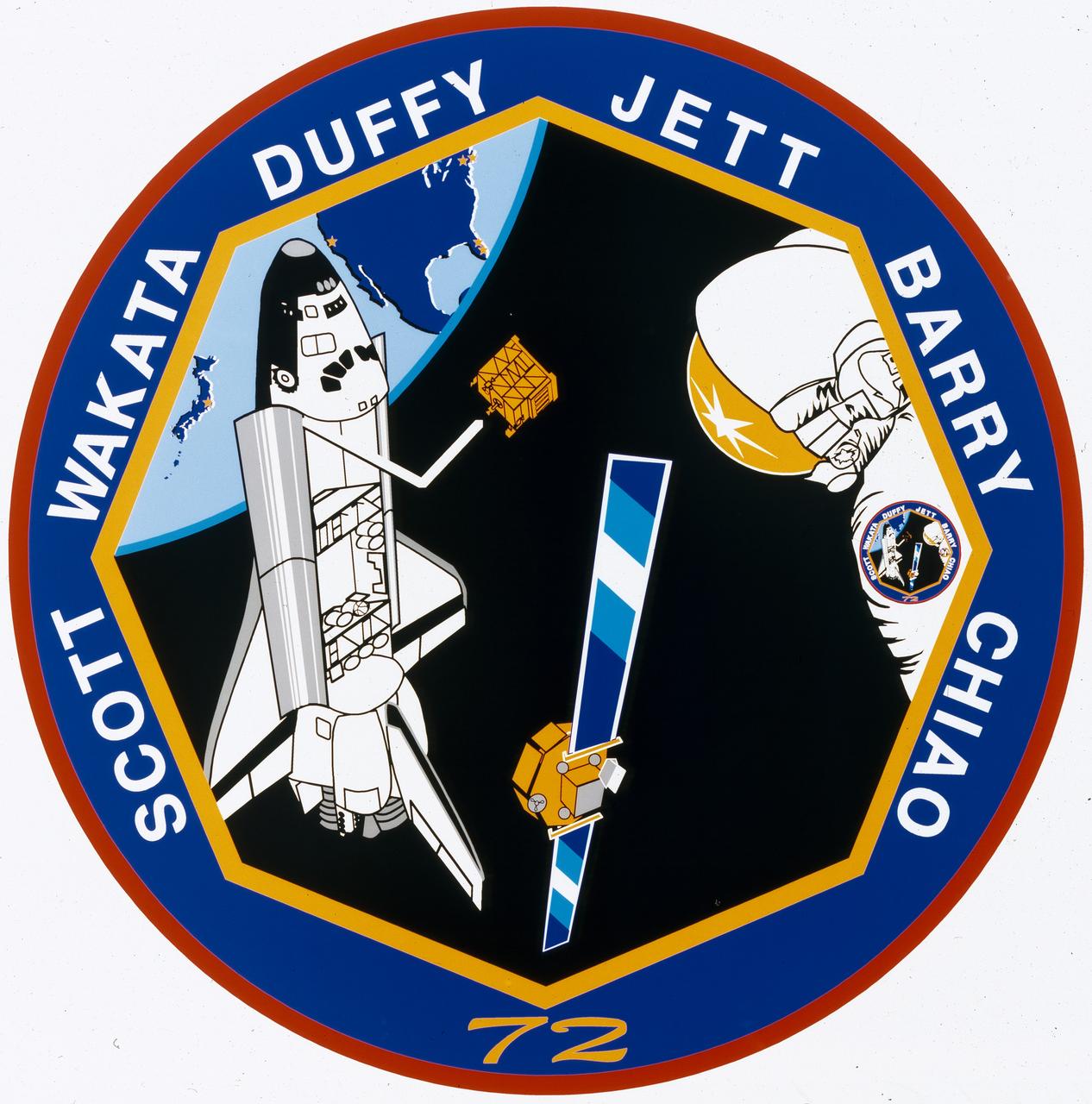
The crew patch of STS-72 depicts the Space Shuttle Endeavour and some of the payloads on the flight. The Japanese satellite, Space Flyer Unit (SFU) is shown in a free-flying configuration with the solar array panels deployed. The inner gold border of the patch represents the SFU's distinct octagonal shape. Endeavour’s rendezvous with and retrieval of SFU at an altitude of approximately 250 nautical miles. The Office of Aeronautics and Space Technology's (OAST) flyer satellite is shown just after release from the Remote Manipulator System (RMS). The OAST satellite was deployed at an altitude of 165 nautical miles. The payload bay contains equipment for the secondary payloads - the Shuttle Laser Altimeter (SLA) and the Shuttle Solar Backscatter Ultraviolet Instrument (SSBUV). There were two space walks planned to test hardware for assembly of the International Space Station. The stars represent the hometowns of the crew members in the United States and Japan.
Space Shuttle Projects
STS061-99-009 (9 Dec 1993) --- Sunlight reflects off the Space Shuttle Endeavour's aft windows and the shiny Hubble Space Telescope (HST) prior to its post-servicing deployment near the end of the eleven-day mission.  A handheld Hasselblad camera was used inside Endeavour's cabin to record the image.
New set of solar arrays deployed on Hubble Space Telescope
STS061-95-075 (6 Dec 1993) --- Astronauts Kathryn C. Thornton and Thomas D. Akers work to remove one of the solar arrays on the Hubble Space Telescope (HST) on the second of five extravehicular activity?s (EVA).  The two space walkers later replaced both solar array panels.  Part of Australia is in the background.
Astronauts Akers and Thornton remove one of HST solar arrays during EVA
STS061-87-046 (5 Dec 1993) --- Astronauts Jeffrey A. Hoffman (right) and F. Story Musgrave work near the base of the Hubble Space Telescope (HST) on the first of five spacewalks.  Their particular mission here is to replace failed Rate Sensor Units (RSU) inside the telescope's housing.  Hoffman is anchored to a foot restraint, mounted on the end of the Space Shuttle Endeavour's Remote Manipulator System (RMS) arm, while Musgrave is standing on a foot restraint attached to a support structure in the cargo bay.
Astronauts Musgrave and Hoffman during first STS-61 EVA
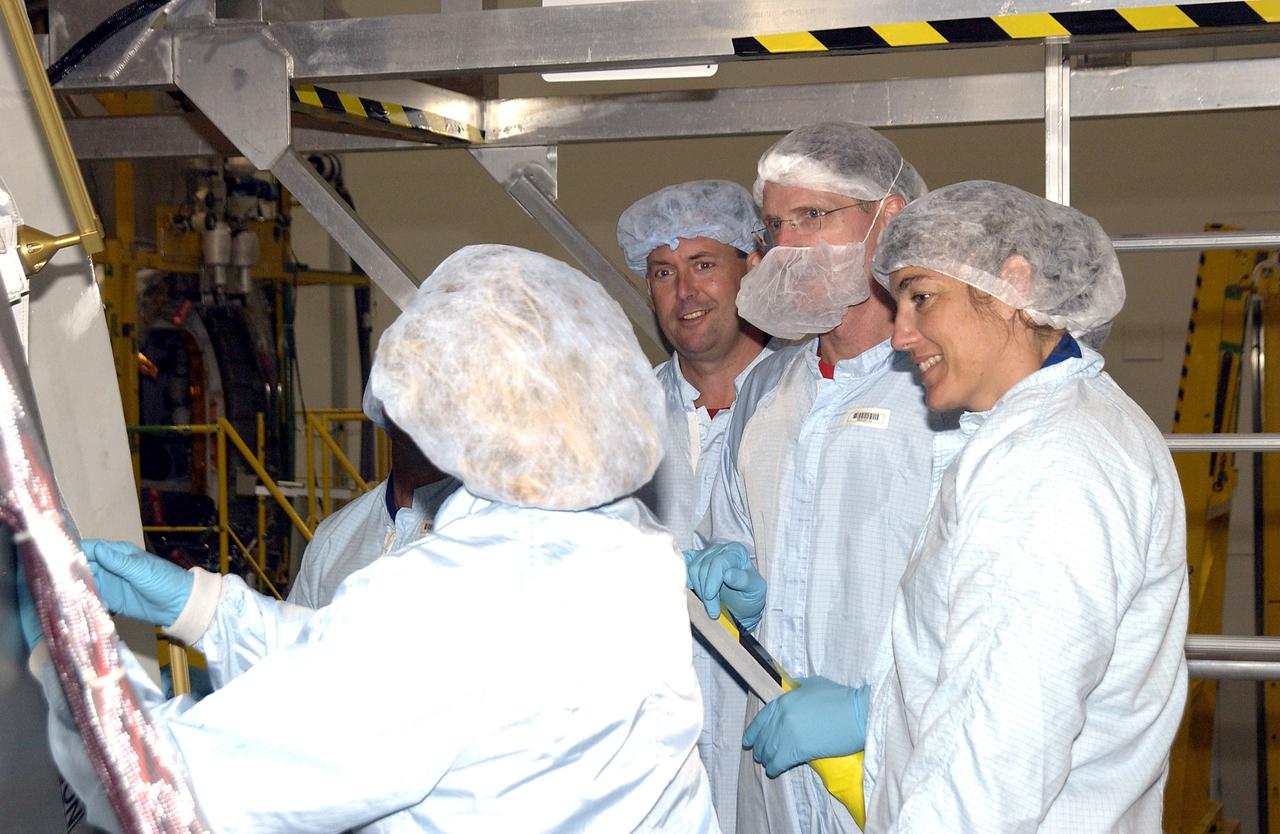
KENNEDY SPACE CENTER, FLA. - In the Space Station Processing Facility, STS-120 Mission Specialists Michael Foreman (third from right) and STS-115 Mission Specialists Joseph Tanner (second from right) and Heidemarie Stefanyshyn-Piper (right) look over the Japanese Experiment Module (JEM) Pressurized Module. Known as Kibo, the JEM consists of six components: two research facilities -- the Pressurized Module and Exposed Facility; a Logistics Module attached to each of them; a Remote Manipulator System; and an Inter-Orbit Communication System unit. Kibo also has a scientific airlock through which experiments are transferred and exposed to the external environment of space. The various components of JEM will be assembled in space over the course of three Space Shuttle missions.  STS-115 will deliver the second port truss segment, the P3/P4 Truss, to attach to the first port truss segment, the P1 Truss, as well as deploy solar array sets 2A and 4A.. STS-120 will deliver the second of three Station connecting modules, Node 2, which attaches to the end of U.S. Lab.  It will provide attach locations for the Japanese laboratory, European laboratory, the Centrifuge  Accommodation Module and later Multi-Purpose Logistics Modules.  The addition of Node 2 will complete the U.S. core of the International Space Station.
KENNEDY SPACE CENTER, FLA. - In the Space Station Processing Facility, STS-120 Mission Specialists Michael Foreman (third from right) and STS-115 Mission Specialists Joseph Tanner (second from right) and Heidemarie Stefanyshyn-Piper (right) look over the Japanese Experiment Module (JEM) Pressurized Module. Known as Kibo, the JEM consists of six components: two research facilities -- the Pressurized Module and Exposed Facility; a Logistics Module attached to each of them; a Remote Manipulator System; and an Inter-Orbit Communication System unit. Kibo also has a scientific airlock through which experiments are transferred and exposed to the external environment of space. The various components of JEM will be assembled in space over the course of three Space Shuttle missions. STS-115 will deliver the second port truss segment, the P3/P4 Truss, to attach to the first port truss segment, the P1 Truss, as well as deploy solar array sets 2A and 4A.. STS-120 will deliver the second of three Station connecting modules, Node 2, which attaches to the end of U.S. Lab. It will provide attach locations for the Japanese laboratory, European laboratory, the Centrifuge Accommodation Module and later Multi-Purpose Logistics Modules. The addition of Node 2 will complete the U.S. core of the International Space Station.
S61-E-012 (5 Dec 1993) --- This view of astronauts Kathryn C. Thornton (top) and Thomas D. Akers working on the Hubble Space Telescope (HST) was photographed with an Electronic Still Camera (ESC), and down linked to ground controllers soon afterward.  Thornton, anchored to the end of the Remote Manipulator System (RMS) arm, is teaming with Akers to install the +V2 Solar Array Panel as a replacement for the original one removed earlier.  Akers uses tethers and a foot restraint to remain in position for the task.  Electronic still photography is a relatively new technology which provides the means for a handheld camera to electronically capture and digitize an image with resolution approaching film quality.  The electronic still camera has flown as an experiment on several other shuttle missions.
Astronauts Thornton & Akers on HST photographed by Electronic Still Camera
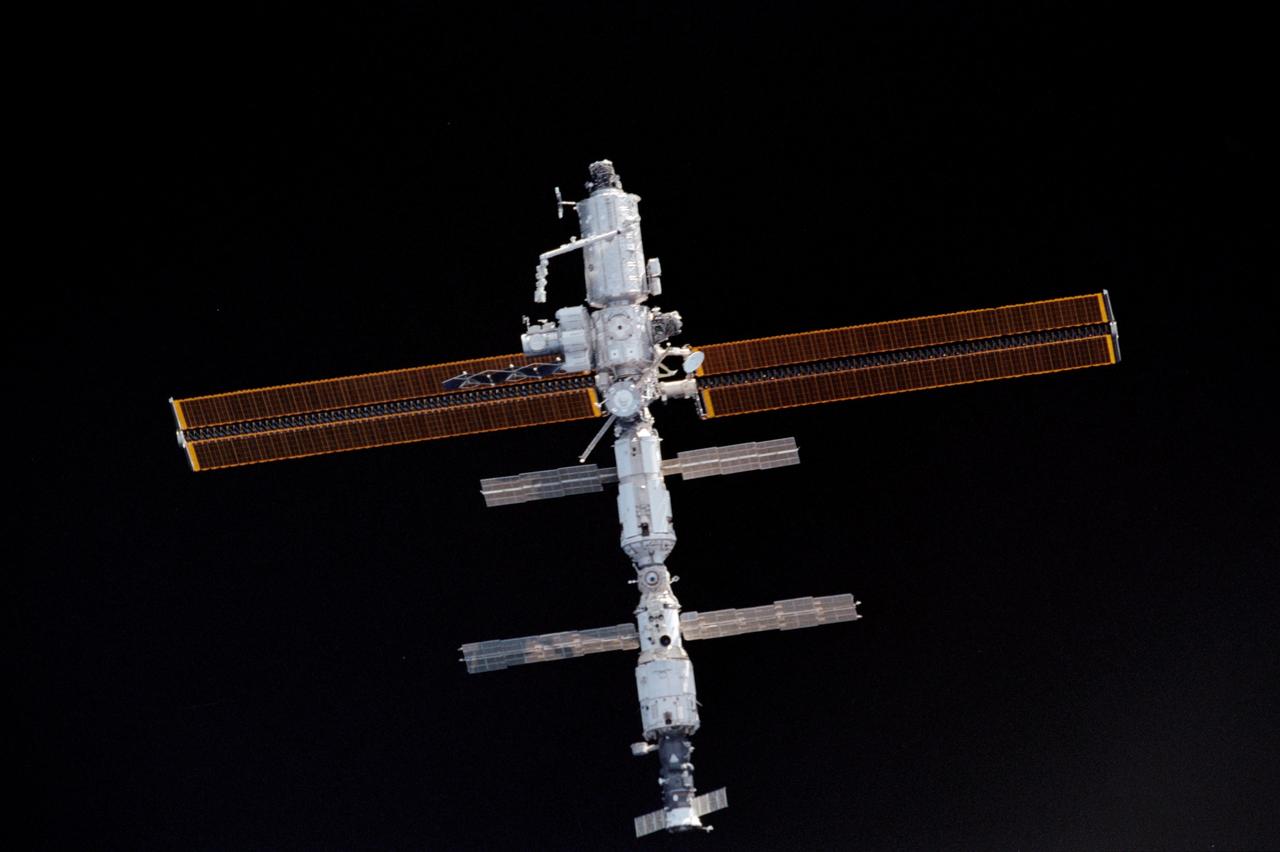
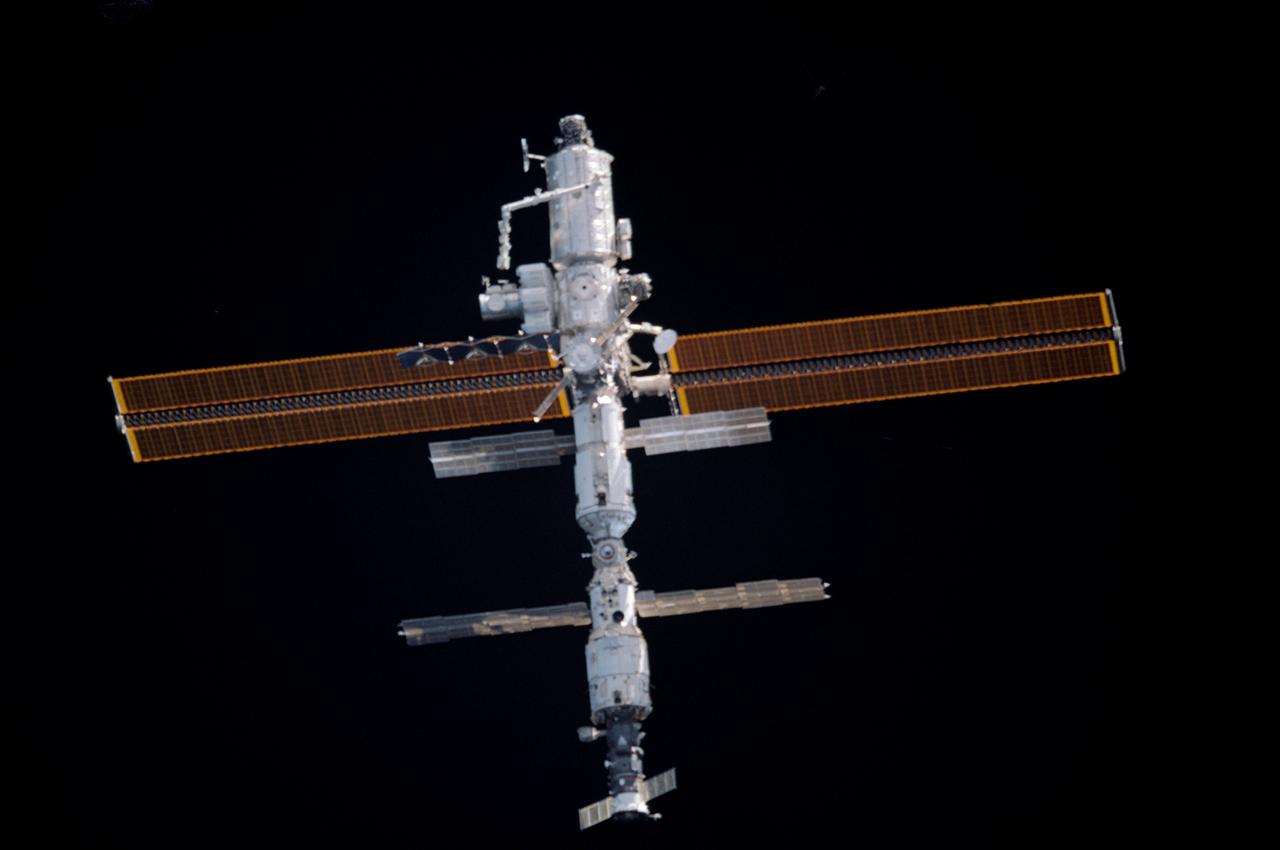
STS104-332-027 (21 July 2001) --- The International Space Station (ISS), just days after receiving the installment of the Quest airlock, was photographed by one the STS-104 astronauts during a fly-around of the orbital outpost.  The survey occurred shortly after Atlantis' undocking. The Canadarm2 or Space Station Remote Manipulator System (SSRMS) appears to be pointed toward the new airlock on the station's starboard side. The STS-104 and Expedition Two crew's joint efforts in the past several days, in which the airlock was installed and other work was accomplished, marked the completion of the second phase of the station. Within the last year (beginning in July of 2000), 77 tons of hardware have been added to the complex, including the Zvezda module, the Z1 Truss Assembly, Pressurized Mating Adapter 3, the P6 Truss and its 240-foot long solar arrays, the U.S. laboratory Destiny, the Canadarm2 and finally the Quest airlock.
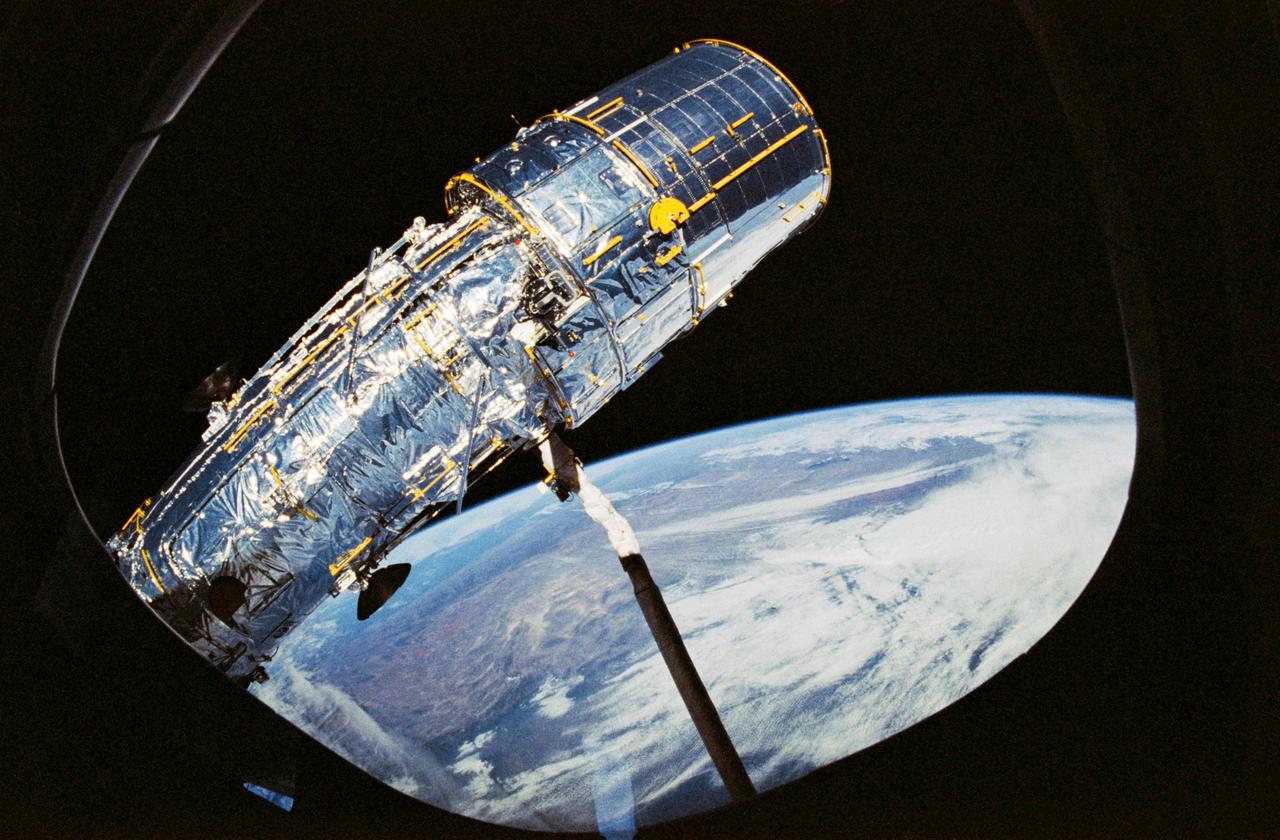
Overall nadir view of ISS seen during flyaround
STS104-332-026 (21 July 2001) --- The International Space Station (ISS), just days after receiving the installment of the Quest airlock, was photographed by one the STS-104 astronauts during a fly-around of the orbital outpost.  The survey occurred shortly after Atlantis' undocking. The Canadarm2 or Space Station Remote Manipulator System (SSRMS) appears to be pointed toward the new airlock on the station's starboard side. The STS-104 and Expedition Two crew's joint efforts in the past several days, in which the airlock was installed and other work was accomplished, marked the completion of the second phase of the station. Within the last year (beginning in July of 2000), 77 tons of hardware have been added to the complex, including the Zvezda module, the Z1 Truss Assembly, Pressurized Mating Adapter 3, the P6 Truss and its 240-foot long solar arrays, the U.S. laboratory Destiny, the Canadarm2 and finally the Quest airlock.
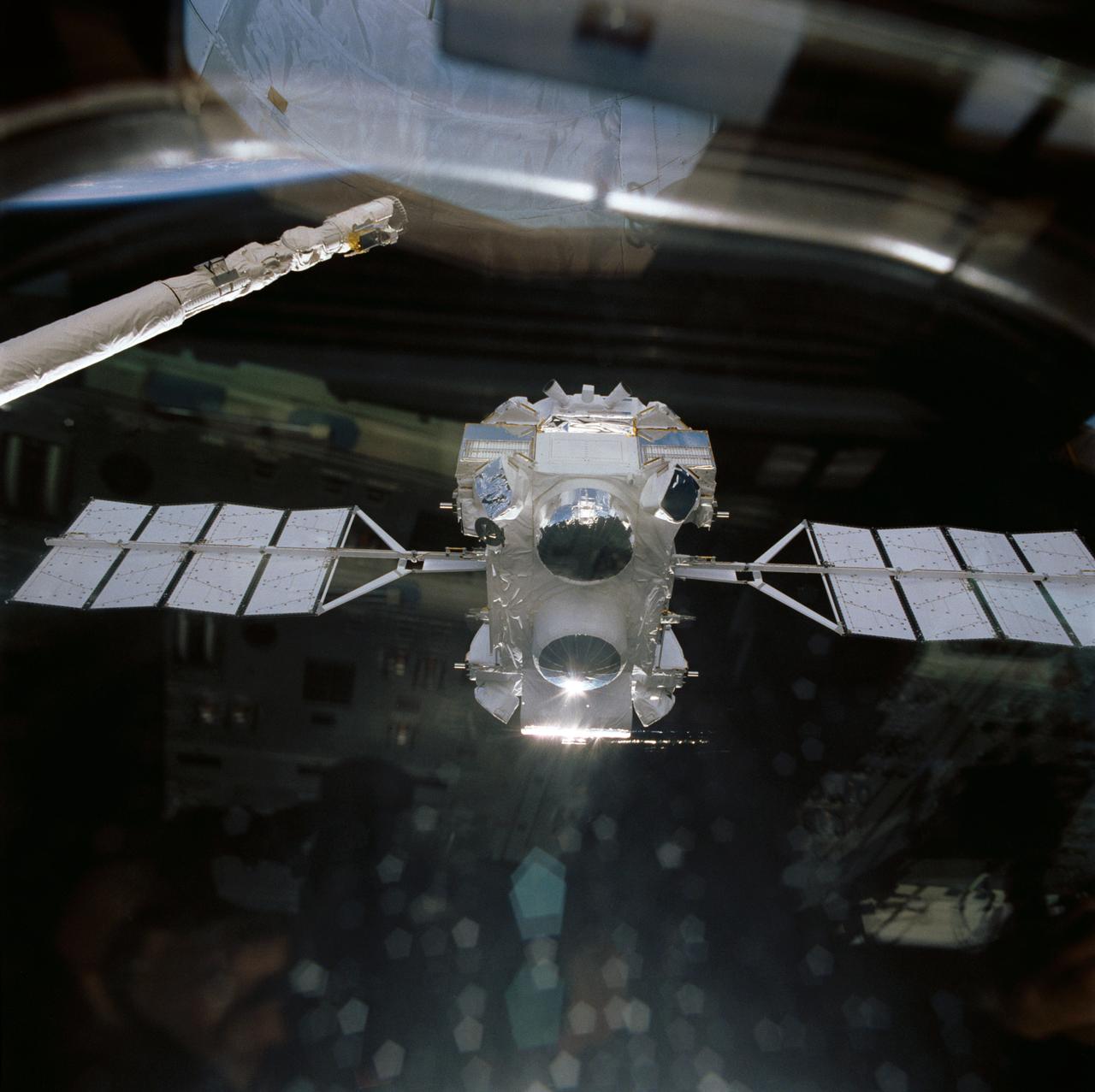
Overall nadir view of ISS seen during flyaround
S61-E-014 (5 Dec 1993) --- This view of astronauts Kathryn C. Thornton (bottom) and Thomas D. Akers working on the Hubble Space Telescope (HST) was photographed with an Electronic Still Camera (ESC), and down linked to ground controllers soon afterward.  Thornton, anchored to the end of the Remote Manipulator System (RMS) arm, is teaming with Akers to install the +V2 Solar Array Panel as a replacement for the original one removed earlier.  Akers uses tethers and a foot restraint to remain in position for the task.  Electronic still photography is a relatively new technology which provides the means for a handheld camera to electronically capture and digitize an image with resolution approaching film quality.  The electronic still camera has flown as an experiment on several other shuttle missions.
Astronauts Thornton & Akers on HST photographed by Electronic Still Camera
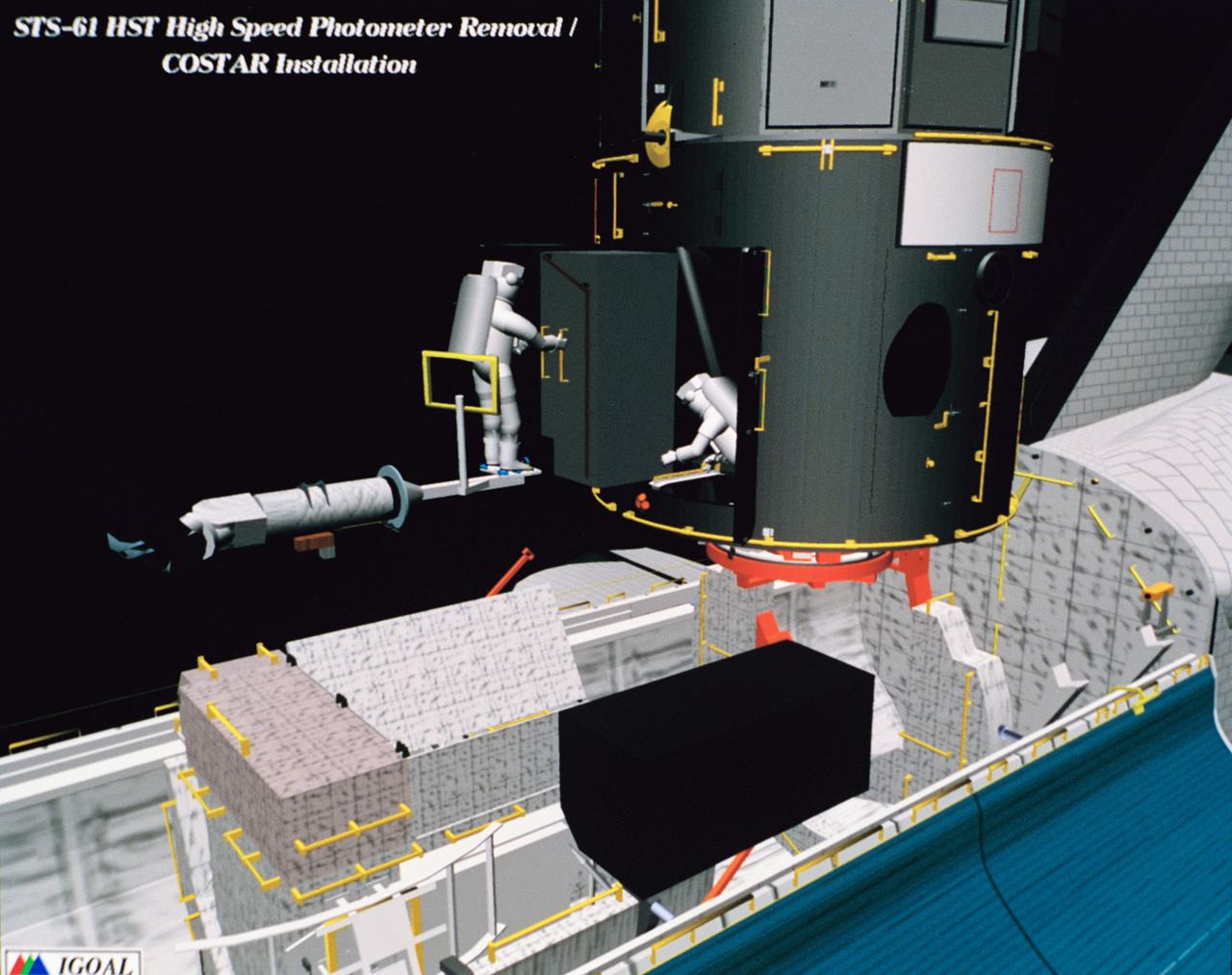
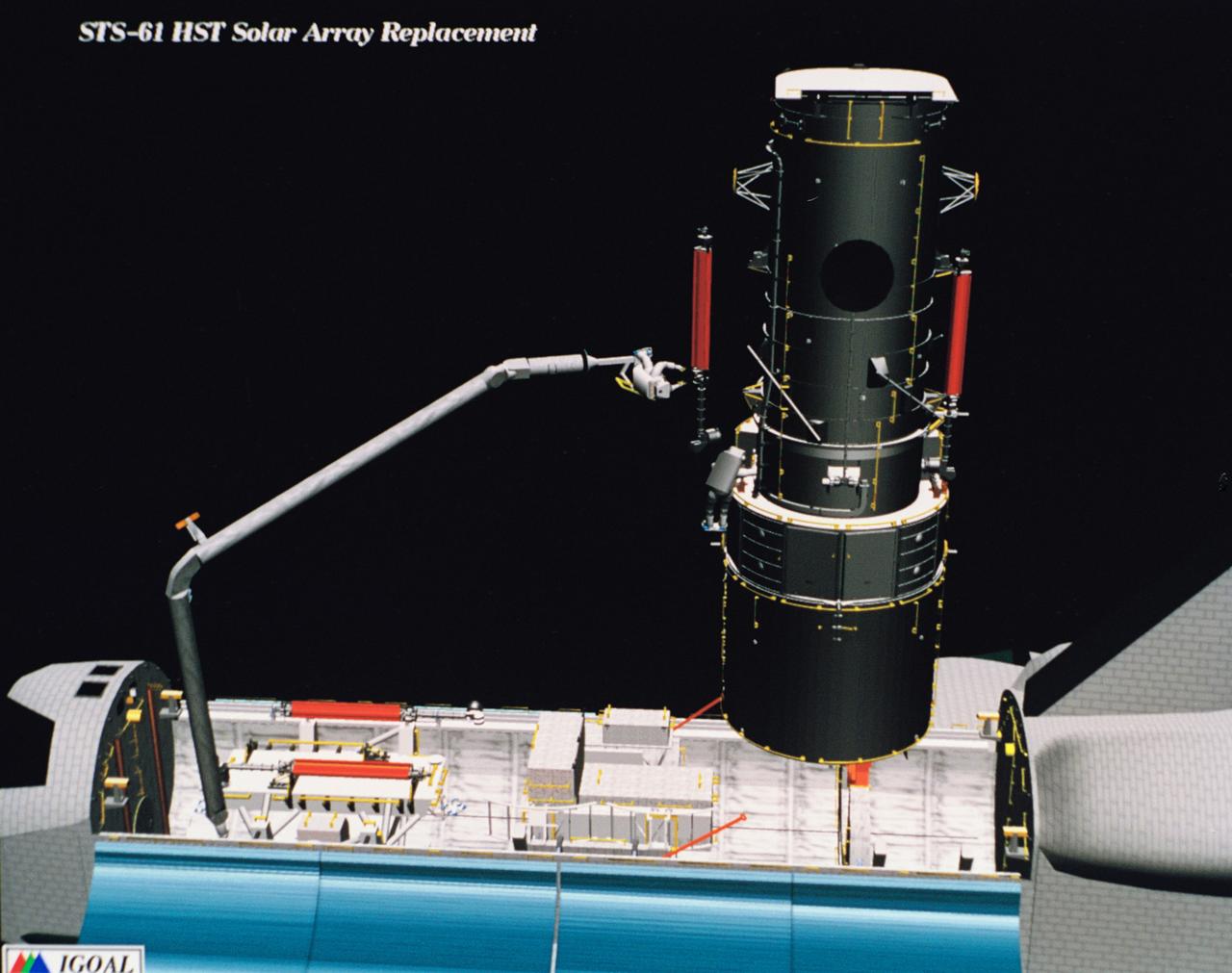
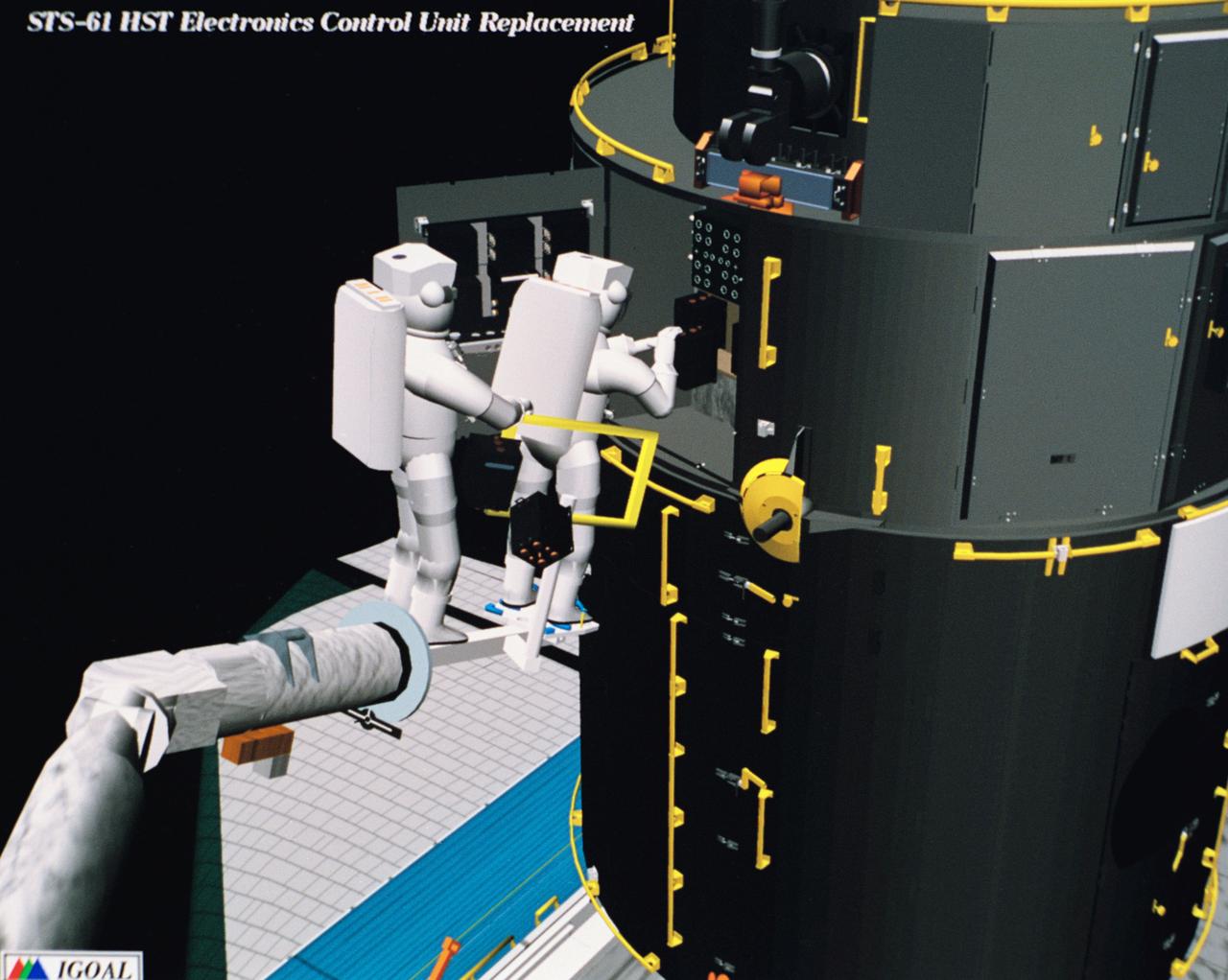
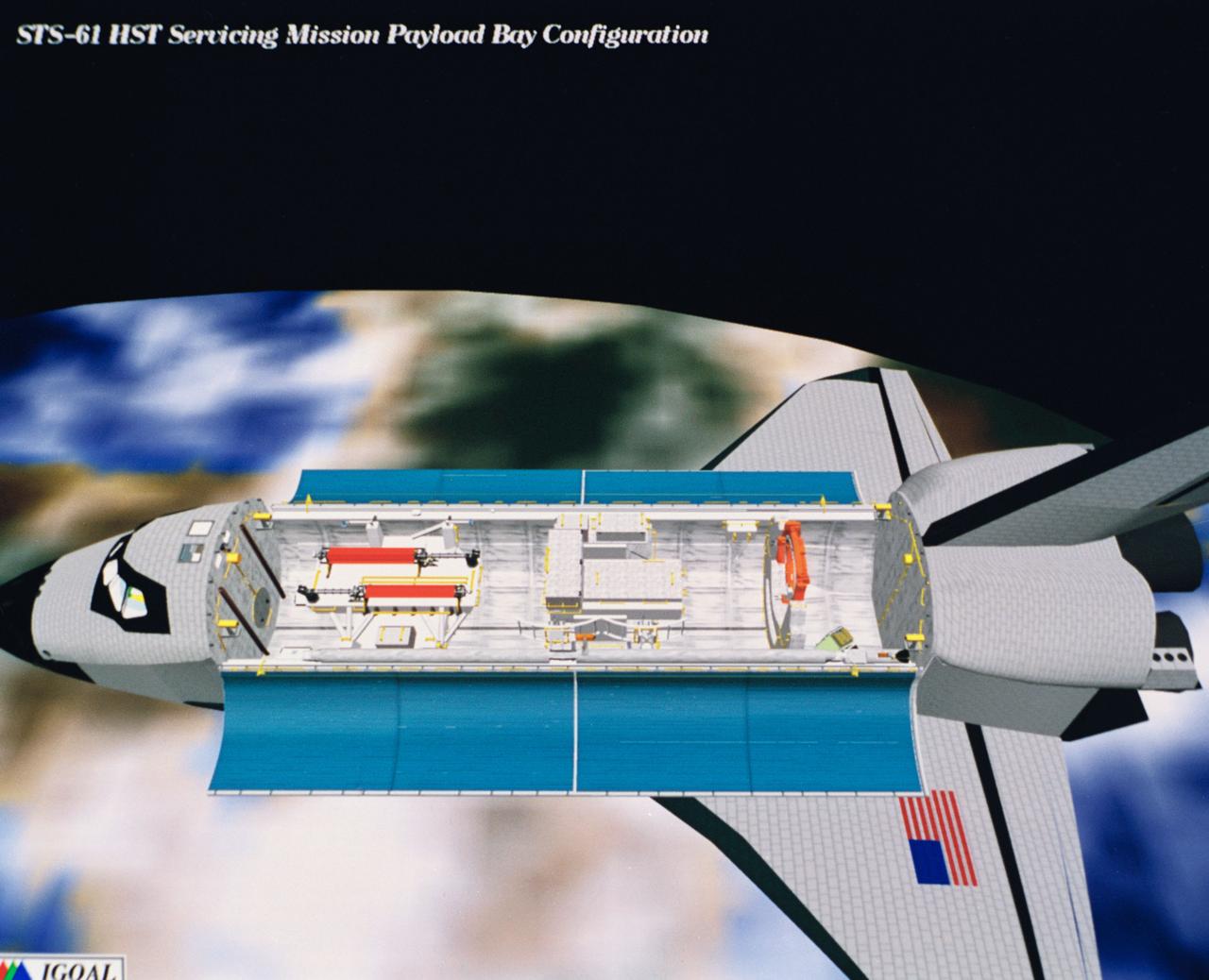
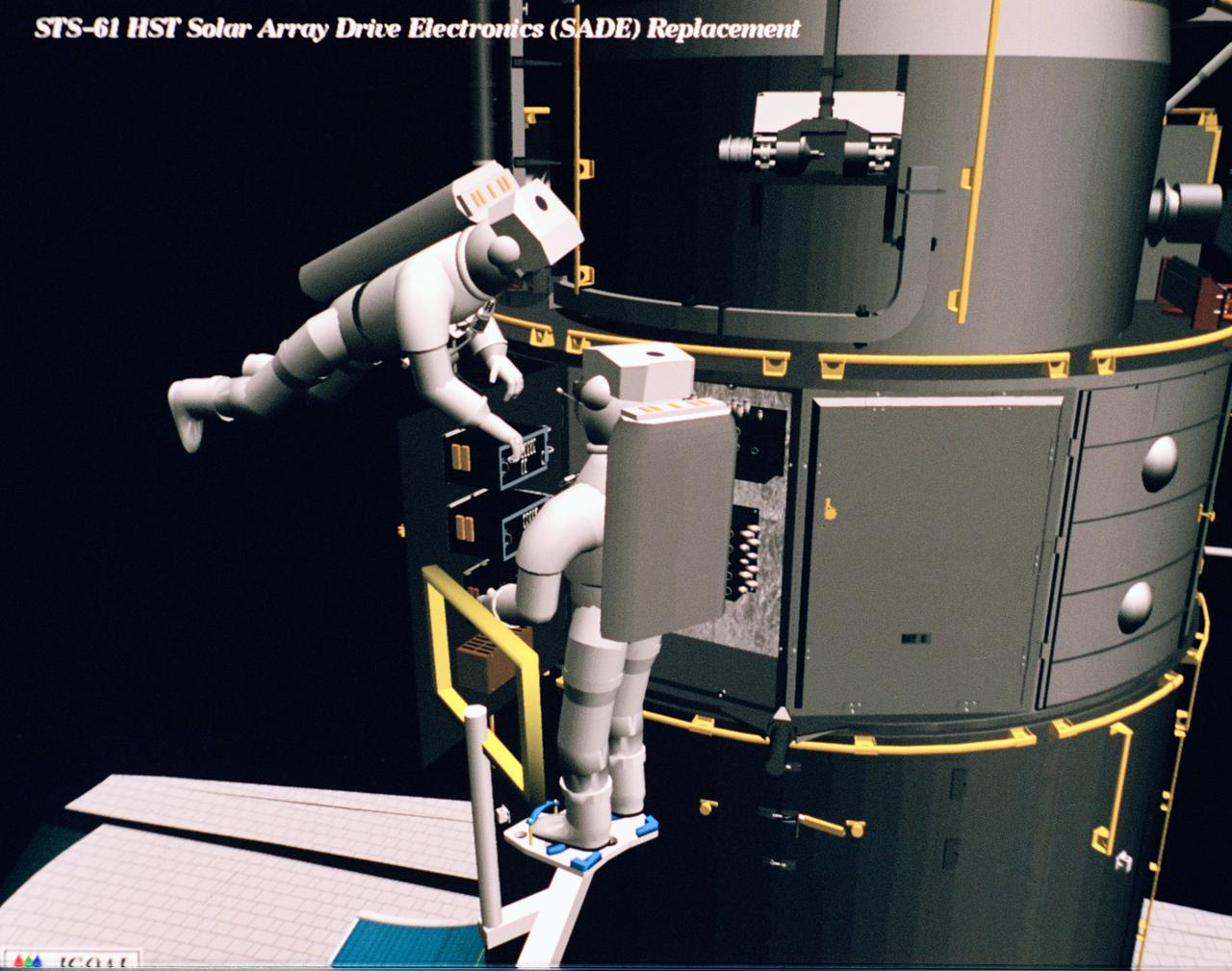
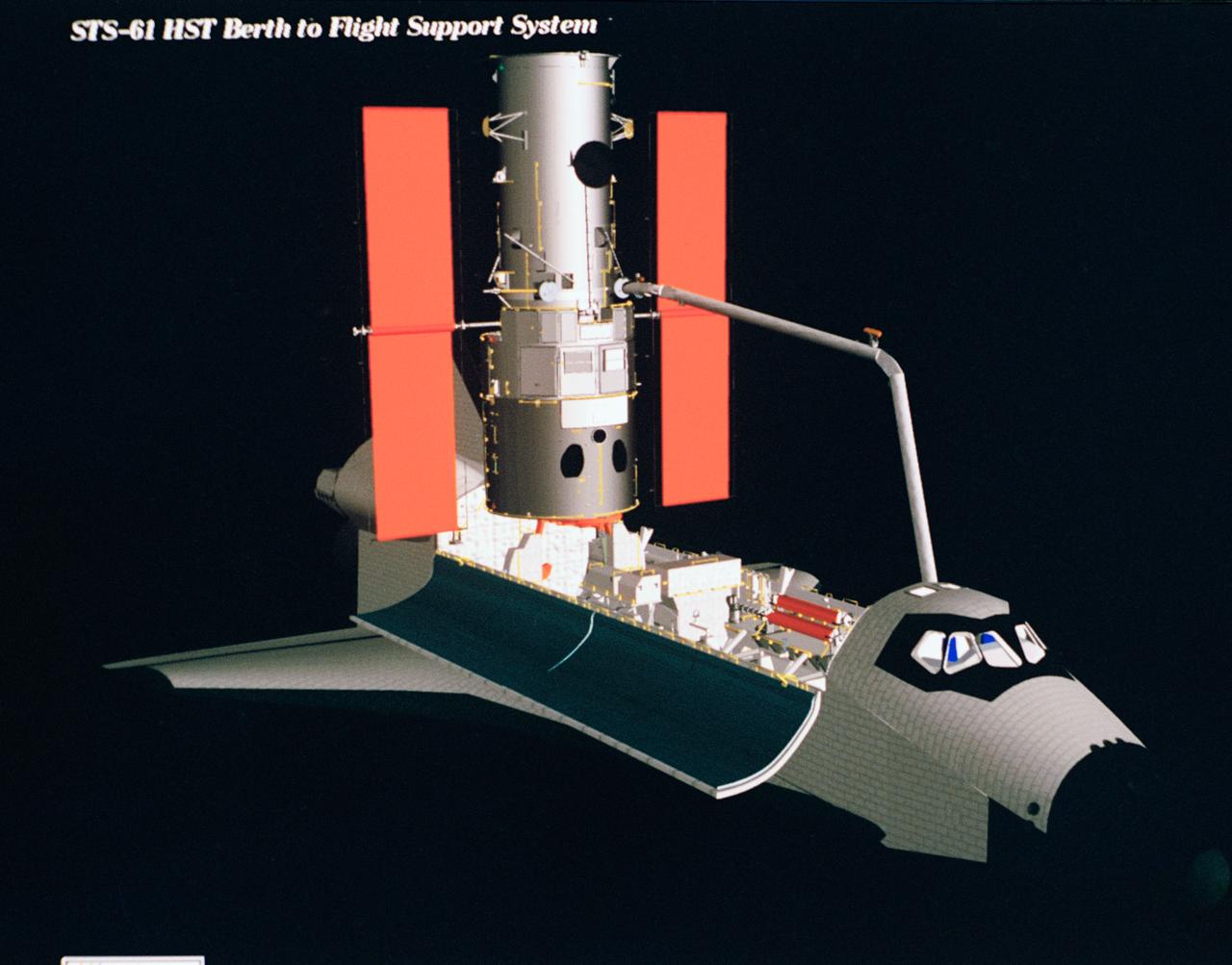
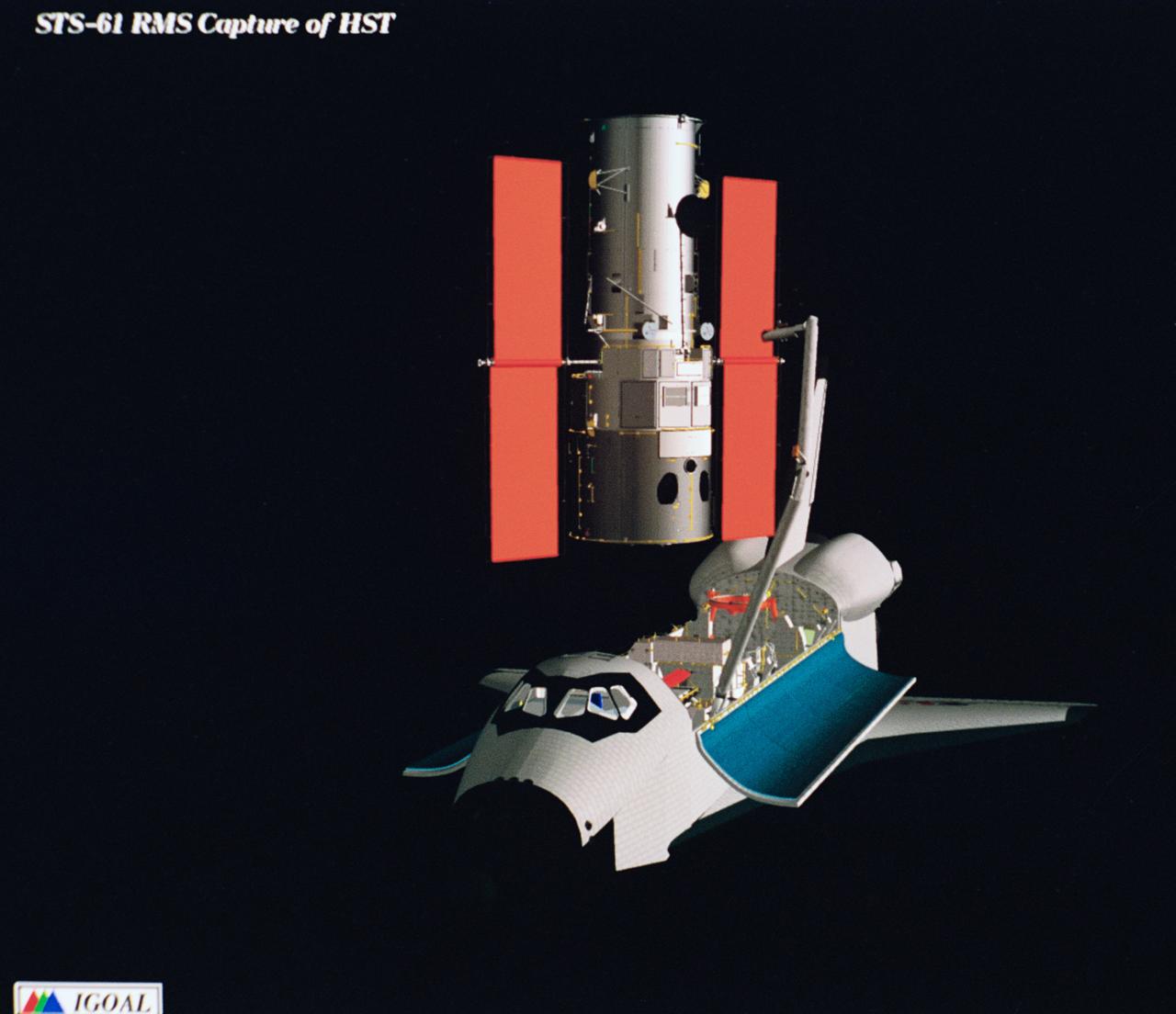
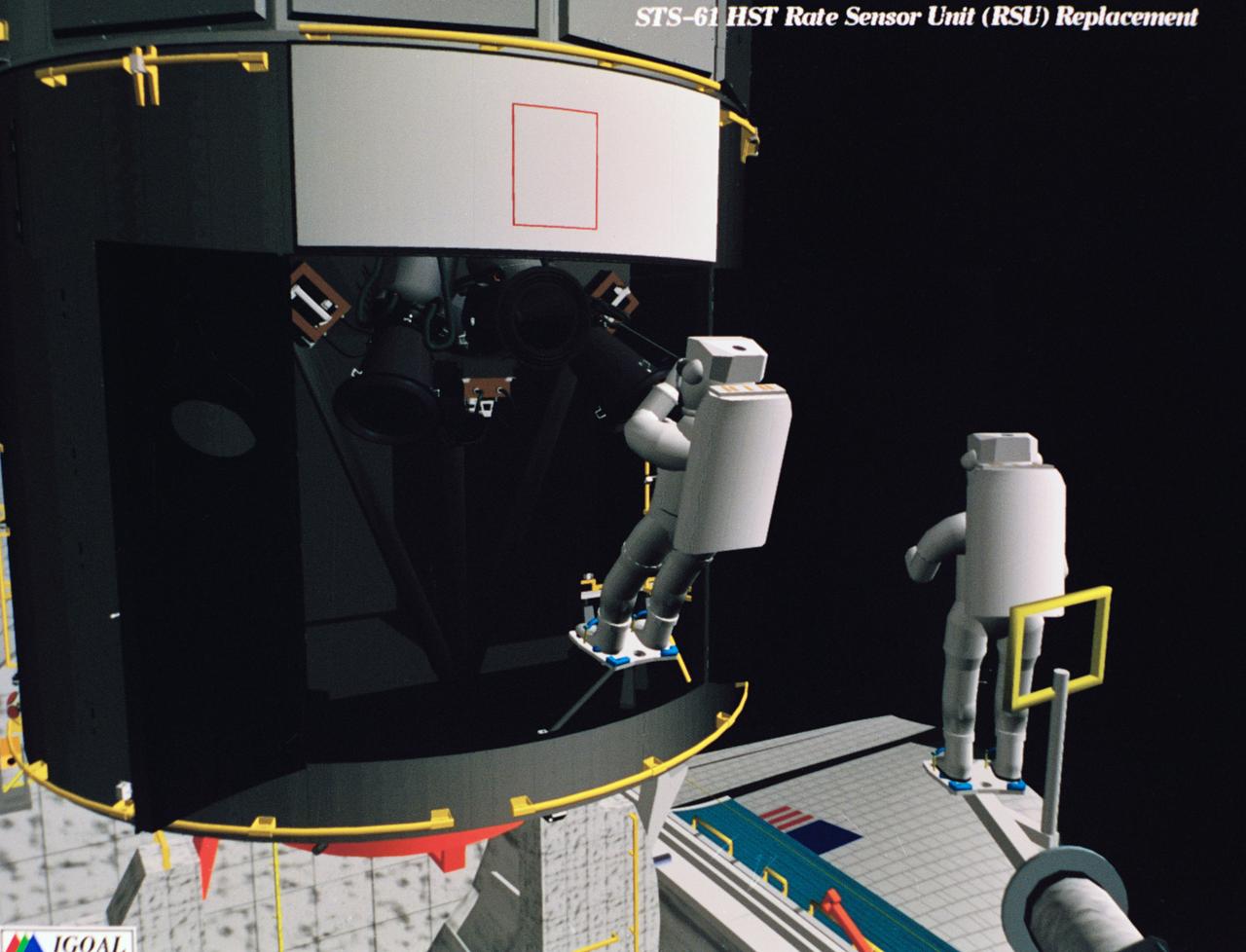
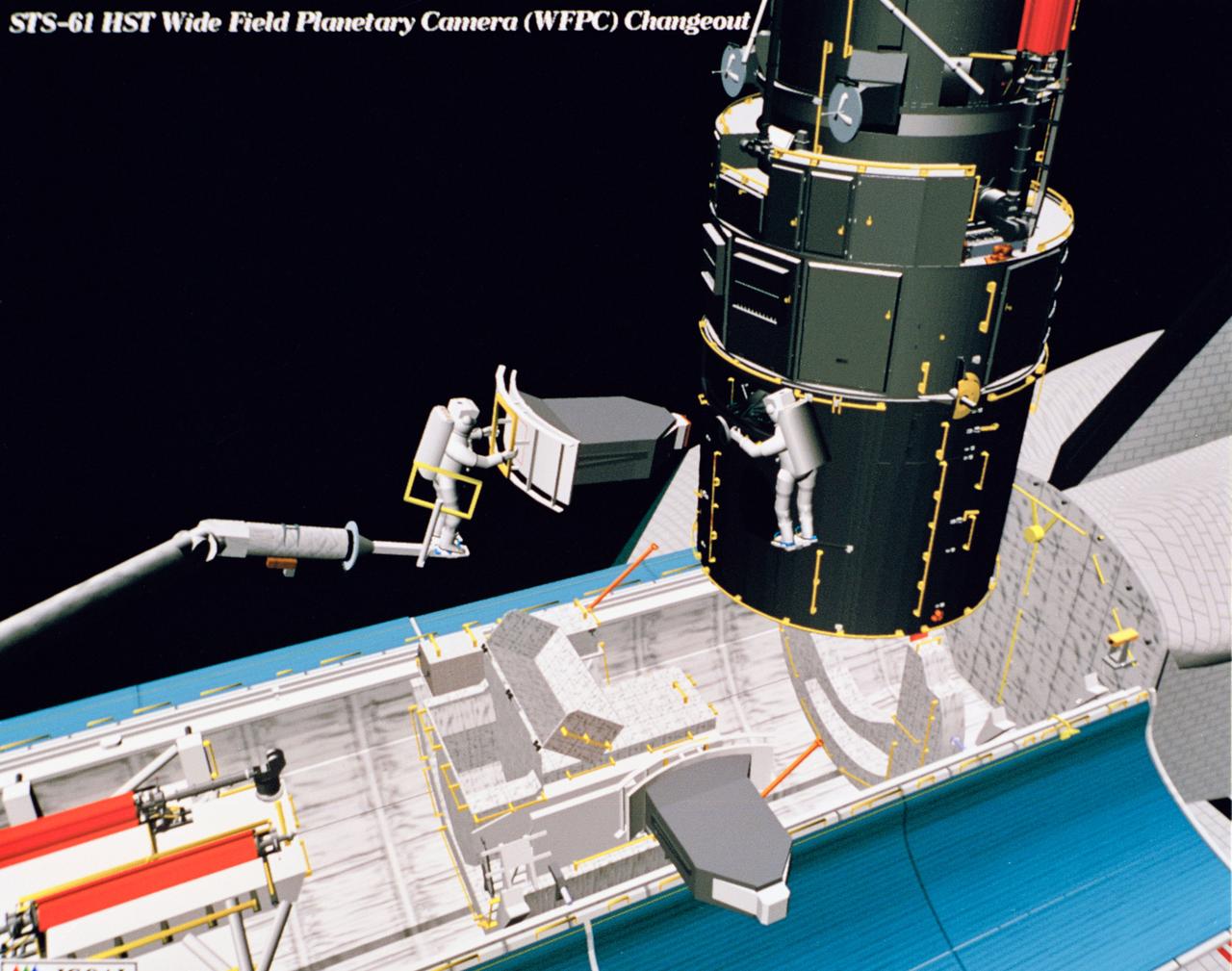
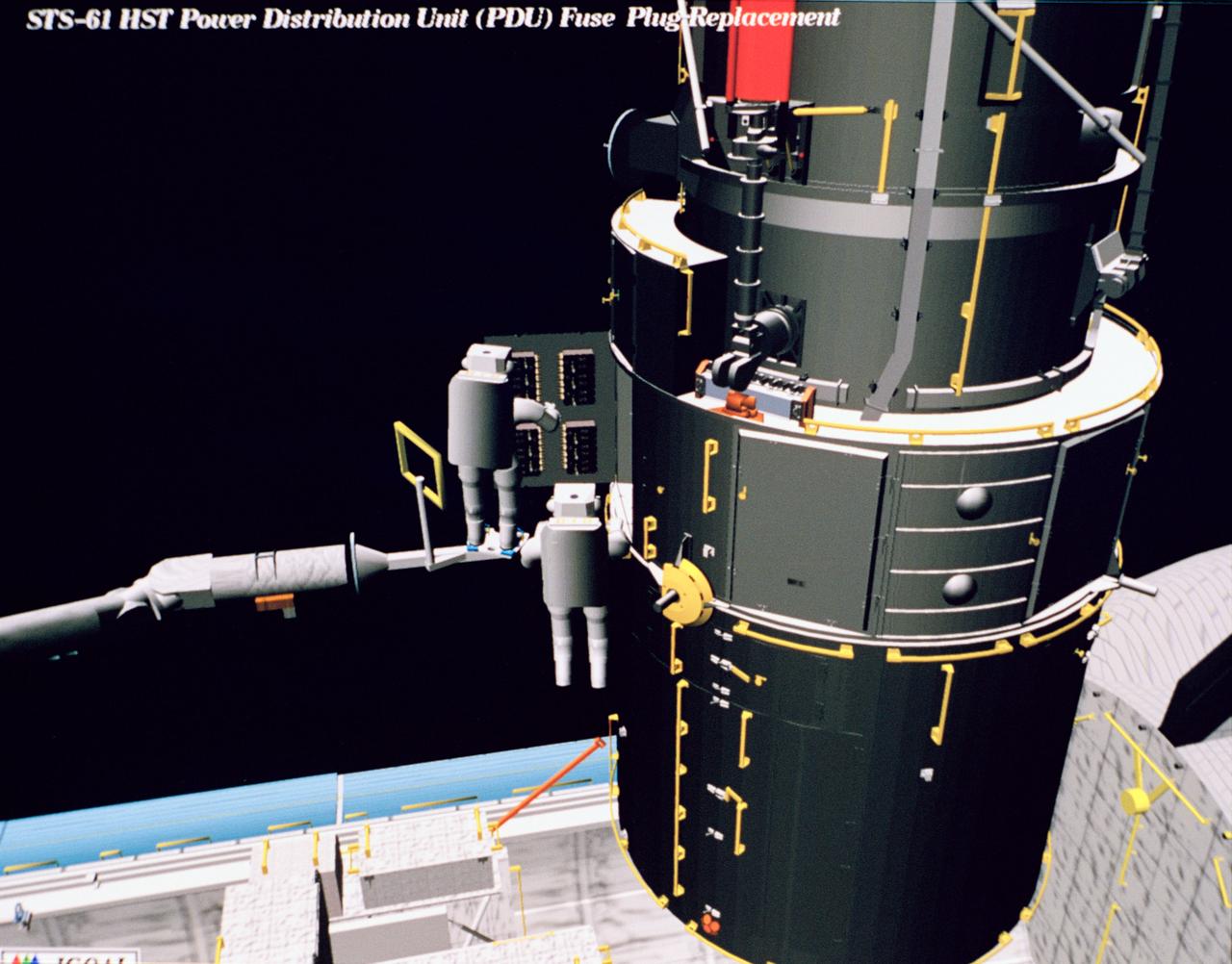
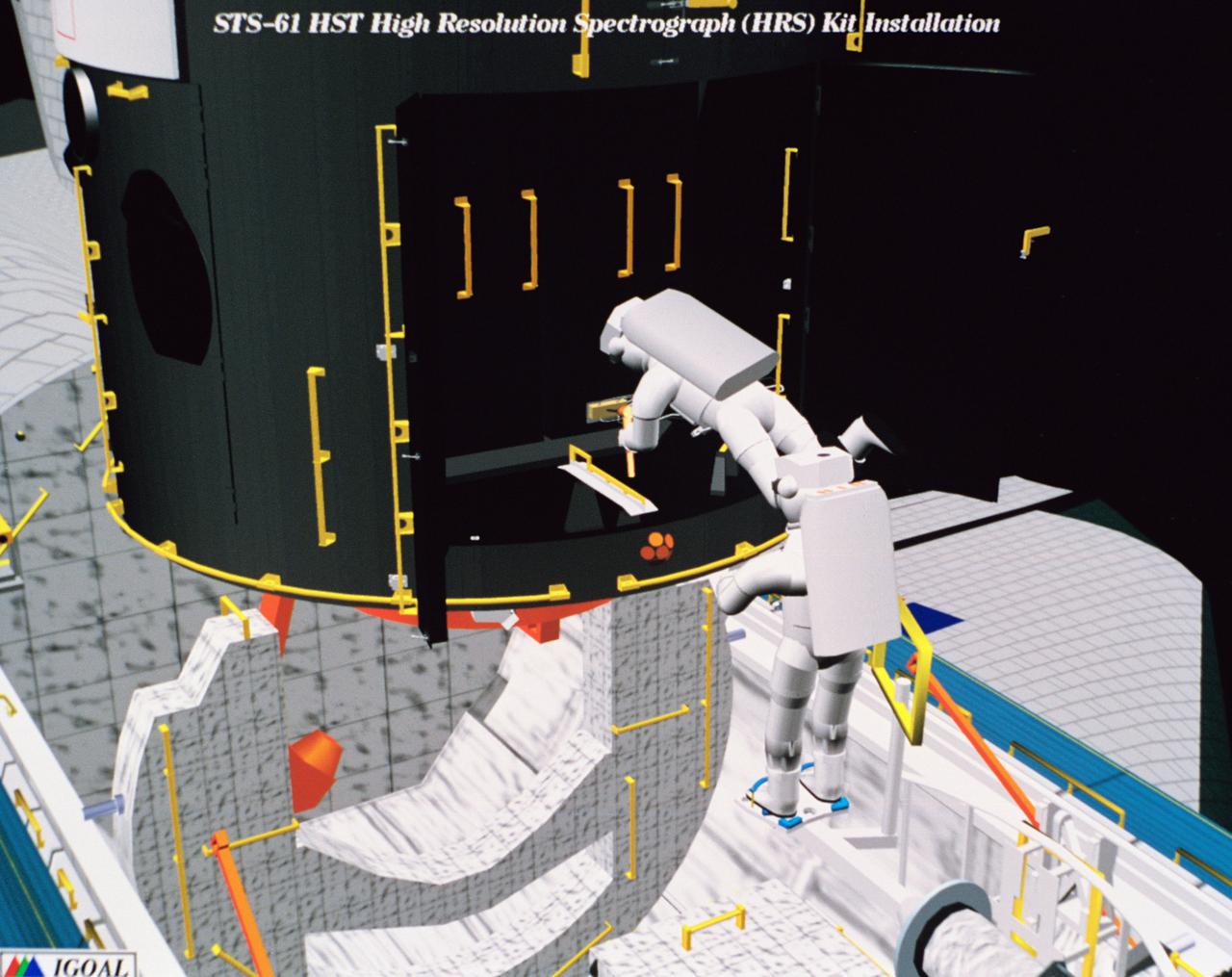
Computer generated scenes depicting the Hubble Space Telescope capture and a sequence of planned events on the planned extravehicular activity (EVA). Scenes include the Remote Manipulator System (RMS) arm assisting two astronauts changing out the Wide Field/Planetary Camera (WF/PC) (48699); RMS arm assisting in the temporary mating of the orbiting telescope to the flight support system in Endeavour's cargo bay (48700); Endeavour's RMS arm assisting in the "capture" of the orbiting telescope (48701); Two astronauts changing out the telescope's coprocessor (48702); RMS arm assistign two astronauts replacing one of the telescope's electronic control units (48703); RMS assisting two astronauts replacing the fuse plugs on the telescope's Power Distribution Unit (PDU) (48704); The telescope's High Resolution Spectrograph (HRS) kit is depicted in this scene (48705); Two astronauts during the removal of the high speed photometer and the installation of the COSTAR instrument (48706); Two astronauts, standing on the RMS, during installation of one of the Magnetic Sensing System (MSS) (48707); High angle view of the orbiting Space Shuttle Endeavour with its cargo bay doors open, revealing the bay's pre-capture configuration. Seen are, from the left, the Solar Array Carrier, the ORU Carrier and the flight support system (48708); Two astronauts performing the replacement of HST's Rate Sensor Units (RSU) (48709); The RMS arm assisting two astronauts with the replacement of the telescope's solar array panels (48710); Two astronauts replacing the telescope's Solar Array Drive Electronics (SADE) (48711).
Computer-generated scenes depicting the HST capture and EVA repair mission
Computer generated scenes depicting the Hubble Space Telescope capture and a sequence of planned events on the planned extravehicular activity (EVA). Scenes include the Remote Manipulator System (RMS) arm assisting two astronauts changing out the Wide Field/Planetary Camera (WF/PC) (48699); RMS arm assisting in the temporary mating of the orbiting telescope to the flight support system in Endeavour's cargo bay (48700); Endeavour's RMS arm assisting in the "capture" of the orbiting telescope (48701); Two astronauts changing out the telescope's coprocessor (48702); RMS arm assistign two astronauts replacing one of the telescope's electronic control units (48703); RMS assisting two astronauts replacing the fuse plugs on the telescope's Power Distribution Unit (PDU) (48704); The telescope's High Resolution Spectrograph (HRS) kit is depicted in this scene (48705); Two astronauts during the removal of the high speed photometer and the installation of the COSTAR instrument (48706); Two astronauts, standing on the RMS, during installation of one of the Magnetic Sensing System (MSS) (48707); High angle view of the orbiting Space Shuttle Endeavour with its cargo bay doors open, revealing the bay's pre-capture configuration. Seen are, from the left, the Solar Array Carrier, the ORU Carrier and the flight support system (48708); Two astronauts performing the replacement of HST's Rate Sensor Units (RSU) (48709); The RMS arm assisting two astronauts with the replacement of the telescope's solar array panels (48710); Two astronauts replacing the telescope's Solar Array Drive Electronics (SADE) (48711).
Computer-generated scenes depicting the HST capture and EVA repair mission
Computer generated scenes depicting the Hubble Space Telescope capture and a sequence of planned events on the planned extravehicular activity (EVA). Scenes include the Remote Manipulator System (RMS) arm assisting two astronauts changing out the Wide Field/Planetary Camera (WF/PC) (48699); RMS arm assisting in the temporary mating of the orbiting telescope to the flight support system in Endeavour's cargo bay (48700); Endeavour's RMS arm assisting in the "capture" of the orbiting telescope (48701); Two astronauts changing out the telescope's coprocessor (48702); RMS arm assistign two astronauts replacing one of the telescope's electronic control units (48703); RMS assisting two astronauts replacing the fuse plugs on the telescope's Power Distribution Unit (PDU) (48704); The telescope's High Resolution Spectrograph (HRS) kit is depicted in this scene (48705); Two astronauts during the removal of the high speed photometer and the installation of the COSTAR instrument (48706); Two astronauts, standing on the RMS, during installation of one of the Magnetic Sensing System (MSS) (48707); High angle view of the orbiting Space Shuttle Endeavour with its cargo bay doors open, revealing the bay's pre-capture configuration. Seen are, from the left, the Solar Array Carrier, the ORU Carrier and the flight support system (48708); Two astronauts performing the replacement of HST's Rate Sensor Units (RSU) (48709); The RMS arm assisting two astronauts with the replacement of the telescope's solar array panels (48710); Two astronauts replacing the telescope's Solar Array Drive Electronics (SADE) (48711).
Computer-generated scenes depicting the HST capture and EVA repair mission
Computer generated scenes depicting the Hubble Space Telescope capture and a sequence of planned events on the planned extravehicular activity (EVA). Scenes include the Remote Manipulator System (RMS) arm assisting two astronauts changing out the Wide Field/Planetary Camera (WF/PC) (48699); RMS arm assisting in the temporary mating of the orbiting telescope to the flight support system in Endeavour's cargo bay (48700); Endeavour's RMS arm assisting in the "capture" of the orbiting telescope (48701); Two astronauts changing out the telescope's coprocessor (48702); RMS arm assistign two astronauts replacing one of the telescope's electronic control units (48703); RMS assisting two astronauts replacing the fuse plugs on the telescope's Power Distribution Unit (PDU) (48704); The telescope's High Resolution Spectrograph (HRS) kit is depicted in this scene (48705); Two astronauts during the removal of the high speed photometer and the installation of the COSTAR instrument (48706); Two astronauts, standing on the RMS, during installation of one of the Magnetic Sensing System (MSS) (48707); High angle view of the orbiting Space Shuttle Endeavour with its cargo bay doors open, revealing the bay's pre-capture configuration. Seen are, from the left, the Solar Array Carrier, the ORU Carrier and the flight support system (48708); Two astronauts performing the replacement of HST's Rate Sensor Units (RSU) (48709); The RMS arm assisting two astronauts with the replacement of the telescope's solar array panels (48710); Two astronauts replacing the telescope's Solar Array Drive Electronics (SADE) (48711).
Computer-generated scenes depicting the HST capture and EVA repair mission
Computer generated scenes depicting the Hubble Space Telescope capture and a sequence of planned events on the planned extravehicular activity (EVA). Scenes include the Remote Manipulator System (RMS) arm assisting two astronauts changing out the Wide Field/Planetary Camera (WF/PC) (48699); RMS arm assisting in the temporary mating of the orbiting telescope to the flight support system in Endeavour's cargo bay (48700); Endeavour's RMS arm assisting in the "capture" of the orbiting telescope (48701); Two astronauts changing out the telescope's coprocessor (48702); RMS arm assistign two astronauts replacing one of the telescope's electronic control units (48703); RMS assisting two astronauts replacing the fuse plugs on the telescope's Power Distribution Unit (PDU) (48704); The telescope's High Resolution Spectrograph (HRS) kit is depicted in this scene (48705); Two astronauts during the removal of the high speed photometer and the installation of the COSTAR instrument (48706); Two astronauts, standing on the RMS, during installation of one of the Magnetic Sensing System (MSS) (48707); High angle view of the orbiting Space Shuttle Endeavour with its cargo bay doors open, revealing the bay's pre-capture configuration. Seen are, from the left, the Solar Array Carrier, the ORU Carrier and the flight support system (48708); Two astronauts performing the replacement of HST's Rate Sensor Units (RSU) (48709); The RMS arm assisting two astronauts with the replacement of the telescope's solar array panels (48710); Two astronauts replacing the telescope's Solar Array Drive Electronics (SADE) (48711).
Computer-generated scenes depicting the HST capture and EVA repair mission
Computer generated scenes depicting the Hubble Space Telescope capture and a sequence of planned events on the planned extravehicular activity (EVA). Scenes include the Remote Manipulator System (RMS) arm assisting two astronauts changing out the Wide Field/Planetary Camera (WF/PC) (48699); RMS arm assisting in the temporary mating of the orbiting telescope to the flight support system in Endeavour's cargo bay (48700); Endeavour's RMS arm assisting in the "capture" of the orbiting telescope (48701); Two astronauts changing out the telescope's coprocessor (48702); RMS arm assistign two astronauts replacing one of the telescope's electronic control units (48703); RMS assisting two astronauts replacing the fuse plugs on the telescope's Power Distribution Unit (PDU) (48704); The telescope's High Resolution Spectrograph (HRS) kit is depicted in this scene (48705); Two astronauts during the removal of the high speed photometer and the installation of the COSTAR instrument (48706); Two astronauts, standing on the RMS, during installation of one of the Magnetic Sensing System (MSS) (48707); High angle view of the orbiting Space Shuttle Endeavour with its cargo bay doors open, revealing the bay's pre-capture configuration. Seen are, from the left, the Solar Array Carrier, the ORU Carrier and the flight support system (48708); Two astronauts performing the replacement of HST's Rate Sensor Units (RSU) (48709); The RMS arm assisting two astronauts with the replacement of the telescope's solar array panels (48710); Two astronauts replacing the telescope's Solar Array Drive Electronics (SADE) (48711).
Computer-generated scenes depicting the HST capture and EVA repair mission
Computer generated scenes depicting the Hubble Space Telescope capture and a sequence of planned events on the planned extravehicular activity (EVA). Scenes include the Remote Manipulator System (RMS) arm assisting two astronauts changing out the Wide Field/Planetary Camera (WF/PC) (48699); RMS arm assisting in the temporary mating of the orbiting telescope to the flight support system in Endeavour's cargo bay (48700); Endeavour's RMS arm assisting in the "capture" of the orbiting telescope (48701); Two astronauts changing out the telescope's coprocessor (48702); RMS arm assistign two astronauts replacing one of the telescope's electronic control units (48703); RMS assisting two astronauts replacing the fuse plugs on the telescope's Power Distribution Unit (PDU) (48704); The telescope's High Resolution Spectrograph (HRS) kit is depicted in this scene (48705); Two astronauts during the removal of the high speed photometer and the installation of the COSTAR instrument (48706); Two astronauts, standing on the RMS, during installation of one of the Magnetic Sensing System (MSS) (48707); High angle view of the orbiting Space Shuttle Endeavour with its cargo bay doors open, revealing the bay's pre-capture configuration. Seen are, from the left, the Solar Array Carrier, the ORU Carrier and the flight support system (48708); Two astronauts performing the replacement of HST's Rate Sensor Units (RSU) (48709); The RMS arm assisting two astronauts with the replacement of the telescope's solar array panels (48710); Two astronauts replacing the telescope's Solar Array Drive Electronics (SADE) (48711).
Computer-generated scenes depicting the HST capture and EVA repair mission
Computer generated scenes depicting the Hubble Space Telescope capture and a sequence of planned events on the planned extravehicular activity (EVA). Scenes include the Remote Manipulator System (RMS) arm assisting two astronauts changing out the Wide Field/Planetary Camera (WF/PC) (48699); RMS arm assisting in the temporary mating of the orbiting telescope to the flight support system in Endeavour's cargo bay (48700); Endeavour's RMS arm assisting in the "capture" of the orbiting telescope (48701); Two astronauts changing out the telescope's coprocessor (48702); RMS arm assistign two astronauts replacing one of the telescope's electronic control units (48703); RMS assisting two astronauts replacing the fuse plugs on the telescope's Power Distribution Unit (PDU) (48704); The telescope's High Resolution Spectrograph (HRS) kit is depicted in this scene (48705); Two astronauts during the removal of the high speed photometer and the installation of the COSTAR instrument (48706); Two astronauts, standing on the RMS, during installation of one of the Magnetic Sensing System (MSS) (48707); High angle view of the orbiting Space Shuttle Endeavour with its cargo bay doors open, revealing the bay's pre-capture configuration. Seen are, from the left, the Solar Array Carrier, the ORU Carrier and the flight support system (48708); Two astronauts performing the replacement of HST's Rate Sensor Units (RSU) (48709); The RMS arm assisting two astronauts with the replacement of the telescope's solar array panels (48710); Two astronauts replacing the telescope's Solar Array Drive Electronics (SADE) (48711).
Computer-generated scenes depicting the HST capture and EVA repair mission
Computer generated scenes depicting the Hubble Space Telescope capture and a sequence of planned events on the planned extravehicular activity (EVA). Scenes include the Remote Manipulator System (RMS) arm assisting two astronauts changing out the Wide Field/Planetary Camera (WF/PC) (48699); RMS arm assisting in the temporary mating of the orbiting telescope to the flight support system in Endeavour's cargo bay (48700); Endeavour's RMS arm assisting in the "capture" of the orbiting telescope (48701); Two astronauts changing out the telescope's coprocessor (48702); RMS arm assistign two astronauts replacing one of the telescope's electronic control units (48703); RMS assisting two astronauts replacing the fuse plugs on the telescope's Power Distribution Unit (PDU) (48704); The telescope's High Resolution Spectrograph (HRS) kit is depicted in this scene (48705); Two astronauts during the removal of the high speed photometer and the installation of the COSTAR instrument (48706); Two astronauts, standing on the RMS, during installation of one of the Magnetic Sensing System (MSS) (48707); High angle view of the orbiting Space Shuttle Endeavour with its cargo bay doors open, revealing the bay's pre-capture configuration. Seen are, from the left, the Solar Array Carrier, the ORU Carrier and the flight support system (48708); Two astronauts performing the replacement of HST's Rate Sensor Units (RSU) (48709); The RMS arm assisting two astronauts with the replacement of the telescope's solar array panels (48710); Two astronauts replacing the telescope's Solar Array Drive Electronics (SADE) (48711).
Computer-generated scenes depicting the HST capture and EVA repair mission
Computer generated scenes depicting the Hubble Space Telescope capture and a sequence of planned events on the planned extravehicular activity (EVA). Scenes include the Remote Manipulator System (RMS) arm assisting two astronauts changing out the Wide Field/Planetary Camera (WF/PC) (48699); RMS arm assisting in the temporary mating of the orbiting telescope to the flight support system in Endeavour's cargo bay (48700); Endeavour's RMS arm assisting in the "capture" of the orbiting telescope (48701); Two astronauts changing out the telescope's coprocessor (48702); RMS arm assistign two astronauts replacing one of the telescope's electronic control units (48703); RMS assisting two astronauts replacing the fuse plugs on the telescope's Power Distribution Unit (PDU) (48704); The telescope's High Resolution Spectrograph (HRS) kit is depicted in this scene (48705); Two astronauts during the removal of the high speed photometer and the installation of the COSTAR instrument (48706); Two astronauts, standing on the RMS, during installation of one of the Magnetic Sensing System (MSS) (48707); High angle view of the orbiting Space Shuttle Endeavour with its cargo bay doors open, revealing the bay's pre-capture configuration. Seen are, from the left, the Solar Array Carrier, the ORU Carrier and the flight support system (48708); Two astronauts performing the replacement of HST's Rate Sensor Units (RSU) (48709); The RMS arm assisting two astronauts with the replacement of the telescope's solar array panels (48710); Two astronauts replacing the telescope's Solar Array Drive Electronics (SADE) (48711).
Computer-generated scenes depicting the HST capture and EVA repair mission
Computer generated scenes depicting the Hubble Space Telescope capture and a sequence of planned events on the planned extravehicular activity (EVA). Scenes include the Remote Manipulator System (RMS) arm assisting two astronauts changing out the Wide Field/Planetary Camera (WF/PC) (48699); RMS arm assisting in the temporary mating of the orbiting telescope to the flight support system in Endeavour's cargo bay (48700); Endeavour's RMS arm assisting in the "capture" of the orbiting telescope (48701); Two astronauts changing out the telescope's coprocessor (48702); RMS arm assistign two astronauts replacing one of the telescope's electronic control units (48703); RMS assisting two astronauts replacing the fuse plugs on the telescope's Power Distribution Unit (PDU) (48704); The telescope's High Resolution Spectrograph (HRS) kit is depicted in this scene (48705); Two astronauts during the removal of the high speed photometer and the installation of the COSTAR instrument (48706); Two astronauts, standing on the RMS, during installation of one of the Magnetic Sensing System (MSS) (48707); High angle view of the orbiting Space Shuttle Endeavour with its cargo bay doors open, revealing the bay's pre-capture configuration. Seen are, from the left, the Solar Array Carrier, the ORU Carrier and the flight support system (48708); Two astronauts performing the replacement of HST's Rate Sensor Units (RSU) (48709); The RMS arm assisting two astronauts with the replacement of the telescope's solar array panels (48710); Two astronauts replacing the telescope's Solar Array Drive Electronics (SADE) (48711).
Computer-generated scenes depicting the HST capture and EVA repair mission
Computer generated scenes depicting the Hubble Space Telescope capture and a sequence of planned events on the planned extravehicular activity (EVA). Scenes include the Remote Manipulator System (RMS) arm assisting two astronauts changing out the Wide Field/Planetary Camera (WF/PC) (48699); RMS arm assisting in the temporary mating of the orbiting telescope to the flight support system in Endeavour's cargo bay (48700); Endeavour's RMS arm assisting in the "capture" of the orbiting telescope (48701); Two astronauts changing out the telescope's coprocessor (48702); RMS arm assistign two astronauts replacing one of the telescope's electronic control units (48703); RMS assisting two astronauts replacing the fuse plugs on the telescope's Power Distribution Unit (PDU) (48704); The telescope's High Resolution Spectrograph (HRS) kit is depicted in this scene (48705); Two astronauts during the removal of the high speed photometer and the installation of the COSTAR instrument (48706); Two astronauts, standing on the RMS, during installation of one of the Magnetic Sensing System (MSS) (48707); High angle view of the orbiting Space Shuttle Endeavour with its cargo bay doors open, revealing the bay's pre-capture configuration. Seen are, from the left, the Solar Array Carrier, the ORU Carrier and the flight support system (48708); Two astronauts performing the replacement of HST's Rate Sensor Units (RSU) (48709); The RMS arm assisting two astronauts with the replacement of the telescope's solar array panels (48710); Two astronauts replacing the telescope's Solar Array Drive Electronics (SADE) (48711).
Computer-generated scenes depicting the HST capture and EVA repair mission
The Hubble Space Telescope (HST), with its normal routine temporarily interrupted, is about to be captured by the Space Shuttle Columbia prior to a week of servicing and upgrading by the STS-109 crew. The telescope was captured by the shuttle's Remote Manipulator System (RMS) robotic arm and secured on a work stand in Columbia's payload bay where 4 of the 7-member crew performed 5 space walks completing system upgrades to the HST. Included in those upgrades were: The replacement of the solar array panels; replacement of the power control unit (PCU); replacement of the Faint Object Camera (FOC) with a new advanced camera for Surveys (ACS); and installation of the experimental cooling system for the Hubble's Near-Infrared Camera and Multi-object Spectrometer (NICMOS), which had been dormant since January 1999 when its original coolant ran out. The Marshall Space Flight Center had the responsibility for the design, development, and construction of the the HST, which is the most complex and sensitive optical telescope ever made, to study the cosmos from a low-Earth orbit. Launched March 1, 2002, the STS-109 HST servicing mission lasted 10 days, 22 hours, and 11 minutes. It was the 108th flight overall in NASA's Space Shuttle Program.
Space Shuttle Projects
CAPE CANAVERAL, Fla. -- Technicians in the Astrotech payload processing facility in Titusville, Fla. install thermal insulation on NASA's Juno magnetometer boom. The boom structure is attached to Juno's solar array #1 that will help power the NASA spacecraft on its mission to Jupiter.      The solar-powered spacecraft will orbit Jupiter's poles 33 times to find out more about the gas giant's origins, structure, atmosphere and magnetosphere and investigate the existence of a solid planetary core. Juno is scheduled to launch aboard an Atlas V rocket from Cape Canaveral, Fla. Aug. 5. For more information visit, www.nasa.gov/juno. Photo credit: NASA/Jack Pfaller    It will splash down into the Atlantic Ocean where the ship and its crew will recover it and tow it back through Port Canaveral for refurbishing for another launch. The STS-124 mission is the second of three flights launching components to complete the Japan Aerospace Exploration Agency's Kibo laboratory. The shuttle crew will install Kibo's large Japanese Pressurized Module and its remote manipulator system, or RMS. Photo credit: USA/Jeff Suter
KSC-2011-2821
CAPE CANAVERAL, Fla. -- Technicians in the Astrotech payload processing facility in Titusville, Fla. install thermal insulation on NASA's Juno magnetometer boom. The boom structure is attached to Juno's solar array #1 that will help power the NASA spacecraft on its mission to Jupiter.      The solar-powered spacecraft will orbit Jupiter's poles 33 times to find out more about the gas giant's origins, structure, atmosphere and magnetosphere and investigate the existence of a solid planetary core. Juno is scheduled to launch aboard an Atlas V rocket from Cape Canaveral, Fla. Aug. 5. For more information visit, www.nasa.gov/juno. Photo credit: NASA/Jack Pfaller    It will splash down into the Atlantic Ocean where the ship and its crew will recover it and tow it back through Port Canaveral for refurbishing for another launch. The STS-124 mission is the second of three flights launching components to complete the Japan Aerospace Exploration Agency's Kibo laboratory. The shuttle crew will install Kibo's large Japanese Pressurized Module and its remote manipulator system, or RMS. Photo credit: USA/Jeff Suter
KSC-2011-2822