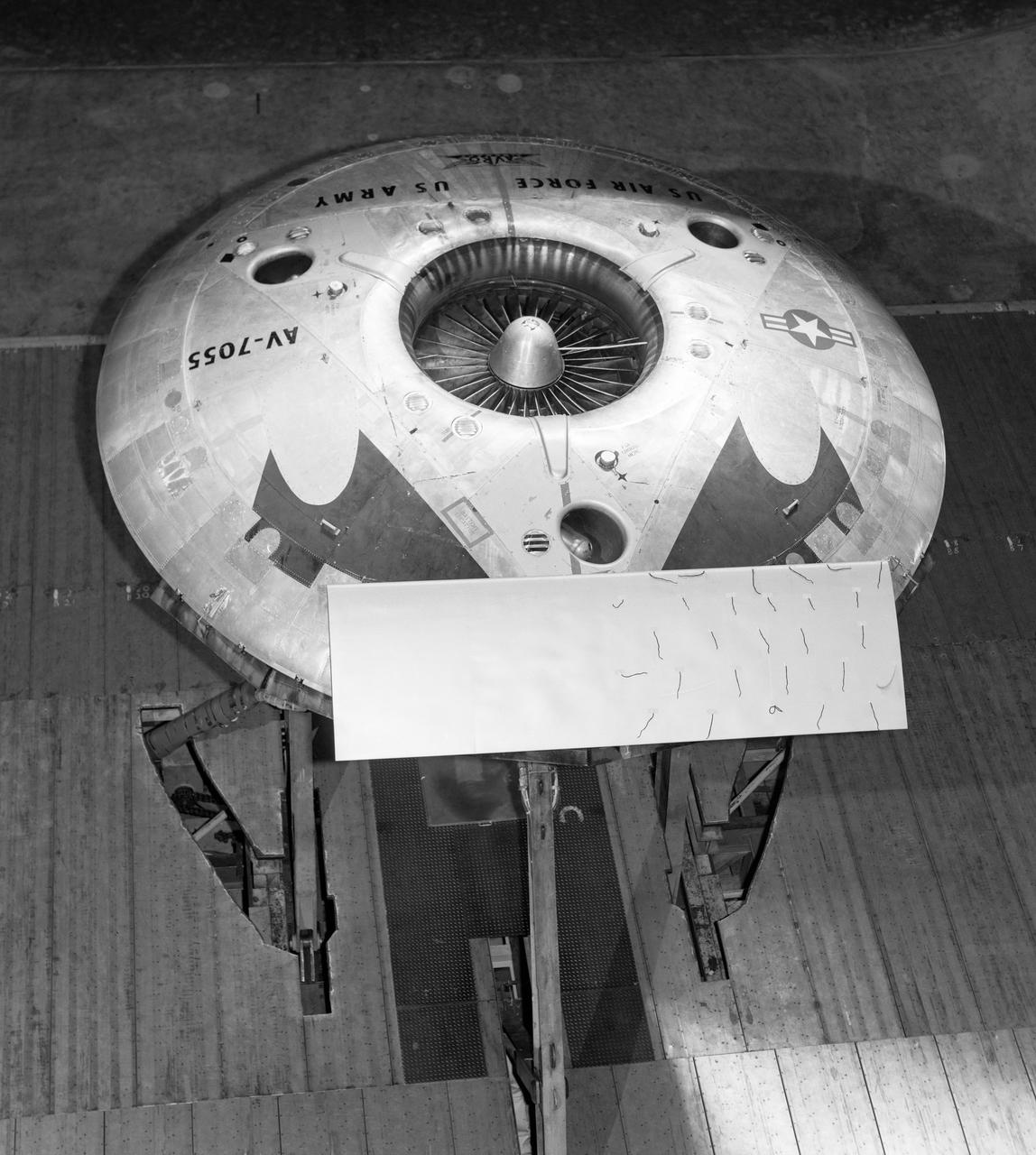
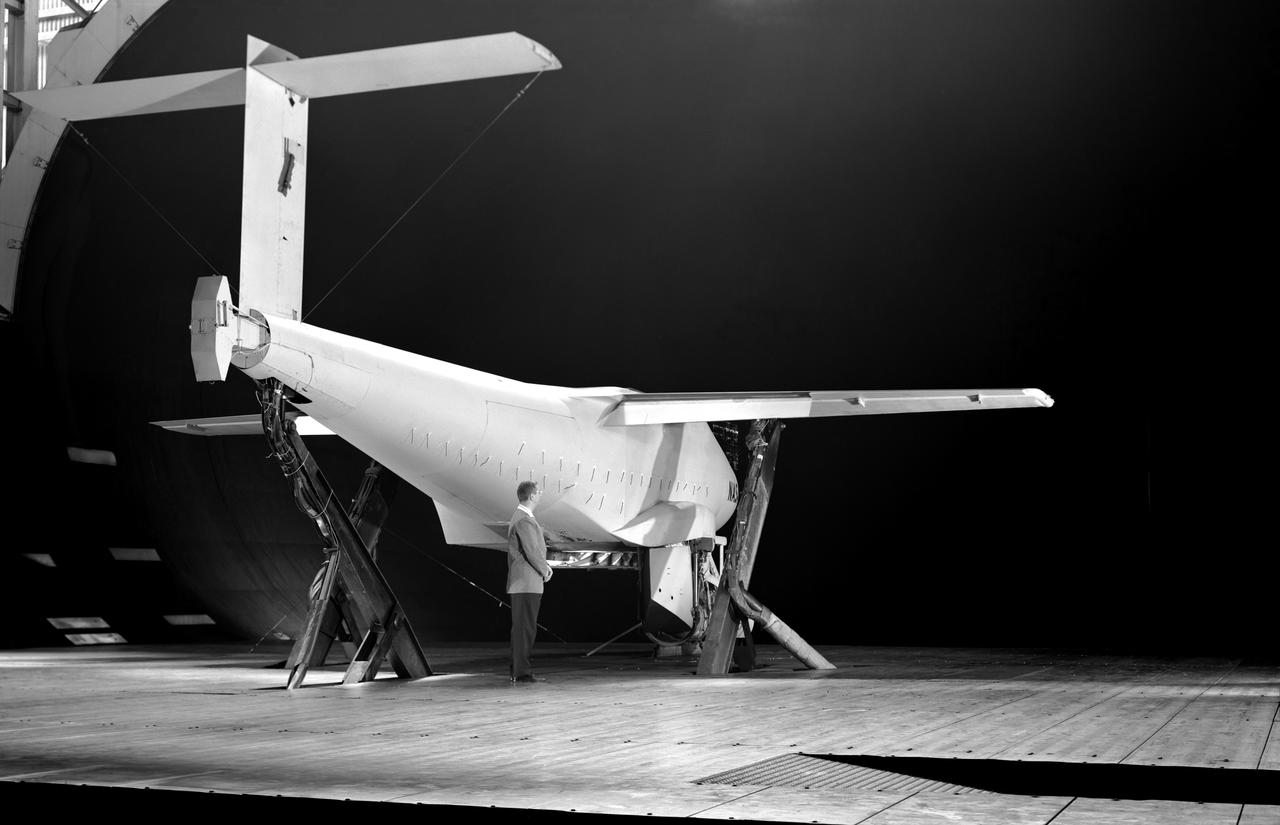
Top rear view of the avrocar with tail. Tufts (pieces of yarn) attached to top of horizontal tail. Avrocar mounted on variable height struts.
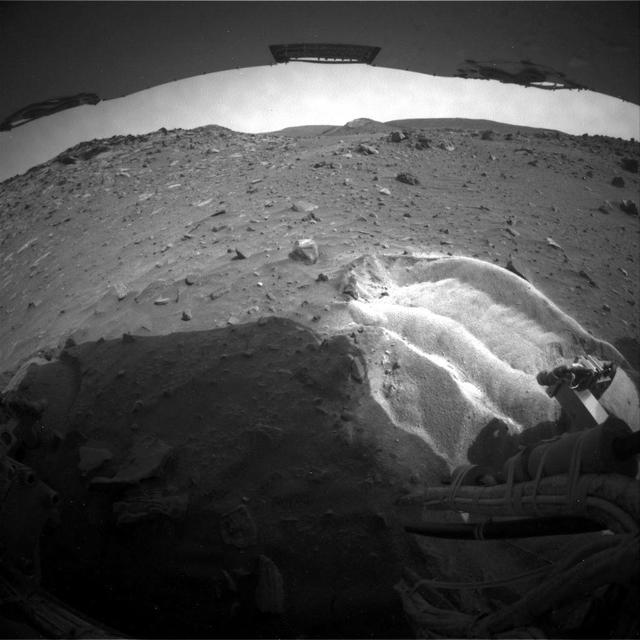
NASA Mars Exploration Rover Spirit used its rear hazard avoidance camera to take this view toward the south during the 1,899th Martian day, or sol, of Spirit mission on Mars May 6, 2009.

This NASA Spirit image view is toward the south, looking down at Spirit rear wheels. It is one of a series of wide-angle views shown one after the other. Go to the Photojournal to view the animation.
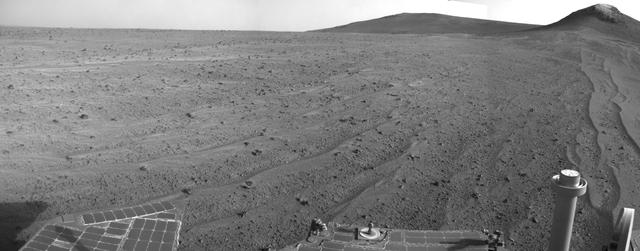
NASA Mars rover Opportunity captured this view southward just after completing a 338-foot 103-meter southward drive, in reverse, on Aug. 10, 2014. The foreground of this view from the rover Navcam includes the rear portion of the rover deck.
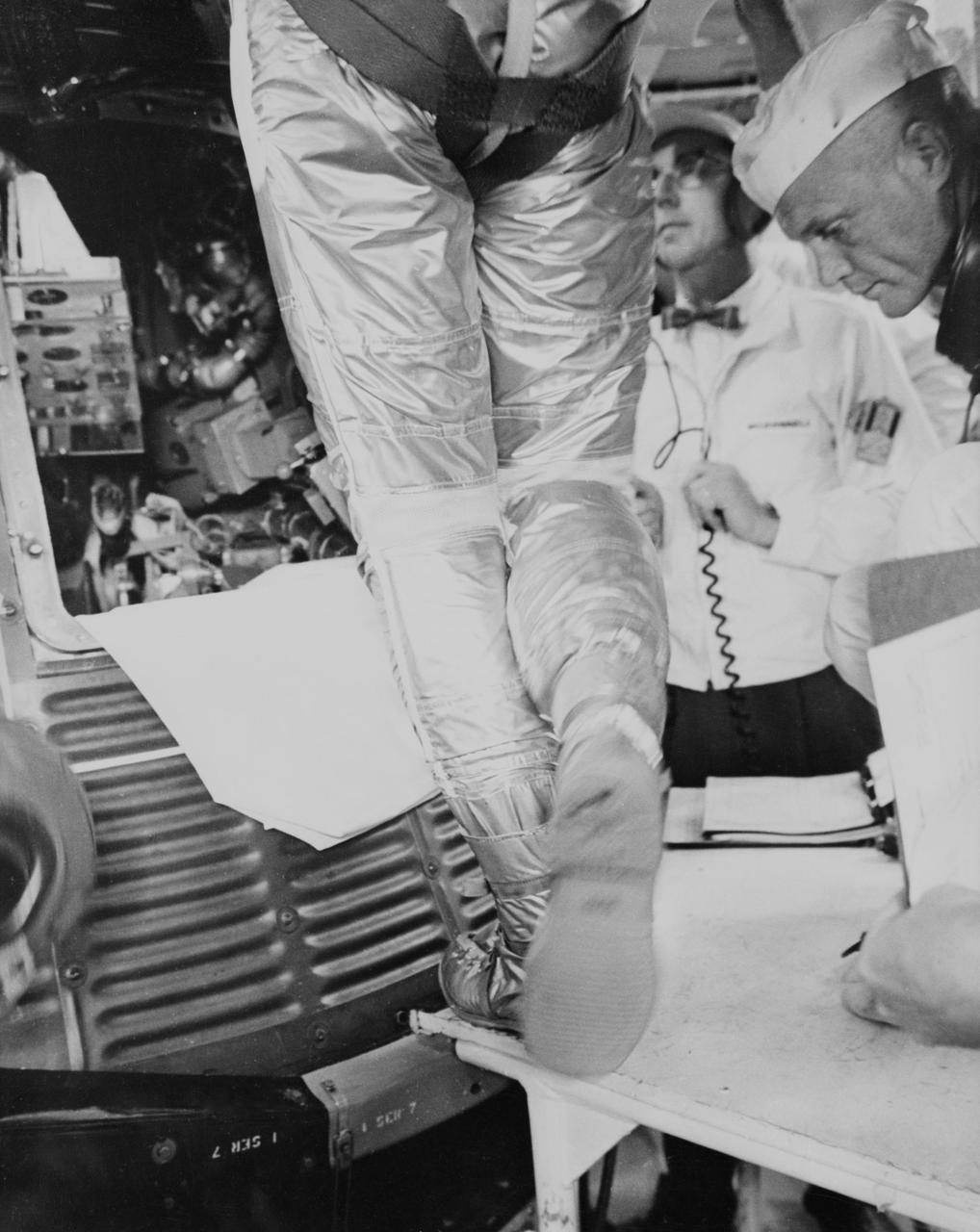
S61-02796 (5 May 1961) --- Rear view of astronaut Alan B. Shepard Jr., in his pressure suit and helmet, as he approaches the Freedom 7 capsule in preparation for ingress before the Mercury-Redstone 3 mission. All that can be seen of the astronaut is his legs. Photo credit: NASA or National Aeronautics and Space Administration
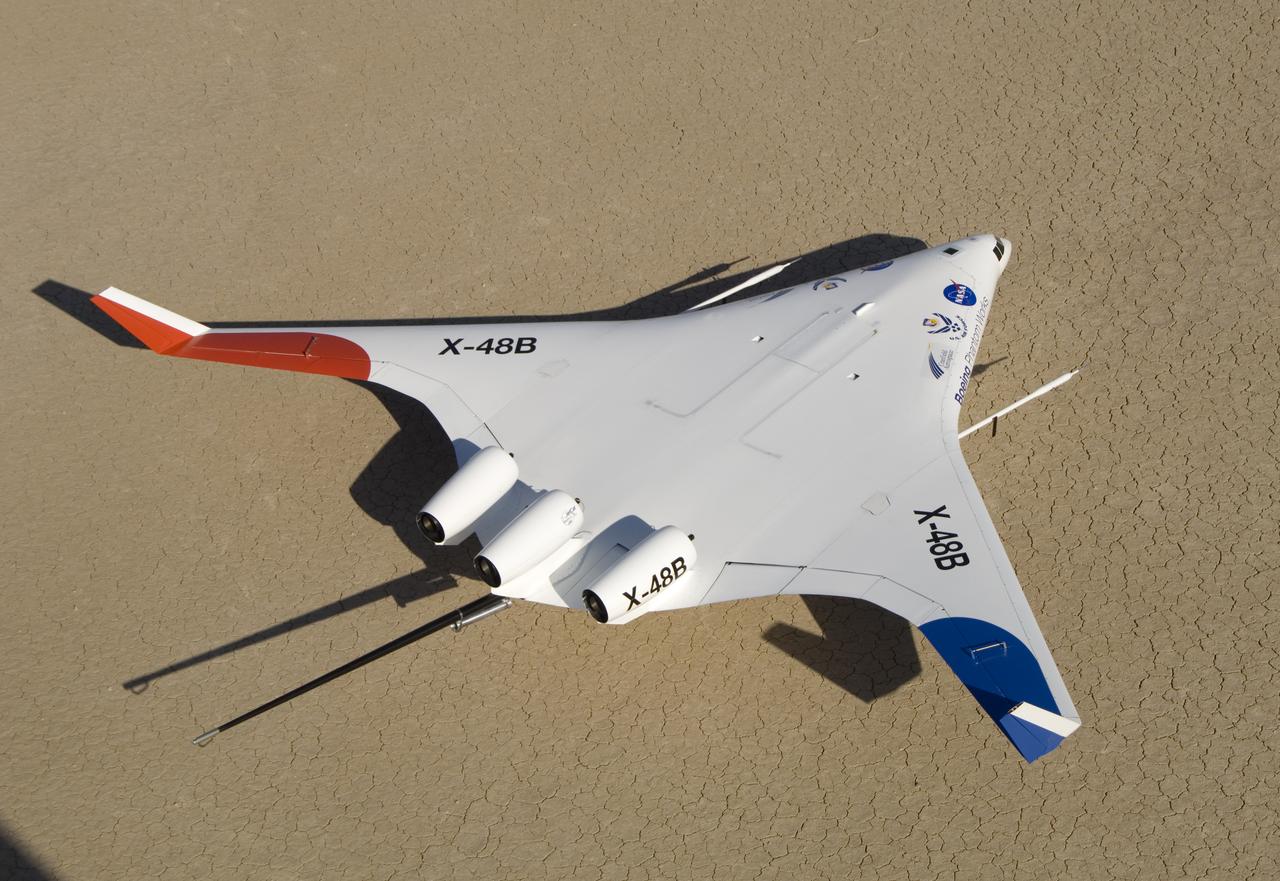
This rear-quarter view shows off the unique lines of Boeing's X-48B Blended Wing Body technology demonstrator on Rogers Dry Lake adjacent to NASA Dryden.
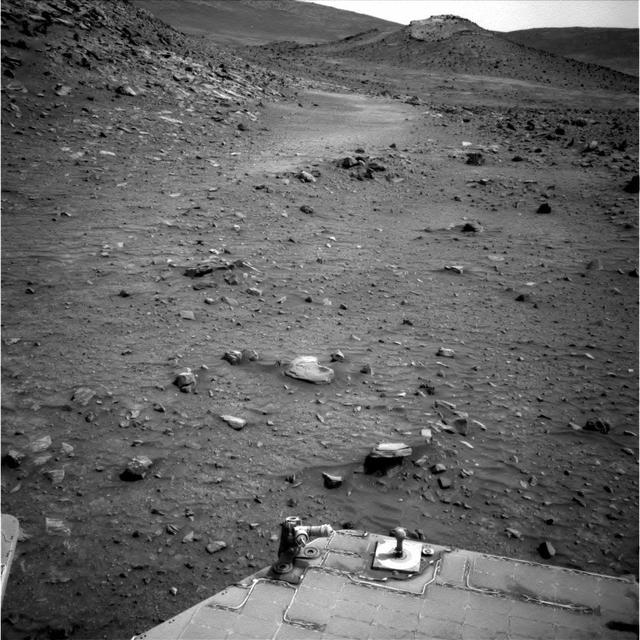
NASA Mars Exploration Rover Spirit used its rear hazard avoidance camera to take this view toward the south during the 1,899th Martian day, or sol, of Spirit mission on Mars May 6, 2009.
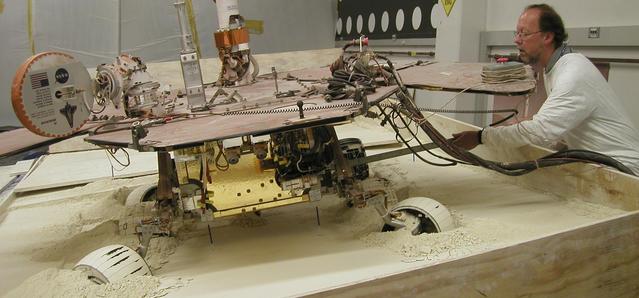
In this view from behind a test rover at NASA Jet Propulsion Laboratory, Pasadena, Calif., the rear wheels of the rover are turned toward the left, and the left-front wheel is turned toward the the right.
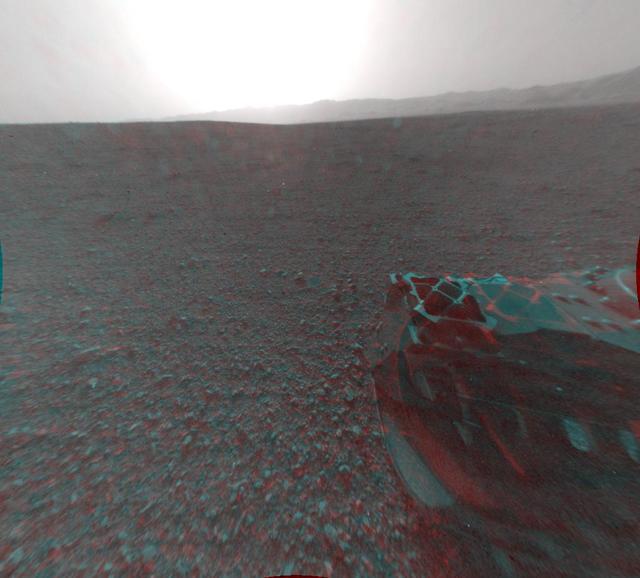
This image is a 3-D view behind NASA Curiosity rover. The anaglyph was made from a stereo pair of Hazard-Avoidance Cameras on the rear of the rover. It has been cropped.
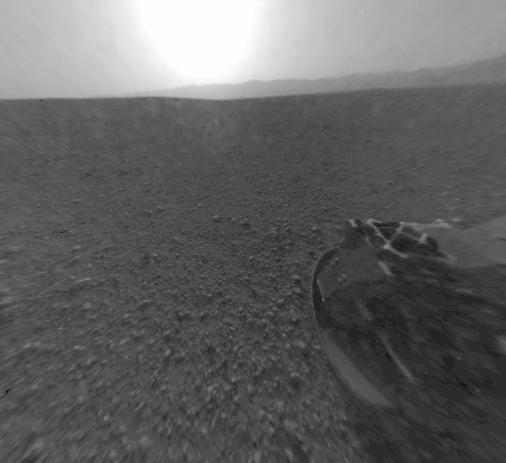
This is a version of one of the first images taken by a rear Hazard-Avoidance camera on NASA Curiosity rover and shows part of the rim of Gale Crater, which is a feature the size of Connecticut and Rhode Island combined.
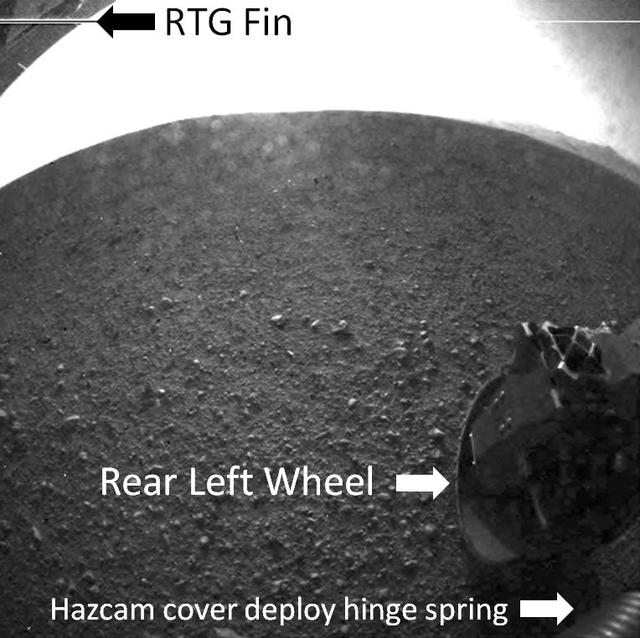
This labeled version of one of the first images taken by a rear Hazard-Avoidance camera on NASA Curiosity rover shows a fin on the radioisotope thermoelectric generator, the rear left wheel and a spring that released the dust cover.
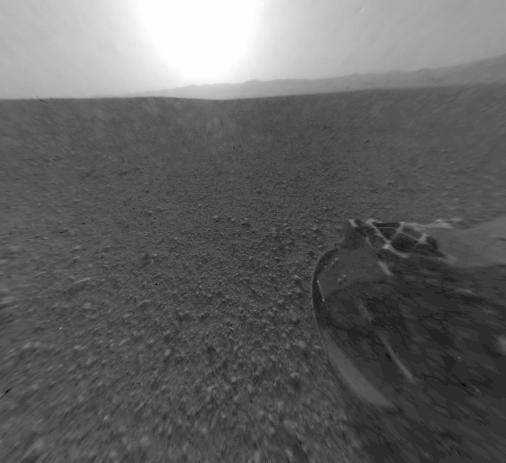
This is a version of one of the first images taken by a rear Hazard-Avoidance camera on NASA Curiosity rover and shows part of the rim of Gale Crater, which is a feature the size of Connecticut and Rhode Island combined.
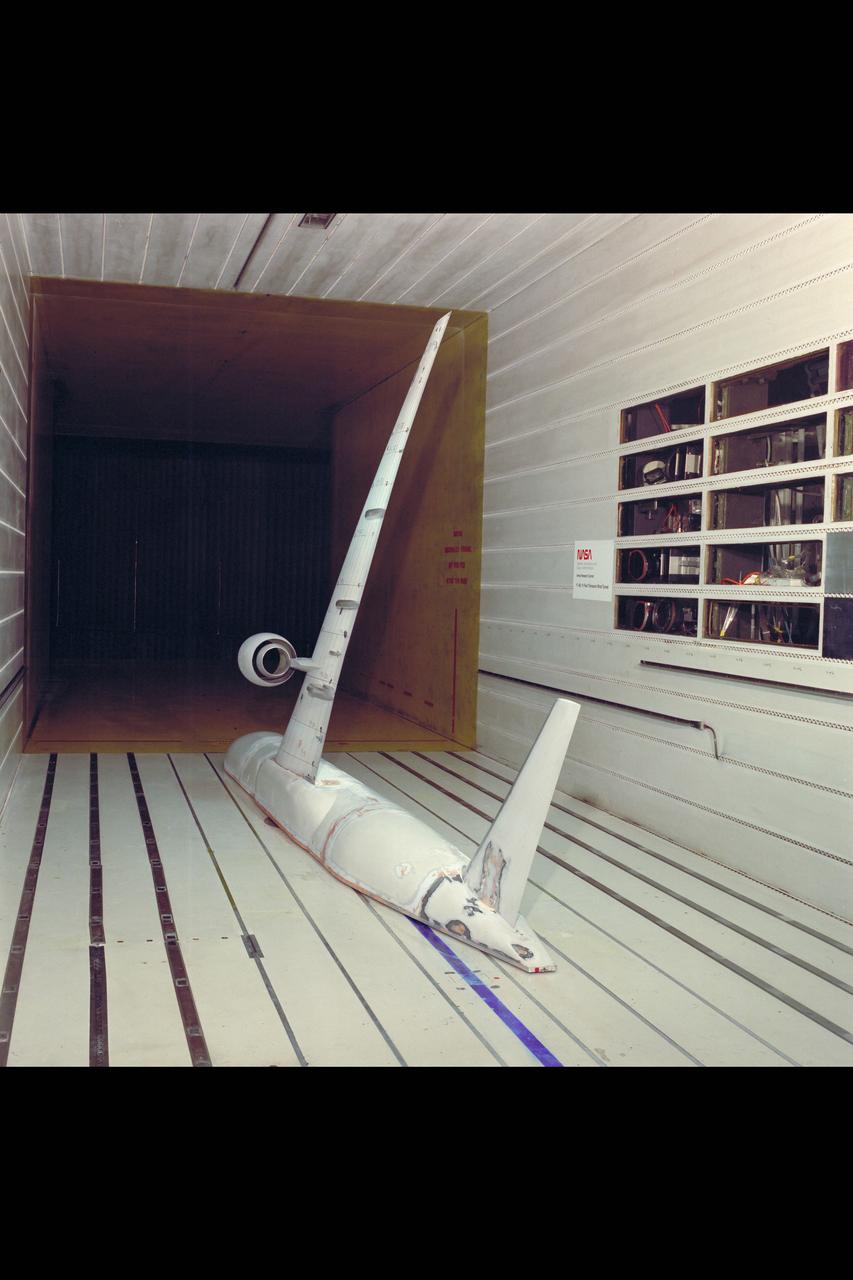
Boeing 777 Model 11ft W.T. Test-168 rear view
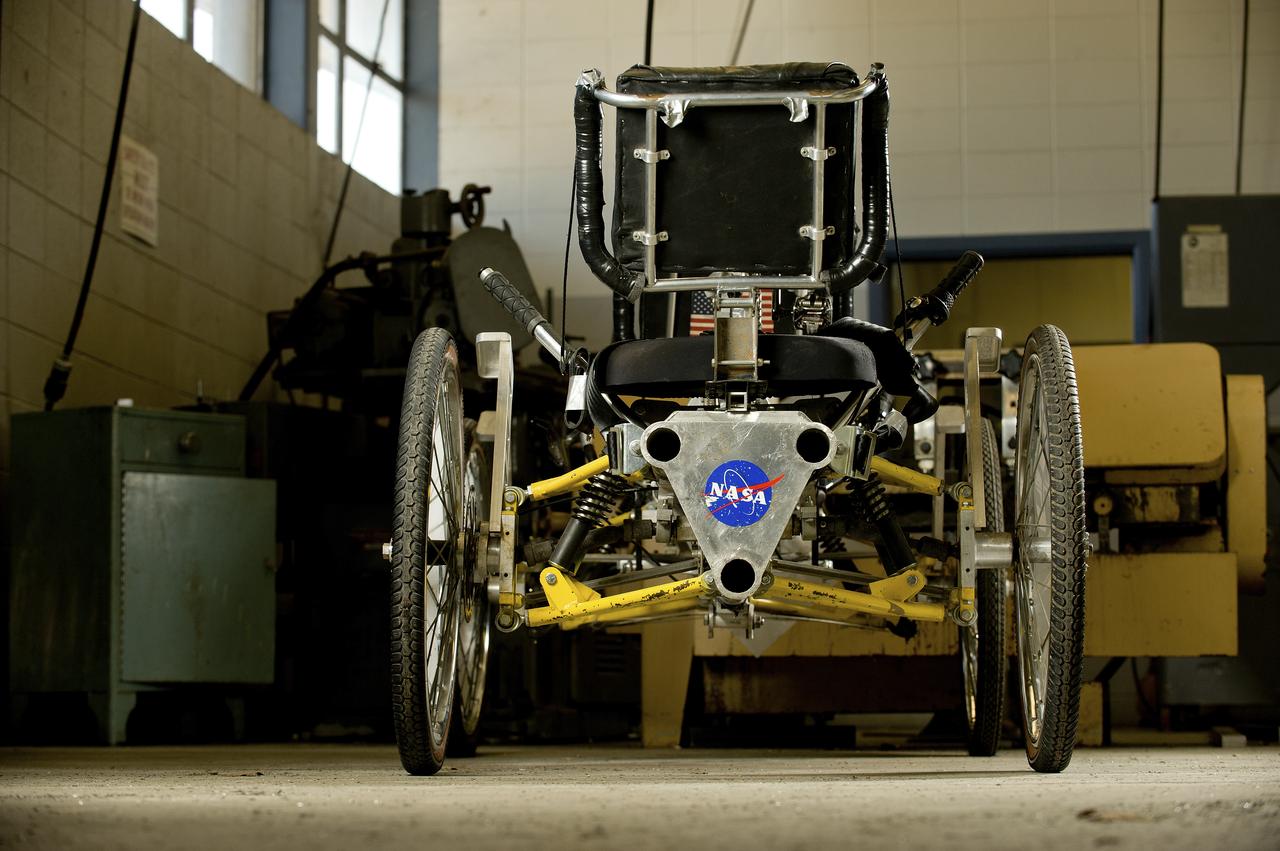
A CLOSE UP VIEW OF THE REAR ON A MOONBUGGY AT THE HUNTSVILLE CENTER FOR TECHNOLOGY
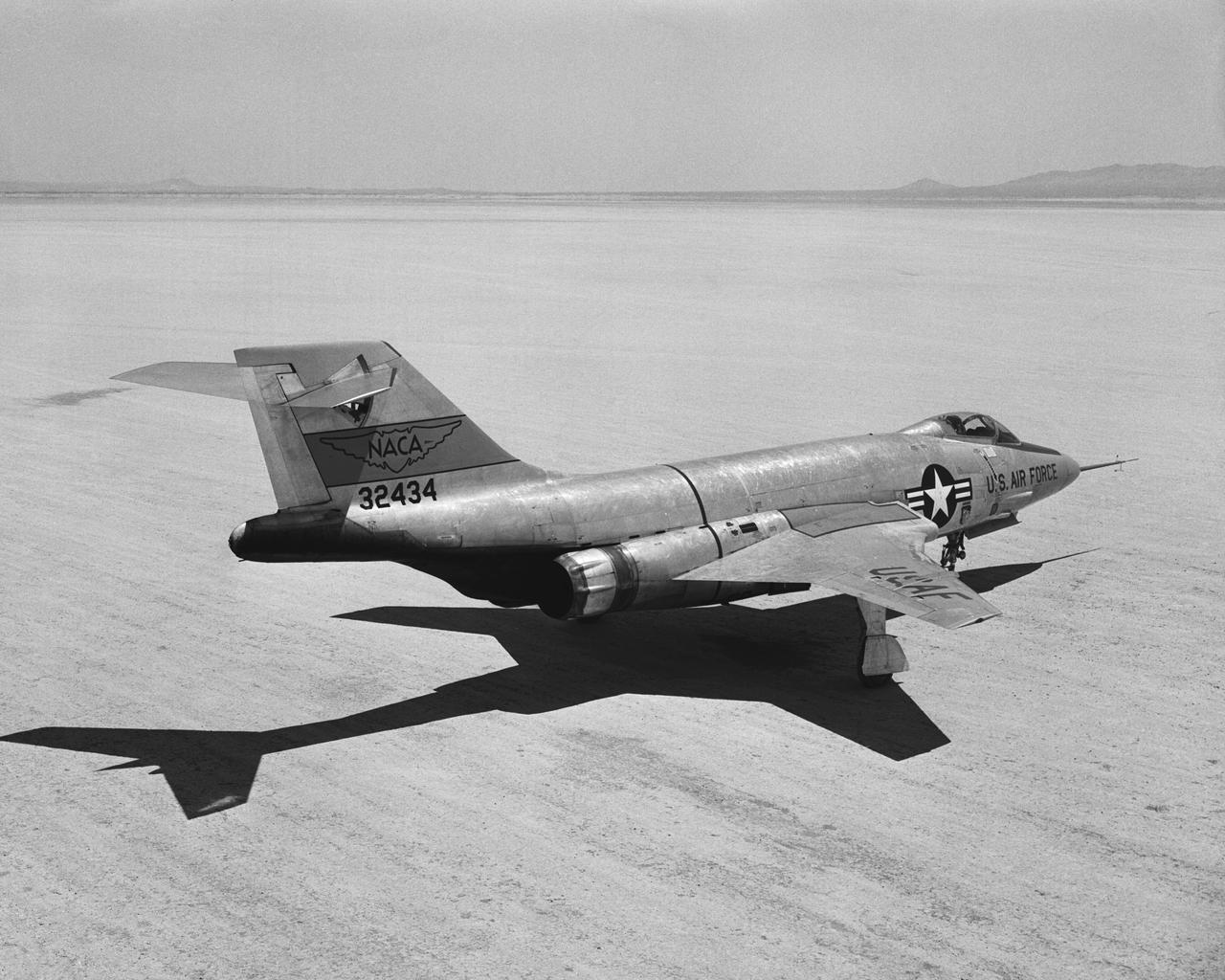
F-101A Rear quarter view on Edwards Lakebed. Aug. 10, 1956
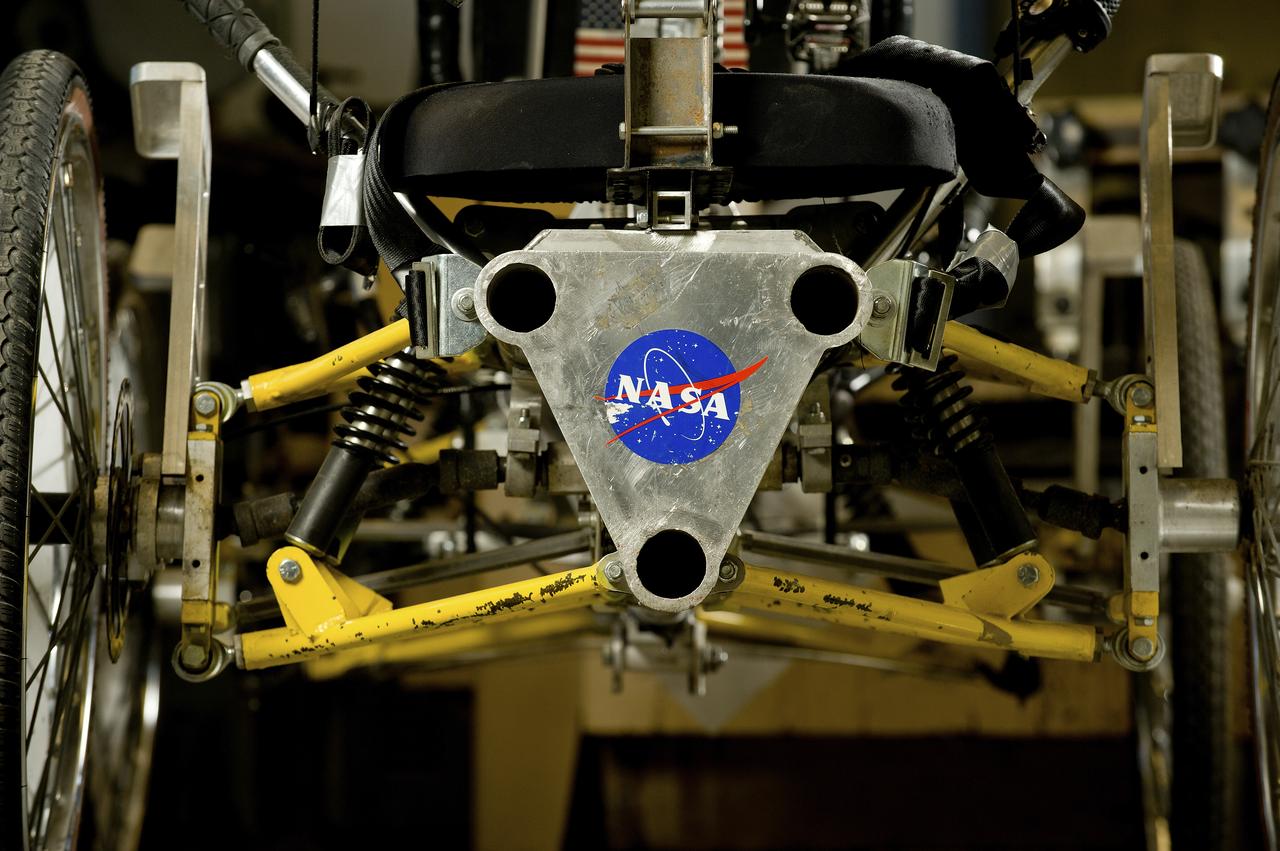
A CLOSE UP VIEW OF THE REAR ON A MOONBUGGY AT THE HUNTSVILLE CENTER FOR TECHNOLOGY
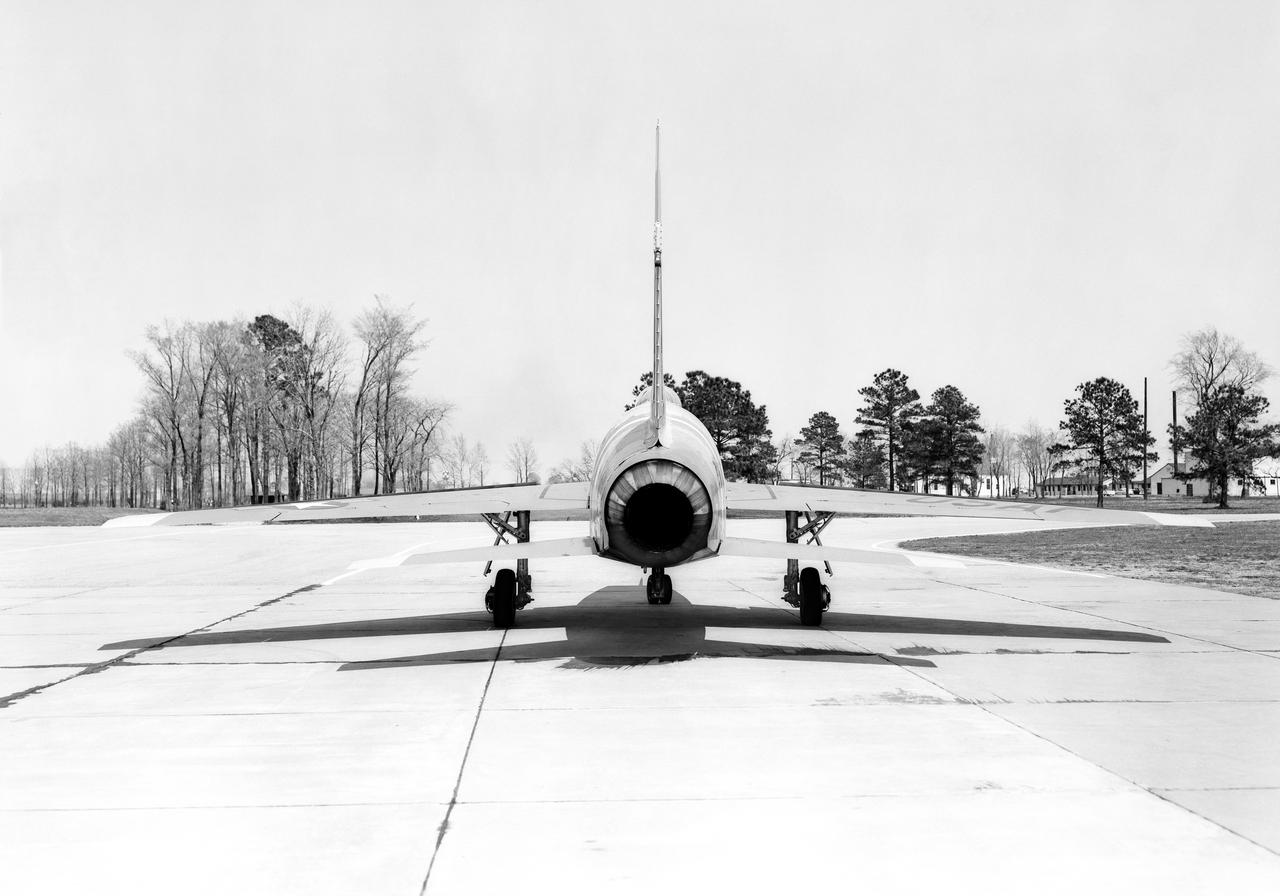
North American F-100 C airplane used in sonic boom investigation at Wallops, October 7, 1958. Photograph published in: A New Dimension Wallops Island Flight Test Range: The First Fifteen Years by Joseph Shortal. A NASA publication. Page 672. -- Aircraft number: NACA 42024. Side view, 3/4 view from front, 3/4 view from rear, rear view, and two front views.
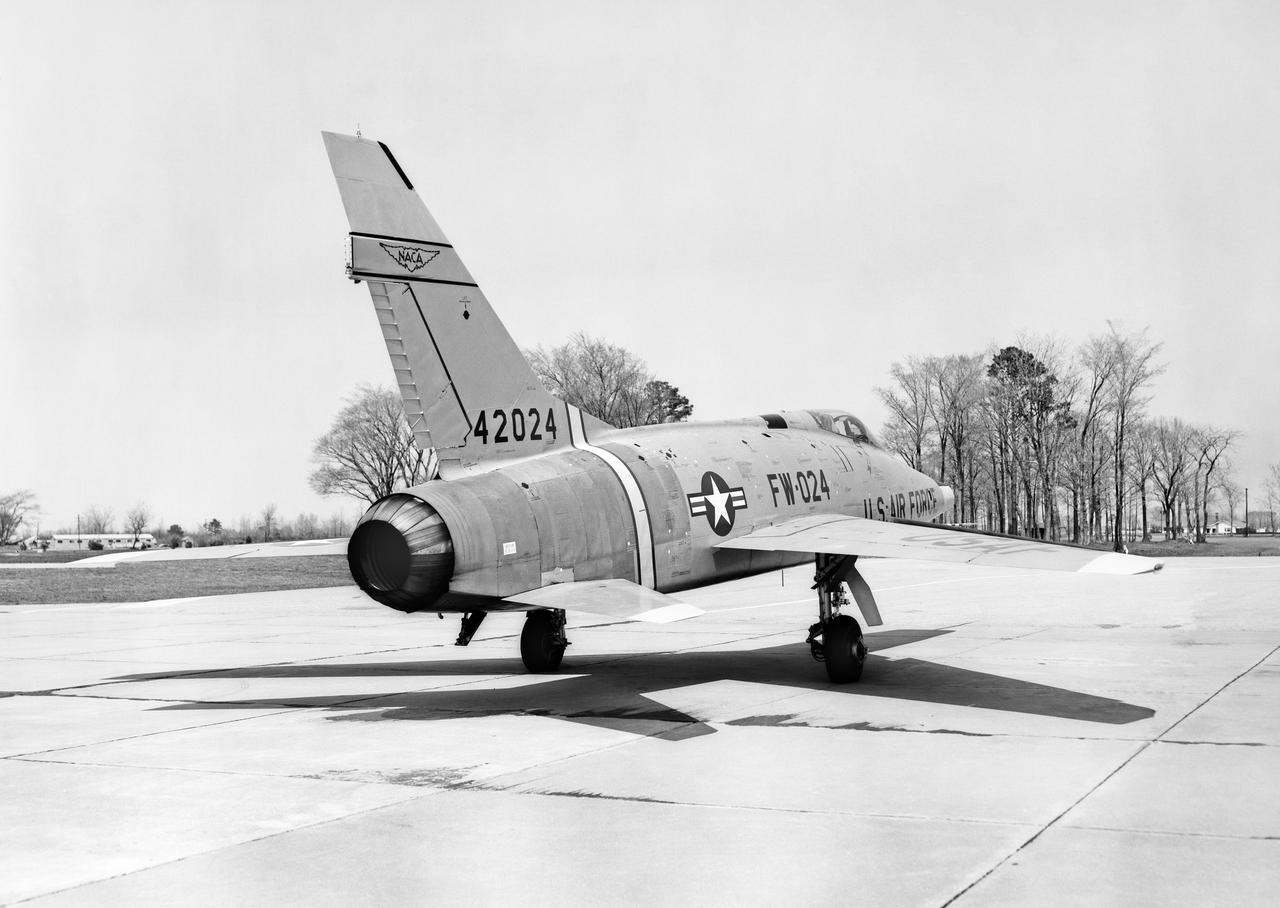
North American F-100 C airplane used in sonic boom investigation at Wallops, October 7, 1958. Photograph published in: A New Dimension Wallops Island Flight Test Range: The First Fifteen Years by Joseph Shortal. A NASA publication. Page 672. -- Aircraft number: NACA 42024. Side view, 3/4 view from front, 3/4 view from rear, rear view, and two front views.
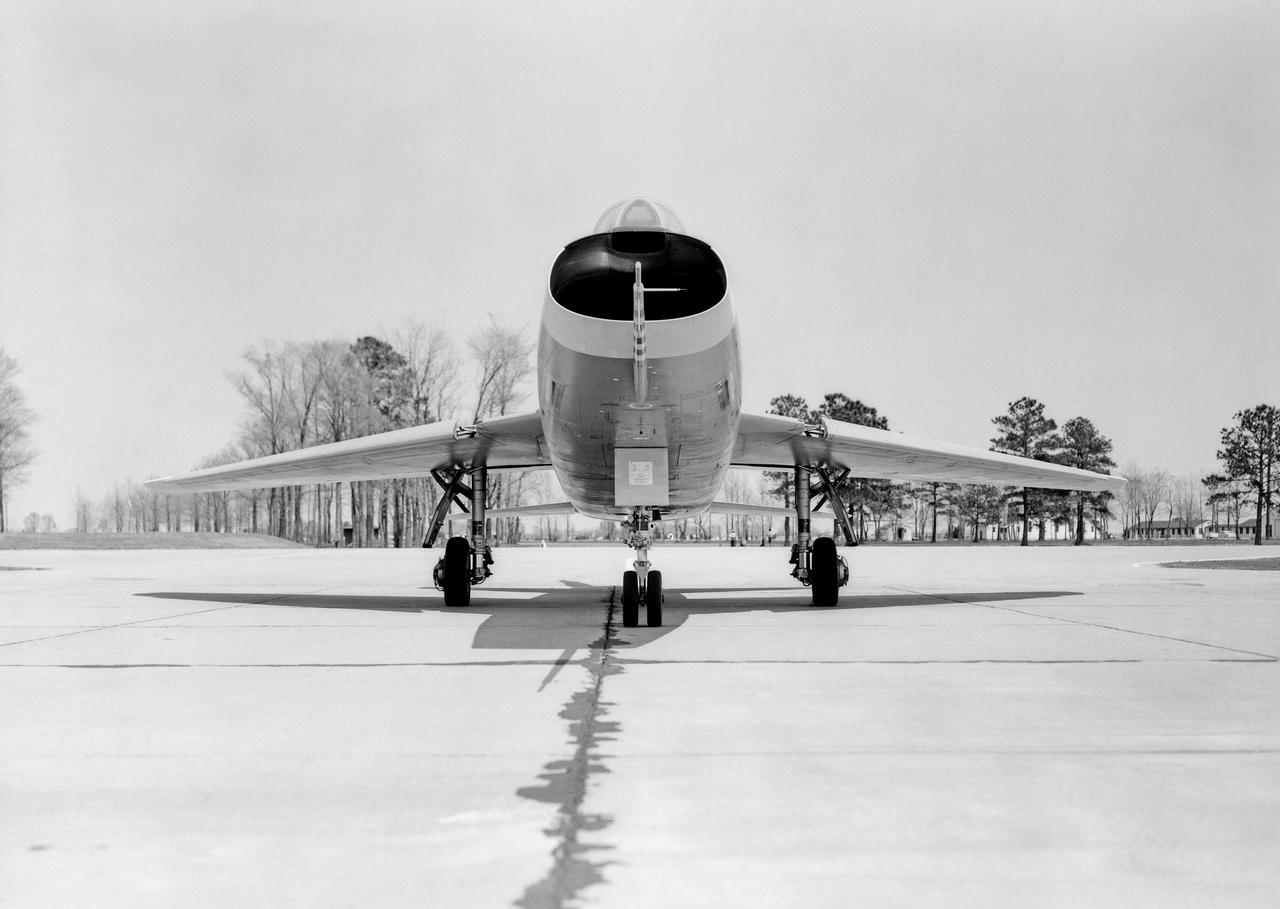
North American F-100 C airplane used in sonic boom investigation at Wallops, October 7, 1958. Photograph published in: A New Dimension Wallops Island Flight Test Range: The First Fifteen Years by Joseph Shortal. A NASA publication. Page 672. -- Aircraft number: NACA 42024. Side view, 3/4 view from front, 3/4 view from rear, rear view, and two front views.
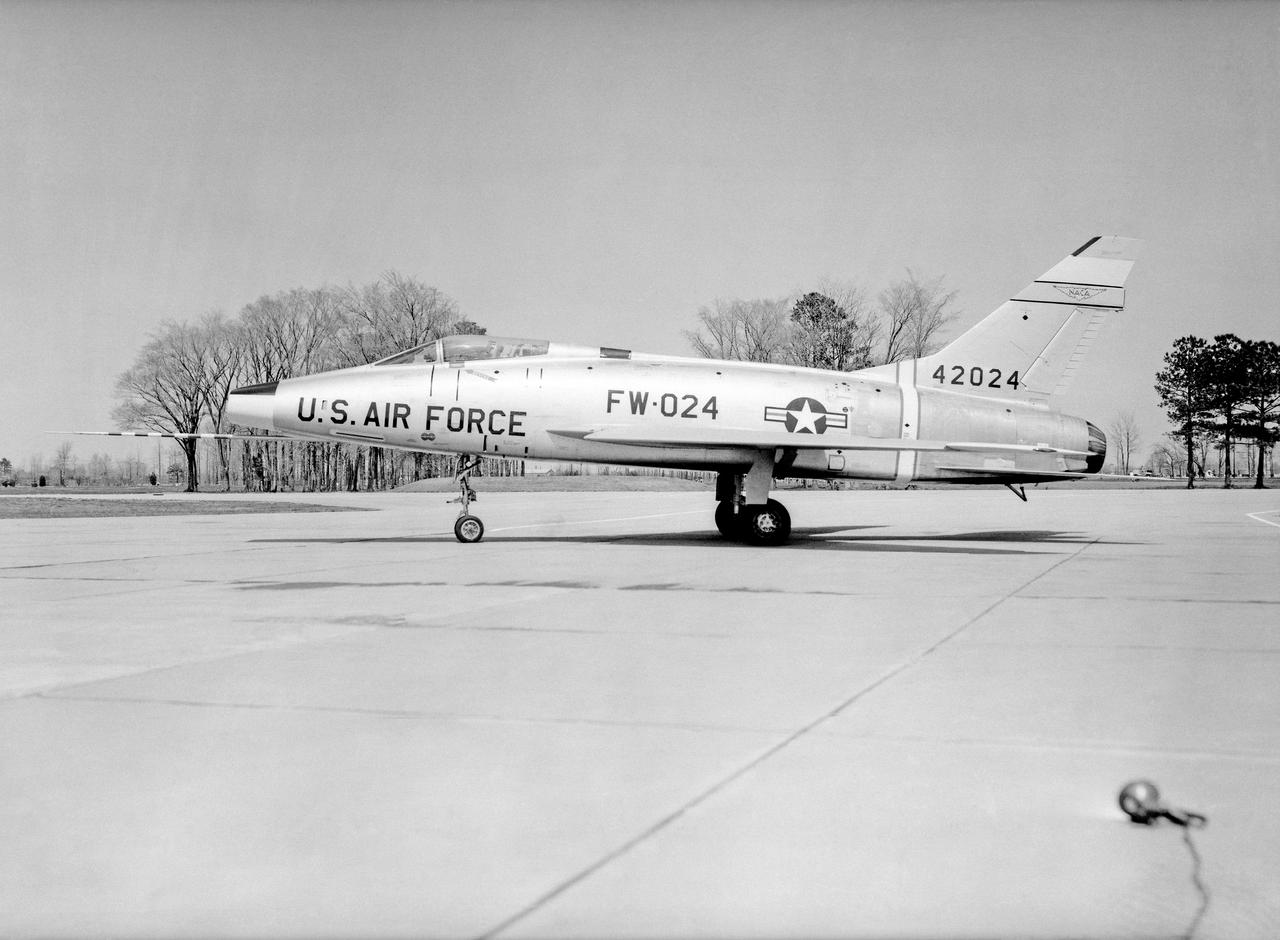
North American F-100 C airplane used in sonic boom investigation at Wallops, October 7, 1958. Photograph published in: A New Dimension Wallops Island Flight Test Range: The First Fifteen Years by Joseph Shortal. A NASA publication. Page 672. -- Aircraft number: NACA 42024. Side view, 3/4 view from front, 3/4 view from rear, rear view, and two front views.
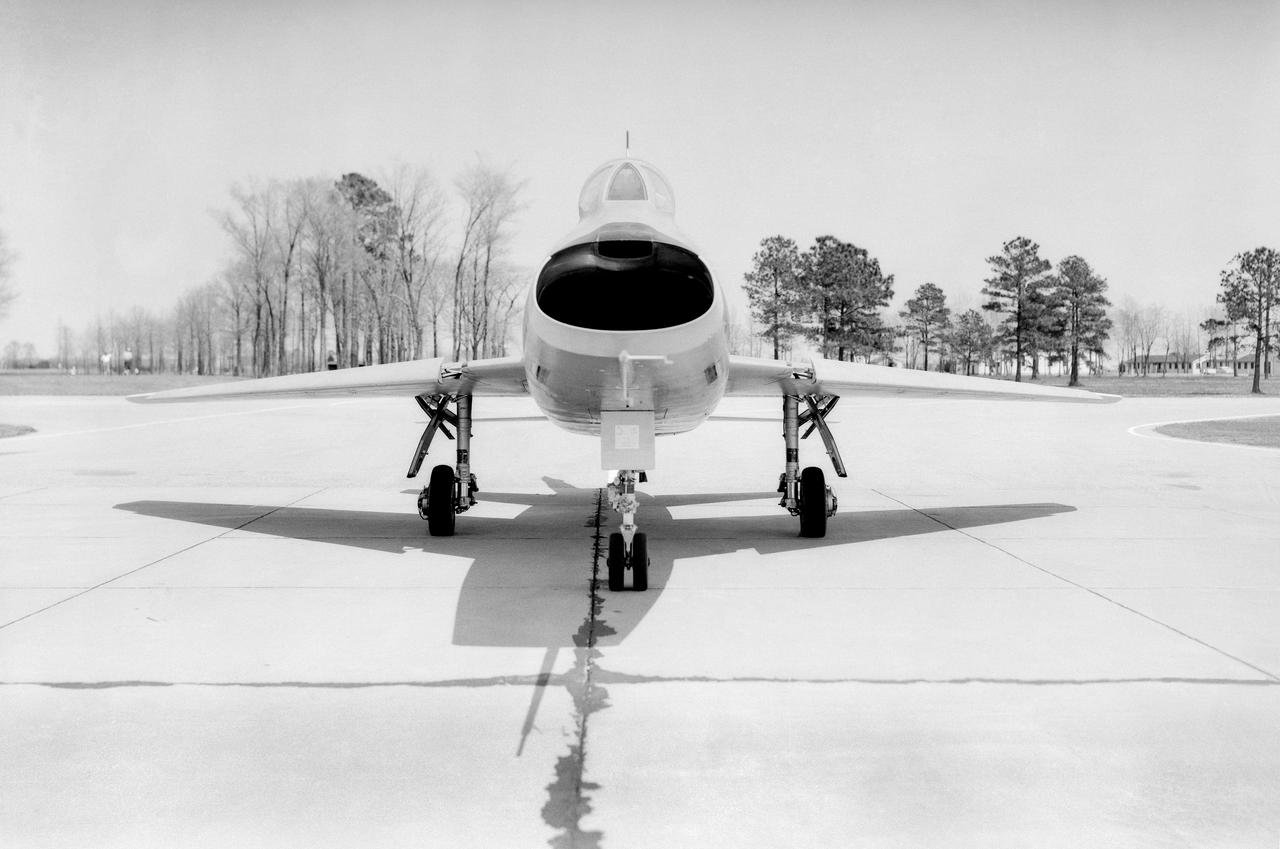
North American F-100 C airplane used in sonic boom investigation at Wallops, October 7, 1958. Photograph published in: A New Dimension Wallops Island Flight Test Range: The First Fifteen Years by Joseph Shortal. A NASA publication. Page 672. -- Aircraft number: NACA 42024. Side view, 3/4 view from front, 3/4 view from rear, rear view, and two front views.
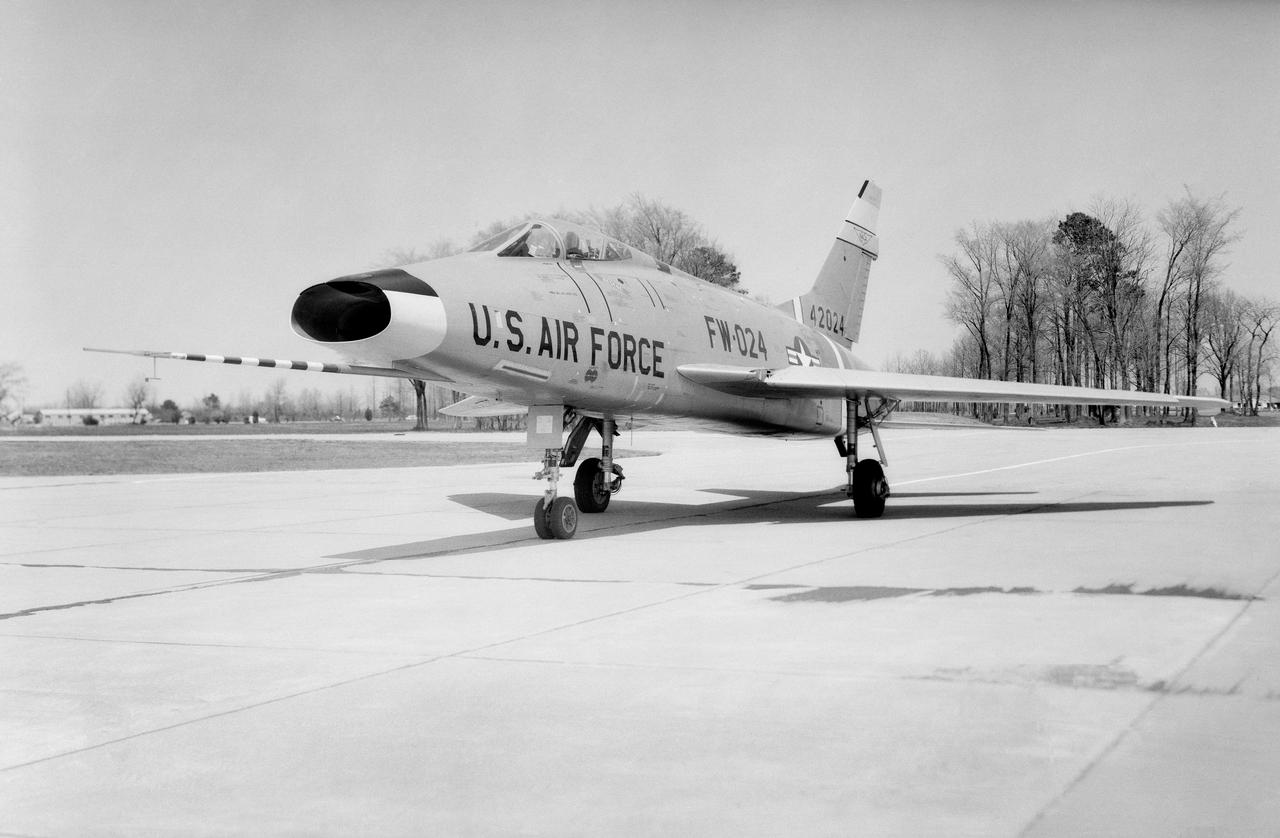
North American F-100 C airplane used in sonic boom investigation at Wallops, October 7, 1958. Photograph published in: A New Dimension Wallops Island Flight Test Range: The First Fifteen Years by Joseph Shortal. A NASA publication. Page 672. -- Aircraft number: NACA 42024. Side view, 3/4 view from front, 3/4 view from rear, rear view, and two front views.
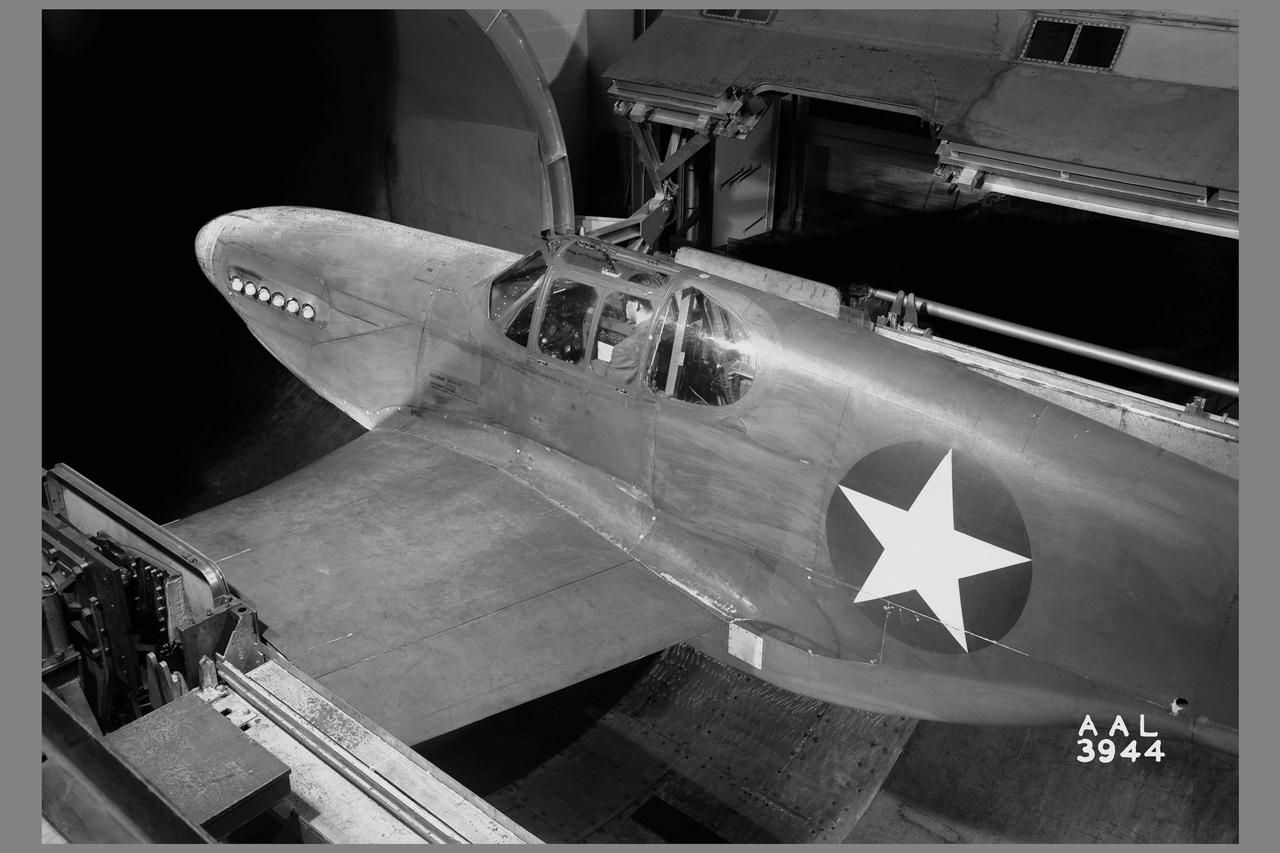
3/4 rear view of a XP-51B airplane mounted in the 16ft w.t. (Ames contribution to the solution of the duct-rumble problem)
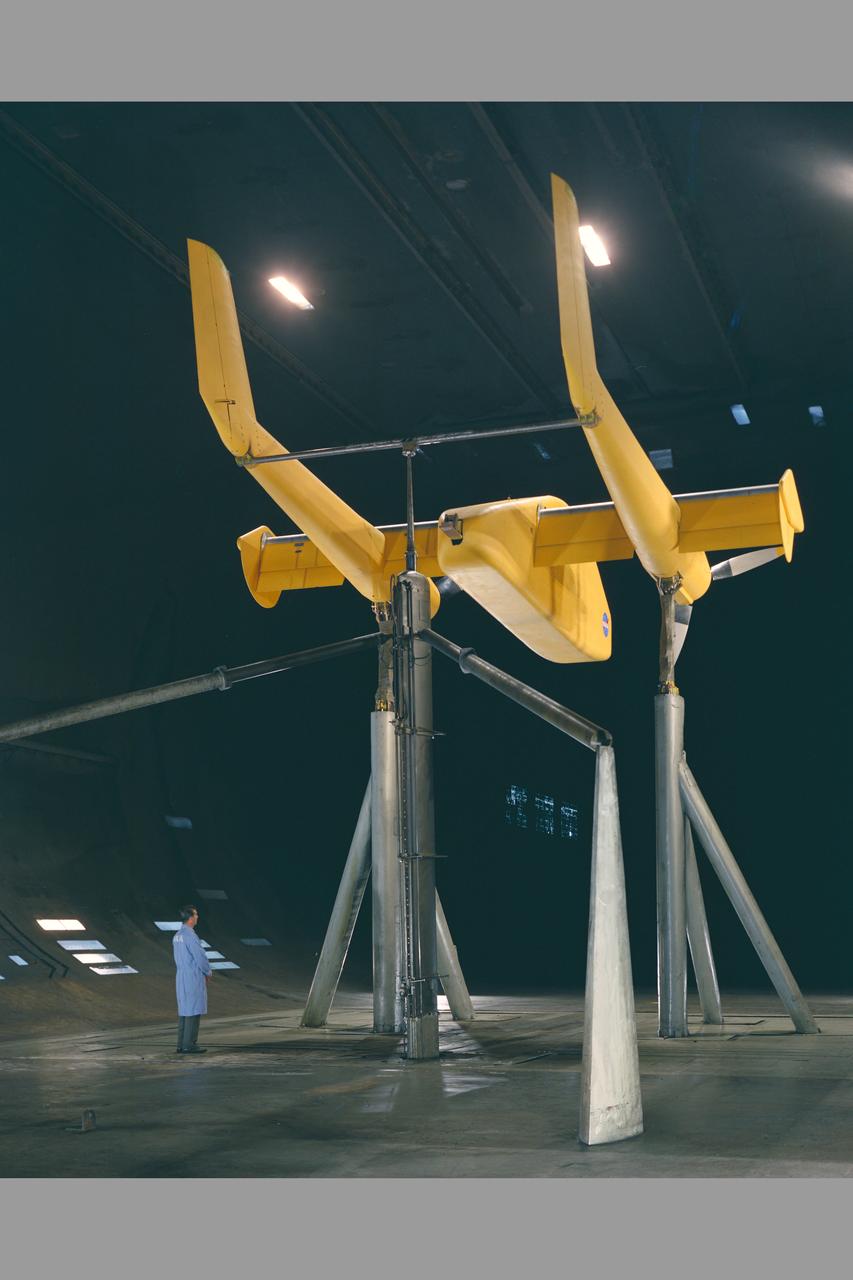
2-Prop. R.C.F. (Rotating Cylinder Flap) in 40 x 80ft. wind tunnel. - rear view with Chuck Greco.
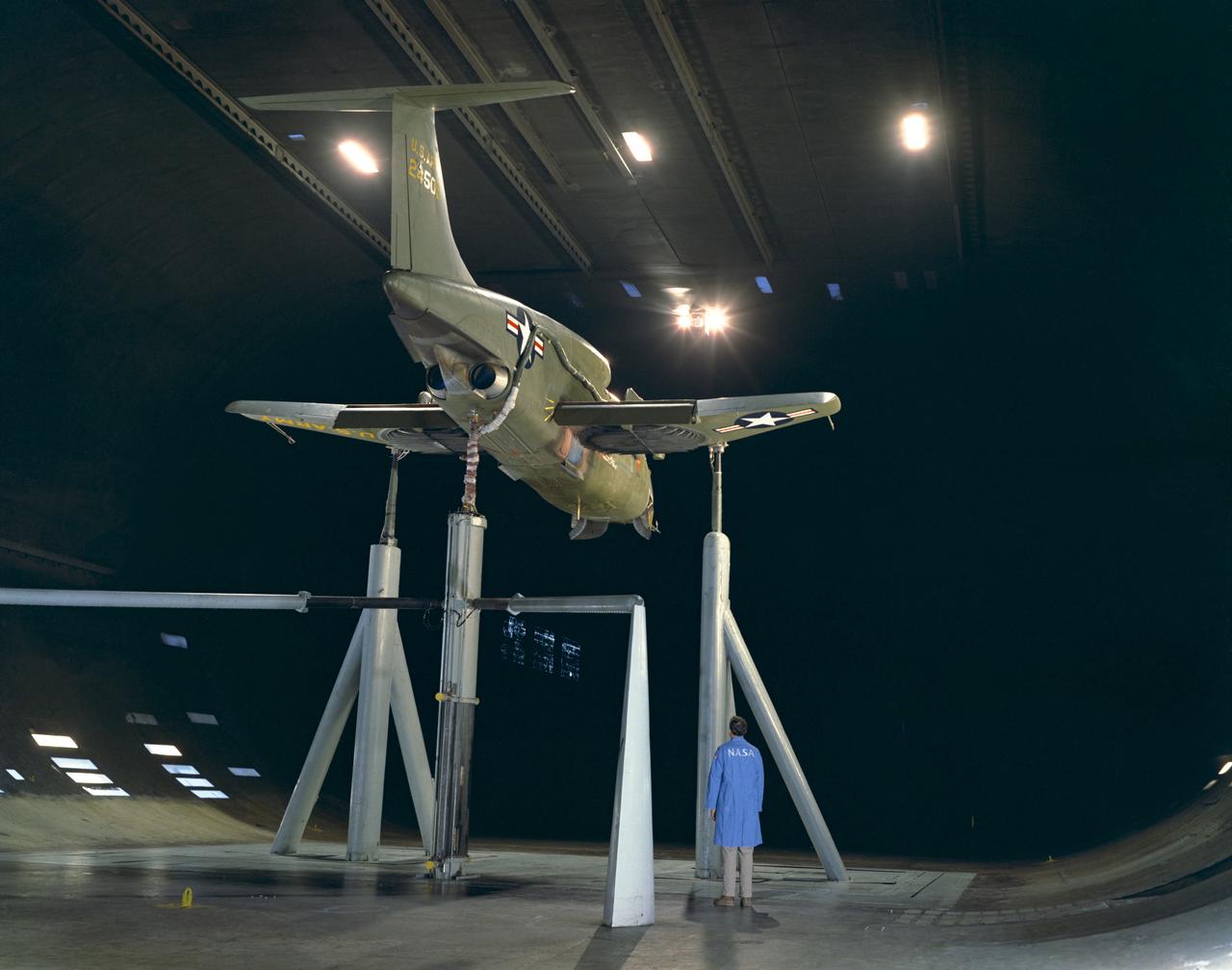
3/4 rear view Ryan XV-5A lift-fan VSTOL airplane. Pictured with Tom Wills.
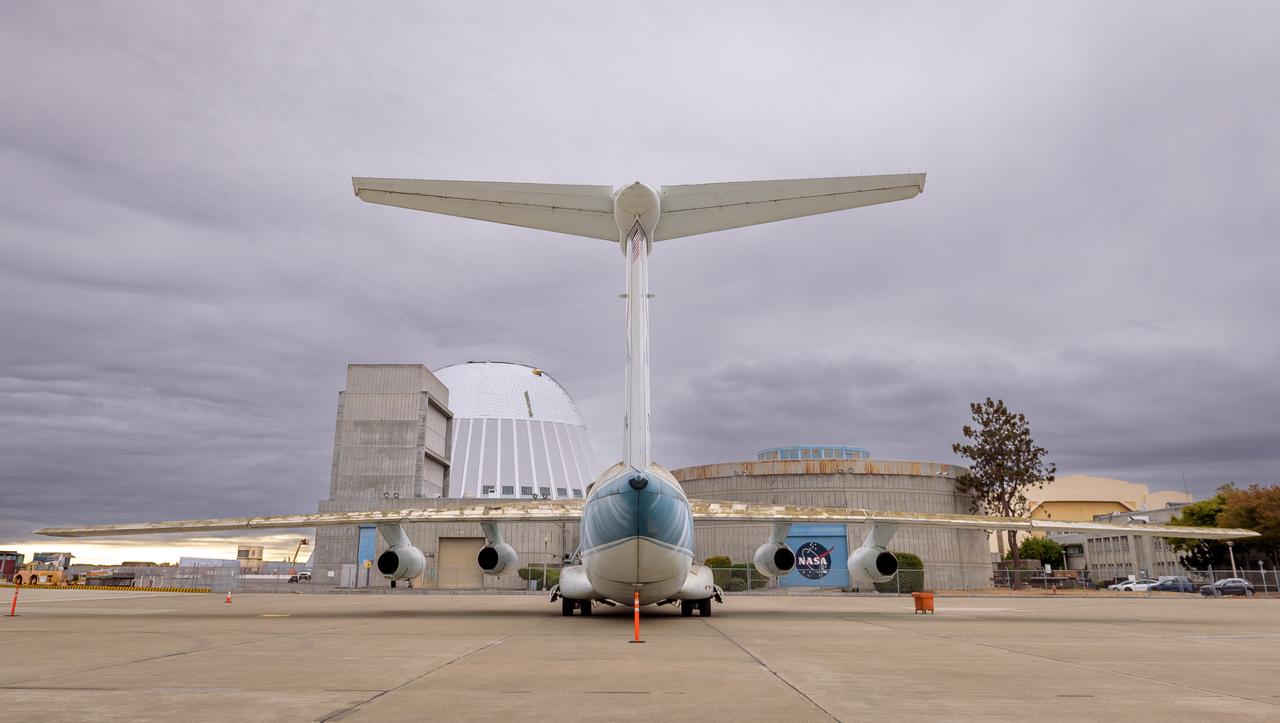
Rear view of the modified C-141 Kuiper Airborne Observatory, (KAO) (NASA-714), on the N211 apron at Moffett Field, California.
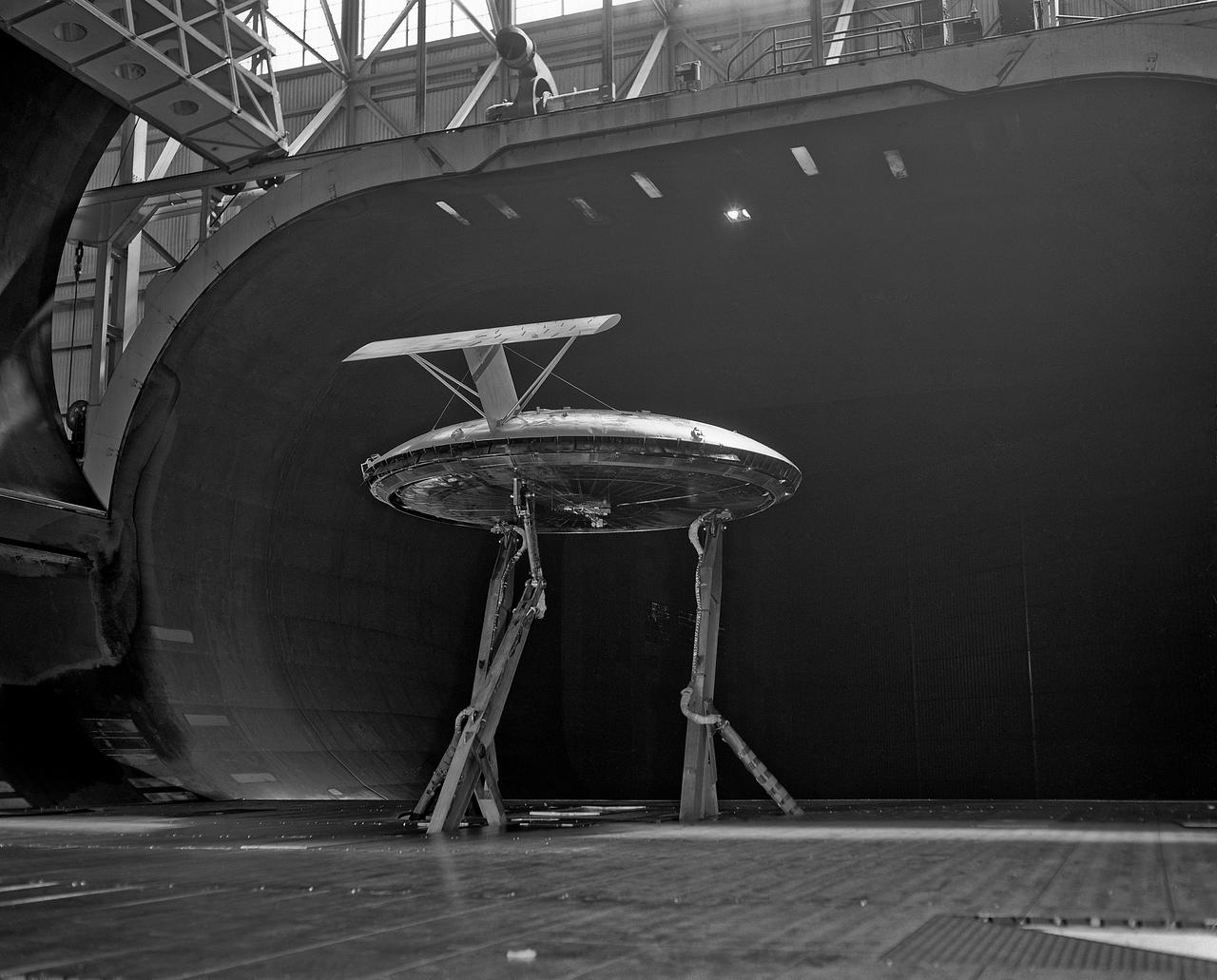
Rear view of the Avrocar with tail, mounted on variable height struts. Overhead doors of the wind tunnel test section open.
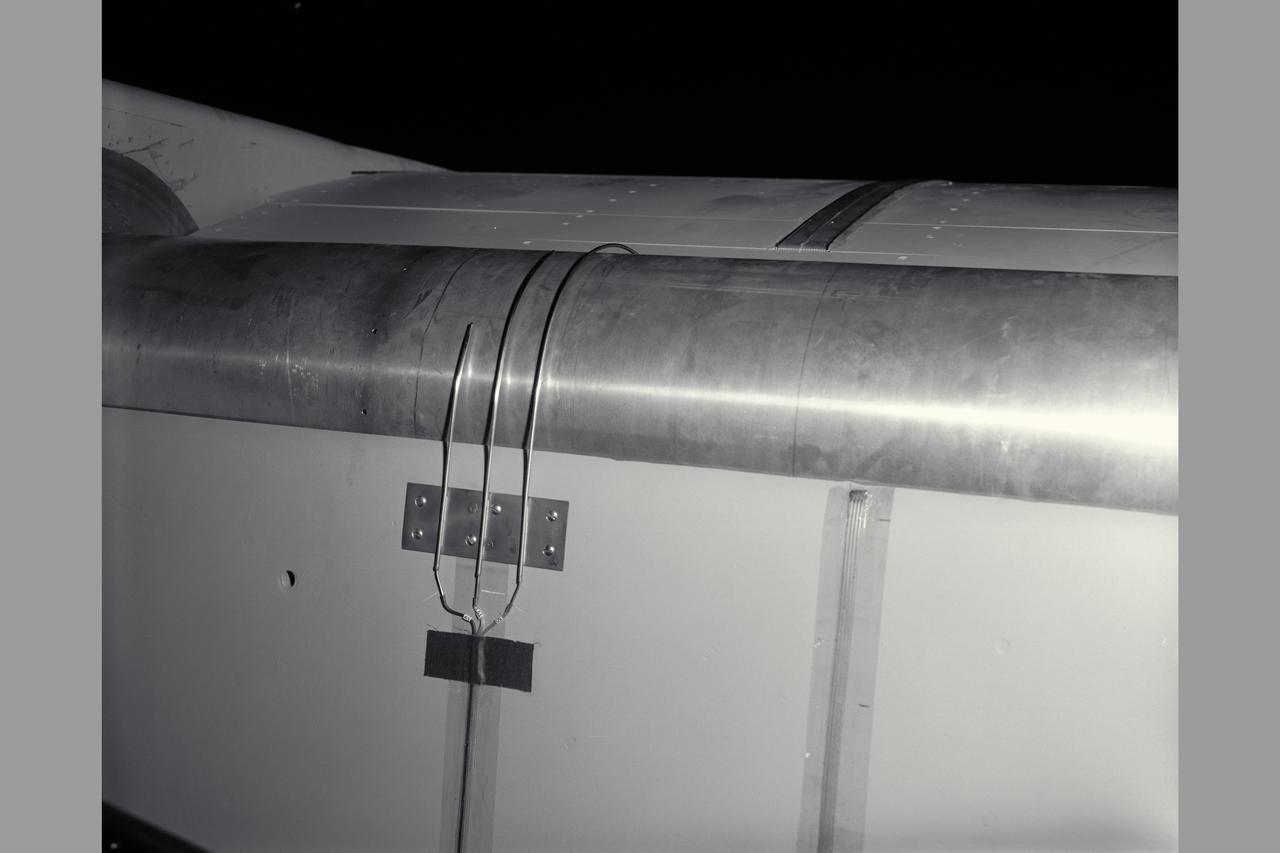
2-Prop. R.C.F. (Rotating Cylinder Flap) in 40 x 80ft. wind tunnel. rear view detail of flap
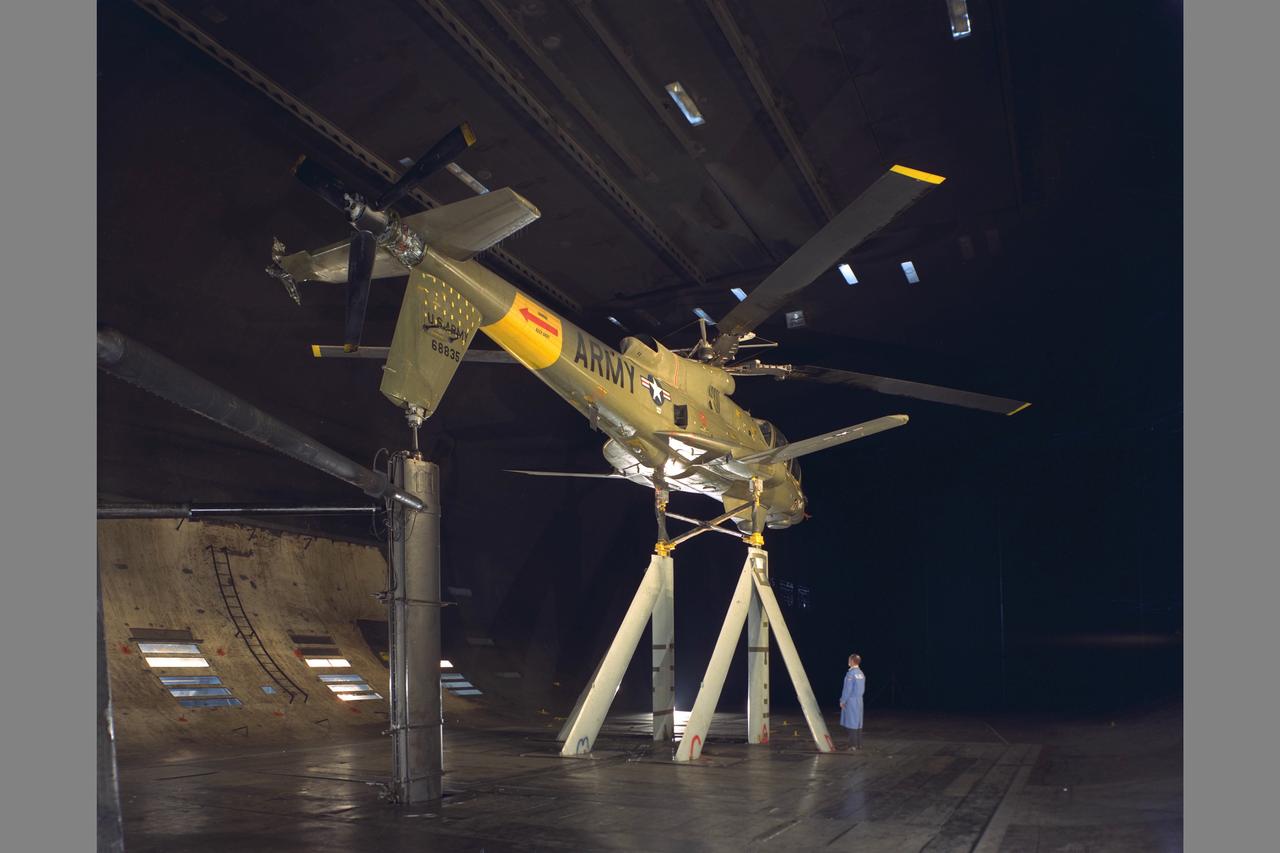
Lockheed AH-56 Helicopter; Cheyenne, 40 x 80 ft. Wind Tunnel. (3/4 rear view)
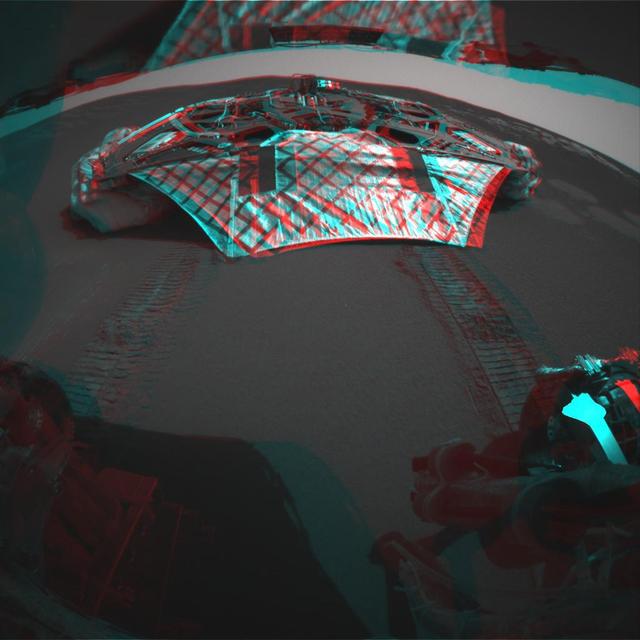
This 3-D image captured by NASA Mars Exploration Rover Opportunity rear hazard-identification camera shows the now-empty lander that carried the rover 283 million miles to Meridiani Planum, Mars. 3D glasses are necessary to view this image.
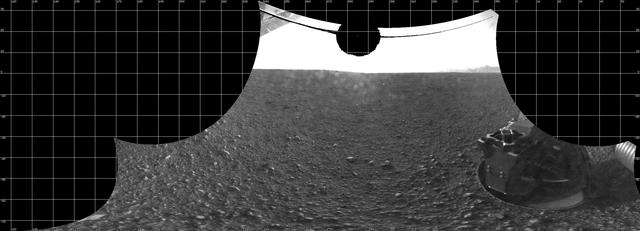
The Curiosity engineering team created this cylindrical projection view from images taken by NASA Curiosity rover rear hazard avoidance cameras underneath the rover deck on Sol 0. Pictured here are the pigeon-toed wheels in their stowed position from
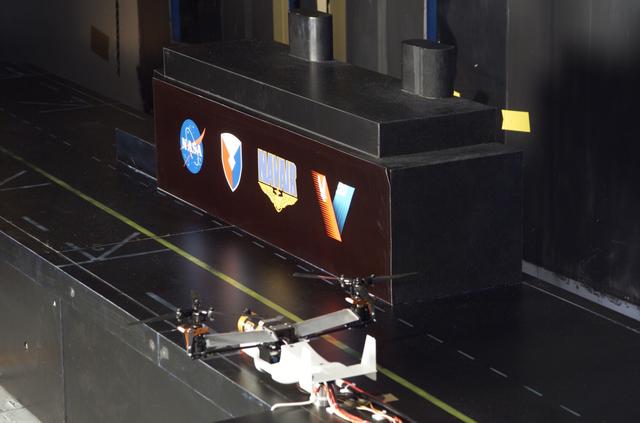
VSHAIP test in 7x10ft#1 W.T. (multiple model configruations) V-22 helicopter shipboard aerodynamic interaction program: rear view Osprey on deck
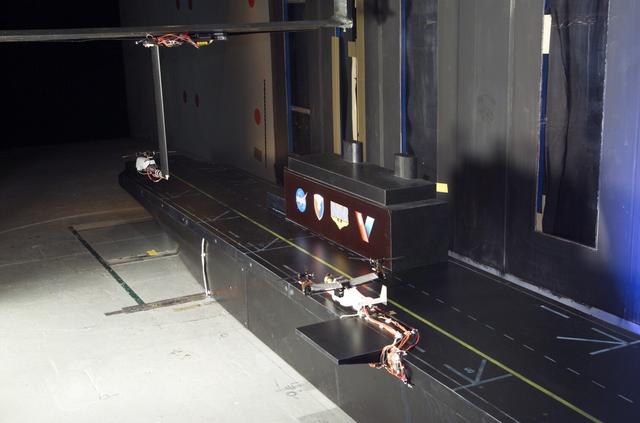
VSHAIP test in 7x10ft#1 W.T. (multiple model configruations) V-22 helicopter shipboard aerodynamic interaction program: rear view of model on deck
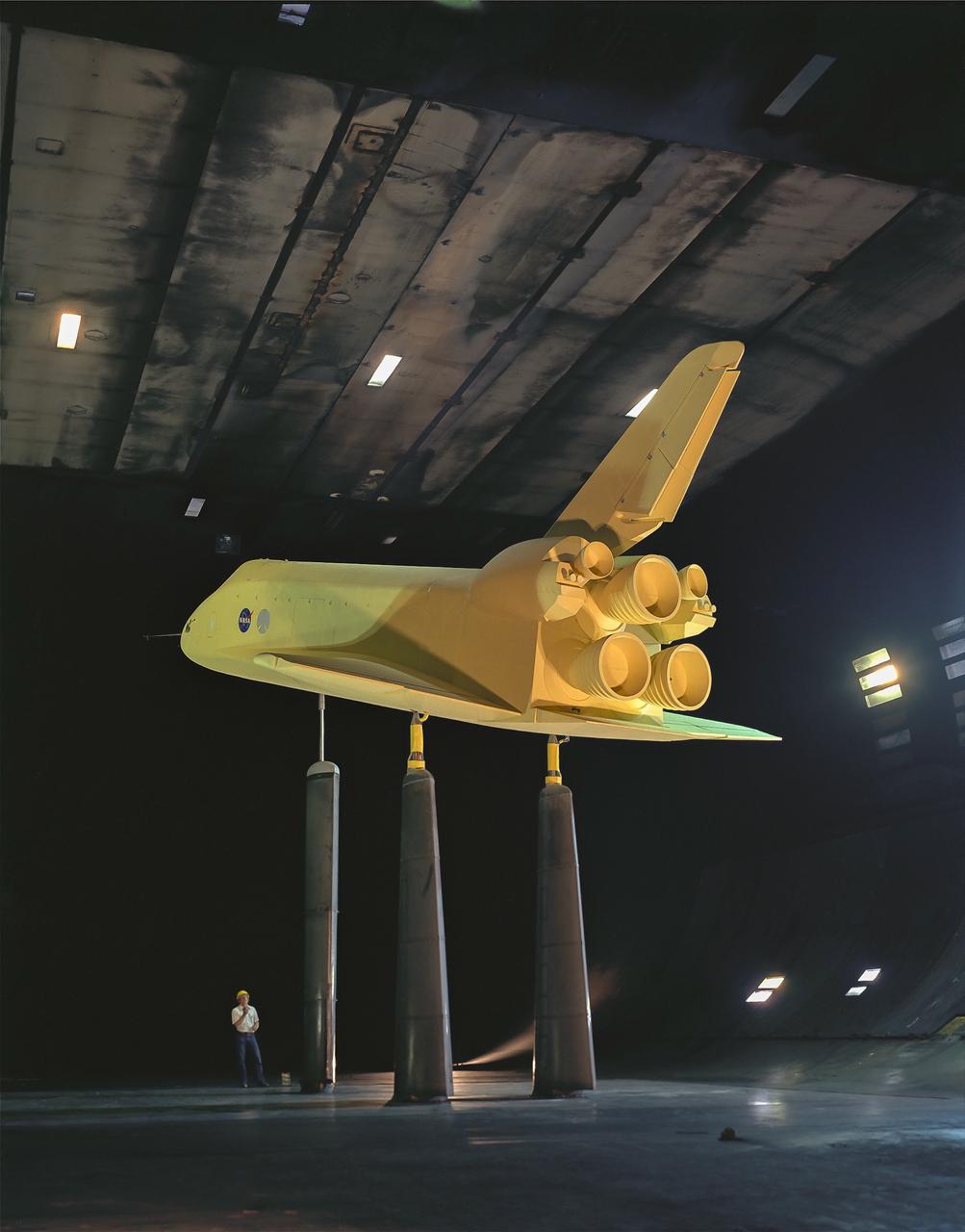
Space Shuttle SSV Orbiter Model A100 0.36 Scale In 40x80 Foot Wind Tunnel. 3/4 lower rear view.

This side-rear view of the X-24A Lifting Body on the lakebed by the NASA Flight Research Center shows its control surfaces used for subsonic flight.
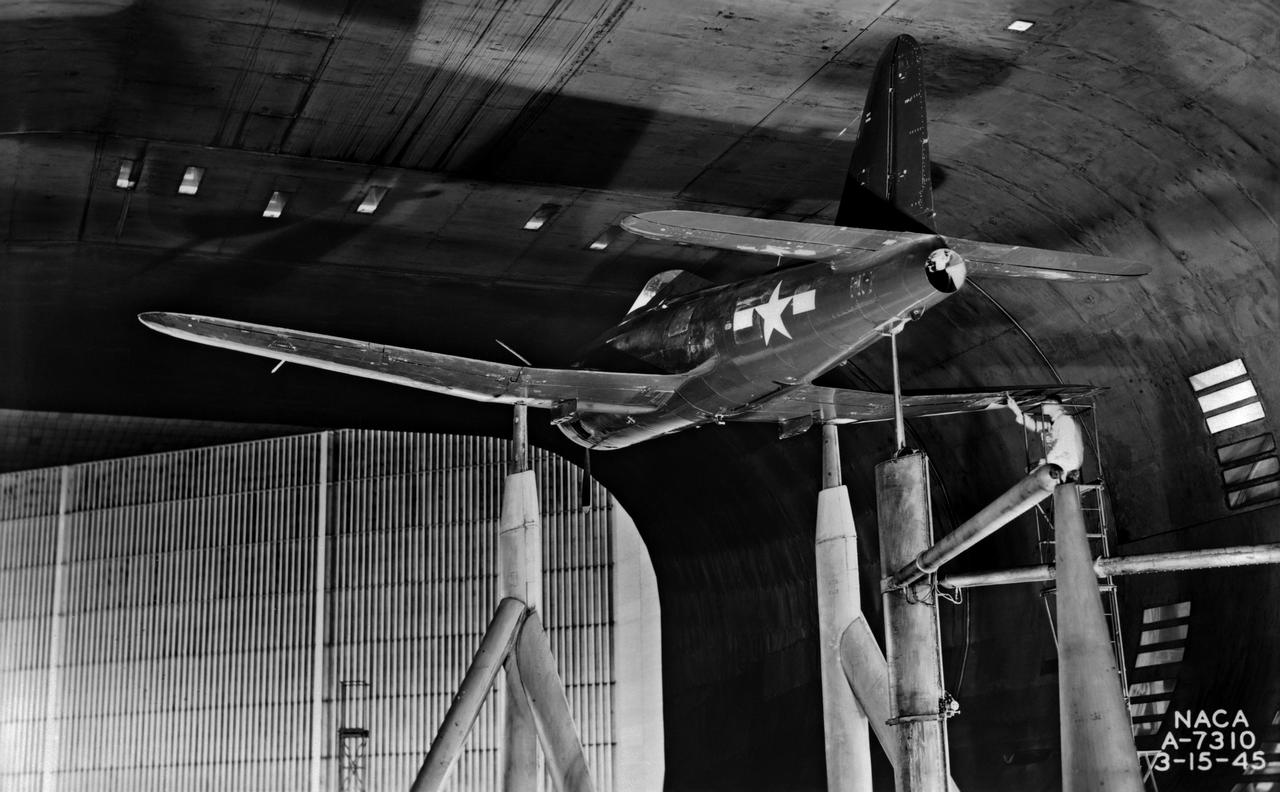
3/4 rear view of the Ryan FR-1 airplane mounted in the NACA Ames 40x80 foot wind tunnel from below. Production configuration.
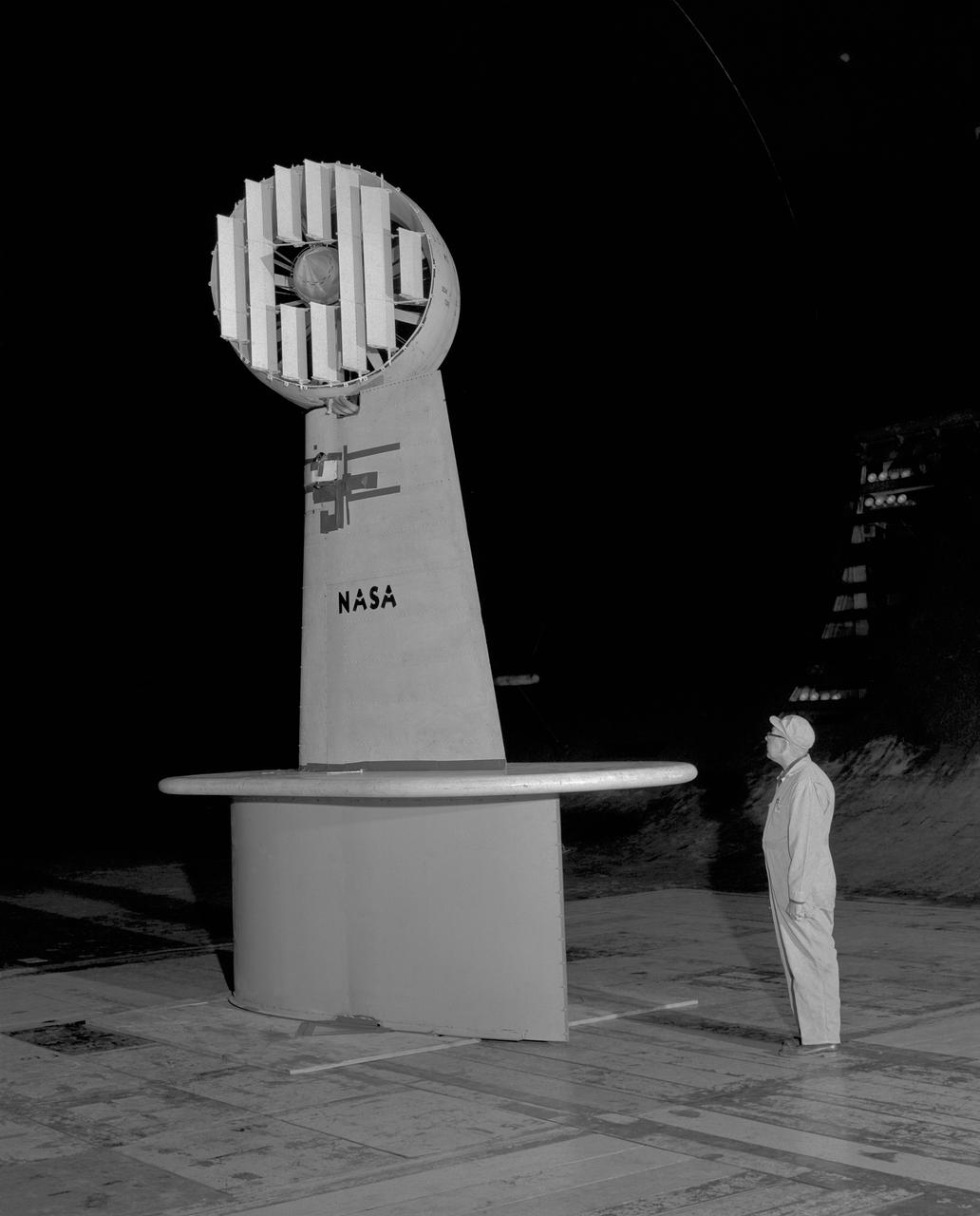
3/4 rear view of ducted fan model with cascade exit vane in Ames 40x80 foot wind tunnel, with Tom Seymore, mechanic for Ames.
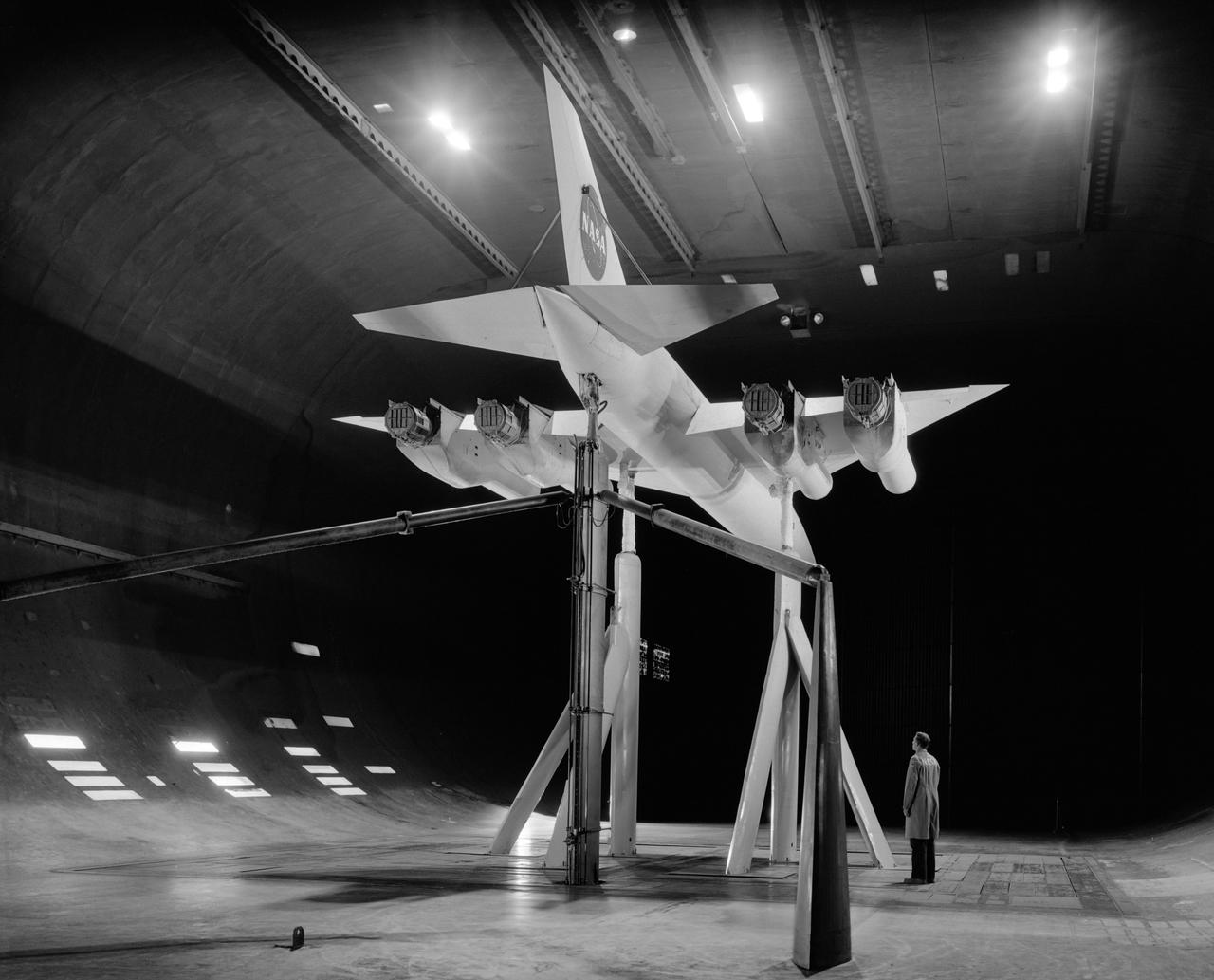
3/4 rear view of SCAT-17 supersonic transport with thrust reverser installed and trailing edge flaps deflected at 30 deg.
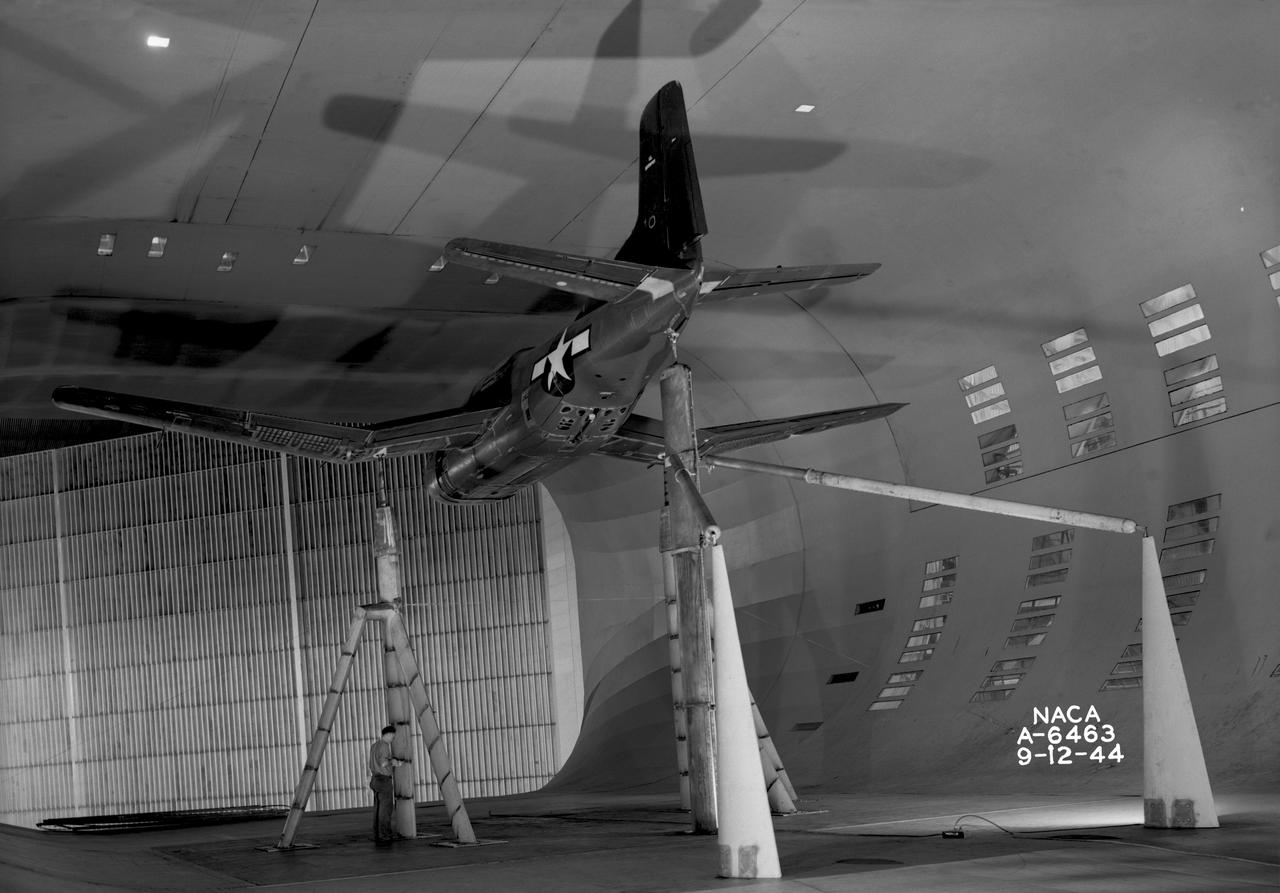
3/4 rear view from below of Douglas BTD-1 airplane in Ames 40x80 foot Wind Tunnel, unseated, horizontal tail on.
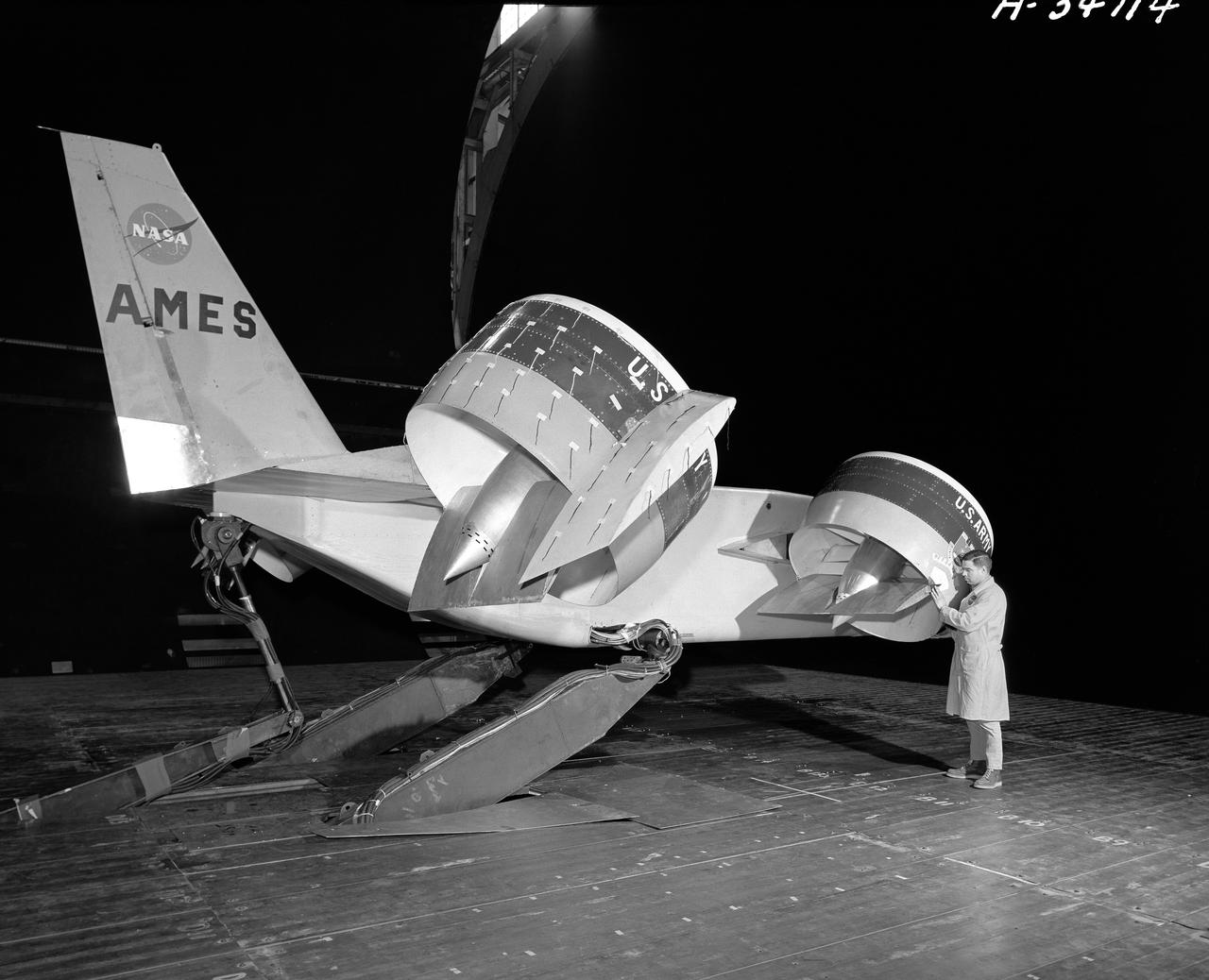
Tandem dual ducted fan mounted on ground plate. 3/4 rear view. Testing for recirculation decrease in performance of lift fans varies with ground effect.
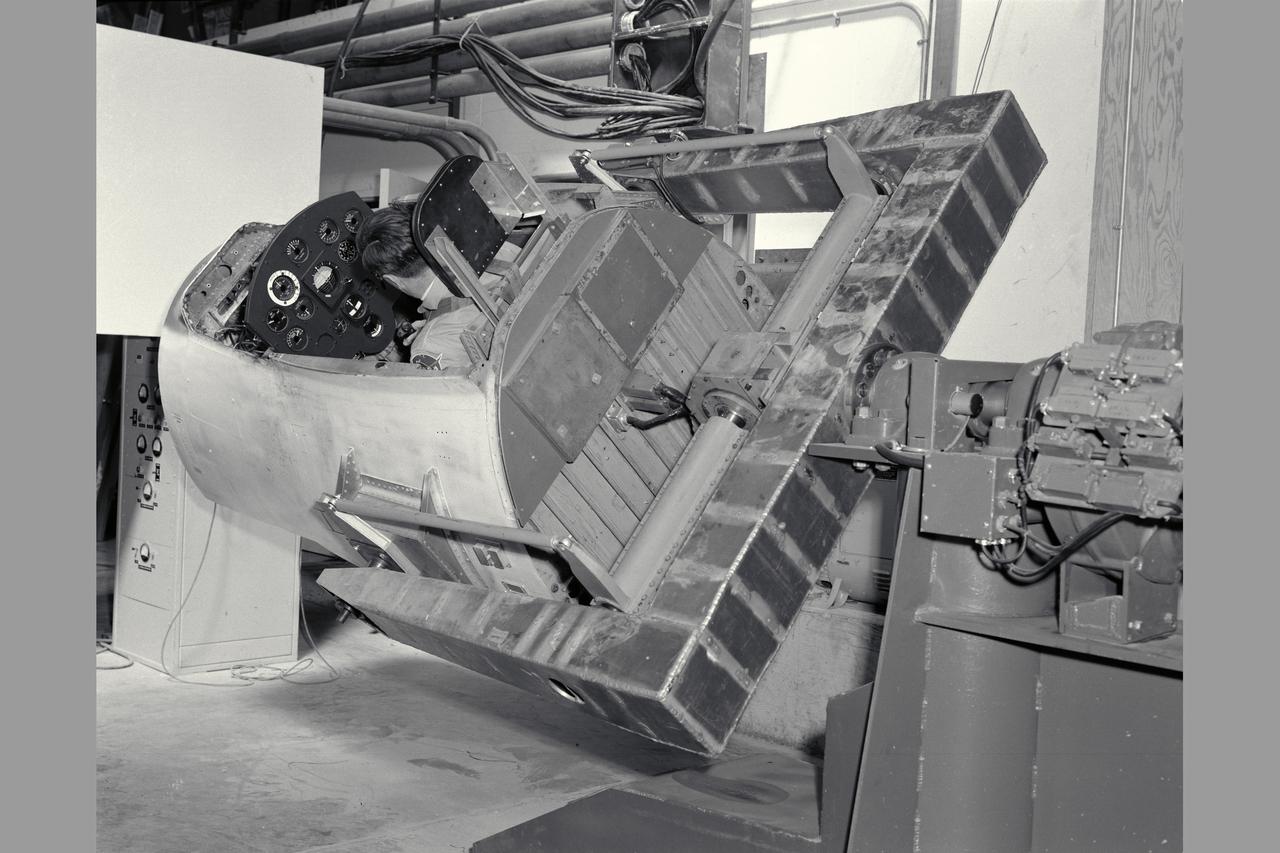
3/4 rear view with pilot Merriweather - 60 degrees bank angle. NE-2 degree of freedom simulator set-up for pitch and roll motion.
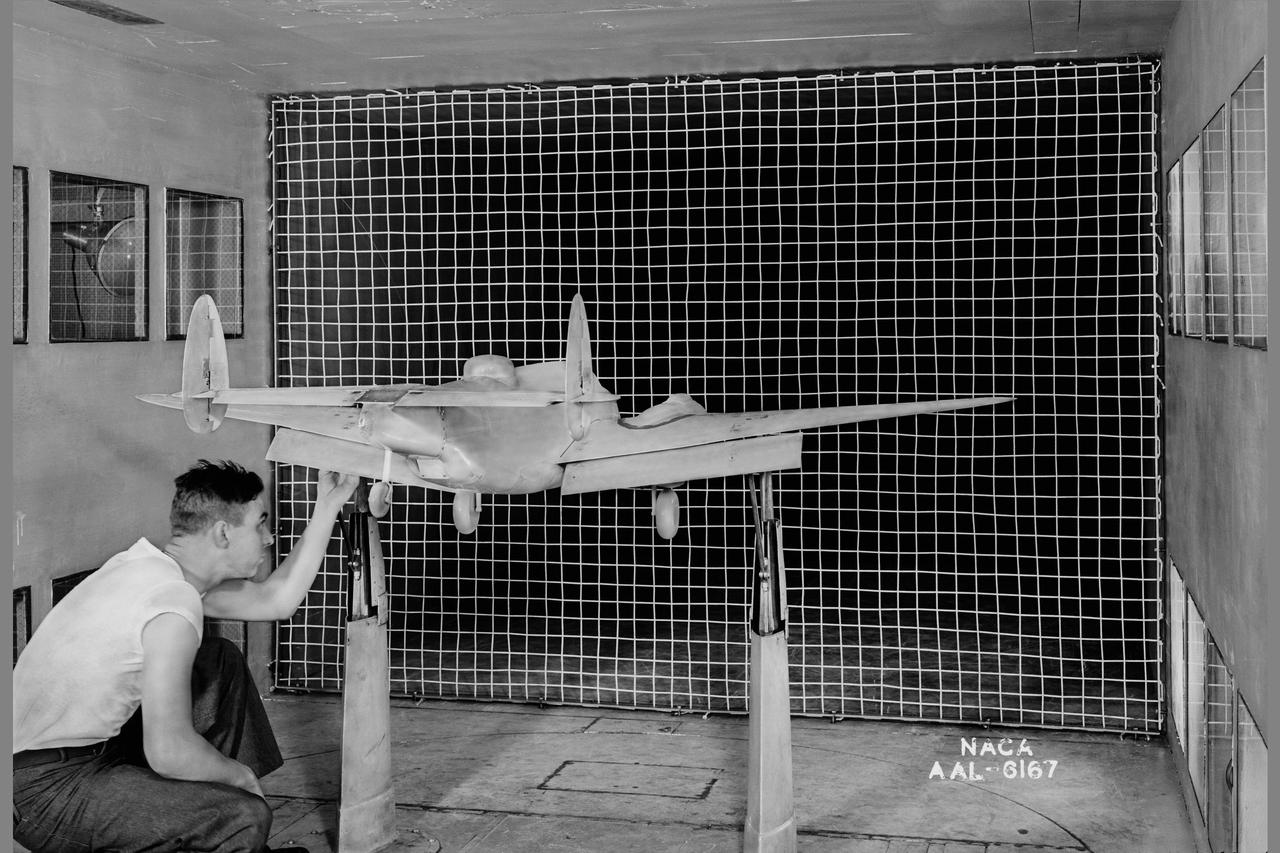
PV-1 model; rear view with 2 1/2' x 2 1/2' trubulene net mount in the 7x10ft w.t. at Ames Research Center
G.E. Fan-in-fuselage model (lifting). 3/4 rear view of fan at low G.P. position. Lift fan on variable height strut for ground effects studies with reaction control. T-Tail.
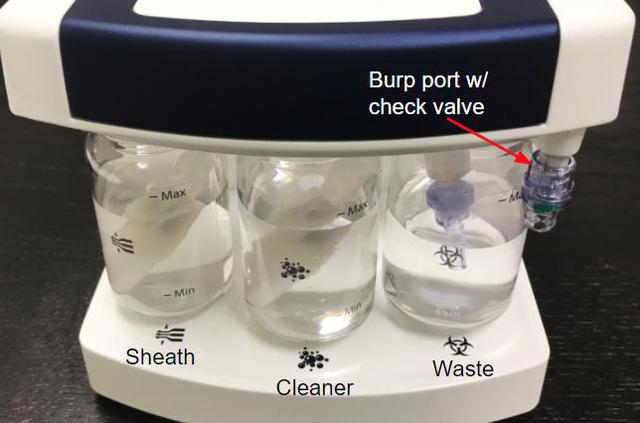
Rear view of the rHEALTH ONE shows fluid bottles used in the operation (shown without custom bags which allow bottles to function in microgravity). Image courtesy of rHEALTH.
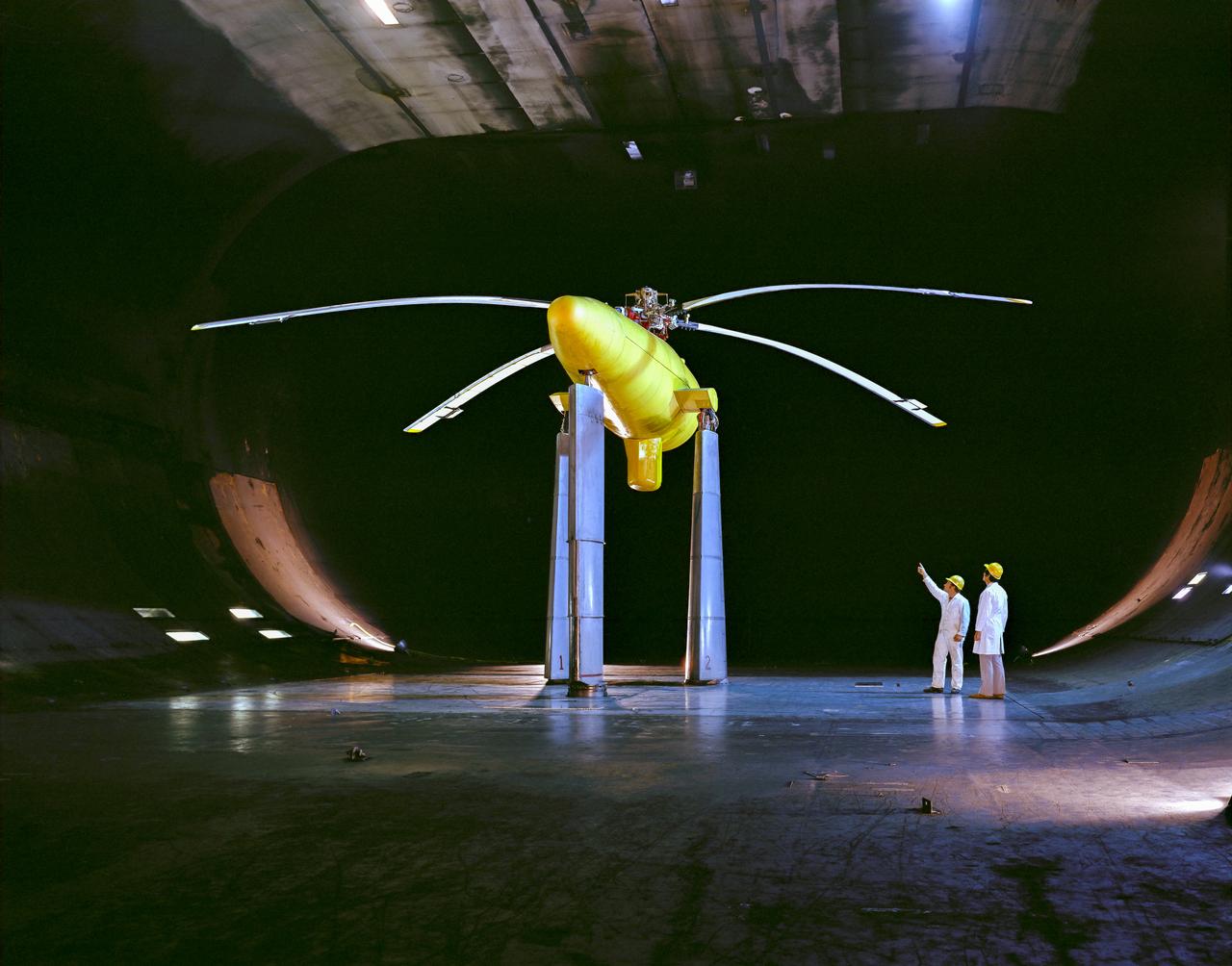
3/4 lower rear view of Controllable Twist Rotor (CTR) test of 4 blade helicopter model. Pictures with Ben Mandwyler Andy Lemnios, in 40x80 foot wind tunnel. Small flaps on rotor blades.
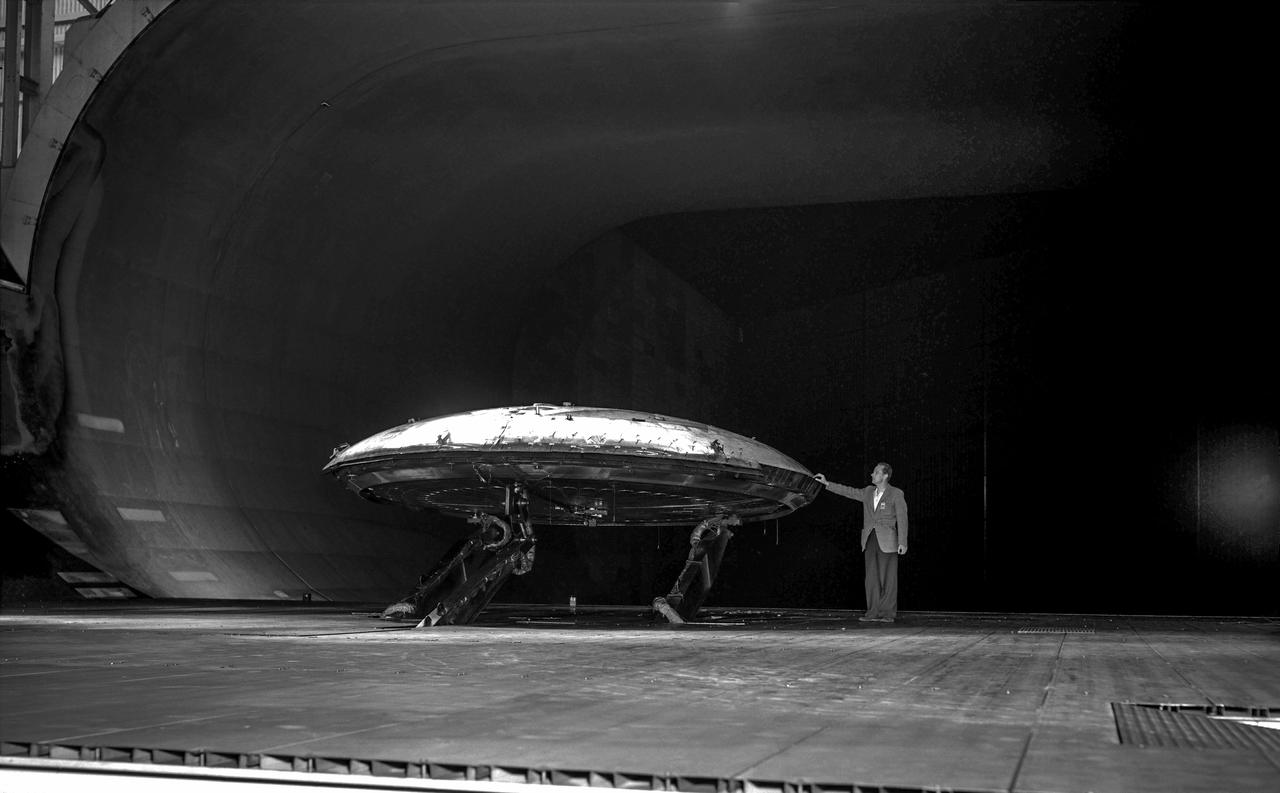
Rear view of the Avrocar without the tail, with ground board and variable height struts. The air force wanted to test the design of a flying saucer with vertical takeoff and landing capability. The design proved unstable without the tail.
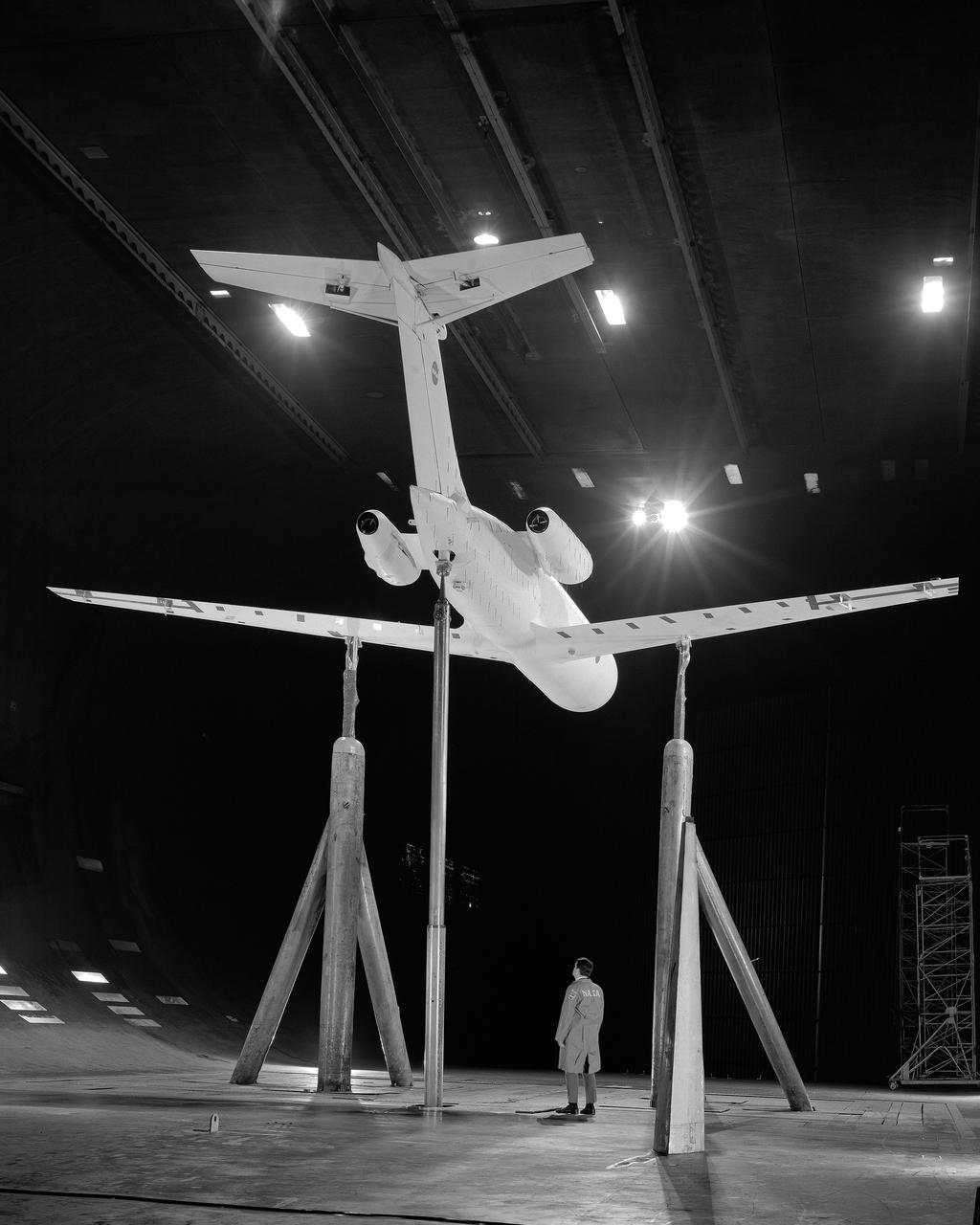
3/4 rear view from below of swept wing jet transport with T-Tail and Aft Engins, with Art Morris. Deep Stall Model in Ames 40x80 foot Wind Tunnel.

3/4 rear view of model with flaps down with Cecil E. MacDonald. V/STOL Aircraft: Wind tunnel investigation of rotating cylinder applied to training edge flaps for high lift & low-speed control.
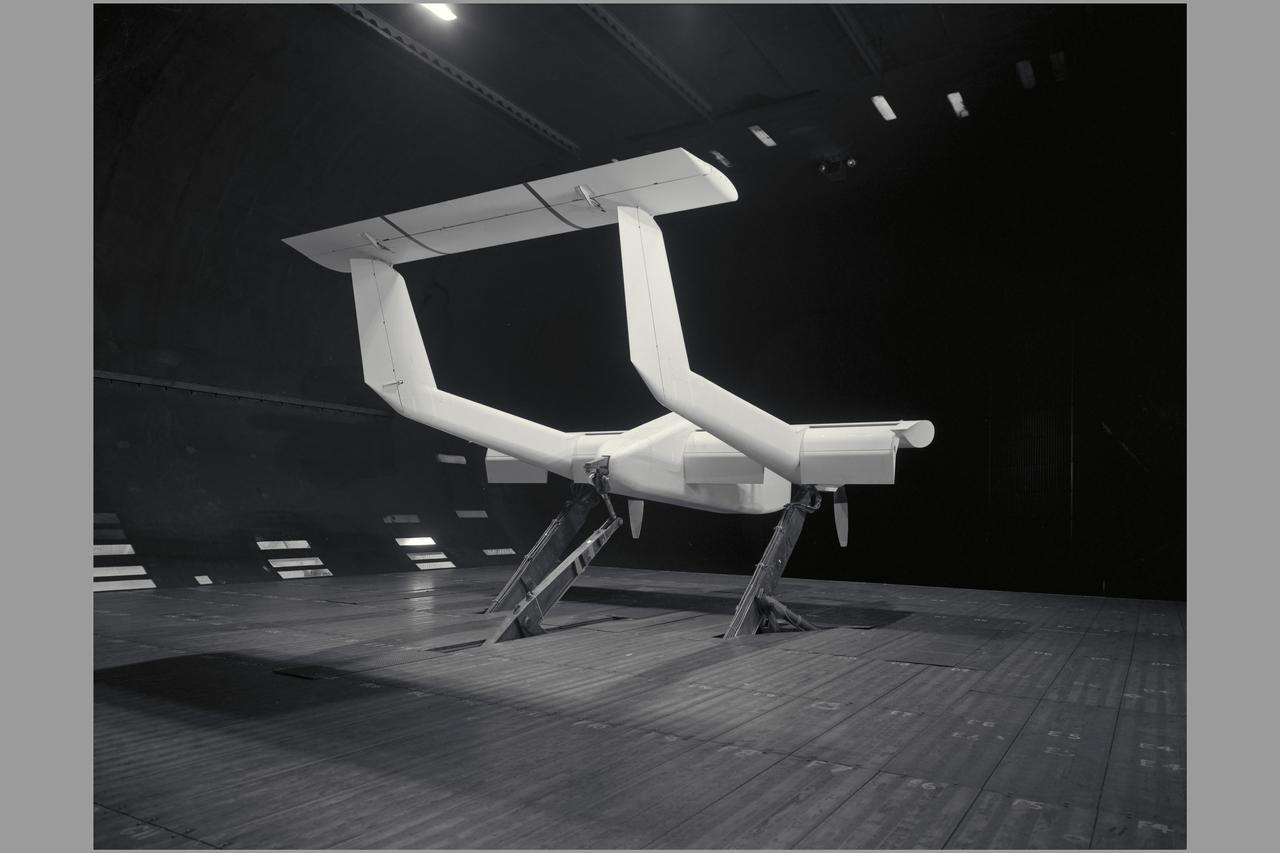
3/4 rear view of model with flaps down. V/STOL Aircraft: Wind tunnel investigation of rotating cylinder applied to training edge flaps for high lift & low-speed control.
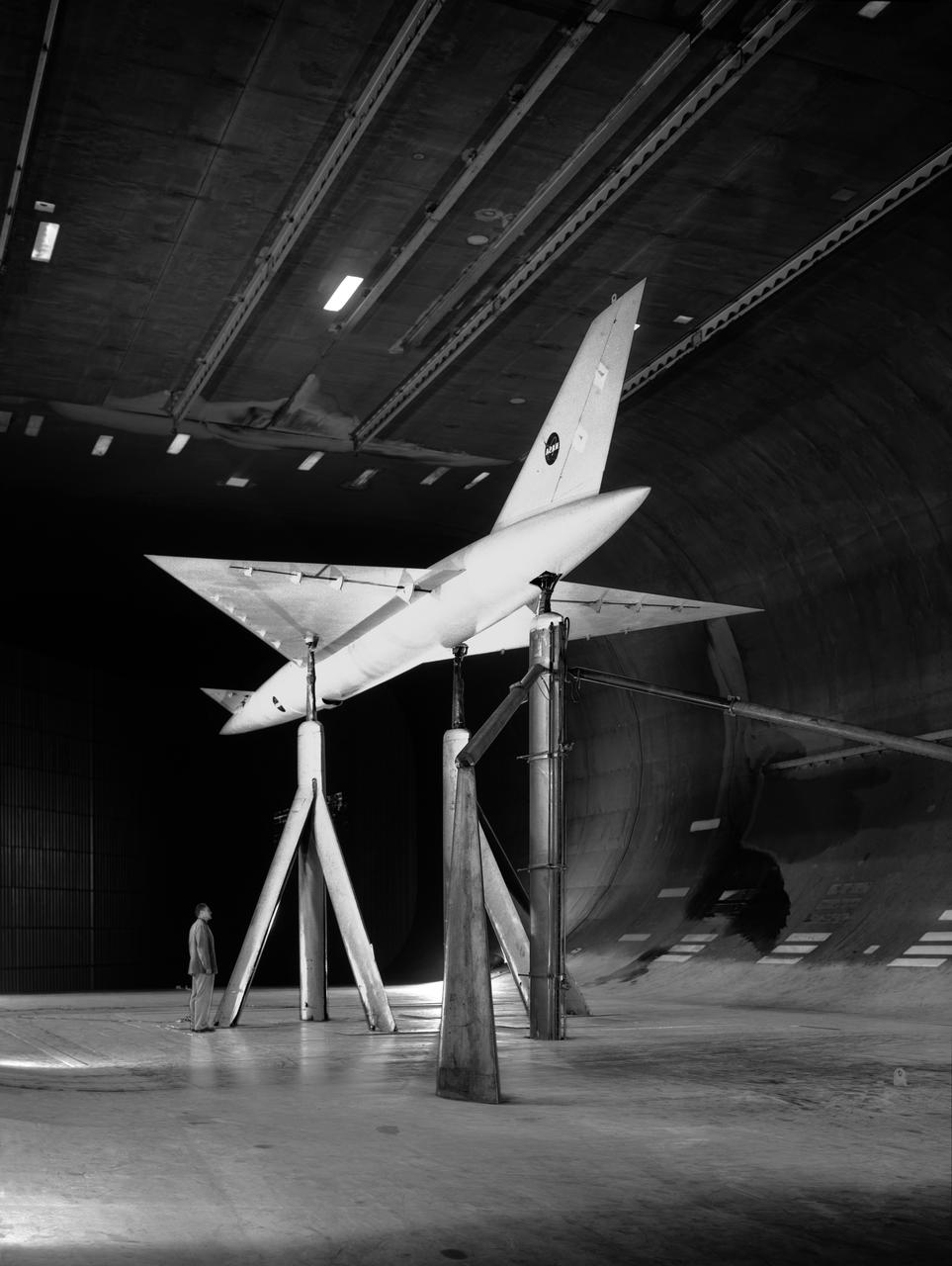
Low Speed investigation of a supersonic transport model with delta wing and delta conard, in the 40x80 Wind Tunnel. R 975 T Zero angel of attack. 3/4 rear view from below.
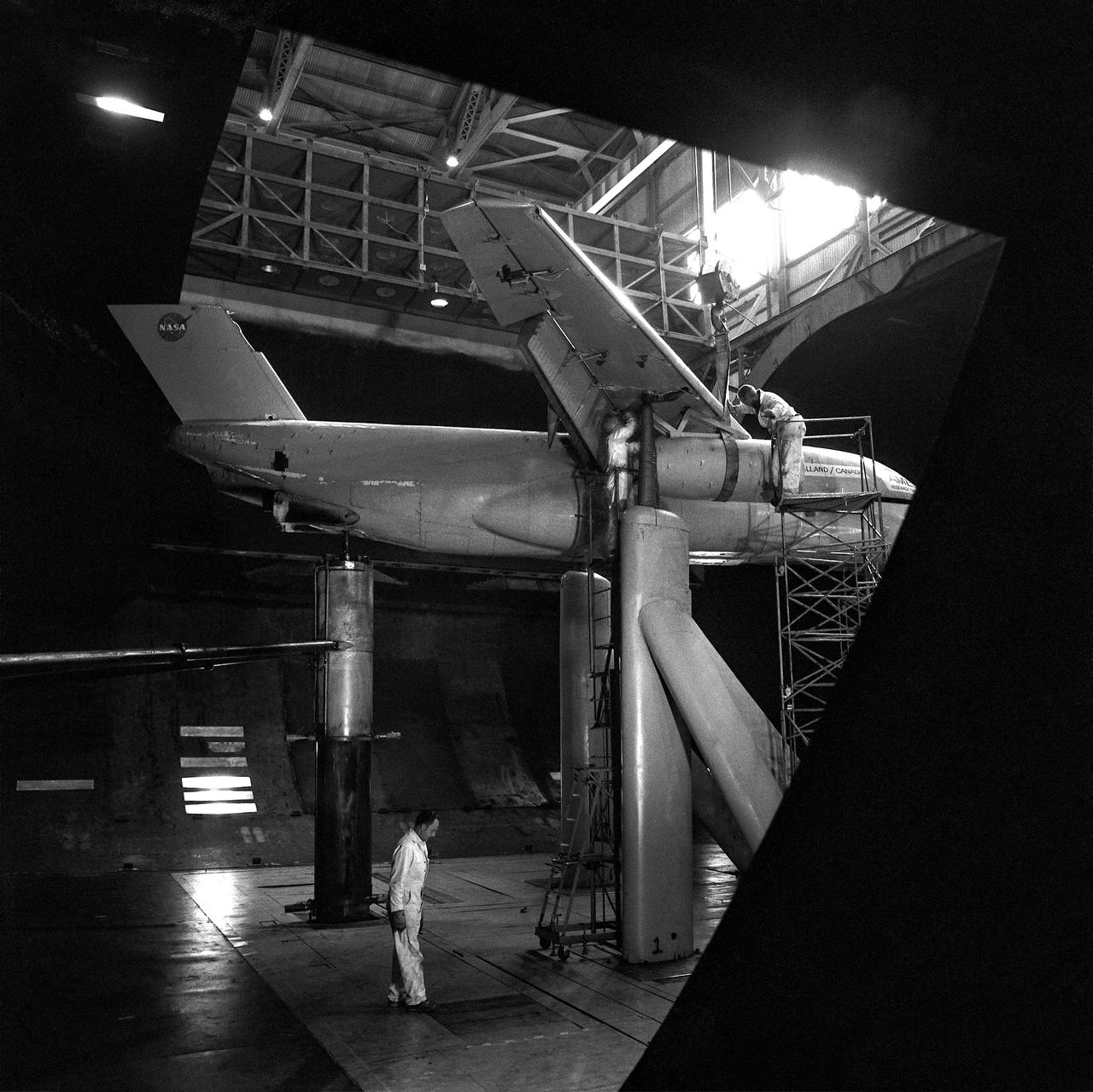
(11/12/1971) 3/4 rear view of swept 75% scale augmentor wing quest model being installed into the test section of the Ames 40x80 foot wind tunnel, overhead doors open.
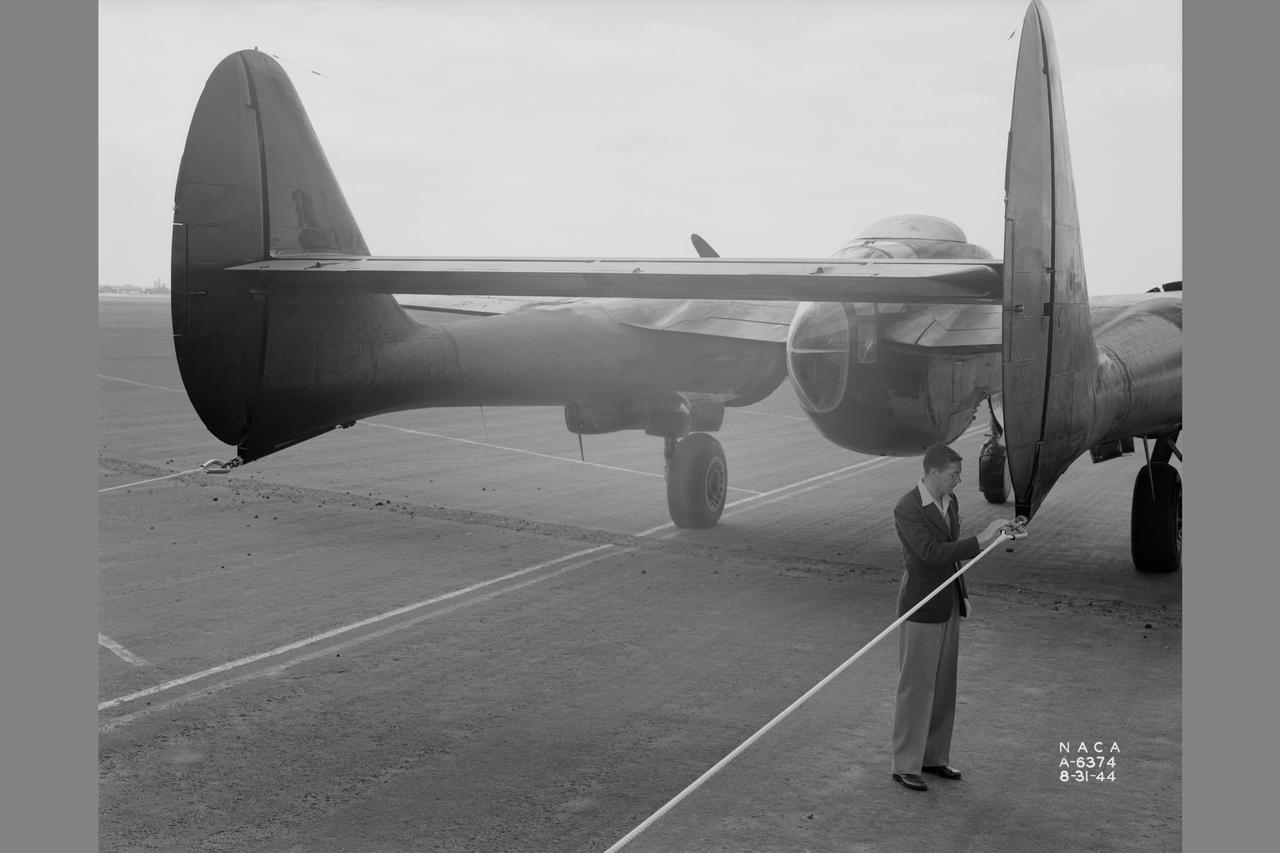
Towing installations on P-51 and P-61 airplanes for propeller off tests on the P-51. Rear view of P-61 in towing position preparing for take off at NACA Ames Research Center, Moffett Field, California
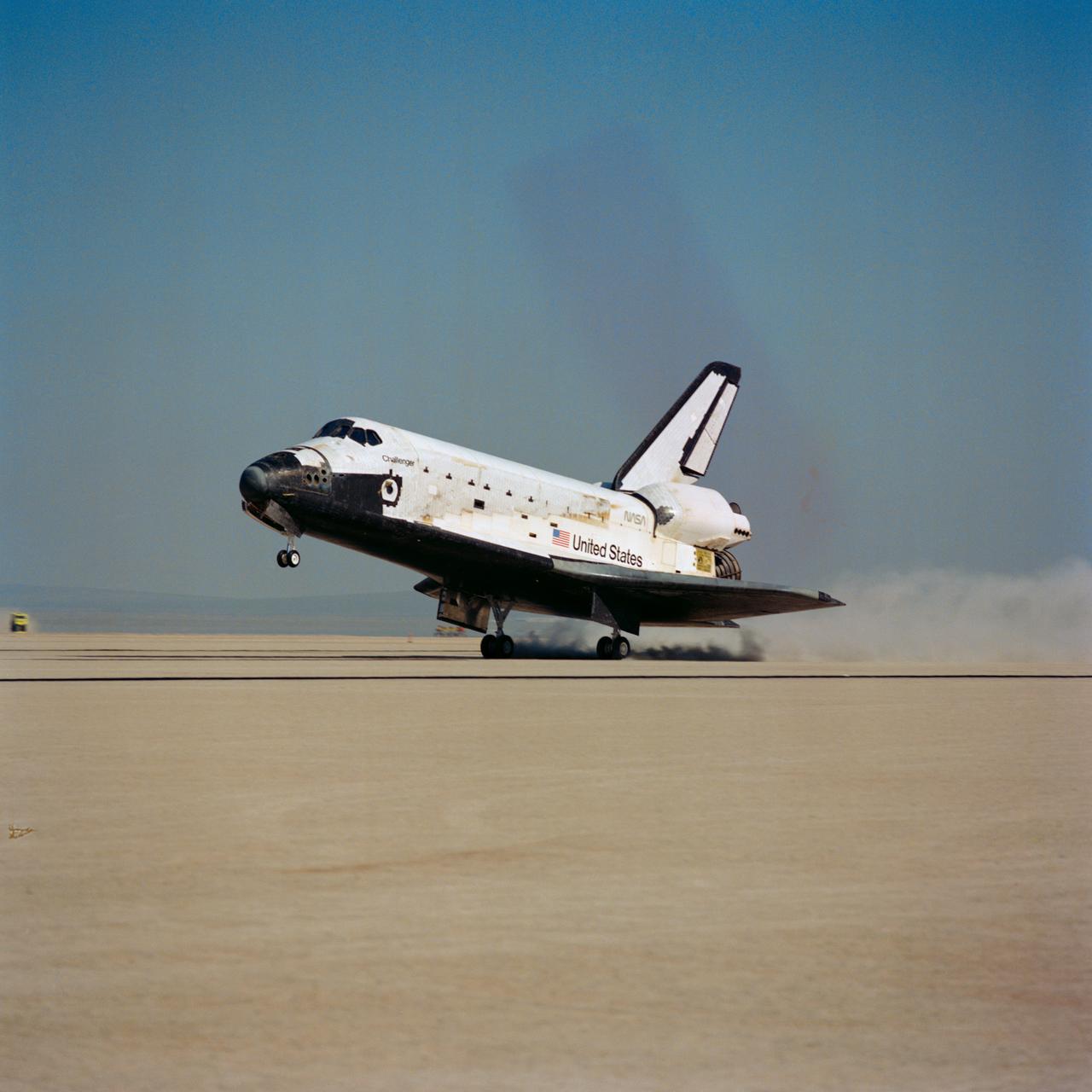
Shuttle Challenger lands on Runway 17 at Edwards at end of 51-B mission. The photo is a rear view of the shuttle landing gear touching the runway, with clouds of dirt trailing behind it. The nose gear is still in the air (071); Side view of the Challenger landing gear touching the runway (072).
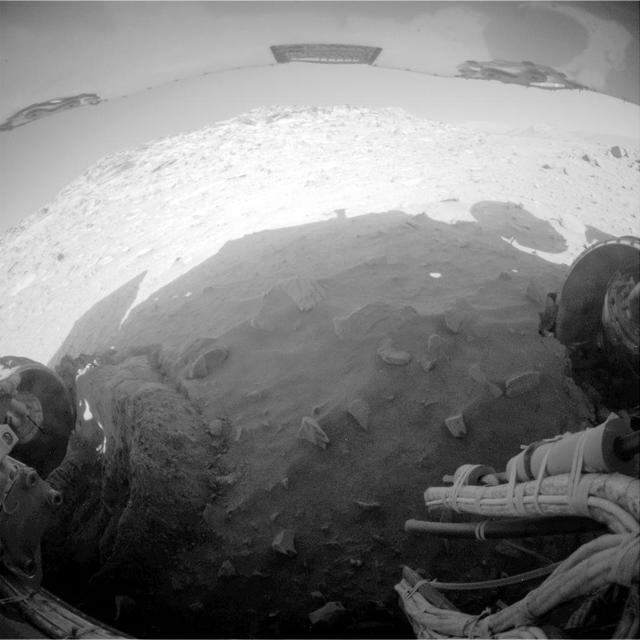
NASA Mars Exploration Rover Spirit recorded this fisheye view after completing a drive during on Mars on Feb. 8, 2010. The drive left Spirit in the position where the rover will stay parked during the upcoming Mars southern-hemisphere winter.
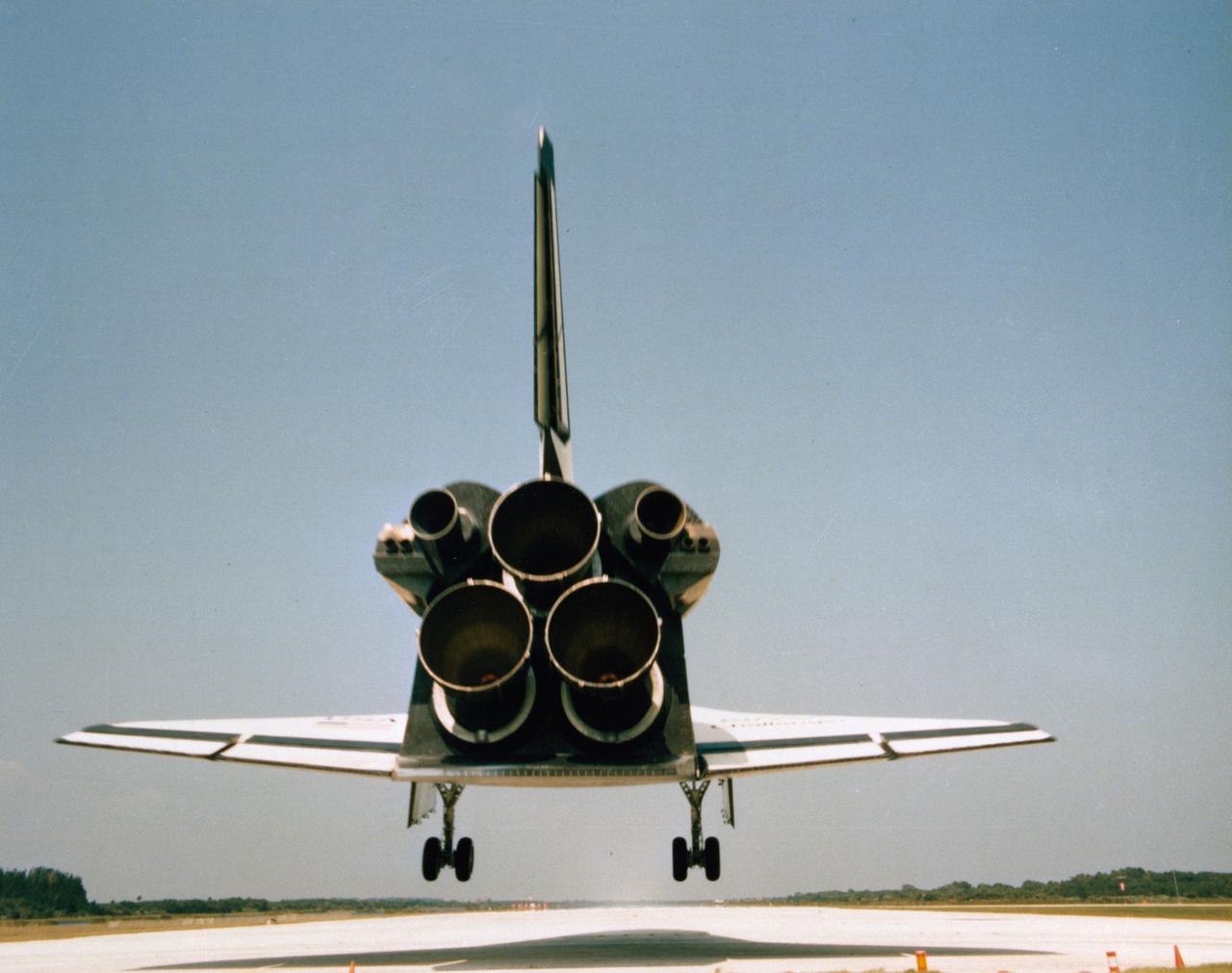
Landing of Orbiter Challenger at KSC at completion of 41G mission. View of the rear of the Orbiter as it approaches the runway with its landing gear extended. The main engines are clearly visible. The KSC Alternative Photo Number is 108-KSC-84PC-654 (43896). KSC, FL
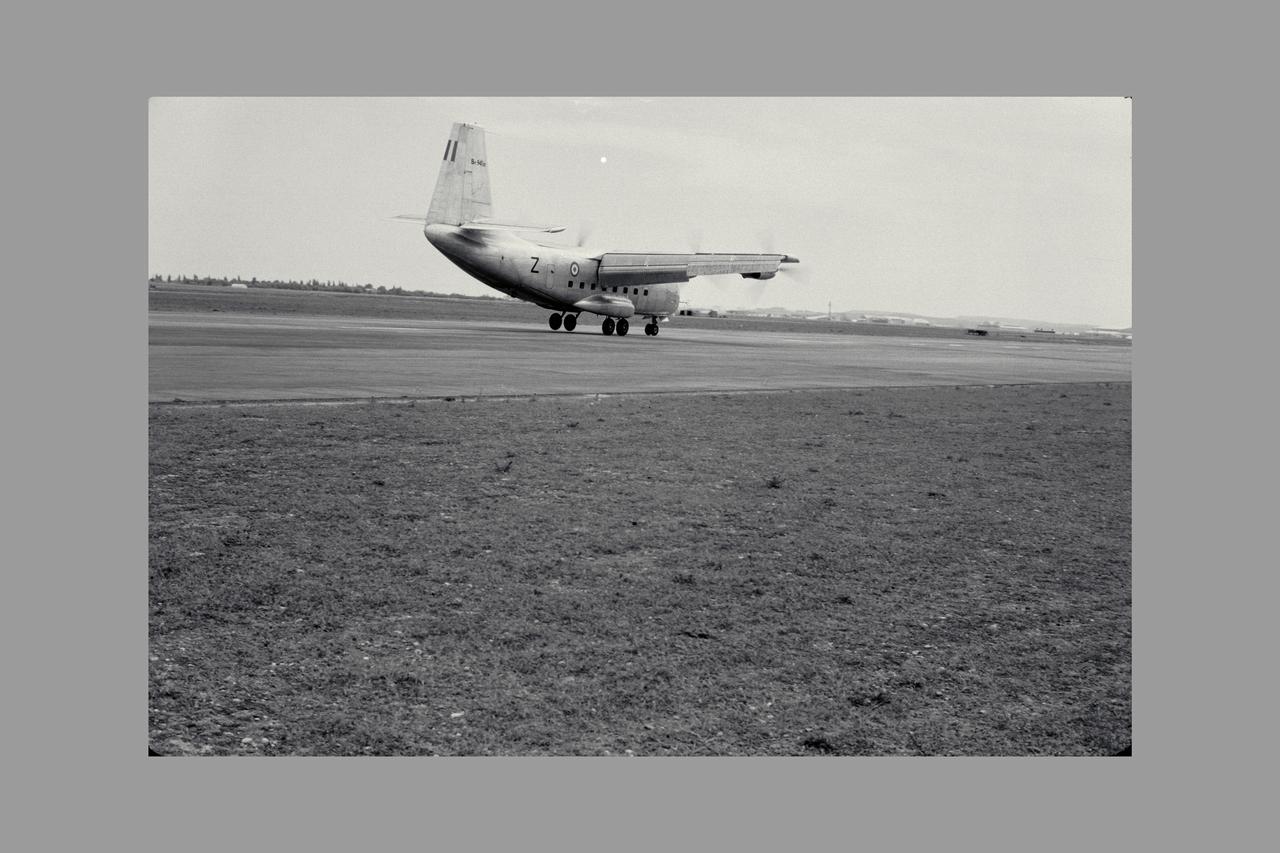
3/4 REAR VIEW OF Breguet 941 AIRPLANE; FLIGHT EVALUATION, MAY 1963. Boundary Layer Control, STOL, and V/STOL Research. Fig. 105 NASA SP Flight Research at Ames: 57 Years of Development and Validation of Aeronautical Technology
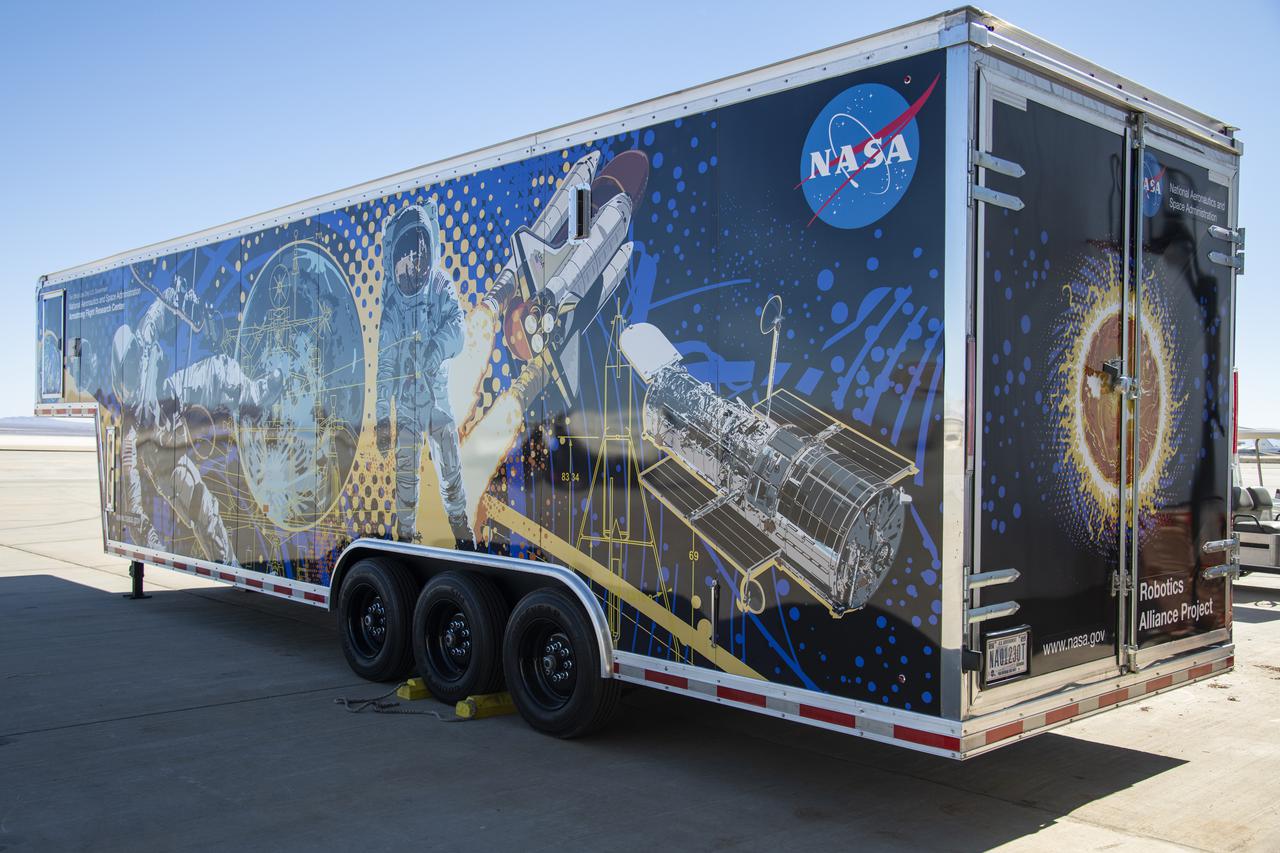
The Mobile Fabrication Shop was received at NASA Armstrong on February 7, 2022 as part of the Robotics Alliance Program based at NASA’s Johnson Space Center. This view shows the side and rear of the wrapped trailer that attends robotics competitions to help students during their robotics competitions.
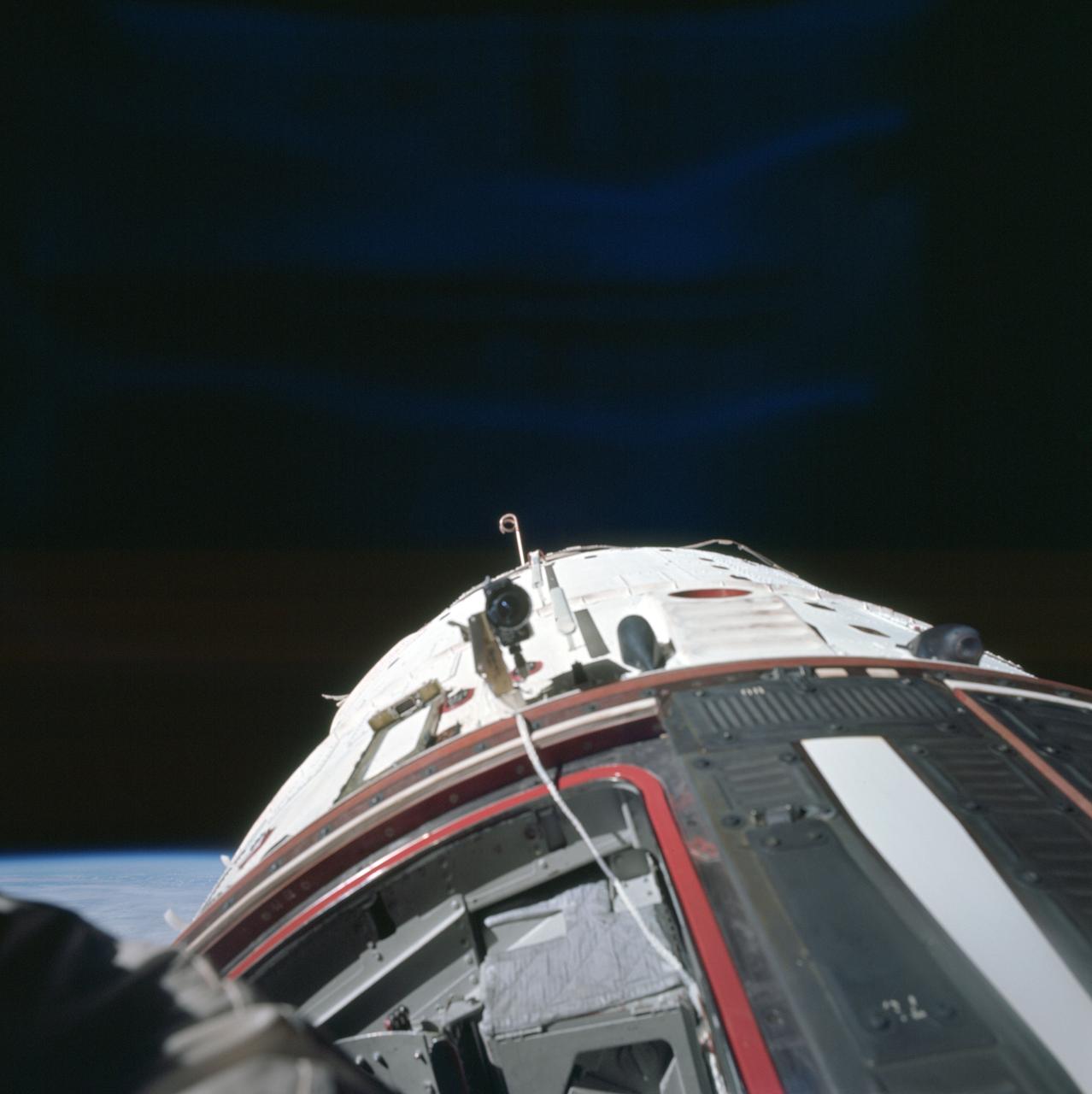
S66-62920 (13 Nov. 1966) --- Astronaut Edwin E. Aldrin Jr., pilot of the Gemini-12 spaceflight, took this picture of the Gemini-12 spacecraft during standup extravehicular activity (EVA) with the hatch open. This is a view to the rear showing the adapter section. Photo credit: NASA
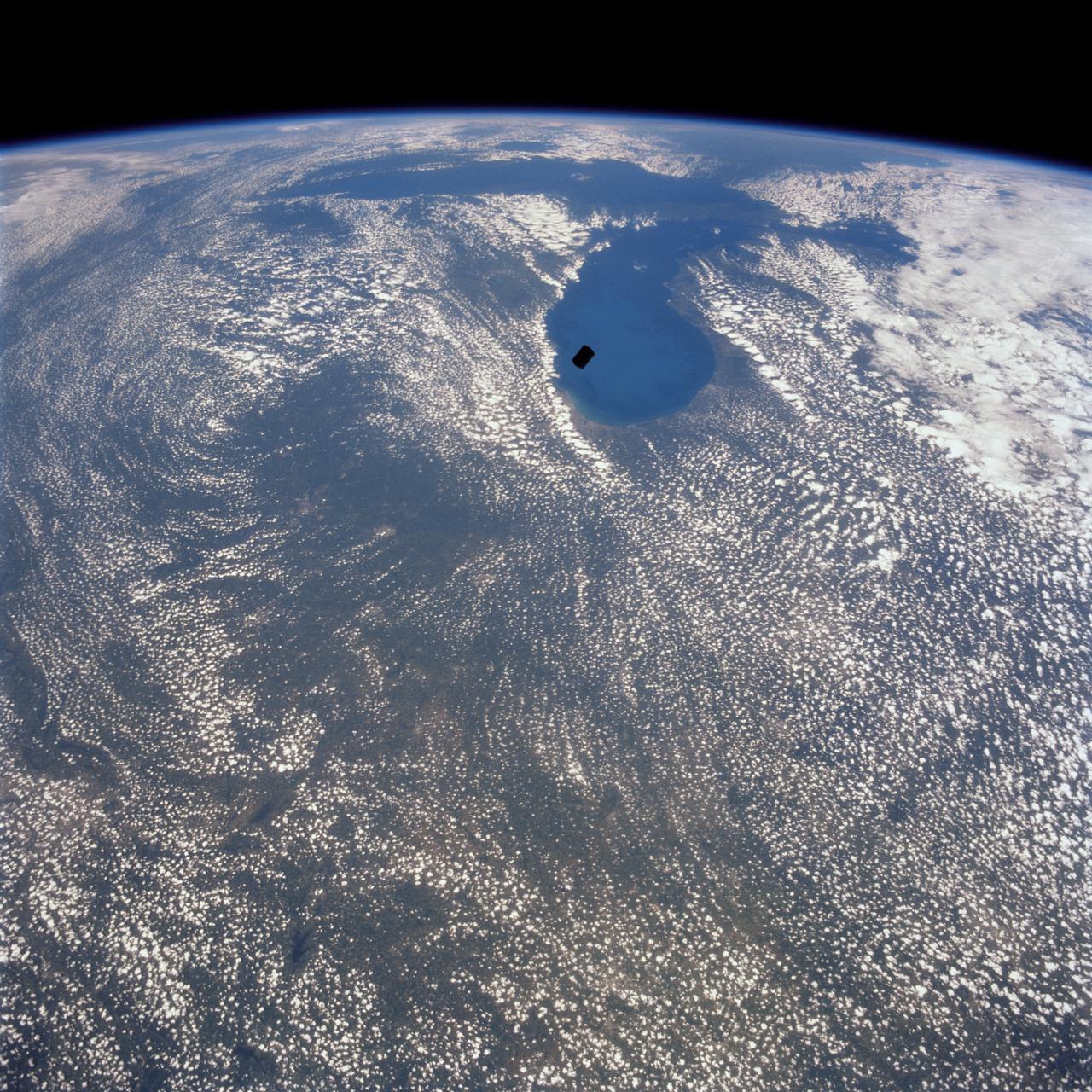
STS105-714-028 (20 August 2001) --- Backdropped by Lake Michigan, this distant view shows the recently deployed small science satellite called Simplesat, which is an engineering satellite, designed to evaluate the use of inexpensive commercial hardware for spacecraft. It was spring-ejected from a canister at the rear of the Shuttle's cargo bay.

S98-16081 (10-29-98) --- Profile view of rear of Mission Control Center (MCC) featuring Mission Operations Director (MOD) console (foreground) and Spacecraft Communicator (CAPCOM) and Flight Director (FD) consoles (left background). Astronaut Linda M. Godwin is at lower right foreground.
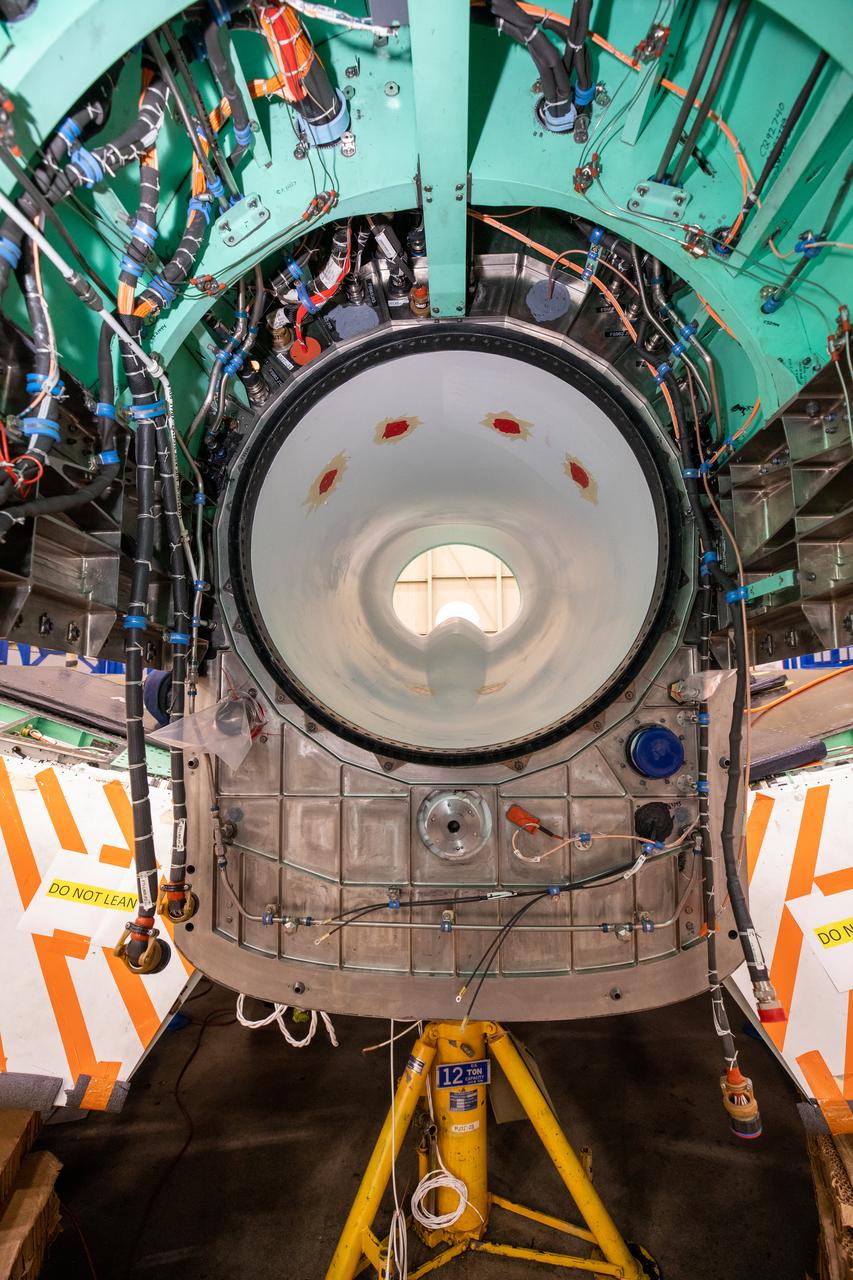
This image shows the X-59’s engine inlet from the aft view, which is the rear of the airplane, looking forward. Once the aircraft and ground testing are complete, the X-59 will undergo flight testing, which will demonstrate the plane’s ability to fly supersonic - faster than the speed of sound - while reducing the loud sonic boom. This could enable commercial supersonic air travel over land again.
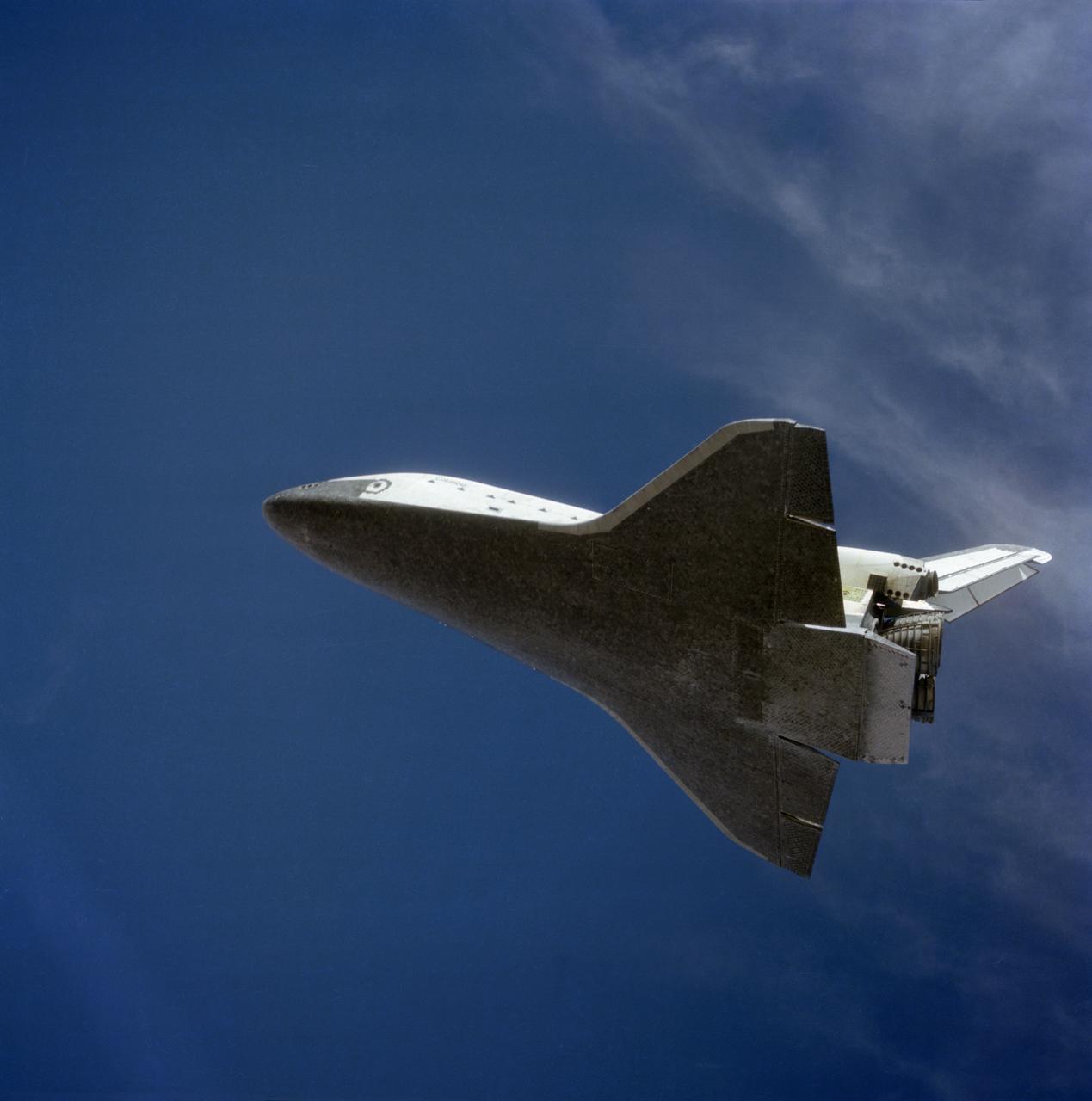
S81-39564 (14 Nov. 1981) --- This view of the space shuttle Columbia (STS-2) was made with a hand-held 70mm camera in the rear station of the T-38 chase plane. Mission specialist/astronaut Kathryn D. Sullivan exposed the frame as astronauts Joe N. Engle and Richard H. Truly aboard the Columbia guided the vehicle to an unpowered but smooth landing on the desert area of Edwards Air Force base in California. The picture provides a good view of the underside of the returning spacecraft. Photo credit: NASA
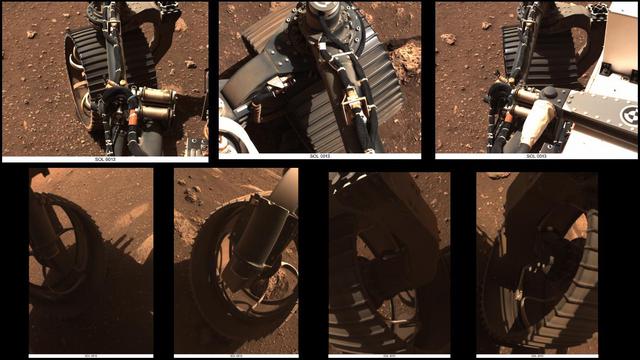
These sets of animated GIFs show seven views of NASA's Perseverance Mars rover wiggling its wheels on March 4, 2021, the day Perseverance completed its first drive on Mars. The first three sets of GIFs come from the Navigation Cameras (Navcams). The first view shows the front left wheel; the second the front right wheel; the third the rear right wheel. The next four sets come from the Hazard Avoidance Cameras (Hazcams). The fourth GIF shows the front left wheel again; the fifth the front right wheel again; the sixth the rear left wheel; and the seventh the rear right wheel again. A key objective for Perseverance's mission on Mars is astrobiology, including the search for signs of ancient microbial life. The rover will characterize the planet's geology and past climate, pave the way for human exploration of the Red Planet, and be the first mission to collect and cache Martian rock and regolith (broken rock and dust). Subsequent NASA missions, in cooperation with ESA (European Space Agency), would send spacecraft to Mars to collect these sealed samples from the surface and return them to Earth for in-depth analysis. The Mars 2020 Perseverance mission is part of NASA's Moon to Mars exploration approach, which includes Artemis missions to the Moon that will help prepare for human exploration of the Red Planet. Animations available at https://photojournal.jpl.nasa.gov/catalog/PIA24489
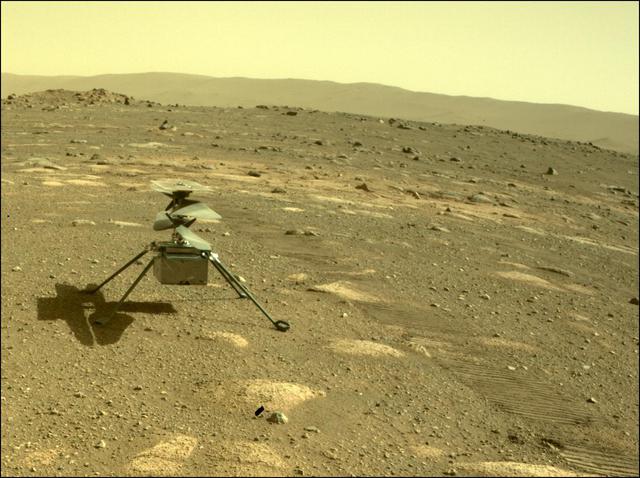
NASA's Ingenuity helicopter can be seen on Mars as viewed by the Perseverance rover's rear Hazard Camera on April 4, 2021, the 44th Martian day, or sol of the mission. NASA's Jet Propulsion Laboratory built and manages operations of Perseverance and Ingenuity for the agency. Caltech in Pasadena, California, manages JPL for NASA. The Mars helicopter technology demonstration activity is supported by NASA's Science Mission Directorate, the NASA Aeronautics Research Mission Directorate, and the NASA Space Technology Mission Directorate. A key objective for Perseverance's mission on Mars is astrobiology, including the search for signs of ancient microbial life. The rover will characterize the planet's geology and past climate, pave the way for human exploration of the Red Planet, and be the first mission to collect and cache Martian rock and regolith (broken rock and dust). Subsequent NASA missions, in cooperation with ESA (European Space Agency), would send spacecraft to Mars to collect these sealed samples from the surface and return them to Earth for in-depth analysis. The Mars 2020 Perseverance mission is part of NASA's Moon to Mars exploration approach, which includes Artemis missions to the Moon that will help prepare for human exploration of the Red Planet. https://photojournal.jpl.nasa.gov/catalog/PIA24541
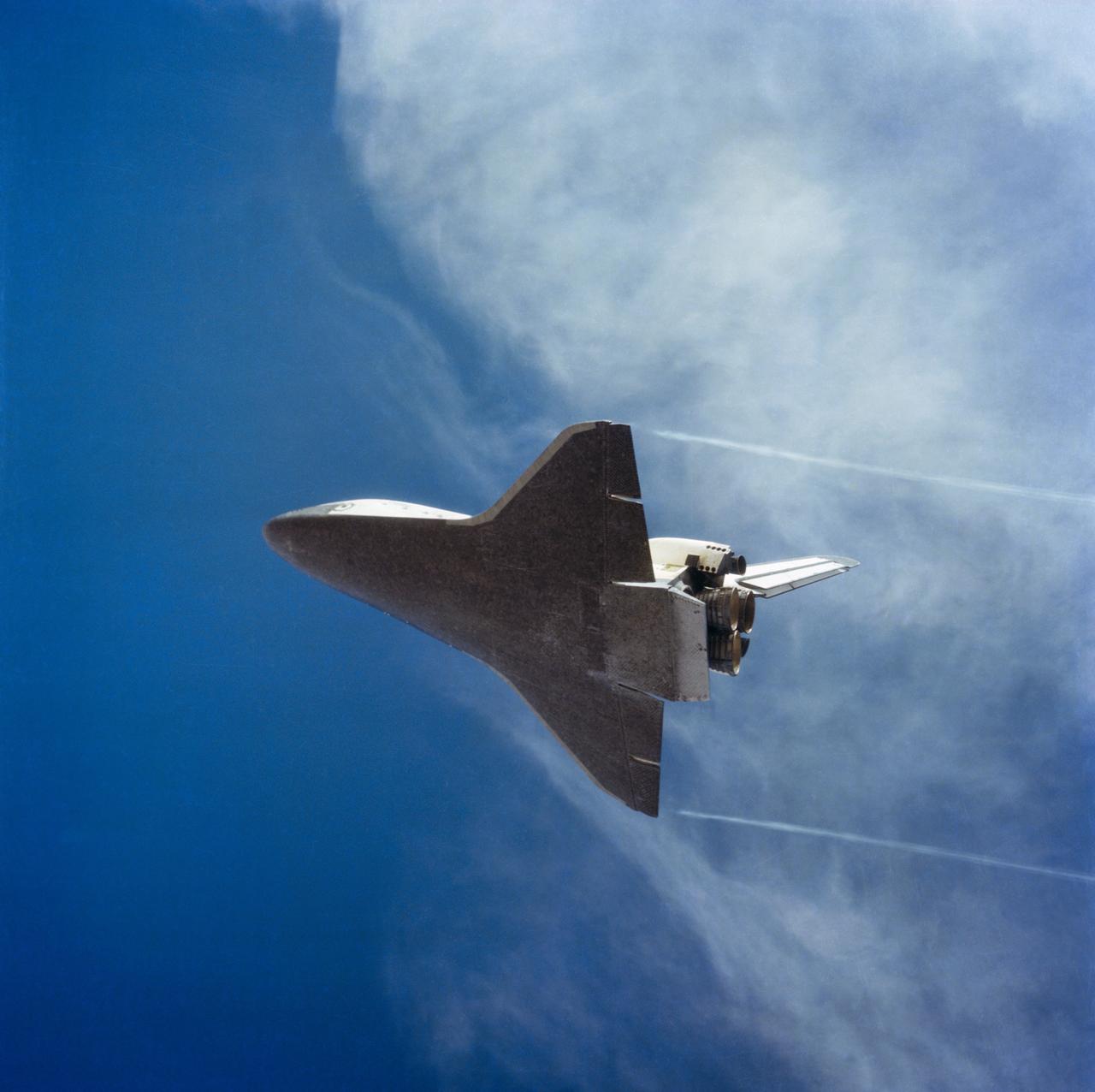
S81-39563 (14 Nov. 1981) --- This view of the space shuttle Columbia (STS-2) was made with a hand-held 70mm camera in the rear station of the T-38 chase plane. Mission specialist/astronaut Kathryn D. Sullivan exposed the frame as astronauts Joe N. Engle and Richard H. Truly aboard the Columbia guided the vehicle to an unpowered but smooth landing on the desert area of Edwards Air Force base in California. The view provides a good study of the high temperature protection material on the underside of the spacecraft which is exposed to the friction on the atmospheric entry on the return to Earth. Also note trails from the wing tips. Photo credit: NASA
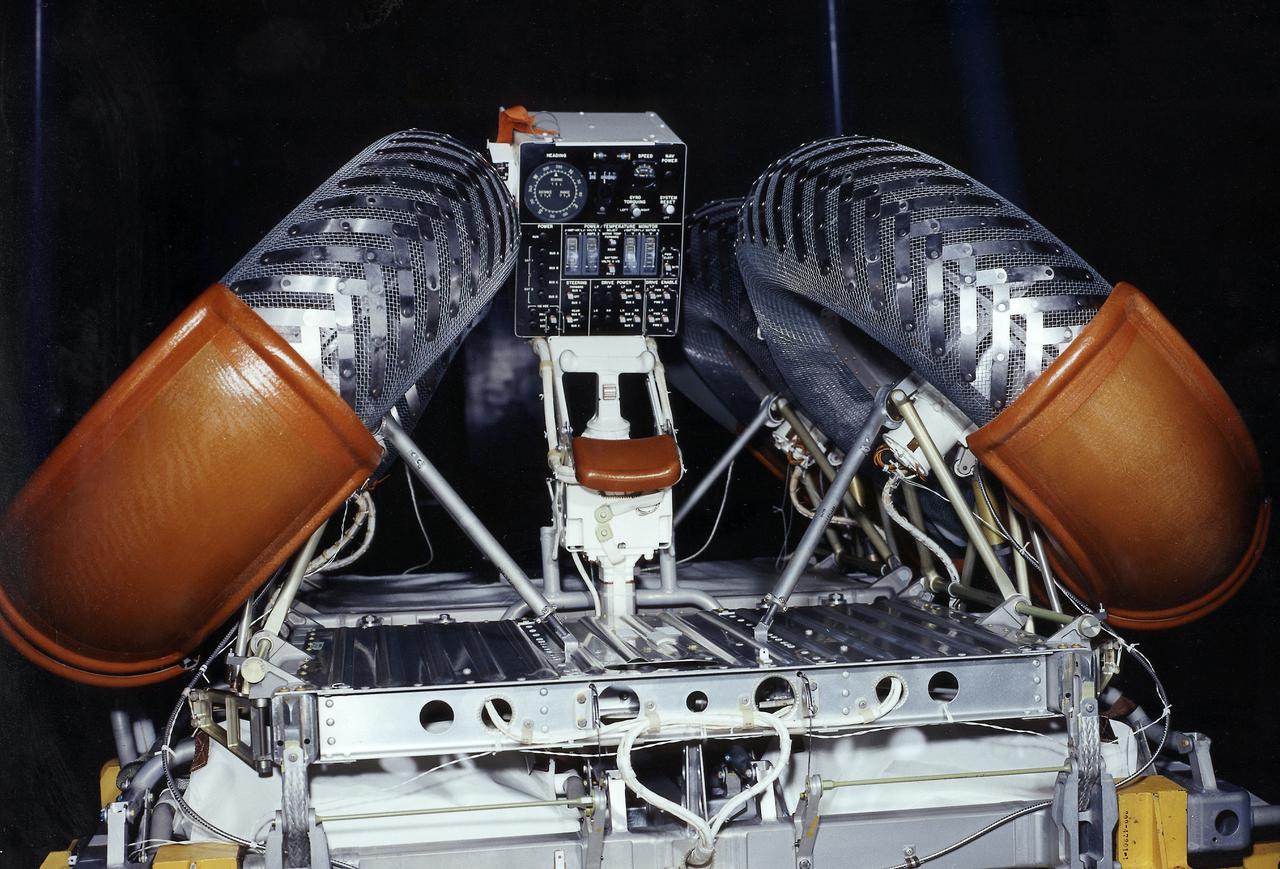
This photograph shows a rear view of a folded configuration of the Lunar Roving Vehicle (LRV) No. 2. The LRV was built to give Apollo astronauts a greater range of mobility during lunar exploration. It was an open-space and collapsible vehicle about 10 feet long with large mesh wheels, anterna, appendages, tool caddies, and camera. An LRV was used on each of the last three Apollo missions; Apollo 15, Apollo 16, and Apollo 17. It was built by the Boeing Company under the direction of the Marshall Space Flight Center.
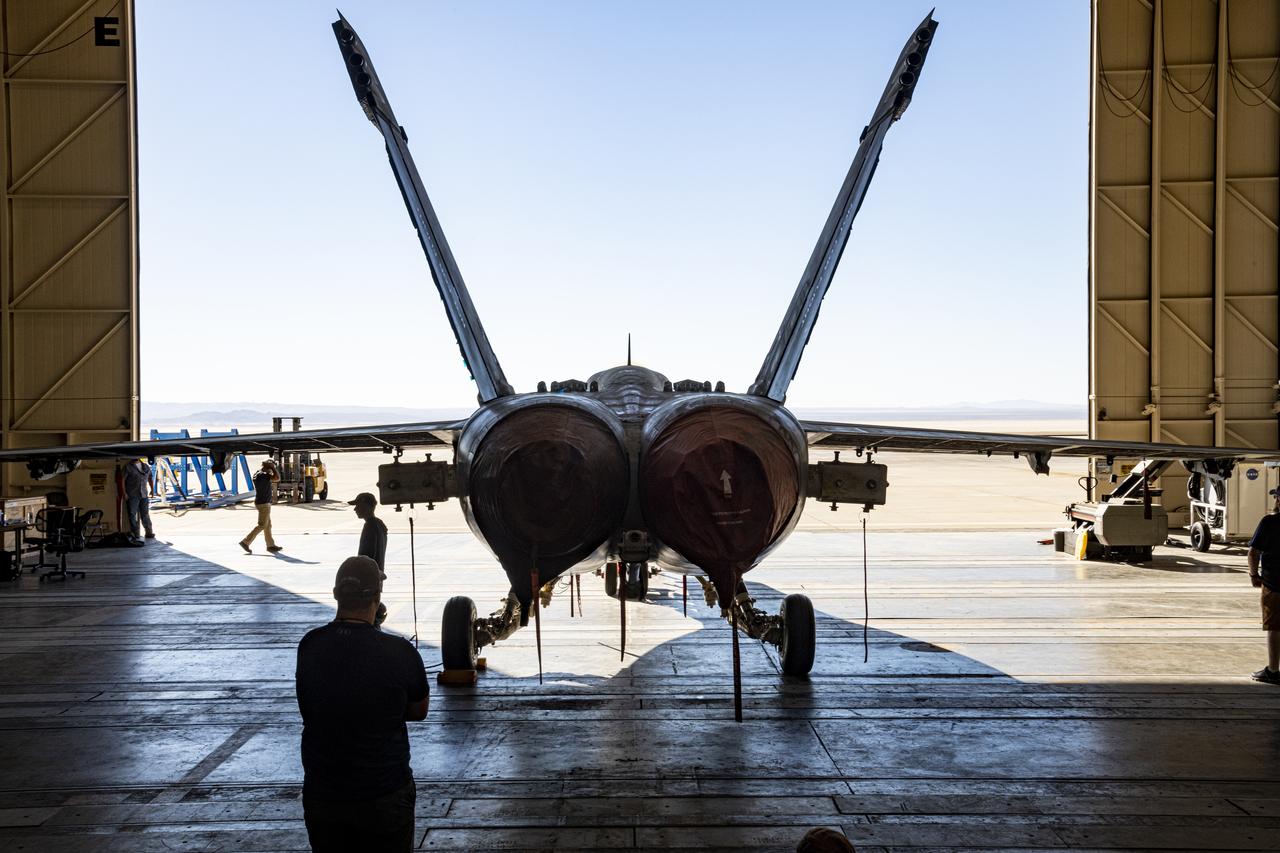
This rear view shows an F/A-18E from the Naval Air Systems Command (NAVAIR) in Patuxent River, Maryland. The aircraft is in NASA’s Armstrong Flight Research Center Flight Loads Laboratory in Edwards, California, where it underwent the center’s biggest load calibrations tests. This testing will permit the aircraft to serve as a test vehicle to determine if it can safely manage maneuvers and proposed upgrades.
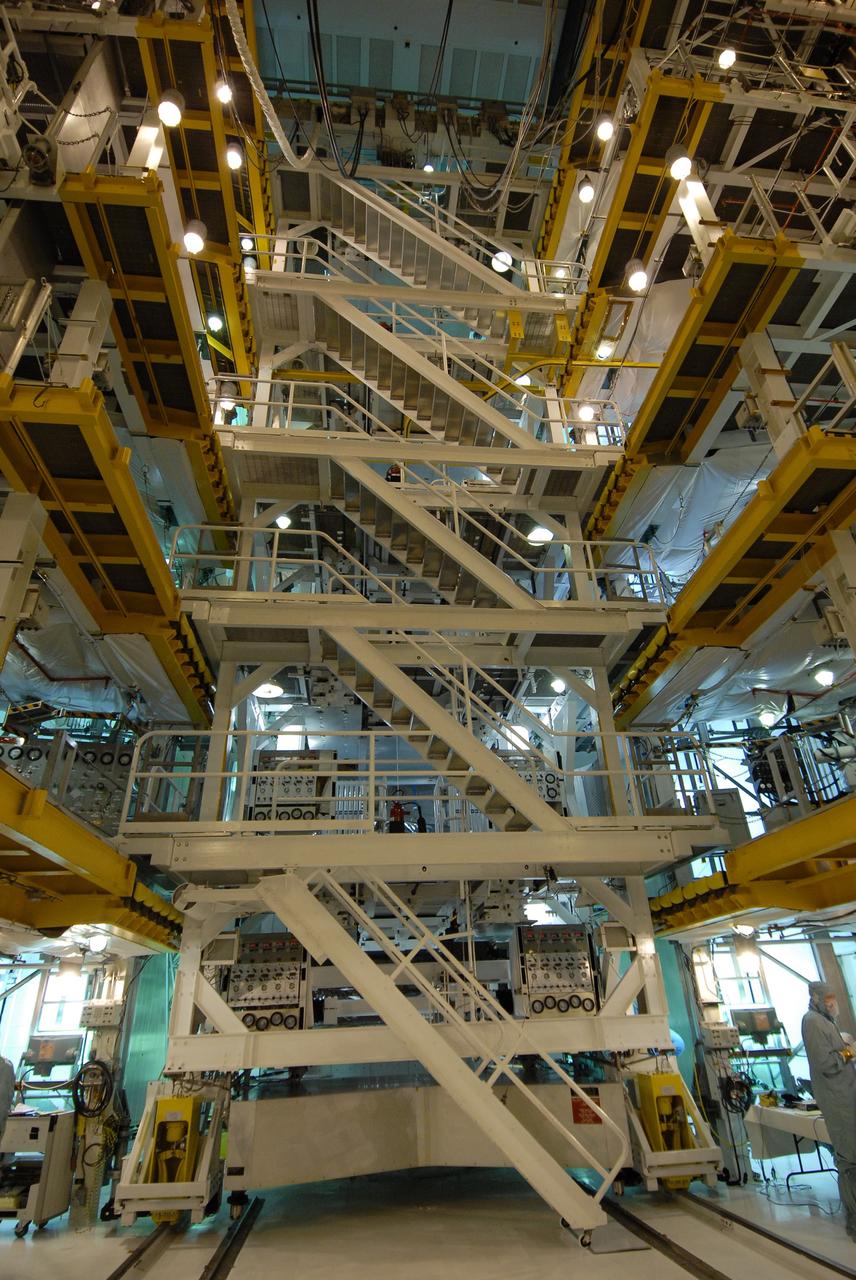
CAPE CANAVERAL, Fla. - In At NASA's Kennedy Space Center in Florida, the payload ground handling mechanism in the Payload Changeout Room on Launch Pad 39A is viewed from the rear as it transfers the STS-125 mission payload into space shuttle Atlantis’ payload bay. STS-125 is the fifth and final shuttle servicing mission for NASA’s Hubble Space Telescope. The payload comprises four carriers holding various equipment for the mission. Atlantis is targeted to launch Oct. 14 on the 11-day mission. Photo credit: NASA/Jack Pfaller
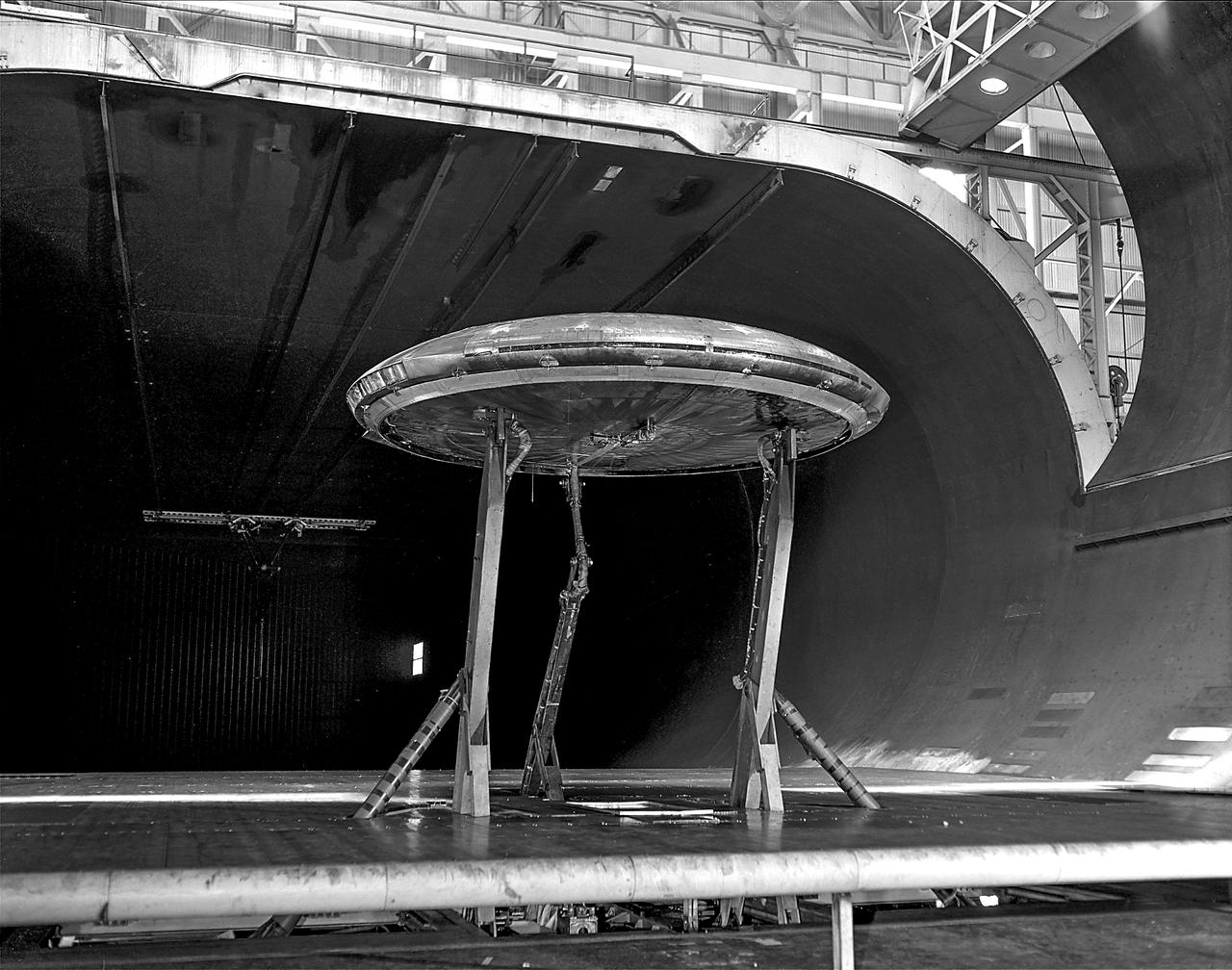
Rear view of the Avrocar with tail, mounted on variable height struts. Overhead doors of the wind tunnel test section open. The first Avrocar, S/N 58-7055 (marked AV-7055), after tethered testing, became the "wind tunnel" test model at NASA Ames, where it remained in storage from 1961 until 1966, when it was donated to the National Air and Space Museum, in Suitland, Maryland.
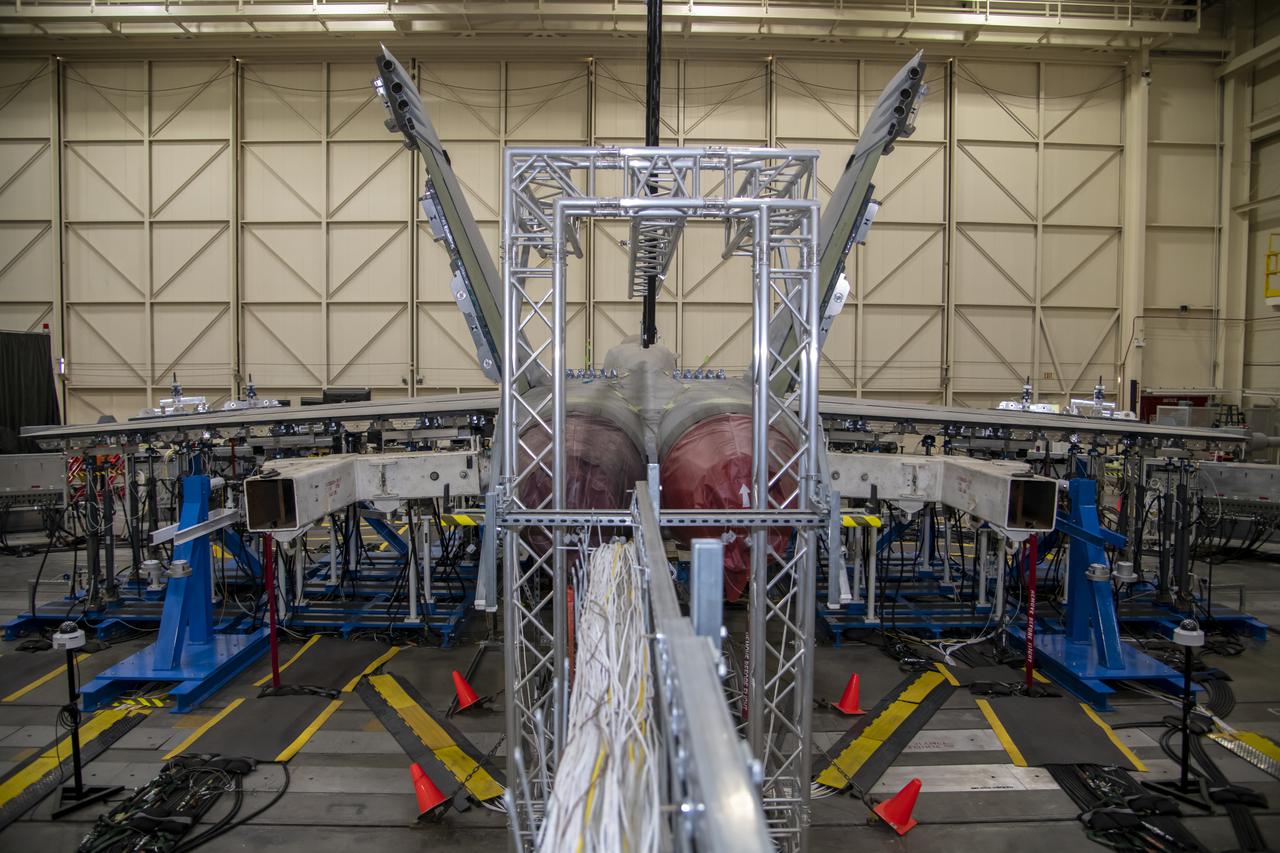
This rear view shows the wing loading test configuration and testing area of an F/A-18E from the Naval Air Systems Command (NAVAIR) in Patuxent River, Maryland. The aircraft is in NASA's Armstrong Flight Research Center Flight Loads Laboratory in Edwards, California, for the center's biggest load calibrations tests. This testing is needed before the aircraft can serve as a test vehicle for determining if it can safely manage maneuvers and proposed upgrades
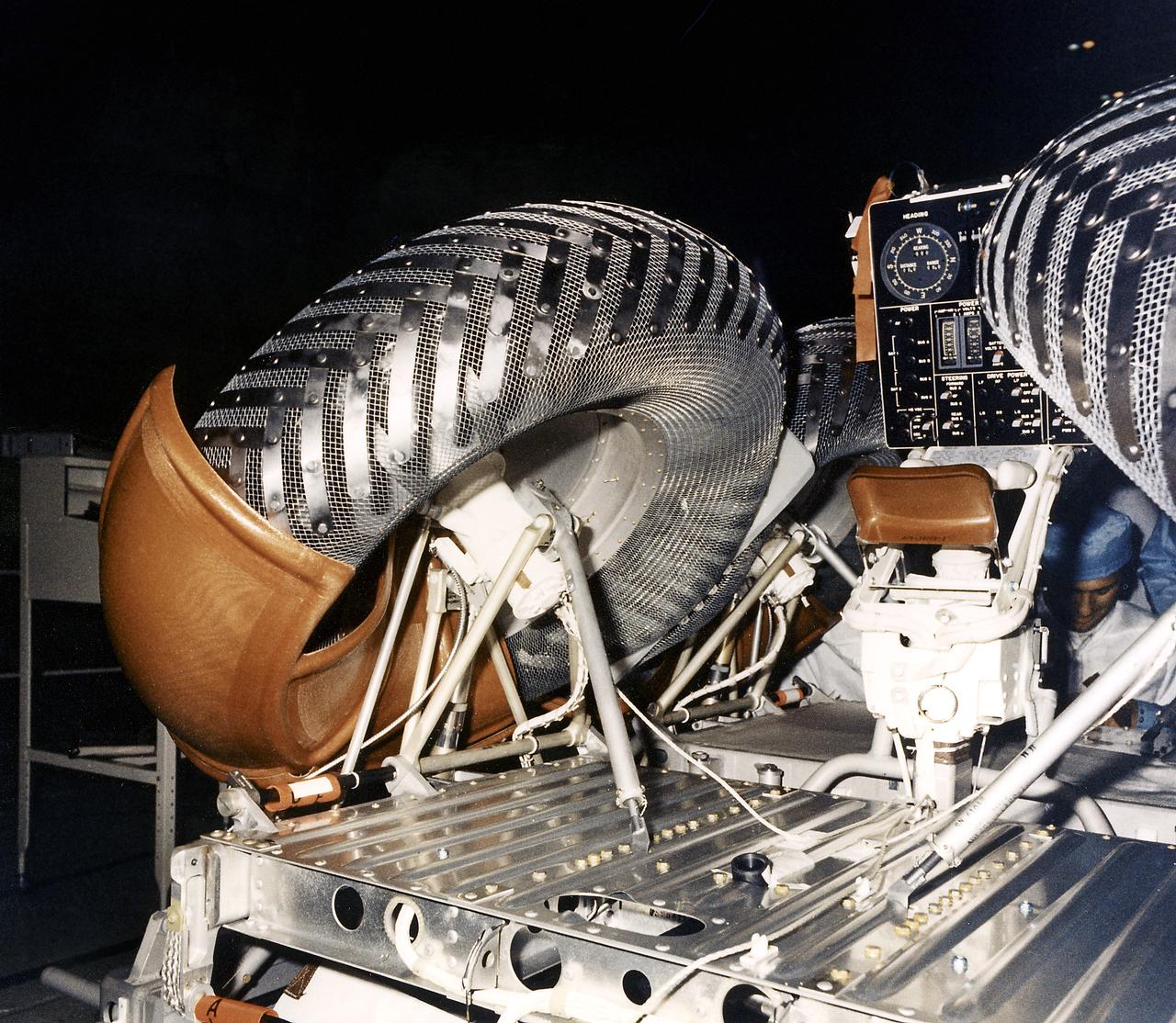
This is a close-up view of a right rear wheel strut of the Lunar Roving Vehicle (LRV) No. 1. The LRV was built to give Apollo astronauts a greater range of mobility during lunar exploration. It was an open-space and collapsible vehicle about 10 feet long with large mesh wheels, anterna, appendages, tool caddies, and camera. An LRV was used on each of the last three Apollo missions; Apollo 15, Apollo 16, and Apollo 17. It was built by the Boeing Company under the direction of the Marshall Space Flight Center.
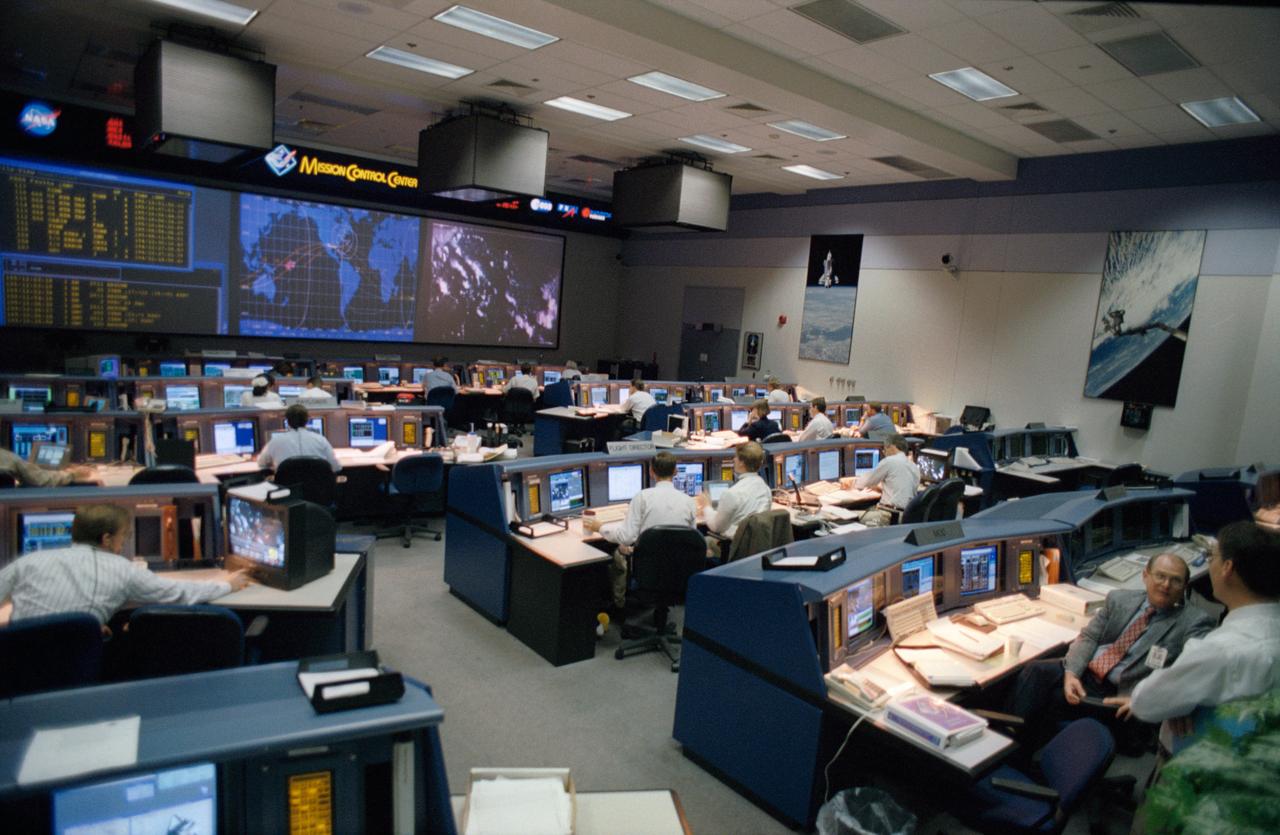
S95-16439 (13-22 July 1995) --- An overall view from the rear shows activity in the new Mission Control Center (MCC), opened for operation and dedicated during the STS-70 mission. The new MCC, developed at a cost of about 50 million, replaces the main-frame based, NASA-unique design of the old Mission Control with a standard workstation-based, local area network system commonly in use today.
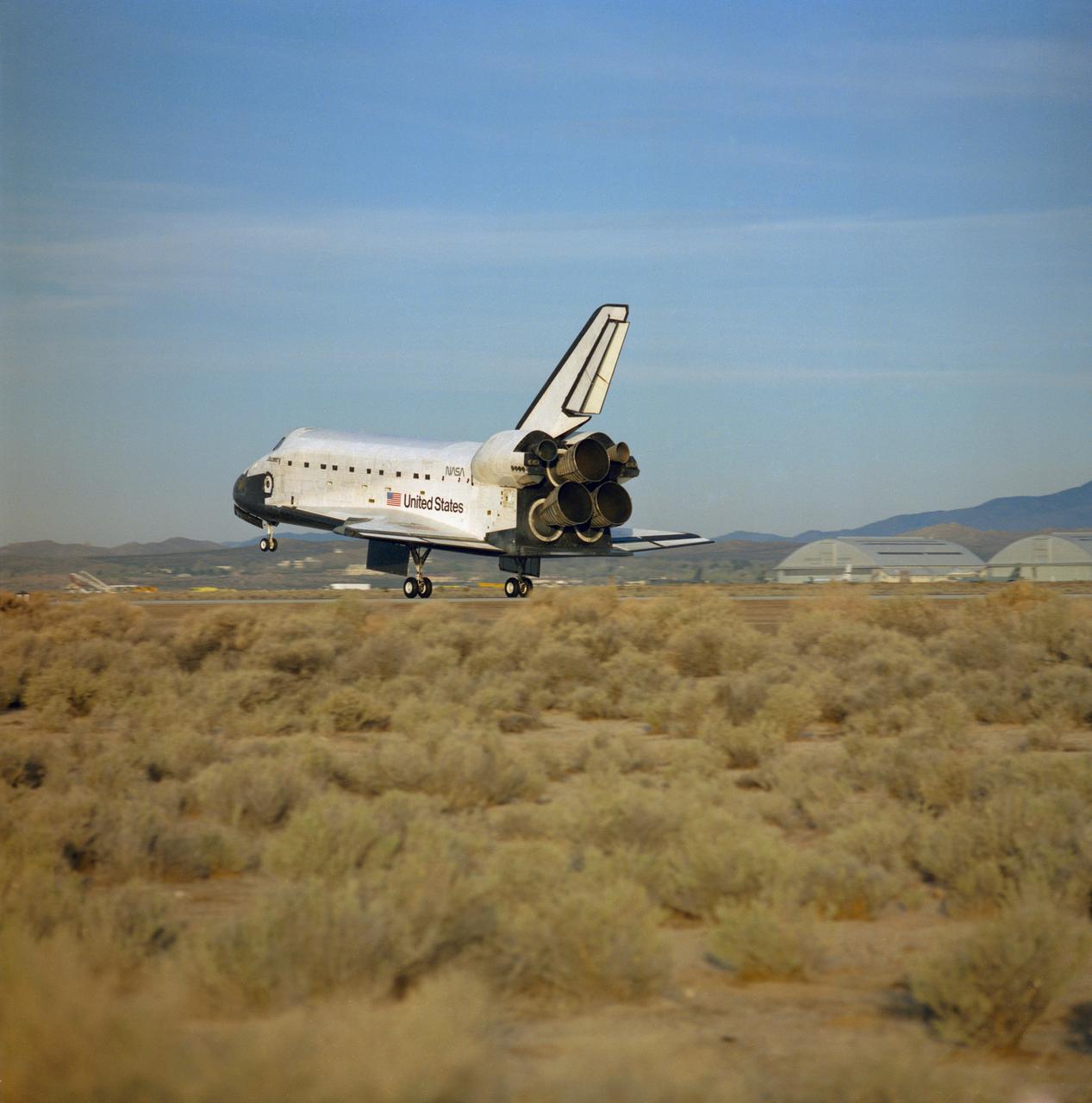
STS029-S-064 (18 Mar 1989) --- A rear view photographed from the ground just after Discovery's main landing gear touches down on Runway 22 at Edwards Air Force Base in California following a successful five-day mission in Earth orbit. Onboard the spacecraft were Astronauts Michael L. Coats, John E. Blaha, James F. Buchli, Robert C. Springer and James P. Bagian. Wheels came to a stop at 6:36:40 a.m. (PST), March 18, 1989.
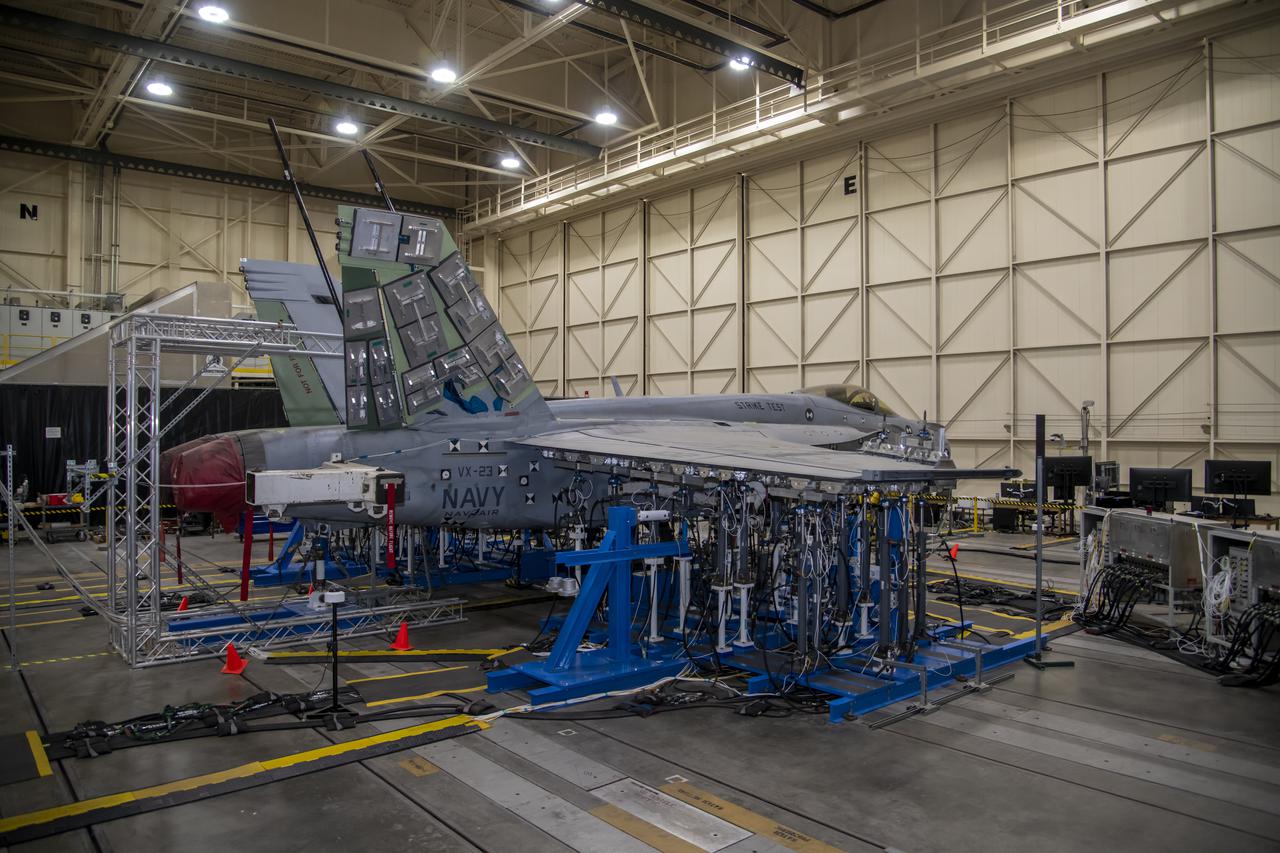
This rear view of the right wing load hardware shows the setup for testing a F/A-18E from the Naval Air Systems Command (NAVAIR) in Patuxent River, Maryland. The aircraft is in NASA's Armstrong Flight Research Center Flight Loads Laboratory in Edwards, California, for the center's biggest load calibrations tests. This testing is needed before the aircraft can serve as a test vehicle for determining if it can safely manage maneuvers and proposed upgrades.
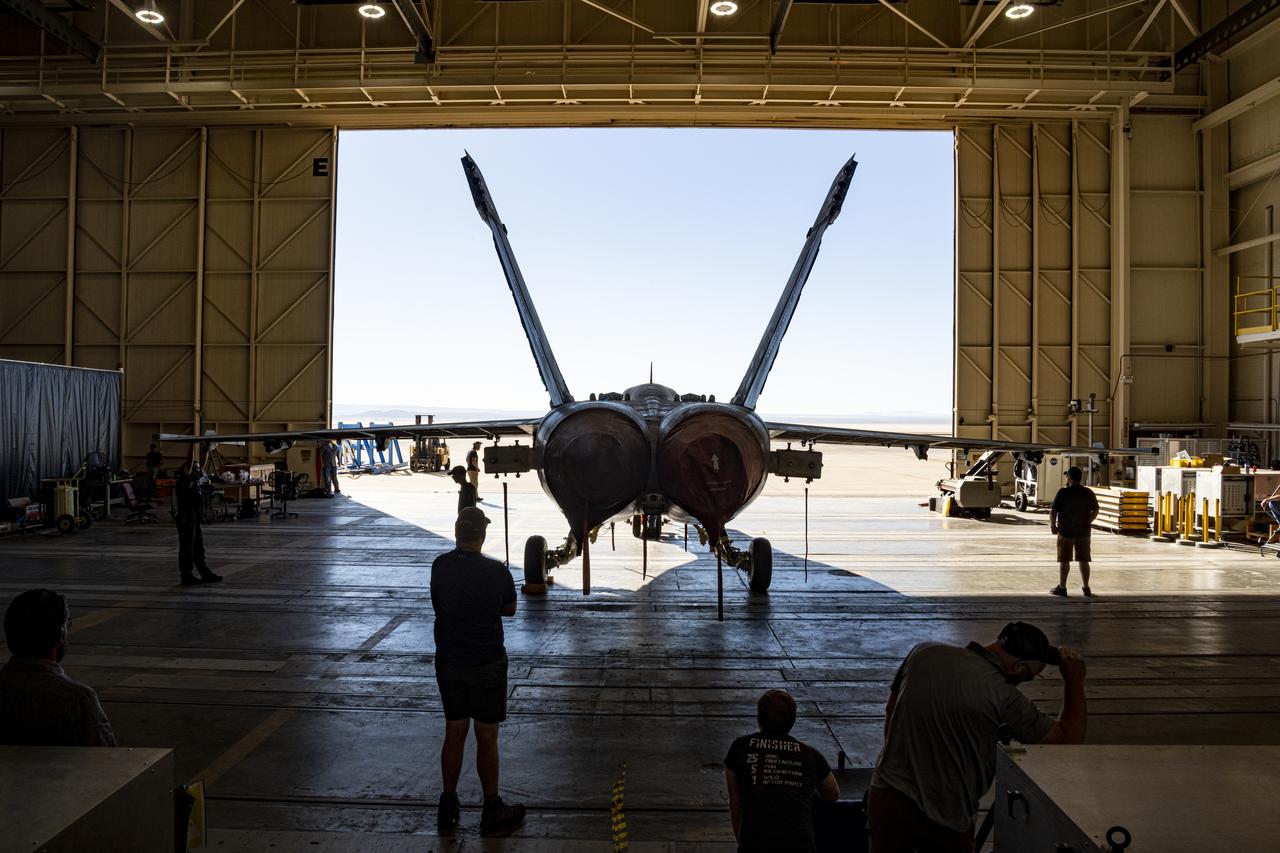
This rear view shows an F/A-18E from the Naval Air Systems Command (NAVAIR) in Patuxent River, Maryland. The aircraft is in NASA’s Armstrong Flight Research Center Flight Loads Laboratory in Edwards, California, where it underwent the center’s biggest load calibrations tests. This testing will permit the aircraft to serve as a test vehicle to determine if it can safely manage maneuvers and proposed upgrades.
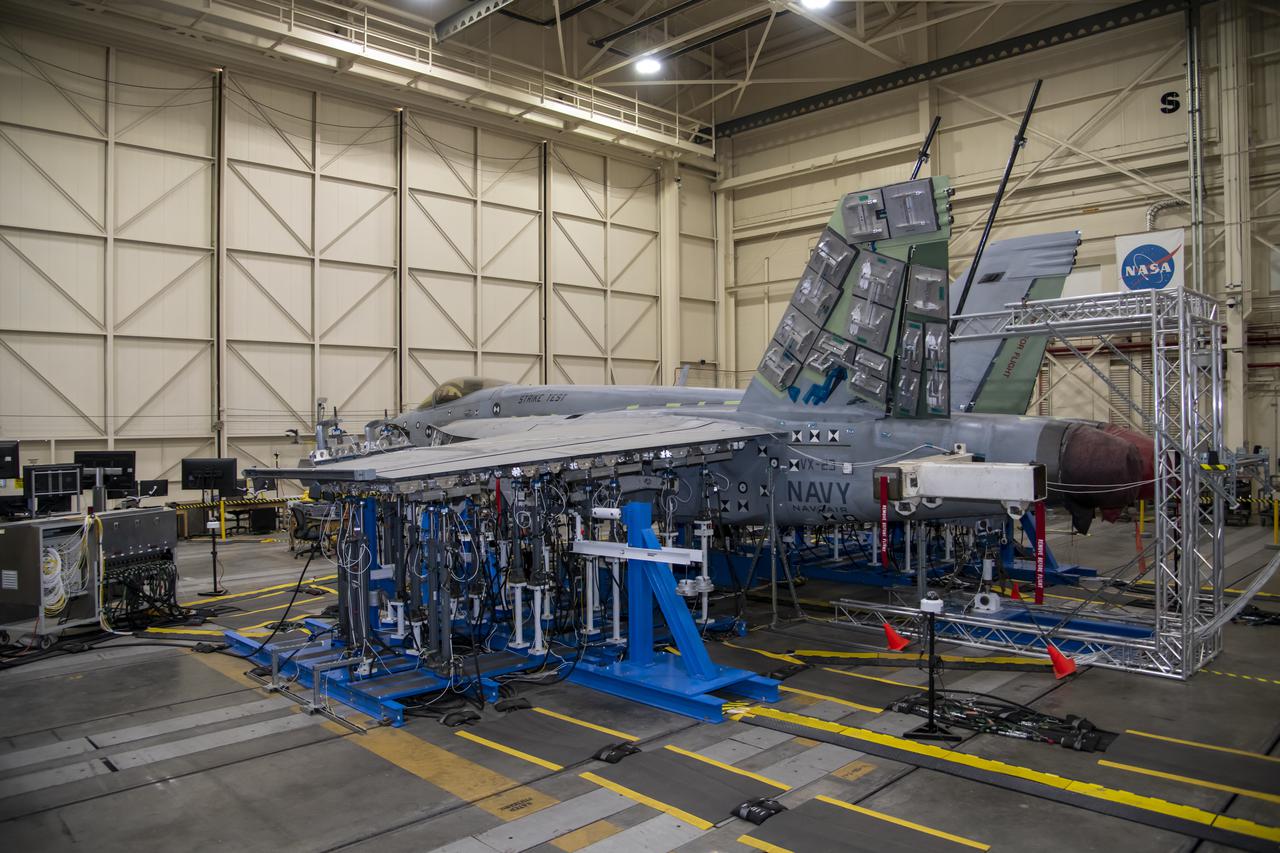
This rear view of the left wing load hardware shows the setup for testing a F/A-18E from the Naval Air Systems Command (NAVAIR) in Patuxent River, Maryland. The aircraft is in NASA's Armstrong Flight Research Center Flight Loads Laboratory in Edwards, California, for the center's biggest load calibrations tests. This testing is needed before the aircraft can serve as a test vehicle for determining if it can safely manage maneuvers and proposed upgrades.Â
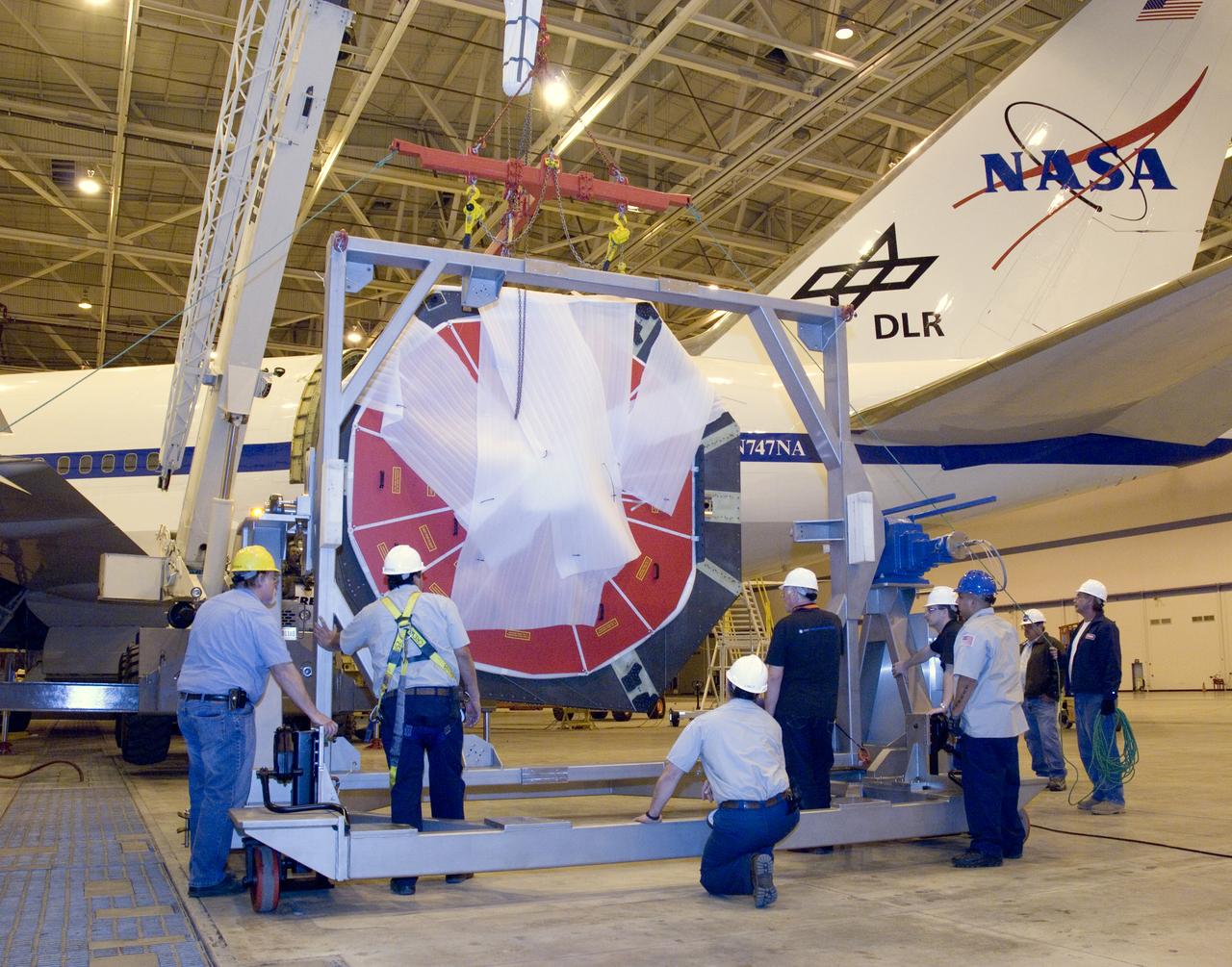
Technicians at the NASA Dryden Aircraft Operations Facility in Palmdale, Calif., removed the German-built primary mirror assembly from the Stratospheric Observatory for Infrared Astronomy, or SOFIA, April 18, 2008 in preparation for the final finish coating of the mirror. A precision crane lifted the more than two-ton mirror assembly from its cavity in the rear fuselage of the highly modified Boeing 747SP. The assembly was then secured in its transport dolly and moved to a clean room where it was prepared for shipment to NASA Ames Research Center at Moffett Field near Mountain View, Calif. where it would receive its aluminized finish coating before being re-installed in the SOFIA aircraft.
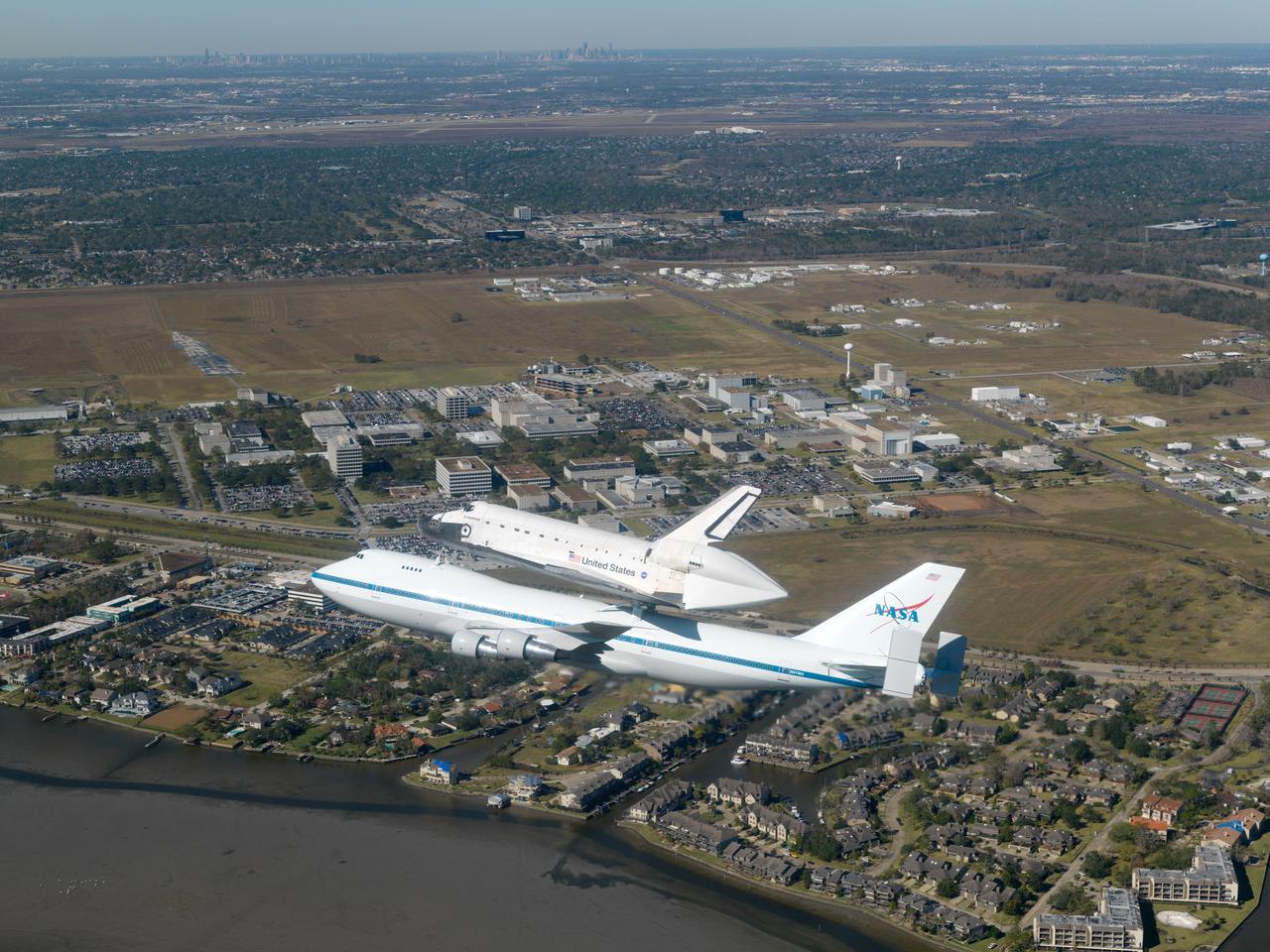
JSC2008-E-154359 (11 Dec. 2008) --- The Space Shuttle Endeavour flies over the Clear Lake area and the Johnson Space Center after having spent the night at a stopover in Tarrant County, while mounted on a modified Boeing 747 shuttle carrier aircraft. Endeavour landed in California on Nov. 30 and was en route back to Florida. This photo, taken from the rear station of a NASA T-38 aircraft, shows the main part of the 1625-acre JSC site. The extremely clear weather allows viewing all the way to Houston's central business district. Harris County Domed Stadium and the Houston NFL franchise's stadium are visible in the upper left quadrant of the photo.
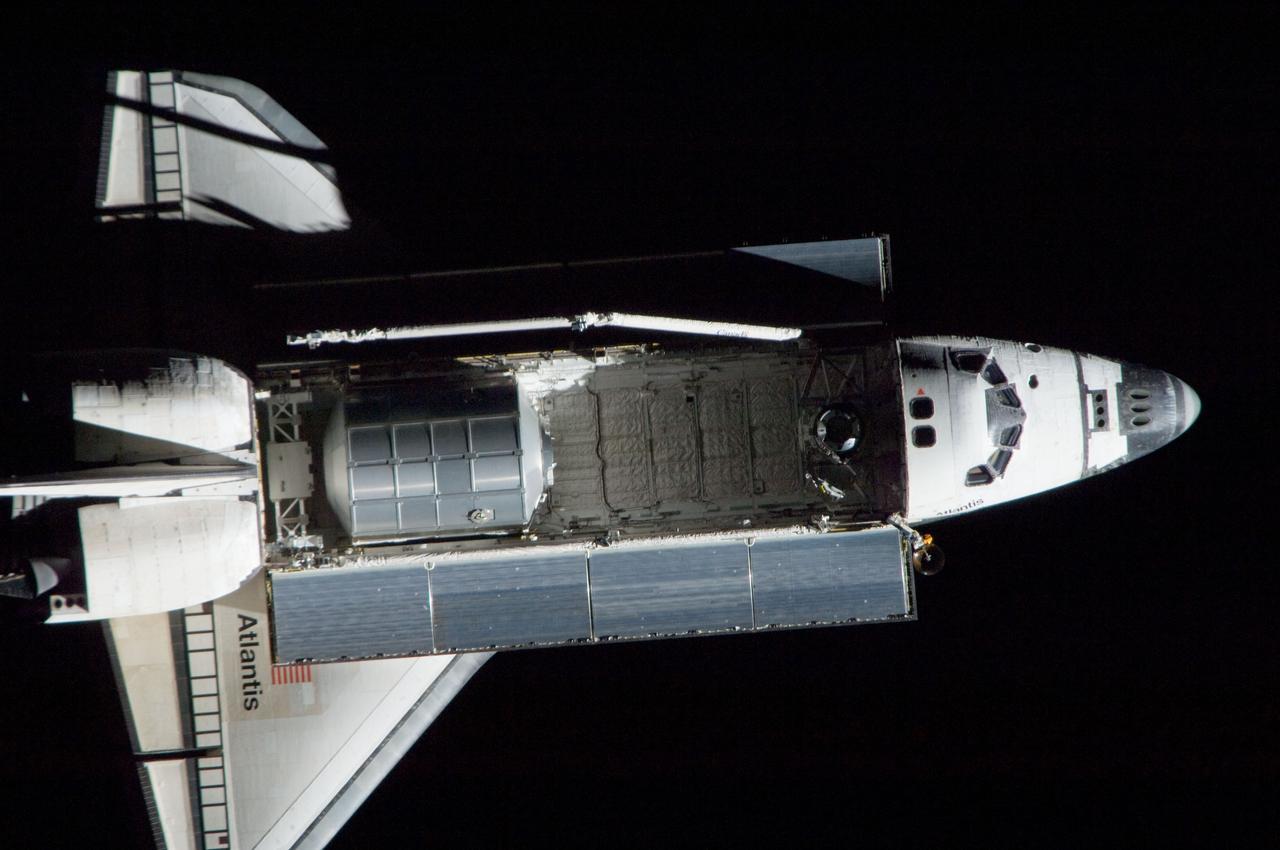
ISS028-E-015374 (10 July 2011) --- A nadir view of the space shuttle Atlantis and its payload is provided by one of a series of images showing various parts of the shuttle in Earth orbit. Seen at the rear of the cargo bay is the Raffaello multi-purpose logistics module, packed with supplies and spare parts for the International Space Station. The series was photographed by one of three crewmembers -- half the station crew -- who were equipped with still cameras on the orbiting outpost as the shuttle “posed” for photo and visual surveys and performed a back-flip for the rendezvous pitch maneuver (RPM). An 800 millimeter lens was used to capture this particular series of images.
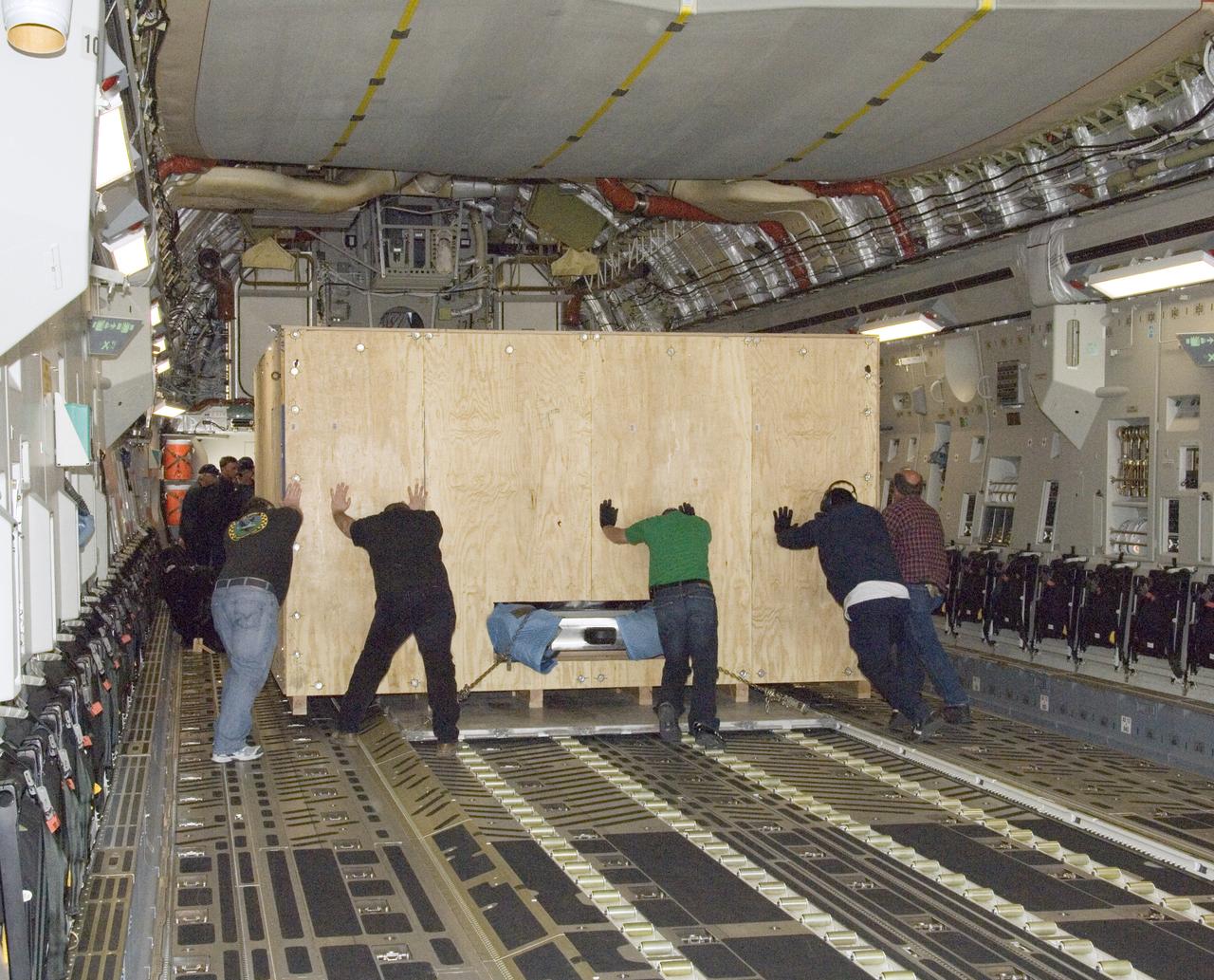
Technicians at NASA's Dryden Aircraft Operations Facility in Palmdale, Calif., loaded the German-built primary mirror assembly of the Stratospheric Observatory for Infrared Astronomy, or SOFIA, onto an Air Force C-17 for shipment to NASA's Ames Research Center on May 1, 2008. In preparation for the final finish coating of the mirror, the more than two-ton mirror assembly had been removed from its cavity in the rear fuselage of the highly modified SOFIA Boeing 747SP two weeks earlier. After arrival at NASA Ames at Moffett Field near Mountain View, Calif., the mirror would receive its aluminized finish coating before being re-installed in the SOFIA aircraft.
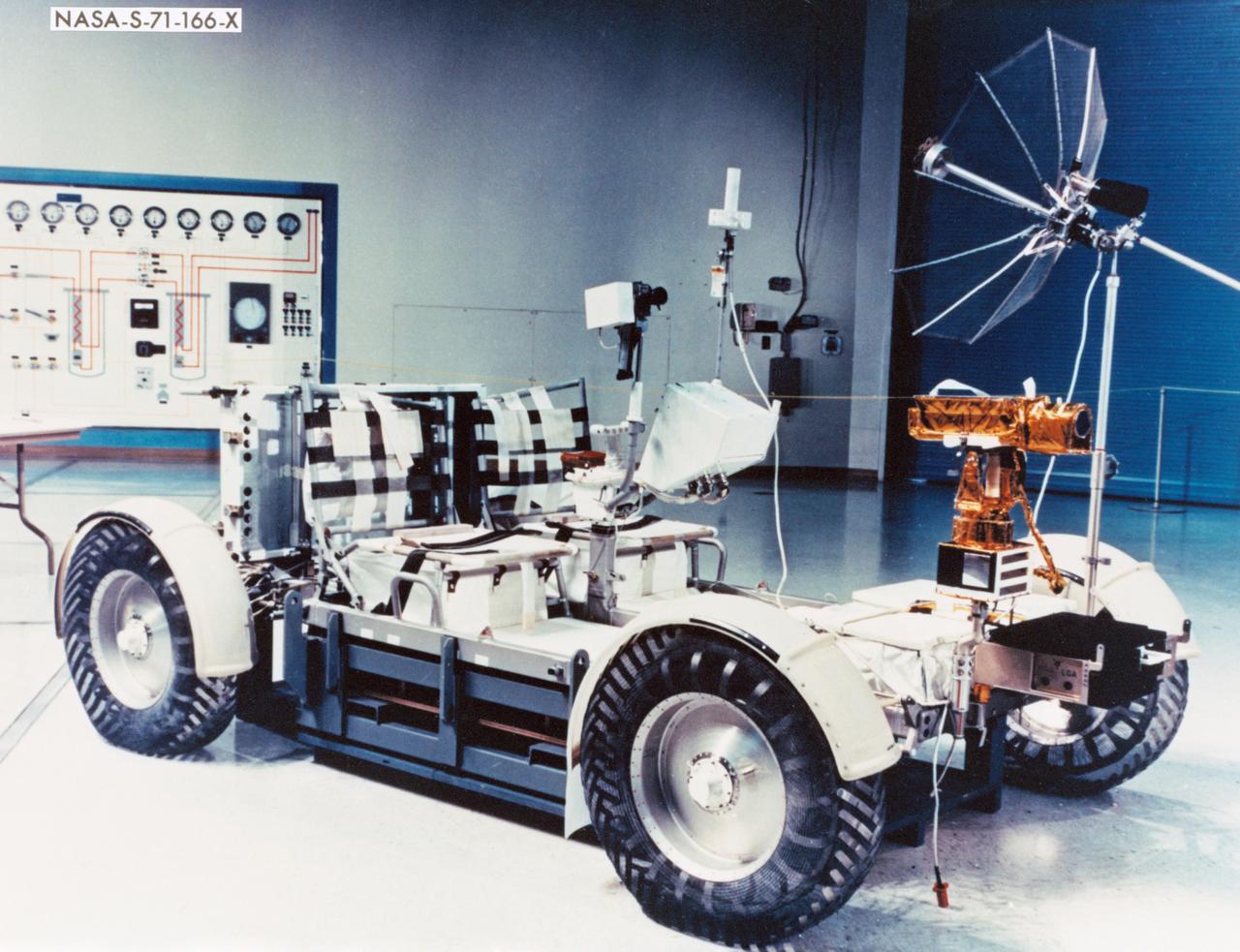
S71-00166 (June 1971) --- A close-up view of the Lunar Roving Vehicle (LRV). Apollo 15 will be the first mission to employ the services of the LRV. Astronauts David R. Scott, commander; and James B. Irwin, lunar module pilot, will move about the lunar surface in the Hadley-Apennine region in their four-wheeled vehicle while astronaut Alfred M. Worden, command module pilot, remains with the Command and Service Modules (CSM) in lunar orbit. A television camera, which can be controlled remotely from the ground (front), and a motion picture camera (rear) are among the gear on the LRV.
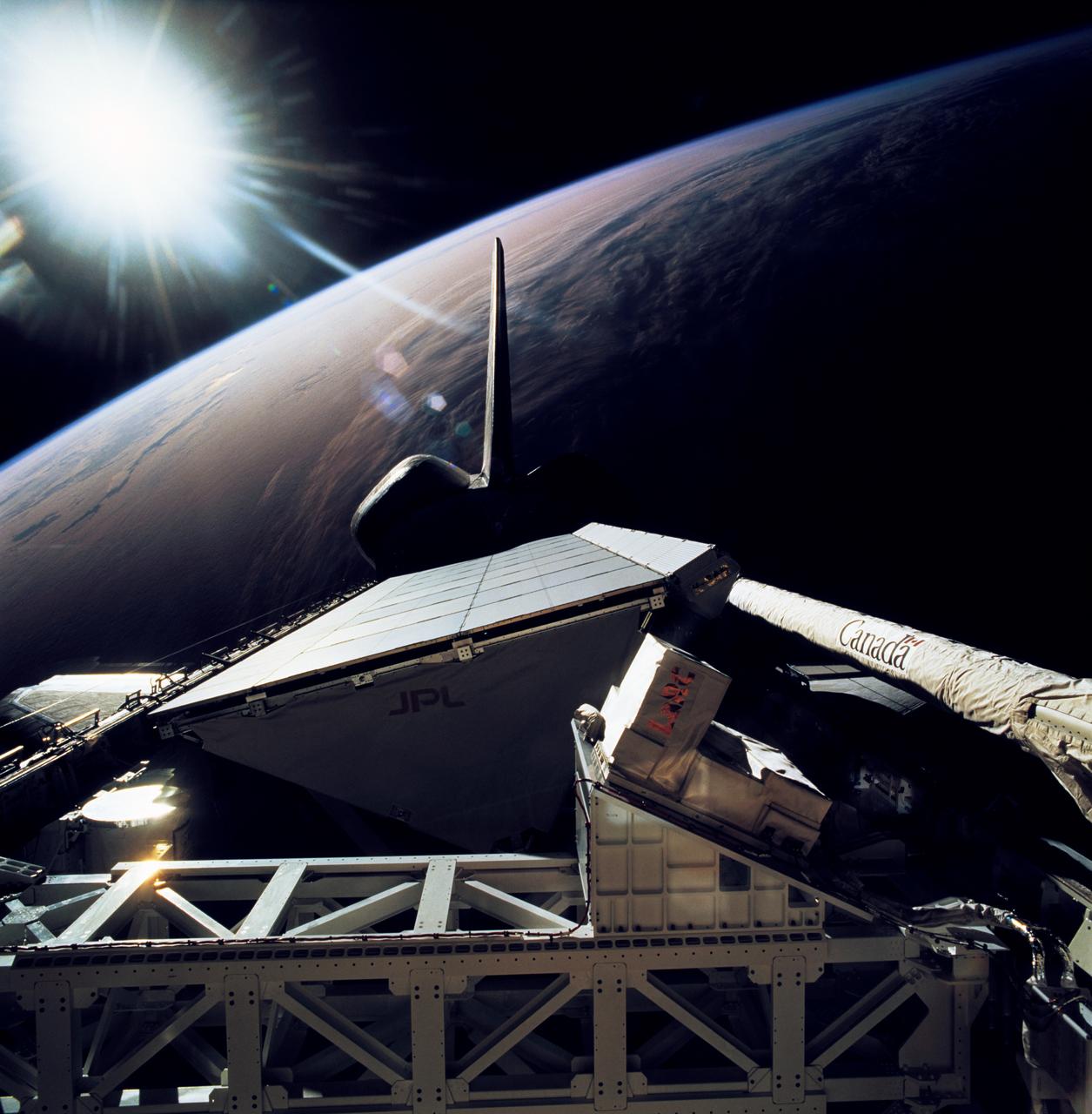
STS068-267-079 (30 September-11 October 1994) --- The rear windows of the Space Shuttle Endeavour reflect sunlight in this view of part of the cargo bay, 115 nautical miles above the Earth. The Space Radar Laboratory (SRL-2) Multipurpose Experiment Support Structure (MPESS) is seen at bottom frame. Also partially seen are other experiments including other components of the primary payload. They are the antenna for the Spaceborne Imaging Radar (SIR-C), the X-band Synthetic Aperture Radar (X-SAR), the device for Measurement of Air Pollution from Satellites (MAPS) and some Getaway Special (GAS) canisters.
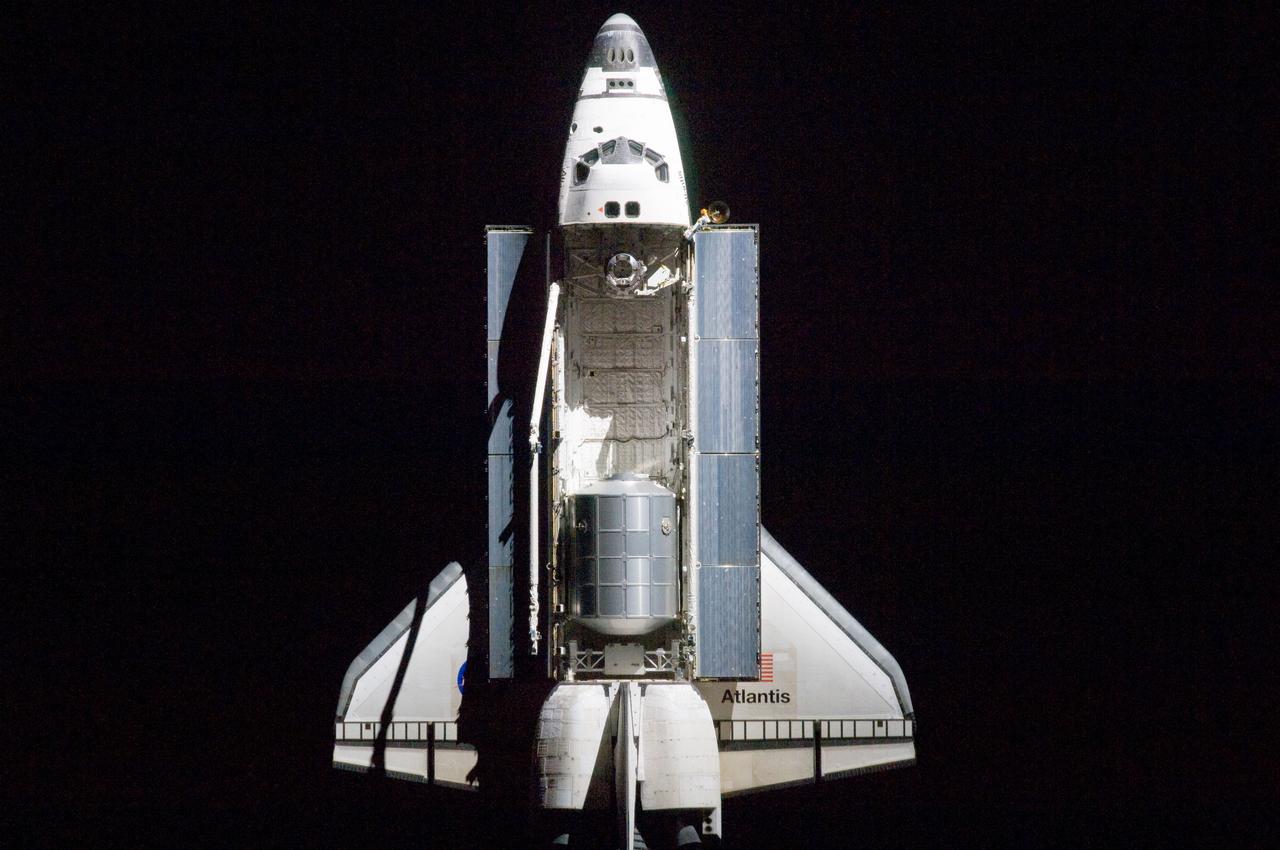
ISS028-E-015556 (10 July 2011) --- A nadir view of the space shuttle Atlantis and its payload was provided by one of a series of images showing various parts of the shuttle in Earth orbit. Seen at the rear of the cargo bay is the Raffaello multi-purpose logistics module, packed with supplies and spare parts for the International Space Station. The series was photographed by one of three crewmembers -- half the station crew -- who were equipped with still cameras on the orbiting outpost as the shuttle “posed” for photos and visual surveys and performed a back-flip for the rendezvous pitch maneuver (RPM). A 400 millimeter lens was used to capture this particular series of images.
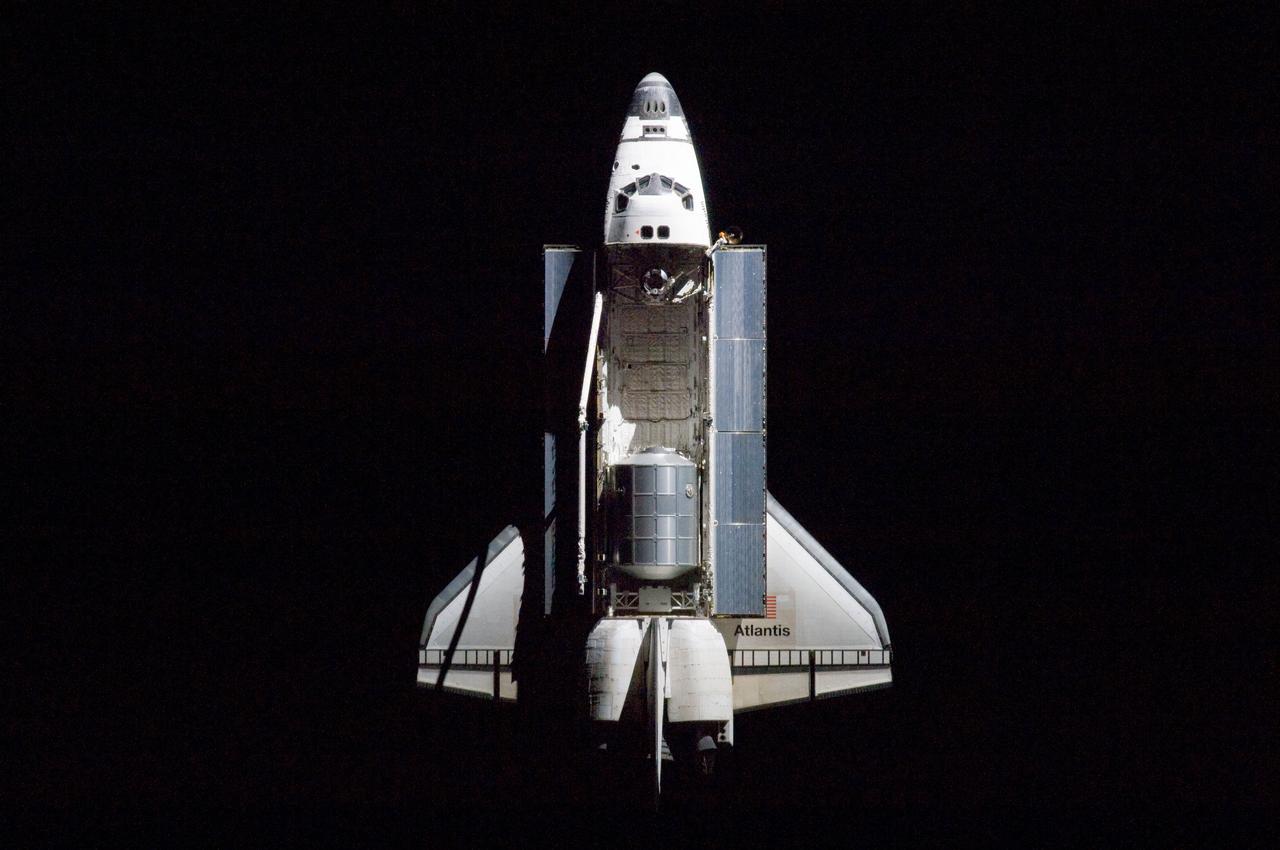
ISS028-E-015554 (10 July 2011) --- A nadir view of the space shuttle Atlantis and its payload was provided by one of a series of images showing various parts of the shuttle in Earth orbit. Seen at the rear of the cargo bay is the Raffaello multi-purpose logistics module, packed with supplies and spare parts for the International Space Station. The series was photographed by one of three crewmembers -- half the station crew -- who were equipped with still cameras on the orbiting outpost as the shuttle “posed” for photos and visual surveys and performed a back-flip for the rendezvous pitch maneuver (RPM). A 400 millimeter lens was used to capture this particular series of images.
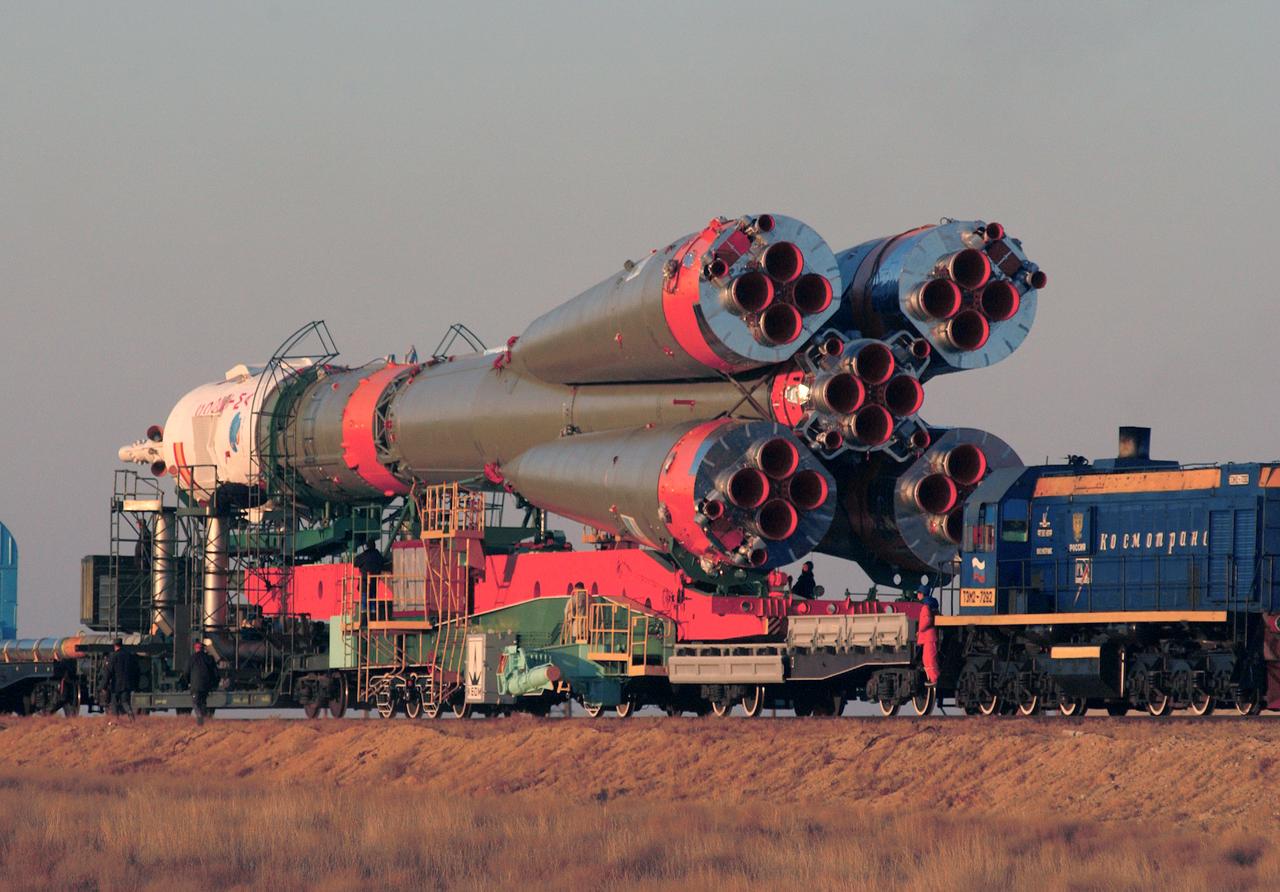
The Soyuz TMA-3 spacecraft and its booster rocket (rear view) is shown on a rail car for transport to the launch pad where it was raised to a vertical launch position at the Baikonur Cosmodrome, Kazakhstan on October 16, 2003. Liftoff occurred on October 18th, transporting a three man crew to the International Space Station (ISS). Aboard were Michael Foale, Expedition-8 Commander and NASA science officer; Alexander Kaleri, Soyuz Commander and flight engineer, both members of the Expedition-8 crew; and European Space agency (ESA) Astronaut Pedro Duque of Spain. Photo Credit: "NASA/Bill Ingalls"
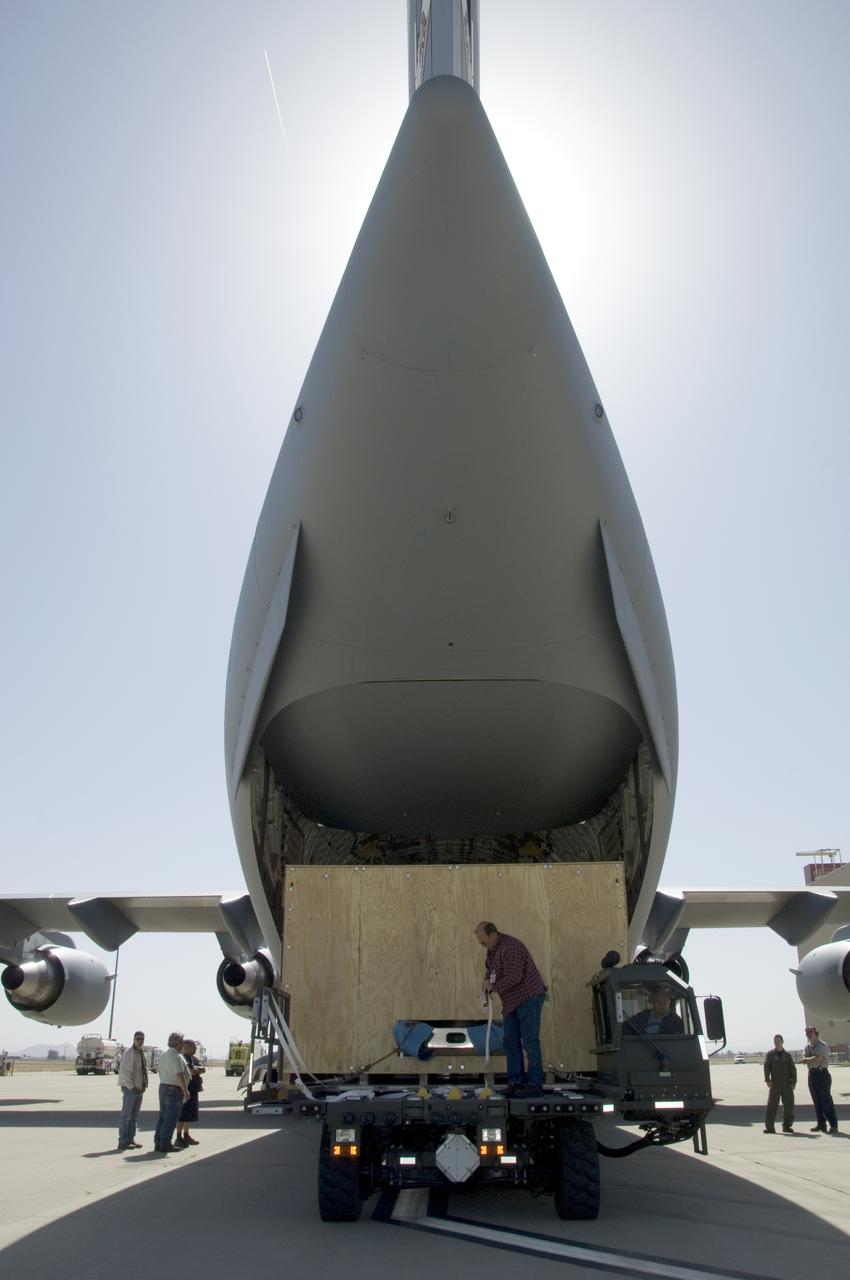
Technicians at NASA's Dryden Aircraft Operations Facility in Palmdale, Calif., loaded the German-built primary mirror assembly of the Stratospheric Observatory for Infrared Astronomy, or SOFIA, onto an Air Force C-17 for shipment to NASA's Ames Research Center on May 1, 2008. In preparation for the final finish coating of the mirror, the more than two-ton mirror assembly had been removed from its cavity in the rear fuselage of the highly modified SOFIA Boeing 747SP two weeks earlier. After arrival at NASA Ames at Moffett Field near Mountain View, Calif., the mirror would receive its aluminized finish coating before being re-installed in the SOFIA aircraft.
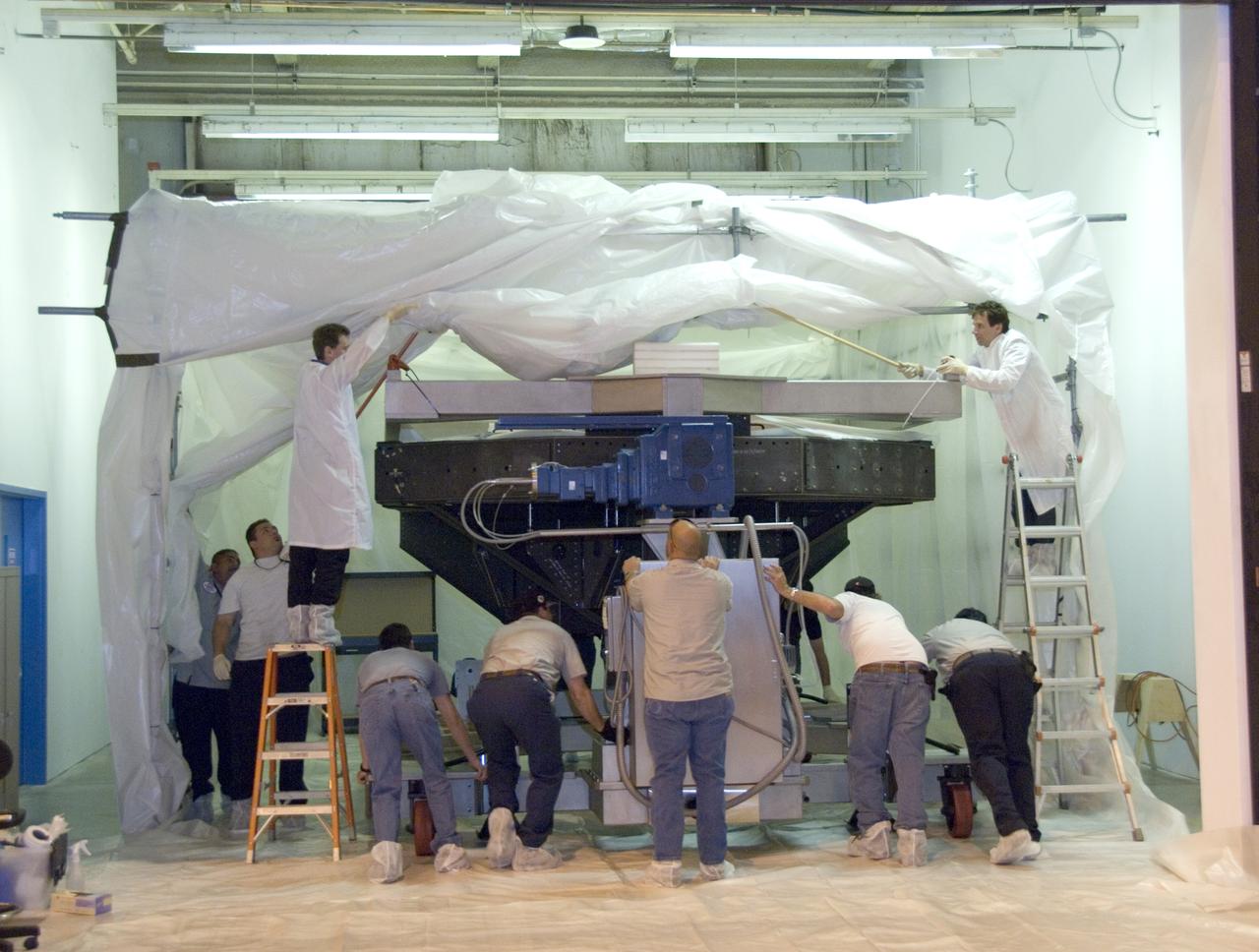
Technicians at the NASA Dryden Aircraft Operations Facility in Palmdale, Calif., removed the German-built primary mirror assembly from the Stratospheric Observatory for Infrared Astronomy, or SOFIA, April 18, 2008 in preparation for the final finish coating of the mirror. A precision crane lifted the more than two-ton mirror assembly from its cavity in the rear fuselage of the highly modified Boeing 747SP. The assembly was then secured in its transport dolly and moved to a clean room where it was prepared for shipment to NASA Ames Research Center at Moffett Field near Mountain View, Calif. where it would receive its aluminized finish coating before being re-installed in the SOFIA aircraft.
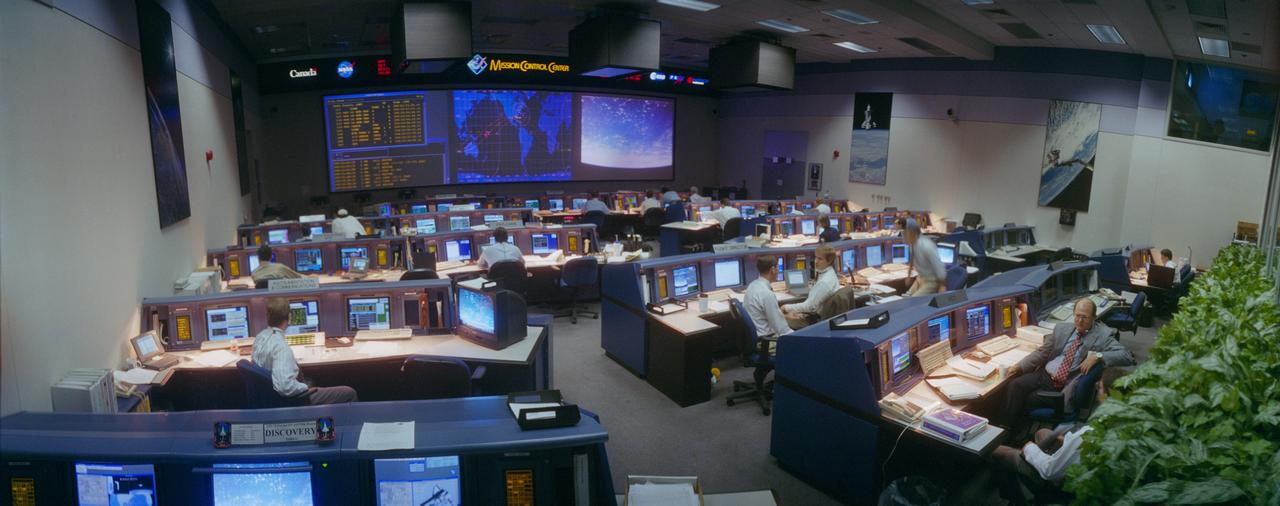
S95-16445 (13-22 July 1995) --- A wide angle view from the rear shows activity in the new Mission Control Center (MCC), opened for operation and dedicated during the STS-70 mission. The Space Shuttle Discovery was just passing over Florida at the time this photo was taken (note mercator map and TV scene on screens). The new MCC, developed at a cost of about 50 million, replaces the main-frame based, NASA-unique design of the old Mission Control with a standard workstation-based, local area network system commonly in use today.
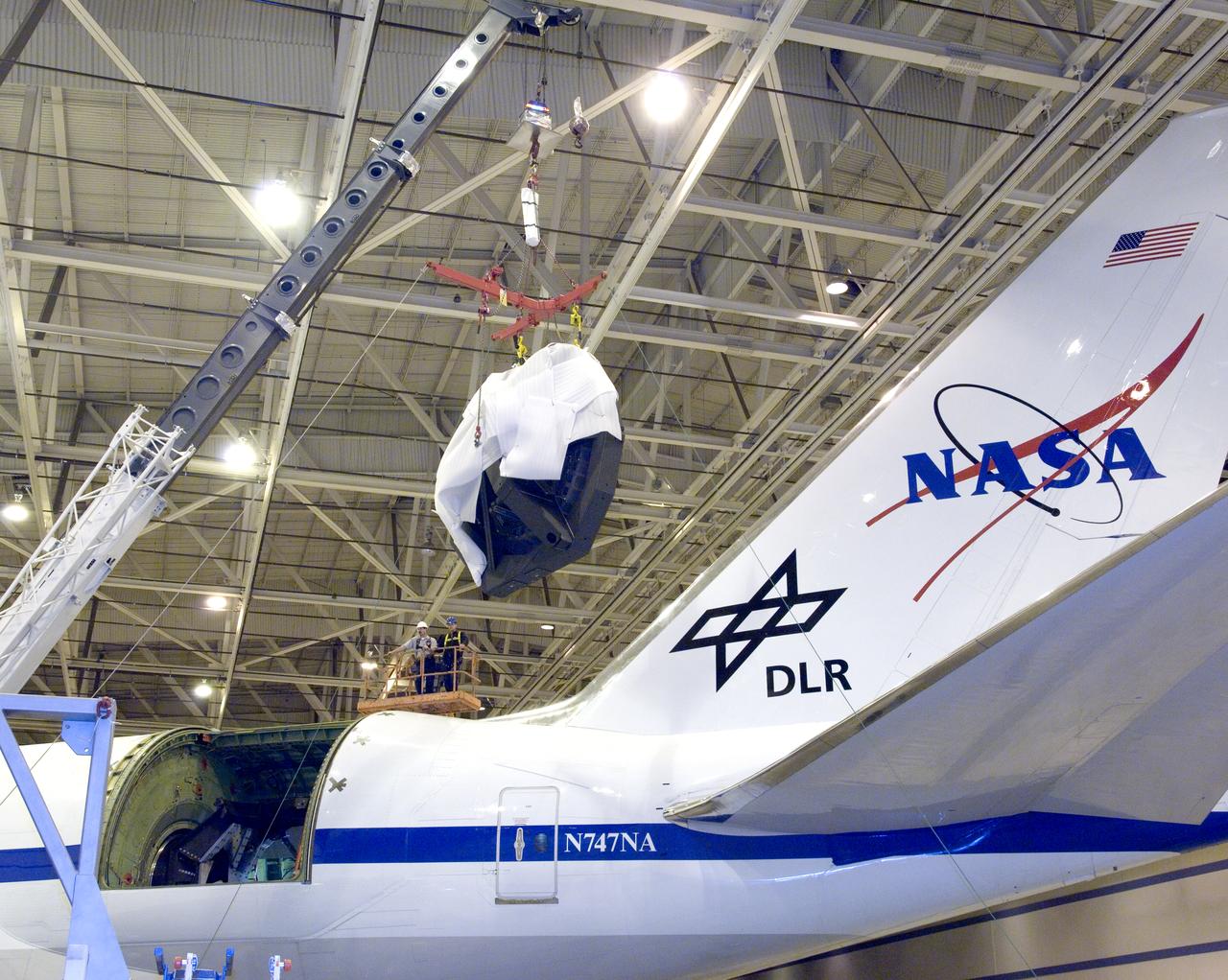
Technicians at the NASA Dryden Aircraft Operations Facility in Palmdale, Calif., removed the German-built primary mirror assembly from the Stratospheric Observatory for Infrared Astronomy, or SOFIA, April 18, 2008 in preparation for the final finish coating of the mirror. A precision crane lifted the more than two-ton mirror assembly from its cavity in the rear fuselage of the highly modified Boeing 747SP. The assembly was then secured in its transport dolly and moved to a clean room where it was prepared for shipment to NASA Ames Research Center at Moffett Field near Mountain View, Calif. where it would receive its aluminized finish coating before being re-installed in the SOFIA aircraft.
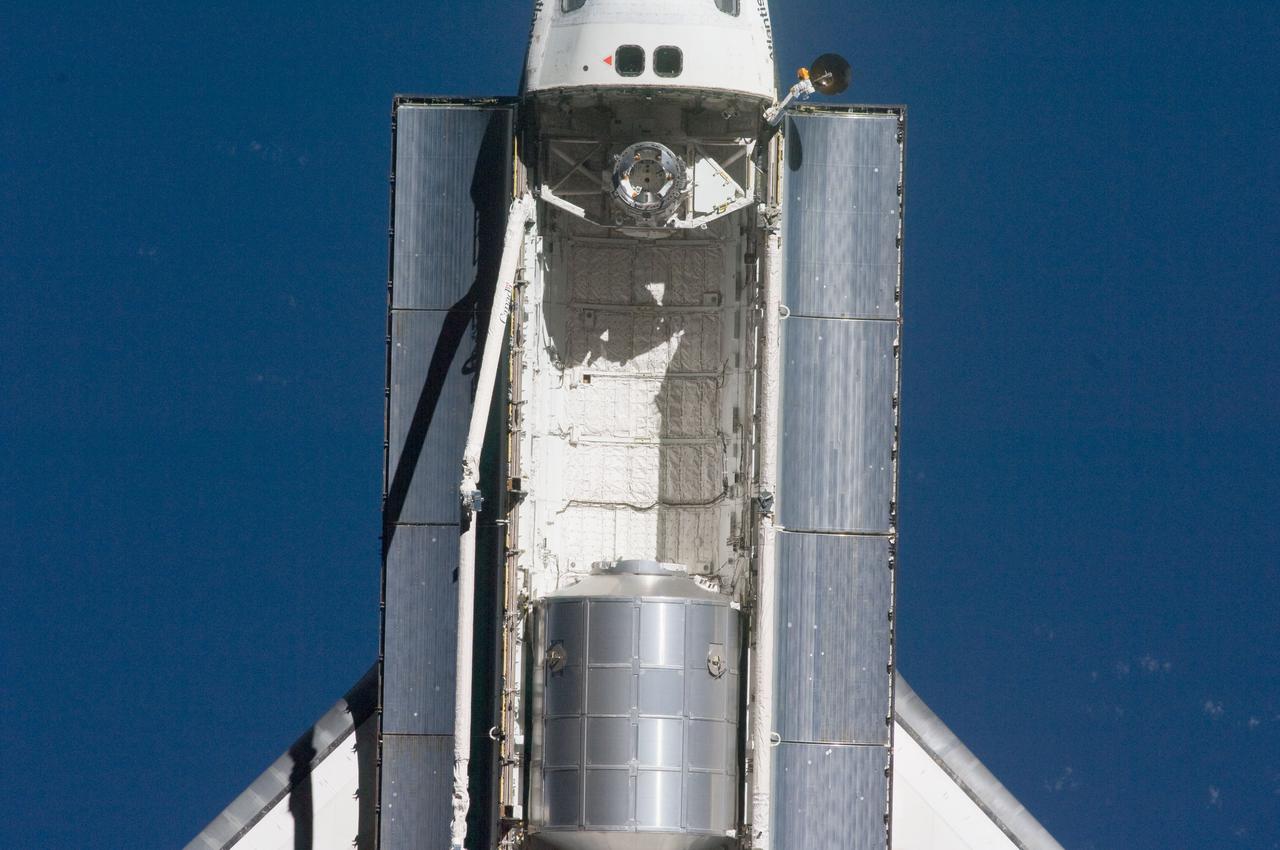
ISS028-E-015571 (10 July 2011) --- A nadir view of the space shuttle Atlantis and its payload is provided by one of a series of images showing various parts of the shuttle in Earth orbit. Seen at the rear of the cargo bay is the Raffaello multi-purpose logistics module, packed with supplies and spare parts for the International Space Station. The series was photographed by one of three crewmembers -- half the station crew -- who were equipped with still cameras on the orbiting outpost as the shuttle “posed” for photo and visual surveys and performed a back-flip for the rendezvous pitch maneuver (RPM). A 400 millimeter lens was used to capture this particular series of images.
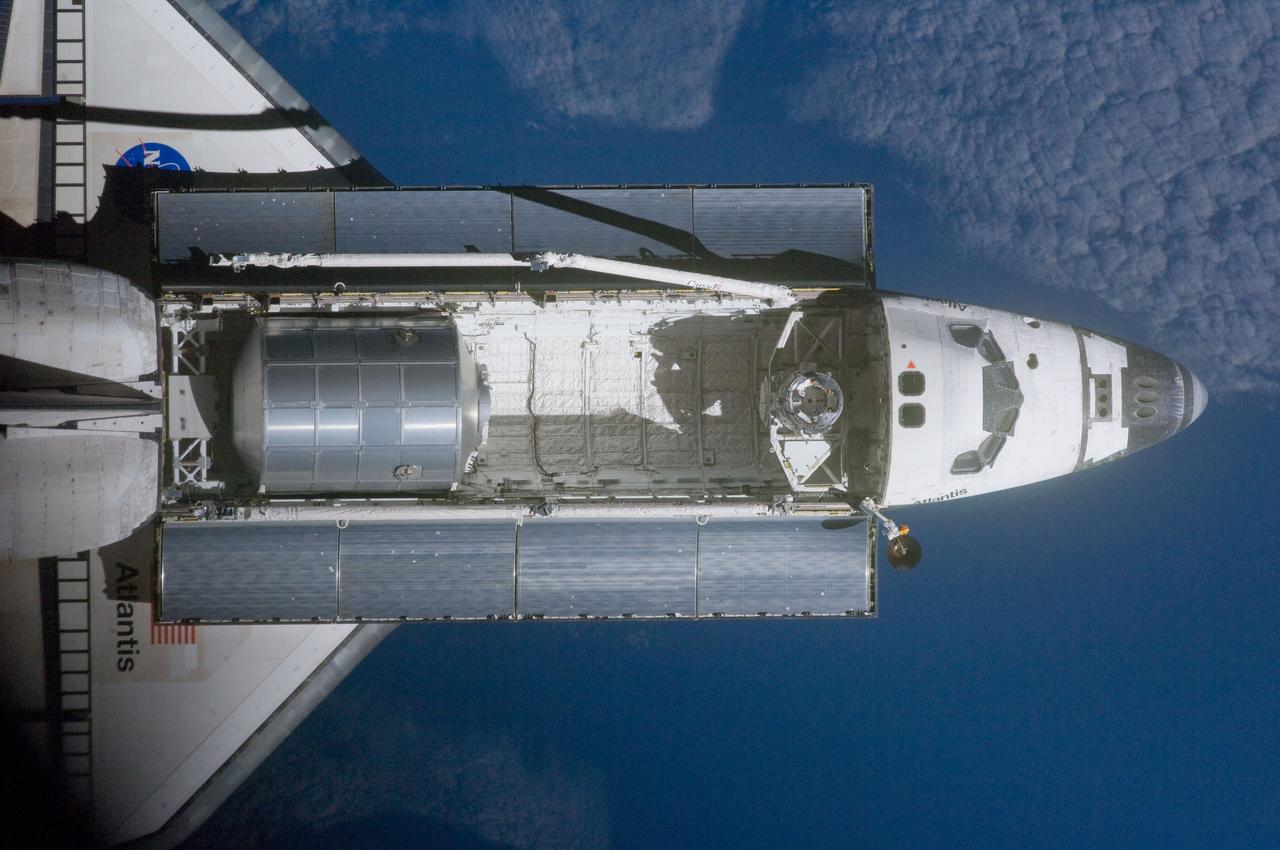
ISS028-E-015567(10 July 2011) --- A nadir view of the space shuttle Atlantis and its payload is provided by one of a series of images showing various parts of the shuttle in Earth orbit. Seen at the rear of the cargo bay is the Raffaello multi-purpose logistics module, packed with supplies and spare parts for the International Space Station. The series was photographed by one of three crewmembers -- half the station crew -- who were equipped with still cameras on the orbiting outpost as the shuttle “posed” for photos and visual surveys and performed a back-flip for the rendezvous pitch maneuver (RPM). A 400 millimeter lens was used to capture this particular series of images.
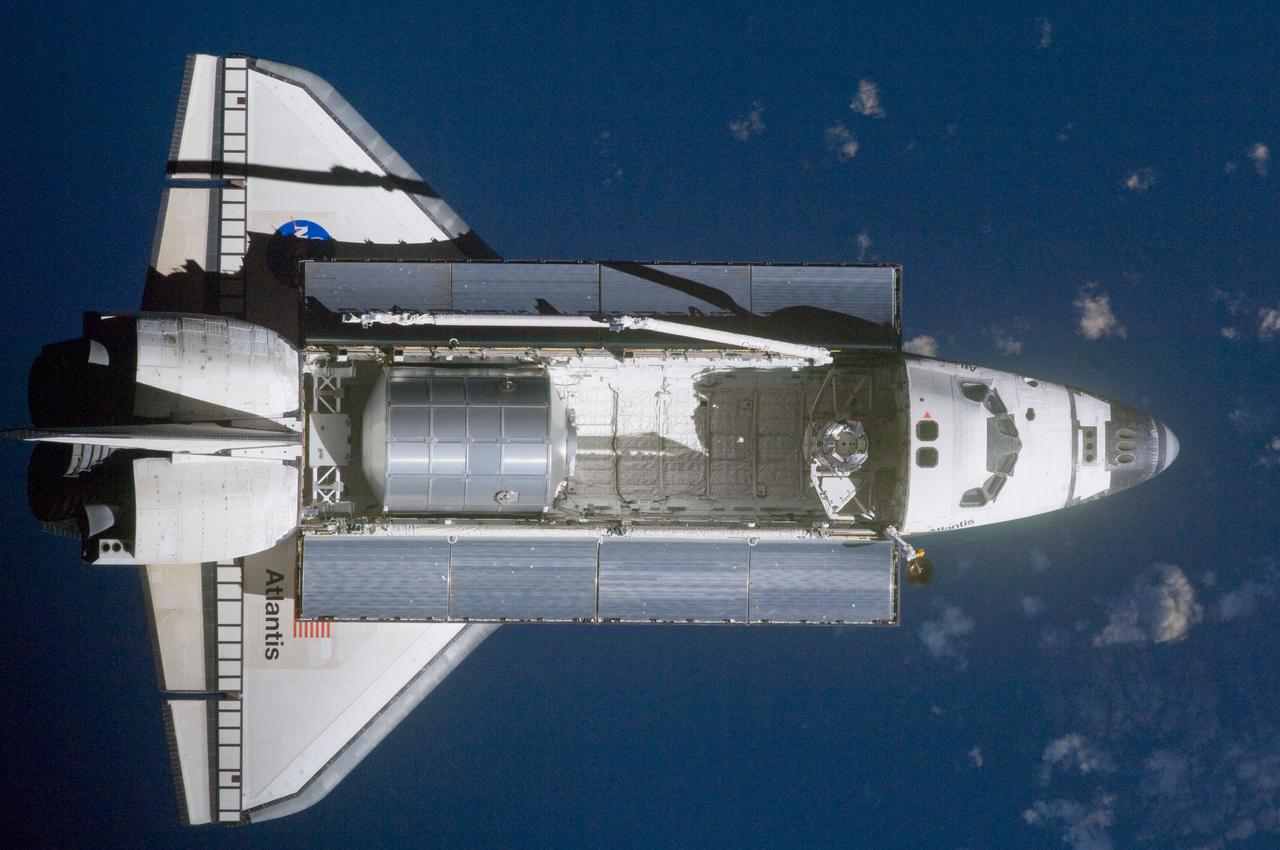
ISS028-E-015564 (10 July 2011) --- A nadir view of the space shuttle Atlantis and its payload was provided by one of a series of images showing various parts of the shuttle in Earth orbit. Seen at the rear of the cargo bay is the Raffaello multi-purpose logistics module, packed with supplies and spare parts for the International Space Station. The series was photographed by one of three crewmembers -- half the station crew -- who were equipped with still cameras on the orbiting outpost as the shuttle “posed” for photos and visual surveys and performed a back-flip for the rendezvous pitch maneuver (RPM). A 400 millimeter lens was used to capture this particular series of images.
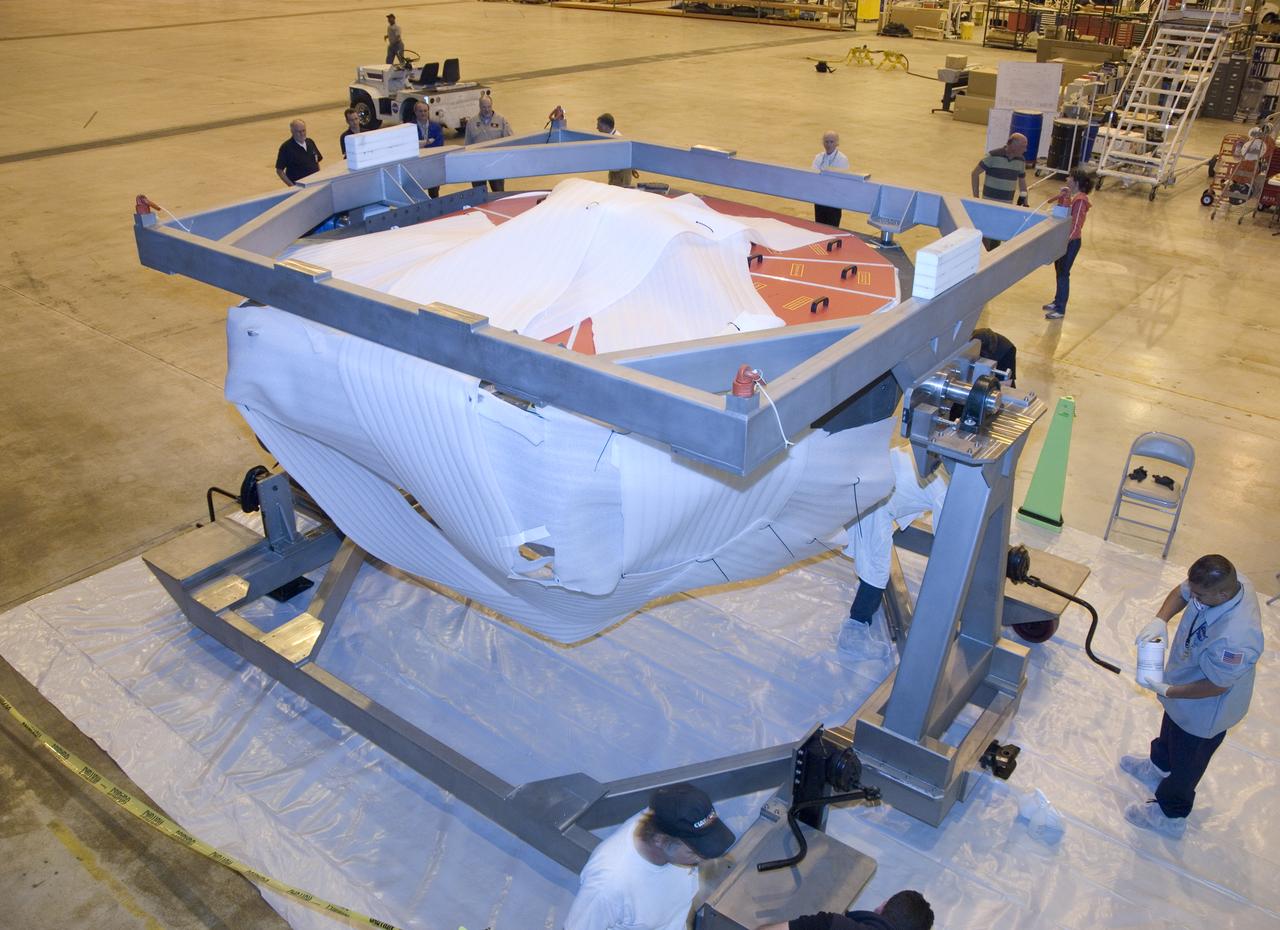
Technicians at the NASA Dryden Aircraft Operations Facility in Palmdale, Calif., removed the German-built primary mirror assembly from the Stratospheric Observatory for Infrared Astronomy, or SOFIA, April 18, 2008 in preparation for the final finish coating of the mirror. A precision crane lifted the more than two-ton mirror assembly from its cavity in the rear fuselage of the highly modified Boeing 747SP. The assembly was then secured in its transport dolly and moved to a clean room where it was prepared for shipment to NASA Ames Research Center at Moffett Field near Mountain View, Calif. where it would receive its aluminized finish coating before being re-installed in the SOFIA aircraft.

STS061-S-071 (13 Dec 1993) --- A rear view of the Space Shuttle Endeavour as it touches down on the Shuttle Landing Facility at Kennedy Space Center (KSC), at 05:25:57:27 GMT (12:26 a.m. EST) December 13, 1993. Onboard the spacecraft were Richard O. Covey, mission commander; Kenneth D. Bowersox, pilot; mission specialists Thomas D. Akers; Jeffrey A. Hoffman; F. Story Musgrave; Kathryn C. Thornton and Swiss scientist Claude Nicollier. This is the second night landing at KSC in the history of the Shuttle Program.
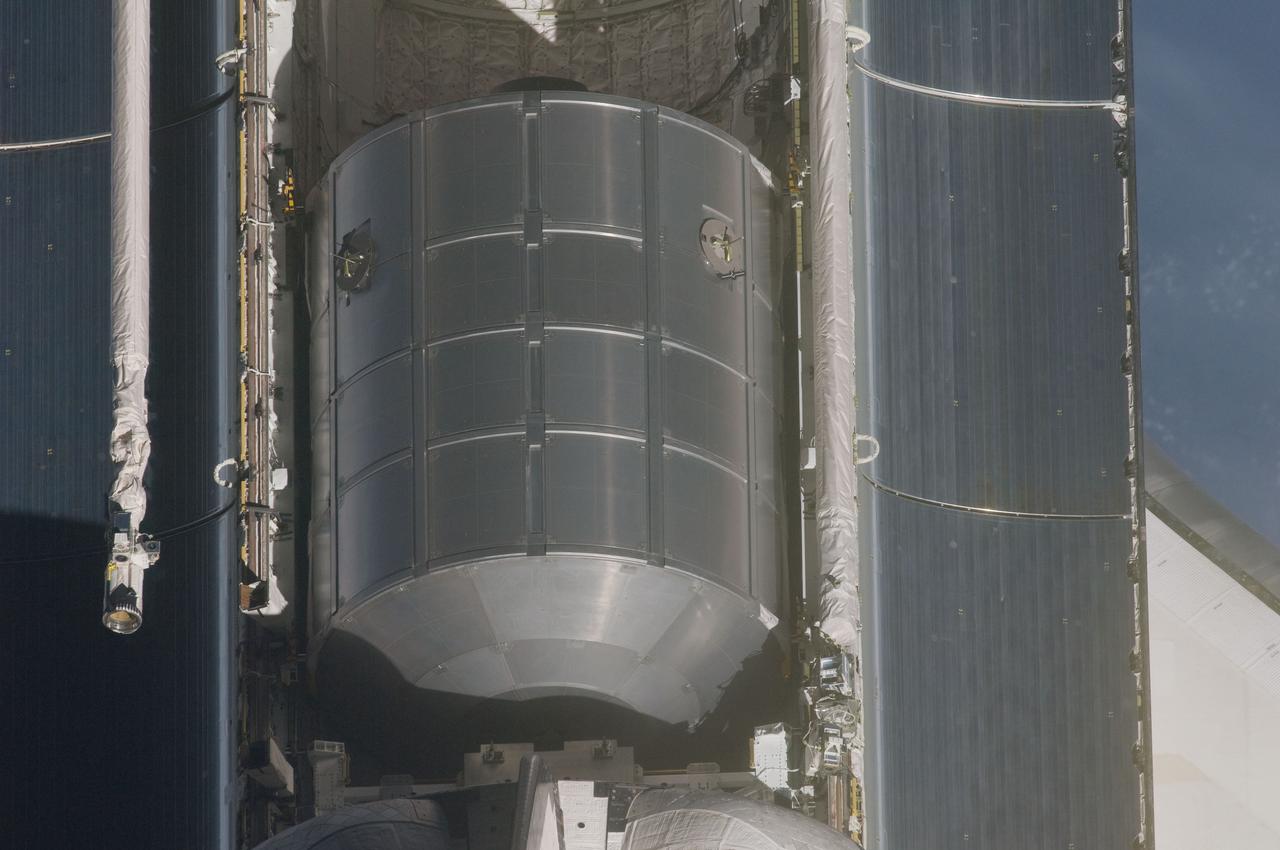
ISS028-E-015518 (10 July 2011) --- A nadir view of the space shuttle Atlantis' payload bay was provided by one of a series of images showing various parts of the shuttle in Earth orbit. Seen at the rear of the cargo bay is the Raffaello multi-purpose logistics module, packed with supplies and spare parts for the International Space Station. The series was photographed by one of three crewmembers -- half the station crew -- who were equipped with still cameras on the orbiting outpost as the shuttle “posed” for photos and visual surveys and performed a back-flip for the rendezvous pitch maneuver (RPM). A 400 millimeter lens was used to capture this particular series of images.
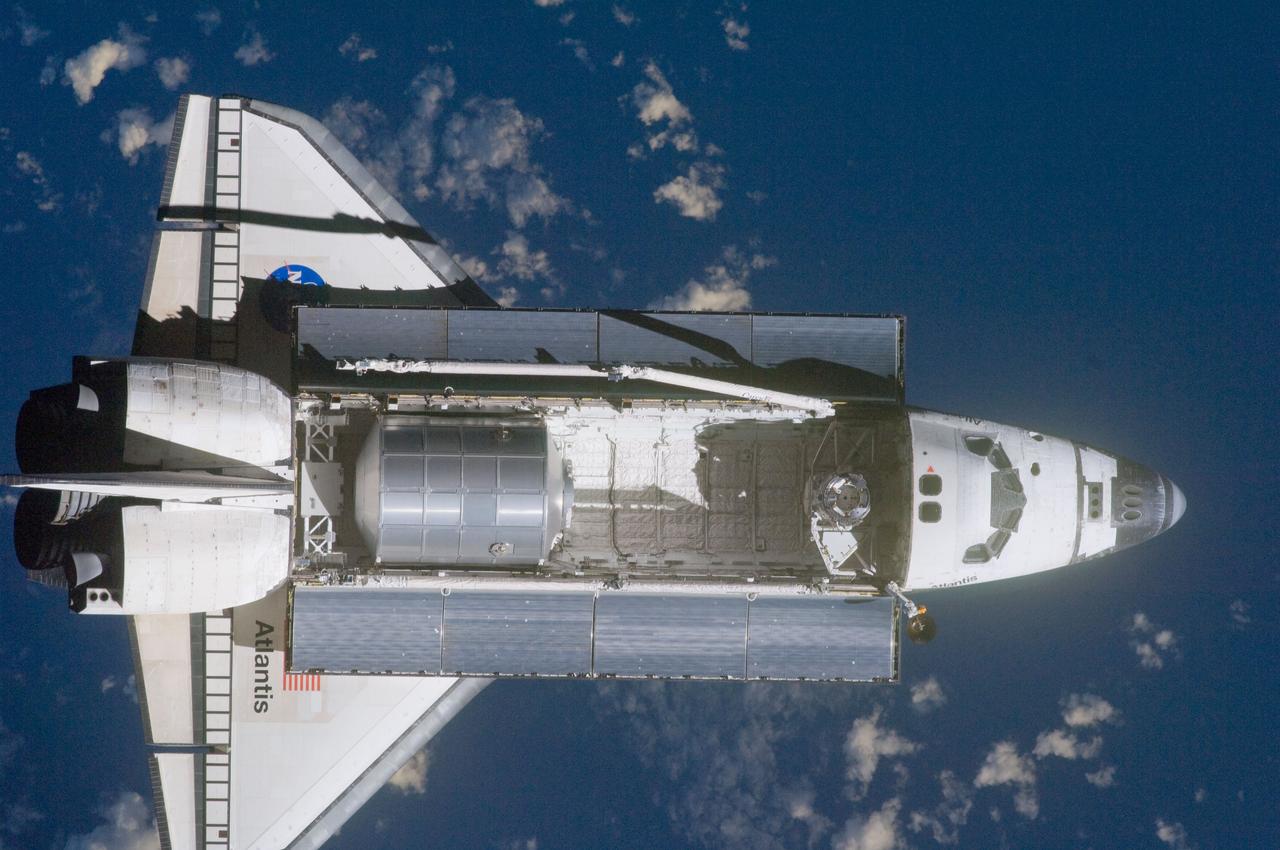
ISS028-E-015565 (10 July 2011) --- A nadir view of the space shuttle Atlantis and its payload was provided by one of a series of images showing various parts of the shuttle in Earth orbit. Seen at the rear of the cargo bay is the Raffaello multi-purpose logistics module, packed with supplies and spare parts for the International Space Station. The series was photographed by one of three crewmembers -- half the station crew -- who were equipped with still cameras on the orbiting outpost as the shuttle “posed” for photos and visual surveys and performed a back-flip for the rendezvous pitch maneuver (RPM). A 400 millimeter lens was used to capture this particular series of images.
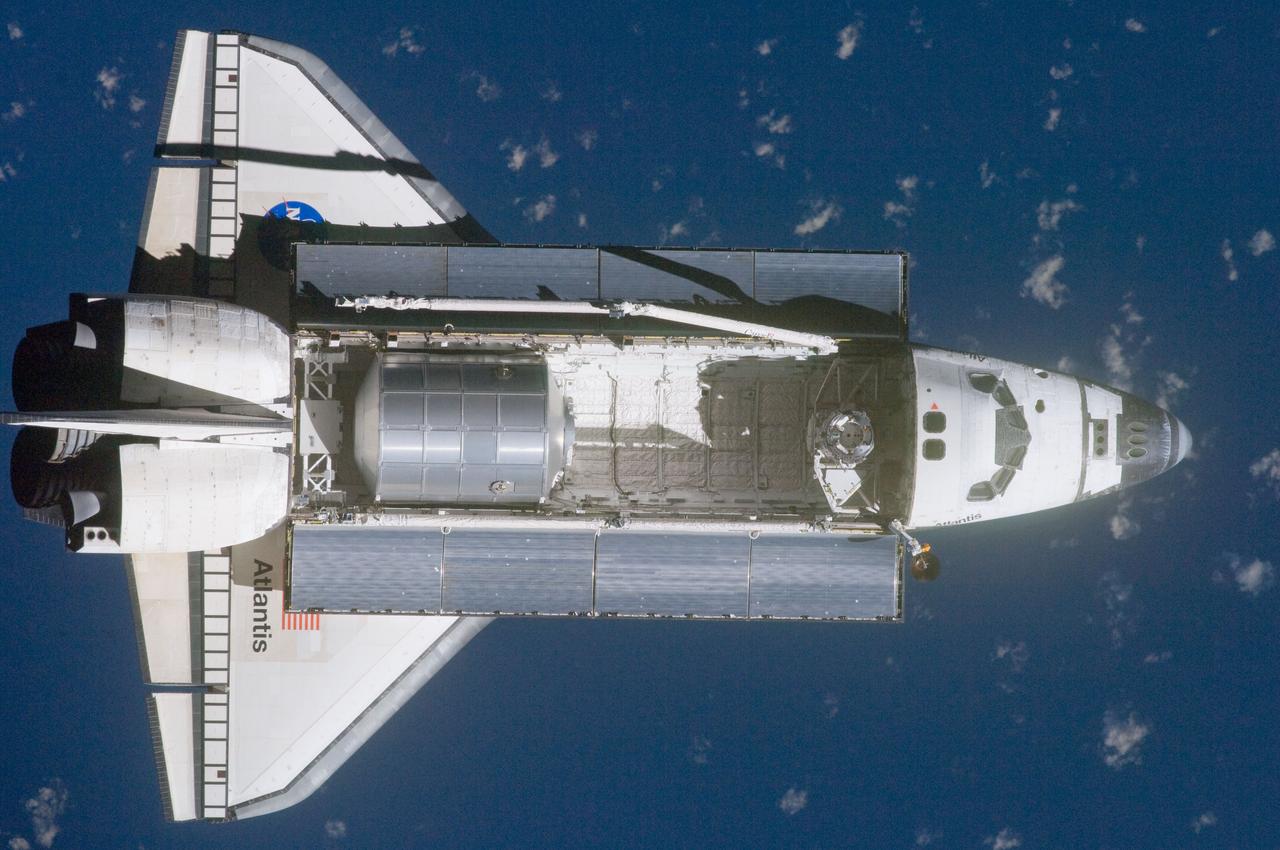
ISS028-E-015566 (10 July 2011) --- A nadir view of the space shuttle Atlantis and its payload was provided by one of a series of images showing various parts of the shuttle in Earth orbit. Seen at the rear of the cargo bay is the Raffaello multi-purpose logistics module, packed with supplies and spare parts for the International Space Station. The series was photographed by one of three crewmembers -- half the station crew -- who were equipped with still cameras on the orbiting outpost as the shuttle “posed” for photos and visual surveys and performed a back-flip for the rendezvous pitch maneuver (RPM). A 400 millimeter lens was used to capture this particular series of images.
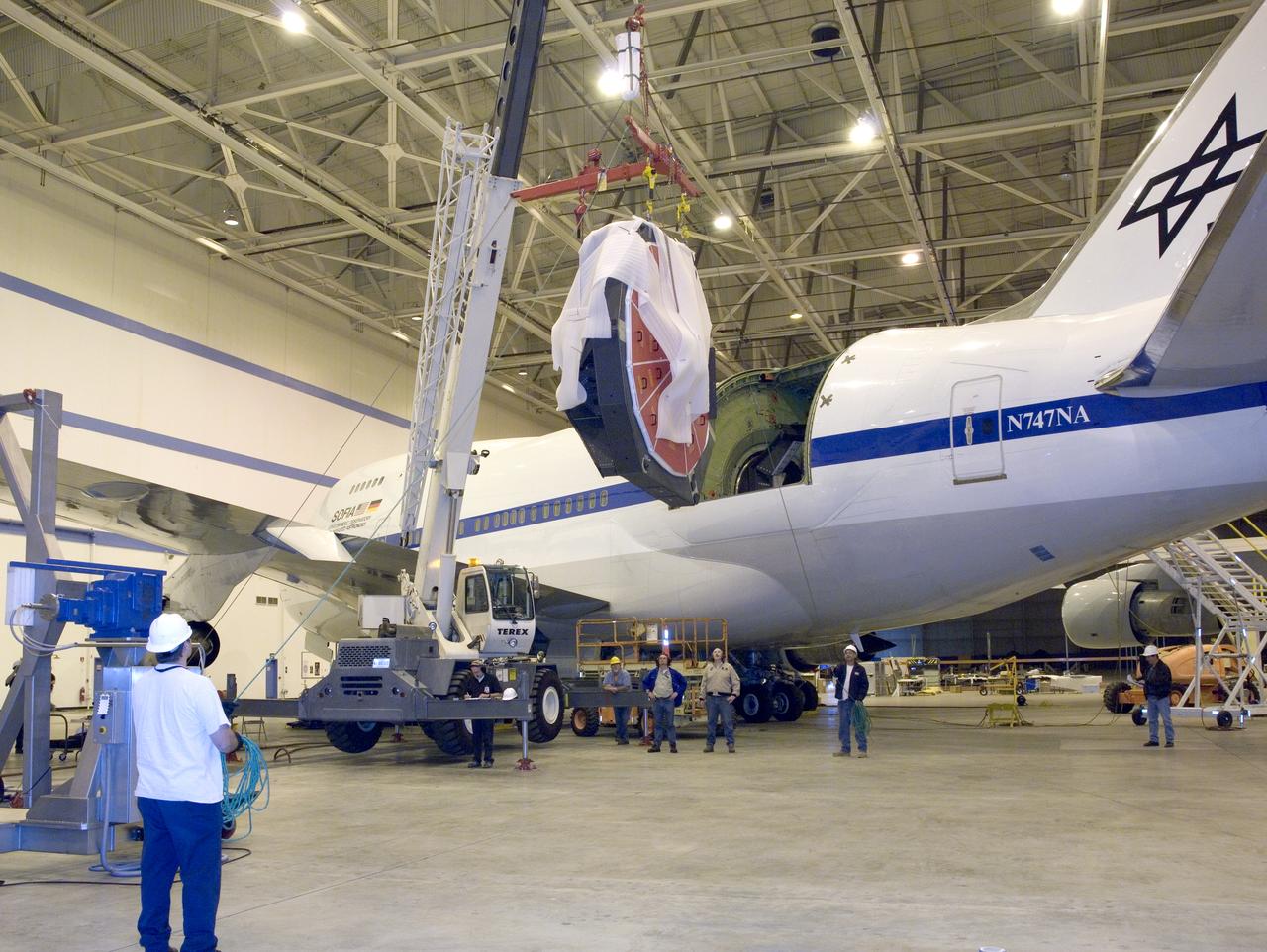
Technicians at the NASA Dryden Aircraft Operations Facility in Palmdale, Calif., removed the German-built primary mirror assembly from the Stratospheric Observatory for Infrared Astronomy, or SOFIA, April 18, 2008 in preparation for the final finish coating of the mirror. A precision crane lifted the more than two-ton mirror assembly from its cavity in the rear fuselage of the highly modified Boeing 747SP. The assembly was then secured in its transport dolly and moved to a clean room where it was prepared for shipment to NASA Ames Research Center at Moffett Field near Mountain View, Calif. where it would receive its aluminized finish coating before being re-installed in the SOFIA aircraft.
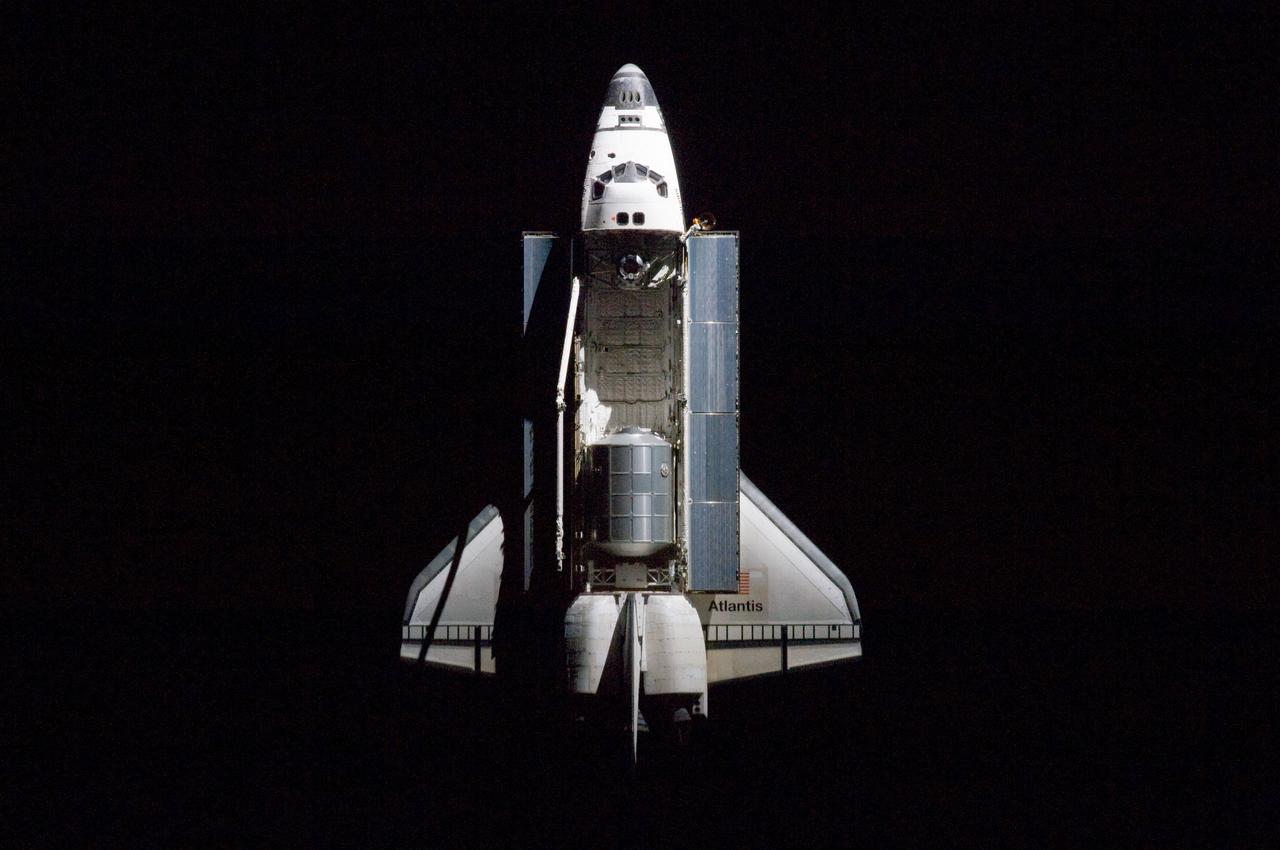
ISS028-E-015553 (10 July 2011) --- A nadir view of the space shuttle Atlantis and its payload was provided by one of a series of images showing various parts of the shuttle in Earth orbit. Seen at the rear of the cargo bay is the Raffaello multi-purpose logistics module, packed with supplies and spare parts for the International Space Station. The series was photographed by one of three crewmembers -- half the station crew -- who were equipped with still cameras on the orbiting outpost as the shuttle “posed” for photos and visual surveys and performed a back-flip for the rendezvous pitch maneuver (RPM). A 400 millimeter lens was used to capture this particular series of images.
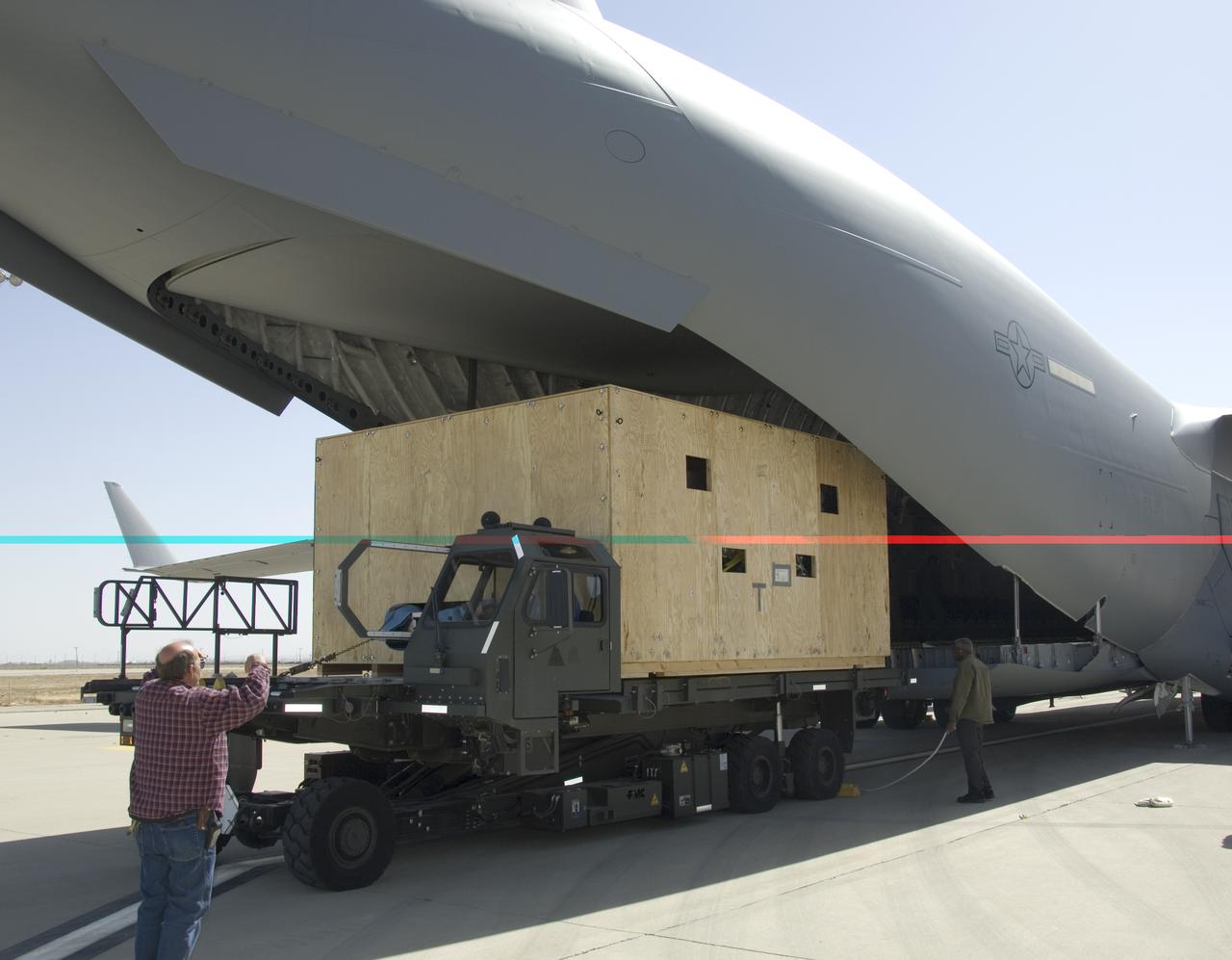
Technicians at NASA's Dryden Aircraft Operations Facility in Palmdale, Calif., loaded the German-built primary mirror assembly of the Stratospheric Observatory for Infrared Astronomy, or SOFIA, onto an Air Force C-17 for shipment to NASA's Ames Research Center on May 1, 2008. In preparation for the final finish coating of the mirror, the more than two-ton mirror assembly had been removed from its cavity in the rear fuselage of the highly modified SOFIA Boeing 747SP two weeks earlier. After arrival at NASA Ames at Moffett Field near Mountain View, Calif., the mirror would receive its aluminized finish coating before being re-installed in the SOFIA aircraft.