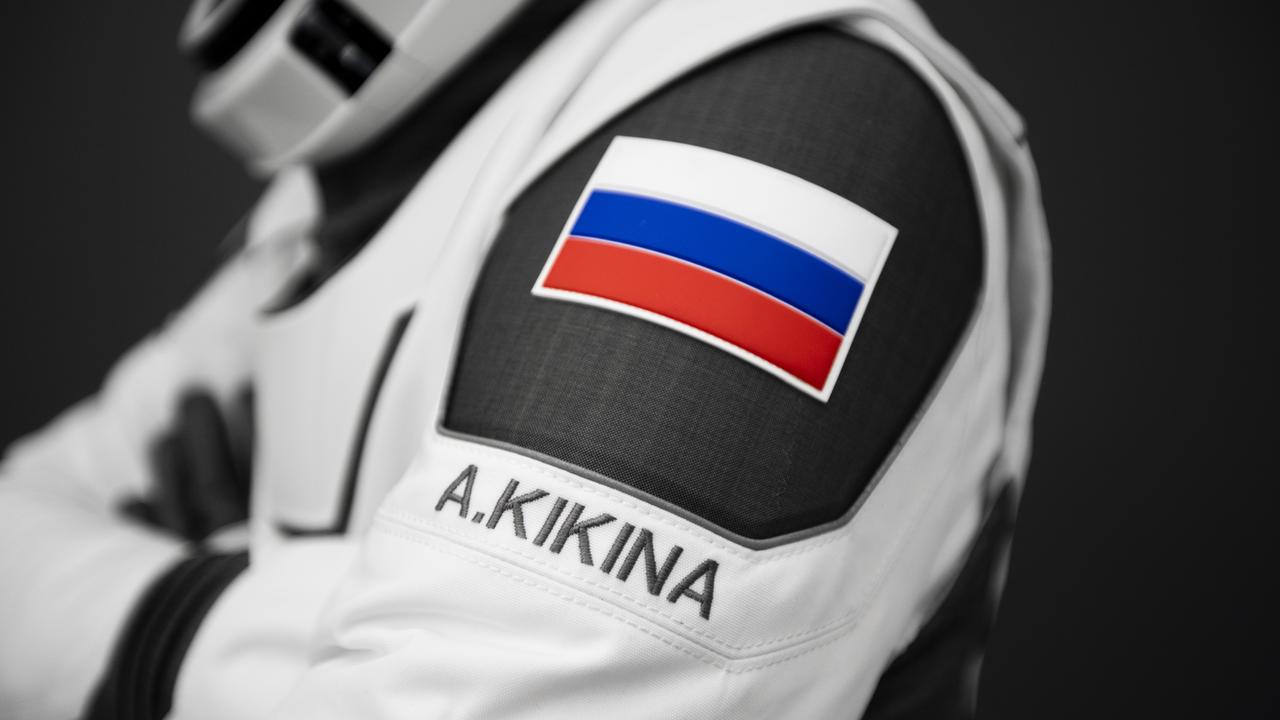
A SpaceX suit bears the name of cosmonaut Anna Kikina and a Russian flag. Kikina is a crewmember of NASA's SpaceX Crew-5 mission to the International Space Station.
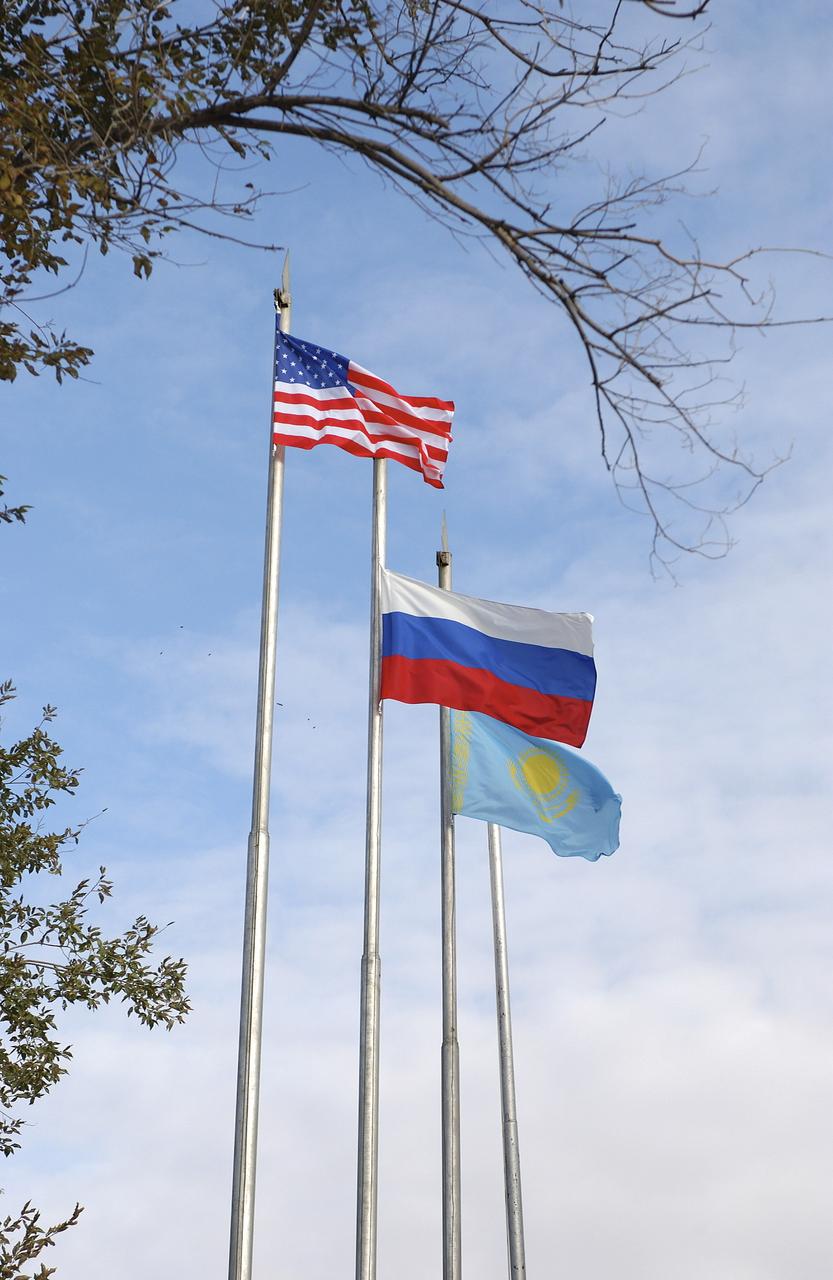
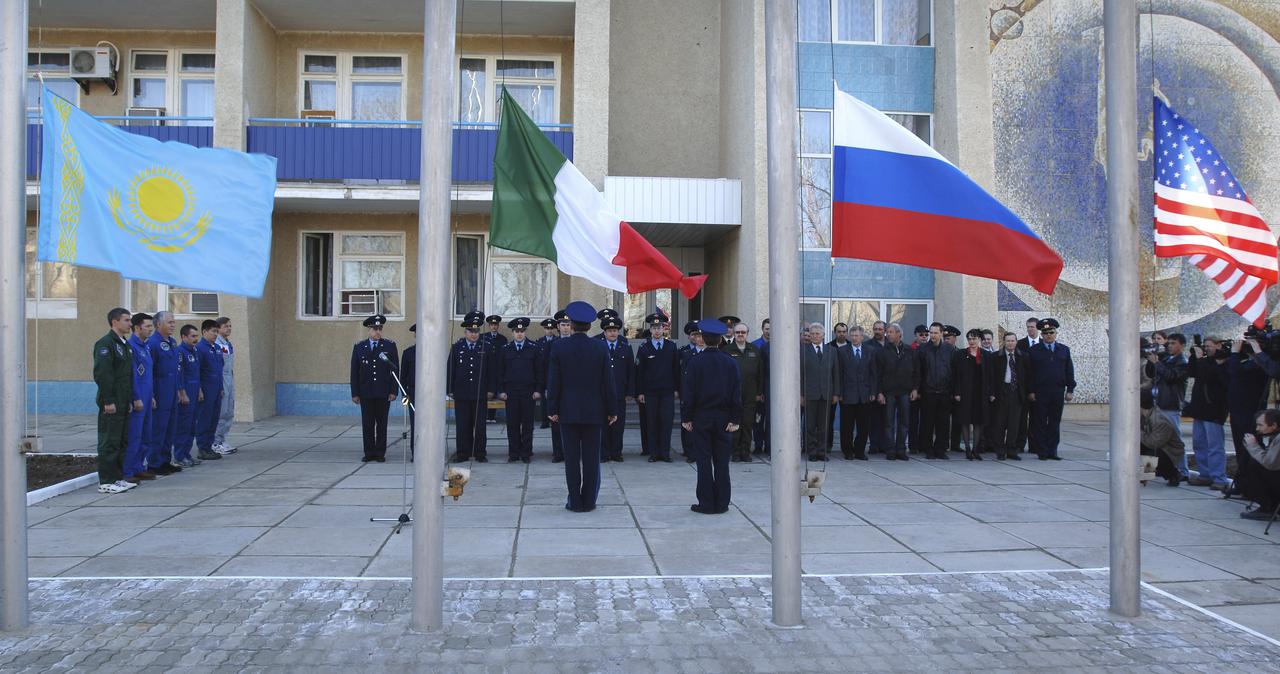
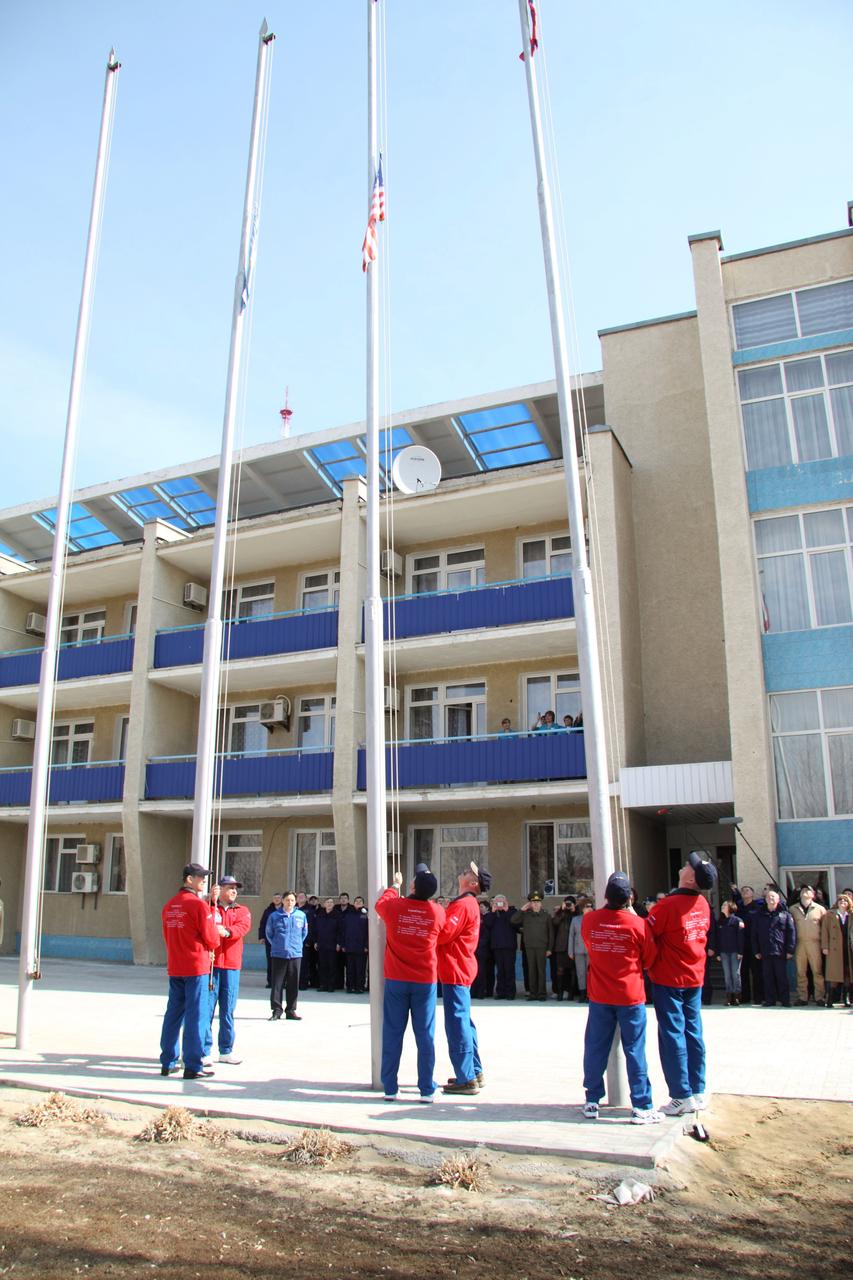
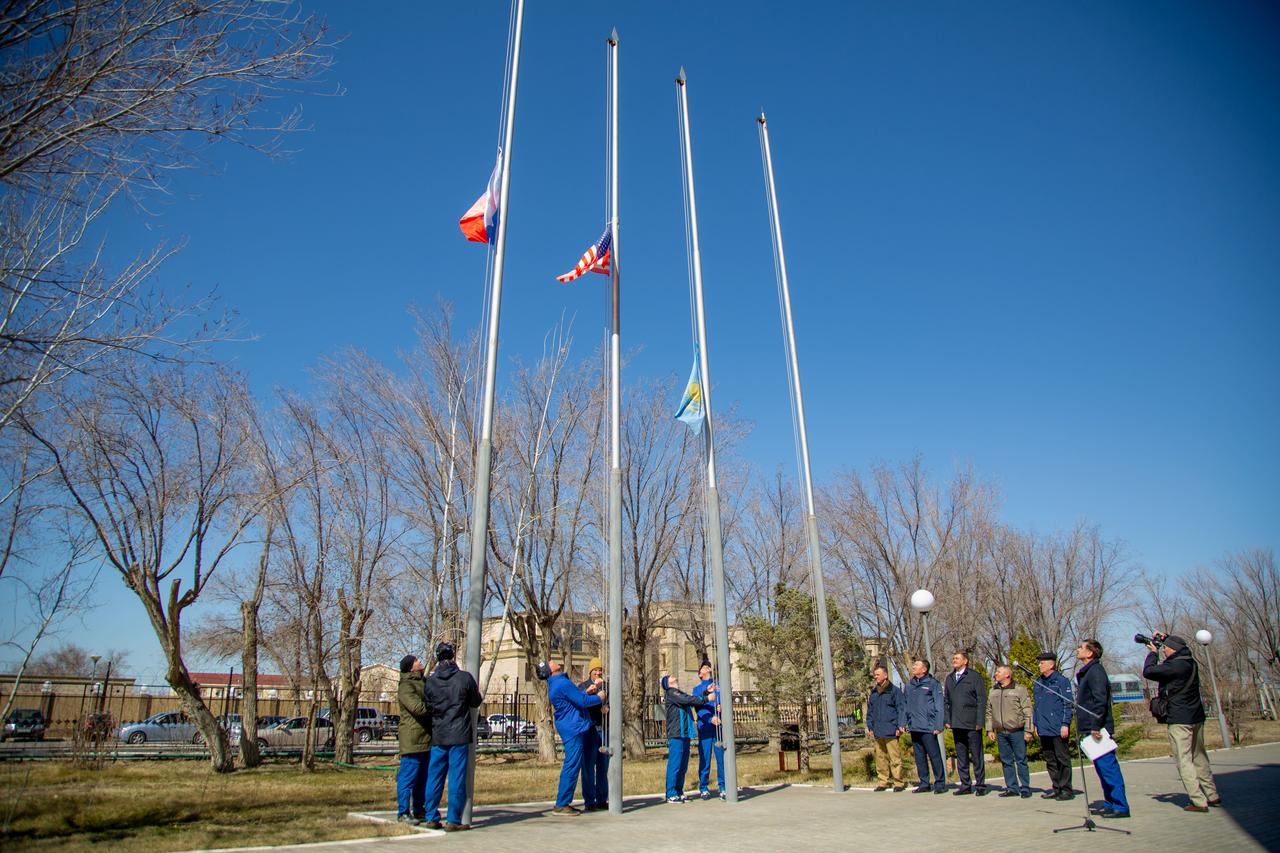
The flags of the United States of America, the Russian Federation and Kazakhstan are seen after the ceremonial flag raising ceremony. Expedition 10 Flight Engineer and Soyuz Commander Salizhan Sharipov, Commander and NASA Science Officer Leroy Chiao, Russian Space Forces cosmonaut Yuri Shargin, backup Soyuz Commander Valery Tokarev and backup Expedition Commander Bill McArthur patricipated in the ceremonial flag raising at the Cosmonaut Hotel, Baikonur, Kazakhstan, Wednesday, Oct. 6, 2004. Chiao, Sharipov and Shargin are scheduled to launch October 14 on their Soyuz TMA-5 spacecraft to the International Space Station. Photo Credit: (NASA/Bill Ingalls)
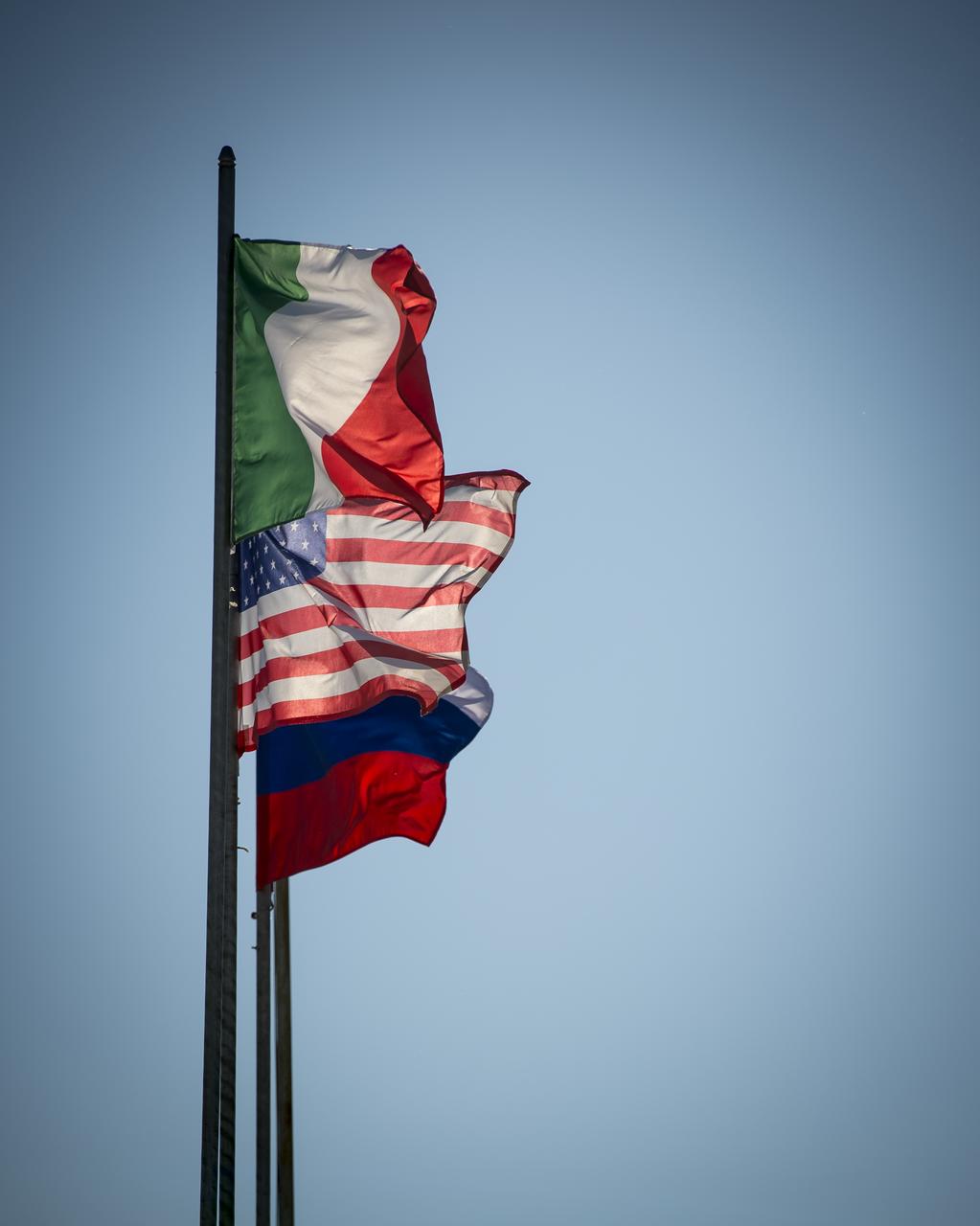
The flags of Italy, U.S.A., and Russia, are seen as they fly at the Baikonur Cosmodrome launch pad shortly after the Soyuz TMA-09M spacecraft was rolled out and placed raised into position, Sunday, May 26, 2013, in Kazakhstan. The launch of the Soyuz rocket to the International Space Station (ISS) with Expedition 36/37 Soyuz Commander Fyodor Yurchikhin of the Russian Federal Space Agency (Roscosmos), Flight Engineers; Luca Parmitano of the European Space Agency, and Karen Nyberg of NASA, is scheduled for Wednesday May 29, Kazakh time. Yurchikhin, Nyberg, and, Parmitano, will remain aboard the station until mid-November. Photo credit: (NASA/Bill Ingalls)
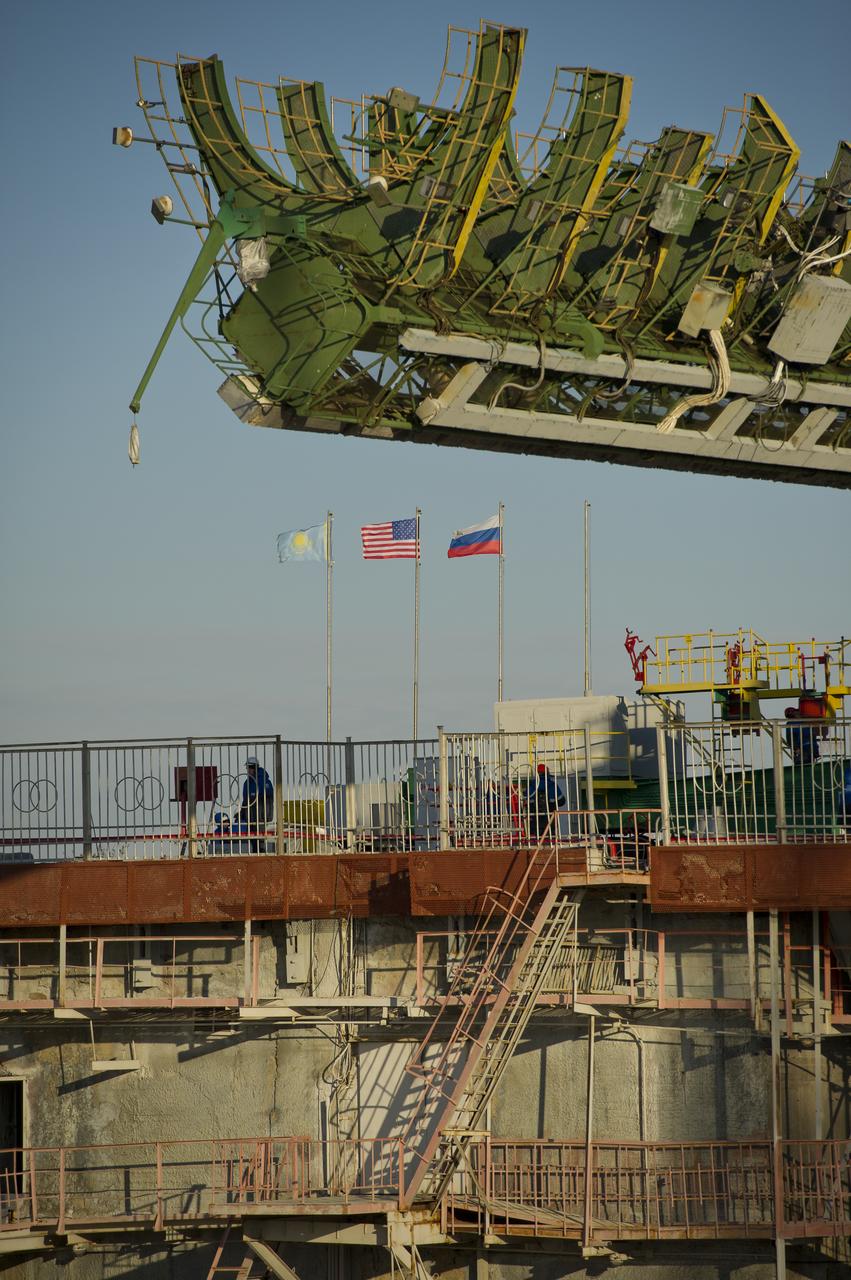
The flags representing Kazakhstan and the nations of the three crew members who will launch in the Soyuz TMA-22 spacecraft are shown at the launch pad at the Baikonur Cosmodrome in Kazakhstan on Friday, Nov. 11, 2011. From left to right are the flags of Kazakhstan, the United States and Russia. Scheduled to launch on November 14 local time are Expedition 29 Soyuz Commander Anton Shkaplerov of Russia, NASA Flight Engineer Dan Burbank and Russian Flight Engineer Anatoly Ivanishin. Photo Credit (NASA/Carla Cioffi)
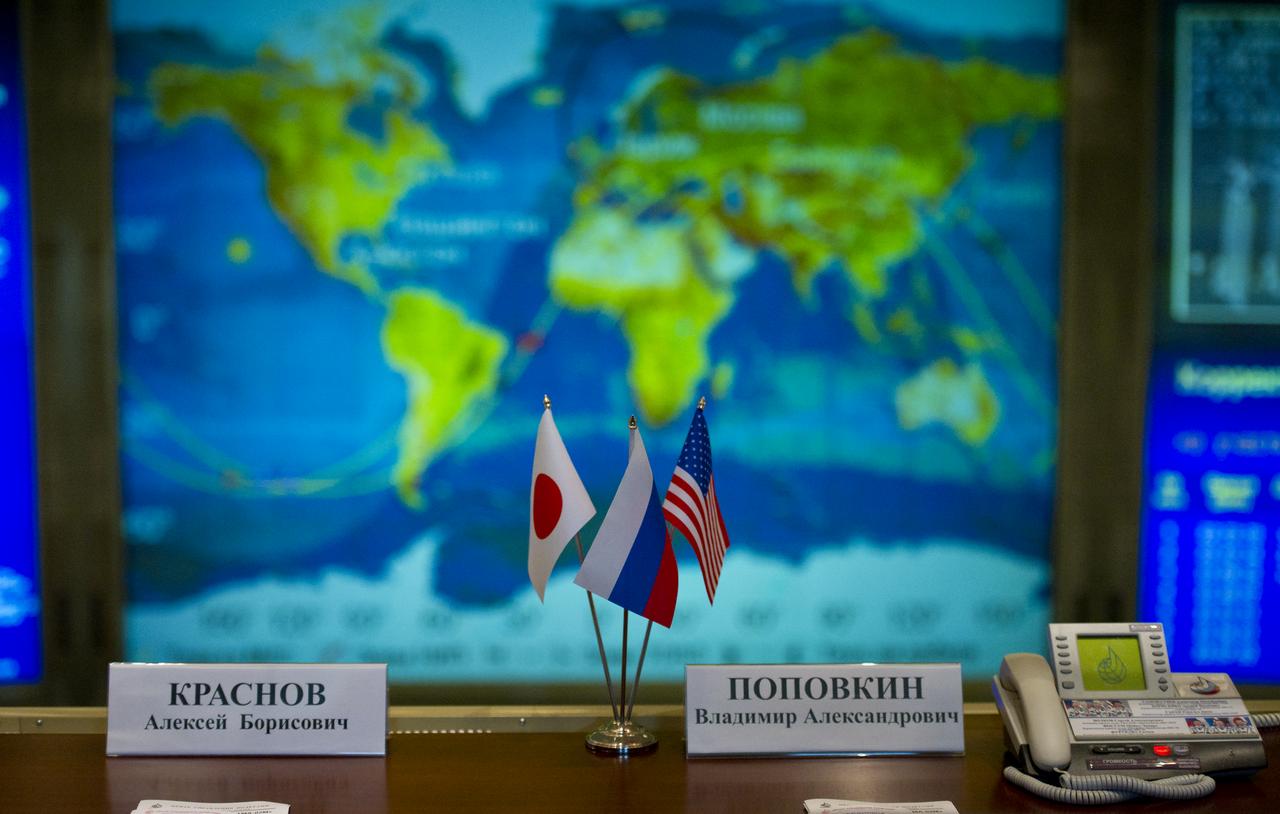
The flags of the countries representing the crew members of Expedition 28 are seen here at the Russian Mission Control Center in Korolev, Russia on Friday, June 10, 2011. The Soyuz TMA-02M docked to the International Space Station carrying Expedition 28 Soyuz Commander Sergei Volkov, NASA Flight Engineer Mike Fossum and JAXA (Japanase Aerospace Exploration Agency) Flight Engineer Satoshi Furukawa. Photo Credit: (NASA/Carla Cioffi)
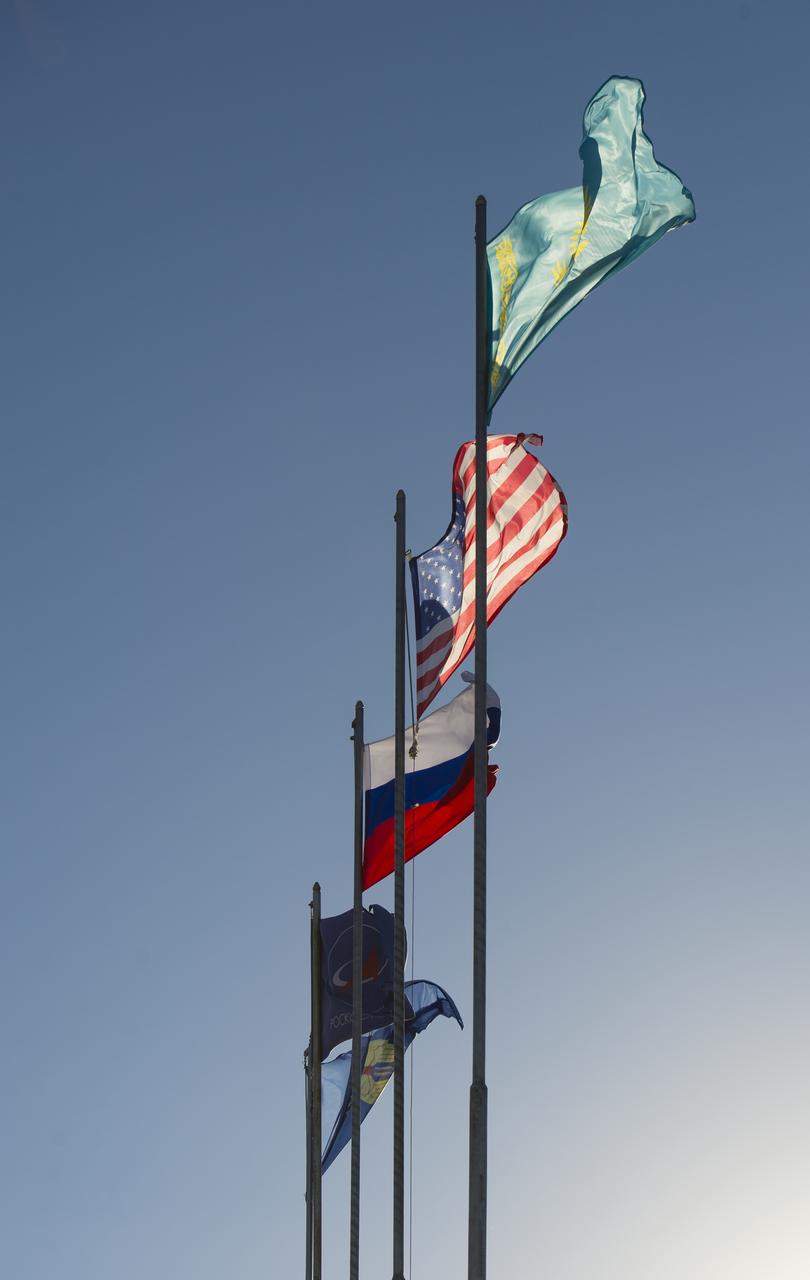
The flags representing Kazakhstan, the United States and Russia are shown at the launch pad at the Baikonur Cosmodrome in Kazakhstan on Monday, Sept. 23, 2013. Scheduled to launch on September 26 local time are Expedition 37/38 Soyuz Commander Oleg Kotov of Russia, NASA Flight Engineer Michael Hopkins and Russian Flight Engineer Sergei Ryazansky on a five and a half-month mission aboard the International Space Station.Photo Credit (NASA/Carla Cioffi)
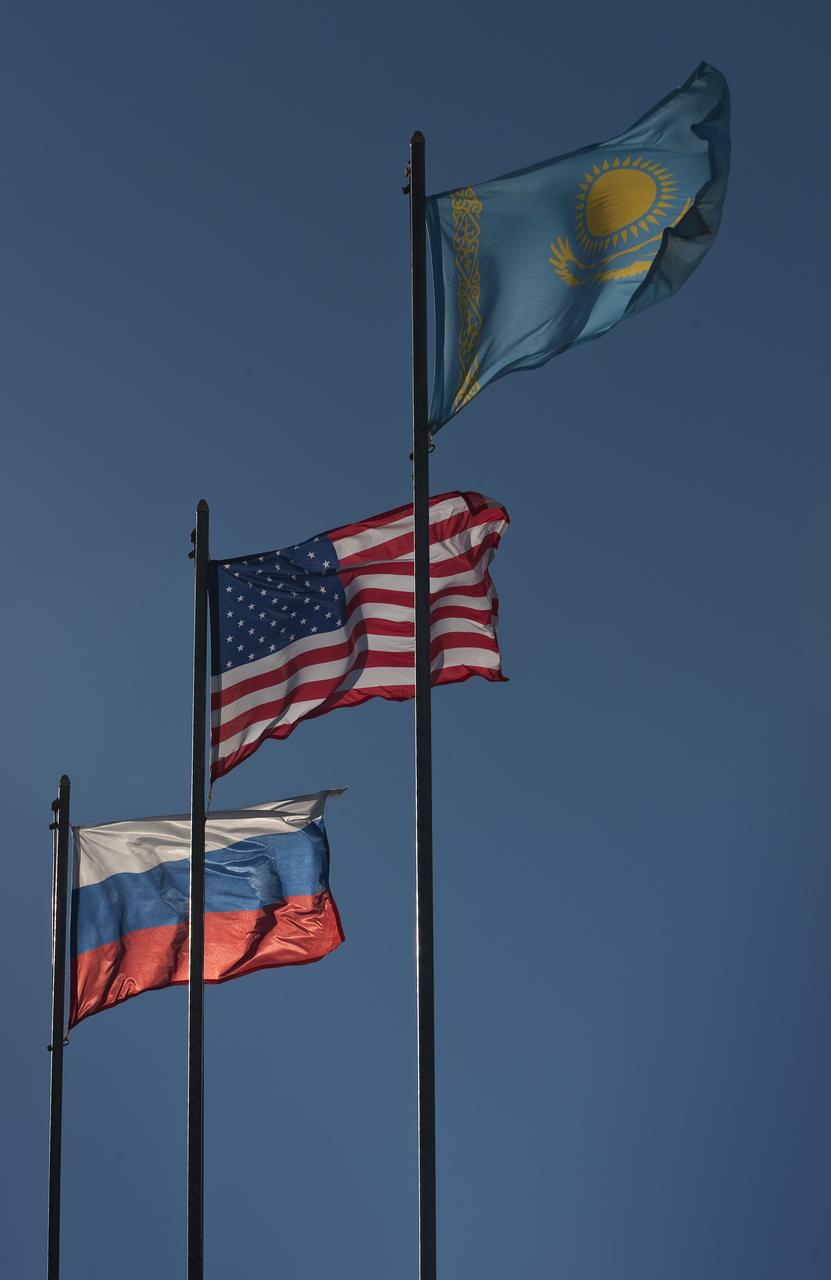
The flags of the Russia, the United States and Kazakhstan are seen at the launch pad after the Soyuz TMA-19 spacecraft was rolled out by train to the launch pad at the Baikonur Cosmodrome, Kazakhstan, Sunday, June 13, 2010. The launch of the Soyuz spacecraft with Expedition 24 Russian Soyuz Commander Fyodor Yurchikin, and NASA Flight Engineers Shannon Walker and Doug Wheelock is scheduled for Wednesday, June 16, 2010 at 3:35 a.m. Kazakhstan time. Photo Credit (NASA/Carla Cioffi)
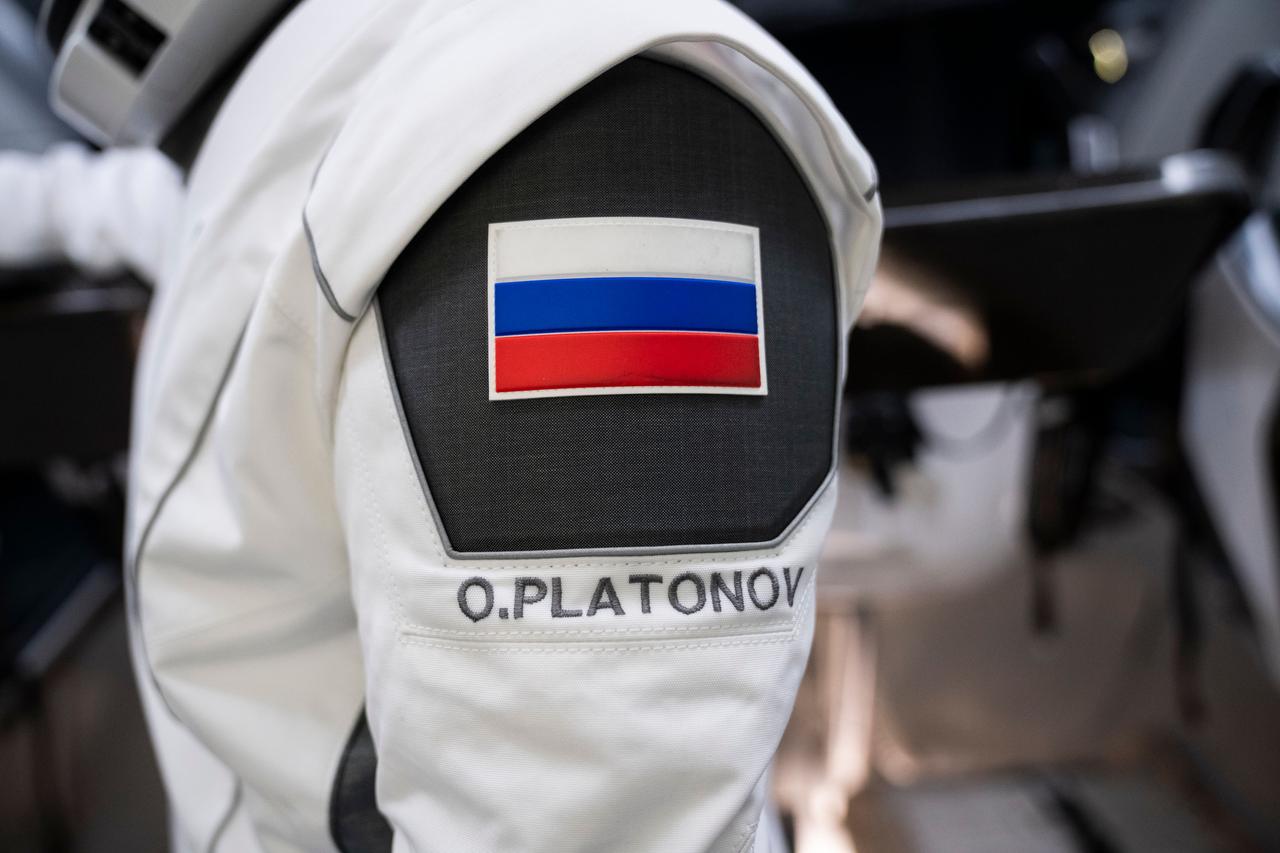
jsc2025e064536 (March 6, 2025) --- NASA’s SpaceX Crew-11 mission specialist and Roscosmos cosmonaut Oleg Platonov participates in a training session at SpaceX facilities in Hawthorne, California. His name, “O. Platonov” is prominently shown with the Russian flag. Credit: SpaceX
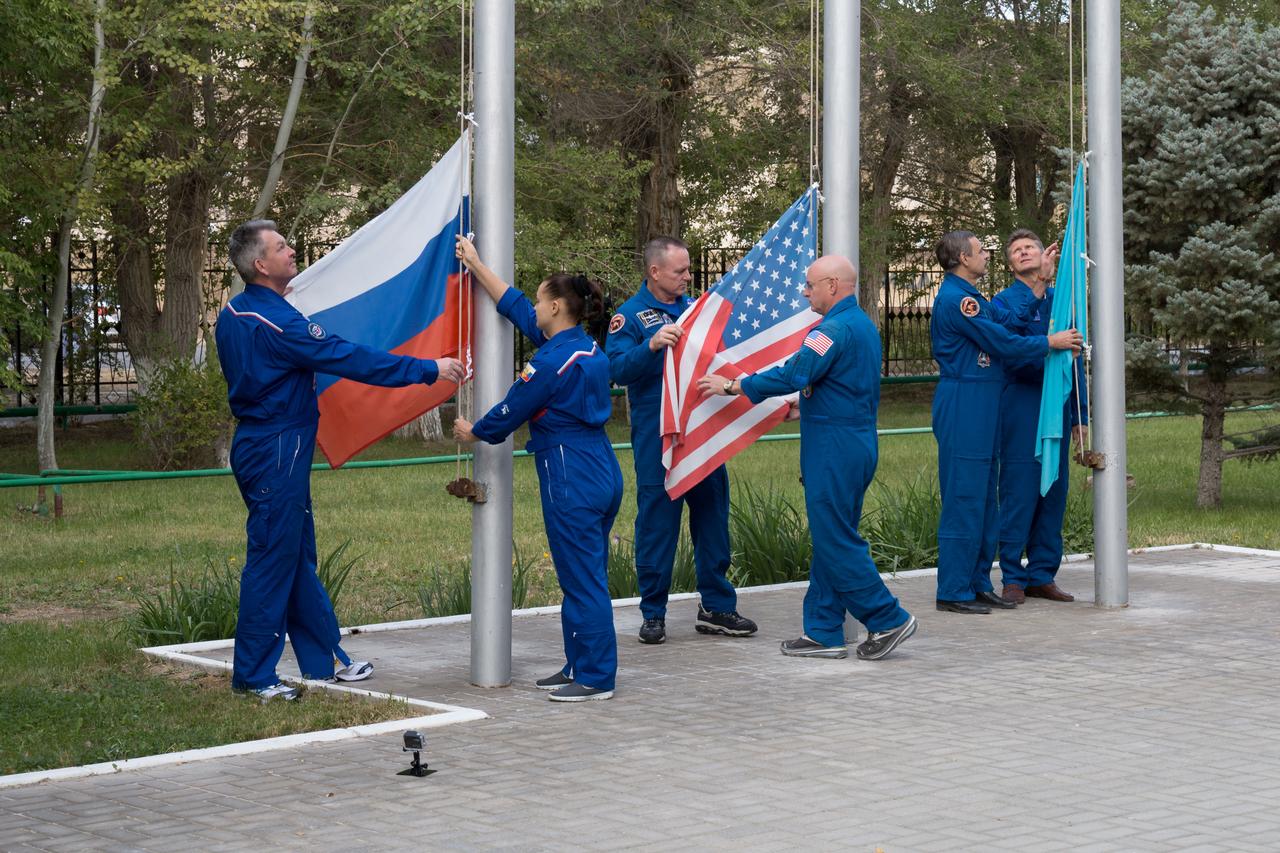
14-11-03-34: (14 Sept. 2014) --- At their Cosmonaut Hotel crew quarters in Baikonur, Kazakhstan, the Expedition 41/42 prime and backup crew members raised the flags of Russia, the U.S. and Kazakhstan during traditional ceremonies Sept. 14. From left to right are prime crew members Elena Serova and Alexander Samokutyaev of the Russian Federal Space Agency (Roscosmos) raising the Russian flag, prime crew member Barry Wilmore and his backup, Scott Kelly of NASA, raising the American flag, and backup crew members Gennady Padalka and Mikhail Kornienko of Roscosmos raising the flag of Kazakhstan. Wilmore, Samokutyaev and Serova will launch on Sept. 26, Kazakh time, in the Soyuz TMA-14M spacecraft to begin a 5 ½ month mission on the International Space Station. Serova will become the fourth Russian woman to fly in space. Photo credit: NASA/Victor Zelentsov
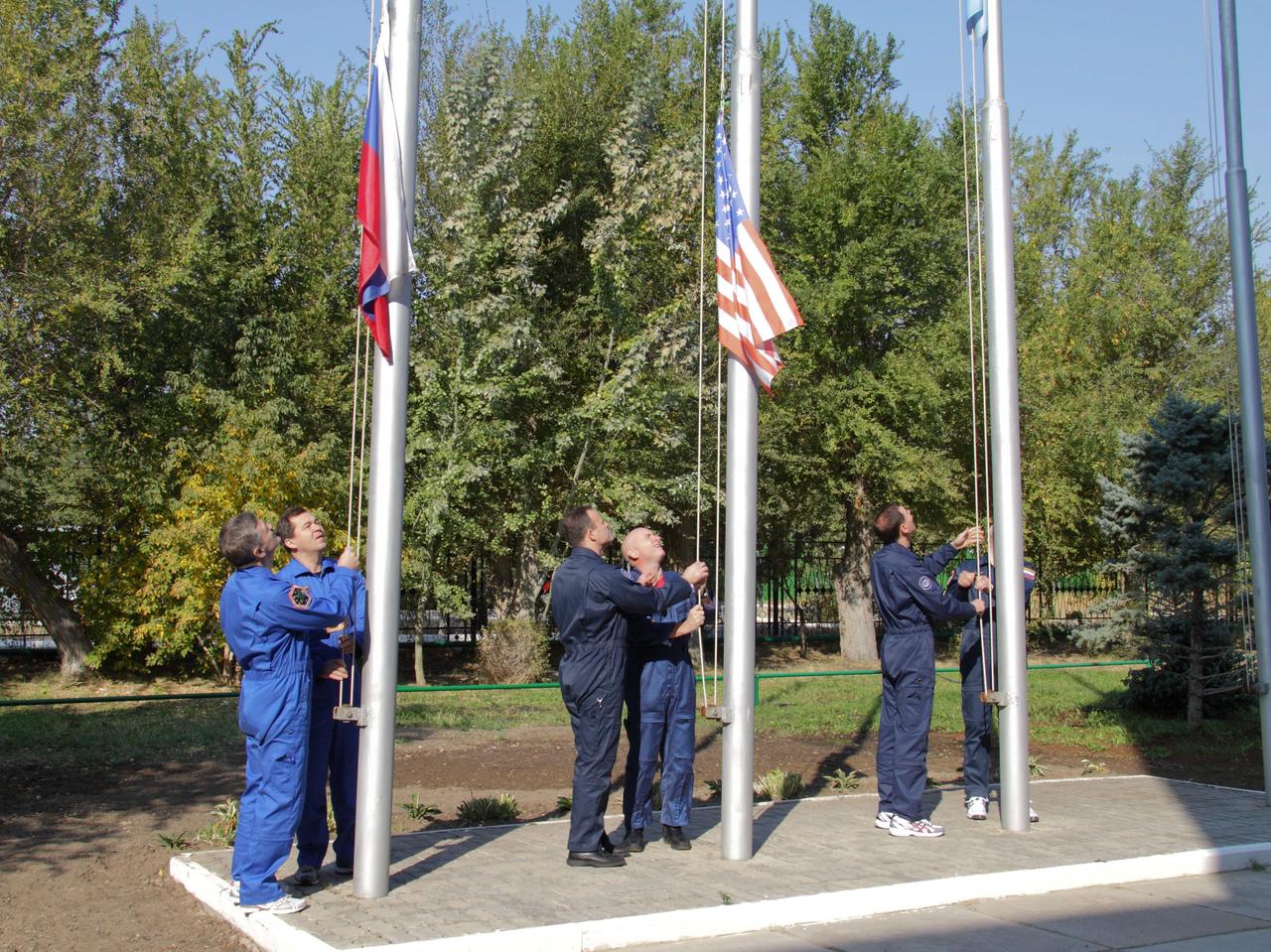
At the Baikonur Cosmodrome in Kazakhstan, the prime and backup crews of Expedition 25 conduct the traditional raising of flags outside their Cosmonaut Hotel crew quarters September 27, 2010. From left to right are prime crew Flight Engineers Alexander Kaleri and Oleg Skripochka raising the Russian flag, backup Ron Garan joining prime crewmember Scott Kelly to raise the American flag and backup crewmembers Sergei Volkov and Oleg Kononenko (hidden) raising the Kazakh flag. Credit: NASA/Victor Zelentsov
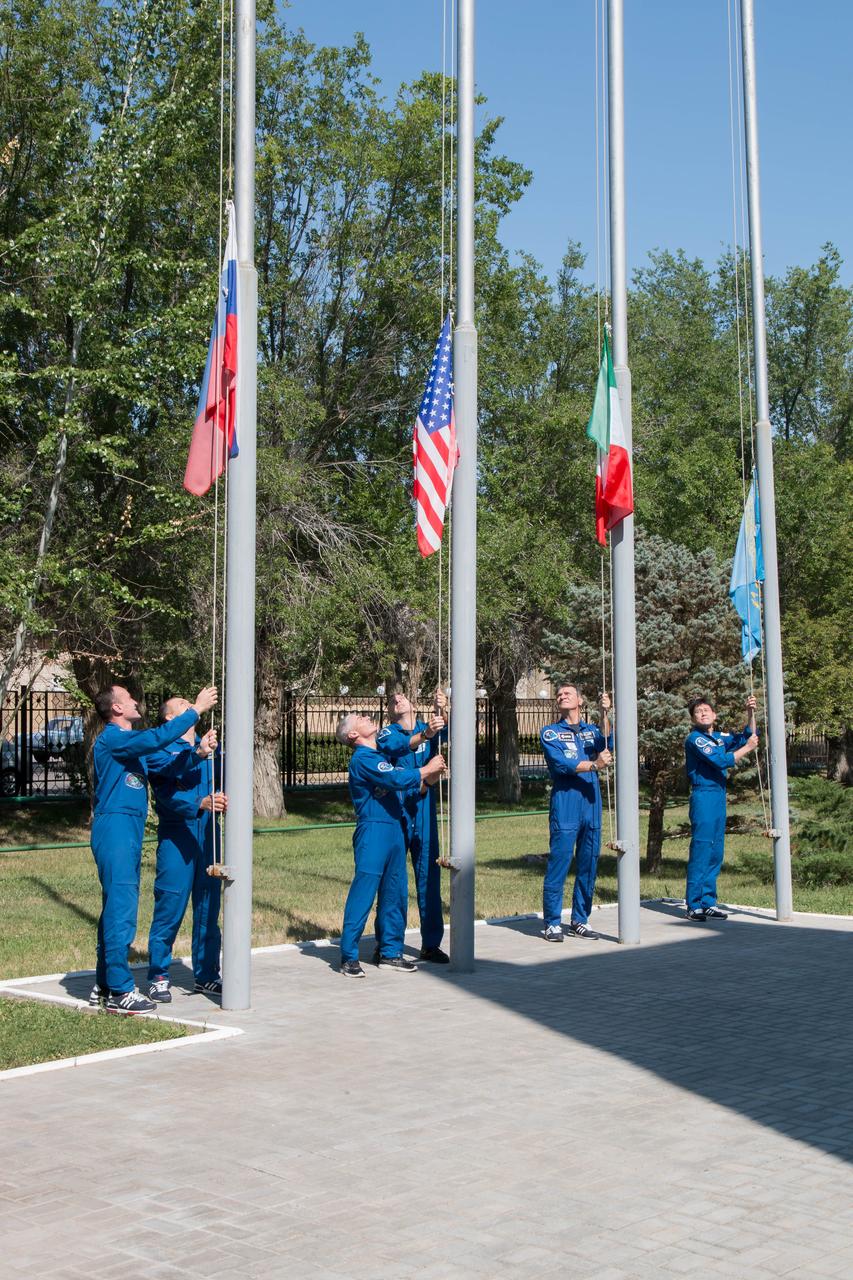
jsc2017e100896 (July 18, 2017) --- At the Cosmonaut Hotel crew quarters in Baikonur, Kazakhstan, the Expedition 52-53 prime and backup crewmembers raised the flags of the U.S., Russia, Italy and Kazakhstan July 18 during traditional pre-launch ceremonies. From left to right are Sergey Ryazanskiy and Alexander Misurkin of the Russian Federal Space Agency (Roscosmos) raising the Russian flag, Mark Vande Hei and Randy Bresnik of NASA raising the U.S. flag, Paolo Nespoli of the European Space Agency raising the flag of Italy and Norishige Kanai of the Japan Aerospace Exploration Agency (JAXA) raising the flag of Kazakhstan. Ryazanskiy, Bresnik and Nespoli will launch July 28 on the Soyuz MS-05 spacecraft from the Baikonur Cosmodrome for a five-month mission on the International Space Station. Credit: NASA/Victor Zelentsov
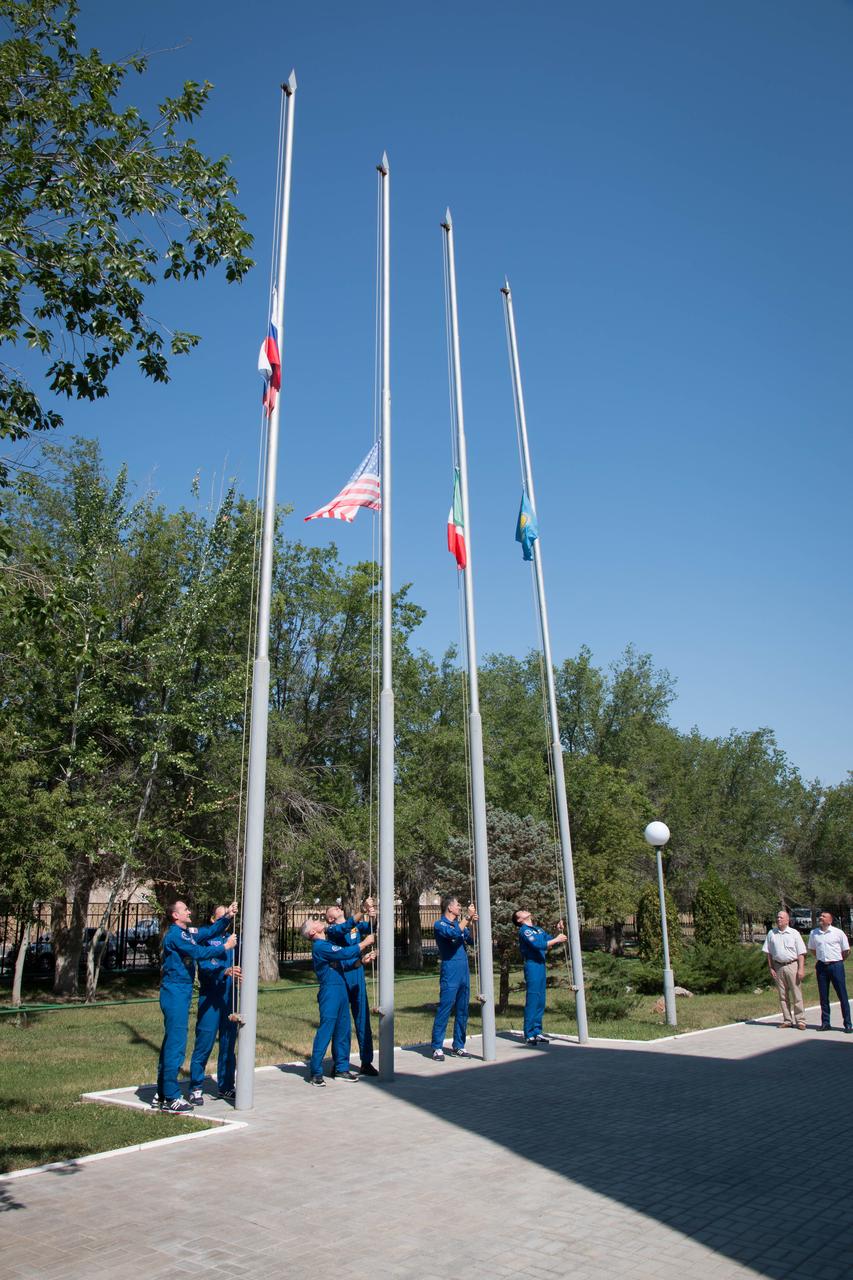
jsc2017e100897 (July 18, 2017) --- At the Cosmonaut Hotel crew quarters in Baikonur, Kazakhstan, the Expedition 52-53 prime and backup crewmembers raised the flags of the U.S., Russia, Italy and Kazakhstan July 18 during traditional pre-launch ceremonies. From left to right are Sergey Ryazanskiy and Alexander Misurkin of the Russian Federal Space Agency (Roscosmos) raising the Russian flag, Mark Vande Hei and Randy Bresnik of NASA raising the U.S. flag, Paolo Nespoli of the European Space Agency raising the flag of Italy and Norishige Kanai of the Japan Aerospace Exploration Agency (JAXA) raising the flag of Kazakhstan. Ryazanskiy, Bresnik and Nespoli will launch July 28 on the Soyuz MS-05 spacecraft from the Baikonur Cosmodrome for a five-month mission on the International Space Station. Credit: NASA/Victor Zelentsov
Expedition 11 Commander Sergei Krikalev, left, European Space Agency astronaut Roberto Vittori, of Italy, Flight Engineer John Phillips, third from left, along with their backups, Russian Commander Mikhail Tyurin, American Dan Tani and Robert Thirsk, of Canada, far right, participate in the traditional raising of their countries’ flags outside their crew quarters in Baikonur, Kazakhstan on Monday, April 11, 2005, during preparations for the April 15 launch on a Soyuz TMA-6 spacecraft to the International Space Station. Krikalev and Phillips will spend six months in space and greet the first Shuttle crew to fly in more than two years when it arrives at the station, while Vittori spends eight days on the station under a commercial contract between ESA and the Russian Federal Space Agency. Photo Credit: (NASA/Bill Ingalls)
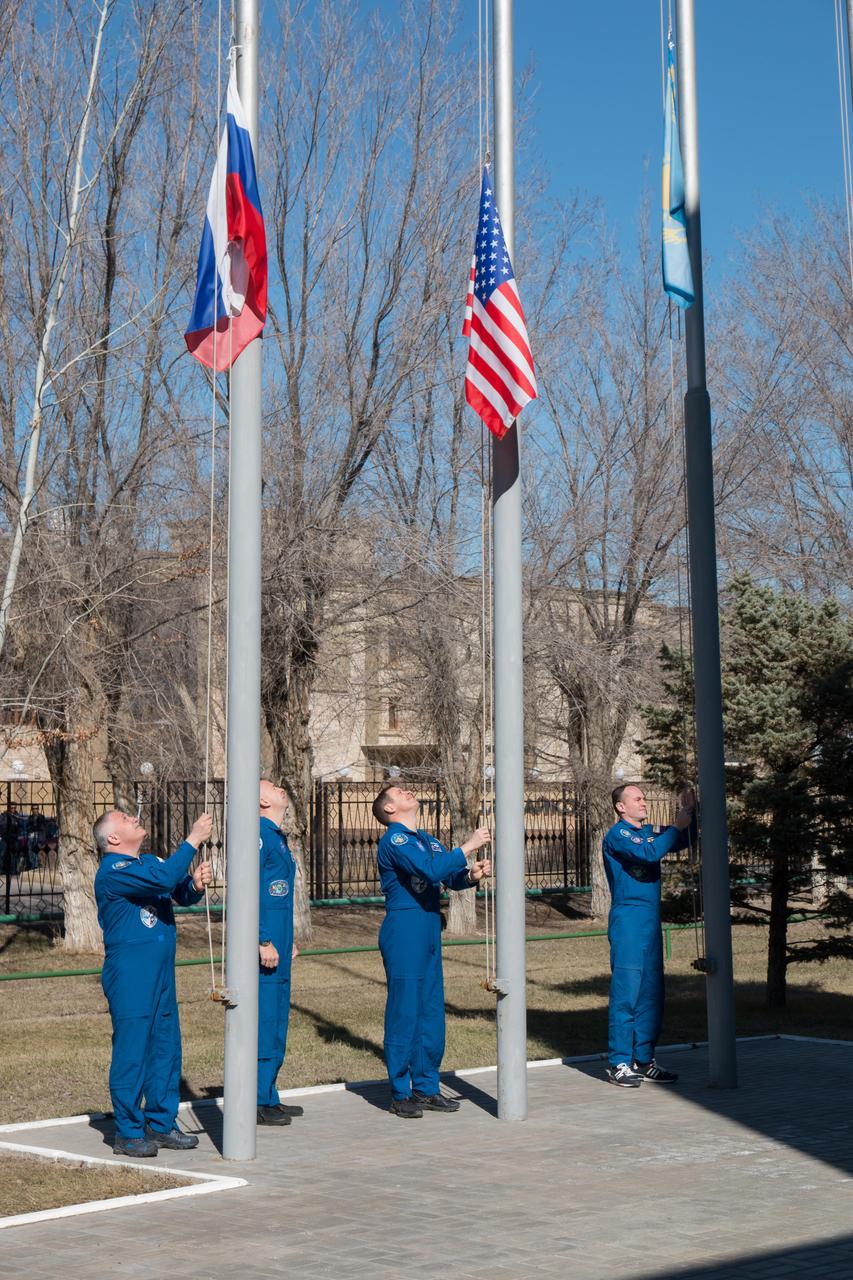
jsc2017e040341 (April 7, 2017) --- At the Cosmonaut Hotel crew quarters in Baikonur, Kazakhstan, the Expedition 51 prime and backup crewmembers raise the flags of Russia, the U.S. and Kazakhstan in traditional ceremonies April 7 as part of their pre-launch activities. From left to right are prime crewmember Fyodor Yurchikhin of the Russian Federal Space Agency (Roscosmos) raising the Russian flag, backup crewmember Randy Bresnik of NASA joining prime crewmember Jack Fischer of NASA to raise the American flag and backup crewmember Sergey Ryazanskiy of Roscosmos raising the Kazakh flag. Yurchikhin and Fischer will launch April 20 on the Soyuz MS-04 spacecraft from the Baikonur Cosmodrome for a four and a half month mission on the International Space Station. NASA/Victor Zelentsov
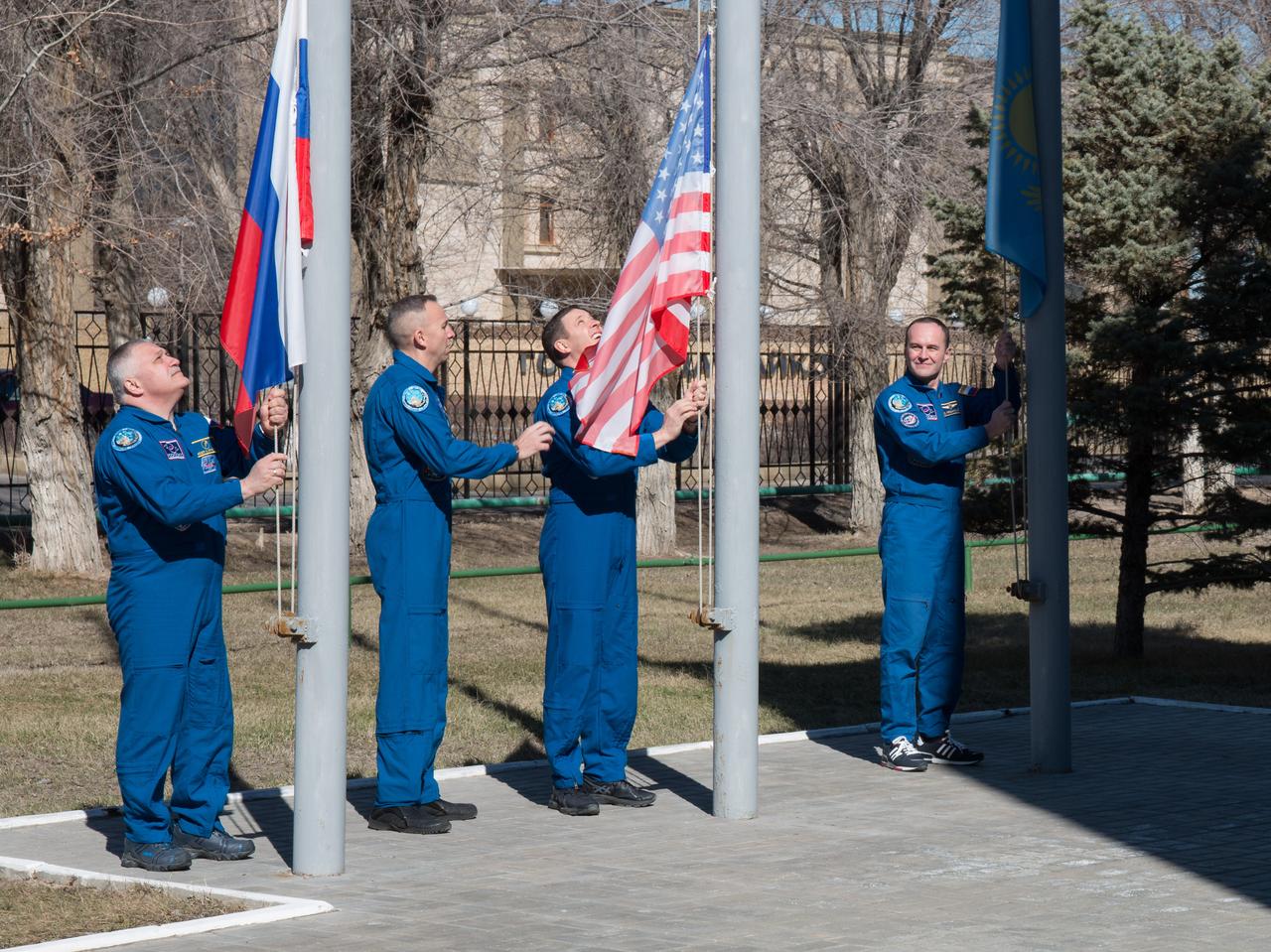
jsc2017e040340 (April 7, 2017) --- At the Cosmonaut Hotel crew quarters in Baikonur, Kazakhstan, the Expedition 51 prime and backup crewmembers raise the flags of Russia, the U.S. and Kazakhstan in traditional ceremonies April 7 as part of their pre-launch activities. From left to right are prime crewmember Fyodor Yurchikhin of the Russian Federal Space Agency (Roscosmos) raising the Russian flag, backup crewmember Randy Bresnik of NASA joining prime crewmember Jack Fischer of NASA to raise the American flag and backup crewmember Sergey Ryazanskiy of Roscosmos raising the Kazakh flag. Yurchikhin and Fischer will launch April 20 on the Soyuz MS-04 spacecraft from the Baikonur Cosmodrome for a four and a half month mission on the International Space Station. NASA/Victor Zelentsov
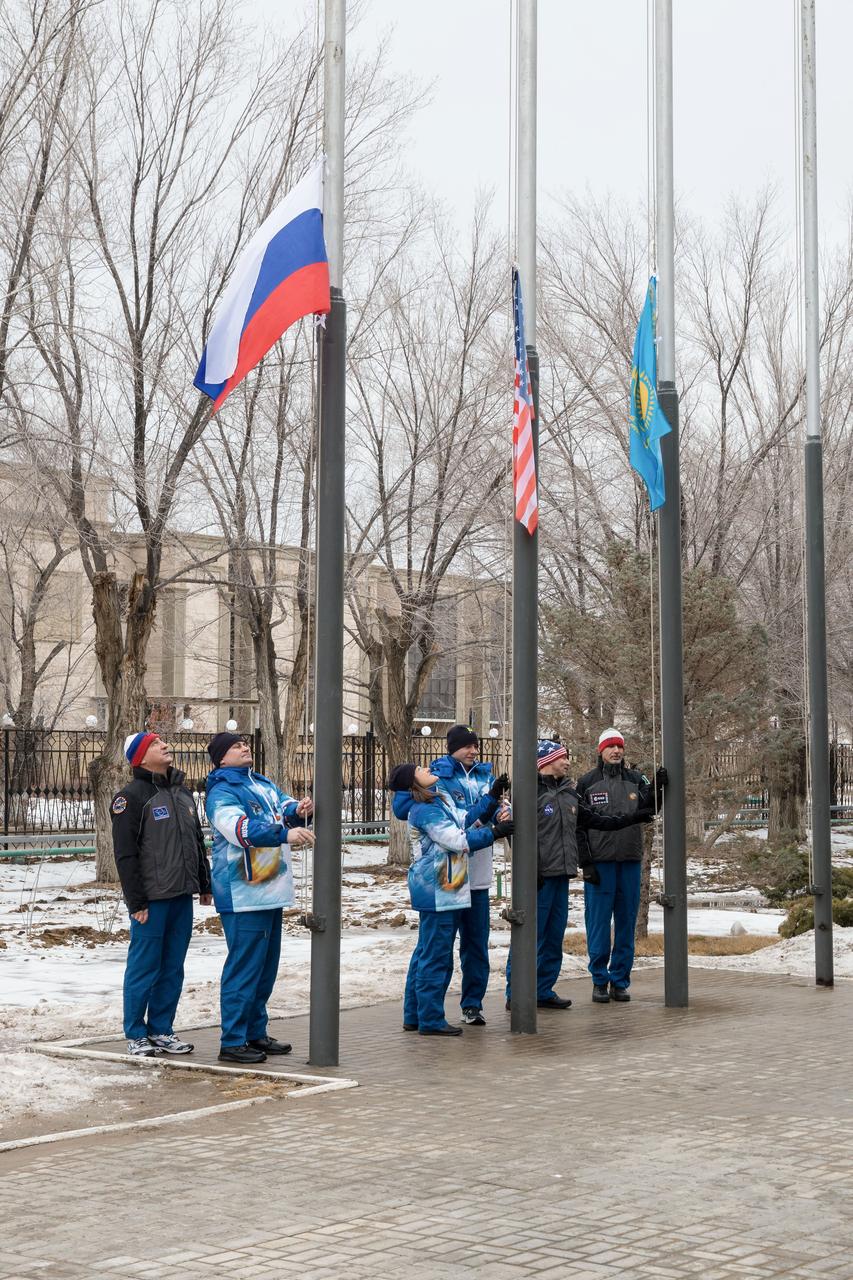
jsc2019e011272 - At their Cosmonaut Hotel crew quarters in Baikonur, Kazakhstan, the Expedition 59 prime and backup crewmembers conduct the traditional raising of the flags of Russia, the U.S. and Kazakhstan Feb. 28 as part of their pre-launch training. From left to right raising the Russian flag are Alexander Skvortsov and Alexey Ovchinin of Roscosmos, raising the U.S. flag are Nick Hague and Christina Koch of NASA and raising the Kazakh flag are Drew Morgan of NASA and Luca Parmitano of the European Space Agency. Hague, Ovchinin and Koch will launch March 14, U.S. time, in the Soyuz MS-12 spacecraft from the Baikonur Cosmodrome in Kazakhstan for a six-and-a-half month mission on the International Space Station...NASA/Victor Zelentsov.
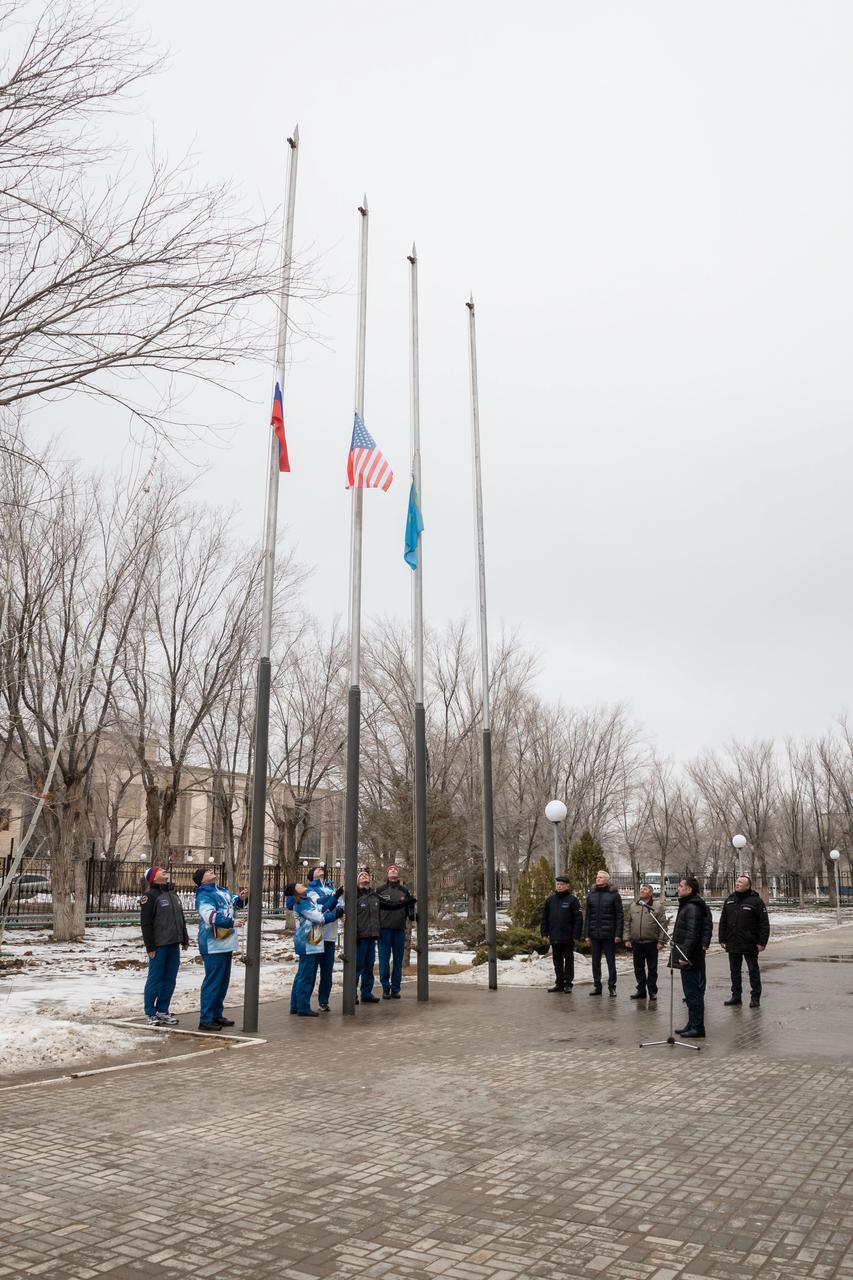
jsc2019e011273 - At their Cosmonaut Hotel crew quarters in Baikonur, Kazakhstan, the Expedition 59 prime and backup crewmembers conduct the traditional raising of the flags of Russia, the U.S. and Kazakhstan Feb. 28 as part of their pre-launch training. From left to right raising the Russian flag are Alexander Skvortsov and Alexey Ovchinin of Roscosmos, raising the U.S. flag are Nick Hague and Christina Koch of NASA and raising the Kazakh flag are Drew Morgan of NASA and Luca Parmitano of the European Space Agency. Hague, Ovchinin and Koch will launch March 14, U.S. time, in the Soyuz MS-12 spacecraft from the Baikonur Cosmodrome in Kazakhstan for a six-and-a-half month mission on the International Space Station...NASA/Victor Zelentsov.
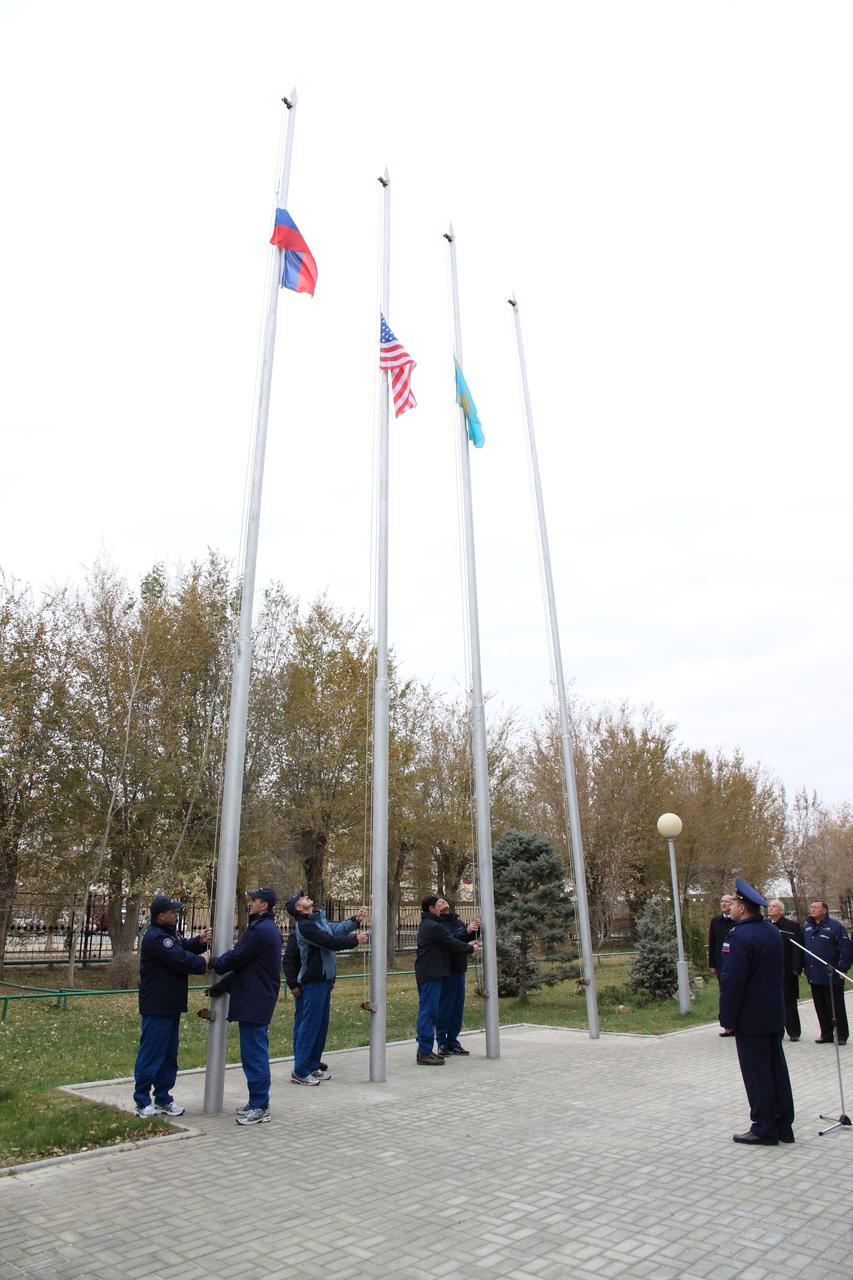
With officials looking on, the Expedition 30 prime and backup crews conducted the traditional flag-raising ceremony outside their Cosmonaut Hotel crew quarter in Baikonur, Kazakhstan on November 2, 2011 as they prepare for the launch of the Soyuz TMA-22 spacecraft on November 14. On the left, prime Soyuz Commander Anton Shkaplerov and Flight Engineer Anatoly Ivanishin hoist the flag of the Russian Federation; in the center, Expedition 30 Commander Dan Burbank of NASA and his backup, NASA’s Joe Acaba (hidden) raise the U.S. flag; on the right, backup crewmembers Sergei Revin and Gennady Padalka raise the flag of Kazakhstan. Credit: NASA/Victor Zelentsov
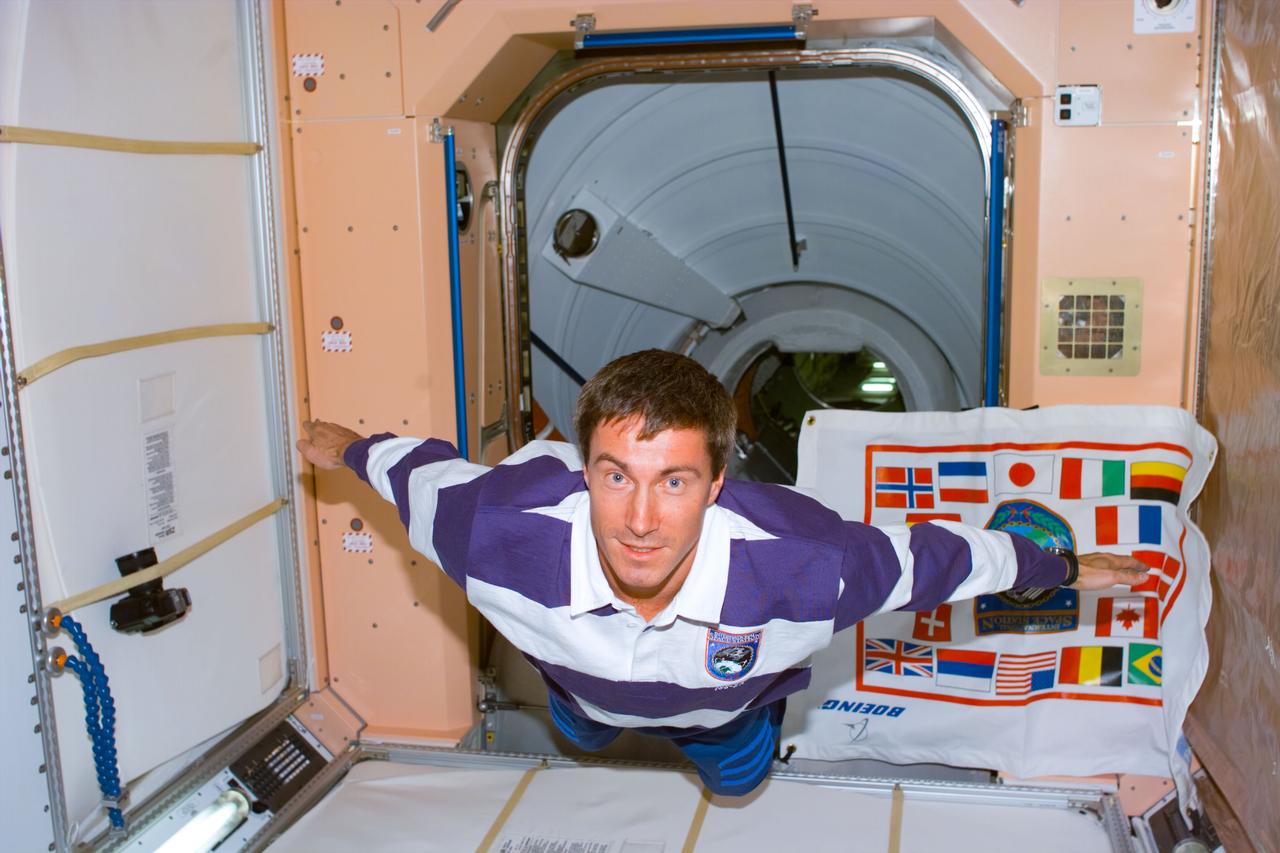
S88-E-5089 (12-11-98) --- Sergei Krikalev, mission specialist representing the Russian Space Agency (RSA), floats in the Unity module on Flight Day 8. A banner displaying the flags of all the ISS participants is at right.
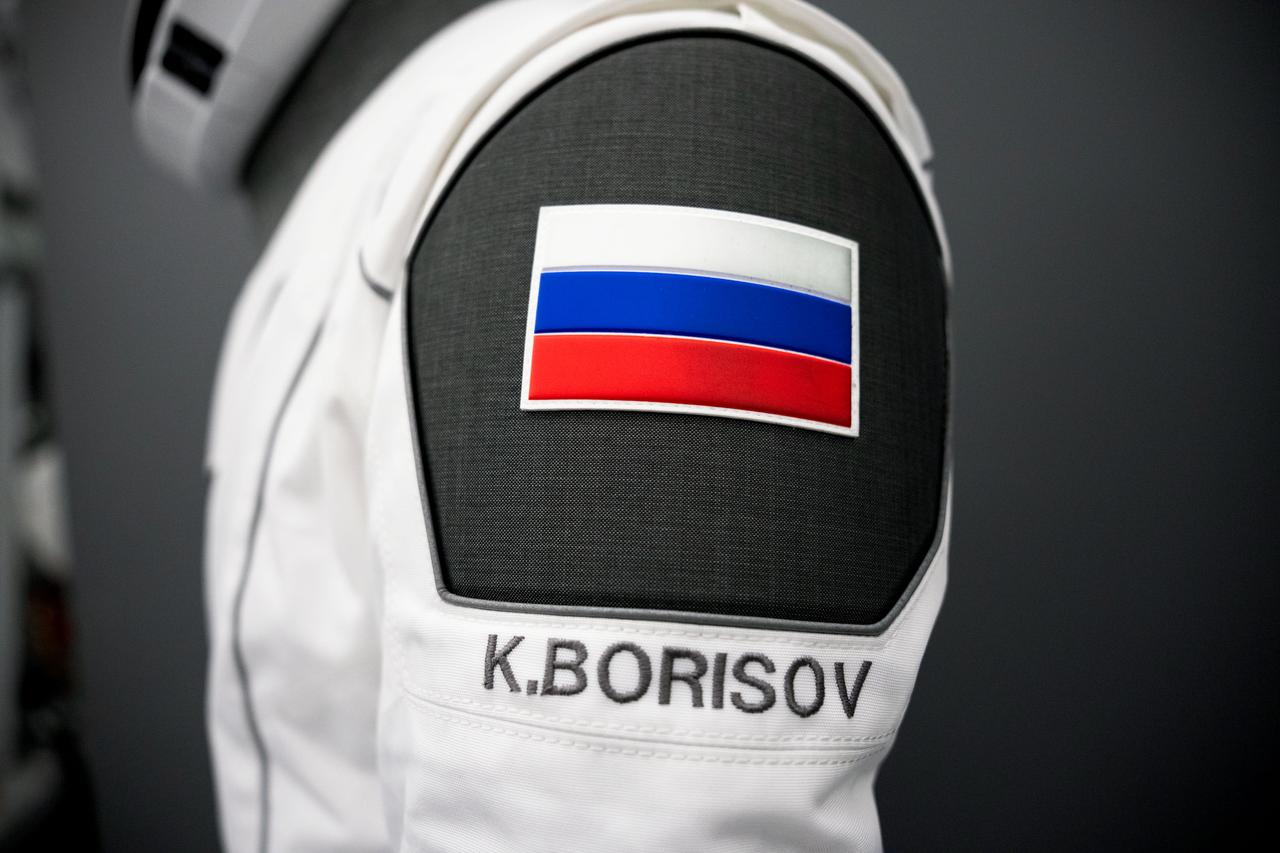
jsc2023e045330 - A SpaceX launch and entry suit bears a Russian flag, and the name of cosmonaut Konstantin Borisov, who will serve as mission specialist of NASA's SpaceX Crew-7 mission to the International Space Station. Credit: SpaceX
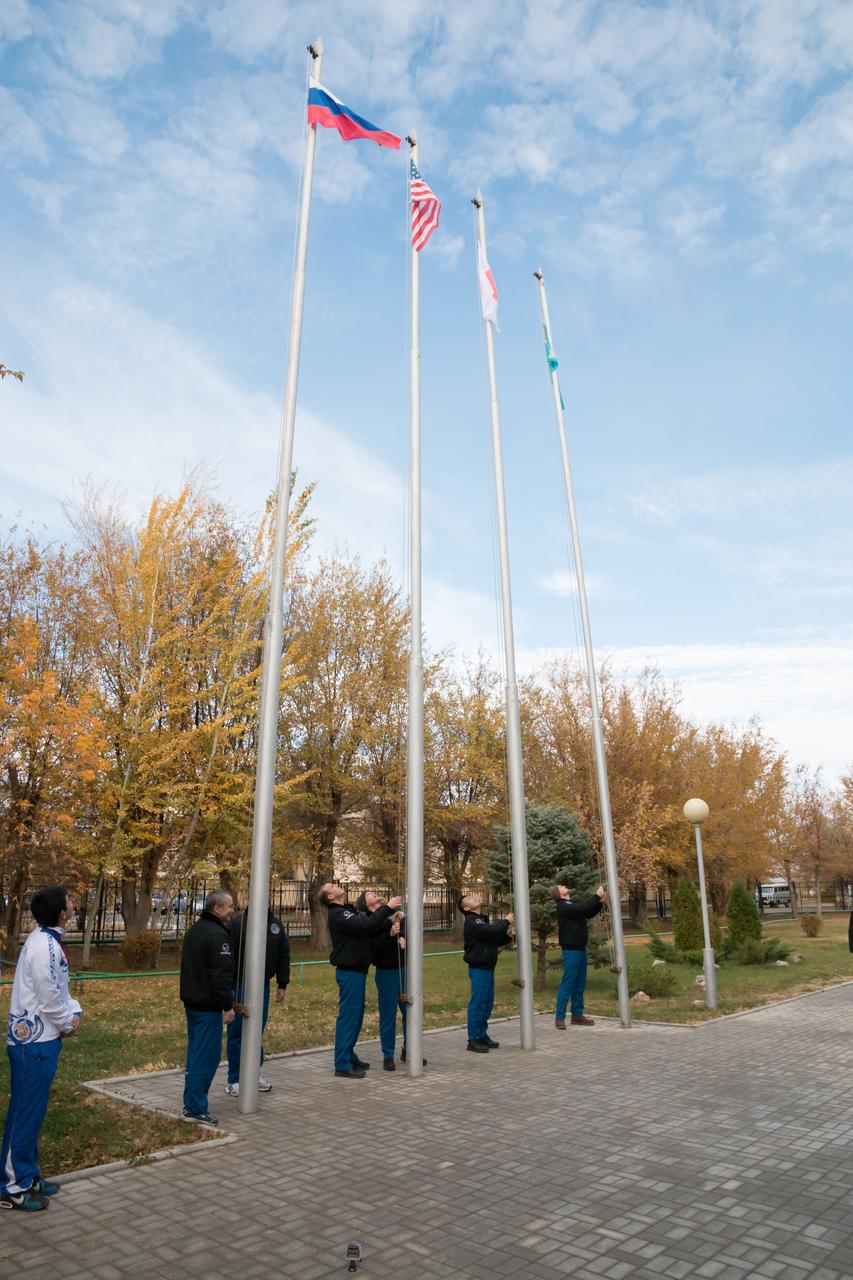
Outside their Cosmonaut Hotel crew quarters in Baikonur, Kazakhstan, the Expedition 38/39 prime and backup crewmembers participated in the traditional flag-raising ceremony October 27 as they conduct final pre-launch preparations. From left to right, prime Soyuz Commander Mikhail Tyurin and backup Max Suraev raise the Russian flag, prime Flight Engineer Rick Mastracchio of NASA and backup Reid Wiseman of NASA raise the U.S. flag, prime Flight Engineer Koichi Wakata of the Japan Aerospace Exploration Agency raises the Japanese flag and backup Flight Engineer Alexander Gerst of the European Space Agency raises the flag of Kazakhstan. Wakata, Tyurin and Mastracchio will launch Nov. 7, Kazakh time, in the Soyuz TMA-11M spacecraft from Baikonur to begin a six-month mission on the International Space Station. NASA/Victor Zelentsov
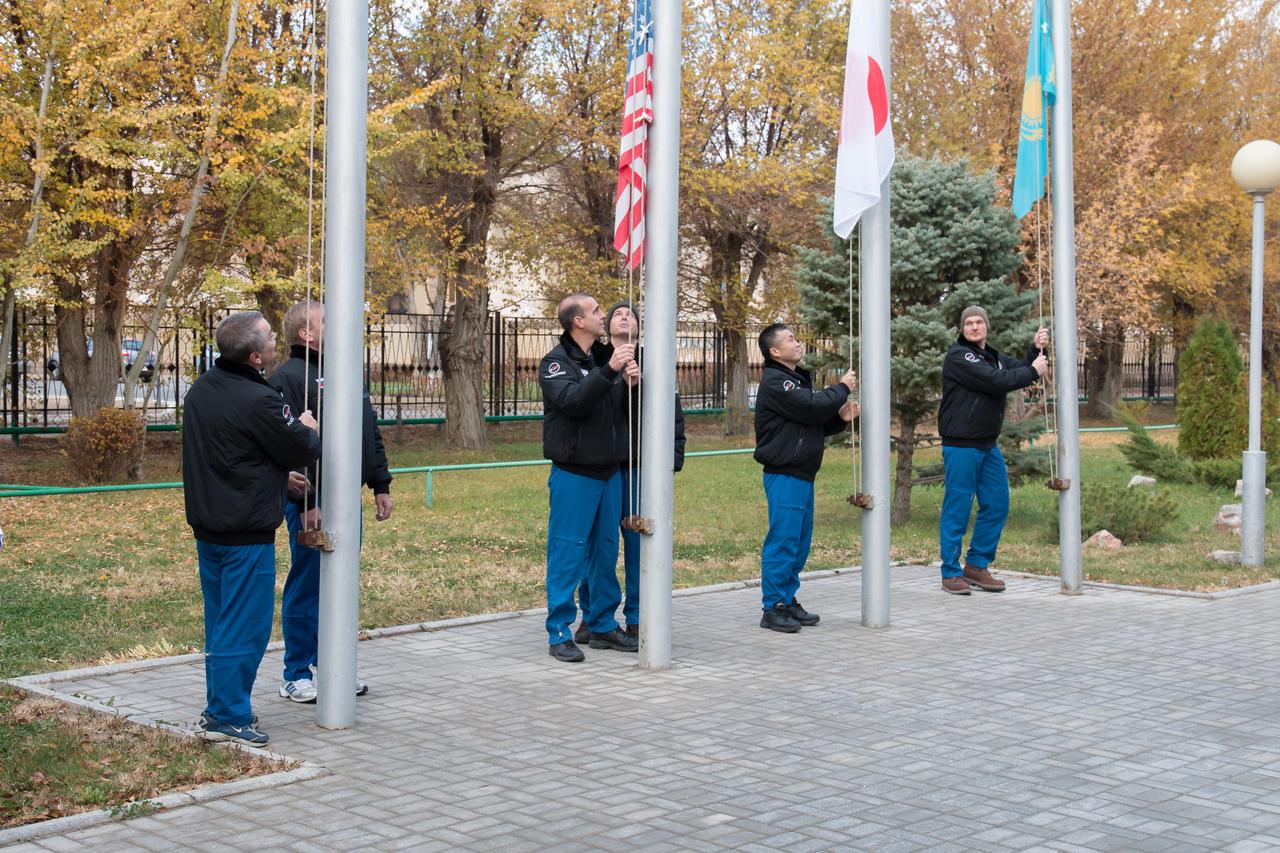
Outside their Cosmonaut Hotel crew quarters in Baikonur, Kazakhstan, the Expedition 38/39 prime and backup crewmembers participated in the traditional flag-raising ceremony October 27 as they conduct final pre-launch preparations. From left to right, prime Soyuz Commander Mikhail Tyurin and backup Max Suraev raise the Russian flag, prime Flight Engineer Rick Mastracchio of NASA and backup Reid Wiseman of NASA raise the U.S. flag, prime Flight Engineer Koichi Wakata of the Japan Aerospace Exploration Agency raises the Japanese flag and backup Flight Engineer Alexander Gerst of the European Space Agency raises the flag of Kazakhstan. Wakata, Tyurin and Mastracchio will launch Nov. 7, Kazakh time, in the Soyuz TMA-11M spacecraft from Baikonur to begin a six-month mission on the International Space Station. NASA/Victor Zelentsov
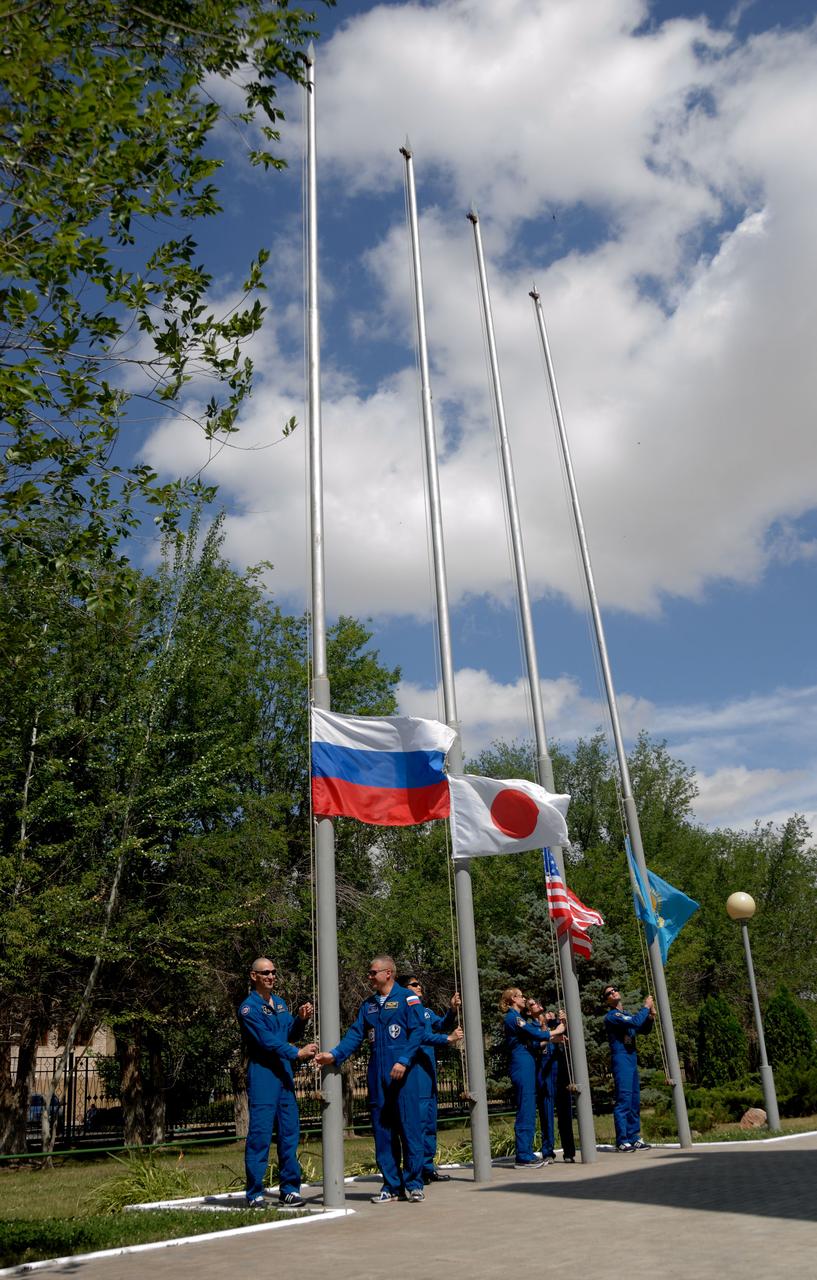
Outside their Cosmonaut Hotel crew quarters in Baikonur, Kazakhstan, the Expedition 48-49 prime and backup crewmembers conduct the traditional raising of the Russian, Japanese, American and Kazakh flags June 26. Prime crewmembers Kate Rubins of NASA, Anatoly Ivanishin of Roscosmos and Takuya Onishi of the Japan Aerospace Exploration Agency will launch on July 7, Baikonur time, on the Soyuz MS-01 spacecraft for a planned four-month mission on the International Space Station. NASA/Alexander Vysotsky
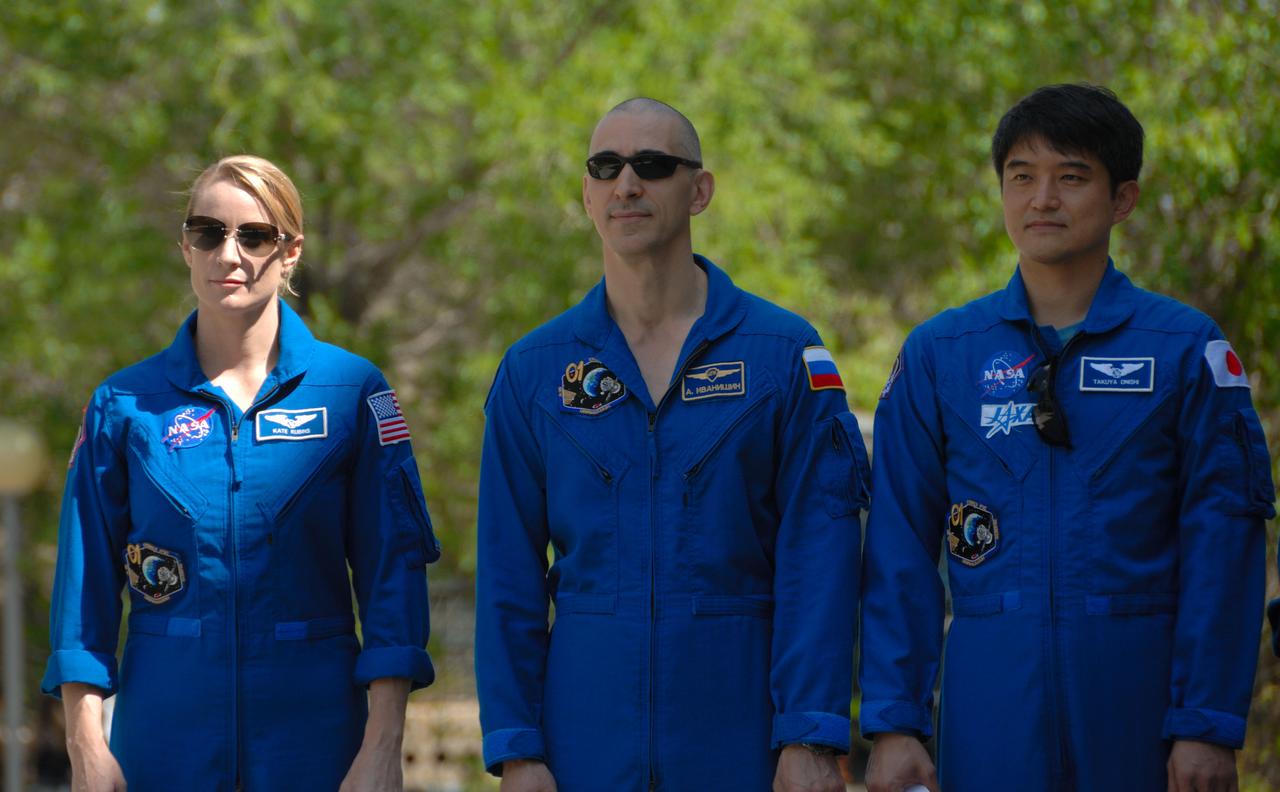
Outside their Cosmonaut Hotel crew quarters in Baikonur, Kazakhstan, Expedition 48-49 crewmembers Kate Rubins of NASA (left), Anatoly Ivanishin of Roscosmos (center) and Takuya Onishi of the Japan Aerospace Exploration Agency (right) listen to remarks June 26 during the traditional raising of the American, Russian, Japanese and Kazakh flags. The trio will launch on July 7, Baikonur time, on the Soyuz MS-01 spacecraft for a planned four-month mission on the International Space Station. NASA/Alexander Vysotsky
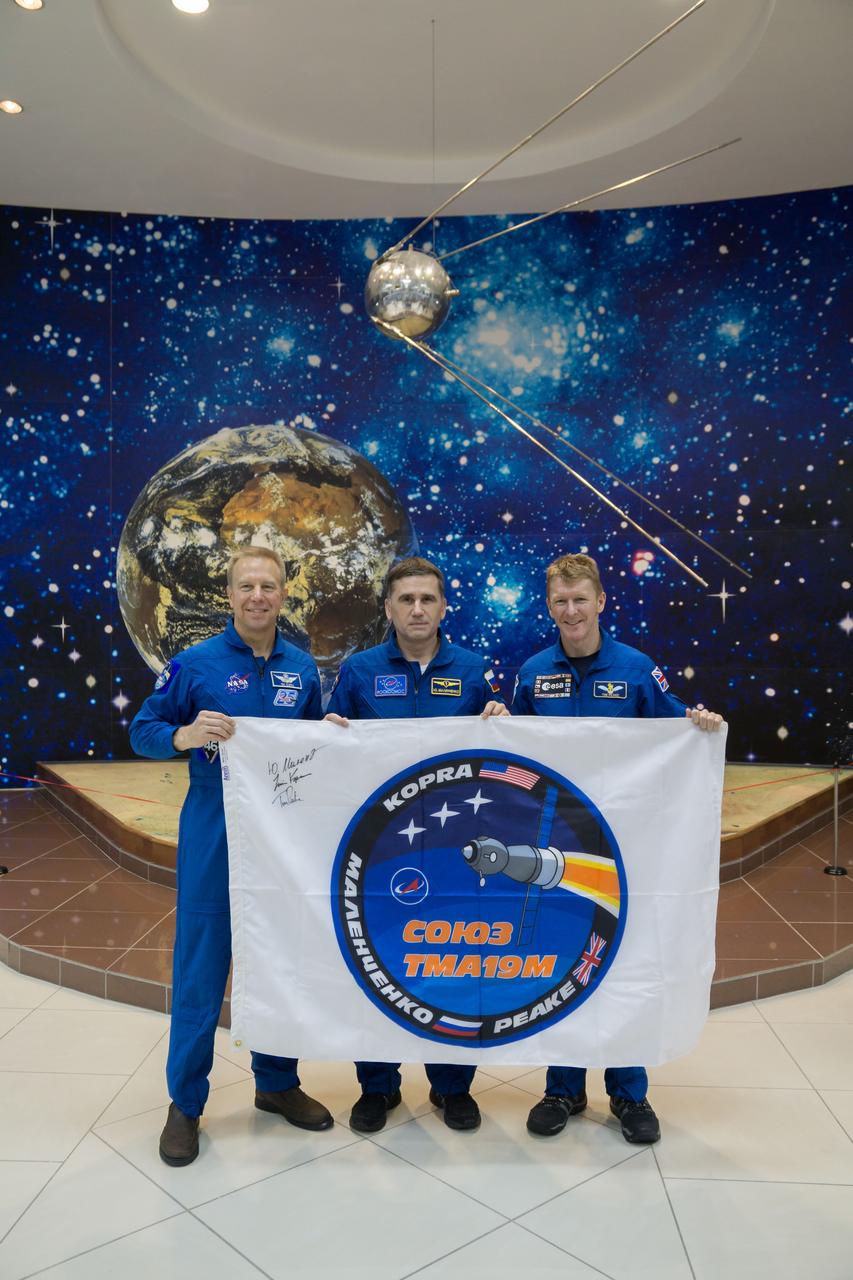
During a break from training, the Expedition 46-47 crewmembers toured the Korolev Museum at the Baikonur Cosmodrome in Kazakhstan Dec. 10 and displayed a flag bearing the logo for their Soyuz mission. From left to right are Tim Kopra of NASA, Yuri Malenchenko of the Russian Federal Space Agency (Roscosmos) and Tim Peake of the European Space Agency. Kopra, Peake and Malenchenko will launch Dec. 15 on the Soyuz TMA-19M spacecraft for a six-month mission on the International Space Station. NASA/Victor Zelentsov
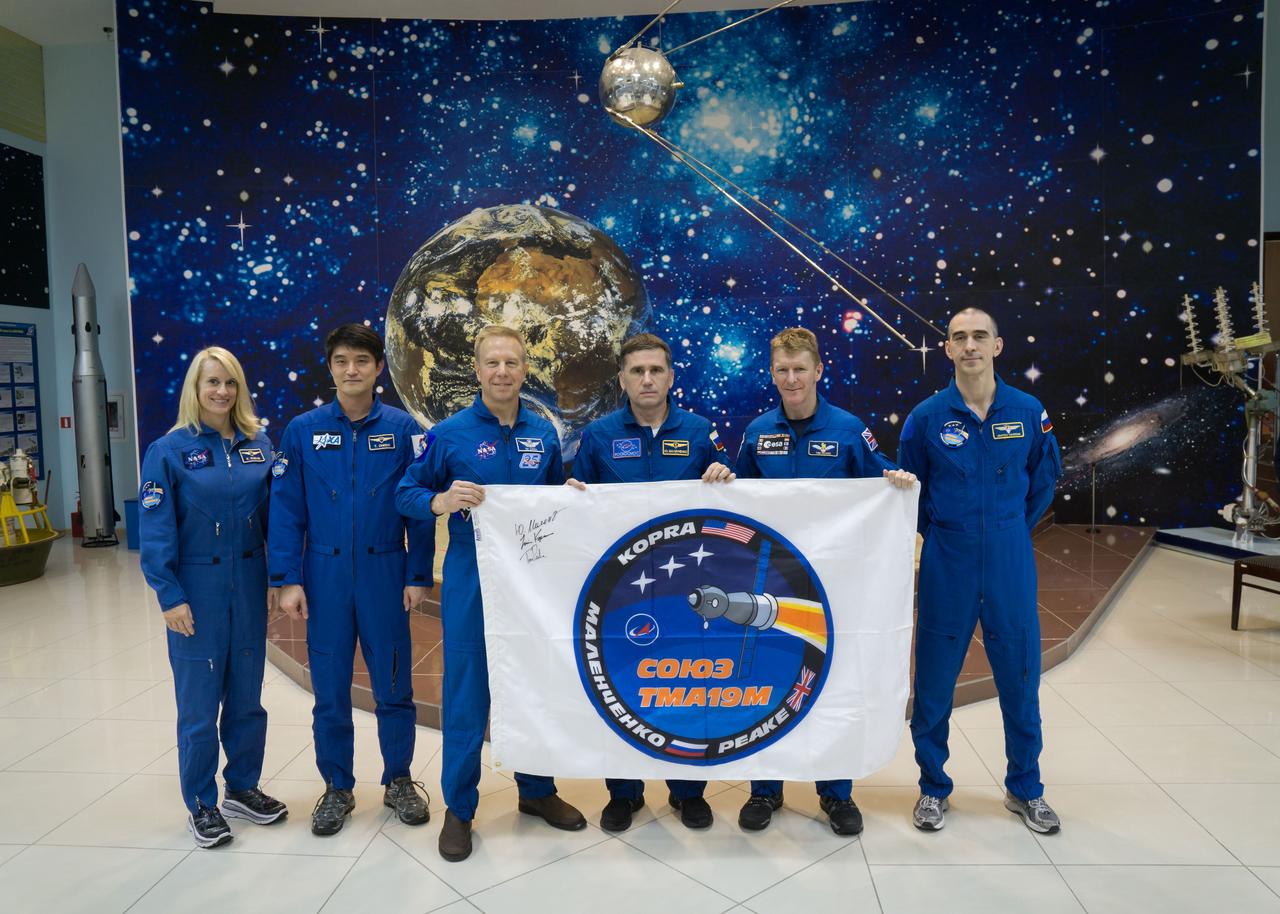
During a break from training, the Expedition 46-47 prime and backup crewmembers toured the Korolev Museum at the Baikonur Cosmodrome in Kazakhstan Dec. 10 and displayed a flag bearing the logo for the prime crew’s Soyuz mission. From left to right are backup crewmembers Kate Rubins of NASA and Takuya Onishi of the Japan Aerospace Exploration Agency, prime crewmembers Tim Kopra of NASA, Yuri Malenchenko of the Russian Federal Space Agency (Roscosmos) and Tim Peake of the European Space Agency who are holding the flag, and backup crewmember Anatoly Ivanishin of Roscosmos. Kopra, Peake and Malenchenko will launch Dec. 15 on the Soyuz TMA-19M spacecraft for a six-month mission on the International Space Station. NASA/Victor Zelentsov
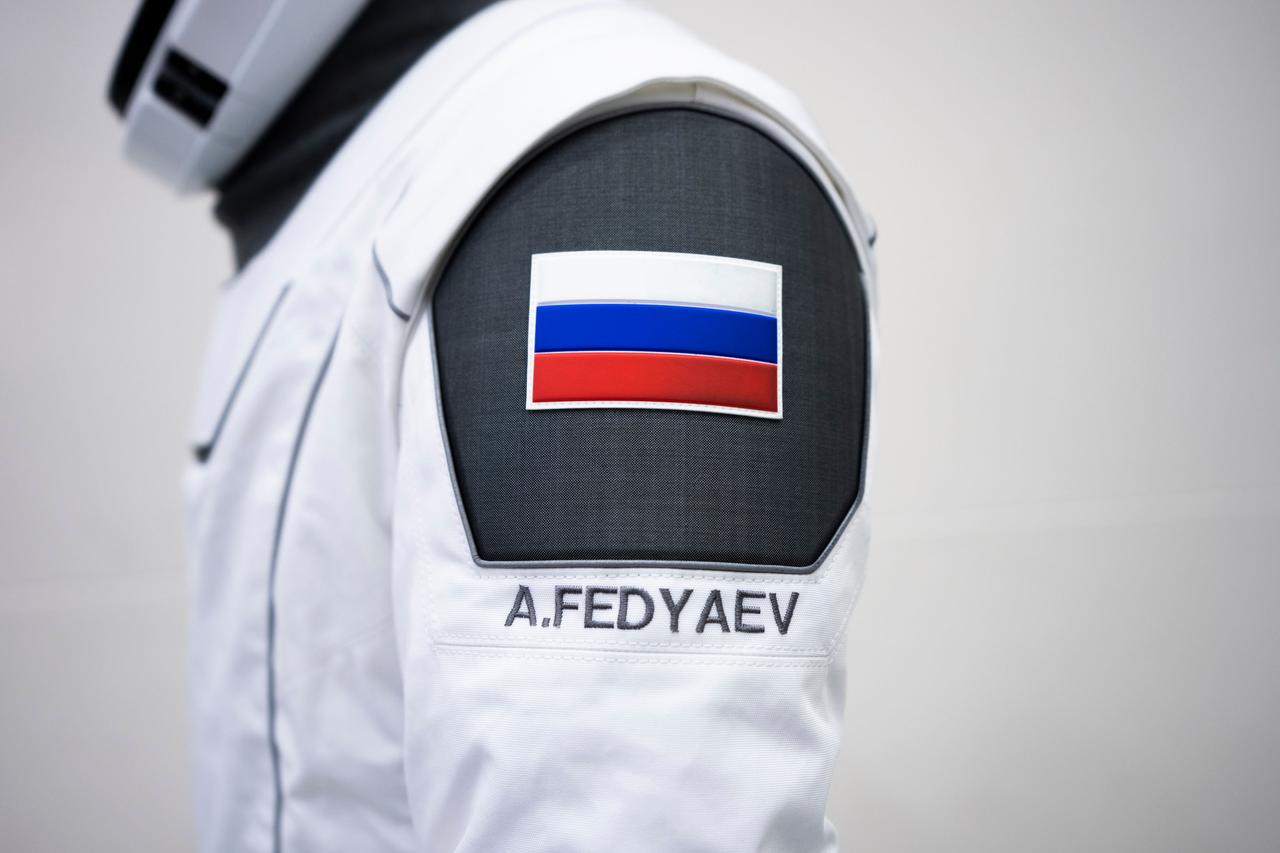
jsc2023e005739 (Jan. 30, 2023) --- A SpaceX launch and entry suit bears a Russian flag, and the name of Roscosmos cosmonaut Andrey Fedyaev, who will serve as a mission specialist of NASA's SpaceX Crew-6 mission to the International Space Station. Credit: SpaceX
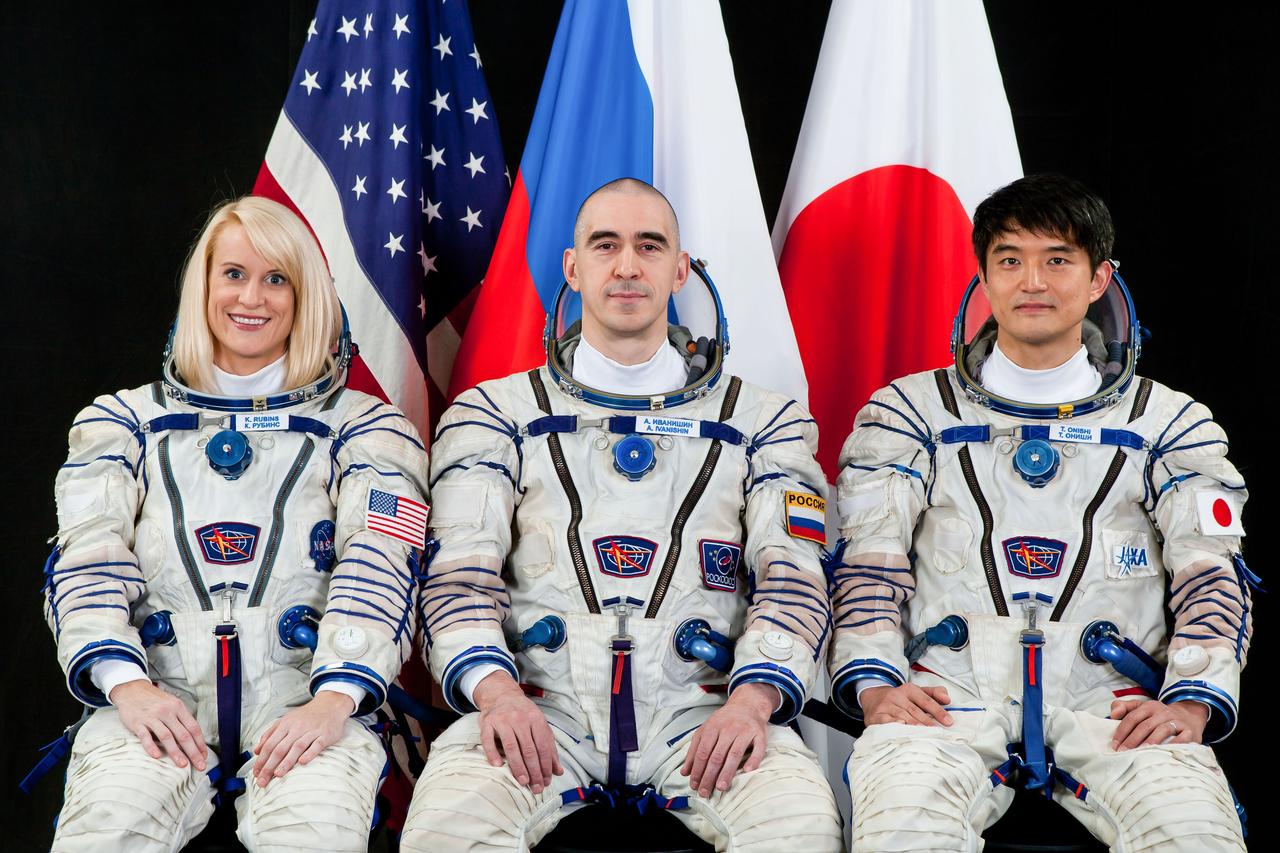
JSC2015e102000 (08/04/2015) --- Portrait of Expedition 48/49 crewmembers. From the left: NASA astronaut Kate Rubins, Russian cosmonaut Anatoly Ivanishin (Expedition 49 Commander) and Japan Aerospace Exploration Agency (JAXA) astronaut Takuya Onishi. All are wearing Russian Sokol launch and entry suits with the flags of the United States, Russia and Japan visible in the background.
![2014-03-15-11-04-32-3[1] At the Cosmonaut Hotel crew quarters in Baikonur, Kazakhstan, the flags of Russia, the United States and Kazakhstan fly high March 15 after a flag-raising ceremony that is part of traditional pre-launch activities. Expedition 39/40 Flight Engineer Steve Swanson of NASA, Soyuz Commander Alexander Skvortsov of the Russian Federal Space Agency (Roscosmos) and Flight Engineer Oleg Artemyev of Roscosmos are scheduled to launch to the International Space Station March 26 (Kazakh time) for the start of a six-month mission. NASA/Victor Zelentsov](https://images-assets.nasa.gov/image/jsc2014e026289/jsc2014e026289~medium.jpg)
2014-03-15-11-04-32-3[1] At the Cosmonaut Hotel crew quarters in Baikonur, Kazakhstan, the flags of Russia, the United States and Kazakhstan fly high March 15 after a flag-raising ceremony that is part of traditional pre-launch activities. Expedition 39/40 Flight Engineer Steve Swanson of NASA, Soyuz Commander Alexander Skvortsov of the Russian Federal Space Agency (Roscosmos) and Flight Engineer Oleg Artemyev of Roscosmos are scheduled to launch to the International Space Station March 26 (Kazakh time) for the start of a six-month mission. NASA/Victor Zelentsov
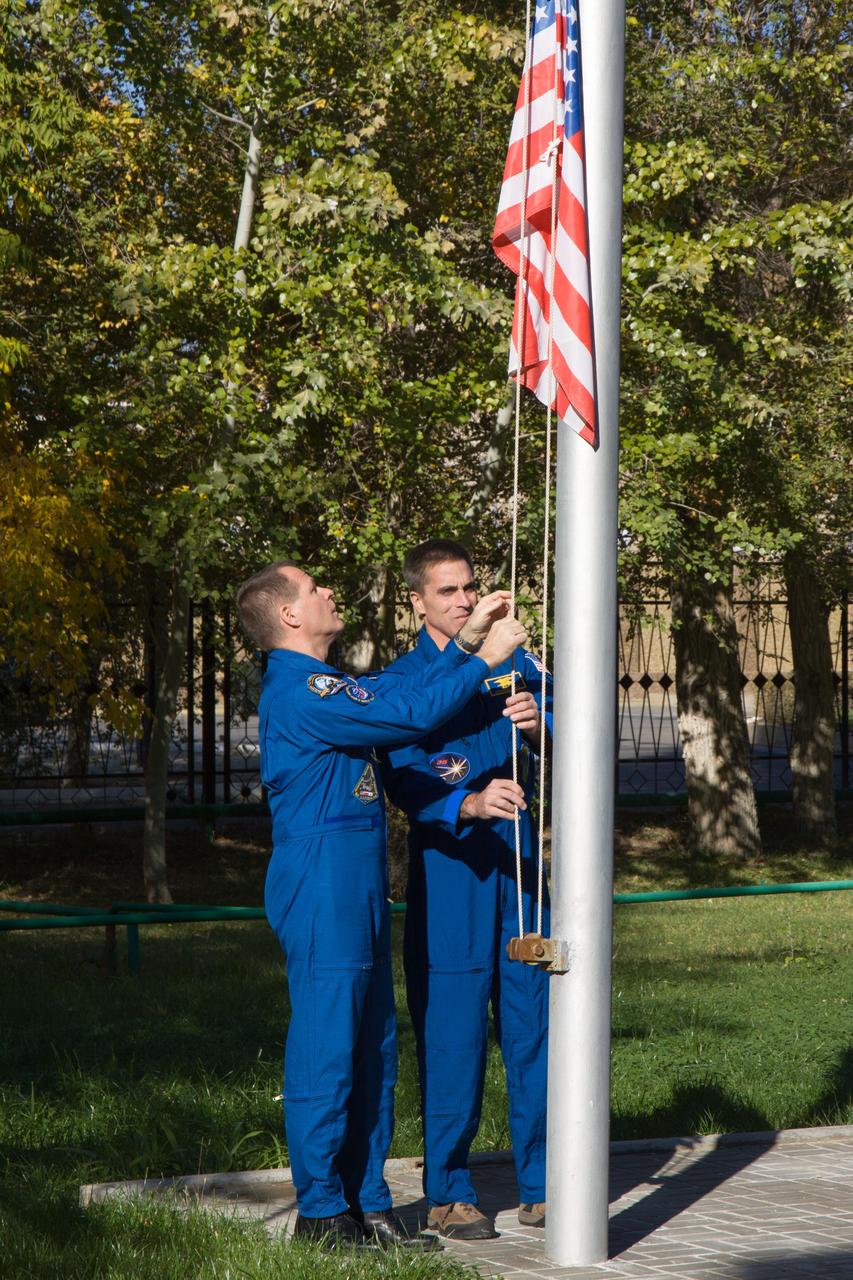
Expedition 33/34 prime Flight Engineer Kevin Ford of NASA (left) and his backup, NASA’s Chris Cassidy raise the U.S. flag outside their Cosmonaut Hotel crew quarters in Baikonur, Kazakhstan October 11, 2012. The raising of the U.S., Russian and Kazakh flags by Ford, Cassidy, prime Soyuz Commander Oleg Novitskiy, prime Flight Engineer Evgeny Tarelkin, backup Flight Engineer Alexander Misurkin and backup Soyuz Commander Pavel Vinogradov were part of the activities leading up to the scheduled launch of Ford, Novitskiy and Tarelkin October 23 in their Soyuz TMA-06 spacecraft for a five-month mission on the International Space Station. NASA/Victor Zelentsov
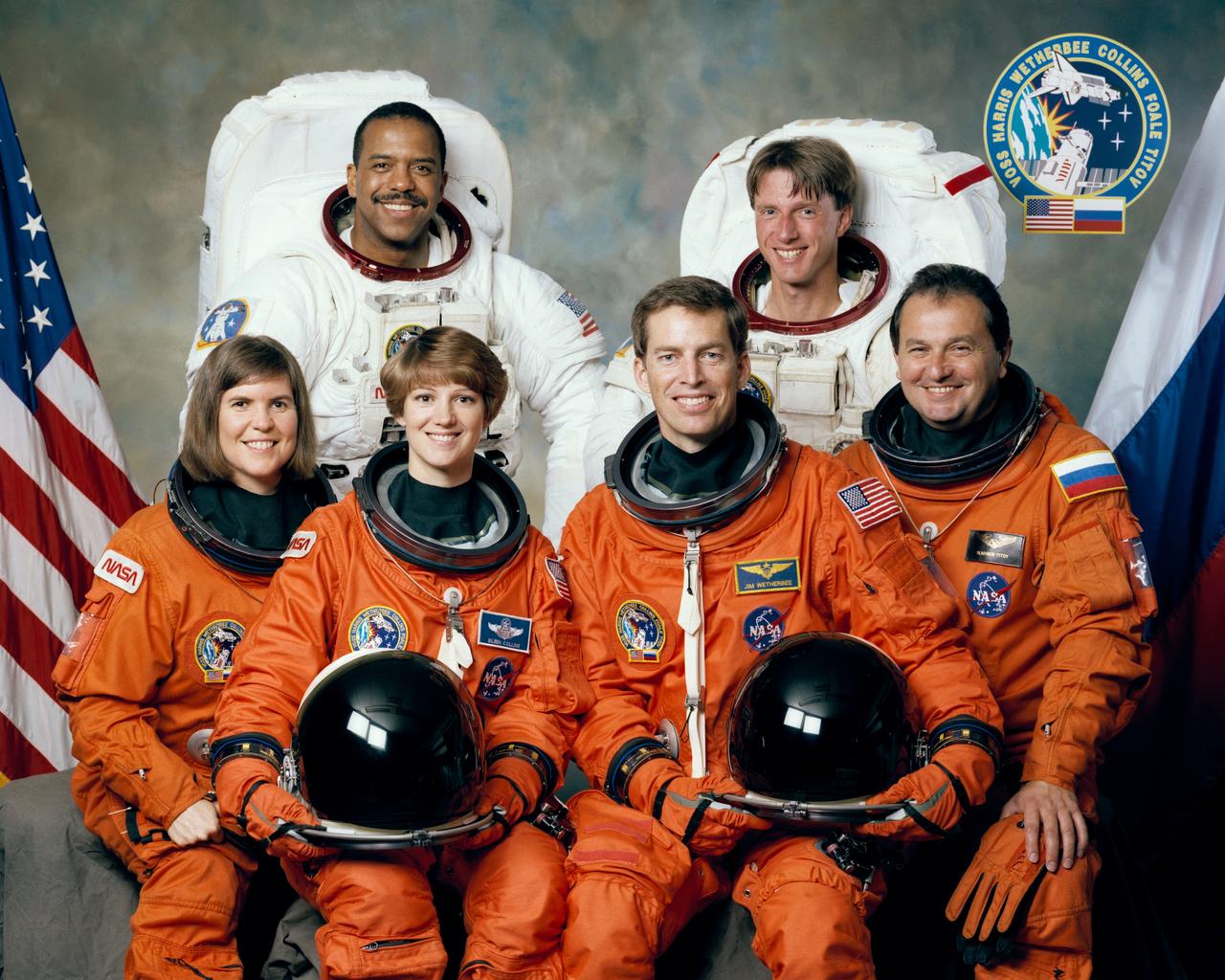
STS063-S-002 (November 1994) --- With the United States and Russian flags in the background, five NASA astronauts and a Russian cosmonaut named to fly aboard the Space Shuttle Discovery for the mission pose for the flight crew portrait at the Johnson Space Center (JSC). Left to right (front row) are Janice E. Voss, mission specialist; Eileen M. Collins, pilot; James D. Wetherbee, mission commander; and Vladimir Titov of the Russian Space Agency (RSA), mission specialist. In the rear are Bernard A. Harris Jr., payload commander; and C. Michael Foale, mission specialist.
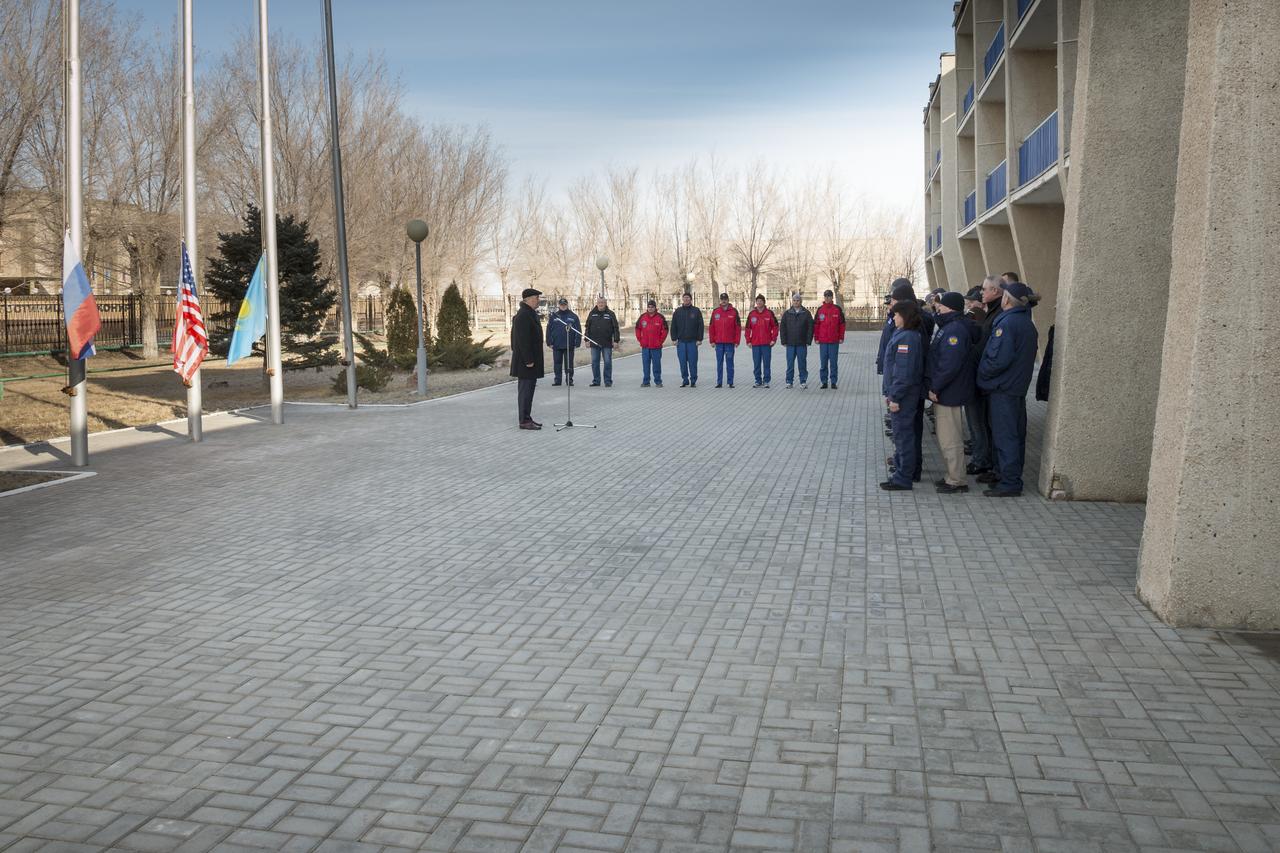
Expedition 43 prime crew: NASA Flight Engineer Scott Kelly, Russian Cosmonauts Gennady Padalka, and Mikhail Kornienko of the Russian Federal Space Agency (Roscosmos), along with their backup crew: Jeff Williams of NASA, Russian Cosmonauts Alexei Ovchinin, and Sergei Volkov of Roscosmos attend a traditional flag raising ceremony at the Cosmonaut Hotel, Monday, March 16, 2015 in Baikonur, Kazakhstan. Kelly, Padalka, and Kornienko are preparing for launch to the International Space Station in their Soyuz TMA-16M spacecraft from the Baikonur Cosmodrome in Kazakhstan March 28, Kazakh time. As the one-year crew, Kelly and Kornienko will return to Earth on Soyuz TMA-18M in March 2016. Photo Credit: (NASA/Victor Zelentsov)
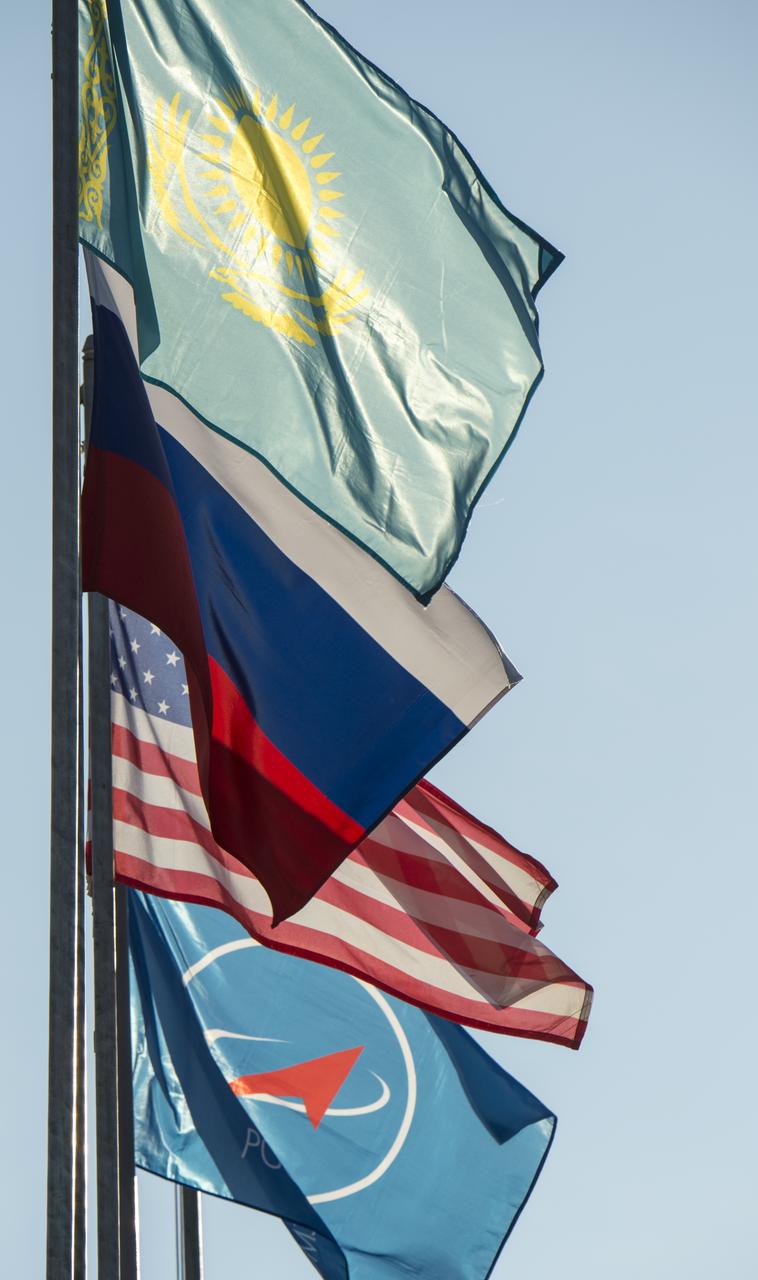
The flags of Kazakhstan, Russia, The United States, and the Russian Federal Space Agency (Roscosmos) are seen flying at teh launch pad after the Soyuz TMA-16M spacecraft was rolled out by train at the Baikonur Cosmodrome, Kazakhstan, Wednesday, March 25, 2015. NASA Astronaut Scott Kelly, and Russian Cosmonauts Mikhail Kornienko, and Gennady Padalka of the Russian Federal Space Agency (Roscosmos) are scheduled to launch to the International Space Station in the Soyuz TMA-16M spacecraft from the Baikonur Cosmodrome in Kazakhstan March 28, Kazakh time (March 27 Eastern time.) As the one-year crew, Kelly and Kornienko will return to Earth on Soyuz TMA-18M in March 2016. Photo Credit (NASA/Bill Ingalls)
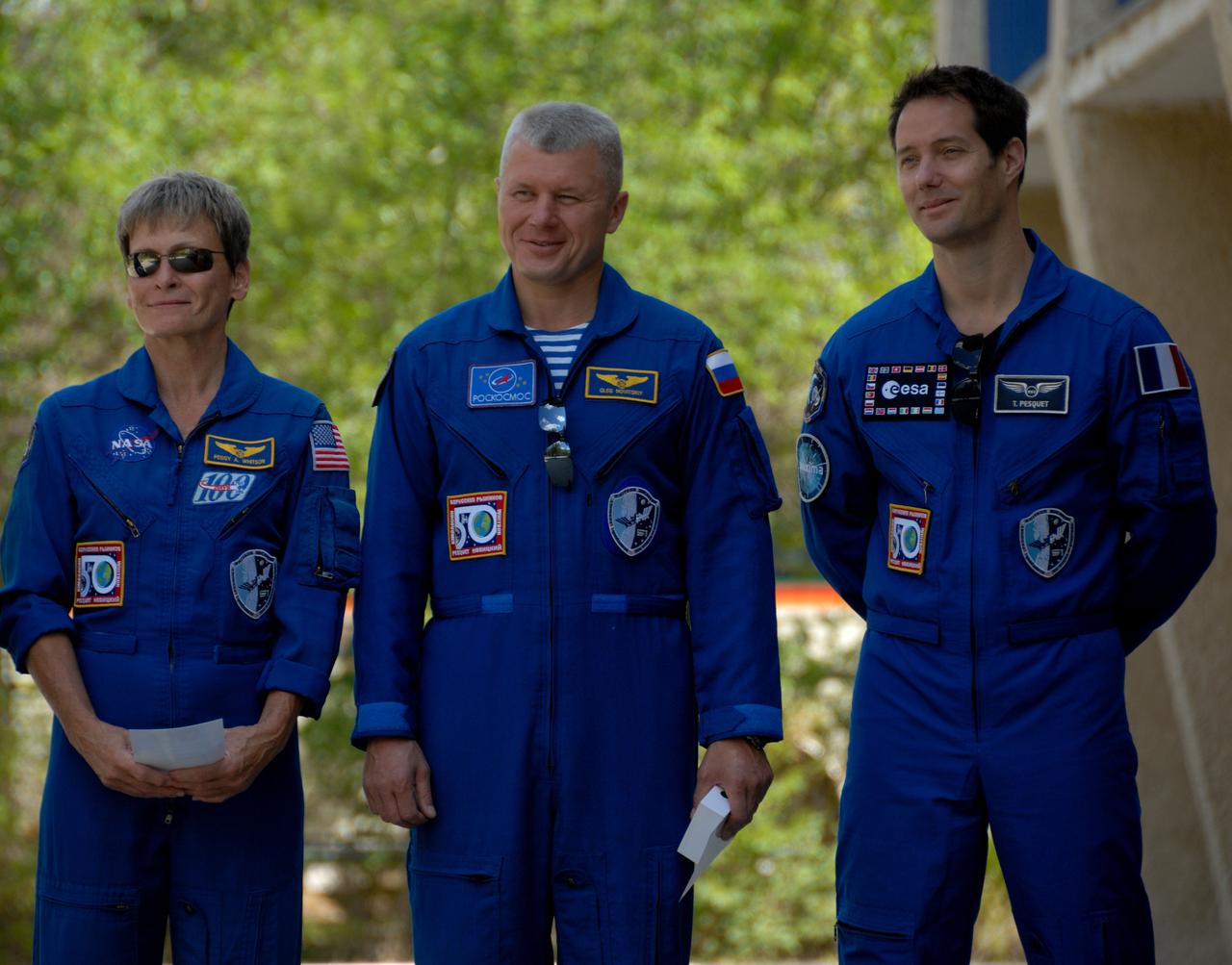
Outside their Cosmonaut Hotel crew quarters in Baikonur, Kazakhstan, Expedition 48-49 backup crewmembers Peggy Whitson of NASA (left), Oleg Novitskiy of Roscosmos (center) and Thomas Pesquet of the European Space Agency (right) listen to remarks June 26 during the traditional raising of the American, Russian, Japanese and Kazakh flags. Prime crewmembers Kate Rubins of NASA, Anatoly Ivanishin of Roscosmos and Takuya Onishi of the Japan Aerospace Exploration Agency will launch on July 7, Baikonur time, on the Soyuz MS-01 spacecraft for a planned four-month mission on the International Space Station. NASA/Alexander Vysotsky
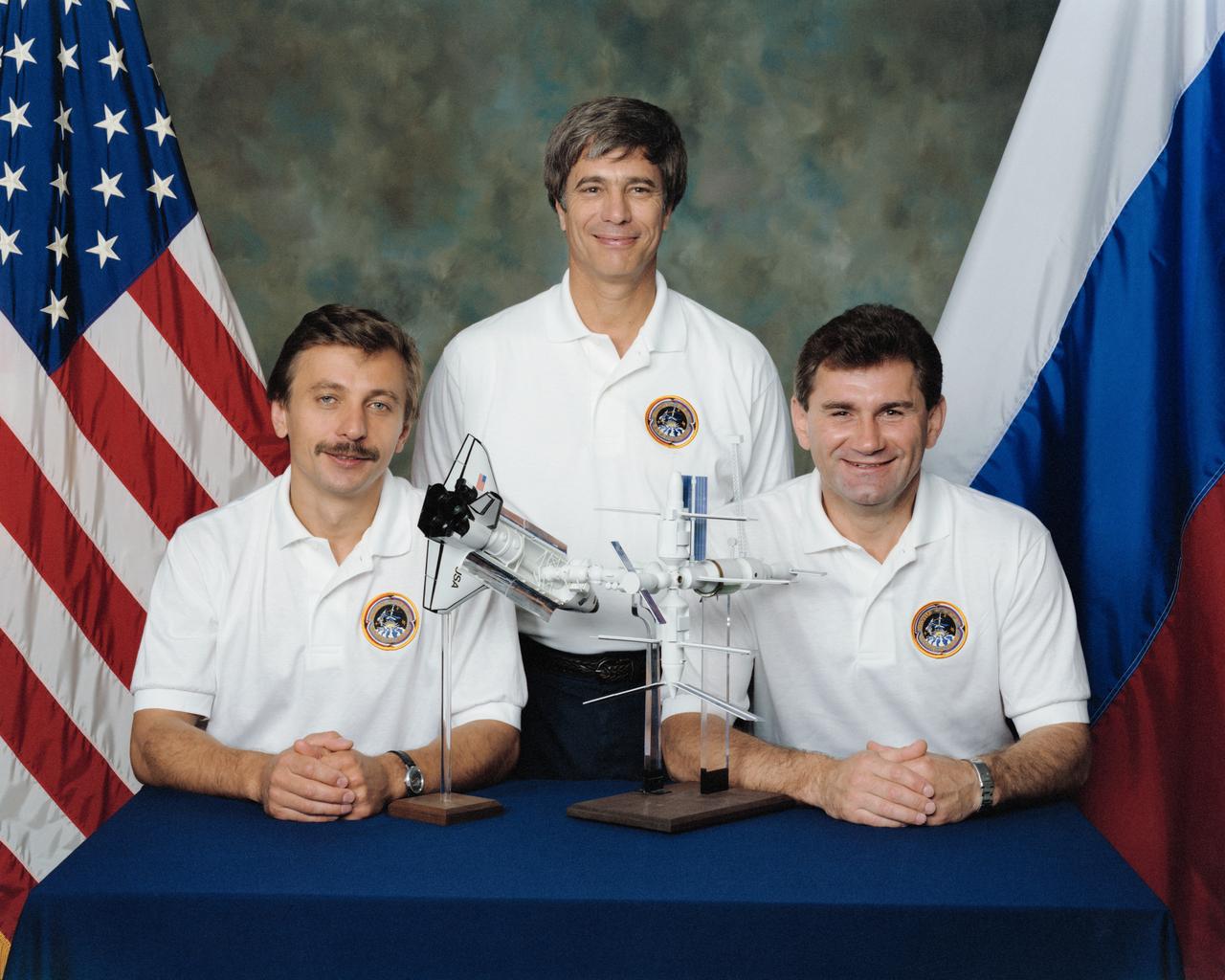
Mir 21 crew portraits. Group portrait of Mir 21 prime and backup crews with American and Russian flags and shuttle/Mir model, top from left: Yuri Usachev, Shannon Lucid, John Blaha and Alexandr Lazutkin, bottom from left: Yuri Onufrienko and Vasiliy Tsibliev (16674). Backup crew portrait: Lazutkin, Blaha and Tsibliev (16675). Group portrait of Mir 21 prime and backup crews with Donald Puddy, special assistant in Russian Project Office (16676). Prime crew portrait: Lucid, Usachev and Onufrienko (16677).
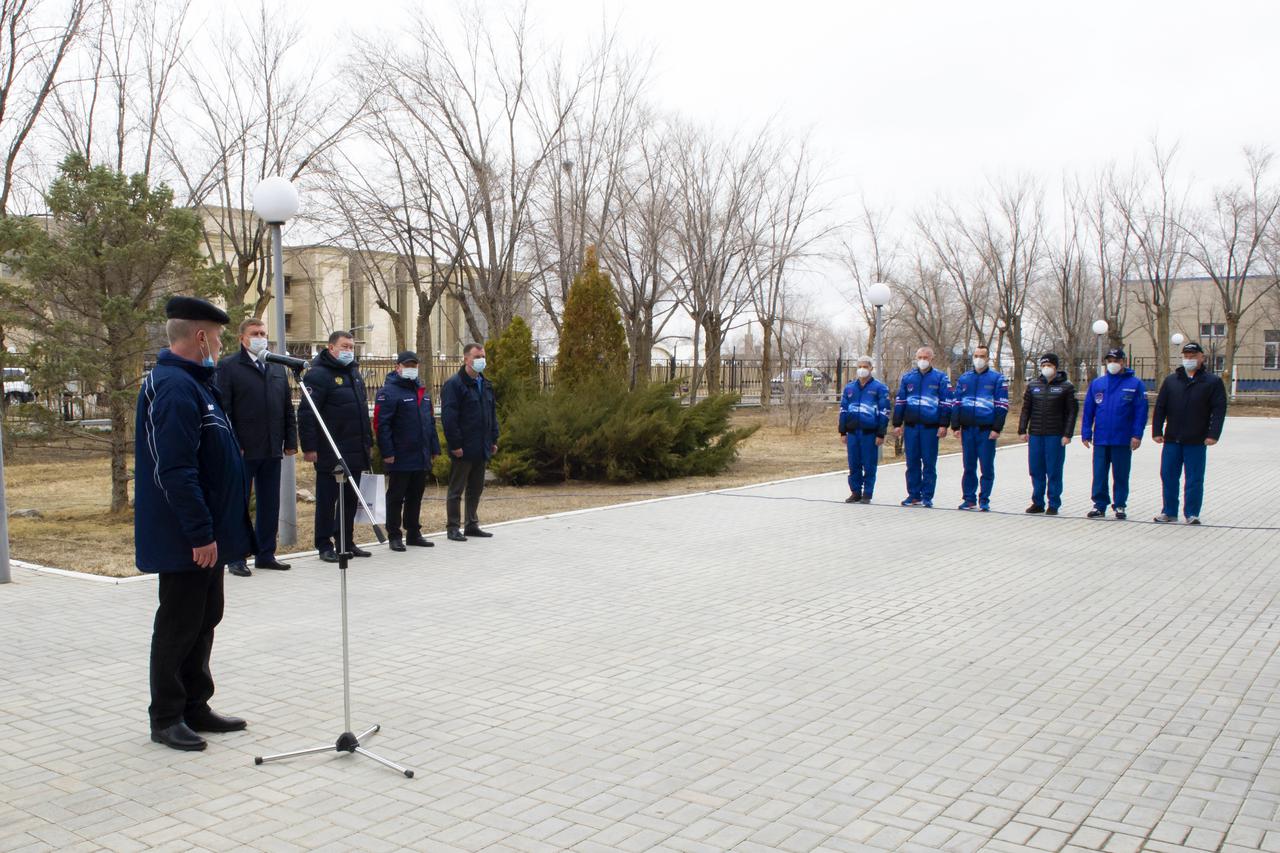
Expedition 65 prime and backup crew members rare seen just after raising the flags of Russia, the United States, and Kazakhstan, Sunday, March 28, 2021, in traditional ceremonies outside the Cosmonaut Hotel in Baikonur, Kazakhstan. From left to right, Expedition 65 prime crew members, NASA astronaut Mark Vande Hei, Russian cosmonauts Oleg Novitskiy of Roscosmos and Pyotr Dubrov of Roscosmos, and Expedition 65 backup crew members NASA astronaut Anne McClain, and Russian cosmonauts Anton Shkaplerov of Roscosmos, and Oleg Artemyev of Roscosmos. The prime crew is scheduled to launch to the International Space Station on a Soyuz rocket April 9. Photo Credit: (NASA/GCTC/Irina Spector)
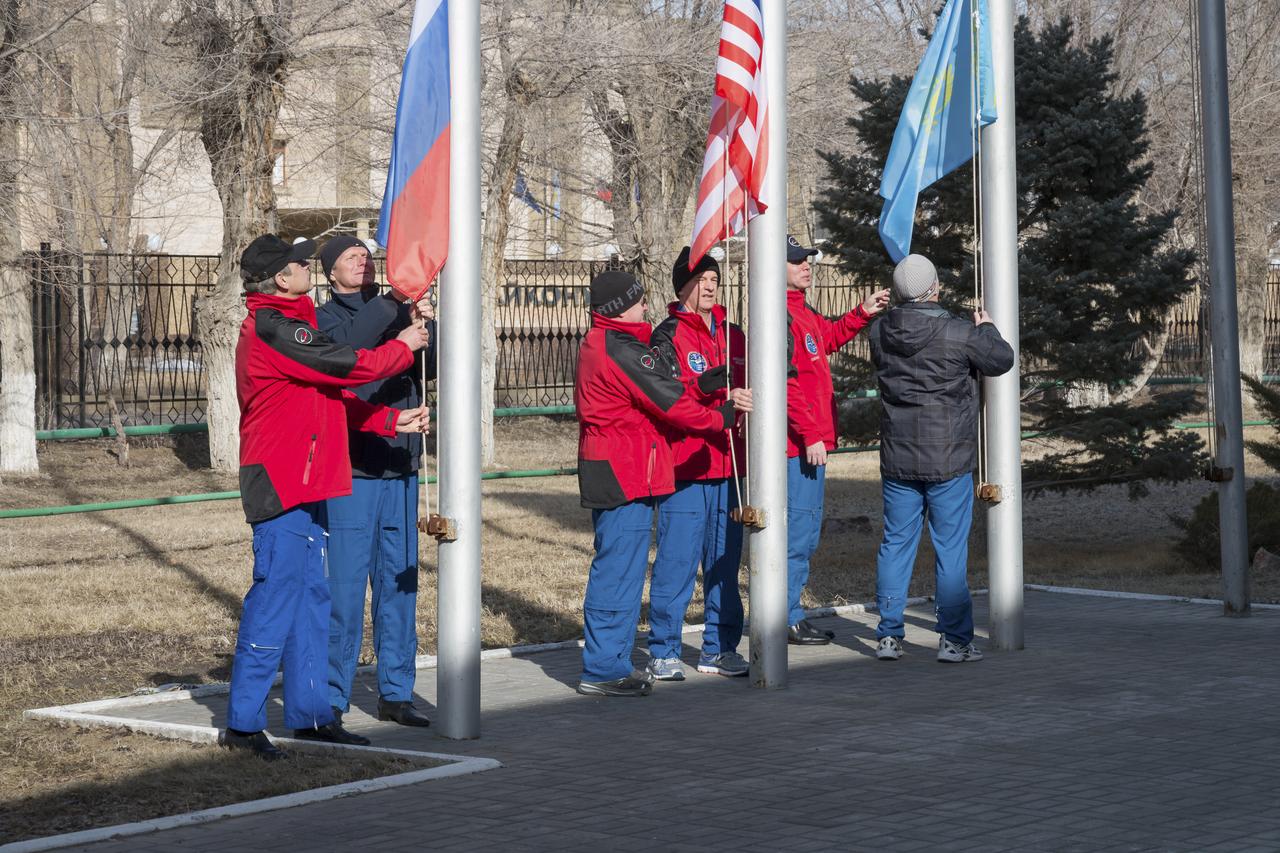
Expedition 43 prime and backup crew members: Russian Cosmonauts Mikhail Kornienko, left, Gennady Padalka, of the Russian Federal Space Agency (Roscosmos), NASA Astronauts Scott Kelly, and Jeff Williams, andRussian Cosmonauts, Alexei Ovchinin, and Sergei Volkov of Roscosmos participate in the traditional flag raising ceremony at the Cosmonaut Hotel, Monday, March 16, 2015 in Baikonur, Kazakhstan. Kelly, Padalka, and Kornienko are preparing for launch to the International Space Station in their Soyuz TMA-16M spacecraft from the Baikonur Cosmodrome in Kazakhstan March 28, Kazakh time. As the one-year crew, Kelly and Kornienko will return to Earth on Soyuz TMA-18M in March 2016. Photo Credit: (NASA/Victor Zelentsov)
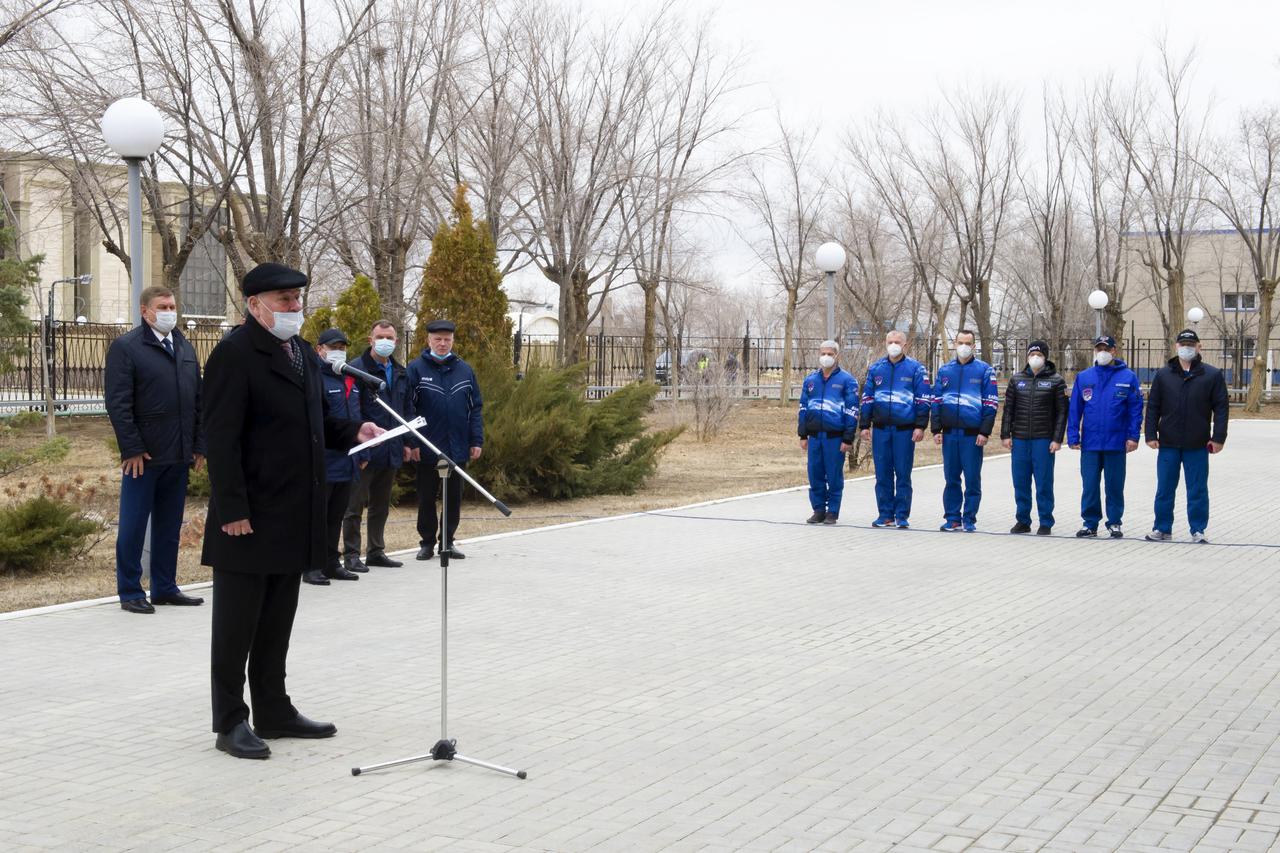
Expedition 65 prime and backup crew members are seen just prior to raising the flags of Russia, the United States, and Kazakhstan, Sunday, March 28, 2021, in traditional ceremonies outside the Cosmonaut Hotel in Baikonur, Kazakhstan. From left to right, Expedition 65 prime crew members, NASA astronaut Mark Vande Hei, Russian cosmonauts Oleg Novitskiy of Roscosmos and Pyotr Dubrov of Roscosmos, and Expedition 65 backup crew members NASA astronaut Anne McClain, and Russian cosmonauts Anton Shkaplerov of Roscosmos, and Oleg Artemyev of Roscosmos. The prime crew is scheduled to launch to the International Space Station on a Soyuz rocket April 9. Photo Credit: (NASA/GCTC/Irina Spector)
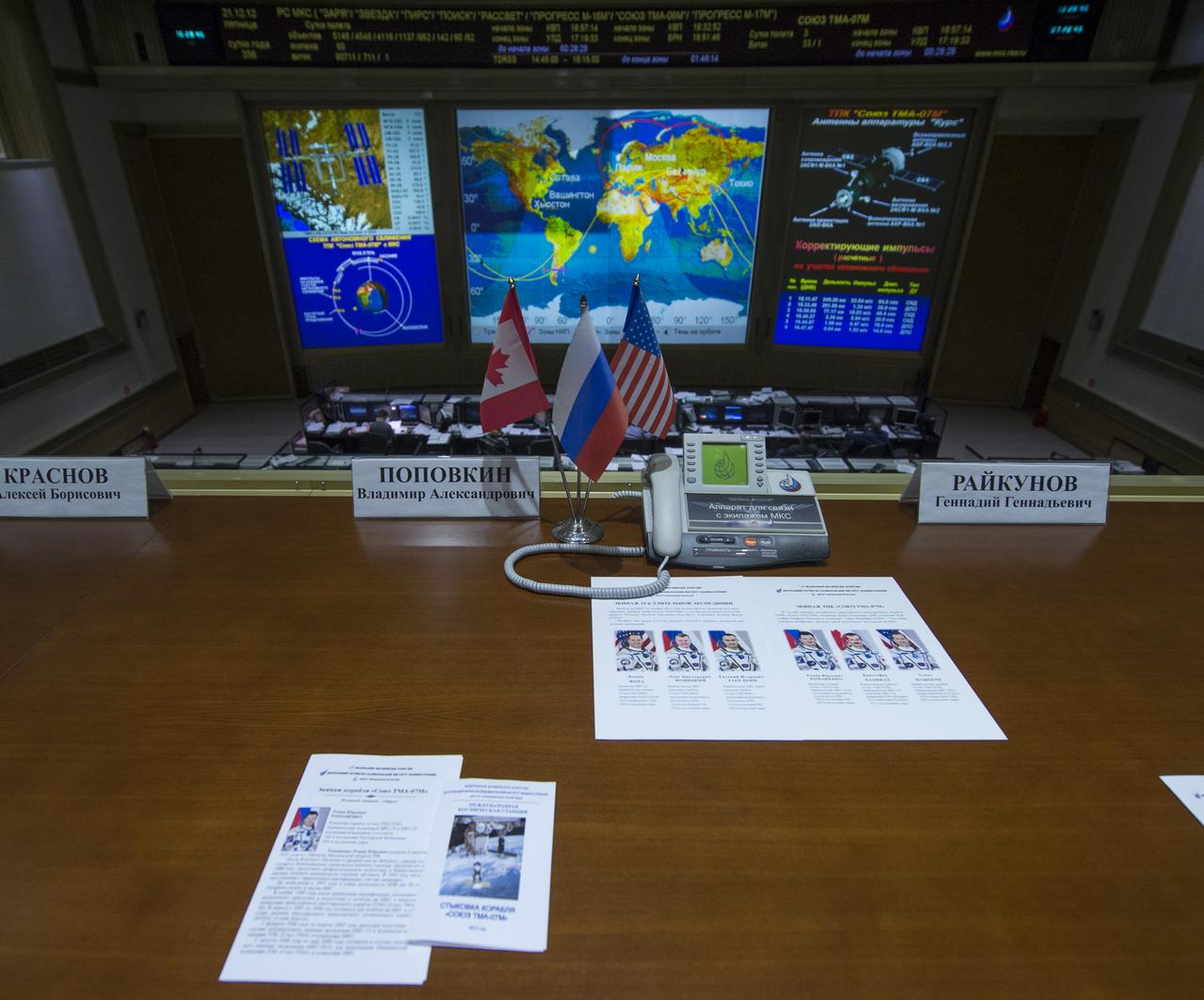
The flags representing the crew members of Expedition 34/35 are seen at Moscow Mission Control Center in Korolev, Russia on December 21, 2012. The Soyuz TMA-07M with Expedition 34/35 crew members, NASA astronaut Tom Marshburn, Russian cosmonaut Roman Romanenko and Canadian astronaut Chris Hadfield launched from the Baikonur Cosmodrome in Kazakhstan two days earlier. The Soyuz crew members will be greeted by Expedition 34 Commander Kevin Ford of NASA and Russian Flight Engineers Oleg Novitskiy and Yevgeny Tarelkin, who have lived in the orbital laboratory since October. Photo Credit: (NASA/Carla Cioffi)
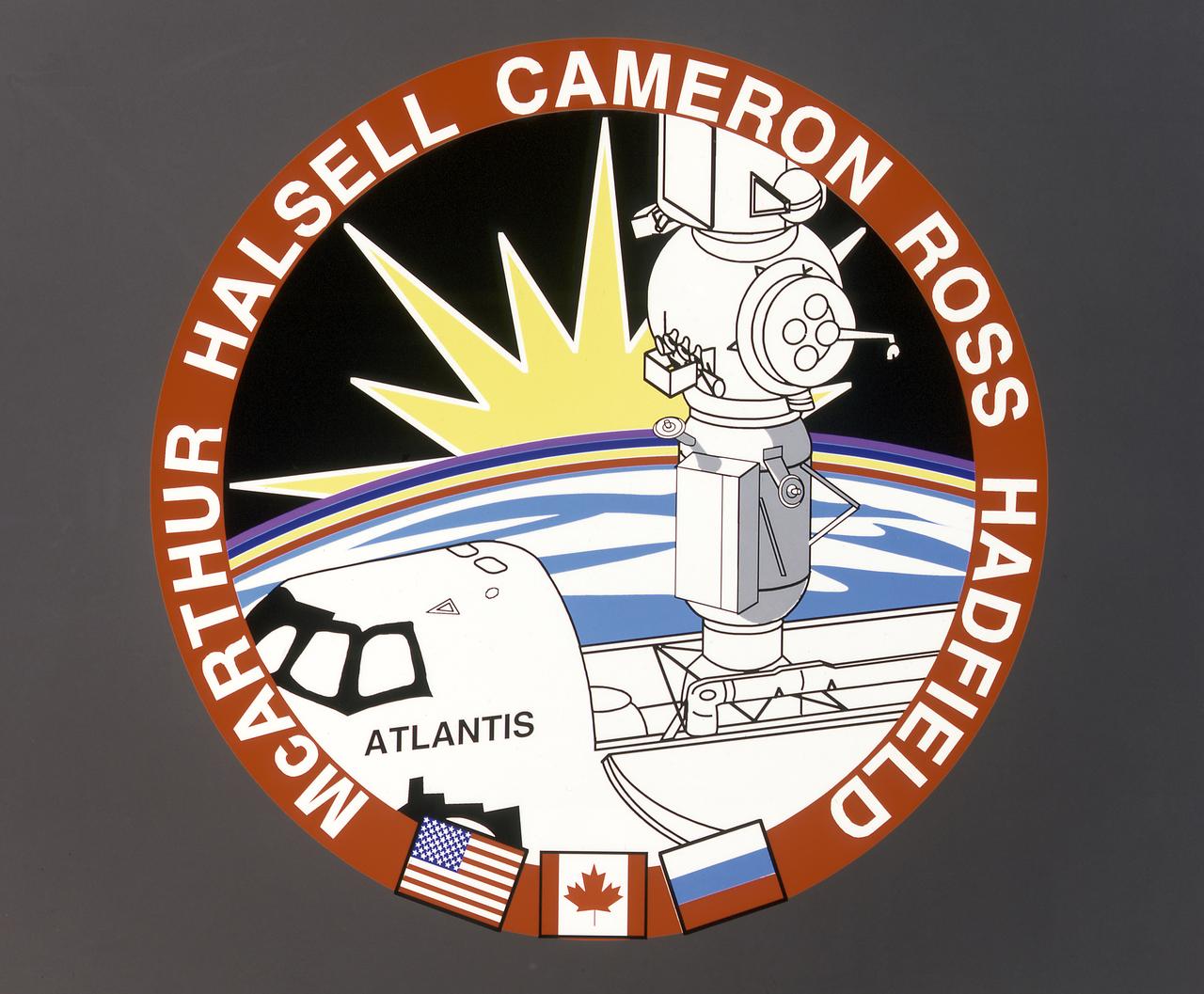
The STS-74 crew patch depicts the orbiter Atlantis docked to the Russian Space Station Mir. The central focus is on the Russian-built docking module, drawn with shading to accentuate its pivotal importance to both STS-74 and the NASA-Mir Program. The rainbow across the horizon represents the Earth's atmosphere, the thin membrane protecting all nations, while the three flags across the bottom show those nations participating in STS-74: Russia, Canada, and the United States. The sunrise is symbolic of the dawn of a new era in NASA space flight , that of International Space Station construction.
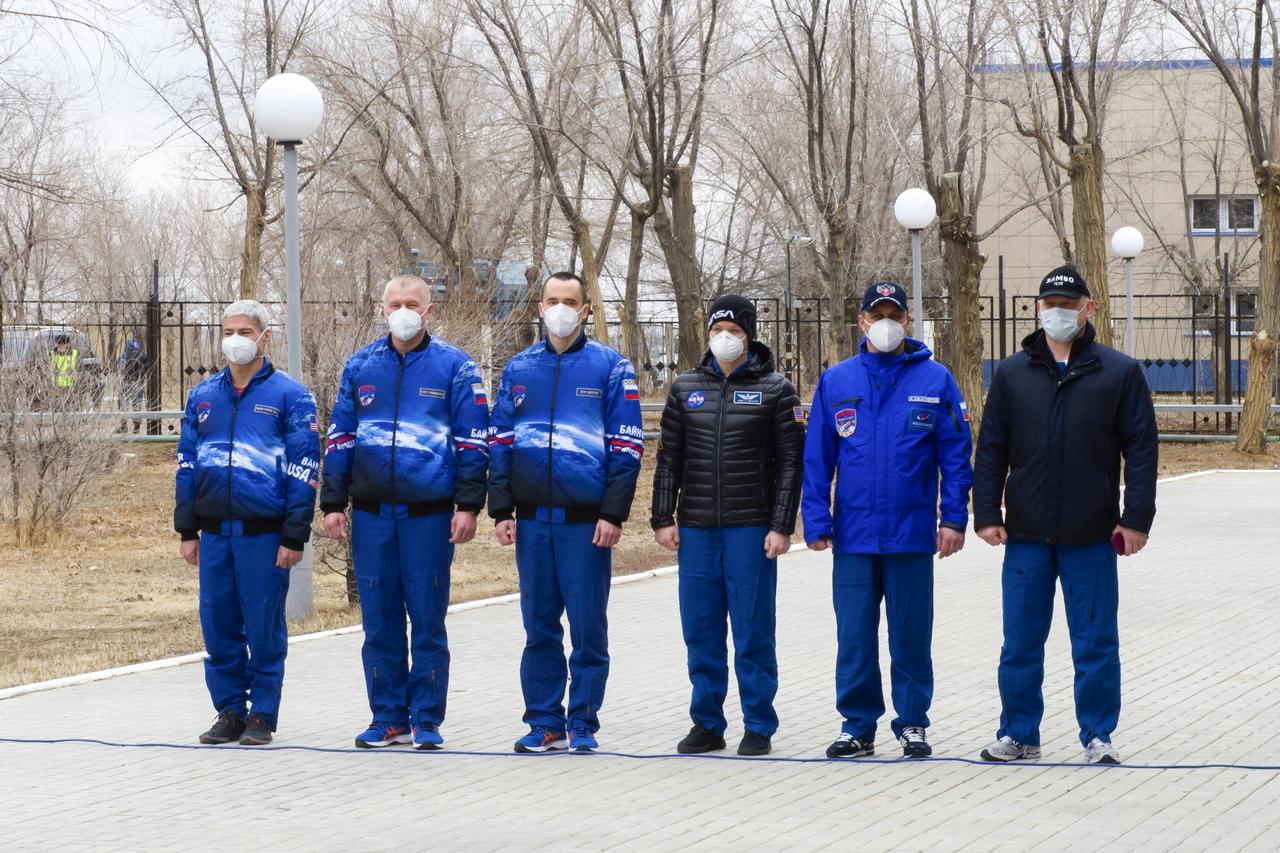
Expedition 65 prime and backup crew members rare seen just prior to raising the flags of Russia, the United States, and Kazakhstan, Sunday, March 28, 2021, in traditional ceremonies outside the Cosmonaut Hotel in Baikonur, Kazakhstan. From left to right, Expedition 65 prime crew members, NASA astronaut Mark Vande Hei, Russian cosmonauts Oleg Novitskiy of Roscosmos and Pyotr Dubrov of Roscosmos, and Expedition 65 backup crew members NASA astronaut Anne McClain, and Russian cosmonauts Anton Shkaplerov of Roscosmos, and Oleg Artemyev of Roscosmos. The prime crew is scheduled to launch to the International Space Station on a Soyuz rocket April 9. Photo Credit: (NASA/GCTC/Irina Spector)
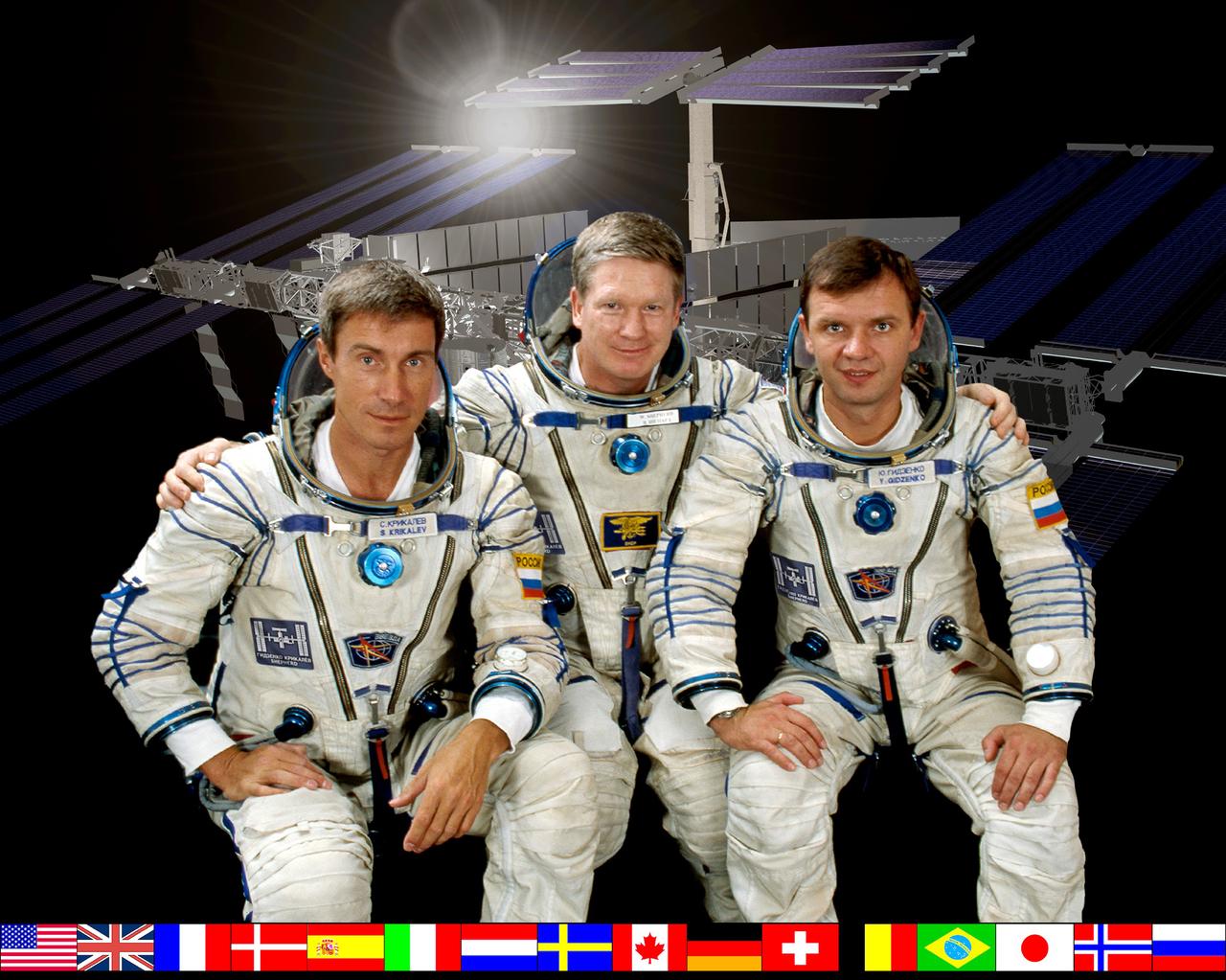
This is a crew portrait of the International Space Station (ISS) Expedition One. Left to right are flight engineer Sergei K. Krikalev, commander William M. (Bill) Shepherd, and Soyuz commander Yuri P. Gidzenko. They are wearing the Russian Sokol space suits. The Russian Soyuz rocket carrying the Expedition One crew was launched from the Baikonur Cosmodrome, Kazakhstan on October 31, 2000. The crew returned to the Kennedy Space Center on March 21, 2002 aboard the Space Shuttle Orbiter Discovery (STS-102 mission). The crew's duration on the ISS was 138 days. National flags representing all the international partners run along the bottom of the portrait.
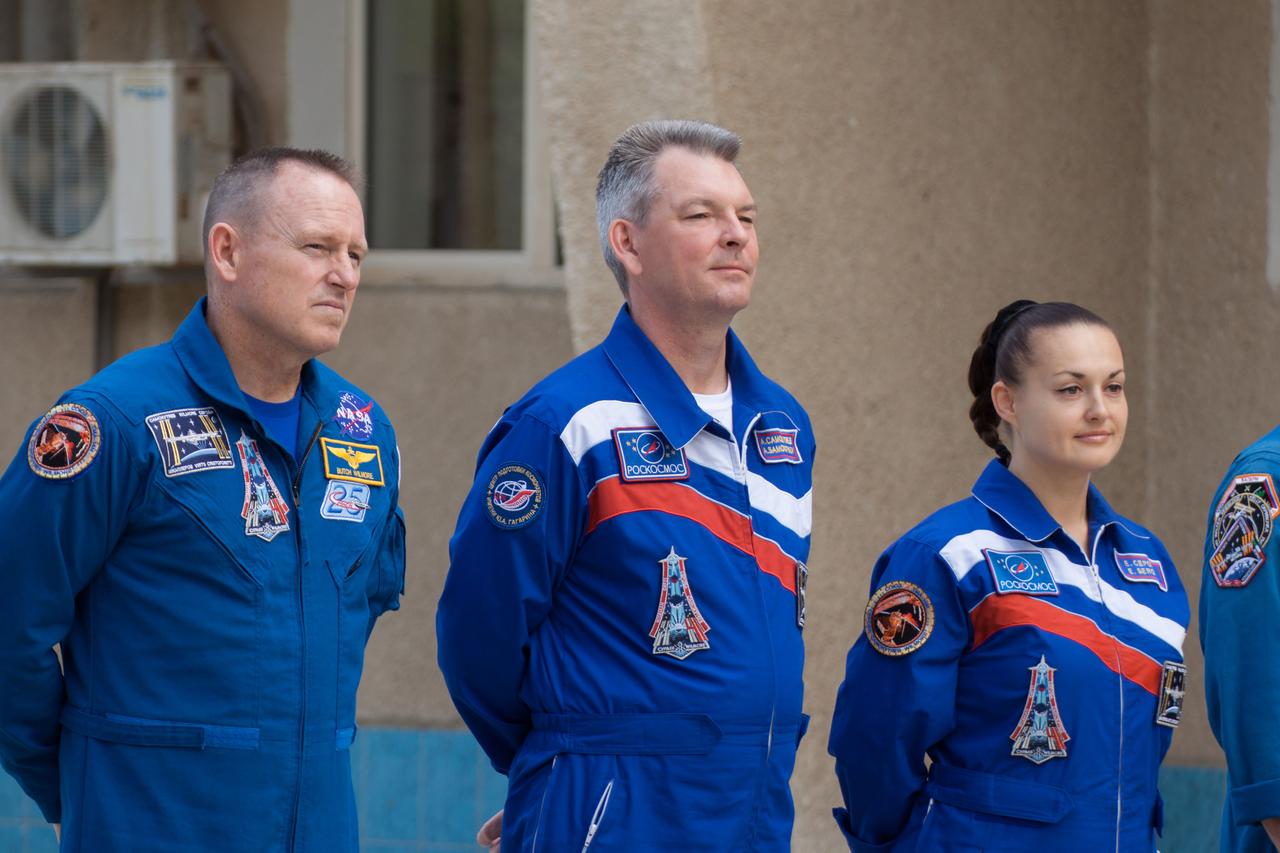
14-11-06-13: (14 Sept. 2014) --- At their Cosmonaut Hotel crew quarters in Baikonur, Kazakhstan, the Expedition 41/42 prime crew members participate in ceremonies after raising the flags of Russia, the U.S. and Kazakhstan during traditional ceremonies Sept. 14. From left to right are Barry Wilmore of NASA, Alexander Samokutyaev of the Russian Federal Space Agency (Roscosmos) and Elena Serova of Roscosmos. Wilmore, Samokutyaev and Serova will launch on Sept. 26, Kazakh time, in the Soyuz TMA-14M spacecraft to begin a 5 ½ month mission on the International Space Station. Serova will become the fourth Russian woman to fly in space. Photo credit: NASA/Victor Zelentsov
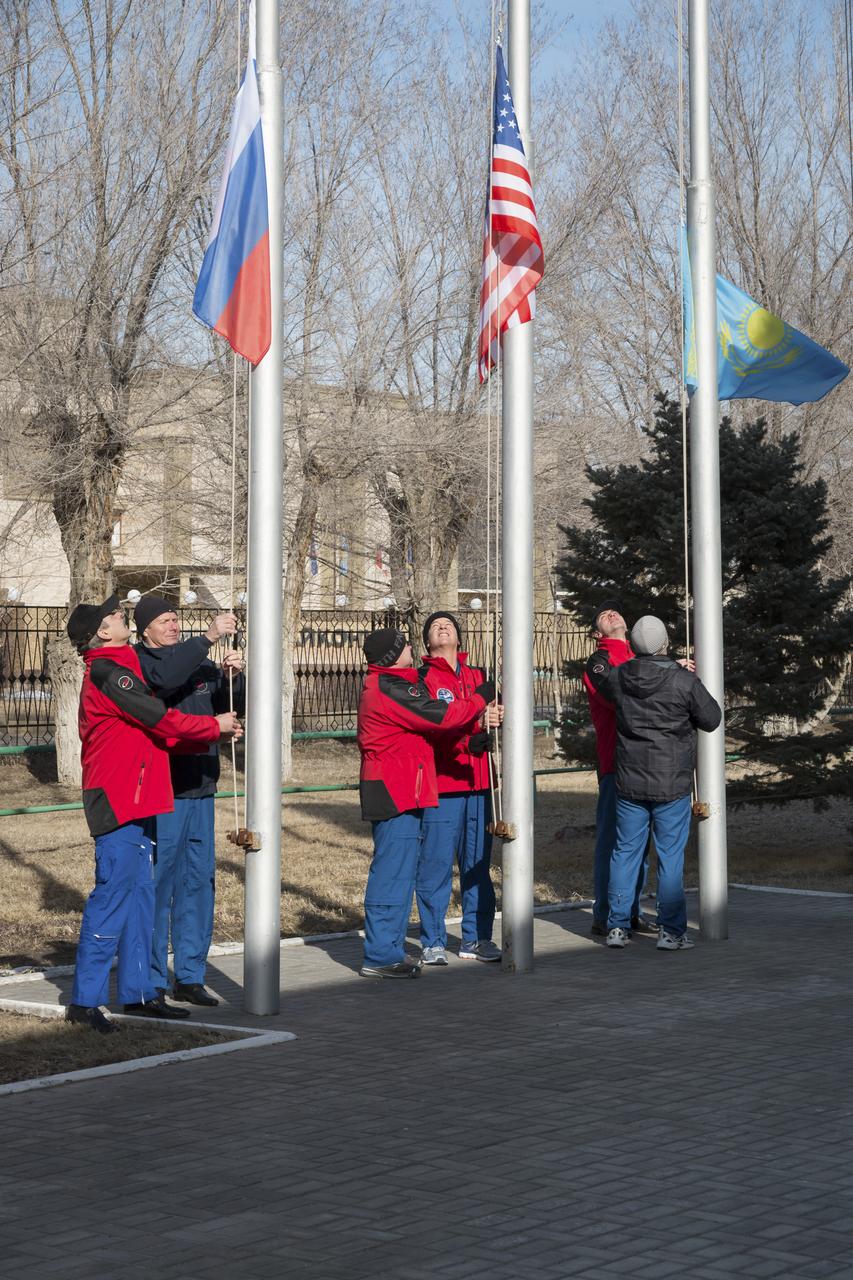
Expedition 43 prime and backup crew members: Russian Cosmonauts Mikhail Kornienko, left, Gennady Padalka, of the Russian Federal Space Agency (Roscosmos), NASA Astronauts Scott Kelly, and Jeff Williams, andRussian Cosmonauts, Alexei Ovchinin, and Sergei Volkov of Roscosmos participate in the traditional flag raising ceremony at the Cosmonaut Hotel, Monday, March 16, 2015 in Baikonur, Kazakhstan. Kelly, Padalka, and Kornienko are preparing for launch to the International Space Station in their Soyuz TMA-16M spacecraft from the Baikonur Cosmodrome in Kazakhstan March 28, Kazakh time. As the one-year crew, Kelly and Kornienko will return to Earth on Soyuz TMA-18M in March 2016. Photo Credit: (NASA/Victor Zelentsov)
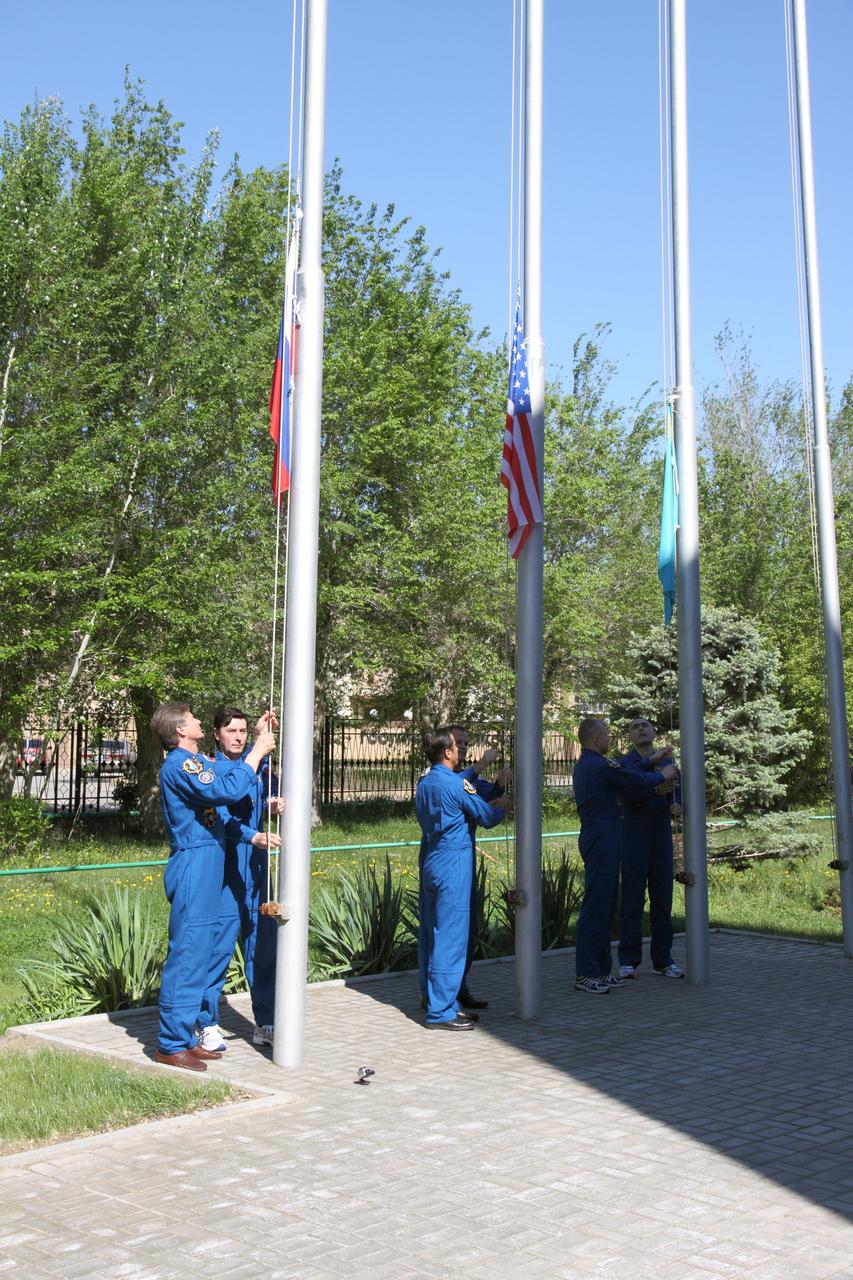
Outside their Cosmonaut Hotel crew quarters in Baikonur, Kazakhstan, the Expedition 31/32 prime and backup crews conducted the traditional raising of Russian, U.S. and Kazakh flags May 4, 2012 as part of their ceremonial activities leading up to the launch of the Soyuz TMA-04M spacecraft May 15 to the International Space Station. From left to right are prime Soyuz Commander Gennady Padalka and Flight Engineer Sergei Revin, prime NASA Flight Engineer Joe Acaba and backup NASA Flight Engineer Kevin Ford and backup Russian crewmembers Oleg Novitskiy and Evgeny Tarelkin. Padalka, Revin and Acaba will launch to the station for a four-month mission on the orbital outpost. NASA/Victor Zelentsov
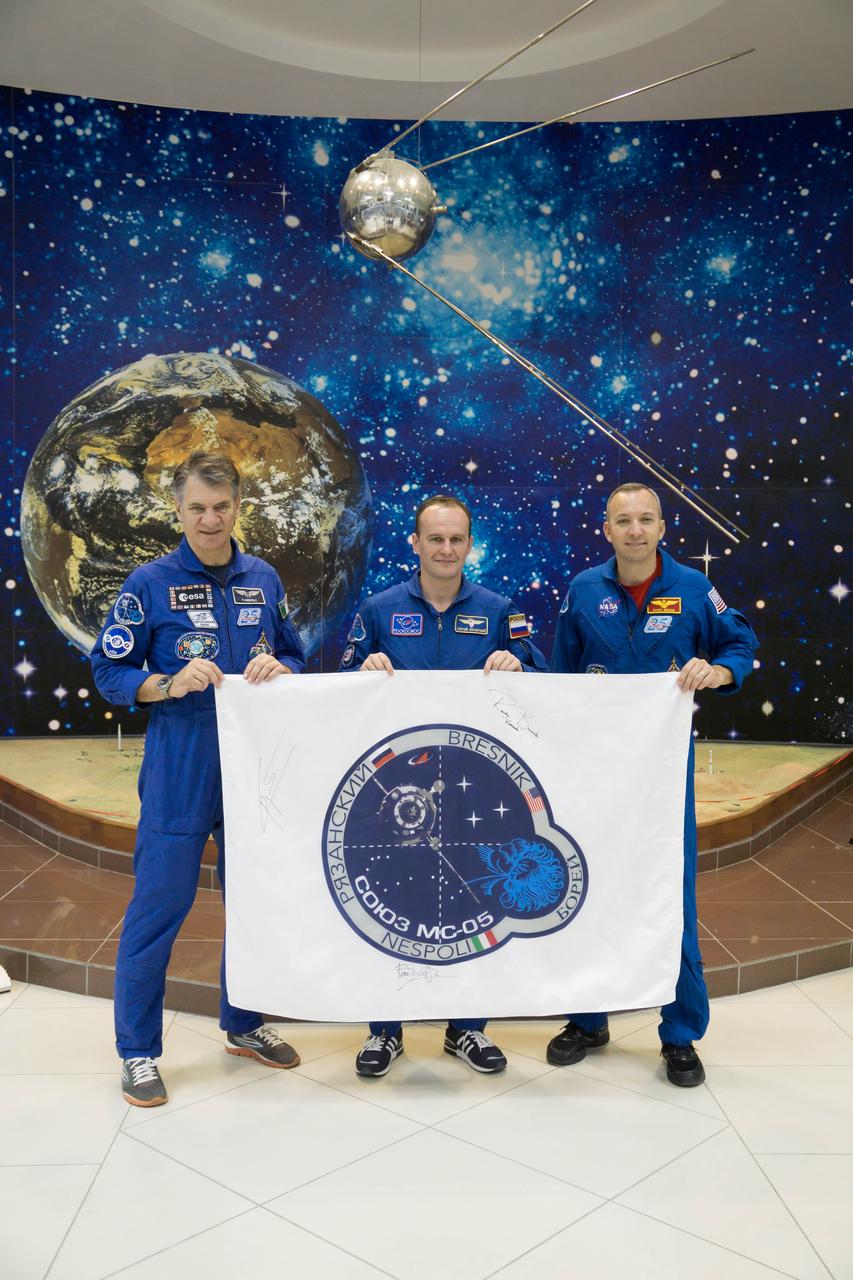
jsc2017e101950 (July 22, 2017) --- At the Baikonur Cosmodrome in Kazakhstan, Expedition 52-53 crewmembers Paolo Nespoli of the European Space Agency (left), Sergey Ryazanskiy of the Russian Federal Space Agency (Roscosmos, center) and Randy Bresnik (right) display a flag bearing their Soyuz spacecraft insignia at the Korolev Museum July 24 as part of traditional pre-launch activities. Nespoli, Bresnik and Ryazanskiy will launch July 28 aboard the Soyuz MS-05 spacecraft for a five-month mission on the International Space Station. Credit: NASA/Victor Zelentsov
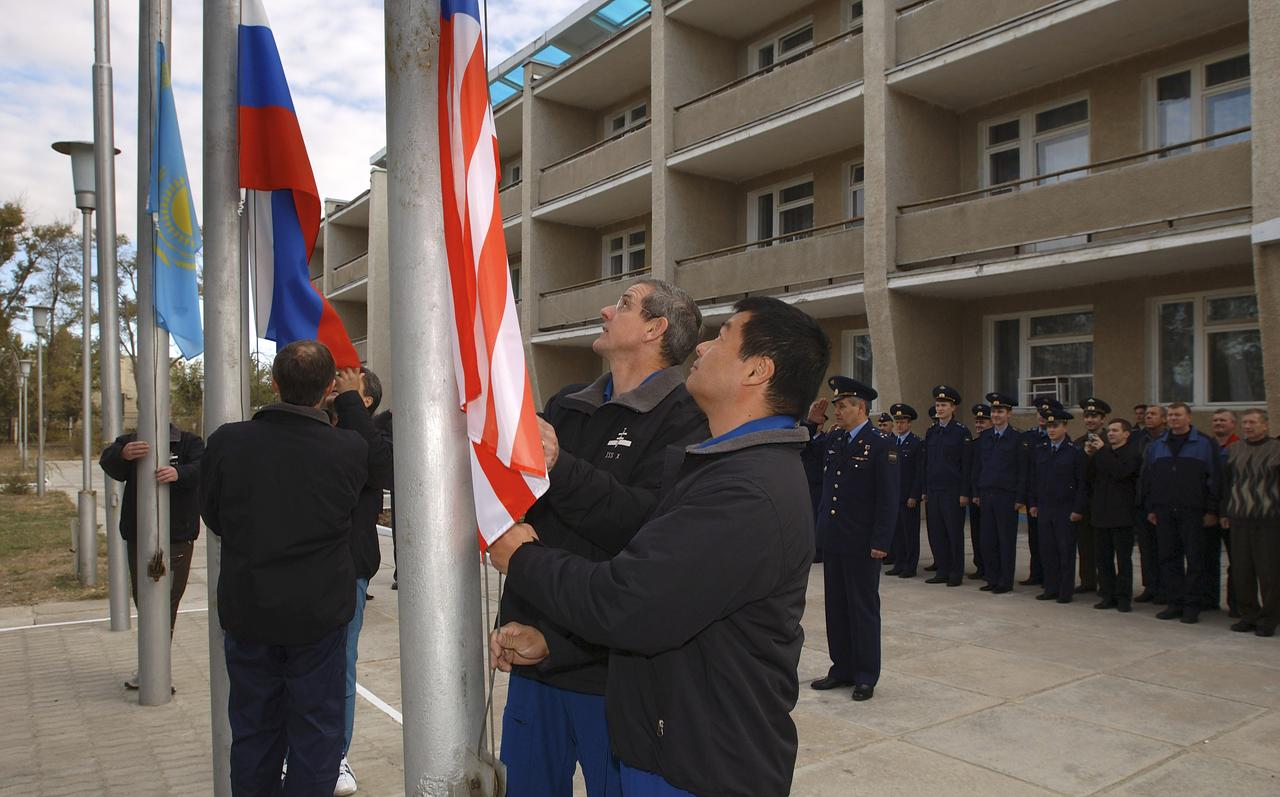
Expedition 10 Flight Engineer and Soyuz Commander Salizhan Sharipov, Commander and NASA Science Officer Leroy Chiao, Russian Space Forces Cosmonaut Yuri Shargin, backup Soyuz Commander Valery Tokarev and backup Expedition Commander Bill McArthur patricipate in the ceremonial flag raising at the Cosmonaut Hotel, Baikonur, Kazakhstan, Wednesday, Oct. 6, 2004. Chiao, Sharipov and Shargin are scheduled to launch October 14 on their Soyuz TMA-5 spacecraft to the International Space Station. Photo Credit: (NASA/Bill Ingalls)
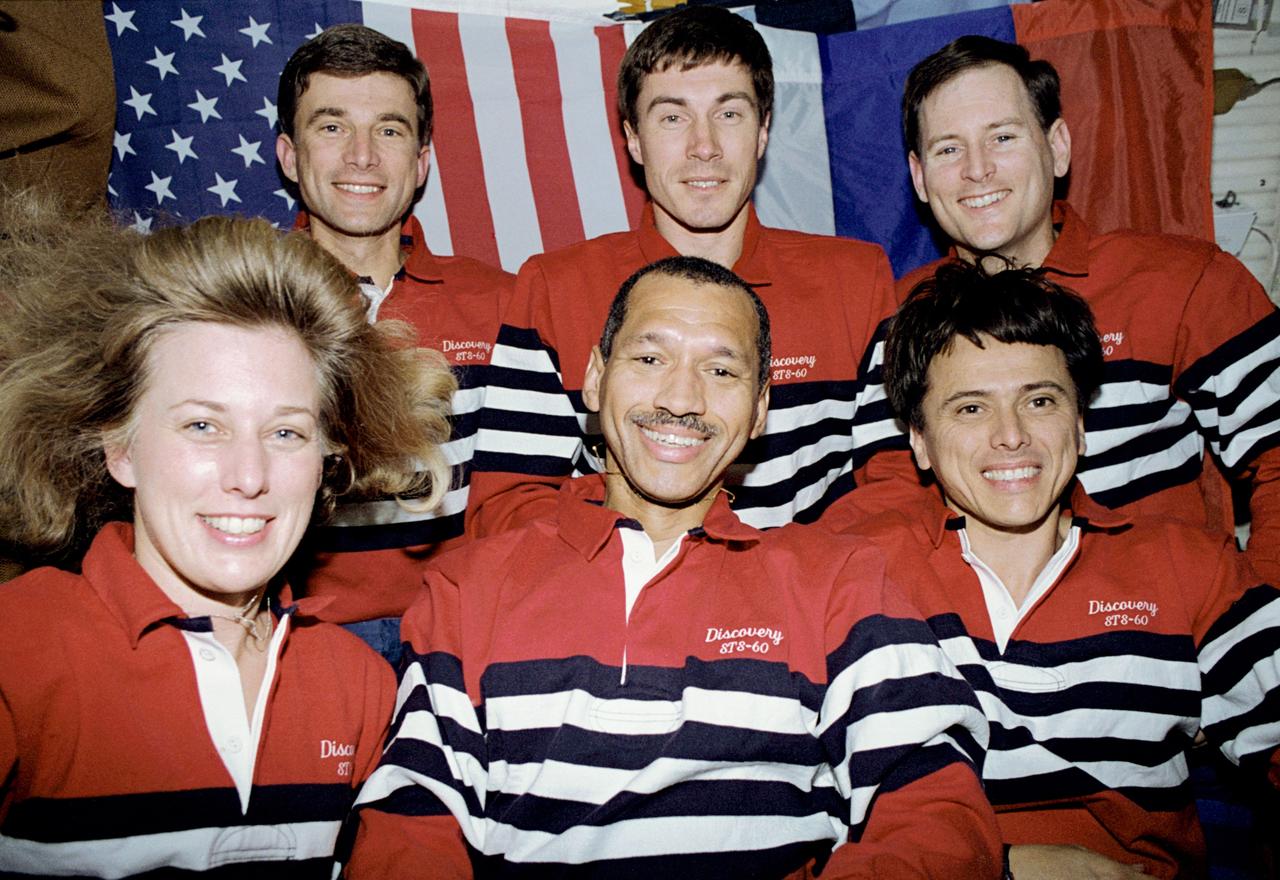
STS060-31-009 (3-11 Feb. 1994) --- The six-member STS-60 crew pose for the traditional in-flight crew portrait, with American and Russian flags forming the backdrop on the space shuttle Discovery’s middeck. Left to right (front row) are N. Jan Davis, Charles F. Bolden Jr. and Franklin R. Chang-Diaz; and (back row) Ronald M. Sega, Sergei K. Krikalev and Kenneth S. Reightler Jr. Photo credit: NASA or National Aeronautics and Space Administration
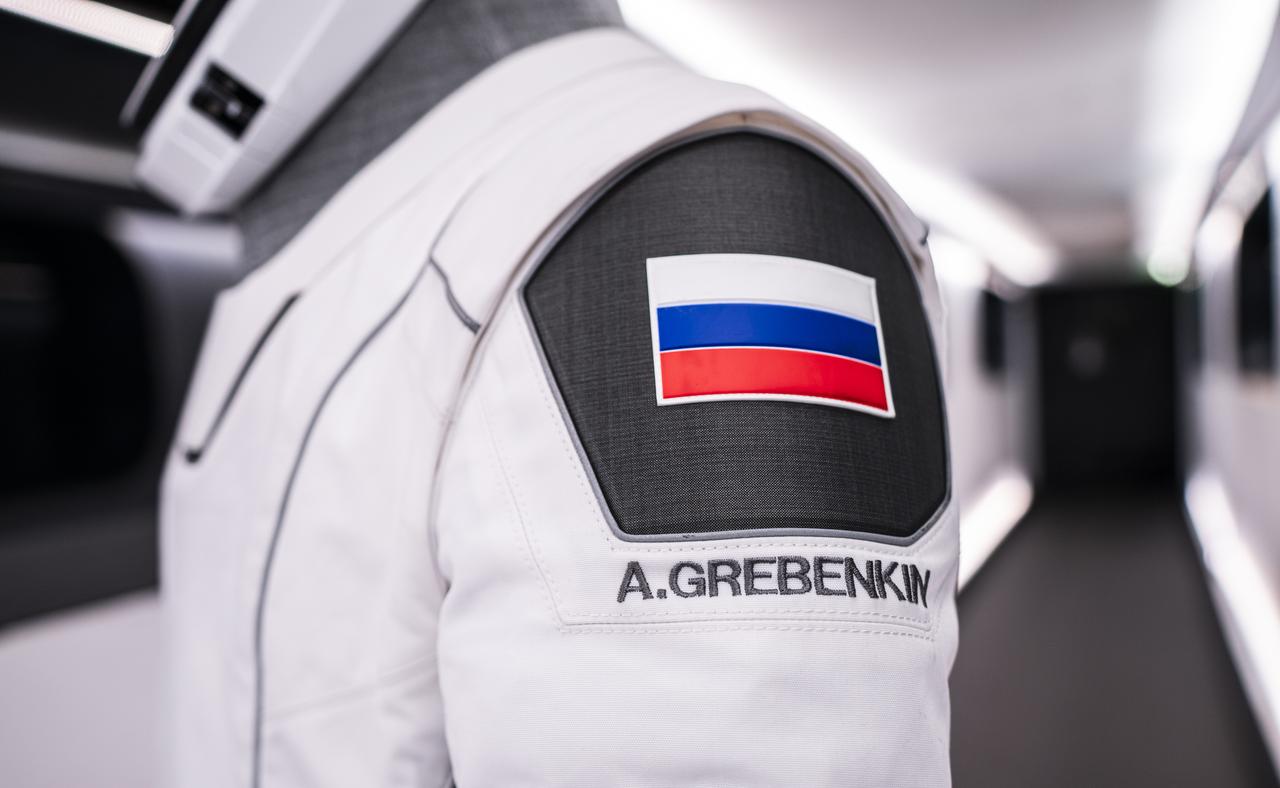
A SpaceX launch and entry suit bears a Russian flag and the name of Roscosmos cosmonaut Alexander Grebenkin, who will serve as one of two mission specialists for NASA's SpaceX Crew-8 mission to the International Space as part of the agency’s Commercial Crew Program. Liftoff from Launch Complex 39A at the agency’s Kennedy Space in Florida is scheduled for 12:04 a.m. EST on Friday, March 1, 2024.
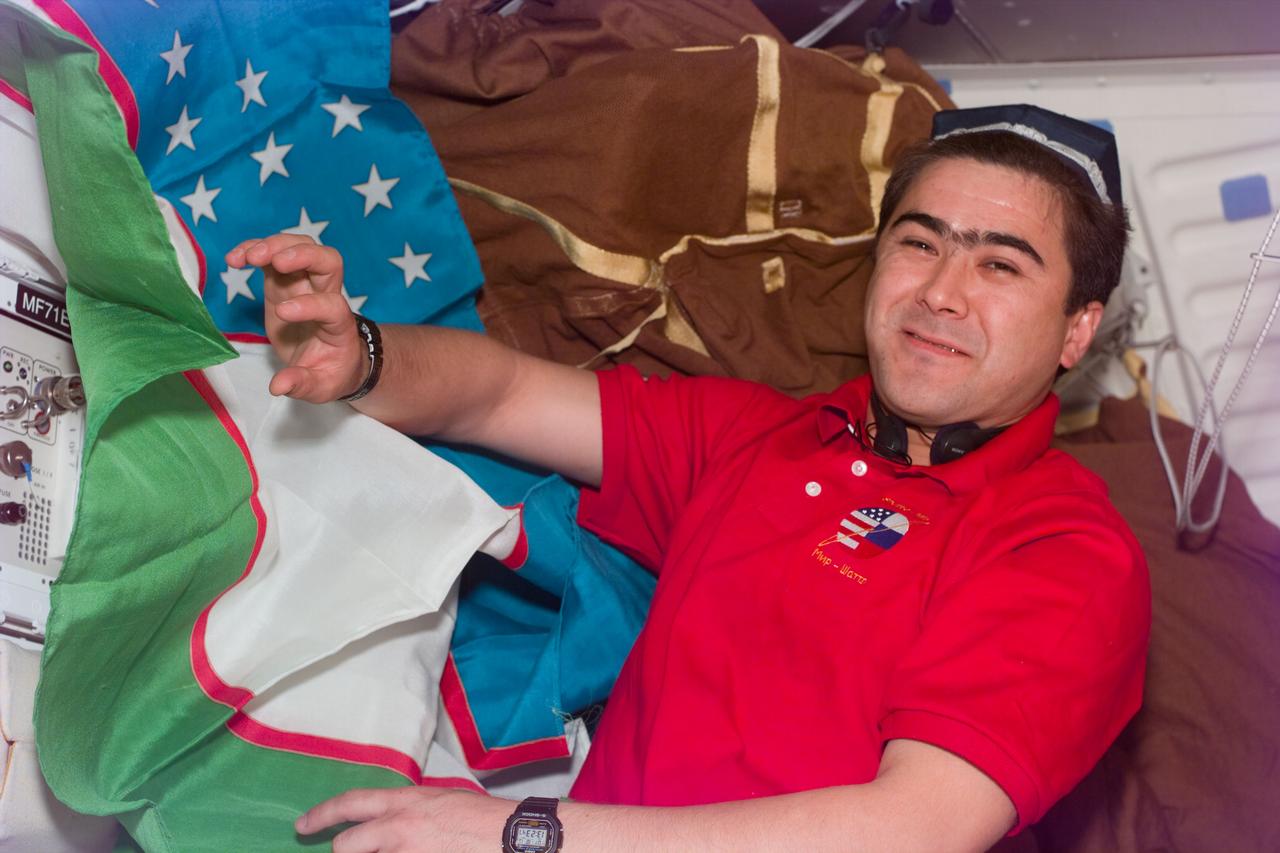
S89-E-5243 (26 Jan 1998) --- This Electronic Still Camera (ESC) image shows cosmonaut Salizan S. Sharipov, payload specialist - representing the Russian Space Agency (RSA), hanging a flag up onboard the Earth-orbiting Space Shuttle Endeavour. This ESC view was taken on January 26, 1998, at 13:23:11 MET.
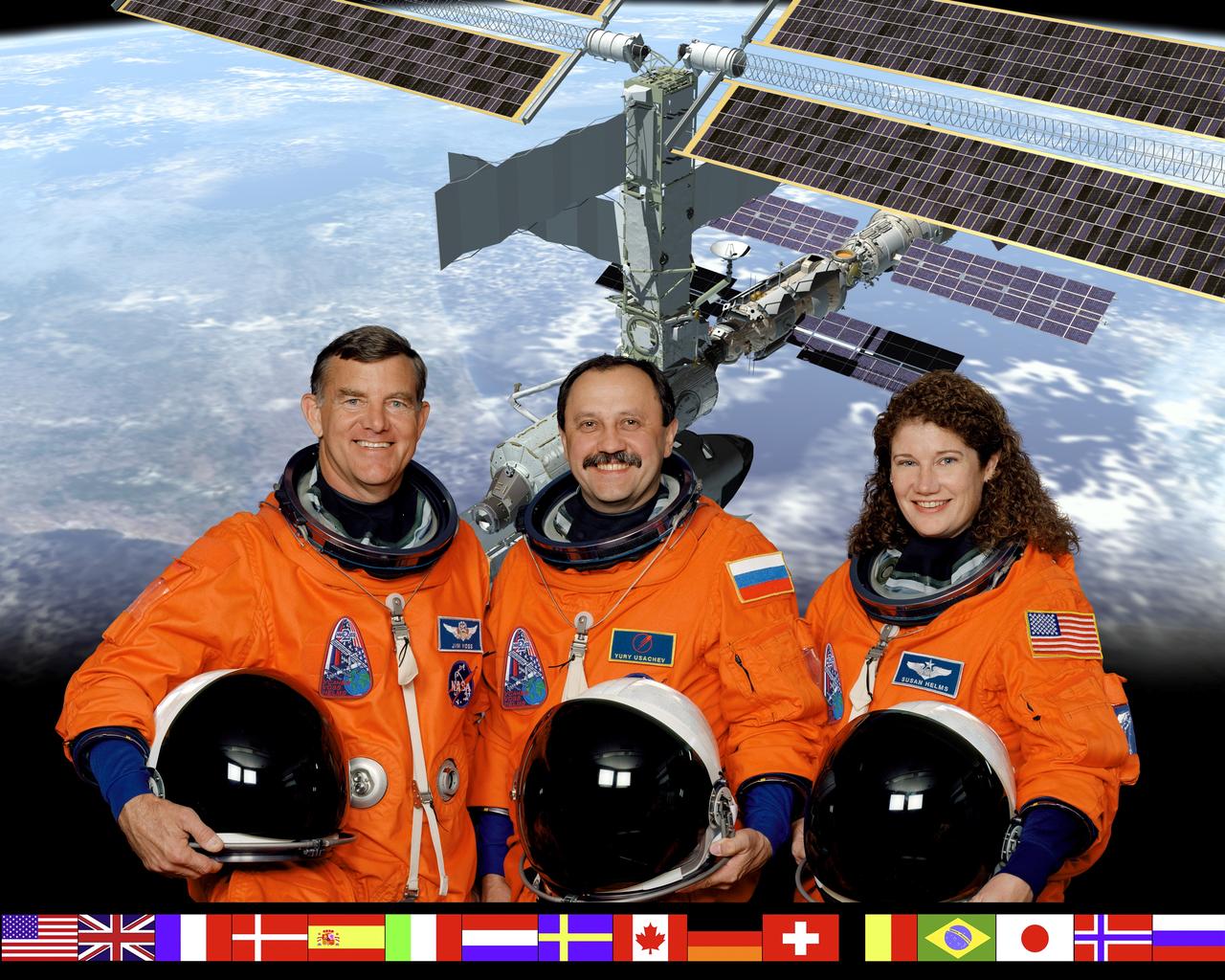
ISS002-S-002 (February 2001) --- Cosmonaut Yury V. Usachev (center), Expedition Two mission commander, is flanked by the other crew members -- astronauts James S. Voss and Susan J. Helms -- who will join him for an extended stay aboard the International Space Station (ISS), beginning in March of this year. Usachev represents the Russian Aviation and Space Agency. The flags representing all the international partners are arrayed at bottom.
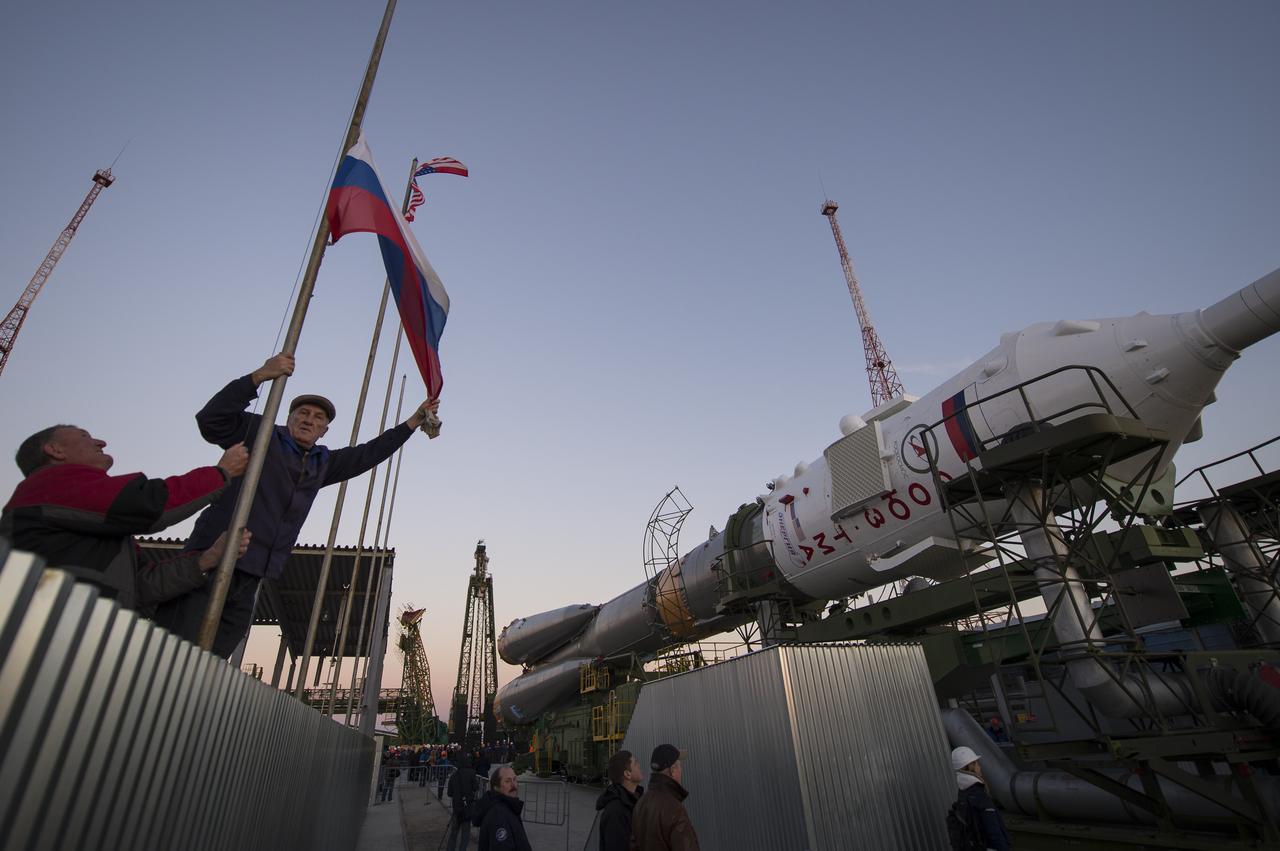
Workers raise a Russian flag as the Soyuz rocket arrives at the launch pad by train, on Sunday, October 21, 2012, at the Baikonur Cosmodrome in Kazakhstan. Launch of the Soyuz rocket is scheduled for October 23 and will send Expedition 33/34 Flight Engineer Kevin Ford of NASA, Soyuz Commander Oleg Novitskiy and Flight Engineer Evgeny Tarelkin of ROSCOSMOS on a five-month mission aboard the International Space Station. Photo Credit: (NASA/Bill Ingalls)
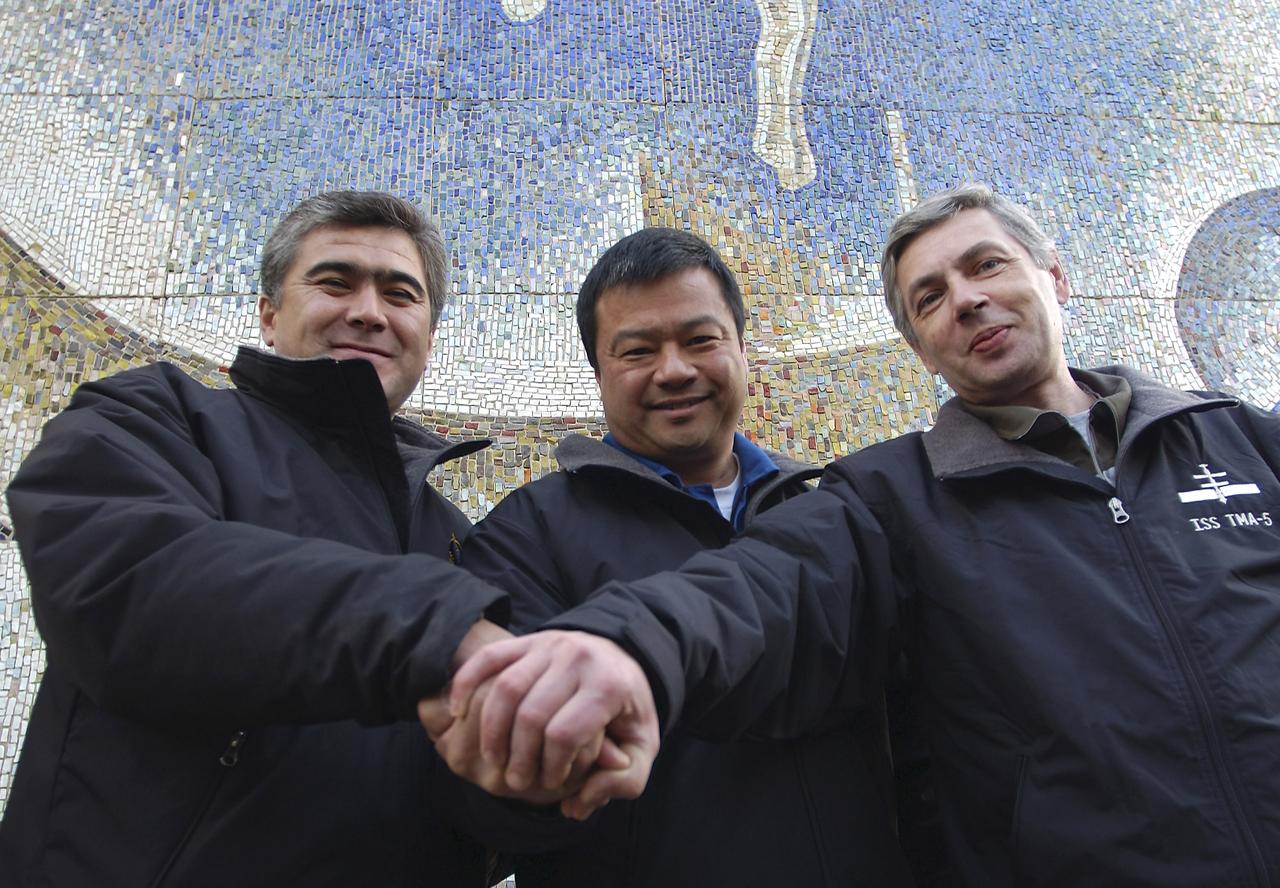
Expedition 10 Flight Engineer and Soyuz Commander Salizhan Sharipov, left, Commander and NASA Science Officer Leroy Chiao and Russian Space Forces cosmonaut Yuri Shargin, right, pose for a photo after they patricipated in the ceremonial flag raising at the Cosmonaut Hotel, Baikonur, Kazakhstan, Wednesday, Oct. 6, 2004. Chiao, Sharipov and Shargin are scheduled to launch October 14 on their Soyuz TMA-5 spacecraft to the International Space Station. Photo Credit: (NASA/Bill Ingalls)
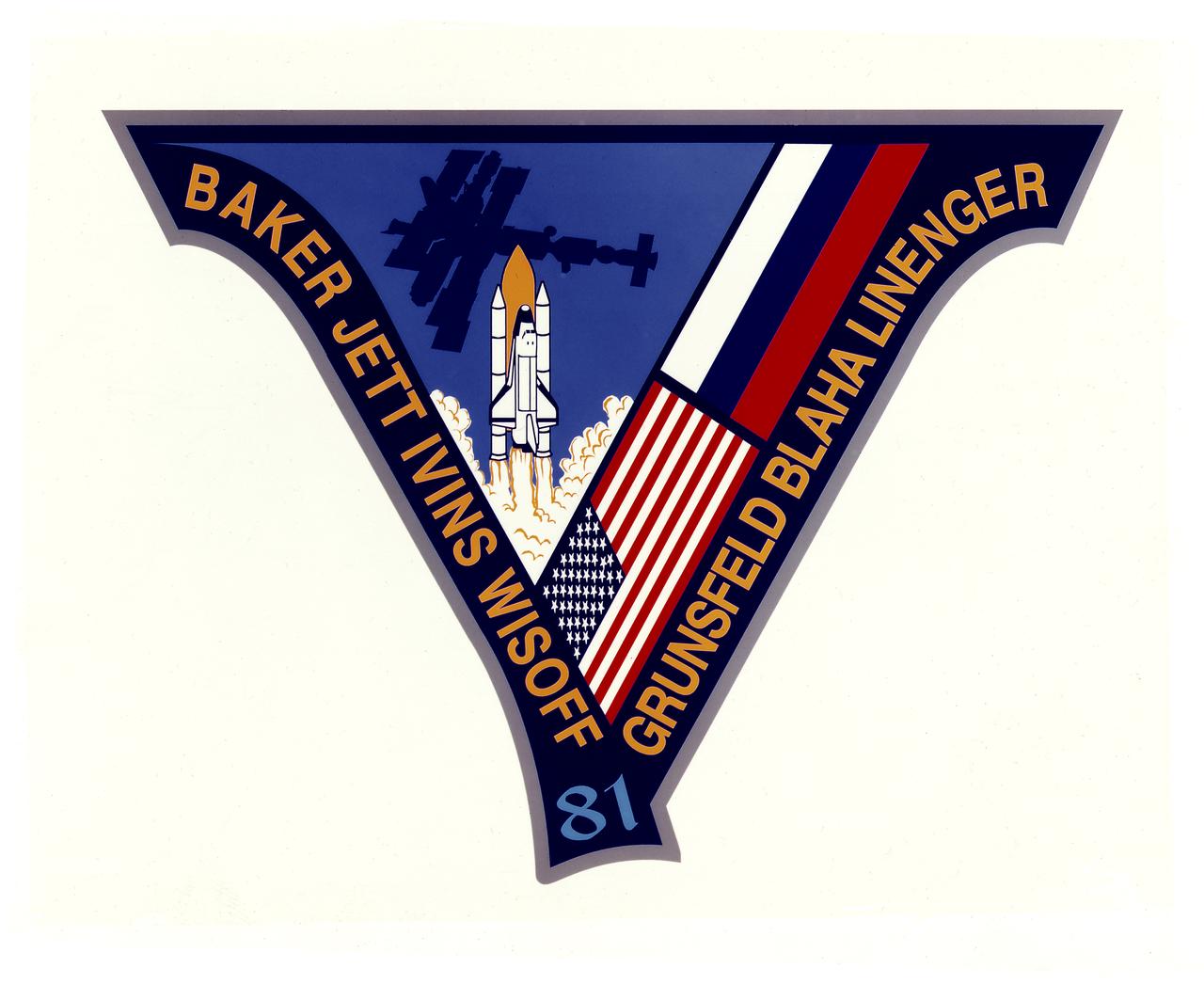
The crew patch for STS-81 , the fifth Shuttle-Mir docking mission, is shaped to represent the Roman numeral V. The Shuttle Atlantis is launching toward a rendezvous with Russia's Mir Space Station, silhouetted in the background. Atlantis and the STS-81 crew spent several days docked to Mir during which time Jerry M. Lineger (NASA-Mir-4) replaced astronaut John Blaha (NASA-Mir-3) as the U.S. crew member onboard Mir. The U.S. and Russian flags are depicted along with the names of the shuttle crew.
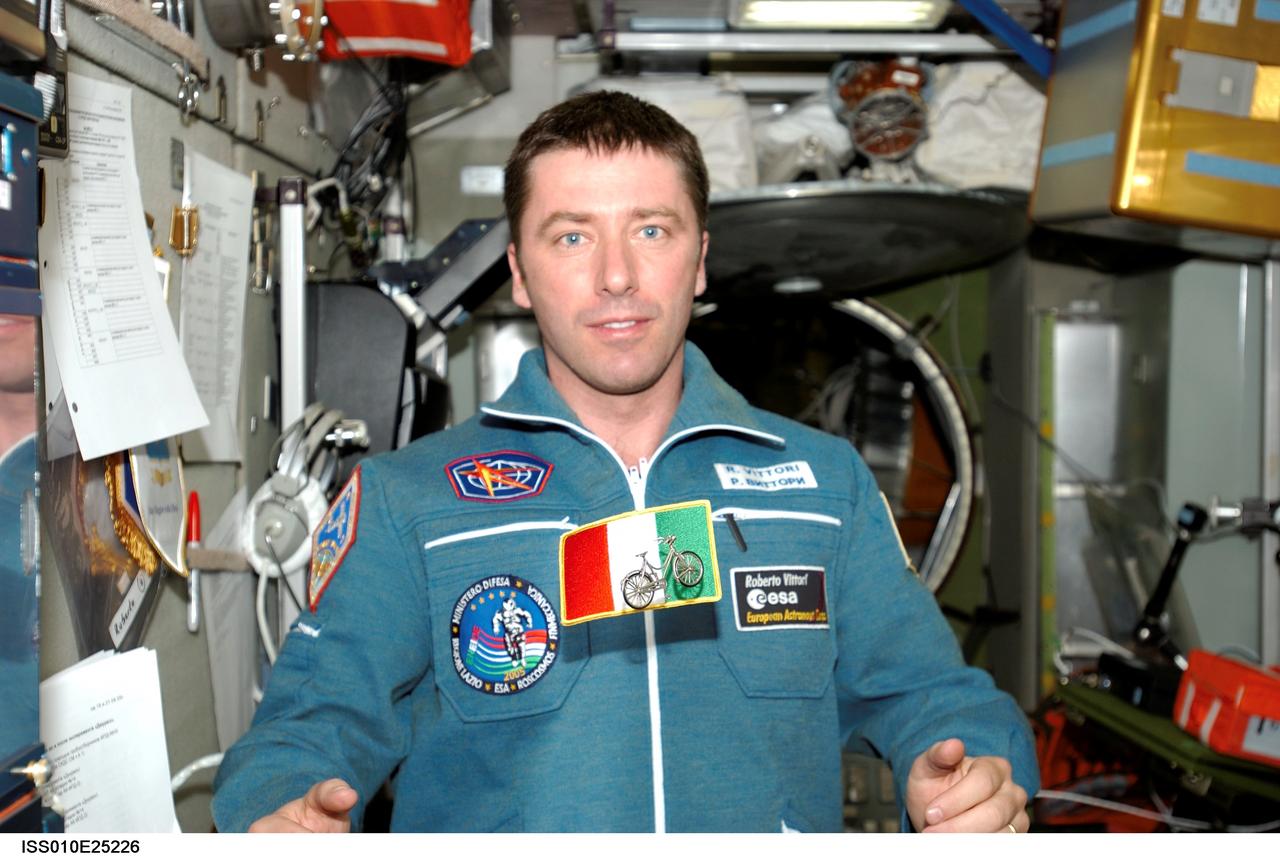
ISS010-E-25226 (20 April 2005) --- European Space Agency (ESA) astronaut Roberto Vittori of Italy is pictured in the Zvezda Service Module of the International Space Station (ISS). A patch representing the Italian flag and a toy bicycle float freely near Vittori. After spending eight days on the Station under a commercial contract between ESA and the Russian Federal Space Agency, Vittori will return to Earth with the Expedition 10 crew on April 24 (CDT).
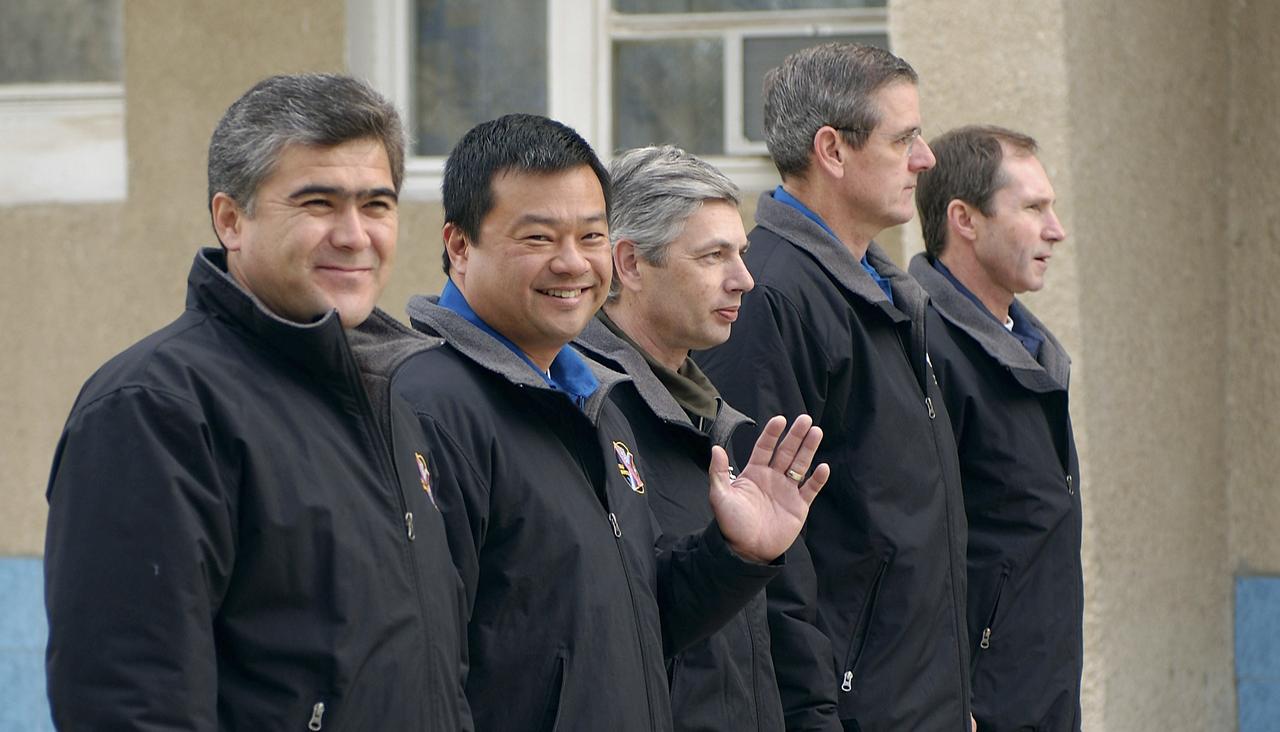
From left to right, Expedition 10 Flight Engineer and Soyuz Commander Salizhan Sharipov, Commander and NASA Science Officer Leroy Chiao, Russian Space Forces cosmonaut Yuri Shargin, backup Soyuz Commander Valery Tokarev and backup Expedition Commander Bill McArthur patricipate in the ceremonial flag raising at the Cosmonaut Hotel, Baikonur, Kazakhstan, Wednesday, Oct. 6, 2004. Chiao, Sharipov and Shargin are scheduled to launch October 14 on their Soyuz TMA-5 spacecraft to the International Space Station. Photo Credit: (NASA/Bill Ingalls)
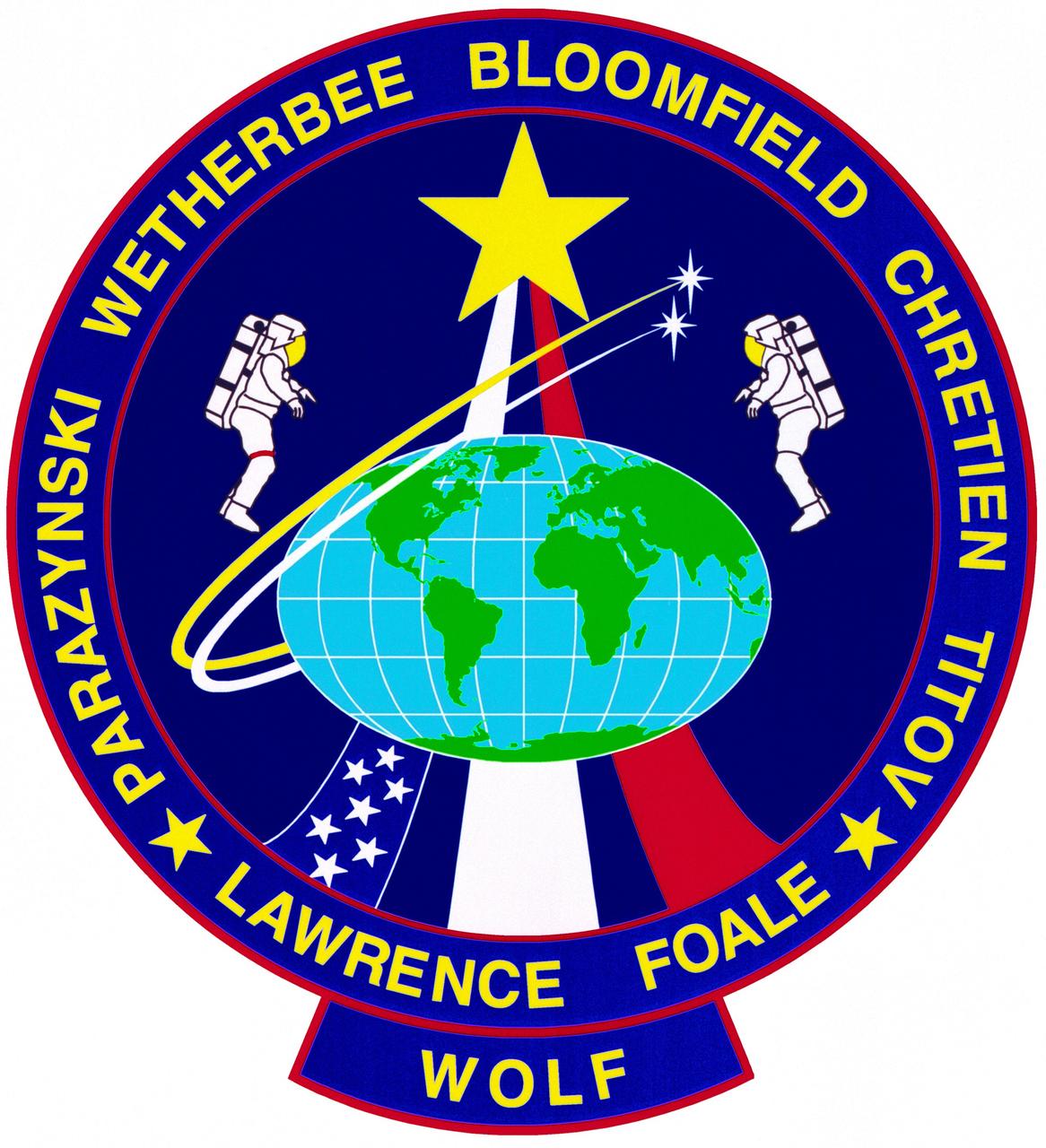
The STS-86 flight was the seventh shuttle-Mir docking mission, symbolized by seven stars. The international crew includes astronauts from the United States, Russia, and France. The flags of these nations are incorporated in the rays of the astronaut logo. The rays of light streaking across the sky depict the orbital tracks of the two spacecraft as they prepare to dock. During the flight, an American astronaut and a Russian cosmonaut will perform an extravehicular activity (EVA). The mercator projection of Earth illustrates the global cooperative nature of the flight.
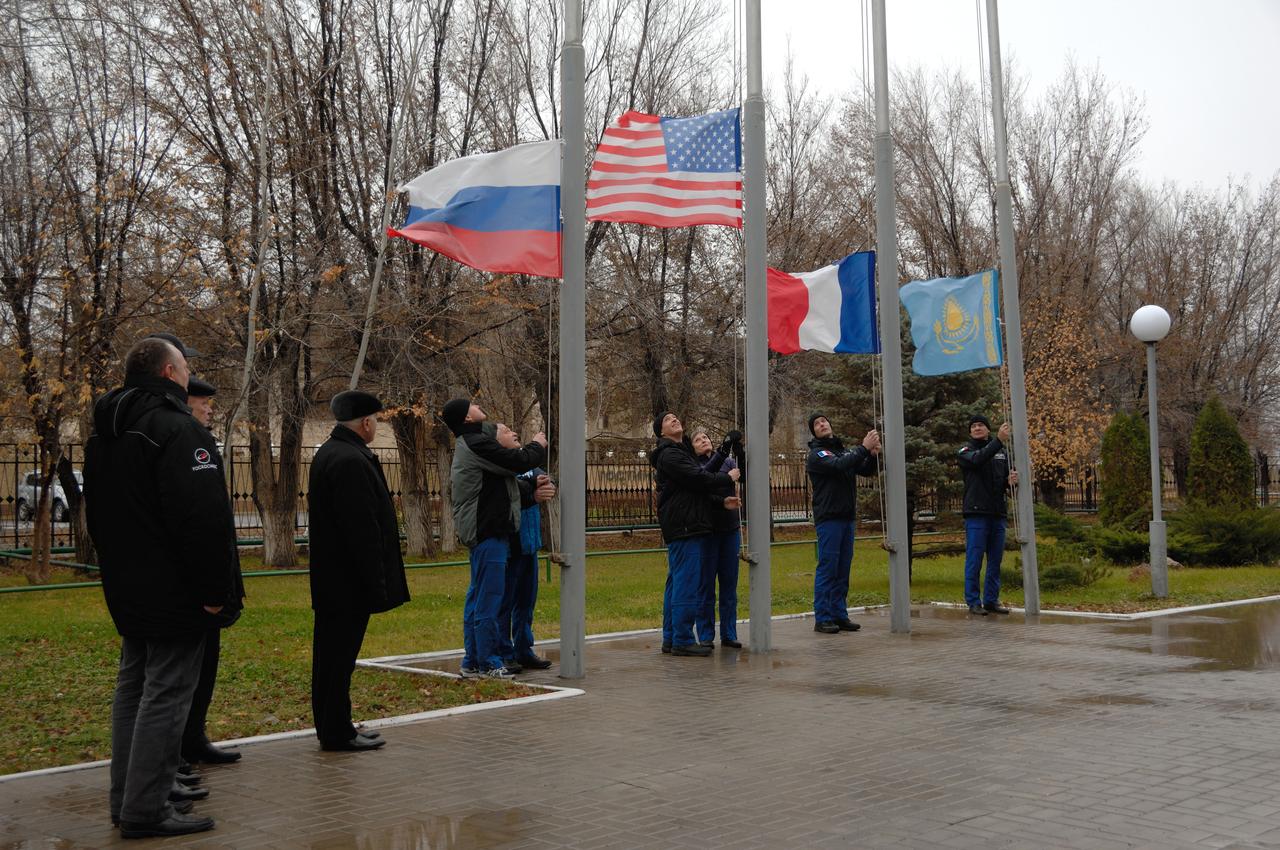
Under leaden skies outside their Cosmonaut Hotel crew quarters in Baikonur, Kazakhstan, the Expedition 50 prime and backup crewmembers raise the flags of Russia, the U.S., France and Kazakhstan Nov. 3 during their traditional ceremony. Peggy Whitson of NASA, Oleg Novistkiy of the Russian Federal Space Agency (Roscosmos) and Thomas Pesquet of the European Space Agency will launch Nov. 18, Baikonur time, on the Soyuz MS-03 spacecraft for a six-month mission on the International Space Station. NASA/Alexander Vysotsky
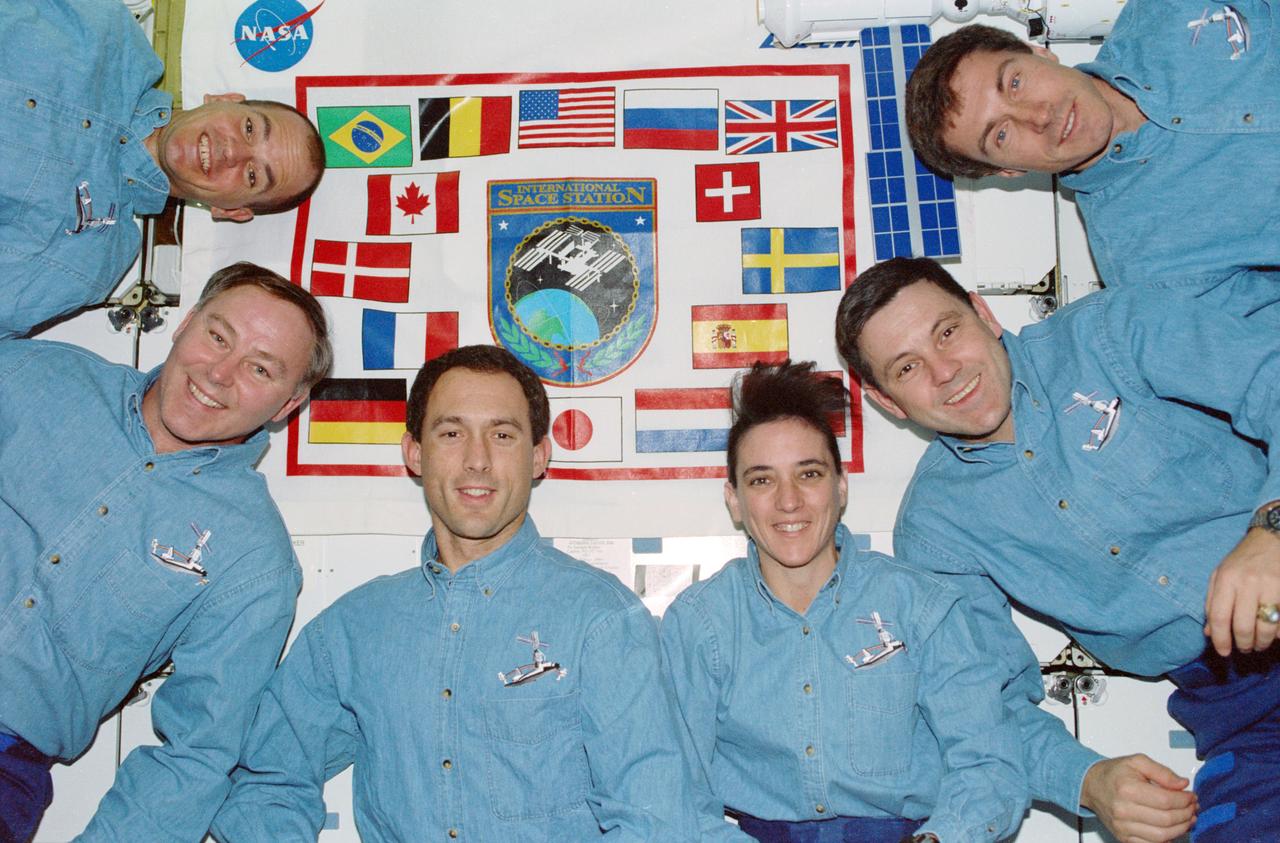
STS088-350-010 (4-15 Dec. 1998) --- STS-88 in-flight crew portrait taken on the Endeavour's middeck with a banner in the background which depicts the flags of all the international partners. From left to right are: Frederick W. "Rick" Sturckow, pilot; Jerry L. Ross, James H. Newman and Nancy J. Currie, all mission specialists; Robert D. Cabana, mission commander; and Sergei K. Krikalev, mission specialist, representing the Russian Aviaiton and Space Agency (Rosaviakosmos).
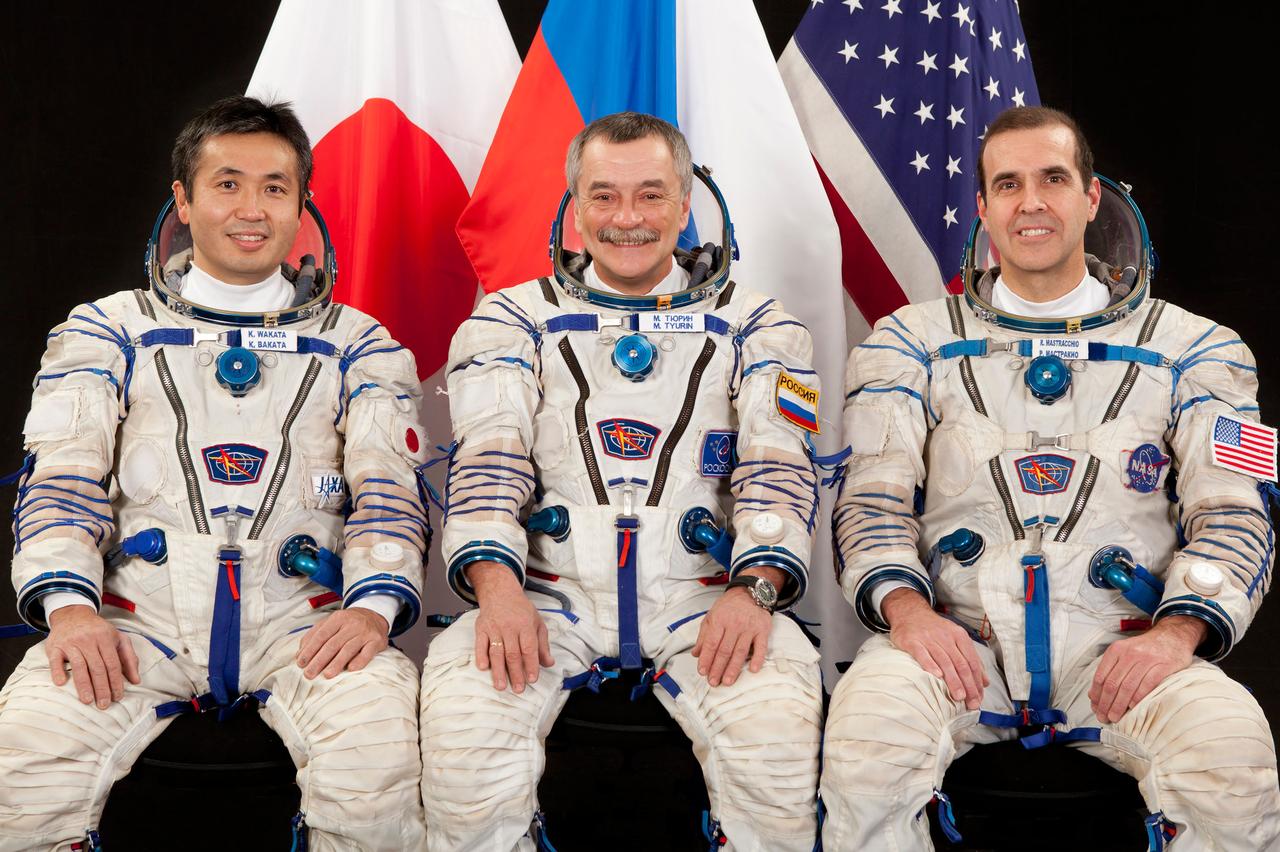
JSC2013-E-026357 (April 2013) --- Three different space agencies and three national flags are represented by the backup crew members for Expedition 36. From the left are Koichi Wakata of the Japan Aerospace Exploration Agency (JAXA), Mikhail Tyurin of the Russian Federal Space Agency (Roscosmos) and Rick Mastracchio of NASA. Photo credit: Gagarin Cosmonaut Training Center
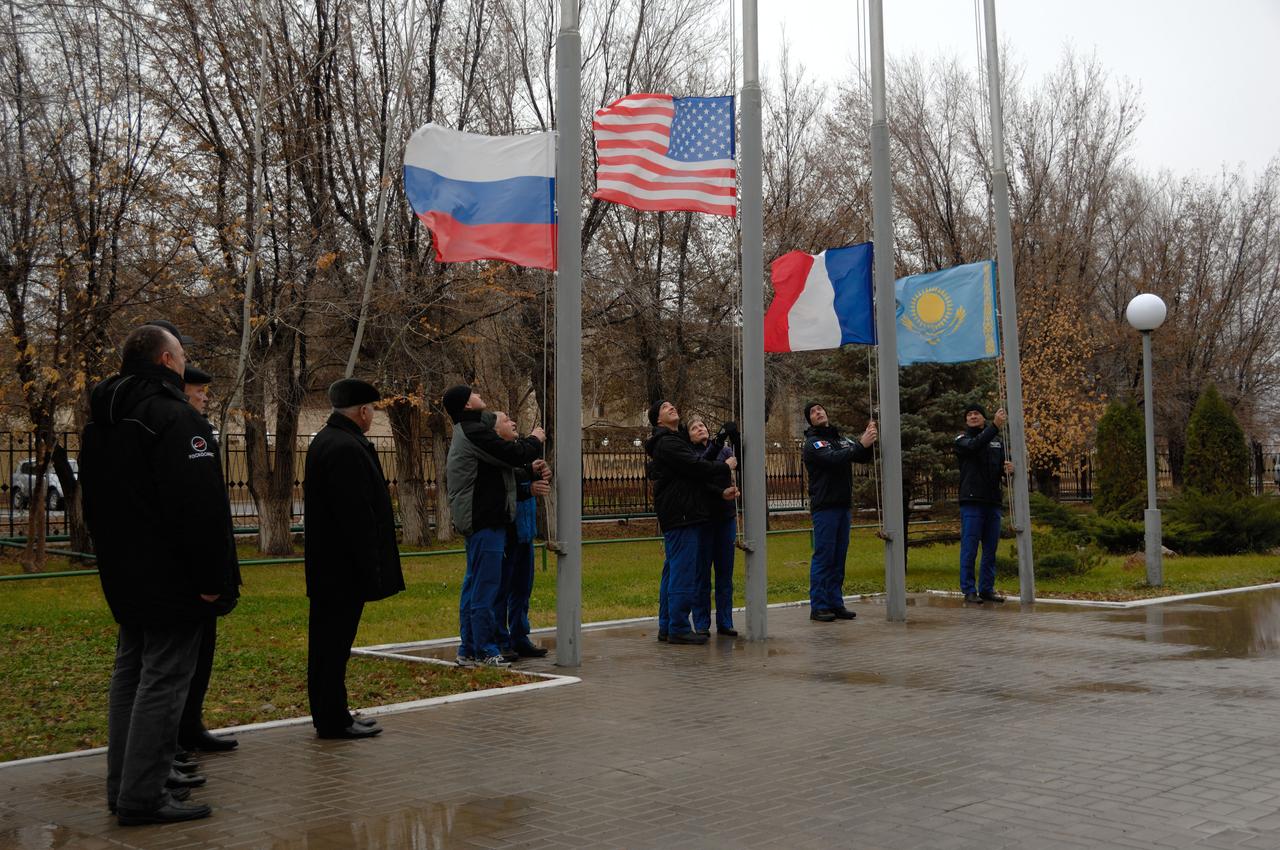
Under leaden skies outside their Cosmonaut Hotel crew quarters in Baikonur, Kazakhstan, the Expedition 50 prime and backup crewmembers raise the flags of Russia, the U.S., France and Kazakhstan Nov. 3 during their traditional ceremony. Peggy Whitson of NASA, Oleg Novistkiy of the Russian Federal Space Agency (Roscosmos) and Thomas Pesquet of the European Space Agency will launch Nov. 18, Baikonur time, on the Soyuz MS-03 spacecraft for a six-month mission on the International Space Station. NASA/Alexander Vysotsky
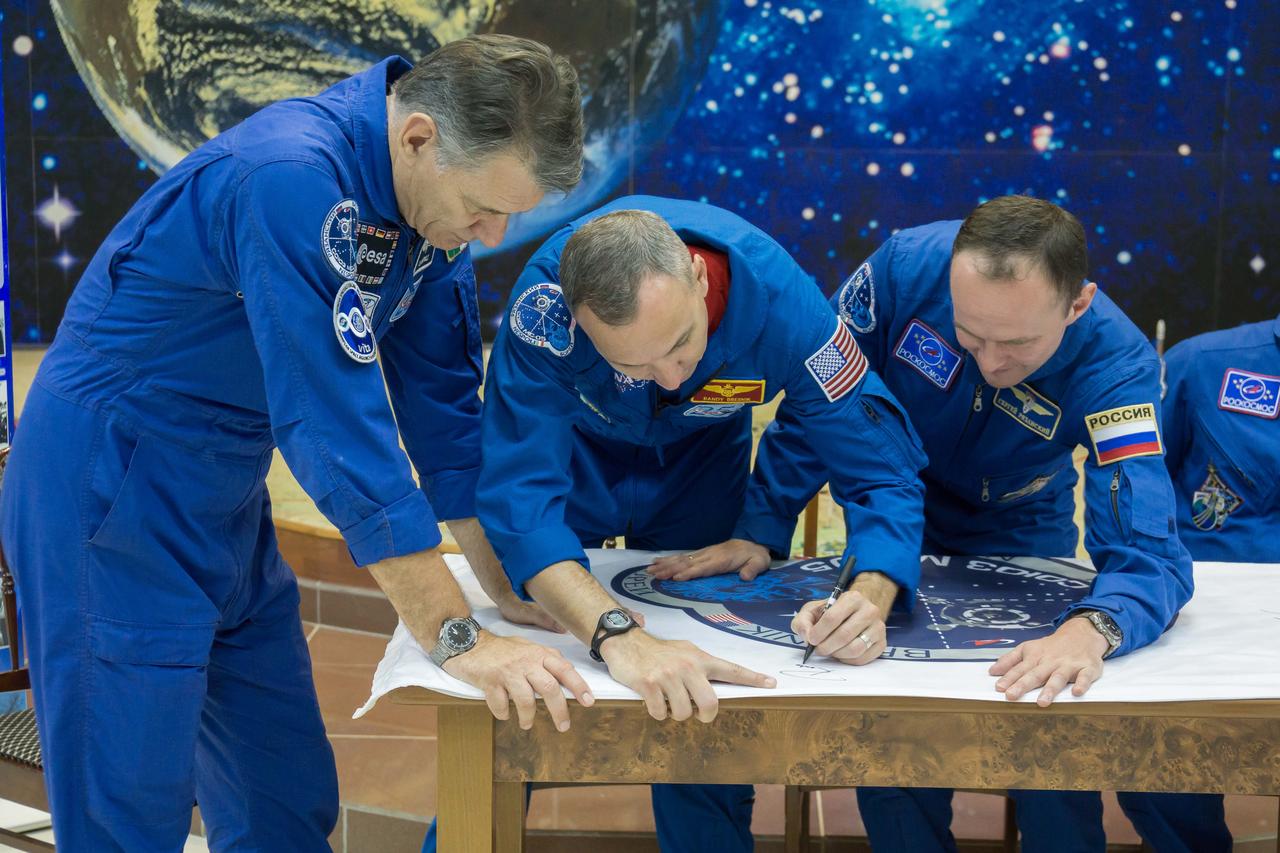
jsc2017e101948 (July 22, 2017) --- At the Baikonur Cosmodrome in Kazakhstan, Expedition 52-53 crewmembers Paolo Nespoli of the European Space Agency (left), Randy Bresnik of NASA (center) and Sergey Ryazanskiy of the Russian Federal Space Agency (Roscosmos, right) sign a flag bearing their Soyuz spacecraft insignia July 24 as part of traditional pre-launch activities. Nespoli, Bresnik and Ryazanskiy will launch July 28 aboard the Soyuz MS-05 spacecraft for a five-month mission on the International Space Station. Credit: NASA/Victor Zelentsov
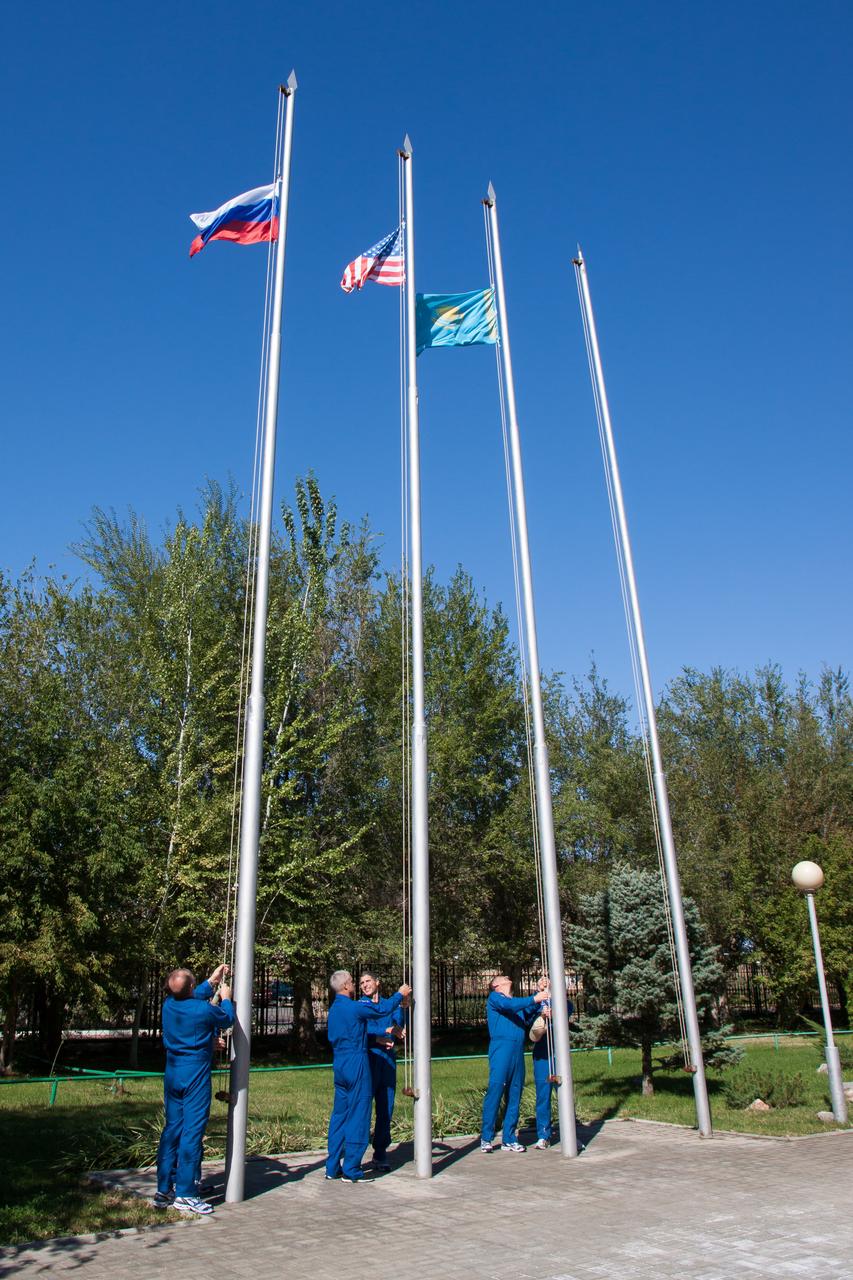
At their Cosmonaut Hotel crew quarters in Baikonur, Kazakhstan, the Expedition 37/38 prime and backup crewmembers raise the U.S., Russian and Kazakh flags Sept. 15 in a traditional ceremony. The event was part of the activities that will lead to the launch Sept. 26, Kazakh time, of Michael Hopkins of NASA, Oleg Kotov and Sergey Ryazanskiy from the Baikonur Cosmodrome on their Soyuz TMA-10M spacecraft to begin a five and a half month mission on the International Space Station. NASA/Victor Zelentsov
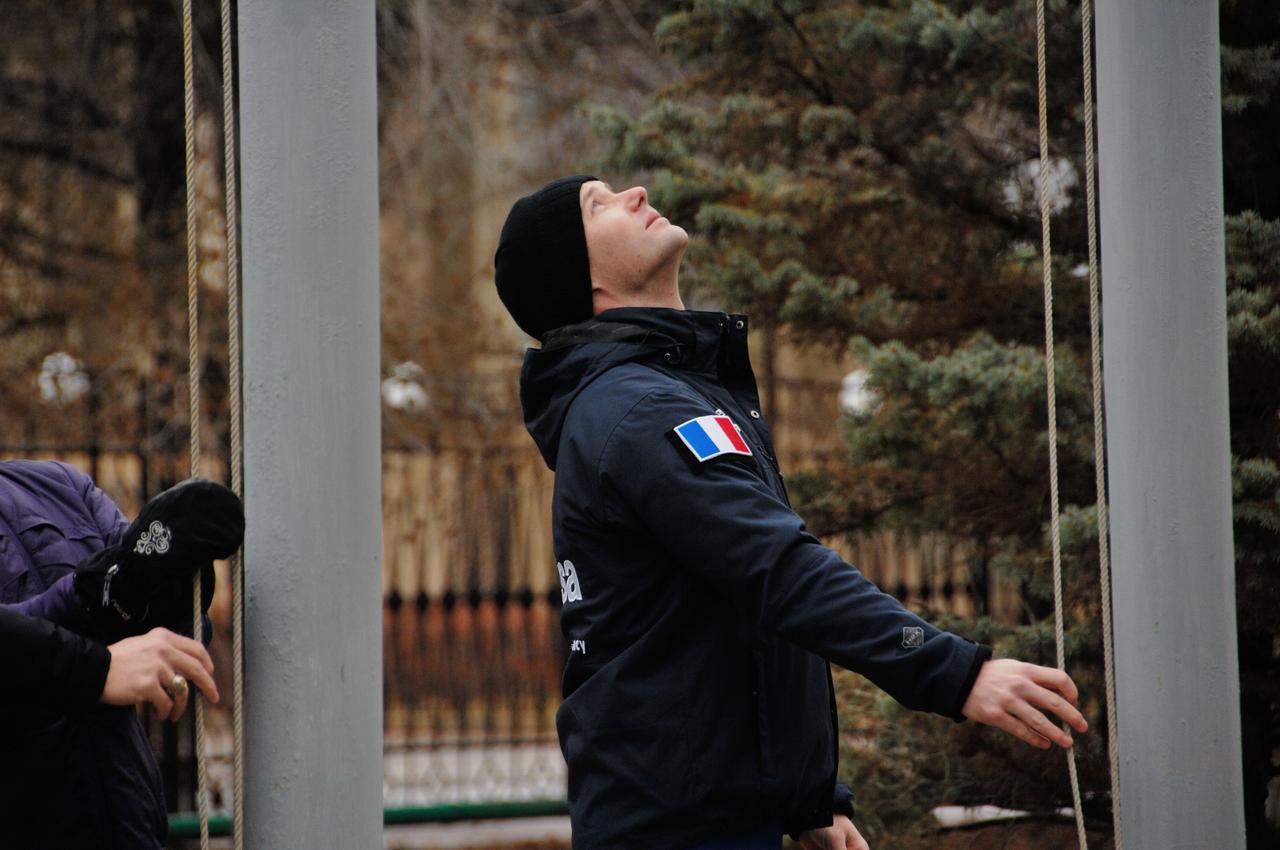
Under leaden skies outside the Cosmonaut Hotel crew quarters in Baikonur, Kazakhstan, Expedition 50 crewmember Thomas Pesquet of the European Space Agency raises the flag of France Nov. 3 during a traditional ceremony. Peggy Whitson of NASA, Oleg Novistkiy of the Russian Federal Space Agency (Roscosmos) and Pesquet will launch Nov. 18, Baikonur time, on the Soyuz MS-03 spacecraft for a six-month mission on the International Space Station. NASA/Alexander Vysotsky
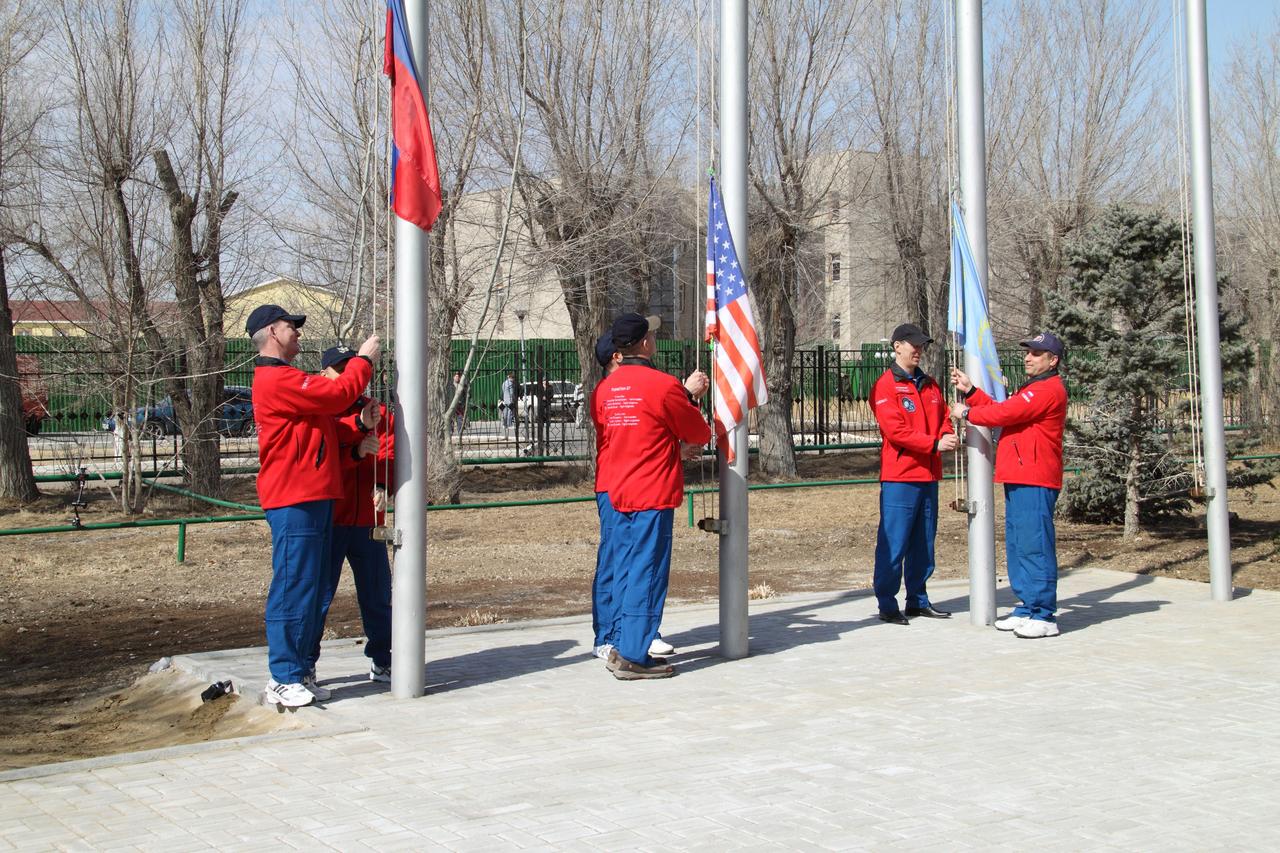
Outside their Cosmonaut Hotel crew quarters in Baikonur, Kazakhstan, the Expedition 27 prime and backup crewmembers conducted the ceremonial raising of the Russian, U.S. and Kazakh flags on March 23, 2011 as part of their traditional pre-launch activities. Seen from left to right are prime Russian crewmembers Alexander Samokutyaev and Andrey Borisenko, prime NASA Flight Engineer Ron Garan (center) and his backup, Dan Burbank and backup Russian crewmembers Anton Shkaplerov and Anatoly Ivanishin. Garan, Samokutyaev and Borisenko are scheduled to launch on April 5 (April 4, U.S. time) from the Baikonur Cosmodrome in Kazakhstan to the International Space Station on the Soyuz TMA-21 spacecraft that has been dubbed “Gagarin”, in honor of the 50th anniversary of the launch of Yuri Gagarin on April 12, 1961 to become the first human to fly in space. Credit: NASA/Victor Zelentsov
Expedition 43 prime crew: from left, NASA Flight Engineer Scott Kelly, Russian Cosmonauts Gennady Padalka, and Mikhail Kornienko of the Russian Federal Space Agency (Roscosmos), along with their backup crew: Jeff Williams of NASA, Russian Cosmonauts Alexei Ovchinin, and Sergei Volkov of Roscosmos attend a traditional flag raising ceremony at the Cosmonaut Hotel, Monday, March 16, 2015 in Baikonur, Kazakhstan. Kelly, Padalka, and Kornienko are preparing for launch to the International Space Station in their Soyuz TMA-16M spacecraft from the Baikonur Cosmodrome in Kazakhstan March 28, Kazakh time. As the one-year crew, Kelly and Kornienko will return to Earth on Soyuz TMA-18M in March 2016. Photo Credit: (NASA/Victor Zelentsov)
Outside their Cosmonaut Hotel crew quarters in Baikonur, Kazakhstan, the Expedition 27 prime and backup crewmembers conducted the ceremonial raising of the Russian, U.S. and Kazakh flags on March 23, 2011 as part of their traditional pre-launch activities. Seen from left to right are backup Russian crewmembers Anton Shkaplerov and Anatoly Ivanishin. prime NASA Flight Engineer Ron Garan (center) and his backup, Dan Burbank and prime Russian crewmembers Alexander Samokutyaev and Andrey Borisenko (right). Garan, Samokutyaev and Borisenko are scheduled to launch on April 5 (April 4, U.S. time) from the Baikonur Cosmodrome in Kazakhstan to the International Space Station on the Soyuz TMA-21 spacecraft that has been dubbed “Gagarin”, in honor of the 50th anniversary of the launch of Yuri Gagarin on April 12, 1961 to become the first human to fly in space. Credit: NASA/Victor Zelentsov
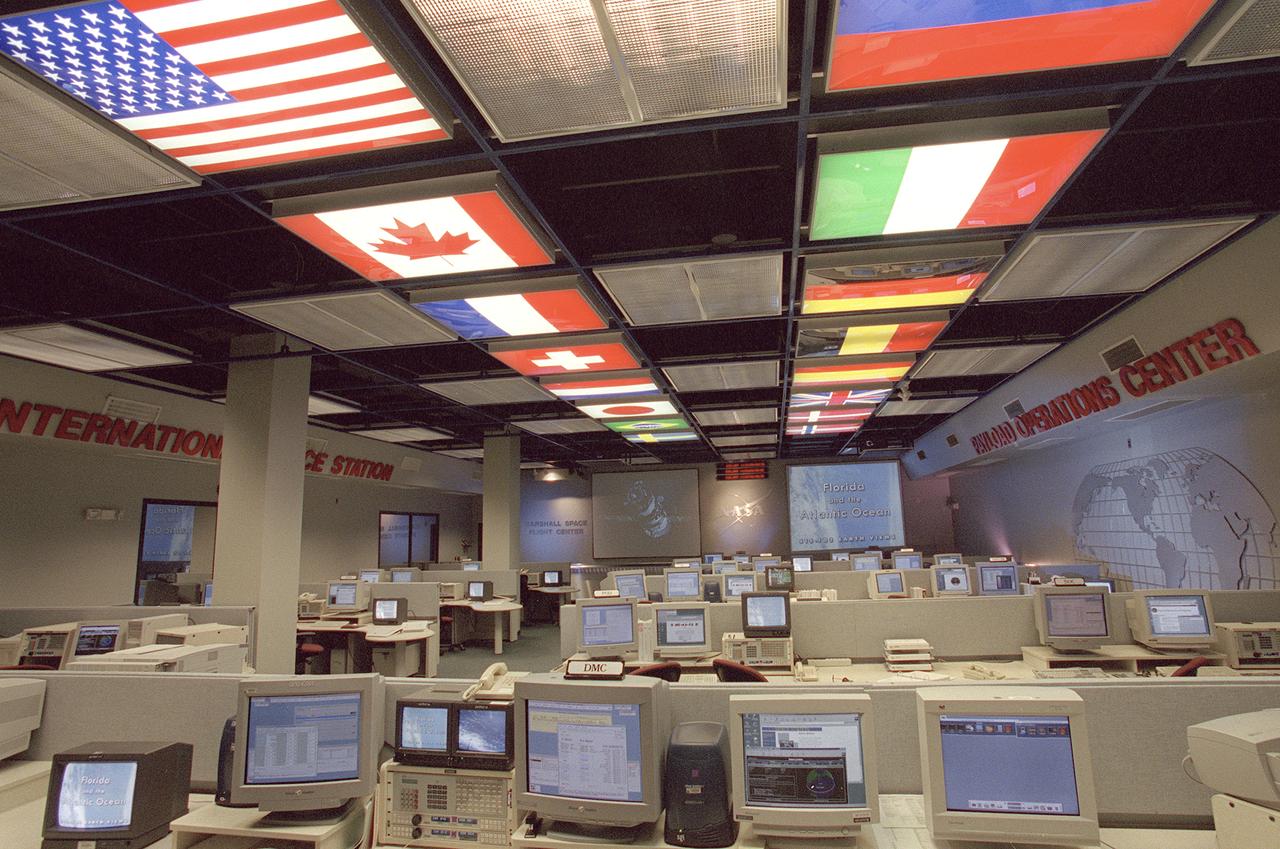
The International Space Station (ISS) Payload Operations Center (POC) at NASA's Marshall Space Flight Center (MSFC) in Huntsville, Alabama, is the world's primary science command post for the International Space Station (ISS), the most ambitious space research facility in human history. The Payload Operations team is responsible for managing all science research experiments aboard the Station. The center is also home for coordination of the mission-plarning work of variety of international sources, all science payload deliveries and retrieval, and payload training and safety programs for the Station crew and all ground personnel. Within the POC, critical payload information from the ISS is displayed on a dedicated workstation, reading both S-band (low data rate) and Ku-band (high data rate) signals from a variety of experiments and procedures operated by the ISS crew and their colleagues on Earth. The POC is the focal point for incorporating research and experiment requirements from all international partners into an integrated ISS payload mission plan. This photograph is an overall view of the MSFC Payload Operations Center displaying the flags of the countries participating the ISS. The flags at the left portray The United States, Canada, France, Switzerland, Netherlands, Japan, Brazil, and Sweden. The flags at the right portray The Russian Federation, Italy, Germany, Belgium, Spain, United Kingdom, Denmark, and Norway.
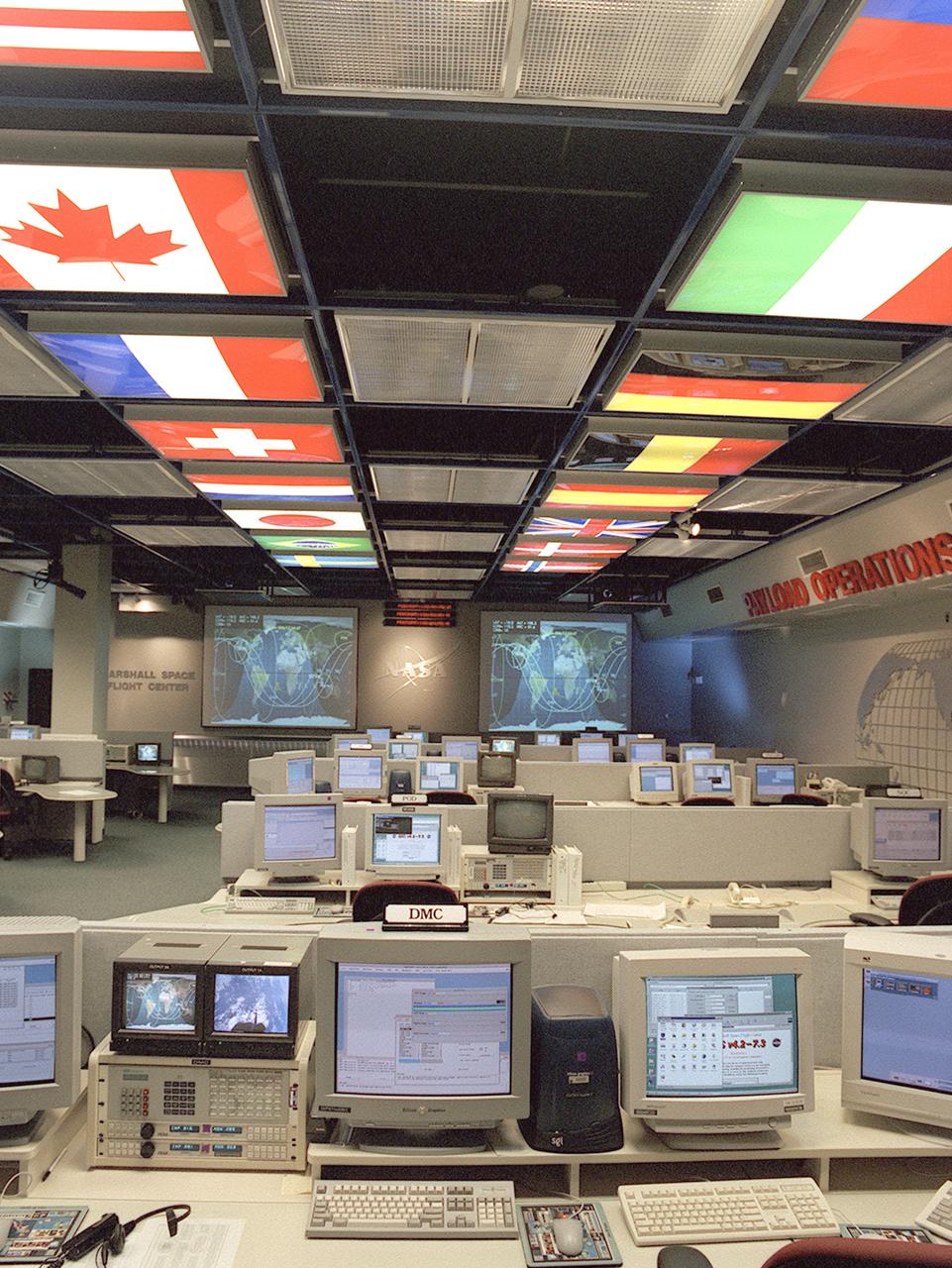
The International Space Station (ISS) Payload Operations Center (POC) at NASA's Marshall Space Flight Center (MSFC) in Huntsville, Alabama, is the world's primary science command post for the (ISS), the most ambitious space research facility in human history. The Payload Operations team is responsible for managing all science research experiments aboard the Station. The center is also home for coordination of the mission-plarning work of variety of international sources, all science payload deliveries and retrieval, and payload training and safety programs for the Station crew and all ground personnel. Within the POC, critical payload information from the ISS is displayed on a dedicated workstation, reading both S-band (low data rate) and Ku-band (high data rate) signals from a variety of experiments and procedures operated by the ISS crew and their colleagues on Earth. The POC is the focal point for incorporating research and experiment requirements from all international partners into an integrated ISS payload mission plan. This photograph is an overall view of the MSFC Payload Operations Center displaying the flags of the countries participating in the ISS. The flags at the left portray The United States, Canada, France, Switzerland, Netherlands, Japan, Brazil, and Sweden. The flags at the right portray The Russian Federation, Italy, Germany, Belgium, Spain, United Kingdom, Denmark, and Norway.
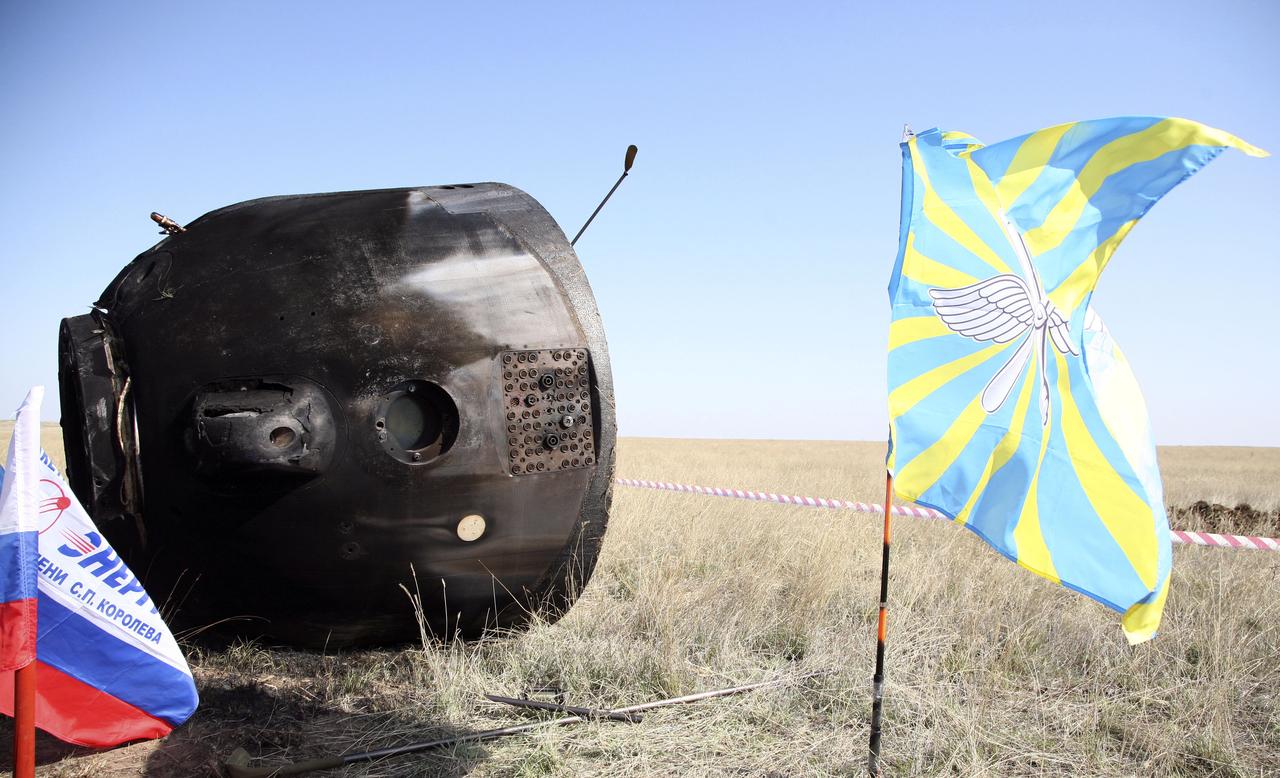
The Soyuz TMA-11 capsule lays on its side on the Kazakh steppe, Friday, April 19, 2008. Expedition 16 Commander Peggy Whitson, Flight Engineer and Soyuz Commander Yuri Malenchenko and South Korean spaceflight participant So-yeon Yi landed their Soyuz TMA-11 spacecraft in central Kazakhstan to complete 192 days in space for Whitson and Malenchenko and 11 days in orbit for Yi. Photo Credit: (NASA/Reuters/Pool)
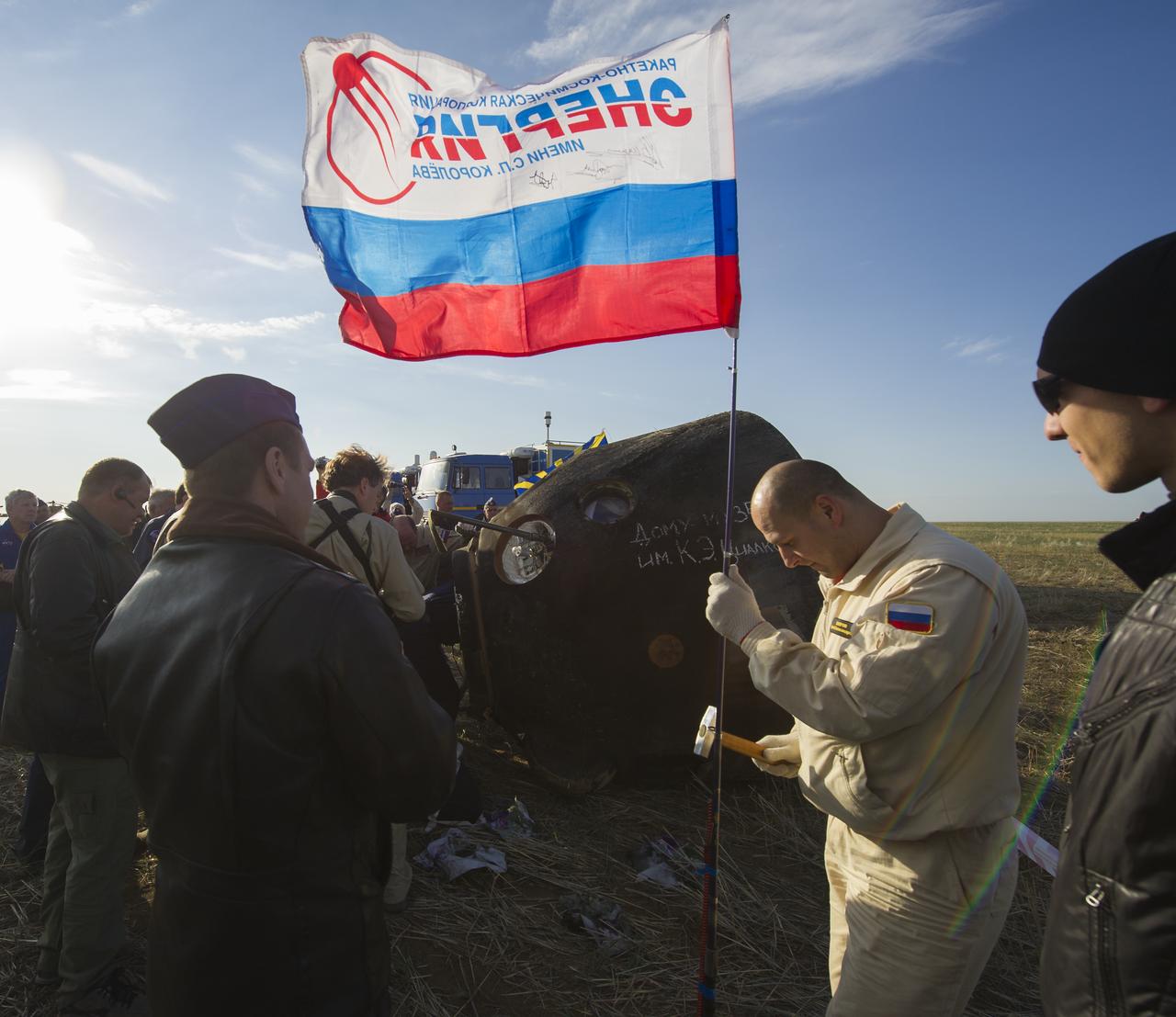
The Soyuz TMA-04M spacecraft is seen following its landing with Expedition 32 Commander Gennady Padalka of Russia, NASA Flight Engineer Joe Acaba and Russian Flight Engineer Sergei Revin in a remote area near the town of Arkalyk, Kazakhstan, on Monday, September 17, 2012. Padalka, Acaba and Revin returned from five months onboard the International Space Station where they served as members of the Expedition 31 and 32 crews. Photo Credit: (NASA/Carla Cioffi)
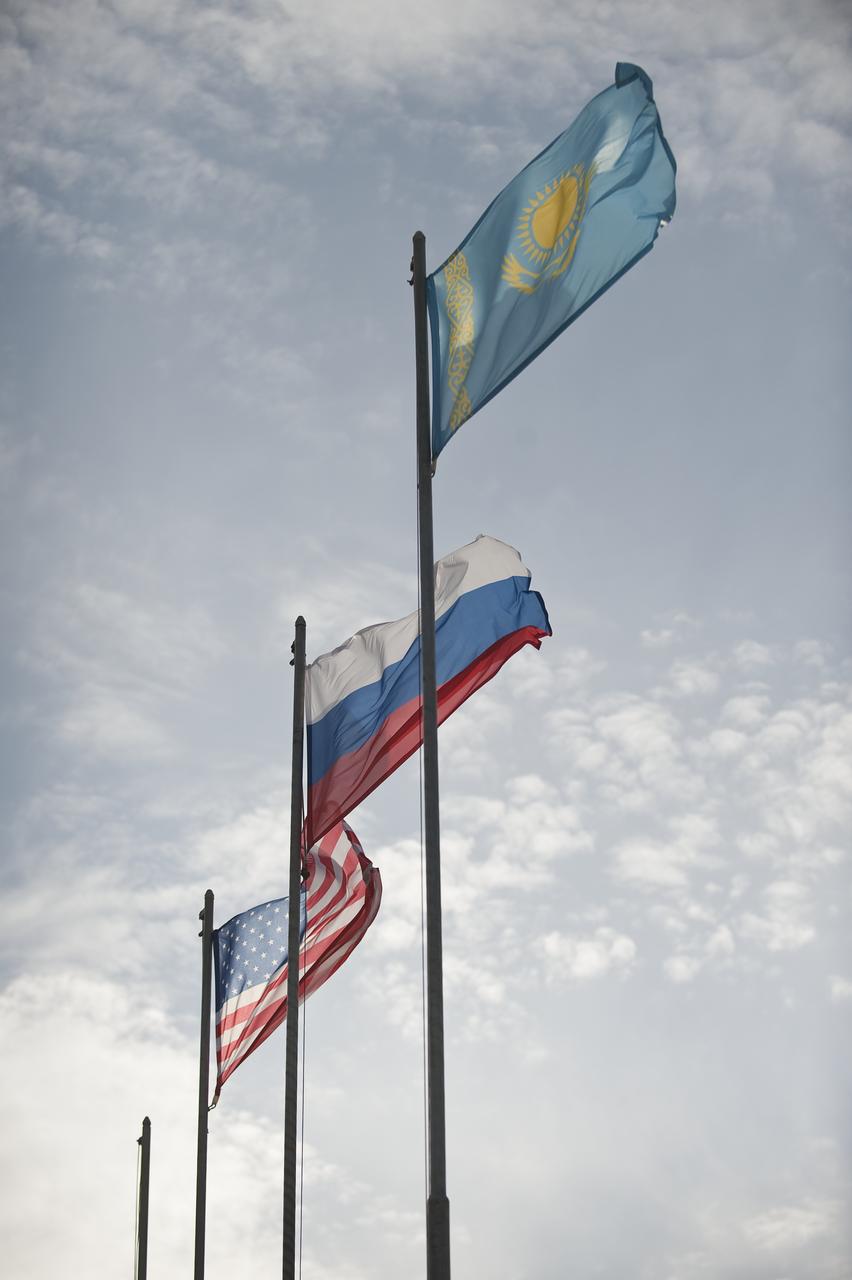
The flags of the United States, Russia and Kazakhstan are seen at the launch pad after the Soyuz TMA-18 spacecraft was rolled out by train to the launch pad at the Baikonur Cosmodrome, Kazakhstan, Wednesday, March, 31, 2010. The launch of the Soyuz spacecraft with Expedition 23 Soyuz Commander Alexander Skvortsov of Russia, Flight Engineer Mikhail Kornienko of Russia, and NASA Flight Engineer Tracy Caldwell Dyson is scheduled for Friday, April 2, 2010 at 10:04 a.m. Kazakhstan time. Photo Credit (NASA/Bill Ingalls)

The flags of all three crew members' countries fly outside the Cosmonaut Hotel after European Space Agency astronaut Andre Kuipers of the Netherlands, Expedition 9 Flight Engineer and NASA International Space Station Science Officer Mike Fincke, Expedition 9 Commander Gennady Padalka, Backup Flight Engineer Salizhan Sharipov, backup European Space Agency astronaut Gerhard Thiele of Germany and NASA Expedition 9 backup commander Leroy Chiao raised them during a ceremony, Thursday, April 15, 2004, in Baikonur, Kazakhstan. Photo Credit: (NASA/Bill Ingalls)
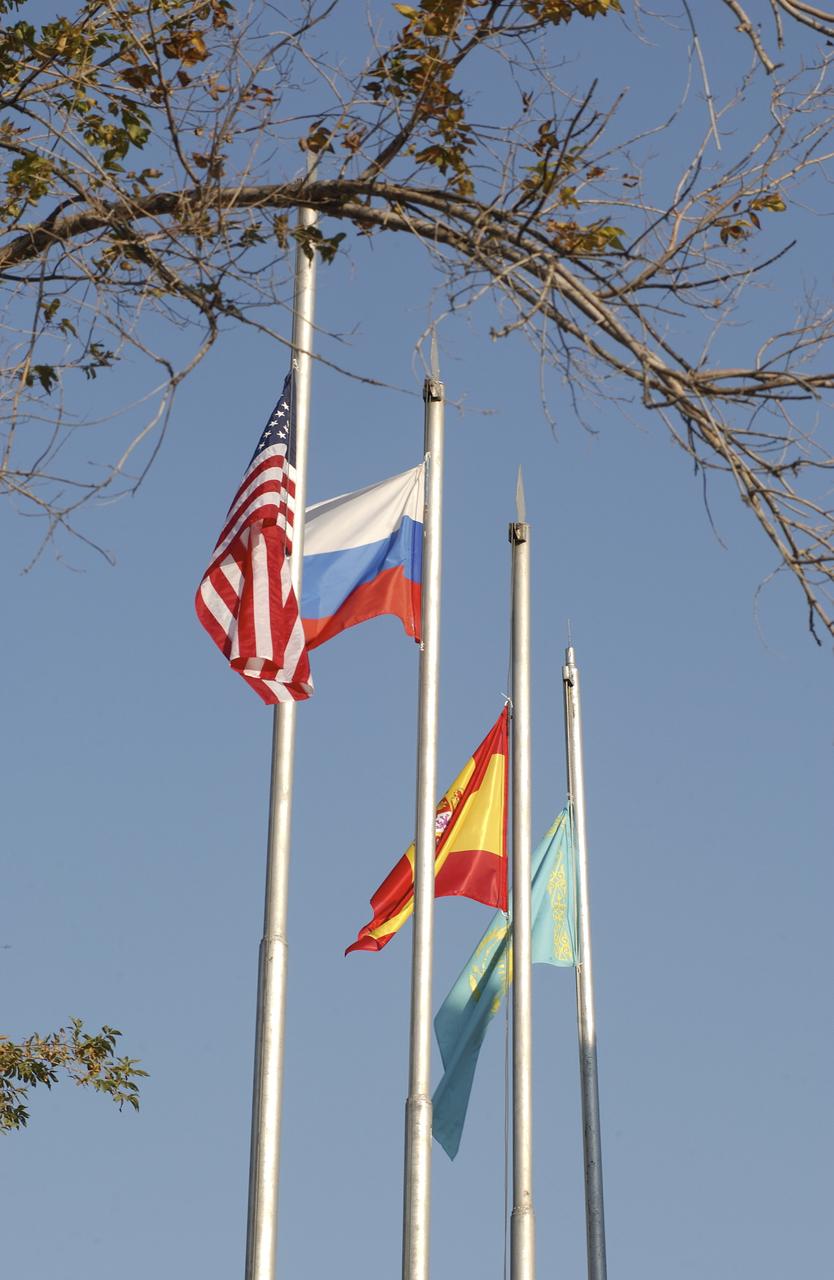
The flags of the United States, Russia, Spain and Kazakhstan fly outside the Cosmonaut Hotel, Tuesday, Oct. 14, 2003, in Baikonur, Kazakhstan following a traditional flag-raising ceremony. Photo Credit (NASA/Bill Ingalls)
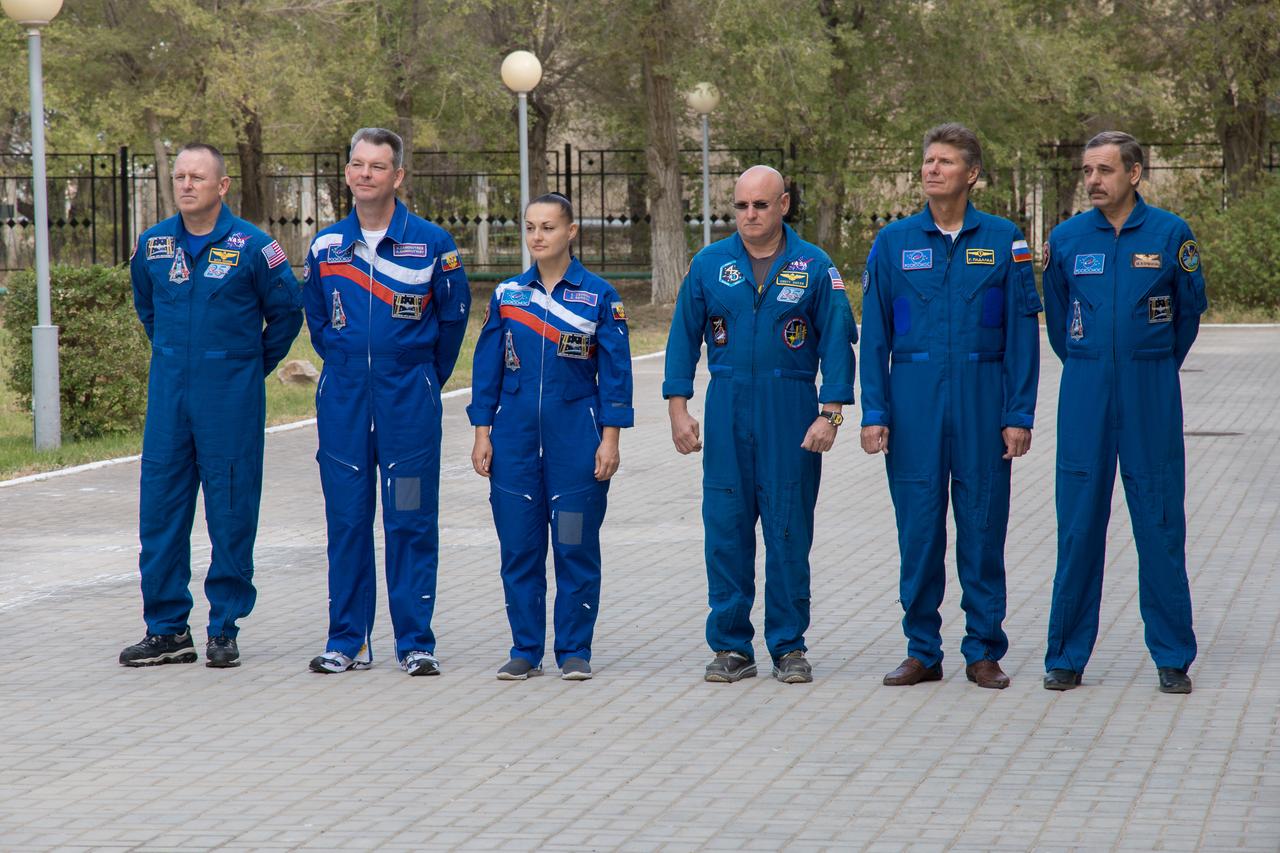
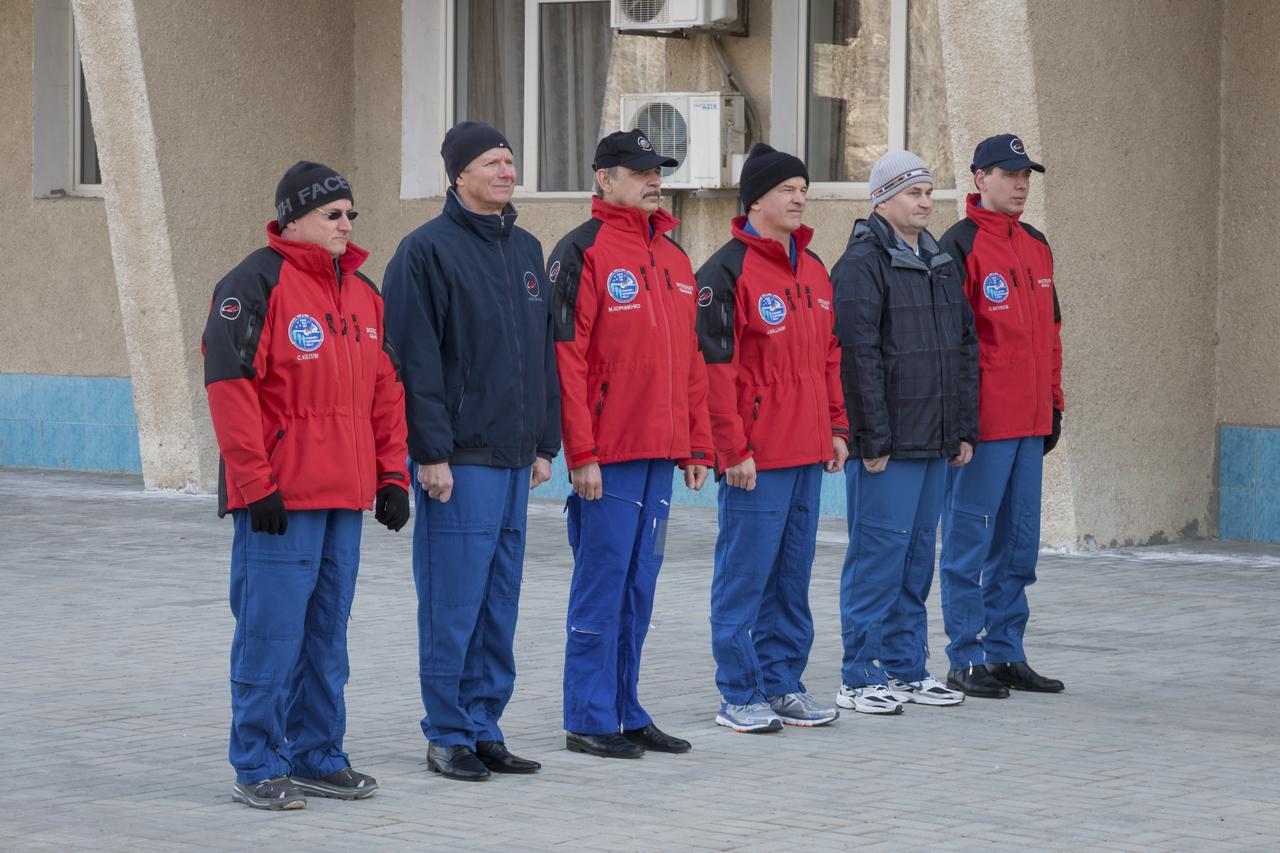
14-11-05-45: (14 Sept. 2014) --- At their Cosmonaut Hotel crew quarters in Baikonur, Kazakhstan, the Expedition 41/42 prime and backup crew members participate in ceremonies after raising the flags of Russia, the U.S. and Kazakhstan during traditional ceremonies Sept. 14. From left to right are prime crew members Barry Wilmore of NASA, Alexander Samokutyaev of the Russian Federal Space Agency (Roscosmos) and Elena Serova of Roscosmos, and backup crew members Scott Kelly of NASA, Gennady Padalka of Roscosmos and and Mikhail Kornienko of Roscosmos. Wilmore, Samokutyaev and Serova will launch on Sept. 26, Kazakh time, in the Soyuz TMA-14M spacecraft to begin a 5 ½ month mission on the International Space Station. Serova will become the fourth Russian woman to fly in space. Photo credit: NASA/Victor Zelentsov

The prime and backup crewmembers for Expedition 32 attend ceremonies outside their Cosmonaut Hotel in Baikonur, Kazakhstan July 4, 2012 following the raising of U.S., Russian, Japanese and Kazakh flags outside their crew quarters as part of the pre-launch activities leading up to the launch of the next crew to the International Space Station. From left to right are the prime crewmembers – Soyuz Commander Yuri Malenchenko, NASA Flight Engineer Sunita Williams and Flight Engineer Aki Hoshide of the Japan Aerospace Exploration Agency who will launch to the station July 15 from the Baikonur Cosmodrome in their Soyuz TMA-05M spacecraft --- and their backups, NASA Flight Engineer Tom Marshburn, Canadian Space Agency Flight Engineer Chris Hadfield and Russian Soyuz Commander Roman Romanenko. NASA/Victor Zelentsov
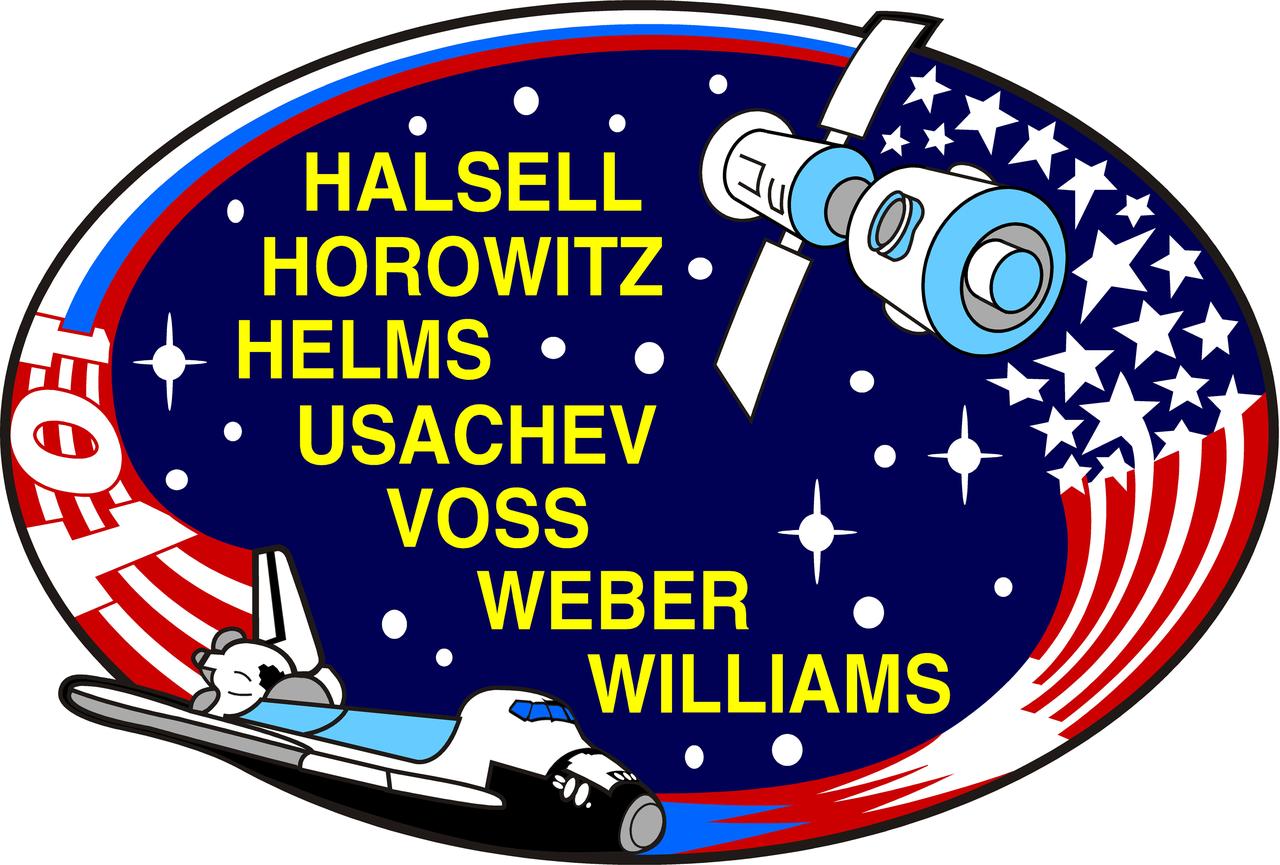
The STS-101 mission patch commemorates the third Space Shuttle flight supporting the assembly of the International Space Station (ISS). This flight's primary tasks were to outfit the ISS and extend its lifetime, to conduct a space walk to install external components in preparation for the docking of the Russian Service Module, Zvezda, and the arrival of the first ISS crew. The Space Shuttle is depicted in an orbit configuration prior to docking with the ISS. The ISS is depicted in the stage of assembly completed for the STS-101 mission, which consists of the United States built Unity module and the Russian-built Zarya module. The three large stars represent the third ISS mission in the assembly sequence. The elements and colors of the border reflect the flags of the nations represented by the STS-101 crew members, the United States, and Russia.
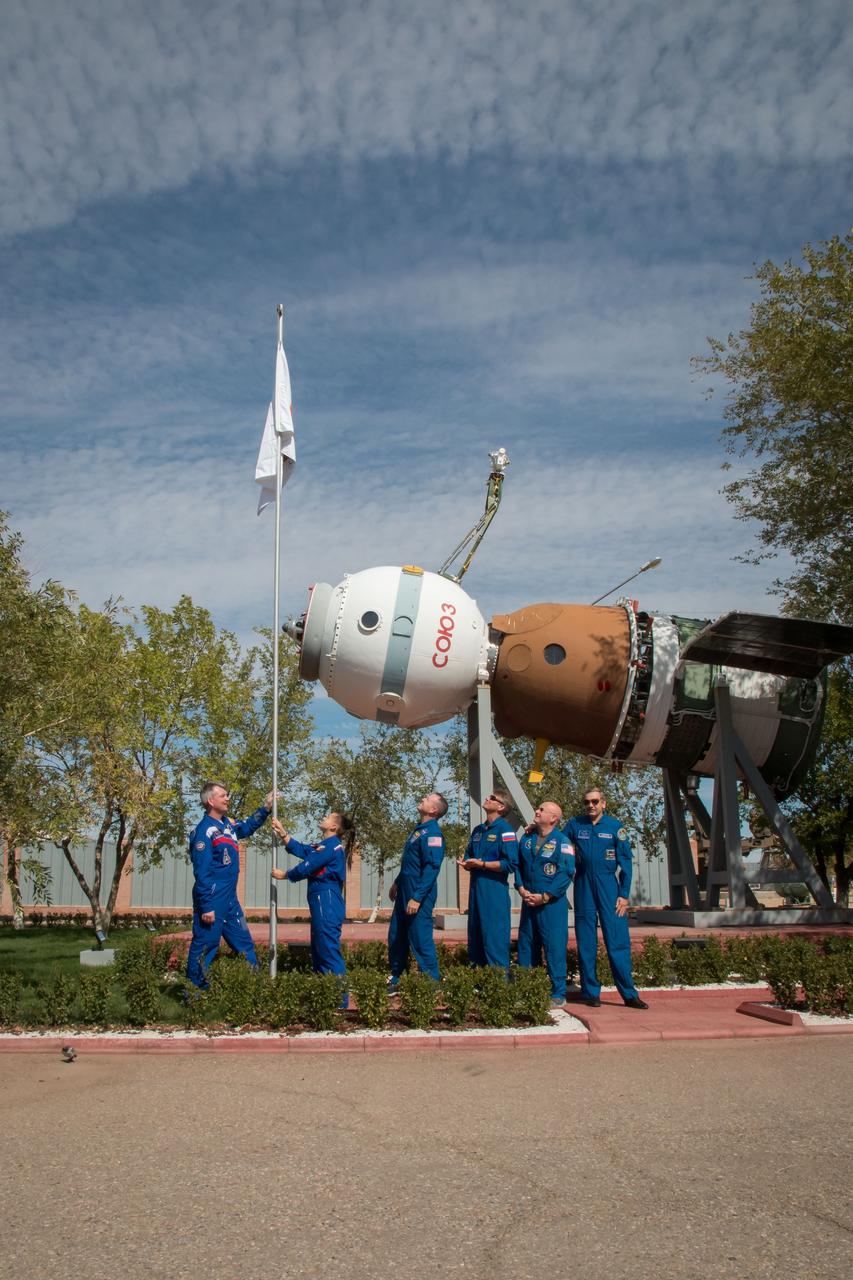
2014-09-21-14-00-27-2 Outside the Korolev Museum at the Baikonur Cosmodrome in Kazakhstan, the Expedition 41/42 prime and backup crews participate in the raising of the flag bearing their crew insignia Sept. 21 during ceremonial pre-flight activities. From left to right are prime crewmembers Alexander Samokutyaev of the Russian Federal Space Agency (Roscosmos), Elena Serova of Roscosmos and Barry Wilmore of NASA and backup crewmembers Gennady Padalka of Roscosmos, Scott Kelly of NASA and Mikhail Kornienko of Roscosmos. Wilmore, Samokutyaev and Serova will launch on Sept. 26, Kazakh time, in the Soyuz to begin a 5 ½ month mission on the International Space Station. Serova will become the fourth Russian woman to fly in space and the first to live and work on the station. Kelly and Kornienko will launch in March 2015 to spend a full year on the station. NASA/Victor Zelentsov
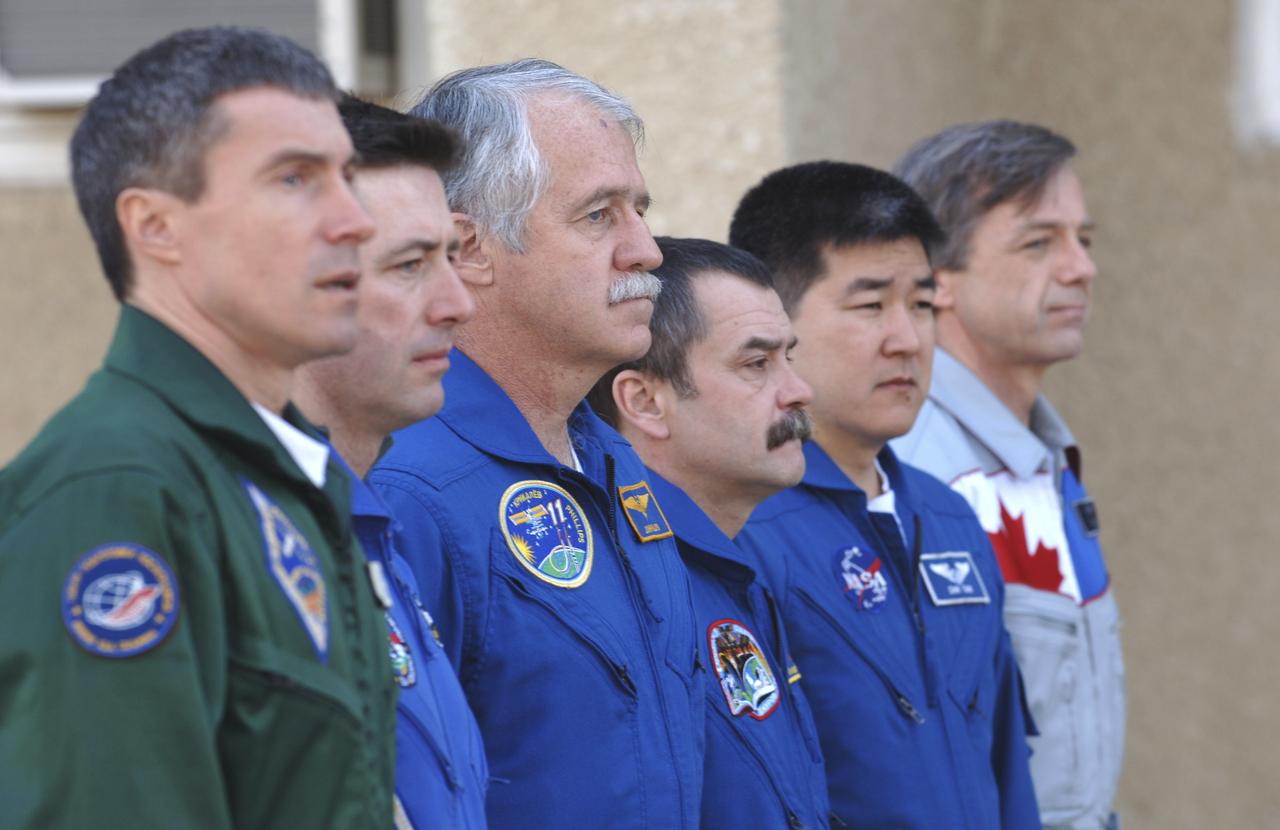
Expedition 11 Commander Sergei Krikalev, left, European Space Agency astronaut Roberto Vittori, of Italy, Flight Engineer John Phillips, third from left, along with their backups, Russian Commander Mikhail Tyurin, American Dan Tani and Robert Thirsk, of Canada, far right, participate in the traditional raising of their countries’ flags outside their crew quarters in Baikonur, Kazakhstan on Monday, April 11, 2005, during preparations for the April 15 launch on a Soyuz TMA-6 spacecraft to the International Space Station. Krikalev and Phillips will spend six months in space and greet the first Shuttle crew to fly in more than two years when it arrives at the station, while Vittori spends eight days on the station under a commercial contract between ESA and the Russian Federal Space Agency. Photo Credit: (NASA/Bill Ingalls)
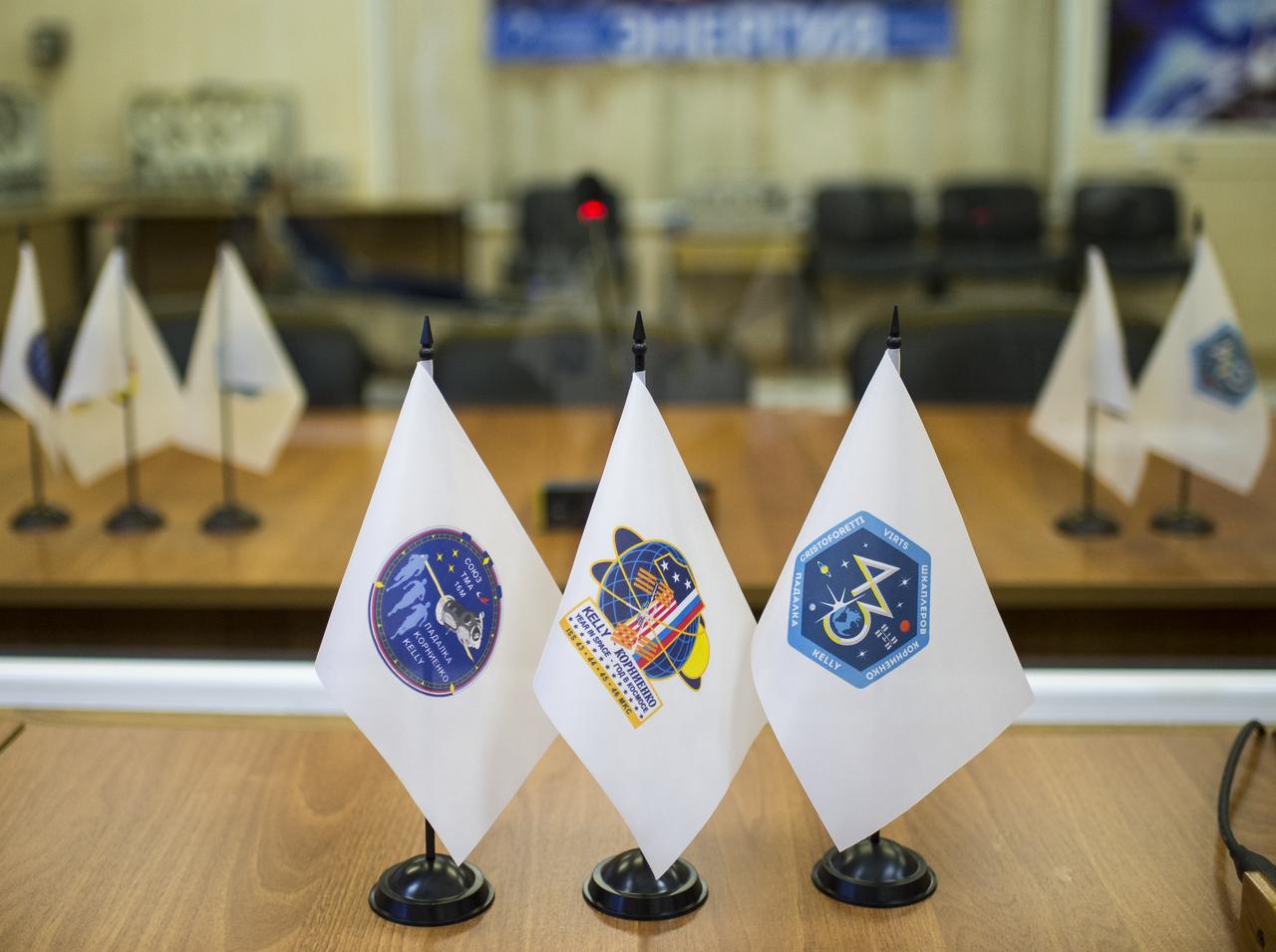
Flags depicting the Soyuz TMA-16M spacecraft, the One-Year Mission, and the Expedition 43 Mission are seen on desks in two different rooms separated by glass where Expedition 43 prime and backup crews will meet with space officials on their final check of the Soyuz capsule, Monday, March 23, 2015 at the Baikonur Cosmodrome in Kazakhstan. NASA Astronaut Scott Kelly, and Russian Cosmonauts Mikhail Kornienko, and Gennady Padalka of the Russian Federal Space Agency (Roscosmos) are scheduled to launch to the International Space Station in the Soyuz TMA-16M spacecraft from the Baikonur Cosmodrome in Kazakhstan March 28, Kazakh time (March 27 Eastern time.) As the one-year crew, Kelly and Kornienko will return to Earth on Soyuz TMA-18M in March 2016. Photo Credit: (NASA/Bill Ingalls)
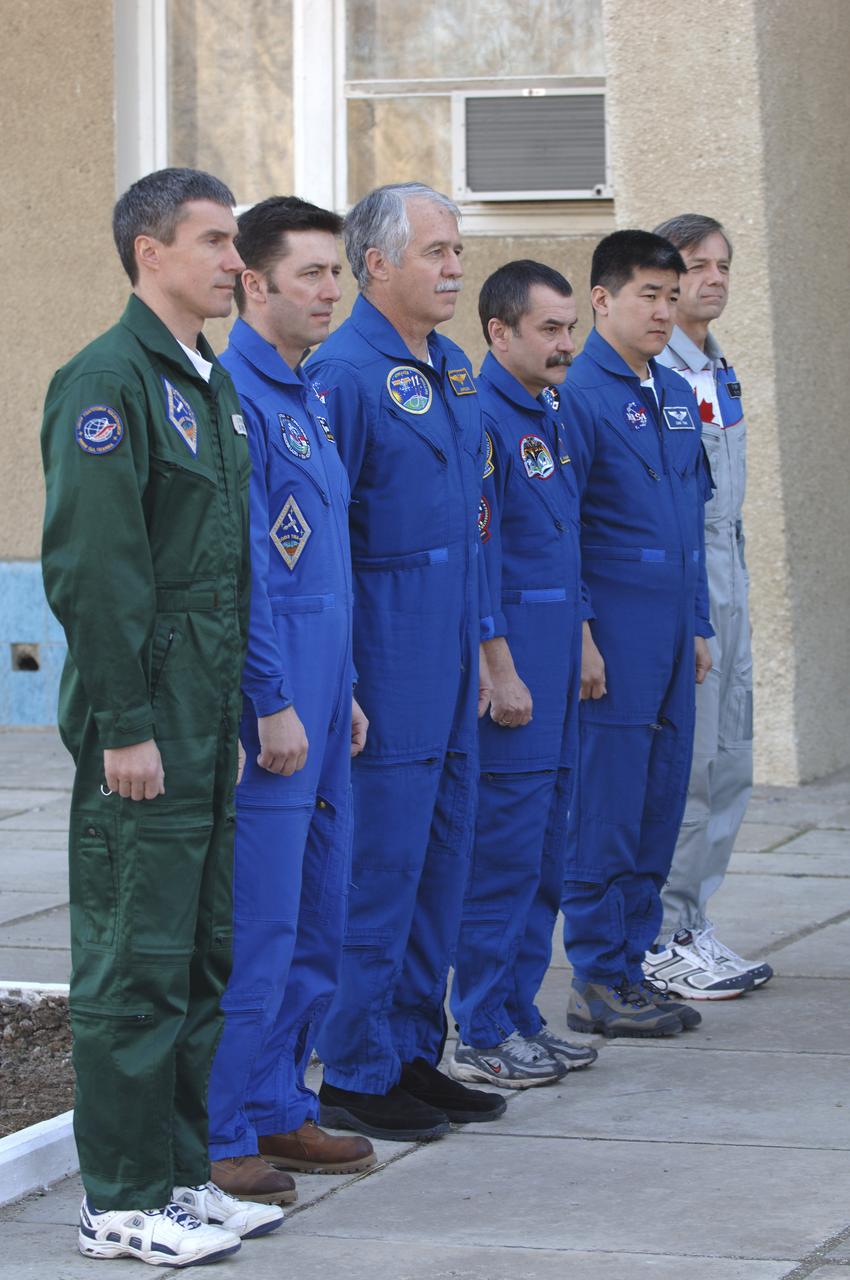
Expedition 11 Commander Sergei Krikalev, left, European Space Agency astronaut Roberto Vittori, of Italy, Flight Engineer John Phillips, third from left, along with their backups, Russian Commander Mikhail Tyurin, American Dan Tani and Robert Thirsk, of Canada, far right, participate in the traditional raising of their countries’ flags outside their crew quarters in Baikonur, Kazakhstan on Monday, April 11, 2005, during preparations for the April 15 launch on a Soyuz TMA-6 spacecraft to the International Space Station. Krikalev and Phillips will spend six months in space and greet the first Shuttle crew to fly in more than two years when it arrives at the station, while Vittori spends eight days on the station under a commercial contract between ESA and the Russian Federal Space Agency. Photo Credit: (NASA/Bill Ingalls)
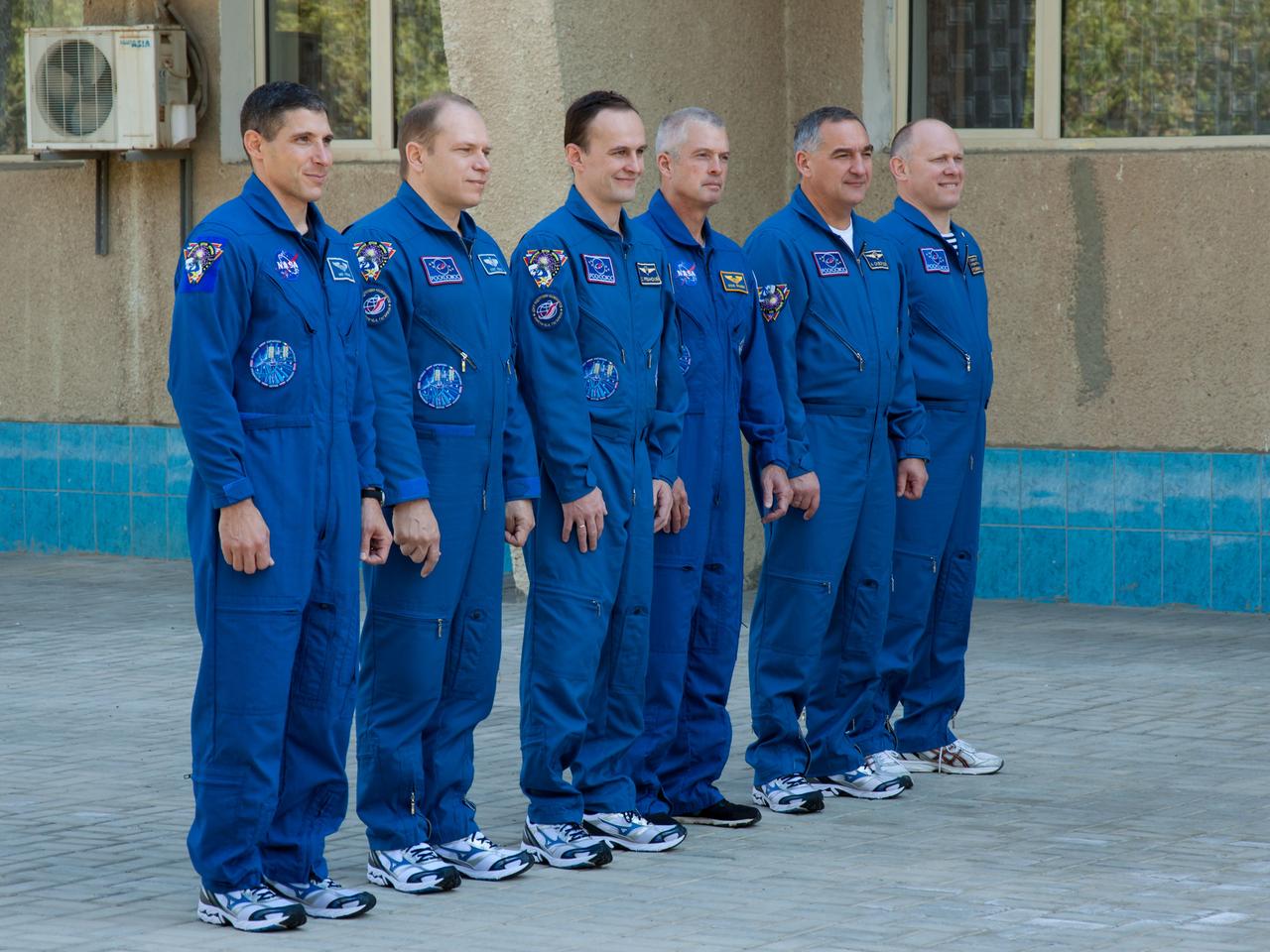
At their Cosmonaut Hotel crew quarters in Baikonur, Kazakhstan, the Expedition 37/38 prime and backup crewmembers participate in ceremonies following the traditional raising of U.S., Russian and Kazakh flags Sept. 15. From left to right are prime crewmembers Michael Hopkins of NASA, Oleg Kotov and Sergey Ryazanskiy and their backups, Steve Swanson of NASA, Alexander Skvortsov and Oleg Artemyev. Hopkins, Kotov and Ryazanskiy are preparing for launch Sept. 26, Kazakh time, from Baikonur on their Soyuz TMA-10M spacecraft to begin a five and a half month mission on the International Space Station. NASA/Victor Zelentsov
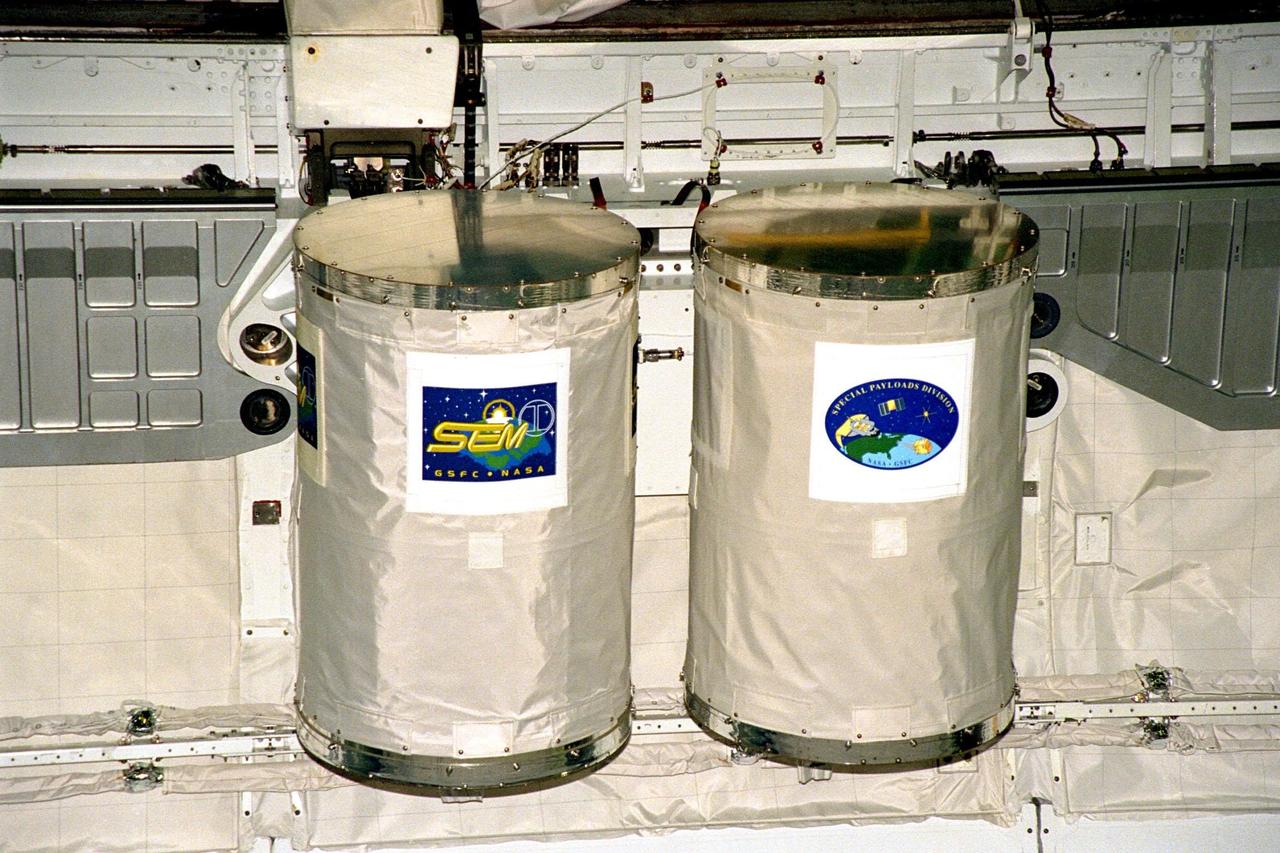
Processing activities for STS-91 continue in KSC's Orbiter Processing Facility Bay 2. Two Get Away Special (GAS) canisters are shown after their installation into Discovery's payload bay. The GAS canister on the left houses the Space Experiment Module (SEM-03), part of an educational initiative of NASA's Shuttle Small Payloads Project. On the right is a canister containing commemorative flags to be flown during the mission. STS-91 is scheduled to launch aboard the Space Shuttle Discovery for the ninth and final docking with the Russian Space Station Mir from KSC's Launch Pad 39A on June 2 with a launch window opening around 6:04 p.m. EDT
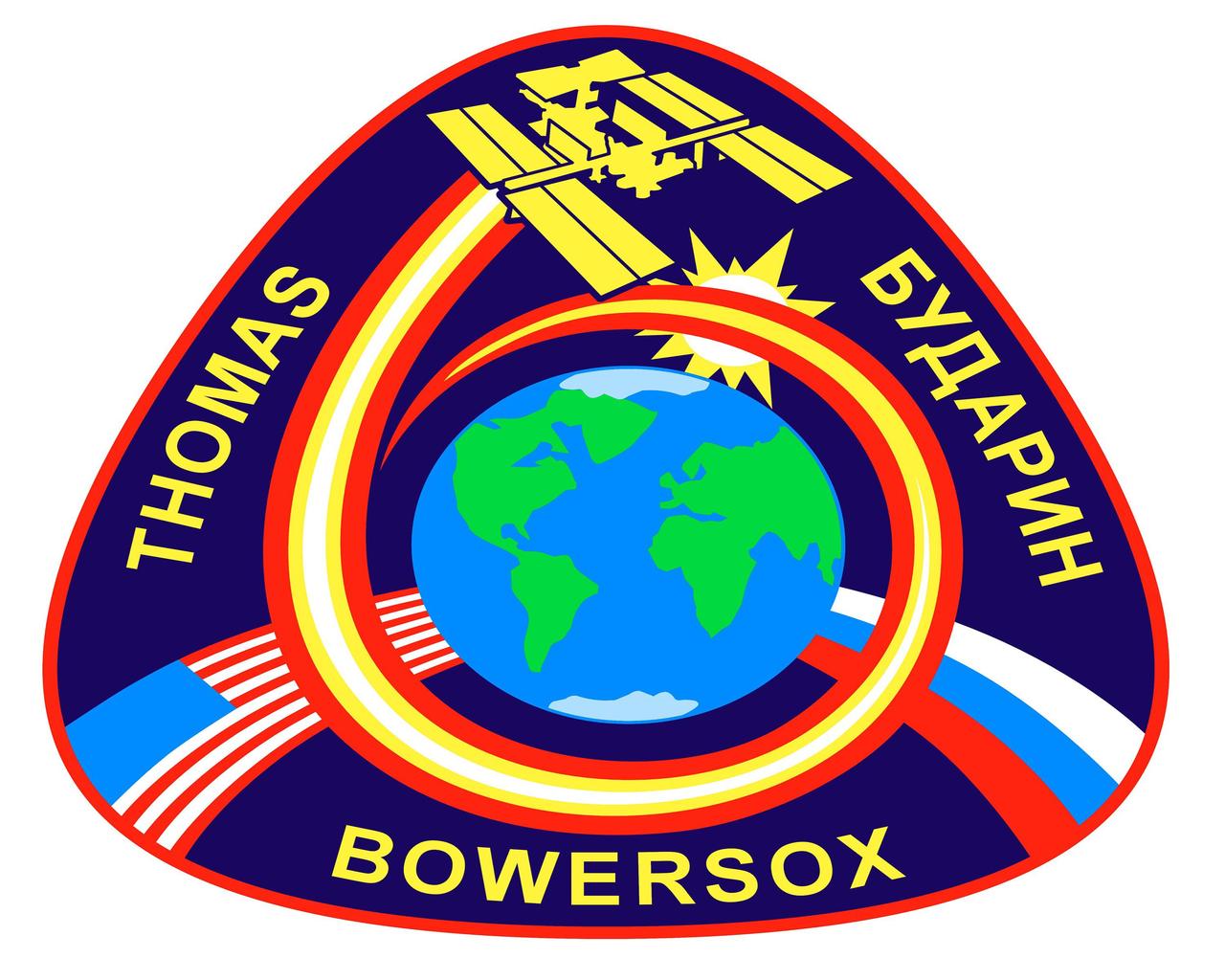
The International Space Station (ISS) Expedition 6 crew patch depicts the station orbiting the Earth on its mission of international cooperation and scientific research. The Earth is placed in the center of the patch to emphasize that work conducted aboard this orbiting laboratory is intended to improve life on our home planet. The shape of the Space Station’s orbit symbolizes the role that experience gained from ISS will have on future exploration of our solar system and beyond. The American and Russian flags encircling the Earth represent the native countries of the Expedition 6 crew members, which are just two of the many participant countries contributing to the ISS and committed to the peaceful exploration of space.

jsc2017e100898 (July 18, 2017) --- At their Cosmonaut Hotel crew quarters in Baikonur, Kazakhstan, Expedition 52-53 backup crewmembers Norishige Kanai of the Japan Aerospace Exploration Agency (JAXA, left), Alexander Misurkin of the Russian Federal Space Agency (Roscosmos, center) and Mark Vande Hei of NASA (right) accept flowers during a traditional flag-raising ceremony July 18. They are serving as backups to Randy Bresnik of NASA, Sergey Ryazanskiy of Roscosmos and Paolo Nespoli of the European Space Agency, who will launch July 28 on the Soyuz MS-05 spacecraft from the Baikonur Cosmodrome for a five-month mission on the International Space Station. Credit: NASA/Victor Zelentsov
jsc2020e016864 - At the Cosmonaut Hotel crew quarters in Baikonur, Kazakhstan, the Expedition 63 prime and backup crewmembers raise the Russian, U.S. and Kazakh flags March 26 in a traditional ceremony. From left to right are prime crewmembers Ivan Vagner and Anatoly Ivanishin of Roscosmos, prime crewmember Chris Cassidy of NASA and his backup, Steve Bowen of NASA and backup crewmembers Sergey Ryzhikov and Andrei Babkin. Cassidy, Ivanishin and Vagner will launch April 9 from the Baikonur Cosmodrome on the Soyuz MS-16 spacecraft for a six-and-a-half month mission on the International Space Station...Courtesy/Roscosmos.
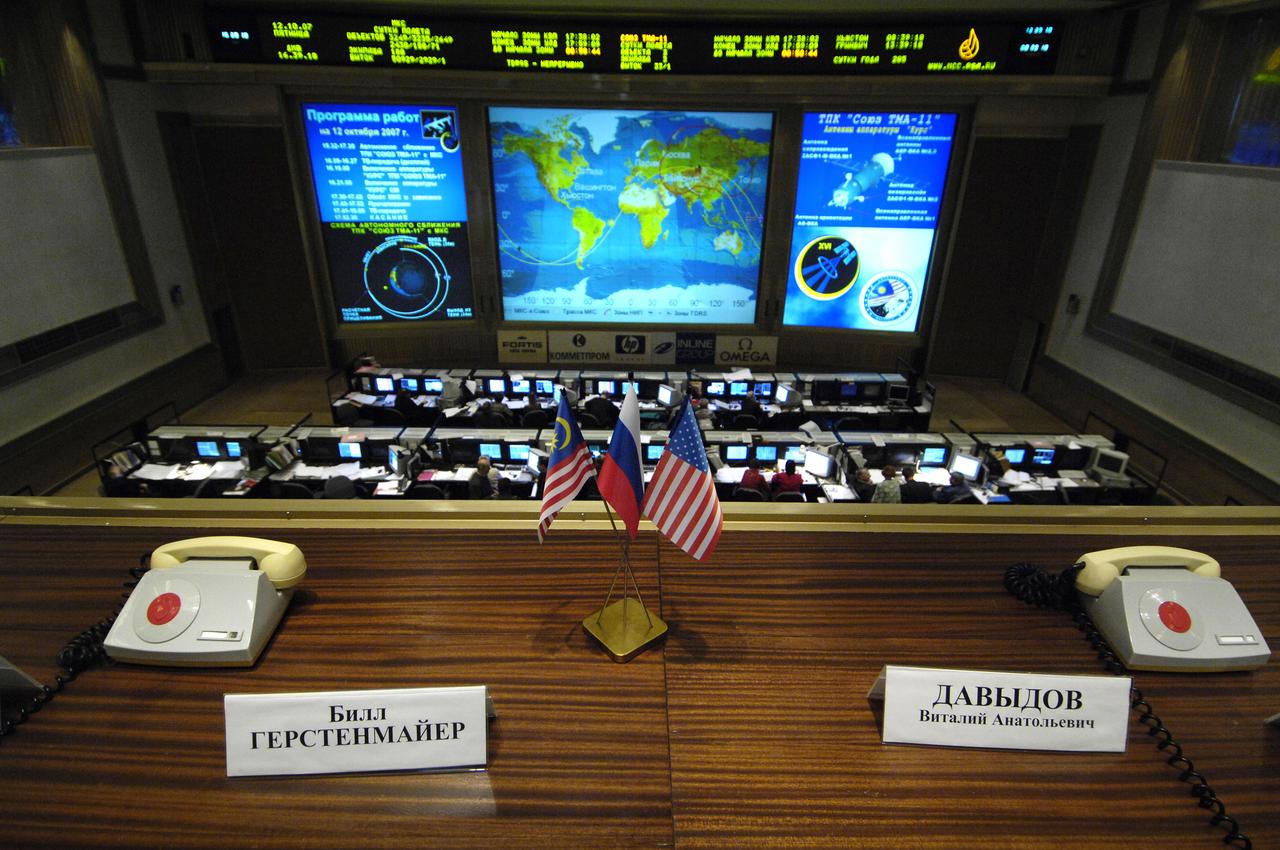
The flags of Malaysia, Russia and the United States sit between the phones used by officials to talk to the crew of the International Space Station (ISS) in the Russian Mission Control Center in Korolev, outside Moscow. Expedition 16 Commander Peggy Whitson, Soyuz Commander and Flight Engineer Yuri Malenchenko and Malaysian Spaceflight Participant Sheikh Muszaphar Shukor docked their Soyuz TMA-11 spacecraft to the station at 10:50 a.m. EDT. Oct. 12, 2007. The crew launched on Wednesday from the Baikonur Cosmodrome in Kazakhstan. Photo Credit: "NASA/Bill Ingalls"
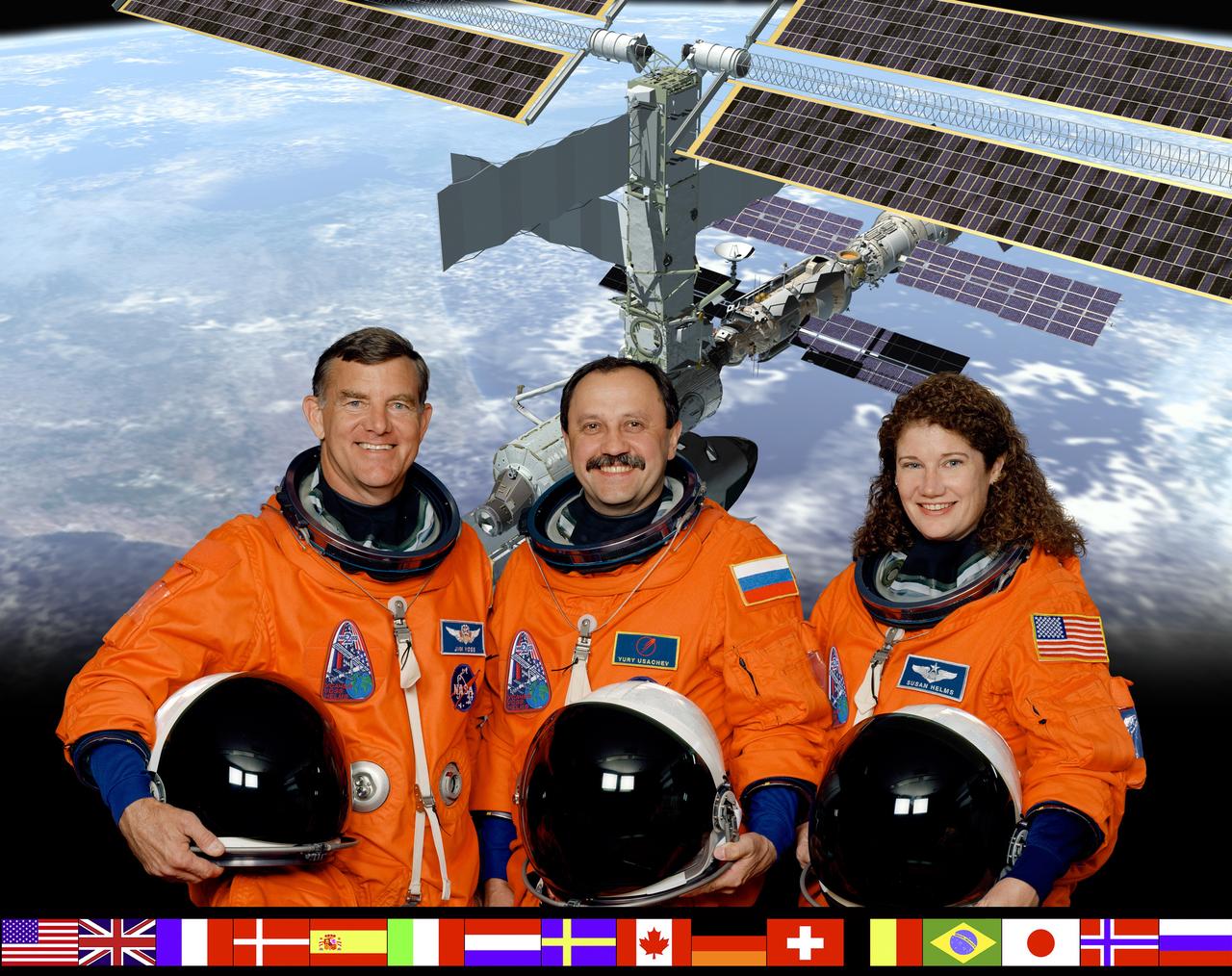
This is a crew portrait of the International Space Station (ISS) Expedition Two. Left to right are Astronaut James S. Voss, flight engineer; Cosmonaut Yury V. Usachev, commander; and Astronaut Susan J. Helms, flight engineer. The crew was launched on March 8, 2001 aboard the STS-102 mission Space Shuttle Orbiter Discovery for an extended stay on the ISS. After living and working on the ISS for the duration of 165 days, the crew returned to Earth on August 22, 2001 aboard the STS-105 mission Space Shuttle Orbiter Discovery. Cosmonaut Usachev represents the Russian Aviation and Space Agency. The flags representing all the international partners are arrayed at bottom.
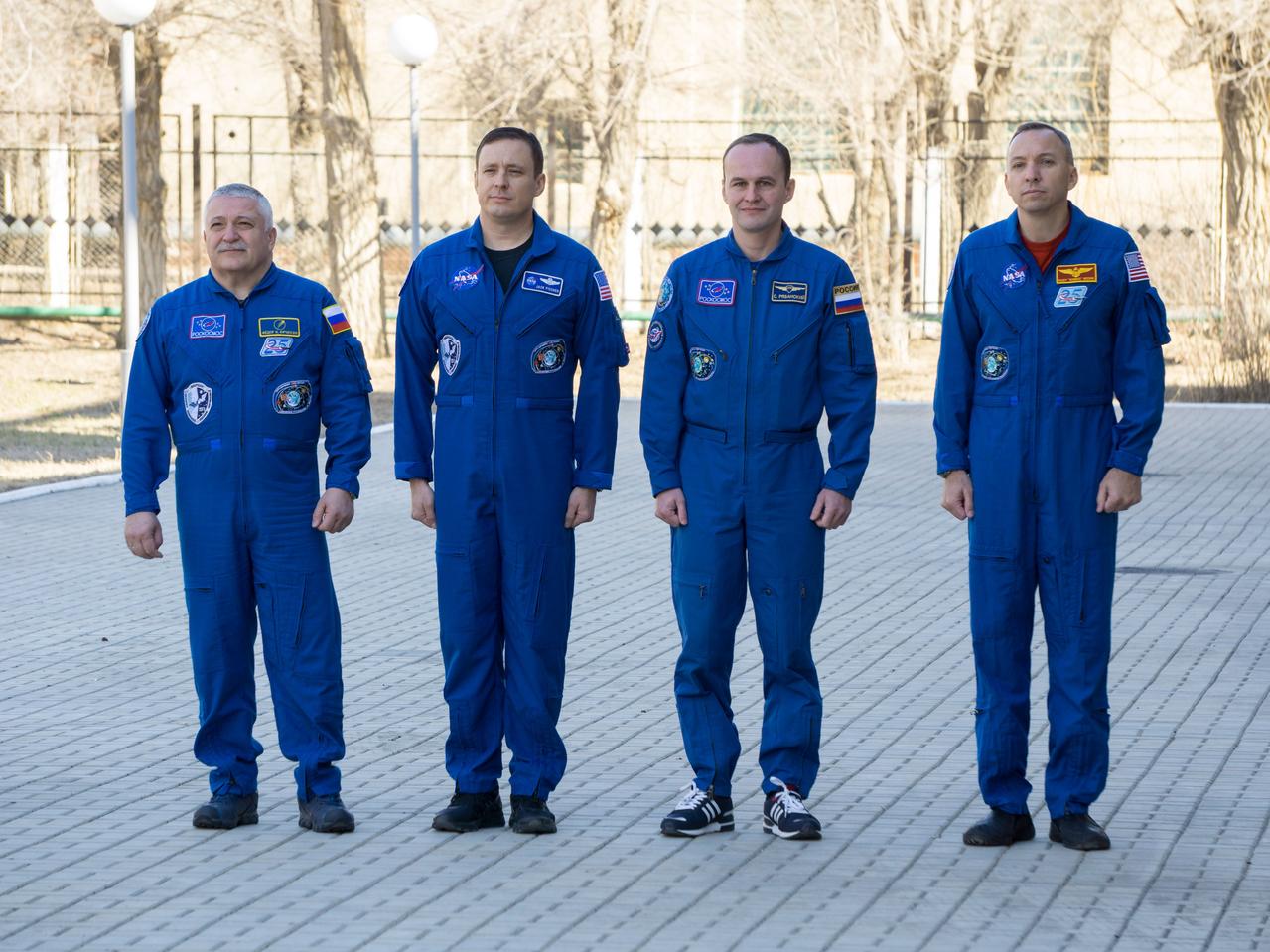
jsc2017e040339 (April 7, 2017) --- At the Cosmonaut Hotel crew quarters in Baikonur, Kazakhstan, the Expedition 51 prime and backup crewmembers attend flag-raising ceremonies April 7 as part of their pre-launch activities. From left to right are prime crewmembers Fyodor Yurchikhin of the Russian Federal Space Agency (Roscosmos) and Jack Fischer of NASA and backup crewmembers Sergey Ryazanskiy of Roscosmos and Randy Bresnik of NASA. Yurchikhin and Fischer will launch April 20 on the Soyuz MS-04 spacecraft from the Baikonur Cosmodrome for a four and a half month mission on the International Space Station. NASA/Victor Zelentsov
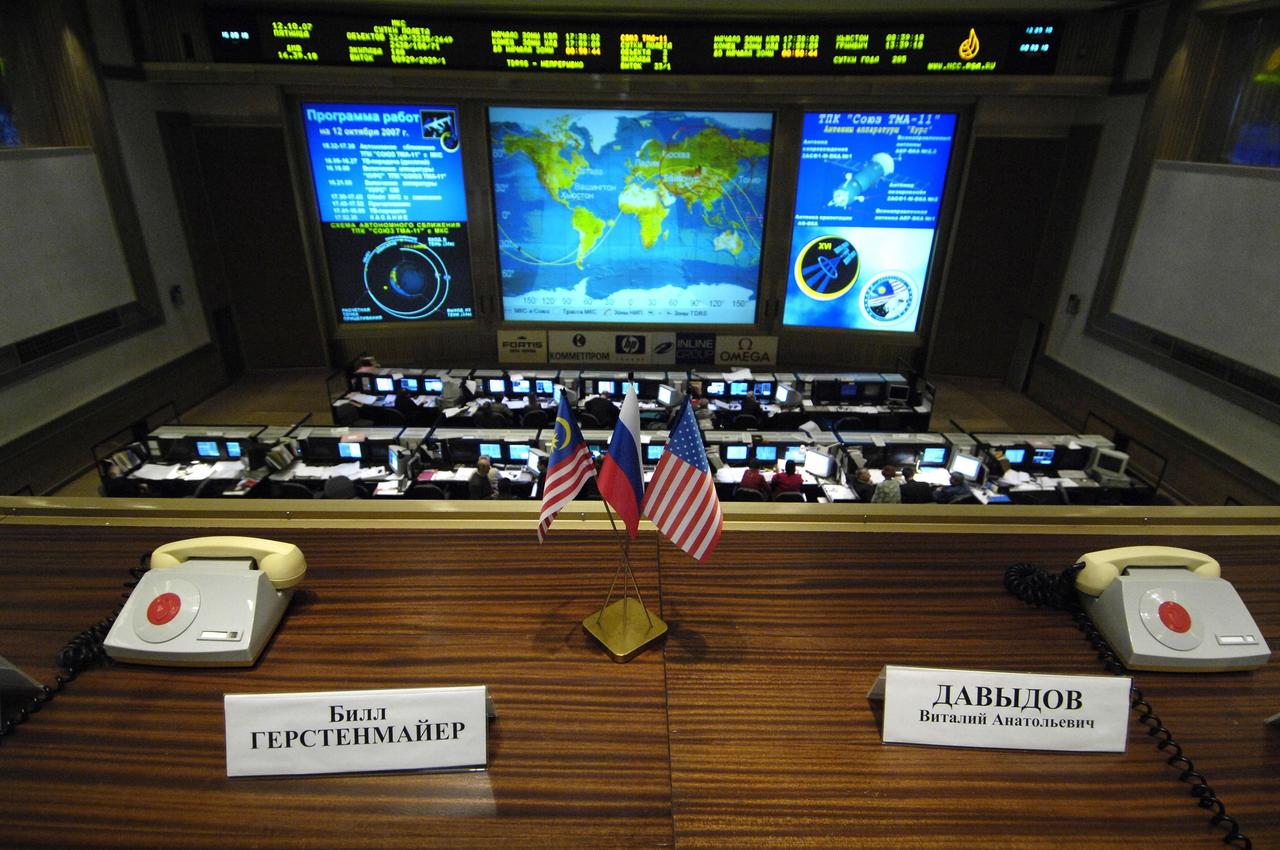
Korolev, Russia -- The flags of Malaysia, Russia and the United States sit between the phones used by officials to talk to the crew of the International Space Station (ISS) in the Russian Mission Control Center, Korolev, outside Moscow. Expedition 16 Commander Peggy Whitson, Flight Engineer and Soyuz Commander Yuri Malenchenko and Malaysian Spaceflight Participant Sheikh Muszaphar Shukor docked their Soyuz TMA-11 spacecraft to the station at 10:50 a.m. EDT Oct. 12, 2007. The crew launched Wednesday from the Baikonur Cosmodrome in Kazakhstan. Photo credit: NASA/Bill Ingalls
![2014-03-15-11-03-34-4[1] At their Cosmonaut Hotel crew quarters in Baikonur, Kazakhstan, the Expedition 39/40 crewmembers raise the flags of Russia, the United States and Kazakhstan March 15 in traditional ceremonies that are part of the crew’s training. From left to right are Soyuz Commander Alexander Skvortsov and Flight Engineer Oleg Artemyev of the Russian Federal Space Agency (Roscosmos), Flight Engineer Steve Swanson of NASA, and backup crewmembers Alexander Samokutyaev and Elena Serova of Roscosmos. Swanson, Skvortsov and Artemyev are scheduled to launch to the International Space Station March 26 (Kazakh time) for the start of a six-month mission. NASA/Victor Zelentsov](https://images-assets.nasa.gov/image/jsc2014e026287/jsc2014e026287~medium.jpg)
2014-03-15-11-03-34-4[1] At their Cosmonaut Hotel crew quarters in Baikonur, Kazakhstan, the Expedition 39/40 crewmembers raise the flags of Russia, the United States and Kazakhstan March 15 in traditional ceremonies that are part of the crew’s training. From left to right are Soyuz Commander Alexander Skvortsov and Flight Engineer Oleg Artemyev of the Russian Federal Space Agency (Roscosmos), Flight Engineer Steve Swanson of NASA, and backup crewmembers Alexander Samokutyaev and Elena Serova of Roscosmos. Swanson, Skvortsov and Artemyev are scheduled to launch to the International Space Station March 26 (Kazakh time) for the start of a six-month mission. NASA/Victor Zelentsov
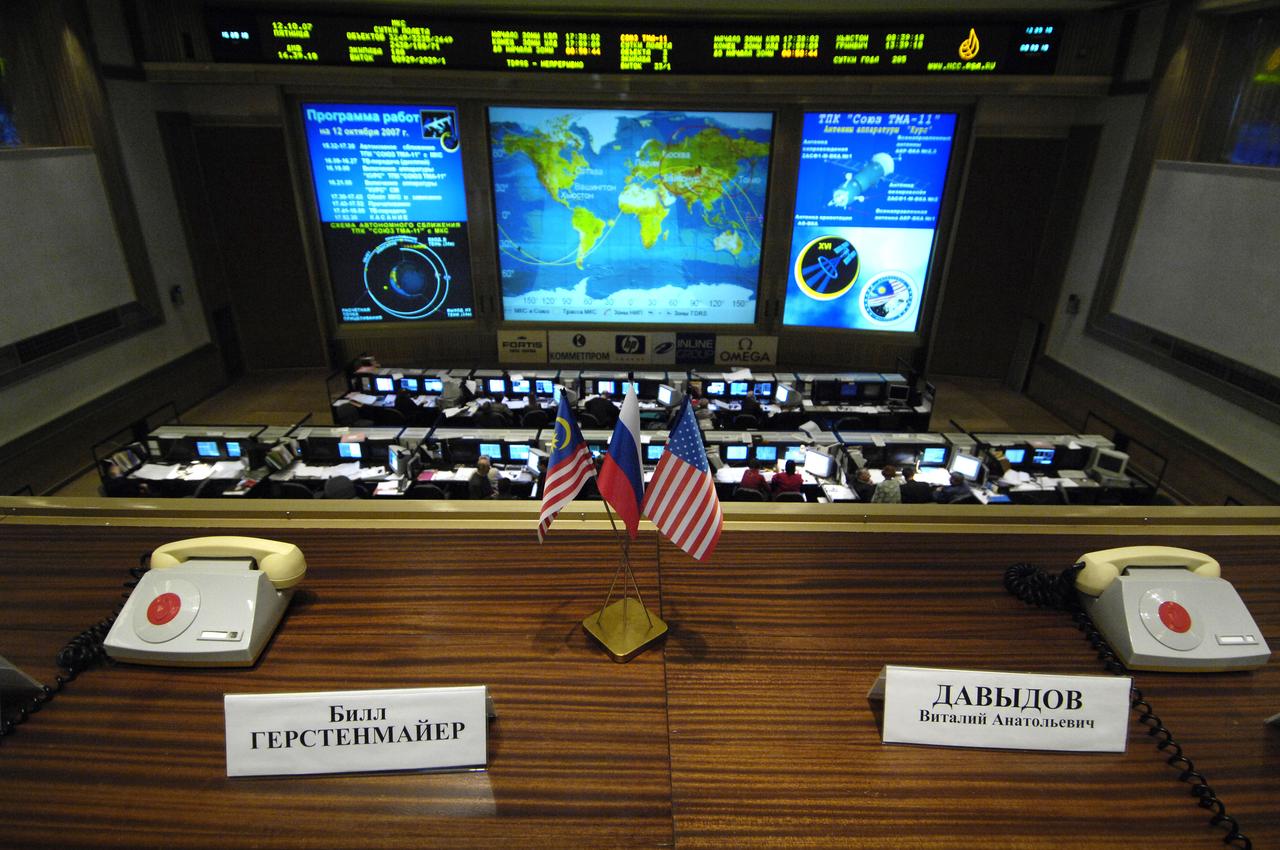
The flags of Malaysia, Russia and the United States sit between the phones used by officials to speak with the crew of the International Space Station (ISS) in the Russian Mission Control Center in Korolev, outside Moscow, Friday, Oct. 12, 2007. Expedition 16 Commander Peggy Whitson, Soyuz Commander and Flight Engineer Yuri Malenchenko and Malaysian spaceflight participant Sheikh Muszaphar Shukor docked their Soyuz TMA-11 spacecraft to the ISS at 10:50 a.m. EDT, October 12. The crew launched on Wednesday from the Baikonur Cosmodrome in Kazakhstan. Photo Credit: (NASA/Bill Ingalls)
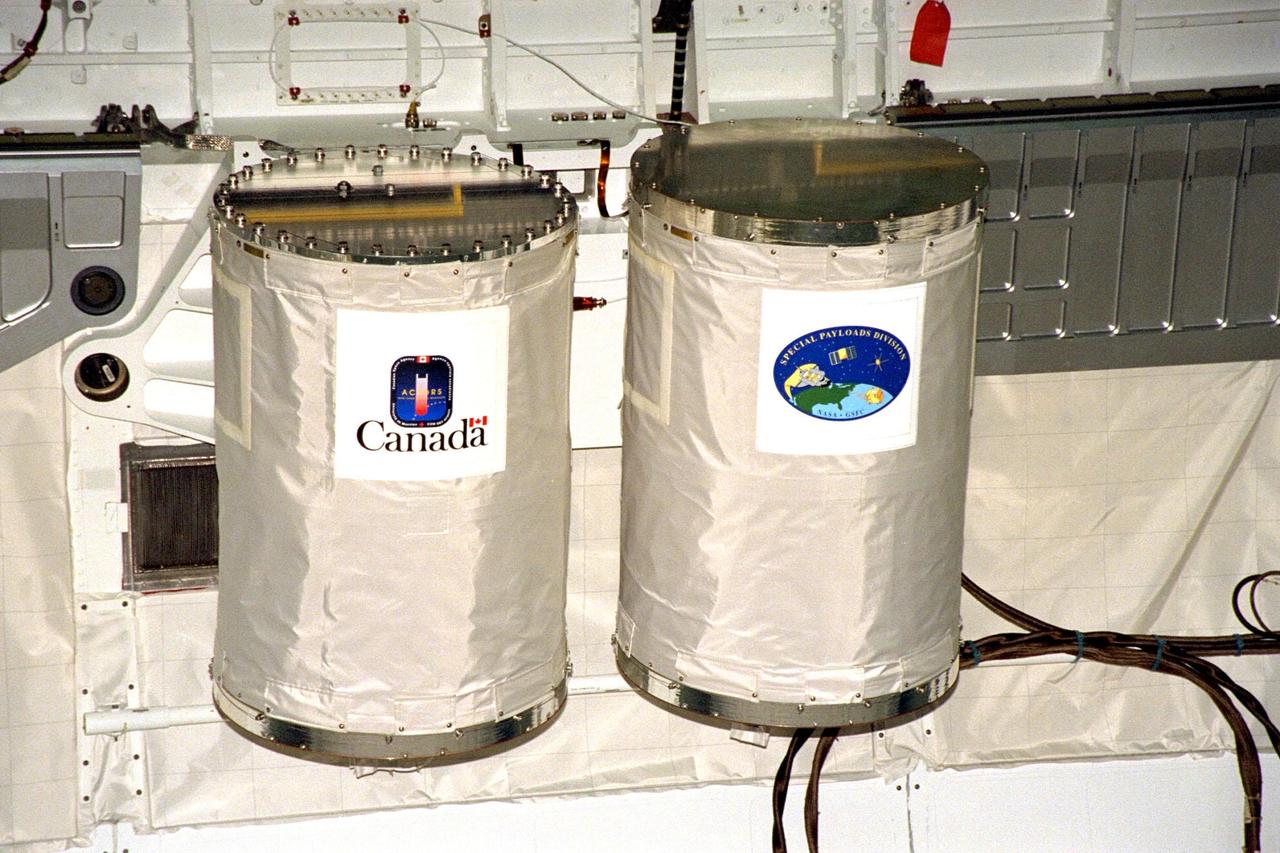
Processing activities for STS-91 continue in KSC's Orbiter Processing Facility Bay 2. Two Get Away Special (GAS) canisters are shown after their installation into Discovery's payload bay. At left is G-648, an Canadian Space Agency-sponsored study of manufactured organic thin film by the physical vapor transport method, and the can on the right contains commemorative flags to be flown during the mission. STS-91 is scheduled to launch aboard the Space Shuttle Discovery for the ninth and final docking with the Russian Space Station Mir from KSC's Launch Pad 39A on June 2 with a launch window opening around 6:04 p.m. EDT

Outside their Cosmonaut Hotel crew quarters in Baikonur, Kazakhstan, The Expedition 32 prime and backup crew members raised the U.S., Russian, Japanese and Kazakh flags July 4, 2012 in a traditional ceremony that was part of the pre-launch activities leading up to the launch of the next crew to the International Space Station. NASA Flight Engineer Sunita Williams, Soyuz Commander Yuri Malenchenko and Flight Engineer Aki Hoshide of the Japan Aerospace Exploration Agency will launch to the station July 15 from the Baikonur Cosmodrome in their Soyuz TMA-05M spacecraft. NASA/Victor Zelentsov

jsc2017e101949 (July 22, 2017) --- At the Baikonur Cosmodrome in Kazakhstan, Expedition 52-53 crewmembers Paolo Nespoli of the European Space Agency (left), Randy Bresnik of NASA (center) and Sergey Ryazanskiy of the Russian Federal Space Agency (Roscosmos, right) sign a flag bearing their Soyuz spacecraft insignia at the Korolev Museum July 24 as part of traditional pre-launch activities. Nespoli, Bresnik and Ryazanskiy will launch July 28 aboard the Soyuz MS-05 spacecraft for a five-month mission on the International Space Station. Credit: NASA/Victor Zelentsov
![2014-03-15-11-03-42[1] At their Cosmonaut Hotel crew quarters in Baikonur, Kazakhstan, prime Expedition 39/40 Flight Engineer Steve Swanson of NASA (right) and backup Barry Wilmore of NASA (center) raise the American flag March 15 in traditional ceremonies that are part of the crew’s training. Prime crew Flight Engineer Oleg Artemyev (left) of the Russian Federal Space Agency (Roscosmos) looks on. Swanson, Artemyev and Soyuz Commander Alexander Skvortsov of Roscosmos are scheduled to launch to the International Space Station March 26 (Kazakh time) for the start of a six-month mission. NASA/Victor Zelentsov](https://images-assets.nasa.gov/image/jsc2014e026288/jsc2014e026288~medium.jpg)
2014-03-15-11-03-42[1] At their Cosmonaut Hotel crew quarters in Baikonur, Kazakhstan, prime Expedition 39/40 Flight Engineer Steve Swanson of NASA (right) and backup Barry Wilmore of NASA (center) raise the American flag March 15 in traditional ceremonies that are part of the crew’s training. Prime crew Flight Engineer Oleg Artemyev (left) of the Russian Federal Space Agency (Roscosmos) looks on. Swanson, Artemyev and Soyuz Commander Alexander Skvortsov of Roscosmos are scheduled to launch to the International Space Station March 26 (Kazakh time) for the start of a six-month mission. NASA/Victor Zelentsov
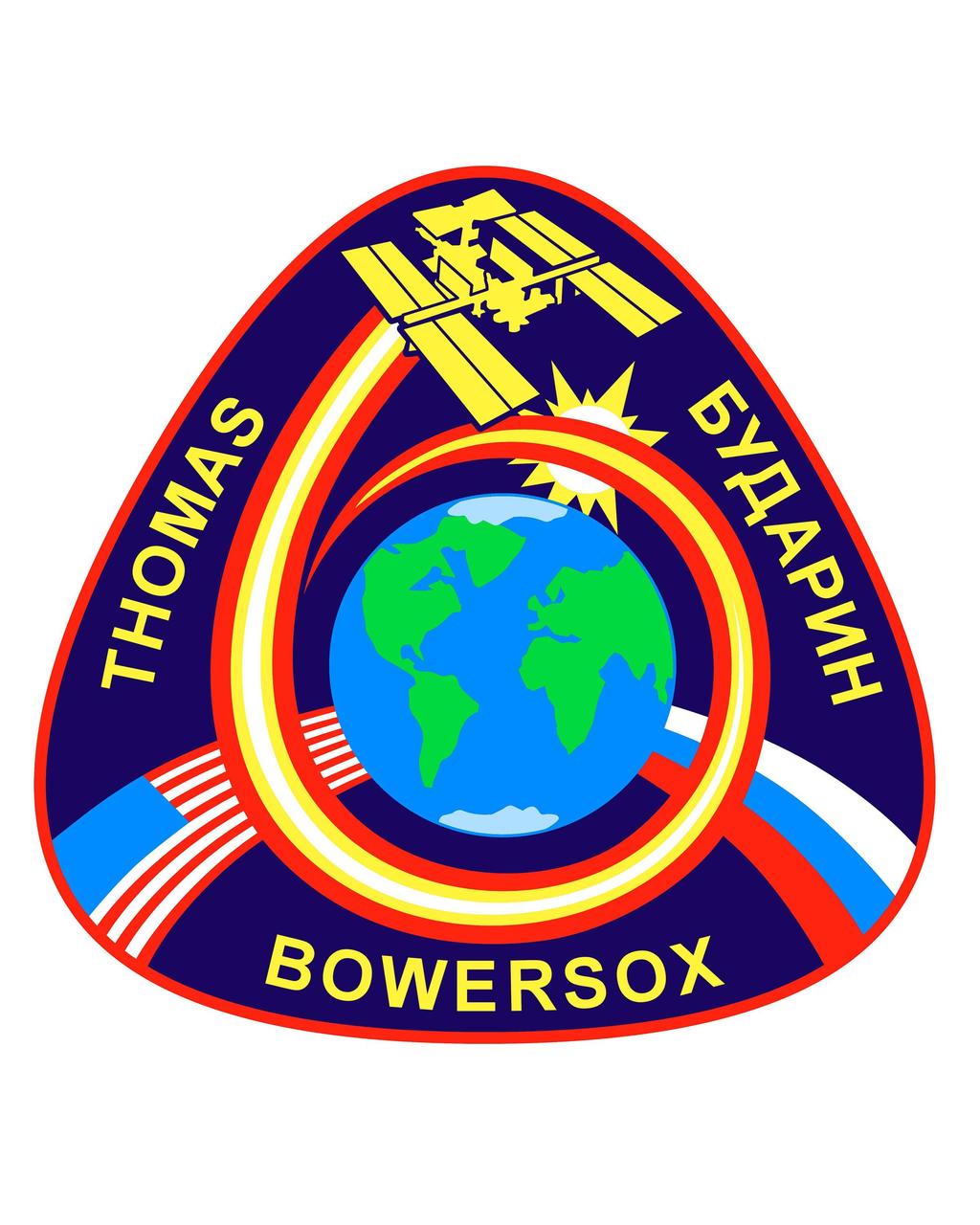
The International Space Station (ISS) Expedition 6 crew patch depicts the station orbiting the Earth on its mission of international cooperation and scientific research. The Earth is placed in the center of the patch to emphasize that work conducted aboard this orbiting laboratory is intended to improve life on our home planet. The shape of the Space Station’s orbit symbolizes the role that experience gained from ISS will have on future exploration of our solar system and beyond. The American and Russian flags encircling the Earth represent the native countries of the Expedition 6 crew members, which are just two of the many participant countries contributing to the ISS and committed to the peaceful exploration of space.

Under leaden skies outside their Cosmonaut Hotel crew quarters in Baikonur, Kazakhstan, NASA’s Expedition 50 prime and backup crewmembers raise the American flag Nov. 3 during their traditional ceremony. Peggy Whitson of NASA (right) was joined by her backup, Jack Fischer (left). Whitson, Oleg Novistkiy of the Russian Federal Space Agency (Roscosmos) and Thomas Pesquet of the European Space Agency will launch Nov. 18, Baikonur time, on the Soyuz MS-03 spacecraft for a six-month mission on the International Space Station. NASA/Alexander Vysotsky
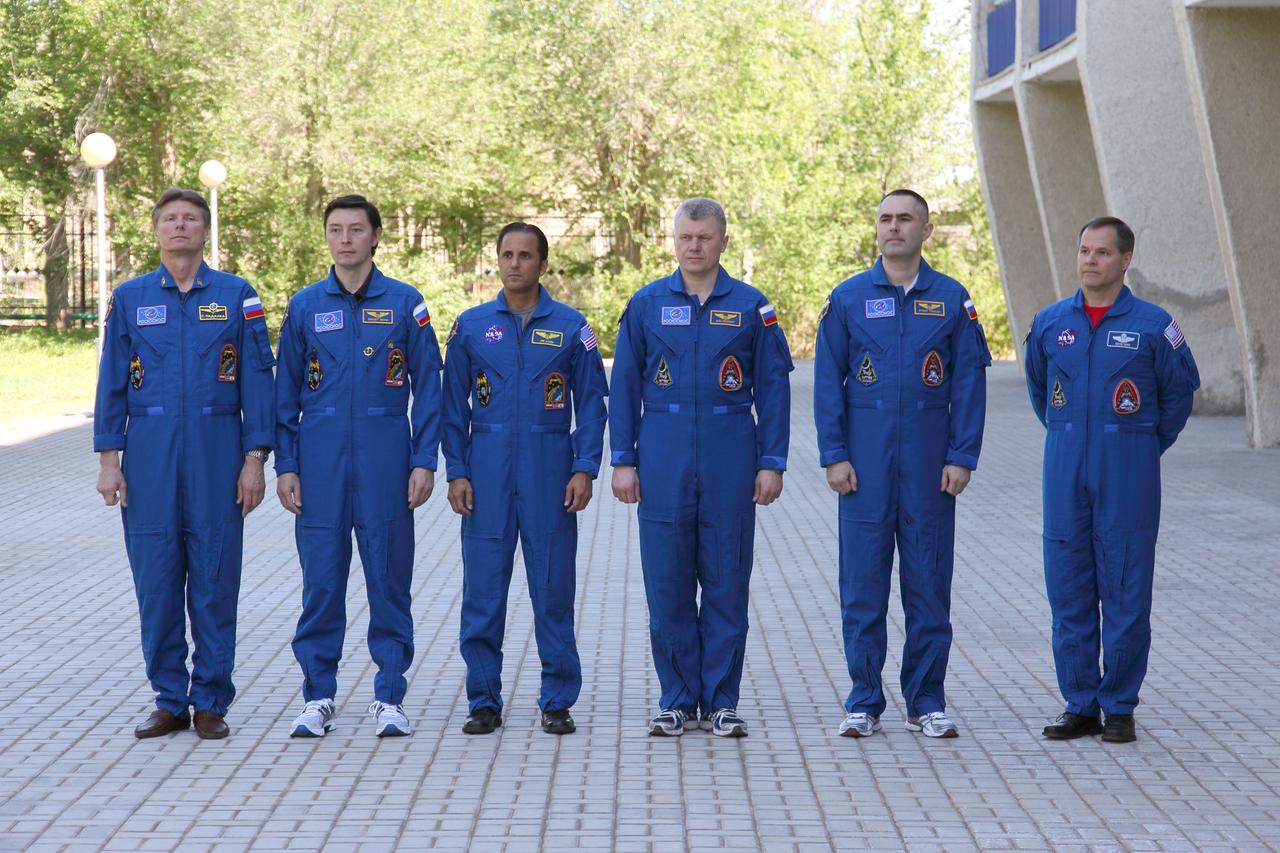
Outside their Cosmonaut Hotel crew quarters in Baikonur, Kazakhstan, the Expedition 31/32 prime and backup crews posed for pictures May 4, 2012 following the traditional raising of Russian, U.S. and Kazakh flags as part of their ceremonial activities leading up to the launch of the Soyuz TMA-04M spacecraft May 15 to the International Space Station. From left to right are prime Soyuz Commander Gennady Padalka, Flight Engineer Sergei Revin and NASA Flight Engineer Joe Acaba and backup crewmembers Oleg Novitskiy, Evgeny Tarelkin and Kevin Ford of NASA. Padalka, Revin and Acaba will launch to the station for a four-month mission on the orbital outpost. NASA/Victor Zelentsov
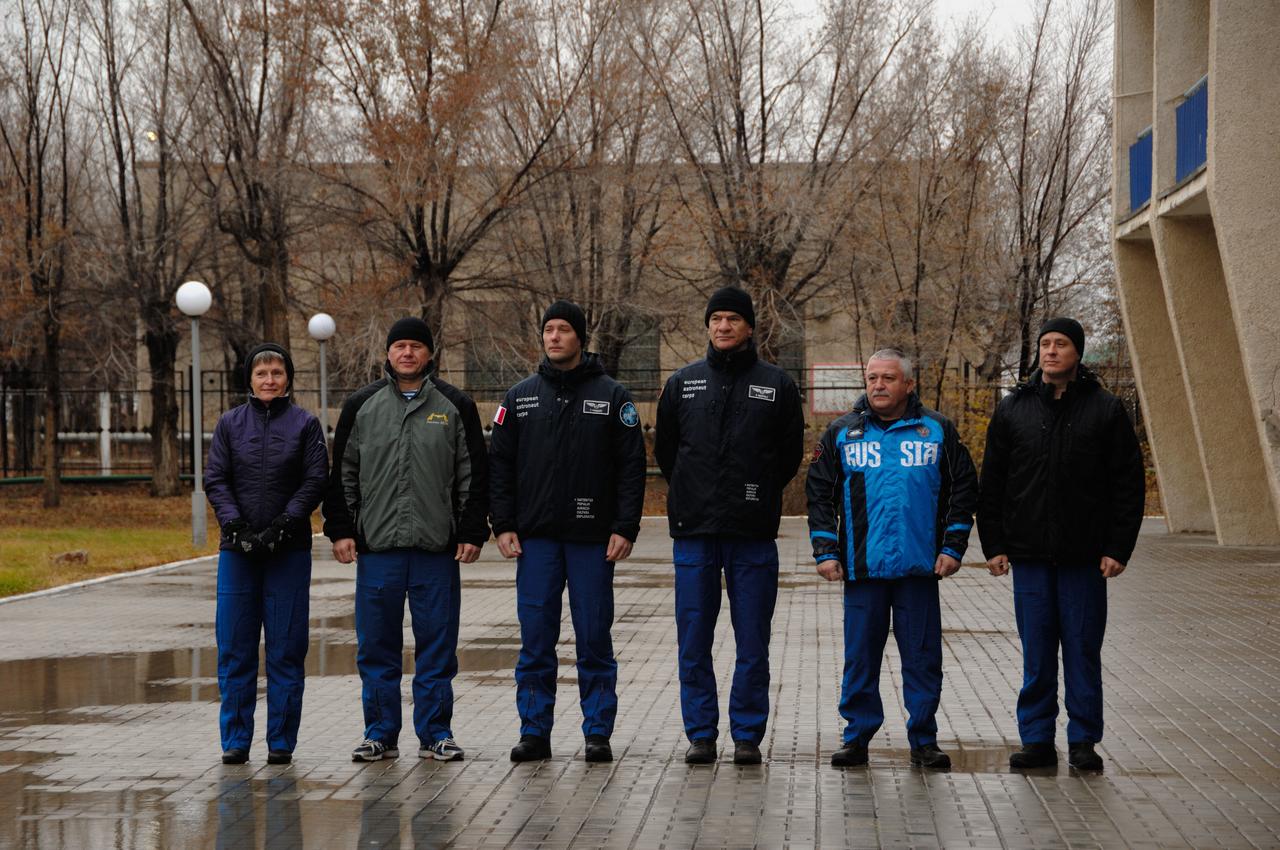
Under leaden skies outside their Cosmonaut Hotel crew quarters in Baikonur, Kazakhstan, the Expedition 50 prime and backup crewmembers pose for photos Nov. 3 during their traditional flag-raising ceremony. From left to right are prime crewmembers Peggy Whitson of NASA, Oleg Novistkiy of the Russian Federal Space Agency (Roscosmos) and Thomas Pesquet of the European Space Agency and backup crewmembers Paolo Nespoli of the European Space Agency, Fyodor Yurchikhin of Roscosmos and Jack Fischer of NASA. Whitson, Novitskiy and Pesquet will launch Nov. 18, Baikonur time, on the Soyuz MS-03 spacecraft for a six-month mission on the International Space Station. NASA/Alexander Vysotsky