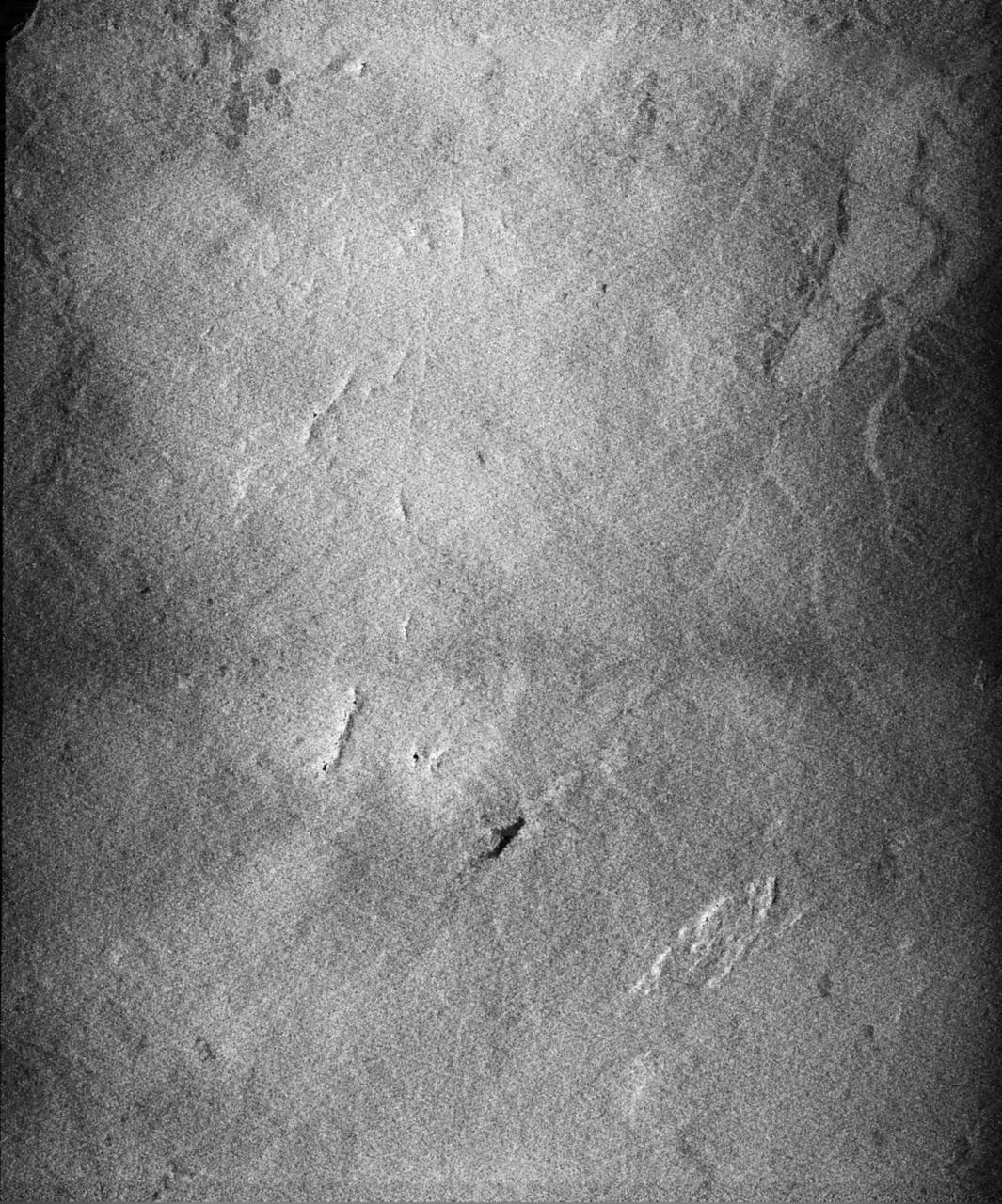
This radar image acquired in February 2000 by NASA Shuttle Radar Topography Mission SRTM shows an area south of the Sao Francisco River in Brazil.
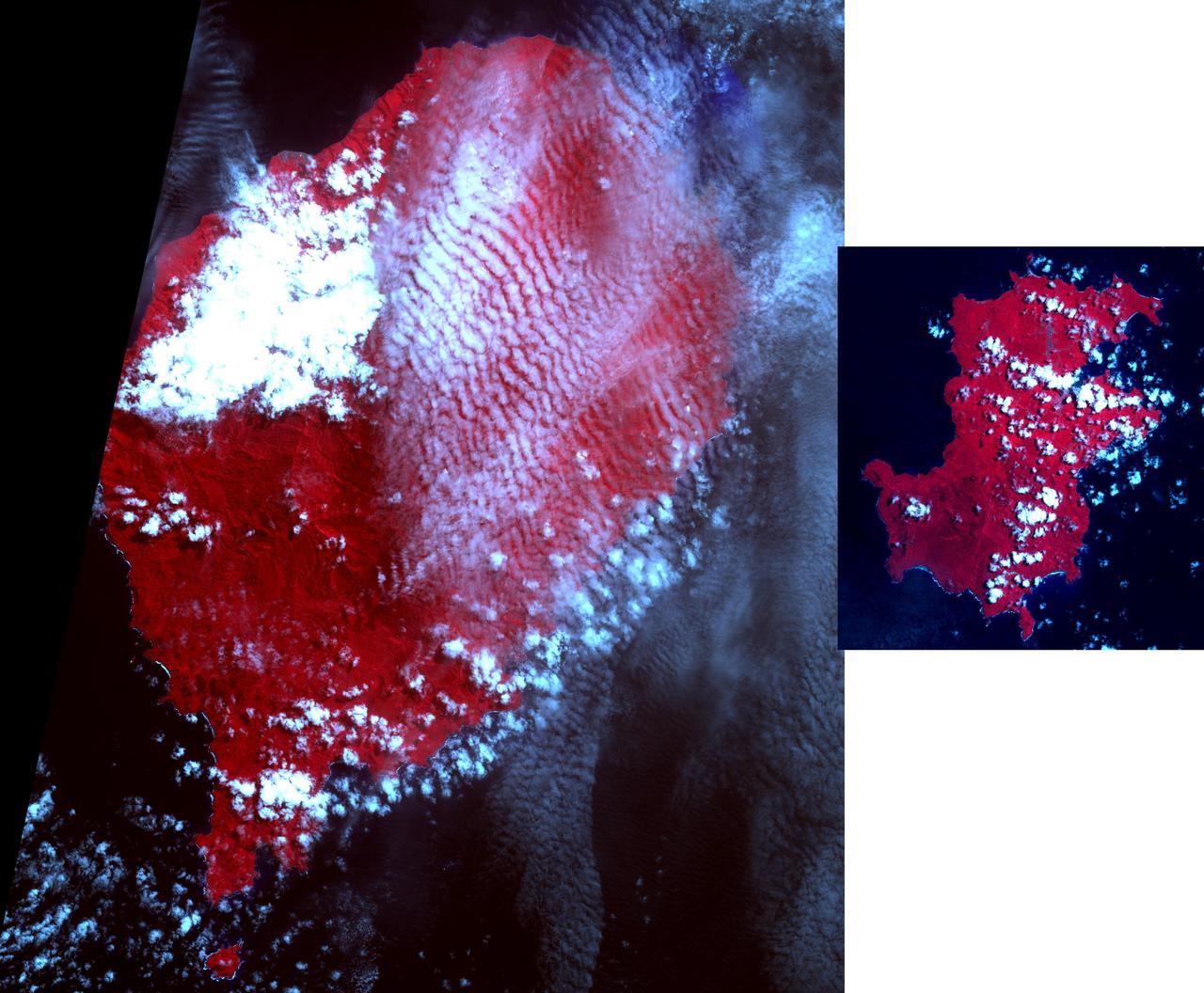
The Democratic Republic of Sao Tome and Principe is an island country in the Gulf of Guinea, off the western equatorial coast of central Africa. It is the second smallest African sovereign state, and consists of two archipelagos around the two main islands, about 150 km apart. About 100 years ago, this twin-island nation was the biggest producer of chocolate in the world. Now several producers are seeking to revitalize the trade. The images were acquired May 25, 2018 (Sao Tome, left), and April 5, 2020 (Principe, right); cover areas of 42 by 49.5 km, and 18.3 by 20.1 km; and are located at 0.2 degrees north, 6.6 degrees east; and 1.6 degrees north, 7.4 degrees east. https://photojournal.jpl.nasa.gov/catalog/PIA25981
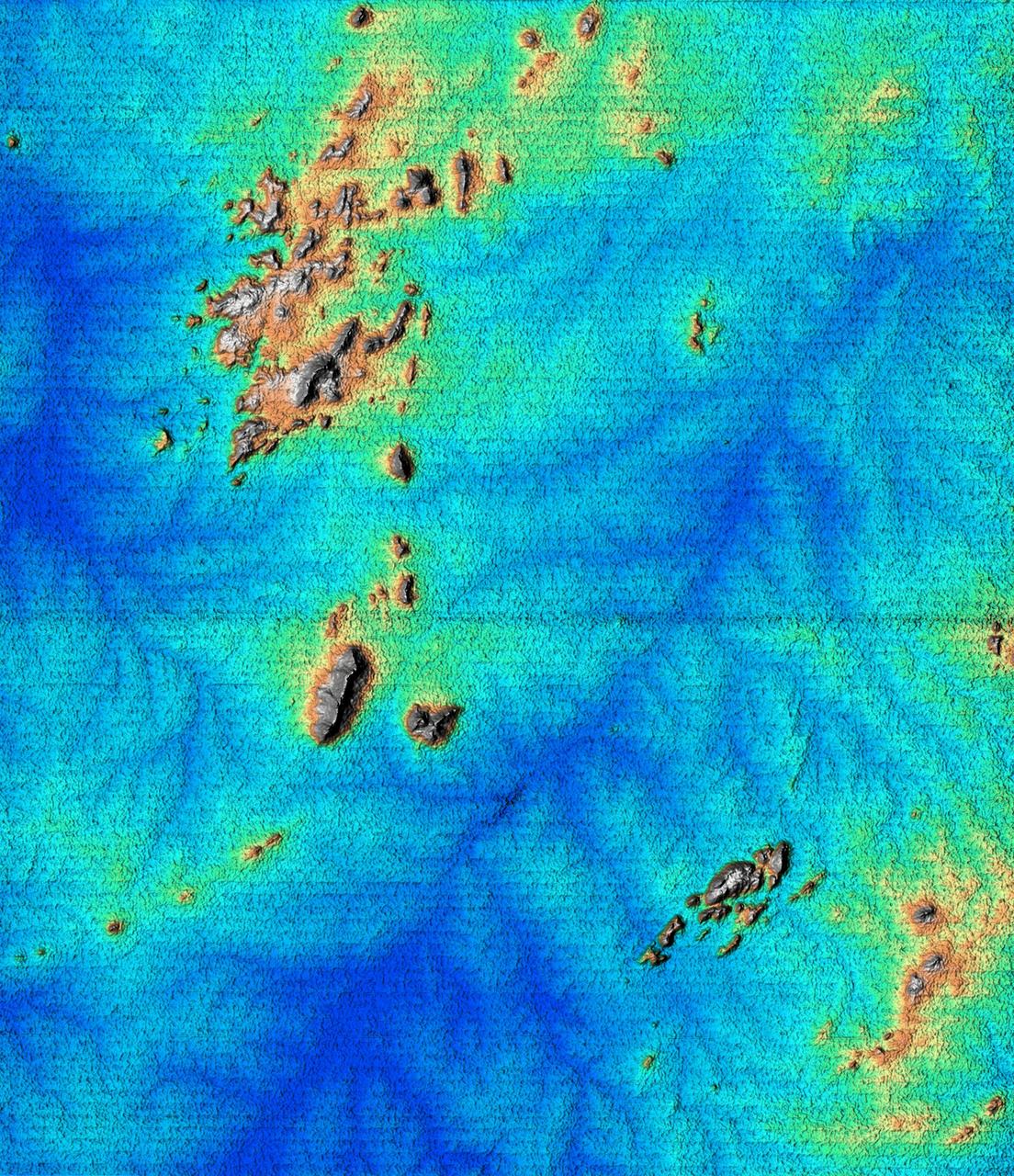
This topographic image acquired by SRTM shows an area south of the Sao Francisco River in Brazil. The scrub forest terrain shows relief of about 400 meters (1300 feet). Areas such as these are difficult to map by traditional methods because of frequent cloud cover and local inaccessibility. This region has little topographic relief, but even subtle changes in topography have far-reaching effects on regional ecosystems. The image covers an area of 57 km x 79 km and represents one quarter of the 225 km SRTM swath. Colors range from dark blue at water level to white and brown at hill tops. The terrain features that are clearly visible in this image include tributaries of the Sao Francisco, the dark-blue branch-like features visible from top right to bottom left, and on the left edge of the image, and hills rising up from the valley floor. The San Francisco River is a major source of water for irrigation and hydroelectric power. Mapping such regions will allow scientists to better understand the relationships between flooding cycles, forestation and human influences on ecosystems. This shaded relief image was generated using topographic data from the Shuttle Radar Topography Mission. A computer-generated artificial light source illuminates the elevation data to produce a pattern of light and shadows. Slopes facing the light appear bright, while those facing away are shaded. On flatter surfaces, the pattern of light and shadows can reveal subtle features in the terrain. Shaded relief maps are commonly used in applications such as geologic mapping and land use planning. http://photojournal.jpl.nasa.gov/catalog/PIA02700
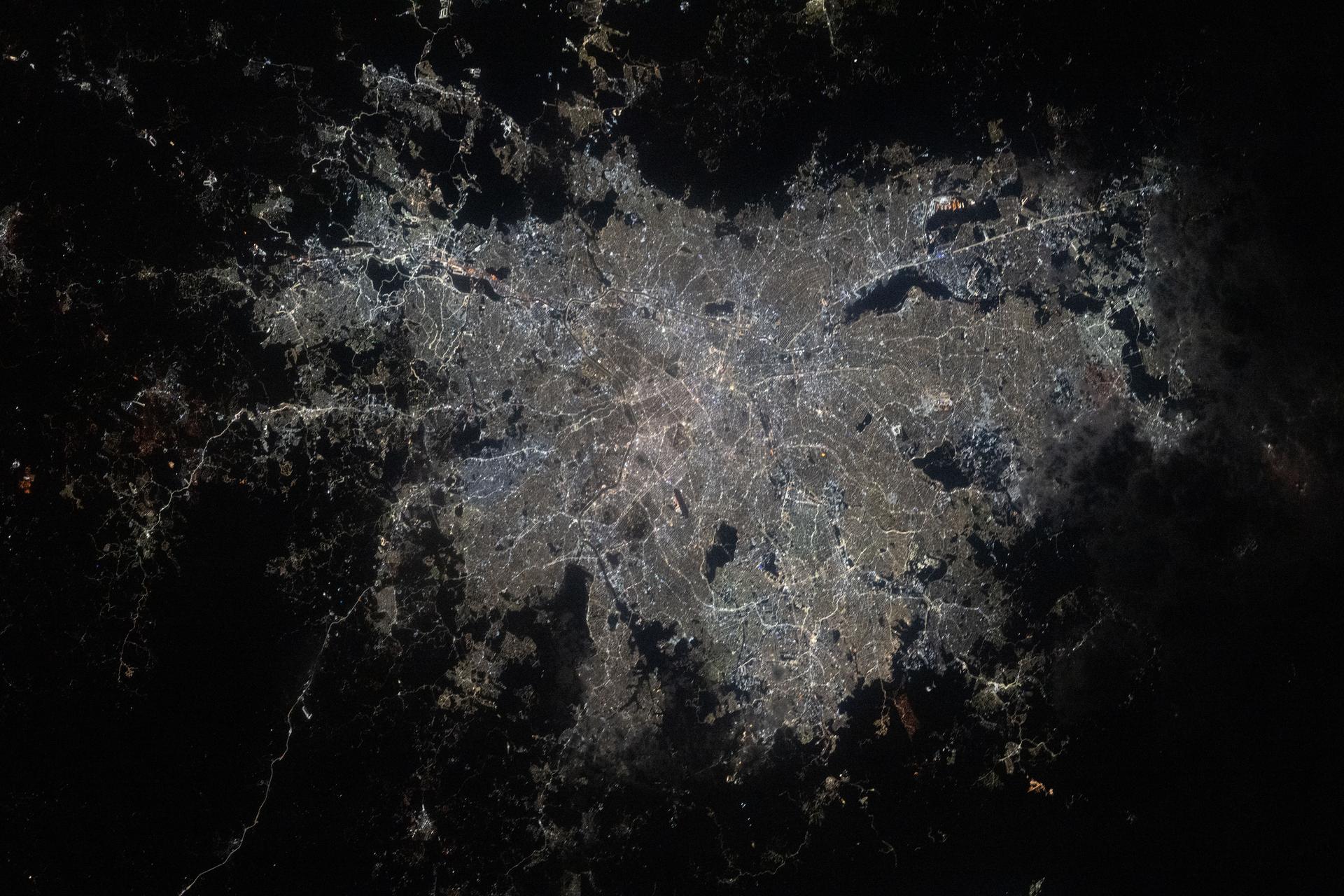
iss073e0982063 (Oct. 21, 2025) --- São Paulo, Brazil—with a metropolitan population of about 23 million—is the fifth most populous region in the world. As Brazil's economic powerhouse, São Paulo hosts one of the largest stock exchanges in the world and leads in the automotive, aerospace, and pharmaceutical industries. The city's brighter, more energy-efficient white LED lights reflect the region’s ongoing progress and modernization of its infrastructure. This photograph was taken from the International Space Station as it orbited 264 miles above the Brazilian coast at approximately 2:20 a.m. local time.
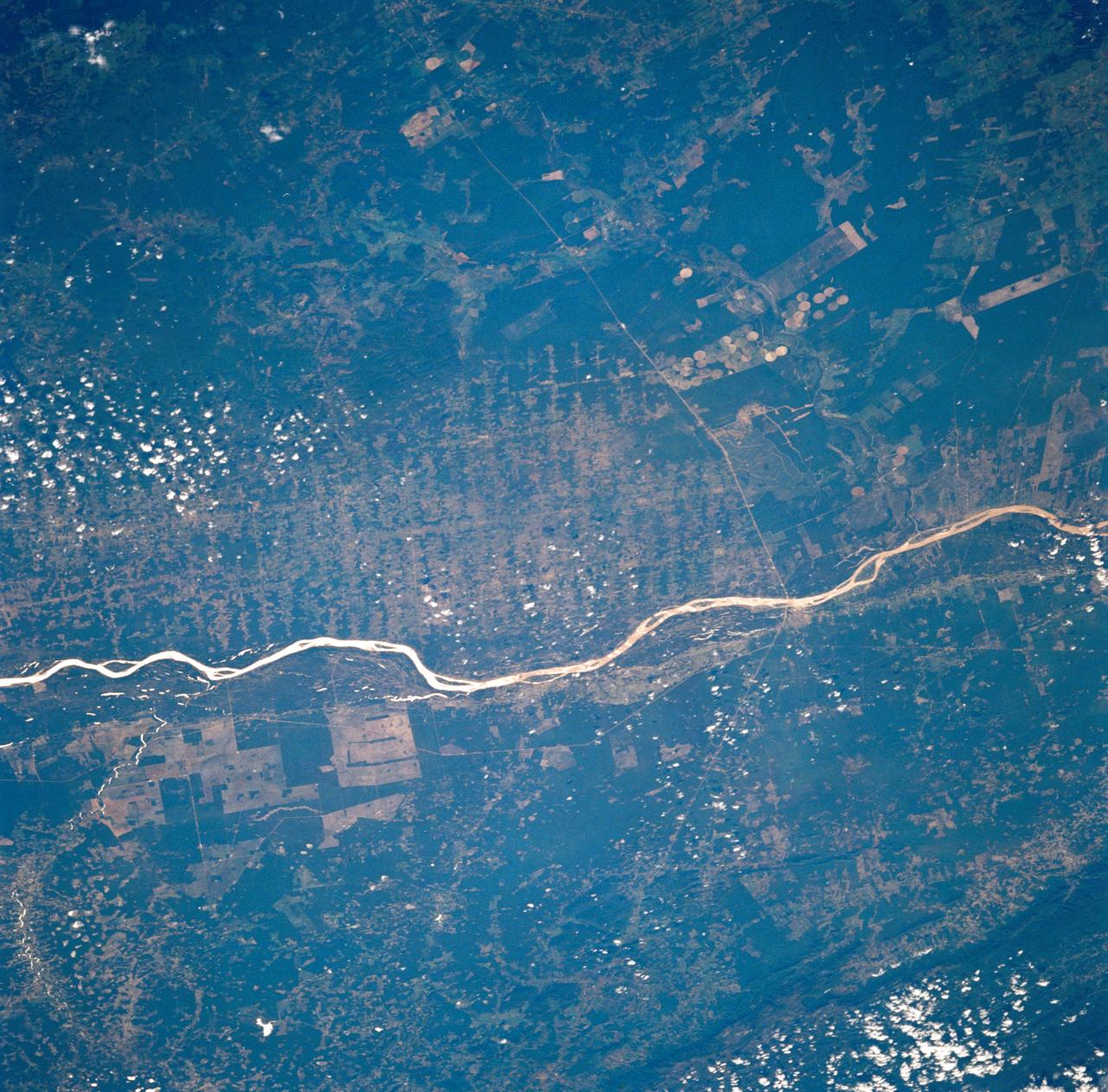
STS035-73-082 (2-10 Dec 1990) --- This agricultural and ranching area, Rio Sao Francisco, Brazil (13.0S, 43.5W) has been under study for several years. See scene STS-31-92-045 for comparison. This area has many small single family subsistence farms, large square and rectangular commercial farms and pastures for livestock grazing. Over the several years of observation, the number and size of farms has increased and center-pivot, swing-arm irrigation systems have been installed.
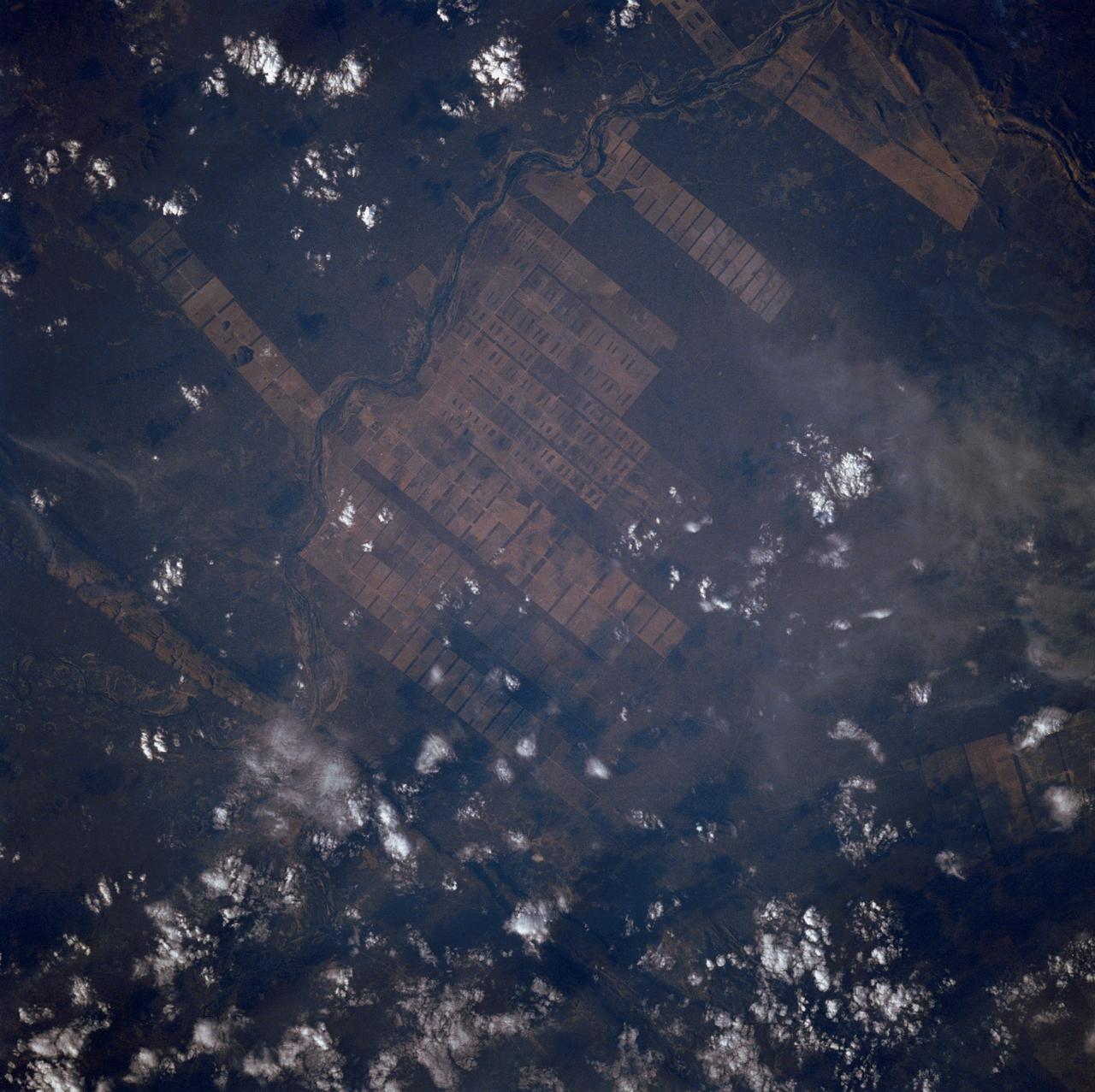
The large field patterns in this view of the Rio Sao Francisco basin, Brazil, South America, (11.5S, 43.5W) indicate a commercial agriculture venture; family subsistence farms are much smaller and laid out in different patterns. Land clearing in Brazil has increased at an alarming rate in recent years and preliminary estimates suggest a 25 to 30% increase in deforestation since 1984. The long term impact on the ecological processes are still unknown.
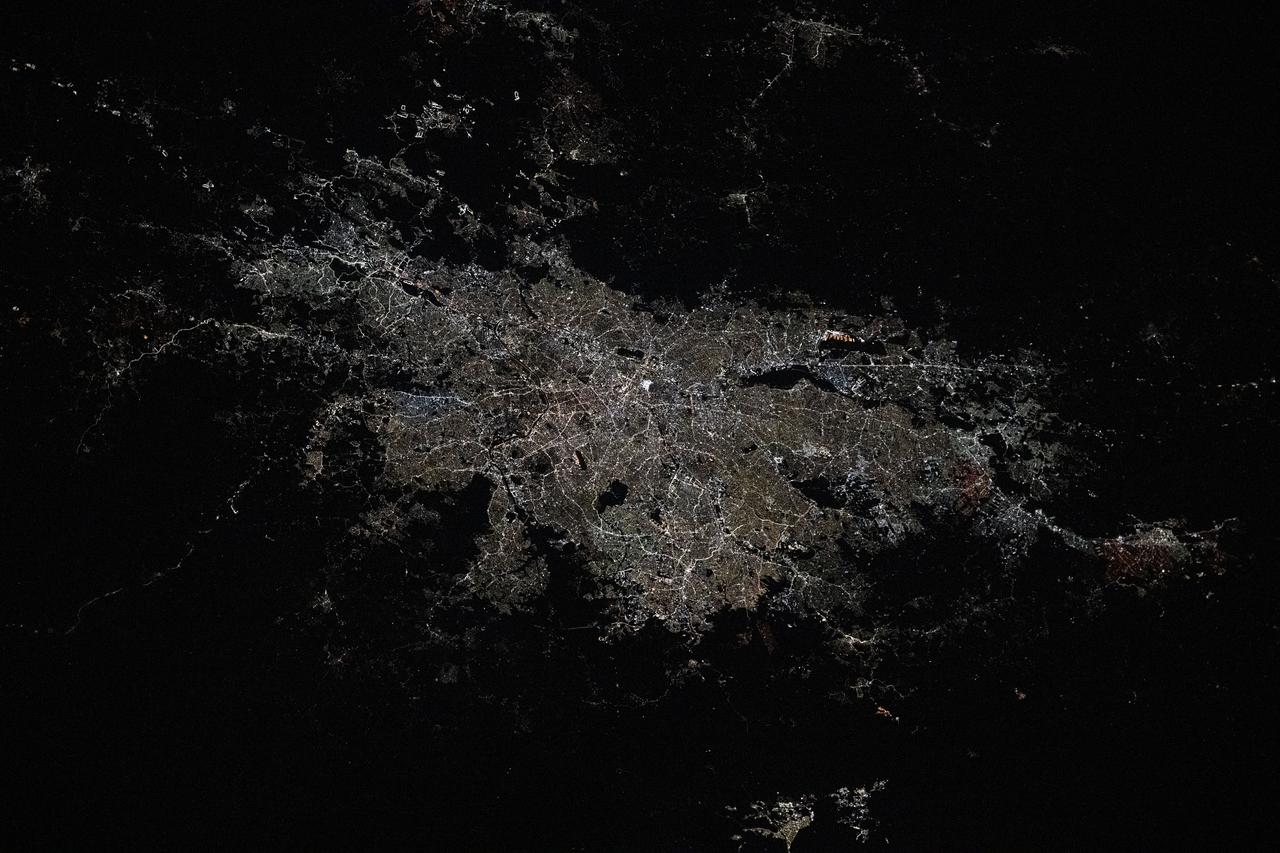
iss073e0120414 (May 19, 2025) --- São Paulo, Brazil, the South American nation's largest city with a population of about 11.9 million, and its surrounding suburbs including Guarulhos, with a population of about 1.29 million, are pictured at approximately 3:54 a.m. local time from the International Space Station as it orbited 265 miles above the Atlantic Ocean.
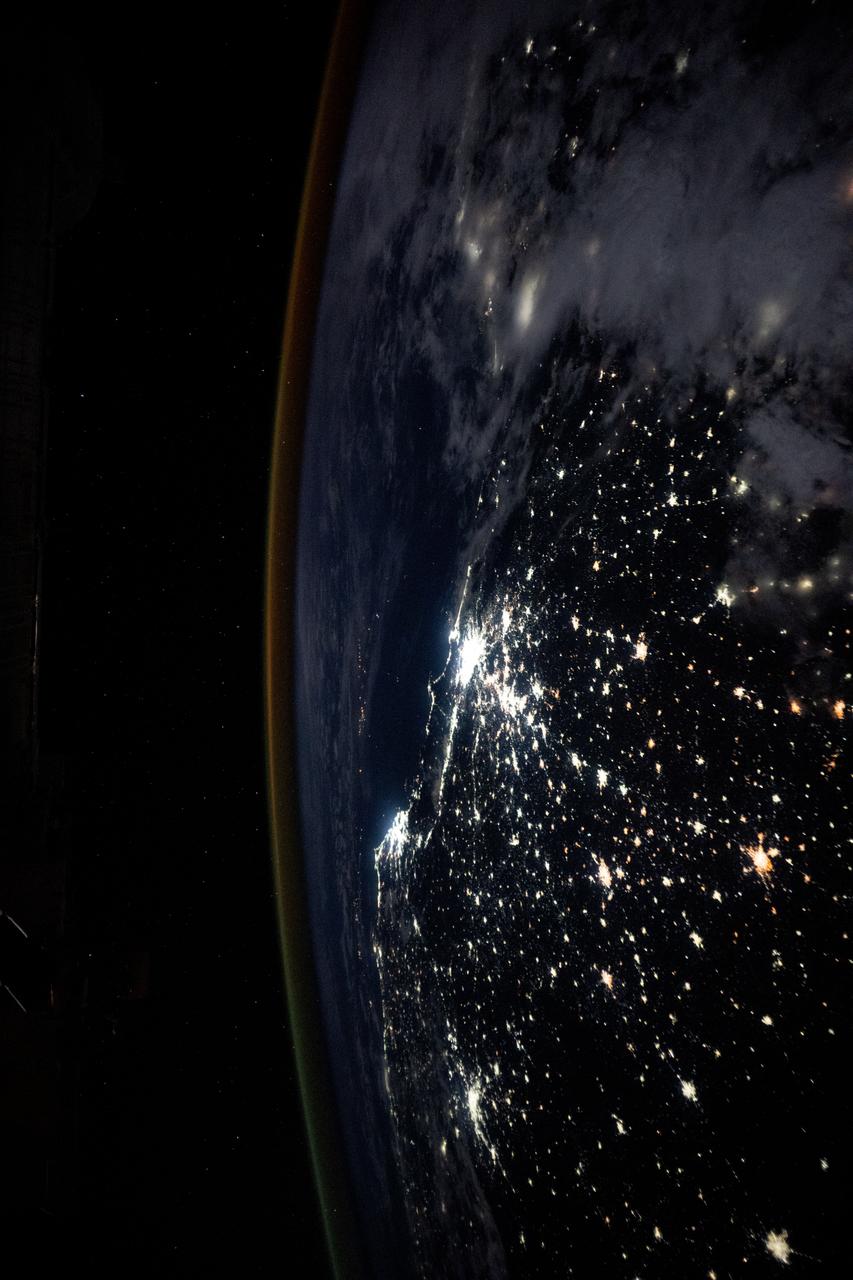
iss073e0124971 (May 19, 2025) --- The Brazilian coast on the Atlantic Ocean is lit by the nation's two largest cities of Rio de Janiero and São Paulo surrounded by its suburbs and numerous inland towns and villages. The International Space Station was orbiting 263 miles above Brazil at approximately 3:52 a.m. local time when this photograph was taken.
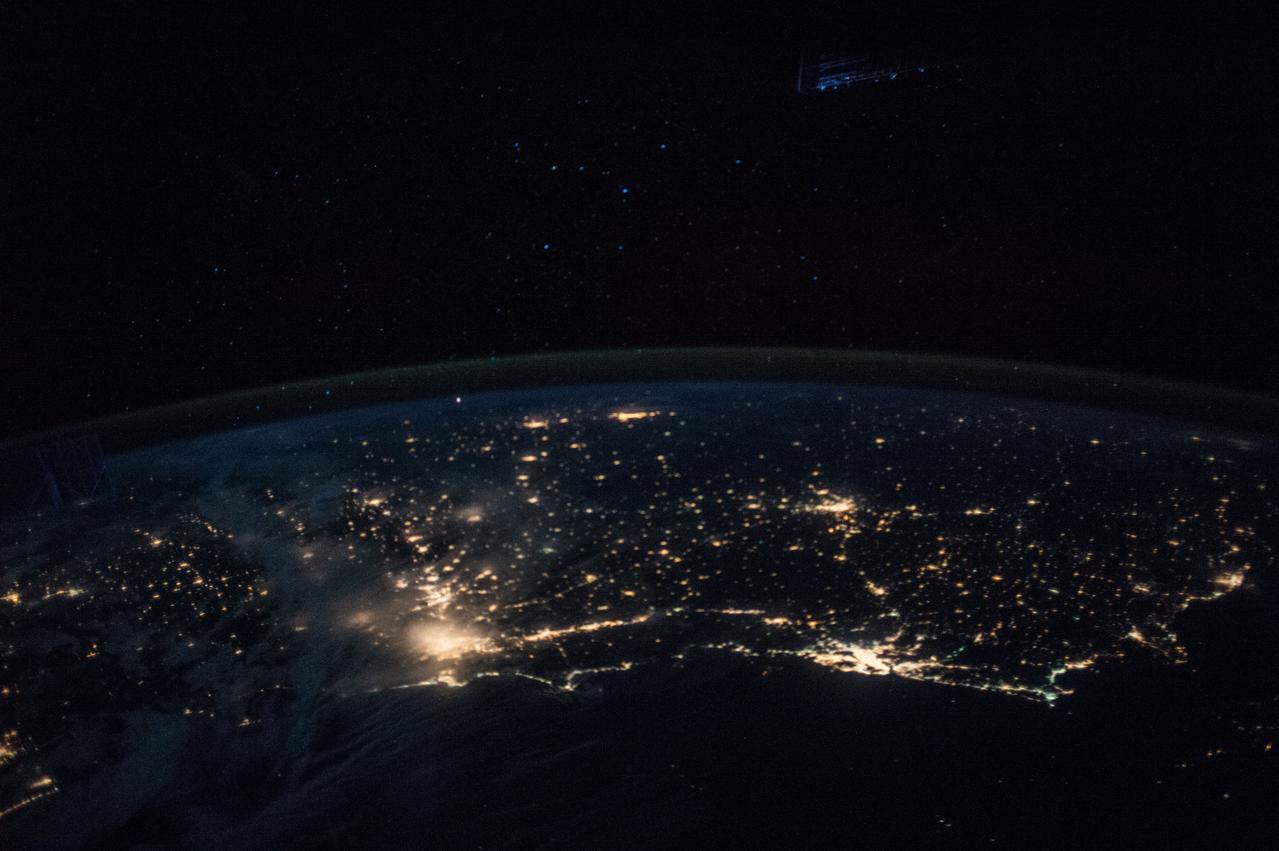
GMT362_01_01_Terry Virts_rio and sao paolo wide_129
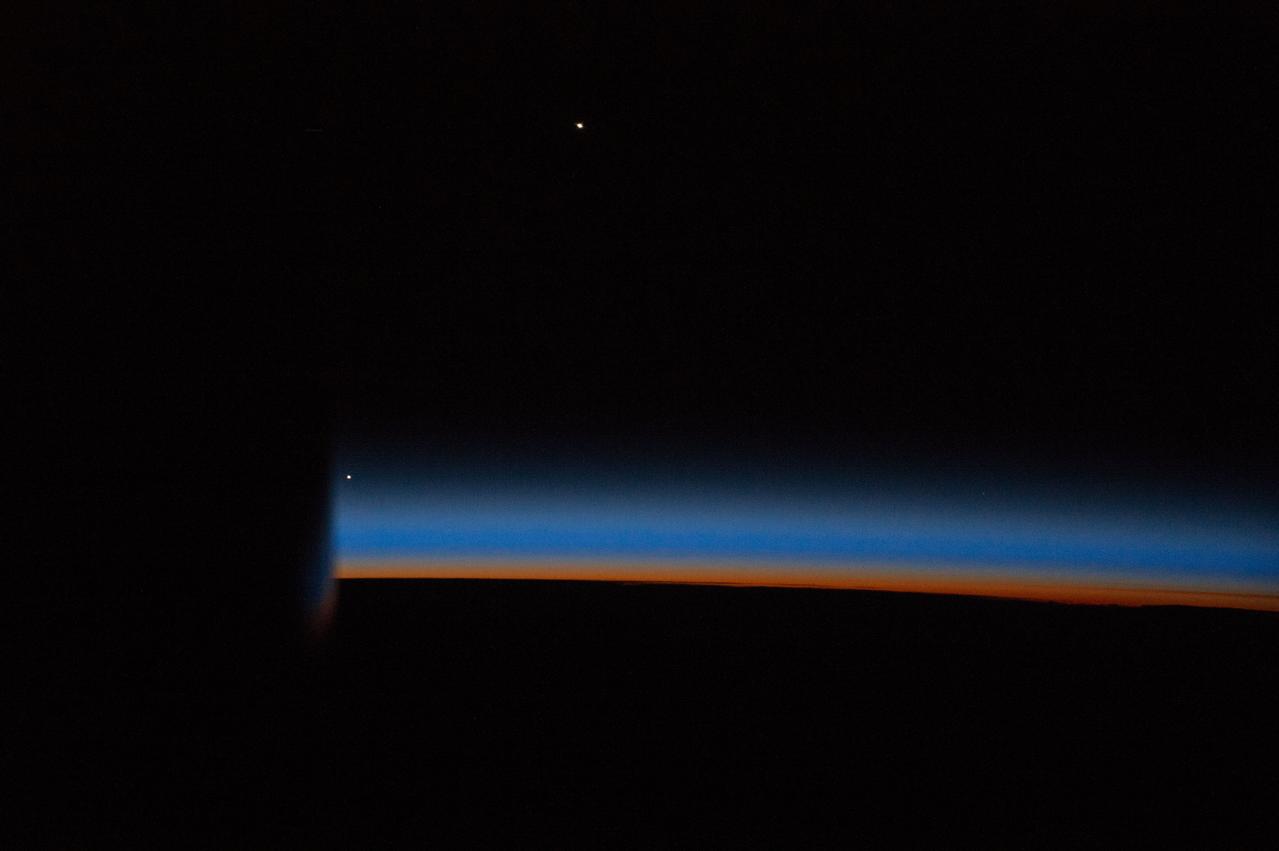
GMT362_00_47_Terry Virts_venus mercury sunset lightning zoom rio and sao paolo_131
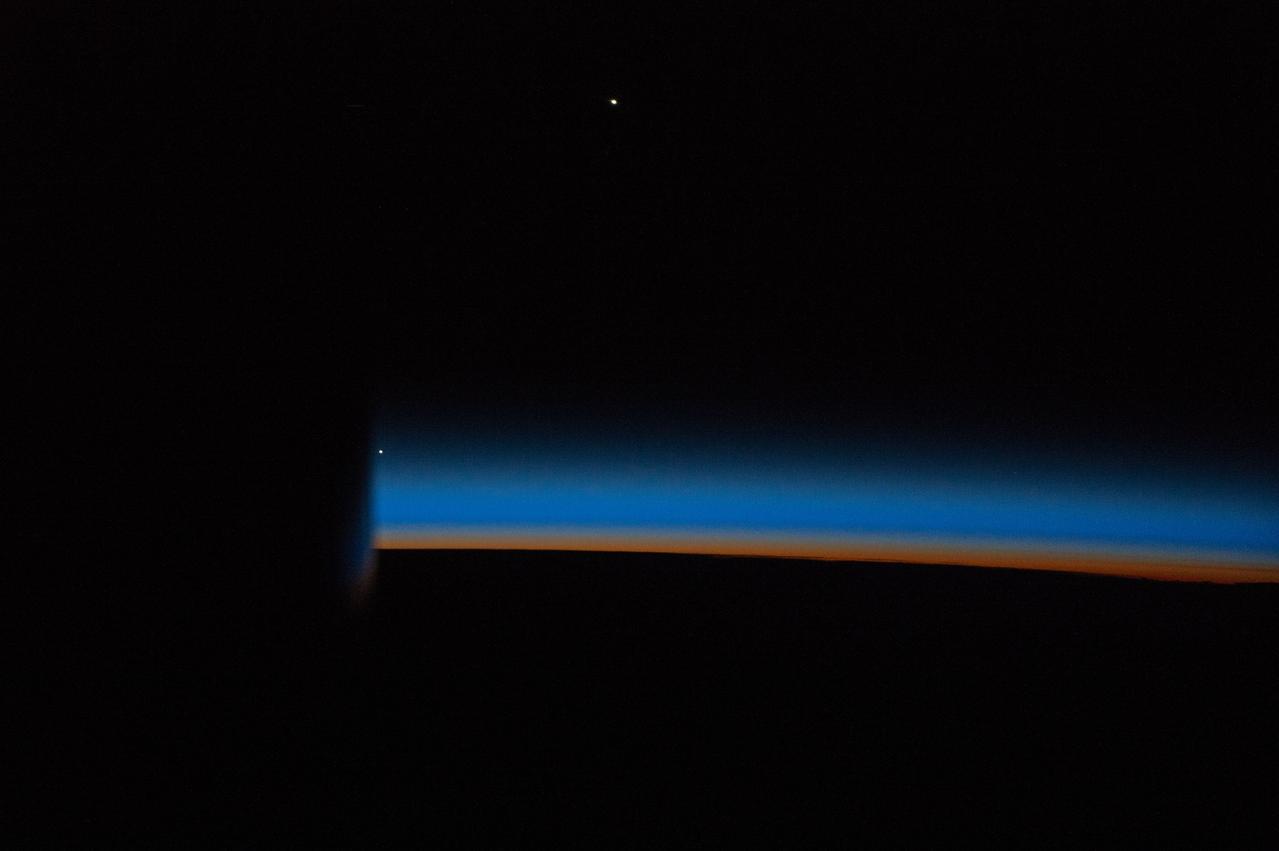
GMT362_00_47_Terry Virts_venus mercury sunset lightning zoom rio and sao paolo_131
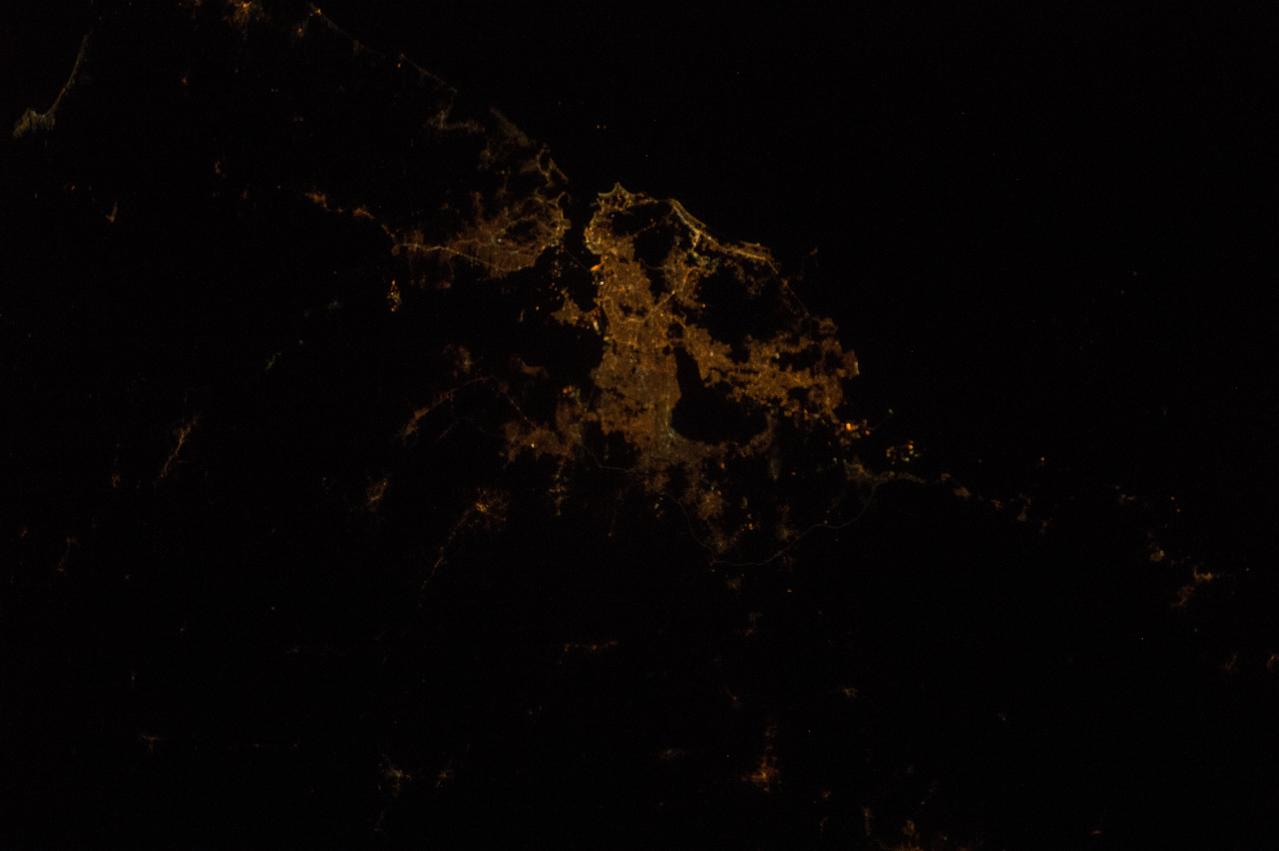
GMT362_00_47_Terry Virts_venus mercury sunset lightning zoom rio and sao paolo_131
GMT362_00_47_Terry Virts_venus mercury sunset lightning zoom rio and sao paolo_131
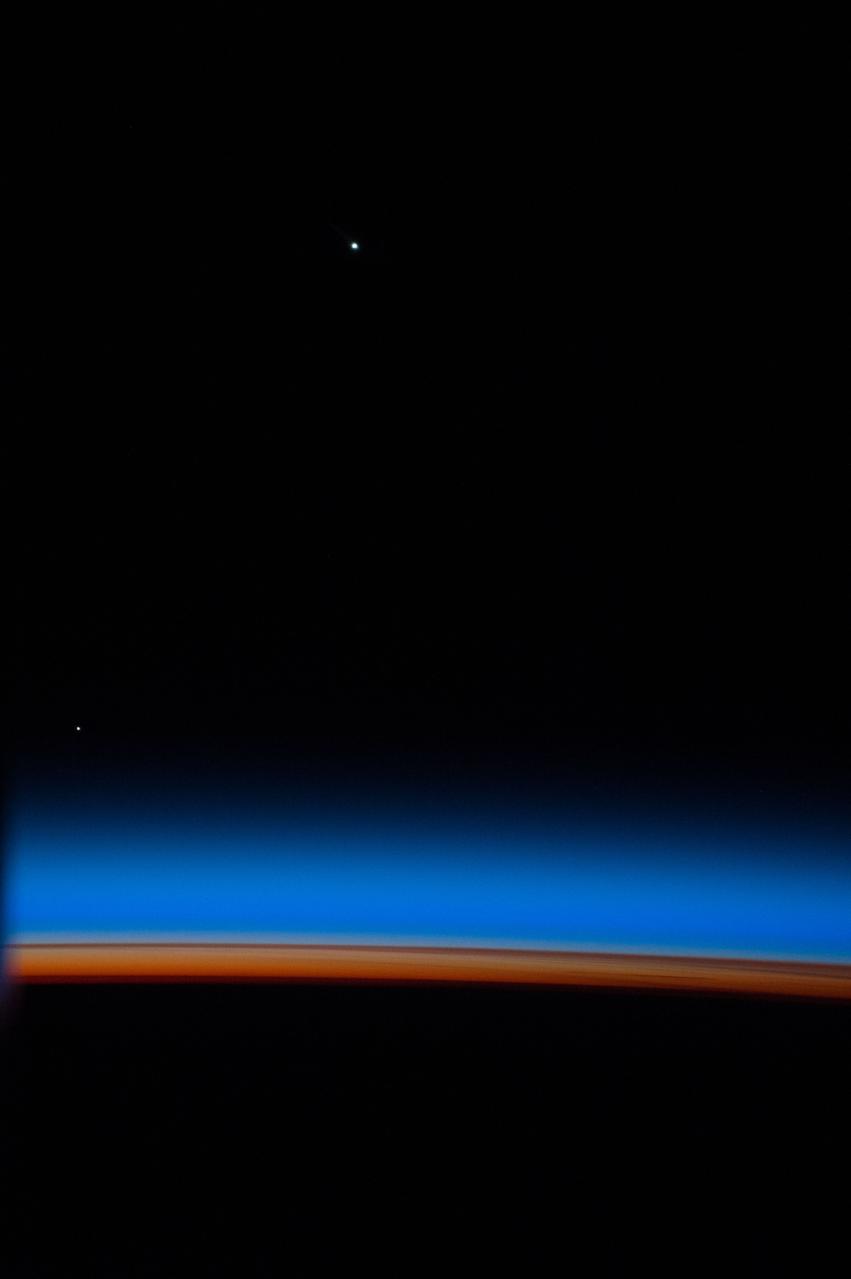
GMT362_00_47_Terry Virts_venus mercury sunset lightning zoom rio and sao paolo_131
GMT362_00_47_Terry Virts_venus mercury sunset lightning zoom rio and sao paolo_131

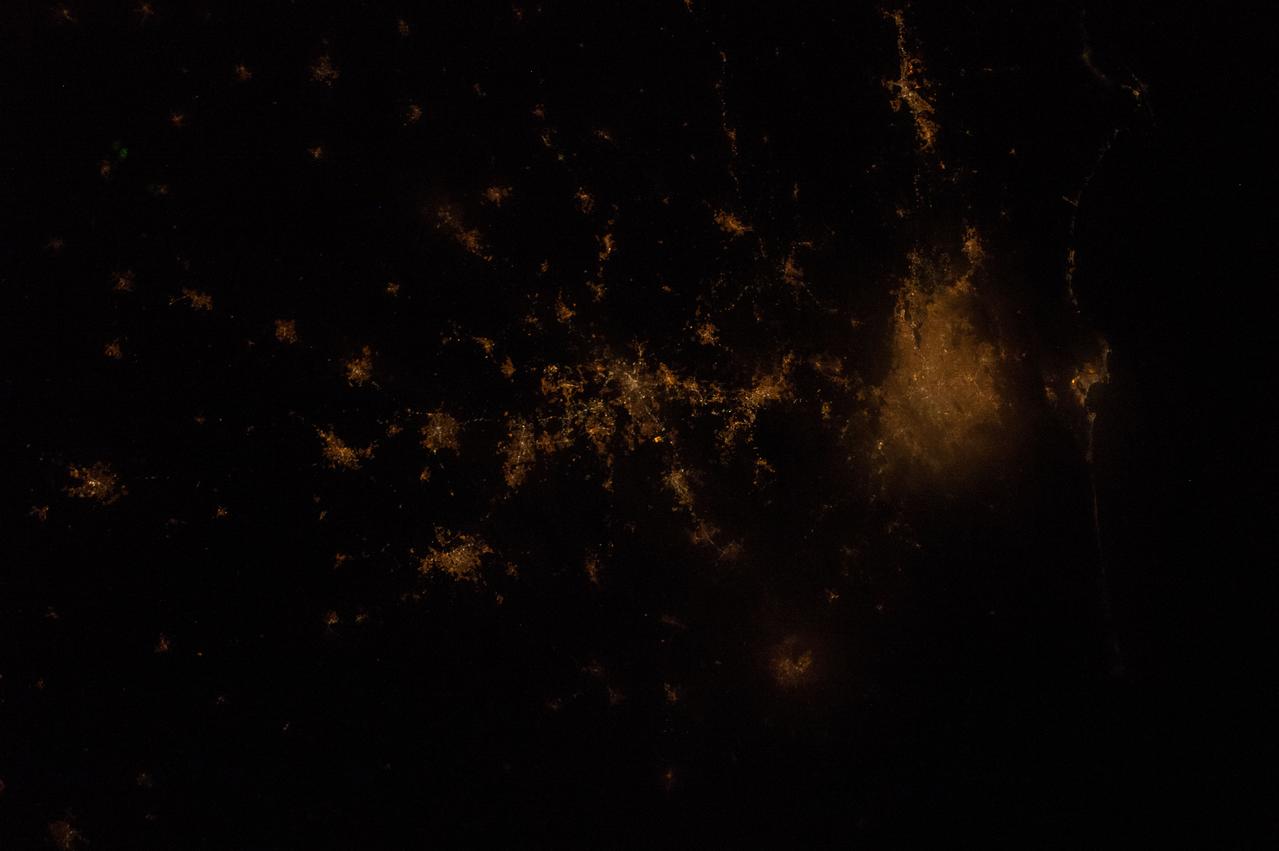
ISS040-E-010458 (12 June 2014) --- Early morning of June 12, one of the Expedition 40 crew members aboard the International Space Station took this picture of Brazil, site of the 2014 World Cup soccer matches, which start this week. Sao Paulo is the large cluster of night lights near the coast on the right side of the frame. Rio de Janeiro is the coastal city to the left of Sao Paulo. Belo Horizonte is the cluster of lights near frame center.
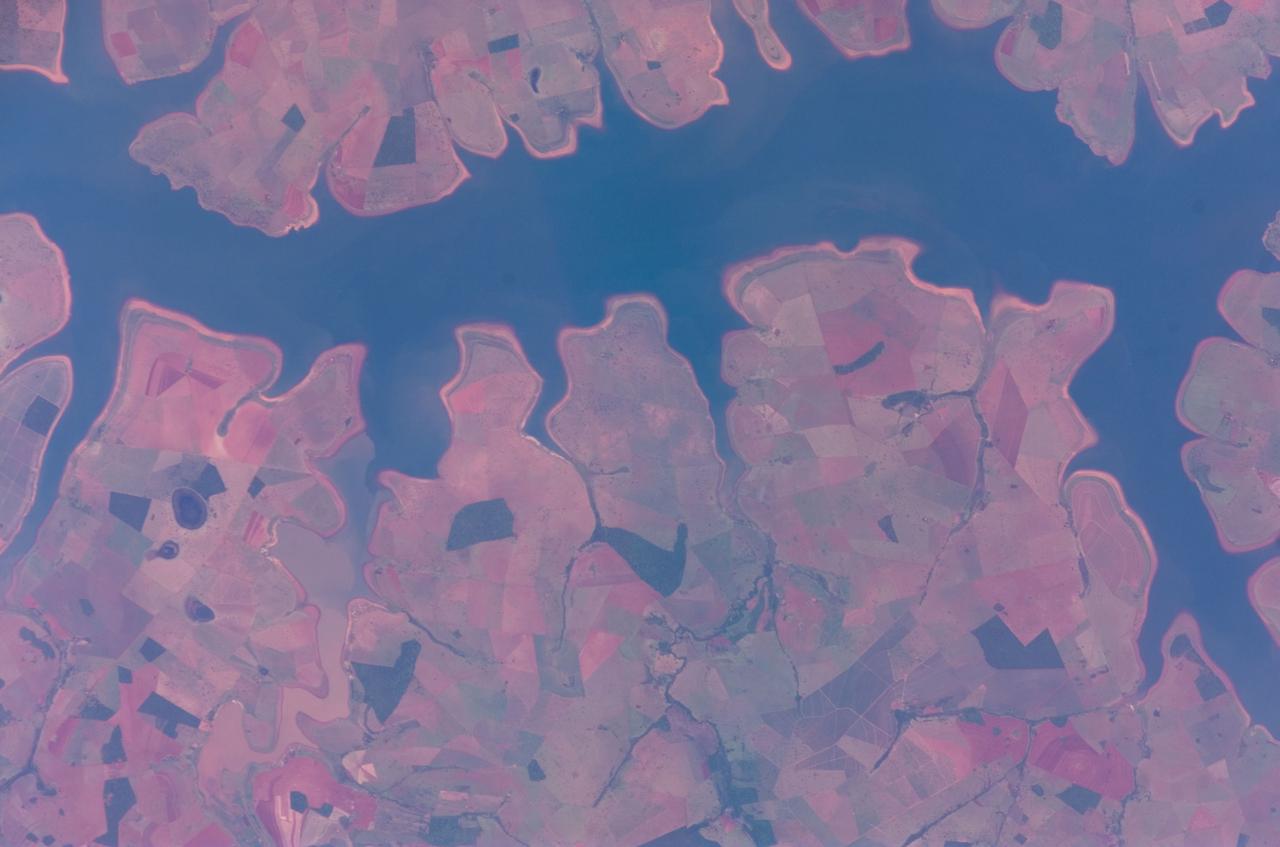
ISS016-E-011999 (22 Nov. 2007) --- Sao Simao Reservoir, Brazil is featured in this image photographed by an Expedition 16 crewmember on the International Space Station (ISS). The Sao Simao reservoir, near the confluence of the Rio Paranaiba and Rio Verde in Brazil, is the featured subject in a milestone image of Earth. This colorful, patchwork image is the 300,000th image of Earth downlinked from the space station. There are now over 745,000 images of Earth taken by astronaut crews, beginning with the Mercury missions in 1961 and continuing to the present day on the ISS. The Sao Simao reservoir is located on the border between the states of Goias and Minas Gerais (near the geographic coordinates of 18.7S 50.4W). Though the town of Sao Simao was founded around 1935, major growth occurred when the hydroelectric power plant and dam were built - forming the reservoir -- in 1975. The reservoir is part of a major navigation link that allows transport of goods and commerce between central Brazil, the Prata River and the South Atlantic. With 600,000 square kilometers of surface area, the reservoir also serves as a tourist destination for fishing, swimming and boating. In addition to hydroelectric power production, the economy of the region is based in agribusiness. The image highlights agricultural fields of various kinds and in different stages of cultivation. The major commodities include corn, soybeans, sesame seeds, sugarcane, beans, manioc, coffee and meat production.
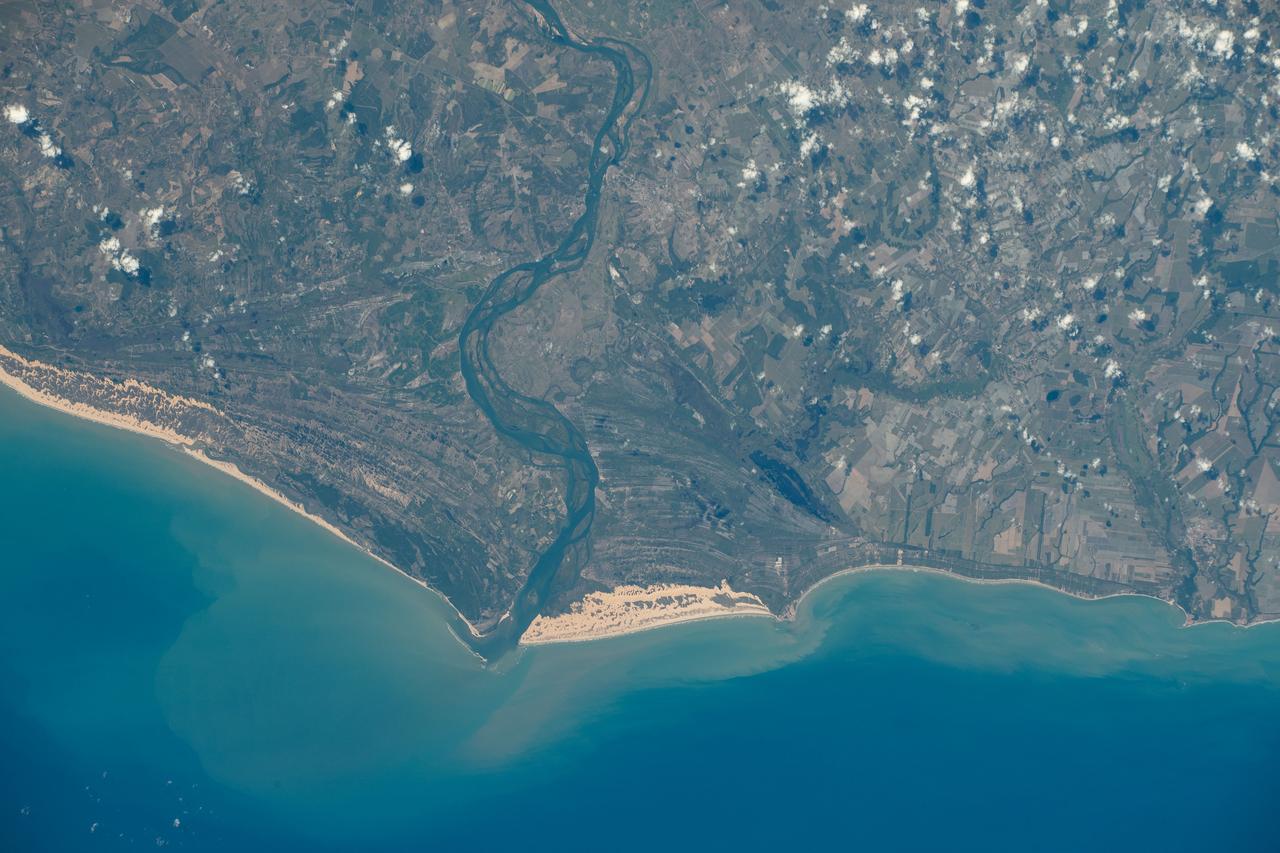
iss070e025986 (Nov. 16, 2023) --- The São Francisco River empties into the Atlantic Ocean and splits the Brazilian states of Sergipe and Alagoas in this photograph from the International Space Station as it orbited 262 miles above the South American coast.
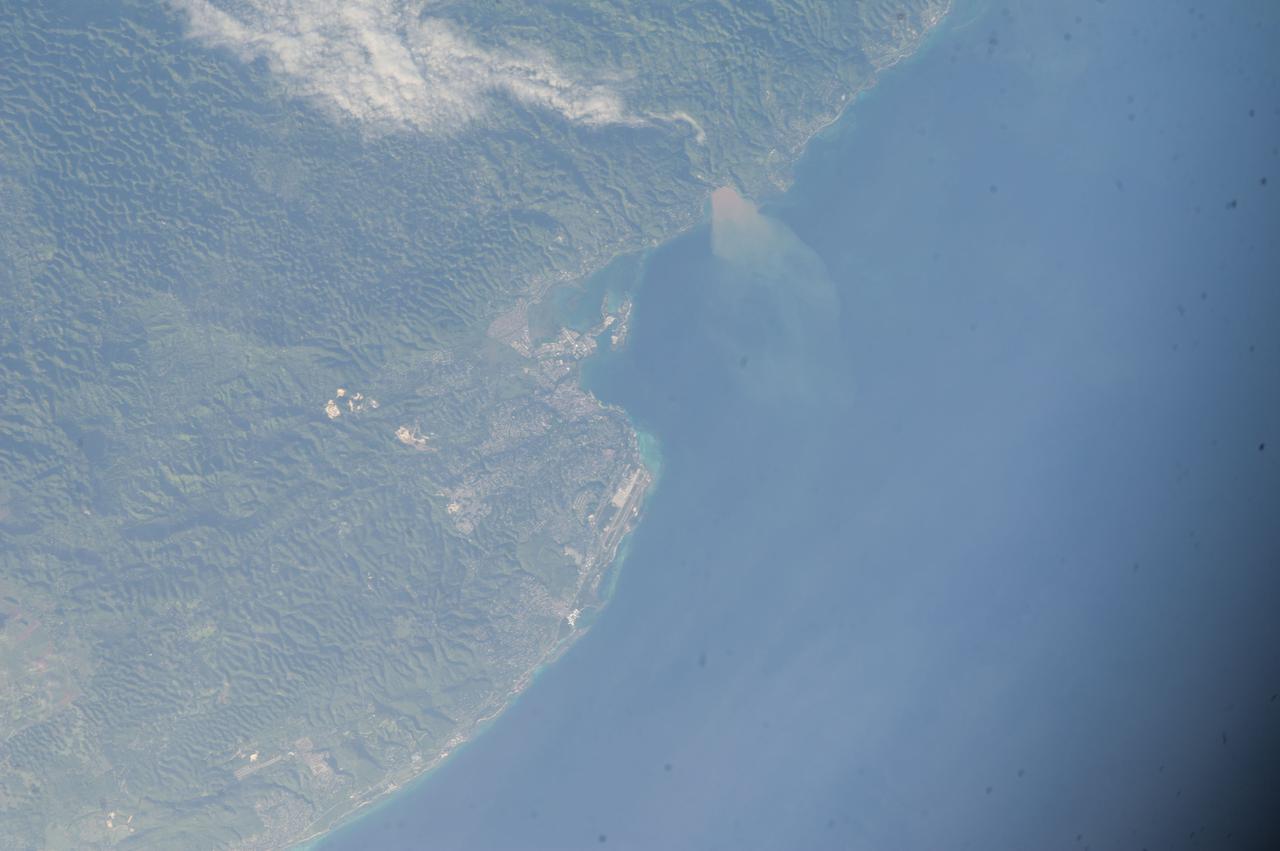
Earth Observation taken during a day pass by the Expedition 40 crew aboard the International Space Station (ISS). Folder lists this as: CEO - Arena de Sao Paolo.
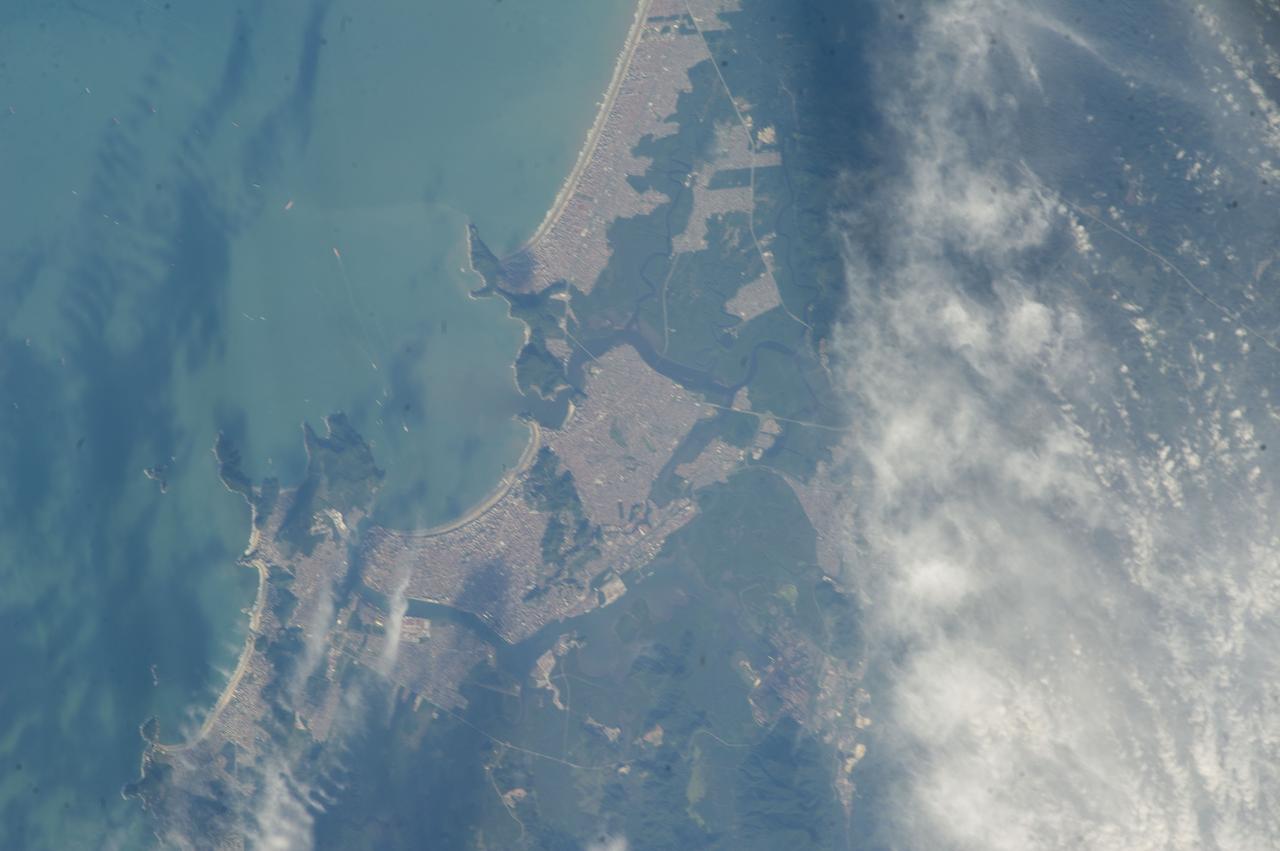
Earth Observation taken during a day pass by the Expedition 40 crew aboard the International Space Station (ISS). Folder lists this as: CEO - Arena de Sao Paolo. Santos, Brazil possibly visible.
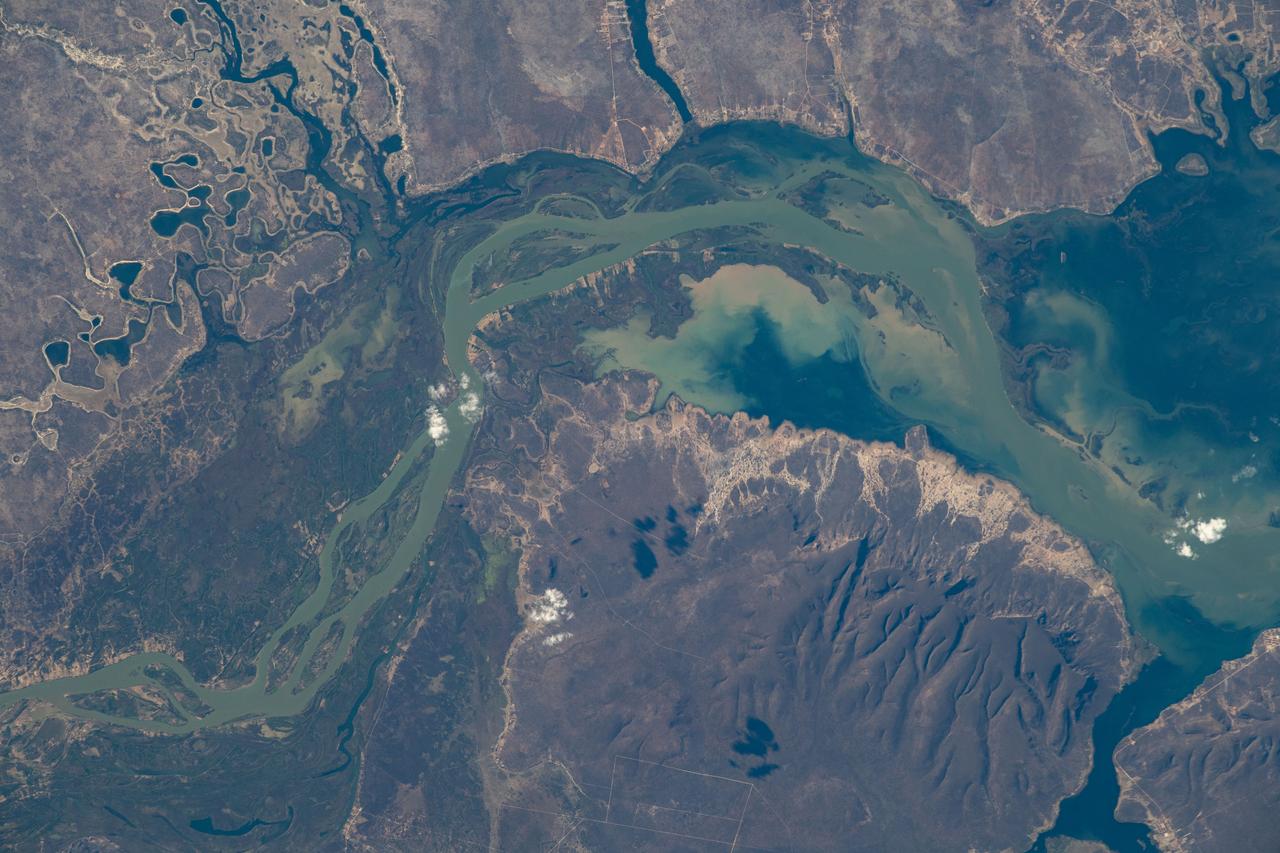
iss070e004962 (Oct. 17, 2023) --- The São Francisco River passes through the Sobradinho Reservoir in Brazil in this photograph from the International Space Station as it orbited 259 miles above the South American nation.
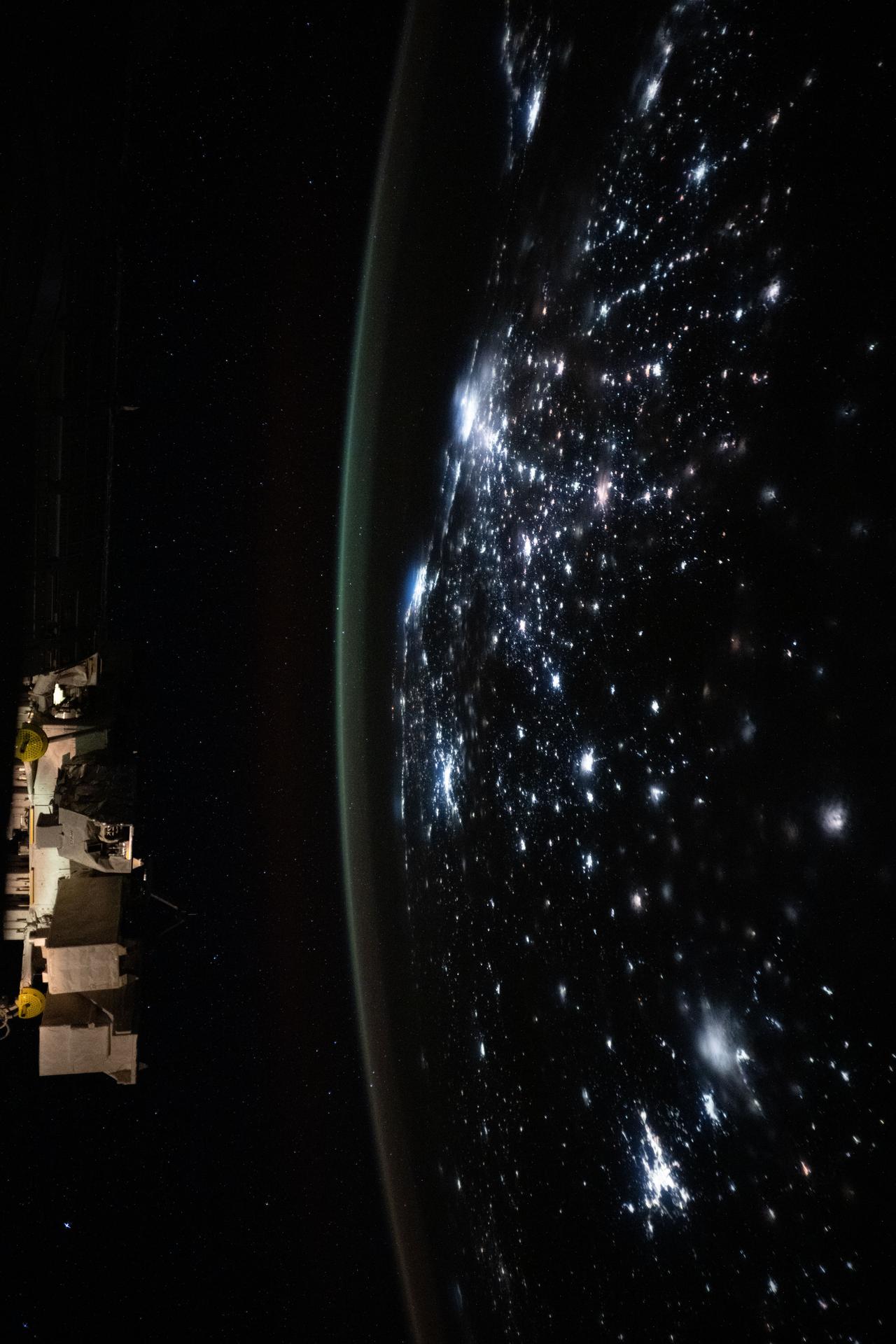
iss073e0855854 (Sept. 21, 2025) --- City lights dot the Brazilian landscape and trace a path to Rio de Janeiro and São Paulo (center) on the Atlantic coast in this photograph taken at approximately 2:17 a.m. local from the International Stace Station as it orbited 263 miles above.
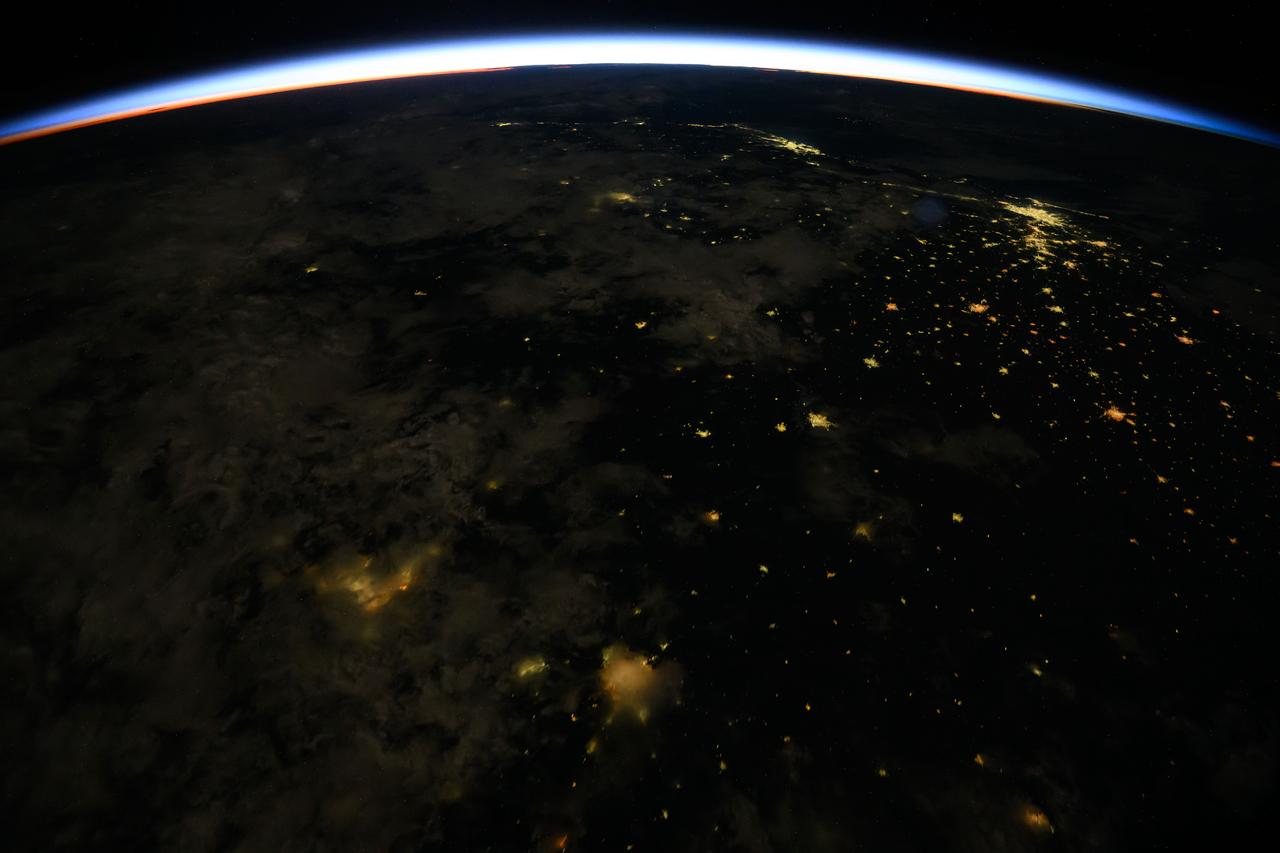
iss072e340644 (Nov., 18, 2024) --- An orbital sunrise crowns Earth's horizon in this photograph from the International Space Station as it orbited 261 miles above Brazil. At top right, the city lights of Rio de Janiero and Sao Paulo on the Atlantic coast are visible from the orbital outpost.
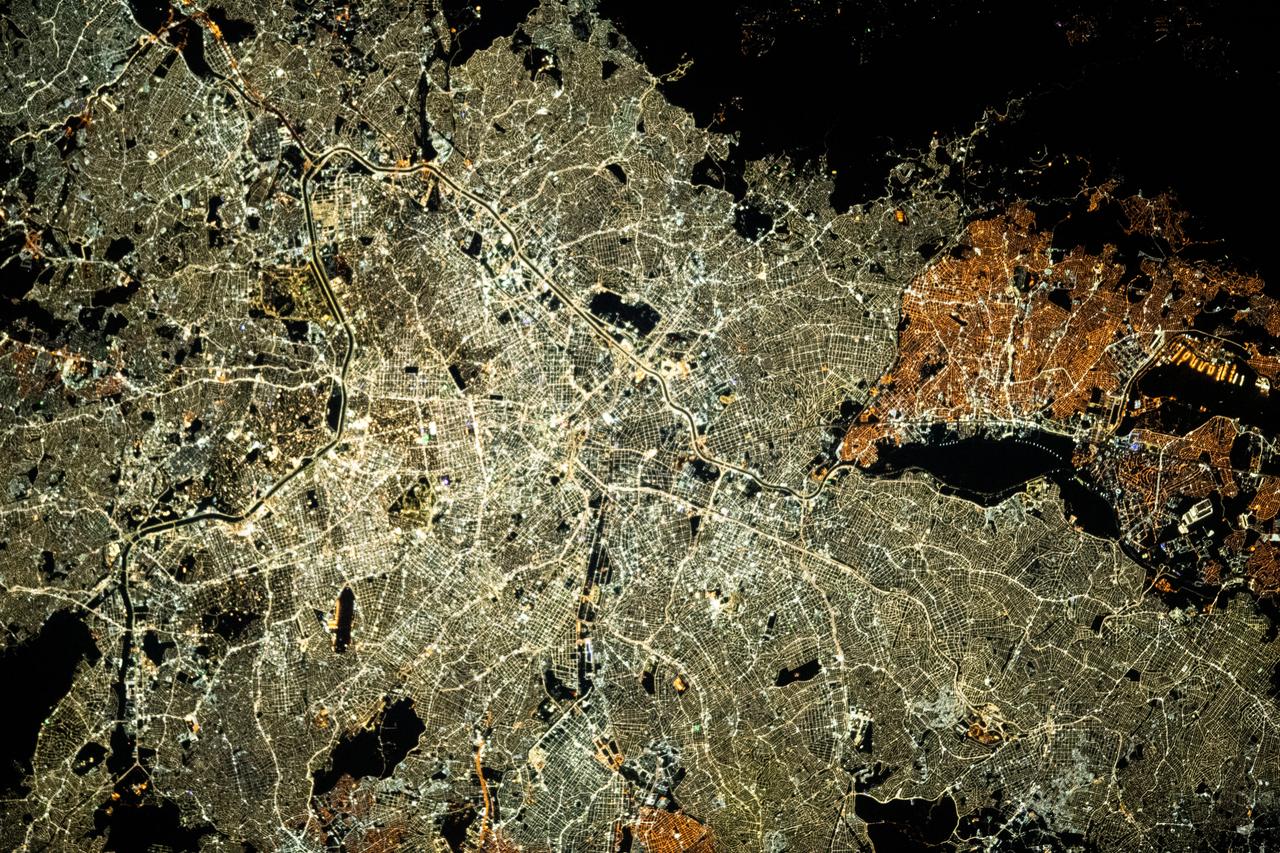
iss067e176766 (July 4, 2022) --- São Paulo, the most populous city in Brazil, can be differentiated by its bright street lights versus the darker street lights in the smaller city of Guarulhos (at right) in this picture from the International Space Station as it orbited 261 miles above.
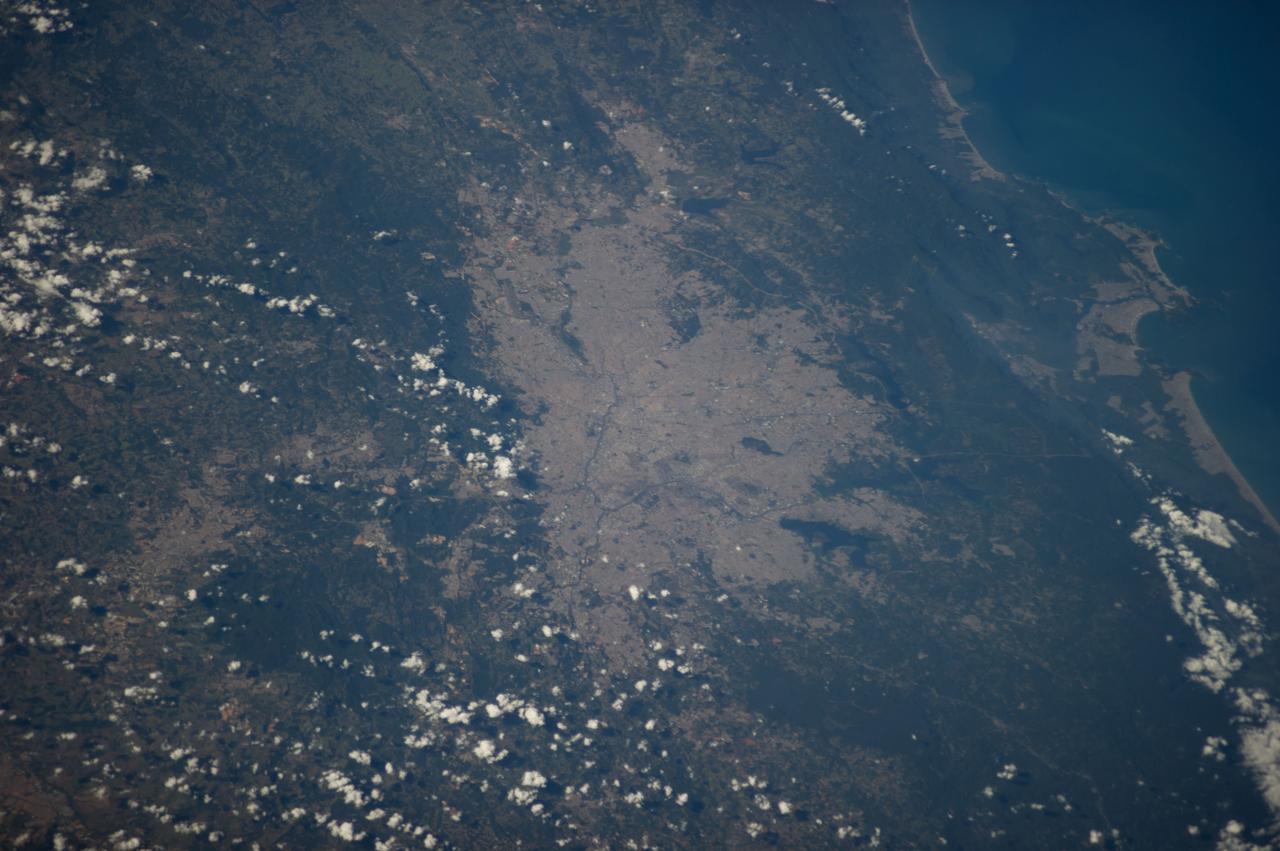
ISS040-E-010803 (12 June 2014) --- One of the Expedition 40 crew members aboard the International Space Station photographed this image featuring Sao Paulo, one of the host cities in Brazil for the 2014 World Cup. A 200mm focal length was used to record the photograph on June 12.

iss074e0361940 (March 5, 2026) --- Campinas, Brazil, with a metropolitan population of nearly 3.5 million, is a high‑tech and industrial powerhouse with a tropical savanna climate located just northwest of São Paulo. The International Space Station was orbiting 265 miles above the Atlantic Ocean at the time of this photograph. Credit: NASA/Jessica Meir
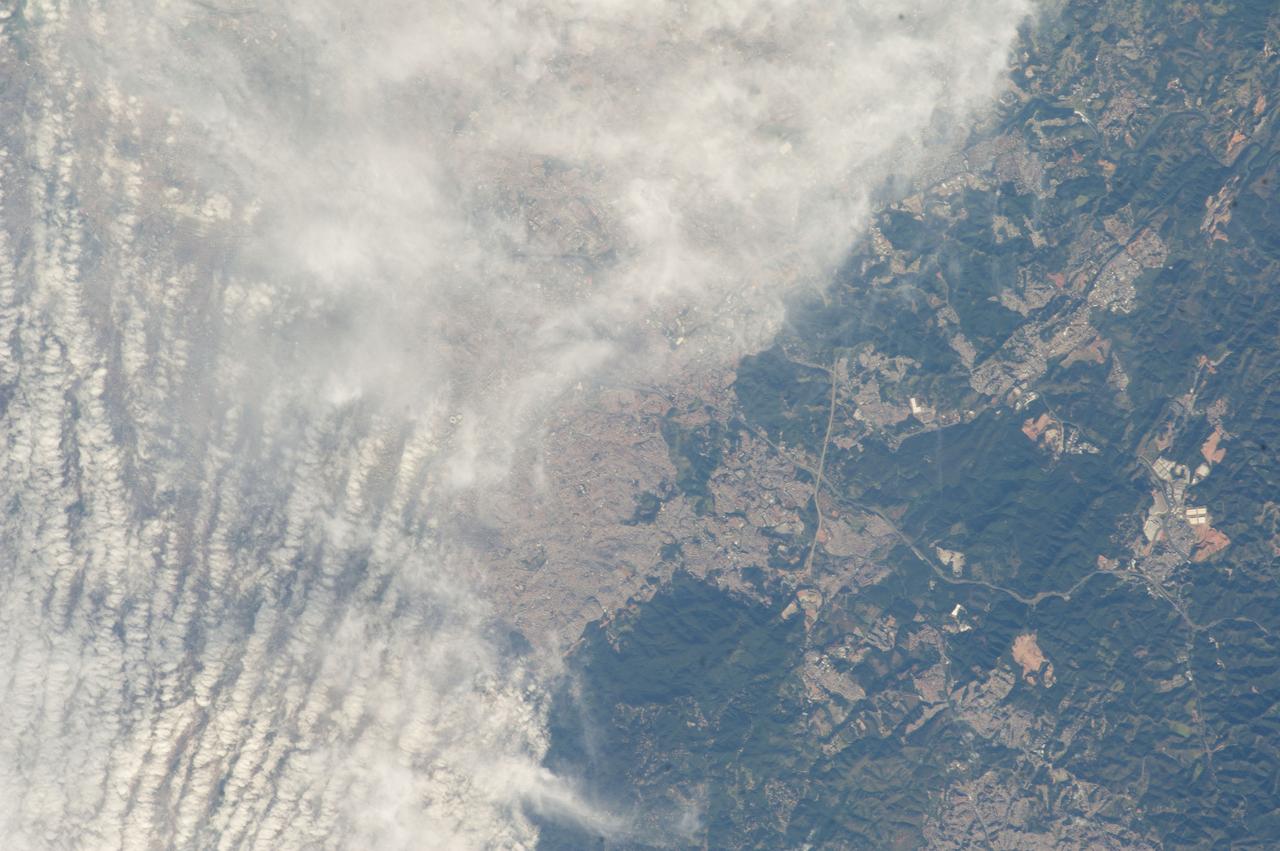
Earth Observation taken during a day pass by the Expedition 40 crew aboard the International Space Station (ISS). Folder lists this as: CEO - Arena de Sao Paolo. View used for Twitter message: Cloudy skies over São Paulo Brazil
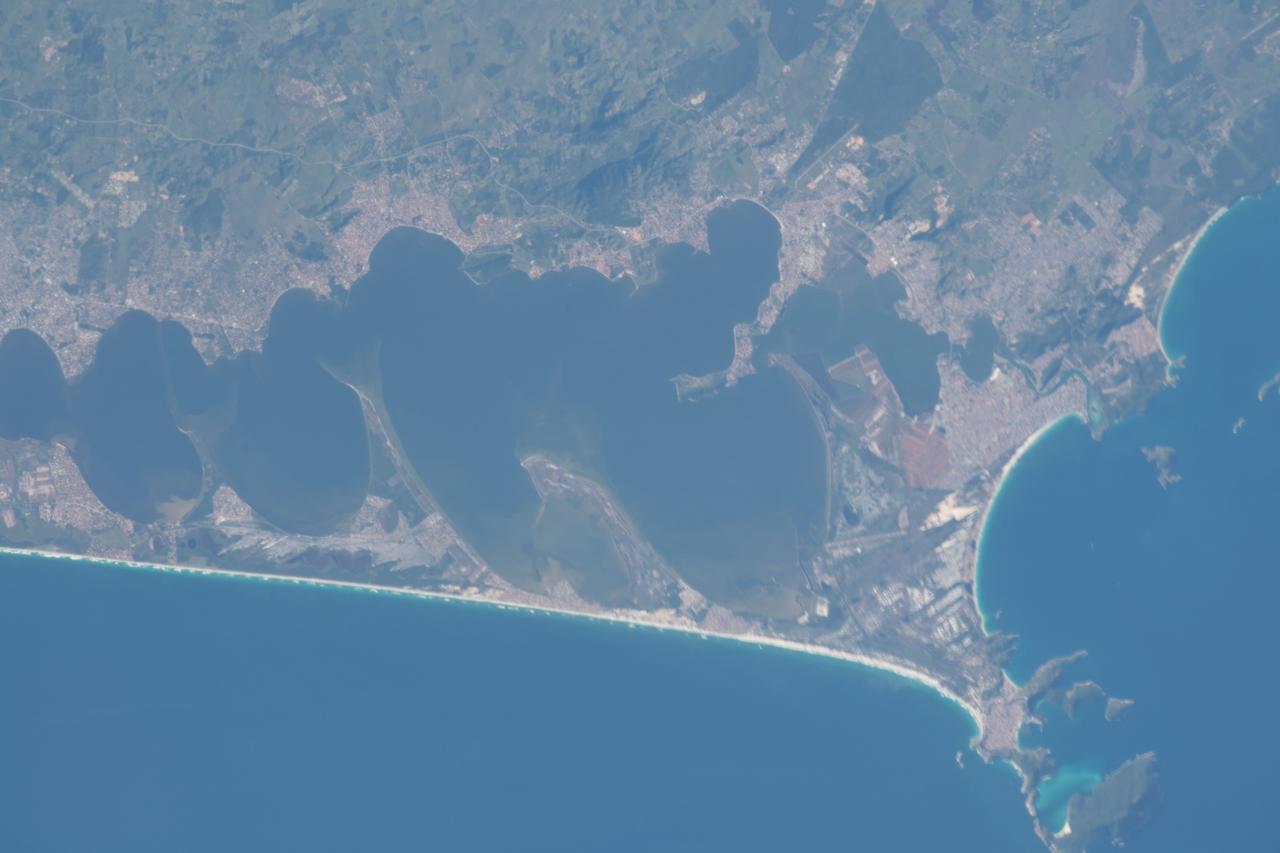
iss063e003285 (April 24, 2020) --- The Araruama Lagoon is about 52 miles east of Rio de Janeiro on the Atlantic coast of Brazil. The International Space Station was flying just north of Sao Paolo, South America's largest city when this photograph was taken.
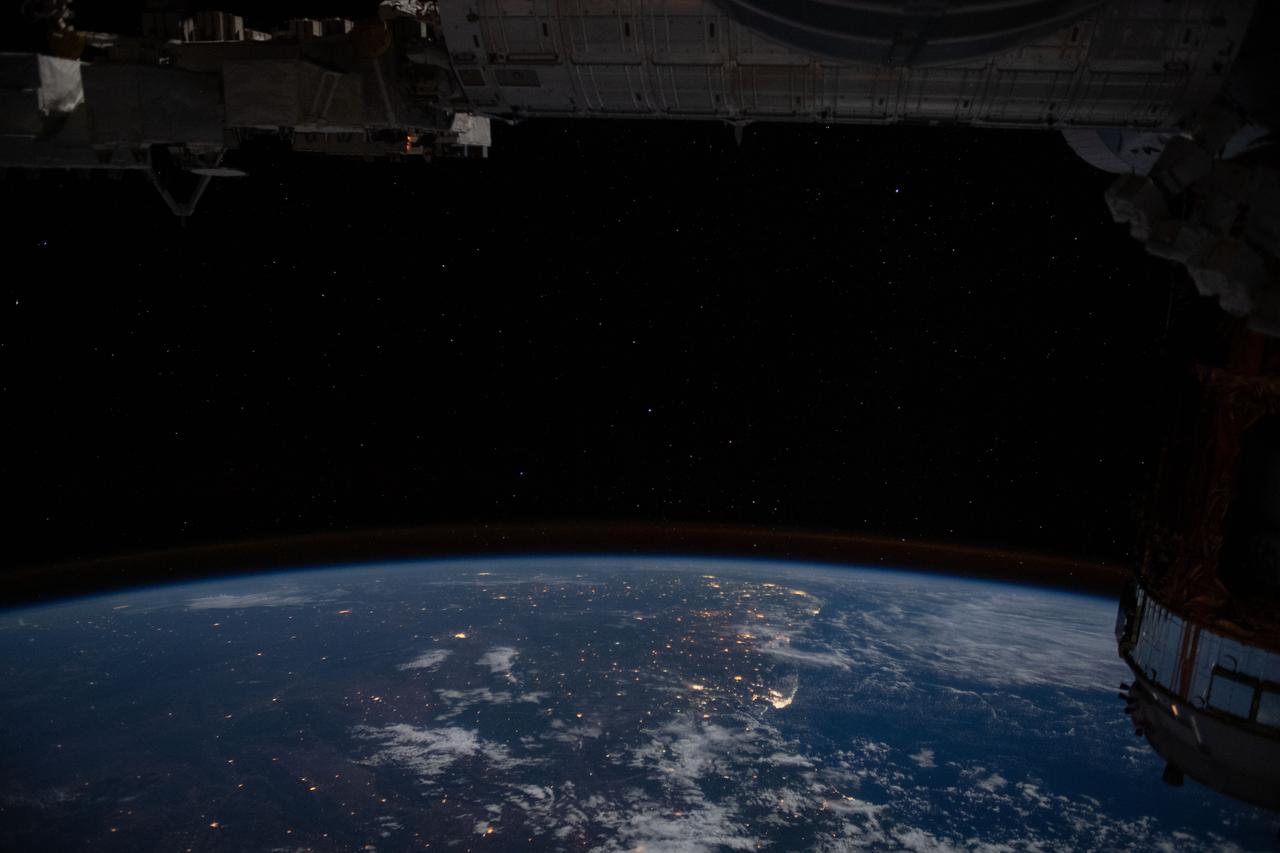
iss063e039001 (July 5, 2020) --- This starry nighttime shot of Rio de Janeiro and surrounding cities on the Brazilian coast was taken as the International Space Station orbited above São Paulo heading northeast above the South American continent before going over the Atlantic Ocean.
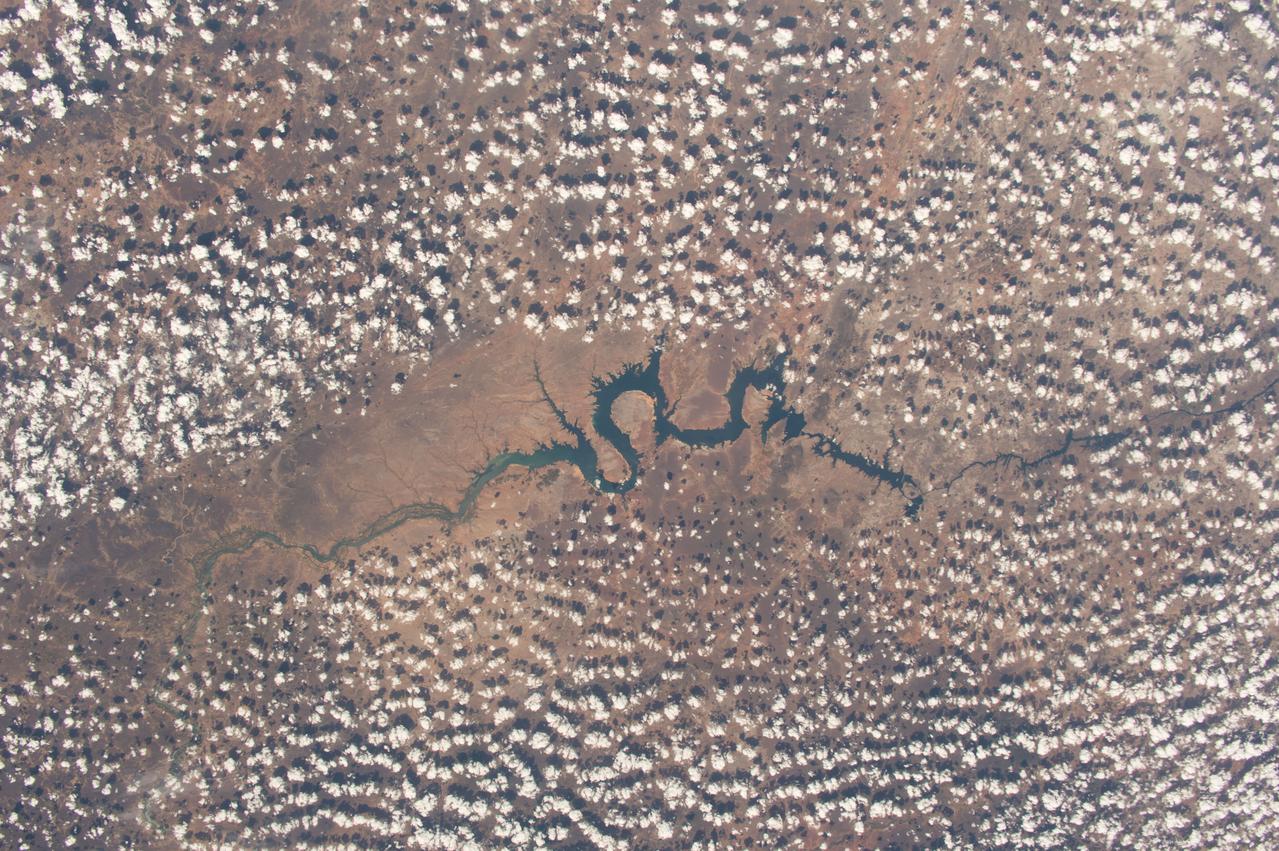
iss050e013545 (12/2/2016) --- A view of the São Francisco River in Brazil. Crew Earth Observations (CEO) imagery provides researchers on Earth with key data to understand the planet from the perspective of the ISS. Crew members have been photographing Earth from space since the early Mercury missions beginning in 1961. The images taken from the ISS ensure this record remains unbroken.
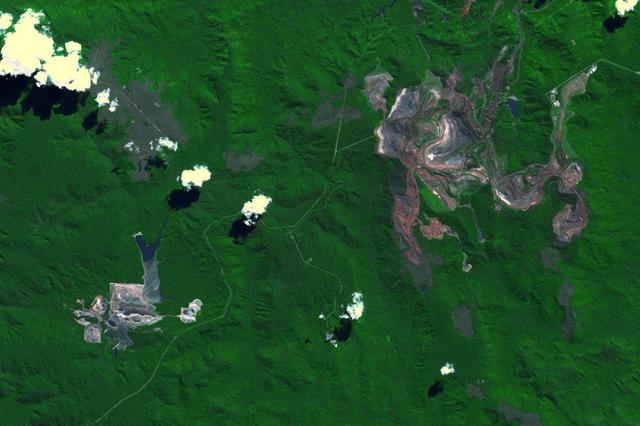
The Carajas Mine is the largest open-pit iron ore mine in the world. It is located in the state of Para, northern Brazil. The mine is estimated to contain over 7 billion tons of iron ore, plus gold, manganese, bauxite, copper and nickel. Ore is loaded into rail cars, and shipped to the Atlantic port city of Sao Luis over 250 kilometers away. The image was acquired June 19, 2017, covers an area of 18 by 27 kilometers, and is located at 6.1 degrees south, 50.2 degrees west. https://photojournal.jpl.nasa.gov/catalog/PIA22861
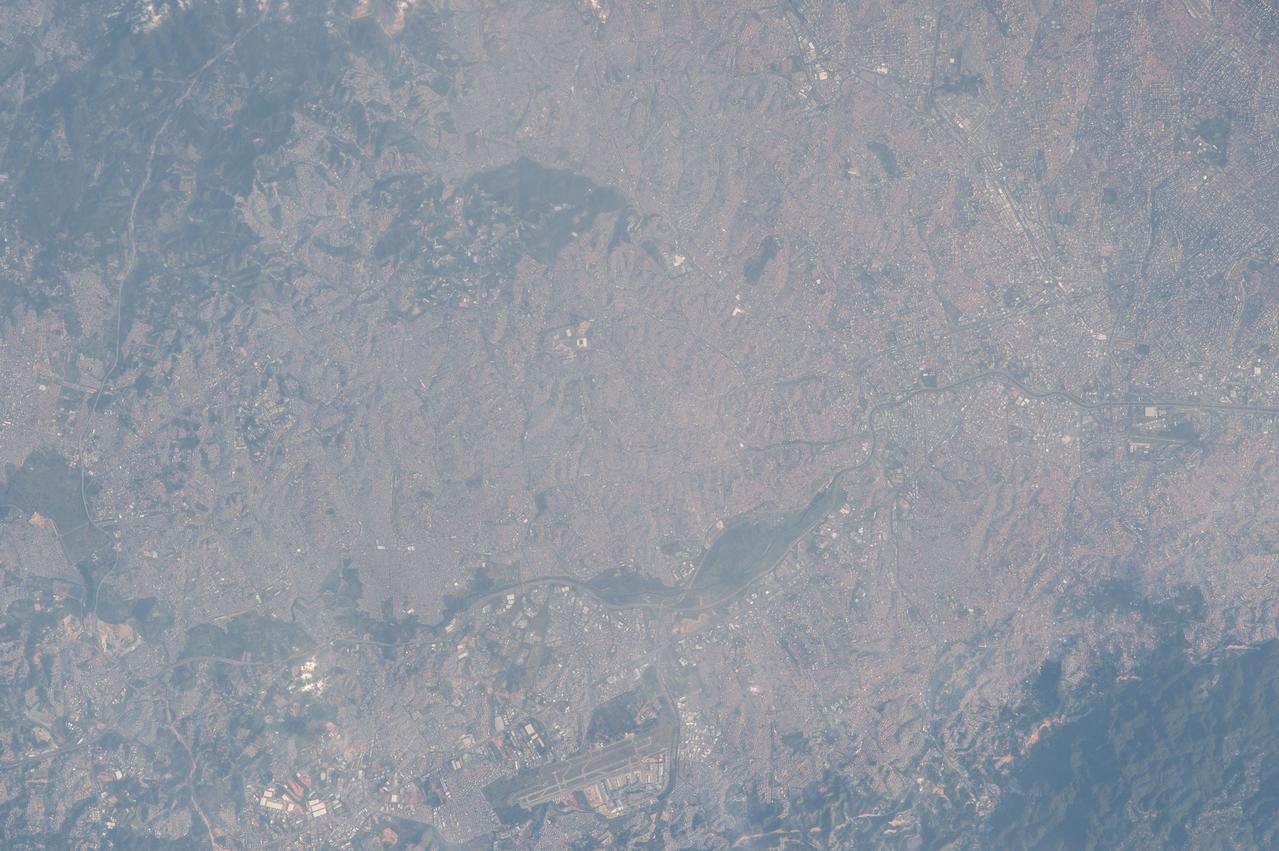
ISS043E182745 (05/09/2015) --- NASA astronaut Scott Kelly and his crewmates on Expedition 43 capture Earth observation images as part of their duties on board the International Space Station and during their off time for interest and appreciation. This picture taken May 9th, 2015 of north eastern Brazil in South America showcases Sao Polo, and even displays the Guarulhos International Airport.
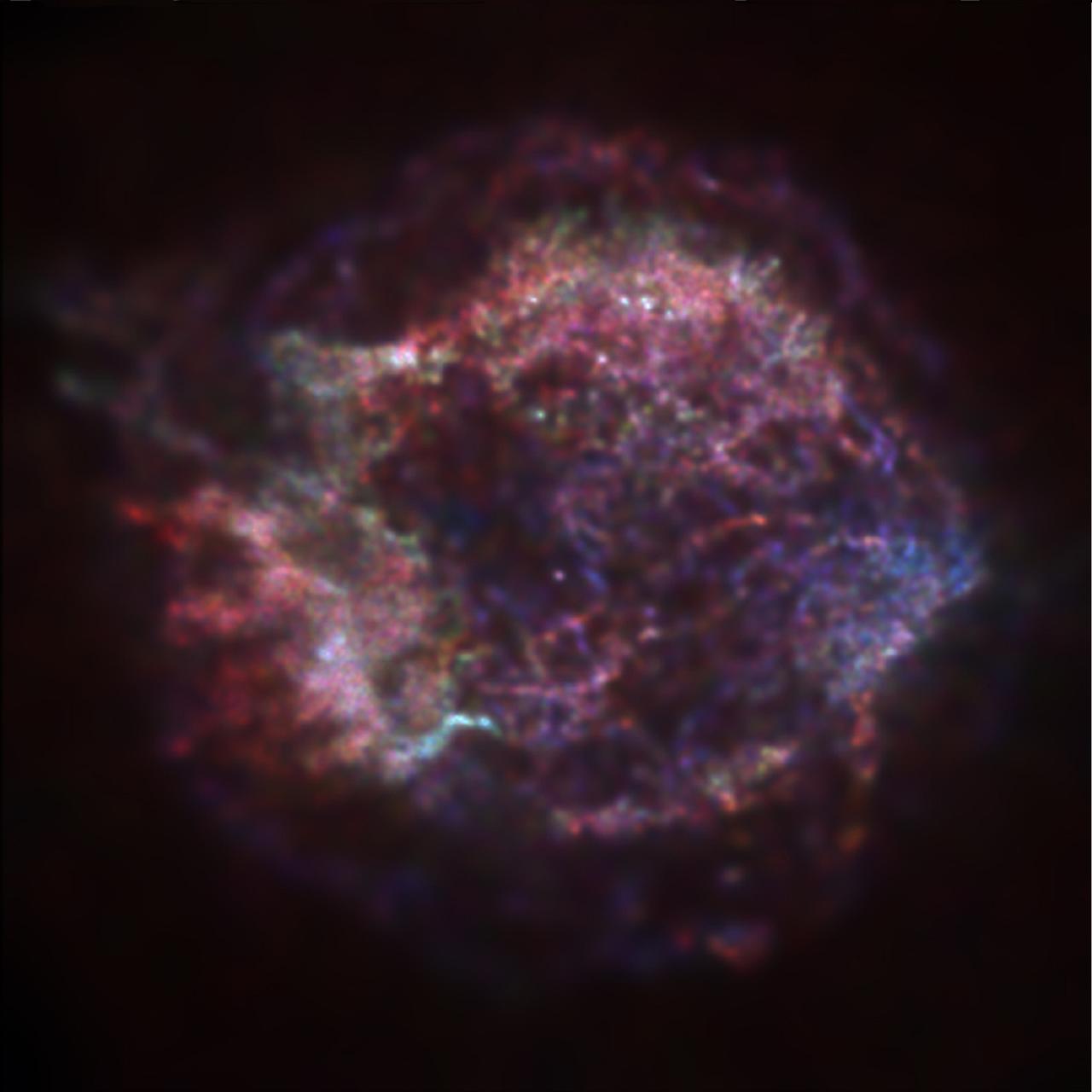
This is an extraordinary first image from the Chandra X-Ray Observatory (CXO), the supernova remnant Cassiopeia A, tracing the aftermath of a gigantic stellar explosion in such sturning detail that scientists can see evidence of what may be a neutron star or black hole near the center. The red, green, and blue regions in this image of the supernova remnant Cassiopeia A show where the intensity of low, medium, and high energy X-rays, respectively, is greatest. The red material on the left outer edge is enriched in iron, whereas the bright greenish white region on the low left is enriched in silicon and sulfur. In the blue region on the right edge, low and medium energy X-rays have been filtered out by a cloud of dust and gas in the remnant . The image was made with the CXO's Advanced Charged-Coupled Device (CCD) Imaging Spectrometer (ACIS). Photo credit: NASA/CXC/SAO/Rutgers/J.Hughes
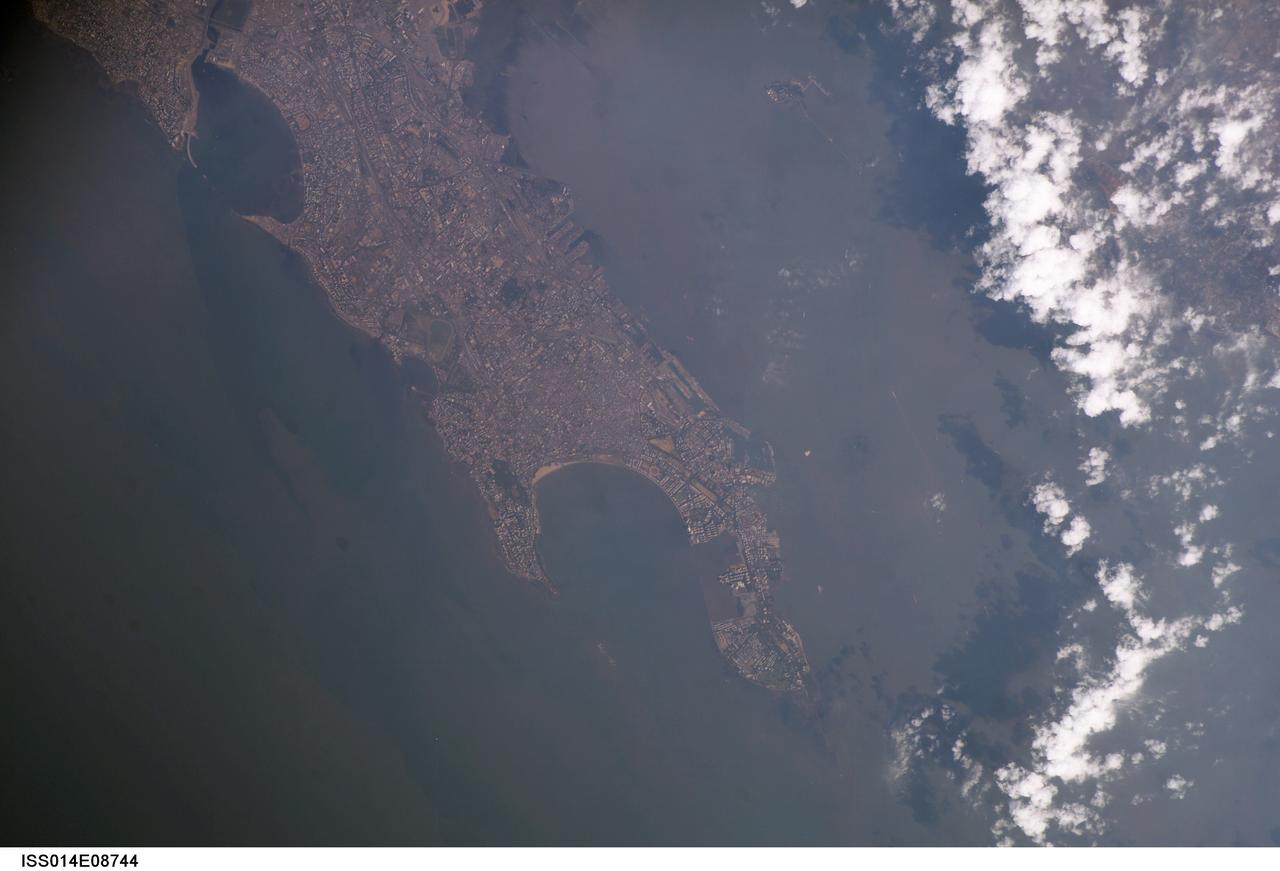
ISS014-E-08744 (28 Nov. 2006) --- Mumbai Harbor, India is featured in this image photographed by an Expedition 14 crewmember on the International Space Station. This view is one of three (frames 8741, 8742 and 8744) acquired within ten seconds of each other as the station passed over India. Mumbai (formerly known as Bombay) is a so-called mega city, with over 21 million people living in the greater Mumbai metropolitan region. Mega cities like Tokyo, New York, Sao Paulo, and Mumbai are also known as conurbations -- large contiguous areas of urban land cover formed from the growth and merging together of previously separate and distinct urban centers. The Mumbai conurbation includes several municipal entities including Bhiwandi, Kalyan, Thane, and Ulhasnagar. Located along the coast of western India on Salsette Island, Mumbai is generally considered to be the most modern of India's cities and is a major economic, transportation, and cultural center. Almost cloud-free conditions reveal the continuous urban land cover of the mega city extending north to south across Salsette Island -- a distance of nearly 50 kilometers.
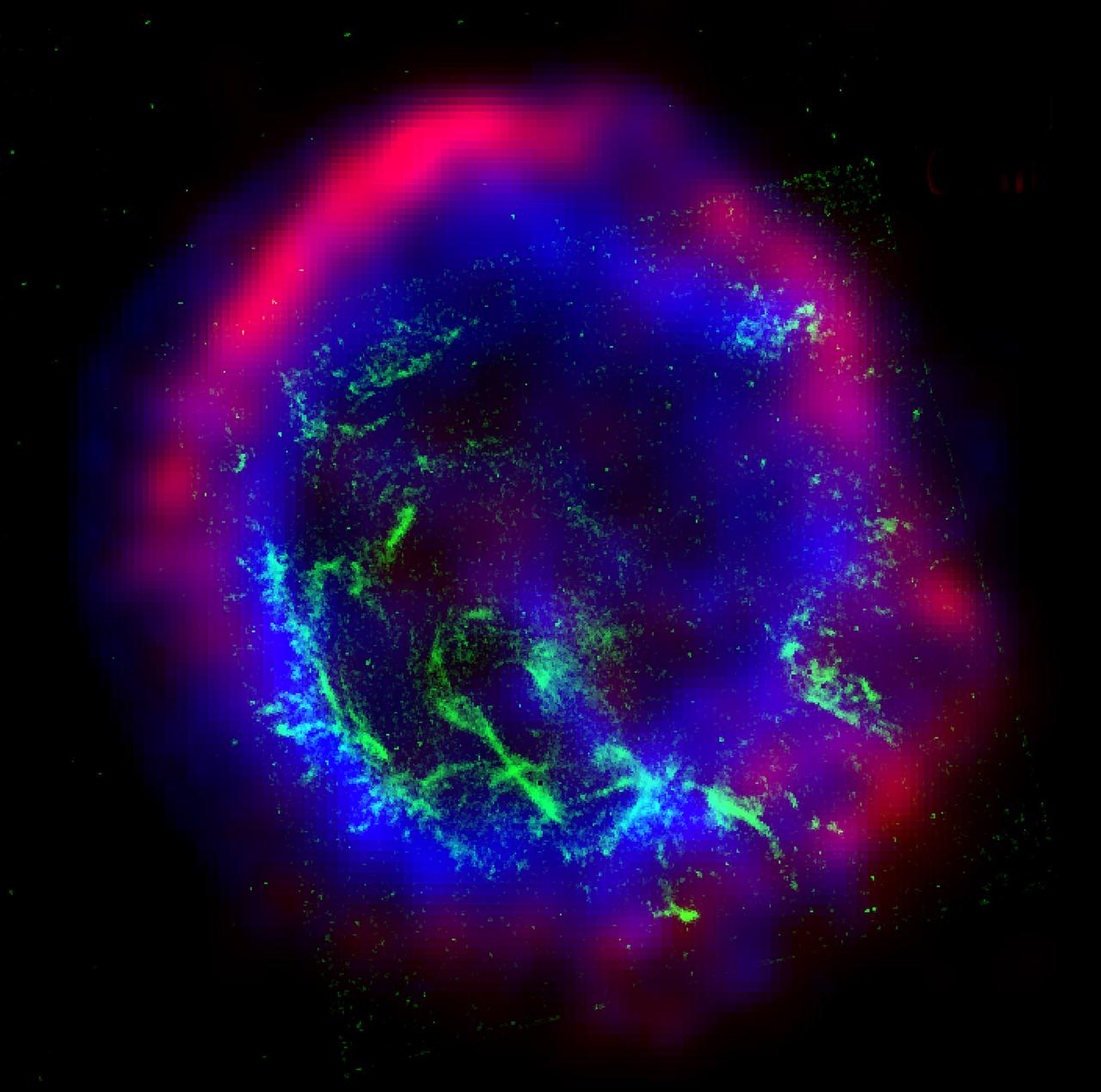
This image is a color composite of the supernova remnant E0102-72: x-ray (blue), optical (green), and radio (red). E0102-72 is the remnant of a star that exploded in a nearby galaxy known as the Small Magellanic Cloud. The star exploded outward at speeds in excess of 20 million kilometers per hour (12 million mph) and collided with surrounding gas. This collision produced two shock waves, or cosmic sonic booms, one traveling outward, and the other rebounding back into the material ejected by the explosion. The radio image, shown in red, was made using the Australia Telescope Compact Array. The radio waves are due to extremely high-energy electrons spiraling around magnetic field lines in the gas and trace the outward moving shock wave. The Chandra X-ray Observatory image, shown in blue, shows gas that has been heated to millions of degrees by the rebounding, or reverse shock wave. The x-ray data show that this gas is rich in oxygen and neon. These elements were created by nuclear reactions inside the star and hurled into space by the supernova. The Hubble Space Telescope optical image, shown in green, shows dense clumps of oxygen gas that have "cooled" to about 30,000 degrees. Photo Credit: X-ray (NASA/CXC/SAO); optical (NASA/HST): radio: (ACTA)

NASA image release January 12, 2010 NASA's Chandra X-ray Observatory reveals the complex X-ray-emitting central region of the Crab Nebula. This image is 9.8 light-years across. Chandra observations were not compatible with the study of the nebula's X-ray variations. To read more go to: <a href="http://geeked.gsfc.nasa.gov/?p=4945" rel="nofollow">geeked.gsfc.nasa.gov/?p=4945</a> Credit: NASA/CXC/SAO/F. Seward et al. <b><a href="http://www.nasa.gov/centers/goddard/home/index.html" rel="nofollow">NASA Goddard Space Flight Center</a></b> enables NASA’s mission through four scientific endeavors: Earth Science, Heliophysics, Solar System Exploration, and Astrophysics. Goddard plays a leading role in NASA’s accomplishments by contributing compelling scientific knowledge to advance the Agency’s mission. <b>Follow us on <a href="http://twitter.com/NASA_GoddardPix" rel="nofollow">Twitter</a></b> <b>Join us on <a href="http://www.facebook.com/pages/Greenbelt-MD/NASA-Goddard/395013845897?ref=tsd" rel="nofollow">Facebook</a></b>

Chandra X-Ray Observatory took this first x-ray picture of the Andromeda Galaxy (M31) on October 13, 1999. The blue dot in the center of the image is a "cool" million-degree x-ray source where a supermassive black hole with the mass of 30-million suns is located. The x-rays are produced by matter furneling toward the black hole. Numerous other hotter x-ray sources are also apparent. Most of these are probably due to x-ray binary systems, in which a neutron star or black hole is in close orbit around a normal star. While the gas falling into the central black hole is cool, it is only cool by comparison to the 100 other x-ray sources in the Andromeda Galaxy. To be detected by an x-ray telescope, the gas must have a temperature of more than a million degrees. The Andromeda Galaxy is our nearest neighbor spiral galaxy at a distance of two million light years. It is similar to our own Milky Way in size, shape, and also contains a supermassive black hole at the center. (Photo Credit: NASA/CXC/SAO/S. Murray, M. Garcia)
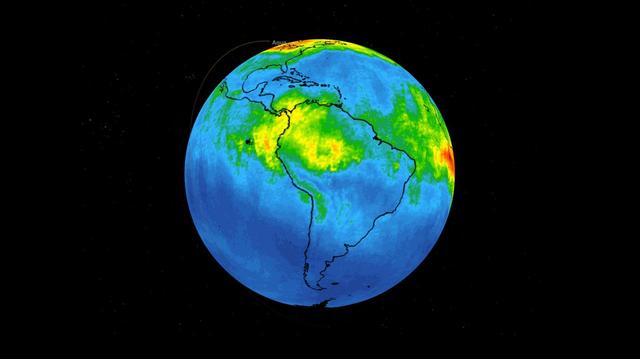
This time series shows carbon monoxide associated with fires from the Amazon region in Brazil from Aug. 8-22, 2019. The images show carbon monoxide at an hPA — a common unit of measurement for atmospheric pressure — of 500, or approximately 18,000 feet (5,500 meters) altitude, made with data collected from the Atmospheric Infrared Sounder (AIRS) on NASA's Aqua satellite. Each "day" in the series is made by averaging three day's-worth of measurements, a technique used to eliminate data gaps. As the series progresses, the carbon monoxide plume blooms in the northwest Amazon region then drifts south and east in a more concentrated plume toward Sao Paulo. Green indicates concentrations of carbon monoxide at approximately 100 parts per billion by volume (ppbv), yellow at approximately 120 ppbv, and dark red at approximately 160 ppbv. It must be noted that local values can be significantly higher. Carbon monoxide is a pollutant that can be transported large distances and persist in the atmosphere for about one month. It plays a role in both air pollution and climate change. Movie available at https://photojournal.jpl.nasa.gov/catalog/PIA23356
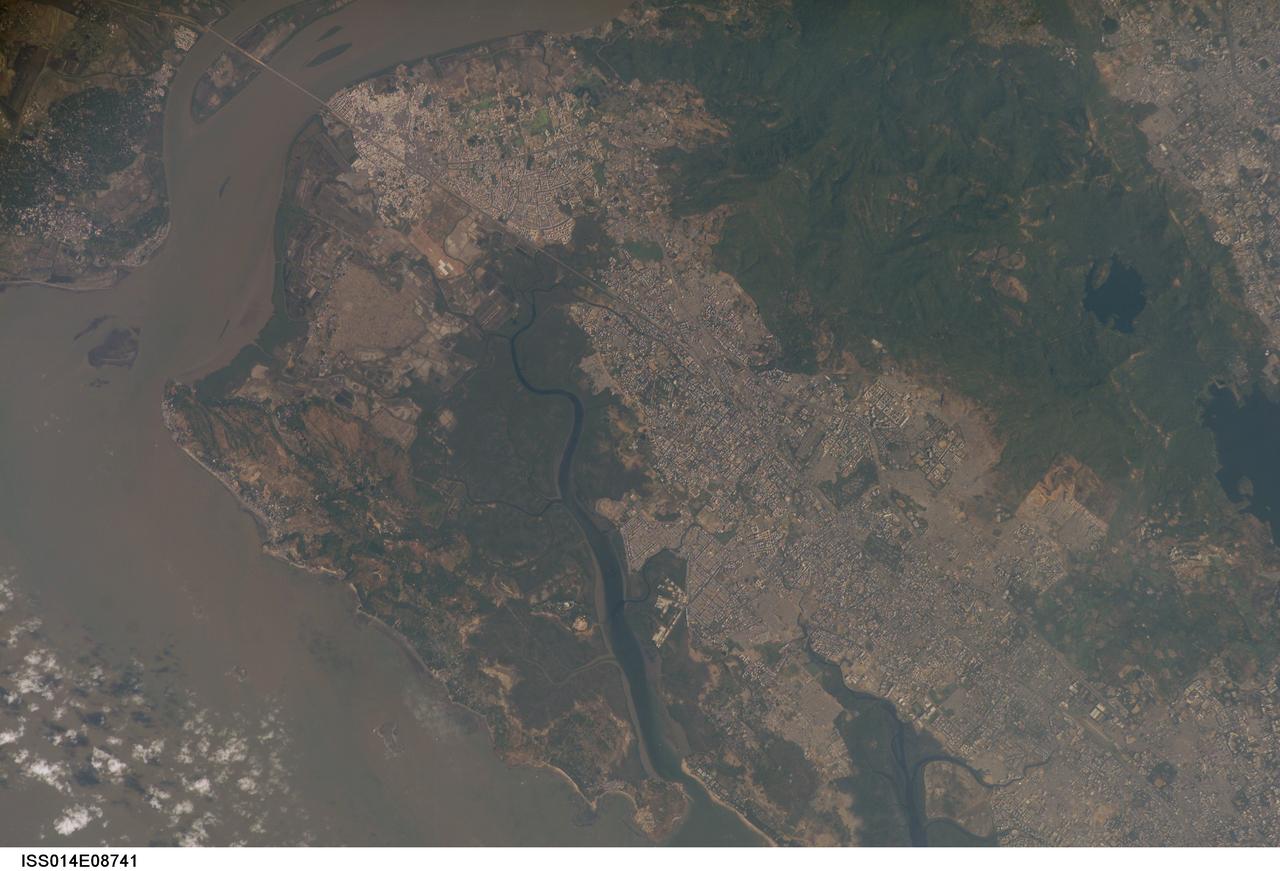
ISS014-E-08741 (28 Nov. 2006) --- Mumbai, India is featured in this image photographed by an Expedition 14 crewmember on the International Space Station. This view is one of three (frames 8741, 8742 and 8744) acquired within ten seconds of each other as the station passed over India. Mumbai (formerly known as Bombay) is a so-called mega city, with over 21 million people living in the greater Mumbai metropolitan region. Mega cities like Tokyo, New York, Sao Paulo, and Mumbai are also known as conurbations -- large contiguous areas of urban land cover formed from the growth and merging together of previously separate and distinct urban centers. The Mumbai conurbation includes several municipal entities including Bhiwandi, Kalyan, Thane, and Ulhasnagar. Located along the coast of western India on Salsette Island, Mumbai is generally considered to be the most modern of India's cities and is a major economic, transportation, and cultural center. Almost cloud-free conditions reveal the continuous urban land cover of the mega city extending north to south across Salsette Island -- a distance of nearly 50 kilometers. Sanjay Gandhi National Park, bordered on three sides by the urbanized area, is the largest national park in the world located within city limits. In addition to providing a refuge for native flora and fauna, the park also includes two lakes that form part of the Mumbai drinking water system.
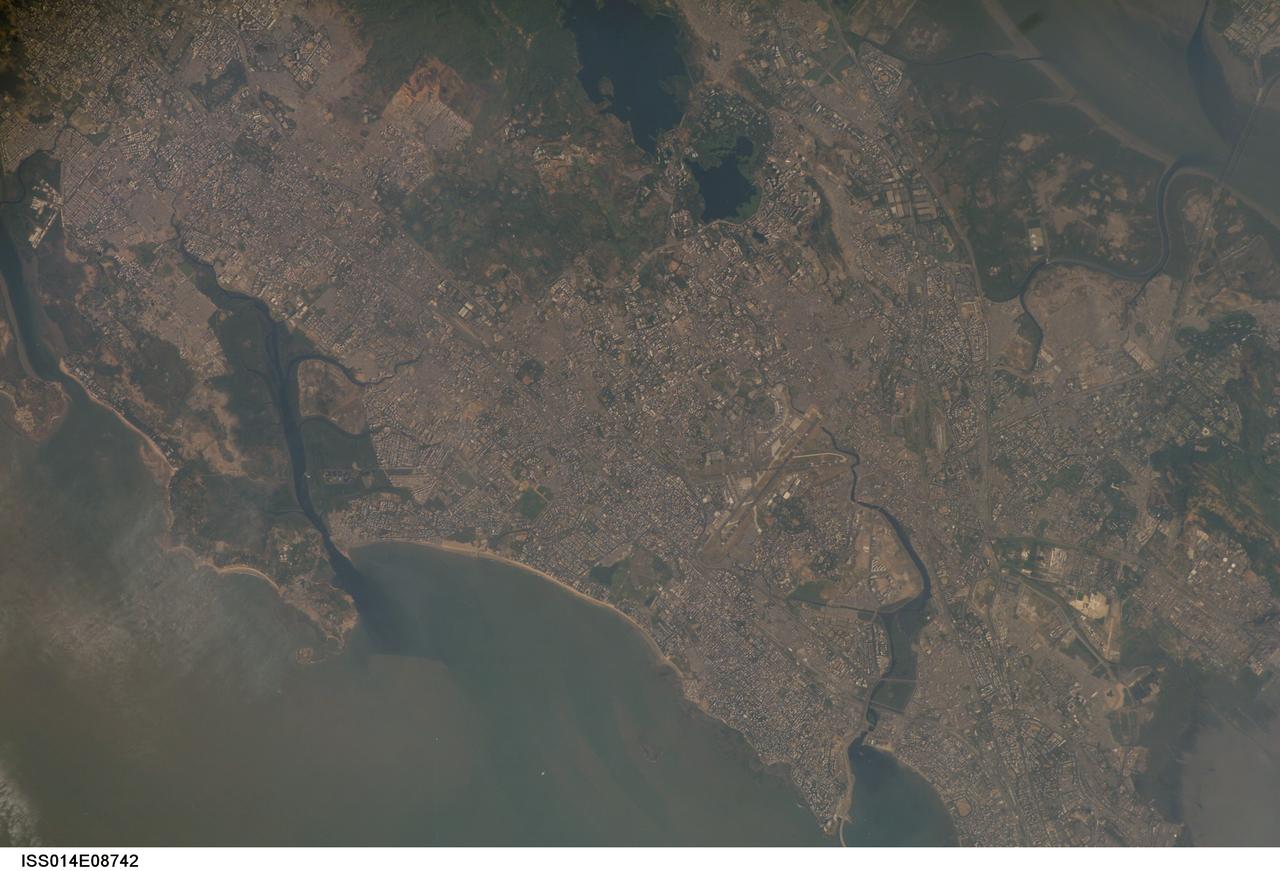
ISS014-E-08742 (28 Nov. 2006) --- Mumbai, India is featured in this image photographed by an Expedition 14 crewmember on the International Space Station. This view is one of three (frames 8741, 8742 and 8744) acquired within ten seconds of each other as the station passed over India. Mumbai (formerly known as Bombay) is a so-called mega city, with over 21 million people living in the greater Mumbai metropolitan region. Mega cities like Tokyo, New York, Sao Paulo, and Mumbai are also known as conurbations -- large contiguous areas of urban land cover formed from the growth and merging together of previously separate and distinct urban centers. The Mumbai conurbation includes several municipal entities including Bhiwandi, Kalyan, Thane, and Ulhasnagar. Located along the coast of western India on Salsette Island, Mumbai is generally considered to be the most modern of India's cities and is a major economic, transportation, and cultural center. Almost cloud-free conditions reveal the continuous urban land cover of the mega city extending north to south across Salsette Island -- a distance of nearly 50 kilometers. Sanjay Gandhi National Park (partially out of frame), bordered on three sides by the urbanized area, is the largest national park in the world located within city limits. In addition to providing a refuge for native flora and fauna, the park also includes two lakes that form part of the Mumbai drinking water system.
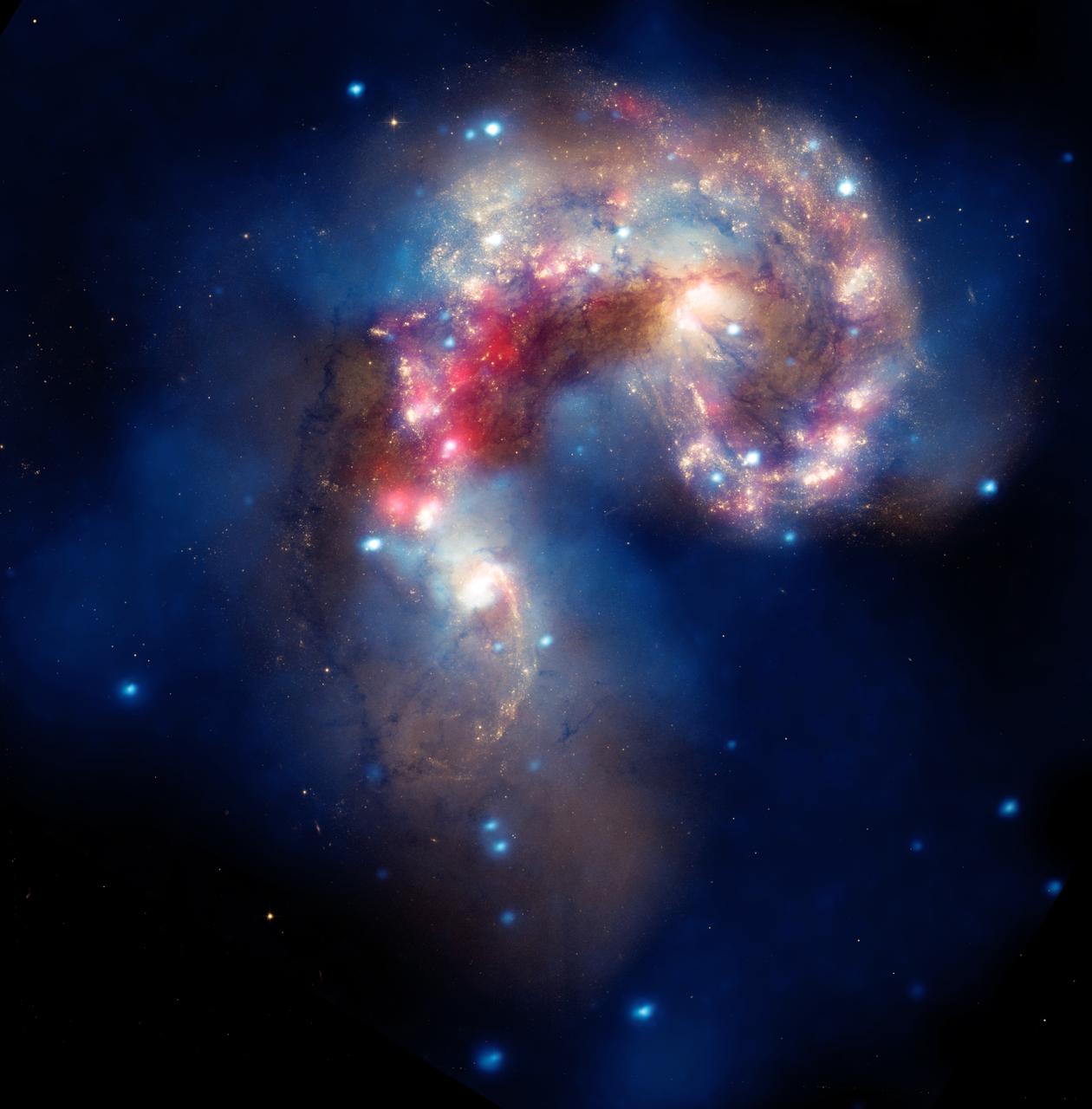
NASA image release August 5, 2010 A beautiful new image of two colliding galaxies has been released by NASA's Great Observatories. The Antennae galaxies, located about 62 million light-years from Earth, are shown in this composite image from the Chandra X-ray Observatory (blue), the Hubble Space Telescope (gold and brown), and the Spitzer Space Telescope (red). The Antennae galaxies take their name from the long antenna-like "arms," seen in wide-angle views of the system. These features were produced by tidal forces generated in the collision. The collision, which began more than 100 million years ago and is still occurring, has triggered the formation of millions of stars in clouds of dusts and gas in the galaxies. The most massive of these young stars have already sped through their evolution in a few million years and exploded as supernovas. The X-ray image from Chandra shows huge clouds of hot, interstellar gas that have been injected with rich deposits of elements from supernova explosions. This enriched gas, which includes elements such as oxygen, iron, magnesium, and silicon, will be incorporated into new generations of stars and planets. The bright, point-like sources in the image are produced by material falling onto black holes and neutron stars that are remnants of the massive stars. Some of these black holes may have masses that are almost one hundred times that of the Sun. The Spitzer data show infrared light from warm dust clouds that have been heated by newborn stars, with the brightest clouds lying in the overlapping region between the two galaxies. The Hubble data reveal old stars and star-forming regions in gold and white, while filaments of dust appear in brown. Many of the fainter objects in the optical image are clusters containing thousands of stars. The Chandra image was taken in December 1999. The Spitzer image was taken in December 2003. The Hubble image was taken in July 2004, and February 2005. Credit: NASA, ESA, SAO, CXC, JPL-Caltech, and STScI Acknowledgment: G. Fabbiano and Z. Wang (Harvard-Smithsonian CfA), and B. Whitmore (STScI)

This Chandra X-Ray Observatory image of the mysterious superstar Eta Carinae reveals a surprising hot irner core, creating more questions than answers for astronomers. The image shows three distinct structures: An outer, horseshoe shaped ring about 2 light-years in diameter, a hot inner core about 3 light-months in diameter, and a hot central source less than a light-month in diameter which may contain the superstar. In 1 month, light travels a distance of approximately 489 billion miles (about 788 billion kilometers). All three structures are thought to represent shock waves produced by matter rushing away from the superstar at supersonic speeds. The temperature of the shock-heated gas ranges from 60 million degrees Kelvin in the central regions to 7 million degrees Kelvin on the outer structure. Eta Carinae is one of the most enigmatic and intriguing objects in our galaxy. Between 1837 and 1856, it increased dramatically in brightness to become the most prominent star in the sky except for Sirius, even through it is 7,500 light-years away, more than 80 times the distance to Sirius. This "Great Eruption," as it is called, had an energy comparable to a supernova, yet did not destroy the star, which faded to become a dim star, invisible to the naked eye. Since 1940, Eta Carinae has begun to brighten again, becoming visible to the naked eye. Photo credit: NASA/CXC/SAO
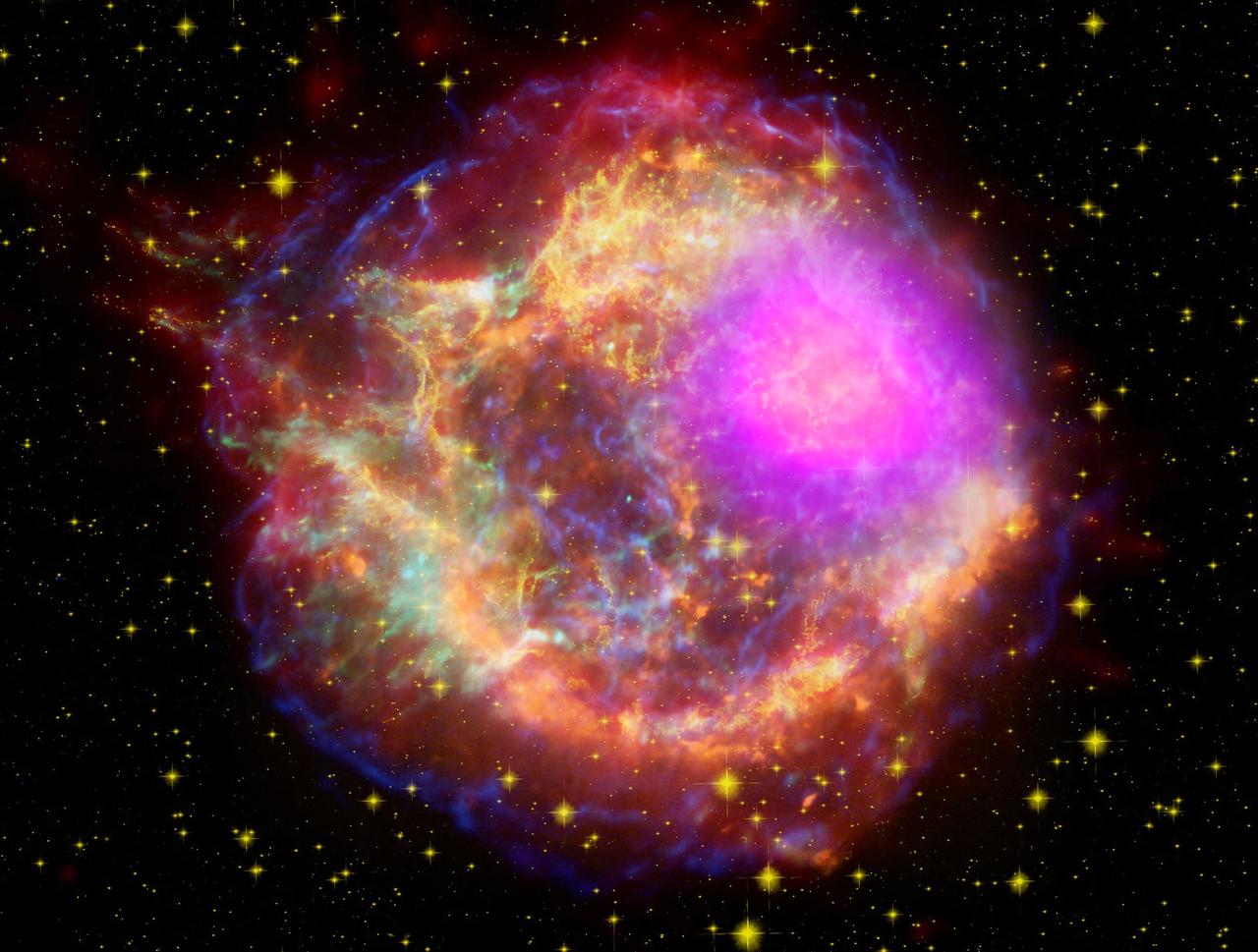
NASA's Fermi Closes on Source of Cosmic Rays New images from NASA's Fermi Gamma-ray Space Telescope show where supernova remnants emit radiation a billion times more energetic than visible light. The images bring astronomers a step closer to understanding the source of some of the universe's most energetic particles -- cosmic rays. This composite shows the Cassiopeia A supernova remnant across the spectrum: Gamma rays (magenta) from NASA's Fermi Gamma-ray Space Telescope; X-rays (blue, green) from NASA's Chandra X-ray Observatory; visible light (yellow) from the Hubble Space Telescope; infrared (red) from NASA's Spitzer Space Telescope; and radio (orange) from the Very Large Array near Socorro, N.M. Credit: NASA/DOE/Fermi LAT Collaboration, CXC/SAO/JPL-Caltech/Steward/O. Krause et al., and NRAO/AUI For more information: <a href="http://www.nasa.gov/mission_pages/GLAST/news/cosmic-rays-source.html" rel="nofollow">www.nasa.gov/mission_pages/GLAST/news/cosmic-rays-source....</a> <b><a href="http://www.nasa.gov/centers/goddard/home/index.html" rel="nofollow">NASA Goddard Space Flight Center</a></b> is home to the nation's largest organization of combined scientists, engineers and technologists that build spacecraft, instruments and new technology to study the Earth, the sun, our solar system, and the universe. <b>Follow us on <a href="http://twitter.com/NASA_GoddardPix" rel="nofollow">Twitter</a></b> <b>Join us on <a href="http://www.facebook.com/pages/Greenbelt-MD/NASA-Goddard/395013845897?ref=tsd" rel="nofollow">Facebook</a><b> </b></b>
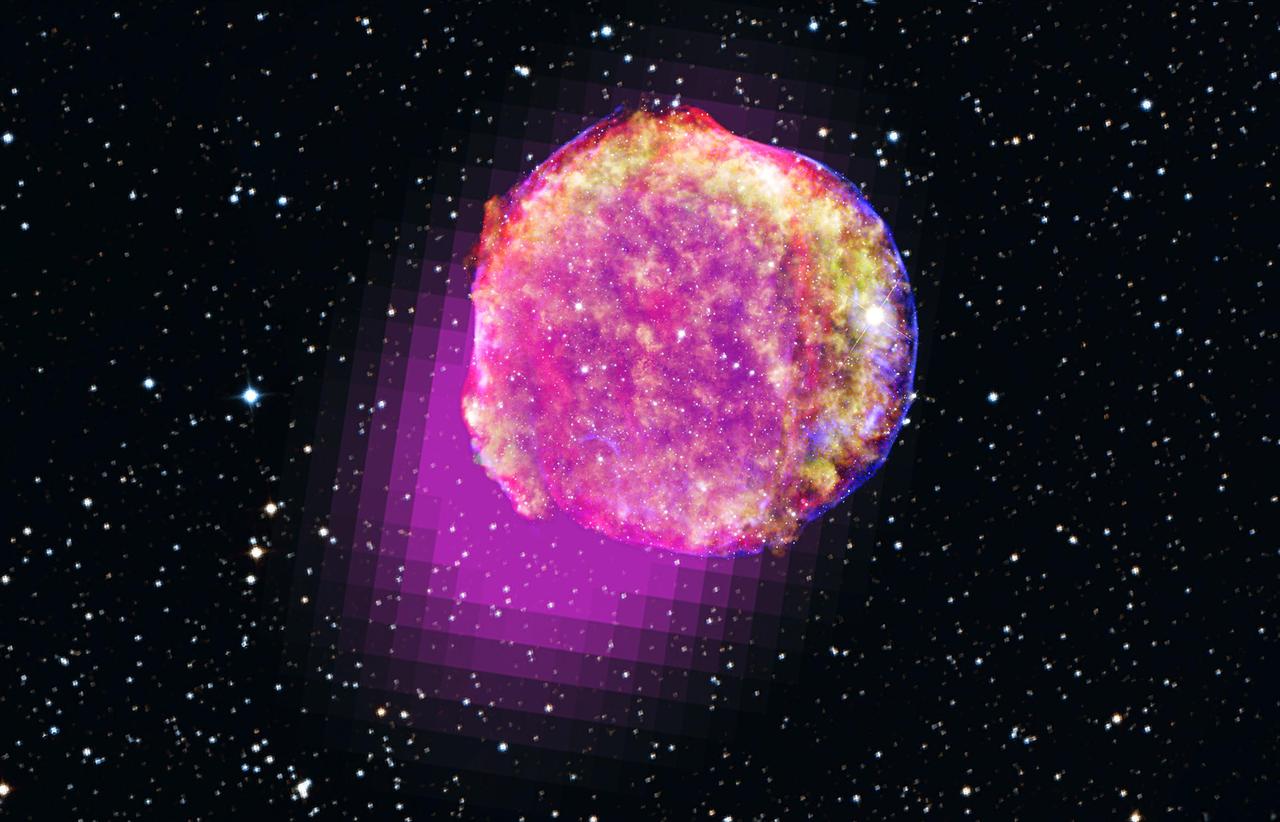
NASA image relase December 13, 2011 Gamma-rays detected by Fermi's LAT show that the remnant of Tycho's supernova shines in the highest-energy form of light. This portrait of the shattered star includes gamma rays (magenta), X-rays (yellow, green, and blue), infrared (red) and optical data. Credit: Gamma ray, NASA/DOE/Fermi LAT Collaboration; X-ray, NASA/CXC/SAO; Infrared, NASA/JPL-Caltech; Optical, MPIA, Calar Alto, O. Krause et al. and DSS To read more go to: <a href="http://www.nasa.gov/mission_pages/GLAST/news/tycho-star.html" rel="nofollow">www.nasa.gov/mission_pages/GLAST/news/tycho-star.html</a> <b><a href="http://www.nasa.gov/audience/formedia/features/MP_Photo_Guidelines.html" rel="nofollow">NASA image use policy.</a></b> <b><a href="http://www.nasa.gov/centers/goddard/home/index.html" rel="nofollow">NASA Goddard Space Flight Center</a></b> enables NASA’s mission through four scientific endeavors: Earth Science, Heliophysics, Solar System Exploration, and Astrophysics. Goddard plays a leading role in NASA’s accomplishments by contributing compelling scientific knowledge to advance the Agency’s mission. <b>Follow us on <a href="http://twitter.com/NASA_GoddardPix" rel="nofollow">Twitter</a></b> <b>Like us on <a href="http://www.facebook.com/pages/Greenbelt-MD/NASA-Goddard/395013845897?ref=tsd" rel="nofollow">Facebook</a></b> <b>Find us on <a href="http://instagrid.me/nasagoddard/?vm=grid" rel="nofollow">Instagram</a></b>
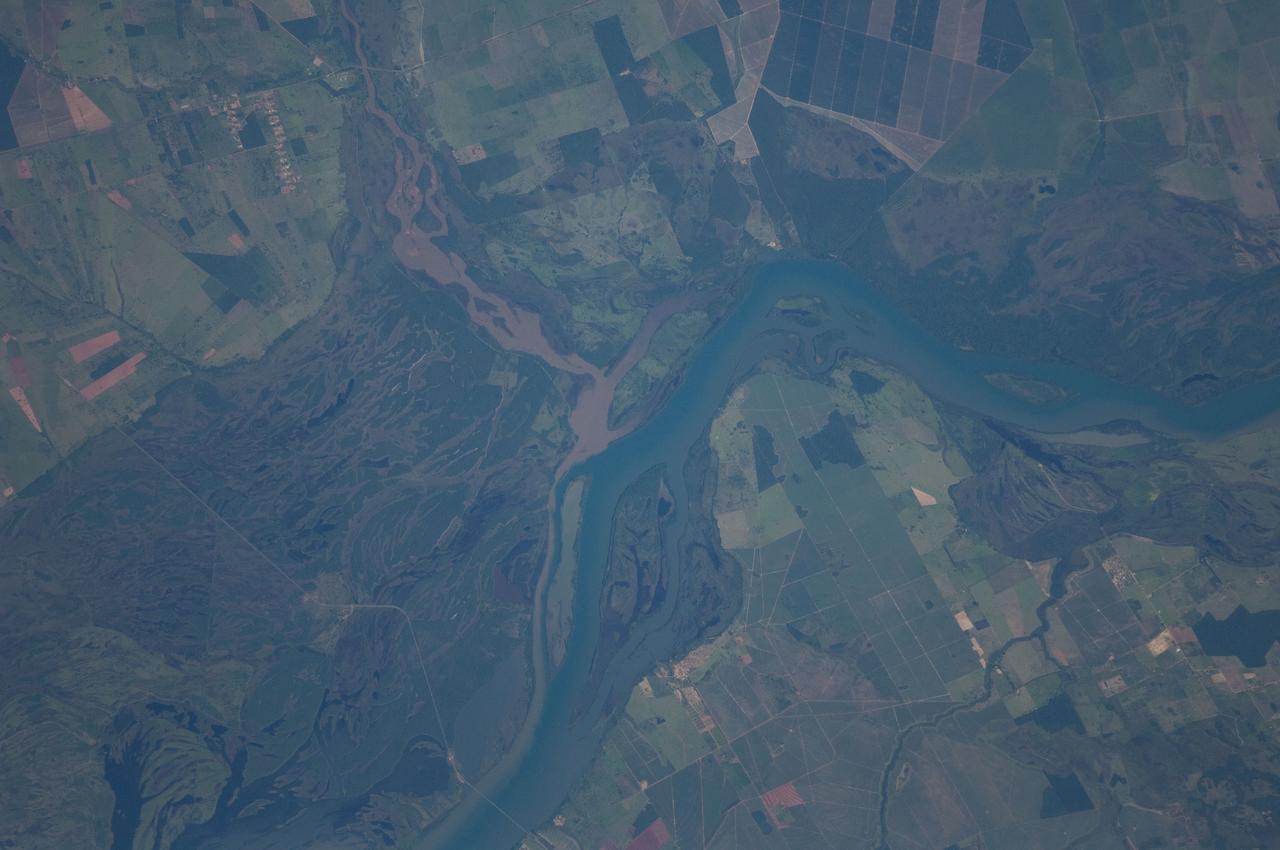
ISS030-E-090012 (5 Feb. 2012) --- The Parana River floodplain along the Mato Grosso–Sao Paulo border, Brazil is featured in this image photographed by an Expedition 30 crew member on the International Space Station. The Parana River appears as a wide, blue strip across this photograph, with muddy brown water of the smaller Verde River entering from the northwest (top left). An extensive wetland (dark green) occupies most of the left half of the image, where the floodplain of the river reaches a width of 11 kilometers. The thin line of a road crossing the floodplain also gives a sense of scale. Above the Parana–Verde confluence (center) the floodplain is much narrower. The floodplain is generated by sediments delivered by both rivers. Evidence for this is that the entire surface of the floodplain is crisscrossed by the wider traces of former Parana R. channels as well as numerous narrower traces of the Verde R. The floodplains along both rivers are bordered by numerous rectangular agricultural fields. Dominant crops along this part of the Parana River are coffee, corn and cotton. Turbid water, such as that in the Verde River, is common in most rivers that drain plowed agricultural land as some topsoil is washed into local rivers after rains. A long tendril of brown water extends from the Verde R. into the main channel of the Parana River where it hugs the west bank, remaining unmixed for many kilometers. This effectively shows the direction of river flow from orbit (right to left for the Parana, upper left to center for the Verde).
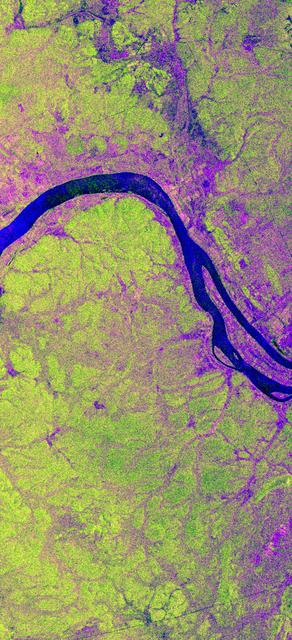
This is an X-band image showing seasonal changes at the hydrological test site of Bebedouro in Brazil. The image is centered at 9 degrees south latitude and 40.2 degrees west longitude. This image was acquired by the Spaceborne Imaging Radar-C and X-band Synthetic Aperture Radar (SIR-C/X-SAR) aboard the space shuttle Endeavour on April 10, 1994, during the first flight of the radar system, and on October 1, 1994, during the second mission. The swath width is approximately 16.5 kilometers (10.5 miles) wide. The image channels have the following color assignments: red represents data acquired on April 10; green represents data acquired on October 1; blue corresponds to the ratio of the two data sets. Agriculture plays an important economic and social role in Brazil. One of the major problems related to Brazilian agriculture is estimating the size of planting areas and their productivity. Due to cloud cover and the rainy season, which occurs from November through April, optical and infrared Earth observations are seldom used to survey the region. An additional goal of monitoring this region is to watch the floodplains of rivers like Rio Sao Francisco in order to determine suitable locations for additional agricultural fields. This area belongs to the semi-arid northeastern region of Brazil, where estimates have suggested that about 10 times more land could be used for agriculture, including some locations which could be used for irrigation projects. Monitoring of soil moisture during the important summer crop season is of high priority for the future development and productivity of this region. In April the area was covered with vegetation because of the moisture of the soil and only small differences could be seen in X-band data. In October the run-off channels of this hilly region stand out quite clearly because the greenish areas indicated much less soil moisture and water content in plants. http://photojournal.jpl.nasa.gov/catalog/PIA01733
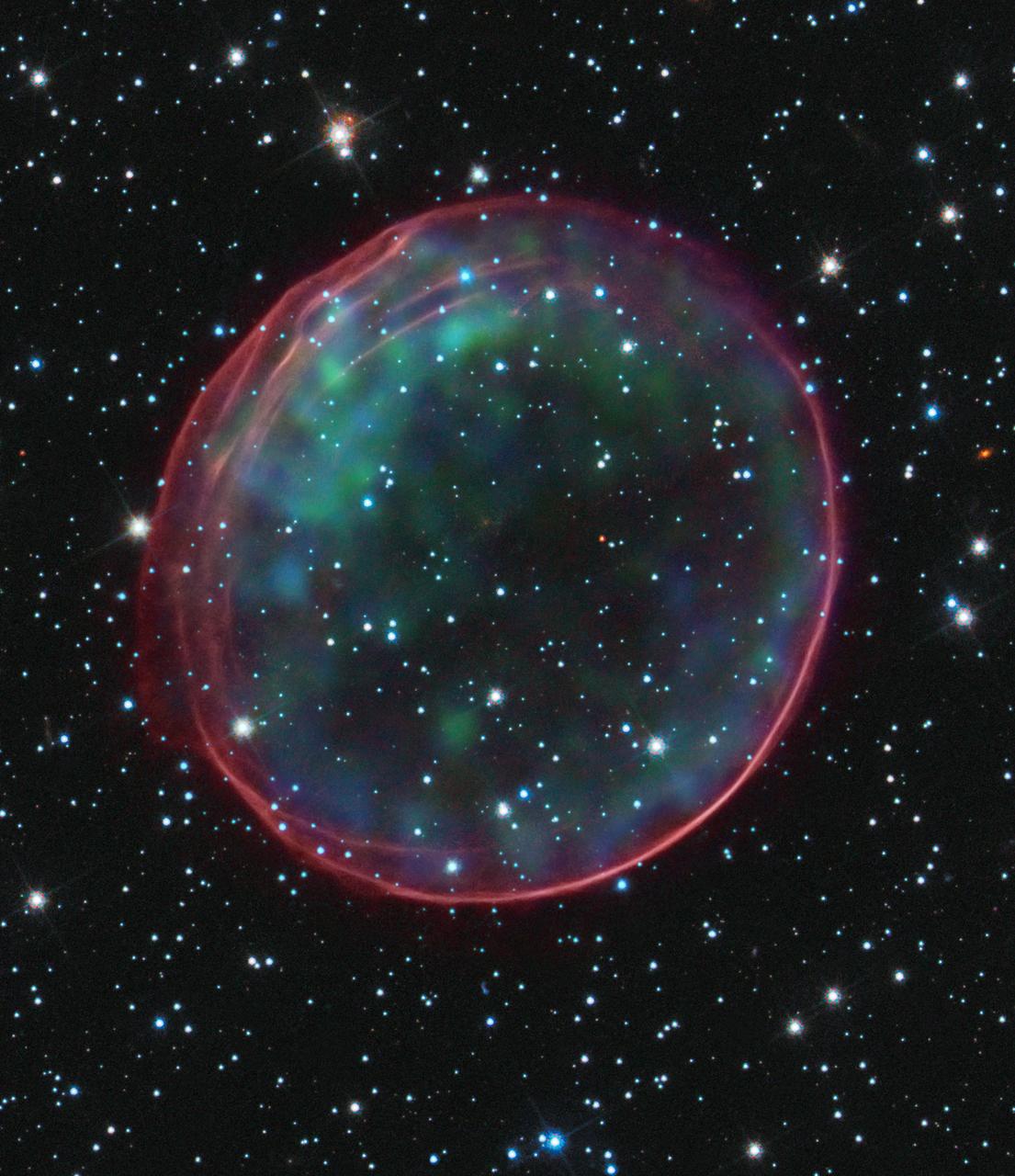
NASA image release January 11, 2012 Using NASA's Hubble Space Telescope, astronomers have solved a longstanding mystery on the type of star, or so-called progenitor, that caused a supernova in a nearby galaxy. The finding yields new observational data for pinpointing one of several scenarios that could trigger such outbursts. Based on previous observations from ground-based telescopes, astronomers knew that a kind of supernova called a Type Ia created a remnant named SNR 0509-67.5, which lies 170,000 light-years away in the Large Magellanic Cloud galaxy. The type of system that leads to this kind of supernova explosion has long been a high importance problem with various proposed solutions but no decisive answer. All these solutions involve a white dwarf star that somehow increases in mass to the highest limit. Astronomers failed to find any companion star near the center of the remnant, and this rules out all but one solution, so the only remaining possibility is that this one Type Ia supernova came from a pair of white dwarfs in close orbit. To read more go to: <a href="http://www.nasa.gov/mission_pages/hubble/science/supernova-source.html" rel="nofollow">www.nasa.gov/mission_pages/hubble/science/supernova-sourc...</a> Image Credit: NASA, ESA, CXC, SAO, the Hubble Heritage Team (STScI/AURA), and J. Hughes (Rutgers University) <b><a href="http://www.nasa.gov/audience/formedia/features/MP_Photo_Guidelines.html" rel="nofollow">NASA image use policy.</a></b> <b><a href="http://www.nasa.gov/centers/goddard/home/index.html" rel="nofollow">NASA Goddard Space Flight Center</a></b> enables NASA’s mission through four scientific endeavors: Earth Science, Heliophysics, Solar System Exploration, and Astrophysics. Goddard plays a leading role in NASA’s accomplishments by contributing compelling scientific knowledge to advance the Agency’s mission. <b>Follow us on <a href="http://twitter.com/NASA_GoddardPix" rel="nofollow">Twitter</a></b> <b>Like us on <a href="http://www.facebook.com/pages/Greenbelt-MD/NASA-Goddard/395013845897?ref=tsd" rel="nofollow">Facebook</a></b> <b>Find us on <a href="http://instagrid.me/nasagoddard/?vm=grid" rel="nofollow">Instagram</a></b>
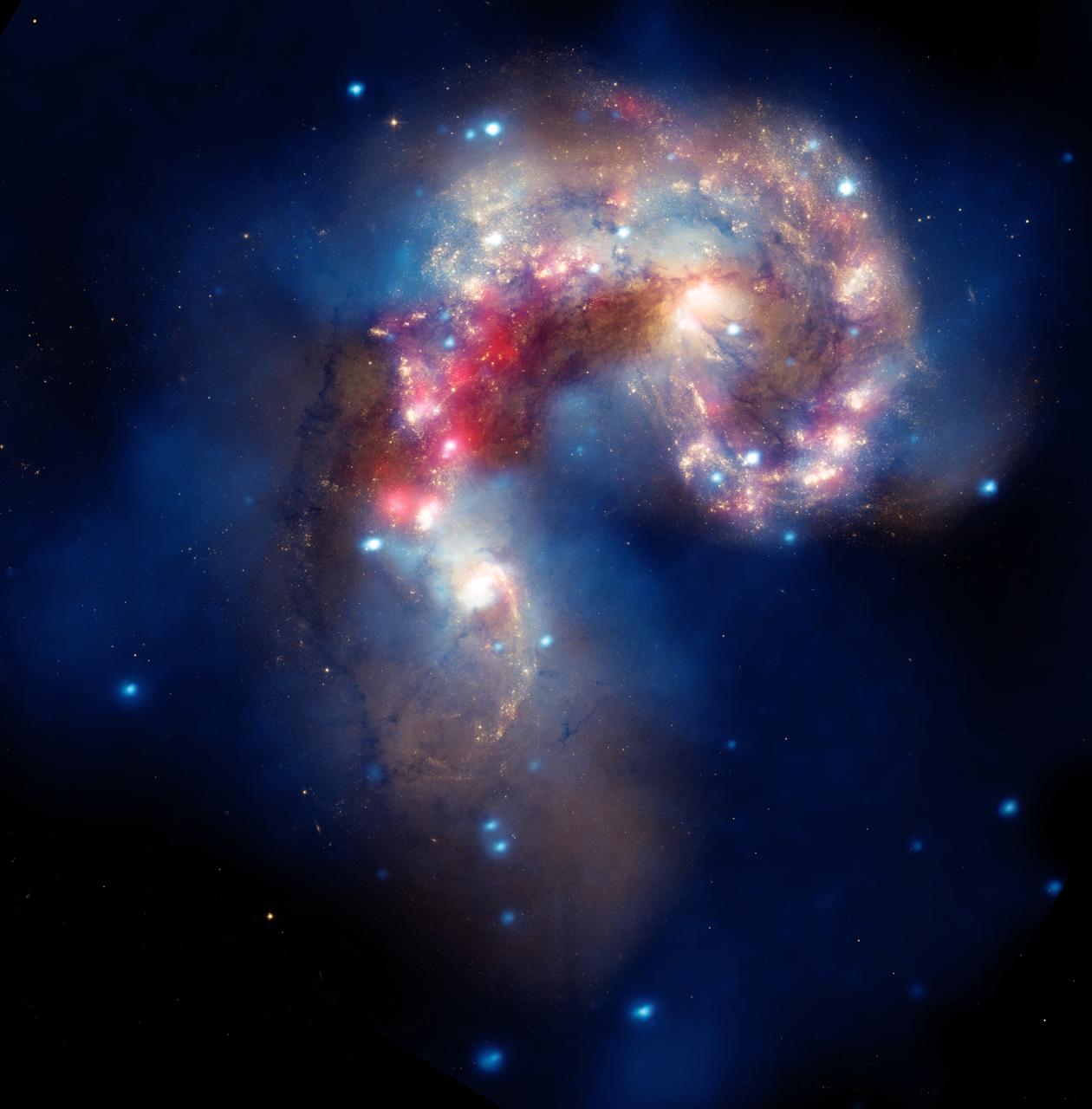
NASA image release August 5, 2010 A beautiful new image of two colliding galaxies has been released by NASA's Great Observatories. The Antennae galaxies, located about 62 million light-years from Earth, are shown in this composite image from the Chandra X-ray Observatory (blue), the Hubble Space Telescope (gold and brown), and the Spitzer Space Telescope (red). The Antennae galaxies take their name from the long antenna-like "arms," seen in wide-angle views of the system. These features were produced by tidal forces generated in the collision. The collision, which began more than 100 million years ago and is still occurring, has triggered the formation of millions of stars in clouds of dusts and gas in the galaxies. The most massive of these young stars have already sped through their evolution in a few million years and exploded as supernovas. The X-ray image from Chandra shows huge clouds of hot, interstellar gas that have been injected with rich deposits of elements from supernova explosions. This enriched gas, which includes elements such as oxygen, iron, magnesium, and silicon, will be incorporated into new generations of stars and planets. The bright, point-like sources in the image are produced by material falling onto black holes and neutron stars that are remnants of the massive stars. Some of these black holes may have masses that are almost one hundred times that of the Sun. The Spitzer data show infrared light from warm dust clouds that have been heated by newborn stars, with the brightest clouds lying in the overlapping region between the two galaxies. The Hubble data reveal old stars and star-forming regions in gold and white, while filaments of dust appear in brown. Many of the fainter objects in the optical image are clusters containing thousands of stars. The Chandra image was taken in December 1999. The Spitzer image was taken in December 2003. The Hubble image was taken in July 2004, and February 2005. To read more go to: <a href="http://www.nasa.gov/mission_pages/chandra/multimedia/antennae.html" rel="nofollow">www.nasa.gov/mission_pages/chandra/multimedia/antennae.html</a> <b><a href="http://www.nasa.gov/centers/goddard/home/index.html" rel="nofollow">NASA Goddard Space Flight Center</a></b> is home to the nation's largest organization of combined scientists, engineers and technologists that build spacecraft, instruments and new technology to study the Earth, the sun, our solar system, and the universe. <b>Follow us on <a href="http://twitter.com/NASA_GoddardPix" rel="nofollow">Twitter</a></b> <b>Join us on <a href="http://www.facebook.com/pages/Greenbelt-MD/NASA-Goddard/395013845897?ref=tsd" rel="nofollow">Facebook</a><b></b></b> Credit: NASA, ESA, SAO, CXC, JPL-Caltech, and STScI Acknowledgment: G. Fabbiano and Z. Wang (Harvard-Smithsonian CfA), and B. Whitmore (STScI)
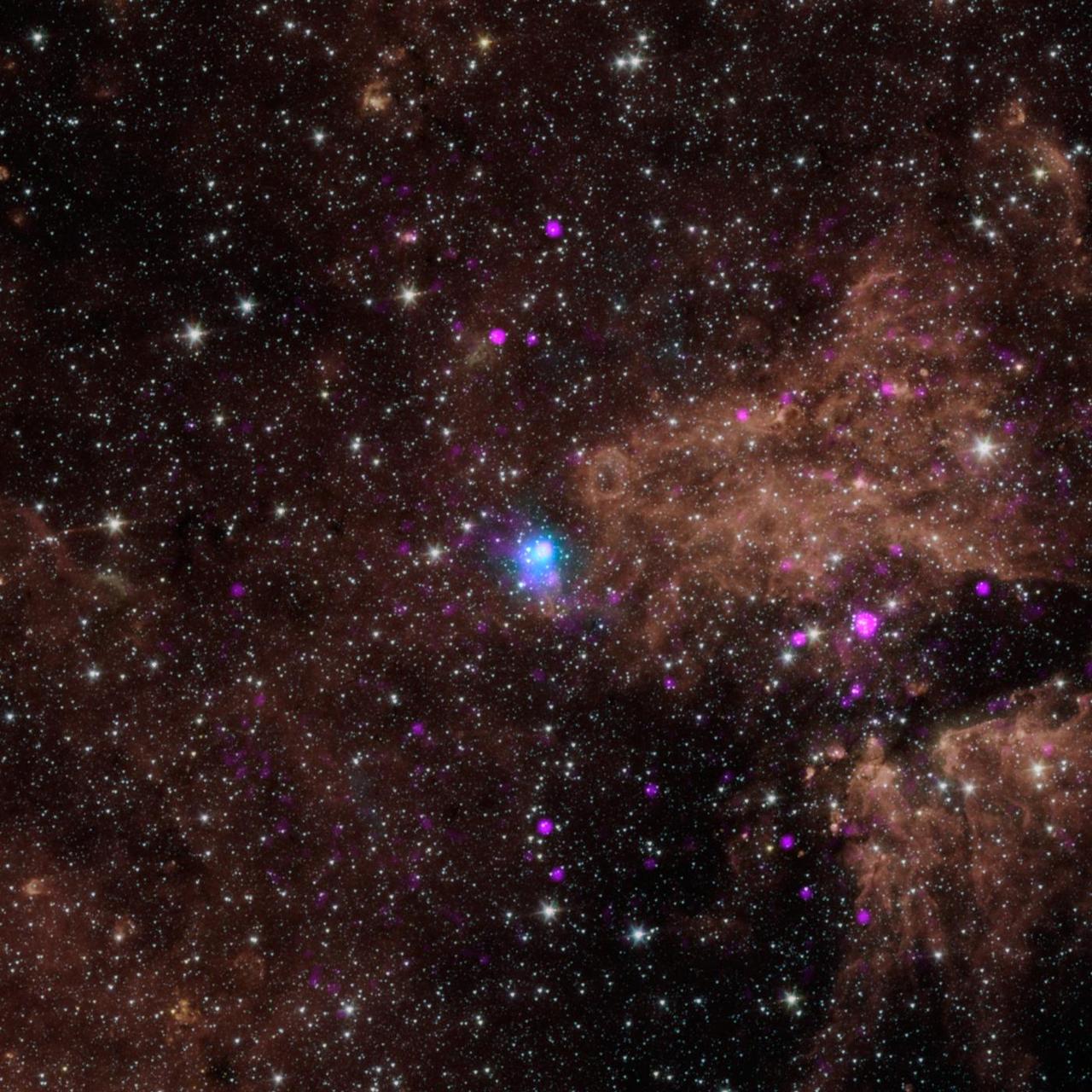
The blue dot in this image marks the spot of an energetic pulsar -- the magnetic, spinning core of star that blew up in a supernova explosion. NASA NuSTAR discovered the pulsar by identifying its telltale pulse.
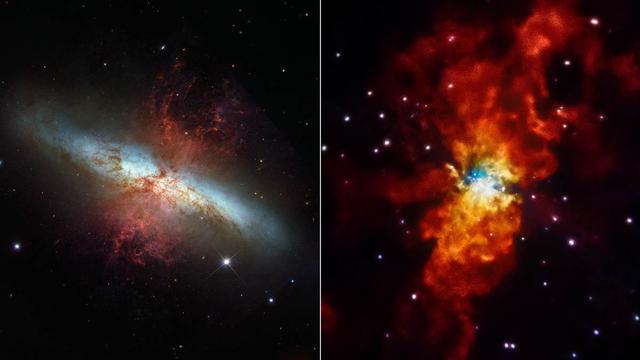
The comparison from NASA Hubble telescope and Chandra X-ray Observatory highlights how different the universe can look when viewed in other wavelengths of light. M82 is located 12 million light-years away in the Ursa Major constellation.
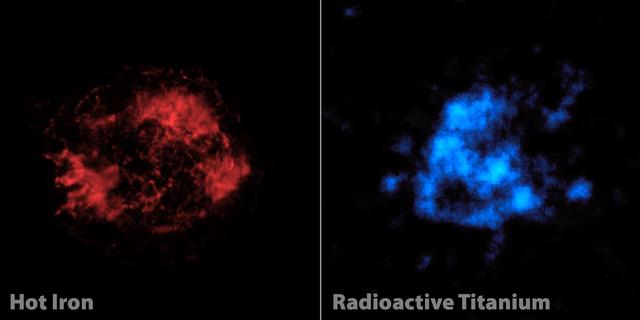
When astronomers first looked at images of a supernova remnant called Cassiopeia A, captured by NASA NuSTAR. The mystery of Cassiopeia A Cas A, a massive star that exploded in a supernova more than 11,000 years ago continues to confound scientists.
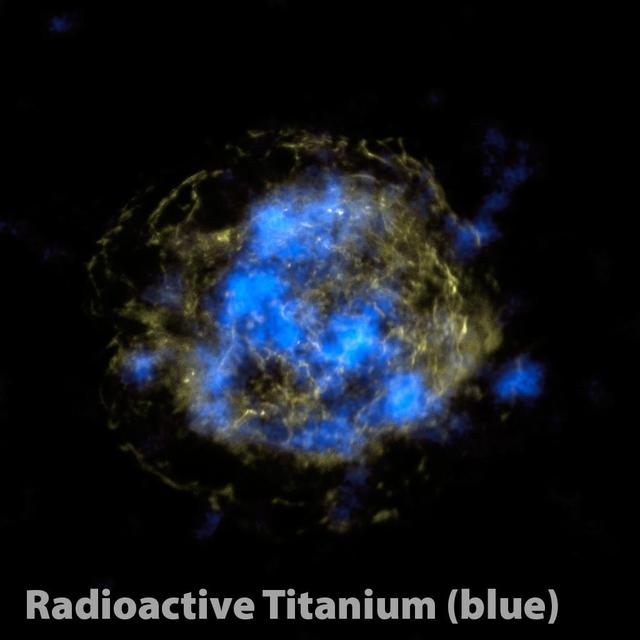
NASA NuSTAR has, for the first time, imaged the radioactive guts of a supernova remnant, the leftover remains of a star that exploded. The NuSTAR data are blue, and show high-energy X-rays.
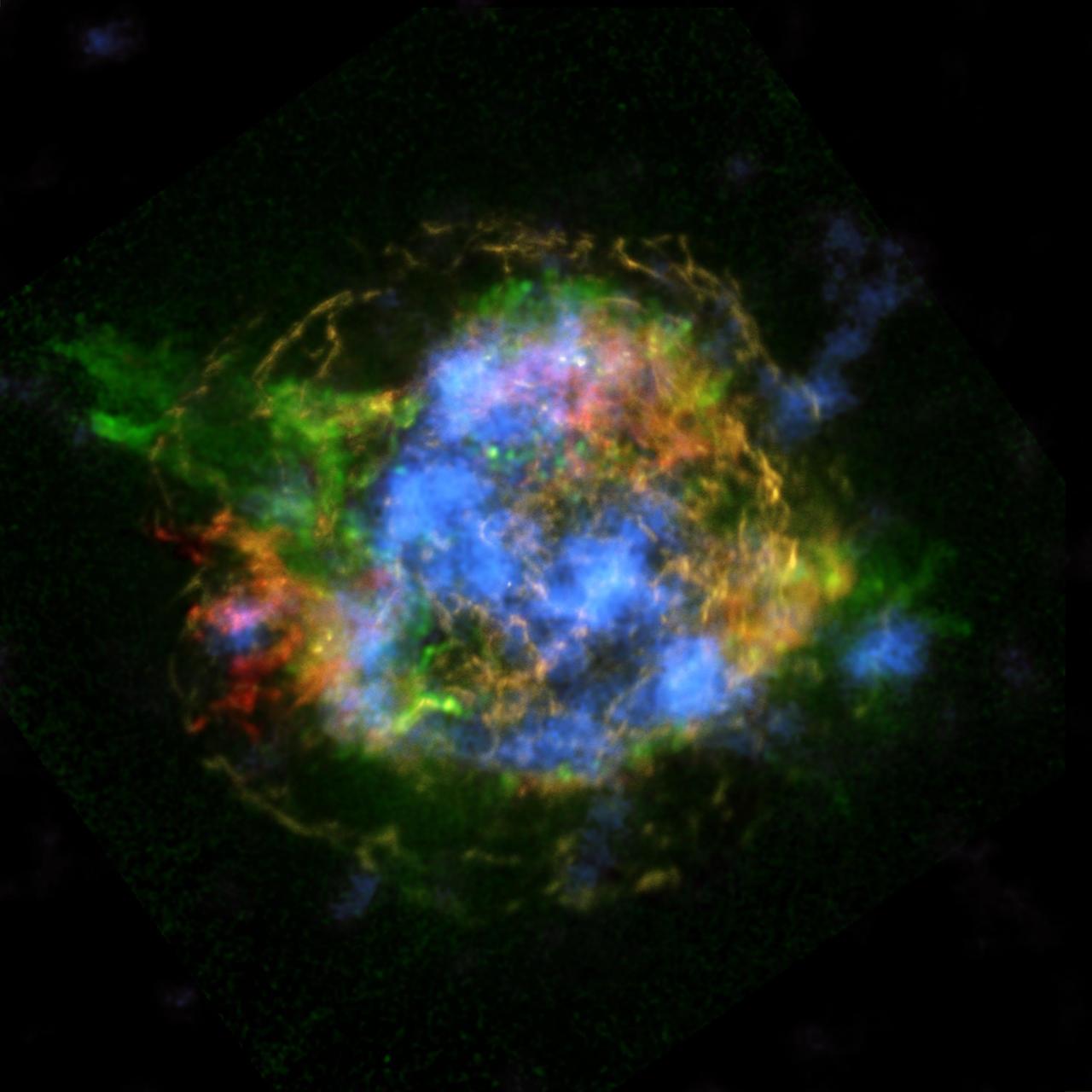
This is the first map of radioactivity in a supernova remnant, the blown-out bits and pieces of a massive star that exploded. The blue color shows radioactive material mapped in high-energy X-rays using NASA NuSTAR.

A massive star left, which has created elements as heavy as iron in its interior, blows up in a tremendous explosion middle, scattering its outer layers in a structure called a supernova remnant right.
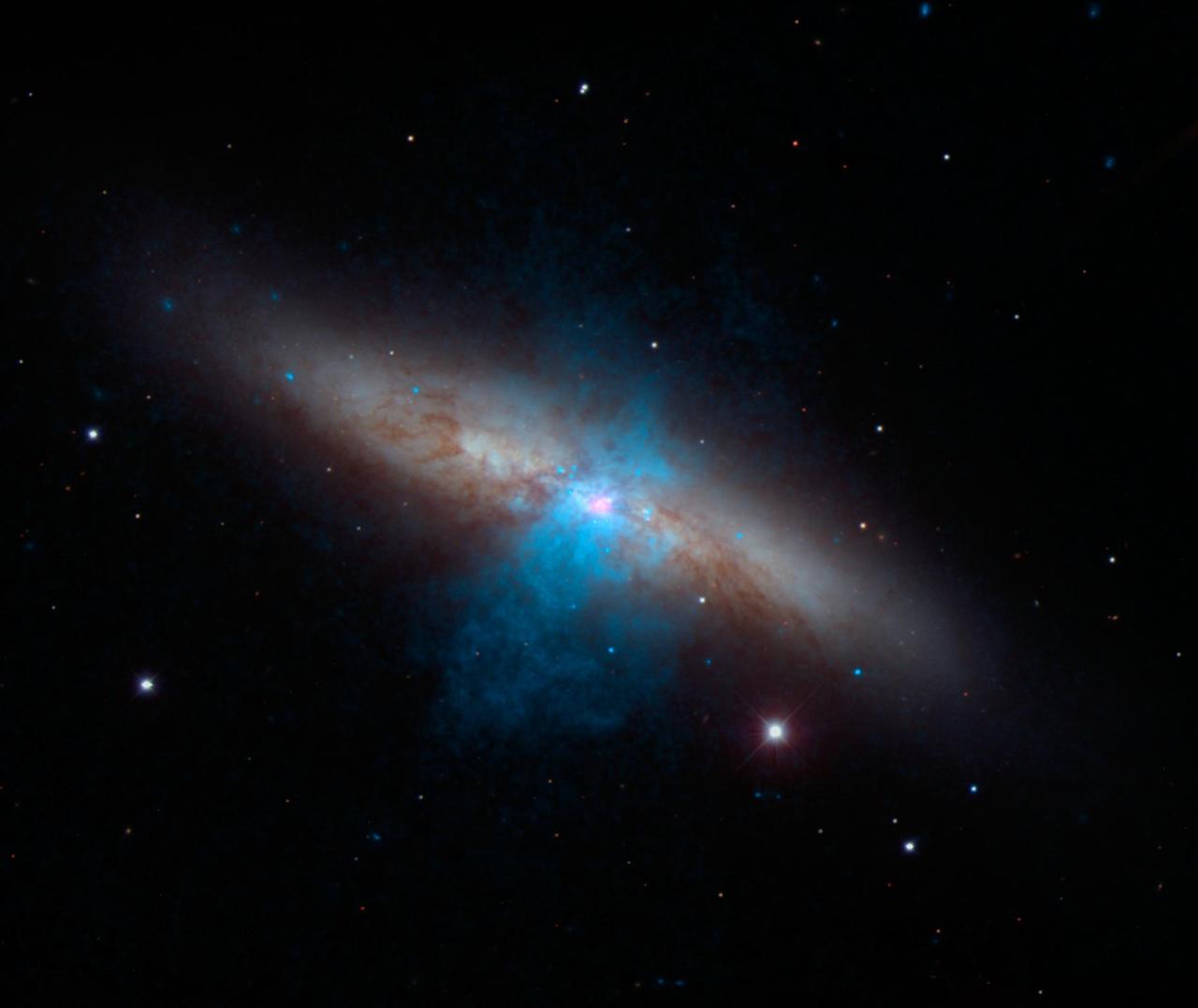
The bulk of a galaxy called Messier 82 M82, or the Cigar galaxy, is seen in visible-light data captured by the National Optical Astronomy Observatory 2.1-meter telescope at Kitt Peak in Arizona.
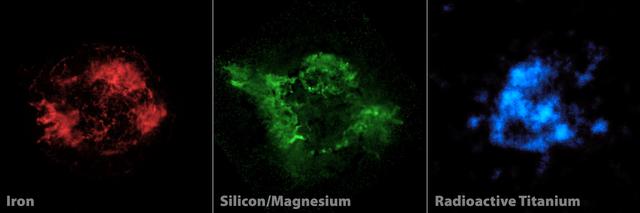
NASA NuSTAR is complementing previous observations of the Cassiopeia A supernova remnant red and green by providing the first maps of radioactive material forged in the fiery explosion blue.

A SpaceX Falcon 9 rocket lifts off from Space Launch Complex 40 at Cape Canaveral Air Force Station in Florida, carrying NASA's Transiting Exoplanet Survey Satellite (TESS). Liftoff was at 6:51 p.m. EDT. TESS will search for planets outside of our solar system. The mission will find exoplanets that periodically block part of the light from their host stars, events called transits. The satellite will survey the nearest and brightest stars for two years to search for transiting exoplanets.

NASA and science investigators from MIT participate in a science briefing for the agency's Transiting Exoplanet Survey Satellite (TESS) in the Press Site auditorium at Kennedy Space Center in Florida. Padi Boyd, TESS Guest Investigator Program lead, NASA’s Goddard Space Flight Center, answered questions during the briefing. TESS is the next step in the search for planets outside of our solar system. The mission will find exoplanets that periodically block part of the light from their host stars, events called transits. The satellite will survey the nearest and brightest stars for two years to search for transiting exoplanets. TESS will launch on a SpaceX Falcon 9 rocket from Space Launch Complex 40 at Cape Canaveral Air Force Station no earlier than 6:32 p.m. EDT on Monday, April 16.
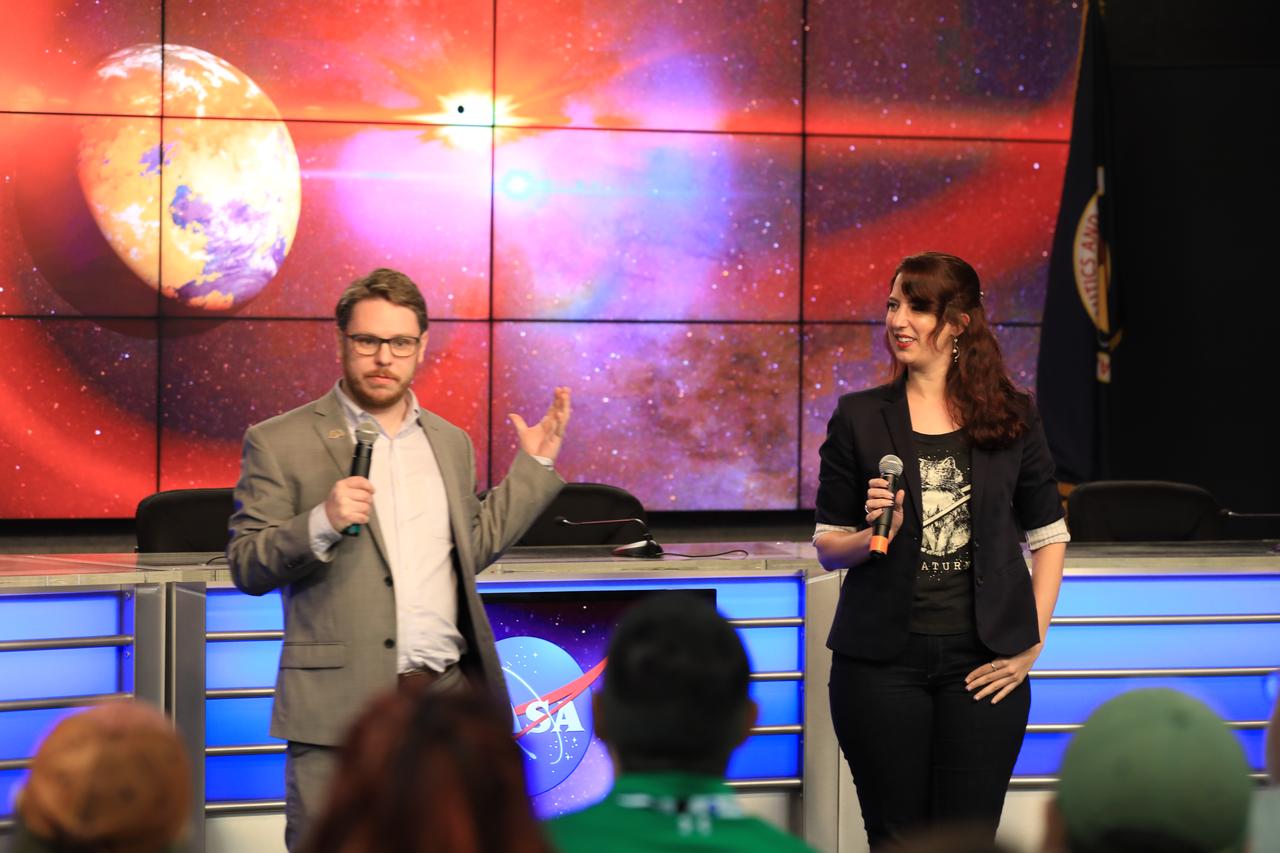
NASA and industry leaders speak to NASA Social participants about the agency's Transiting Exoplanet Survey Satellite (TESS) in the Press Site auditorium at Kennedy Space Center in Florida. Speaking to the group, from left are Tom Barclay, TESS scientist, NASA’s Goddard Space Flight Center, and Jenn Burt, Torres Postdoctoral Fellow, Massachusetts Institute of Technology. TESS is the next step in the search for planets outside of our solar system. The mission will find exoplanets that periodically block part of the light from their host stars, events called transits. The satellite will survey the nearest and brightest stars for two years to search for transiting exoplanets. TESS will launch on a SpaceX Falcon 9 rocket from Space Launch Complex 40 at Cape Canaveral Air Force Station no earlier than 6:32 p.m. EDT on Monday, April 16.
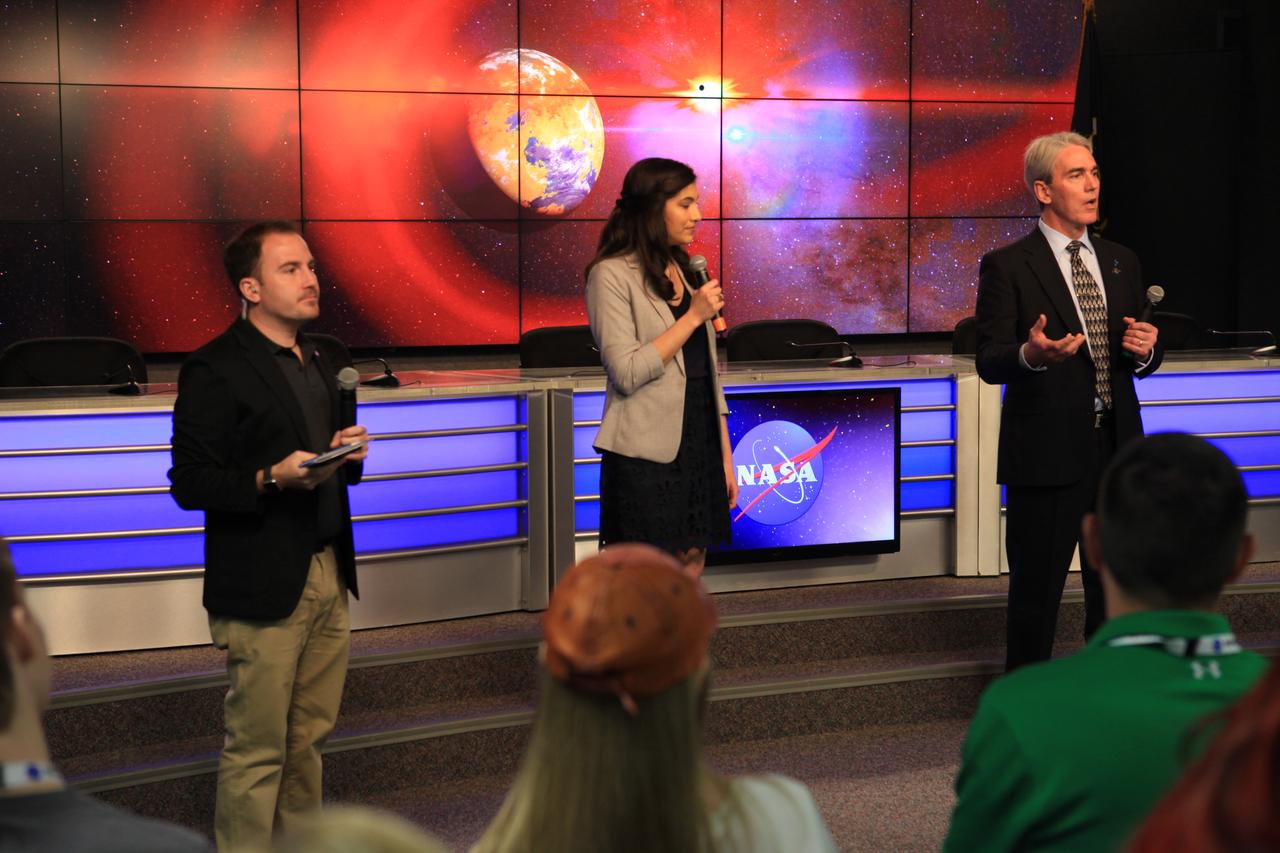
NASA and industry leaders speak to NASA Social participants about the agency's Transiting Exoplanet Survey Satellite (TESS) in the Press Site auditorium at Kennedy Space Center in Florida. Speaking to the group from center are Natalia Guerrero, TESS researcher, Massachusetts Institute of Technology, and Robert Lockwood, TESS Spacecraft Program Manager, Orbital ATK. At far left is Jason Townsend, NASA Communications. TESS is the next step in the search for planets outside of our solar system. The mission will find exoplanets that periodically block part of the light from their host stars, events called transits. The satellite will survey the nearest and brightest stars for two years to search for transiting exoplanets. TESS will launch on a SpaceX Falcon 9 rocket from Space Launch Complex 40 at Cape Canaveral Air Force Station no earlier than 6:32 p.m. EDT on Monday, April 16.

NASA and industry leaders speak to NASA Social participants about the agency's Transiting Exoplanet Survey Satellite (TESS) in the Press Site auditorium at Kennedy Space Center in Florida. Speaking to the group is Jessie Christiansen, staff scientiest, NASA Exoplaneet Science Institute, California Institute of Technology. TESS is the next step in the search for planets outside of our solar system. The mission will find exoplanets that periodically block part of the light from their host stars, events called transits. The satellite will survey the nearest and brightest stars for two years to search for transiting exoplanets. TESS will launch on a SpaceX Falcon 9 rocket from Space Launch Complex 40 at Cape Canaveral Air Force Station no earlier than 6:32 p.m. EDT on Monday, April 16.
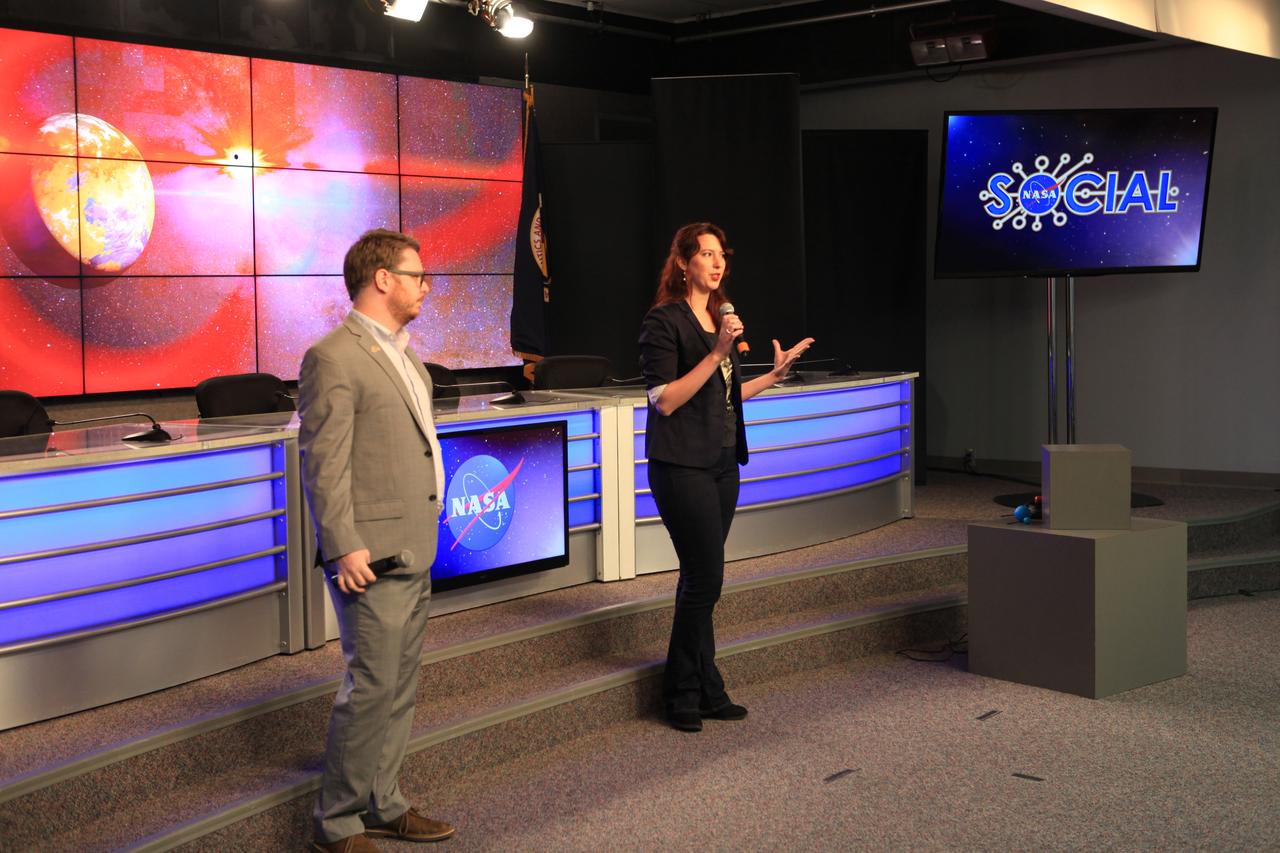
NASA and industry leaders speak to NASA Social participants about the agency's Transiting Exoplanet Survey Satellite (TESS) in the Press Site auditorium at Kennedy Space Center in Florida. Speaking to the group from left are Tom Barclay, TESS scientist, NASA’s Goddard Space Flight Center, and Jenn Burt, Torres Postdoctoral Fellow, Massachusetts Institute of Technology. TESS is the next step in the search for planets outside of our solar system. The mission will find exoplanets that periodically block part of the light from their host stars, events called transits. The satellite will survey the nearest and brightest stars for two years to search for transiting exoplanets. TESS will launch on a SpaceX Falcon 9 rocket from Space Launch Complex 40 at Cape Canaveral Air Force Station no earlier than 6:32 p.m. EDT on Monday, April 16.
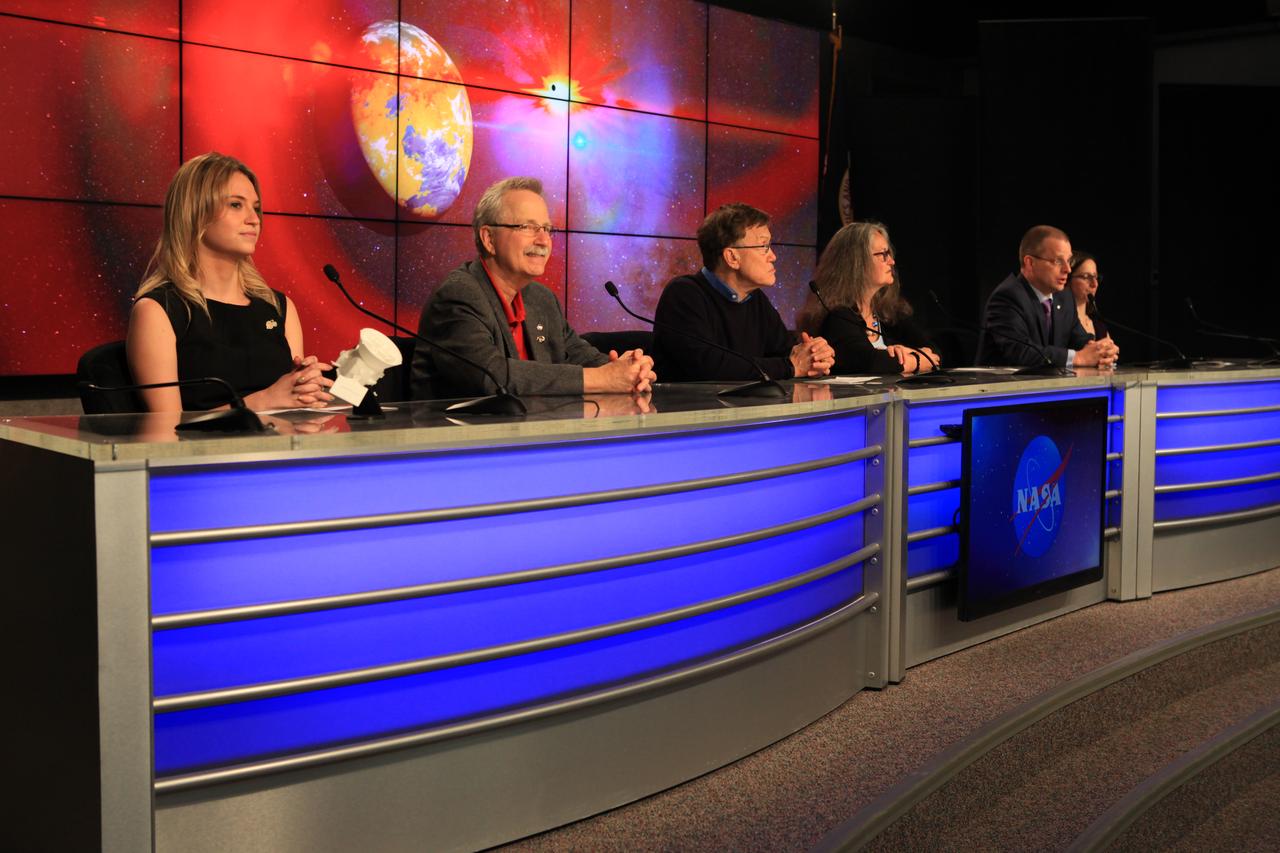
NASA and science investigators from MIT participate in a science briefing for the agency's Transiting Exoplanet Survey Satellite (TESS) in the Press Site auditorium at Kennedy Space Center in Florida. From left are moderator Claire Saravia, NASA Communications; Paul Hertz, Astrophysics Division director, NASA Headquarters; George Ricker, TESS principal investigator, Massachusetts Institute of Technology; Padi Boyd, TESS Guest Investigator Program lead, NASA’s Goddard Space Flight Center; Stephen Rinehart, TESS Project scientist, NASA’s Goddard Space Flight Center; and Diana Dragomir, NASA Hubble Postdoctoral Fellow, Massachusetts Institute of Technology. TESS is the next step in the search for planets outside of our solar system. The mission will find exoplanets that periodically block part of the light from their host stars, events called transits. The satellite will survey the nearest and brightest stars for two years to search for transiting exoplanets. TESS will launch on a SpaceX Falcon 9 rocket from Space Launch Complex 40 at Cape Canaveral Air Force Station no earlier than 6:32 p.m. EDT on Monday, April 16.

NASA and science investigators from MIT participate in a science briefing for the agency's Transiting Exoplanet Survey Satellite (TESS) in the Press Site auditorium at Kennedy Space Center in Florida. Stephen Rinehart, TESS Project scientist, NASA’s Goddard Space Flight Center, answered questions during the briefing. TESS is the next step in the search for planets outside of our solar system. The mission will find exoplanets that periodically block part of the light from their host stars, events called transits. The satellite will survey the nearest and brightest stars for two years to search for transiting exoplanets. TESS will launch on a SpaceX Falcon 9 rocket from Space Launch Complex 40 at Cape Canaveral Air Force Station no earlier than 6:32 p.m. EDT on Monday, April 16.
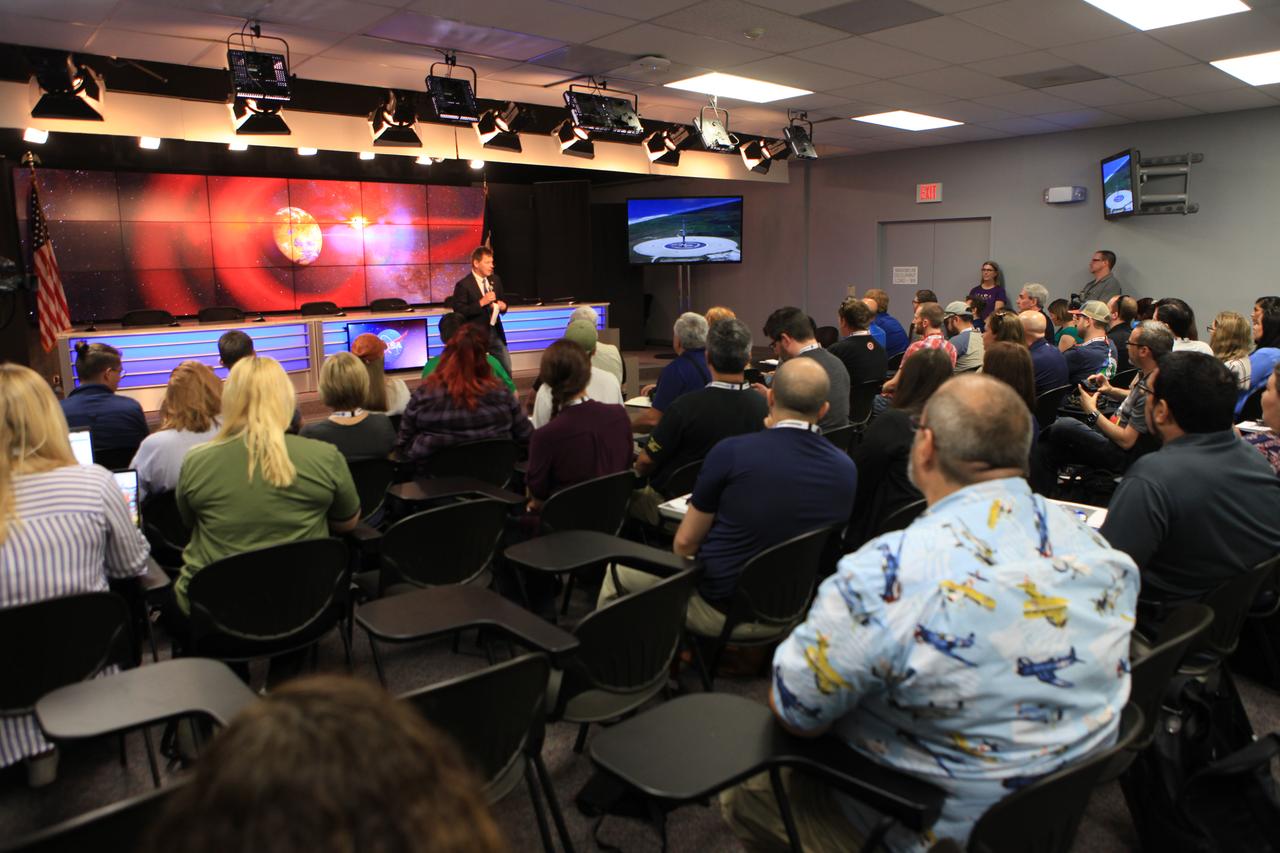
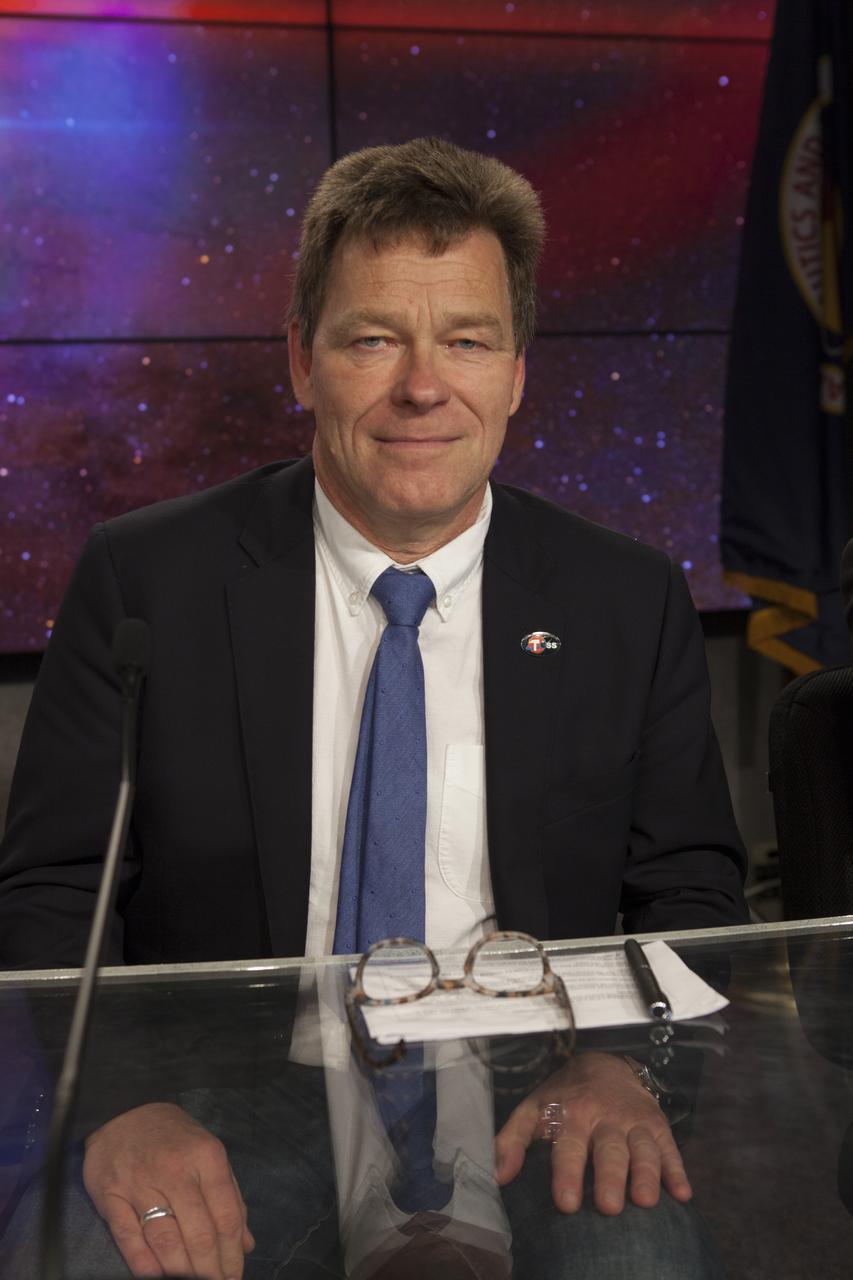
NASA and industry leaders speak to NASA Social participants about the agency's Transiting Exoplanet Survey Satellite (TESS) in the Press Site auditorium at Kennedy Space Center in Florida. Speaking to the group is Hans Koenigsmann, vice president of Build and Flight Reliability at SpaceX. TESS is the next step in the search for planets outside of our solar system. The mission will find exoplanets that periodically block part of the light from their host stars, events called transits. The satellite will survey the nearest and brightest stars for two years to search for transiting exoplanets. TESS will launch on a SpaceX Falcon 9 rocket from Space Launch Complex 40 at Cape Canaveral Air Force Station no earlier than 6:32 p.m. EDT on Monday, April 16.
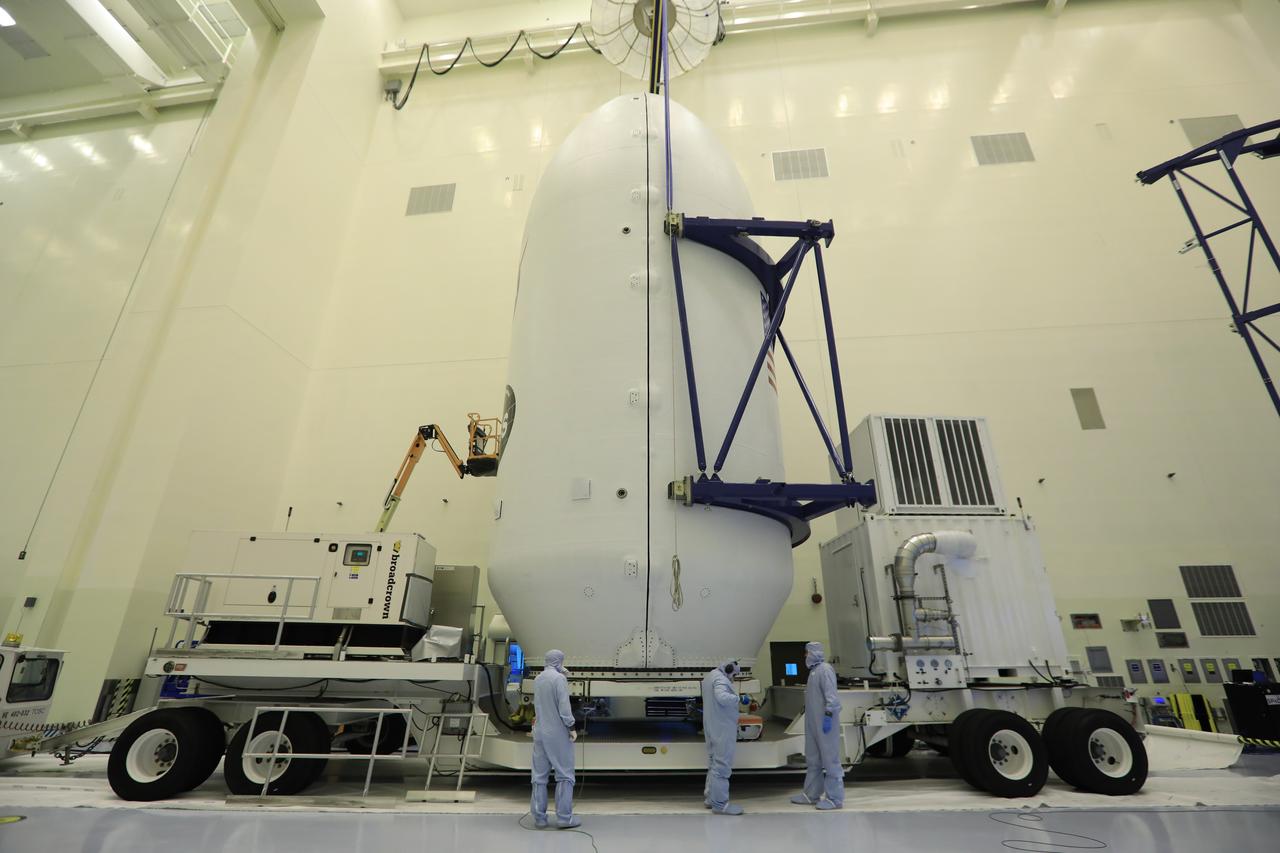
Inside the Payload Hazardous Servicing Facility at NASA's Kennedy Space Center in Florida, the SpaceX payload fairing containing the agency's Transiting Exoplanet Survey Satellite (TESS) is secured onto a transporter. The fairing will be moved to Space Launch Complex 40 at Cape Canaveral Air Force Station. TESS is scheduled to launch on the SpaceX Falcon 9 rocket at 6:32 p.m. EDT on April 16. The satellite is the next step in NASA's search for planets outside our solar system, known as exoplanets. TESS is a NASA Astrophysics Explorer mission led and operated by MIT in Cambridge, Massachusetts, and managed by NASA’s Goddard Space Flight Center in Greenbelt, Maryland. Dr. George Ricker of MIT’s Kavli Institute for Astrophysics and Space Research serves as principal investigator for the mission. Additional partners include Orbital ATK, NASA’s Ames Research Center, the Harvard-Smithsonian Center for Astrophysics and the Space Telescope Science Institute. More than a dozen universities, research institutes and observatories worldwide are participants in the mission. NASA’s Launch Services Program is responsible for launch management.
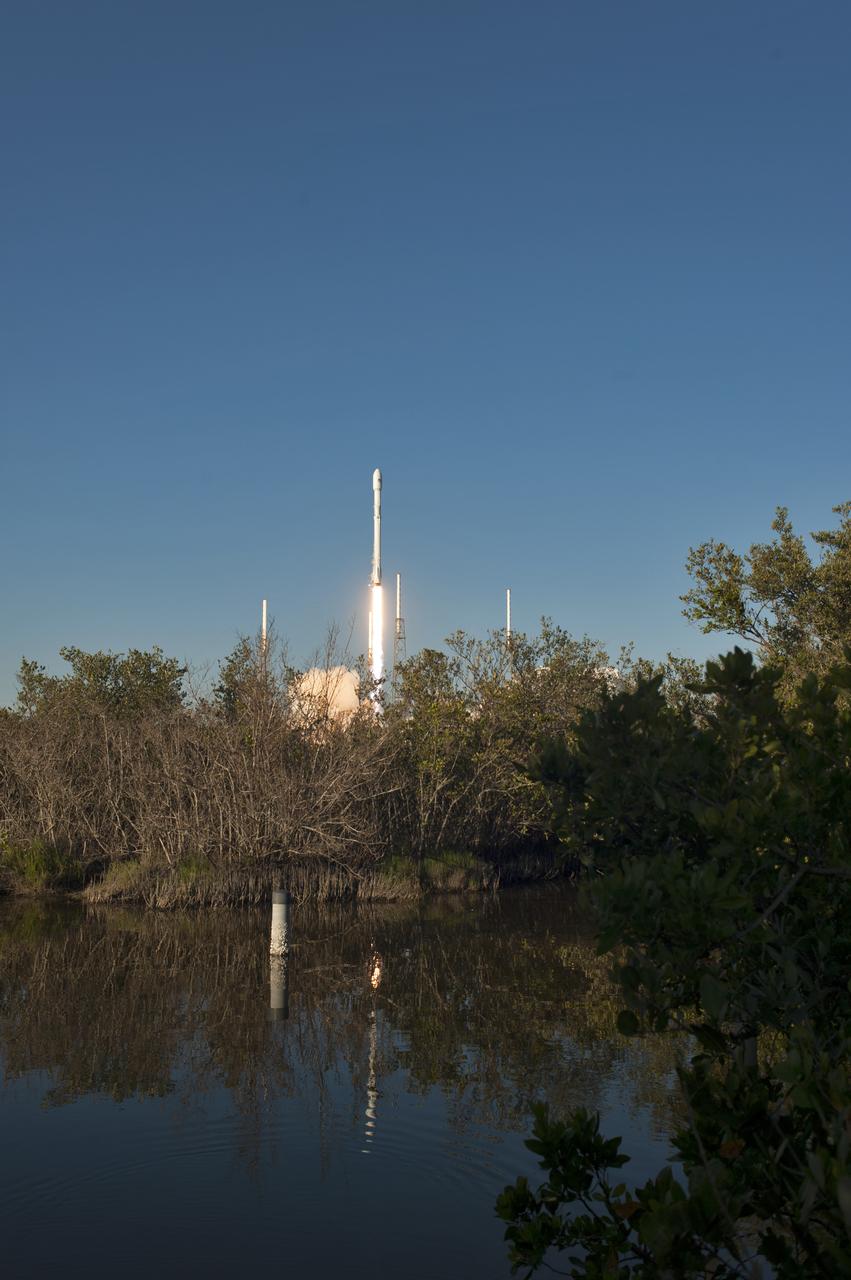
A SpaceX Falcon 9 rocket lifts off from Space Launch Complex 40 at Cape Canaveral Air Force Station in Florida, carrying NASA's Transiting Exoplanet Survey Satellite (TESS). Liftoff was at 6:51 p.m. EDT. TESS will search for planets outside of our solar system. The mission will find exoplanets that periodically block part of the light from their host stars, events called transits. The satellite will survey the nearest and brightest stars for two years to search for transiting exoplanets.
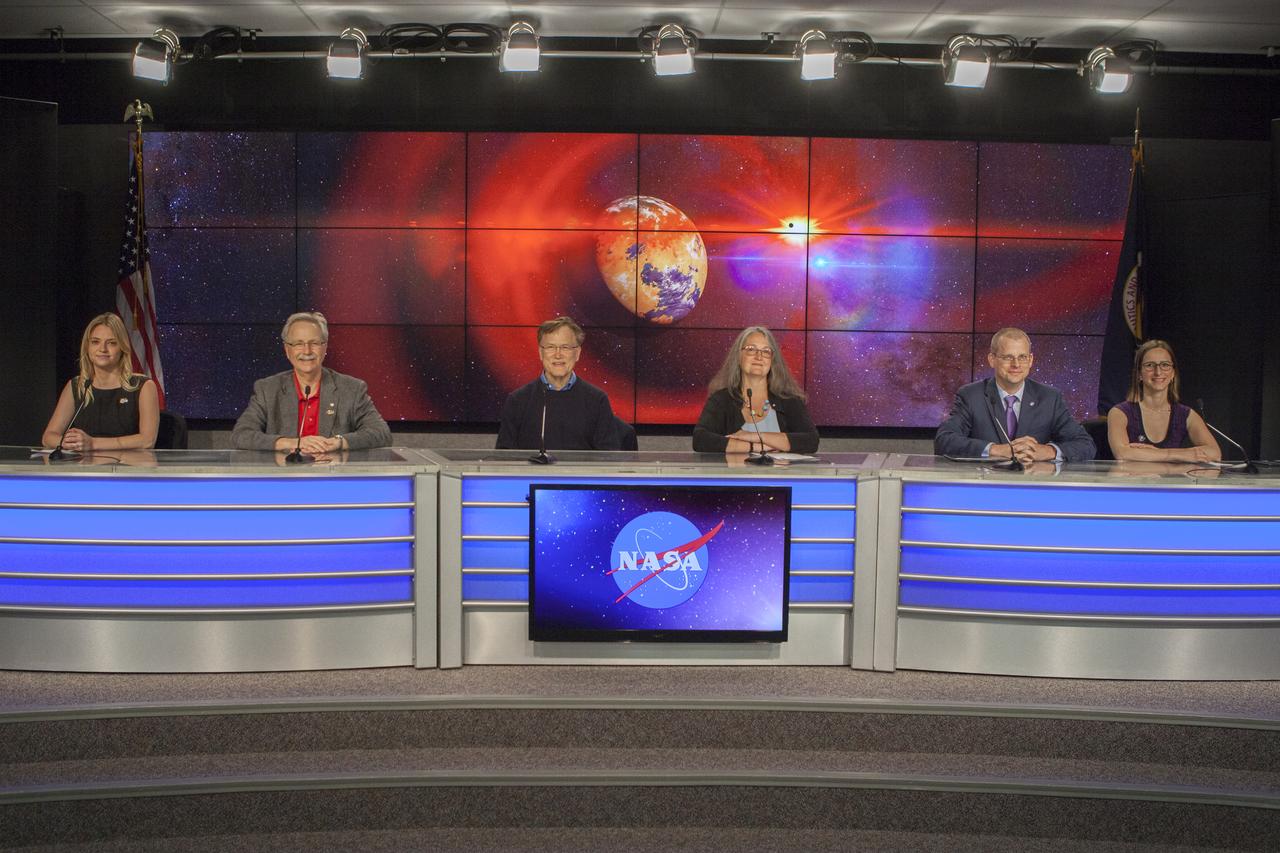
NASA and science investigators from MIT participate in a science briefing for the agency's Transiting Exoplanet Survey Satellite (TESS) in the Press Site auditorium at Kennedy Space Center in Florida. From left are moderator Claire Saravia, NASA Communications; Paul Hertz, Astrophysics Division director, NASA Headquarters; George Ricker, TESS principal investigator, Massachusetts Institute of Technology; Padi Boyd, TESS Guest Investigator Program lead, NASA’s Goddard Space Flight Center; Stephen Rinehart, TESS Project scientist, NASA’s Goddard Space Flight Center; and Diana Dragomir, NASA Hubble Postdoctoral Fellow, Massachusetts Institute of Technology. TESS is the next step in the search for planets outside of our solar system. The mission will find exoplanets that periodically block part of the light from their host stars, events called transits. The satellite will survey the nearest and brightest stars for two years to search for transiting exoplanets. TESS will launch on a SpaceX Falcon 9 rocket from Space Launch Complex 40 at Cape Canaveral Air Force Station no earlier than 6:32 p.m. EDT on Monday, April 16.
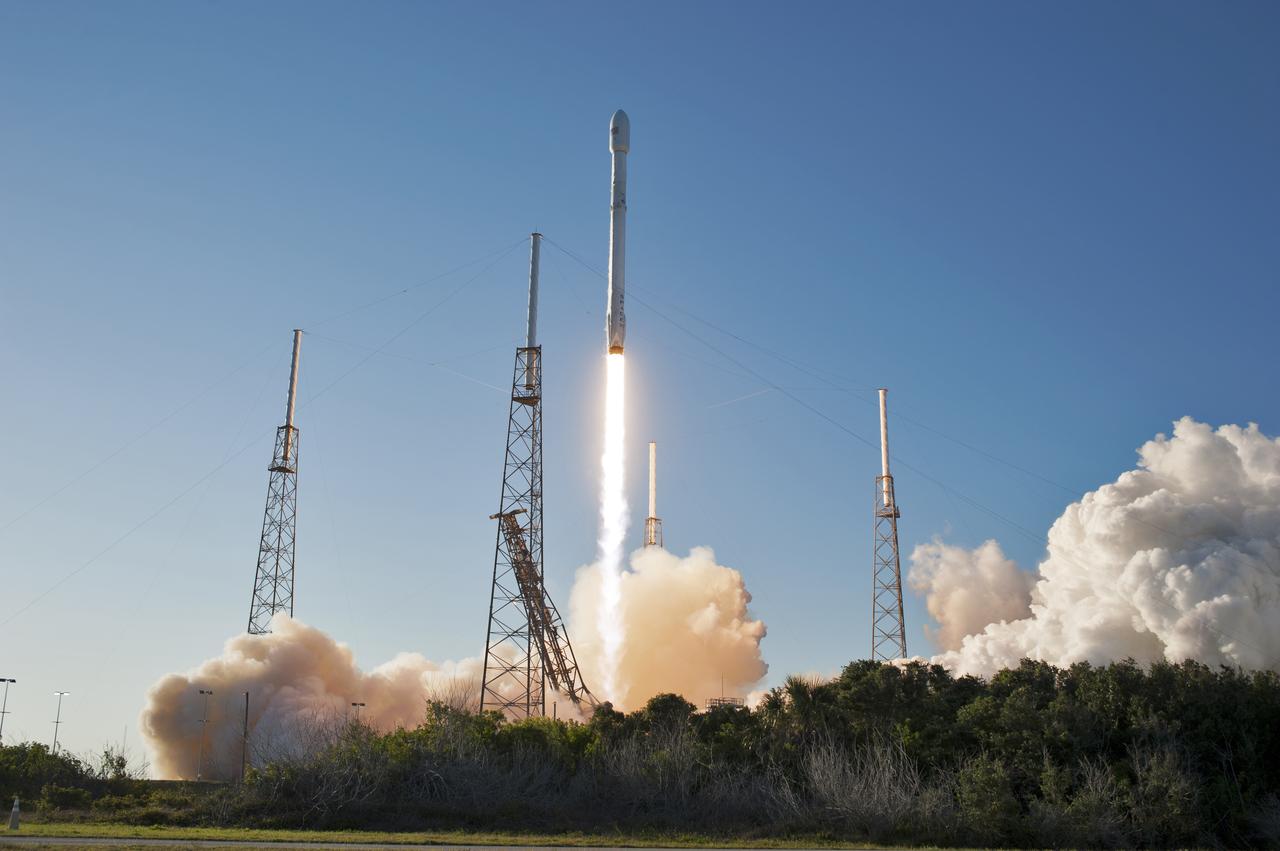
A SpaceX Falcon 9 rocket lifts off from Space Launch Complex 40 at Cape Canaveral Air Force Station in Florida, carrying NASA's Transiting Exoplanet Survey Satellite (TESS). Liftoff was at 6:51 p.m. EDT. TESS will search for planets outside of our solar system. The mission will find exoplanets that periodically block part of the light from their host stars, events called transits. The satellite will survey the nearest and brightest stars for two years to search for transiting exoplanets.
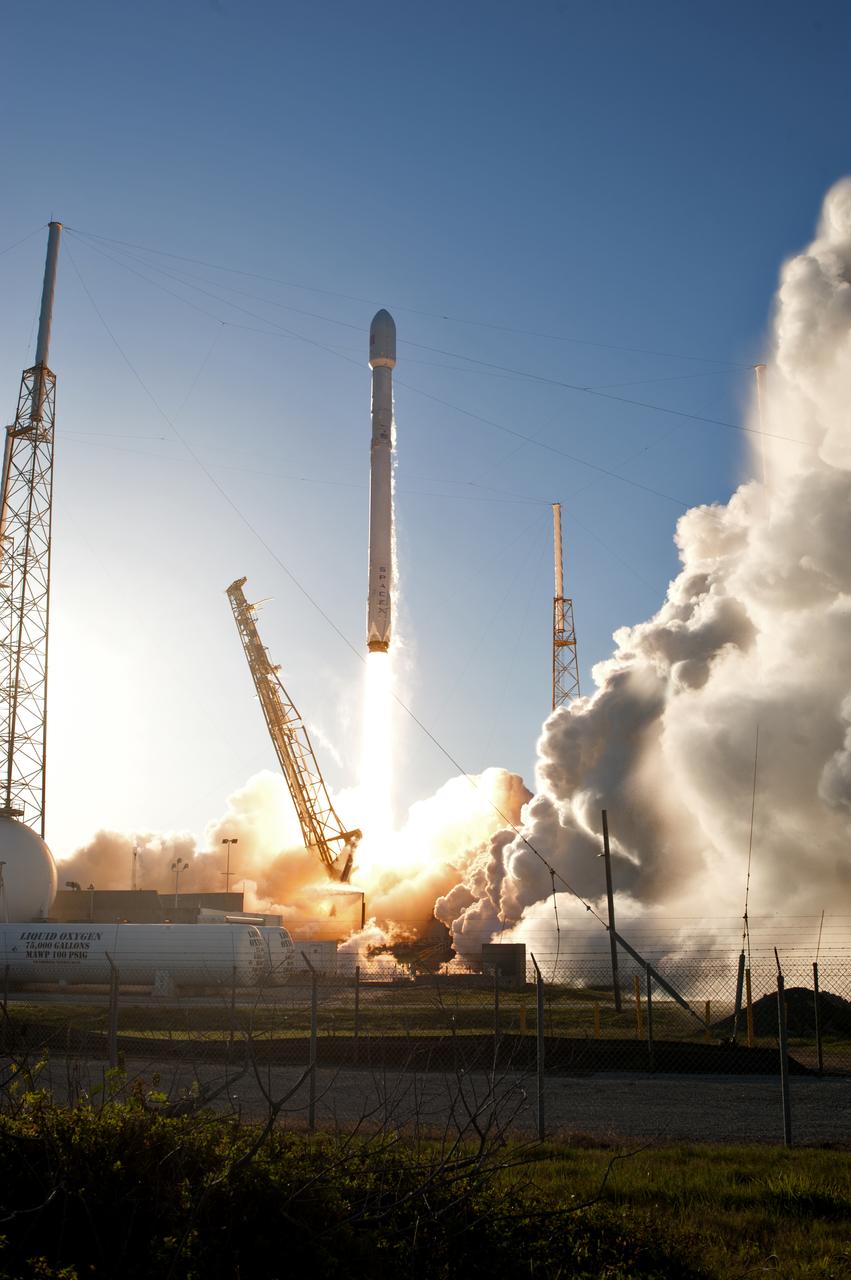
A SpaceX Falcon 9 rocket lifts off from Space Launch Complex 40 at Cape Canaveral Air Force Station in Florida, carrying NASA's Transiting Exoplanet Survey Satellite (TESS). Liftoff was at 6:51 p.m. EDT. TESS will search for planets outside of our solar system. The mission will find exoplanets that periodically block part of the light from their host stars, events called transits. The satellite will survey the nearest and brightest stars for two years to search for transiting exoplanets.
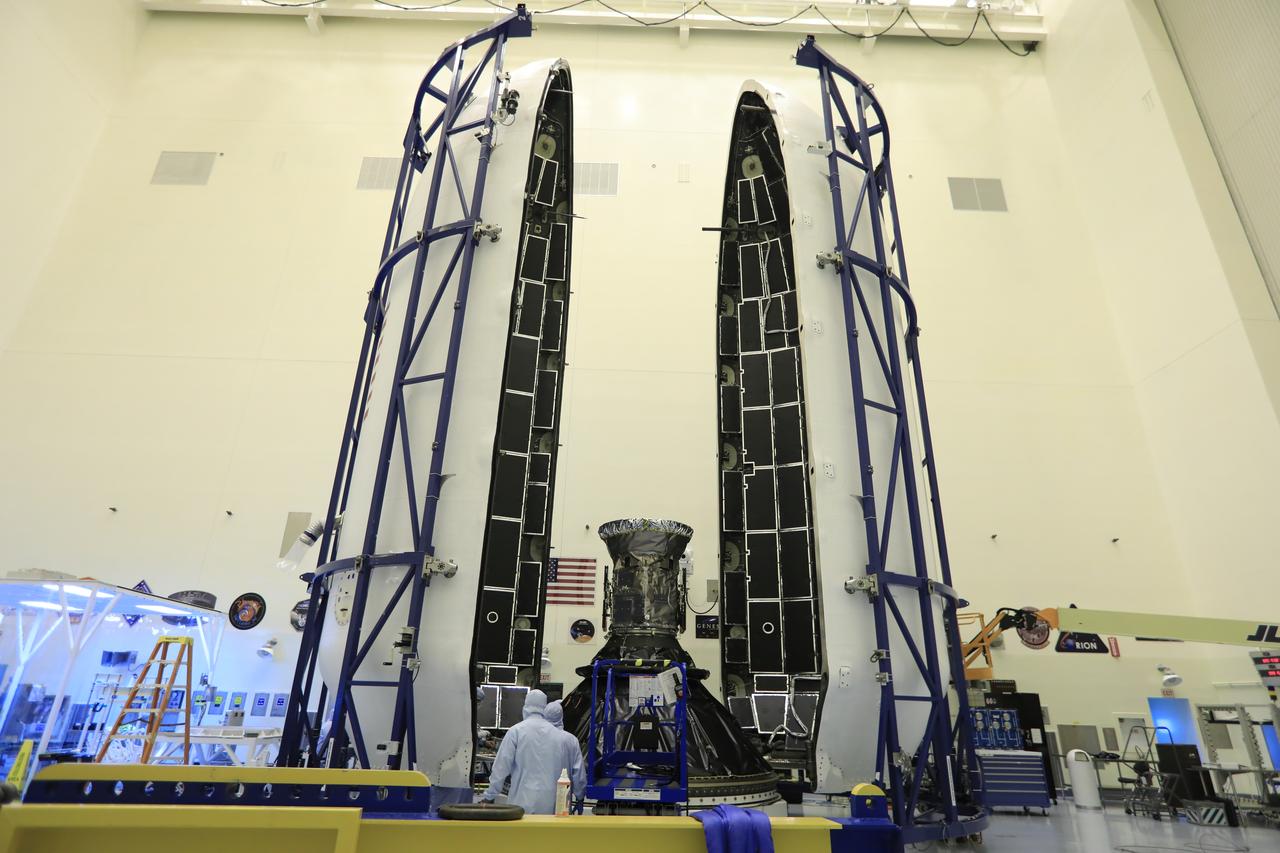
Technicians prepare NASA's Transiting Exoplanet Survey Satellite (TESS) for encapsulation in the SpaceX payload fairing inside the Payload Hazardous Servicing Facility at the agency's Kennedy Space Center in Florida. The satellite is scheduled to launch atop a SpaceX Falcon 9 rocket from Space Launch Complex 40 at Cape Canaveral Air Force Station on April 16. The satellite is the next step in NASA's search for planets outside our solar system, known as exoplanets. TESS is a NASA Astrophysics Explorer mission led and operated by MIT in Cambridge, Massachusetts, and managed by NASA’s Goddard Space Flight Center in Greenbelt, Maryland. Dr. George Ricker of MIT’s Kavli Institute for Astrophysics and Space Research serves as principal investigator for the mission. Additional partners include Orbital ATK, NASA’s Ames Research Center, the Harvard-Smithsonian Center for Astrophysics and the Space Telescope Science Institute. More than a dozen universities, research institutes and observatories worldwide are participants in the mission. NASA’s Launch Services Program is responsible for launch management.
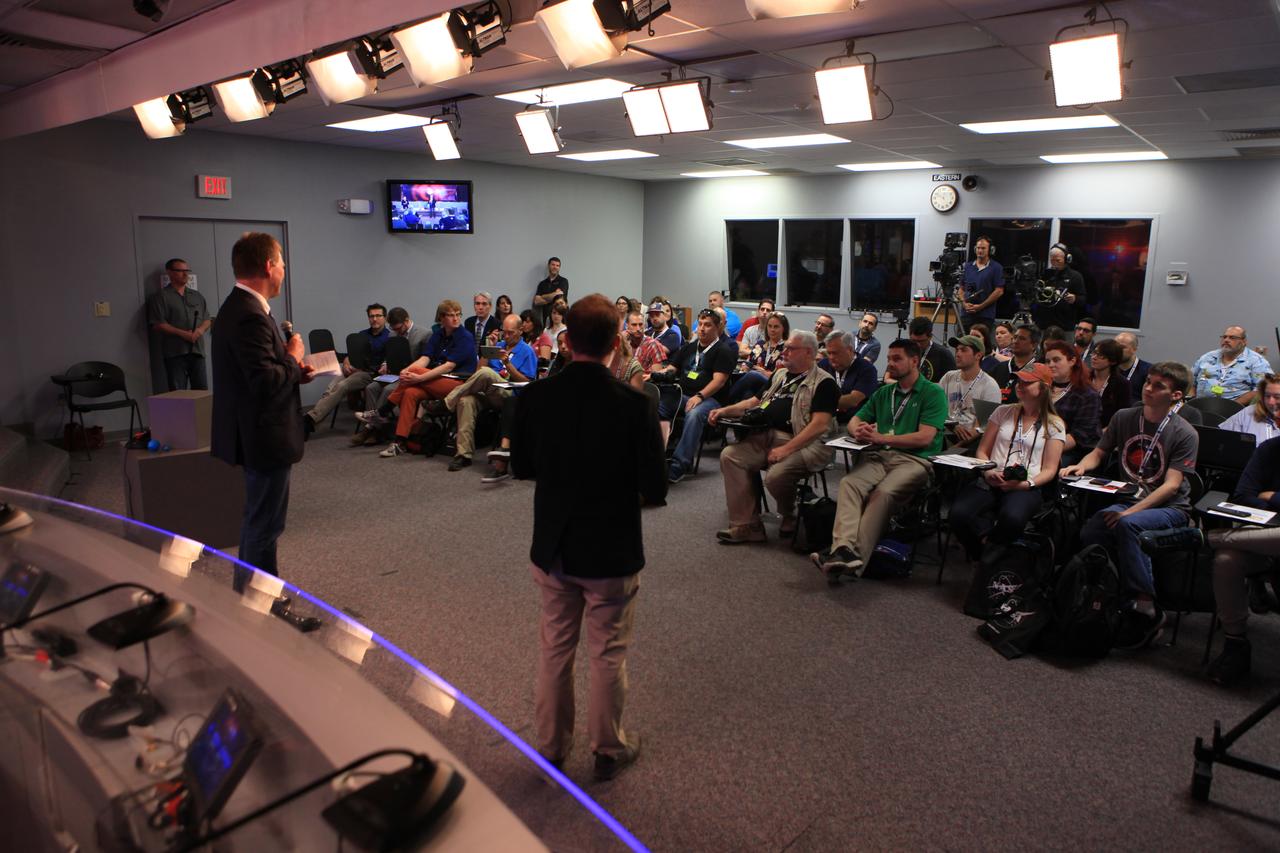
NASA and industry leaders speak to NASA Social participants about the agency's Transiting Exoplanet Survey Satellite (TESS) in the Press Site auditorium at Kennedy Space Center in Florida. Speaking to the group, at left is Hans Koenigsmann, vice president of Build and Flight Reliability at SpaceX. TESS is the next step in the search for planets outside of our solar system. The mission will find exoplanets that periodically block part of the light from their host stars, events called transits. The satellite will survey the nearest and brightest stars for two years to search for transiting exoplanets. TESS will launch on a SpaceX Falcon 9 rocket from Space Launch Complex 40 at Cape Canaveral Air Force Station no earlier than 6:32 p.m. EDT on Monday, April 16.
In Kennedy Space Center's Press Site auditorium, members of the media participate in a mission briefing on NASA's Transiting Exoplanet Survey Satellite (TESS). Hans Koenigsmann, vice president of Build and Flight Reliability at SpaceX, answers questions during the briefing. TESS is the next step in the search for planets outside of our solar system. The mission will find exoplanets that periodically block part of the light from their host stars, events called transits. The satellite will survey the nearest and brightest stars for two years to search for transiting exoplanets. TESS will launch on a SpaceX Falcon 9 rocket from Space Launch Complex 40 at Cape Canaveral Air Force Station no earlier than 6:32 p.m. EDT on Monday, April 16.
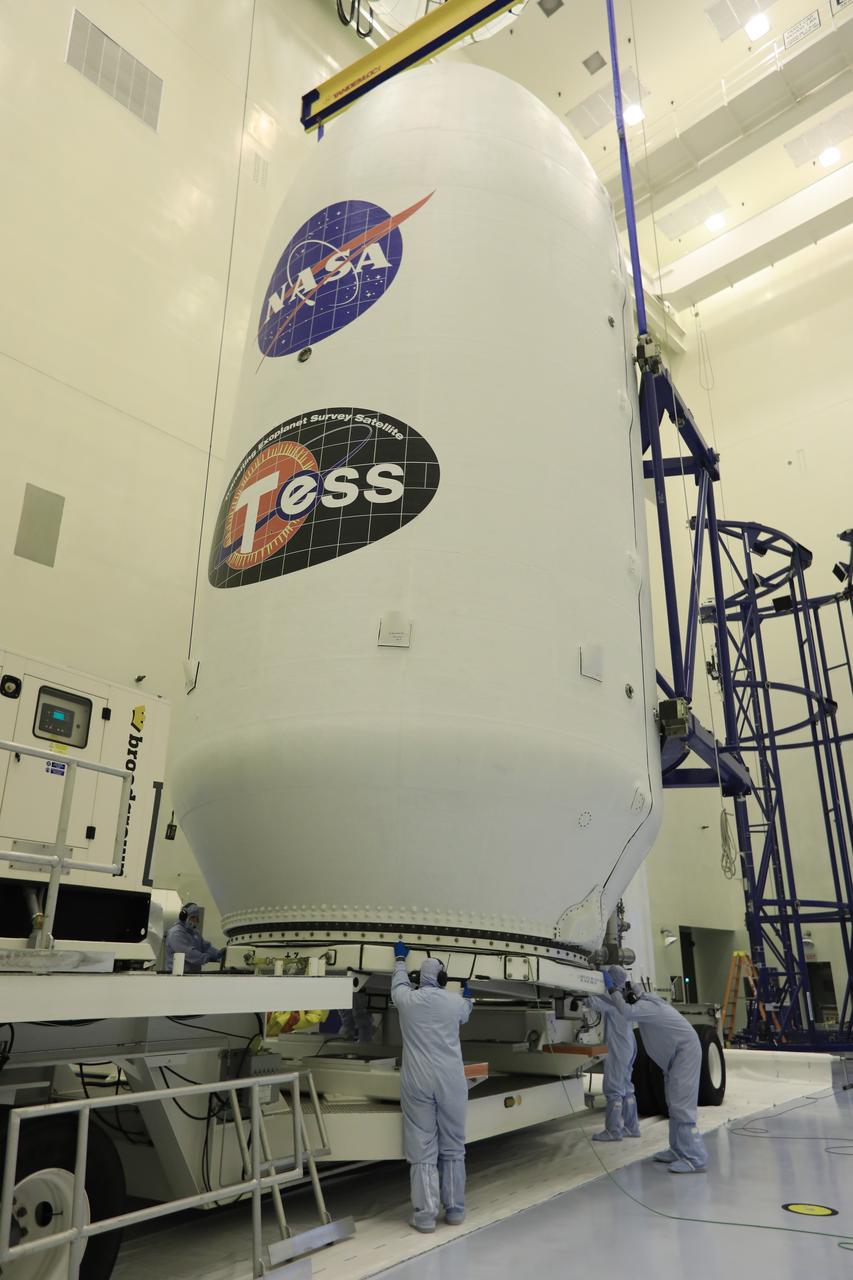
Inside the Payload Hazardous Servicing Facility at NASA's Kennedy Space Center in Florida, technicians assist as the SpaceX payload fairing containing the agency's Transiting Exoplanet Survey Satellite (TESS) is lowered by crane onto a transporter. The fairing will be moved to Space Launch Complex 40 at Cape Canaveral Air Force Station. TESS is scheduled to launch on the SpaceX Falcon 9 rocket at 6:32 p.m. EDT on April 16. The satellite is the next step in NASA's search for planets outside our solar system, known as exoplanets. TESS is a NASA Astrophysics Explorer mission led and operated by MIT in Cambridge, Massachusetts, and managed by NASA’s Goddard Space Flight Center in Greenbelt, Maryland. Dr. George Ricker of MIT’s Kavli Institute for Astrophysics and Space Research serves as principal investigator for the mission. Additional partners include Orbital ATK, NASA’s Ames Research Center, the Harvard-Smithsonian Center for Astrophysics and the Space Telescope Science Institute. More than a dozen universities, research institutes and observatories worldwide are participants in the mission. NASA’s Launch Services Program is responsible for launch management.

NASA and science investigators from MIT participate in a science briefing for the agency's Transiting Exoplanet Survey Satellite (TESS) in the Press Site auditorium at Kennedy Space Center in Florida. Claire Saravia, NASA Communications, moderated the briefing. TESS is the next step in the search for planets outside of our solar system. The mission will find exoplanets that periodically block part of the light from their host stars, events called transits. The satellite will survey the nearest and brightest stars for two years to search for transiting exoplanets. TESS will launch on a SpaceX Falcon 9 rocket from Space Launch Complex 40 at Cape Canaveral Air Force Station no earlier than 6:32 p.m. EDT on Monday, April 16.

In Kennedy Space Center's Press Site auditorium, members of the media participate in a mission briefing on NASA's Transiting Exoplanet Survey Satellite (TESS). Josh Finch, NASA Communications, moderates the briefing. TESS is the next step in the search for planets outside of our solar system. The mission will find exoplanets that periodically block part of the light from their host stars, events called transits. The satellite will survey the nearest and brightest stars for two years to search for transiting exoplanets. TESS will launch on a SpaceX Falcon 9 rocket from Space Launch Complex 40 at Cape Canaveral Air Force Station no earlier than 6:32 p.m. EDT on Monday, April 16.
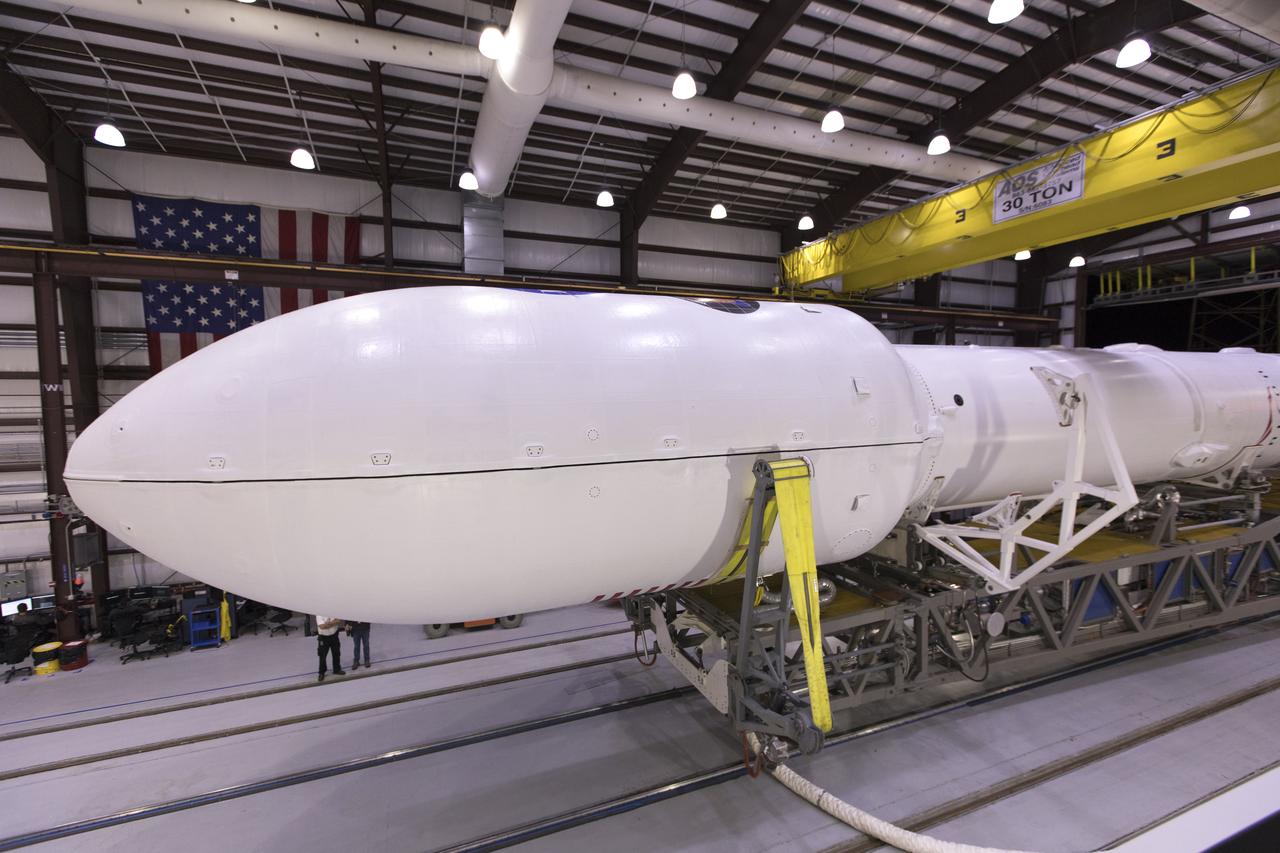
The SpaceX Falcon 9 rocket is ready to roll out to Space Launch Complex 40 at Cape Canaveral Air Force Station in Florida, with NASA's Transiting Exoplanet Survey Satellite (TESS) secured in its payload fairing. TESS will launch on the Falcon 9 no earlier than 6:51 p.m. EDT on April 18. TESS will search for planets outside of our solar system. The mission will find exoplanets that periodically block part of the light from their host stars, events called transits. The satellite will survey the nearest and brightest stars for two years to search for transiting exoplanets.
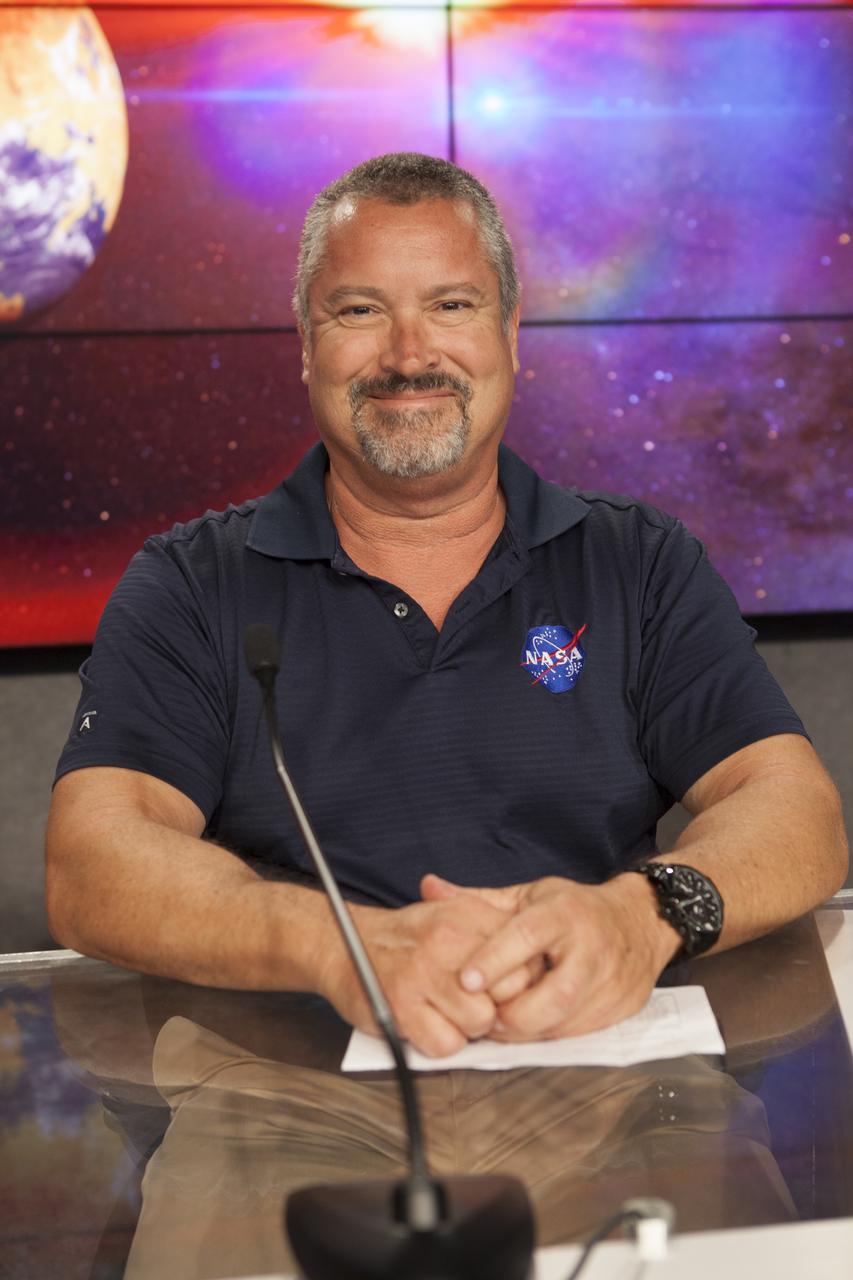
In Kennedy Space Center's Press Site auditorium, members of the media participate in a mission briefing on NASA's Transiting Exoplanet Survey Satellite (TESS). Omar Baez, launch director, NASA’s Launch Services Program, answers questions during the briefing. TESS is the next step in the search for planets outside of our solar system. The mission will find exoplanets that periodically block part of the light from their host stars, events called transits. The satellite will survey the nearest and brightest stars for two years to search for transiting exoplanets. TESS will launch on a SpaceX Falcon 9 rocket from Space Launch Complex 40 at Cape Canaveral Air Force Station no earlier than 6:32 p.m. EDT on Monday, April 16.
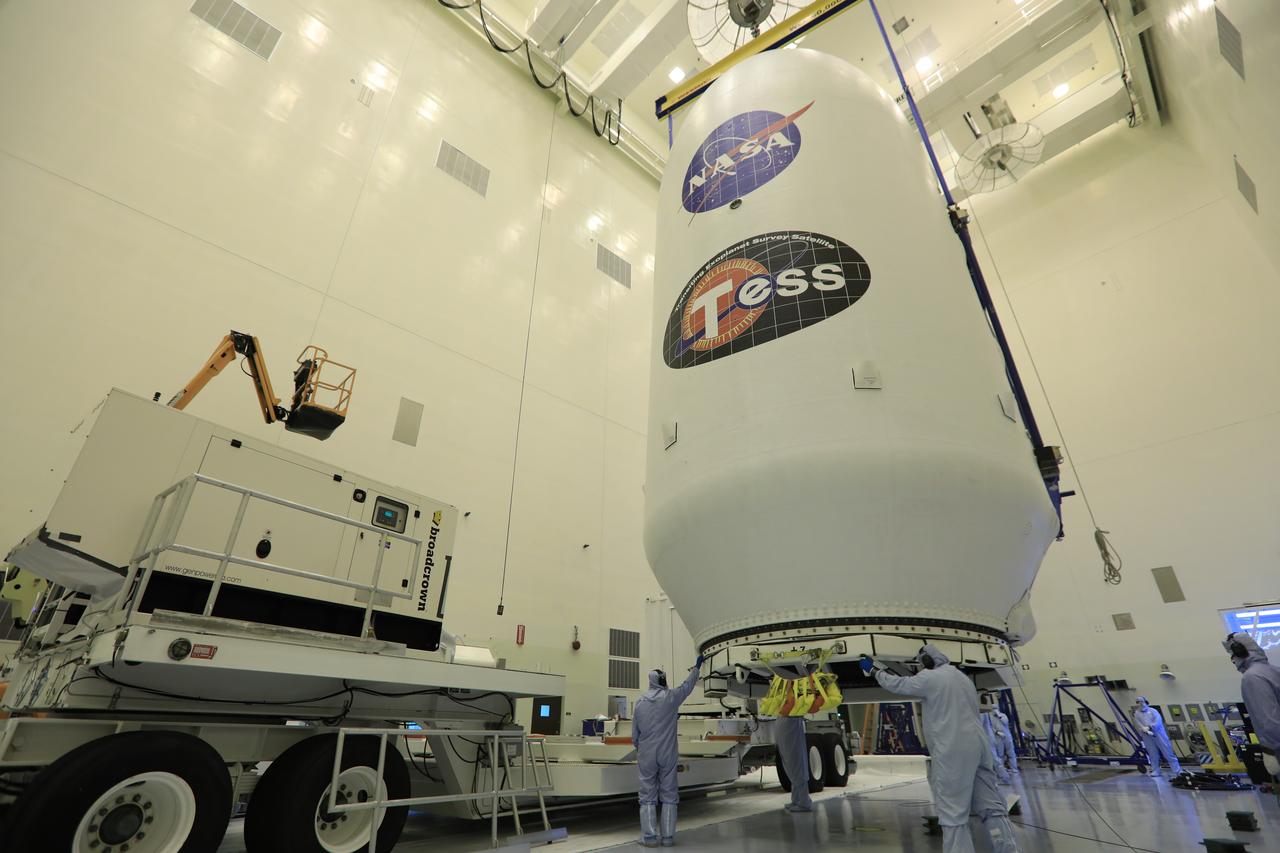
Inside the Payload Hazardous Servicing Facility at NASA's Kennedy Space Center in Florida, technicians assist as the SpaceX payload fairing containing the agency's Transiting Exoplanet Survey Satellite (TESS) is moved by crane to a transporter. The fairing will be moved to Space Launch Complex 40 at Cape Canaveral Air Force Station. TESS is scheduled to launch on the SpaceX Falcon 9 rocket at 6:32 p.m. EDT on April 16. The satellite is the next step in NASA's search for planets outside our solar system, known as exoplanets. TESS is a NASA Astrophysics Explorer mission led and operated by MIT in Cambridge, Massachusetts, and managed by NASA’s Goddard Space Flight Center in Greenbelt, Maryland. Dr. George Ricker of MIT’s Kavli Institute for Astrophysics and Space Research serves as principal investigator for the mission. Additional partners include Orbital ATK, NASA’s Ames Research Center, the Harvard-Smithsonian Center for Astrophysics and the Space Telescope Science Institute. More than a dozen universities, research institutes and observatories worldwide are participants in the mission. NASA’s Launch Services Program is responsible for launch management.

In Kennedy Space Center's Press Site auditorium, members of the media participate in a mission briefing on NASA's Transiting Exoplanet Survey Satellite (TESS). Sandra Connelly, deputy associate administrator of programs, NASA’s Science Mission Directorate, answers questions during the briefing. TESS is the next step in the search for planets outside of our solar system. The mission will find exoplanets that periodically block part of the light from their host stars, events called transits. The satellite will survey the nearest and brightest stars for two years to search for transiting exoplanets. TESS will launch on a SpaceX Falcon 9 rocket from Space Launch Complex 40 at Cape Canaveral Air Force Station no earlier than 6:32 p.m. EDT on Monday, April 16.
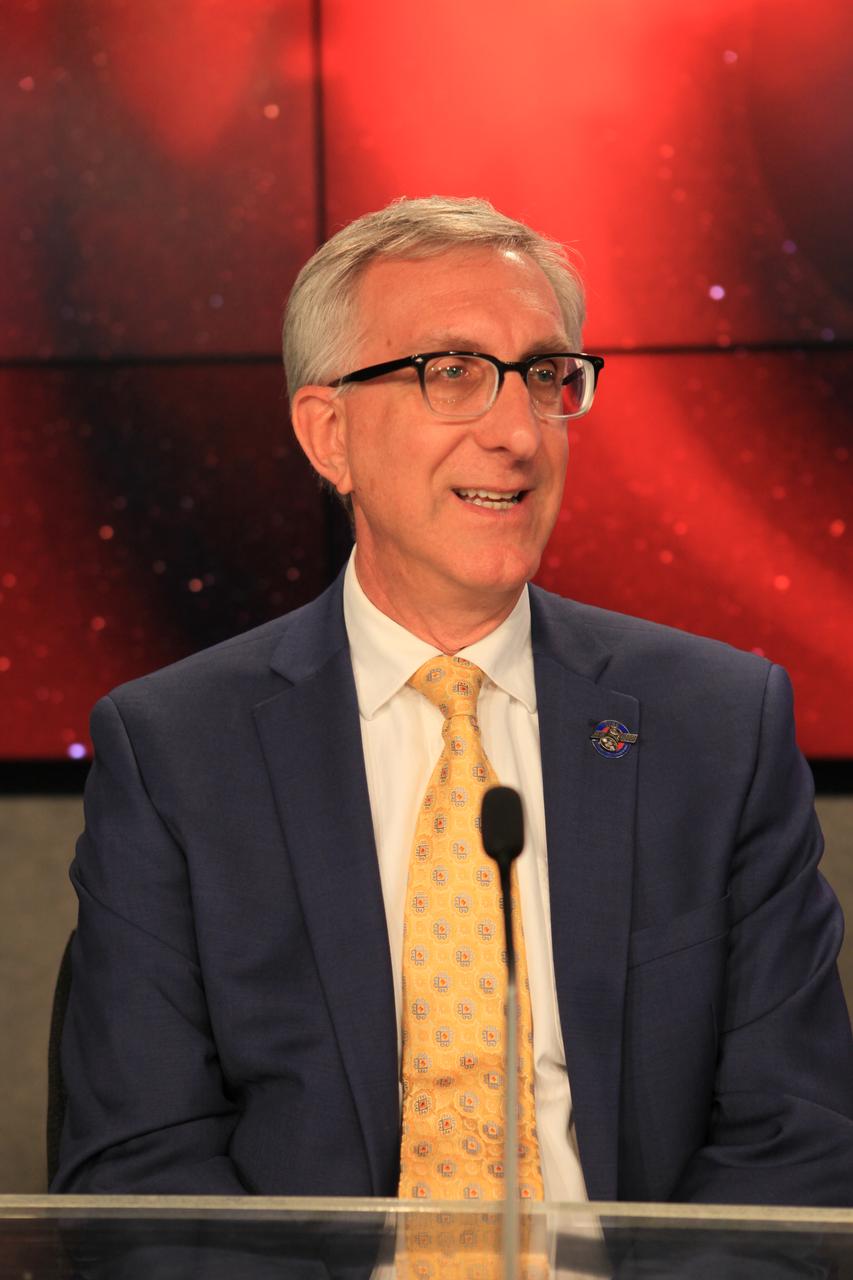
In Kennedy Space Center's Press Site auditorium, members of the media participate in a mission briefing on NASA's Transiting Exoplanet Survey Satellite (TESS). Jeff Volosin, TESS project manager, NASA’s Goddard Space Flight Center, answers questions during the briefing. TESS is the next step in the search for planets outside of our solar system. The mission will find exoplanets that periodically block part of the light from their host stars, events called transits. The satellite will survey the nearest and brightest stars for two years to search for transiting exoplanets. TESS will launch on a SpaceX Falcon 9 rocket from Space Launch Complex 40 at Cape Canaveral Air Force Station no earlier than 6:32 p.m. EDT on Monday, April 16.
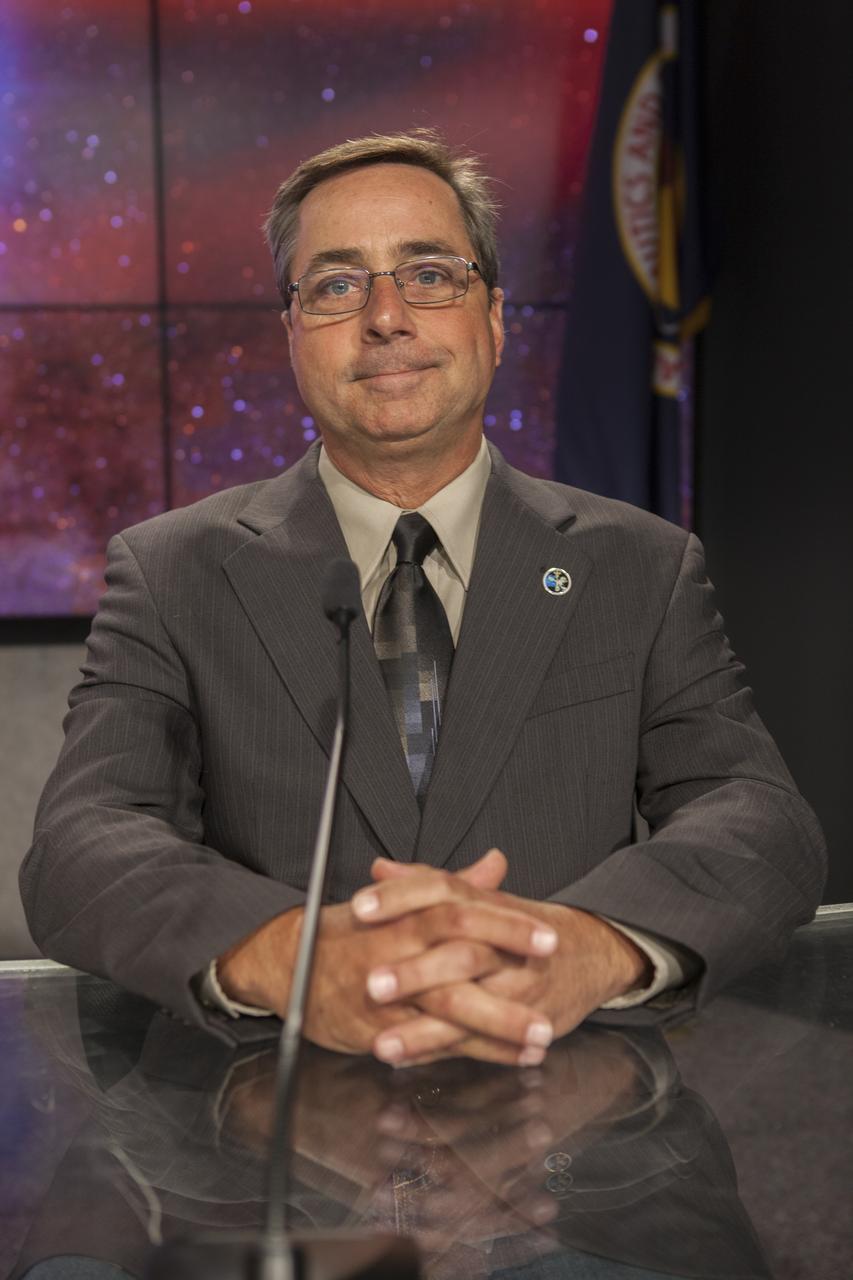
In Kennedy Space Center's Press Site auditorium, members of the media participate in a mission briefing on NASA's Transiting Exoplanet Survey Satellite (TESS). Mike McAleenan, weather officer, 45th Weather Squadron, gives a weather update and answers questions during the briefing. TESS is the next step in the search for planets outside of our solar system. The mission will find exoplanets that periodically block part of the light from their host stars, events called transits. The satellite will survey the nearest and brightest stars for two years to search for transiting exoplanets. TESS will launch on a SpaceX Falcon 9 rocket from Space Launch Complex 40 at Cape Canaveral Air Force Station no earlier than 6:32 p.m. EDT on Monday, April 16.
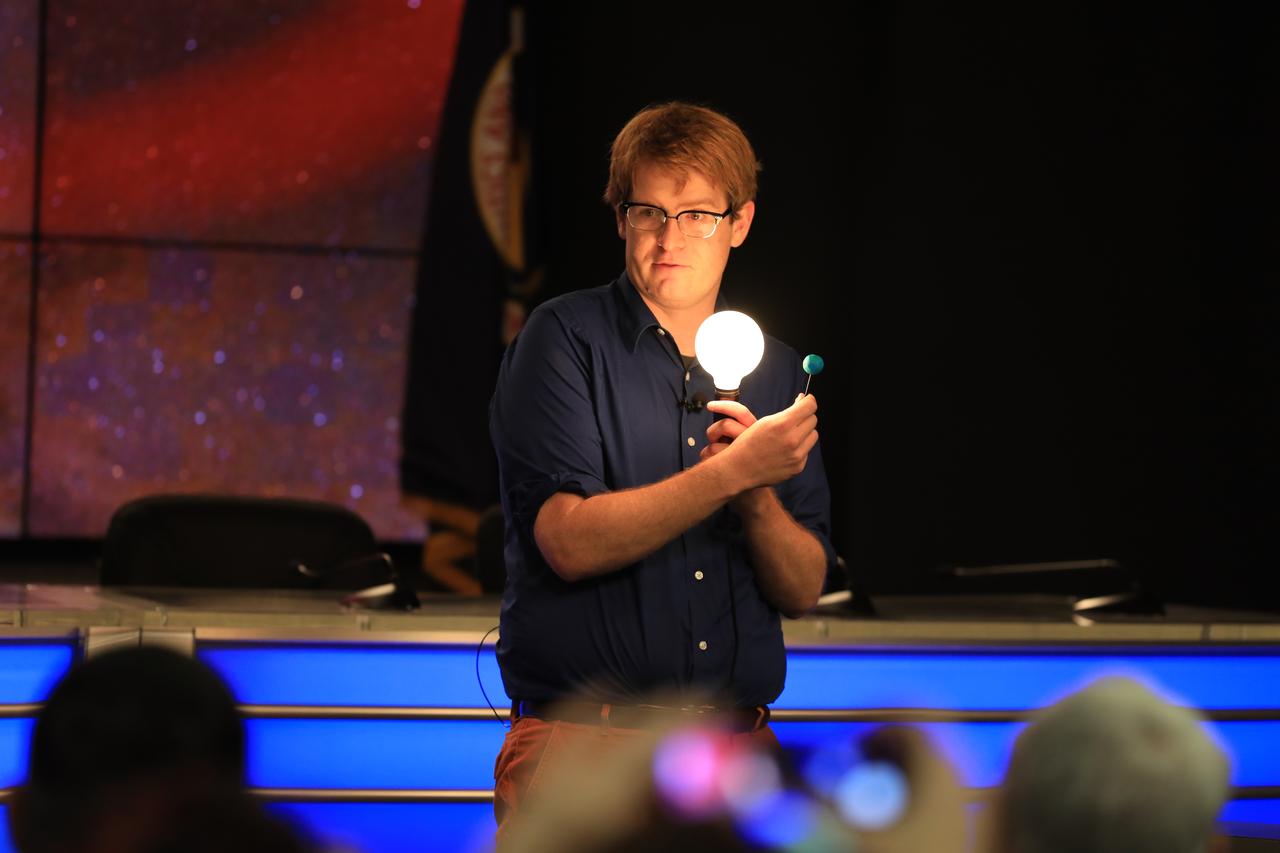
NASA and industry leaders speak to NASA Social participants about the agency's Transiting Exoplanet Survey Satellite (TESS) in the Press Site auditorium at Kennedy Space Center in Florida. Speaking to the group is Zach Berta-Thompson, assistant professor, University of Colorado Boulder. TESS is the next step in the search for planets outside of our solar system. The mission will find exoplanets that periodically block part of the light from their host stars, events called transits. The satellite will survey the nearest and brightest stars for two years to search for transiting exoplanets. TESS will launch on a SpaceX Falcon 9 rocket from Space Launch Complex 40 at Cape Canaveral Air Force Station no earlier than 6:32 p.m. EDT on Monday, April 16.
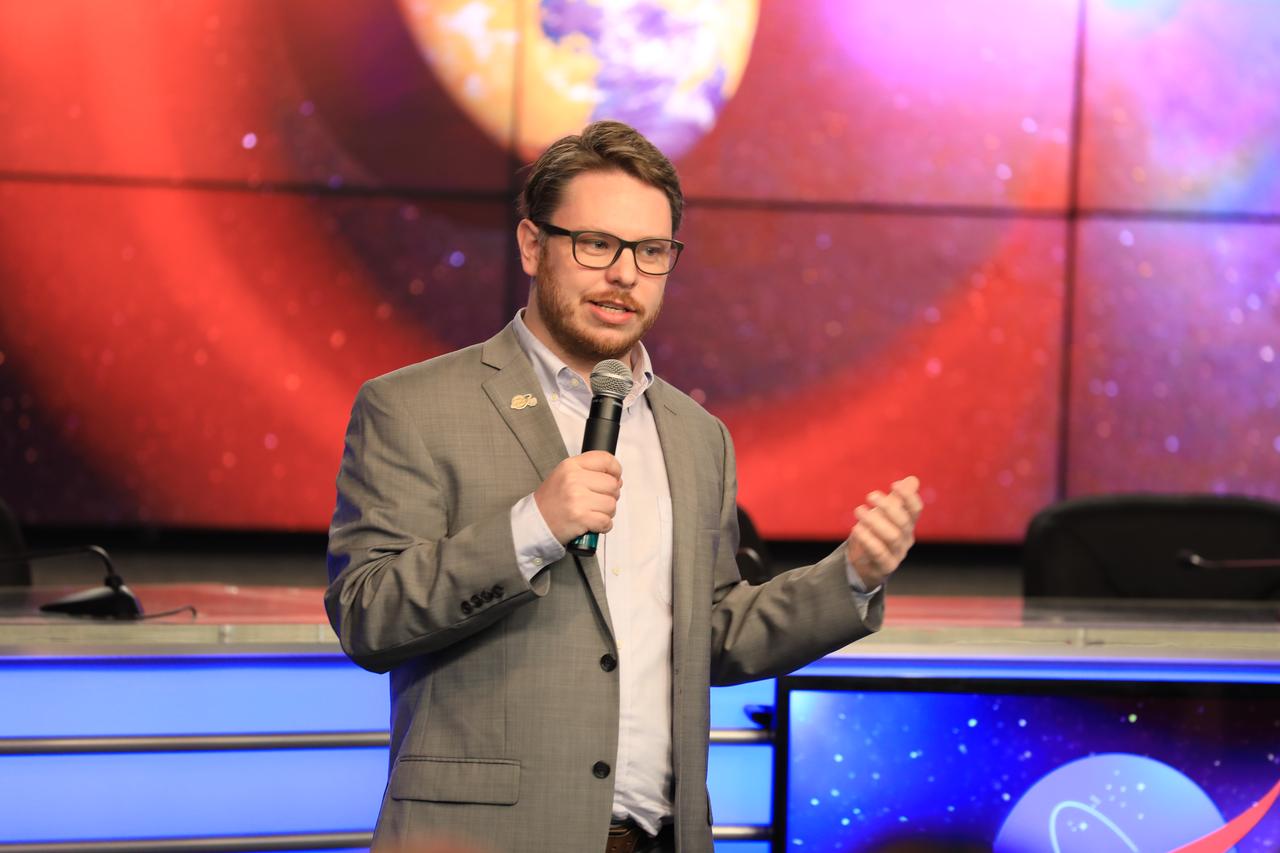
NASA and industry leaders speak to NASA Social participants about the agency's Transiting Exoplanet Survey Satellite (TESS) in the Press Site auditorium at Kennedy Space Center in Florida. Speaking to the group is Tom Barclay, TESS scientist, NASA’s Goddard Space Flight Center. TESS is the next step in the search for planets outside of our solar system. The mission will find exoplanets that periodically block part of the light from their host stars, events called transits. The satellite will survey the nearest and brightest stars for two years to search for transiting exoplanets. TESS will launch on a SpaceX Falcon 9 rocket from Space Launch Complex 40 at Cape Canaveral Air Force Station no earlier than 6:32 p.m. EDT on Monday, April 16.
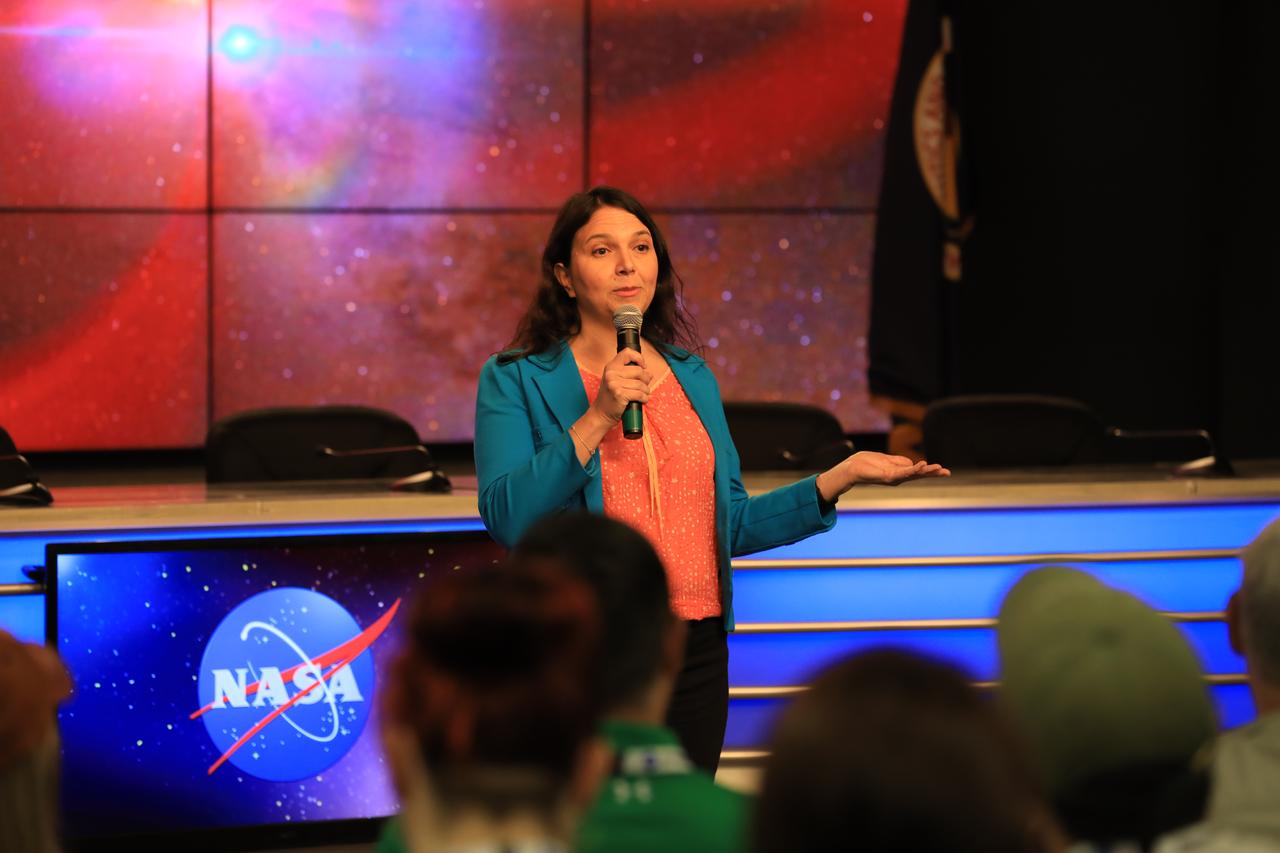
NASA and industry leaders speak to NASA Social participants about the agency's Transiting Exoplanet Survey Satellite (TESS) in the Press Site auditorium at Kennedy Space Center in Florida. Speaking to the group is Elisa Quintana, TESS scientist, NASA's Goddard Space Flight Center. TESS is the next step in the search for planets outside of our solar system. The mission will find exoplanets that periodically block part of the light from their host stars, events called transits. The satellite will survey the nearest and brightest stars for two years to search for transiting exoplanets. TESS will launch on a SpaceX Falcon 9 rocket from Space Launch Complex 40 at Cape Canaveral Air Force Station no earlier than 6:32 p.m. EDT on Monday, April 16.

NASA and science investigators from MIT participate in a science briefing for the agency's Transiting Exoplanet Survey Satellite (TESS) in the Press Site auditorium at Kennedy Space Center in Florida. Felicia Chou, NASA Communications, asks questions from online participants during the briefing. TESS is the next step in the search for planets outside of our solar system. The mission will find exoplanets that periodically block part of the light from their host stars, events called transits. The satellite will survey the nearest and brightest stars for two years to search for transiting exoplanets. TESS will launch on a SpaceX Falcon 9 rocket from Space Launch Complex 40 at Cape Canaveral Air Force Station no earlier than 6:32 p.m. EDT on Monday, April 16.
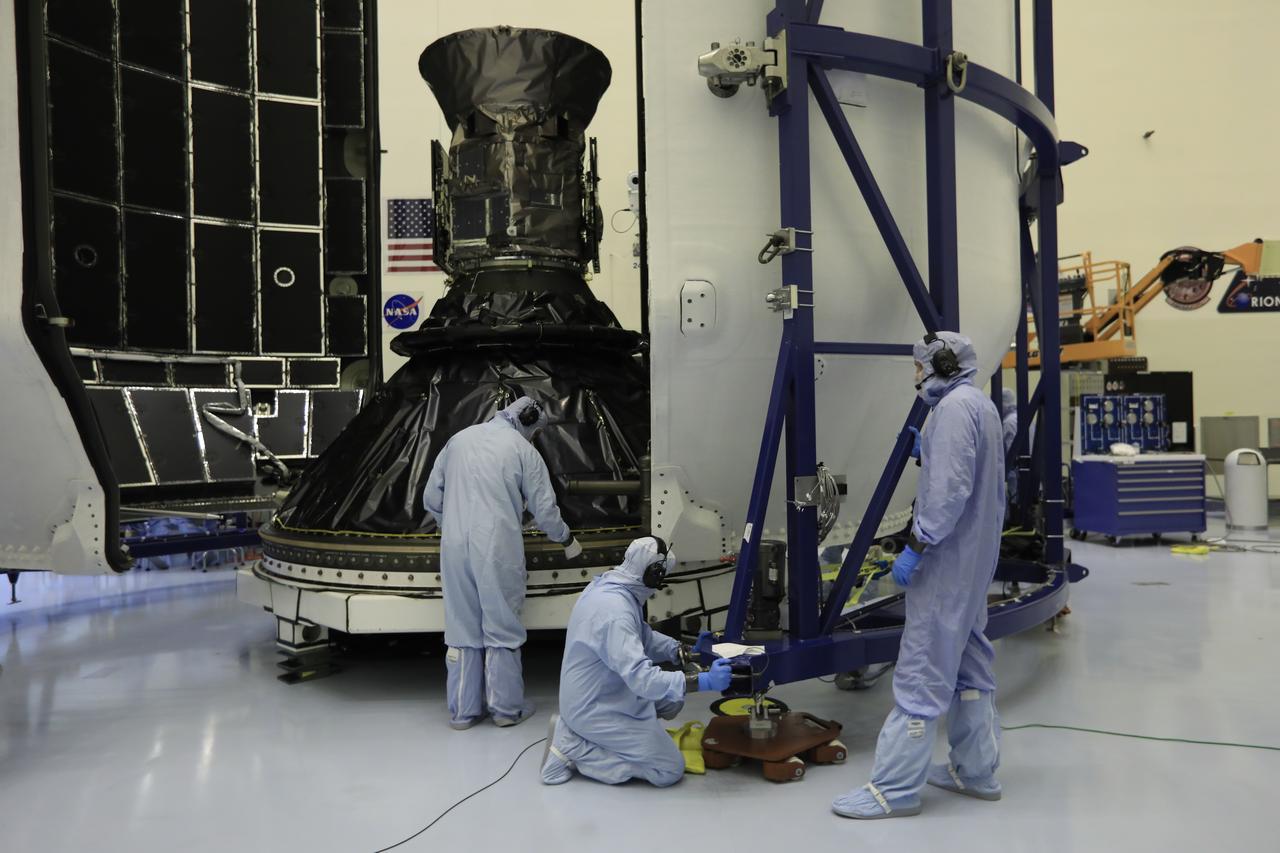
Technicians prepare NASA's Transiting Exoplanet Survey Satellite (TESS) for encapsulation in the SpaceX payload fairing inside the Payload Hazardous Servicing Facility at the agency's Kennedy Space Center in Florida. The satellite is scheduled to launch atop a SpaceX Falcon 9 rocket from Space Launch Complex 40 at Cape Canaveral Air Force Station on April 16. The satellite is the next step in NASA's search for planets outside our solar system, known as exoplanets. TESS is a NASA Astrophysics Explorer mission led and operated by MIT in Cambridge, Massachusetts, and managed by NASA’s Goddard Space Flight Center in Greenbelt, Maryland. Dr. George Ricker of MIT’s Kavli Institute for Astrophysics and Space Research serves as principal investigator for the mission. Additional partners include Orbital ATK, NASA’s Ames Research Center, the Harvard-Smithsonian Center for Astrophysics and the Space Telescope Science Institute. More than a dozen universities, research institutes and observatories worldwide are participants in the mission. NASA’s Launch Services Program is responsible for launch management.
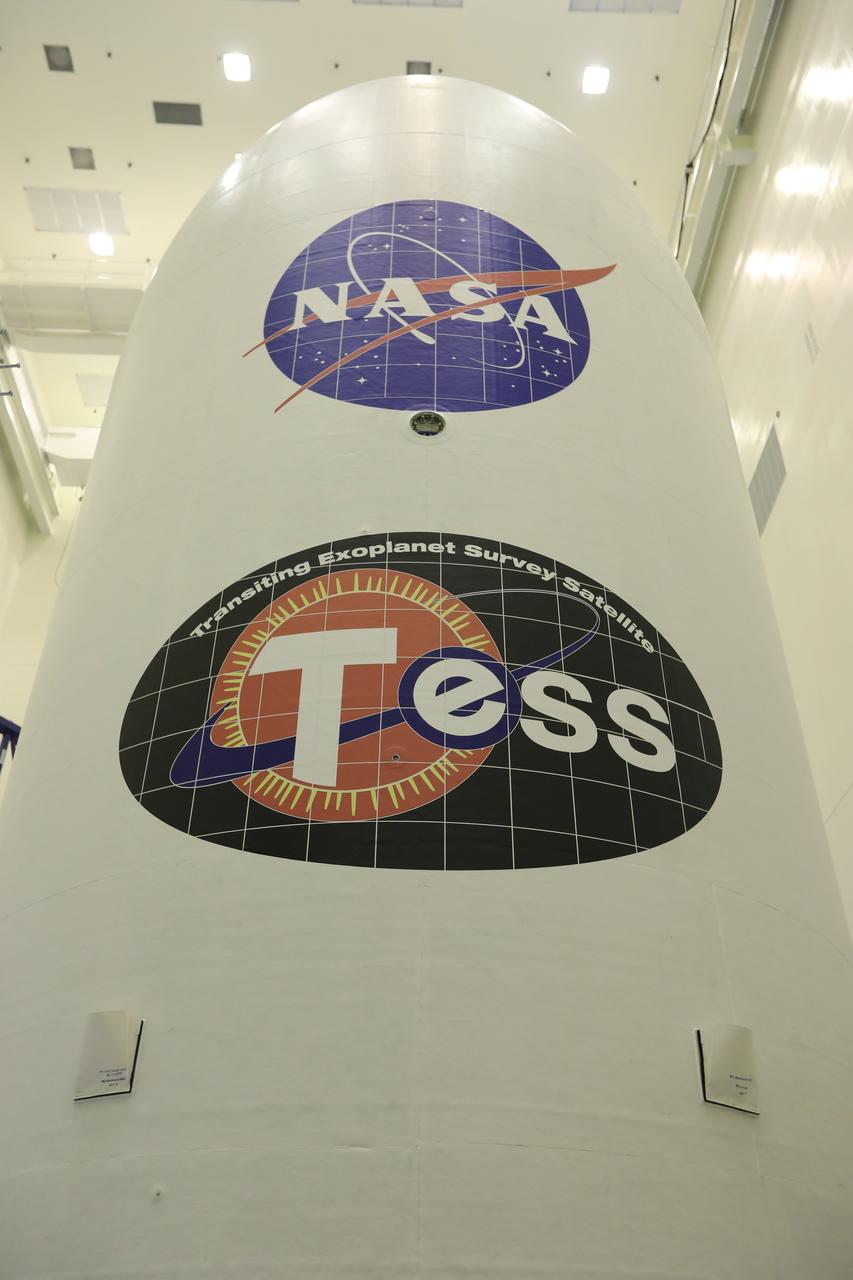
The SpaceX payload fairing containing NASA's Transiting Exoplanet Survey Satellite (TESS) is prepared for the move from the Payload Hazardous Servicing Facility at the agency's Kennedy Space Center in Florida to Space Launch Complex 40 at Cape Canaveral Air Force Station. The satellite is scheduled to launch atop the SpaceX Falcon 9 rocket at 6:32 p.m. EDT on April 16. TESS is the next step in NASA's search for planets outside our solar system, known as exoplanets. TESS is a NASA Astrophysics Explorer mission led and operated by MIT in Cambridge, Massachusetts, and managed by NASA’s Goddard Space Flight Center in Greenbelt, Maryland. Dr. George Ricker of MIT’s Kavli Institute for Astrophysics and Space Research serves as principal investigator for the mission. Additional partners include Orbital ATK, NASA’s Ames Research Center, the Harvard-Smithsonian Center for Astrophysics and the Space Telescope Science Institute. More than a dozen universities, research institutes and observatories worldwide are participants in the mission. NASA’s Launch Services Program is responsible for launch management.
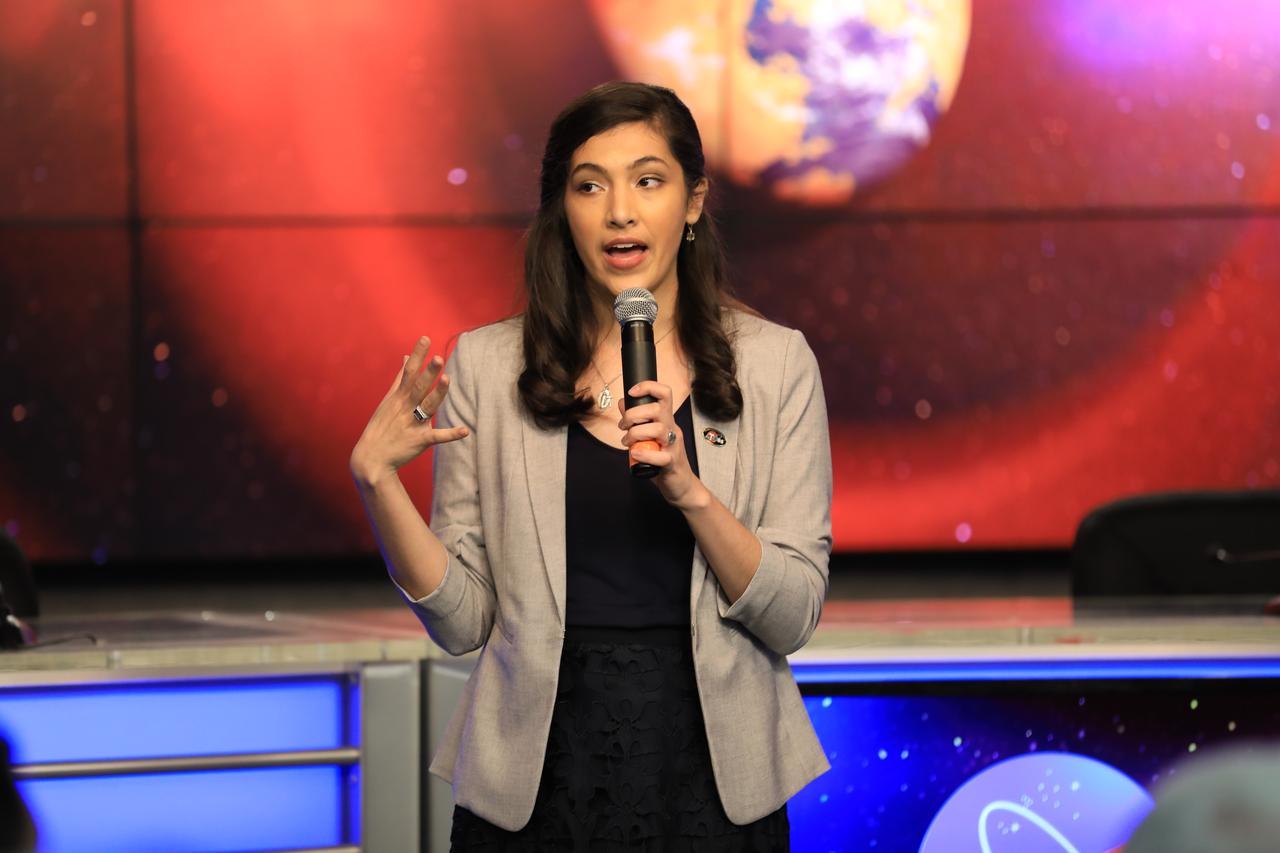
NASA and industry leaders speak to NASA Social participants about the agency's Transiting Exoplanet Survey Satellite (TESS) in the Press Site auditorium at Kennedy Space Center in Florida. Speaking to the group is Natalia Guerrero, TESS researcher, Massachusetts Institute of Technology. TESS is the next step in the search for planets outside of our solar system. The mission will find exoplanets that periodically block part of the light from their host stars, events called transits. The satellite will survey the nearest and brightest stars for two years to search for transiting exoplanets. TESS will launch on a SpaceX Falcon 9 rocket from Space Launch Complex 40 at Cape Canaveral Air Force Station no earlier than 6:32 p.m. EDT on Monday, April 16.
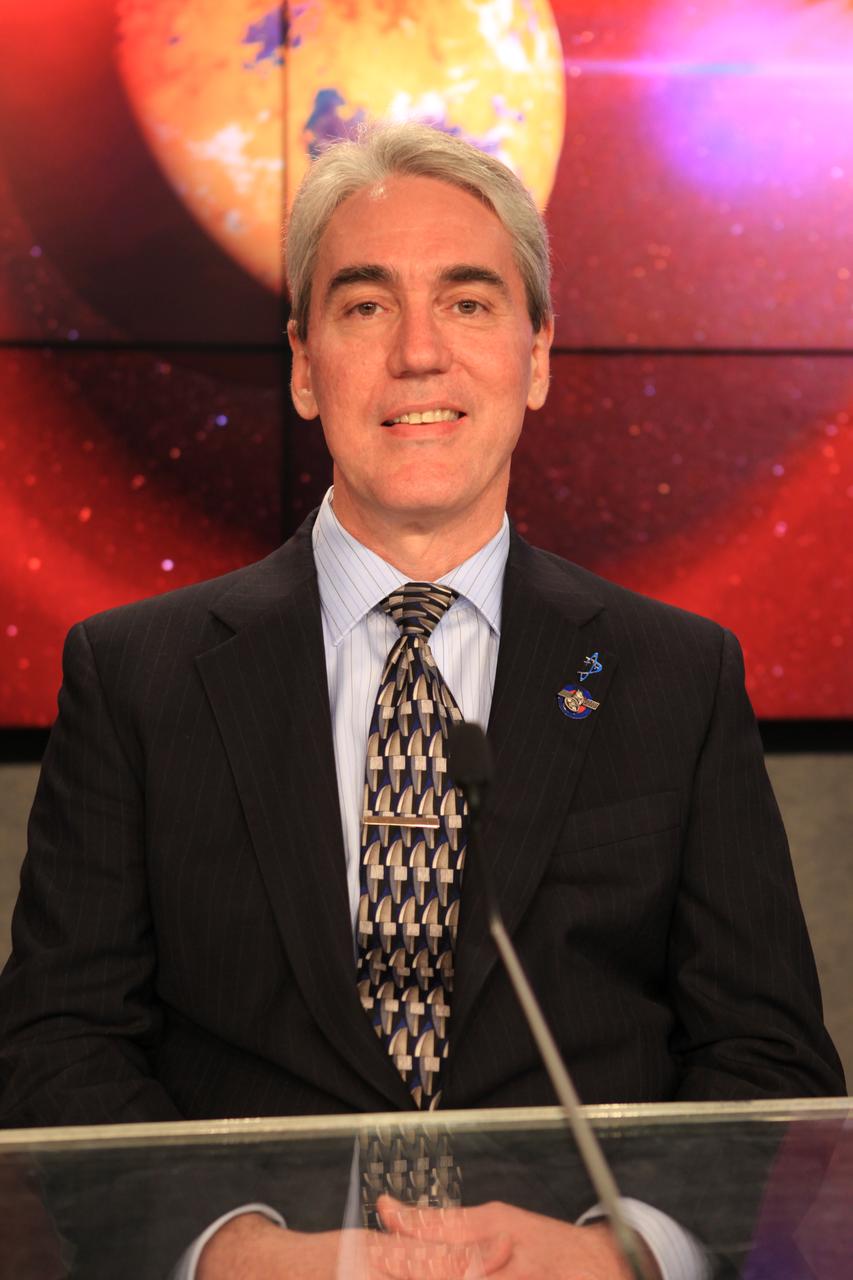
In Kennedy Space Center's Press Site auditorium, members of the media participate in a mission briefing on NASA's Transiting Exoplanet Survey Satellite (TESS). Robert Lockwood, TESS spacecraft program manager, Orbital ATK, answers questions during the briefing. TESS is the next step in the search for planets outside of our solar system. The mission will find exoplanets that periodically block part of the light from their host stars, events called transits. The satellite will survey the nearest and brightest stars for two years to search for transiting exoplanets. TESS will launch on a SpaceX Falcon 9 rocket from Space Launch Complex 40 at Cape Canaveral Air Force Station no earlier than 6:32 p.m. EDT on Monday, April 16.
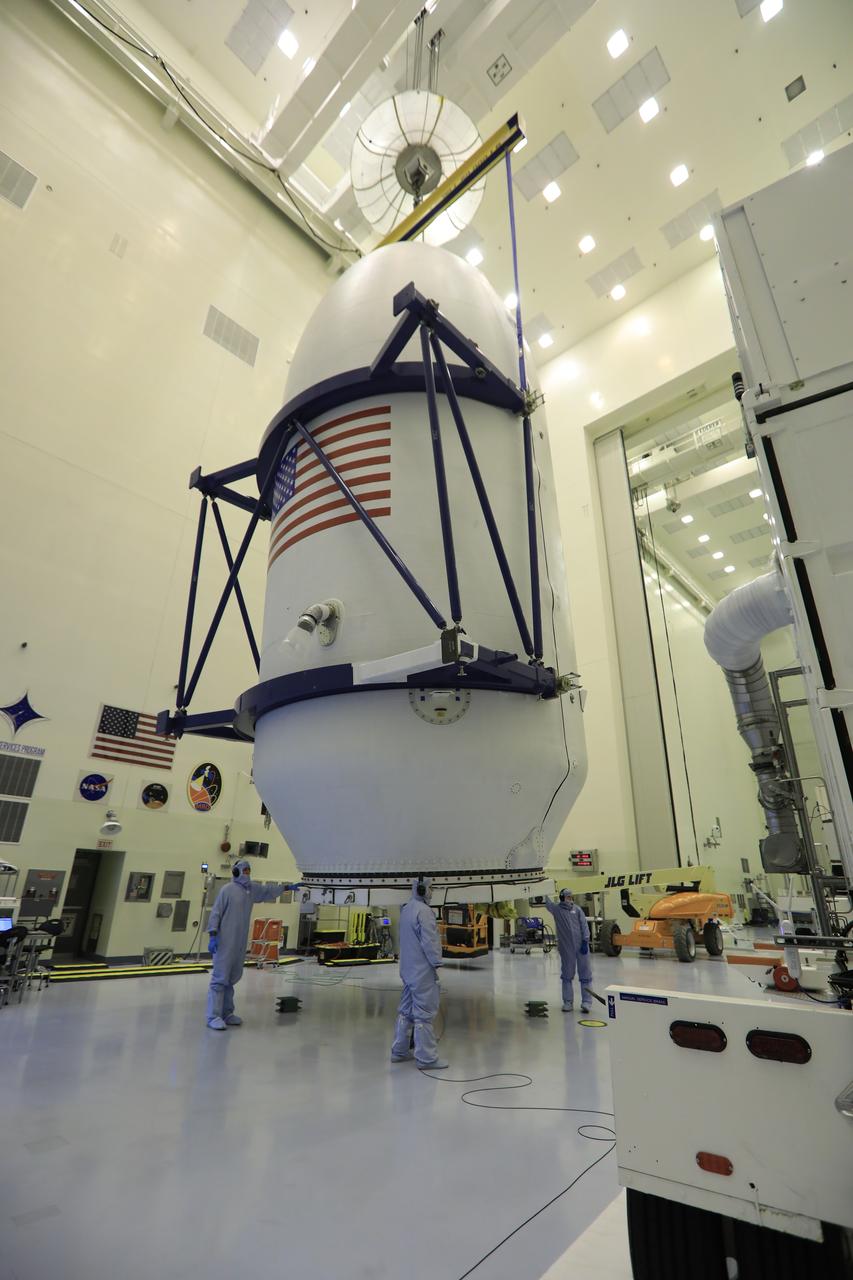
Inside the Payload Hazardous Servicing Facility at NASA's Kennedy Space Center in Florida, technicians assist as the SpaceX payload fairing containing the agency's Transiting Exoplanet Survey Satellite (TESS) is lifted for the move to a transporter. The fairing will be moved to Space Launch Complex 40 at Cape Canaveral Air Force Station. The satellite is scheduled to launch atop the SpaceX Falcon 9 rocket at 6:32 p.m. EDT on April 16. TESS is the next step in NASA's search for planets outside our solar system, known as exoplanets. TESS is a NASA Astrophysics Explorer mission led and operated by MIT in Cambridge, Massachusetts, and managed by NASA’s Goddard Space Flight Center in Greenbelt, Maryland. Dr. George Ricker of MIT’s Kavli Institute for Astrophysics and Space Research serves as principal investigator for the mission. Additional partners include Orbital ATK, NASA’s Ames Research Center, the Harvard-Smithsonian Center for Astrophysics and the Space Telescope Science Institute. More than a dozen universities, research institutes and observatories worldwide are participants in the mission. NASA’s Launch Services Program is responsible for launch management.
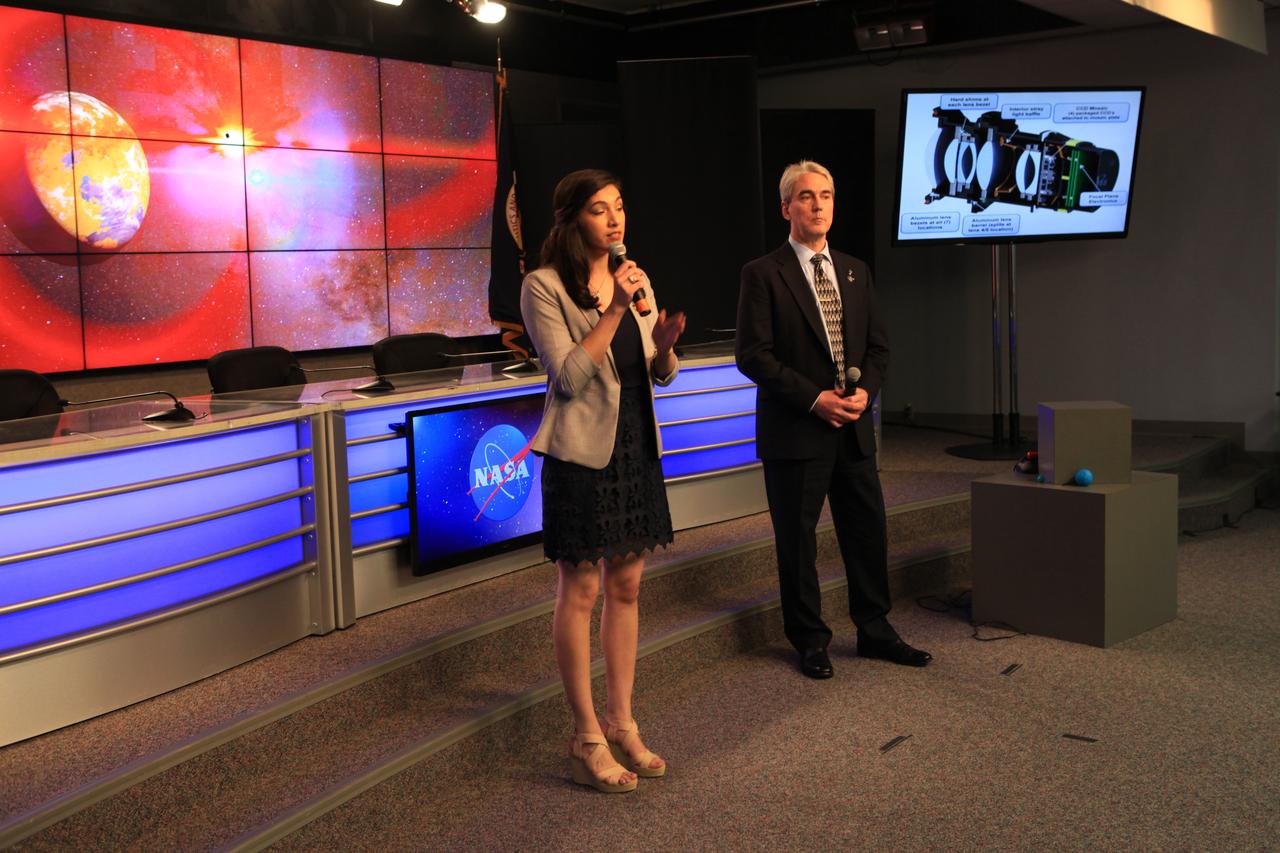
NASA and industry leaders speak to NASA Social participants about the agency's Transiting Exoplanet Survey Satellite (TESS) in the Press Site auditorium at Kennedy Space Center in Florida. Speaking to the group, from left are Natalia Guerrero, TESS researcher, Massachusetts Institute of Technology, and Robert Lockwood, TESS Spacecraft Program Manager, Orbital ATK. TESS is the next step in the search for planets outside of our solar system. The mission will find exoplanets that periodically block part of the light from their host stars, events called transits. The satellite will survey the nearest and brightest stars for two years to search for transiting exoplanets. TESS will launch on a SpaceX Falcon 9 rocket from Space Launch Complex 40 at Cape Canaveral Air Force Station no earlier than 6:32 p.m. EDT on Monday, April 16.
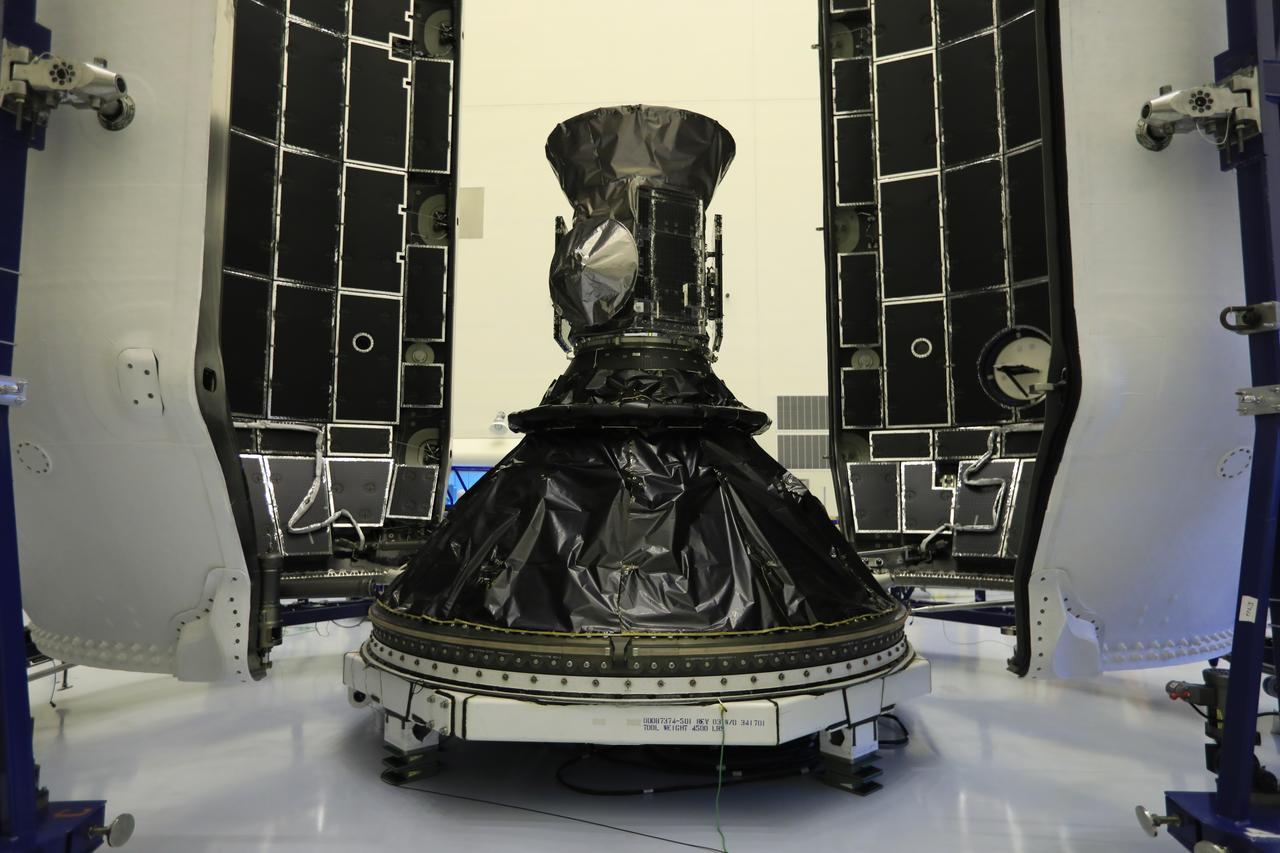
Inside the Payload Hazardous Servicing Facility at NASA's Kennedy Space Center in Florida, NASA's Transiting Exoplanet Survey Satellite (TESS) is being prepared for encapsulation in the SpaceX payload fairing. The satellite is scheduled to launch atop a SpaceX Falcon 9 rocket from Space Launch Complex 40 at Cape Canaveral Air Force Station on April 16. The satellite is the next step in NASA's search for planets outside our solar system, known as exoplanets. TESS is a NASA Astrophysics Explorer mission led and operated by MIT in Cambridge, Massachusetts, and managed by NASA’s Goddard Space Flight Center in Greenbelt, Maryland. Dr. George Ricker of MIT’s Kavli Institute for Astrophysics and Space Research serves as principal investigator for the mission. Additional partners include Orbital ATK, NASA’s Ames Research Center, the Harvard-Smithsonian Center for Astrophysics and the Space Telescope Science Institute. More than a dozen universities, research institutes and observatories worldwide are participants in the mission. NASA’s Launch Services Program is responsible for launch management.
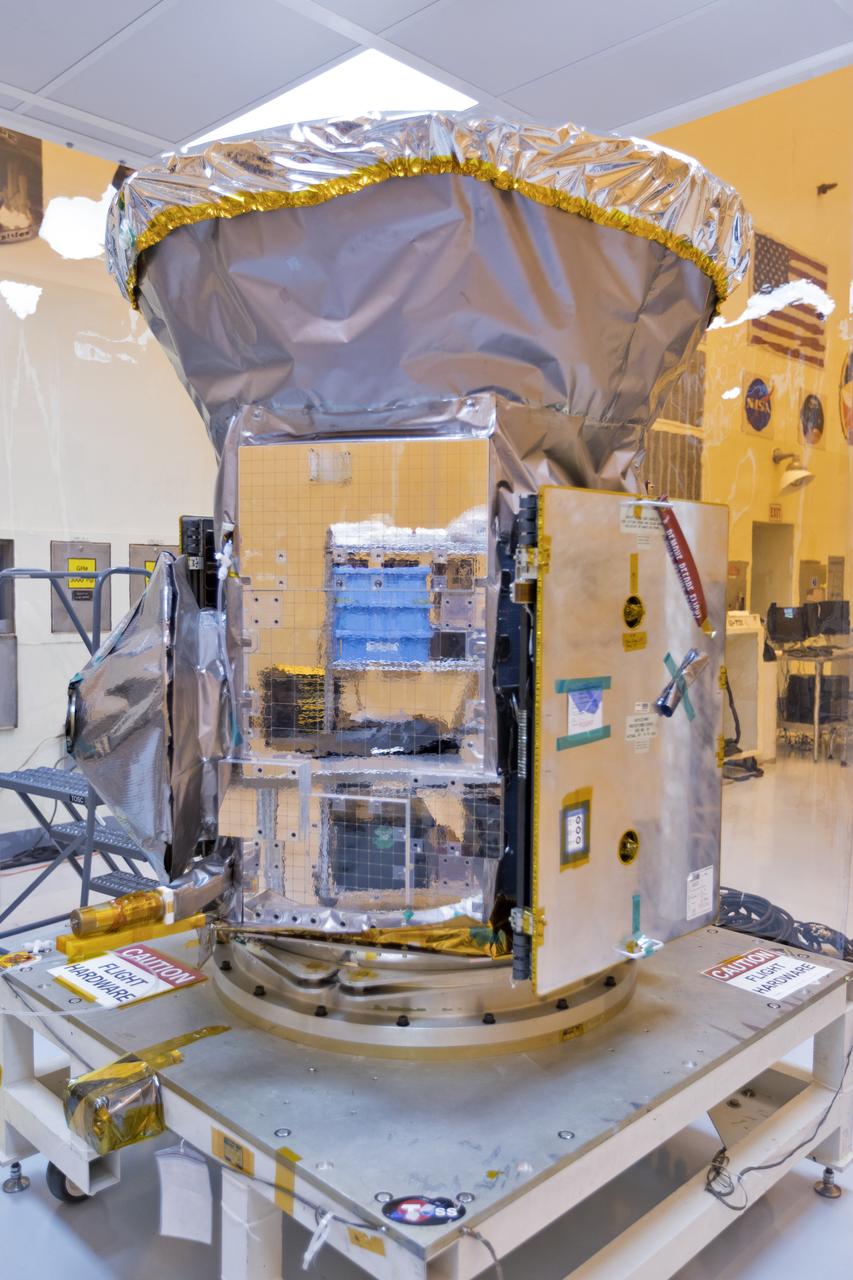
In the Payload Hazardous Servicing Facility at NASA's Kennedy Space Center in Florida, the agency's Transiting Exoplanet Survey Satellite, or TESS, has been uncreated from its shipping container for inspections and preflight processing. The satellite is NASA's next step in the search for planets outside of the solar system also known as "exoplanets." TESS is a NASA Astrophysics Explorer mission led and operated by MIT in Cambridge, Massachusetts, and managed by NASA’s Goddard Space Flight Center in Greenbelt, Maryland. Dr. George Ricker of MIT’s Kavli Institute for Astrophysics and Space Research serves as principal investigator for the mission. Additional partners include Orbital ATK, NASA’s Ames Research Center, and the Harvard-Smithsonian Center for Astrophysics and the Space Telescope Science Institute. More than a dozen universities, research institutes and observatories worldwide are participants in the mission. NASA’s Launch Services Program is responsible for launch management. SpaceX of Hawthorne, California, is the provider of the Falcon 9 launch service. TESS is scheduled to launch atop a Falcon 9 rocket no earlier than April 16, 2018 from Space Launch Complex 41 at Cape Canaveral Air Force Station.
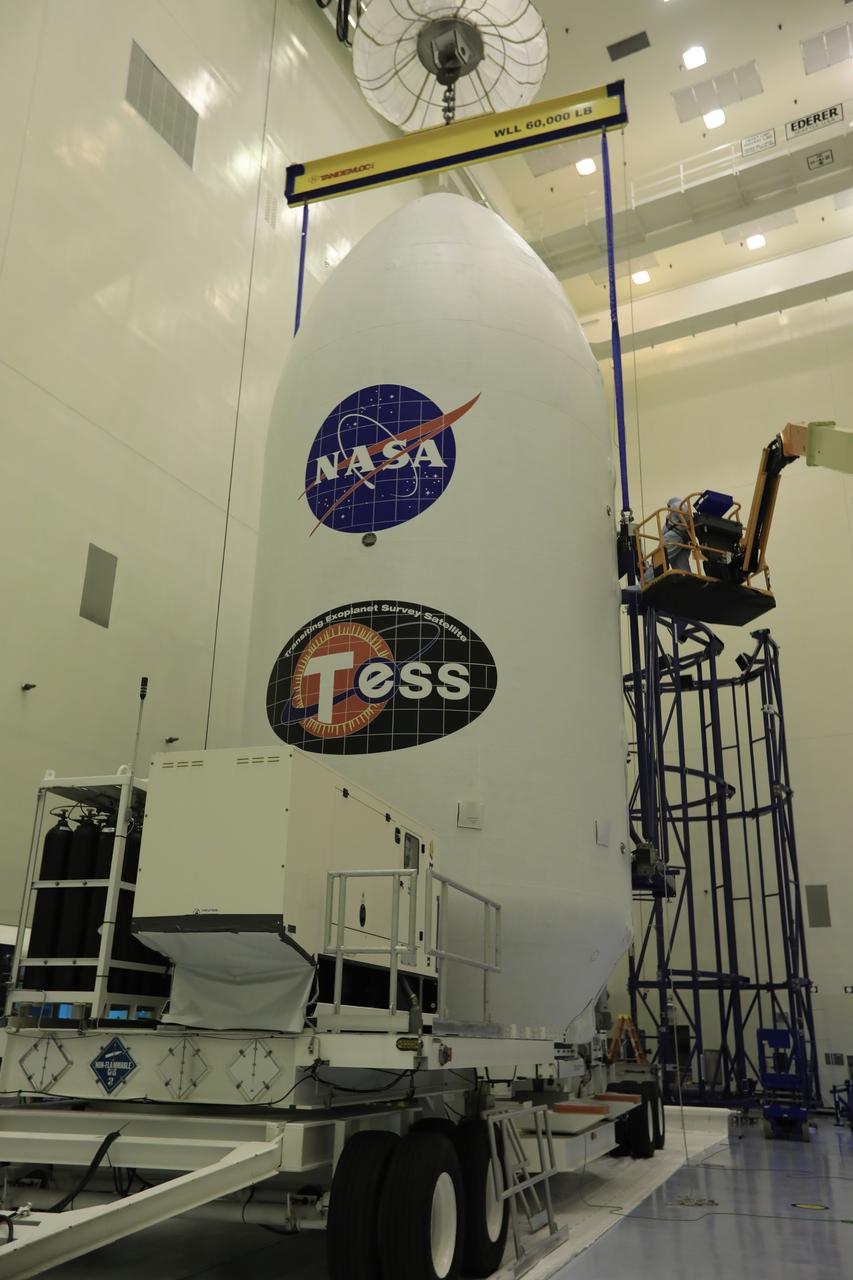
Inside the Payload Hazardous Servicing Facility at NASA's Kennedy Space Center in Florida, the SpaceX payload fairing containing the agency's Transiting Exoplanet Survey Satellite (TESS) is secured onto a transporter. The fairing will be moved to Space Launch Complex 40 at Cape Canaveral Air Force Station. TESS is scheduled to launch on the SpaceX Falcon 9 rocket at 6:32 p.m. EDT on April 16. The satellite is the next step in NASA's search for planets outside our solar system, known as exoplanets. TESS is a NASA Astrophysics Explorer mission led and operated by MIT in Cambridge, Massachusetts, and managed by NASA’s Goddard Space Flight Center in Greenbelt, Maryland. Dr. George Ricker of MIT’s Kavli Institute for Astrophysics and Space Research serves as principal investigator for the mission. Additional partners include Orbital ATK, NASA’s Ames Research Center, the Harvard-Smithsonian Center for Astrophysics and the Space Telescope Science Institute. More than a dozen universities, research institutes and observatories worldwide are participants in the mission. NASA’s Launch Services Program is responsible for launch management.

NASA and industry leaders speak to NASA Social participants about the agency's Transiting Exoplanet Survey Satellite (TESS) in the Press Site auditorium at Kennedy Space Center in Florida. Speaking to the group from center, are Martin Still, TESS Program Scientist, NASA Headquarters, and Jessie Christiansen, Staff scientist, NASA Exoplanet Science Institute, California Institute of Technology. At far left is Jason Townsend, NASA Communications. TESS is the next step in the search for planets outside of our solar system. The mission will find exoplanets that periodically block part of the light from their host stars, events called transits. The satellite will survey the nearest and brightest stars for two years to search for transiting exoplanets. TESS will launch on a SpaceX Falcon 9 rocket from Space Launch Complex 40 at Cape Canaveral Air Force Station no earlier than 6:32 p.m. EDT on Monday, April 16.
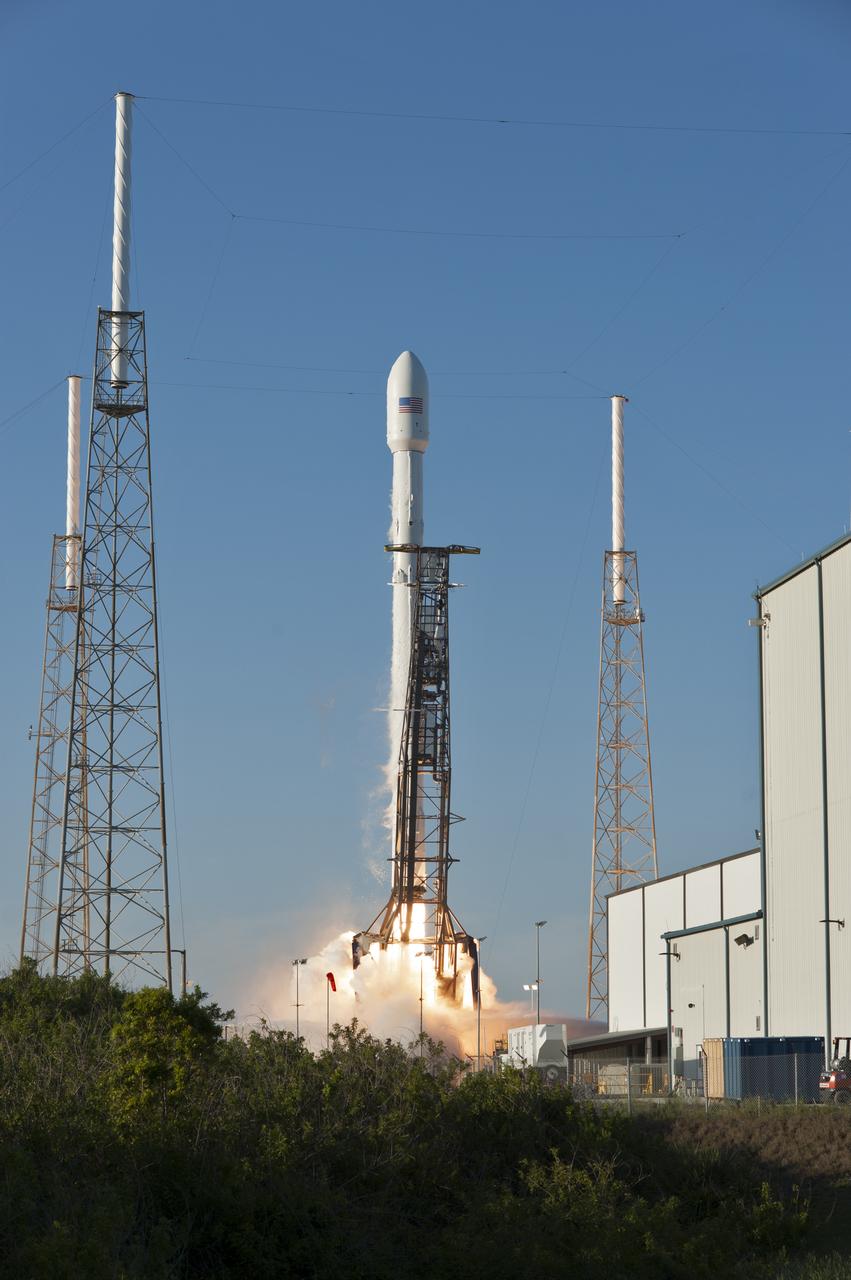
A SpaceX Falcon 9 rocket lifts off from Space Launch Complex 40 at Cape Canaveral Air Force Station in Florida, carrying NASA's Transiting Exoplanet Survey Satellite (TESS). Liftoff was at 6:51 p.m. EDT. TESS will search for planets outside of our solar system. The mission will find exoplanets that periodically block part of the light from their host stars, events called transits. The satellite will survey the nearest and brightest stars for two years to search for transiting exoplanets.

NASA and science investigators from MIT participate in a science briefing for the agency's Transiting Exoplanet Survey Satellite (TESS) in the Press Site auditorium at Kennedy Space Center in Florida. Diana Dragomir, NASA Hubble Postdoctoral Fellow, Massachusetts Institute of Technology, answered questions during the briefing. TESS is the next step in the search for planets outside of our solar system. The mission will find exoplanets that periodically block part of the light from their host stars, events called transits. The satellite will survey the nearest and brightest stars for two years to search for transiting exoplanets. TESS will launch on a SpaceX Falcon 9 rocket from Space Launch Complex 40 at Cape Canaveral Air Force Station no earlier than 6:32 p.m. EDT on Monday, April 16.

NASA and science investigators from MIT participate in a science briefing for the agency's Transiting Exoplanet Survey Satellite (TESS) in the Press Site auditorium at Kennedy Space Center in Florida. Paul Hertz, Astrophysics Division director, NASA Headquarters, answered questions during the briefing. TESS is the next step in the search for planets outside of our solar system. The mission will find exoplanets that periodically block part of the light from their host stars, events called transits. The satellite will survey the nearest and brightest stars for two years to search for transiting exoplanets. TESS will launch on a SpaceX Falcon 9 rocket from Space Launch Complex 40 at Cape Canaveral Air Force Station no earlier than 6:32 p.m. EDT on Monday, April 16.

NASA and science investigators from MIT participate in a science briefing for the agency's Transiting Exoplanet Survey Satellite (TESS) in the Press Site auditorium at Kennedy Space Center in Florida. George Ricker, TESS principal investigator, Massachusetts Institute of Technology, answered questions during the briefing. TESS is the next step in the search for planets outside of our solar system. The mission will find exoplanets that periodically block part of the light from their host stars, events called transits. The satellite will survey the nearest and brightest stars for two years to search for transiting exoplanets. TESS will launch on a SpaceX Falcon 9 rocket from Space Launch Complex 40 at Cape Canaveral Air Force Station no earlier than 6:32 p.m. EDT on Monday, April 16.