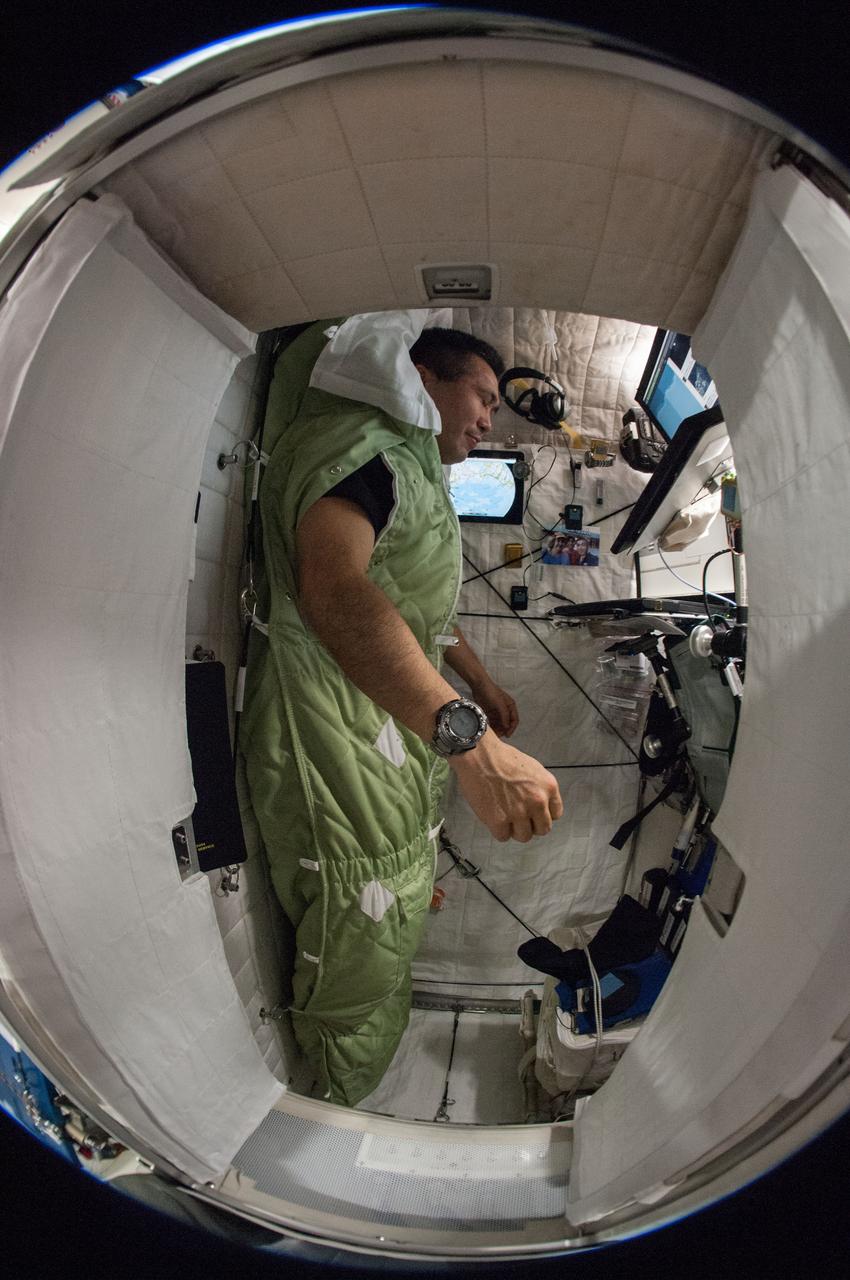
iss038e024951 (1/5/2014) --- Japan Aerospace Exploration Agency (JAXA) Koichi Wakata strapped into his sleeping bag in his sleep station located in the Node 2. Circadian Rhythms investigates the role of synchronized circadian rhythms, or the “biological clock,” and how it changes during long-duration spaceflight.
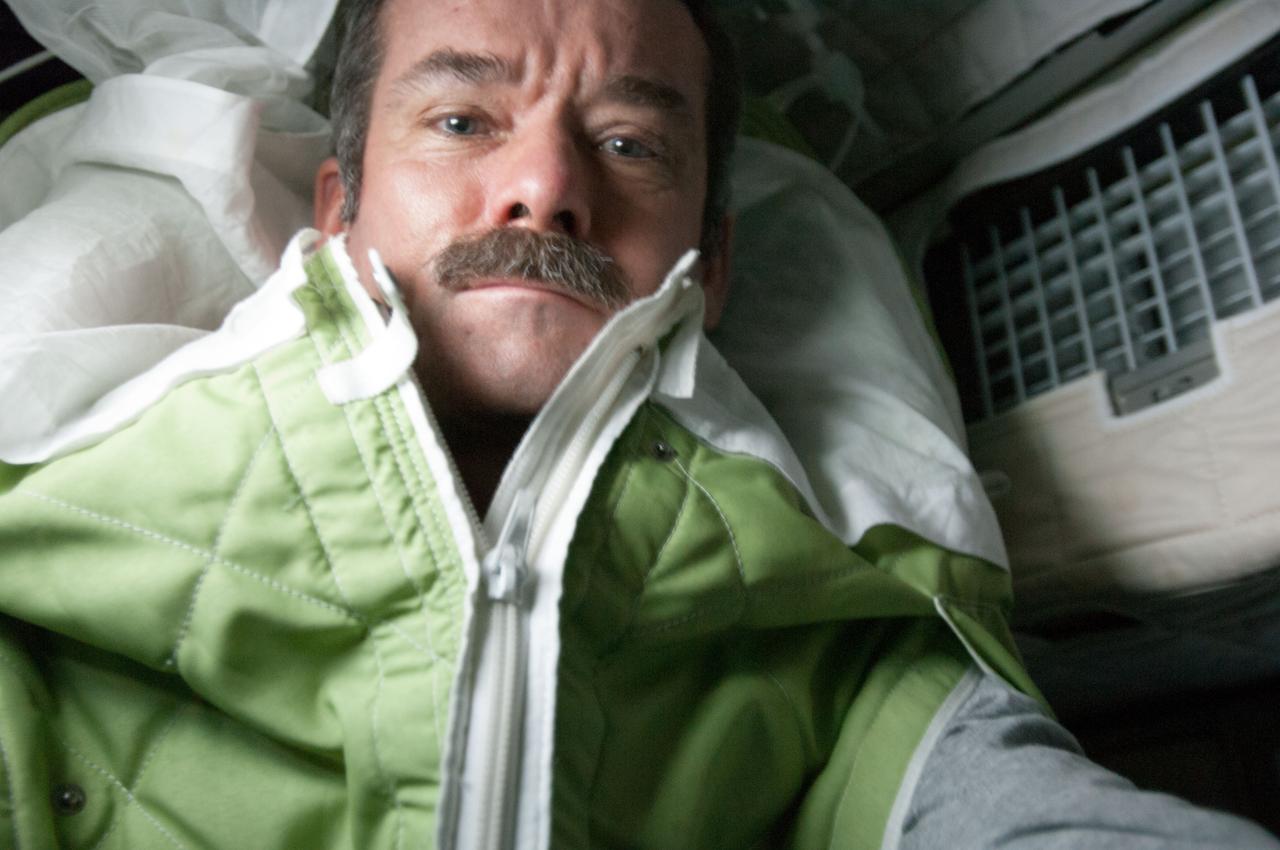
View of Canadian Space Agency (CSA) Chris Hadfield, Expedition 34 Flight Engineer (FE), in sleep station, in the Node 2. Photo was taken during Expedition 34.
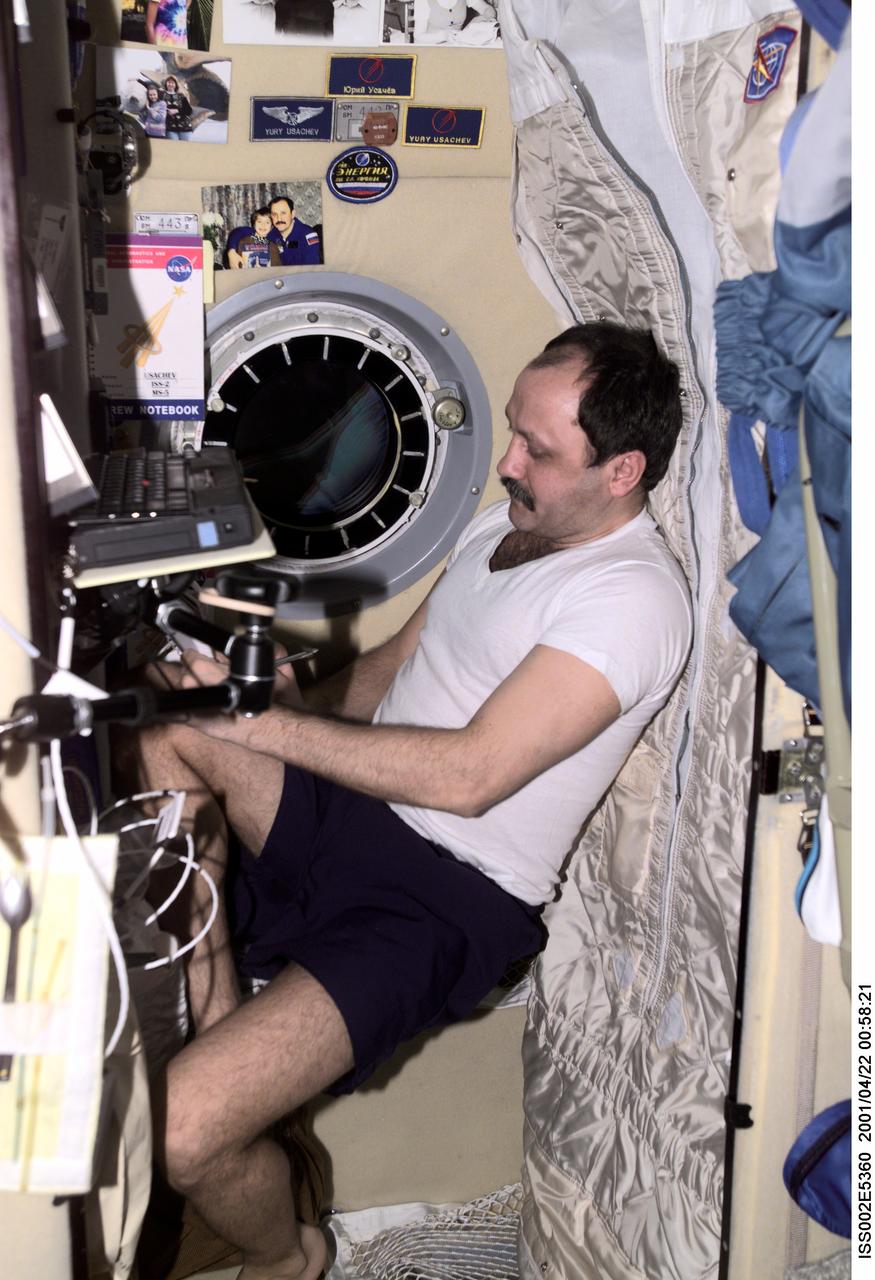
ISS002-E-5360 (22 April 2001) --- Cosmonaut Yury V. Usachev, Expedition Two mission commander, writes down some notes in his sleeping compartment in the Zvezda / Service Module of the International Space Station (ISS). This image was recorded with a digital still camera.
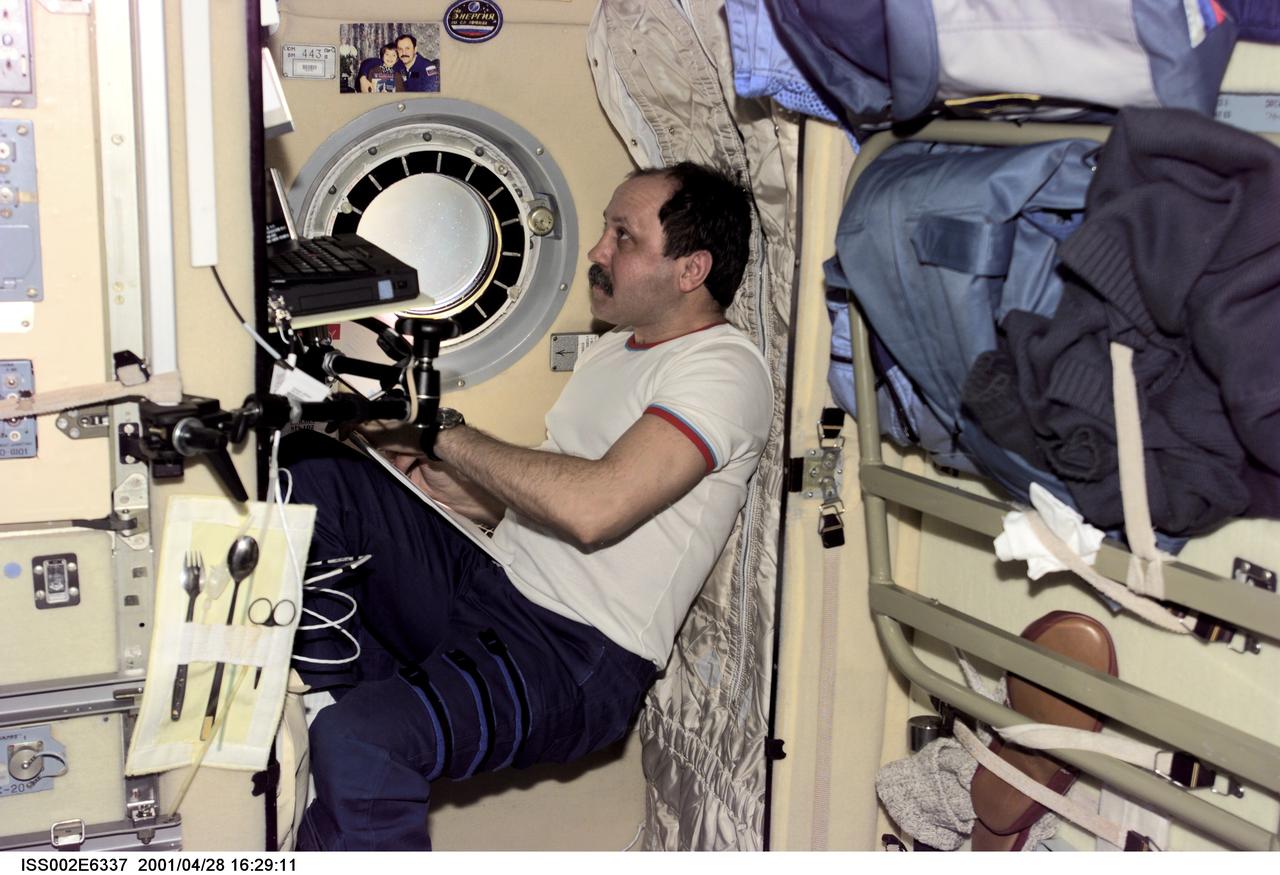
ISS002-E-6337 (28 April 2001) --- Cosmonaut Yury V. Usachev, Expedition Two mission commander, writes down some notes in his sleeping compartment in the Zvezda / Service Module of the International Space Station (ISS). The image was taken with a digital still camera.
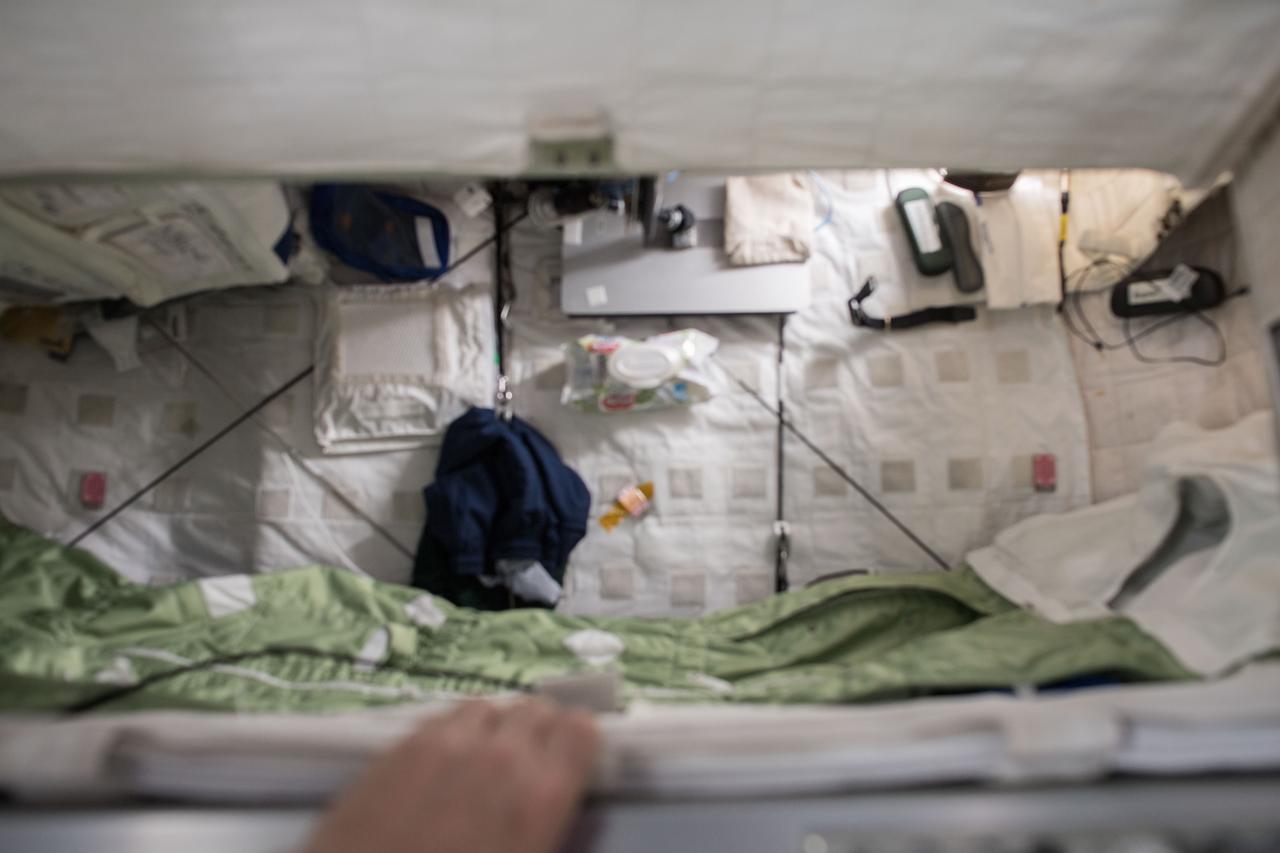
iss054e022260 (Jan. 17, 2018) --- View inside the crew quarters where astronauts sleep on the International Space Station.
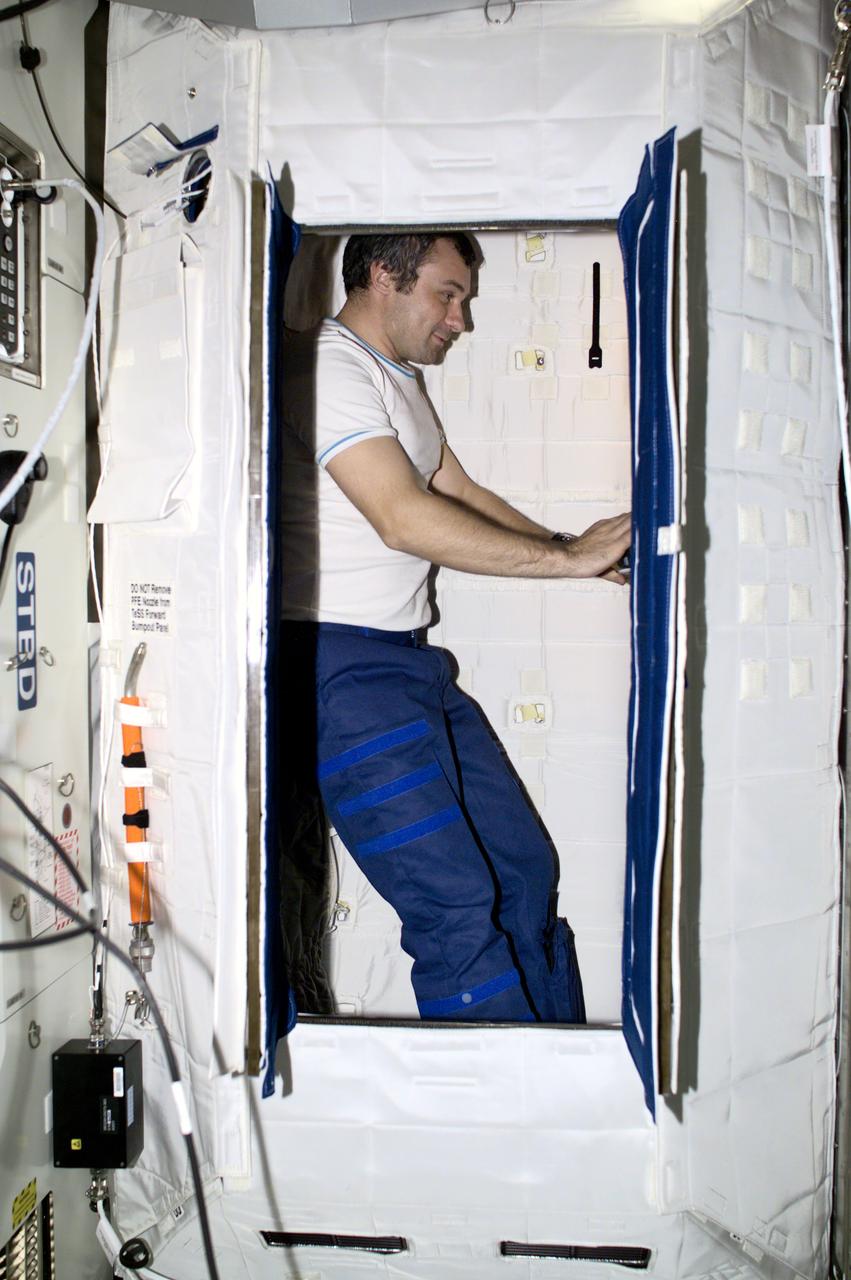
ISS003-E-5558 (9 September 2001) --- Cosmonaut Vladimir Dezhurov of Rosaviakosmos, Expedition 3 flight engineer, works on a laptop computer in the temporary sleep station of the in the U.S. Laboratory Destiny onboard the International Space Station.
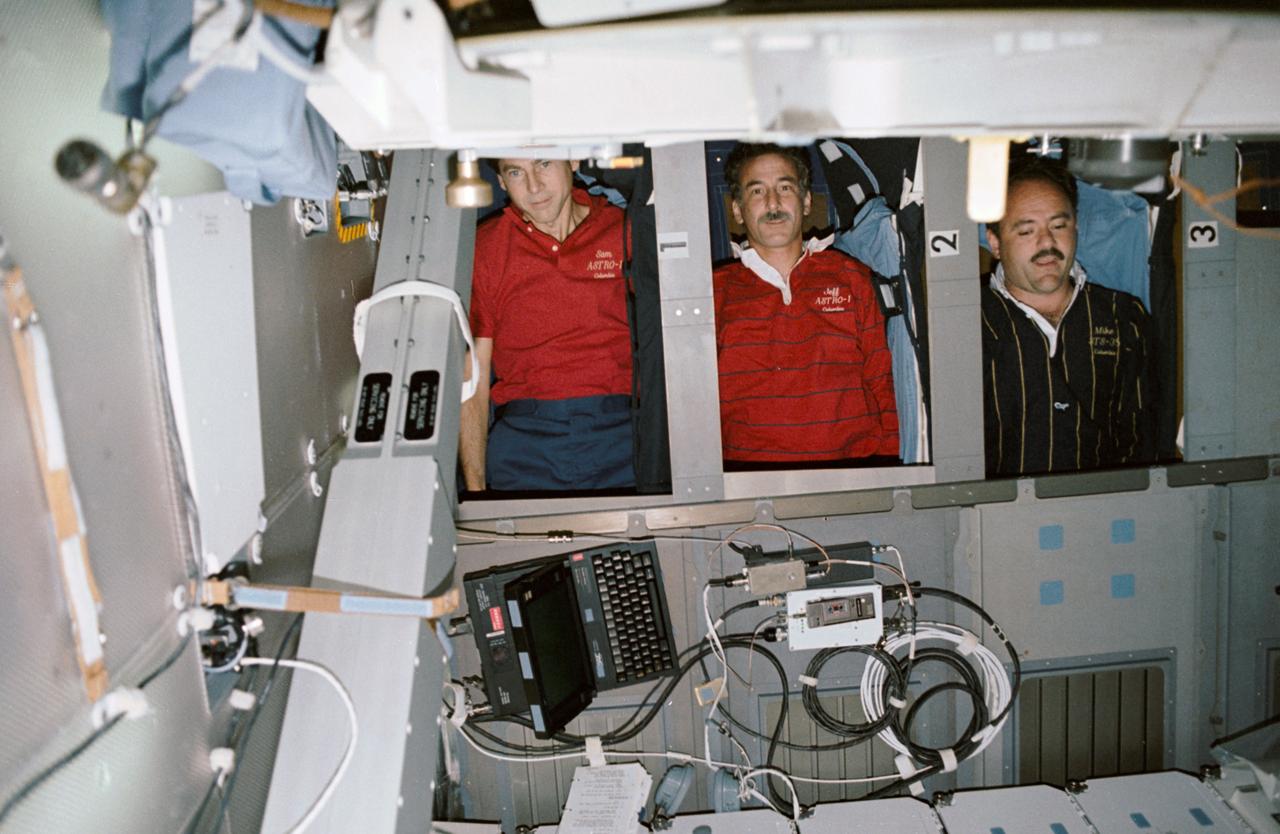
Though they are not actually asleep, three STS-35 crewmembers demonstrate the bunk-style sleep compartments onboard Columbia's, Orbiter Vehicle (OV) 102's, middeck. From top to bottom are Payload Specialist Samuel T. Durrance, Mission Specialist (MS) Jeffrey A. Hoffman, and MS John M. Lounge. At the left is the shuttle amateur radio experiment (SAREX). The crew escape pole (CES) is visible overhead and the open airlock hatch in the foreground. The sleep station is located against the middeck starboard wall.
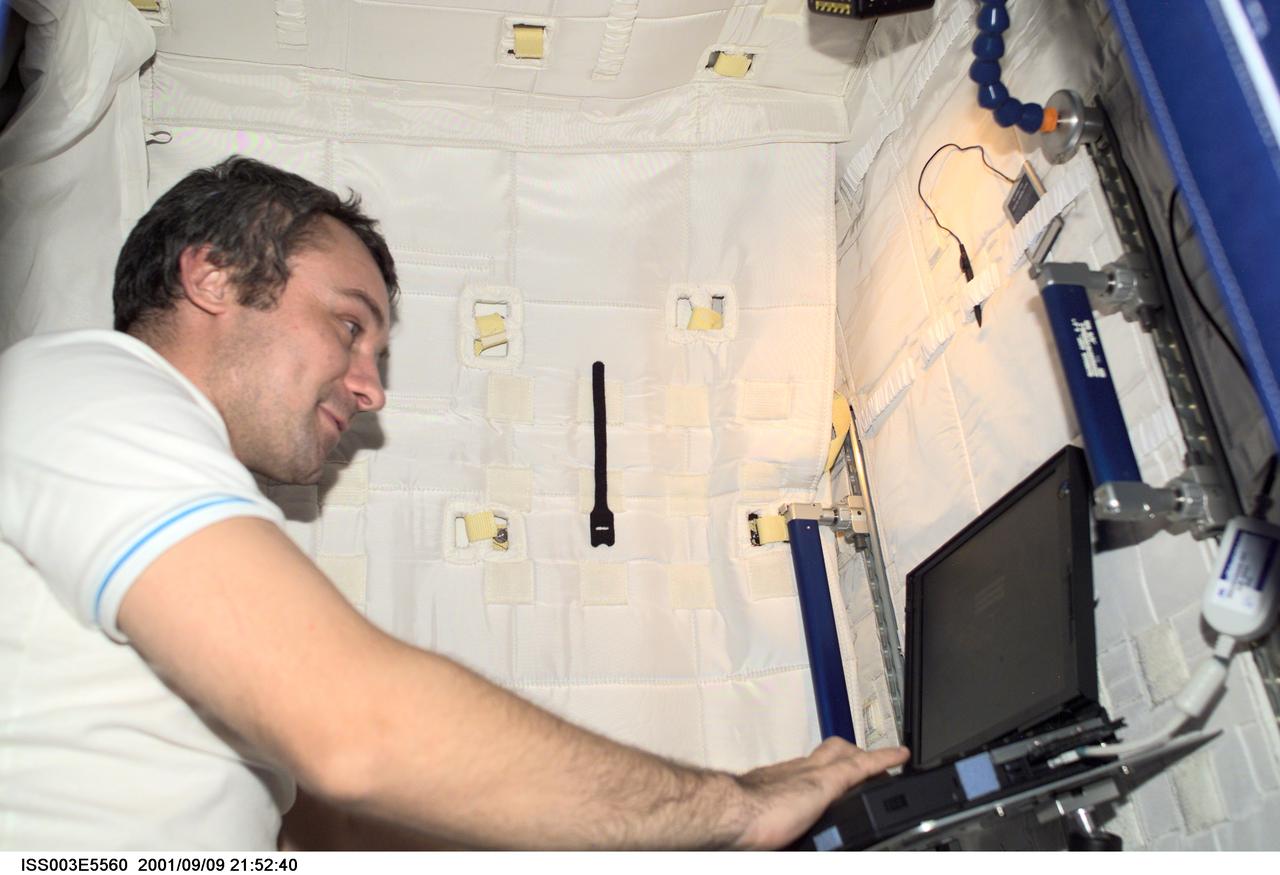
ISS003-E-5560 (9 September 2001) --- Cosmonaut Vladimir Dezhurov of Rosaviakosmos, Expedition Three flight engineer, works on a laptop computer in the Temporary Sleep Station (TSS) in the U.S. Laboratory.
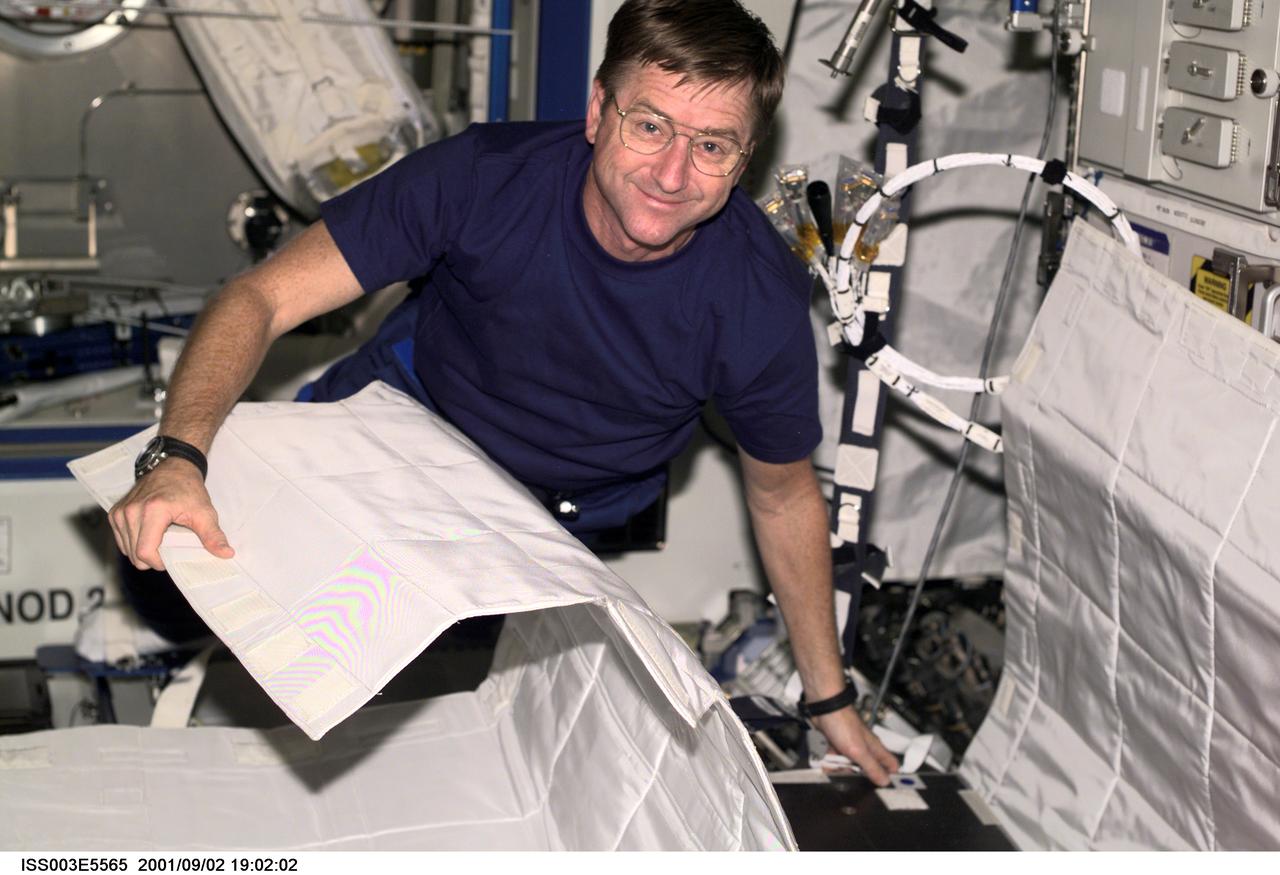
ISS003-E-5565 (2 September 2001) --- Astronaut Frank L. Culbertson, Jr., Expedition Three mission commander, assembles the Temporary Sleep Station (TESS) in the U.S. Laboratory.
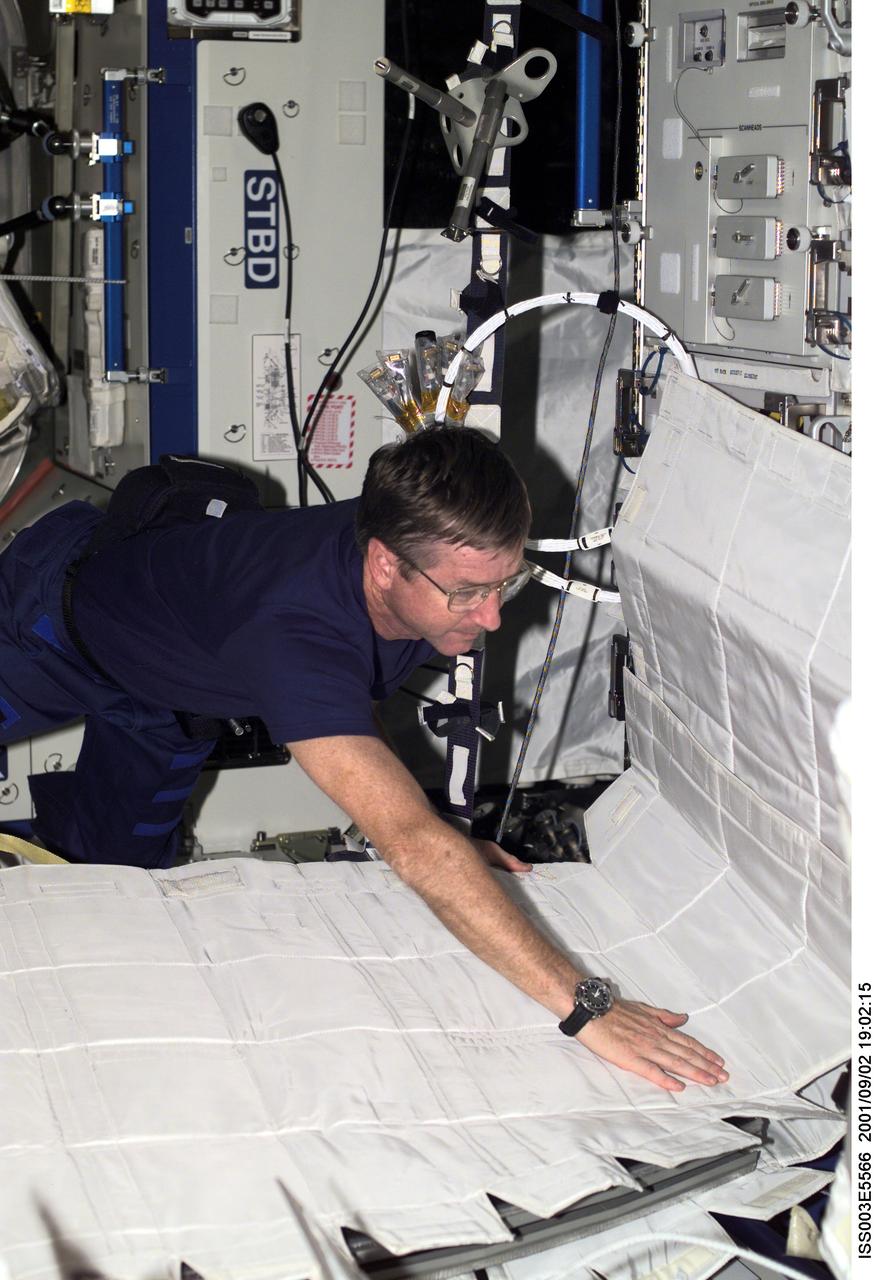
ISS003-E-5566 (2 September 2001) --- Astronaut Frank L. Culbertson, Jr., Expedition Three mission commander, assembles the Temporary Sleep Station (TESS) in the U.S. Laboratory.
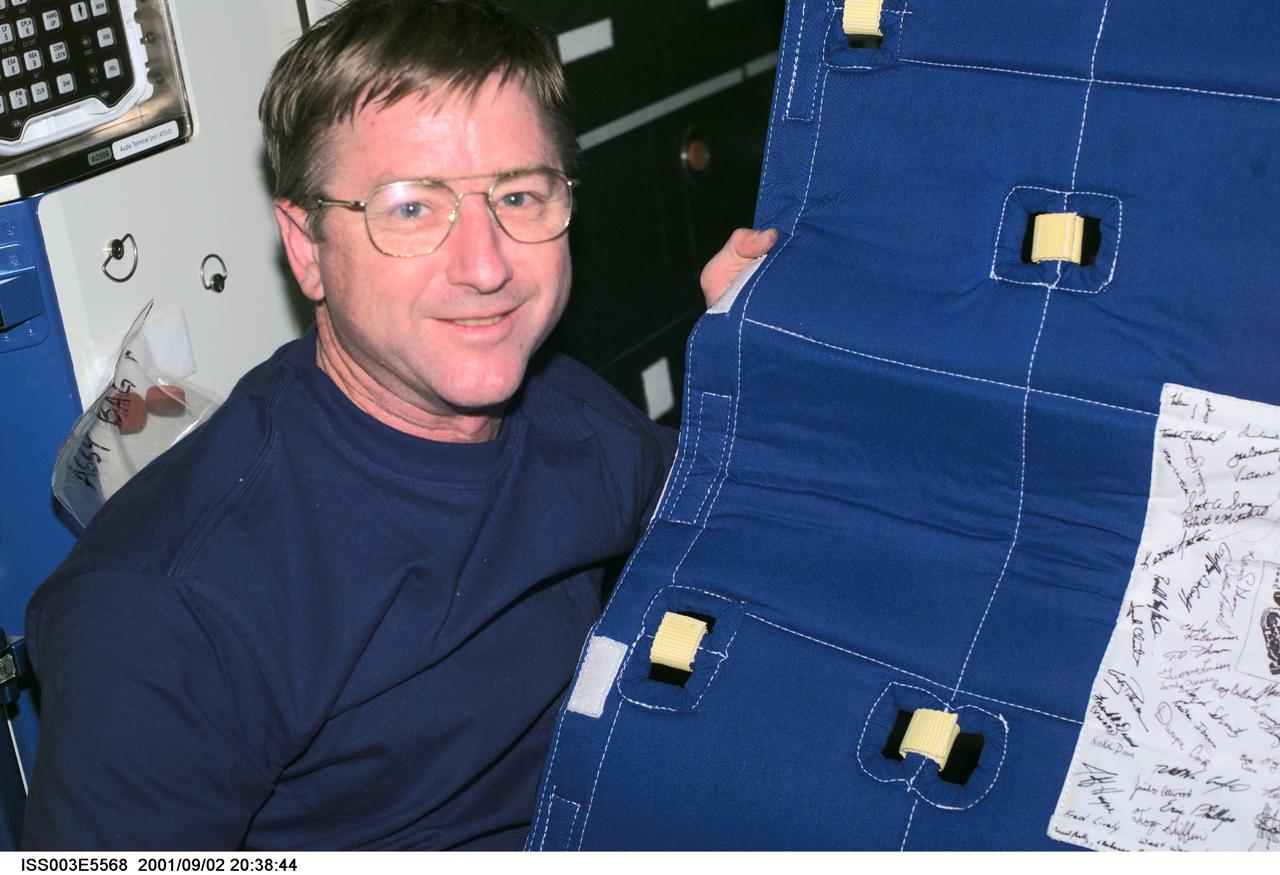
ISS003-E-5568 (2 September 2001) --- Astronaut Frank L. Culbertson, Jr., Expedition Three mission commander, assembles the Temporary Sleep Station (TESS) in the U.S. Laboratory.
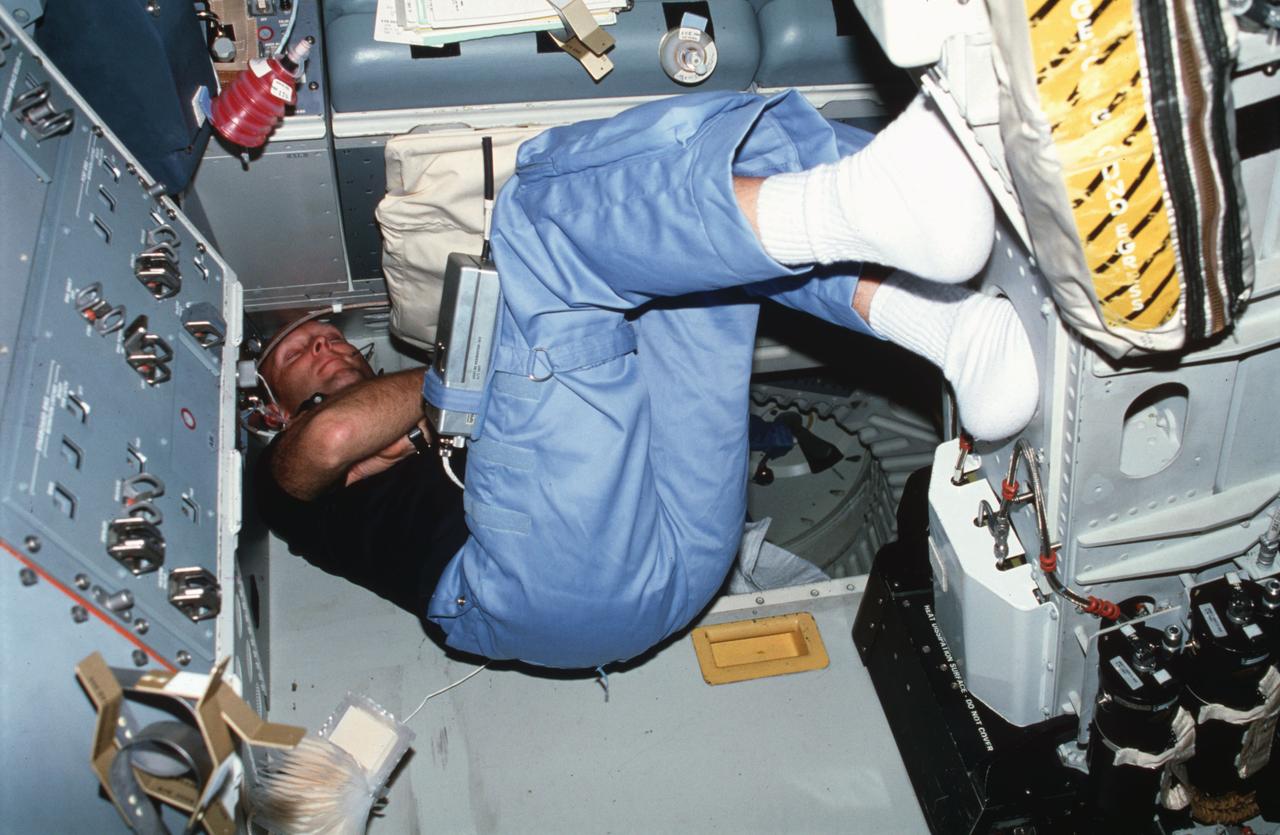
STS003-22-113 (24 March 1982) --- Astronaut Gordon Fullerton, STS-3 pilot, wearing communication kit assembly mini-headset (HDST), sleeps on aft flight deck resting his back against the floor and his feet against commander's ejection seat (S1) back. On-orbit station control panel A8 and payload station panel L15 appear above Fullerton. Special clips for holding notebooks open and beverage containers are velcroed on various panels. Photo credit: NASA

SL3-111-1505 (July-September 1973) --- View of scientist-astronaut Owen K. Garriott, Skylab 3 science pilot, in his sleep restraints in the crew quarters of the Orbital Workshop (OWS). Photo credit: NASA
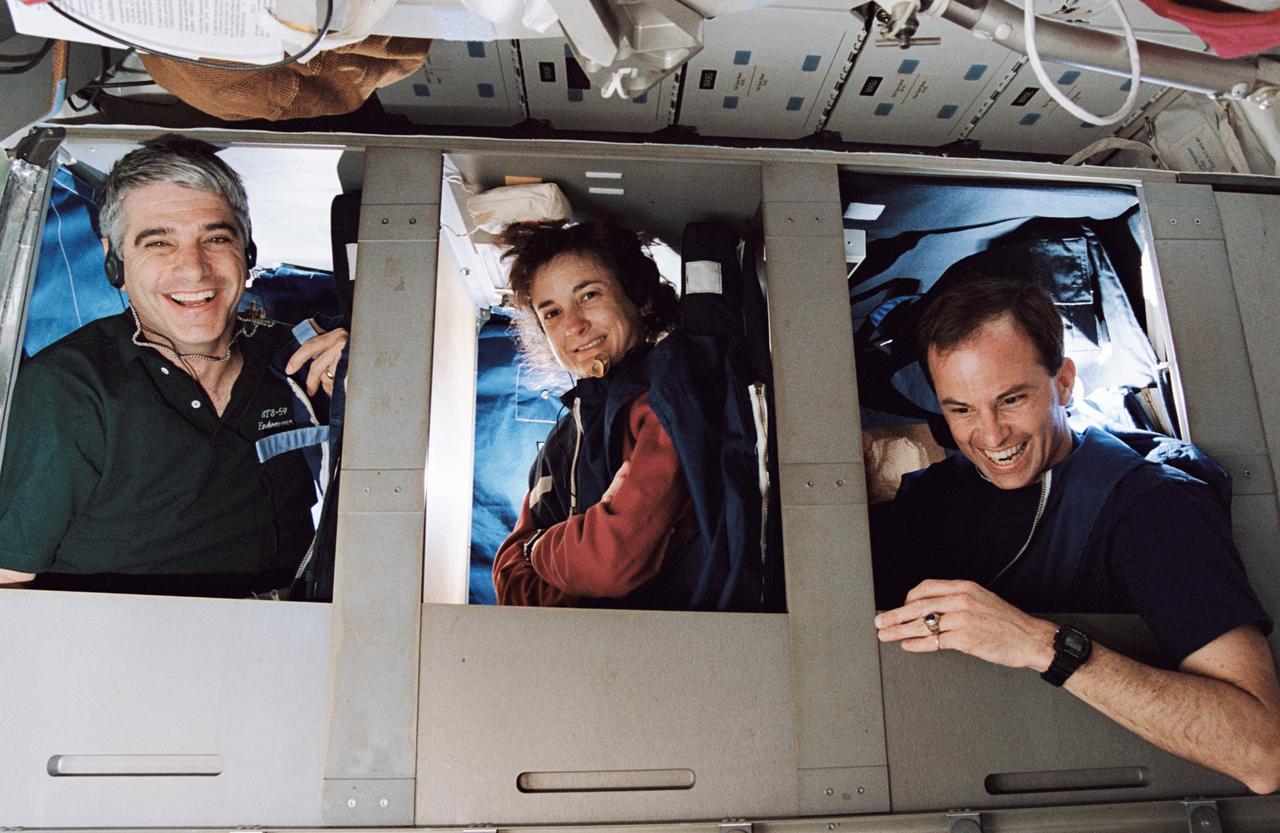
STS059-22-004 (9-20 April 1994) --- Half of Space Shuttle Endeavour's crew of six astronauts are pictured in bunks on the middeck. With the picture held horizontally, the red shift crew members pictured are, left to right, astronauts Sidney M. Gutierrez, mission commander; Linda M. Godwin, payload commander; and Kevin P. Chilton, pilot.
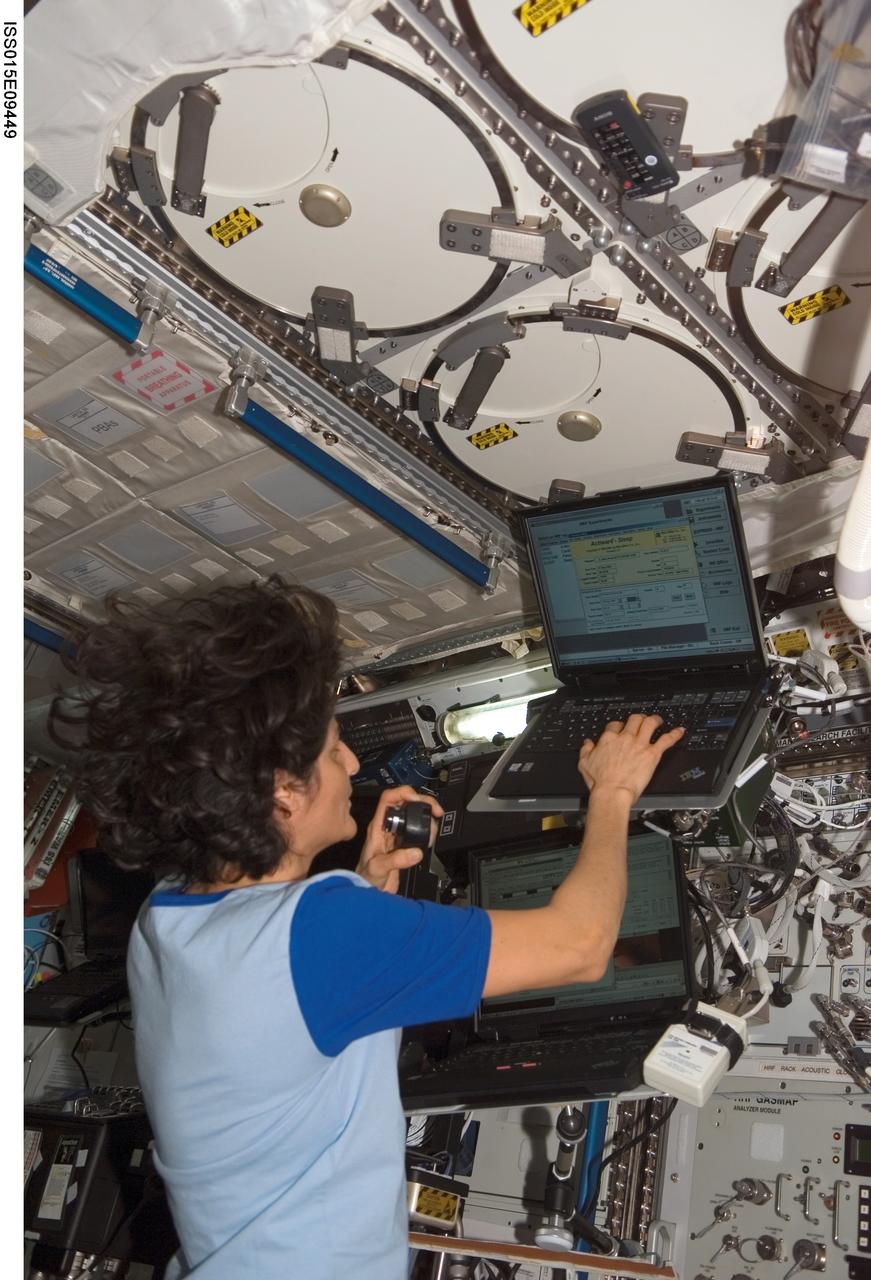
ISS015-E-09449 (24 May 2007) --- Astronaut Sunita L. Williams, Expedition 15 flight engineer, enters data in a computer for the Sleep-Wake Actigraphy and Light Exposure During Spaceflight-Long (Sleep-Long) experiment in the Destiny laboratory of the International Space Station. Sleep-Long will examine the effects of spaceflight and ambient light exposure on the sleep-wake cycles of the crewmembers during long-duration stays on the station.
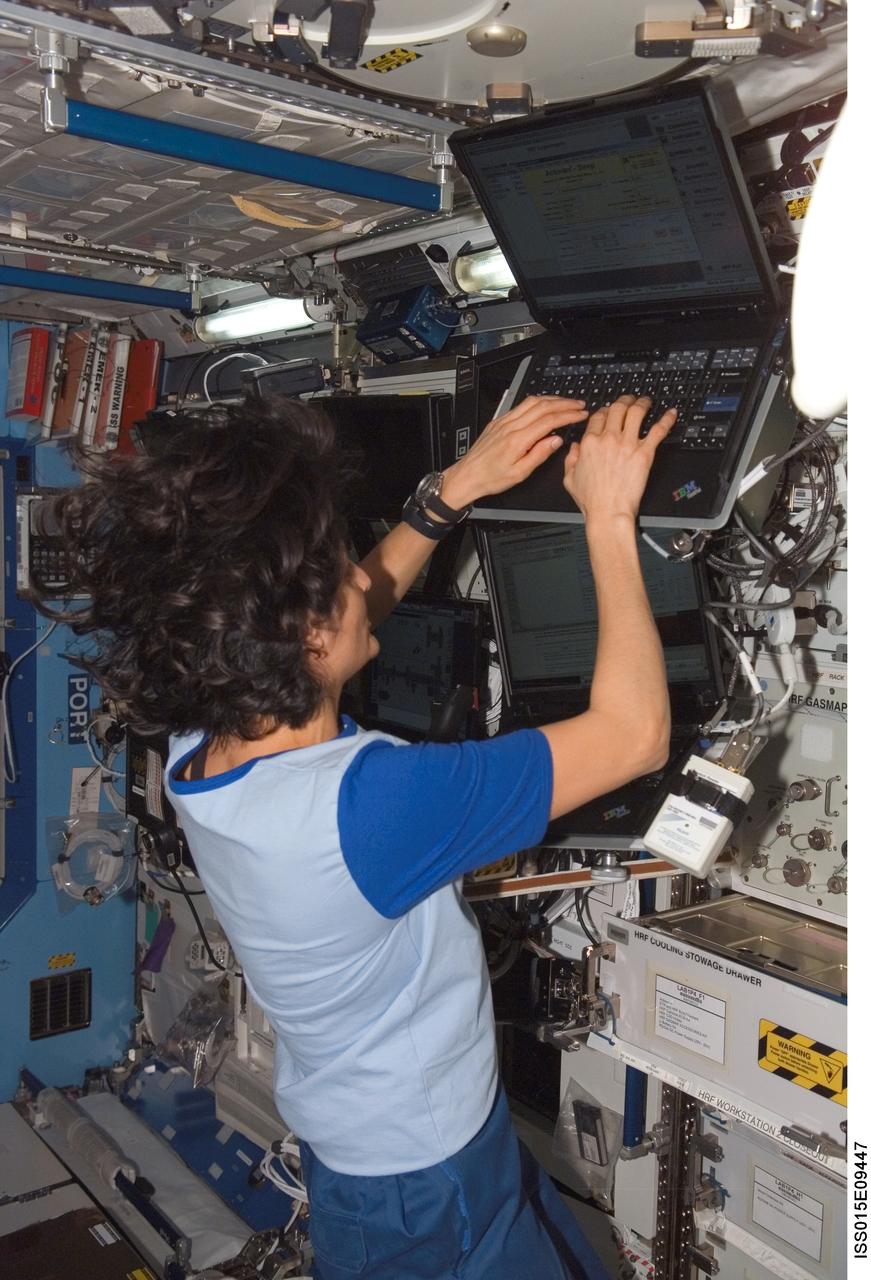
ISS015-E-09447 (24 May 2007) --- Astronaut Sunita L. Williams, Expedition 15 flight engineer, enters data in a computer for the Sleep-Wake Actigraphy and Light Exposure During Spaceflight-Long (Sleep-Long) experiment in the Destiny laboratory of the International Space Station. Sleep-Long will examine the effects of spaceflight and ambient light exposure on the sleep-wake cycles of the crewmembers during long-duration stays on the station.
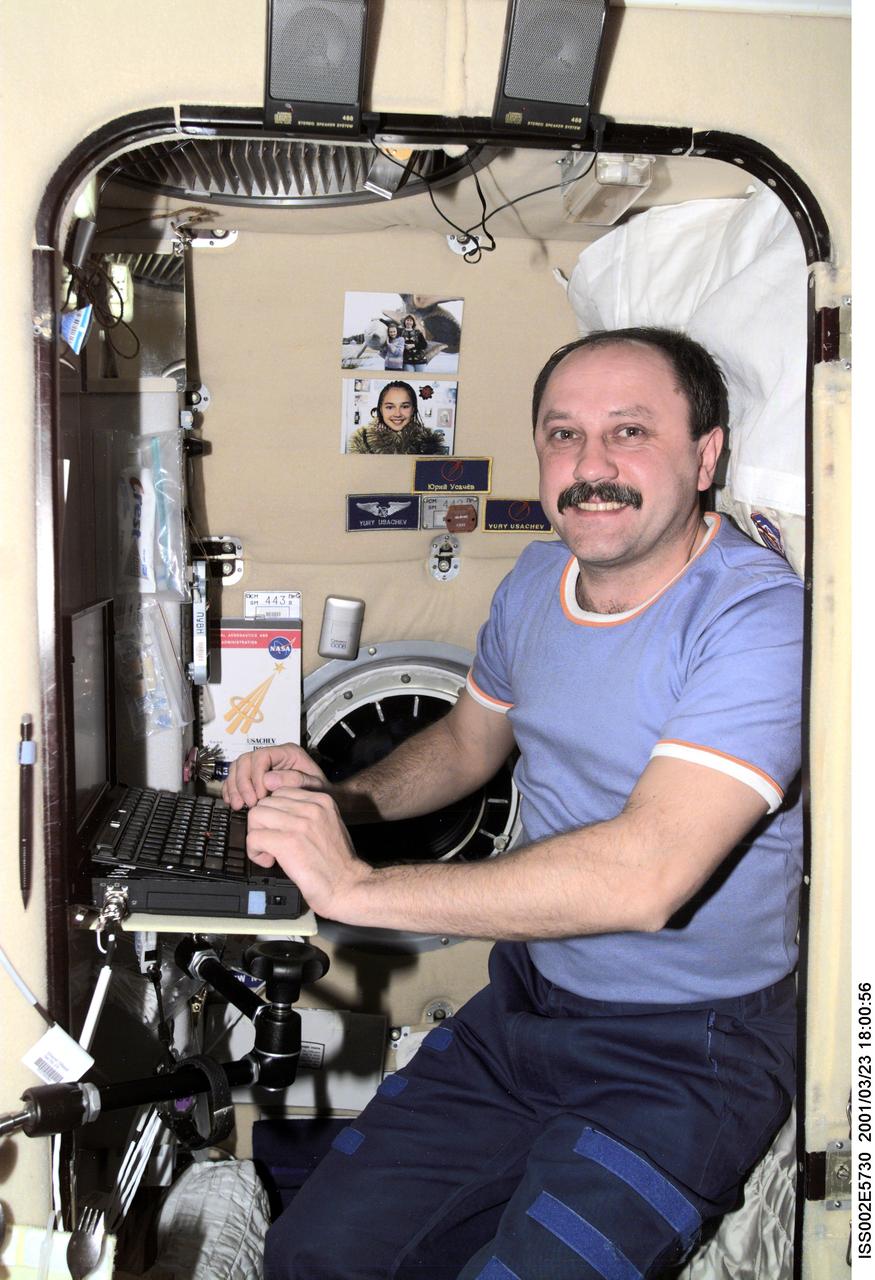
ISS002-E-5730 (23 March 2001) --- Cosmonaut Yury V. Usachev, Expedition Two commander, works at a laptop computer in his crew compartment in the Zvezda Service Module aboard the International Space Station (ISS). The image was recorded with a digital still camera.
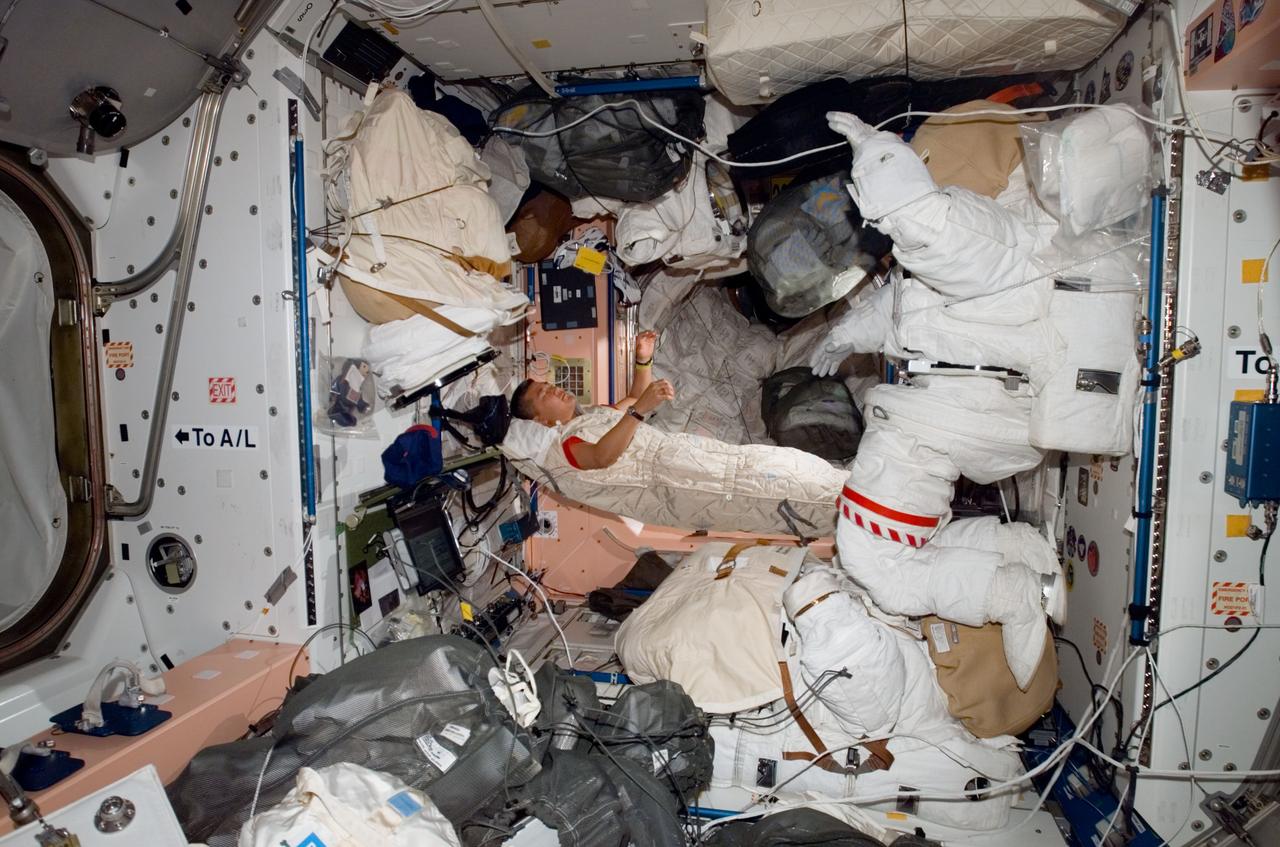
ISS016-E-008034 (2 Nov. 2007) --- Astronaut Daniel Tani, Expedition 16 flight engineer, sleeps in his sleeping bag in the Unity node of the International Space Station while Space Shuttle Discovery is docked with the station.
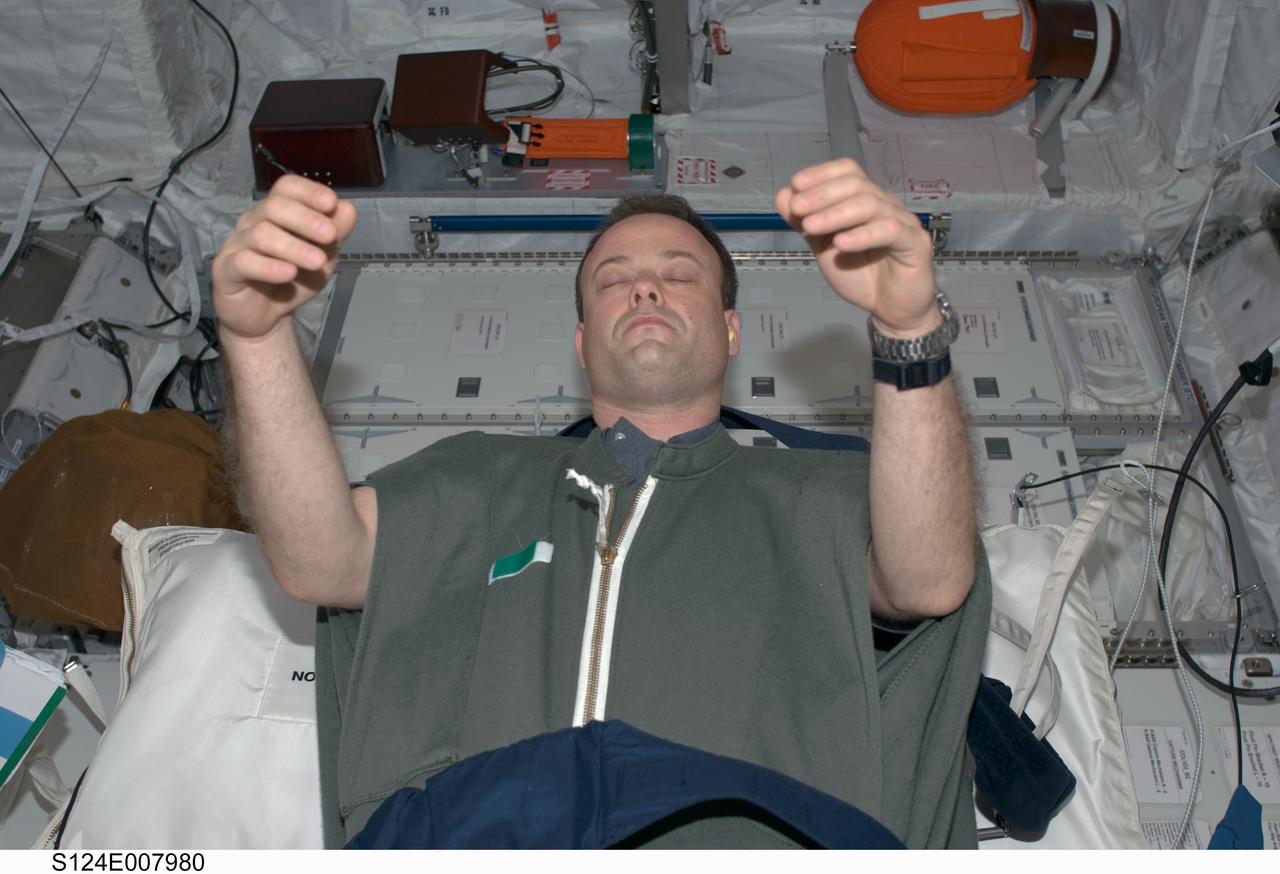
S124-E-007980 (9 June 2008) --- Astronaut Ron Garan, STS-124 mission specialist, sleeps in his sleeping bag in the Columbus laboratory of the International Space Station while Space Shuttle Discovery is docked with the station.
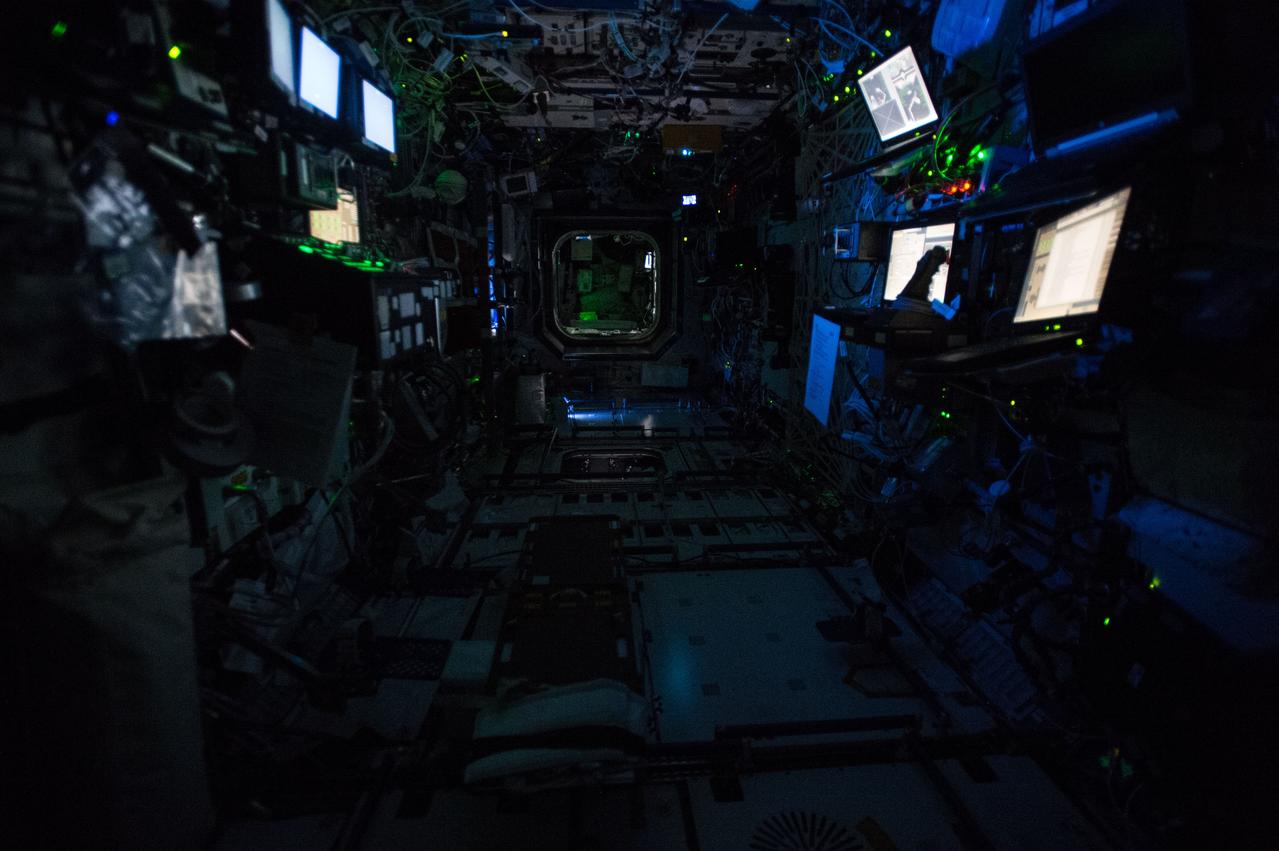
ISS047e016355 (03/23/2016) --- The International Space Station's Destiny Laboratory at “night” shortly before the Expedition 47 crew entered its scheduled sleep period. The space station experiences 16 sunrises and sunsets every day which can alter the crew’s circadian rhythm and disrupt sleep patterns. Lights are turned off and windows are covered to give the interior of the station a nighttime environment during sleep cycles.
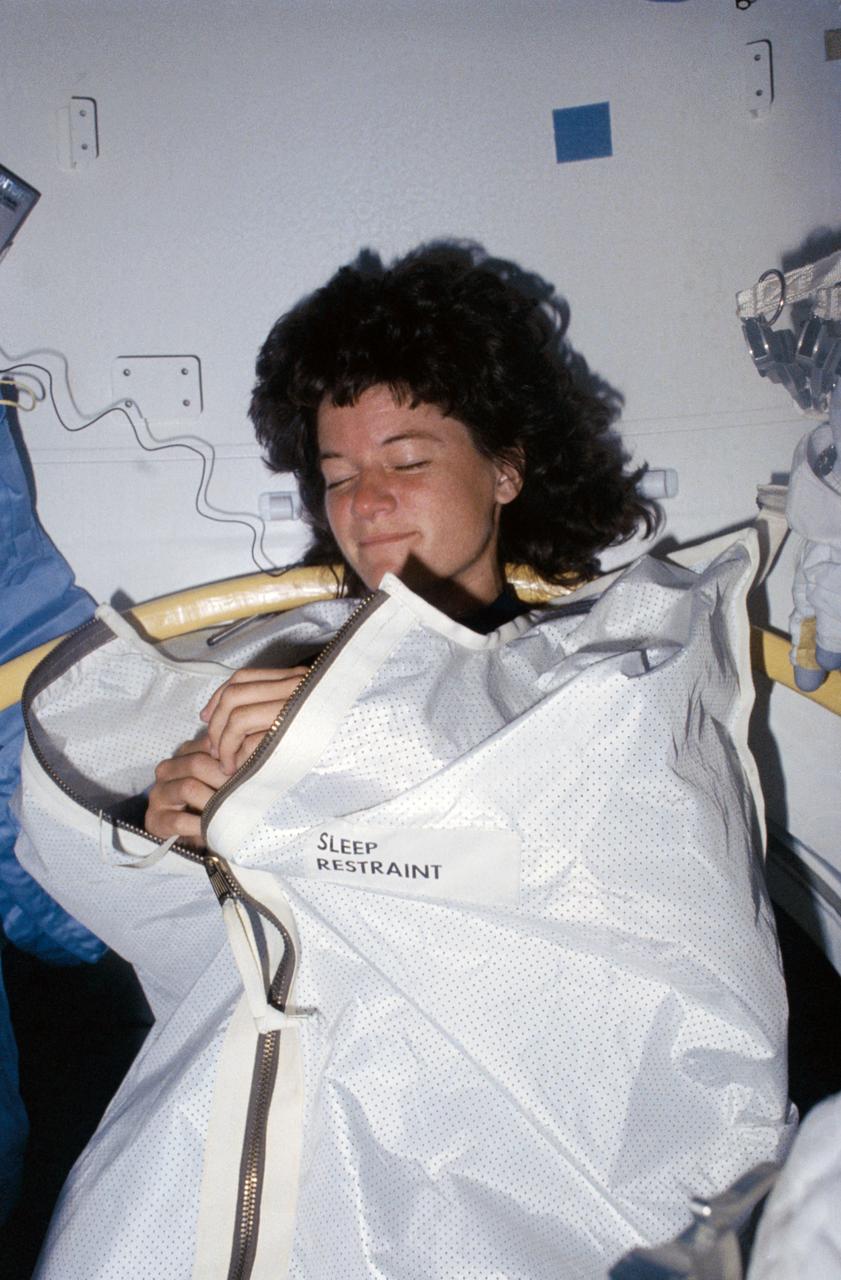
STS007-26-1438 (18-24 June 1983) --- Astronaut Sally K. Ride, mission specialist, was captured at her sleep station in the Space Shuttle Challenger's middeck by a fellow crew member using a 35mm camera. This method of sleep is just one used by the 20 astronauts who have now flown aboard NASA's first two Space Shuttle Orbiters. Some astronauts choose to sleep in various positions with either their feet or upper bodies or both anchored and others elect to use the sleep restraint device demonstrated here by Dr. Ride.
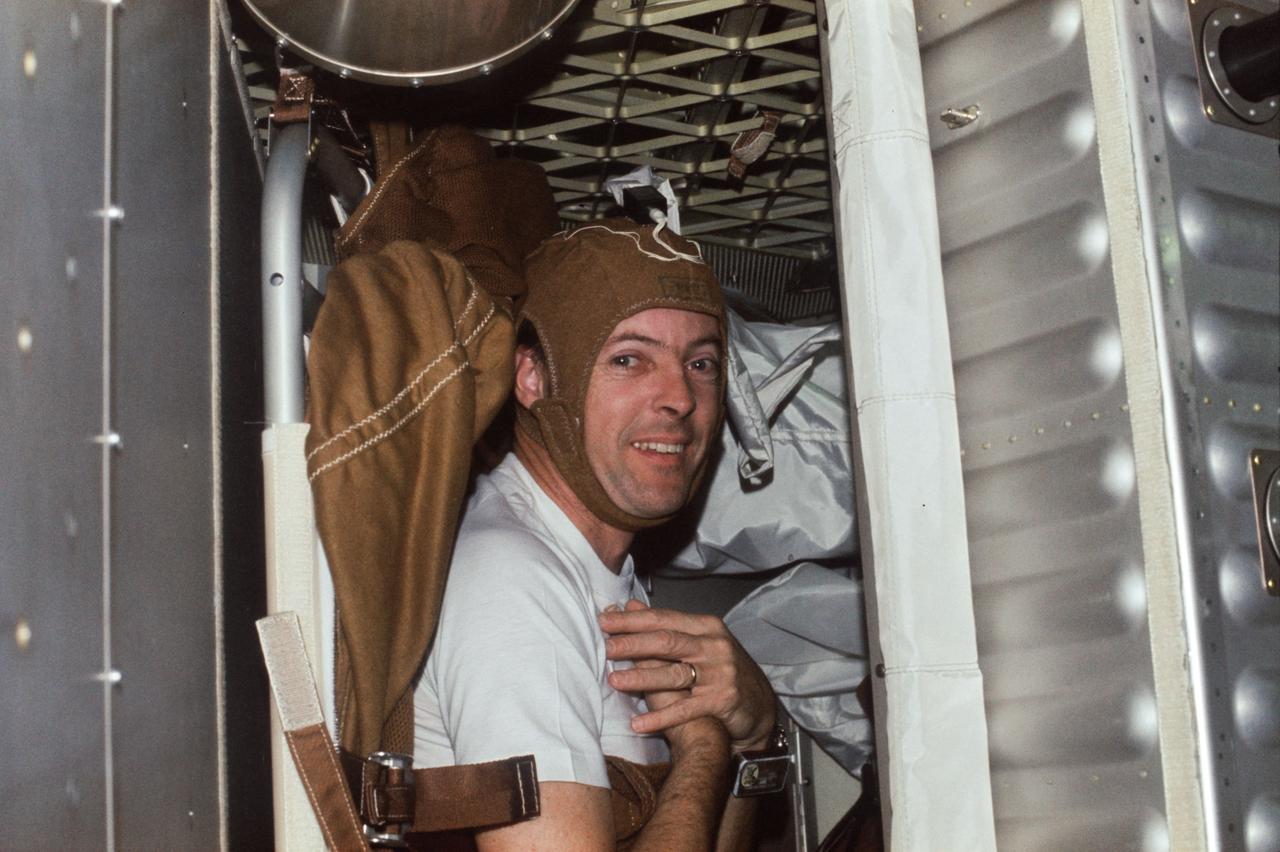
SL2-X3-205 (June 1973) --- Scientist-astronaut Joseph P. Kerwin, Skylab 2 science pilot, is photographed strapped into the sleep restraint in the crew quarters of the Orbital Workshop of the Skylab 1 & 2 space station cluster in Earth orbit. Kerwin is wearing the special cap which contains biomedical instrumentation for the M133 Sleep Monitoring Experiment. The purpose of the M133 experiment is to evaluate quantity and quality of sleep during prolonged space flight by the analysis of electroencephalographic (EEG) and electrooculographic (EOG) activity. Photo credit: NASA

Scientist-Astronaut Joseph P. Kerwin, Skylab 2 science pilot, is photographed strapped into the sleep restraint in the crew quarters of the Orbital Workshop of the Skylab 1 and 2 space station cluster in Earth orbit. Kerwin is wearing the special cap which contains biomedical instrumentation for the M133 Sleep Monitoring Experiment. The purpose of the M133 experiment is to evaluate quantity and quality of sleep during prolonged space flight by the analysis of electroencephalographic (EEG) and electrooculographic (EOG) activity.
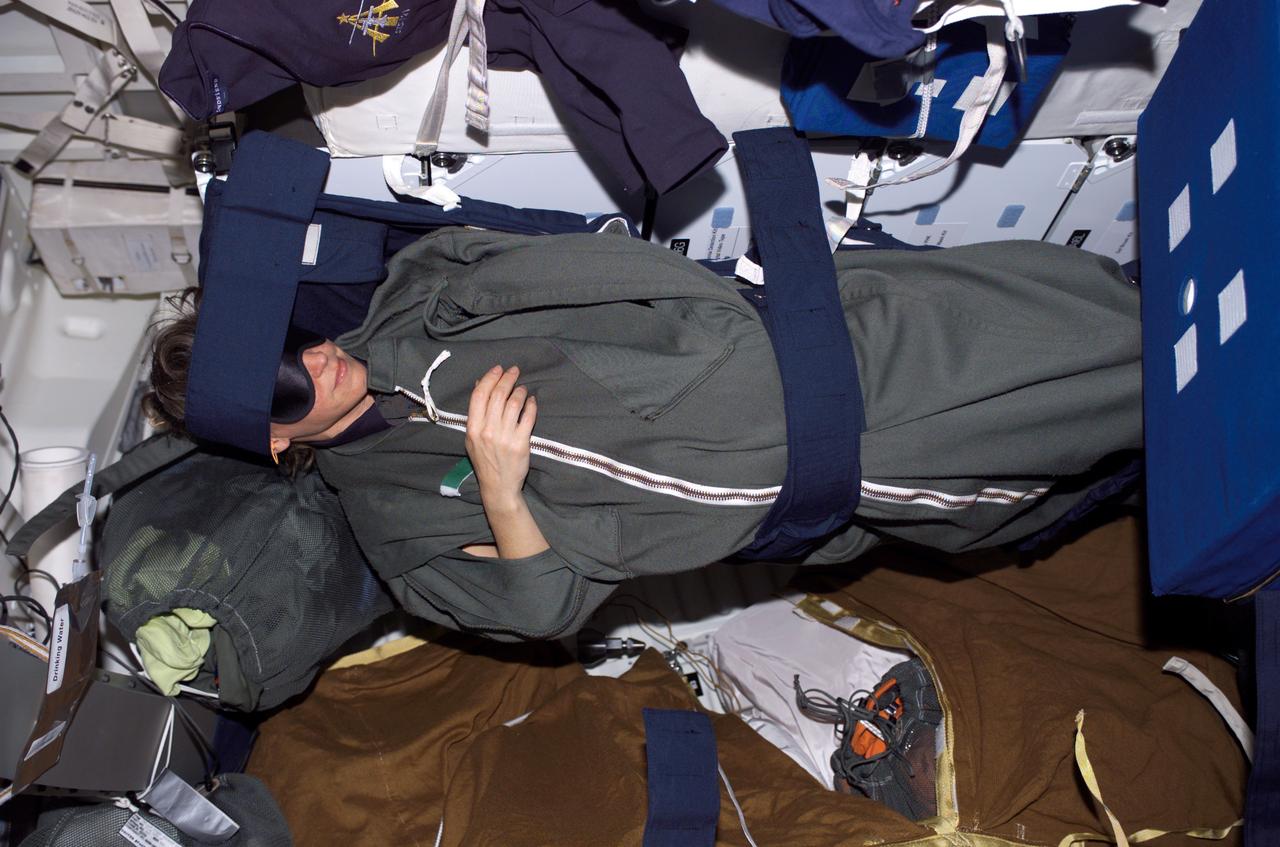
S121-E-06151 (8 July 2006) --- Astronaut Lisa M. Nowak, STS-121 mission specialist, sleeps in her sleeping bag, which is attached to the lockers on the middeck of the Space Shuttle Discovery while docked with the International Space Station.
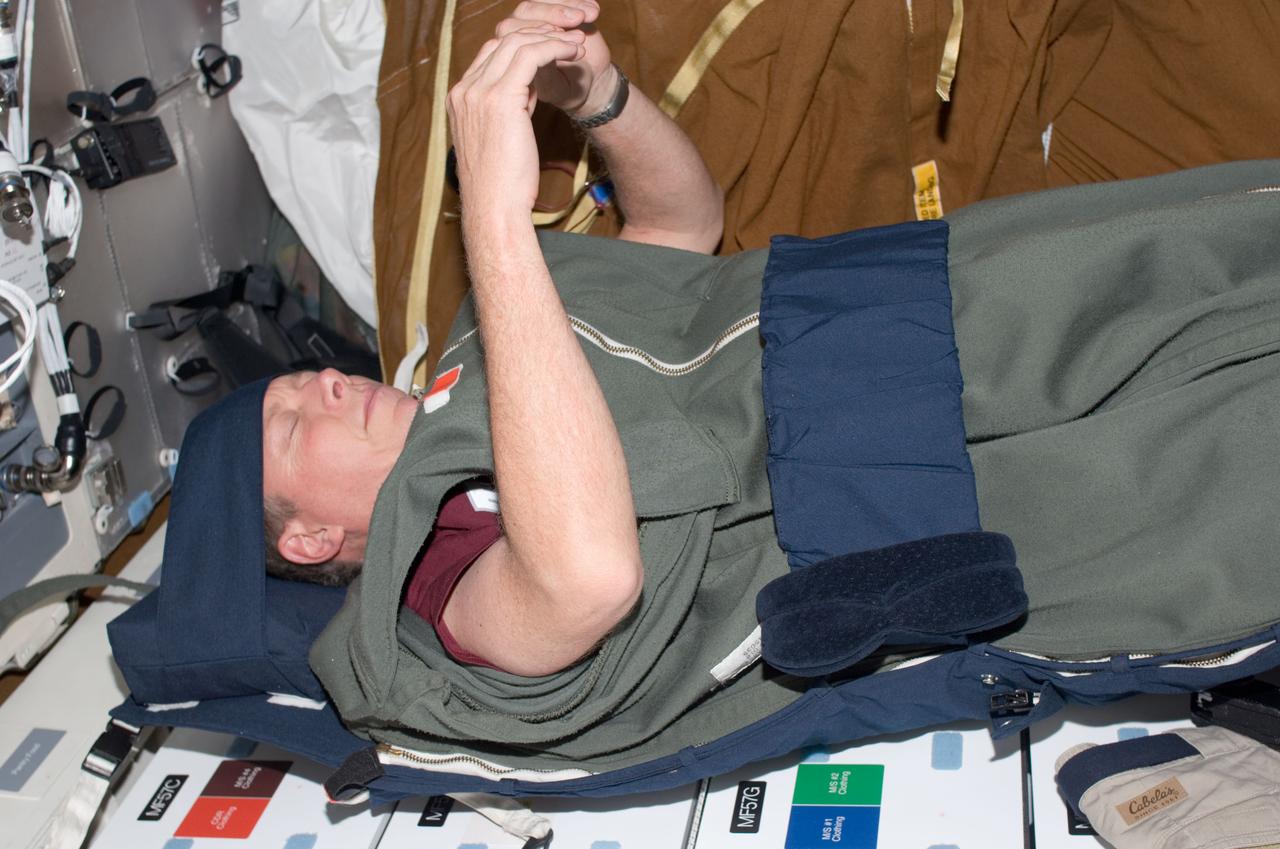
S124-E-007975 (9 June 2008) --- Astronaut Mike Fossum, STS-124 mission specialist, sleeps in his sleeping bag, which is attached to the lockers on the middeck of the Space Shuttle Discovery, while docked with the International Space Station.
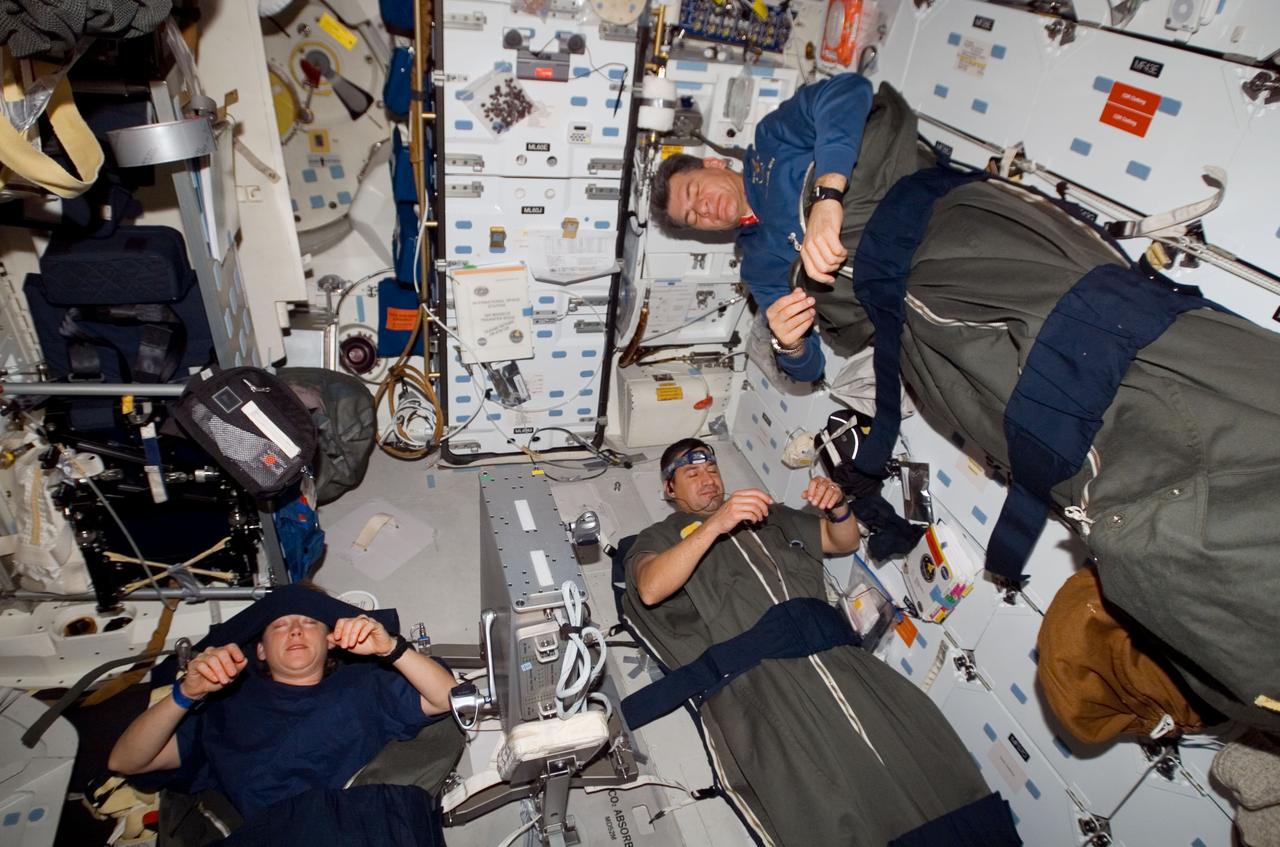
S120-E-007889 (1 Nov. 2007) --- Astronauts Pam Melroy (left), STS-120 commander; George Zamka (bottom right), pilot; and European Space Agency's (ESA) Paolo Nespoli, mission specialist, sleep in their sleeping bags, which are secured on the middeck of the Space Shuttle Discovery while docked with the International Space Station.
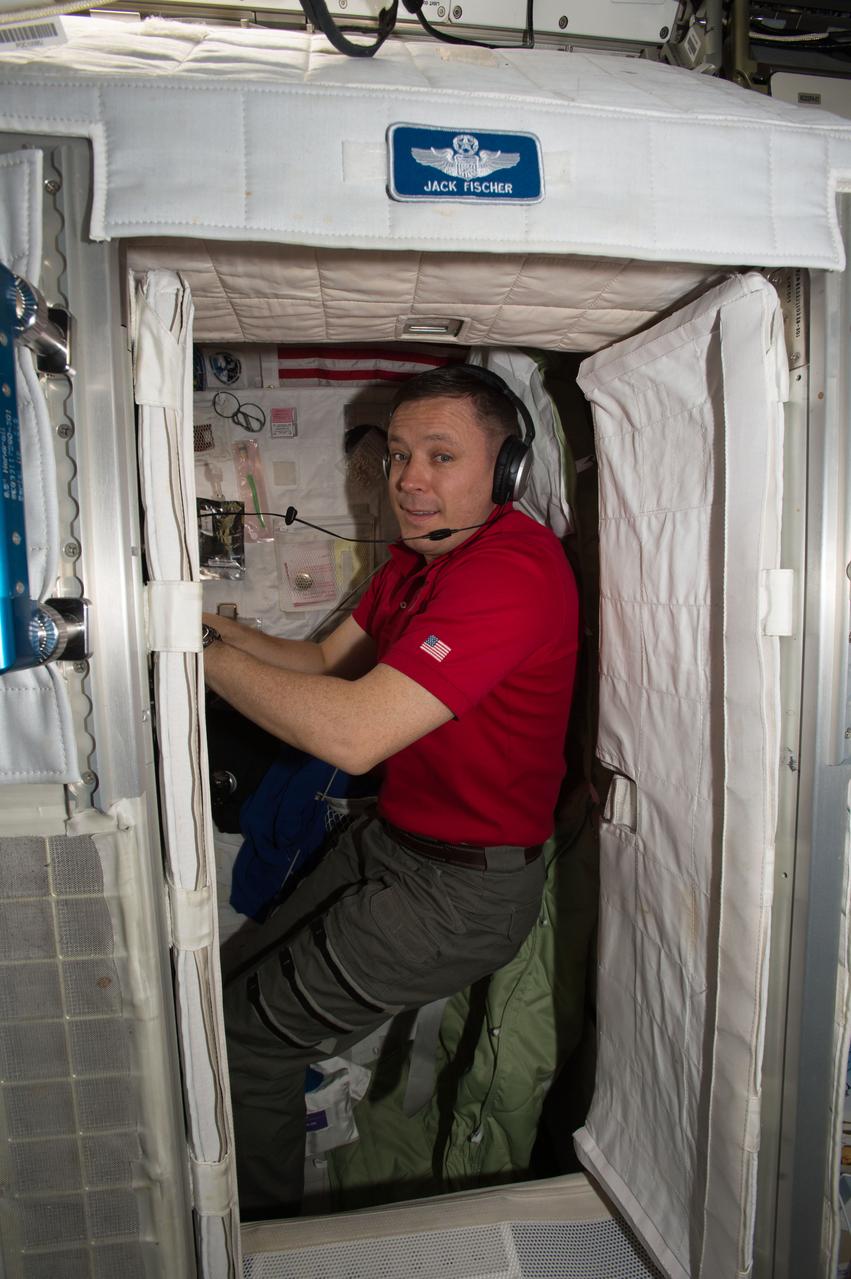
iss051e029443 (May 1, 2017) --- Air Force colonel and NASA astronaut Jack "2Fish" Fischer inhabits a personal sleep station inside the International Space Station.
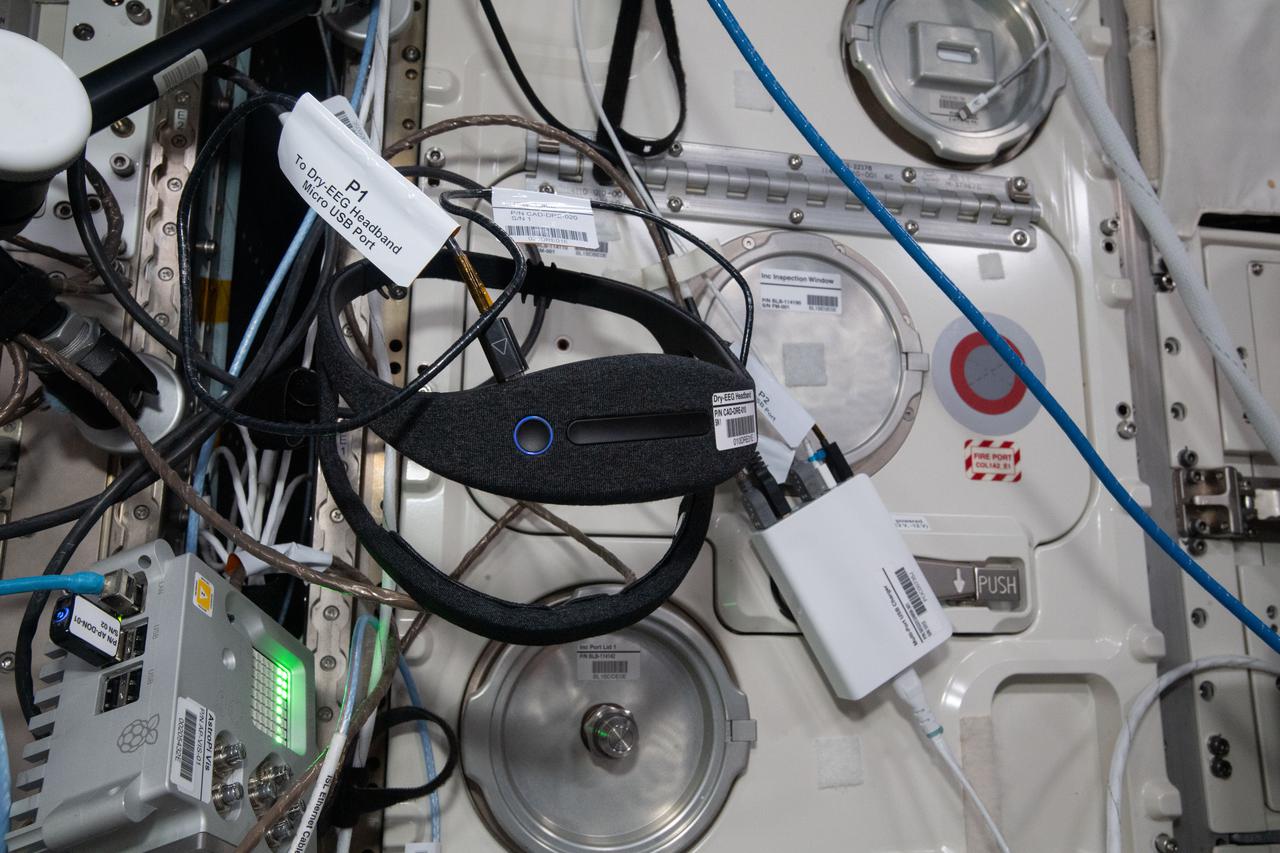
iss065e423775 (9/20/2021) --- A view of the Sleep Monitoring in Space with Dry-EEG Headband (Dreams) hardware in the Columbus module aboard the International Space Station (ISS). Dreams is a technology demonstration investigation that utilizes the Dry-EEG Headband: an effective, affordable, and comfortable solution to monitor astronaut sleep quality during long-duration spaceflight aboard the International Space Station (ISS).
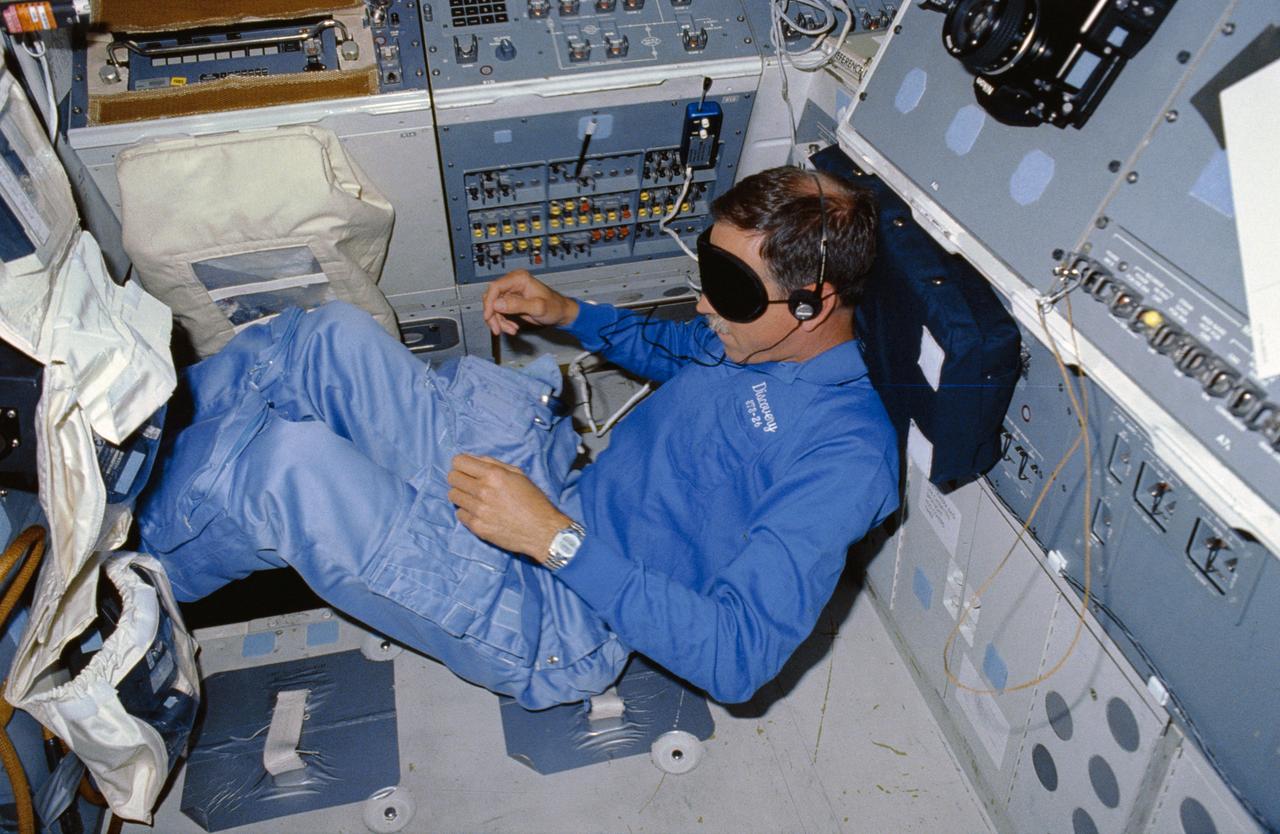
STS026-09-021 (3 Oct 1988) --- Astronaut Richard O. Covey, STS-26 pilot, wearing sleep mask (blindfold) and a headset, props his feet under the pilots seat and rests his head and back on the aft flight deck on orbit station panels while he sleeps. At Covey's right are the mission station control panels.
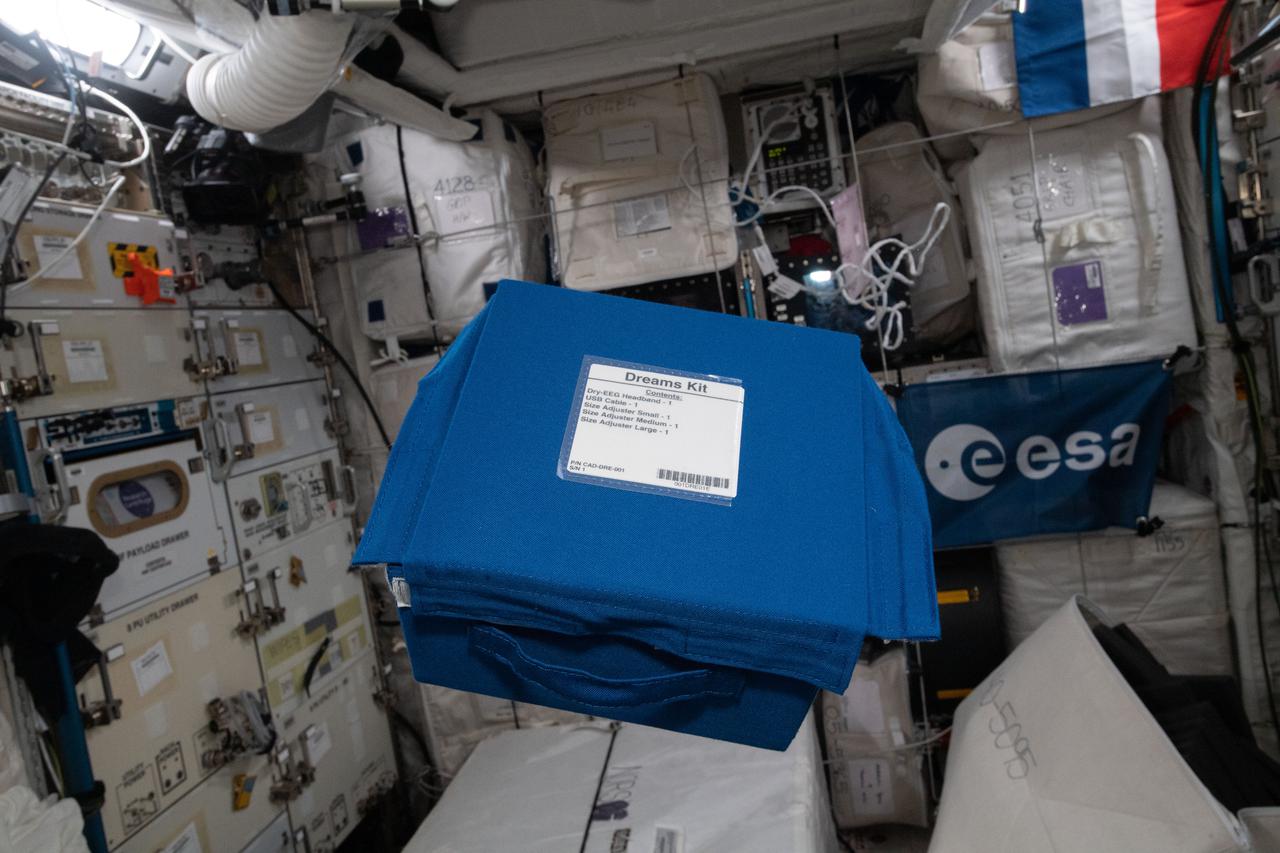
iss065e423768 (9/20/2021) --- A view of the Sleep Monitoring in Space with Dry-EEG Headband (Dreams) hardware in the Columbus module aboard the International Space Station (ISS). Dreams is a technology demonstration investigation that utilizes the Dry-EEG Headband: an effective, affordable, and comfortable solution to monitor astronaut sleep quality during long-duration spaceflight aboard the International Space Station (ISS).
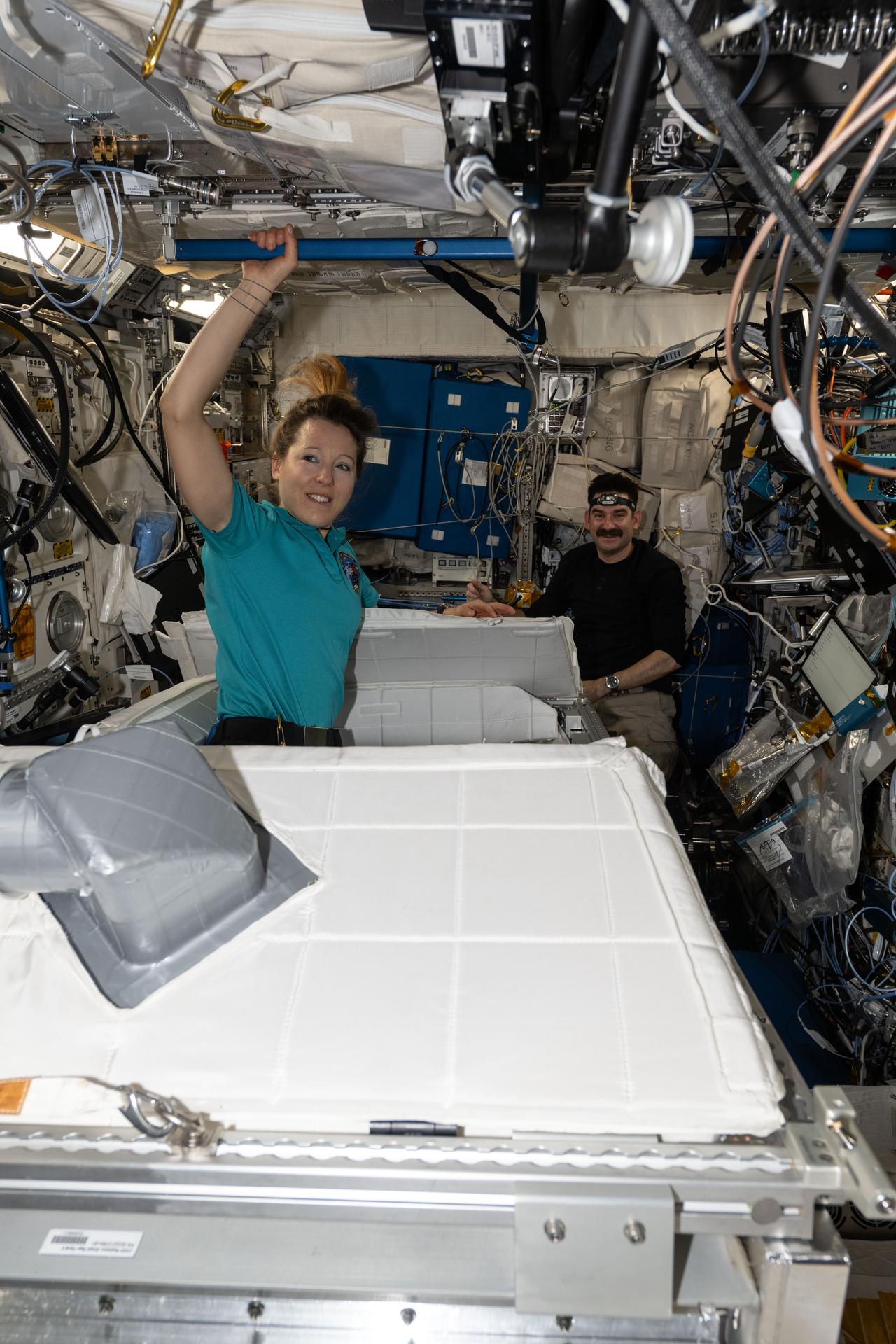
iss074e0792341 (June 7 ,2026) --- Expedition 74 flight engineers Sophie Adenot of ESA (European Space Agency) and Jack Hathaway of NASA (background) are pictured inside the International Space Station's Columbus laboratory module. The astronauts were upgrading a temporary sleep station, also called the Crew Alternate Sleep Accommodation (CASA), aboard Columbus. CASA modifications include a better fit for crew members, improved airflow velocity, an updated lighting configuration, and upgraded side panels and interior liners. Credit: NASA/Jessica Meir
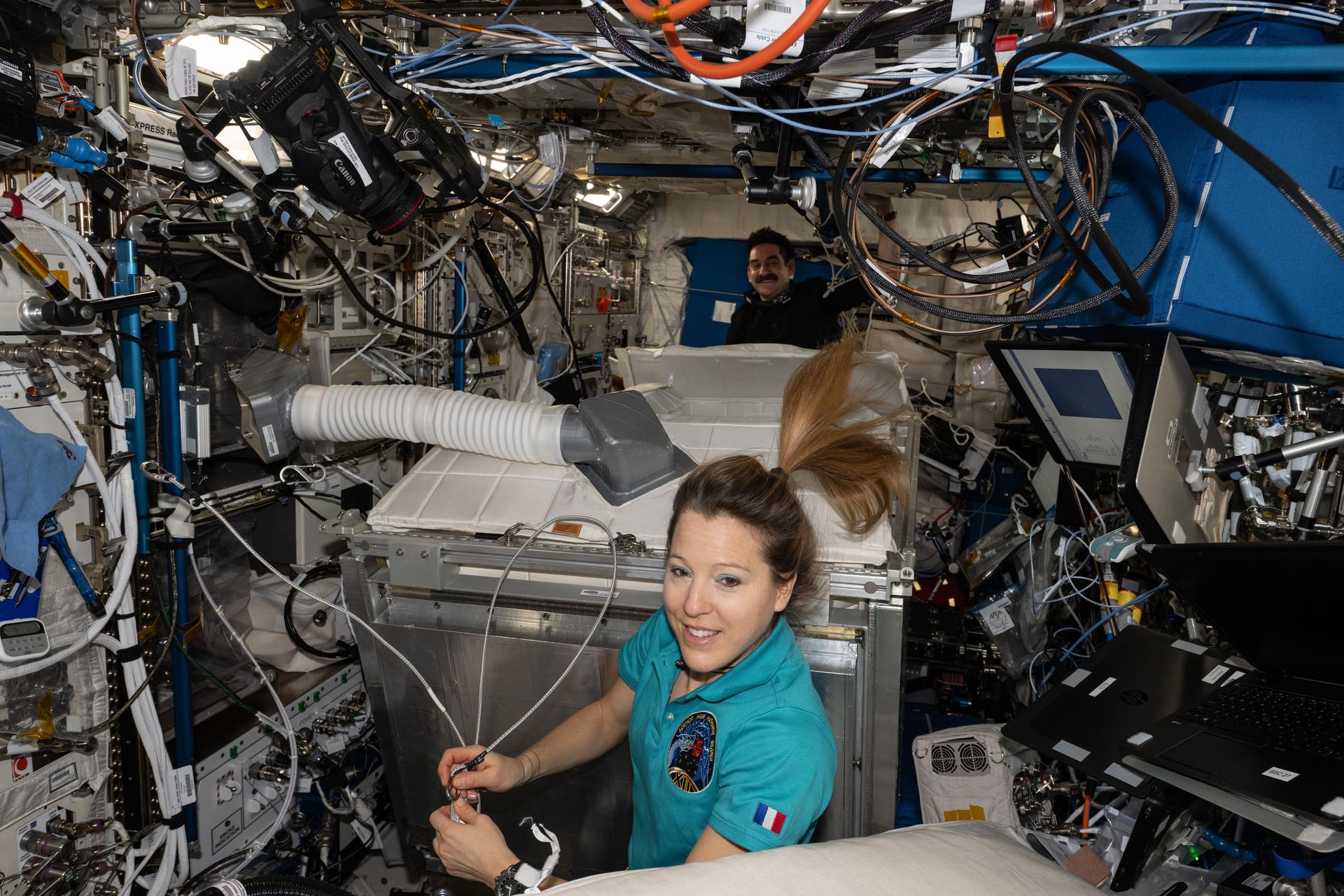
iss074e0792345 (June 7, 2026) --- Expedition 74 flight engineers Sophie Adenot of ESA (European Space Agency) and Jack Hathaway of NASA (background) are pictured inside the International Space Station's Columbus laboratory module. The astronauts were upgrading a temporary sleep station, also called the Crew Alternate Sleep Accommodation (CASA), aboard Columbus. CASA modifications include a better fit for crew members, improved airflow velocity, an updated lighting configuration, and upgraded side panels and interior liners. Credit: NASA/Jessica Meir
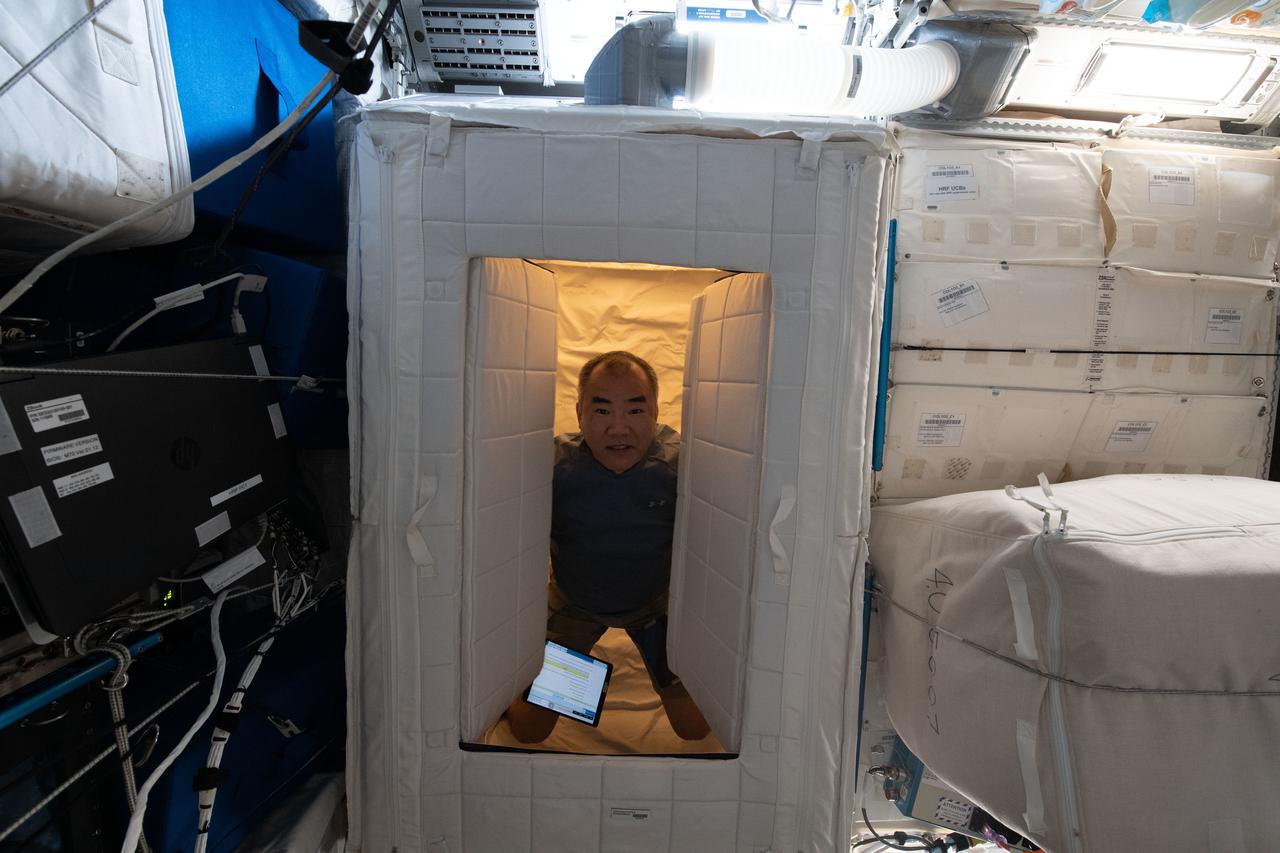
iss065e002499 (April 24, 2021) --- Expedition 64 Flight Engineer Soichi Noguchi of the Japan Aerospace Exploration Agency is pictured inside a sleep station aboard the International Space Station.
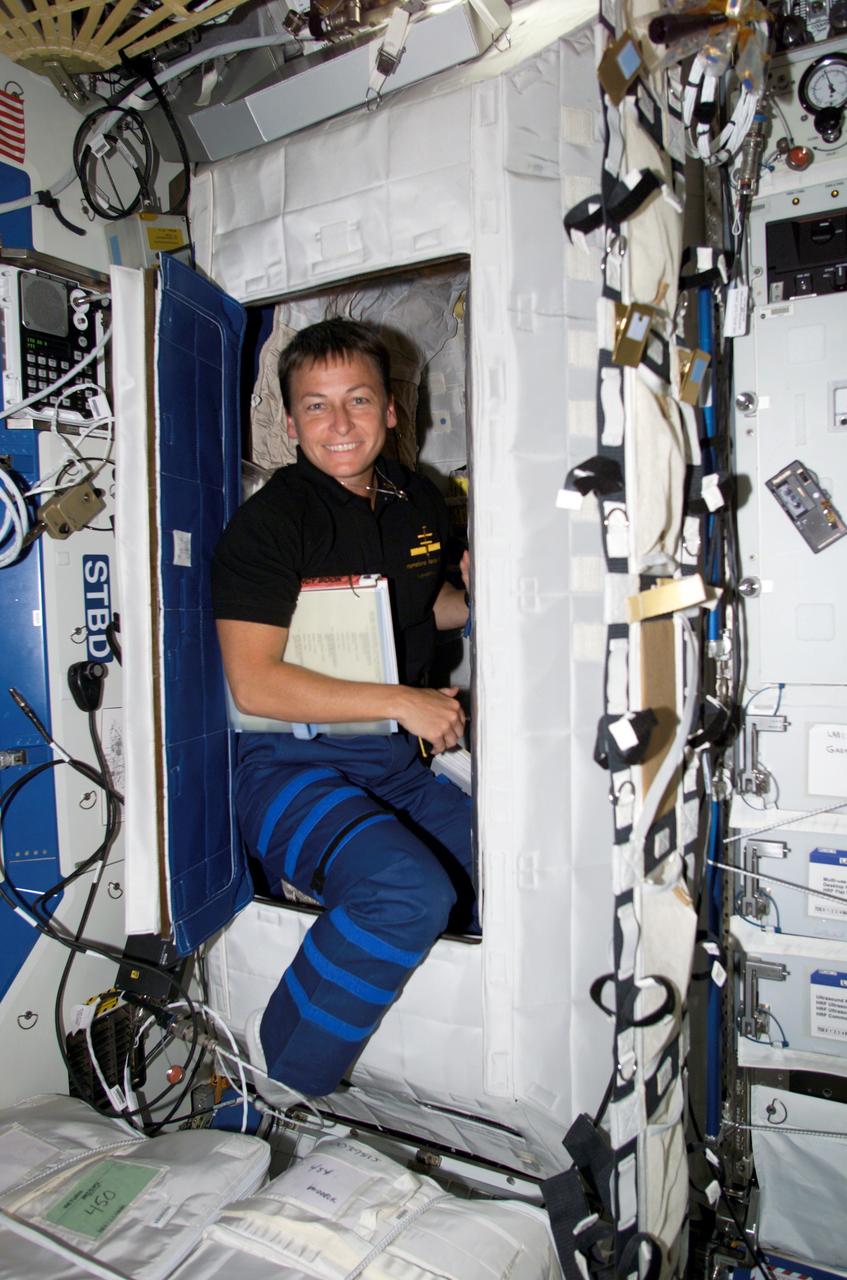
STS111-E-5122 (9 June 2002) --- Astronaut Peggy A. Whitson, Expedition Five flight engineer, was photographed in the doorway of the Temporary Sleep Station (TSS) in the Destiny laboratory on International Space Station (ISS).
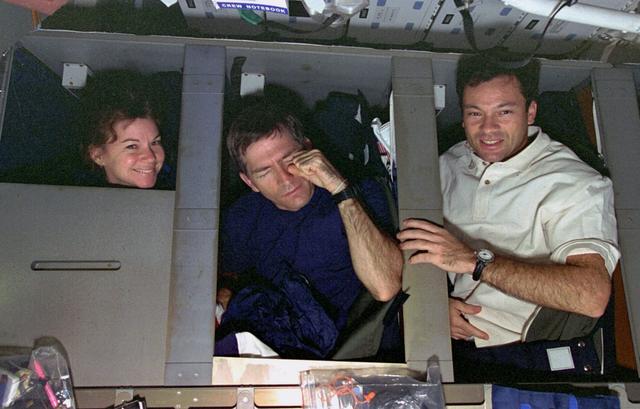
STS073-351-035 (20 October - 5 November 1995) --- Three crew members are captured on camera at the end of their sleep shift on the middeck of the Earth-orbiting Space Shuttle Columbia. Pictured are (left to right) astronaut Catherine G. Coleman, mission specialist; payload specialist Fred W. Leslie and astronaut Michael E. Lopez-Alegria, mission specialist. The trio joined four other crewmembers for 16 days of in-space research in support of the United States Microgravity Laboratory (USML-2) mission.
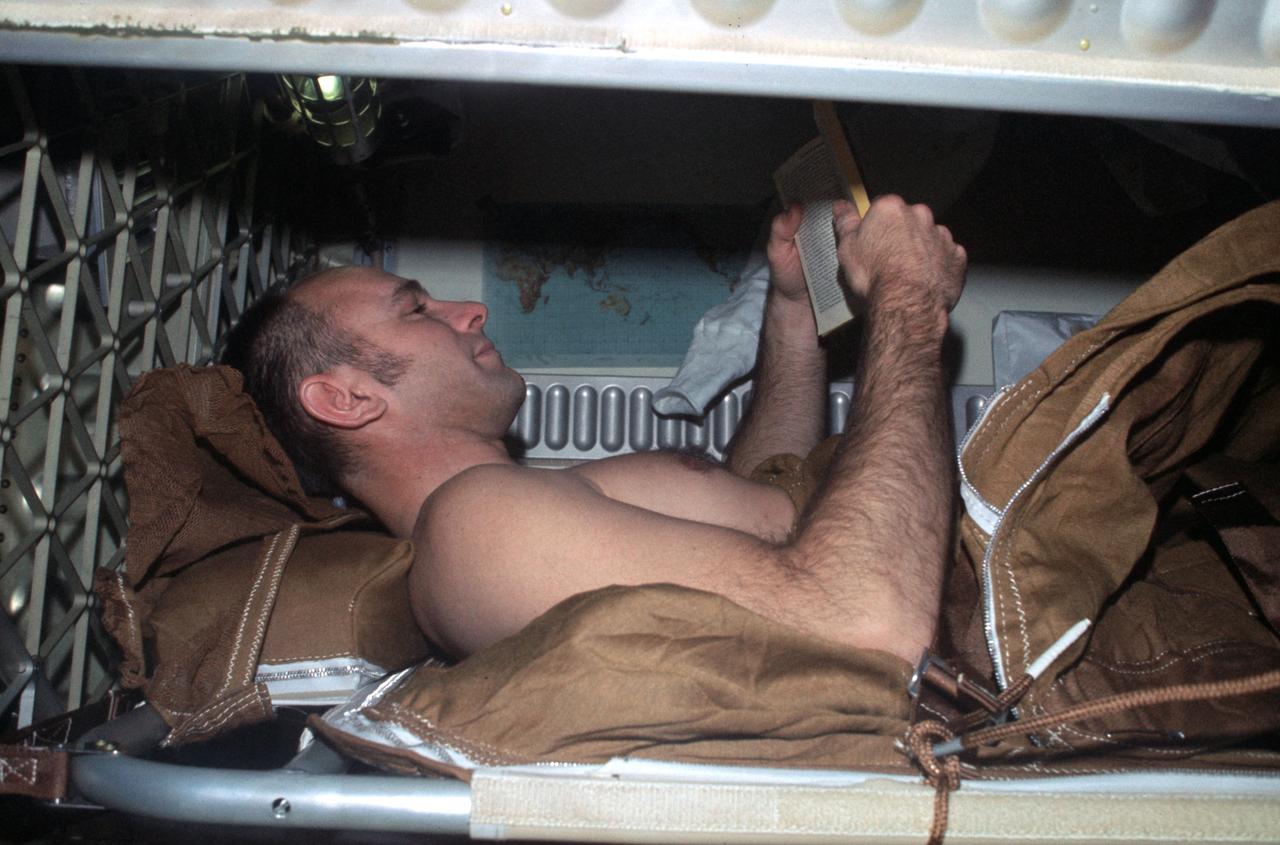
SL3-112-1527 (July-September 1973) --- View of astronaut Alan L. Bean, Skylab 3 commander, in his sleep compartment, reading a book. Photo credit: NASA
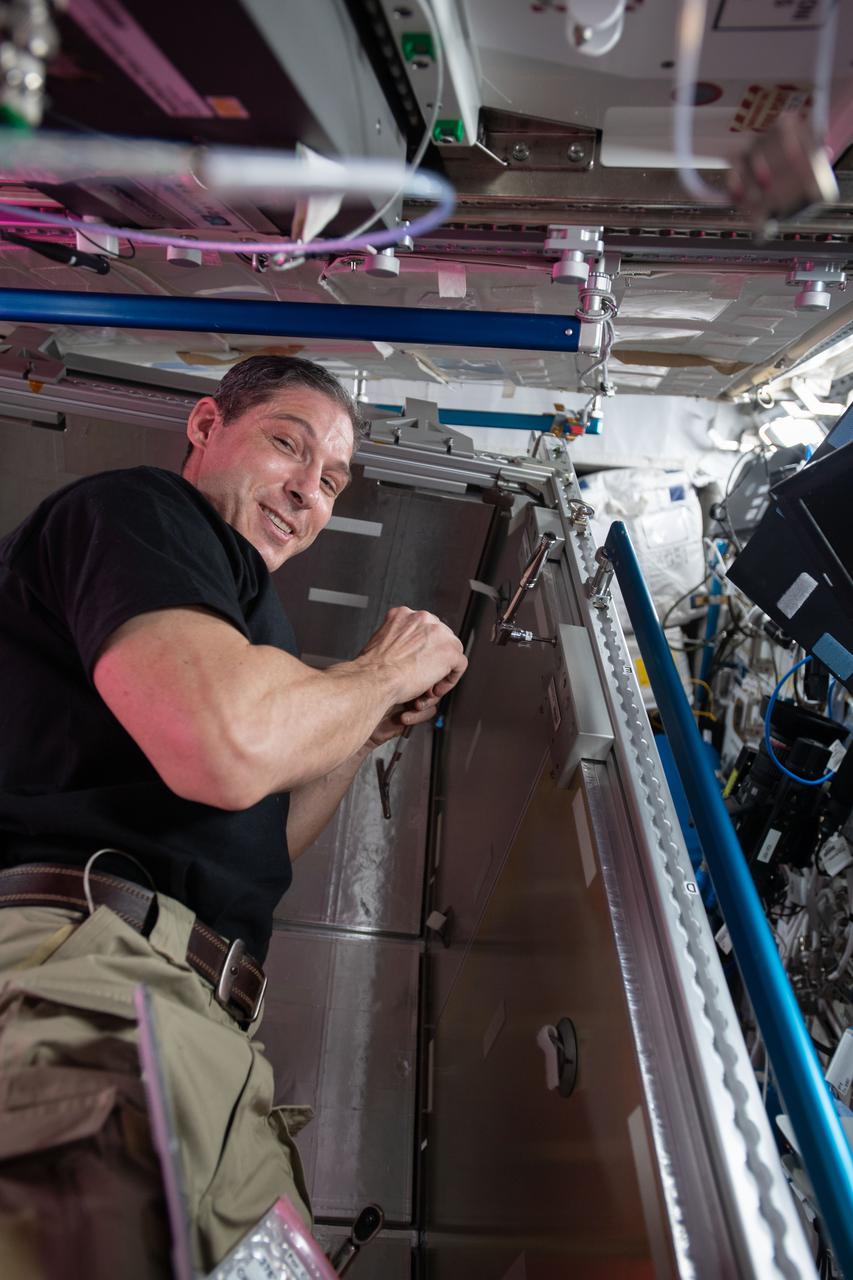
iss064e053494 (April 7, 2021) --- NASA astronaut and Expedition 64 Flight Engineer Michael Hopkins installs temporary sleeping quarters inside the Columbus laboratory module from the European Space Agency. The new Crew Alternate Sleep Accommodation, which can also be converted to a cargo storage rack, will allow extra space for the short period when up to 11 crew members will be occupying the International Space Station in April.
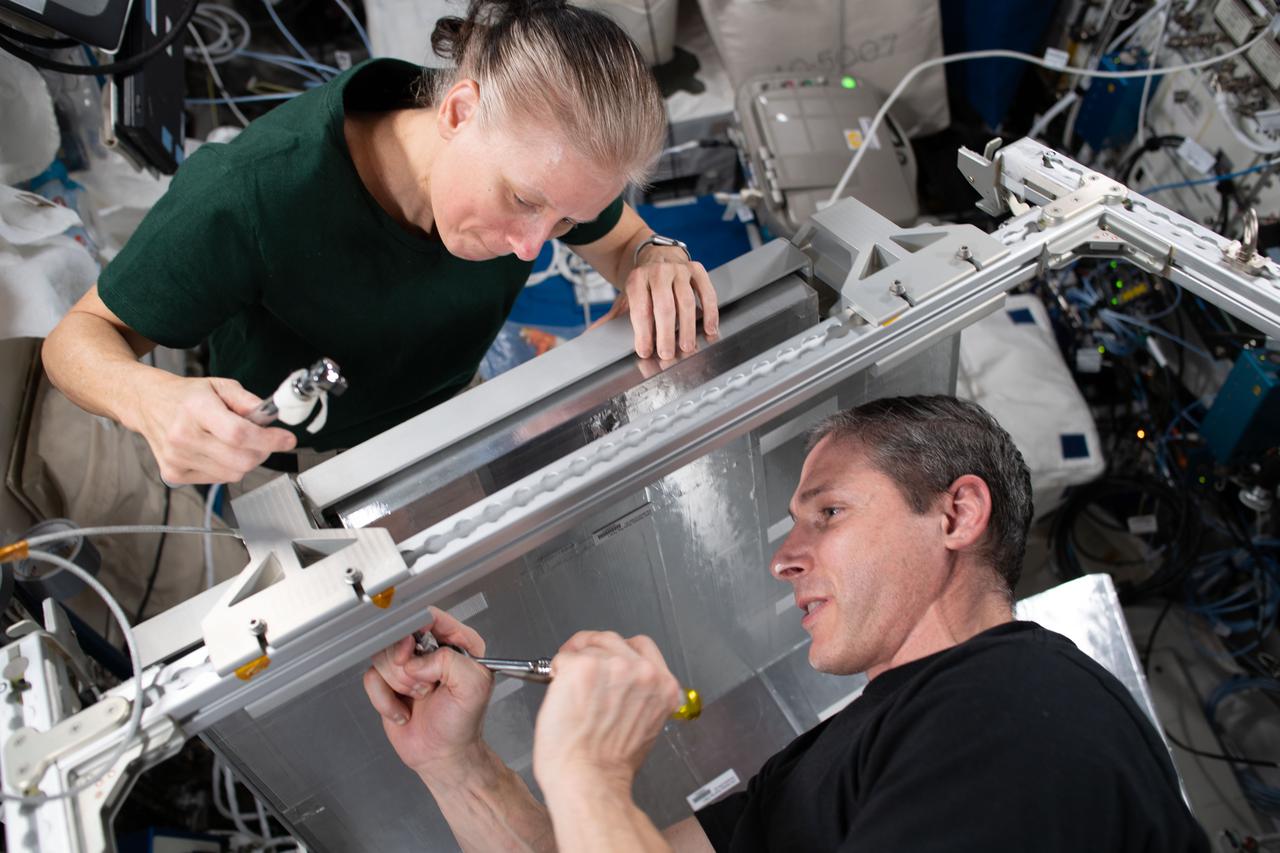
iss064e053521 (April 7, 2021) --- NASA Flight Engineers Shannon Walker and Michael Hopkins install temporary sleeping quarters inside the Columbus laboratory module from the European Space Agency. The new Crew Alternate Sleep Accommodation, which can also be converted to a cargo storage rack, will allow extra space for the short period when up to 11 crew members will be occupying the International Space Station in April.
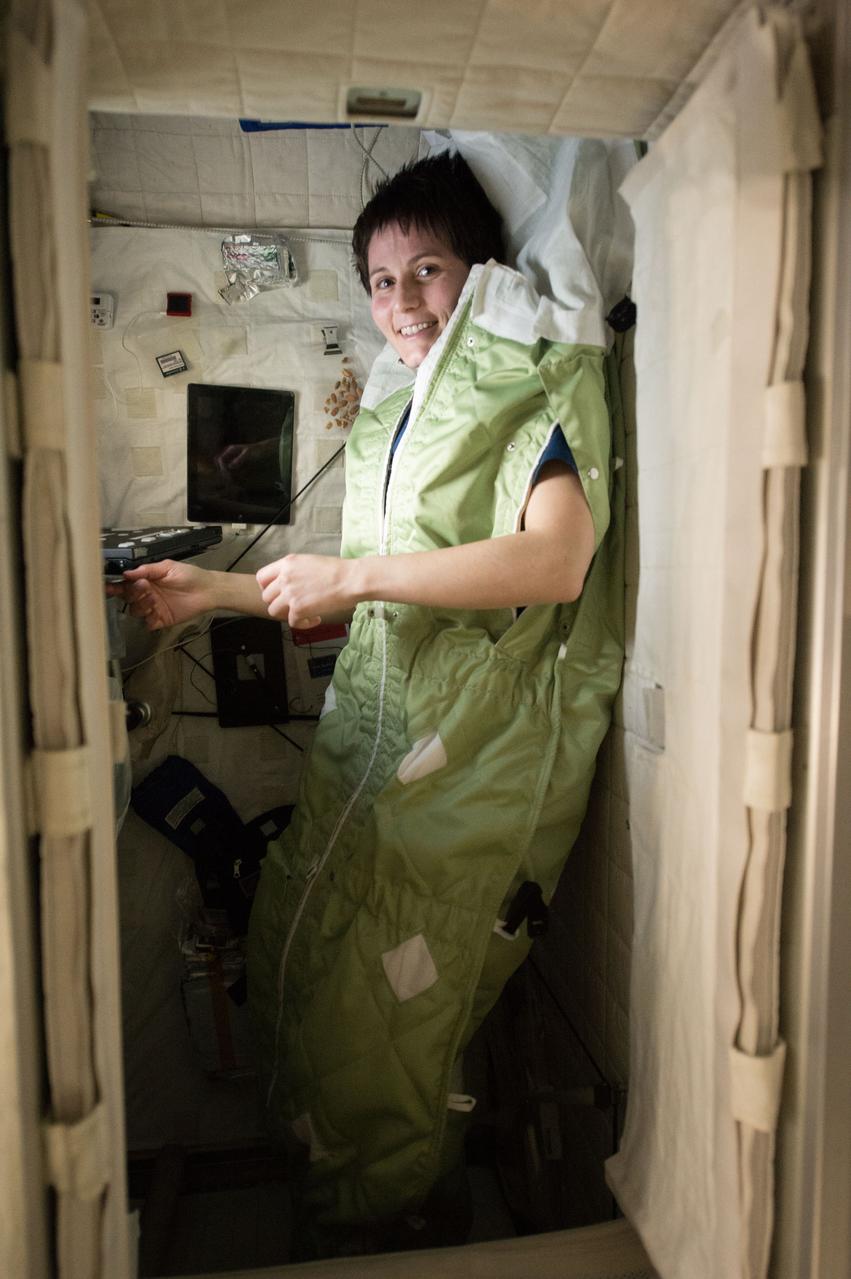
iss042e023422 (12/6/14) --- Expedition 42 Flight Engineer Samantha Cristoforetti of the European Space Agency (ESA) on 6 December 2014 is seen inside of a sleeping bag in her personal crew quarters on the International Space Station. Astronauts will strap the bag to the wall to prevent from free floating and potentially bumping into equipment while sleeping.
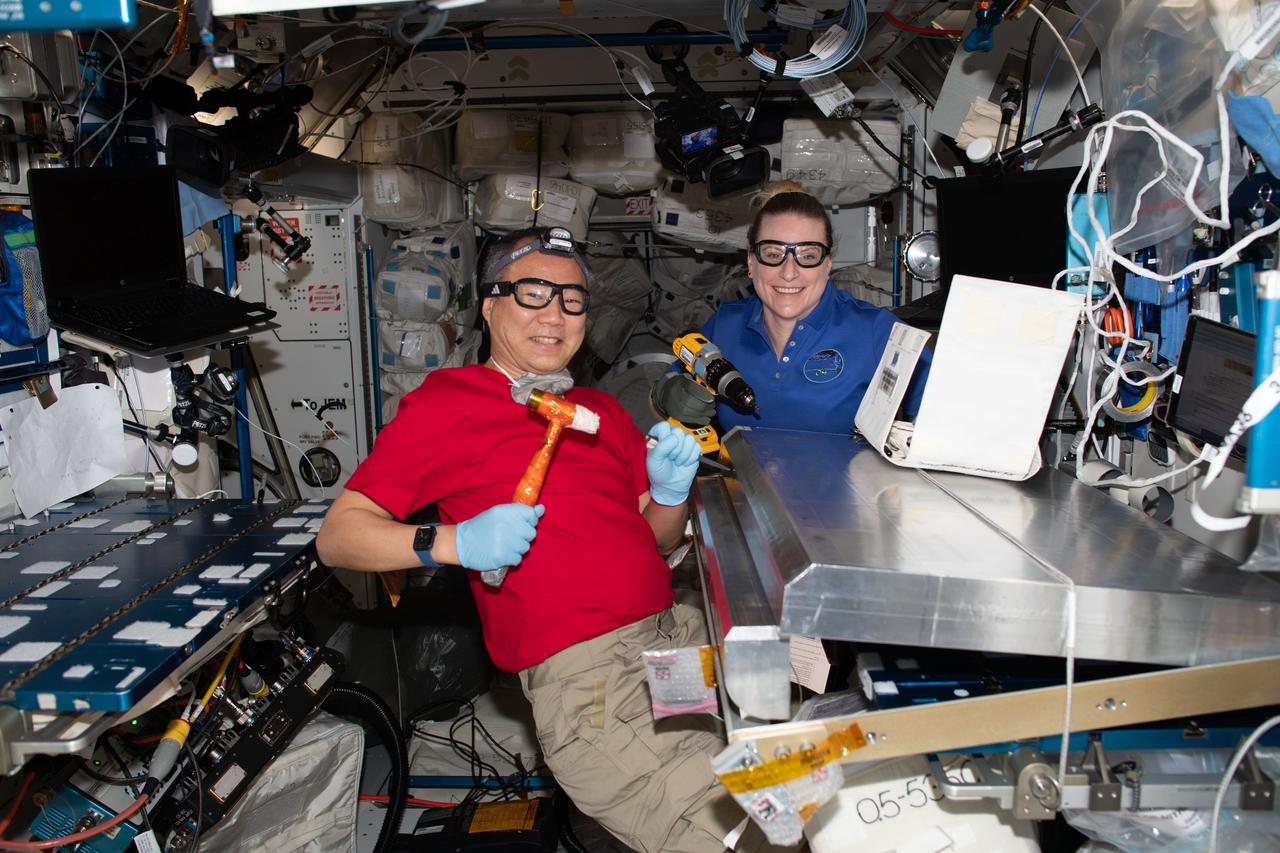
iss064e053432 (April 6, 2021) --- Expedition 64 Flight Engineers Soichi Noguchi of the Japan Aerospace Exploration Agency and Kate Rubins of NASA configure a radiation shield for temporary sleeping quarters, or the Crew Alternate Sleep Accommodation (CASA). The CASA will allow extra space for the short period when up to 11 crew members will be occupying the International Space Station in April.
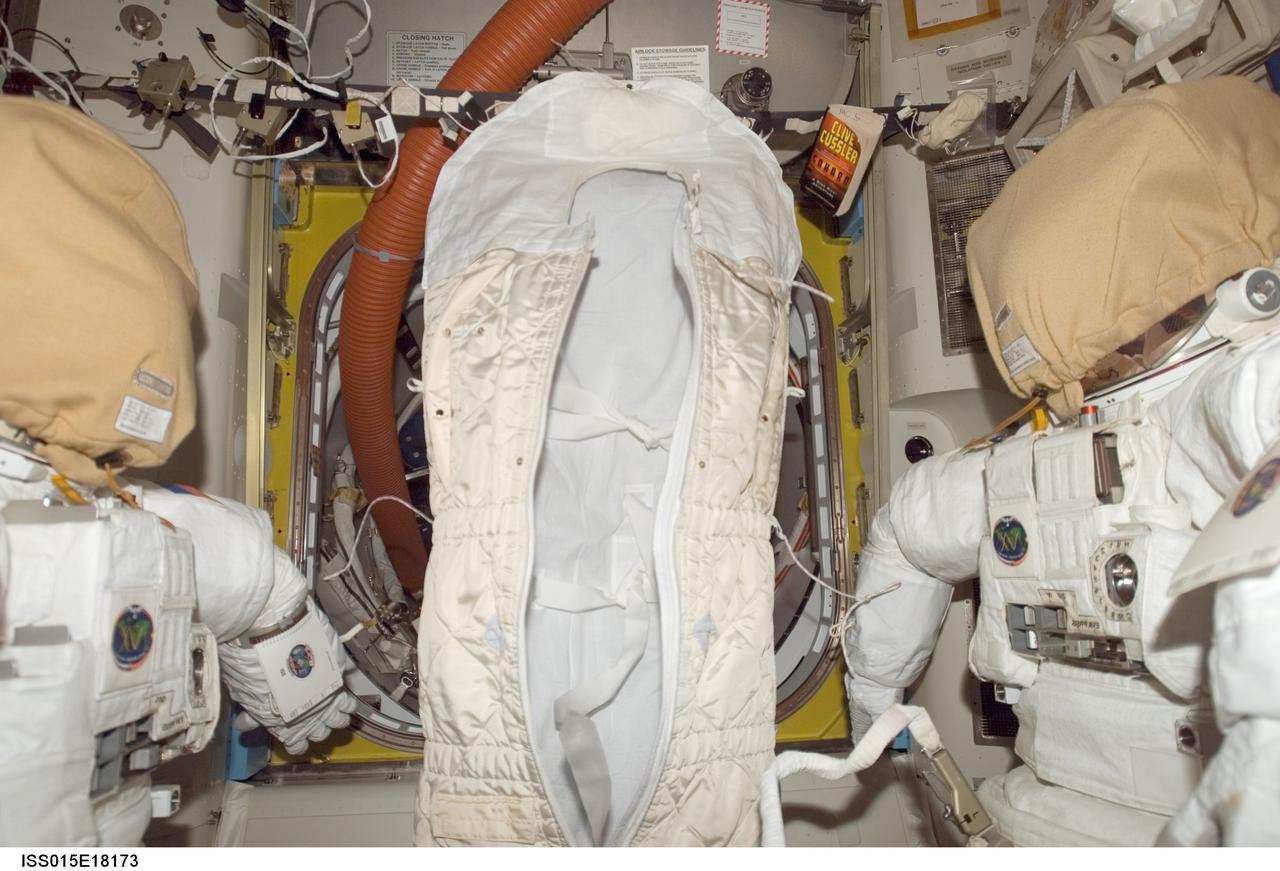
ISS015-E-18173 (11 July 2007) --- A sleeping bag floats near two extravehicular mobility unit (EMU) spacesuits in the Quest Airlock of the International Space Station.
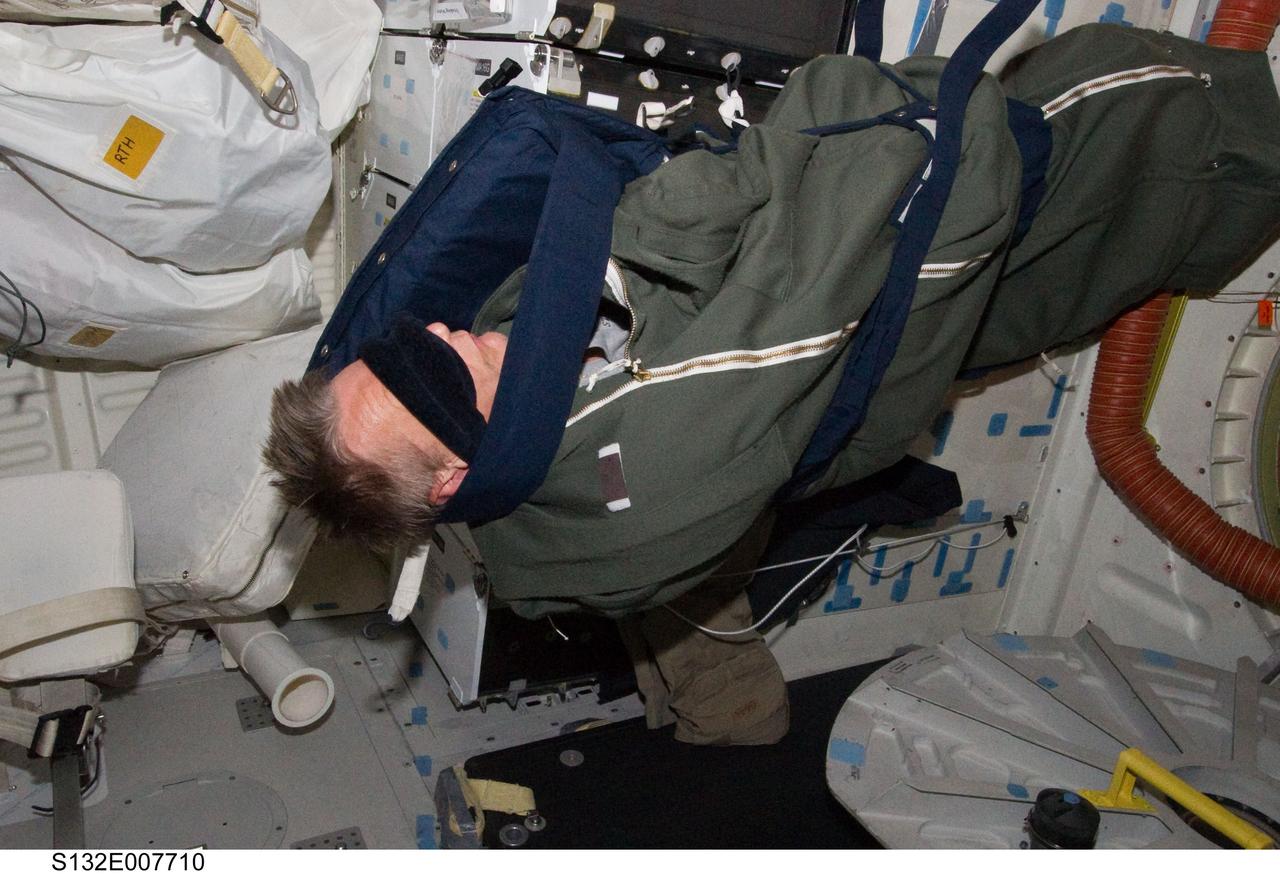
S132-E-007710 (17 May 2010) --- NASA astronaut Piers Sellers, STS-132 mission specialist, rests in his sleeping bag on the middeck of the space shuttle Atlantis while docked with the International Space Station.

ISS045E107821 (11/13/2015) --- As night falls the astronauts and cosmonauts aboard the International Space Station prepare for sleep while also viewing the softening curvature of the Earth go by with lighted cities below them and sparkling stars above.
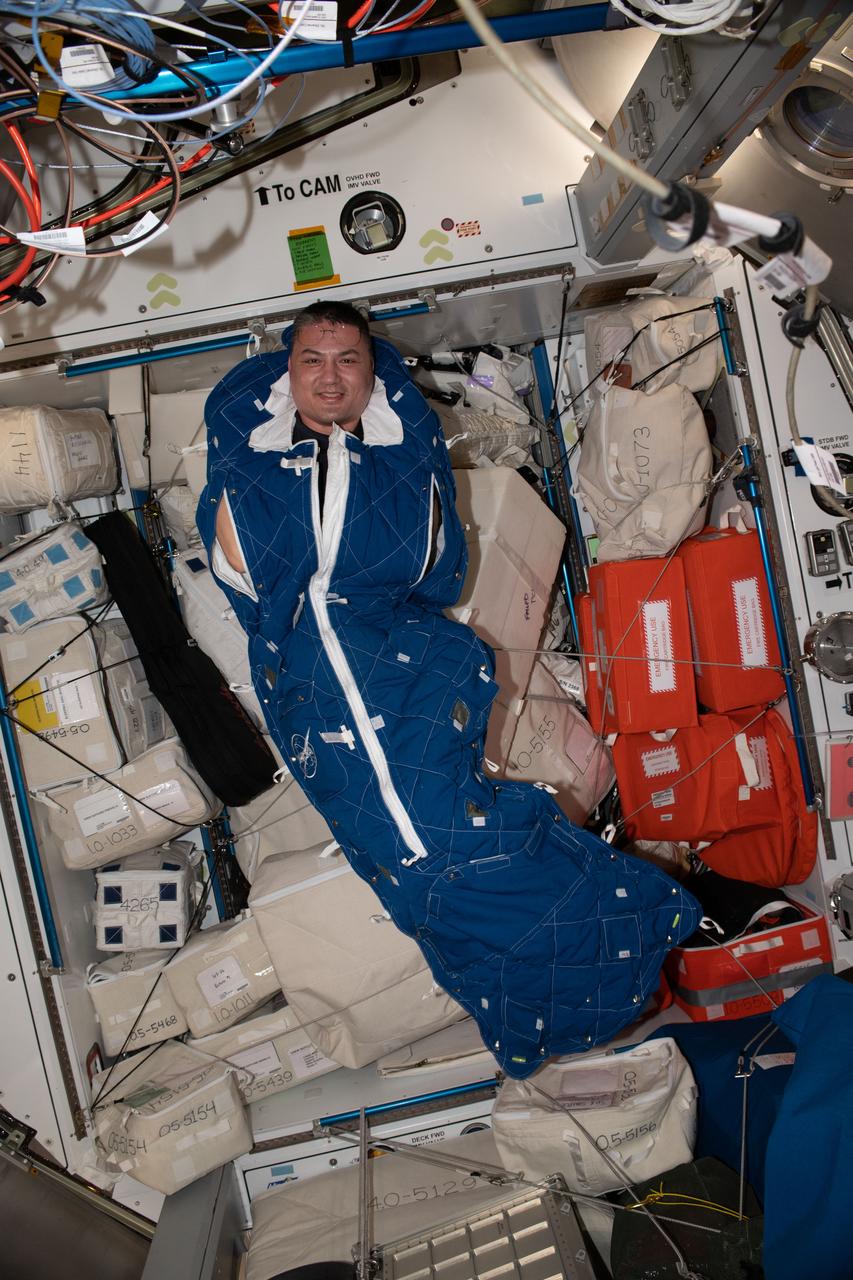
iss067e379057 (Sept. 23, 2022) --- NASA astronaut and Expedition 67 Flight Engineer Kjell Lindgren poses for a portrait inside a crew sleeping bag aboard the International Space Station.
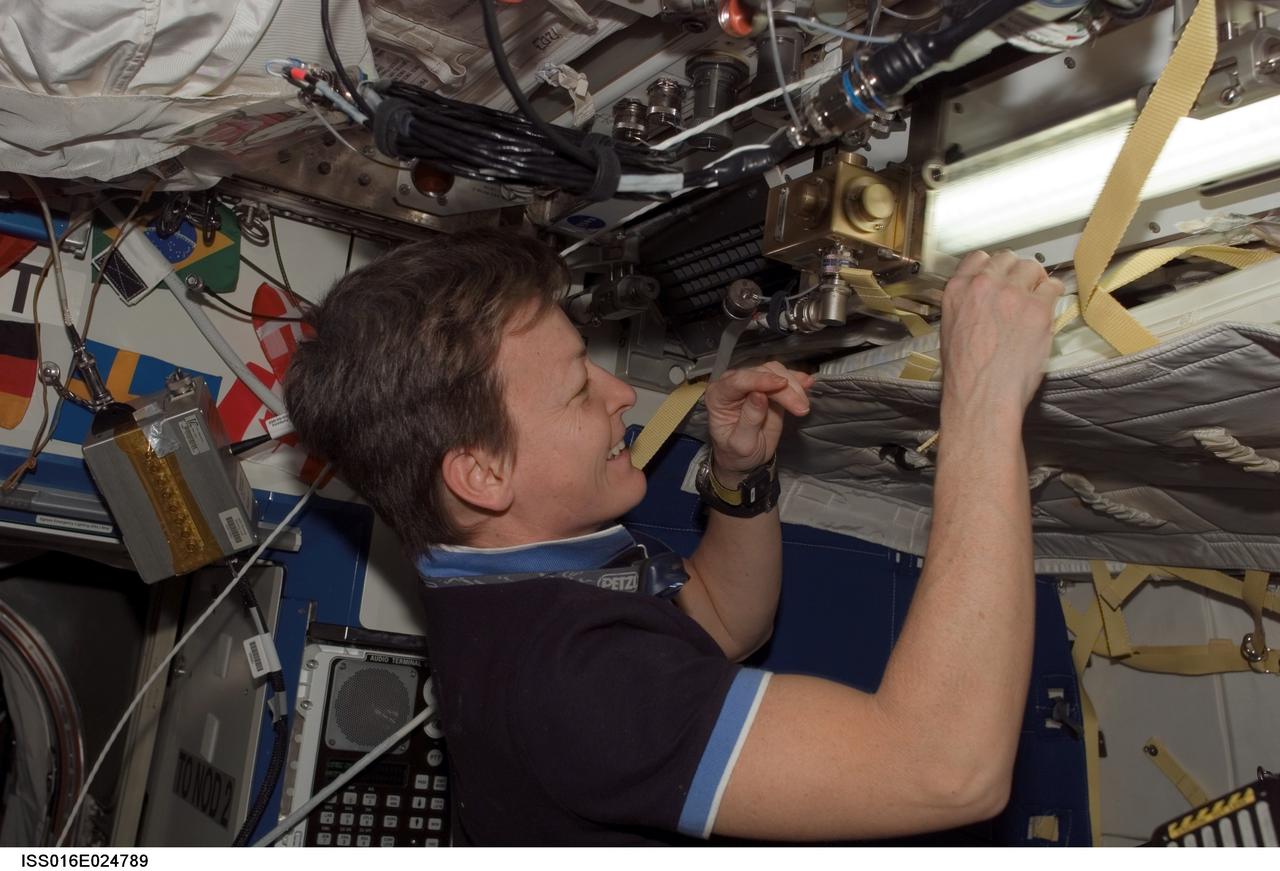
ISS016-E-024789 (18 Jan. 2008) --- Astronaut Peggy Whitson, Expedition 16 commander, prepares to retrieve a sleep restraint device from a stowage location on the Earth-orbiting International Space Station.
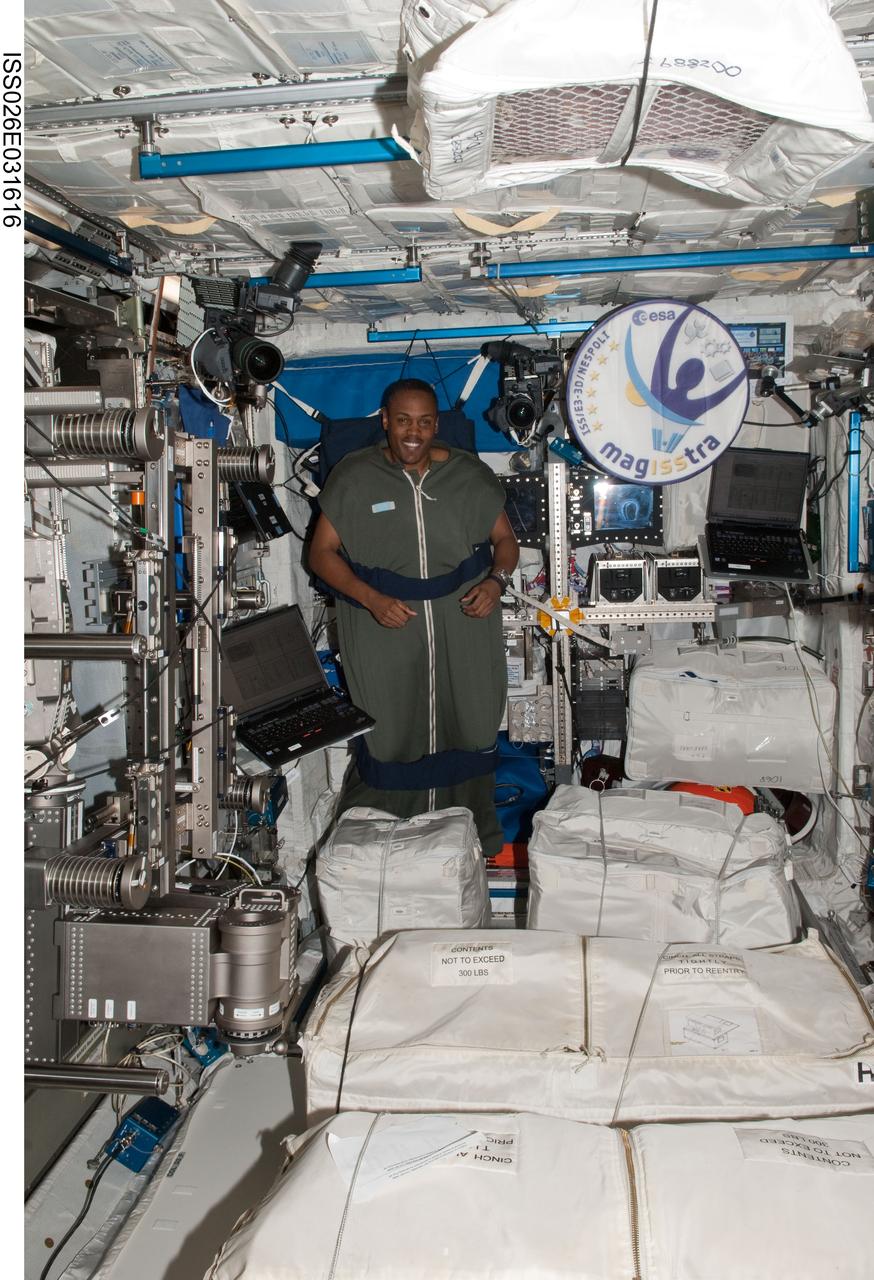
ISS026-E-031616 (3 March 2011) --- NASA astronaut Alvin Drew, STS-133 mission specialist, is pictured in his sleeping bag, which is attached in the Columbus laboratory of the International Space Station while space shuttle Discovery remains docked with the station.
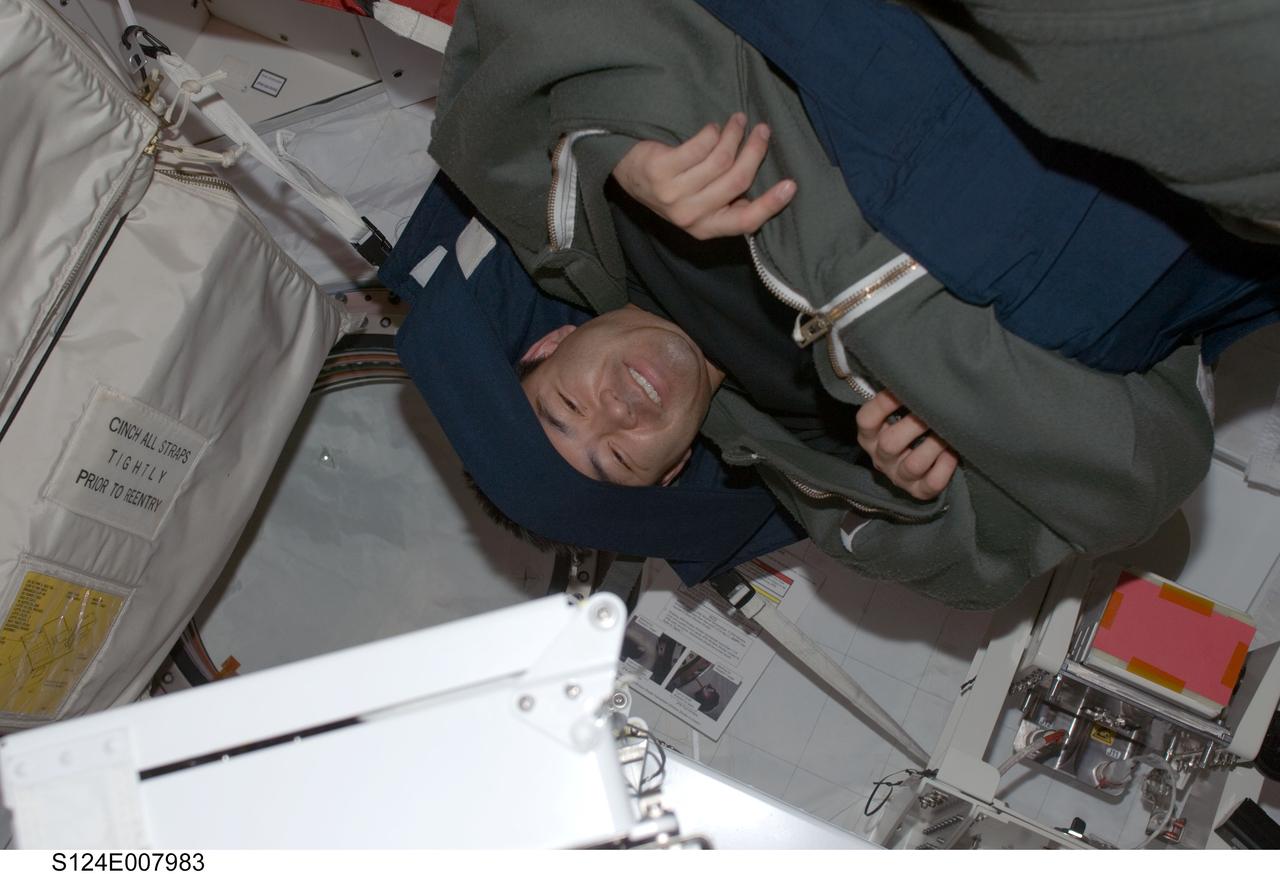
S124-E-007983 (9 June 2008) --- Japan Aerospace Exploration Agency astronaut Akihiko Hoshide, STS-124 mission specialist, is pictured in his sleeping bag in Kibo Japanese Pressurized Module of the International Space Station while Space Shuttle Discovery is docked with the station.
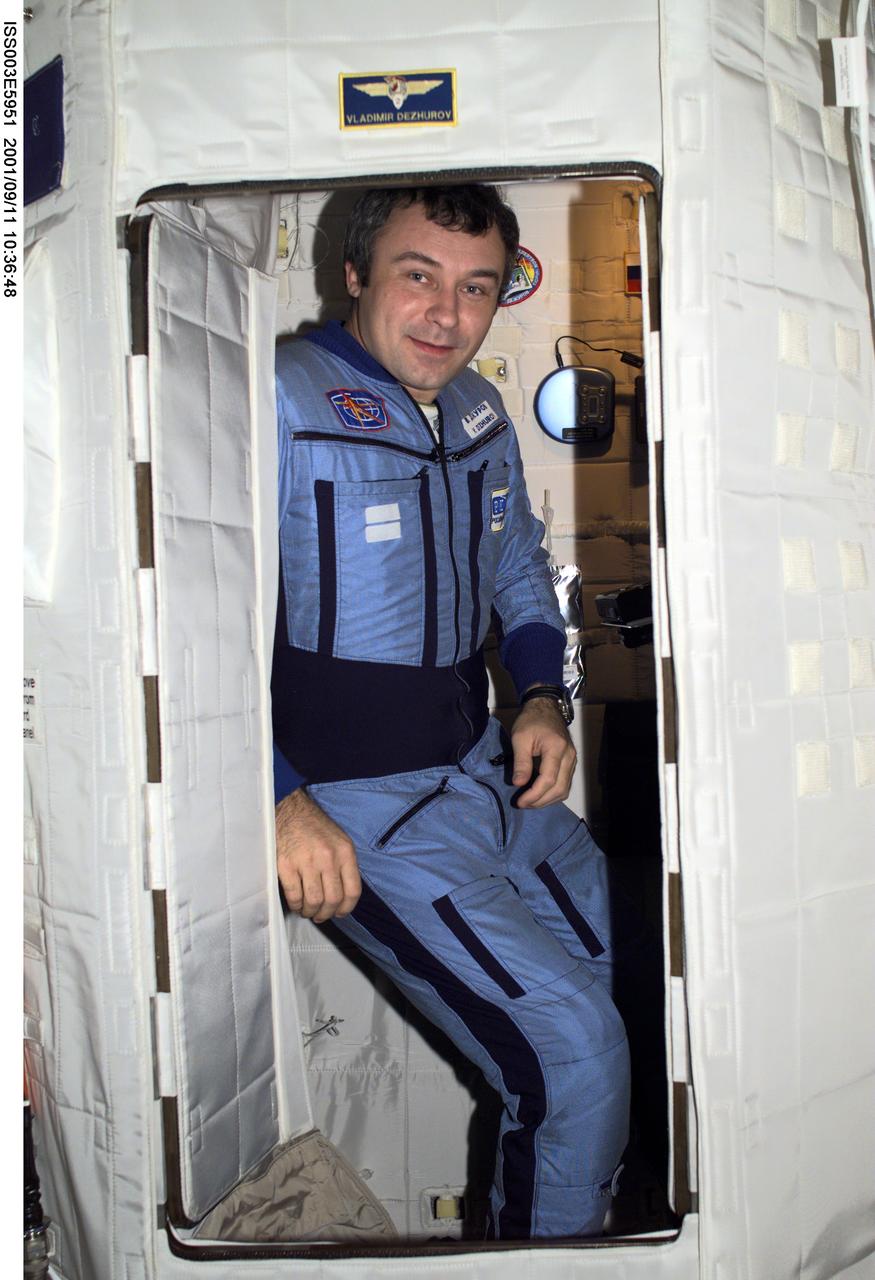
ISS003-E-5951 (11 September 2001) --- Cosmonaut Vladimir N. Dezhurov, Expedition Three flight engineer, takes a break from a busy day in the Temporary Sleep Station (TSS) in the Destiny laboratory on the International Space Station (ISS). Dezhurov represents Rosaviakosmos. This image was taken with a digital still camera.
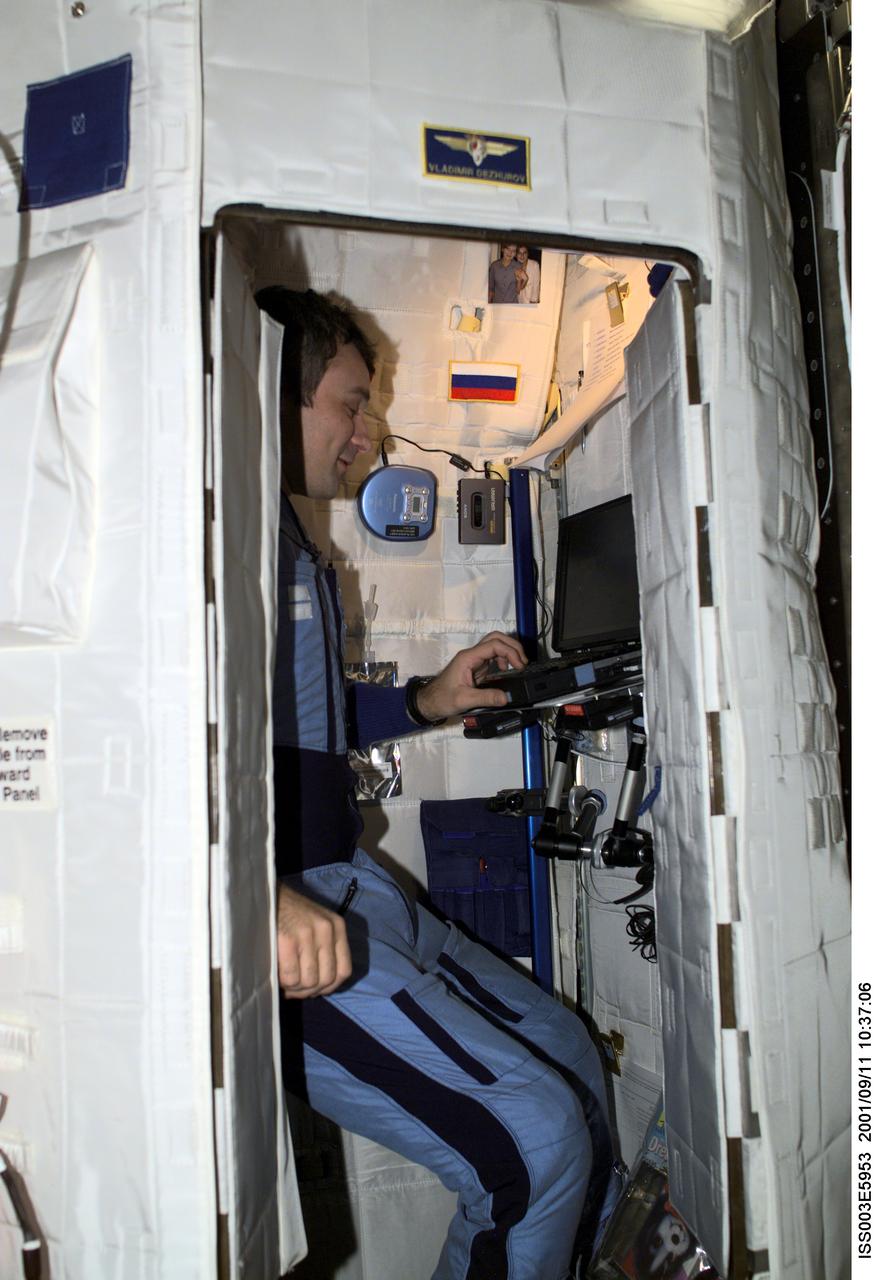
ISS003-E-5953 (11 September 2001) --- Cosmonaut Vladimir N. Dezhurov, Expedition Three flight engineer, works on a laptop computer in the Temporary Sleep Station (TSS) in the Destiny laboratory on the International Space Station (ISS). Dezhurov represents Rosaviakosmos. This image was taken with a digital still camera.
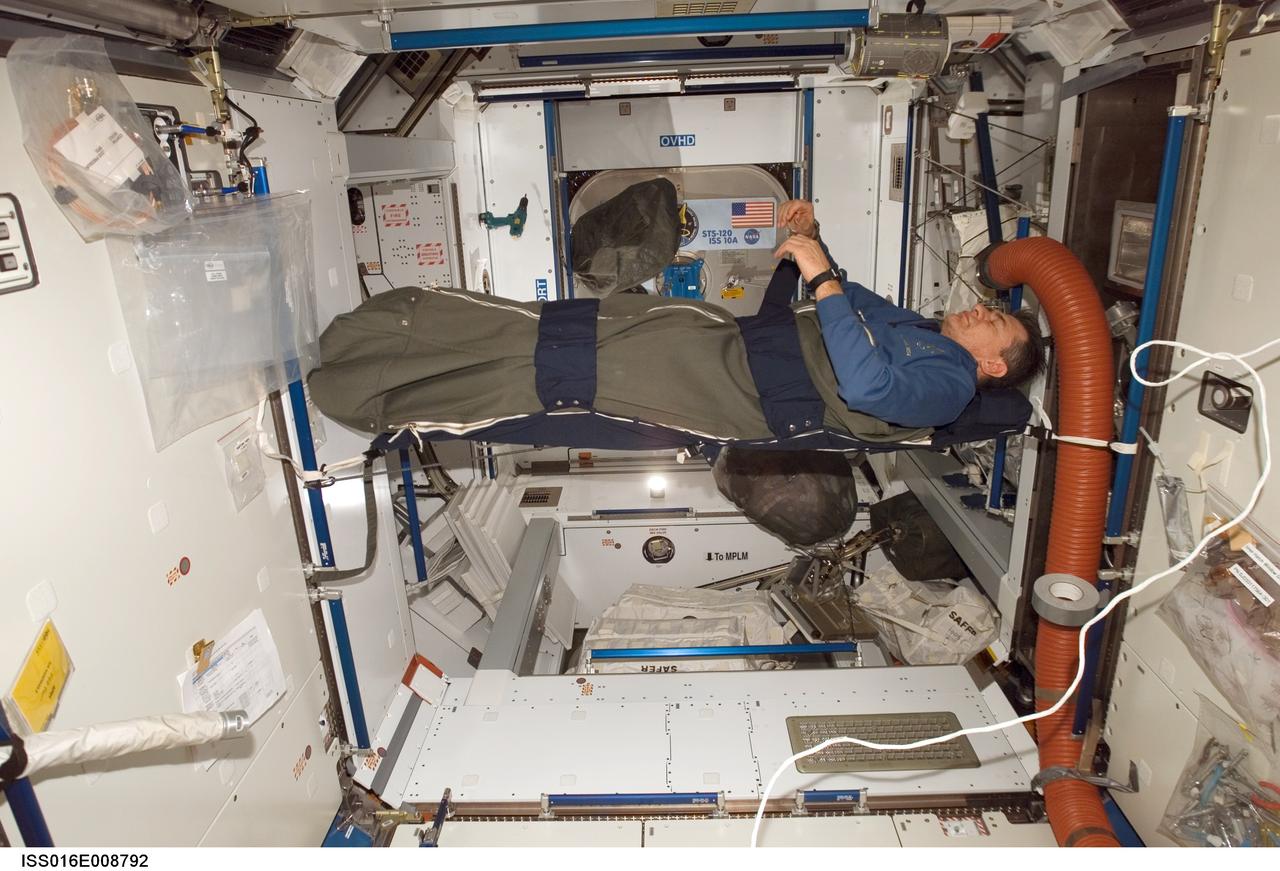
ISS016-E-008792 (2 Nov. 2007) --- European Space Agency (ESA) astronaut Paolo Nespoli, STS-120 mission specialist, rests in his sleeping bag in the Harmony node of the International Space Station while Space Shuttle Discovery is docked with the station.
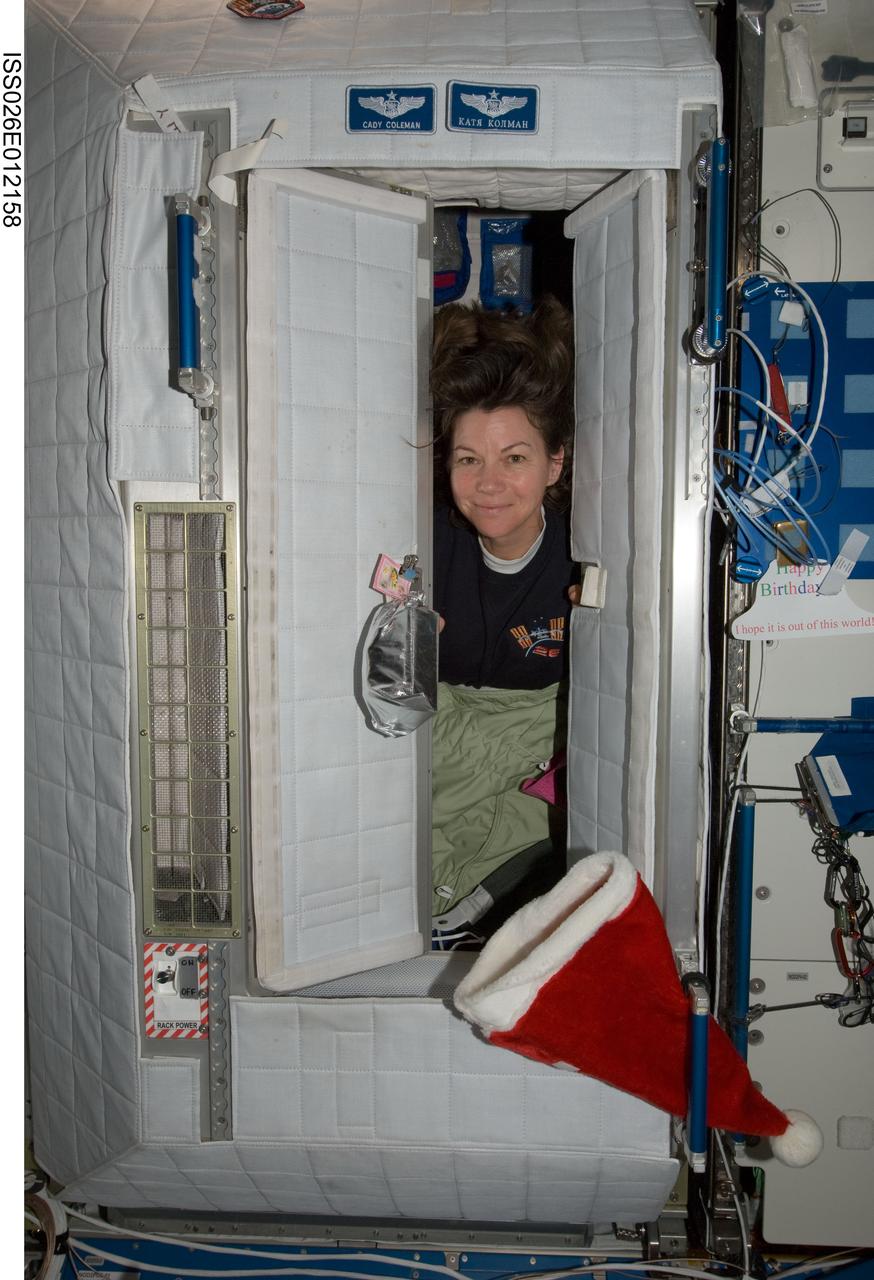
ISS026-E-012158 (25 Dec. 2010) --- NASA astronaut Catherine (Cady) Coleman, Expedition 26 flight engineer, and one of six crew members currently aboard the International Space Station, peeks out of her sleeping quarters on Christmas morning to view the station’s decorations and gifts.
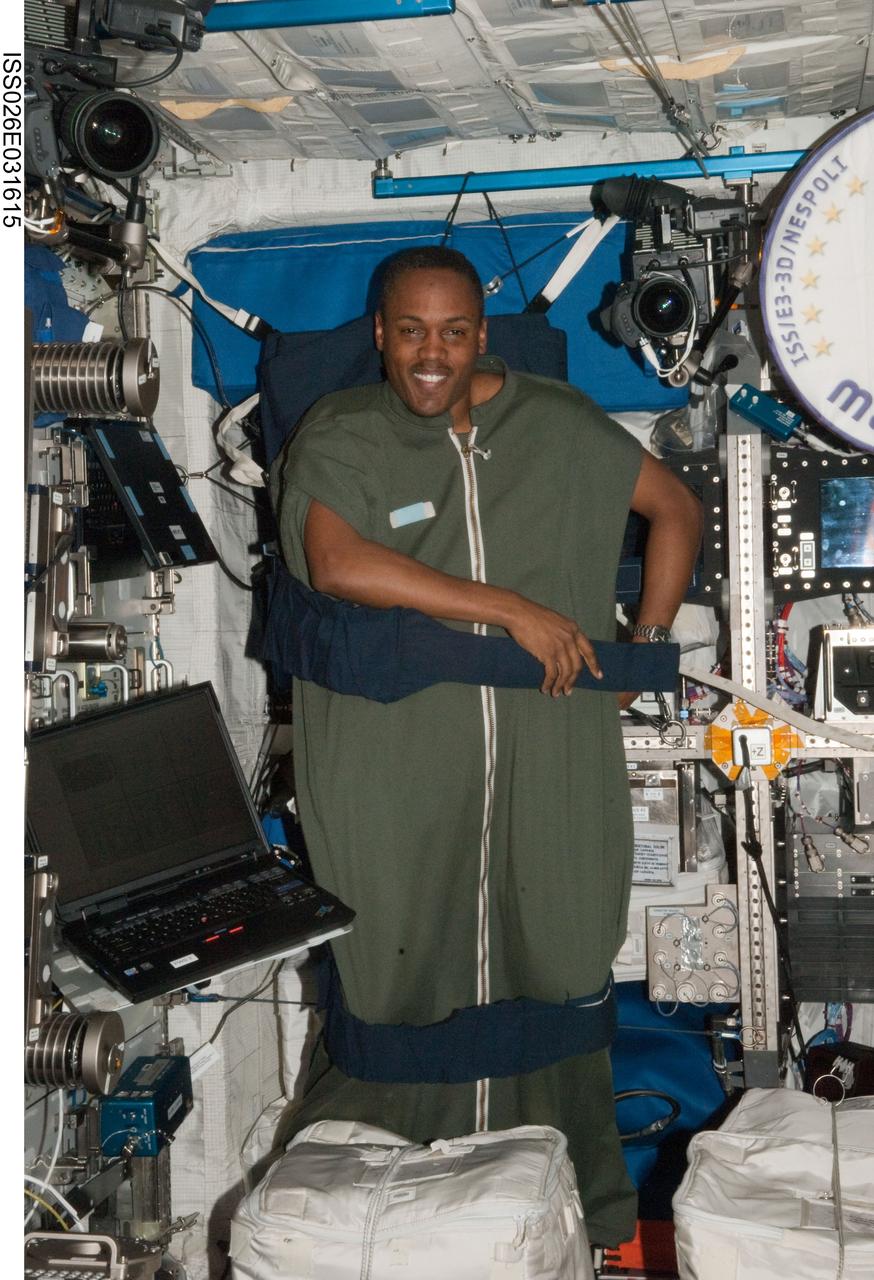
ISS026-E-031615 (3 March 2011) --- NASA astronaut Alvin Drew, STS-133 mission specialist, is pictured in his sleeping bag, which is attached in the Columbus laboratory of the International Space Station while space shuttle Discovery remains docked with the station.
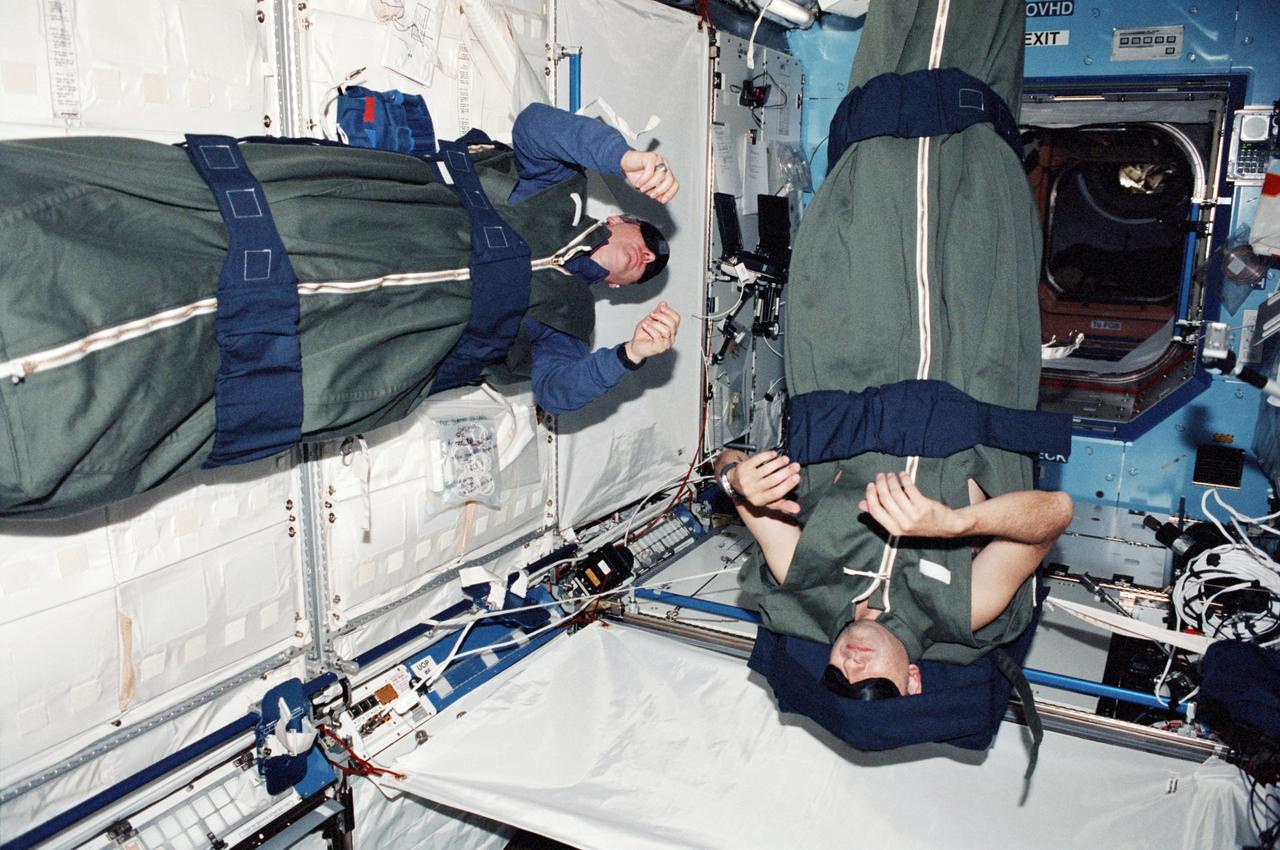
STS098-355-001 (7-20 February 2001) --- Astronauts Thomas D. Jones and Mark L. Polansky, STS-98 mission specialists, are photographed during their sleep shift in the newly-attached Destiny laboratory on the International Space Station (ISS).
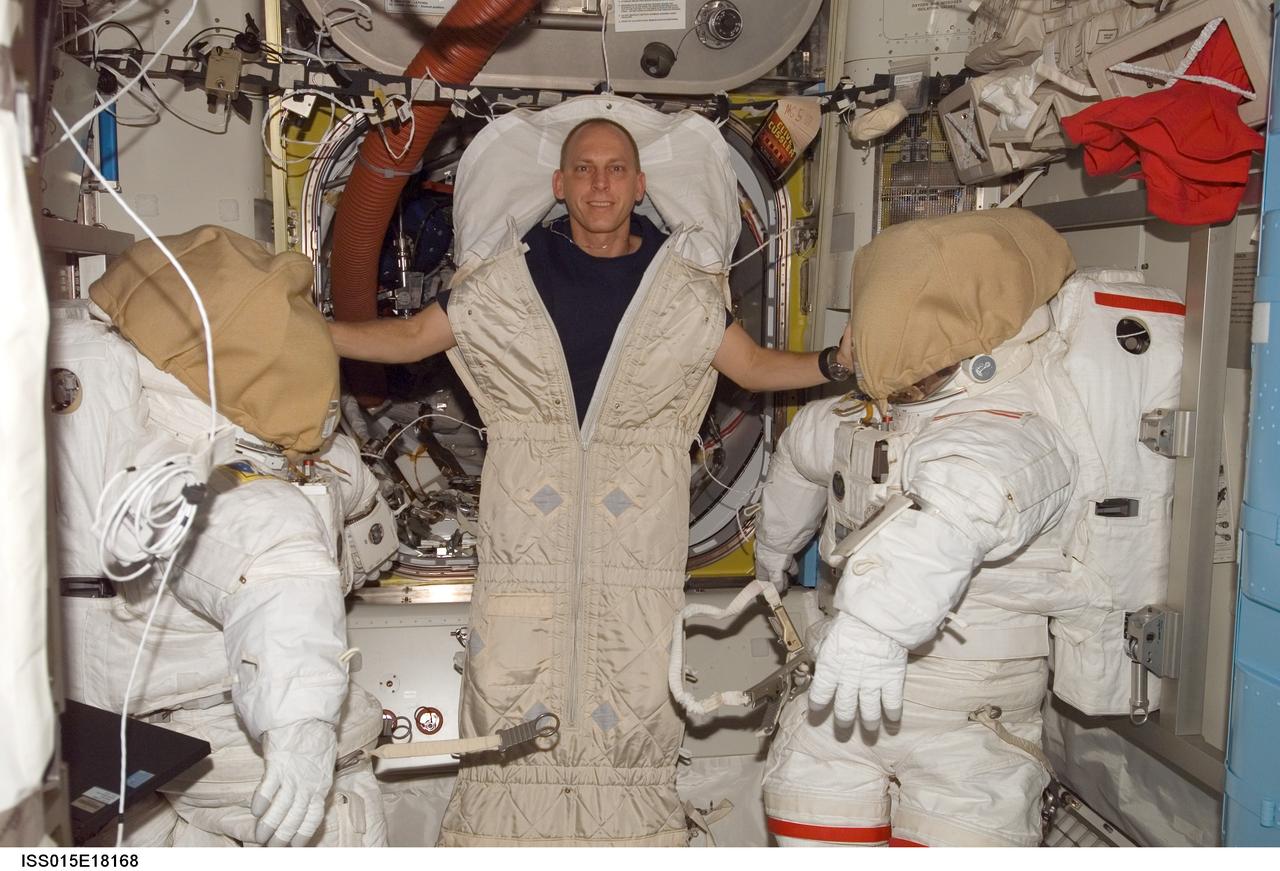
ISS015-E-18168 (11 July 2007) --- With most of his body tucked away in a sleeping bag, astronaut Clay Anderson, Expedition 15 flight engineer, poses for a photo near two extravehicular mobility unit (EMU) spacesuits in the Quest Airlock of the International Space Station.
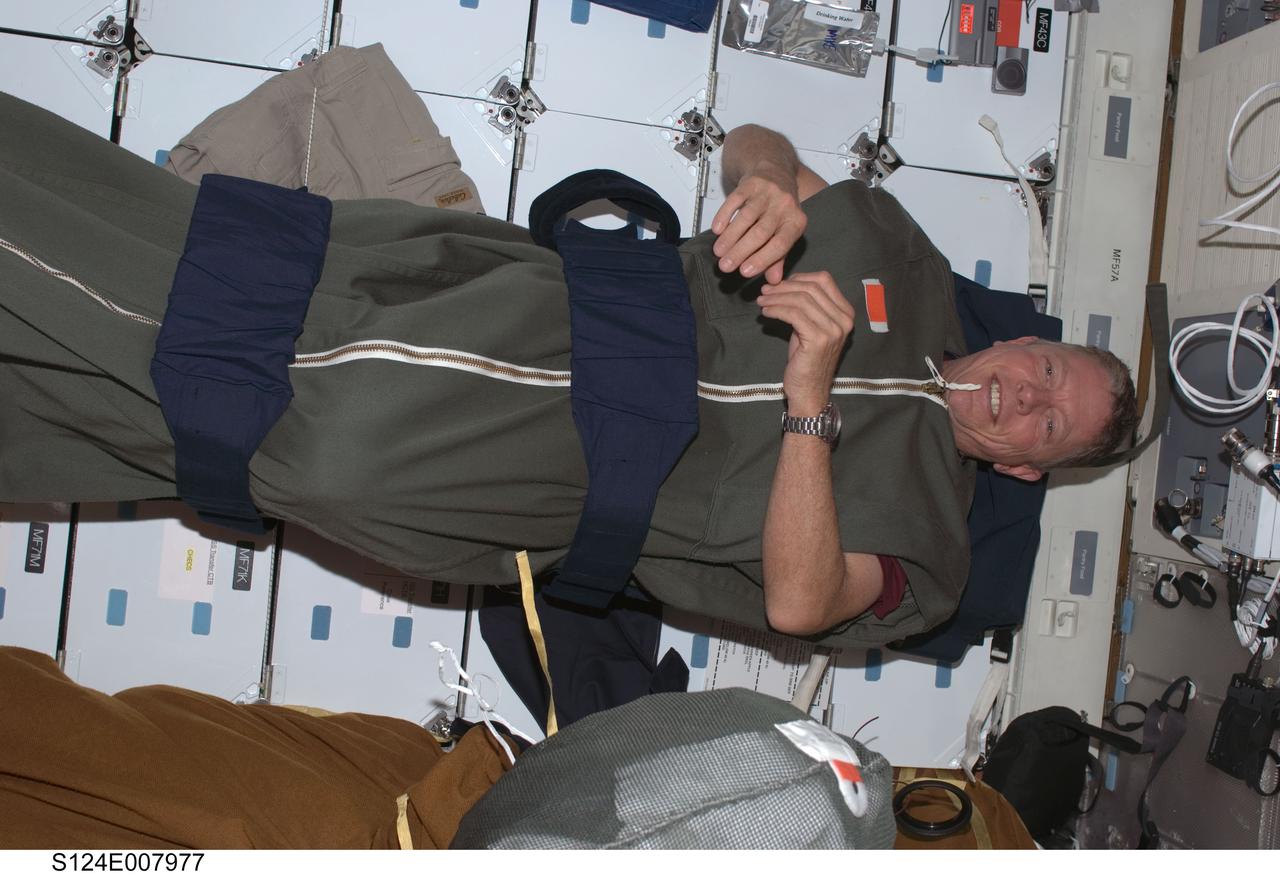
S124-E-007977 (9 June 2008) --- Astronaut Mike Fossum, STS-124 mission specialist, is pictured in his sleeping bag, which is attached to the lockers on the middeck of the Space Shuttle Discovery, while docked with the International Space Station.
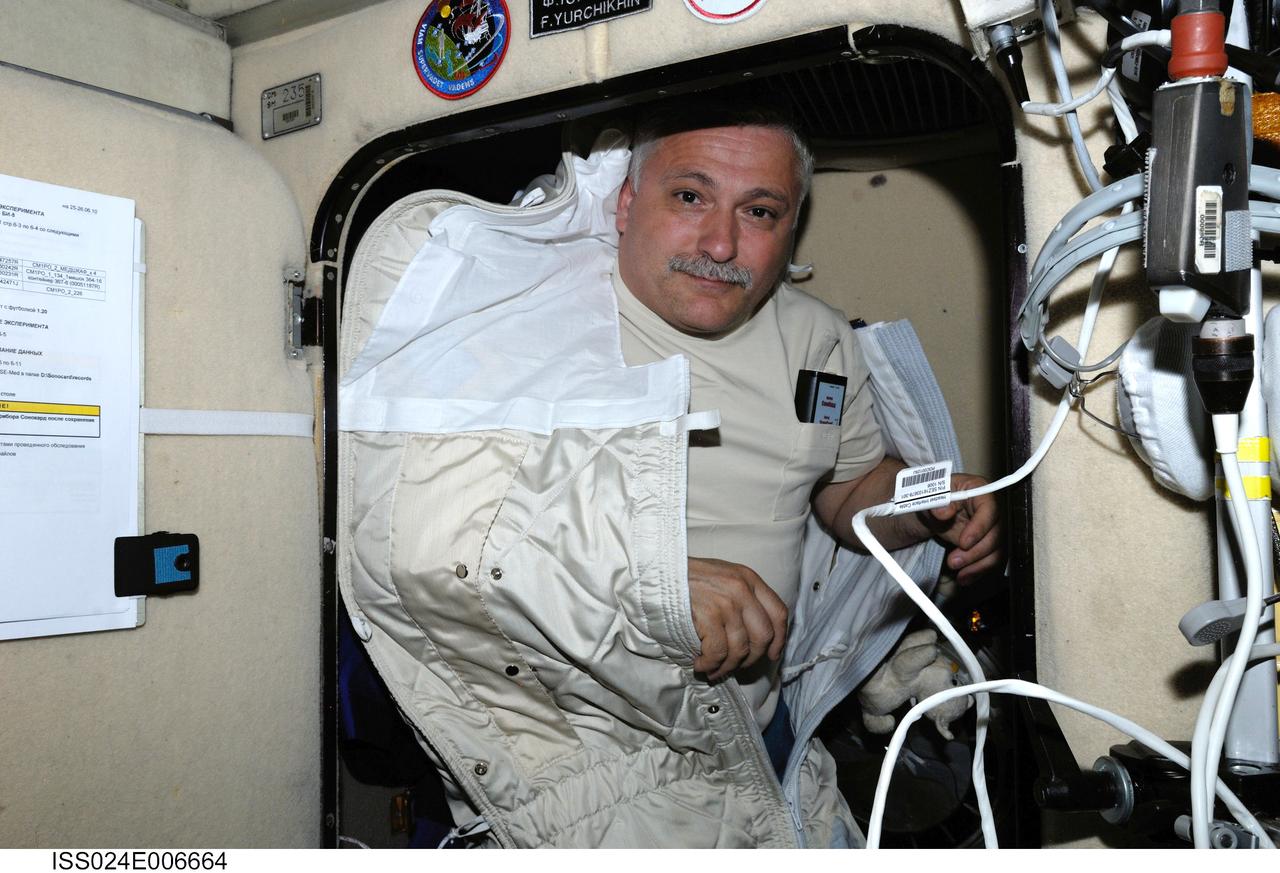
ISS024-E-006664 (25 June 2010) --- With most of his body tucked away in a sleeping bag, Russian cosmonaut Fyodor Yurchikhin, Expedition 24 flight engineer, is pictured in his crew quarters compartment in the Zvezda Service Module of the International Space Station.

ISS016-E-013098 (29 Nov. 2007) --- With most of his body tucked away in a sleeping bag, astronaut Daniel Tani, Expedition 16 flight engineer, poses for a photo near two extravehicular mobility unit (EMU) spacesuits in the Quest Airlock of the International Space Station.
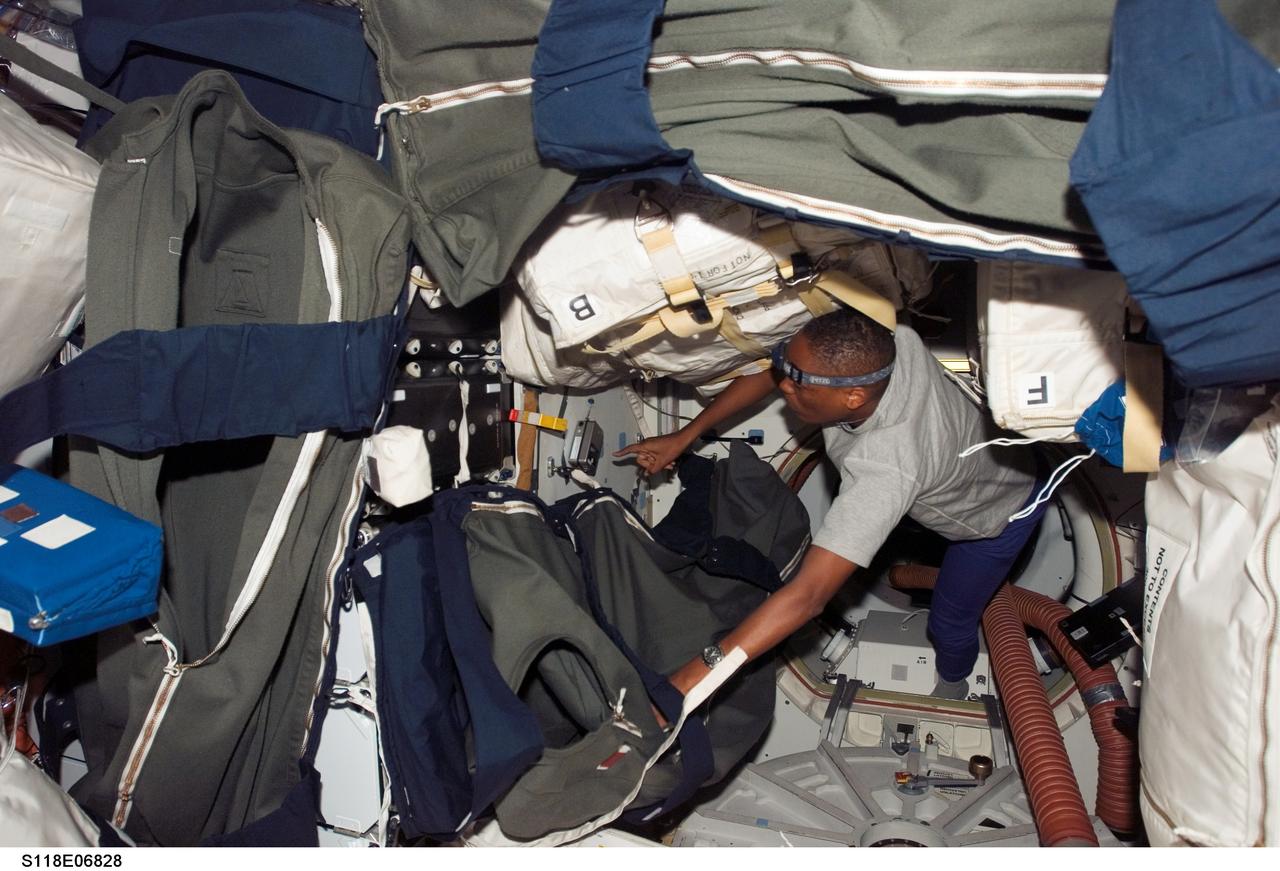
S118-E-06828 (11 Aug. 2007) --- Astronaut Alvin Drew, STS-118 mission specialist, works near a hatch of Space Shuttle Endeavour while docked with the International Space Station during flight day four activities. Sleeping bags are visible in the foreground.
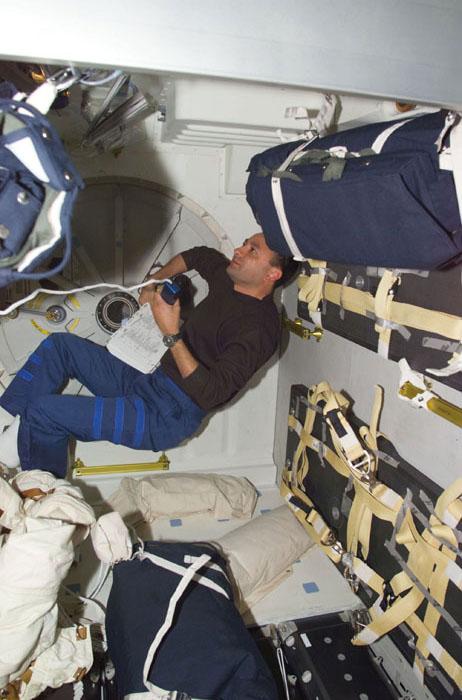
STS98-E-5088 (10 February 2001) --- Astronaut Mark L. Polansky, SS-98 pilot, communicates with ground controllers from the mid deck of the Space Shuttle Atlantis. Parts of at least two sleep stations are visible in the digital still camera's scene.
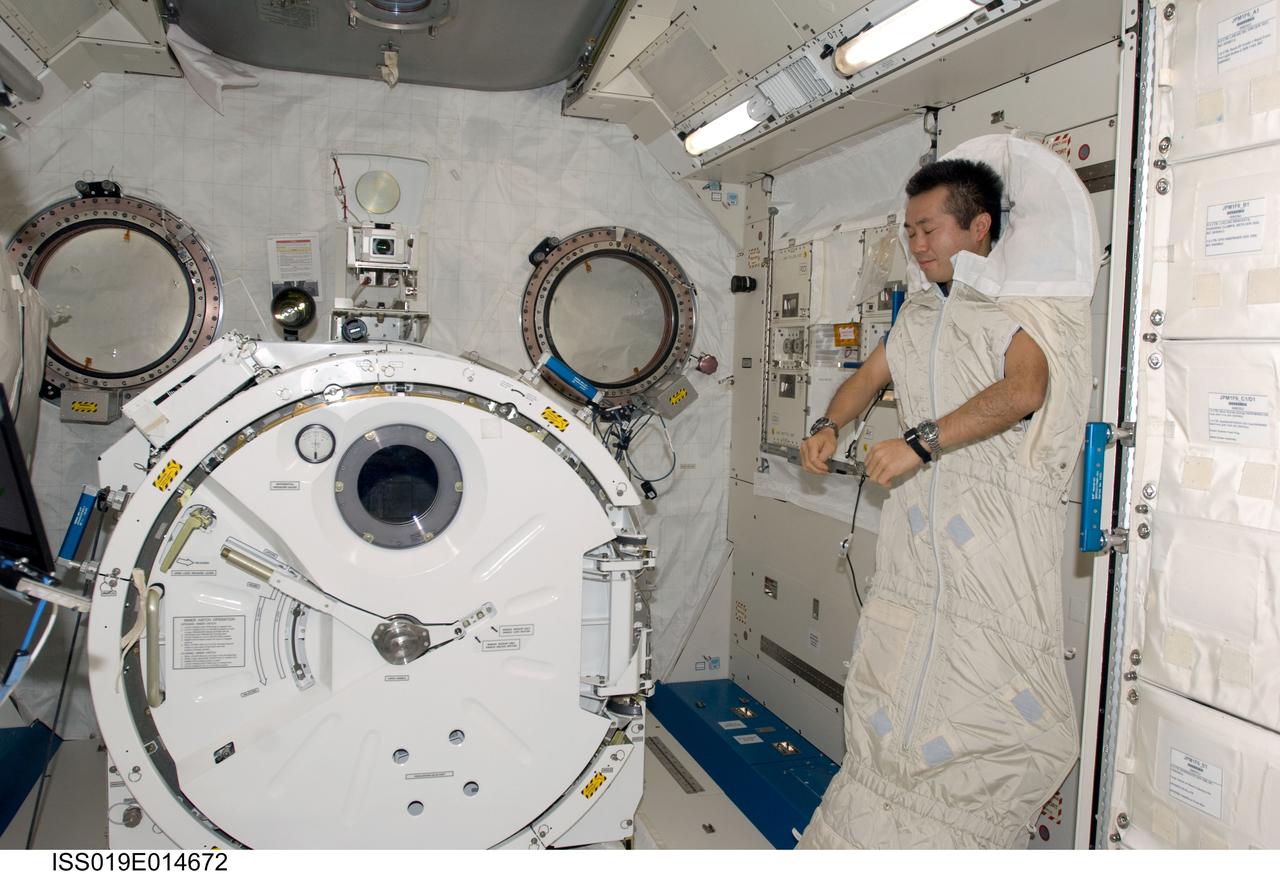
ISS019-E-014672 (7 May 2009) --- Japan Aerospace Exploration Agency (JAXA) astronaut Koichi Wakata, Expedition 19/20 flight engineer, is photographed in a sleeping bag attached to the racks in the Kibo laboratory of the International Space Station.
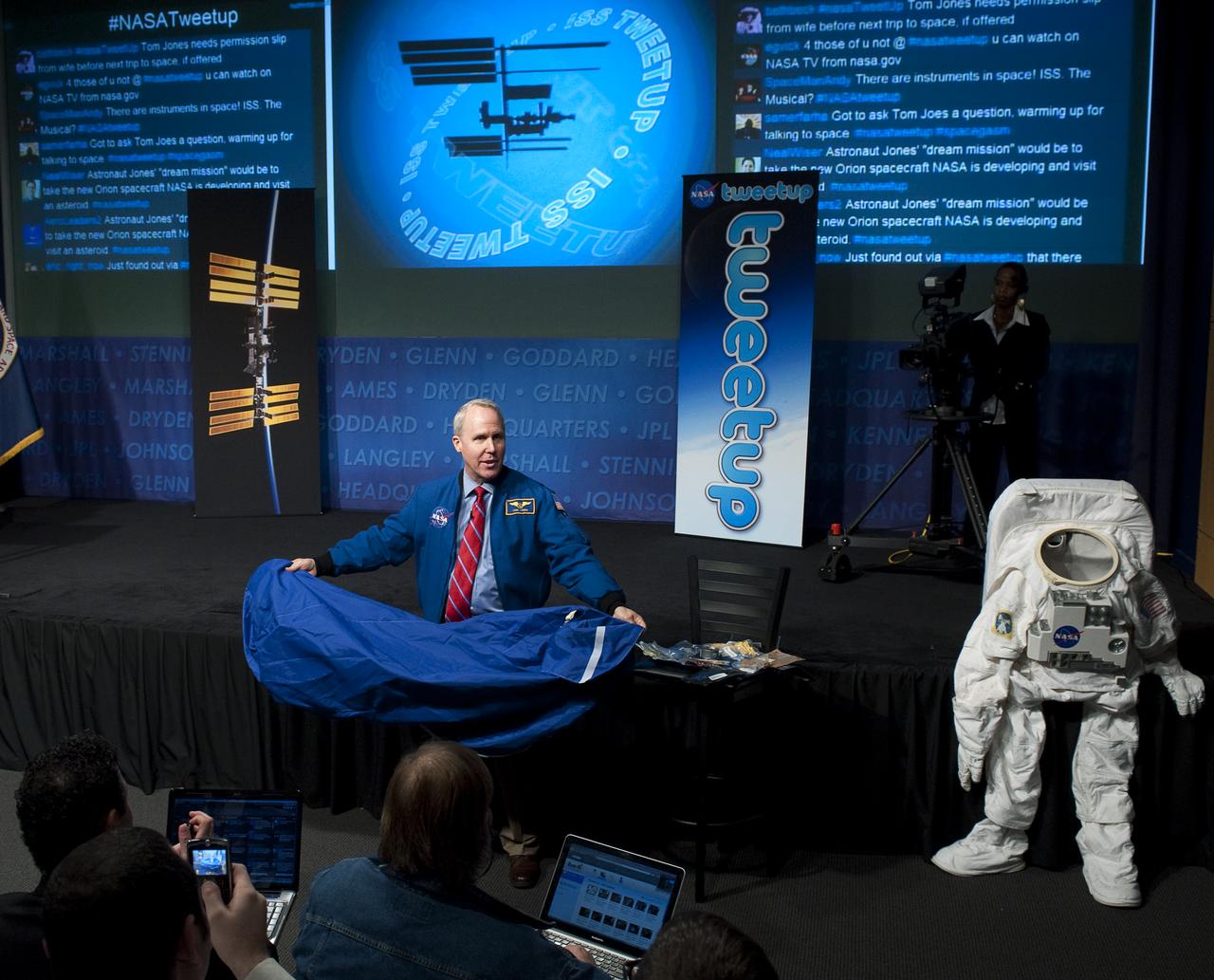
Former NASA astronaut Tom Jones shows off a sleeping bag used by astronauts living aboard the International Space Station during a NASA Tweetup event at NASA Headquarters in Washington, Wednesday, Oct. 21, 2009. Photo Credit: (NASA/Carla Cioffi)
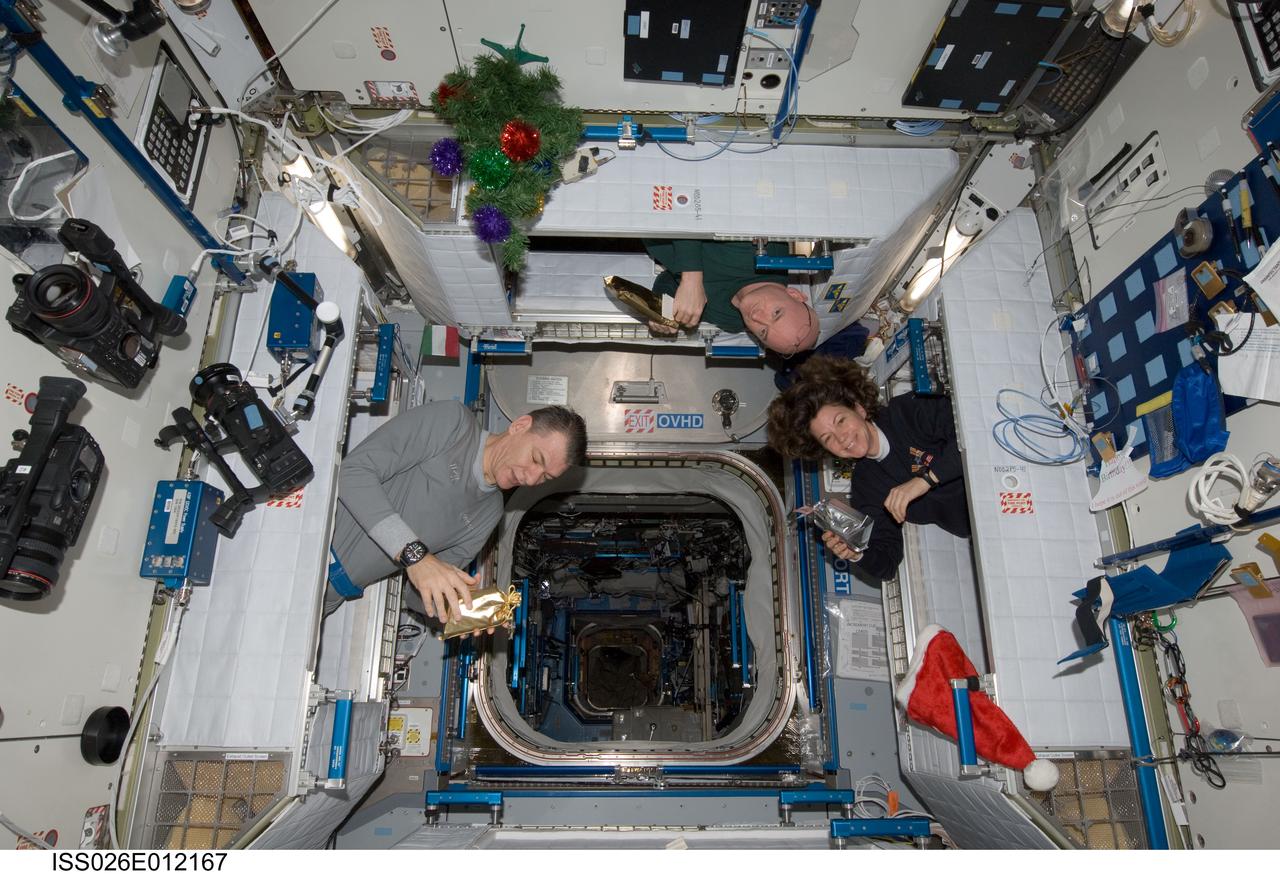
ISS026-E-012167 (25 Dec. 2010) --- Three of the six crew members aboard the International Space Station peek out of their sleeping quarters on Christmas morning to view the station’s decorations and gifts. Shown, from left, are European Space Agency astronaut Paolo Nespoli, Expedition 26 flight engineer, NASA astronaut Scott Kelly, Expedition 26 commander, and NASA astronaut Catherine (Cady) Coleman, flight engineer
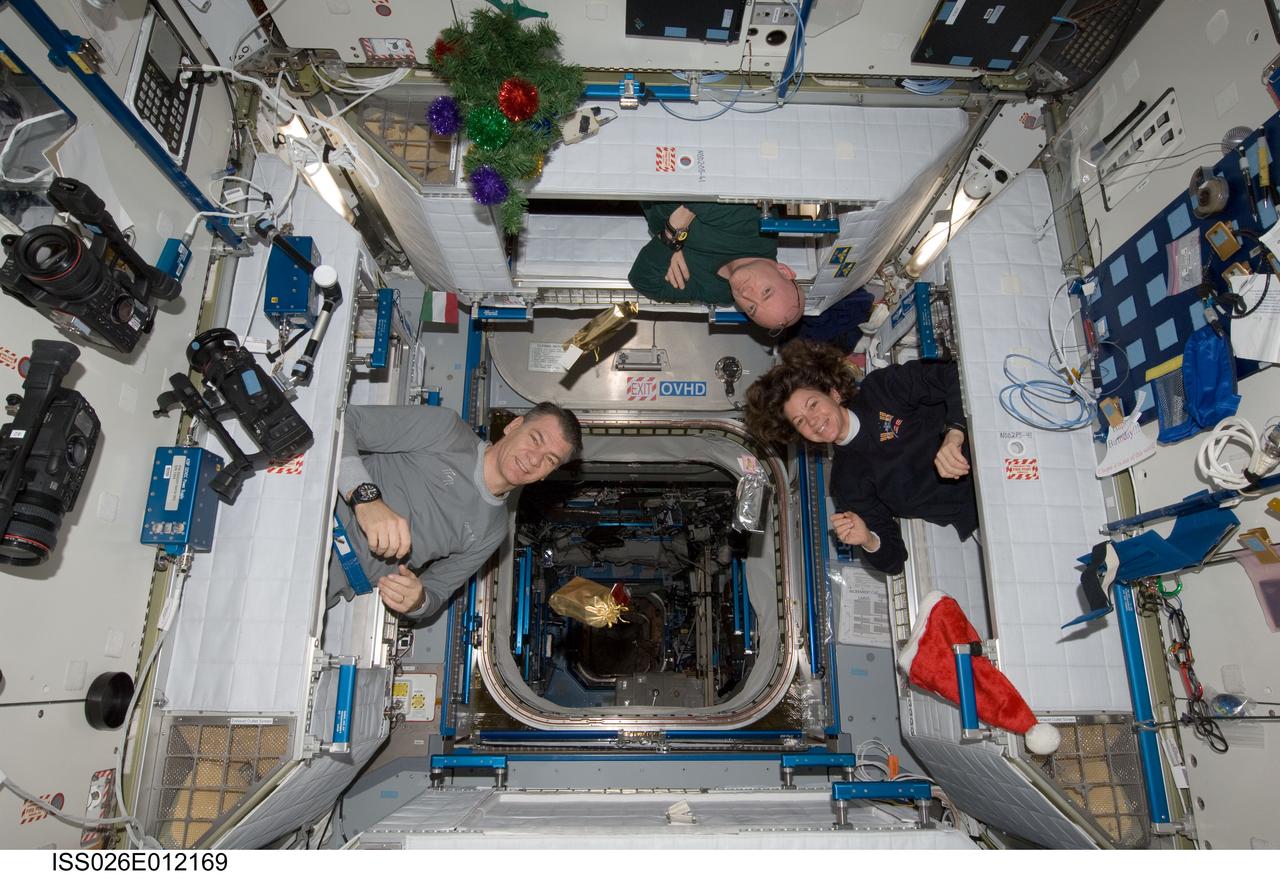
ISS026-E-012169 (25 Dec. 2010) --- Three of the six crew members aboard the International Space Station peek out of their sleeping quarters on Christmas morning to view the station?s decorations and gifts. Shown, from left, are European Space Agency astronaut Paolo Nespoli, Expedition 26 flight engineer, NASA astronaut Scott Kelly, Expedition 26 commander, and NASA astronaut Catherine (Cady) Coleman, flight engineer.
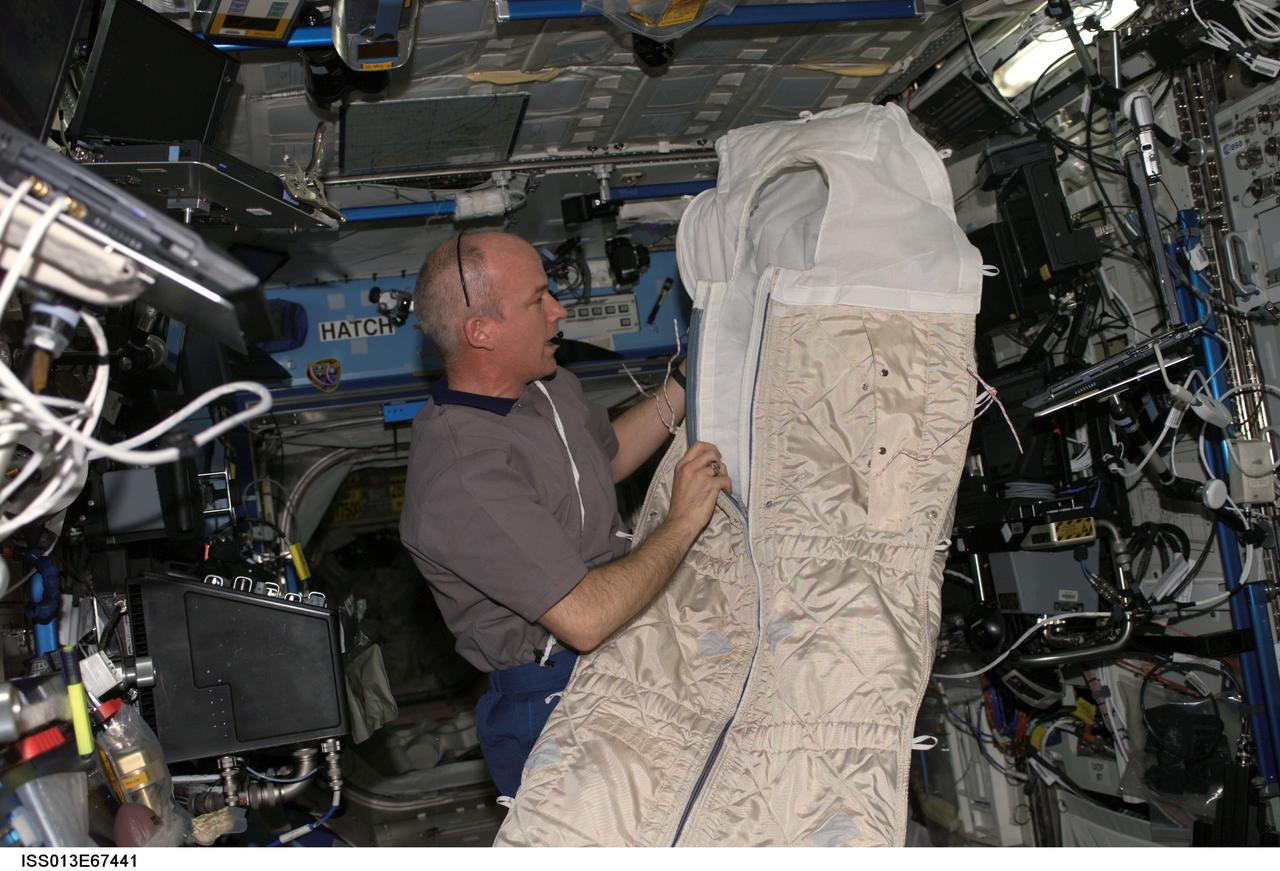
ISS013-E-67441 (17 Aug. 2006) --- Astronaut Jeffrey N. Williams, Expedition 13 NASA space station science officer and flight engineer, holds a sleeping bag while conducting an educational teleconference with the Boys and Girls Clubs of Middle Tennessee in Nashville, via Ku- and S-band in the Destiny laboratory of the International Space Station, with audio and video relayed to the Mission Control Center at Johnson Space Center.
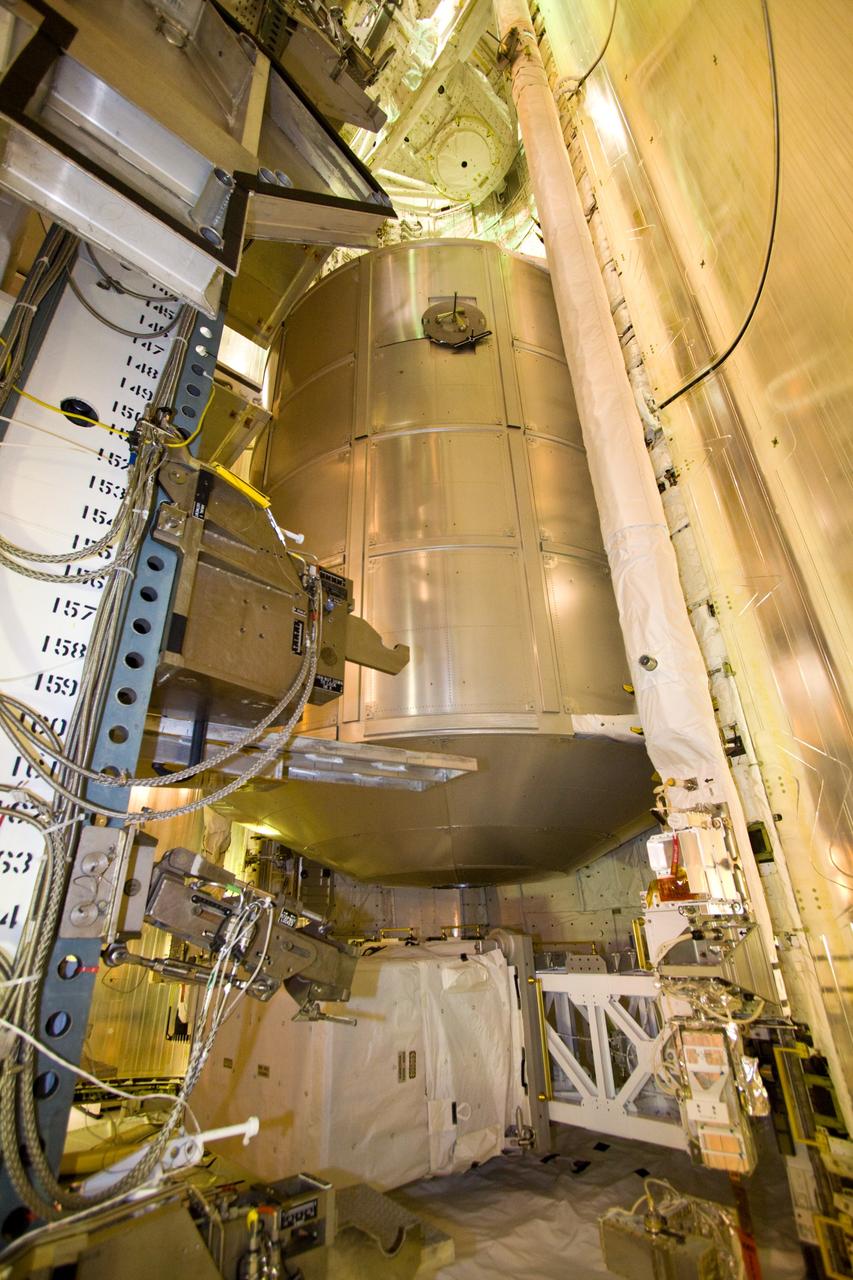
CAPE CANAVERAL, Fla. – On Launch Pad 39A, the payload ground-handling mechanism moves the multi-purpose logistics module Leonardo toward space shuttle Discovery's payload bay. Leonardo is the primary payload on Discovery's STS-128 mission to the International Space Station. Discovery will deliver 33,000 pounds of equipment to the station, including science and storage racks, a freezer to store research samples, a new sleeping compartment and the COLBERT treadmill. Launch is targeted for late August. Photo credit: NASA/Jack Pfaller
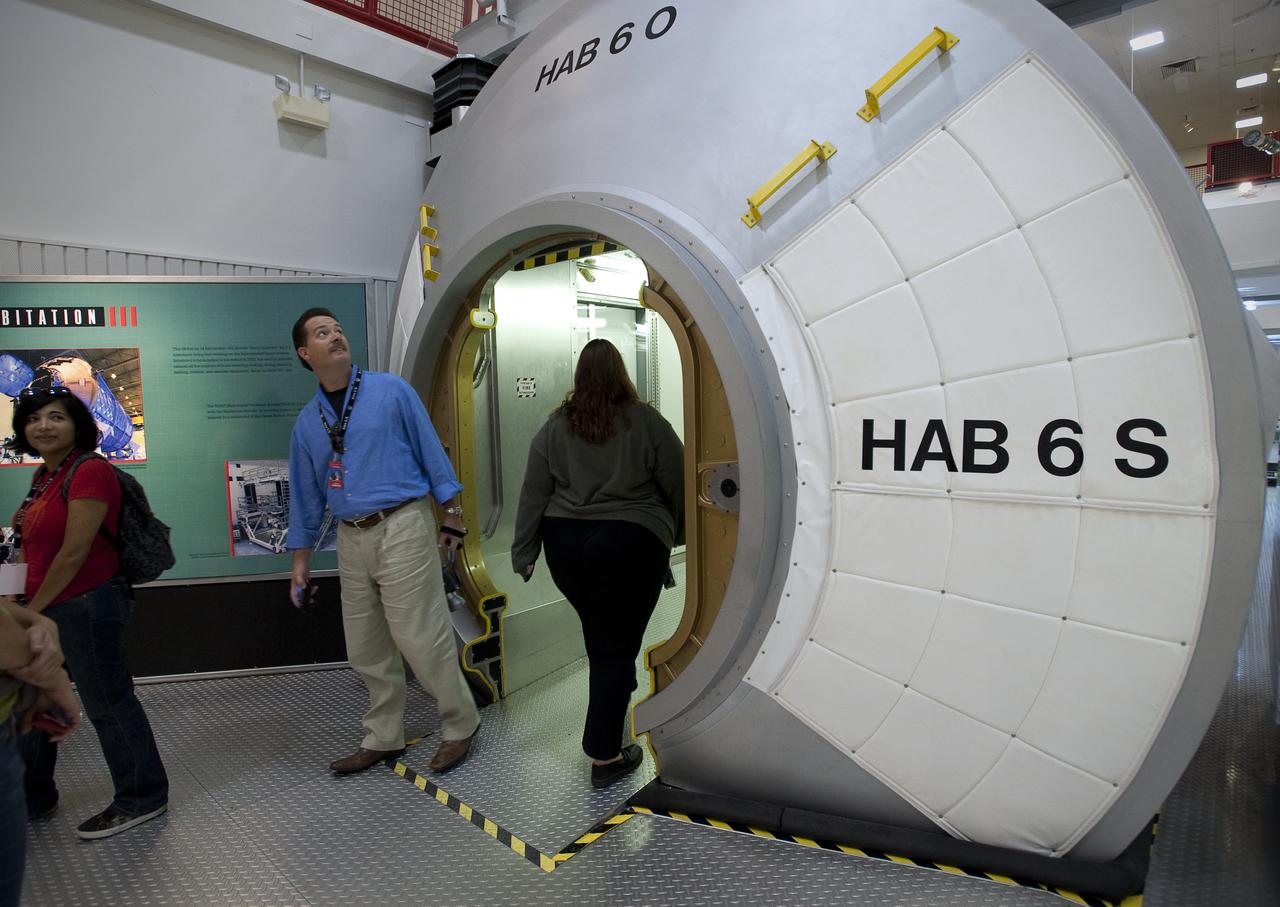
NASA Twitter followers tour the International Space Station Center at the Kennedy Space Center in Cape Canaveral, Fla. as part of a two-day Tweetup event, Sunday, Nov. 15, 2009. Tweeps had the chance to enter full-scale mock-ups of the Habitation Module and see how Space Station crew members live, sleep and work. Photo Credit: (NASA/Carla Cioffi) 
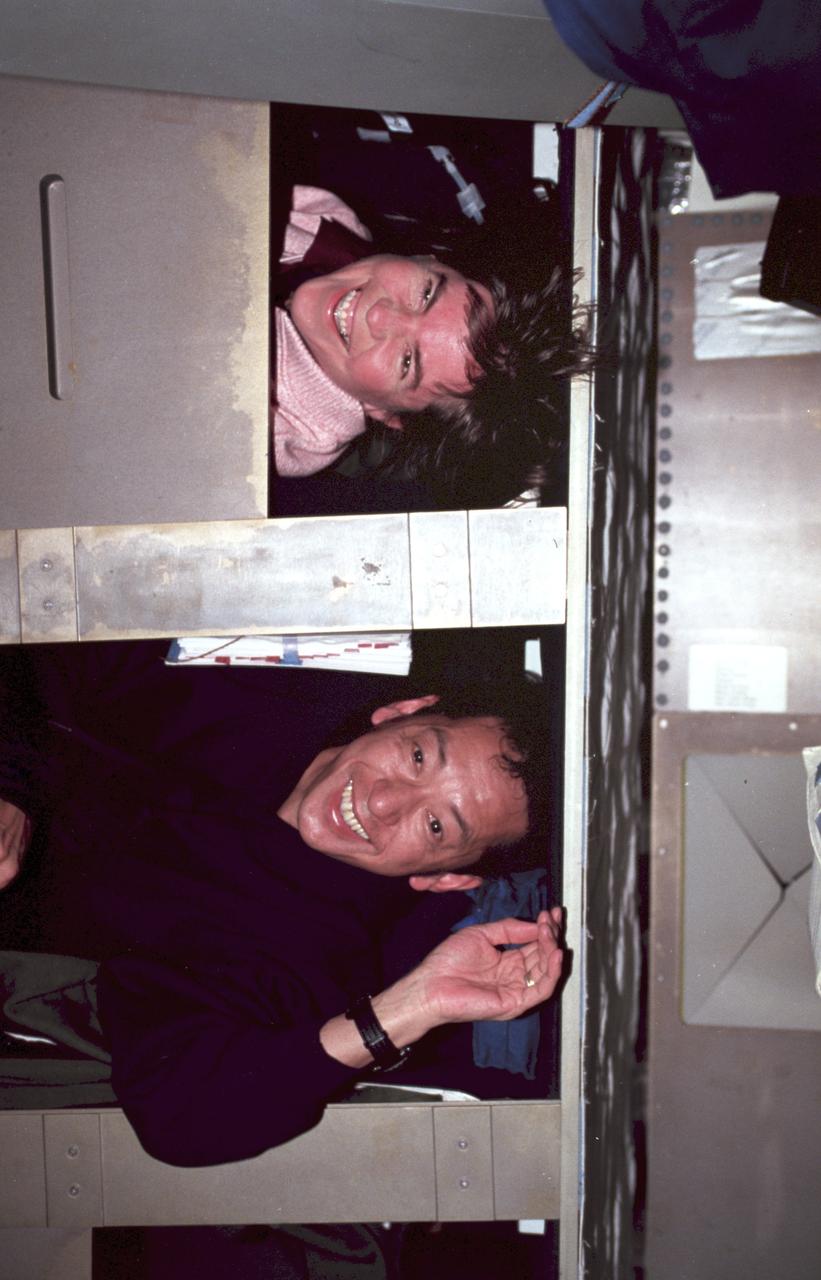
STS099-308-019 (11-22 February 2000) ---Astronauts Janice E. Voss and Mamoru Mohri, both members of the Blue Team portion of 24-hour SRTM support, prepare for their sleep shift on the middeck of the Earth-orbiting Space Shuttle Endeavour. Mohri represents Japan?s National Space Development Agency (NASDA).
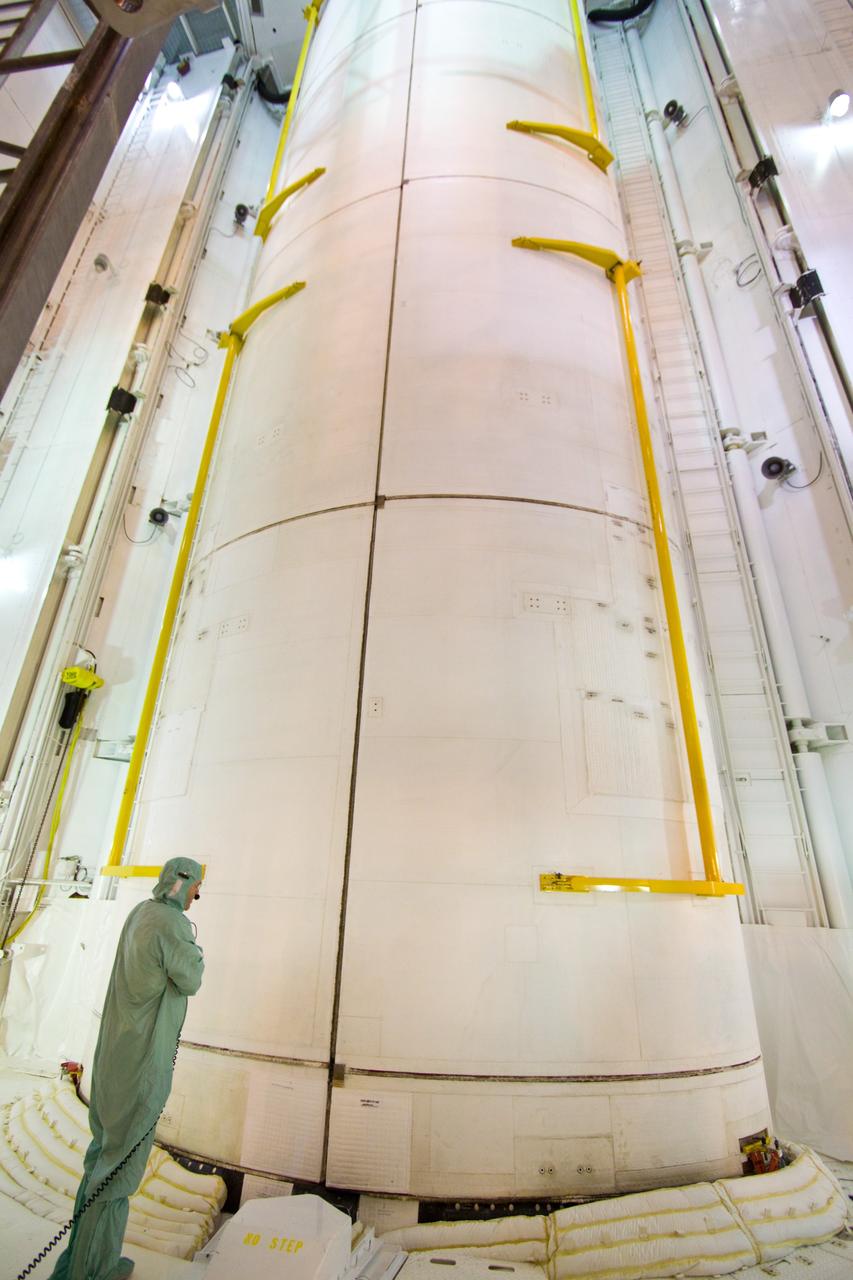
CAPE CANAVERAL, Fla. – On Launch Pad 39A, a technician checks the closing of the payload bay door around the multi-purpose logistics module Leonardo and the lightweight multi-purpose experiment support structure carrier inside space shuttle Discovery's payload bay. Discovery will deliver 33,000 pounds of equipment to the station, including science and storage racks, a freezer to store research samples, a new sleeping compartment and the COLBERT treadmill. Launch is targeted for late August. Photo credit: NASA/Jack Pfaller
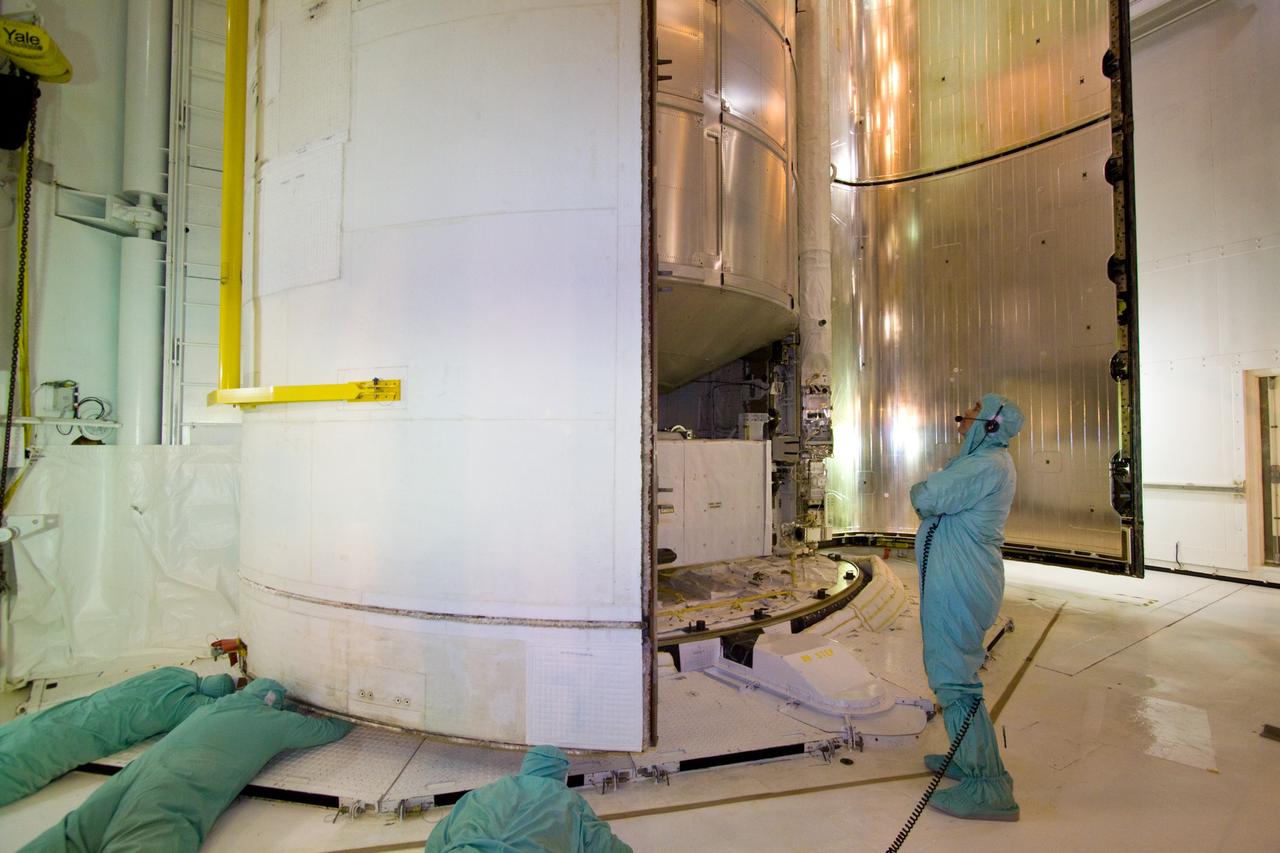
CAPE CANAVERAL, Fla. – On Launch Pad 39A, technicians check underneath as space shuttle Discovery's payload bay doors begin closing. Seen in the payload bay are the multi-purpose logistics module Leonardo and the lightweight multi-purpose experiment support structure carrier. Discovery will deliver 33,000 pounds of equipment to the station, including science and storage racks, a freezer to store research samples, a new sleeping compartment and the COLBERT treadmill. Launch is targeted for late August. Photo credit: NASA/Jack Pfaller

STS007-26-1439 (18-24 June 1983) --- Astronaut John M. Fabian, STS-7 mission specialist, is captured with a 35mm camera at his sleep station in the middeck of the Earth-orbiting space shuttle Challenger. This scene was selected by the five-member astronaut crew for showing at its July 1, 1983 Post Flight Press Conference (PFPC) at the Johnson Space Center's (JSC) main auditorium. Photo credit: NASA
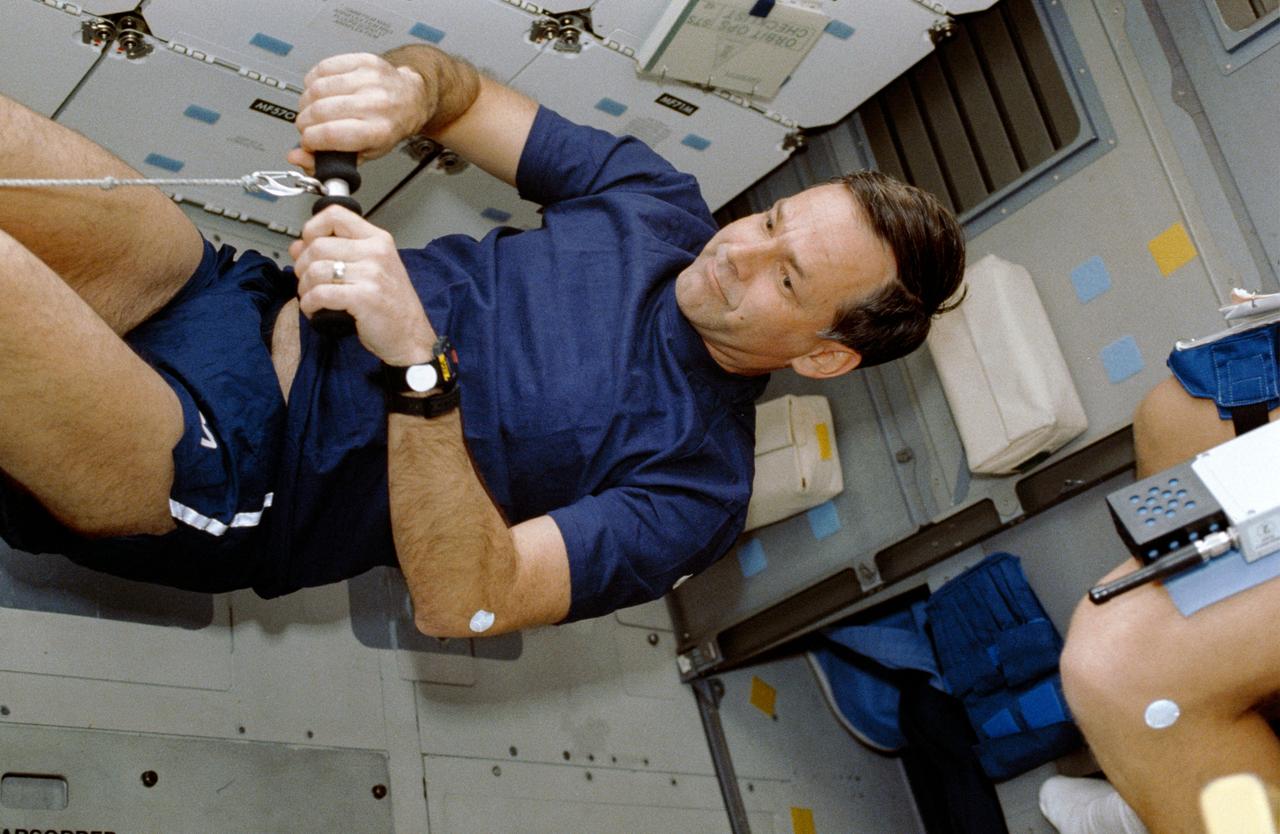
STS042-05-037 (30 Jan 1992) --- Astronaut Ronald J. Grabe, STS-42 commander, exercises using MK1 Rowing Machine on the middeck of Discovery, Orbiter Vehicle (OV) 103. Grabe is using the exercise device as part of Development Test Objective (DTO) 653, Evaluation of MK1 Rowing Machine. The forward lockers appear at Grabe's right and the sleep station behind him.
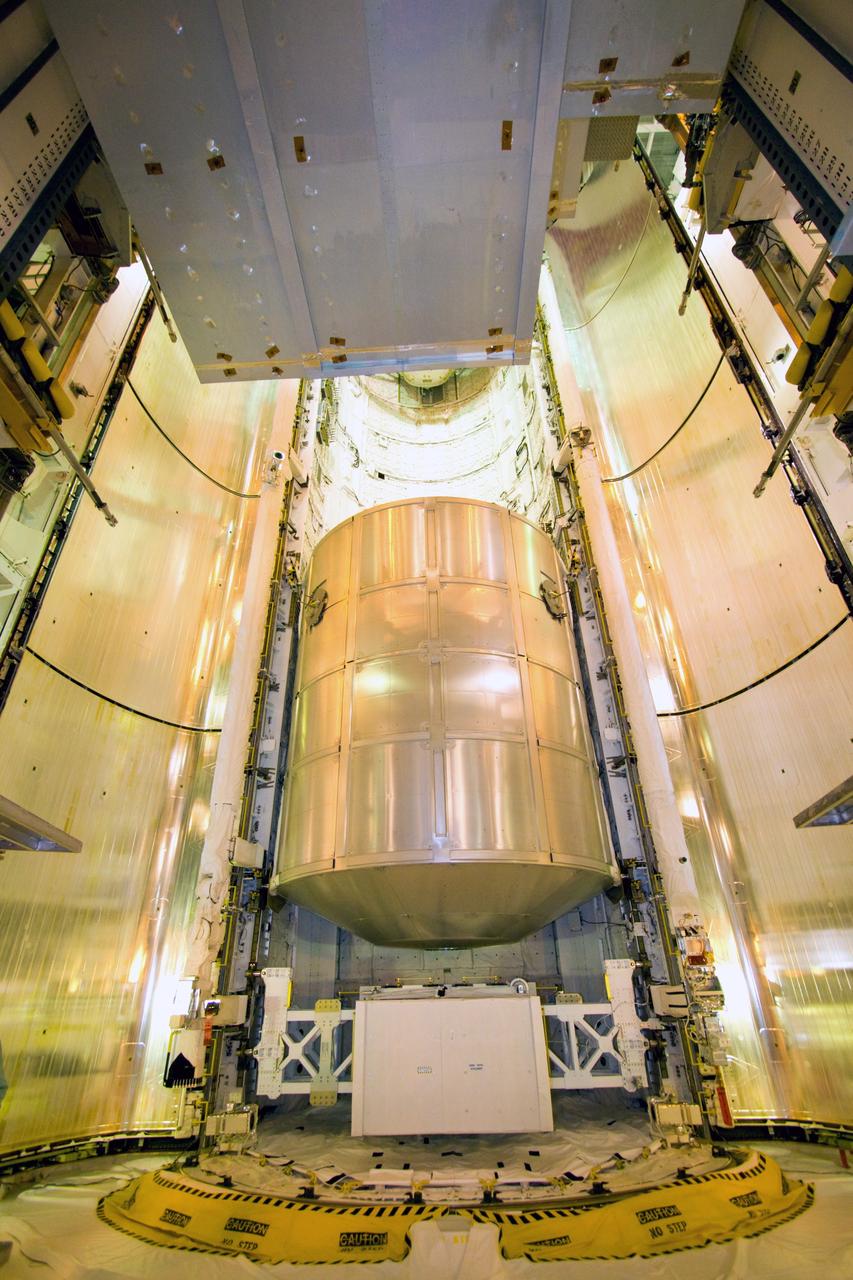
CAPE CANAVERAL, Fla. – On Launch Pad 39A, the payload for space shuttle Discovery's STS-128 mission has been installed in the payload bay. At the bottom is the Lightweight multi-purpose experiment support structure carrier. Above it is the multi-purpose logistics module Leonardo. Discovery will deliver 33,000 pounds of equipment to the station, including science and storage racks, a freezer to store research samples, a new sleeping compartment and the COLBERT treadmill. Launch is targeted for late August. Photo credit: NASA/Jack Pfaller
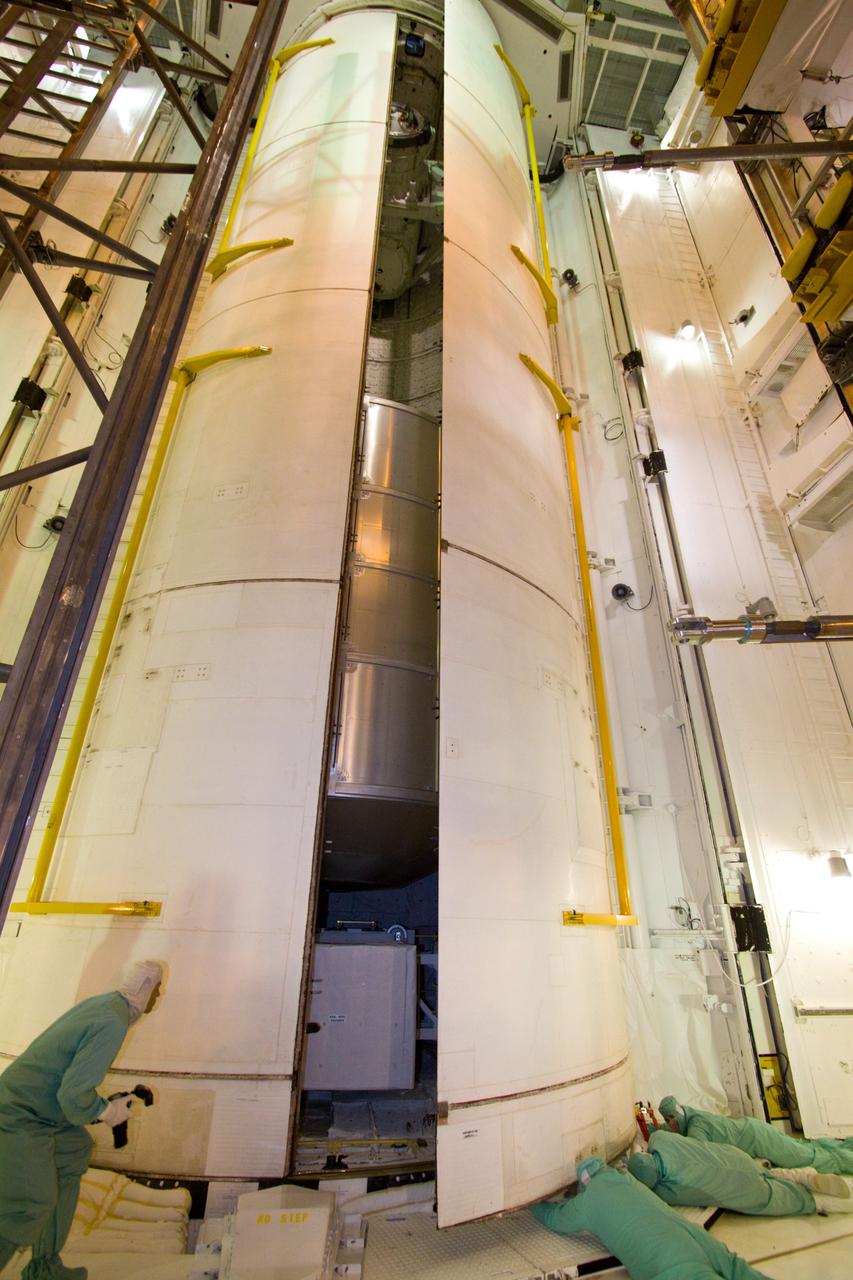
CAPE CANAVERAL, Fla. – On Launch Pad 39A, technicians ensure the payload bay door closes properly around the multi-purpose logistics module Leonardo and the lightweight multi-purpose experiment support structure carrier inside space shuttle Discovery's payload bay. Discovery will deliver 33,000 pounds of equipment to the station, including science and storage racks, a freezer to store research samples, a new sleeping compartment and the COLBERT treadmill. Launch is targeted for late August. Photo credit: NASA/Jack Pfaller
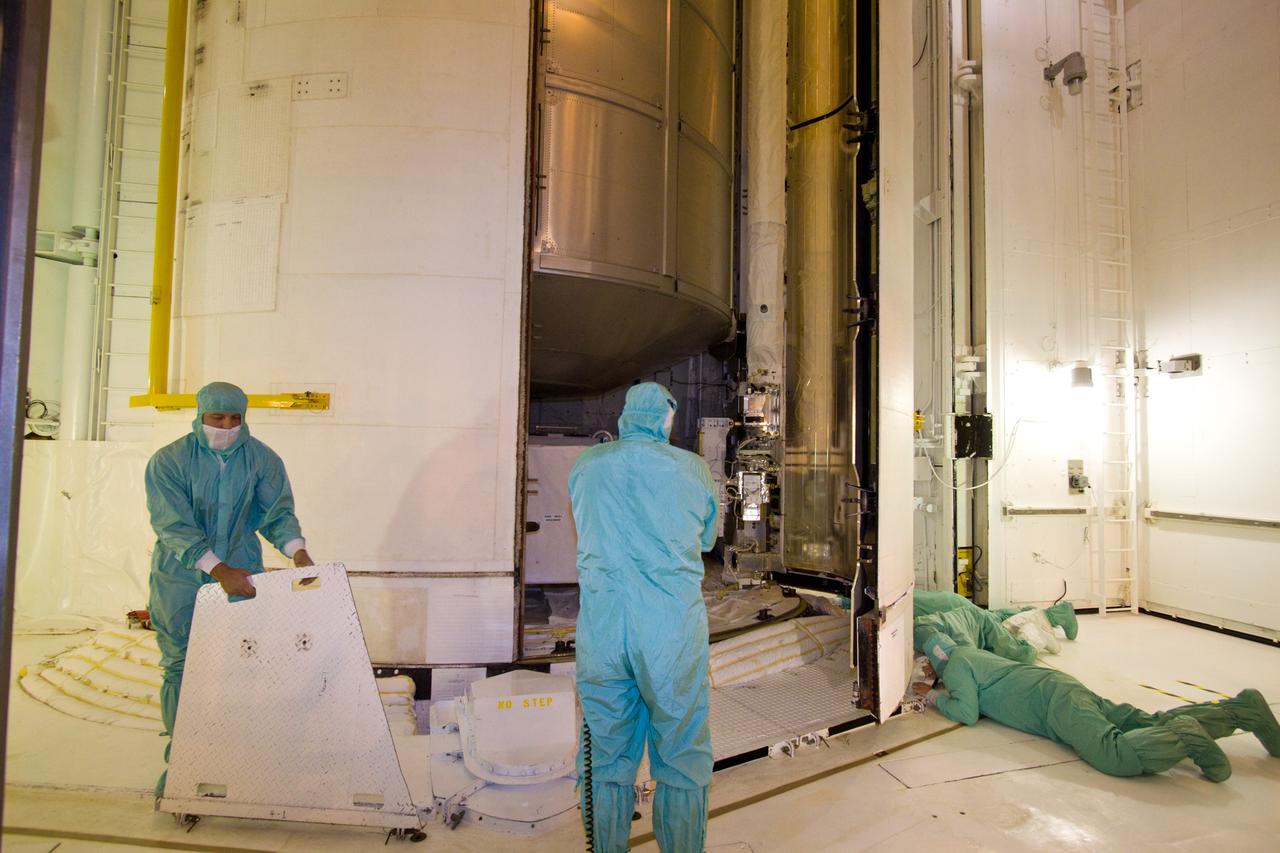
CAPE CANAVERAL, Fla. – On Launch Pad 39A, technicians check the clearance of the payload bay door as it closes around the multi-purpose logistics module Leonardo and the lightweight multi-purpose experiment support structure carrier inside space shuttle Discovery's payload bay. Discovery will deliver 33,000 pounds of equipment to the station, including science and storage racks, a freezer to store research samples, a new sleeping compartment and the COLBERT treadmill. Launch is targeted for late August. Photo credit: NASA/Jack Pfaller

CAPE CANAVERAL, Fla. – On Launch Pad 39A, the payload for space shuttle Discovery's STS-128 mission waits for closure of the payload bay doors. At the bottom is the lightweight multi-purpose experiment support structure carrier. Above it is the multi-purpose logistics module Leonardo. Discovery will deliver 33,000 pounds of equipment to the station, including science and storage racks, a freezer to store research samples, a new sleeping compartment and the COLBERT treadmill. Launch is targeted for late August. Photo credit: NASA/Jack Pfaller
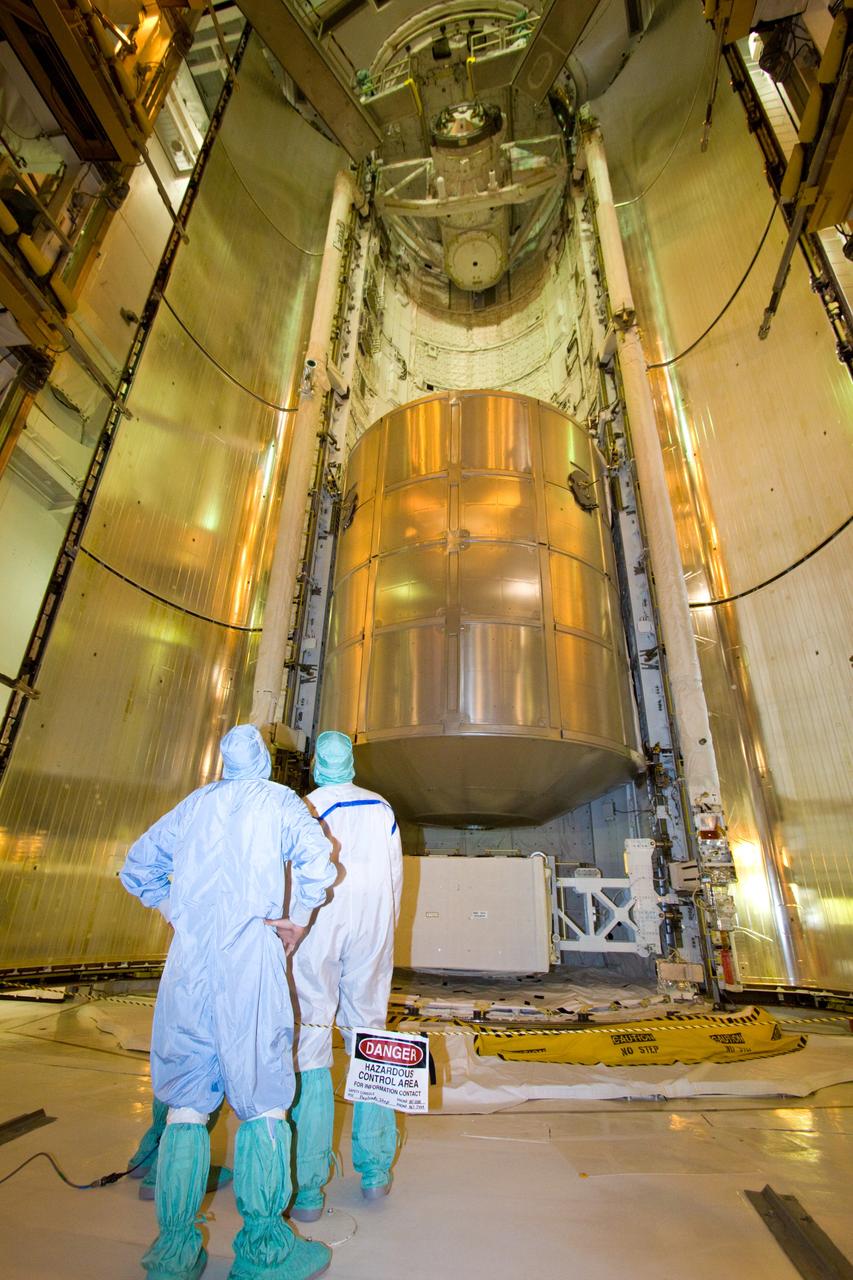
CAPE CANAVERAL, Fla. – On Launch Pad 39A, technicians observe as space shuttle Discovery's payload bay doors begin closing. Seen in the payload bay are the multi-purpose logistics module Leonardo and the lightweight multi-purpose experiment support structure carrier. Discovery will deliver 33,000 pounds of equipment to the station, including science and storage racks, a freezer to store research samples, a new sleeping compartment and the COLBERT treadmill. Launch is targeted for late August. Photo credit: NASA/Jack Pfaller
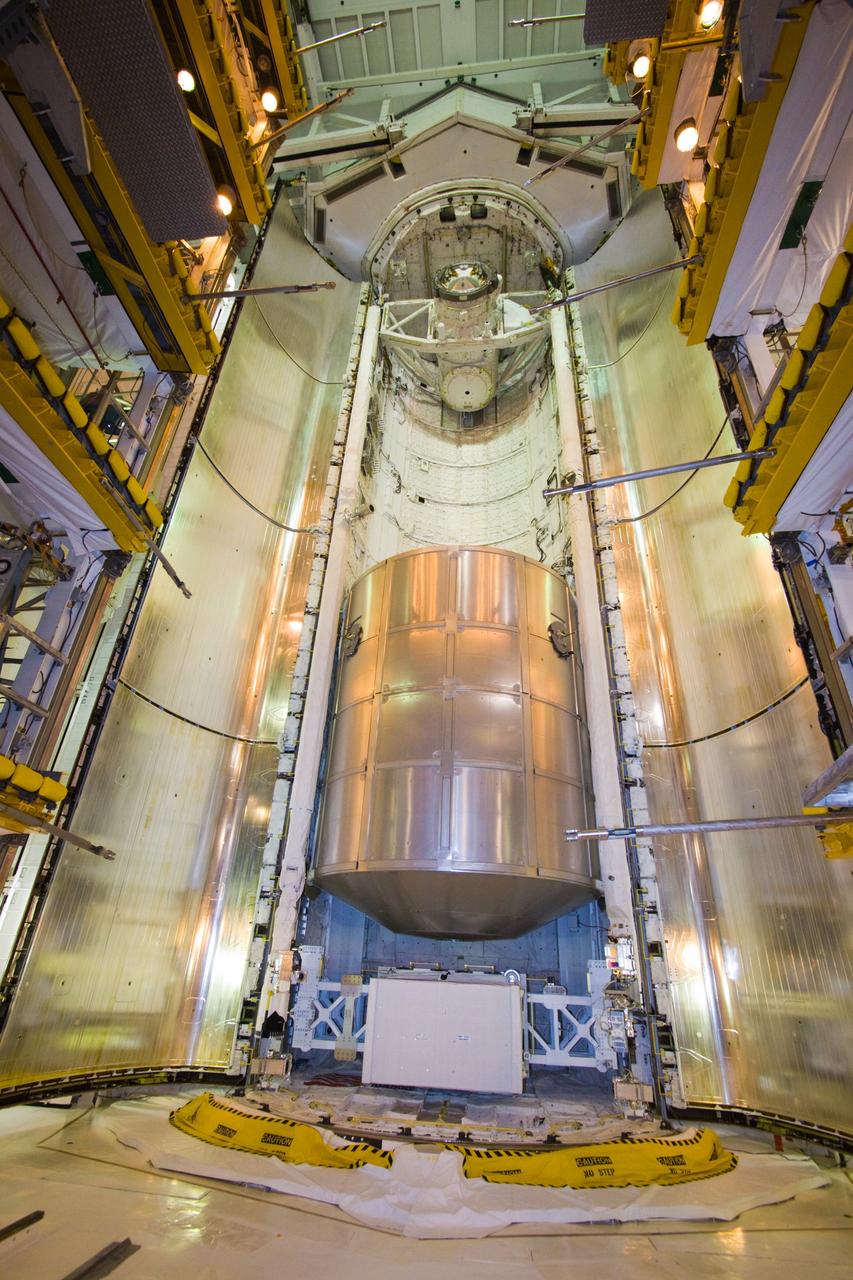
CAPE CANAVERAL, Fla. – On Launch Pad 39A, space shuttle Discovery's payload bay doors begin closing. Seen in the payload bay are the multi-purpose logistics module Leonardo and the lightweight multi-purpose experiment support structure carrier. Discovery will deliver 33,000 pounds of equipment to the station, including science and storage racks, a freezer to store research samples, a new sleeping compartment and the COLBERT treadmill. Launch is targeted for late August. Photo credit: NASA/Jack Pfaller
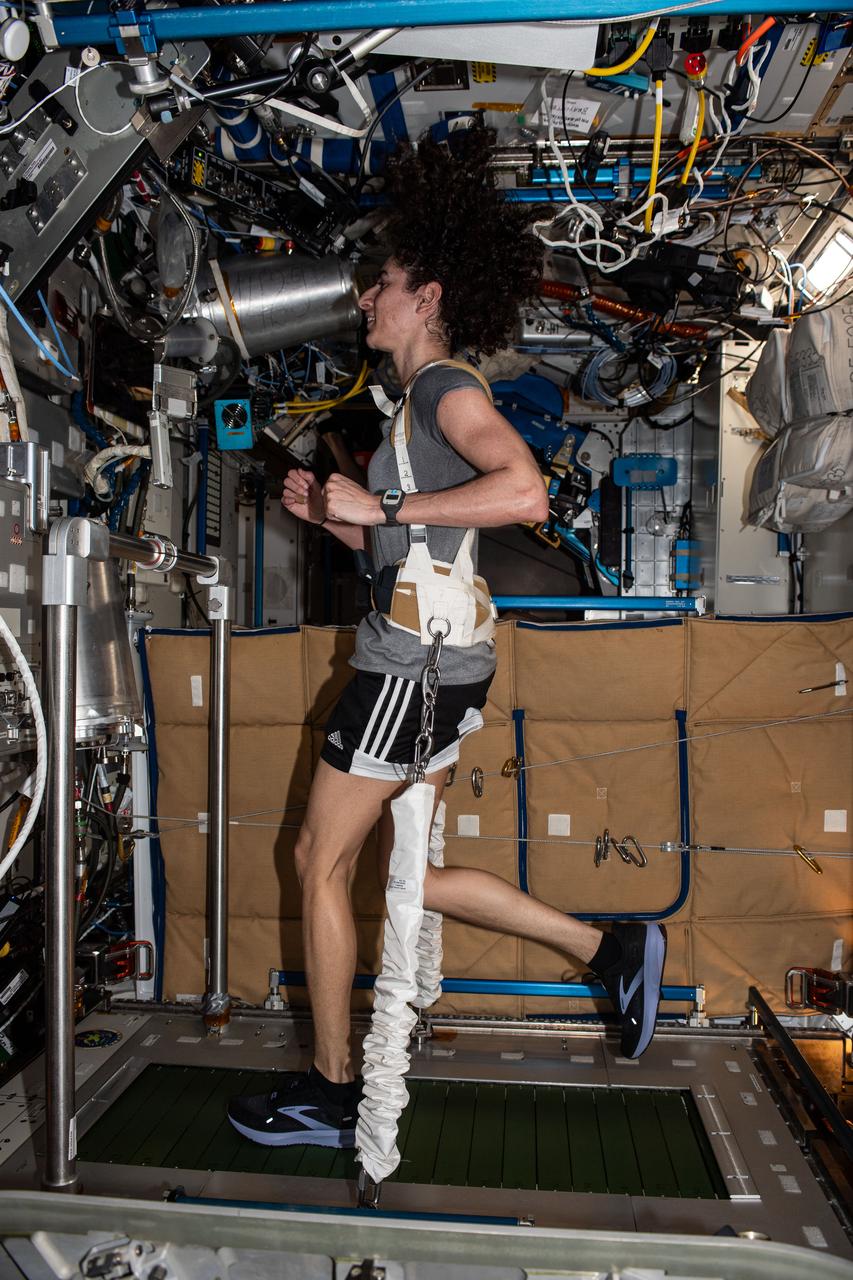
iss070e100775 (2/25/2024) --- NASA astronaut Jasmin Moghbeli runs on the T2 treadmill system on space station. Daily exercise is an important component of staying healthy in space. Without Earth’s gravity, bone and muscle atrophy or become smaller and weaker. On her left wrist, Moghbeli wears Actiwatch, a monitor that measures body metrics like sleep and heart rate.
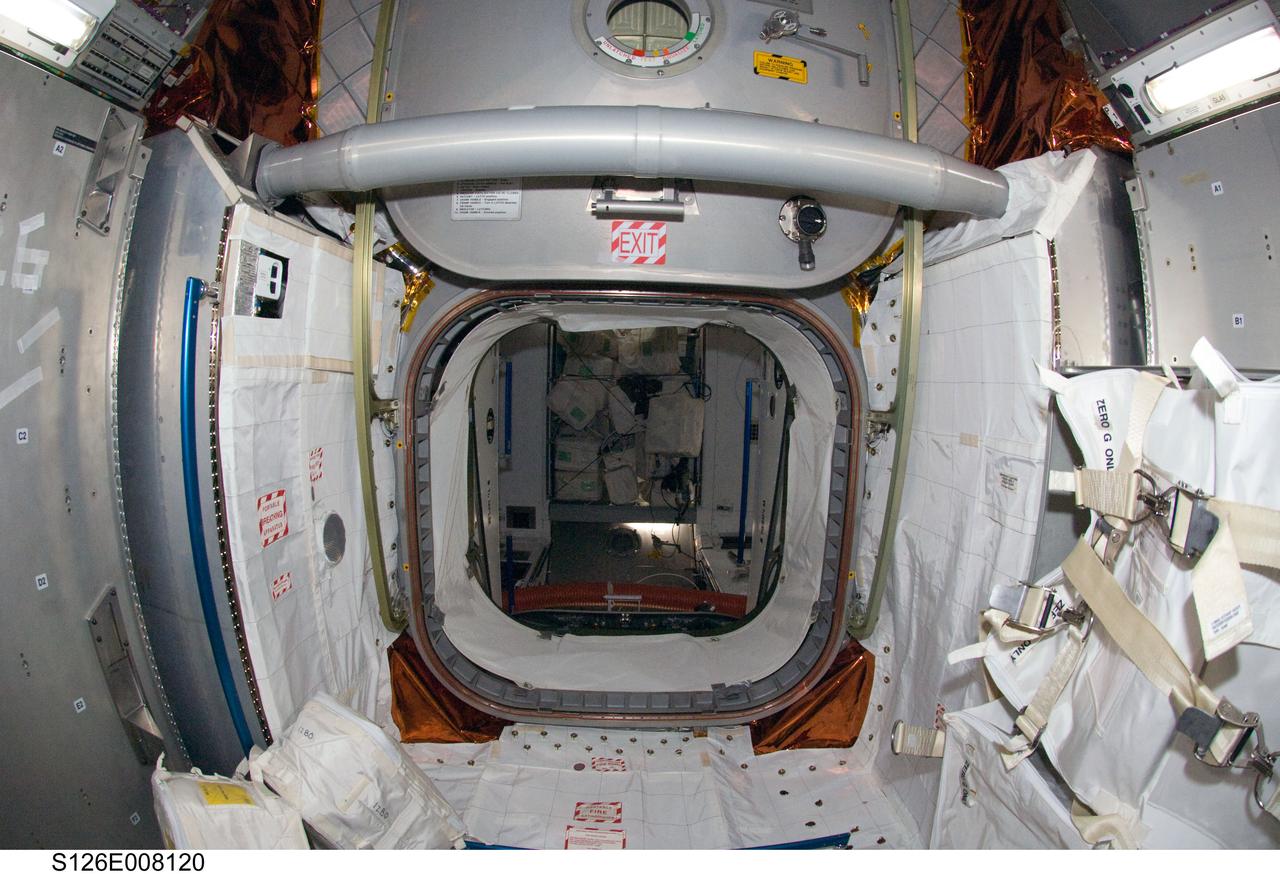
S126-E-008120 (18 Nov. 2008) --- Interior view of the Leonardo Multi-Purpose Logistics Module attached to the Earth-facing port of the International Space Station's Harmony node. Leonardo was moved from Space Shuttle Endeavour's cargo bay and linked to the station on Nov. 17, carrying two water recovery systems racks for recycling urine into potable water, a second toilet system, new gallery components, two new food warmers, a food refrigerator, an experiment freezer, combustion science experiment rack, two separate sleeping quarters and a resistance exercise device (aRED) that allows station crewmembers to perform a variety of exercises.
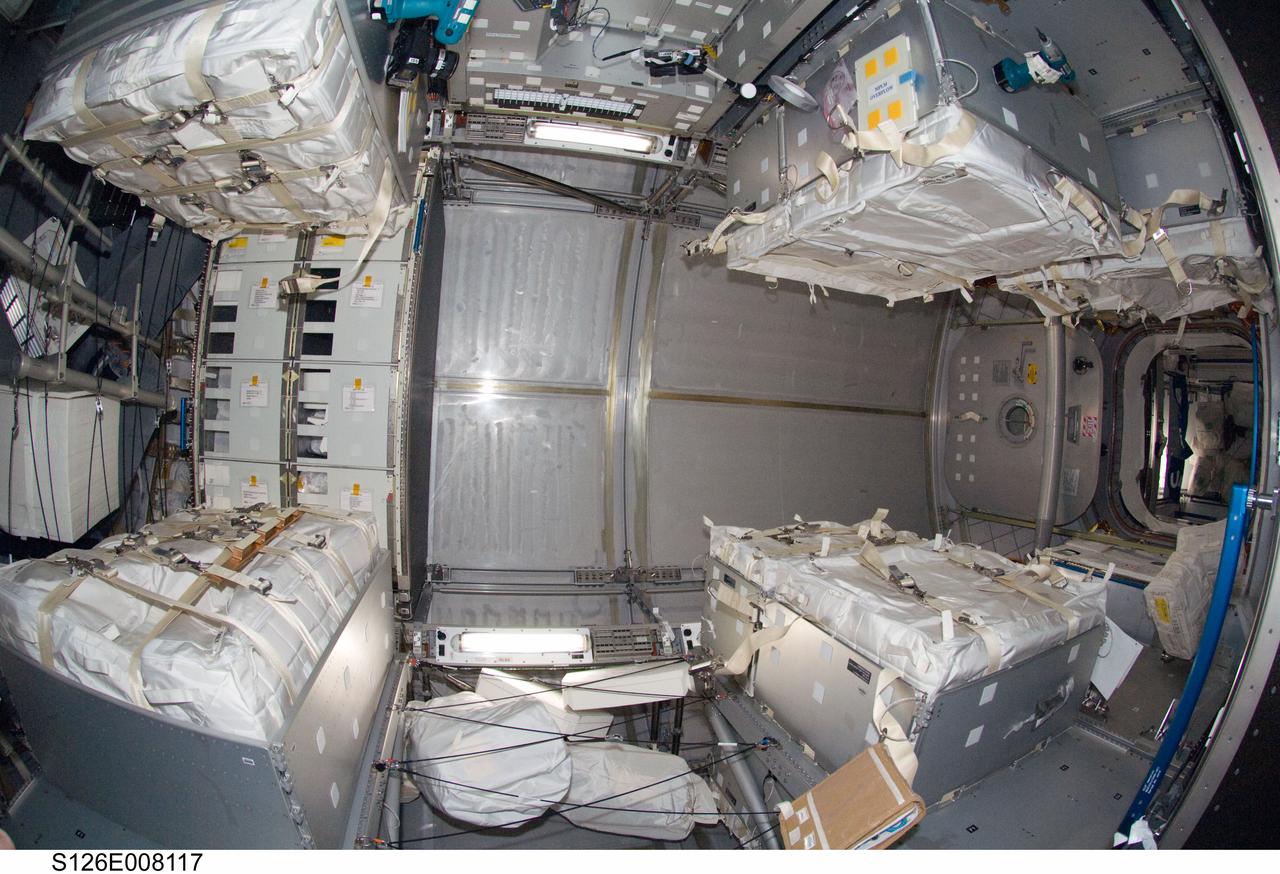
S126-E-008117 (18 Nov. 2008) --- Interior view of the Leonardo Multi-Purpose Logistics Module attached to the Earth-facing port of the International Space Station's Harmony node. Leonardo was moved from Space Shuttle Endeavour's cargo bay and linked to the station on Nov. 17, carrying two water recovery systems racks for recycling urine into potable water, a second toilet system, new gallery components, two new food warmers, a food refrigerator, an experiment freezer, combustion science experiment rack, two separate sleeping quarters and a resistance exercise device (aRED) that allows station crewmembers to perform a variety of exercises.
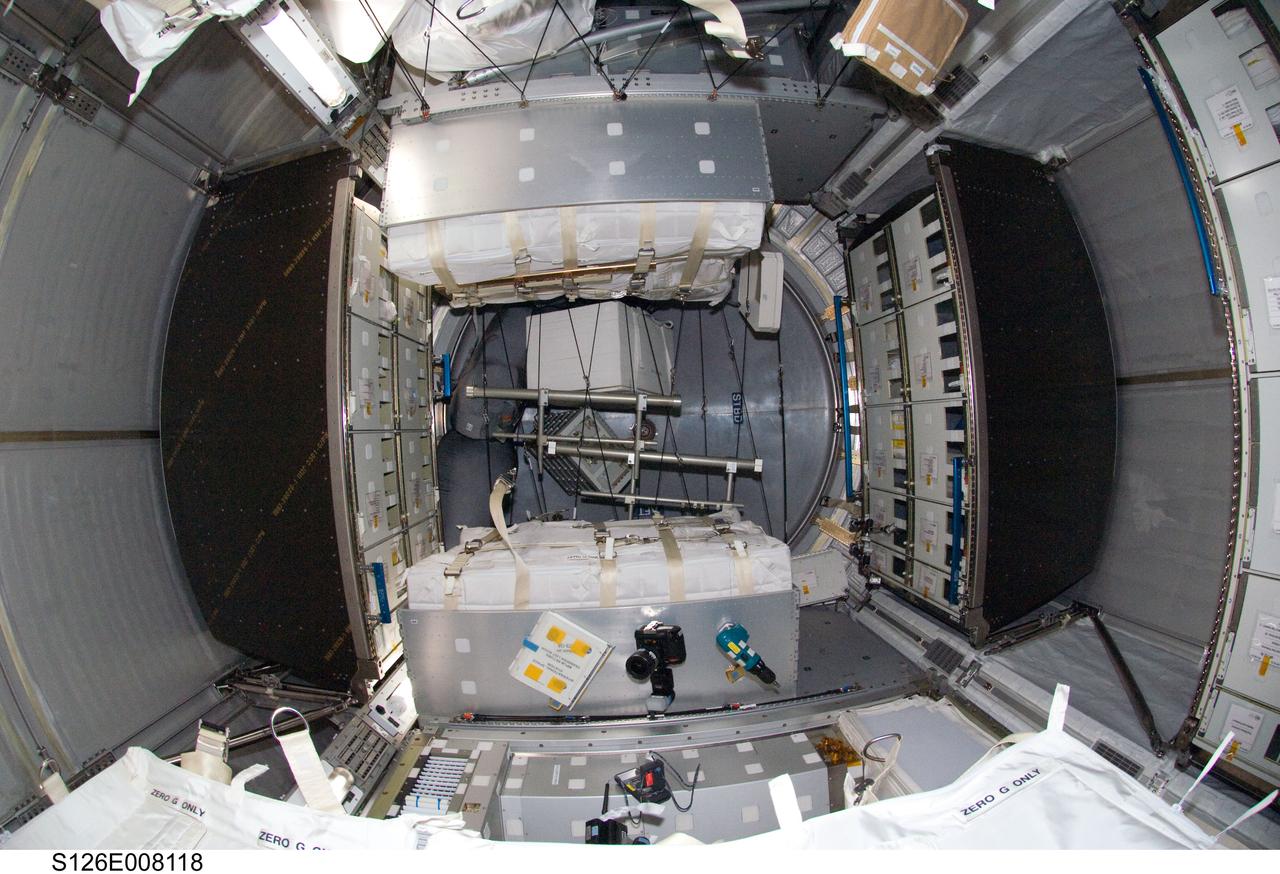
S126-E-008118 (18 Nov. 2008) --- Interior view of the Leonardo Multi-Purpose Logistics Module attached to the Earth-facing port of the International Space Station's Harmony node. Leonardo was moved from Space Shuttle Endeavour's cargo bay and linked to the station on Nov. 17, carrying two water recovery systems racks for recycling urine into potable water, a second toilet system, new gallery components, two new food warmers, a food refrigerator, an experiment freezer, combustion science experiment rack, two separate sleeping quarters and a resistance exercise device (aRED) that allows station crewmembers to perform a variety of exercises.
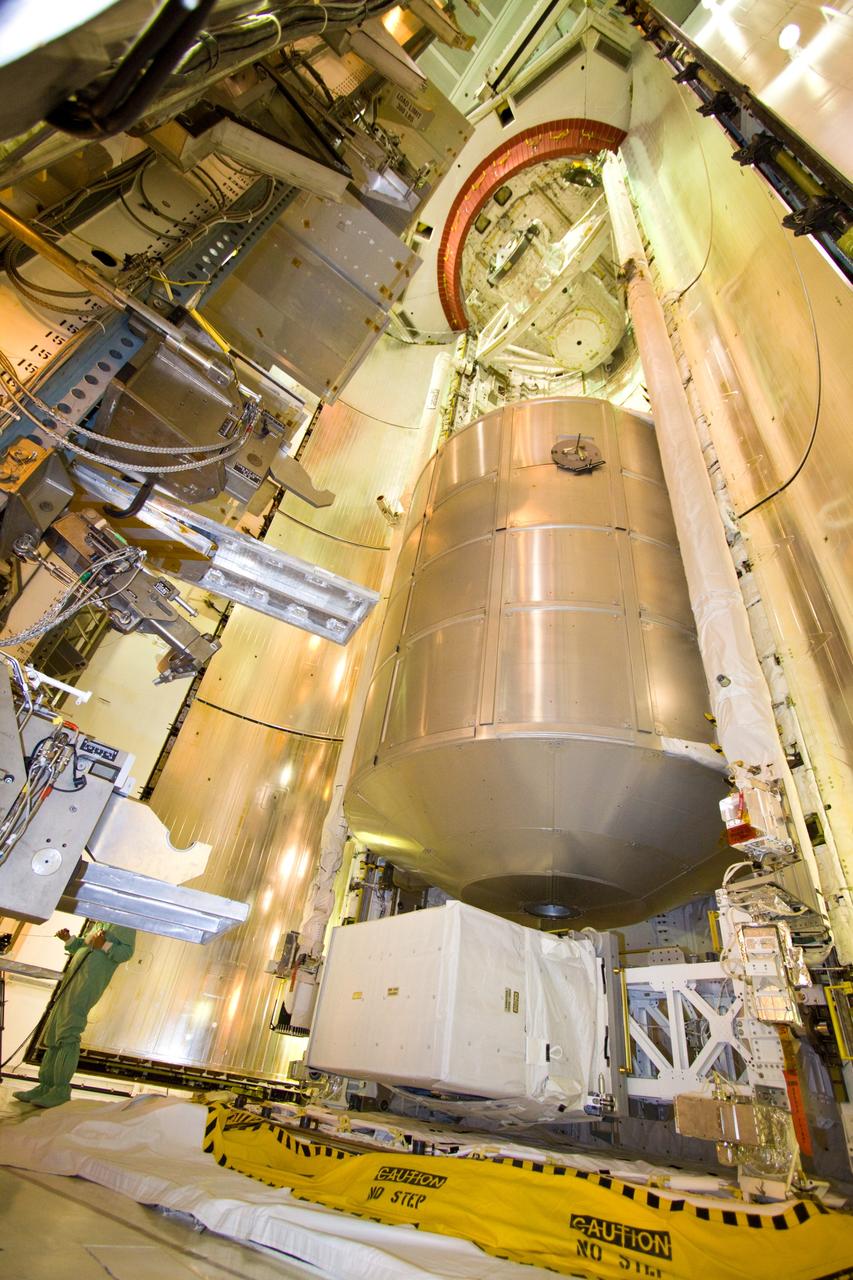
CAPE CANAVERAL, Fla. – On Launch Pad 39A, the payload ground-handling mechanism moves back after placing the multi-purpose logistics module Leonardo in space shuttle Discovery's payload bay. Leonardo is the primary payload on Discovery's STS-128 mission to the International Space Station. Beneath the module is the Lightweight Multi-Purpose Experiment Support Structure Carrier. Discovery will deliver 33,000 pounds of equipment to the station, including science and storage racks, a freezer to store research samples, a new sleeping compartment and the COLBERT treadmill. Launch is targeted for late August. Photo credit: NASA/Jack Pfaller
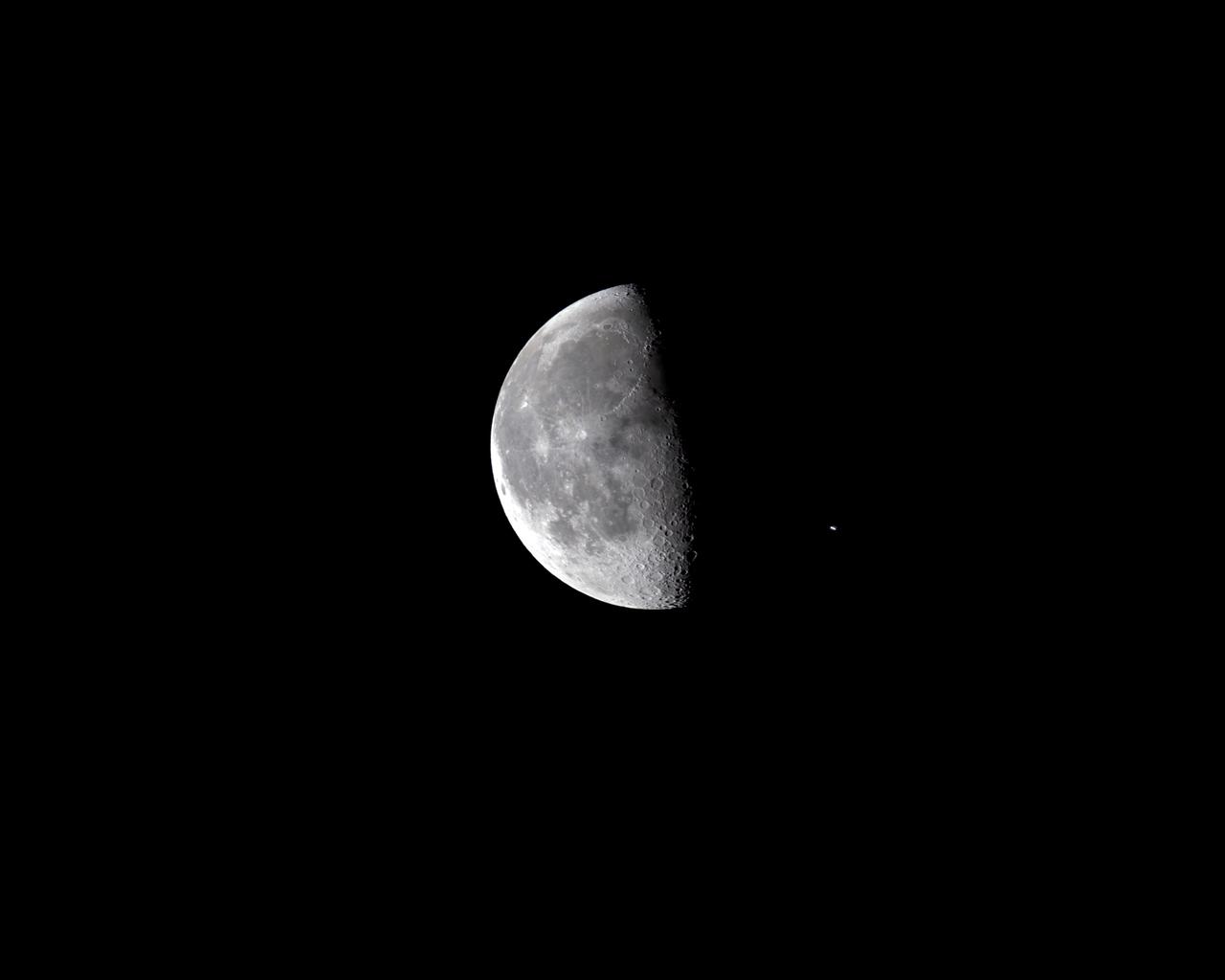
CAPE CANAVERAL, Fla. - The International Space Station flies toward the moon over NASA's Kennedy Space Center in Florida approximately 15 minutes before the launch of space shuttle Discovery on the STS-131 mission. If Discovery successfully lifts off at 6:21 a.m. EDT April 5 as planned, the shuttle will dock with the station in two days time. The seven-member crew will deliver the multi-purpose logistics module Leonardo, filled with supplies, a new crew sleeping quarters and science racks that will be transferred to the International Space Station's laboratories. The crew also will switch out a gyroscope on the station’s truss, install a spare ammonia storage tank and retrieve a Japanese experiment from the station’s exterior. STS-131 is the 33rd shuttle mission to the station and the 131st shuttle mission overall. For information on the STS-131 mission and crew, visit http:__www.nasa.gov_mission_pages_shuttle_shuttlemissions_sts131_index.html. Photo courtesy of Fernando Echeverria
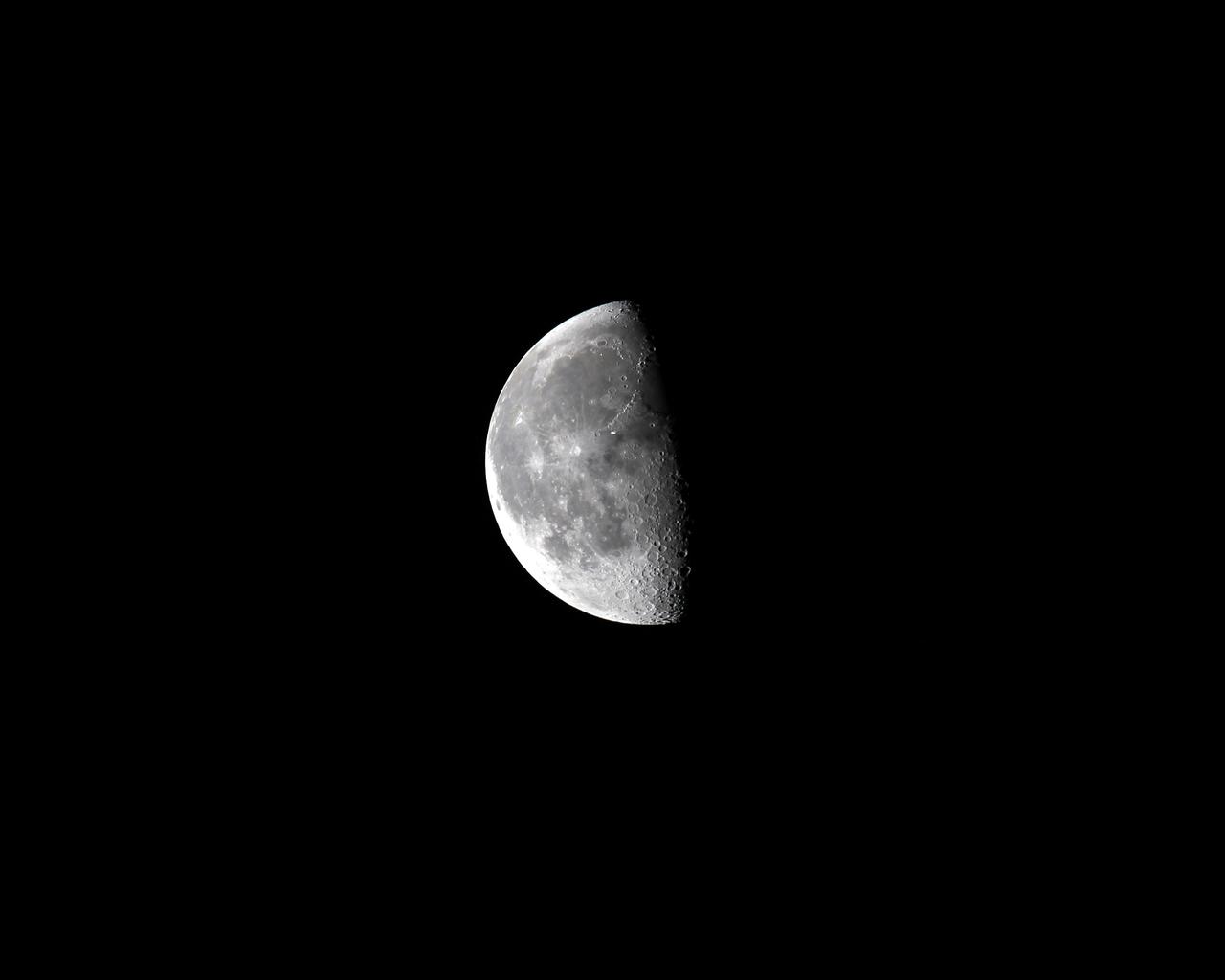
CAPE CANAVERAL, Fla. - The International Space Station flies across the face of the moon over NASA's Kennedy Space Center in Florida approximately 15 minutes before the launch of space shuttle Discovery on the STS-131 mission. If Discovery successfully lifts off at 6:21 a.m. EDT April 5 as planned, the shuttle will dock with the station in two days time. The seven-member crew will deliver the multi-purpose logistics module Leonardo, filled with supplies, a new crew sleeping quarters and science racks that will be transferred to the International Space Station's laboratories. The crew also will switch out a gyroscope on the station’s truss, install a spare ammonia storage tank and retrieve a Japanese experiment from the station’s exterior. STS-131 is the 33rd shuttle mission to the station and the 131st shuttle mission overall. For information on the STS-131 mission and crew, visit http:__www.nasa.gov_mission_pages_shuttle_shuttlemissions_sts131_index.html. Photo courtesy of Fernando Echeverria
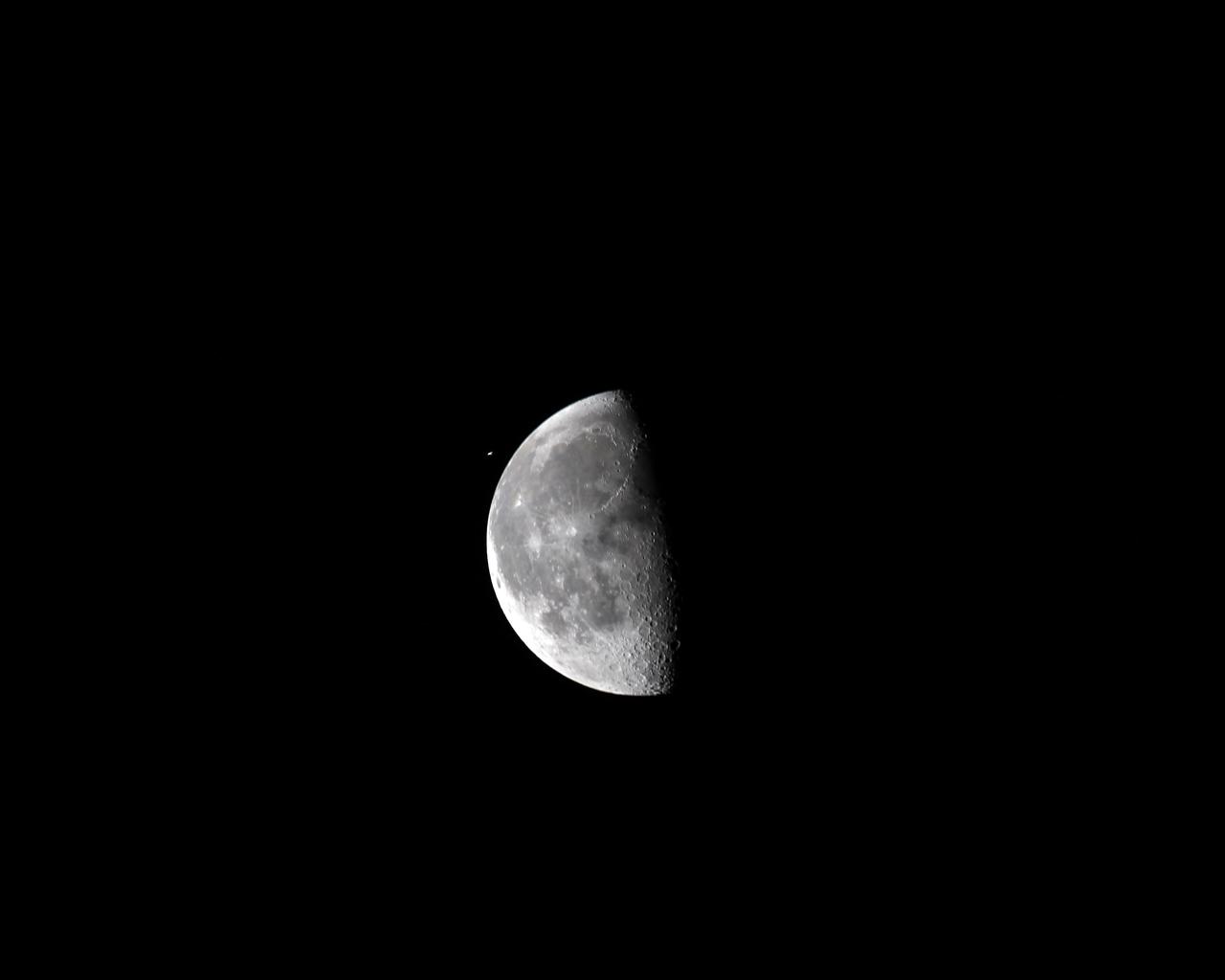
CAPE CANAVERAL, Fla. - The International Space Station flies past the moon over NASA's Kennedy Space Center in Florida approximately 15 minutes before the launch of space shuttle Discovery on the STS-131 mission. If Discovery successfully lifts off at 6:21 a.m. EDT April 5 as planned, the shuttle will dock with the station in two days time. The seven-member crew will deliver the multi-purpose logistics module Leonardo, filled with supplies, a new crew sleeping quarters and science racks that will be transferred to the International Space Station's laboratories. The crew also will switch out a gyroscope on the station’s truss, install a spare ammonia storage tank and retrieve a Japanese experiment from the station’s exterior. STS-131 is the 33rd shuttle mission to the station and the 131st shuttle mission overall. For information on the STS-131 mission and crew, visit http:__www.nasa.gov_mission_pages_shuttle_shuttlemissions_sts131_index.html. Photo courtesy of Fernando Echeverria
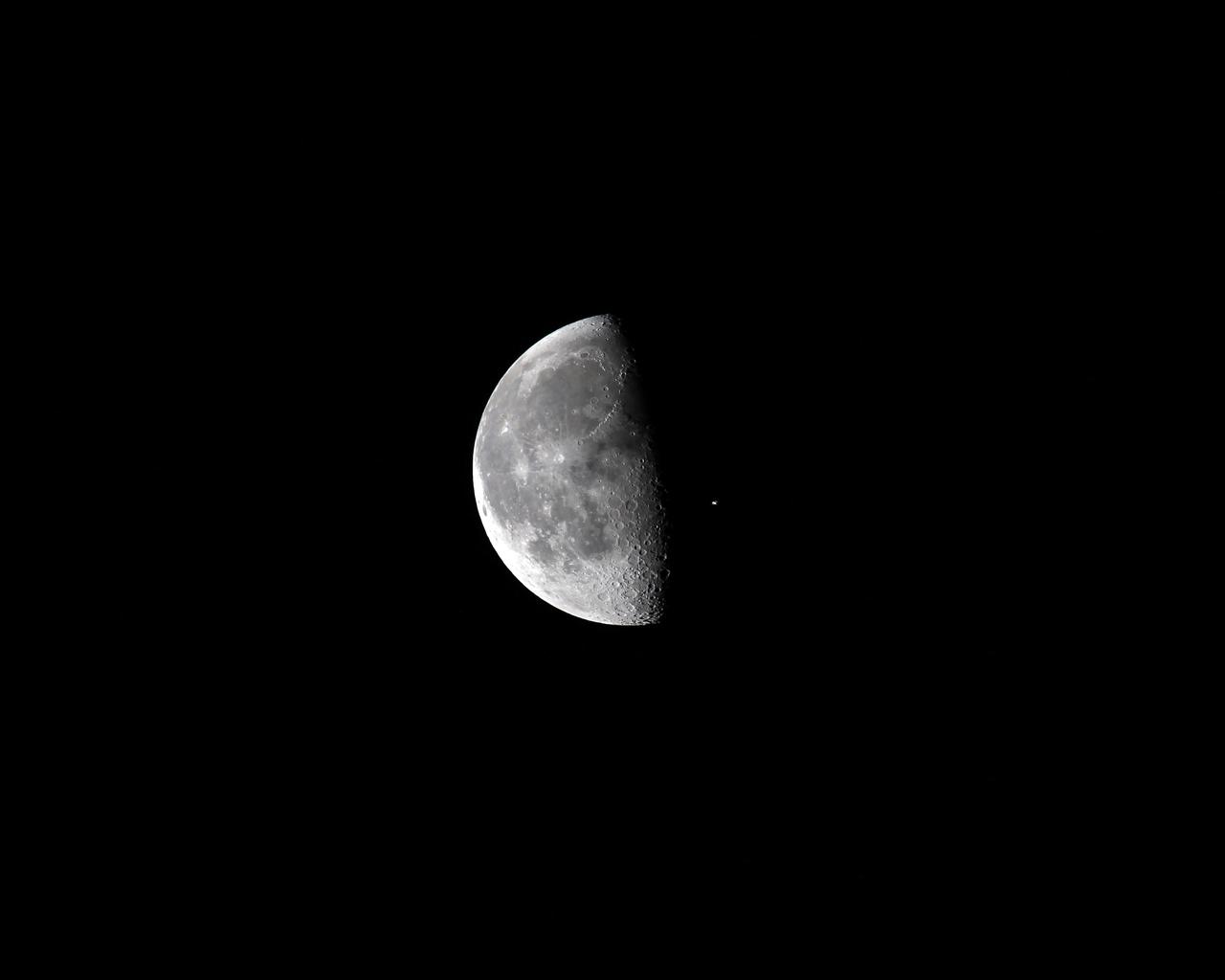
CAPE CANAVERAL, Fla. - The International Space Station approaches the moon over NASA's Kennedy Space Center in Florida approximately 15 minutes before the launch of space shuttle Discovery on the STS-131 mission. If Discovery successfully lifts off at 6:21 a.m. EDT April 5 as planned, the shuttle will dock with the station in two days time. The seven-member crew will deliver the multi-purpose logistics module Leonardo, filled with supplies, a new crew sleeping quarters and science racks that will be transferred to the International Space Station's laboratories. The crew also will switch out a gyroscope on the station’s truss, install a spare ammonia storage tank and retrieve a Japanese experiment from the station’s exterior. STS-131 is the 33rd shuttle mission to the station and the 131st shuttle mission overall. For information on the STS-131 mission and crew, visit http:__www.nasa.gov_mission_pages_shuttle_shuttlemissions_sts131_index.html. Photo courtesy of Fernando Echeverria
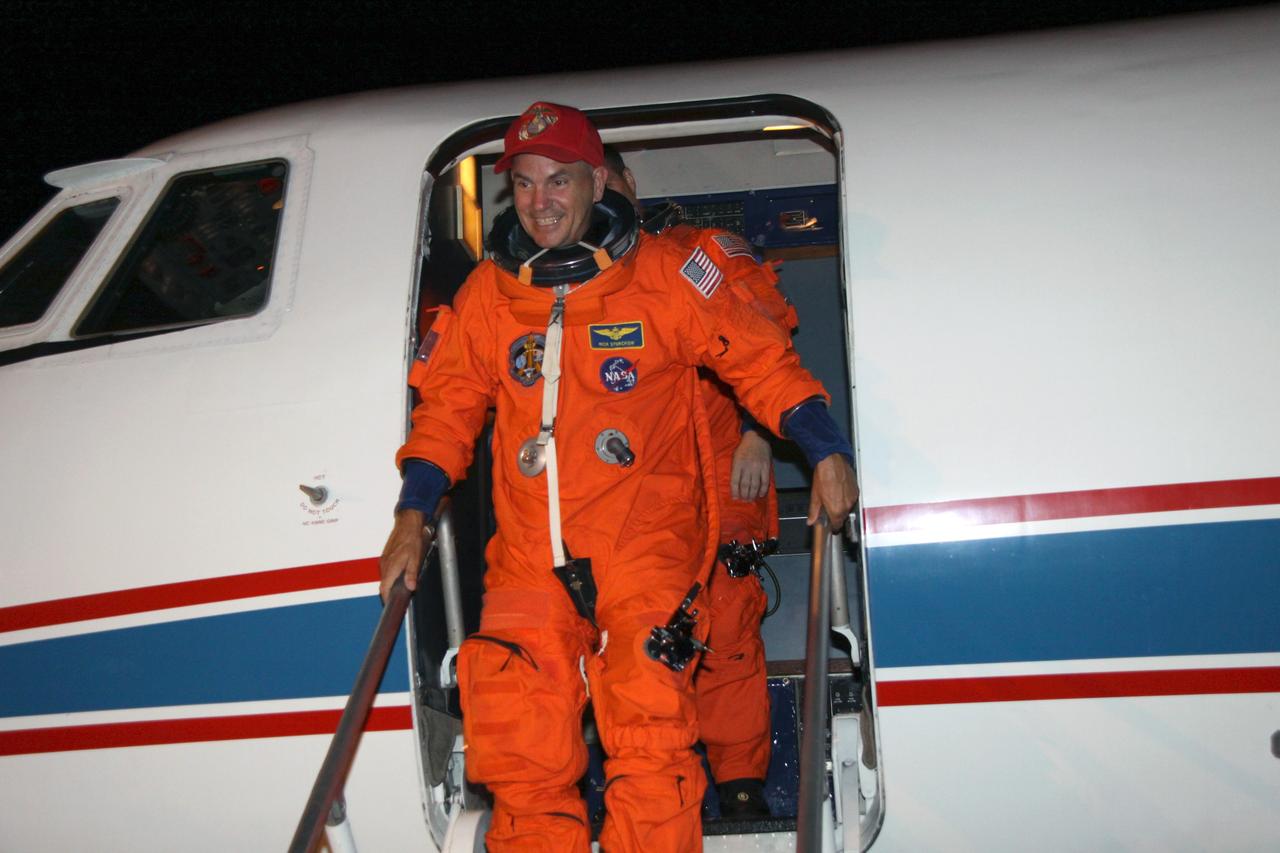
CAPE CANAVERAL, Fla. – At NASA Kennedy Space Center's Shuttle Landing Facility, STS-128 Commander Rick Sturckow exits the Shuttle Training Aircraft after completing practice shuttle landings as preparation for space shuttle Discovery's launch Aug. 25 on the STS-128 mission. The 13-day mission will deliver a new crew member and 33,000 pounds of equipment to the International Space Station. The equipment includes science and storage racks, a freezer to store research samples, a new sleeping compartment and the COLBERT treadmill. Photo credit: NASA/Troy Cryder
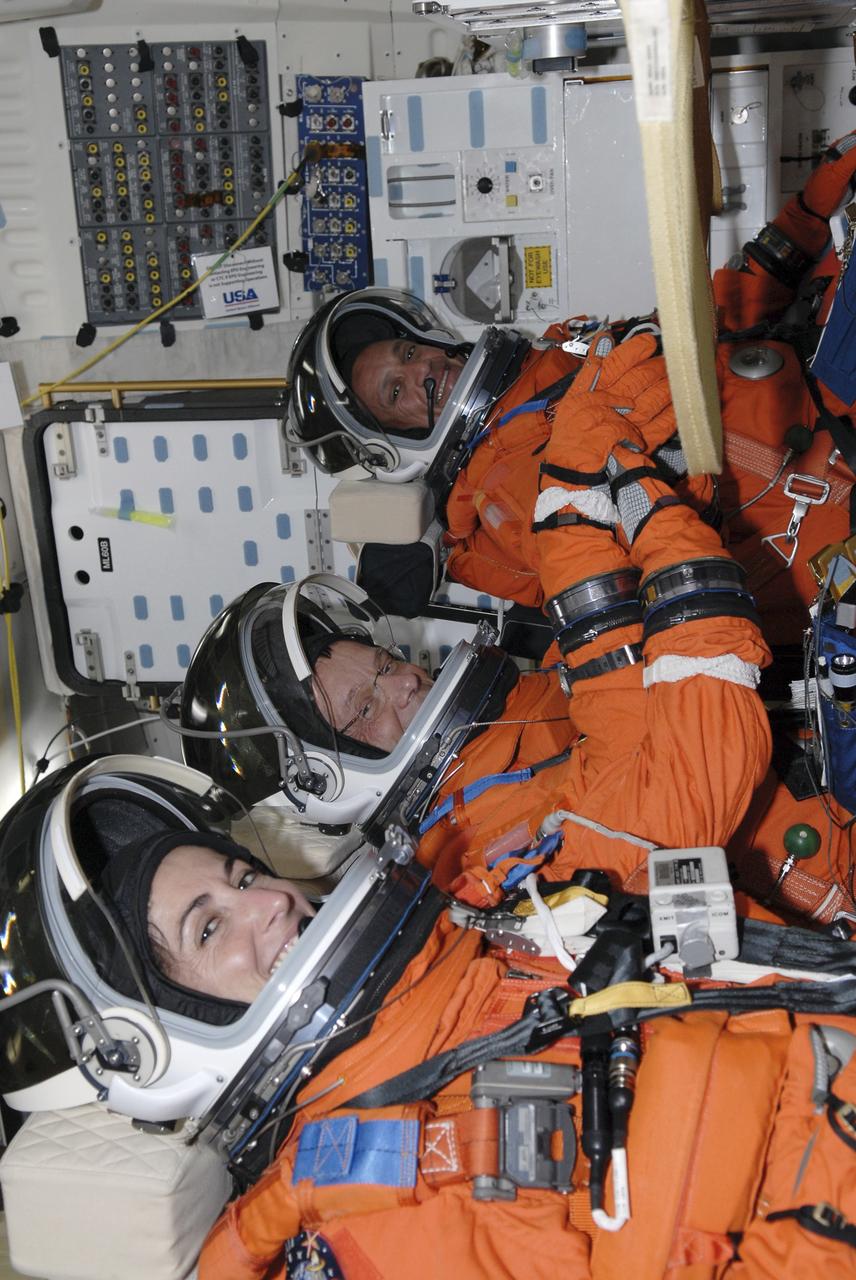
CAPE CANAVERAL, Fla. – Seated in space shuttle Discovery's cockpit on NASA Kennedy Space Center's Launch Pad 39A, STS-128 Mission Specialists (from left) Nicole Stott, Christer Fuglesang and Danny Olivas have completed the simulated launch countdown. They and other mission crew members are at Kennedy to take part in the terminal countdown demonstration test, or TCDT, which includes emergency exit training and culminates in the simulated countdown. On the STS-128 mission, Discovery will deliver 33,000 pounds of equipment to the station, including science and storage racks, a freezer to store research samples, a new sleeping compartment and the COLBERT treadmill. Launch is targeted for late August. Photo credit: NASA/Kim Shiflett
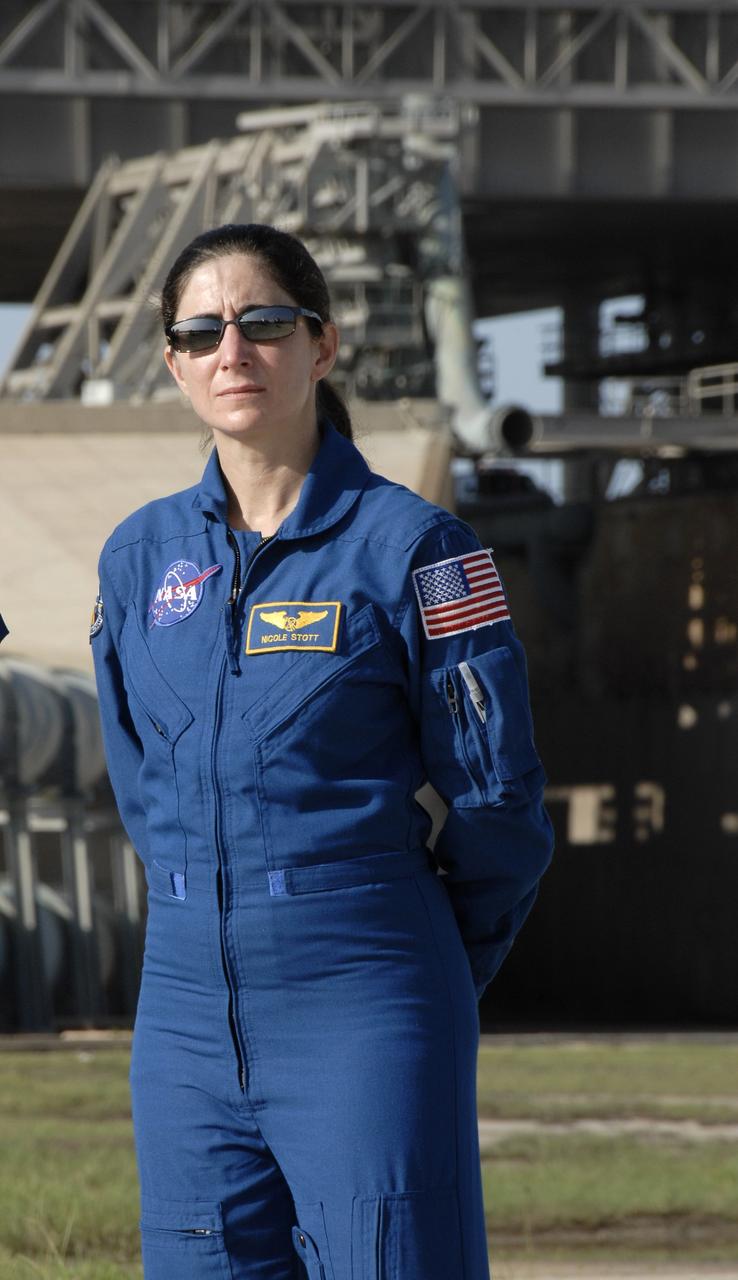
CAPE CANAVERAL, Fla. – At NASA's Kennedy Space Center in Florida, STS-128 Mission Specialist Nicole Stott listens to a question from the media during a question-and-answer session near Launch Pad 39A. The crew is at Kennedy for a launch dress rehearsal called the terminal countdown demonstration test, or TCDT, which includes emergency exit training and equipment familiarization, as well as a simulated launch countdown. Discovery will deliver 33,000 pounds of equipment to the station, including science and storage racks, a freezer to store research samples, a new sleeping compartment and the COLBERT treadmill. Photo credit: NASA/Kim Shiflett

CAPE CANAVERAL, Fla. – At NASA Kennedy Space Center's Shuttle Landing Facility, the two Shuttle Training Aircraft are waiting to take off. STS-128 Commander Rick Sturckow and Pilot Kevin Ford are scheduled to practice shuttle landings as preparation for space shuttle Discovery's launch Aug. 25 on the STS-128 mission. The 13-day mission will deliver a new crew member and 33,000 pounds of equipment to the International Space Station. The equipment includes science and storage racks, a freezer to store research samples, a new sleeping compartment and the COLBERT treadmill. Photo credit: NASA/Troy Cryder
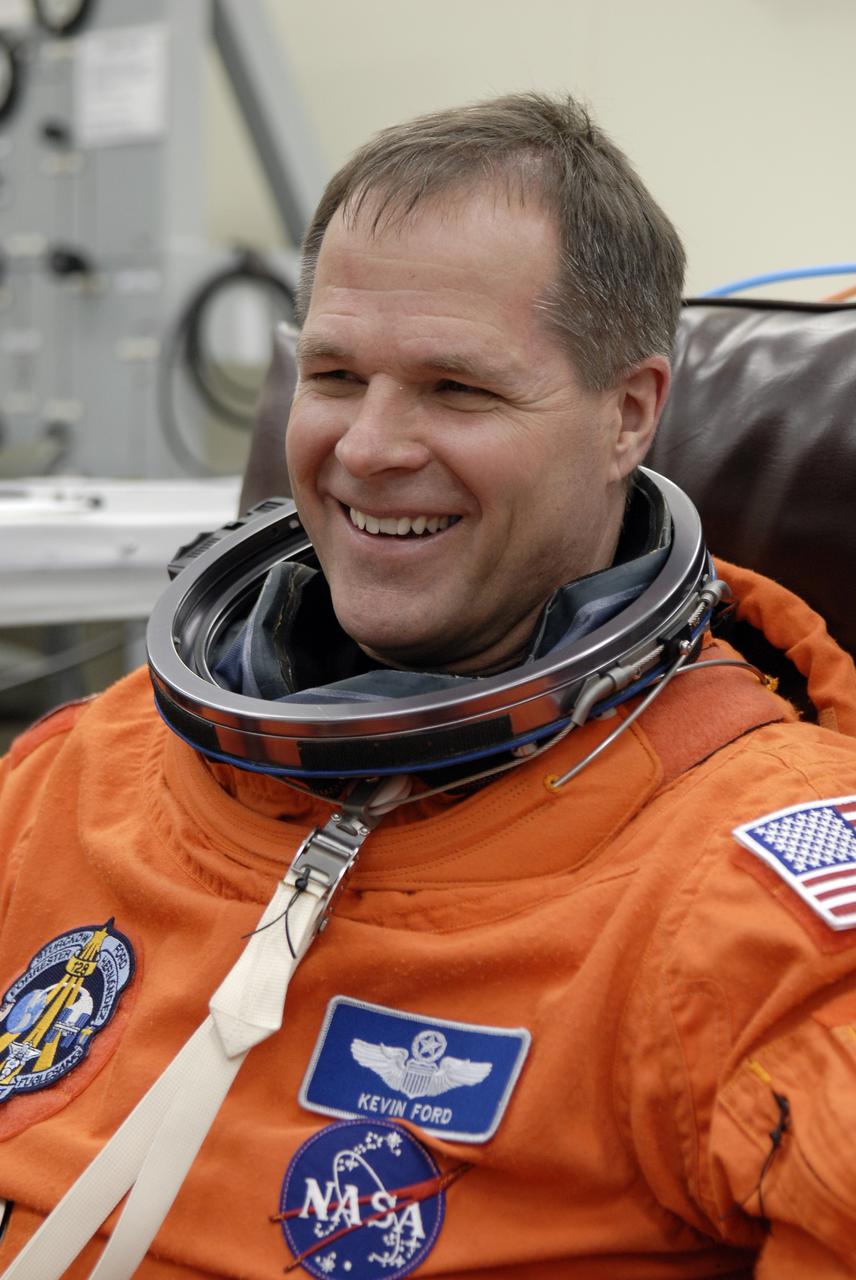
CAPE CANAVERAL, Fla. – STS-128 Pilot Kevin Ford checks the fit of his launch and entry suit before heading to the NASA Kennedy Space Center's Launch Pad 39A for the simulated launch countdown. The countdown is the culmination of terminal countdown demonstration test activities to prepare the STS-128 crew for launch on space shuttle Discovery's STS-128 mission. Discovery will deliver 33,000 pounds of equipment to the station, including science and storage racks, a freezer to store research samples, a new sleeping compartment and the COLBERT treadmill. Launch is targeted for late August. Photo credit: NASA/Kim Shiflett
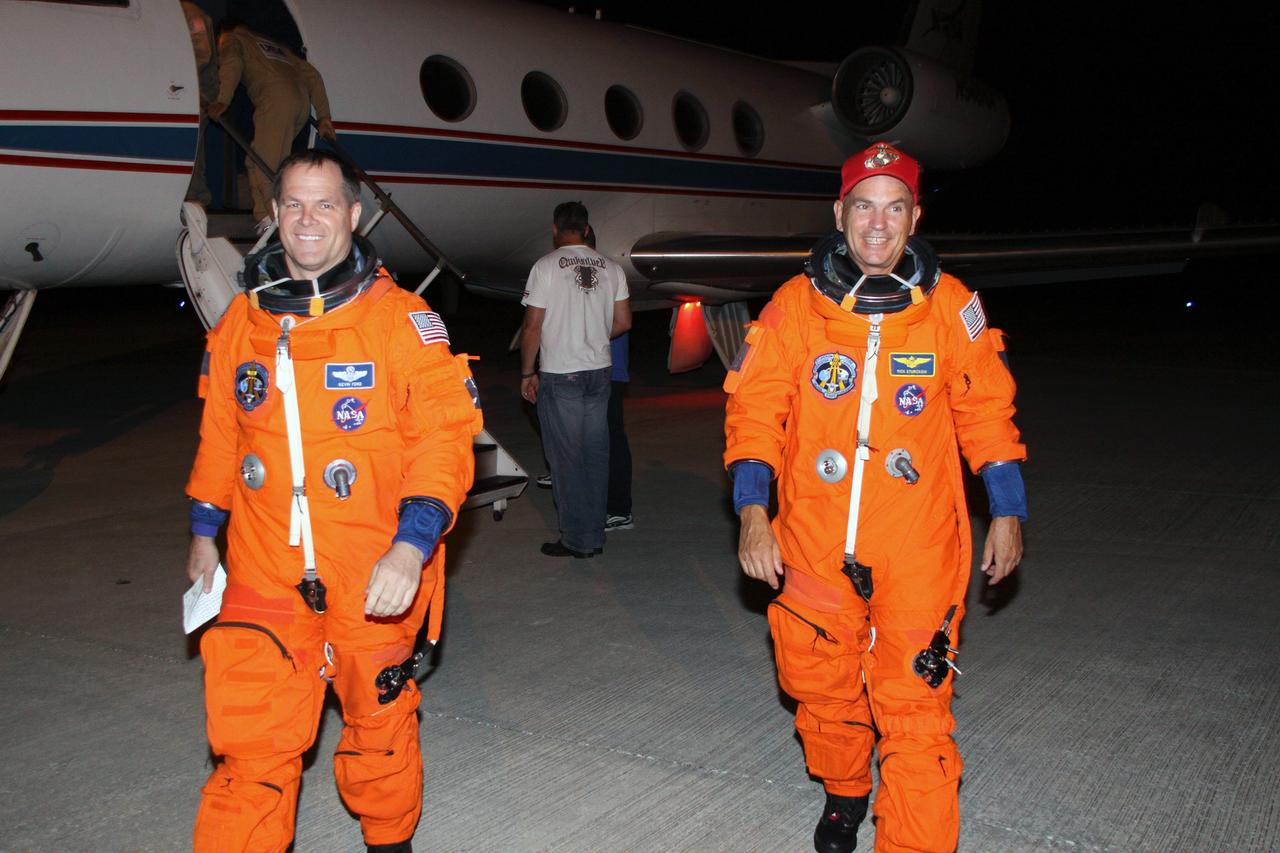
CAPE CANAVERAL, Fla. – STS-128 Commander Rick Sturckow (right) and Pilot Kevin Ford walk across NASA Kennedy Space Center's Shuttle Landing Facility after completing practice shuttle landings as preparation for space shuttle Discovery's launch Aug. 25 on the STS-128 mission. The 13-day mission will deliver a new crew member and 33,000 pounds of equipment to the International Space Station. The equipment includes science and storage racks, a freezer to store research samples, a new sleeping compartment and the COLBERT treadmill. Photo credit: NASA/Troy Cryder
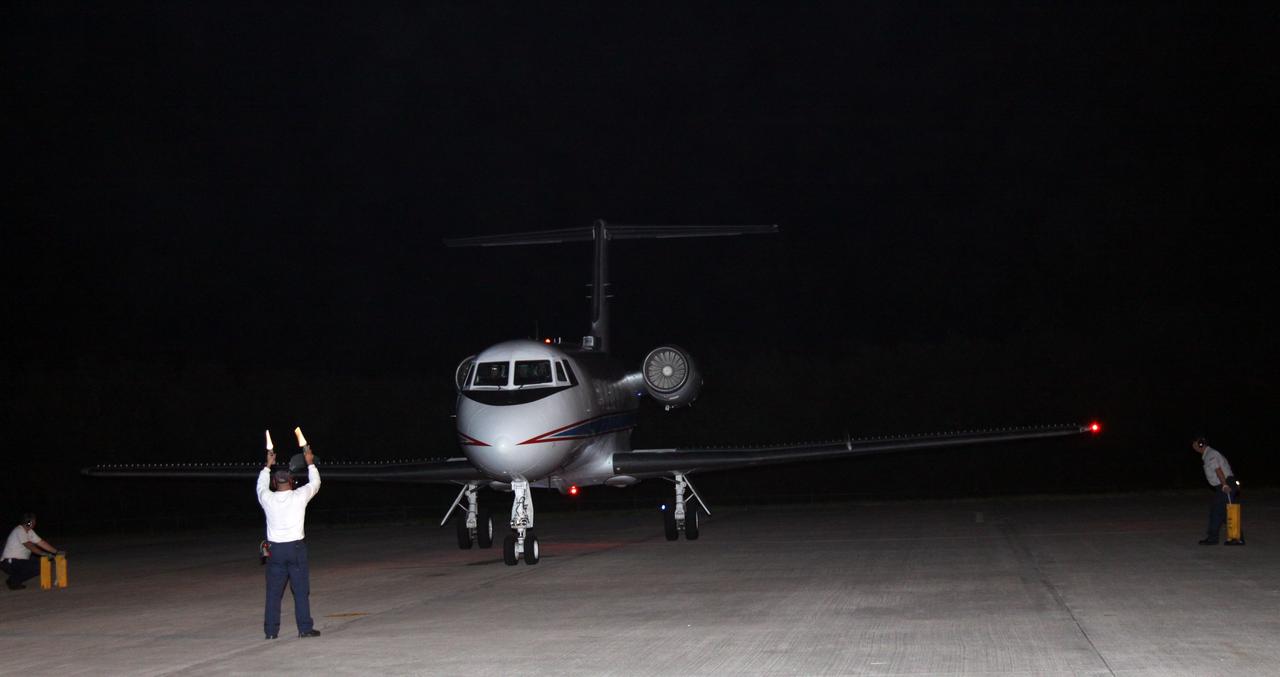
CAPE CANAVERAL, Fla. – At NASA Kennedy Space Center's Shuttle Landing Facility, a Shuttle Training Aircraft is directed for takeoff. STS-128 Commander Rick Sturckow and Pilot Kevin Ford are practicing shuttle landings as preparation for space shuttle Discovery's launch Aug. 25 on the STS-128 mission. The 13-day mission will deliver a new crew member and 33,000 pounds of equipment to the International Space Station. The equipment includes science and storage racks, a freezer to store research samples, a new sleeping compartment and the COLBERT treadmill. Photo credit: NASA/Troy Cryder
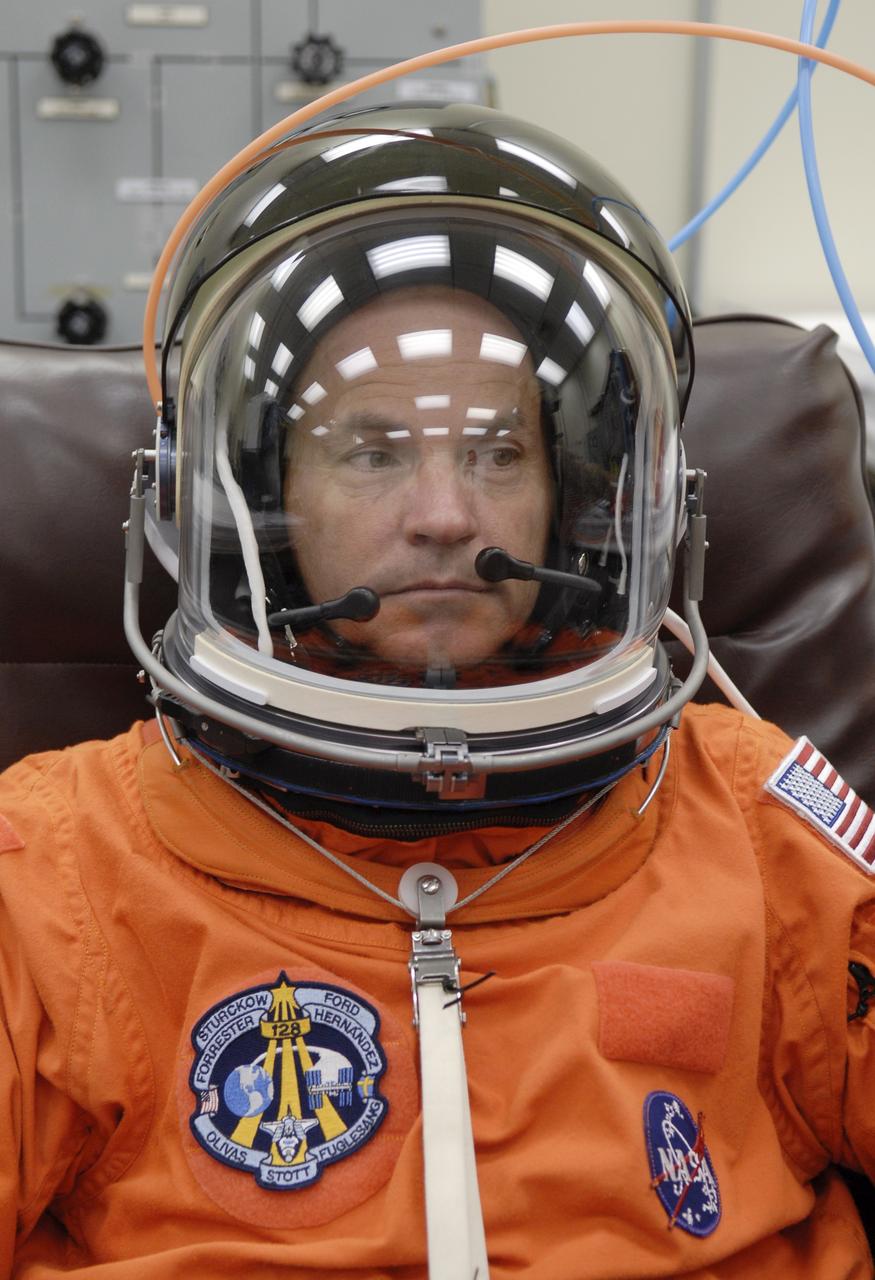
CAPE CANAVERAL, Fla. – STS-128 Commander Rick Sturckow completes the fit check of his launch and entry suit and helmet before heading to the NASA Kennedy Space Center's Launch Pad 39A for the simulated launch countdown. The countdown is the culmination of terminal countdown demonstration test activities to prepare the STS-128 crew for launch on space shuttle Discovery's STS-128 mission. Discovery will deliver 33,000 pounds of equipment to the station, including science and storage racks, a freezer to store research samples, a new sleeping compartment and the COLBERT treadmill. Launch is targeted for late August. Photo credit: NASA/Kim Shiflett
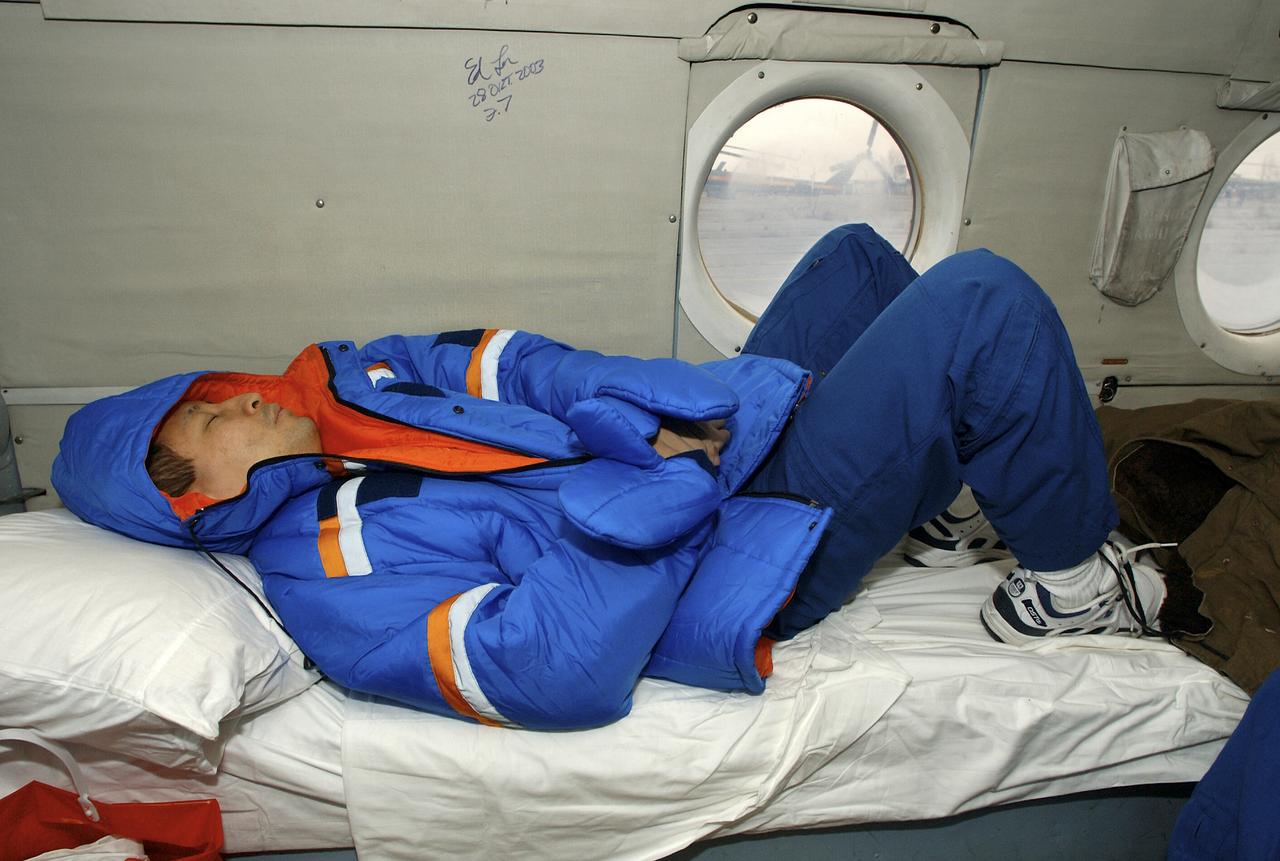
Astronaut Edward T. Lu, Expedition 7 NASA International Space Station Science Officer and Flight Engineer, sleeps onboard a Russian helicopter in Arkalyk, Kazakhstan. The helicopter had to wait out bad weather before moving on to Astana, Kazakhstan. The Soyuz TMA-2 spacecraft carrying Lu; cosmonaut Yuri I. Malenchenko, Expedition 7 Mission Commander; and European Space Agency (ESA) astronaut Pedro Duque of Spain landed in Kazakhstan on Monday, October 27, 2003 at 9:41 p.m. (EST). Photo Credit: (NASA/Bill Ingalls)
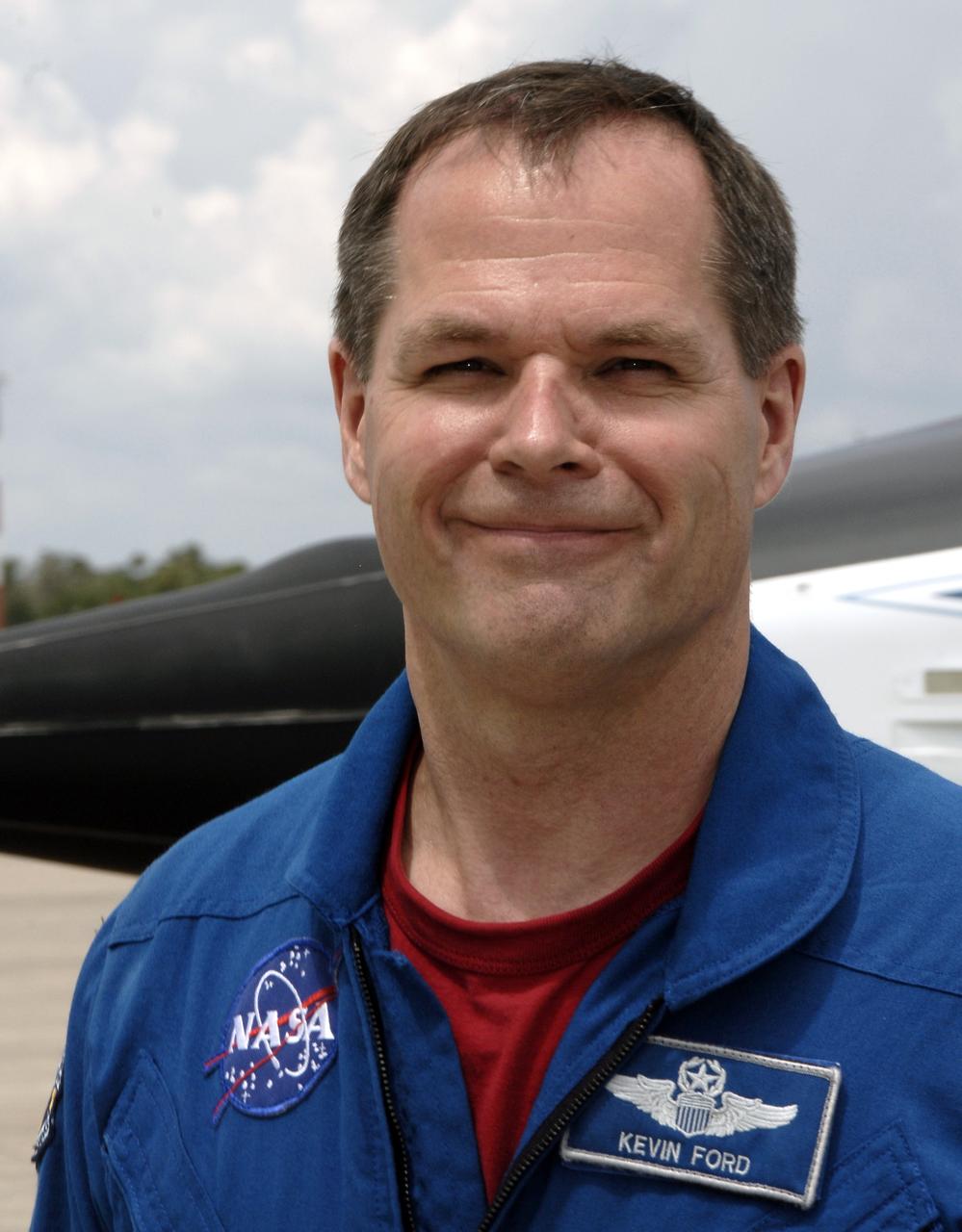
CAPE CANAVERAL, Fla. – Space shuttle Discovery's STS-128 mission crew members arrive in T-38 training jets at NASA Kennedy Space Center's Shuttle Landing Facility. Pilot Kevin Ford is seen here.The astronauts will be taking part in terminal countdown demonstration test activities that include equipment familiarization and emergency egress training, and will culminate in a simulated launch countdown aboard Discovery. The mission will deliver a new crew member and 33,000 pounds of equipment to the International Space Station. The equipment includes science and storage racks, a freezer to store research samples, a new sleeping compartment and the COLBERT treadmill. Launch of Discovery is targeted for late August. Photo credit: NASA/Kim Shiflett

CAPE CANAVERAL, Fla. – After a successful simulated launch countdown, STS-128 Mission Specialists Patrick Forrester (left) and Jose Hernandez hurry to the slidewire basket area on NASA Kennedy Space Center's fixed service structure. They are practicing emergency exit from the pad. Mission crew members are at Kennedy to take part in the terminal countdown demonstration test, or TCDT, which includes emergency exit training and culminates in the simulated countdown. On the STS-128 mission, Discovery will deliver 33,000 pounds of equipment to the station, including science and storage racks, a freezer to store research samples, a new sleeping compartment and the COLBERT treadmill. Launch is targeted for late August. Photo credit: NASA/Kim Shiflett
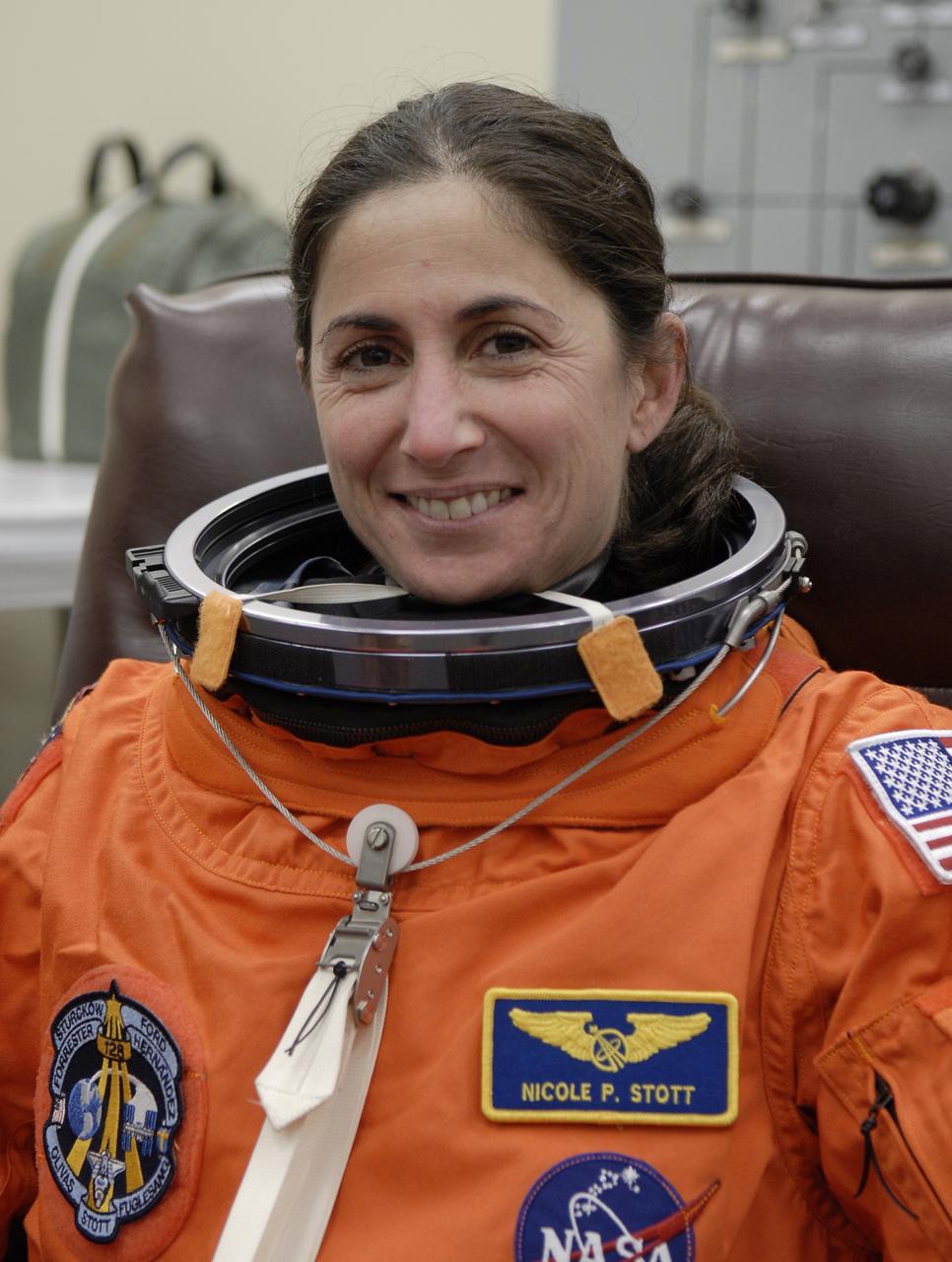
CAPE CANAVERAL, Fla. – STS-128 Mission Specialist Nicole Stott is donning her launch and entry suit for a fit check before the simulated launch countdown at NASA Kennedy Space Center's Launch Pad 39A. The countdown is the culmination of terminal countdown demonstration test activities to prepare the STS-128 crew for launch on space shuttle Discovery's STS-128 mission. Discovery will deliver 33,000 pounds of equipment to the station, including science and storage racks, a freezer to store research samples, a new sleeping compartment and the COLBERT treadmill. Launch is targeted for late August. Photo credit: NASA/Kim Shiflett
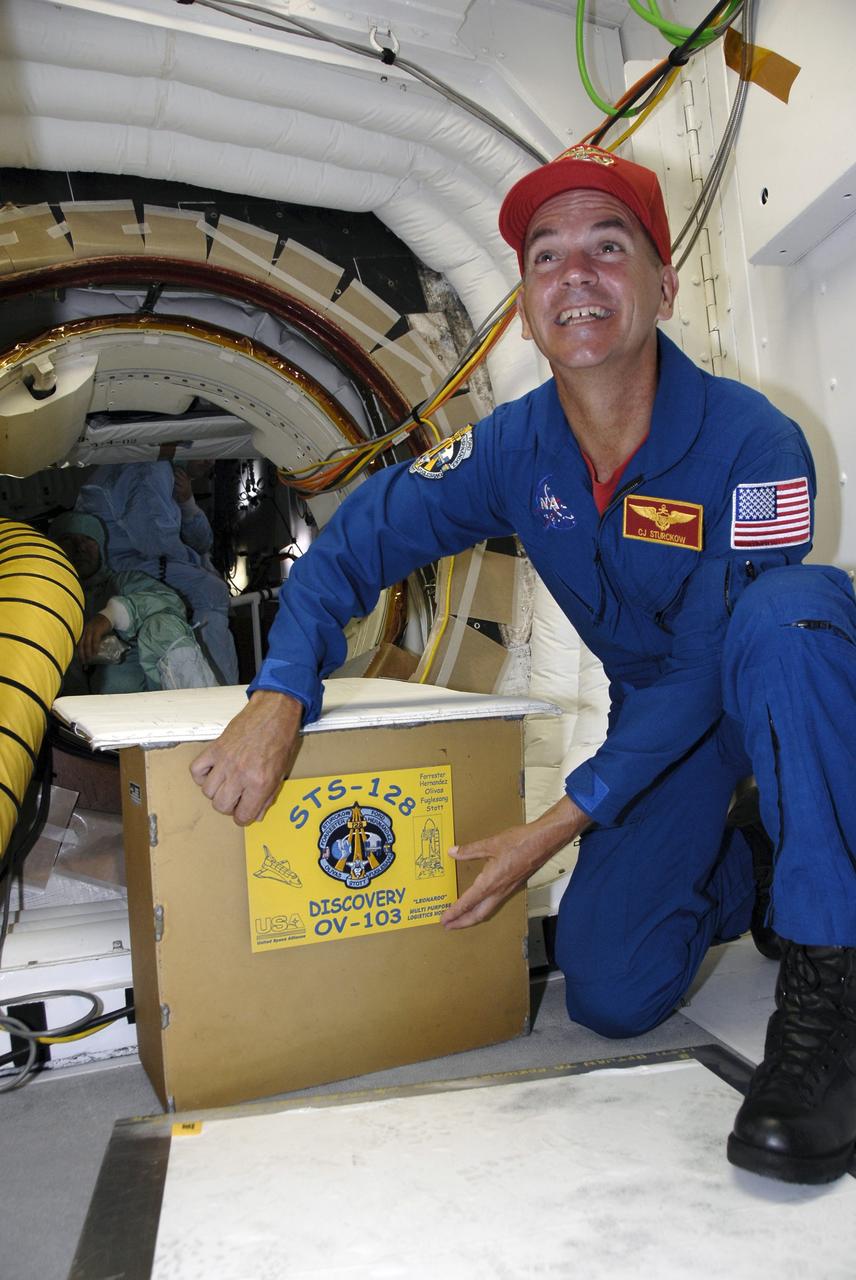
CAPE CANAVERAL, Fla. – Inside the White Room on Launch Pad 39A at NASA's Kennedy Space Center in Florida, STS-128 Commander Rick Sturckow places a mission patch on part of the hatch for space shuttle Discovery. The crew is at Kennedy for a launch dress rehearsal called the terminal countdown demonstration test, or TCDT, which includes emergency exit training and equipment familiarization, as well as a simulated launch countdown. Discovery will deliver 33,000 pounds of equipment to the station, including science and storage racks, a freezer to store research samples, a new sleeping compartment and the COLBERT treadmill. Photo credit: NASA/Kim Shiflett
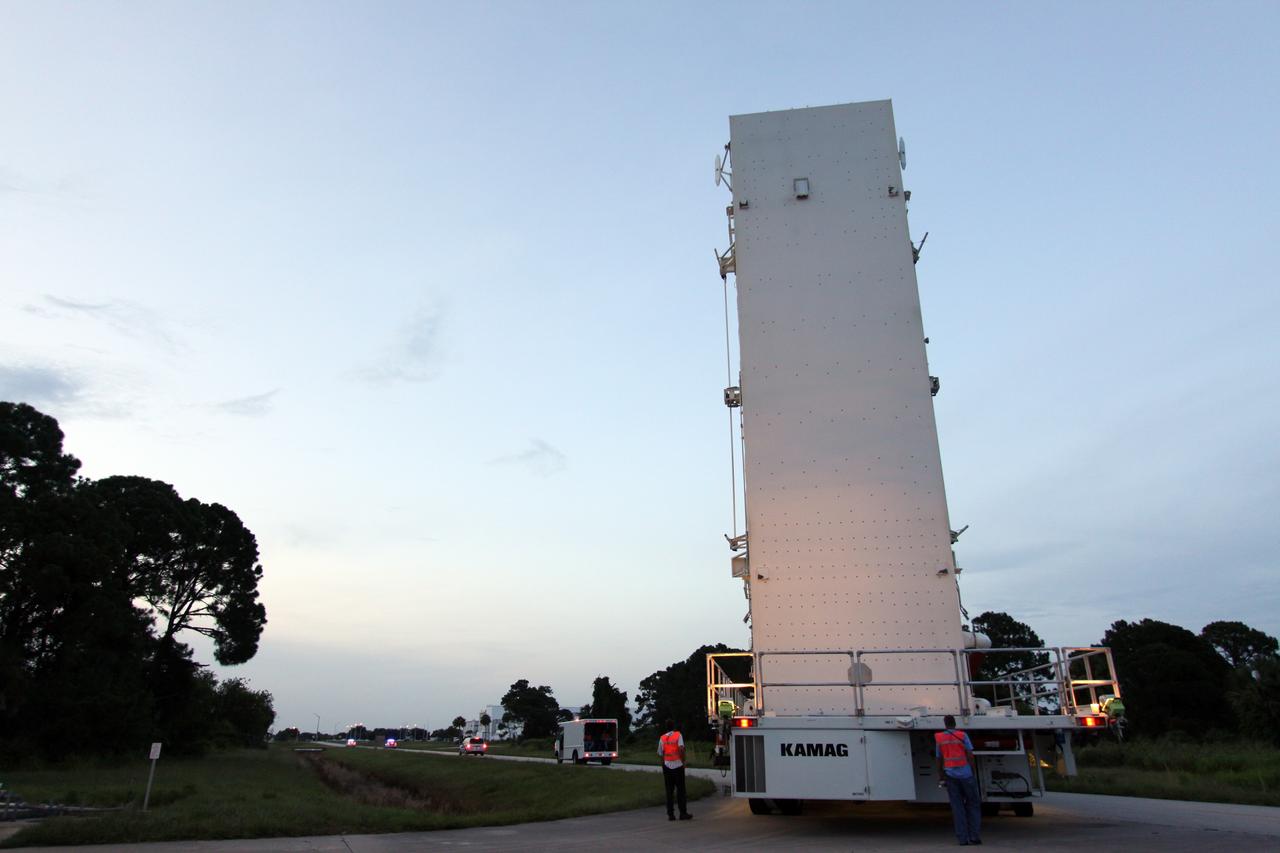
CAPE CANAVERAL, Fla. – The payload canister rolls to Launch Pad 39A at NASA's Kennedy Space Center in Florida. Inside is the payload for space shuttle Discovery and the STS-128 mission, the Multi-Purpose Logistics Module Leonardo and the Lightweight Multi-Purpose Experiment Support Structure Carrier. Discovery's 13-day flight will deliver a new crew member and 33,000 pounds of equipment to the International Space Station. The equipment includes science and storage racks, a freezer to store research samples, a new sleeping compartment and the COLBERT treadmill. Launch of Discovery on its STS-128 mission is targeted for August 25. Photo credit: NASA/Jack Pfaller.