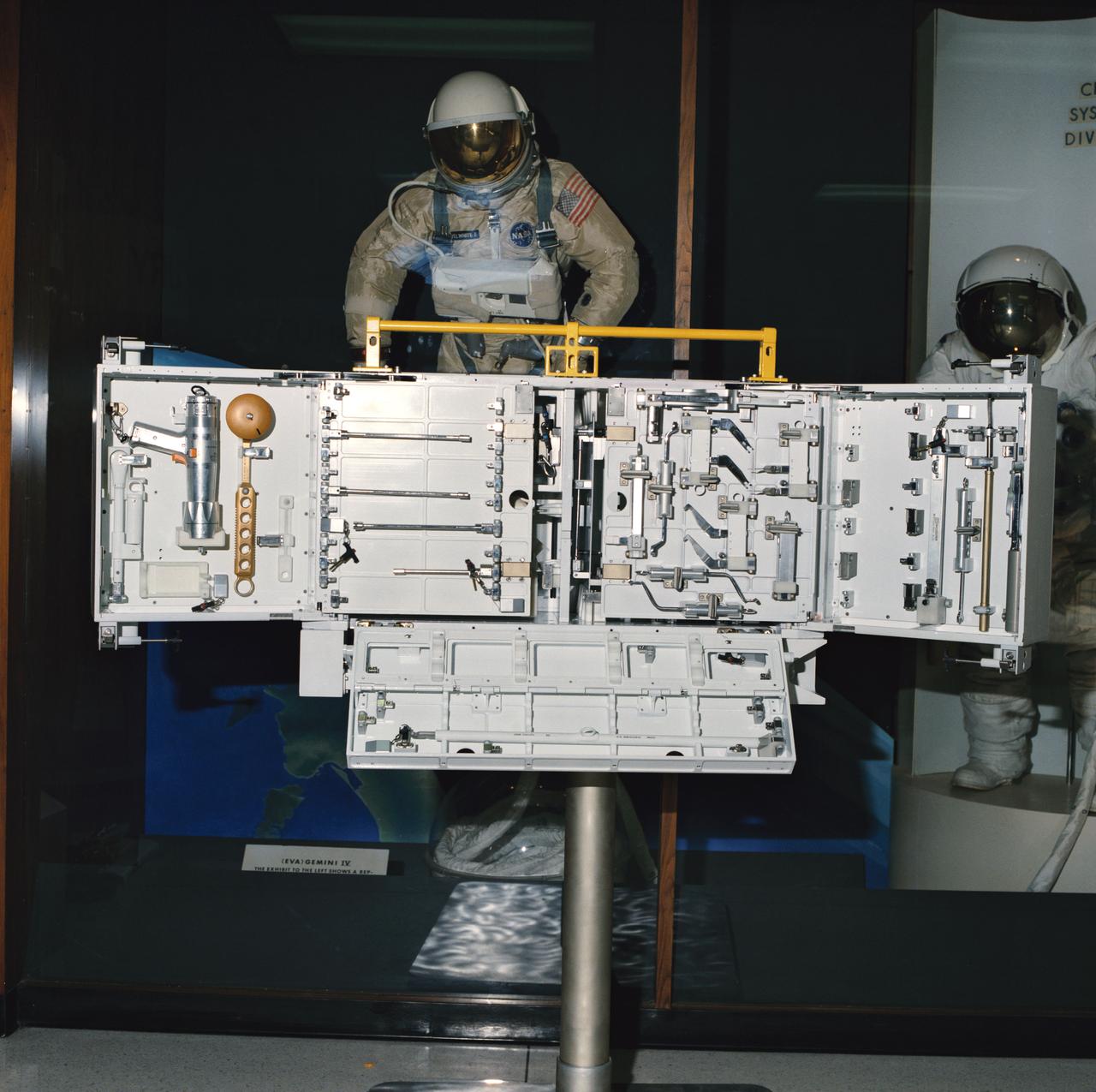
S87-49426 (1987) --- The Hubble Space Telescope (HST) tool box provides stowage of individual tools, tool boards and tool caddies required for maintenance of the telescope. The basic box design was revised from the LEASAT (U.S. Navy) equipment stowage container. It can be mounted to a base plate or back plate depending on the mission location requirements. A four-point latching system secured with pip pins is used to latch the tool box doors for launch. Various other latches are designed into the door panels and tool mounting locations for tool retention. The box consists of aluminum sides and base, a dividing wall and deep doors. Along three sides there are handrails by which STS-61 extravehicular activity (EVA) crew members can translate themselves or brace themselves when stowing and unstowing equipment.

Goddard's Ritsko Wins 2011 SAVE Award The winner of the 2011 SAVE Award is Matthew Ritsko, a Goddard financial manager. His tool lending library would track and enable sharing of expensive space-flight tools and hardware after projects no longer need them. This set of images represents the types of tools used at NASA. To read more go to: <a href="http://www.nasa.gov/topics/people/features/ritsko-save.html" rel="nofollow">www.nasa.gov/topics/people/features/ritsko-save.html</a> Exploration Systems Project Manager Mike Weiss speaks about a Hubble Servicing Mission hand tool, developed at Goddard. Credit: NASA/GSFC/Debbie McCallum
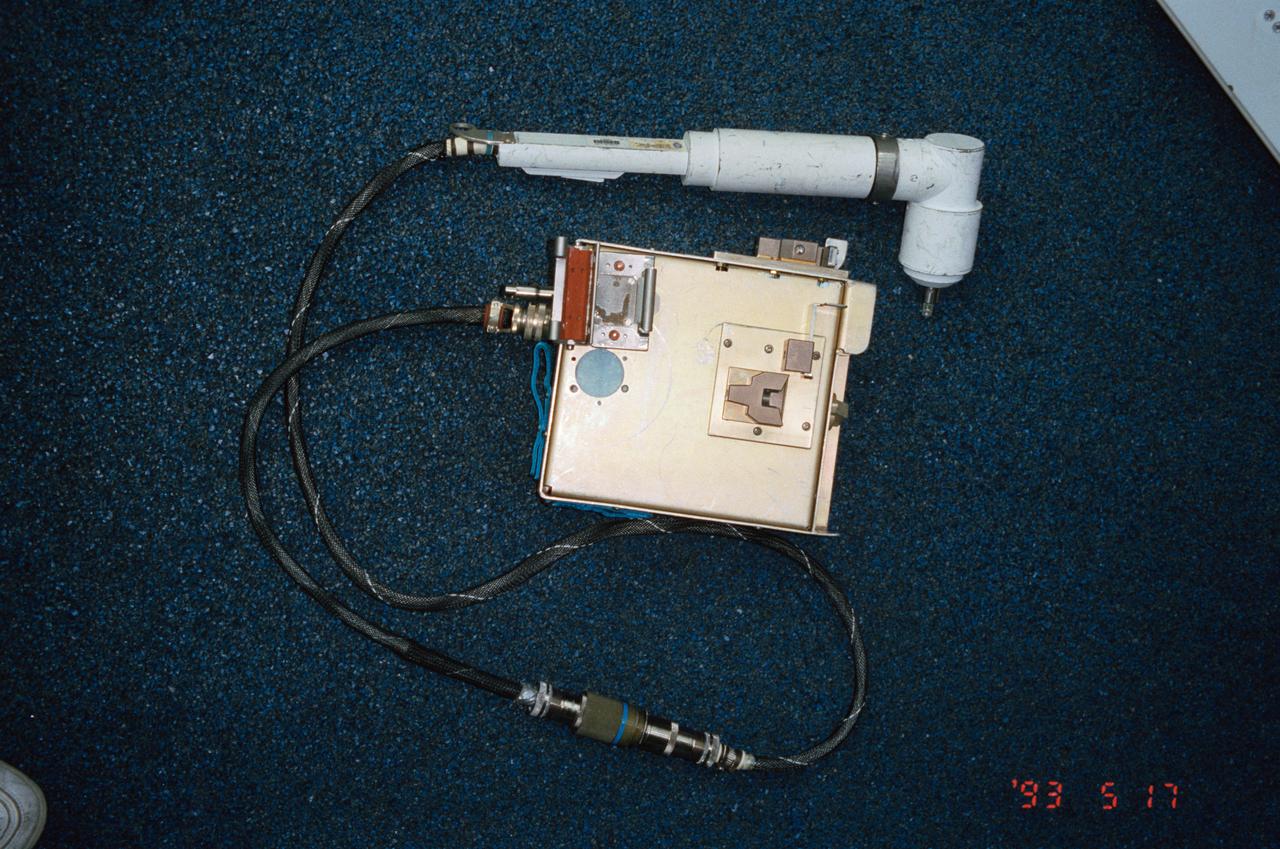
S93-35367 (Nov 1993) --- A close-up view of the special ratchet tool to be used by the STS-61 astronauts assigned to perform servicing of the Hubble Space Telescope (HST) in December of this year. Four astronauts will perform a total of five sessions of extravehicular activity (EVA) during the flight.

Goddard's Ritsko Wins 2011 SAVE Award The winner of the 2011 SAVE Award is Matthew Ritsko, a Goddard financial manager. His tool lending library would track and enable sharing of expensive space-flight tools and hardware after projects no longer need them. This set of images represents the types of tools used at NASA. To read more go to: <a href="http://www.nasa.gov/topics/people/features/ritsko-save.html" rel="nofollow">www.nasa.gov/topics/people/features/ritsko-save.html</a> The engineering mockup of the Robotic Refueling Mission (RRM) module is currently on display within the press building at the Kennedy Space Center in Florida. The RRM mission is a joint effort between NASA and the Canadian Space Agency designed to demonstrate and test the tools, technologies, and techniques needed to robotically refuel satellites in space. Reporters have the opportunity to get a close-up view of the replica module and tools that are a part of the final shuttle mission payload. SSCO engineers test an RRM tool. To learn more about the RRM go to: <a href="http://ssco.gsfc.nasa.gov/" rel="nofollow">ssco.gsfc.nasa.gov/</a> <b><a href="http://www.nasa.gov/centers/goddard/home/index.html" rel="nofollow">NASA Goddard Space Flight Center</a></b> enables NASA’s mission through four scientific endeavors: Earth Science, Heliophysics, Solar System Exploration, and Astrophysics. Goddard plays a leading role in NASA’s accomplishments by contributing compelling scientific knowledge to advance the Agency’s mission. <b>Follow us on <a href="http://twitter.com/NASA_GoddardPix" rel="nofollow">Twitter</a></b> <b>Join us on <a href="http://www.facebook.com/pages/Greenbelt-MD/NASA-Goddard/395013845897?ref=tsd" rel="nofollow">Facebook</a></b> <b>Find us on <a href="http://instagr.am/p/E_05l/" rel="nofollow">Instagram</a></b>
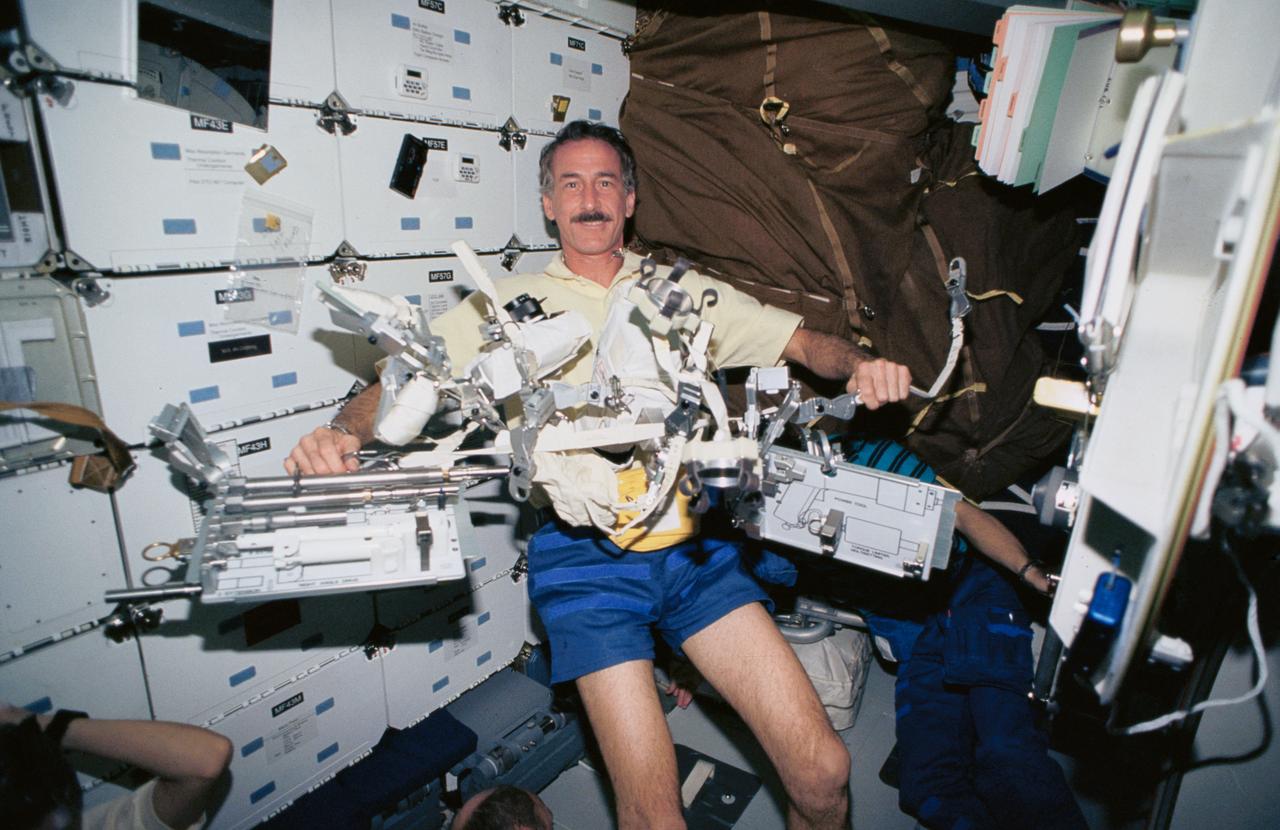
STS061-03-029 (2013 Dec 1993) --- Astronaut Jeffrey A. Hoffman displays tools used in the five space walks on the STS-61 Hubble Space Telescope (HST) repair mission. Hoffman was one of four space walkers making use of the variegated gear.

Goddard's Ritsko Wins 2011 SAVE Award The winner of the 2011 SAVE Award is Matthew Ritsko, a Goddard financial manager. His tool lending library would track and enable sharing of expensive space-flight tools and hardware after projects no longer need them. This set of images represents the types of tools used at NASA. To read more go to: <a href="http://www.nasa.gov/topics/people/features/ritsko-save.html" rel="nofollow">www.nasa.gov/topics/people/features/ritsko-save.html</a> Dr. Doug Rabin (Code 671) and PI La Vida Cooper (Code 564) inspect engineering samples of the HAS-2 imager which will be tested and readout using a custom ASIC with a 16-bit ADC (analog to digital converter) and CDS (correlated double sampling) circuit designed by the Code 564 ASIC group as a part of an FY10 IRAD. The purpose of the IRAD was to develop and high resolution digitizer for Heliophysics applications such as imaging. Future goals for the collaboration include characterization testing and eventually a sounding rocket flight of the integrated system. *ASIC= Application Specific Integrated Circuit NASA/GSFC/Chris Gunn

S73-27403 (June 1973) --- Engineers at the NASA Marshall Space Flight Center examine tools that are being considered for use in freeing the solar array wing of Skylab. The device at center is a cable cutter which is operated by cable. Enhanced television pictures indicate that the wing is being held to the side of the Skylab by a strip of metal from the meteoroid shield. The cable cutter shown here clipped an identical strip of metal in a test at the Marshall Center, requiring 90 pounds of force. The cutter is one of several heads which could be attached to extension rods. Identical tools and rods were carried into orbit by the Skylab 2 crew. At right is the handle end of a rod. White material taped just below the handle is buoyancy packing to make the object weightless when submerged in water. The tools are being tested in underwater EVA tasks in the MSFC Neutral Buoyancy Simulator. Small object at left is the attachment head for a two-prong "rake" device for use on the end of a pole made up of one, two or more five-foot sections of extension rods. Photo credit: NASA
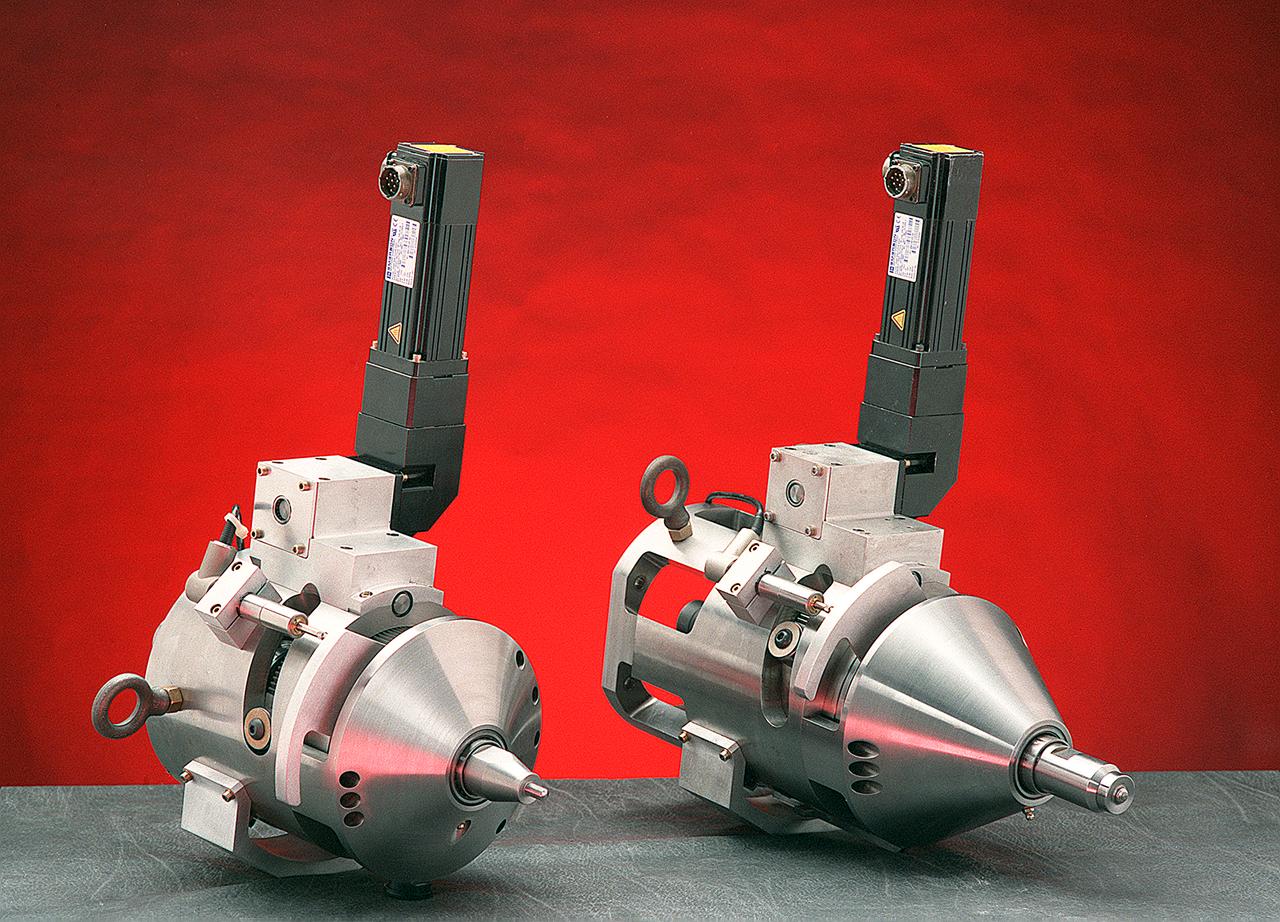
Two companies have successfully commercialized a specialized welding tool developed at the Marshall Space Flight Center (MSFC). Friction stir welding uses the high rotational speed of a tool and the resulting frictional heat created from contact to crush, "stir" together, and forge a bond between two metal alloys. It has had a major drawback, reliance on a single-piece pin tool. The pin is slowly plunged into the joint between two materials to be welded and rotated as high speed. At the end of the weld, the single-piece pin tool is retracted and leaves a "keyhole," something which is unacceptable when welding cylindrical objects such as drums, pipes and storage tanks. Another drawback is the requirement for different-length pin tools when welding materials of varying thickness. An engineer at the MSFC helped design an automatic retractable pin tool that uses a computer-controlled motor to automatically retract the pin into the shoulder of the tool at the end of the weld, preventing keyholes. This design allows the pin angle and length to be adjusted for changes in material thickness and results in a smooth hole closure at the end of the weld. Benefits of friction stir welding, using the MSFC retractable pin tool technology, include the following: The ability to weld a wide range of alloys, including previously unweldable and composite materials; provision of twice the fatigue resistance of fusion welds and no keyholes; minimization of material distortion; no creation of hazards such as welding fumes, radiation, high voltage, liquid metals, or arcing; automatic retraction of the pin at the end of the weld; and maintaining full penetration of the pin.
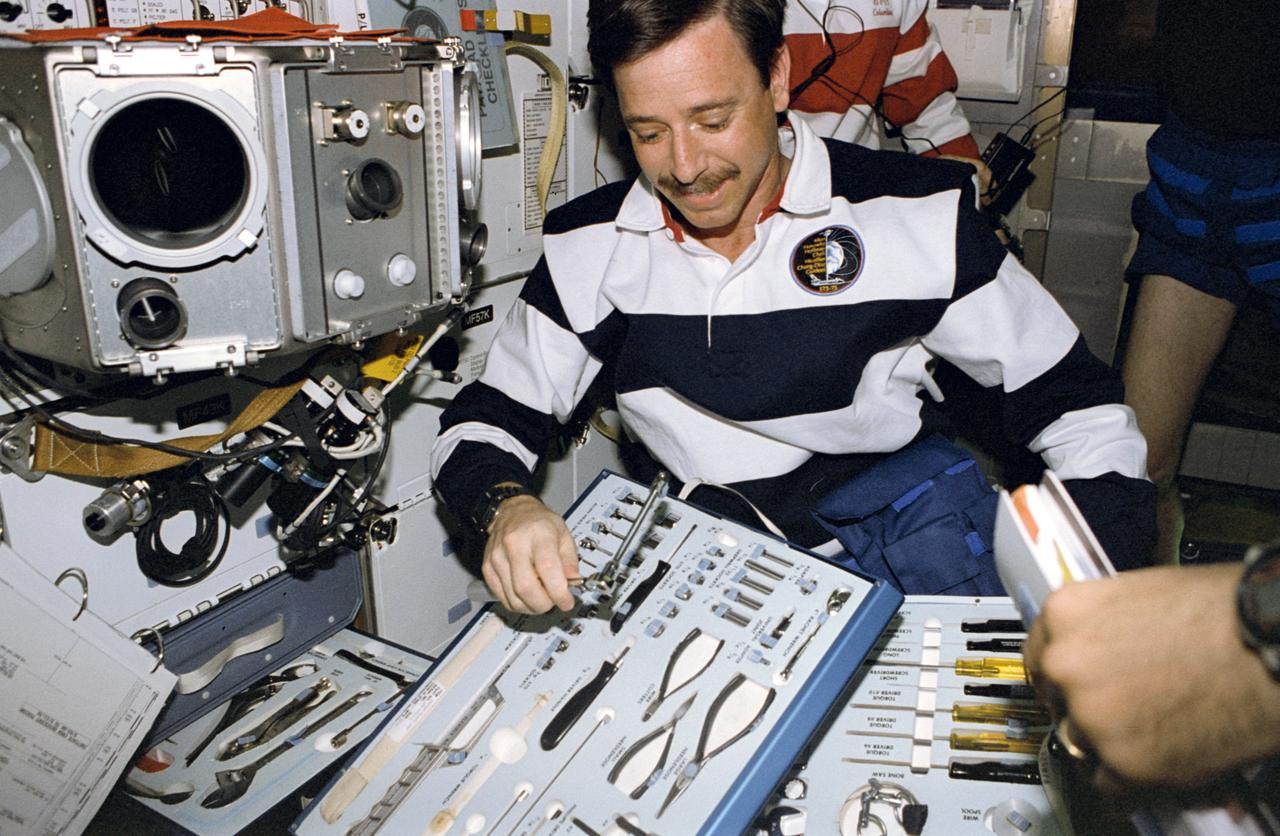
STS075-333-032 (22 Feb.- 9 March 1996) --- Astronaut Scott J. Horowitz, pilot, looks over tools he may use to perform an Inflight Maintenance (IFM) chore on the mid deck of the Earth-orbiting space shuttle Columbia. The glovebox facility is at upper left. Horowitz joined four other astronauts and an international payload specialist for 16 days of scientific research in Earth-orbit.
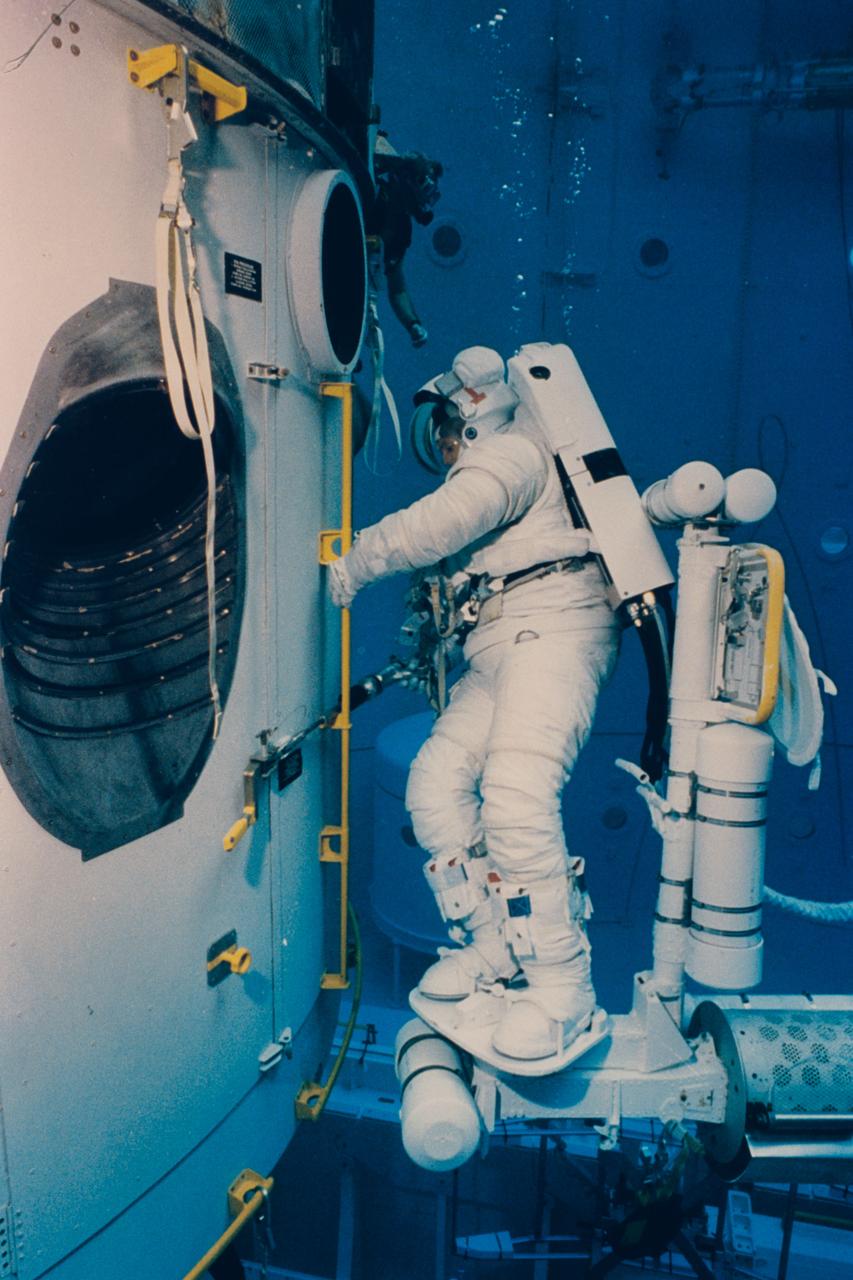
Astronaut Thomas D. Akers uses a power wrench to deploy one of the tools on the Hubble Space Telescope (HST) during a training session in the Neutral Buoyancy Simulator at Marshall Space Flight Center.
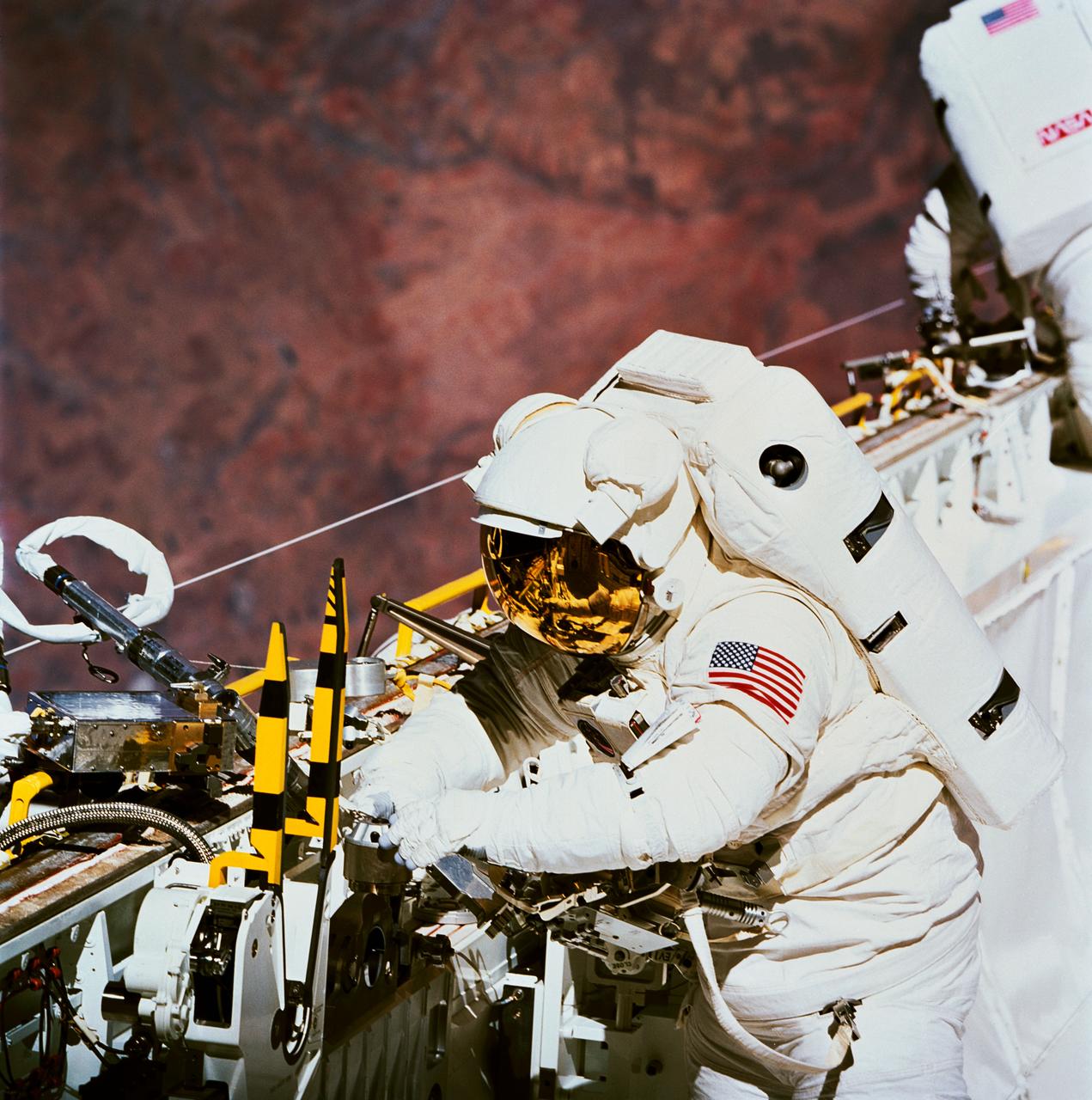
In Discovery's cargo bay, astronaut James H. Newman works with the power ratchet tool (PRT). Astronaut Carl E. Walz, who joined Newman for the lengthy period of extravehicular activity (EVA), is partially visible in the background. The two mission specialists devoted part of their EVA to evaluating tools and equipment expected to be used in the Hubble Space Telescope servicing. A desert area in Africa forms the backdrop for the 70mm scene.
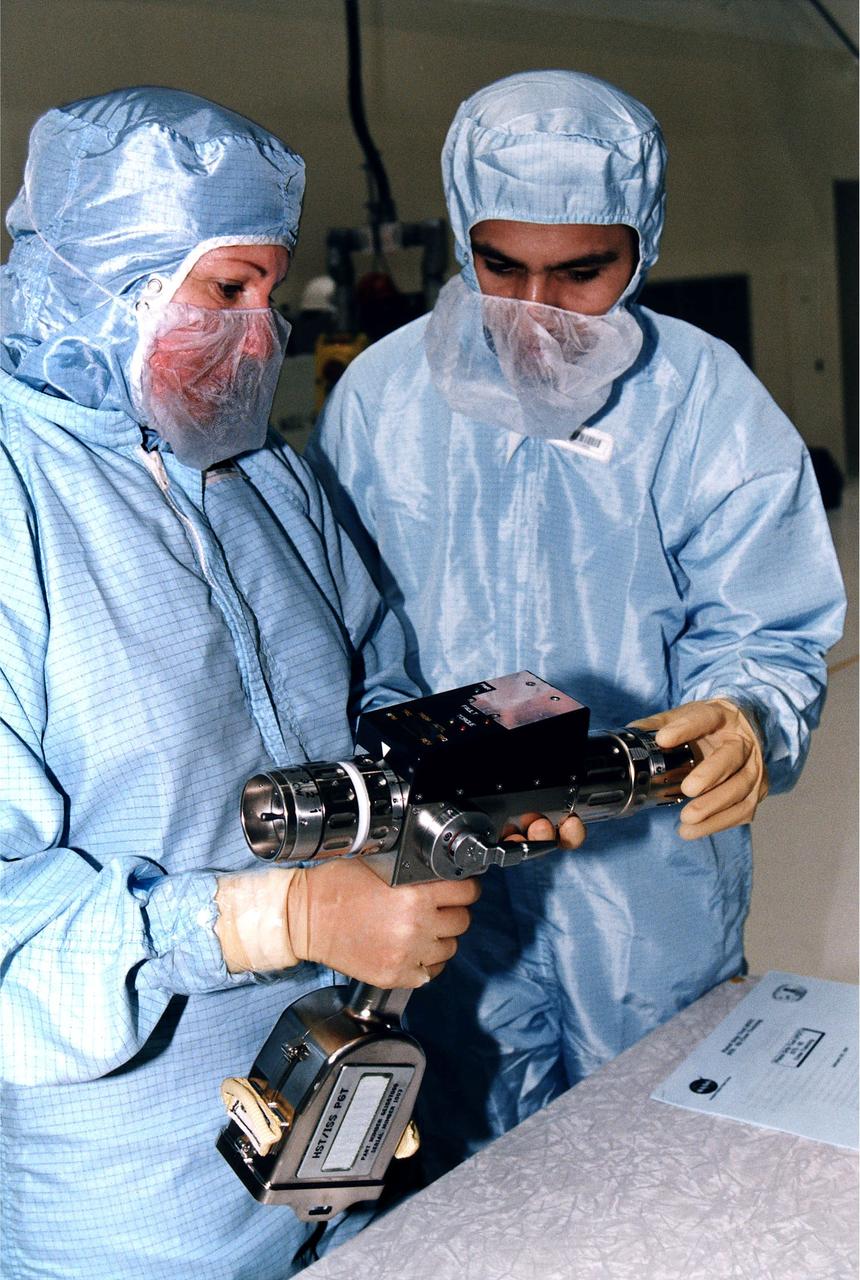
KENNEDY SPACE CENTER, FLA. - In KSC's Vertical Processing Facility, Louise Kleba of the Vehicle Integration Test Team (VITT) and engineer Devin Tailor of Goddard Space Flight Center examine the Pistol Grip Tool (PGT), which was designed for use by astronauts during spacewalks. The PGT is a self-contained, micro-processor controlled, battery-powered tool. It also can be used as a nonpowered ratchet wrench. The experiences of the astronauts on the first Hubble Space Telescope (HST) servicing mission led to recommendations for this smaller, more efficient tool for precision work during spacewalks. The PGT will be used on the second HST servicing mission, STS-82. Liftoff aboard Discovery is scheduled Feb. 11.
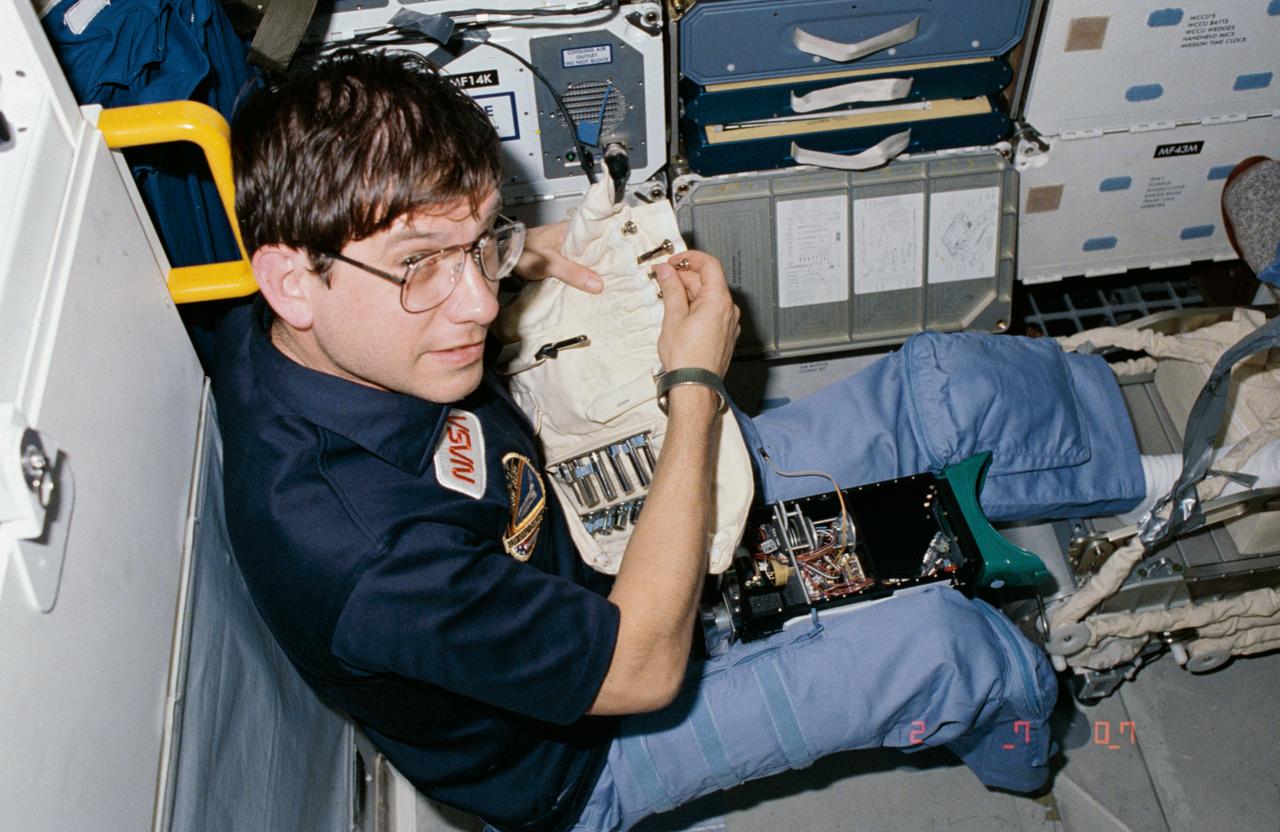
61C-05-035 (12-17 Jan 1986) --- Robert J. Cenker, 61-C payload specialist representing RCA, returns a tiny tool to its stowage position after adjusting the inner workings of a device used in one of a number of detailed supplementary objective (DSO) studies for NASA's Space Biomedical Research Institute. The device is a pair of ocular counter-rolling goggles used by U.S. Rep. Bill Nelson (D., Florida), 61-C's other payload specialist aboard the Columbia for this five-day flight.
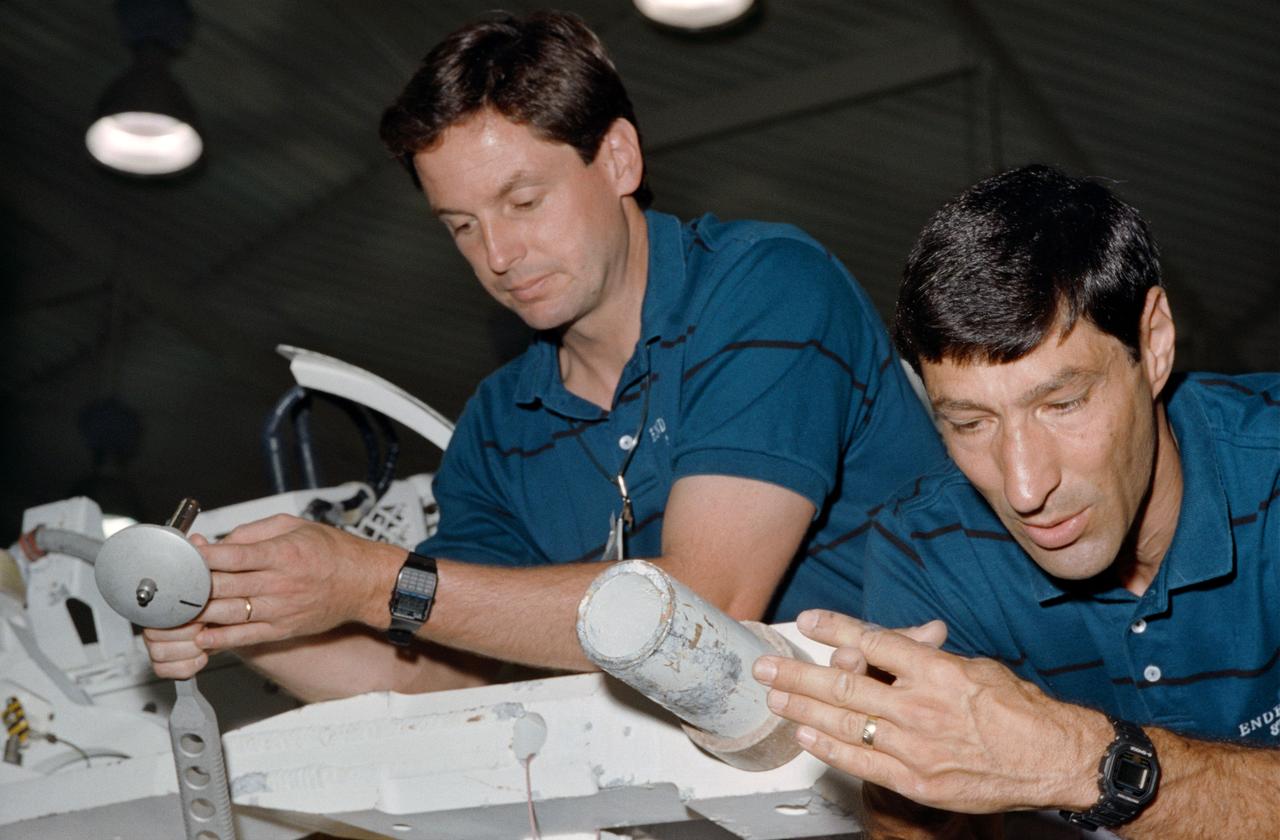
STS-54 Endeavour, Orbiter Vehicle (OV) 105, Mission Specialist 1 (MS1) Mario Runco, Jr (right) and MS2 Gregory J. Harbaugh, holding an ESSEX wrench, examine mockup and tools prior to an underwater simulation in JSC's Weightless Environment Training Facility (WETF) Bldg 29 pool. Runco and Harbaugh discuss the trunnion / payload retention latch assembly (PRLA) configuration.
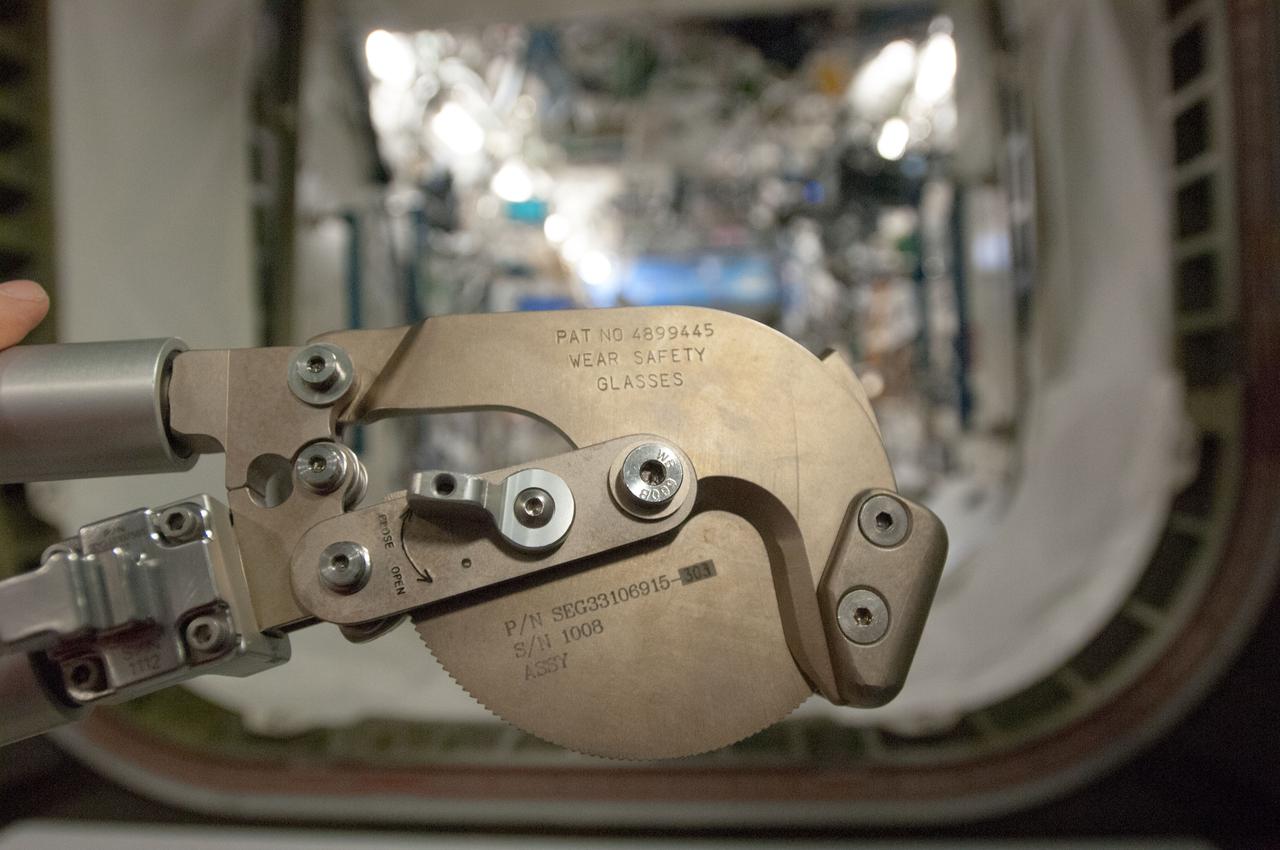
Documentation of a Large Cutter which will be used to support Russian Extravehicular Activity 32 (EVA 32) during Expedition 35. Part number (P/N) is SEG33106915-303, serial number (S/N) is 1008.
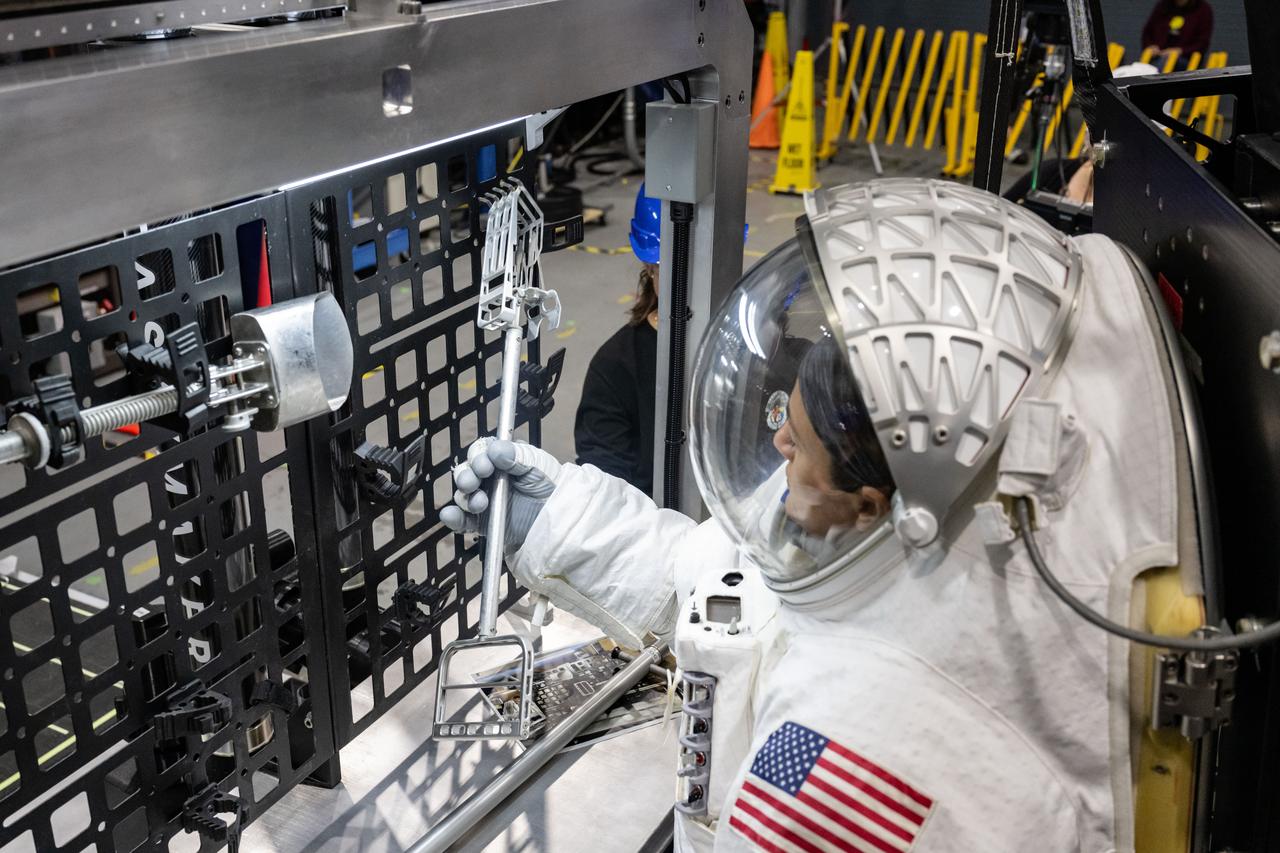
NASA astronaut Jessica Meir grabs a lunar geology tool from a tool rack on Lunar Outpost’s Eagle lunar terrain vehicle during testing at NASA’s Johnson Space Center. Image Credit: NASA/James Blair
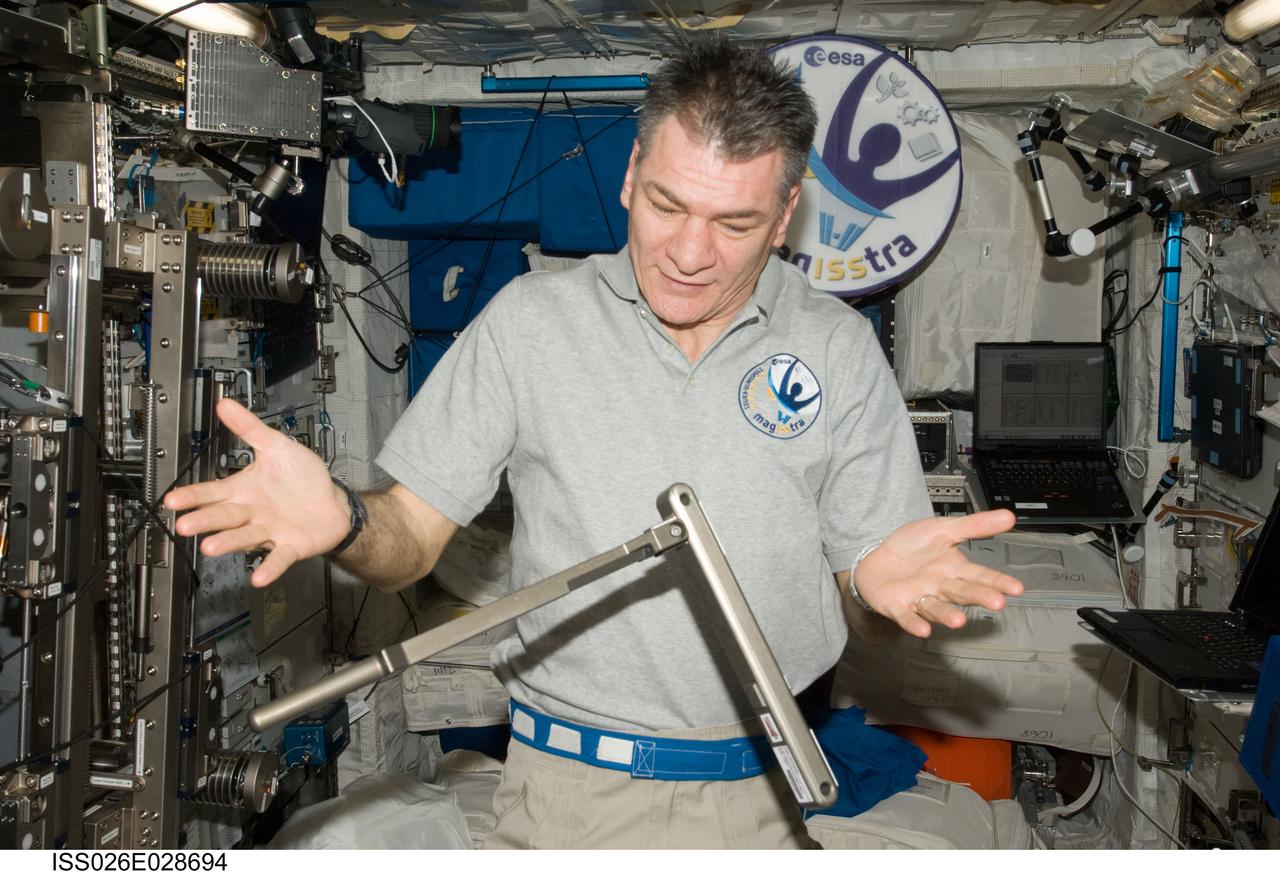
ISS026-E-028694 (22 Feb. 2011) --- European Space Agency astronaut Paolo Nespoli, Expedition 26 flight engineer, is pictured with a can crusher tool floating freely in the Columbus laboratory of the International Space Station. The tool was built by the High school students United with NASA to Create Hardware (HUNCH).
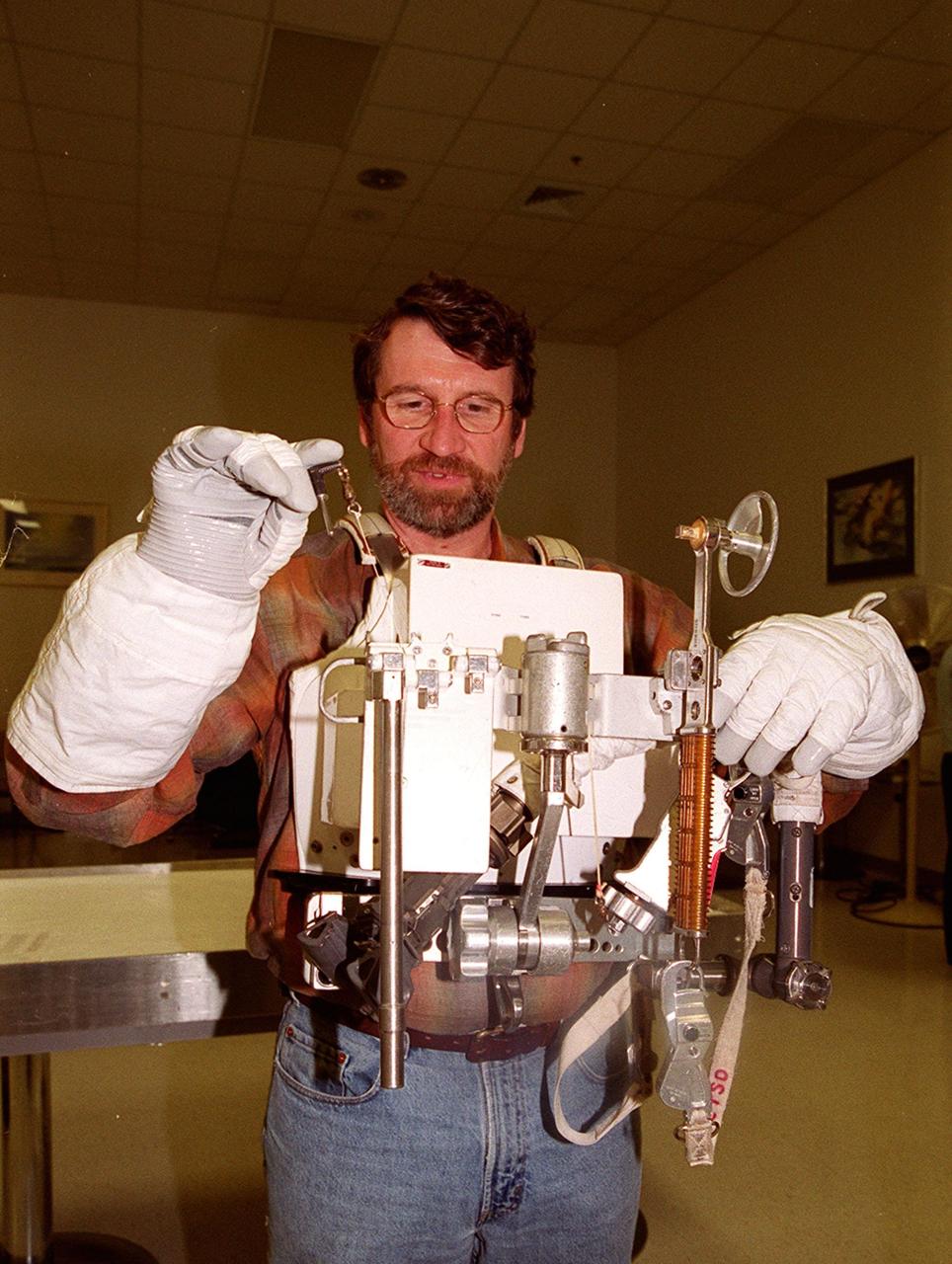
KENNEDY SPACE CENTER, FLA. -- While on a tour of KSC, Norm Abram, master carpenter of television’s "This Old House" and "The New Yankee Workshop," tries on a tool carrier and some of the tools used in space. Abram is at the Center to film an episode of "This Old House.
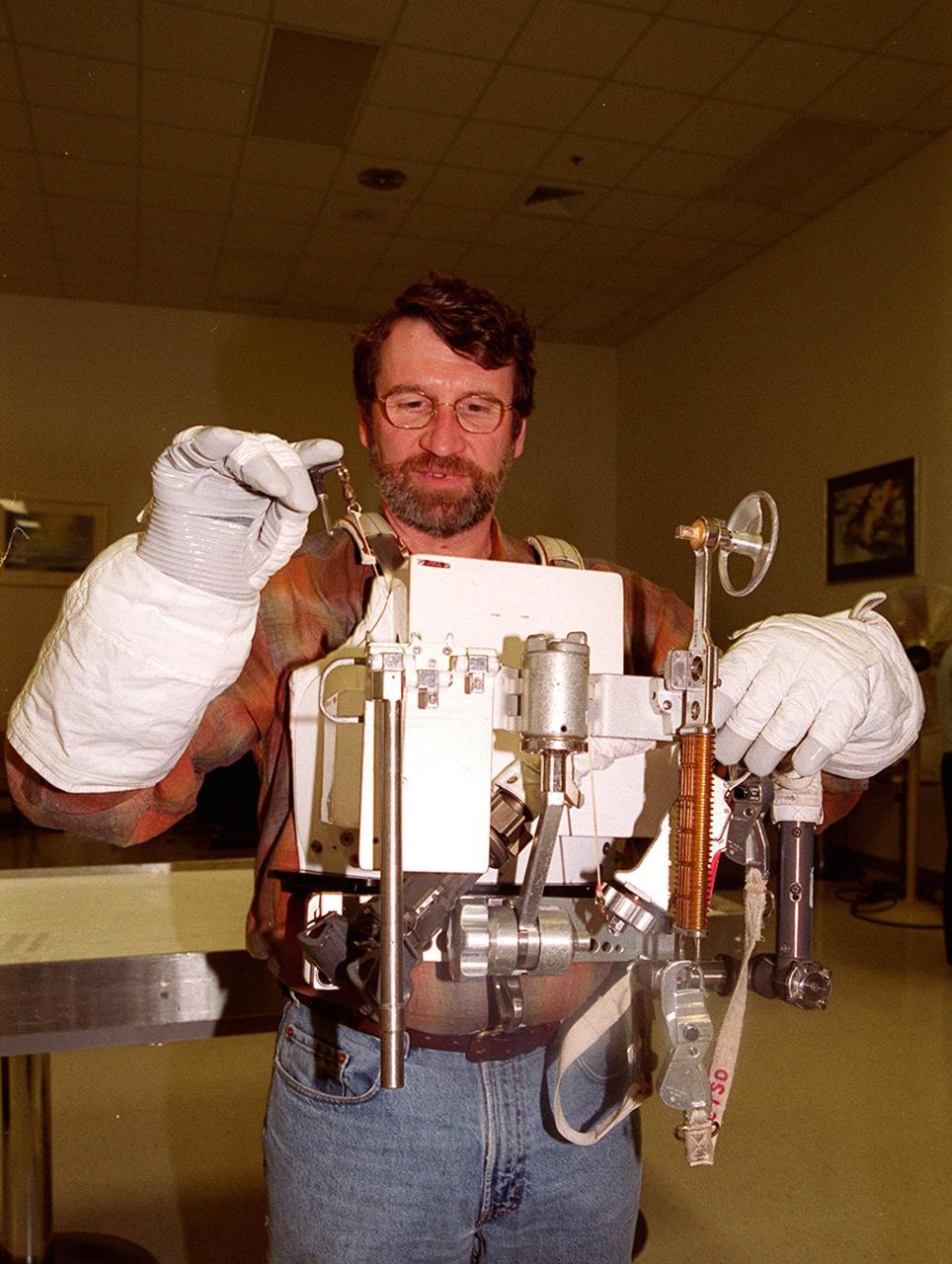
KENNEDY SPACE CENTER, FLA. -- While on a tour of KSC, Norm Abram, master carpenter of television’s "This Old House" and "The New Yankee Workshop," tries on a tool carrier and some of the tools used in space. Abram is at the Center to film an episode of "This Old House.
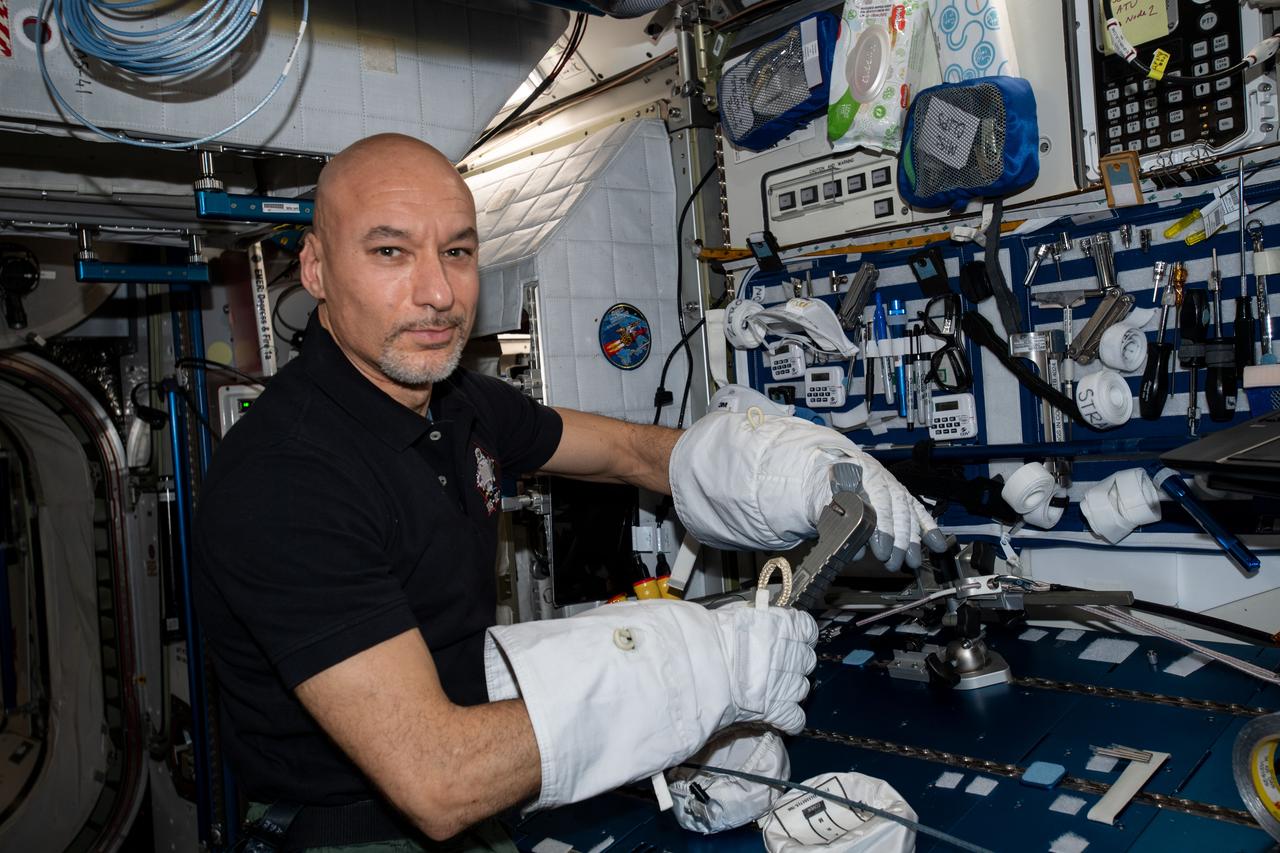
iss061e038284 (Nov. 12, 2019) --- ESA (European Space Agency) astronaut Luca Parmitano tests the usage of specialized spacewalking tools while wearing U.S. spacesuit gloves. The tools were designed specifically for the complex repair work planned for the International Space Station's cosmic particle detector, the Alpha Magnetic Spectrometer.
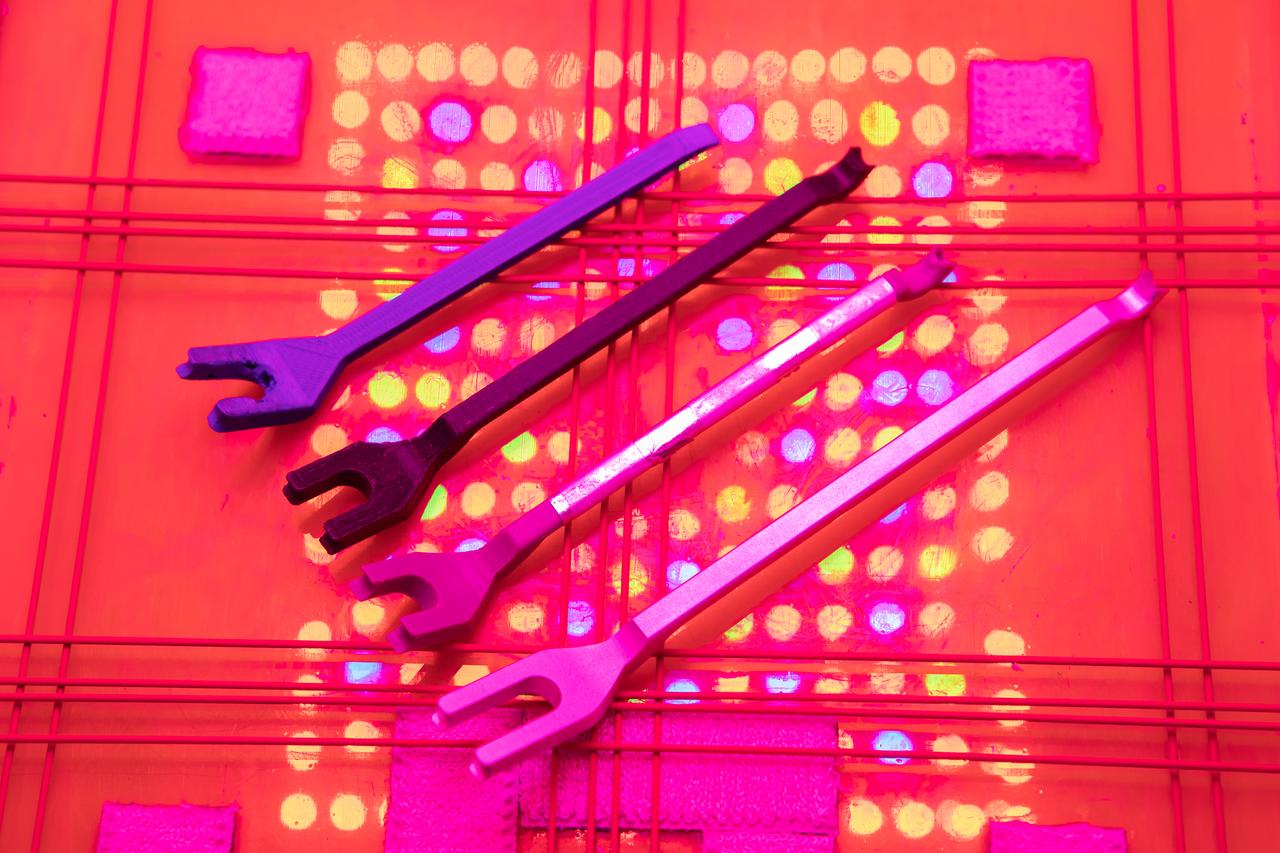
This photograph shows the evolution of the bungee tool as it went from a simple, 3D-printed object to an increasingly refined tool designed to save astronauts time when they work with the bungee system in the Veggie plant chamber aboard the International Space Station. The bungee tool is utilized to manipulate the bungee cords that help secure vital parts of plant experiments on the orbiting laboratory.
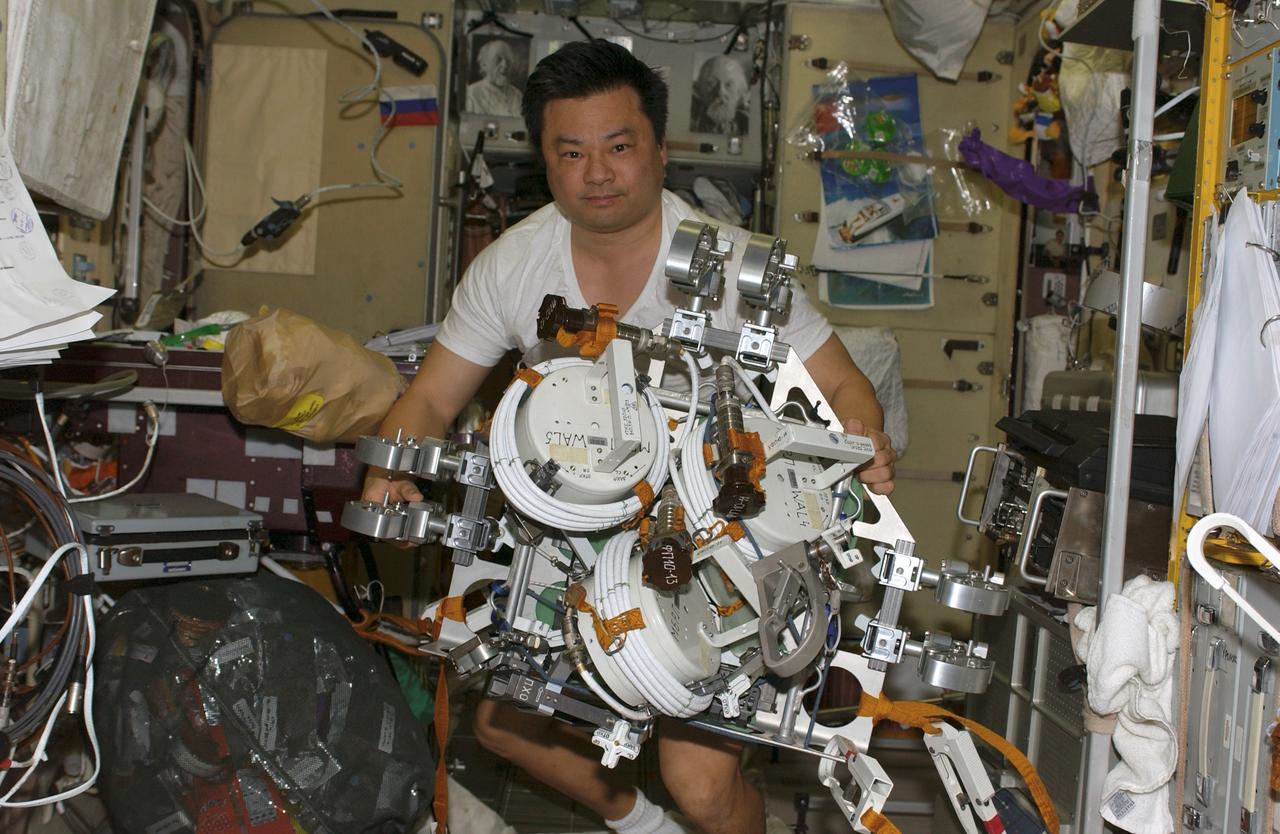
ISS010-E-20747 (21 March 2005) --- Astronaut Leroy Chiao, Expedition 10 commander and NASA ISS science officer, works with a tool caddy containing extravehicular activities (EVA) equipment and tools in the Zvezda Service Module of the International Space Station (ISS) in preparation for the spacewalk scheduled for March 28.
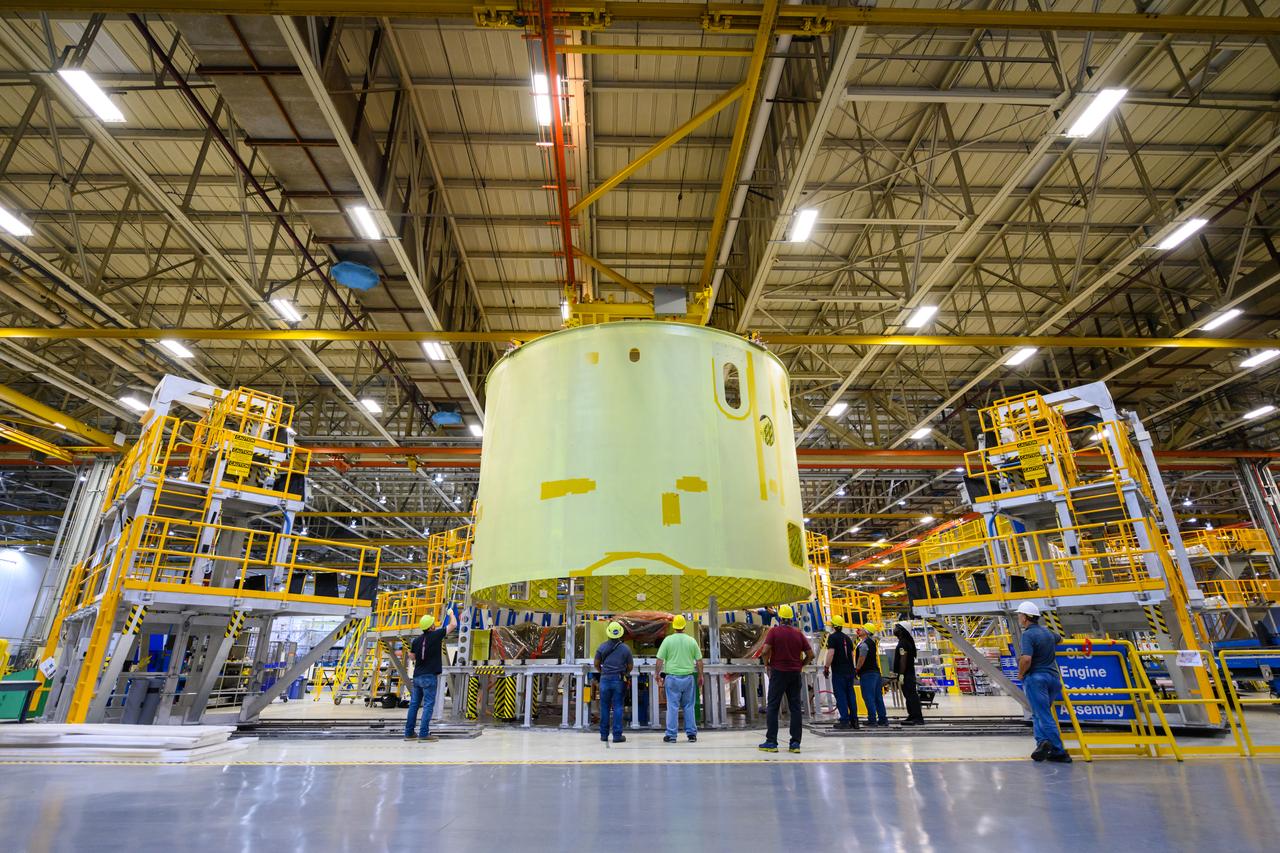
Space Launch System Corestage-2 Engine Section is lifted into a thrust structure tool at NASA's Michoud Assembly Facility.
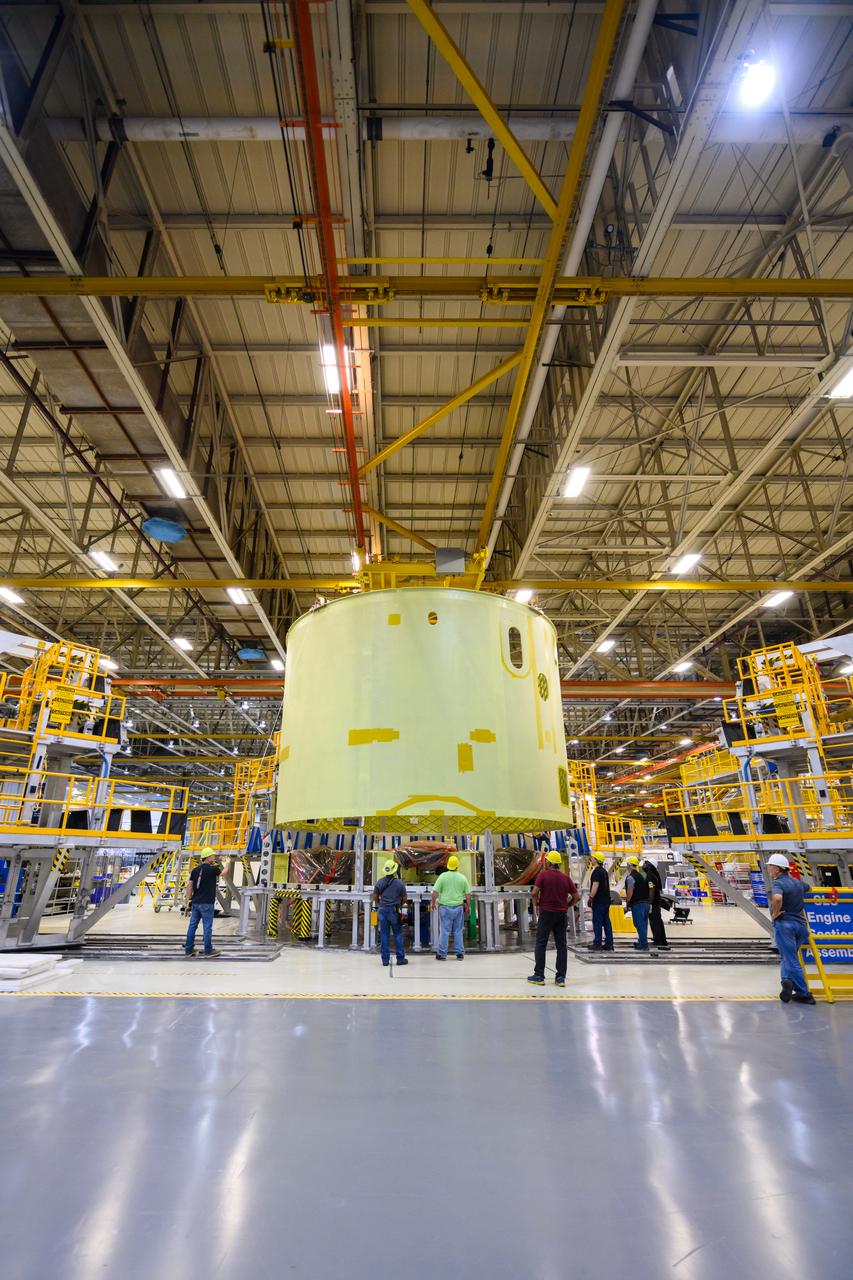
Space Launch System Corestage-2 Engine Section is lifted into a thrust structure tool at NASA's Michoud Assembly Facility.
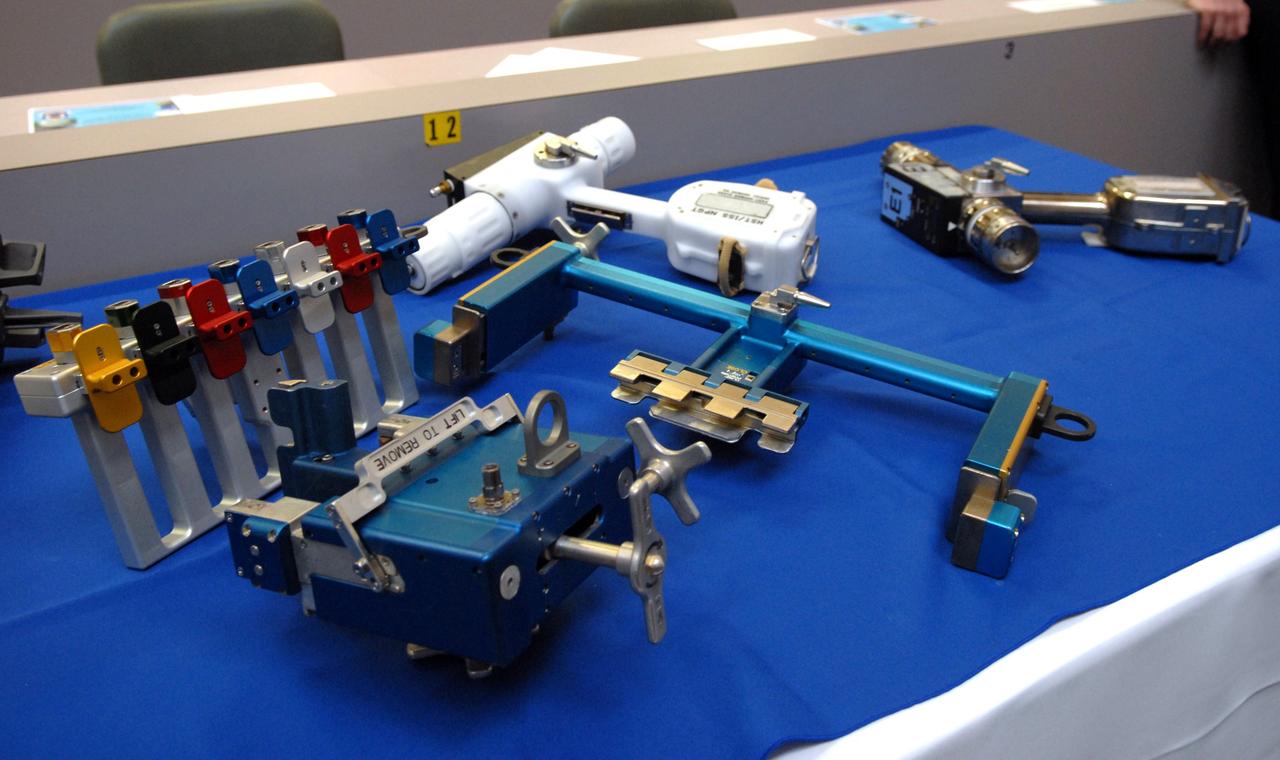
CAPE CANAVERAL, Fla. – The tools that will be used to service NASA's Hubble Space Telescope on the STS-125 mission are displayed in the NASA News Center at NASA's Kennedy Space Center in Florida. At far right is the pistol grip tool. It can install and remove instruments, drive latches and open doors. A self-contained, high-torque drive, the tool features an on-board computer that permits users to tailor its performance to the mission demands. In the foreground are the card extraction and insertion tools to enable removal of electronic cards. At top center is the plastic version of the pistol grip tool used by astronauts during practice in the water tank at NASA' Johnson Space Center. At center left is the bit caddy. On space shuttle Atlantis’ STS-125 mission, Hubble will be serviced for the fifth and final time. The flight will include five spacewalks during which astronauts will refurbish and upgrade the telescope with these state-of-the-art science instruments. As a result, Hubble's capabilities will be expanded and its operational lifespan extended through at least 2014. The payload includes a Wide Field Camera 3, fine guidance sensor and the Cosmic Origins Spectrograph. Launch is scheduled for 2:01 p.m. EDT May 11. Photo credit: NASA/Jack Pfaller
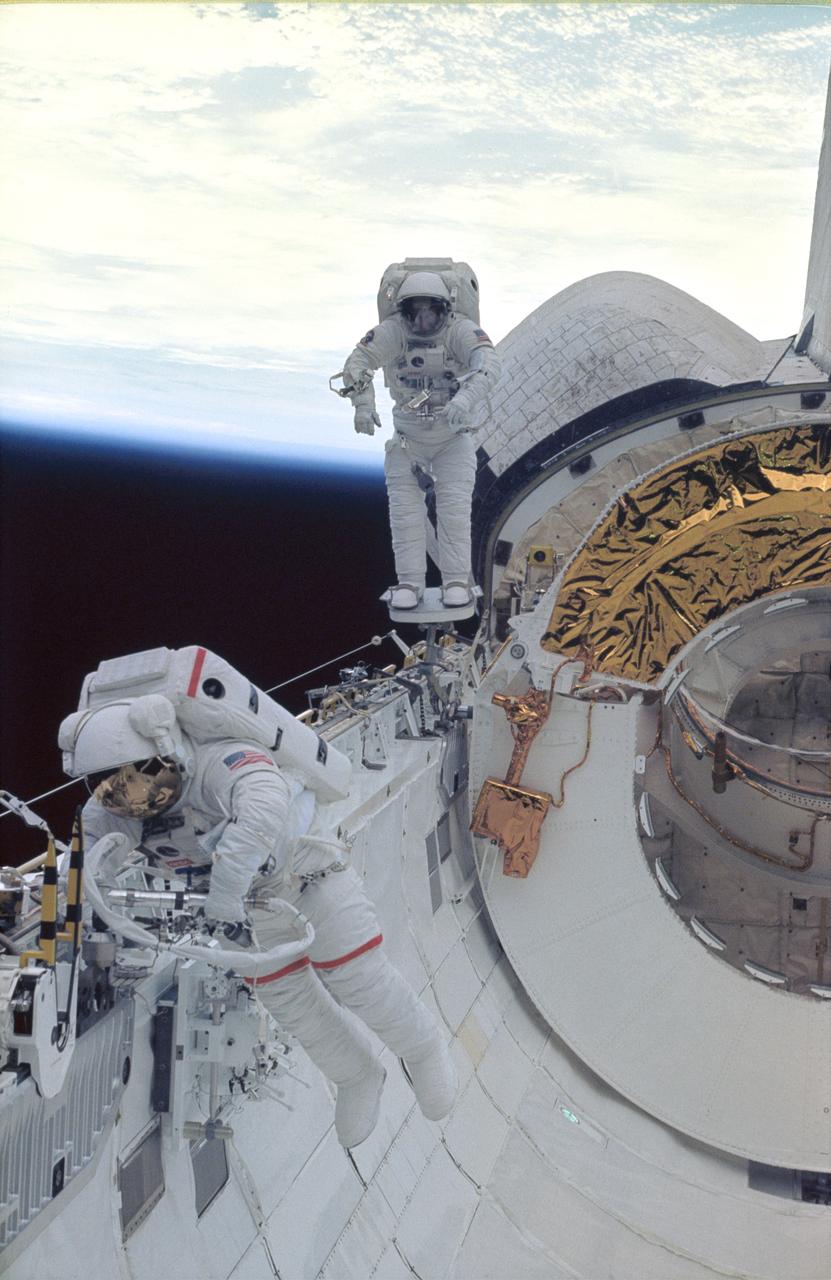
STS051-06-037 (16 Sept 1993) --- Astronauts Carl E. Walz (foreground) and James H. Newman evaluate some important gear. Walz reaches for the Power Ratchet Tool (PRT) while Newman checks out mobility on the Portable Foot Restraint (PFR) near the Space Shuttle Discovery's starboard Orbital Maneuvering System (OMS) pod. The tools and equipment will be instrumental on some of the five periods of extravehicular activity (EVA) scheduled for the Hubble Space Telescope (HST) STS-61 servicing mission later this year.
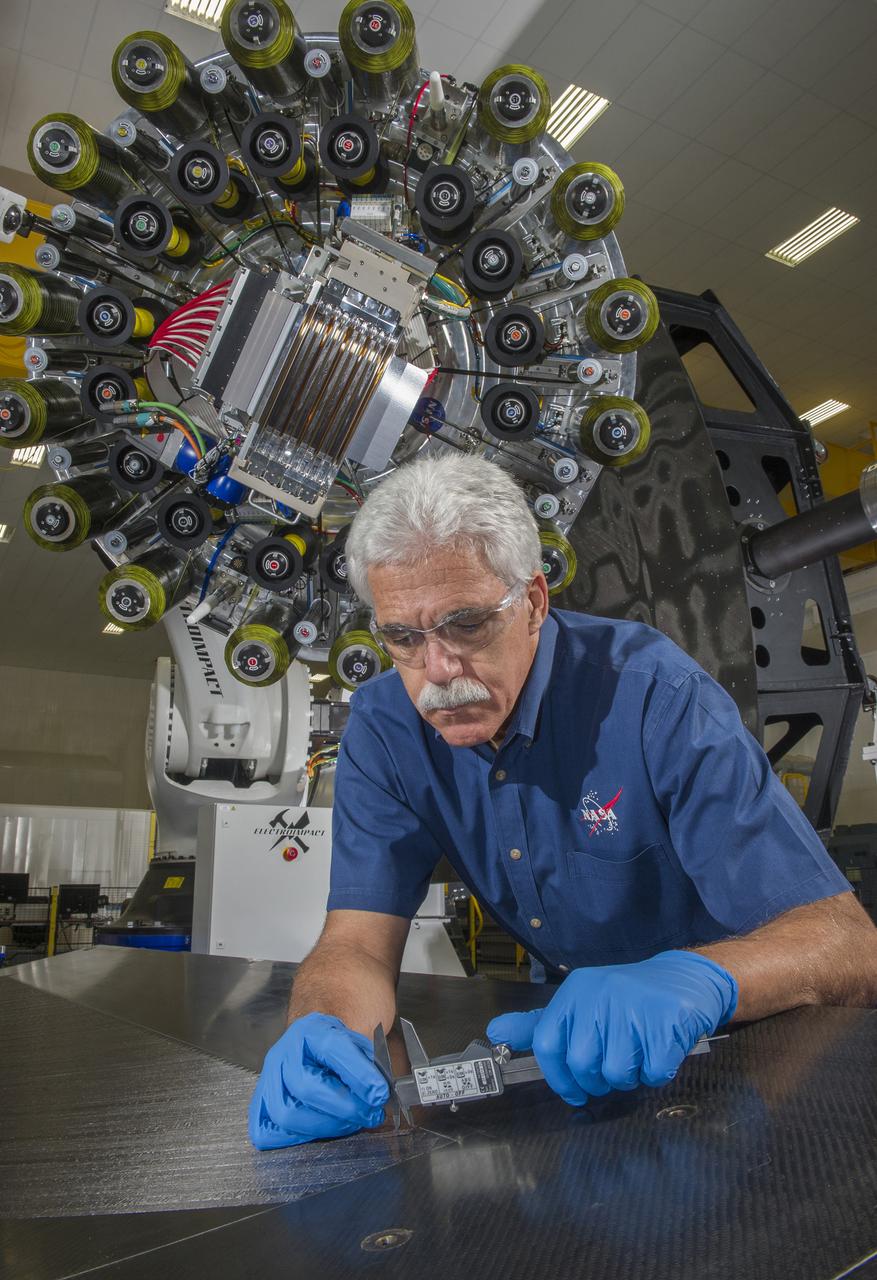
MATERIALS ENGINEER LARRY PELHAM OF NASA’S MARSHALL SPACE FLIGHT CENTER IN HUNTSVILLE, ALABAMA, OPERATES THE CEUS AUTOMATED FIBER PLACEMENT CYLINDRICAL MANUFACTURING TOOL IN BUILDING 4707. THE TOOL WILL BE USED BY THE COMPOSITES FOR EXPLORATION UPPER STAGE PROJECT AT MARSHALL, WHICH IS ANALYZING COMPOSITE MATERIALS TO SUPPORT FUTURE HARDWARE FOR NASA’S SPACE LAUNCH SYSTEM AND OTHER NEXT-GENERATION SPACECRAFT…
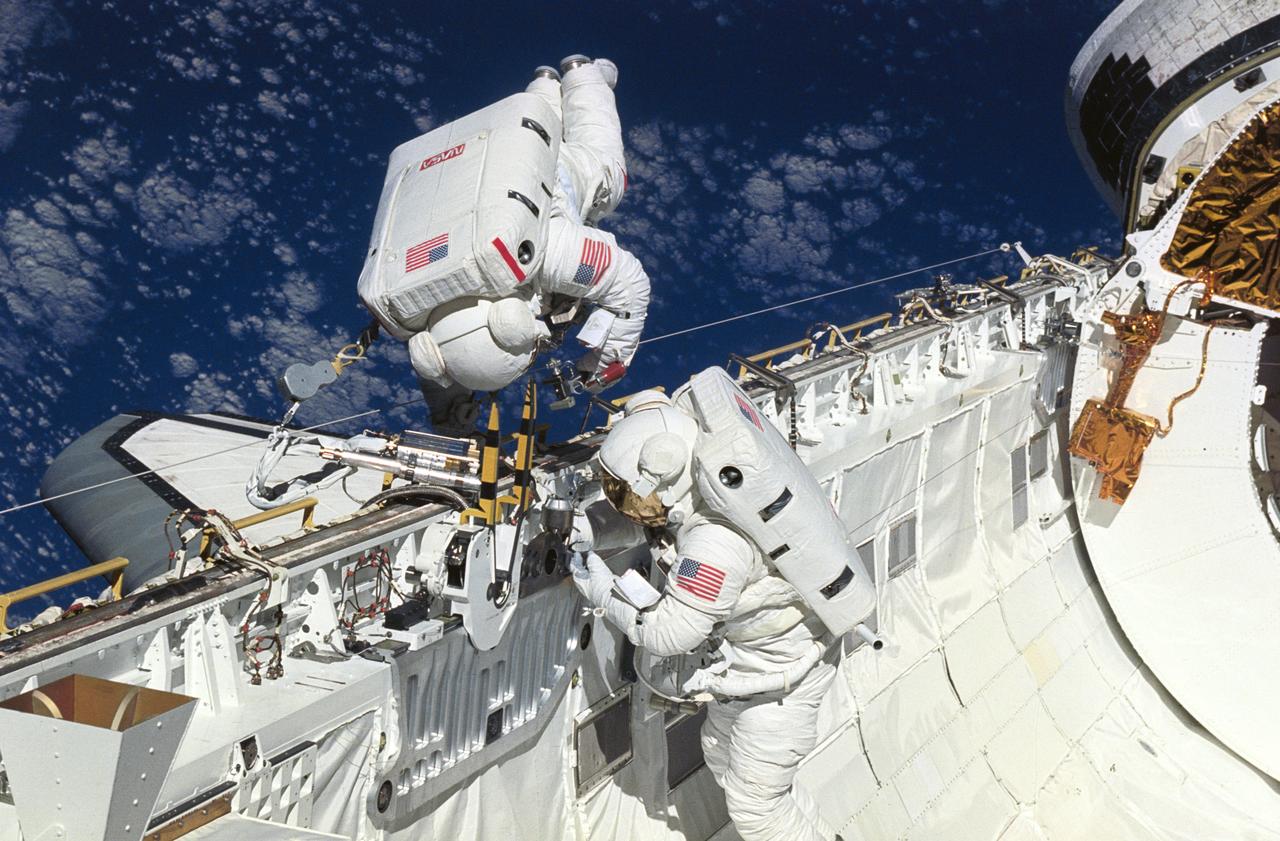
STS051-06-023 (16 Sept 1993) --- Astronauts James H. Newman (in bay) and Carl E. Walz, mission specialists, practice space walking techniques and evaluate tools to be used on the first Hubble Space Telescope (HST) servicing mission scheduled for later this year. Walz rehearses using the Power Ratchet Tool (PRT), one of several special pieces of gear to be put to duty during the scheduled five periods of extravehicular activity (EVA) on the STS-61 mission.
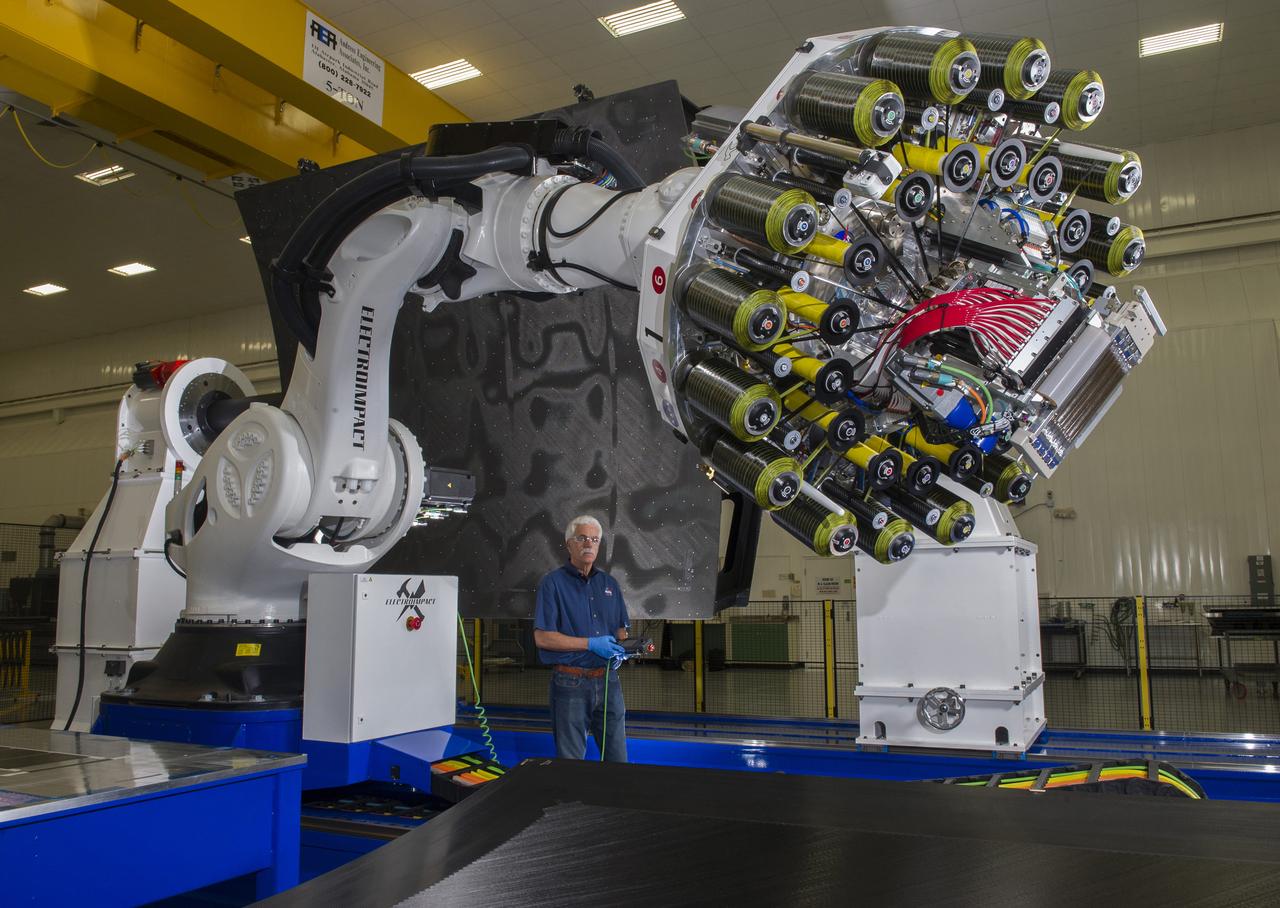
MATERIALS ENGINEER LARRY PELHAM OF NASA’S MARSHALL SPACE FLIGHT CENTER IN HUNTSVILLE, ALABAMA, OPERATES THE CEUS AUTOMATED FIBER PLACEMENT CYLINDRICAL MANUFACTURING TOOL IN BUILDING 4707. THE TOOL WILL BE USED BY THE COMPOSITES FOR EXPLORATION UPPER STAGE PROJECT AT MARSHALL, WHICH IS ANALYZING COMPOSITE MATERIALS TO SUPPORT FUTURE HARDWARE FOR NASA’S SPACE LAUNCH SYSTEM AND OTHER NEXT-GENERATION SPACECRAFT…

STS057-30-021 (21 June-1 July 1993) --- Astronaut Brian Duffy, pilot, handles a soldering tool onboard the Earth-orbiting Space Shuttle Endeavour. The Soldering Experiment (SE) called for a crew member to solder on a printed circuit board containing 45 connection points, then de-solder 35 points on a similar board. The SE was part of a larger project called the Tools and Diagnostic Systems (TDS), sponsored by the Space and Life Sciences Directorate at Johnson Space Center (JSC). TDS represents a group of equipment selected from the tools and diagnostic hardware to be supported by the International Space Station program. TDS was designed to demonstrate the maintenance of experiment hardware on-orbit and to evaluate the adequacy of its design and the crew interface. Duffy and five other NASA astronauts spent almost ten days aboard the Space Shuttle Endeavour in Earth-orbit supporting the SpaceHab mission, retrieving the European Retrievable Carrier (EURECA) and conducting various experiments.
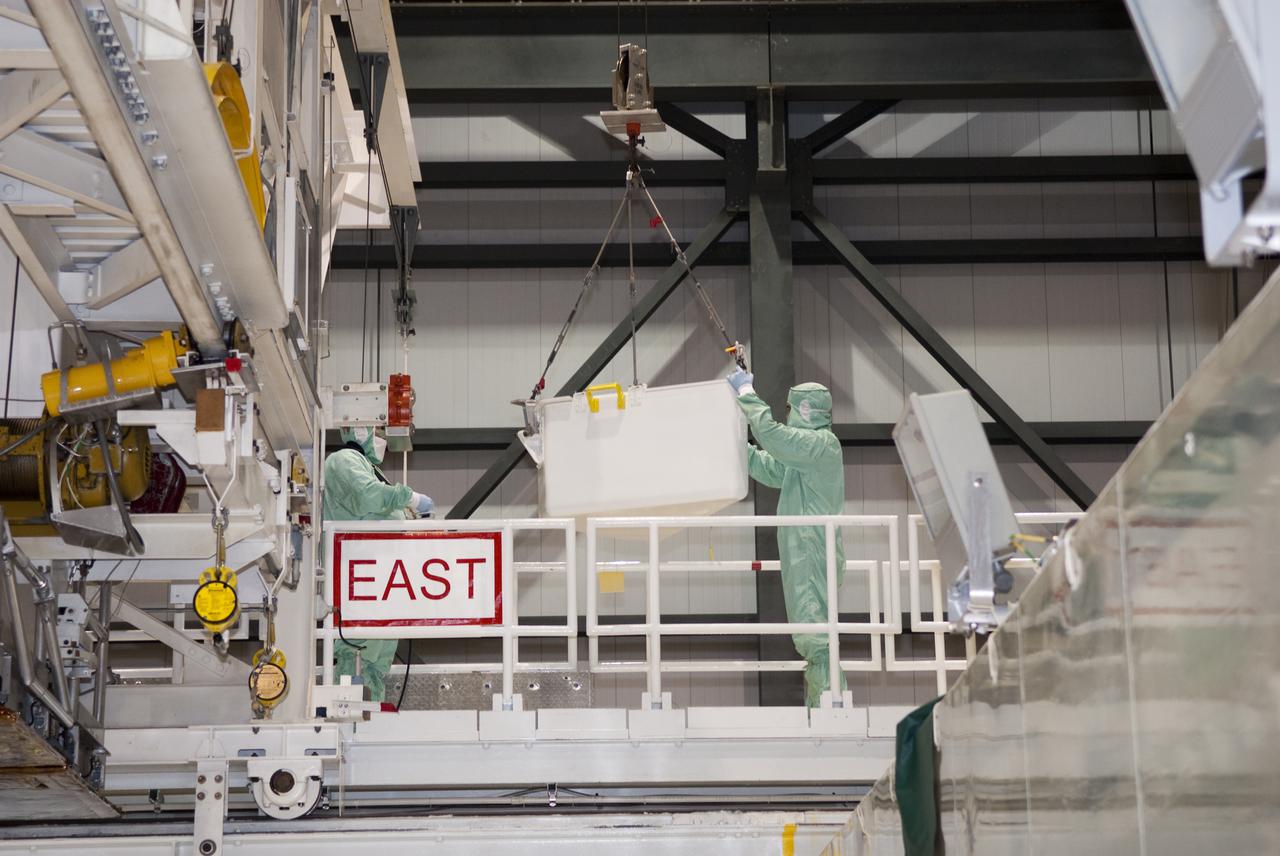
CAPE CANAVERAL, Fla. – In Orbiter Processing Facility-1 at NASA's Kennedy Space Center in Florida, workers dressed in clean room attire, known as bunny suits, carefully guide the tool stowage assembly across the work platform on which they are standing. The tool box is being installed into space shuttle Atlantis' payload bay. The assembly contains tools and hardware that will be needed on the extravehicular activities, or spacewalks, conducted during the STS-132 mission. On STS-132, the six-member crew will deliver an Integrated Cargo Carrier and a Russian-built Mini-Research Module to the International Space Station. STS-132 is the 34th mission to the station and the 132nd space shuttle mission. Launch is targeted for May 14. For information on the STS-132 mission, visit http:__www.nasa.gov_mission_pages_shuttle_shuttlemissions_sts132_index.html. Photo credit: NASA_Jim Grossmann
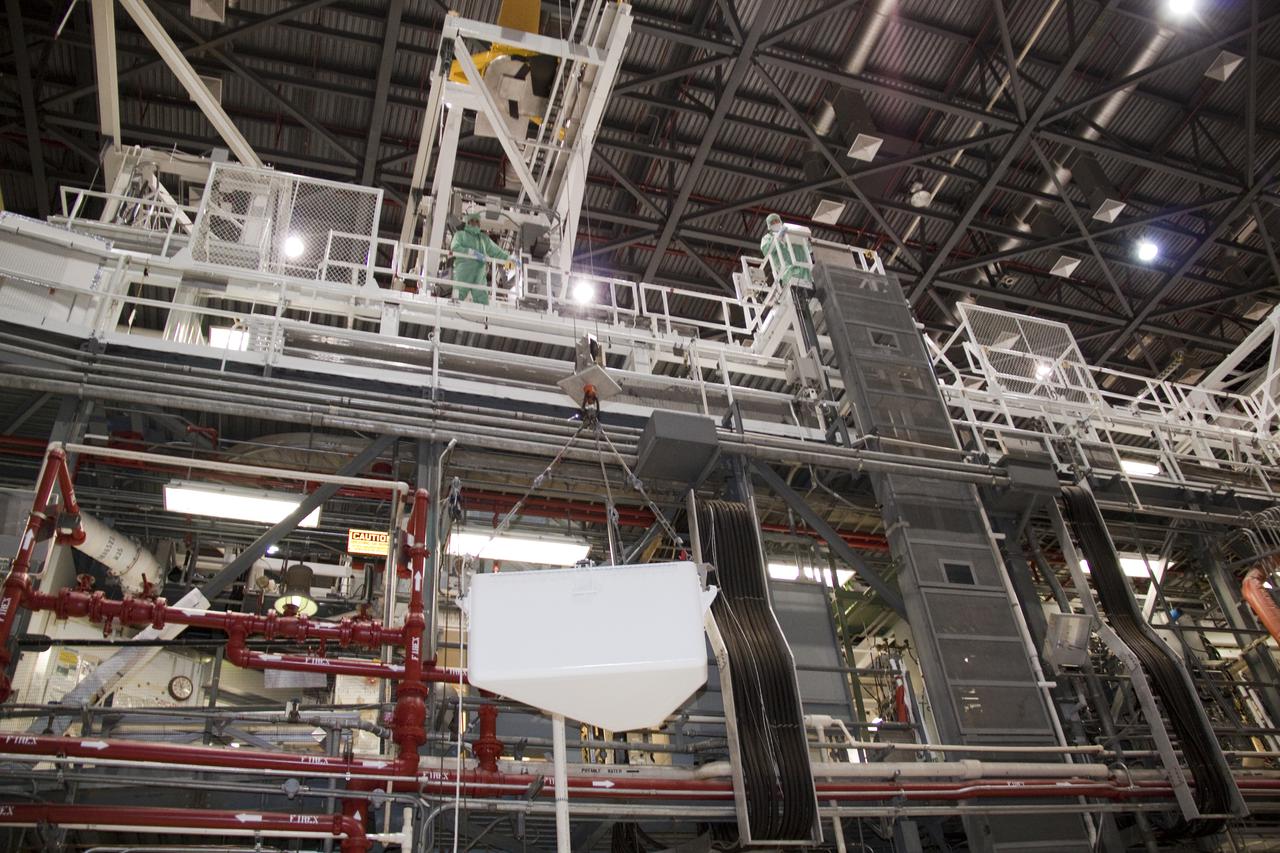
CAPE CANAVERAL, Fla. – In Orbiter Processing Facility-1 at NASA's Kennedy Space Center in Florida, the tool stowage assembly is lifted by jib crane toward the ceiling of the clean room. The tool box is being installed into space shuttle Atlantis' payload bay. The assembly contains tools and hardware that will be needed on the extravehicular activities, or spacewalks, conducted during the STS-132 mission. On STS-132, the six-member crew will deliver an Integrated Cargo Carrier and a Russian-built Mini-Research Module to the International Space Station. STS-132 is the 34th mission to the station and the 132nd space shuttle mission. Launch is targeted for May 14. For information on the STS-132 mission, visit http:__www.nasa.gov_mission_pages_shuttle_shuttlemissions_sts132_index.html. Photo credit: NASA_Jack Pfaller
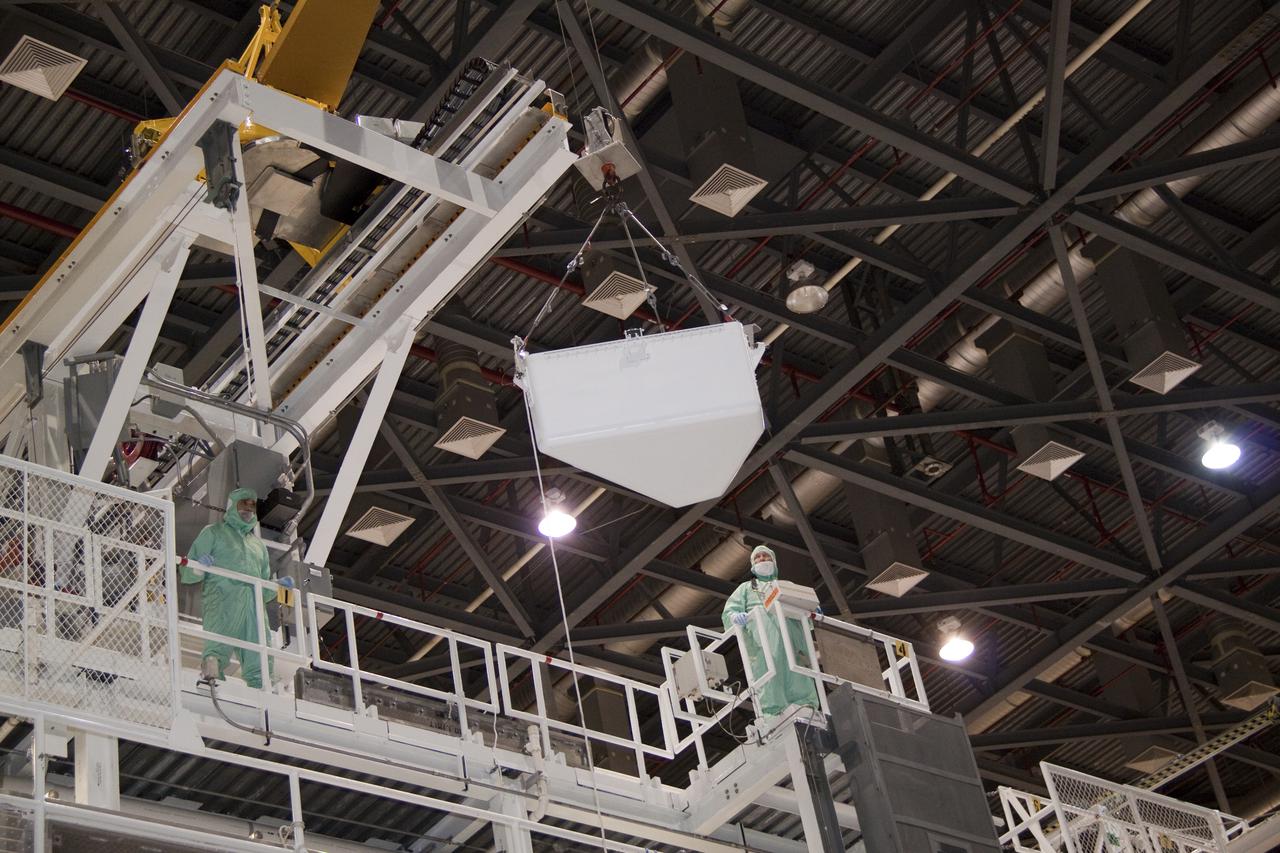
CAPE CANAVERAL, Fla. – In Orbiter Processing Facility-1 at NASA's Kennedy Space Center in Florida, workers dressed in clean room attire, known as bunny suits, monitor the tool stowage assembly as it is lifted by jib crane above the work platform on which they are standing. The tool box is being installed into space shuttle Atlantis' payload bay. The assembly contains tools and hardware that will be needed on the extravehicular activities, or spacewalks, conducted during the STS-132 mission. On STS-132, the six-member crew will deliver an Integrated Cargo Carrier and a Russian-built Mini-Research Module to the International Space Station. STS-132 is the 34th mission to the station and the 132nd space shuttle mission. Launch is targeted for May 14. For information on the STS-132 mission, visit http:__www.nasa.gov_mission_pages_shuttle_shuttlemissions_sts132_index.html. Photo credit: NASA_Jack Pfaller
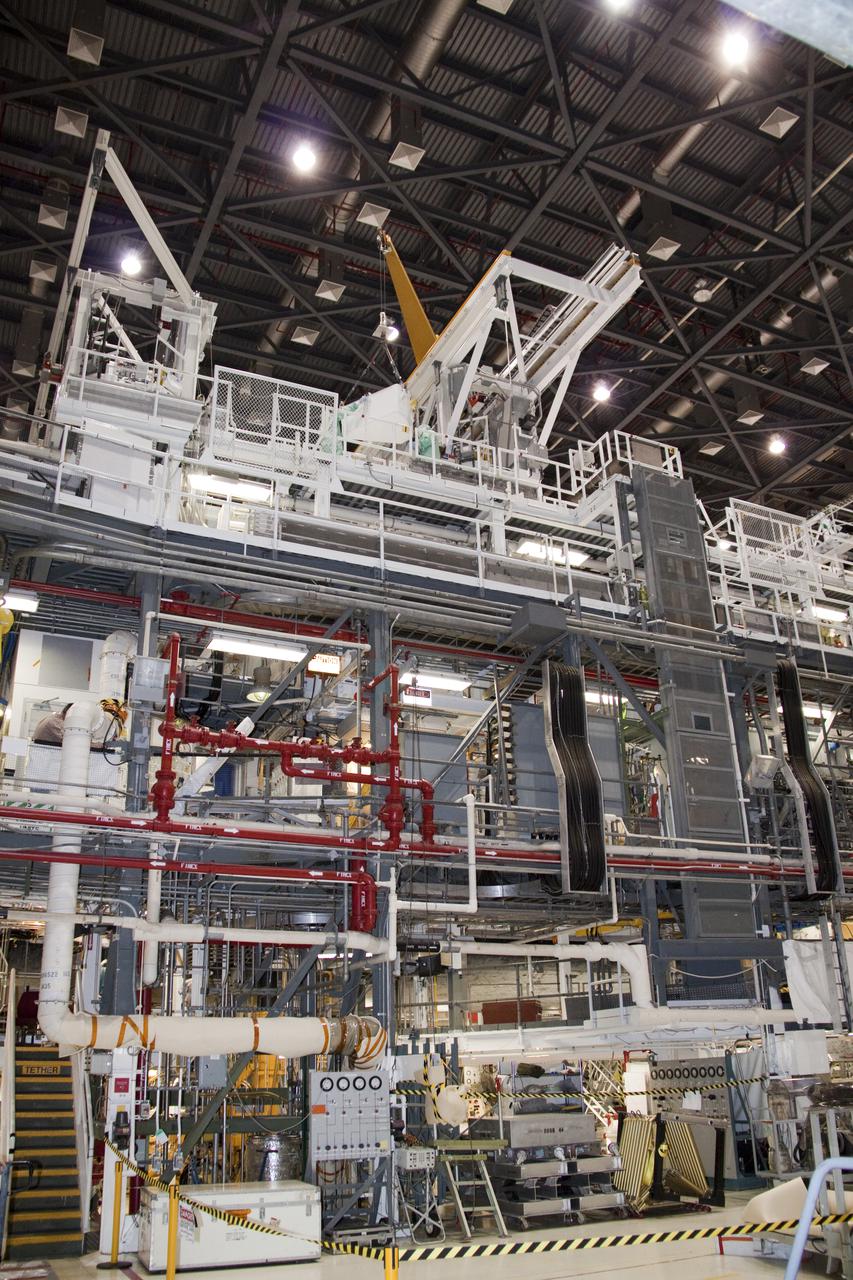
CAPE CANAVERAL, Fla. – In Orbiter Processing Facility-1 at NASA's Kennedy Space Center in Florida, the tool stowage assembly is lifted by jib crane over a work platform. The tool box will be moved across the platform and installed into space shuttle Atlantis' payload bay. The assembly contains tools and hardware that will be needed on the extravehicular activities, or spacewalks, conducted during the STS-132 mission. On STS-132, the six-member crew will deliver an Integrated Cargo Carrier and a Russian-built Mini-Research Module to the International Space Station. STS-132 is the 34th mission to the station and the 132nd space shuttle mission. Launch is targeted for May 14. For information on the STS-132 mission, visit http:__www.nasa.gov_mission_pages_shuttle_shuttlemissions_sts132_index.html. Photo credit: NASA_Jack Pfaller
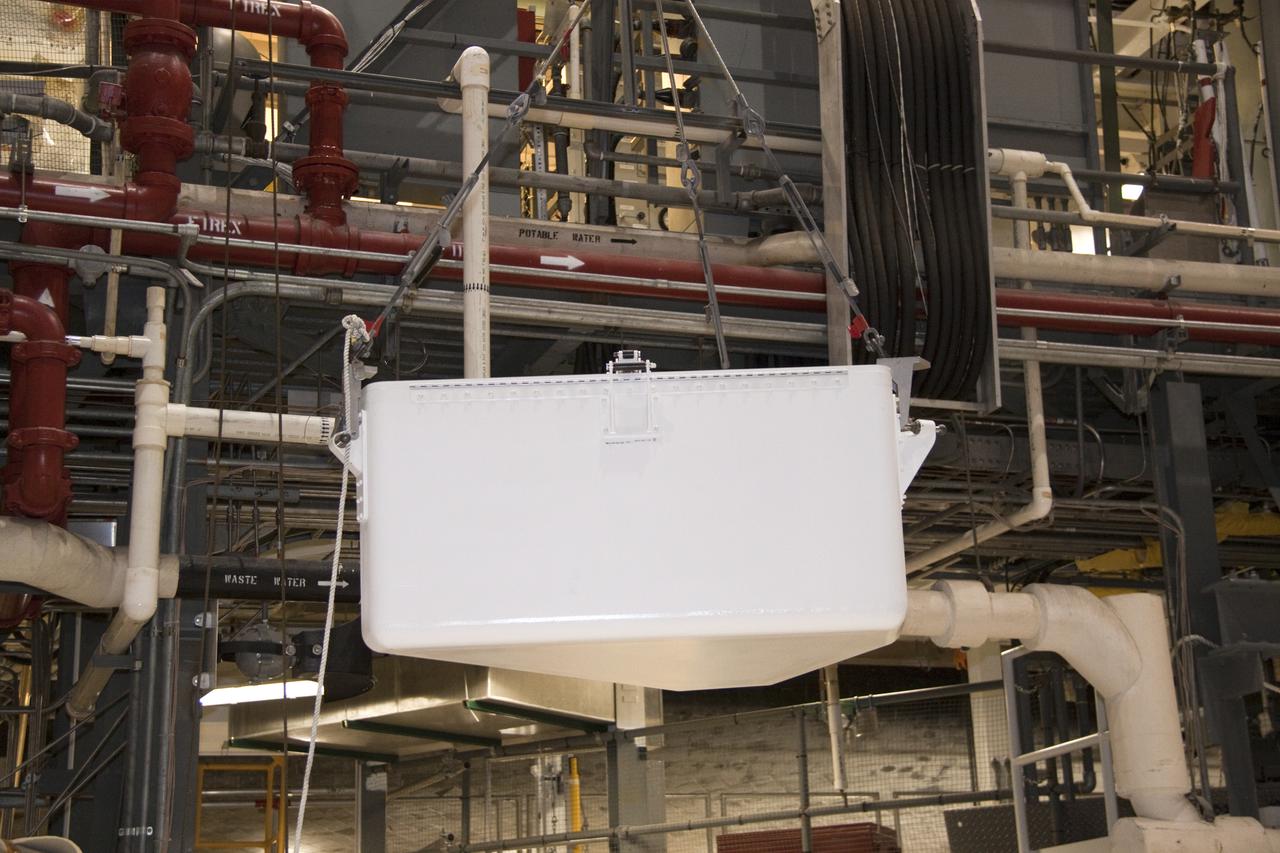
CAPE CANAVERAL, Fla. – In Orbiter Processing Facility-1 at NASA's Kennedy Space Center in Florida, the tool stowage assembly is lifted by jib crane above the floor of the clean room. The tool box is being installed into space shuttle Atlantis' payload bay. The assembly contains tools and hardware that will be needed on the extravehicular activities, or spacewalks, conducted during the STS-132 mission. On STS-132, the six-member crew will deliver an Integrated Cargo Carrier and a Russian-built Mini-Research Module to the International Space Station. STS-132 is the 34th mission to the station and the 132nd space shuttle mission. Launch is targeted for May 14. For information on the STS-132 mission, visit http:__www.nasa.gov_mission_pages_shuttle_shuttlemissions_sts132_index.html. Photo credit: NASA_Jack Pfaller
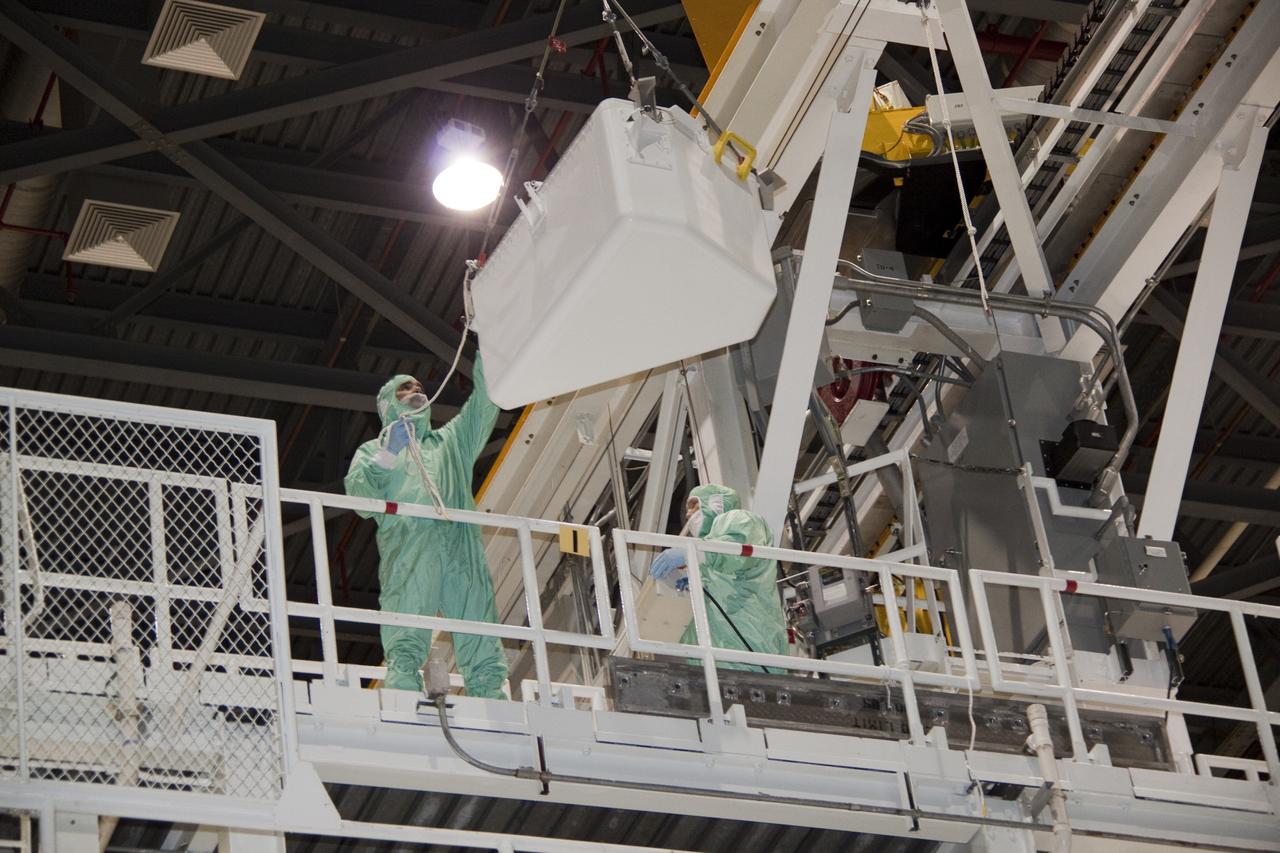
CAPE CANAVERAL, Fla. – In Orbiter Processing Facility-1 at NASA's Kennedy Space Center in Florida, workers dressed in clean room attire, known as bunny suits, guide the tool stowage assembly as it is lifted by jib crane toward the work platform on which they are standing. The tool box is being installed into space shuttle Atlantis' payload bay. The assembly contains tools and hardware that will be needed on the extravehicular activities, or spacewalks, conducted during the STS-132 mission. On STS-132, the six-member crew will deliver an Integrated Cargo Carrier and a Russian-built Mini-Research Module to the International Space Station. STS-132 is the 34th mission to the station and the 132nd space shuttle mission. Launch is targeted for May 14. For information on the STS-132 mission, visit http:__www.nasa.gov_mission_pages_shuttle_shuttlemissions_sts132_index.html. Photo credit: NASA_Jack Pfaller
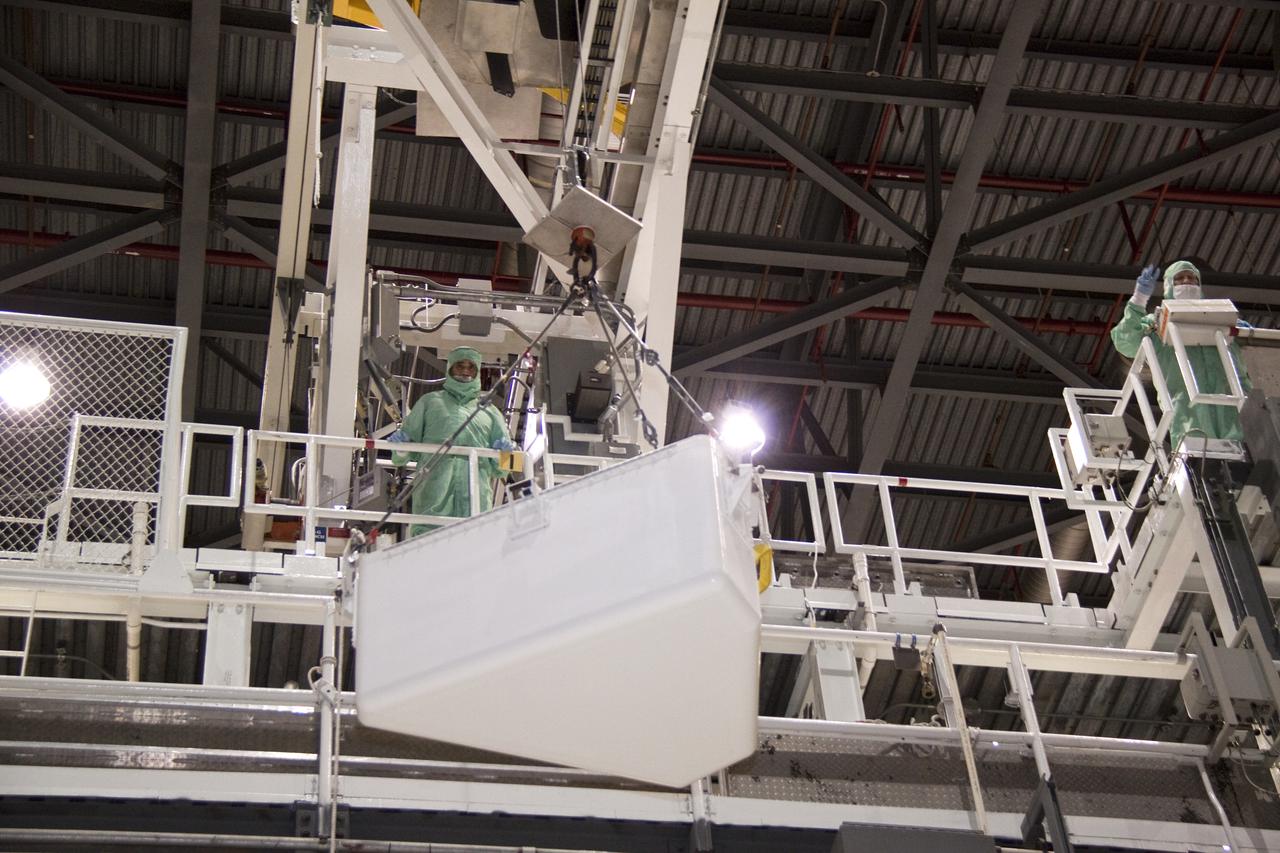
CAPE CANAVERAL, Fla. – In Orbiter Processing Facility-1 at NASA's Kennedy Space Center in Florida, workers dressed in clean room attire, known as bunny suits, monitor the lift by jib crane of the tool stowage assembly. The tool box is being installed into space shuttle Atlantis' payload bay. The assembly contains tools and hardware that will be needed on the extravehicular activities, or spacewalks, conducted during the STS-132 mission. On STS-132, the six-member crew will deliver an Integrated Cargo Carrier and a Russian-built Mini-Research Module to the International Space Station. STS-132 is the 34th mission to the station and the 132nd space shuttle mission. Launch is targeted for May 14. For information on the STS-132 mission, visit http:__www.nasa.gov_mission_pages_shuttle_shuttlemissions_sts132_index.html. Photo credit: NASA_Jack Pfaller
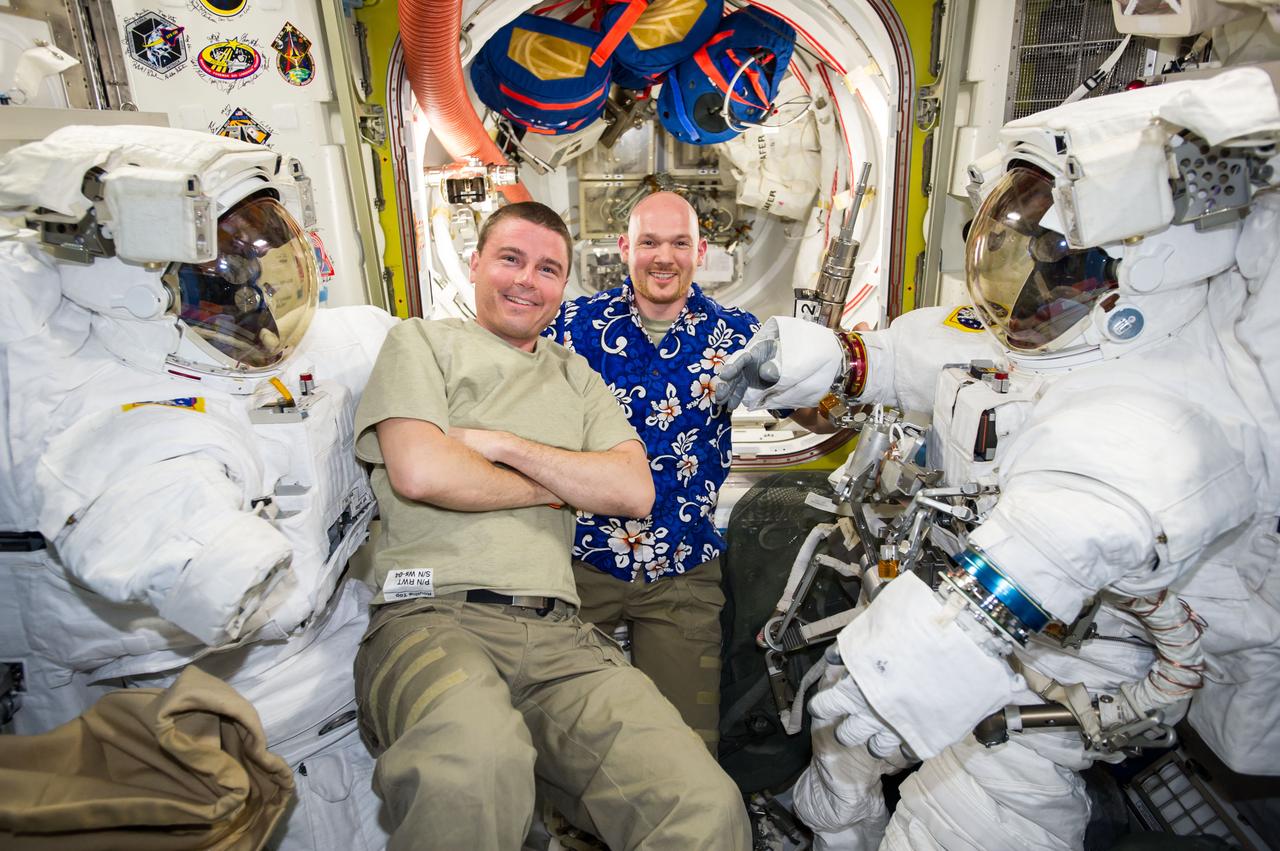
ISS041-E-017047 (19 Sept. 2014) --- NASA astronaut Reid Wiseman (left) and European Space Agency astronaut Alexander Gerst, both Expedition 41 flight engineers, take a moment to pose for a photo with two Extravehicular Mobility Unit (EMU) spacesuits in the Quest airlock of the International Space Station while preparing for two spacewalks scheduled in October 2014.
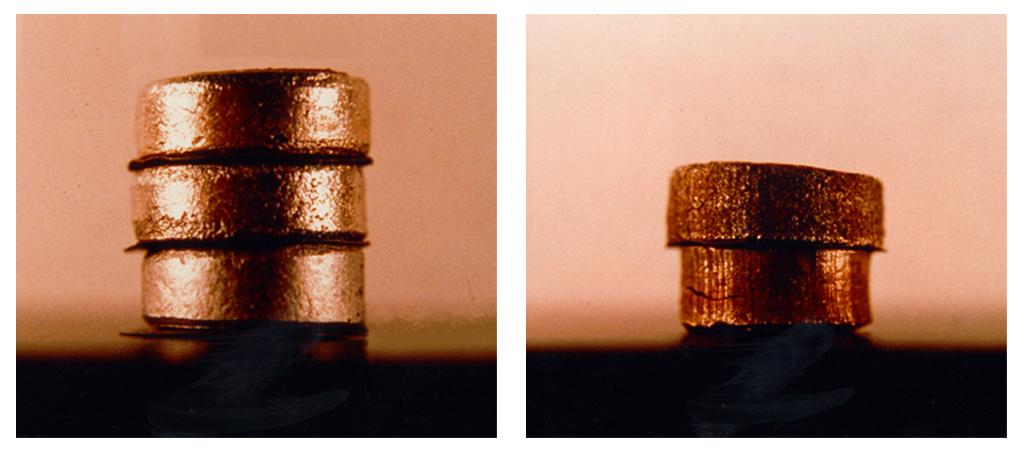
Industry spends billions of dollars each year on machine tools to manufacture products out of metal. This includes tools for cutting every kind of metal part from engine blocks to Shuttle main engine components. Cutting tool tips often break because of weak spots or defects in their composition. Based on a new concept called defect trapping, space offers a novel environment to study defect formation in molten metal materials as they solidify. After the return of these materials from space, researchers can evaluate the source of the defect and seek ways to eliminate them in products prepared on Earth. A widely used process for cutting tip manufacturing is liquid phase sintering. Compared to Earth-sintered samples which slump due to buoyancy induced by gravity, space samples are uniformly shaped and defects remain where they are formed. By studying metals sintered in space the US tool industry can potentially enhance its worldwide competitiveness. The Consortium for Materials Development in Space along with Wyle Labs, Teledyne Advanced Materials, and McDornell Douglas have conducted experiments in space.
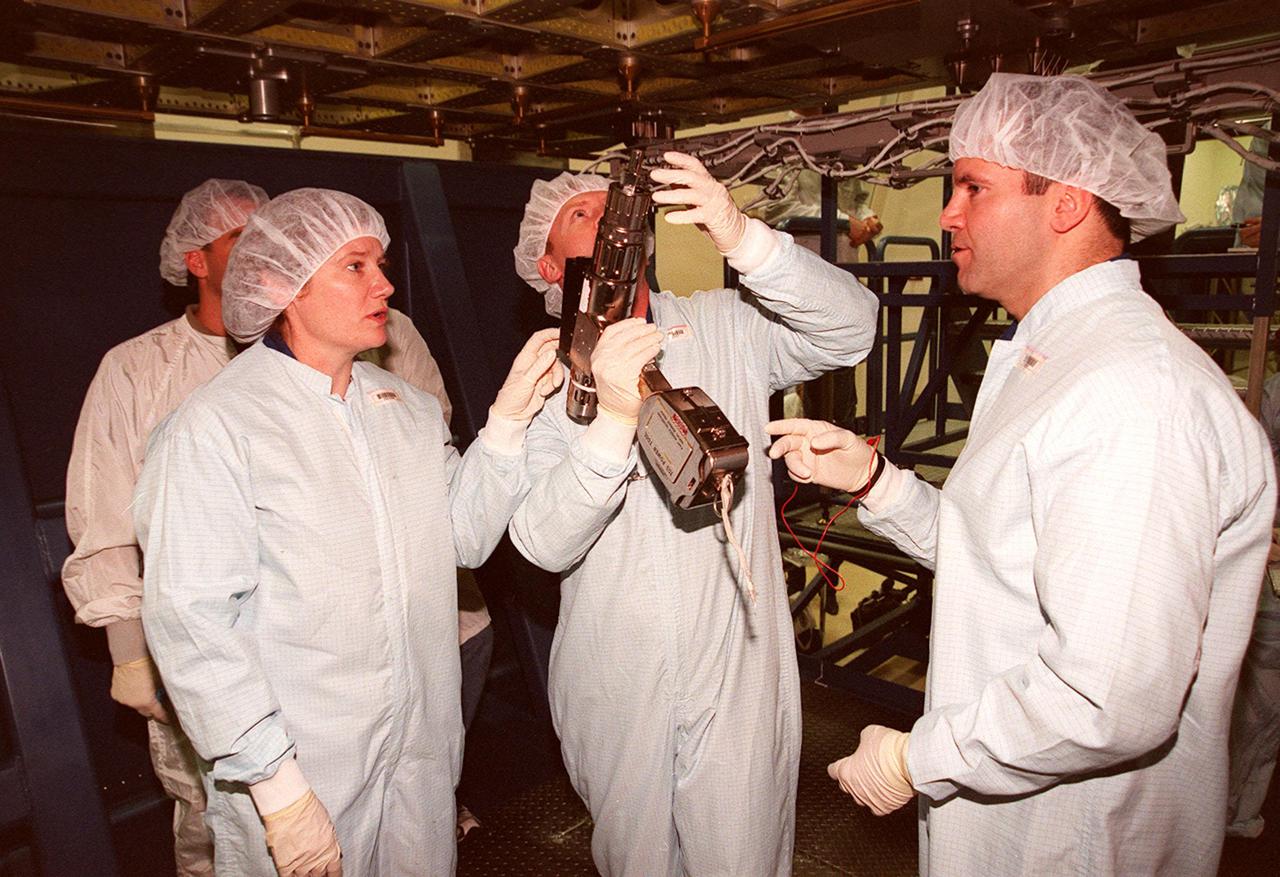
KENNEDY SPACE CENTER, FLA. -- At SPACEHAB, members of the STS-102 crew get acquainted with tools and equipment they will be using on their mission. Mission Specialist Andrew S.W. Thomas (center) practices using one of the tools while Mission Specialist Paul W. Richards (right) and Expedition Two’s Susan Helms look on. They and other crew members are at SPACEHAB to get acquainted with tools and equipment they will be using on their mission. STS-102 is the 8th construction flight to the International Space Station and will carry the Multi-Purpose Logistics Module Leonardo. On that flight, Leonardo will be filled with equipment and supplies to outfit the U.S. laboratory module Destiny. The mission will also be carrying the Expedition Two crew to the Space Station, replacing the Expedition One crew who will return on Shuttle Discovery. STS-102 is scheduled for launch March 8, 2001
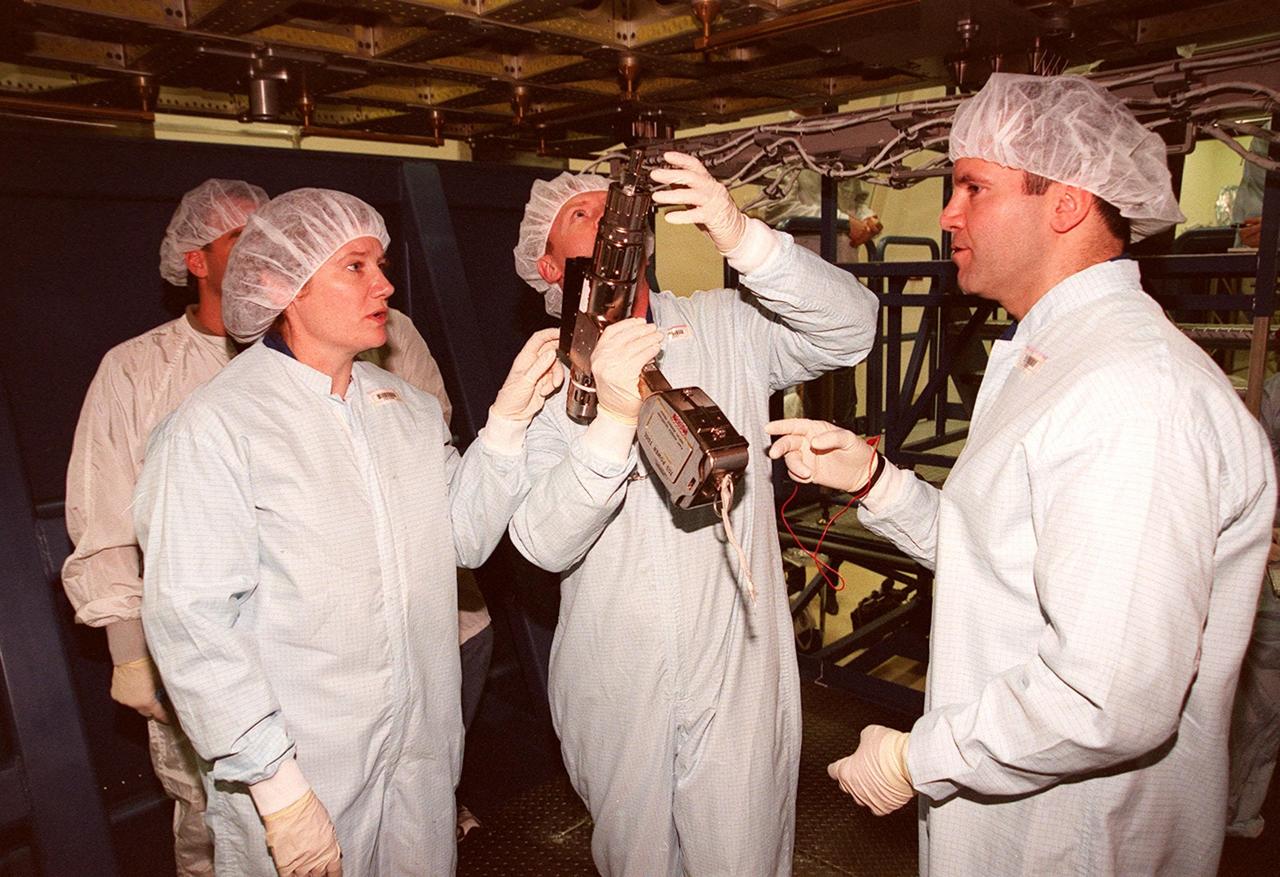
KENNEDY SPACE CENTER, FLA. -- At SPACEHAB, members of the STS-102 crew get acquainted with tools and equipment they will be using on their mission. Mission Specialist Andrew S.W. Thomas (center) practices using one of the tools while Mission Specialist Paul W. Richards (right) and Expedition Two’s Susan Helms look on. They and other crew members are at SPACEHAB to get acquainted with tools and equipment they will be using on their mission. STS-102 is the 8th construction flight to the International Space Station and will carry the Multi-Purpose Logistics Module Leonardo. On that flight, Leonardo will be filled with equipment and supplies to outfit the U.S. laboratory module Destiny. The mission will also be carrying the Expedition Two crew to the Space Station, replacing the Expedition One crew who will return on Shuttle Discovery. STS-102 is scheduled for launch March 8, 2001
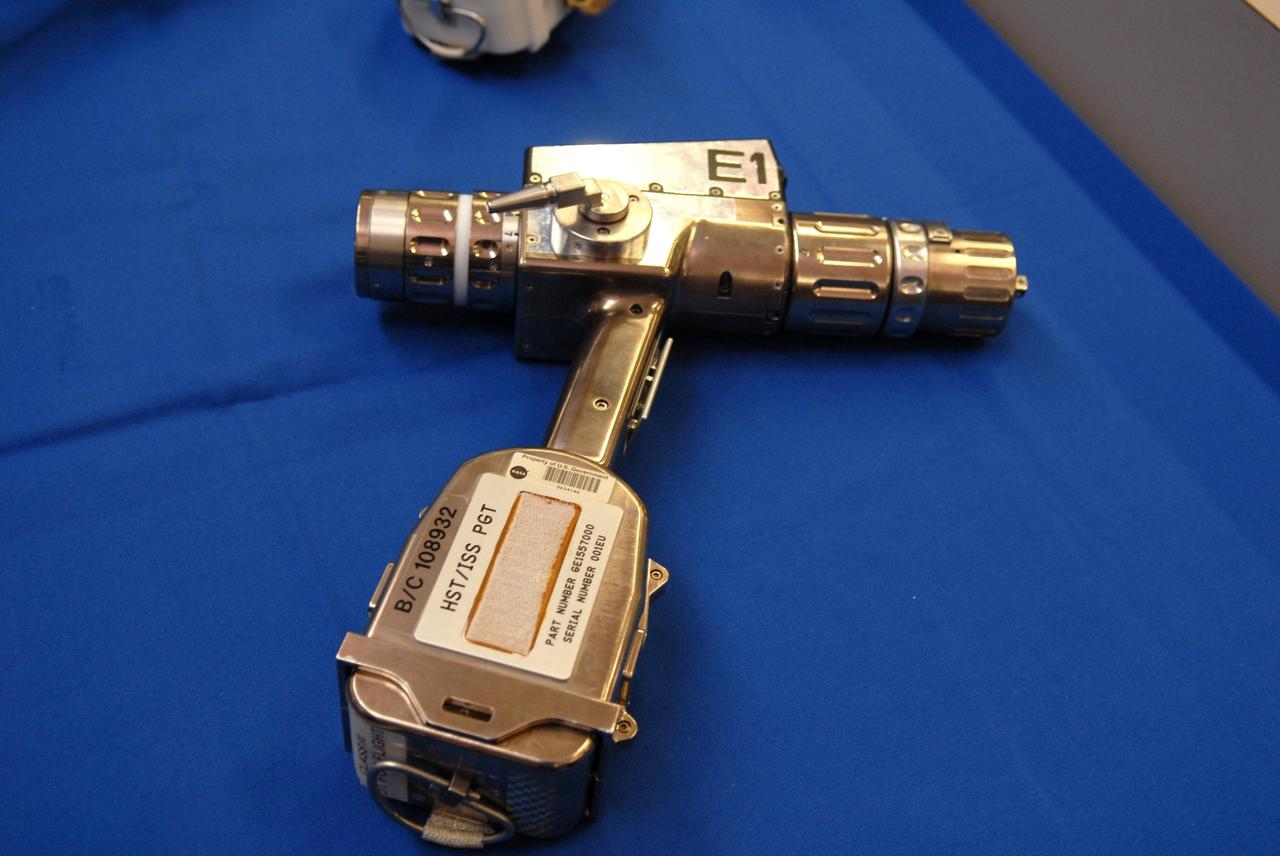
CAPE CANAVERAL, Fla. – The tools that will be used to service NASA's Hubble Space Telescope on the STS-125 mission are displayed in the NASA News Center at NASA's Kennedy Space Center in Florida. This is a closeup of the pistol grip tool that can install and remove instruments, drive latches and open doors. A self-contained, high-torque drive, the tool features an on-board computer that permits users to tailor its performance to the mission demands. On space shuttle Atlantis’ STS-125 mission, Hubble will be serviced for the fifth and final time. The flight will include five spacewalks during which astronauts will refurbish and upgrade the telescope with these state-of-the-art science instruments. As a result, Hubble's capabilities will be expanded and its operational lifespan extended through at least 2014. The payload includes a Wide Field Camera 3, fine guidance sensor and the Cosmic Origins Spectrograph. Launch is scheduled for 2:01 p.m. EDT May 11. Photo credit: NASA/Jack Pfaller
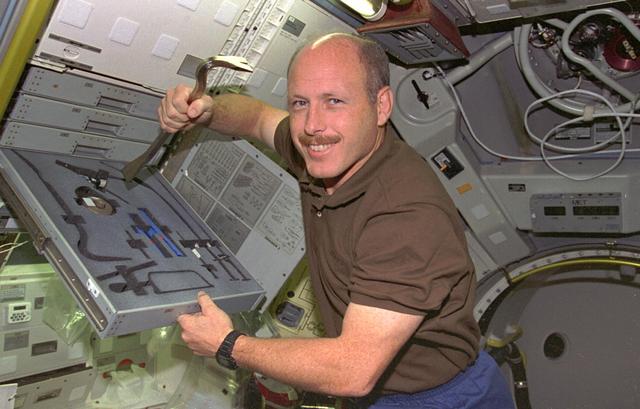
STS073-351-024 (20 October - 5 November 1995) --- Astronaut Kenneth D. Bowersox, STS-73 mission commander, retrieves a crow bar from a tool set onboard the science module in the cargo bay of the Earth-orbiting Space Shuttle Columbia. Various tools were available for a variety of in-flight maintenance tasks for the crew to carry out during the 16-day United States Microgravity Laboratory (USML-2) mission.
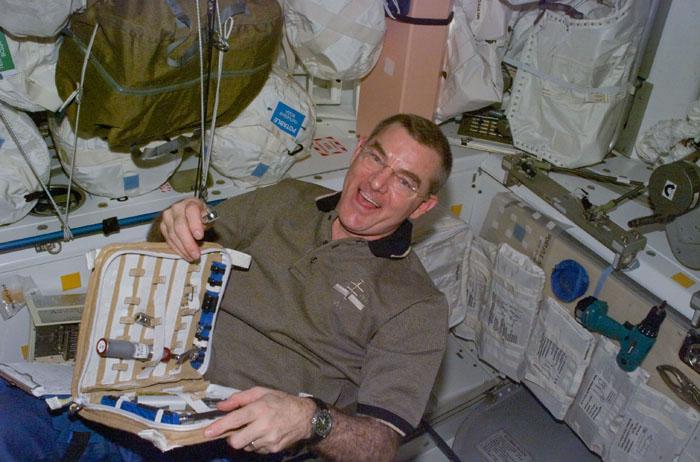
STS105-E-5175 (13 August 2001) --- Astronaut James S. Voss, retrieves a small tool from a tool case in the U.S.-built Unity node aboard the International Space Station (ISS). The Expedition Two flight engineer is only days away from returning to Earth following five months aboard the orbital outpost. The image was recorded with a digital still camera.
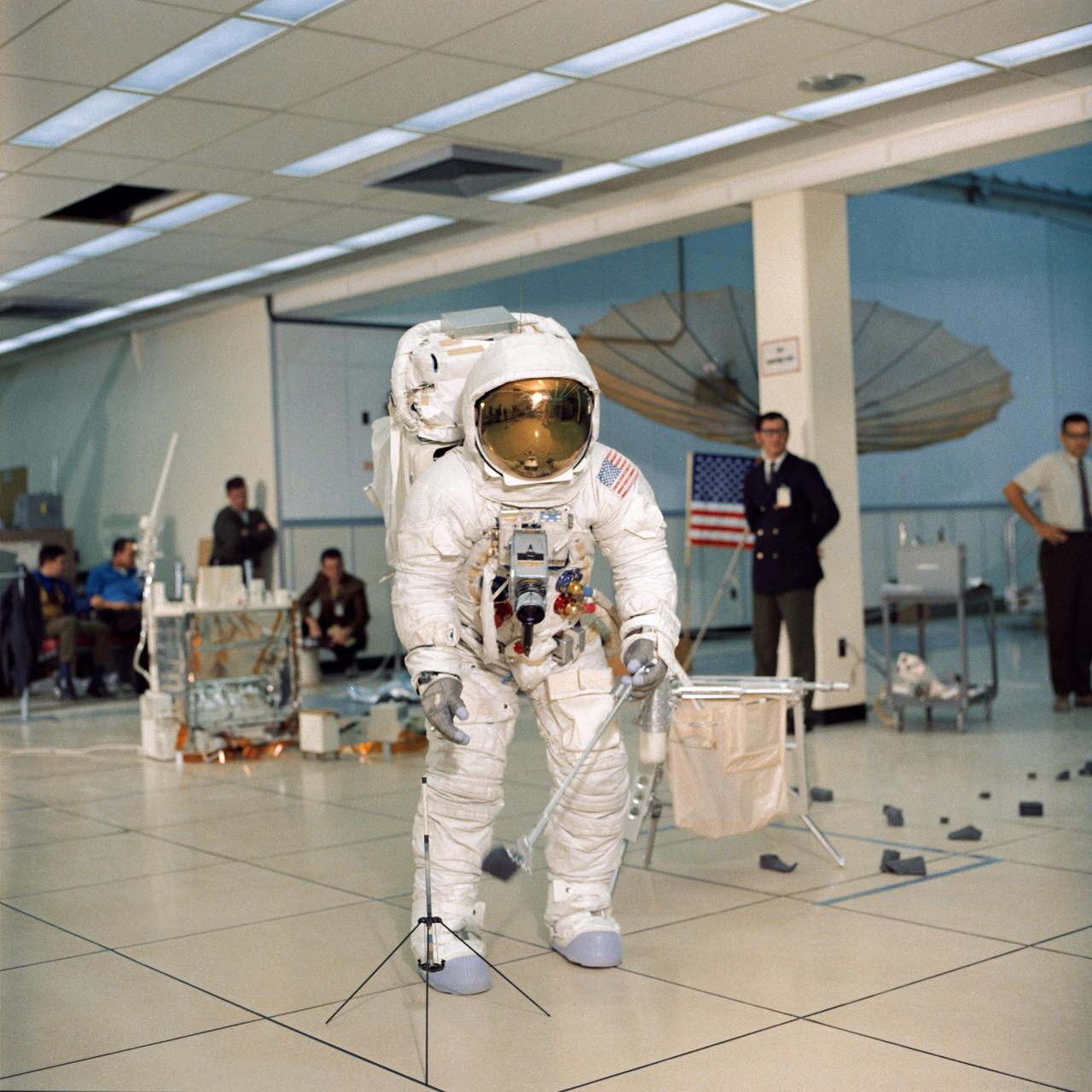
S70-27037 (4 Feb. 1970) --- Astronaut James A. Lovell Jr., commander of the Apollo 13 lunar landing mission, simulates lunar surface extravehicular activity during training exercises in the Kennedy Space Center’s Flight Crew Training Building. Lovell, wearing an Extravehicular Mobility Unit (EMU), is holding an Apollo Lunar Hand Tool (a set of tongs) in his left hand. A gnomon is in front of his right foot. A tool carrier is in the right background.
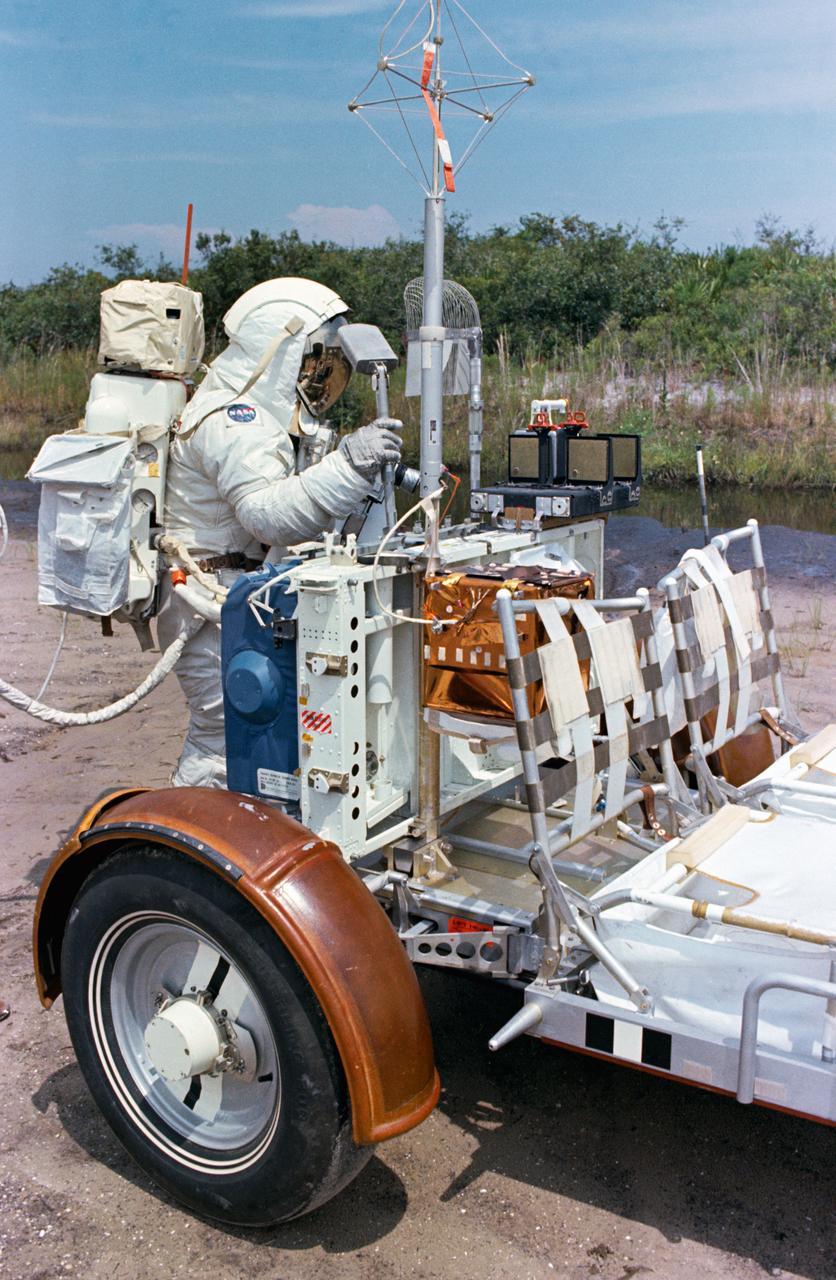
S72-48890 (September 1972) --- Scientist-astronaut Harrison H. Schmitt, lunar module pilot of the Apollo 17 lunar landing mission, procures a geological hand tool from the tool carrier at the aft end of the Lunar Roving Vehicle during lunar surface extravehicular activity simulation training at the Kennedy Space Center (KSC), Florida. Schmitt grasps a scoop with extension handle in his right hand.
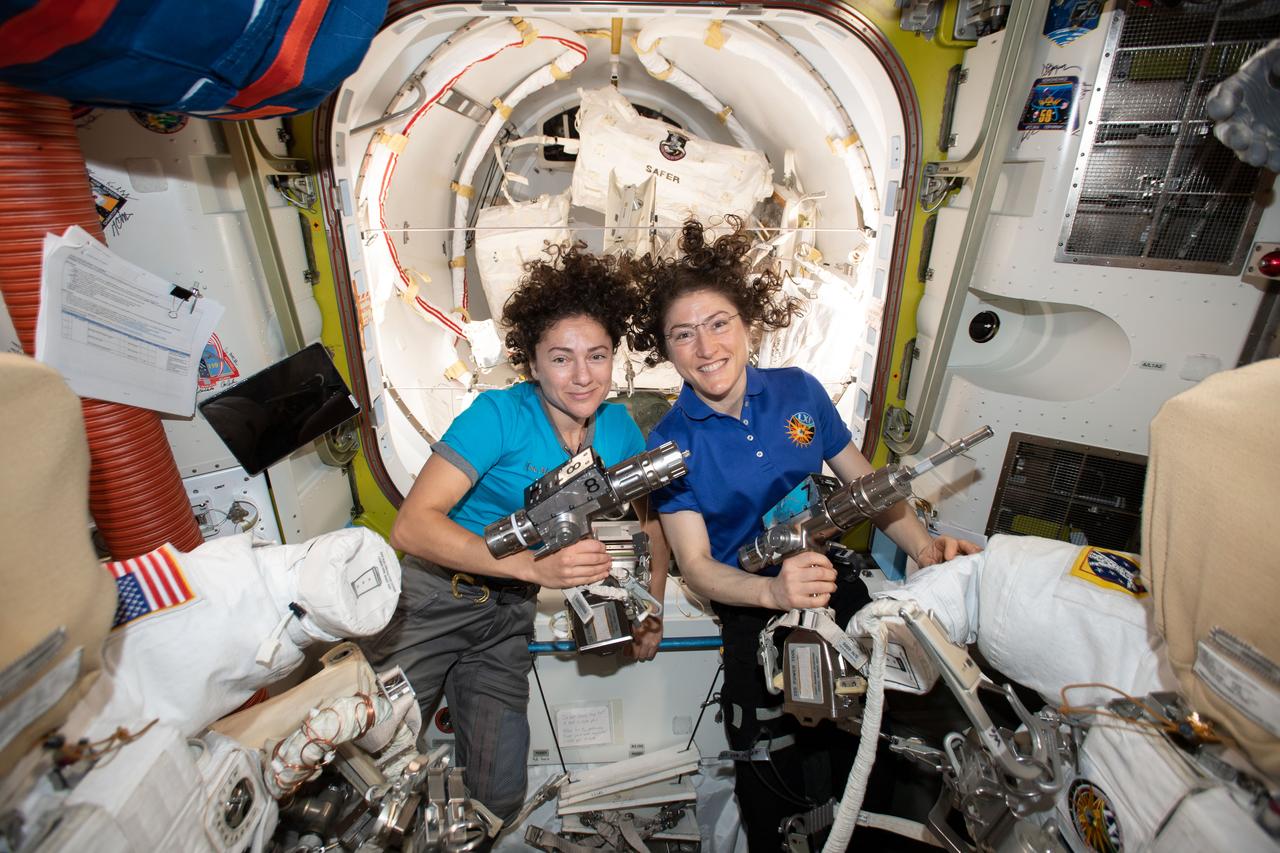
iss061e006501 (Oct. 15, 2019) --- NASA astronauts Jessica Meir (left) and Christina Koch are inside the Quest airlock preparing the U.S. spacesuits and tools they will use on their first spacewalk together. The Expedition 61 flight engineers are holding the pistol grip tools they will use to swap out a failed power controller, also known as a battery charge-discharge unit, that regulates the charge to batteries that collect and distribute power to the International Space Station.
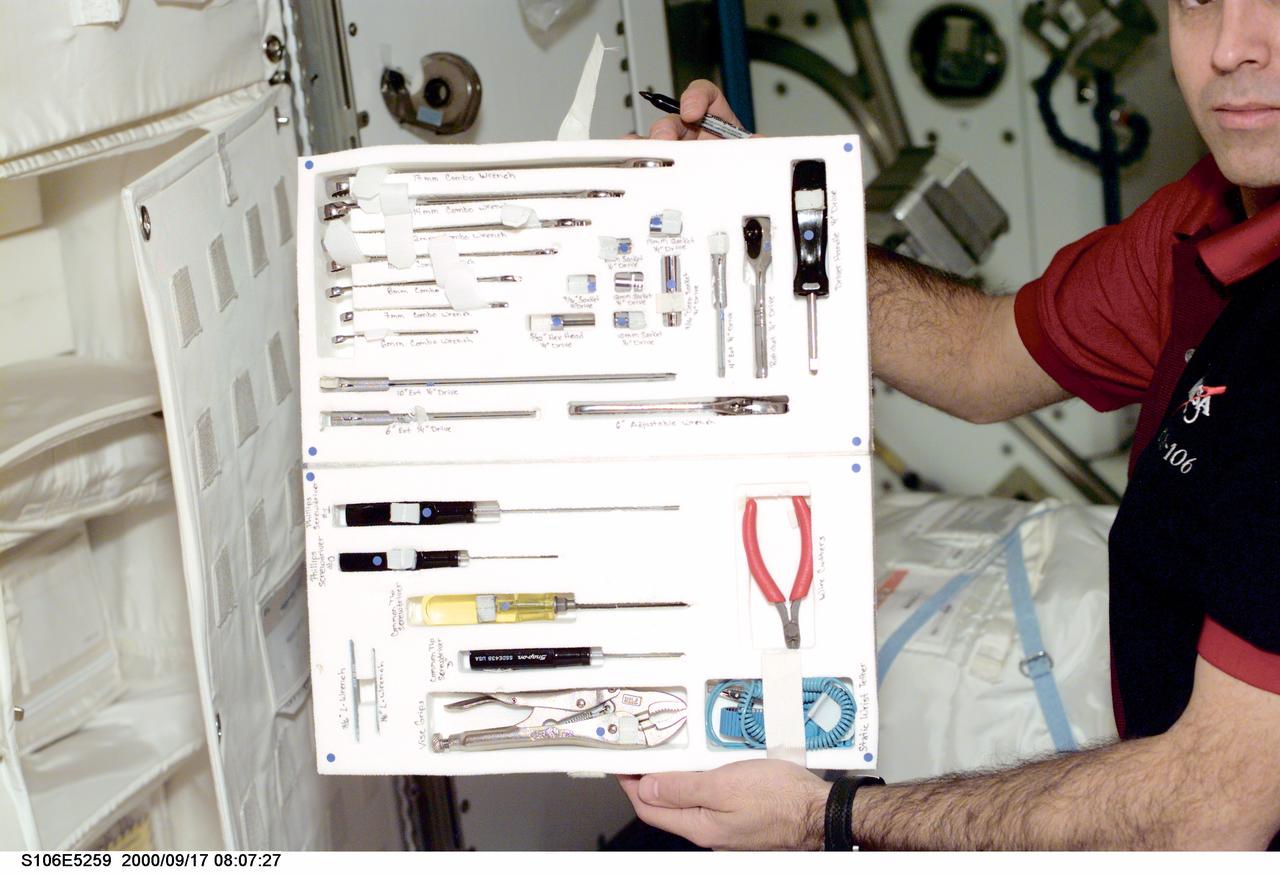
S106-E-5259 (17 September 2000) --- Tools that look much like those that you might find in any residential garage are being left onboard the International Space Station (ISS) for its future residents. Holding this set is astronaut Richard A. Mastracchio, partially out of frame. As any "handy person" will tell you, a variety of basic tools are a life-saver when any one of a number of contingencies arise.
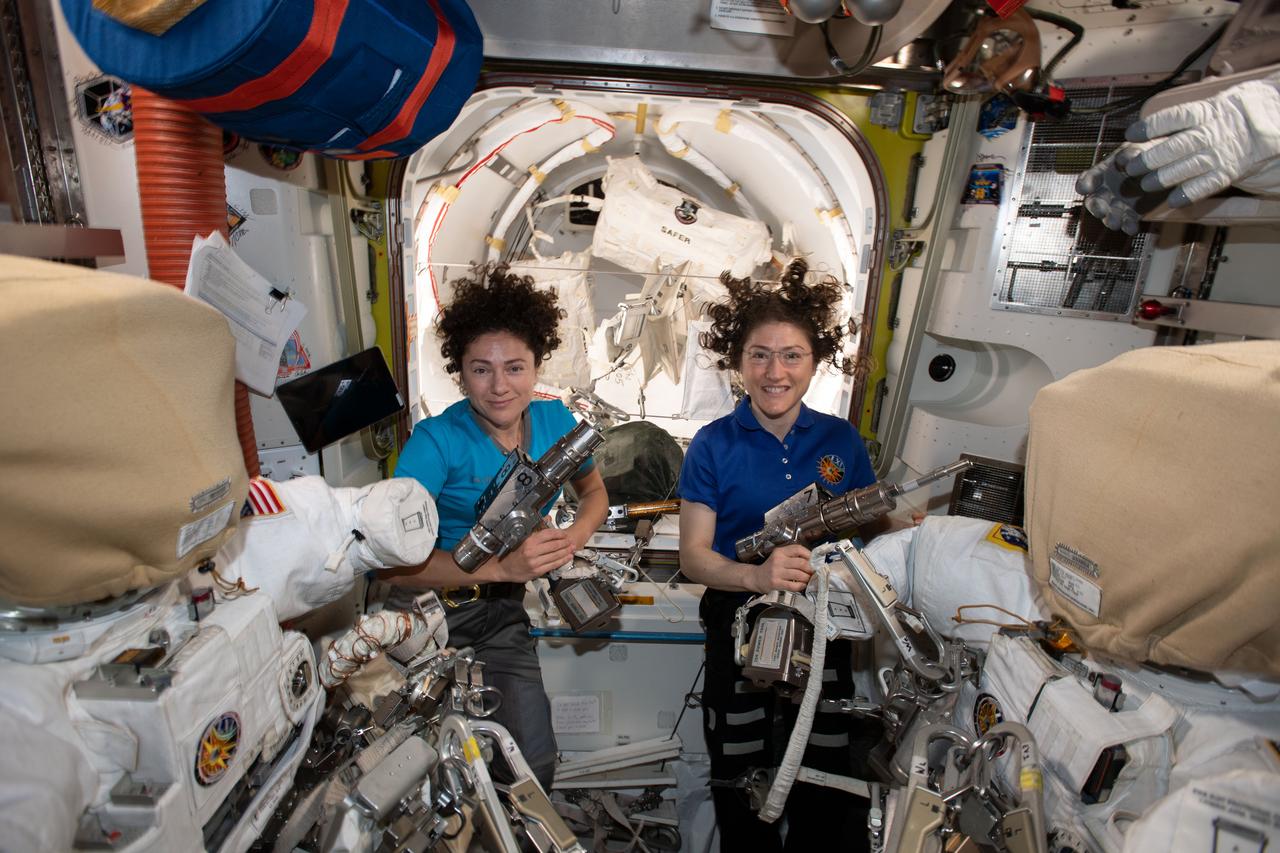
iss061e006498 (Oct. 15, 2019) --- NASA astronauts Jessica Meir (left) and Christina Koch are inside the Quest airlock preparing the U.S. spacesuits and tools they will use on their first spacewalk together. The Expedition 61 flight engineers are holding the pistol grip tools they will use to swap out a failed power controller, also known as a battery charge-discharge unit, that regulates the charge to batteries that collect and distribute power to the International Space Station.
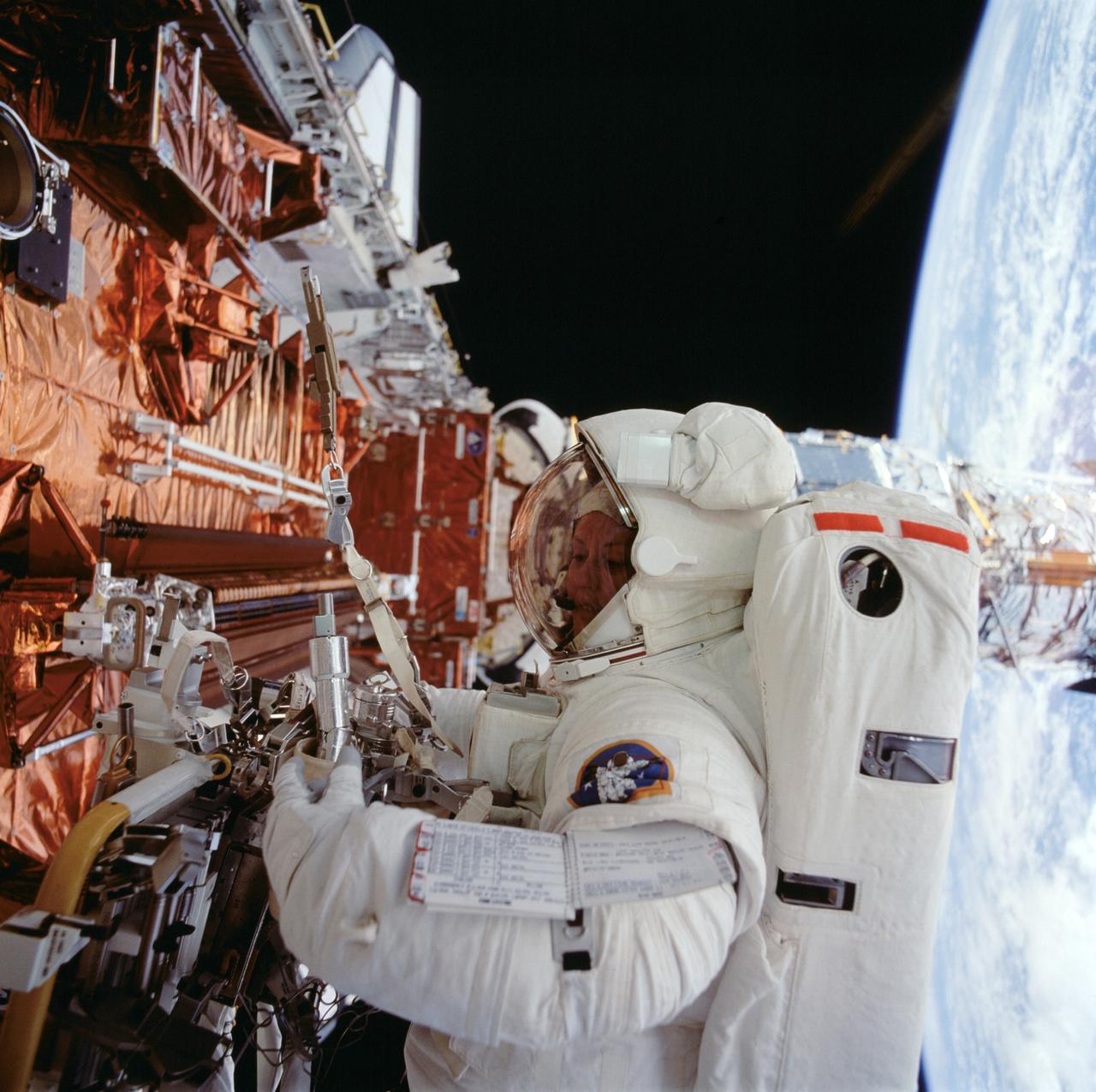
STS061-098-000K (8 Dec. 1993) --- Astronaut Kathryn C. Thornton works with equipment associated with servicing chores on the Hubble Space Telescope (HST) during the fourth extravehicular activity (EVA) on the eleven-day mission.
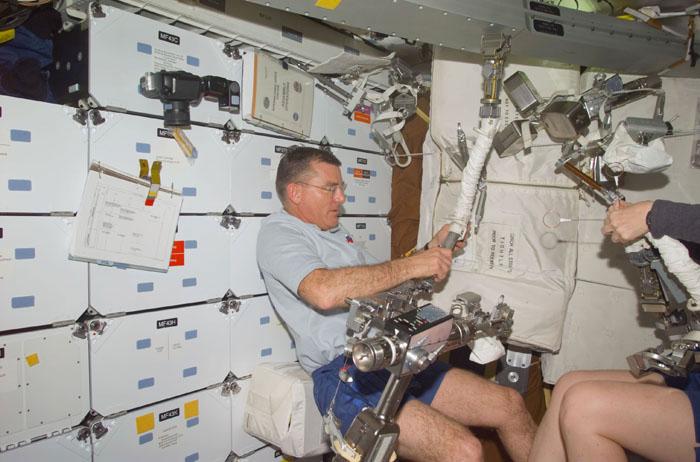
STS102-E-5032 (9 March 2001) --- On Discovery's mid deck, astronauts James S. Voss and Susan J. Helms (partially visible at right edge), STS-102 mission specialists, check gear associated with a scheduled space walk to perform work on the International Space Station (ISS). At the time this Flight Day 1 digital still camera image was exposed, the Discovery was on a time line to catch the orbital outpost and link with it during Flight Day 2.
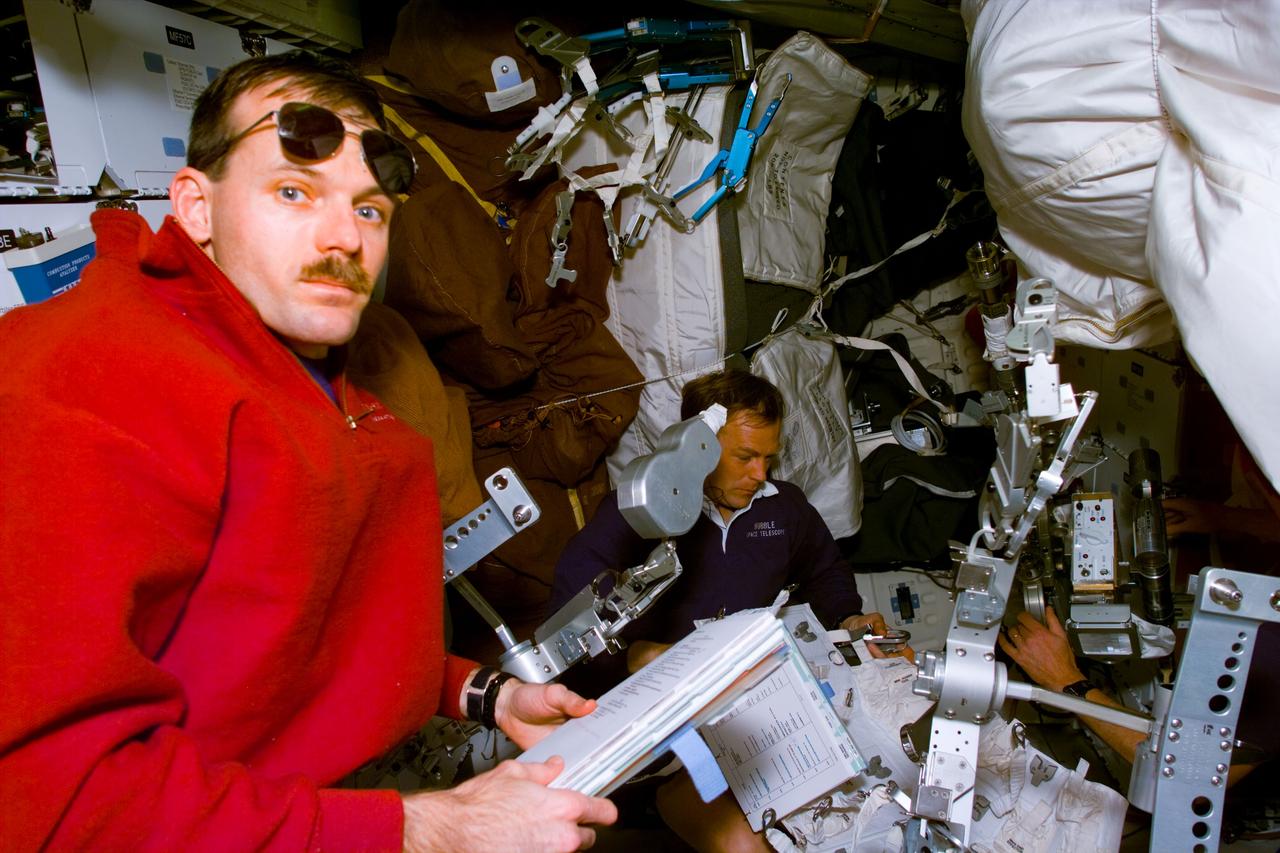
S82-E-5005 (12 Feb. 1997) --- Aboard the Earth-orbiting the Space Shuttle Discovery, astronauts Steven L. Smith (foreground), STS-82 mission specialist, and Mark C. Lee, payload commander, busy themselves with preparations for Extravehicular Activities (EVA) scheduled later in the week. This view was taken with an Electronic Still Camera (ESC).
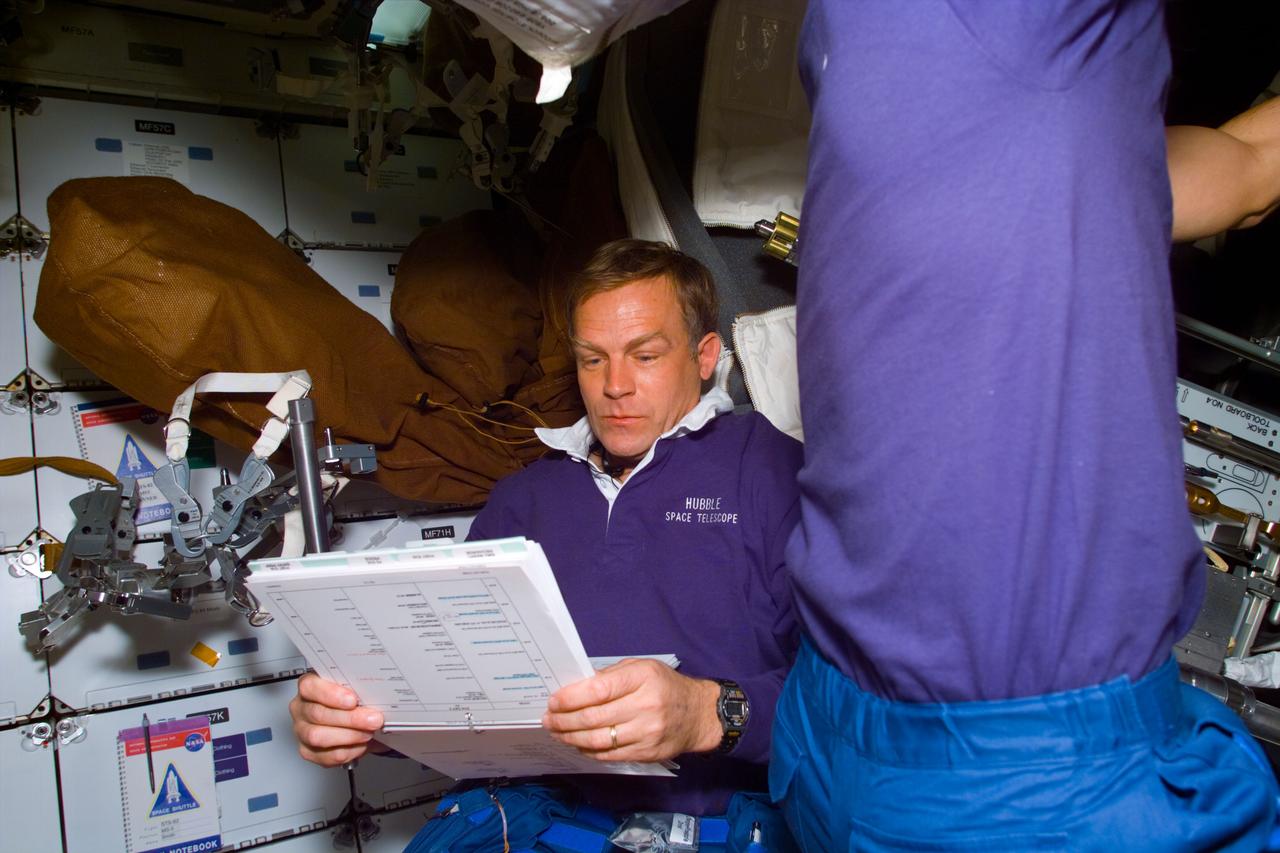
S82-E-5002 (12 Feb. 1997) --- On the Space Shuttle Discovery's middeck, STS-82 payload commander Mark C. Lee looks over plan for the first space Extravehicular Activity (EVA) as an unidentified crew mate (right) unstows a piece of related gear. Four of the crew members will perform a series of EVA's to service the Hubble Space Telescope (HST). This photograph (as well as the others in this series) was recorded with an Electronic Still Camera (ESC) late during Discovery's first full day in orbit and downlinked later to flight controllers in Houston, Texas.
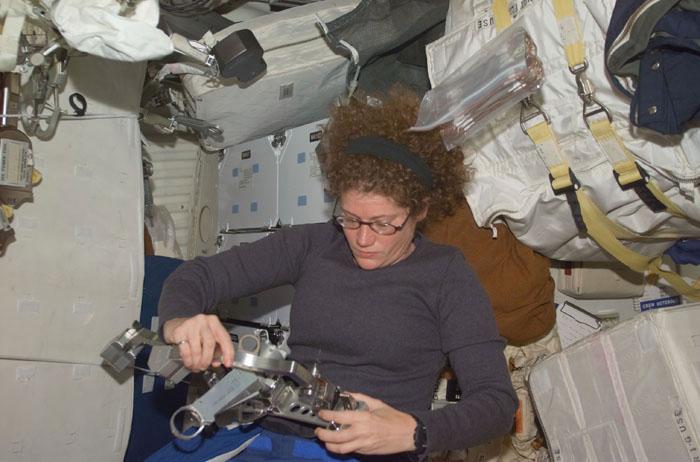
STS102-E-5031 (9 March 2001) --- On Discovery's mid deck, astronaut Susan J. Helms, STS-102 mission specialist, checks gear associated with her upcoming space walk.
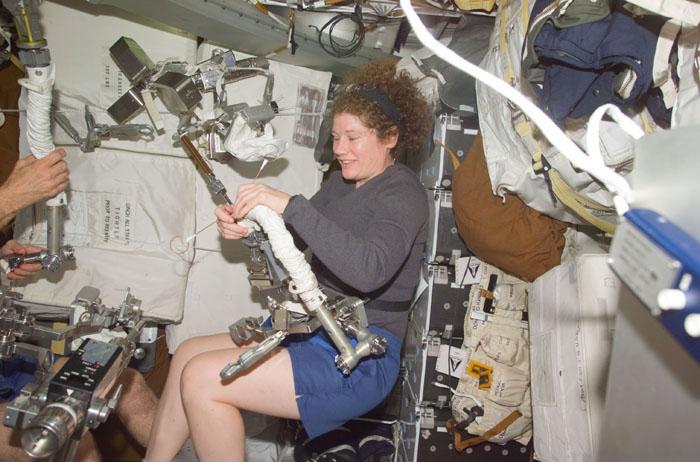
STS102-E-5033 (9 March 2001) --- On Discovery's mid deck, astronaut Susan J. Helms, STS-102 mission specialist, checks gear associated with her upcoming space walk.
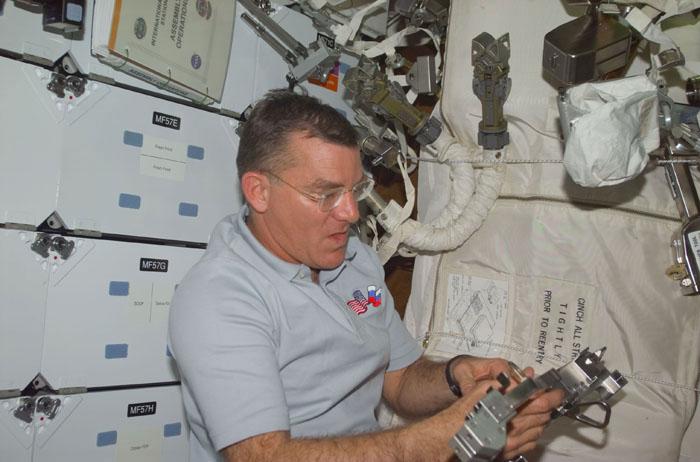
STS102-E-5030 (9 March 2001) --- Astronaut James S. Voss, mission specialist, scheduled for space walk duty in less than two days, looks over gear on the mid deck of the Earth-orbiting Space Shuttle Discovery.
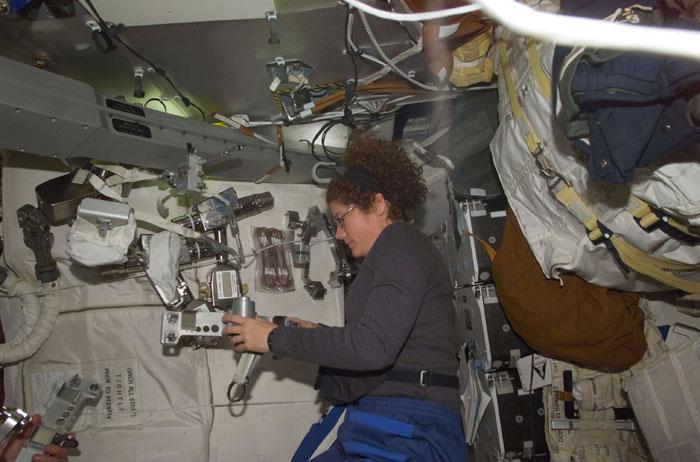
STS102-E-5029 (9 March 2001) --- Astronaut Susan J. Helms, STS-102 mission specialist, checks out some of the space walk gear during Flight Day 1 activity on the mid deck of the Space Shuttle Discovery. Helms is less than two days away from participation in extravehicular activity (EVA). She will later be part of a three-member crew that will replace the Expedition One crew which has been aboard the International Space Station (ISS) since early November 2000.
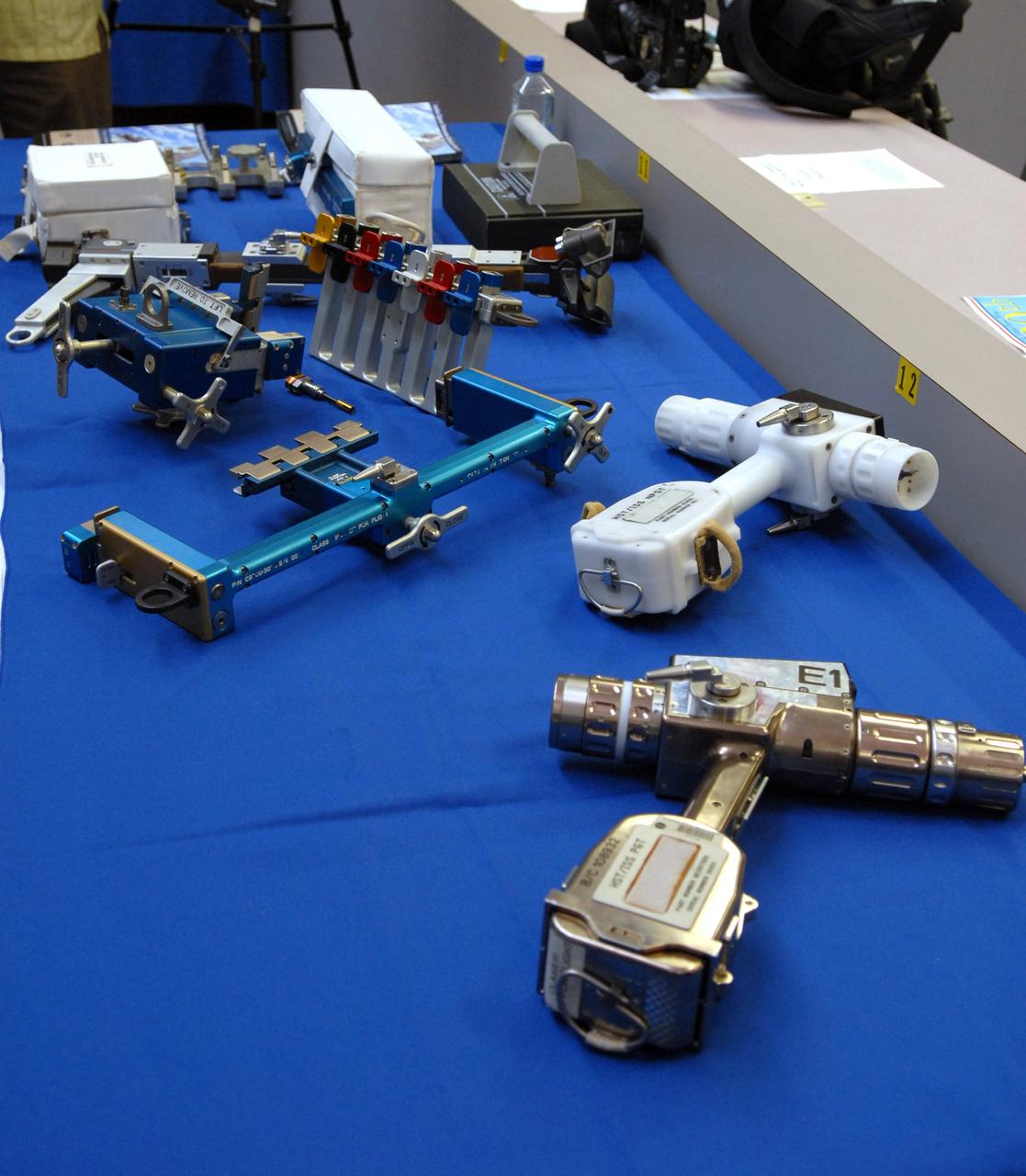
CAPE CANAVERAL, Fla. – The tools that will be used to service NASA's Hubble Space Telescope on the STS-125 mission are displayed in the NASA News Center at NASA's Kennedy Space Center in Florida. In the foreground is the pistol grip tool. It can install and remove instruments, drive latches and open doors. A self-contained, high-torque drive, the tool features an on-board computer that permits users to tailor its performance to the mission demands. Behind it is the plastic version used by astronauts during practice in the water tank at NASA' Johnson Space Center. At center left are the card extraction and insertion tools to enable removal of electronic cards. And behind those is the bit caddy. On space shuttle Atlantis’ STS-125 mission, Hubble will be serviced for the fifth and final time. The flight will include five spacewalks during which astronauts will refurbish and upgrade the telescope with these state-of-the-art science instruments. As a result, Hubble's capabilities will be expanded and its operational lifespan extended through at least 2014. The payload includes a Wide Field Camera 3, fine guidance sensor and the Cosmic Origins Spectrograph. Launch is scheduled for 2:01 p.m. EDT May 11. Photo credit: NASA/Jack Pfaller
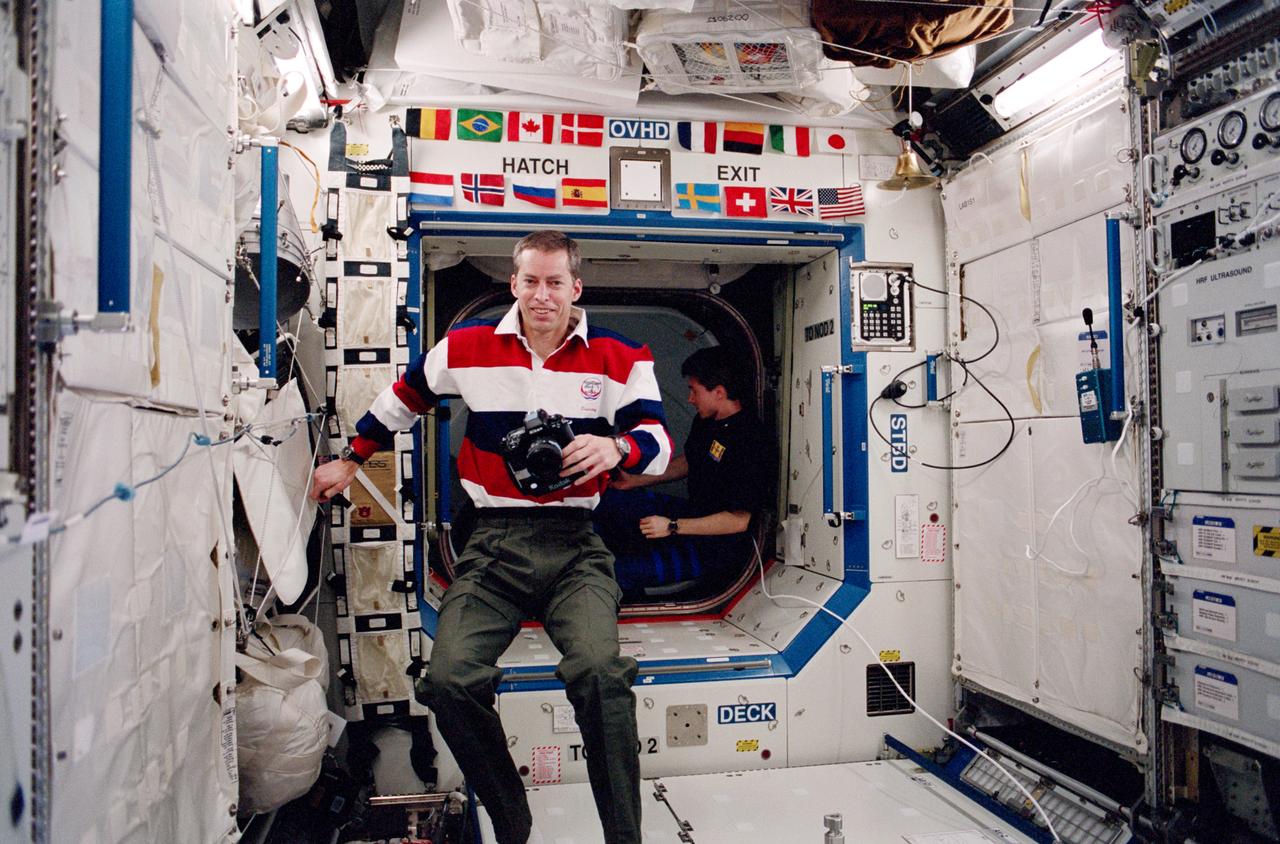
In this Space Shuttle STS-102 mission image, the Payload Equipment Restraint System H-Strap is shown at the left side of the U.S. Laboratory hatch and behind Astronaut James D. Weatherbee, mission specialist. PERS is an integrated modular system of components designed to assist the crew of the International Space Station (ISS) in restraining and carrying necessary payload equipment and tools in a microgravity environment. The Operations Development Group, Flight Projects Directorate at the Marshall Space Flight Center (MSFC), while providing operation support to the ISS Materials Science Research Facility (MSRF), recognized the need for an on-orbit restraint system to facilitate control of lose objects, payloads, and tools. The PERS is the offspring of that need and it helps the ISS crew manage tools and rack components that would otherwise float away in the near-zero gravity environment aboard the Space Station. The system combines Kevlar straps, mesh pockets, Velcro and a variety of cornecting devices into a portable, adjustable system. The system includes the Single Strap, the H-Strap, the Belly Pack, the Laptop Restraint Belt, and the Tool Page Case. The Single Strap and the H-Strap were flown on this mission. The PERS concept was developed by industrial design students at Auburn University and the MSFC Flight Projects Directorate.
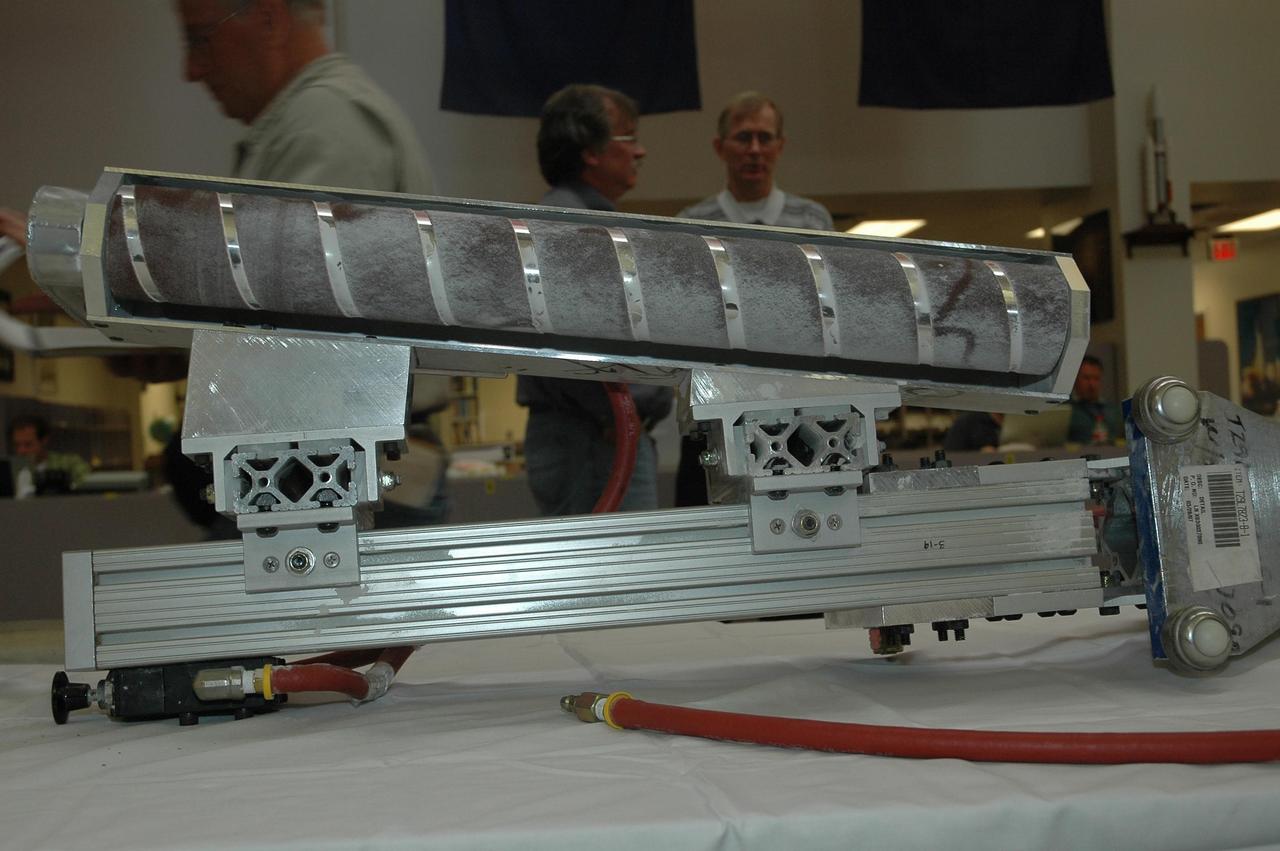
KENNEDY SPACE CENTER, FLA. -- The "pencil sharpener" tool designed to trim the hand-sprayed foam repairs on the STS-117 external tank is on display for the media at the NASA News Center. This portable tool was designed in just 10 days specifically for this task by Lockheed Martin engineer Glenn Lapeyronnie at the Michoud external tank manufacturing facility in New Orleans. The pencil sharpener tool fits over the external tank nose cone spike at the top of the tank and extends down to where the hand-sprayed foam was used to repair the hail-damaged areas. The hail damage was incurred Feb. 28 while Space Shuttle Atlantis was on the launch pad for a March 15 launch. The shuttle returned to the Vehicle Assembly Building so that repairs could be made. Mission STS-117 is scheduled to launch at 7:38 p.m. EDT on June 8. Photo credit: NASA/Jack Pfaller
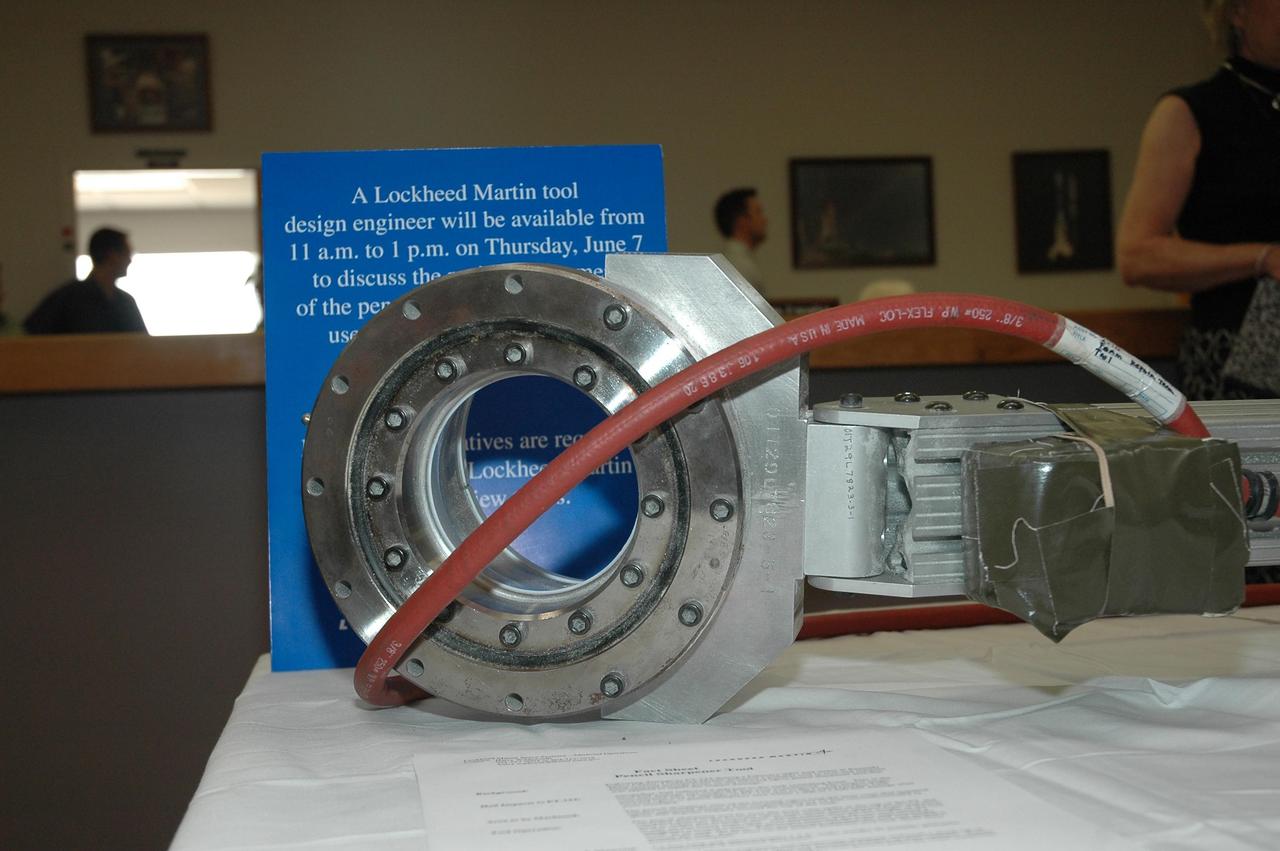
KENNEDY SPACE CENTER, FLA. -- The "pencil sharpener" tool designed to trim the hand-sprayed foam repairs on the STS-117 external tank is on display for the media at the NASA News Center. This portable tool was designed in just 10 days specifically for this task by Lockheed Martin engineer Glenn Lapeyronnie at the Michoud external tank manufacturing facility in New Orleans. The pencil sharpener tool fits over the external tank nose cone spike at the top of the tank and extends down to where the hand-sprayed foam was used to repair the hail-damaged areas. The hail damage was incurred Feb. 28 while Space Shuttle Atlantis was on the launch pad for a March 15 launch. The shuttle returned to the Vehicle Assembly Building so that repairs could be made. Mission STS-117 is scheduled to launch at 7:38 p.m. EDT on June 8. Photo credit: NASA/Jack Pfaller
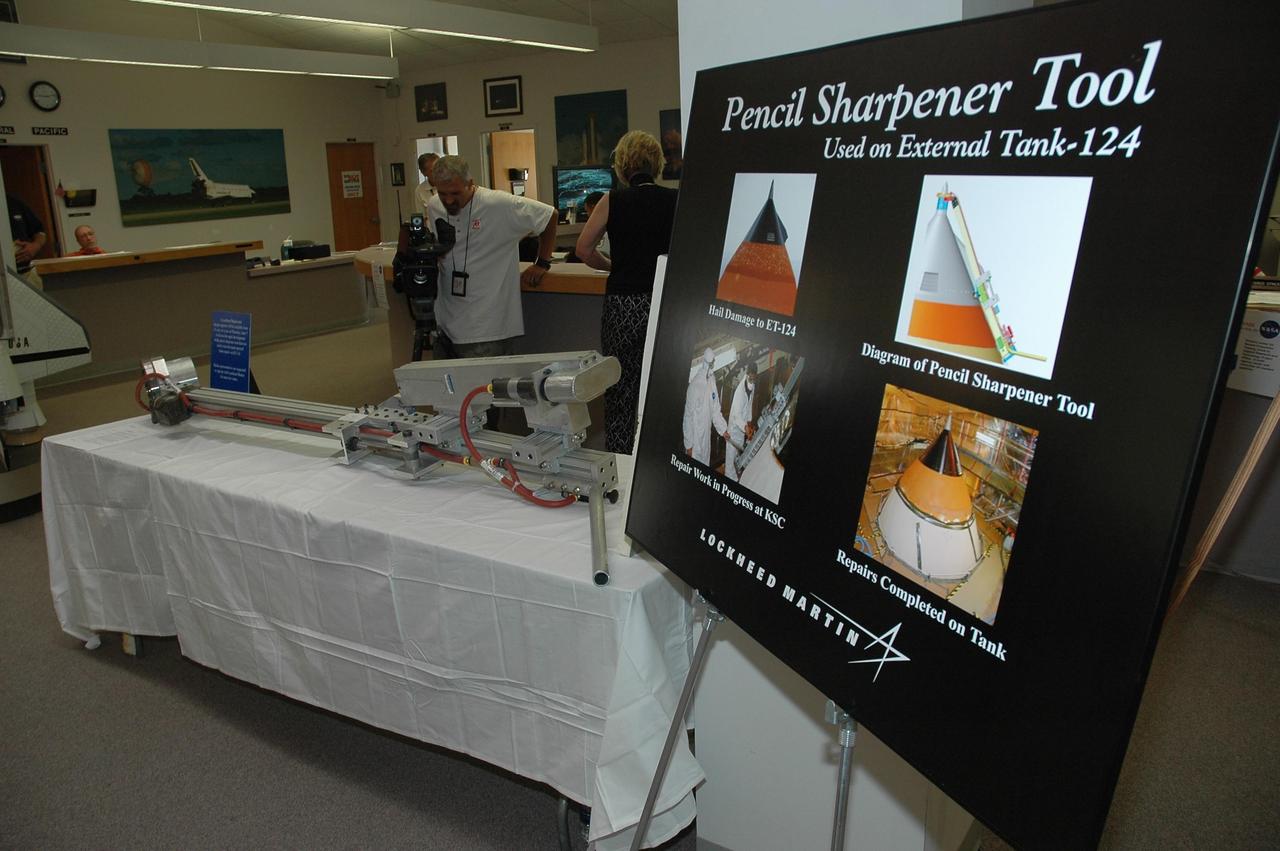
KENNEDY SPACE CENTER, FLA. -- The "pencil sharpener" tool designed to trim the hand-sprayed foam repairs on the STS-117 external tank is on display for the media at the NASA News Center. This portable tool was designed in just 10 days specifically for this task by Lockheed Martin engineer Glenn Lapeyronnie at the Michoud external tank manufacturing facility in New Orleans. The pencil sharpener tool fits over the external tank nose cone spike at the top of the tank and extends down to where the hand-sprayed foam was used to repair the hail-damaged areas. The hail damage was incurred Feb. 28 while Space Shuttle Atlantis was on the launch pad for a March 15 launch. The shuttle returned to the Vehicle Assembly Building so that repairs could be made. Mission STS-117 is scheduled to launch at 7:38 p.m. EDT on June 8. Photo credit: NASA/Jack Pfaller
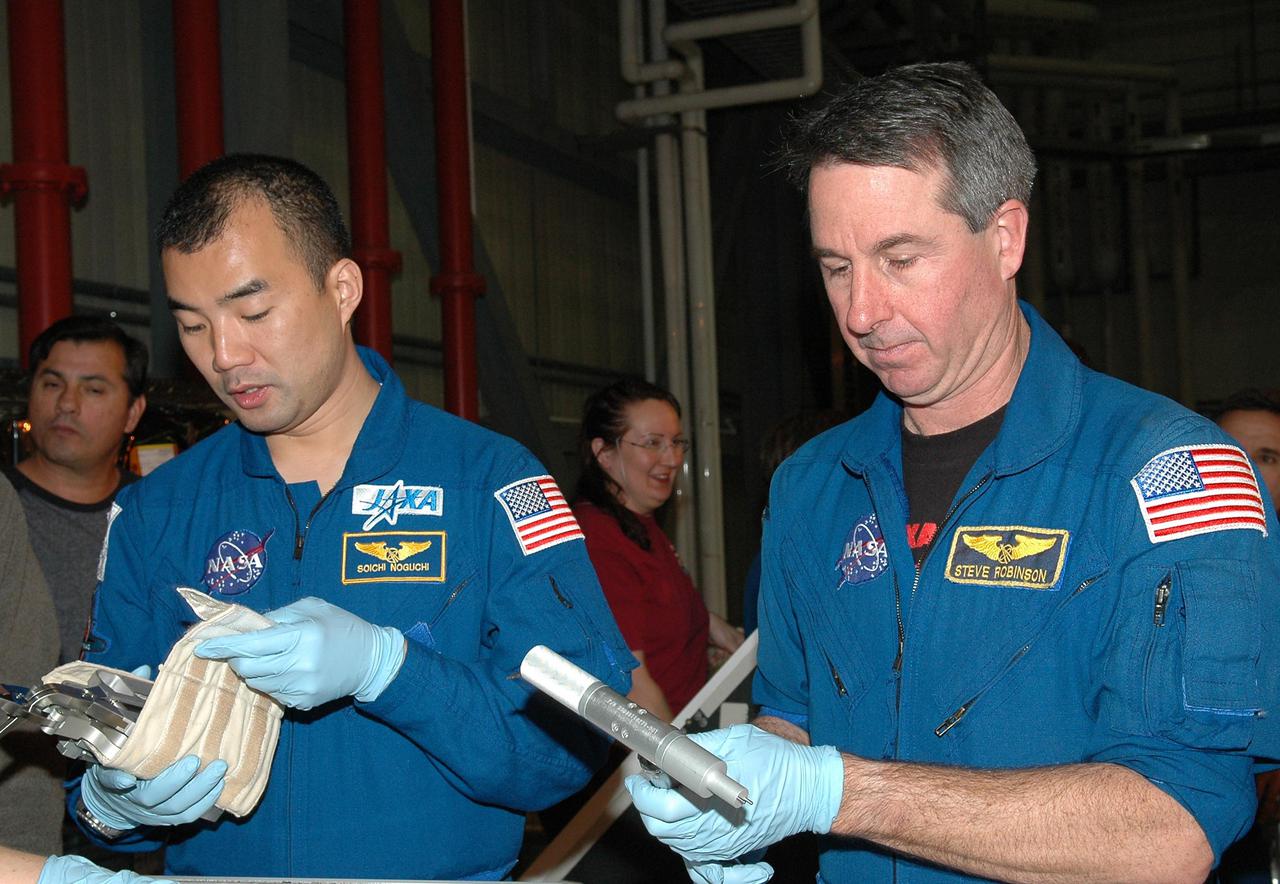
KENNEDY SPACE CENTER, FLA. - In the Orbiter Processing Facility, STS-114 Mission Specialists Soichi Noguchi (left) and Stephen Robinson look at tools from the Tool Stowage Assembly. Robinson is holding the External Tank_umbilical door tool (one that is used if, during an EVA, an astronaut would have to manually close the ET Umbilical doors). The crew is at KSC for Crew Equipment Interface Test activities. During CEIT, the crew has an opportunity to get a hands-on look at the payloads with which they’ll be working on orbit. The Return to Flight mission STS-114 will carry a replacement Control Moment Gyroscope and the Multi-Purpose Logistics Module Raffaello, filled with supplies for the International Space Station. Launch of STS-114 has a launch window of May 12 to June 3.
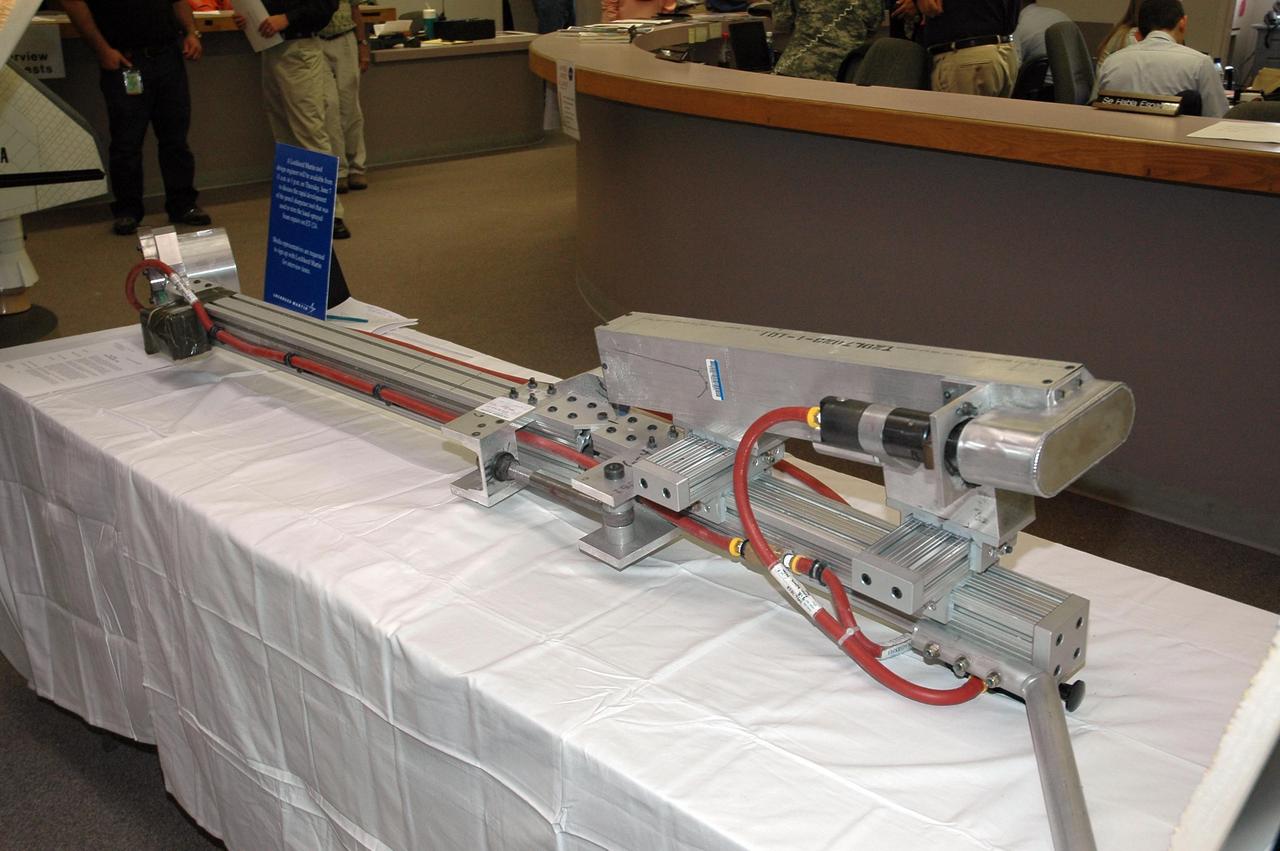
KENNEDY SPACE CENTER, FLA. -- The "pencil sharpener" tool designed to trim the hand-sprayed foam repairs on the STS-117 external tank is on display for the media at the NASA News Center. This portable tool was designed in just 10 days specifically for this task by Lockheed Martin engineer Glenn Lapeyronnie at the Michoud external tank manufacturing facility in New Orleans. The pencil sharpener tool fits over the external tank nose cone spike at the top of the tank and extends down to where the hand-sprayed foam was used to repair the hail-damaged areas. The hail damage was incurred Feb. 28 while Space Shuttle Atlantis was on the launch pad for a March 15 launch. The shuttle returned to the Vehicle Assembly Building so that repairs could be made. Mission STS-117 is scheduled to launch at 7:38 p.m. EDT on June 8. Photo credit: NASA/Jack Pfaller
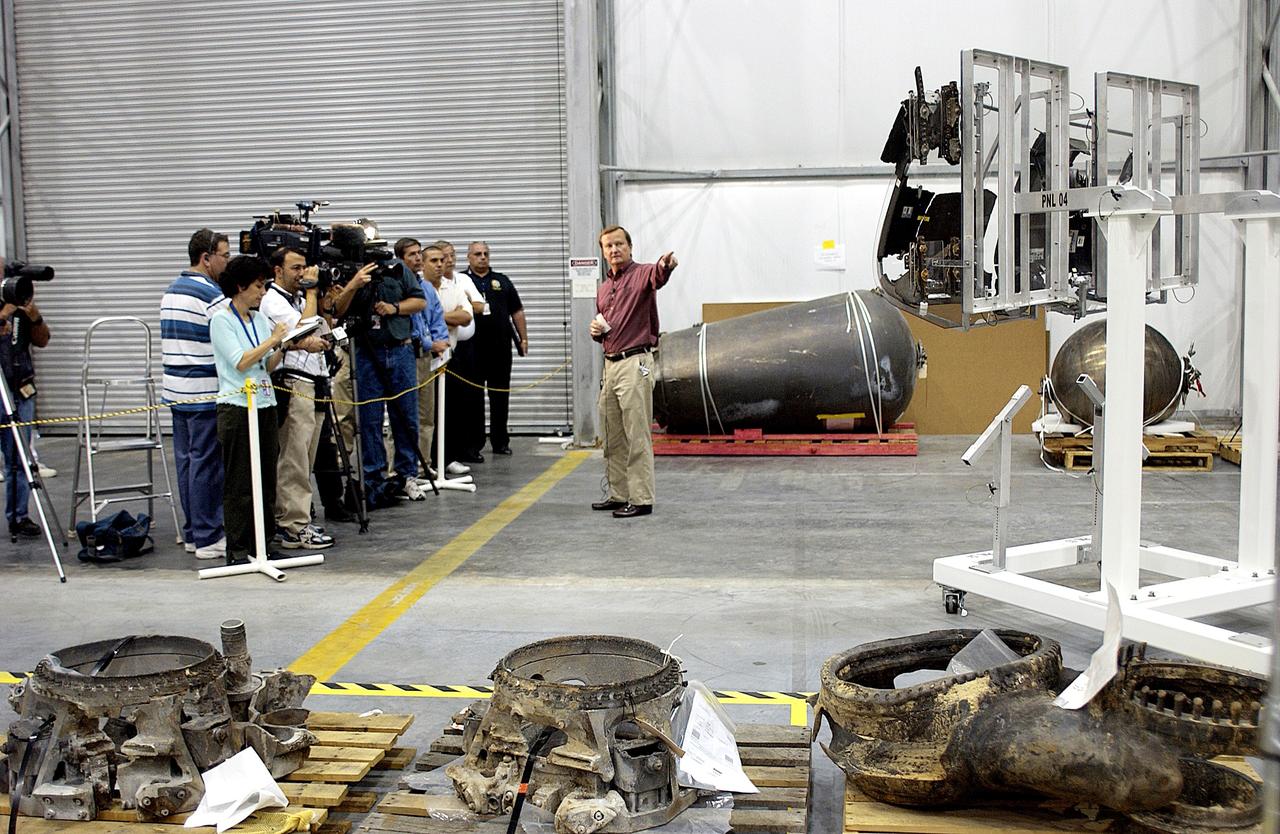
KENNEDY SPACE CENTER, FLA. - While talking to the media, Shuttle Launch Director Mike Leinbach points to some of the investigative tools in the RLV Hangar, where Columbia debris is being examined. The items shipped to KSC number more than 82,000 and weigh 84,800 pounds or 38 percent of the total dry weight of Columbia. Of those items, 78,760 have been identified, with 753 placed on the left wing grid in the Hangar.
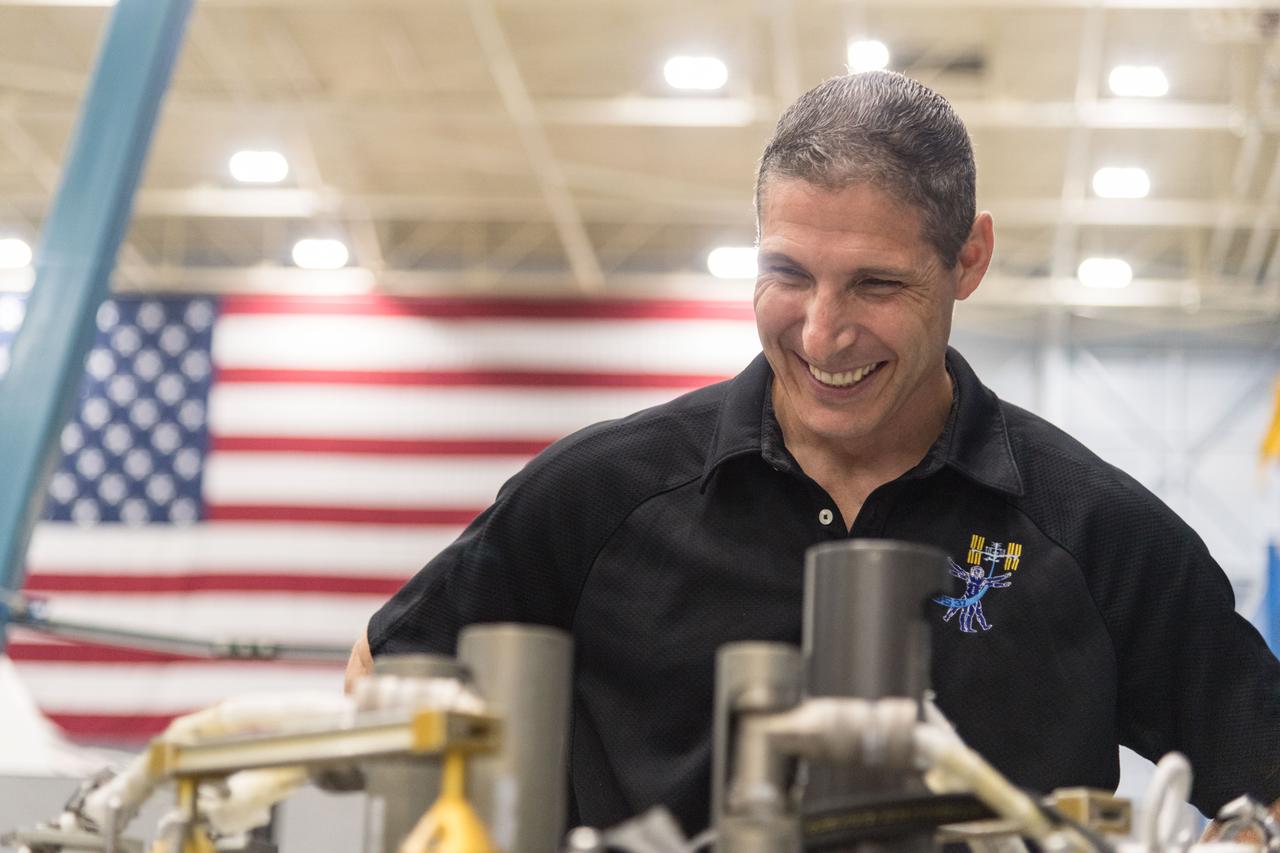
NASA commercial crew astronaut Mike Hopkins trains with Extravehicular Activity (EVA) tools and hardware in Johnson Space Center’s Space Vehicle Mockup Facility in Houston. Hopkins is assigned to the second crewed flight of SpaceX’s Crew Dragon.
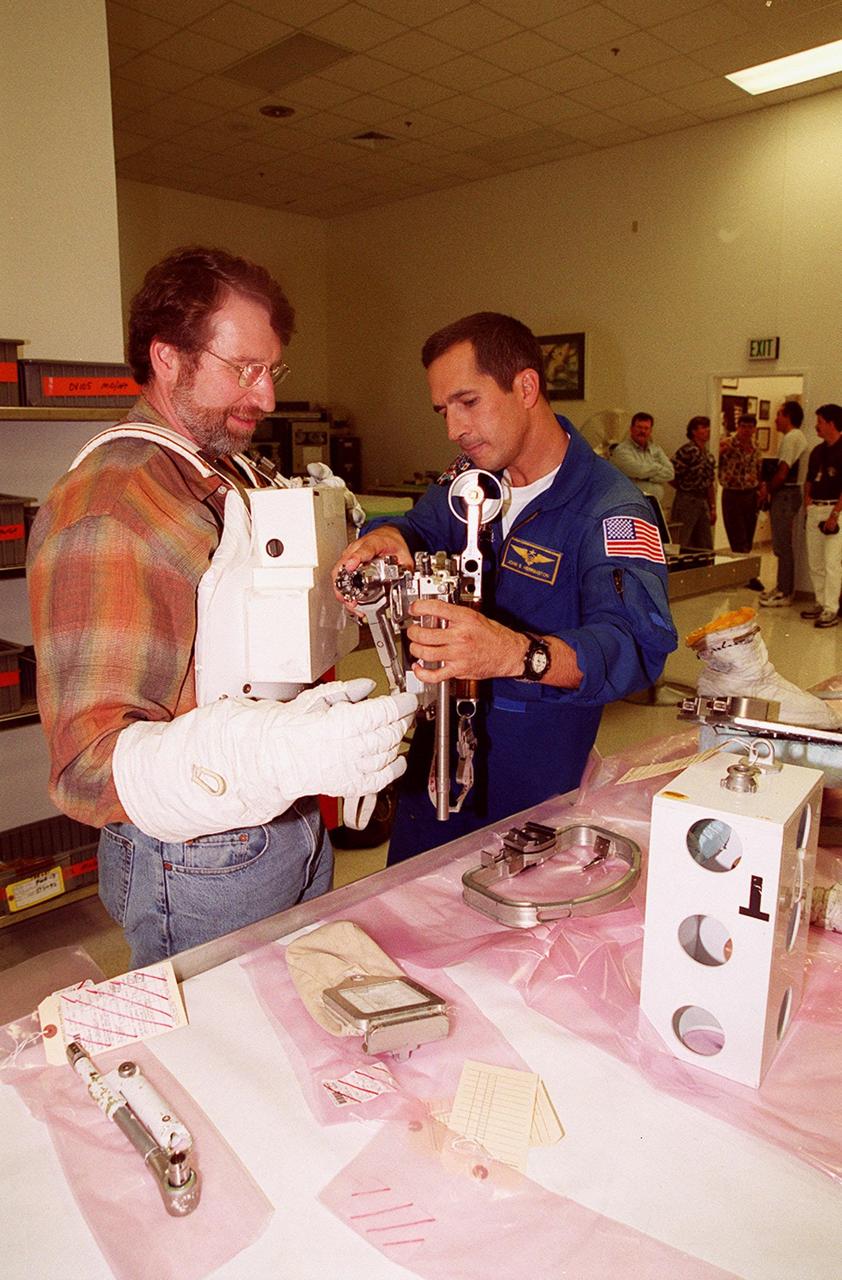
KENNEDY SPACE CENTER, FLA. -- Astronaut John Herrington (right) helps Norm Abram try on a tool carrier used in space. Abram is the master carpenter on television’s "This Old House." He is at KSC to film an episode of the series
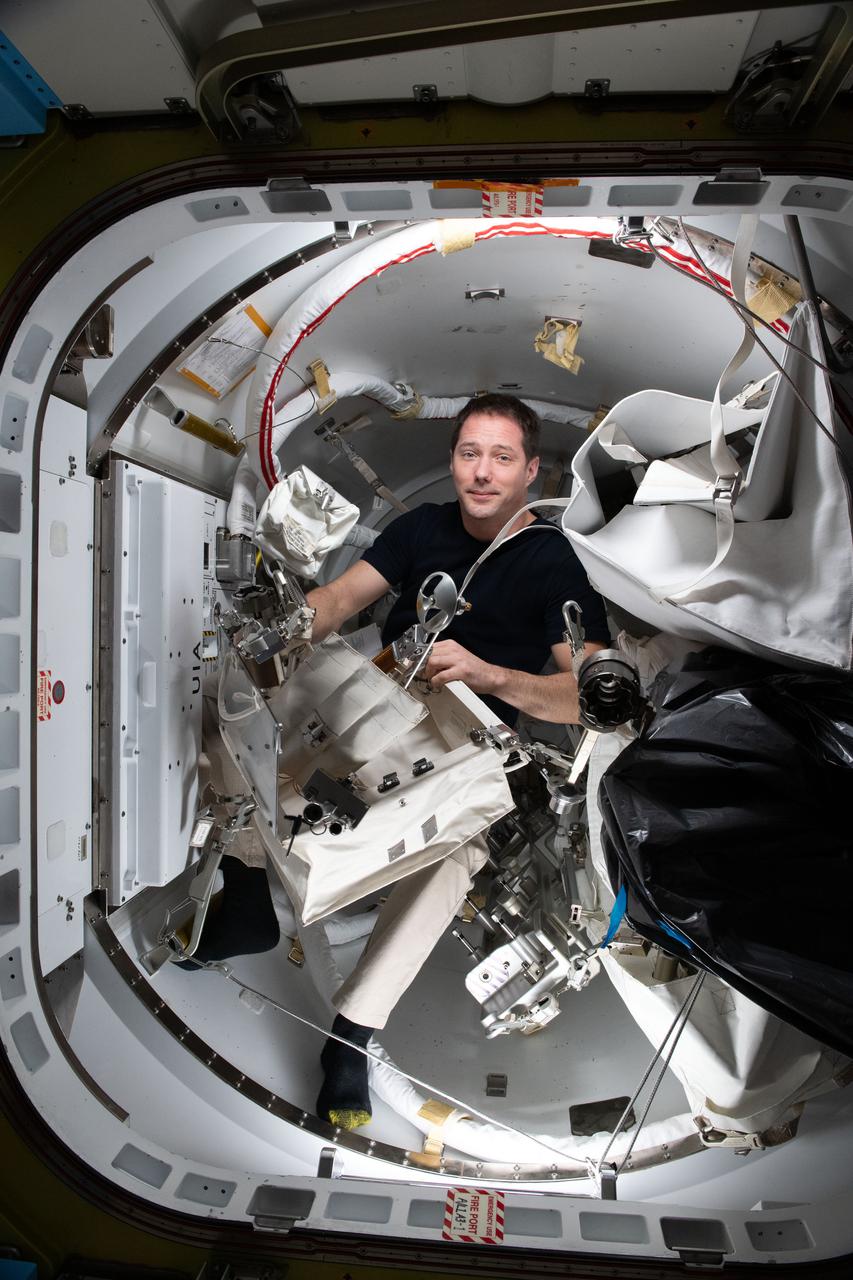
iss065e290307 (Aug. 23, 2021) --- Flight Engineer Thomas Pesquet of ESA (European Space Agency) checks a variety of spacewalk tools inside the International Space Station's U.S. Quest airlock.
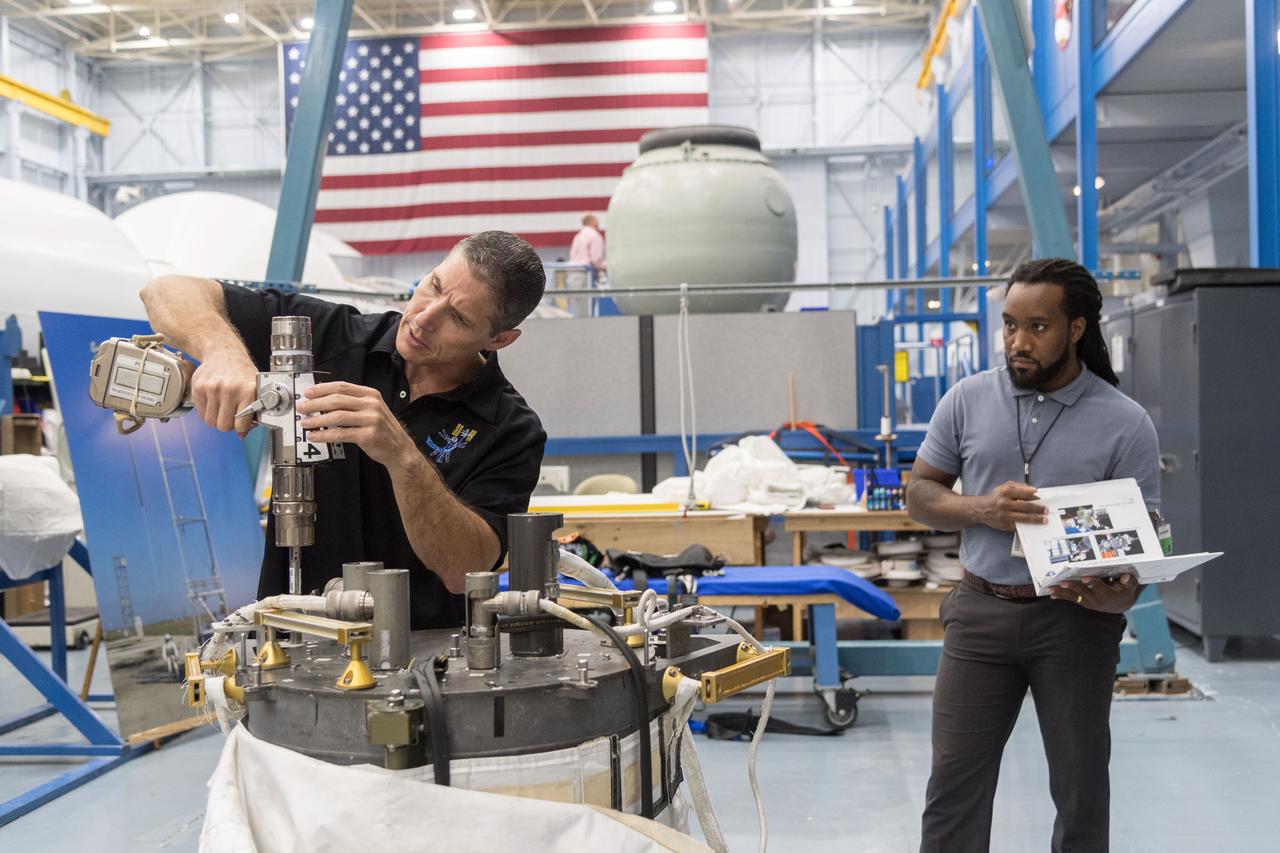
NASA commercial crew astronaut Mike Hopkins trains with Extravehicular Activity (EVA) tools and hardware in Johnson Space Center’s Space Vehicle Mockup Facility in Houston. Hopkins is assigned to the second crewed flight of SpaceX’s Crew Dragon.
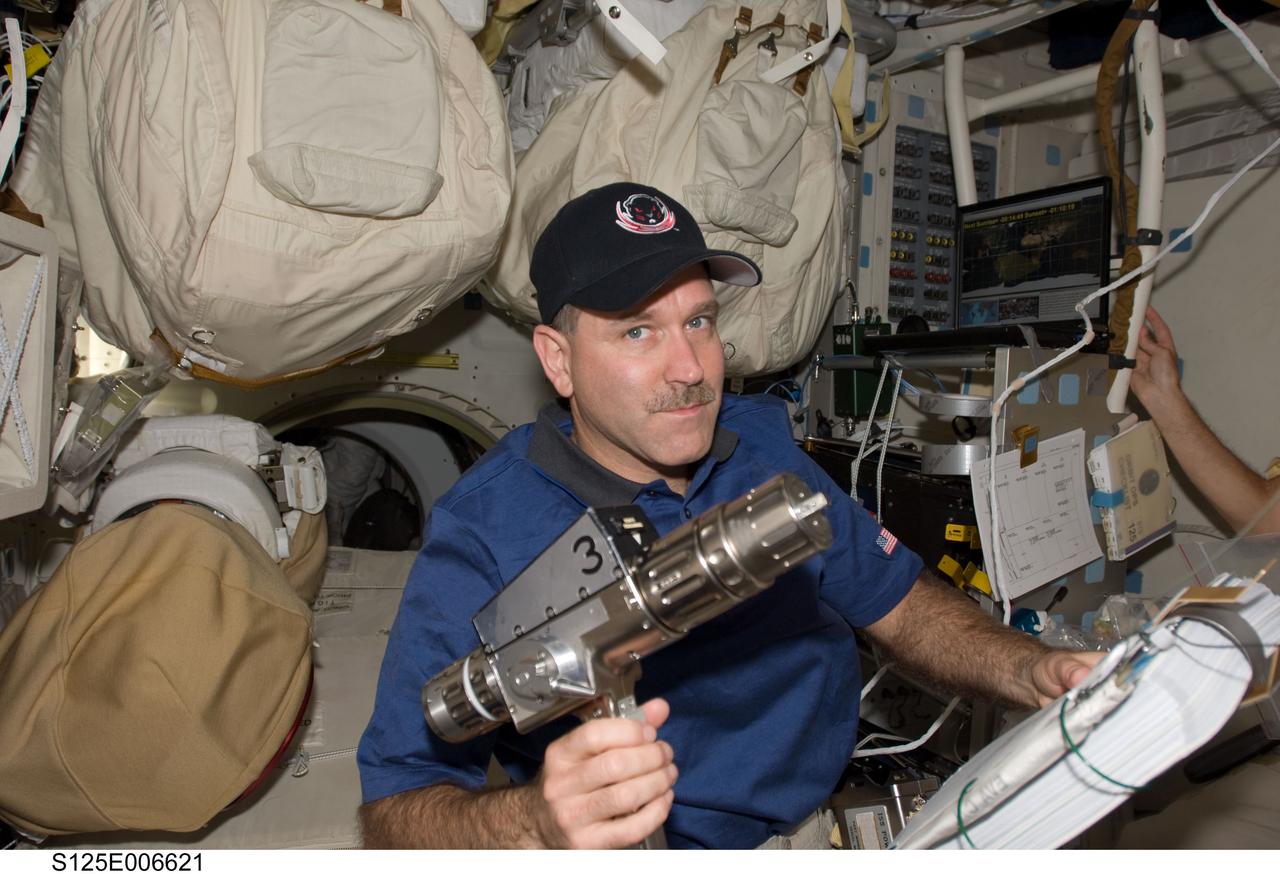
S125-E-006621 (13 May 2009) --- Astronaut John Grunsfeld, STS-125 mission specialist, works with a power tool on the middeck of Space Shuttle Atlantis as he prepares for upcoming spacewalks to repair the Hubble Space Telescope.
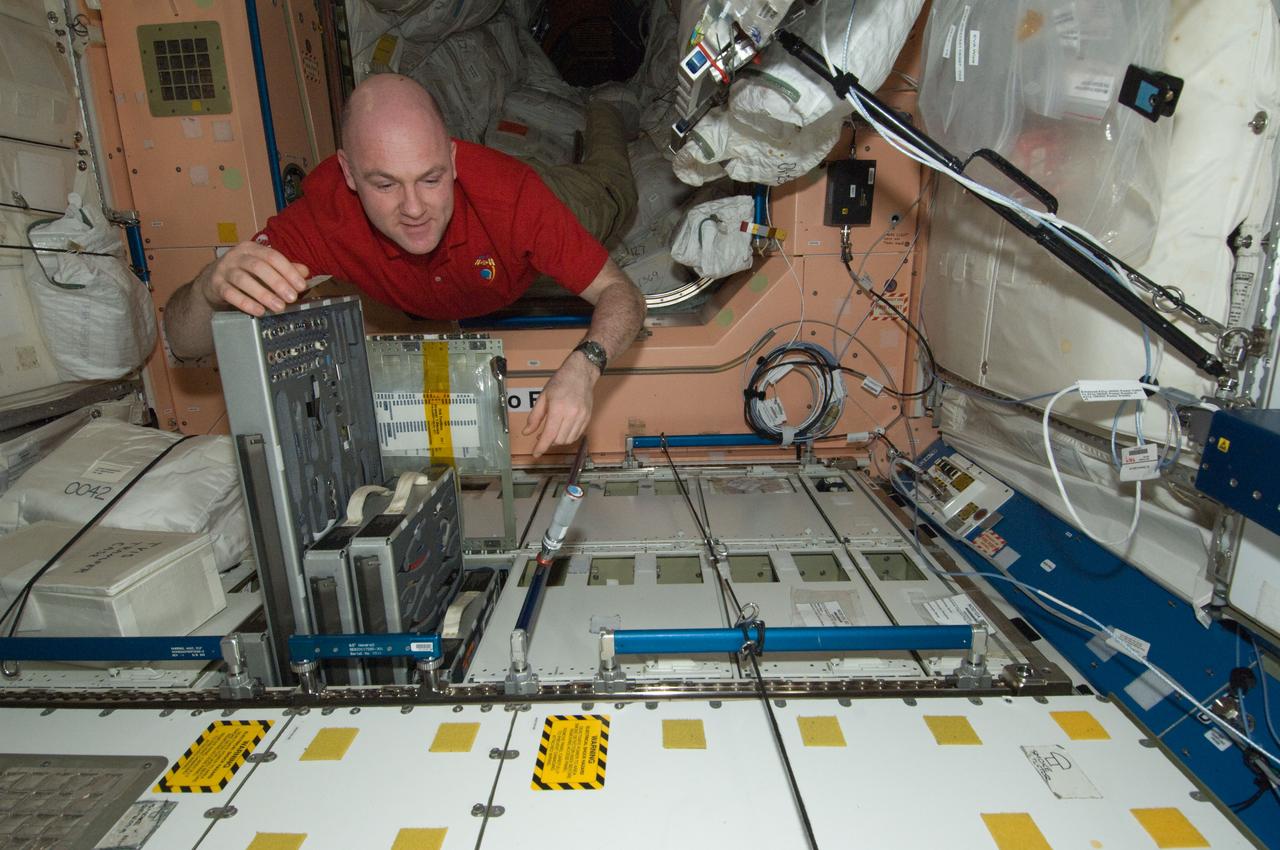
ISS031-E-084728 (15 May 2012) --- European Space Agency astronaut Andre Kuipers, Expedition 31 flight engineer, works with intravehicular activity (IVA) tools in the Unity node of the International Space Station.
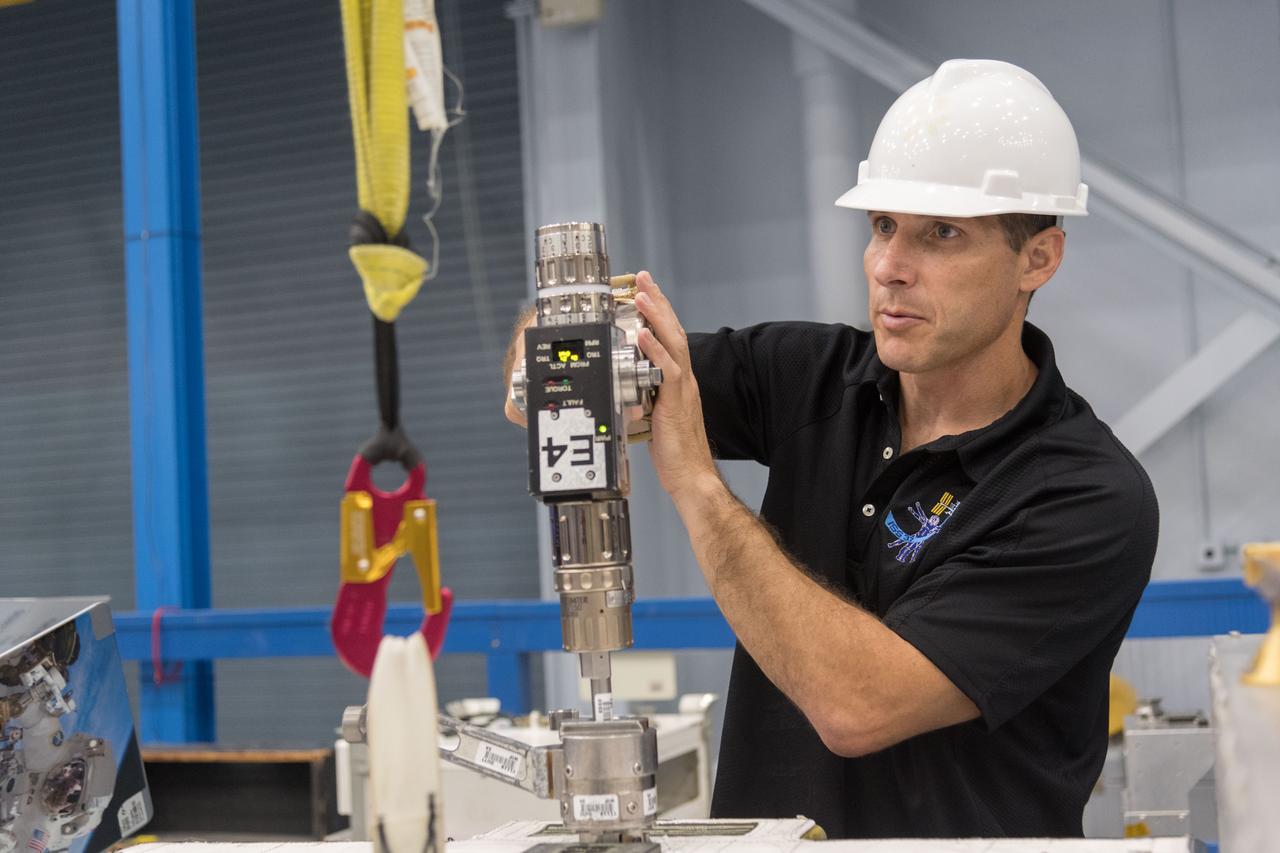
NASA commercial crew astronaut Mike Hopkins trains with Extravehicular Activity (EVA) tools and hardware in Johnson Space Center’s Space Vehicle Mockup Facility in Houston. Hopkins is assigned to the second crewed flight of SpaceX’s Crew Dragon.
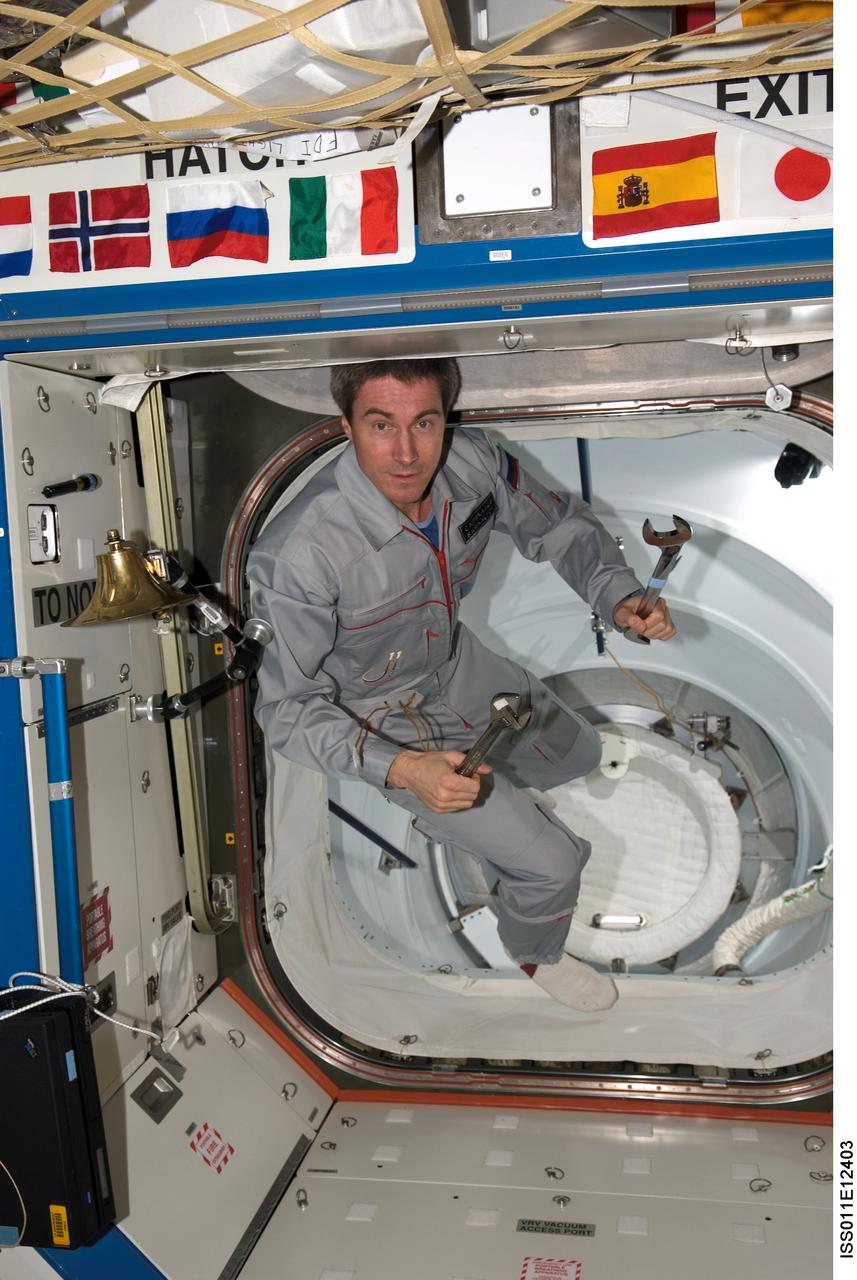
ISS011-E-12403 (28 July 2005) --- Cosmonaut Sergei K. Krikalev, Expedition 11 commander representing Russia's Federal Space Agency, holds tools while floating into the Destiny laboratory on the International Space Station.
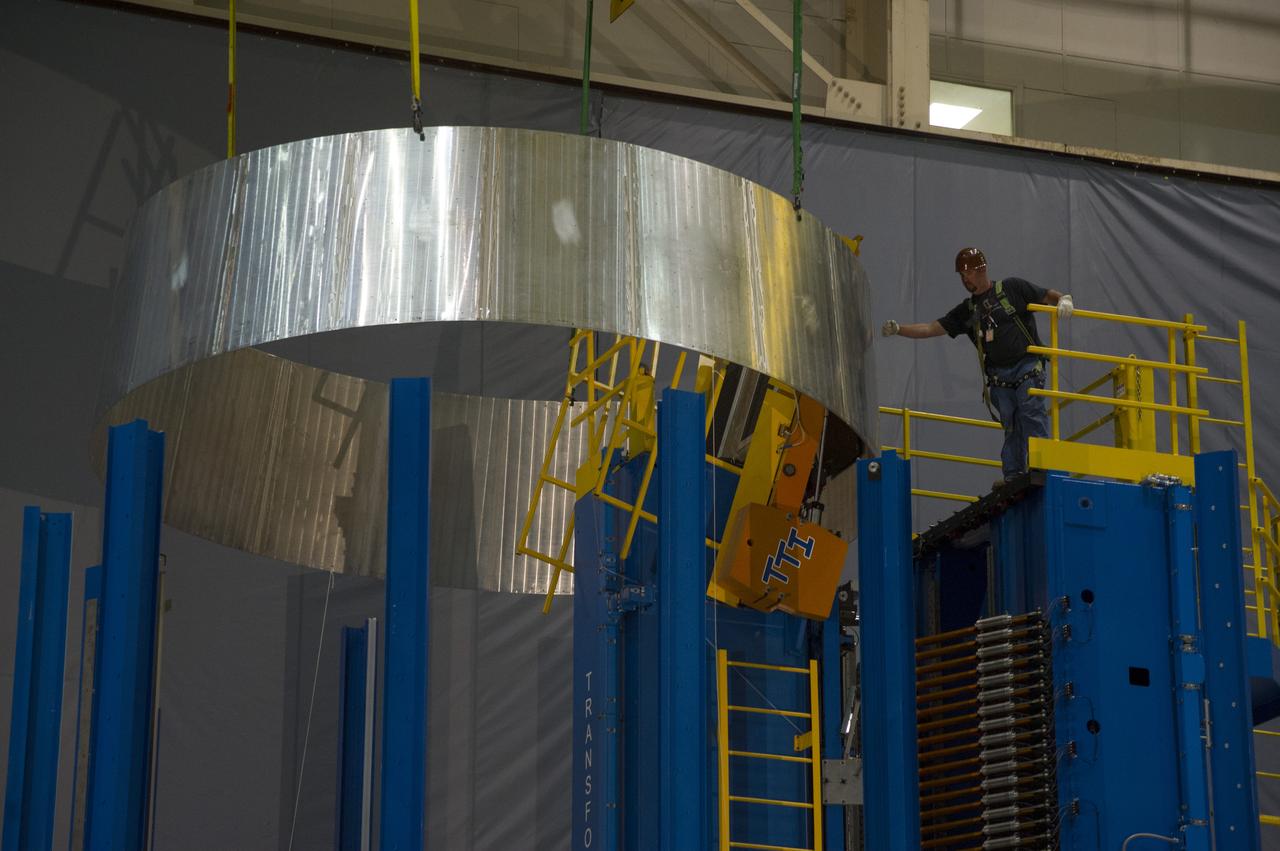
ENGINEERS USING A STATE-OF-THE-ART VERTICAL WELDING TOOL AT THE MARSHALL SPACE FLIGHT CENTER IN HUNTSVILLE, ALA., MOVE A "PATHFINDER" VERSION OF THE ADAPTER DESIGN THAT WILL BE USED ON TEST FLIGHTS OF THE ORION SPACECRAFT AND NASA'S SPACE LAUNCH SYSTEM
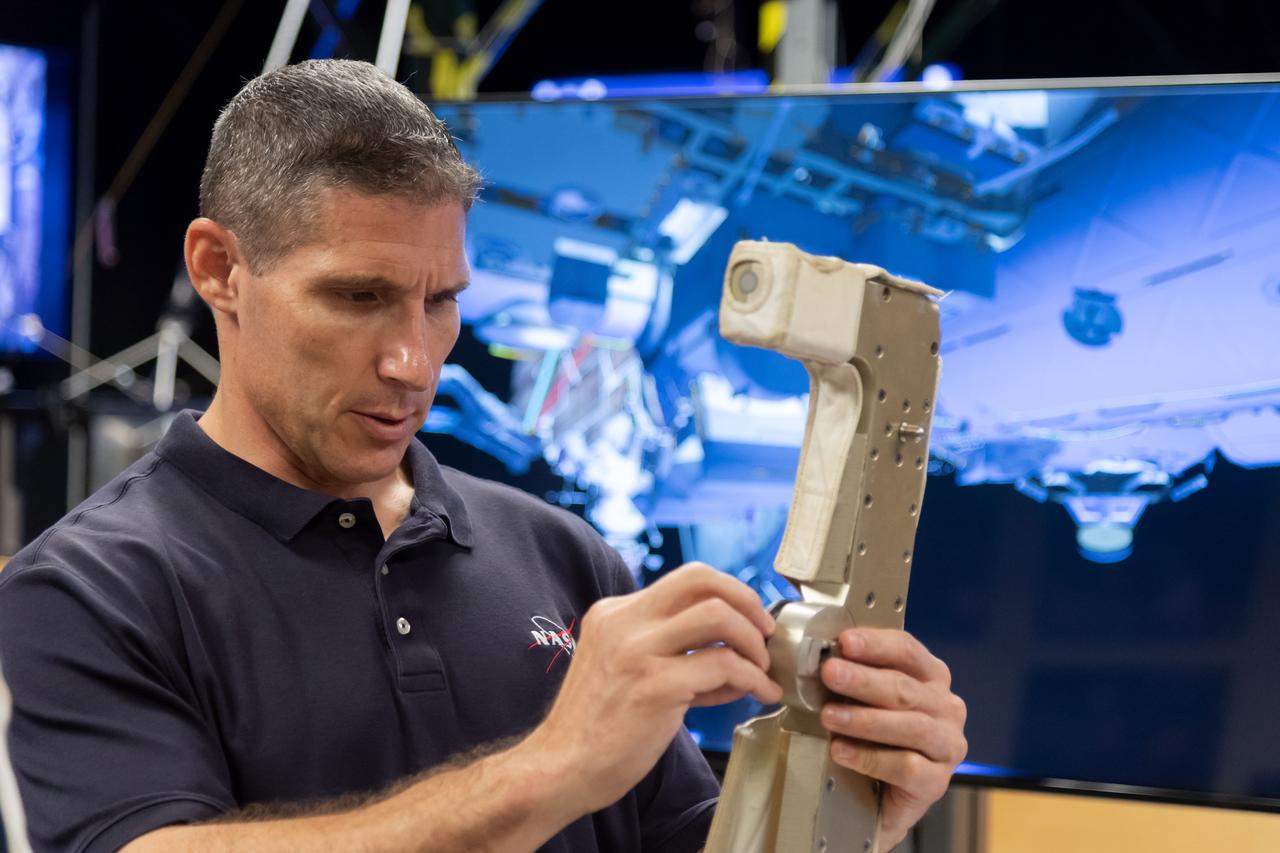
NASA commercial crew astronaut Mike Hopkins trains with Extravehicular Activity (EVA) tools and hardware in Johnson Space Center’s Space Vehicle Mockup Facility in Houston. Hopkins is assigned to the second crewed flight of SpaceX’s Crew Dragon.
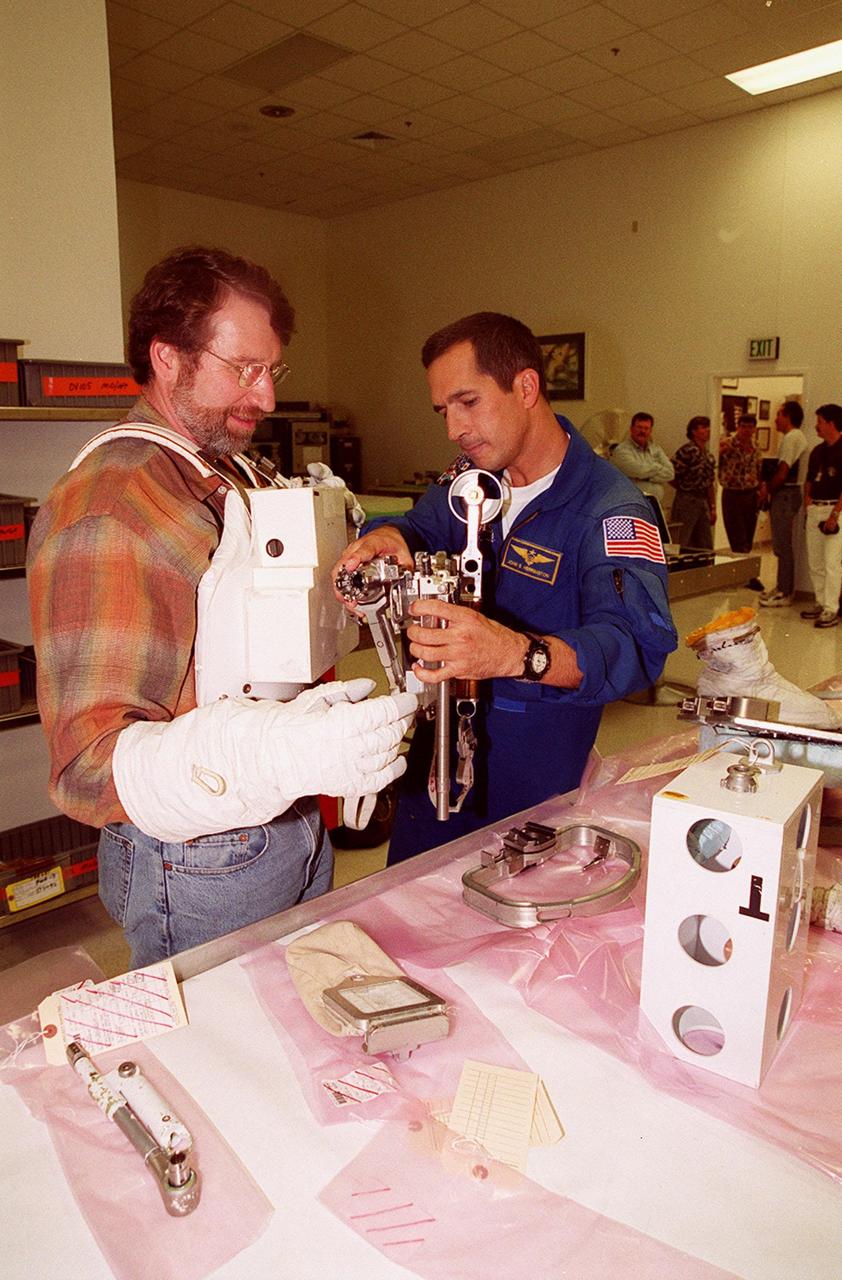
KENNEDY SPACE CENTER, FLA. -- Astronaut John Herrington (right) helps Norm Abram try on a tool carrier used in space. Abram is the master carpenter on television’s "This Old House." He is at KSC to film an episode of the series
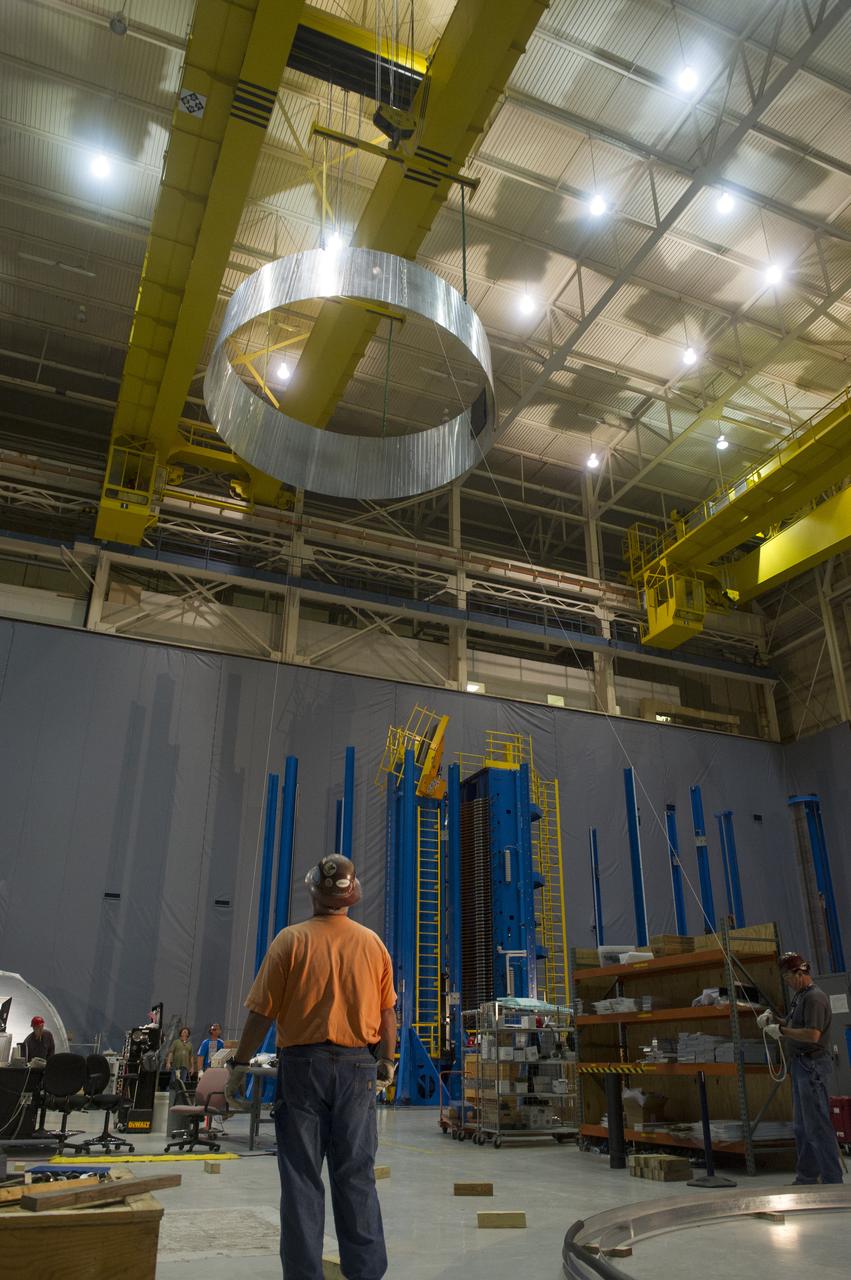
ENGINEERS USING A STATE-OF-THE-ART VERTICAL WELDING TOOL AT THE MARSHALL SPACE FLIGHT CENTER IN HUNTSVILLE, ALA., MOVE A "PATHFINDER" VERSION OF THE ADAPTER DESIGN THAT WILL BE USED ON TEST FLIGHTS OF THE ORION SPACECRAFT AND NASA'S SPACE LAUNCH SYSTEM
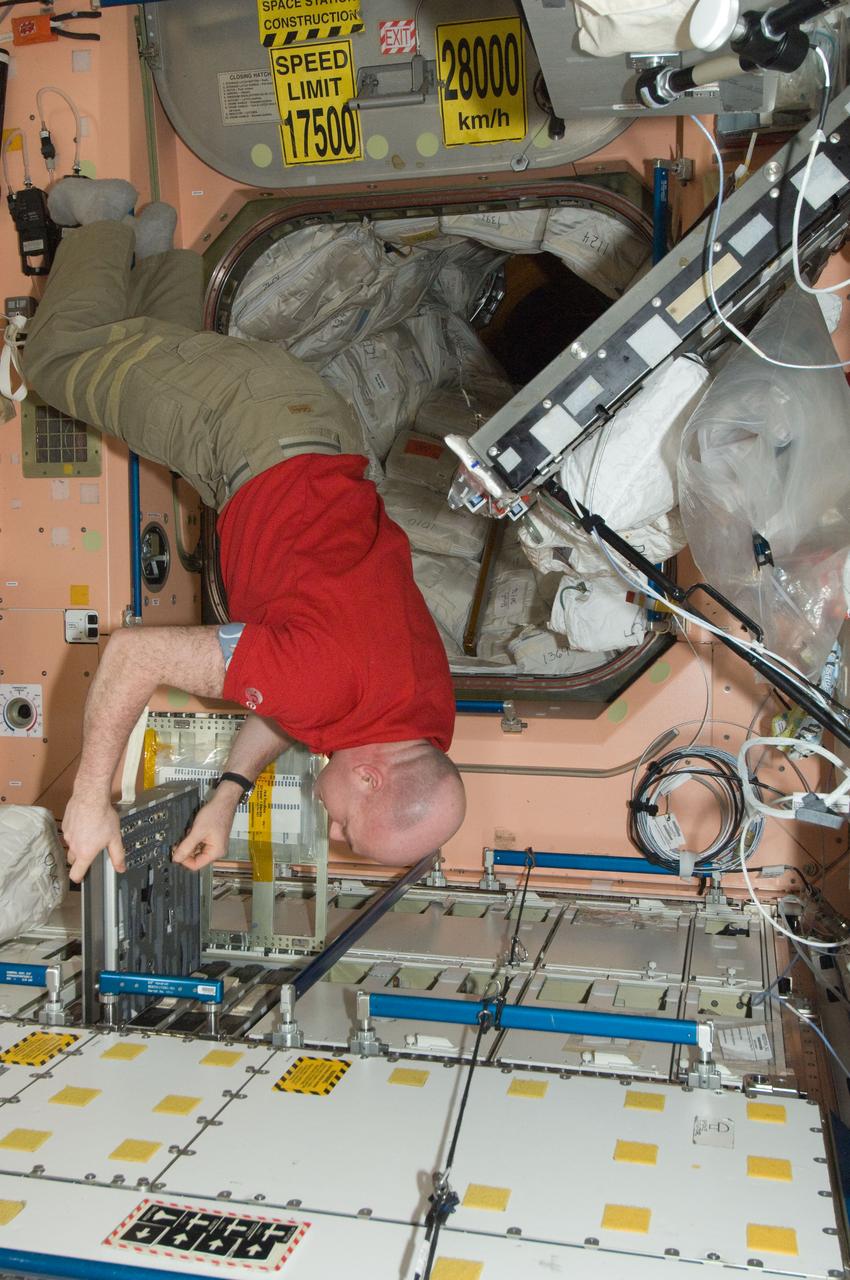
ISS031-E-084710 (15 May 2012) --- European Space Agency astronaut Andre Kuipers, Expedition 31 flight engineer, works with intravehicular activity (IVA) tools in the Unity node of the International Space Station.
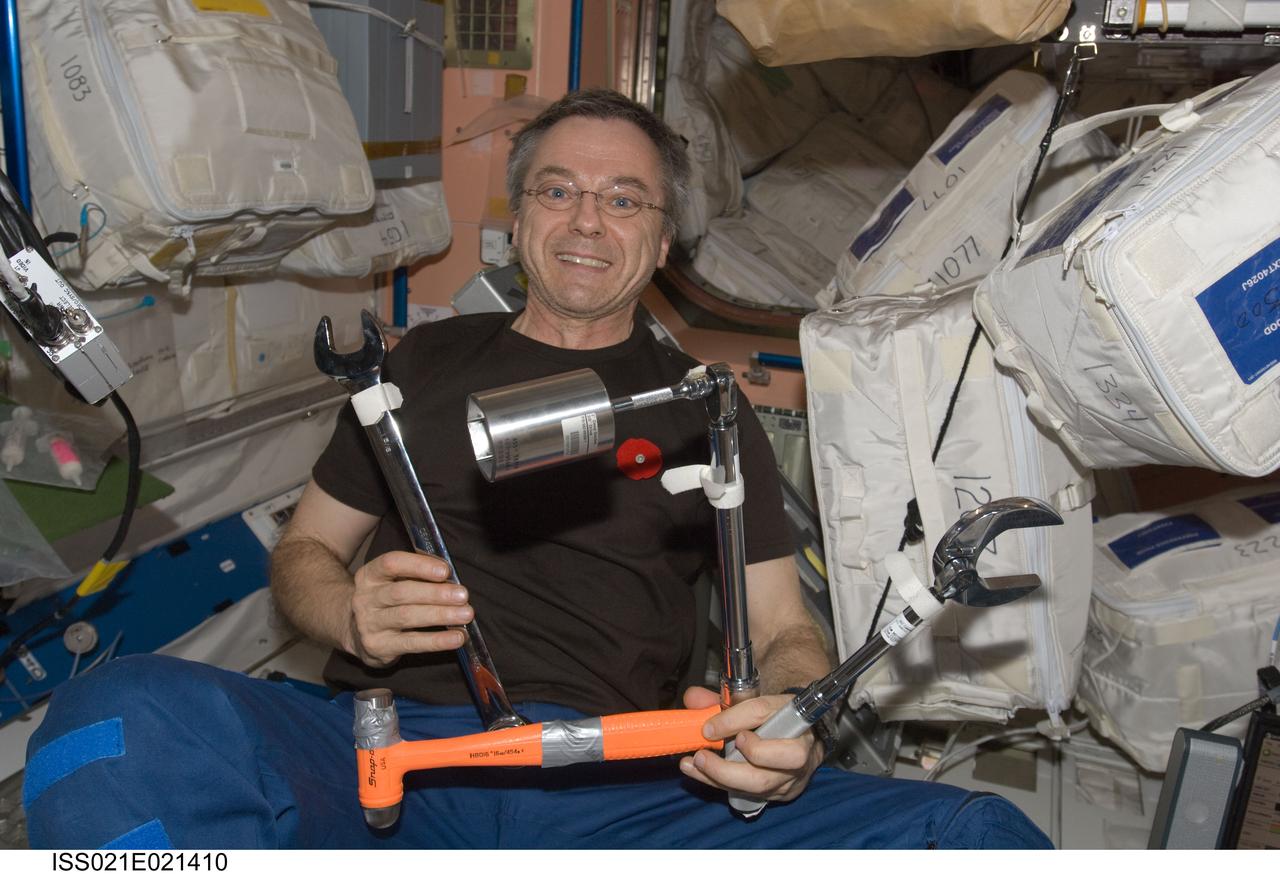
ISS021-E-021410 (3 Nov. 2009) --- Canadian Space Agency astronaut Robert Thirsk, Expedition 21 flight engineer, holds various tools in the Unity node of the International Space Station.
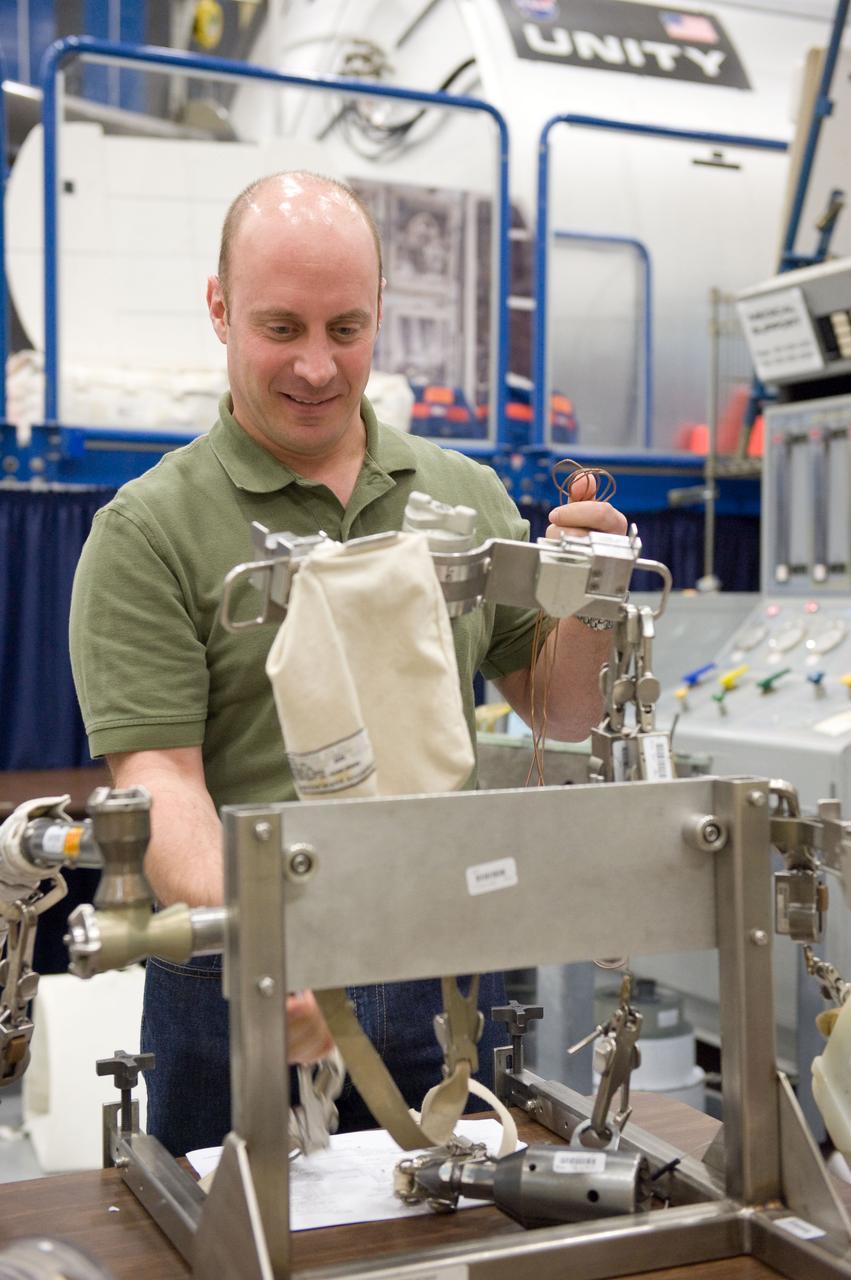
JSC2010-E-046537 (2 April 2010) --- NASA astronaut Garrett Reisman, STS-132 mission specialist, participates in an EVA tool training session in the Space Vehicle Mockup Facility at NASA's Johnson Space Center.
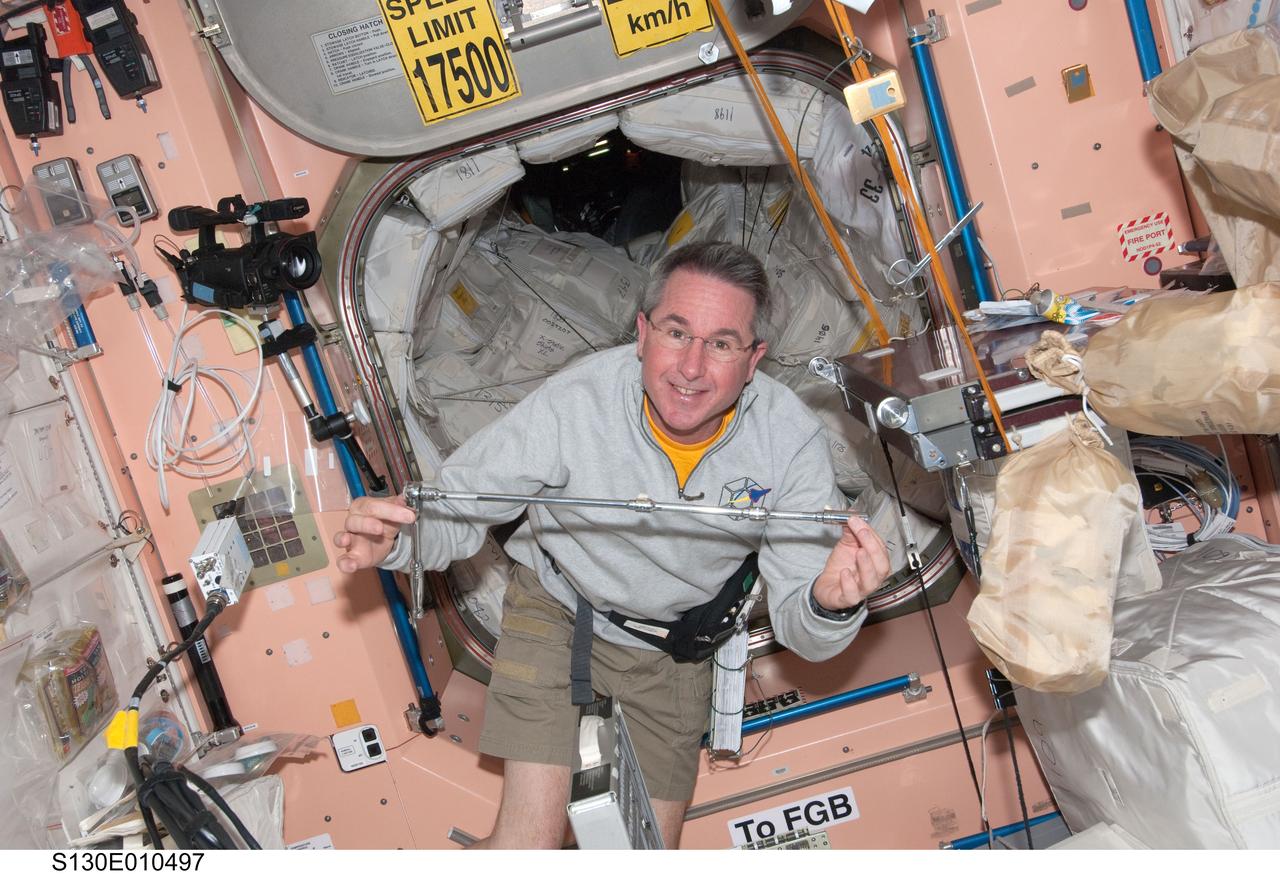
S130-E-010497 (18 Feb. 2010) --- NASA astronaut Stephen Robinson, STS-130 mission specialist, holds a tool in the Unity node of the International Space Station while space shuttle Endeavour remains docked with the station.
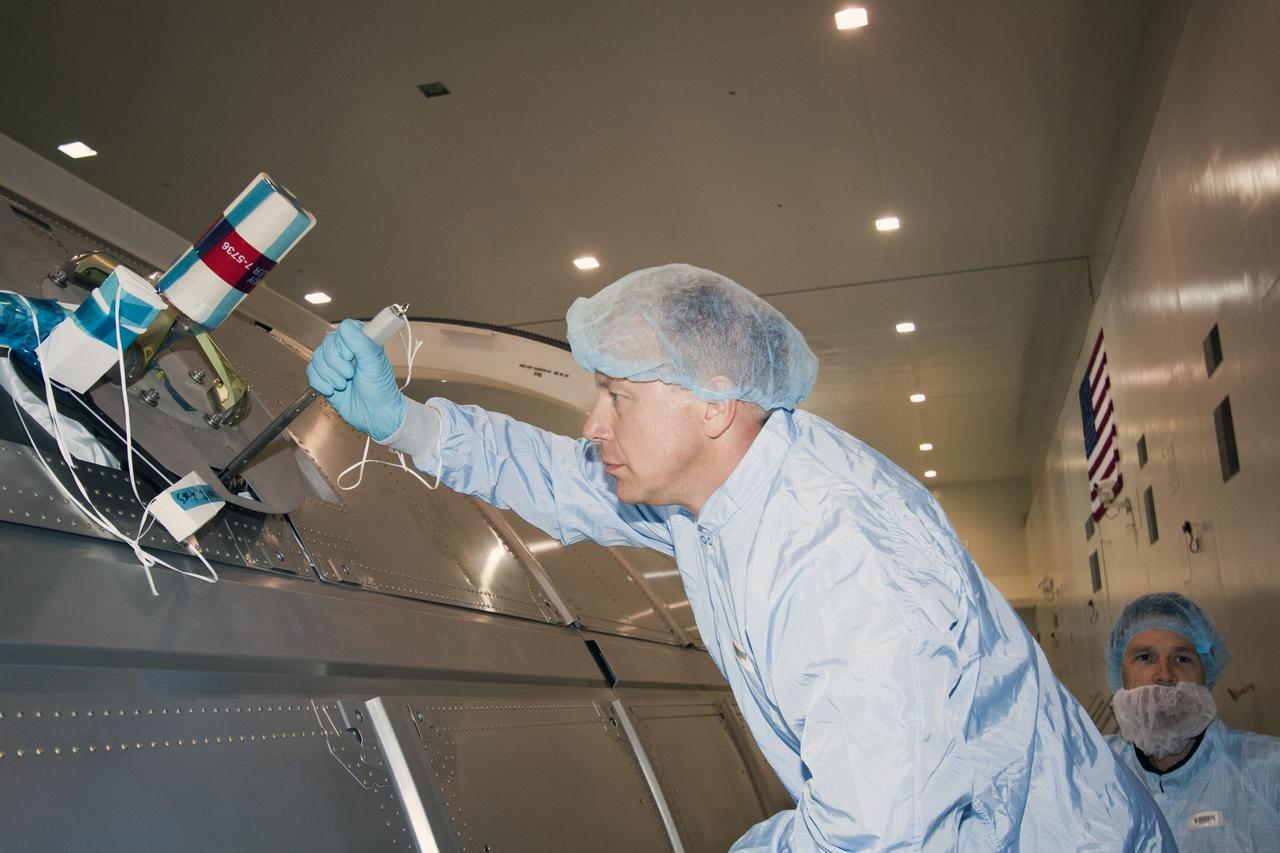
CAPE CANAVERAL, Fla. -- In the Space Station Processing Facility at NASA's Kennedy Space Center in Florida, STS-133 Mission Specialist Tim Kopra practices using a tool on the Permanent Multipurpose Module, or PMM. The astronauts are at Kennedy to participate in the Payload Crew Equipment Interface Test, or CEIT, which gives the crew an opportunity for hands-on training with tools they'll be using in space and familiarization of the payload they will be delivering to the International Space Station. Launch of space shuttle Discovery is targeted for Nov. 1 at 4:40 p.m. EDT. For more information visit, www.nasa.gov/shuttle. Photo credit: NASA/Jack Pfaller
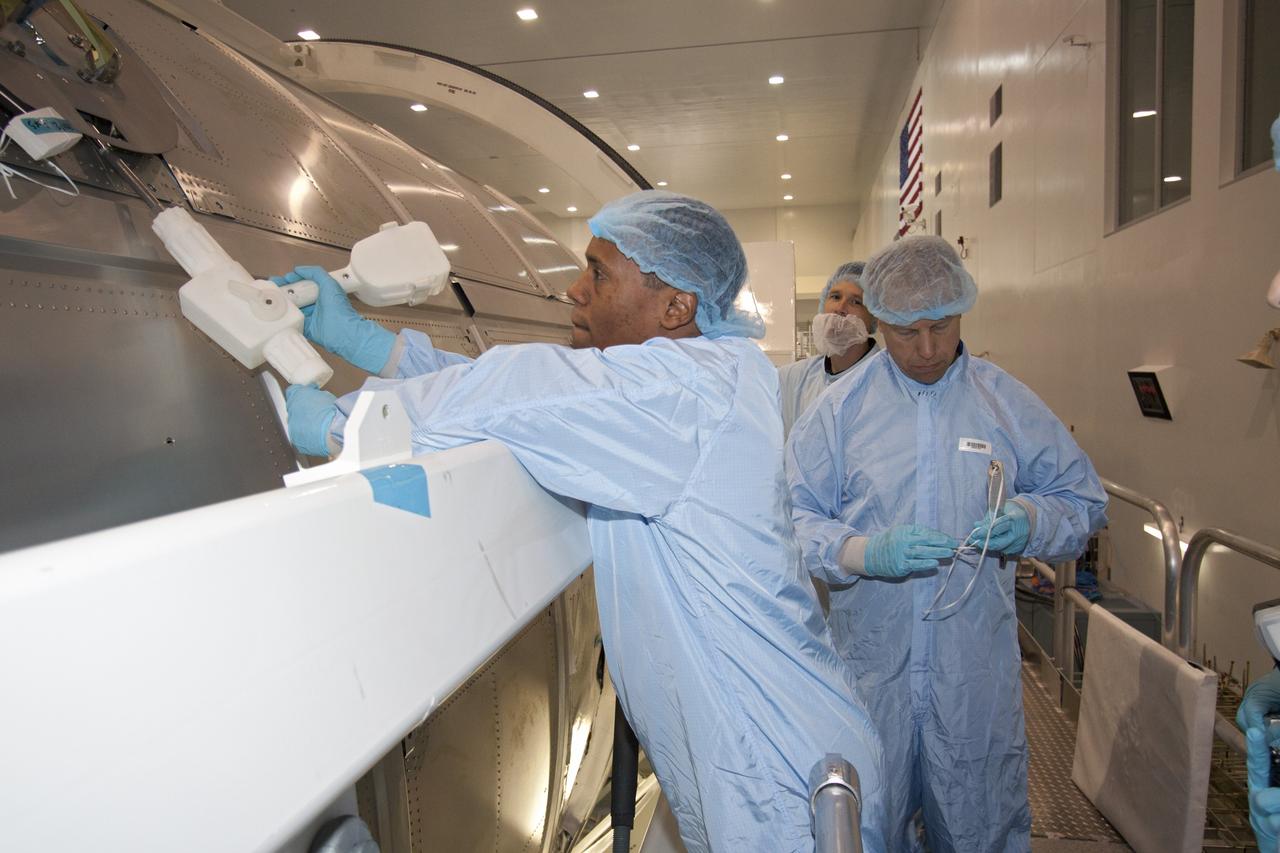
CAPE CANAVERAL, Fla. -- In the Space Station Processing Facility at NASA's Kennedy Space Center in Florida, STS-133 Mission Specialist Alvin Drew practices with a tool on the Permanent Multipurpose Module, or PMM, while Mission Specialist Tim Kopra (right) awaits his turn. The astronauts are at Kennedy to participate in the Payload Crew Equipment Interface Test, or CEIT, which gives the crew an opportunity for hands-on training with tools they'll be using in space and familiarization of the payload they will be delivering to the International Space Station. Launch of space shuttle Discovery is targeted for Nov. 1 at 4:40 p.m. EDT. For more information visit, www.nasa.gov/shuttle. Photo credit: NASA/Jack Pfaller
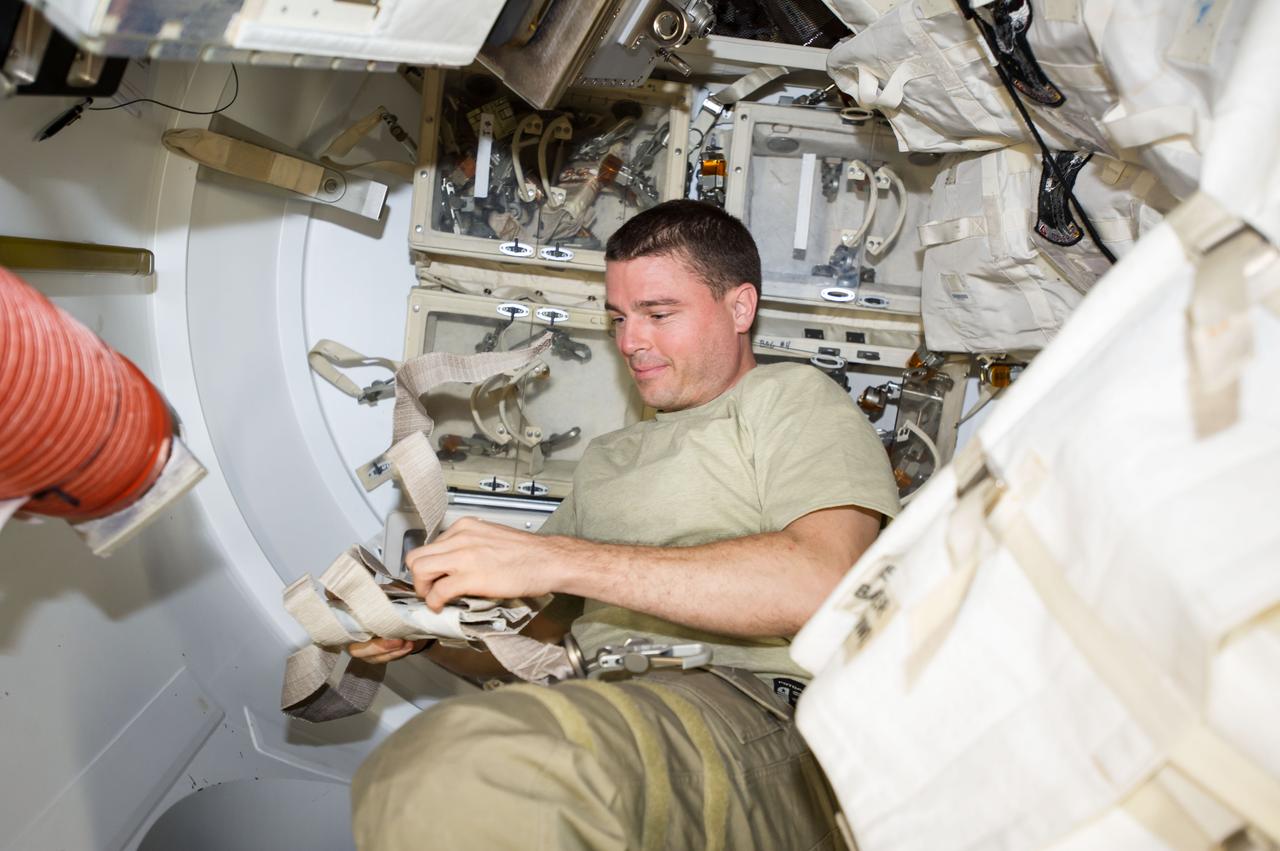
ISS041-E-017060 (19 Sept. 2014) --- NASA astronaut Reid Wiseman, Expedition 41 flight engineer, works with tools and equipment in the Quest airlock of the International Space Station in preparation for two spacewalks scheduled in October 2014.
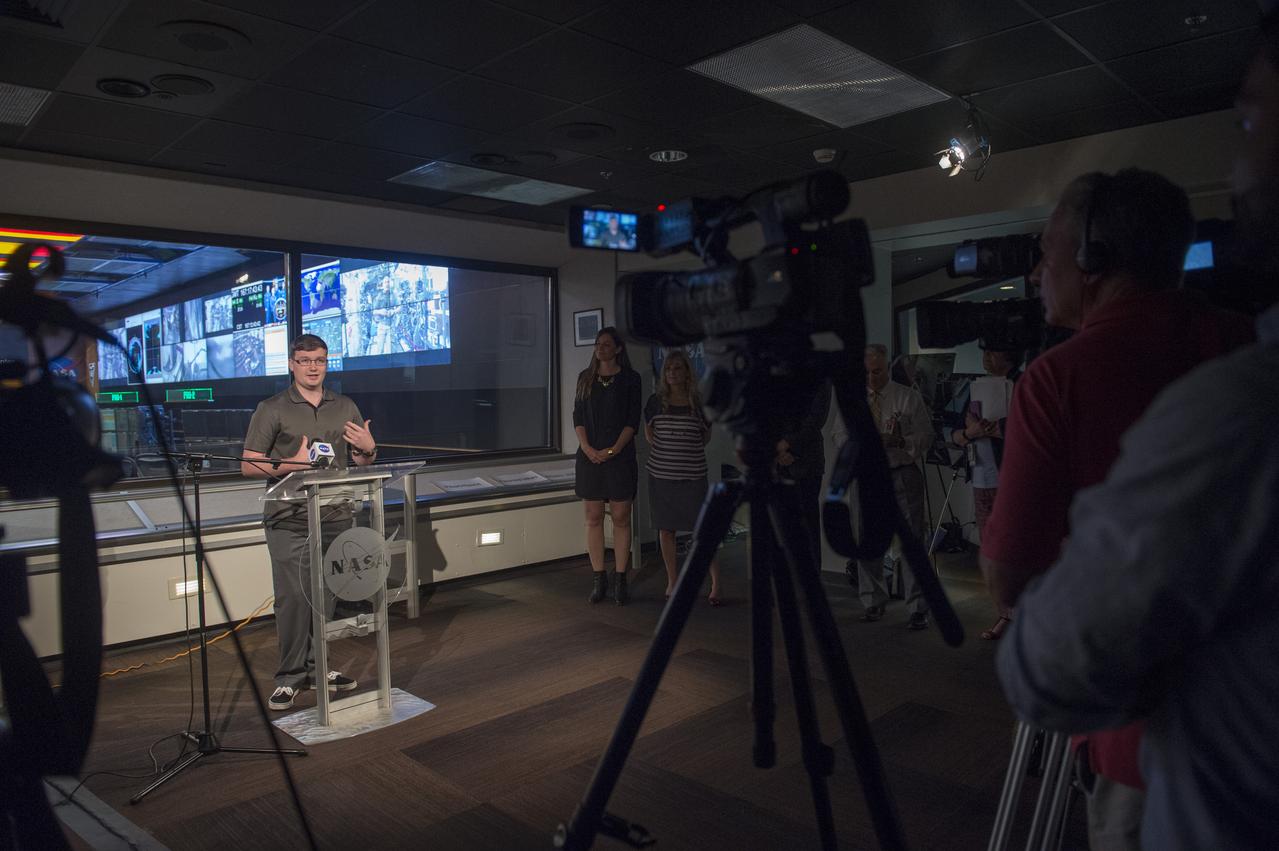
UAH ENGINEERING STUDENT ROBERT HILLAN TALKS TO SPACE STATION CREW MEMBERS ABOUT HIS WINNING 3-D PRINTED TOOL DESIGNED FOR USE ON ISS, AND IS INTERVIEWED BY LOCAL MEDIA
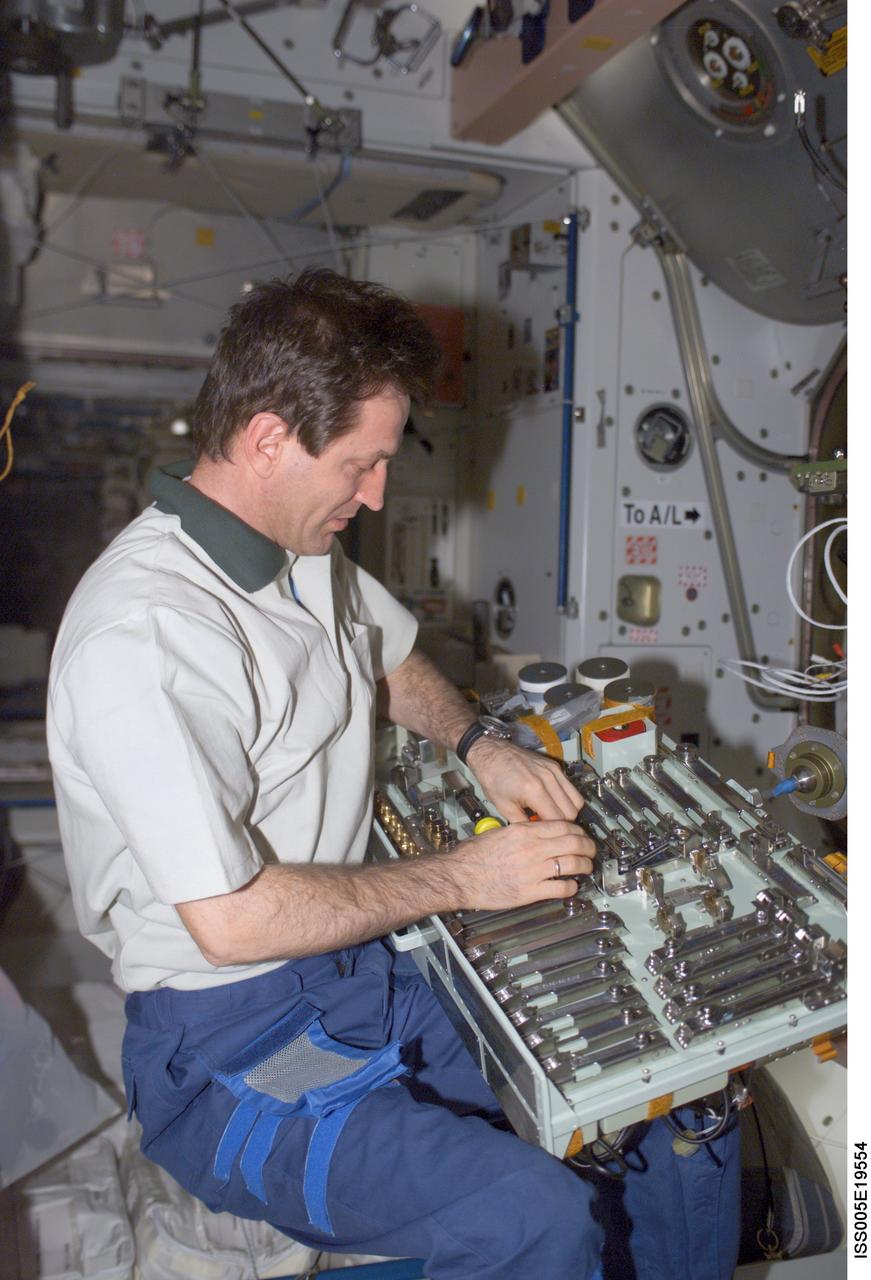
ISS005-E-19554 (2 November 2002) --- Cosmonaut Sergei Y. Treschev, Expedition Five flight engineer, works with various tools in the Unity node on the International Space Station (ISS). Treschev represents Rosaviakosmos.
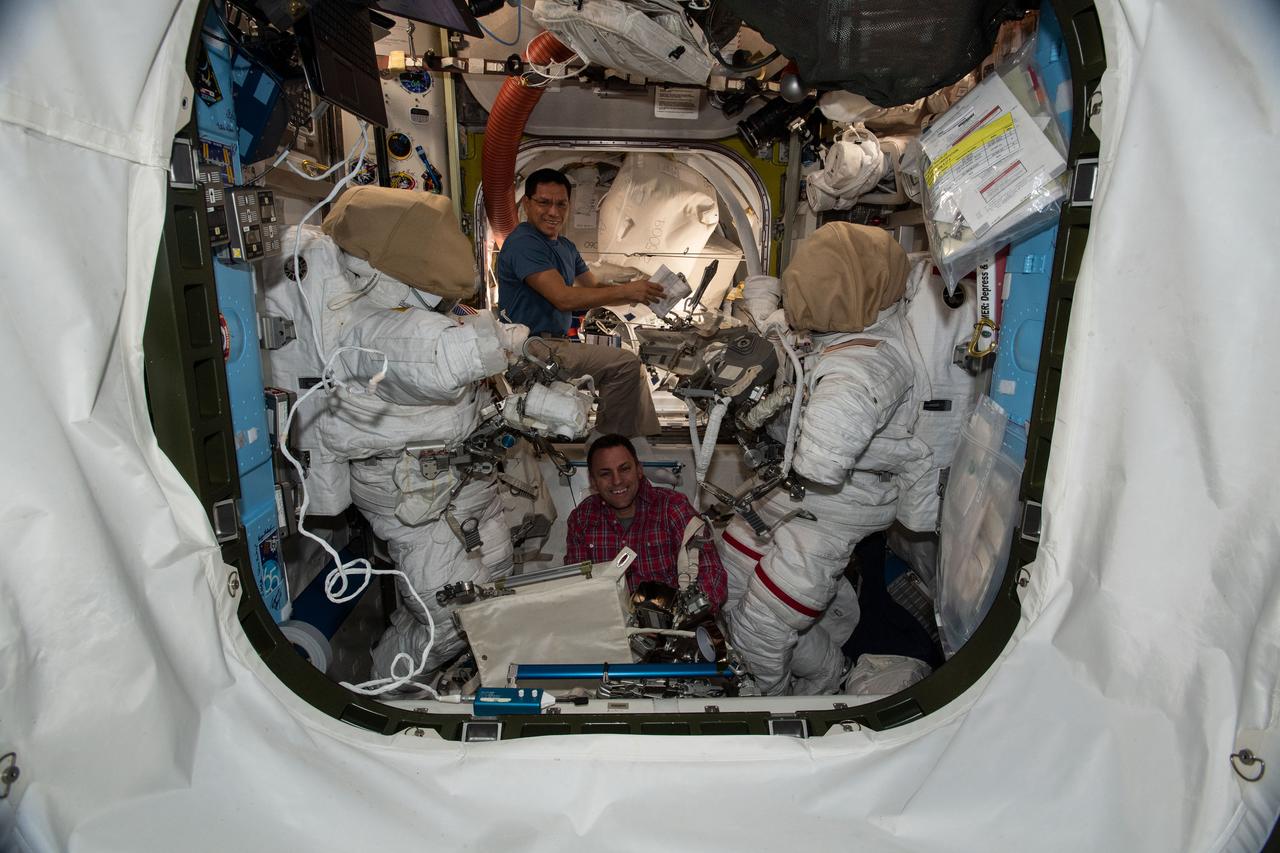
iss068e024215 (Nov. 23, 2022) --- NASA astronauts (from top) Frank Rubio and Josh Cassada configure spacewalking tools and components on a pair of Extravehicular Mobility Units (EMUs), or spacesuits, inside the International Space Station's Quest airlock.
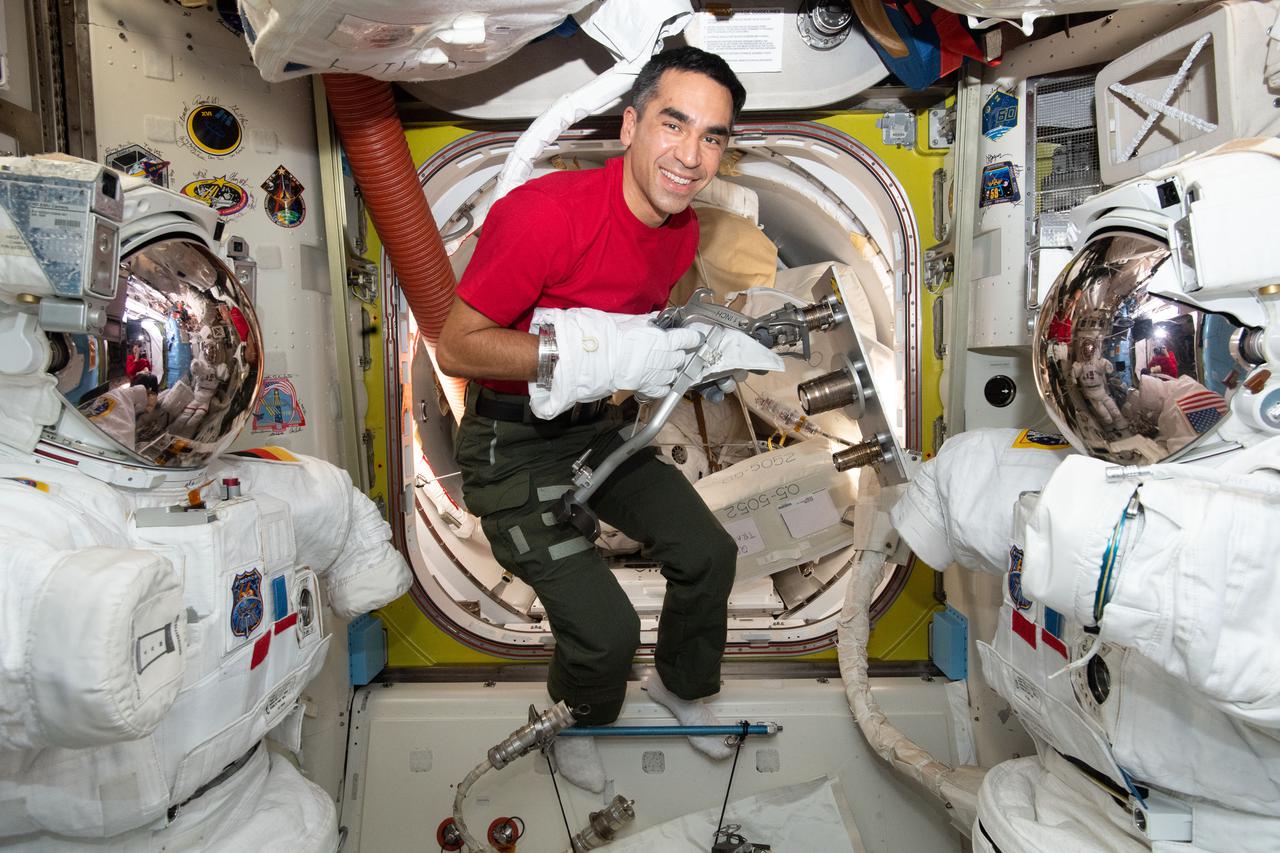
iss066e146485 (Feb. 19, 2022) --- NASA astronaut and Expedition 66 Flight Engineer Raja Chari tests using tools while wearing a spacesuit glove inside the International Space Station's U.S. Quest airlock.
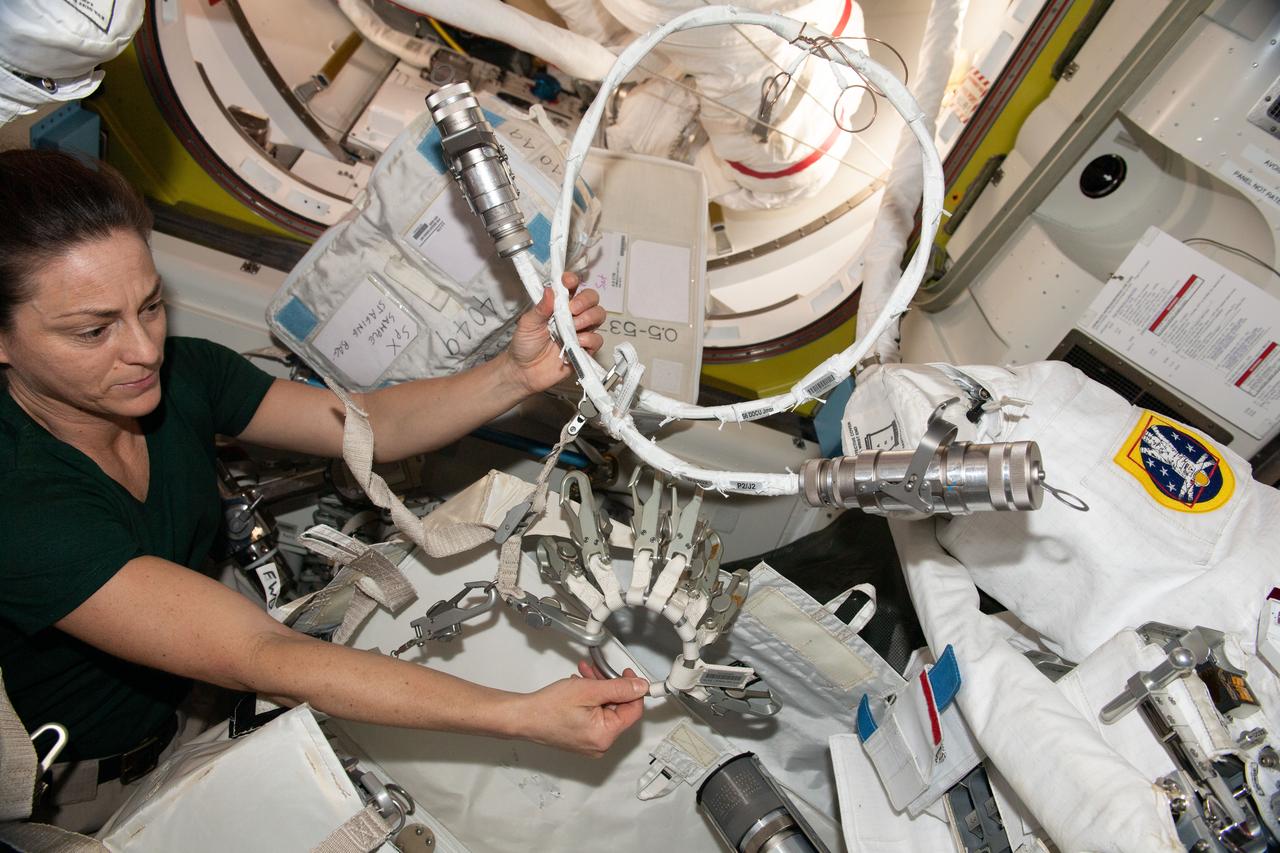
iss068e039915 (Jan. 11, 2023) --- NASA astronaut and Expedition 68 Flight Engineer Nicole Mann configures spacewalk tools and hardware inside the International Space Station's Destiny laboratory module.

iss064e0221711 (Jan. 8, 2021) --- Flight Engineer Michael Hopkins works inside the Quest airlock configuring tools for planned spacewalks to continue maintenance on the outside of the International Space Station.
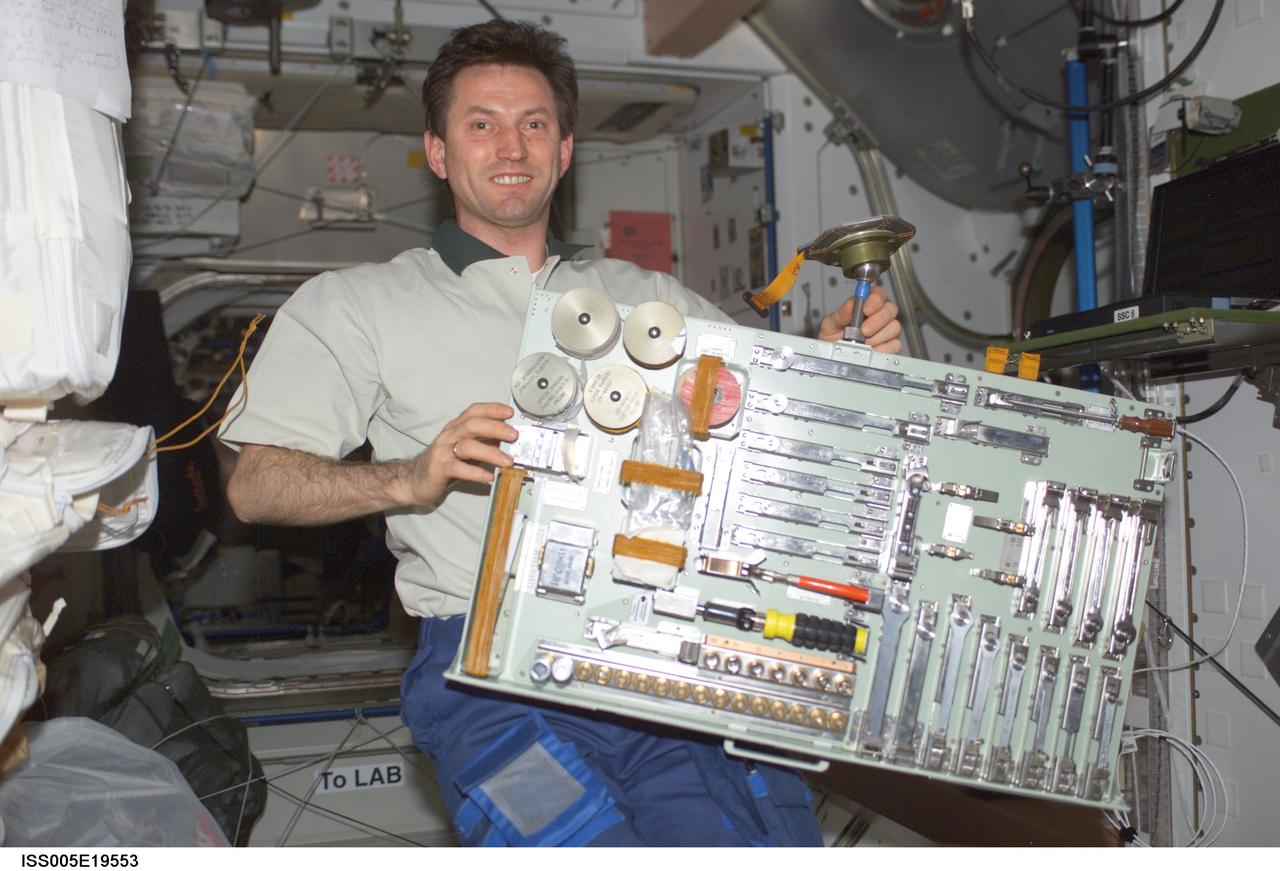
ISS005-E-19553 (2 November 2002) --- Cosmonaut Sergei Y. Treschev, Expedition Five flight engineer, holds a pallet containing various tools in the Unity node on the International Space Station (ISS). Treschev represents Rosaviakosmos.
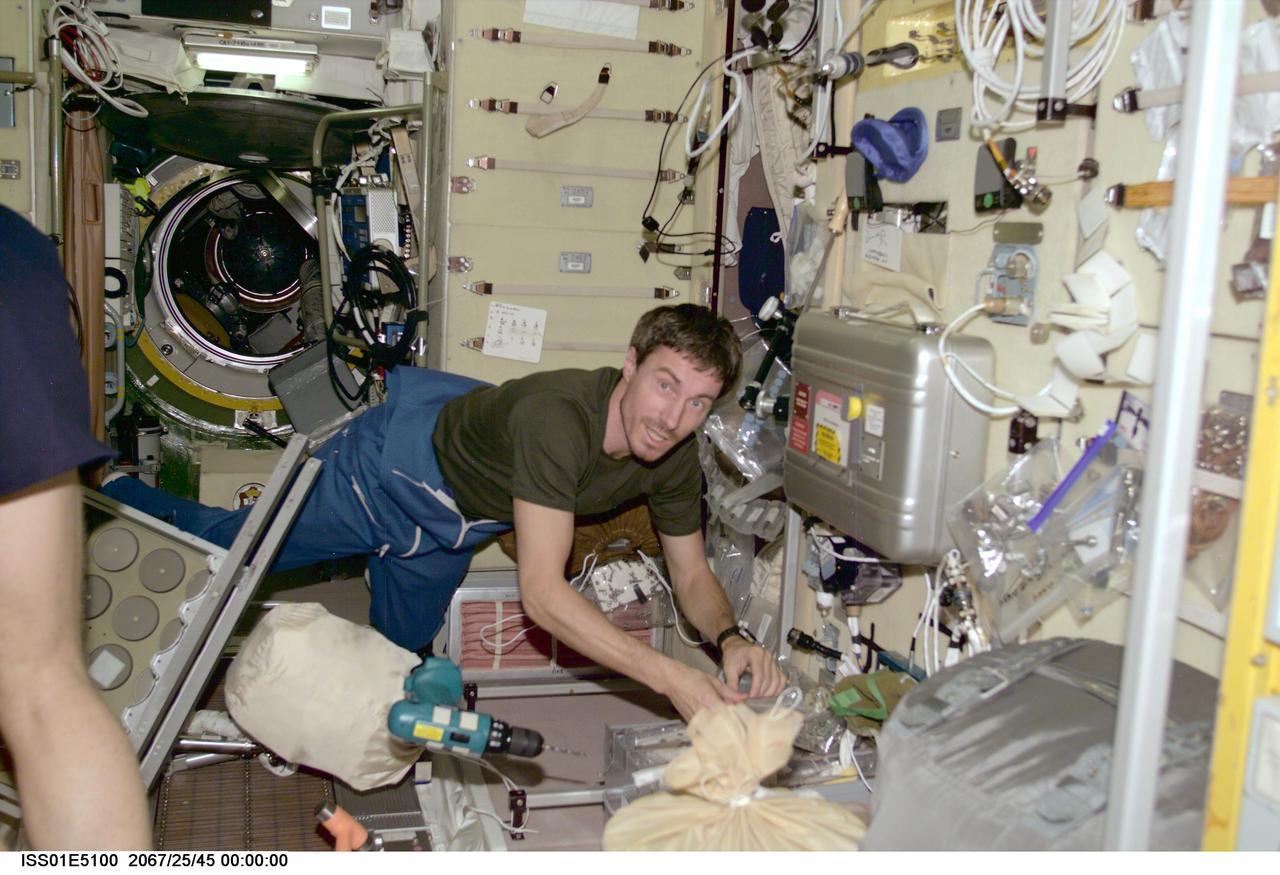
ISS01-E-5100 (December 2000) --- Cosmonaut Sergei K. Krikalev, Expedition One flight engineer, retrieves some tools on the International Space Station's Zvezda Service Module.
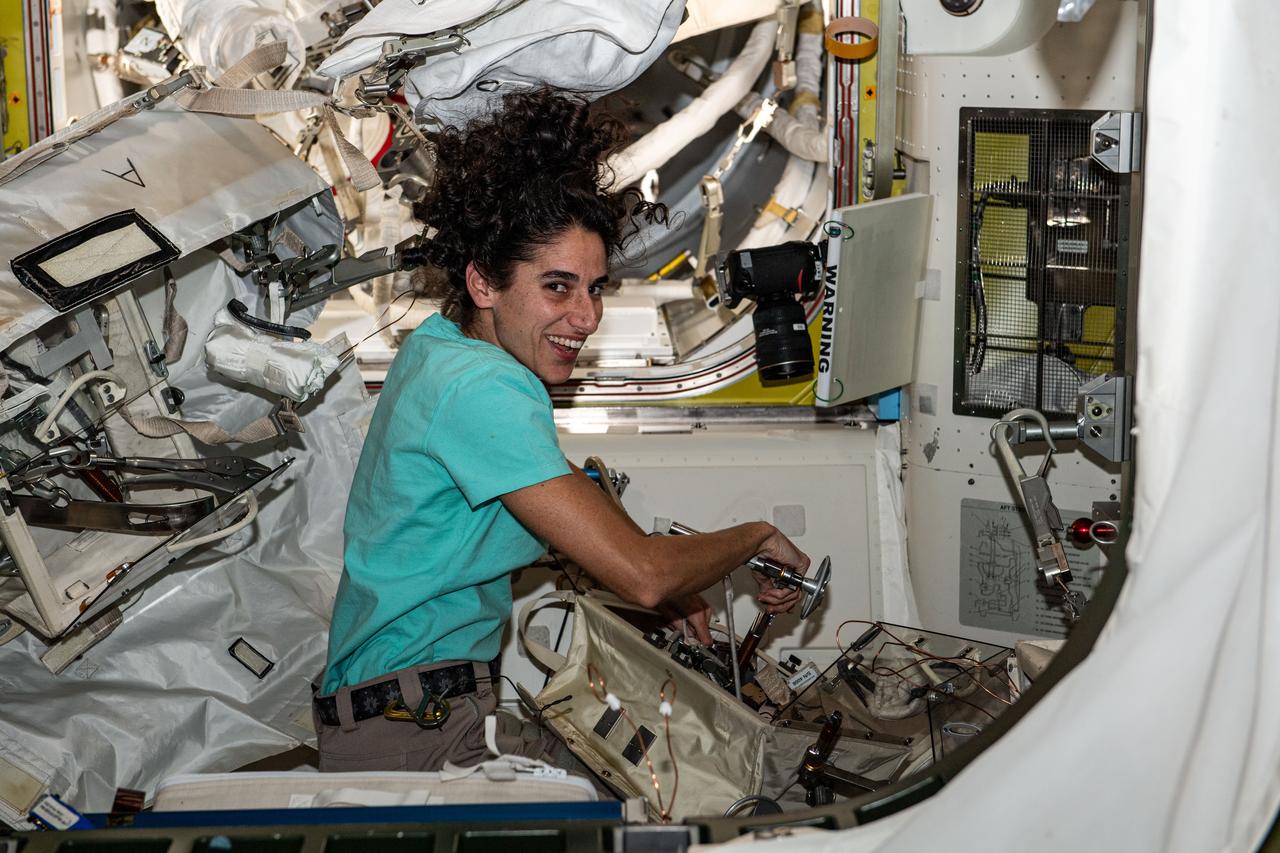
iss070e014310 (Oct. 27, 2023) --- NASA astronaut and Expedition 70 Flight Engineer Jasmin Moghbeli configures spacewalking tools inside the International Space Station's Quest airlock.
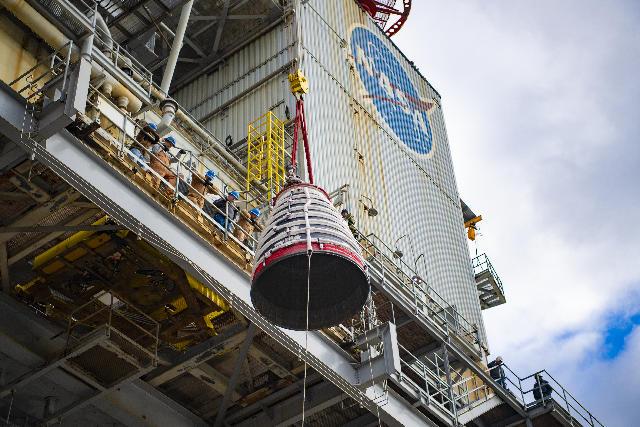
The new production nozzle is lifted on the Fred Haise Test Stand at NASA’s Stennis Space Center on Feb. 6. Crews used specially adapted procedures and tools to swap out the nozzles with the engine in place.
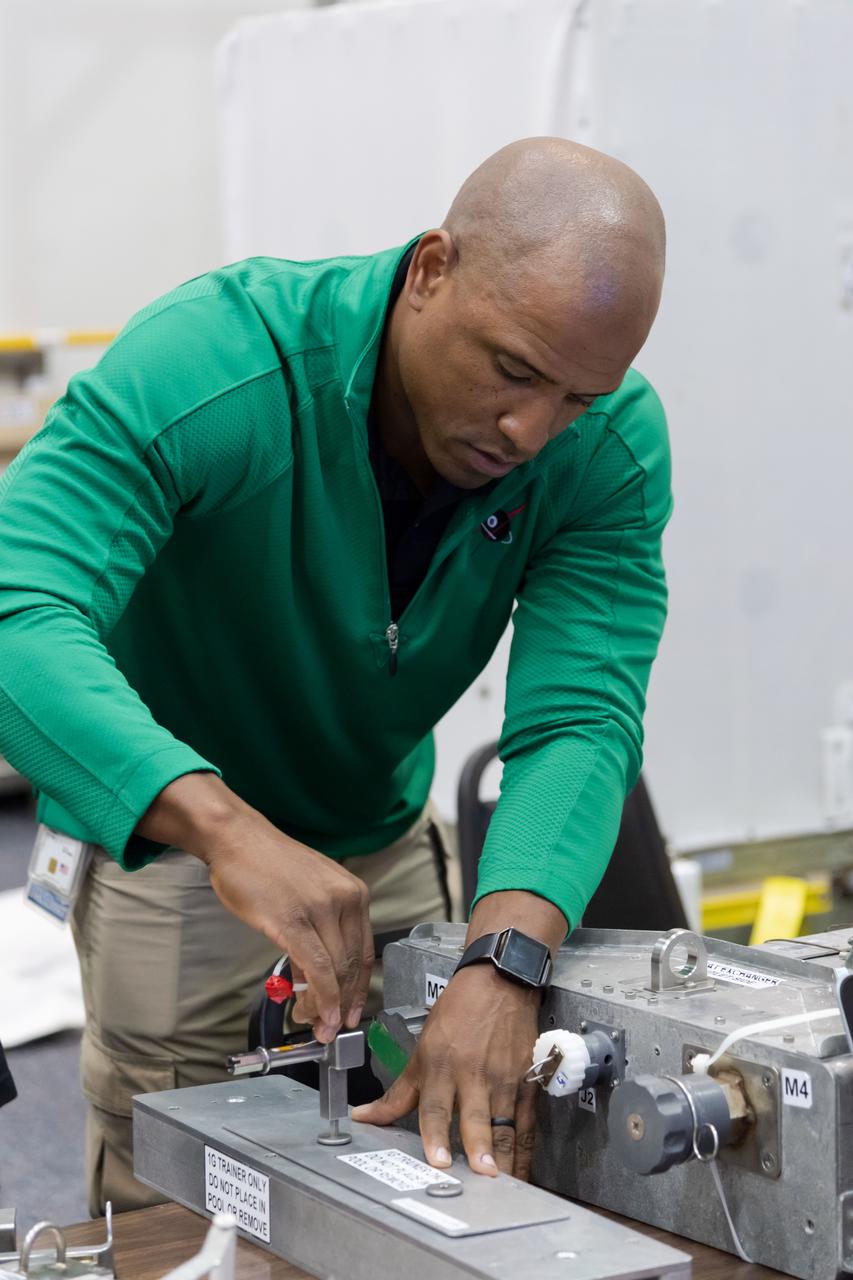
NASA commercial crew astronaut Victor Glover gets training on some of the tools he could use during spacewalks at the International Space Station. Glover is assigned to the SpaceX Crew Dragon’s second crewed flight.
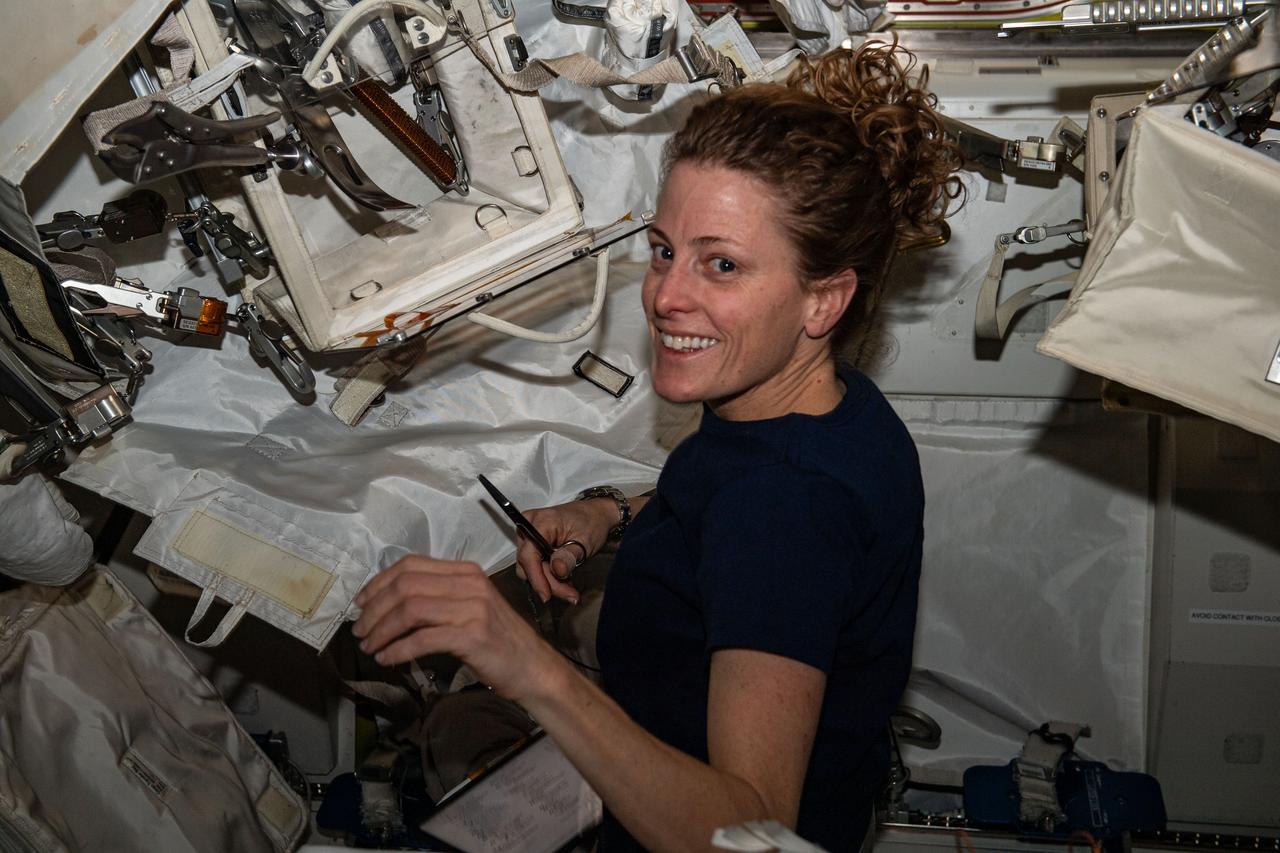
iss070e014316 (Oct. 27, 2023) --- NASA astronaut and Expedition 70 Flight Engineer Loral O'Hara configures spacewalking tools inside the International Space Station's Quest airlock.
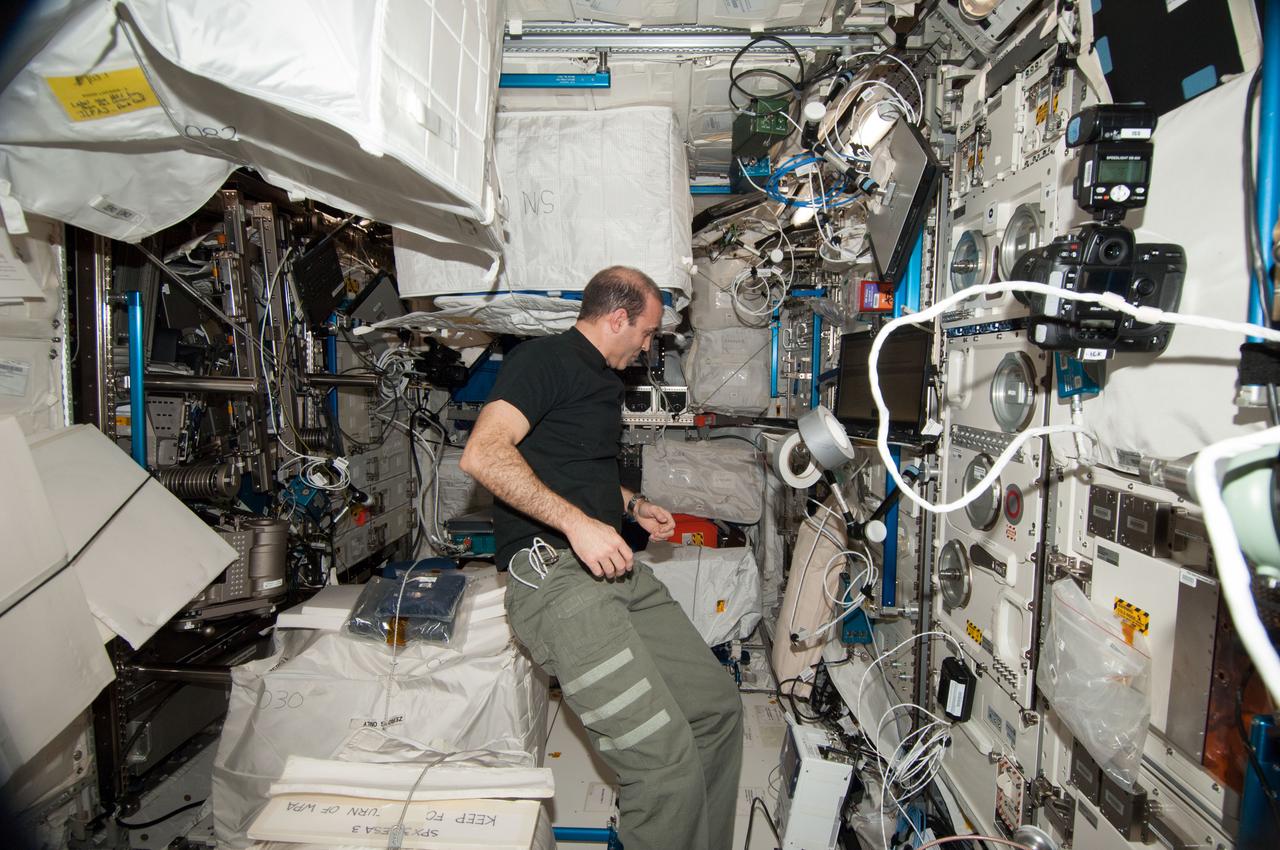
ISS039-E-017570 (30 April 2013) --- In the European Space Agency's Columbus module, Flight Engineer Rick Mastracchio of NASA prepares to access a tool box designated for intravehicular work.
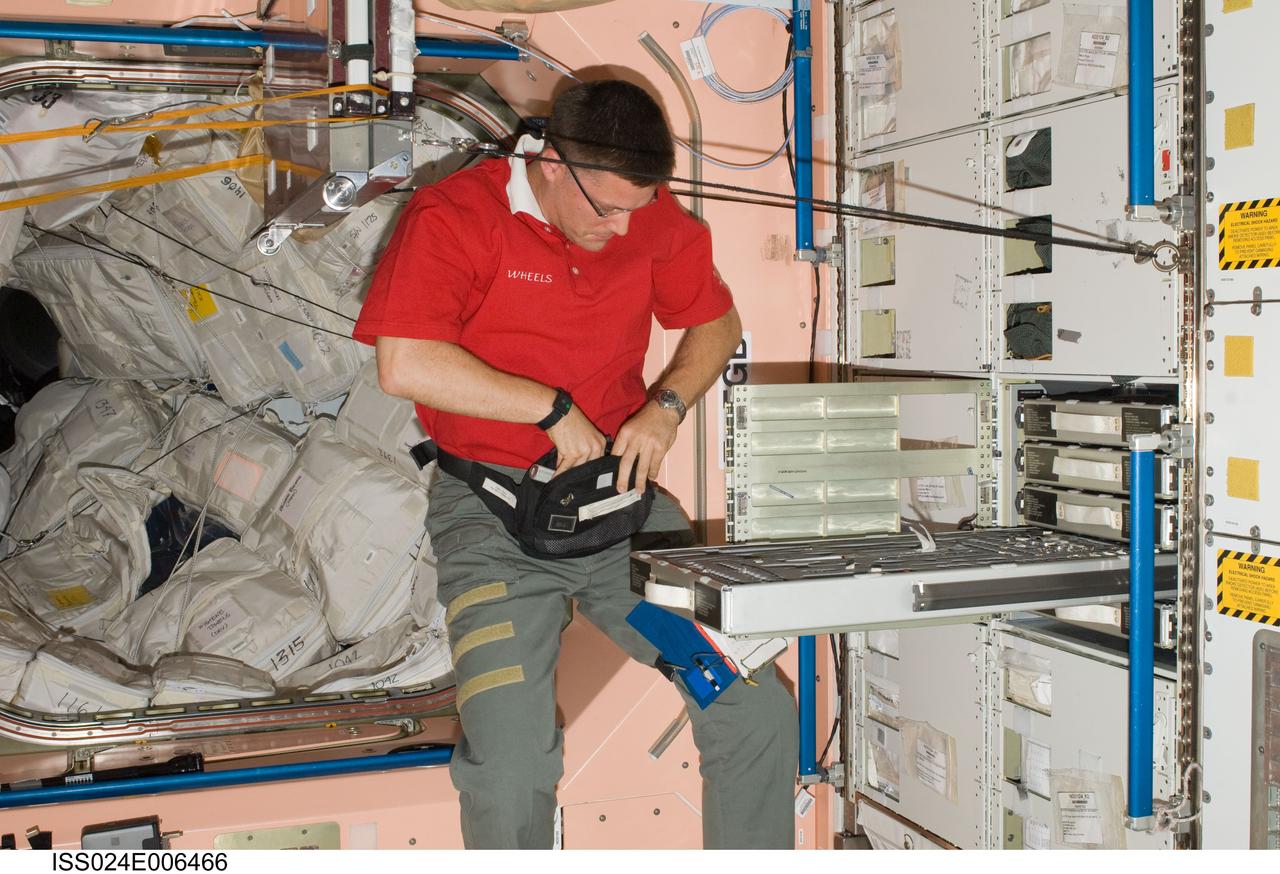
ISS024-E-006466 (24 June 2010) --- NASA astronaut Doug Wheelock, Expedition 24 flight engineer, places tools in a bag in the Unity node of the International Space Station.
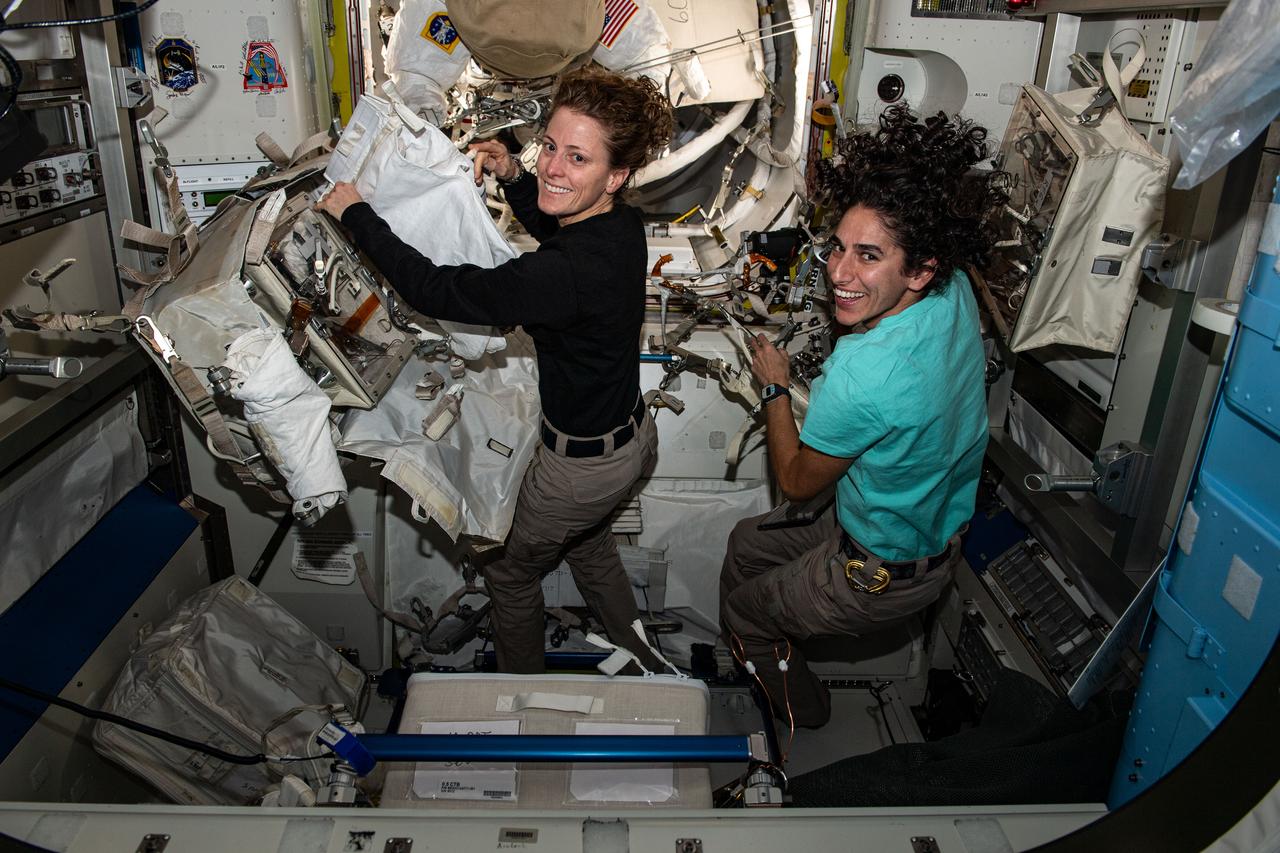
iss070e014305 (Oct. 27, 2023) --- Expedition 70 Flight Engineers (from left) Loral O'Hara and Jasmin Moghbeli, both NASA astronauts, configure spacewalking tools inside the International Space Station's Quest airlock.
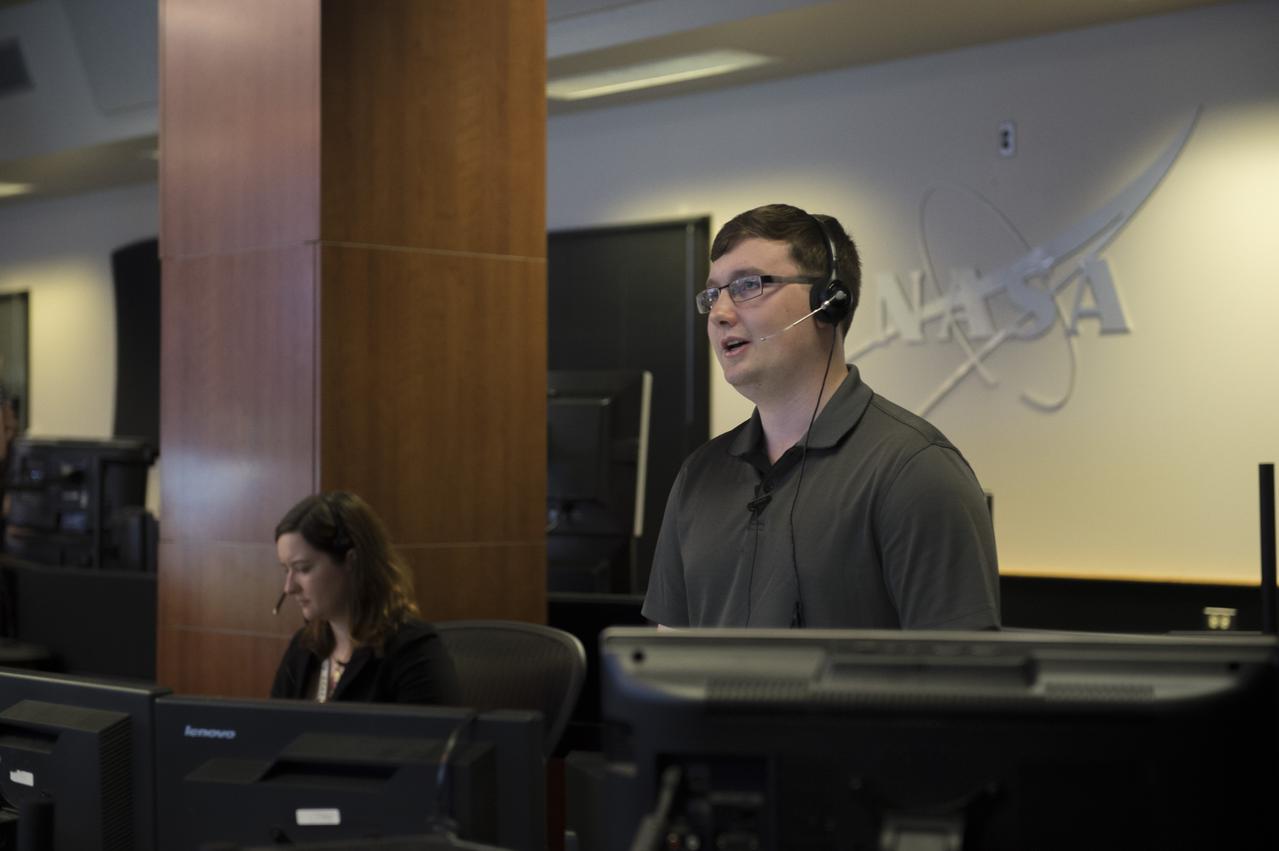
UAH ENGINEERING STUDENT ROBERT HILLAN TALKS TO SPACE STATION CREW MEMBERS ABOUT HIS WINNING 3-D PRINTED TOOL DESIGNED FOR USE ON ISS, AND IS INTERVIEWED BY LOCAL MEDIA