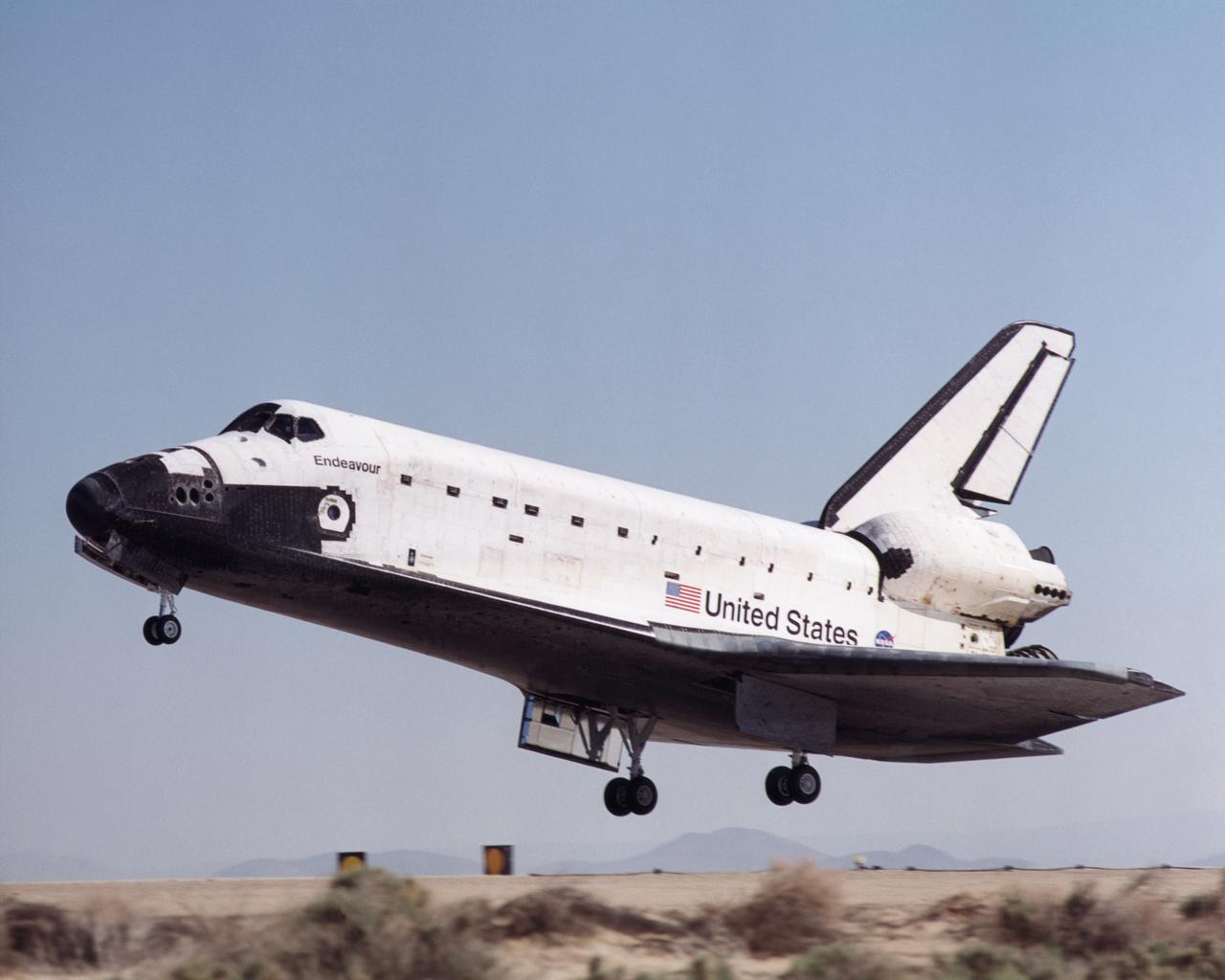
At the conclusion of Space Shuttle Mission STS-100, Endeavour landed at Edwards Air Force Base, California, May 1, 2001. There the Orbiter would be readied by technicians at NASA's Dryden Flight Research Center for return to Kennedy Space Center, Florida, atop a 747 carrier aircraft.
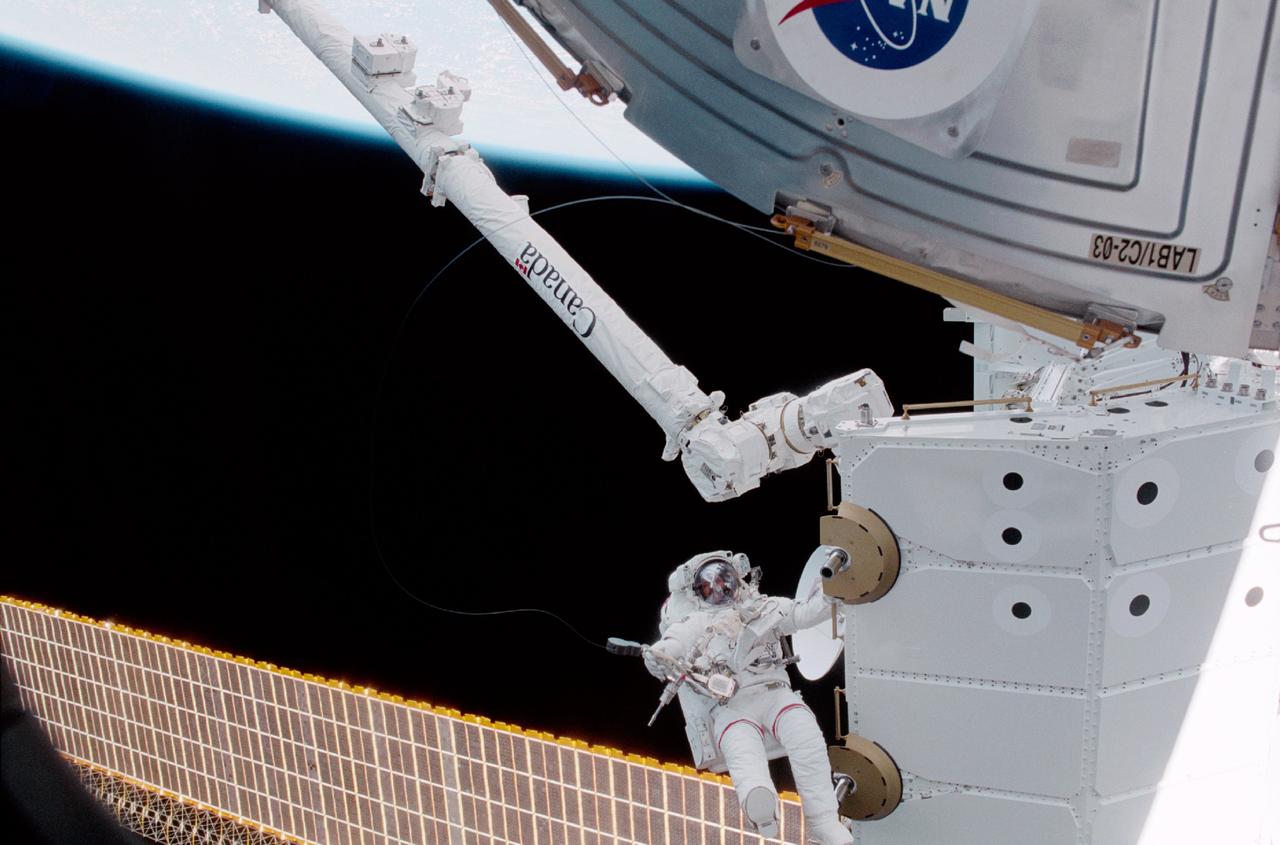
The main objective of the STS-100 mission, the sixth International Space Station (ISS) assembly flight, was the delivery and installation of the Canadian-built Space Station Remote Manipulator System (SSRMS), or Canadarm2. In this photograph, astronaut Chris A. Hadfield, mission specialist representing the Canadian Space Agency (CSA), is seen near the Canadarm2, as the new tool for the ISS grasps the space lab pallet. STS-100 launched April 19, 2001 aboard the Space Shuttle Orbiter Endeavour for an 11 day mission.
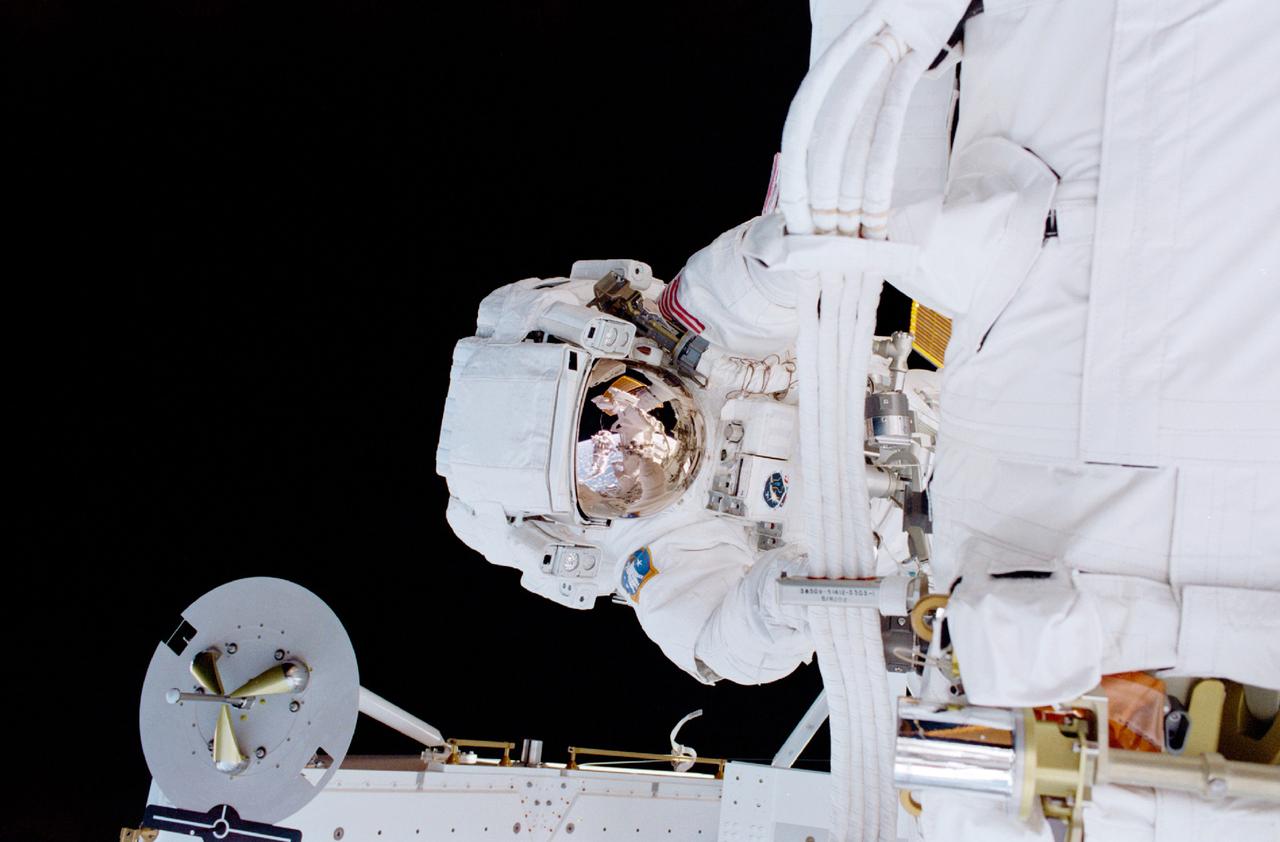
The main objective of the STS-100 mission, the sixth International Space Station (ISS) assembly flight, was the delivery and installation of the Canadian-built Space Station Remote Manipulator System (SSRMS), or Canadarm2. In this photograph, astronaut Scott E. Parazynski, mission specialist, works with cables associated with the robotic arm during one of two days of extravehicular activity (EVA). Both space walks were shared with Chris A. Hadfield, mission specialist representing the Canadian Space Agency (CSA), who is visible in the helmet visor of Parazynski. STS-100 launched April 19, 2001 aboard the Space Shuttle Orbiter Endeavour for an 11 day mission.
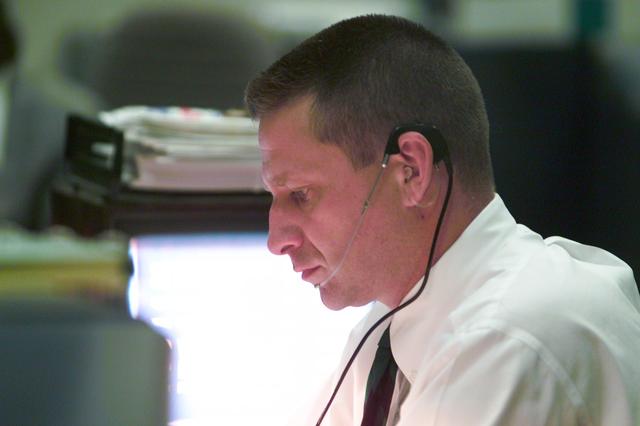
JSC2001-E-12117 (19 April 2001) --- Astronaut Christopher J. (Gus) Loria, at the Spacecraft Communicator (CAPCOM) console, peruses information on monitors and displays at his console in the flight control room in the Johnson Space Center's Mission Control Center (MCC) as countdown for the Space Shuttle Endeavour launch of STS-100 continues several hundred miles away in Florida. Loria deals with weather issues in the respective areas for both ascent and entry phases of the STS-100 mission.
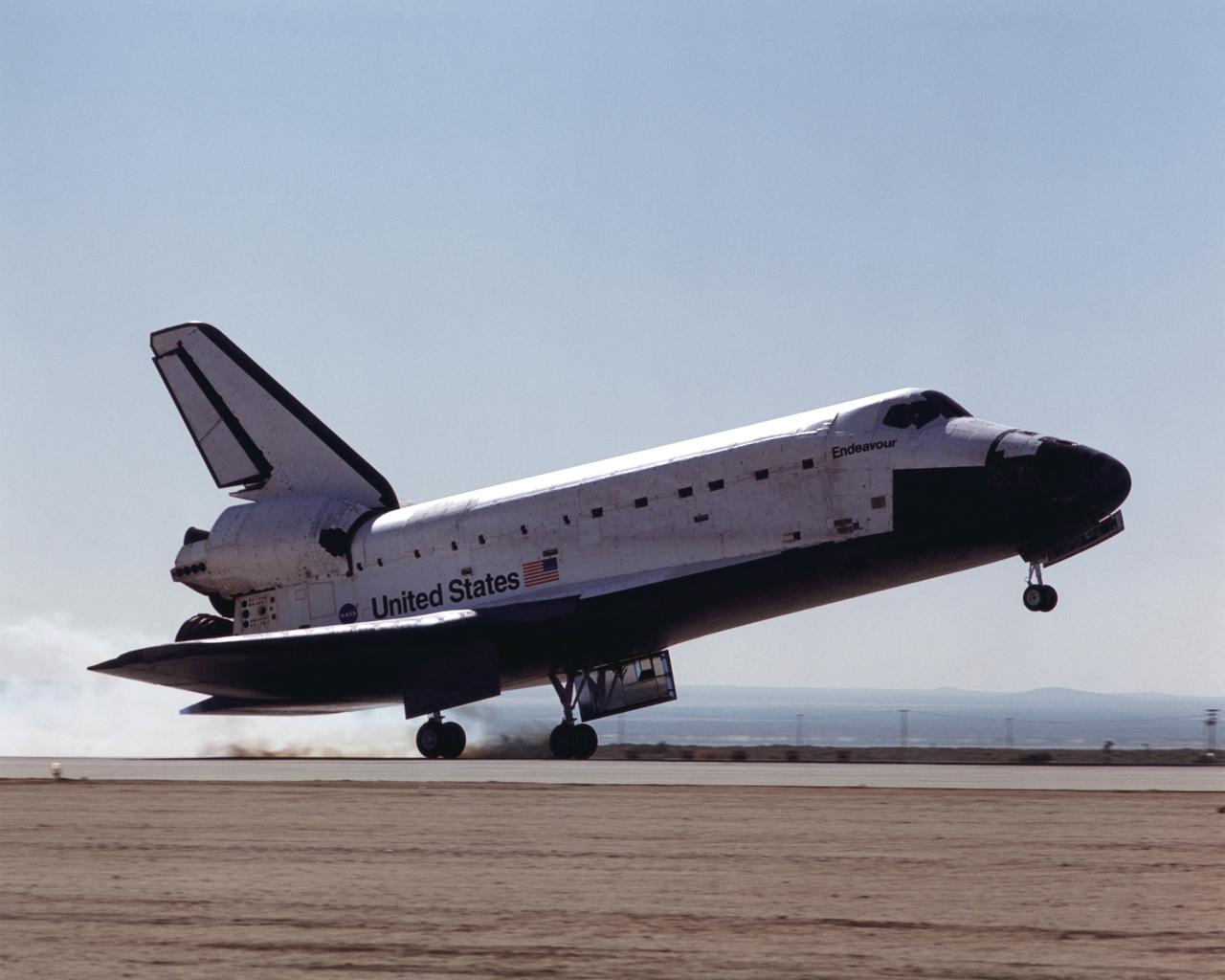
Space Shuttle Endeavour's tires produced a momentary puff of smoke as Mission STS-100 landed at NASA's Dryden Flight Research Center on Edwards Air Force Base, California, May 1, 2001.
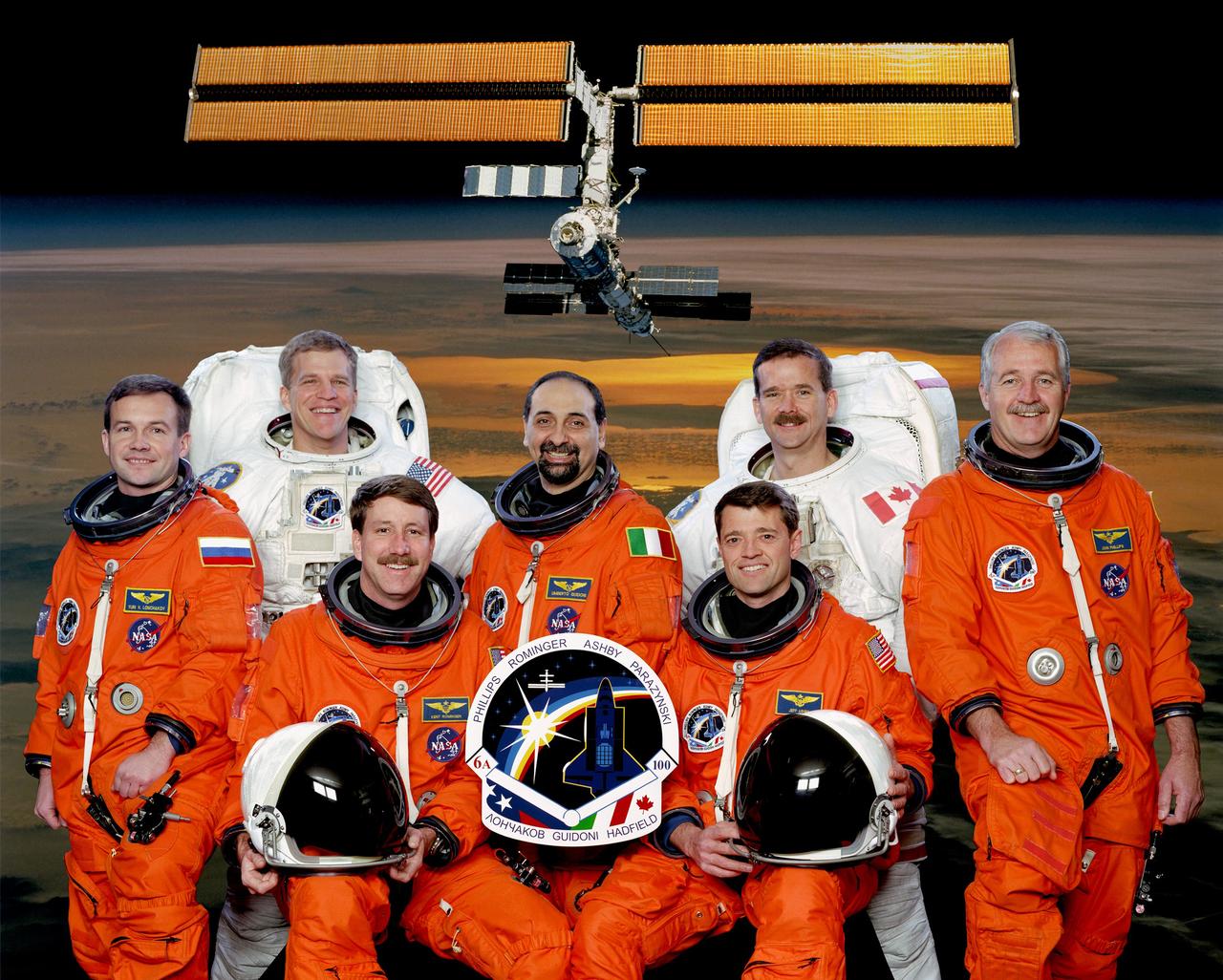
This is the official crew portrait of the STS-100 mission. Seated are astronauts Kent V. Rominger, (left) and Jeffrey S. Ashby, commander and pilot, respectively. Standing (from the left) are cosmonaut Yuri V. Lonchakov with astronauts Scott E. Parazynski, Umberto Guidoni of the European Space Agency, Chris A. Hadfield, and John L. Phillips, all mission specialists. The seven launched from the Kennedy Space Center aboard the Space shuttle Orbiter Endeavour on April 19, 2001 for an 11-day mission. The STS-100 mission, the sixth International Space Station (ISS) assembly flight, accomplished the following objectives: The delivery of the Canadian-built Space Station Remote Manipulator System (SSRMS), Canadarm2, which is needed to perform assembly operations on later flights; The delivery and installation of a UHF antenna that provides space-to-space communications capability for U.S.-based space walks; and carried the Italian-built Multipurpose Logistics Module Raffaello containing six system racks and two storage racks for the U.S. Lab, Destiny.
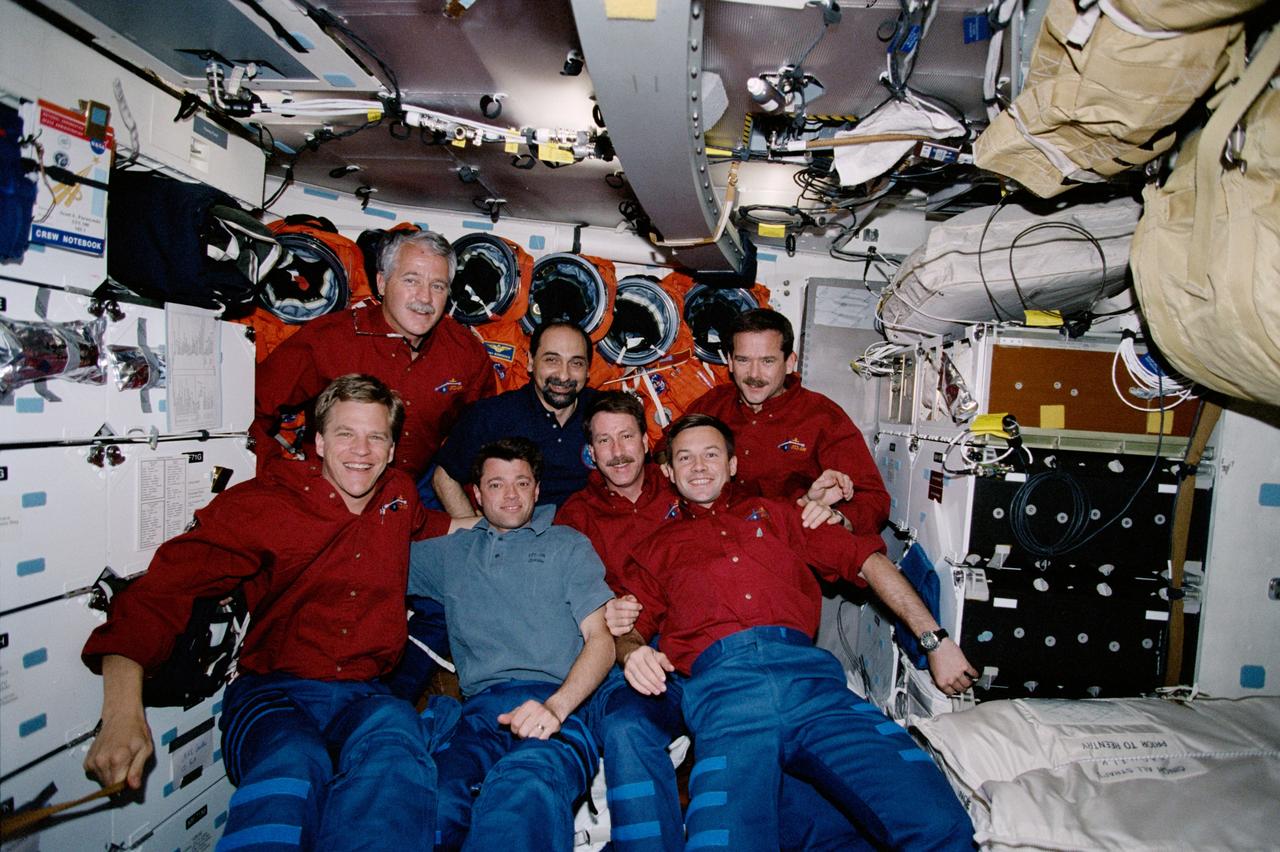
The STS-100 crew pose for their inflight crew photograph on the middeck of Endeavour, Orbiter Vehicle (OV) 105, during the STS-100 mission. Front row from left to right are: Mission Specialist (MS) Scott E. Parazynski, Pilot Jeffrey S. Ashby, Commander Kent V. Rominger and MS / Cosmonaut Yuri V. Lonchakov. Back row: MS John L. Phillips, MS Umberto Guidoni and MS Chris A. Hadfield. Lonchakov represents Rosaviakosmos. Guidoni represents European Space Agency (ESA). Hadfield represents Canadian Space Agency (CSA). This image was selected by the STS-100 crew for use in public presentations.
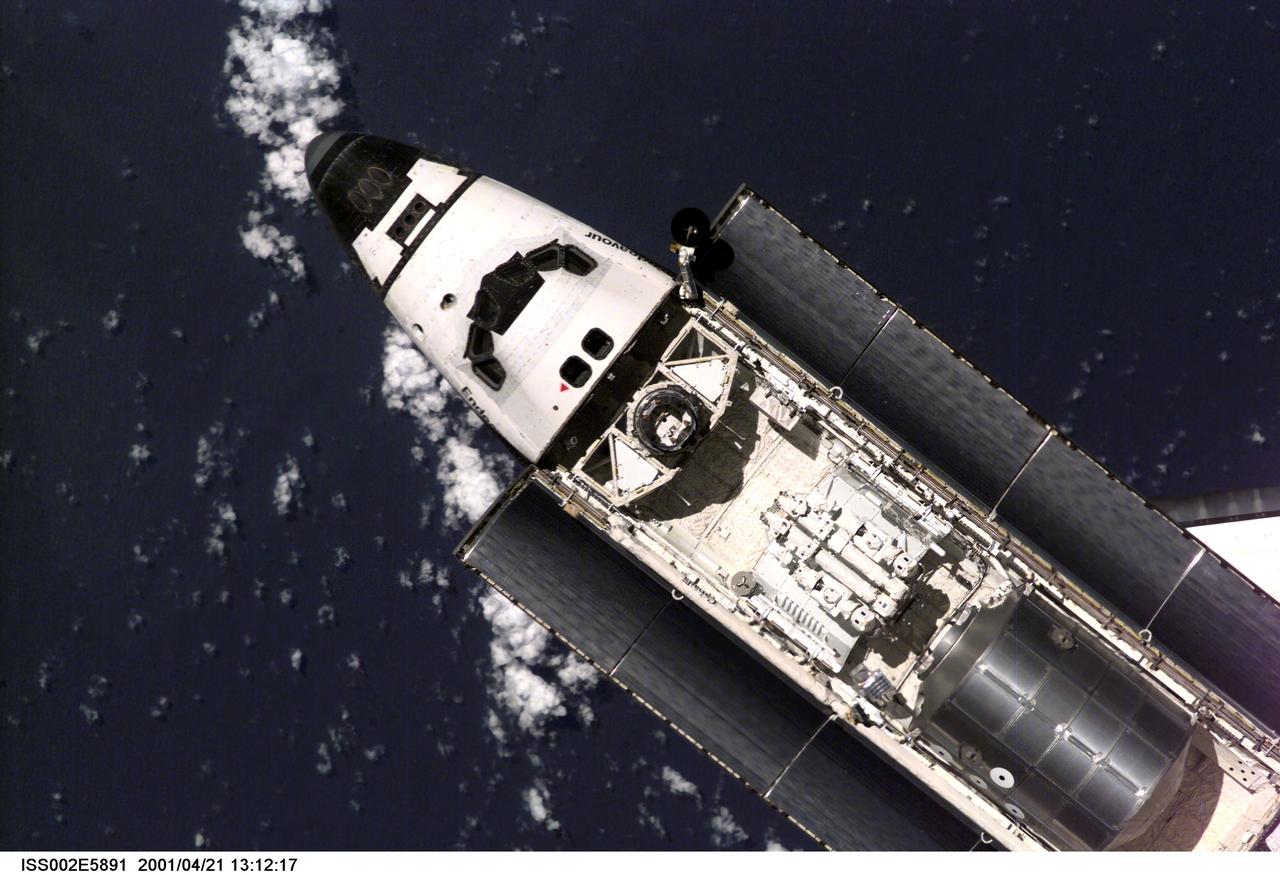
ISS002-E-5891 (21 April 2001) --- A distant view of the Space Shuttle Endeavour preparing to dock with the International Space Station (ISS) during the STS-100 mission. The STS-100 crewmembers are delivering the Canadarm2, Space Station Remote Manipulator System (SSRMS), and equipment stowed in the Multipurpose Logistics Module (MPLM) Raphaello to the ISS which are visible in Endeavour's payload bay. The image was taken with a digital still camera.
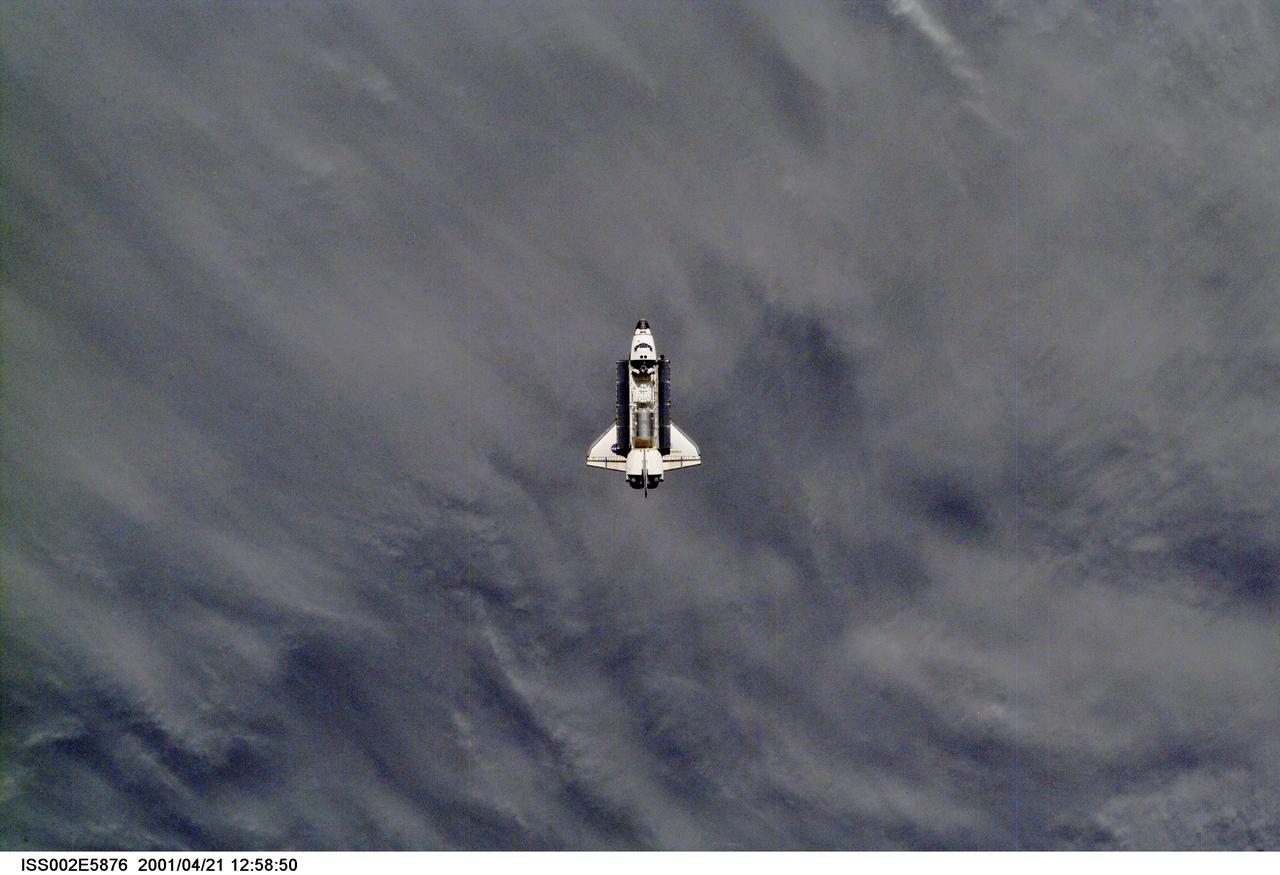
ISS002-E-5876 (21 April 2001) --- A distant view of the Space Shuttle Endeavour preparing to dock with the International Space Station (ISS) during the STS-100 mission. The STS-100 crewmembers are delivering the Canadarm2, Space Station Remote Manipulator System (SSRMS), and equipment stowed in the Multipurpose Logistics Module (MPLM) Raphaello to the ISS which are visible in Endeavour's payload bay. The image was taken with a digital still camera.
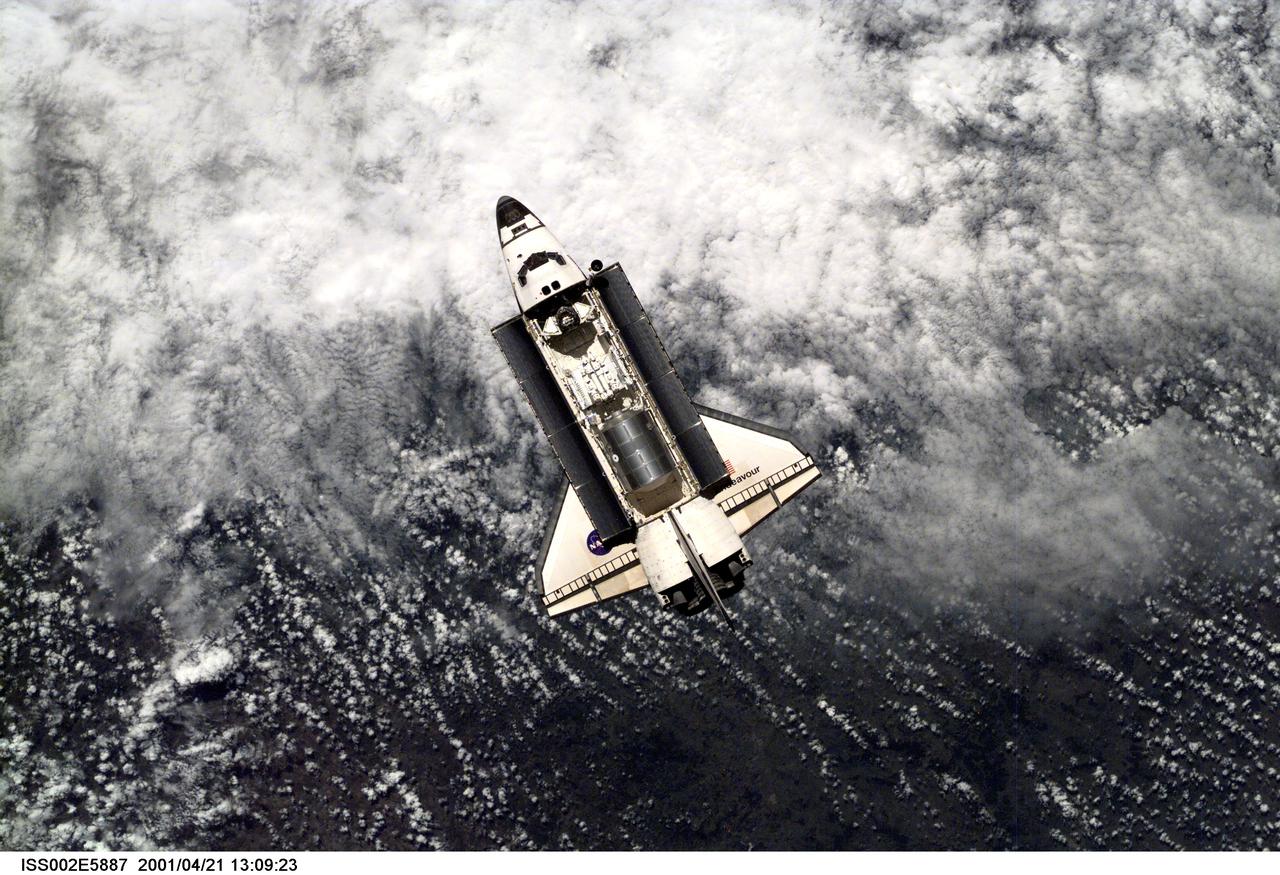
ISS002-E-5887 (21 April 2001) --- A view of the Space Shuttle Endeavour preparing to dock with the International Space Station (ISS) during the STS-100 mission. The STS-100 crewmembers are delivering the Canadarm2, Space Station Remote Manipulator System (SSRMS), and equipment stowed in the Multipurpose Logistics Module (MPLM) Raphaello to the ISS which are visible in Endeavour's payload bay. The image was taken with a digital still camera.
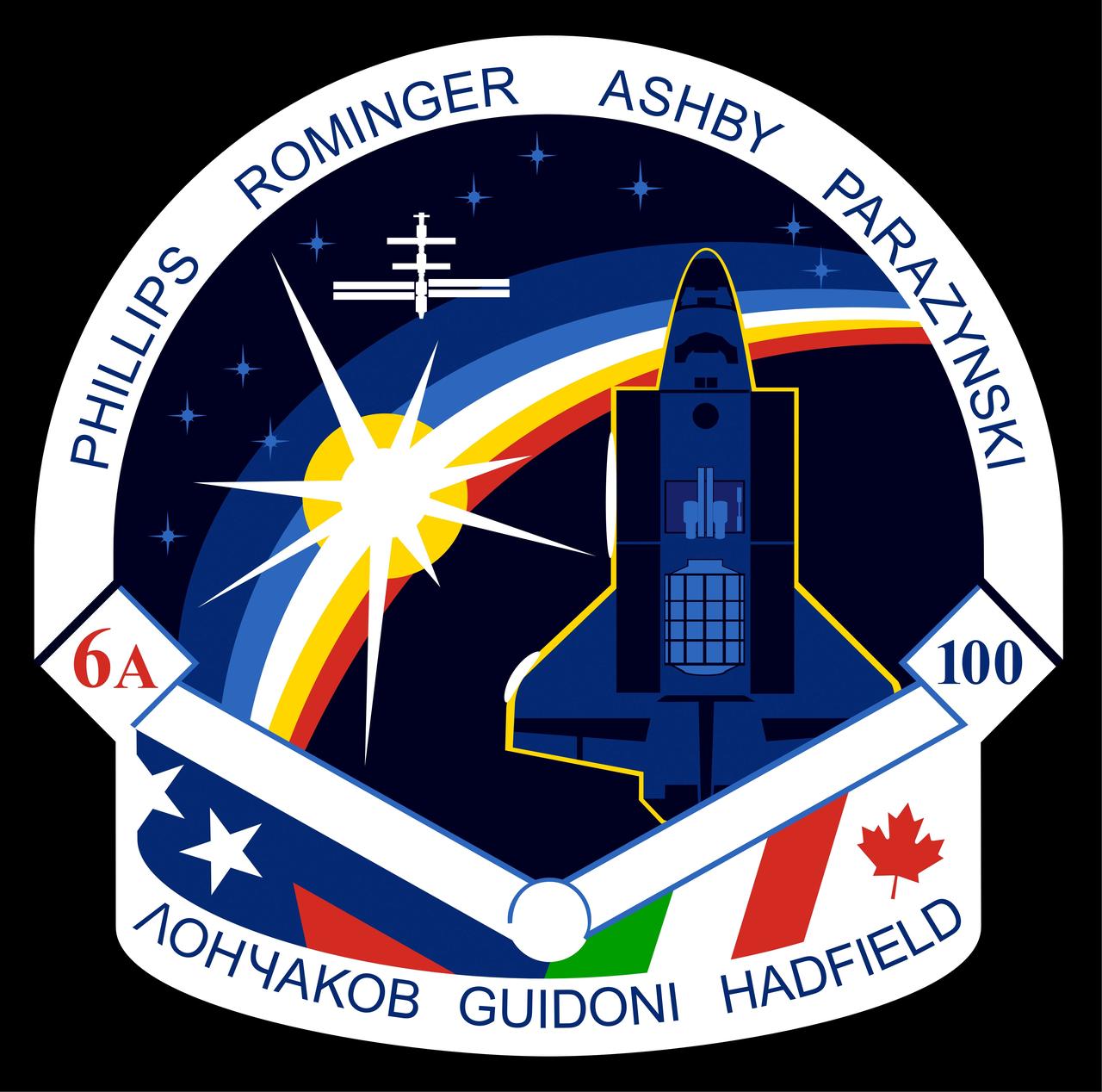
STS100-S-001 (December 2000) --- The STS-100/6A emblem reflects the complex interaction of robotics and extravehicular activity (EVA) on this mission. During the mission spacewalks will be conducted to deploy the International Space Station Robotic Manipulator System (SSRMS). The EVA helmet frames the patch, with the Canadian-built SSRMS shown below the visor. Reflected in the visor is the space shuttle Endeavour, with the International Space Station rising above the horizon at orbital sunrise. Endeavour’s payload bay houses a Spacelab pallet, itself holding the SSRMS and the Space Station Ultra High Frequency Antenna, and the Italian-built Multi-Purpose Logistics Module “Raffaello.” American, Russian, Canadian, and Italian astronauts compose the crew, and their flags are stylized in the lower portion of the emblem. Ten stars adorn the sky, representing the children of the STS-100 crew and the future of space exploration. The NASA insignia design for space shuttle flights is reserved for use by the astronauts and for other official use as the NASA Administrator may authorize. Public availability has been approved only in the forms of illustrations by the various news media. When and if there is any change in this policy, which is not anticipated, the change will be publicly announced. Photo credit: NASA
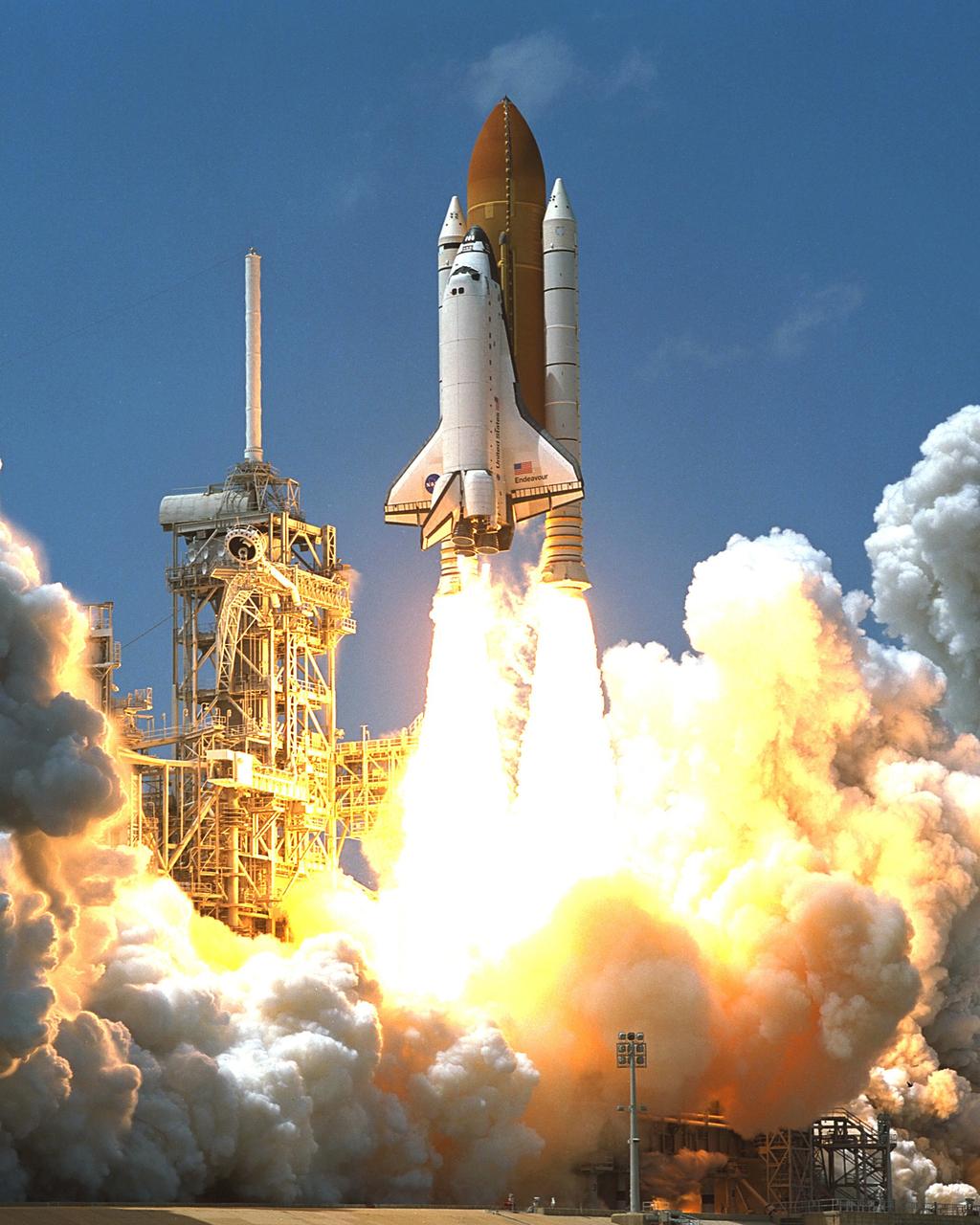
The sixth International Space Station (ISS) assembly flight, STS-100, blasted from the launch pad aboard the Space Shuttle Orbiter Endeavour on April 19, 2001. Onboard were astronauts Kent V. Rominger, Jeffrey S. Ashby, Scott E. Parazynski, Chris A. Hadfield, John Phillips, and Umberto Guidoni of the European Space agency, along with cosmonaut Yuri V. Lonchakov for an 11-day mission. Mission objectives included: The delivery of the second Canadian Remote Manipulator System, Canadarm2, which is needed to perform assembly operations on later flights; The delivery and installation of a UHF anterna that provides space-to-space communications capability for U.S.-based space walks; and carried the Italian-built Multipurpose Logistics Module Raffaello containing six system racks and two storage racks for the U.S. Lab, Destiny.
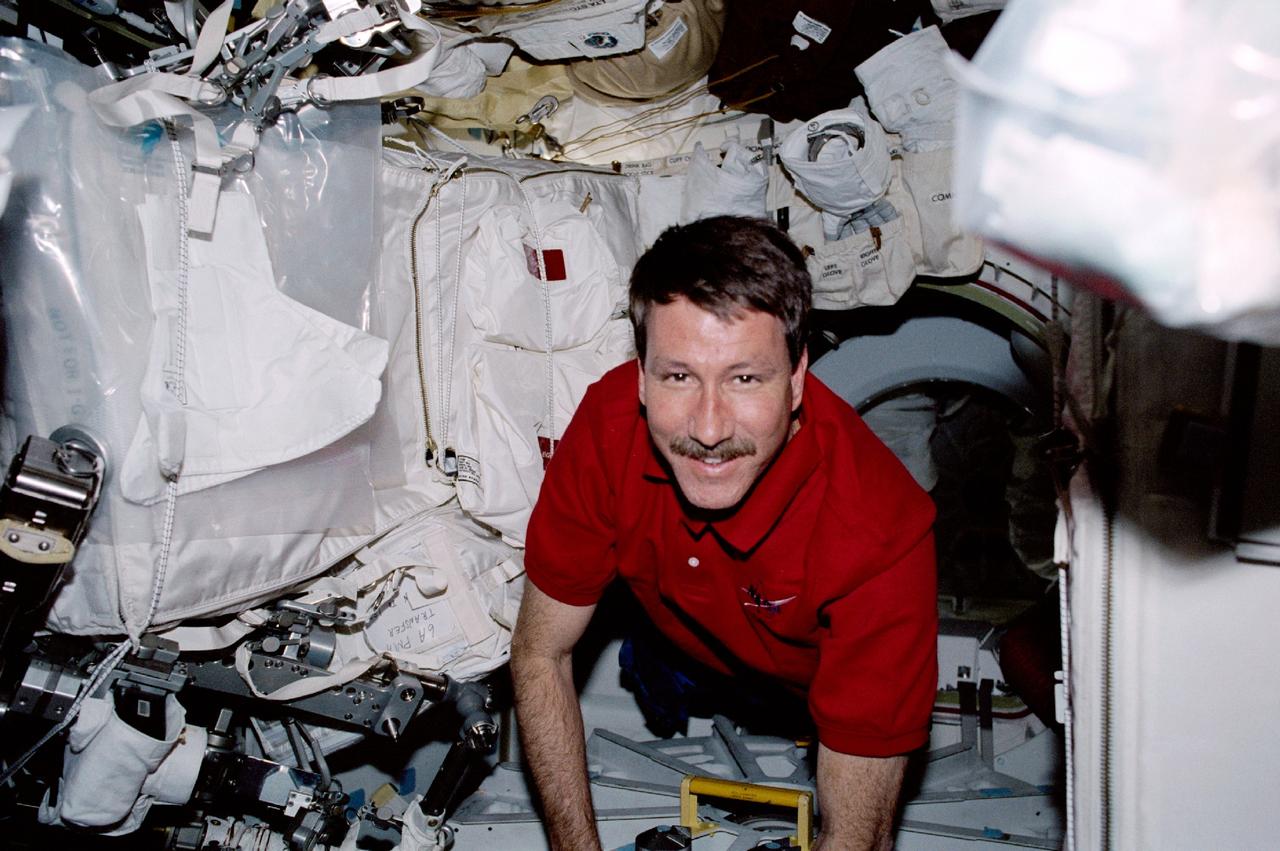
STS100-337-010 (19 April - 1 May 2001) --- Astronaut Kent V. Rominger, STS-100 mission commander, floats near the airlock hatch onboard the Earth-orbiting Space Shuttle Endeavour. The airlock is the scene of important preparations and follow-up tasks for two scheduled space walks on the STS-100 mission.
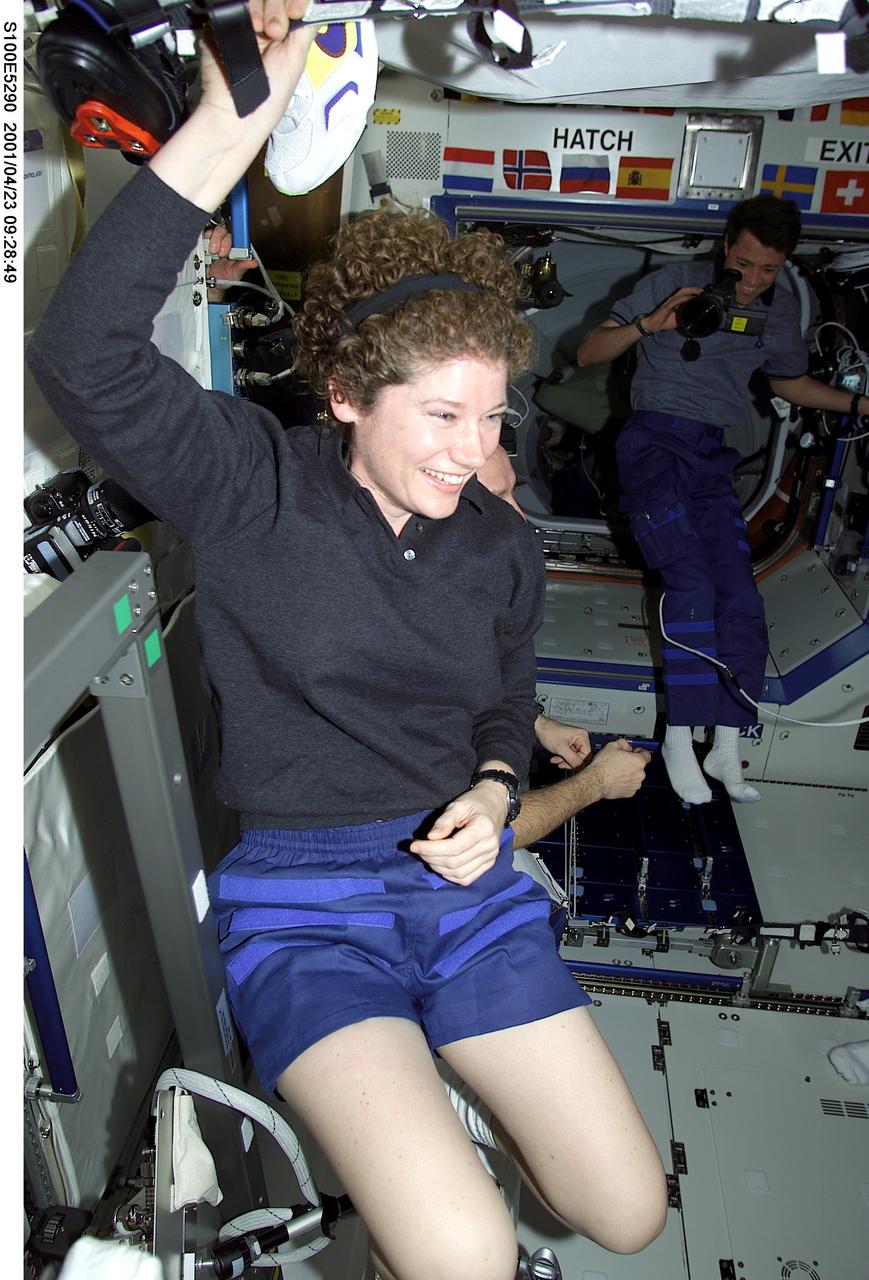
S100-E-5290 (23 April 2001)--- Astronaut Susan J. Helms, Expedition Two flight engineer, greets members of the STS-100 crew in the Destiny laboratory just after hatch opening. Astronaut Jeffrey S. Ashby, STS-100 pilot, documents the reunion in the background. The image was recorded with a digital still camera.
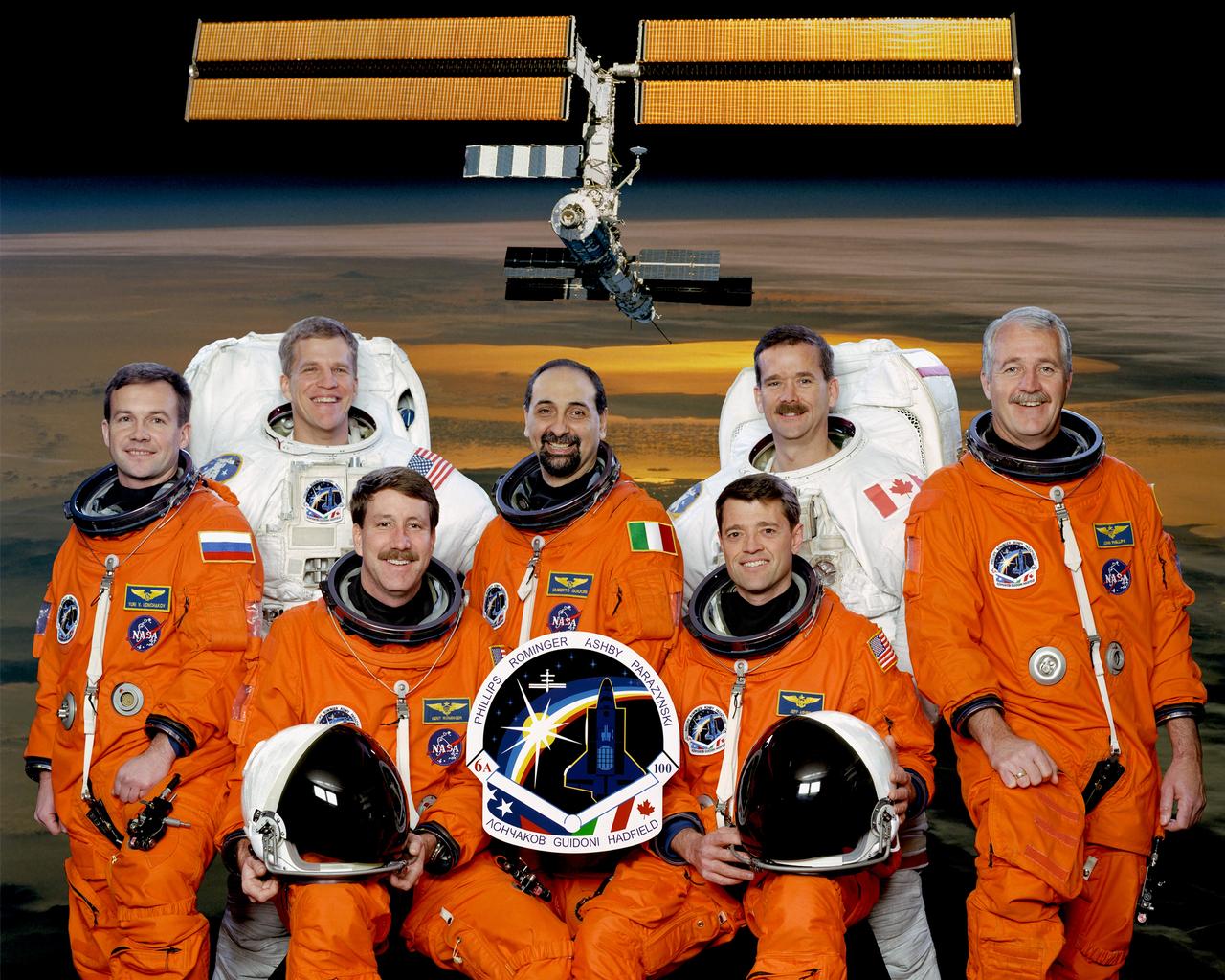
STS100-S-002 (March 2001) --- These international astronauts and cosmonaut have been in training in a number of venues for the April 2001 visit to the International Space Station (ISS). Seated are astronauts Kent V. Rominger (left) and Jeffrey S. Ashby, commander and pilot, respectively, for the STS-100 mission. Standing, from the left, are cosmonaut Yuri V. Lonchakov, with astronauts Scott E. Parazynski, Umberto Guidoni, Chris A. Hadfield and John L. Phillips, all mission specialists. Guidoni represents the European Space Agency (ESA); Hadfield is with the Canadian Space Agency (CSA) and Lonchakov is affiliated with Rosaviakosmos.
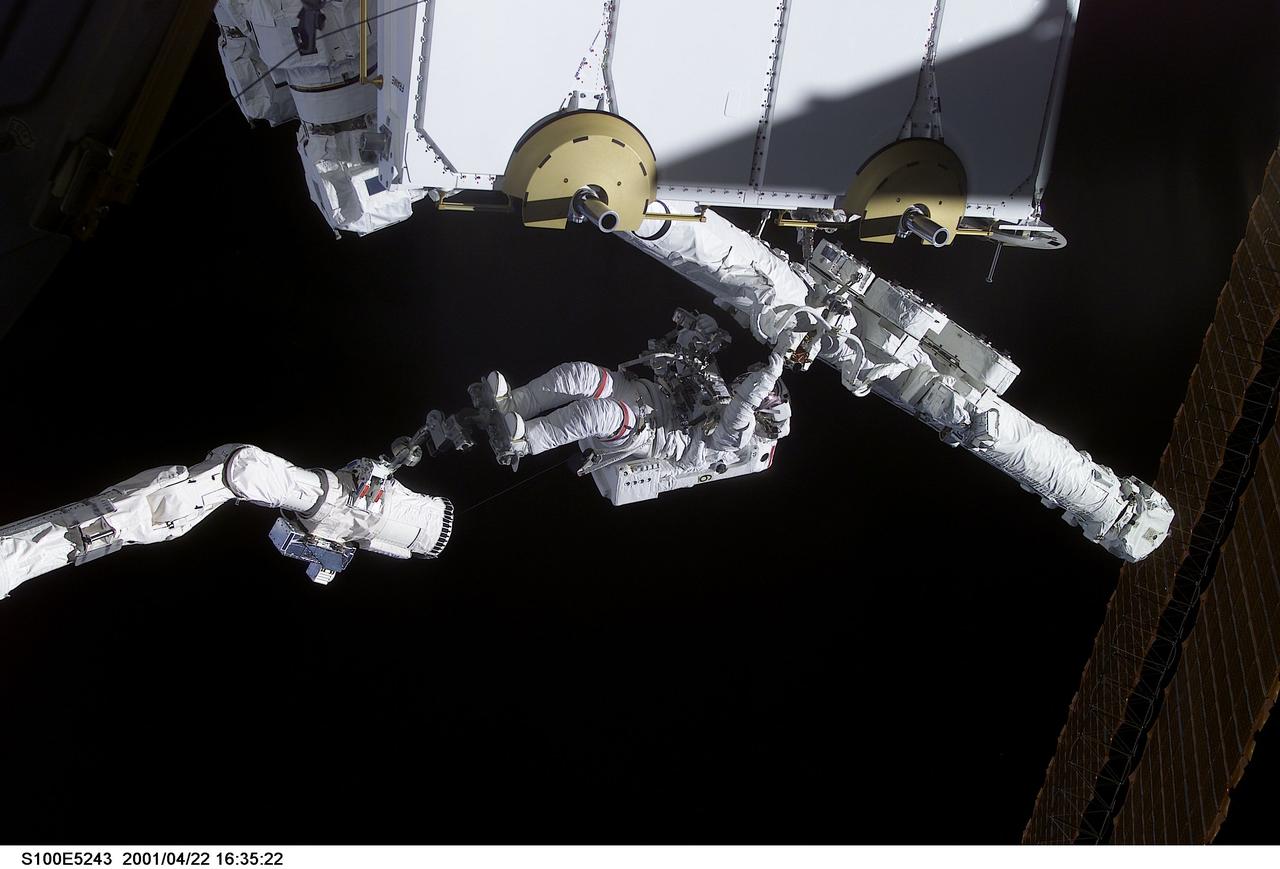
S100-E-5243 (22 April 2001) --- Astronaut Chris A. Hadfield, STS-100 mission specialist representing the Canadian Space Agency (CSA), stands on one Canadian-built robot arm to work with another one. Called Canadarm2, the newest addition to the International Space Station (ISS) was ferried up to the orbital outpost by the STS-100 crew. Hadfield's feet are secured on a special foot restraint attached to the end of the Remote Manipulator System (RMS) arm, which represents one of the standard shuttle components for the majority of the 100-plus STS missions thus far. The picture was recorded with a digital still camera.
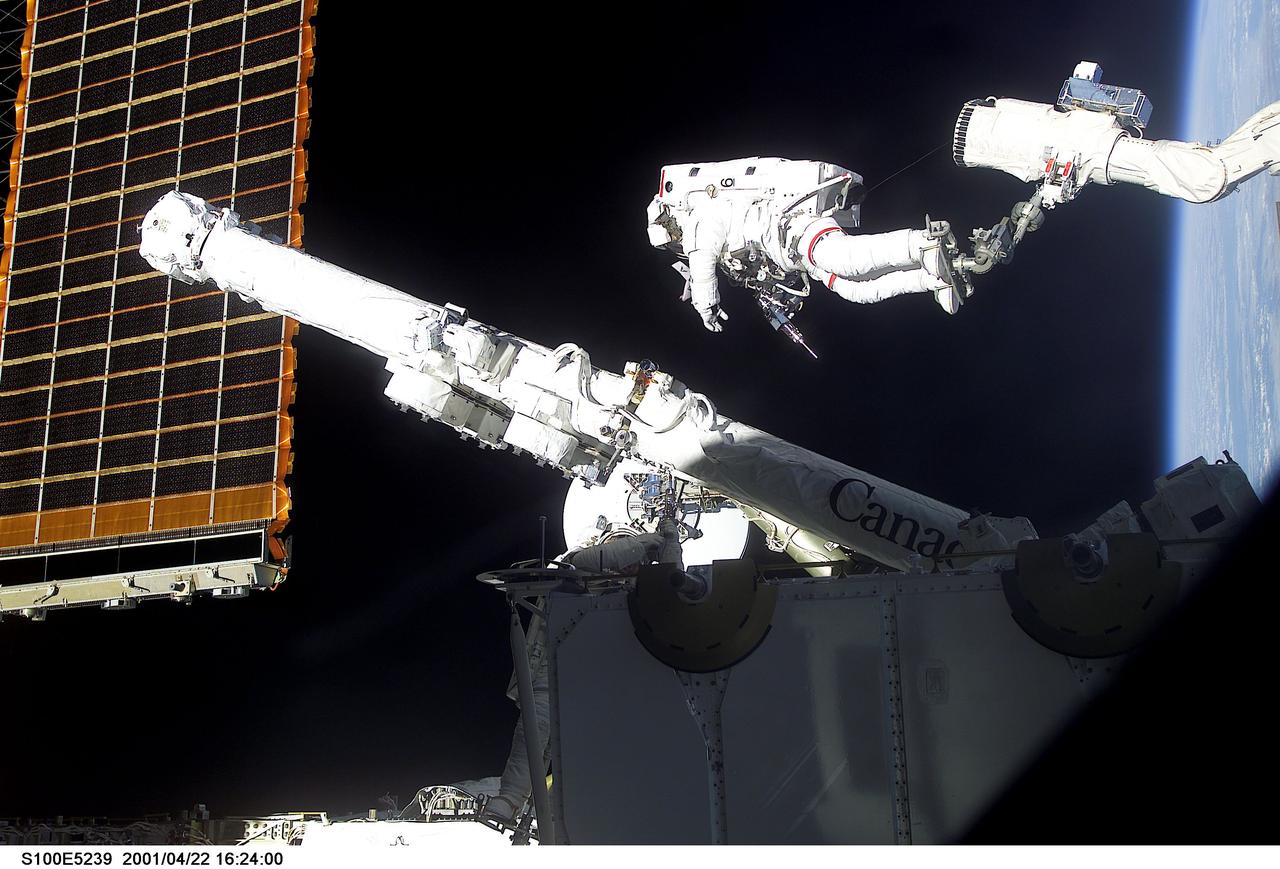
S100-E-5239 (22 April 2001) --- Astronaut Chris A. Hadfield, STS-100 mission specialist representing the Canadian Space Agency (CSA), stands on one Canadian-built robot arm to work with another one. Called Canadarm2, the newest addition to the International Space Station (ISS) was ferried up to the orbital outpost by the STS-100 crew. Hadfield's feet are secured on a special foot restraint attached to the end of the Remote Manipulator System (RMS) arm, which represents one of the standard shuttle components for the majority of the 100-plus STS missions thus far. The picture was recorded with a digital still camera.
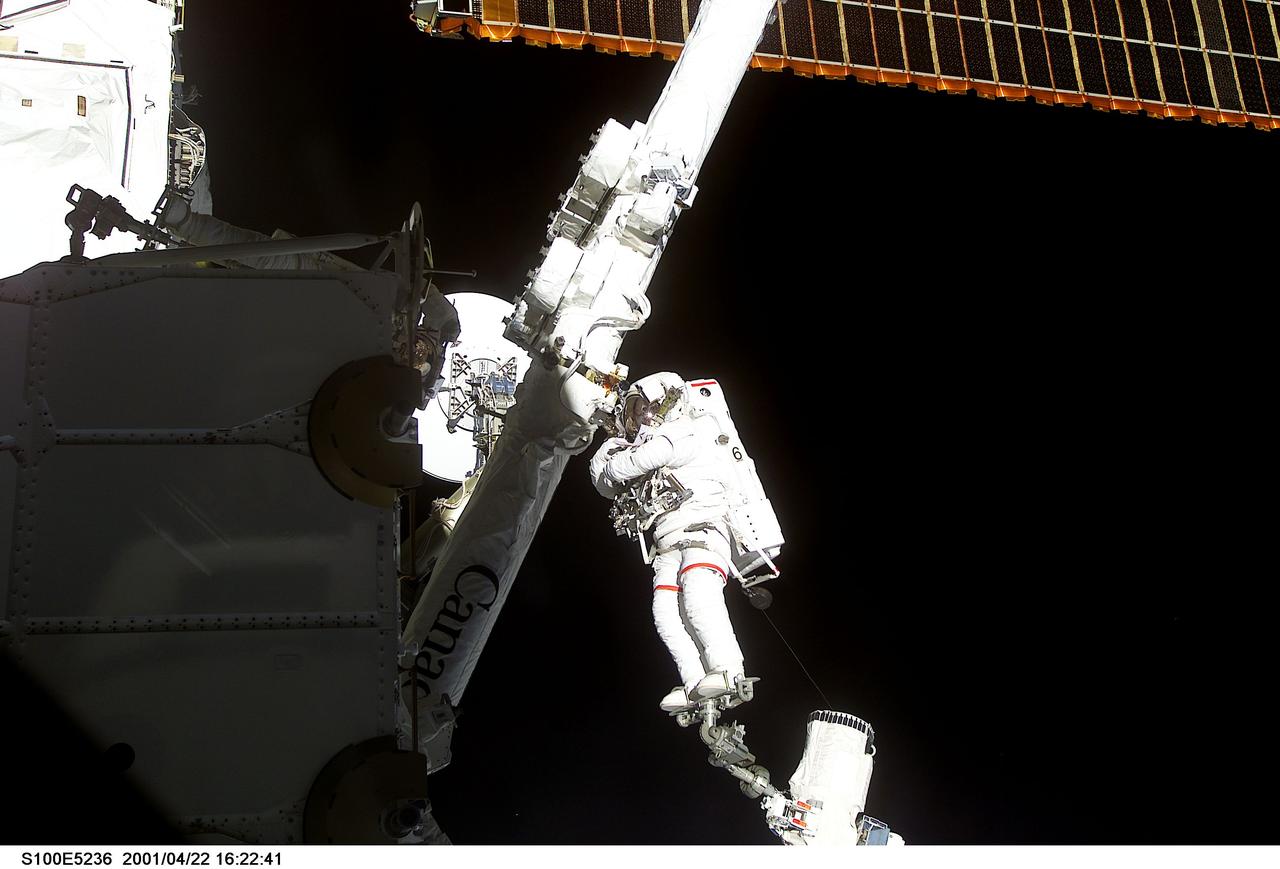
S100-E-5236 (22 April 2001) --- Astronaut Chris A. Hadfield, STS-100 mission specialist representing the Canadian Space Agency (CSA), stands on one Canadian-built robot arm to work with another one. Called Canadarm2, the newest addition to the International Space Station (ISS) was ferried up to the orbital outpost by the STS-100 crew. Hadfield's feet are secured on a special foot restraint attached to the end of the Remote Manipulator System (RMS) arm, which represents one of the standard shuttle components for the majority of the 100-plus STS missions thus far. The picture was recorded with a digital still camera.
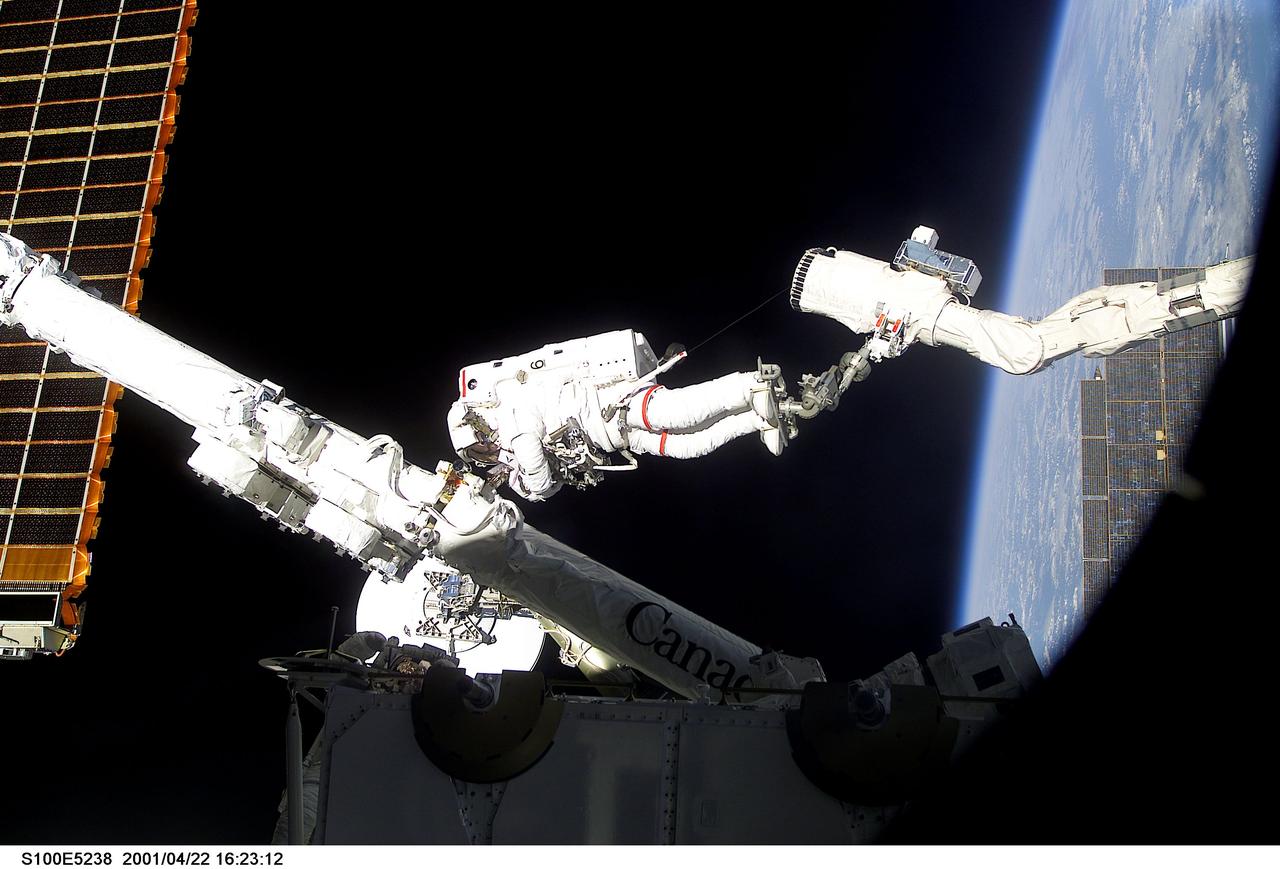
S100-E-5238 (22 April 2001) --- Astronaut Chris A. Hadfield, STS-100 mission specialist representing the Canadian Space Agency (CSA), stands on one Canadian-built robot arm to work with another one. Called Canadarm2, the newest addition to the International Space Station (ISS) was ferried up to the orbital outpost by the STS-100 crew. Hadfield's feet are secured on a special foot restraint attached to the end of the Remote Manipulator System (RMS) arm, which represents one of the standard shuttle components for the majority of the 100-plus STS missions thus far. The picture was recorded with a digital still camera.
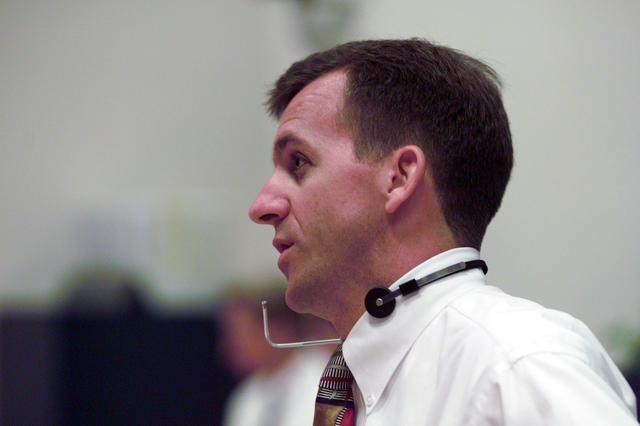
JSC2001-E-12116 (19 April 2001) --- LeRoy Cain, at the Flight Director console, peruses information on large screens in front of the flight control room in the Johnson Space Center's Mission Control Center (MCC) as countdown for the Space Shuttle Endeavour launch of STS-100 continues several hundred miles away in Florida. Cain is both ascent and entry flight director for the flight.
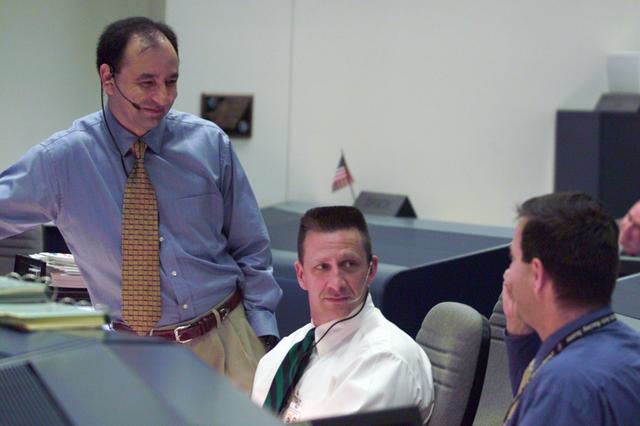
JSC2001-E-12125 (19 April 2001) --- Astronauts Mark L. Polansky, from the left, Christopher J. (Gus) Loria, and Scott D. Altman discuss the approaching STS-100 launch at their positions at the Spacecraft Communicator console in Houston's Mission Control Center (MCC). Loria's position addresses weather issues, of which there were few on this particular launch. He will also be assigned to weather matters for the entry phase of the flight.
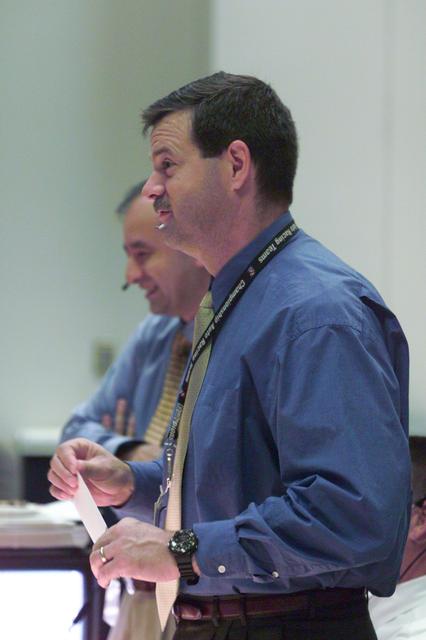
JSC2001-E-12122 (19 April 2001) --- Astronaut Scott D. Altman (foreground), STS-100 ascent spacecraft communicator (CAPCOM), stays on top of pre-launch activities at his console in the shuttle flight control room of Houston's Mission Control Center (MCC). Astronaut Mark L. Polansky stands beside Altman. Six astronauts and a cosmonaut, meanwhile, were strapped into their seats in the crew cabin of the Space Shuttle Endeavour several hundred miles away in Florida.
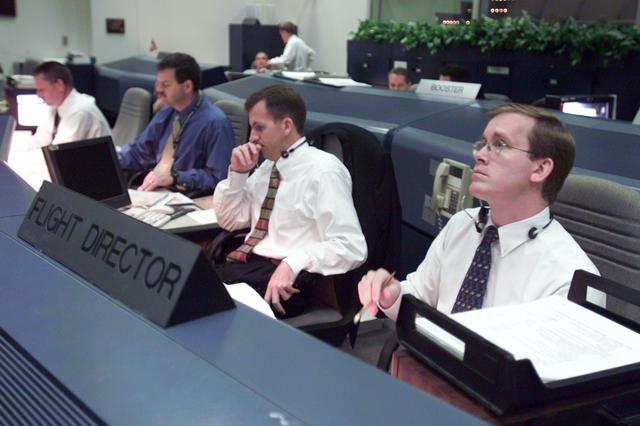
JSC2001-E-12118 (19 April 2001) --- Left to right, astronaut Christopher J. (Gus) Loria, astronaut Scott D. Altman, flight director LeRoy Cain and flight director John Shannon keep up with STS-100 pre-launch activities from their consoles in the shuttle flight control room in Houston's Mission Control Center (MCC). Altman is ascent spacecraft communicator (CAPCOM) and is assisted by Loria, CAPCOM specializing in weather issues. Cain is ascent flight director.
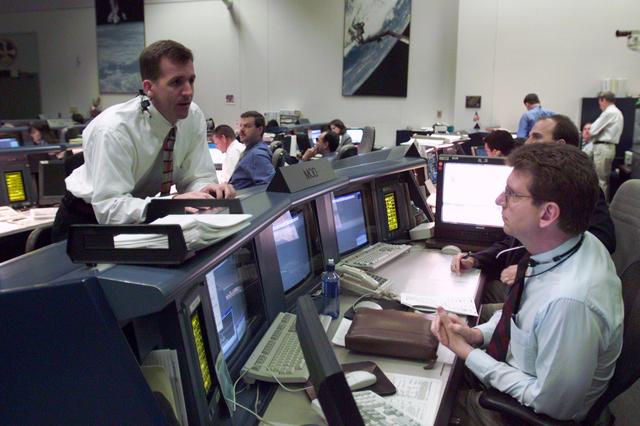
JSC2001-E-12120 (19 April 2001) --- STS-100 ascent flight director LeRoy Cain (left) leans over the Mission Operations Directorate (MOD) console for a word with Jeffrey Bantle in the shuttle flight control room of Houston's Mission Control Center (MCC). Six astronauts and a cosmonaut, meanwhile, were strapped into their seats in the crew cabin of the Space Shuttle Endeavour several hundred miles away in Florida.
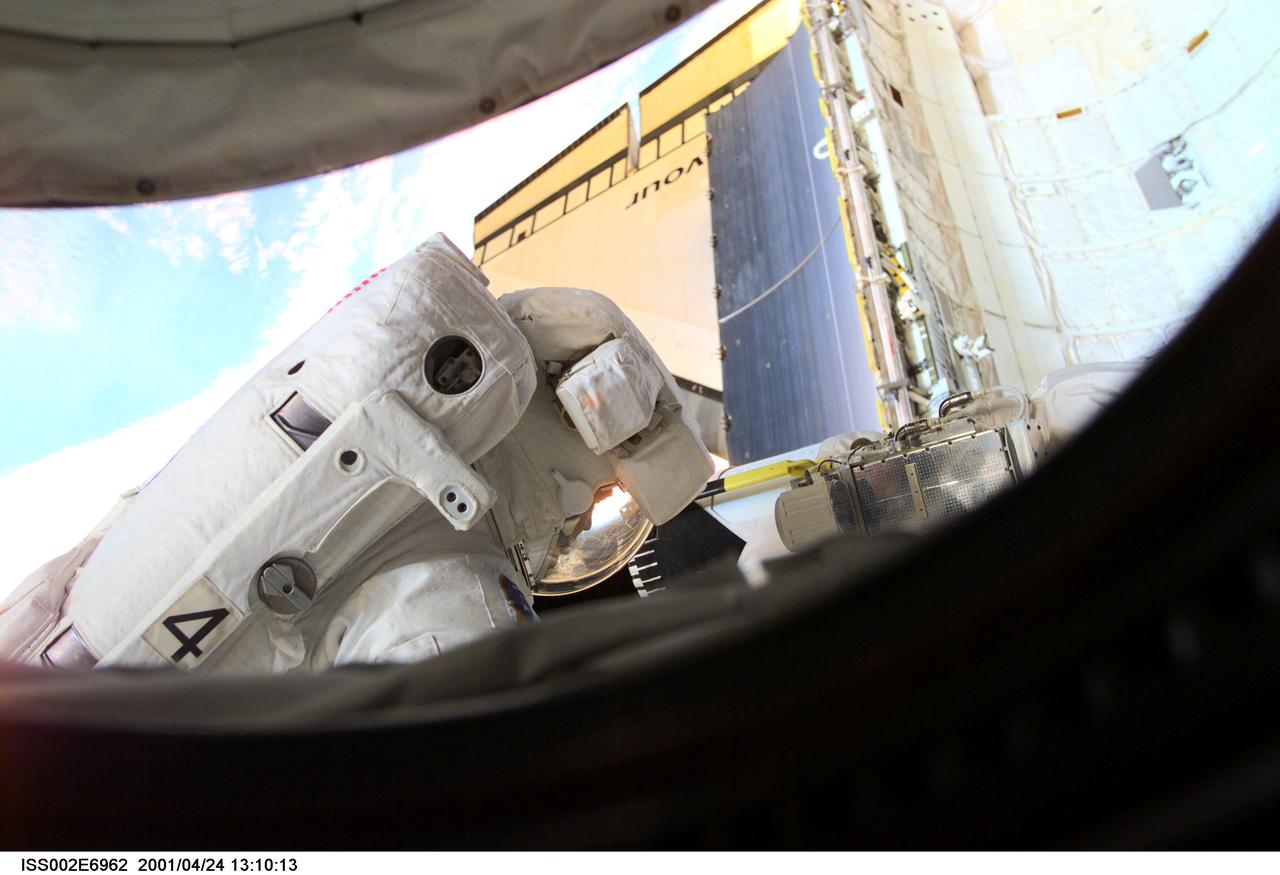
ISS002-E-6962 (24 April 2001) --- Astronaut Scott E. Parazynski, STS-100 mission specialist, performs a task during the second space walk (EVA-2). A digital still camera on the International Space Station (ISS) was used to record this image.
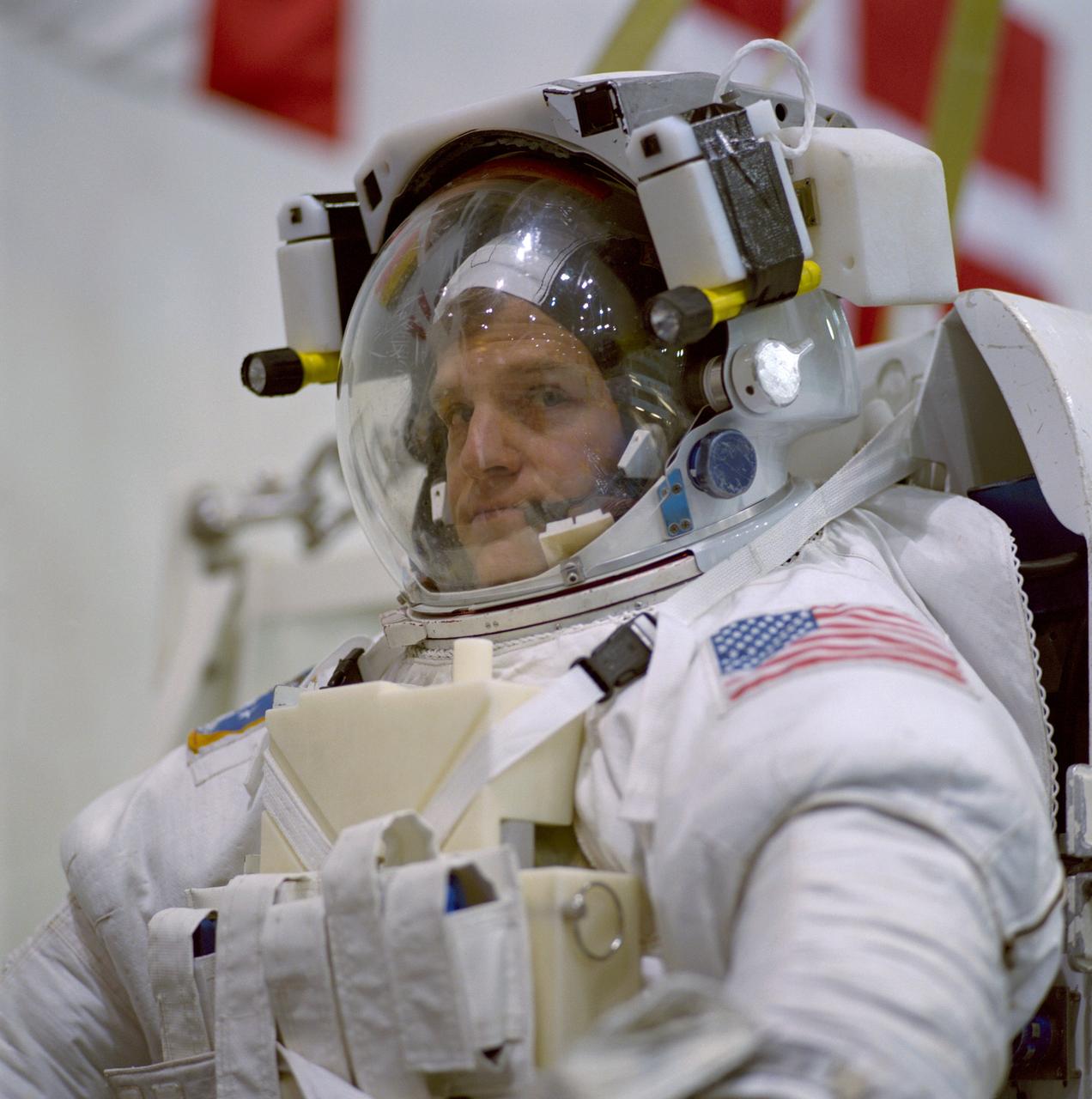
JSC2000-07396 (1 Dec. 2000) --- Astronaut Scott E. Parazynski, mission specialist, is about to be submerged in a giant pool of water in order to simulate spacewalk chores scheduled for next year's STS-100 visit to the International Space Station (ISS). Astronaut Chris A. Hadfield (out of frame) joined Parazynski for the rehearsal.
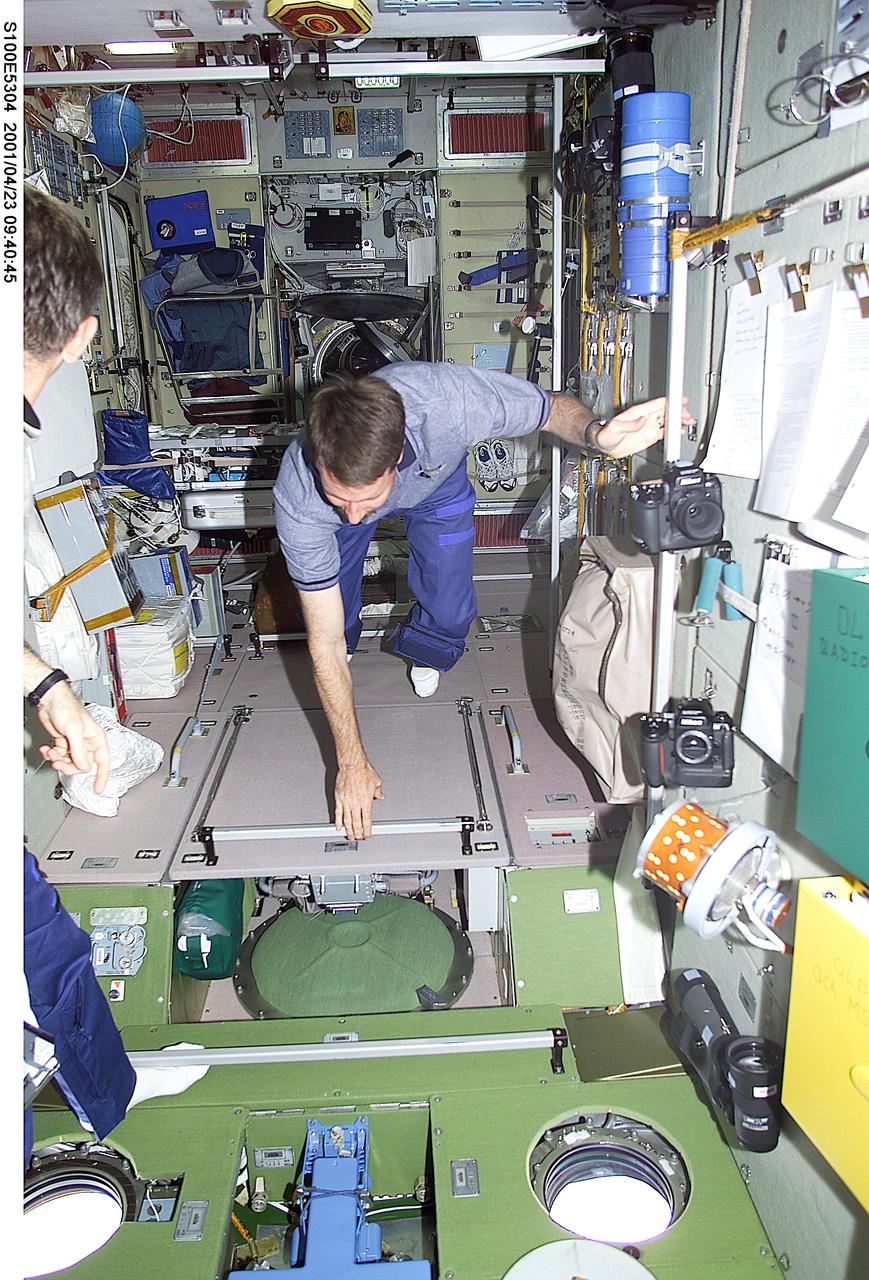
S100-E-5304 (23 April 2001) --- Astronaut Kent V. Rominger, STS-100 mission commander, tours the Zvezda Service Module on the International Space Station (ISS) not long after the seven-member STS-100 crew went aboard the orbital outpost and reunited with the station's second crew. The image was recorded with a digital still camera.
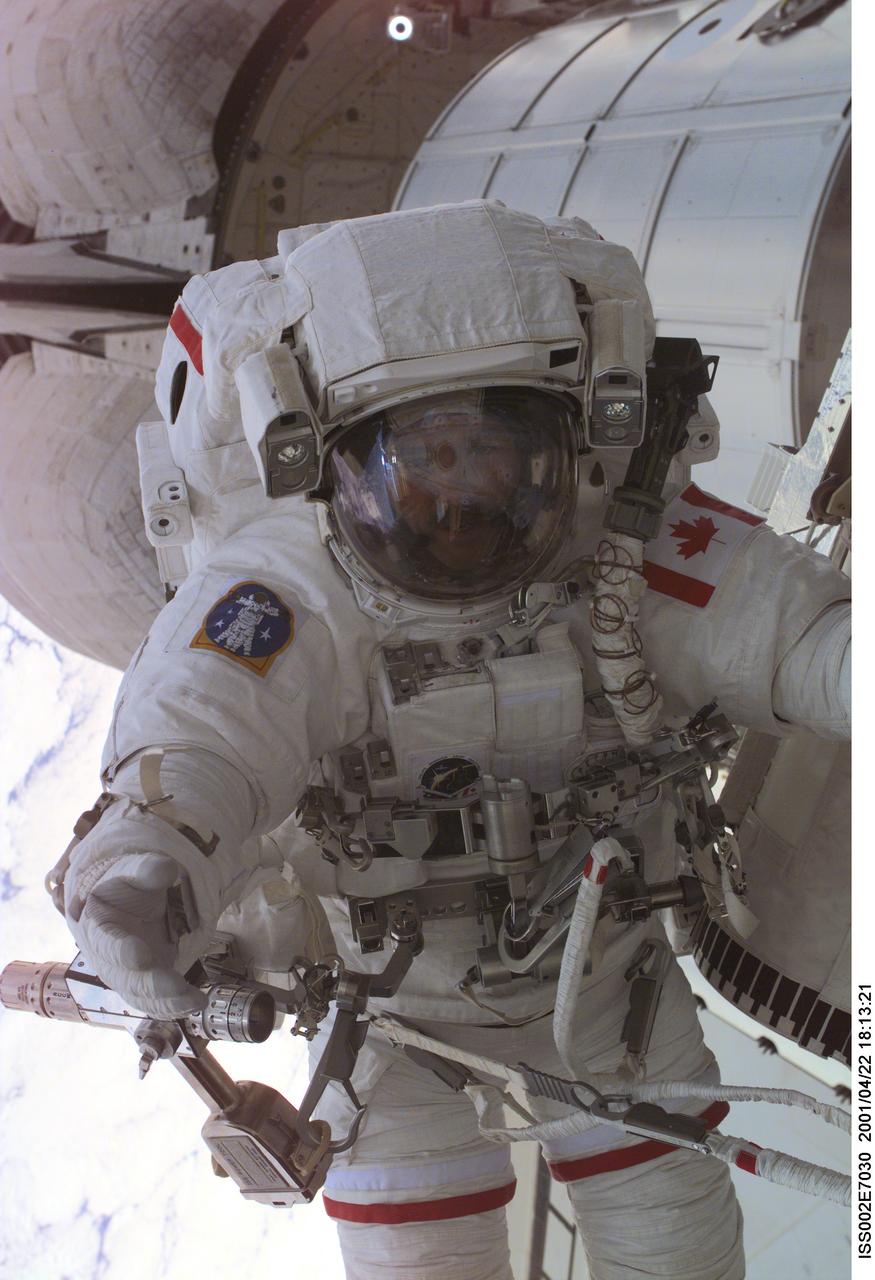
ISS002-E-7030 (22 April 2001) --- Astronaut Chris A. Hadfield, STS-100 mission specialist, during the first extravehicular activity (EVA) of the STS-100 mission. This digital still camera's image was taken through the nadir window of the Destiny Laboratory by an Expedition Two crew member. The Multipurpose Logistics Module (MPLM) Raphaello is visible in the payload bay of Space Shuttle Endeavour in the background.
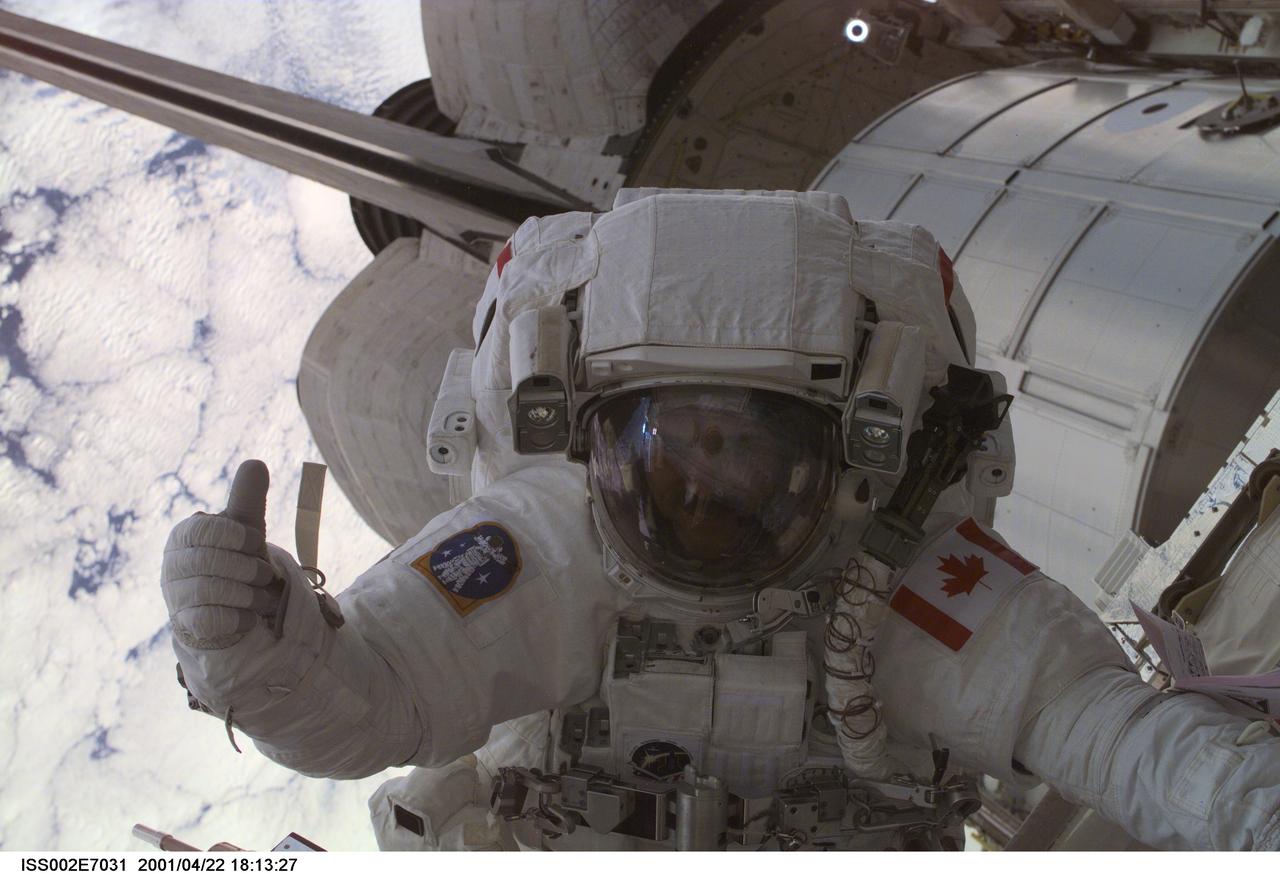
ISS002-E-7031 (22 April 2001) --- Astronaut Chris A. Hadfield, STS-100 mission specialist, gives the Expedition Two crewmembers the "thumbs up" signal during the first extravehicular activity (EVA) of the STS-100 mission. This picture was taken through the nadir window of the Destiny Laboratory by an Expedition Two crewmember using a digital still camera. The Multipurpose Logistics Module (MPLM) Raphaello is visible in the payload bay of the Space Shuttle Endeavour in the background.
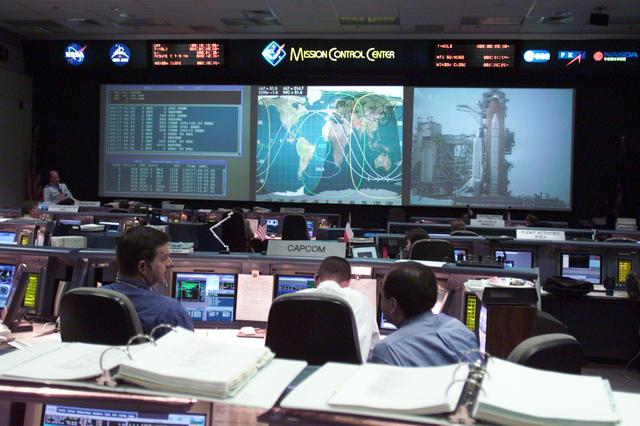
JSC2001-E-12130 (19 April 2001) --- Astronauts Scott D. Altman (left) and Mark L. Polansky (right) discuss the approaching STS-100 launch while staffing the Spacecraft Communicator (CAPCOM) console in Houston's Mission Control Center (MCC). Christopher J. (Gus) Loria (center) studies launch data at his console. Loria's CAPCOM position addresses weather issues, of which there were few on this particular launch. He will also be assigned to weather matters for the entry phase of the flight. The Space Shuttle Endeavour appears on the large screen in the front of the flight control room as liftoff countdown continues several hundred miles away at the Kennedy Space Center (KSC) in Florida.
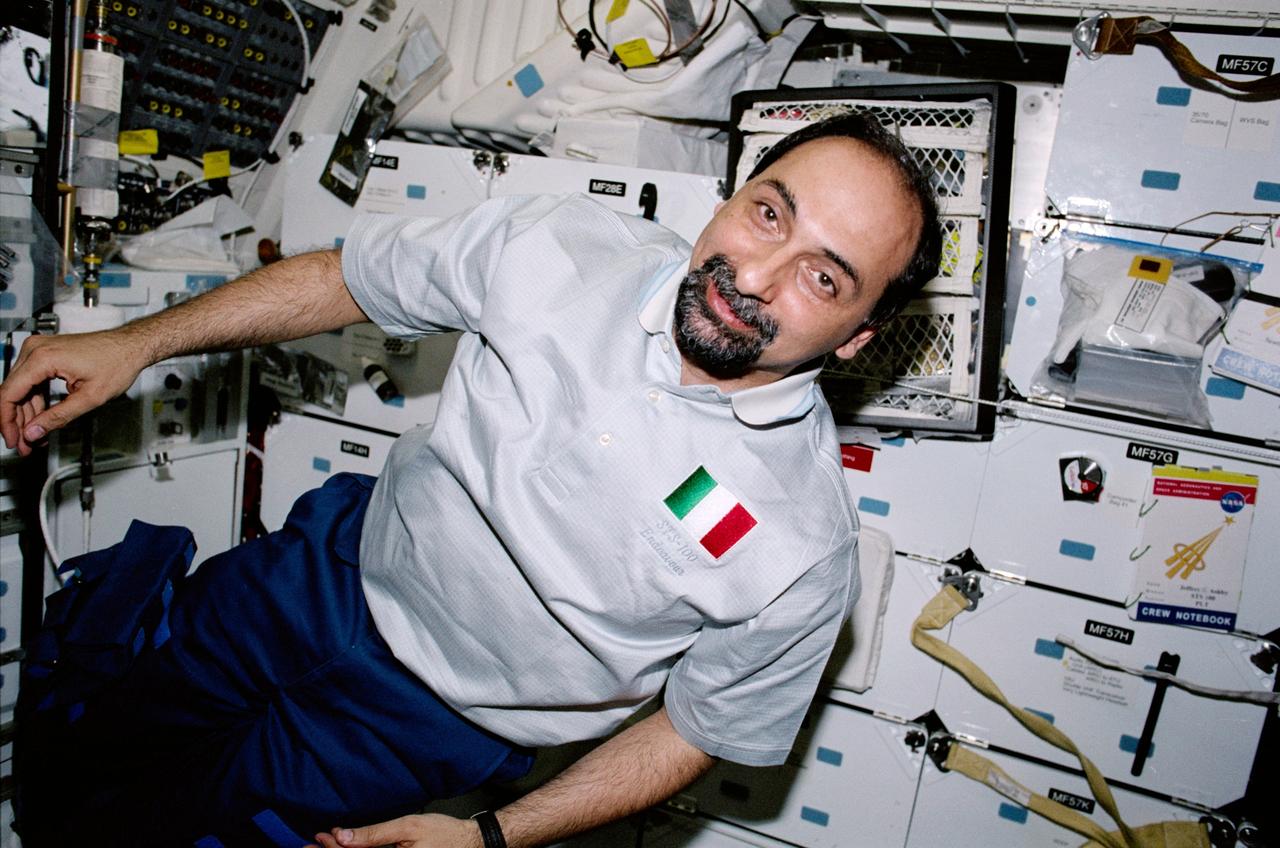
STS100-342-031 (19 April-1 May 2001) --- Astronaut Umberto Guidoni, STS-100 mission specialist representing the European Space Agency (ESA), is photographed while on the middeck of the Earth-orbiting Space Shuttle Endeavour.
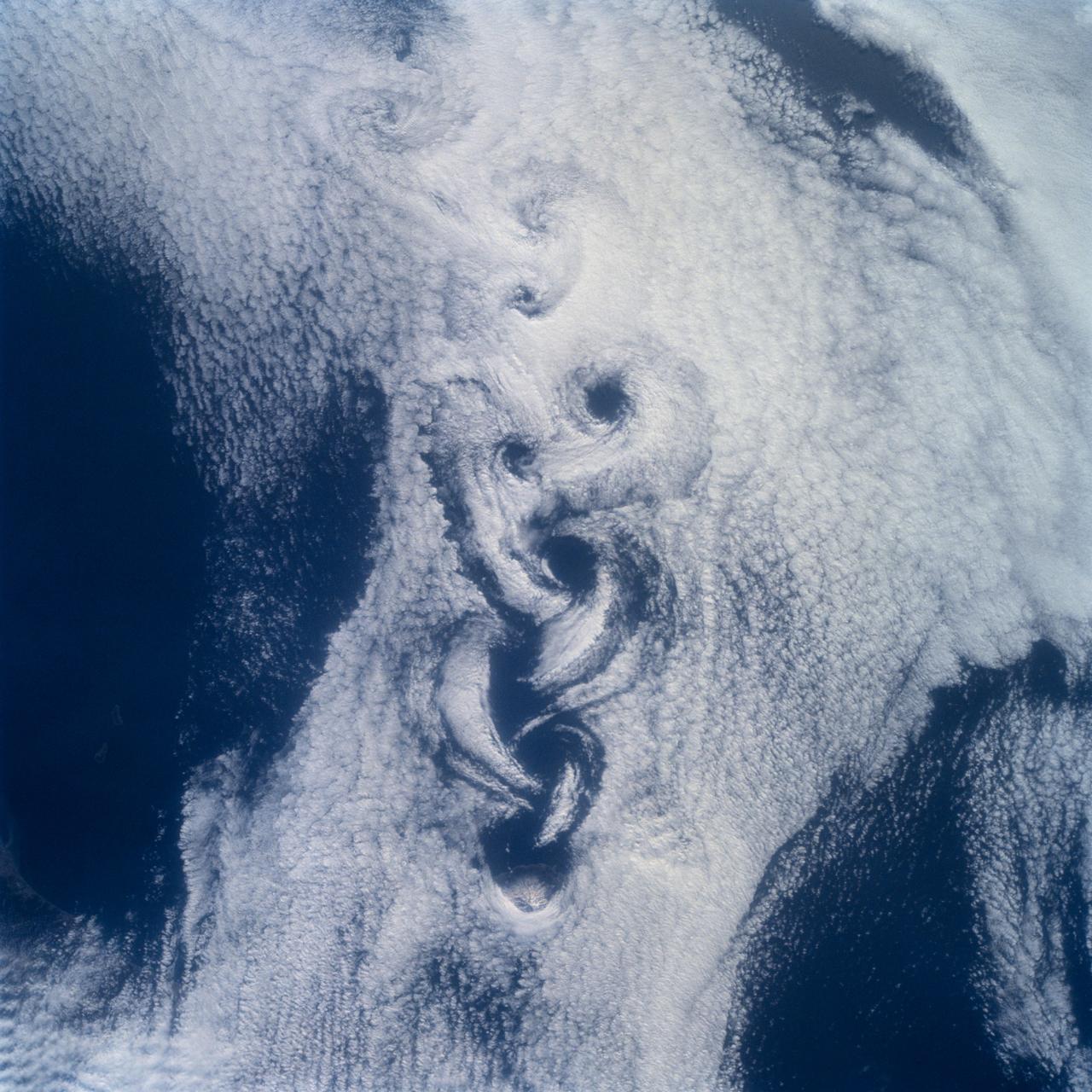
STS100-710-182 (19 April-1 May 2001) --- Easily recognizable in this STS-100 70mm frame are phenomena known as the von Karman vortices, which were forming in the stratocumulus field downwind from the volcanic island of Rishiri-to in the northern Sea of Japan off the northwest coast of Hokkaido, Japan. According to NASA scientists studying the STS-100 photo collection, these features form when a stable atmosphere with low clouds flows past a relatively small obstacle with a height greater than the depth of the cloud layer. Because the atmosphere is stable, a series of eddies form in the moving cloud field.
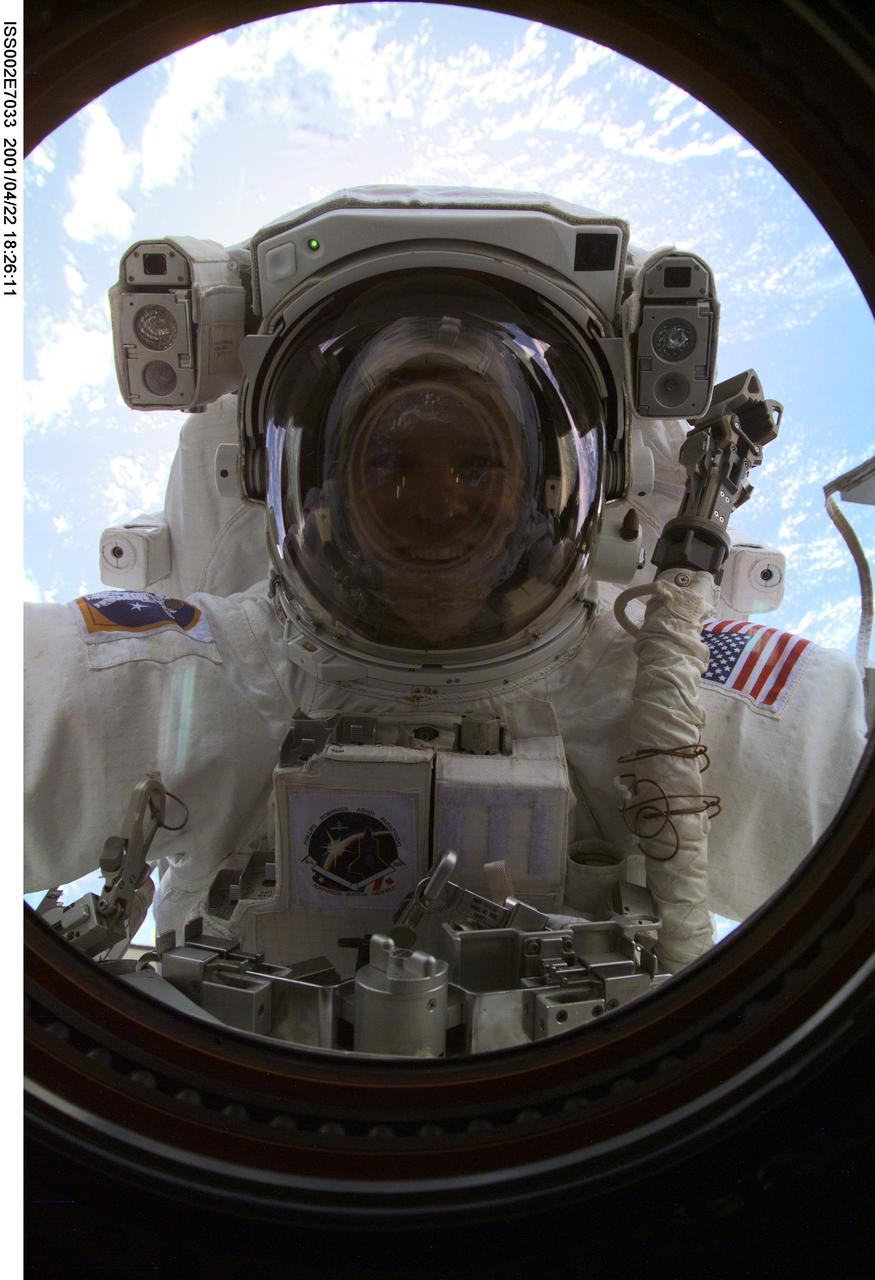
ISS002-E-7033 (22 April 2001) --- Astronaut Scott E. Parazynski, STS-100 mission specialist, peers into the Destiny/U.S. Laboratory's nadir window during the first space walk (EVA-1) of the STS-100 mission. A digital still camera was used to record this image.
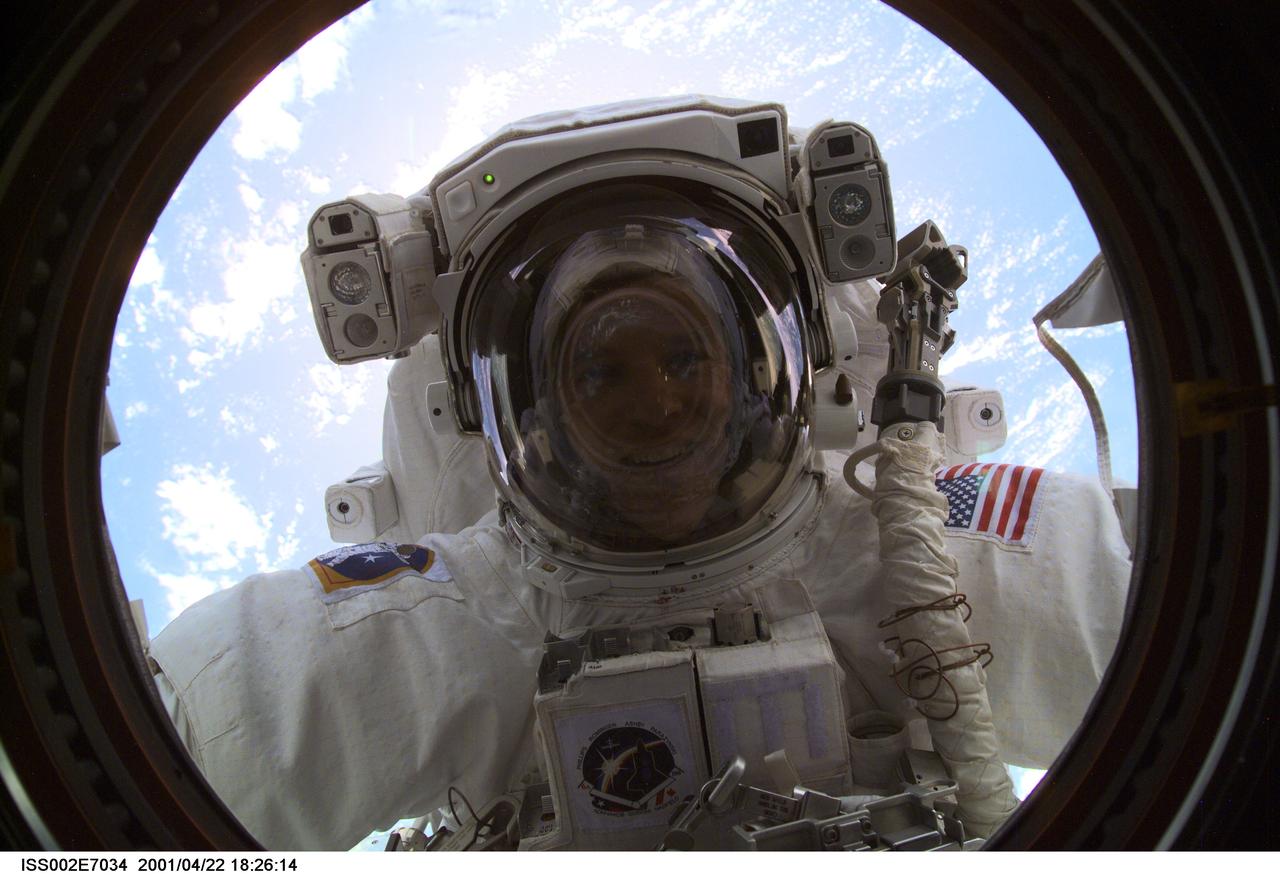
ISS002-E-7034 (22 April 2001) --- Astronaut Scott E. Parazynski, STS-100 mission specialist, peers into the Destiny Laboratory's nadir window during the first extravehicular activity of the STS-100 mission. This image was recorded with a digital still camera by an Expedition Two crew member.
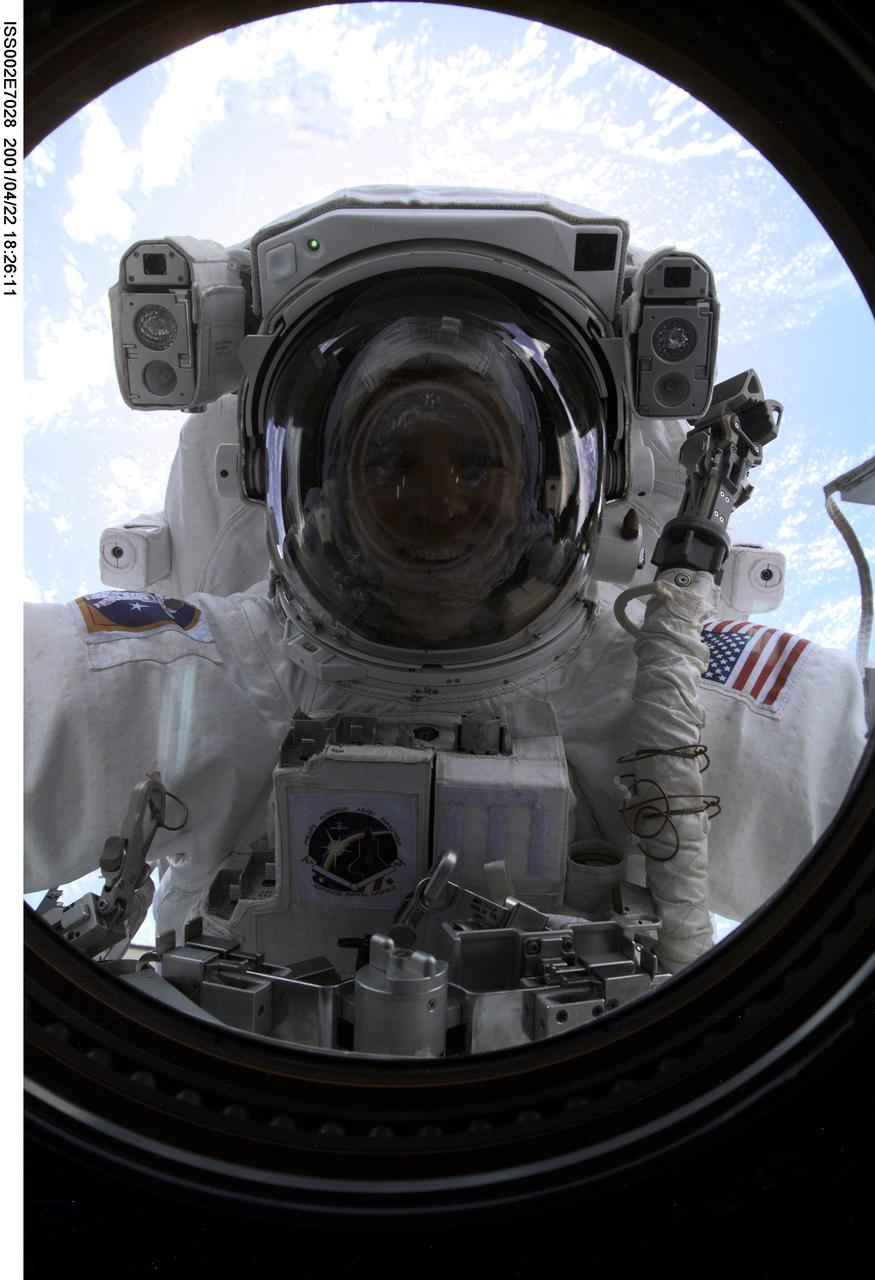
ISS002-E-7028 (22 April 2001) --- Astronaut Scott E. Parazynski, STS-100 mission specialist, peers into the Destiny/U.S. Laboratory's nadir window during the first space walk (EVA-1) of the STS-100 mission. A digital still camera was used to record this image.
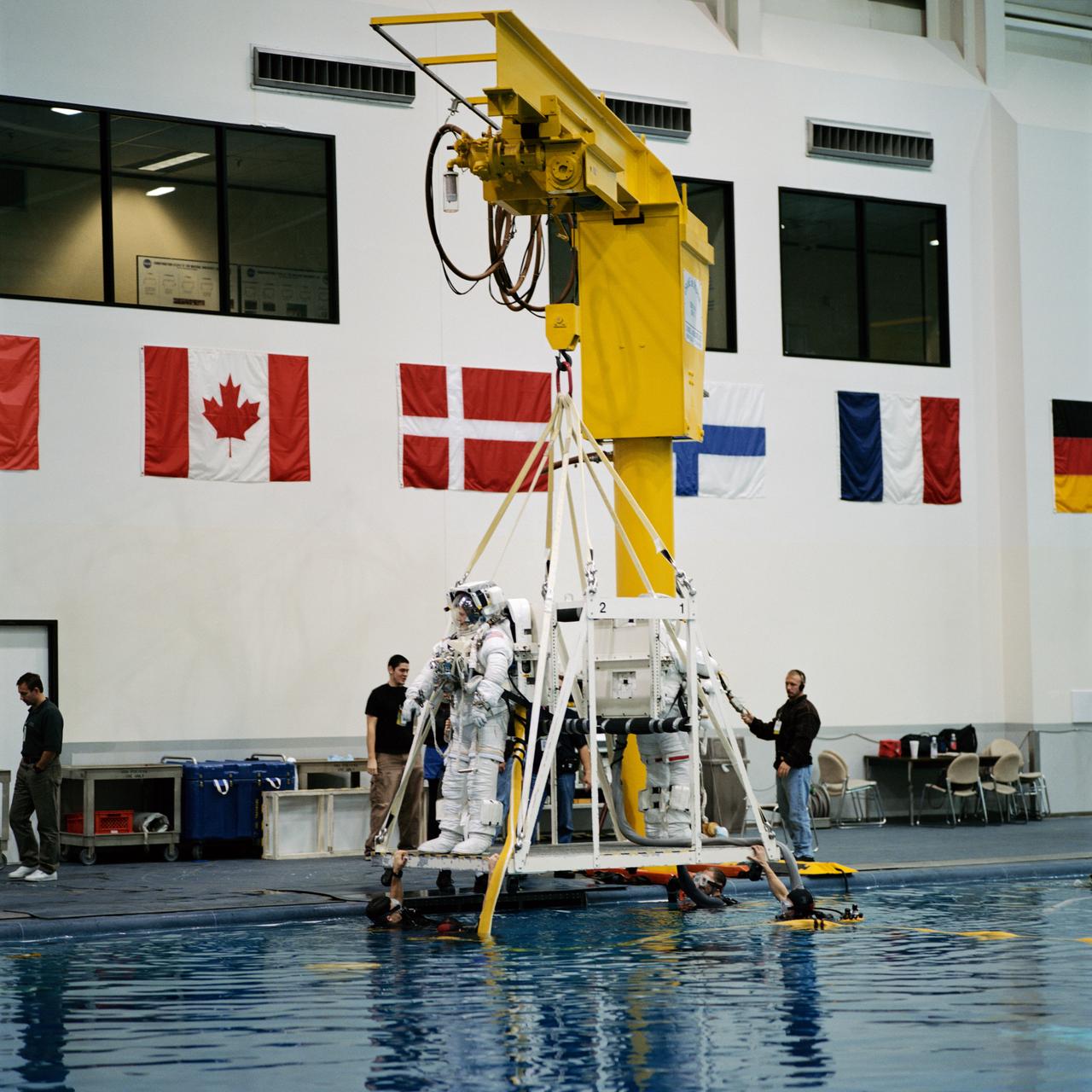
JSC2000-07400 (1 Dec. 2000) --- Both attired in training versions of the Extravehicular Mobility Unit (EMU) spacesuit, astronauts Scott E. Parazynski (left) and Chris A. Hadfield stand on a platform that will ease the two STS-100 mission specialists into a giant pool of water at the Neutral Buoyancy Laboratory (NBL). Minutes later, the two were in a neutrally buoyant state beneath the surface rehearsing spacewalk duties scheduled for next year's visit to the International Space Station (ISS). Hadfield represents the Canadian Space Agency (CSA).
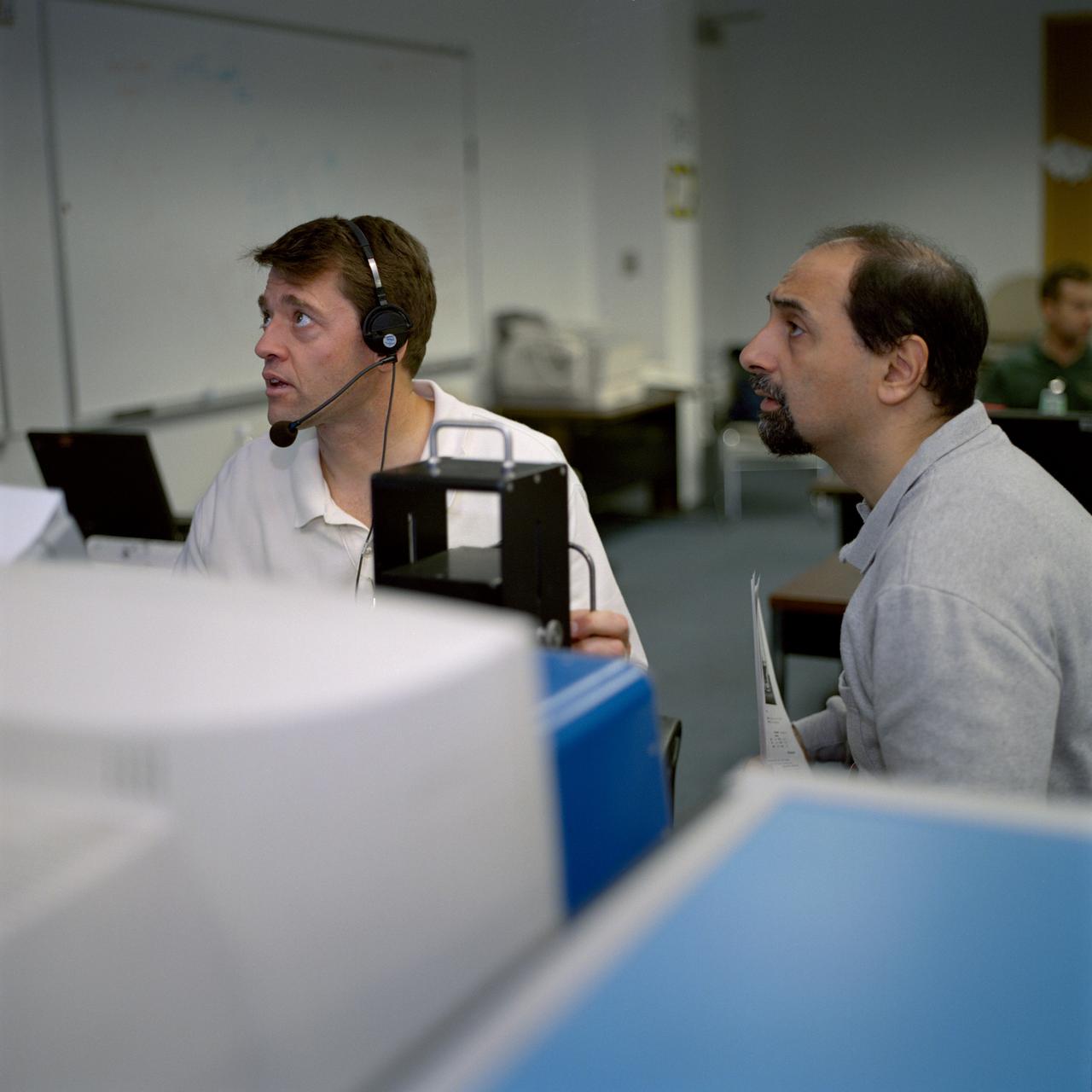
JSC2000-07405 (1 Dec. 2000) --- Astronauts Jeffrey S. Ashby (left), STS-100 pilot, and Umberto Guidoni, mission specialist representing the European Space Agency (ESA), use remote monitors to watch the spacewalk simulation by crewmates Scott E. Parazynski and Chris A. Hadfield at the Neutral Buoyancy Laboratory (NBL) near NASA's Johnson Space Center.

JSC2000-07397 (1 December 2000)--- Astronaut Chris A. Hadfield, representing the Canadian Space Agency (CSA), is about to be submerged in a giant pool of water as part of a training session in the Neutral Buoyancy Laboratory (NBL) near the Johnson Space Center (JSC). Hadfield is designated for space walk duty on the STS-100 flight, and underwater simulations of his duties help prepare him for the mission, scheduled for spring of next year.
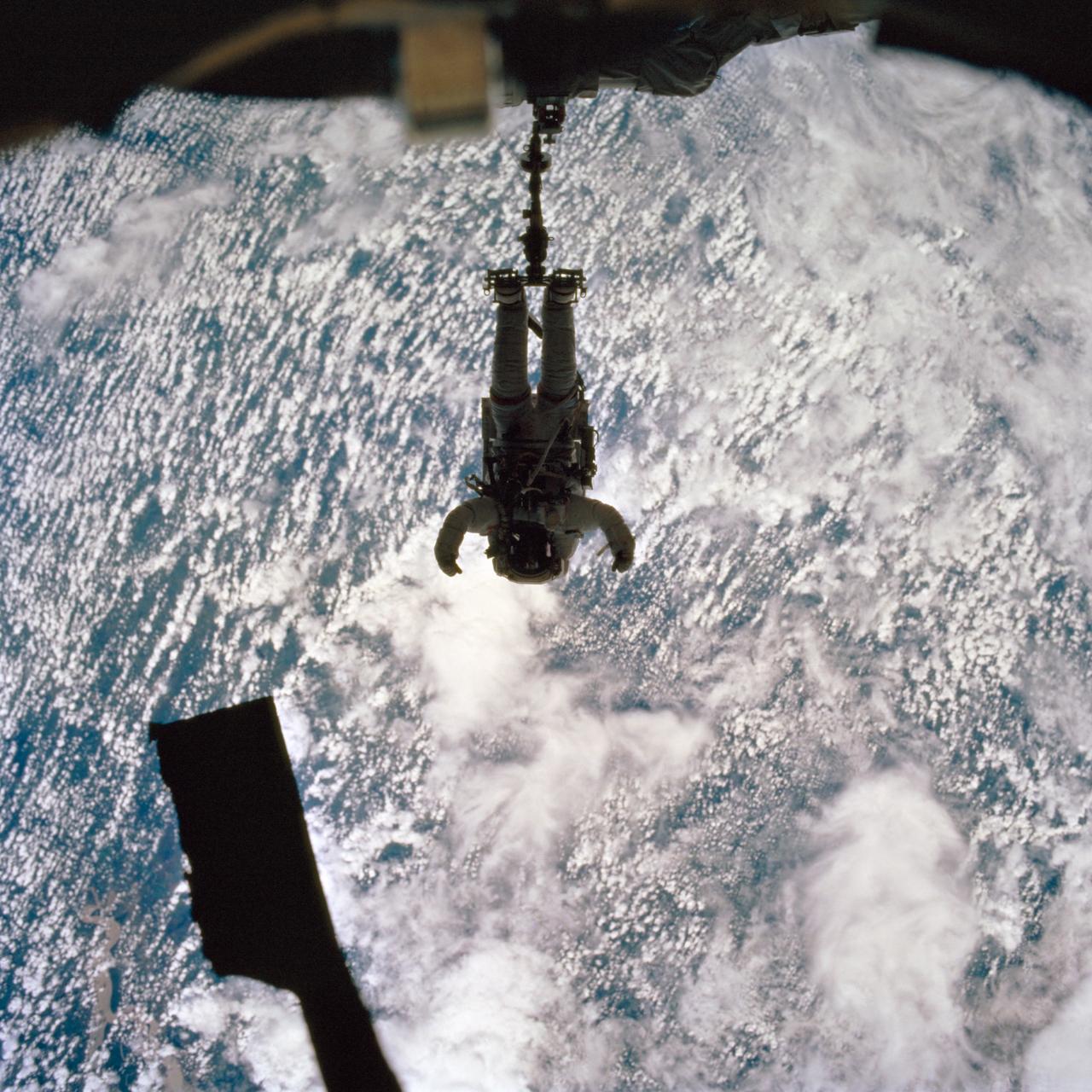
ISS002-707-057 (22 April 2001) --- 70-mm frame. STS-100 EVA crewmember Chris Hadfield in dark silhouette - shadowed by the ISS on work/foot pedestal platform for the Remote Manipulator System (RMS) over a 90% cloud covered earth background. A small segment of an unidentified river is in the lower left corner. 22 April 2001 Altitude 208 nautical miles
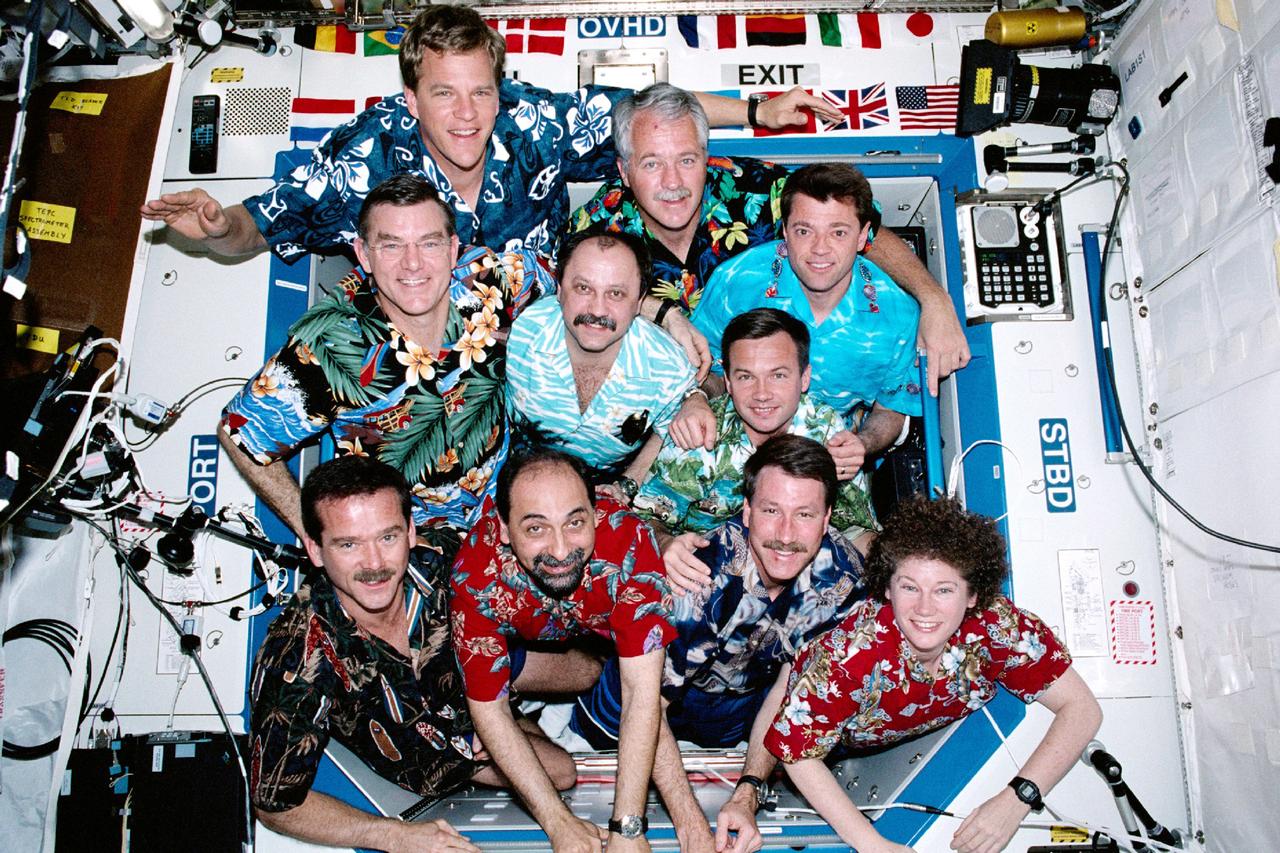
STS-100 and Expedition Two crew members pose for an onboard portrait in the Destiny laboratory of the International Space Station (ISS). Bottom, from left, are Chris A. Hadfield of the Canadian Space Agency, Umberto Guidoni of the European Space Agency, Kent V. Rominger, and Susan J. Helms (Expedition Two). Middle row, James S. Voss (Expedition Two), and cosmonauts Yury V. Usachev (Expedition Two) and Yuri V. Lonchakov. Top, Scott E. Parazynski, John L. Phillips, and Jeffrey S. Ashby. The crews accomplished the following objectives: The delivery of the Canadian-built Space Station Remote Manipulator System (SSRMS), Canadarm2, which is needed to perform assembly operations on later flights; The delivery and installation of a UHF anterna that provides space-to-space communications capability for U.S. based space walks; and carried the Italian-built multipurpose Logistics Module Raffaello containing six system racks and two storage racks for the U.S. Lab, Destiny.
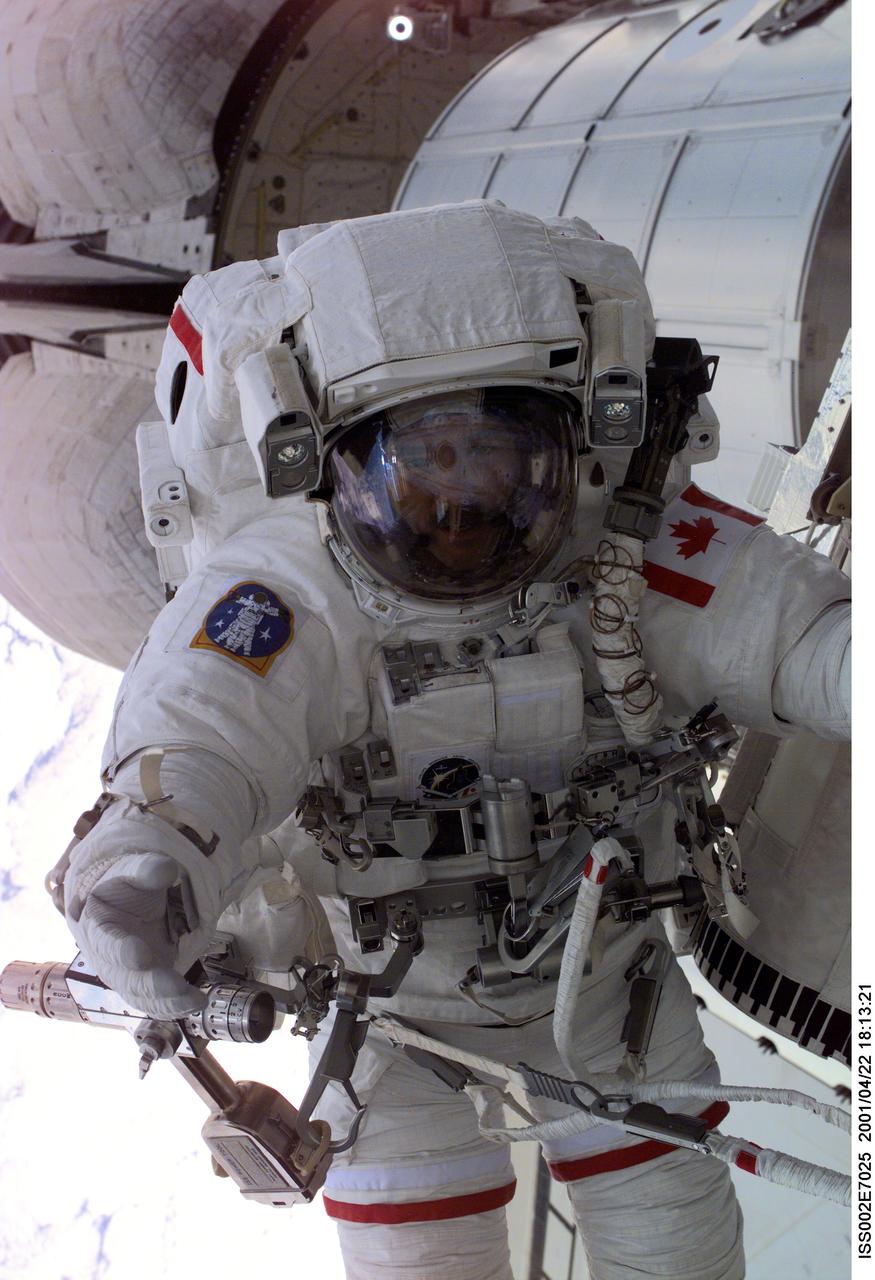
ISS002-E-7025 (22 April 2001) --- Astronaut Chris A. Hadfield, mission specialist representing the Canadian Space Agency (CSA), is seen during the first space walk (EVA-1) of the STS-100 mission. The picture taken with a digital still camera through the nadir window of the Destiny/U.S. Laboratory.
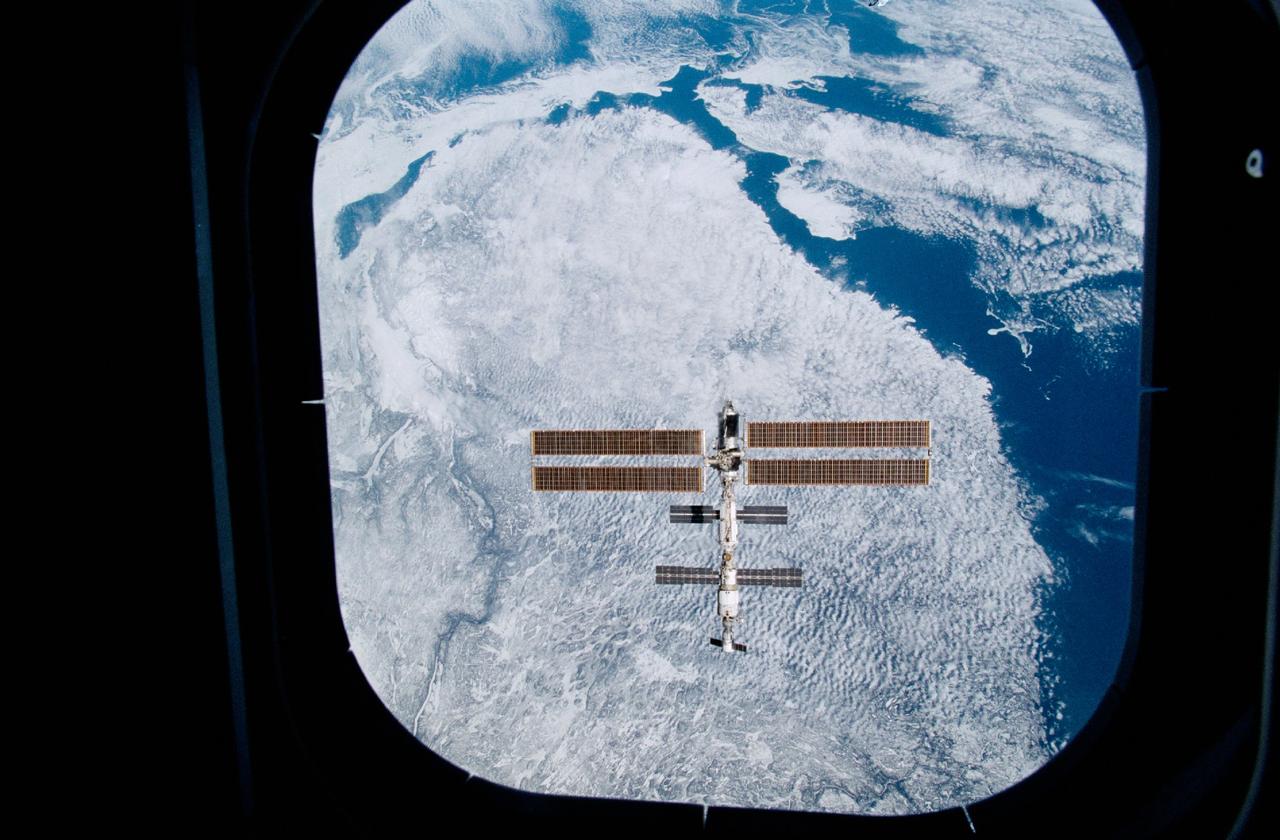
STS100-332-020 (29 April 2001) --- Backdropped against the topography of the Canadian province of Quebec, the International Space Station (ISS) was photographed through an aft flight deck window following separation from the Space Shuttle Endeavour. The 35mm frame was exposed by one of the STS-100 crewmembers onboard the shuttle.
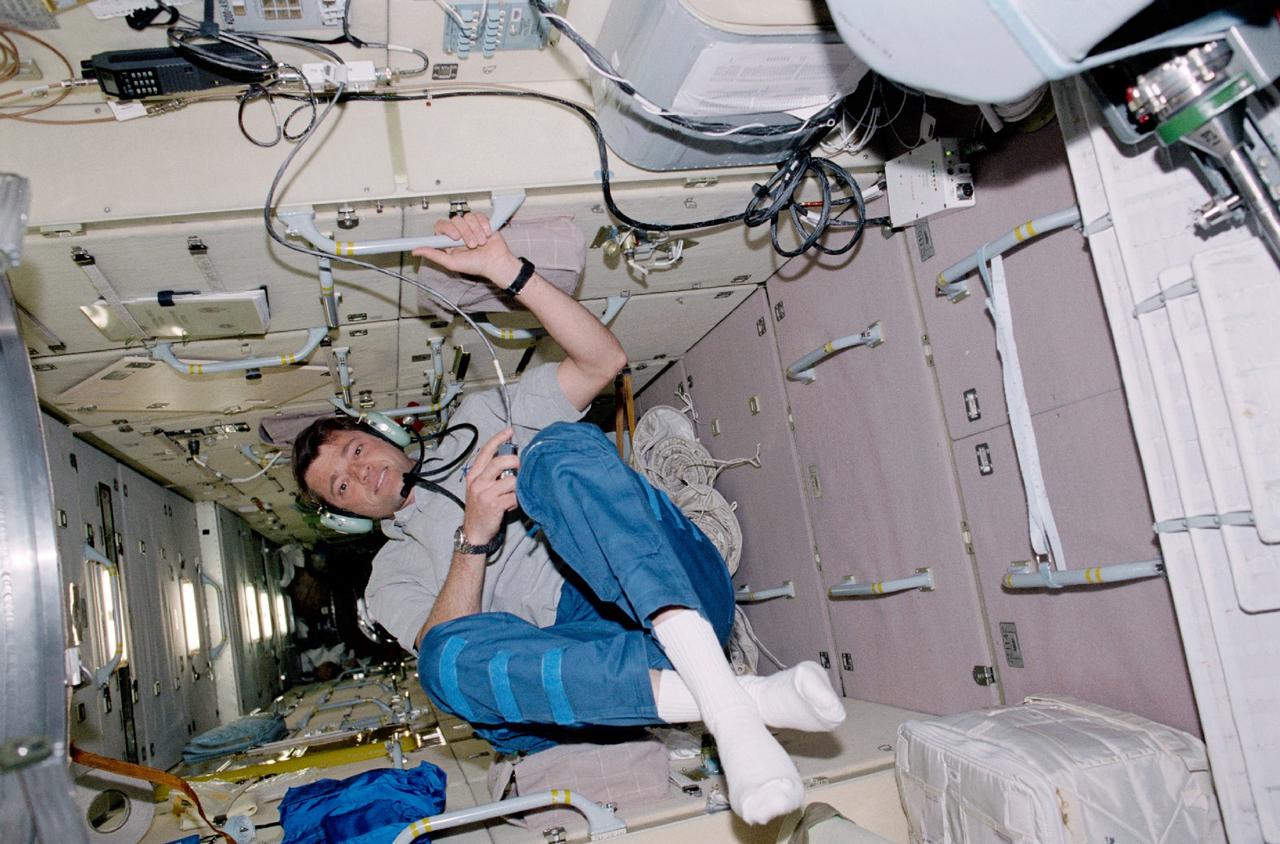
STS100-345-015 (19 April-1 May 2001) --- Astronaut Jeffrey S. Ashby, STS-100 pilot, talks to amateur radio operators on the ground from a special work station on the functional cargo block (FGB) or Zarya module of the International Space Station (ISS).
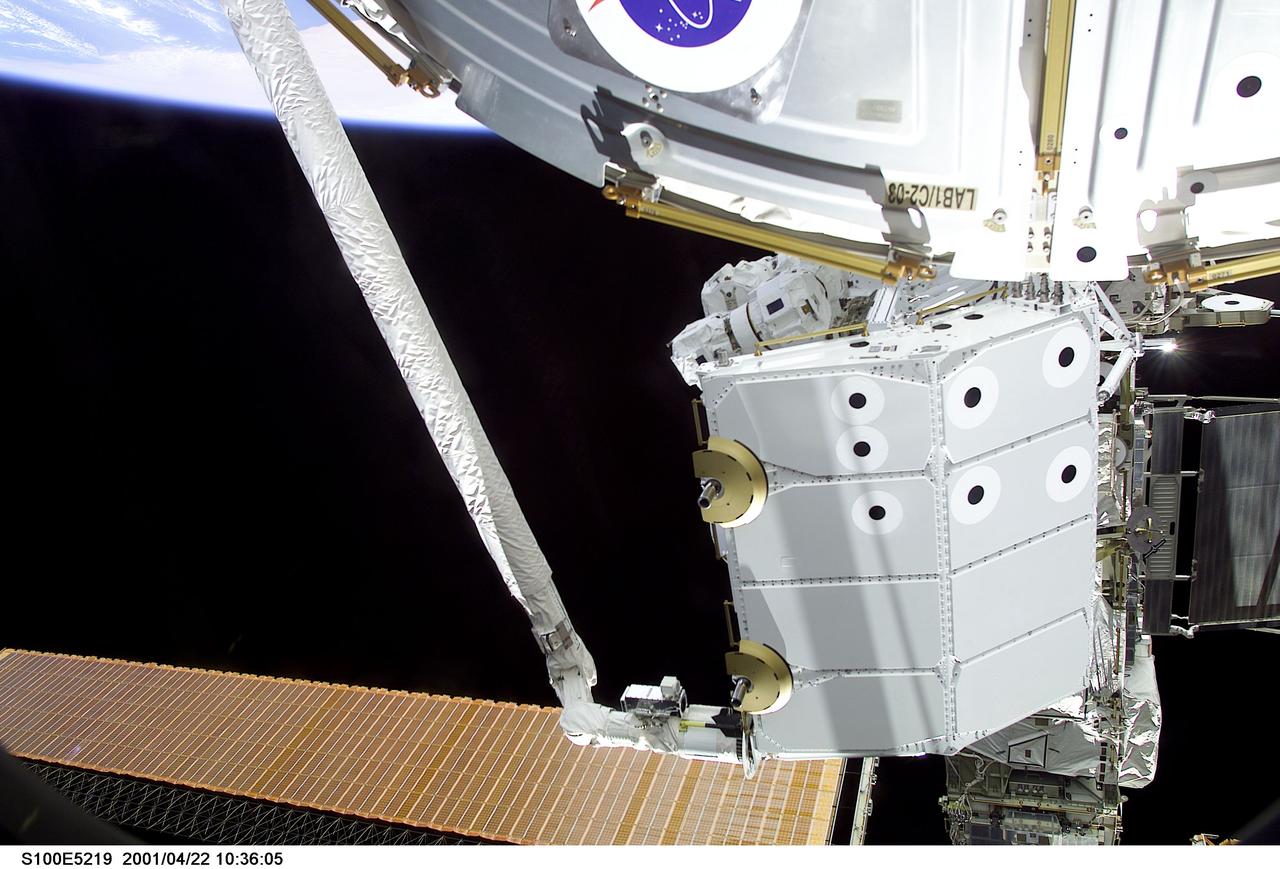
S100-E-5219 (22 April 2001) --- The Spacelab Pallet that contain Canadarm2 and the UHF antenna that are to be installed during the first scheduled space walk on STS-100 is seen in the grasp of the Canadian-built Remote Manipulator System (RMS) robot arm on the Space Shuttle Endeavour. The scene was recorded with a digital still camera.
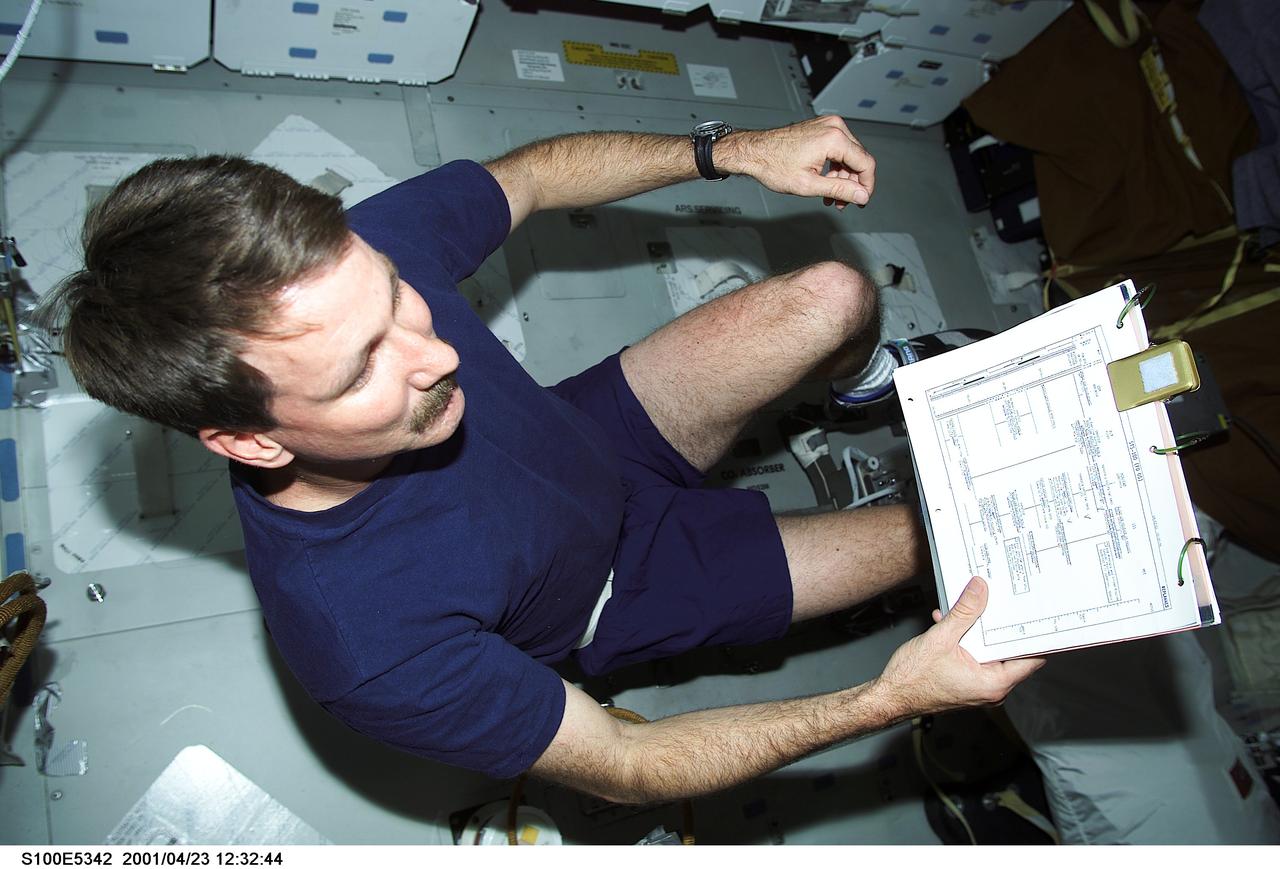
S100-E-5342 (23 April 2001) --- Astronaut Kent V. Rominger, STS-100 mission commander, economizes his time as he looks over flight data while working out on an ergometer device on the middeck of the Space Shuttle Endeavour. The scene was recorded with a digital still camera.

STS100-345-028 (19 April-1 May 2001) --- Cosmonauts Yuri V. Lonchakov (foreground), STS-100 mission specialist, and Yury V. Usachev, Expedition Two commander, are photographed during mission activities in the Zvezda Service Module of the International Space Station (ISS). Lonchakov and Usachev are affiliated with Rosaviakosmos.
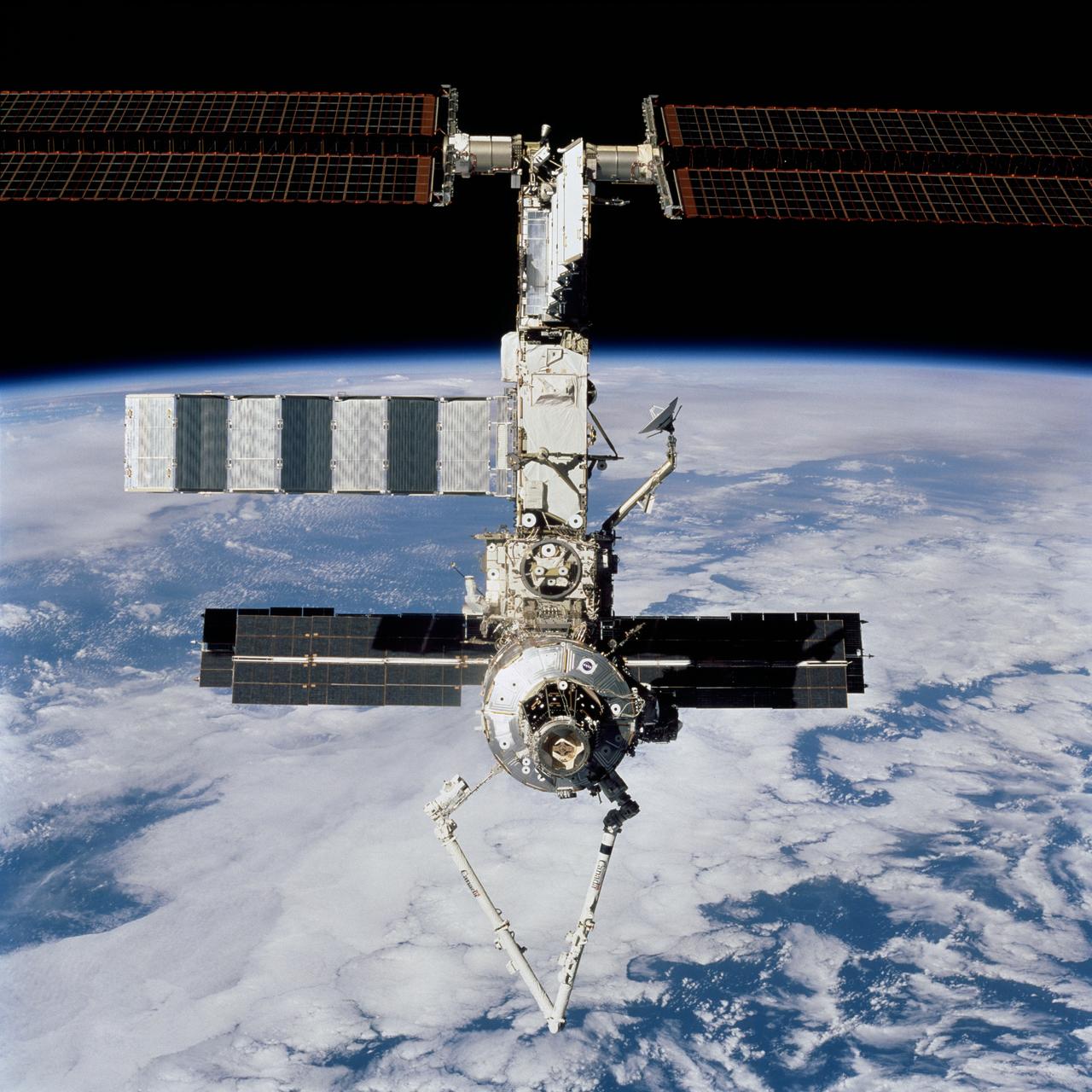
STS100-710-103 (29 April 2001) --- Backdropped against the blue and white Earth and sporting a readily visible new addition in the form of Canadarm2, the International Space Station (ISS) was photographed following separation from the Space Shuttle Endeavour. The 70mm frame was exposed by one of the STS-100 crewmembers onboard the shuttle.
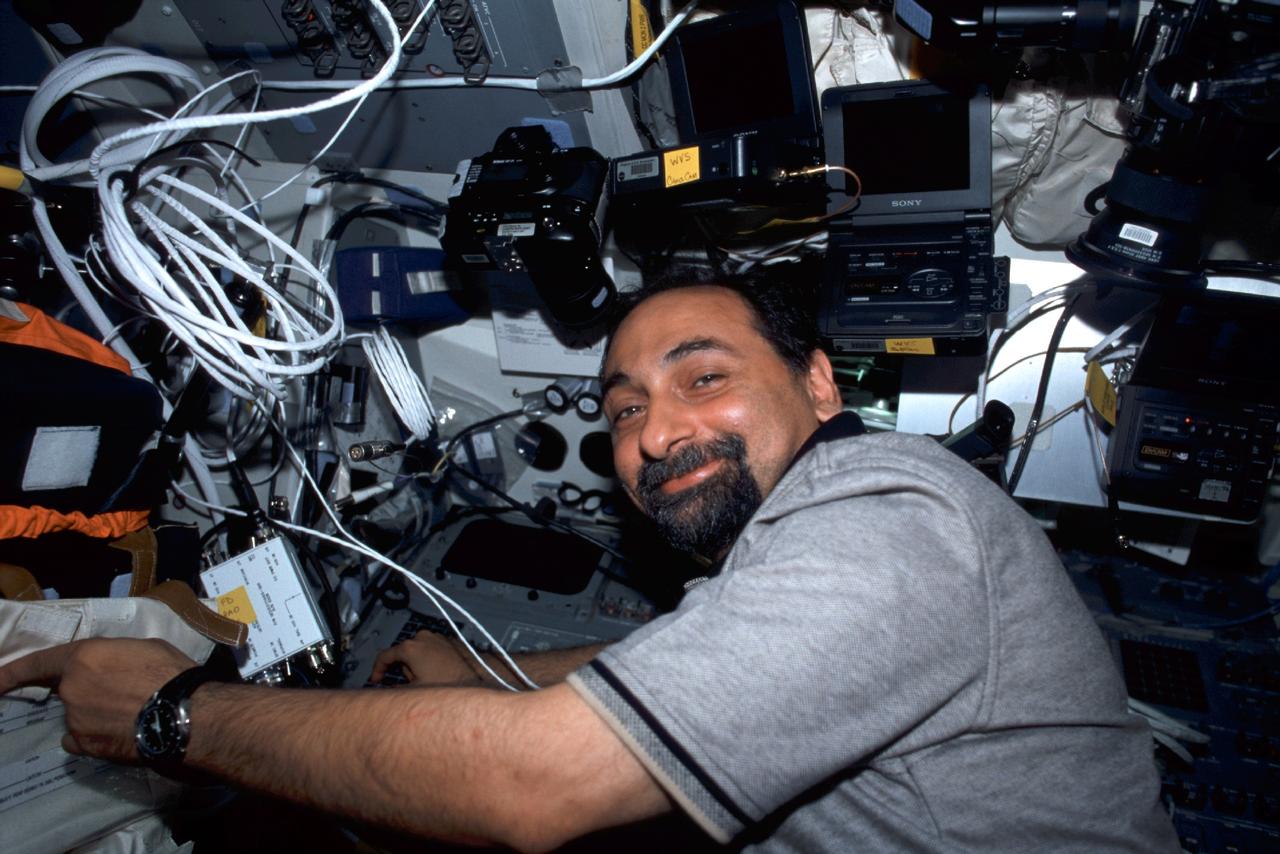
STS100-387-029 (19 April-1 May 2001) --- Astronaut Umberto Guidoni appears to be enjoying his work on the flight deck of the Space Shuttle Endeavour. The STS-100 mission specialist represents the European Space Agency (ESA) and is marking his second space shuttle mission experience.
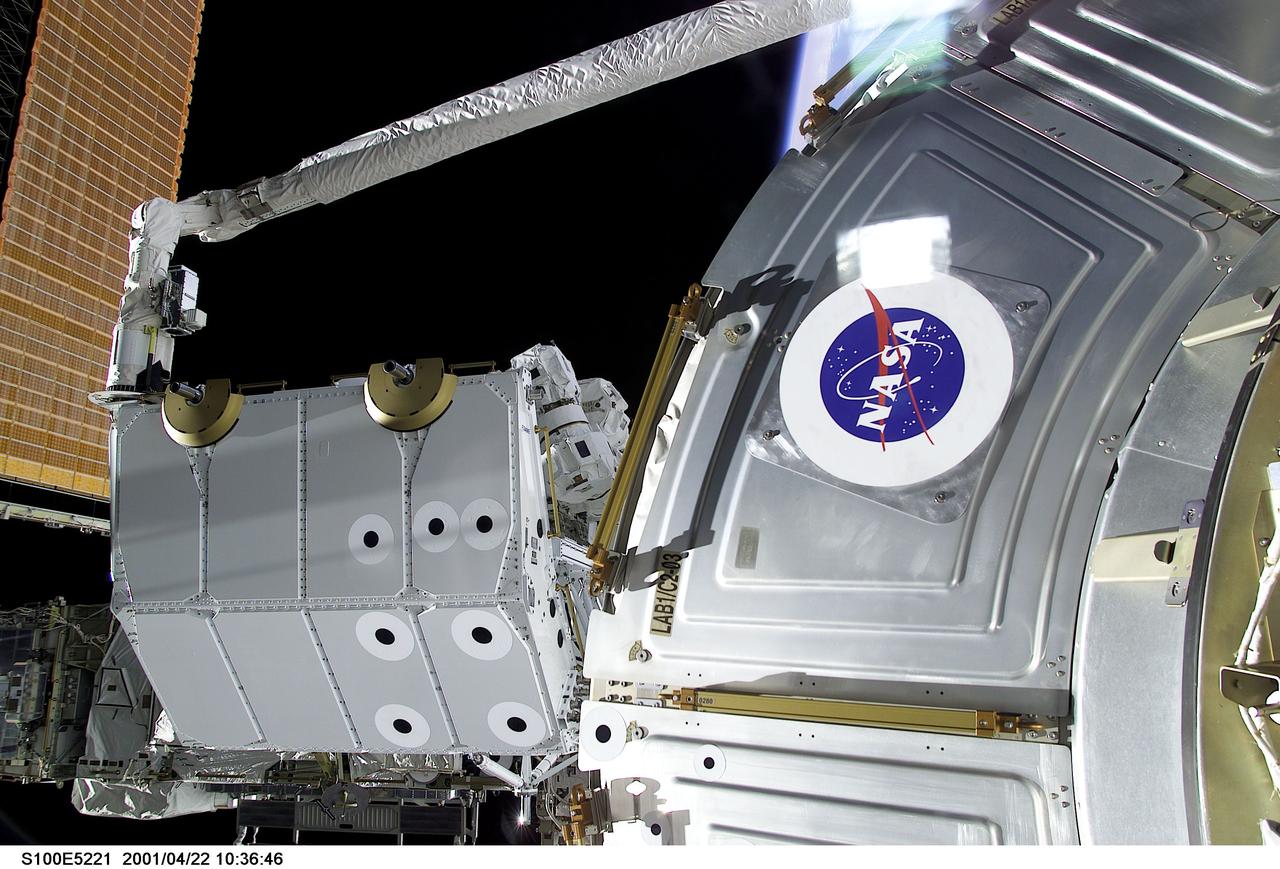
S100-E-5221 (22 April 2001) --- The pallet that contains Canadarm2 and the UHF antenna that are to be installed during the first scheduled space walk on STS-100 is seen in the grasp of the Canadian-built Remote Manipulator System (RMS) robot arm on the Space Shuttle Endeavour. The Destiny laboratory is seen in the foreground of the digital still camera's image.
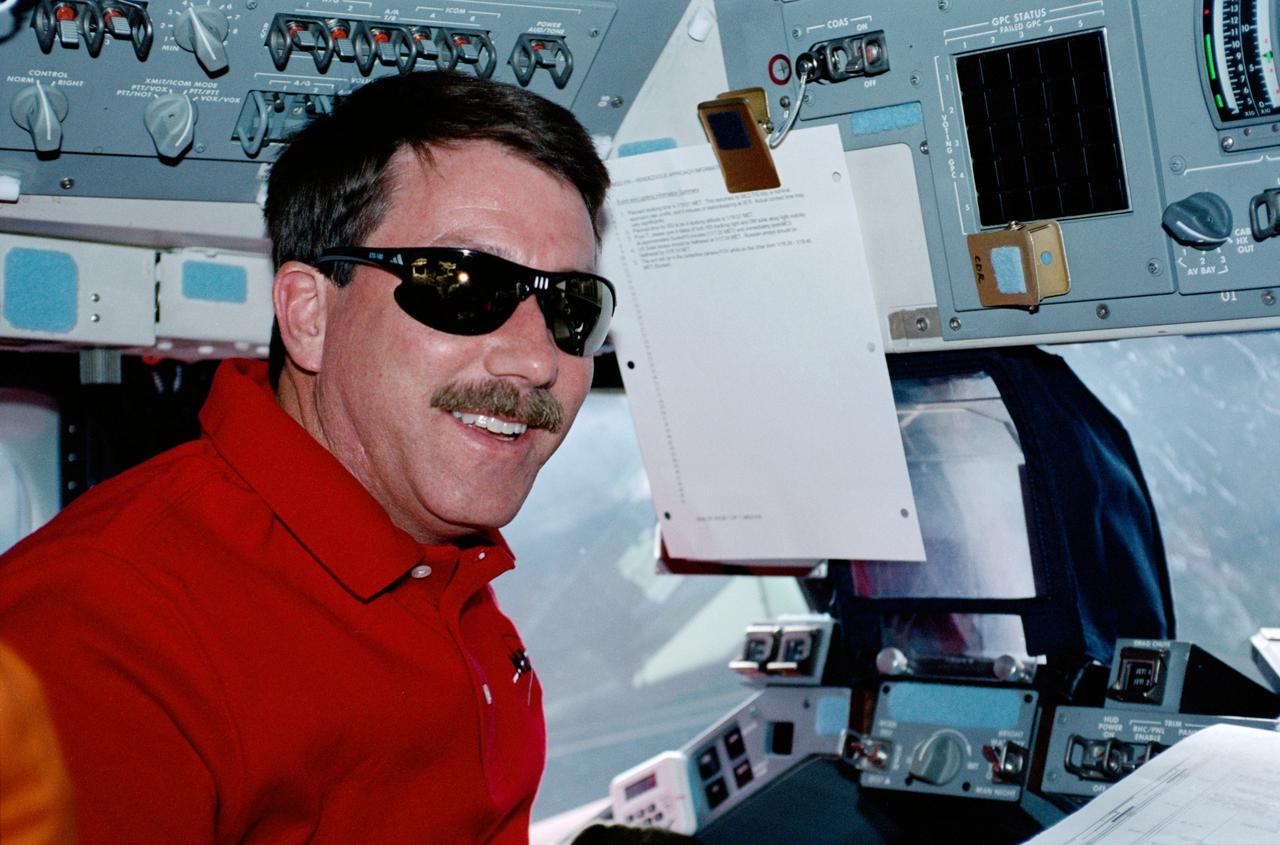
STS100-303-004 (19 April-1 May 2001) --- Astronaut Kent V. Rominger, STS-100 commander, looks over a procedures checklist at the commander's station on the forward flight deck of the Earth-orbiting Space Shuttle Endeavour.
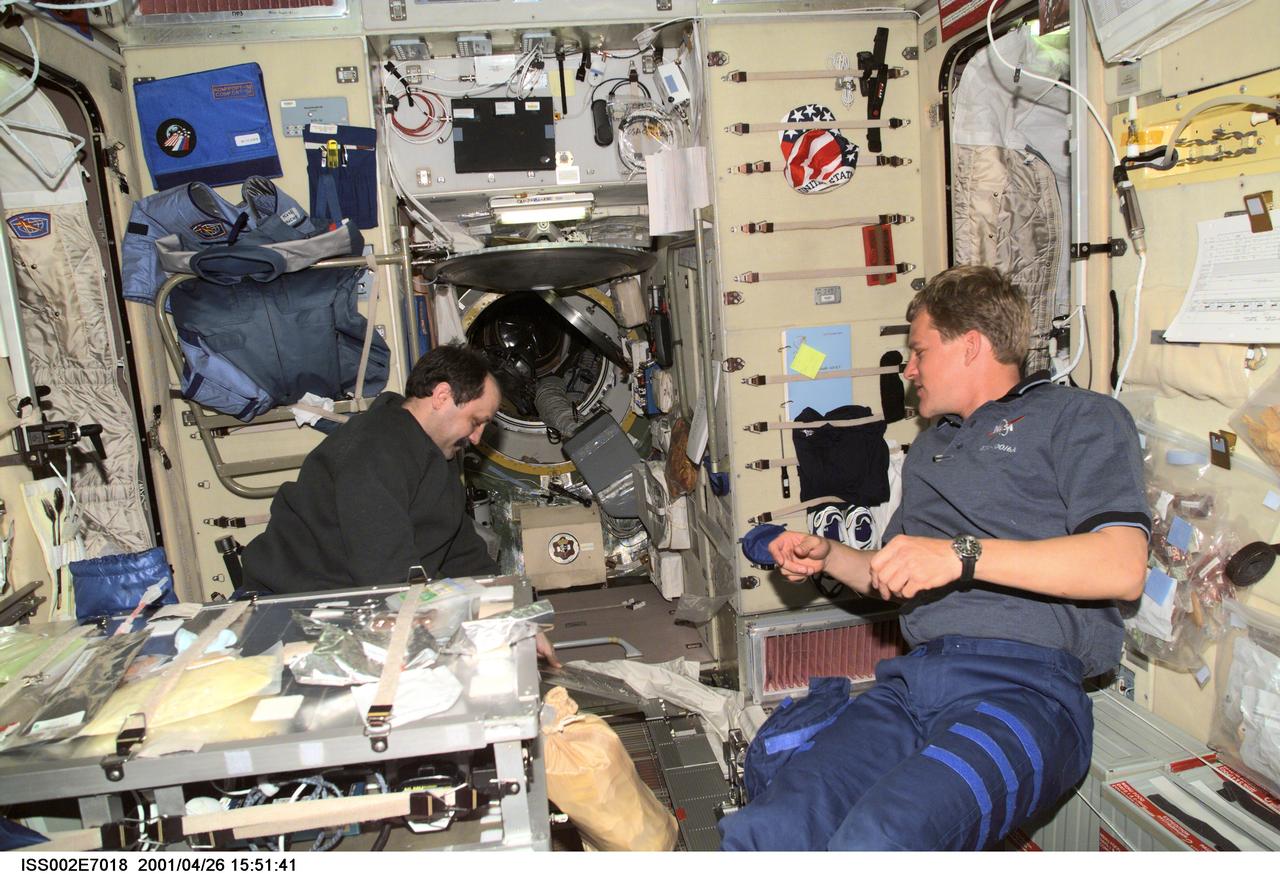
ISS002-E-7018 (26 April 2001) --- Astronaut Scott E. Parazynski, STS-100 mission specialist, talks with cosmonaut Yury V. Usachev, Expedition Two commander, who is conducting maintenance on the Treadmill Vibration Isolation System (TVIS) in the Zvezda/Service Module. A digital still camera was used to record this image.
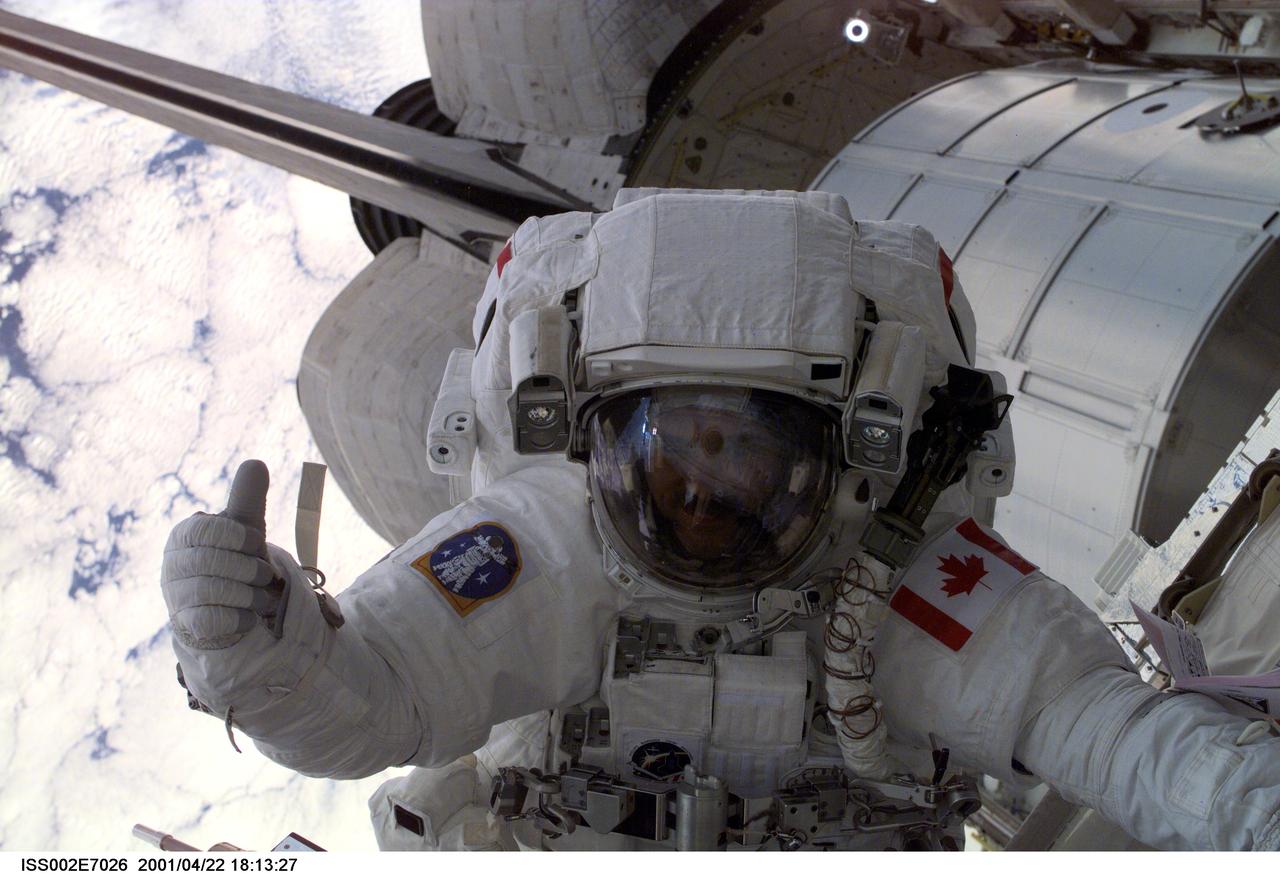
ISS002-E-7026 (22 April 2001) --- Astronaut Chris A. Hadfield, mission specialist representing the Canadian Space Agency (CSA), gives fellow astronauts the thumbs up during the first space walk (EVA-1) of the STS-100 mission. This digital picture was taken through the nadir window of the Destiny/U.S. Laboratory.
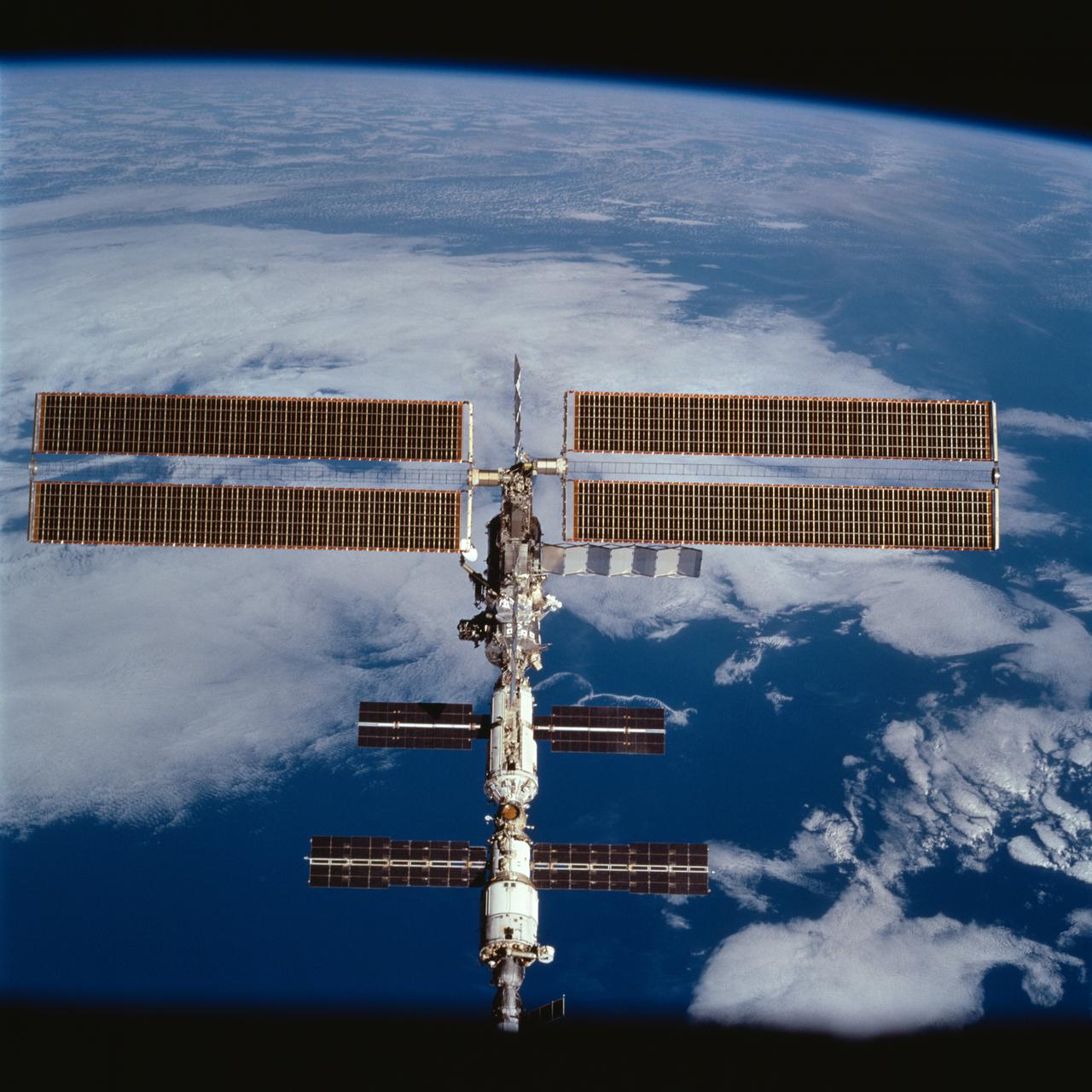
STS100-710-130 (29 April 2001) --- Backdropped against the blue and white Earth, the International Space Station (ISS) was photographed following separation from the Space Shuttle Endeavour. The 70mm frame was exposed by one of the STS-100 crewmembers onboard the shuttle.
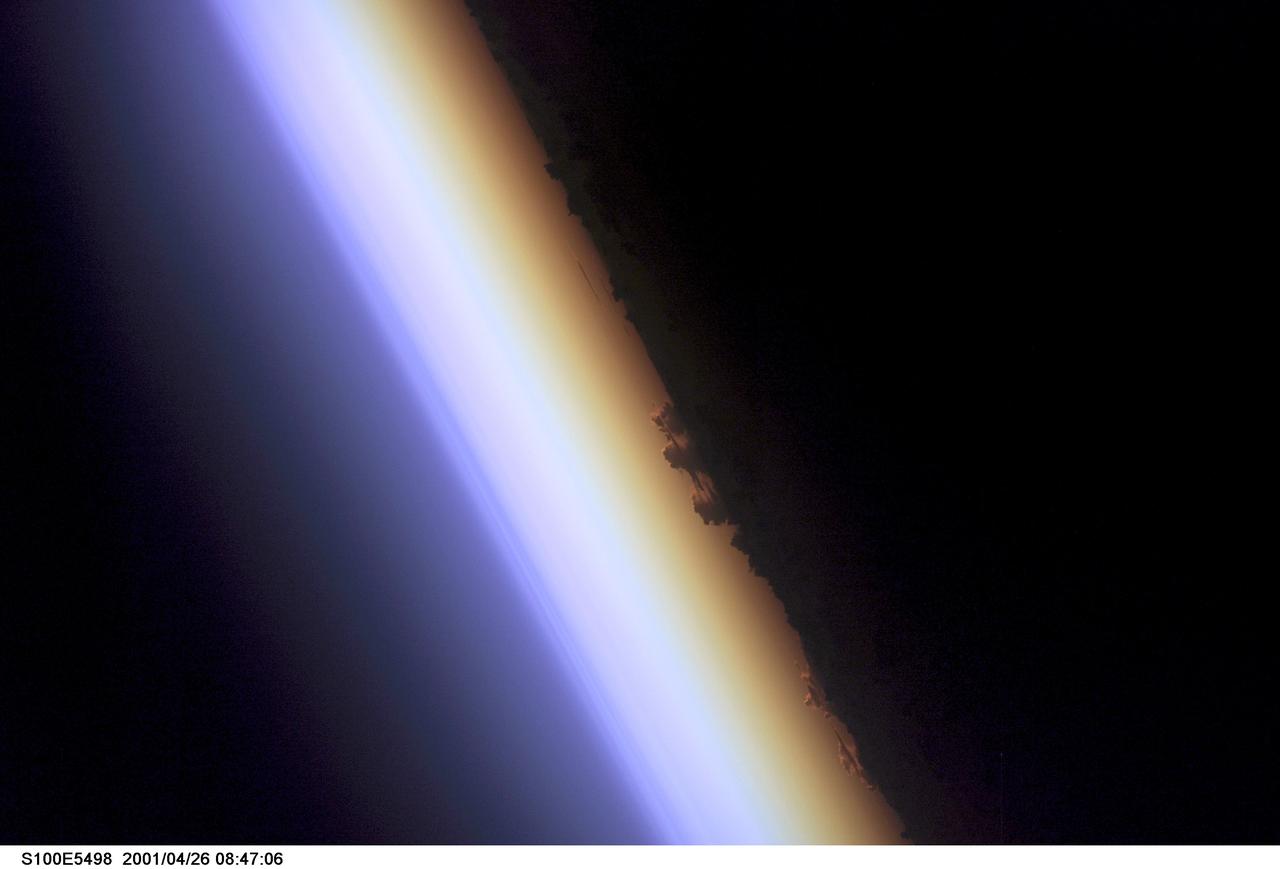
S100-E-5498 (26 April 2001) --- Earth's limb--the edge of the planet seen at twilight--was captured with a digital still camera by one of the STS-100 crew members aboard the Space Shuttle Endeavour. Near center frame the silhouette of cloud layers can be seen in the atmosphere, above which lies an airglow layer (left).
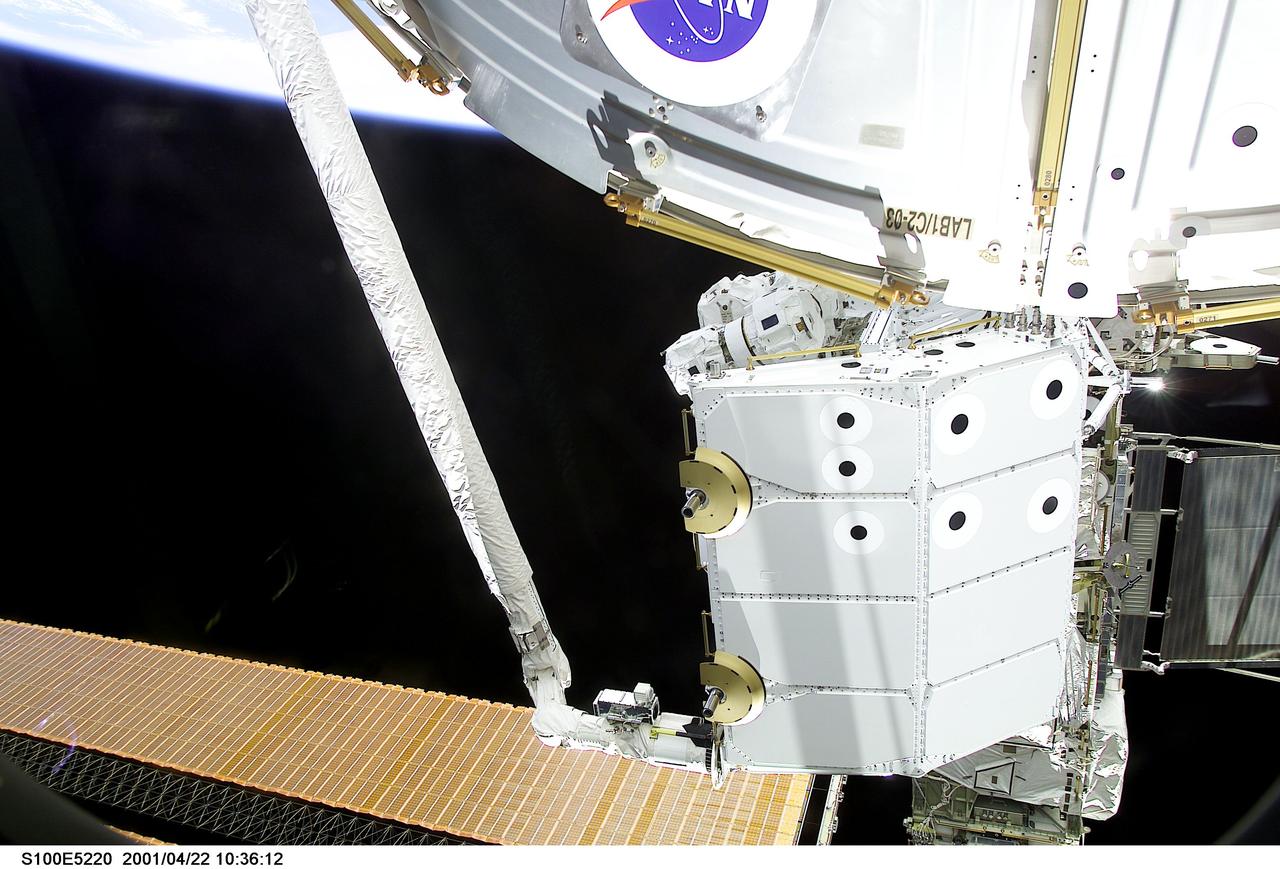
S100-E-5220 (22 April 2001) --- The pallet that contains Canadarm2 and the UHF antenna that are to be installed during the first scheduled space walk on STS-100 is seen in the grasp of the Canadian-built Remote Manipulator System (RMS) robot arm on the Space Shuttle Endeavour. The scene was recorded with a digital still camera.
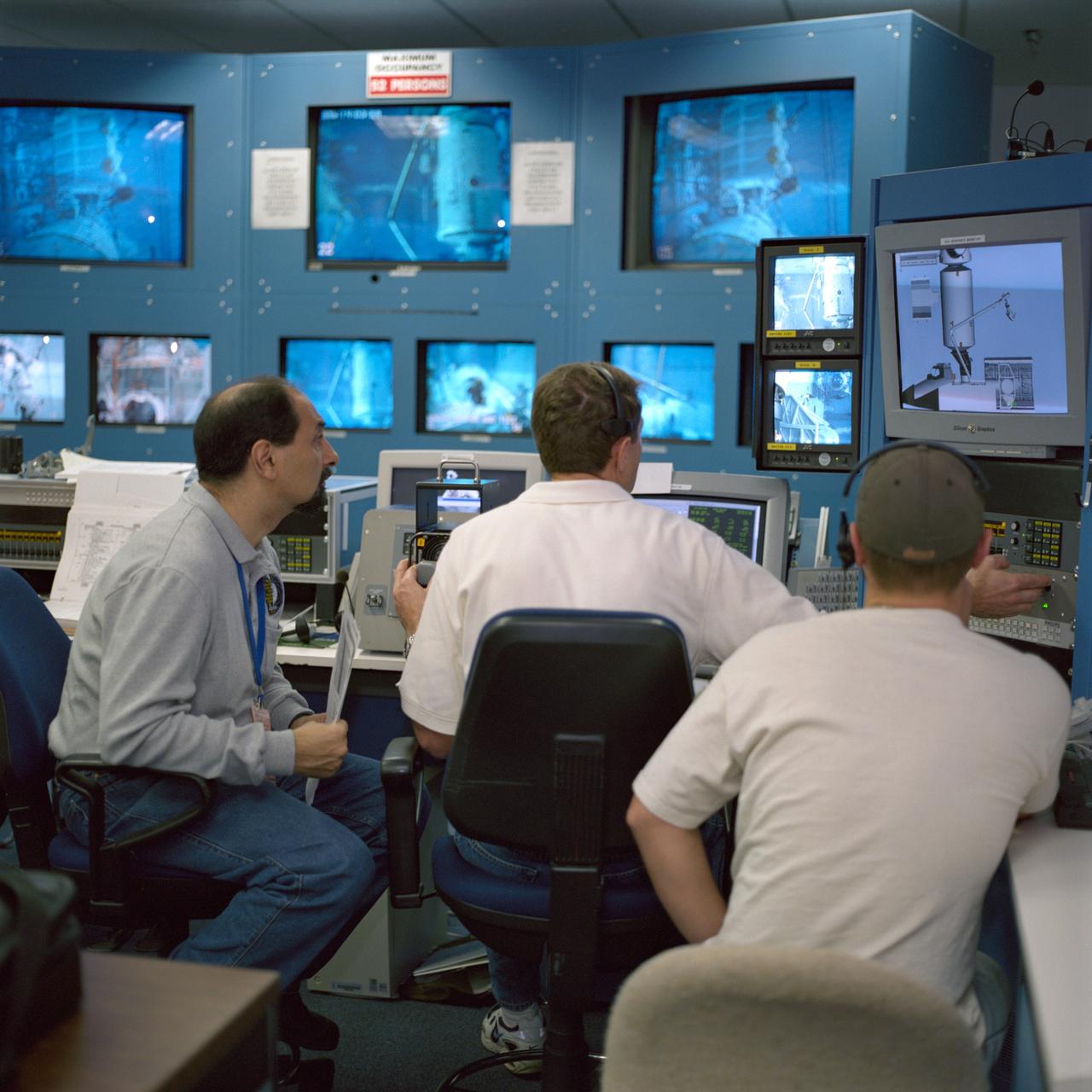
JSC2000-07406 (1 December 2000) --- Astronaut Umberto Guidoni (left), STS-100 mission specialist representing the European Space Agency (ESA), views a closed-circuit televising of an underwater space walk simulation performed by two crew mates. The simulation of the scheduled spring 2001 space walk took place at the Neutral Buoyancy Laboratory (NBL) at the Sonny Carter Training Facility. Astronaut Jeffrey S. Ashby, pilot, is at center. Astronauts Scott E. Parazynski of the NASA-Johnson Space Center and Chris A. Hadfield of the Canadian Space Agency (CSA), both mission specialists and both equipped with training versions of the extravehicular mobility unit (EMU) space suits, were in the water at the time.

JSC2000-07391 (1 December 2000)--- Astronaut Chris A. Hadfield, representing the Canadian Space Agency (CSA), puts final touches on the suit-up process in preparation for a training session in the Neutral Buoyancy Laboratory (NBL) near the Johnson Space Center (JSC). Hadfield is designated for space walk duty on the STS-100 flight, and underwater simulations of his duties help prepare him for the mission, scheduled for spring of next year. By coincidence, Hadfield is aligned beneath the Canadian flag, one of the many on NBL walls which pay tribute to the participating international partners.
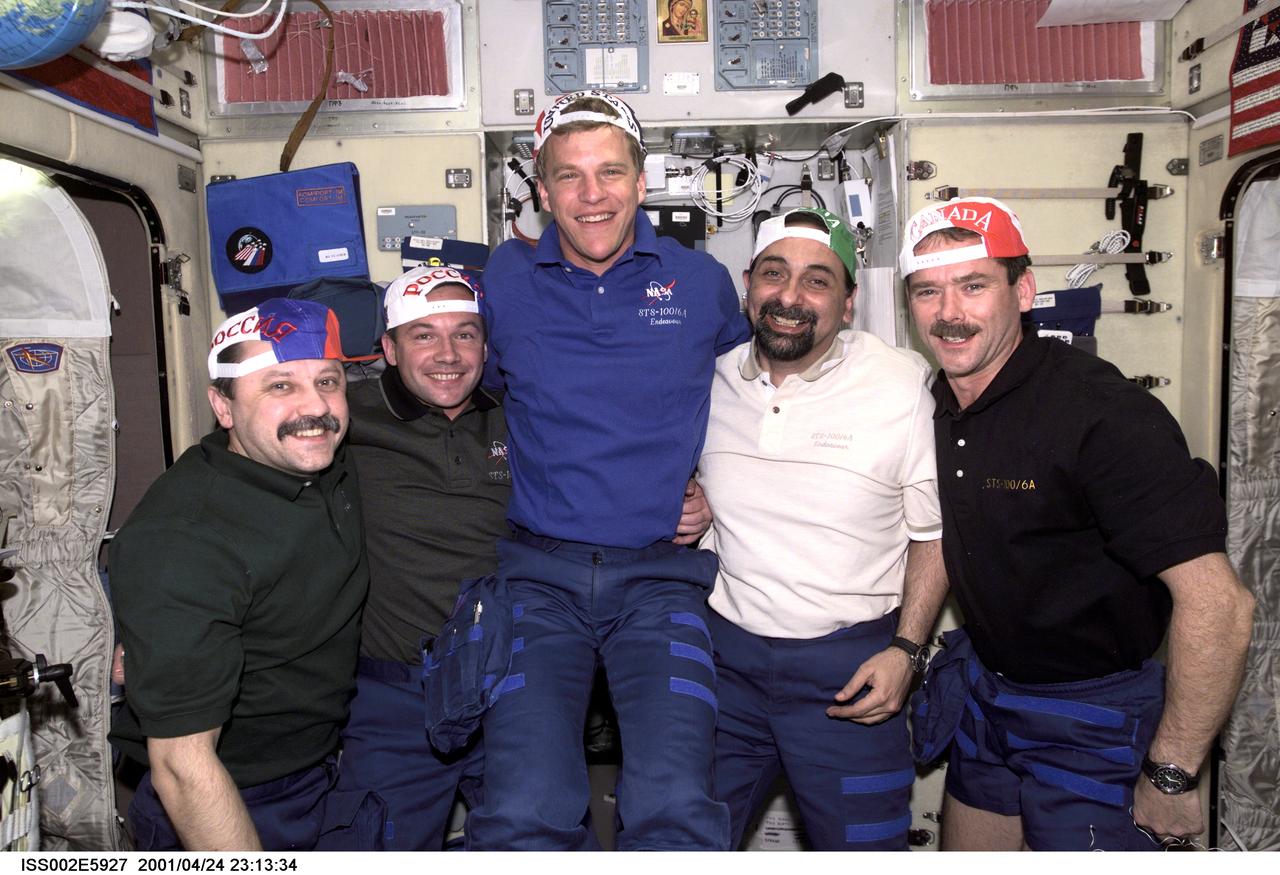
ISS002-E-5927 (24 April 2001) --- Yury V. Usachev, Expedition Two mission commander with STS-100 mission specialists Yuri V. Lonchakov, Scott E. Parazynski, Umberto Guidoni and Chris A. Hadfield, in the Zvezda Service Module, all sport baseball caps representing their home countries, showing the true flavor of the International Space Station (ISS). Usachev and Lonchakov represent Rosaviakosmos, Guidoni represents the European Space Agency (ESA), Parazynski represents NASA, and Hadfield represents the Canadian Space Agency (CSA). The image was taken with a digital still camera.

ISS002-E-7172 (26 April 2001) --- The Expedition Two and STS-100 crew members get together for a group portrait in the emptied Raffaello Multi-Purpose Logistics Module (MPLM). Clockwise from the 12 o'clock point in the circle are Kent V. Rominger, Yuri V. Lonchakov, Yury V. Usachev, Umberto Guidoni, James S. Voss, Jeffrey S. Ashby, Scott E. Parazynski, John L. Phillips and Chris A. Hadfield, with Susan J. Helms at center. Usachev, Helms and Voss are members of three Expedition Two crew, with the other seven serving as the STS-100 crew on the Space Shuttle Endeavour. Usachev and Lonchakov represent Rosaviakosmos; Guidoni is associated with the European Space Agency (ESA); and Hadfield is from the Canadian Space Agency (CSA). The image was taken with a pre-set digital still camera.
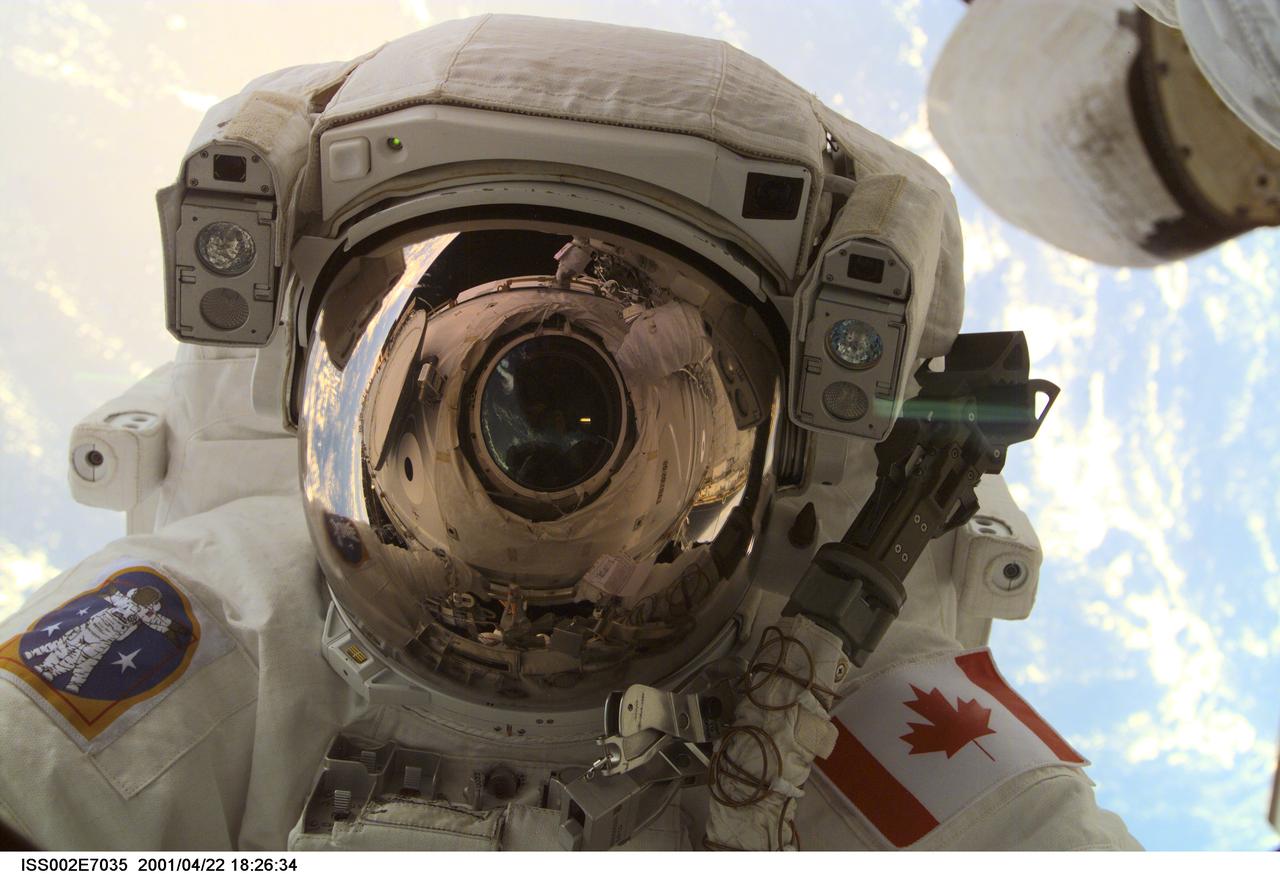
ISS002-E-7035 (22 April 2001) --- A through-the-window view of astronaut Chris A. Hadfield, STS-100 mission specialist representing the Canadian Space Agency (CSA), was taken during the first extravehicular activity (EVA) of the STS-100 mission. This digital still camera's image was captured by the Expedition Two crew through the nadir window of the Destiny Laboratory with a digital still camera. The window and much of Destiny can be seen in the visor of Hadfield's helmet.
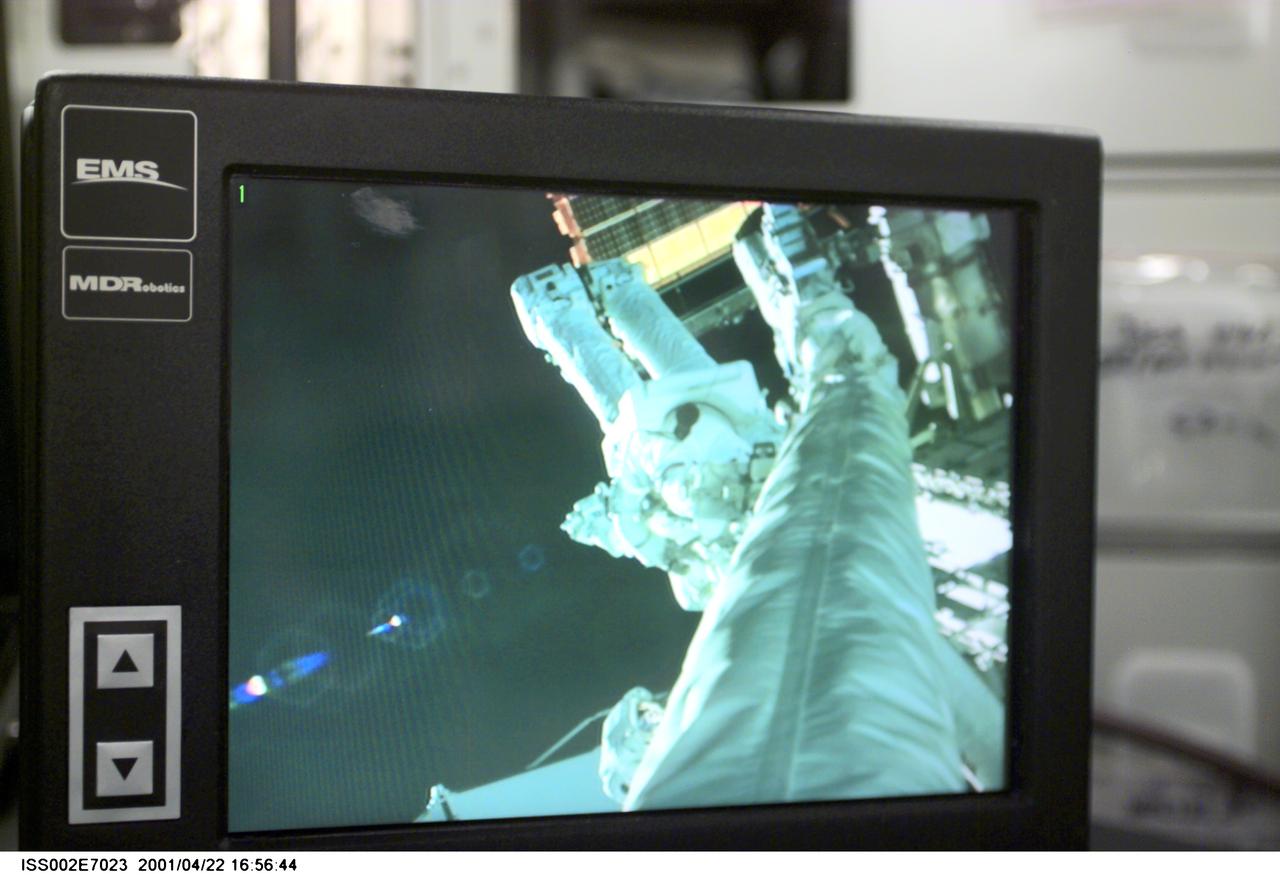
ISS002-E-7023 (22 April 2001) - Viewed on a monitor in the Destiny/U.S. Laboratory, Astronaut Chris A. Hadfield, STS-100 mission specialist representing the Canadian Space Agency (CSA), can be seen during the first space walk (EVA-1) of the STS-100 mission. The image on the monitor was taken with the Canadian-built Remote Manipulator System (RMS) arm video camera, and this still image was recorded with a digital still camera.
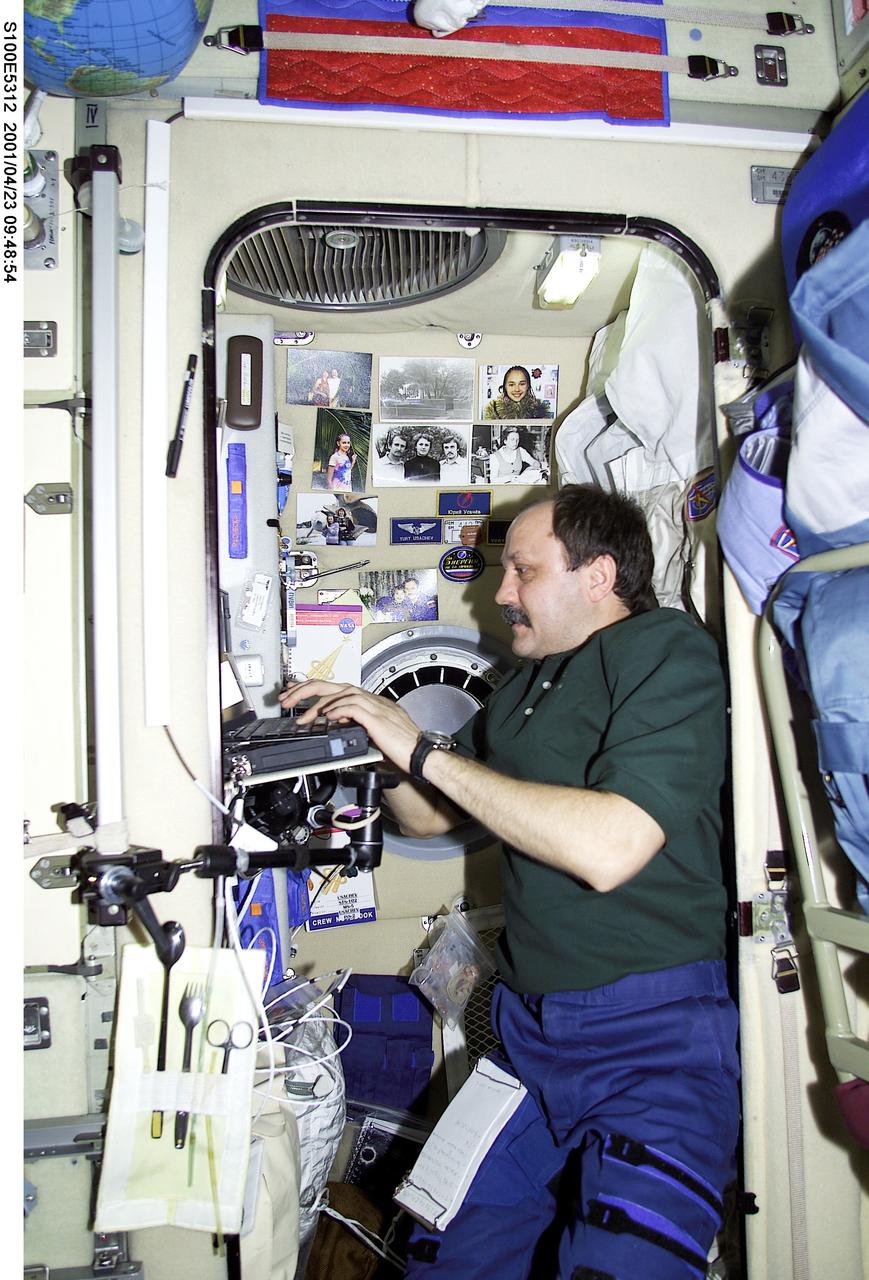
S100-E-5312 (23 April 2001) --- Astronaut Kent V. Rominger, STS-100 mission commander, tours the Zvezda Service Module on the International Space Station (ISS) not long after the seven-member STS-100 crew went aboard the orbital outpost and reunited with the station's second crew. The image was recorded with a digital still camera.
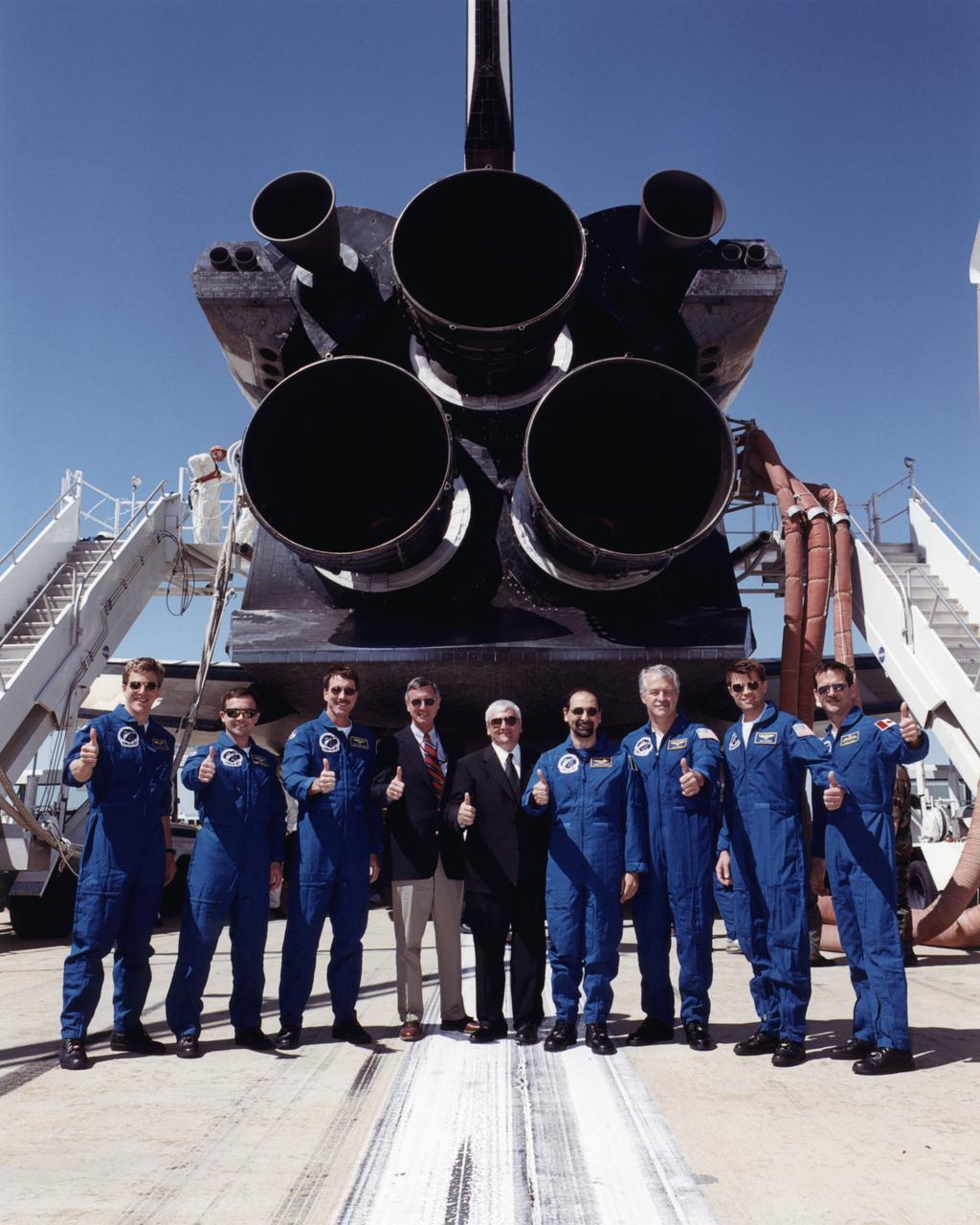
A happy "thumbs up" from the crew of the Space Shuttle Endeavour and NASA Dryden Flight Research Center officials heralded the successful completion of mission STS-100. Standing by the shuttle's rocket nozzles from left to right: Scott E. Prazynski, mission specialist (U.S.); Yuri V. Lonchakov, mission specialist (Russia); Kent V. Rominger, commander (U.S.); Wally Sawyer, NASA Dryden Flight Research Center deputy director; Kevin Petersen, NASA Dryden Flight Research Center director; Umberto Guidoni, mission specialist (European Space Agency); John L. Phillips, mission specialist (U.S.); Jeffrey S. Ashby, pilot (U.S.); and Chris A. Hadfield, mission specialist (Canadian Space Agency). The mission landed at Edwards Air Force Base, California, on May 1, 2001.
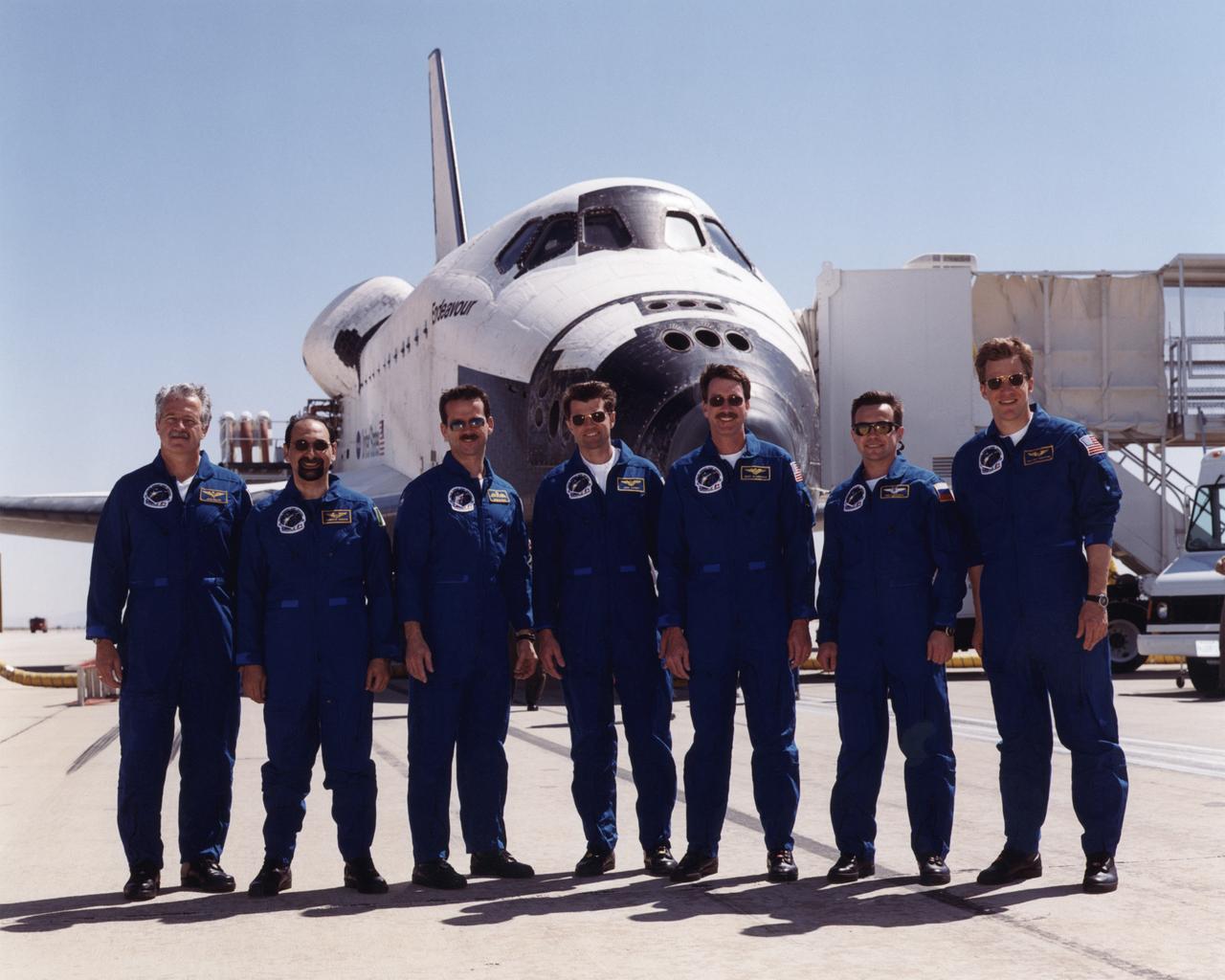
The crew of Space Shuttle mission STS-100 gathered in front of the shuttle Endeavour following landing at Edwards Air Force Base, California, 9:11 am, May 1, 2001. From left to right: John L. Phillips, mission specialist (U.S.); Umberto Guidoni, mission specialist (European Space Agency); Chris A. Hadfield, mission specialist (Canadian Space Agency); Jeffrey S. Ashby, pilot (U.S.); Kent V. Rominger, commander (U.S.); Yuri V. Lonchakov, mission specialist (Russia); Scott E. Prazynski, mission specialist (U.S.).
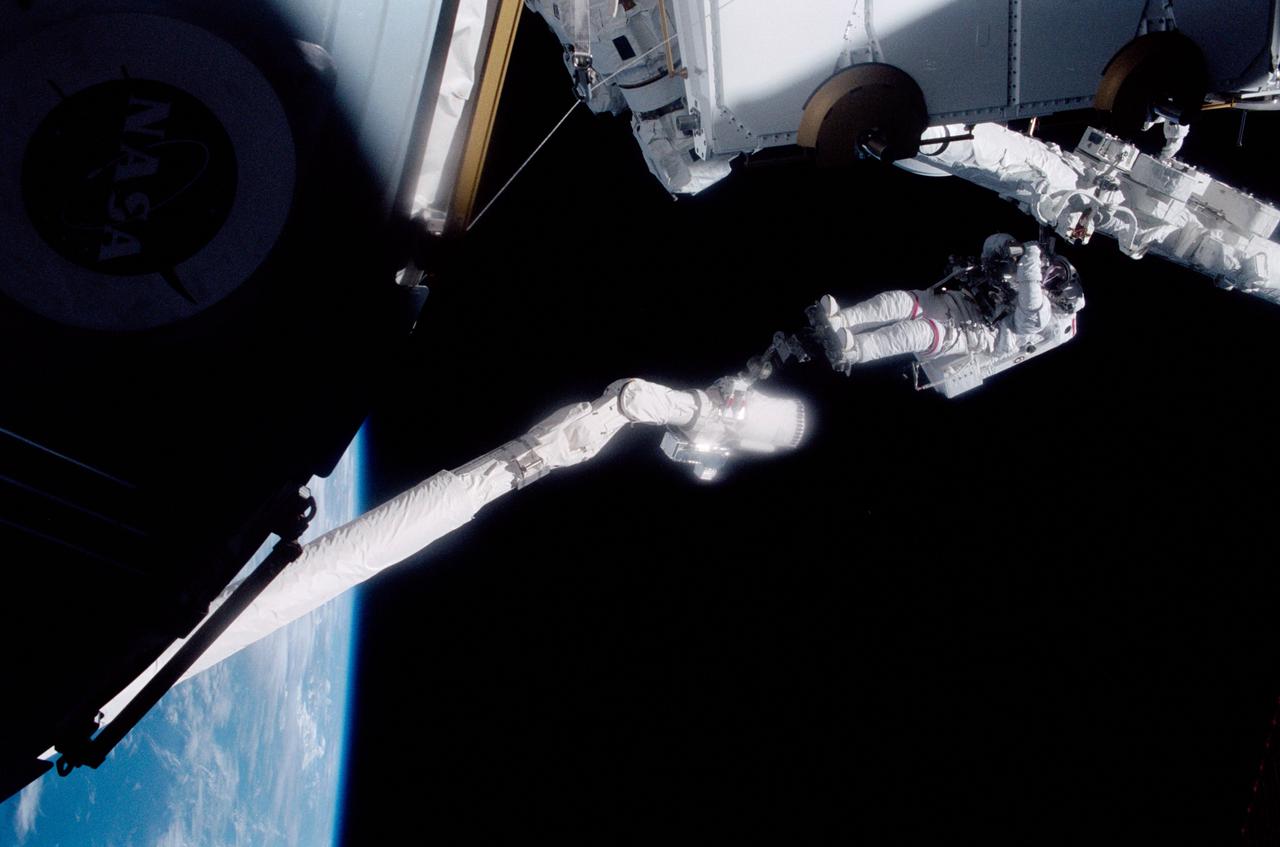
STS100-333-028 (19 April-1 May 2001) --- Astronaut Chris A. Hadfield, STS-100 mission specialist representing the Canadian Space Agency (CSA), stands on the portable foot restraint (PFR) connected to the Endeavour's remote manipulator system (RMS) robotic arm, using an International Space Station (ISS) pistol grip tool during one of two days of extravehicular activity (EVA).
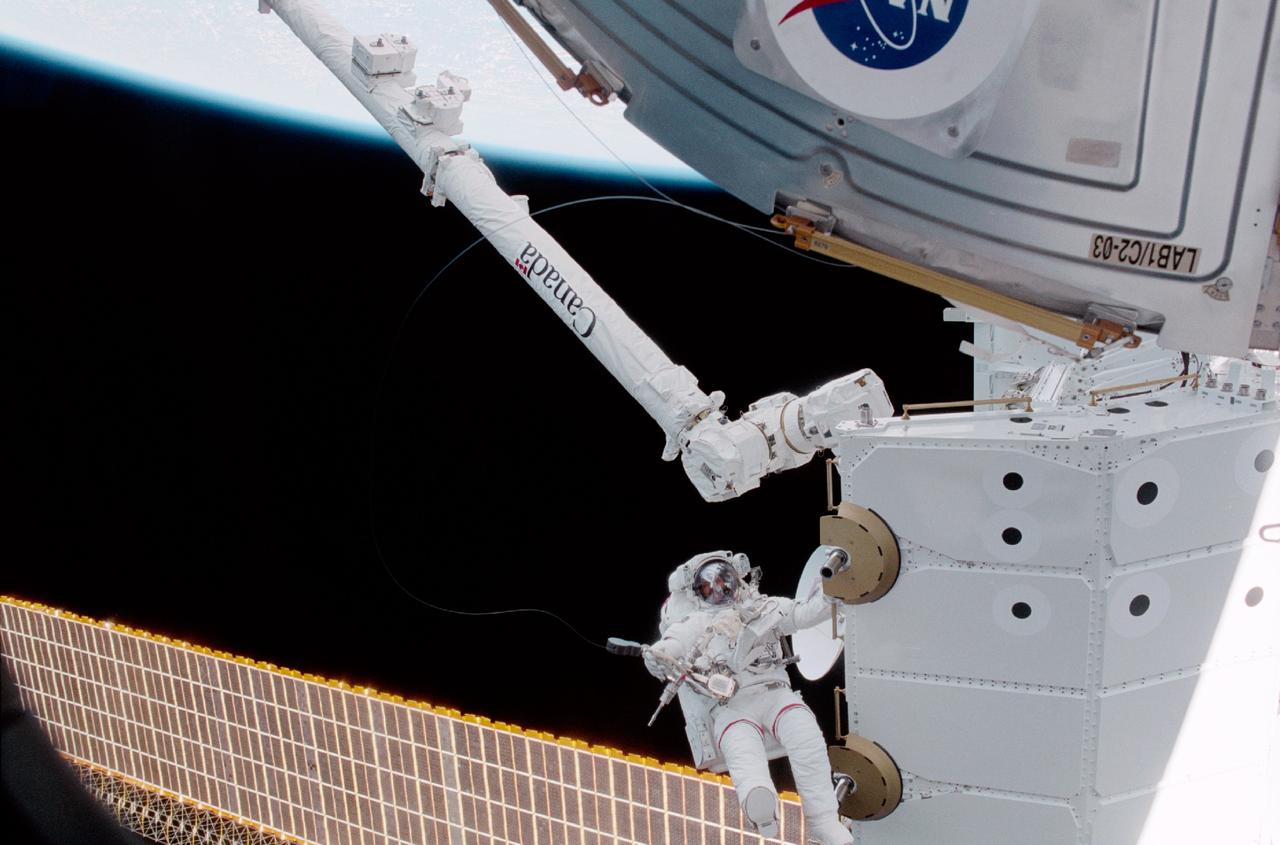
STS100-342-010 (19 April-1 May 2001) --- Astronaut Chris A. Hadfield, mission specialist representing the Canadian Space Agency (CSA), is seen near the Canadarm2 as the new robotics tool for the International Space Station (ISS) grasps the Spacelab pallet. Hadfield participated in two days of extravehicular activity (EVA) on the STS-100 mission.
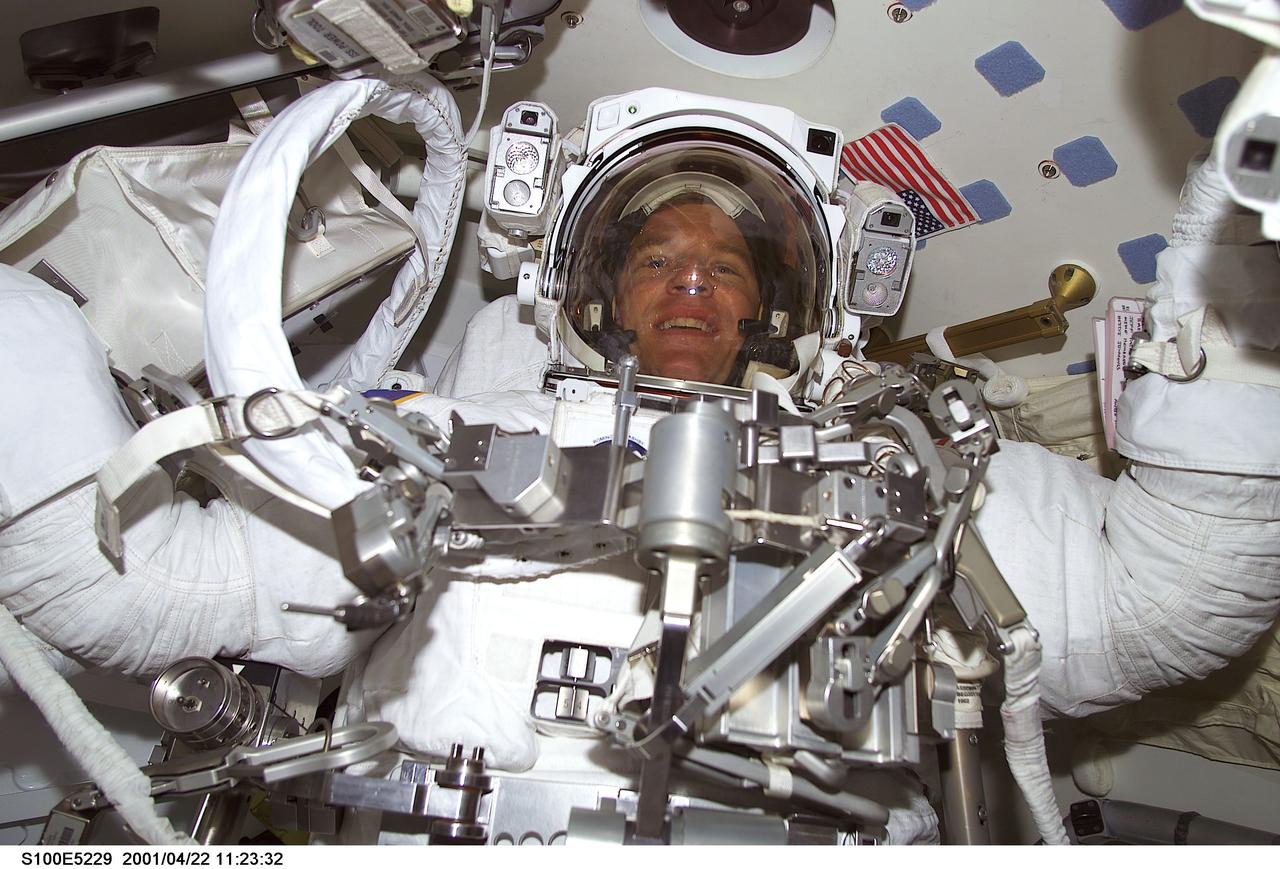
S100-E-5229 (22 April 2001) --- Astronaut Scott E. Parazynski, STS-100 mission specialist, appears ready to face a busy agenda outside the Space Shuttle Endeavour as he prepares to exit the shuttle's airlock and share several hours of extravehicular work on the International Space Station (ISS) with astronaut Chris A. Hadfield (out of frame) of the Canadian Space Agency (CSA). The scene was recorded with a digital still camera.
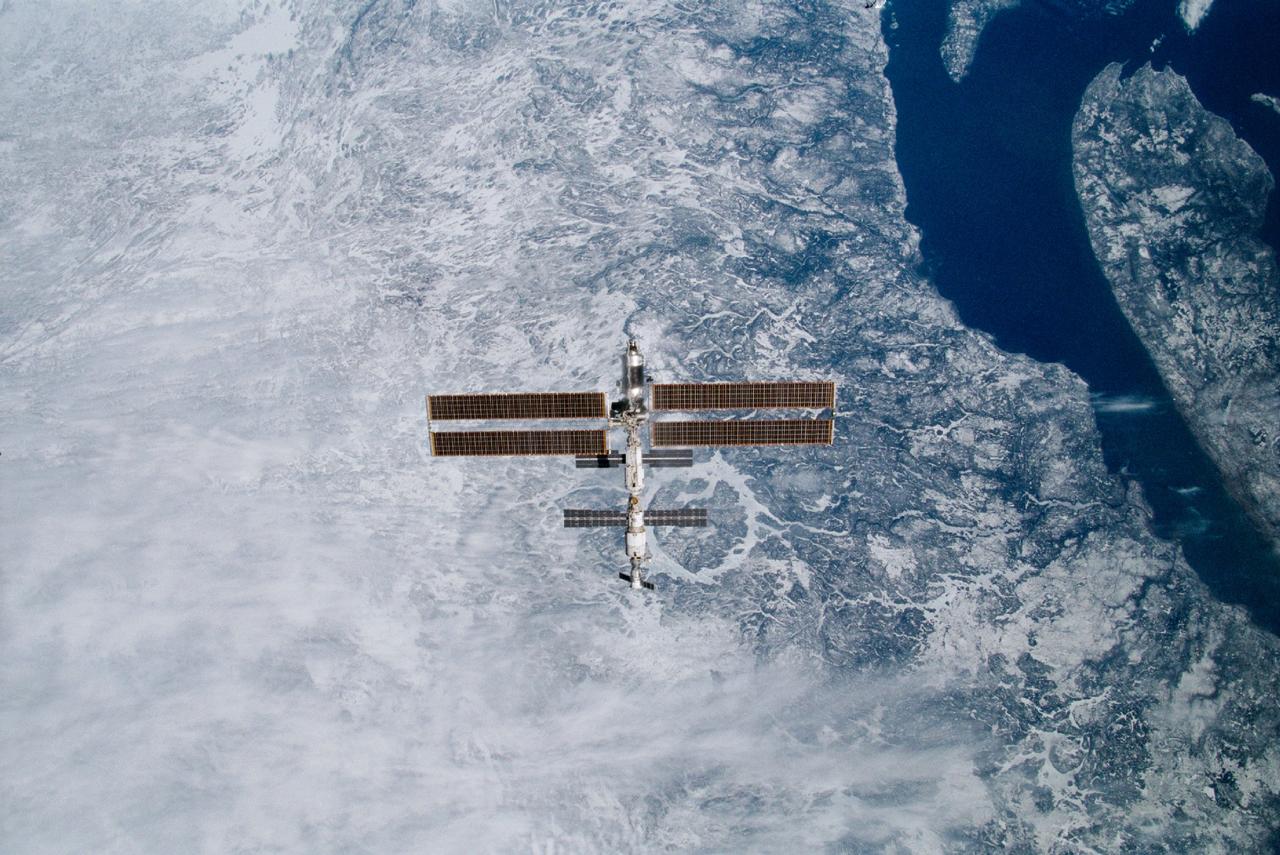
STS100-332-011 (29 April 2001) --- Backdropped against the topography of the Canadian province of Quebec, the International Space Station (ISS) was photographed following separation from the Space Shuttle Endeavour. An impact feature known as the Manicouagan Reservoir, is almost directly beneath the orbital outpost. The 35mm frame was exposed by one of the STS-100 crewmembers onboard the shuttle.
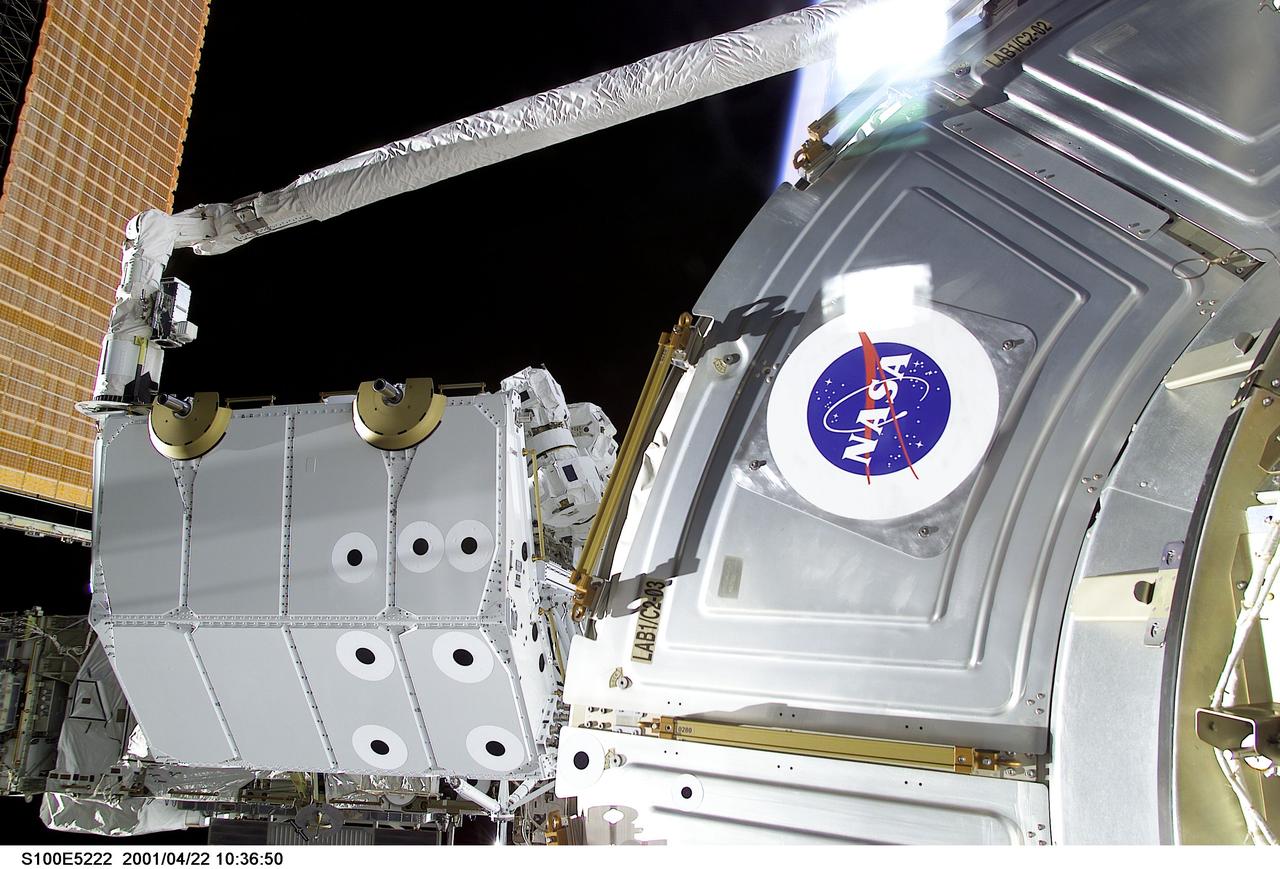
S100-E-5222 (22 April 2001) --- The pallet that contains Canadarm2 and the UHF antenna that are to be installed during the first scheduled space walk on STS-100 is seen in the grasp of the Canadian-built Remote Manipulator System (RMS) robot arm on the Space Shuttle Endeavour. The Destiny laboratory can be seen in the right foreground. The scene was recorded with a digital still camera.
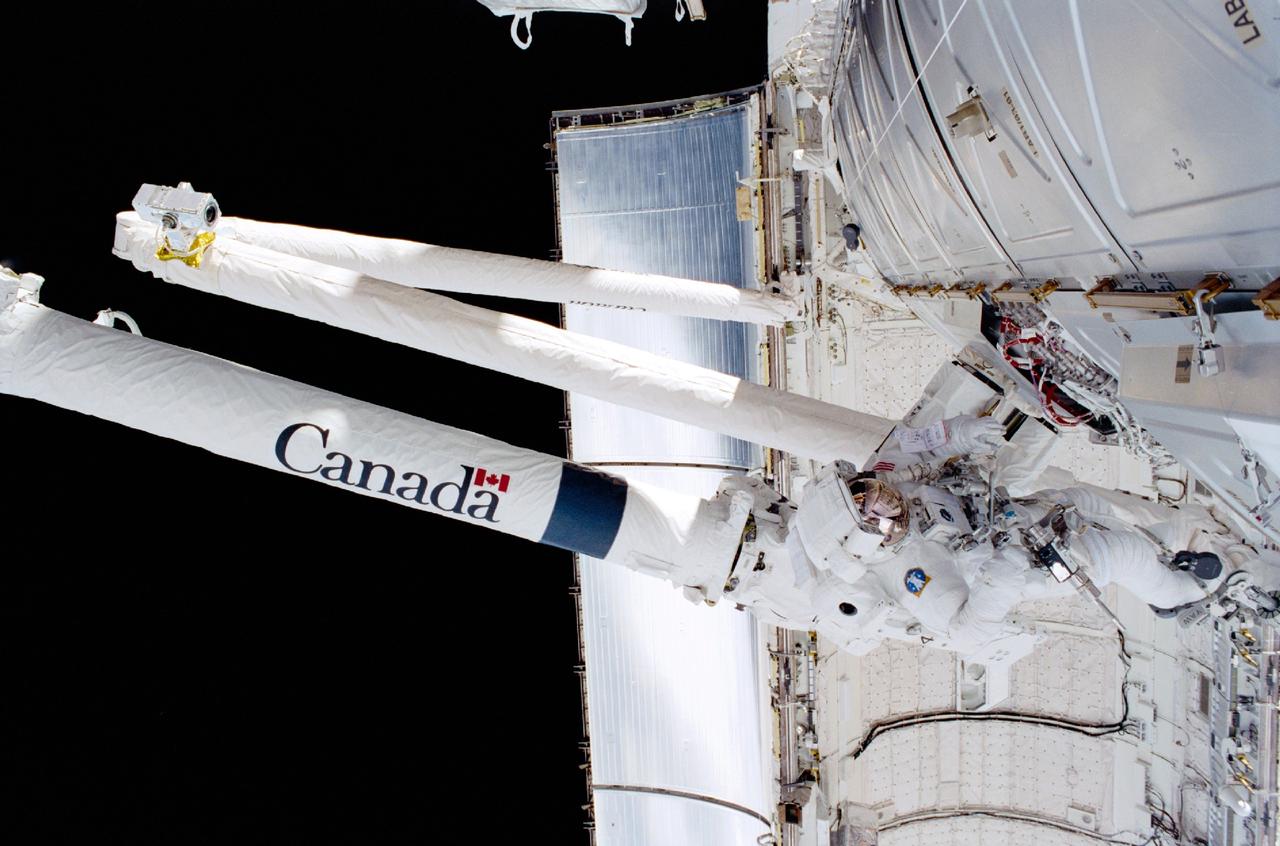
STS100-396-007 (19 April-1 May 2001) --- Astronaut Scott E. Parazynski, STS-100 mission specialist, works with cables associated with the Space Station Remote Manipulator System (SSRMS) or Canadarm2 during one of two days of extravehicular activity (EVA). Parazynski shared both space walks with astronaut Chris A. Hadfield of the Canadian Space Agency (CSA).
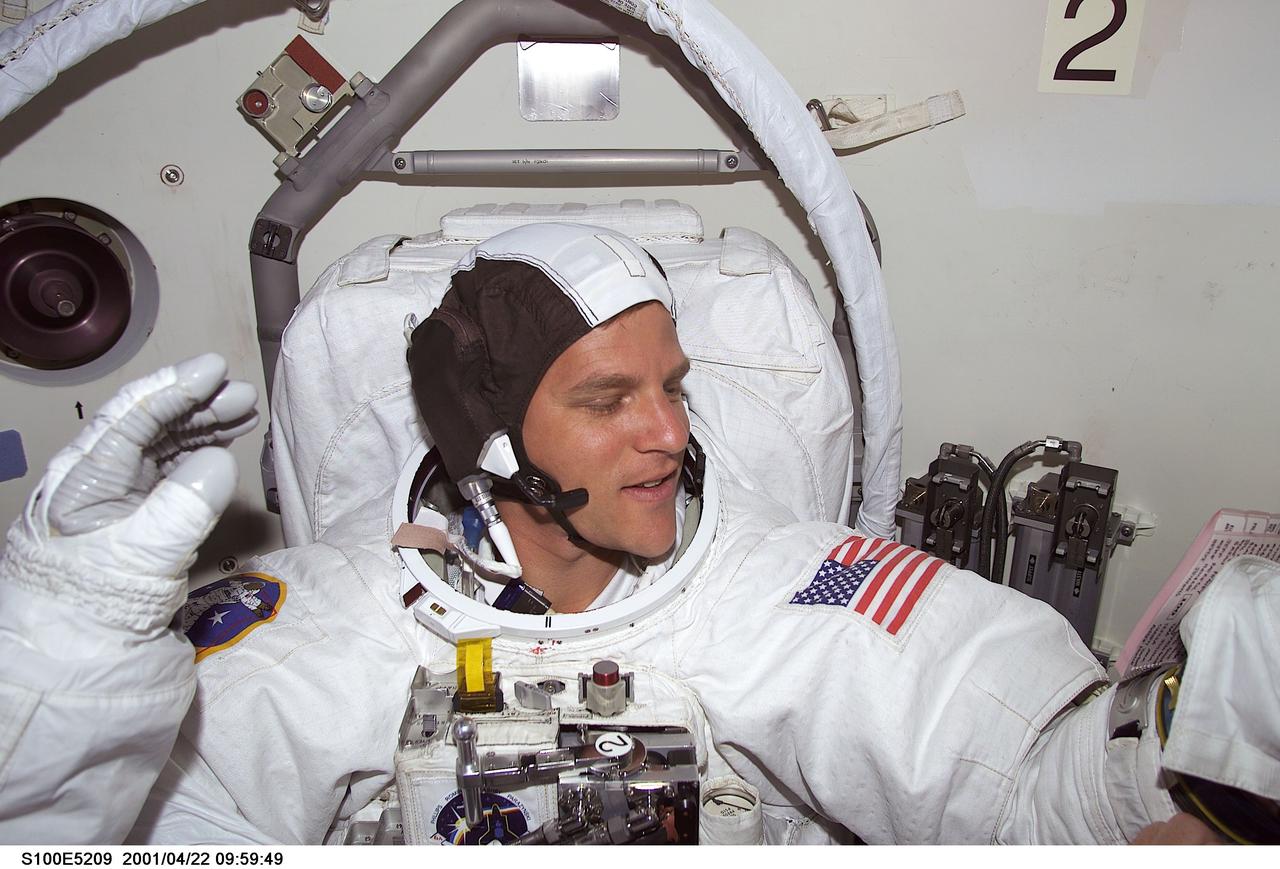
S100-E-5209 (22 April 2001) --- Astronaut Scott E. Parazynski, STS-100 mission specialist, appears ready to face a busy agenda outside the Space Shuttle Endeavour as he prepares to don his helmet gear and then exit the shuttle's airlock to share several hours of extravehicular work on the International Space Station (ISS) with astronaut Chris A. Hadfield (out of frame) of the Canadian Space Agency (CSA). This is the first of two scheduled walks to perform work on the orbital outpost. The scene was recorded with a digital still camera.
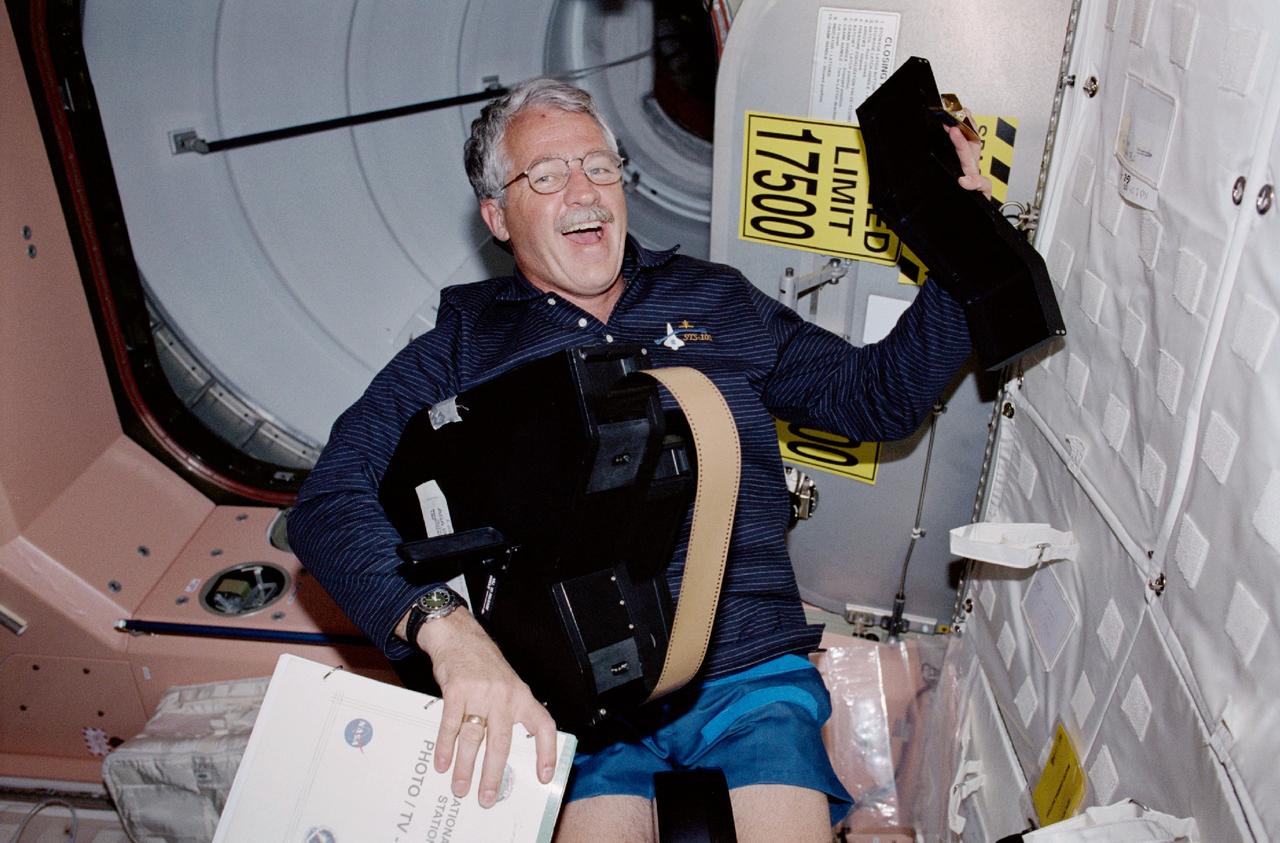
STS100-342-035 (19 April-1 May 2001) --- Astronaut John L. Phillips, mission specialist, works with the IMAX camera on the International Space Station (ISS). Phillips and his STS-100 crew mates transferred supplies to the station and recorded video, motion picture and still photography of their activities, including interaction with the Expedition Two crewmembers.
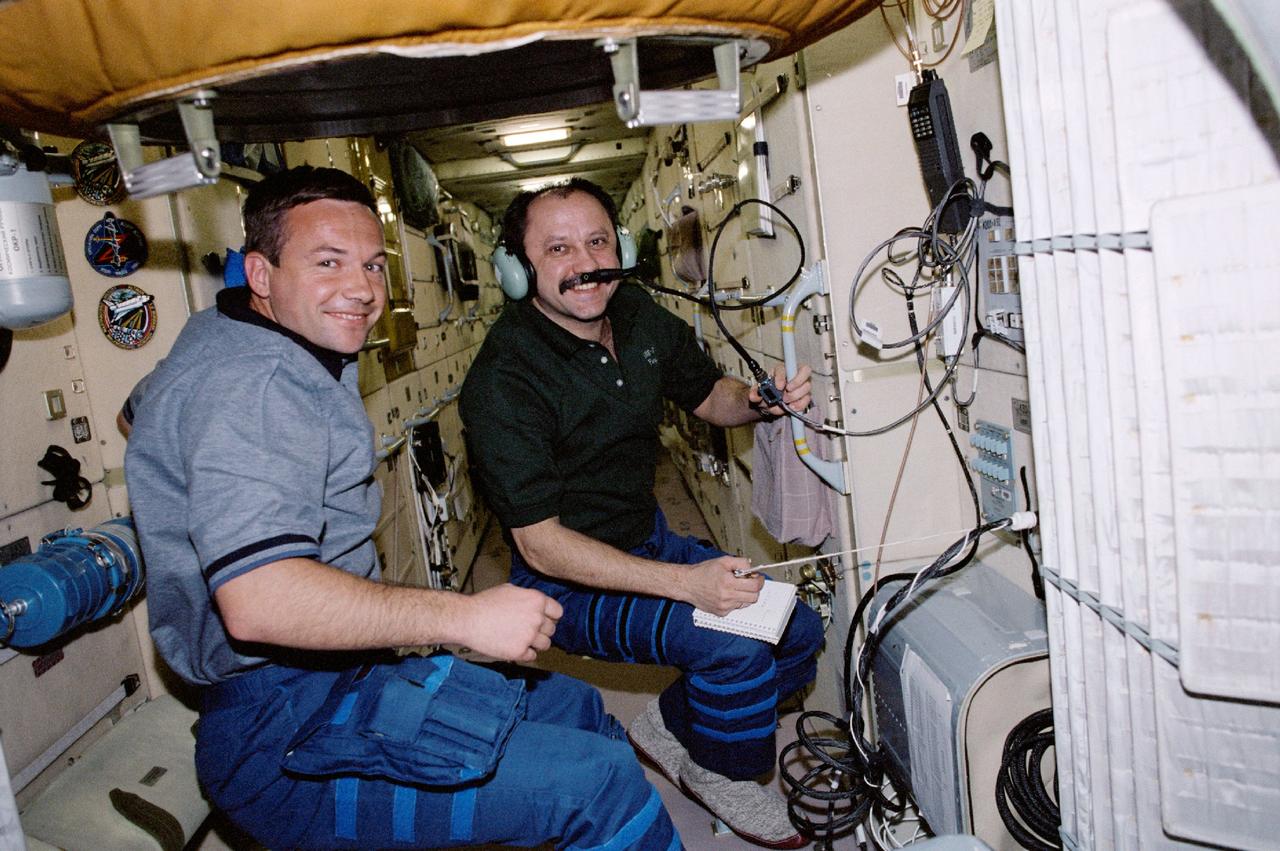
STS100-343-020 (19 April-1 May 2001) --- Cosmonaut Yuri V. Lonchakov (left), STS-100 mission specialist, observes as Yury V. Usachev, Expedition Two commander, talks to amateur radio operators on the ground from a special work station on the functional cargo block (FGB) or Zarya module of the International Space Station (ISS). The two represent Rosaviakosmos.
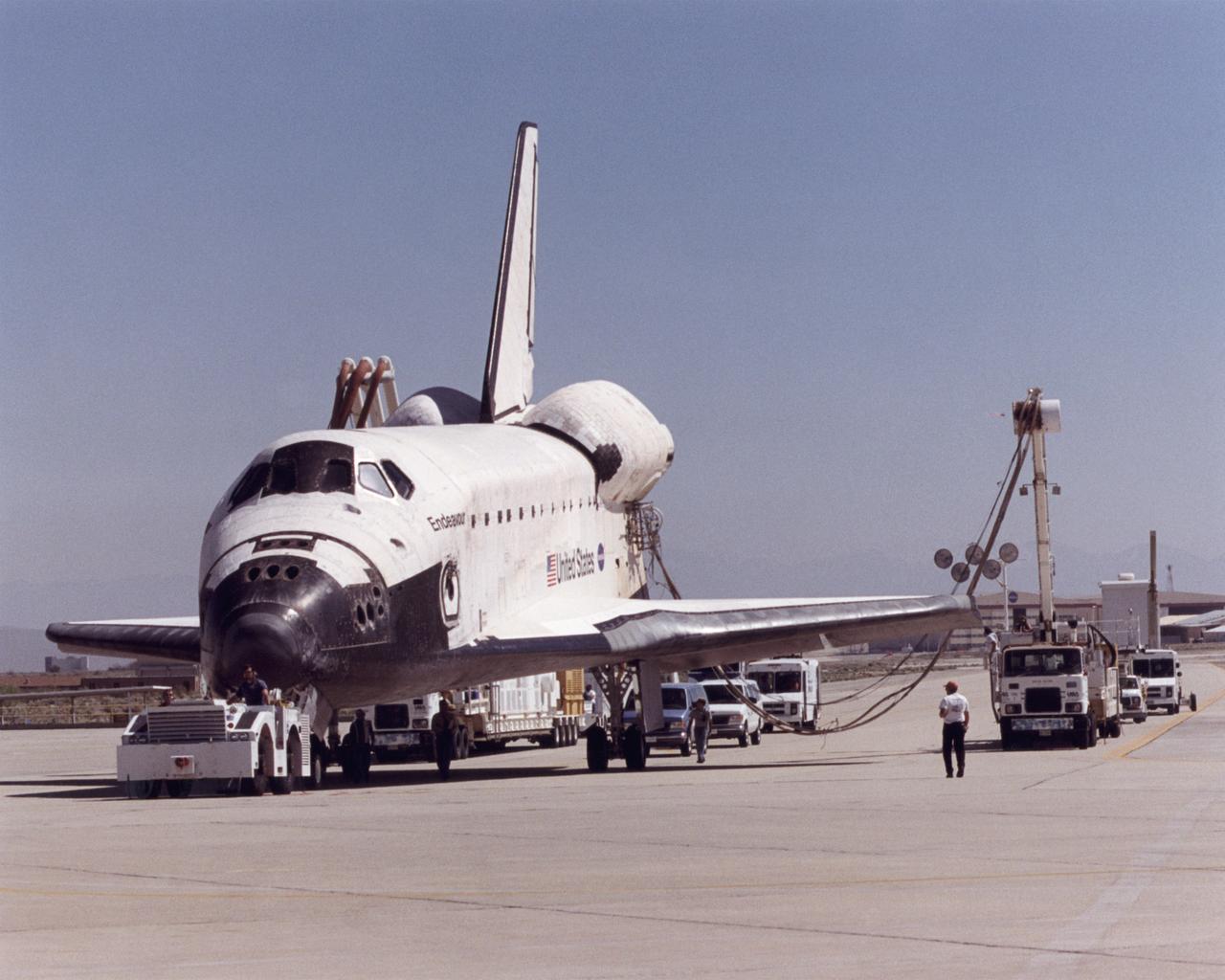
A convoy of specialized support vehicles follow the Space Shuttle Endeavour as it is towed up a taxiway at NASA's Dryden Flight Research Center on Edwards Air Force Base, California, after landing on May 1, 2001. The two largest vehicles trailing the shuttle provide electrical power and air conditioning to the shuttle's systems during post-flight recovery operations. The Endeavour had just completed mission STS-100, an almost 12-day mission to install the Canadarm 2 robotic arm and deliver some three tons of supplies and experiments to the International Space Station. The landing was the 48th shuttle landing at Edwards since shuttle flights began in 1981. After post-flight processing, the Endeavour was mounted atop one of NASA's modified Boeing 747 shuttle carrier aircraft and ferried back to the Kennedy Space Center in Florida on May 8, 2001.
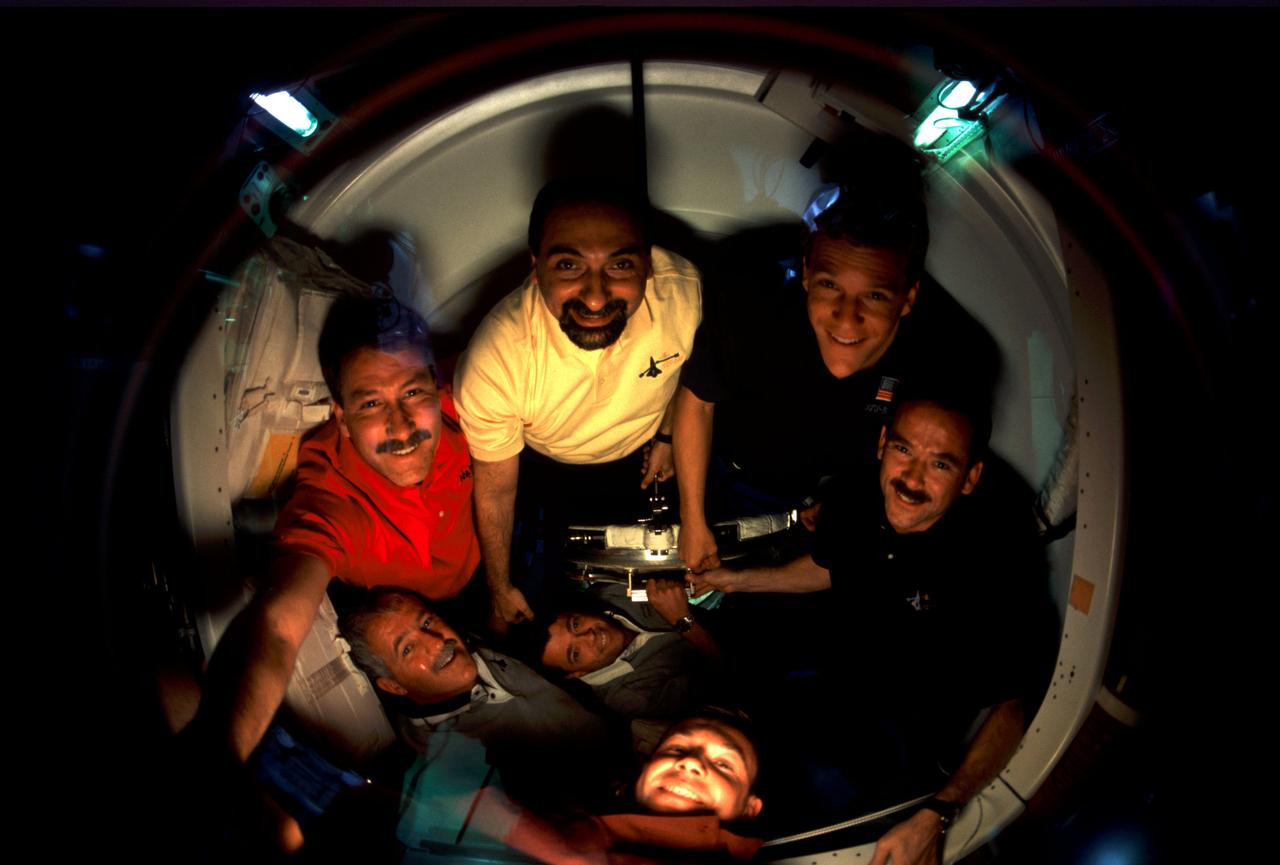
ISS002-311-032 (23 April 2001) --- The six astronauts and one cosmonaut comprising the STS-100 crew assemble in the Pressurized Mating Adapter (PMA-2) while waiting to visit the Expedition Two crew and the International Space Station (ISS). With his arm extended to left foreground is astronaut Kent V. Rominger, STS-100 mission commander. In the circular arrangement of crewmembers, clockwise from Rominger's position, are astronauts Umberto Guidoni, Scott E. Parazynski, Chris A. Hadfield, Jeffrey S. Ashby and John L. Phillips. Cosmonaut Yuri V. Lonchakov's head emerges at bottom center. On the other side of the glass were the Expedition Two crewmembers--cosmonaut Yury V. Usachev and astronauts James S. Voss and Susan J. Helms. Lonchakov and Usachev represent Rosaviakosmos; Hadfield is with the Canadian Space Agency (CSA) and Guidoni is associated with the European Space Agency (ESA). The ten were beginning a day that went on to see the first opening of hatches linking the two spacecraft, an impressive first step by the station's new Canadarm2 and the berthing to the station of Raffaello, the Italian-built logistics module. Hatch opening was set for 4 a.m. (CDT), April 23.
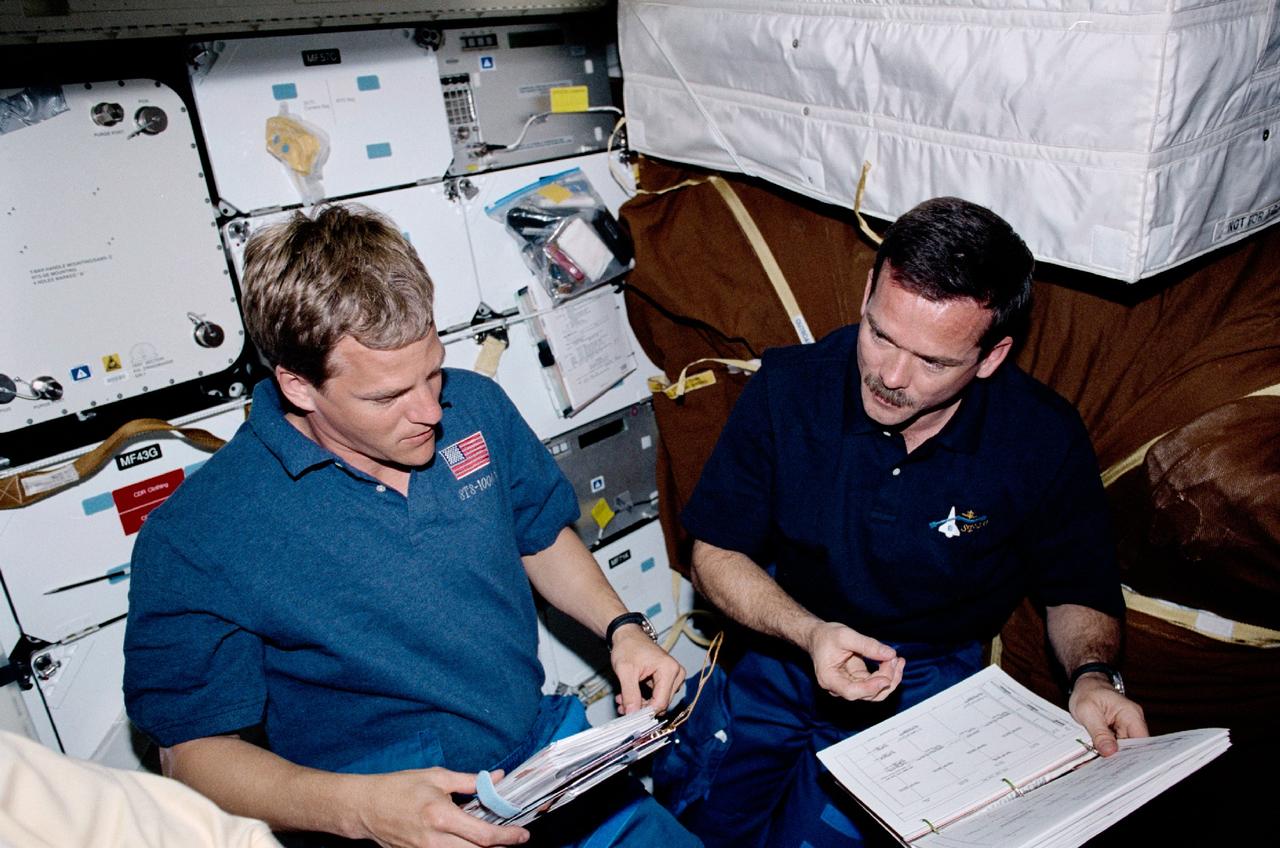
STS100-337-007 (19 April - 1 May 2001) --- Astronauts Scott E. Parazynski (left) and Chris A. Hadfield, STS-100 mission specialists, discuss one of the two assigned space walks they're sharing on this flight. The two are reviewing the extravehicular (EVA) checklist, on the middeck of the Space Shuttle Endeavour.
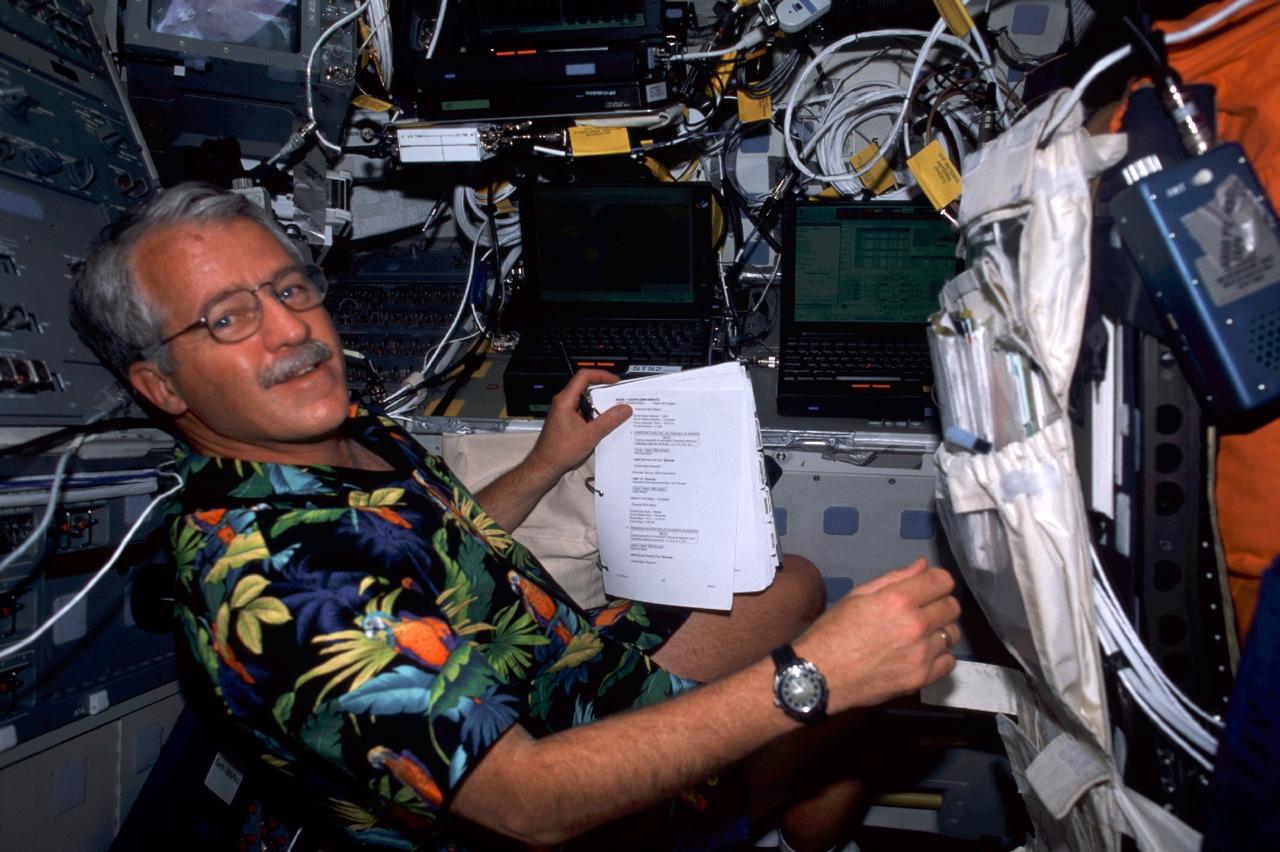
STS100-387-022 (19 April-1 May 2001) --- Astronaut John L. Phillips, STS-100 mission specialist, looks over a checklist on the flight deck of the Space Shuttle Endeavour. The alumnus of the 1996 class of astronaut candidates is making his first space flight.
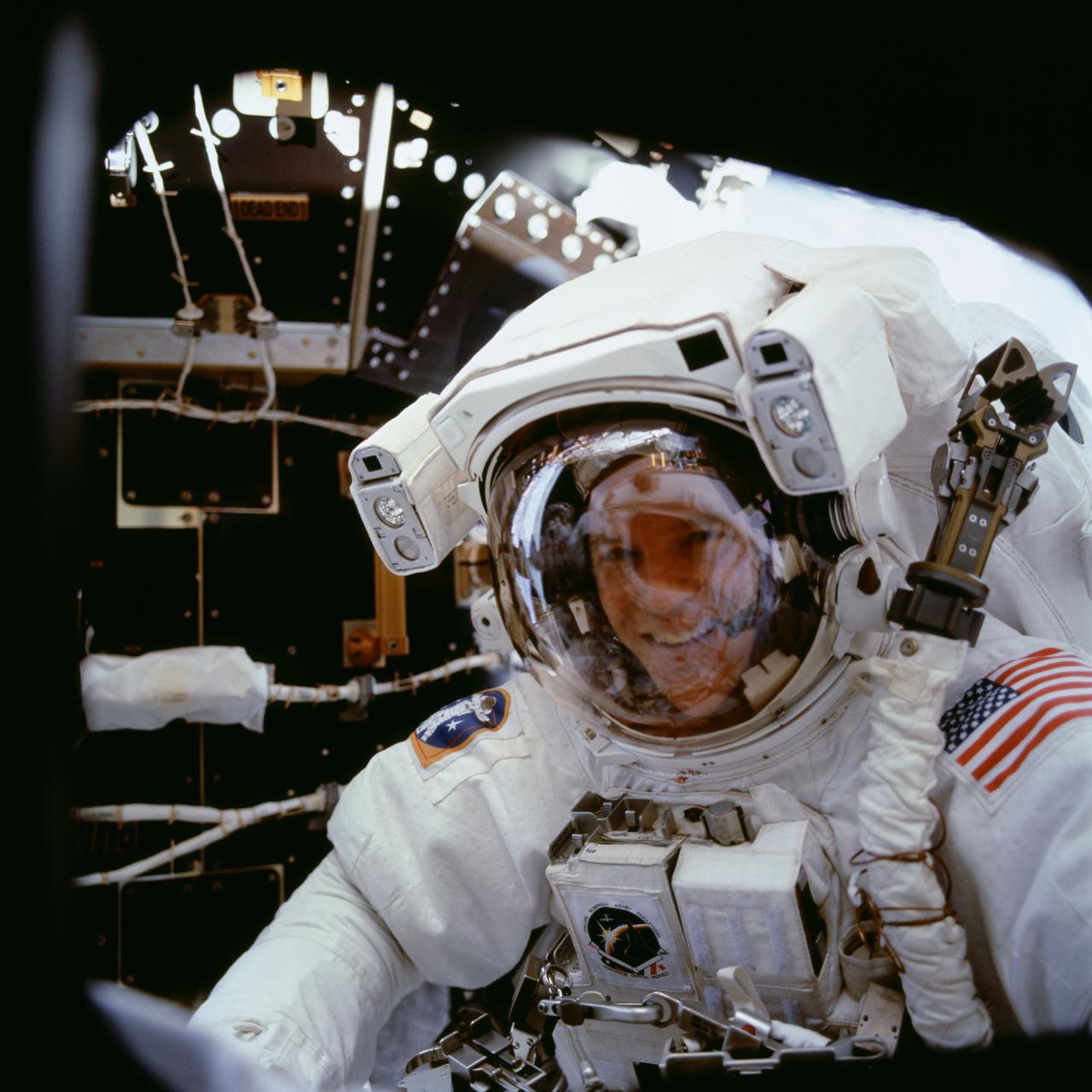
STS100-714-059 (19 April-1 May 2001) --- Astronaut Scott E. Parazynski, mission specialist, was photographed by a crew mate inside the Space Shuttle Endeavour in this close up view, during one of the two days of extravehicular activity (EVA) on the STS-100 mission.
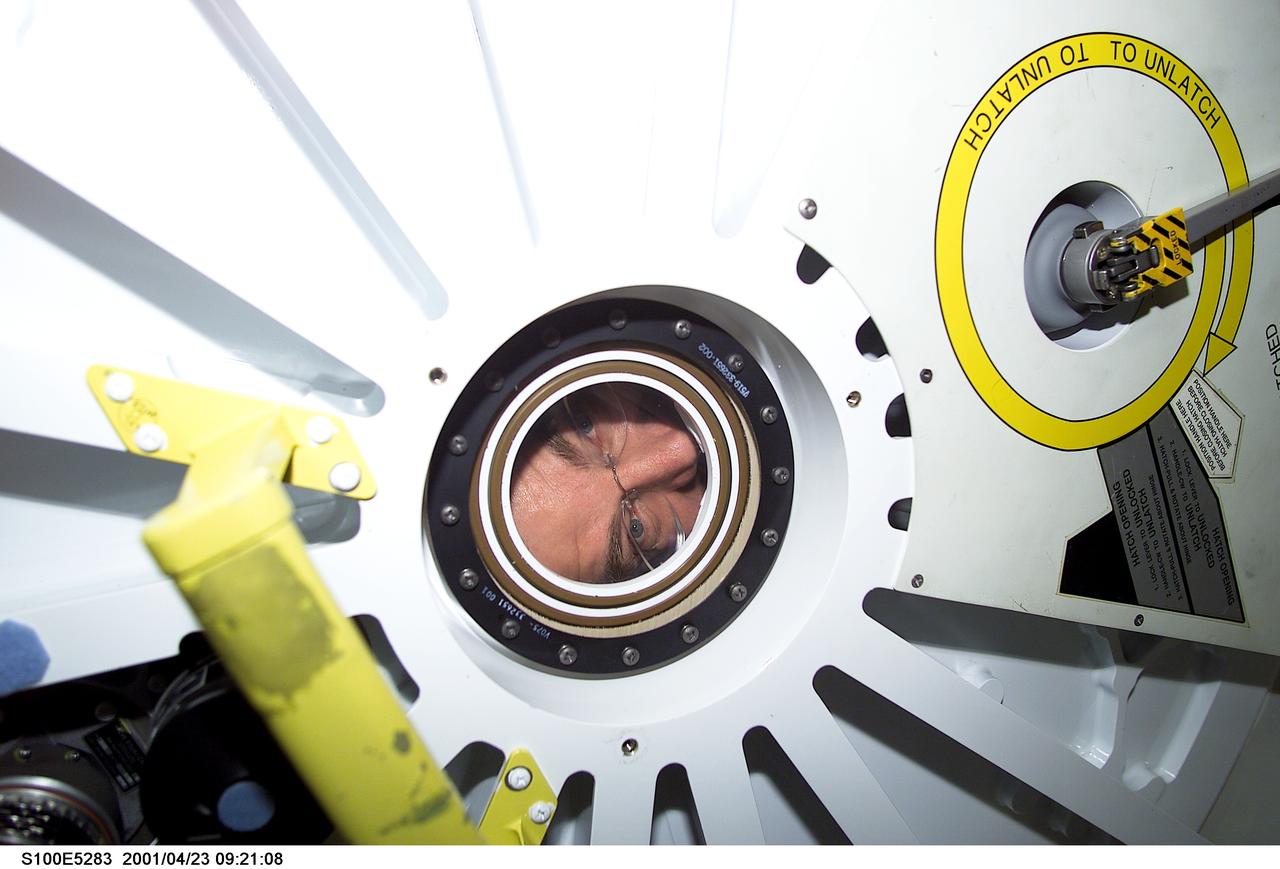
STS100-E-5283 (23 April 2001) --- Astronaut James S. Voss, Expedition Two flight engineer, peers into the Pressurized Mating Adapter (PMA-2) prior to hatch opening. The picture was taken with a digital still camera by one of the STS-100 crew members in the PMA. Photo credit: NASA
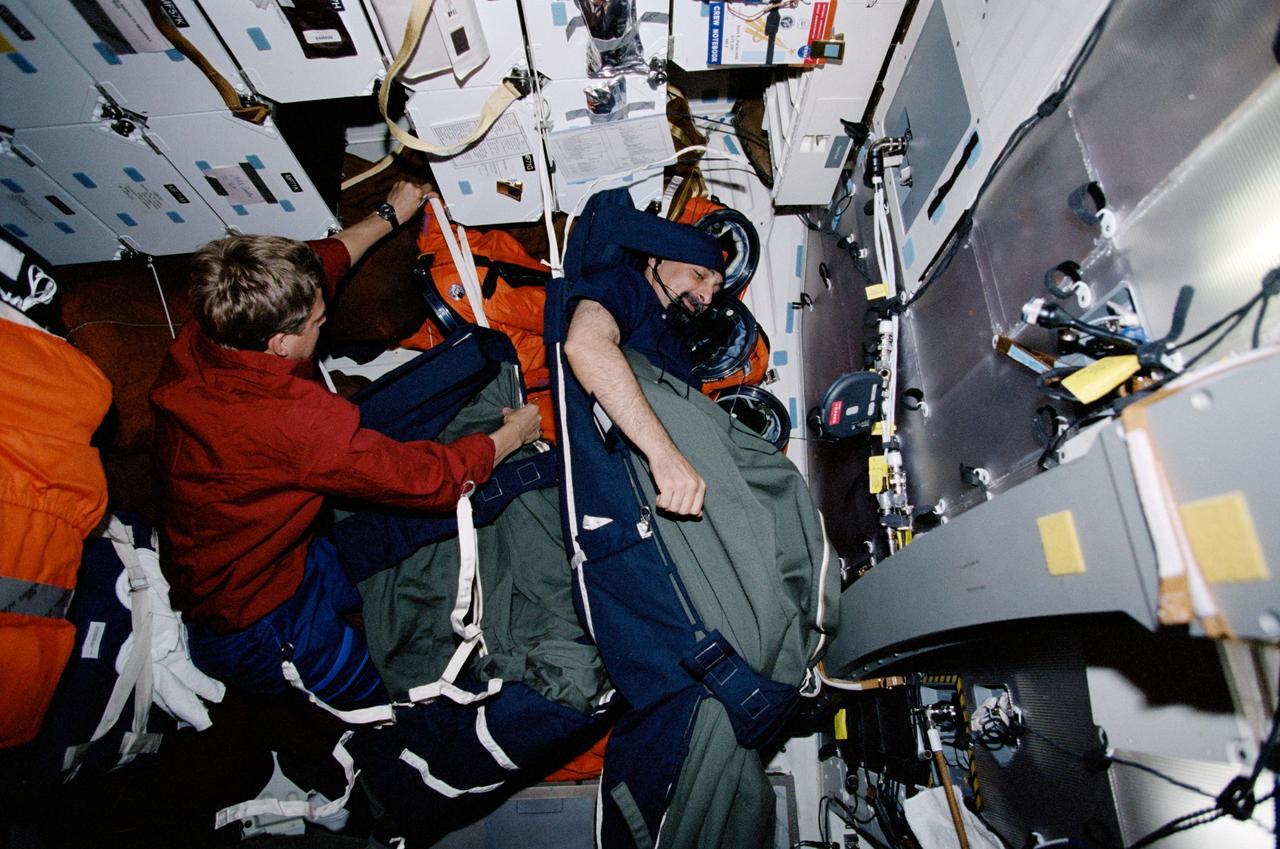
STS100-363-012 (19 April-1 May 2001) --- Astronaut Umberto Guidoni, STS-100 mission specialist, sleeps while astronaut Scott E. Parazynski, mission specialist, prepares for his sleep shift on the Space Shuttle Endeavour's middeck.
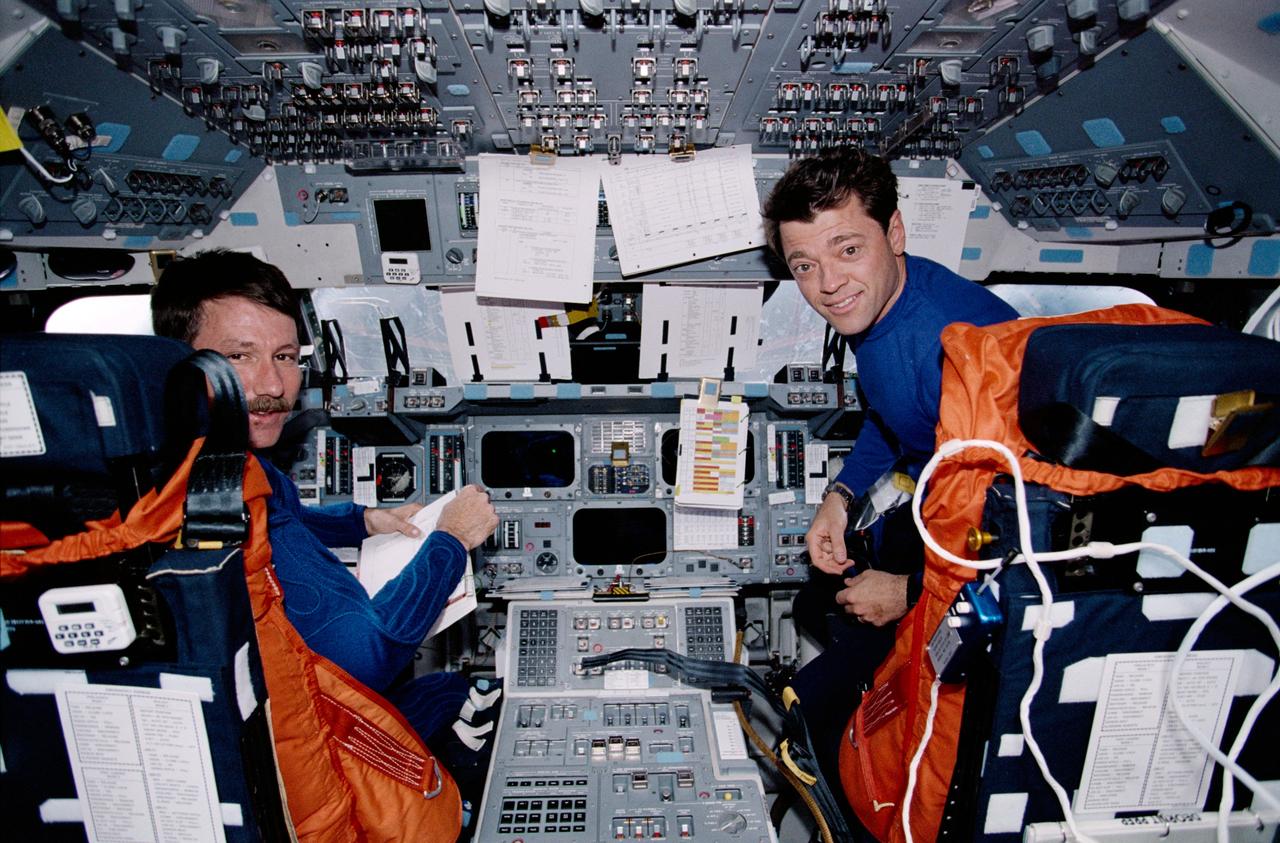
STS100-363-034 (19 April-1 May 2001) --- Astronauts Kent V. Rominger (left) and Jeffrey S. Ashby, STS-100 commander and pilot, respectively, are photographed on the flight deck of the Space Shuttle Endeavour during de-orbit preparations.
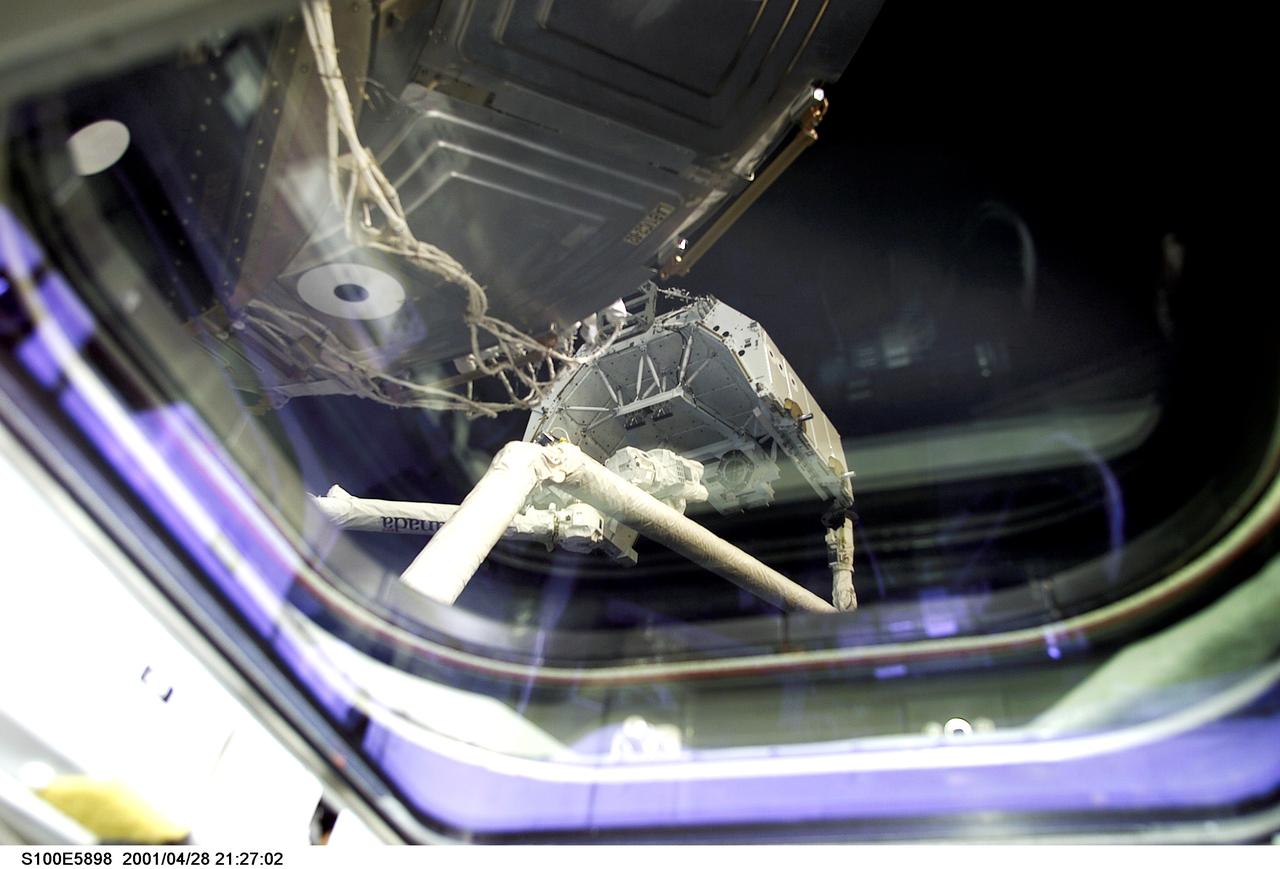
S100-E-5898 (28 April 2001) --- A STS-100 crew member with a digital still camera recorded this image of an historical event through an overhead window on the aft flight deck of the Space Shuttle Endeavour. A Canadian “handshake in space” occurred at 4:02 p.m (CDT), April 28, 2001, as the Canadian-built space station robotic arm – operated by Expedition Two flight engineer Susan J. Helms –transferred its launch cradle over to Endeavour’s robotic arm, with Canadian Space Agency astronaut Chris A. Hadfield at the controls. The exchange of the pallet from station arm to shuttle arm marked the first ever robotic-to-robotic transfer in space.

STS100-396-019 (24 April 2001) --- Astronaut Scott E. Parazynski, STS-100 mission specialist, totes a Direct Current Switching Unit while anchored on the end of the Canadian-built Remote Manipulator System (RMS) robotic arm. The RMS is in the process of moving Parazynski to the exterior of the Destiny laboratory (right foreground), where, assisted by astronaut Chris A. Hadfield (out of frame), he will secure the spare unit--a critical part for the station's electrical system--to the stowage platform for future crews in case it is needed. Also in the frame are the Italian-built Raffaello Multi-Purpose Logistics Module (center) and the new Canadarm2 (lower right) or Space Station Remote Manipulator System (SSRMS).
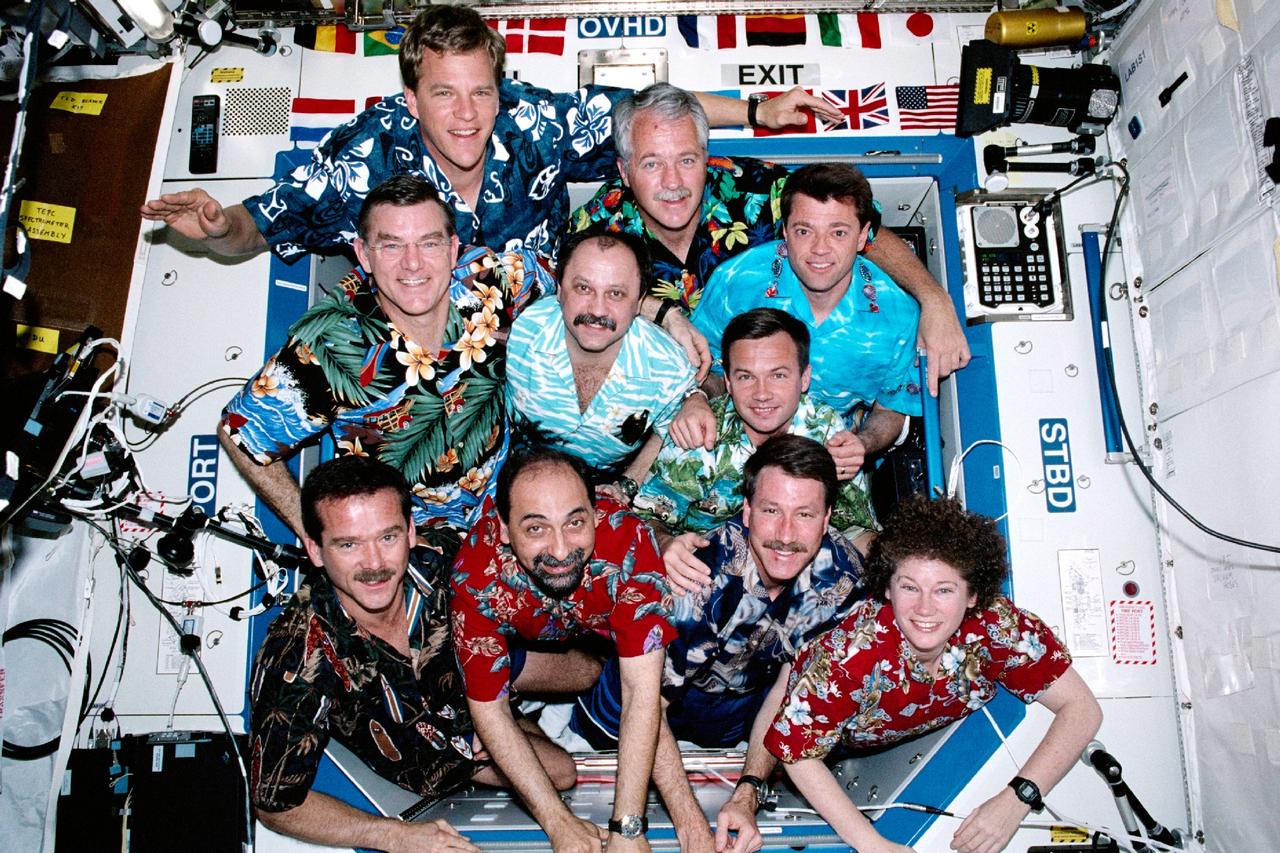
STS100-341-003 (19 April-1 May 2001) --- STS-100 and Expedition Two crewmembers pose for traditional in-flight portrait in Destiny laboratory. Bottom, from left, Chris A. Hadfield, Umberto Guidoni, Kent V. Rominger and Susan J. Helms. Middle row, James S. Voss, Yury V. Usachev and Yuri V. Lonchakov. Top, Scott E. Parazynski, John L. Phillips and Jeffrey S. Ashby. Guidoni represents the European Space Agency (ESA); Lonchakov and Usachev are with Rosaviakosmos and Hadfield is associated with the Canadian Space Agency (CSA).
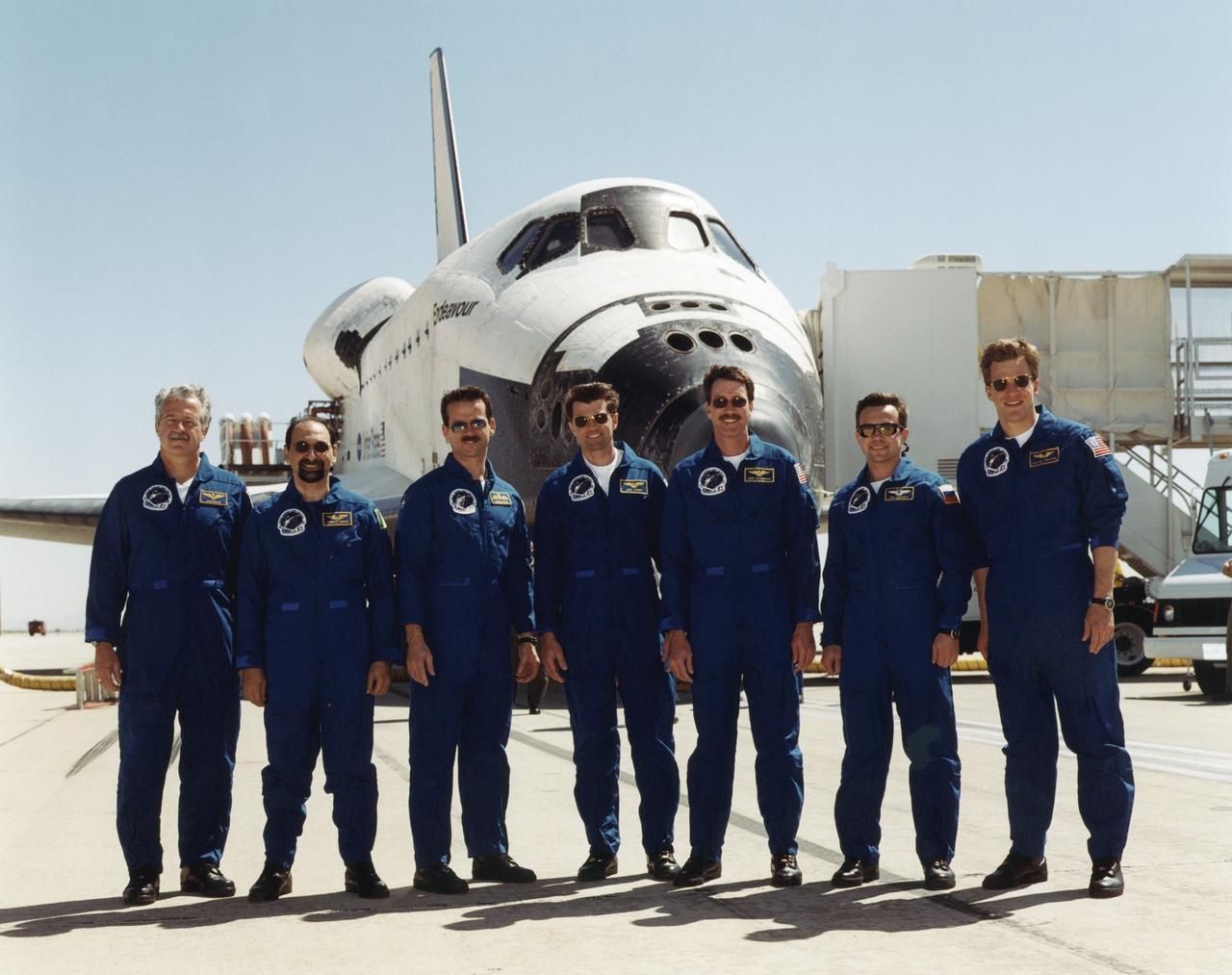
STS100-S-022 (1 May 2001) --- Six astronauts and a cosmonaut pose with their "home away from home" after the Shuttle Endeavour touched down on a desert runway at Edwards Air Force Base in California to complete the STS-100 mission. From the left are astronauts John L. Phillips, Umberto Guidoni, Chris A. Hadfield, Jeffrey S. Ashby and Kent V. Rominger, along with cosmonaut Yuri V. Lonchakov and astronaut Scott E. Parazynski. Guidoni is with the European Space Agency (ESA); Hadfield represents the Canadian Space Agency; and Lonchakov is associated with Rosaviakosmos. Touchdown occurred at 9:11 a.m. (PDT), May 1, 2001.
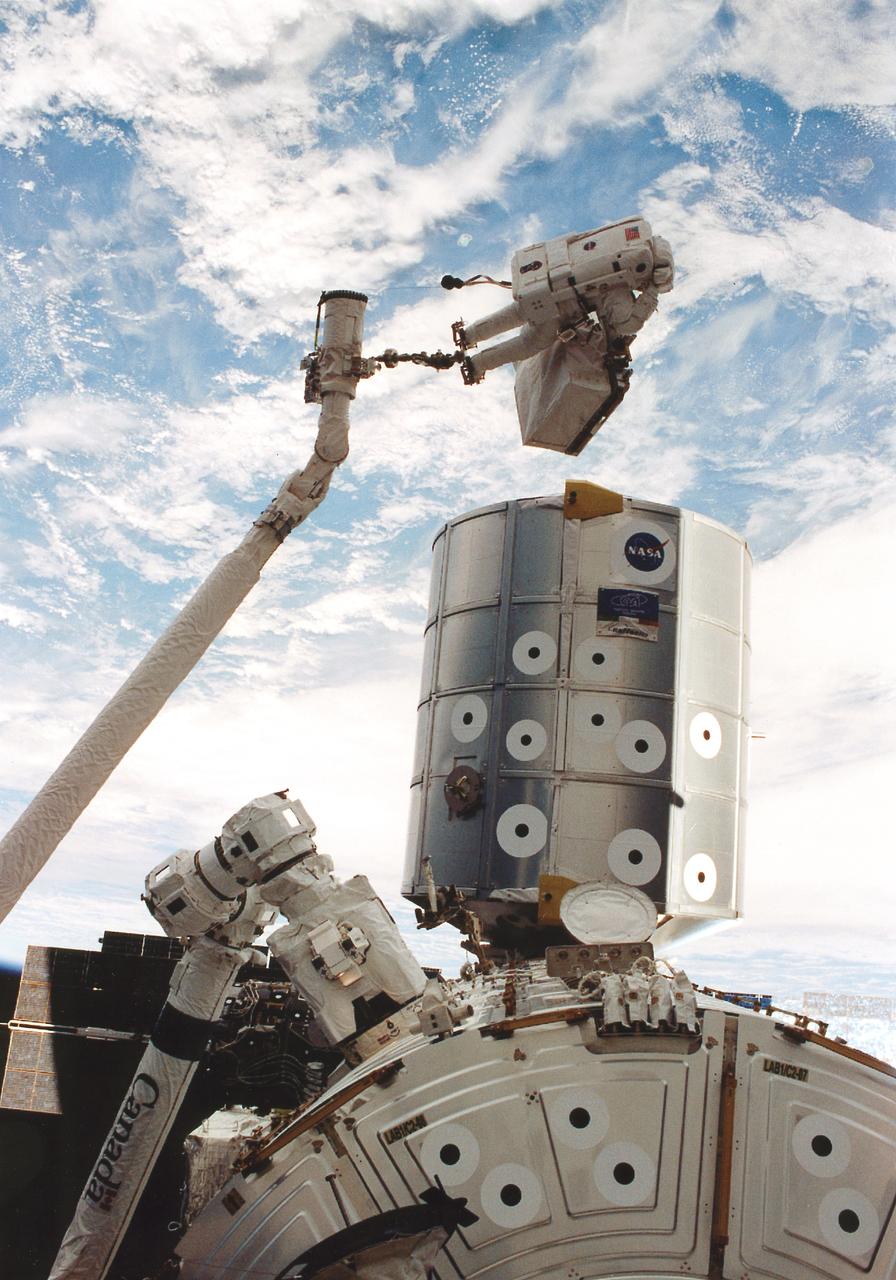
This is a Space Shuttle STS-100 mission onboard photograph. Astronaut Scott Parazynski totes a Direct Current Switching Unit while anchored on the end of the Canadian-built Remote Manipulator System (RMS) robotic arm. The RMS is in the process of moving Parazynski to the exterior of the Destiny laboratory (right foreground), where he will secure the spare unit, a critical part of the station's electrical system, to the stowage platform in case future crews will need it. Also in the photograph are the Italian-built Raffaello multipurpose Logistics Module (center) and the new Canadarm2 (lower right) or Space Station Remote Manipulator System.
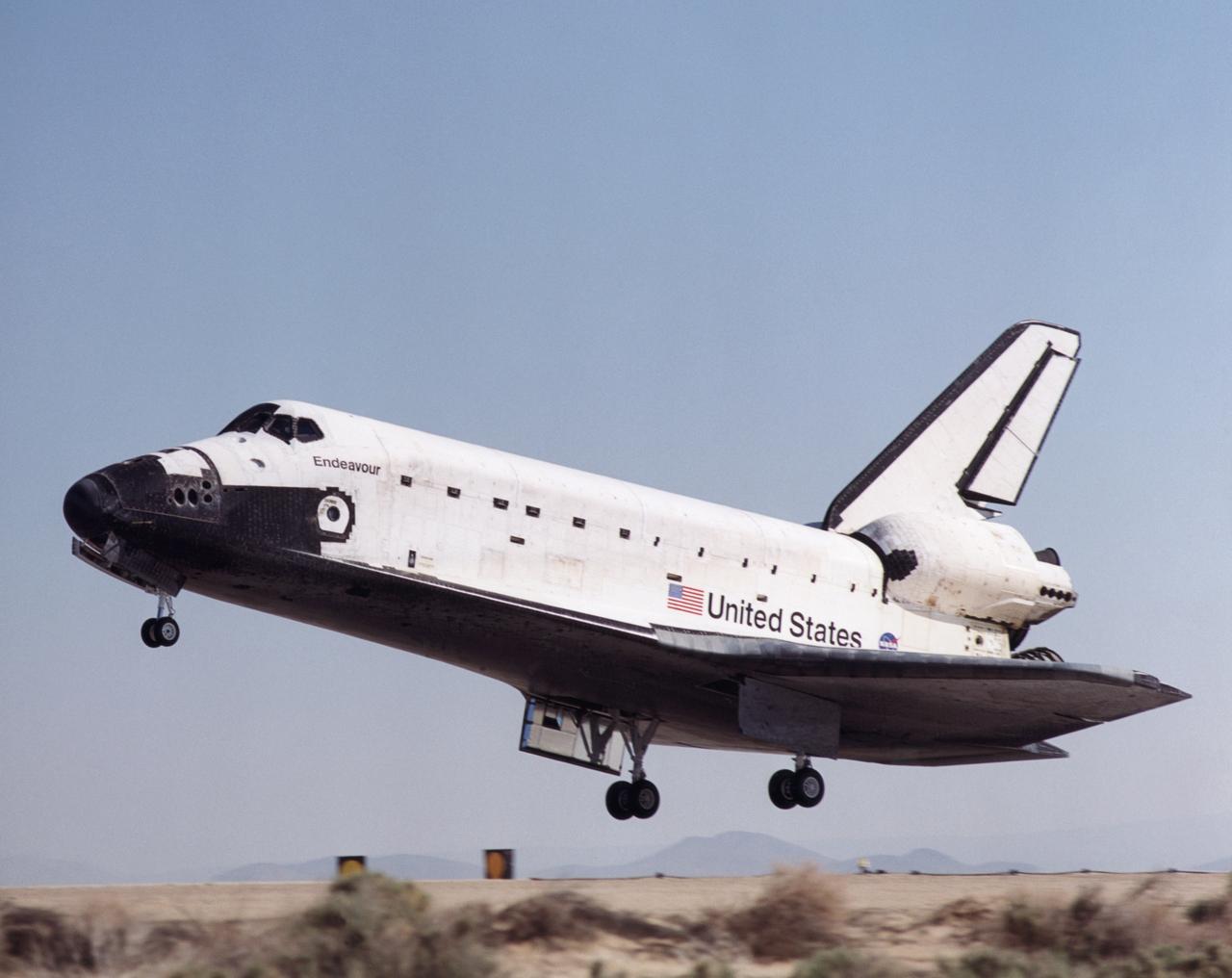
STS100-S-023 (1 May 2001) --- The space shuttle Endeavour is only seconds away from main gear touchdown on a desert runway at Edwards Air Force Base in California to complete the STS-100 mission. Touchdown occurred at 9:11 a.m. (PDT), May 1, 2001. Onboard the shuttle were six NASA astronauts and a cosmonaut representing Rosaviakosmos. Photo credit: NASA
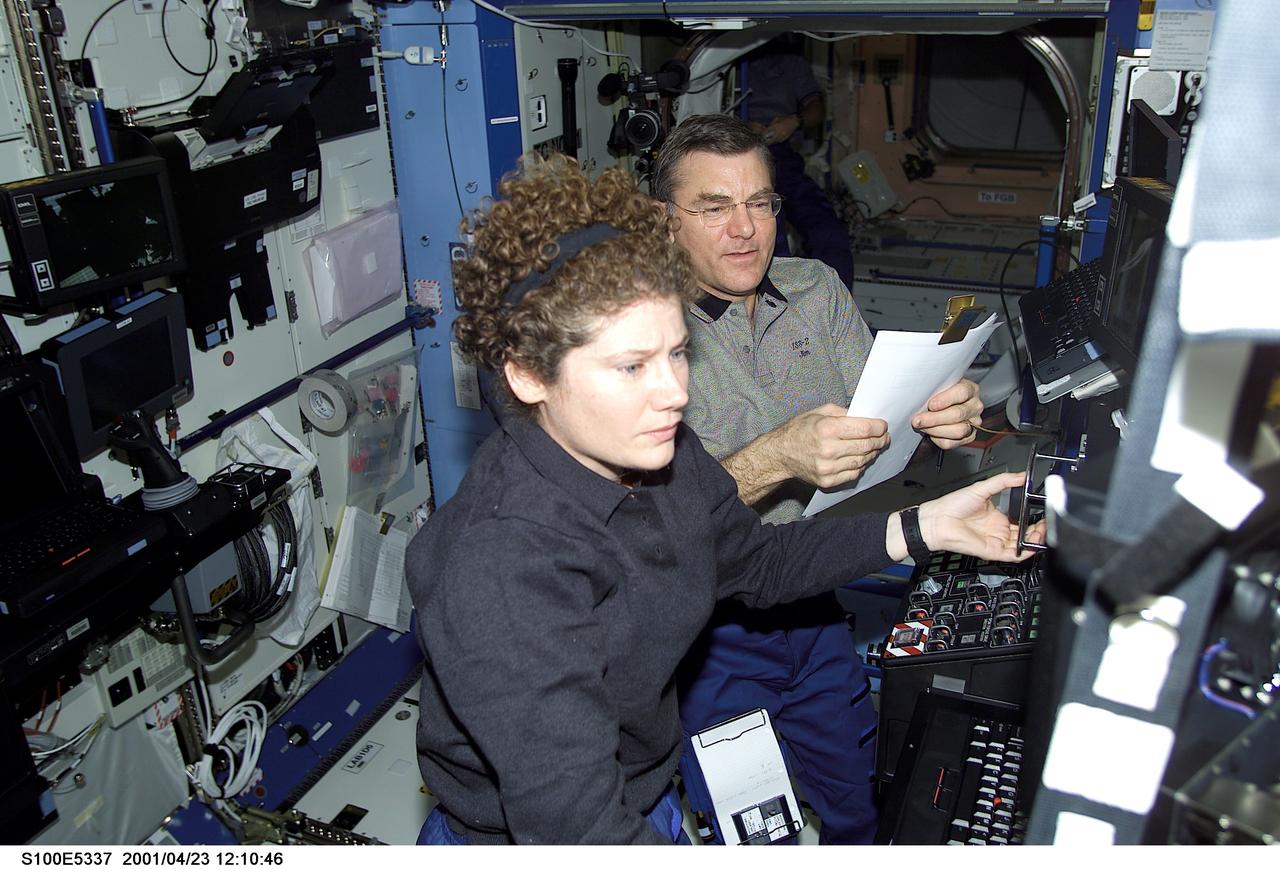
S100-E-5337 (23 April 2001) --- Astronauts Susan J. Helms and James S. Voss, Expedition Two flight engineers,work together to check out some data in the Destiny laboratory aboard the International Space Station (ISS). The image was recorded witha digital still camera by one of the visiting STS-100 crew members.
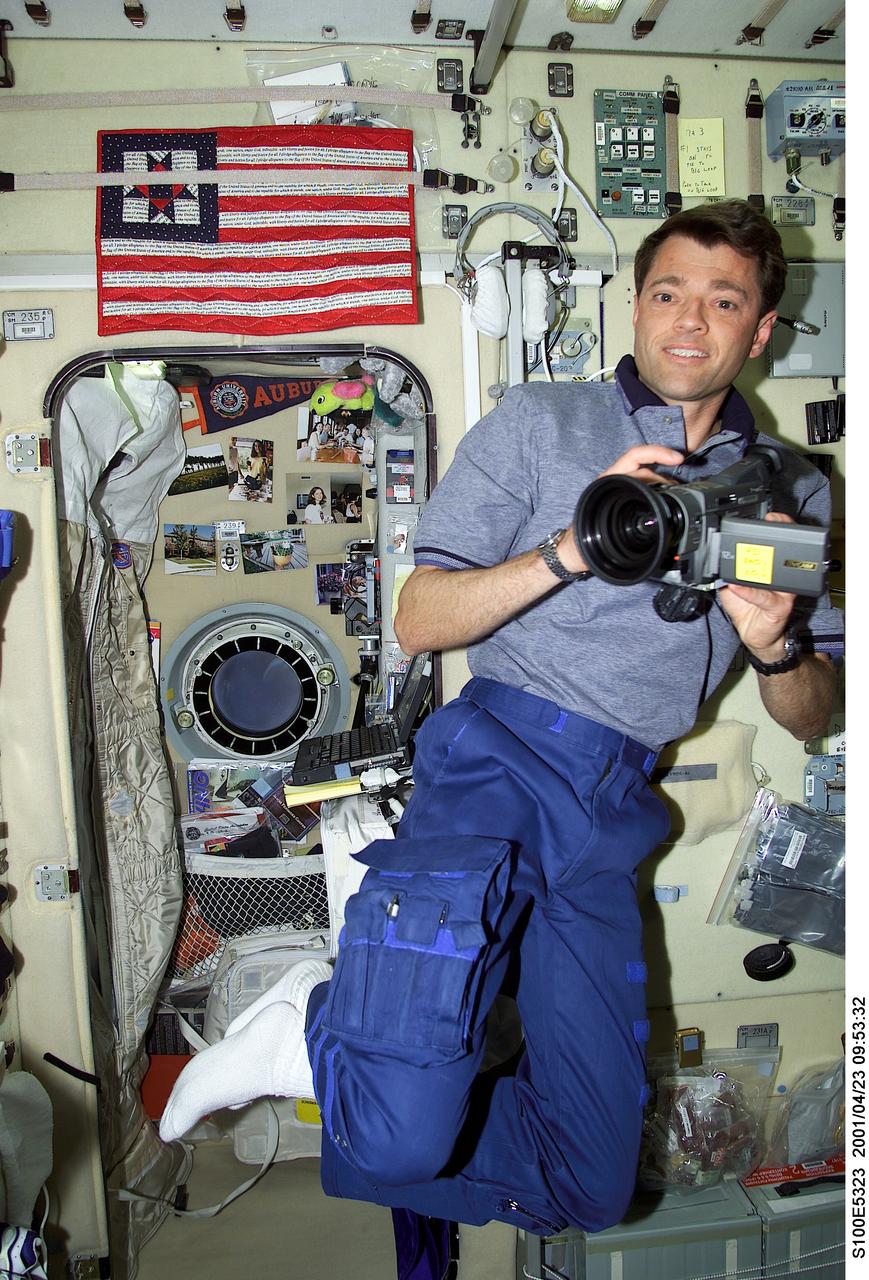
S100-E-5323 (23 April 2001) --- Astronaut Jeffrey S. Ashby, STS-100 pilot, prepares to document activity of his shuttle crew mates as well as members of the Expedition Two crew (out of frame) as he makes his first trip to the International Space Station (ISS). Hatch opening occurred around 4 a.m. (CDT) following a wakeup call from Houston's Mission Control earlier in the morning. The image was recorded with a digital still camera.
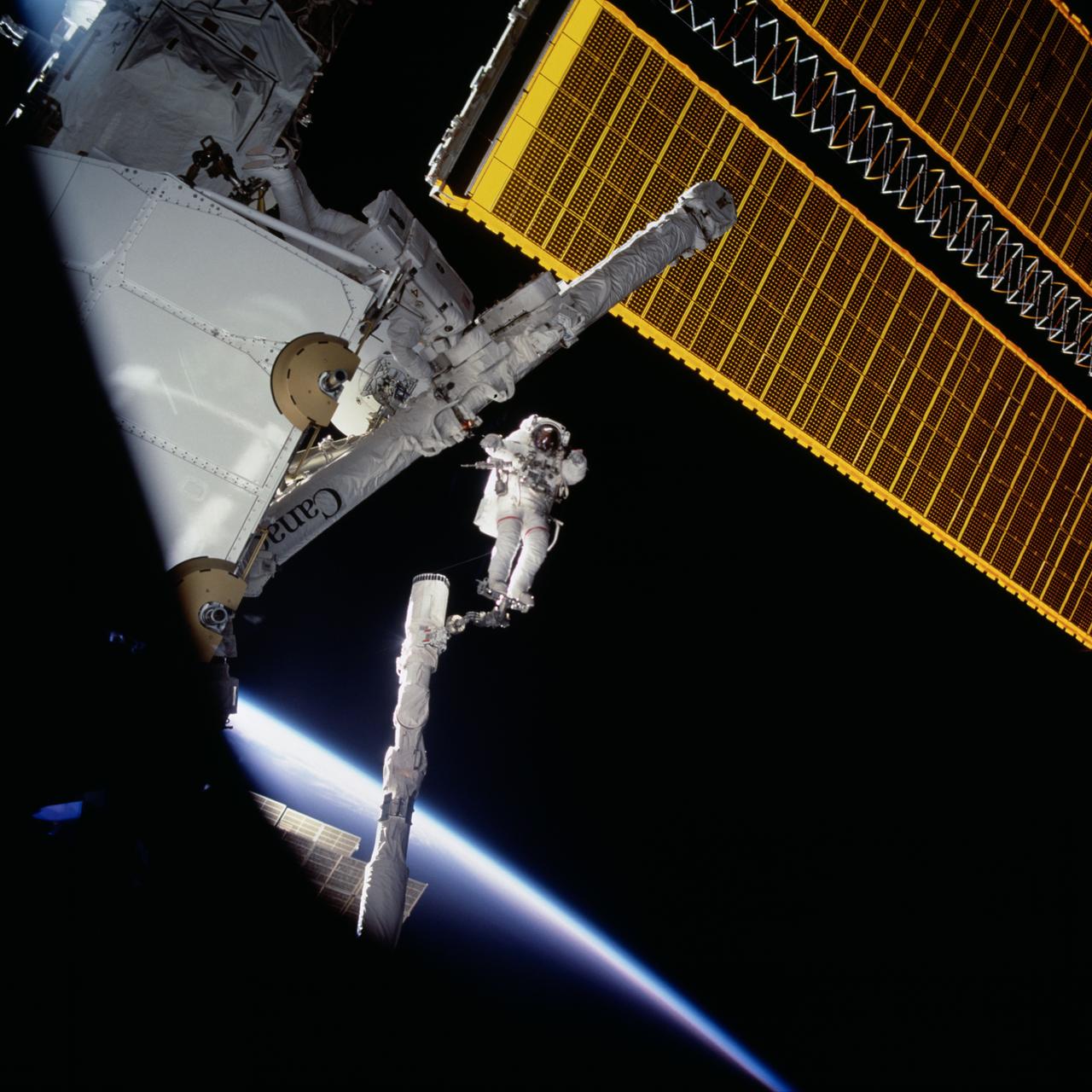
STS100-714-027 (19 April-1 May 2001) --- Astronaut Chris A. Hadfield, mission specialist representing the Canadian Space Agency (CSA), stands on the portable foot restraint (PFR) connected to the Endeavour's remote manipulator system (RMS) robotic arm, during one of the two days of extravehicular activity (EVA) on the STS-100 mission. Astronaut Scott E. Parazynski, mission specialist, is seen at left near the Spacelab pallet.
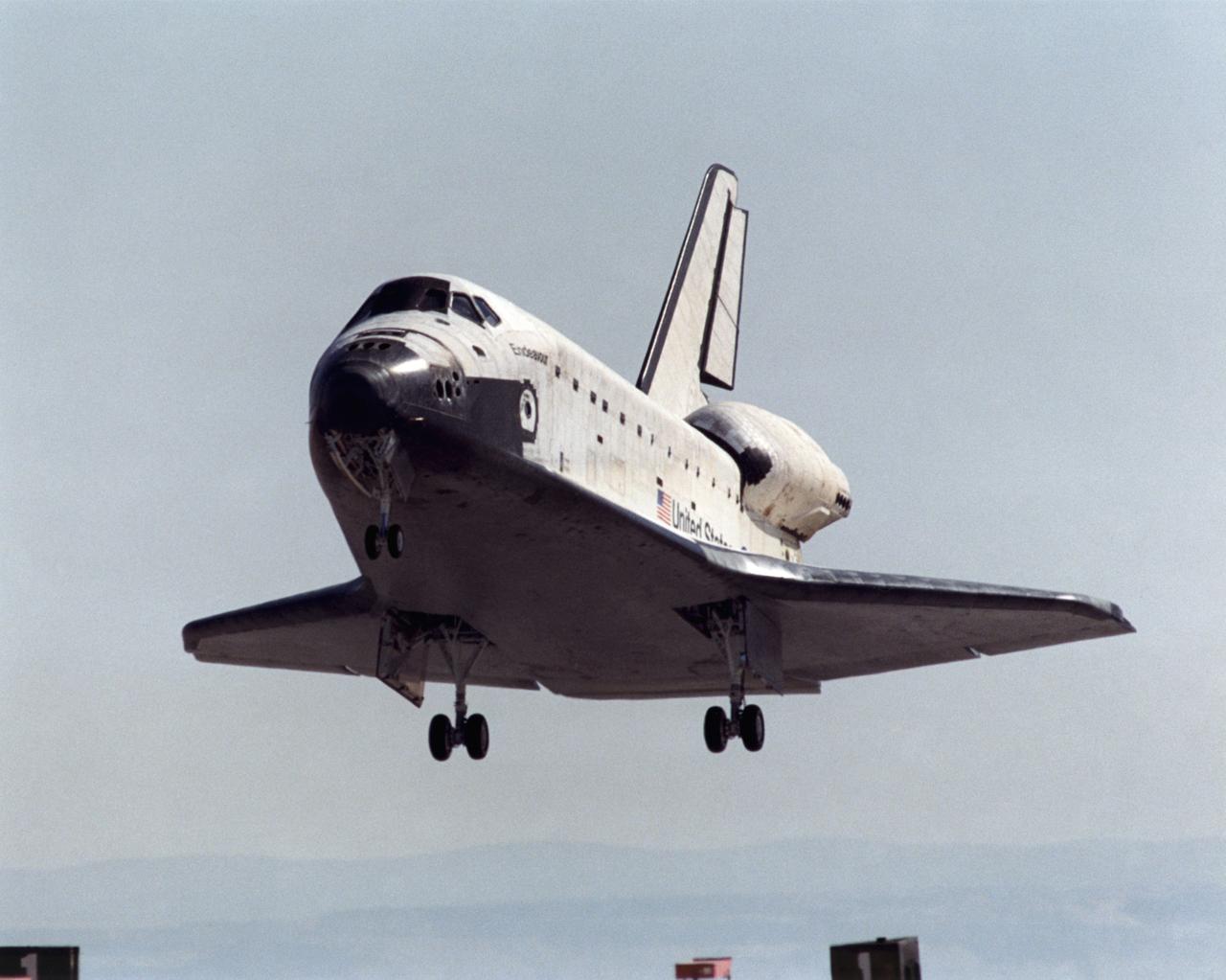
STS100-S-025 (1 May 2001) --- The space shuttle Endeavour is only seconds away from main gear touchdown on a desert runway at Edwards Air Force Base in California to complete the STS-100 mission. Touchdown occurred at 9:11 a.m. (PDT), May 1, 2001. Onboard the shuttle were six NASA astronauts and a cosmonaut representing Rosaviakosmos. Photo credit: NASA
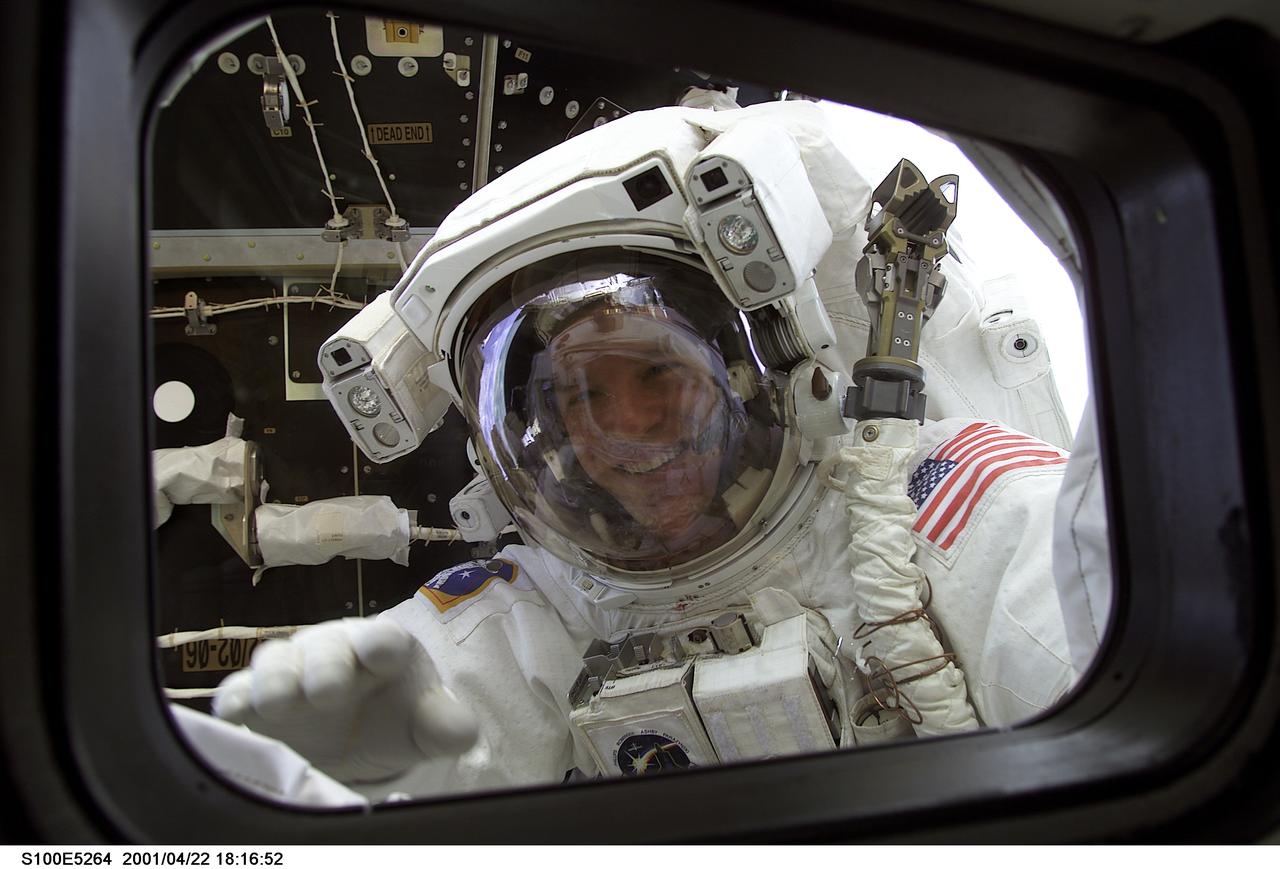
S100-E-5264 (22 April 2001) --- A smiling astronaut Scott E. Parazynski, STS-100 mission specialist, peers into the crew cabin of the Space Shuttle Endeavour during a lengthy spacewalk to perform important work on the International Space Station (ISS). The Pressurized Mating Adapter (PMA-2), which temporarily anchors the orbital outpost to the shuttle, can be seen behind the astronaut. The picture was recorded with a digital still camera.
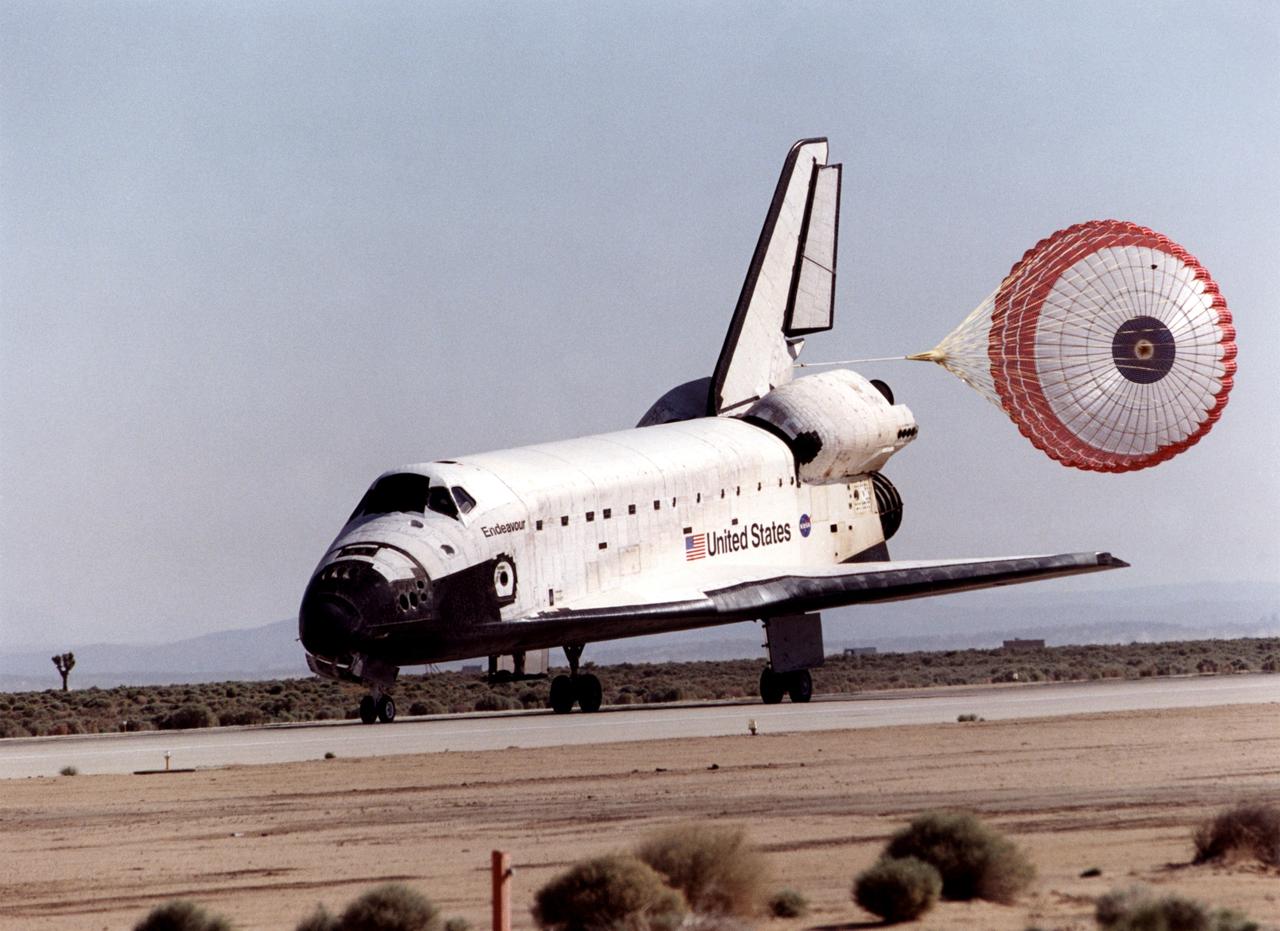
STS100-S-020 (1 May 2001) --- The drag chute on the space shuttle Endeavour helps to slow the vehicle down as it eases to the completion of the STS-100 mission on a desert runway at Edwards Air Force Base in California. Touchdown occurred at 9:11 a.m. (PDT), May 1, 2001. Onboard the shuttle were six NASA astronauts and a cosmonaut representing Rosaviakosmos. Photo credit: NASA
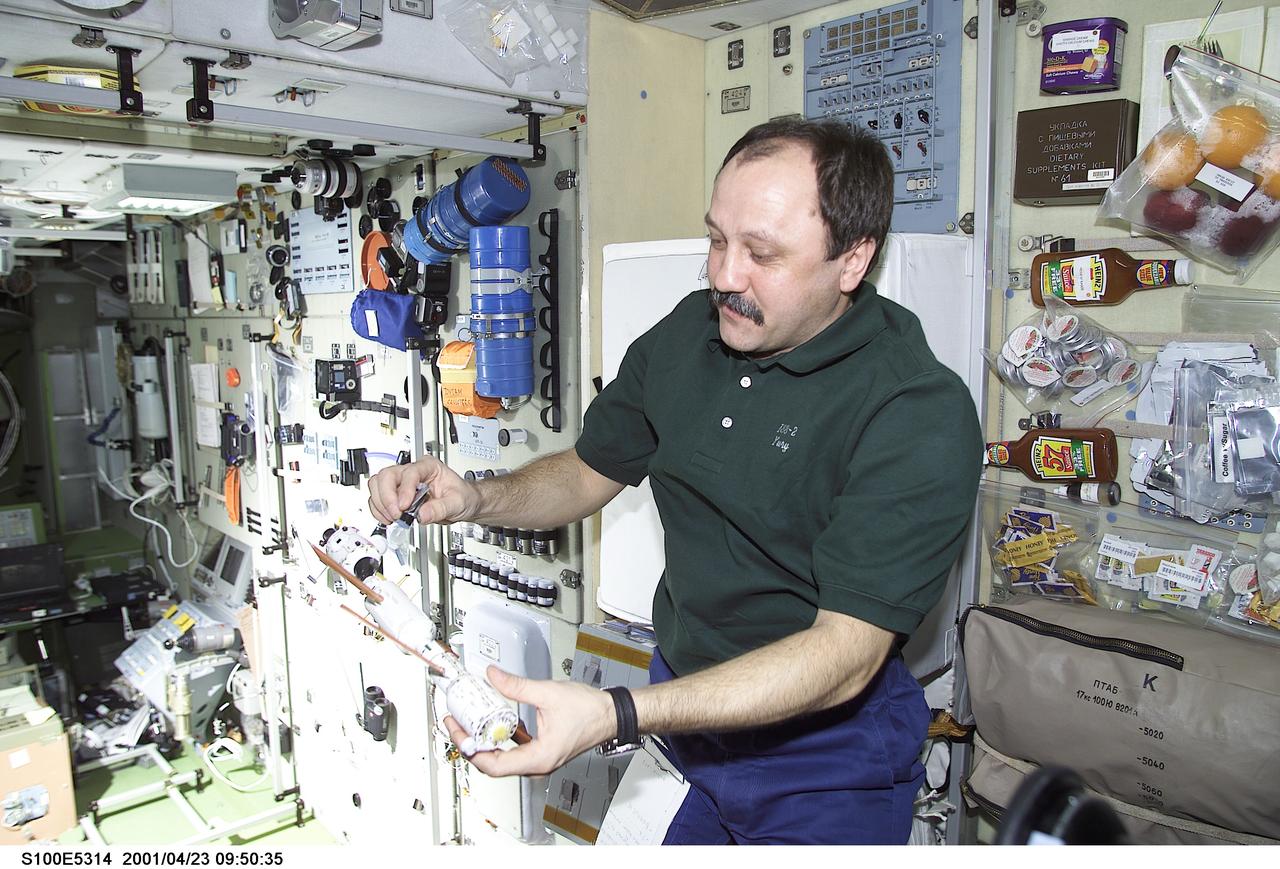
S100-E-5314 (23 April 2001) --- Cosmonaut Yury V. Usachev, Expedition Two commander, holds a small-scale model of the International Space Station (ISS) that crewmembers use for planning purposes. A representative of Rosaviakosmos, Usachev is joined by two astronauts for the second occupancy of the orbital outpost. This scene in the Zvezda Service Module was recorded with a digital still camera by one of the STS-100 crew members who are visiting the station to accomplish a large variety of additions and improvements.
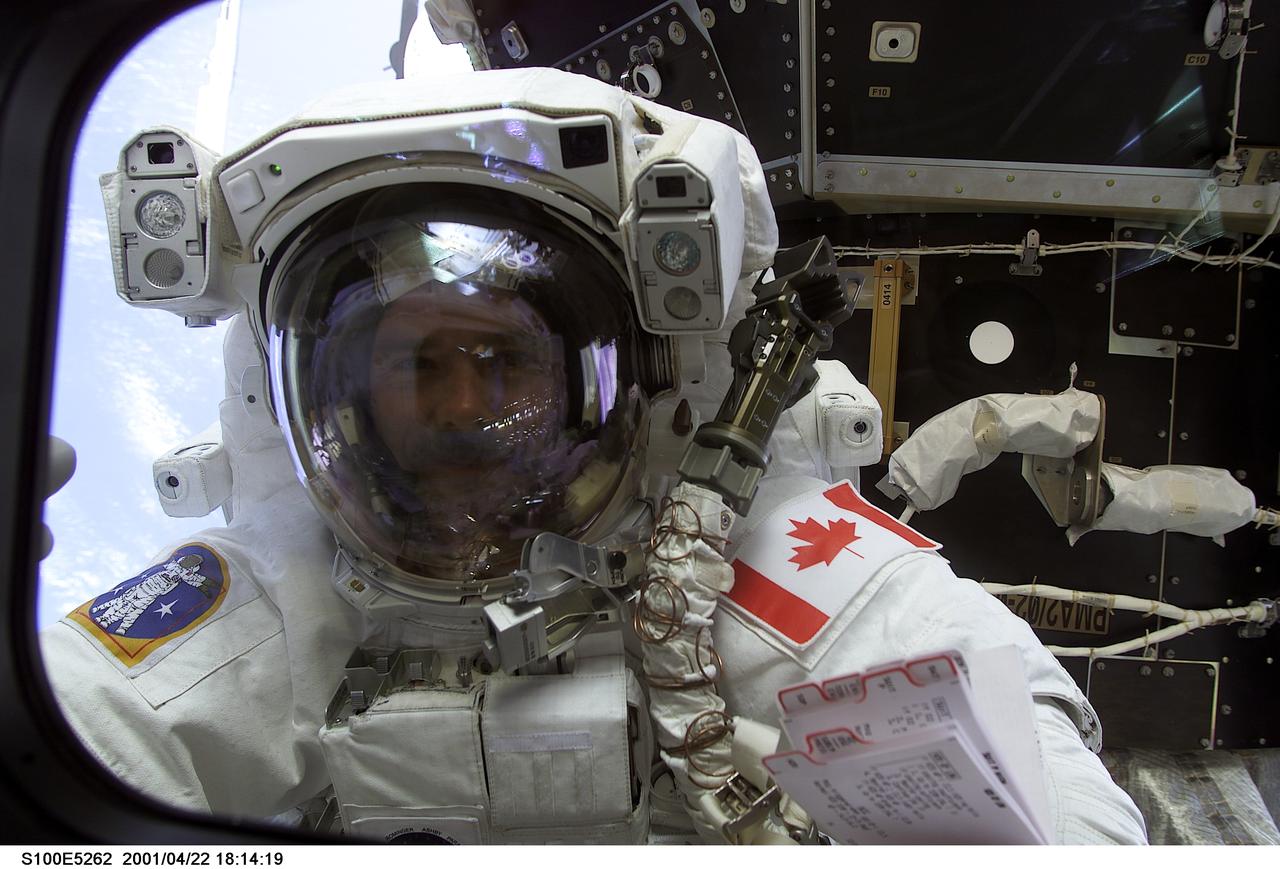
S100-E-5262 (22 April 2001) --- Astronaut Chris A. Hadfield, STS-100 mission specialist representing the Canadian Space Agency (CSA), peers into the crew cabin of the Space Shuttle Endeavour during a lengthy space walk to perform important work on the International Space Station (ISS). The Pressurized Mating Adapter (PMA-2), which temporarily anchors the orbital outpost to the shuttle, can be seen behind the astronaut. The picture was recorded with a digital still camera.
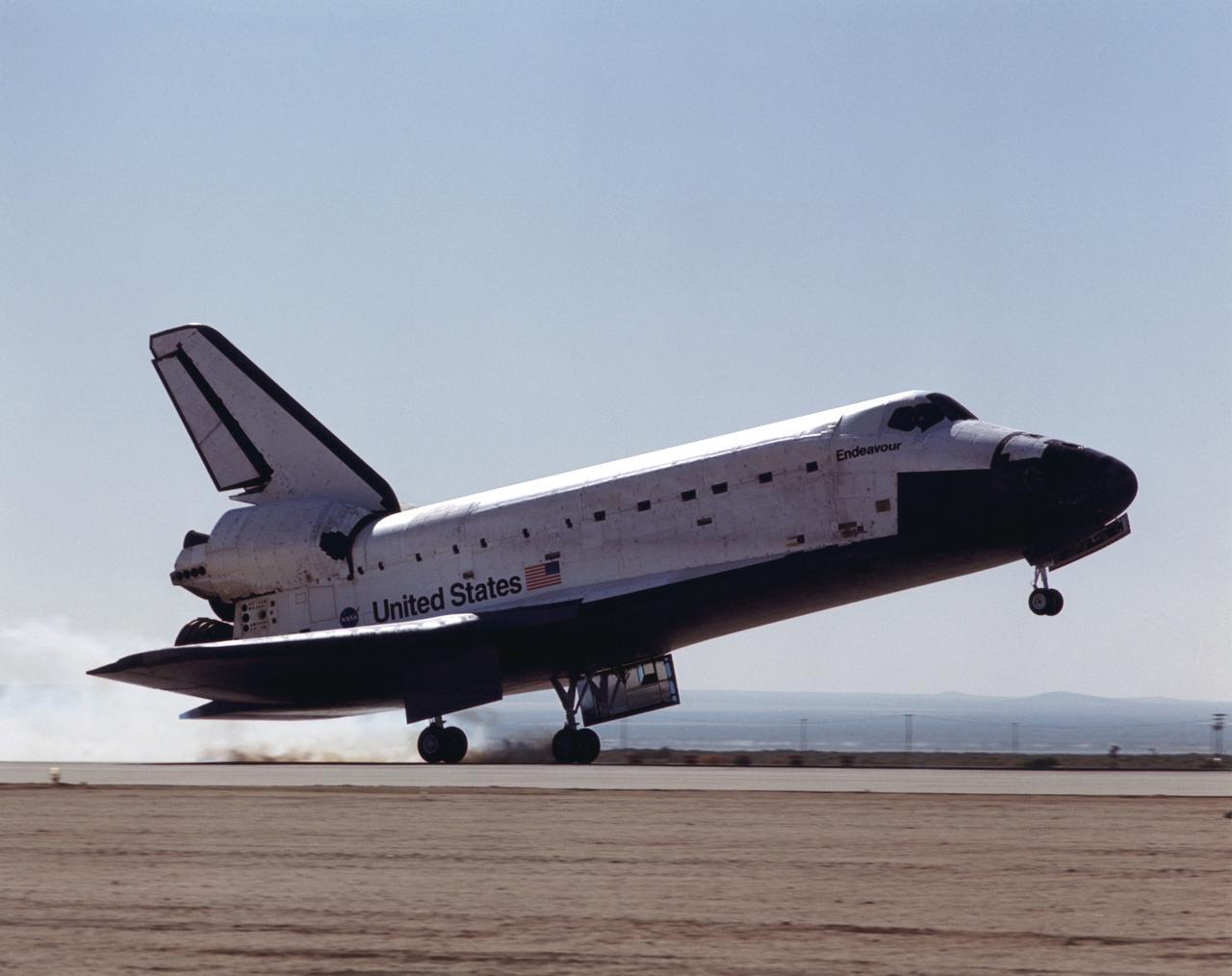
STS100-S-024 (1 May 2001) --- The main landing gear on the space shuttle Endeavour touches down on a desert runway at Edwards Air Force Base in California to complete the STS-100 mission. Touchdown occurred at 9:11 a.m. (PDT), May 1, 2001. Onboard the shuttle were six NASA astronauts and a cosmonaut representing Rosaviakosmos. Photo credit: NASA
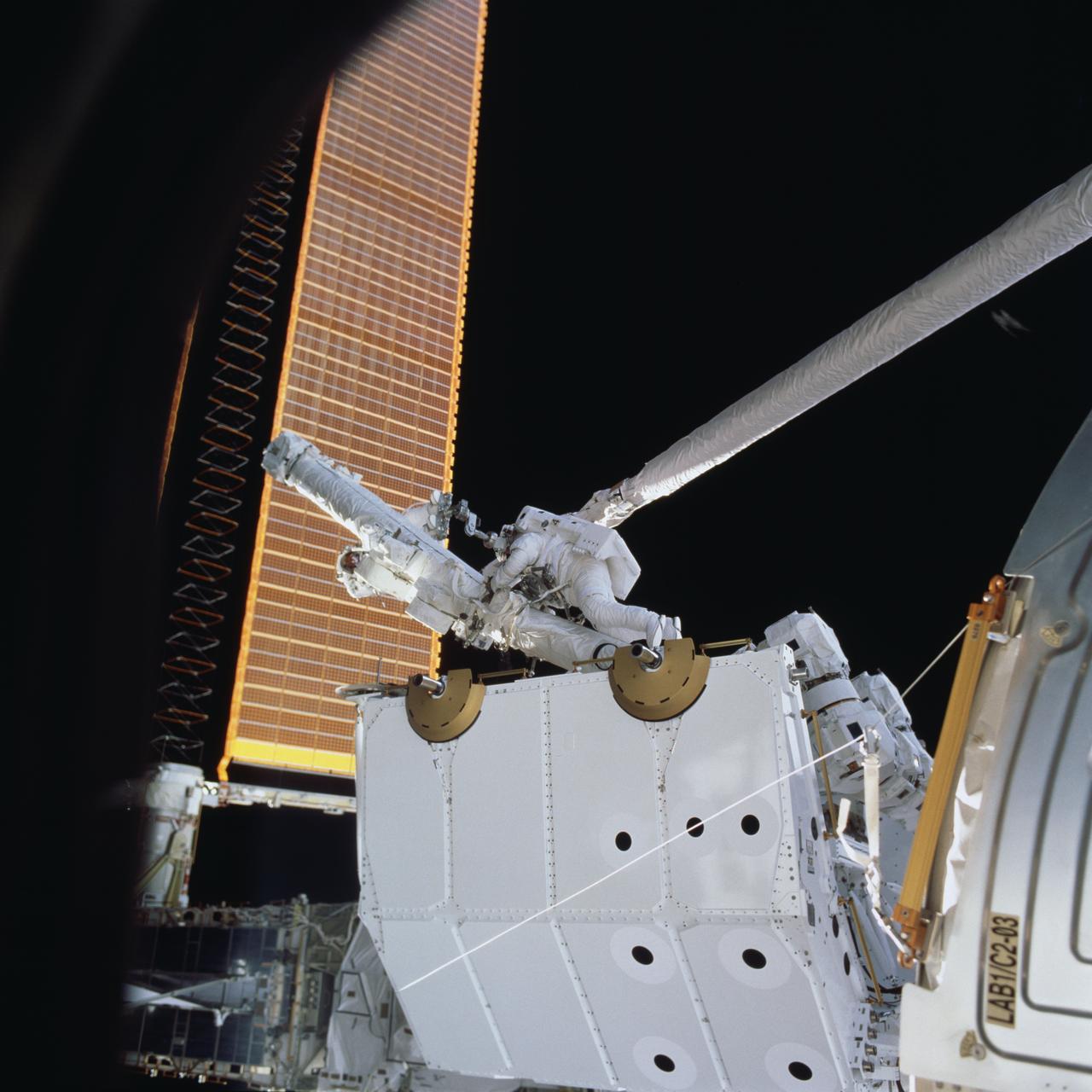
STS100-714-015 (22 April 2001) --- Astronauts Scott E. Parazynski (center frame) and Chris A. Hadfield (partially obscured) prepare to unpack the new Space Station Remote Manipulator System (SSRMS) or Canadarm2 during the first of two STS-100 space walks. Hadfield represents the Canadian Space Agency (CSA). The image was exposed with a 70mm camera from inside the Space Shuttle Endeavour's crew cabin.
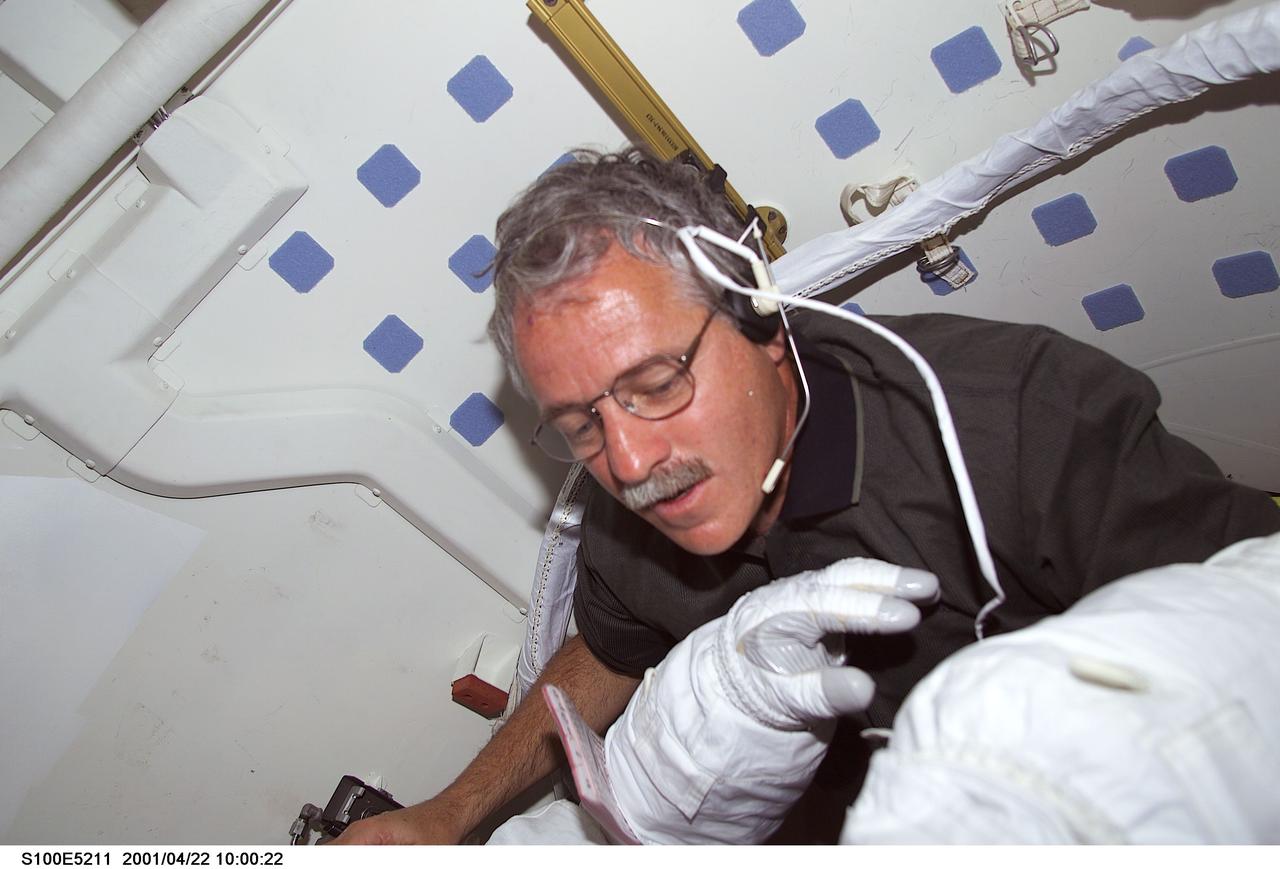
S100-E-5211 (22 April 2001) --- Astronaut John L. Phillips, mission specialist, assists one of the STS-100 spacewalkers during suit donning onboard the Space Shuttle Endeavour. Astronauts Chris A. Hadfield of the Canadian Space Agency (CSA) and Scott E. Parazynski, both mission specialists, shared the area with the helpful Phillips in preparation for the first of two scheduled days of extravehicular activity (EVA). The image was recorded with a digital still camera.
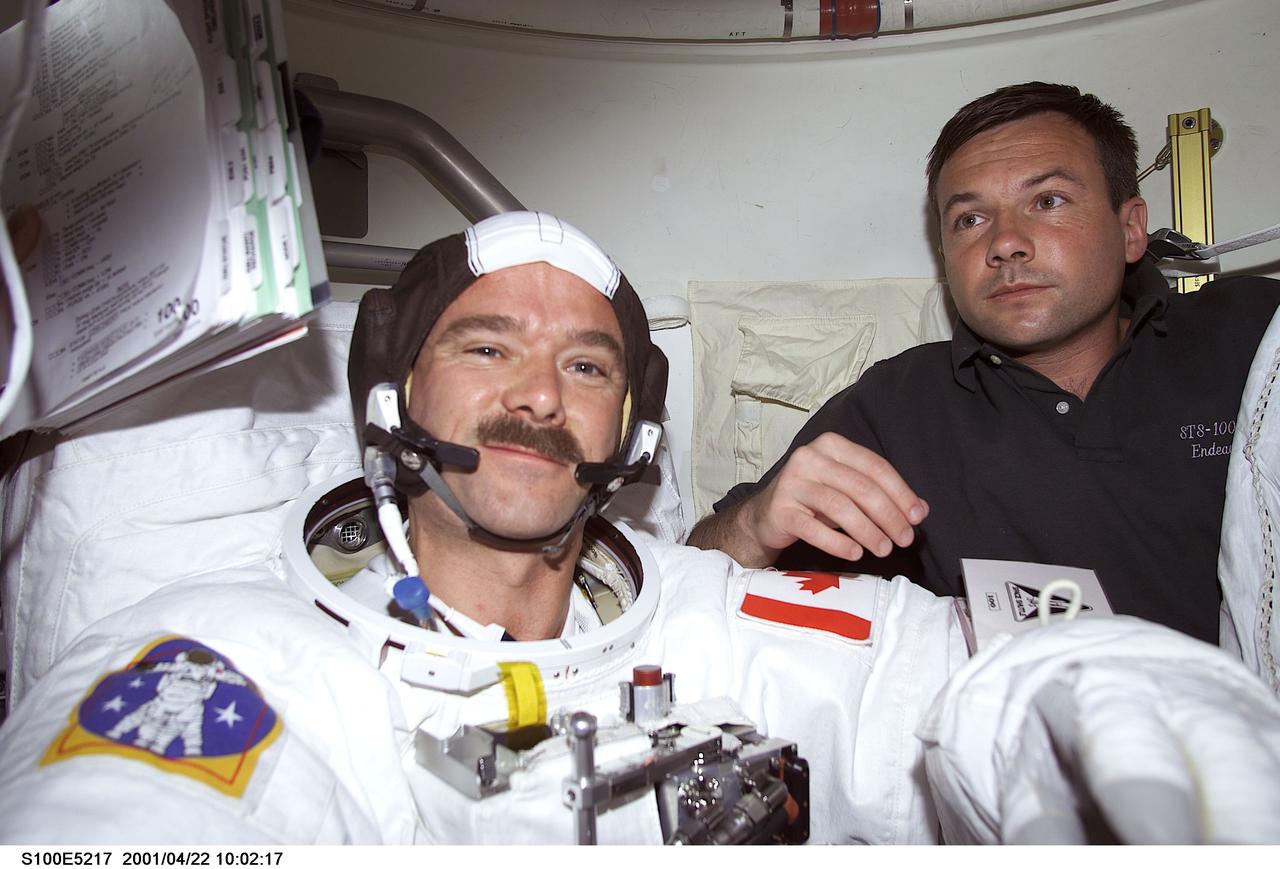
S100-E-5217 (22 April 2001) --- Cosmonaut Yuri V. Lonchakov (right), STS-100 mission specialist representing Rosaviakosmos, assists astronaut Chris A. Hadfield, mission specialist representing the Canadian Space Agency (CSA), as he dons his Extravehicular Mobility Unit (EMU) spacesuit onboard the Space Shuttle Endeavour. Hadfield was about to join astronaut Scott E. Parazynski (out of frame), mission specialist, in a scheduled spacewalk to accomplish important work on the International Space Station (ISS), to which the shuttle will be docked for several days. The image was recorded with a digital still camera.
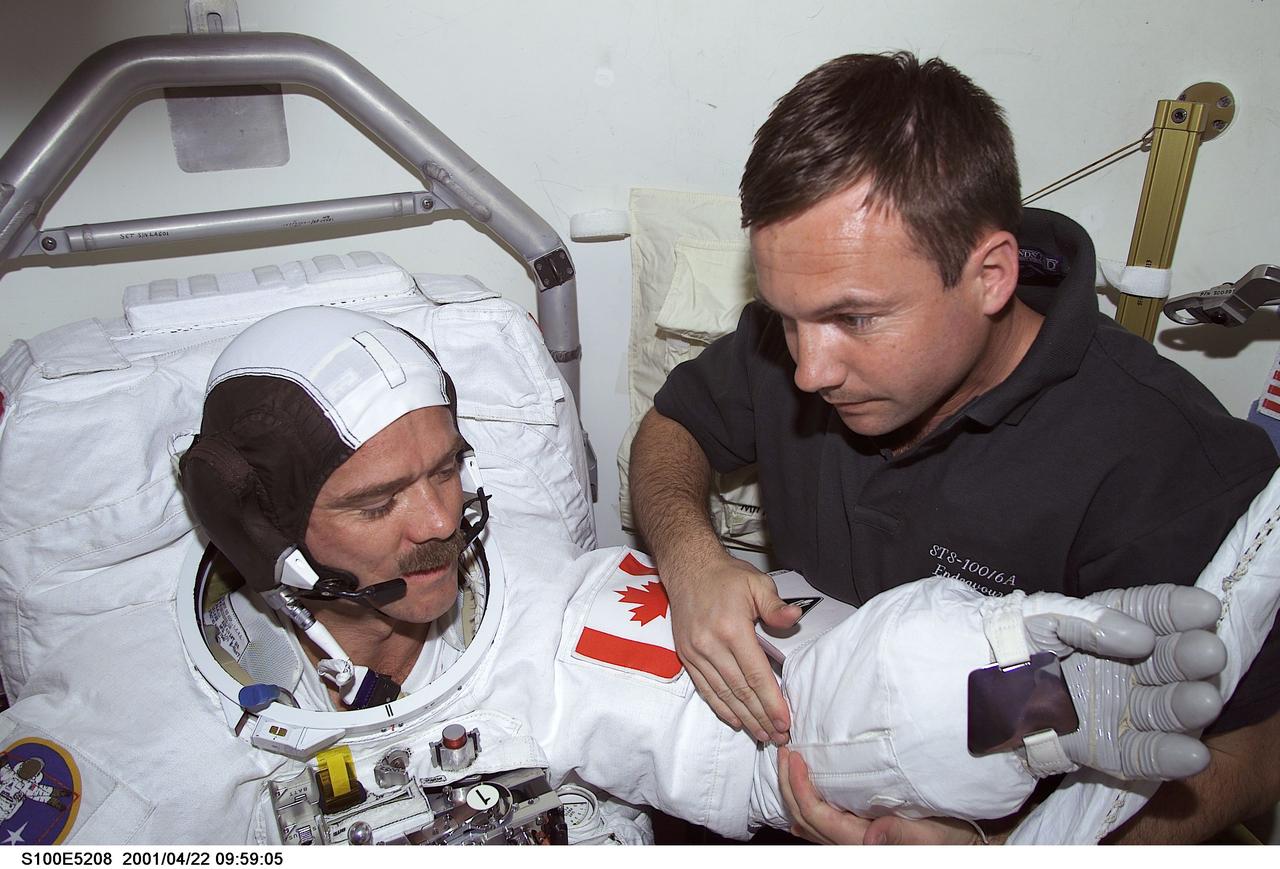
S100-E-5208 (22 April 2001) --- Cosmonaut Yuri V. Lonchakov (right), STS-100 mission specialist representing Rosaviakosmos, assists astronaut Chris A. Hadfield, mission specialist representing the Canadian Space Agency (CSA), as he dons his extravehicular mobility unit (EMU) spacesuit onboard the Space Shuttle Endeavour. Hadfield was about to join astronaut Scott E. Parazynski (out of frame), mission specialist, in a scheduled spacewalk to accomplish important work on the International Space Station (ISS), to which the shuttle will be docked for several days. The image was recorded with a digital still camera.