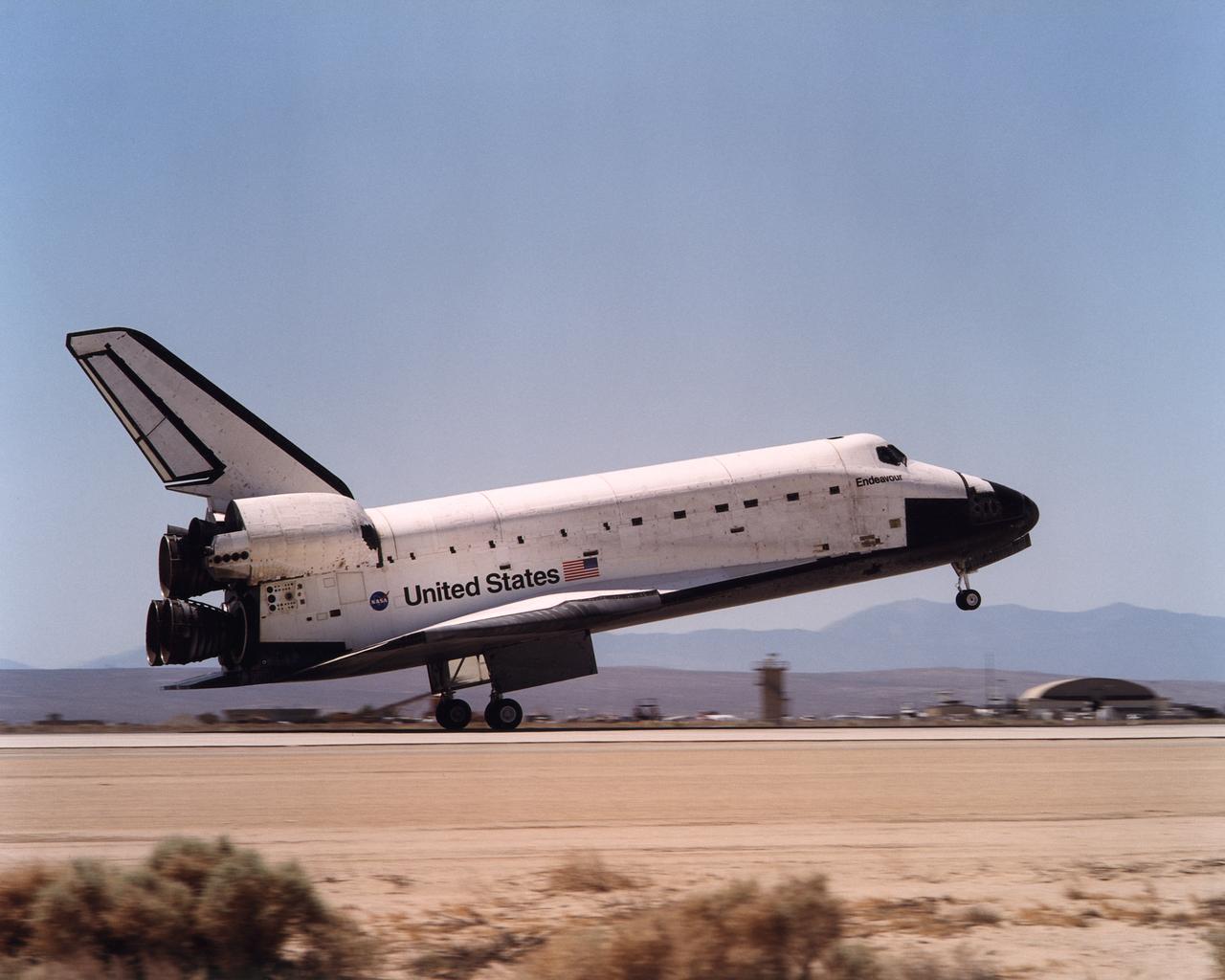
Space Shuttle Endeavour touches down on the runway at Edwards Air Force Base, California to conclude International Space Station construction and supply mission STS-111.
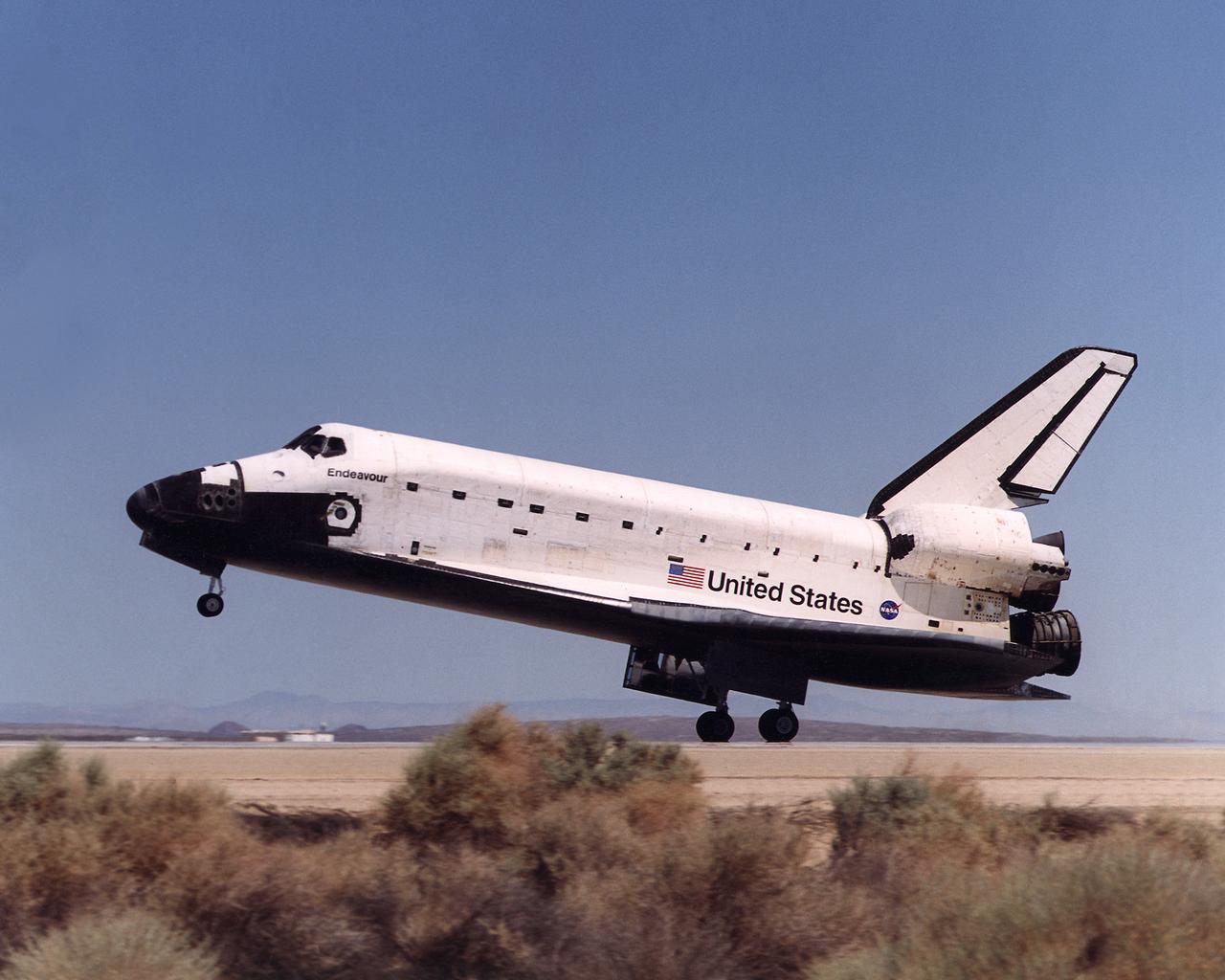
Space Shuttle Endeavour touches down on the runway at Edwards Air Force Base, California to conclude International Space Station construction and supply mission STS-111.
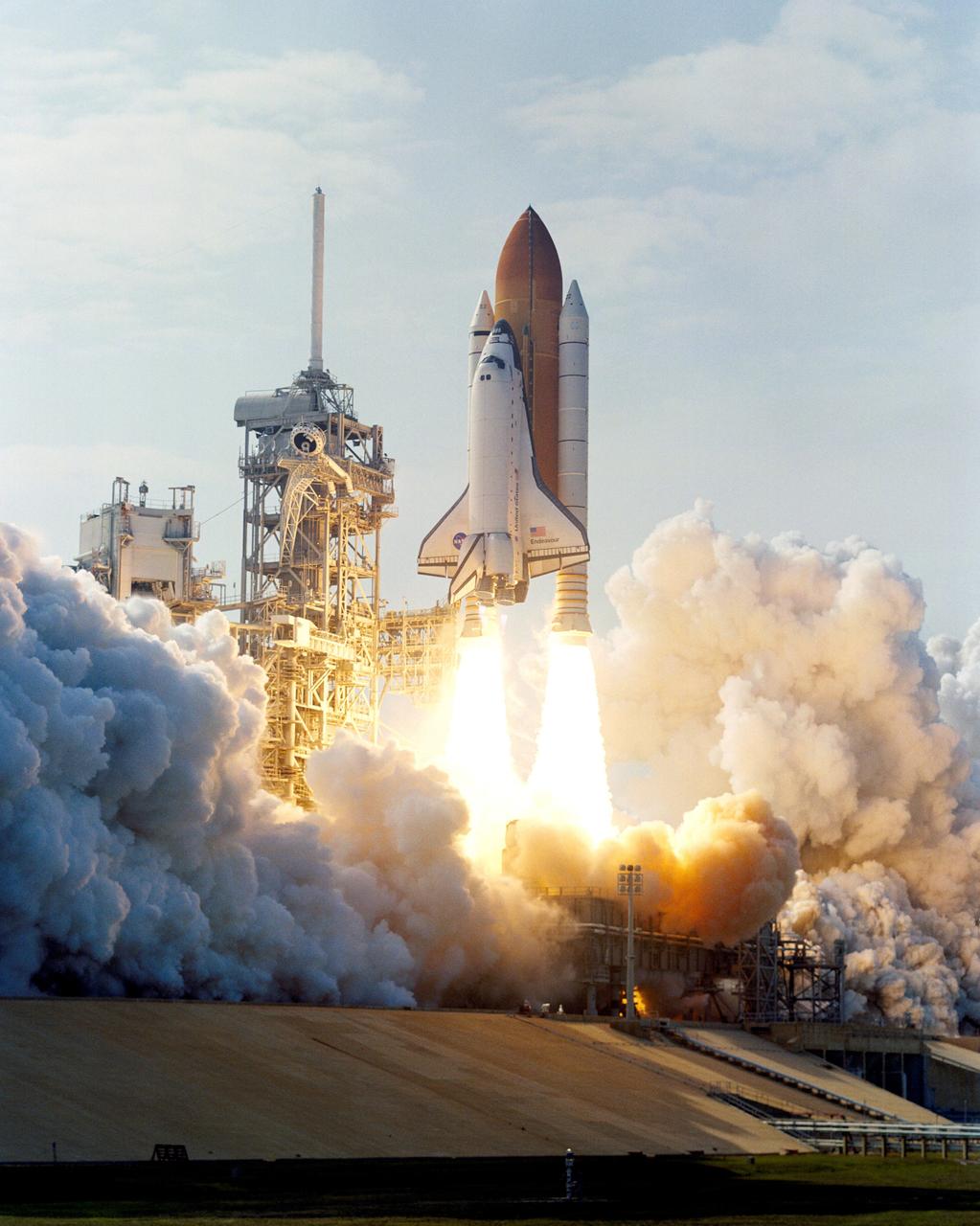
Aboard the Space Shuttle Orbiter Endeavour, the STS-111 mission was launched on June 5, 2002 at 5:22 pm EDT from Kennedy's launch pad. On board were the STS-111 and Expedition Five crew members. Astronauts Kenneth D. Cockrell, commander; Paul S. Lockhart, pilot, and mission specialists Franklin R. Chang-Diaz and Philippe Perrin were the STS-111 crew members. Expedition Five crew members included Cosmonaut Valeri G. Korzun, commander, Astronaut Peggy A. Whitson and Cosmonaut Sergei Y. Treschev, flight engineers. Three space walks enabled the STS-111 crew to accomplish mission objectives: the delivery and installation of a new platform for the ISS robotic arm, the Mobile Base System (MBS) which is an important part of the Station's Mobile Servicing System allowing the robotic arm to travel the length of the Station; the replacement of a wrist roll joint on the Station's robotic arm; and unloading supplies and science experiments from the Leonardo Multi-Purpose Logistics Module, which made its third trip to the orbital outpost. Landing on June 19, 2002, the 14-day STS-111 mission was the 14th Shuttle mission to visit the ISS.
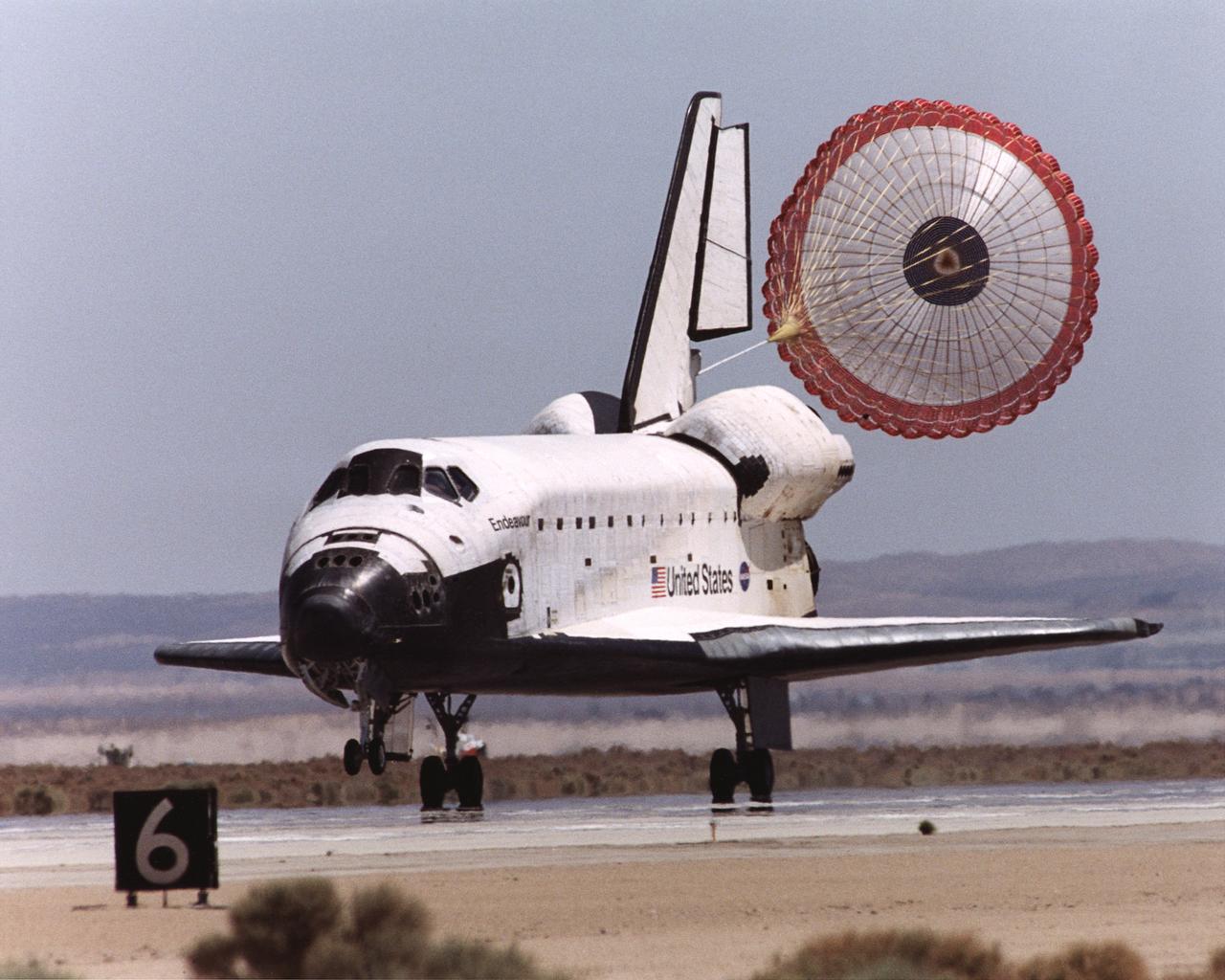
The Space Shuttle Endeavour's drag chute deploys to slow the orbiter as it rolls out on Runway 22 at Edwards Air Force Base at the conclusion of its 14-day STS-111 mission to the International Space Station.

The Space Shuttle Endeavour's drag chute deploys to slow the orbiter as it rolls out on Runway 22 at Edwards Air Force Base at the conclusion of its 14-day STS-111 mission to the International Space Station.
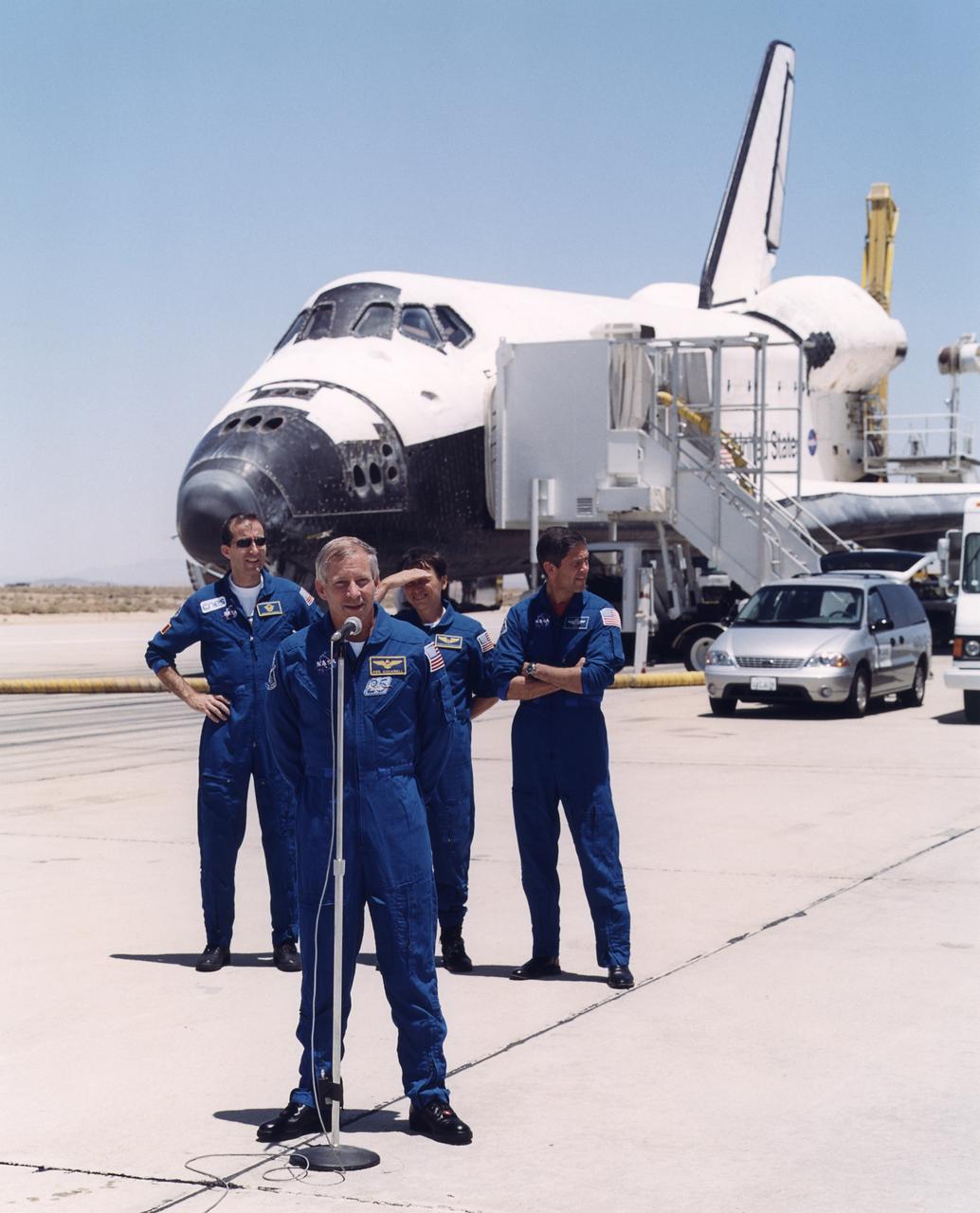
STS-111 commander Ken Cockrell greets dignitaries and recovery technicians on the runway at Edwards Air Force Base following the landing of the space shuttle Endeavour on June 19, 2002. Behind Cockrell are (from left) mission specialists Philippe Perrin and Franklin Chang-Diaz and Shuttle pilot Paul Lockhart.
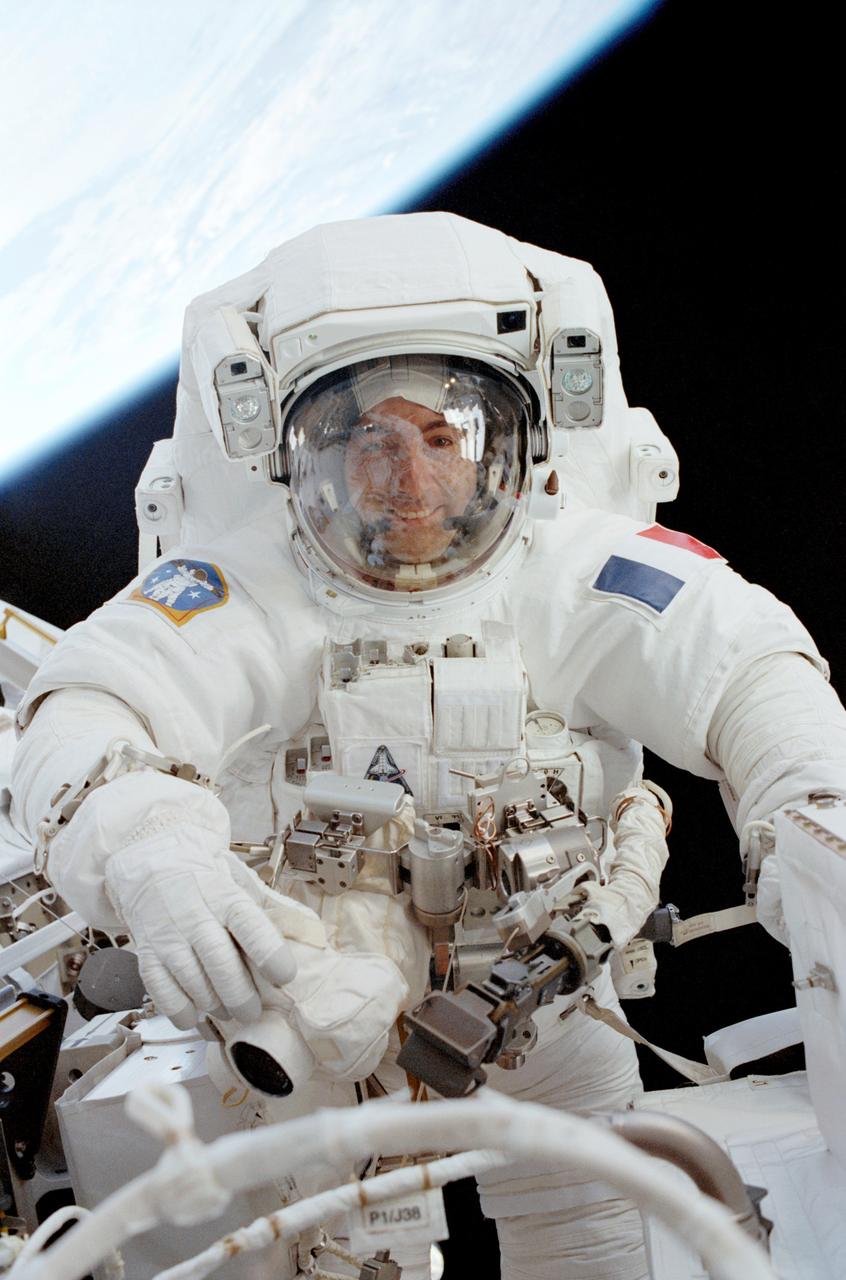
The STS-111 mission, the 14th Shuttle mission to visit the International Space Station (ISS), was launched on June 5, 2002 aboard the Space Shuttle Orbiter Endeavour. On board were the STS-111 and Expedition Five crew members. Astronauts Kerneth D. Cockrell, commander; Paul S. Lockhart, pilot; and mission specialists Franklin R. Chang-Diaz and Philippe Perrin were the STS-111 crew members. Expedition Five crew members included Cosmonaut Valeri G. Korzun, commander; Astronaut Peggy A. Whitson and Cosmonaut Sergei Y. Treschev, flight engineers. Three space walks enabled the STS-111 crew to accomplish the delivery and installation of the Mobile Remote Servicer Base System (MBS), an important part of the Station's Mobile Servicing System that allows the robotic arm to travel the length of the Station, which is necessary for future construction tasks. In this photograph, Astronaut Philippe Perrin, representing CNES, the French Space Agency, participates in the second scheduled EVA. During the space walk, Perrin and Chang-Diaz attached power, data, and video cables from the ISS to the MBS, and used a power wrench to complete the attachment of the MBS onto the Mobile Transporter (MT).
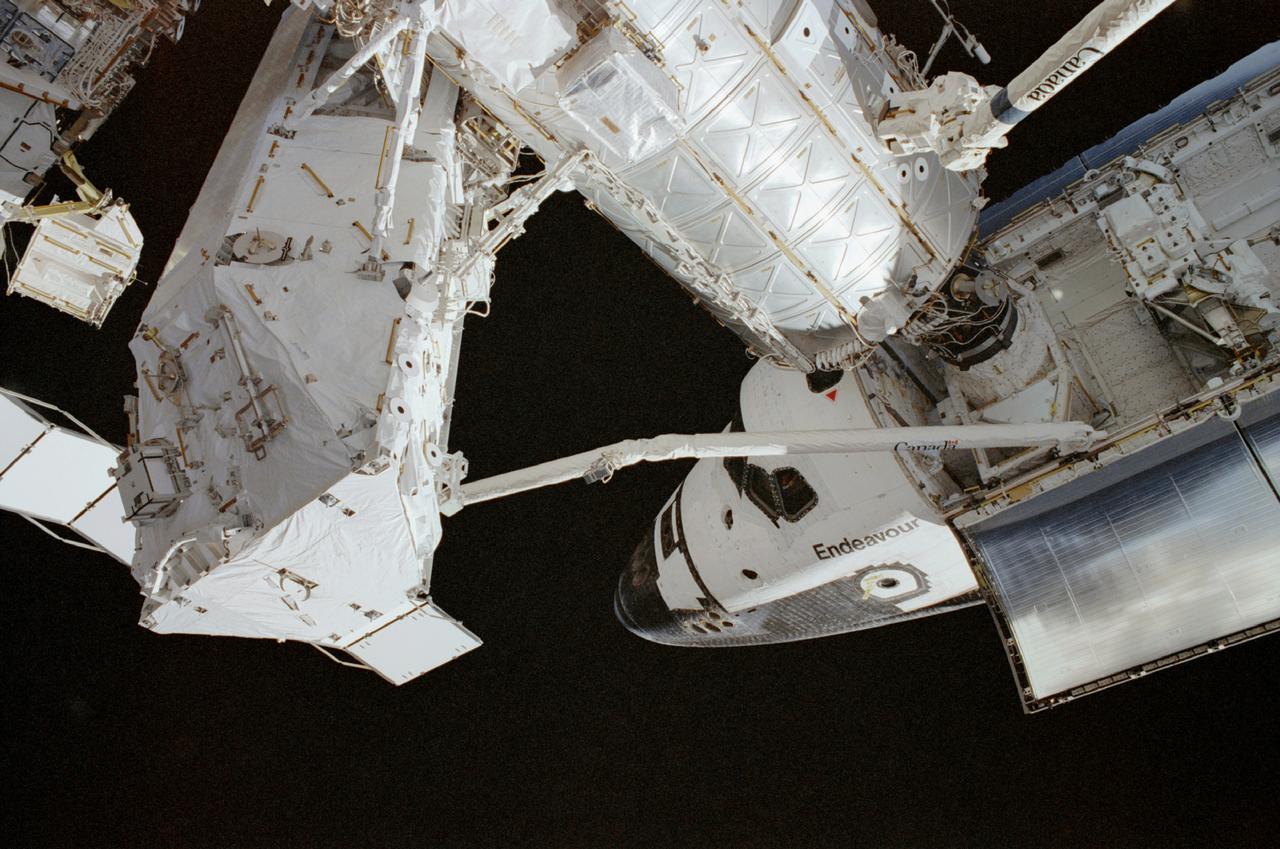
The STS-111 mission, the 14th Shuttle mission to visit the International Space Station (ISS), was launched on June 5, 2002 aboard the Space Shuttle Orbiter Endeavour. On board were the STS-111 and Expedition Five crew members. Astronauts Kerneth D. Cockrell, commander; Paul S. Lockhart, pilot, and mission specialists Franklin R. Chang-Diaz and Philippe Perrin were the STS-111 crew members. Expedition Five crew members included Cosmonaut Valeri G. Korzun, commander, Astronaut Peggy A. Whitson and Cosmonaut Sergei Y. Treschev, flight engineers. Three space walks enabled the STS-111 crew to accomplish mission objectives: The delivery and installation of the Mobile Remote Servicer Base System (MBS), an important part of the Station's Mobile Servicing System that allows the robotic arm to travel the length of the Station, which is necessary for future construction tasks; the replacement of a wrist roll joint on the Station's robotic arm; and the task of unloading supplies and science experiments from the Leonardo multipurpose Logistics Module, which made its third trip to the orbital outpost. In this photograph, the Space Shuttle Endeavour, back dropped by the blackness of space, is docked to the pressurized Mating Adapter (PMA-2) at the forward end of the Destiny Laboratory on the ISS. Endeavour's robotic arm is in full view as it is stretched out with the S0 (S-zero) Truss at its end.
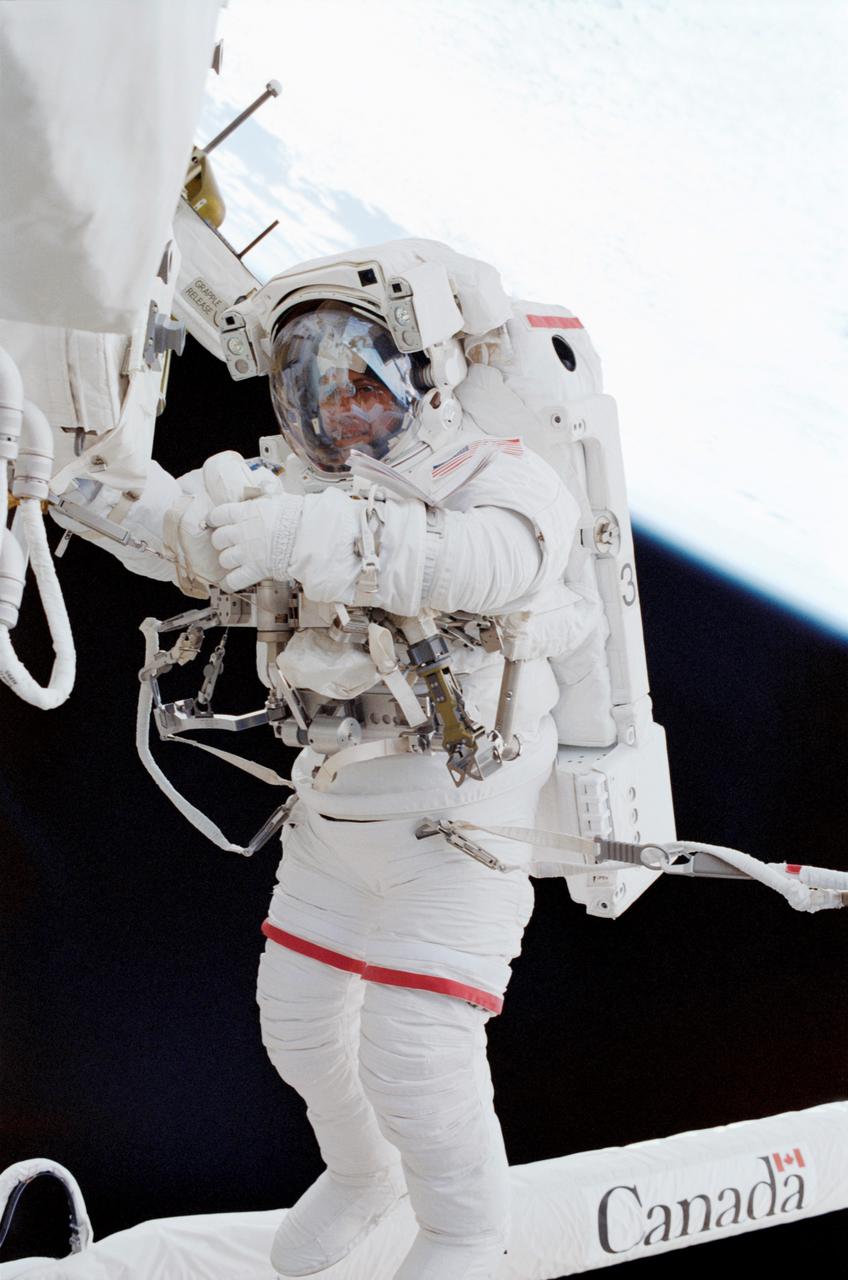
The STS-111 mission, the 14th Shuttle mission to visit the International Space Station (ISS), was launched on June 5, 2002 aboard the Space Shuttle Orbiter Endeavour. On board were the STS-111 and Expedition Five crew members. Astronauts Kerneth D. Cockrell, commander; Paul S. Lockhart, pilot; and mission specialists Franklin R. Chang-Diaz and Philippe Perrin were the STS-111 crew members. Expedition Five crew members included Cosmonaut Valery G. Korzun, commander; and Astronaut Peggy A. Whitson and Cosmonaut Sergei Y. Treschev, flight engineers. Three space walks enabled the STS-111 crew to accomplish the delivery and installation of the Mobile Remote Servicer Base System (MBS), an important part of the Station's Mobile Servicing System that allows the robotic arm to travel the length of the Station, which is necessary for future construction tasks. In this photograph, Astronaut Franklin R. Chang-Diaz participates in the first scheduled session of extra vehicular activity (EVA) for the STS-111 mission. During the space walk, Chang-Diaz and Perrin attached a Power and Data Grapple Fixture onto the ISS's P6 Truss, setting the stage for the future relocation of the P6. The next major task was to remove Service Module Debris Panels from Space Shuttle Endeavour's payload bay and attach them to their temporary location on Pressurized Mating Adapter 1 (PMA-1). The space walkers also removed thermal blankets to prepare the MBS for installation onto the station's Mobile Transporter (MT).
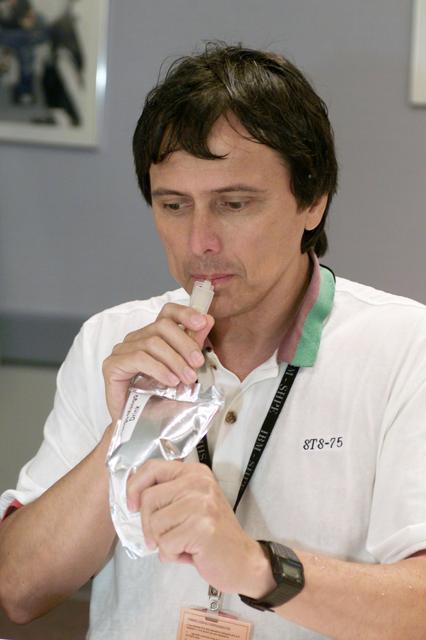
JSC2001-E-25713 (27 August 2001) --- Astronaut Franklin R. Chang-Diaz, STS-111 mission specialist, is photographed during food testing in the Flight Projects Division Laboratory at the Johnson Space Center (JSC).
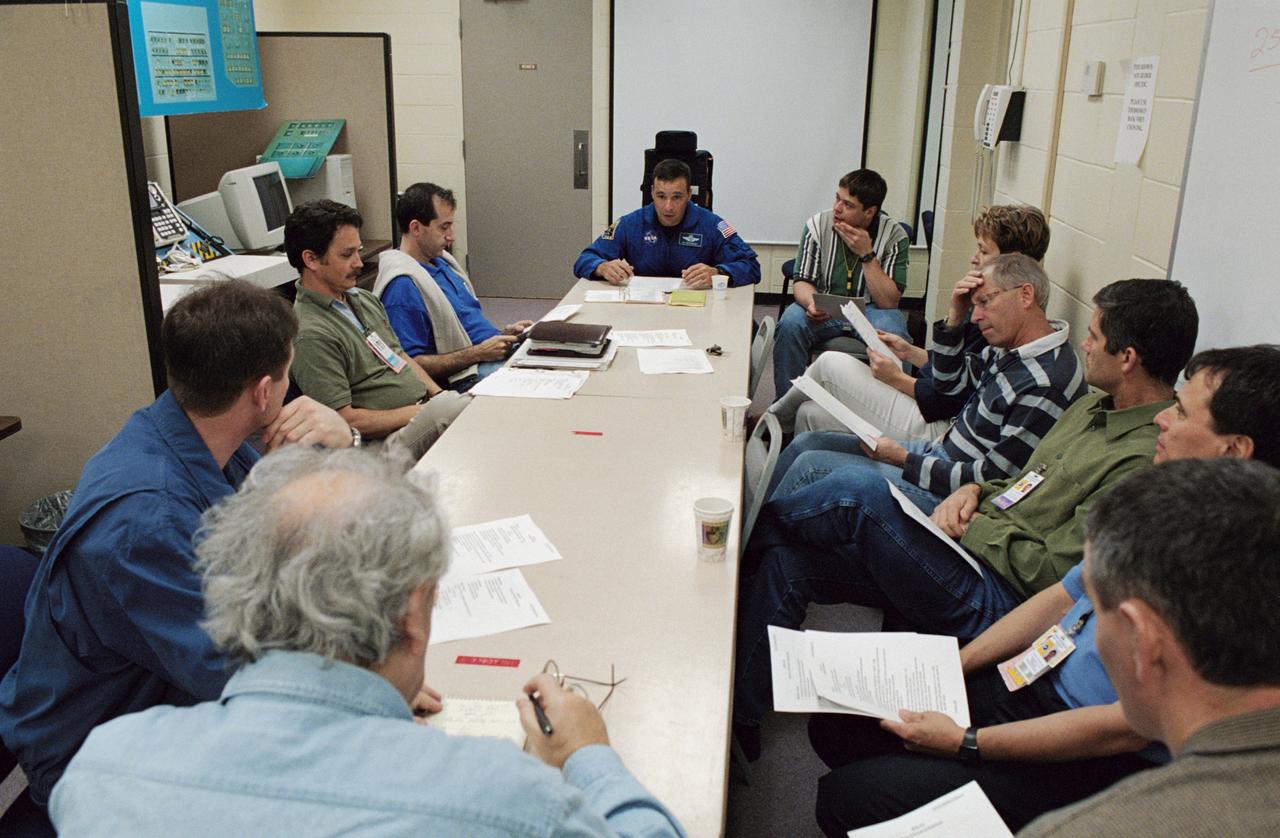
JSC2002-00723 (29 March 2002) --- The STS-111 crewmembers and the Expedition Five crewmembers share a joint planning session in the Space Vehicle Mockup Facility at Johnson Space Center (JSC). Seated on the right side of the conference table are cosmonaut Valeri G. Korzun (foreground), Expedition Five mission commander, astronauts Franklin R. Chang-Diaz, STS-111 mission specialist, Paul S. Lockhart, STS-111 pilot, Kenneth D. Cockrell, STS-111 mission commander, and Peggy A. Whitson, Expedition Five flight engineer. Seated on the left side of the conference table are cosmonaut Sergei Y. Treschev (foreground), Expedition Five flight engineer, and astronaut Philippe Perrin (far end), STS-111 mission specialist. Korzun and Treschev represent Rosaviakosmos and Perrin represents CNES, the French Space Agency.
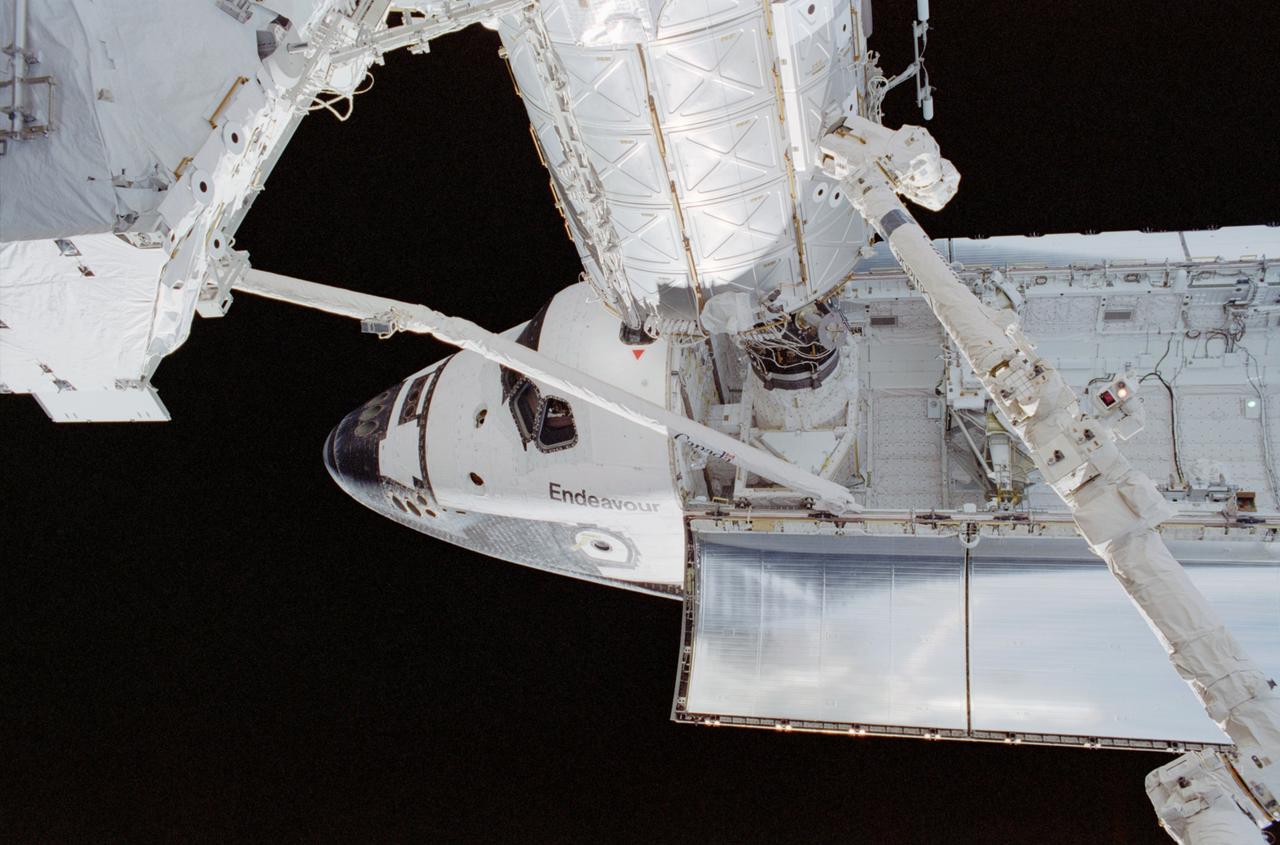
The STS-111 mission, the 14th Shuttle mission to visit the International Space Station (ISS), was launched on June 5, 2002 aboard the Space Shuttle Orbiter Endeavour. On board were the STS-111 and Expedition Five crew members. Astronauts Kerneth D. Cockrell, commander; Paul S. Lockhart, pilot, and mission specialists Franklin R. Chang-Diaz and Philippe Perrin were the STS-111 crew members. Expedition Five crew members included Cosmonaut Valeri G. Korzun, commander, Astronaut Peggy A. Whitson and Cosmonaut Sergei Y. Treschev, flight engineers. Three space walks enabled the STS-111 crew to accomplish the delivery and installation of the Mobile Remote Servicer Base System (MBS), an important part of the Station's Mobile Servicing System that allows the robotic arm to travel the length of the Station, which is necessary for future construction tasks; the replacement of a wrist roll joint on the Station's robotic arm; and the task of unloading supplies and science experiments from the Leonardo multipurpose Logistics Module, which made its third trip to the orbital outpost. In this photograph, the Space Shuttle Endeavour, back dropped by the blackness of space, is docked to the pressurized Mating Adapter (PMA-2) at the forward end of the Destiny Laboratory on the ISS. A portion of the Canadarm2 is visible on the right and Endeavour's robotic arm is in full view as it is stretched out with the S0 (S-zero) Truss at its end.
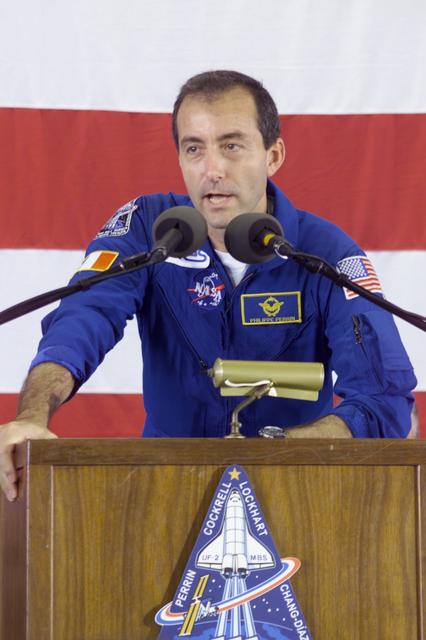
JSC2002-E-26033 (21 June 2002) --- Astronaut Philippe Perrin, STS-111 mission specialist representing CNES, the French Space Agency, speaks from the lectern in Hangar 990 at Ellington Field during the STS-111 and Expedition Four crew return ceremonies.
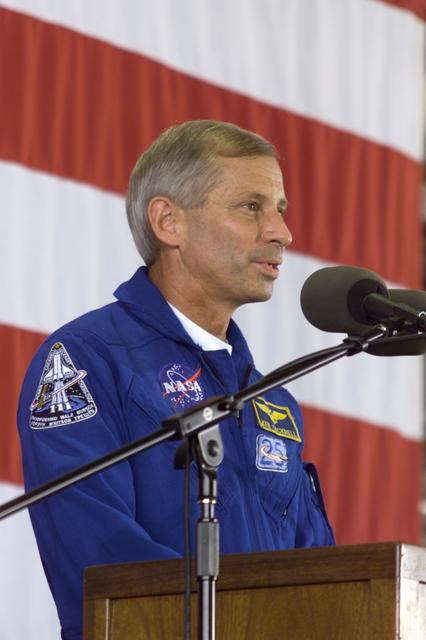
JSC2002-E-26031 (21 June 2002) --- Astronaut Kenneth D. Cockrell, STS-111 mission commander, speaks from the lectern in Hangar 990 at Ellington Field during the STS-111 and Expedition Four crew return ceremonies.
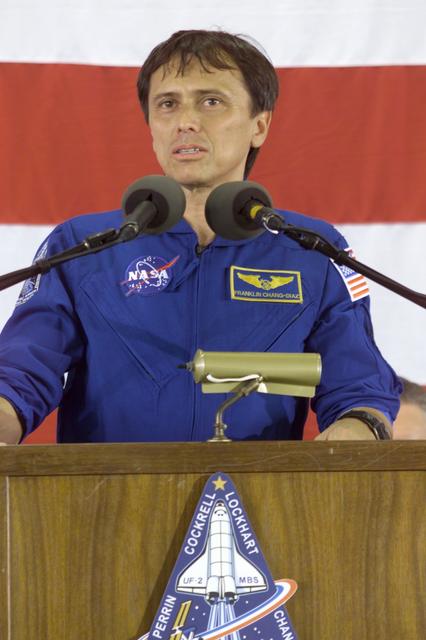
JSC2002-E-26032 (21 June 2002) --- Astronaut Franklin R. Chang-Diaz, STS-111 mission specialist, speaks from the lectern in Hangar 990 at Ellington Field during the STS-111 and Expedition Four crew return ceremonies.

The Space Shuttle Endeavour, accompanied by a convoy of recovery vehicles, is towed up the taxiway at NASA's Dryden Flight Research Center at Edwards Air Force Base, California, following its landing on June 19, 2002. The landing, the 49th to occur at Edwards, concluded mission STS-111 to the International Space Station. It was the 18th orbital mission of Endeavour and the 110th space shuttle mission overall.
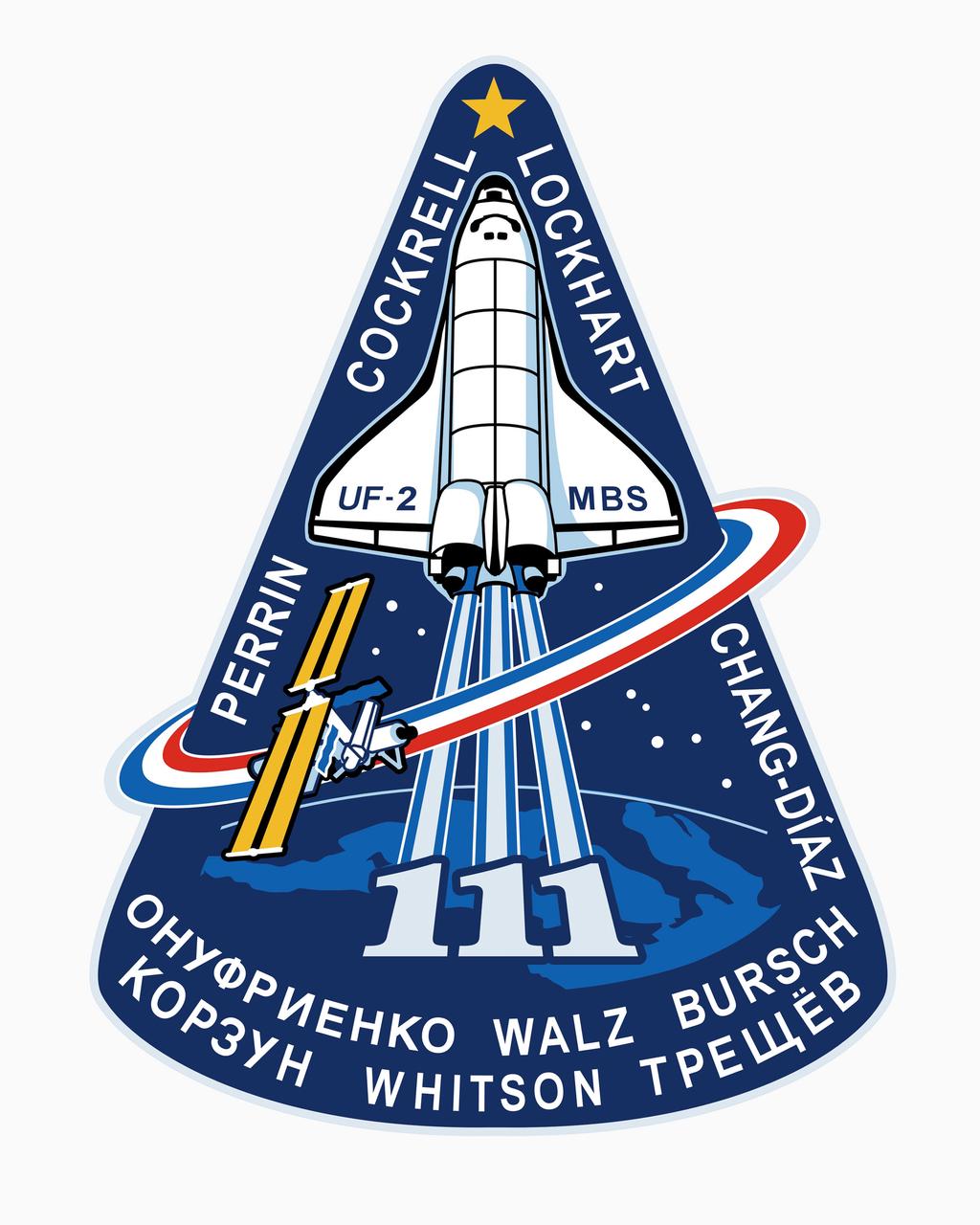
Pictured here is the Space Shuttle Orbiter Endeavour, STS-111 mission insignia. The International Space Station (ISS) recieved a new crew, Expedition Five, replacing Expedition Four after a record-setting 196 days in space, when STS-111 visited in June 2002. Three spacewalks enabled the STS-111 crew to accomplish additional mission objectives: the delivery and installation of a new platform for the ISS robotic arm, the Mobile Base System (MBS) which is an important part of the Station's Mobile Servicing System allowing the robotic arm to travel the length of the Station; the replacement of a wrist roll joint on the Station's robotic arm; and unloading supplies and science experiments from the Leonardo Multi-Purpose Logistics Module, which made its third trip to the orbital outpost. The STS-111 mission, the 14th Shuttle mission to visit the ISS, was launched on June 5, 2002 and landed June 19, 2002.
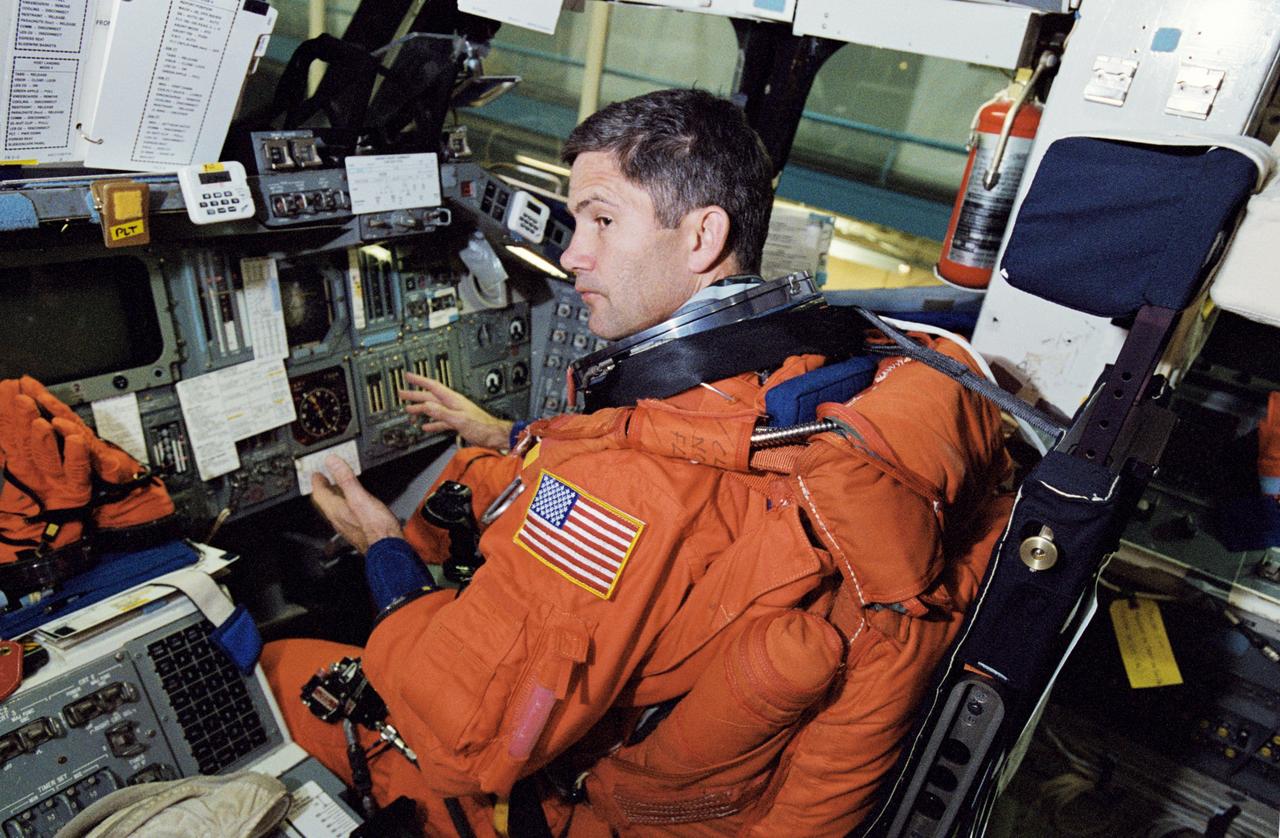
JSC2001-02990 (5 December 2001) --- Astronaut Paul S. Lockhart, STS-111 pilot, occupies the pilot’s station during a mission training session in the Space Vehicle Mockup Facility at the Johnson Space Center (JSC). Lockhart is attired in a training version of the shuttle launch and entry garment. STS-111 will be the 14th shuttle mission to visit the International Space Station (ISS).
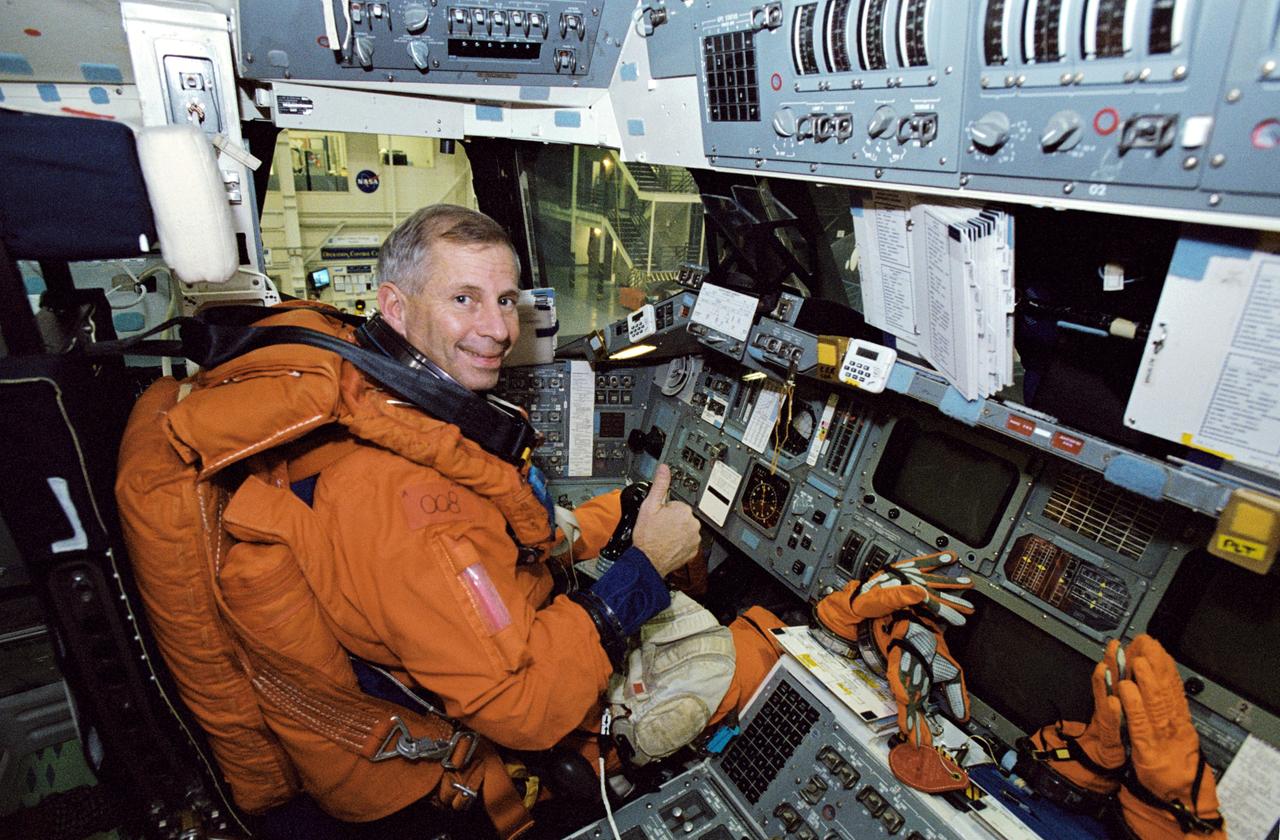
JSC2001-02992 (5 December 2001) --- Astronaut Kenneth D. Cockrell, STS-111 mission commander, occupies the commander’s station during a mission training session in the Space Vehicle Mockup Facility at the Johnson Space Center (JSC). Cockrell is attired in a training version of the shuttle launch and entry garment. STS-111 will be the 14th shuttle mission to visit the International Space Station (ISS).
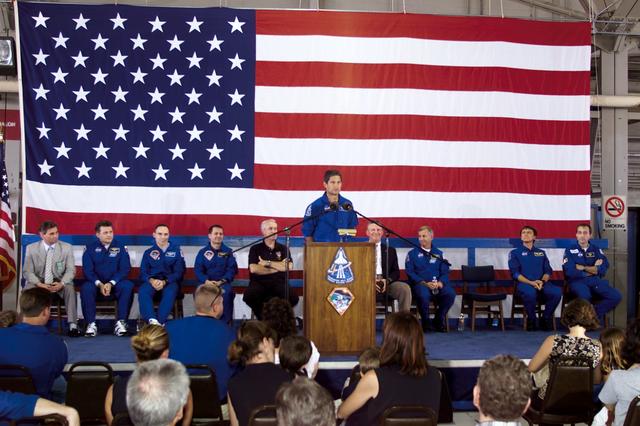
JSC2002-E-25981 (21 June 2002) --- Astronaut Paul S. Lockhart, STS-111 pilot, speaks to a large crowd who showed up at Ellington Field's Hangar 990 to welcome home the STS-111 and Expedition Four crew members. Members of the STS-111 and Expedition Four crews joined NASA Administrator Sean O'Keefe and JSC Director Jefferson D. Howell, Jr. on the dais.
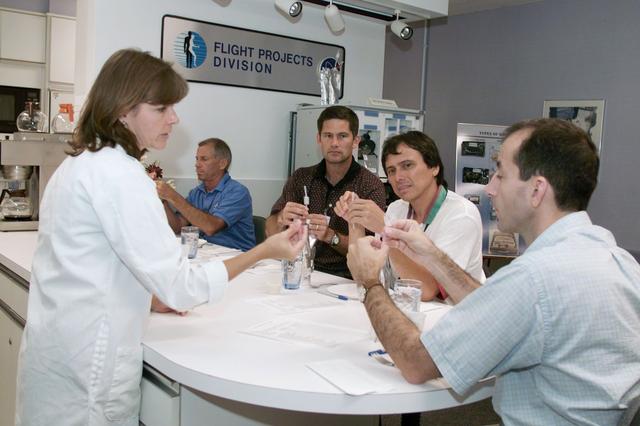
JSC2001-E-25712 (27 August 2001) --- The STS-111 crewmembers are briefed by dietitian Gloria Mongan with Lockheed Martin Space Operations during food testing in the Flight Projects Division Laboratory at the Johnson Space Center (JSC). From back to front are astronauts Kenneth D. Cockrell and Paul S. Lockhart, mission commander and pilot, respectively, and Franklin R. Chang-Diaz and Philippe Perrin, both mission specialists. Perrin represents CNES, the French Space Agency.
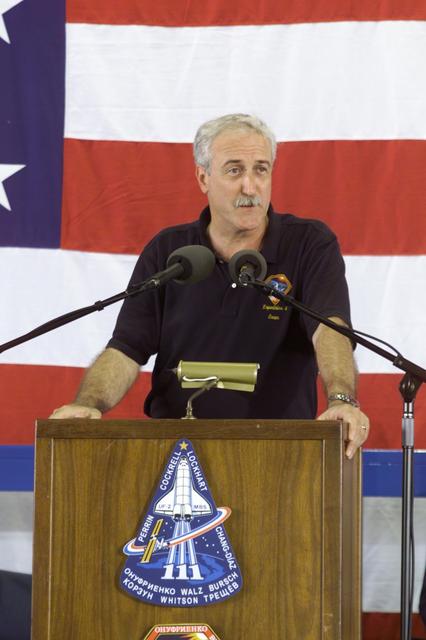
JSC2002-E-26024 (21 June 2002) --- NASA Administrator Sean O'Keefe speaks from the lectern in Hangar 990 at Ellington Field during the STS-111 and Expedition Four crew return ceremonies.
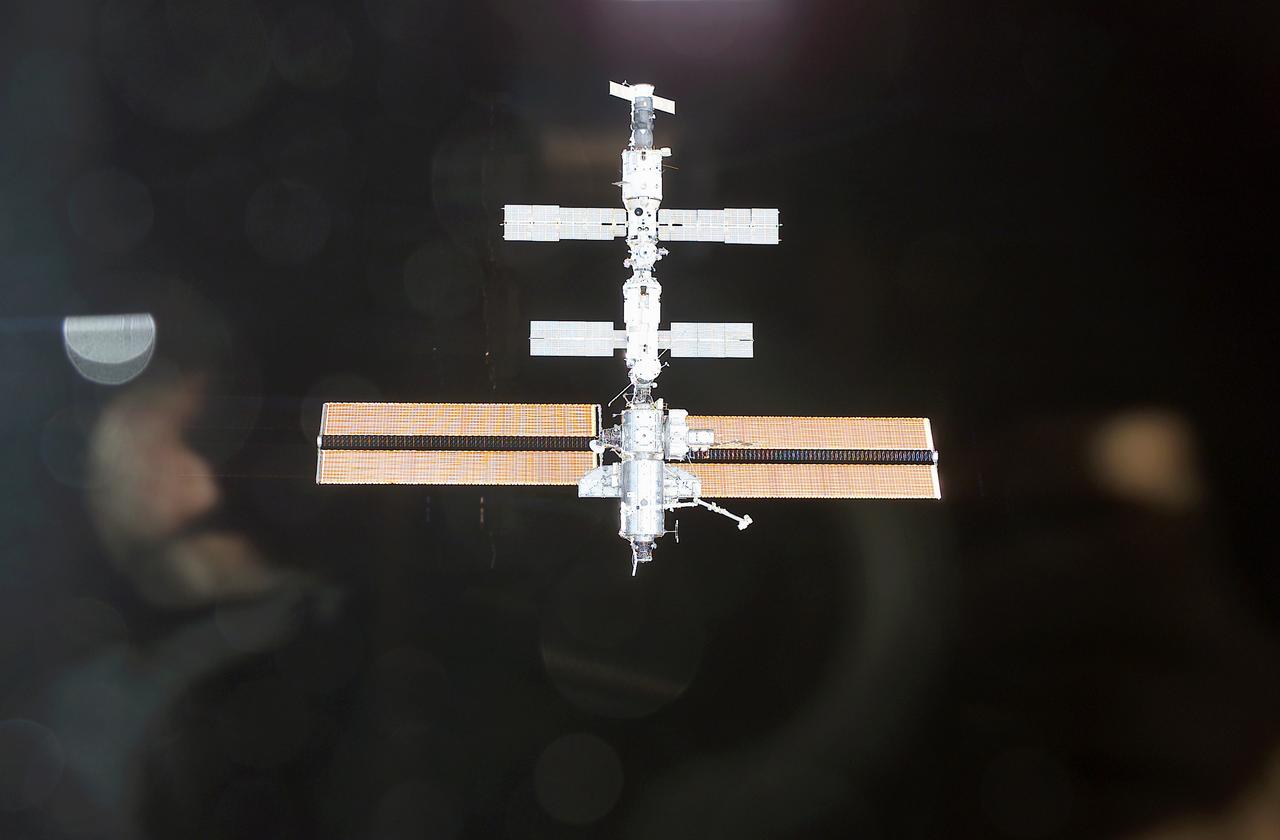
Backdropped against the blackness of space is the International Space Station (ISS), as viewed from the approching Space Shuttle Orbiter Endeavour, STS-111 mission, in June 2002. Expedition Five replaced Expedition Four crew after remaining a record-setting 196 days in space. Three spacewalks enabled the STS-111 crew to accomplish the delivery and installation of the Mobile Remote Servicer Base System (MBS), an important part of the Station's Mobile Servicing System that allows the robotic arm to travel the length of the Station, which is necessary for future construction tasks; the replacement of a wrist roll joint on the Station's robotic arm, and the task of unloading supplies and science experiments from the Leonardo Multi-Purpose Logistics Module, which made its third trip to the orbital outpost. The STS-111 mission, the 14th Shuttle mission to visit the ISS, was launched on June 5, 2002 and landed June 19, 2002.
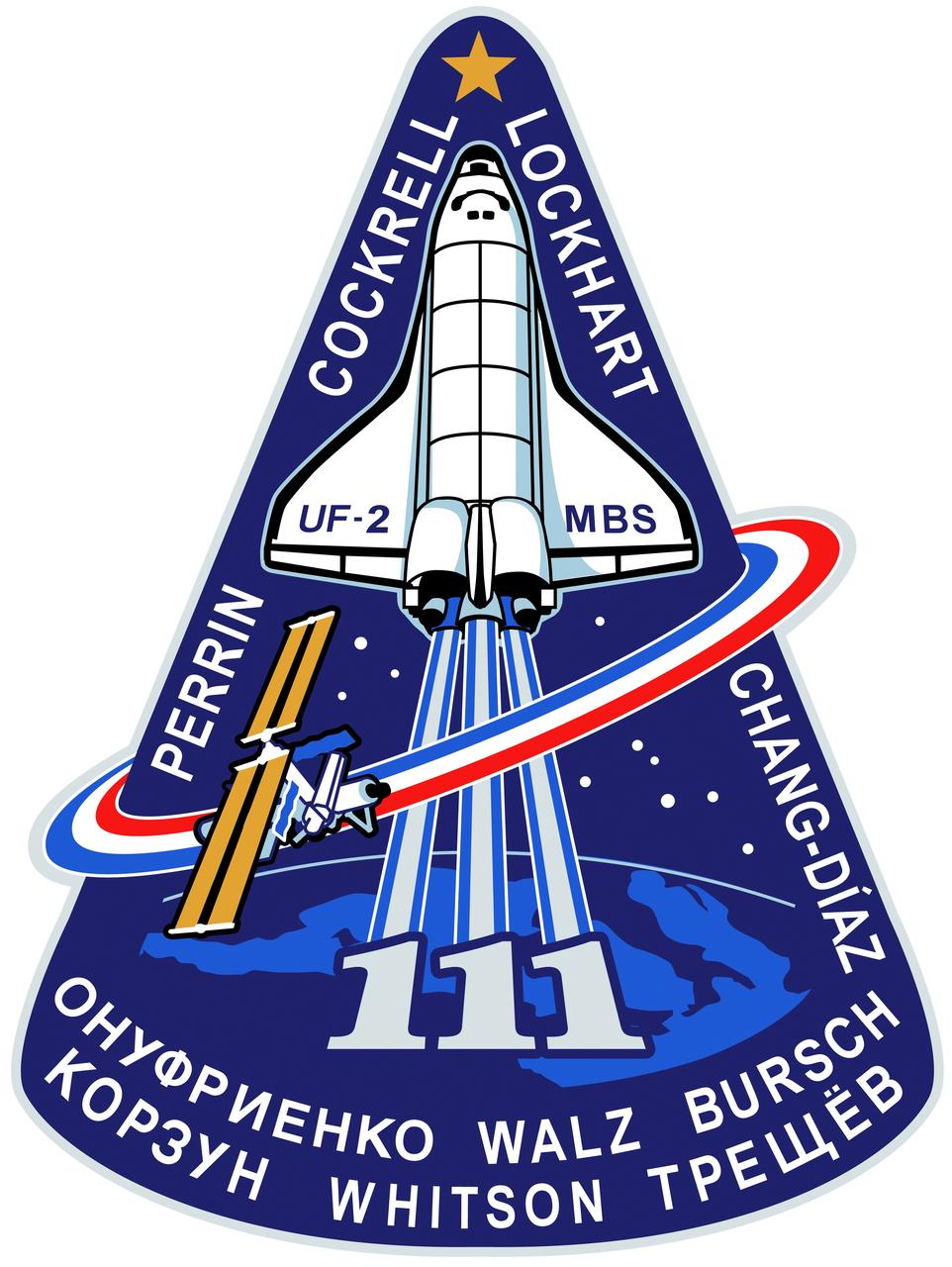
STS111-S-001 (January 2002) --- The STS-111 patch symbolizes the hardware, people, and partner nations that contribute to the flight. The space shuttle rises on the plume of the Astronaut Office symbol, carrying the Canadian Mobile Base System (MBS) for installation while docked to the International Space Station (ISS). The mission is named UF-2 for ISS Utilization Flight number two. The ISS orbit completes the Astronaut Office symbol and is colored red, white, and blue to represent the flags of the United States, Russia, France, and Costa Rica. The Earth background shows Italy, which contributes the Multi Purpose Logistics Module (MPLM) used on this flight to re-supply ISS. The ten stars in the sky represent the ten astronauts and cosmonauts on orbit during the flight, and the star at the top of the patch represents the Johnson Space Center, in the state of Texas, from which the flight is managed. The names of the STS-111 crew border the upper part of the patch, and the Expedition Five (going up) and Expedition Four (coming down) crews? names form the bottom of the patch. The NASA insignia design for space shuttle flights is reserved for use by the astronauts and for other official use as the NASA Administrator may authorize. Public availability has been approved only in the forms of illustrations by the various news media. When and if there is any change in this policy, which is not anticipated, the change will be publicly announced. Photo credit: NASA
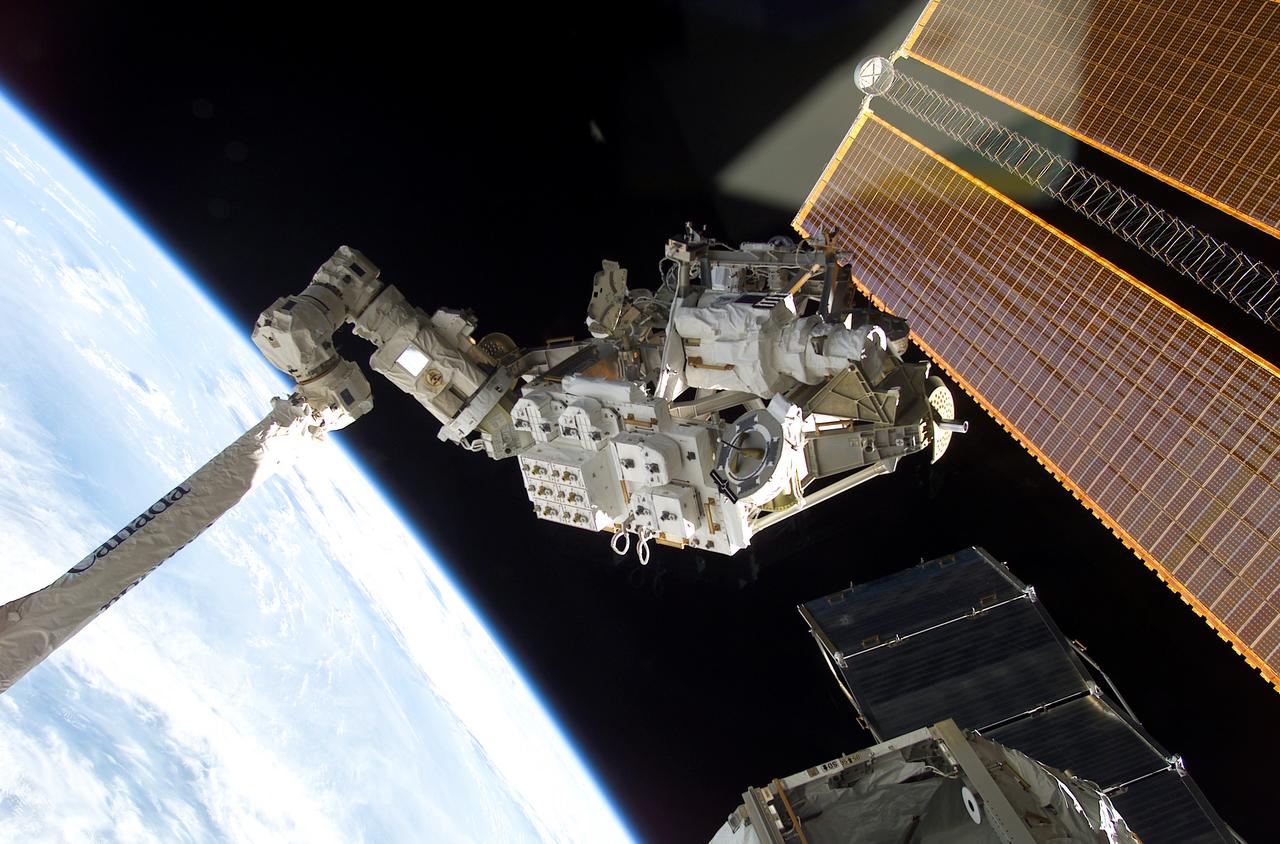
Backdropped against the blackness of space and the Earth's horizon, the Mobile Remote Base System (MBS) is moved by the Canadarm2 for installation on the International Space Station (ISS). Delivered by the STS-111 mission aboard the Space Shuttle Endeavour in June 2002, the MBS is an important part of the Station's Mobile Servicing System allowing the robotic arm to travel the length of the Station, which is neccessary for future construction tasks. In addition, STS-111 delivered a new crew, Expedition Five, replacing Expedition Four after remaining a record-setting 196 days in space. Three spacewalks enabled the STS-111 crew to accomplish the delivery and installation of the MBS to the Mobile Transporter on the S0 (S-zero) truss, the replacement of a wrist roll joint on the Station's robotic arm, and the task of unloading supplies and science experiments from the Leonardo Multi-Purpose Logistics Module, which made its third trip to the orbital outpost. The STS-111 mission, the 14th Shuttle mission to visit the ISS, was launched on June 5, 2002 and landed June 19, 2002.
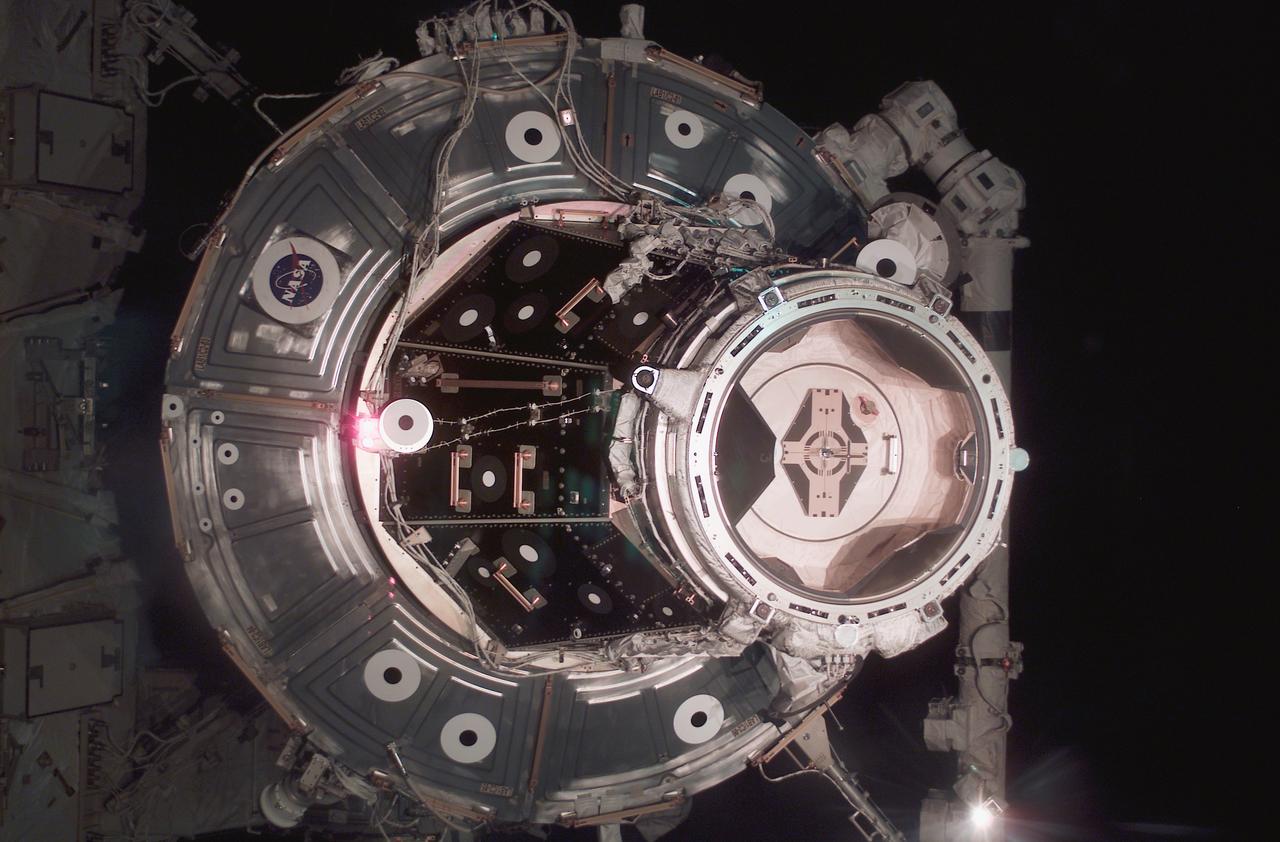
Pictured here is the forward docking port on the International Space Station's (ISS) Destiny Laboratory as seen by one of the STS-111 crewmembers from the Space Shuttle Orbiter Endeavour just prior to docking. In June 2002, STS-111 provided the Space Station with a new crew, Expedition Five, replacing Expedition Four after remaining a record-setting 196 days in space. Three spacewalks enabled the STS-111 crew to accomplish additional mission objectives: the delivery and installation of a new platform for the ISS robotic arm, the Mobile Base System (MBS) which is an important part of the Station's Mobile Servicing System allowing the robotic arm to travel the length of the Station; the replacement of a wrist roll joint on the Station's robotic arm; and unloading supplies and science experiments form the Leonardo Multi-Purpose Logistics Module, which made its third trip to the orbital outpost. The STS-111 mission, the 14th Shuttle mission to visit the ISS, was launched on June 5, 2002 and landed June 19, 2002.
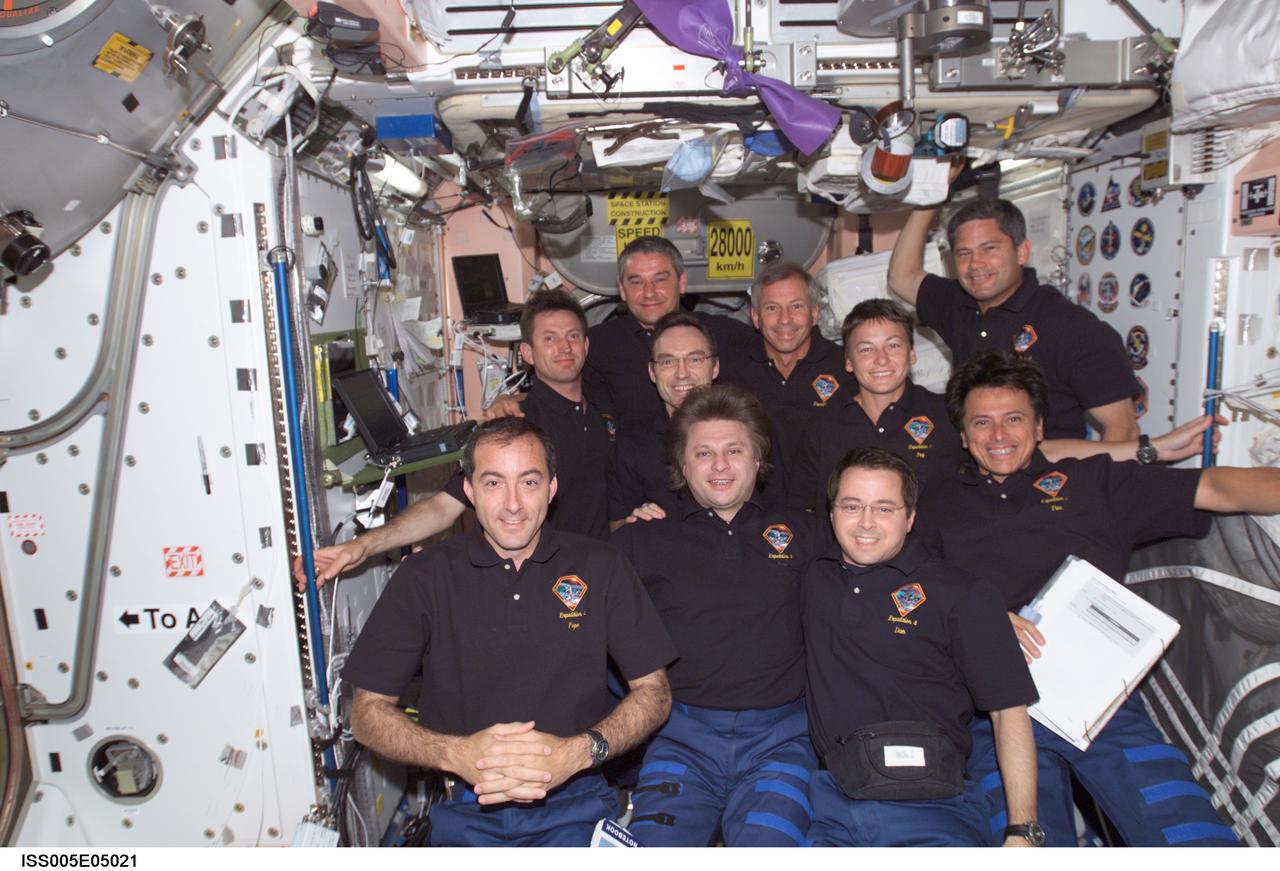
ISS005-E-05021 (15 June 2002) --- The Expedition Four, STS-111, and Expedition Five crews assemble for a group photo in the Unity node on the International Space Station (ISS). From the left, front row, are astronaut Philippe Perrin, STS-111 mission specialist; cosmonaut Yury I. Onufrienko, Expedition Four mission commander; astronauts Daniel W. Bursch, Expedition Four flight engineer; and Franklin R. Chang-Diaz, STS-111 mission specialist. From the left, center row, are cosmonaut Sergei Y. Treschev, Expedition Five flight engineer; astronaut Carl E. Walz, Expedition Four flight engineer; astronaut Peggy A. Whitson, Expedition Five flight engineer; and astronaut Paul S. Lockhart, STS-111 pilot. From the left, back row, are cosmonaut Valery G. Korzun, Expedition Five mission commander, and astronaut Kenneth D. Cockrell, STS-111 mission commander. Onufrienko, Korzun and Treschev represent Rosaviakosmos, and Perrin represents CNES, the French Space Agency.
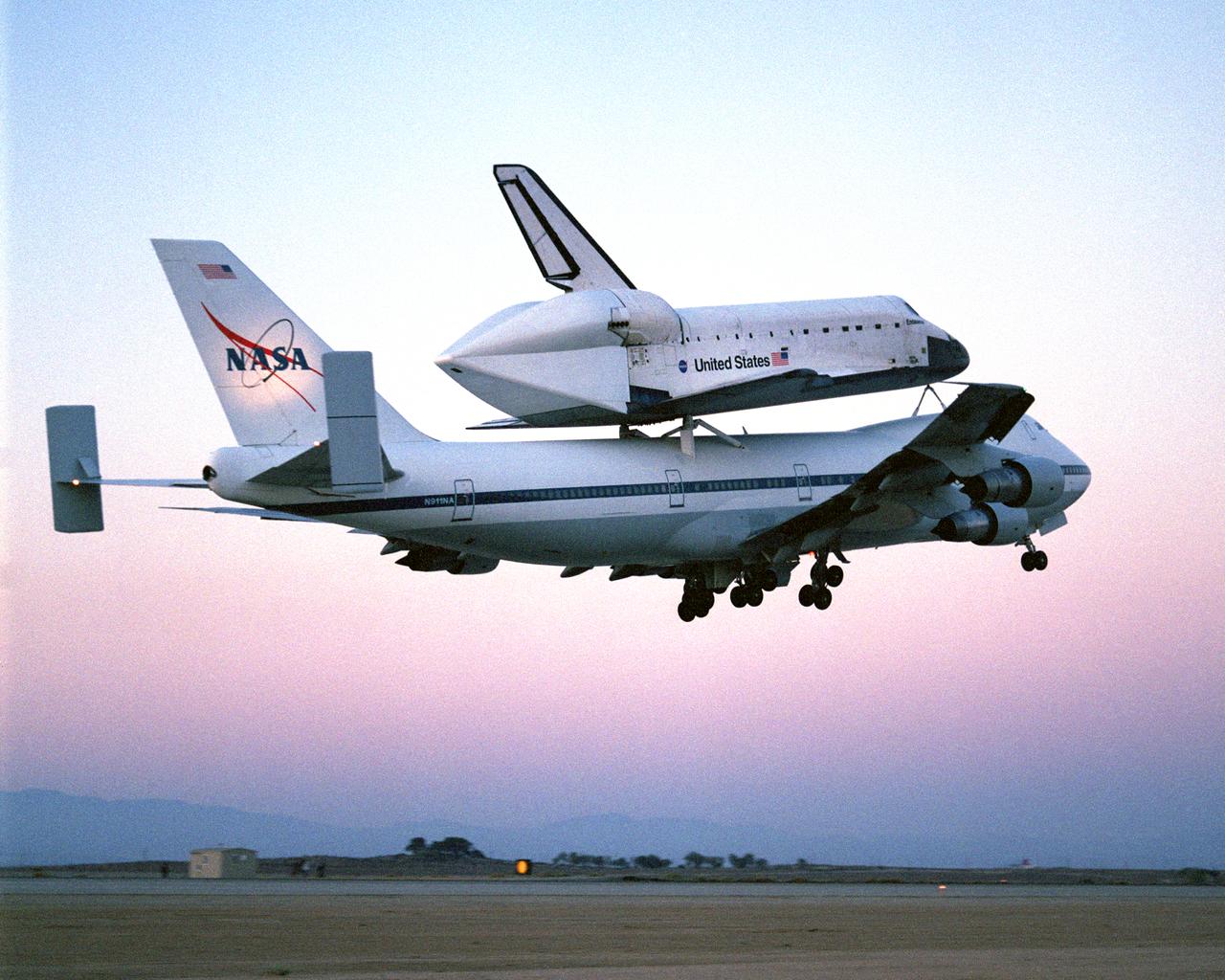
The Space Shuttle Endeavour, mounted securely atop one of NASA's modified Boeing 747 Shuttle Carrier Aircraft, left NASA's Dryden Flight Research Center at Edwards Air Force Base in Southern California at sunrise on Friday, June 28, nine days after concluding mission STS-111 to the International Space Station with a landing at Edwards.
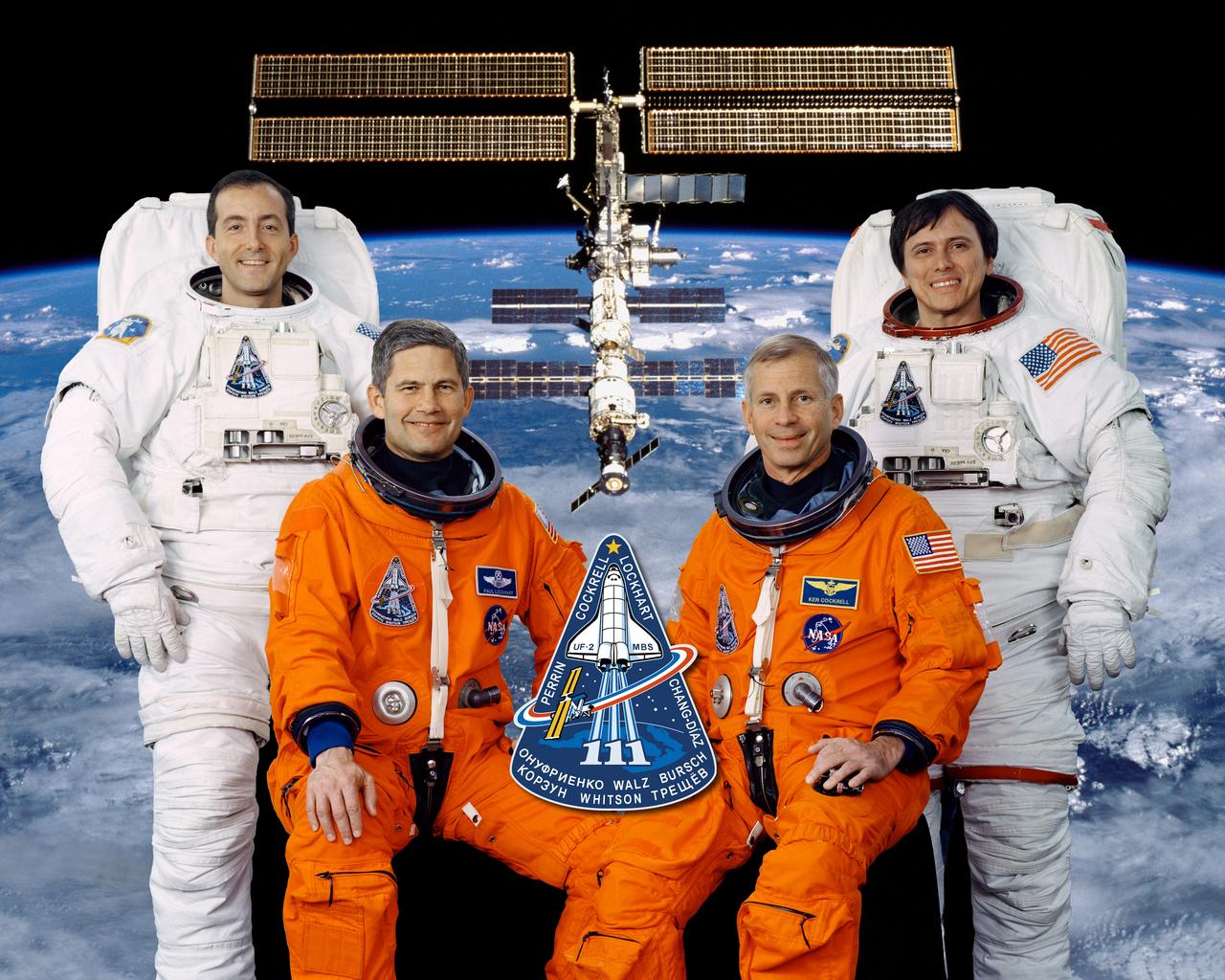
STS111-S-002 (March 2002) --- These four astronauts comprise the prime crew for NASA's STS-111 mission. Astronaut Kenneth D. Cockrell (front right) is mission commander, and astronaut Paul S. Lockhart (front left) is pilot. Astronauts Philippe Perrin (rear left), representing the French Space Agency, and Franklin R. Chang-Diaz are mission specialists, assigned to extravehicular activity (EVA) work on the International Space Station (ISS). Additionally, this crew will drop off the Expedition Five crew members at the orbital outpost, and it will bring back the Expedition Four trio at mission's end.
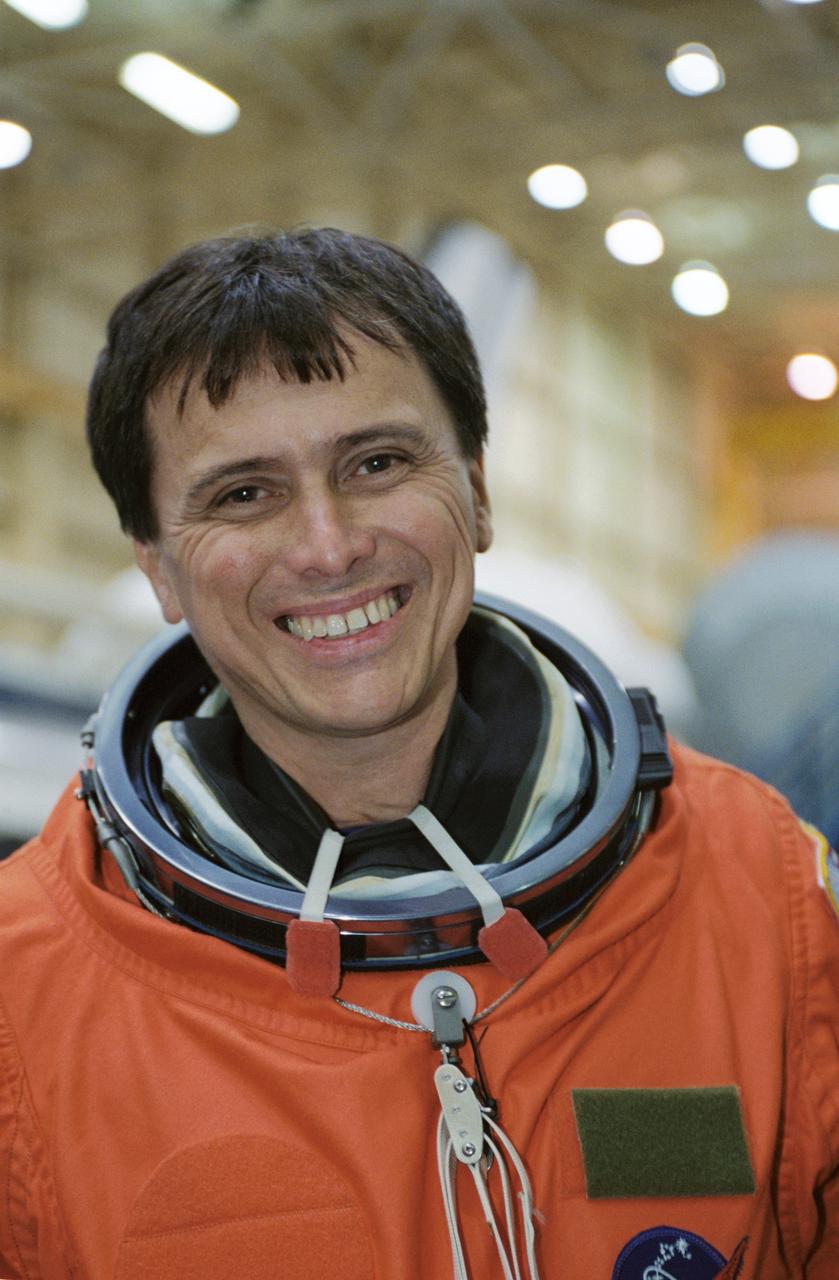
JSC2002-00722 (29 March 2002) --- Astronaut Franklin R. Chang-Diaz, STS-111 mission specialist, attired in a training version of the shuttle launch and entry suit, waits for a mission training session in the Space Vehicle Mockup Facility at the Johnson Space Center (JSC).
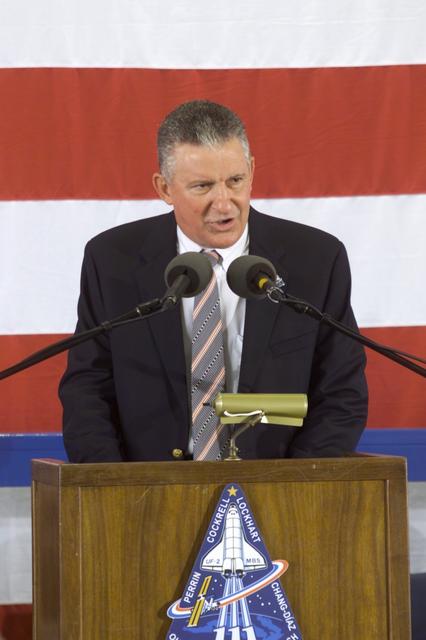
JSC2002-E-26022 (21 June 2002) --- Johnson Space Center’s (JSC) Director Jefferson Davis Howell, Jr. speaks from the lectern in Hangar 990 at Ellington Field during the STS-111 and Expedition Four crew return ceremonies.
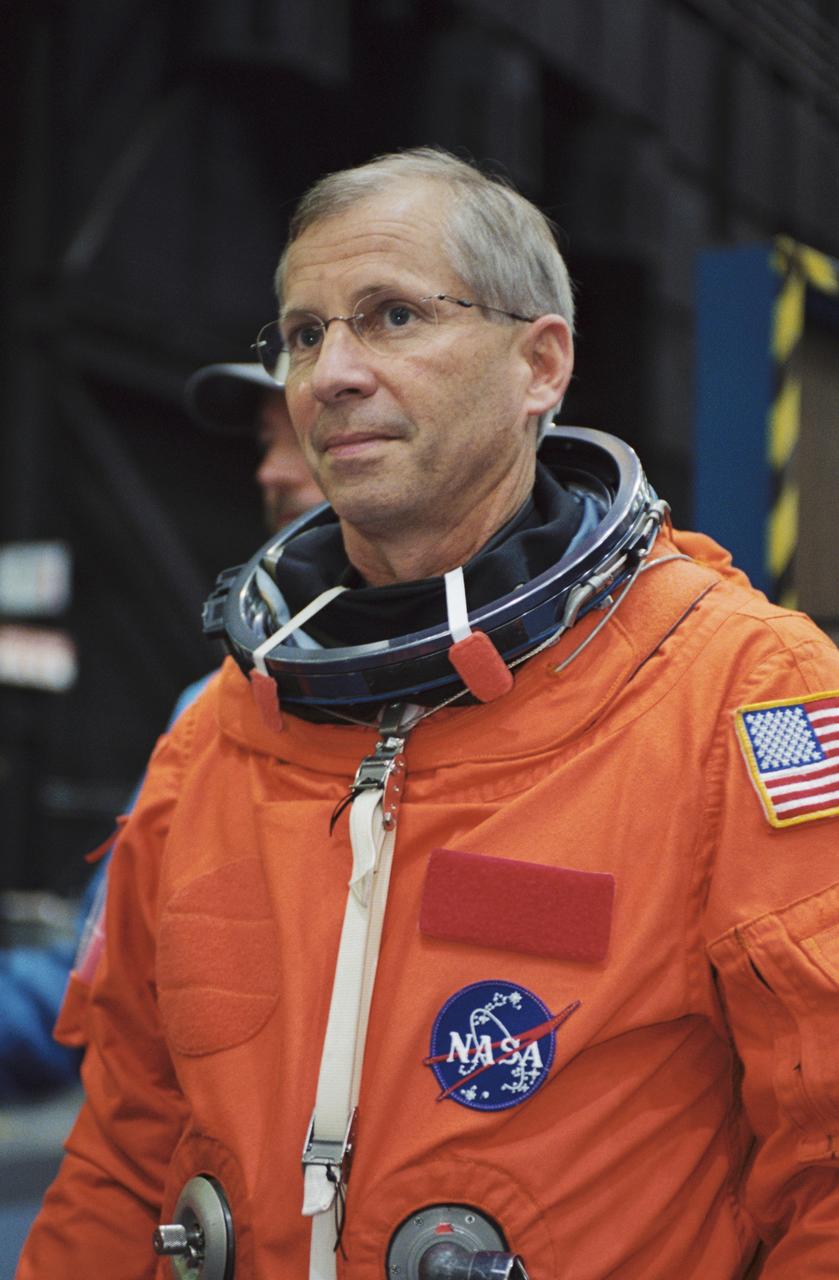
JSC2002-00725 (29 March 2002) --- Astronaut Kenneth D. Cockrell, STS-111 mission commander, attired in a training version of the shuttle launch and entry suit, awaits a mission training session in the Space Vehicle Mockup Facility at Johnson Space Center (JSC).
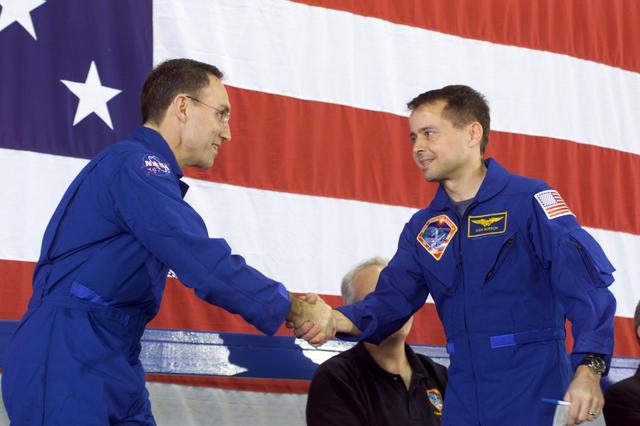
JSC2002-E-26037 (21 June 2002) --- Astronauts Carl E. Walz (left) and Daniel W. Bursch, both Expedition Four flight engineers, shake hands in Hangar 990 at Ellington Field during the STS-111 and Expedition Four crew return ceremonies.
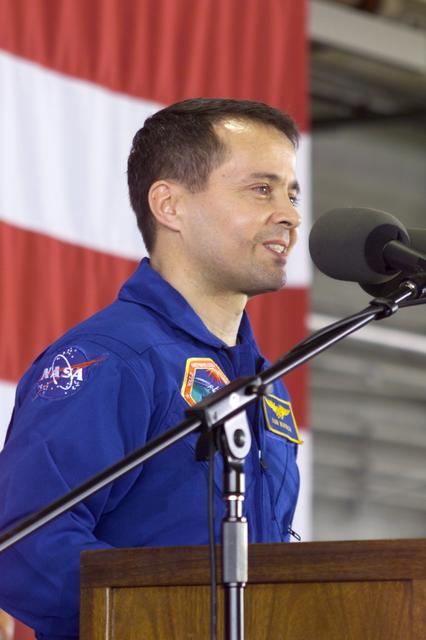
JSC2002-E-26036 (21 June 2002) --- Astronaut Daniel W. Bursch, Expedition Four flight engineer, speaks from the lectern in Hangar 990 at Ellington Field during the STS-111 and Expedition Four crew return ceremonies.

JSC2002-E-26038 (21 June 2002) --- Astronaut Carl E. Walz, Expedition Four flight engineer, speaks from the lectern in Hangar 990 at Ellington Field during the STS-111 and Expedition Four crew return ceremonies.
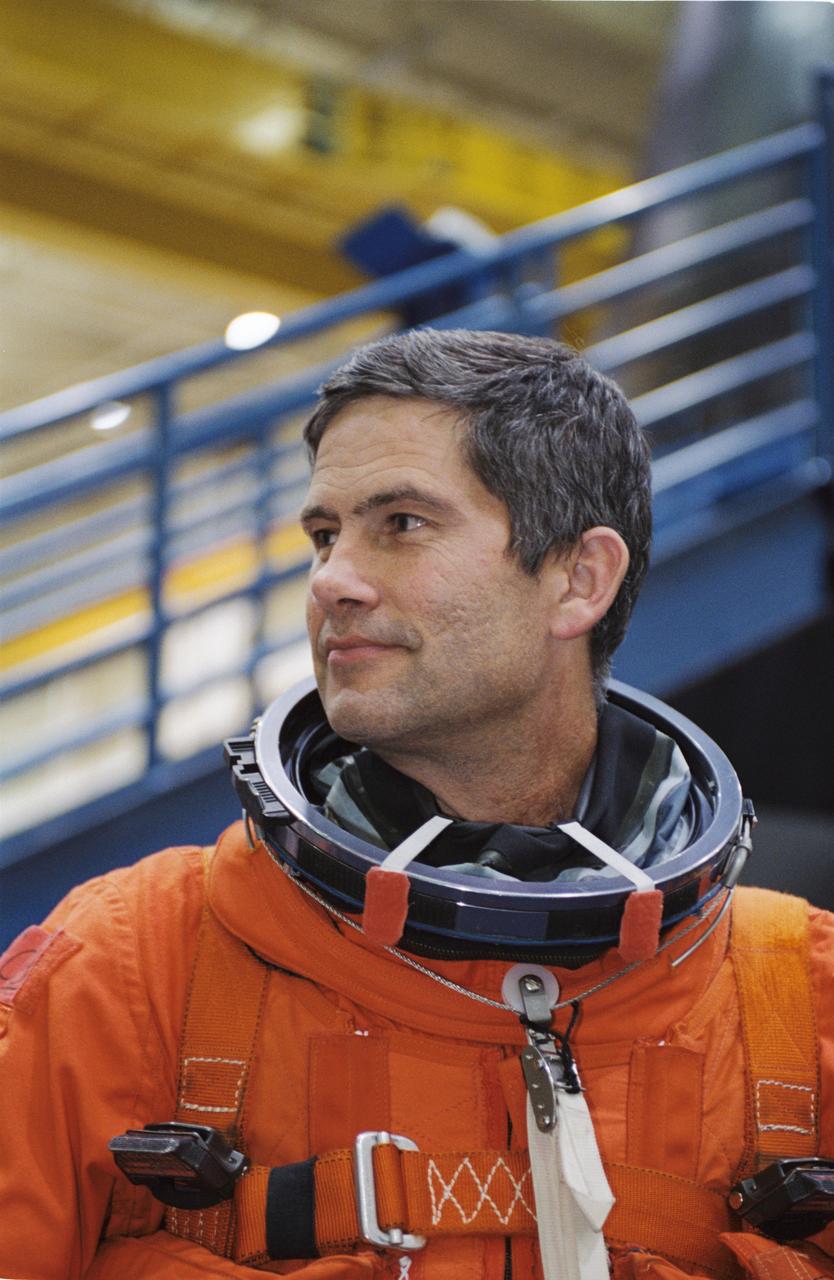
JSC2002-00726 (29 March 2002) --- Astronaut Paul S. Lockhart, STS-111 pilot, attired in a training version of the shuttle launch and entry suit, awaits a mission training session in the Space Vehicle Mockup Facility at Johnson Space Center (JSC).
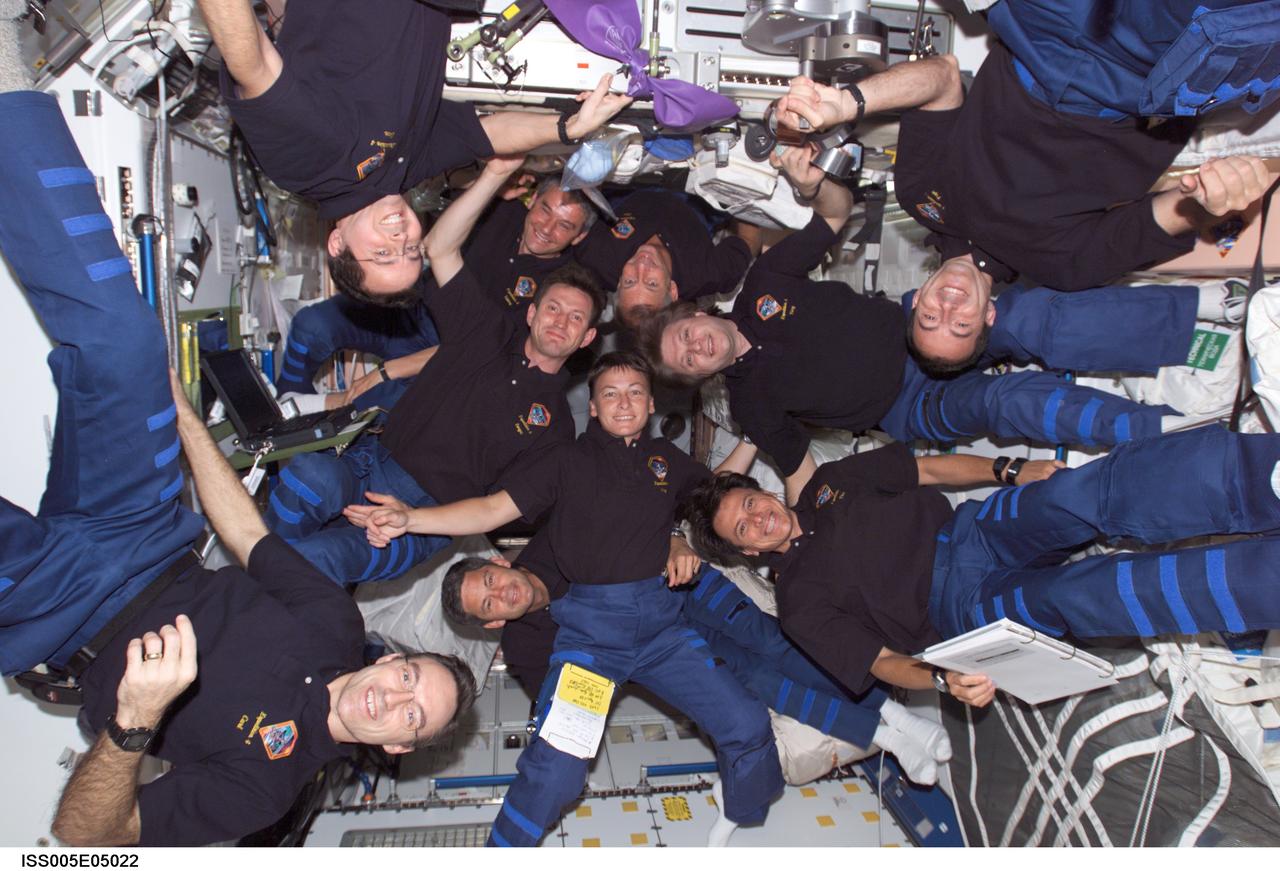
ISS005-E-05022 (15 June 2002) --- The Expedition Four, STS-111, and Expedition Five crews assemble for a group photo in the Unity node on the International Space Station (ISS). Pictured are cosmonaut Valery G. Korzun, Expedition Five mission commander; astronaut Peggy A. Whitson and cosmonaut Sergei Y. Treschev, Expedition Five flight engineers; cosmonaut Yury I. Onufrienko, Expedition Four mission commander; astronauts Carl E. Walz and Daniel W. Bursch, Expedition Four flight engineers; astronauts Kenneth D. Cockrell and Paul S. Lockhart, STS-111 mission commander and pilot, respectively; and astronauts Franklin R. Chang-Diaz and Philippe Perrin, both STS-111 mission specialists. Korzun, Onufrienko, and Treschev represent Rosaviakosmos, and Perrin represents CNES, the French Space Agency.
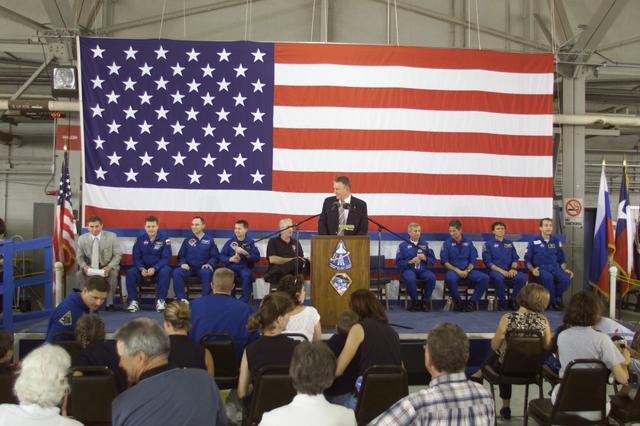
JSC2002-E-26021 (21 June 2002) --- Johnson Space Center’s (JSC) Director Jefferson Davis Howell, Jr. speaks from the lectern in Hangar 990 at Ellington Field during the STS-111 and Expedition Four crew return ceremonies. Seated (from left) are General Vasily Tsiblyiev, Deputy Director of the Gagarin Cosmonaut Training Center; cosmonaut Yury I. Onufrienko, Expedition Four mission commander; astronauts Carl E. Walz and Daniel W. Bursch, both Expedition Four flight engineers; NASA Administrator Sean O'Keefe; astronauts Kenneth D. Cockrell, STS-111 mission commander; Paul S. Lockhart, pilot; Franklin R. Chang-Diaz and Philippe Perrin, both mission specialists. Tsiblyiev and Onufrienko represent Rosaviakosmos, and Perrin represents CNES, the French Space Agency.
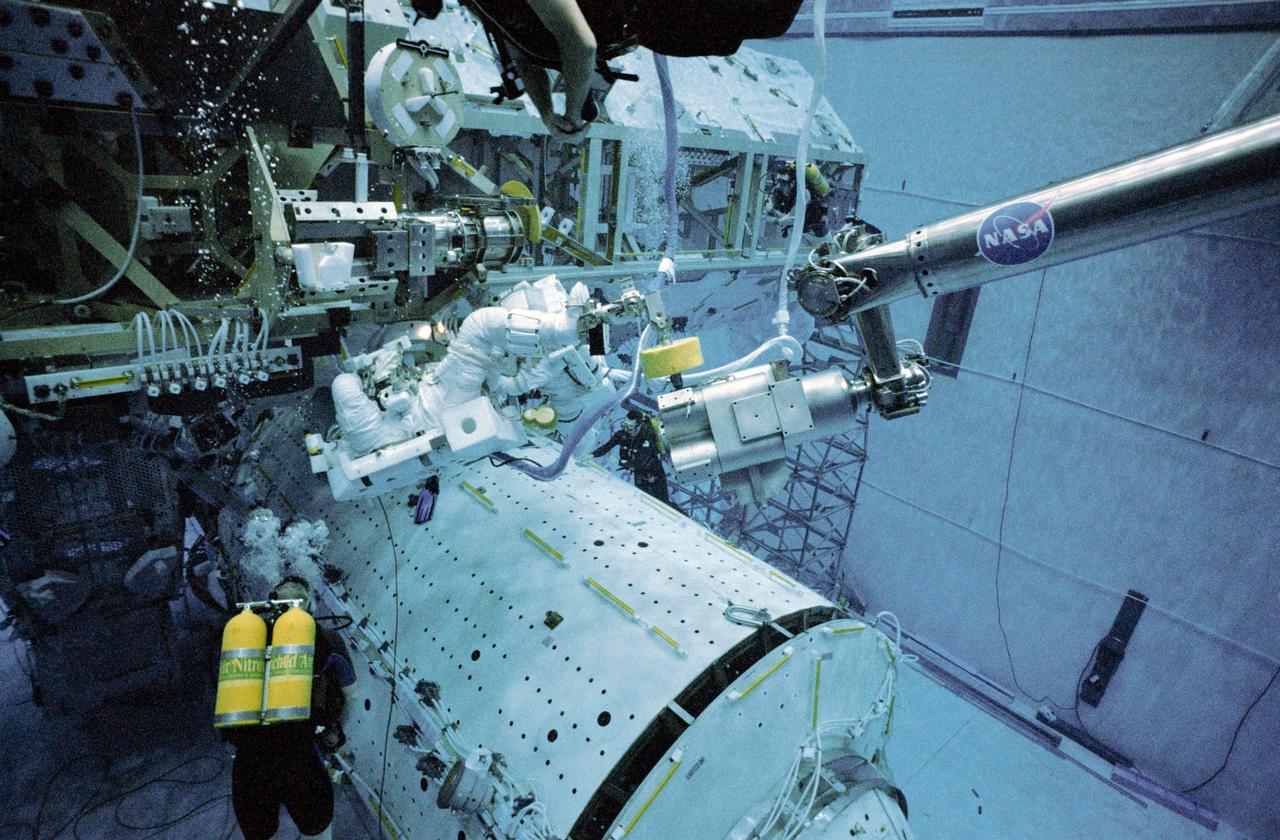
JSC2001-02995 (December 2001) --- Astronauts Philippe Perrin and Franklin R. Chang-Diaz practice procedures to be used during space walks scheduled to perform work on the International Space Station (ISS). The two STS-111 mission specialists, wearing training versions of the Extravehicular Mobility Unit (EMU) space suit, make use of the Neutral Buoyancy Laboratory (NBL) giant pool to rehearse their assigned chores. While the Space Shuttle Endeavour is docked to the orbital outpost, two space walks are scheduled to hook up the mobile base system, the second part of the mobile platform for the station’s Canadarm2 robotic arm and other assembly tasks. Perrin represents CNES, the French Space Agency. STS-111 will be the 14th shuttle mission to visit the orbital outpost.
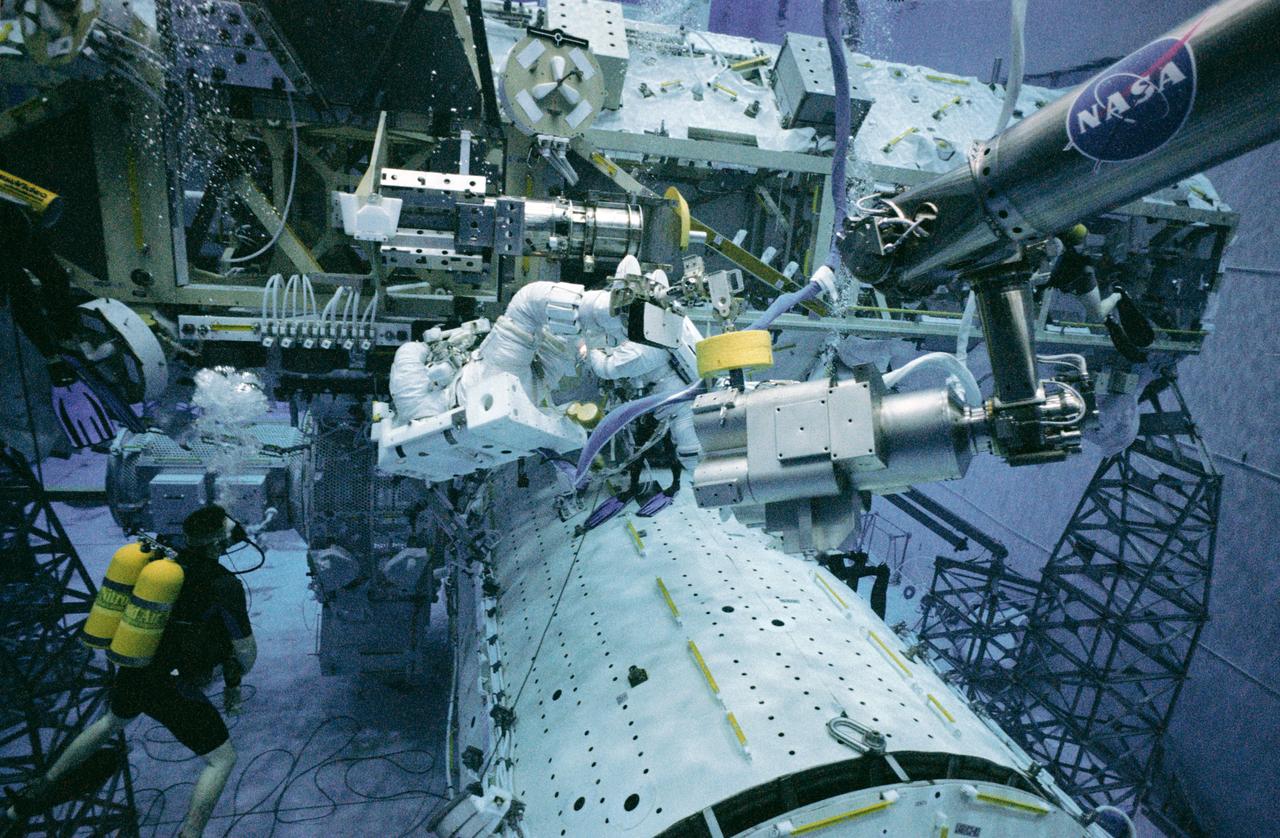
JSC2001-02996 (December 2001) --- Astronauts Philippe Perrin and Franklin R. Chang-Diaz practice procedures to be used during space walks scheduled to perform work on the International Space Station (ISS). The two STS-111 mission specialists, wearing training versions of the Extravehicular Mobility Unit (EMU) space suit, make use of the Neutral Buoyancy Laboratory (NBL) giant pool to rehearse their assigned chores. While the Space Shuttle Endeavour is docked to the orbital outpost, two space walks are scheduled to hook up the mobile base system, the second part of the mobile platform for the station’s Canadarm2 robotic arm and other assembly tasks. Perrin represents CNES, the French Space Agency. STS-111 will be the 14th shuttle mission to visit the orbital outpost.
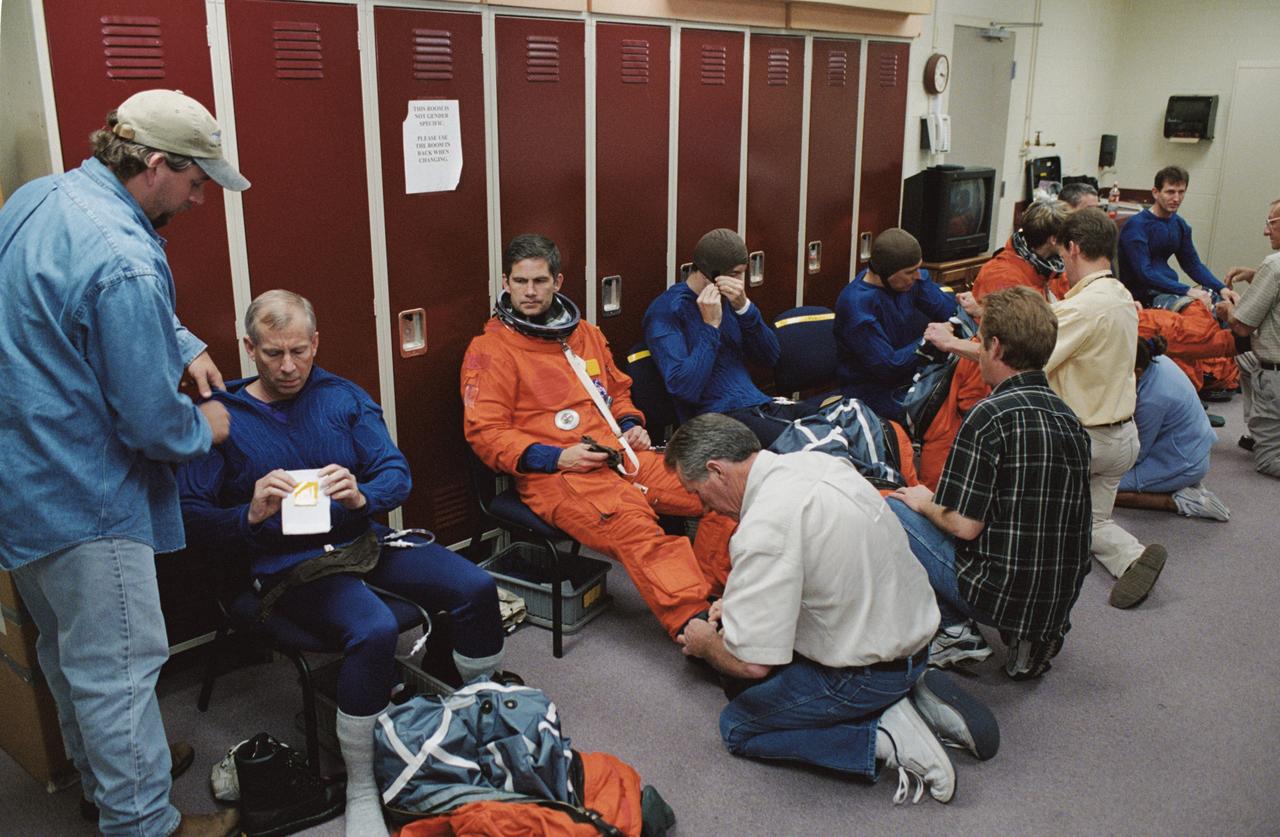
JSC2002-00724 (29 March 2002) --- The STS-111 crewmembers and the Expedition Five crewmembers don training versions of the shuttle launch and entry suit prior to a mission training session in one of the trainer/mockups (out of frame) in the Space Vehicle Mockup Facility at Johnson Space Center (JSC). Seated from the left, the STS-111 crewmembers are astronauts Kenneth D. Cockrell and Paul S. Lockhart, mission commander and pilot, respectively, Philippe Perrin and Franklin R. Chang-Diaz, both mission specialists; along with the Expedition Five crewmembers--astronaut Peggy A. Whitson, flight engineer, and cosmonauts Valeri G. Korzun and Sergei Y. Treschev, mission commander and flight engineer, respectively. Korzun and Treschev represent Rosaviakosmos and Perrin represents CNES, the French Space Agency.
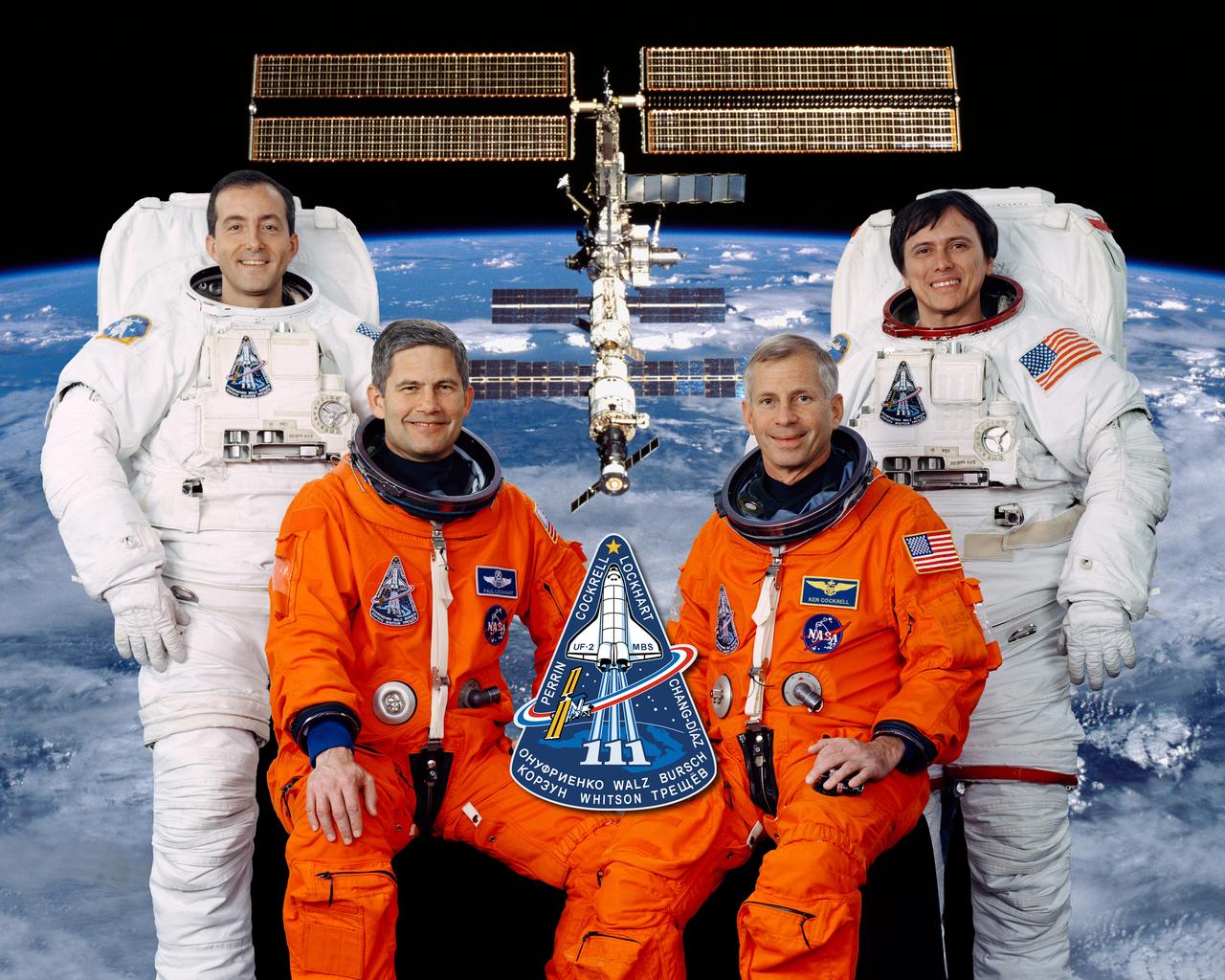
Launched aboard the Space Shuttle Endeavor on June 6, 2002, these four astronauts comprised the prime crew for NASA's STS-111 mission. Astronaut Kenneth D. Cockrell (front right) was mission commander, and astronaut Paul S. Lockhart (front left) was pilot. Astronauts Philippe Perrin (rear left), representing the French Space Agency, and Franklin R. Chang-Diaz were mission specialists assigned to extravehicular activity (EVA) work on the International Space Station (ISS). In addition to the delivery and installation of the Mobile Base System (MBS), this crew dropped off the Expedition Five crew members at the orbital outpost, and brought back the Expedition Four trio at mission's end.
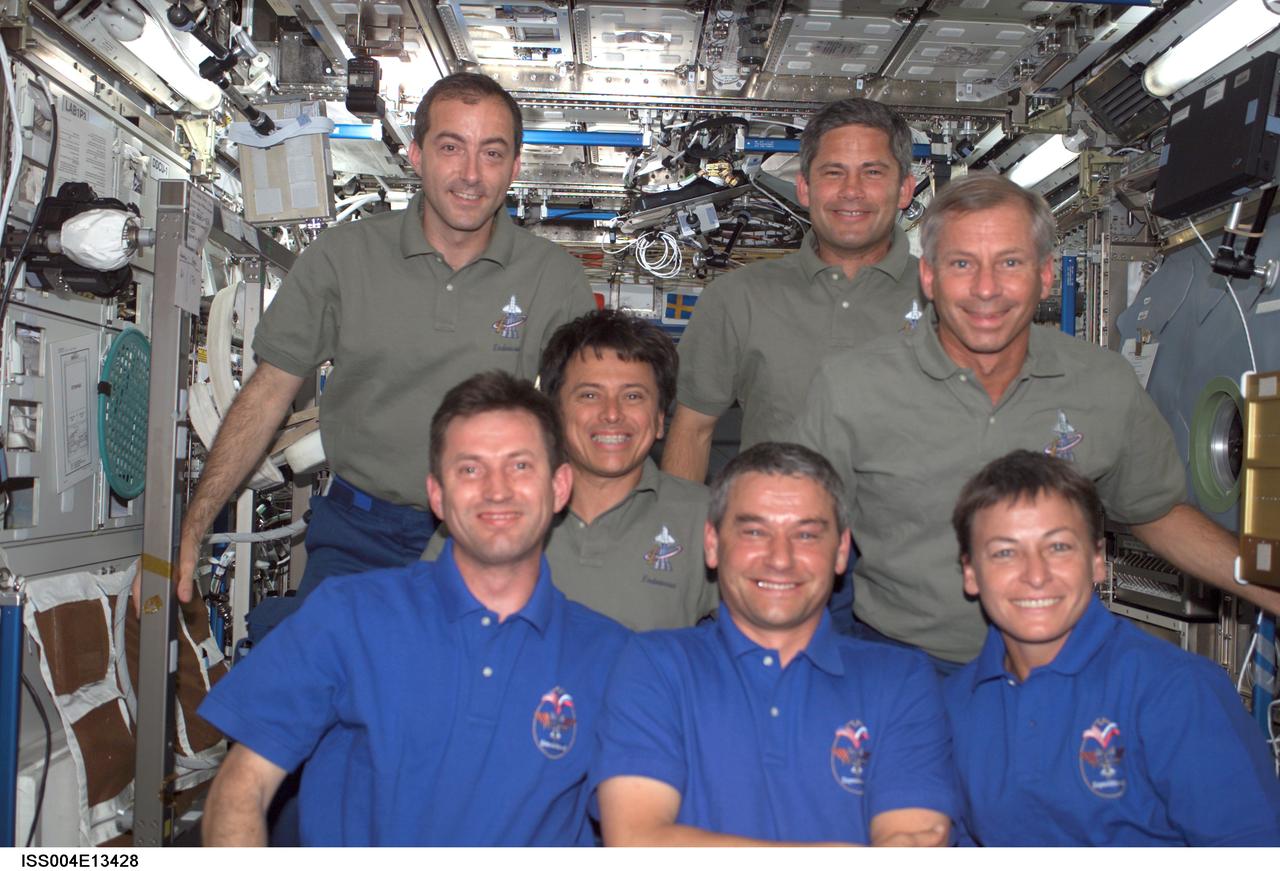
ISS004-E-13428 (June 2002) --- The Expedition Five (front row) and STS-111 crews assemble for a group photo in the Destiny laboratory on the International Space Station (ISS). The Expedition Five crewmembers, from left to right, are cosmonauts Sergei Y. Treschev, flight engineer; Valery G. Korzun, mission commander; and astronaut Peggy A. Whitson, flight engineer. The STS-111 crewmembers, from left to right, are astronauts Philippe Perrin and Franklin R. Chang-Diaz, both mission specialists; Paul S. Lockhart and Kenneth D. Cockrell, pilot and mission commander, respectively. Onufrienko, Korzun and Treschev represent Rosaviakosmos and Perrin represents CNES, the French Space Agency.
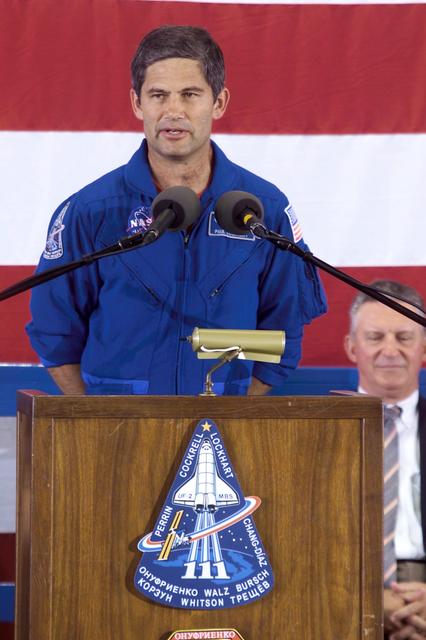
JSC2002-E-25980 (21 June 2002) --- Astronaut Paul S. Lockhart, STS-111 pilot, speaks to a large crowd who showed up at Ellington Field's Hangar 990 to welcome home the STS-111 and Expedition Four crew members. In background is JSC Director Jefferson D. Howell, Jr., seated immediately to the right of the lectern. The four shuttle prime crew members returned to Earth earlier in the week after two weeks in space, but for the three station crew members, this was their first time in Houston since December of 2001, having spent well over six months in Earth orbit on board the International Space Station (ISS).
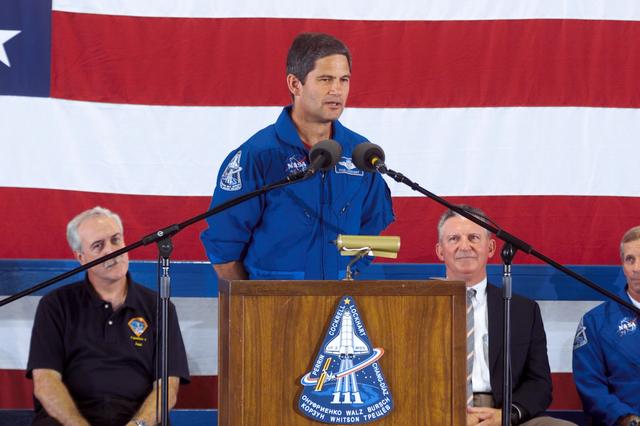
JSC2002-E-25979 (21 June 2002) --- Astronaut Paul S. Lockhart, STS-111 pilot, speaks to a large crowd who showed up at Ellington Field's Hangar 990 to welcome home the STS-111 and Expedition Four crew members. At left background is NASA Administrator Sean O'Keefe. JSC Director Jefferson D. Howell, Jr., is seated immediately to the right of the lectern. The four shuttle prime crew members returned to Earth earlier in the week after two weeks in space, but for the three station crew members, this was their first time in Houston since December of 2001, having spent well over six months in Earth orbit on board the International Space Station (ISS).
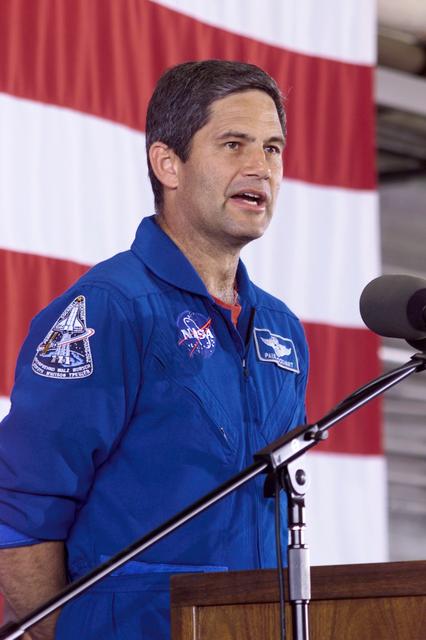
JSC2002-E-25978 (21 June 2002) --- Astronaut Paul S. Lockhart, STS-111 pilot, speaks to a large crowd who showed up at Ellington Field's Hangar 990 to welcome home the STS-111 and Expedition Four crew members. The four shuttle prime crew members returned to Earth earlier in the week after two weeks in space, but for the three station crew members, this was their first time in Houston since December of 2001, having spent well over six months in Earth orbit on board the International Space Station (ISS).
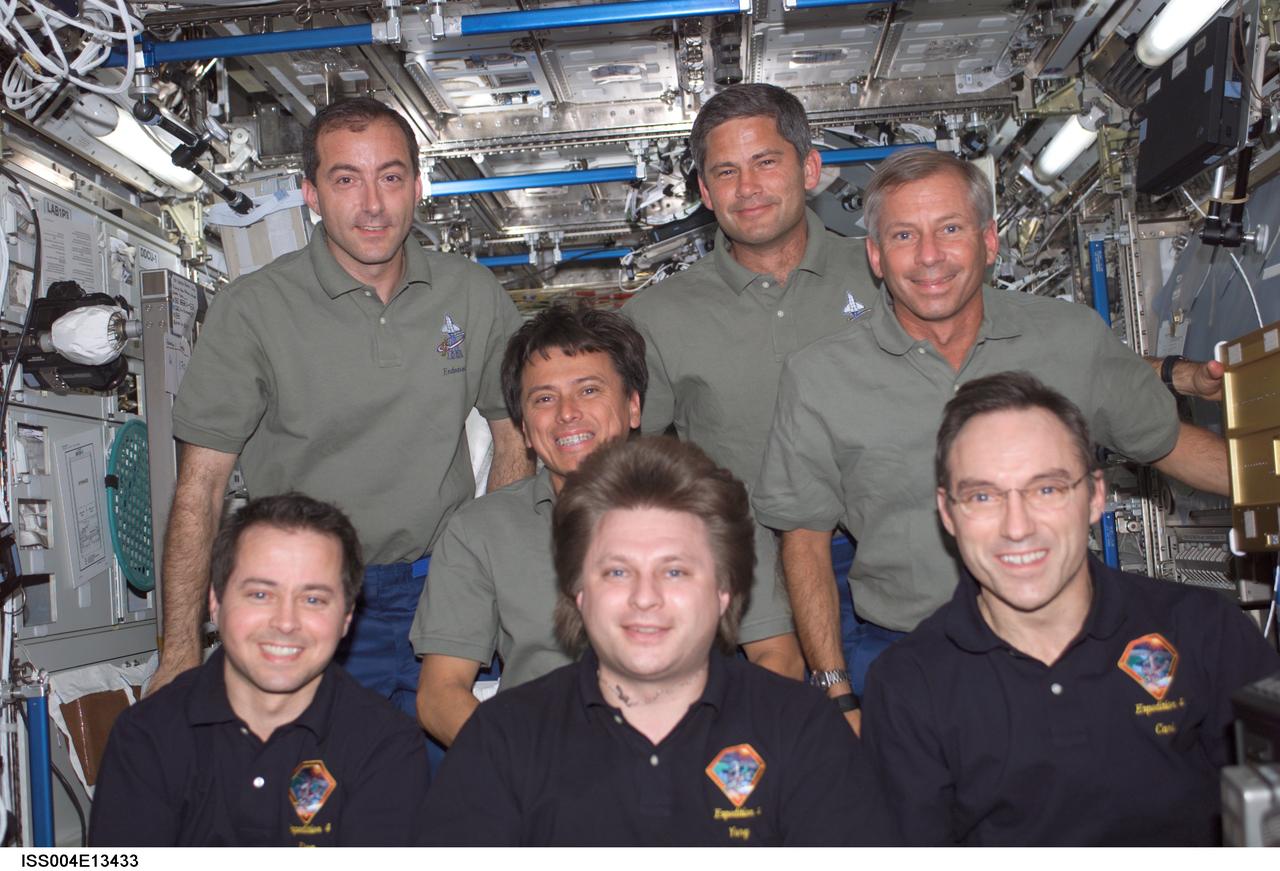
ISS004-E-13433 (June 2002) --- The Expedition Four (front row) and STS-111 crews assemble for a group photo in the Destiny laboratory on the International Space Station (ISS). The Expedition Four crewmembers, from left to right, are astronaut Daniel W. Bursch, flight engineer; cosmonaut Yury I. Onufrienko, mission commander; and astronaut Carl E. Walz, flight engineer. The STS-111 crewmembers, from left to right, are astronauts Philippe Perrin and Franklin R. Chang-Diaz, both mission specialists; Paul S. Lockhart and Kenneth D. Cockrell, pilot and mission commander, respectively. Onufrienko, Korzun and Treschev represent Rosaviakosmos and Perrin represents CNES, the French Space Agency.
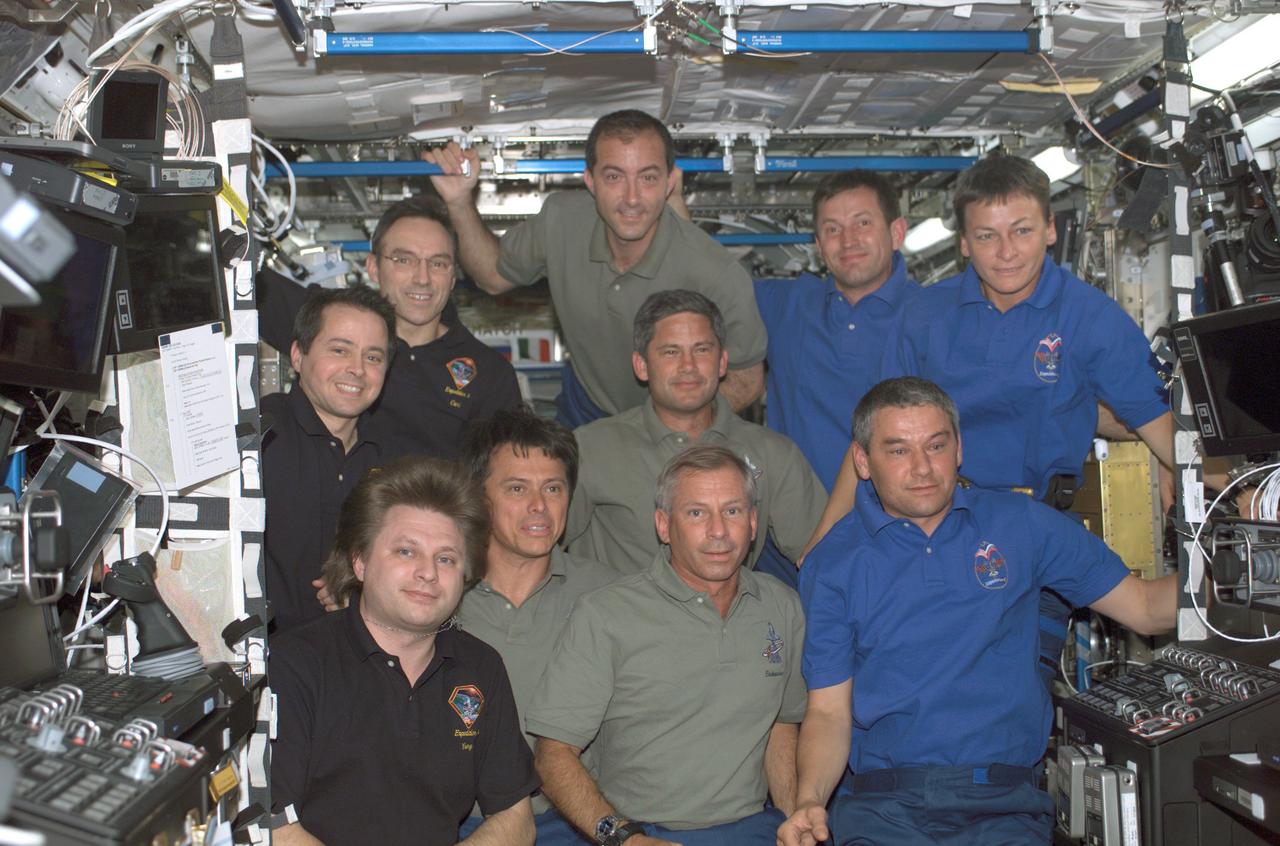
Huddled together in the Destiny laboratory of the International Space Station (ISS) are the Expedition Four crew (dark blue shirts), Expedition Five crew (medium blue shirts) and the STS-111 crew (green shirts). The Expedition Four crewmembers are, from front to back, Cosmonaut Ury I. Onufrienko, mission commander; and Astronauts Daniel W. Bursch and Carl E. Waltz, flight engineers. The ISS crewmembers are, from front to back, Astronauts Kerneth D. Cockrell, mission commander; Franklin R. Chang-Diaz, mission specialist; Paul S. Lockhart, pilot; and Philippe Perrin, mission specialist. Expedition Five crewmembers are, from front to back, Cosmonaut Valery G. Korzun, mission commander; Astronaut Peggy A. Whitson and Cosmonaut Sergei Y. Treschev, flight engineers. The ISS recieved a new crew, Expedition Five, replacing Expedition Four after a record-setting 196 days in space, when the Space Shuttle Orbiter Endeavour STS-111 mission visited in June 2002. Three spacewalks enabled the STS-111 crew to accomplish additional mission objectives: the delivery and installation of the Mobile Base System (MBS), which is an important part of the station's Mobile Servicing System allowing the robotic arm to travel the length of the station; the replacement of a wrist roll joint on the Station's robotic arm; and unloading supplies and science experiments from the Leonardo Multi-Purpose Logistics Module, which made its third trip to the orbital outpost. The STS-111 mission, the 14th Shuttle mission to visit the ISS, was launched on June 5, 2002 and landed June 19, 2002.
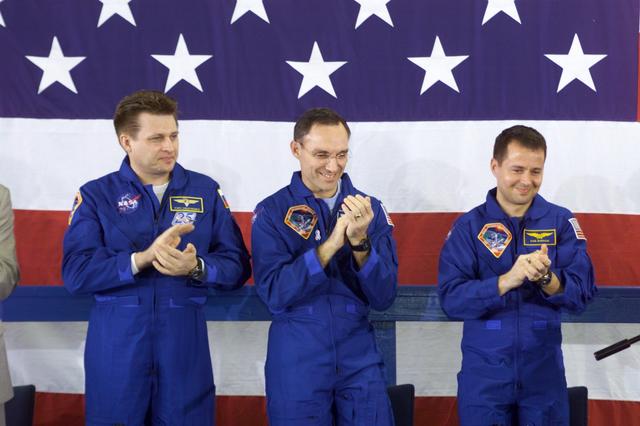
JSC2002-E-26028 (21 June 2002) --- The Expedition Four crewmembers are photographed during the STS-111 and Expedition Four crew return ceremonies in Hangar 990 at Ellington Field. From the left are cosmonaut Yury I. Onufrienko, mission commander representing Rosaviakosmos, astronauts Carl E. Walz and Daniel W. Bursch, both flight engineers.
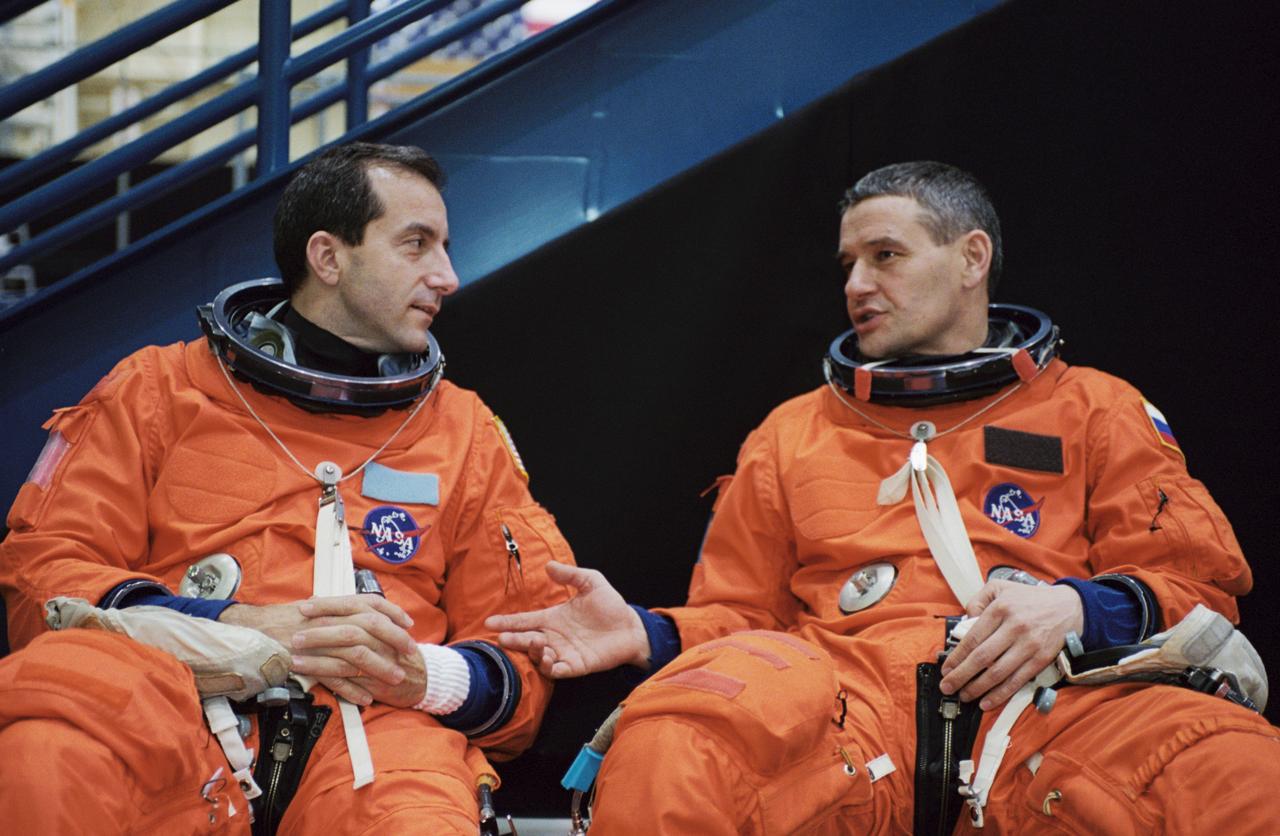
JSC2002-00721 (29 March 2002) --- Astronaut Philippe Perrin (left) and cosmonaut Valeri G. Korzun, STS-111 mission specialist and Expedition Five mission commander, respectively, attired in training versions of the shuttle launch and entry suit, await a mission training session in the Space Vehicle Mockup Facility at the Johnson Space Center (JSC). Perrin represents CNES, the French Space Agency, and Korzun represents Rosaviakosmos.
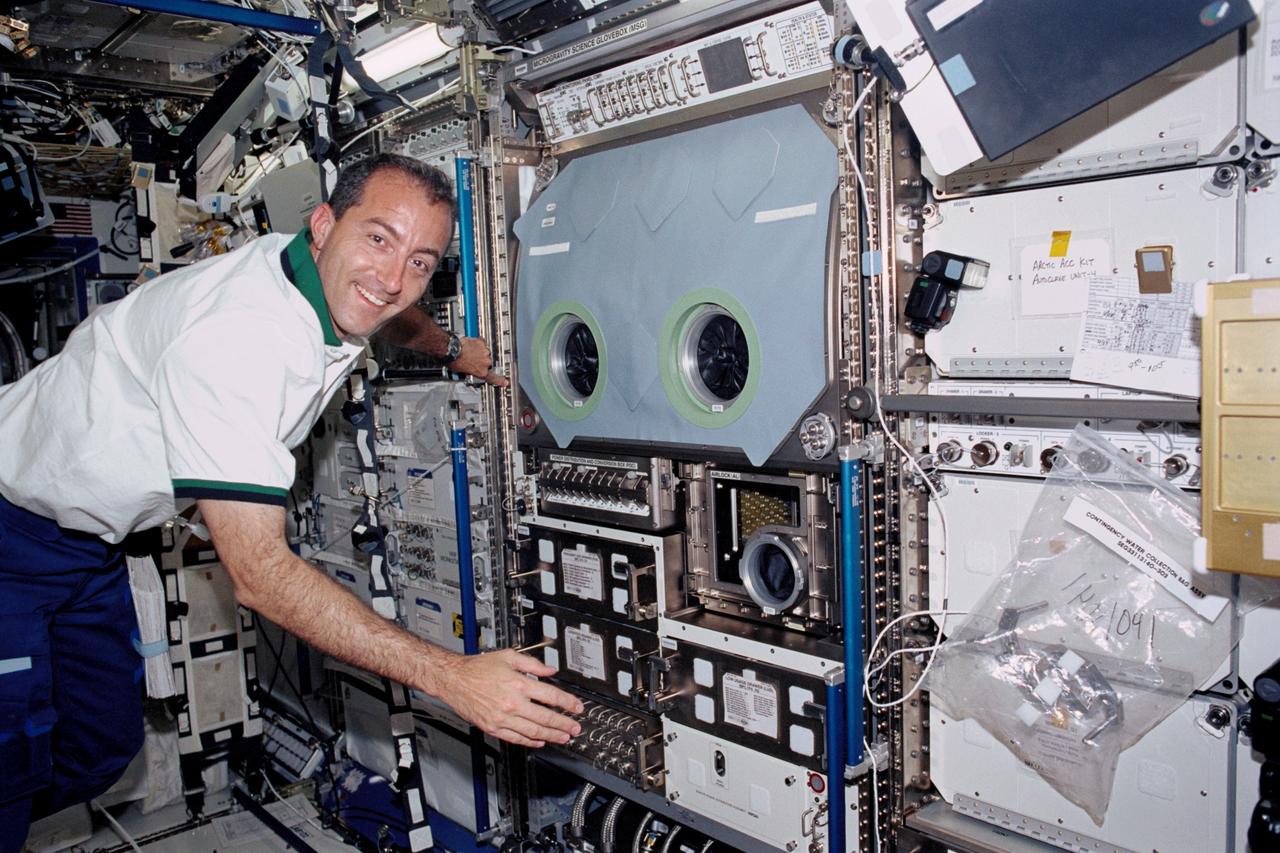
STS111-318-017 (5-19 June 2002) --- Astronaut Philippe Perrin, STS-111 mission specialist, floats near the Microgravity Science Glovebox (MSG) in the Destiny laboratory on the International Space Station (ISS). Perrin represents CNES, the French Space Agency.
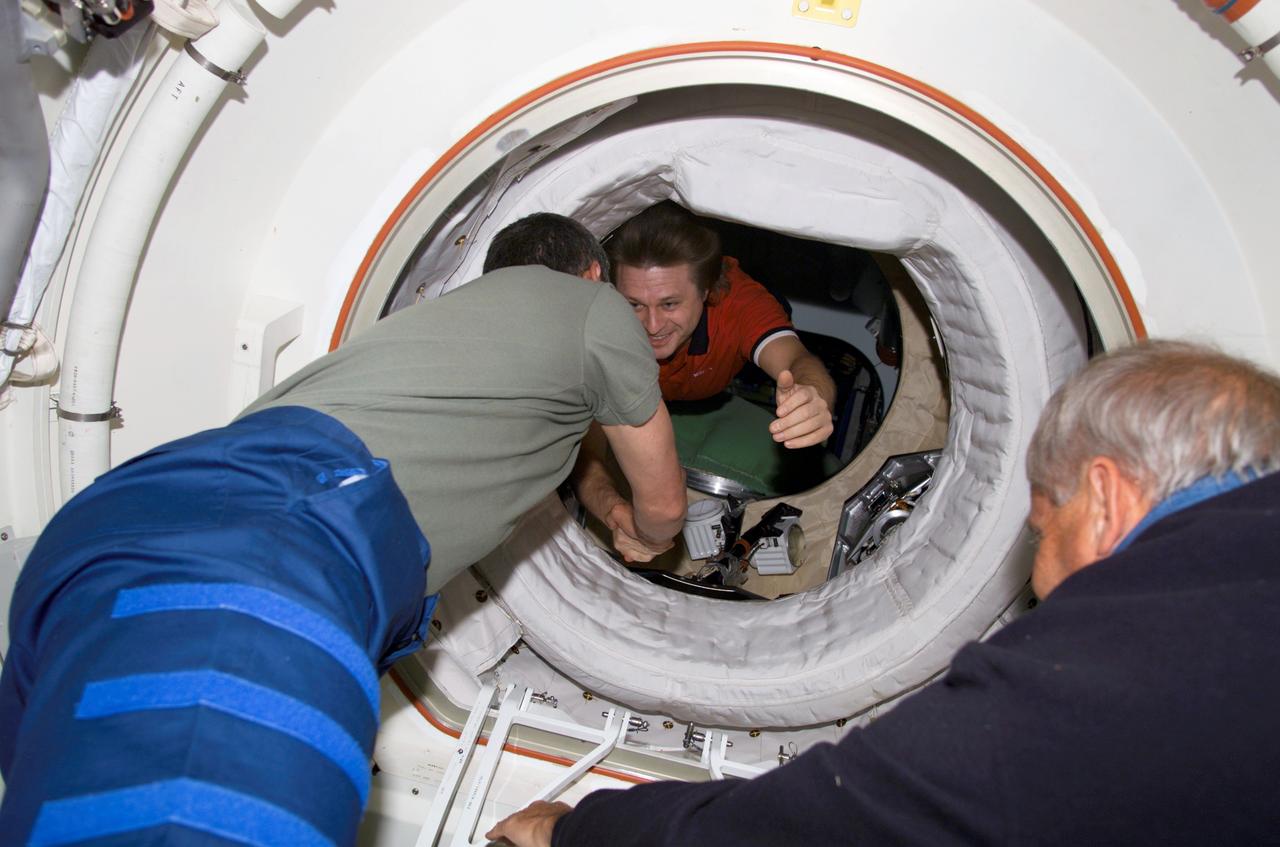
STS111-E-5095 (7 June 2002) --- Cosmonaut Yury I. Onufrienko, Expedition Four mission commander, greets cosmonaut Valery G. Korzun (back to camera), Expedition Five mission commander, when the hatch to the Pressurized Mating Adapter 2 (PMA-2) on the International Space Station (ISS) was opened for the STS-111 ingress. Astronaut Kenneth D. Cockrell, STS-111 mission commander, is partially visible on the right of Korzun. Onufrienko and Korzun represent Rosaviakosmos.
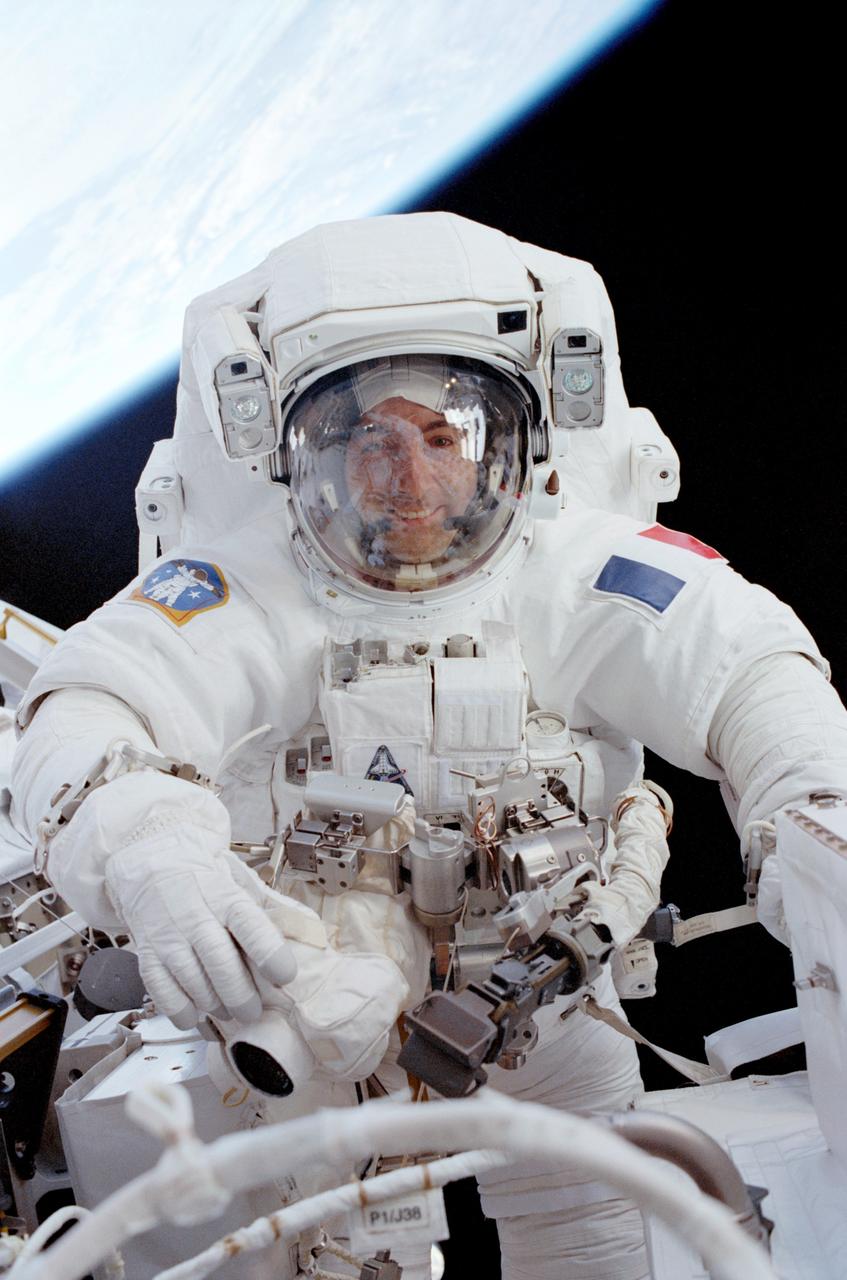
STS111-307-017 (11 June 2002) --- Astronaut Philippe Perrin, STS-111 mission specialist representing CNES, the French Space Agency, participates in the second scheduled session of extravehicular activity (EVA) for the STS-111 mission. During the spacewalk, Perrin and Chang-Diaz attached power, data and video cables from the International Space Station (ISS) to the Mobile Base System (MBS) and used a power wrench to complete the attachment of the MBS onto the Mobile Transporter (MT).
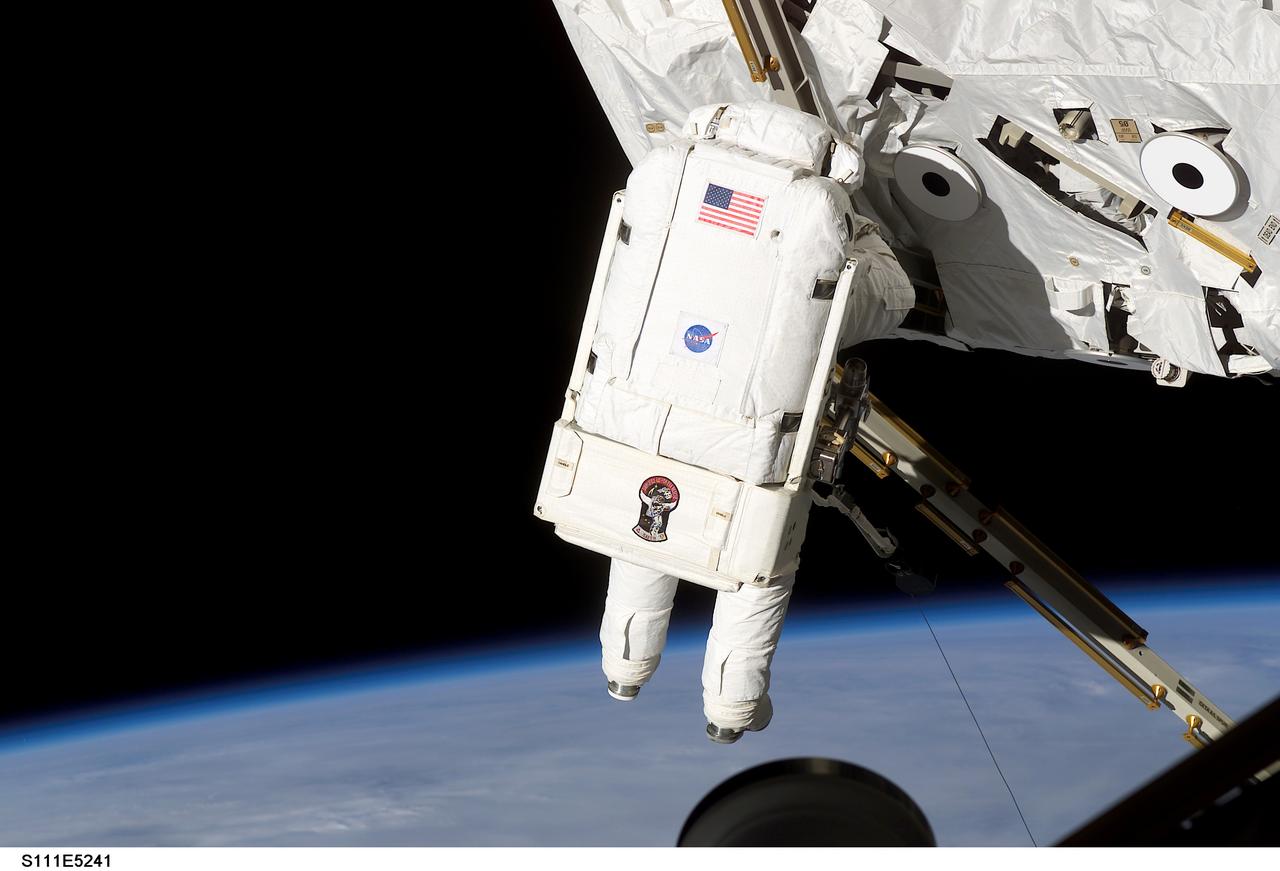
STS111-E-5241 (11 June 2002) --- Astronaut Philippe Perrin, STS-111 mission specialist, photographed near the S0 (S-Zero) Truss on the International Space Station (ISS), participates in the second scheduled session of extravehicular activity (EVA) for the STS-111 mission. During the 5-hour spacewalk, Perrin and Chang-Diaz completed installation of the Mobile Remote Servicer Base System (MBS) on the station’s railcar, the Mobile Transporter. Perrin represents CNES, the French Space Agency.
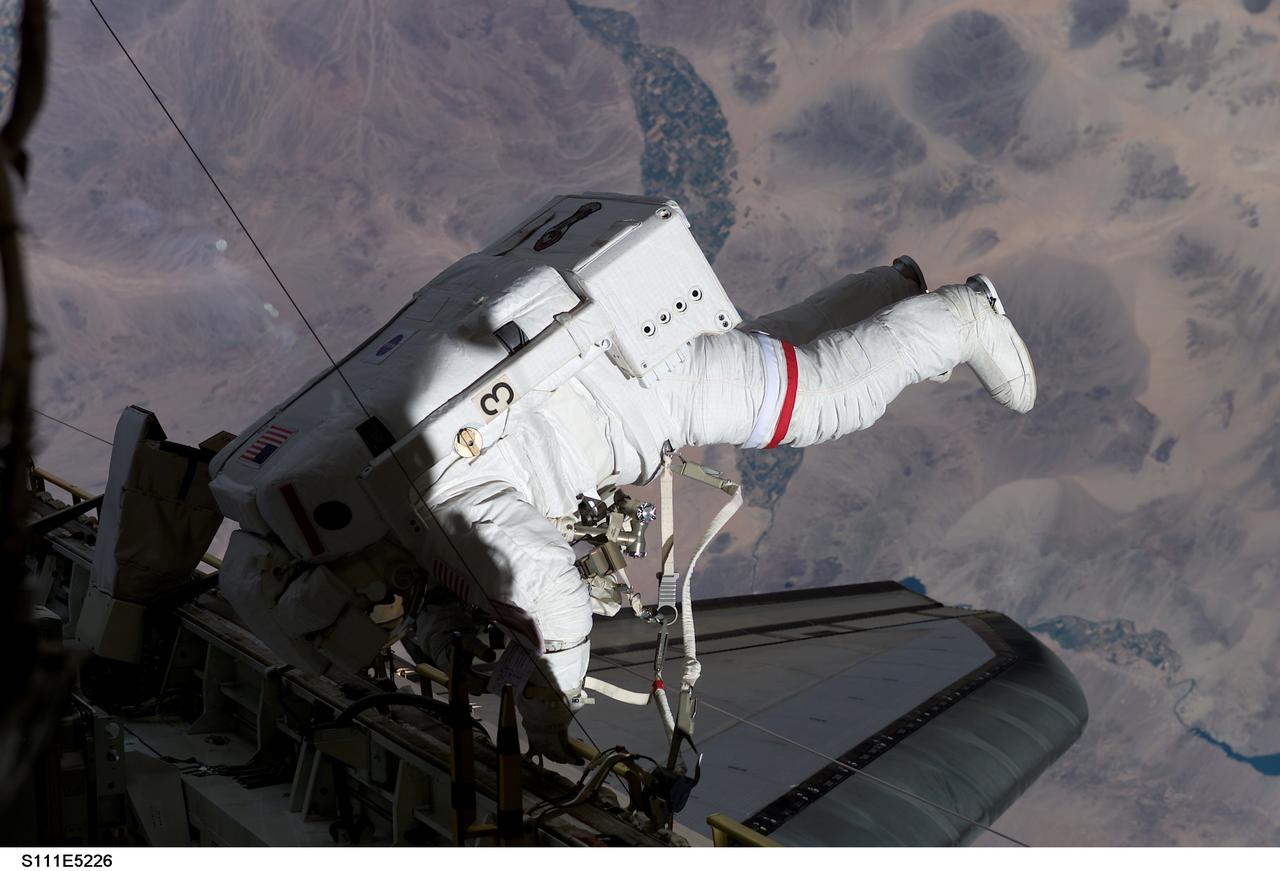
STS111-E-5226 (11 June 2002) --- Astronaut Franklin R. Chang-Diaz, STS-111 mission specialist, participates in the second scheduled session of extravehicular activity (EVA) for the STS-111 mission. During the 5-hour spacewalk, Chang-Diaz and Perrin completed installation of the Mobile Remote Servicer Base System (MBS) on the International Space Station’s (ISS) railcar, the Mobile Transporter.
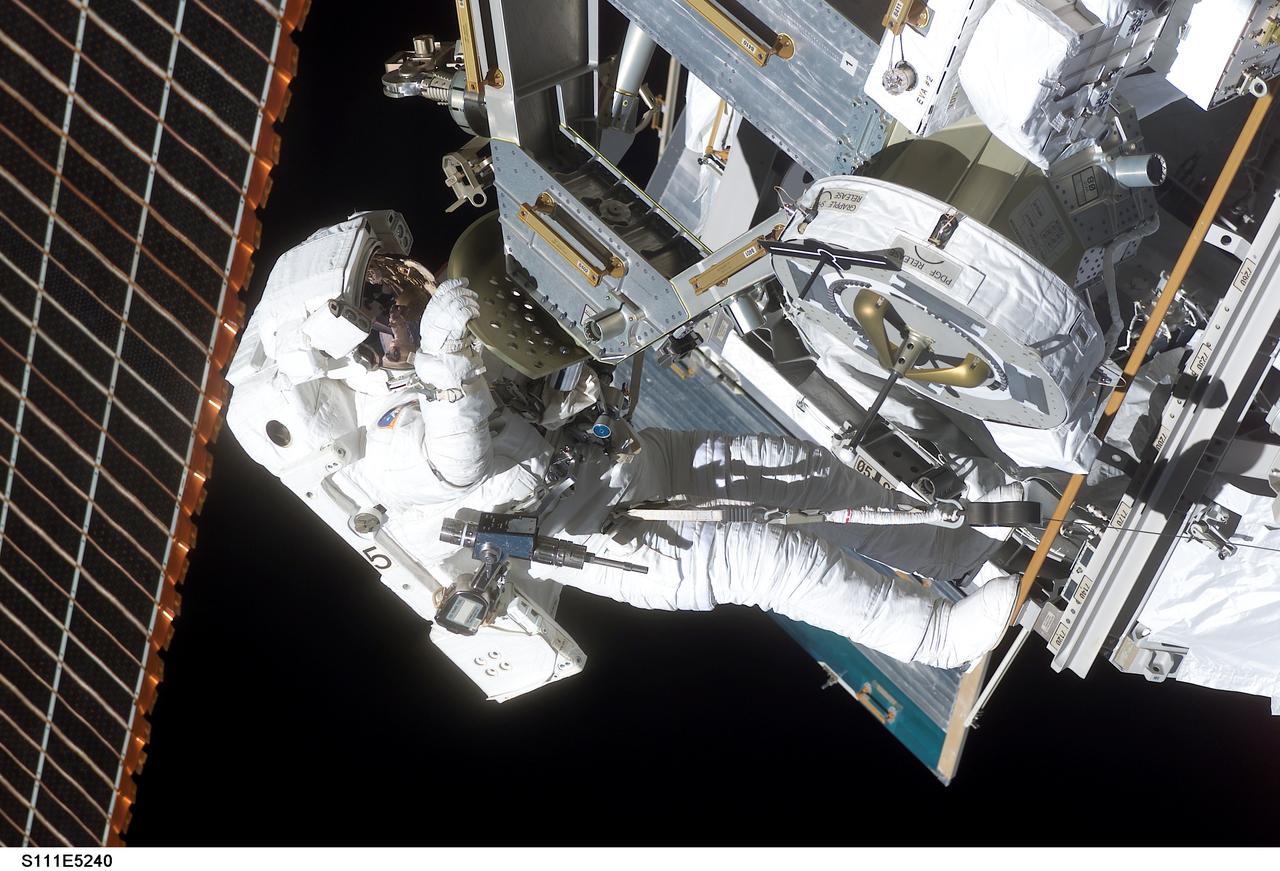
STS111-E-5240 (11 June 2002) --- Astronaut Philippe Perrin, STS-111 mission specialist, works on the installation of the Mobile Remote Servicer Base System (MBS) on the International Space Station’s (ISS) railcar, the Mobile Transporter, during the second scheduled session of extravehicular activity (EVA) for the STS-111 mission. Perrin represents CNES, the French Space Agency.
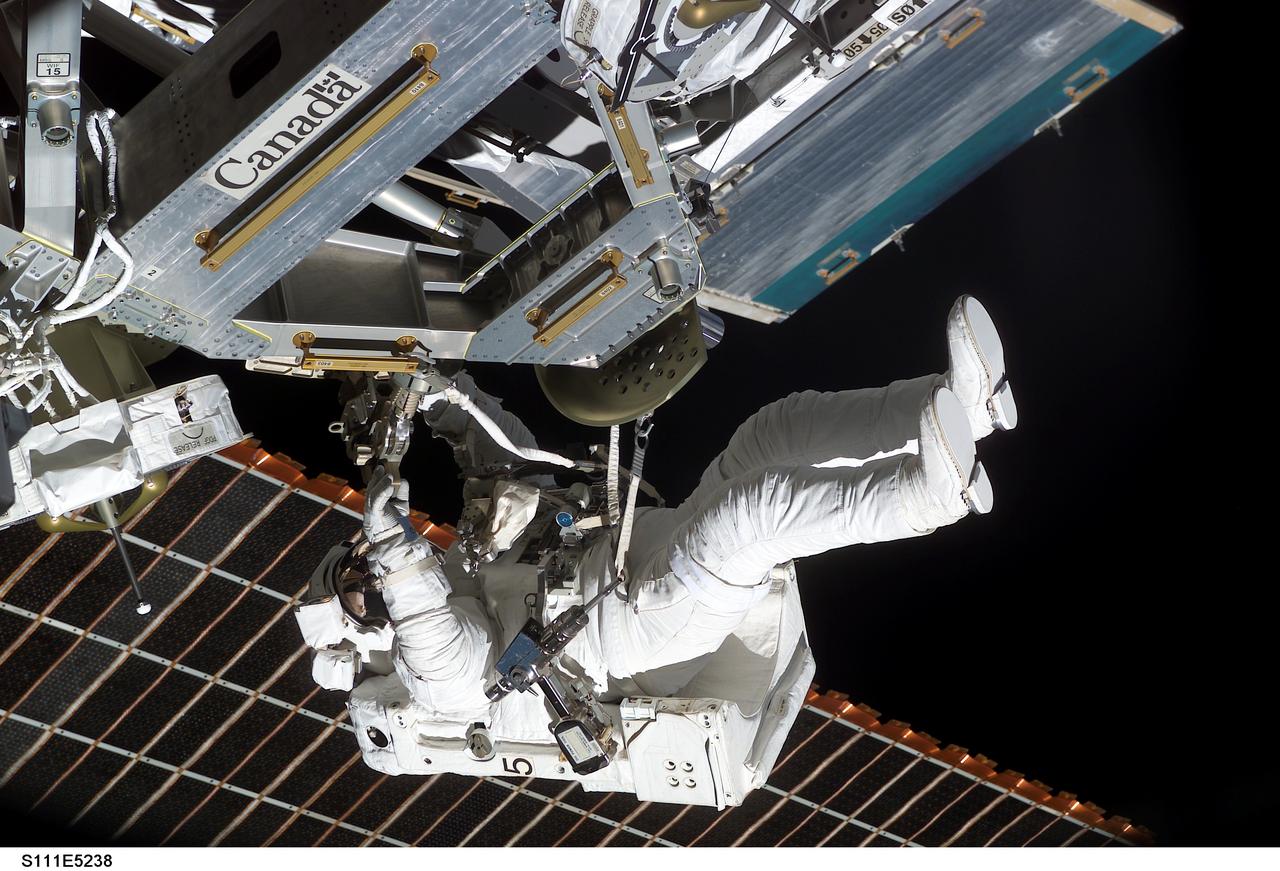
STS111-E-5238 (11 June 2002) --- Astronaut Philippe Perrin, STS-111 mission specialist, works on the installation of the Mobile Remote Servicer Base System (MBS) on the International Space Station’s (ISS) railcar, the Mobile Transporter, during the second scheduled session of extravehicular activity (EVA) for the STS-111 mission. Perrin represents CNES, the French Space Agency.
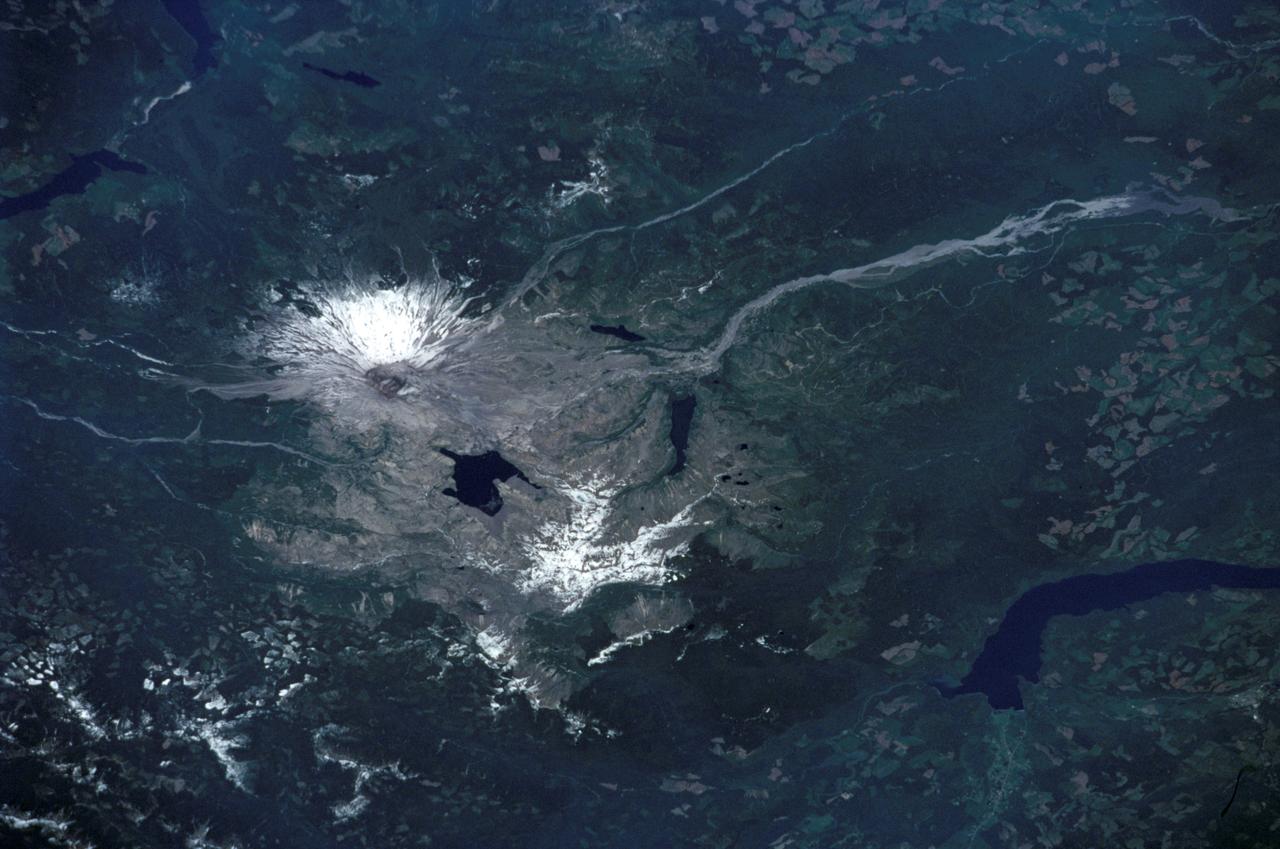
STS111-371-003 (5-19 June 2002) --- This photo, showing Mt. St. Helens in the state of Washington, was taken by the STS-111 crewmembers aboard the Space Shuttle Endeavour. The scars from the May 18, 1980 eruption are still visible near Mt. St. Helens. Before the 1980 eruption the volcano had been dormant since 1857. The Gateway to Astronaut Photography of Earth (link to http://eol.jsc.nasa.gov/sseop/) provides searchable access to other photographs of Earth taken by astronauts.
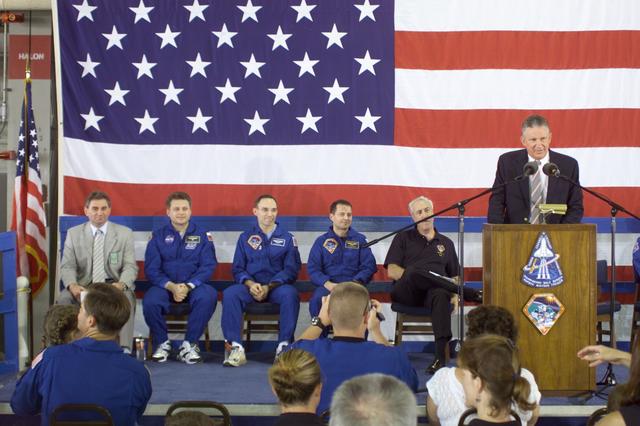
JSC2002-E-26023 (21 June 2002) --- Johnson Space Center’s (JSC) Director Jefferson Davis Howell, Jr. speaks from the lectern in Hangar 990 at Ellington Field during the STS-111 and Expedition Four crew return ceremonies. Seated (from left) are General Vasily Tsiblyiev, Deputy Director of the Gagarin Cosmonaut Training Center; cosmonaut Yury I. Onufrienko, Expedition Four mission commander; astronauts Carl E. Walz and Daniel W. Bursch, both Expedition Four flight engineers; and NASA Administrator Sean O'Keefe. Tsiblyiev and Onufrienko represent Rosaviakosmos.
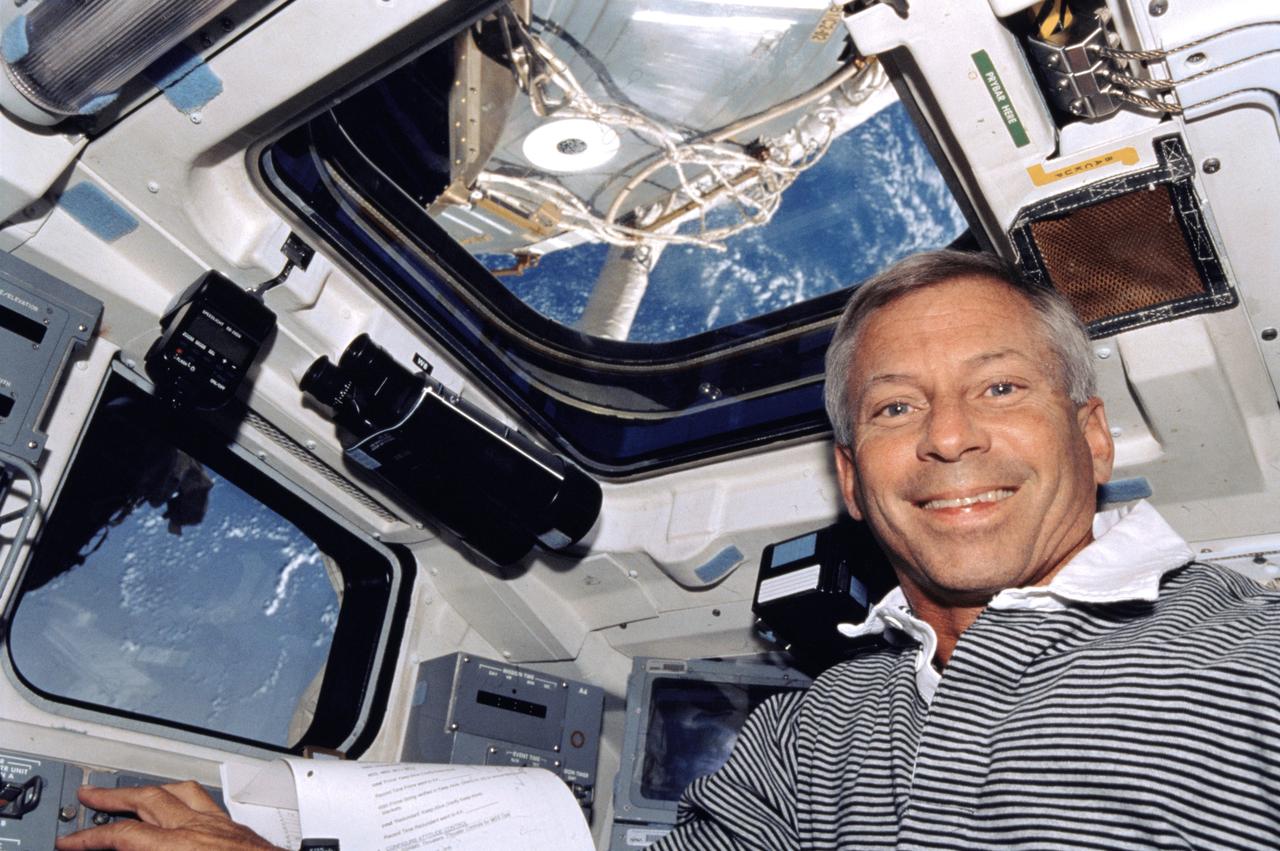
ISS004-327-017 (5-19 June 2002) --- Astronaut Kenneth D. Cockrell, STS-111 mission commander, is photographed on the aft flight deck of the Space Shuttle Endeavour while docked with the International Space Station (ISS).
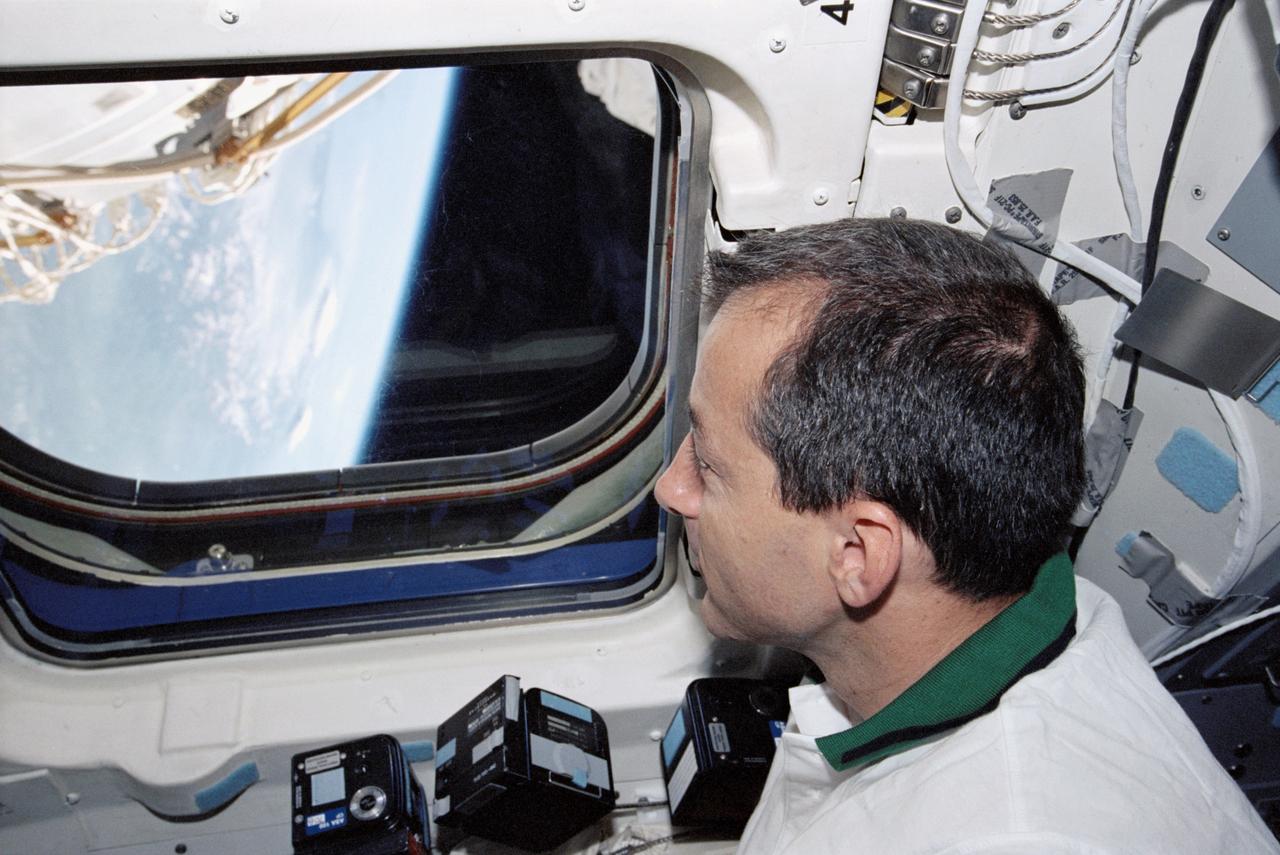
STS111-318-030 (5-19 June 2002) --- Astronaut Philippe Perrin, STS-111 mission specialist representing CNES, the French Space Agency, looks out an aft flight deck window of the Space Shuttle Endeavour.

ISS004-329-024 (5-19 June 2002) --- Astronaut Franklin R. Chang-Diaz, STS-111 mission specialist, is photographed in the Unity node on the International Space Station (ISS) during the transfer of supplies and equipment.
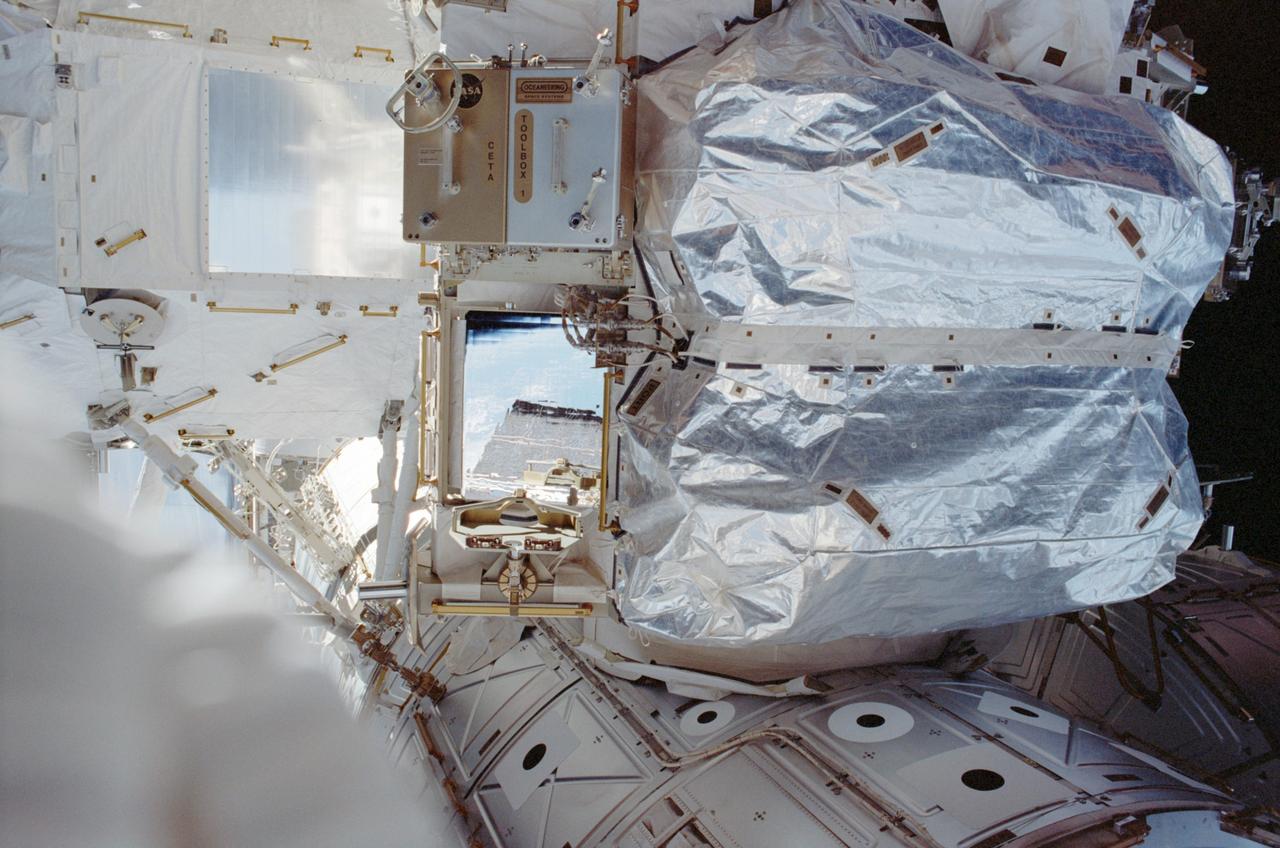
STS111-310-022 (9 June 2002) --- Medium shot of Z Truss Control Moment Gyroscope (CMG) on the International Space Station as photographed during STS-111 spacewalk.
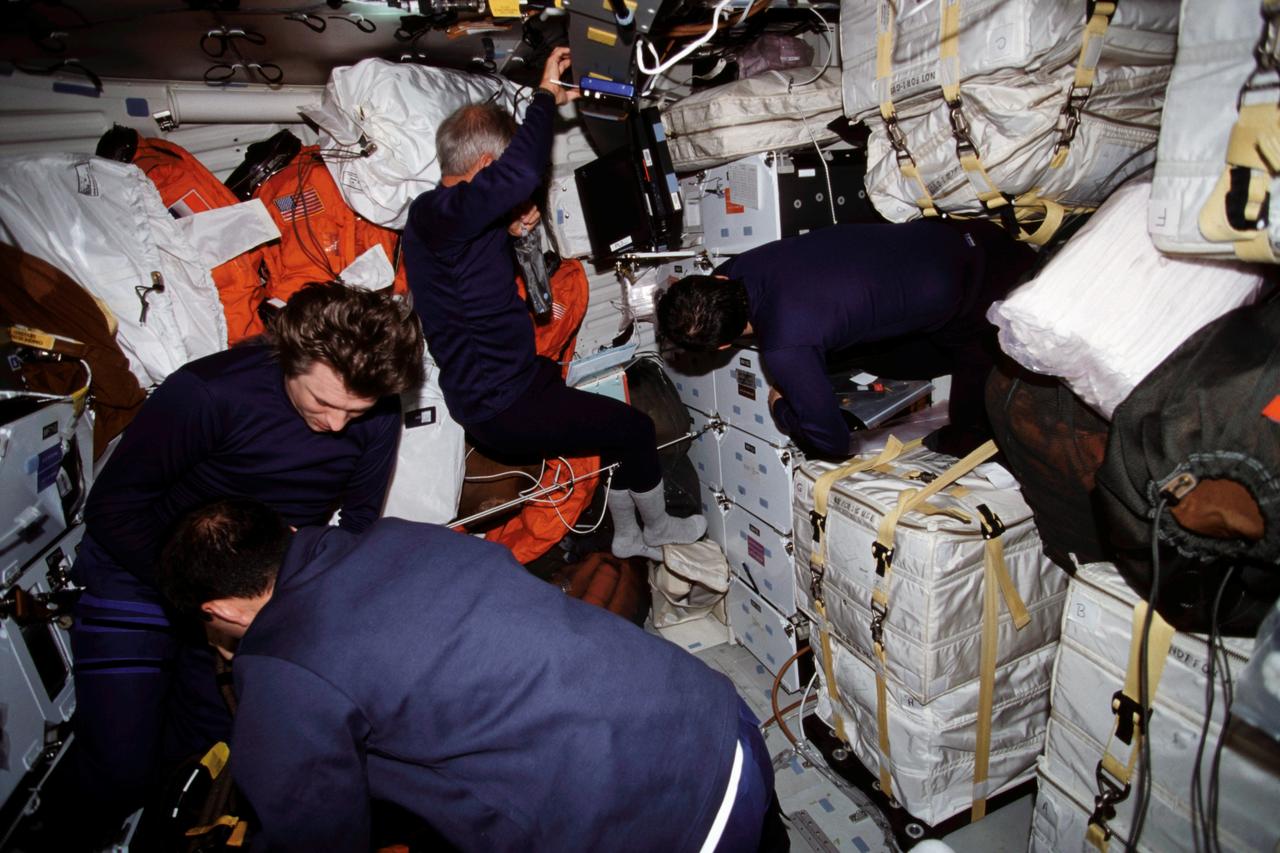
STS111-380-026 (5-19 June 2002) --- Astronauts Philippe Perrin (foreground), STS-111 mission specialist; cosmonaut Yury I. Onufrienko, Expedition Four mission commander; astronaut Kenneth D. Cockrell, STS-111 mission commander; and astronaut Daniel W. Bursch, Expedition Four flight engineer, work in close quarters on the middeck of the Space Shuttle Endeavour. The limited space is a temporary issue, solvable once the supplies are moved onto the International Space Station (ISS). Perrin represents CNES, the French Space Agency, and Onufrienko represents Rosaviakosmos.
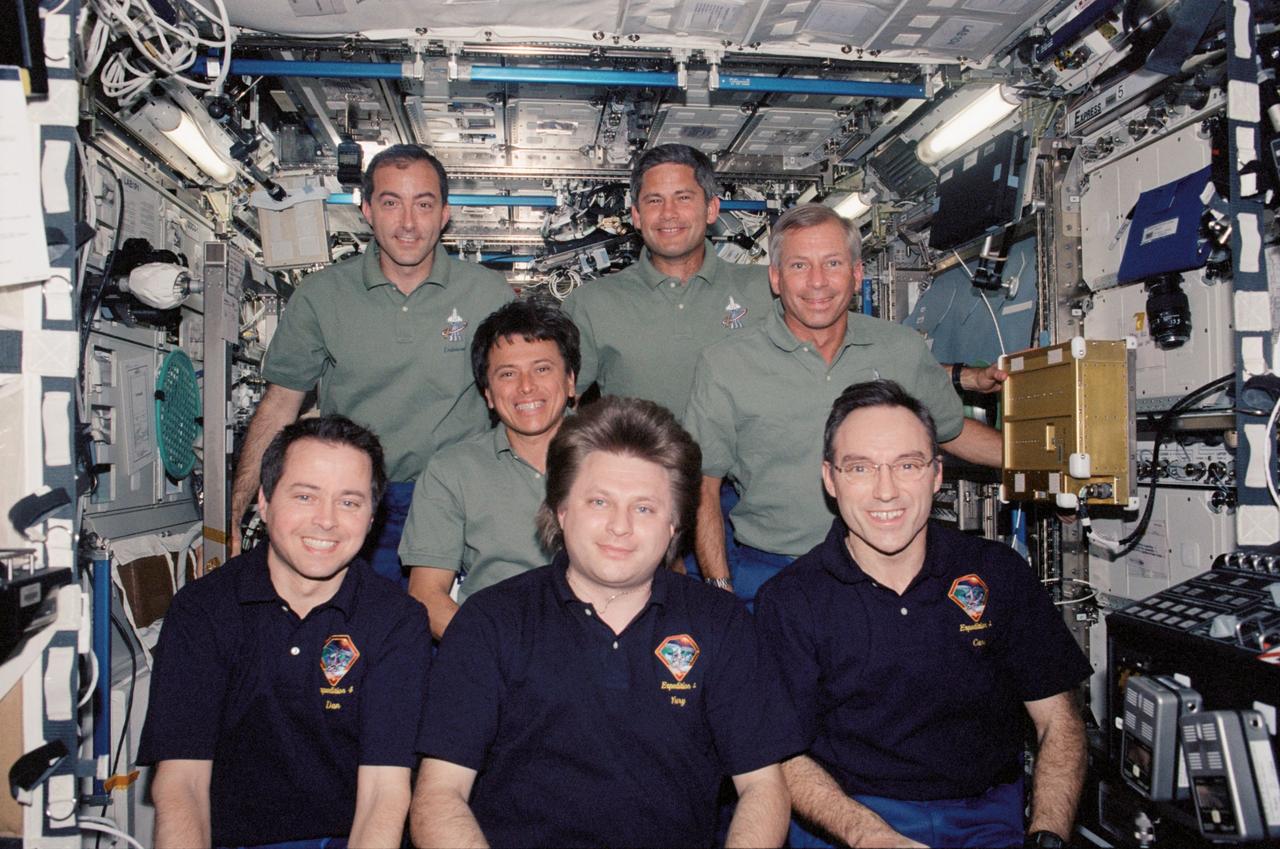
STS111-320-015 (5-19 June 2002) --- The STS-111 (back row) and Expedition Four crewmembers gather for a group photo in the Destiny laboratory on the International Space Station (ISS). The STS-111 crewmembers, from the left, are astronauts Philippe Perrin and Franklin R. Chang-Diaz, both mission specialists; Paul S. Lockhart and Kenneth D. Cockrell, pilot and mission commander, respectively. The Expedition Four crewmembers, from the left, are astronaut Daniel W. Bursch, flight engineer; cosmonaut Yury I. Onufrienko, mission commander; and astronaut Carl E. Walz, flight engineer. Onufrienko represents Rosaviakosmos and Perrin represents CNES, the French Space Agency.
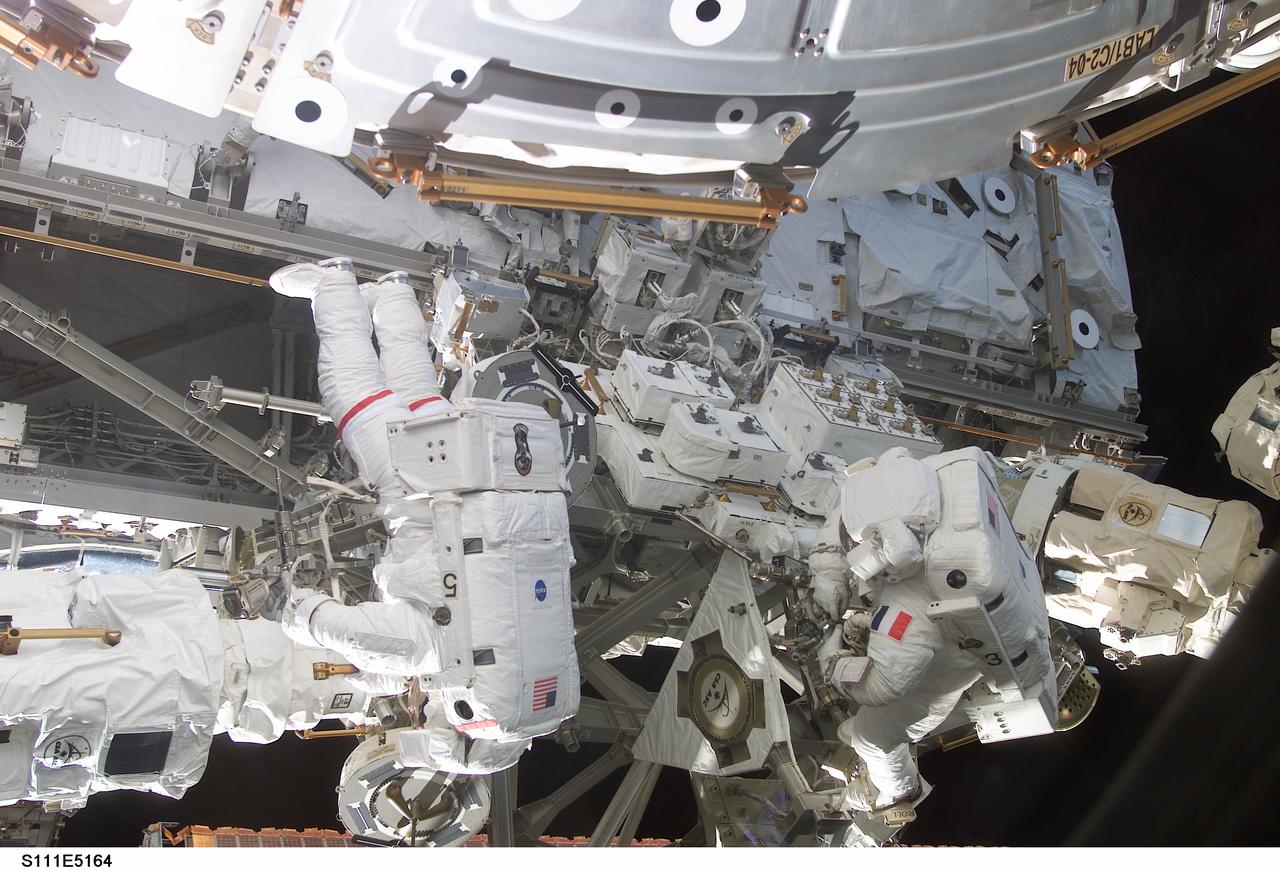
STS111-E-5164 (11 June 2002) --- Astronauts Franklin R. Chang-Diaz (left) and Philippe Perrin, both STS-111 mission specialists, work in tandem on the second scheduled session of extravehicular activity (EVA) for the STS-111 mission. During the spacewalk, Chang-Diaz and Perrin attached power, data and video cables from the International Space Station (ISS) to the Mobile Base System (MBS) and used a power wrench to complete the attachment of the MBS onto the Mobile Transporter (MT). Perrin represents CNES, the French Space Agency.
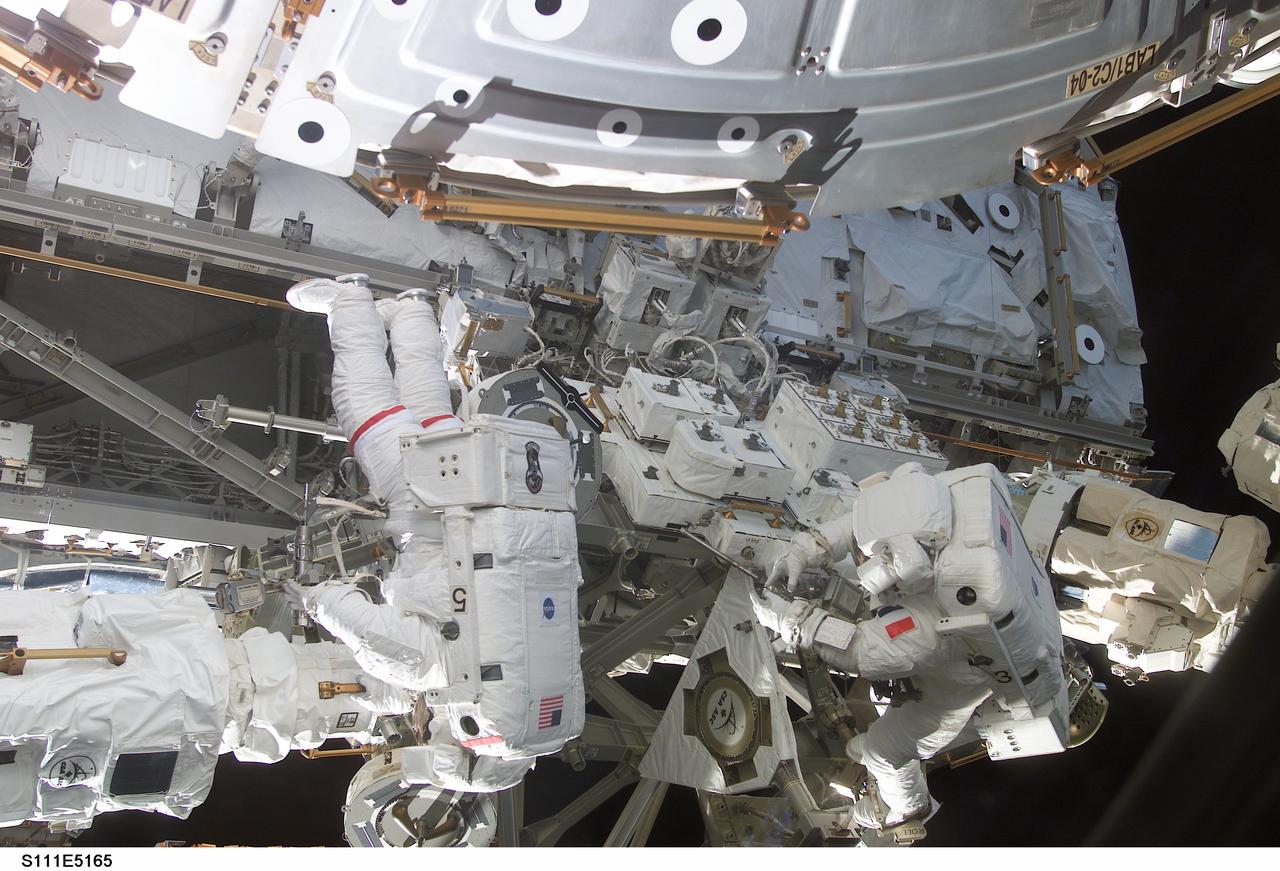
STS111-E-5165 (11 June 2002) --- Astronauts Franklin R. Chang-Diaz (left) and Philippe Perrin, both STS-111 mission specialists, work in tandem on the second scheduled session of extravehicular activity (EVA) for the STS-111 mission. During the spacewalk, Chang-Diaz and Perrin attached power, data and video cables from the International Space Station (ISS) to the Mobile Base System (MBS) and used a power wrench to complete the attachment of the MBS onto the Mobile Transporter (MT). Perrin represents CNES, the French Space Agency.
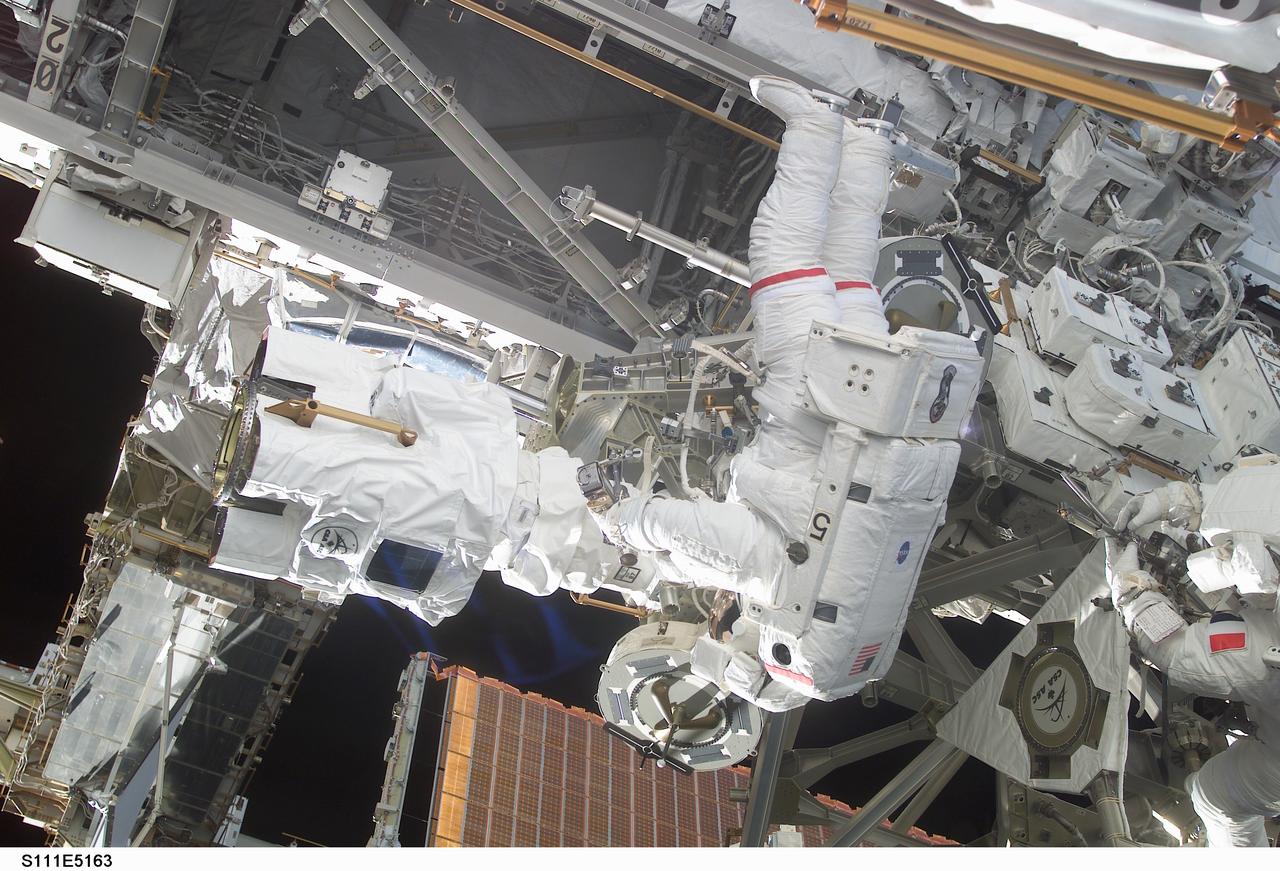
STS111-E-5163 (11 June 2002) --- Astronauts Franklin R. Chang-Diaz (center frame) and Philippe Perrin (partially obscured), both STS-111 mission specialists, work in tandem on the second scheduled session of extravehicular activity (EVA) for the STS-111 mission. During the spacewalk, Chang-Diaz and Perrin attached power, data and video cables from the International Space Station (ISS) to the Mobile Base System (MBS) and used a power wrench to complete the attachment of the MBS onto the Mobile Transporter (MT). Perrin represents CNES, the French Space Agency.
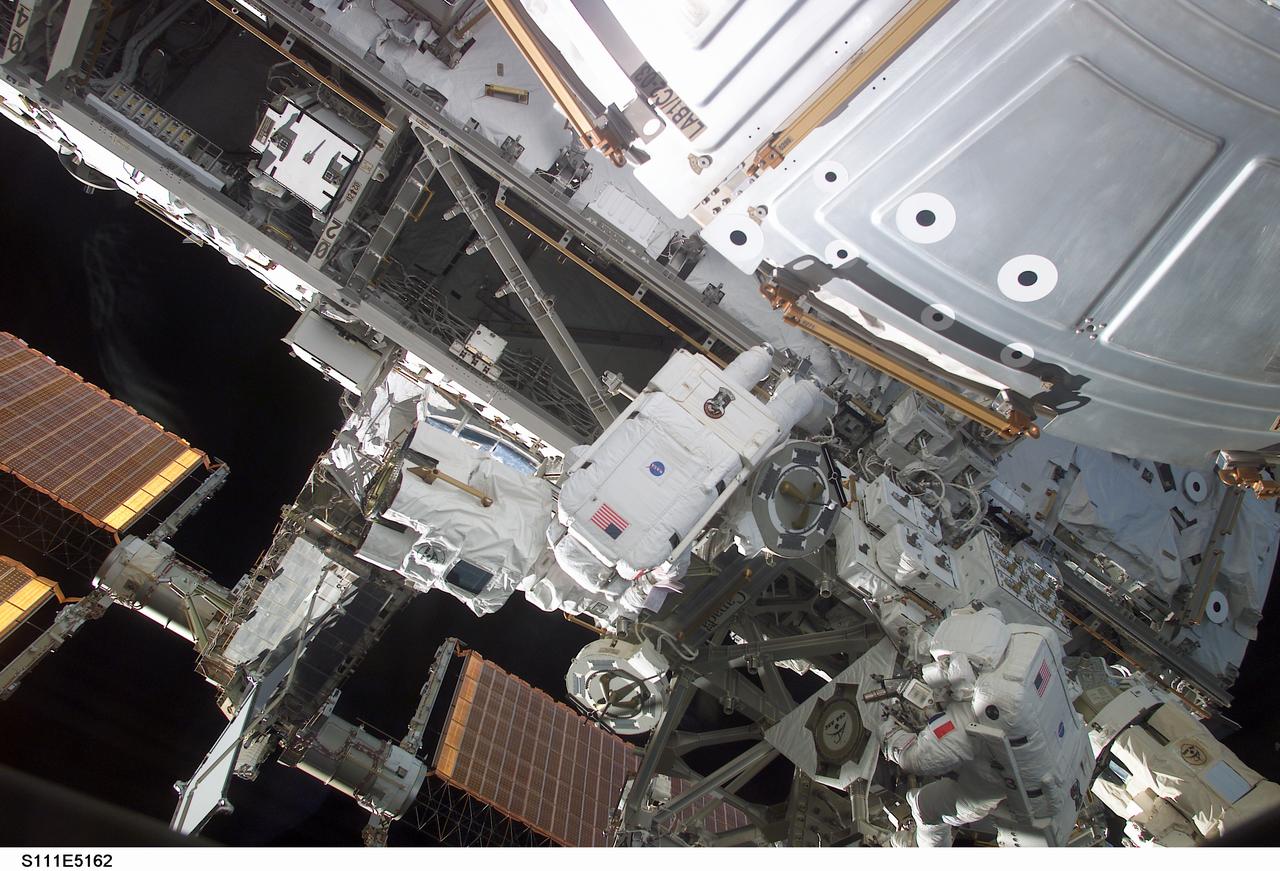
STS111-E-5162 (11 June 2002) --- Astronauts Franklin R. Chang-Diaz (center frame) and Philippe Perrin, both STS-111 mission specialists, work in tandem on the second scheduled session of extravehicular activity (EVA) for the STS-111 mission. During the spacewalk, Chang-Diaz and Perrin attached power, data and video cables from the International Space Station (ISS) to the Mobile Base System (MBS) and used a power wrench to complete the attachment of the MBS onto the Mobile Transporter (MT). Perrin represents CNES, the French Space Agency.
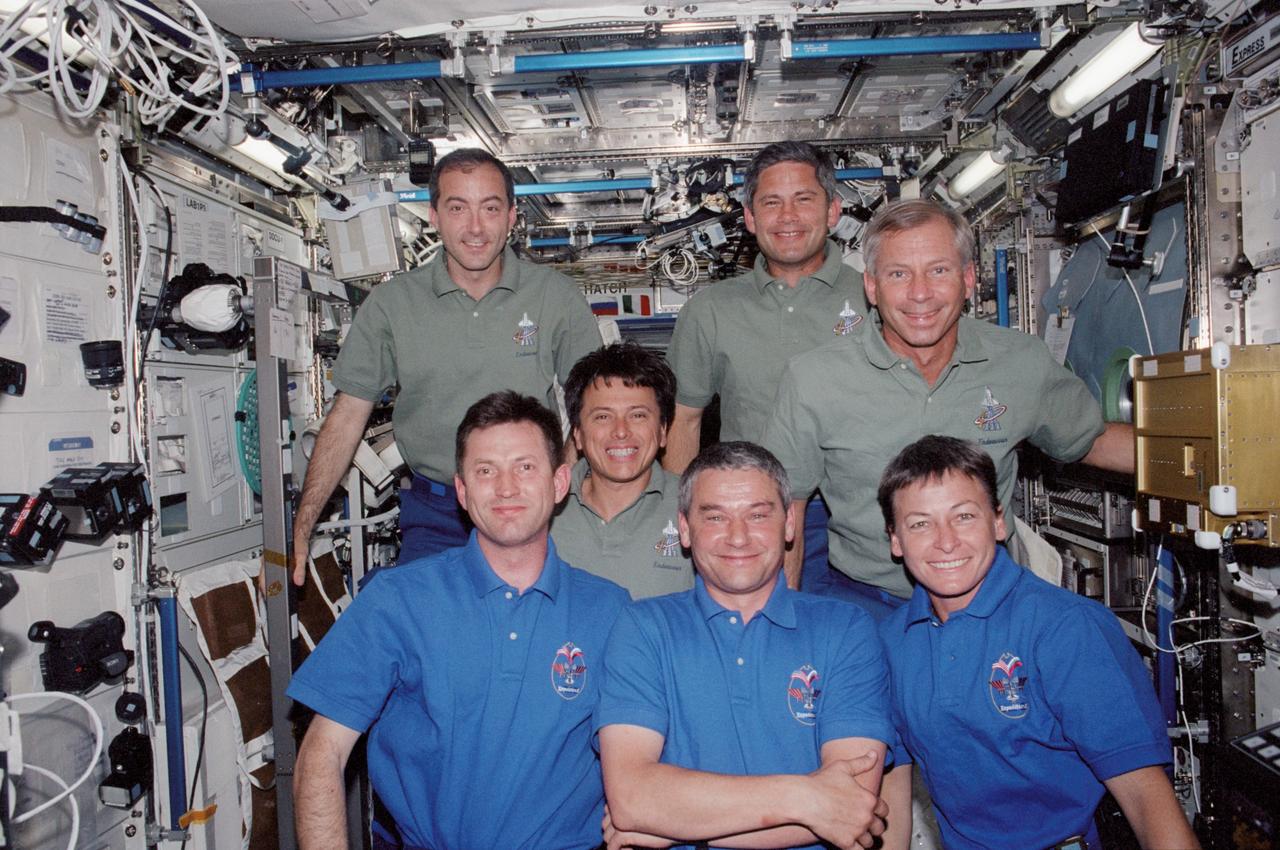
STS111-320-008 (5-19 June 2002) --- The STS-111 (back row) and Expedition Five crewmembers gather for a group photo in the Destiny laboratory on the International Space Station (ISS). The STS-111 crewmembers, from the left, are astronauts Philippe Perrin and Franklin R. Chang-Diaz, both mission specialists; Paul S. Lockhart and Kenneth D. Cockrell, pilot and mission commander, respectively. The Expedition Five crewmembers, from the left, are cosmonauts Sergei Y. Treschev, flight engineer; Valery G. Korzun, mission commander; and astronaut Peggy A. Whitson, flight engineer. Korzun and Treschev represent Rosaviakosmos and Perrin represents CNES, the French Space Agency.
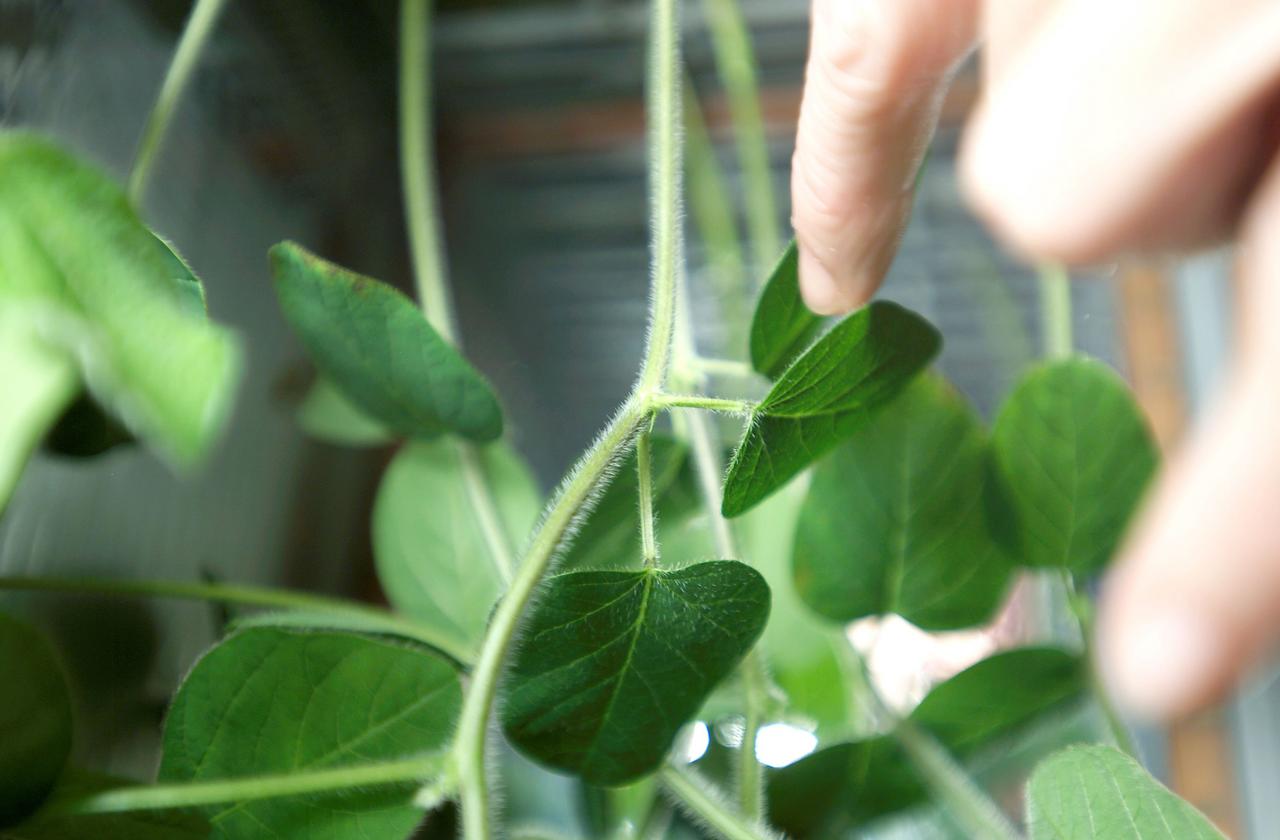
This is a photo of soybeans growing in the Advanced Astroculture (ADVASC) Experiment aboard the International Space Station (ISS). The ADVASC experiment was one of the several new experiments and science facilities delivered to the ISS by Expedition Five aboard the Space Shuttle Orbiter Endeavor STS-111 mission. An agricultural seed company will grow soybeans in the ADVASC hardware to determine whether soybean plants can produce seeds in a microgravity environment. Secondary objectives include determination of the chemical characteristics of the seed in space and any microgravity impact on the plant growth cycle. Station science will also be conducted by the ever-present ground crew, with a new cadre of controllers for Expedition Five in the ISS Payload Operations Control Center (POCC) at NASA's Marshall Space Flight Center in Huntsville, Alabama. Controllers work in three shifts around the clock, 7 days a week, in the POCC, the world's primary science command post for the Space Station. The POCC links Earth-bound researchers around the world with their experiments and crew aboard the Space Station.

Expedition Five crewmembers include (left to right) Cosmonaut Verleri Korzun, Commander; Astronaut Peggy Whitson, flight engineer; and Cosmonaut Sergei Treschev, flight engineer. Launched aboard the Space Shuttle Orbiter Endeavour, STS-111, in April 2002, Expedition Five replaced Expedition Four on the International Space Station (ISS) for a scheduled 4-month mission. Expedition Five carried several new experiments and science facilities to the ISS. The research compliment included 24 new and continuing investigations:10 human life sciences studies, 6 in microgravity, 5 in space product development, and 3 sponsored by the Office of Space Flight. The new experiments are expected to lead to new insights in the fields of materials, plant science, commercial biotechnology, and the long term effects of space flight on humans. 280 hours will be devoted to research in addition to the continuing building of the ISS. Station science will also be conducted by the ever-present ground crew, with a new cadre of controllers for Expedition Five in the ISS Payload Operations Control Center (POCC) at NASA's Marshall Space Flight Center in Huntsville, Alabama. Controllers work in three shifts around the clock, 7 days a week, in the POCC, the world's primary science command post for the Space Station. The POCC links Earth-bound researchers around the world with their experiments and crew aboard the Space Station.
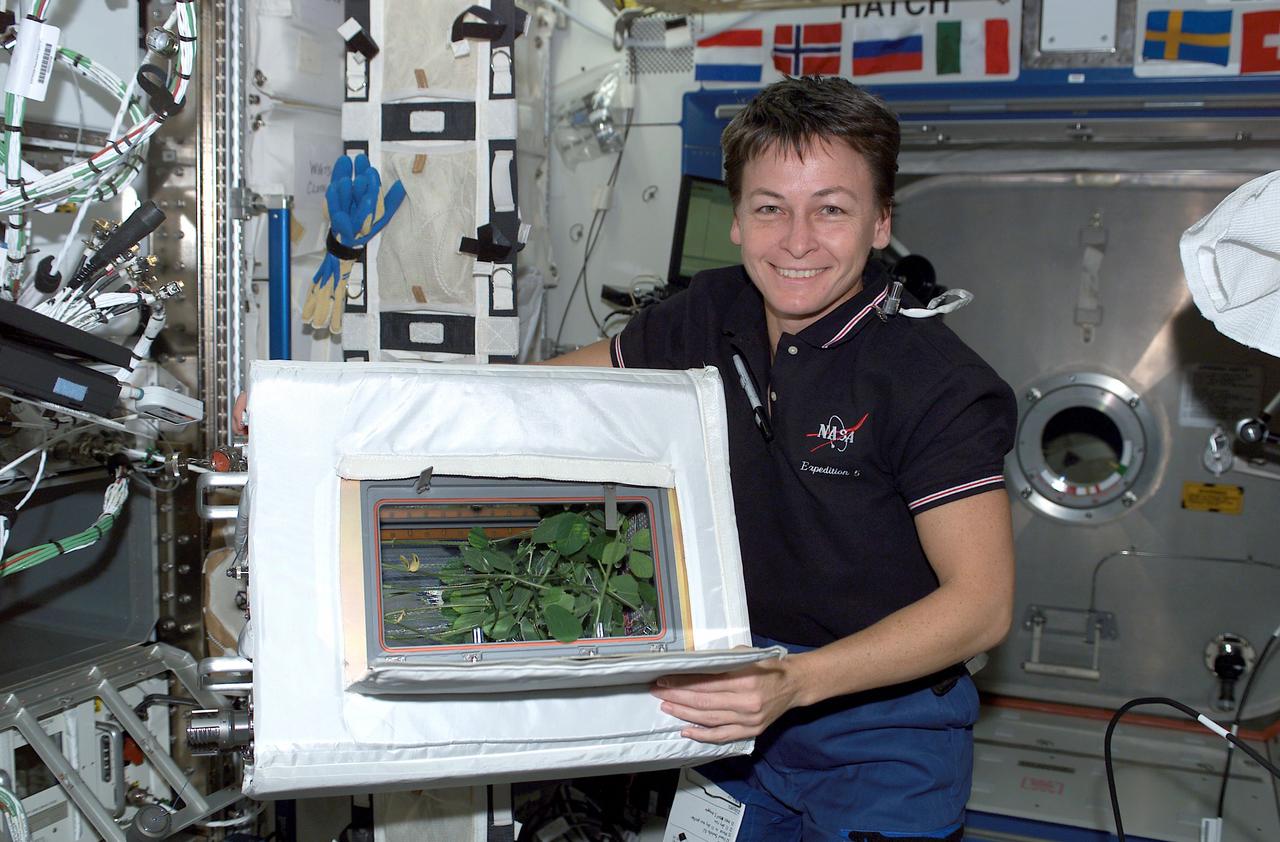
Expedition Five crewmember and flight engineer Peggy Whitson displays the progress of soybeans growing in the Advanced Astroculture (ADVASC) Experiment aboard the International Space Station (ISS). The ADVASC experiment was one of the several new experiments and science facilities delivered to the ISS by Expedition Five aboard the Space Shuttle Orbiter Endeavor STS-111 mission. An agricultural seed company will grow soybeans in the ADVASC hardware to determine whether soybean plants can produce seeds in a microgravity environment. Secondary objectives include determination of the chemical characteristics of the seed in space and any microgravity impact on the plant growth cycle. Station science will also be conducted by the ever-present ground crew, with a new cadre of controllers for Expedition Five in the ISS Payload Operations Control Center (POCC) at NASA's Marshall Space Flight Center in Huntsville, Alabama. Controllers work in three shifts around the clock, 7 days a week, in the POCC, the world's primary science command post for the Space Station. The POCC links Earth-bound researchers around the world with their experiments and crew aboard the Space Station.
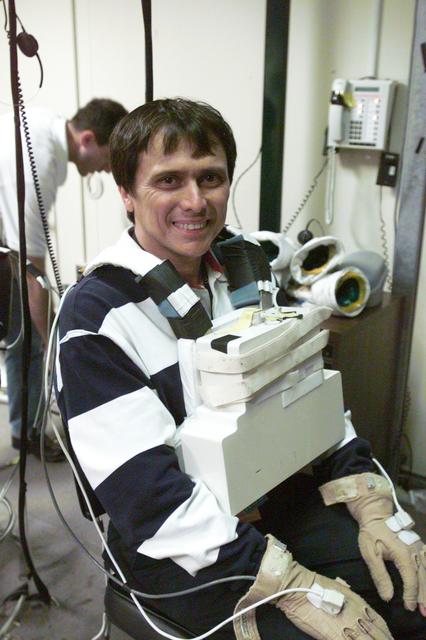
JSC2001-E-39080 (18 October 2001) --- Astronaut Franklin R. Chang-Diaz, STS-111 mission specialist, prepares to use specialized gear in the virtual reality lab at the Johnson Space Center (JSC) to train for his duties aboard the Space Shuttle Endeavour. This type of virtual reality training allows the astronauts to wear a helmet and special gloves while looking at computer displays simulating actual movements around the various locations on the International Space Station (ISS) hardware with which they will be working.
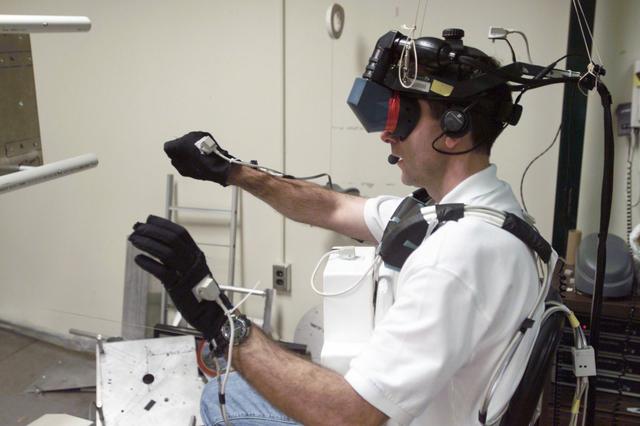
JSC2001-E-39084 (18 October 2001) --- Astronaut Philippe Perrin, STS-111 mission specialist, uses specialized gear in the virtual reality lab at the Johnson Space Center (JSC) to train for his duties aboard the Space Shuttle Endeavour. This type of virtual reality training allows the astronauts to wear a helmet and special gloves while looking at computer displays simulating actual movements around the various locations on the International Space Station (ISS) hardware with which they will be working. Perrin represents CNES, the French Space Agency.

STS111-321-024 (5-19 June 2002) --- This sunset over the Sahara Desert was photographed by the STS-111 crew members aboard the Space Shuttle Endeavour. When this photograph was taken, the shuttle was in a position over the Sudan near the Red Sea coast. The Gateway to Astronaut Photography of Earth (link to http://eol.jsc.nasa.gov/sseop/ ) provides searchable access to other photographs of Earth taken by astronauts.
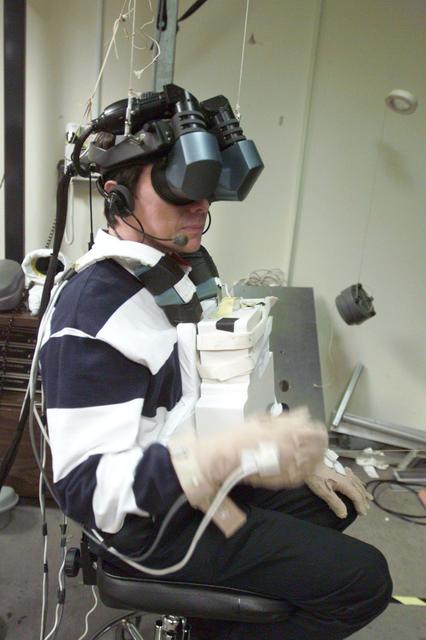
JSC2001-E-39083 (18 October 2001) --- Astronaut Franklin R. Chang-Diaz, STS-111 mission specialist, uses specialized gear in the virtual reality lab at the Johnson Space Center (JSC) to train for his duties aboard the Space Shuttle Endeavour. This type of virtual reality training allows the astronauts to wear a helmet and special gloves while looking at computer displays simulating actual movements around the various locations on the International Space Station (ISS) hardware with which they will be working.
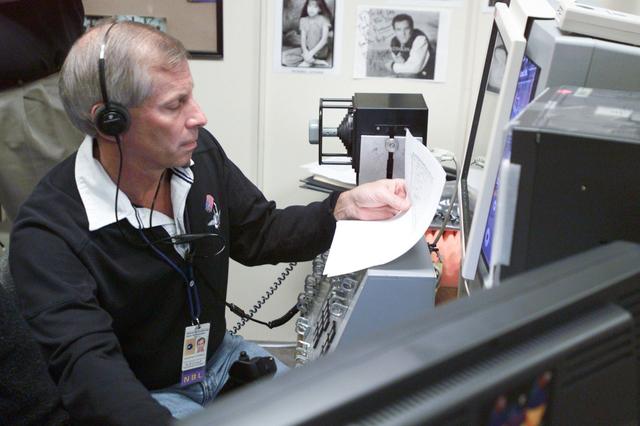
JSC2001-E-39087 (18 October 2001) --- Astronaut Kenneth D. Cockrell, STS-111 mission commander, uses the virtual reality lab at the Johnson Space Center (JSC) to train for his duties aboard the Space Shuttle Endeavour. This type of computer interface paired with virtual reality training hardware and software helps the entire team for dealing with ISS elements.
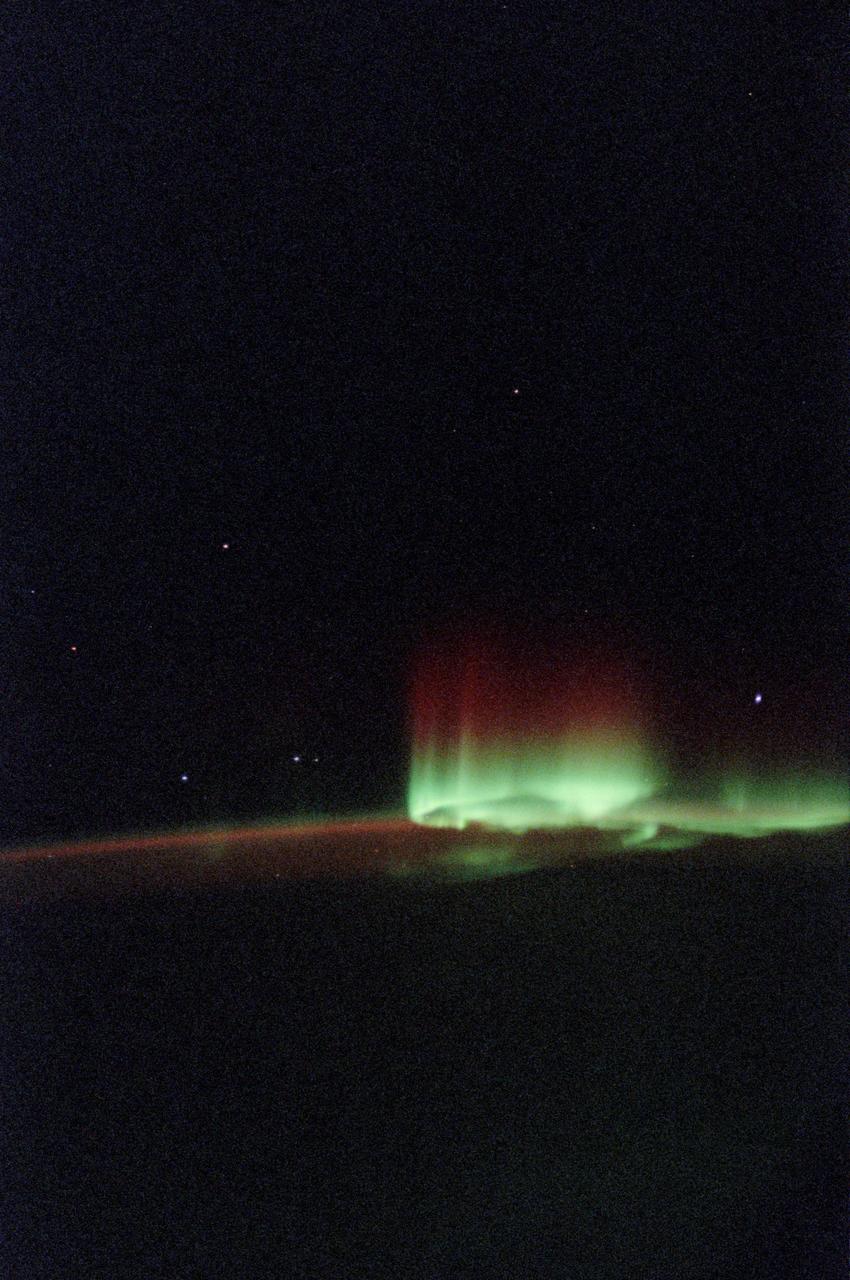
STS111-362-036 (5-19 June 2002) --- This view featuring the Aurora Australis or “southern lights” was photographed by the STS-111 crew members aboard the Space Shuttle Endeavour. When this photograph was taken, the shuttle was in a position south of Australia. The Gateway to Astronaut Photography of Earth (link to http://eol.jsc.nasa.gov/sseop/) provides searchable access to other photographs of Earth taken by astronauts.
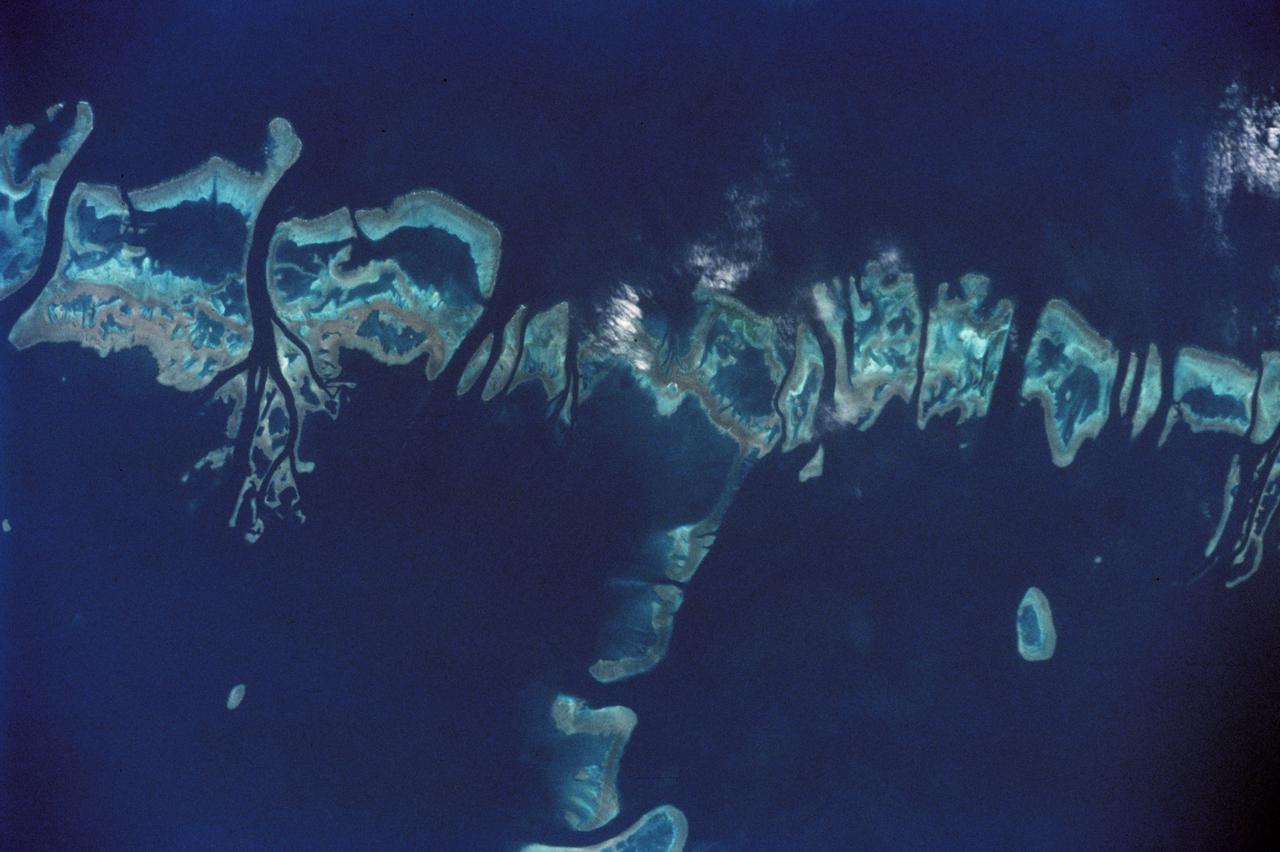
STS111-368-036 (5-19 June 2002) --- This photo, giving detail of the Pompey Island Group in the Southern Great Barrier Reef off Australia, was taken by the STS-111 crewmembers aboard the Space Shuttle Endeavour. Ocean flow between the islands has produced unique wash features in the structures of the island banks. The Gateway to Astronaut Photography of Earth (link to http://eol.jsc.nasa.gov/sseop/) provides searchable access to other photographs of Earth taken by astronauts.
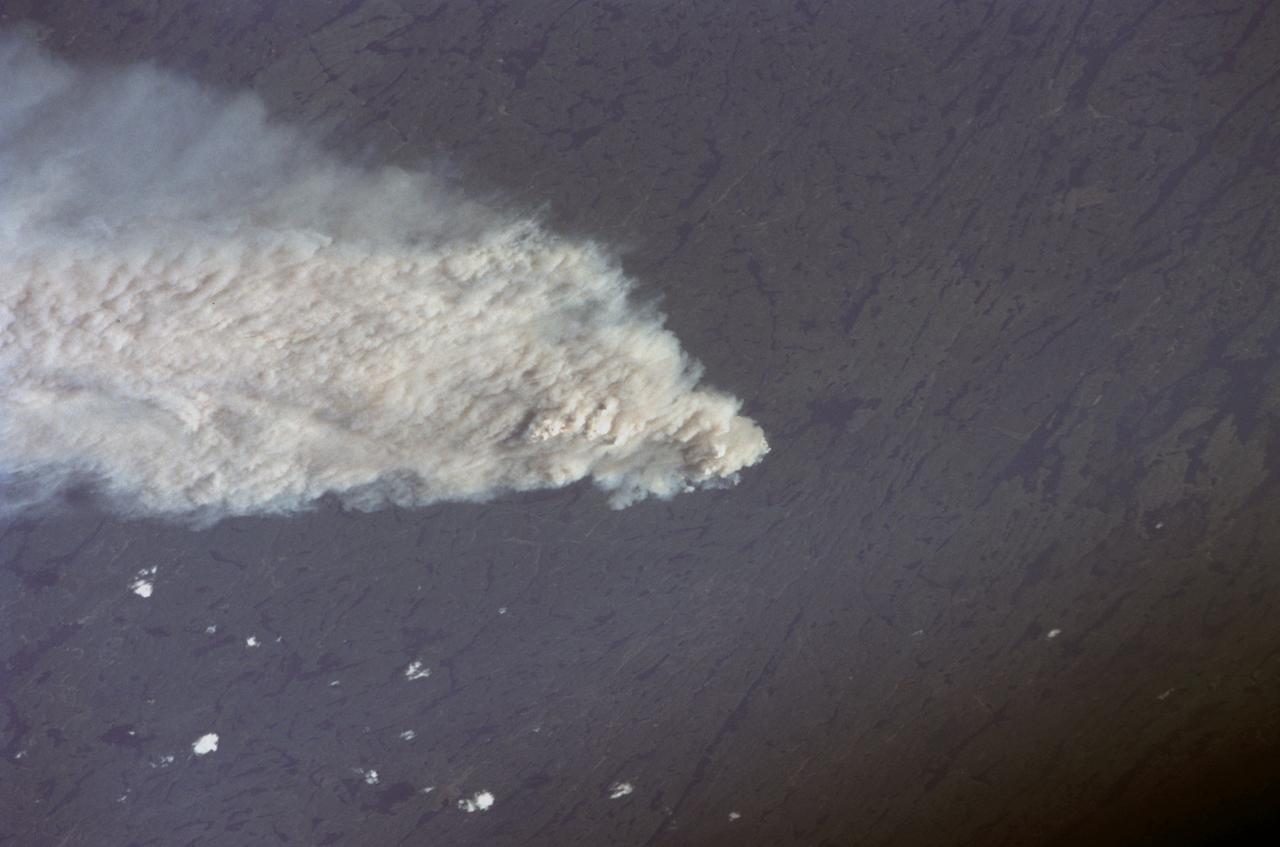
STS111-367-014 (5-19 June 2002) --- This view featuring Canadian forest fires was photographed by the STS-111 crewmembers aboard the Space Shuttle Endeavour. It represents an oblique view northward of one of the numerous fires observed and reported burning in the dry boreal forests of Saskatchewan and Manitoba during the month of June. The location of this one is roughly between Candle Lake, Saskatchewan and Lake Winnepegosis, Manitoba. The Gateway to Astronaut Photography of Earth (link to http://eol.jsc.nasa.gov/sseop/) provides searchable access to other photographs of Earth taken by astronauts.
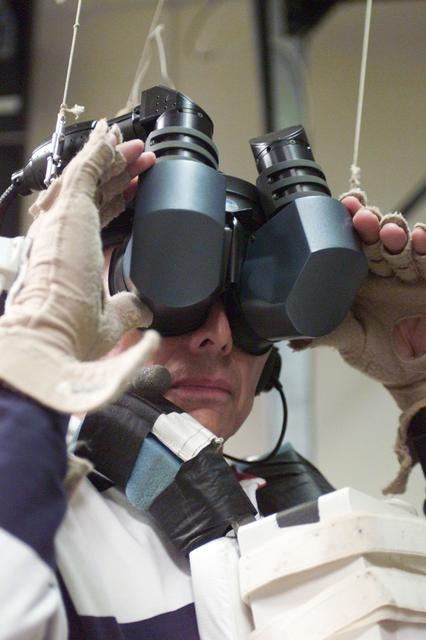
JSC2001-E-39088 (18 October 2001) --- Astronaut Franklin R. Chang-Diaz, STS-111 mission specialist, uses specialized gear in the virtual reality lab at the Johnson Space Center (JSC) to train for his duties aboard the Space Shuttle Endeavour. This type of virtual reality training allows the astronauts to wear a helmet and special gloves while looking at computer displays simulating actual movements around the various locations on the International Space Station (ISS) hardware with which they will be working.
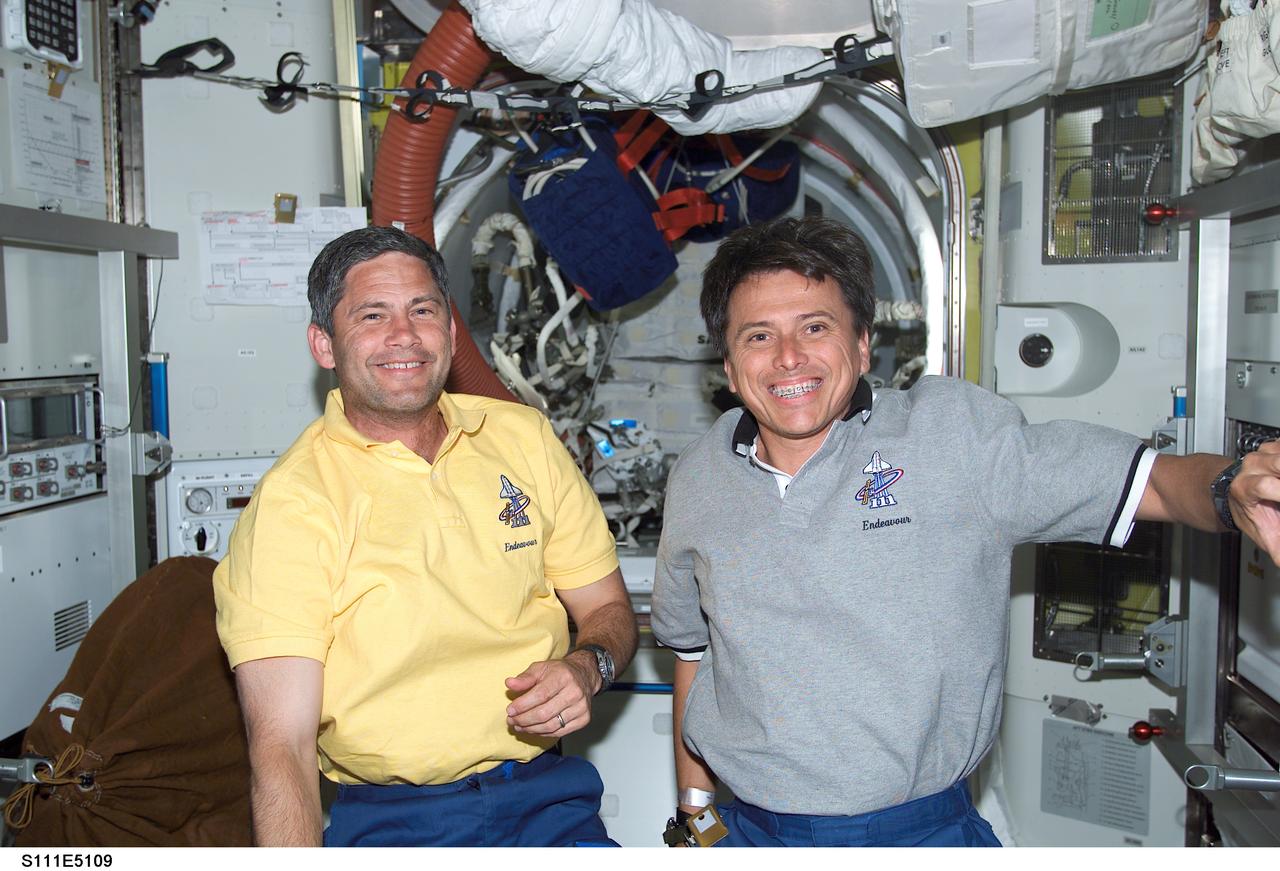
STS111-E-5109 (7 June 2002) --- Astronauts Paul S. Lockhart (left), STS-111 pilot, and Franklin R. Chang-Diaz, mission specialist, greet Expedition Four members (out of frame) with smiles during a brief reunion not long after hatch-opening on June 7, 2002.
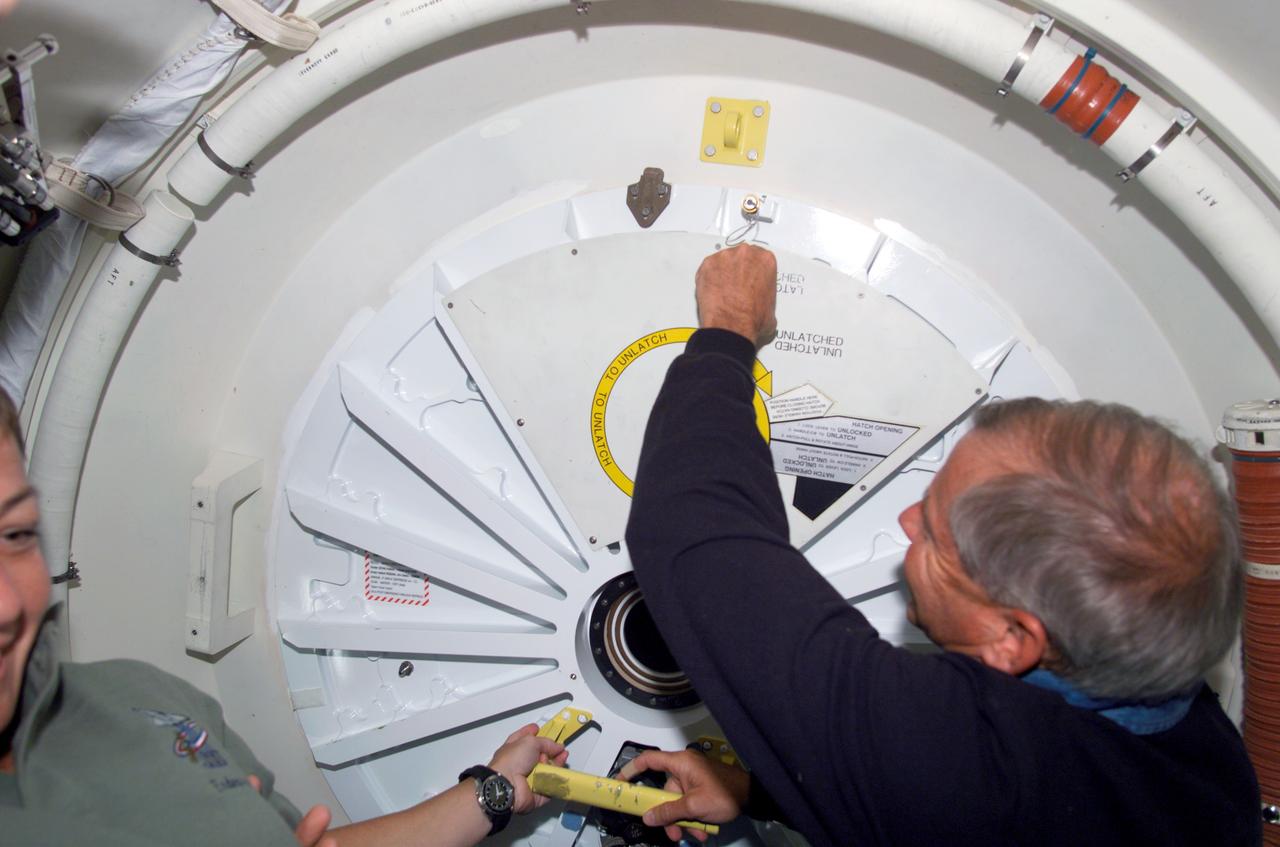
STS111-E-5088 (7 June 2002) --- Astronaut Kenneth D. Cockrell, STS-111 mission commander, prepares to open hatchway to the International Space Station (ISS) shortly after the Space Shuttle Endeavour docked with the orbital outpost.
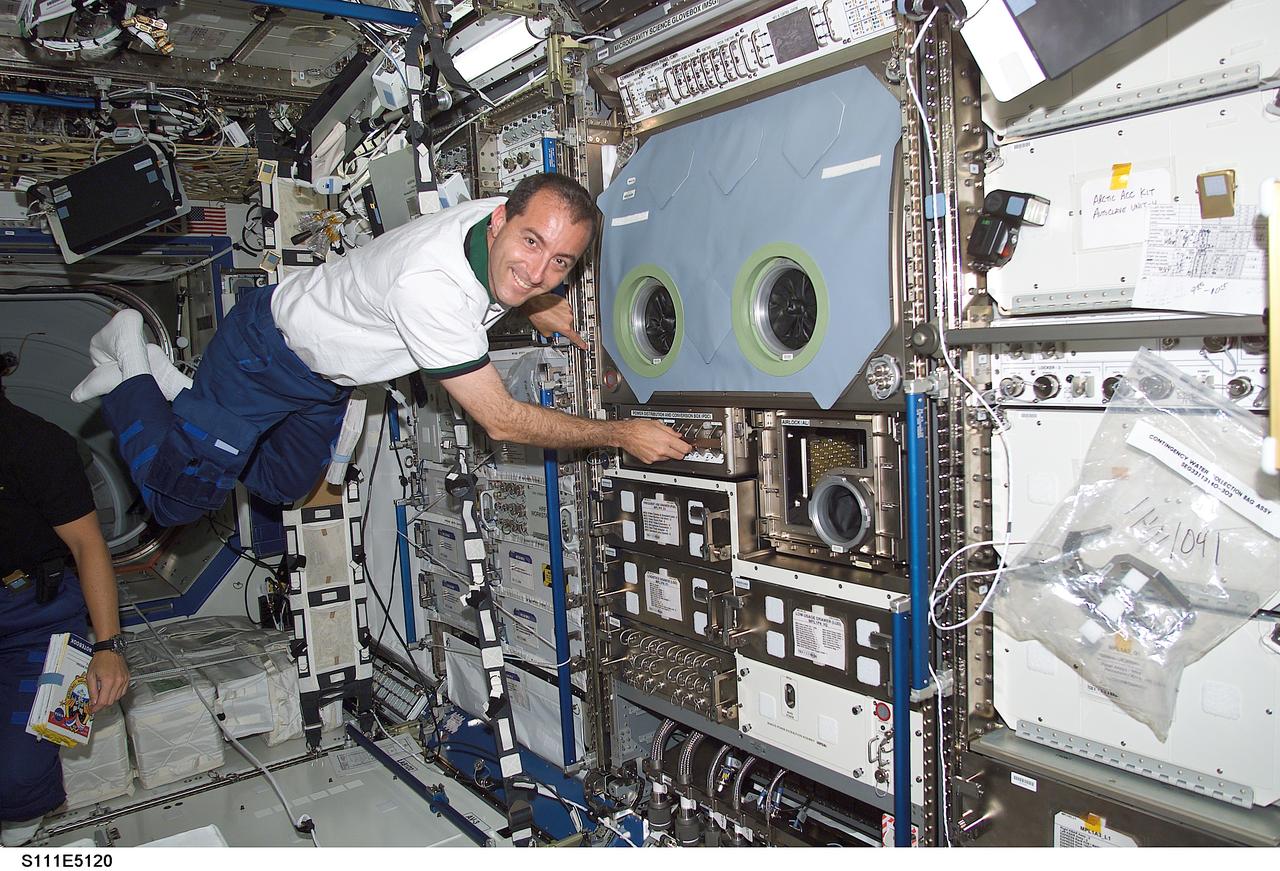
STS111-E-5120 (9 June 2002) --- Astronaut Philippe Perrin, STS-111 mission specialist, floats near the Microgravity Science Glovebox (MSG) in the Destiny laboratory on the International Space Station (ISS). Perrin represent CNES, the French Space Agency.
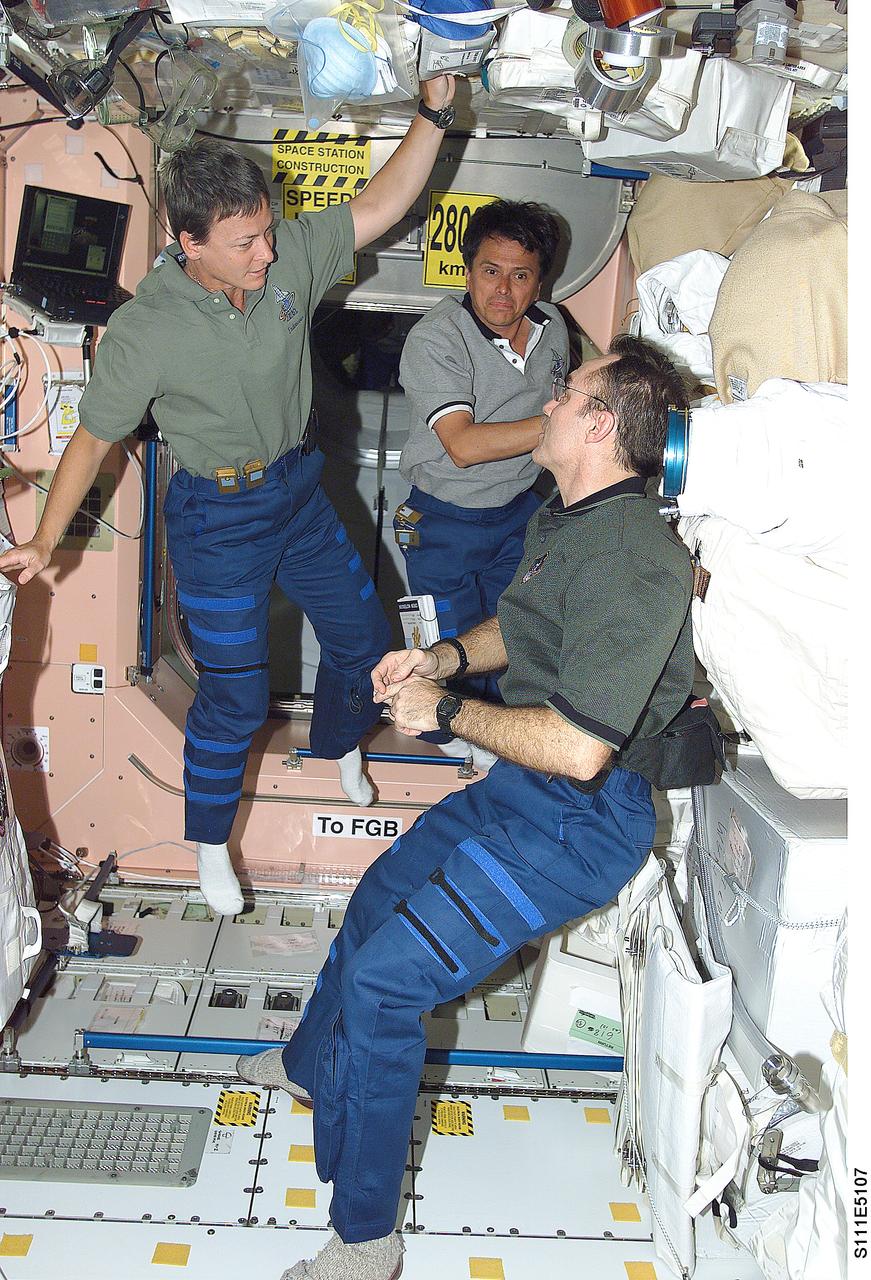
STS111-E-5107 (7 June 2002) --- Astronauts Peggy A. Whitson (left), Expedition Five flight engineer, Franklin R. Chang-Diaz, STS-111 mission specialist, and Carl E. Walz, Expedition Four flight engineer, are photographed in the Unity node on the International Space Station (ISS).

STS111-E-5132 (9 June 2002) --- Astronaut Franklin R. Chang-Diaz, STS-111 mission specialist, anchored to the foot restraint at the end of the International Space Station’s (ISS) Canadarm2, participates in the first scheduled session of extravehicular activity (EVA) for the STS-111 mission. During the spacewalk, Chang-Diaz and Perrin attached a Power and Data Grapple Fixture onto the International Space Station’s (ISS) P6 Truss, setting the stage for the future relocation of the P6. The next major task was to remove Service Module Debris Panels from Space Shuttle Endeavour’s payload bay and attach them to their temporary location on Pressurized Mating Adapter 1 (PMA-1). The spacewalkers also removed thermal blankets to prepare the Mobile Base System (MBS) for installation onto the station’s Mobile Transporter (MT).
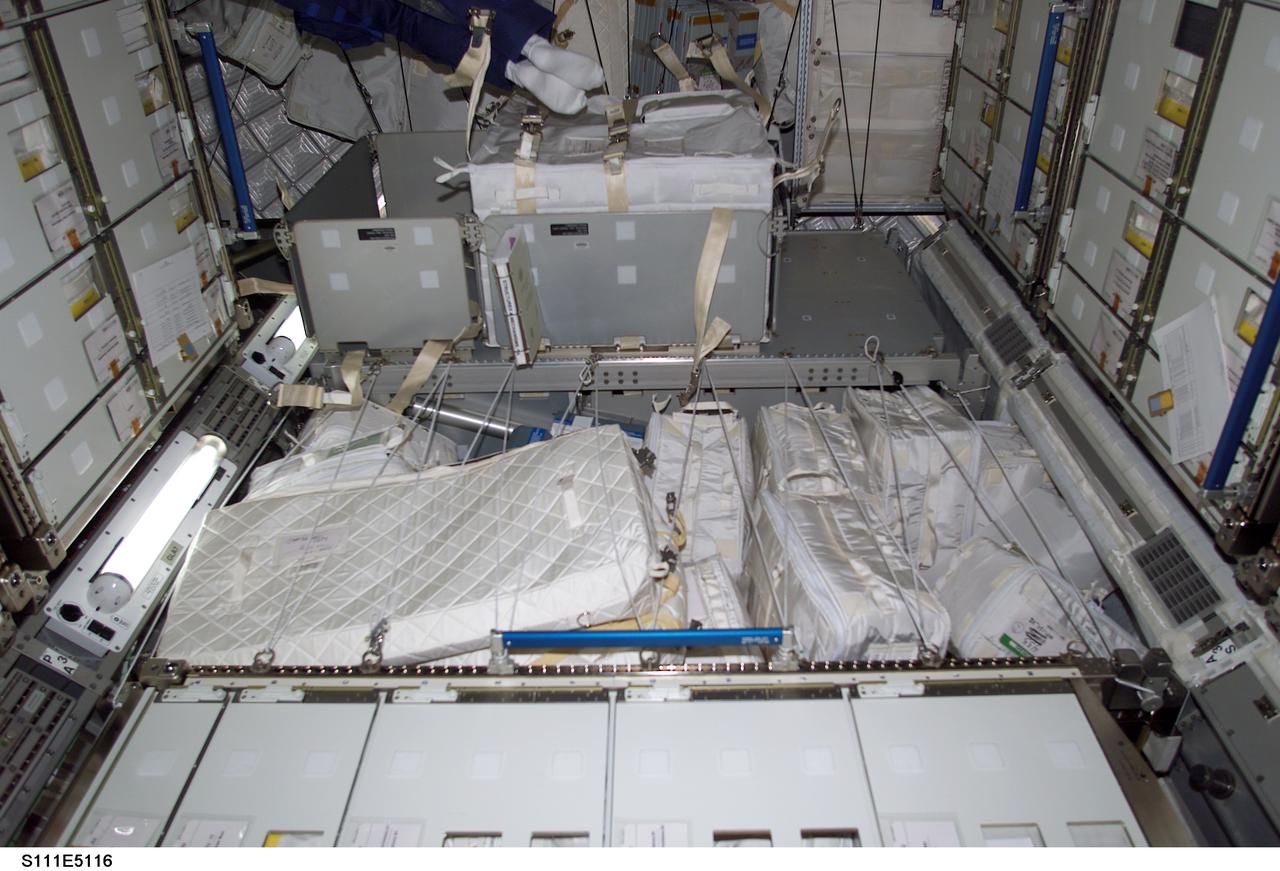
STS111-E-5116 (9 June 2002) --- One of the STS-111 crewmembers took this interior view of the Leonardo Multi-Purpose Logistics Module (MPLM). Leonardo was unberthed from the payload bay of the Space Shuttle Endeavour on June 8, 2002 by astronaut Kenneth D. Cockrell, STS-111 mission commander, operating the shuttle’s robotic arm to move the module to the International Space Station’s (ISS) Unity node. Leonardo’s installation was completed at 9:28 a.m. (CDT). Leonardo is one of three Multi-Purpose Logistics Modules built by the Italian Space Agency that serve as pressurized, reusable cargo carriers to ferry supplies, equipment and experiments between the ground and the space station.
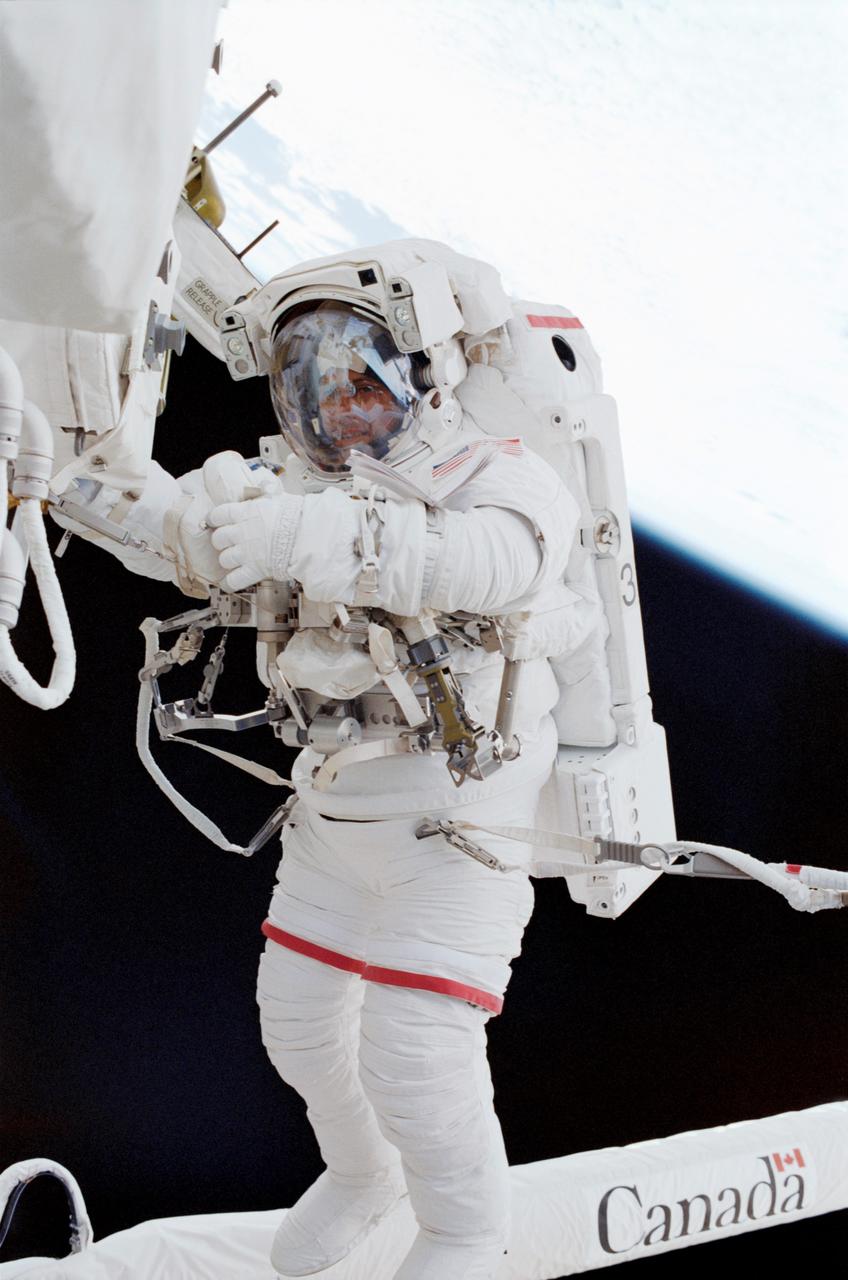
STS111-306-023 (9 June 2002) --- Astronaut Franklin R. Chang-Diaz, STS-111 mission specialist, participates in the first scheduled session of extravehicular activity (EVA) for the STS-111 mission. During the spacewalk, Chang-Diaz and Perrin attached a Power and Data Grapple Fixture onto the International Space Station’s (ISS) P6 Truss, setting the stage for the future relocation of the P6. The next major task was to remove Service Module Debris Panels from Space Shuttle Endeavour’s payload bay and attach them to their temporary location on Pressurized Mating Adapter 1 (PMA-1). The spacewalkers also removed thermal blankets to prepare the Mobile Base System (MBS) for installation onto the station’s Mobile Transporter (MT).
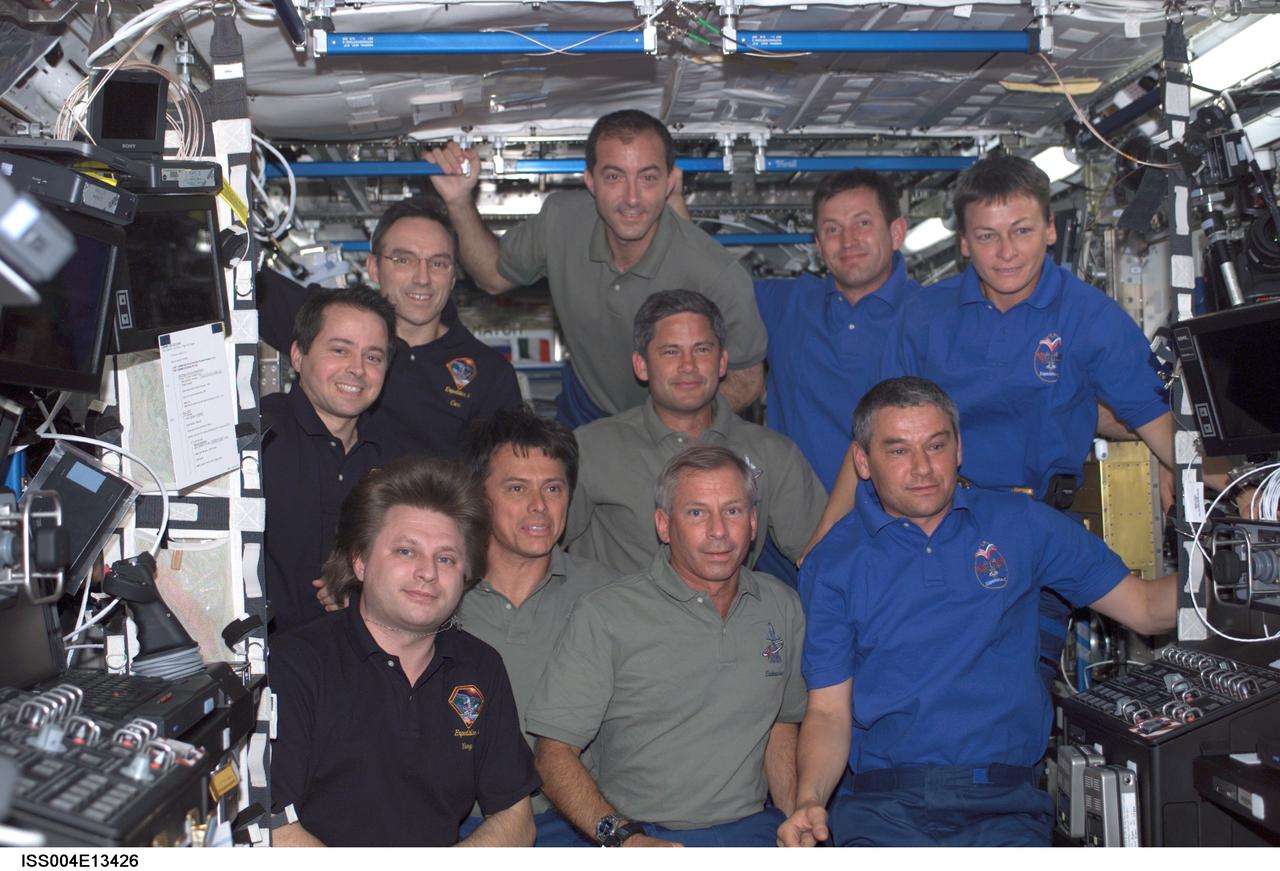
ISS004-E-13426 (June 2002) --- The Expedition Four (dark blue shirts), STS-111 (green shirts), and Expedition Five (medium blue shirts) crews assemble for a group photo in the Destiny laboratory on the International Space Station (ISS). The Expedition Four crewmembers are, from front to back, cosmonaut Yury I. Onufrienko, mission commander, and astronauts Daniel W. Bursch and Carl E. Walz, flight engineers. STS-111 crewmembers are, from front to back, astronauts Kenneth D. Cockrell, mission commander; Franklin R. Chang-Diaz, mission specialist; Paul S. Lockhart, pilot; and Philippe Perrin, mission specialist. Expedition Five crewmembers are, from front to back, cosmonaut Valery G. Korzun, mission commander; astronaut Peggy A. Whitson and cosmonaut Sergei Y. Treschev, flight engineers. Onufrienko, Korzun and Treschev represent Rosaviakosmos and Perrin represents CNES, the French Space Agency.
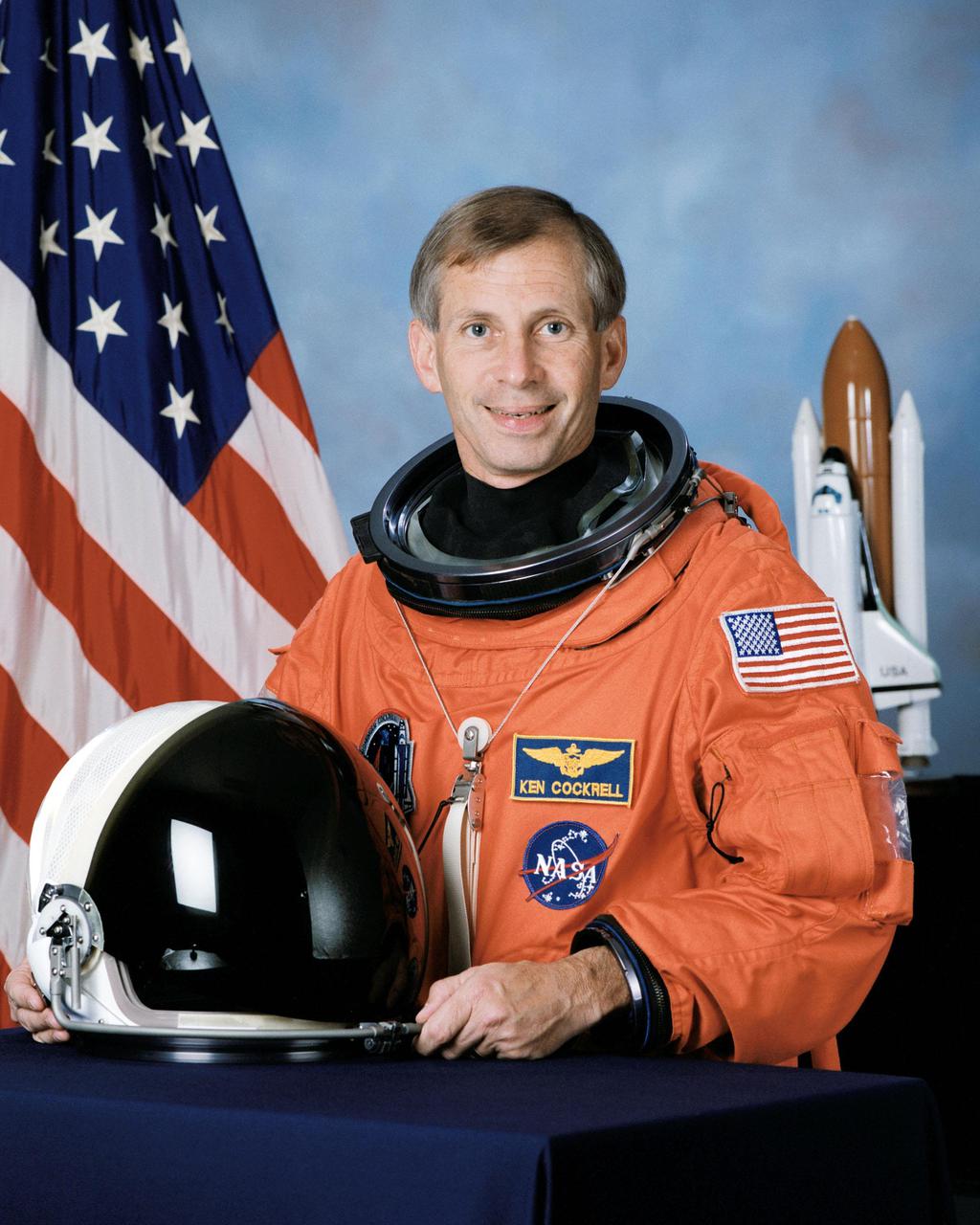
JOHNSON SPACE CENTER, HOUSTON, TX -- (JSC 597-06616) --Official Portrait of astronaut Kenneth D. Cockrell, STS-111 mission commander
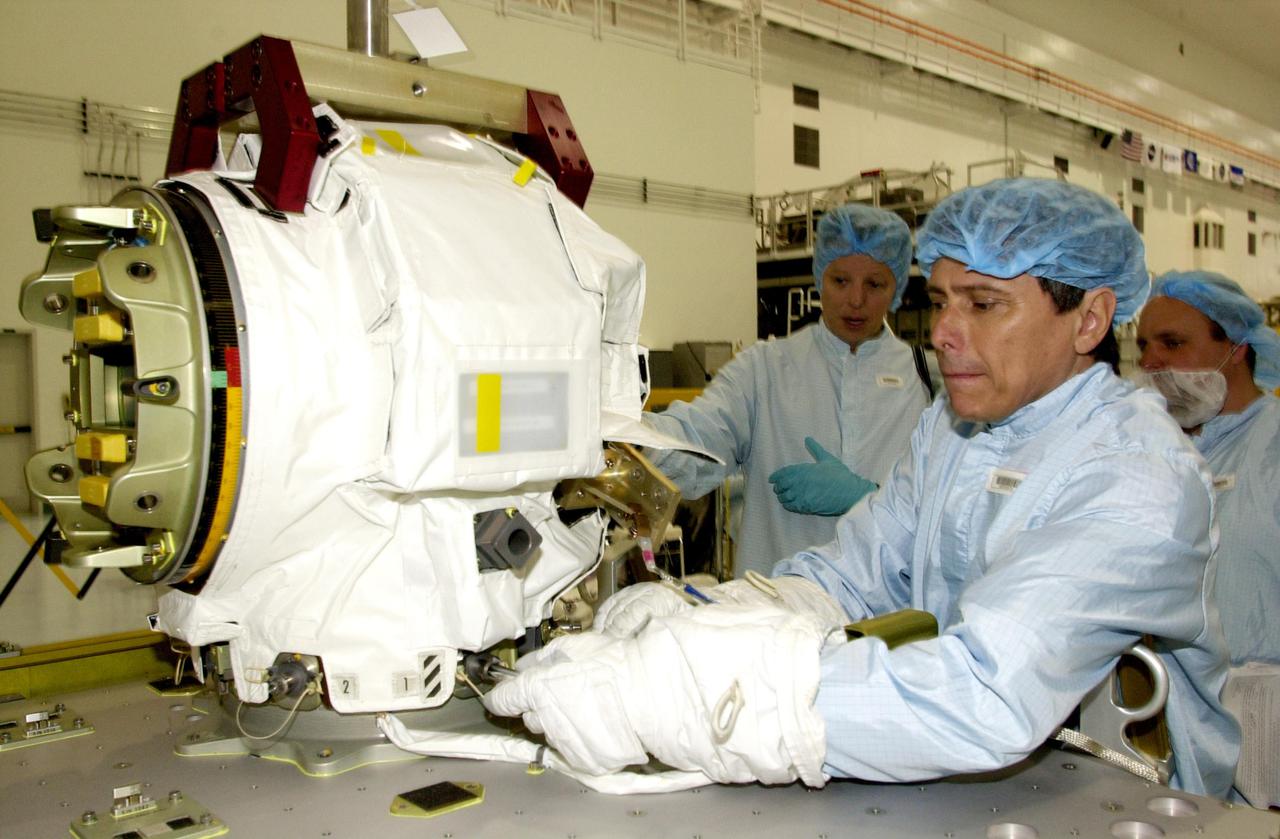
KENNEDY SPACE CENTER, FLA. - STS-111 Mission Specialist Franklin Chang-Diaz (right) practices a maneuver on the replacement pitch roll joint for the SSRMS (Canadarm 2). The joint will be installed during the mission to the International Space Station. Part of the payload on mission STS-111 is the Mobile Base System (MBS), which will be installed on the Mobile Transporter to complete the Canadian Mobile Servicing System, or MSS. The mechanical arm will then have the capability to 'inchworm' from the U.S. Lab Destiny to the MSS and travel along the truss to work sites. STS-111 is the second utilization flight (UF-2) to the Space Station and will also carry the Expedition 5 crew to replace Expedition 4. Launch is scheduled for May 30, 2002
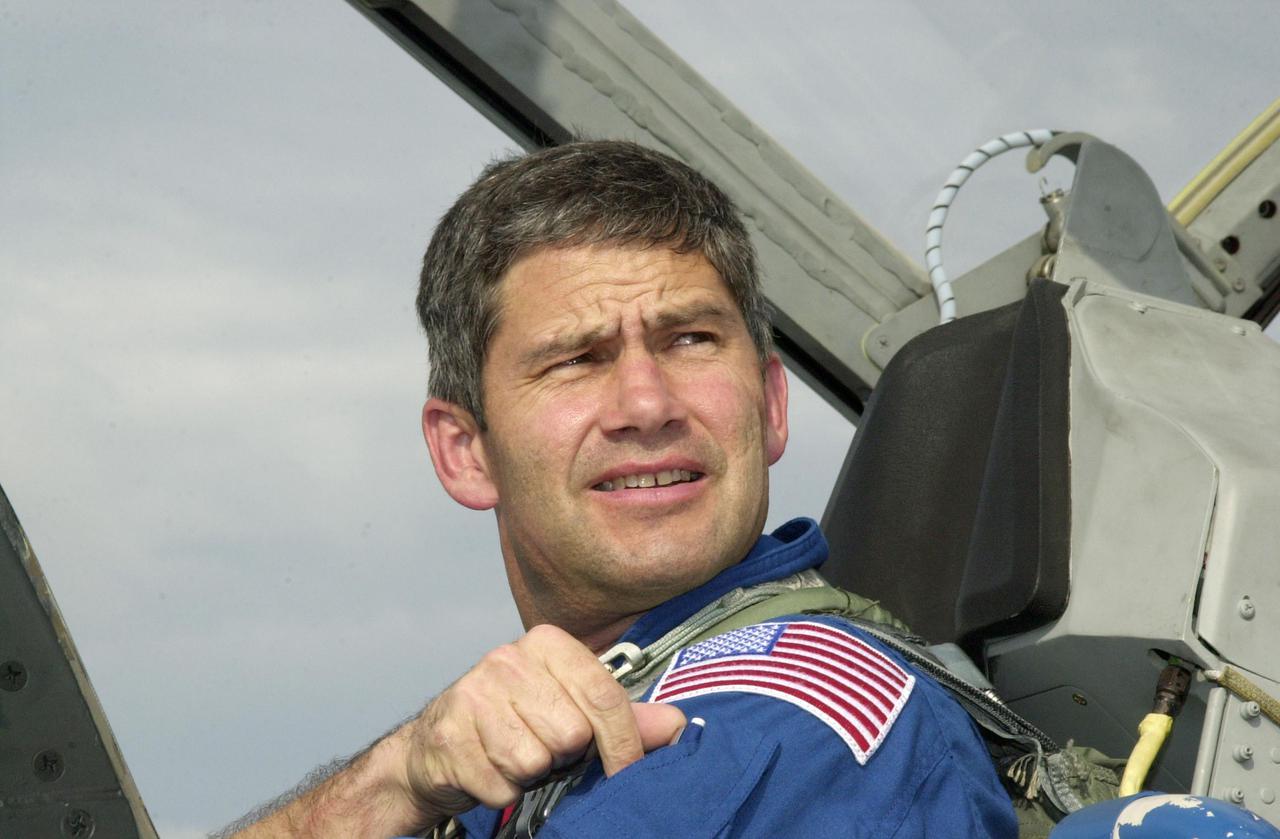
KENNEDY SPACE CENTER, FLA. -- STS-111 Pilot Paul Lockhart arrives at KSC aboard a T-38 jet aircraft to take part in Terminal Countdown Demonstration Test (TCDT) activities, along with the Expedition 5 crew, for launch of mission STS-111. Expedition 5 will travel on Space Shuttle Endeavour to the International Space Station as a replacement crew for Expedition 4. The TCDT is a rehearsal for launch and includes emergency egress training, familiarization with payload and a simulated launch countdown. Mission STS-111 is a utilization flight that will deliver equipment and supplies to the Station. Along with the Multi-Purpose Logisitics Module Leonardo, the payload includes the Mobile Base System, part of the Canadian Mobile Servicing System, or MSS, and an Orbital Replacement Unit, the replacement wrist_roll joint for the SSRMS (Canadarm2). Launch of Endeavour is scheduled for May 30, 2002
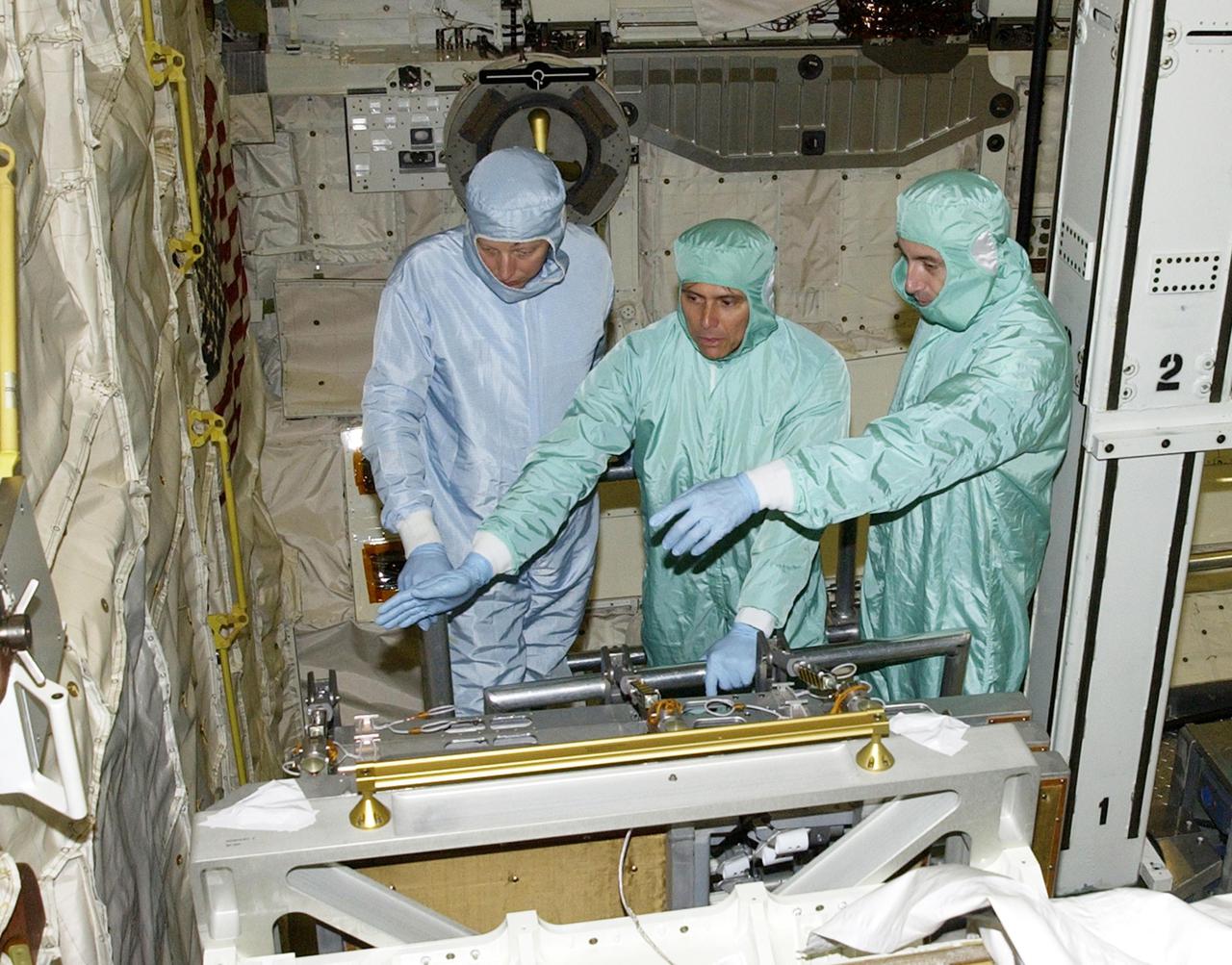
KENNEDY SPACE CENTER, FLA. - In the Orbiter Processing Facility, STS-111 Mission Specialists Franklin Chang-Diaz (center) and Phillippe Perrin (right) look over equipment with a trainer (left) in orbiter Endeavour. Perrin is with the French Space Agency (CNES). Perrin and Chang-Diaz, with other crew members, are taking part in a Crew Equipment Interface Test in preparation for launch. Mission STS-111 will carry to the International Space Station the Multipurpose Logistics Module (MPLM), filled with experiment racks and three stowage and resupply racks, and the Mobile Base System (MBS), which will attach to the Mobile Transporter and complete the Canadian Mobile Servicing System, or MSS. The Station's mechanical arm will then have the capability to 'inchworm' from the U.S. Lab to the MSS and travel along the truss to work sites on the Station. Launch of Endeavour on mission STS-111 is scheduled for May 30, 2002
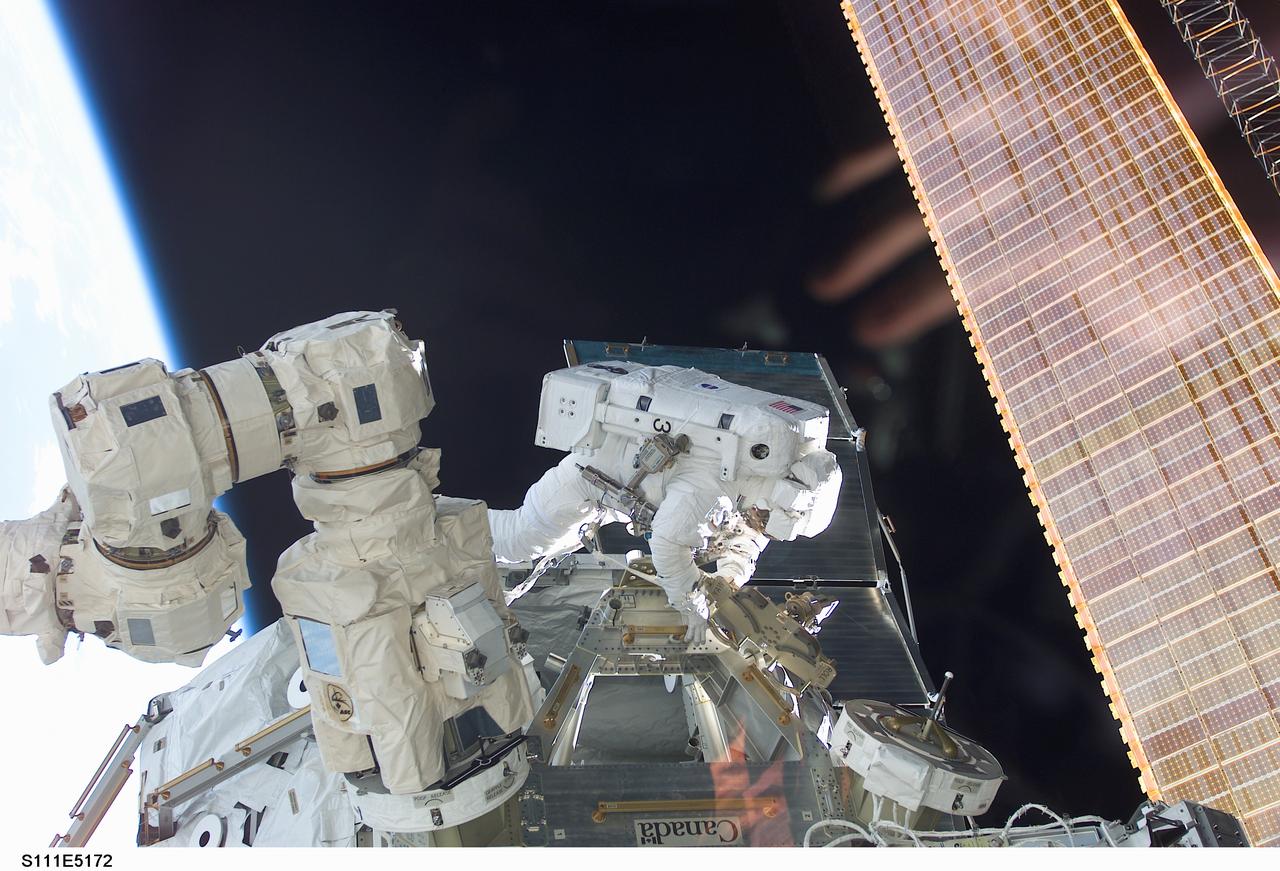
STS111-E-5172 (11 June 2002) --- Astronaut Philippe Perrin, mission specialist representing CNES, the French Space Agency, participates in the second scheduled session of extravehicular activity (EVA) for the STS-111 mission. During the spacewalk, Perrin and Chang-Diaz attached power, data and video cables from the International Space Station (ISS) to the Mobile Base System (MBS) and used a power wrench to complete the attachment of the MBS onto the Mobile Transporter (MT).
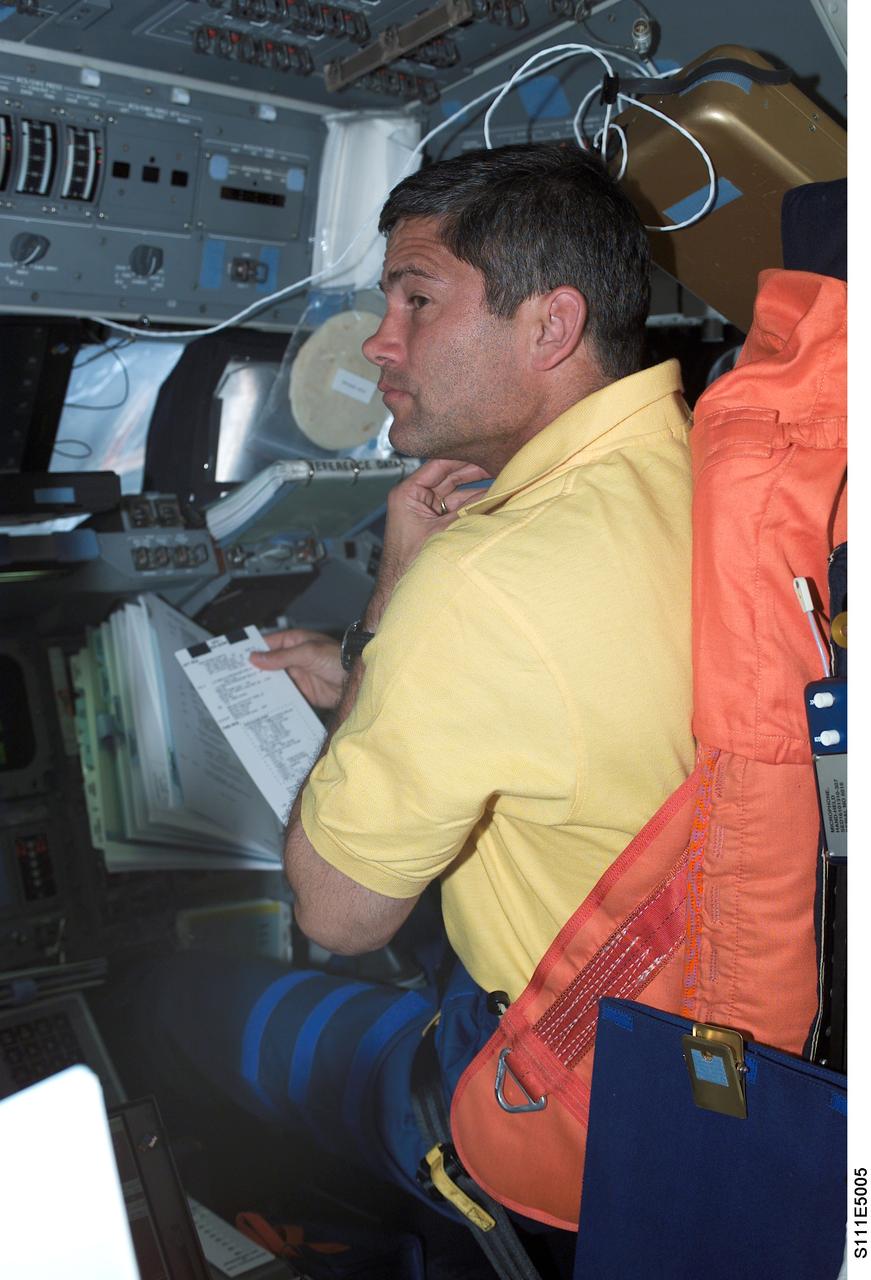
STS111-E-5005 (6 June 2002) --- Astronaut Paul S. Lockhart, STS-111 pilot, consults a check list on the day prior to rendezvous and docking operations between the Space Shuttle Endeavour and International Space Station (ISS). Lockhart, an alumnus of the 1996 astronaut candidate class marking his first space flight, is seated at the pilot's station on the shuttle's forward flight deck.
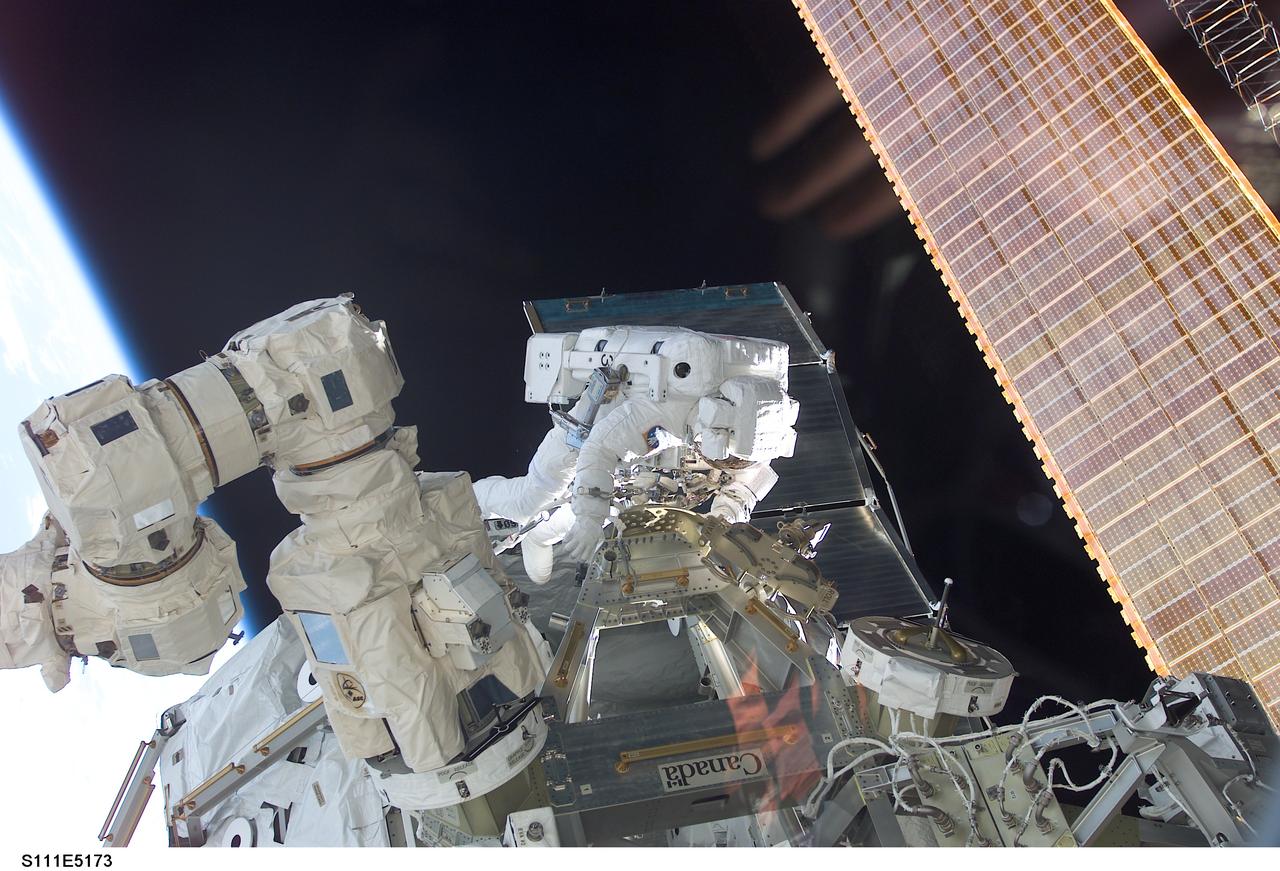
STS111-E-5173 (11 June 2002) --- Astronaut Philippe Perrin, mission specialist representing CNES, the French Space Agency, participates in the second scheduled session of extravehicular activity (EVA) for the STS-111 mission. During the spacewalk, Perrin and Chang-Diaz attached power, data and video cables from the International Space Station (ISS) to the Mobile Base System (MBS) and used a power wrench to complete the attachment of the MBS onto the Mobile Transporter (MT).
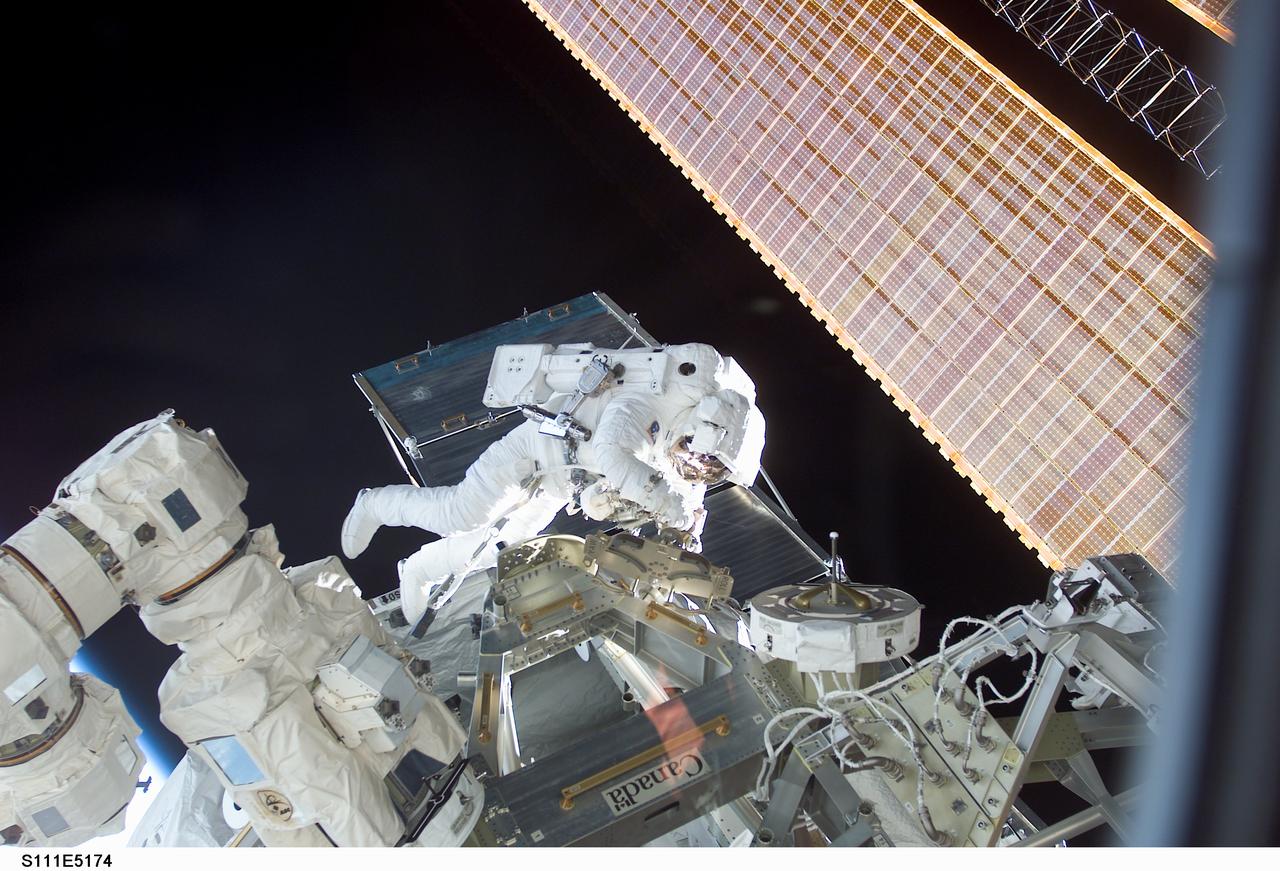
STS111-E-5174 (11 June 2002) --- Astronaut Philippe Perrin, mission specialist representing CNES, the French Space Agency, participates in the second scheduled session of extravehicular activity (EVA) for the STS-111 mission. During the spacewalk, Perrin and Chang-Diaz attached power, data and video cables from the International Space Station (ISS) to the Mobile Base System (MBS) and used a power wrench to complete the attachment of the MBS onto the Mobile Transporter (MT).
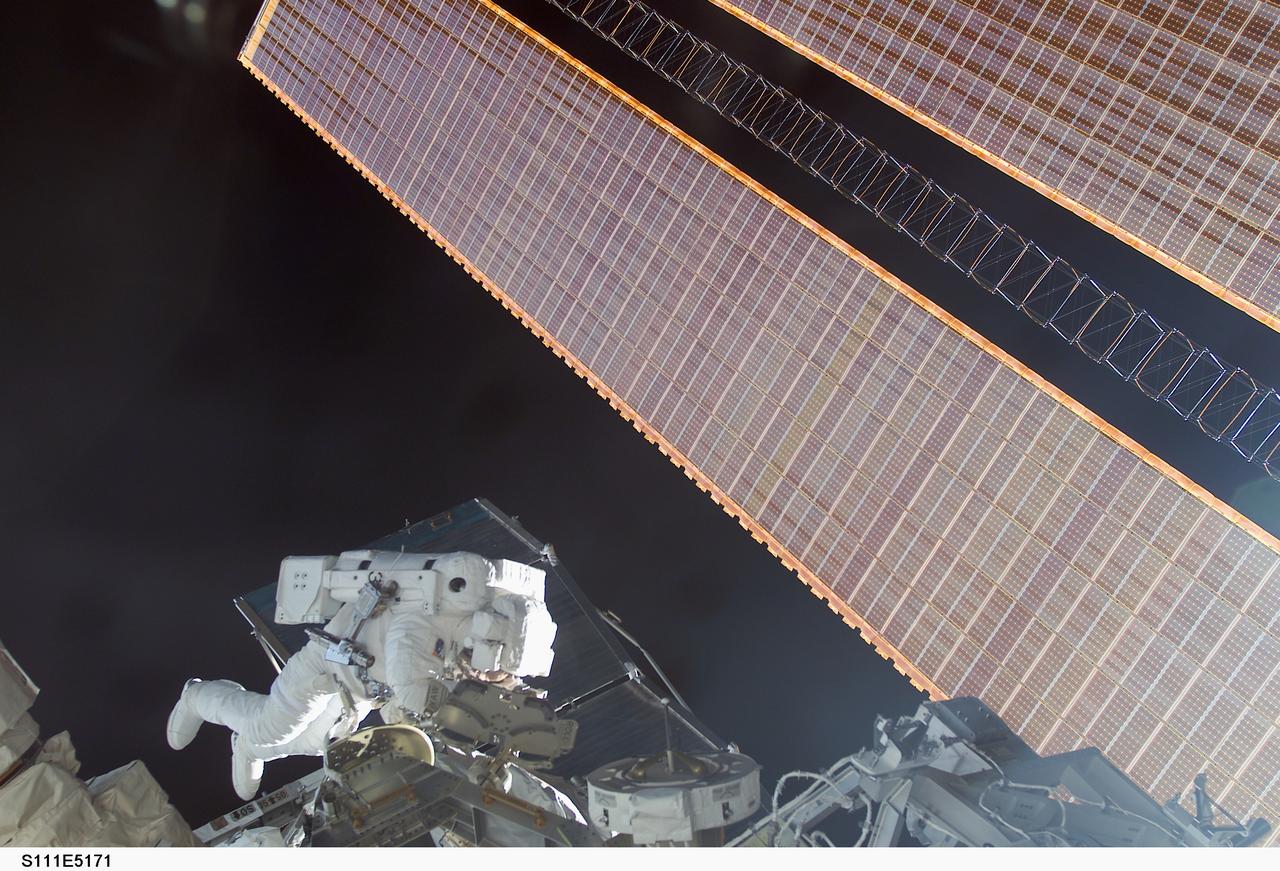
STS111-E-5171 (11 June 2002) --- Astronaut Philippe Perrin, mission specialist representing CNES, the French Space Agency, participates in the second scheduled session of extravehicular activity (EVA) for the STS-111 mission. During the spacewalk, Perrin and Chang-Diaz attached power, data and video cables from the International Space Station (ISS) to the Mobile Base System (MBS) and used a power wrench to complete the attachment of the MBS onto the Mobile Transporter (MT).
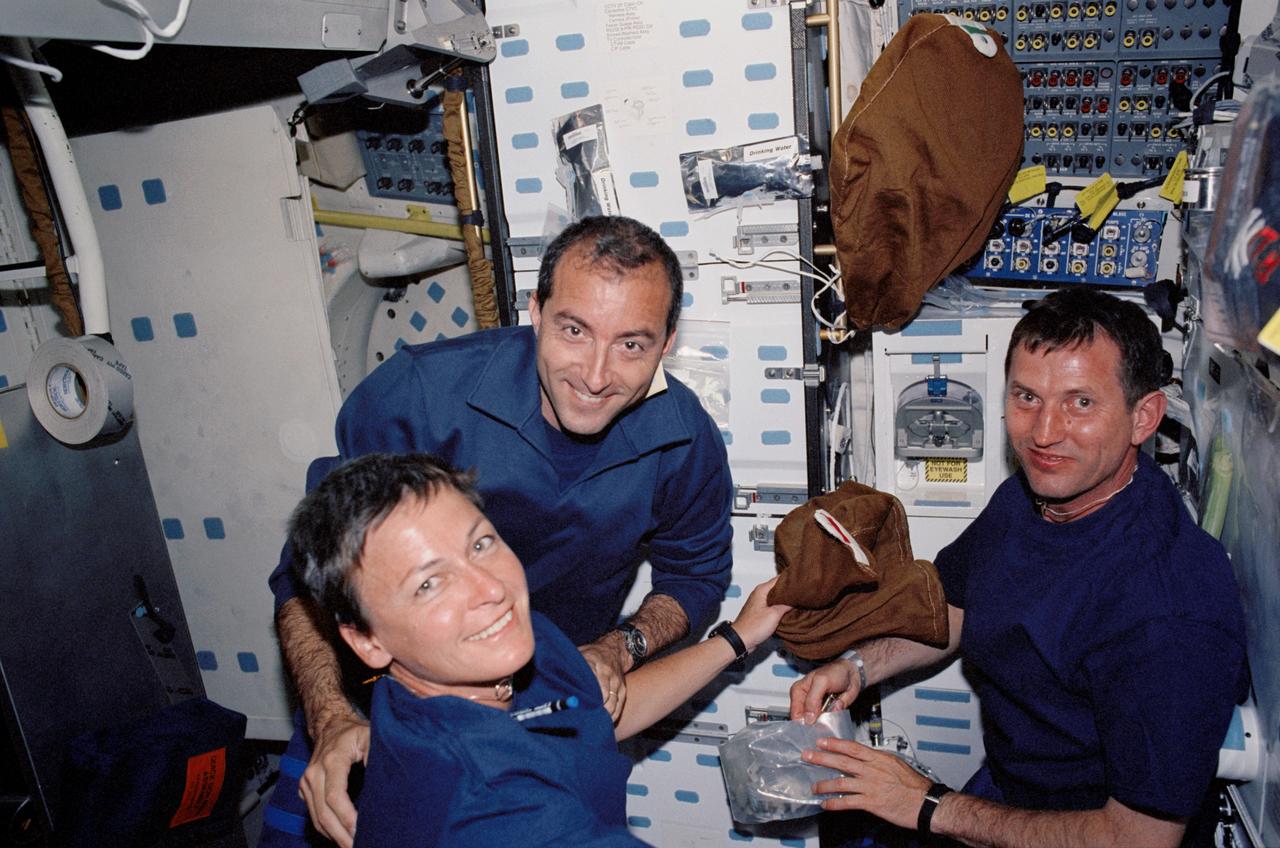
STS111-315-013 (5-19 June 2002) --- Astronauts Peggy A. Whitson (foreground), Expedition Five flight engineer; Philippe Perrin, STS-111 mission specialist; and cosmonaut Sergei Y. Treschev, Expedition Five flight engineer, are photographed on the middeck of the Space Shuttle Endeavour. Perrin represents CNES, the French Space Agency, and Treschev represent Rosaviakosmos.