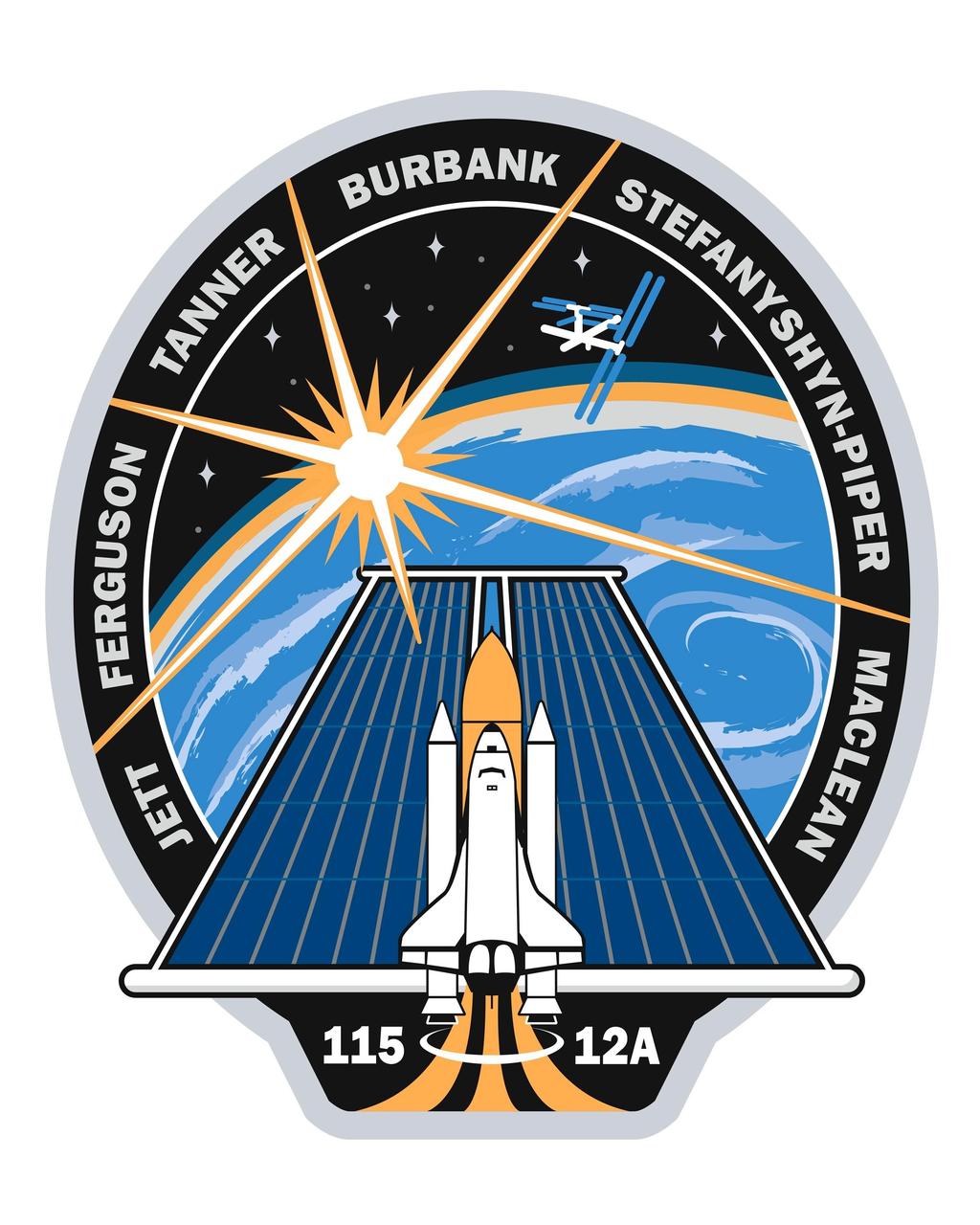
JOHNSON SPACE CENTER, TX - STS115-S-001 (February 2003) -- This is the STS-115 insignia. This mission continues the assembly of the International Space Station with the installation of the truss segments P3 and P4. Following the installation of the segments utilizing both the shuttle and the station robotic arms, a series of four space walks will complete the final connections and prepare for the deployment of the station's second set of solar arrays. To reflect the primary mission of the flight, the patch depicts a solar panel as the main element. As the Space Shuttle Atlantis launches towards the ISS, its trail depicts the symbol of the Astronaut Office. The starburst, representing the power of the sun, rises over the Earth and shines on the solar panel. The shuttle flight number 115 is shown at the bottom of the patch, along with the ISS assembly designation 12A (the 12th American assembly mission). The blue Earth in the background reminds us of the importance of space exploration and research to all of Earth's inhabitants. The NASA insignia design for shuttle flights is reserved for use by the astronauts and for other official use as the NASA Administrator may authorize. Public availability has been approved only in the forms of illustrations by the various news media. When and if there is any change in this policy, which is not anticipated, the change will be publicly announced.

S115-E-05496 (11 Sept. 2006) --- One of the STS-115 crewmembers aboard the Space Shuttle Atlantis took this picture of the International Space Station prior to the docking of the two spacecraft. The subsequent link-up will allow the STS-115 astronauts and the ISS Expedition 13 crew to team up for several days of key tasks in space.
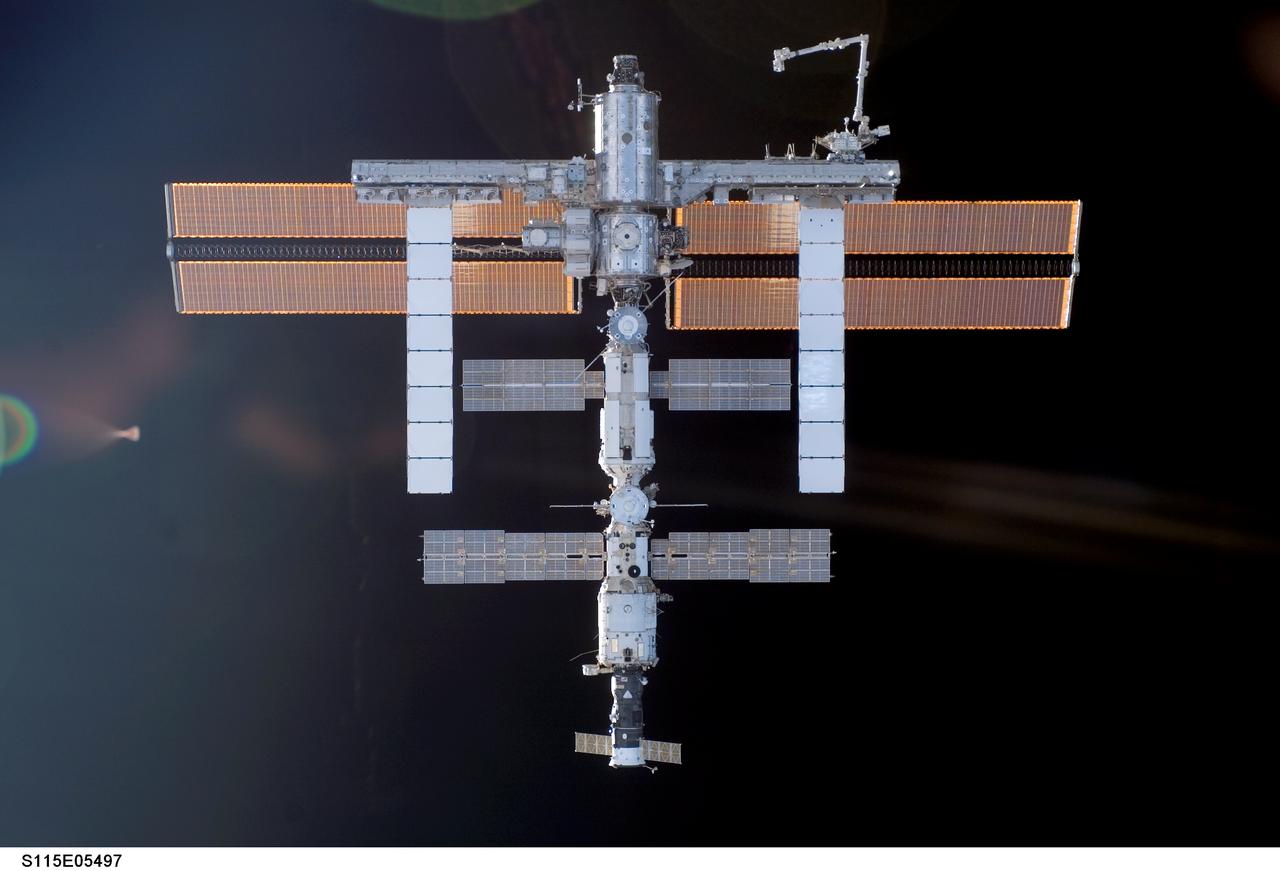
S115-E-05497 (11 Sept. 2006) --- One of the STS-115 crewmembers aboard the Space Shuttle Atlantis took this picture of the International Space Station prior to the docking of the two spacecraft. The subsequent link-up will allow the STS-115 astronauts and the ISS Expedition 13 crew to team up for several days of key tasks in space.
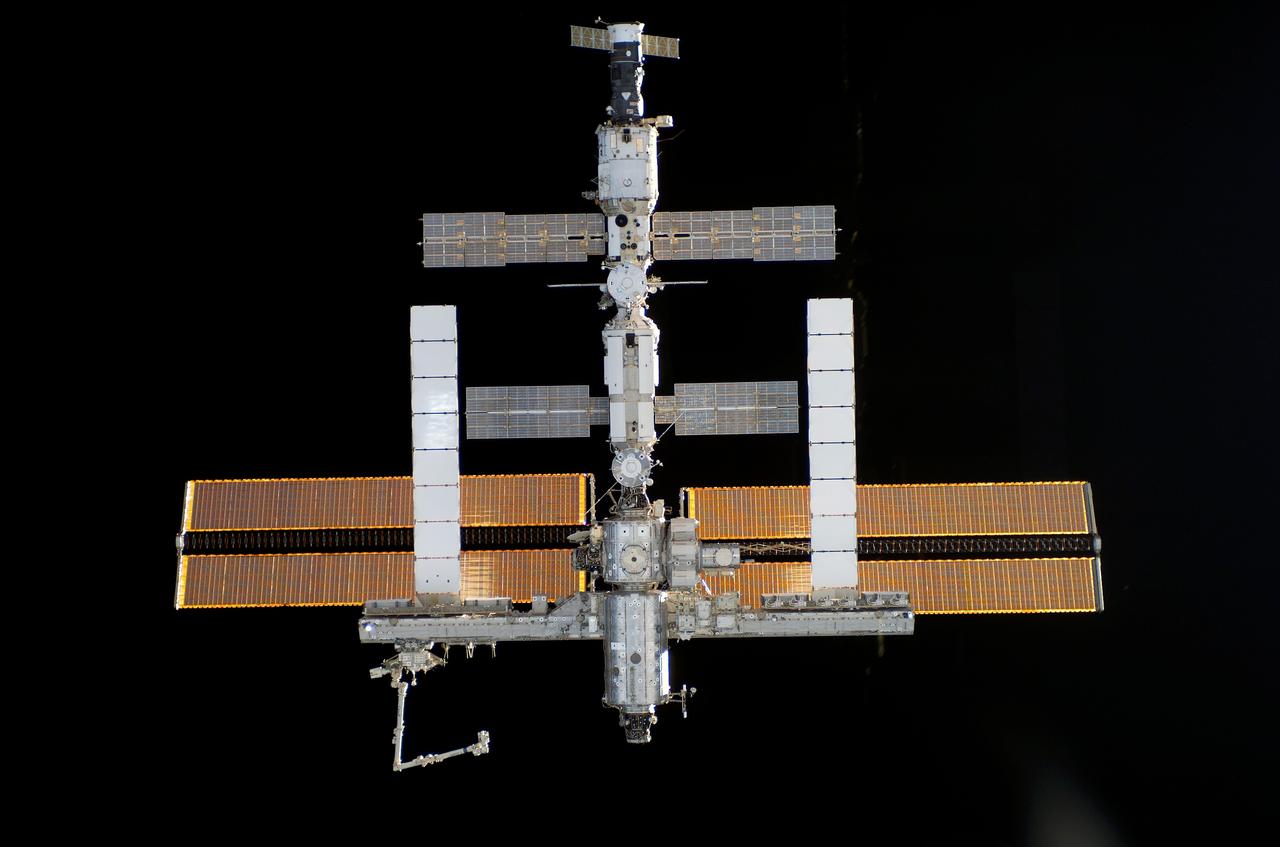
S115-E-05499 (11 Sept. 2006) --- One of the STS-115 crewmembers aboard the Space Shuttle Atlantis took this picture of the International Space Station prior to the docking of the two spacecraft. The subsequent link-up will allow the STS-115 astronauts and the ISS Expedition 13 crew to team up for several days of key tasks in space.
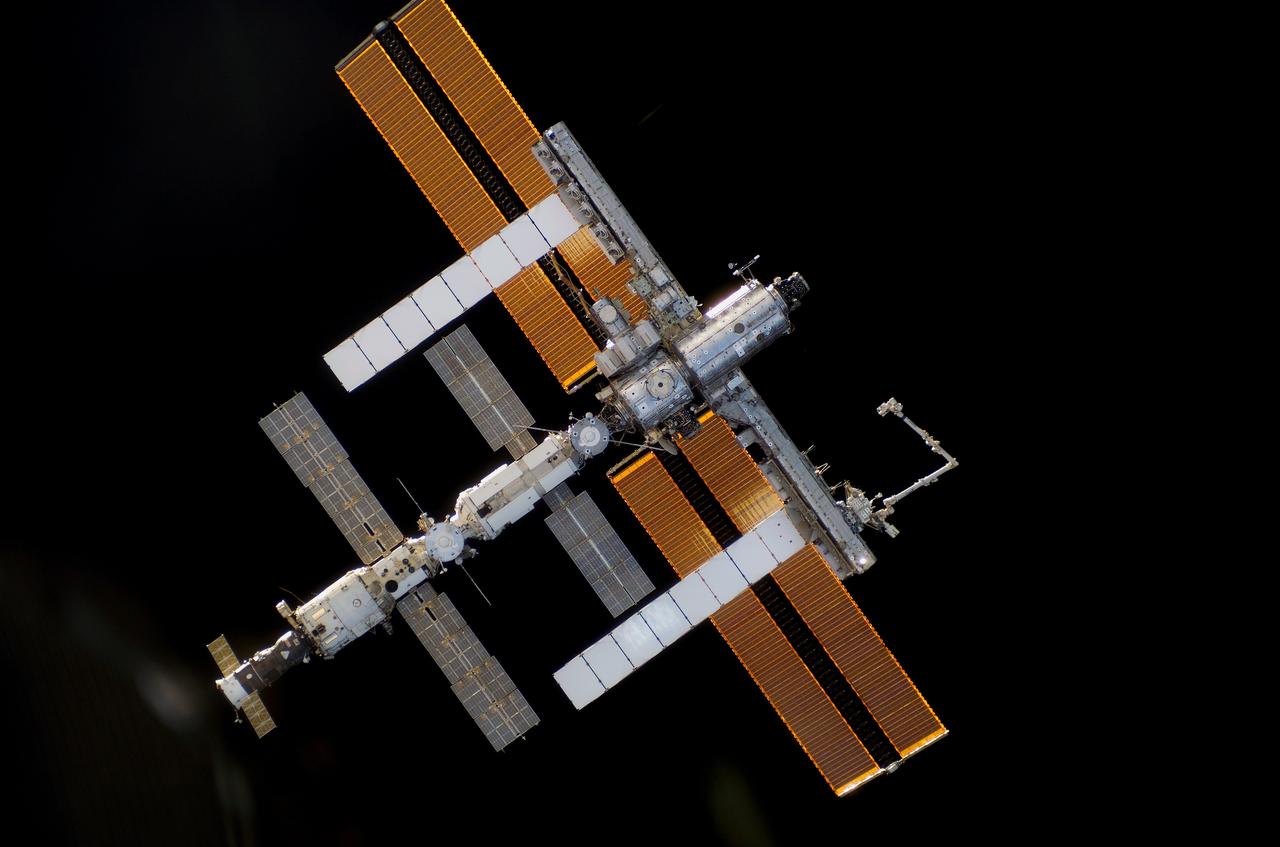
S115-E-05493 (11 Sept. 2006) --- One of the STS-115 crewmembers aboard the Space Shuttle Atlantis took this picture of the International Space Station prior to the docking of the two spacecraft. The subsequent link-up will allow the STS-115 astronauts and the ISS Expedition 13 crew to team up for several days of key tasks in space.
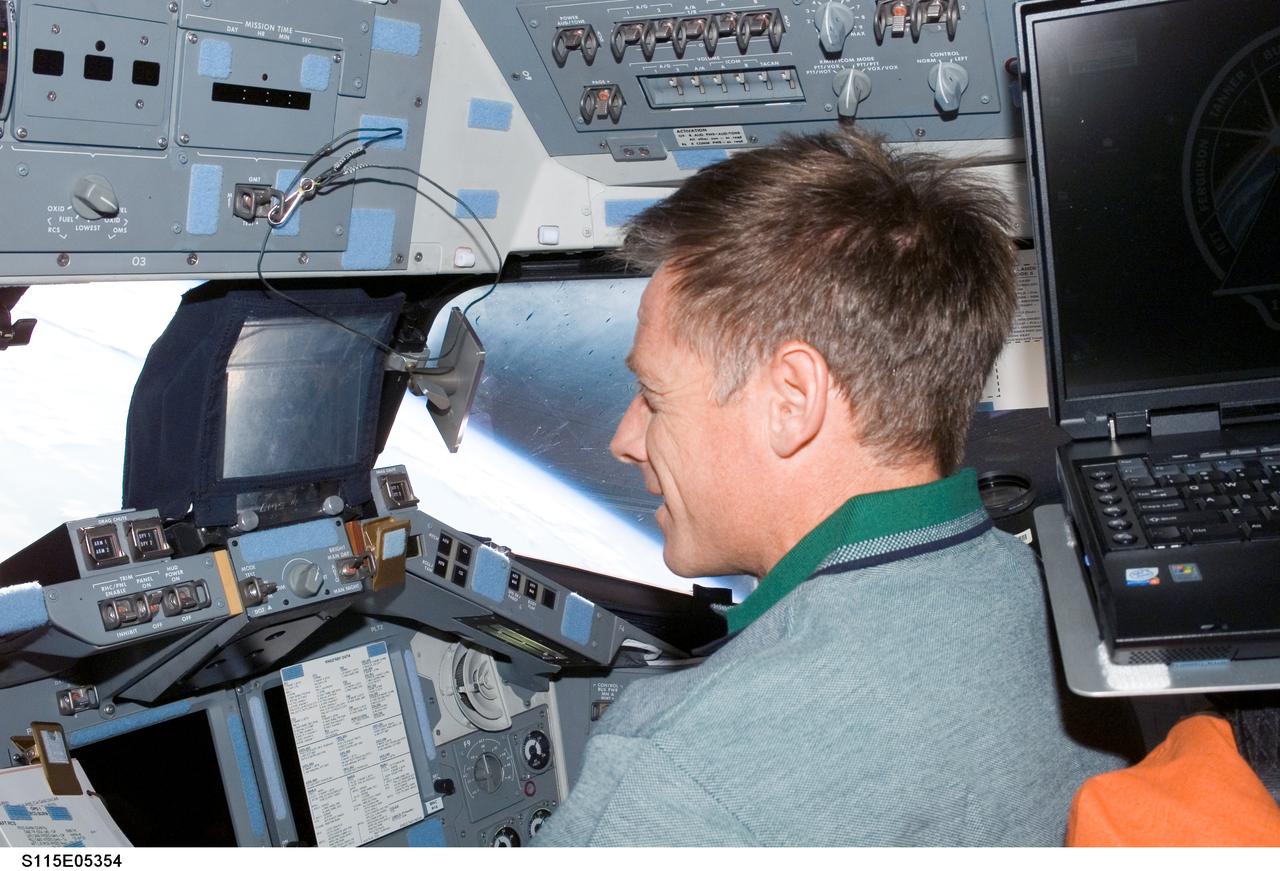
S115-E-05354 (11 Sept. 2006) --- Astronaut Christopher J. Ferguson, STS-115 pilot, sits in the starboard seat on the flight deck of the Space Shuttle Atlantis prior to docking of the two spacecraft. The subsequent docking will allow the STS-115 astronauts and the ISS Expedition 13 crew to team up for several days of key tasks in space.
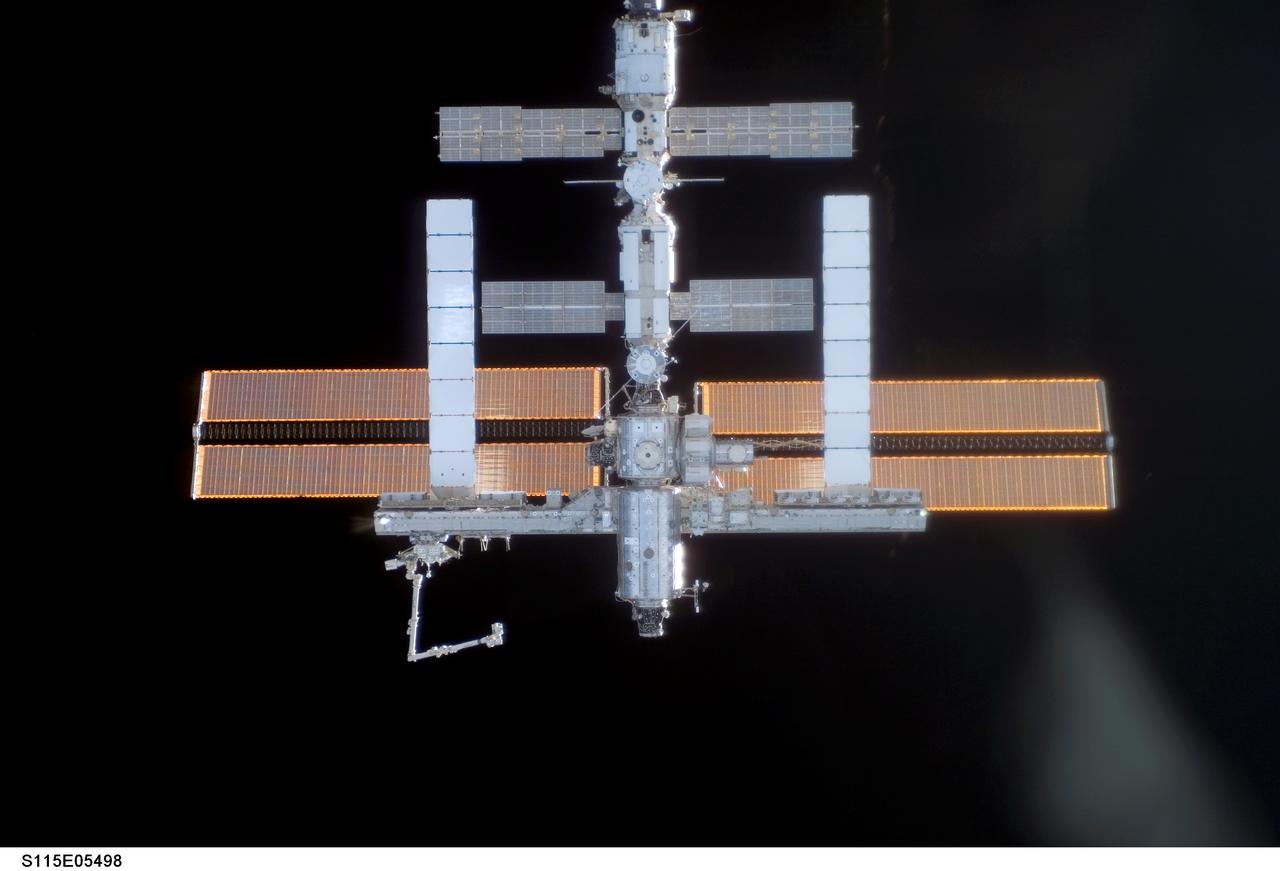
S115-E-05498 (11 Sept. 2006) --- One of the STS-115 crewmembers aboard the Space Shuttle Atlantis took this picture of the International Space Station prior to the docking of the two spacecraft. The subsequent link-up will allow the STS-115 astronauts and the ISS Expedition 13 crew to team up for several days of key tasks in space.
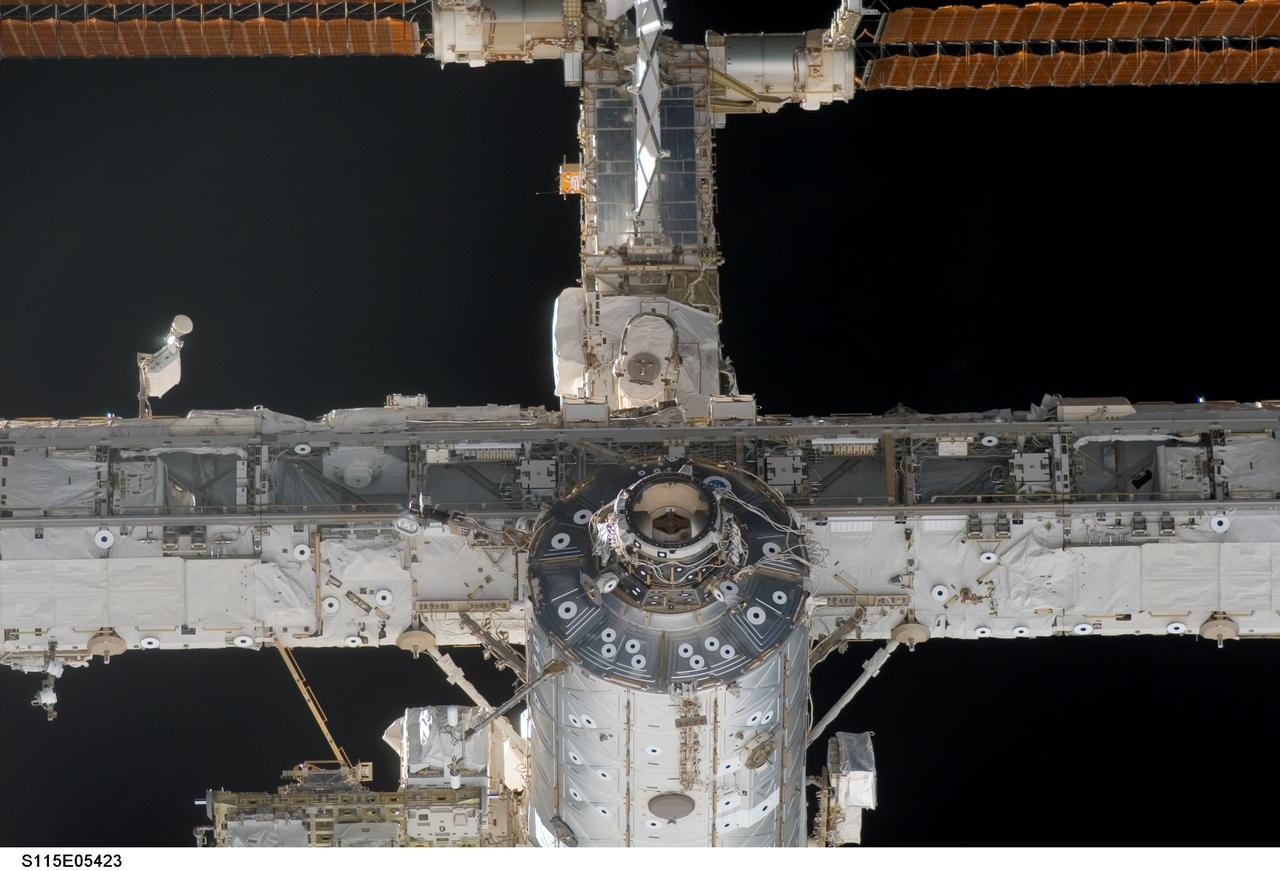
S115-E-05423 (11 Sept. 2006) --- An astronaut onboard the Space Shuttle Atlantis took this photo of the International Space Station as the two spacecraft neared their link-up in space. The subsequent docking will allow the STS-115 astronauts and the ISS Expedition 13 crew to team up for several days of key tasks in space.
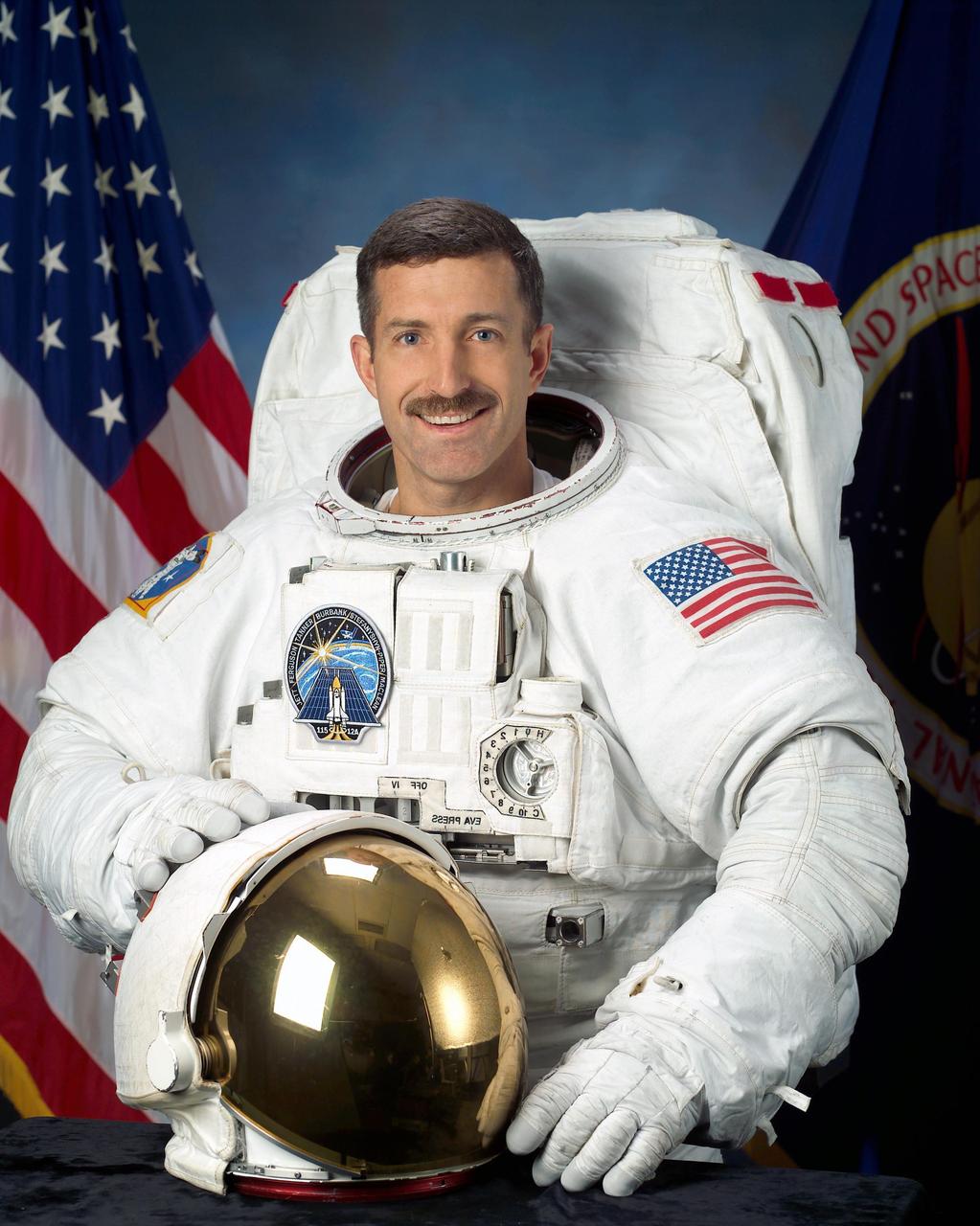
JOHNSON SPACE CENTER, TX - JSC2003-E-12208 (December 23, 2002) -- Astronaut Daniel C. Burbank, mission specialist.
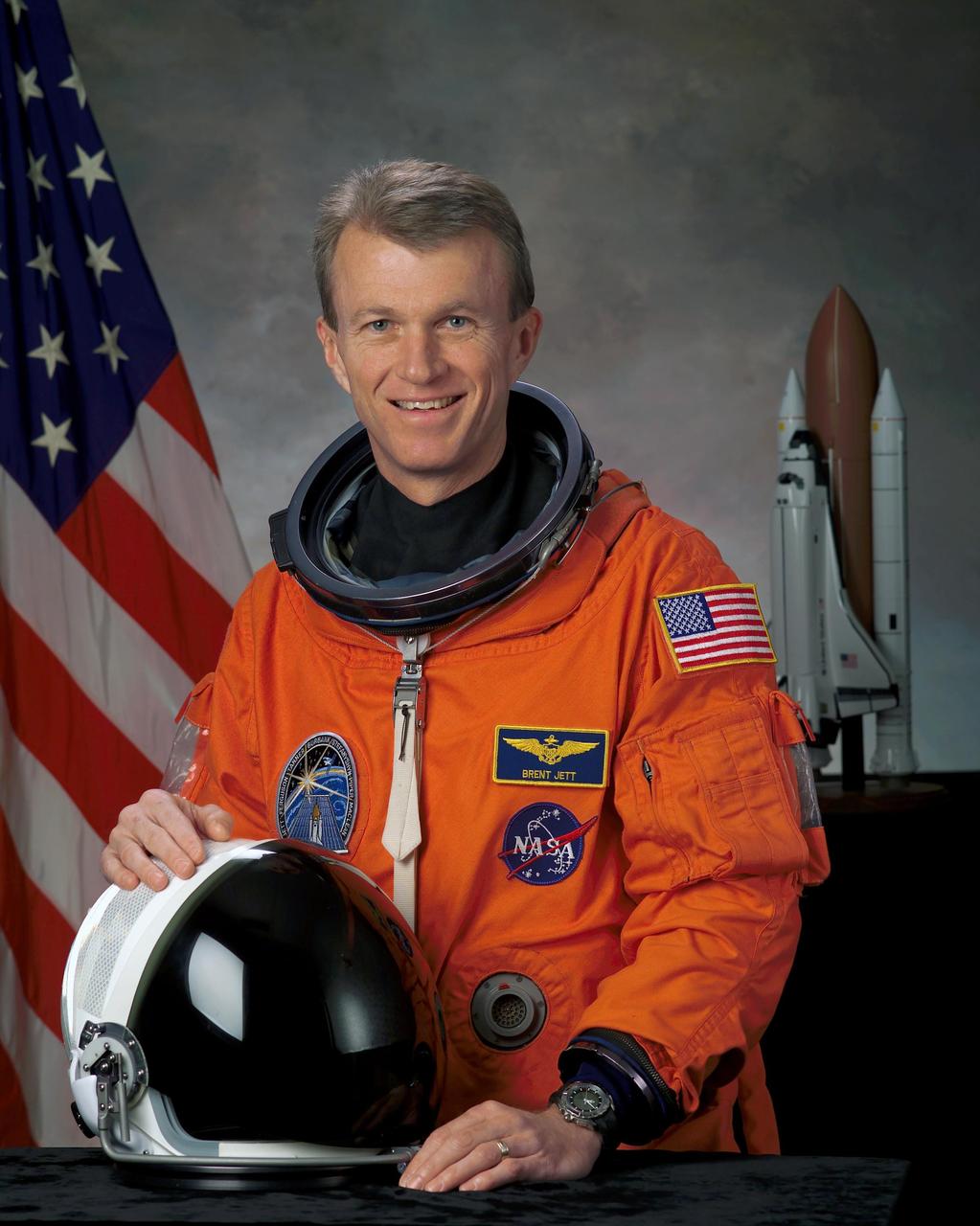
JOHNSON SPACE CENTER, TX - JSC2003-E-01649 (December 20, 2002) -- Astronaut Brent W. Jett Jr., mission commander.
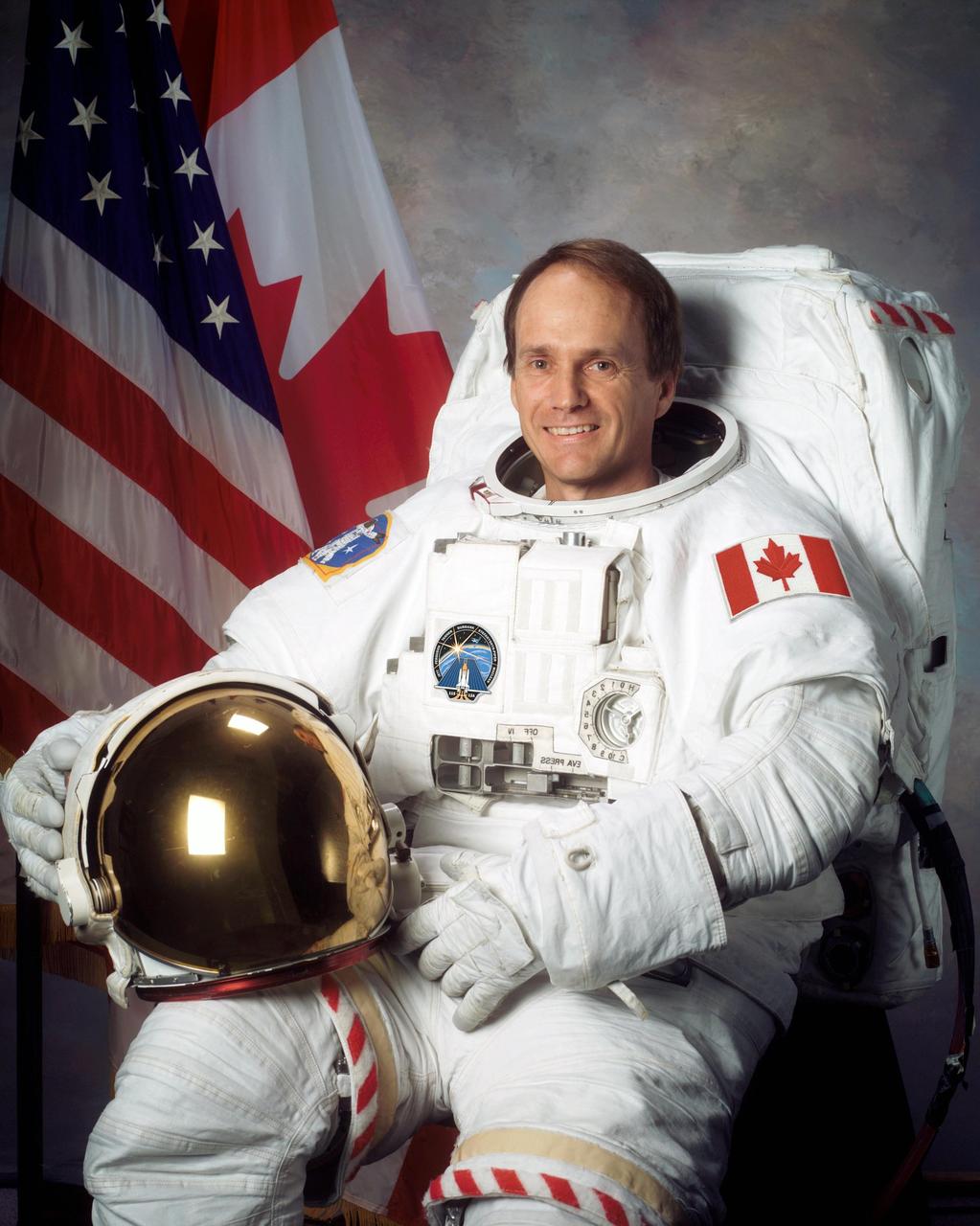
JOHNSON SPACE CENTER, TX - JSC2002-E-43795 (September 11, 2002) -- Astronaut Steven G. MacLean, mission specialist representing the Canadian Space Agency.
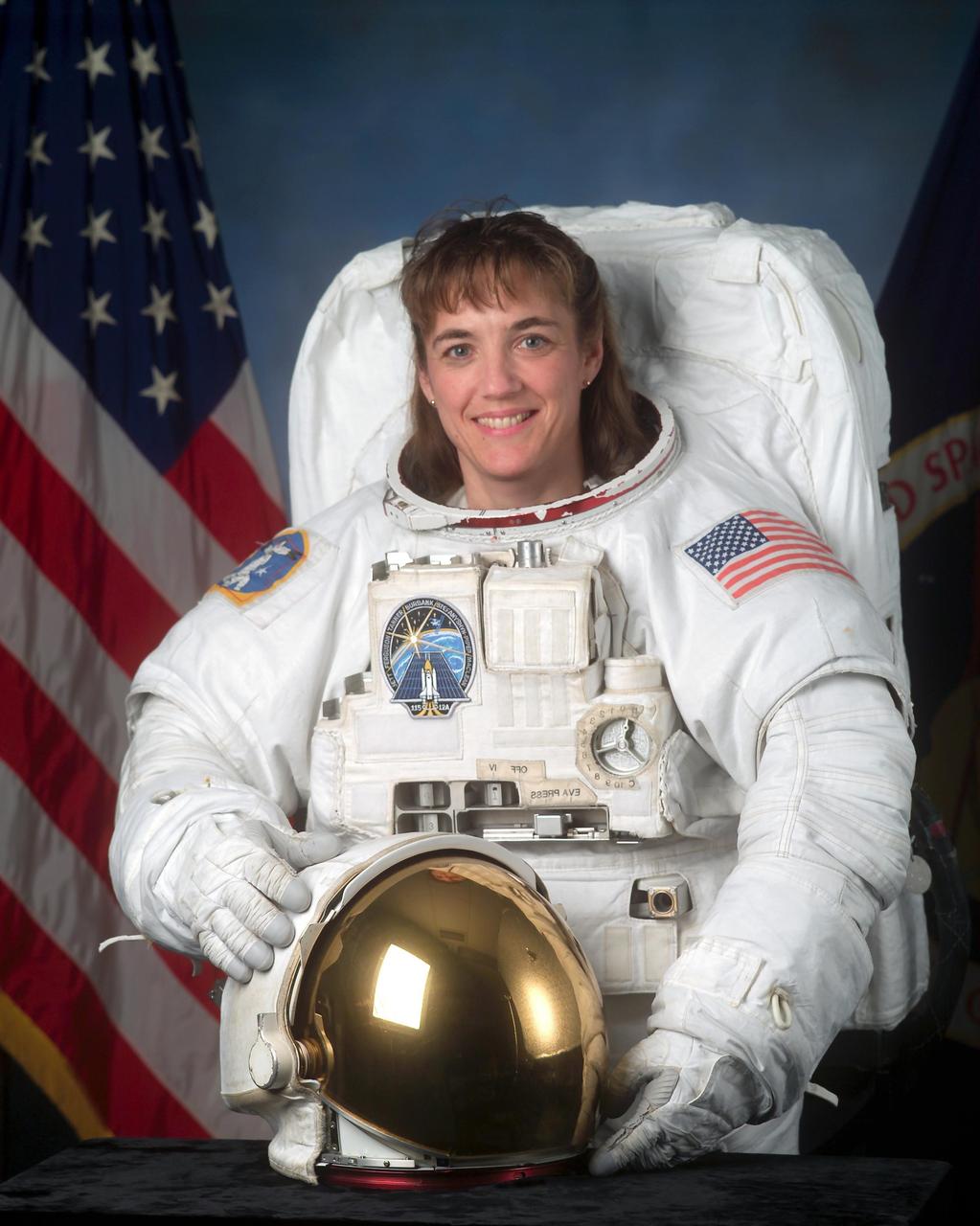
JOHNSON SPACE CENTER, TX - JSC2003-E-30910 (March 13, 2003) -- Astronaut Heidemarie M. Stefanyshyn-Piper, mission specialist, on mission STS-126.
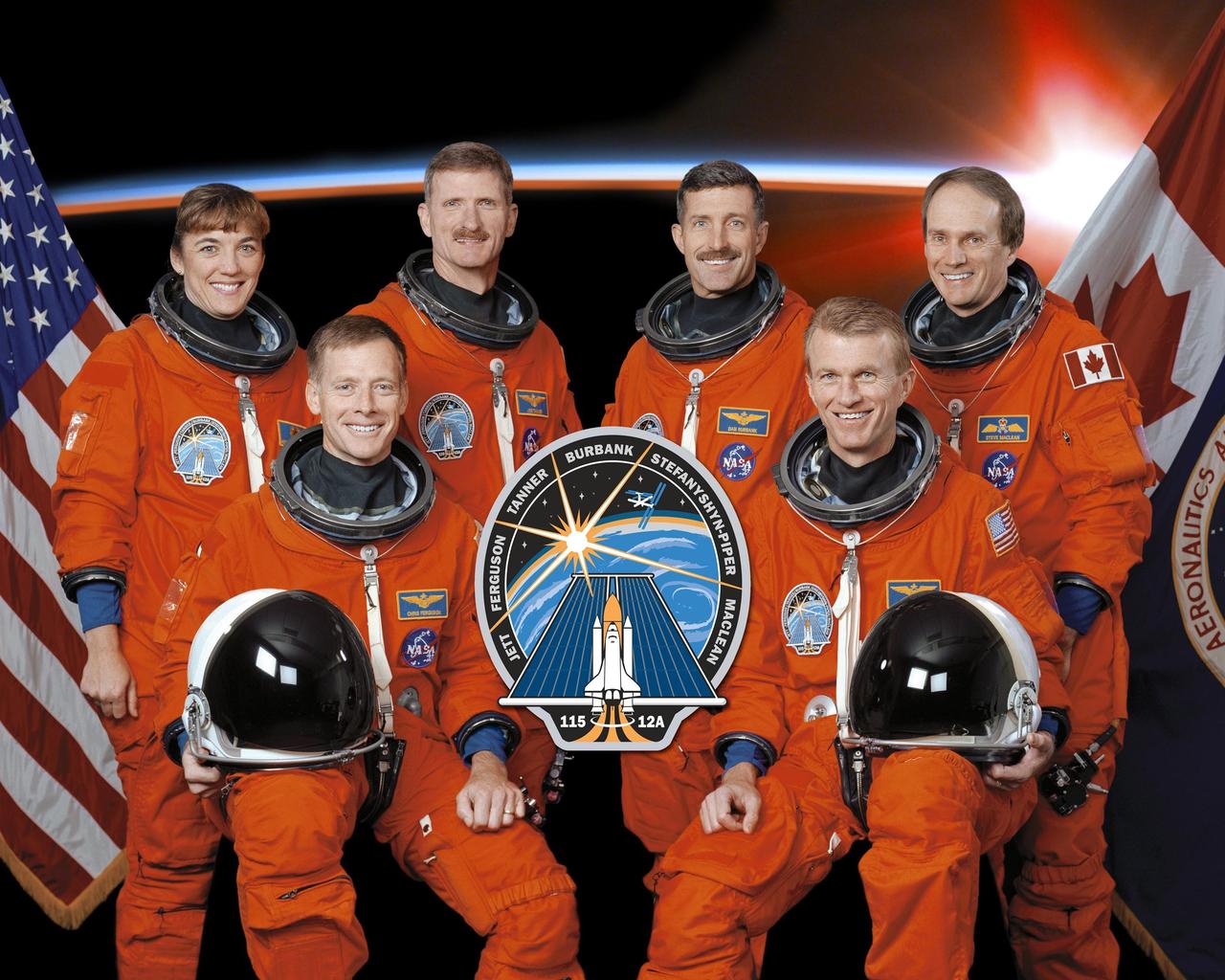
JOHNSON SPACE CENTER, TX - STS115-S-002 (November 8, 2002) -- These six astronauts take a break from training to pose for the STS-115 crew portrait. Astronauts Brent W. Jett Jr. (right) and Christopher J. Ferguson, command and pilot respectively, flank the mission insignia. The mission specialists are, from left to right, astronauts Heidemarie M. Stefanyshyn-Piper, Joseph R. (Joe) Tanner, Daniel C. Burbank, and Steven G. MacLean, who represents the Canadian Space Agency.

JOHNSON SPACE CENTER, TX - S98-17924 (October 9, 1998) -- Astronaut Christopher J. Ferguson, pilot.
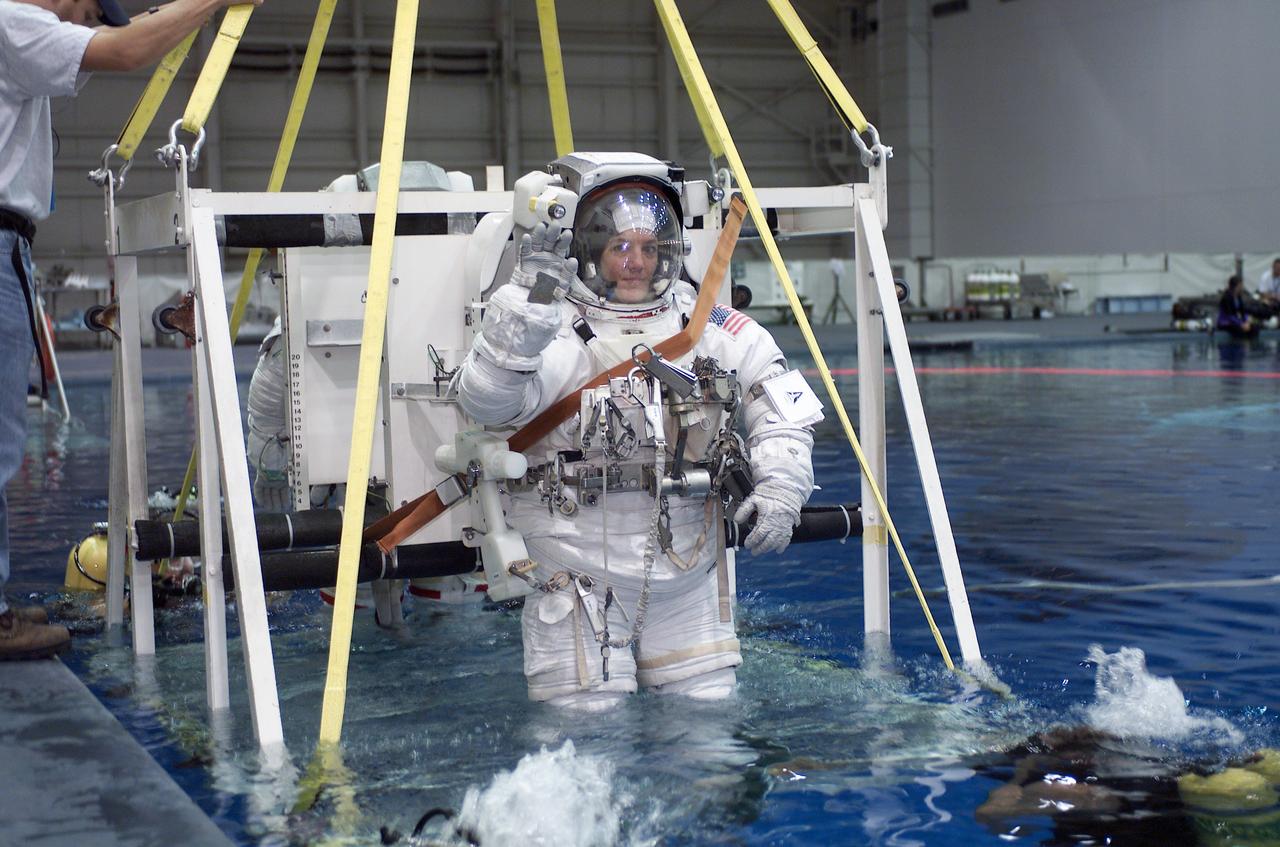
Attired in a training version of the Extravehicular Mobility Unit (EMU) space suit, STS-115 astronaut and mission specialist, Heidemarie M. Stefanyshyn-Piper, is submerged into the waters of the Neutral Buoyancy Laboratory (NBL) near Johnson Space Center for training in preparation for the STS-115 mission. Launched on September 9, 2006, the STS-115 mission continued assembly of the International Space Station (ISS) with the installation of the truss segments P3 and P4.
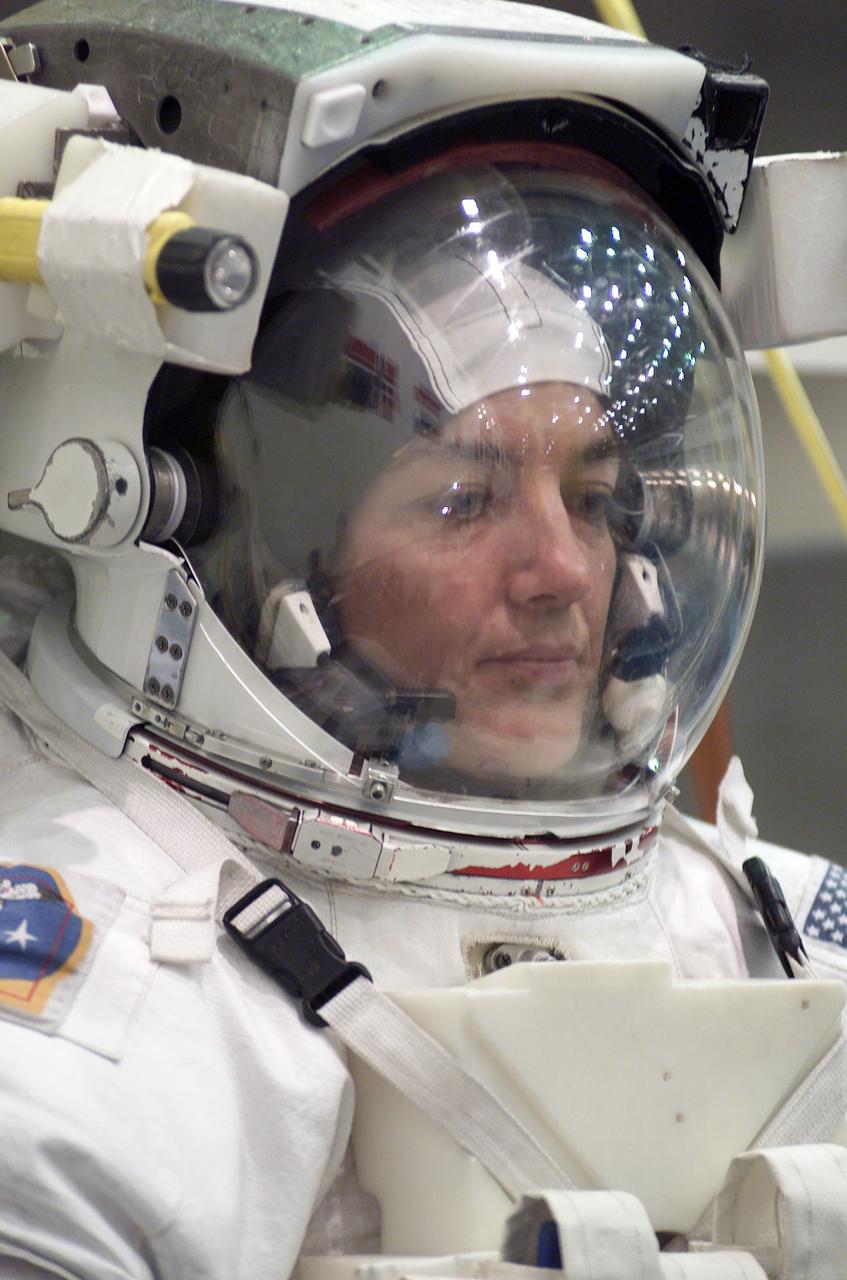
Attired in a training version of the Extravehicular Mobility Unit (EMU) space suit, STS-115 astronaut and mission specialist, Heidemarie M. Stefanyshyn-Piper, is about to begin a training session in the Neutral Buoyancy Laboratory (NBL) near Johnson Space Center in preparation for the STS-115 mission. Launched on September 9, 2006, the STS-115 mission continued assembly of the International Space Station (ISS) with the installation of the truss segments P3 and P4.
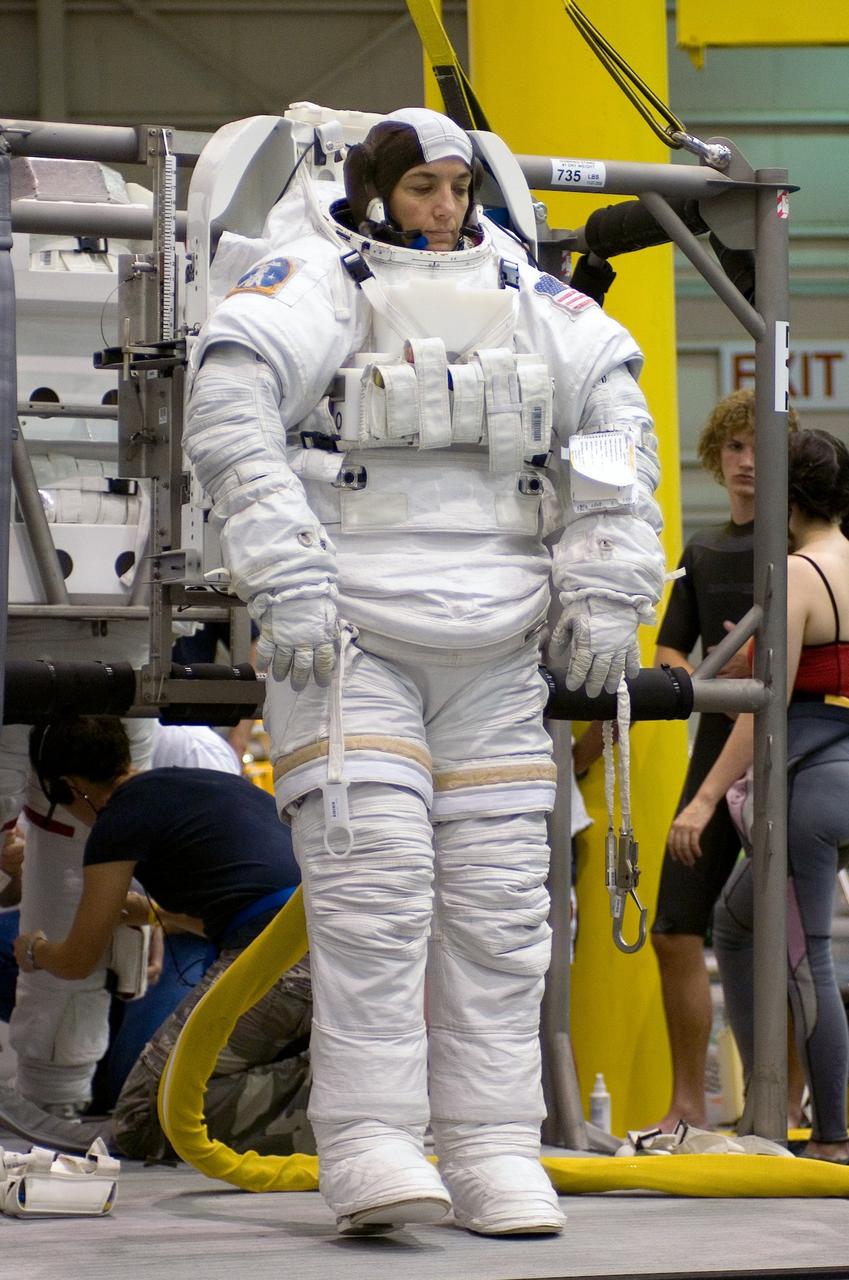
Attired in a training version of the Extravehicular Mobility Unit (EMU) space suit, STS-115 astronaut and mission specialist, Heidemarie M. Stefanyshyn-Piper, is about to begin a training session in the Neutral Buoyancy Laboratory (NBL) near Johnson Space Center in preparation for the STS-115 mission. Launched on September 9, 2006, the STS-115 mission continued assembly of the International Space Station (ISS) with the installation of the truss segments P3 and P4.
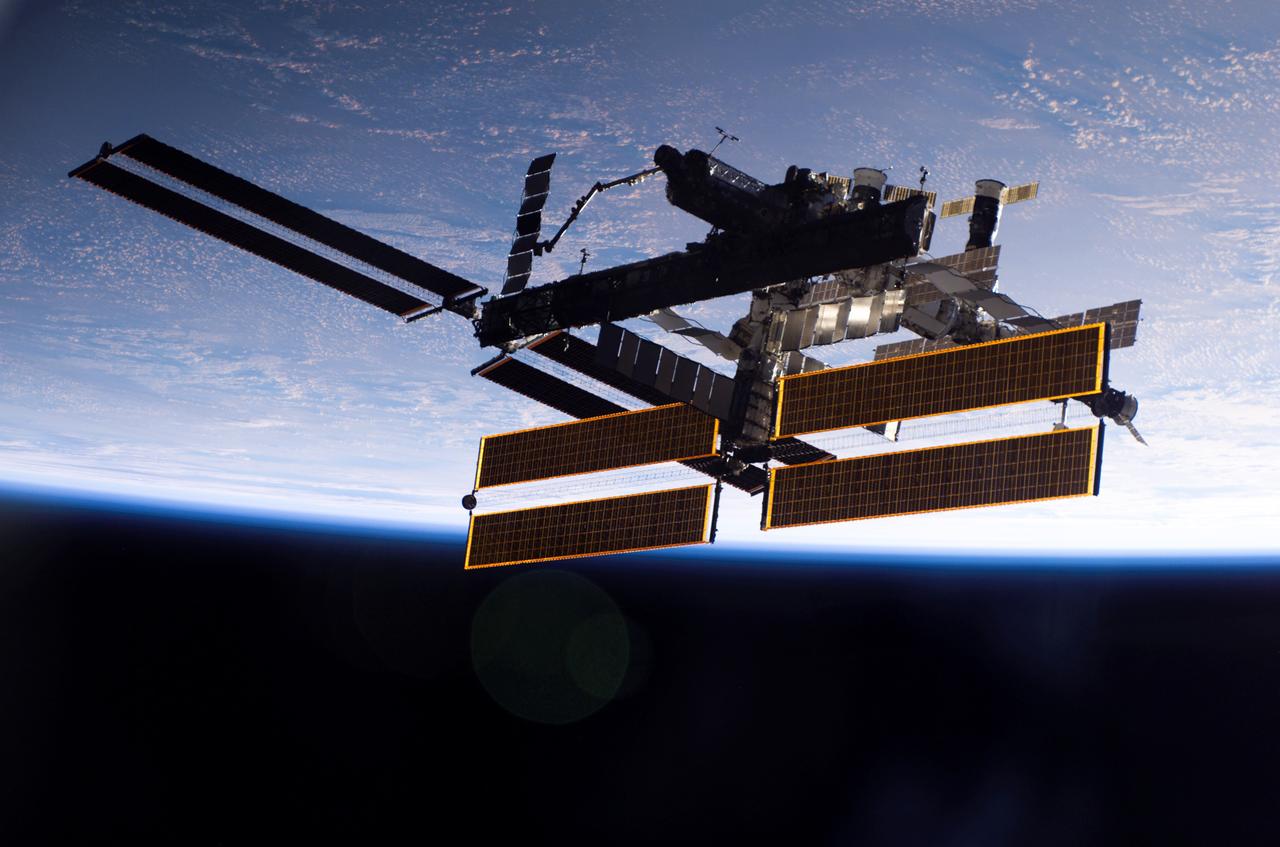
This view of the International Space Station, back dropped against the blackness of space and Earth, was taken shortly after the Space Shuttle Atlantis undocked from the orbital outpost at 7:50 a.m. CDT during the STS-115 mission. The unlinking completed after six days, two hours and two minutes of joint operations of the installation of the P3/P4 truss. The new 17 ton truss included batteries, electronics, a giant rotating joint, and sported a second pair of 240-foot solar wings. The new solar arrays will eventually double the onboard power of the Station when their electrical systems are brought online during the next shuttle flight, STS-116.
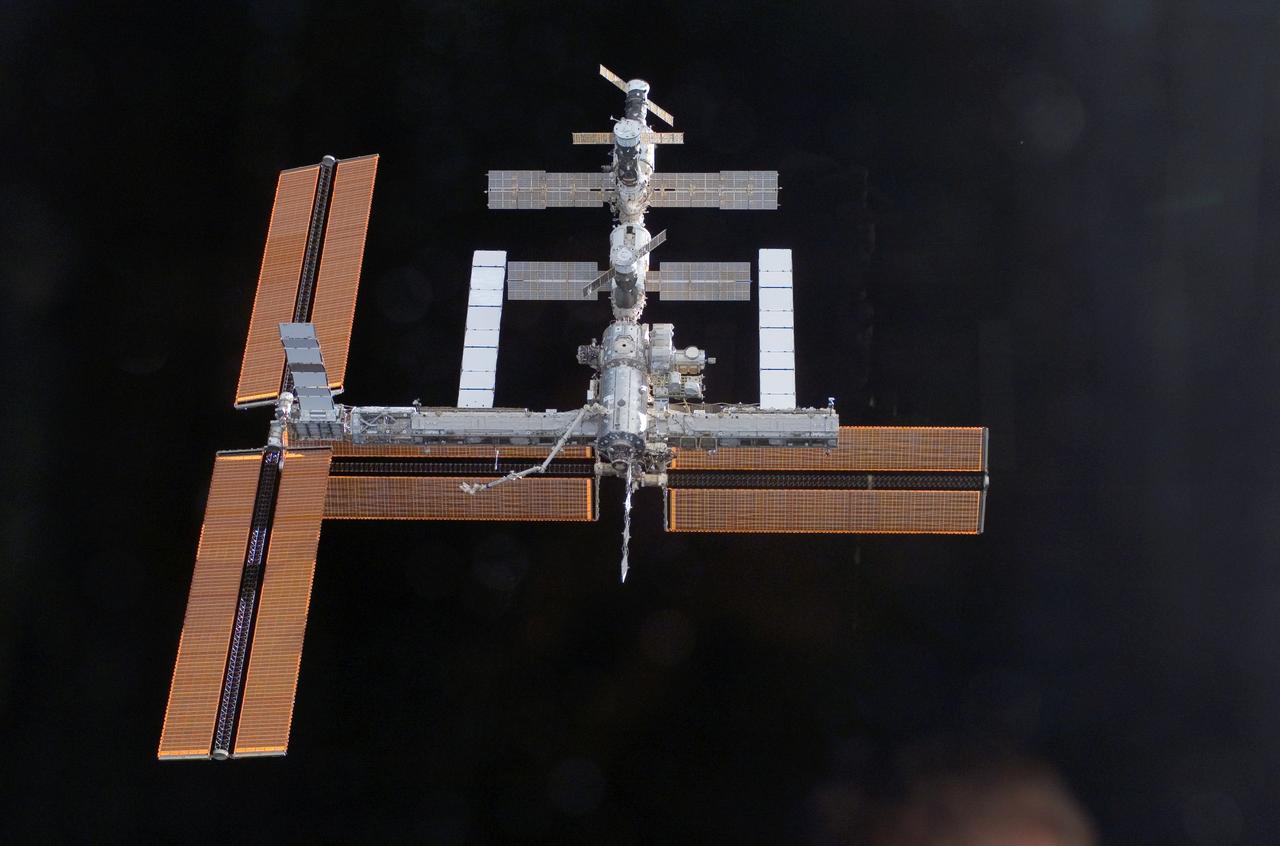
This view of the International Space Station, back dropped against the blackness of space, was taken shortly after the Space Shuttle Atlantis undocked from the orbital outpost at 7:50 a.m. CDT during the STS-115 mission. The unlinking completed after six days, two hours and two minutes of joint operations of the installation of the P3/P4 truss. The new 17 ton truss included batteries, electronics, a giant rotating joint, and sported a second pair of 240-foot solar wings. The new solar arrays will eventually double the onboard power of the Station when their electrical systems are brought online during the next shuttle flight, STS-116.
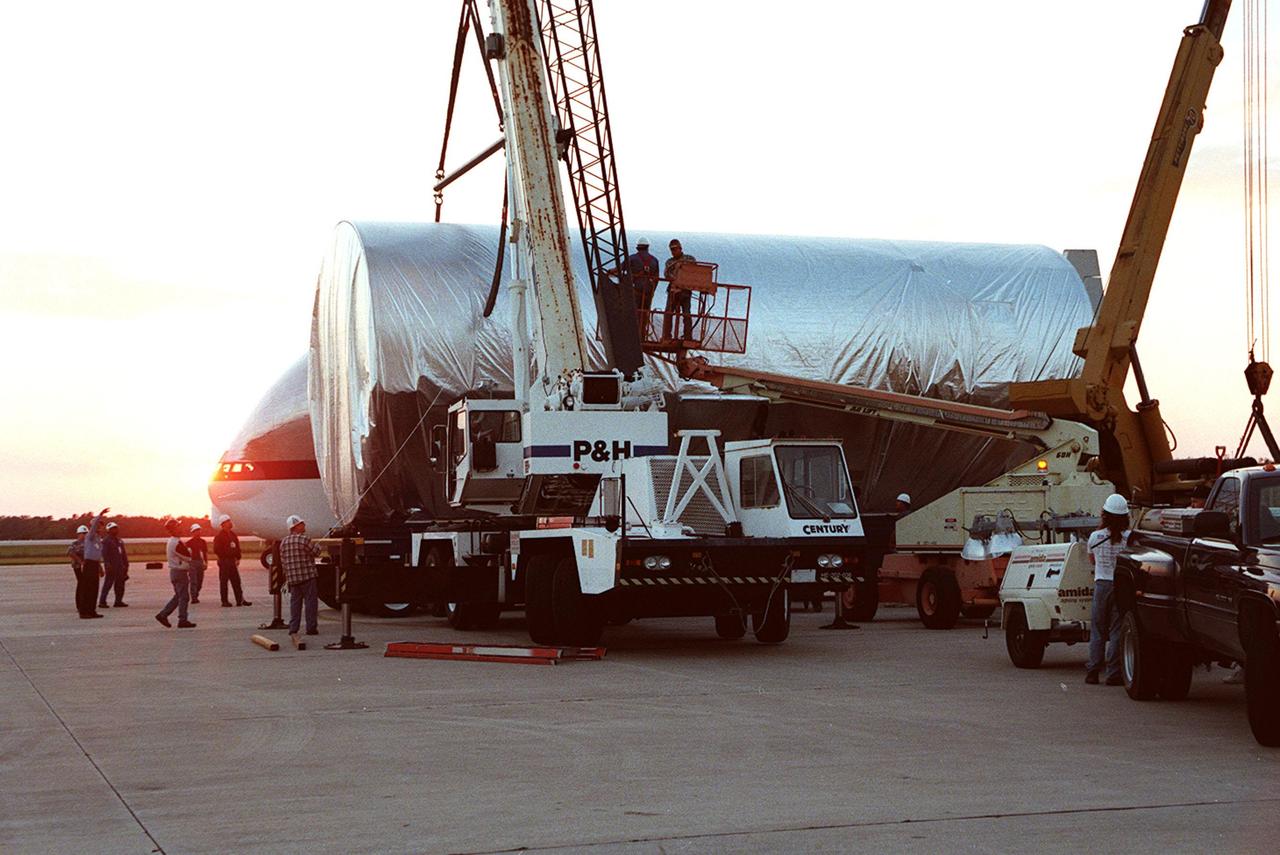
KENNEDY SPACE CENTER, FLA. -- Workers secure the P3 truss on the transporter for the trip to the Operations and Checkout Building. The second port-side truss is a segment of the International Space Station (ISS), scheduled to be added to the ISS on mission STS-115 in 2002 aboard Space Shuttle Atlantis. P3 will be attached to the first port truss segment (P1).
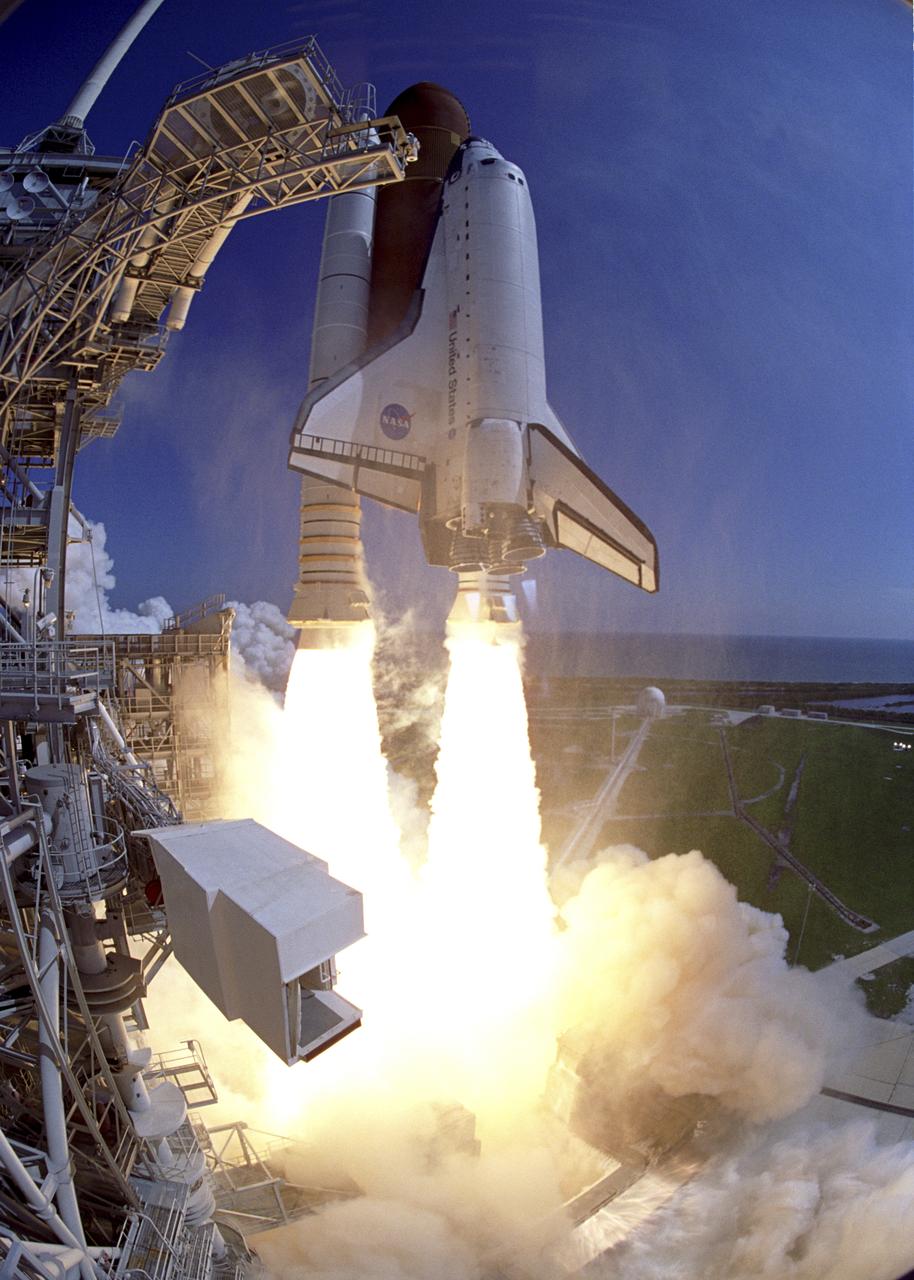
The Space Shuttle Atlantis and its six-member crew launched at 11:15 a.m. (EDT) on September 9, 2006 to begin the two-day journey to the International Space Station (ISS) on the STS-115 mission. During the 11-day mission, the STS-115 crew of six, along with station crews and ground teams, resumed construction of the ISS with the installation of a girder-like structure, known as the P3/P4 truss. The 35,000-pound piece includes a set of giant solar arrays, batteries and associated electronics. The arrays eventually will double the power capability of the Station.

Wearing a training version of the shuttle launch and entry suit, STS-115 astronaut and mission specialist, Heidemarie M. Stefanyshyn-Piper, puts the final touches on her suit donning process prior to the start of a water survival training session in the Neutral Buoyancy Laboratory (NBL) near Johnson Space Center. Launched on September 9, 2006, the STS-115 mission continued assembly of the International Space Station (ISS) with the installation of the truss segments P3 and P4.
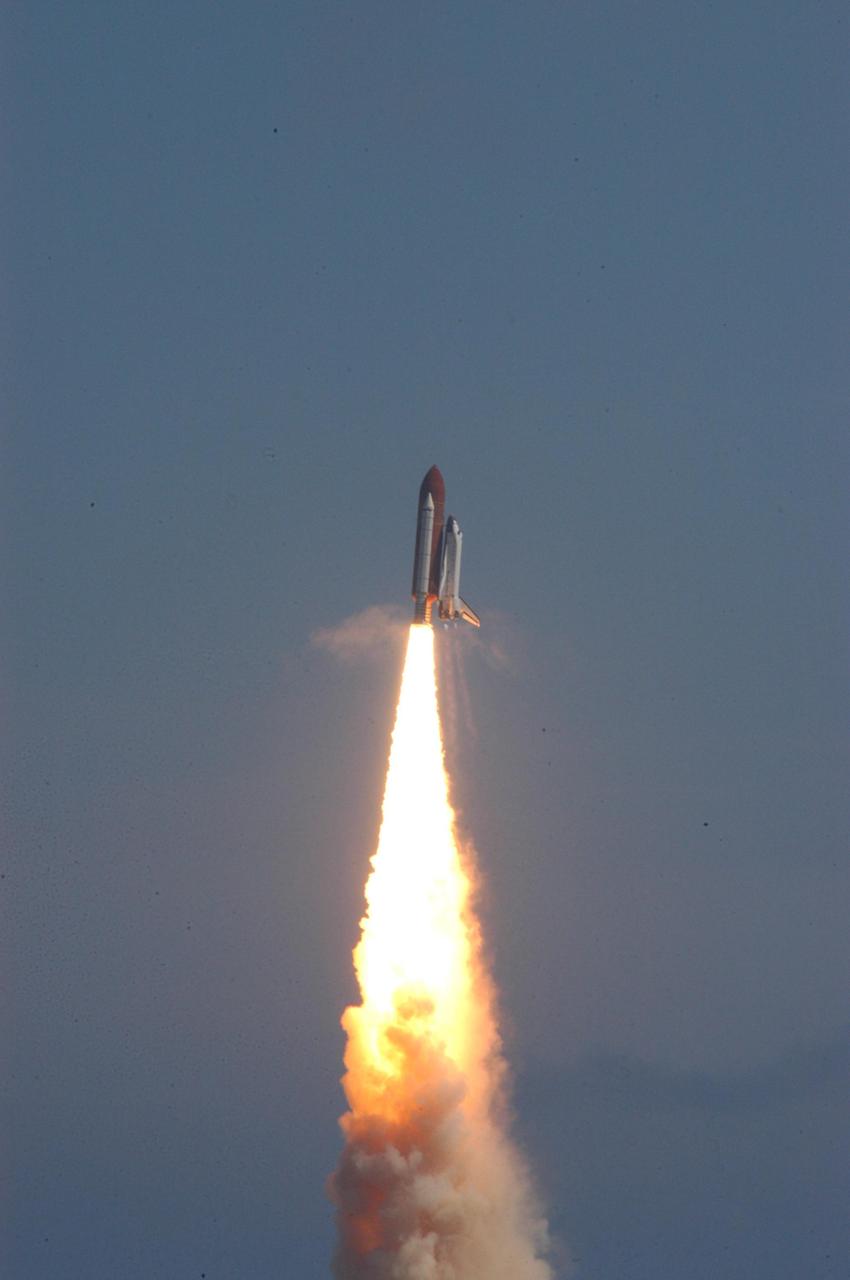
KENNEDY SPACE CENTER, FLA. - The fiery launch of Space Shuttle Atlantis makes a perfect picture against the blue Florida sky as Atlantis heads for a rendezvous with the International Space Station on mission STS-115. After launch attempts were scrubbed Aug. 27 and 29 and Sept. 3 and 8 due to weather and technical concerns, this launch was executed perfectly. During the STS-115 mission, Atlantis' astronauts will deliver and install the 17.5-ton, bus-sized P3/P4 integrated truss segment on the station. The girder-like truss includes a set of giant solar arrays, batteries and associated electronics and will provide one-fourth of the total power-generation capability for the completed station. This mission is the 116th space shuttle flight, the 27th flight for orbiter Atlantis, and the 19th U.S. flight to the ISS. STS-115 is scheduled to last 11 days with a planned landing at KSC. Photo credit: NASA/George Shelton
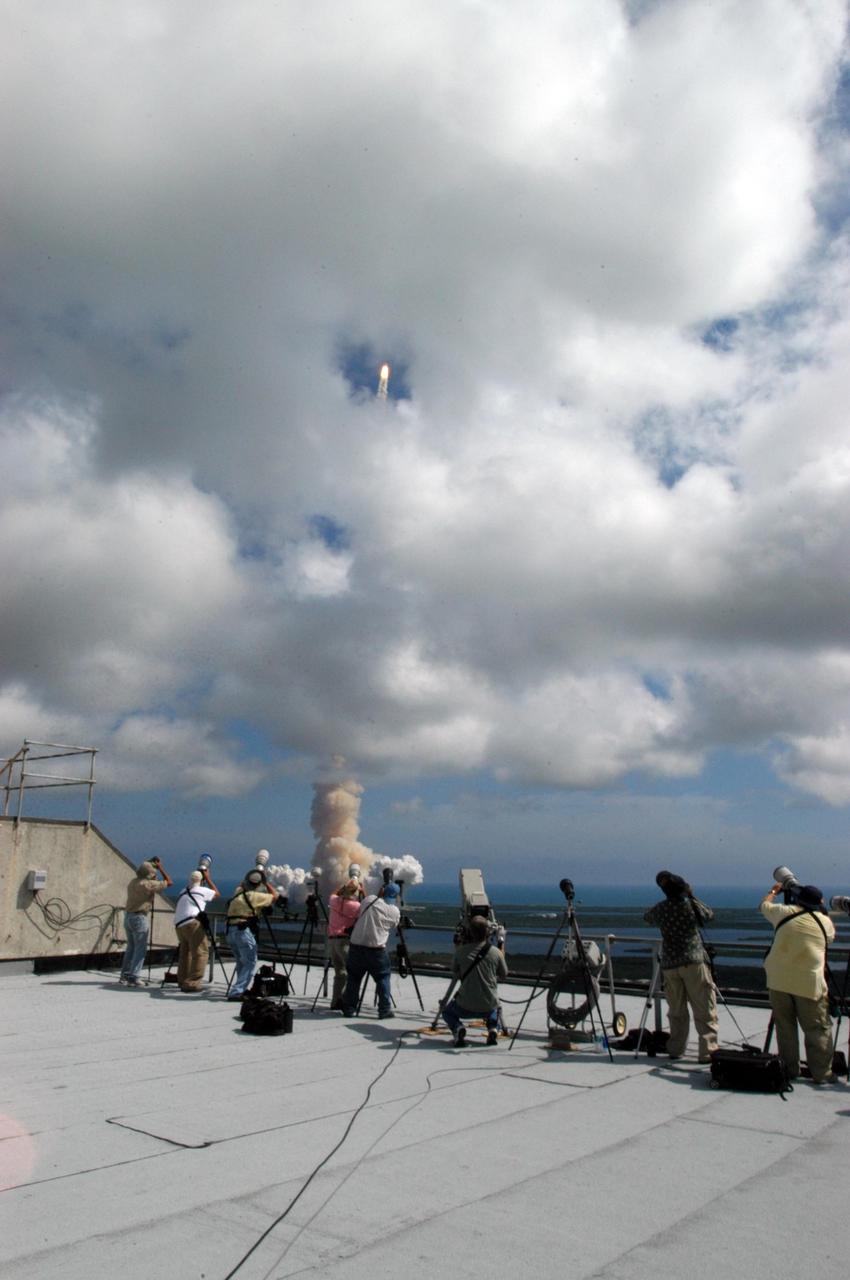
KENNEDY SPACE CENTER, FLA. - A phalanx of photographers line the roof of the Vehicle Assembly Building as Space Shuttle Atlantis roars off the launch pad at 11:14:55 a.m. EDT for a rendezvous with the International Space Station on mission STS-115. After launch attempts were scrubbed Aug. 27 and 29 and Sept. 3 and 8 due to weather and technical concerns, this launch was executed perfectly. During the STS-115 mission, Atlantis' astronauts will deliver and install the 17.5-ton, bus-sized P3/P4 integrated truss segment on the station. The girder-like truss includes a set of giant solar arrays, batteries and associated electronics and will provide one-fourth of the total power-generation capability for the completed station. This mission is the 116th space shuttle flight, the 27th flight for orbiter Atlantis, and the 19th U.S. flight to the ISS. STS-115 is scheduled to last 11 days with a planned landing at KSC. Photo credit: NASA/George Shelton
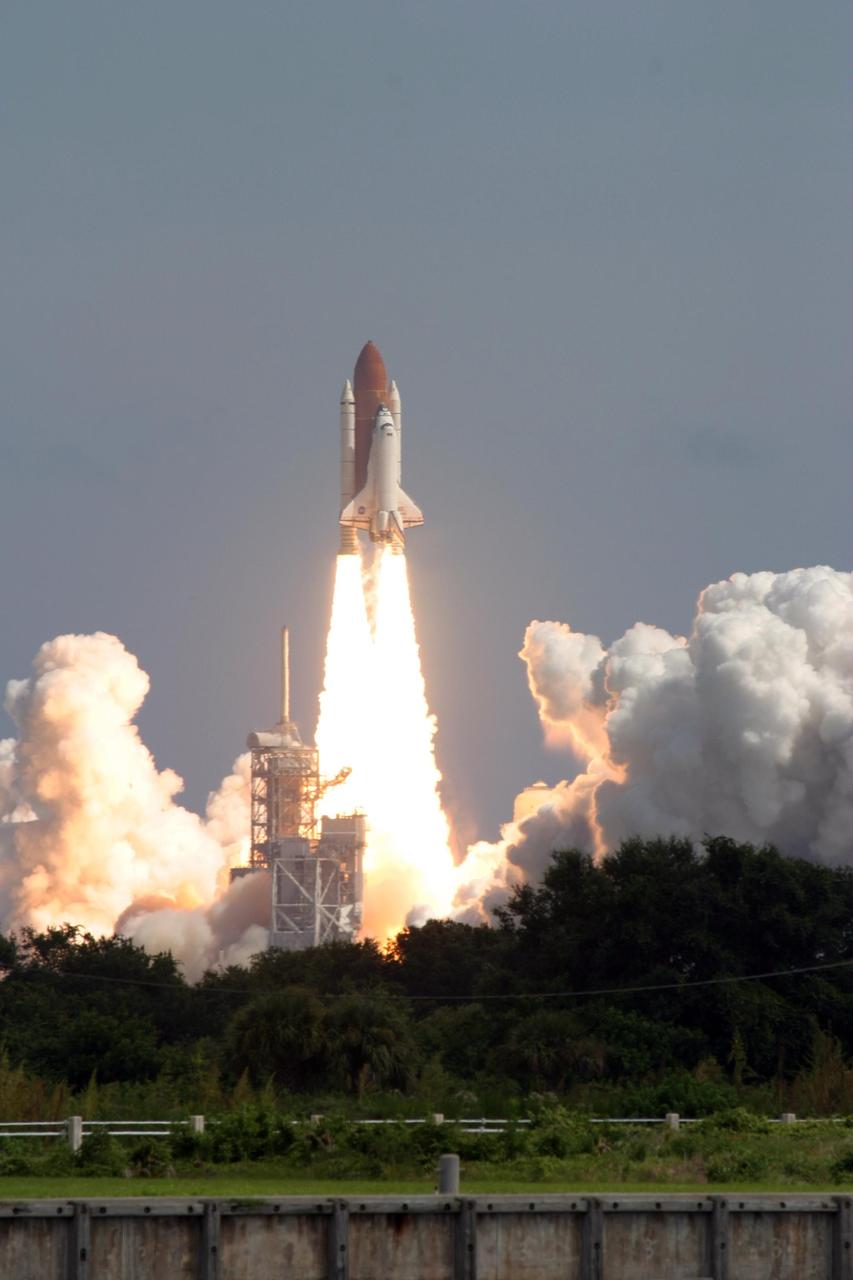
KENNEDY SPACE CENTER, FLA. - With a fiery liftoff, Space Shuttle Atlantis roars off the launch pad for a rendezvous with the International Space Station on mission STS-115. After launch attempts were scrubbed Aug. 27 and 29 and Sept. 3 and 8 due to weather and technical concerns, this launch was executed perfectly. During the STS-115 mission, Atlantis' astronauts will deliver and install the 17.5-ton, bus-sized P3/P4 integrated truss segment on the station. The girder-like truss includes a set of giant solar arrays, batteries and associated electronics and will provide one-fourth of the total power-generation capability for the completed station. This mission is the 116th space shuttle flight, the 27th flight for orbiter Atlantis, and the 19th U.S. flight to the ISS. STS-115 is scheduled to last 11 days with a planned landing at KSC. Photo credit: NASA/Dennis Sabo
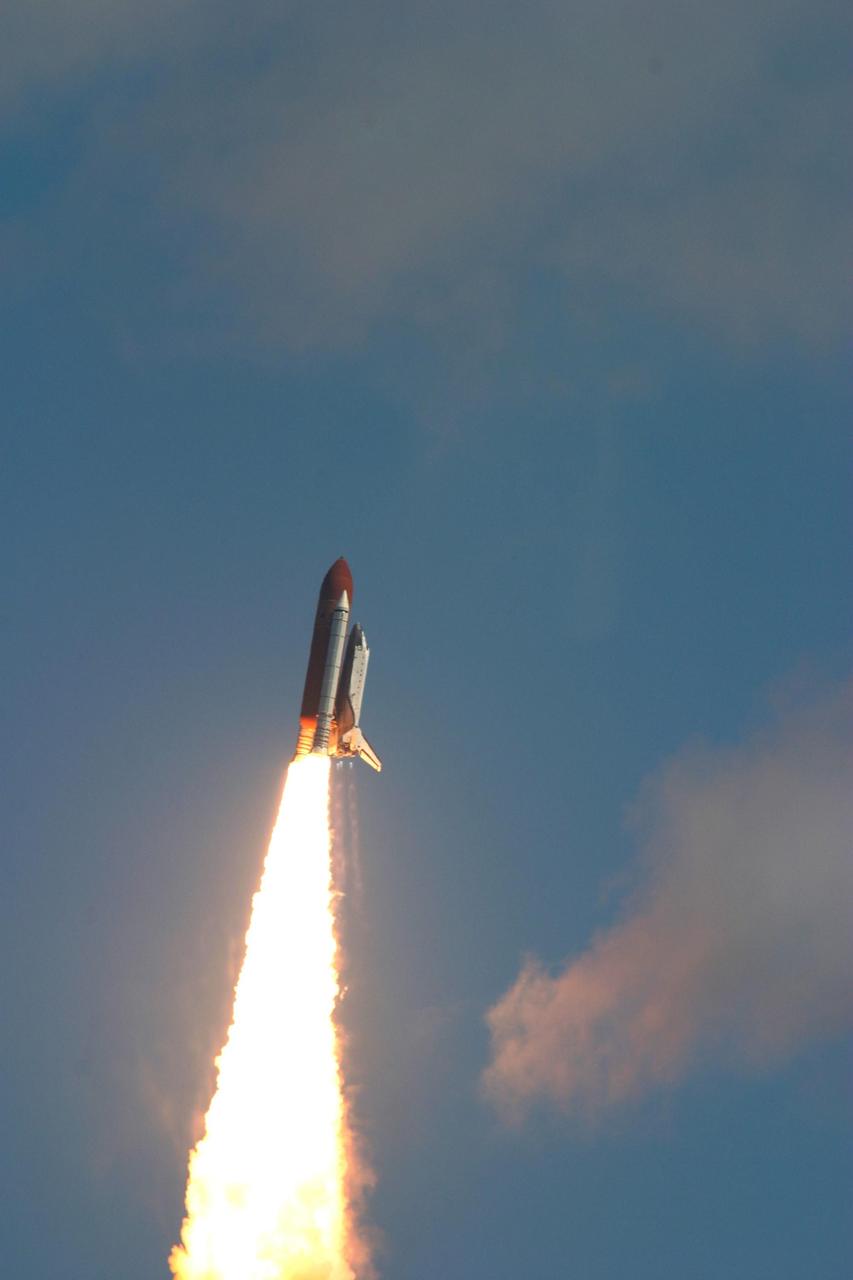
KENNEDY SPACE CENTER, FLA. - Looking like a work of art, Space Shuttle Atlantis roars into the blue Florida sky atop a column of fire for a rendezvous with the International Space Station on mission STS-115. After launch attempts were scrubbed Aug. 27 and 29 and Sept. 3 and 8 due to weather and technical concerns, this launch was executed perfectly. During the STS-115 mission, Atlantis' astronauts will deliver and install the 17.5-ton, bus-sized P3/P4 integrated truss segment on the station. The girder-like truss includes a set of giant solar arrays, batteries and associated electronics and will provide one-fourth of the total power-generation capability for the completed station. This mission is the 116th space shuttle flight, the 27th flight for orbiter Atlantis, and the 19th U.S. flight to the ISS. STS-115 is scheduled to last 11 days with a planned landing at KSC. Photo credit: NASA/Dennis Sabo
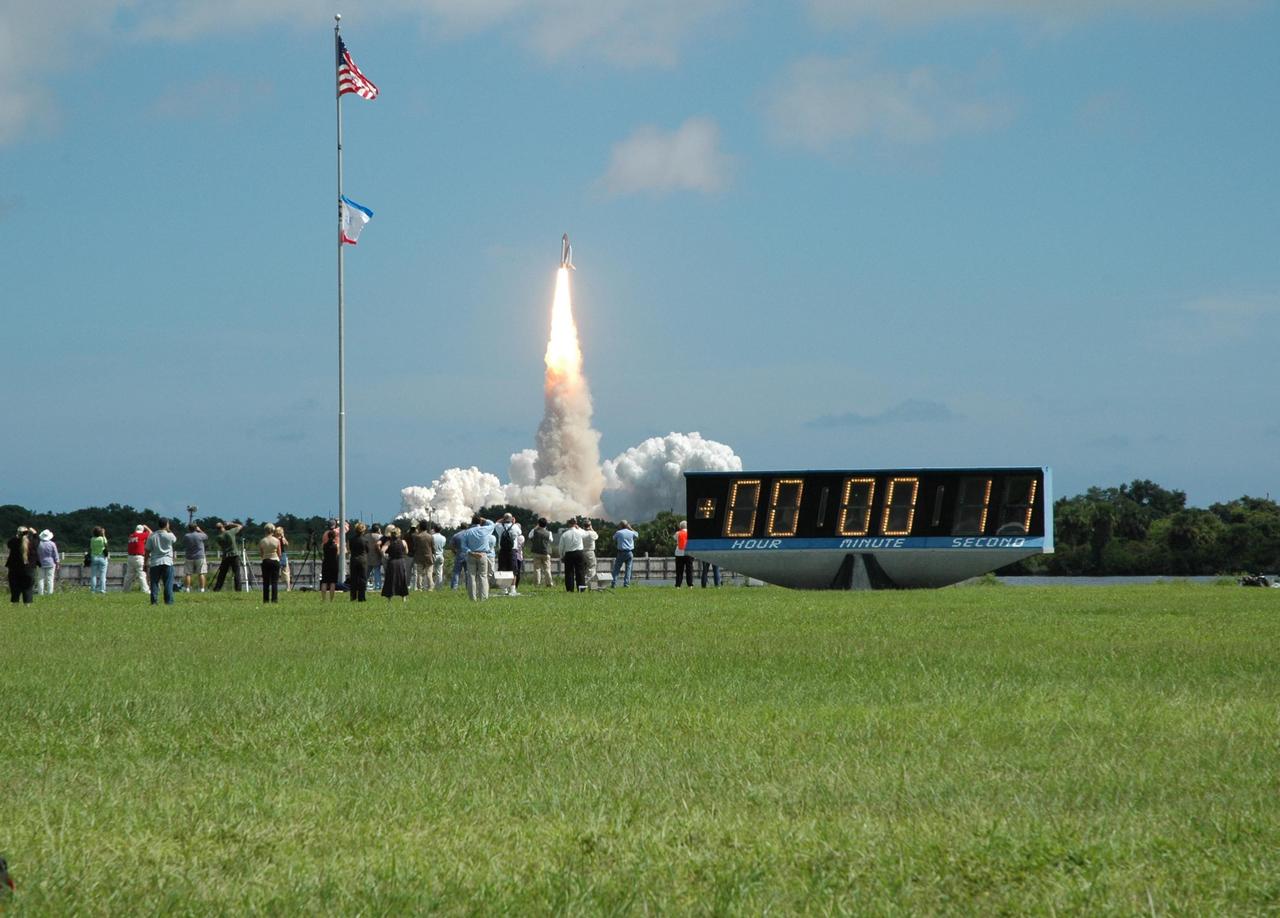
KENNEDY SPACE CENTER, FLA. - Space Shuttle Atlantis roars off the launch pad for a rendezvous with the International Space Station on mission STS-115. In the foreground is the countdown clock, marking launch and mission-elapsed time, on the grounds of the NASA News Center. After launch attempts were scrubbed Aug. 27 and 29 and Sept. 3 and 8 due to weather and technical concerns, this launch was executed perfectly. During the STS-115 mission, Atlantis' astronauts will deliver and install the 17.5-ton, bus-sized P3/P4 integrated truss segment on the station. The girder-like truss includes a set of giant solar arrays, batteries and associated electronics and will provide one-fourth of the total power-generation capability for the completed station. This mission is the 116th space shuttle flight, the 27th flight for orbiter Atlantis, and the 19th U.S. flight to the ISS. STS-115 is scheduled to last 11 days with a planned landing at KSC. Photo credit: NASA/Webb Dillard
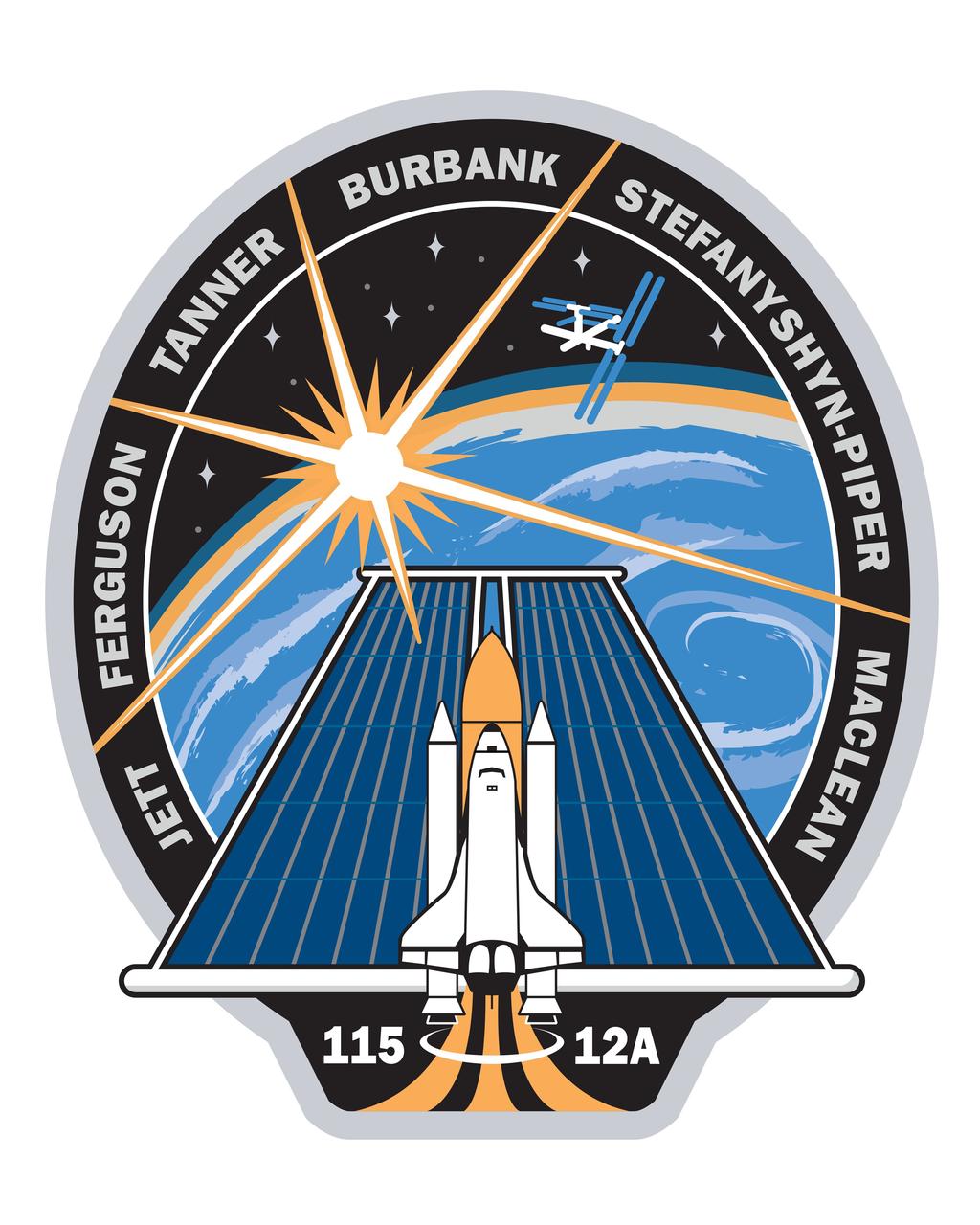
This is the STS-115 insignia. This mission continued the assembly of the International Space Station (ISS) with the installation of the truss segments P3 and P4. Following the installation of the segments utilizing both the shuttle and the station robotic arms, a series of three space walks completed the final connections and prepared for the deployment of the station's second set of solar arrays. To reflect the primary mission of the flight, the patch depicts a solar panel as the main element. As the Space Shuttle Atlantis launches towards the ISS, its trail depicts the symbol of the Astronaut Office. The star burst, representing the power of the sun, rises over the Earth and shines on the solar panel. The shuttle flight number 115 is shown at the bottom of the patch, along with the ISS assembly designation 12A (the 12th American assembly mission). The blue Earth in the background reminds us of the importance of space exploration and research to all of Earth's inhabitants.
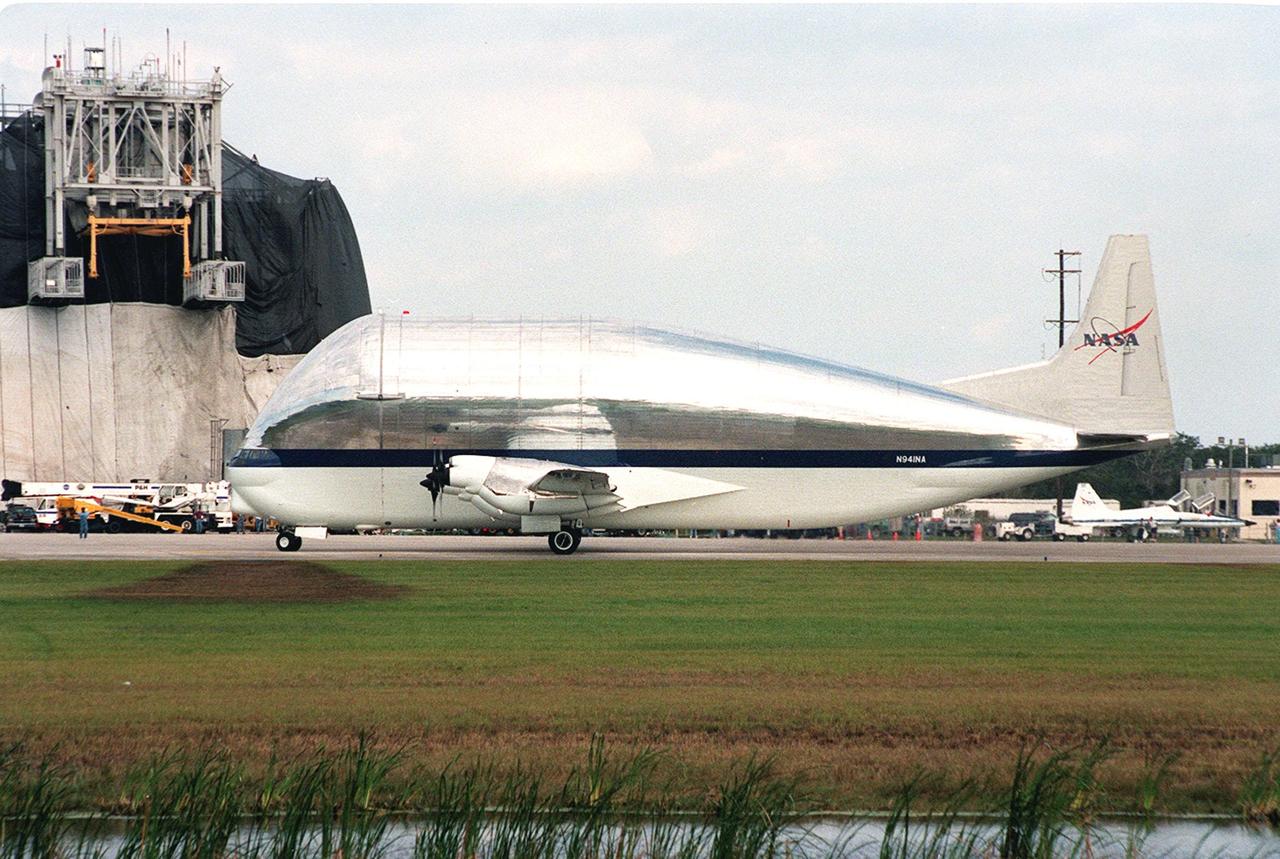
KENNEDY SPACE CENTER, FLA. -- NASA's Super Guppy aircraft arrives at Kennedy Space Center's Shuttle Landing Facility. The plane carries a component for the International Space Station (ISS), the port-side P3 truss. The truss is scheduled to be added to the ISS on mission STS-115 in 2002 aboard Space Shuttle Atlantis. The second port truss segment, P3 will be attached to the first port truss segment (P1). The P3 truss will be taken to the Operations and Checkout Building
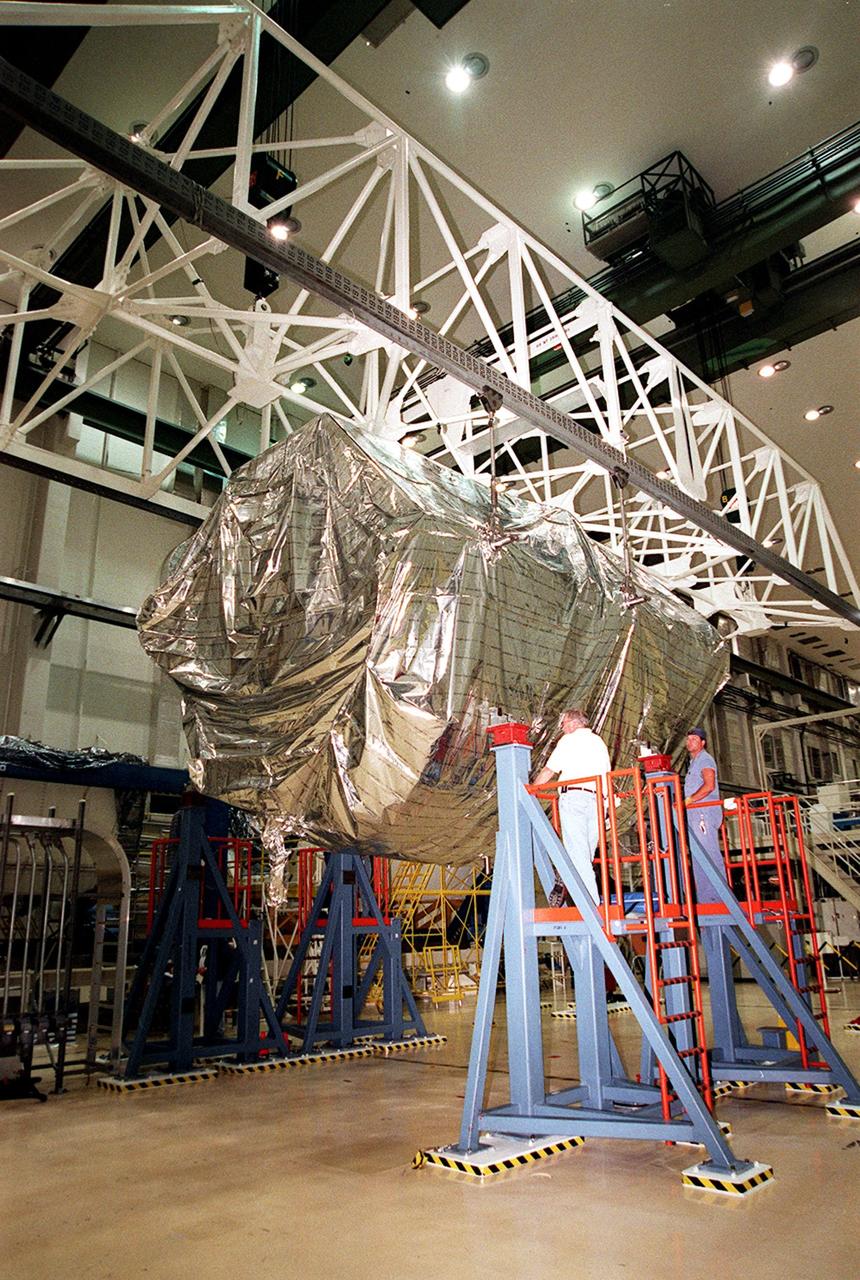
KENNEDY SPACE CENTER, FLA. -- Workers in the Operations and Checkout Building oversee the movement of a segment of the International Space Station (ISS), the port-side P3 truss, onto a workstand. The truss is scheduled to be added to the ISS on mission STS-115 in 2002 aboard Space Shuttle Atlantis. The second port truss segment, P3 will be attached to the first port truss segment (P1).
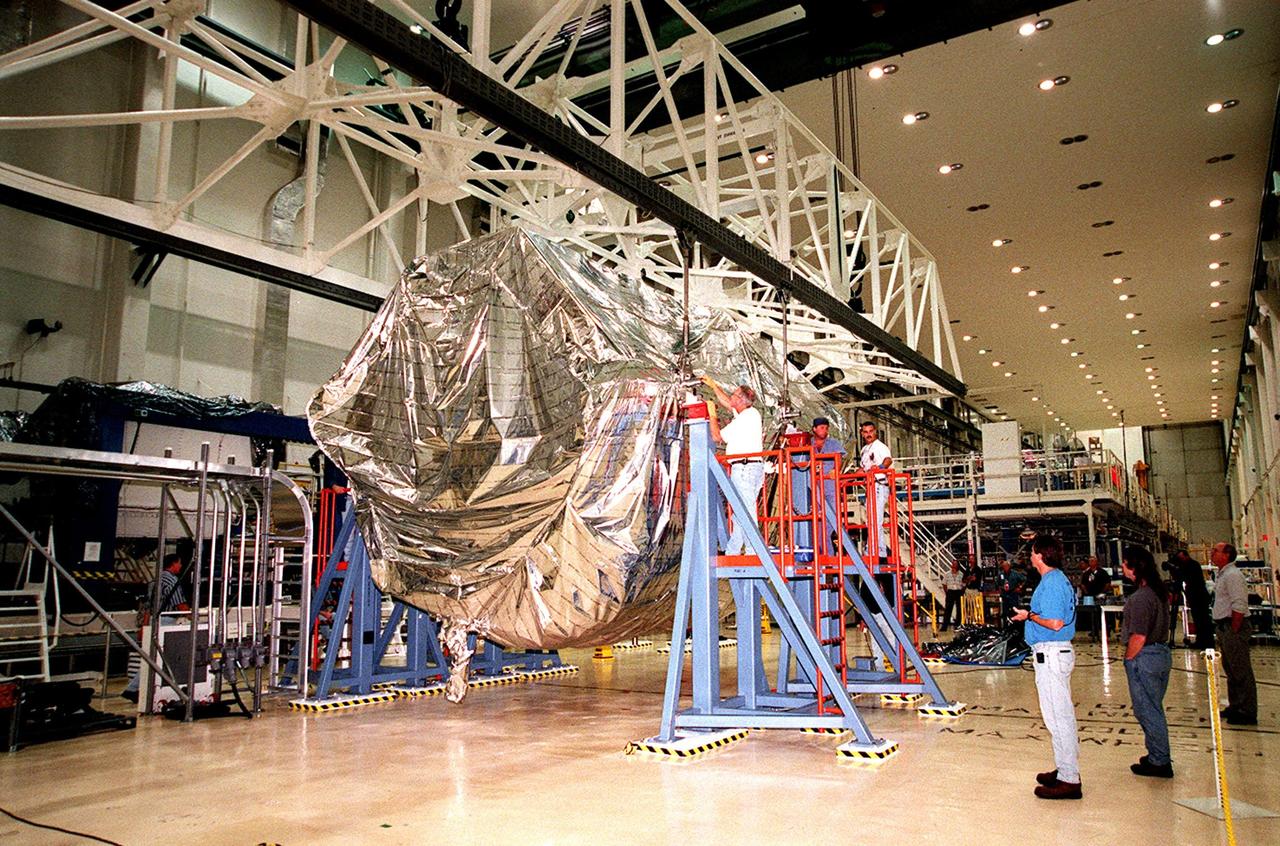
KENNEDY SPACE CENTER, FLA. -- Workers adjust connection of the port-side P3 truss on its workstand in the Operations and Checkout Building. The truss is a segment of the International Space Station (ISS), the second port truss segment, that will be attached to the first port truss segment (P1). The truss is scheduled to be added to the ISS on mission STS-115 in 2002 aboard Space Shuttle Atlantis.
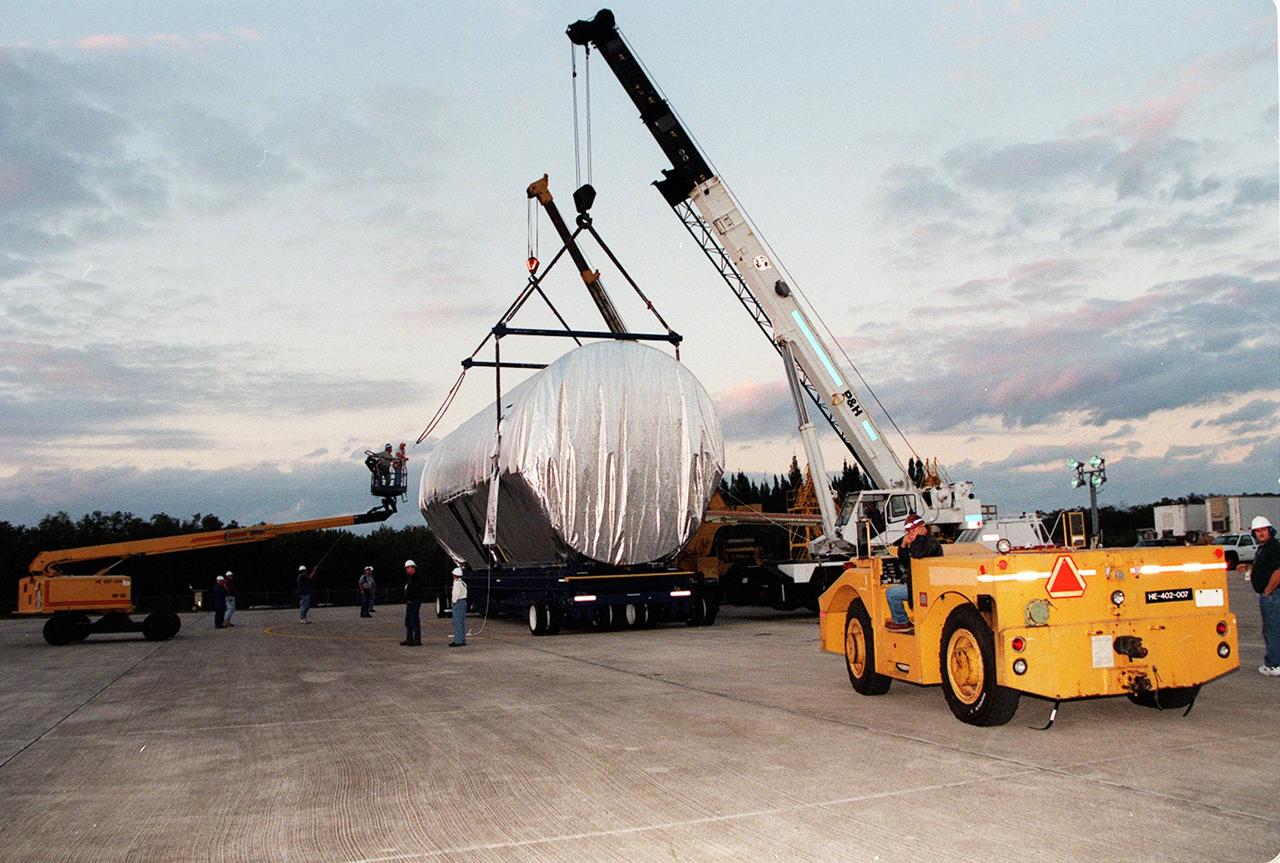
KENNEDY SPACE CENTER, FLA. -- In the waning afternoon light, cranes secure the P3 truss on the transporter while a tractor and driver wait to move it to the Operations and Checkout Building. The second port-side truss is a segment of the International Space Station (ISS), scheduled to be added to the ISS on mission STS-115 in 2002 aboard Space Shuttle Atlantis. P3 will be attached to the first port truss segment (P1).
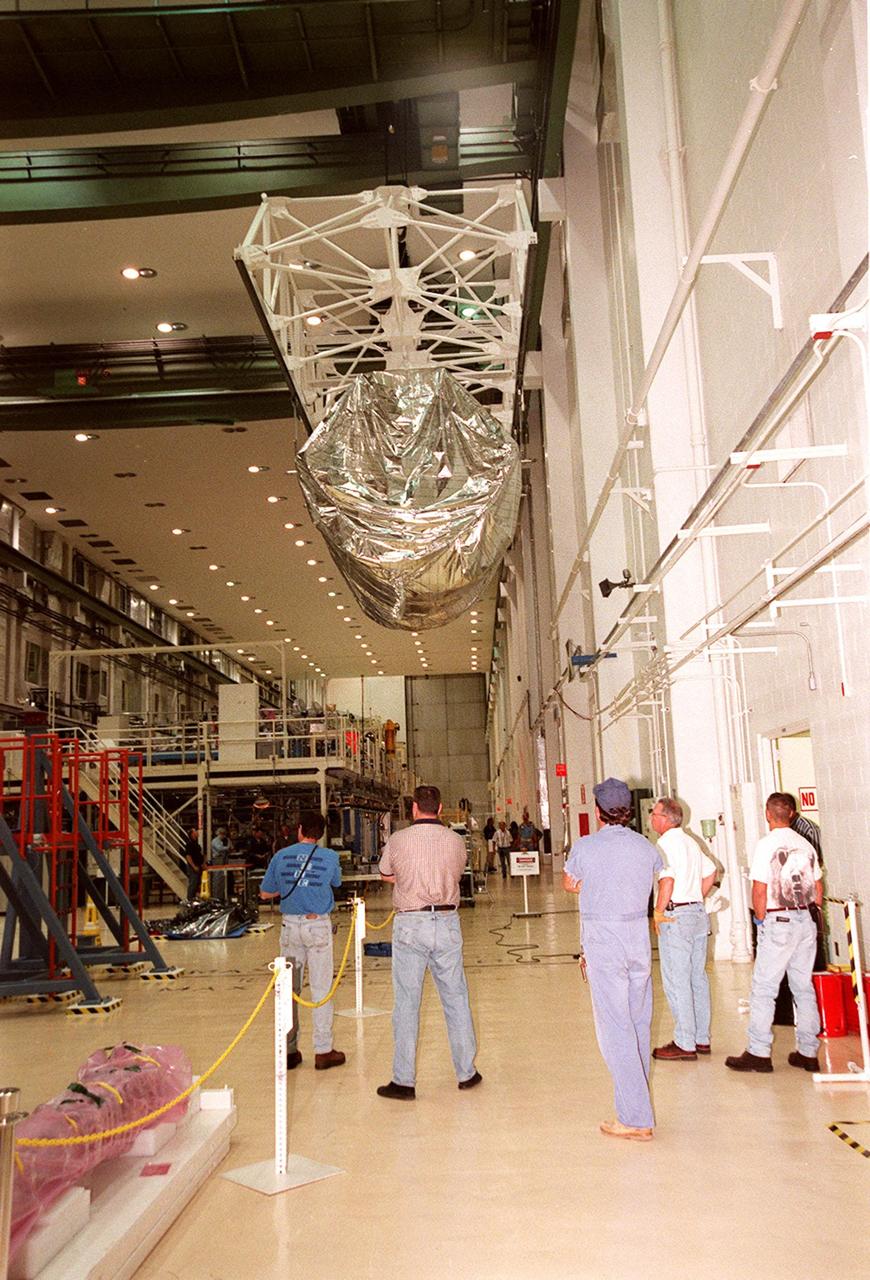
KENNEDY SPACE CENTER, FLA. -- Inside the Operations and Checkout Building, overhead cranes move a segment of the International Space Station (ISS), the port-side P3 truss, toward a workstand. The truss is scheduled to be added to the ISS on mission STS-115 in 2002 aboard Space Shuttle Atlantis. The second port truss segment, P3 will be attached to the first port truss segment (P1).
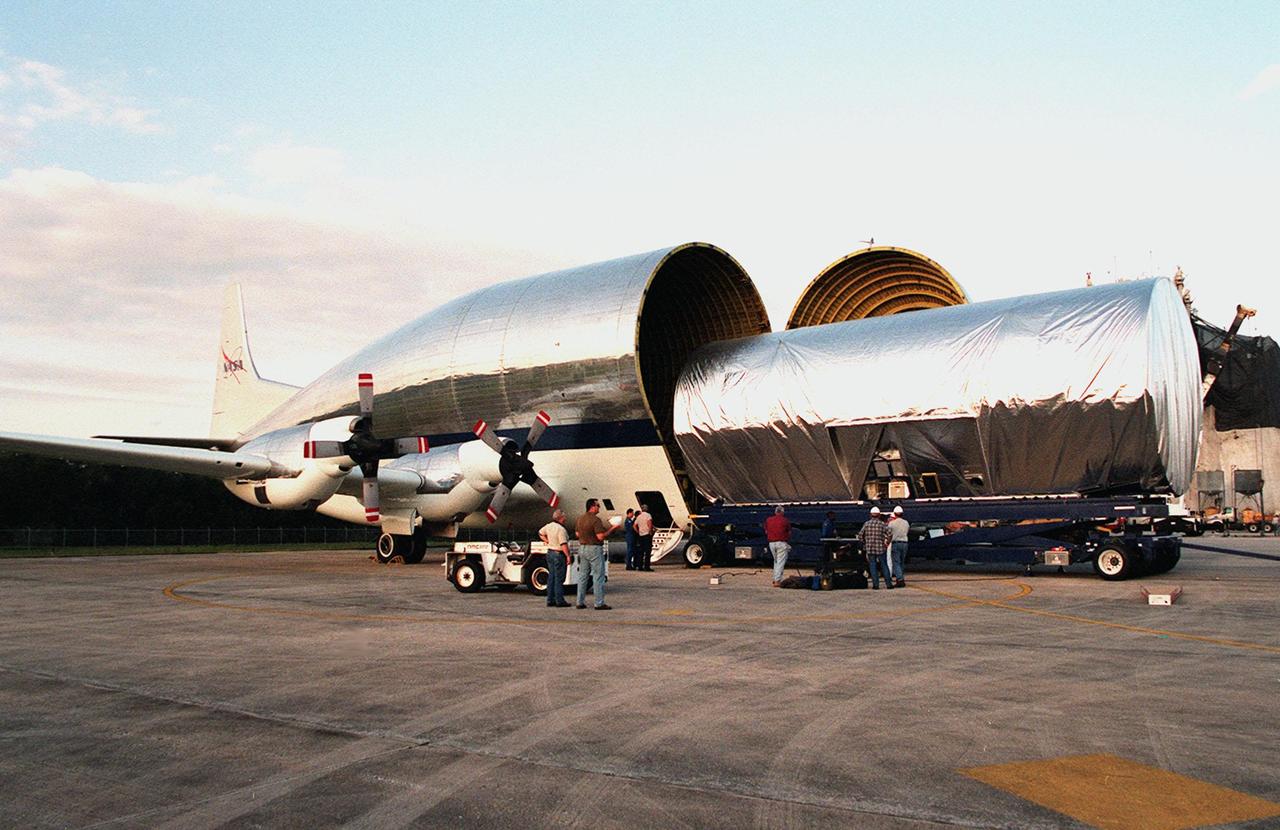
KENNEDY SPACE CENTER, FLA. -- Rolling out of NASA's Super Guppy aircraft aboard a payload transporter is a port-side P3 truss, a component for the International Space Station (ISS). The truss is scheduled to be added to the ISS on mission STS-115 in 2002 aboard Space Shuttle Atlantis. The second port truss segment, P3 will be attached to the first port truss segment (P1). The P3 truss will be taken to the Operations and Checkout Building.

KENNEDY SPACE CENTER, FLA. -- Inside the Operations and Checkout Building, overhead cranes lift another segment of the International Space Station (ISS), the port-side P3 truss, from its shipping container. The truss is scheduled to be added to the ISS on mission STS-115 in 2002 aboard Space Shuttle Atlantis. The second port truss segment, P3 will be attached to the first port truss segment (P1).
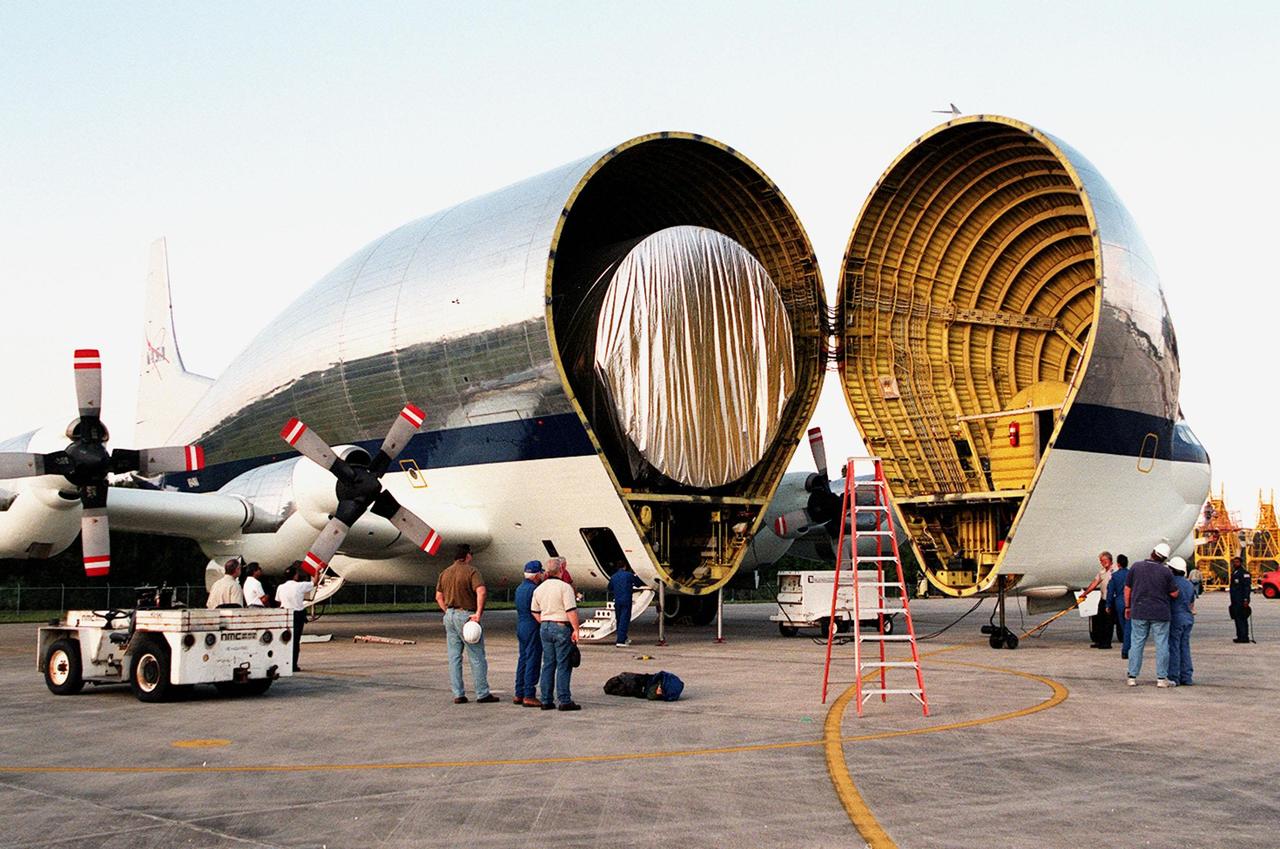
KENNEDY SPACE CENTER, FLA. -- At Kennedy Space Center's Shuttle Landing Facility, workers watch as the nose of NASA's Super Guppy aircraft opens to reveal its cargo, a component for the International Space Station (ISS), the port-side P3 truss. The truss is scheduled to be added to the ISS on mission STS-115 in 2002 aboard Space Shuttle Atlantis. The second port truss segment, P3 will be attached to the first port truss segment (P1). The P3 truss will be taken to the Operations and Checkout Building.
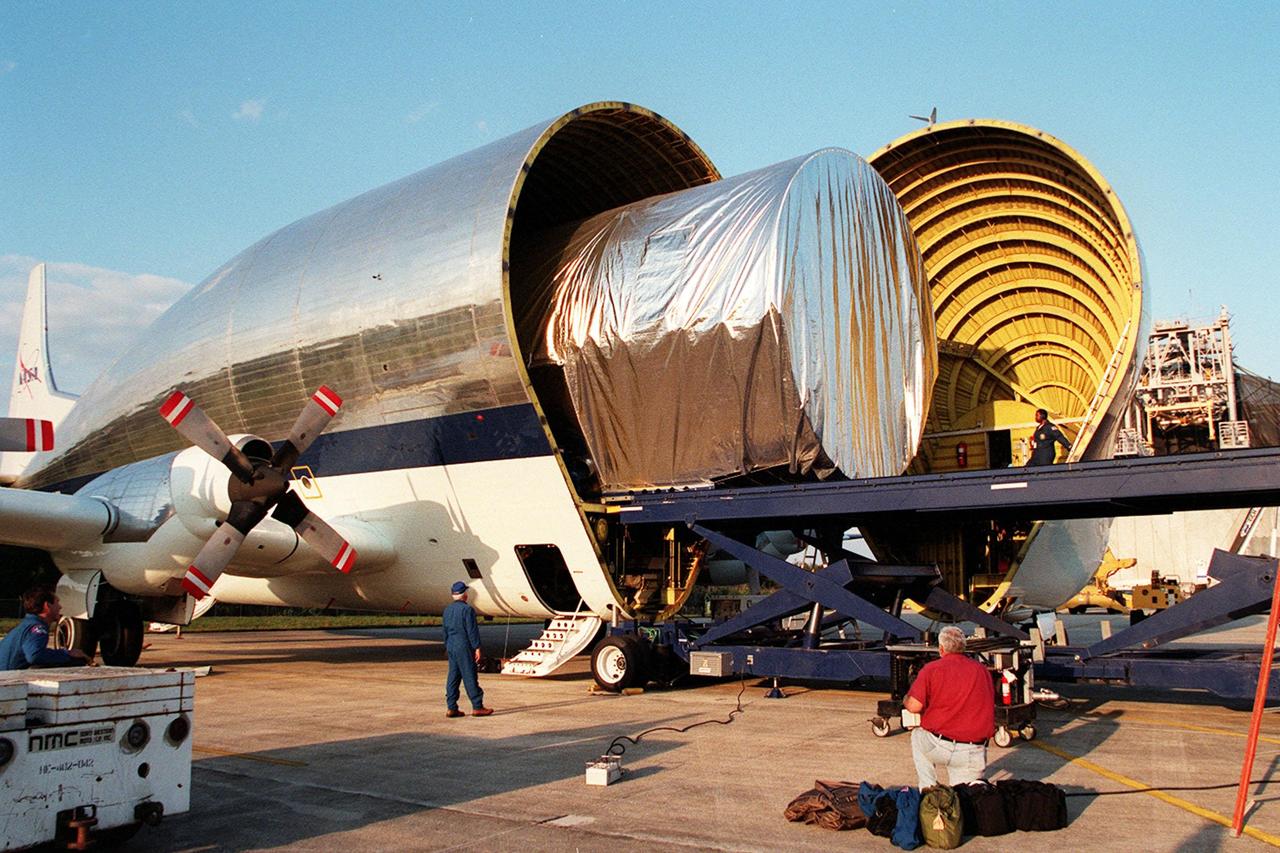
KENNEDY SPACE CENTER, FLA. -- At Kennedy Space Center's Shuttle Landing Facility, the cargo of NASA's Super Guppy aircraft begins rolling out onto a payload transporter. The cargo is a P3 port-side truss, a segment of the International Space Station (ISS). The truss is scheduled to be added to the ISS on mission STS-115 in 2002 aboard Space Shuttle Atlantis. The second port truss segment, P3 will be attached to the first port truss segment (P1). The P3 truss will be taken to the Operations and Checkout Building.
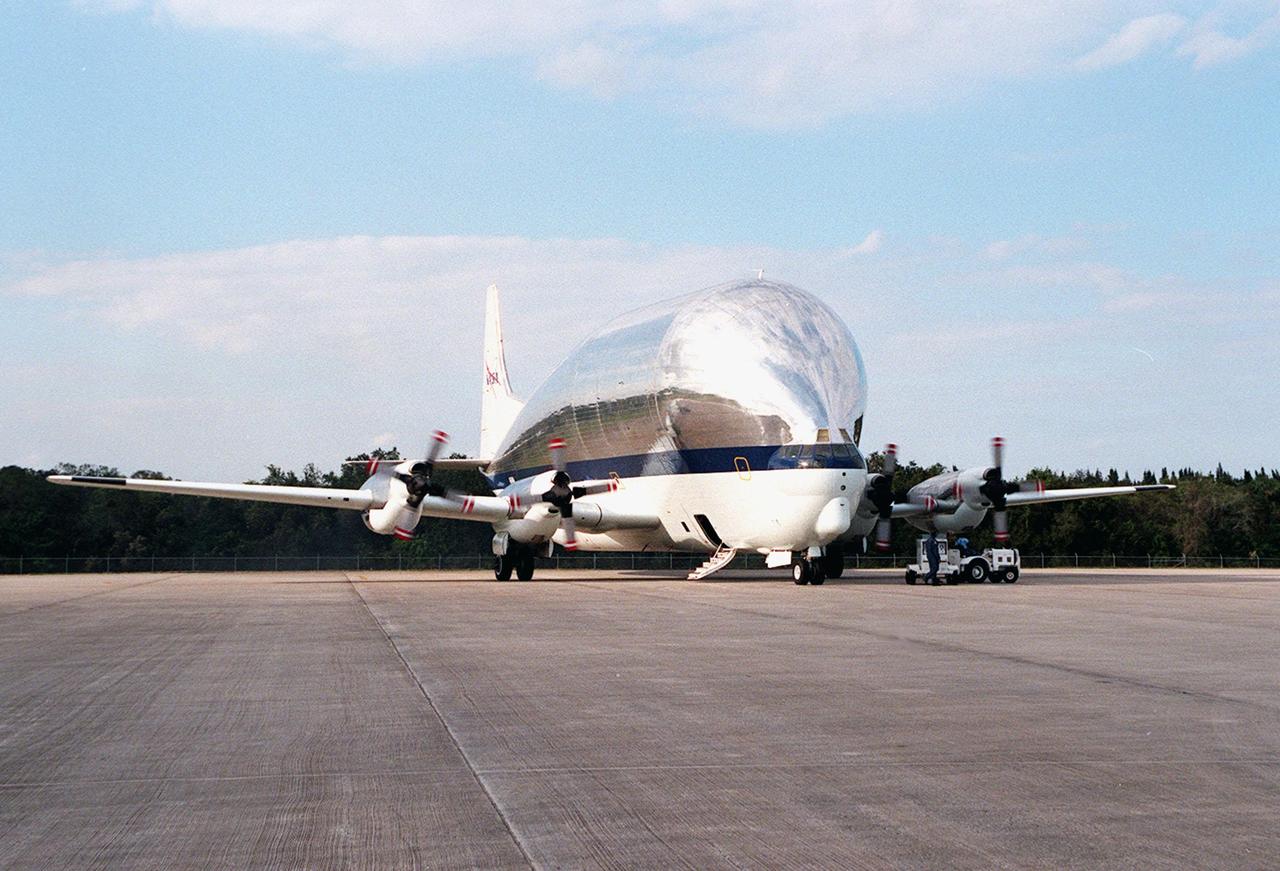
KENNEDY SPACE CENTER, FLA. -- NASA's Super Guppy aircraft arrives at Kennedy Space Center's Shuttle Landing Facility. The plane carries a component for the International Space Station (ISS), the port-side P3 truss. The truss is scheduled to be added to the ISS on mission STS-115 in 2002 aboard Space Shuttle Atlantis. The second port truss segment, P3 will be attached to the first port truss segment (P1). The P3 truss will be taken to the Operations and Checkout Building.
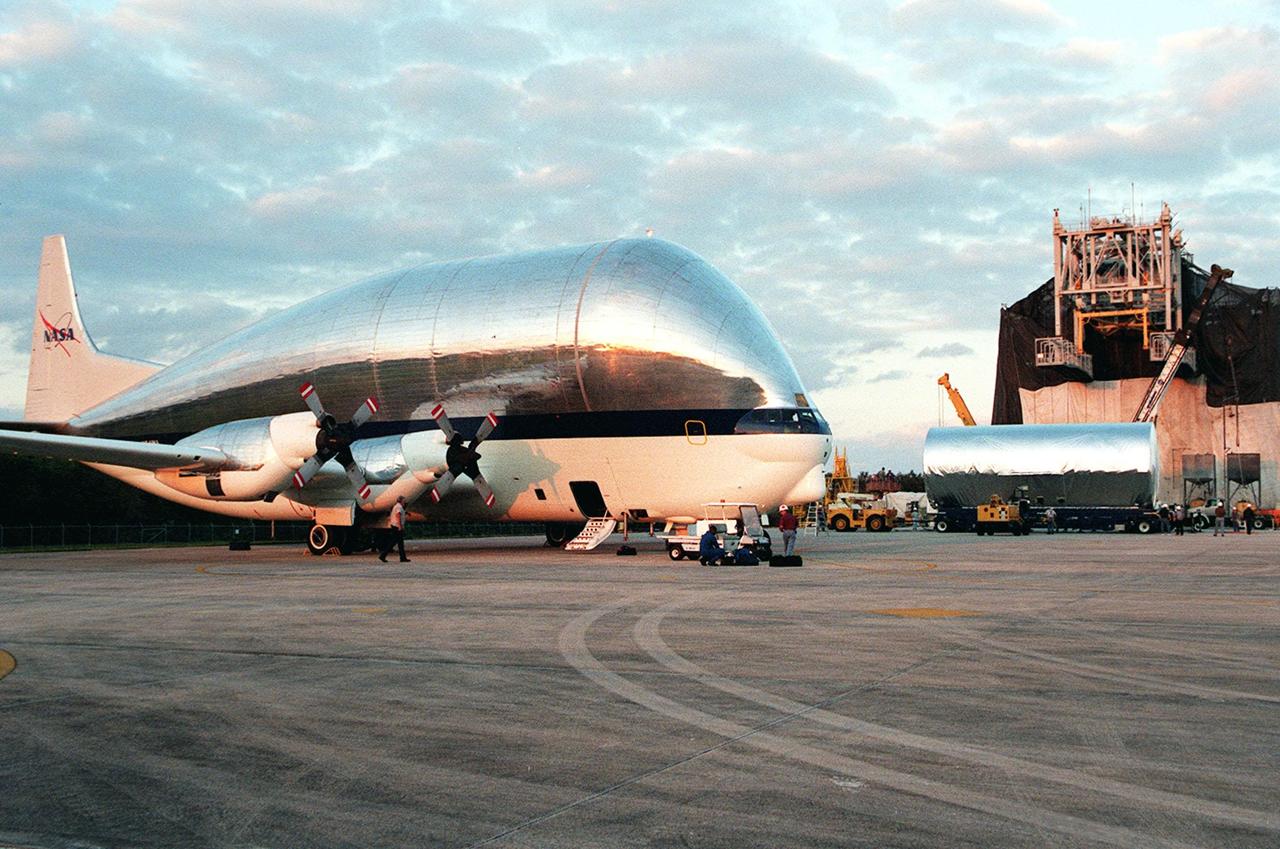
With its cargo off-loaded (background), the nose cone of the Super Guppy aircraft is closed. The cargo is a P3 port-side truss, a segment of the International Space Station (ISS). The truss is scheduled to be added to the ISS on mission STS-115 in 2002 aboard Space Shuttle Atlantis. The second port truss segment, P3 will be attached to the first port truss segment (P1). The P3 truss will be taken to the Operations and Checkout Building.
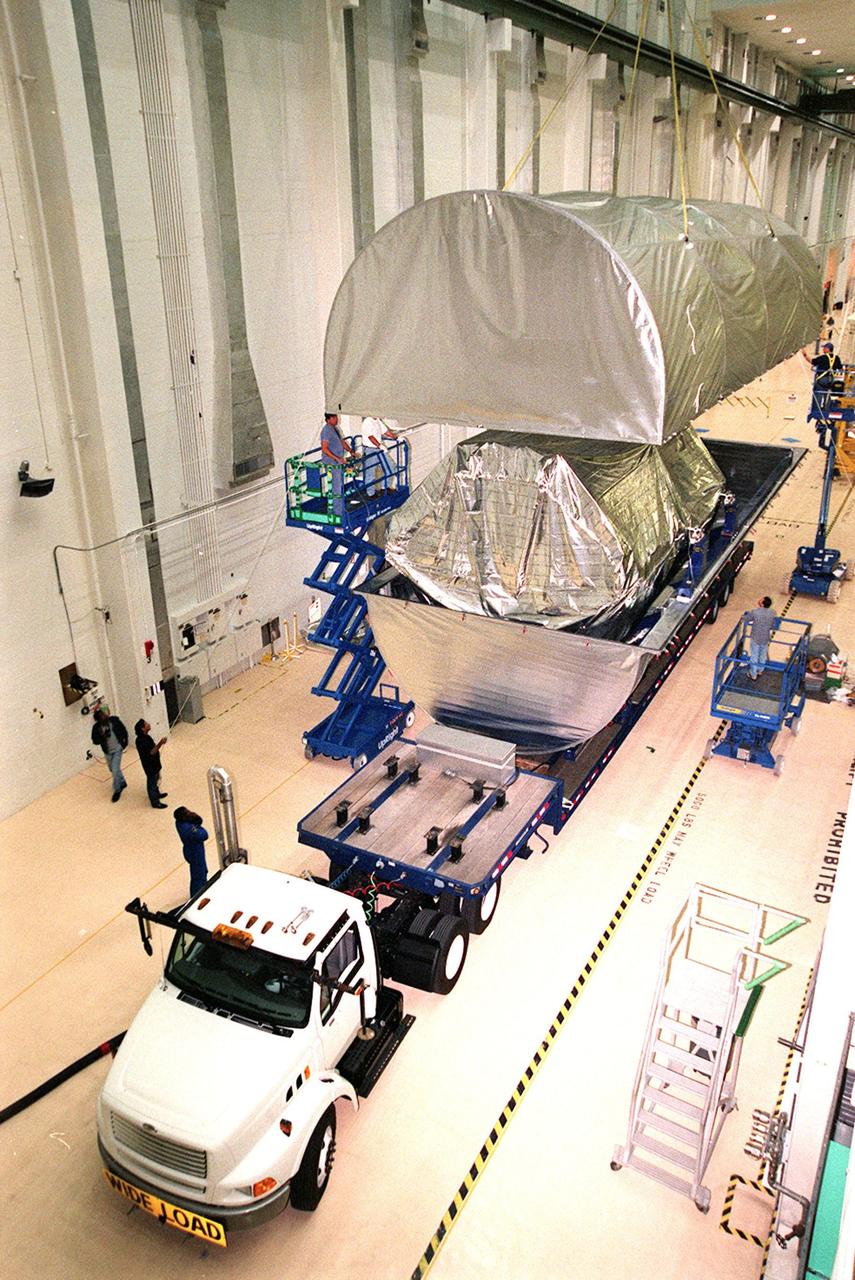
KENNEDY SPACE CENTER, FLA. -- Inside the Operations and Checkout Building, cranes lift the top of the shipping container containing the port-side P3 truss, a segment of the International Space Station (ISS). The truss is scheduled to be added to the ISS on mission STS-115 in 2002 aboard Space Shuttle Atlantis. The second port truss segment, P3 will be attached to the first port truss segment (P1).
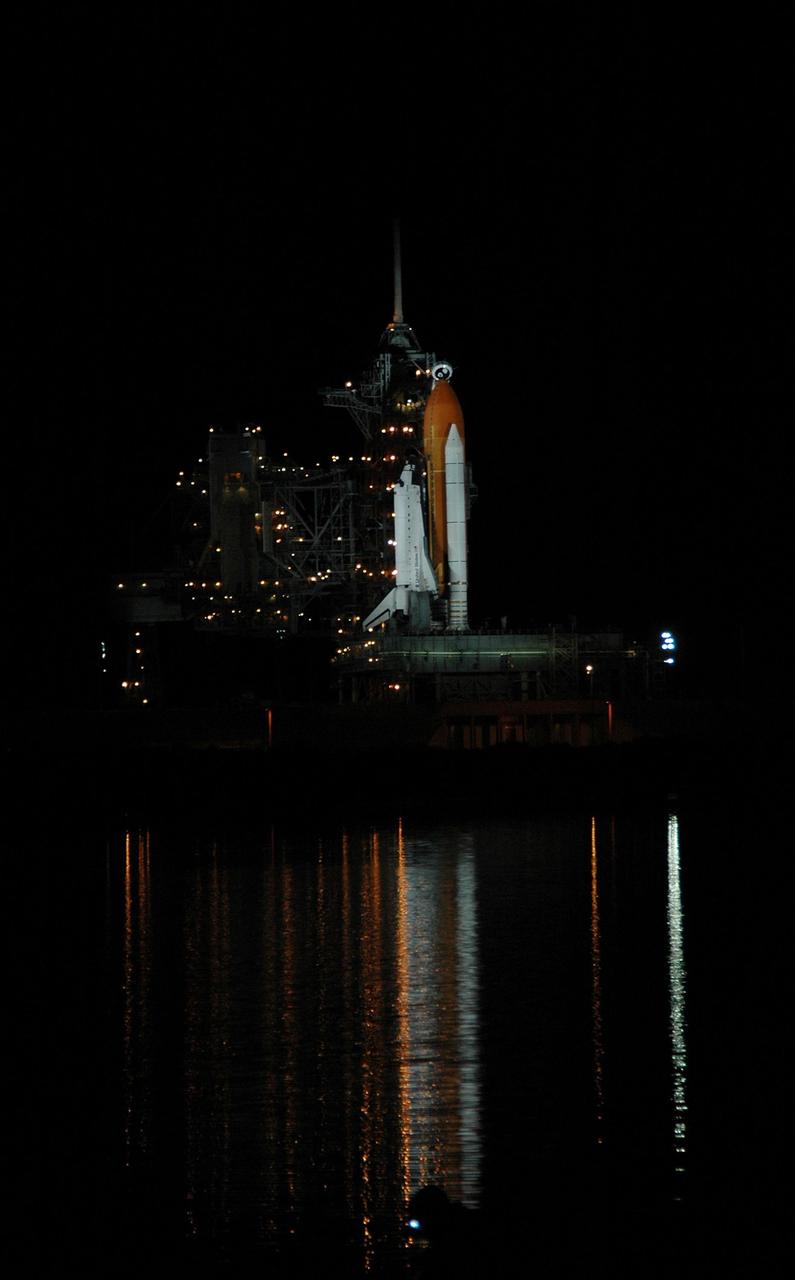
KENNEDY SPACE CENTER, FLA. - The lights on Launch Pad 39B paint columns of light in the water next to the pad where Space Shuttle Atlantis is illuminated. Atlantis was originally scheduled to launch on Aug. 27, but a scrub was called by mission managers due to a concern with fuel cell 1. Atlantis is scheduled to lift off at 11:41 a.m. EDT Sept. 8. During the STS-115 mission, Atlantis' astronauts will deliver and install the 17.5-ton, bus-sized P3/P4 integrated truss segment on the station. The girder-like truss includes a set of giant solar arrays, batteries and associated electronics and will provide one-fourth of the total power-generation capability for the completed station. This mission is the 116th space shuttle flight, the 27th flight for orbiter Atlantis, and the 19th U.S. flight to the ISS. STS-115 is scheduled to last 11 days with a planned landing at KSC. Photo credit: NASA/Ken Thornsley
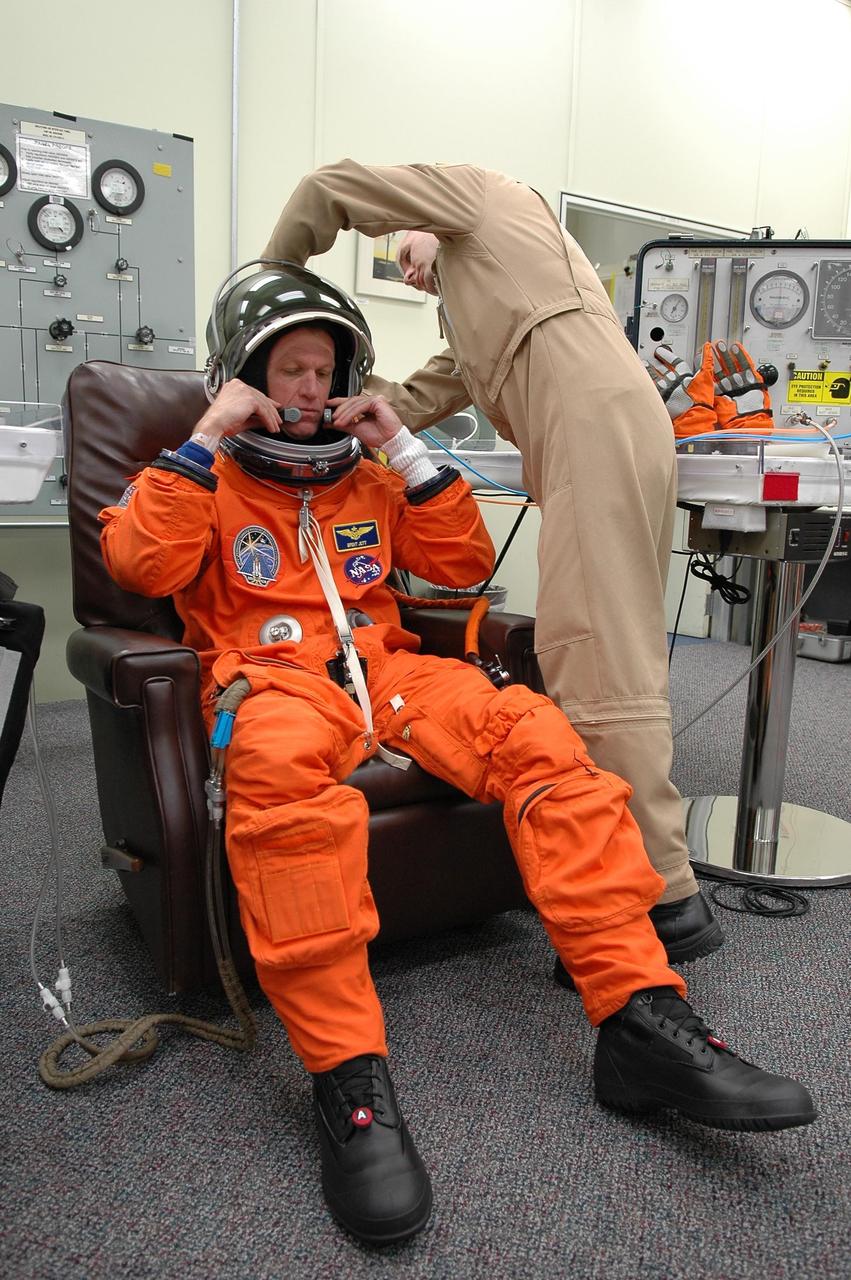
KENNEDY SPACE CENTER, FLA. - In the Operations and Checkout Building at NASA Kennedy Space Center, STS-115 Commander Brent Jett dons his launch and re-entry suit before heading to the launch pad. Jett is making his fourth shuttle flight on this mission to the International Space Station aboard Space Shuttle Atlantis. On its second attempt for launch, Atlantis is scheduled to lift off at 11:41 a.m. EDT today from Launch Pad 39B. During the STS-115 mission, Atlantis' astronauts will deliver and install the 17.5-ton, bus-sized P3/P4 integrated truss segment on the station. The girder-like truss includes a set of giant solar arrays, batteries and associated electronics and will provide one-fourth of the total power-generation capability for the completed station. This mission is the 116th space shuttle flight, the 27th flight for orbiter Atlantis, and the 19th U.S. flight to the ISS. STS-115 is scheduled to last 11 days with a planned landing at KSC. Photo credit: NASA/Kim Shiflett
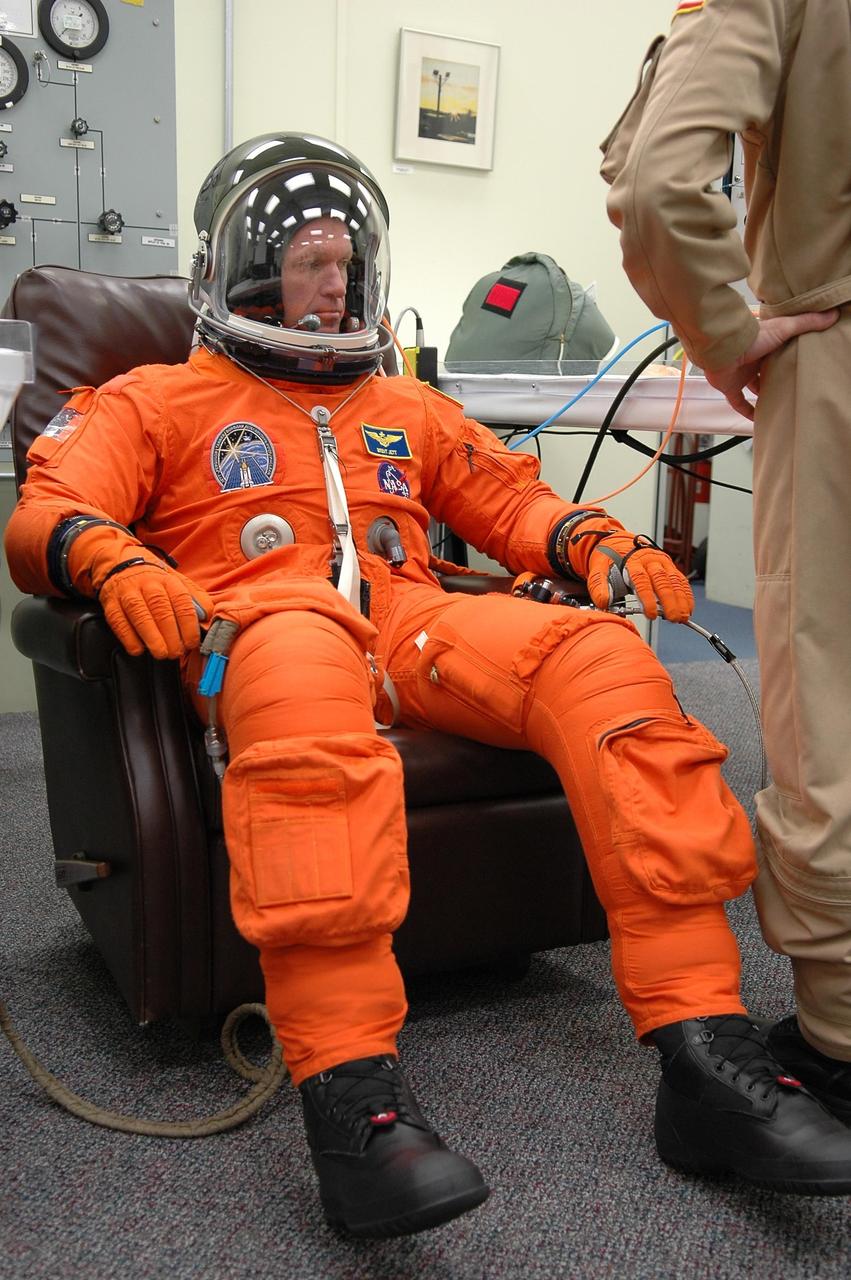
KENNEDY SPACE CENTER, FLA. - In the Operations and Checkout Building at NASA Kennedy Space Center, STS-115 Mission Commander Brent Jett finishes suiting up for another attempt at liftoff. The launch attempt on Sept. 8 was scrubbed due to an issue with a fuel cut-off sensor system inside the external fuel tank. This is one of several systems that protect the shuttle's main engines by triggering their shutdown if fuel runs unexpectedly low. During the STS-115 mission, Atlantis' astronauts will deliver and install the 17.5-ton, bus-sized P3/P4 integrated truss segment on the station. The girder-like truss includes a set of giant solar arrays, batteries and associated electronics and will provide one-fourth of the total power-generation capability for the completed station. This mission is the 116th space shuttle flight, the 27th flight for orbiter Atlantis, and the 19th U.S. flight to the ISS. STS-115 is scheduled to last 11 days with a planned landing at KSC. Photo credit: NASA/Kim Shiflett
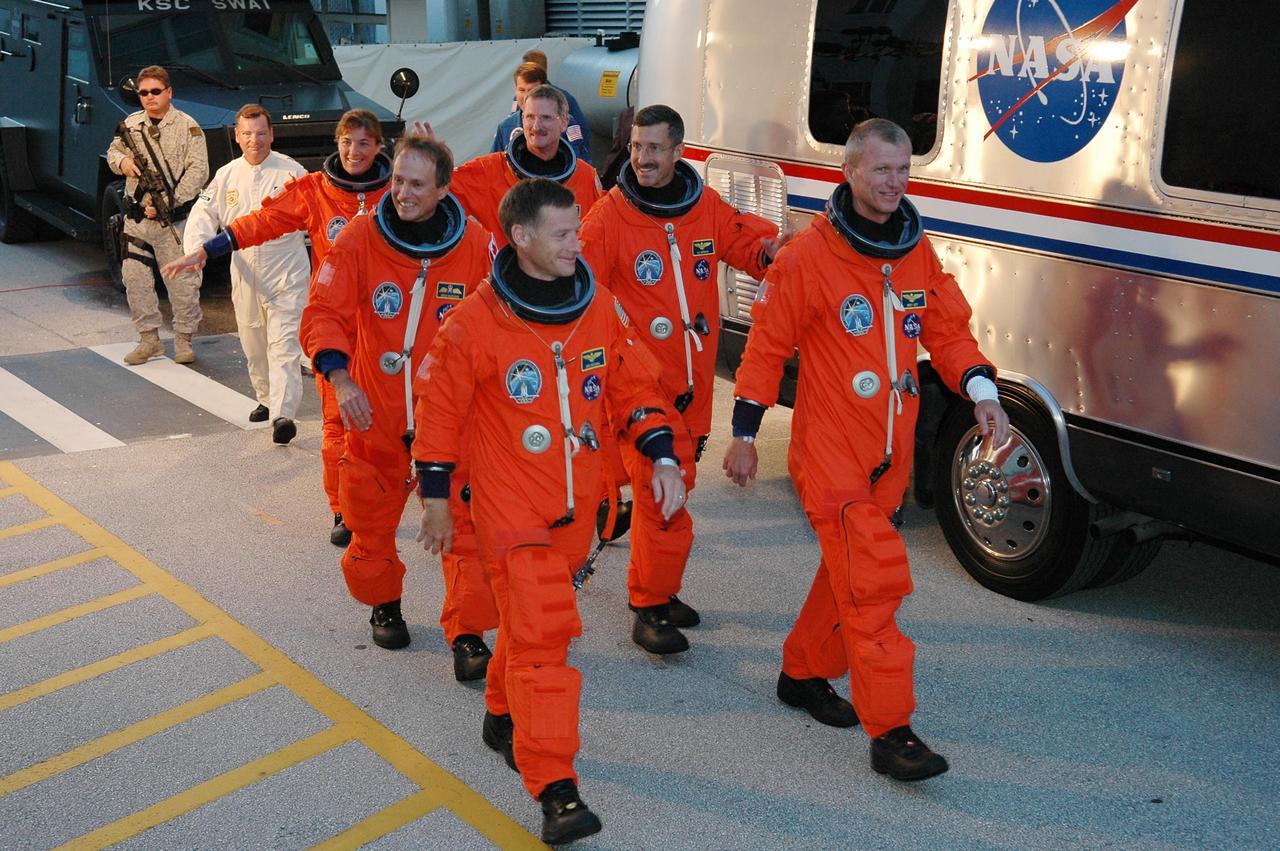
KENNEDY SPACE CENTER, FLA. - The STS-115 mission crew happily heads to the Astrovan for the ride to Launch Pad 39B and another attempt at liftoff. From the left, in the back row are Mission Specialists Heidemarie Stefanyshyn-Piper and Joseph Tanner; in the center row are Mission Specialists Steven MacLean and Daniel Burbank; in the front row leading the way are Pilot Christopher Ferguson and Commander Brent Jett. The launch attempt on Sept. 8 was scrubbed due to an issue with a fuel cut-off sensor system inside the external fuel tank. This is one of several systems that protect the shuttle's main engines by triggering their shutdown if fuel runs unexpectedly low. During the STS-115 mission, Atlantis' astronauts will deliver and install the 17.5-ton, bus-sized P3/P4 integrated truss segment on the station. The girder-like truss includes a set of giant solar arrays, batteries and associated electronics and will provide one-fourth of the total power-generation capability for the completed station. This mission is the 116th space shuttle flight, the 27th flight for orbiter Atlantis, and the 19th U.S. flight to the ISS. STS-115 is scheduled to last 11 days with a planned landing at KSC. Photo credit: NASA/Kim Shiflett
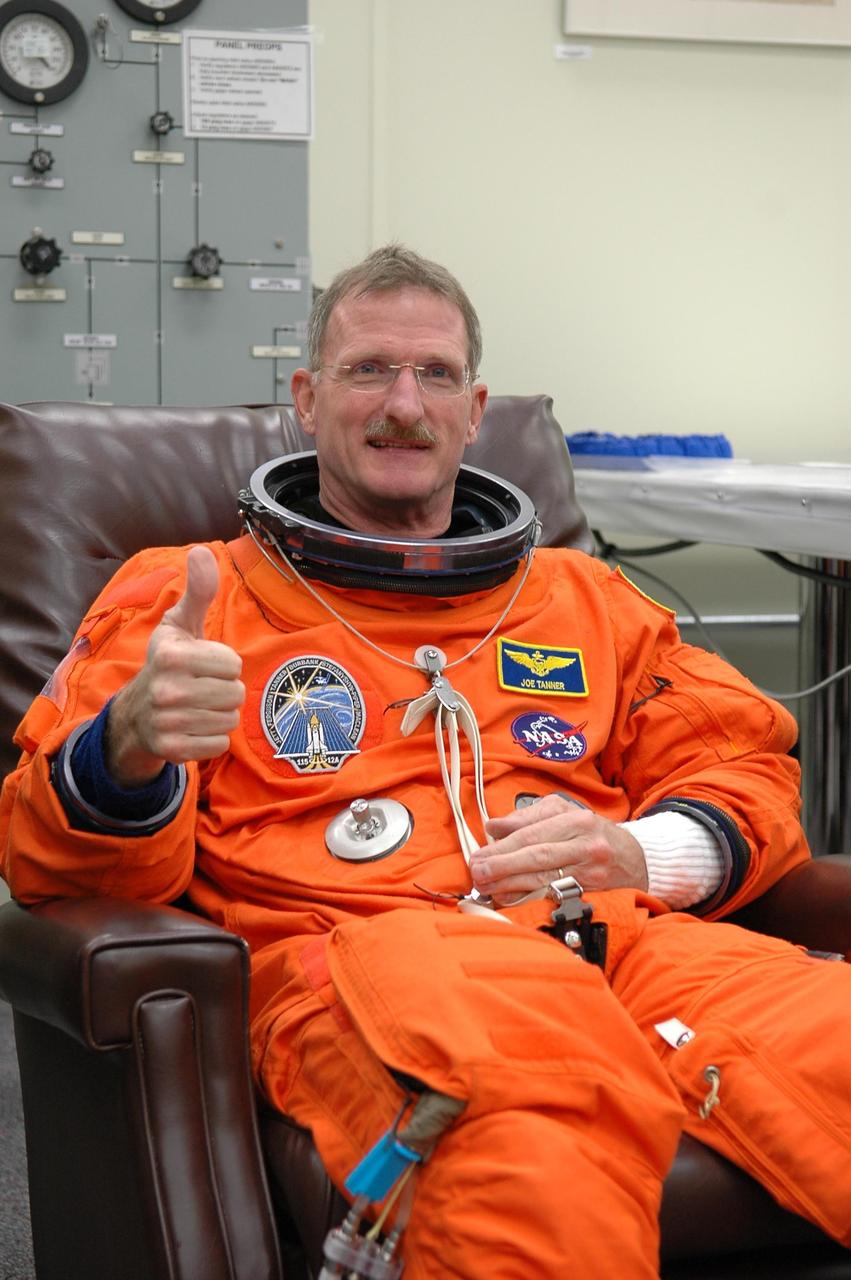
KENNEDY SPACE CENTER, FLA. - During suitup in the Operations and Checkout Building at NASA Kennedy Space Center, STS-115 Mission Specialist Joseph Tanner signals a "go" for another attempt at liftoff. The launch attempt on Sept. 8 was scrubbed due to an issue with a fuel cut-off sensor system inside the external fuel tank. This is one of several systems that protect the shuttle's main engines by triggering their shutdown if fuel runs unexpectedly low. During the STS-115 mission, Atlantis' astronauts will deliver and install the 17.5-ton, bus-sized P3/P4 integrated truss segment on the station. The girder-like truss includes a set of giant solar arrays, batteries and associated electronics and will provide one-fourth of the total power-generation capability for the completed station. This mission is the 116th space shuttle flight, the 27th flight for orbiter Atlantis, and the 19th U.S. flight to the ISS. STS-115 is scheduled to last 11 days with a planned landing at KSC. Photo credit: NASA/Kim Shiflett
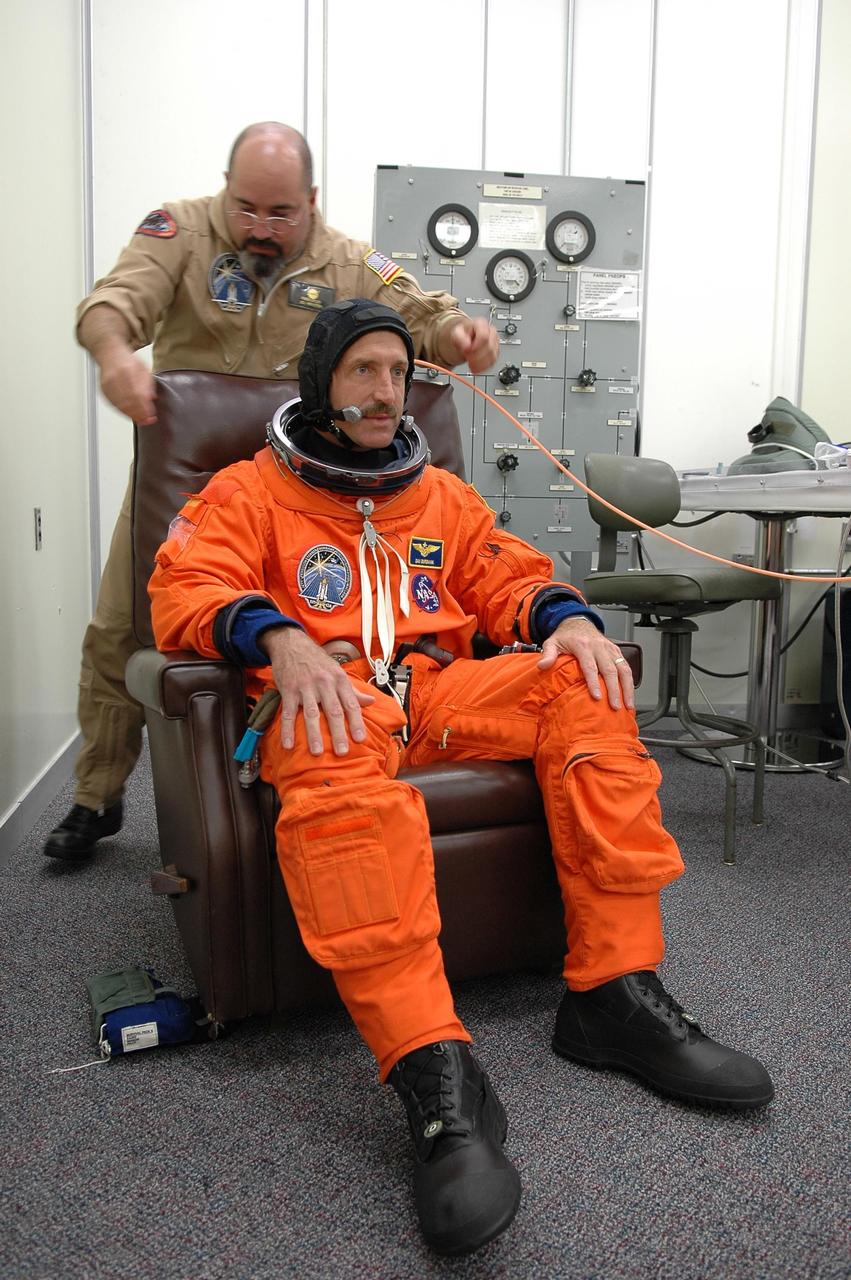
KENNEDY SPACE CENTER, FLA. - In the Operations and Checkout Building at NASA Kennedy Space Center, STS-115 Mission Specialist Daniel Burbank dons his launch and re-entry suit before heading to the launch pad for another attempt at liftoff. The launch attempt on Sept. 8 was scrubbed due to an issue with a fuel cut-off sensor system inside the external fuel tank. This is one of several systems that protect the shuttle's main engines by triggering their shutdown if fuel runs unexpectedly low. During the STS-115 mission, Atlantis' astronauts will deliver and install the 17.5-ton, bus-sized P3/P4 integrated truss segment on the station. The girder-like truss includes a set of giant solar arrays, batteries and associated electronics and will provide one-fourth of the total power-generation capability for the completed station. This mission is the 116th space shuttle flight, the 27th flight for orbiter Atlantis, and the 19th U.S. flight to the ISS. STS-115 is scheduled to last 11 days with a planned landing at KSC. Photo credit: NASA/Kim Shiflett
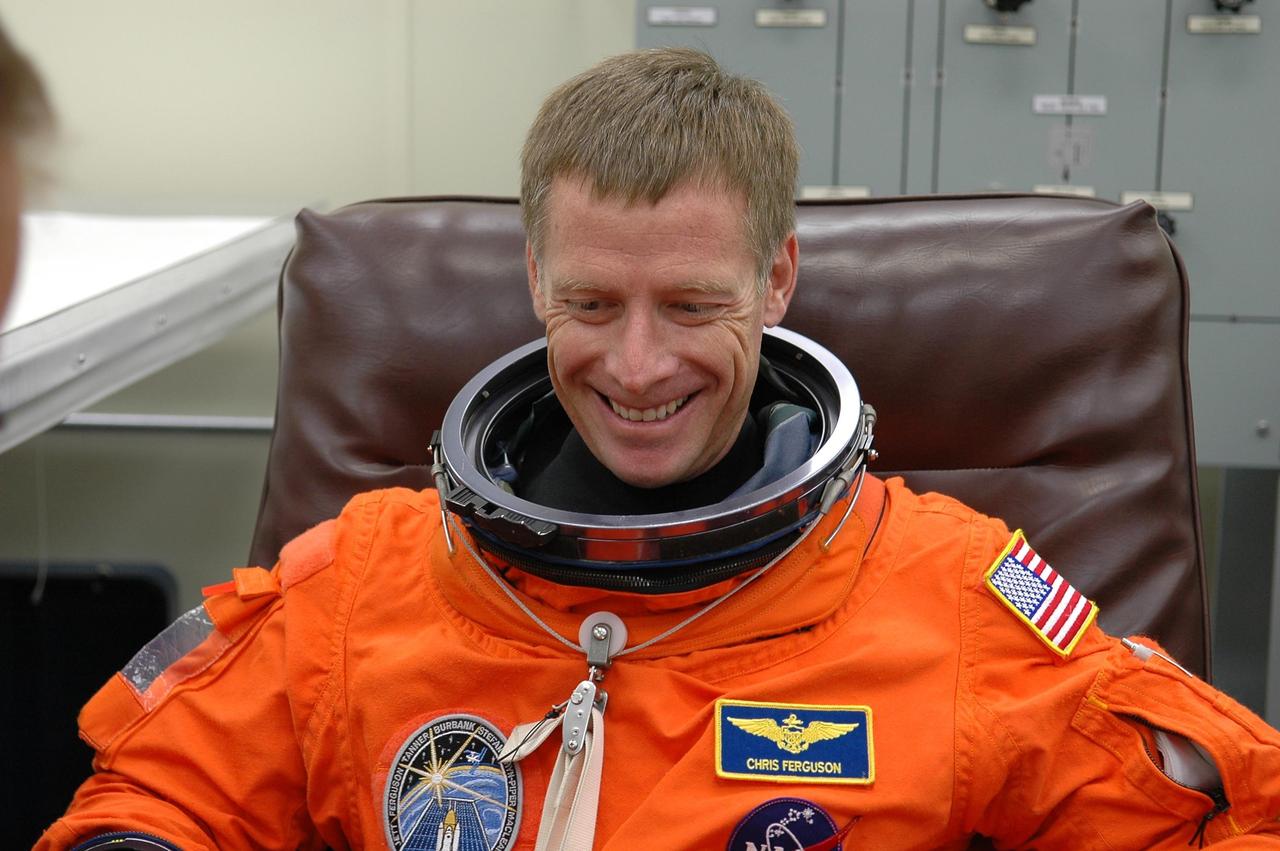
KENNEDY SPACE CENTER, FLA. - In the Operations and Checkout Building at NASA Kennedy Space Center, STS-115 Pilot Christopher Ferguson dons his launch and re-entry suit before heading to the launch pad. Ferguson is making his first shuttle flight on this mission to the International Space Station aboard Space Shuttle Atlantis. On its second attempt for launch, Atlantis is scheduled to lift off at 11:41 a.m. EDT today from Launch Pad 39B. During the STS-115 mission, Atlantis' astronauts will deliver and install the 17.5-ton, bus-sized P3/P4 integrated truss segment on the station. The girder-like truss includes a set of giant solar arrays, batteries and associated electronics and will provide one-fourth of the total power-generation capability for the completed station. This mission is the 116th space shuttle flight, the 27th flight for orbiter Atlantis, and the 19th U.S. flight to the ISS. STS-115 is scheduled to last 11 days with a planned landing at KSC. Photo credit: NASA/Kim Shiflett

KENNEDY SPACE CENTER, FLA. - In the Operations and Checkout Building at NASA Kennedy Space Center, STS-115 Mission Specialist Heidemarie Stefanyshyn-Piper is donning her launch and re-entry suit before heading to the launch pad for another attempt at liftoff. The launch attempt on Sept. 8 was scrubbed due to an issue with a fuel cut-off sensor system inside the external fuel tank. This is one of several systems that protect the shuttle's main engines by triggering their shutdown if fuel runs unexpectedly low. During the STS-115 mission, Atlantis' astronauts will deliver and install the 17.5-ton, bus-sized P3/P4 integrated truss segment on the station. The girder-like truss includes a set of giant solar arrays, batteries and associated electronics and will provide one-fourth of the total power-generation capability for the completed station. This mission is the 116th space shuttle flight, the 27th flight for orbiter Atlantis, and the 19th U.S. flight to the ISS. STS-115 is scheduled to last 11 days with a planned landing at KSC. Photo credit: NASA/Kim Shiflett
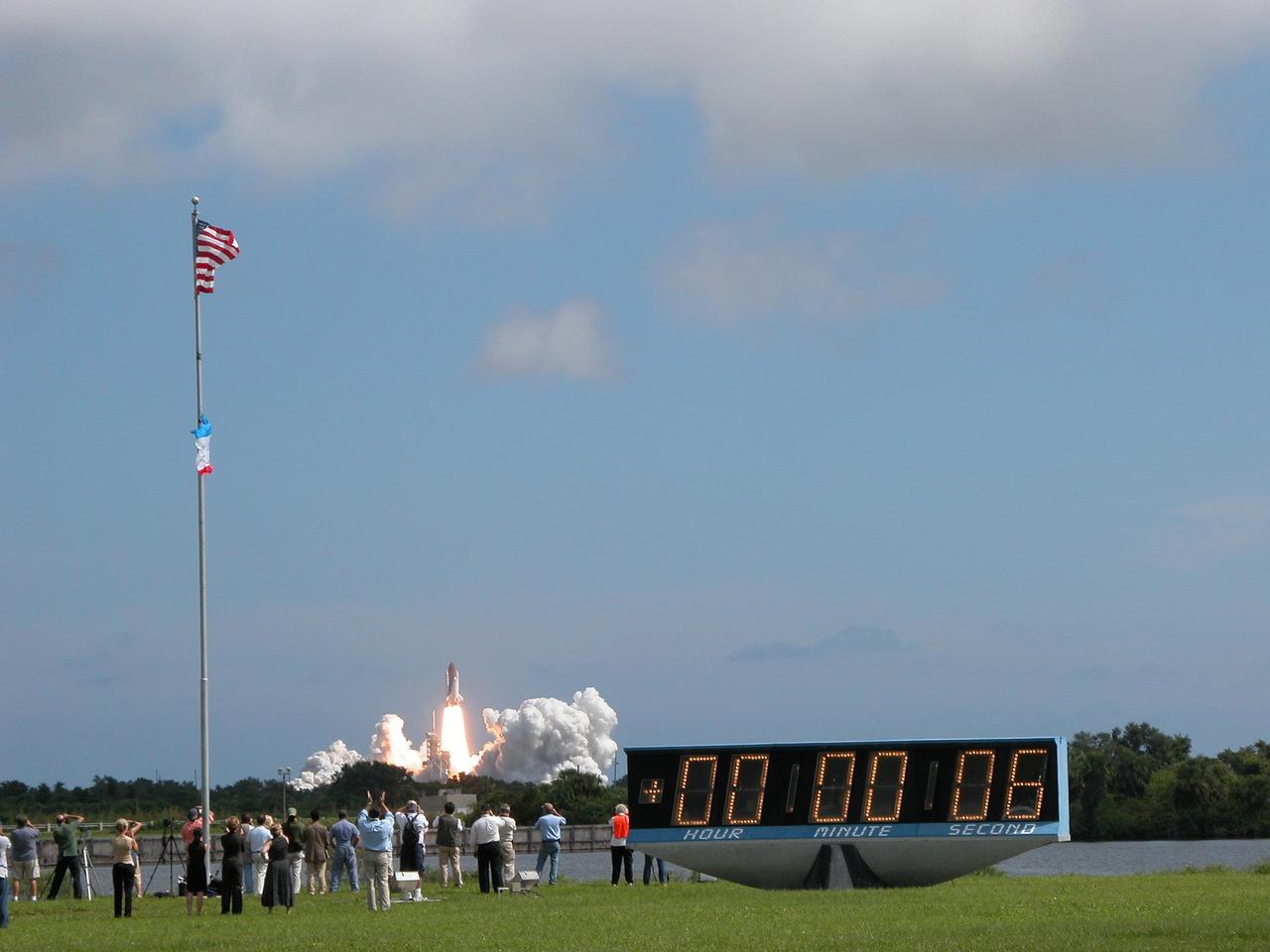
KENNEDY SPACE CENTER, FLA. - With applause and cheers from the onlookers, Space Shuttle Atlantis roars off the launch pad for a rendezvous with the International Space Station on mission STS-115. In the foreground is the countdown clock, marking launch and mission-elapsed time, on the grounds of the NASA News Center. After launch attempts were scrubbed Aug. 27 and 29 and Sept. 3 and 8 due to weather and technical concerns, this launch was executed perfectly. During the STS-115 mission, Atlantis' astronauts will deliver and install the 17.5-ton, bus-sized P3/P4 integrated truss segment on the station. The girder-like truss includes a set of giant solar arrays, batteries and associated electronics and will provide one-fourth of the total power-generation capability for the completed station. This mission is the 116th space shuttle flight, the 27th flight for orbiter Atlantis, and the 19th U.S. flight to the ISS. STS-115 is scheduled to last 11 days with a planned landing at KSC. Photo credit: NASA/Debbie Odom
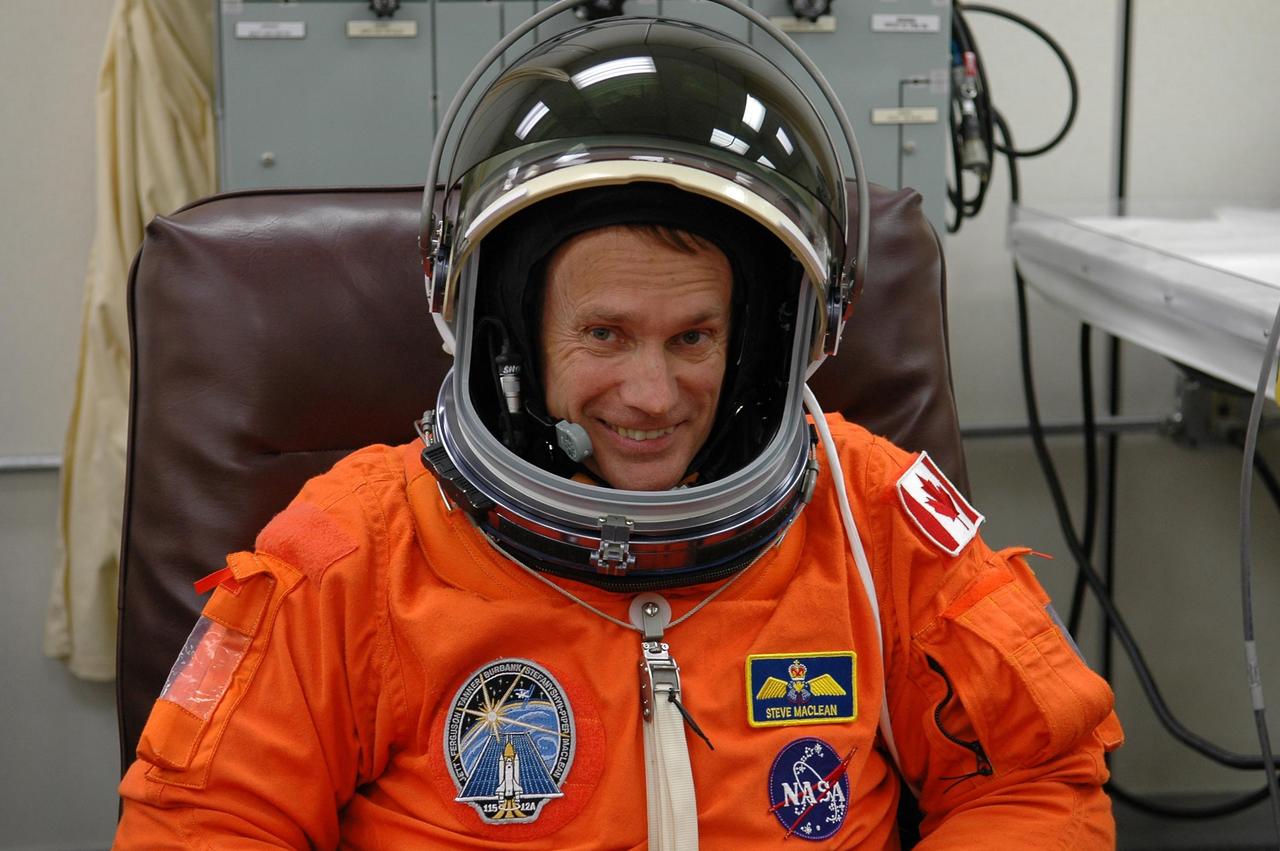
KENNEDY SPACE CENTER, FLA. - In the Operations and Checkout Building at NASA Kennedy Space Center, STS-115 Mission Specialist Steven MacLean dons his helmet to complete suiting up for another attempt at liftoff. MacLean is with the Canadian Space Agency. The launch attempt on Sept. 8 was scrubbed due to an issue with a fuel cut-off sensor system inside the external fuel tank. This is one of several systems that protect the shuttle's main engines by triggering their shutdown if fuel runs unexpectedly low. During the STS-115 mission, Atlantis' astronauts will deliver and install the 17.5-ton, bus-sized P3/P4 integrated truss segment on the station. The girder-like truss includes a set of giant solar arrays, batteries and associated electronics and will provide one-fourth of the total power-generation capability for the completed station. This mission is the 116th space shuttle flight, the 27th flight for orbiter Atlantis, and the 19th U.S. flight to the ISS. STS-115 is scheduled to last 11 days with a planned landing at KSC. Photo credit: NASA/Kim Shiflett
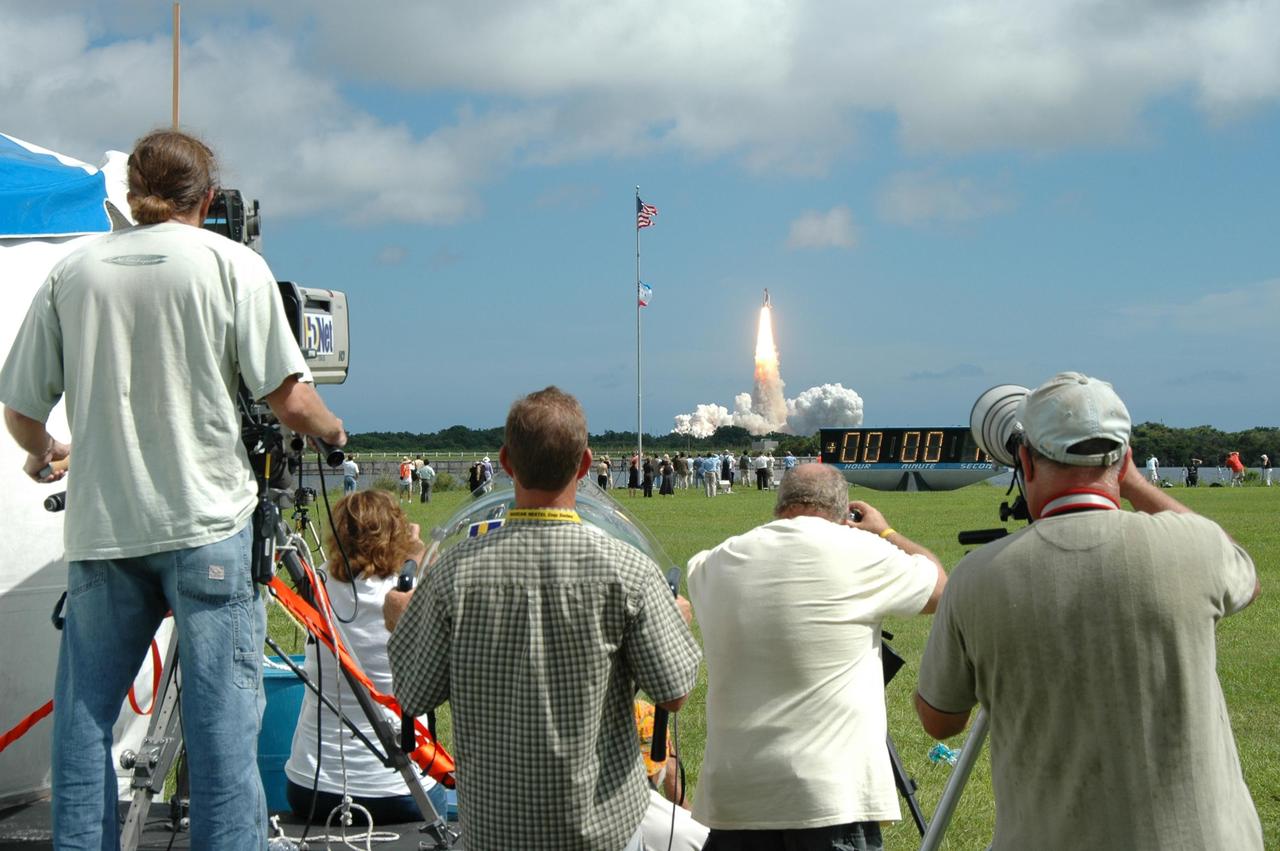
KENNEDY SPACE CENTER, FLA. - Space Shuttle Atlantis roars off the launch pad for a rendezvous with the International Space Station on mission STS-115. In the foreground are only a few of the hundreds of photographers capturing the historic scene from the grounds of the NASA News Center. Just beyond them is the countdown clock, marking launch and mission-elapsed time. After launch attempts were scrubbed Aug. 27 and 29 and Sept. 3 and 8 due to weather and technical concerns, this launch was executed perfectly. During the STS-115 mission, Atlantis' astronauts will deliver and install the 17.5-ton, bus-sized P3/P4 integrated truss segment on the station. The girder-like truss includes a set of giant solar arrays, batteries and associated electronics and will provide one-fourth of the total power-generation capability for the completed station. This mission is the 116th space shuttle flight, the 27th flight for orbiter Atlantis, and the 19th U.S. flight to the ISS. STS-115 is scheduled to last 11 days with a planned landing at KSC. Photo credit: NASA/Jim Grossmann
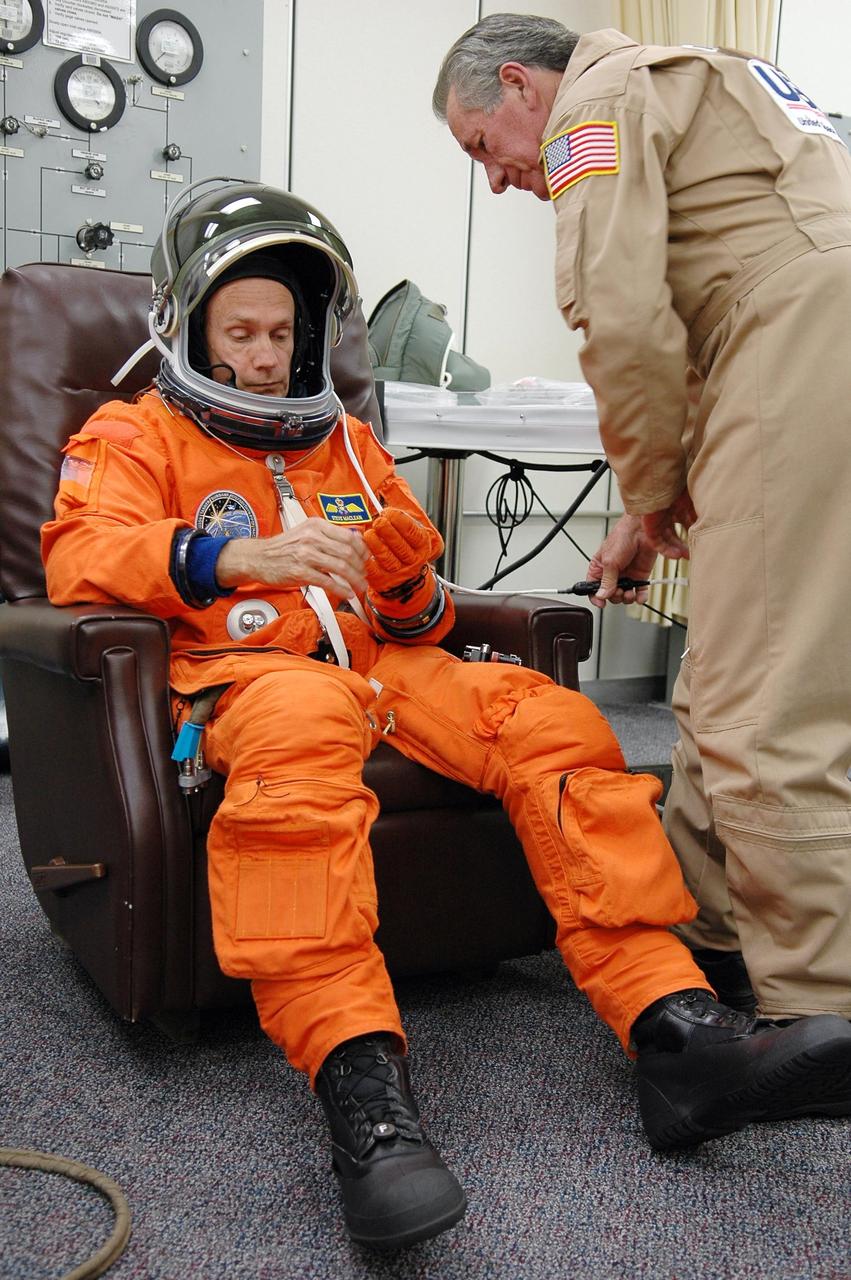
KENNEDY SPACE CENTER, FLA. - In the Operations and Checkout Building at NASA Kennedy Space Center, STS-115 Mission Specialist Steven MacLean checks his glove during suitup before heading to the launch pad. MacLean is with the Canadian Space Agency. MacLean is making his second shuttle flight on this mission to the International Space Station aboard Space Shuttle Atlantis. On its second attempt for launch, Atlantis is scheduled to lift off at 11:41 a.m. EDT today from Launch Pad 39B. During the STS-115 mission, Atlantis' astronauts will deliver and install the 17.5-ton, bus-sized P3/P4 integrated truss segment on the station. The girder-like truss includes a set of giant solar arrays, batteries and associated electronics and will provide one-fourth of the total power-generation capability for the completed station. This mission is the 116th space shuttle flight, the 27th flight for orbiter Atlantis, and the 19th U.S. flight to the ISS. STS-115 is scheduled to last 11 days with a planned landing at KSC. Photo credit: NASA/Kim Shiflett
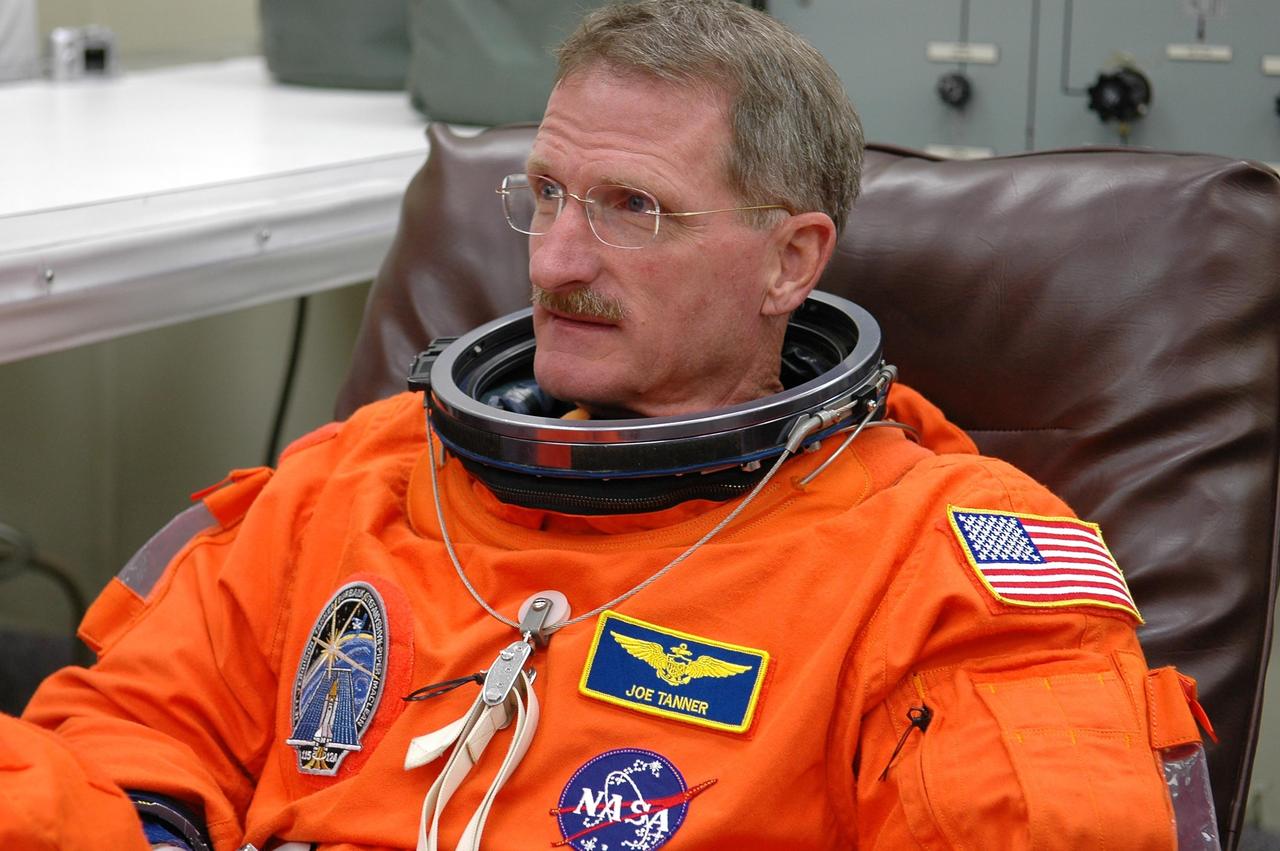
KENNEDY SPACE CENTER, FLA. - In the Operations and Checkout Building at NASA Kennedy Space Center, STS-115 Mission Specialist Joseph Tanner waits to complete suiting up before heading to the launch pad. Tanner is making his fourth shuttle flight on this mission to the International Space Station aboard Space Shuttle Atlantis. On its second attempt for launch, Atlantis is scheduled to lift off at 11:41 a.m. EDT today from Launch Pad 39B. During the STS-115 mission, Atlantis' astronauts will deliver and install the 17.5-ton, bus-sized P3/P4 integrated truss segment on the station. The girder-like truss includes a set of giant solar arrays, batteries and associated electronics and will provide one-fourth of the total power-generation capability for the completed station. This mission is the 116th space shuttle flight, the 27th flight for orbiter Atlantis, and the 19th U.S. flight to the ISS. STS-115 is scheduled to last 11 days with a planned landing at KSC. Photo credit: NASA/Kim Shiflett
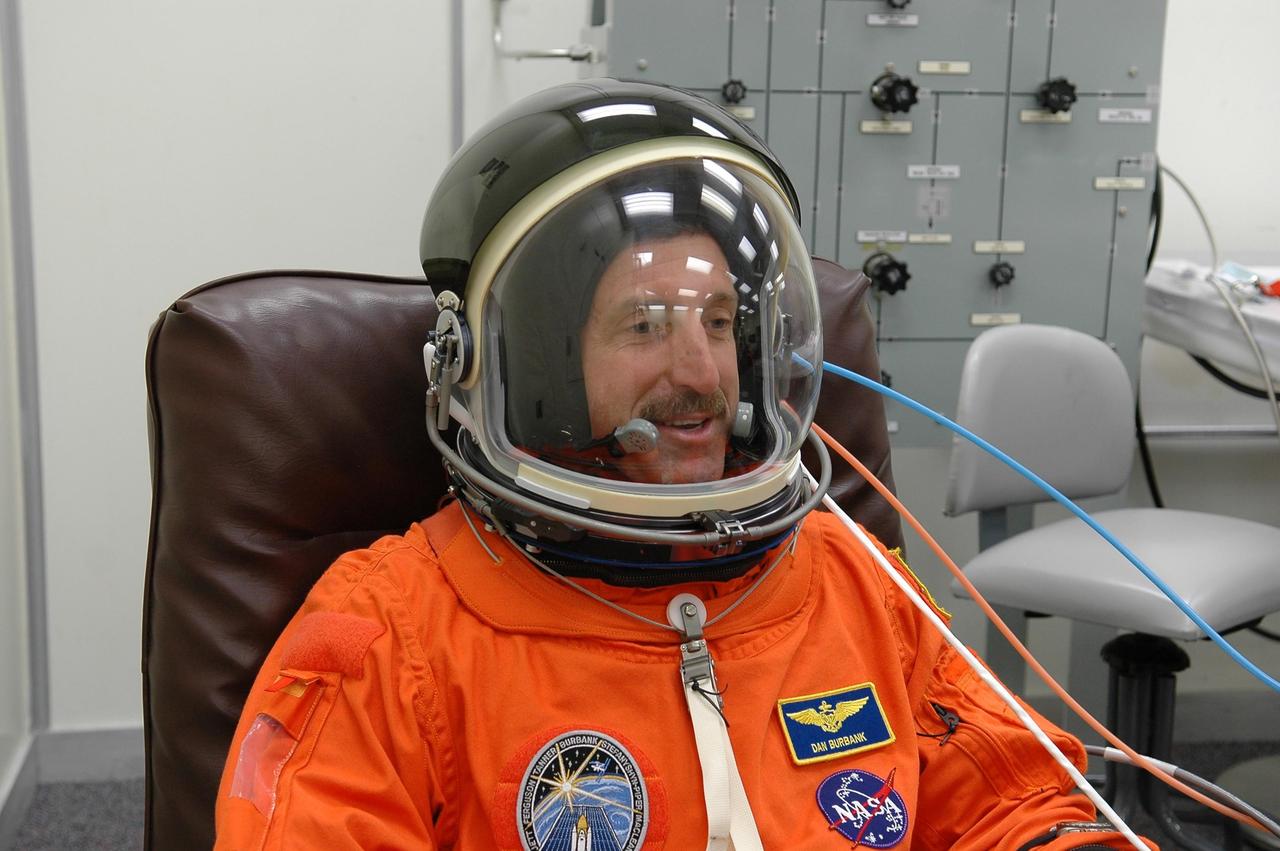
KENNEDY SPACE CENTER, FLA. - During suitup in the Operations and Checkout Building at NASA Kennedy Space Center, STS-115 Mission Specialist Daniel Burbank tests the communication system in his helmet. Burbank is making his second shuttle flight on this mission to the International Space Station aboard Space Shuttle Atlantis. On its second attempt for launch, Atlantis is scheduled to lift off at 11:41 a.m. EDT today from Launch Pad 39B. During the STS-115 mission, Atlantis' astronauts will deliver and install the 17.5-ton, bus-sized P3/P4 integrated truss segment on the station. The girder-like truss includes a set of giant solar arrays, batteries and associated electronics and will provide one-fourth of the total power-generation capability for the completed station. This mission is the 116th space shuttle flight, the 27th flight for orbiter Atlantis, and the 19th U.S. flight to the ISS. STS-115 is scheduled to last 11 days with a planned landing at KSC. Photo credit: NASA/Kim Shiflett
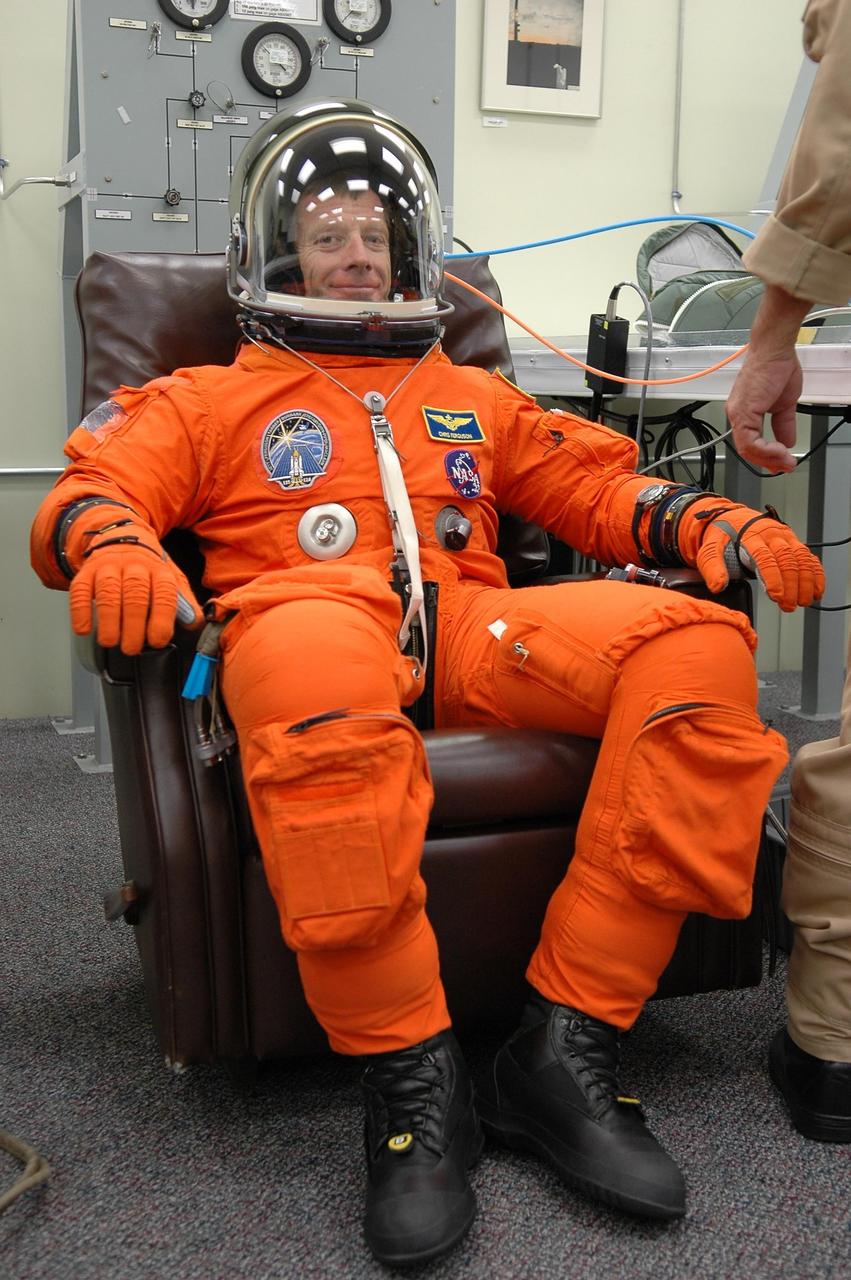
KENNEDY SPACE CENTER, FLA. - In the Operations and Checkout Building at NASA Kennedy Space Center, STS-115 Pilot Christopher Ferguson finishes suiting up for another attempt at liftoff. The launch attempt on Sept. 8 was scrubbed due to an issue with a fuel cut-off sensor system inside the external fuel tank. This is one of several systems that protect the shuttle's main engines by triggering their shutdown if fuel runs unexpectedly low. During the STS-115 mission, Atlantis' astronauts will deliver and install the 17.5-ton, bus-sized P3/P4 integrated truss segment on the station. The girder-like truss includes a set of giant solar arrays, batteries and associated electronics and will provide one-fourth of the total power-generation capability for the completed station. This mission is the 116th space shuttle flight, the 27th flight for orbiter Atlantis, and the 19th U.S. flight to the ISS. STS-115 is scheduled to last 11 days with a planned landing at KSC. Photo credit: NASA/Kim Shiflett
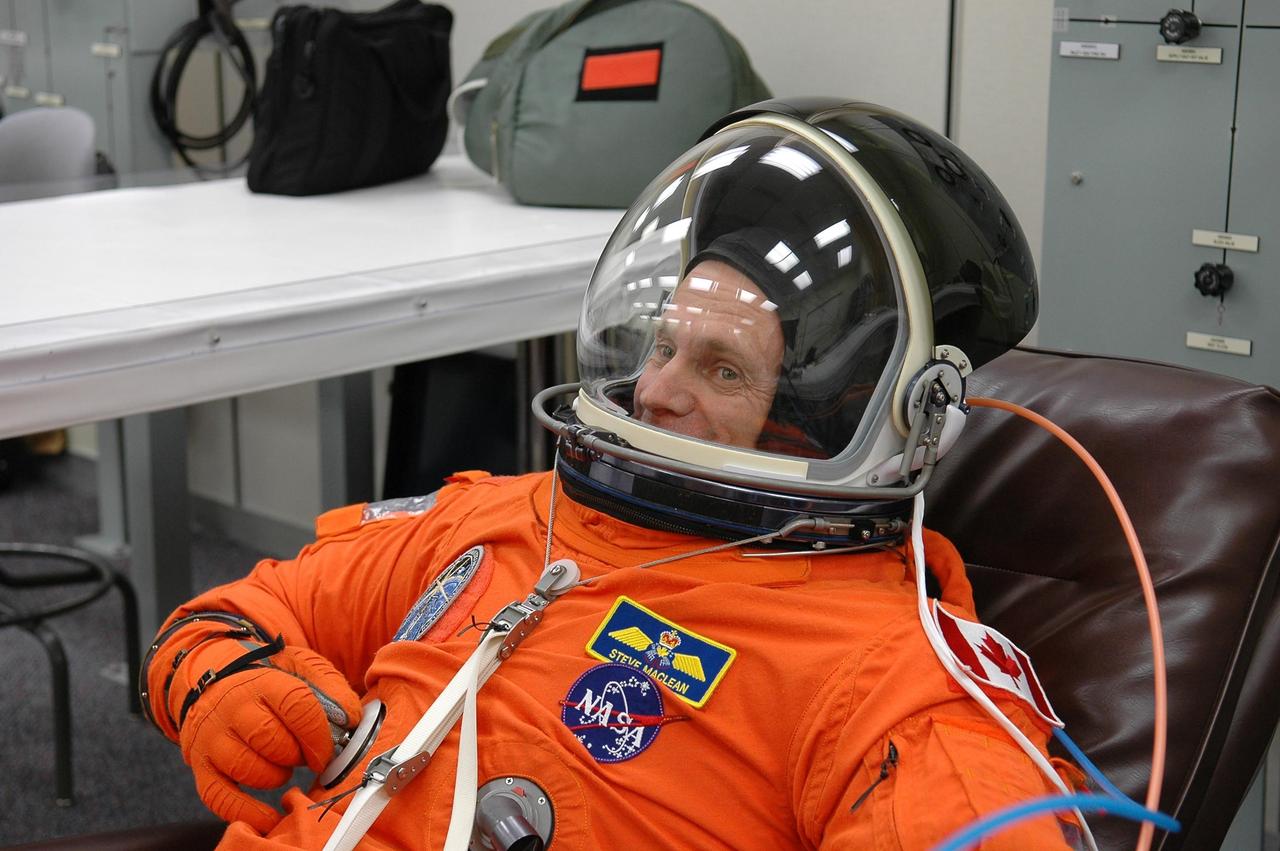
KENNEDY SPACE CENTER, FLA. - In the Operations and Checkout Building at NASA Kennedy Space Center, STS-115 Mission Specialist Steven MacLean dons his launch and re-entry suit before heading to the launch pad. MacLean is with the Canadian Space Agency. MacLean is making his second shuttle flight on this mission to the International Space Station aboard Space Shuttle Atlantis. On its second attempt for launch, Atlantis is scheduled to lift off at 11:41 a.m. EDT today from Launch Pad 39B. During the STS-115 mission, Atlantis' astronauts will deliver and install the 17.5-ton, bus-sized P3/P4 integrated truss segment on the station. The girder-like truss includes a set of giant solar arrays, batteries and associated electronics and will provide one-fourth of the total power-generation capability for the completed station. This mission is the 116th space shuttle flight, the 27th flight for orbiter Atlantis, and the 19th U.S. flight to the ISS. STS-115 is scheduled to last 11 days with a planned landing at KSC. Photo credit: NASA/Kim Shiflett
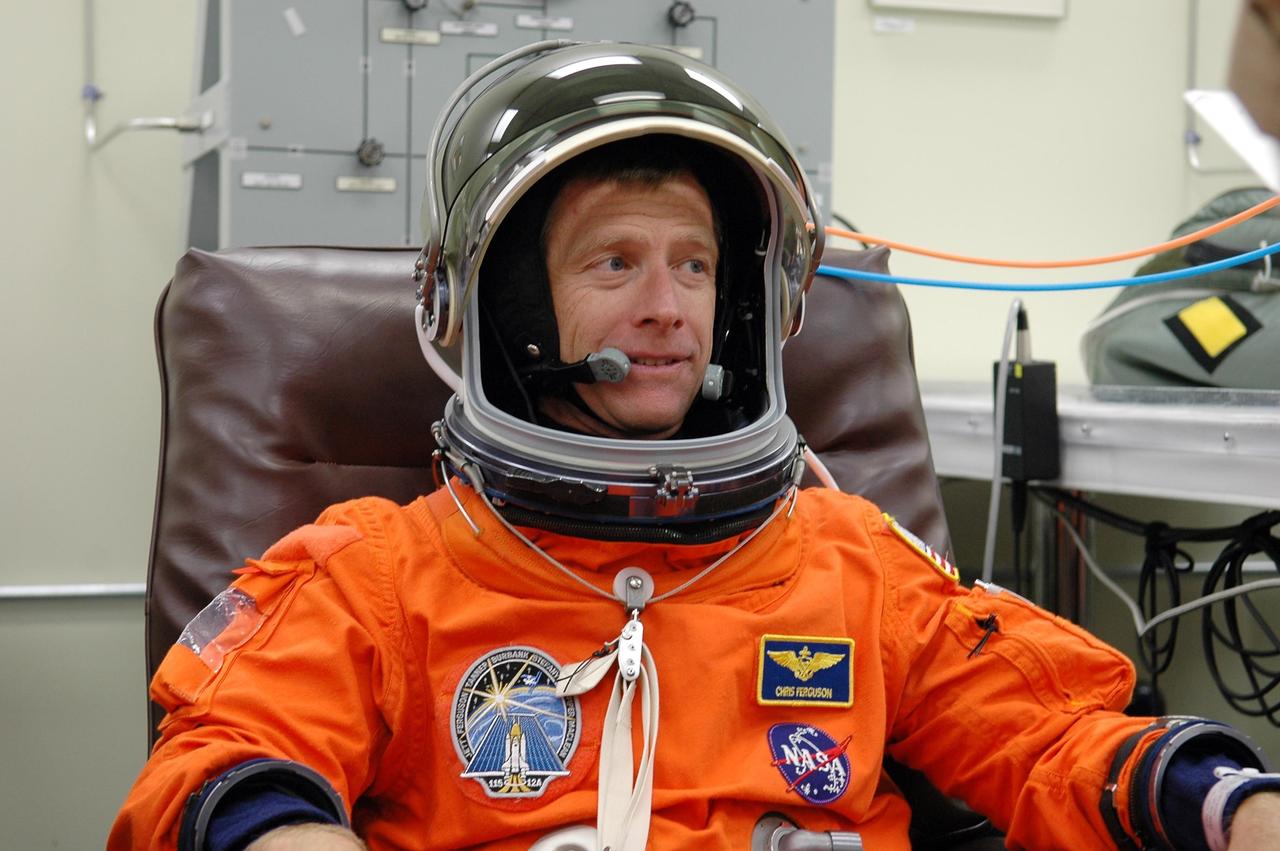
KENNEDY SPACE CENTER, FLA. - In the Operations and Checkout Building at NASA Kennedy Space Center, STS-115 Pilot Christopher Ferguson checks his helmet during suitup before heading to the launch pad. Ferguson is making his first shuttle flight on this mission to the International Space Station aboard Space Shuttle Atlantis. On its second attempt for launch, Atlantis is scheduled to lift off at 11:41 a.m. EDT today from Launch Pad 39B. During the STS-115 mission, Atlantis' astronauts will deliver and install the 17.5-ton, bus-sized P3/P4 integrated truss segment on the station. The girder-like truss includes a set of giant solar arrays, batteries and associated electronics and will provide one-fourth of the total power-generation capability for the completed station. This mission is the 116th space shuttle flight, the 27th flight for orbiter Atlantis, and the 19th U.S. flight to the ISS. STS-115 is scheduled to last 11 days with a planned landing at KSC. Photo credit: NASA/Kim Shiflett
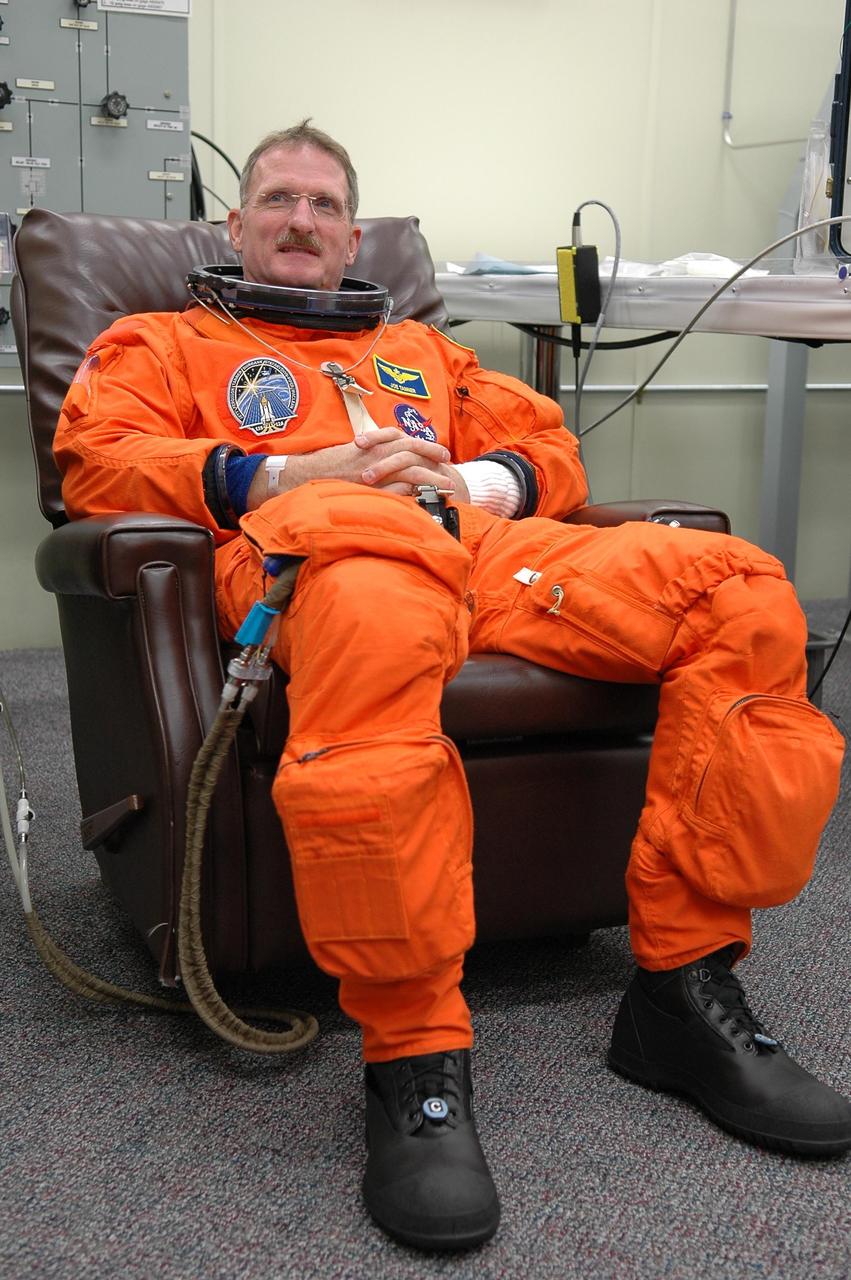
KENNEDY SPACE CENTER, FLA. - In the Operations and Checkout Building at NASA Kennedy Space Center, STS-115 Mission Specialist Joseph Tanner dons his launch and re-entry suit before heading to the launch pad. Tanner is making his fourth shuttle flight on this mission to the International Space Station aboard Space Shuttle Atlantis. On its second attempt for launch, Atlantis is scheduled to lift off at 11:41 a.m. EDT today from Launch Pad 39B. During the STS-115 mission, Atlantis' astronauts will deliver and install the 17.5-ton, bus-sized P3/P4 integrated truss segment on the station. The girder-like truss includes a set of giant solar arrays, batteries and associated electronics and will provide one-fourth of the total power-generation capability for the completed station. This mission is the 116th space shuttle flight, the 27th flight for orbiter Atlantis, and the 19th U.S. flight to the ISS. STS-115 is scheduled to last 11 days with a planned landing at KSC. Photo credit: NASA/Kim Shiflett
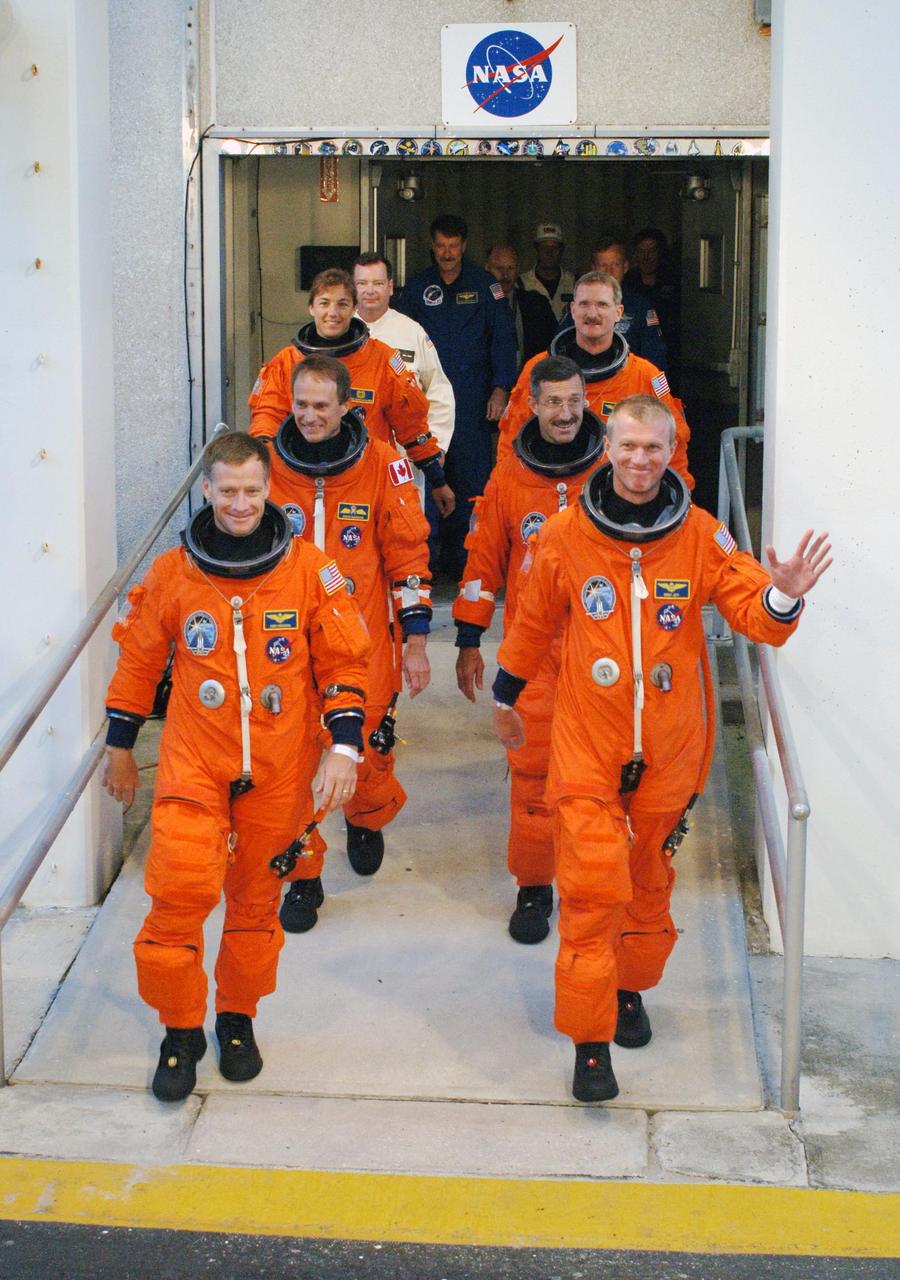
KENNEDY SPACE CENTER, FLA. - After suiting up, the STS-115 mission crew exits the Operations and Checkout Building to board the Astrovan to Launch Pad 39B. On the left, front to back, are Pilot Christopher Ferguson and Mission Specialists Steven MacLean and Heidemarie Stefanyshyn-Piper. On the right, front to back, are Commander Brent Jett and Mission Specialists Daniel Burbank and Joseph Tanner. The launch attempt on Sept. 8 was scrubbed due to an issue with a fuel cut-off sensor system inside the external fuel tank. This is one of several systems that protect the shuttle's main engines by triggering their shutdown if fuel runs unexpectedly low. During the STS-115 mission, Atlantis' astronauts will deliver and install the 17.5-ton, bus-sized P3/P4 integrated truss segment on the station. The girder-like truss includes a set of giant solar arrays, batteries and associated electronics and will provide one-fourth of the total power-generation capability for the completed station. This mission is the 116th space shuttle flight, the 27th flight for orbiter Atlantis, and the 19th U.S. flight to the ISS. STS-115 is scheduled to last 11 days with a planned landing at KSC. Photo credit: NASA/Kim Shiflett
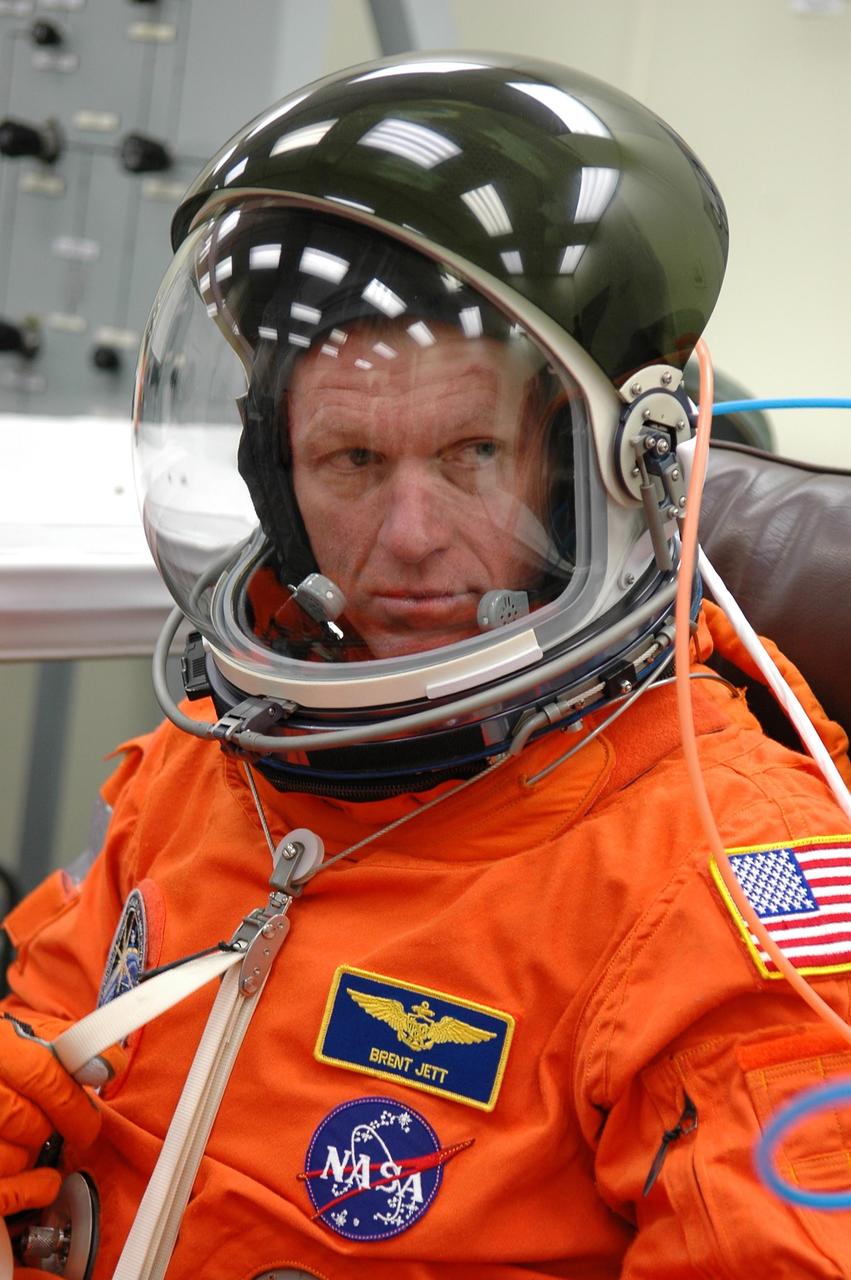
KENNEDY SPACE CENTER, FLA. - In the Operations and Checkout Building at NASA Kennedy Space Center, STS-115 Commander Brent Jett looks reflective as he suits up for launch before heading to the launch pad. Jett is making his fourth shuttle flight on this mission to the International Space Station aboard Space Shuttle Atlantis. On its second attempt for launch, Atlantis is scheduled to lift off at 11:41 a.m. EDT today from Launch Pad 39B. During the STS-115 mission, Atlantis' astronauts will deliver and install the 17.5-ton, bus-sized P3/P4 integrated truss segment on the station. The girder-like truss includes a set of giant solar arrays, batteries and associated electronics and will provide one-fourth of the total power-generation capability for the completed station. This mission is the 116th space shuttle flight, the 27th flight for orbiter Atlantis, and the 19th U.S. flight to the ISS. STS-115 is scheduled to last 11 days with a planned landing at KSC. Photo credit: NASA/Kim Shiflett
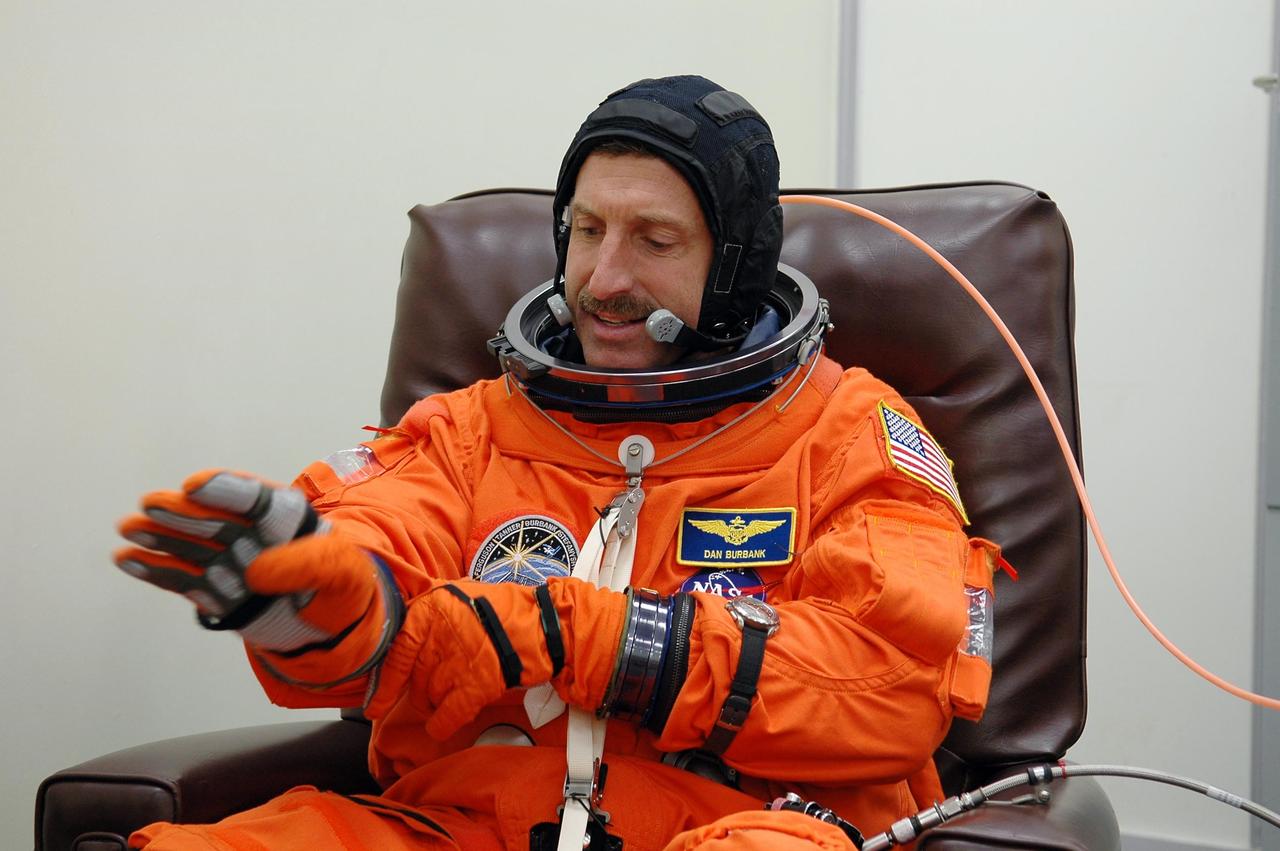
KENNEDY SPACE CENTER, FLA. - In the Operations and Checkout Building at NASA Kennedy Space Center, STS-115 Mission Specialist Daniel Burbank adjusts his glove during suitup before heading to the launch pad. Burbank is making his second shuttle flight on this mission to the International Space Station aboard Space Shuttle Atlantis. On its second attempt for launch, Atlantis is scheduled to lift off at 11:41 a.m. EDT today from Launch Pad 39B. During the STS-115 mission, Atlantis' astronauts will deliver and install the 17.5-ton, bus-sized P3/P4 integrated truss segment on the station. The girder-like truss includes a set of giant solar arrays, batteries and associated electronics and will provide one-fourth of the total power-generation capability for the completed station. This mission is the 116th space shuttle flight, the 27th flight for orbiter Atlantis, and the 19th U.S. flight to the ISS. STS-115 is scheduled to last 11 days with a planned landing at KSC. Photo credit: NASA/Kim Shiflett
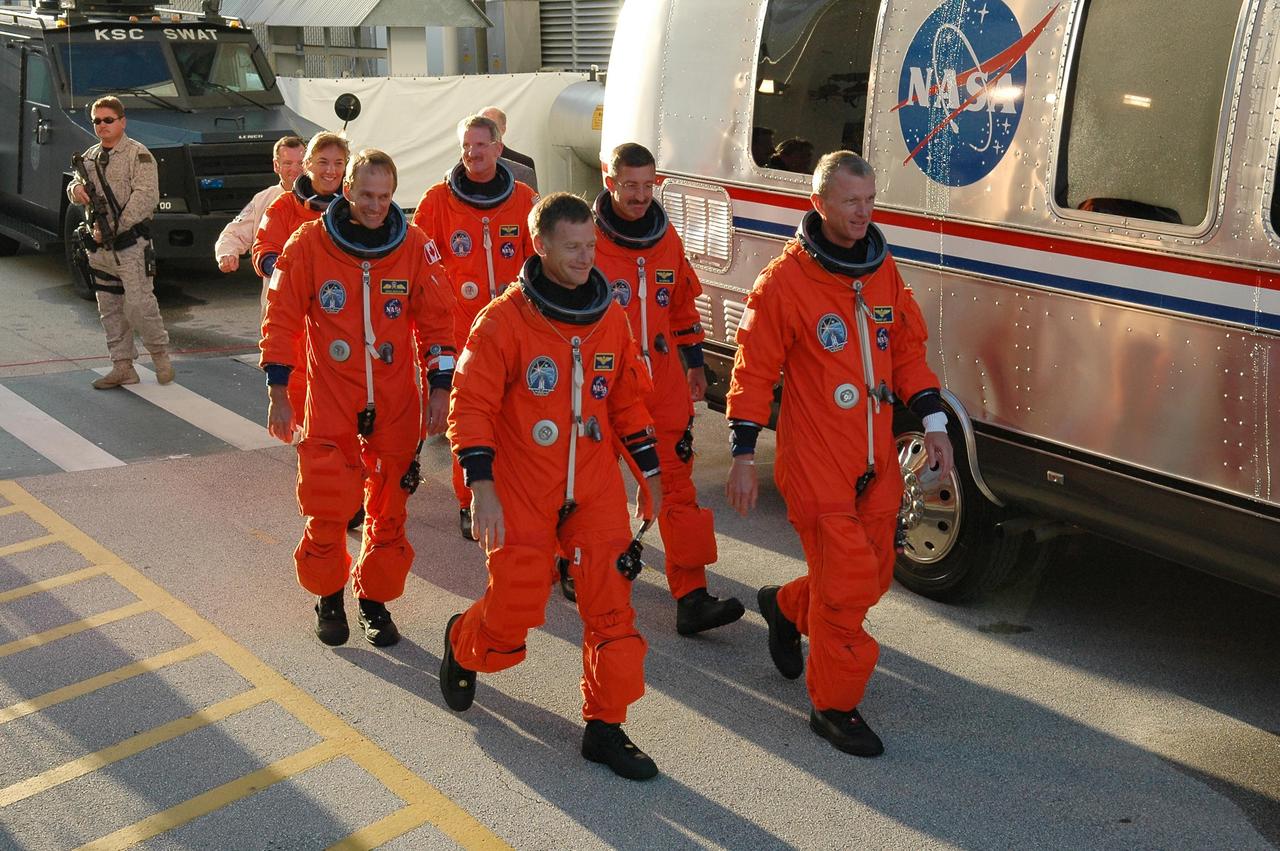
KENNEDY SPACE CENTER, FLA. - The STS-115 crew members walk toward the Astrovan that will take them to Launch Pad 39B. Seen left to right are Mission Specialists Heidemarie Stefanyshyn-Piper, Steven MacLean, Joseph Tanner and Daniel Burbank; Pilot Christopher Ferguson; and Commander Brent Jett. This is the second attempt at launch after a week's postponement due to weather and technical concerns. Atlantis is scheduled to lift off at 11:41 a.m. EDT on this date from Launch Pad 39B. During the STS-115 mission, Atlantis' astronauts will deliver and install the 17.5-ton, bus-sized P3/P4 integrated truss segment on the station. The girder-like truss includes a set of giant solar arrays, batteries and associated electronics and will provide one-fourth of the total power-generation capability for the completed station. This mission is the 116th space shuttle flight, the 27th flight for orbiter Atlantis, and the 19th U.S. flight to the ISS. STS-115 is scheduled to last 11 days with a planned landing at KSC. Photo credit: NASA/Kim Shiflett
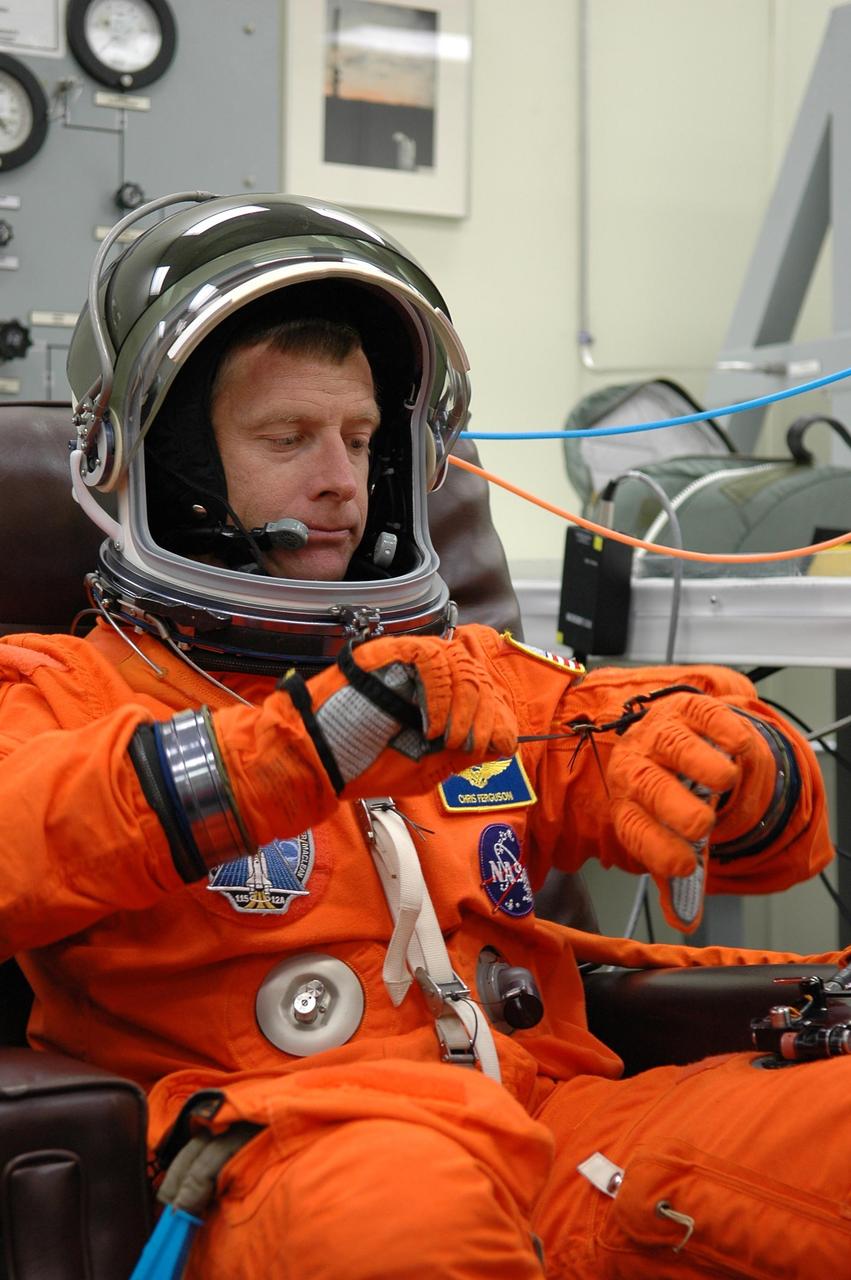
KENNEDY SPACE CENTER, FLA. - In the Operations and Checkout Building at NASA Kennedy Space Center, STS-115 Pilot Christopher Ferguson adjusts his glove during suitup before heading to the launch pad for another attempt at liftoff. The launch attempt on Sept. 8 was scrubbed due to an issue with a fuel cut-off sensor system inside the external fuel tank. This is one of several systems that protect the shuttle's main engines by triggering their shutdown if fuel runs unexpectedly low. During the STS-115 mission, Atlantis' astronauts will deliver and install the 17.5-ton, bus-sized P3/P4 integrated truss segment on the station. The girder-like truss includes a set of giant solar arrays, batteries and associated electronics and will provide one-fourth of the total power-generation capability for the completed station. This mission is the 116th space shuttle flight, the 27th flight for orbiter Atlantis, and the 19th U.S. flight to the ISS. STS-115 is scheduled to last 11 days with a planned landing at KSC. Photo credit: NASA/Kim Shiflett
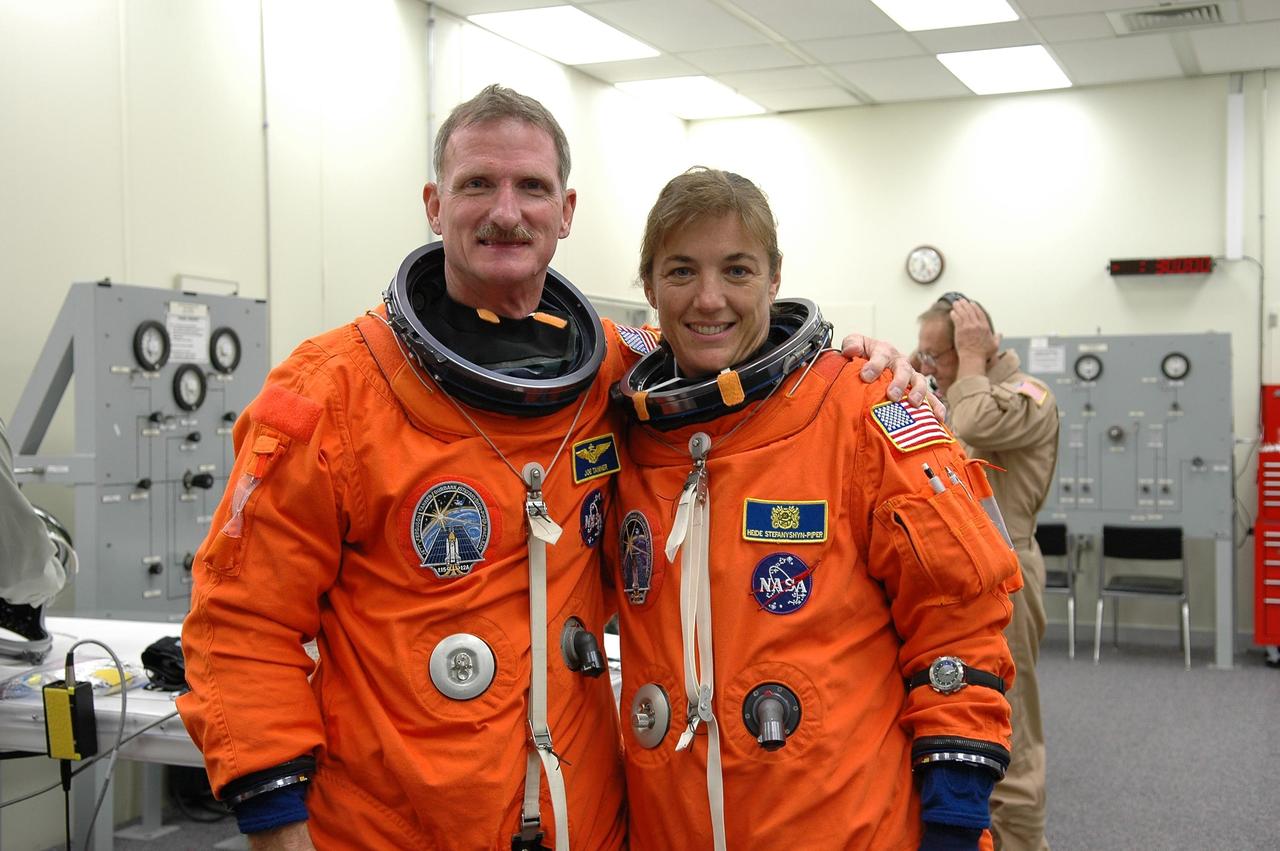
KENNEDY SPACE CENTER, FLA. - In the Operations and Checkout Building at NASA Kennedy Space Center, STS-115 Mission Specialists Joseph Tanner and Heidemarie Stefanyshyn-Piper pose while suiting up for the ride to Launch Pad 39B and another attempt at liftoff. The launch attempt on Sept. 8 was scrubbed due to an issue with a fuel cut-off sensor system inside the external fuel tank. This is one of several systems that protect the shuttle's main engines by triggering their shutdown if fuel runs unexpectedly low. During the STS-115 mission, Atlantis' astronauts will deliver and install the 17.5-ton, bus-sized P3/P4 integrated truss segment on the station. The girder-like truss includes a set of giant solar arrays, batteries and associated electronics and will provide one-fourth of the total power-generation capability for the completed station. This mission is the 116th space shuttle flight, the 27th flight for orbiter Atlantis, and the 19th U.S. flight to the ISS. STS-115 is scheduled to last 11 days with a planned landing at KSC. Photo credit: NASA/Kim Shiflett

KENNEDY SPACE CENTER, FLA. - STS-115 Mission Specialist Heidemarie Stefanyshyn-Piper waves during suitup in the Operations and Checkout Building at NASA Kennedy Space Center. She is making her first shuttle flight on this mission to the International Space Station aboard Space Shuttle Atlantis. On its second attempt for launch, Atlantis is scheduled to lift off at 11:41 a.m. EDT today from Launch Pad 39B. During the STS-115 mission, Atlantis' astronauts will deliver and install the 17.5-ton, bus-sized P3/P4 integrated truss segment on the station. The girder-like truss includes a set of giant solar arrays, batteries and associated electronics and will provide one-fourth of the total power-generation capability for the completed station. This mission is the 116th space shuttle flight, the 27th flight for orbiter Atlantis, and the 19th U.S. flight to the ISS. STS-115 is scheduled to last 11 days with a planned landing at KSC. Photo credit: NASA/Kim Shiflett

KENNEDY SPACE CENTER, FLA. - In the Operations and Checkout Building at NASA Kennedy Space Center, STS-115 Mission Specialist Steven MacLean signals "go" for another attempt at liftoff. MacLean is with the Canadian Space Agency. The launch attempt on Sept. 8 was scrubbed due to an issue with a fuel cut-off sensor system inside the external fuel tank. This is one of several systems that protect the shuttle's main engines by triggering their shutdown if fuel runs unexpectedly low. During the STS-115 mission, Atlantis' astronauts will deliver and install the 17.5-ton, bus-sized P3/P4 integrated truss segment on the station. The girder-like truss includes a set of giant solar arrays, batteries and associated electronics and will provide one-fourth of the total power-generation capability for the completed station. This mission is the 116th space shuttle flight, the 27th flight for orbiter Atlantis, and the 19th U.S. flight to the ISS. STS-115 is scheduled to last 11 days with a planned landing at KSC. Photo credit: NASA/Kim Shiflett
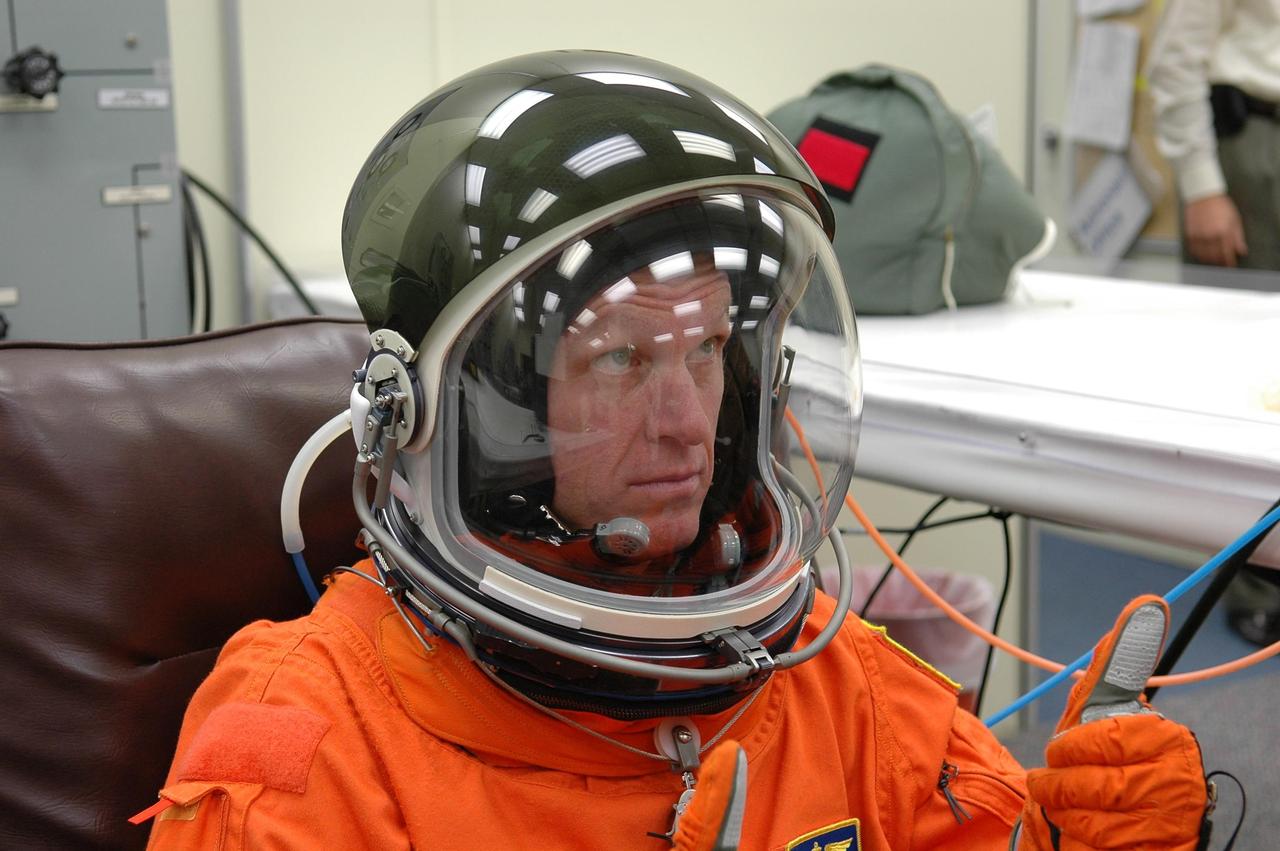
KENNEDY SPACE CENTER, FLA. - In the Operations and Checkout Building at NASA Kennedy Space Center, STS-115 Mission Commander Brent Jett signals a "go" for another attempt at liftoff. The launch attempt on Sept. 8 was scrubbed due to an issue with a fuel cut-off sensor system inside the external fuel tank. This is one of several systems that protect the shuttle's main engines by triggering their shutdown if fuel runs unexpectedly low. During the STS-115 mission, Atlantis' astronauts will deliver and install the 17.5-ton, bus-sized P3/P4 integrated truss segment on the station. The girder-like truss includes a set of giant solar arrays, batteries and associated electronics and will provide one-fourth of the total power-generation capability for the completed station. This mission is the 116th space shuttle flight, the 27th flight for orbiter Atlantis, and the 19th U.S. flight to the ISS. STS-115 is scheduled to last 11 days with a planned landing at KSC. Photo credit: NASA/Kim Shiflett
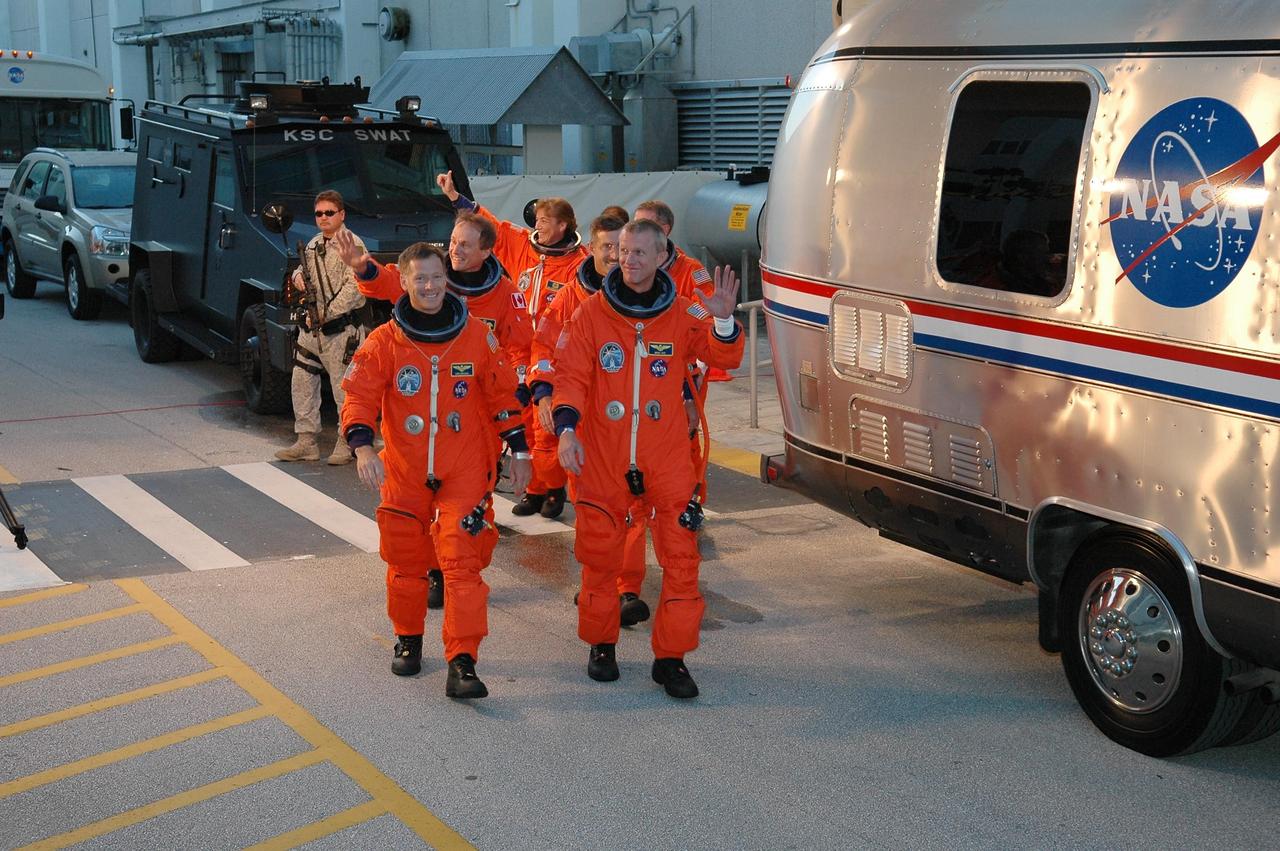
KENNEDY SPACE CENTER, FLA. - The STS-115 mission crew respond to well-wishers as they head to the Astrovan for the ride to Launch Pad 39B. From left are Pilot Christopher Ferguson, Mission Specialists Steven MacLean, Heidemarie Stefanyshyn-Piper, Daniel Burbank and Joseph Tanner (hidden), and Commander Brent Jett. The crew is eager for another attempt at liftoff after the Sept. 8 scrub. The launch attempt on Sept. 8 was scrubbed due to an issue with a fuel cut-off sensor system inside the external fuel tank. This is one of several systems that protect the shuttle's main engines by triggering their shutdown if fuel runs unexpectedly low. During the STS-115 mission, Atlantis' astronauts will deliver and install the 17.5-ton, bus-sized P3/P4 integrated truss segment on the station. The girder-like truss includes a set of giant solar arrays, batteries and associated electronics and will provide one-fourth of the total power-generation capability for the completed station. This mission is the 116th space shuttle flight, the 27th flight for orbiter Atlantis, and the 19th U.S. flight to the ISS. STS-115 is scheduled to last 11 days with a planned landing at KSC. Photo credit: NASA/Kim Shiflett
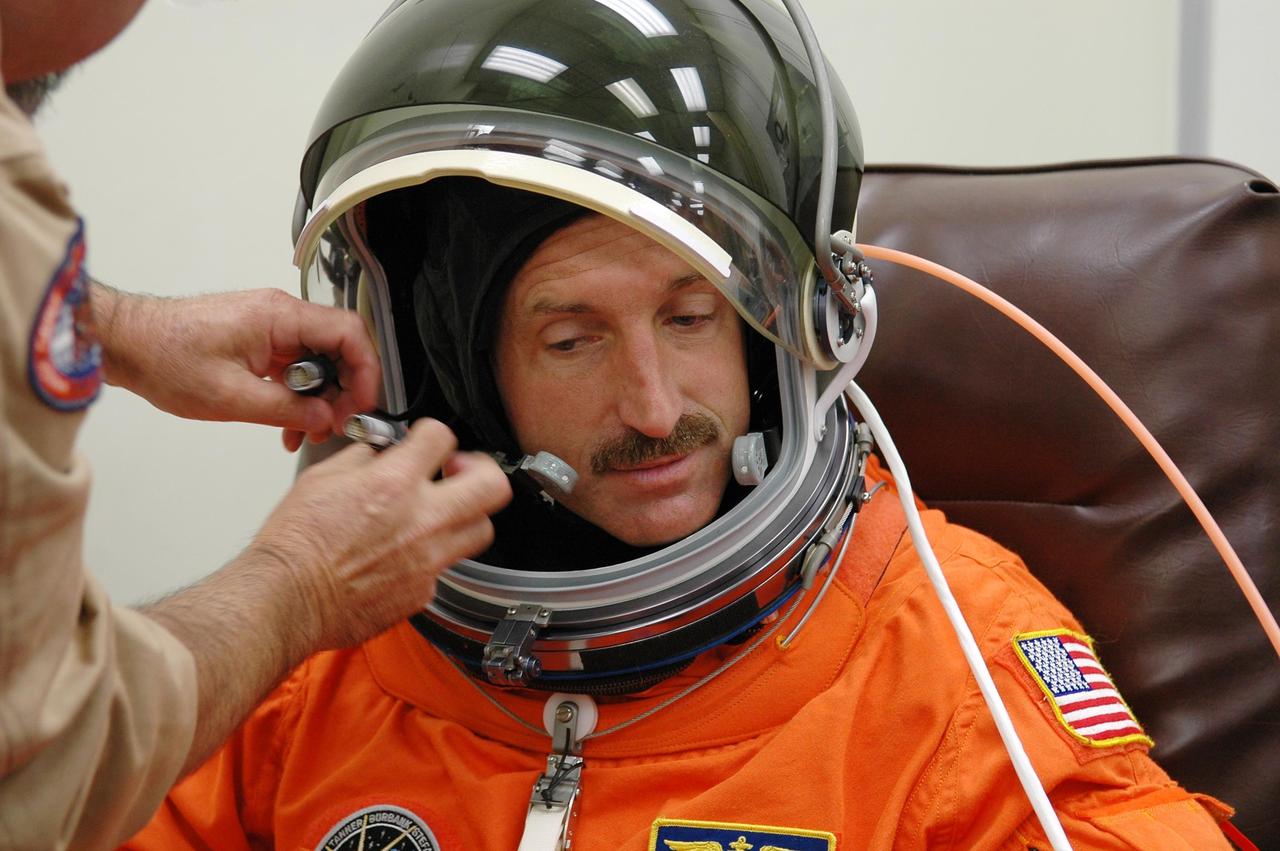
KENNEDY SPACE CENTER, FLA. - In the Operations and Checkout Building at NASA Kennedy Space Center, STS-115 Mission Specialist Daniel Burbank gets a final adjustment on his helmet before heading to the launch pad for another attempt at liftoff. The launch attempt on Sept. 8 was scrubbed due to an issue with a fuel cut-off sensor system inside the external fuel tank. This is one of several systems that protect the shuttle's main engines by triggering their shutdown if fuel runs unexpectedly low. During the STS-115 mission, Atlantis' astronauts will deliver and install the 17.5-ton, bus-sized P3/P4 integrated truss segment on the station. The girder-like truss includes a set of giant solar arrays, batteries and associated electronics and will provide one-fourth of the total power-generation capability for the completed station. This mission is the 116th space shuttle flight, the 27th flight for orbiter Atlantis, and the 19th U.S. flight to the ISS. STS-115 is scheduled to last 11 days with a planned landing at KSC. Photo credit: NASA/Kim Shiflett
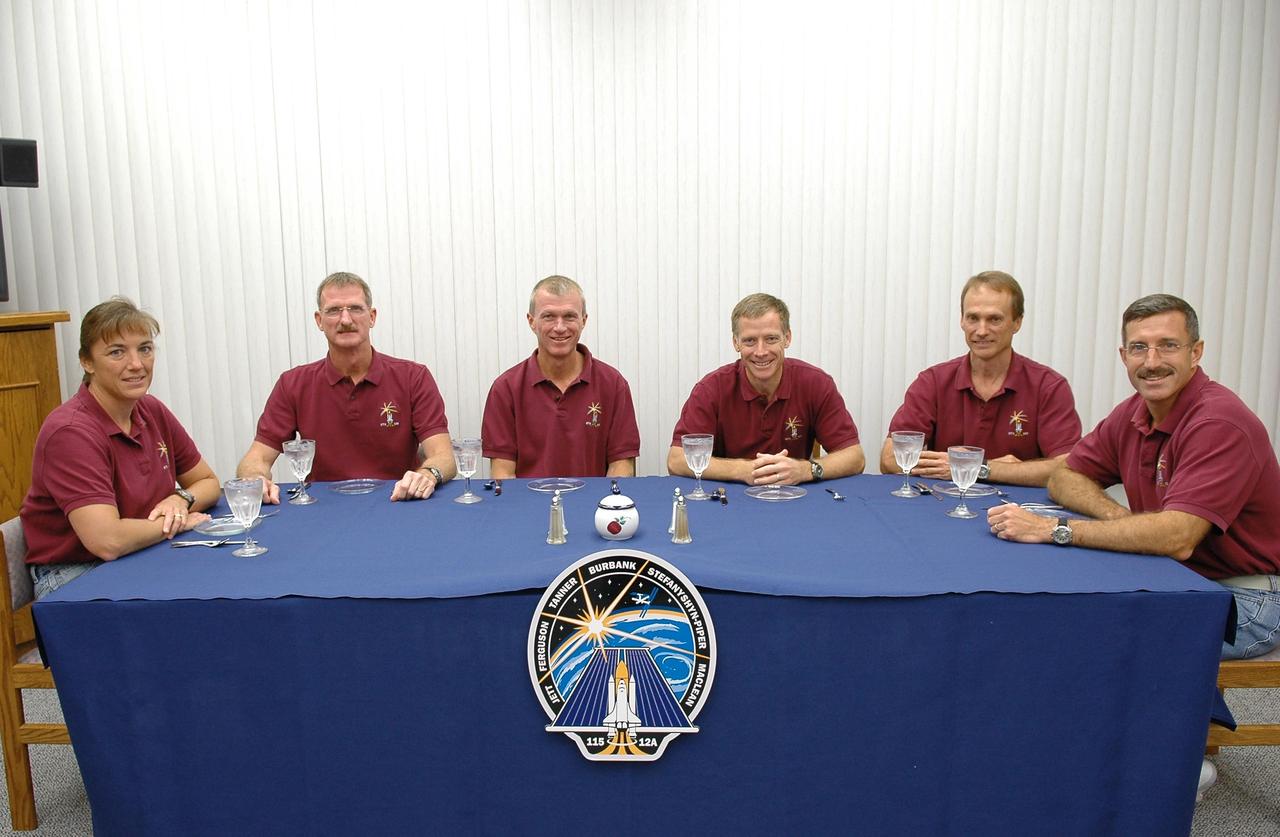
KENNEDY SPACE CENTER, FLA. - After a week's delay of launching due to weather and technical issues, the crew of mission STS-115 have had the traditional breakfast before their third attempt to launch on Space Shuttle Atlantis. Seated left to right are Mission Specialists Heidemarie Stefanyshyn-Piper and Joseph Tanner, Commander Brent Jett, Pilot Christopher Ferguson and Mission Specialists Steven MacLean and Daniel Burbank. MacLean is with the Canadian Space Agency. The launch attempt on Sept. 8 was scrubbed due to an issue with a fuel cut-off sensor system inside the external fuel tank. This is one of several systems that protect the shuttle's main engines by triggering their shutdown if fuel runs unexpectedly low. Following the breakfast, the crew will don their launch suits before heading to Launch Pad 39B. During the STS-115 mission, Atlantis' astronauts will deliver and install the 17.5-ton, bus-sized P3/P4 integrated truss segment on the station. The girder-like truss includes a set of giant solar arrays, batteries and associated electronics and will provide one-fourth of the total power-generation capability for the completed station. This mission is the 116th space shuttle flight, the 27th flight for orbiter Atlantis, and the 19th U.S. flight to the ISS. STS-115 is scheduled to last 11 days with a planned landing at KSC. Photo credit: NASA/Kim Shiflett
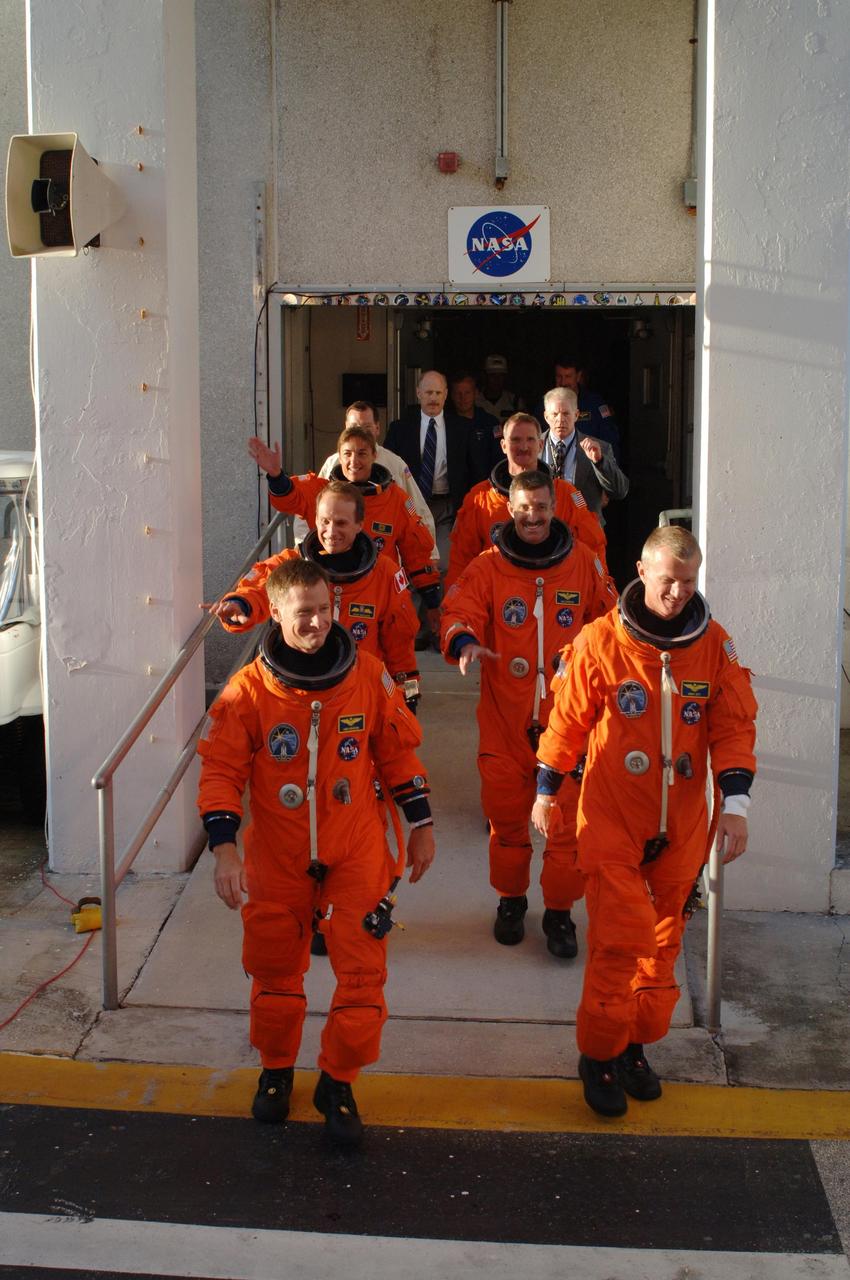
KENNEDY SPACE CENTER, FLA. - The STS-115 crew members stride out of the Operations and Checkout Building eager to get to Launch Pad 39B and the start of their mission to the International Space Station. This is the second attempt at launch after a week's postponement due to weather and technical concerns. On the left side, front to back, are Pilot Christopher Ferguson and Mission Specialists Steven MacLean and Heidemarie Stefanyshyn-Piper. On the right side, front to back, are Commander Brent Jett and Mission Specialists Daniel Burbank and Joseph Tanner. On its second attempt for launch, Atlantis is scheduled to lift off at 11:41 a.m. EDT today from Launch Pad 39B. During the STS-115 mission, Atlantis' astronauts will deliver and install the 17.5-ton, bus-sized P3/P4 integrated truss segment on the station. The girder-like truss includes a set of giant solar arrays, batteries and associated electronics and will provide one-fourth of the total power-generation capability for the completed station. This mission is the 116th space shuttle flight, the 27th flight for orbiter Atlantis, and the 19th U.S. flight to the ISS. STS-115 is scheduled to last 11 days with a planned landing at KSC. Photo credit: NASA/Kim Shiflett
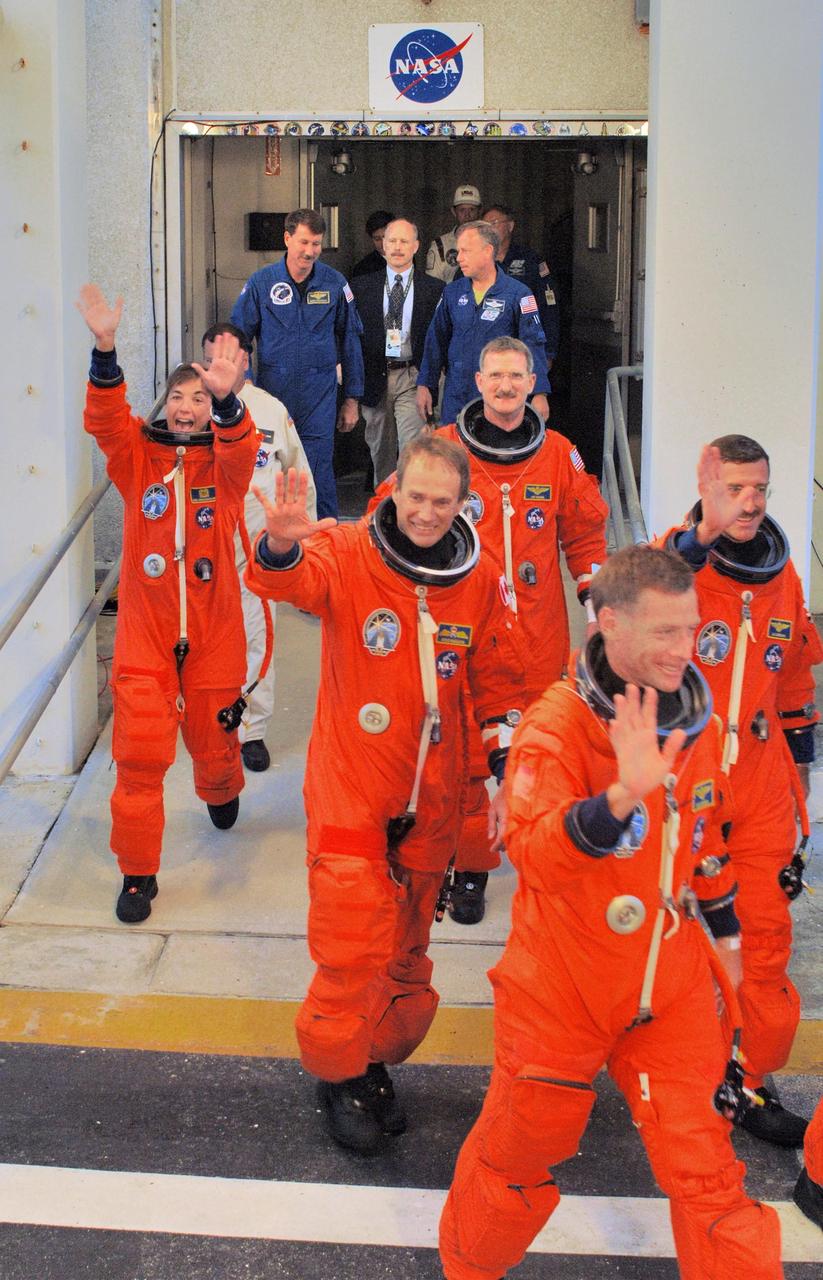
KENNEDY SPACE CENTER, FLA. - After suiting up, the STS-115 mission crew enthusiastically greet the onlookers as they head to the Astrovan for the ride to Launch Pad 39B. From left are Mission Specialist Heidemarie Stefanyshyn-Piper, Steven MacLean, Joseph Tanner, Pilot Christopher Ferguson and Daniel Burbank. Not seen is Commander Brent Jett. The crew is eager for another attempt at liftoff after the Sept. 8 scrub. The launch attempt on Sept. 8 was scrubbed due to an issue with a fuel cut-off sensor system inside the external fuel tank. This is one of several systems that protect the shuttle's main engines by triggering their shutdown if fuel runs unexpectedly low. During the STS-115 mission, Atlantis' astronauts will deliver and install the 17.5-ton, bus-sized P3/P4 integrated truss segment on the station. The girder-like truss includes a set of giant solar arrays, batteries and associated electronics and will provide one-fourth of the total power-generation capability for the completed station. This mission is the 116th space shuttle flight, the 27th flight for orbiter Atlantis, and the 19th U.S. flight to the ISS. STS-115 is scheduled to last 11 days with a planned landing at KSC. Photo credit: NASA/Kim Shiflett
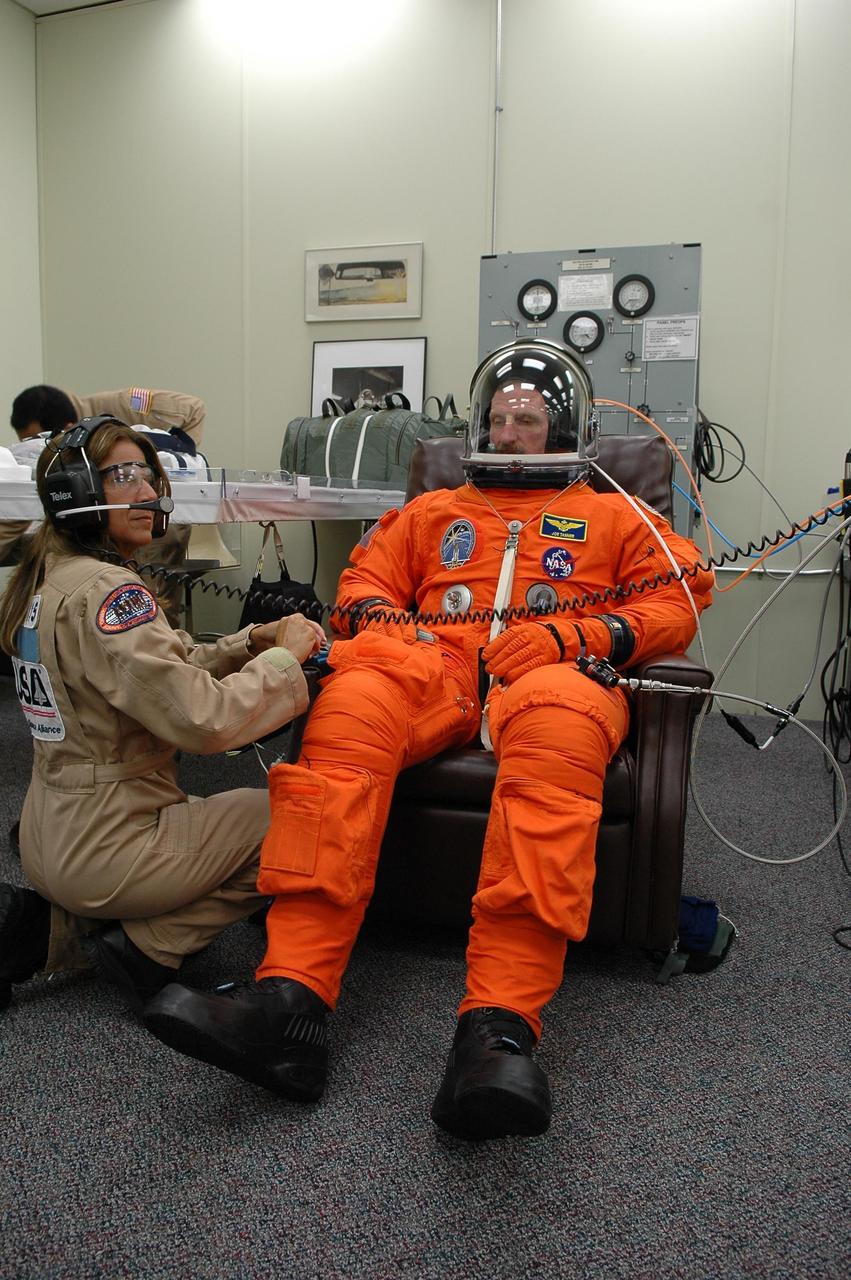
KENNEDY SPACE CENTER, FLA. - In the Operations and Checkout Building at NASA Kennedy Space Center, STS-115 Mission Specialist Joseph Tanner dons his launch and re-entry suit before heading to the launch pad for another attempt at liftoff. The launch attempt on Sept. 8 was scrubbed due to an issue with a fuel cut-off sensor system inside the external fuel tank. This is one of several systems that protect the shuttle's main engines by triggering their shutdown if fuel runs unexpectedly low. Liftoff today is scheduled for 11:15 a.m. EDT. During the STS-115 mission, Atlantis' astronauts will deliver and install the 17.5-ton, bus-sized P3/P4 integrated truss segment on the station. The girder-like truss includes a set of giant solar arrays, batteries and associated electronics and will provide one-fourth of the total power-generation capability for the completed station. This mission is the 116th space shuttle flight, the 27th flight for orbiter Atlantis, and the 19th U.S. flight to the ISS. STS-115 is scheduled to last 11 days with a planned landing at KSC. Photo credit: NASA/Kim Shiflett
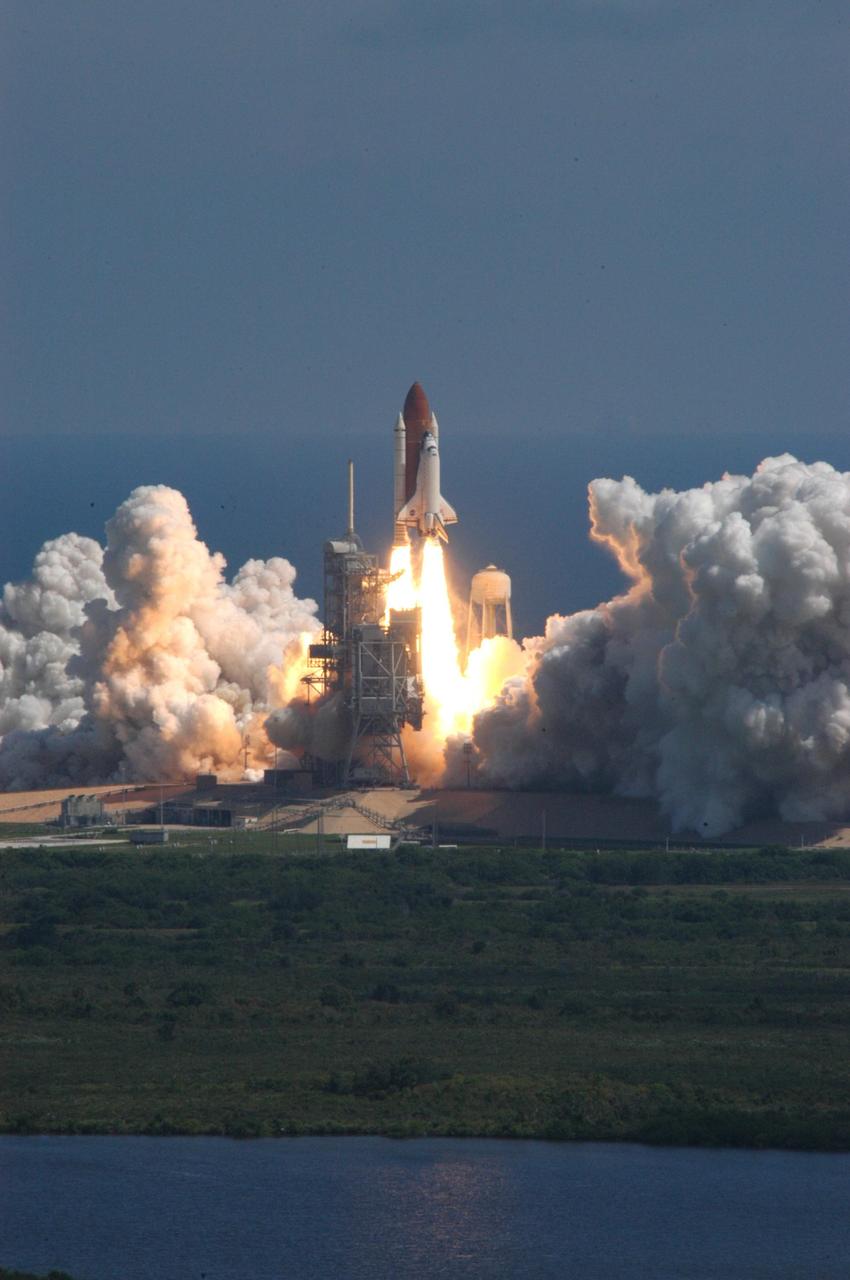
KENNEDY SPACE CENTER, FLA. - From the top of the Vehicle Assembly Building, the fiery launch of Space Shuttle Atlantis is seen against the background of the Atlantic Ocean to the east while billows of smoke and steam roll across the launch pad. Atlantis is heading for a rendezvous with the International Space Station on mission STS-115. After launch attempts were scrubbed Aug. 27 and 29 and Sept. 3 and 8 due to weather and technical concerns, this launch was executed perfectly. During the STS-115 mission, Atlantis' astronauts will deliver and install the 17.5-ton, bus-sized P3/P4 integrated truss segment on the station. The girder-like truss includes a set of giant solar arrays, batteries and associated electronics and will provide one-fourth of the total power-generation capability for the completed station. This mission is the 116th space shuttle flight, the 27th flight for orbiter Atlantis, and the 19th U.S. flight to the ISS. STS-115 is scheduled to last 11 days with a planned landing at KSC. Photo credit: NASA/George Shelton
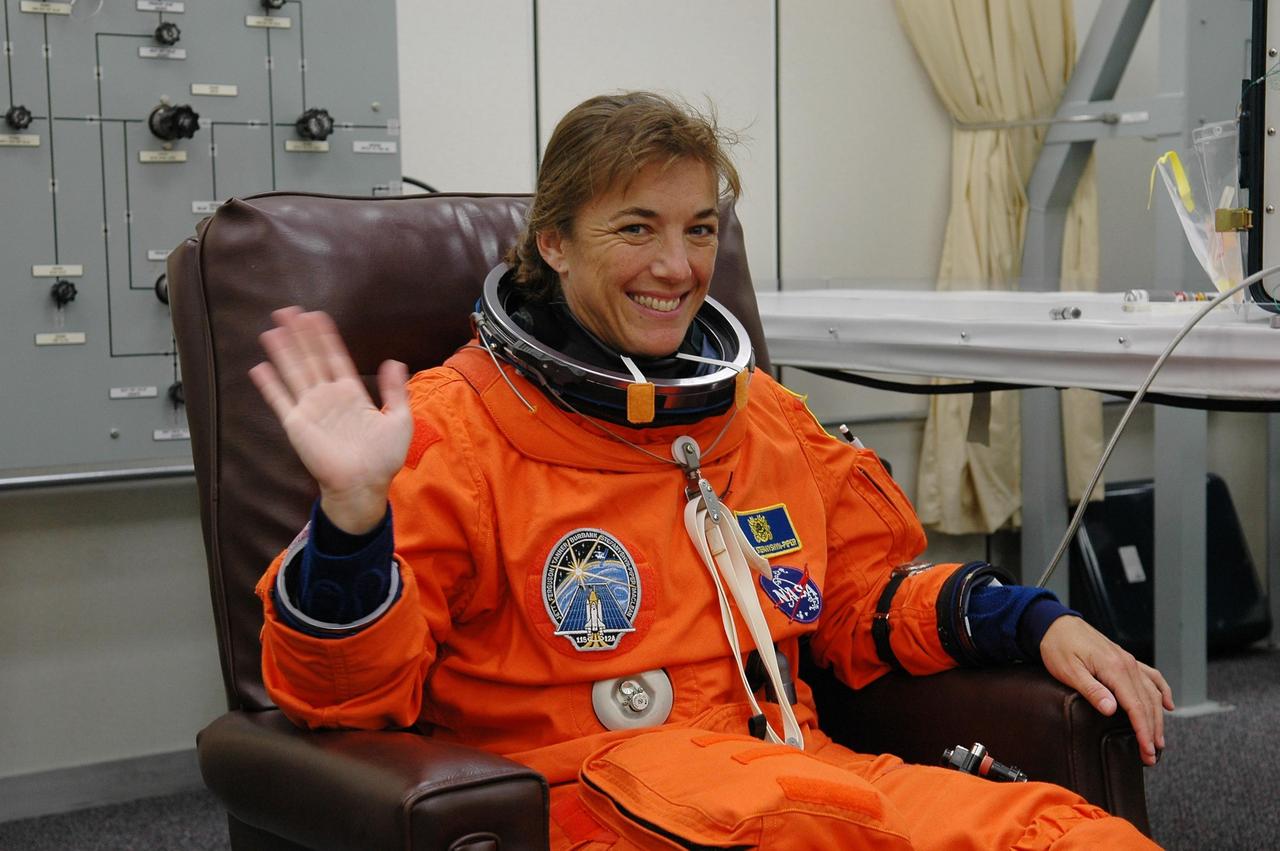
KENNEDY SPACE CENTER, FLA. - In the Operations and Checkout Building at NASA Kennedy Space Center, STS-115 Mission Specialist Heidemarie Stefanyshyn-Piper is eager for another attempt at liftoff. The launch attempt on Sept. 8 was scrubbed due to an issue with a fuel cut-off sensor system inside the external fuel tank. This is one of several systems that protect the shuttle's main engines by triggering their shutdown if fuel runs unexpectedly low. During the STS-115 mission, Atlantis' astronauts will deliver and install the 17.5-ton, bus-sized P3/P4 integrated truss segment on the station. The girder-like truss includes a set of giant solar arrays, batteries and associated electronics and will provide one-fourth of the total power-generation capability for the completed station. This mission is the 116th space shuttle flight, the 27th flight for orbiter Atlantis, and the 19th U.S. flight to the ISS. STS-115 is scheduled to last 11 days with a planned landing at KSC. Photo credit: NASA/Kim Shiflett
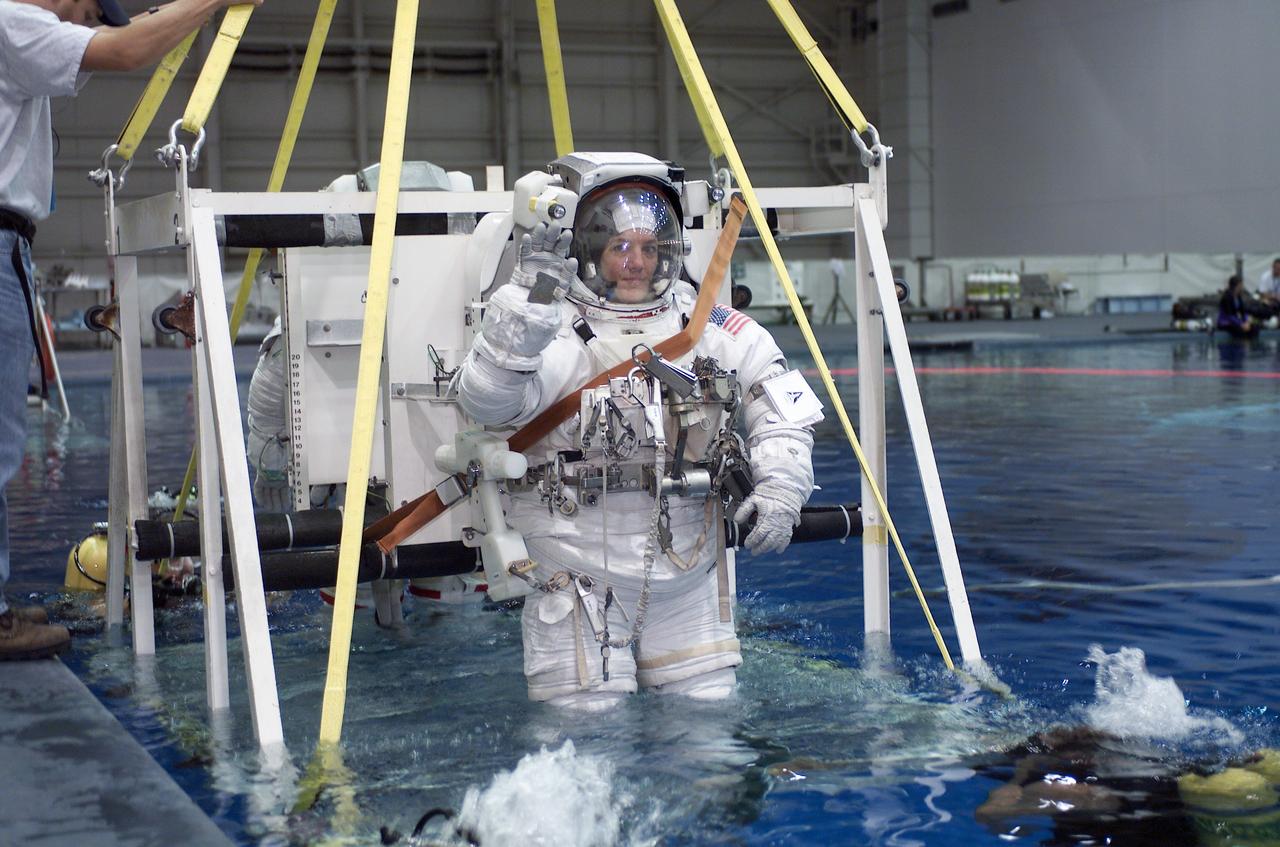
JSC2002-E-37426 (6 September 2002) --- Astronaut Heidemarie M. Stefanyshyn-Piper, STS-115 mission specialist, is submerged in the waters of the Neutral Buoyancy Laboratory (NBL) at the Johnson Space Center (JSC). Stefanyshyn-Piper is wearing the training version of the Extravehicular Mobility Unit (EMU) space suit. SCUBA-equipped divers are in the water to assist the astronauts in their rehearsal, intended to help prepare them for work on the exterior of the International Space Station (ISS).
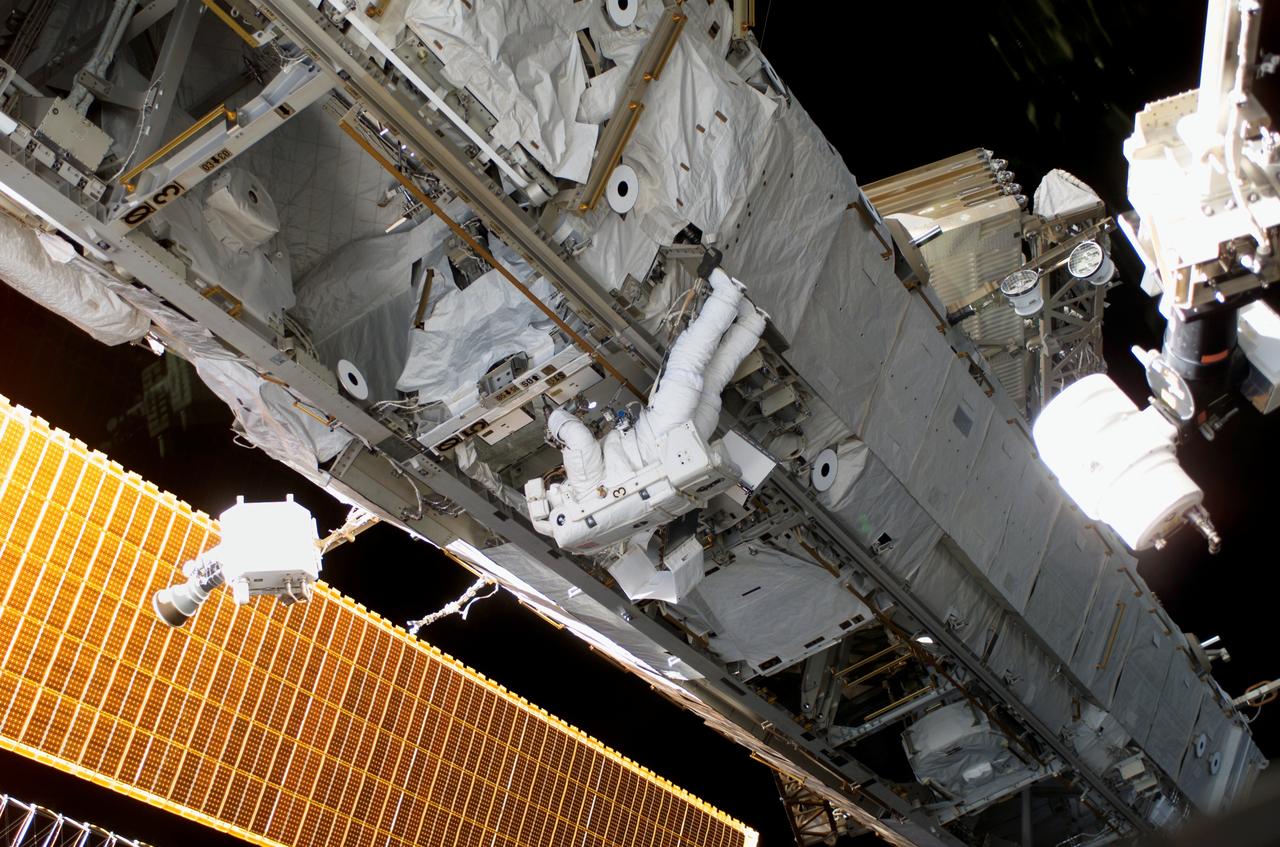
S115-E-06162 (15 Sept. 2006) --- This wide scene of the final STS-115 extravehicular activity has been quite typical this week, as the Space Shuttle Atlantis crewmembers and the International Space Station occupants join efforts to resume construction on the orbital outpost. Astronaut Heidemarie M. Stefanyshyn-Piper, mission specialist, can be seen working at one of the ISS trusses in the center of the photo.
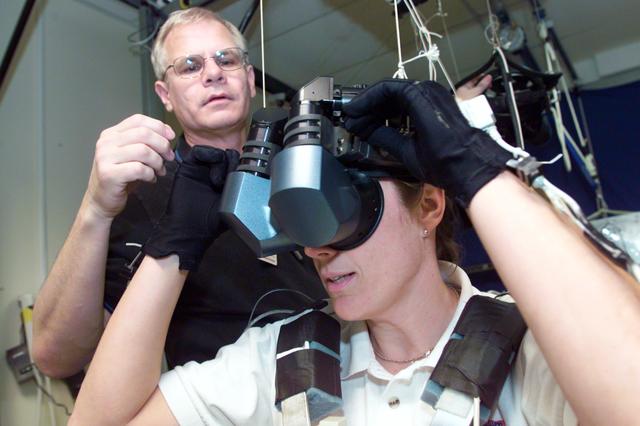
JSC2002-E-51049 (16 Dec. 2002) --- Astronaut Heidemarie M. Stefanyshyn-Piper, STS-115 mission specialist, uses specialized gear during a training session in the virtual reality lab at the Johnson Space Center (JSC) to rehearse some of her duties on the upcoming mission to the International Space Station (ISS). David J. Homan assisted Stefanyshyn-Piper.
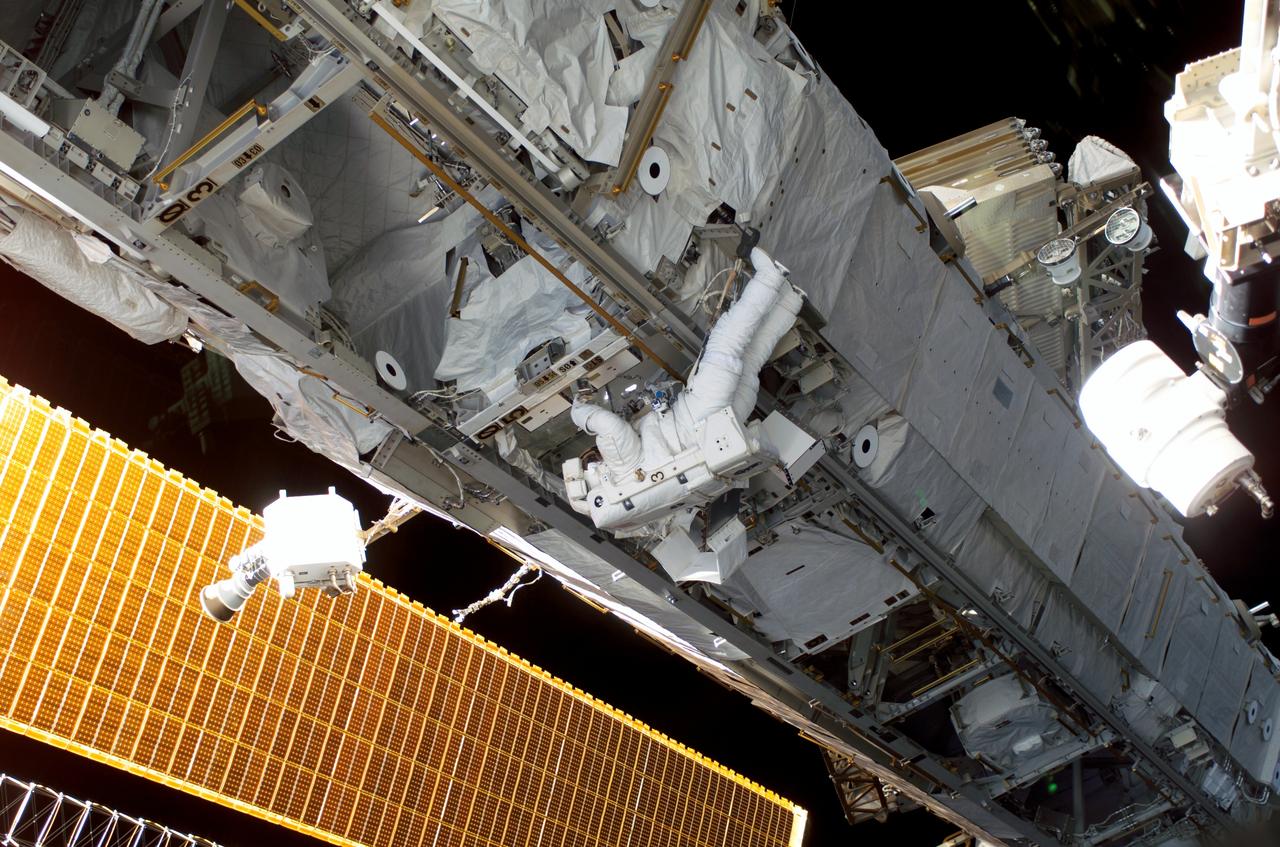
S115-E-06165 (15 Sept. 2006) --- This wide scene of the final STS-115 extravehicular activity has been quite typical this week, as the Atlantis crewmembers and the International Space Station occupants join efforts to resume construction on the orbital outpost. Astronaut Heidemarie M. Stefanyshyn-Piper can be seen working at one of the ISS trusses in the center of the photo.
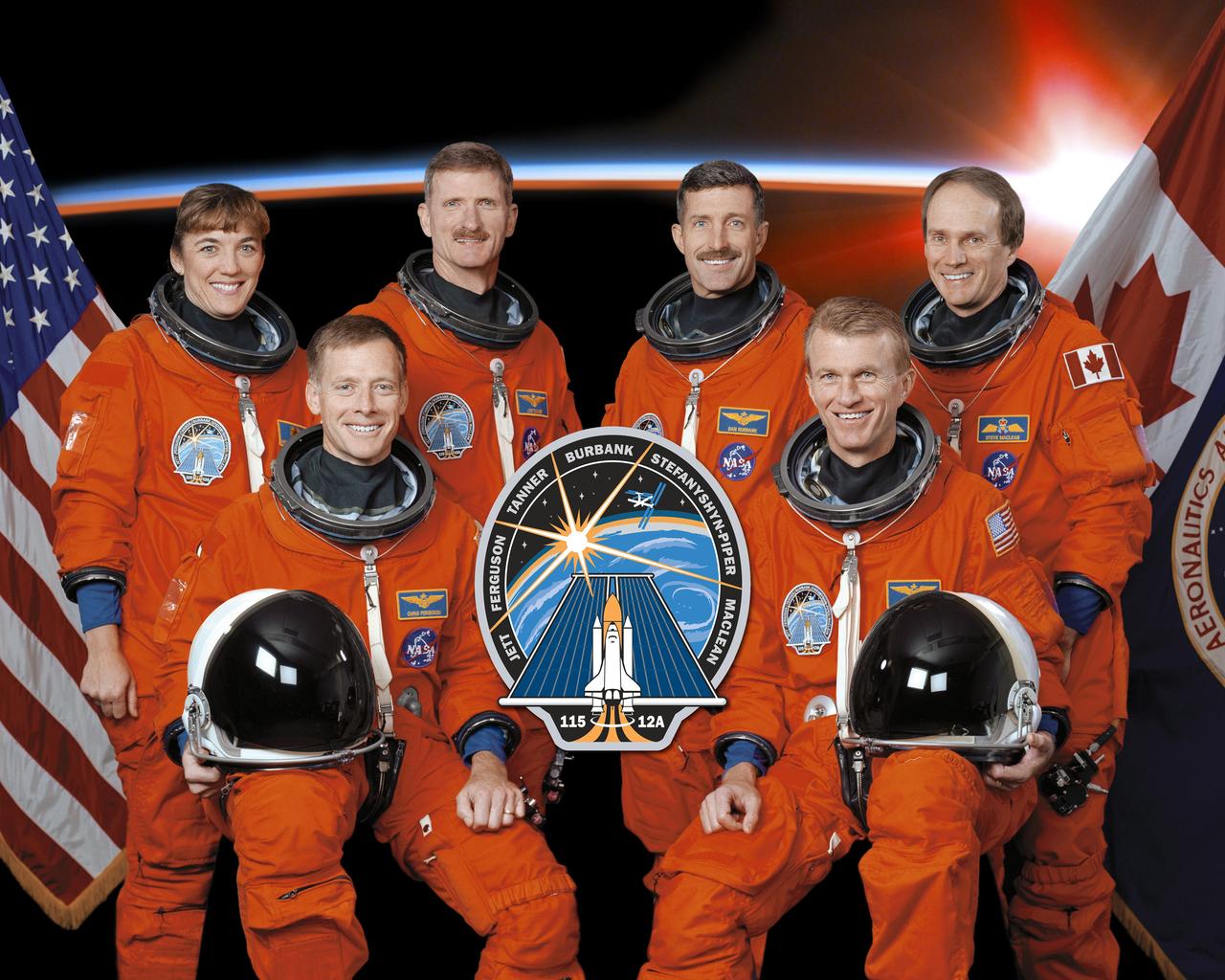
These six astronauts take a break from training to pose for the STS-115 crew portrait. Astronauts Brent W. Jett, Jr. (right) and Christopher J. Ferguson, commander and pilot, respectively, flank the mission insignia. The mission specialists are, from left to right, astronauts Heidemarie M. Stefanyshyn-Piper, Joseph R. (Joe) Tanner, Daniel C. Burbank, and Steven G. MacLean, who represents the Canadian Space Agency. This mission continued the assembly of the International Space Station (ISS) with the installation of the truss segments P3 and P4.
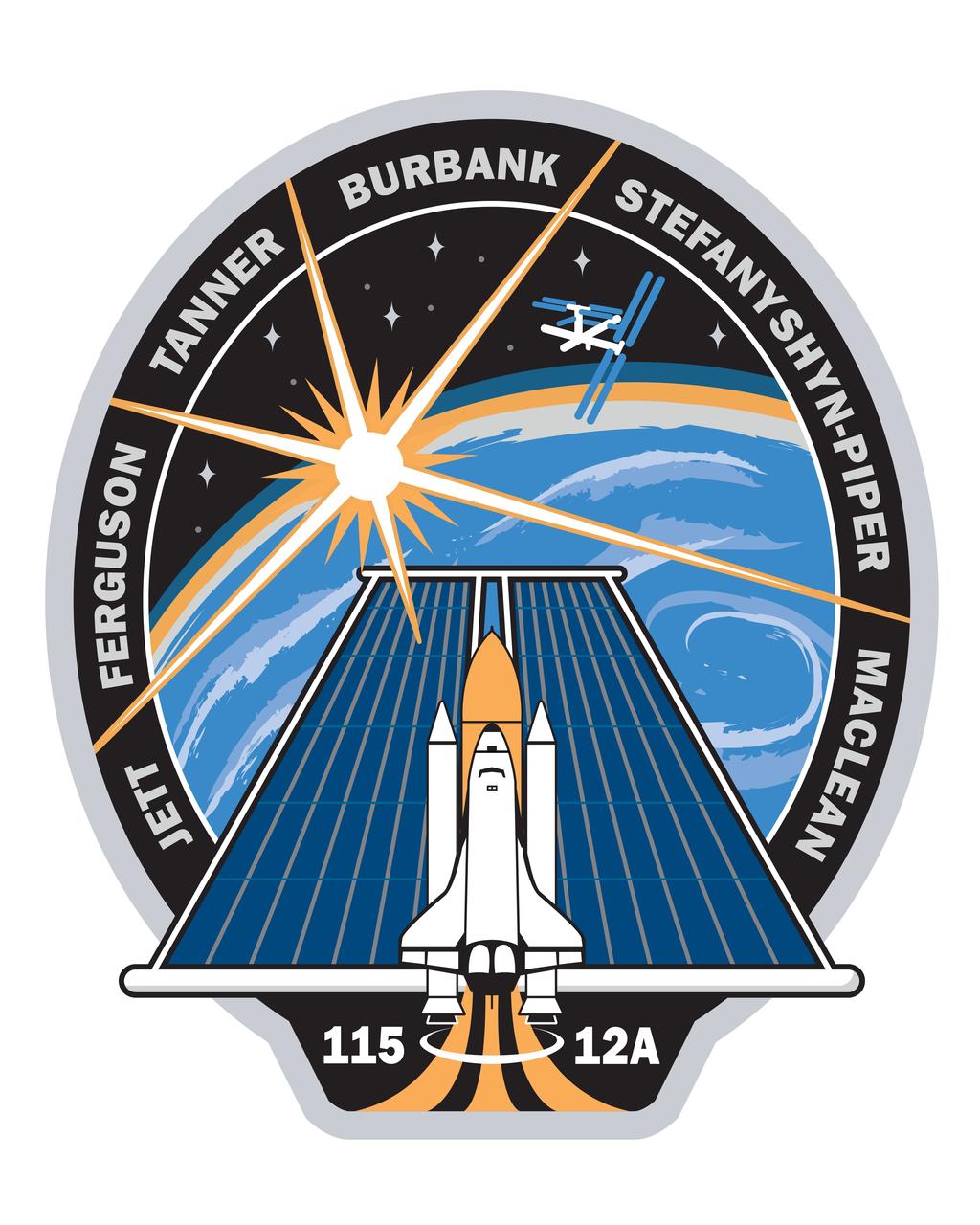
STS115-S-001 (February 2003) --- This is the STS-115 insignia. This mission continues the assembly of the International Space Station (ISS) with the installation of the truss segments P3 and P4. Following the installation of the segments utilizing both the shuttle and the station robotic arms, a series of three spacewalks will complete the final connections and prepare for the deployment of the station's second set of solar arrays. To reflect the primary mission of the flight, the patch depicts a solar panel as the main element. As the space shuttle Atlantis launches towards the ISS, its trail depicts the symbol of the Astronaut Office. The starburst, representing the power of the sun, rises over the Earth and shines on the solar panel. The shuttle flight number 115 is shown at the bottom of the patch, along with the ISS assembly designation 12A (the 12th American assembly mission). The blue Earth in the background reminds us of the importance of space exploration and research to all of Earth's inhabitants. The NASA insignia design for space shuttle flights is reserved for use by the astronauts and for other official use as the NASA Administrator may authorize. Public availability has been approved only in the forms of illustrations by the various news media. When and if there is any change in this policy, which is not anticipated, the change will be publicly announced. Photo credit: NASA
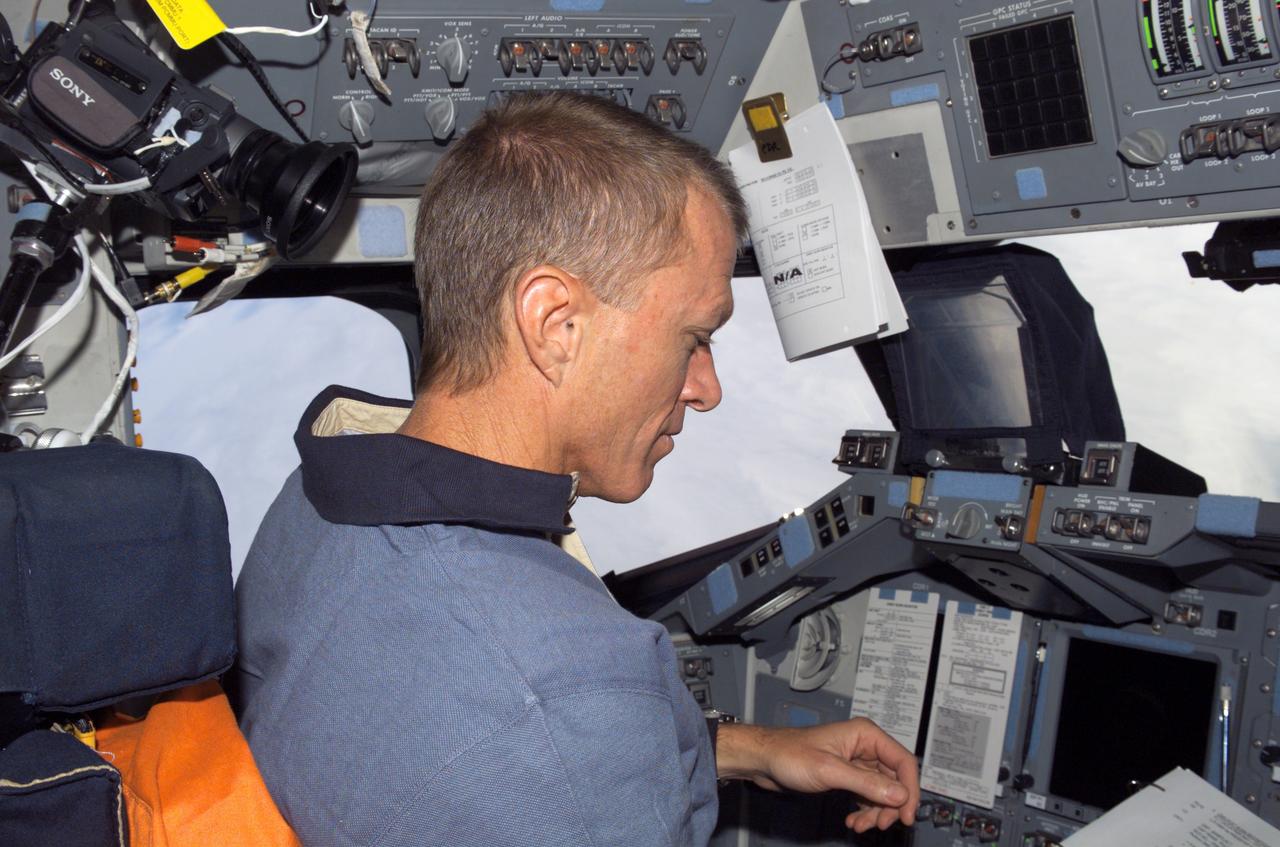
S115-E-05352 (11 Sept. 2006) --- Astronaut Brent W. Jett Jr., STS-115 commander, sits in the port seat on the flight deck of the Space Shuttle Atlantis at it approaches the International Space Station. The subsequent docking will allow the STS-115 astronauts and the Expedition 13 crew to team up for several days of key tasks in space.
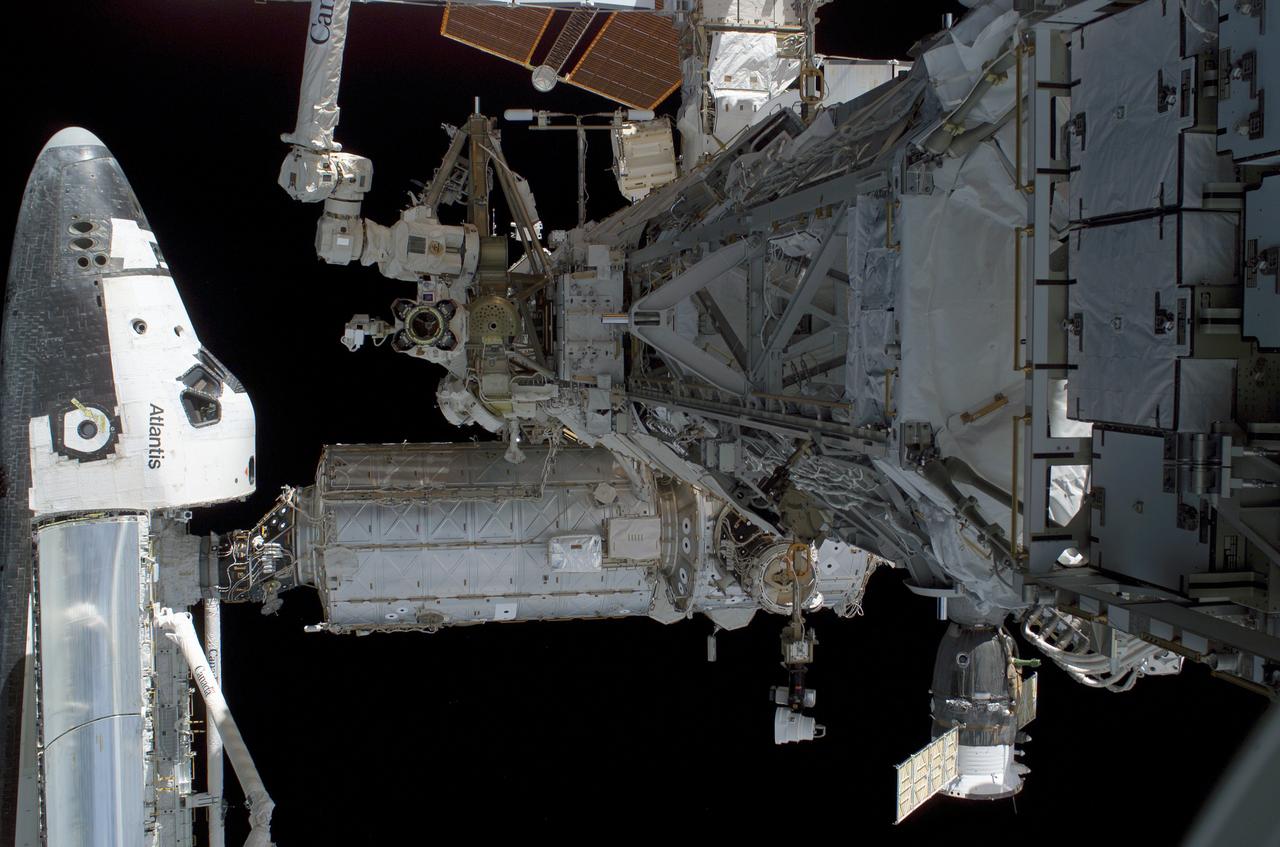
S115-E-05689 (12 Sept. 2006) --- Although no astronauts are visible in this picture, action was brisk outside the space shuttle/space station tandem when this digital still image was recorded on Sept. 12. Astronauts Joseph R. Tanner and Heidemarie M. Stefanyshyn-Piper participated in the first of three scheduled STS-115 extravehicular activity (EVA) sessions as the Atlantis astronauts and the Expedition 13 crewmembers join efforts this week to resume construction of the International Space Station.
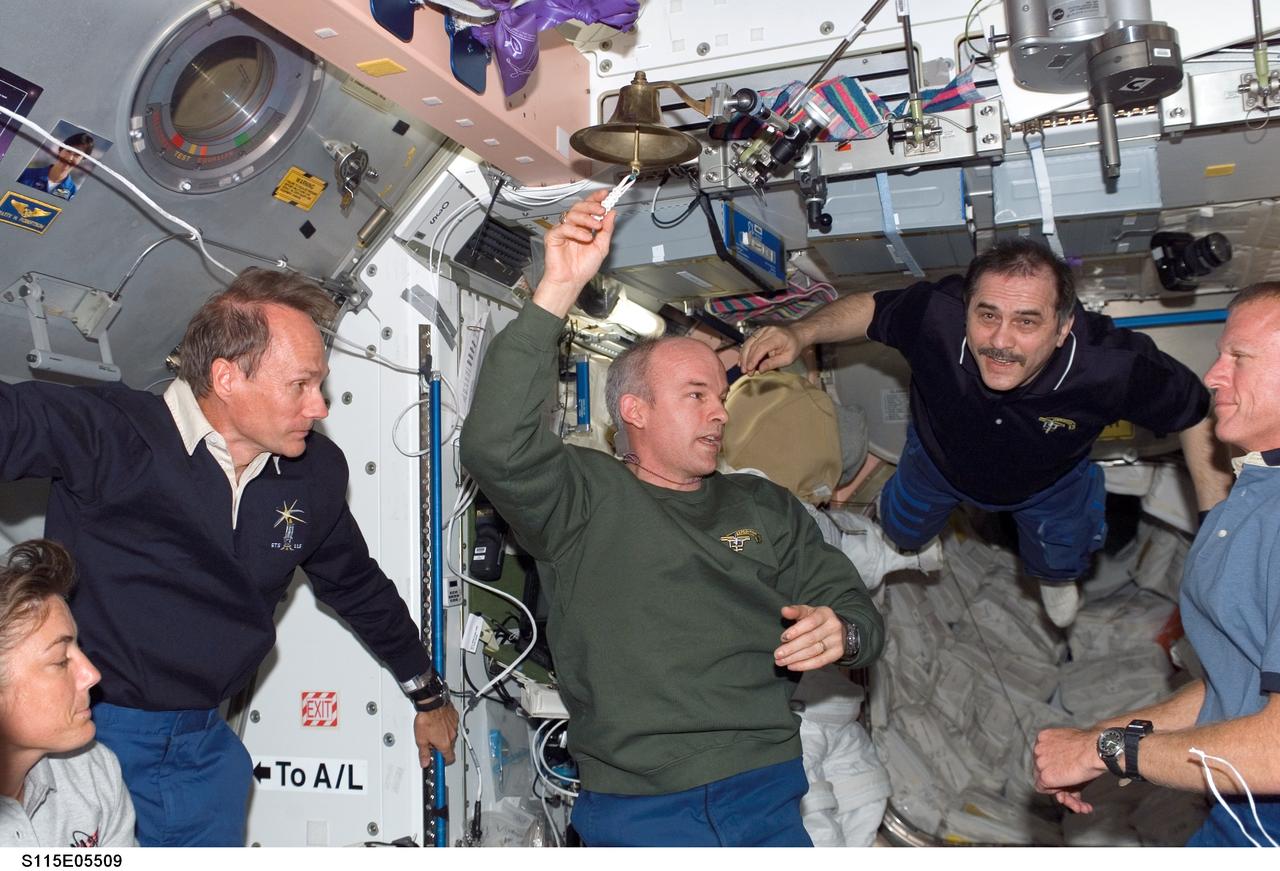
S115-E-05509 (11 Sept. 2006) --- Expedition 13 and STS-115 crewmembers reunite onboard the International Space Station soon after its docking with the Space Shuttle Atlantis. Cosmonaut Pavel Vinogradov, Expedition 13 commander representing Russia's Federal Space Agency, floats into the aft end of Unity from one of the pressurized mating adapters (PMA-1). Vinogradov's crewmate, astronaut Jeffrey N. Williams, flight engineer and NASA space station science officer, is in center frame. Canadian astronaut Steven G. MacLean (second left) is standing in the hatch to Quest, next to astronaut Heidemarie M. Stefanyshyn-Piper, mission specialist oon the Atlantis crew. Astronaut Brent W. Jett Jr., the shuttle mission's crew commander, is at right.
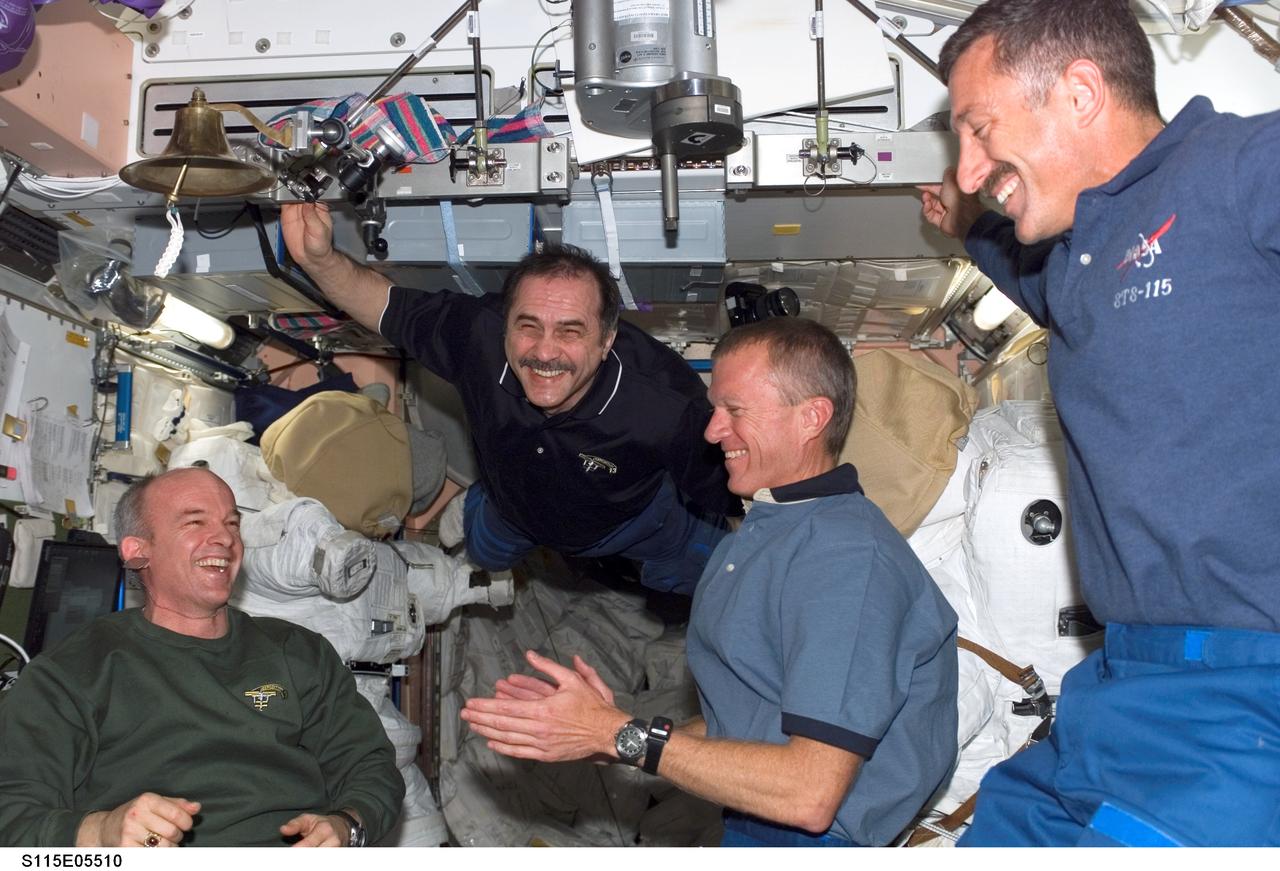
S115-E-05510 (11 Sept. 2006) --- Expedition 13 and STS-115 crewmembers reunite onboard the International Space Station soon after docking. A smiling cosmonaut Pavel Vinogradov, Expedition 13 commander representing Russia's Federal Space Agency, floats into the scene, joining (from left) astronauts Jeffrey N. Williams, Expedition 13 flight engineer and NASA station science officer; Brent W. Jett Jr., STS-115 commander, and Daniel C. Burbank, STS-115 mission specialist.
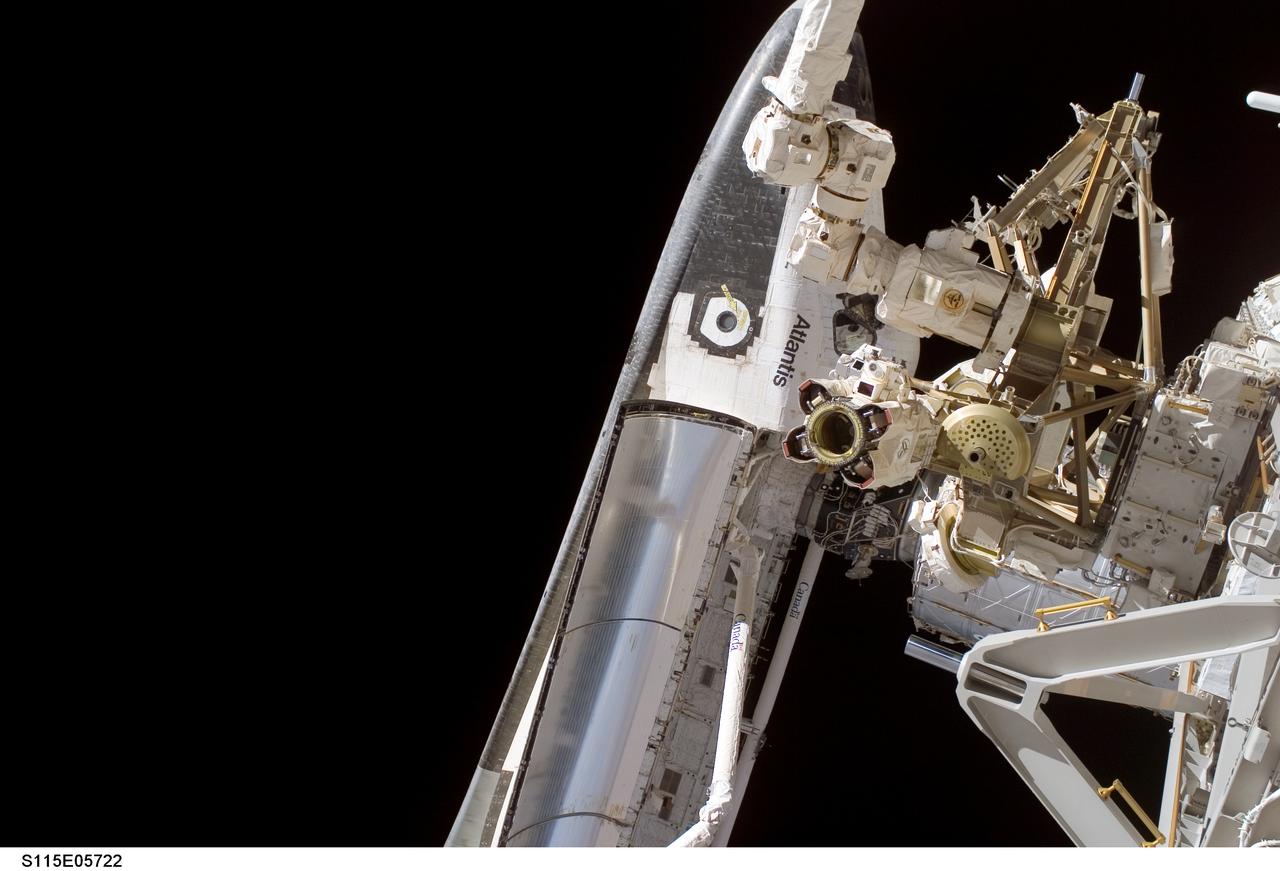
S115-E-05722 (12 Sept. 2006) --- The Space Shuttle Atlantis will remain docked with the International Space Station like this for several more days as the STS-115 and Expedition 13 crewmembers join efforts to resume construction of the International Space Station. This image was taken during the first of three scheduled space walks.
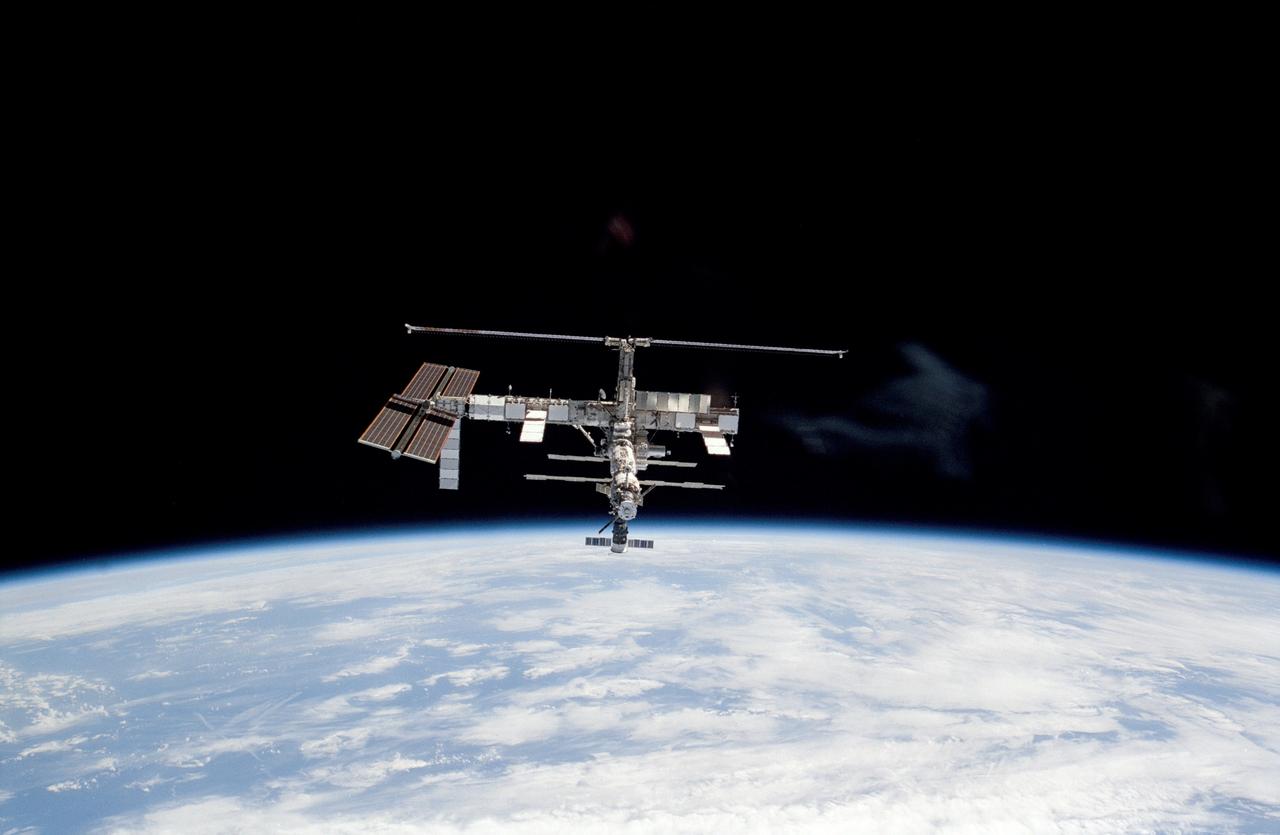
STS115-318-026 (17 Sept. 2006) --- Backdropped by the blackness of space and Earth's horizon, the International Space Station moves away from Space Shuttle Atlantis. Earlier the STS-115 and Expedition 13 crews concluded six days of cooperative work onboard the shuttle and station. Undocking of the two spacecraft occurred at 7:50 a.m. (CDT) on Sept. 17, 2006. Atlantis left the station with a new, second pair of 240-foot solar wings, attached to a new 17.5-ton section of truss with batteries, electronics and a giant rotating joint. The new solar arrays eventually will double the station's onboard power when their electrical systems are brought online during the next shuttle flight, planned for launch in December.
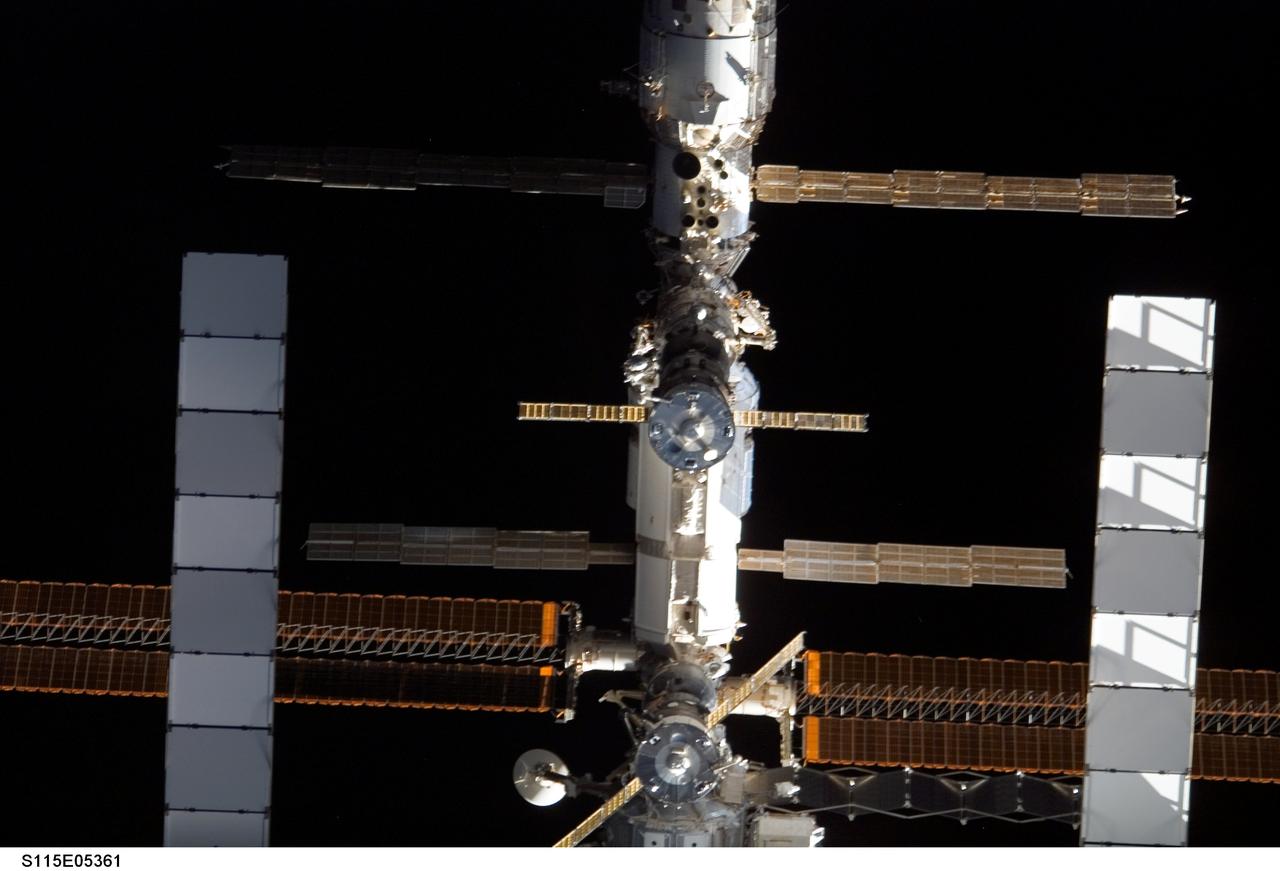
S115-E-05461 (11 Sept. 2006) --- The International Space Station, as seen from the Space Shuttle Atlantis as the two spacecraft prepare for docking, allowing STS-115 astronauts and the Expedition 13 crew to team up for several days of key tasks in space.
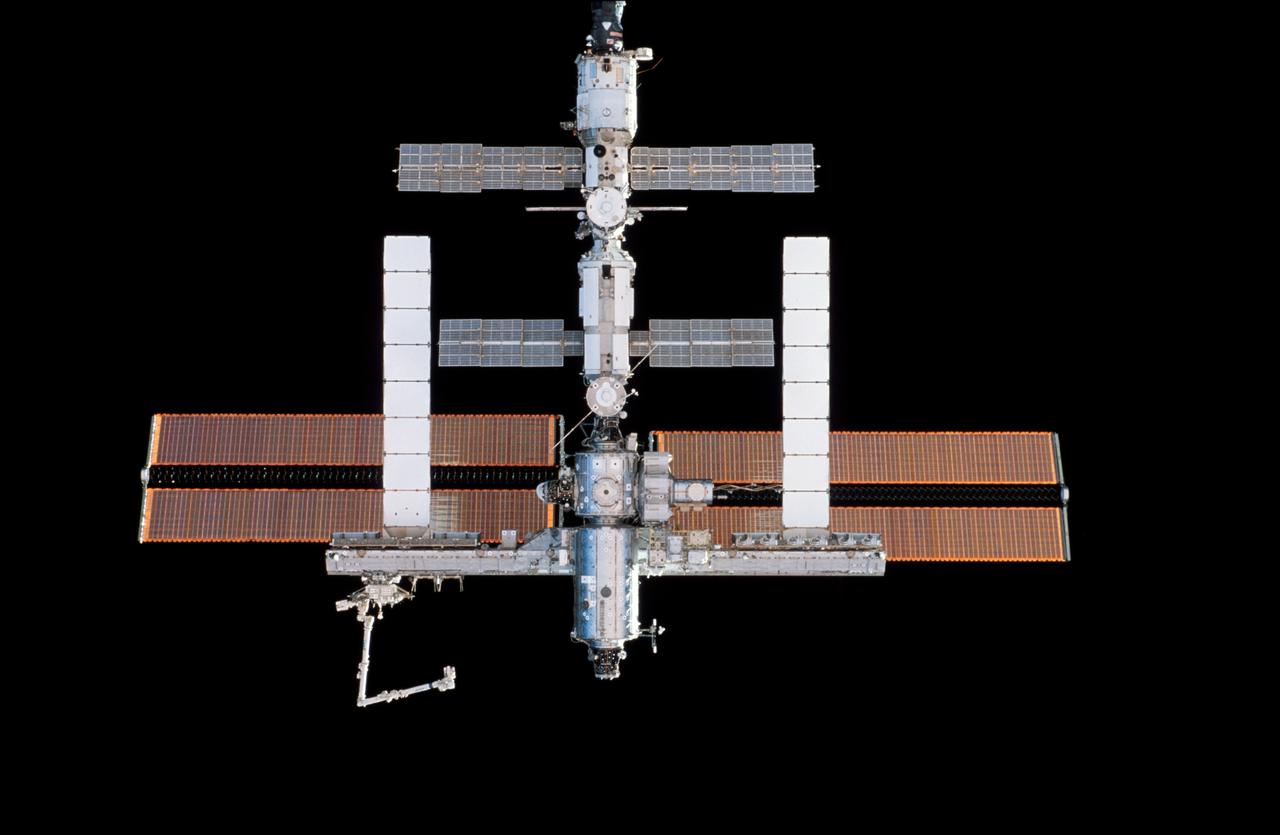
STS115-301-008 (11 Sept. 2006) --- Backdropped against the blackness of space, the International Space Station was photographed by one of the STS-115 crewmembers as the Space Shuttle Atlantis approached the station during rendezvous and docking activities on flight day three.
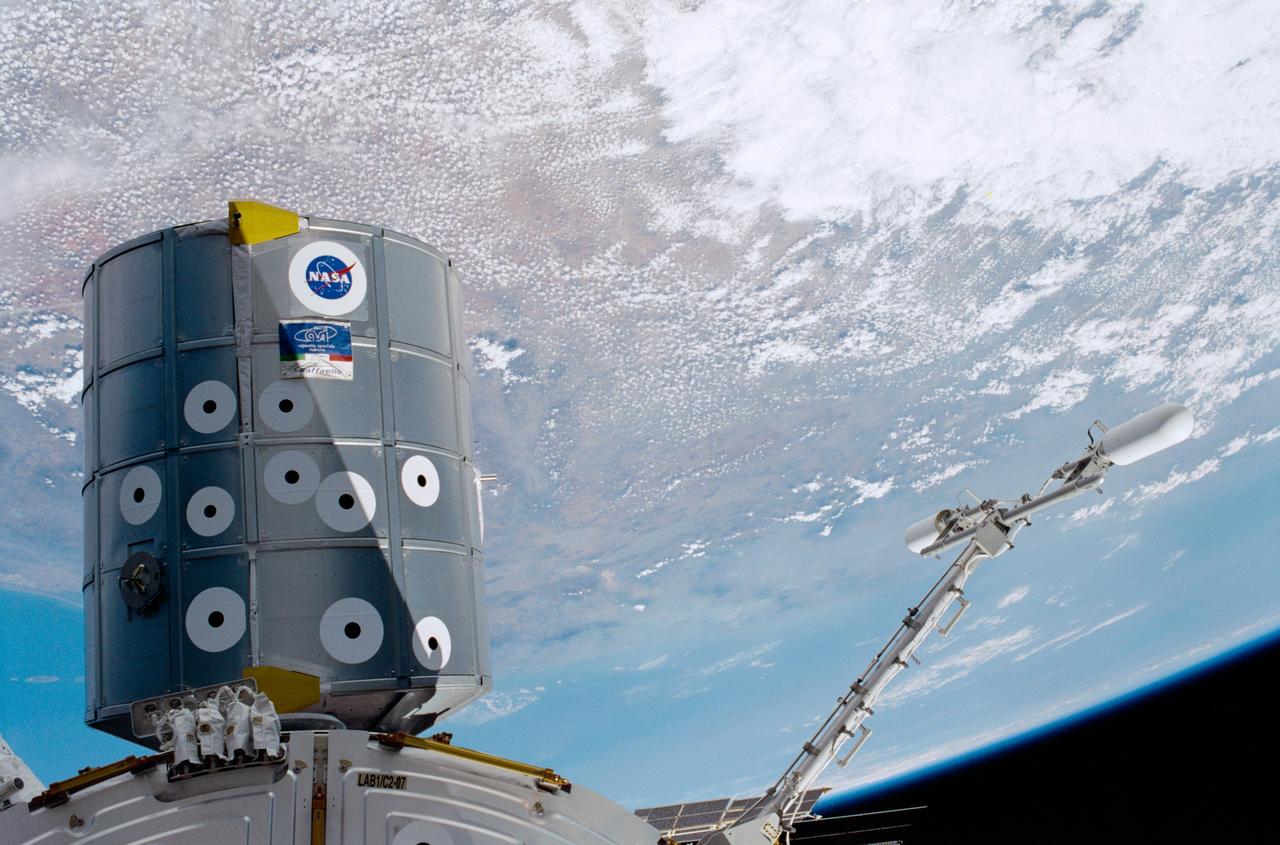
STS100-398-017 (19 April-1 May 2001) --- Backdropped by the Earth with partial cloud cover, the Raffaello Multi-Purpose Logistics Module (MPLM) and the Ultra High Frequency (UHF) antenna are photographed by a crewmember during this STS-100 mission to the International Space Station (ISS). The Raffaello, which was built by the Italian Space Agency (ASI), is the second of three such pressurized modules that will serve as ISS "moving vans", carrying laboratory racks filled with equipment, experiments and supplies to and from the station aboard the space shuttle. The UHF antenna was attached to the station's U.S. Laboratory Destiny by space walking astronauts Chris A. Hadfield and Scott E. Parazynski during the mission's first spacewalk. The antenna, on a 1.2-meter (4-foot) boom, is part of the UHF Communications Subsystem of the station. It will interact with systems already aboard the station, including the Space-to-Space Station Radio transceivers. A second antenna will be delivered on the STS-115/11A next year.
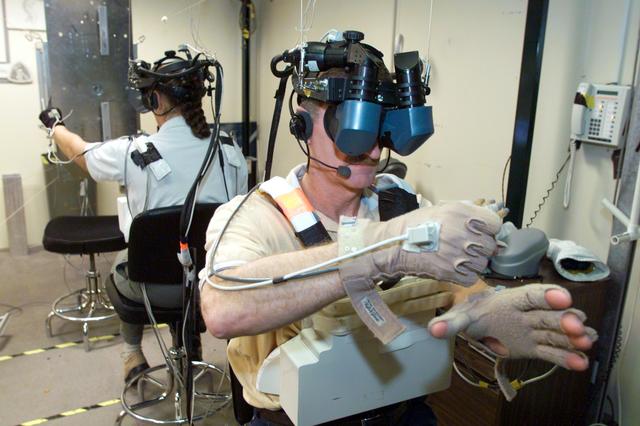
JSC2002-E-51051 (16 December 2002) --- Astronauts Joseph R. (Joe) Tanner (foreground) and Heidemarie M. Stefanyshyn-Piper, both STS-115 mission specialists, use virtual reality hardware in the Space Vehicle Mockup Facility at the Johnson Space Center (JSC) to rehearse some of their duties on the upcoming mission to the International Space Station (ISS). This type of virtual reality training allows the astronauts to wear a helmet and special gloves while looking at computer displays simulating actual movements around the various locations on the station hardware with which they will be working.
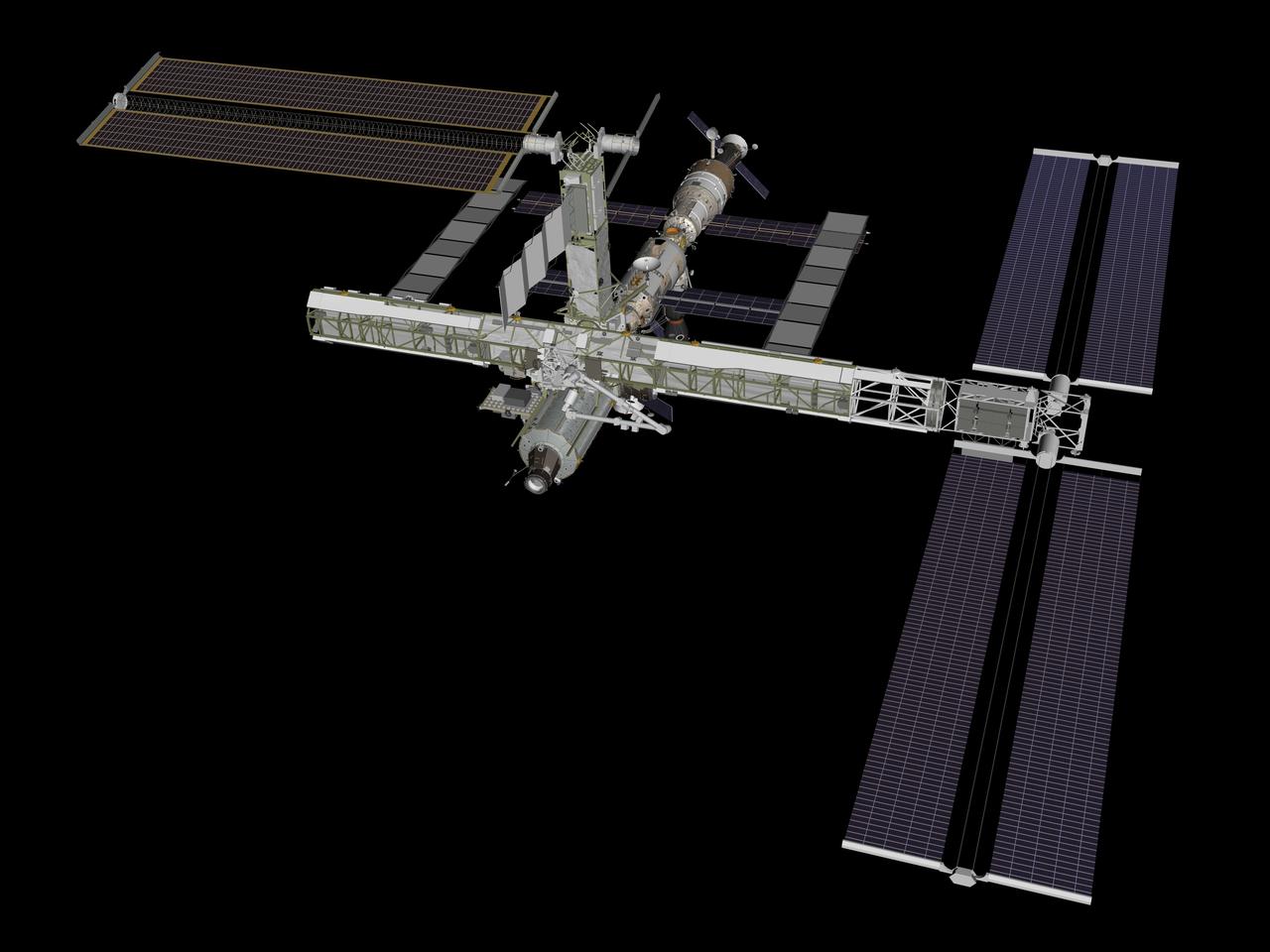
JSC2006-E-38950 (August 2006) --- Computer generated graphic of the International Space Station configuration after STS-116/12A.1 with the addition of the P5 integrated truss segment.
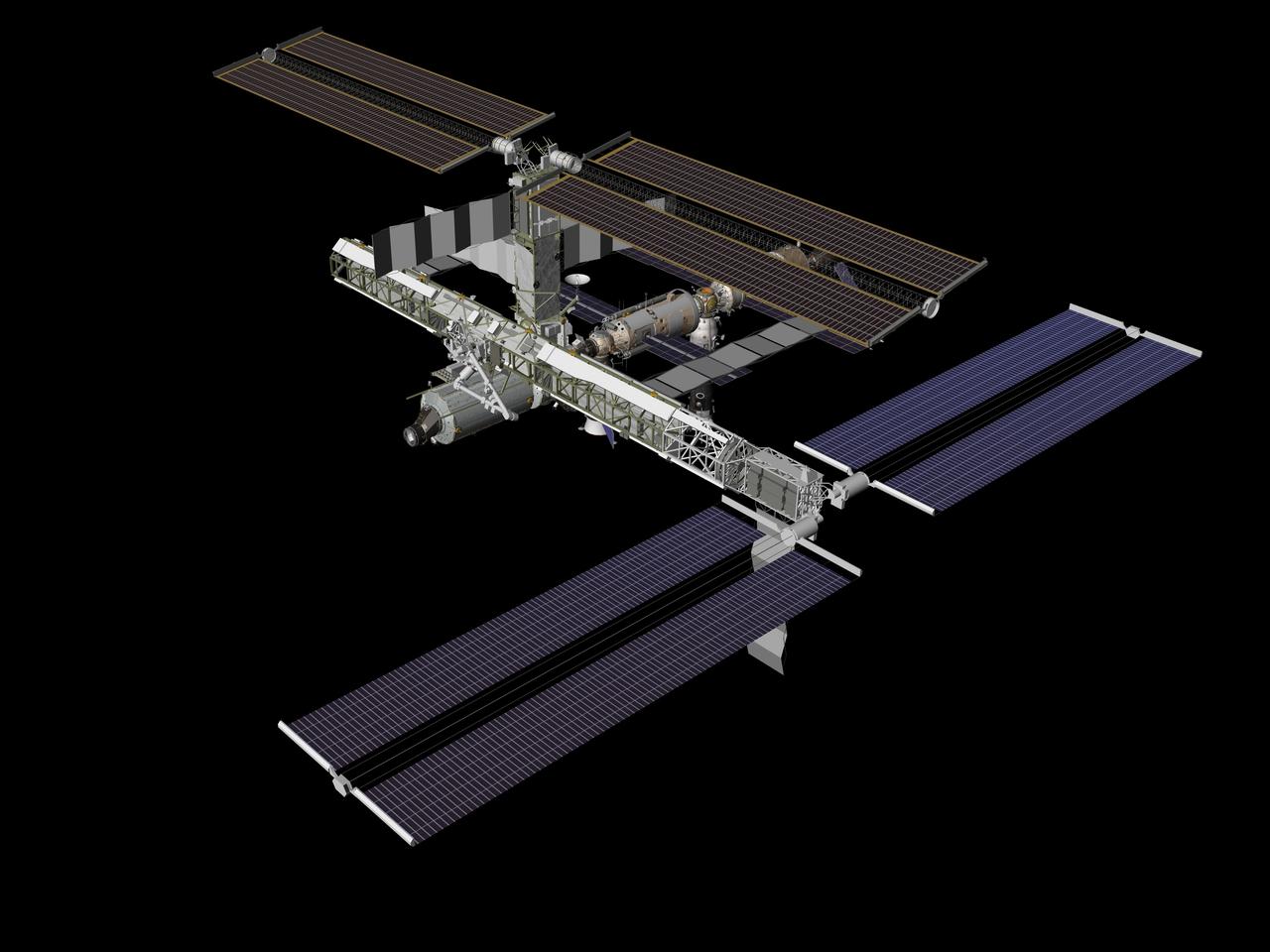
JSC2006-E-38949 (August 2006) --- Computer generated graphic of the International Space Station configuration after STS-115/12A with the addition of the P3/P4 integrated truss segments.
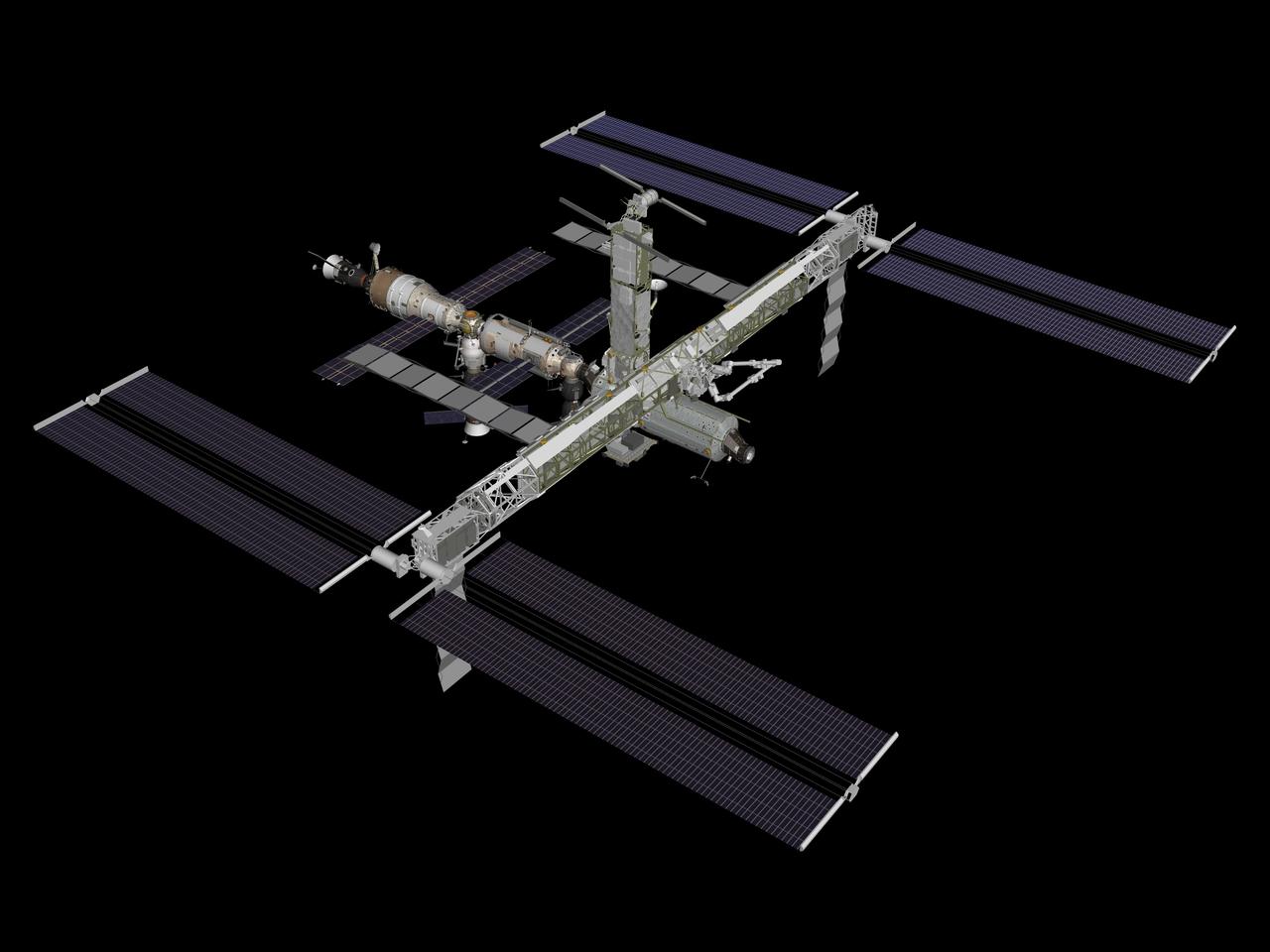
JSC2006-E-38951 (August 2006) --- Computer generated graphic of the International Space Station configuration after STS-117/13A with the addition of S3/S4 integrated truss segments.
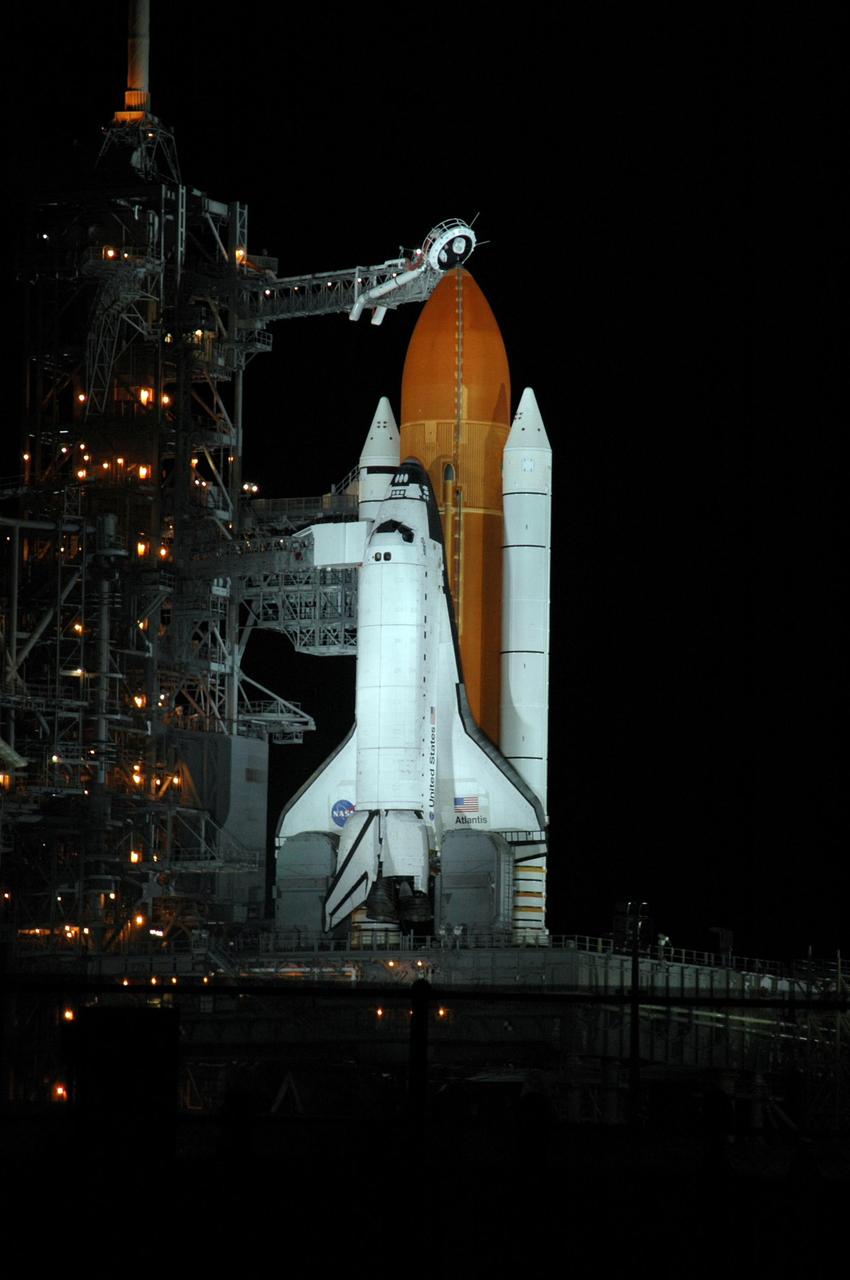
KENNEDY SPACE CENTER, FLA. - Space Shuttle Atlantis is illuminated on Launch Pad 39B, while amber lights on the fixed service structure give a surreal appearance. Seen above the golden external tank is the vent hood (known as the "beanie cap") at the end of the gaseous oxygen vent arm. Vapors are created as the liquid oxygen in the external tank boil off. The hood vents the gaseous oxygen vapors away from the space shuttle vehicle. Lower down, and next to Atlantis, is the White Room at the end of the orbiter access arm. The White Room provides entry into the orbiter through the hatch. Atlantis was originally scheduled to launch on Aug. 27, but a scrub was called by mission managers due to a concern with fuel cell 1. Atlantis is scheduled to lift off at 11:41 a.m. EDT Sept. 8. During the STS-115 mission, Atlantis' astronauts will deliver and install the 17.5-ton, bus-sized P3/P4 integrated truss segment on the station. The girder-like truss includes a set of giant solar arrays, batteries and associated electronics and will provide one-fourth of the total power-generation capability for the completed station. This mission is the 116th space shuttle flight, the 27th flight for orbiter Atlantis, and the 19th U.S. flight to the ISS. STS-115 is scheduled to last 11 days with a planned landing at KSC. Photo credit: NASA/Ken Thornsley
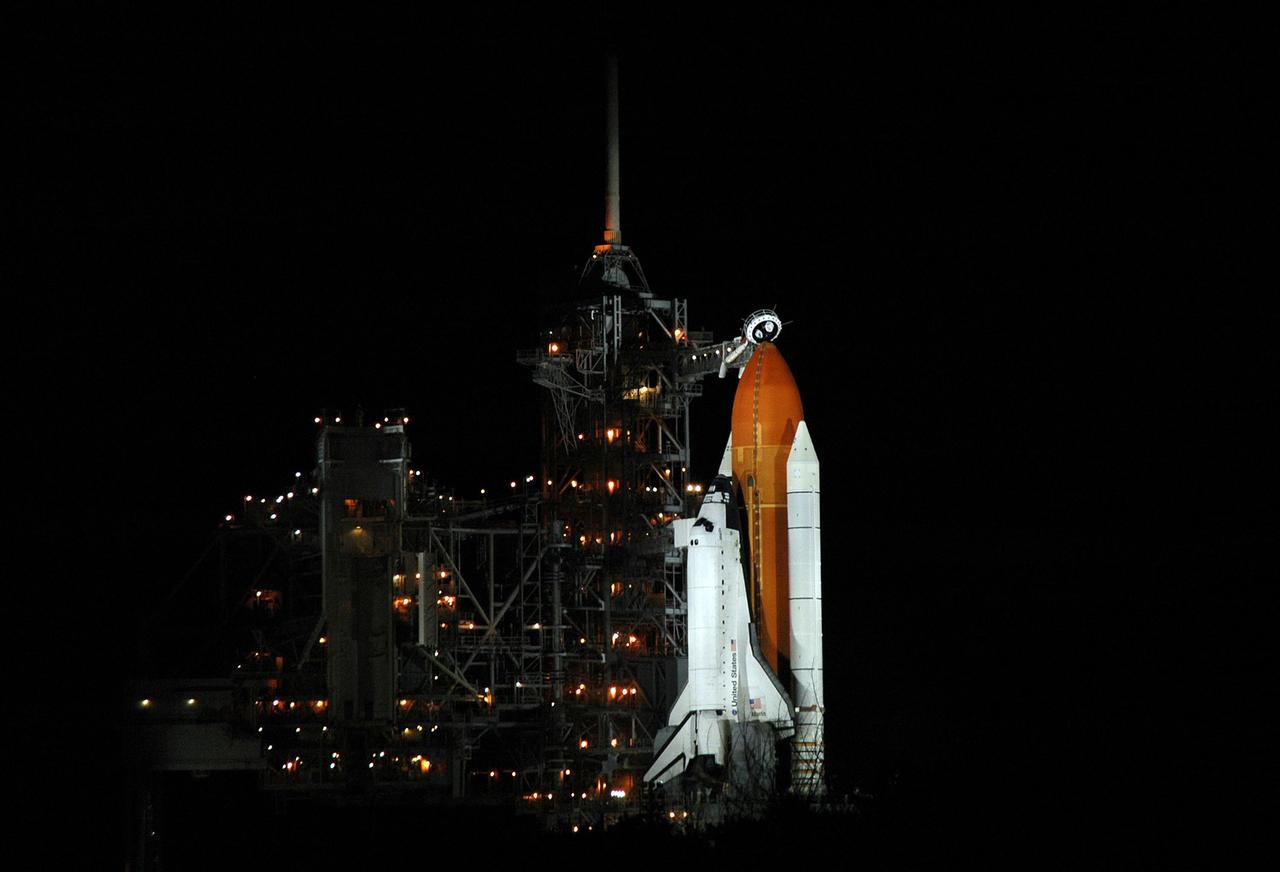
KENNEDY SPACE CENTER, FLA. - Space Shuttle Atlantis is illuminated on Launch Pad 39B, surrounded by amber lights on the rotating and fixed service structures. Seen above the golden external tank is the vent hood (known as the "beanie cap") at the end of the gaseous oxygen vent arm. Vapors are created as the liquid oxygen in the external tank boil off. The hood vents the gaseous oxygen vapors away from the space shuttle vehicle. Atlantis was originally scheduled to launch on Aug. 27, but a scrub was called by mission managers due to a concern with fuel cell 1. Atlantis is scheduled to lift off at 11:41 a.m. EDT Sept. 8. During the STS-115 mission, Atlantis' astronauts will deliver and install the 17.5-ton, bus-sized P3/P4 integrated truss segment on the station. The girder-like truss includes a set of giant solar arrays, batteries and associated electronics and will provide one-fourth of the total power-generation capability for the completed station. This mission is the 116th space shuttle flight, the 27th flight for orbiter Atlantis, and the 19th U.S. flight to the ISS. STS-115 is scheduled to last 11 days with a planned landing at KSC. Photo credit: NASA/Ken Thornsley

S115-E-06764 (17 Sept. 2006) --- This view of the International Space Station, backdropped against a blue and white Earth, was photographed shortly after the Space Shuttle Atlantis undocked from the orbital outpost at 7:50 a.m. (CDT). The unlinking completed six days, two hours and two minutes of joint operations with the station crew. Atlantis left the station with a new, second pair of 240-foot solar wings, attached to a new 17.5-ton section of truss with batteries, electronics and a giant rotating joint. The new solar arrays eventually will double the station's onboard power when their electrical systems are brought online during the next shuttle flight, planned for launch in December.
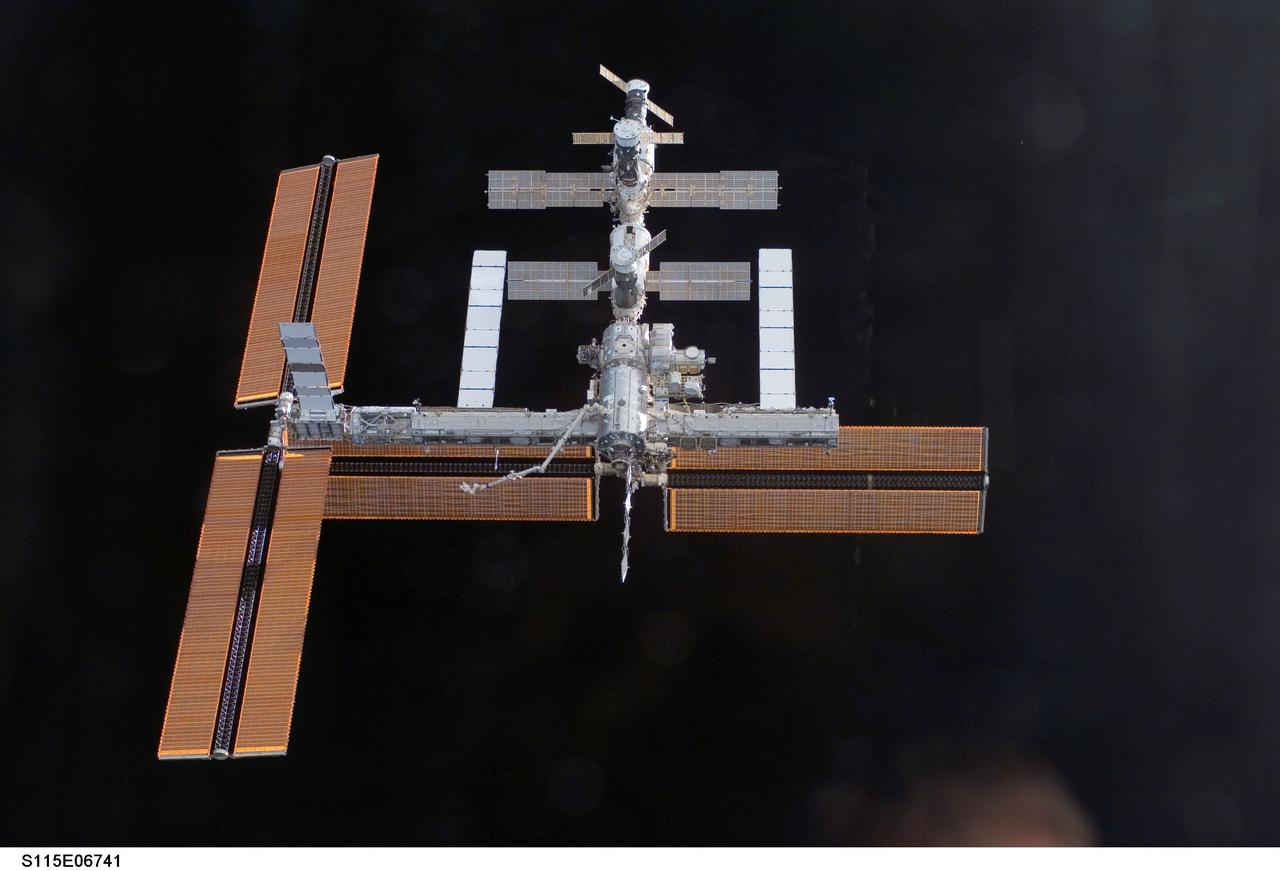
S115-E-06741 (17 Sept. 2006) --- This view of the International Space Station, backdropped against the blackness of space, was taken shortly after the Space Shuttle Atlantis undocked from the orbital outpost at 7:50 a.m. CDT. The unlinking completed six days, two hours and two minutes of joint operations with the station crew. Atlantis left the station with a new, second pair of 240-foot solar wings, attached to a new 17.5-ton section of truss with batteries, electronics and a giant rotating joint. The new solar arrays eventually will double the station's onboard power when their electrical systems are brought online during the next shuttle flight, planned for launch in December.
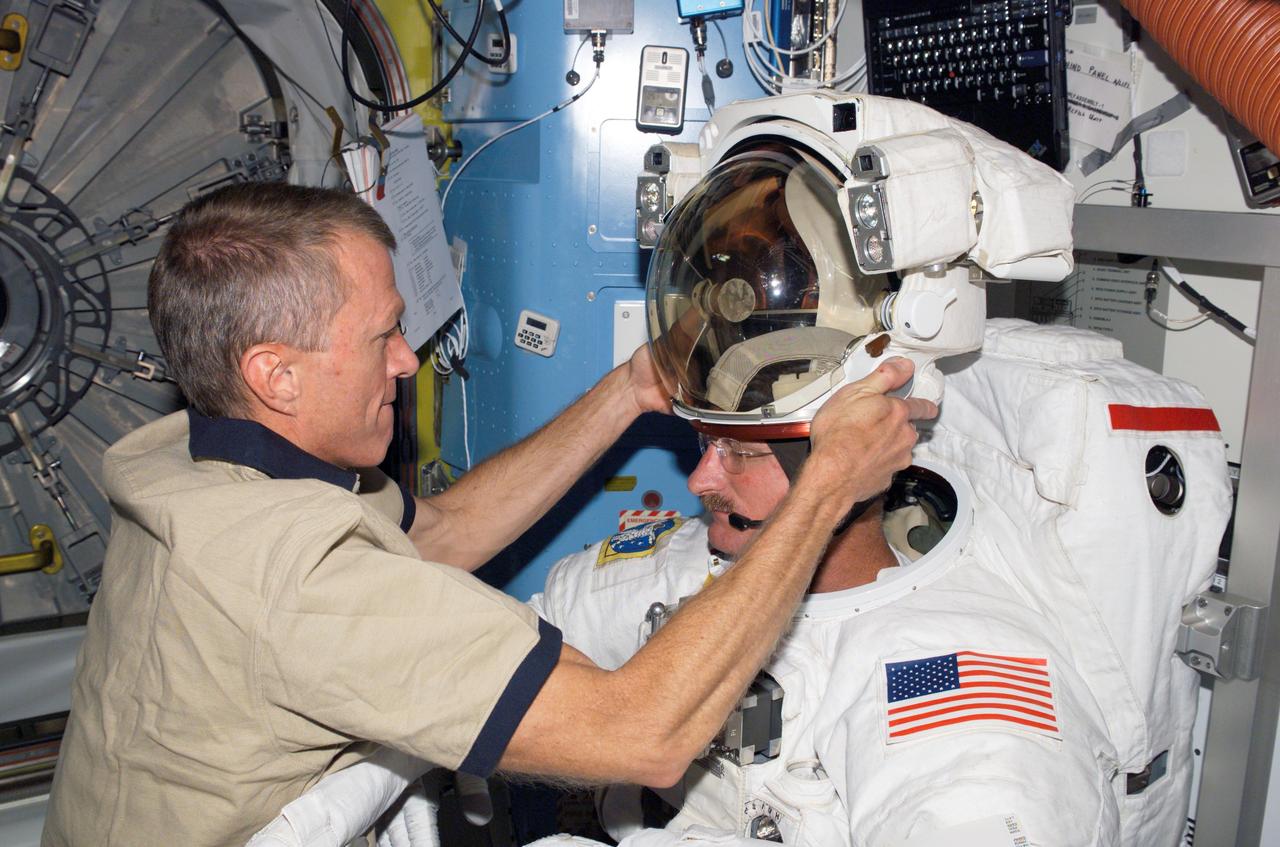
S115-E-06075 (15 Sept. 2006) --- Astronaut Brent W. Jett, Jr., STS-115 commander, helps astronaut Joseph R. Tanner, mission specialist, with the helmet for his extravehicular mobility unit (EMU) spacesuit as they prepare for the mission's third session of extravehicular activity (EVA) in the Quest Airlock of the International Space Station while the Space Shuttle Atlantis was docked with the station.
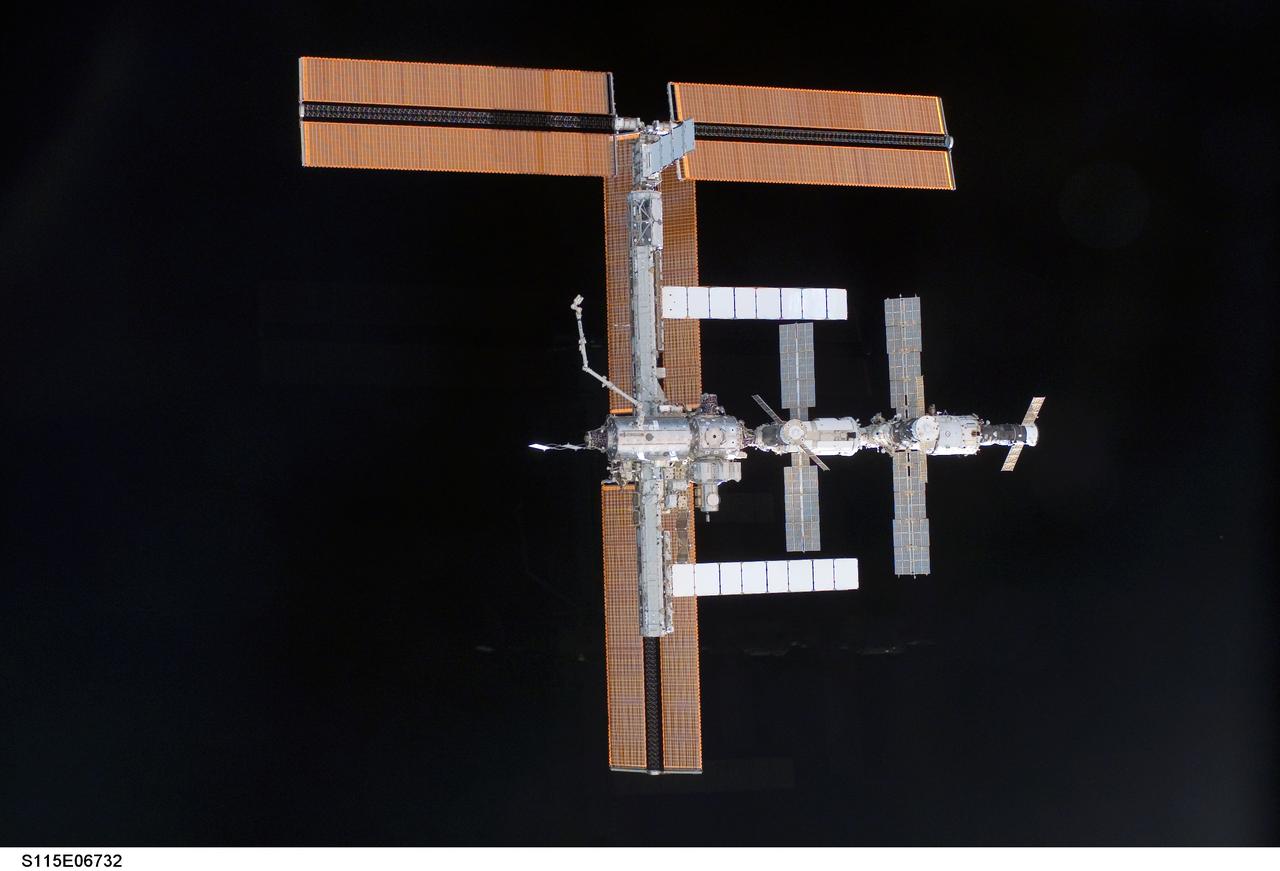
S115-E-06732 (17 Sept. 2006) --- This view of the International Space Station, backdropped against the blackness of space, was taken shortly after the Space Shuttle Atlantis undocked from the orbital outpost at 7:50 a.m. CDT. The unlinking completed six days, two hours and two minutes of joint operations with the station crew. Atlantis left the station with a new, second pair of 240-foot solar wings, attached to a new 17.5-ton section of truss with batteries, electronics and a giant rotating joint. The new solar arrays eventually will double the station's onboard power when their electrical systems are brought online during the next shuttle flight, planned for launch in December.