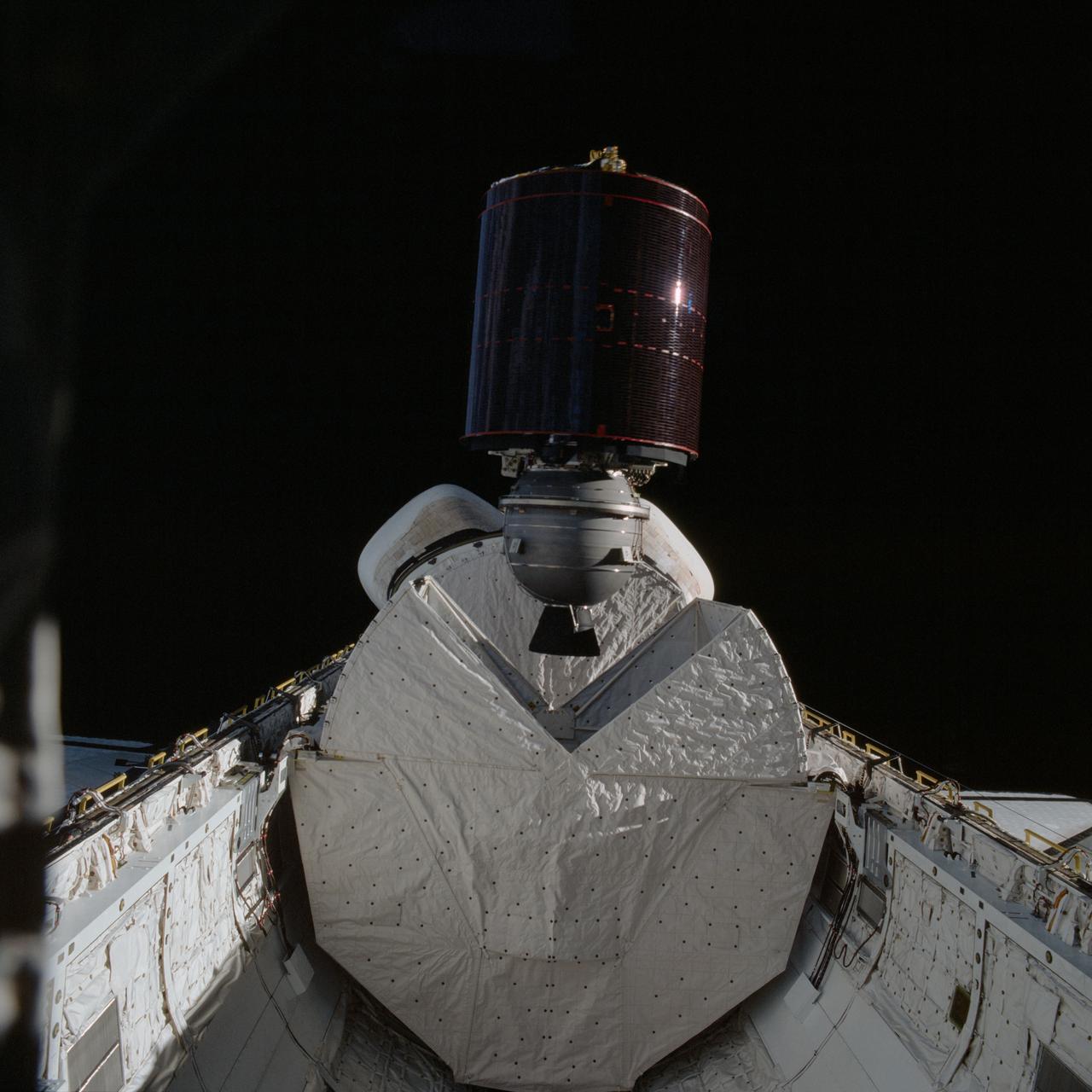
STS005-38-943 (17 Nov. 1982) --- The Satellite Business Systems (SBS-3) satellte is deployed from its protective cradle in the cargo bay of the space shuttle Columbia. Part of Columbia's wings can be seen on both the port and starboard sides. Part of both orbital maneuvering system (OMS) pods are seen at center. The vertical stabilizer is obscured by the satellite. Photo credit: NASA
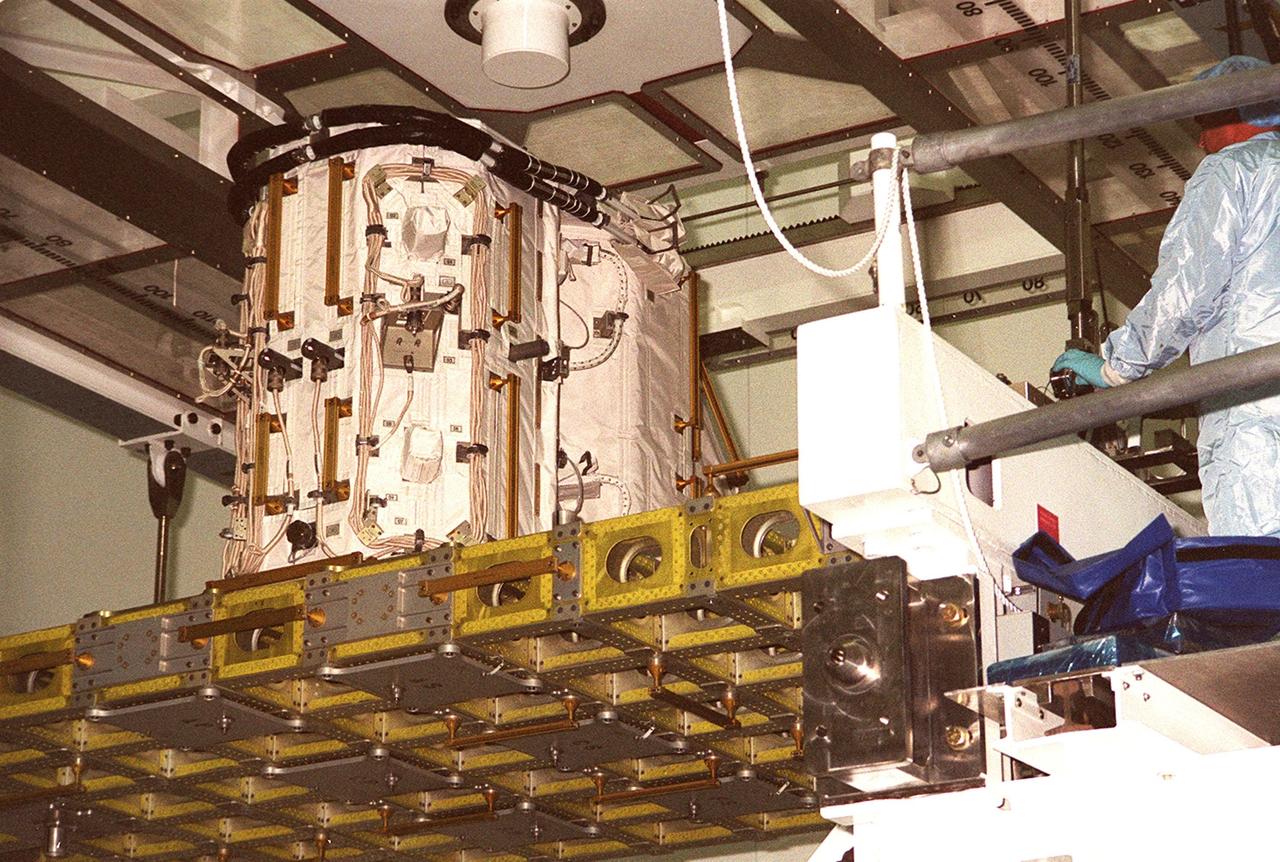
KENNEDY SPACE CENTER, Fla. -- A crane is attached to the Integrated Cargo Carrier in the Space Station Processing Facility in order to move it to the payload canister. The ICC holds several payloads for mission STS-105, the Early Ammonia Servicer and two experiment containers. The ICC will join the Multi-Purpose Logistics Module Leonardo in the payload canister for transport to Launch Pad 39A where they will be placed in the payload bay of Space Shuttle Discovery. Launch of STS-105 is scheduled for 5:38 p.m. EDT Aug. 9
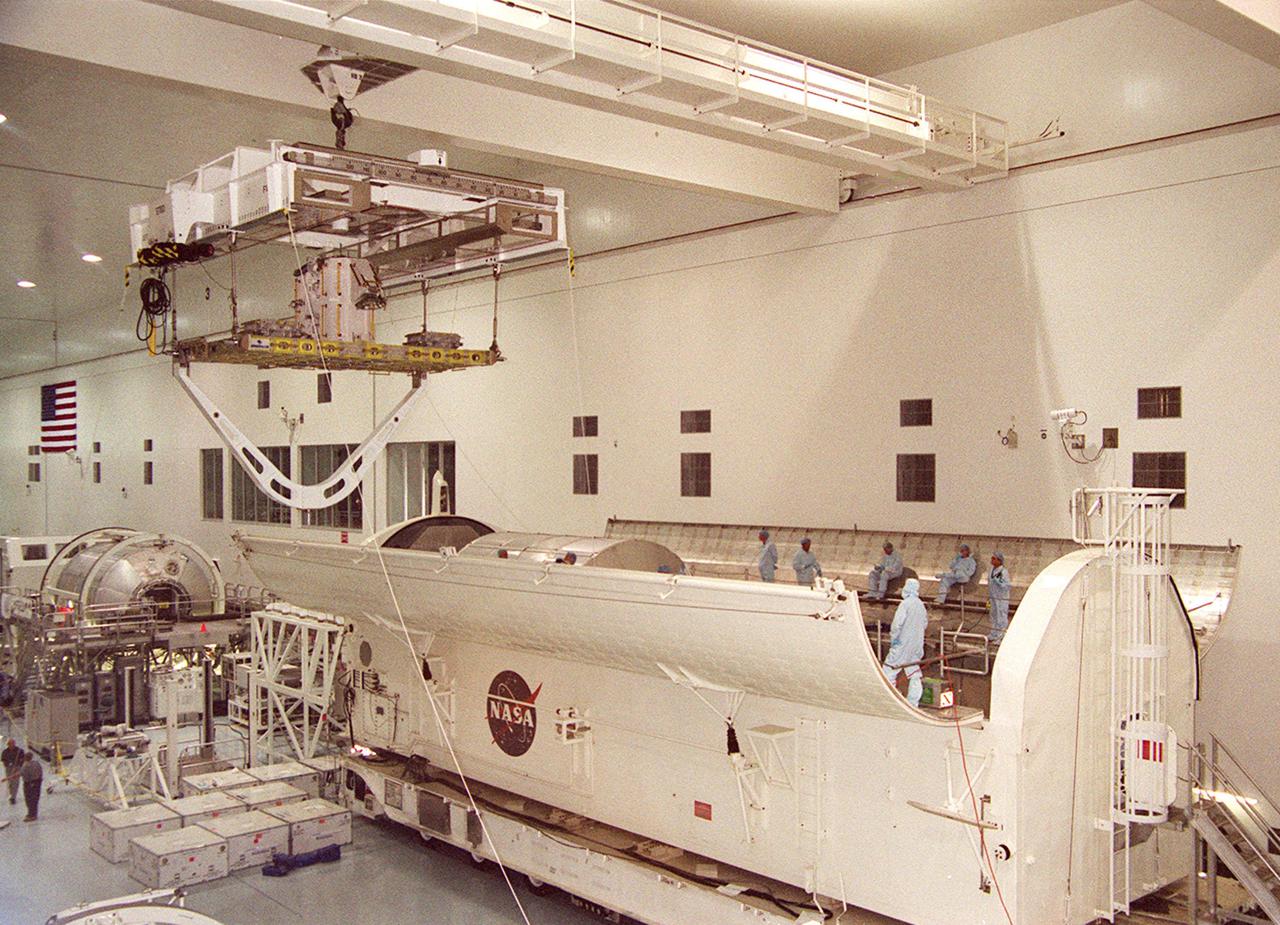
KENNEDY SPACE CENTER, Fla. -- An overhead crane in the Space Station Processing Facility moves the Integrated Cargo Carrier toward the payload canister (right). The ICC holds several payloads for mission STS-105, the Early Ammonia Servicer and two experiment containers. The ICC will join the Multi-Purpose Logistics Module Leonardo already in the payload canister for transport to Launch Pad 39A where they will be placed in the payload bay of Space Shuttle Discovery. Launch of STS-105 is scheduled for 5:38 p.m. EDT Aug. 9
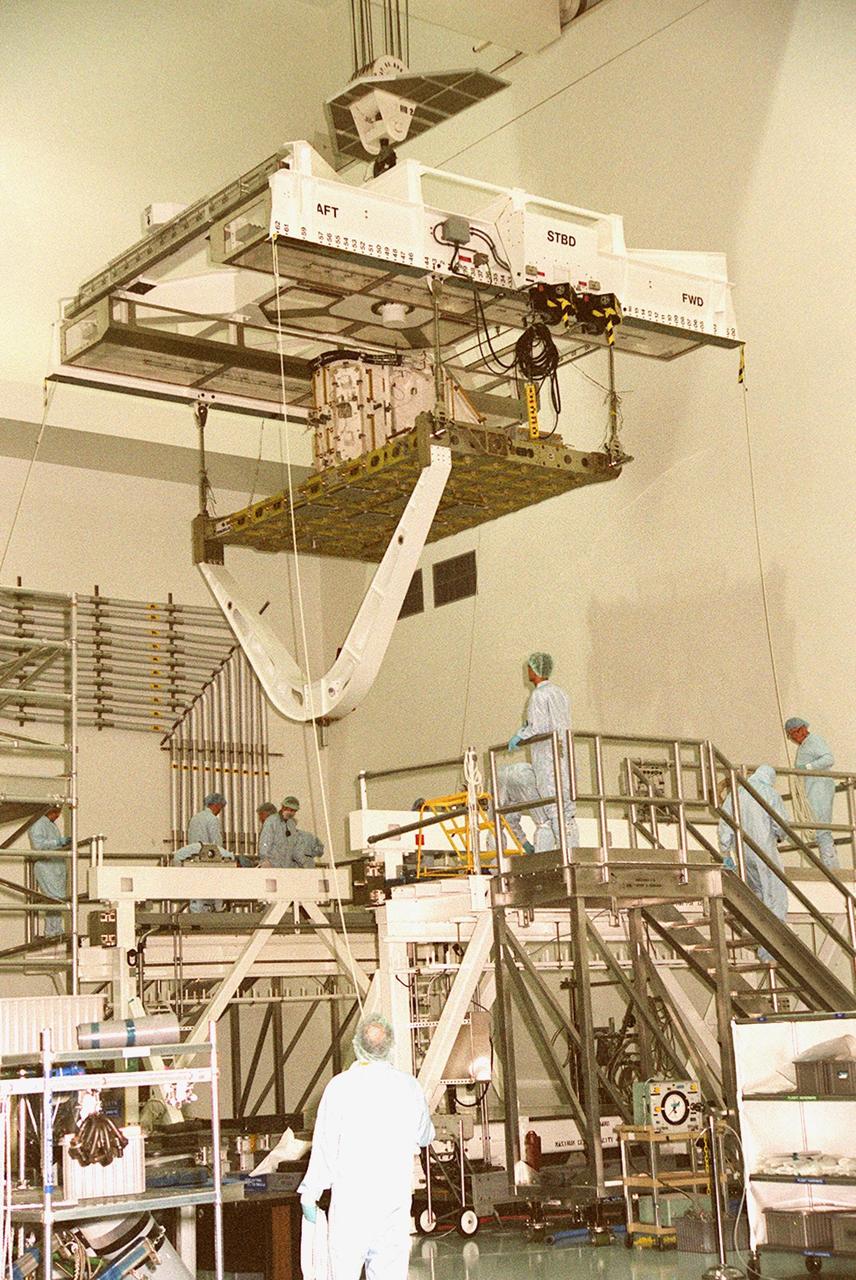
KENNEDY SPACE CENTER, Fla. -- An overhead crane in the Space Station Processing Facility lifts the Integrated Cargo Carrier from its workstand to move it to the payload canister. The ICC holds several payloads for mission STS-105, the Early Ammonia Servicer and two experiment containers. The ICC will join the Multi-Purpose Logistics Module Leonardo in the payload canister for transport to Launch Pad 39A where they will be placed in the payload bay of Space Shuttle Discovery. Launch of STS-105 is scheduled for 5:38 p.m. EDT Aug. 9
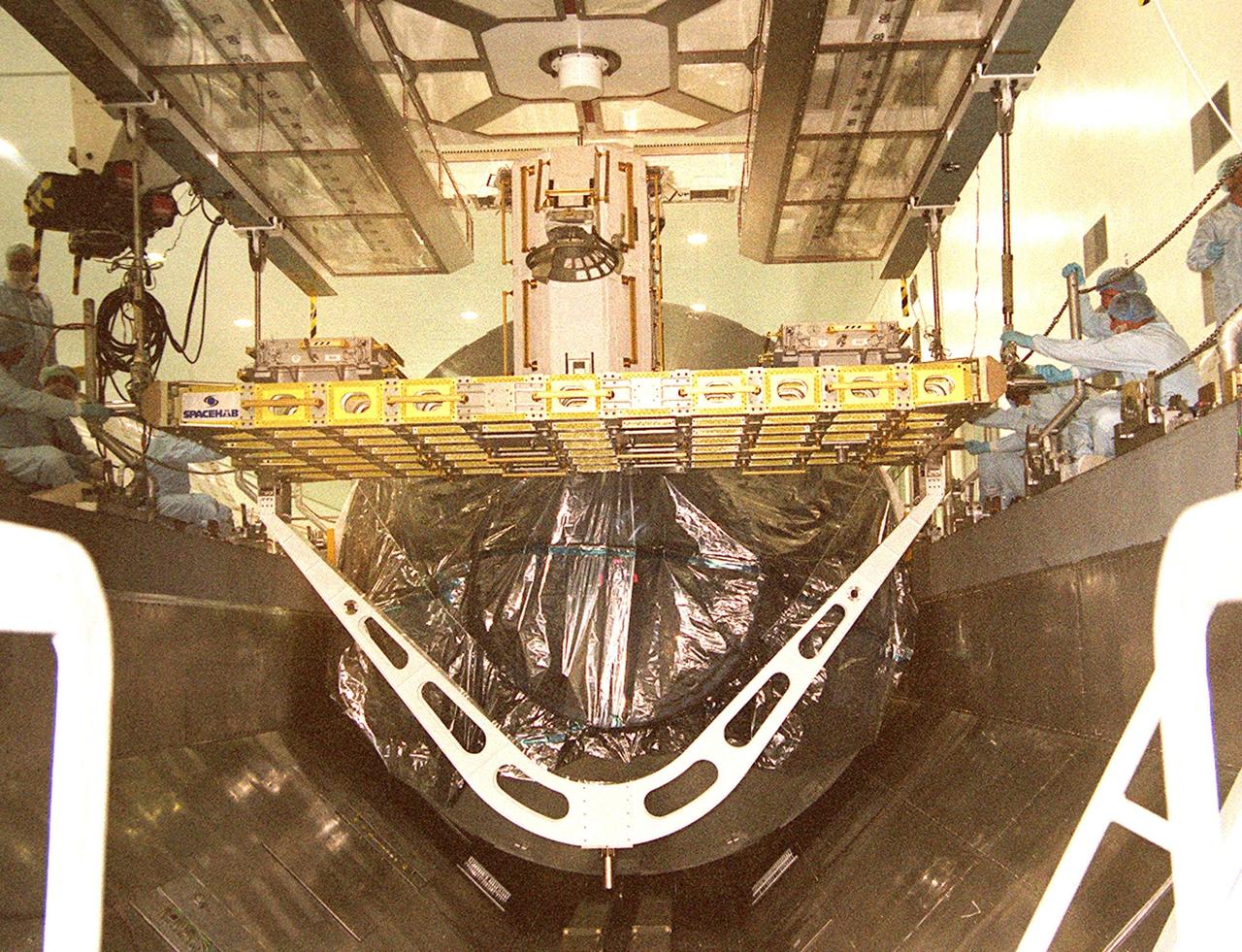
KENNEDY SPACE CENTER, Fla. -- The Integrated Cargo Carrier is lowered into the payload canister in front of the Multi-Purpose Logistics Module Leonardo. The ICC holds several payloads for mission STS-105, the Early Ammonia Servicer and two experiment containers. The canister will transport the MPLM and ICC transport to Launch Pad 39A where they will be placed in the payload bay of Space Shuttle Discovery. Launch of STS-105 is scheduled for 5:38 p.m. EDT Aug. 9
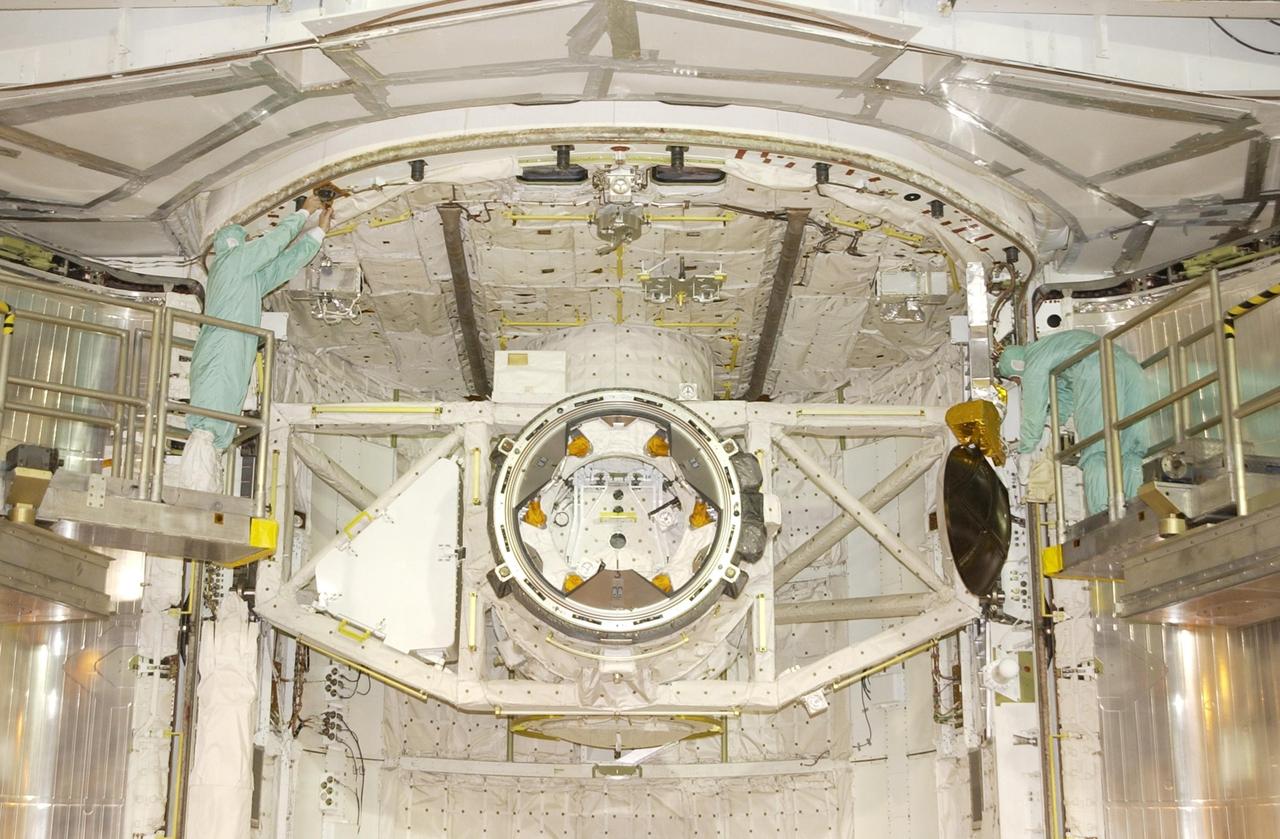
KENNEDY SPACE CENTER, FLA. -- Workers at Launch Pad 39A check the fittings on the payload bay of Endeavour before the bay doors close. The view is looking down into the payload bay. The Shuttle is poised for launch on mission STS-111, Utilization Flight 2, carrying supplies and equipment to the International Space Station. The payload includes the Multi-Purpose Logistics Module Leonardo, the Mobile Base System, which will be installed on the Mobile Transporter to complete the Canadian Mobile Servicing System, and a replacement wrist/roll joint for Canadarm 2. Also part of the mission, Expedition 5 will travel to the Station as the replacement crew for Expedition 4, who will return to Earth aboard the orbiter. Launch is scheduled for May 30, 2002
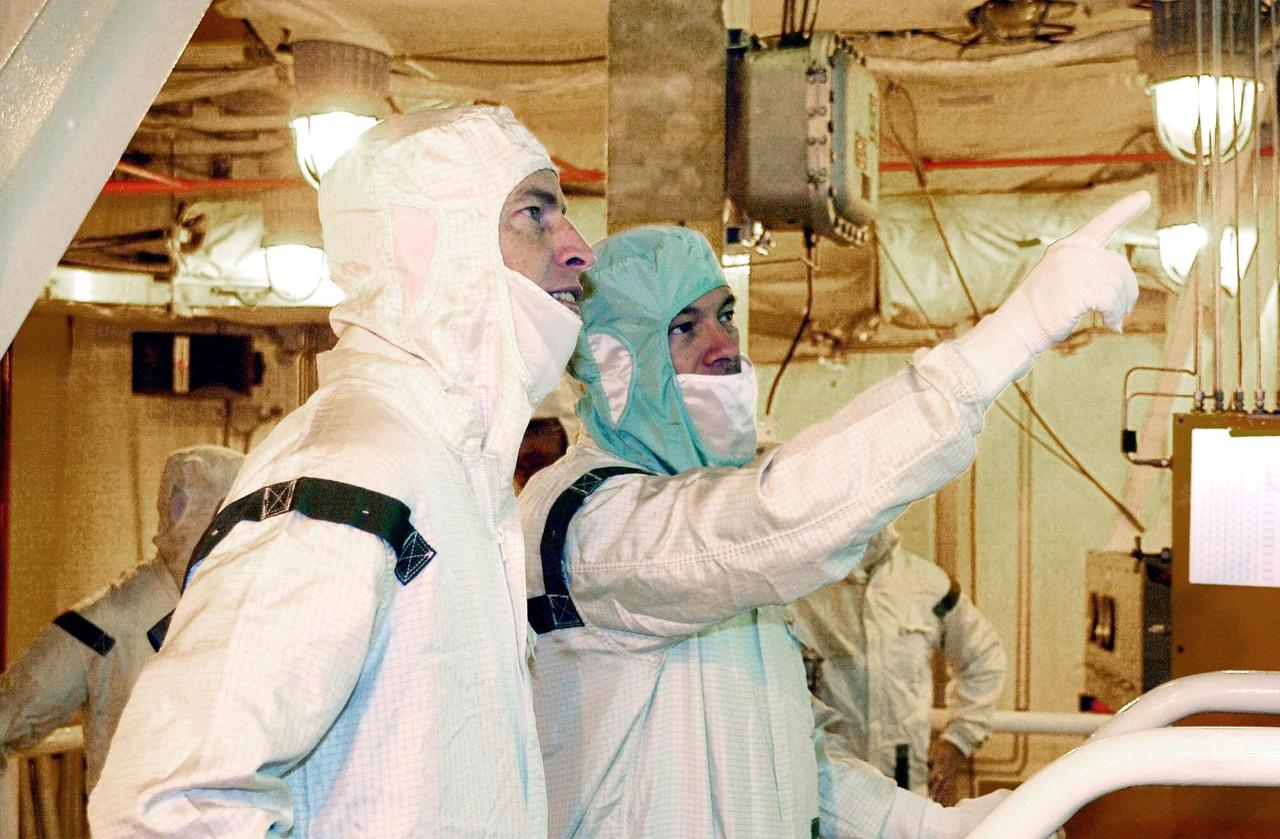
KENNEDY SPACE CENTER, FLA. - On a platform in Endeavour's payload bay, STS-113 Commander James Wetherbee (left) looks at part of the payload being pointed out by a worker. The 16th assembly flight to the International Space Station, STS-113 will carry the Port 1 (P1) truss aboard Space Shuttle Endeavour as well as the Expedition 6 crew, who will replace Expedition 5 on the Station. Mission STS-113 is scheduled to launch Nov. 10, 2002.
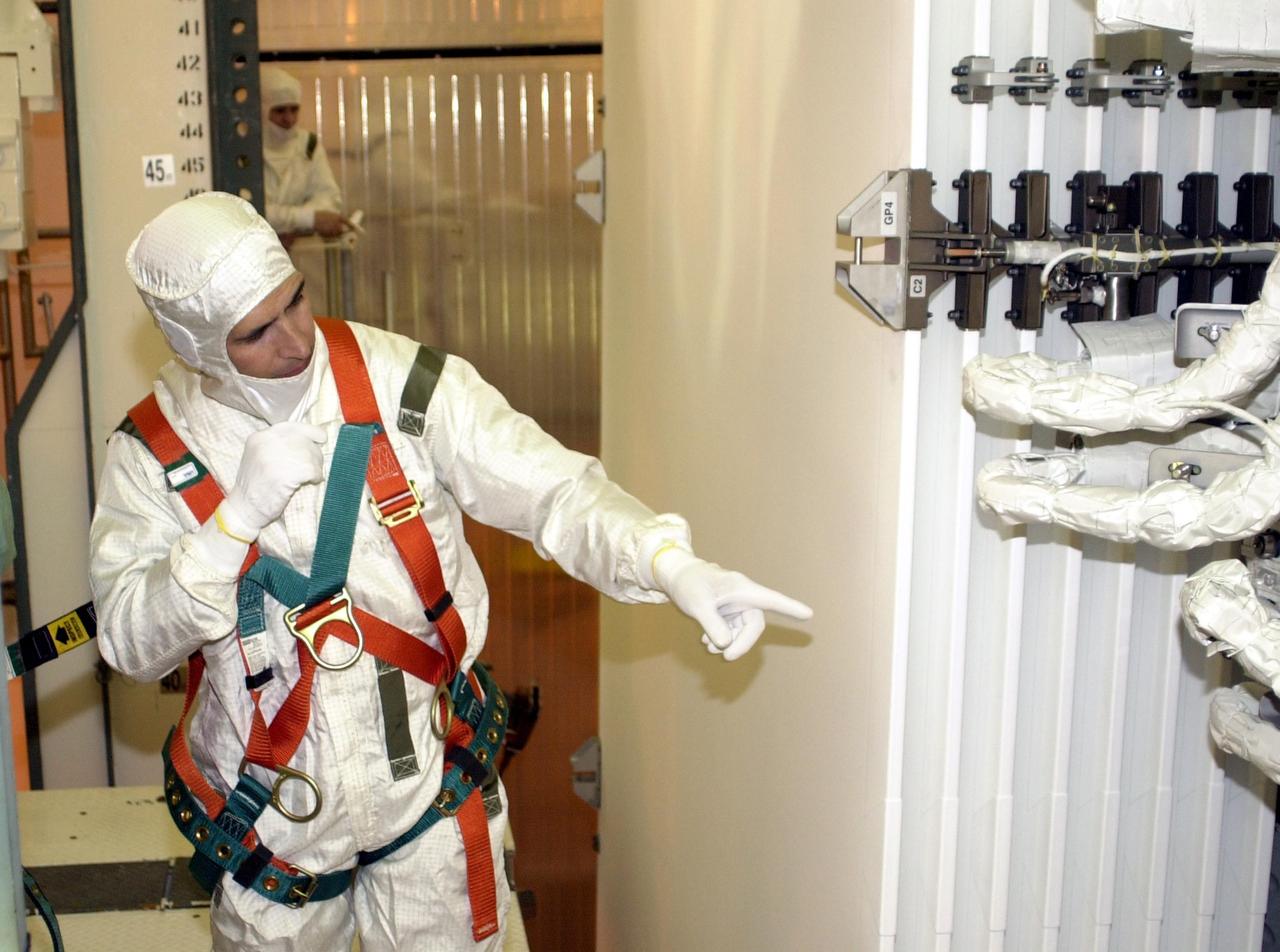
KENNEDY SPACE CENTER, FLA. -- From a platform in Endeavour's payload bay, STS-113 Mission Specialist John Herrington looks closely at the payload for the mission. The 16th assembly flight to the International Space Station, STS-113 will carry the Port 1 (P1) truss aboard Space Shuttle Endeavour as well as the Expedition 6 crew, who will replace Expedition 5 on the Station. Mission STS-113 is scheduled to launch Nov. 10, 2002.
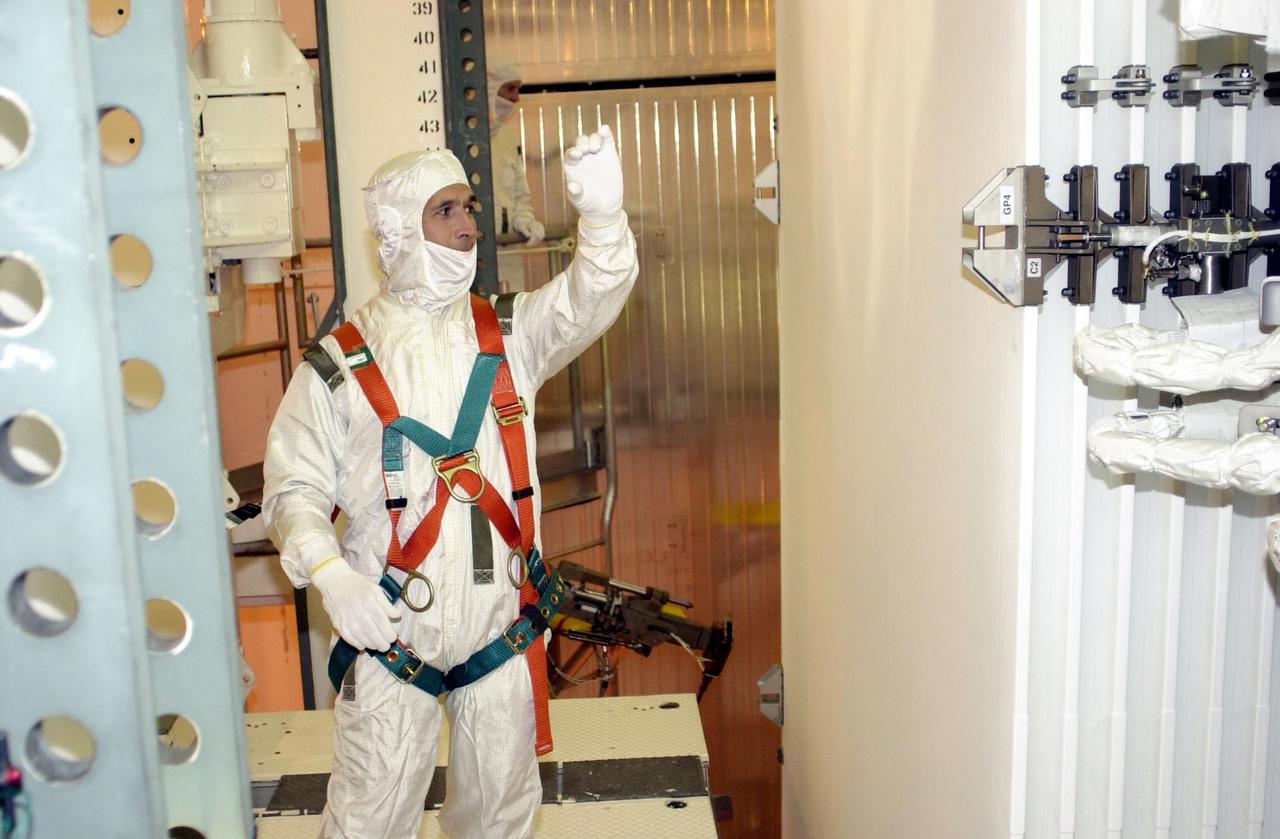
KENNEDY SPACE CENTER, FLA. - From a platform in Endeavour's payload bay, STS-113 Mission Specialist John Herrington looks over the payload for the mission. The 16th assembly flight to the International Space Station, STS-113 will carry the Port 1 (P1) truss aboard Space Shuttle Endeavour as well as the Expedition 6 crew, who will replace Expedition 5 on the Station. Mission STS-113 is scheduled to launch Nov. 10, 2002.
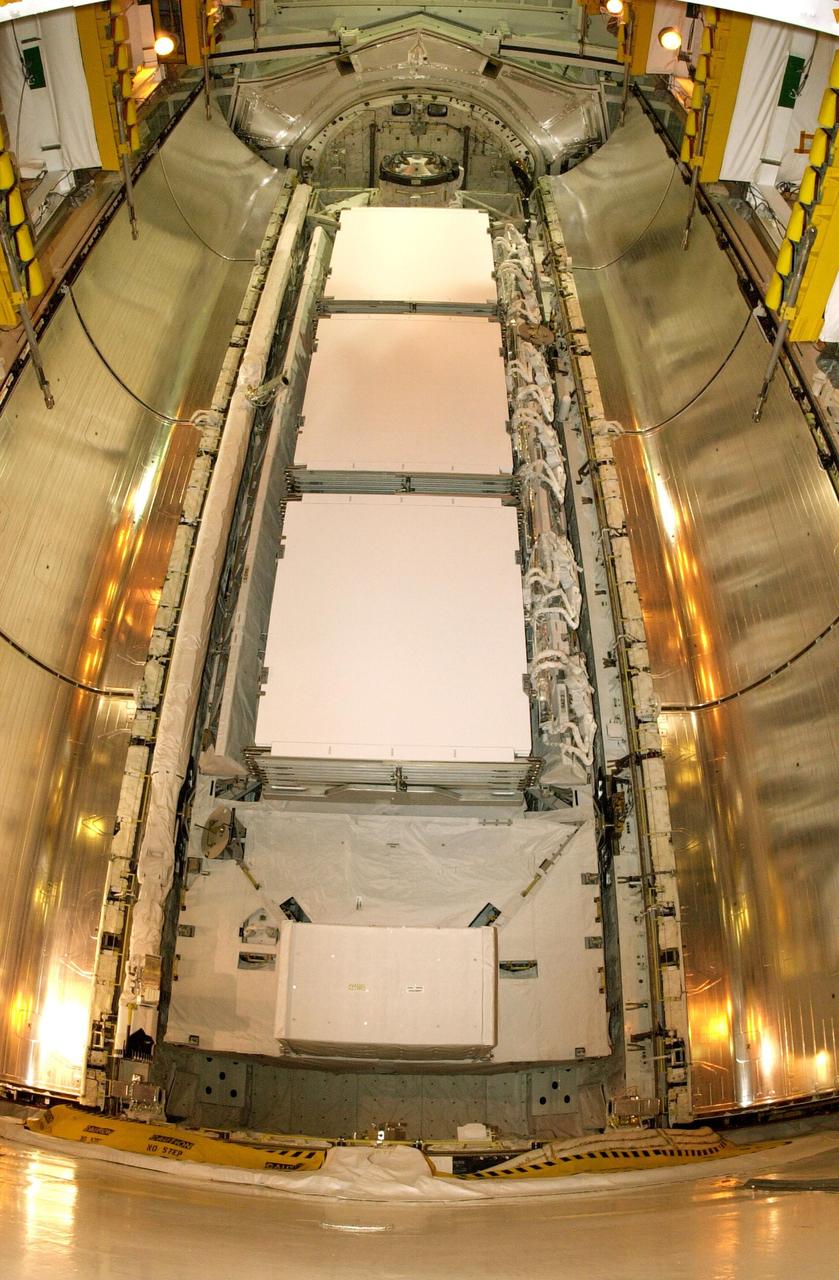
KENNEDY SPACE CENTER, FLA. - The payload on mission STS-113 rests inside Space Shuttle Endeavour's payload bay prior to closing of the doors. The 16th assembly flight to the International Space Station, STS-113 will carry the Port 1 (P1) truss aboard Space Shuttle Endeavour as well as the Expedition 6 crew, who will replace Expedition 5 on the Station. Mission STS-113 is scheduled to launch Nov. 10, 2002.
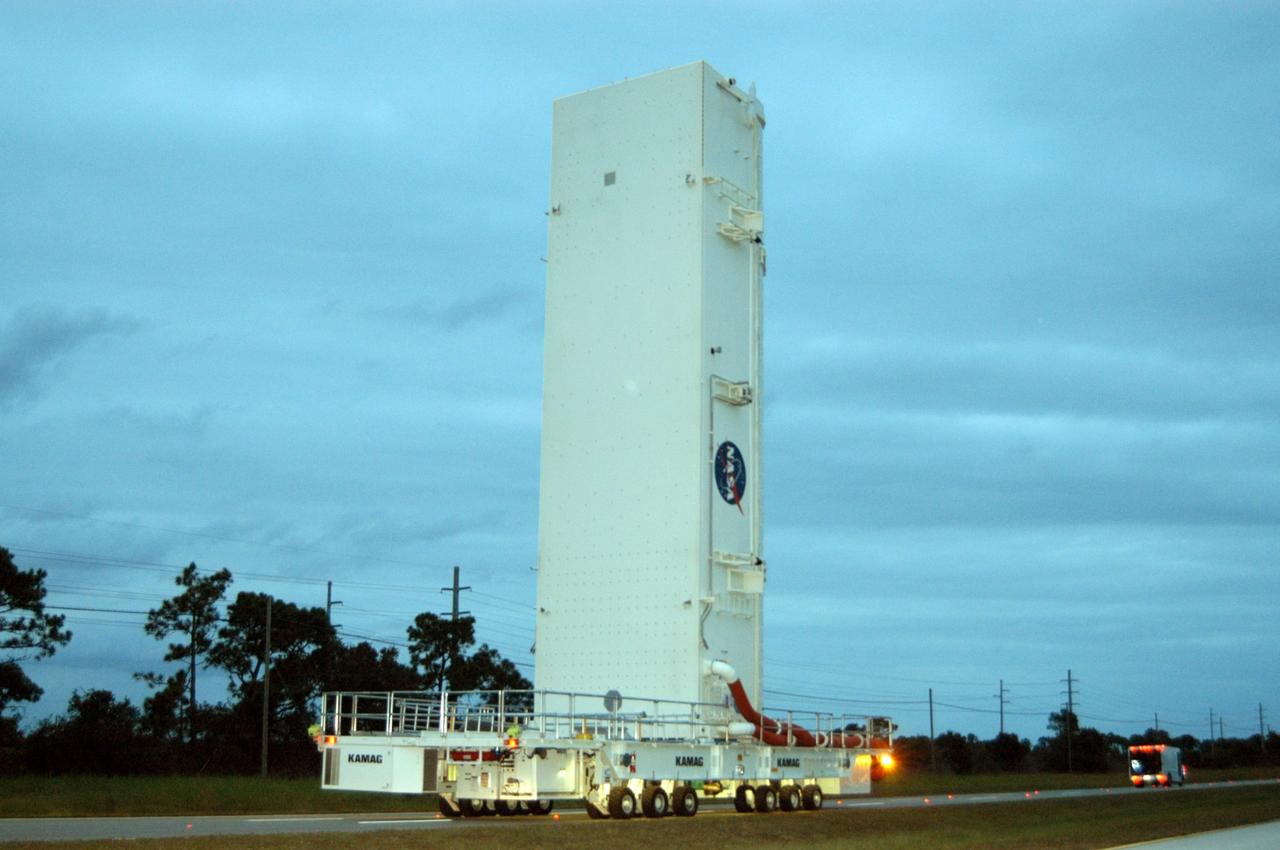
KENNEDY SPACE CENTER, FLA. -- Under a darkening, cloud-covered sky, the payload canister transporter carries its cargo very slowly along the road to Launch Pad 39B for mission STS-116. Inside the canister are the SPACEHAB module and the port 5 truss segment, which will be moved into the payload changeout room at the pad and transferred into Space Shuttle Discovery's payload bay once the vehicle has rolled out to the pad. The payload canister is 65 feet long, 18 feet wide and 18 feet, 7 inches high. It has the capability to carry vertically or horizontally processed payloads up to 15 feet in diameter and 60 feet long, matching the capacity of the orbiter payload bay. It can carry payloads weighing up to 65,000 pounds. Clamshell-shaped doors at the top of the canister operate like the orbiter payload bay doors, with the same allowable clearances. Photo credit: NASA/George Shelton
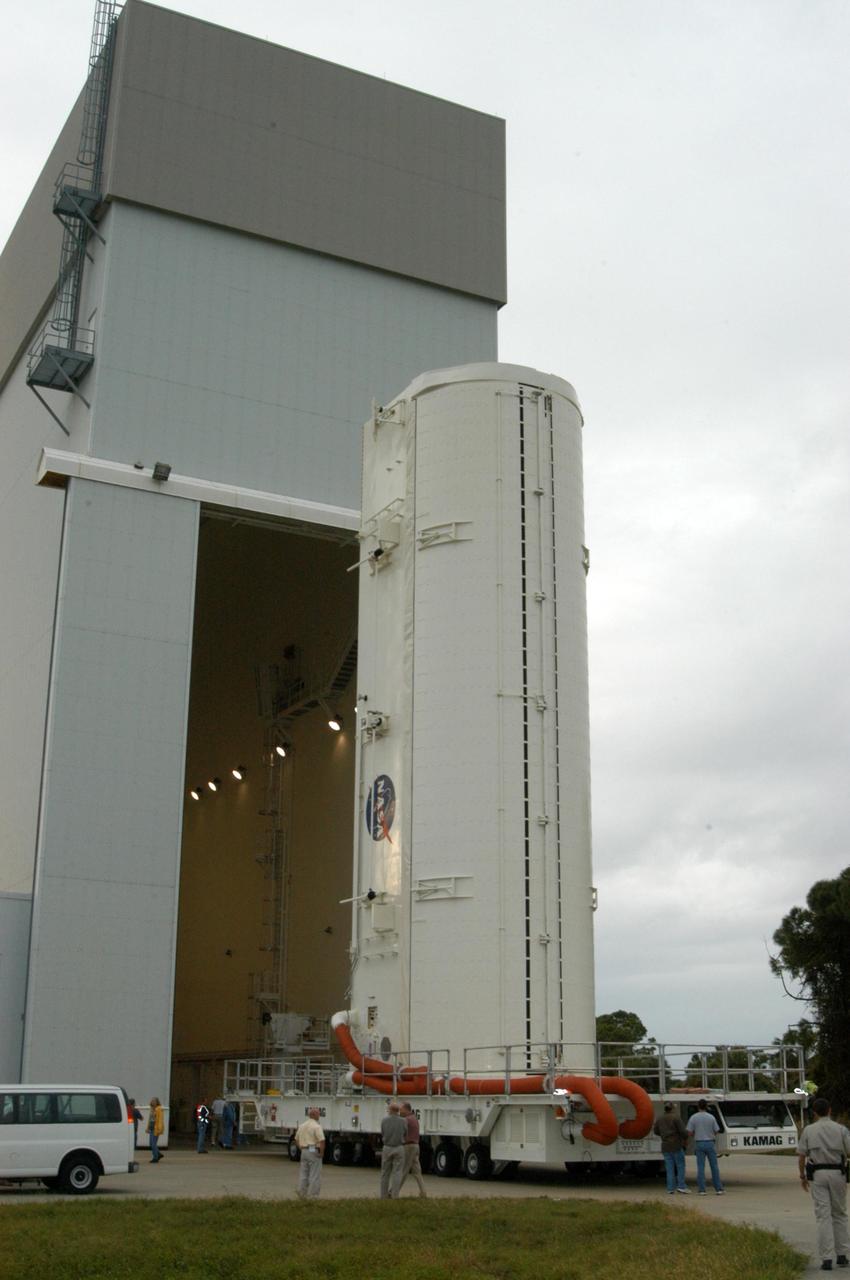
KENNEDY SPACE CENTER, FLA. -- Installed on a transporter, the payload canister moves out of the Vertical Processing Facility. Inside the canister are the SPACEHAB module and the port 5 truss segment for mission STS-116. They will be moved into the payload changeout room at the pad and transferred into Space Shuttle Discovery's payload bay once the vehicle has rolled out to the pad. The payload canister is 65 feet long, 18 feet wide and 18 feet, 7 inches high. It has the capability to carry vertically or horizontally processed payloads up to 15 feet in diameter and 60 feet long, matching the capacity of the orbiter payload bay. It can carry payloads weighing up to 65,000 pounds. Clamshell-shaped doors at the top of the canister operate like the orbiter payload bay doors, with the same allowable clearances. Photo credit: NASA/George Shelton
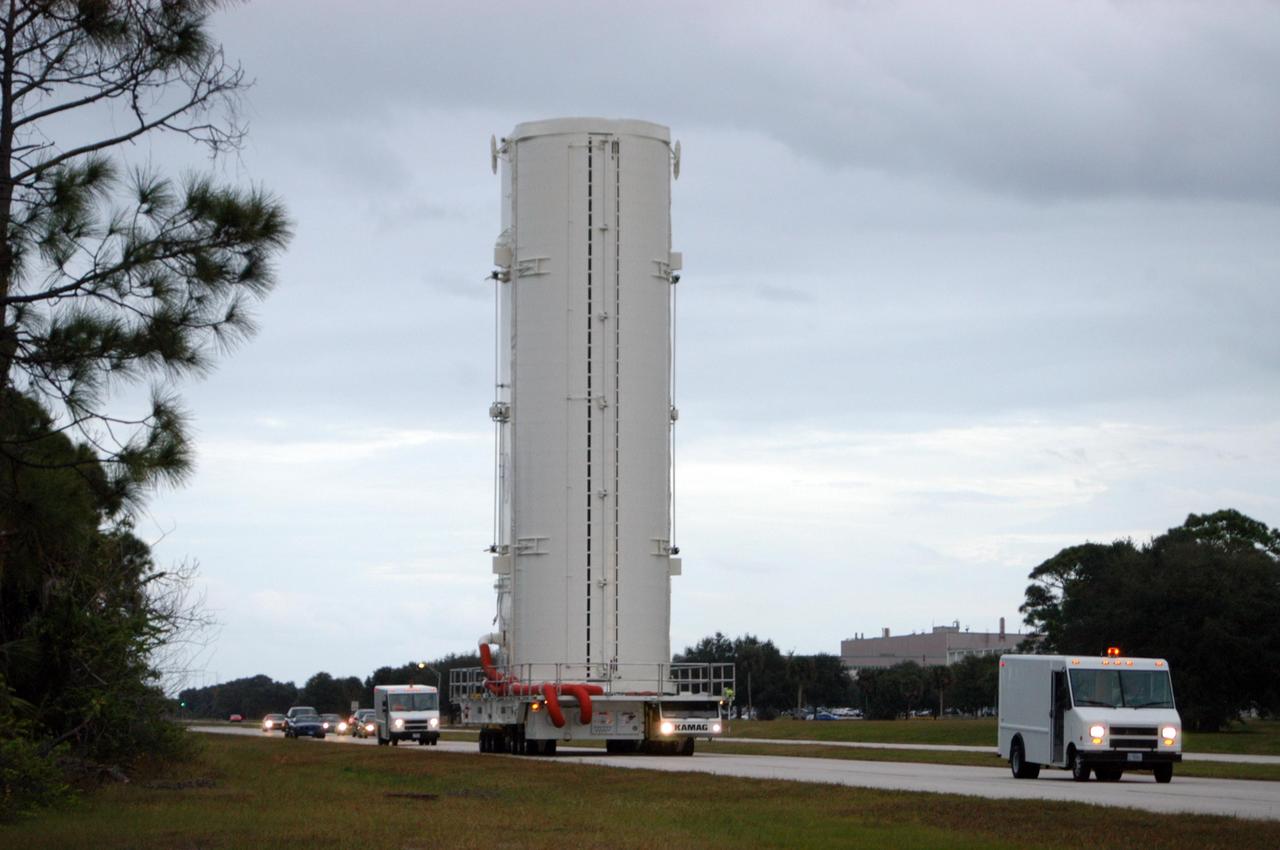
KENNEDY SPACE CENTER, FLA. -- The payload canister transporter carries its cargo very slowly along the road to Launch Pad 39B for mission STS-116. Inside the canister are the SPACEHAB module and the port 5 truss segment, which will be moved into the payload changeout room at the pad and transferred into Space Shuttle Discovery's payload bay once the vehicle has rolled out to the pad. The payload canister is 65 feet long, 18 feet wide and 18 feet, 7 inches high. It has the capability to carry vertically or horizontally processed payloads up to 15 feet in diameter and 60 feet long, matching the capacity of the orbiter payload bay. It can carry payloads weighing up to 65,000 pounds. Clamshell-shaped doors at the top of the canister operate like the orbiter payload bay doors, with the same allowable clearances. Photo credit: NASA/George Shelton
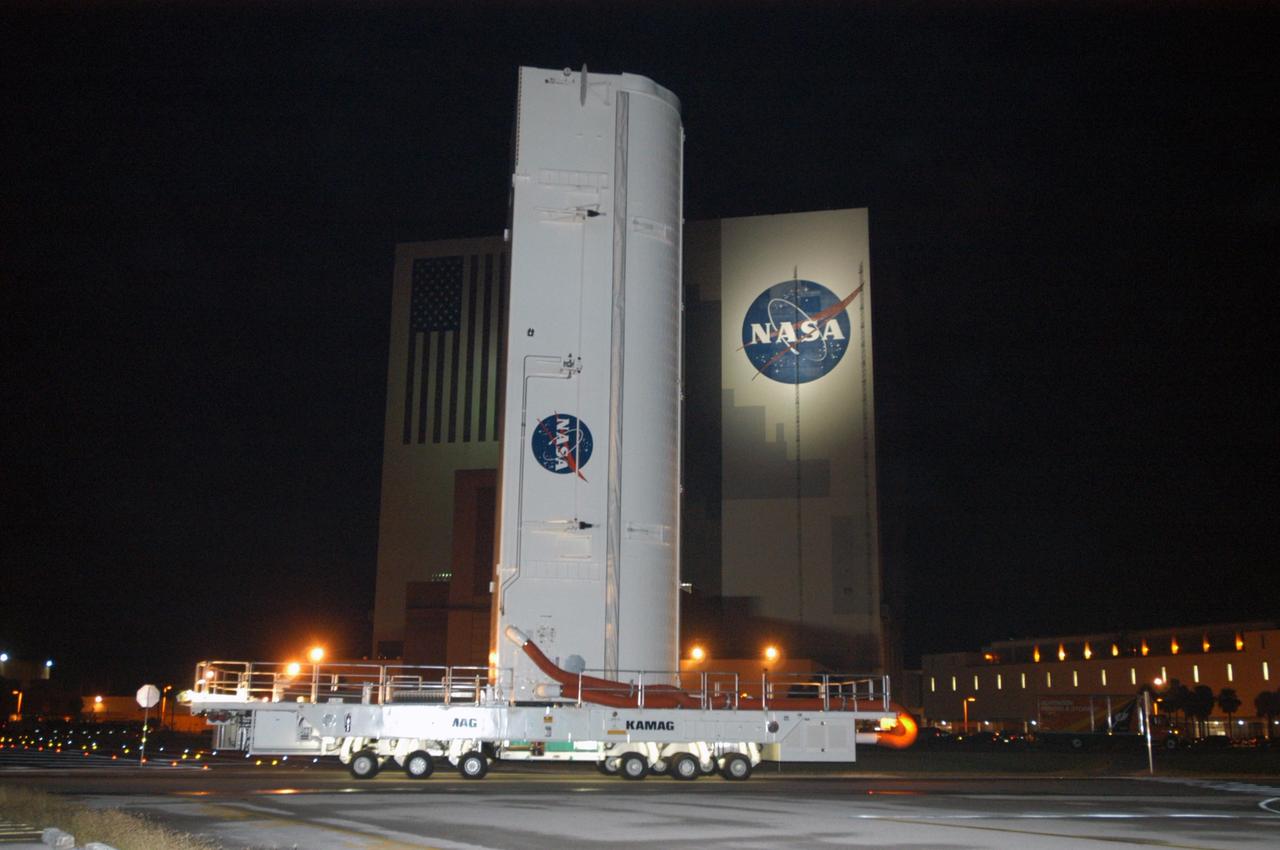
KENNEDY SPACE CENTER, FLA. -- Lamps spotlight the payload canister transporter as it slowly carries its cargo past the Vehicle Assembly Building on the road to Launch Pad 39B for mission STS-116. Inside the canister are the SPACEHAB module and the port 5 truss segment, which will be moved into the payload changeout room at the pad and transferred into Space Shuttle Discovery's payload bay once the vehicle has rolled out to the pad. The payload canister is 65 feet long, 18 feet wide and 18 feet, 7 inches high. It has the capability to carry vertically or horizontally processed payloads up to 15 feet in diameter and 60 feet long, matching the capacity of the orbiter payload bay. It can carry payloads weighing up to 65,000 pounds. Clamshell-shaped doors at the top of the canister operate like the orbiter payload bay doors, with the same allowable clearances. Photo credit: NASA/George Shelton
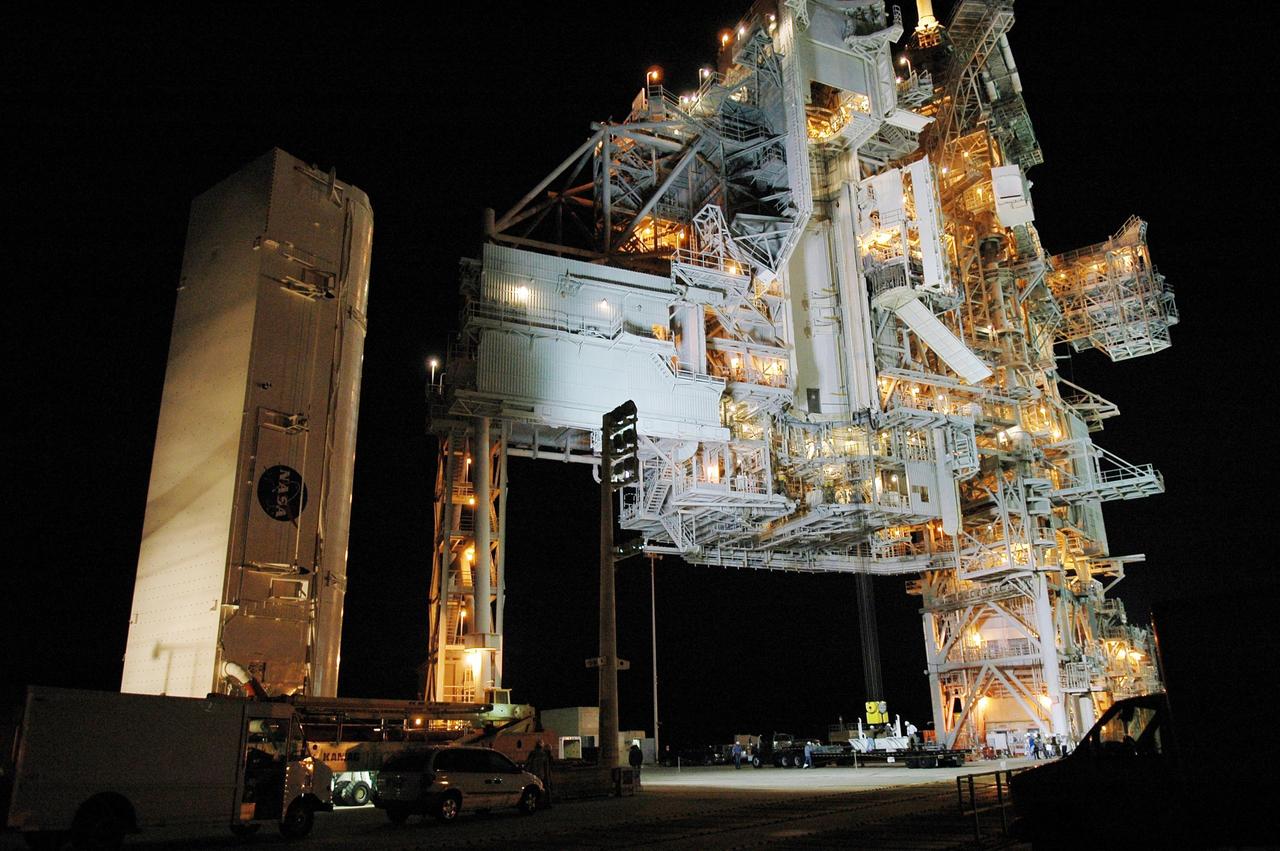
KENNEDY SPACE CENTER, FLA. -- The payload canister transporter and canister approach the rotating service structure (RSS) on Launch Pad 39B. Inside the canister are the SPACEHAB module and the port 5 truss segment for mission STS-116. They will be moved into the payload changeout room (PCR) on the RSS and transferred into Space Shuttle Discovery's payload bay once the vehicle has rolled out to the pad. The PCR is the enclosed, environmentally controlled portion of the RSS that supports cargo delivery to the pad and subsequent vertical installation into the orbiter payload bay. Seals around the mating surface of the PCR fit against the orbiter and allow the opening of the payload bay or canister doors and removal of the cargo without exposure to outside air and contaminants. A clean-air purge in the PCR maintains environmental control during PCR cargo operations. Cargo is removed from the payload canister and installed vertically in the orbiter by the payload ground handling mechanism (PGHM). Photo credit: NASA/Kim Shiflett
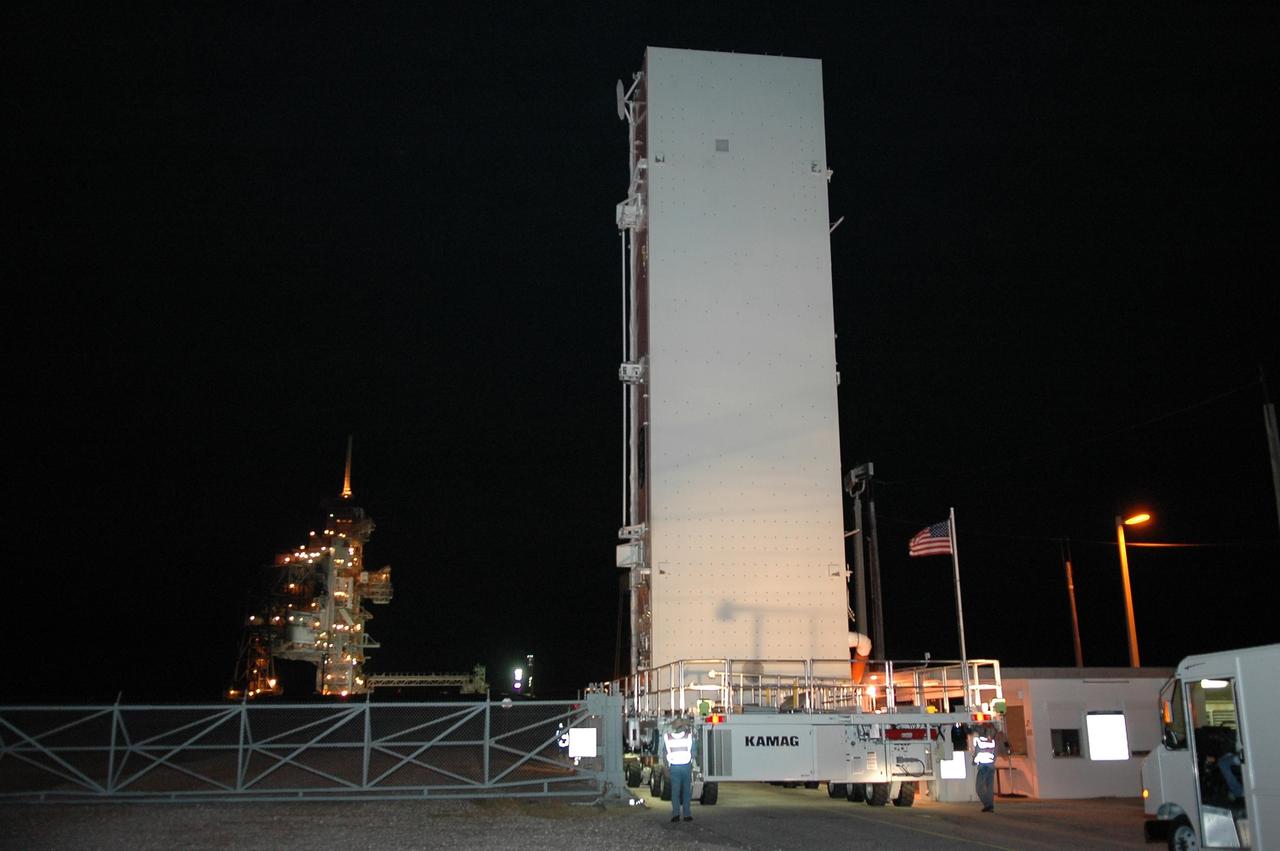
KENNEDY SPACE CENTER, FLA. -- The payload canister transporter and canister arrive at the gate to Launch Pad 39B. Inside the canister are the SPACEHAB module and the port 5 truss segment for mission STS-116. They will be moved into the payload changeout room (PCR) at the pad and transferred into Space Shuttle Discovery's payload bay once the vehicle has rolled out to the pad. The PCR is the enclosed, environmentally controlled portion of the RSS that supports cargo delivery to the pad and subsequent vertical installation into the orbiter payload bay. Seals around the mating surface of the PCR fit against the orbiter and allow the opening of the payload bay or canister doors and removal of the cargo without exposure to outside air and contaminants. A clean-air purge in the PCR maintains environmental control during PCR cargo operations. Cargo is removed from the payload canister and installed vertically in the orbiter by the payload ground handling mechanism (PGHM). Photo credit: NASA/Kim Shiflett
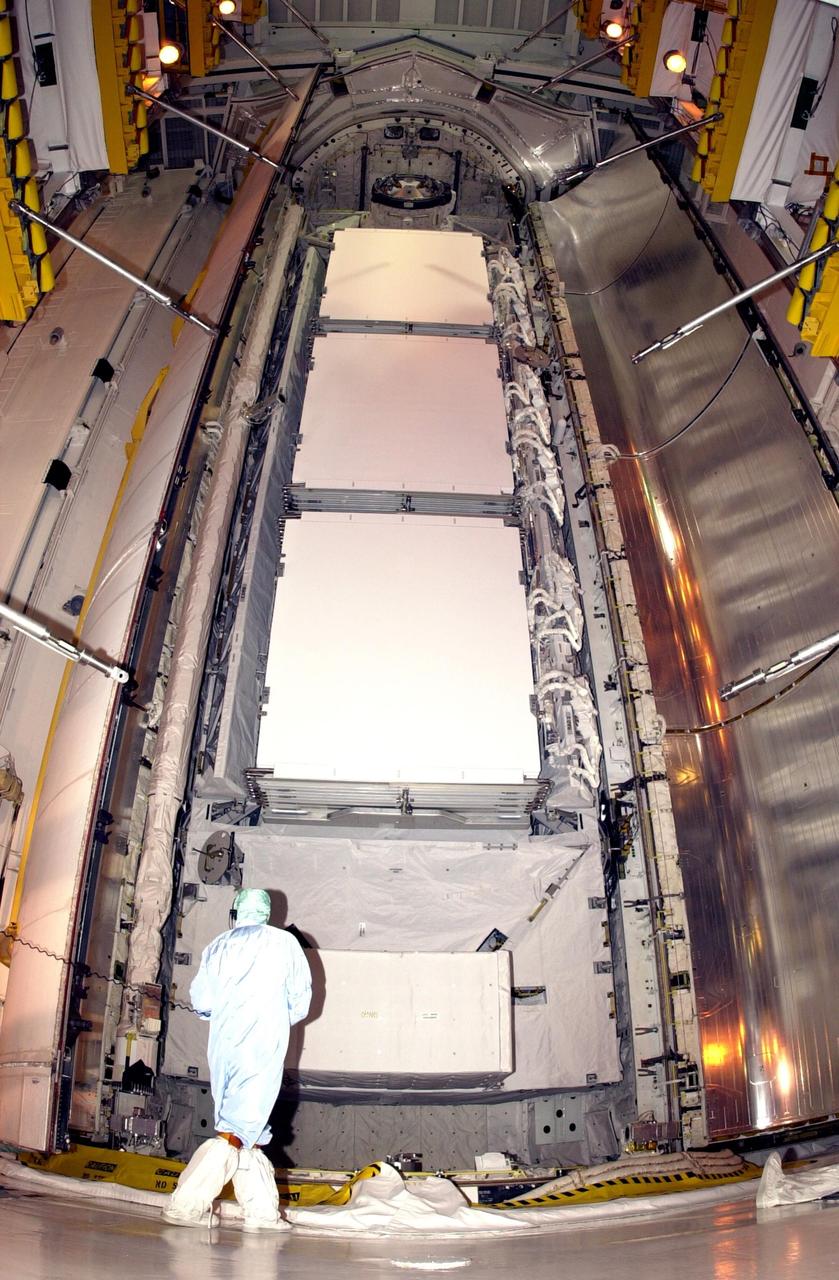
KENNEDY SPACE CENTER, FLA. - Space Shuttle Endeavour's payload bay doors begin to close around the payload in preparation for launch. The 16th assembly flight to the International Space Station, STS-113 will carry the Port 1 (P1) truss aboard Space Shuttle Endeavour as well as the Expedition 6 crew, who will replace Expedition 5 on the Station. Mission STS-113 is scheduled to launch Nov. 10, 2002.
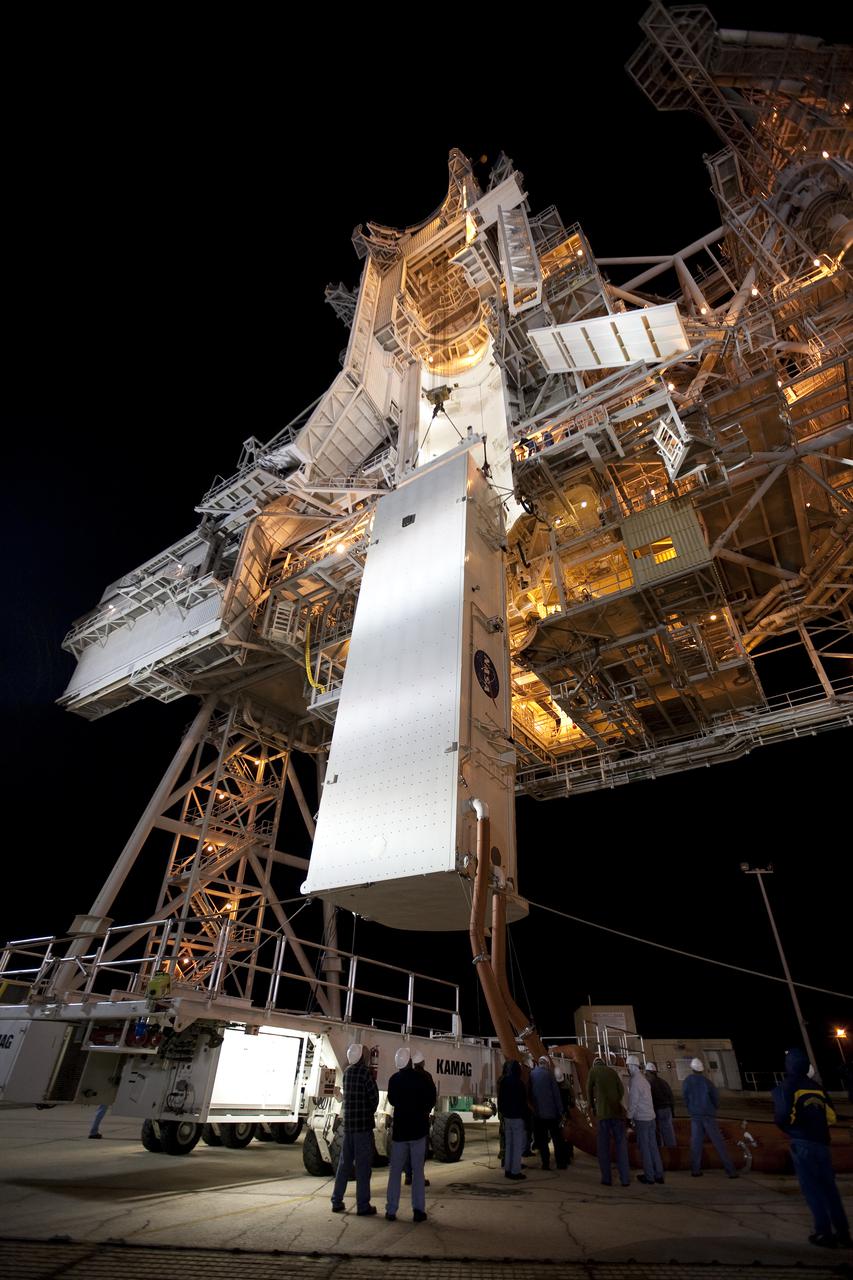
CAPE CANAVERAL, Fla. - At Launch Pad 39A at NASA's Kennedy Space Center in Florida, the payload canister containing the multi-purpose logistics module Leonardo is lifted into the pad's payload changout room. Located on the pad's rotating service structure, the room is an enclosed, environmentally controlled area that supports payload delivery and servicing at the pad and attaches to the shuttle's cargo bay for vertical payload installation. The contents of the canister, including Leonardo, is set to be transferred into space shuttle Discovery's cargo bay on March 24. The seven-member STS-131 crew will deliver Leonardo, filled with resupply stowage platforms and racks, to the International Space Station. STS-131 will be the 33rd shuttle mission to the station and the 131st shuttle mission overall. Launch is targeted for April 5. For information on the STS-131 mission and crew, visit http:__www.nasa.gov_mission_pages_shuttle_shuttlemissions_sts131_index.html. Photo credit: NASA_Amanda Diller
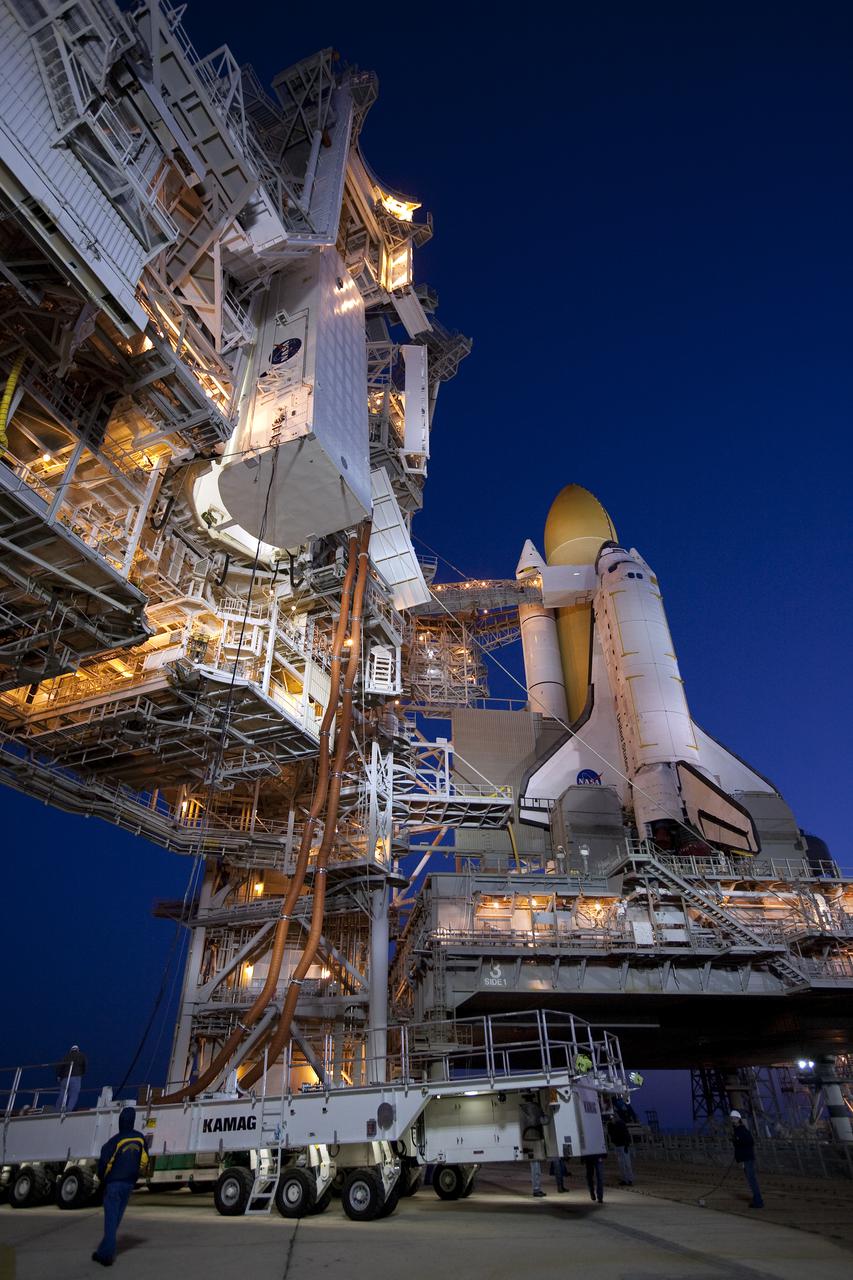
CAPE CANAVERAL, Fla. - Dawn over Launch Pad 39A at NASA's Kennedy Space Center in Florida finds the payload canister containing the multi-purpose logistics module Leonardo being lifted into the pad's payload changeout room. Located on the pad's rotating service structure, the room is an enclosed, environmentally controlled area that supports payload delivery and servicing at the pad and attaches to the shuttle's cargo bay for vertical payload installation. The contents of the canister, including Leonardo, is set to be transferred into space shuttle Discovery's cargo bay on March 24. The seven-member STS-131 crew will deliver Leonardo, filled with resupply stowage platforms and racks, to the International Space Station. STS-131 will be the 33rd shuttle mission to the station and the 131st shuttle mission overall. Launch is targeted for April 5. For information on the STS-131 mission and crew, visit http:__www.nasa.gov_mission_pages_shuttle_shuttlemissions_sts131_index.html. Photo credit: NASA_Amanda Diller
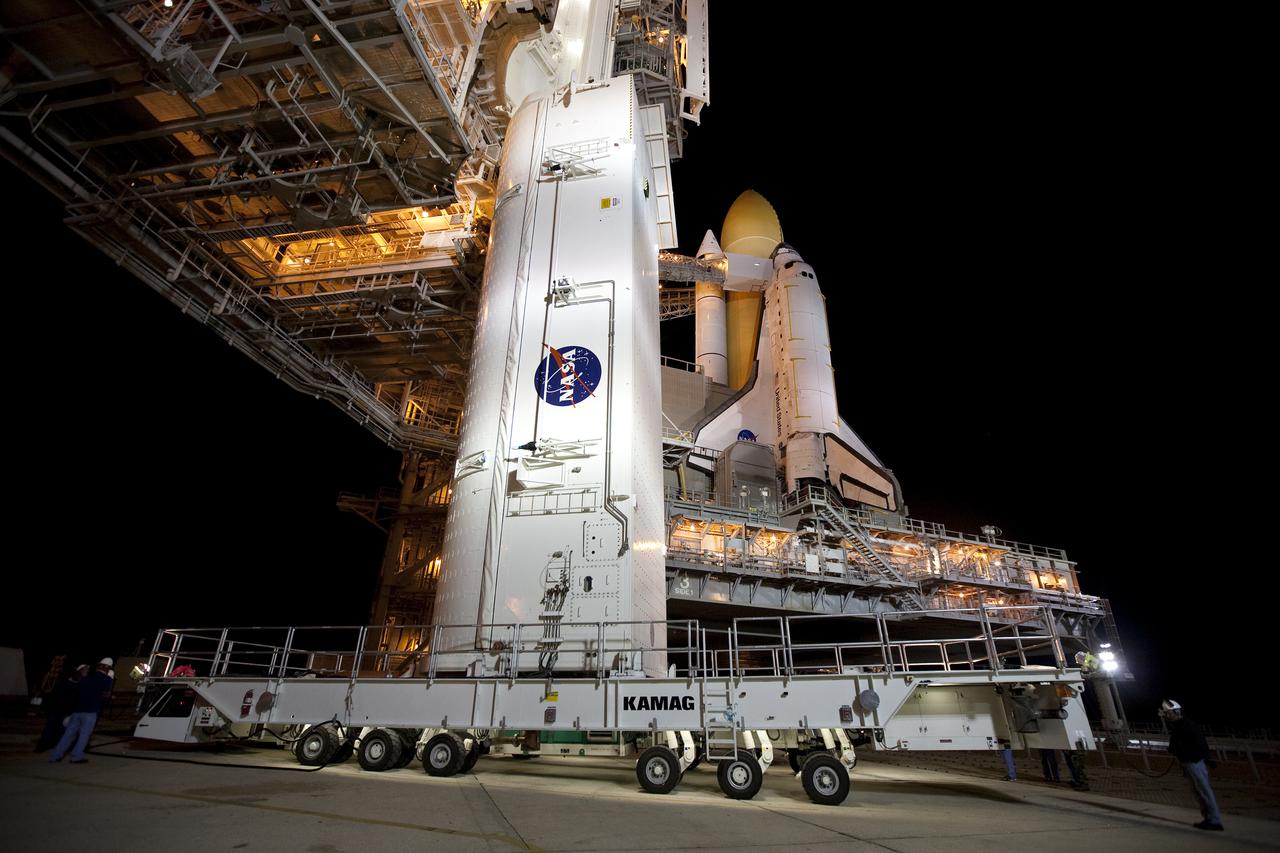
CAPE CANAVERAL, Fla. - At Launch Pad 39A at NASA's Kennedy Space Center in Florida, preparations are under way to lift the payload canister containing the multi-purpose logistics module Leonardo, standing vertically on a transporter, into the pad's payload changout room. Located on the pad's rotating service structure, the room is an enclosed, environmentally controlled area that supports payload delivery and servicing at the pad and attaches to the shuttle's cargo bay for vertical payload installation. The contents of the canister, including Leonardo, is set to be transferred into space shuttle Discovery's cargo bay on March 24. The seven-member STS-131 crew will deliver Leonardo, filled with resupply stowage platforms and racks, to the International Space Station. STS-131 will be the 33rd shuttle mission to the station and the 131st shuttle mission overall. Launch is targeted for April 5. For information on the STS-131 mission and crew, visit http:__www.nasa.gov_mission_pages_shuttle_shuttlemissions_sts131_index.html. Photo credit: NASA_Amanda Diller
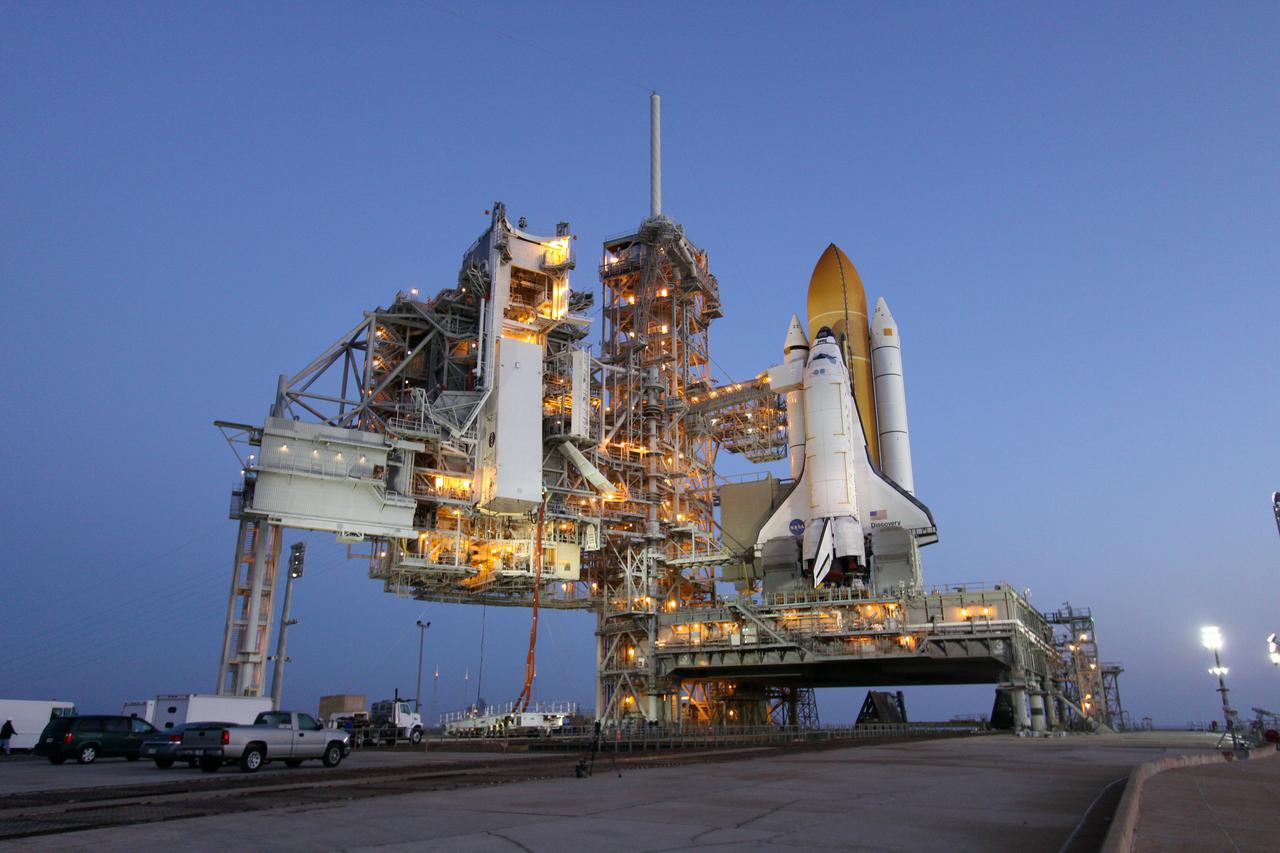
CAPE CANAVERAL, Fla. - At NASA's Kennedy Space Center in Florida, the payload canister containing the multi-purpose logistics module Leonardo is nestled in the payload changeout room at Launch Pad 39A. Located on the pad's rotating service structure, the room is an enclosed, environmentally controlled area that supports payload delivery and servicing at the pad and attaches to the shuttle's cargo bay for vertical payload installation. The contents of the canister, including Leonardo, is set to be transferred into space shuttle Discovery's cargo bay on March 24. The seven-member STS-131 crew will deliver Leonardo, filled with resupply stowage platforms and racks, to the International Space Station. STS-131 will be the 33rd shuttle mission to the station and the 131st shuttle mission overall. Launch is targeted for April 5. For information on the STS-131 mission and crew, visit http:__www.nasa.gov_mission_pages_shuttle_shuttlemissions_sts131_index.html. Photo credit: NASA_Troy Cryder
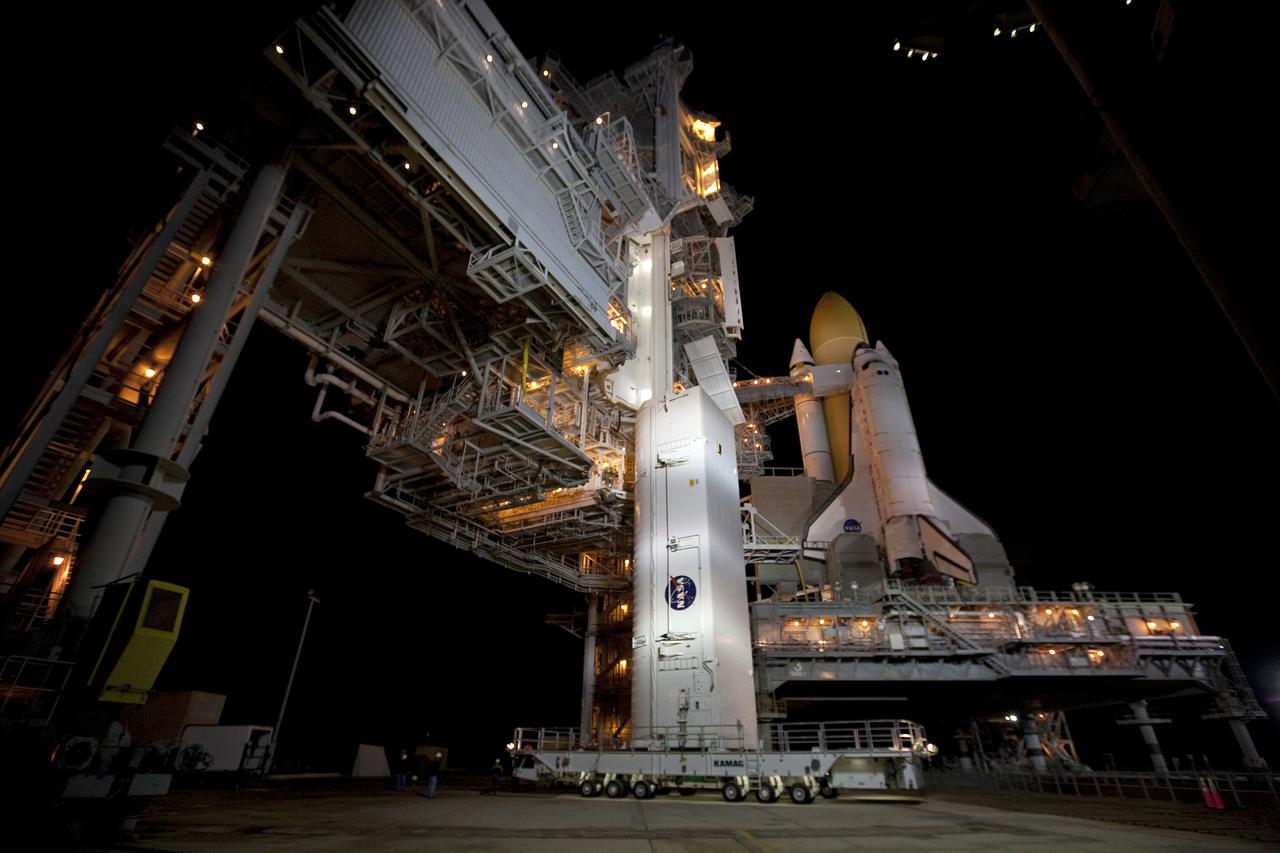
CAPE CANAVERAL, Fla. - At NASA's Kennedy Space Center in Florida, the payload canister containing the multi-purpose logistics module Leonardo, standing vertically on a transporter, arrives at Launch Pad 39A. The canister next will be lifted into the pad's payload changout room. Located on the pad's rotating service structure, the room is an enclosed, environmentally controlled area that supports payload delivery and servicing at the pad and attaches to the shuttle's cargo bay for vertical payload installation. The contents of the canister, including Leonardo, is set to be transferred into space shuttle Discovery's cargo bay on March 24. The seven-member STS-131 crew will deliver Leonardo, filled with resupply stowage platforms and racks, to the International Space Station. STS-131 will be the 33rd shuttle mission to the station and the 131st shuttle mission overall. Launch is targeted for April 5. For information on the STS-131 mission and crew, visit http:__www.nasa.gov_mission_pages_shuttle_shuttlemissions_sts131_index.html. Photo credit: NASA_Amanda Diller
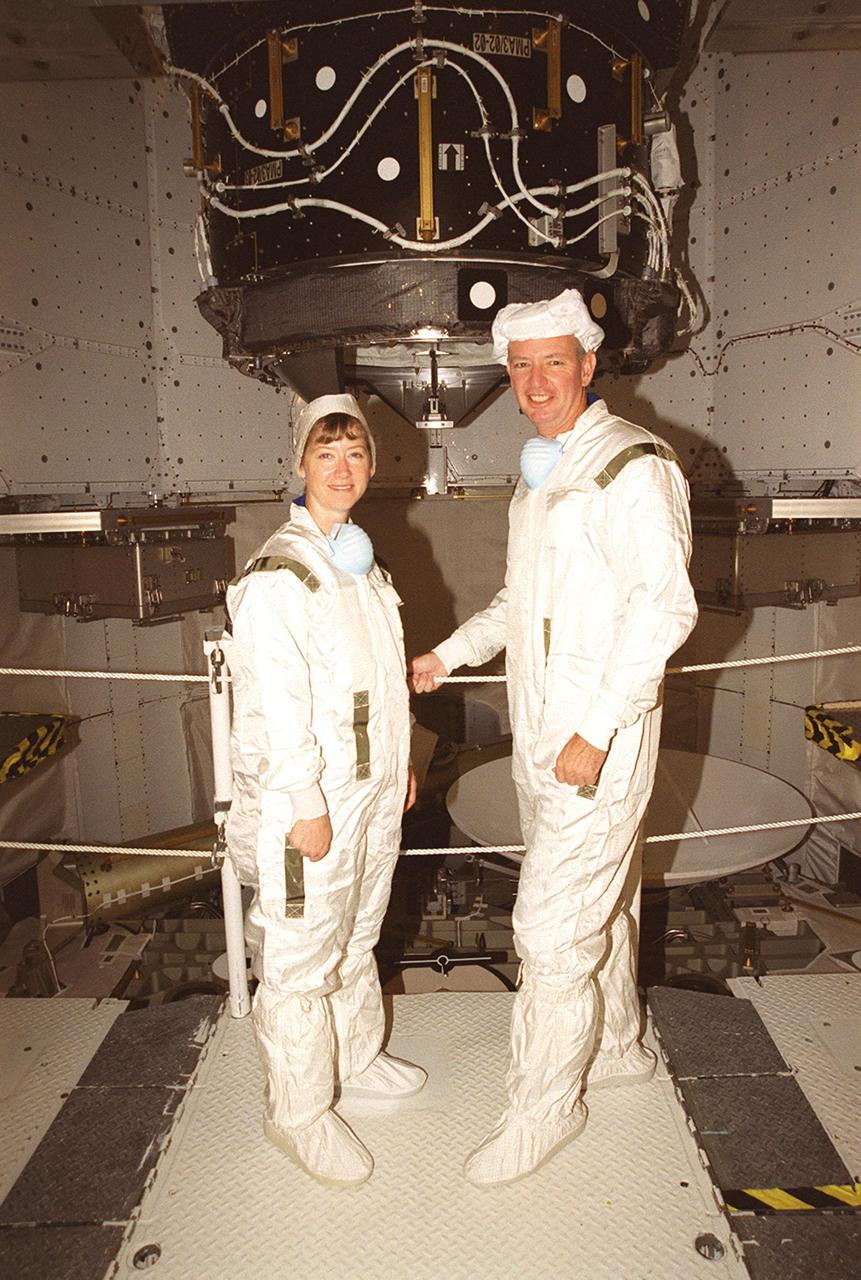
KENNEDY SPACE CENTER, FLA. -- STS-92 Pilot Pamela Ann Melroy (left) and Commander Brian Duffy pose for a photo during payload inspection in Space Shuttle Discovery’s payload bay. Behind them is the Pressurized Mating Adapter. The STS-92 crew has been inspecting the payload in preparation for launch Oct. 5, 2000. The mission is the fifth flight for the construction of the International Space Station. The payload also includes the Integrated Truss Structure Z-1. During the 11-day mission, four extravehicular activities (EVAs), or space walks, are planned

KENNEDY SPACE CENTER, FLA. -- In Space Shuttle Discovery’s payload bay, STS-92 Mission Specialist Michael E. Lopez-Alegria takes hold of a lever on the Pressurized Mating Adapter, part of the payload on the mission. Behind him Mission Specialist William S. McArthur Jr. describes a task while Mission Specialist Peter J.K. Wisoff looks on. The STS-92 crew has been inspecting the payload in preparation for launch Oct. 5, 2000. The mission is the fifth flight for the construction of the International Space Station. The payload also includes the Integrated Truss Structure Z-1. During the 11-day mission, four extravehicular activities (EVAs), or space walks, are planned
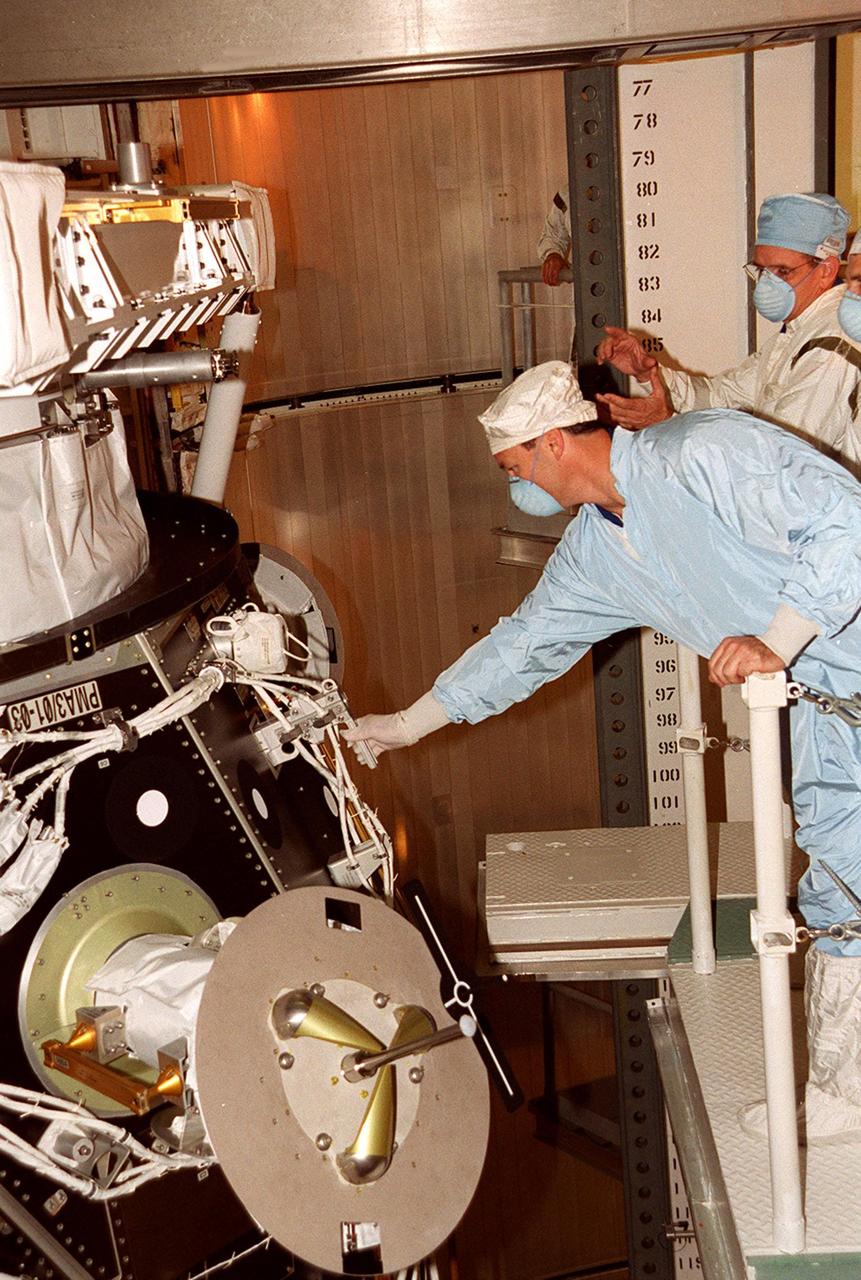
KENNEDY SPACE CENTER, FLA. -- In Space Shuttle Discovery’s payload bay, STS-92 Mission Specialist Michael E. Lopez-Alegria takes hold of a lever on the Pressurized Mating Adapter, part of the payload on the mission. Behind him Mission Specialist William S. McArthur Jr. describes a task while Mission Specialist Peter J.K. Wisoff looks on. The STS-92 crew has been inspecting the payload in preparation for launch Oct. 5, 2000. The mission is the fifth flight for the construction of the International Space Station. The payload also includes the Integrated Truss Structure Z-1. During the 11-day mission, four extravehicular activities (EVAs), or space walks, are planned
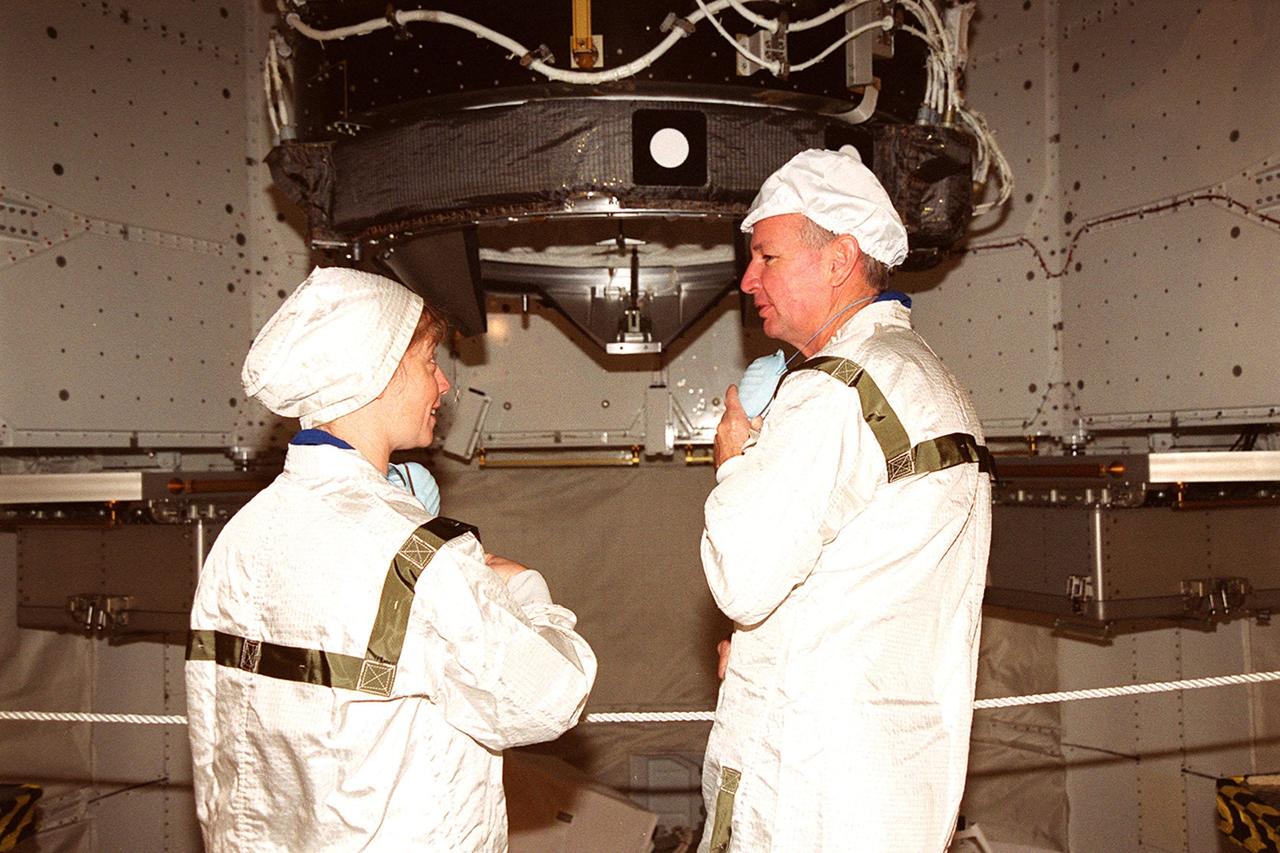
KENNEDY SPACE CENTER, FLA. -- In Space Shuttle Discovery’s payload bay, STS-92 Pilot Pamela Ann Melroy (left) and Commander Brian Duffy share thoughts about the mission as they inspect part of the payload (behind them), the Pressurized Mating Adapter. The STS-92 crew has been inspecting the payload in preparation for launch Oct. 5, 2000. The mission is the fifth flight for the construction of the International Space Station. The payload also includes the Integrated Truss Structure Z-1. During the 11-day mission, four extravehicular activities (EVAs), or space walks, are planned
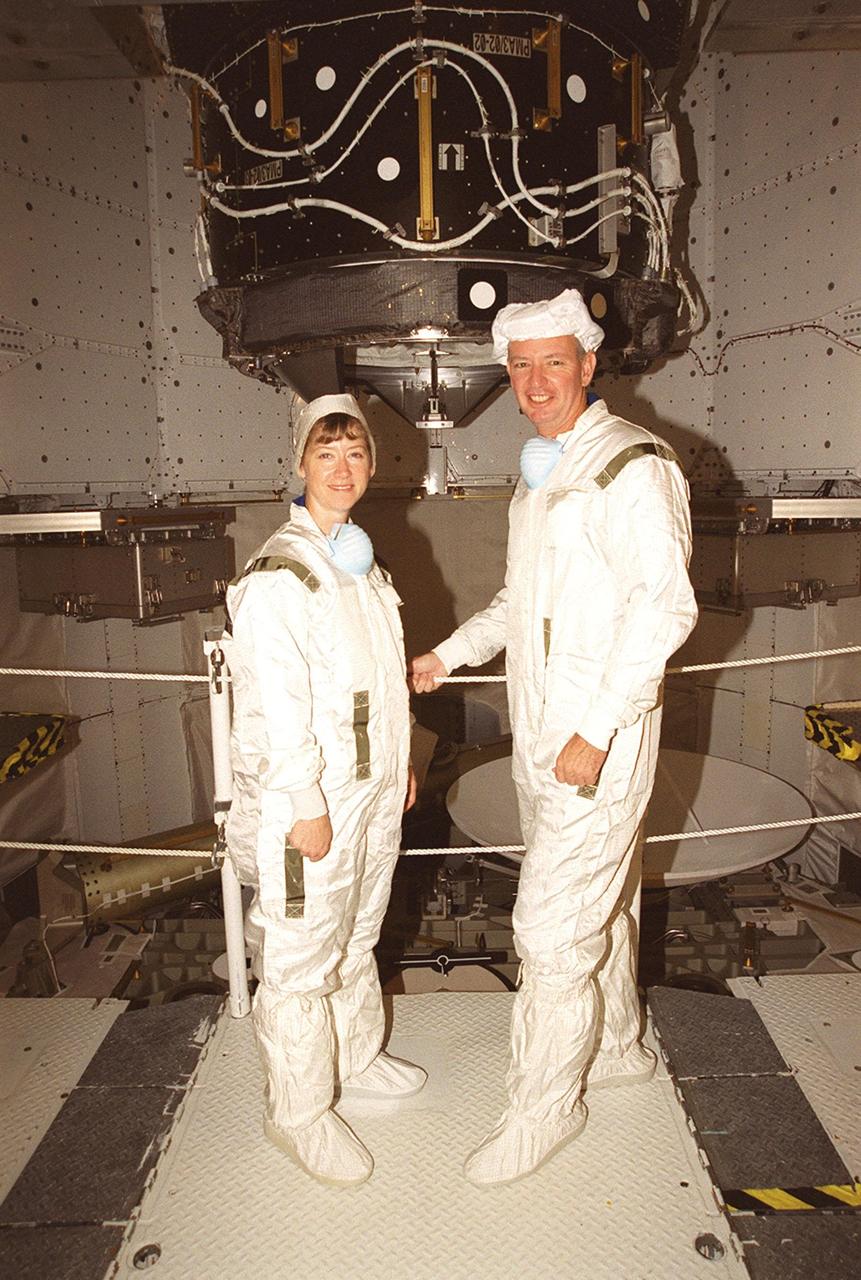
KENNEDY SPACE CENTER, FLA. -- STS-92 Pilot Pamela Ann Melroy (left) and Commander Brian Duffy pose for a photo during payload inspection in Space Shuttle Discovery’s payload bay. Behind them is the Pressurized Mating Adapter. The STS-92 crew has been inspecting the payload in preparation for launch Oct. 5, 2000. The mission is the fifth flight for the construction of the International Space Station. The payload also includes the Integrated Truss Structure Z-1. During the 11-day mission, four extravehicular activities (EVAs), or space walks, are planned
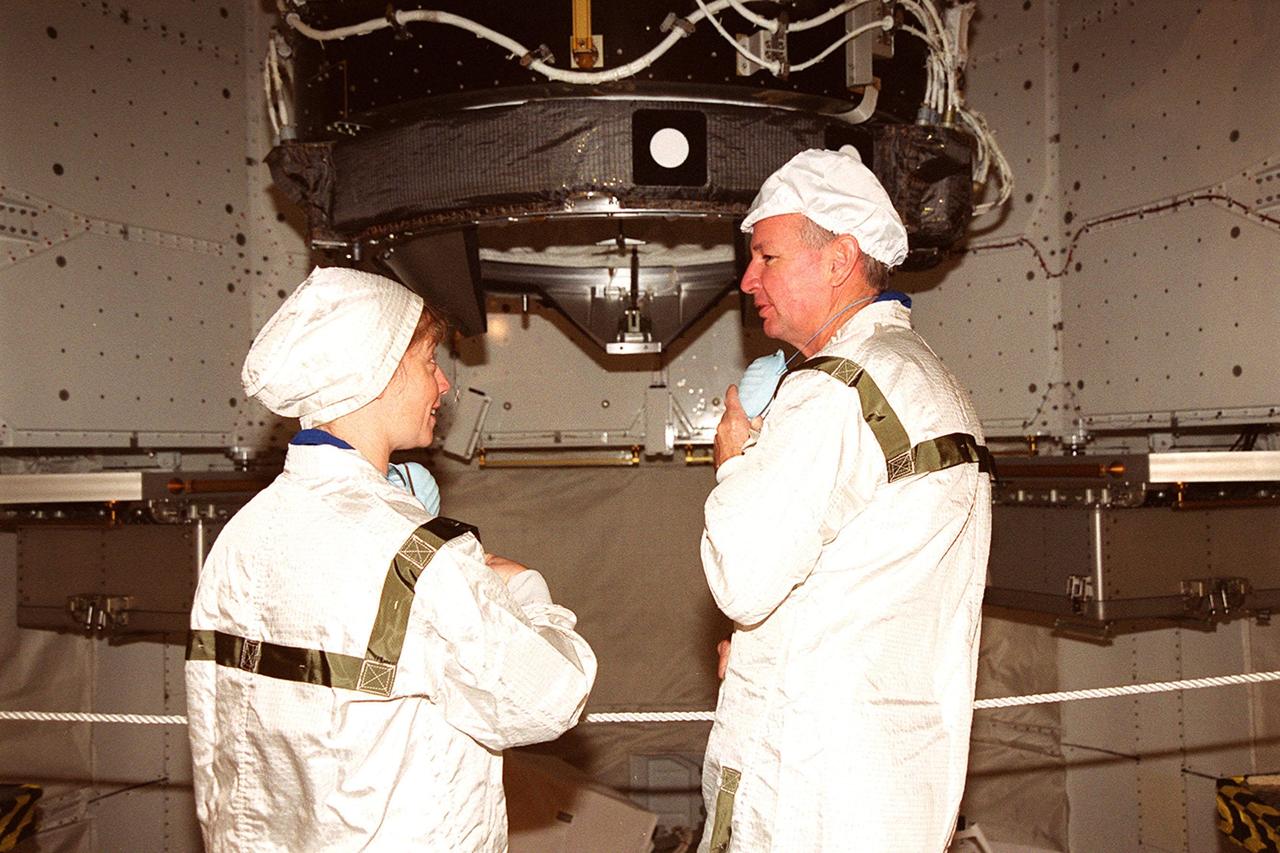
KENNEDY SPACE CENTER, FLA. -- In Space Shuttle Discovery’s payload bay, STS-92 Pilot Pamela Ann Melroy (left) and Commander Brian Duffy share thoughts about the mission as they inspect part of the payload (behind them), the Pressurized Mating Adapter. The STS-92 crew has been inspecting the payload in preparation for launch Oct. 5, 2000. The mission is the fifth flight for the construction of the International Space Station. The payload also includes the Integrated Truss Structure Z-1. During the 11-day mission, four extravehicular activities (EVAs), or space walks, are planned
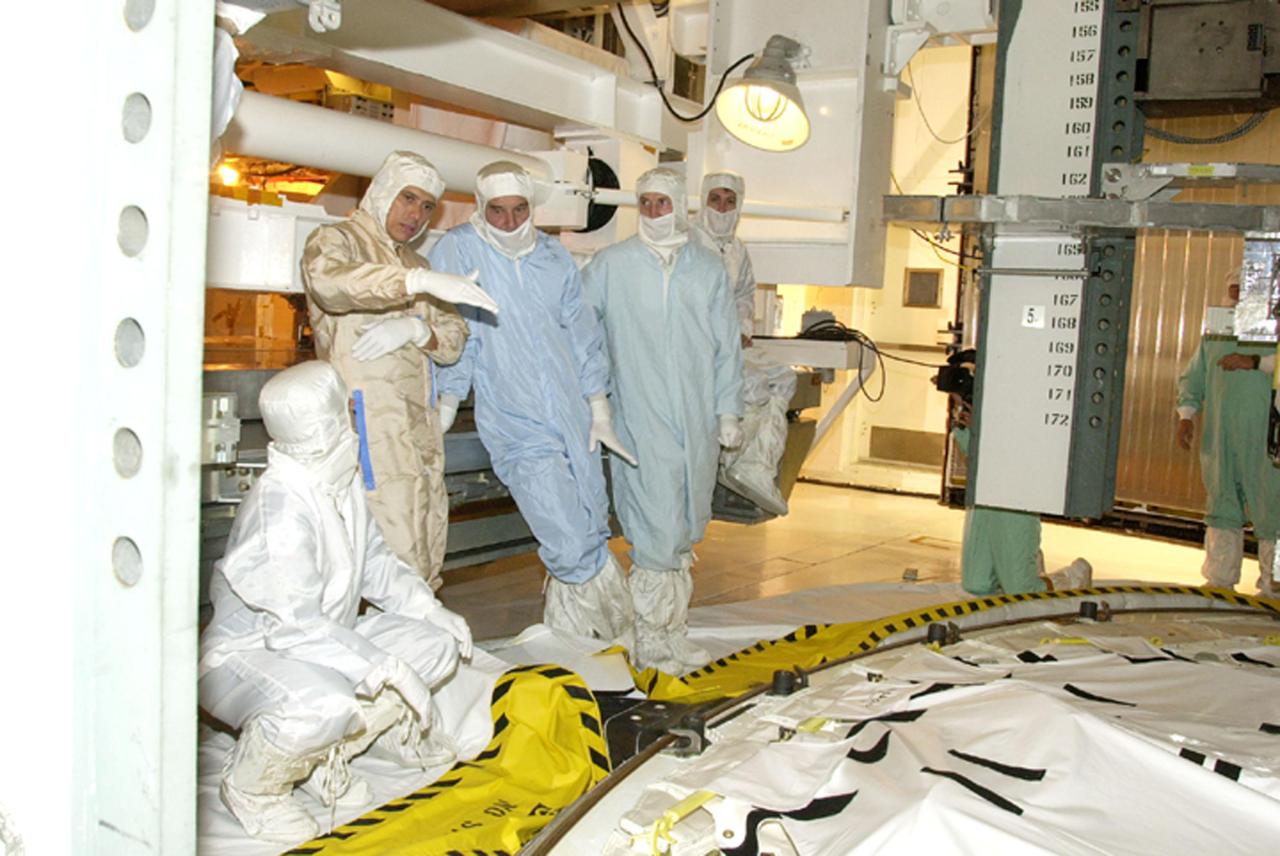
KENNEDY SPACE CENTER, FLA. -- In the Orbiter Processing Facility, members of the STS-111 and Expedition 5 crews look over the payload. installed in Endeavour's payload bay. From left are Mission Specialists Philippe Perrin (kneeling) and Franklin Chang-Diaz, and Expedition 5 Commander Valeri Korzun, Sergei Treschev and Peggy Whitson. Perrin with the French Space Agency; Korzun and Treschev are with the Russian Space Agency. The crews are at KSC for Terminal Countdown Demonstration Test activities, which include payload familiarization and a simulated launch countdown. The mission crew also includes Commander Kenneth Cockrell and Pilot Paul Lockhart. The payload on the mission to the International Space Station includes the Mobile Base System, an Orbital Replacement Unit and Multi-Purpose Logistics Module Leonardo. The Expedition 5 crew is traveling on Endeavour to replace the Expedition 4 crew on the Station. Launch of Endeavour is scheduled for May 30, 2002.
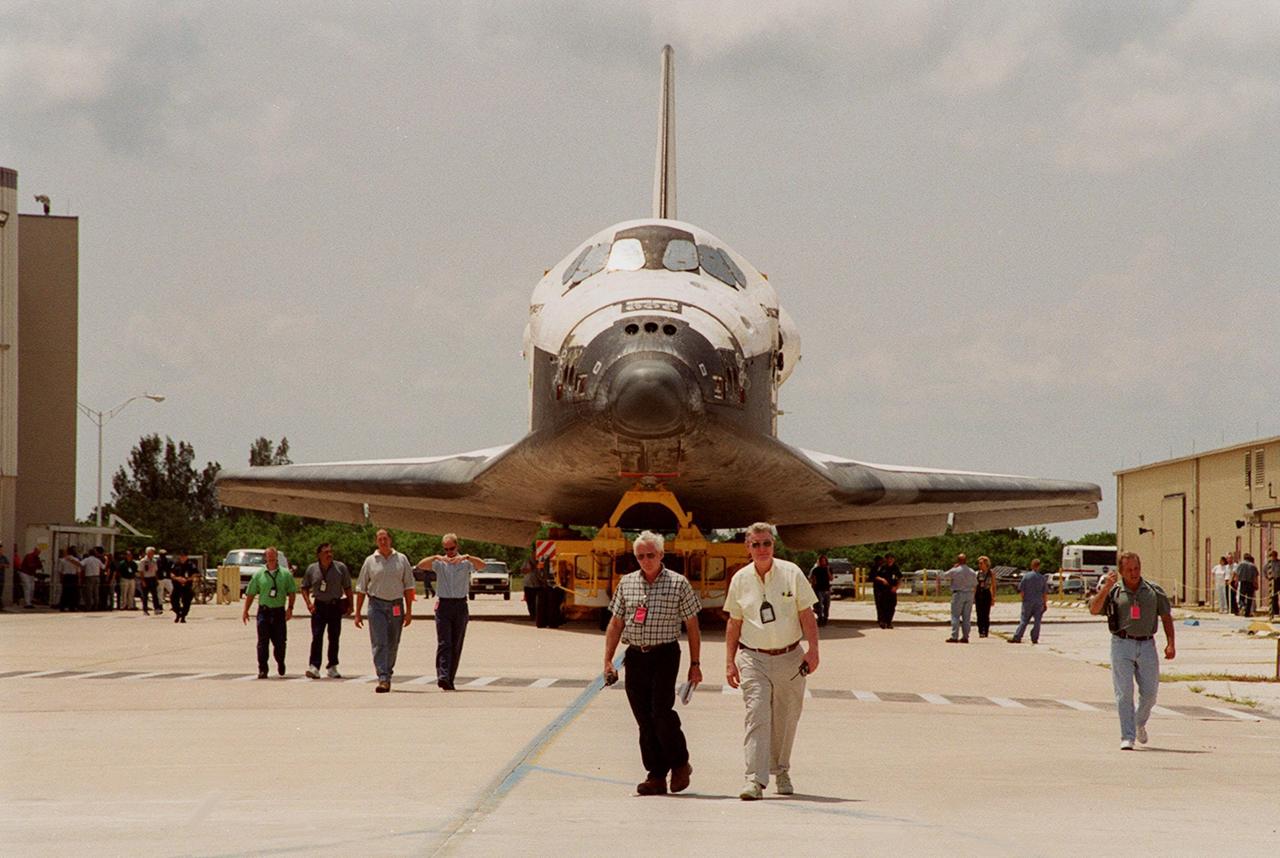
KENNEDY SPACE CENTER, FLA. -- KSC employees chaperone the transfer of the orbiter Discovery from Orbiter Processing Facility (OPF) bay 1 to OPF bay 3 where ongoing payload and ground processing assessments will be completed. Managers will then determine when to roll the orbiter to the Vehicle Assembly Building for stacking with the external tank and solid rocket boosters, and when to roll out to Launch Pad 39A. Discovery is scheduled to launch Oct. 5 at 9:30 p.m. EDT on mission STS-92, which will be the 100th flight in the Shuttle program
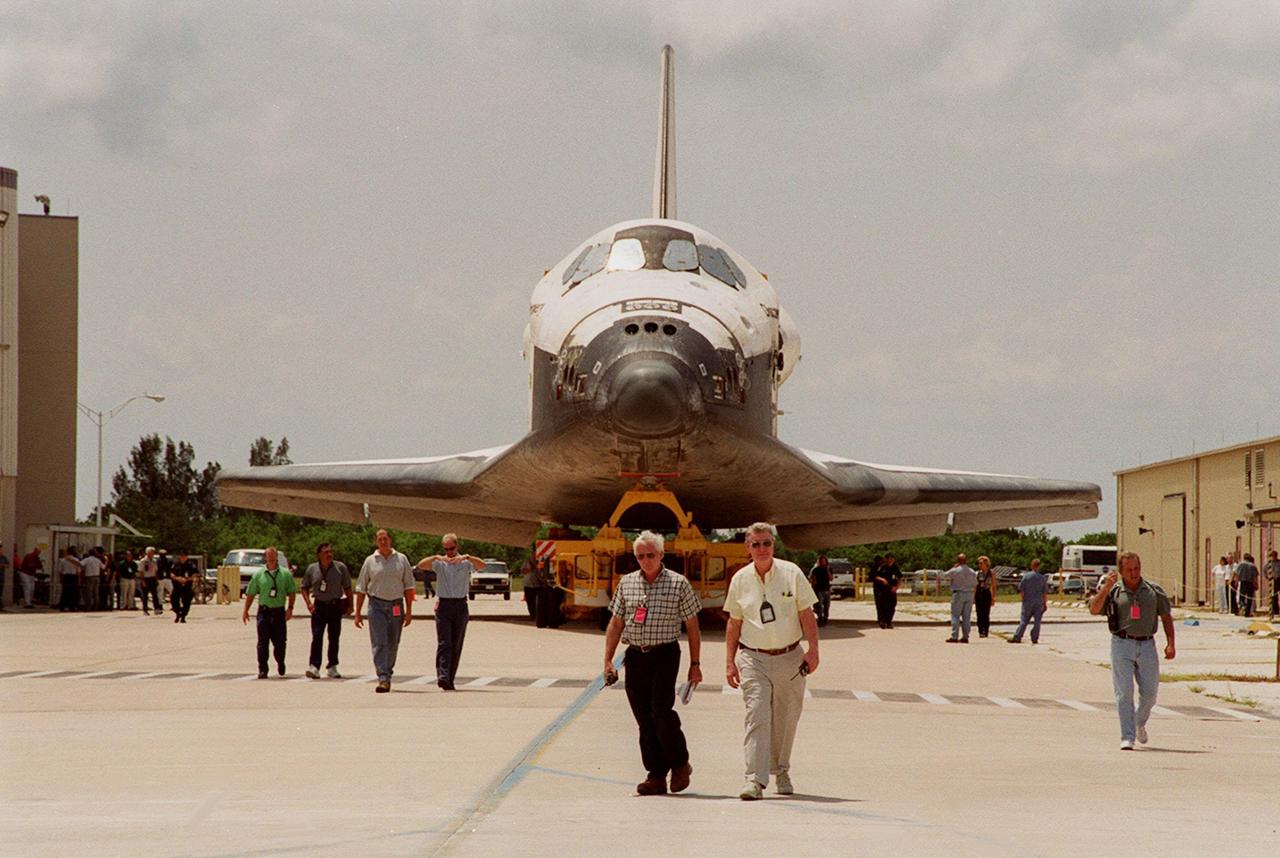
KENNEDY SPACE CENTER, FLA. -- KSC employees chaperone the transfer of the orbiter Discovery from Orbiter Processing Facility (OPF) bay 1 to OPF bay 3 where ongoing payload and ground processing assessments will be completed. Managers will then determine when to roll the orbiter to the Vehicle Assembly Building for stacking with the external tank and solid rocket boosters, and when to roll out to Launch Pad 39A. Discovery is scheduled to launch Oct. 5 at 9:30 p.m. EDT on mission STS-92, which will be the 100th flight in the Shuttle program
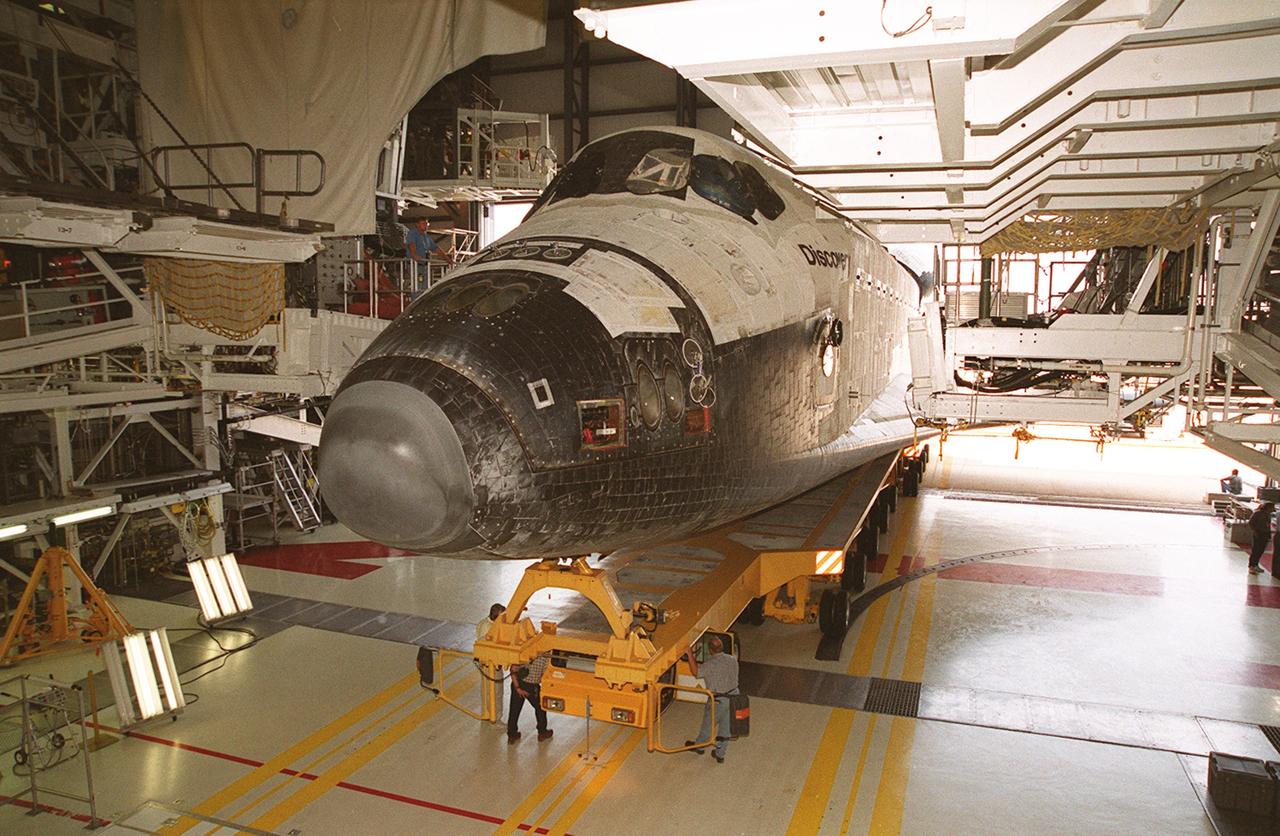
KENNEDY SPACE CENTER, FLA. -- The orbiter Discovery is being prepped inside the Orbiter Processing Facility (OPF) bay 1 for a "roll around" to OPF bay 3 where ongoing payload and ground processing assessments will be completed. Managers will then determine when to roll the orbiter to the Vehicle Assembly Building for stacking with the external tank and soid rocket boosters, and when to roll out to Launch Pad 39A. Discovery is scheduled to launch Oct. 5 at 9:30 p.m. EDT on mission STS-92, which will be the 100th flight in the Shuttle program.

KENNEDY SPACE CENTER, FLA. -- The orbiter Discovery is being prepped inside the Orbiter Processing Facility (OPF) bay 1 for a "roll around" to OPF bay 3 where ongoing payload and ground processing assessments will be completed. Managers will then determine when to roll the orbiter to the Vehicle Assembly Building for stacking with the external tank and soid rocket boosters, and when to roll out to Launch Pad 39A. Discovery is scheduled to launch Oct. 5 at 9:30 p.m. EDT on mission STS-92, which will be the 100th flight in the Shuttle program.
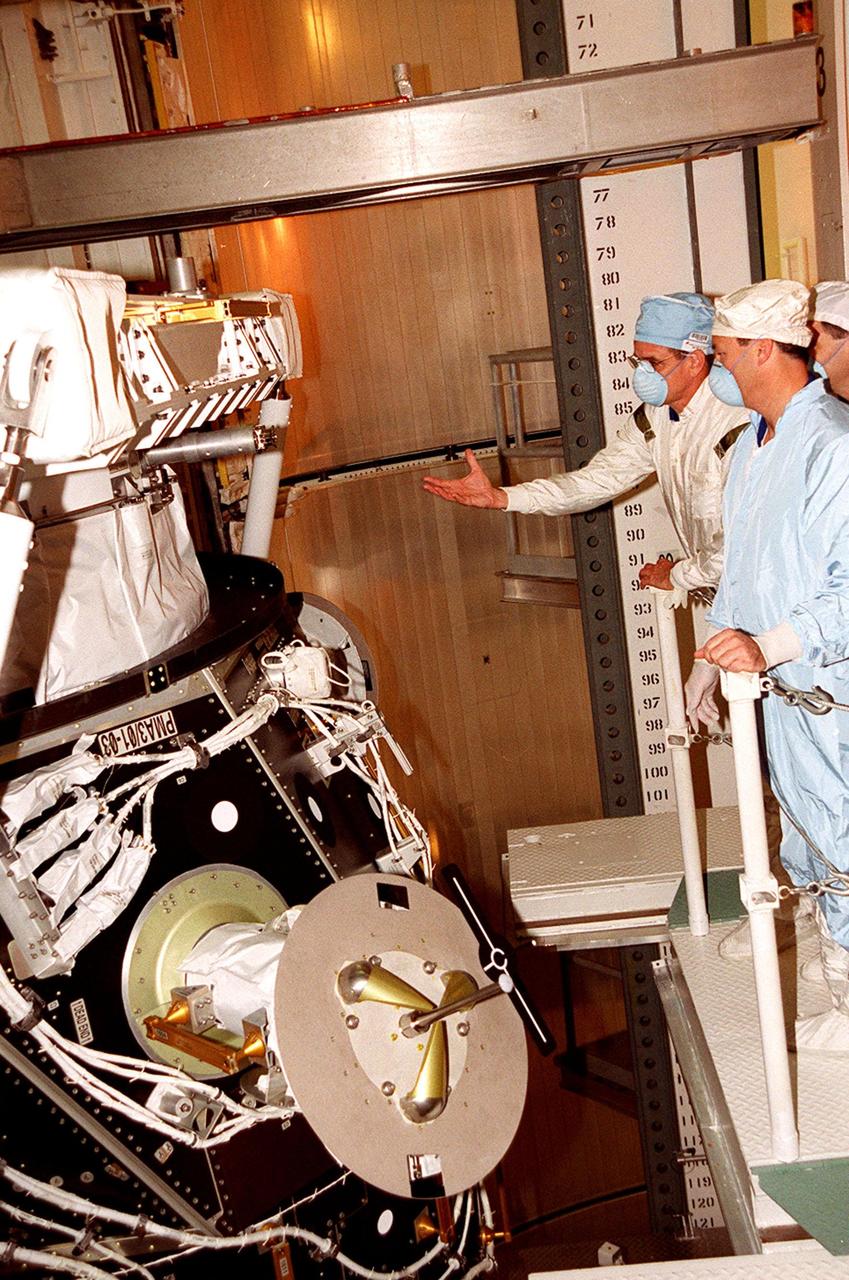
KENNEDY SPACE CENTER, FLA. -- In Space Shuttle Discovery’s payload bay, STS-92 Mission Specialist William S. McArthur Jr. explains something about the Pressurized Mating Adapter in front of him to other Mission Specialists Michael E. Lopez-Alegria and Peter J.K. Wisoff. The STS-92 crew has been inspecting the payload in preparation for launch Oct. 5, 2000. The mission is the fifth flight for the construction of the International Space Station. The payload also includes the Integrated Truss Structure Z-1. During the 11-day mission, four extravehicular activities (EVAs), or space walks, are planned
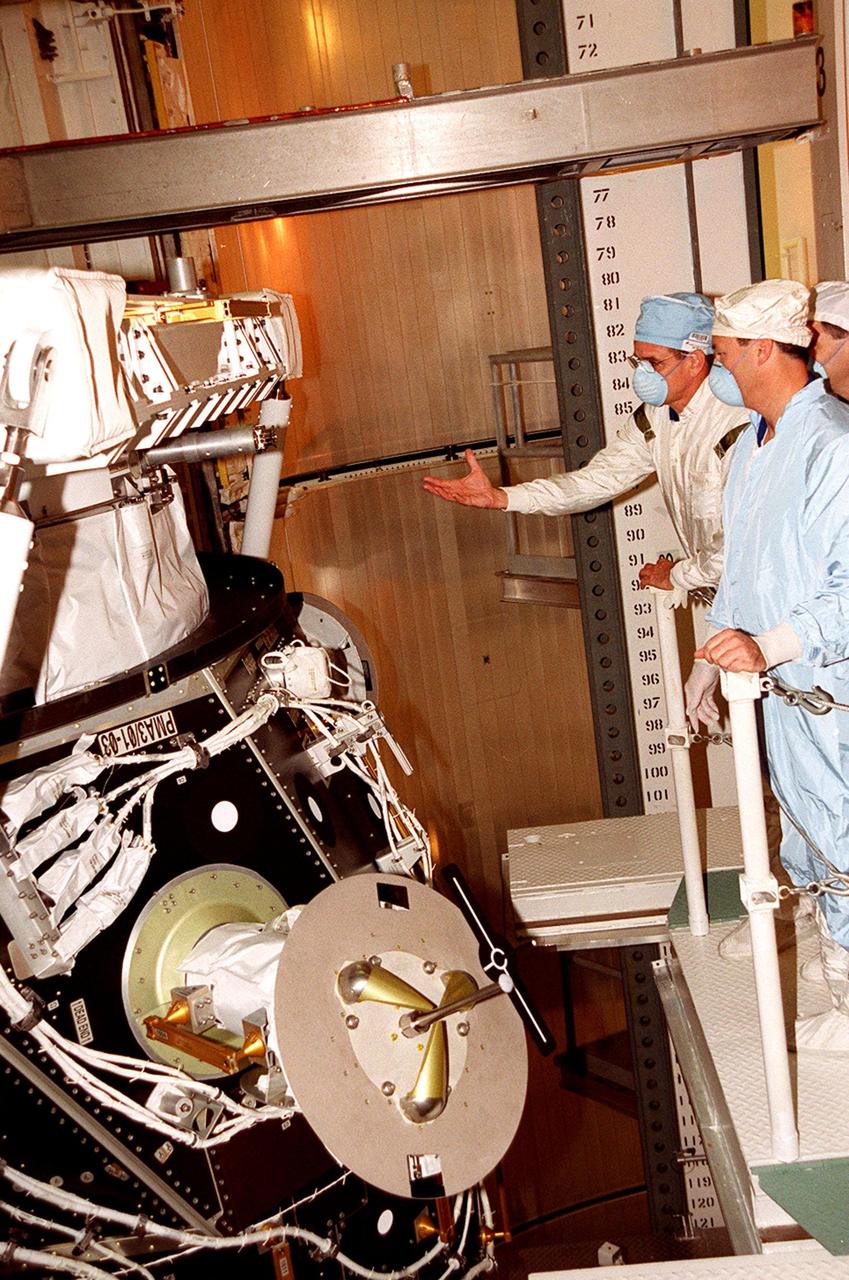
KENNEDY SPACE CENTER, FLA. -- In Space Shuttle Discovery’s payload bay, STS-92 Mission Specialist William S. McArthur Jr. explains something about the Pressurized Mating Adapter in front of him to other Mission Specialists Michael E. Lopez-Alegria and Peter J.K. Wisoff. The STS-92 crew has been inspecting the payload in preparation for launch Oct. 5, 2000. The mission is the fifth flight for the construction of the International Space Station. The payload also includes the Integrated Truss Structure Z-1. During the 11-day mission, four extravehicular activities (EVAs), or space walks, are planned
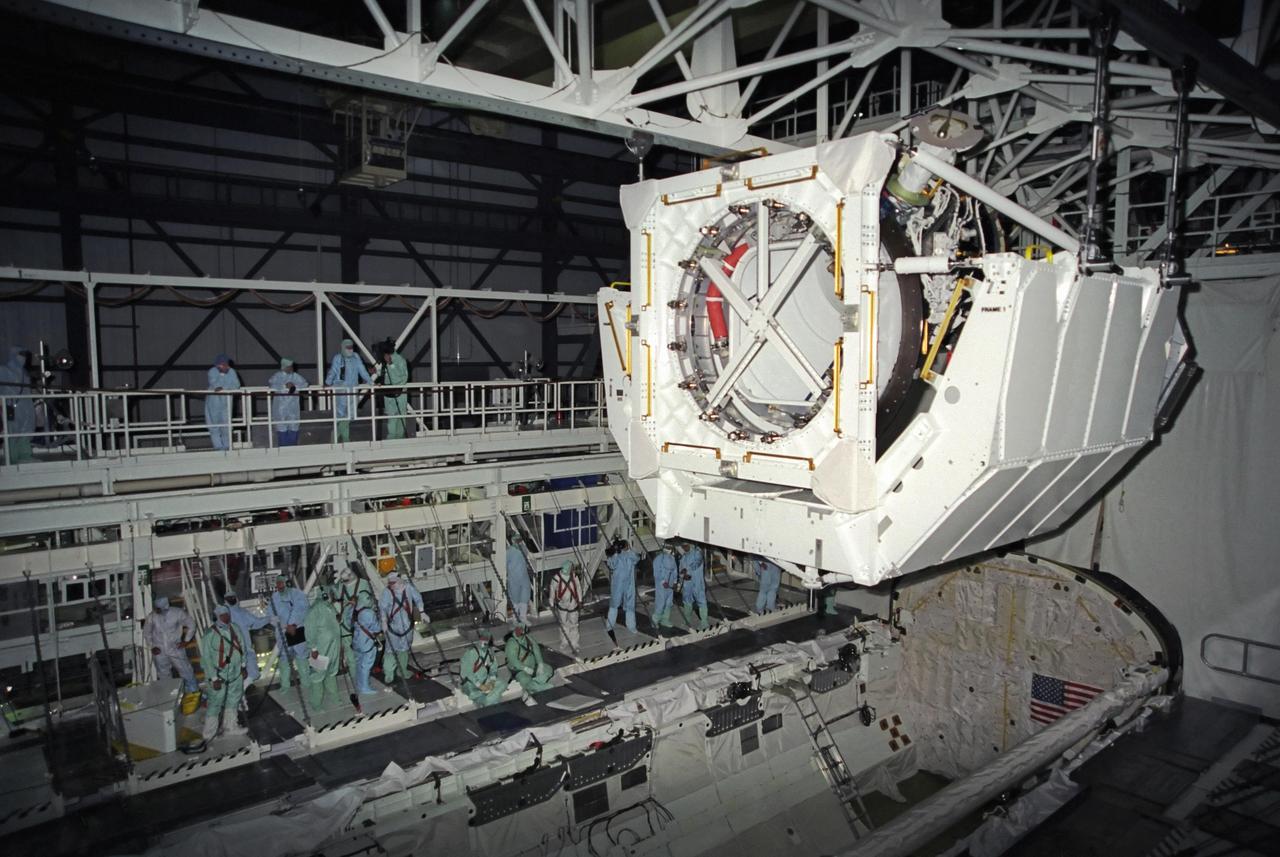
KENNEDY SPACE CENTER, FLA. - Workers in the Orbiter Processing Facility bay 1 watch the progress of the Pressurized Mating Adapter-3 (PMA-3) as it is transferred to the payload bay of the orbiter Discovery. A component of the International Space Station, the PMA-3 will fly on Shuttle mission STS-92, scheduled to launch October 5. The mission will be the fifth flight to the Space Station, and the 100th Shuttle flight overall. PMA-3 provides shuttle docking port for solar array installation on flight 4A (mission STS-97 scheduled for November 30), and Lab installation on flight 5A (mission STS-98, scheduled for January 18, 2001).
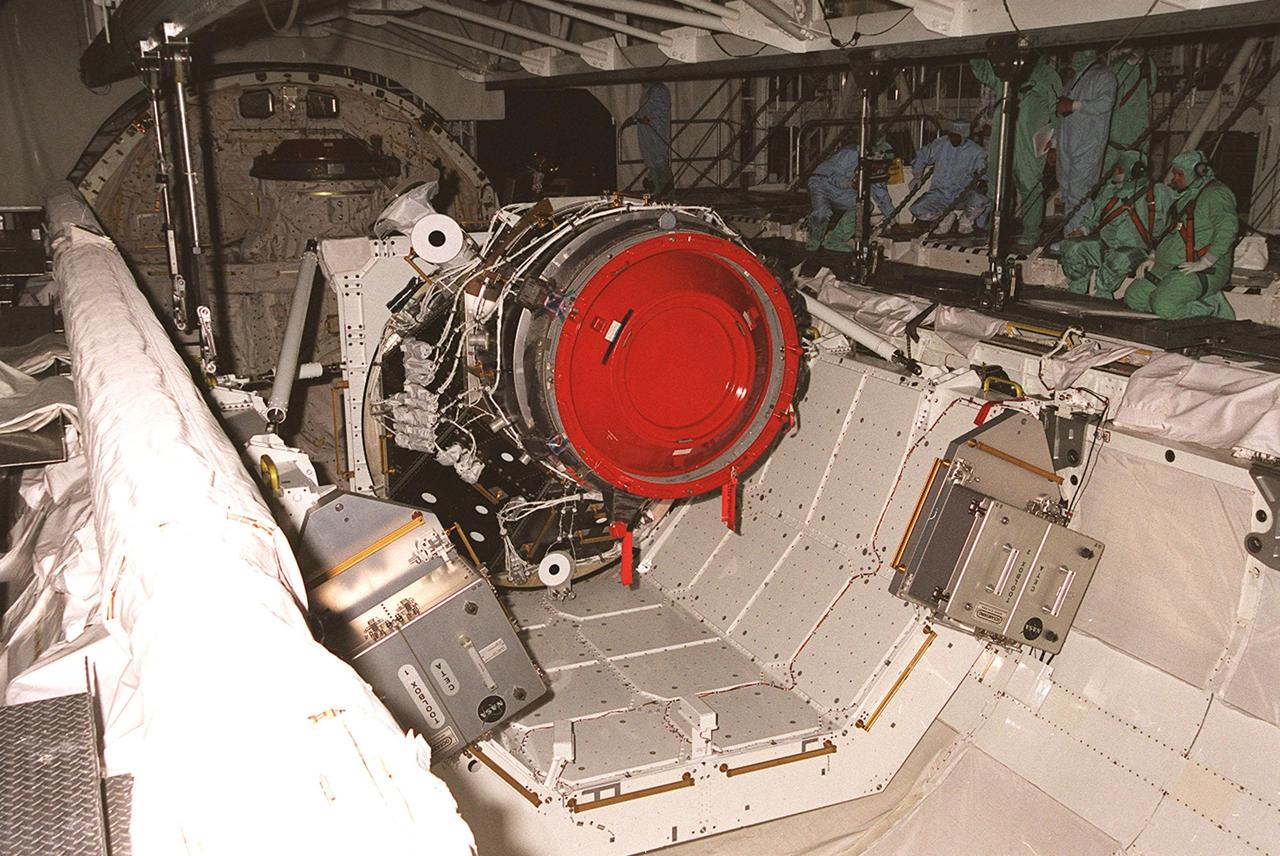
KENNEDY SPACE CENTER, FLA. -- In the Orbiter Processing Facility bay 1, workers detach the overhead crane from the Pressurized Mating Adapter -3 (PMA-3), which sits in the payload bay of the orbiter Discovery. A component of the International Space Station, the PMA-3 will fly on Shuttle mission STS-92, scheduled to launch Oct. 5. The mission will be the fifth flight to the Space Station, and the 100th Shuttle flight overall. PMA-3 provides shuttle docking port for solar array installation on flight 4A (mission STS-97 scheduled for Nov. 30), and Lab installation on flight 5A (mission STS-98, scheduled for Jan. 18, 2001)

KENNEDY SPACE CENTER, FLA. - Workers in the Orbiter Processing Facility bay 1 watch the progress of the Pressurized Mating Adapter-3 (PMA-3) as it is transferred to the payload bay of the orbiter Discovery. A component of the International Space Station, the PMA-3 will fly on Shuttle mission STS-92, scheduled to launch October 5. The mission will be the fifth flight to the Space Station, and the 100th Shuttle flight overall. PMA-3 provides shuttle docking port for solar array installation on flight 4A (mission STS-97 scheduled for November 30), and Lab installation on flight 5A (mission STS-98, scheduled for January 18, 2001).
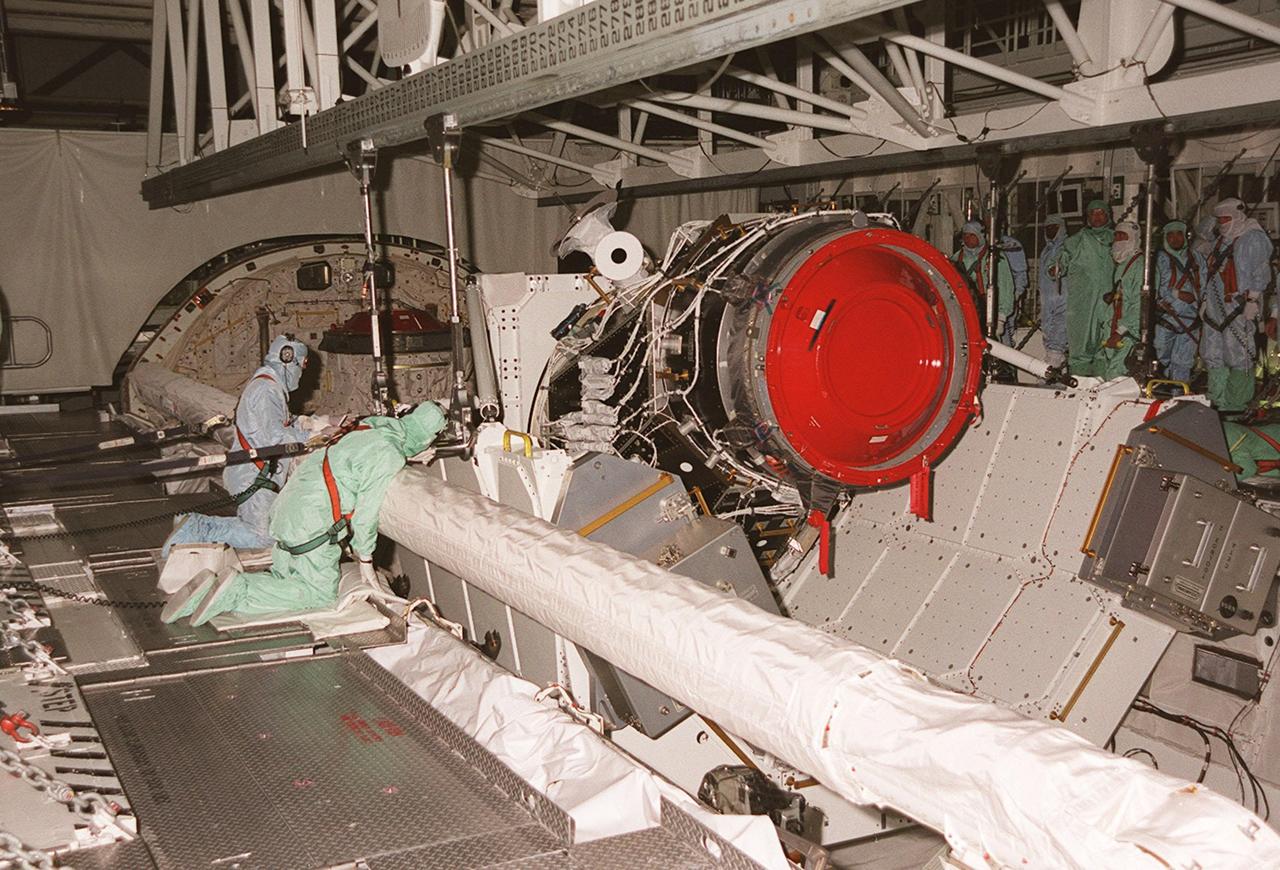
KENNEDY SPACE CENTER, FLA. -- In the Orbiter Processing Facility bay 1, workers check the placement of the Pressurized Mating Adapter -3 (PMA-3) as the overhead crane places it in the payload bay of the orbiter Discovery. A component of the International Space Station, the PMA-3 will fly on Shuttle mission STS-92, scheduled to launch Oct. 5. The mission will be the fifth flight to the Space Station, and the 100th Shuttle flight overall. PMA-3 provides shuttle docking port for solar array installation on flight 4A (mission STS-97 scheduled for Nov. 30), and Lab installation on flight 5A (mission STS-98, scheduled for Jan. 18, 2001)
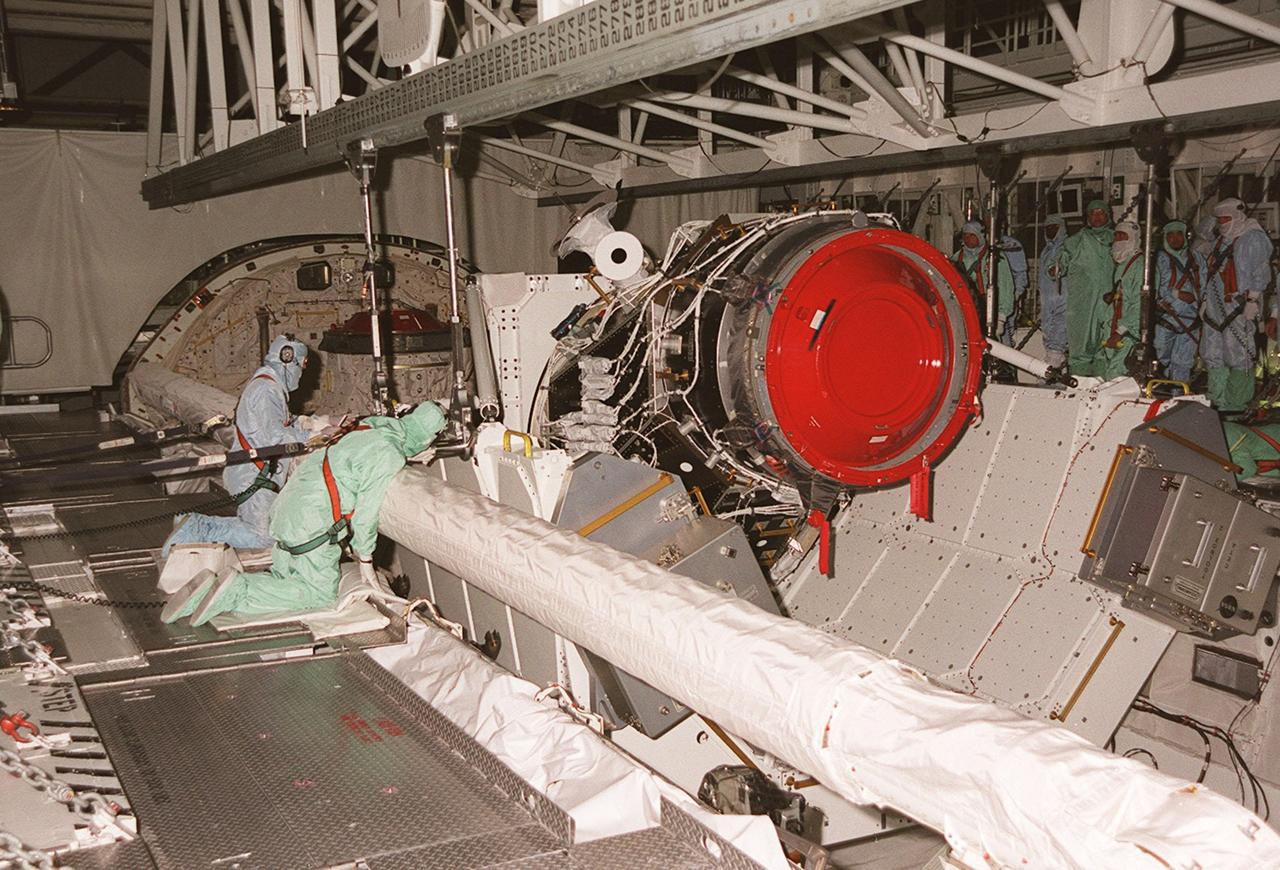
KENNEDY SPACE CENTER, FLA. -- In the Orbiter Processing Facility bay 1, workers check the placement of the Pressurized Mating Adapter -3 (PMA-3) as the overhead crane places it in the payload bay of the orbiter Discovery. A component of the International Space Station, the PMA-3 will fly on Shuttle mission STS-92, scheduled to launch Oct. 5. The mission will be the fifth flight to the Space Station, and the 100th Shuttle flight overall. PMA-3 provides shuttle docking port for solar array installation on flight 4A (mission STS-97 scheduled for Nov. 30), and Lab installation on flight 5A (mission STS-98, scheduled for Jan. 18, 2001)
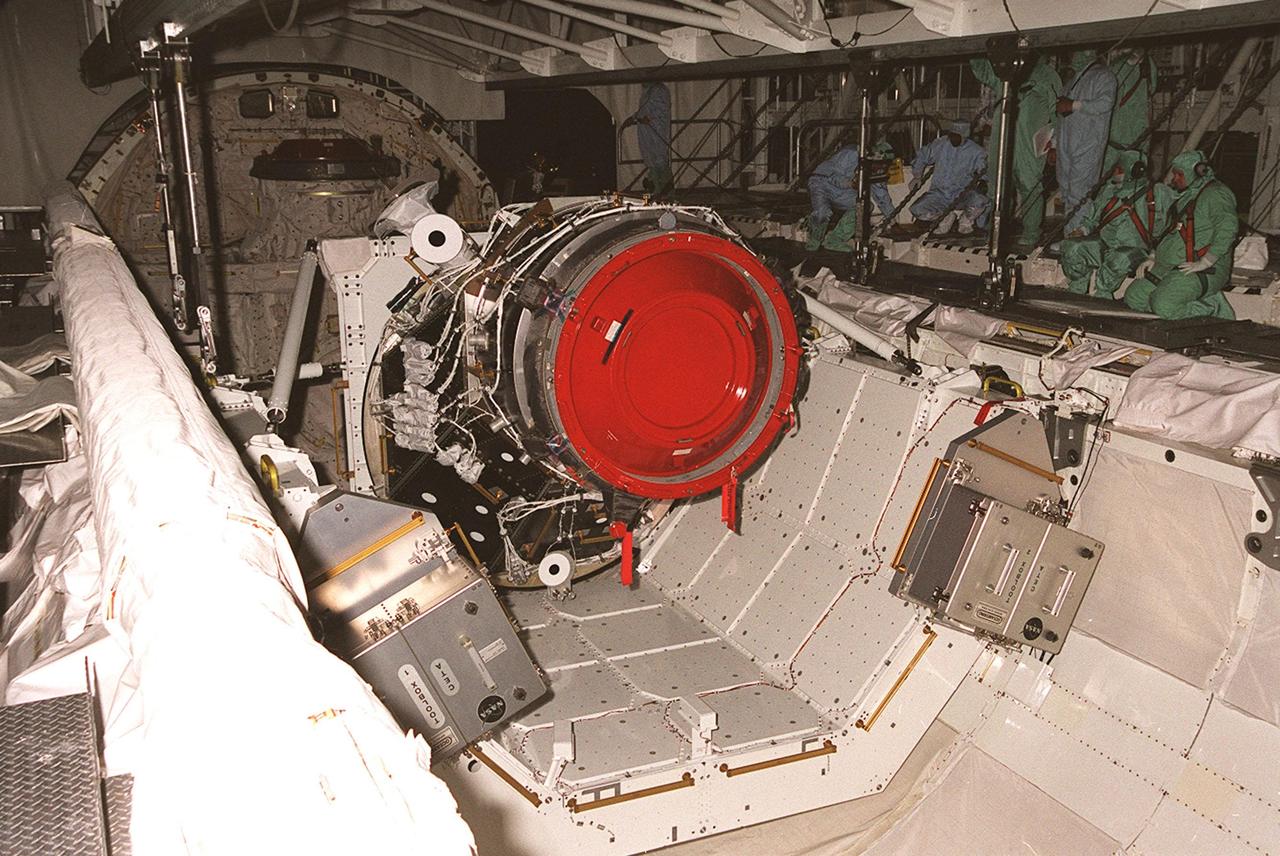
KENNEDY SPACE CENTER, FLA. -- In the Orbiter Processing Facility bay 1, workers detach the overhead crane from the Pressurized Mating Adapter -3 (PMA-3), which sits in the payload bay of the orbiter Discovery. A component of the International Space Station, the PMA-3 will fly on Shuttle mission STS-92, scheduled to launch Oct. 5. The mission will be the fifth flight to the Space Station, and the 100th Shuttle flight overall. PMA-3 provides shuttle docking port for solar array installation on flight 4A (mission STS-97 scheduled for Nov. 30), and Lab installation on flight 5A (mission STS-98, scheduled for Jan. 18, 2001)

In the Orbiter Processing Facility bay 1, the Pressurized Mating Adapter -3 (PMA-3) is lifted out of the payload canister for its transfer to the orbiter Discovery. A component of the International Space Station, the PMA-3 is part of the payload on Shuttle mission STS-92, scheduled to launch Oct. 5. The mission will be the fifth flight to the Space Station, and the 100th Shuttle flight overall. PMA-3 provides shuttle docking port for solar array installation on flight 4A (mission STS-97 scheduled for Nov. 30), and Lab installation on flight 5A (mission STS-98, scheduled for Jan. 18, 2001)

CAPE CANAVERAL, Fla. -- At the Kennedy Space Center in Florida, the Ulysses spacecraft with two attached upper stages –- a payload assist module and an inertial upper stage -- is transferred into the payload canister. Transport from the Vertical Processing Facility to the Payload Changeout Room at the Launch Pad 39B was scheduled for Aug. 27, 1990. The payload will be vertically installed in the cargo bay of the space shuttle Discovery after the shuttle is brought to the pad in September. Ulysses will be deployed during STS-41, set for a launch period extending from Oct. 5 through Oct. 23, 1990. Photo Credit: NASA
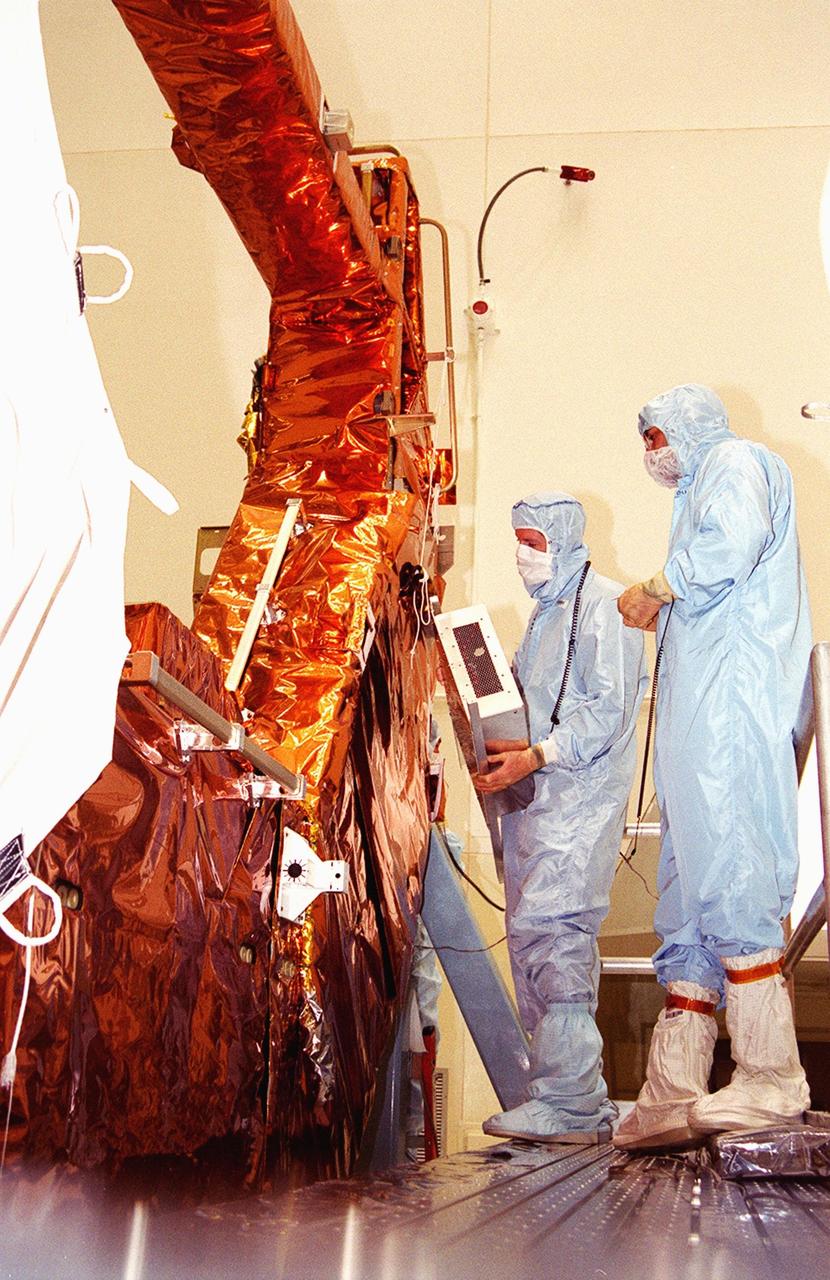
KENNEDY SPACE CENTER, Fla. - Workers in the Vertical Processing Facility check over part of the payload for the Hubble Servicing Mission, STS-109. The primary servicing tasks of the mission are to replace Solar Array 2 with Solar Array 3, replace the Power Control Unit, remove the Faint Object Camera and install the Advanced Camera for Surveys, install the NICMOS Cooling System, and install New Outer Blanket Insulation on bays 5 through 8. Mission STS-109 is scheduled for launch in mid-February 2002
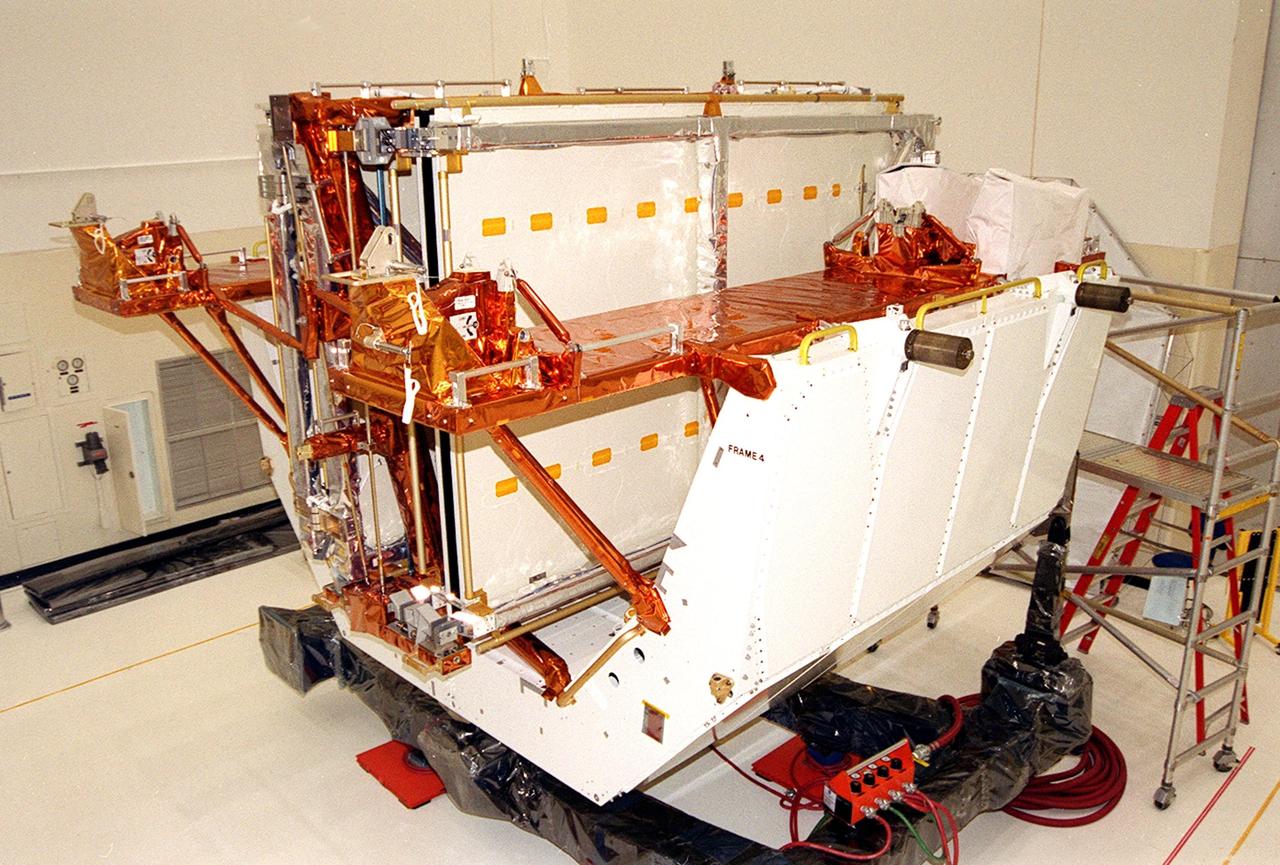
KENNEDY SPACE CENTER, Fla. -- Solar arrays part of the payload for the Hubble Servicing Mission, STS-109, await processing in the Vertical Processing Facility. The primary servicing tasks of the mission are to replace Solar Array 2 with Solar Array 3, replace the Power Control Unit, remove the Faint Object Camera and install the Advanced Camera for Surveys, install the NICMOS Cooling System, and install New Outer Blanket Insulation on bays 5 through 8. Mission STS-109 is scheduled for launch in mid-February 2002
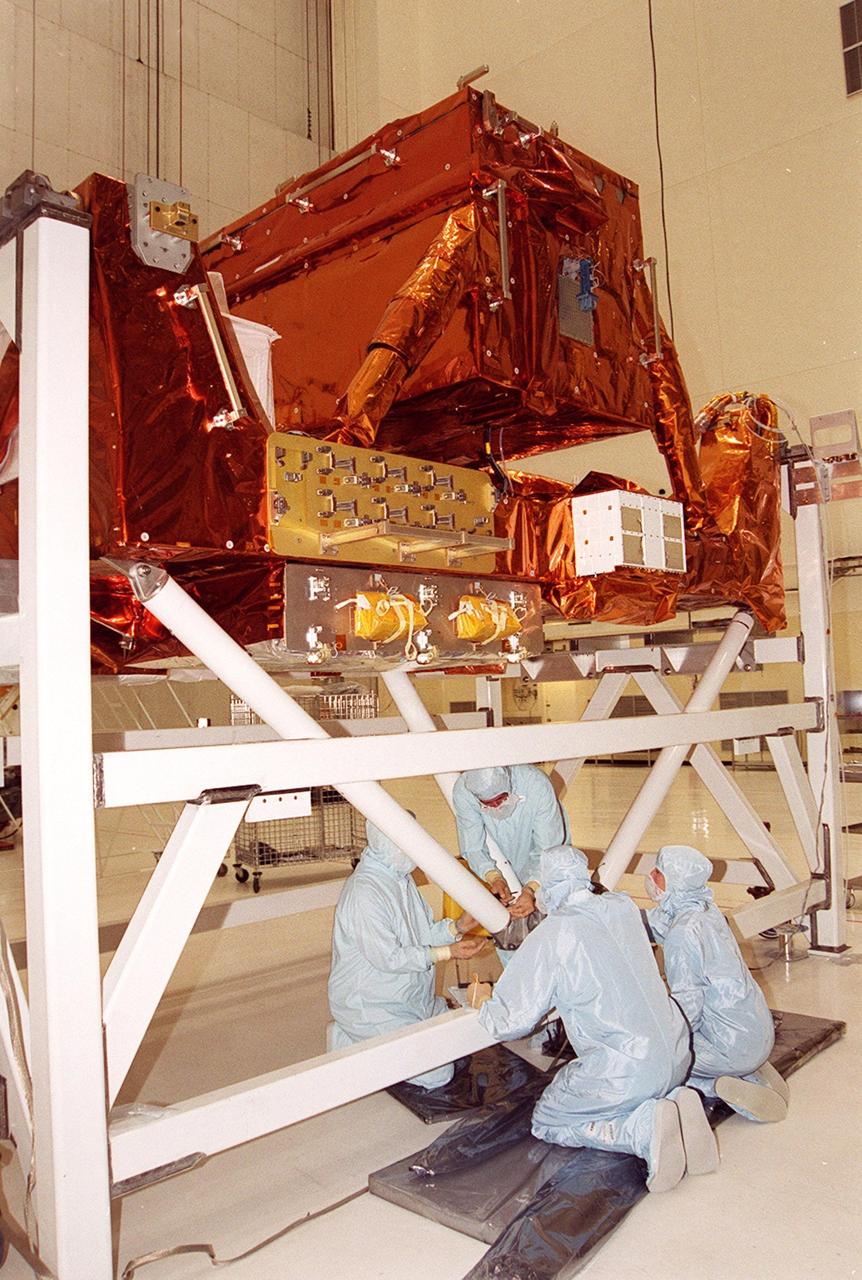
KENNEDY SPACE CENTER, Fla. - Workers begin preparations for testing part of the payload (behind them) for the Hubble Servicing Mission, STS-109. The primary servicing tasks of the mission are to replace Solar Array 2 with Solar Array 3, replace the Power Control Unit, remove the Faint Object Camera and install the Advanced Camera for Surveys, install the NICMOS Cooling System, and install New Outer Blanket Insulation on bays 5 through 8. Mission STS-109 is scheduled for launch in mid-February 2002
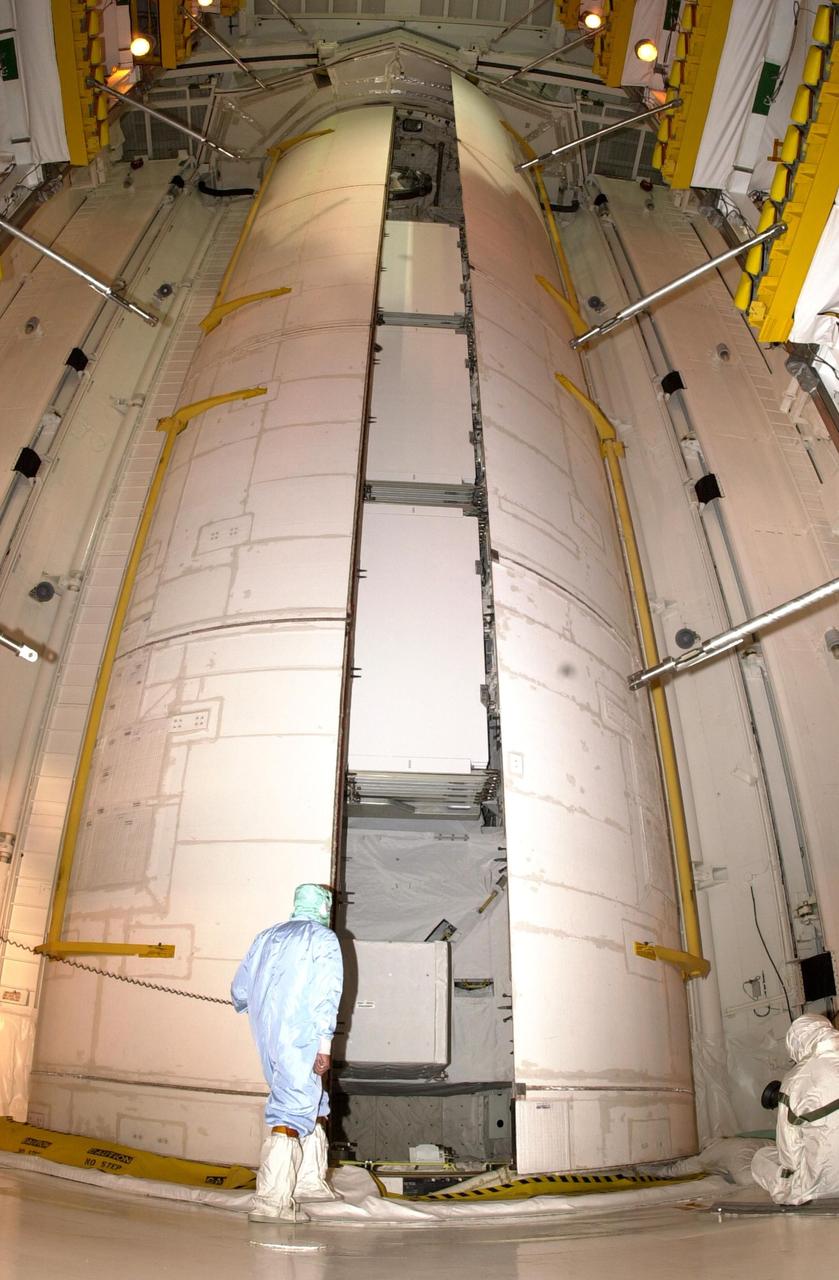
KENNEDY SPACE CENTER, FLA. - A worker on Launch Pad 39A watches over the closing of Space Shuttle Endeavour's payload bay doors in preparation for launch. The 16th assembly flight to the International Space Station, STS-113 will carry the Port 1 (P1) truss aboard Space Shuttle Endeavour as well as the Expedition 6 crew, who will replace Expedition 5 on the Station. Mission STS-113 is scheduled to launch Nov. 10, 2002.
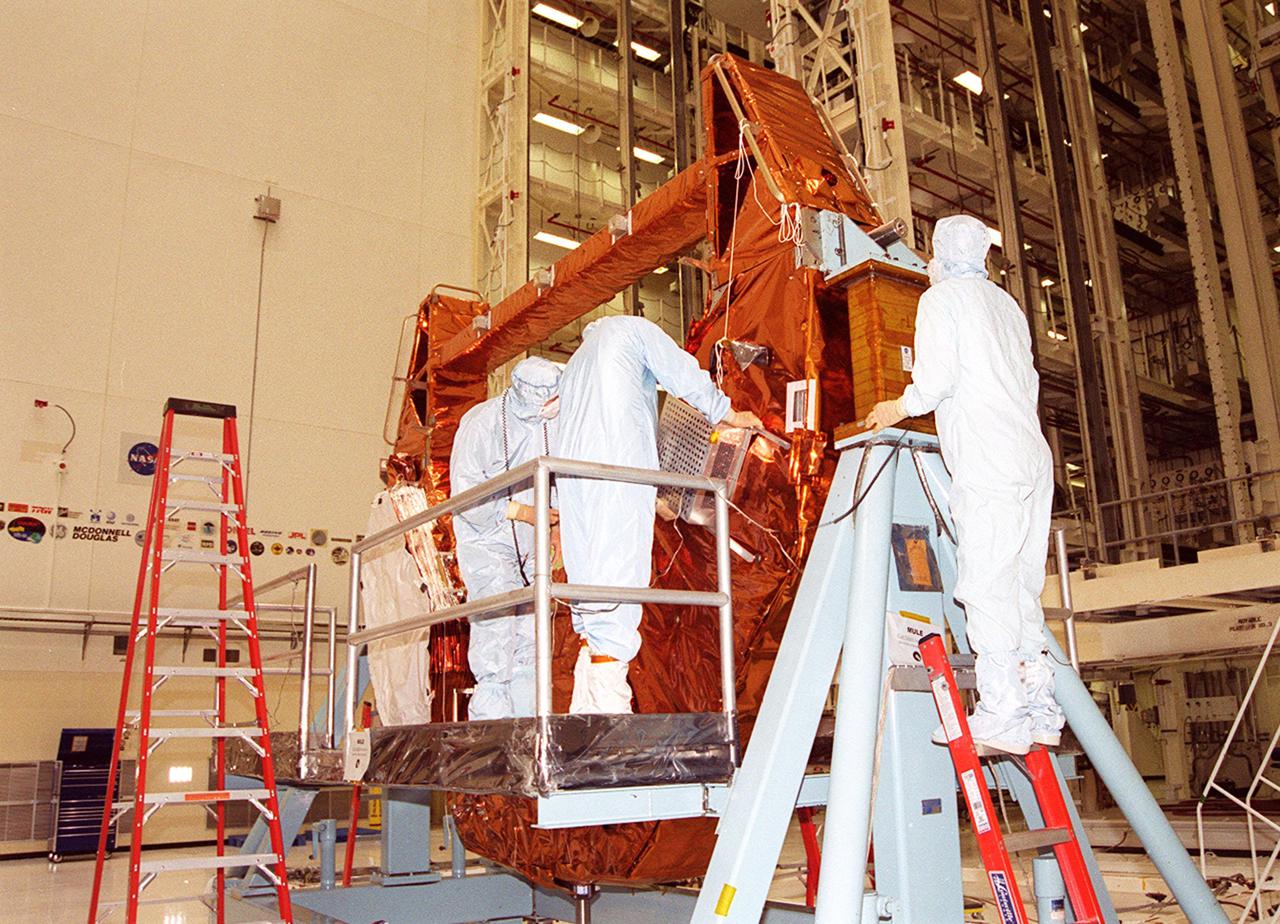
KENNEDY SPACE CENTER, Fla. - Workers in the Vertical Processing Facility check out equipment that is part of the payload for the Hubble Servicing Mission, STS-109. The primary servicing tasks of the mission are to replace Solar Array 2 with Solar Array 3, replace the Power Control Unit, remove the Faint Object Camera and install the Advanced Camera for Surveys, install the NICMOS Cooling System, and install New Outer Blanket Insulation on bays 5 through 8. Mission STS-109 is scheduled for launch in mid-February 2002
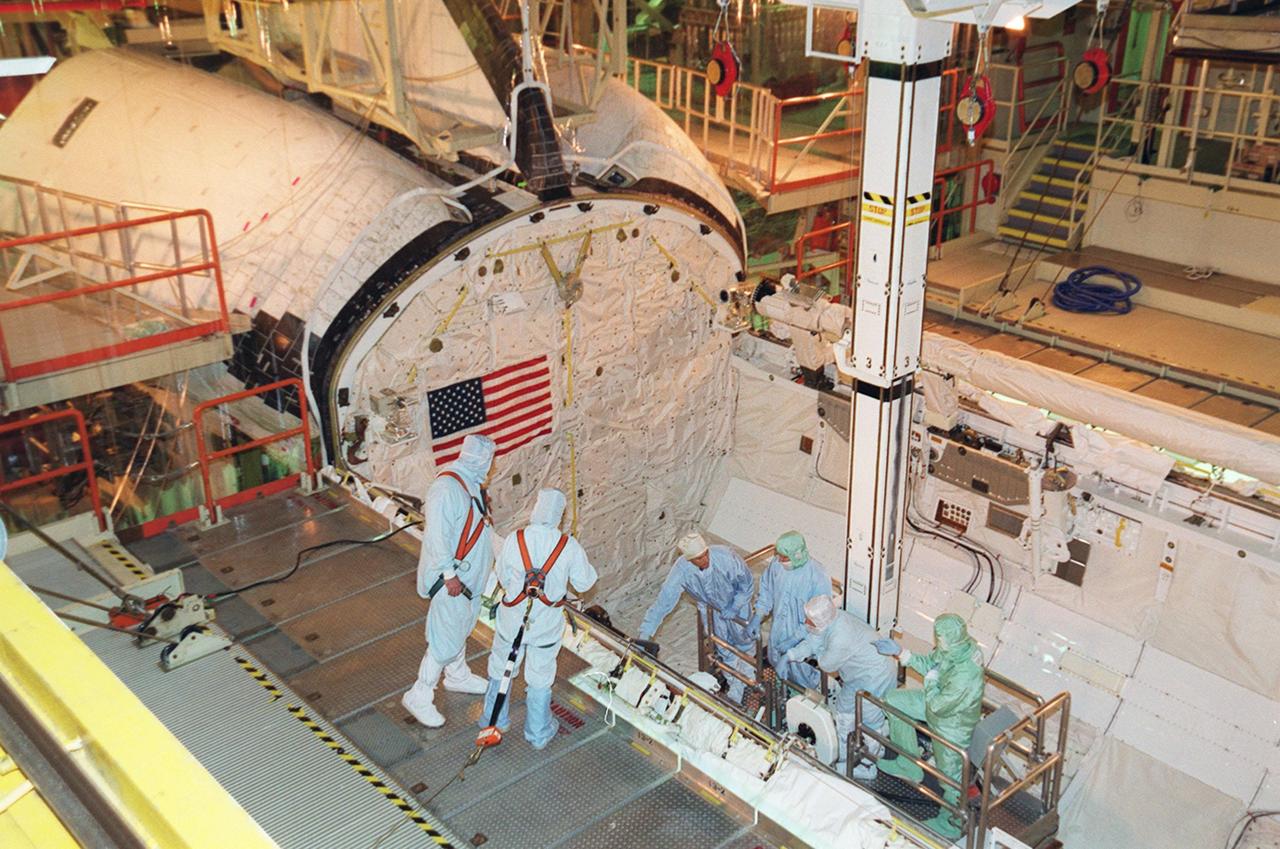
KENNEDY SPACE CENTER, Fla. - Members of the STS-109 crew are lowered into the payload bay of orbiter Columbia to check out some of the equipment. The crew is at KSC to take part in Crew Equipment Interface Test activities that include familiarization with the orbiter and equipment. The goal of the mission is to service the HST, replacing Solar Array 2 with Solar Array 3, replacing the Power Control Unit, removing the Faint Object Camera and installing the Advanced Camera for Surveys, installing the Near Infrared Camera and Multi-Object Spectrometer (NICMOS) Cooling System, and installing New Outer Blanket Layer insulation on bays 5 through 8. Mission STS-109 is scheduled for launch Feb. 14, 2002
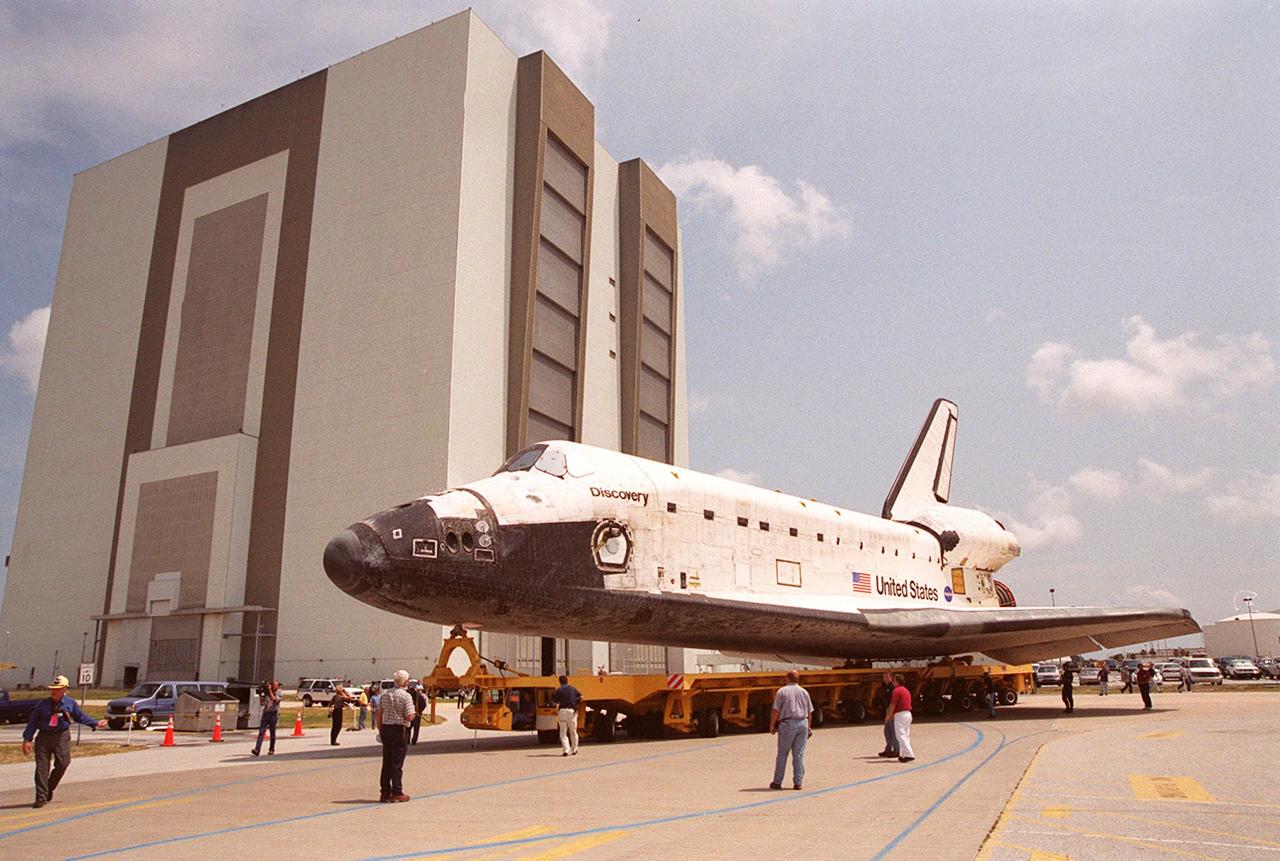
KENNEDY SPACE CENTER, FLA. -- KSC workers watch as the orbiter Discovery makes the turn around the Vehicle Assembly Building on its move from Orbiter Processing Facility (OPF) bay 1 to OPF bay 3. Ongoing payload and ground processing assessments will be completed in bay 3. Managers will then determine when to roll the orbiter to the Vehicle Assembly Building for stacking with the external tank and solid rocket boosters, and when to roll out to Launch Pad 39A. Discovery is scheduled to launch Oct. 5 at 9:30 p.m. EDT on mission STS-92, which will be the 100th flight in the Shuttle program
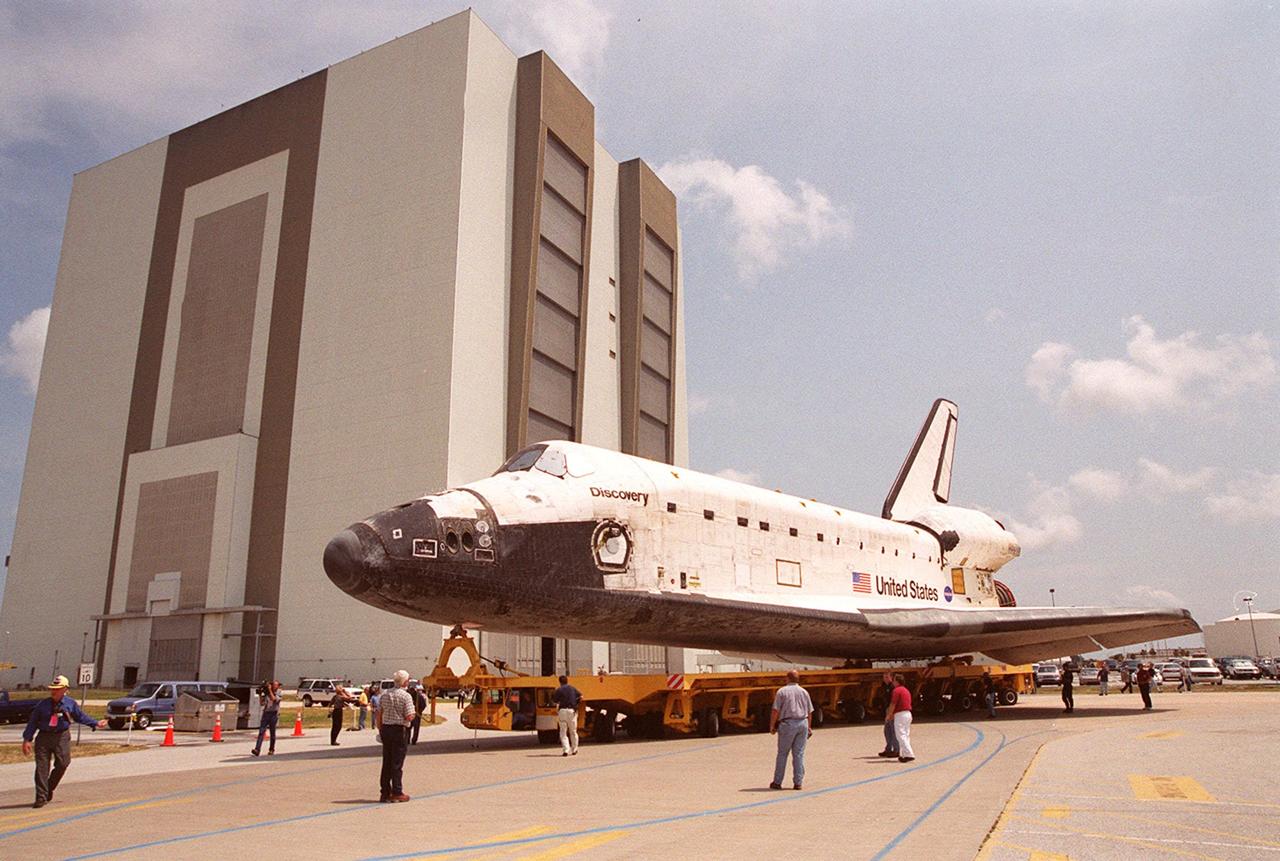
KENNEDY SPACE CENTER, FLA. -- KSC workers watch as the orbiter Discovery makes the turn around the Vehicle Assembly Building on its move from Orbiter Processing Facility (OPF) bay 1 to OPF bay 3. Ongoing payload and ground processing assessments will be completed in bay 3. Managers will then determine when to roll the orbiter to the Vehicle Assembly Building for stacking with the external tank and solid rocket boosters, and when to roll out to Launch Pad 39A. Discovery is scheduled to launch Oct. 5 at 9:30 p.m. EDT on mission STS-92, which will be the 100th flight in the Shuttle program
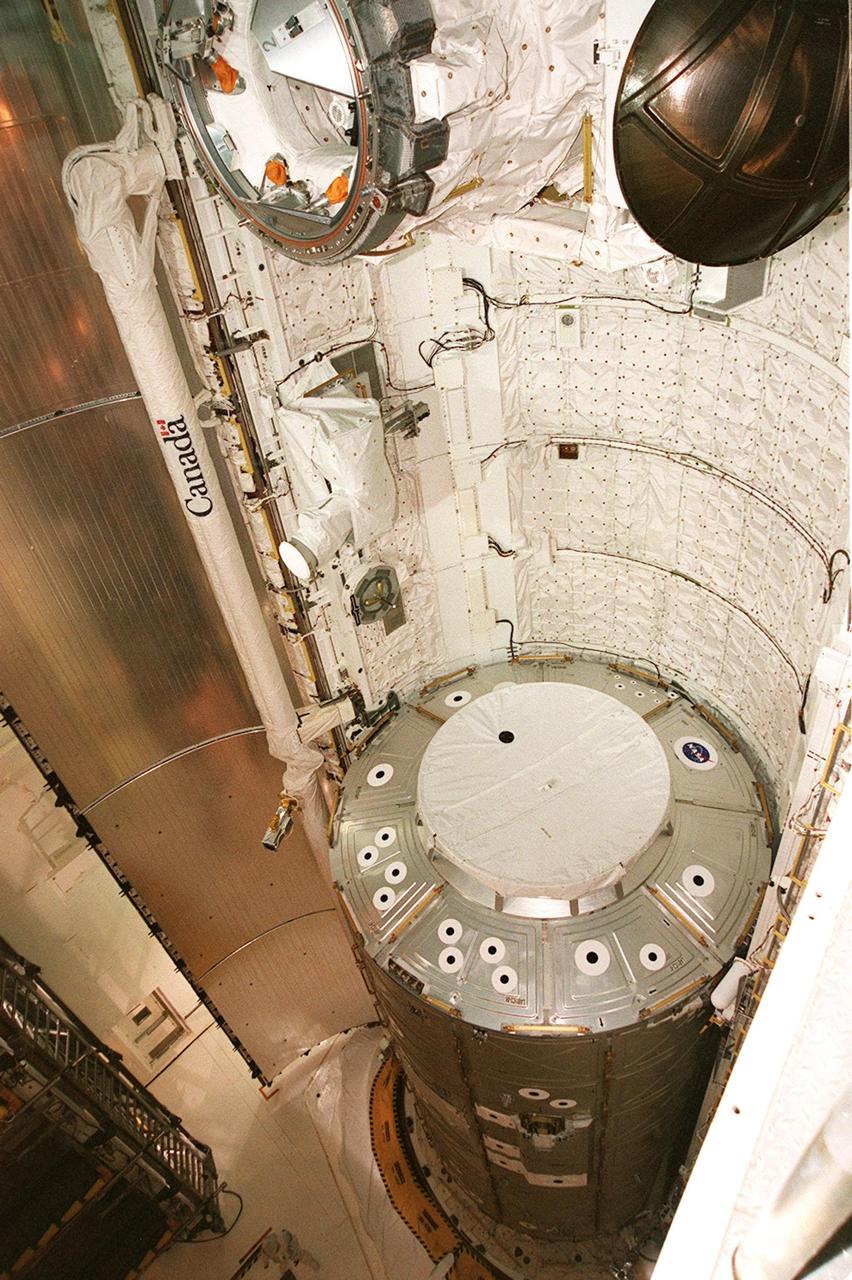
KENNEDY SPACE CENTER, FLA. -- In this view from Level 5, wing platform, of Atlantis’ payload bay, the U.S. Lab Destiny can be seen near the bottom. A key element in the construction of the International Space Station, Destiny is 28 feet long and weighs 16 tons. Destiny will be attached to the Unity node of the ISS using the Shuttle’s robot arm, seen here on the left with the help of an elbow camera, facing left. Measurements of the elbow camera revealed only a one-inch clearance from the U.S. Lab payload, which is under review. Destiny will fly on STS-98, the seventh construction flight to the ISS. Launch of STS-98 is scheduled for Jan. 19 at 2:11 a.m. EST
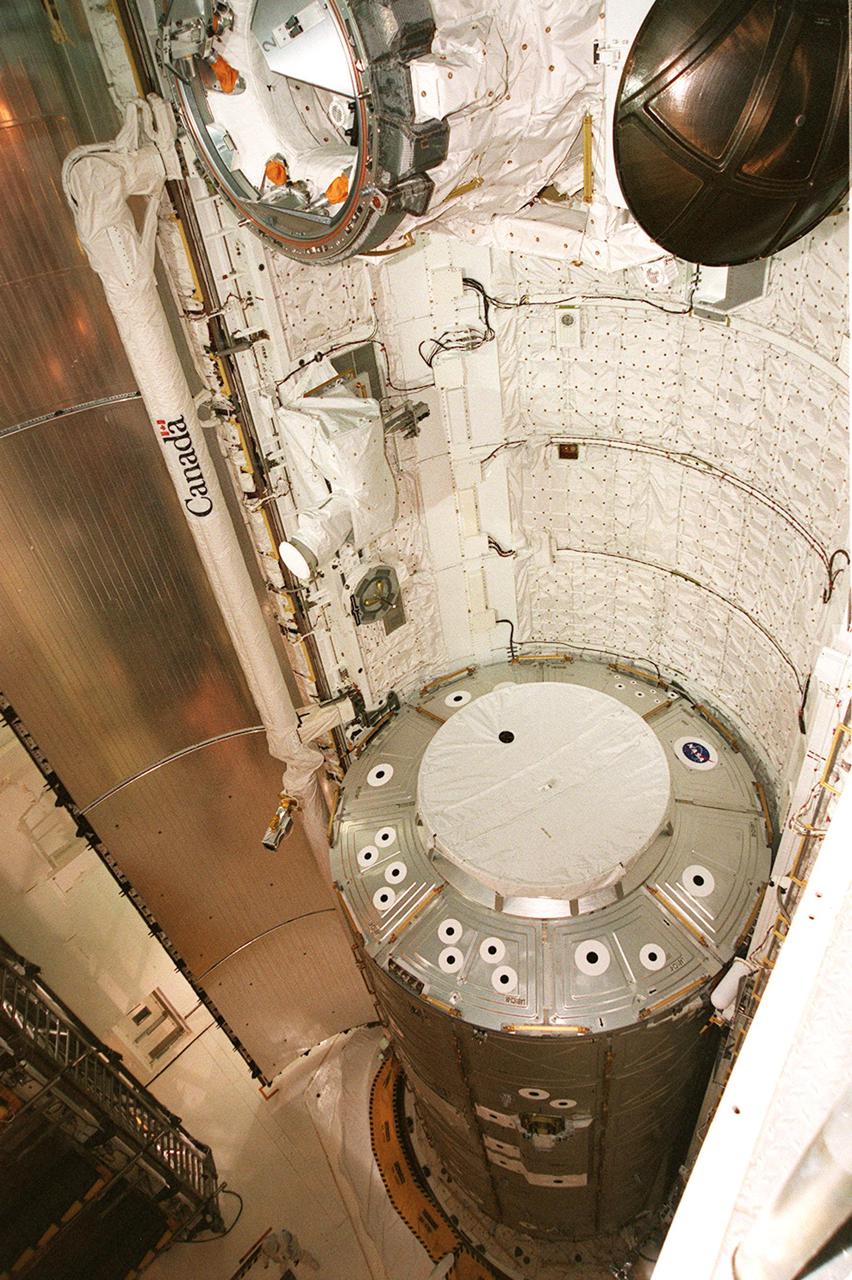
KENNEDY SPACE CENTER, FLA. -- In this view from Level 5, wing platform, of Atlantis’ payload bay, the U.S. Lab Destiny can be seen near the bottom. A key element in the construction of the International Space Station, Destiny is 28 feet long and weighs 16 tons. Destiny will be attached to the Unity node of the ISS using the Shuttle’s robot arm, seen here on the left with the help of an elbow camera, facing left. Measurements of the elbow camera revealed only a one-inch clearance from the U.S. Lab payload, which is under review. Destiny will fly on STS-98, the seventh construction flight to the ISS. Launch of STS-98 is scheduled for Jan. 19 at 2:11 a.m. EST
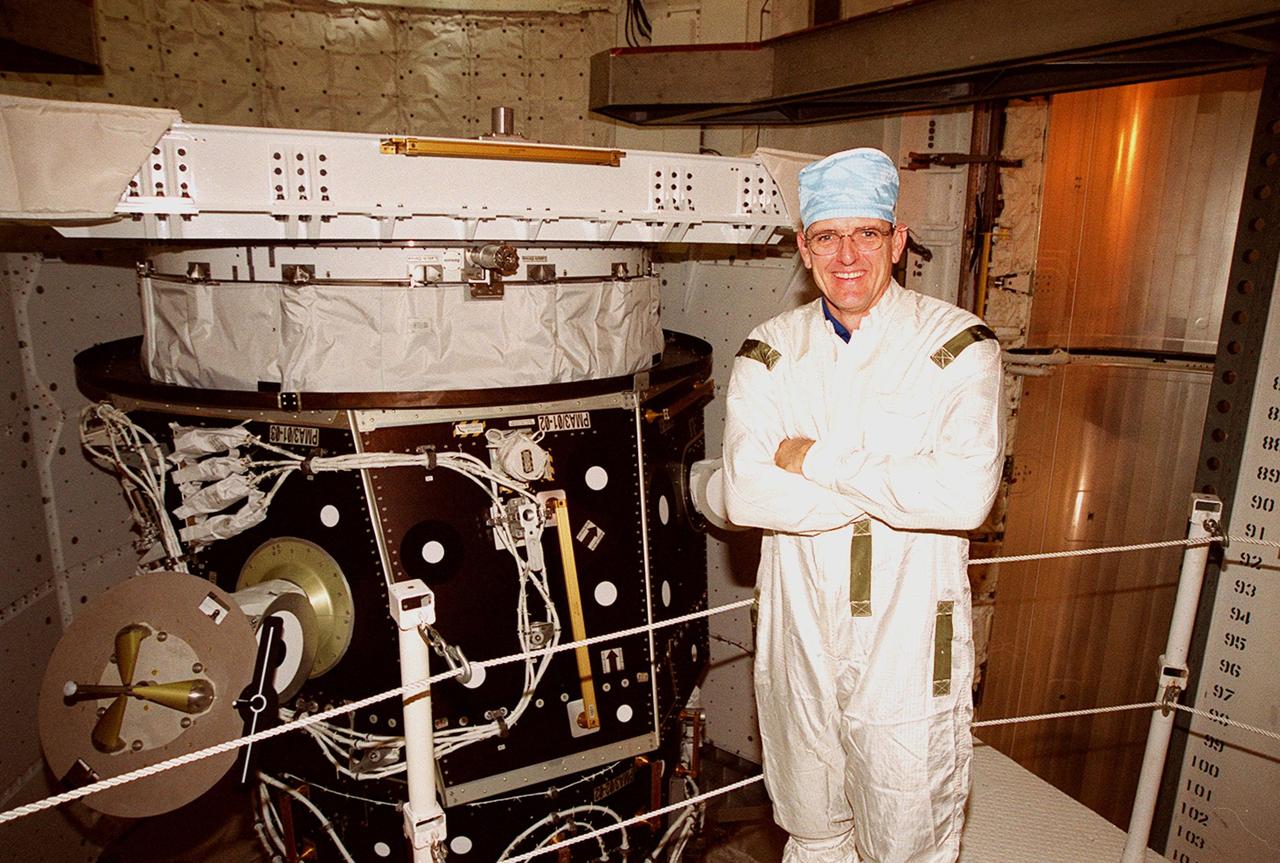
STS-92 Mission Specialist William S. McArthur Jr. smiles for the camera during inspection of the payload (left) in Space Shuttle Discovery’s payload bay. He and other crew members Commander Brian Duffy, Pilot Pamela Ann Melroy and Mission Specialists Koichi Wakata of Japan, Leroy Chiao, Peter J.K. “Jeff” Wisoff and Michael E. Lopez-Alegria are preparing for launch on Oct. 5, 2000. The mission is the fifth flight for the construction of the International Space Station. The payload includes the Integrated Truss Structure Z-1 and the third Pressurized Mating Adapter. During the 11-day mission, four extravehicular activities (EVAs), or space walks, are planned
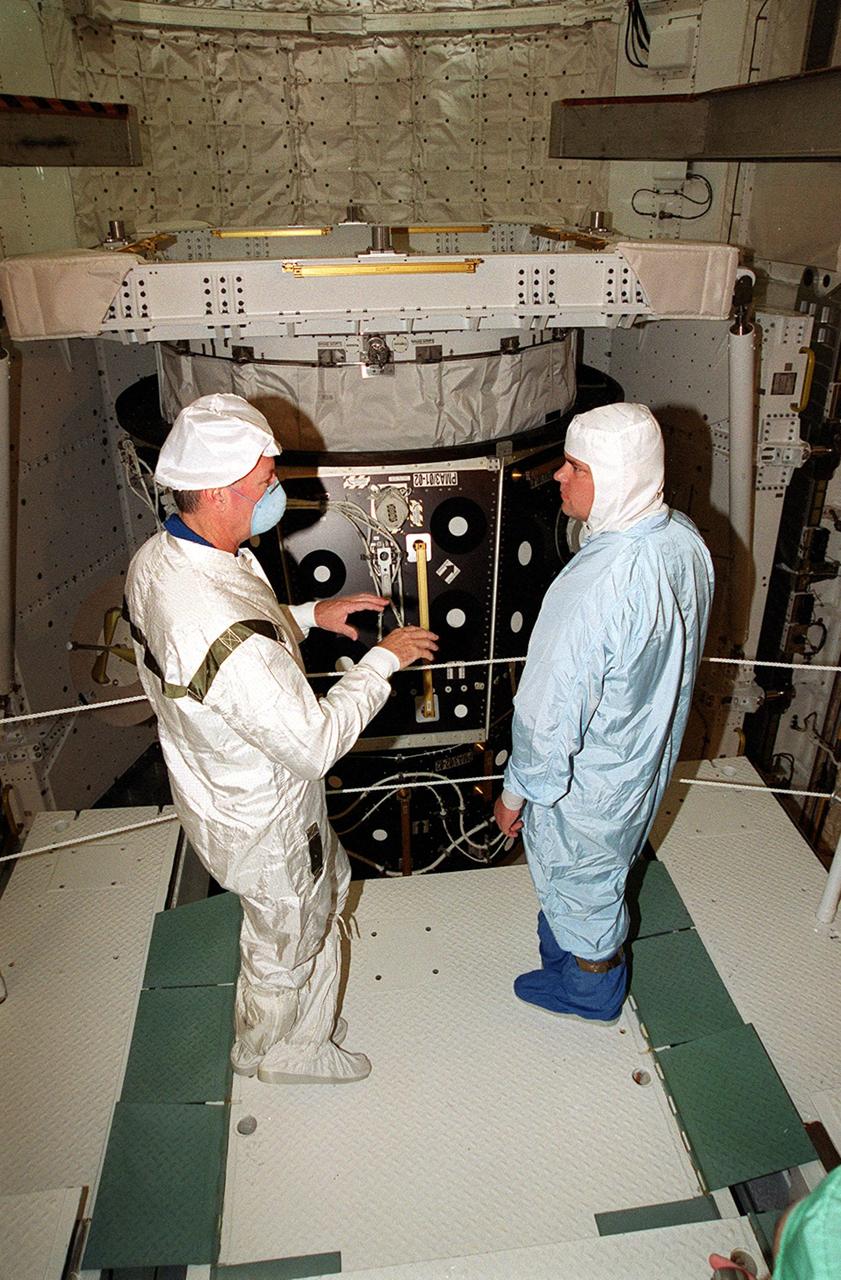
STS-92 Commander Brian Duffy (left) talks with a worker during inspection of the payload (behind them) in Space Shuttle Discovery’s payload bay. He and other crew members Pilot Pamela Ann Melroy and Mission Specialists Koichi Wakata of Japan, Leroy Chiao, Peter J.K. “Jeff” Wisoff, Michael E. Lopez-Alegria and William S. McArthur Jr. are preparing for launch on Oct. 5, 2000. The mission is the fifth flight for the construction of the International Space Station. The payload includes the Integrated Truss Structure Z-1 and the third Pressurized Mating Adapter. During the 11-day mission, four extravehicular activities (EVAs), or space walks, are planned
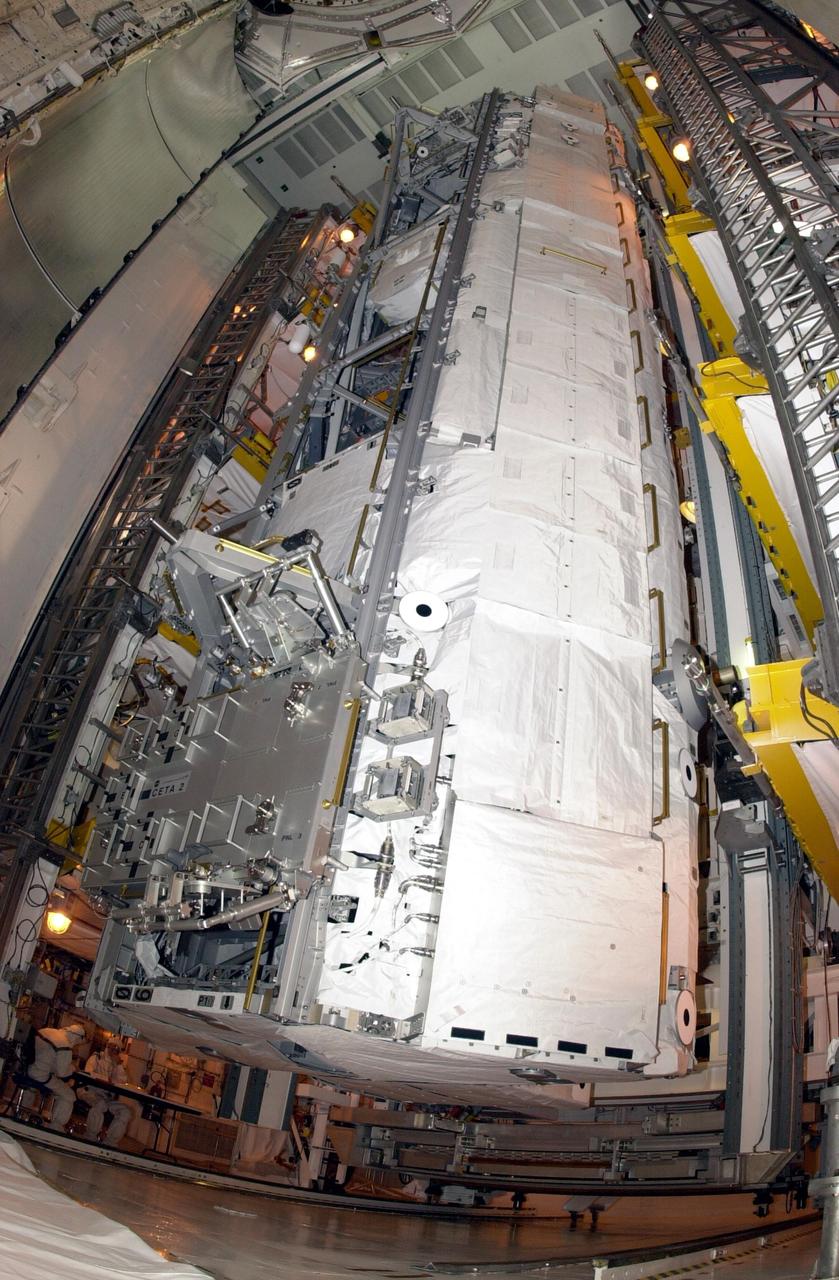
KENNEDY SPACE CENTER, FLA. - From the Payload Changeout Room on Launch Pad 39A, the P1 truss payload, plus the Crew and Equipment Translation Aid (CETA) cart B, are moved into the payload bay of Space Shuttle Endeavour. Scheduled to launch Nov. 10 on mission STS-113, Endeavour will make the 16th assembly flight to the International Space Station. Once delivered, the P1 truss will remain stowed until flight 12A.1 in 2003 when it will be attached to the central truss segment, S0, on the Space Station. The mission will also deliver the Expedition 6 crew to the Station and return Expedition 5 to Earth.

KENNEDY SPACE CENTER, FLA. -- At Launch Complex 39A, the P1 Truss Segment arrives at the Payload Changeout Room in preparation for installation into Endeavour's payload bay. The P1 truss is the primary payload for Mission STS-113 to the International Space Station. It is the first port truss segment which will be attached to the Station’s central truss segment, S0. Once delivered, the P1 truss will remain stowed until flight 12A.1. The mission will also deliver the Expedition 6 crew to the Station and return Expedition 5 to Earth. Space Shuttle Endeavour is scheduled to launch no earlier than Nov. 10 on the 11-day mission.
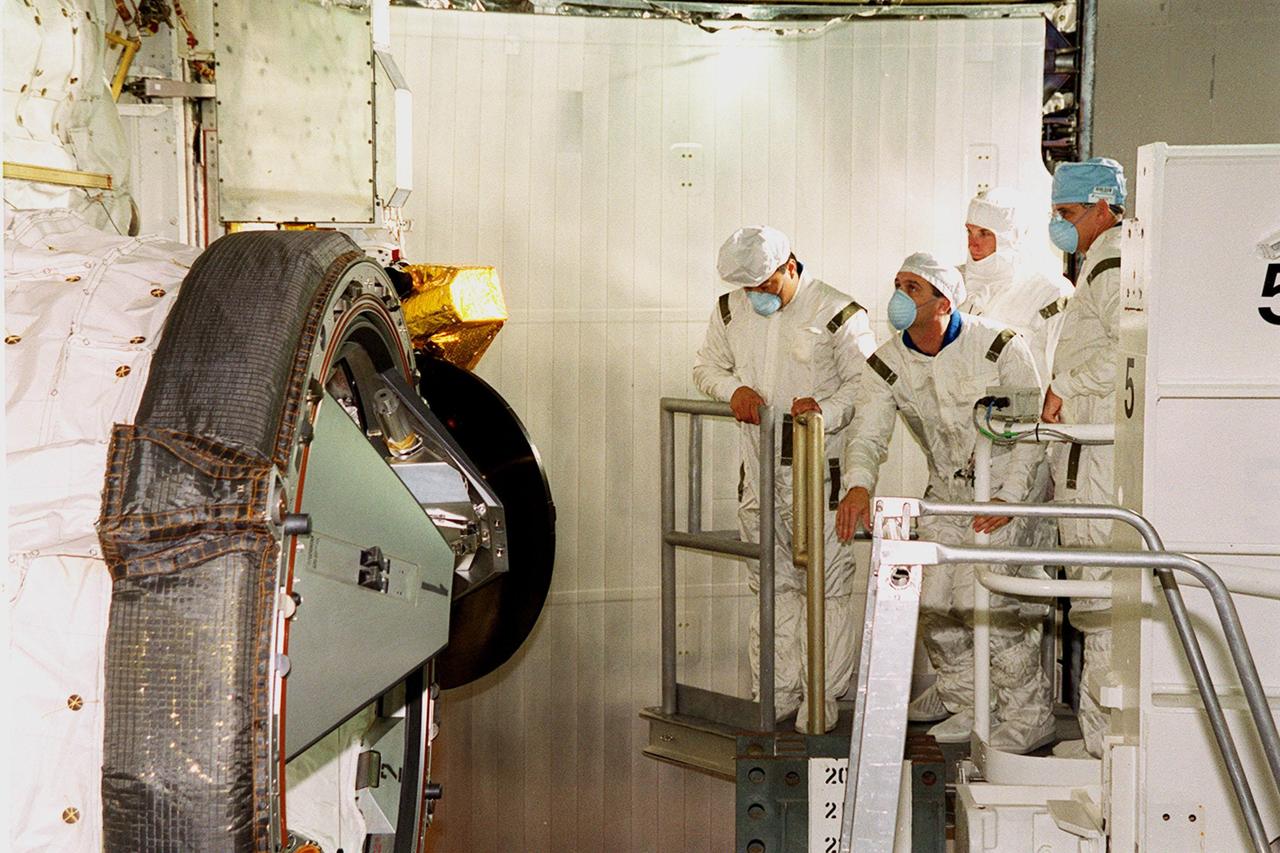
Members of the STS-92 crew look over the payload (left) in Space Shuttle Discovery’s payload bay. Left to right, in masks, are Mission Specialists Leroy Chiao, Peter J.K. “Jeff” Wisoff and William S. McArthur Jr. They and the other crew members Commander Brian Duffy, Pilot Pamela Ann Melroy and Mission Specialists Koichi Wakata of Japan, and Michael E. Lopez-Alegria are preparing for launch on Oct. 5, 2000. The mission is the fifth flight for the construction of the International Space Station. The payload includes the Integrated Truss Structure Z-1 and the third Pressurized Mating Adapter. During the 11-day mission, four extravehicular activities (EVAs), or space walks, are planned
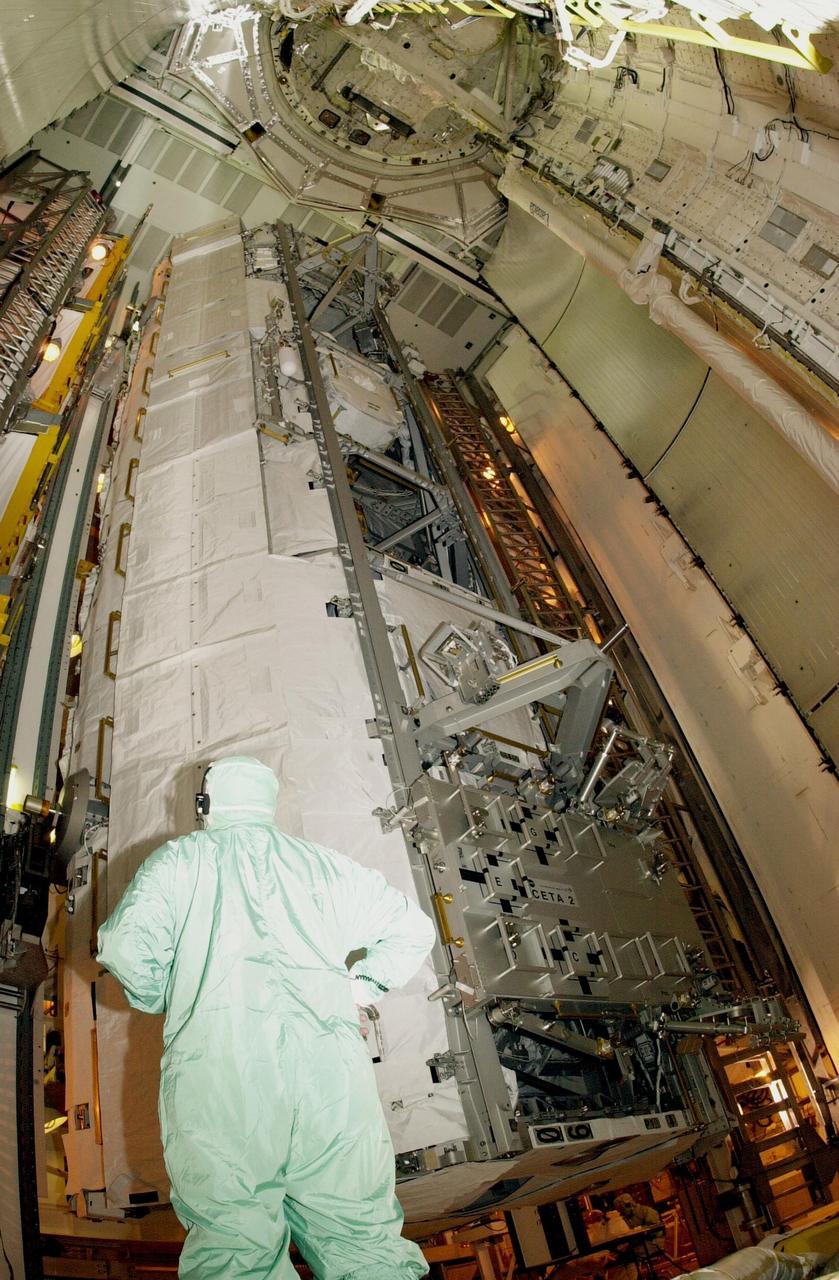
KENNEDY SPACE CENTER, FLA. -- A worker in the Payload Changeout Room on Launch Pad 39A watches as the P1 truss payload, plus the Crew and Equipment Translation Aid (CETA) cart B, move into the payload bay of Space Shuttle Endeavour. Scheduled to launch Nov. 10 on mission STS-113, Endeavour will make the 16th assembly flight to the International Space Station. Once delivered, the P1 truss will remain stowed until flight 12A.1 in 2003 when it will be attached to the central truss segment, S0, on the Space Station. The mission will also deliver the Expedition 6 crew to the Station and return Expedition 5 to Earth.
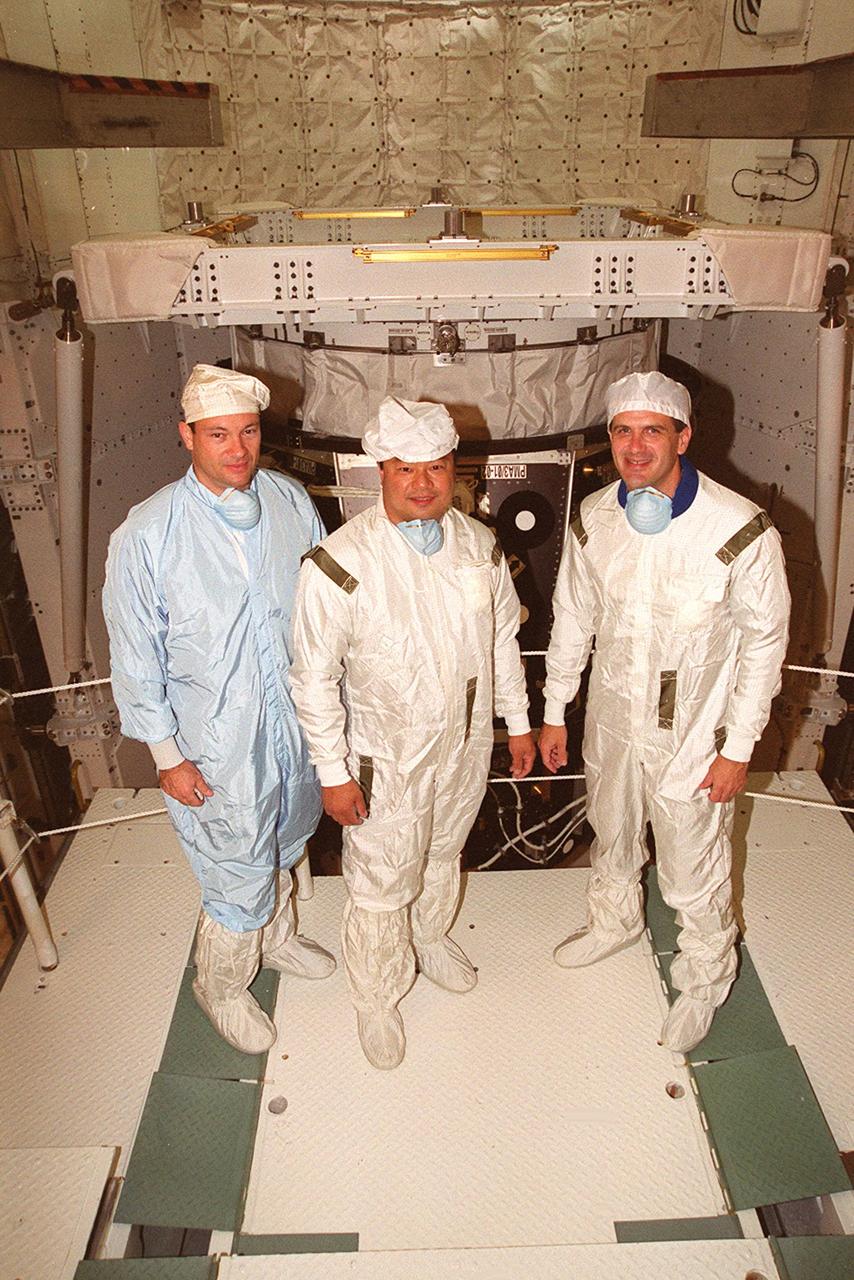
KENNEDY SPACE CENTER, FLA. -- During inspection of the payload in Space Shuttle Discovery’s payload bay (background), STS-92 Mission Specialists Michael E. Lopez-Alegria, Leroy Chiao and Peter J.K. “Jeff” Wisoff pause for a photo. They and other crew members Commander Brian Duffy, Pilot Pamela Ann Melroy and Mission Specialists Koichi Wakata of Japan and William S. McArthur Jr. are preparing for launch on Oct. 5, 2000. The mission is the fifth flight for the construction of the International Space Station. The payload includes the Integrated Truss Structure Z-1 and the third Pressurized Mating Adapter. During the 11-day mission, four extravehicular activities (EVAs), or space walks, are planned
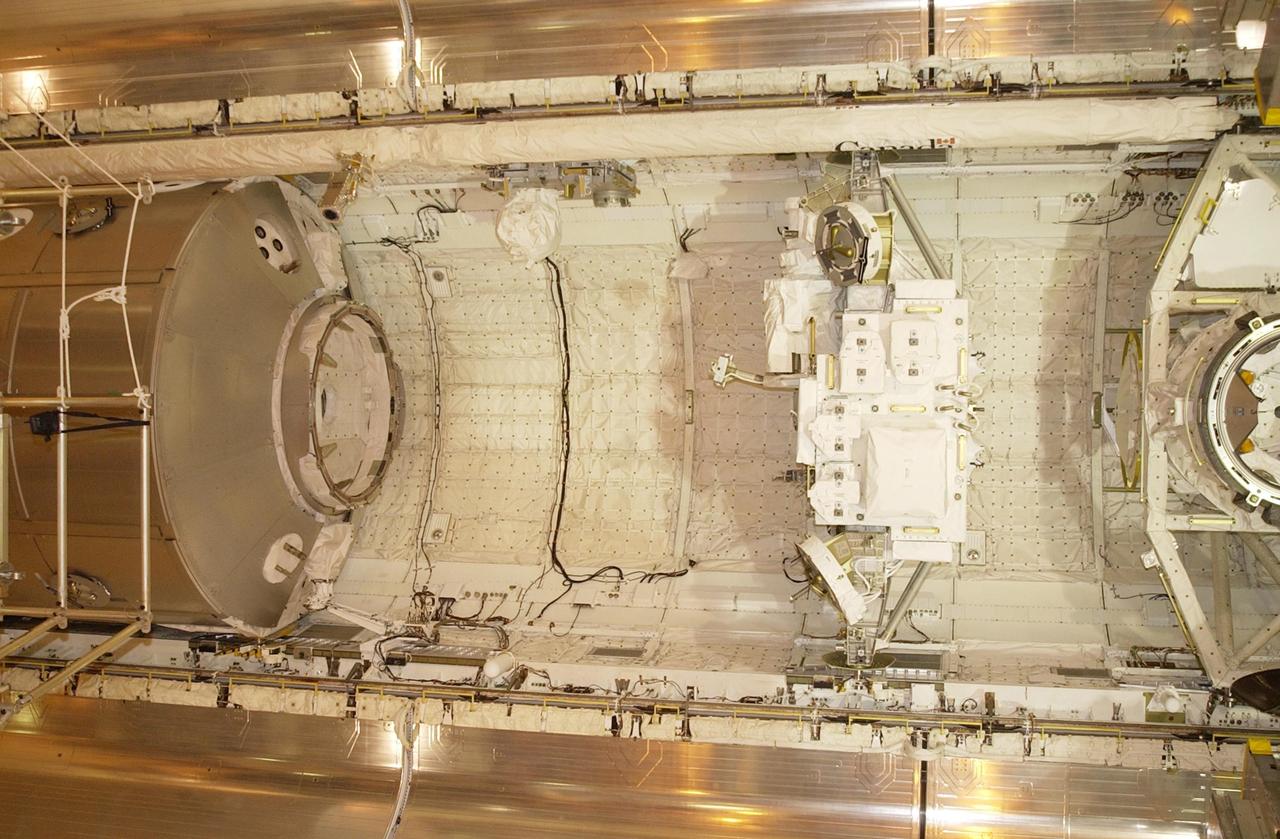
KENNEDY SPACE CENTER, FLA. - With the SPACEHAB and Hitchhiker payloads already installed, Endeavour's payload bay is ready for installation of the Multi-Purpose Logistics Module Leonardo for mission STS-111. The mission, known as Utilization Flight 2, is carrying supplies and equipment to the International Space Station. The payload includes the Multi-Purpose Logistics Module Leonardo, the Mobile Base System, which will be installed on the Mobile Transporter to complete the Canadian Mobile Servicing System, and a replacement wrist/roll joint for Canadarm 2. Also part of the mission, Expedition 5 will travel to the Station as the replacement crew for Expedition 4, who will return to Earth aboard the orbiter. Launch is scheduled for May 30, 2002
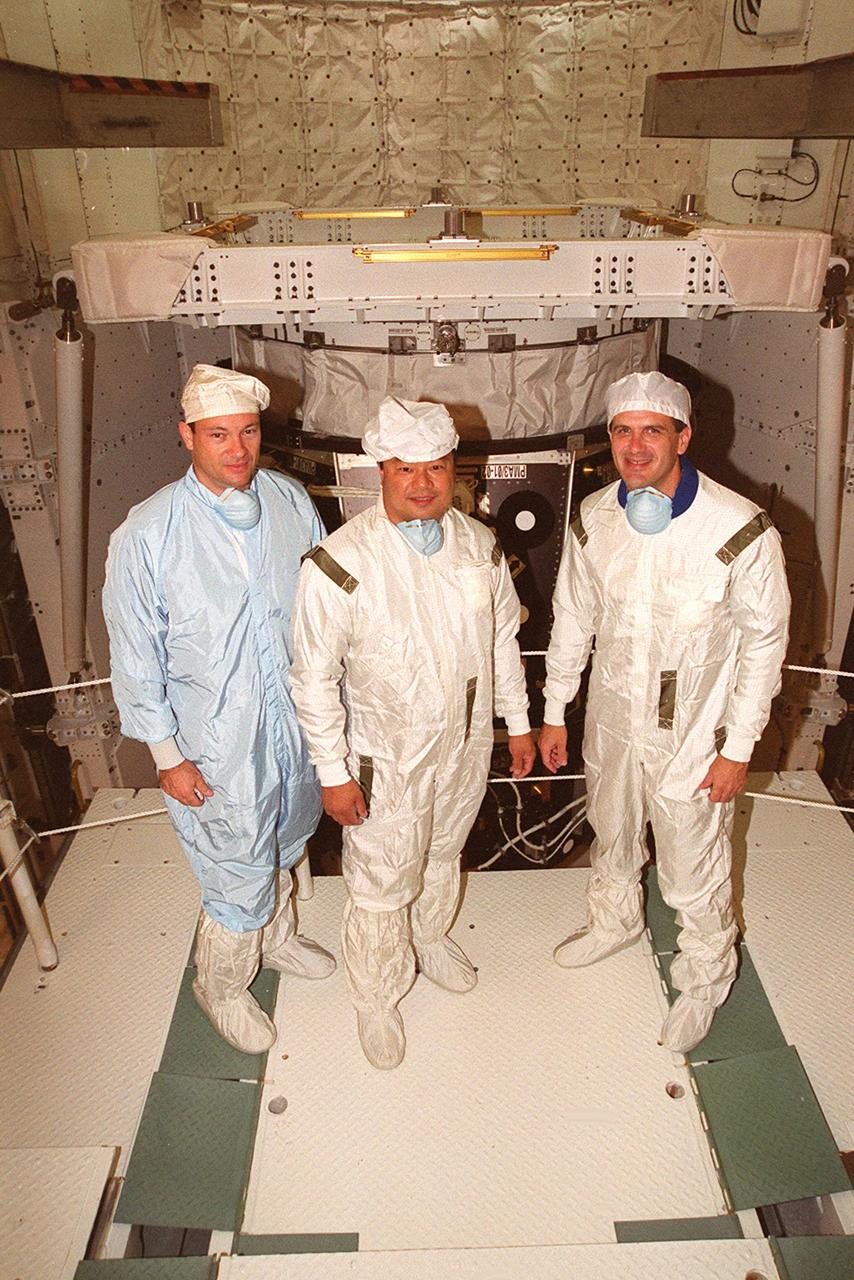
KENNEDY SPACE CENTER, FLA. -- During inspection of the payload in Space Shuttle Discovery’s payload bay (background), STS-92 Mission Specialists Michael E. Lopez-Alegria, Leroy Chiao and Peter J.K. “Jeff” Wisoff pause for a photo. They and other crew members Commander Brian Duffy, Pilot Pamela Ann Melroy and Mission Specialists Koichi Wakata of Japan and William S. McArthur Jr. are preparing for launch on Oct. 5, 2000. The mission is the fifth flight for the construction of the International Space Station. The payload includes the Integrated Truss Structure Z-1 and the third Pressurized Mating Adapter. During the 11-day mission, four extravehicular activities (EVAs), or space walks, are planned
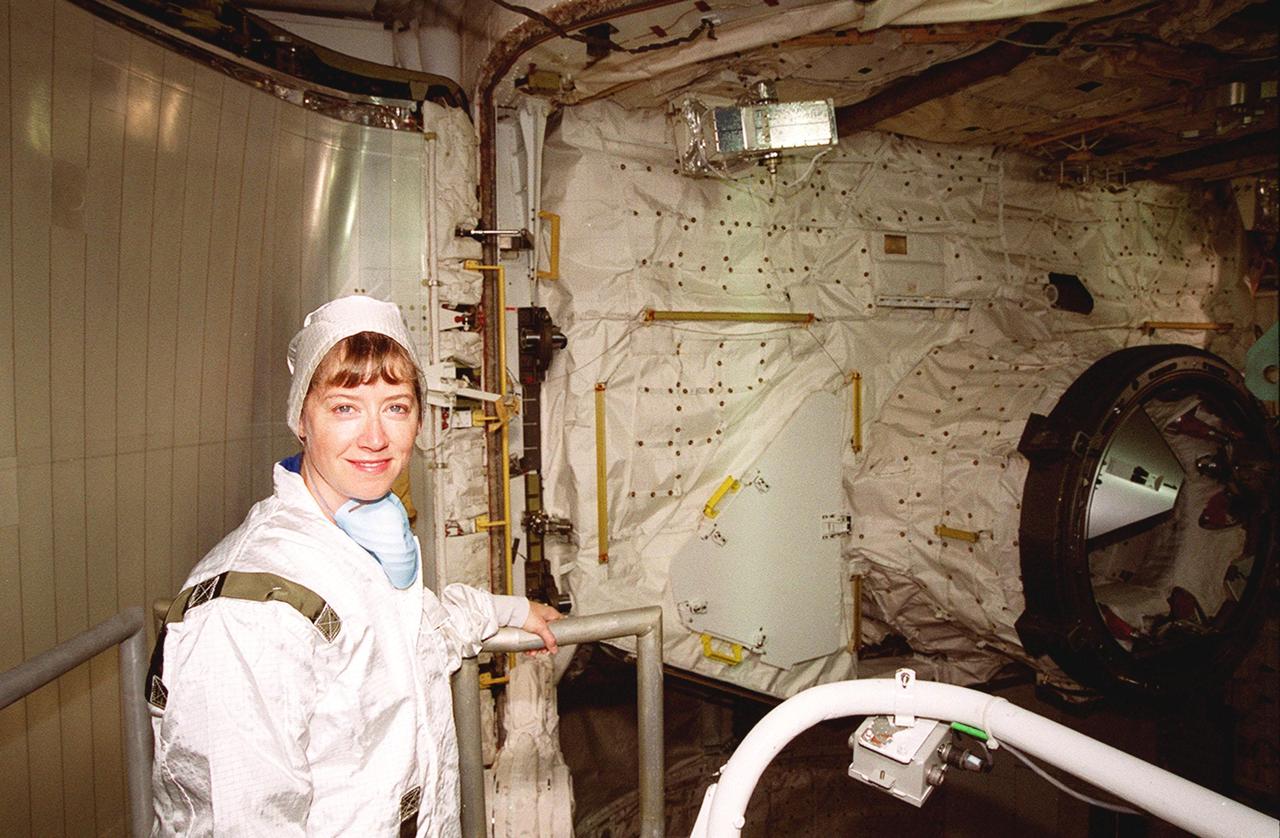
STS-92 Pamela Ann Melroy pauses during inspection of the payload (behind her) in Space Shuttle Discovery’s payload bay. She and other crew members Commander Brian Duffy and Mission Specialists Koichi Wakata of Japan, Leroy Chiao, Peter J.K. “Jeff” Wisoff. Michael E. Lopez-Alegria and William S. McArthur Jr. are preparing for launch on Oct. 5, 2000. The mission is the fifth flight for the construction of the International Space Station. The payload includes the Integrated Truss Structure Z-1 and the third Pressurized Mating Adapter. During the 11-day mission, four extravehicular activities (EVAs), or space walks, are planned
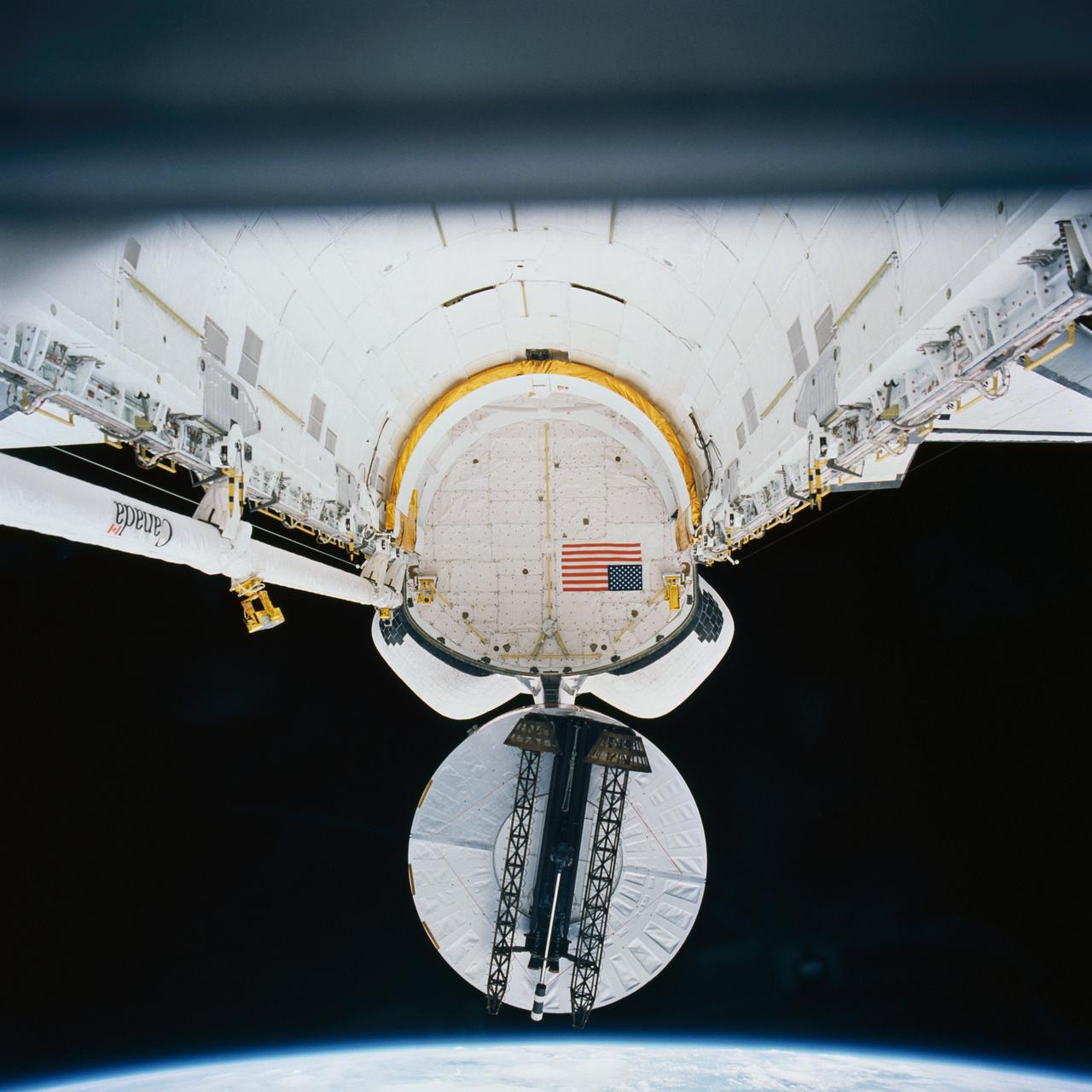
STS032-87-030 (10 Jan 1990) --- The Syncom IV-5 communications satellite leaves the cargo bay of Columbia, as crewmembers aboard the record-setting Space Shuttle successfully complete the first of two major tasks for STS-32. Two days later, the five astronauts successfully captured the Long Duration Exposure Facility (LDEF). The Syncom satellite, also called Leasat, is to be leased to the U.S. Navy by Hughes Aircraft Co. The crew went on to spend 11 days aboard Columbia before a successful landing at Edwards Air Force Base.
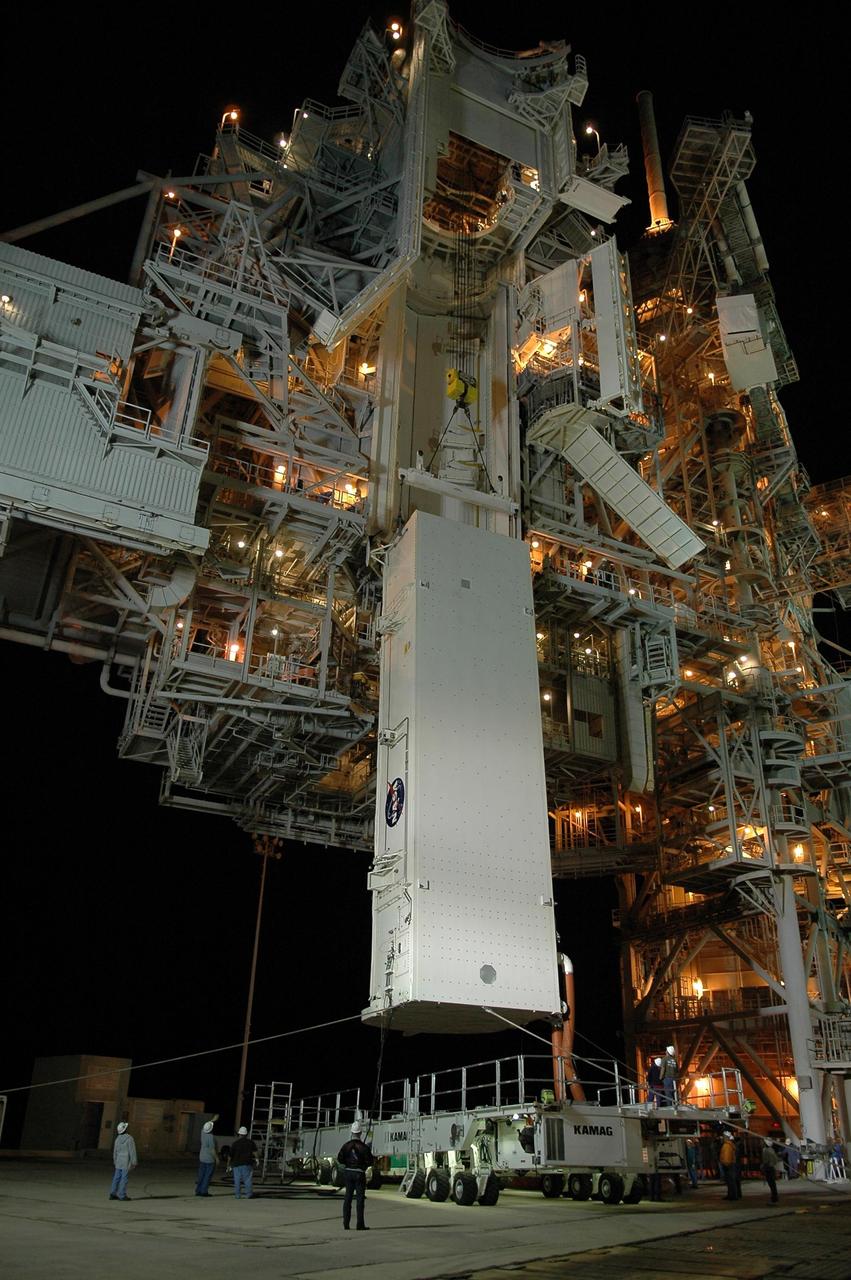
KENNEDY SPACE CENTER, FLA. -- With umbilical lines still attached, the payload canister is lifted up to the payload changeout room (PCR) on the rotating service structure (RSS) on Launch Pad 39B. Inside the canister are the SPACEHAB module and the port 5 truss segment for mission STS-116. Once inside the PCR, they will be transferred into Space Shuttle Discovery's payload bay once the vehicle has rolled out to the pad. On the right is the fixed service structure. The PCR is the enclosed, environmentally controlled portion of the RSS that supports cargo delivery to the pad and subsequent vertical installation into the orbiter payload bay. Seals around the mating surface of the PCR fit against the orbiter and allow the opening of the payload bay or canister doors and removal of the cargo without exposure to outside air and contaminants. A clean-air purge in the PCR maintains environmental control during PCR cargo operations. Cargo is removed from the payload canister and installed vertically in the orbiter by the payload ground handling mechanism (PGHM). Photo credit: NASA/Kim Shiflett
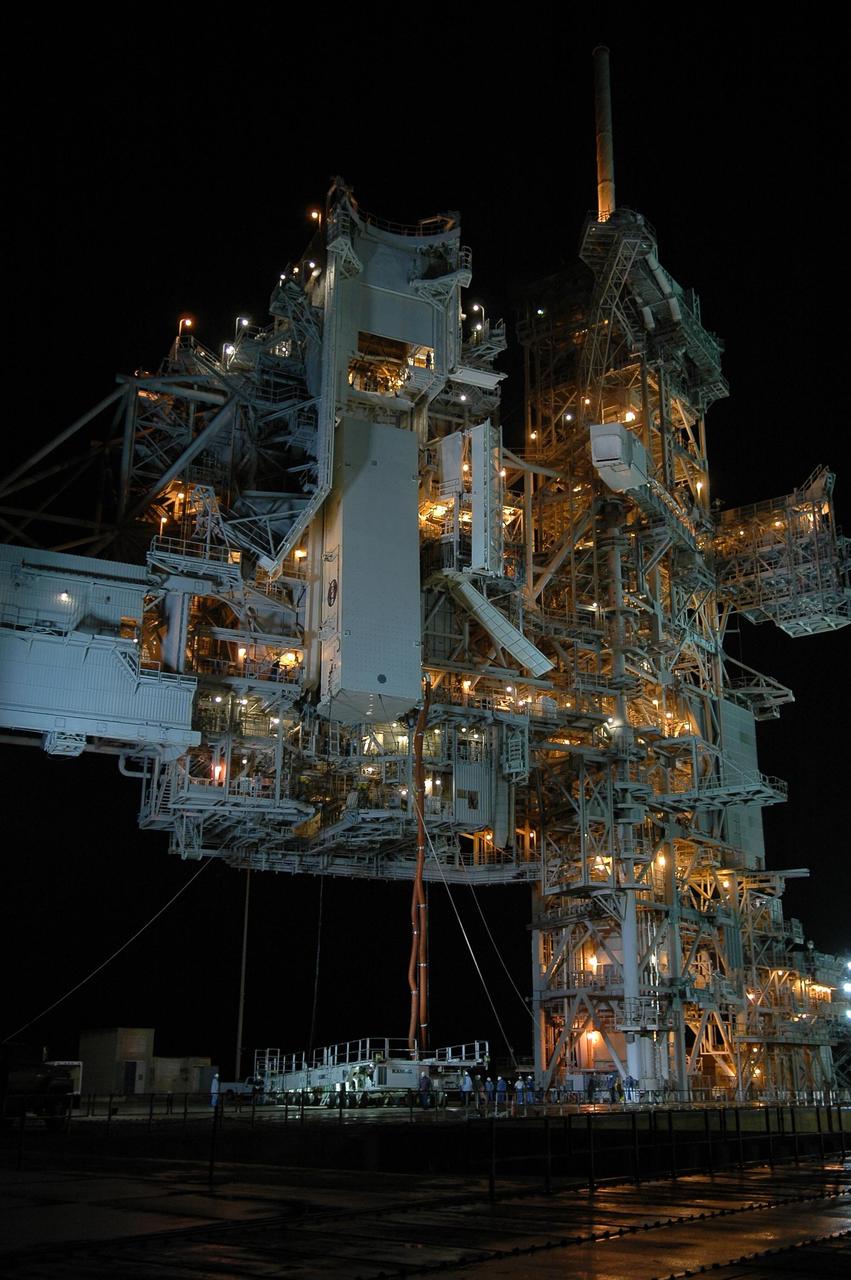
KENNEDY SPACE CENTER, FLA. -- With umbilical lines still attached, the payload canister is lifted up to the payload changeout room (PCR) on the rotating service structure (RSS) on Launch Pad 39B. Inside the canister are the SPACEHAB module and the port 5 truss segment for mission STS-116. Once inside the PCR, they will be transferred into Space Shuttle Discovery's payload bay once the vehicle has rolled out to the pad. On the right is the fixed service structure. The PCR is the enclosed, environmentally controlled portion of the RSS that supports cargo delivery to the pad and subsequent vertical installation into the orbiter payload bay. Seals around the mating surface of the PCR fit against the orbiter and allow the opening of the payload bay or canister doors and removal of the cargo without exposure to outside air and contaminants. A clean-air purge in the PCR maintains environmental control during PCR cargo operations. Cargo is removed from the payload canister and installed vertically in the orbiter by the payload ground handling mechanism (PGHM). Photo credit: NASA/Kim Shiflett
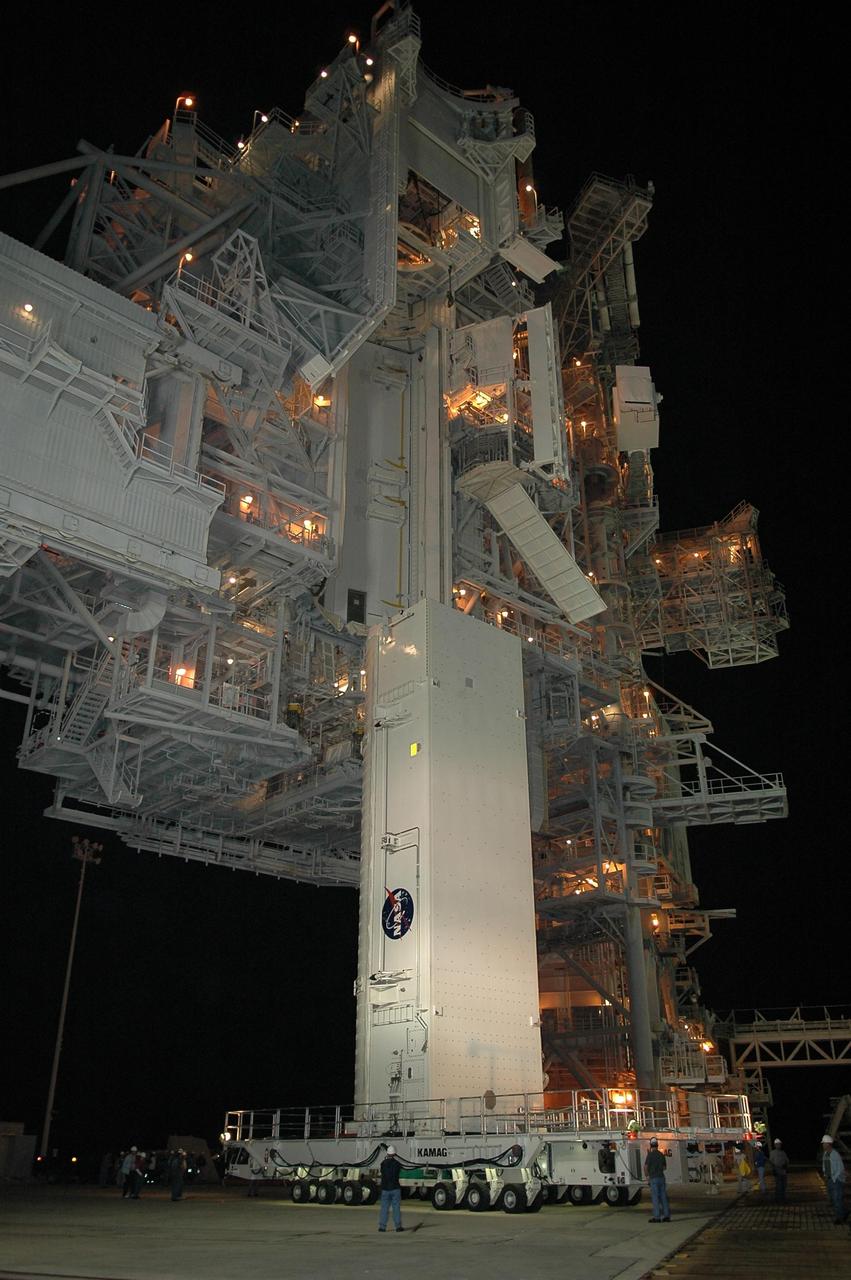
KENNEDY SPACE CENTER, FLA. -- The payload canister transporter and canister move into place under the payload changeout room (PCR) on the rotating service structure (RSS) on Launch Pad 39B. Inside the canister are the SPACEHAB module and the port 5 truss segment for mission STS-116. Once inside the PCR, they will be transferred into Space Shuttle Discovery's payload bay once the vehicle has rolled out to the pad. The PCR is the enclosed, environmentally controlled portion of the RSS that supports cargo delivery to the pad and subsequent vertical installation into the orbiter payload bay. Seals around the mating surface of the PCR fit against the orbiter and allow the opening of the payload bay or canister doors and removal of the cargo without exposure to outside air and contaminants. A clean-air purge in the PCR maintains environmental control during PCR cargo operations. Cargo is removed from the payload canister and installed vertically in the orbiter by the payload ground handling mechanism (PGHM). Photo credit: NASA/Kim Shiflett
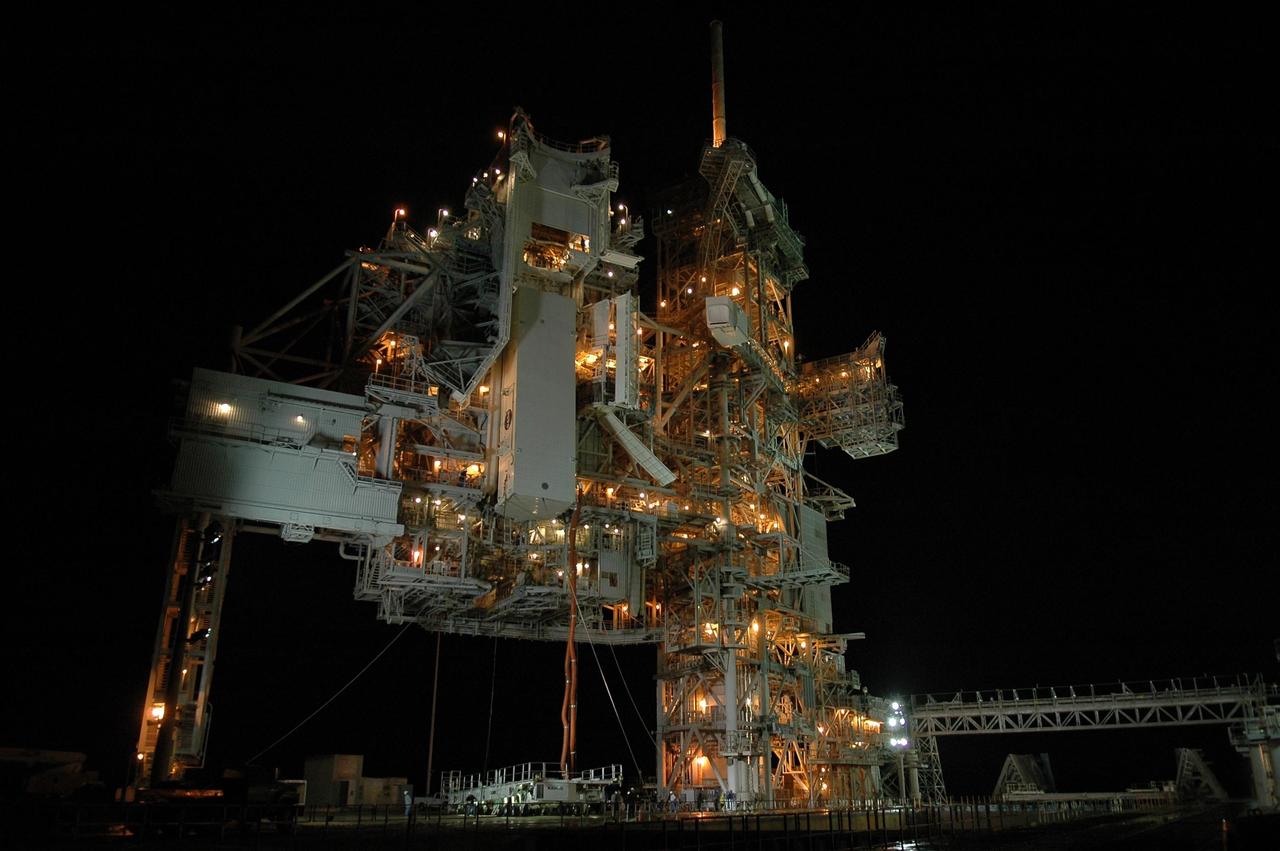
KENNEDY SPACE CENTER, FLA. -- With umbilical lines still attached, the payload canister is lifted up to the payload changeout room (PCR) on the rotating service structure (RSS) on Launch Pad 39B. Inside the canister are the SPACEHAB module and the port 5 truss segment for mission STS-116. Once inside the PCR, they will be transferred into Space Shuttle Discovery's payload bay once the vehicle has rolled out to the pad. On the right is the fixed service structure. The PCR is the enclosed, environmentally controlled portion of the RSS that supports cargo delivery to the pad and subsequent vertical installation into the orbiter payload bay. Seals around the mating surface of the PCR fit against the orbiter and allow the opening of the payload bay or canister doors and removal of the cargo without exposure to outside air and contaminants. A clean-air purge in the PCR maintains environmental control during PCR cargo operations. Cargo is removed from the payload canister and installed vertically in the orbiter by the payload ground handling mechanism (PGHM). Photo credit: NASA/Kim Shiflett
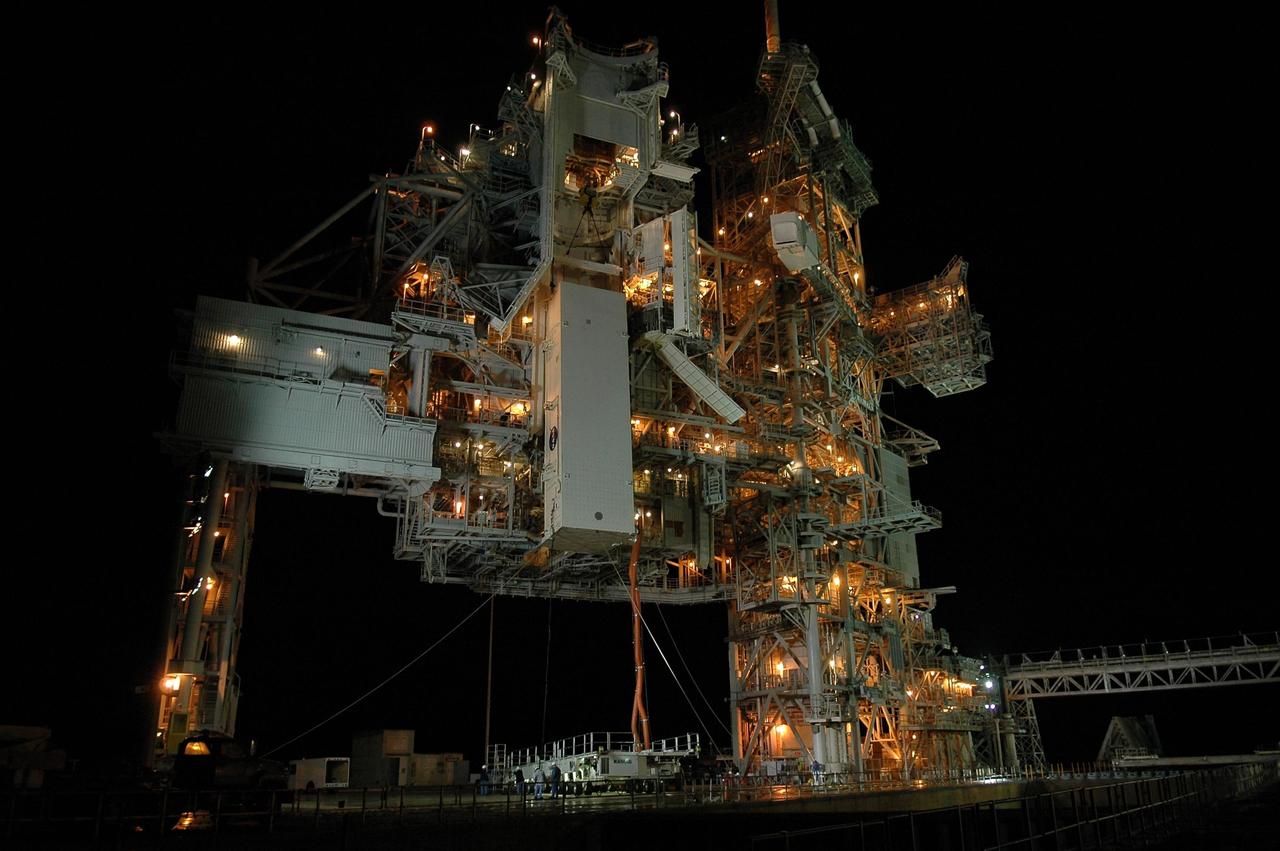
KENNEDY SPACE CENTER, FLA. -- With umbilical lines still attached, the payload canister is lifted up to the payload changeout room (PCR) on the rotating service structure (RSS) on Launch Pad 39B. Inside the canister are the SPACEHAB module and the port 5 truss segment for mission STS-116. Once inside the PCR, they will be transferred into Space Shuttle Discovery's payload bay after the vehicle has rolled out to the pad. On the right is the fixed service structure. The PCR is the enclosed, environmentally controlled portion of the RSS that supports cargo delivery to the pad and subsequent vertical installation into the orbiter payload bay. Seals around the mating surface of the PCR fit against the orbiter and allow the opening of the payload bay or canister doors and removal of the cargo without exposure to outside air and contaminants. A clean-air purge in the PCR maintains environmental control during PCR cargo operations. Cargo is removed from the payload canister and installed vertically in the orbiter by the payload ground handling mechanism (PGHM). Photo credit: NASA/Kim Shiflett
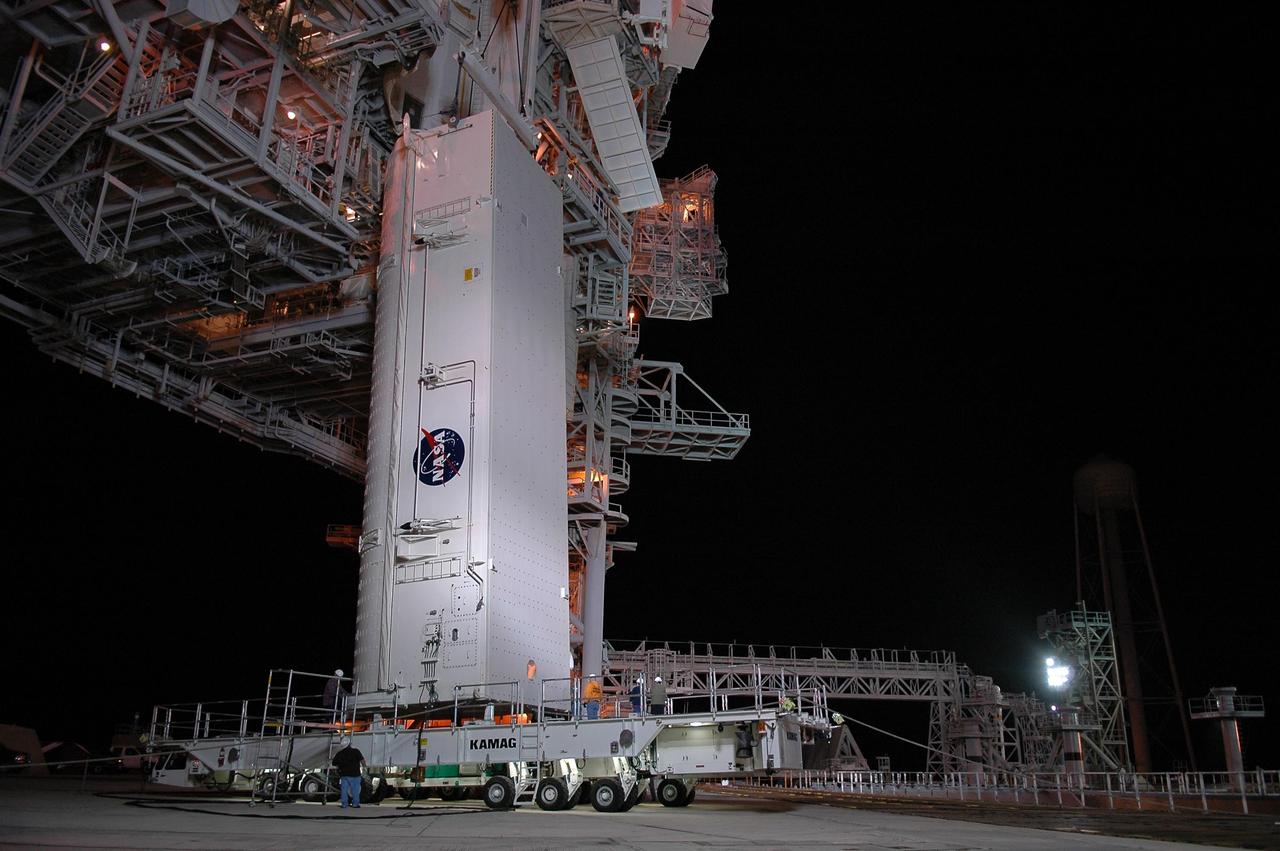
KENNEDY SPACE CENTER, FLA. -- The payload canister is raised off the transporter and will be lifted up to the payload changeout room (PCR) on the rotating service structure (RSS) on Launch Pad 39B. Inside the canister are the SPACEHAB module and the port 5 truss segment for mission STS-116. Once inside the PCR, they will be transferred into Space Shuttle Discovery's payload bay once the vehicle has rolled out to the pad. The PCR is the enclosed, environmentally controlled portion of the RSS that supports cargo delivery to the pad and subsequent vertical installation into the orbiter payload bay. Seals around the mating surface of the PCR fit against the orbiter and allow the opening of the payload bay or canister doors and removal of the cargo without exposure to outside air and contaminants. A clean-air purge in the PCR maintains environmental control during PCR cargo operations. Cargo is removed from the payload canister and installed vertically in the orbiter by the payload ground handling mechanism (PGHM). Photo credit: NASA/Kim Shiflett
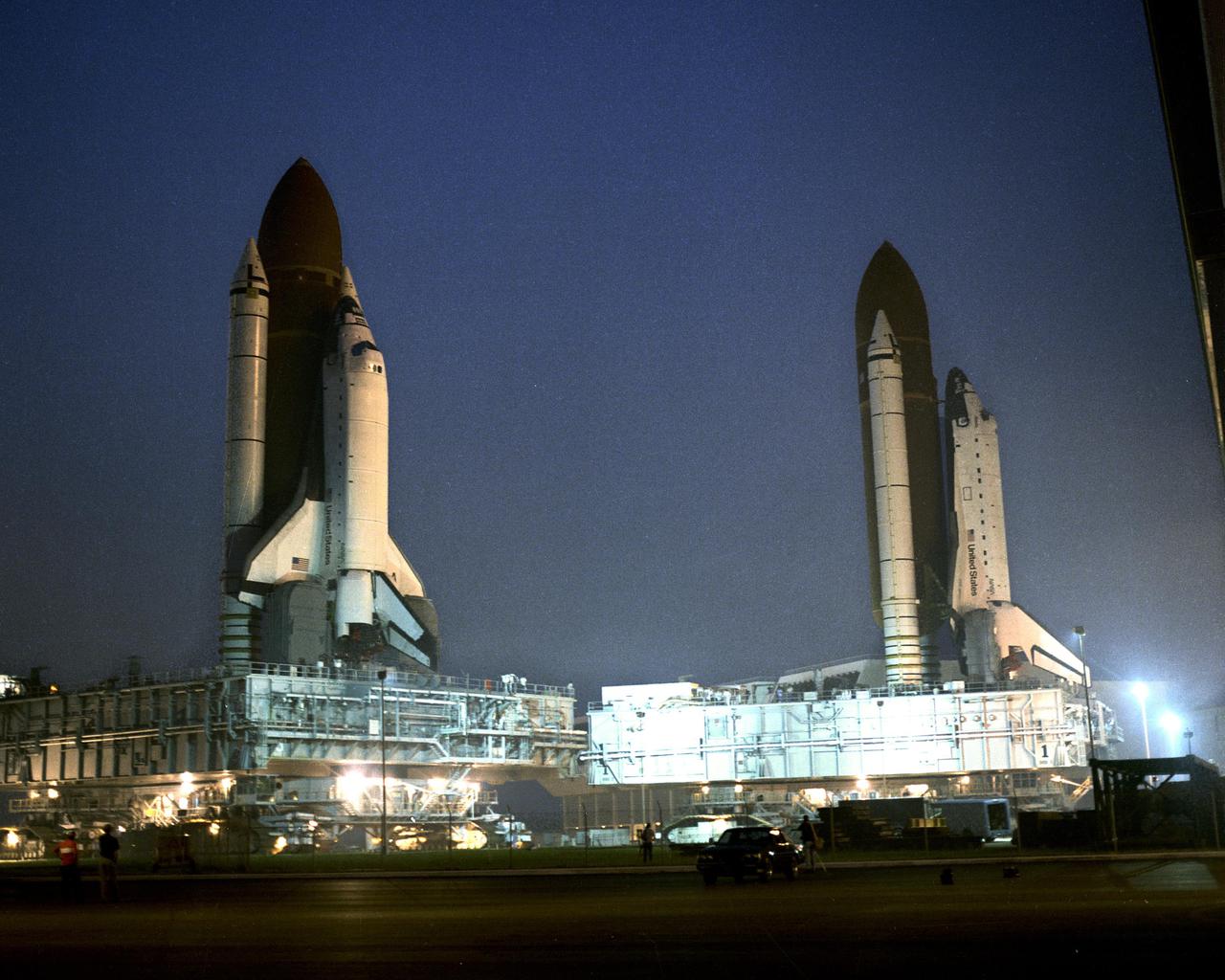
KENNEDY SPACE CENTER, FLA. -- The Space Shuttle Columbia (left), slated for mission STS-35, is rolled past the Space Shuttle Atlantis on its way to Pad 39A. Atlantis, slated for mission STS-38, is parked in front of bay three of the Vehicle Assembly Building following its rollback from Pad 39A for repairs to the liquid hydrogen lines. First motion of Atlantis from the pad was at 10:14 p.m. August 8. It arrived at the VAB at 4 a.m. August 9. First motion of Coumbia leaving the VAB for the pad was at 5:47 a.m. Columbia is due to arrive at the pad at noon August 9. Once Columbia is hard down at the pad, Atlantis will be moved into the VAB for destack operations. When Columbia reaches the pad, its payload bay doors will be opened and servicing of the ASTRO-1 payload will begin. Also, portions of the Shuttle interface verification test not completed in the VAB will be conducted.
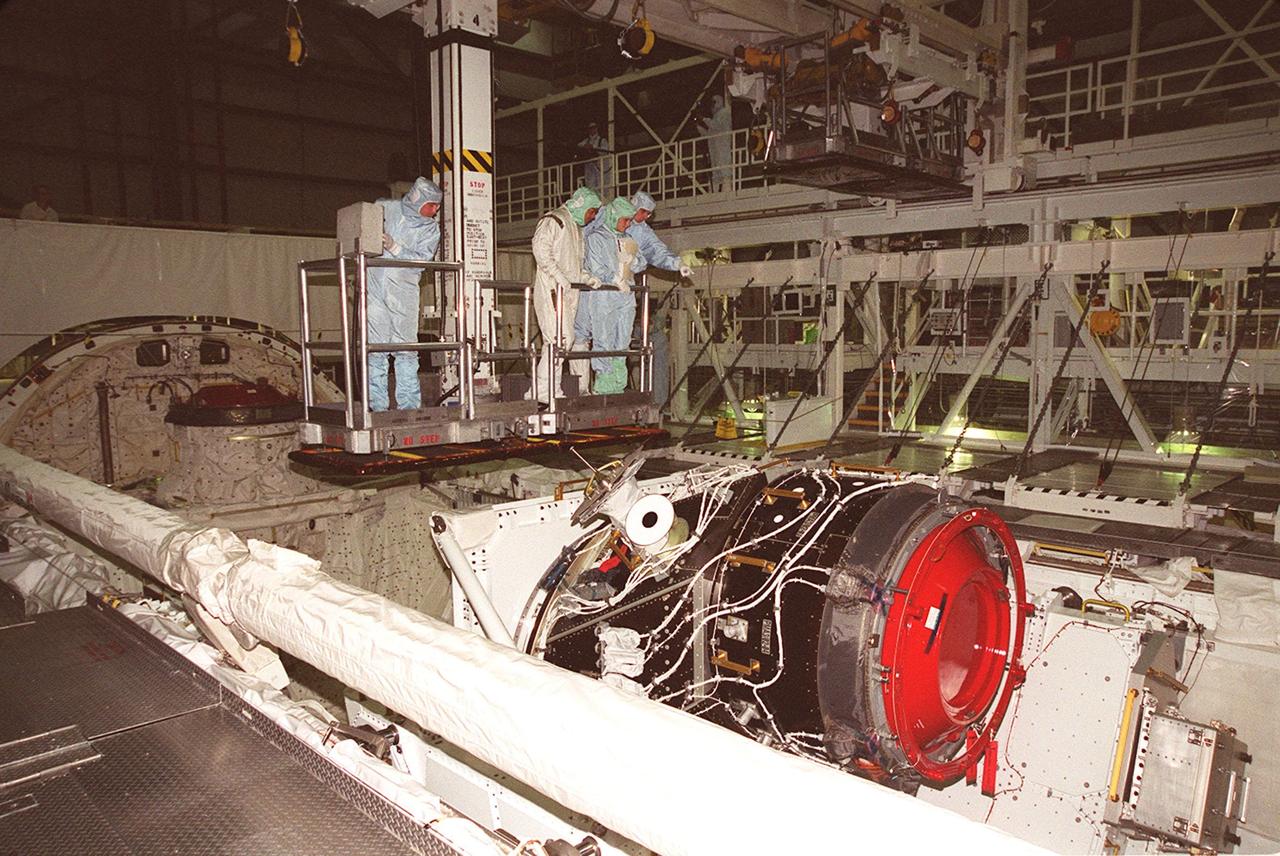
KENNEDY SPACE CENTER, FLA. -- In Orbiter Processing Facility bay 1, members of the STS-92 crew take part in Crew Equipment Interface Test (CEIT) activities. Being lowered into the payload bay of Discovery for a closer look at the payload are Mission Specialists Leroy Chiao (second from left) and Bill McArthur (far right), accompanied by Boeing workers. In the foreground is the Pressurized Mating Adapter-3 (PMA-3). Other crew members taking part in the CEIT are Commander Brian Duffy, Pilot Pam Melroy, and Mission Specialists Koichi Wakata, Jeff Wisoff and Michael Lopez-Alegria. STS-92 is scheduled to launch Oct. 5 on Shuttle Discovery from Launch Pad 39A on the fifth flight to the International Space Station. Discovery will carry the Integrated Truss Structure (ITS) Z1, the PMA-3, Ku-band Communications System, and Control Moment Gyros (CMGs)
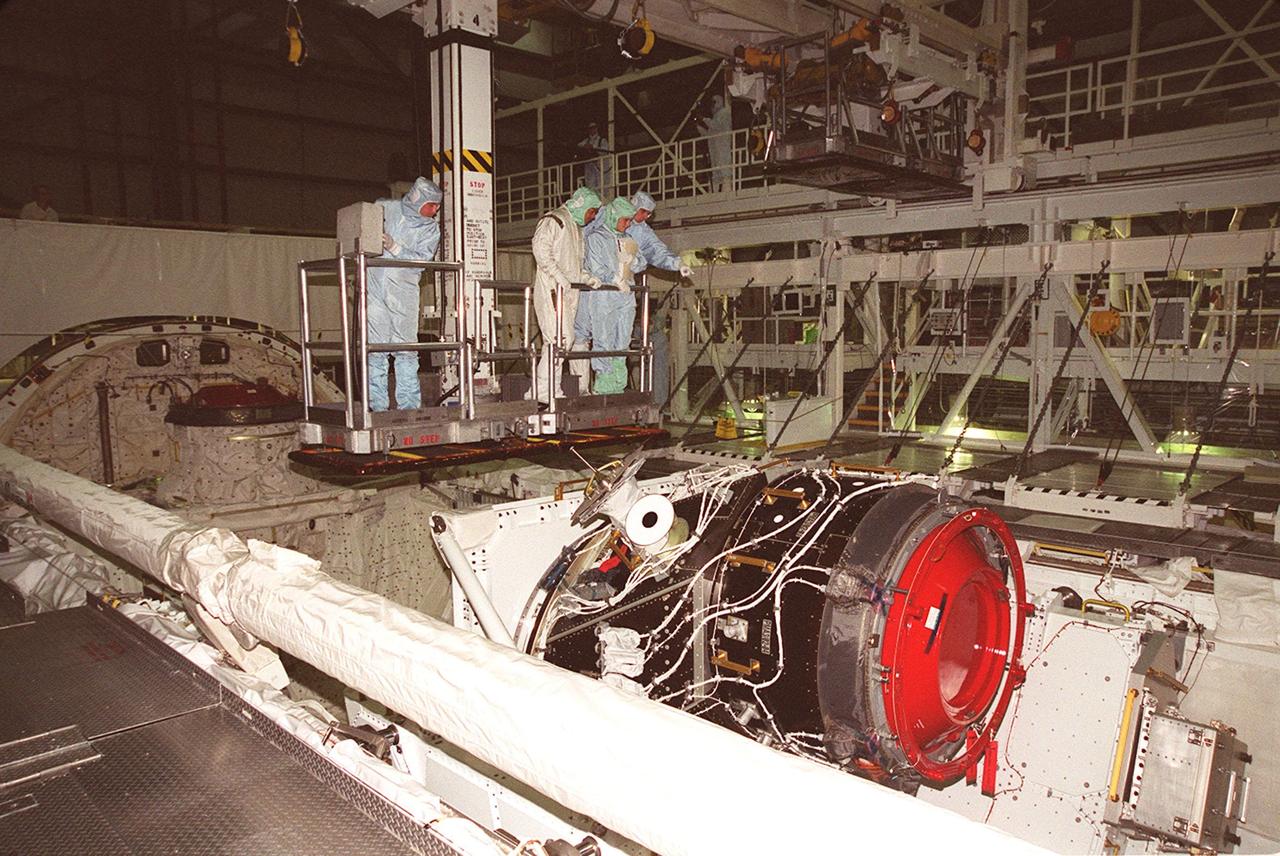
KENNEDY SPACE CENTER, FLA. -- In Orbiter Processing Facility bay 1, members of the STS-92 crew take part in Crew Equipment Interface Test (CEIT) activities. Being lowered into the payload bay of Discovery for a closer look at the payload are Mission Specialists Leroy Chiao (second from left) and Bill McArthur (far right), accompanied by Boeing workers. In the foreground is the Pressurized Mating Adapter-3 (PMA-3). Other crew members taking part in the CEIT are Commander Brian Duffy, Pilot Pam Melroy, and Mission Specialists Koichi Wakata, Jeff Wisoff and Michael Lopez-Alegria. STS-92 is scheduled to launch Oct. 5 on Shuttle Discovery from Launch Pad 39A on the fifth flight to the International Space Station. Discovery will carry the Integrated Truss Structure (ITS) Z1, the PMA-3, Ku-band Communications System, and Control Moment Gyros (CMGs)
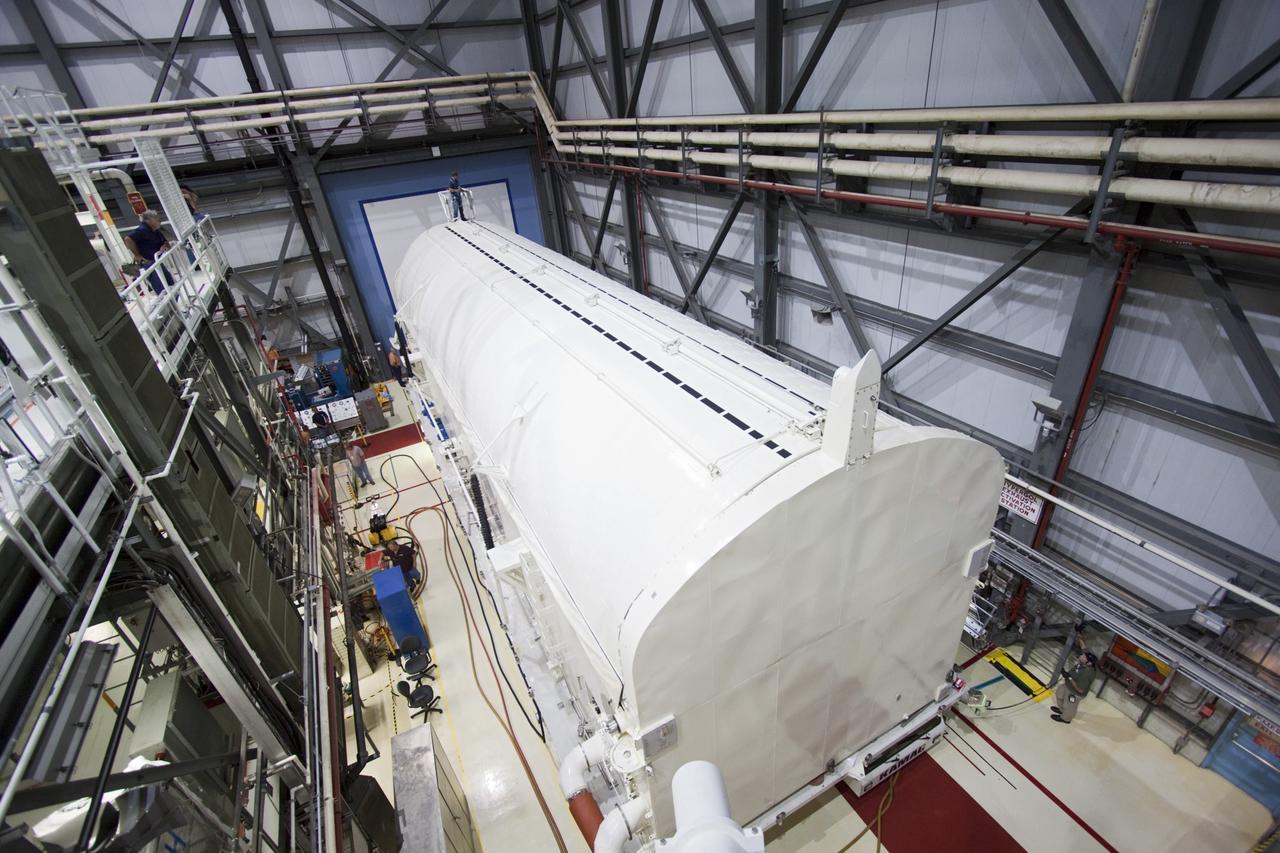
CAPE CANAVERAL, Fla. -- In Orbiter Processing Facility-2 (OPF-2) at NASA’s Kennedy Space Center in Florida, the payload canister doors are completely closed around the Raffaello multi-purpose logistics module after a special payload removal device was used to remove it from Atlantis’ cargo bay. Raffaello will then be readied for transport to the Space Station Processing Facility where its contents will be unloaded. Atlantis completed NASA’s final space shuttle mission, STS-135, after landing at the center’s Shuttle Landing Facility, July 21, 2011, at 5:57 a.m. EDT. Following removal of all payloads in Atlantis’ cargo bay, workers will begin to prepare the spacecraft for eventual permanent display at the Kennedy Space Center Visitor Complex. Photo credit: Jim Grossman
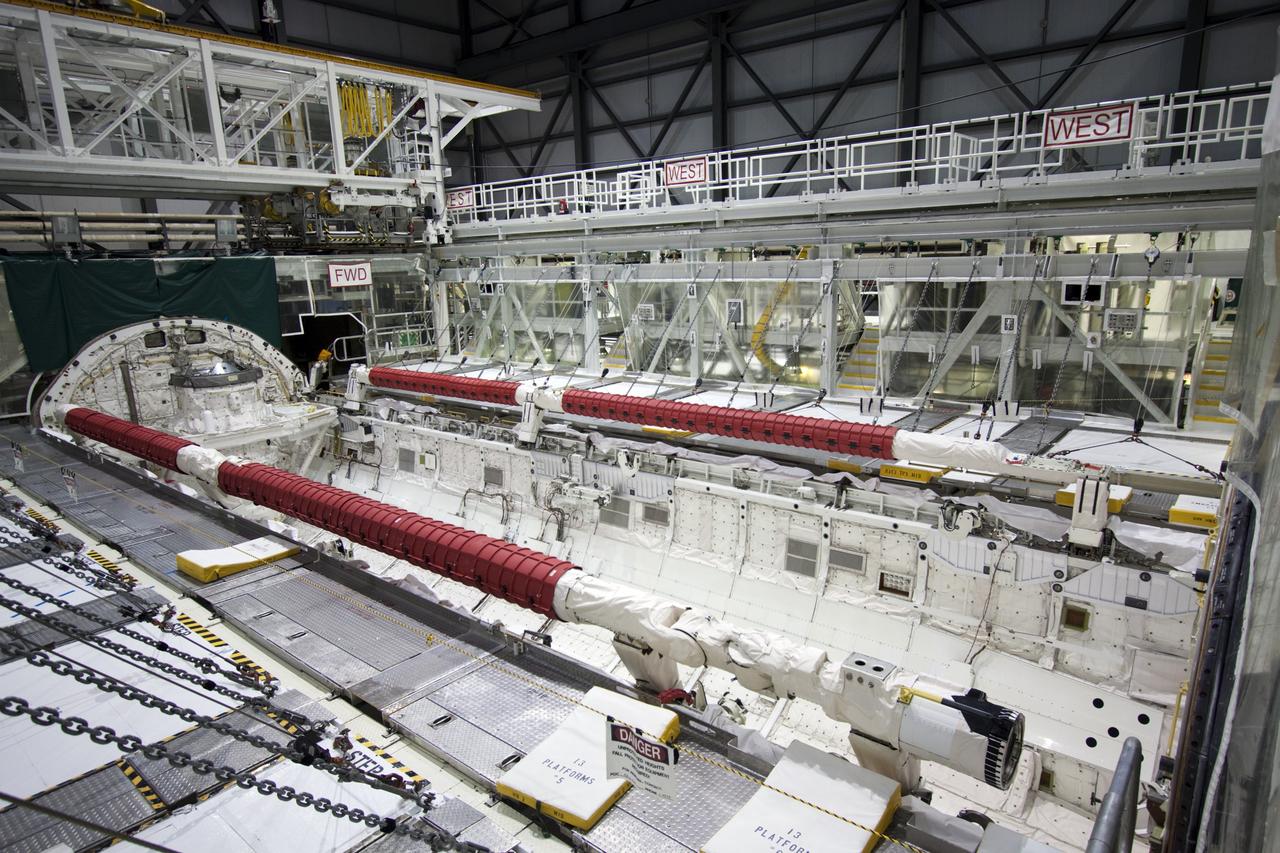
CAPE CANAVERAL, Fla. -- In Orbiter Processing Facility-2 (OPF-2) at NASA’s Kennedy Space Center in Florida, Atlantis’ cargo bay is empty after a special payload removal device was used to remove the Raffaello multi-purpose logistics module and transfer it to a payload canister. Raffaello will then be readied for transport to the Space Station Processing Facility where its contents will be unloaded. Atlantis completed NASA’s final space shuttle mission, STS-135, after landing at the center’s Shuttle Landing Facility, July 21, 2011, at 5:57 a.m. EDT. Following removal of all payloads in Atlantis’ cargo bay, workers will begin to prepare the spacecraft for eventual permanent display at the Kennedy Space Center Visitor Complex. Photo credit: Jim Grossman
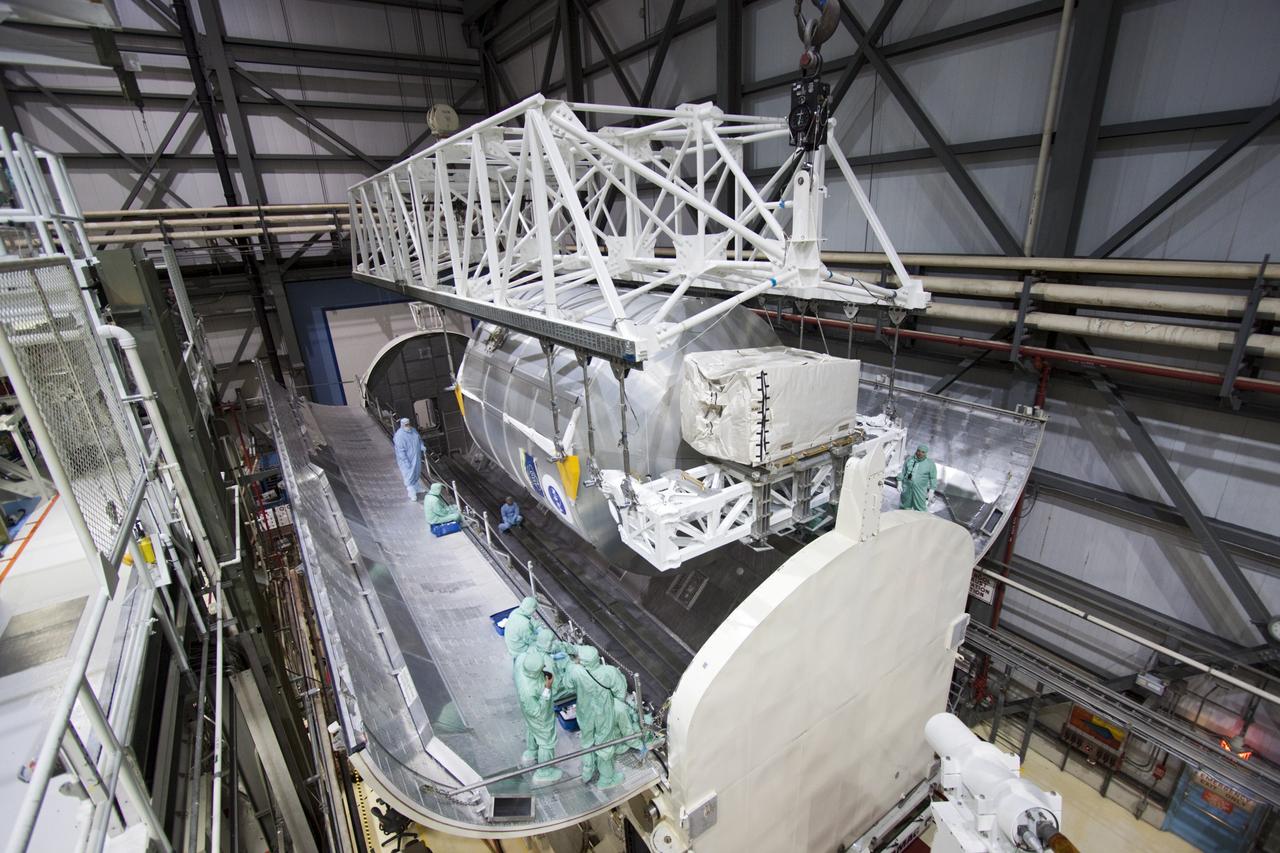
CAPE CANAVERAL, Fla. -- In Orbiter Processing Facility-2 (OPF-2) at NASA’s Kennedy Space Center in Florida, technicians monitor the progress as a special payload removal device is used to transfer the Raffaello multi-purpose logistics module from Atlantis’ cargo bay to the payload canister. Raffaello will then be readied for transport to the Space Station Processing Facility where its contents will be unloaded. Atlantis completed NASA’s final space shuttle mission, STS-135, after landing at the center’s Shuttle Landing Facility, July 21, 2011, at 5:57 a.m. EDT. Following removal of all payloads in Atlantis’ cargo bay, workers will begin to prepare the spacecraft for eventual permanent display at the Kennedy Space Center Visitor Complex. Photo credit: Jim Grossman
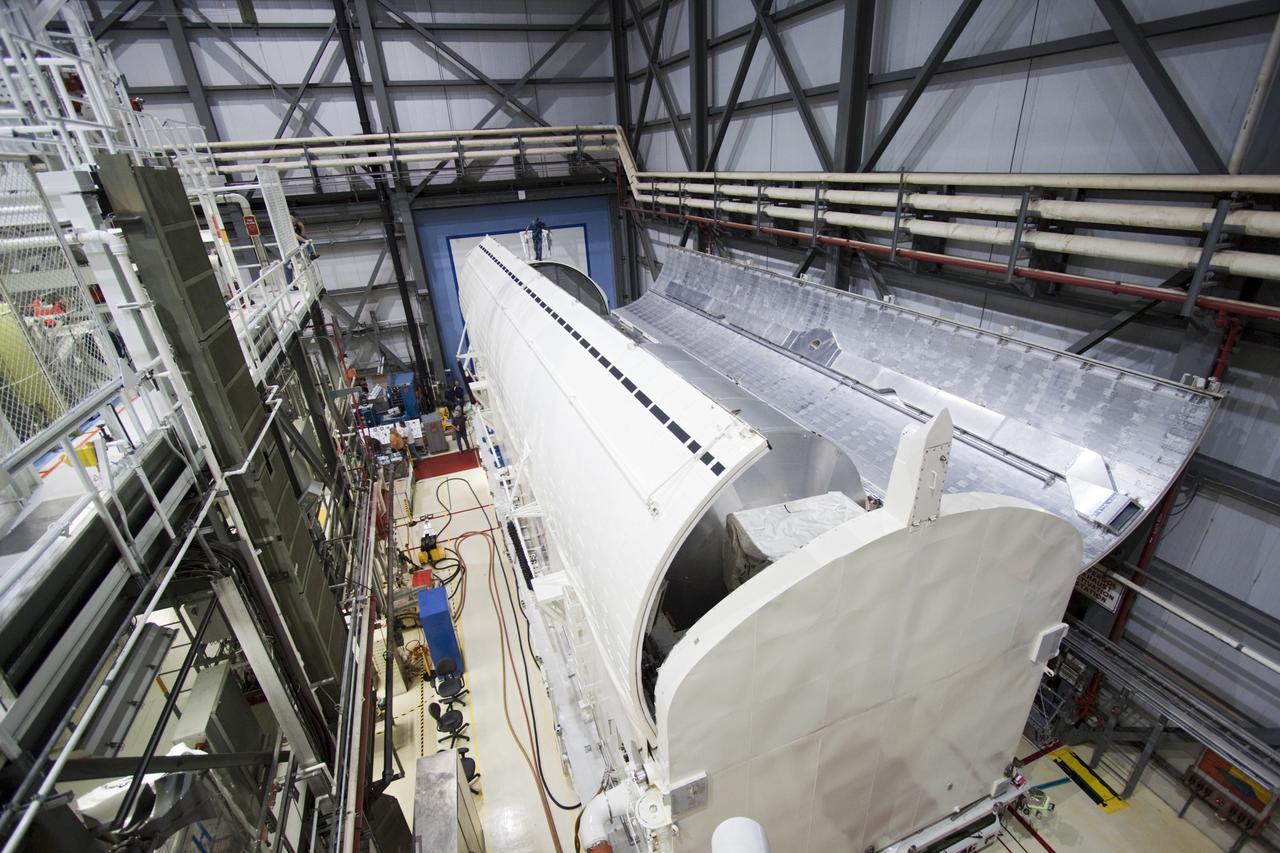
CAPE CANAVERAL, Fla. -- In Orbiter Processing Facility-2 (OPF-2) at NASA’s Kennedy Space Center in Florida, doors begin to close around the Raffaello multi-purpose logistics module after it was secured in the payload canister. A special payload removal device was used to remove it from Atlantis’ cargo bay. Raffaello will then be readied for transport to the Space Station Processing Facility where its contents will be unloaded. Atlantis completed NASA’s final space shuttle mission, STS-135, after landing at the center’s Shuttle Landing Facility, July 21, 2011, at 5:57 a.m. EDT. Following removal of all payloads in Atlantis’ cargo bay, workers will begin to prepare the spacecraft for eventual permanent display at the Kennedy Space Center Visitor Complex. Photo credit: Jim Grossman
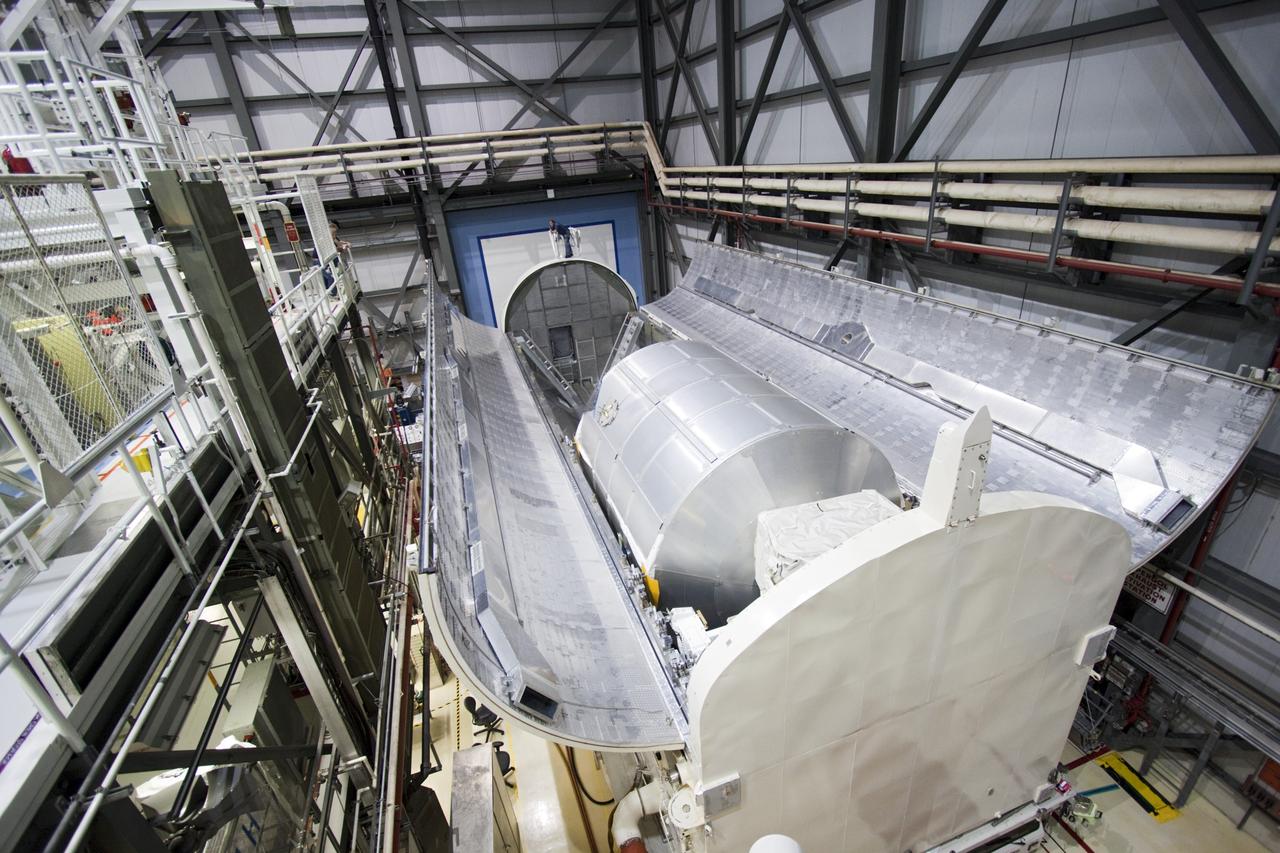
CAPE CANAVERAL, Fla. -- In Orbiter Processing Facility-2 (OPF-2) at NASA’s Kennedy Space Center in Florida, the Raffaello multi-purpose logistics module is secured in the payload canister, after a special payload removal device was used to remove it from Atlantis’ cargo bay. Raffaello will then be readied for transport to the Space Station Processing Facility where its contents will be unloaded. Atlantis completed NASA’s final space shuttle mission, STS-135, after landing at the center’s Shuttle Landing Facility, July 21, 2011, at 5:57 a.m. EDT. Following removal of all payloads in Atlantis’ cargo bay, workers will begin to prepare the spacecraft for eventual permanent display at the Kennedy Space Center Visitor Complex. Photo credit: Jim Grossman
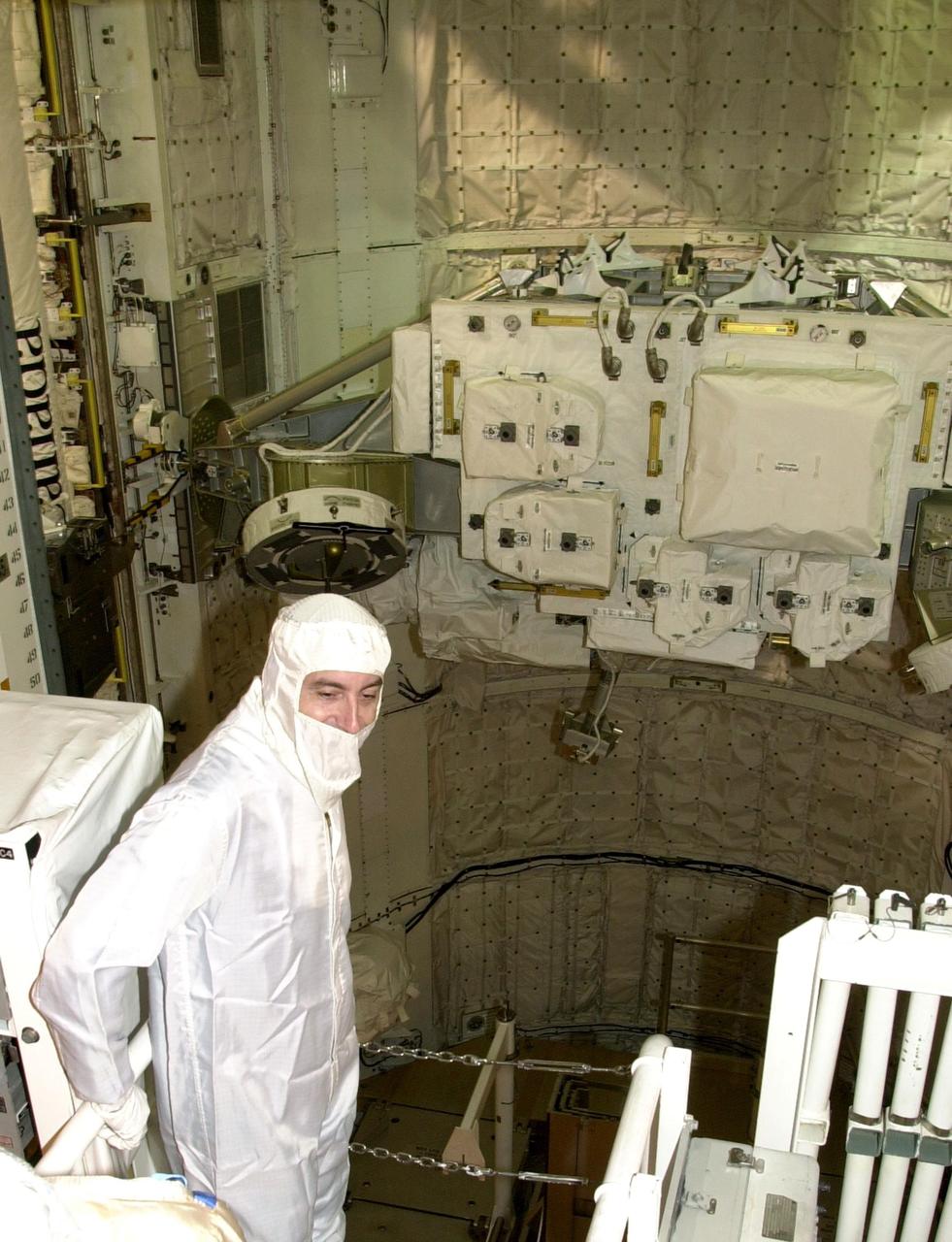
KENNEDY SPACE CENTER, FLA. -- In the Orbiter Processing Facility, STS-111 Mission Specialist Philippe Perrin, with the French Space Agency, looks over the payload installed in Endeavour's payload bay. The crew is at KSC for Terminal Countdown Demonstration Test activities, which include payload familiarization and a simulated launch countdown. The crew also comprises Commander Kenneth Cockrell, Pilot Paul Lockhart and Mission Specialist Franklin Chang-Diaz. The payload on mission STS-111 to the International Space Station includes the Mobile Base System, an Orbital Replacement Unit and Multi-Purpose Logistics Module Leonardo. Traveling on Endeavour is also the Expedition 5 crew - Commander Valeri Korzun, Peggy Whitson and Sergei Treschev -- who will replace the Expedition 4 crew on the Station. Korzun and Treschev are with the Russian Space Agency. Launch of Endeavour is scheduled for May 30, 2002
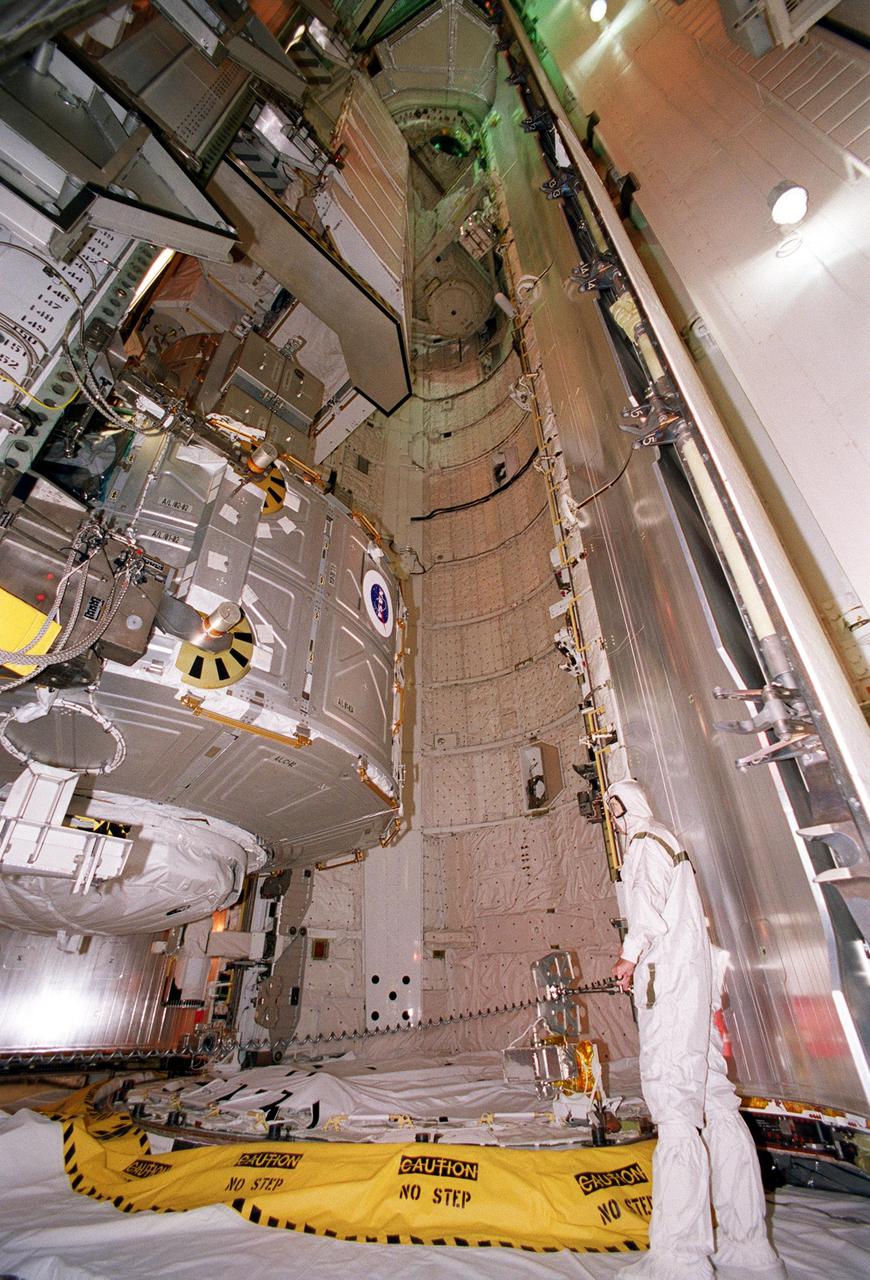
KENNEDY SPACE CENTER, Fla. -- The Joint Airlock Module, sporting a NASA logo, is moved toward the payload bay of Space Shuttle Atlantis for mission STS-104. Once installed and activated, the airlock becomes the primary path for International Space Station spacewalk entry and departure using U.S. spacesuits, which are known as Extravehicular Mobility Units, or EMUs. In addition, the Joint Airlock is designed to support the Russian Orlan spacesuit for EVA activity. Launch of Atlantis is scheduled no earlier than July 12 at 5:04 a.m. EDT
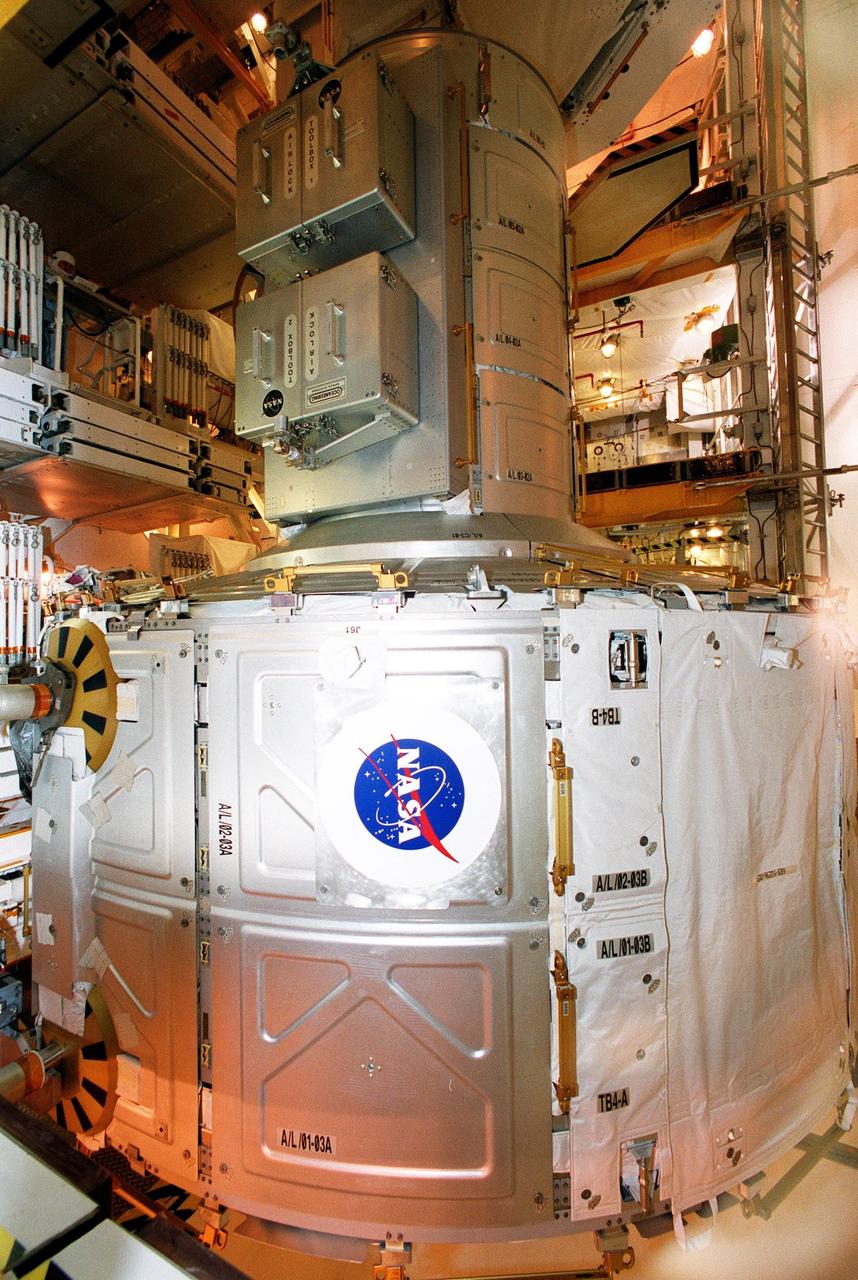
KENNEDY SPACE CENTER, Fla. -- The Joint Airlock Module, sporting a NASA logo, is moved toward the payload bay of Space Shuttle Atlantis for mission STS-104. Once installed and activated, the airlock becomes the primary path for International Space Station spacewalk entry and departure using U.S. spacesuits, which are known as Extravehicular Mobility Units, or EMUs. In addition, the Joint Airlock is designed to support the Russian Orlan spacesuit for EVA activity. Launch of Atlantis is scheduled no earlier than July 12 at 5:04 a.m. EDT
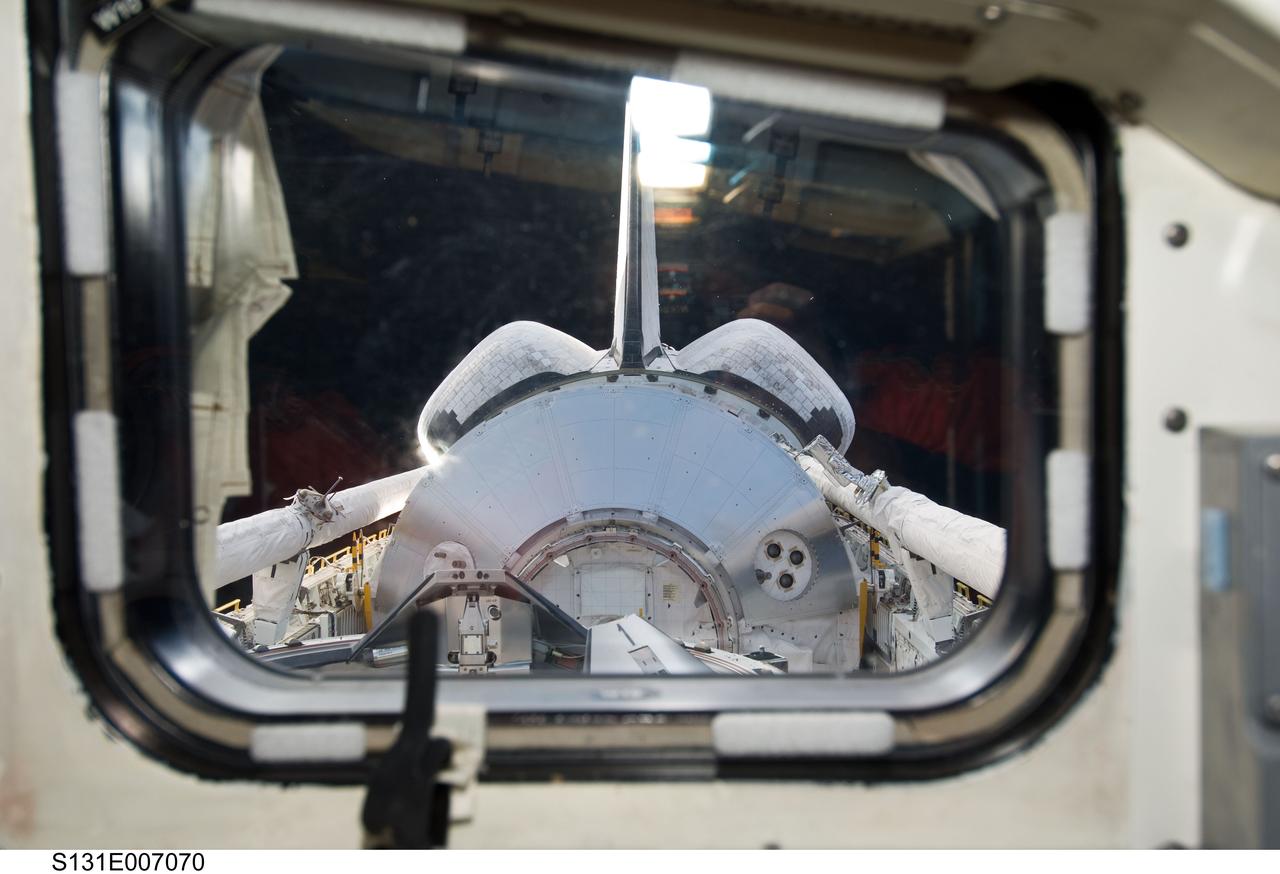
S131-E-007070 (5 April 2010) --- The Leonardo Multi-Purpose Logistics Module (MPLM) visible in space shuttle Discovery's payload bay, docking mechanism, vertical stabilizer, orbital maneuvering system (OMS) pods and Remote Manipulator System/Orbiter Boom Sensor System (RMS/OBSS) are featured in this image photographed by an STS-131 crew member from an aft flight deck window.
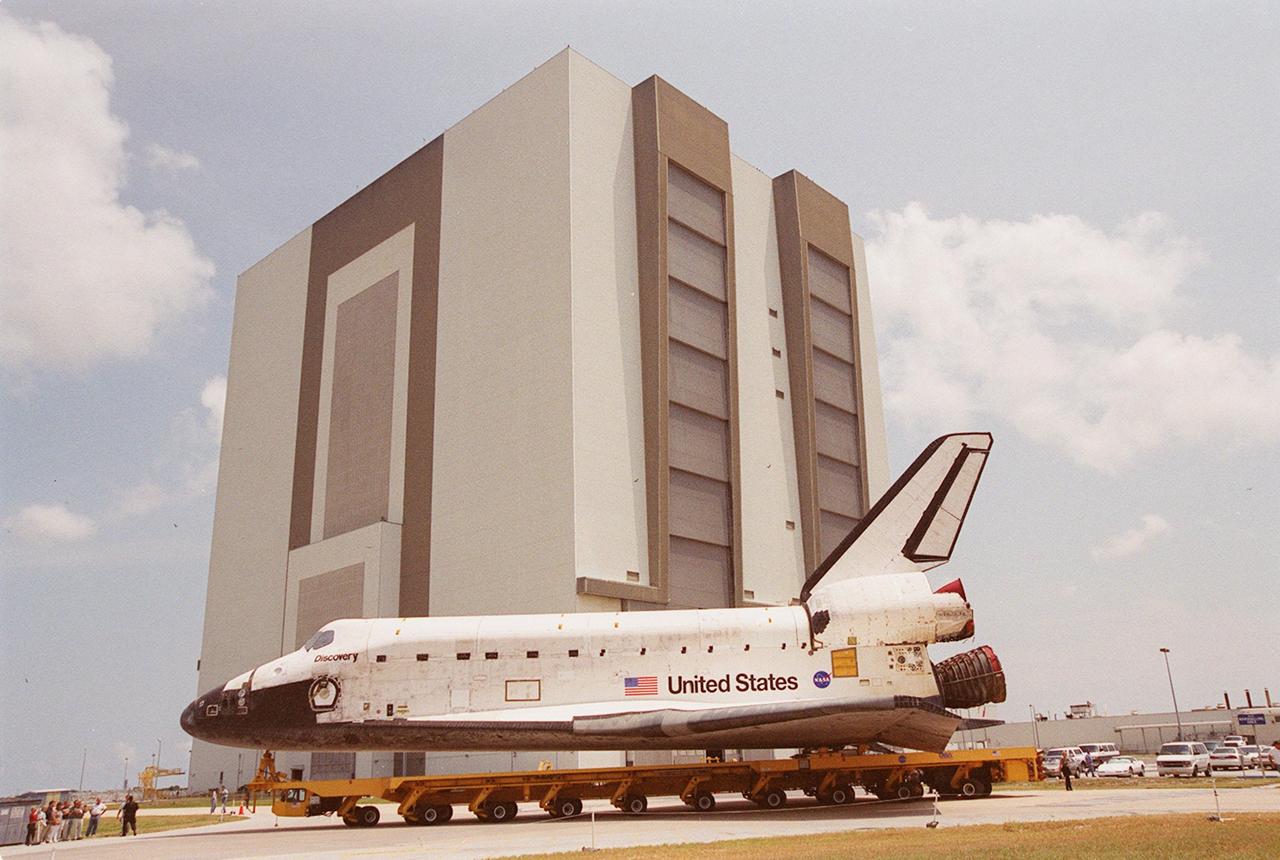
KENNEDY SPACE CENTER, FLA. -- The orbiter Discovery rolls past the Vehicle Assembly Building on its way to Orbiter Processing Facility (OPF) bay 3 where ongoing payload and ground processing assessments will be completed. Managers will then determine when to roll the orbiter to the Vehicle Assembly Building for stacking with the external tank and solid rocket boosters, and when to roll out to Launch Pad 39A. Discovery is scheduled to launch Oct. 5 at 9:30 p.m. EDT on mission STS-92, which will be the 100th flight in the Shuttle program
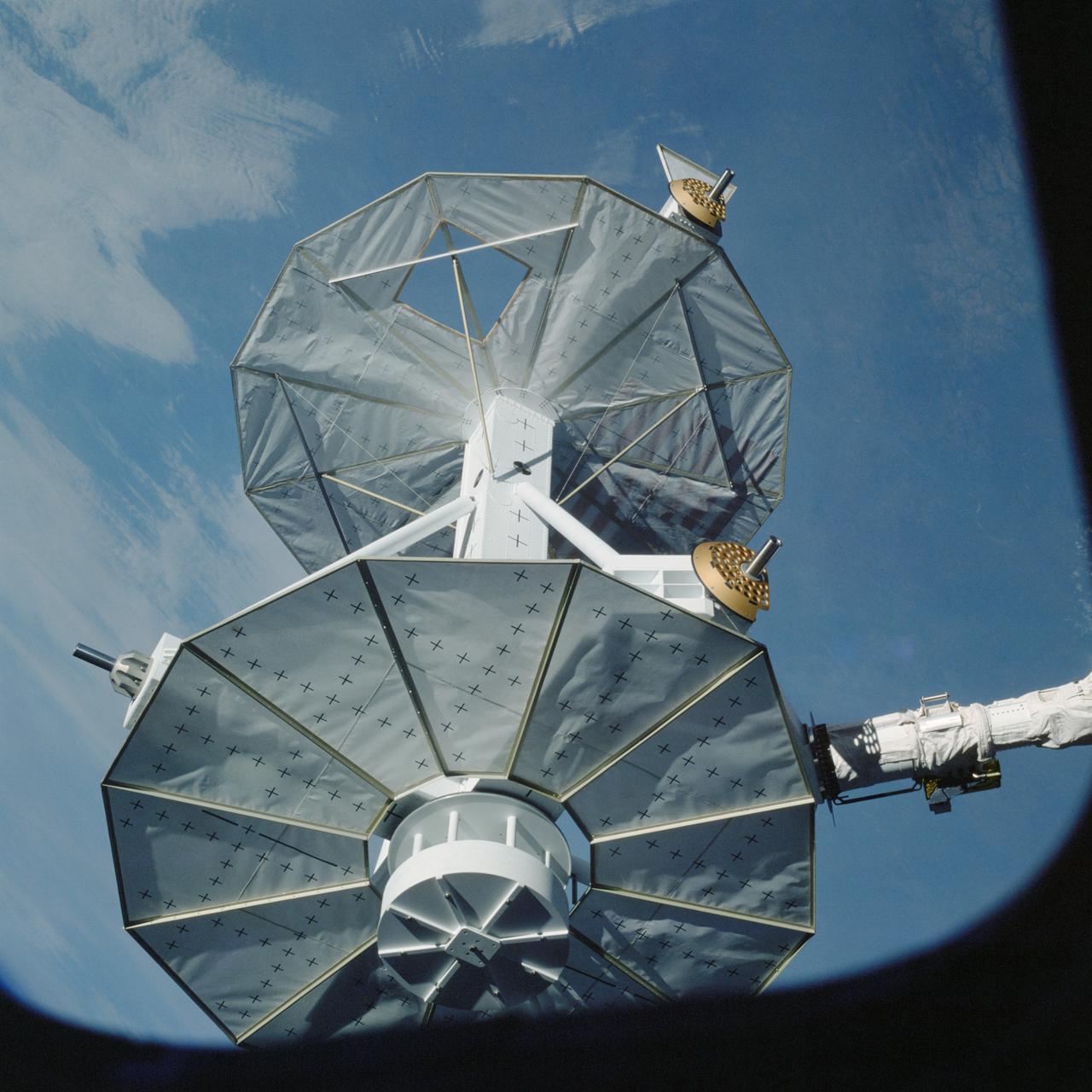
STS008-35-1239 (30 Aug.-5 Sept. 1983) --- The space shuttle Challenger?s payload flight test article (PFTA) is lifted from the cargo bay and held over clouds and water on Earth. The 70mm frame was photographed by one of the five STS-8 crew members with a free hand during the busy RMS/PFTA agenda. Photo credit: NASA
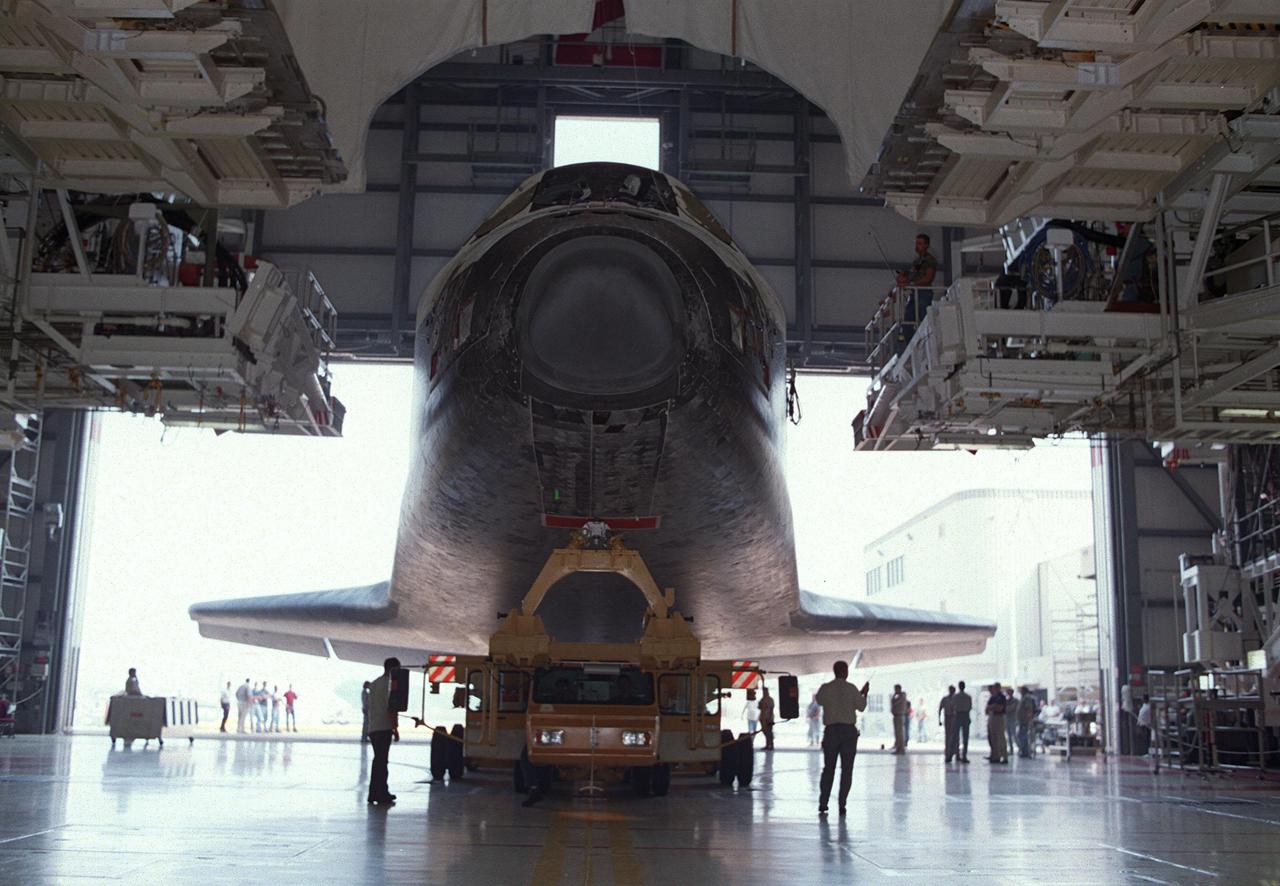
KENNEDY SPACE CENTER, Fla. -- Orbiter Discovery rolls out of Orbiter Processing Facility bay 2 atop its transporter for the short trip to the Vehicle Assembly Building. There it will be mated with its external tank and solid rocket boosters for its launch on mission STS-105. The payload on this 11th mission to the International Space Station includes the Multi-Purpose Logistics Module Leonardo, which was built by the Italian Space Agency. Leonardo will be outfitted with 12 racks of experiments and equipment. Launch of Discovery is scheduled for no earlier than Aug. 5, 2001
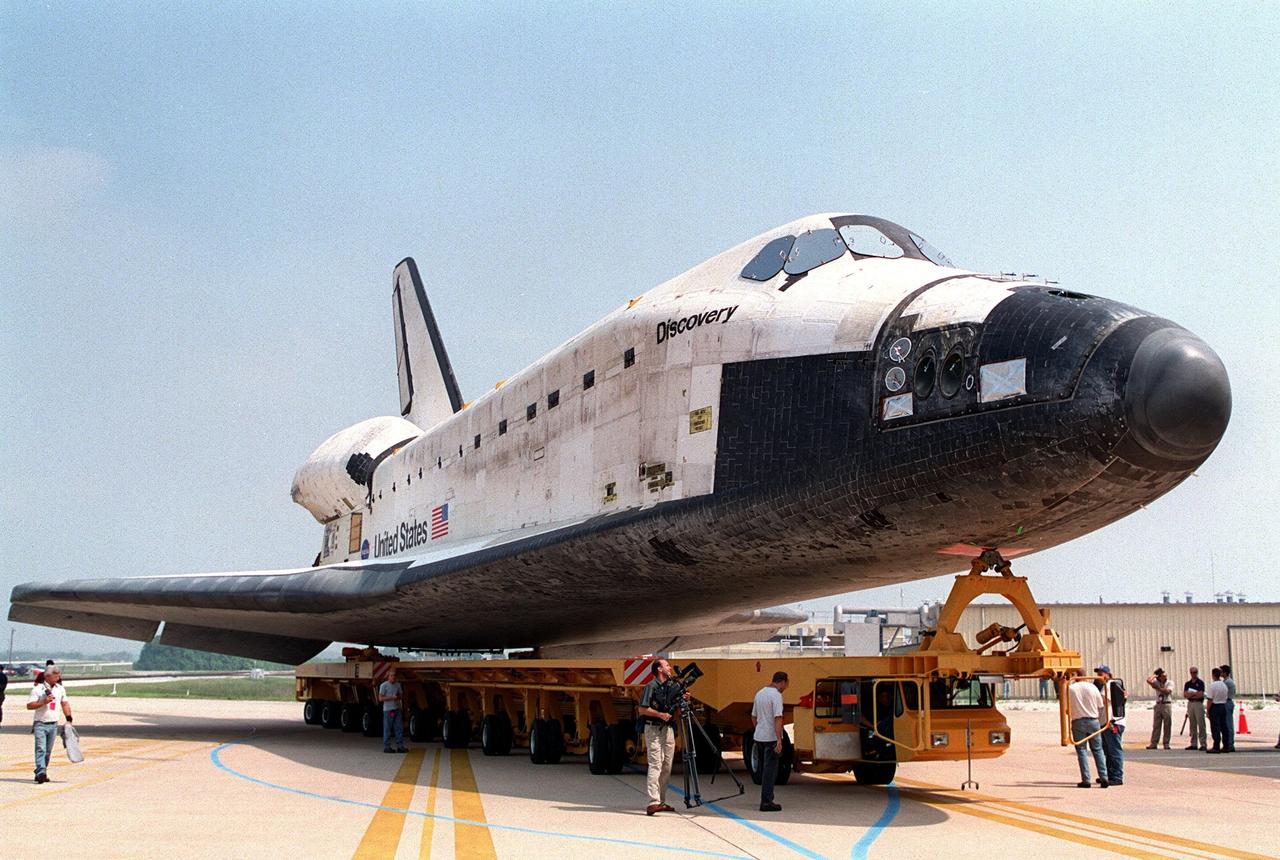
KENNEDY SPACE CENTER, Fla. -- Orbiter Discovery backs out of Orbiter Processing Facility bay 2 atop its transporter for the short trip to the Vehicle Assembly Building. There it will be mated with its external tank and solid rocket boosters for its launch on mission STS-105. The payload on this 11th mission to the International Space Station includes the Multi-Purpose Logistics Module Leonardo, which was built by the Italian Space Agency. Leonardo will be outfitted with 12 racks of experiments and equipment. Launch of Discovery is scheduled for no earlier than Aug. 5, 2001
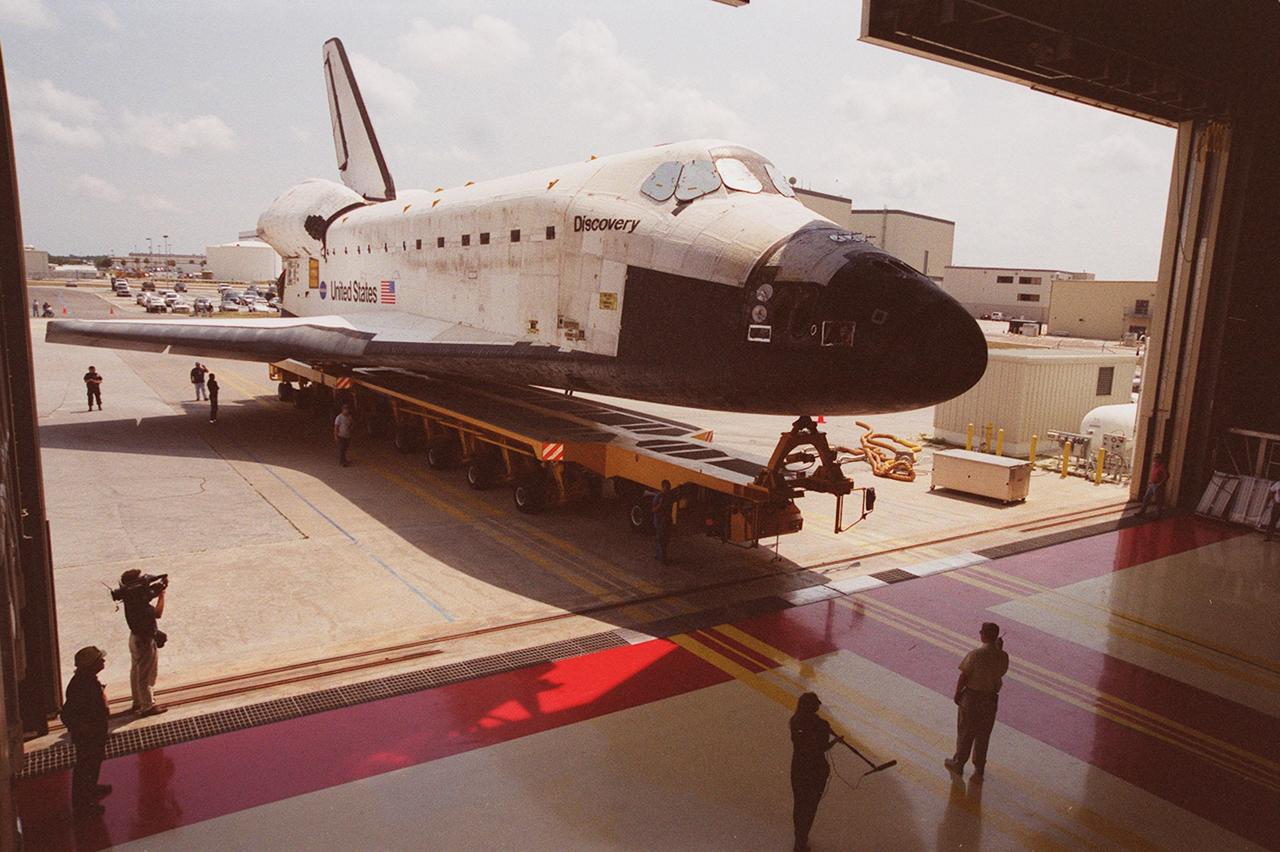
KENNEDY SPACE CENTER, FLA. -- The orbiter Discovery rolls into Orbiter Processing Facility (OPF) bay 3 where ongoing payload and ground processing assessments will be completed. Managers will then determine when to roll the orbiter to the Vehicle Assembly Building for stacking with the external tank and solid rocket boosters, and when to roll out to Launch Pad 39A. Discovery is scheduled to launch Oct. 5 at 9:30 p.m. EDT on mission STS-92, which will be the 100th flight in the Shuttle program
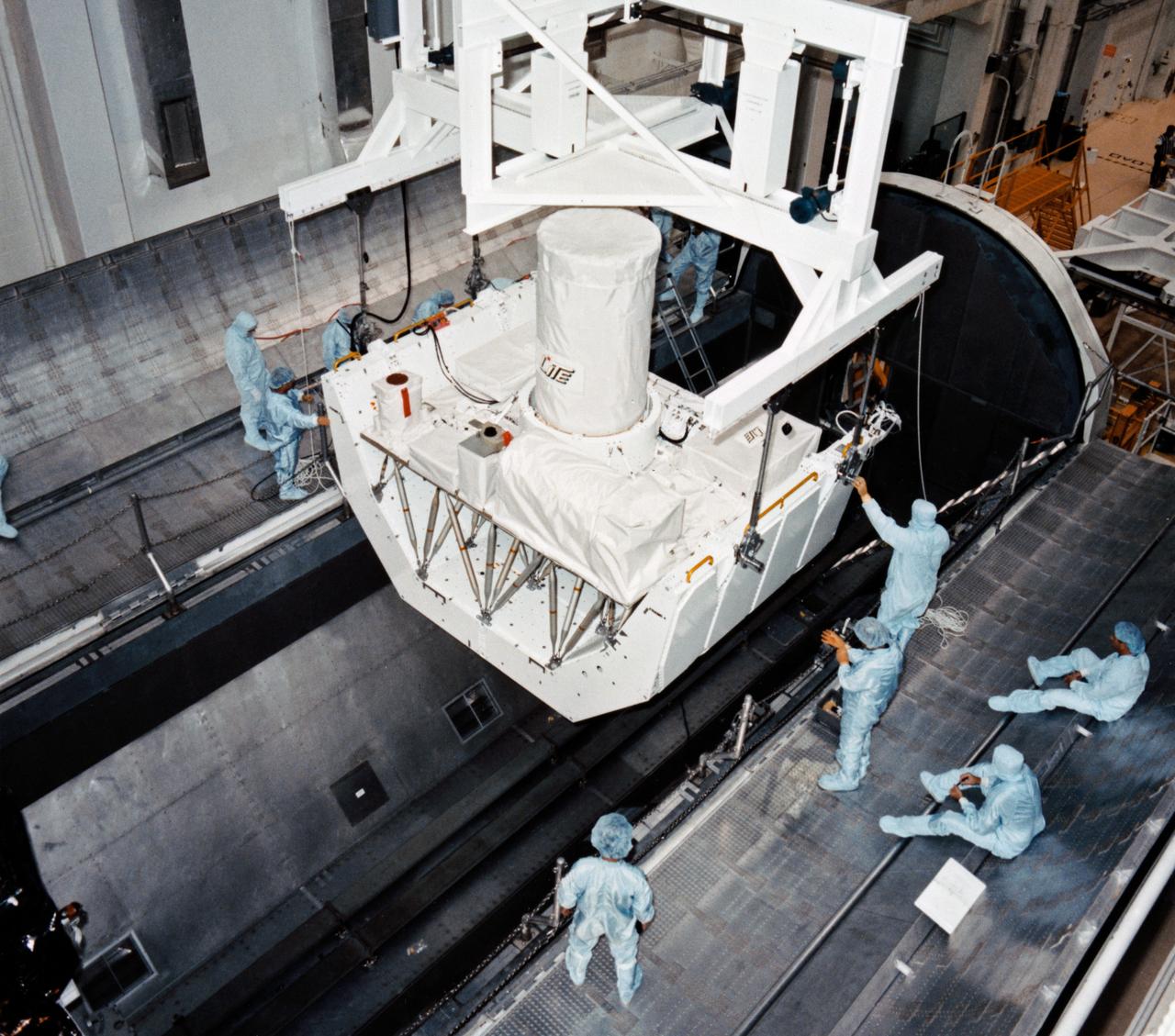
S94-40916 (5 July 1994) --- Workers in the Operations and Checkout Building are transporting the Lidar In-Space Technology Experiment (LITE-1) into the payload canister transporter for transfer to the Orbiter Processing Facility, where it will be installed into the cargo bay of the space shuttle Discovery. LITE-1, which will demonstrate the technology of a spaceborne Lidar instrument, is scheduled to fly on STS-64 later this year. Photo credit: NASA or National Aeronautics and Space Administration
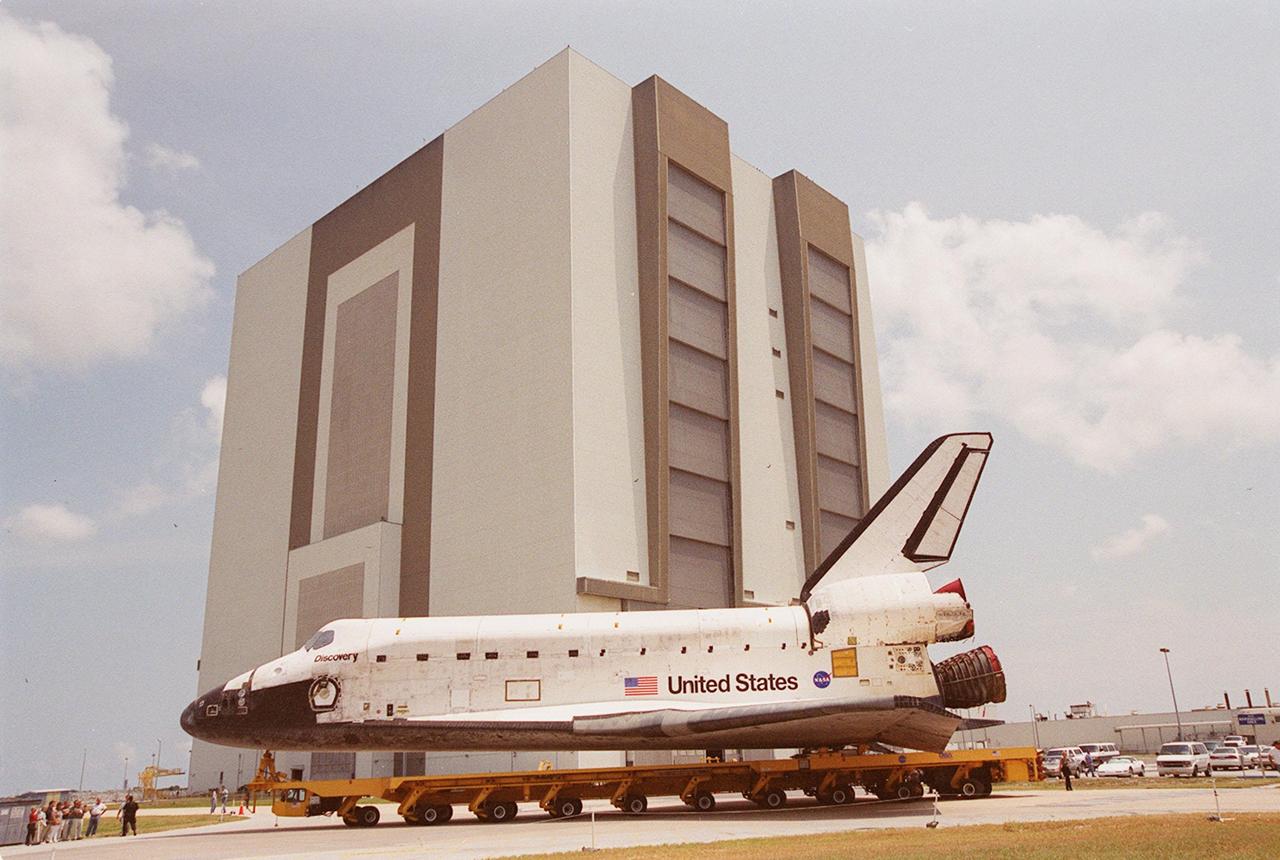
KENNEDY SPACE CENTER, FLA. -- The orbiter Discovery rolls past the Vehicle Assembly Building on its way to Orbiter Processing Facility (OPF) bay 3 where ongoing payload and ground processing assessments will be completed. Managers will then determine when to roll the orbiter to the Vehicle Assembly Building for stacking with the external tank and solid rocket boosters, and when to roll out to Launch Pad 39A. Discovery is scheduled to launch Oct. 5 at 9:30 p.m. EDT on mission STS-92, which will be the 100th flight in the Shuttle program
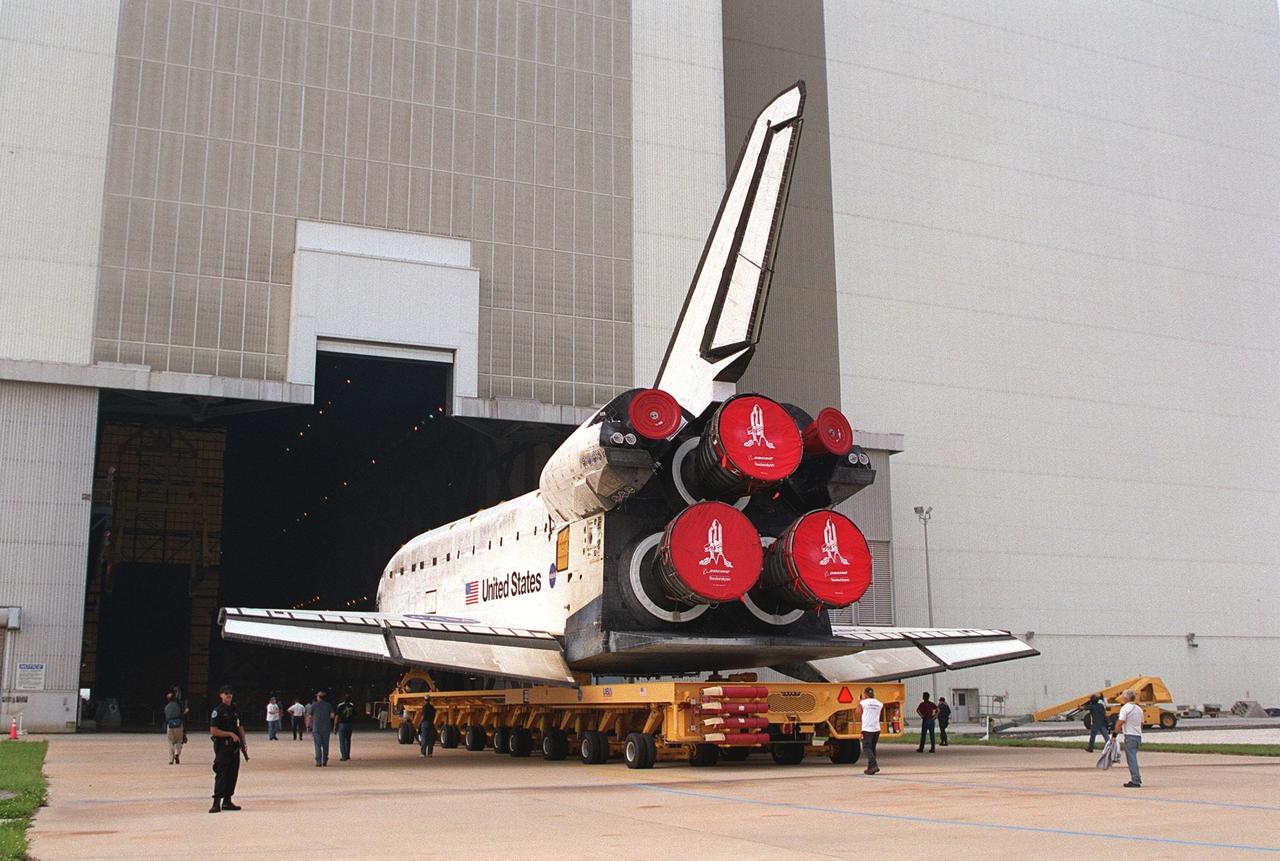
KENNEDY SPACE CENTER, Fla. -- Orbiter Discovery rolls into the Vehicle Assembly Building after leaving the Orbiter Processing Facility bay 2. In the VAB Discovery will be mated with its external tank and solid rocket boosters for its launch on mission STS-105. The payload on this 11th mission to the International Space Station includes the Multi-Purpose Logistics Module Leonardo, which was built by the Italian Space Agency. Leonardo will be outfitted with 12 racks of experiments and equipment. Launch of Discovery is scheduled for no earlier than Aug. 5, 2001
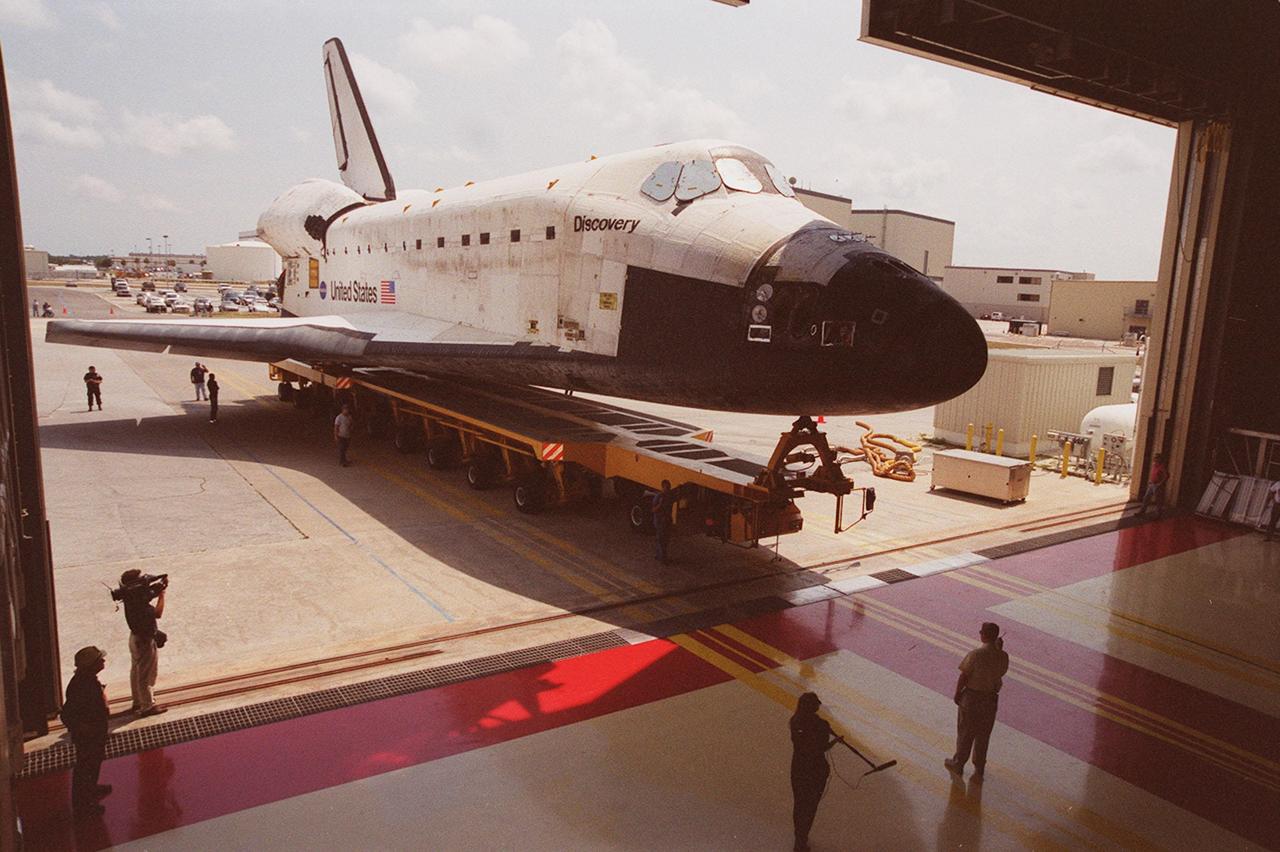
KENNEDY SPACE CENTER, FLA. -- The orbiter Discovery rolls into Orbiter Processing Facility (OPF) bay 3 where ongoing payload and ground processing assessments will be completed. Managers will then determine when to roll the orbiter to the Vehicle Assembly Building for stacking with the external tank and solid rocket boosters, and when to roll out to Launch Pad 39A. Discovery is scheduled to launch Oct. 5 at 9:30 p.m. EDT on mission STS-92, which will be the 100th flight in the Shuttle program
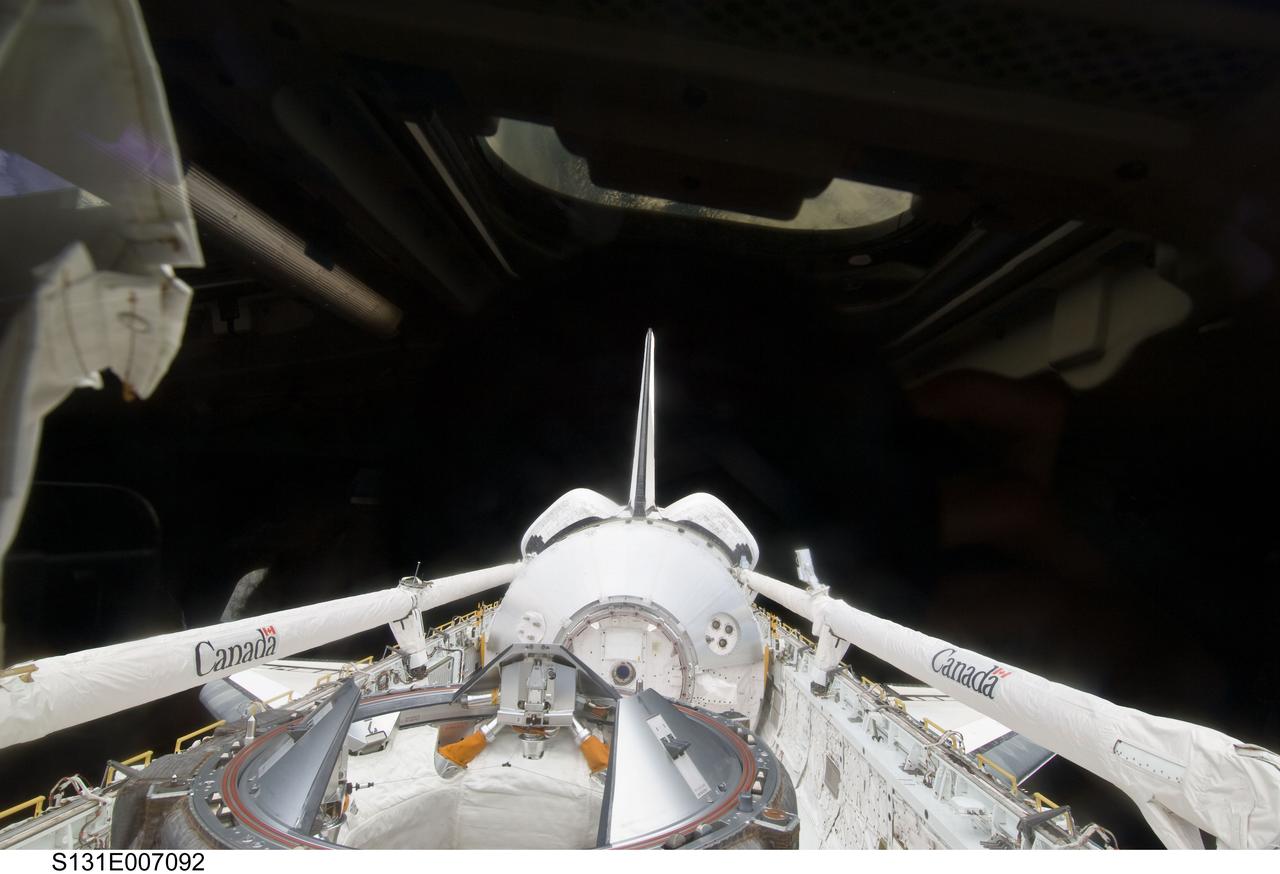
S131-E-007092 (5 April 2010) --- The Leonardo Multi-Purpose Logistics Module (MPLM) visible in space shuttle Discovery's payload bay, docking mechanism, vertical stabilizer, orbital maneuvering system (OMS) pods and Remote Manipulator System/Orbiter Boom Sensor System (RMS/OBSS) are featured in this image photographed by an STS-131 crew member from an aft flight deck window.
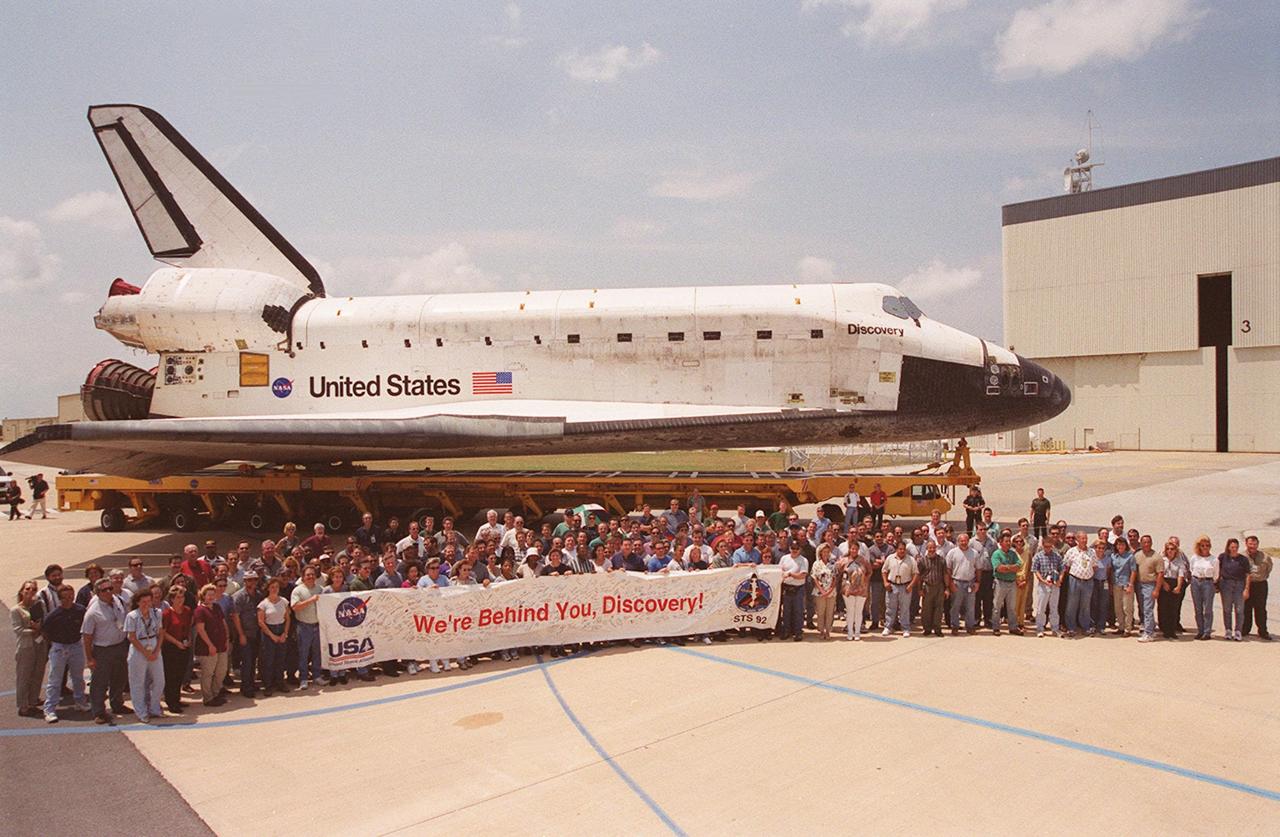
KENNEDY SPACE CENTER, FLA. -- United Space Alliance workers who worked on the orbiter Discovery during process flow pose alongside it during the orbiter’s transfer to Orbiter Processing Facility (OPF) bay 3. Ongoing payload and ground processing assessments will be completed in bay 3. Managers will then determine when to roll the orbiter to the Vehicle Assembly Building for stacking with the external tank and solid rocket boosters, and when to roll out to Launch Pad 39A. Discovery is scheduled to launch Oct. 5 at 9:30 p.m. EDT on mission STS-92, which will be the 100th flight in the Shuttle program
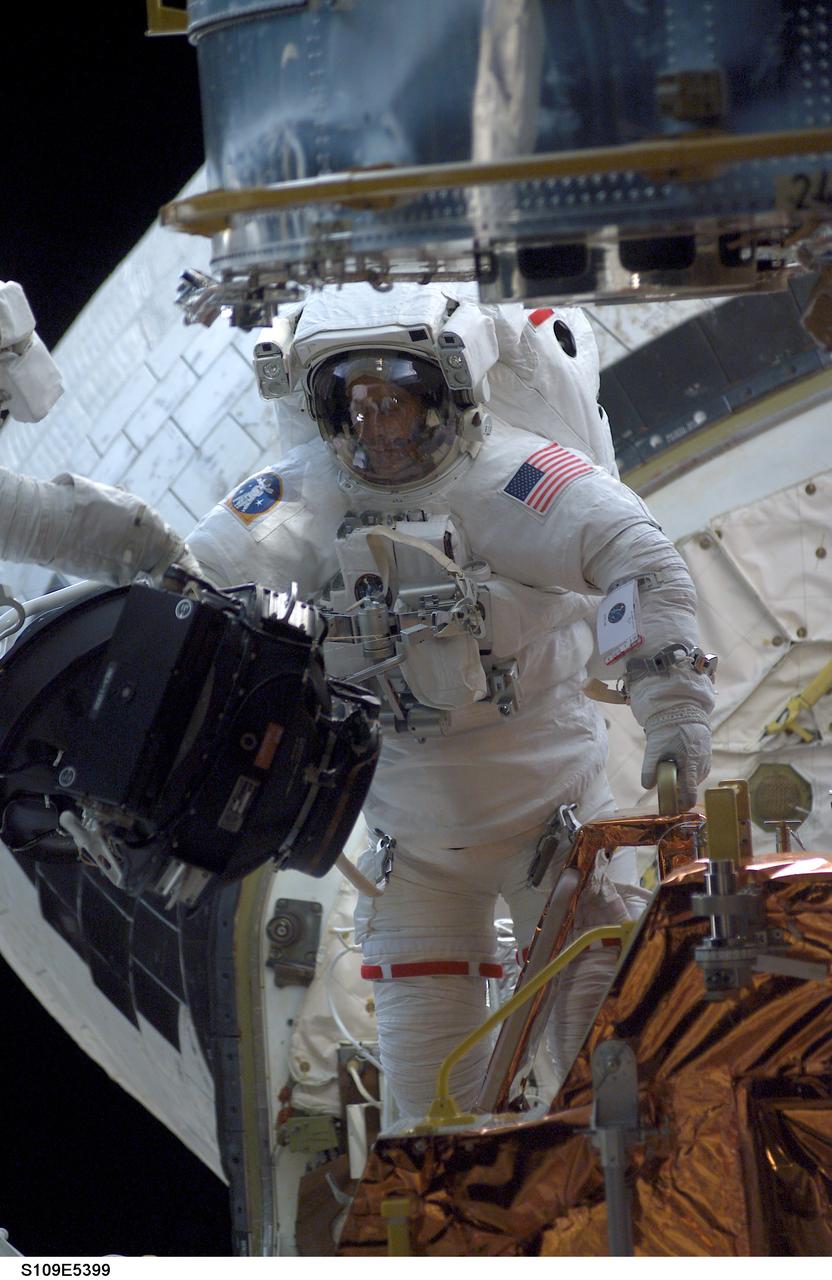
STS109-E-5399 (5 March 2002) --- Astronaut James H. Newman, mission specialist, moves about in the Space Shuttle Columbia's cargo bay while working in tandem with astronaut Michael J. Massimino (out of frame), mission specialist, during the STS-109 mission's second day of extravehicular activity (EVA). Inside Columbia's cabin, astronaut Nancy J. Currie, mission specialist, controlled the Remote Manipulator System (RMS) to assist the two in their work on the Hubble Space Telescope (HST). Part of the giant telescope's base, latched down in the payload bay, can be seen just above Newman. The image was recorded with a digital still camera.

KENNEDY SPACE CENTER, Fla. -- After rollover from Orbiter Processing Facility bay 2, Discovery is fitted with a crane that will lift it to a vertical position and move it into high bay 4. There it will be mated with its external tank and solid rocket boosters for its launch on mission STS-105. The payload on this 11th mission to the International Space Station includes the Multi-Purpose Logistics Module Leonardo, which was built by the Italian Space Agency. Leonardo will be outfitted with 12 racks of experiments and equipment. Launch of Discovery is scheduled for no earlier than Aug. 5, 2001
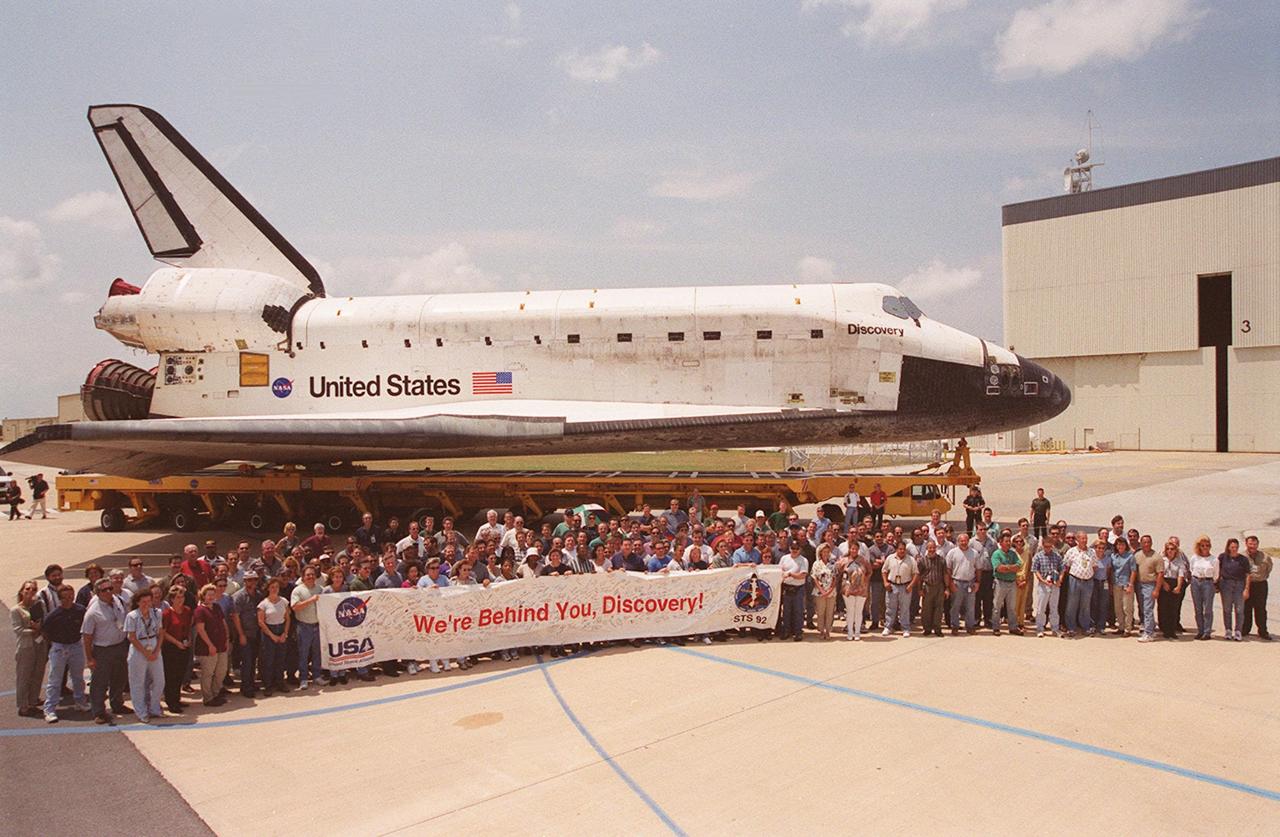
KENNEDY SPACE CENTER, FLA. -- United Space Alliance workers who worked on the orbiter Discovery during process flow pose alongside it during the orbiter’s transfer to Orbiter Processing Facility (OPF) bay 3. Ongoing payload and ground processing assessments will be completed in bay 3. Managers will then determine when to roll the orbiter to the Vehicle Assembly Building for stacking with the external tank and solid rocket boosters, and when to roll out to Launch Pad 39A. Discovery is scheduled to launch Oct. 5 at 9:30 p.m. EDT on mission STS-92, which will be the 100th flight in the Shuttle program
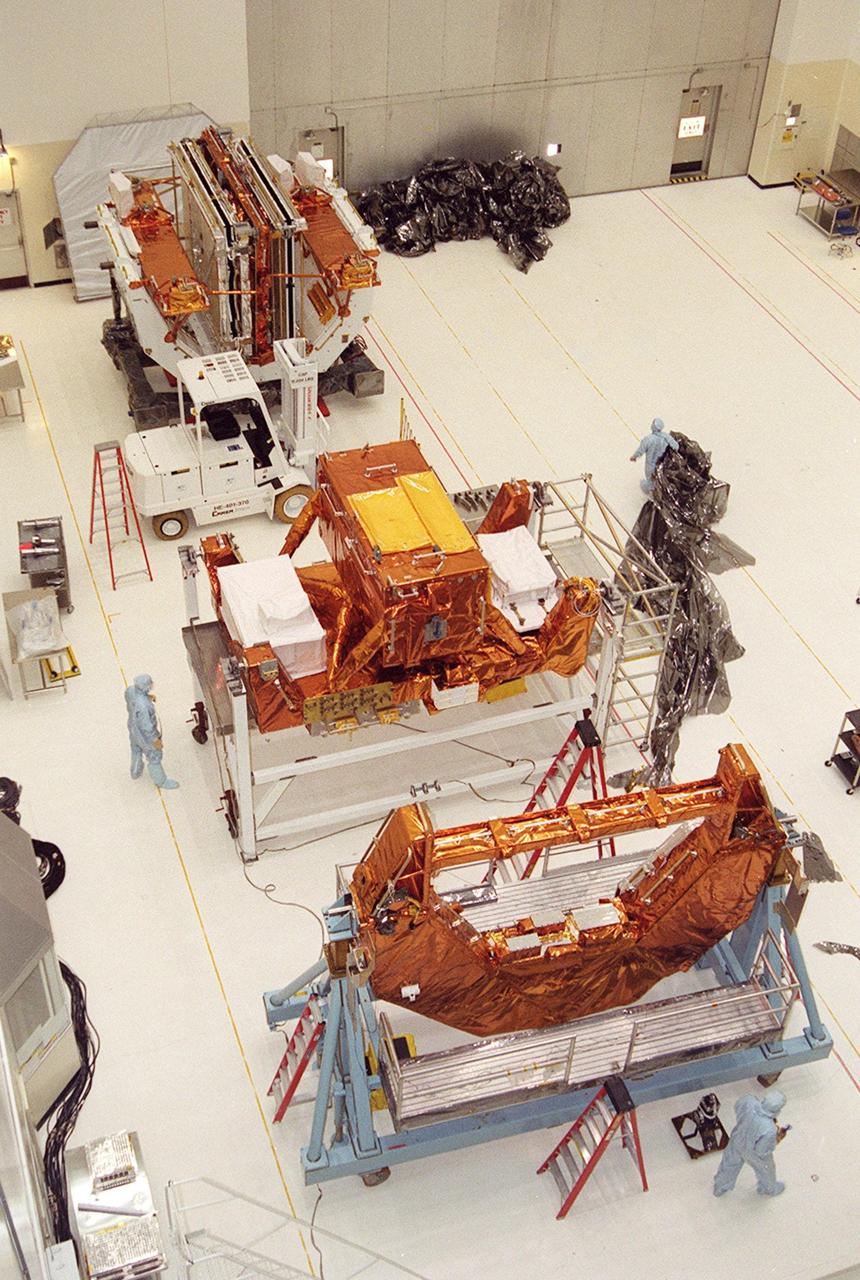
KENNEDY SPACE CENTER, Fla. -- In the Vertical Processing Facility, various components of the payload on mission STS-109 rest on workstands after being unwrapped. The purpose of the STS-109 mission is servicing the Hubble Space Telescope. The primary servicing tasks of the mission are to replace Solar Array 2 with Solar Array 3, replace the Power Control Unit, remove the Faint Object Camera and install the Advanced Camera for Surveys, install the NICMOS Cooling System, and install New Outer Blanket Insulation on bays 5 through 8. Mission STS-109 is scheduled for launch in mid-February 2002
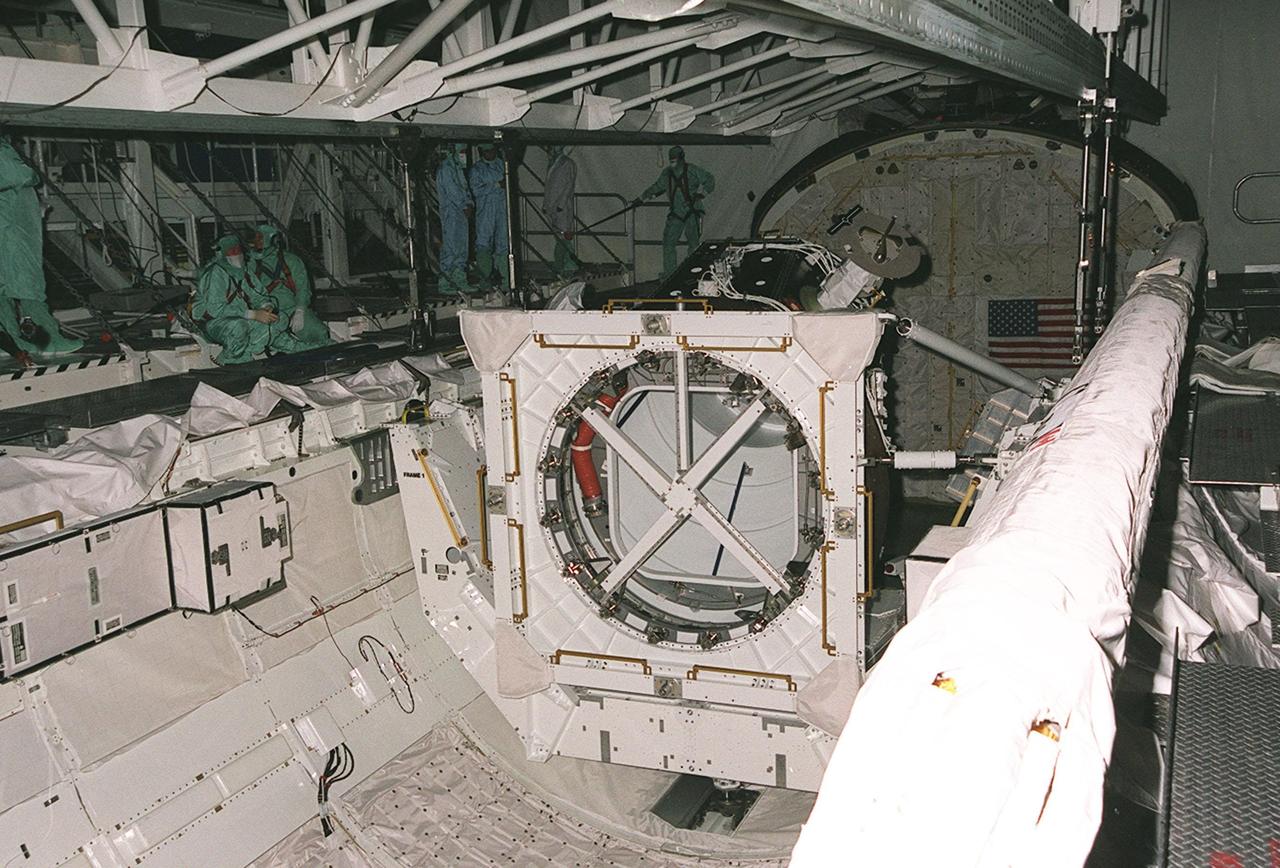
KENNEDY SPACE CENTER, FLA. -- The Pressurized Mating Adapter -3 (PMA-3) sits in the payload bay of the orbiter Discovery after being transported from the Space Station Processing Facility. A component of the International Space Station, the PMA-3 will fly on Shuttle mission STS-92, scheduled to launch Oct. 5. The mission will be the fifth flight to the Space Station, and the 100th Shuttle flight overall. PMA-3 provides shuttle docking port for solar array installation on flight 4A (mission STS-97 scheduled for Nov. 30), and Lab installation on flight 5A (mission STS-98, scheduled for Jan. 18, 2001)
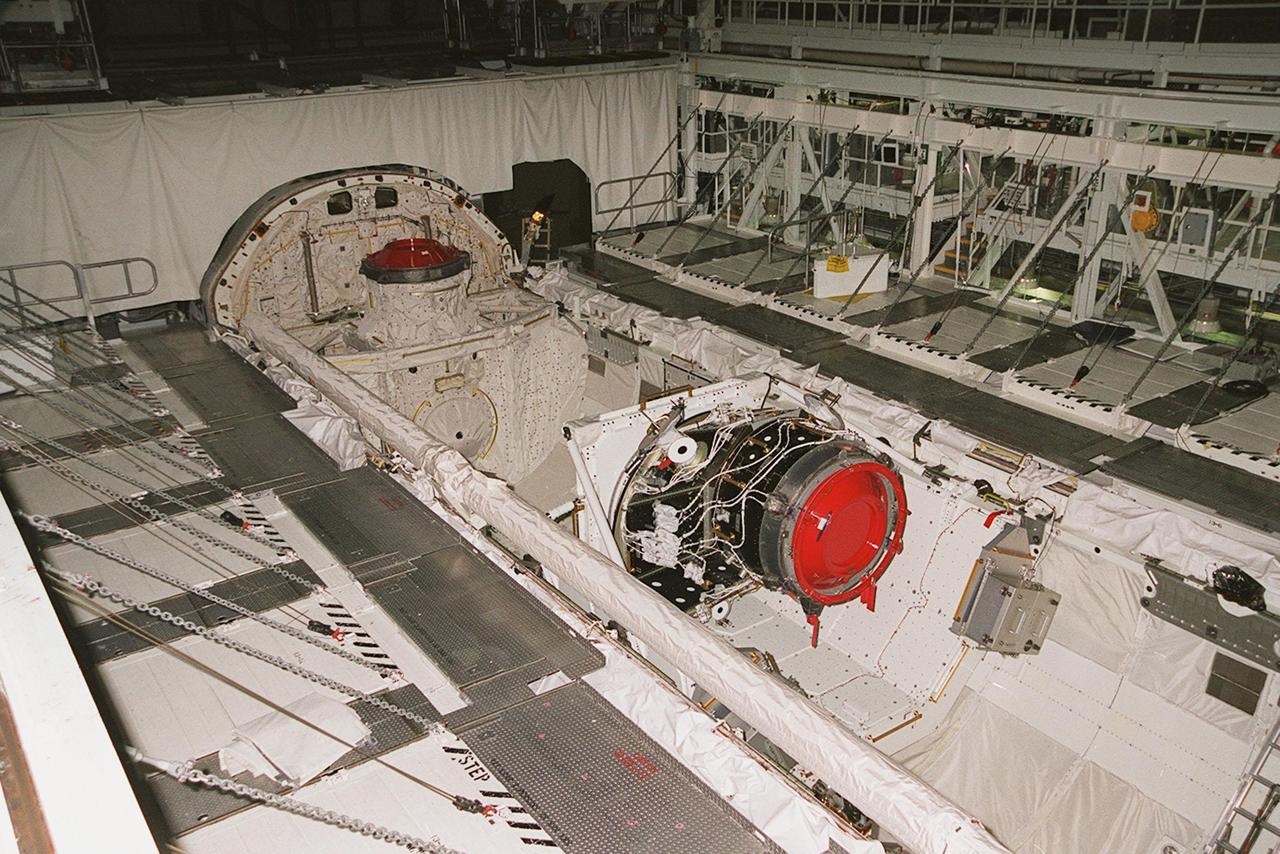
KENNEDY SPACE CENTER, FLA. -- The Pressurized Mating Adapter -3 (PMA-3) sits in the payload bay of the orbiter Discovery after being transported from the Space Station Processing Facility. A component of the International Space Station, the PMA-3 will fly on Shuttle mission STS-92, scheduled to launch Oct. 5. The mission will be the fifth flight to the Space Station, and the 100th Shuttle flight overall. PMA-3 provides shuttle docking port for solar array installation on flight 4A (mission STS-97 scheduled for Nov. 30), and Lab installation on flight 5A (mission STS-98, scheduled for Jan. 18, 2001)
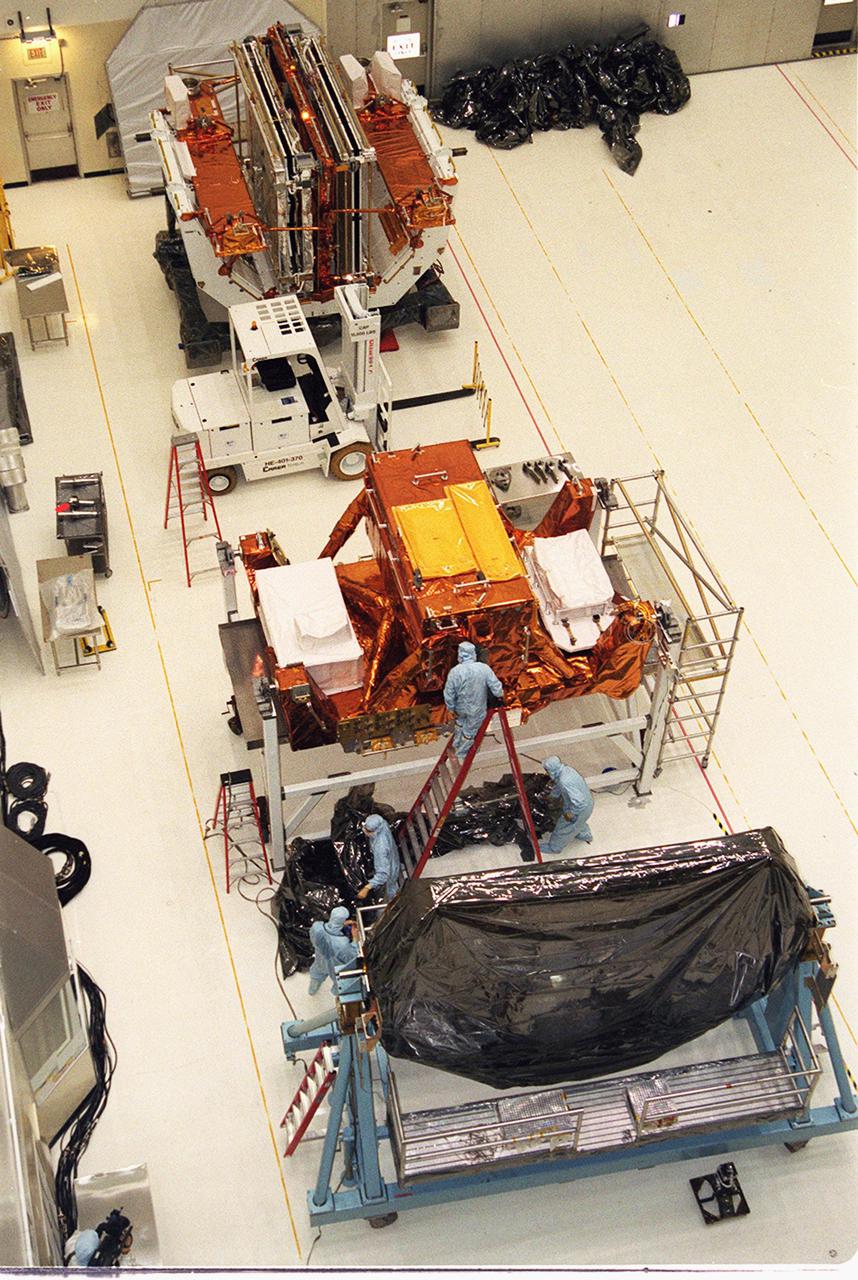
KENNEDY SPACE CENTER, Fla. -- In the Vertical Processing Facility, two components of the STS-109 payload are revealed while a third is being unwrapped. The purpose of the STS-109 mission is servicing the Hubble Space Telescope. The primary servicing tasks of the mission are to replace Solar Array 2 with Solar Array 3, replace the Power Control Unit, remove the Faint Object Camera and install the Advanced Camera for Surveys, install the NICMOS Cooling System, and install New Outer Blanket Insulation on bays 5 through 8. Mission STS-109 is scheduled for launch in mid-February 2002