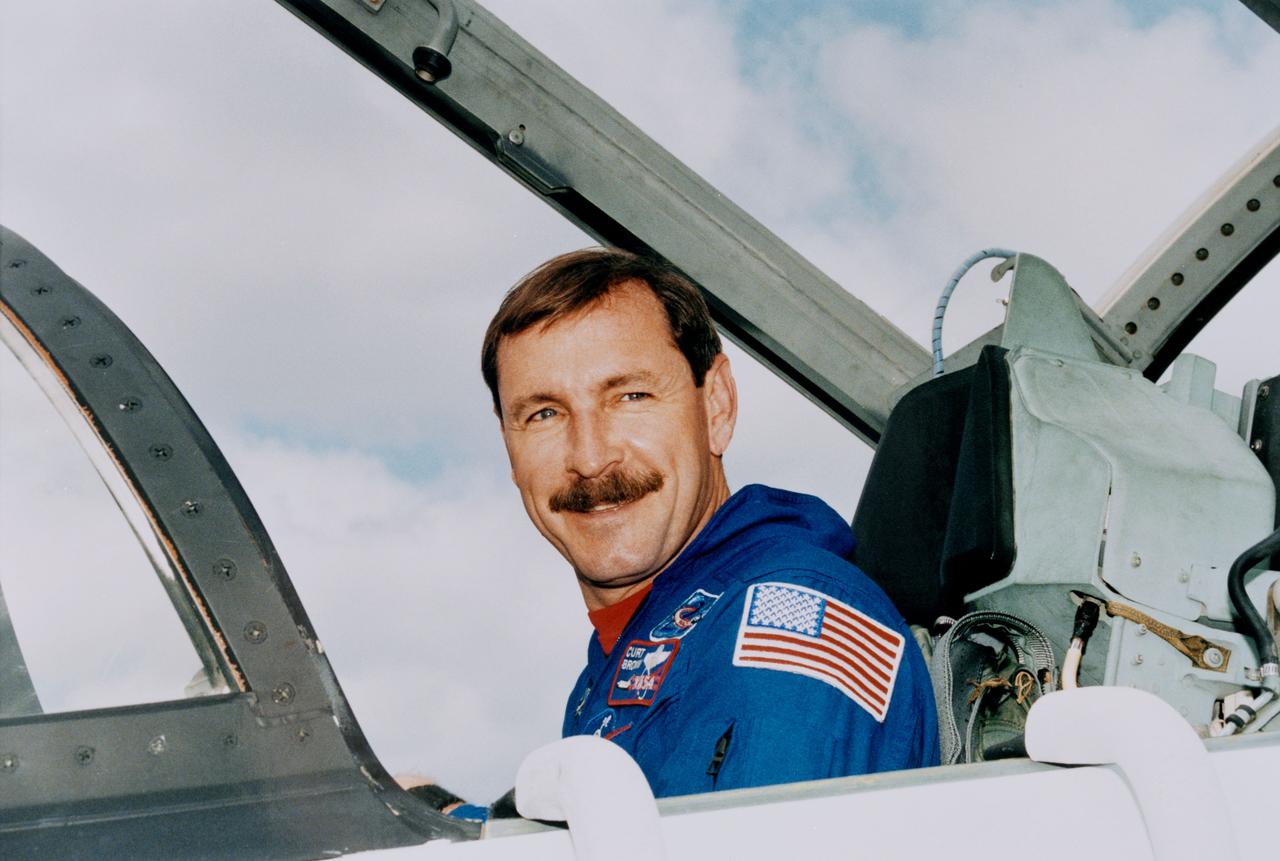
S96-08025 (22 April 1996) --- The STS-77 crew arrives at the Kennedy Space Center's (KSC) Shuttle Landing Facility (SLF) for the Terminal Countdown Demonstration Test (TCDT), a dress rehearsal for launch. Shown here is Curtis L. Brown, Jr., pilot, who will be embarking on his third spaceflight when the Space Shuttle Endeavour lifts off on the STS-77 mission in mid-May. Over the next several days, the six-member crew will participate in emergency egress training at the pad and a simulated launch countdown that includes the entire launch team.
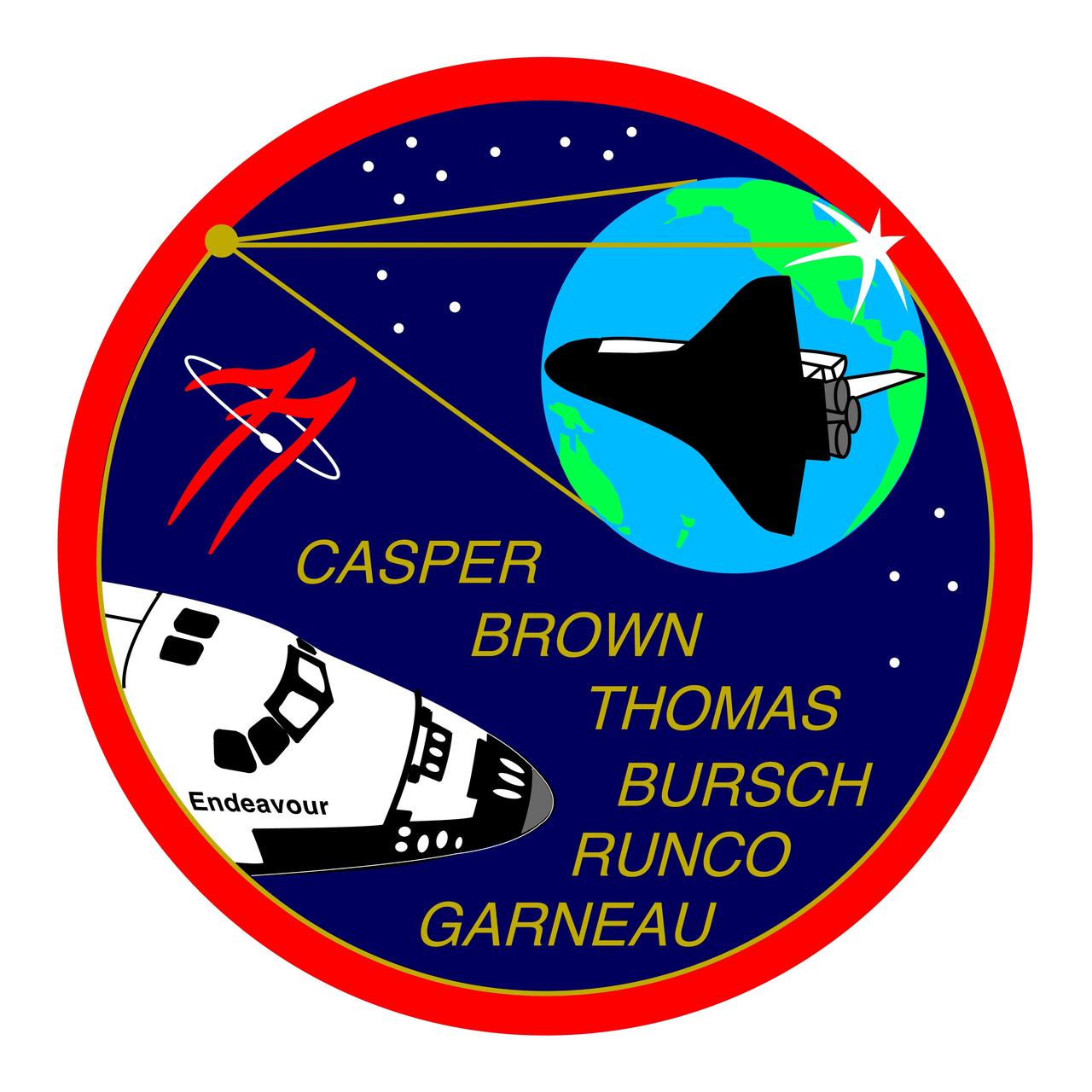
STS077-S-001 (February 1996) --- The STS-77 crew patch, designed by the crew members, displays the space shuttle Endeavour the lower left and its reflection within the tripod and concave parabolic mirror of the Shuttle Pointed Autonomous Research Tool for Astronomy (SPARTAN) Inflatable Antenna Experiment (IAE). The center leg of the tripod also delineates the top of the Spacehab?s shape, the rest of which is outlined in gold just inside the red perimeter. The Spacehab is carried in the payload bay and houses the Commercial Float Zone Furnace (CFZF) and Space Experiment Facility (SEF) experiments. Also depicted within the confines the IAE mirror are the mission?s rendezvous operations with the Passive Aerodynamically Stabilized Magnetically Damped Satellite/Satellite Test Unit (PAM/STU) satellite and a reflection of Earth. The PAM/STU satellite appears as a bright six-pointed star-like reflection of the sun on the edge of the mirror with the space shuttle Endeavour in position to track it. The sunglint on the mirror?s edge, which also appears as an orbital sunset, is located over Goddard Space Flight Center (GSFC), the development facility for the SPARTAN/IAE and Technology Experiments Advancing Missions in Space (TEAMS) experiments. The reflection of Earth is oriented to show the individual countries of the crew as well as the ocean which Captain Cook explored in the original Endeavour. The mission number ?77? is featured as twin stylized chevrons and an orbiting satellite as adapted from NASA?s logo. The stars at the top are arranged as seen in the northern sky in the vicinity of the constellation Ursa Minor. The field of 11 stars represents both the TEAMS cluster of experiments (the four antennae of Global Positioning System Attitude and Navigation Experiment (GANE), the single canister of Liquid Metal Thermal Experiment (LMTE), the three canisters of Vented Tank Resupply Experiment (VTRE), and the canisters of PAM/STU, and the 11th flight of the Endeavour. The constellation at the right shows the four stars of the Southern Cross for the fourth flight of Spacehab. The NASA insignia design for space shuttle flights is reserved for use by the astronauts and for other official use as the NASA Administrator may authorize. Public availability has been approved only in the forms of illustrations by the various news media. When and if there is any change in this policy, which is not anticipated, the change will be publicly announced. Photo credit: NASA
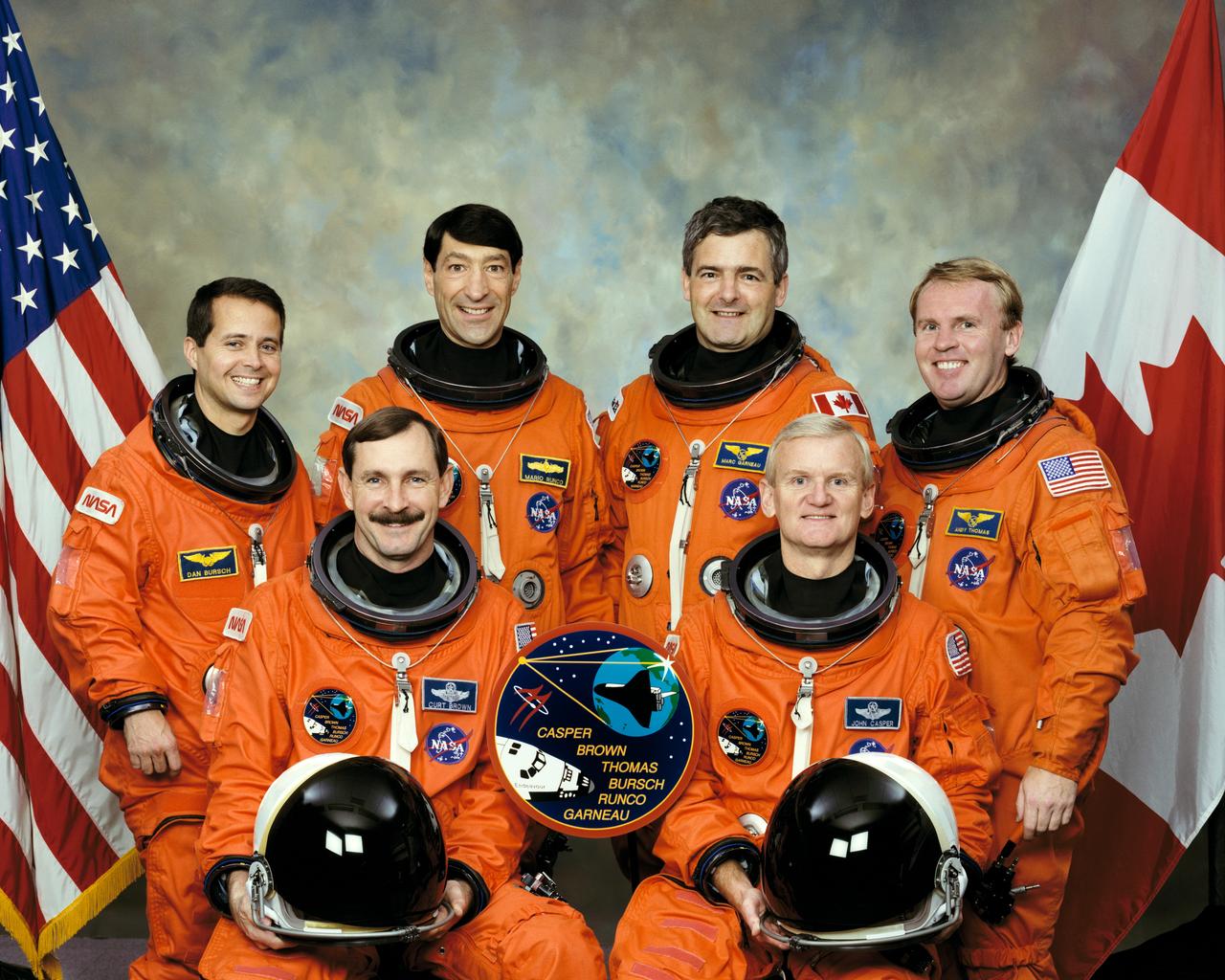
STS077-S-002 (February 1996) --- These six astronauts have been named to fly aboard the Space Shuttle Endeavour in support of the Spacehab-04 mission, scheduled for launch in May of this year. On the front row are astronauts John H. Casper (right), mission commander; and Curtis L. Brown Jr., pilot. In the rear, from the left, are astronauts Daniel W. Bursch, Mario Runco Jr., Marc Garneau and Andrew S. W. Thomas, all mission specialists. Garneau represents the Canadian Space Agency (CSA).
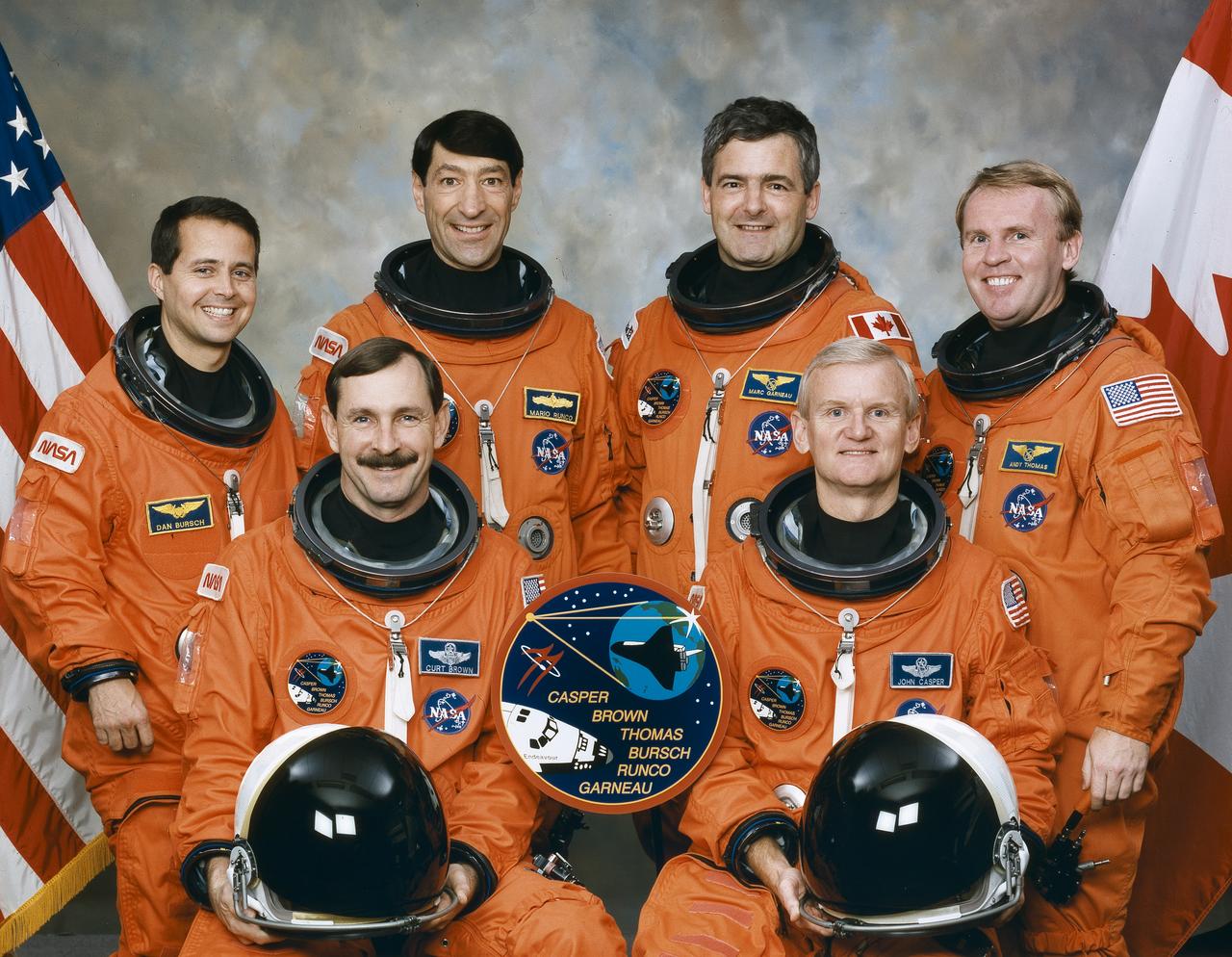
The crew assigned to the STS-77 mission included (seated left to right) Curtis L. Brown, pilot; and John H. Casper, commander. Standing, left to right, are mission specialists Daniel W. Bursch, Mario Runco, Marc Garneau (CSA), and Andrew S. W. Thomas. Launched aboard the Space Shuttle Endeavour on May 19, 1996 at 6:30:00 am (EDT), the STS-77 mission carried three primary payloads; the SPACEHAB-4 pressurized research module, the Inflatable Antenna Experiment (IAE) mounted on a Spartan 207 free-flyer, and a suite of four technology demonstration experiments known as Technology Experiments for Advancing Missions in Space (TEAMS).
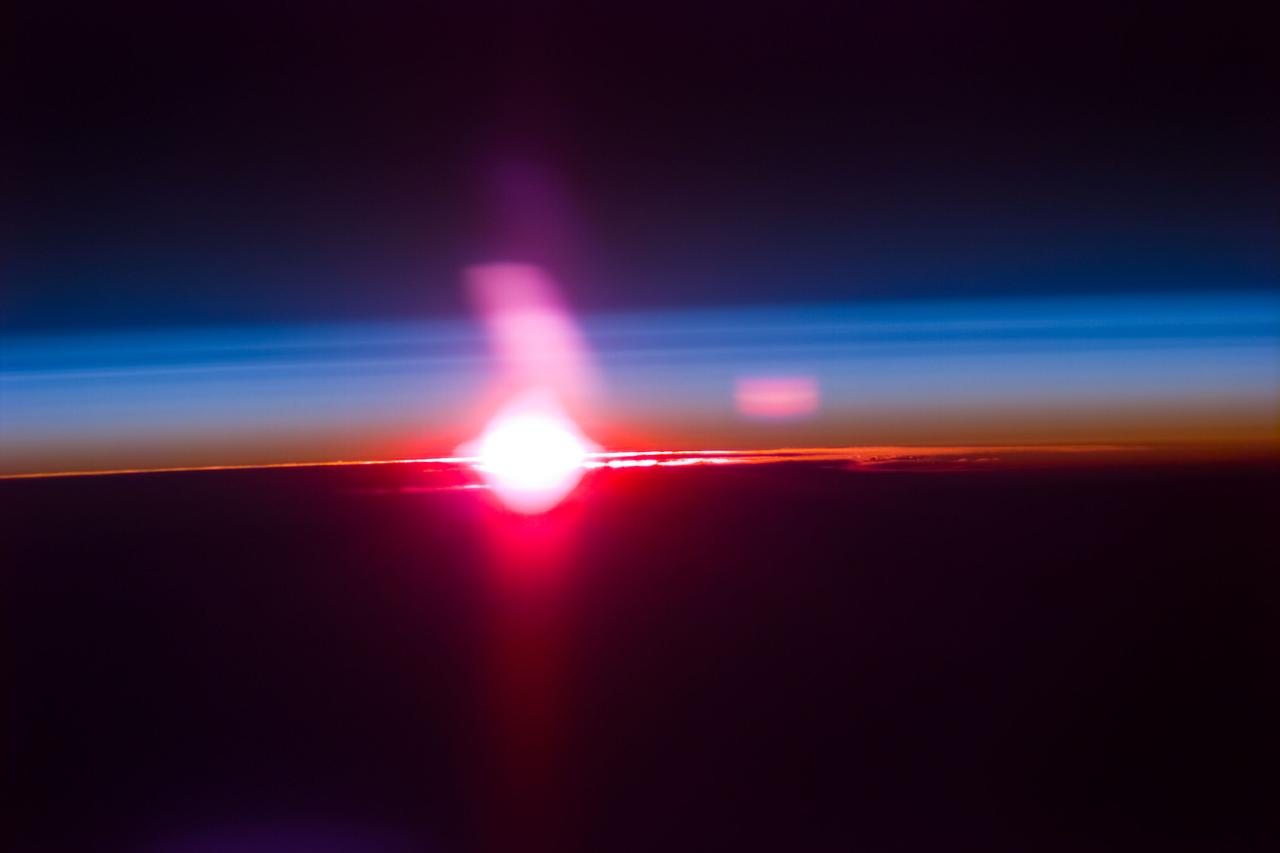
S77-E-5073 (22 May 1996) --- From its position at 175 statute miles above Earth, the Space Shuttle Endeavour has encountered some colorful and attractive scenes heading into sunsets and sunrises. This particular encounter, captured with an Electronic Still Camera (ESC), occurred on flight day four, during which the six-member crew deployed the Passive Aerodynamically Stabilized Magnetically Damped Satellite (PAMS) - Satellite Test Unit (STU).
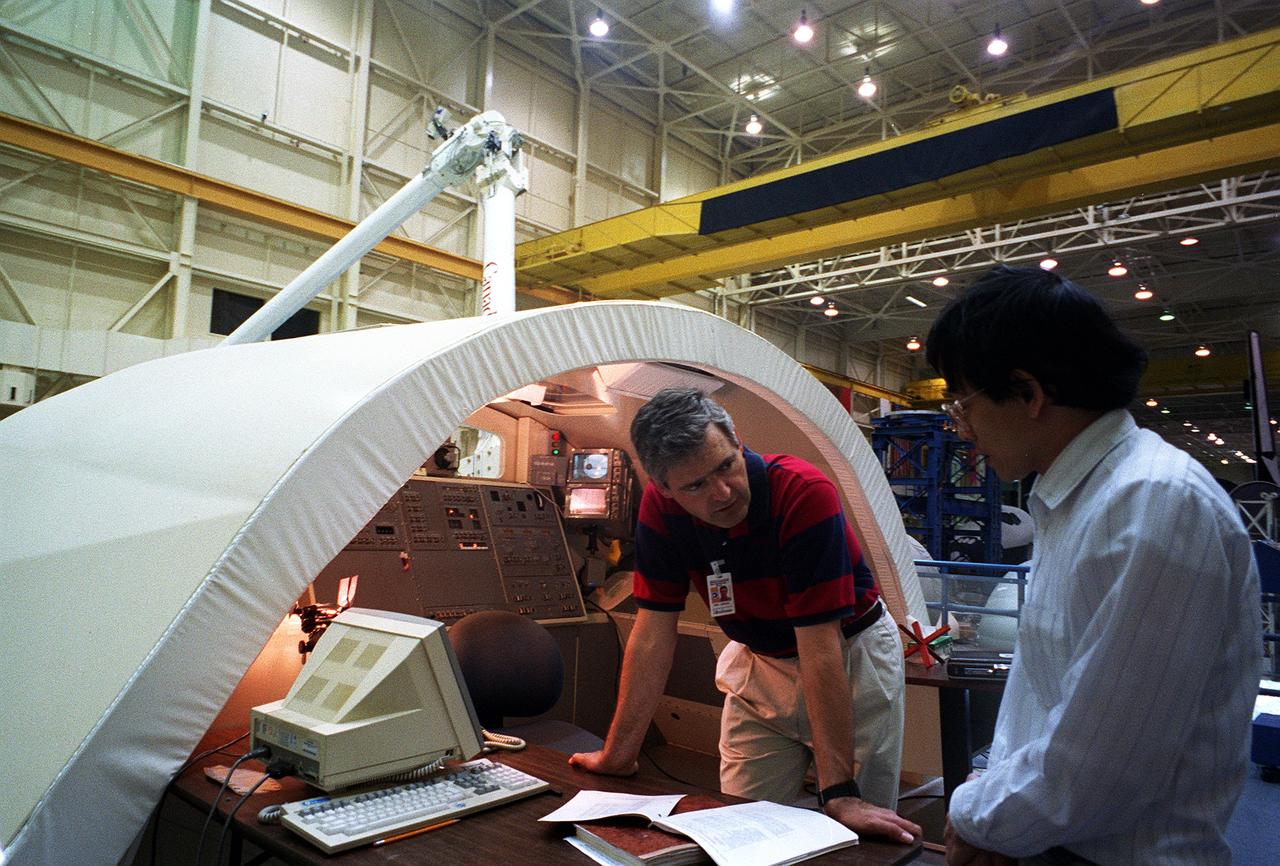
S96-08071 (April 1996) --- Crew trainer Viet Nguyen briefs Canadian astronaut Marc Garneau, mission specialist, on Remote Manipulation System (RMS) procedures during a training session in the Johnson Space Center's (JSC) Manipulator Development Facility (MDF). Garneau will be making his second flight in space when he joins five NASA astronauts for nine days aboard the Space Shuttle Endeavour next month.
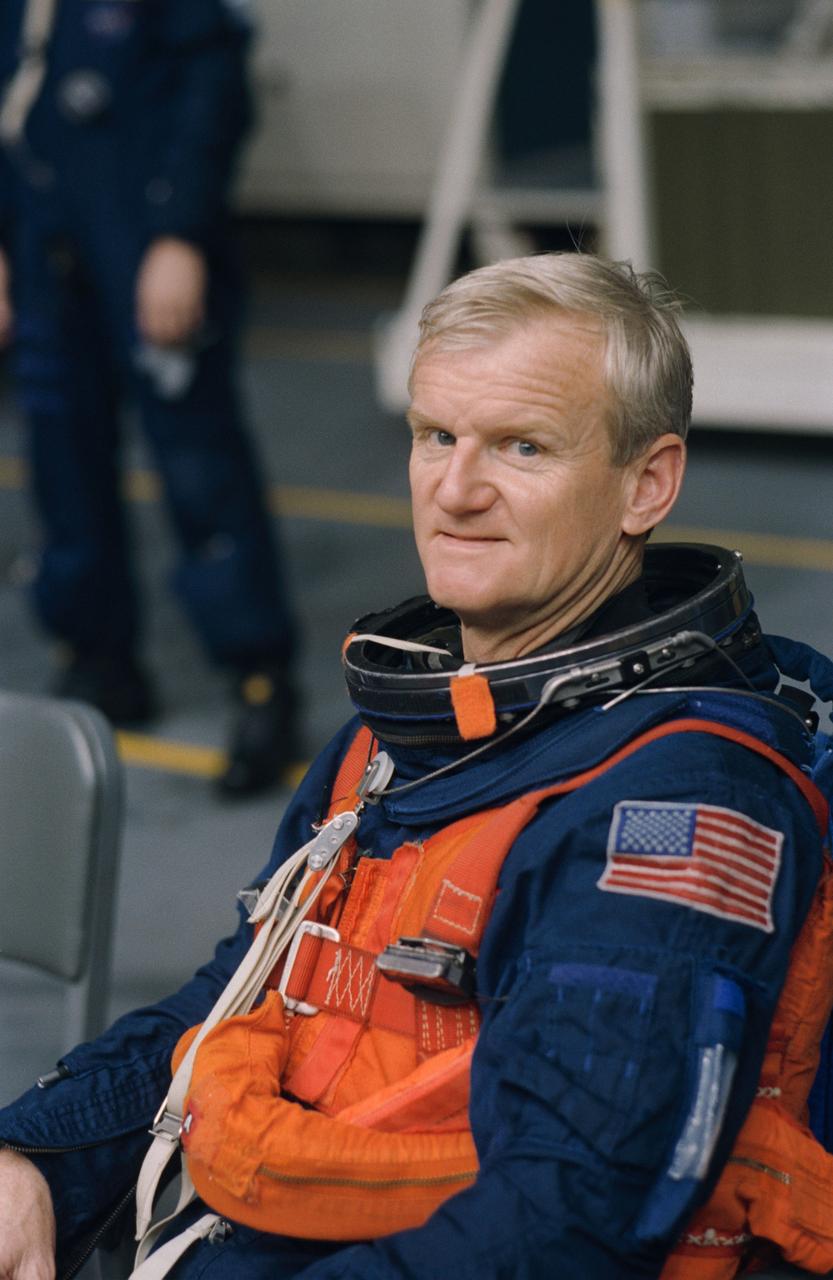
S96-08065 (April 1996) --- Astronaut John H. Casper, mission commander and veteran of three Space Shuttle flights, awaits the beginning of a training session for emergency bailout. All six crew members participated in the session, held in the Johnson Space Center?s (JSC) Weightless Environment Training Facility (WET-F). The six astronauts will spend nine days aboard the Space Shuttle Endeavour next month.
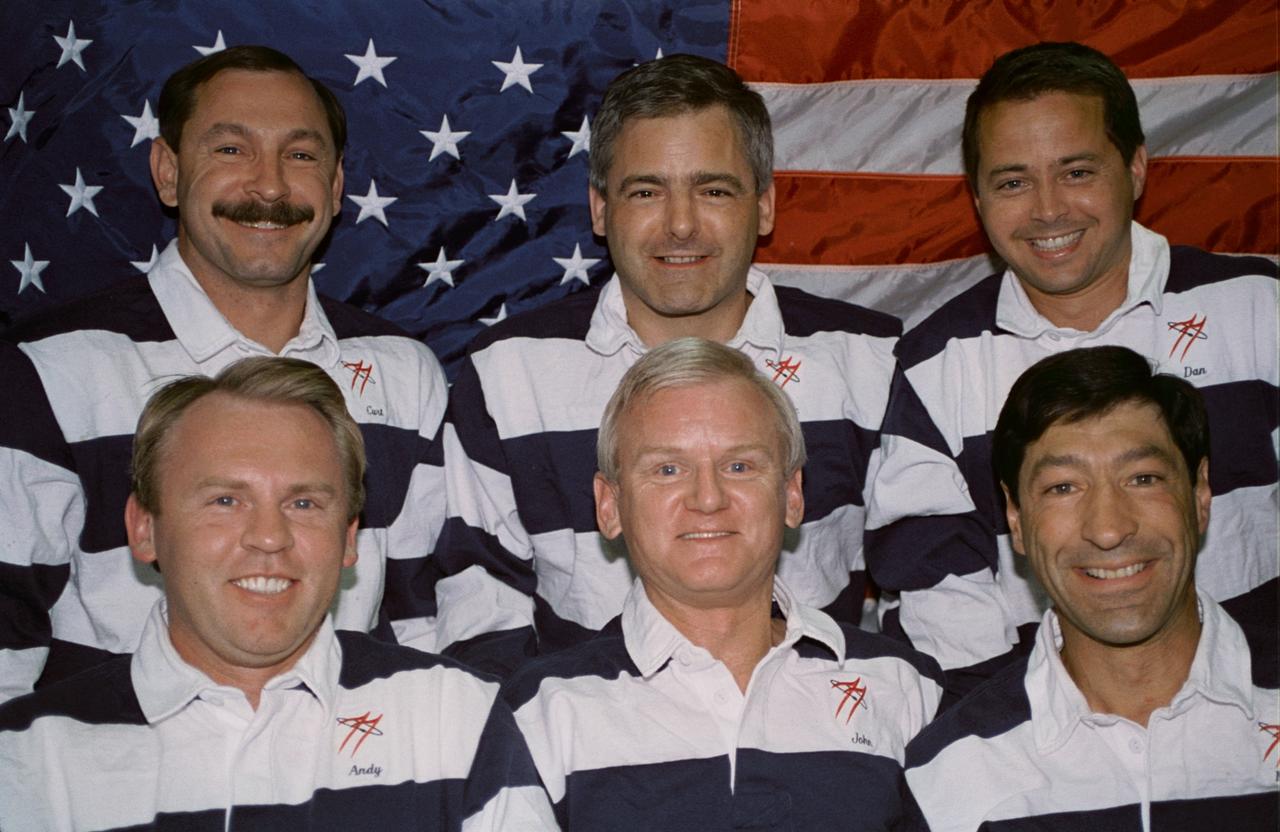
STS077-314-011 (19-29 May 1996) --- The six astronauts aboard the Space Shuttle Endeavour for NASA?s STS-77 mission pose for the traditional inflight portrait. Left to right, front, are astronauts Andrew S. W. Thomas, John H. Casper and Mario Runco, Jr. On the back row are astronauts Curtis L. Brown, Jr., Marc Garneau and Daniel W. Bursch. Casper is mission commander and Brown serves as pilot, with the rest of the crew functioning as mission specialists. Garneau represents the Canadian Space Agency (CSA).
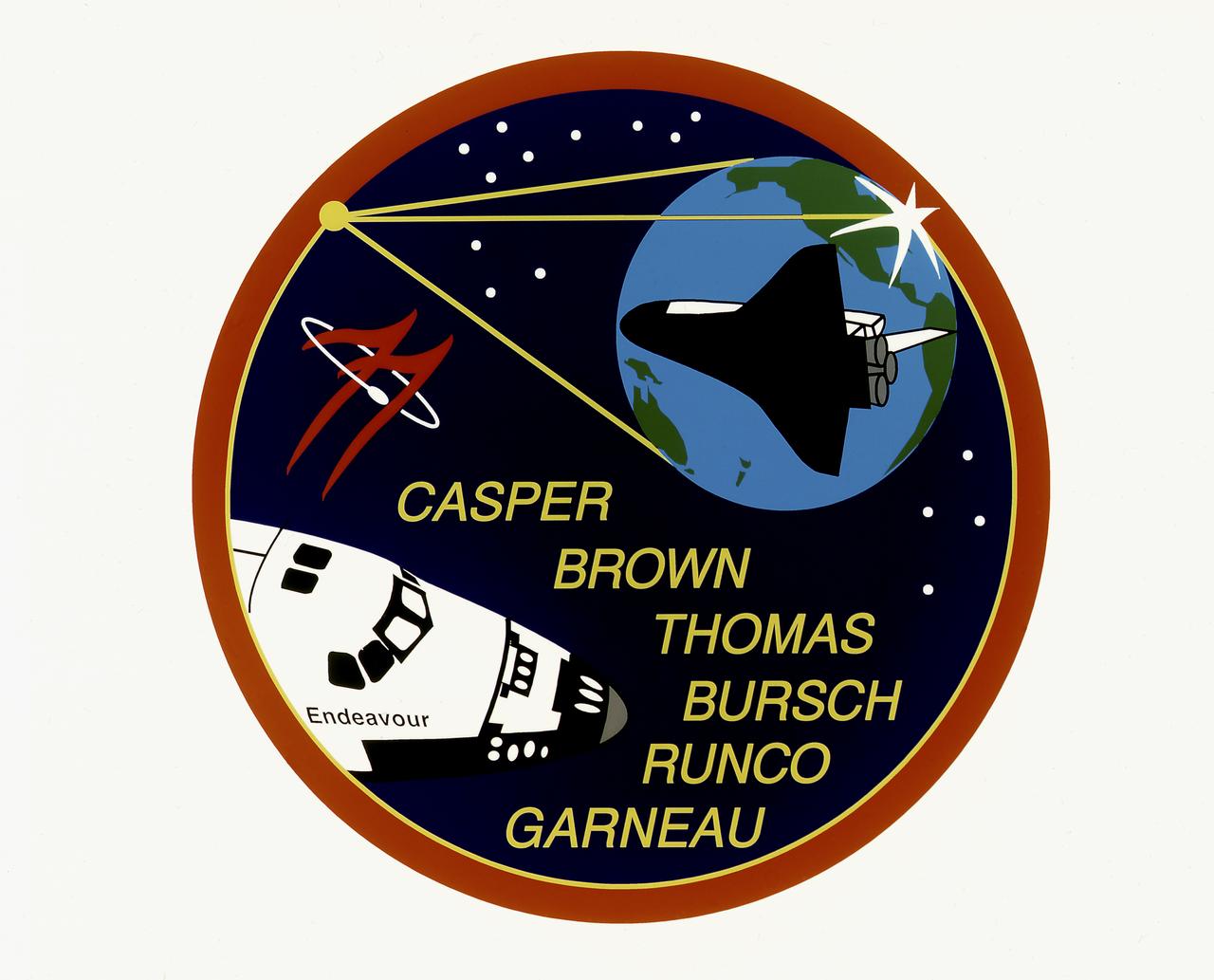
The STS-77 crew patch displays the Shuttle Endeavour in the lower left and its reflection within the tripod and concave parabolic mirror of the SPARTAN Inflatable Antenna Experiment (IAE). The center leg of the tripod also delineates the top of the Spacehab's shape, the rest of which is outlined in gold just inside the red perimeter. The Spacehab was carried in the payload bay and housed the Commercial Float Zone Furnace (CFZF). Also depicted within the confines of the IAE mirror are the mission's rendezvous operations with the Passive Aerodynamically-Stabilized Magnetically-Damped satellite (PAM/STU) appears as a bright six-pointed star-like reflection of the sun on the edge of the mirror with Endeavour in position to track it. The sunlight on the mirror's edge, which also appears as an orbital sunset, is located over Goddard Space Flight Center, the development facility for the SPARTAN/IAE and Technology Experiments Advancing Missions in Space (TEAMS) experiments. The reflection of the Earth is oriented to show the individual countries of the crew as well as the ocean which Captain Cook explored in the original Endeavour. The mission number 77 is featured as twin stylized chevrons and an orbiting satellite as adapted from NASA's logo. The stars at the top are arranged as seen in the northern sky in the vicinity of the constellation Ursa Minor. The field of 11 stars represents both the TEAMS cluster of experiments (the four antennae of GPS Attitude and Navigation Experiment (GANE), the single canister of Liquid Metal Thermal Experiment (LMTE), the three canisters of Vented Tank Resupply Experiment (VTRE), and the three canisters of PAM/STU) and the 11th flight of Endeavour. The constellation at the right shows the fourth flight of Spacehab Experiments.
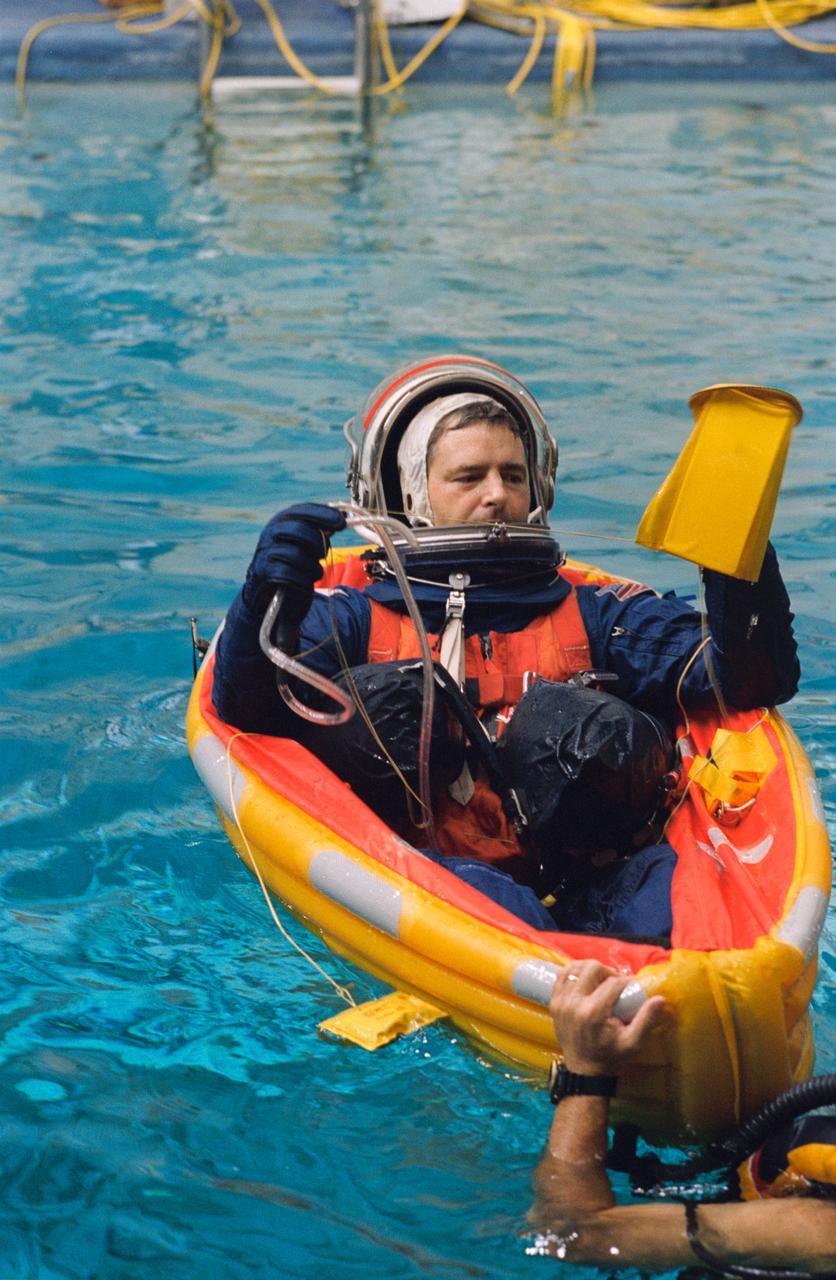
S93-45726 (7 Oct. 1993) --- Canadian astronaut candidate Marc Garneau, later named as a mission specialist for NASA's STS-77 mission, participates in emergency bailout training at the Johnson Space Center (JSC). Garneau was in the 1992 class of Astronaut Candidates (ASCAN). Wearing full parachute gear following a simulated parachute drop, Garneau has deployed a small life raft in a 25-feet deep pool in JSC's Weightless Environment Training Facility (WET-F). This portion of an astronaut's training is to prepare him or her for proper measures to take in the event of bailout over water. Garneau is assisted here by one of several SCUBA-equipped divers in the pool.
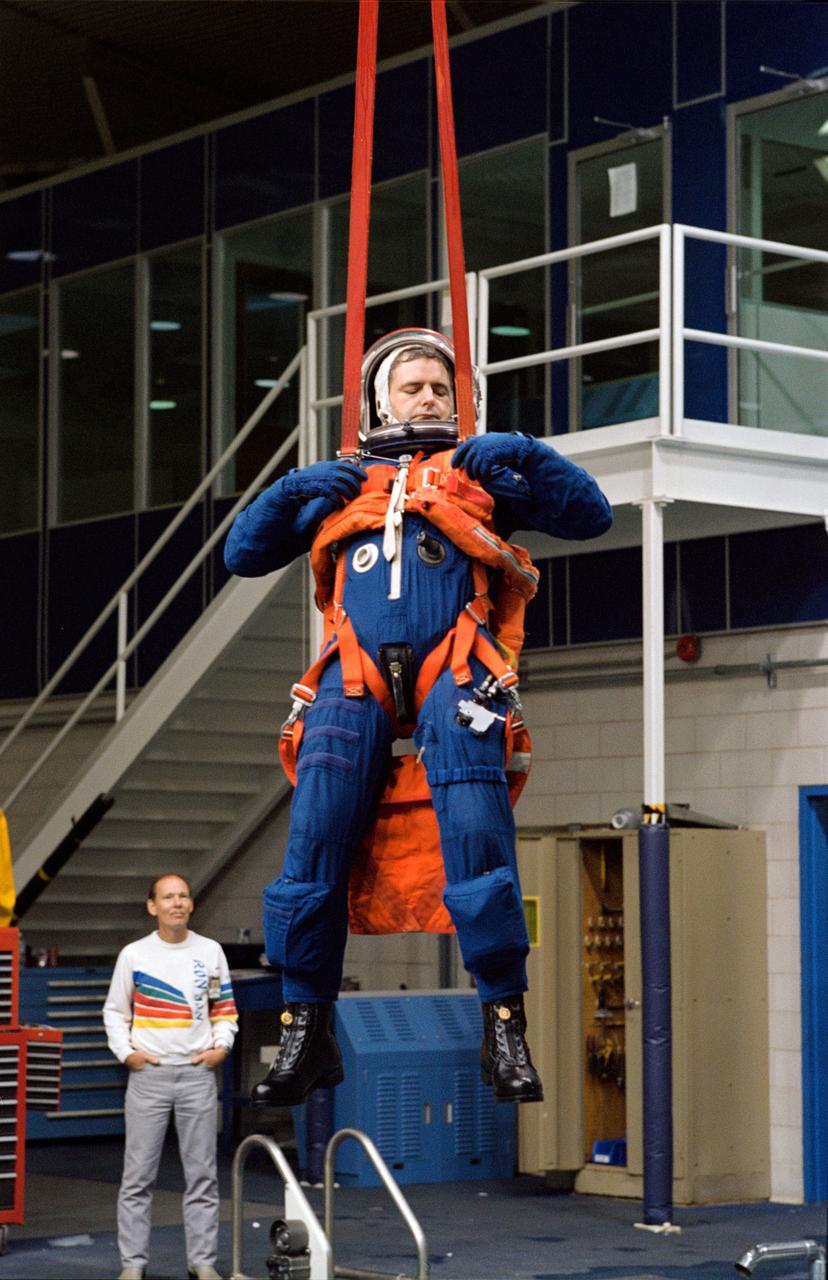
S93-45723 (7 October 1993) --- Canadian astronaut candidate Marc Garneau, later named as a mission specialist for NASA's STS-77 mission-representing the Canadian Space Agency (CSA), participates in emergency bailout training at the Johnson Space Center (JSC). Garneau was in the 1992 class of Astronaut Candidates (ASCAN). Wearing full parachute gear, Garneau is suspended above a 25-feet deep pool in JSC's Weightless Environment Training Facility (WET-F). This portion of an astronaut's training is to prepare them for proper measures to take in the event of bailout over water.
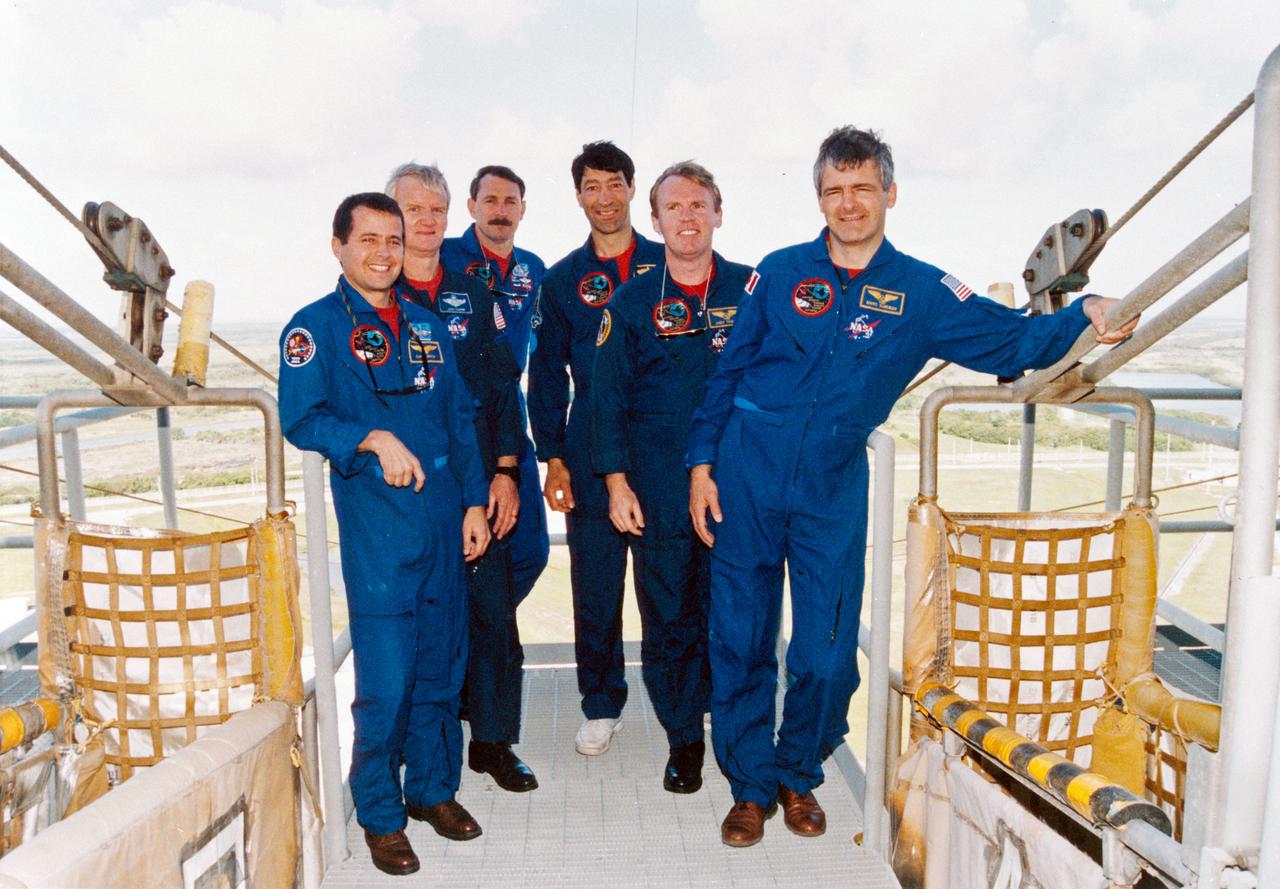
S96-08026 (22 April 1996) --- The STS-77 crew take time out from Terminal Countdown Demonstration Test (TCDT) activities to pose for a group portrait next to the slidewire baskets on the emergency egress system at the 195-feet level of Launch Pad 39B, at the Kennedy Space Center (KSC). From the left are astronauts Daniel W. Bursch, mission specialist; John H. Casper, commander; Curtis L. Brown, Jr., pilot; Mario Runco, Jr., mission specialist; Andrew S. W. Thomas, mission specialist; and Marc Garneau, mission specialist representing the Canadian Space Agency (CSA). The Space Shuttle Endeavour is undergoing preparations at Pad 39B for liftoff on the fourth Shuttle flight of 1996 around May 16, 1996.
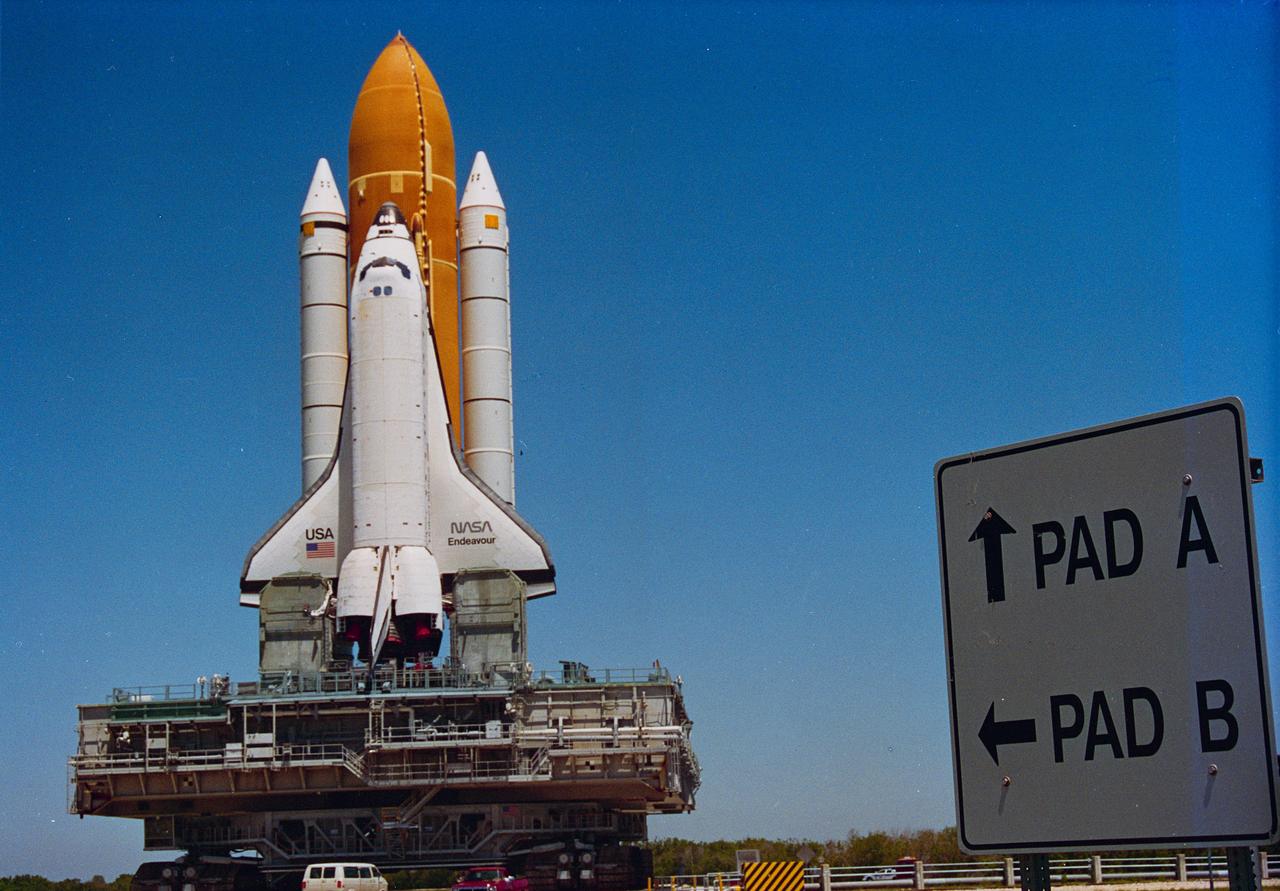
S96-07957 (16 April 1996) --- A road sign points to Launch Pad 39B, the final earthly destination for the Space Shuttle Endeavour and its final stepping stone into space. Endeavour began the slow journey from the Vehicle Assembly Building (VAB) at about 10:00a.m., April 16, 1996, perched atop the Mobile Launcher Platform and carried by the Crawler-Transporter. Upcoming activities at the pad to prepare Endeavour for flight on STS-77 include installation of the payloads in the Orbiter?s payload bay.
KENNEDY SPACE CENTER, FLA. -- STS-77: Atlantis
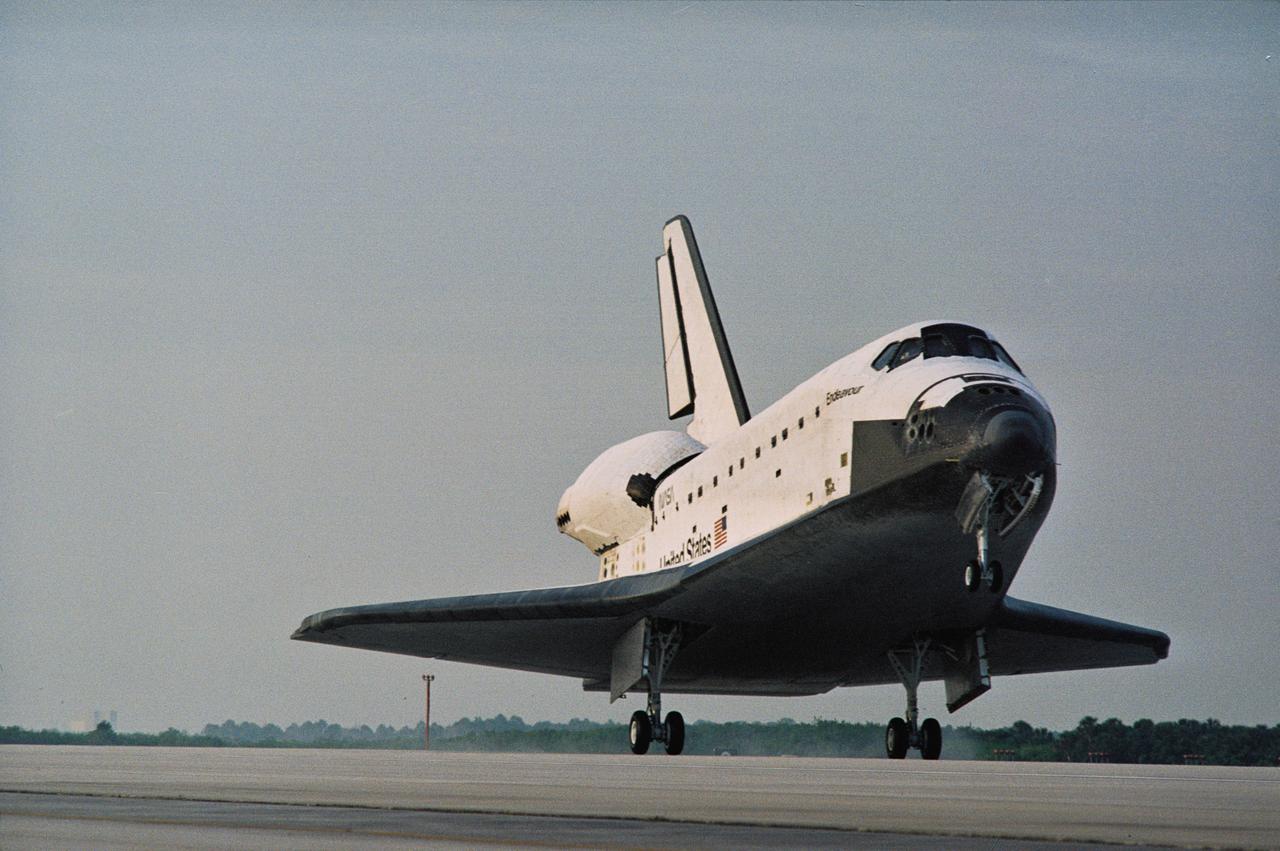
STS077-S-011 (29 May 1996) --- As its main landing gear touches down on Runway 33 at the Kennedy Space Center (KSC), the Space Shuttle Endeavour returns to Florida following a ten-day mission in space. Touchdown came at 7:09 a.m. (EDT), May 29, 1996. Leading the crew onboard was astronaut John H. Casper, mission commander. Other crew members were astronauts Curtis L. Brown, Jr., pilot; along with Daniel W. Bursch, Mario Runco, Jr., Andrew S. W. Thomas and Marc Garneau, all mission specialists. Garneau represents the Canadian Space Agency (CSA). During the approximately 10-day mission, the crew performed a variety of payload activities, including microgravity research aboard the Spacehab 4 Module, deployment and retrieval of the Spartan 207 and deployment and rendezvous with the Passive Aerodynamically-Stabilized Magnetically-Damped Satellite (PAMS).
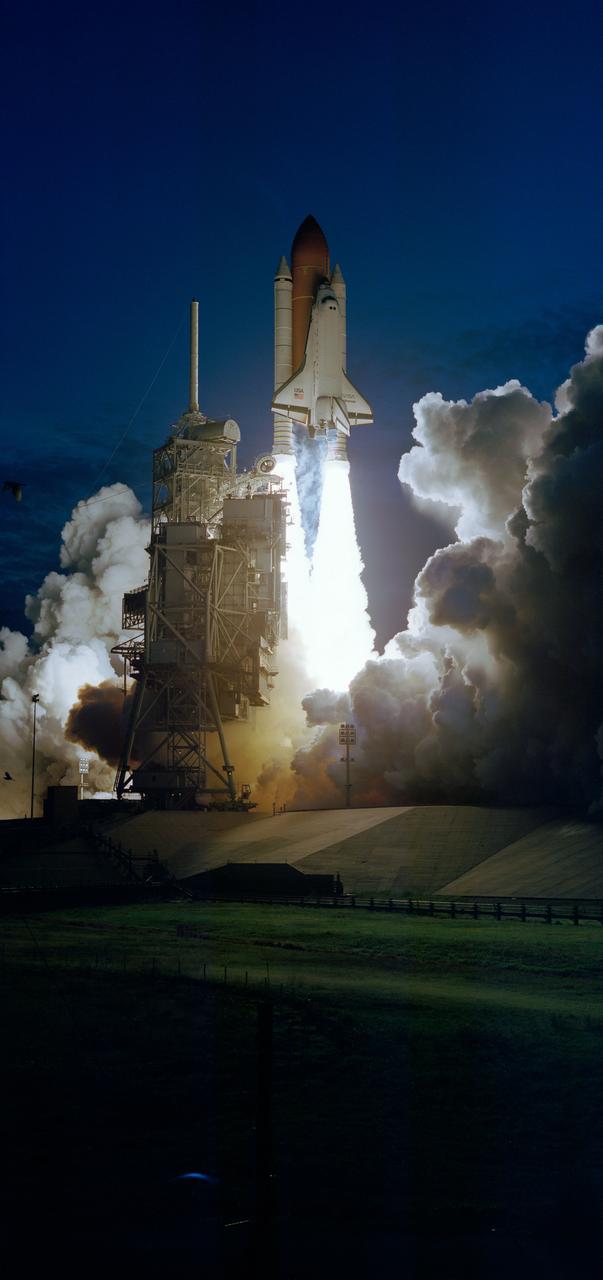
STS077-S-004 (19 May 1996) --- The Space Shuttle Endeavour lifts off with six astronauts headed toward the fourth NASA Space Shuttle mission of the year. The launch occurred at 6:30:00 a.m. (EDT), May 19, 1996. Heading the crew onboard is astronaut John H. Casper, mission commander. Other crew members are astronauts Curtis L. Brown, Jr., pilot; along with Daniel W. Bursch, Mario Runco, Jr., Andrew S. W. Thomas and Marc Garneau, all mission specialists. Garneau represents the Canadian Space Agency (CSA). During the approximately 10-day mission, the crew will perform a variety of payload activities, including microgravity research aboard the Spacehab 4 Module, deployment and retrieval of the Spartan 207 and deployment and rendezvous with the Passive Aerodynamically-Stabilized Magnetically-Damped Satellite (PAMS).
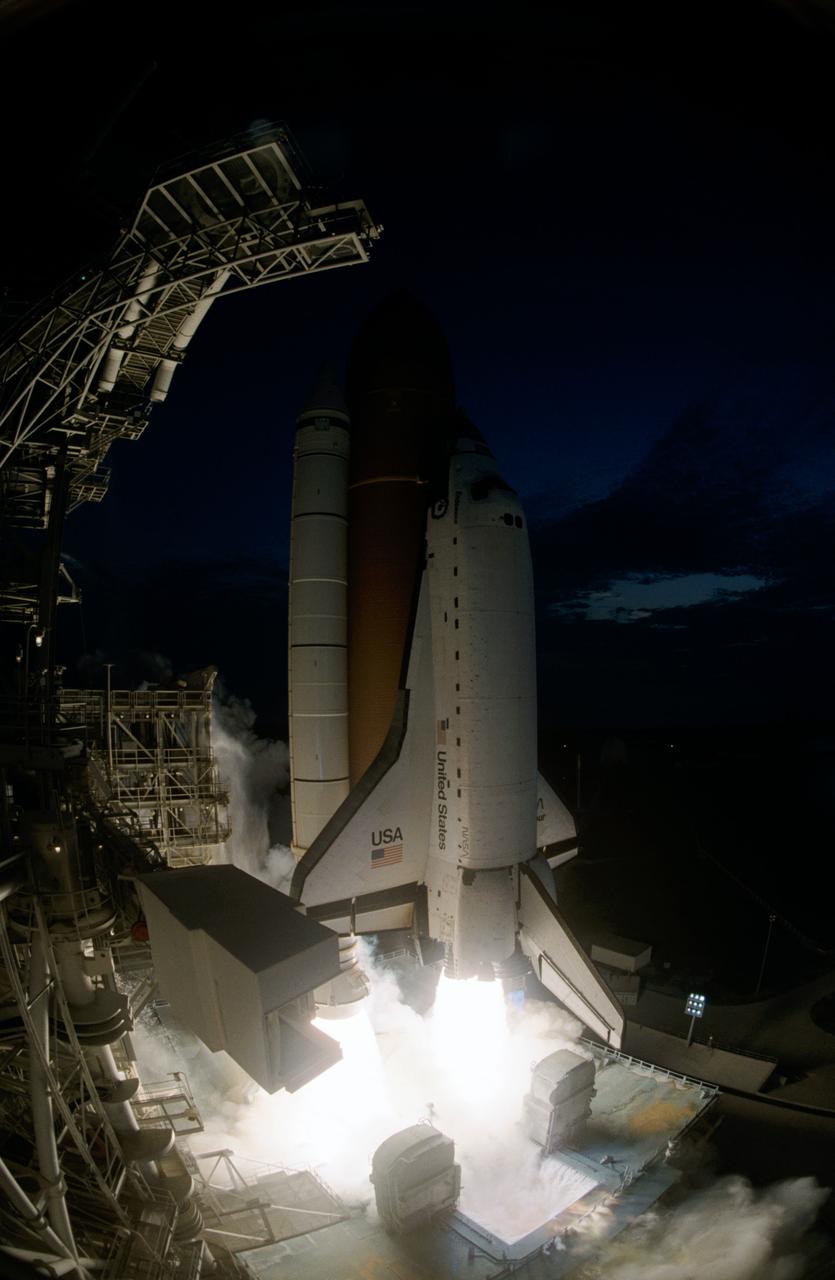
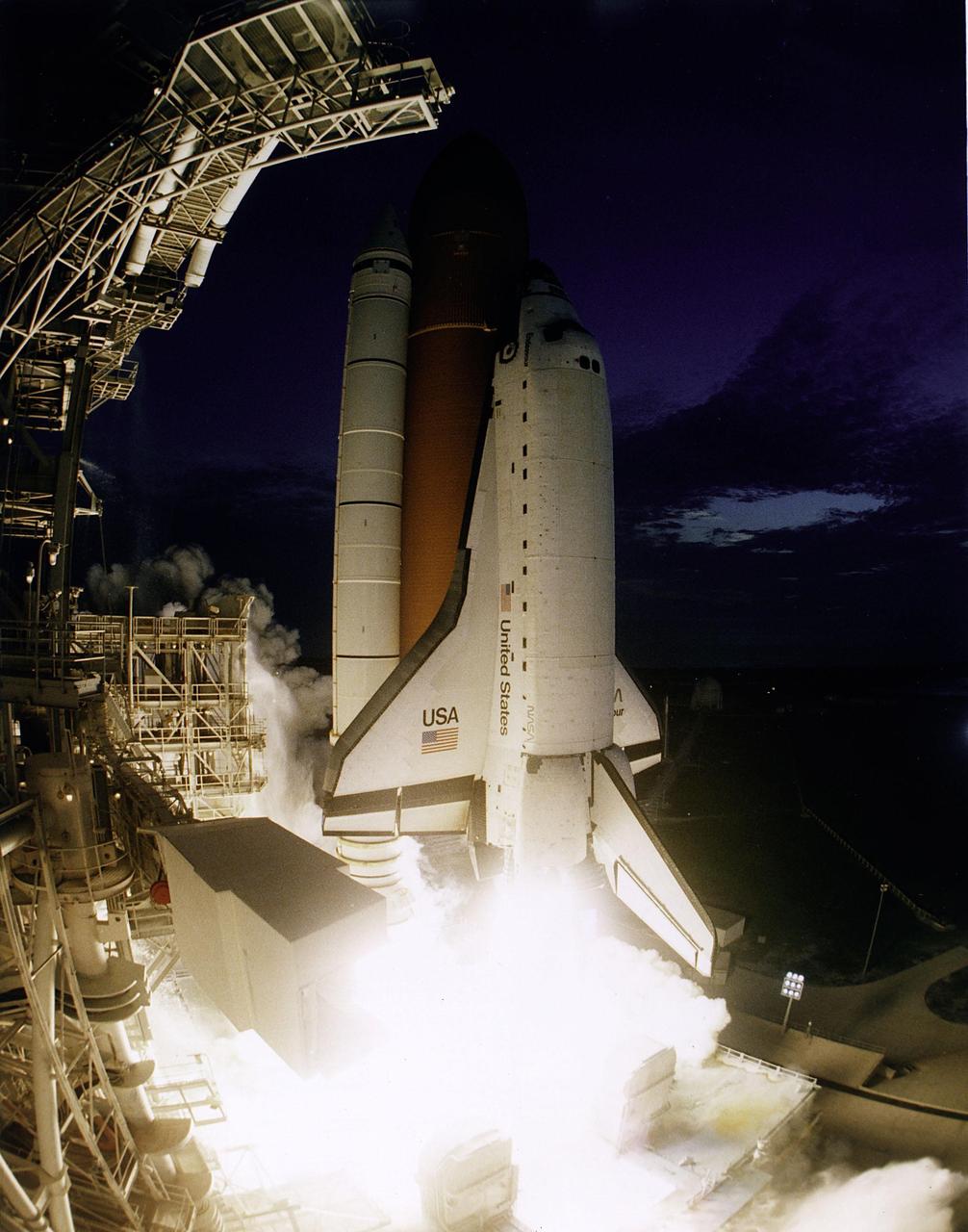
STS077-S-005 (19 May 1996) --- As seen through the ?fish-eye? lens of a 35mm camera at the service structure, the Space Shuttle Endeavour lifts off with six astronauts aboard. It was headed toward the fourth NASA Space Shuttle mission of the year. The launch occurred at 6:30:00 a.m. (EDT), May 19, 1996. Leading the crew onboard is astronaut John H. Casper, mission commander. Other crew members are astronauts Curtis L. Brown, Jr., pilot; along with Daniel W. Bursch, Mario Runco, Jr., Andrew S. W. Thomas and Marc Garneau, all mission specialists. Garneau represents the Canadian Space Agency (CSA). During the approximately 10-day mission, the crew will perform a variety of payload activities, including microgravity research aboard the Spacehab 4 Module, deployment and retrieval of the Spartan 207 and deployment and rendezvous with the Passive Aerodynamically-Stabilized Magnetically-Damped Satellite (PAMS).
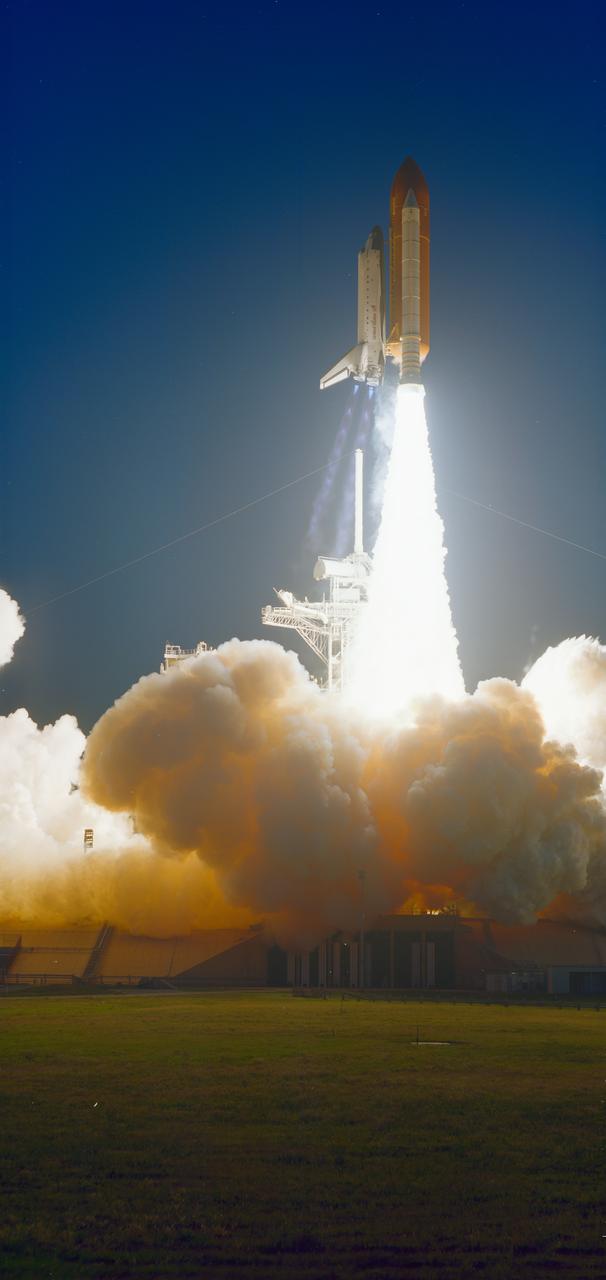
STS077-S-003 (19 May 1996) --- A remote 35mm camera provided this profile view of the Space Shuttle Endeavour?s lift-off. Headed toward the fourth NASA Space Shuttle mission of the year, Endeavour displays a diamond-shock effect of its three-main engines. The launch occurred at 6:30:00 a.m. (EDT), May 19, 1996. Heading the six-member crew onboard is astronaut John H. Casper, mission commander. Other crew members are astronauts Curtis L. Brown, Jr., pilot; along with Daniel W. Bursch, Mario Runco, Jr., Andrew S. W. Thomas and Marc Garneau, all mission specialists. Garneau represents the Canadian Space Agency (CSA). During the approximately 10-day mission, the crew will perform a variety of payload activities, including microgravity research aboard the Spacehab 4 Module, deployment and retrieval of the Spartan 207 and deployment and rendezvous with the Passive Aerodynamically-Stabilized Magnetically-Damped Satellite (PAMS).
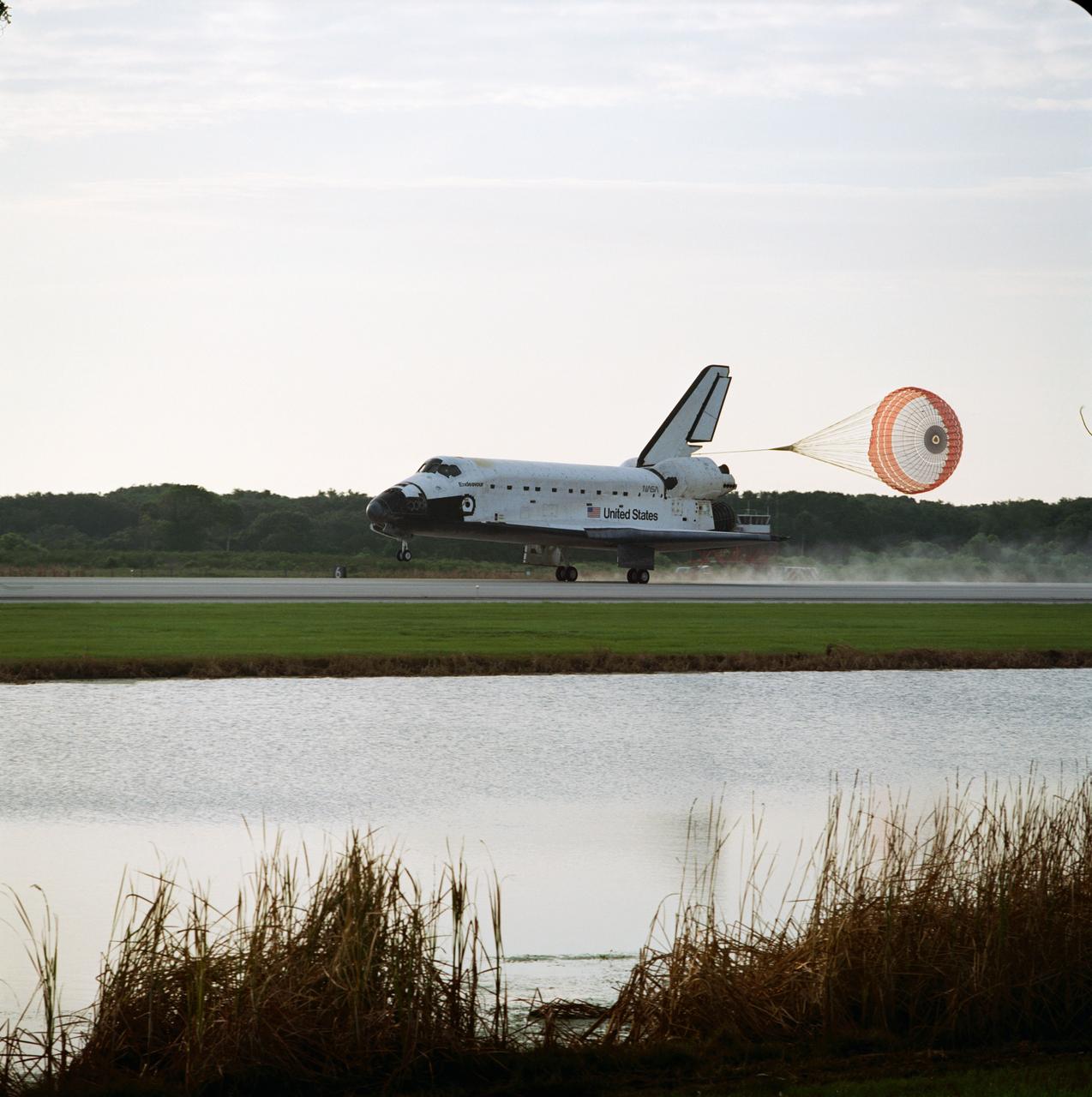
STS077-S-012 (29 May 1996) --- As its drag chute is released on Runway 33 at the Kennedy Space Center (KSC), the Space Shuttle Endeavour marks its return to Earth following a ten-day mission in space. Touchdown came at 7:09 a.m. (EDT), May 29, 1996. Leading the crew onboard was astronaut John H. Casper, mission commander. Other crew members were astronauts Curtis L. Brown, Jr., pilot; along with Daniel W. Bursch, Mario Runco, Jr., Andrew S. W. Thomas and Marc Garneau, all mission specialists. Garneau represents the Canadian Space Agency (CSA). During the approximately 10-day mission, the crew performed a variety of payload activities, including microgravity research aboard the Spacehab 4 Module, deployment and retrieval of the Spartan 207 and deployment and rendezvous with the Passive Aerodynamically-Stabilized Magnetically-Damped Satellite (PAMS).
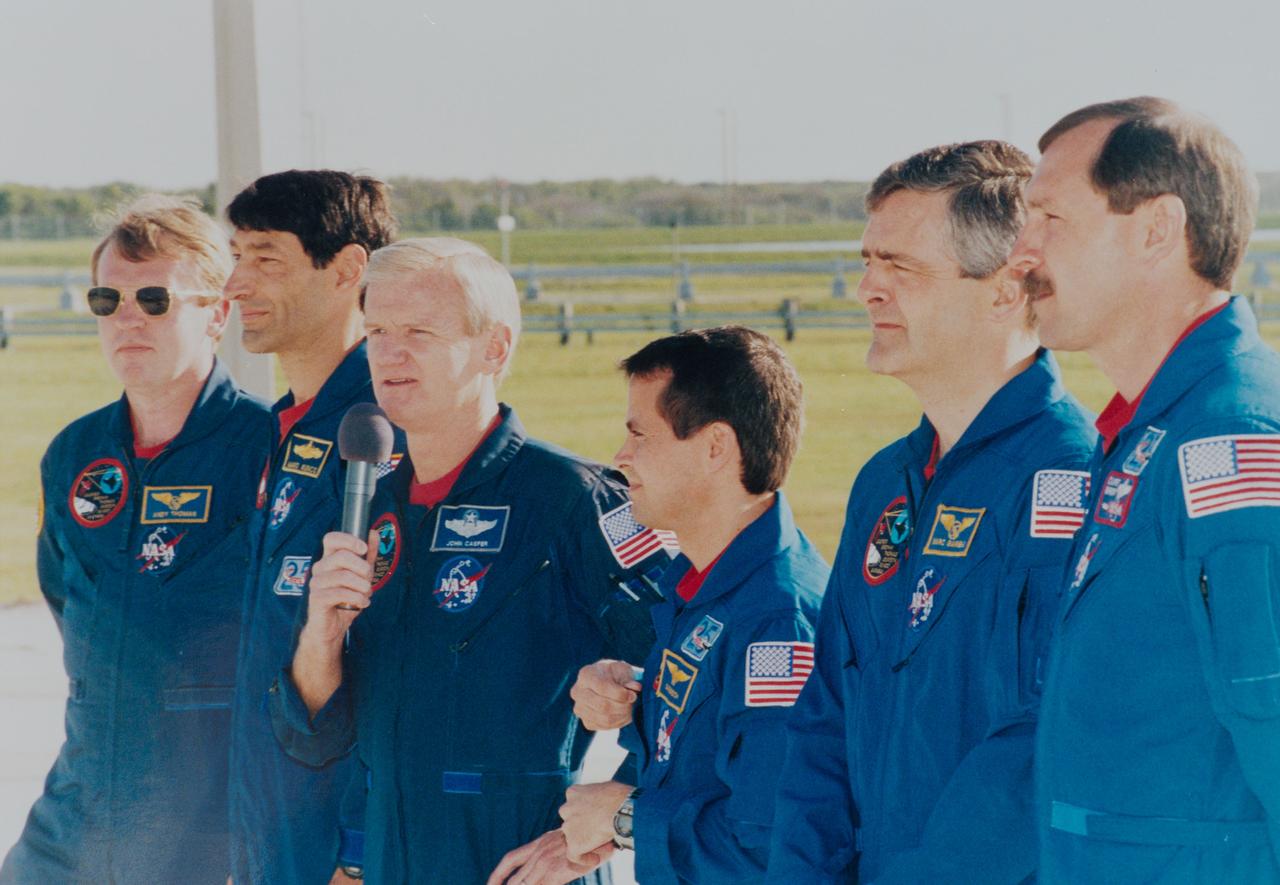
S96-08027 (22 April 1996) --- The crew talk to the news media at Launch Pad 39B, at the Kennedy Space Center (KSC). From left are astronauts Andrew S. W. Thomas, mission specialist; Mario Runco, Jr., mission specialist; John H. Casper, commander; Daniel W. Bursch, mission specialist; Marc Garneau, mission specialist representing the Canadian Space Agency (CSA); and Curtis L. Brown, Jr., pilot. The astronauts are at KSC for the Terminal Countdown Demonstration Test (TCDT), a dress rehearsal for launch, the Space Shuttle Endeavour is undergoing preparations at Pad 39B for liftoff on the fourth Shuttle flight of 1996 around May 16, 1996.
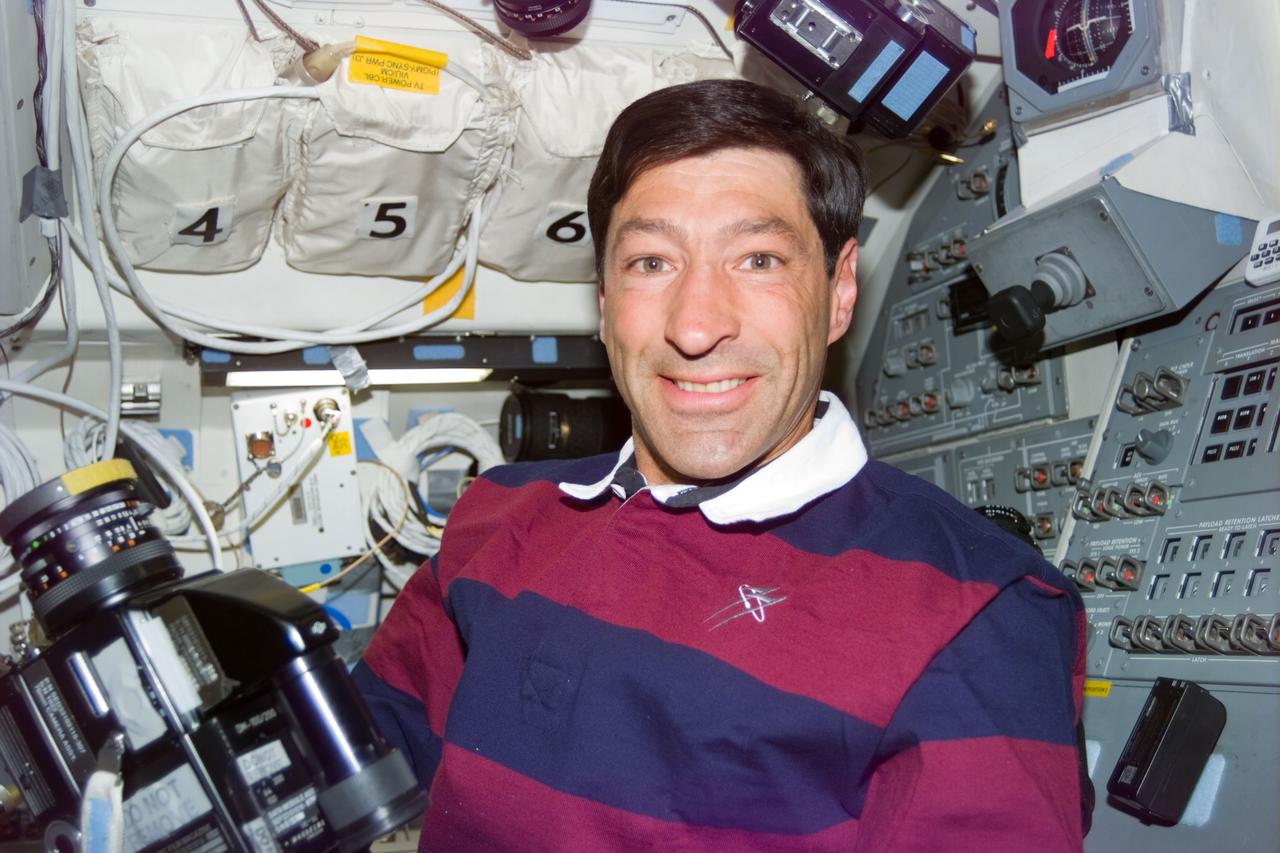
S77-E-5078 (24 May 1996) --- On the Space Shuttle Endeavour's aft flight deck, astronaut Mario Runco, Jr., mission specialist, grabs a hand-held 70mm camera and prepares to take still pictures of an Earth observation target of opportunity. A pair of windows just out of frame above Runco's head provide the crew members with a prime operating perspective of Earth observation targets. A crew mate exposed the image with an Electronic Still Camera (ESC).
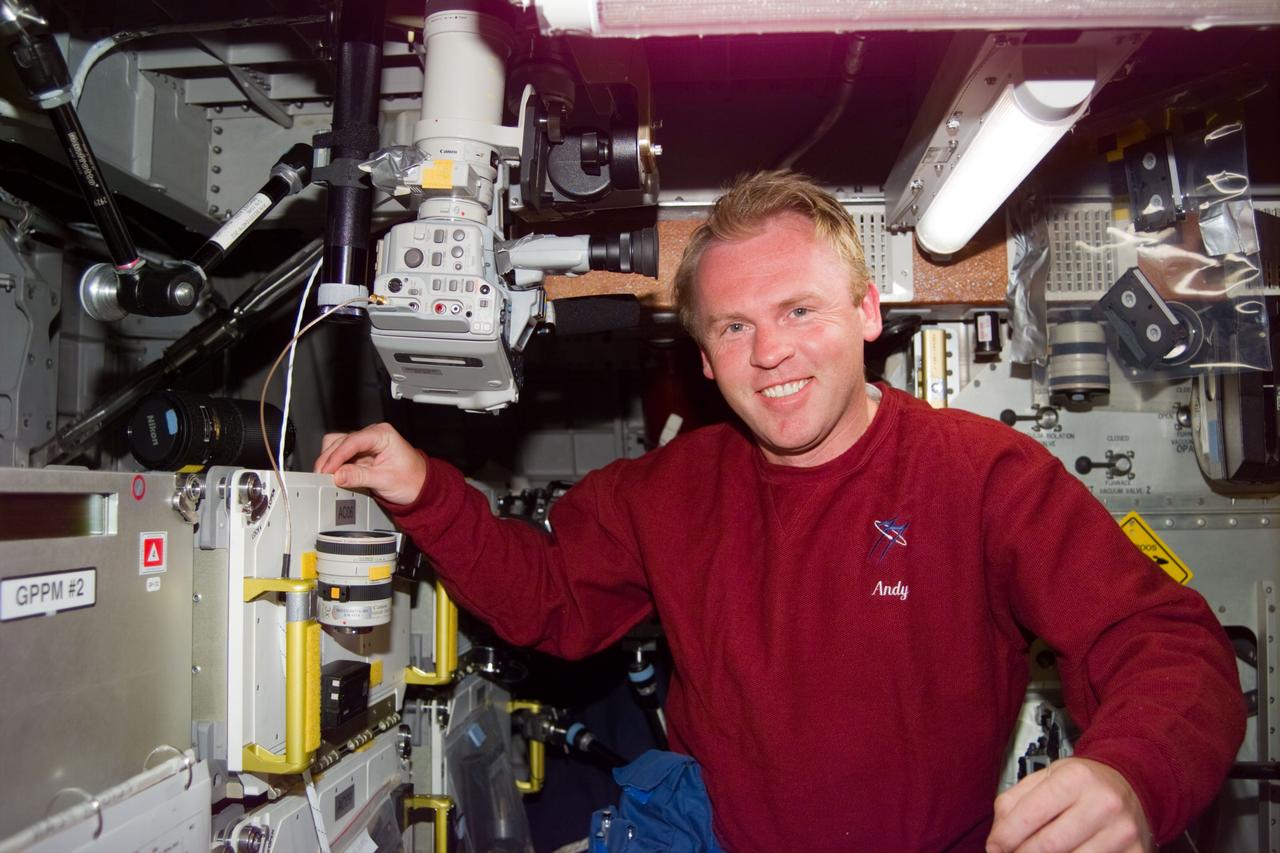
S77-E-5089 (25 May 1996) --- Astronaut Andrew S. W. Thomas, mission specialist, interrupts a Spacehab task to pose for an Electronic Still Camera (ESC) snapshot inside the Spacehab Module onboard the Earth-orbiting Space Shuttle Endeavour. In upper left is the view port which crew members had used for viewing and photographing operations with the Spartan 207/Inflatable Antenna Experiment (IAE). Thomas has his hand on an aft-bulkhead-mounted locker. The Space Experiment Facility (SEF), designed and managed by the University of Alabama, is just behind his left shoulder.
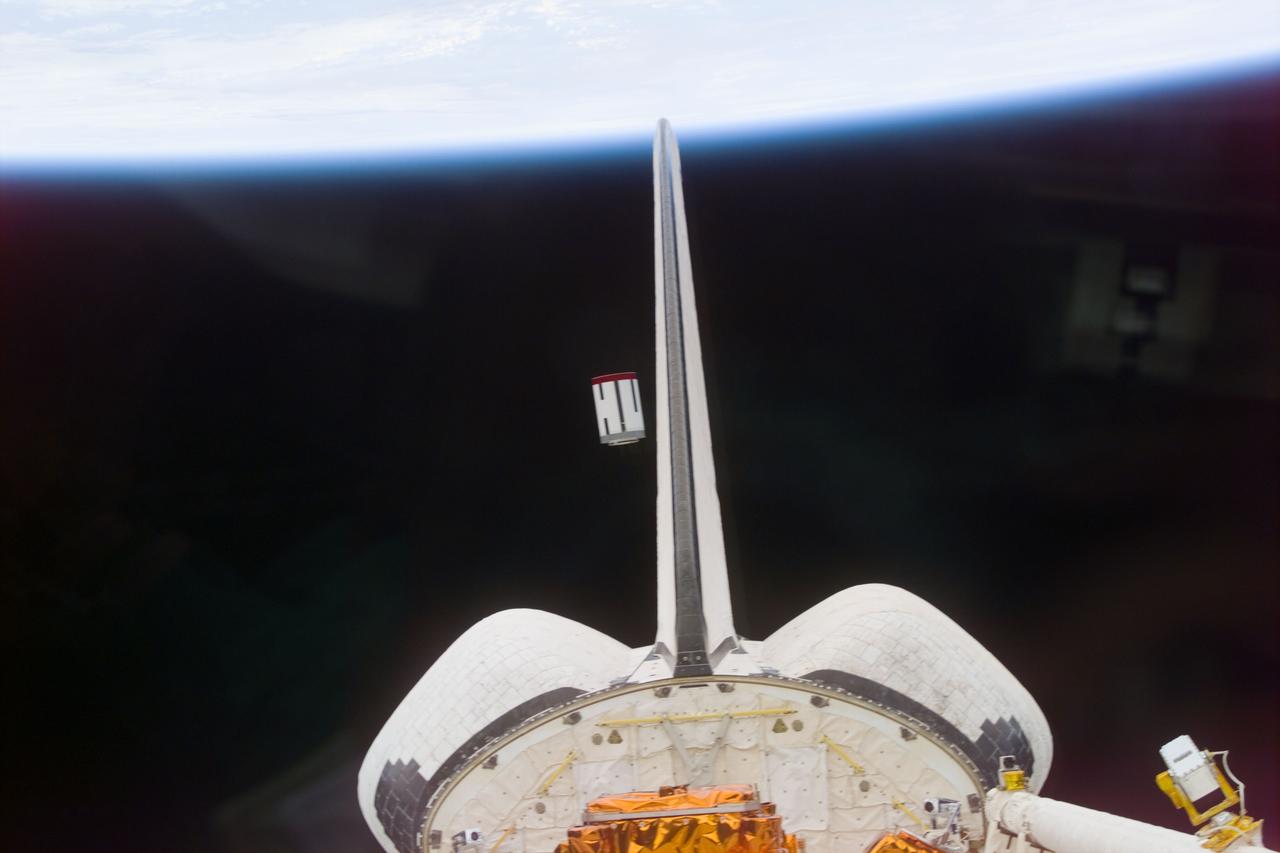
S77-E-5067 (22 May 1996) --- The Satellite Test Unit (STU), part of the Passive Aerodynamically Stabilized Magnetically Damped Satellite (PAMS) is seen moments after its ejection from the cargo bay of the Space Shuttle Endeavour. The scene was photographed with an Electronic Still Camera (ESC) onboard Endeavour's crew cabin during the deployment. The six-member crew will continue operations (tracking, rendezvousing and station-keeping) with PAMS-STU periodically throughout the remainder of the mission.
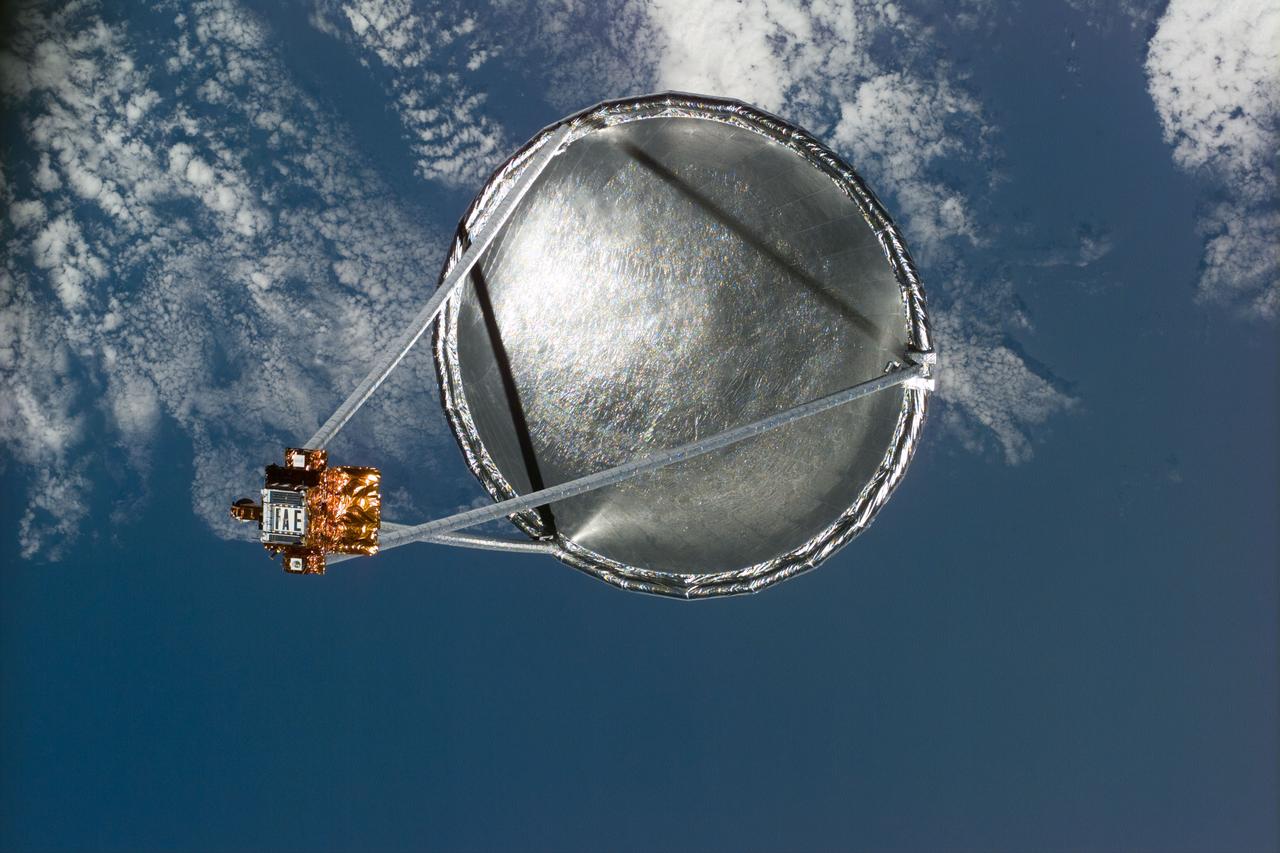
S77-E-5022 (20 May 1996)--- Following its deployment from the Space Shuttle Endeavour, the Spartan 207/Inflatable Antenna Experiment (IAE) payload is backdropped over clouds and water. The view was photographed with an Electronic Still Camera (ESC) and downlinked to flight controllers on the first full day of orbital operations by the six-member crew. Managed by Goddard Space Flight Center (GSFC), Spartan is designed to provide short-duration, free-flight opportunities for a variety of scientific studies. The Spartan configuration on this flight is unique in that the IAE is part of an additional separate unit which is ejected once the experiment is completed. The IAE experiment will lay the groundwork for future technology development in inflatable space structures, which will be launched and then inflated like a balloon on-orbit.
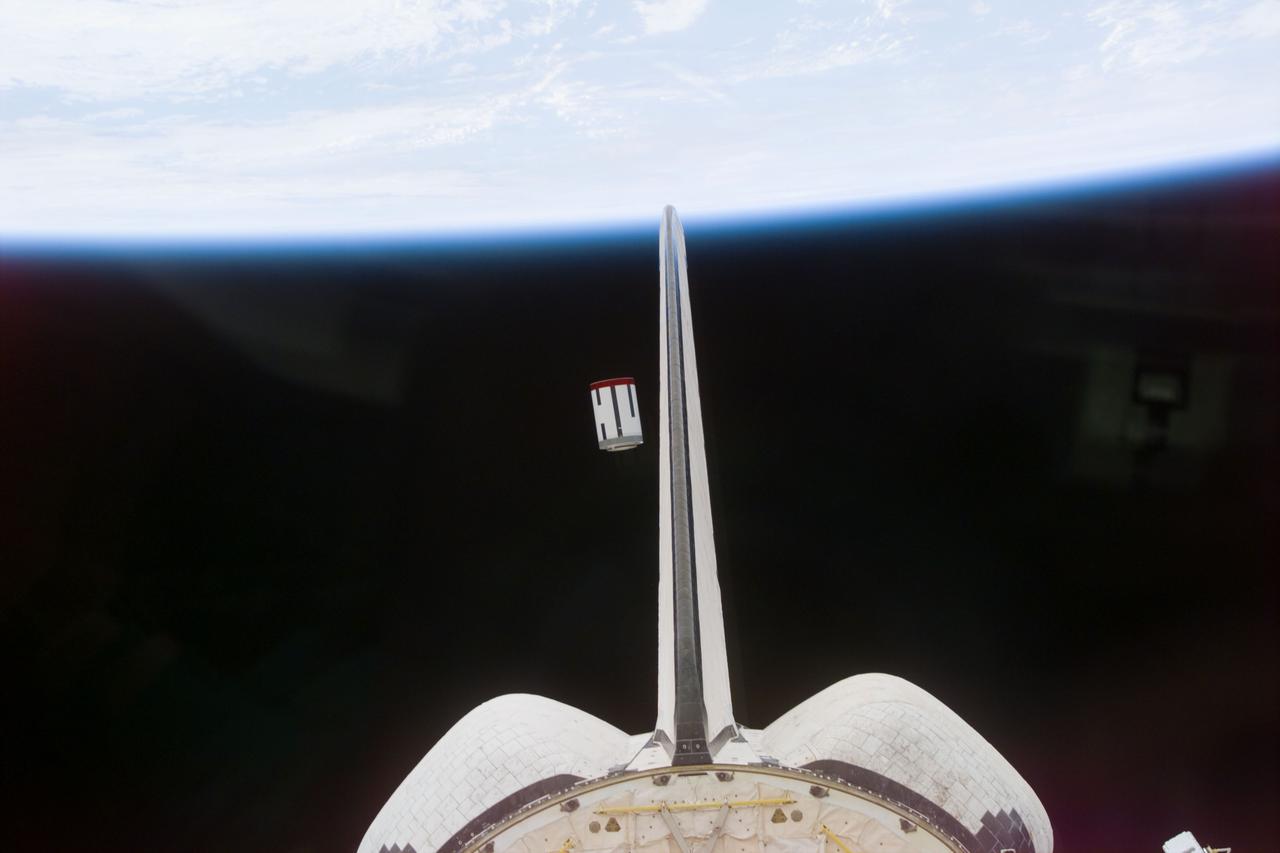
S77-E-5068 (22 May 1996) --- The Satellite Test Unit (STU), part of the Passive Aerodynamically Stabilized Magnetically Damped Satellite (PAMS) is seen moments after its ejection from the cargo bay of the Space Shuttle Endeavour. The scene was photographed with an Electronic Still Camera (ESC) onboard Endeavour's crew cabin during the deployment. The six-member crew will continue operations (tracking, rendezvousing and station-keeping) with PAMS-STU periodically throughout the remainder of the mission.
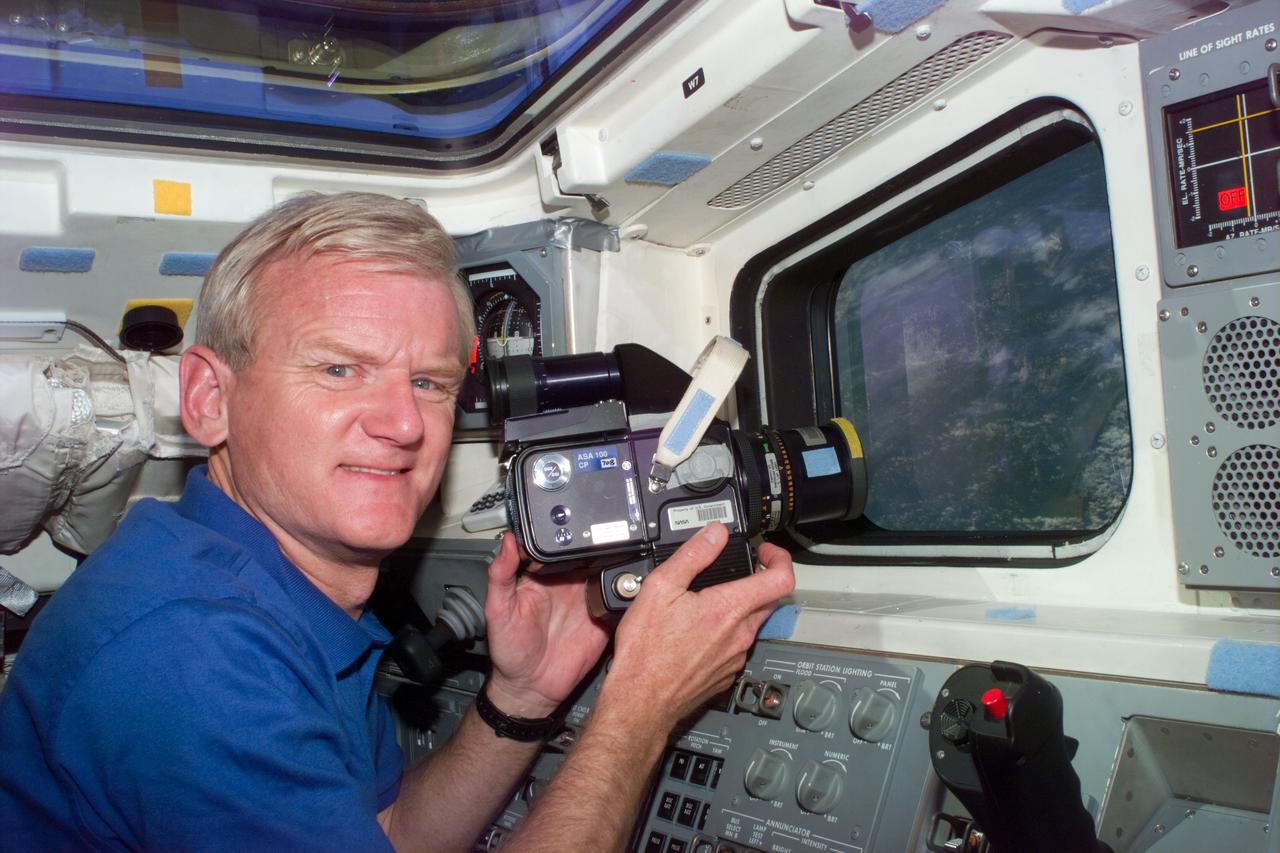
S77-E-5109 (26 May 1996) --- Astronaut John H. Casper, commander, pauses during a photography session on the aft flight deck of the Space Shuttle Endeavour. The scene was recorded with an Electronic Still Camera (ESC).
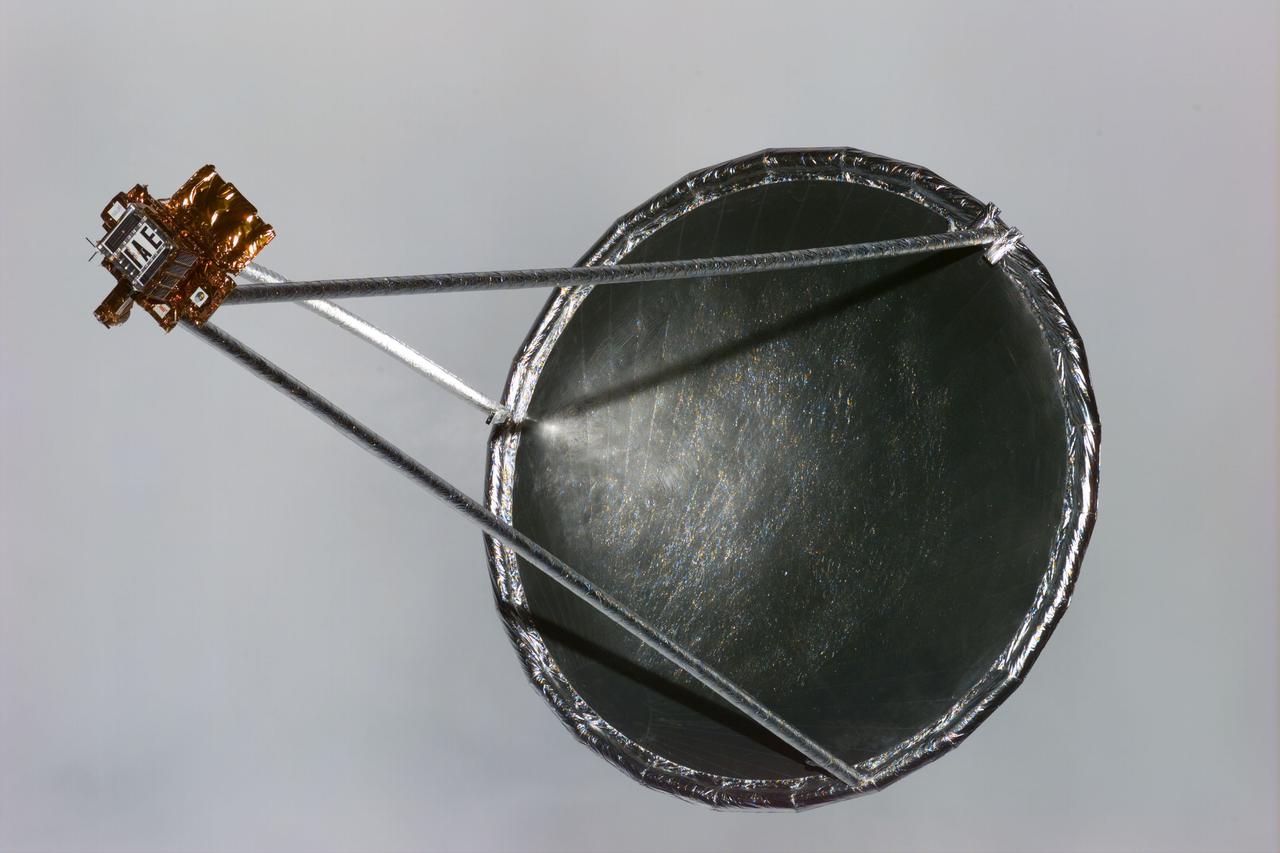
S77-E-5033 (20 May 1996) --- Following its deployment from the Space Shuttle Endeavour, the Spartan 207/Inflatable Antenna Experiment (IAE) payload is backdropped against a wall of grayish clouds. The view was photographed with an Electronic Still Camera (ESC) and downlinked to flight controllers on the first full day of orbital operations by the six-member crew. Managed by Goddard Space Flight Center (GSFC), Spartan is designed to provide short-duration, free-flight opportunities for a variety of scientific studies. The Spartan configuration on this flight is unique in that the IAE is part of an additional separate unit which is ejected once the experiment is completed. The IAE experiment will lay the groundwork for future technology development in inflatable space structures, which will be launched and then inflated like a balloon on-orbit.
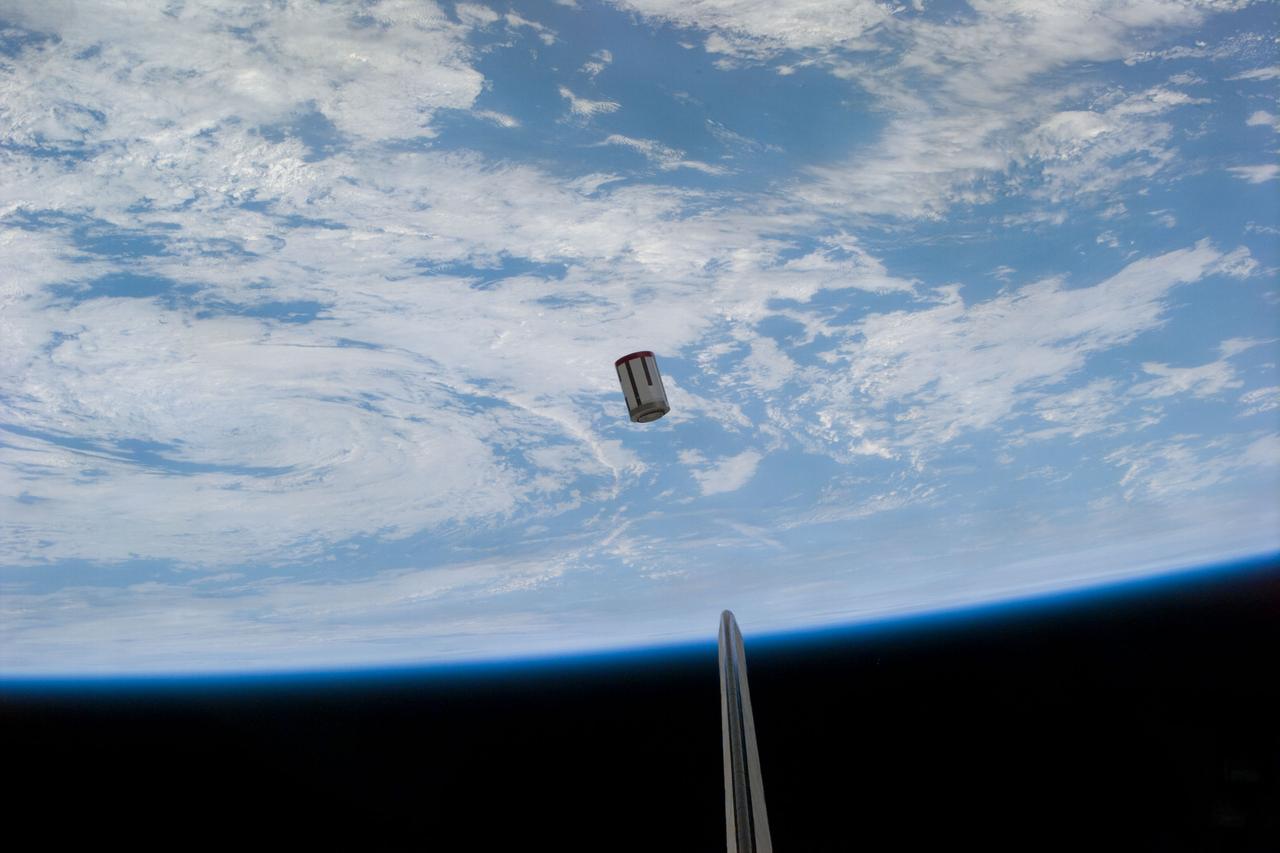
S77-E-5069 (22 May 1996) --- The Satellite Test Unit (STU), part of the Passive Aerodynamically Stabilized Magnetically Damped Satellite (PAMS) is seen moments after its ejection from the cargo bay of the Space Shuttle Endeavour. The scene was photographed with an Electronic Still Camera (ESC) onboard Endeavour's crew cabin during the deployment. The six-member crew will continue operations (tracking, rendezvousing and station-keeping) with PAMS-STU periodically throughout the remainder of the mission.
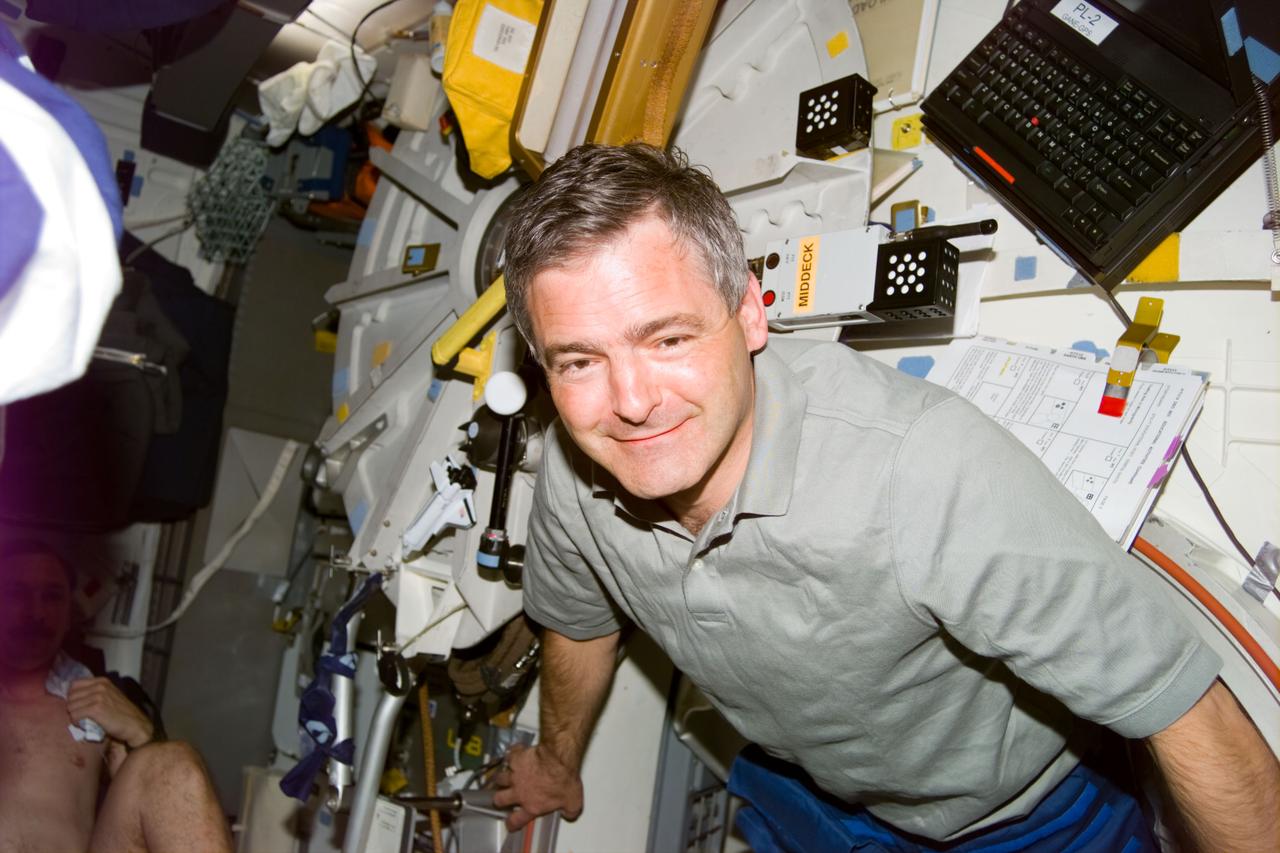
S77-E-5107 (26 May 1996) --- Astronaut Marc Garneau, mission specialist representing the Canadian Space Agency (CSA), poses for a photograph onboard the middeck of the Earth-orbiting Space Shuttle Endeavour. The scene was recorded with an Electronic Still Camera (ESC).
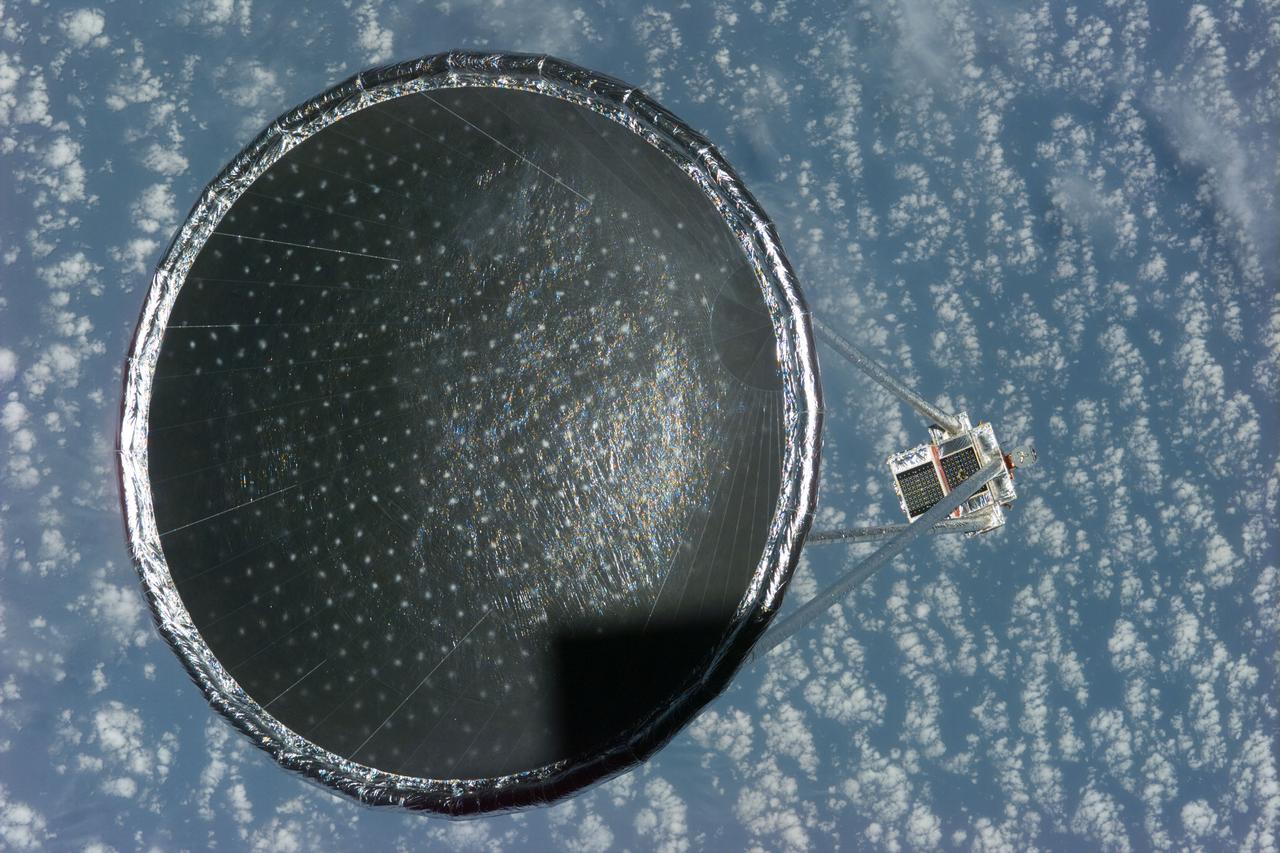
S77-E-5027 (20 May 1996)--- Following its deployment from the Space Shuttle Endeavour, the Spartan 207/Inflatable Antenna Experiment (IAE) payload is backdropped over clouds and water. The view was photographed with an Electronic Still Camera (ESC) and downlinked to flight controllers on the first full day of orbital operations by the six-member crew. Managed by Goddard Space Flight Center (GSFC), Spartan is designed to provide short-duration, free-flight opportunities for a variety of scientific studies. The Spartan configuration on this flight is unique in that the IAE is part of an additional separate unit which is ejected once the experiment is completed. The IAE experiment will lay the groundwork for future technology development in inflatable space structures, which will be launched and then inflated like a balloon on-orbit.
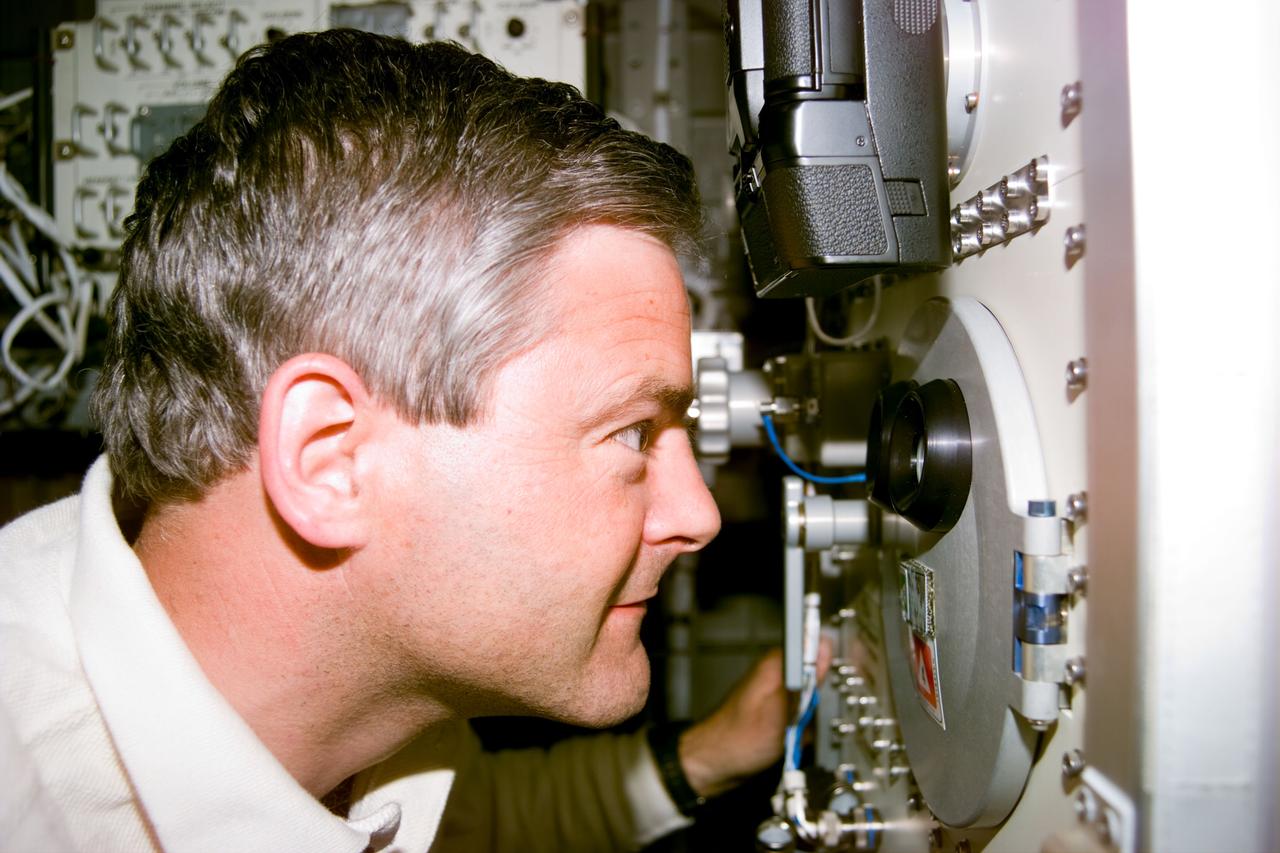
S77-E-5093 (25 May 1996) --- Astronaut Marc Garneau, mission specialist representing the Canadian Space Agency (CSA), makes a visual check of the Commercial Float Zone Furnace (CFZF), a single-rack-mounted facility in the Spacehab Module onboard the Earth-orbiting Space Shuttle Endeavour. The scene was recorded with an Electronic Still Camera (ESC).
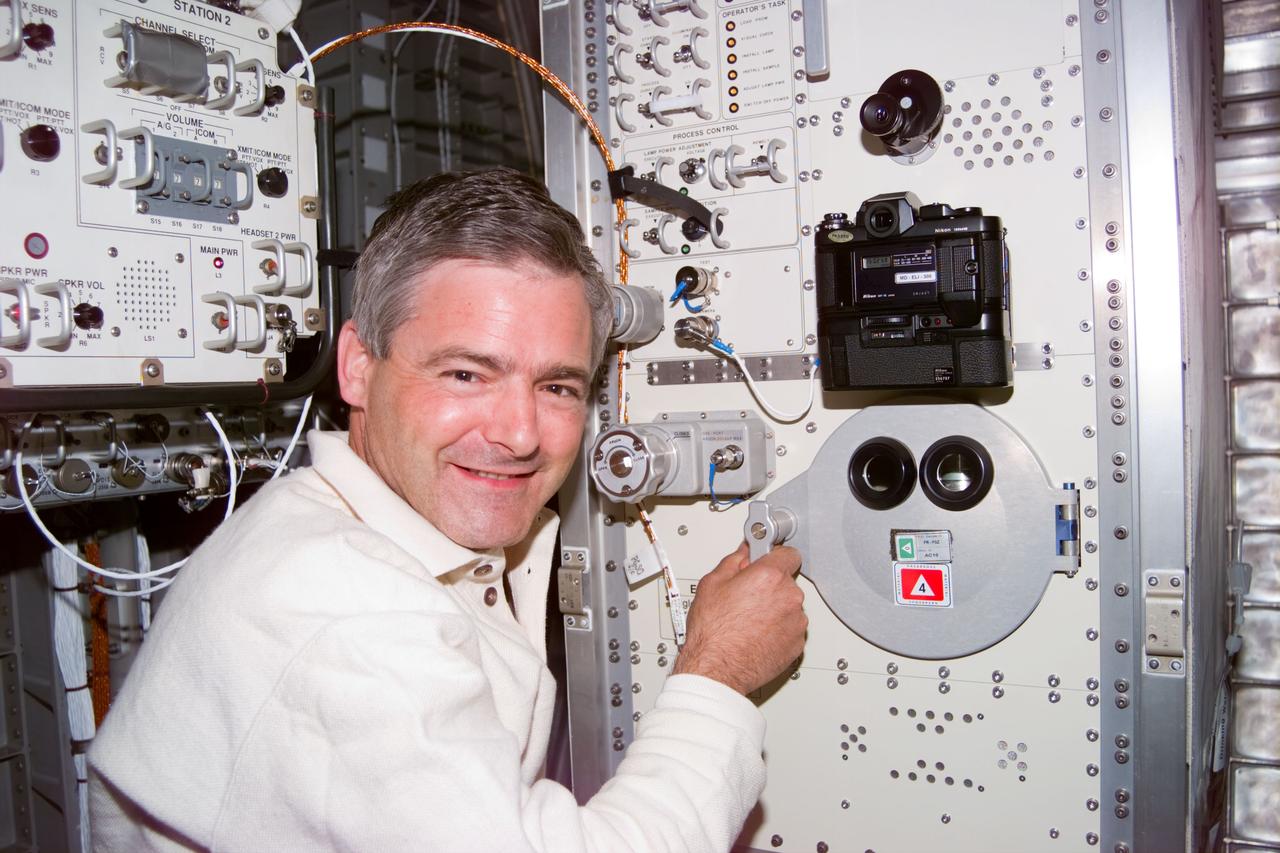
S77-E-5094 (25 May 1996) --- Astronaut Marc Garneau, mission specialist representing the Canadian Space Agency (CSA), stands at the Commercial Float Zone Furnace (CFZF) in the Spacehab Module onboard the Earth-orbiting Space Shuttle Endeavour.
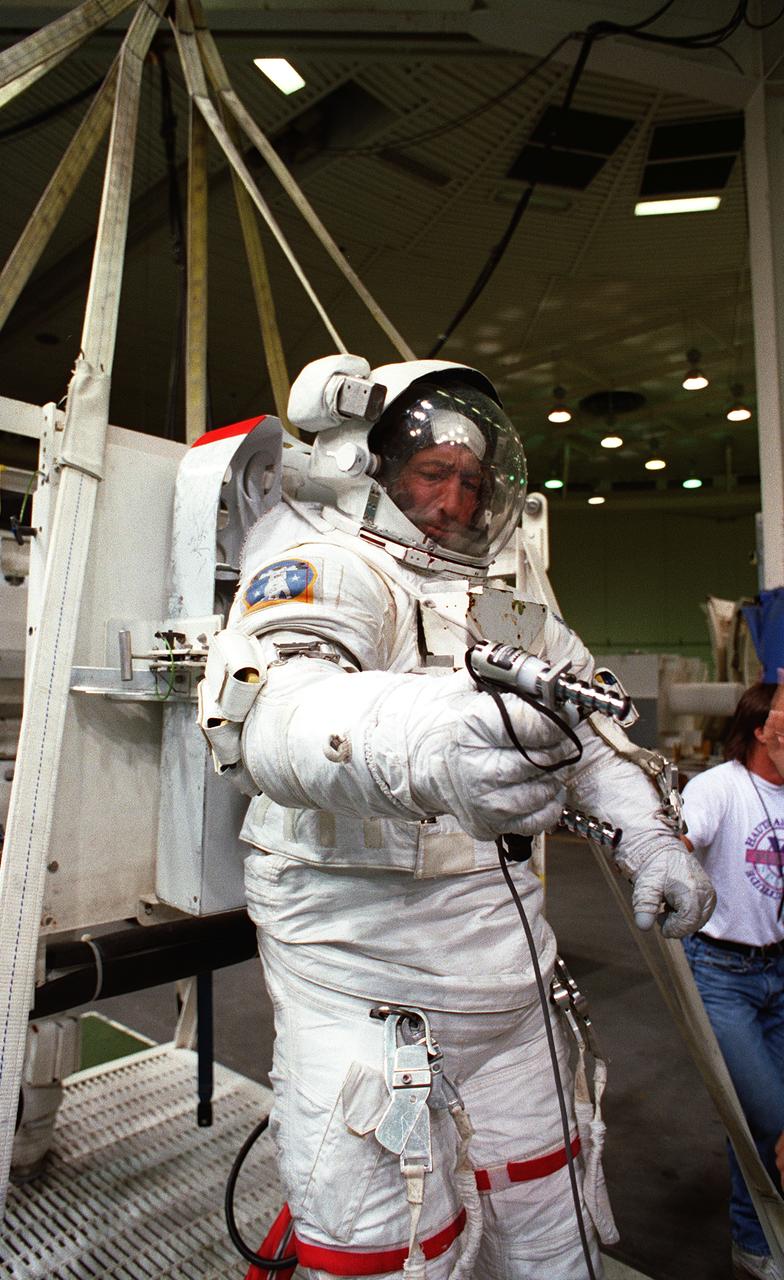
S95-15847 (26 July 1995) --- Wearing a training version of the Extravehicular Mobility Unit (EMU) space suit, astronaut Mario Runco Jr., mission specialist, prepares to participate in an underwater rehearsal of a contingency Extravehicular Activity (EVA). This type of training routinely takes place in the 25-feet deep pool of the Johnson Space Center's (JSC) Weightless Environment Training Center (WET-F). The training prepares at least two crew members on each flight for procedures to follow outside the spacecraft in event of failure of remote methods to perform various chores.
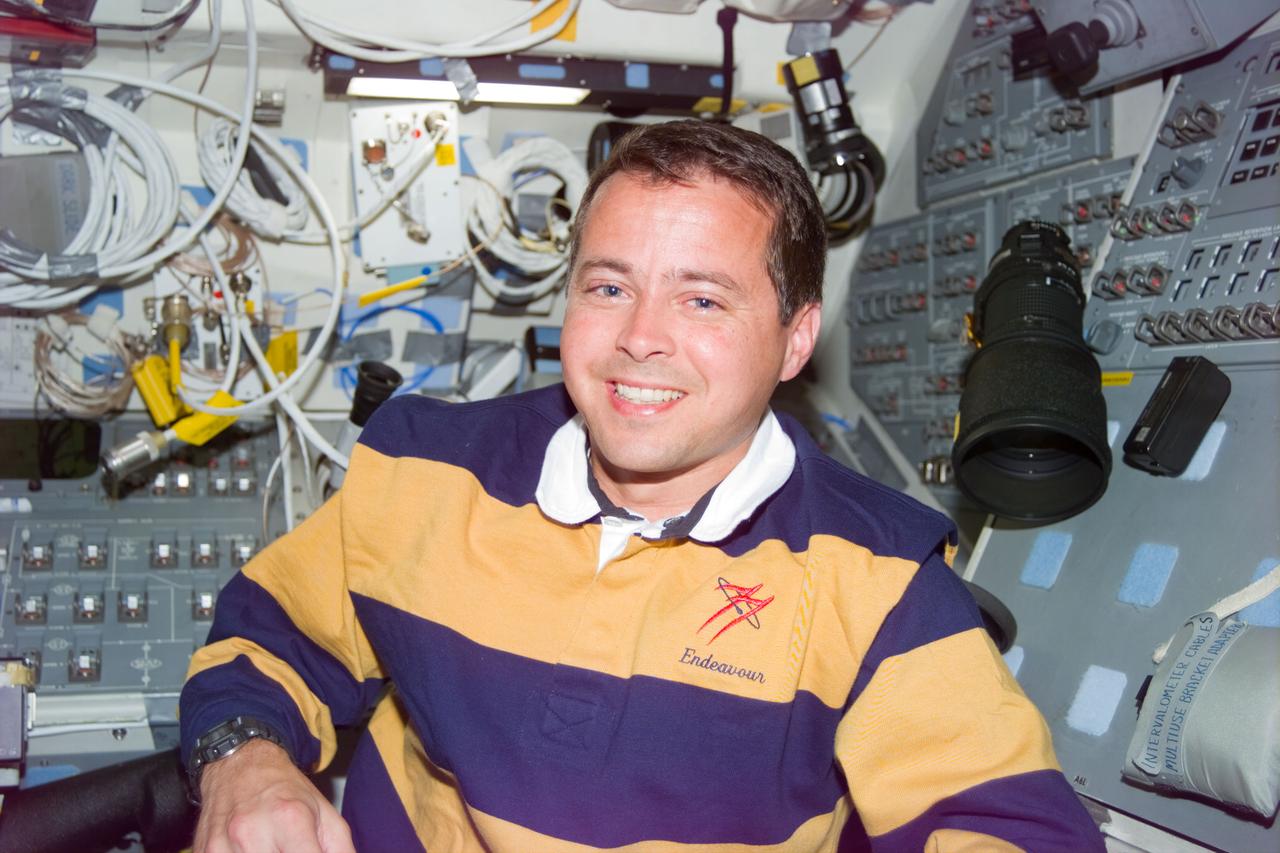
S77-E-5077 (24 May 1996) --- On the Space Shuttle Endeavour's aft flight deck, astronaut Daniel W. Bursch, mission specialist, is photographed prior to recording still pictures of an Earth observation target of opportunity. A camera lens is temporarily stowed nearby on the aft wall. A crew mate exposed the image with an Electronic Still Camera (ESC).
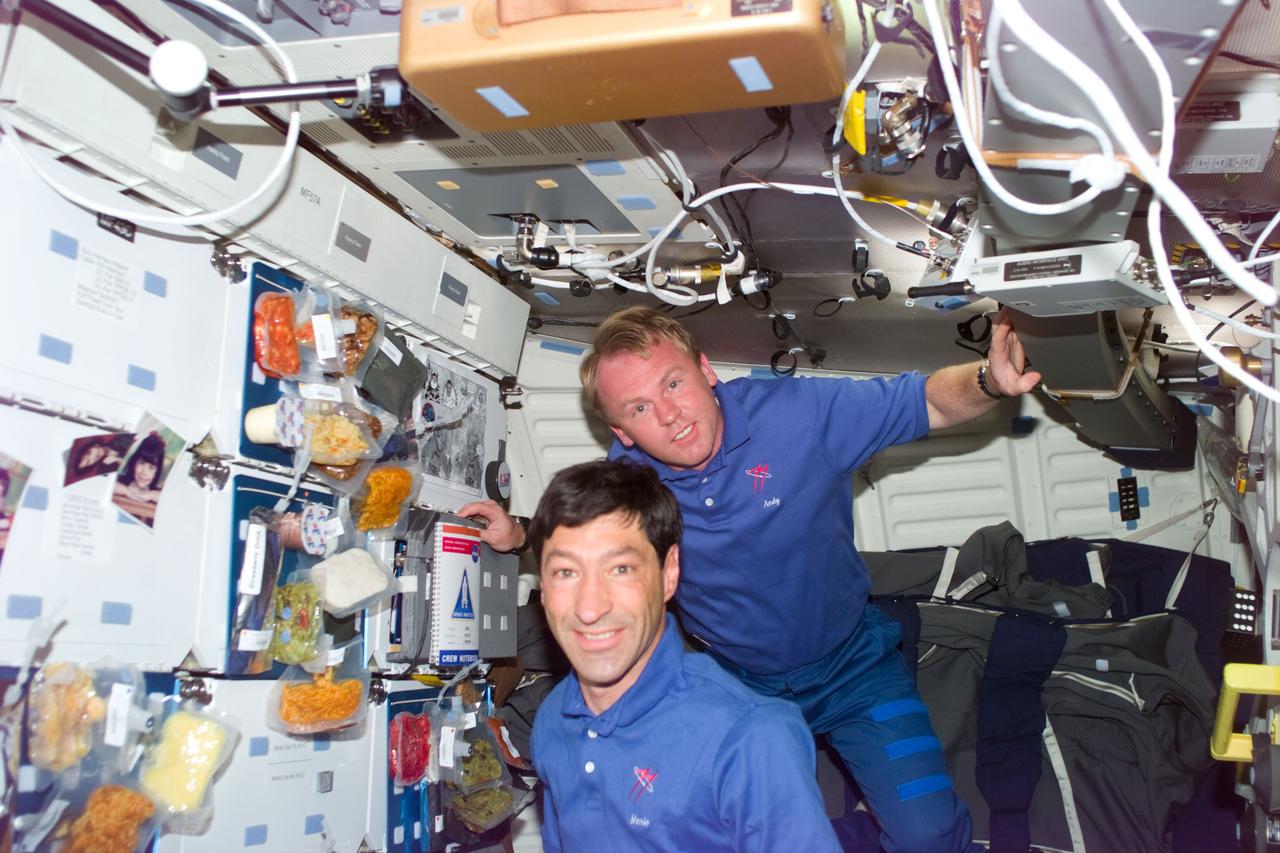
S77-E-5120 (26 May 1996) --- Astronauts Mario Runco, Jr. and Andrew S. W. Thomas, both mission specialists, pose for photo while in the middeck of the Earth-orbiting Space Shuttle Endeavour. The scene was recorded with an Electronic Still Camera (ESC).
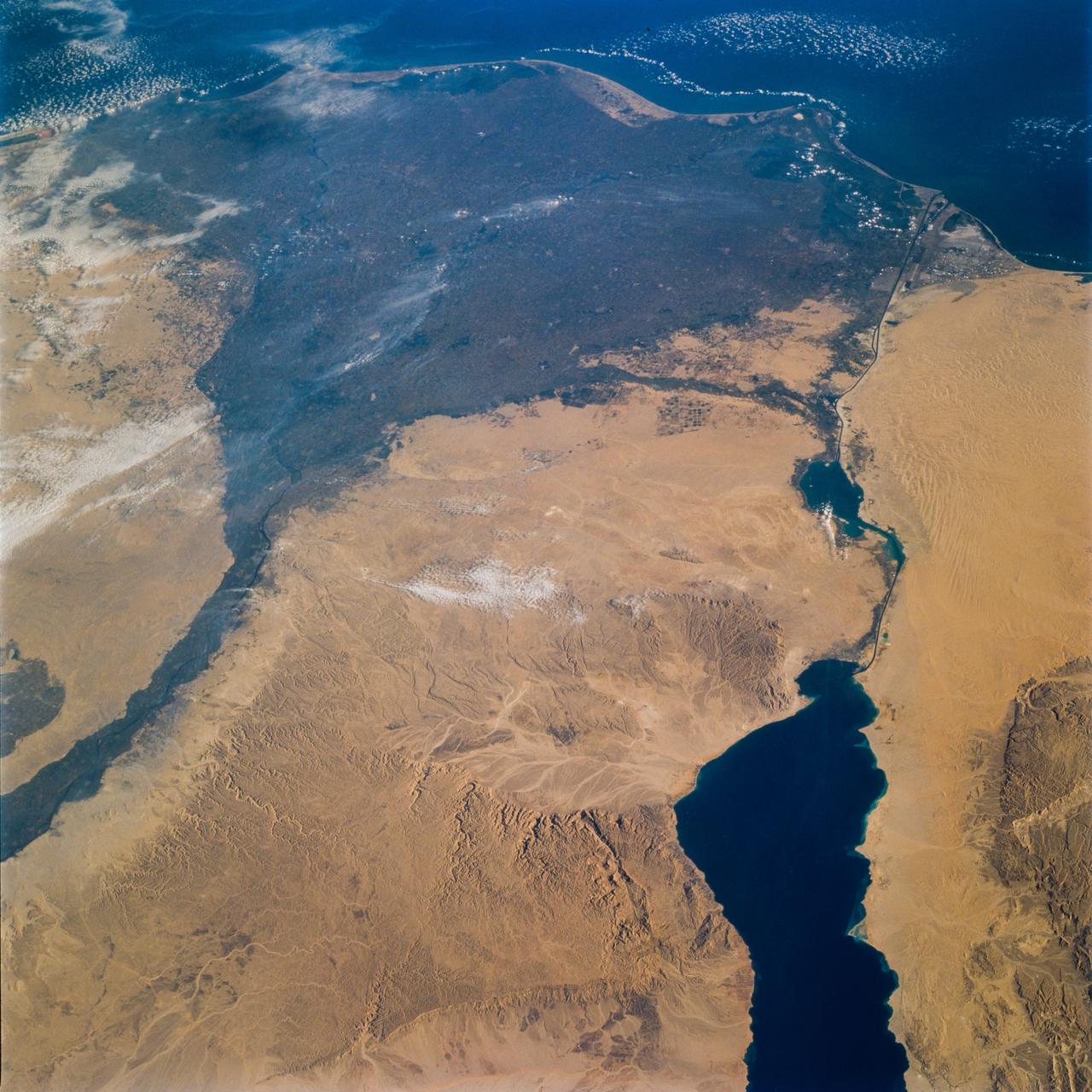
STS077-732-089 (19-29 May 1996) --- This photograph encompasses an area comprising 99 percent of the Egyptian population of close to 60 million people. North is roughly to the right side of the photograph. Cairo, the capital and principal city, lies at the apex of the Nile Delta. Alexandria is in the top right corner of the frame. The Suez Canal connects the Red Sea and the Mediterranean Sea and is in the bottom of the photograph. The Delta itself is 100 miles long and 160 miles wide at the coast. This view brings out the details of the Eastern Desert that rises abruptly from the Nile valley. This desert supports some vegetation in contrast to the sandier Western desert. It has more relief with some of the peaks rising to 6,000 feet. Rainfall in the region ranges from a high of 7 inches at Alexandria to 0.1 inch in the Eastern Desert. Most of Egypt’s mineral resources are concentrated in this area.
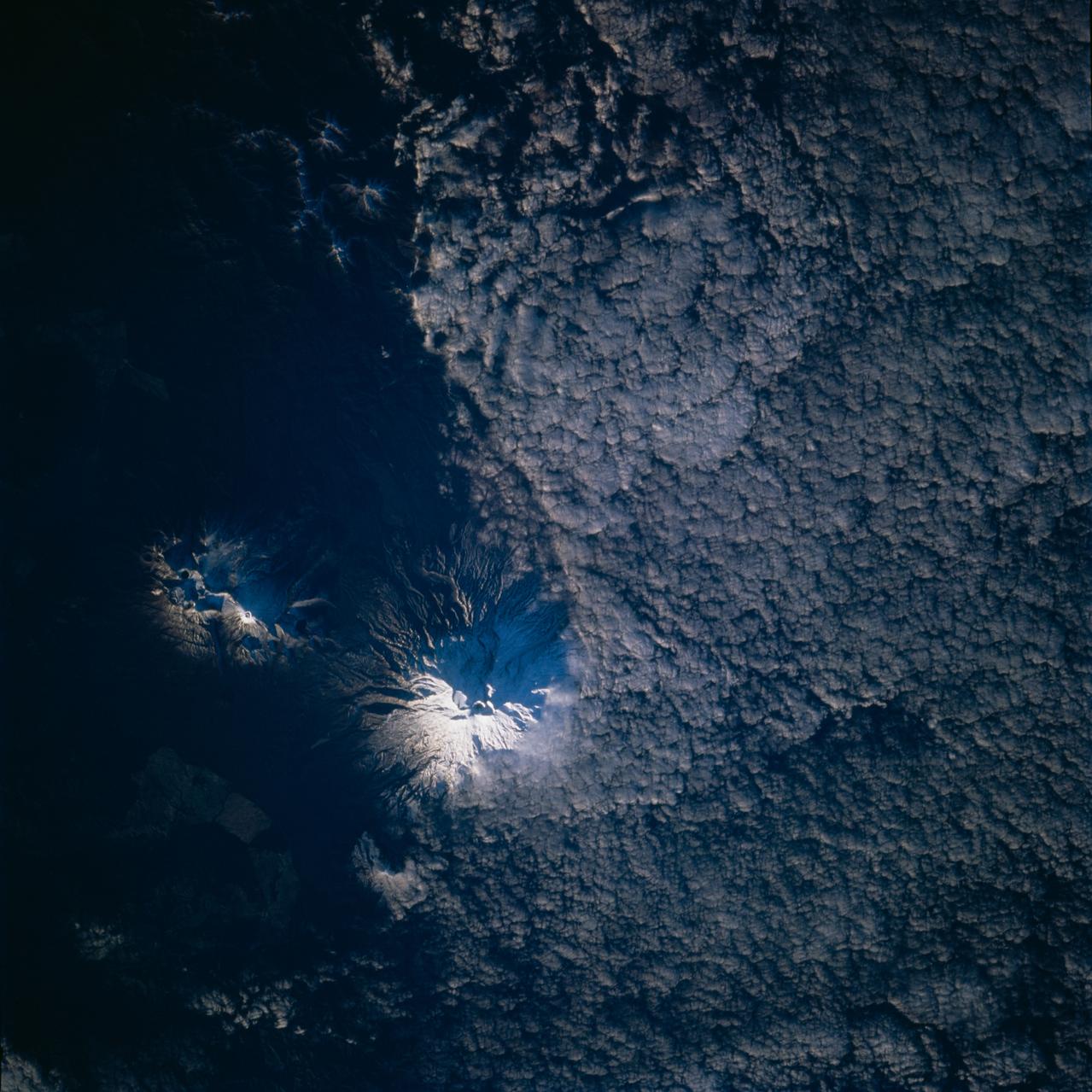
STS077-715-037 (19-29 May 1996) --- According to NASA scientists, Ruapehu, on New Zealand?s North Island, is one of the most active volcanoes in the South Pacific. Prior to the flight, crew members scheduled this site as one of their photographic targets. The volcano endured a significant eruption in late September, 1995. This view is the first image of the crater region since that eruption. Since then, numerous landslides and secondary explosions in the summit area has produced changes. In this view, recent mudflows extend from the summit region and down the mountain flank which is in the shadow. Ruapehu is also one of New Zealand?s high points - the mountain supports a glacier and permanent ice fields, and volcanic activity necessarily involves mixing hot volcanic products with snow and ice. Recent activity has produced destructive lahars (mudslides which are slurries of volcanic material with ice and water) downslope. A hazard warning to skiers is still in effect.
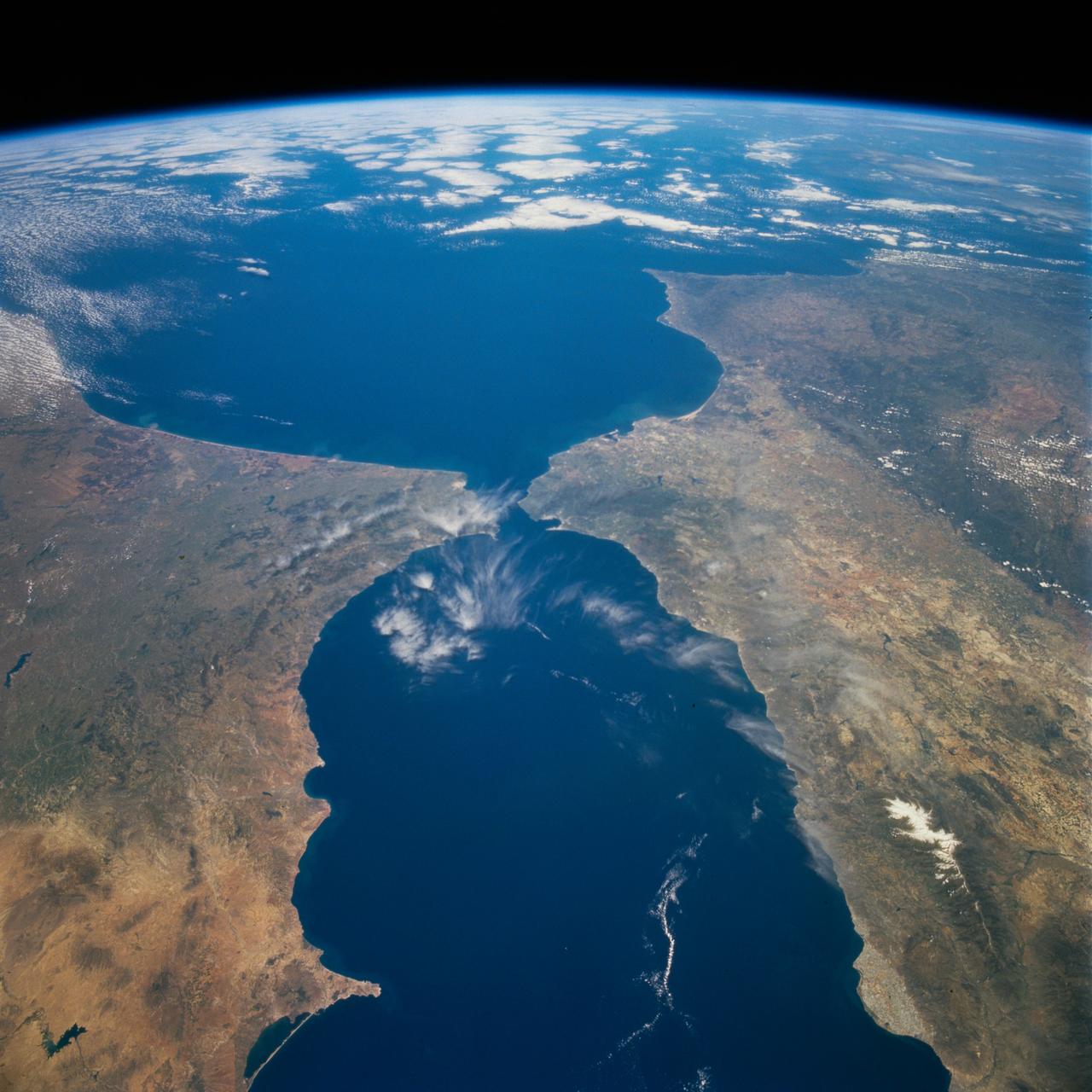
STS077-718-088 (19-29 May 1996) --- A popular photographic target of Space Shuttle astronauts has always been the Strait of Gibraltar seen at center in this wide photograph, shot from the Space Shuttle Endeavour. Spain is to the north (right) and Morocco to the south. The strait is 36 miles (58 kilometers) long and narrows to 8 miles (13 kilometers) at it’s most narrow point. The winds in the strait are either easterly or westerly. The British colony of Gibraltar is the semi-circular feature north of the strait. Gibraltar is considered to be one of the Pillars of Hercules. The white colored area to the southeast of Gibraltar on the Moroccan coast is the city of Tanger (Tangier). The snow covered mountains in Spain are the Sistemas Penibeticos.
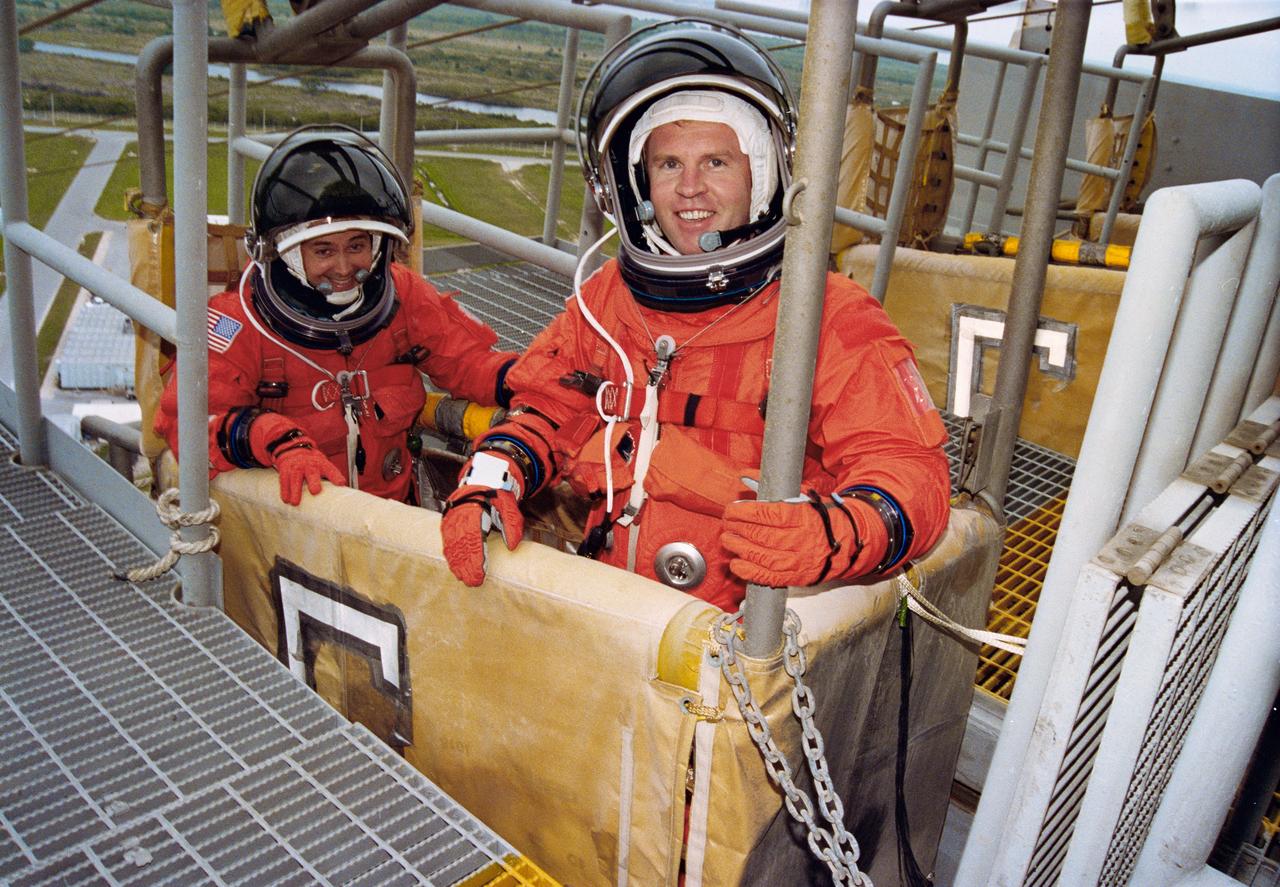
S96-08583 (24 April 1996) --- Andrew S.W. Thomas and Daniel W. Bursch, mission specialists, are in the slidewire baskets of the emergency exit system at Launch Pad 39B, participating in the final phase of the Terminal Countdown Demonstration Test (TCDT), a dress rehearsal for launch.
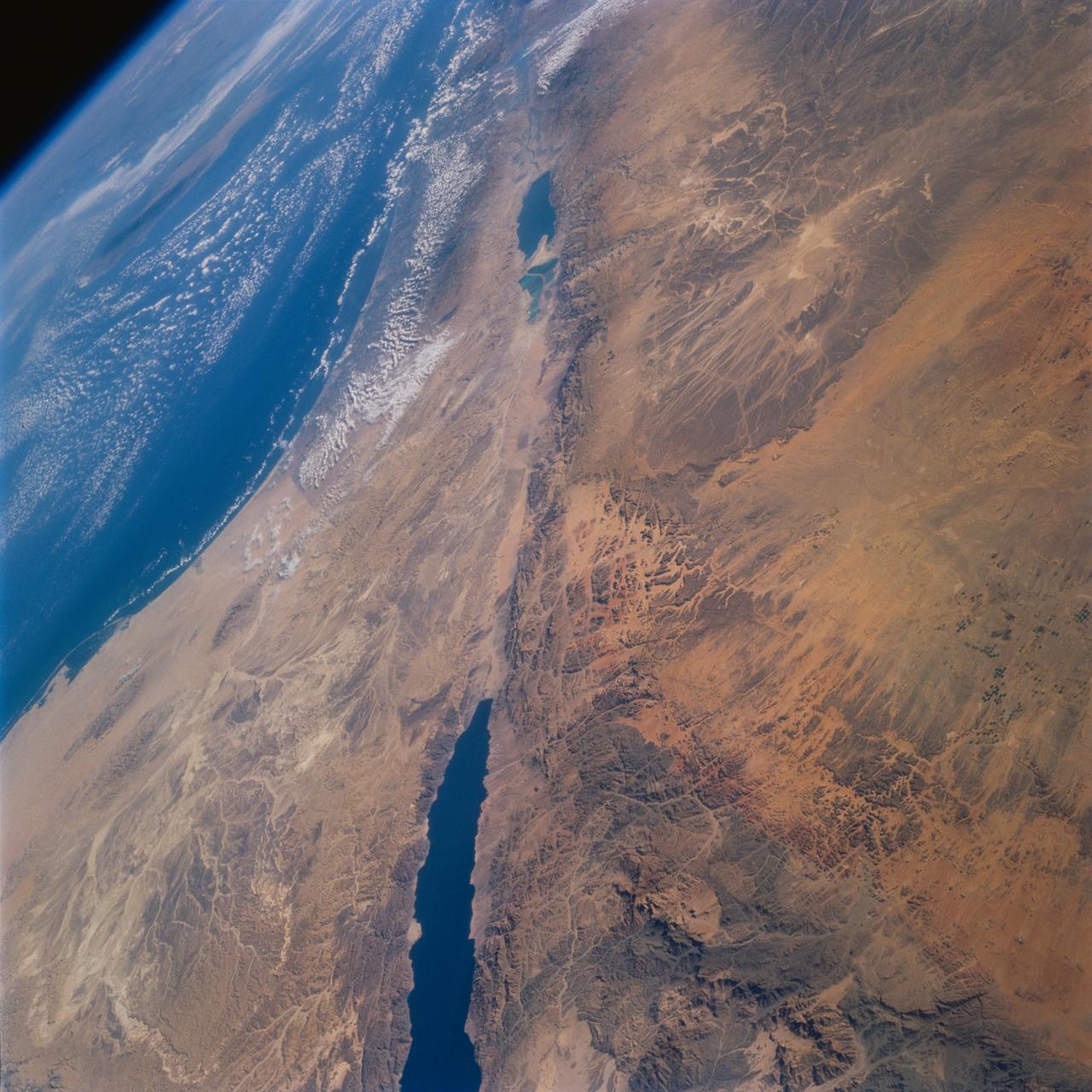
STS077-732-093 (19-29 May 1996) --- This high oblique perspective from the Space Shuttle Endeavour shows the Dead Sea Rift Valley and the surrounding deserts. North is to the right side of the frame. The vegetation line on the coast between Egypt and Israel is clearly visible. Crete is visible in the Mediterranean Sea. The Dead Sea was formed approximately 3 million years ago. A passage opened up to the sea and the water poured in. It is about 1,300 feet below sea level. It is fed by the Jordan River and numerous mineral springs from the surrounding hills. It is estimated to contain 43 million metric tons of salt. The salinity is 32 percent.
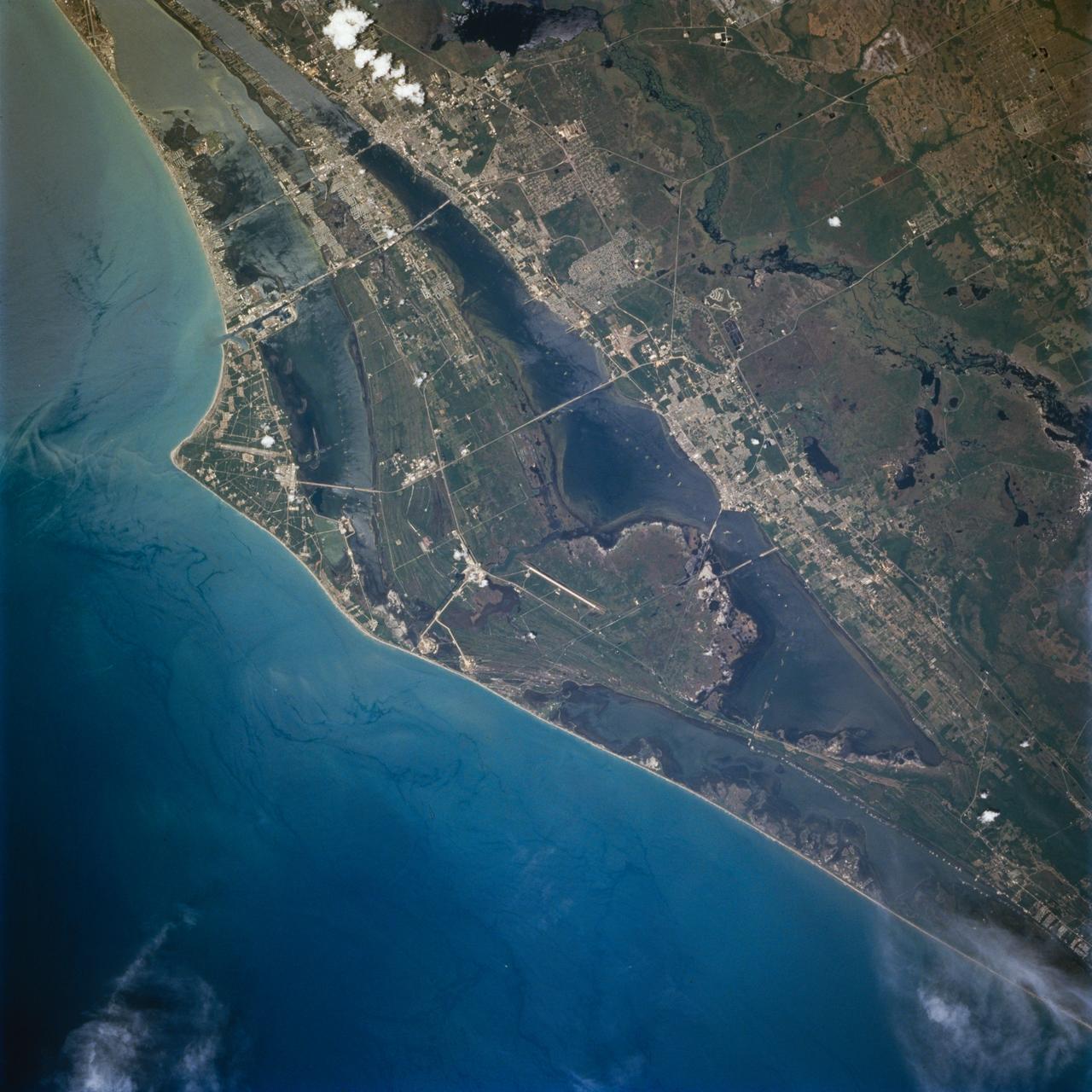
STS077-713-010 (19-29 May 1996) --- Like a number of Shuttle flight crews that preceded them, the members of the crew aboard the Space Shuttle Endeavour made eastern Florida one of their photographic targets. Both launch and landing sites are visible in the image. The Space Shuttle runway is at center. Above and to the left, along the coast, are the two main launch pads for the STS program. A road connecting the launch pads to the Vehicle Assembly Building (VAB) can be easily delineated. The Visitors Center for Kennedy Space Center (KSC) is above and to the right of the VAB. Above the Visitors Center is the NASA Causeway. Small white dots from the lower left and extending to the right corner outline the Intracoastal Waterway. The city of Cocoa Beach extends along the coast at the upper right. A small boat can be seen as a white dot to the right of Cape Canaveral with a distinctive ?V? shaped wake trailing behind.
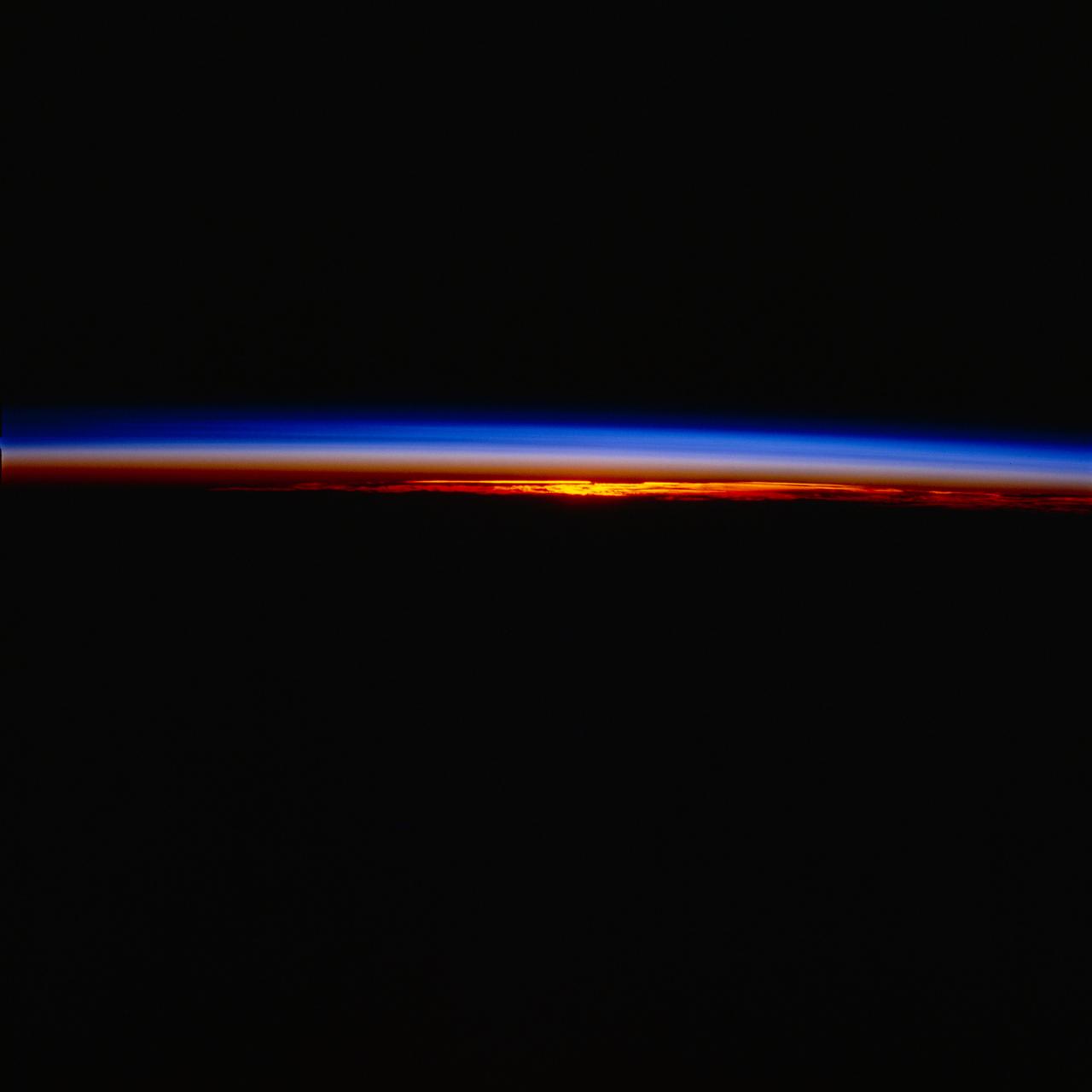
STS077-704-045 (19-29 May 1996) --- As the Space Shuttle Endeavour goes into darkness, the sun setting behind gave the astronaut crew aboard Endeavour a great chance to look at the atmospheric limb. The colors of the atmospheric limb are created by the sunlight being reflected off the gases of the upper atmosphere. As the photograph shows, the Earth?s weather and clouds take up only a small part of the whole atmosphere.
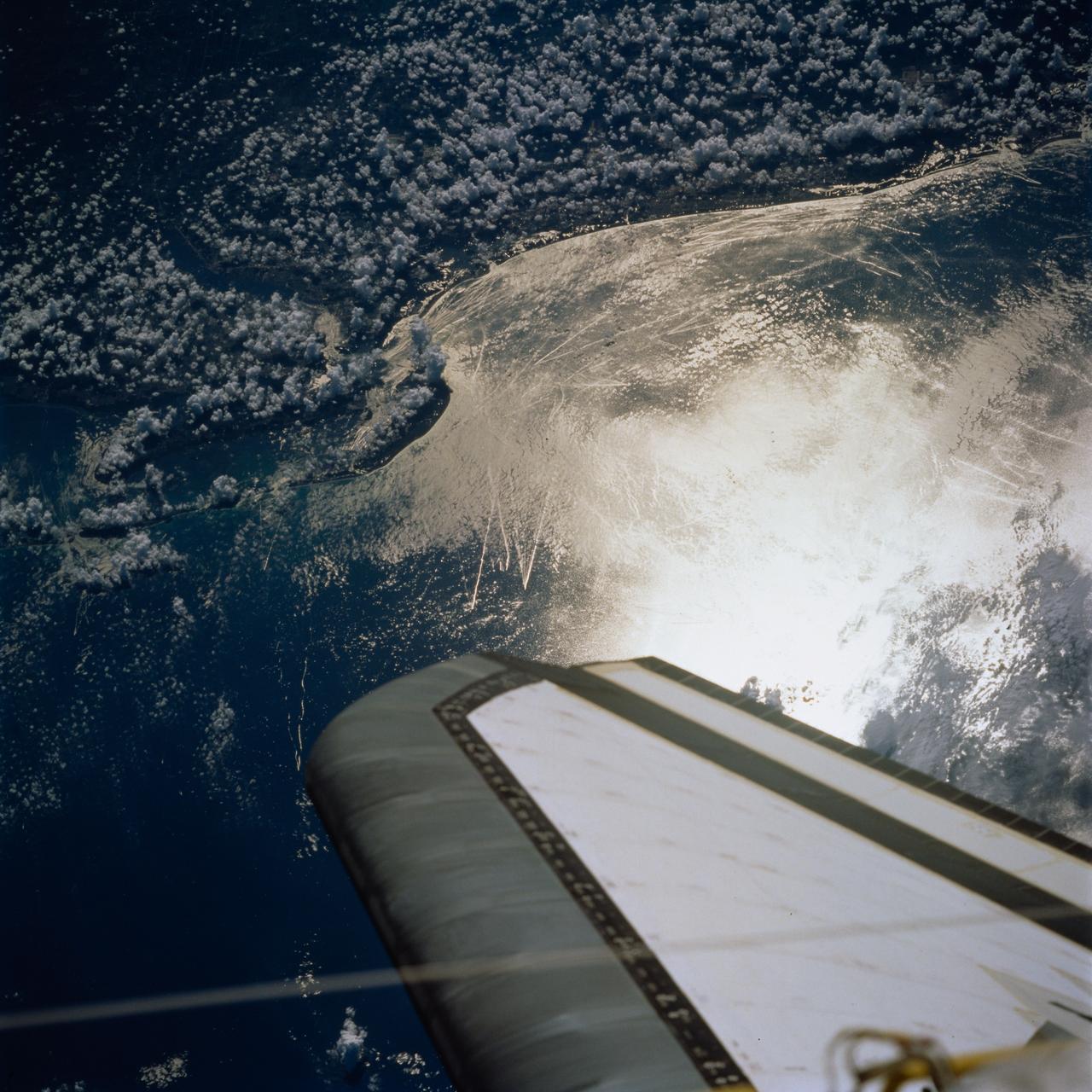
STS077-744-046 (19-29 May 1996) --- This view shows ship wakes off the coast of Fort Myers, Florida. The Sun glint reflecting off the ocean surfaces allowed man-made features to be seen and photographed by the astronaut crew members. When a ship or boat goes through the water it disturbs the surface of the water which causes the Sun?s rays to reflect back differently than the surrounding waters. Photographed on a weekend, this image illustrates how popular recreational boating is around the Fort Myers area.
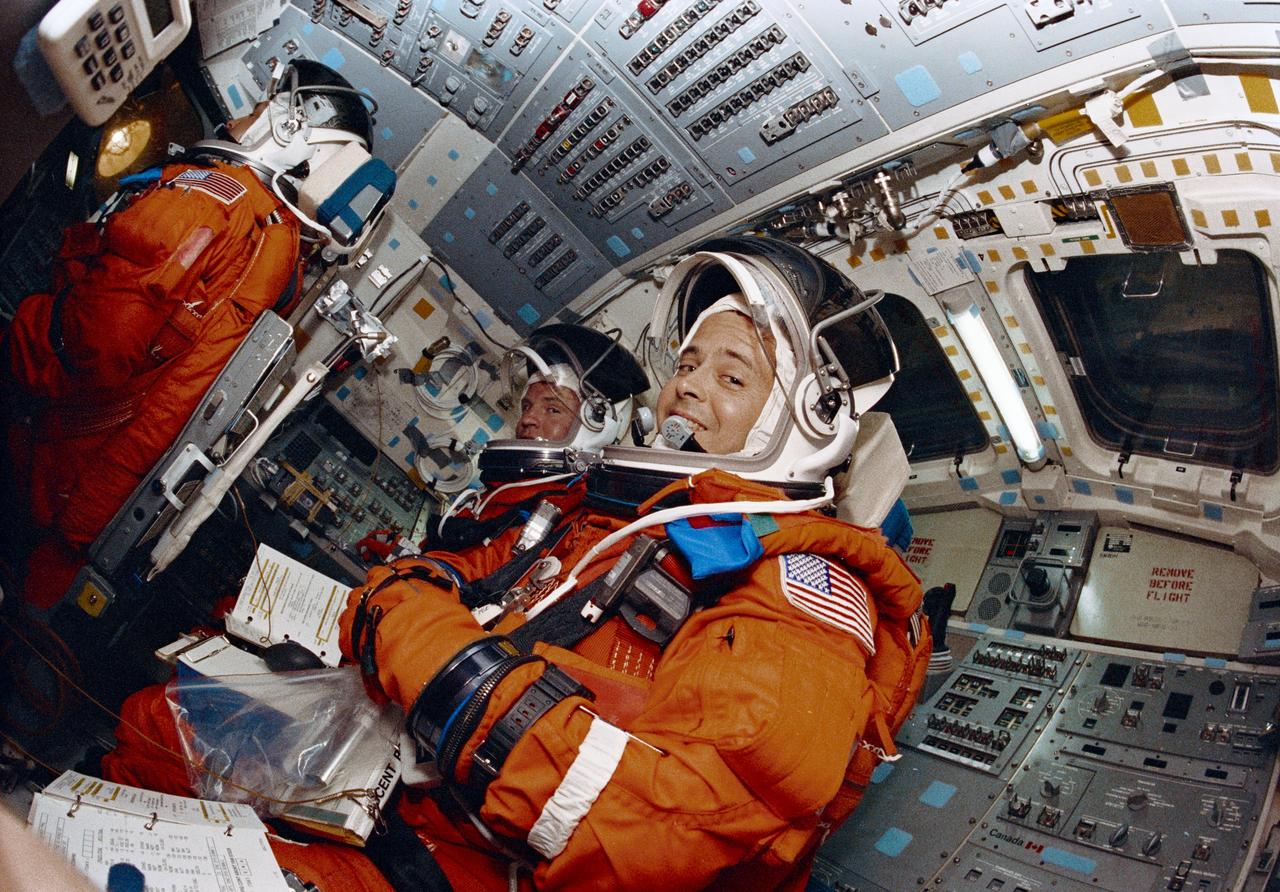
S96-08584 (24 April 1996) --- Curtis L. Brown, Jr., pilot, and Andrew S. W. Thomas and Daniel W. Bursch, missions specialists, are on the flight deck of the Space Shuttle Endeavour at Launch Pad 39B, participating in the final phase of the Terminal Countdown Demonstration Test (TCDT).
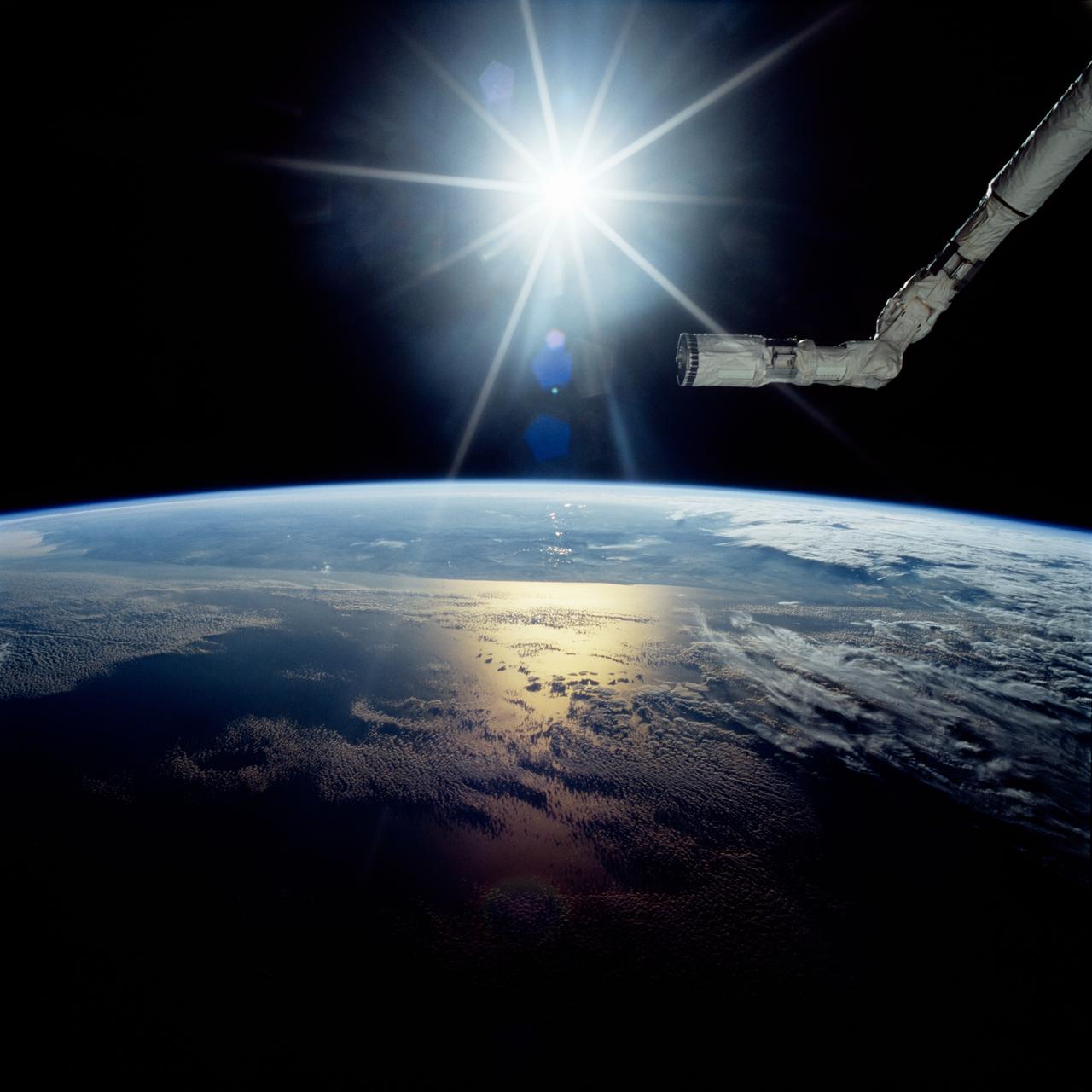
STS077-702-039 (19-29 May 1996) --- The Space Shuttle Endeavour?s Canadian-built Remote Manipulator System (RMS) arm is extended against a panoramic Earth/space background. In a traditional gesture, the view was chosen by the crew members to represent their unique position to view such scenes. A lengthy portion of the South African coast in Sun glint and a Sun burst/flare effect flank the end effector of the RMS.
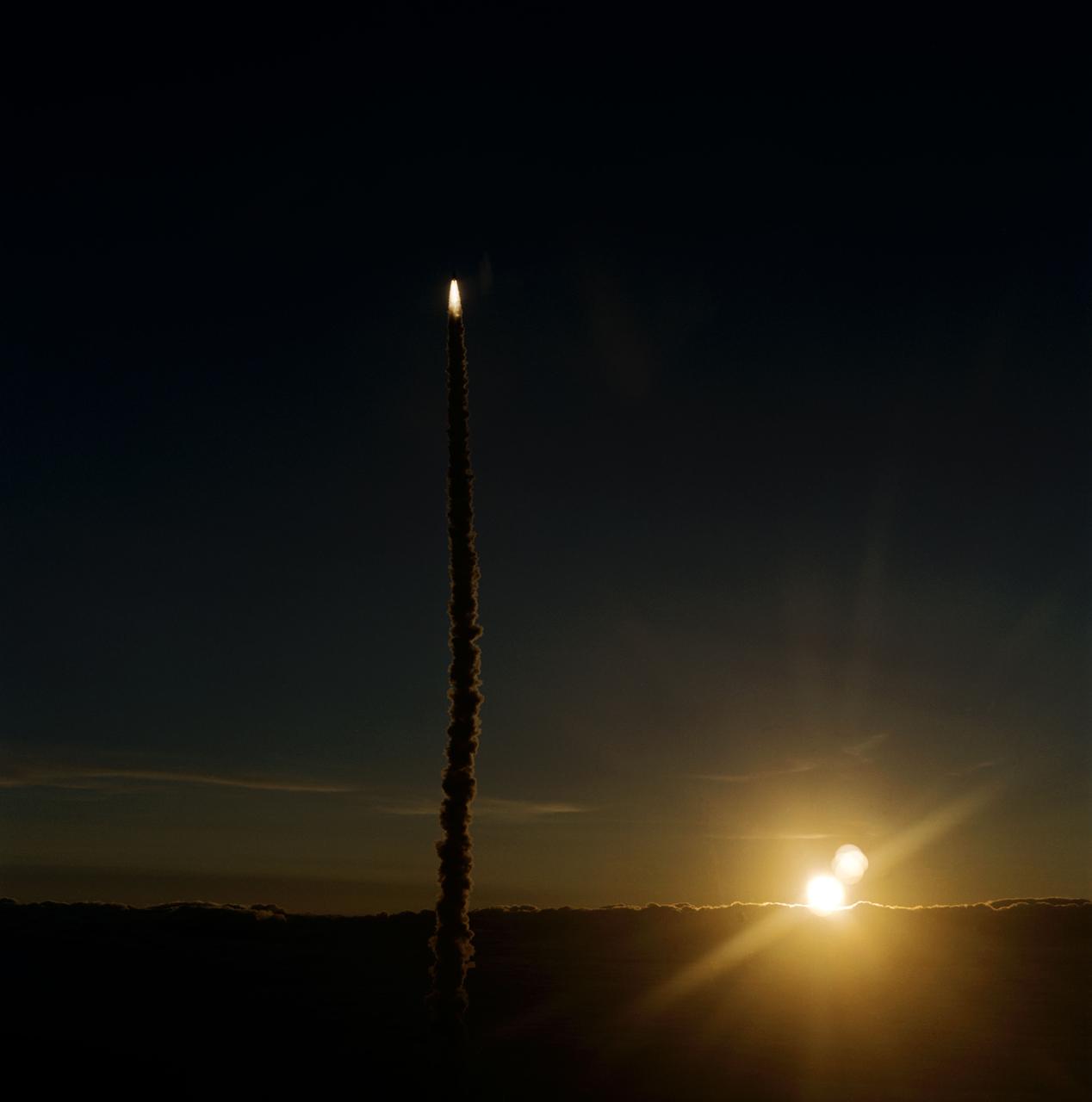
STS077-S-007 (19 May 1996) --- In this air-to-air 70mm frame, the Space Shuttle Endeavour is captured atop a trail of smoke as it carries six astronauts toward the fourth NASA Space Shuttle mission of the year. The photograph was taken from the Shuttle Training Aircraft (STA) which routinely checks the Florida environs for weather and safety factors. The launch occurred at 6:30:00 a.m. (EDT), May 19, 1996. Heading the six-member crew onboard is astronaut John H. Casper, mission commander. Other crew members are astronauts Curtis L. Brown, Jr., pilot; along with Daniel W. Bursch, Mario Runco, Jr., Andrew S. W. Thomas and Marc Garneau, all mission specialists. Garneau represents the Canadian Space Agency (CSA). During the approximately 10-day mission, the crew will perform a variety of payload activities, including microgravity research aboard the Spacehab 4 Module, deployment and retrieval of the Spartan 207 and deployment and rendezvous with the Passive Aerodynamically-Stabilized Magnetically-Damped Satellite (PAMS).
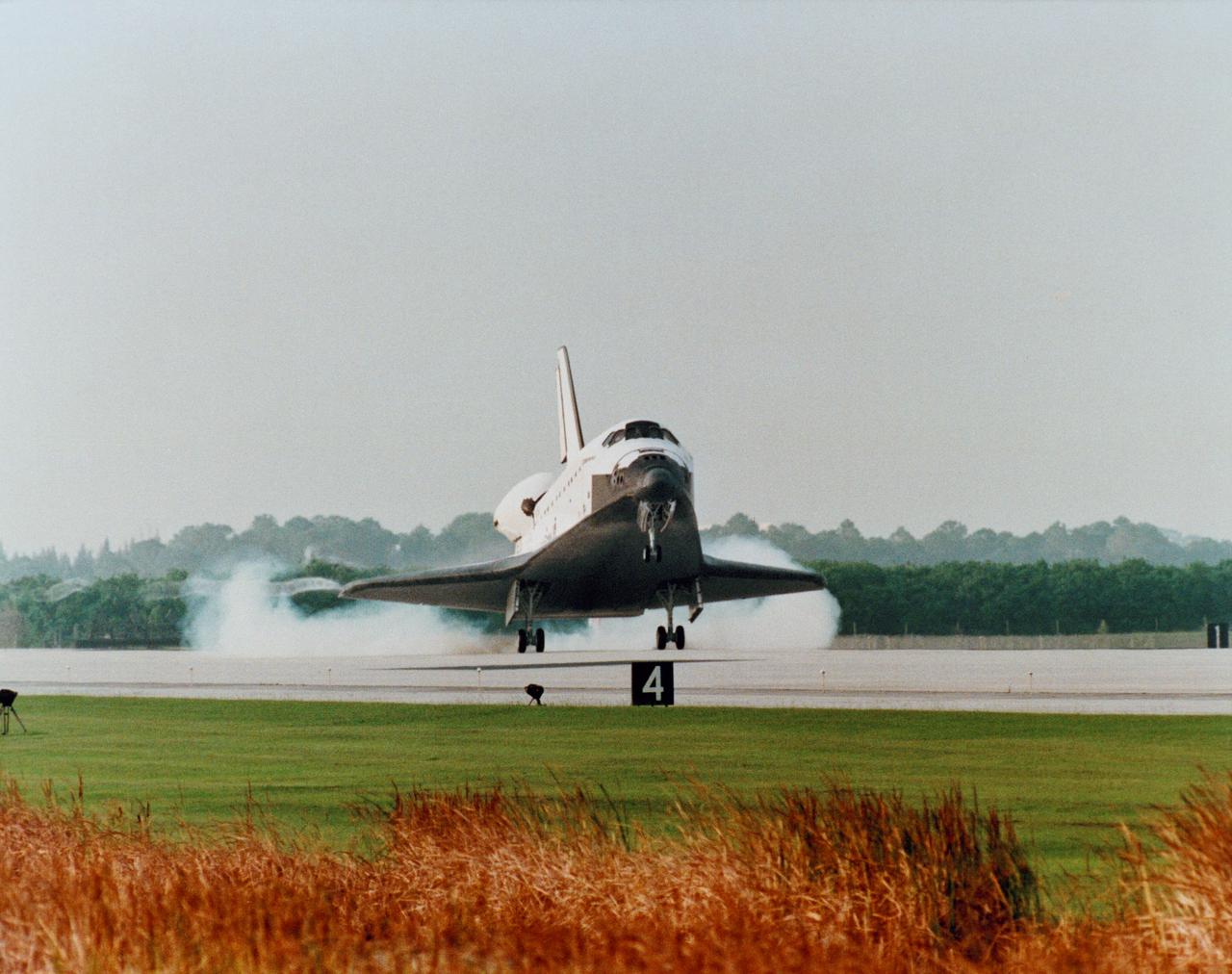
STS077-S-045 (29 May 1996) --- As its main landing gear touches down on Runway 33 at the Kennedy Space Center (KSC), the Space Shuttle Endeavour marks its return to Earth following a ten-day mission in space. Touchdown came at 7:09 a.m. (EDT), May 29, 1996. Leading the crew onboard was astronaut John H. Casper, mission commander. Other crew members were astronauts Curtis L. Brown, Jr., pilot; along with Daniel W. Bursch, Mario Runco, Jr., Andrew S. W. Thomas and Marc Garneau, all mission specialists. Garneau represents the Canadian Space Agency (CSA). During the approximately 10-day mission, the crew performed a variety of payload activities, including microgravity research aboard the Spacehab 4 Module, deployment and retrieval of the Spartan 207 and deployment and rendezvous with the Passive Aerodynamically-Stabilized Magnetically-Damped Satellite (PAMS).
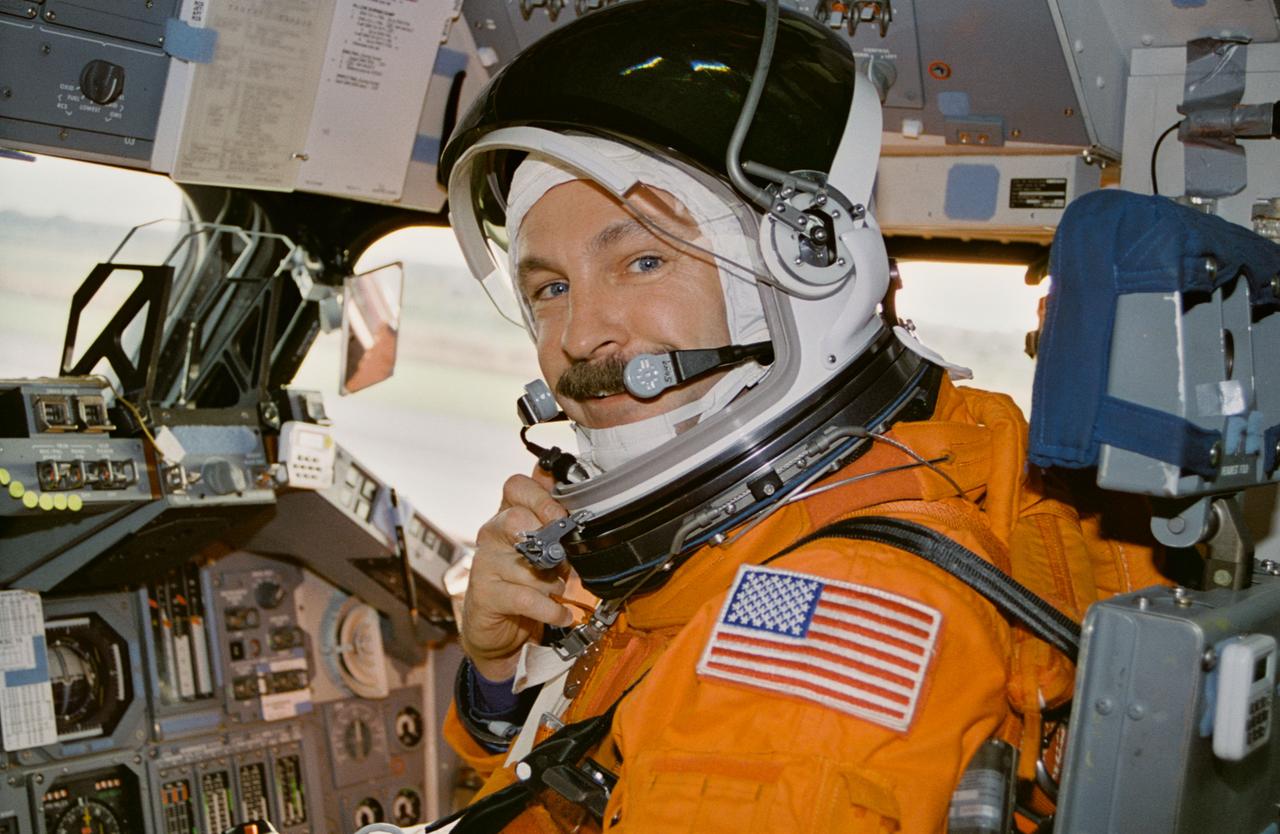
STS077-352-003 (29 May 1996) --- Astronaut Curtis L. Brown, Jr., pilot, raises his helmet visor upon wheel stop of the Space Shuttle Endeavour, completing a ten-day mission. Brown and five other astronauts had spent almost ten days aboard Endeavour in support of the Spacehab 4 mission and a number of other payloads.
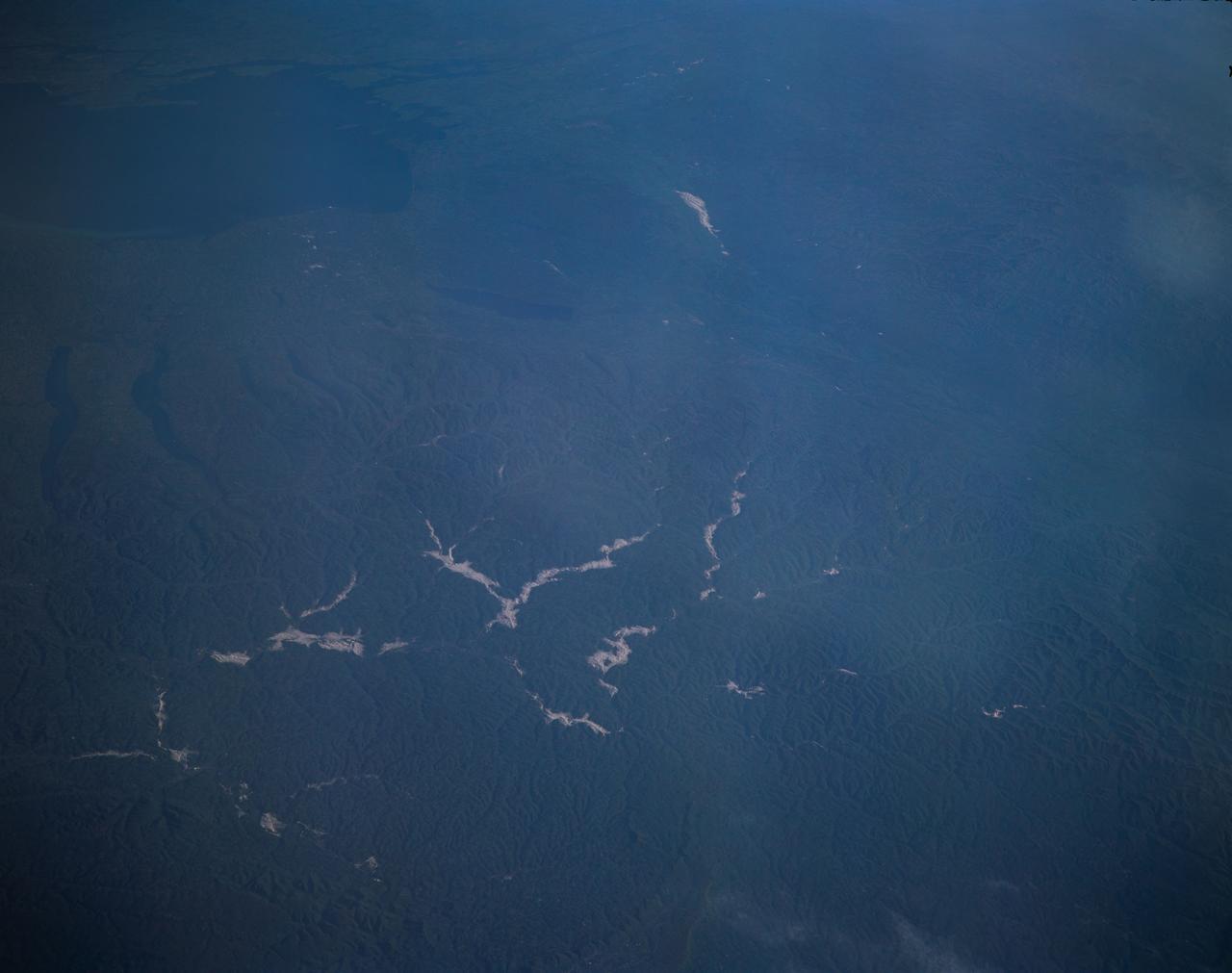
STS077-162-036 (19-29 May 1996) --- An oblique view of eastern New York State, Lake Ontario and the Saint Lawrence River. This view of New York State looking northeast was provided by the crew members of the mission. The Linhof camera, a 4x5 format instrument, provides a wide panorama of the region. If the picture is oriented with the NASA logo to the left bottom corner, North will be to the upper side of the frame. Lake Ontario is in the upper left corner and the Catskills are in the lower portion of the scene. The Finger Lakes from Cayuga to Oneida are in the left-center. One of the remarkable aspects of this photograph is this part of New York only averages 68 cloud free days per year. According to scientists studying the photo collection, the entire area of this photograph was covered by glaciers during the ice ages. The glaciers left their marks in the creation of the Finger Lakes and the formation of Lake Ontario.
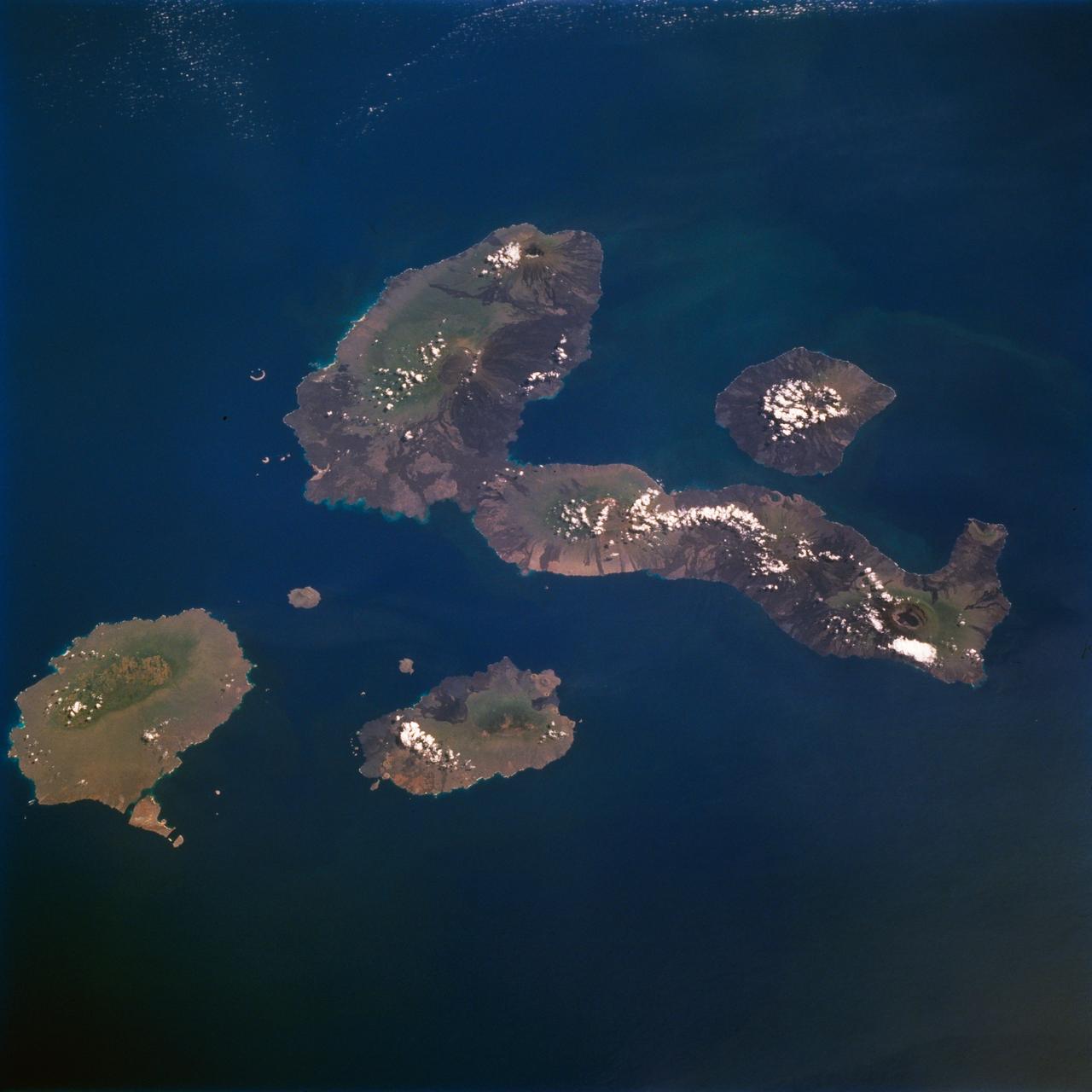
STS077-711-012 (19-29 May 1996) --- One of several volcanic-laden photo targets for the crew members was the grouping of the Galapagos Islands -composites of flat-topped volcanoes produced by a hot spot in the eastern Pacific. Dark lava flows drape the flanks of each volcano. This view centers on Isabella, the sea horse-shaped island. The most active volcano is the island of Fernandina, which sits just west (up) from the sea horse?s middle area. Fernandina erupted late last year, and Shuttle photography has documented the changes produced by eruptions over the past 10 years. Because the Galapagos Islands sit on the equator and near the junction of current systems in the eastern Pacific Ocean, and the volcano provides a sharp topographic barrier to the currents, many interesting oceanic phenomena occur and have been recorded in this region. Lighter colored water occurs just west of Isabella and Fernandina. The origin of the color difference is unknown, but could possibly be plankton blooms related to upwelling around the islands.
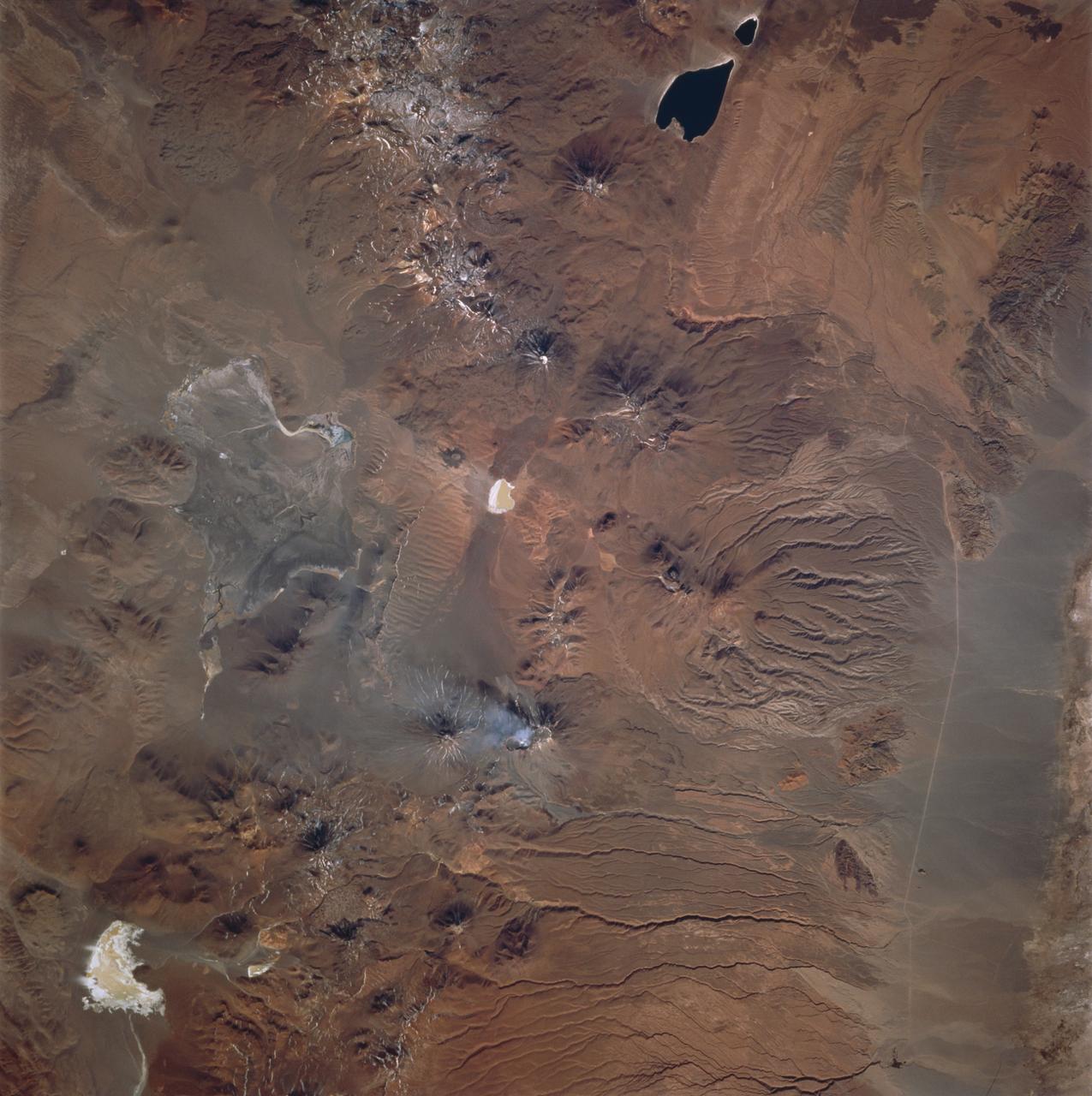
STS077-740-029 (19-29 May 1996) --- In recent years, the most active peak in the High Altiplano of the central Andes Mountains has been Lascar, in northern Chile - featured in this 70mm frame. North is to the left in this picture. Lascar?s largest recent eruption was in April, 1993. The STS-55 crew photographed large dust plumes carrying the newly-deposited ash about one week after the eruption. Since then, astronauts have been closely monitoring Lascar, which remains active. This crew noticed and photographed Lascar?s plume, which is shown here as a steam plume rising from Lascar?s central summit crater. This level of activity is typical. This view also shows the extent of weathering as determined by the surface color of the 1993 flow from the crater. The flow traveled down the valley which is to the left (north) and then down (west) from the summit of this image. In earlier views the flow was a light gray, almost white feature in the valley. Today, the flow is close to the red-brown color of the surrounding rock.
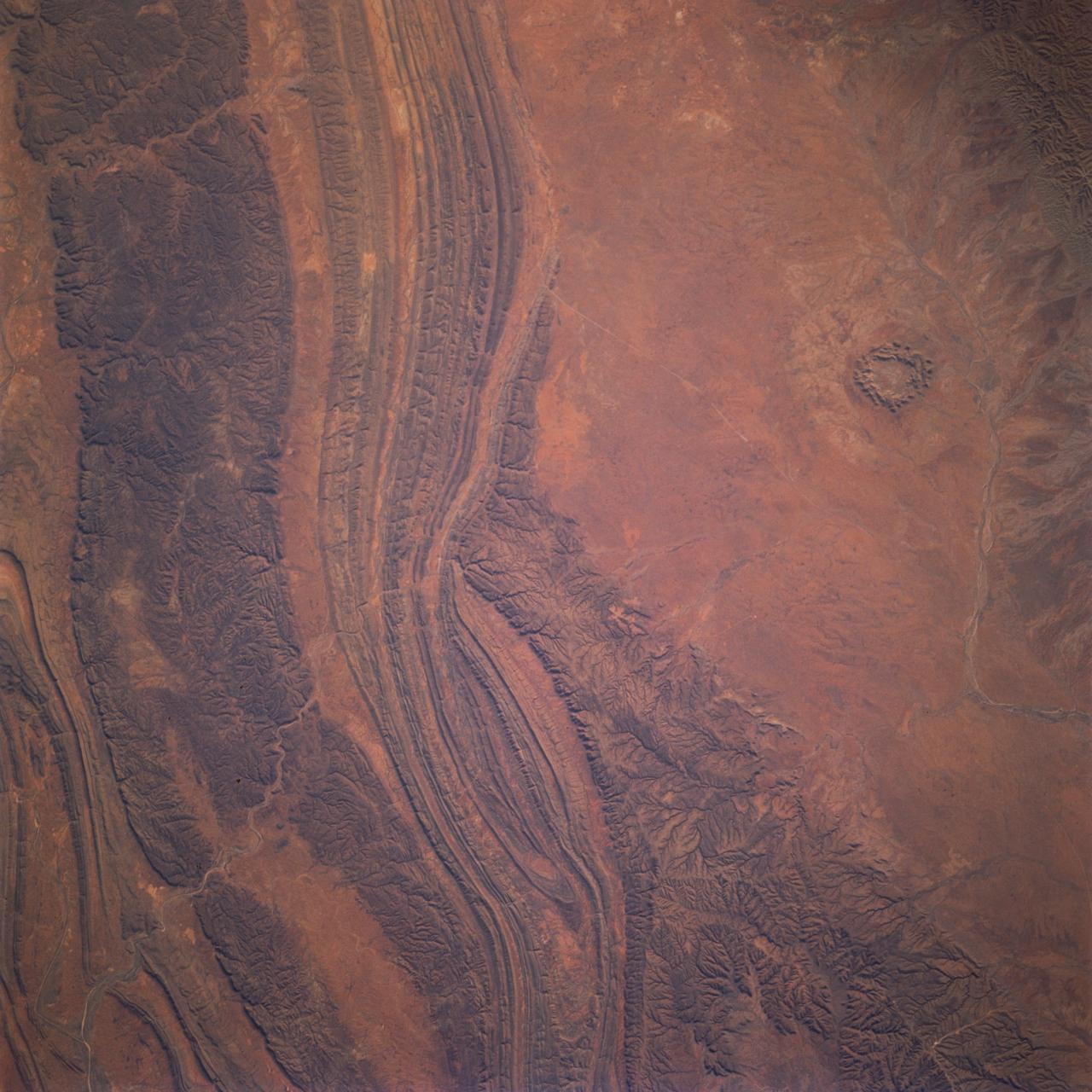
STS077-737-096 (19-29 May 1996) --- The Palmer River emerging from the left corner of the photograph separates the Gardener Range to the right from the James Ranges on the left. To the bottom and off the photograph is the MacDonnell Ranges. The circular feature at bottom right is a highly eroded impact crater located on Missionary Plain. Gosses Bluff is a complex crater about 22 kilometers in diameter and is estimated to be about 142 million years old.
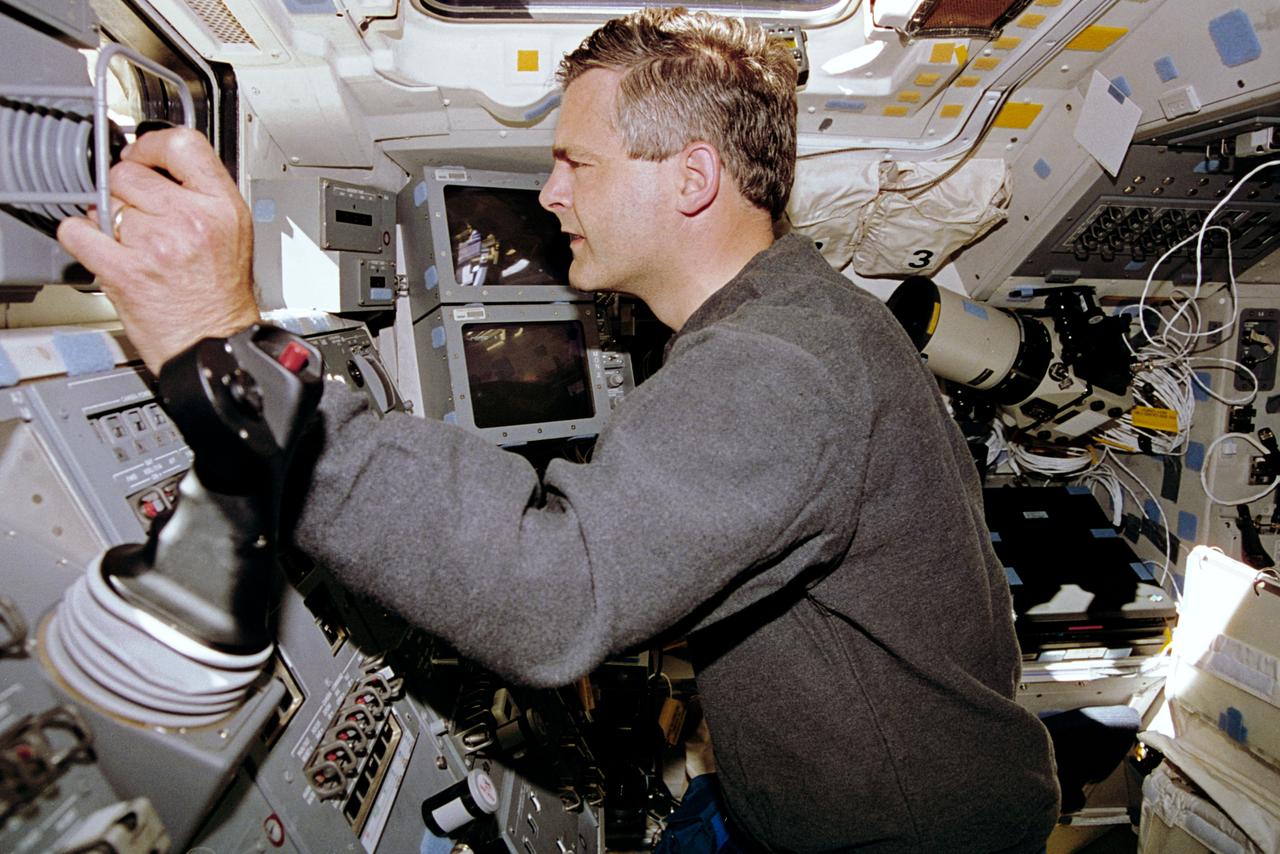
STS077-307-017 (19-29 May 1996) --- Astronaut Marc Garneau, mission specialist, is pictured at the controls for the Remote Manipulator System (RMS) on the aft flight deck of the Space Shuttle Endeavour. Garneau, representing the Canadian Space Agency (CSA), and five other astronauts went on to spend almost ten days aboard Endeavour in support of the Spacehab 4 mission and a number of other payloads.
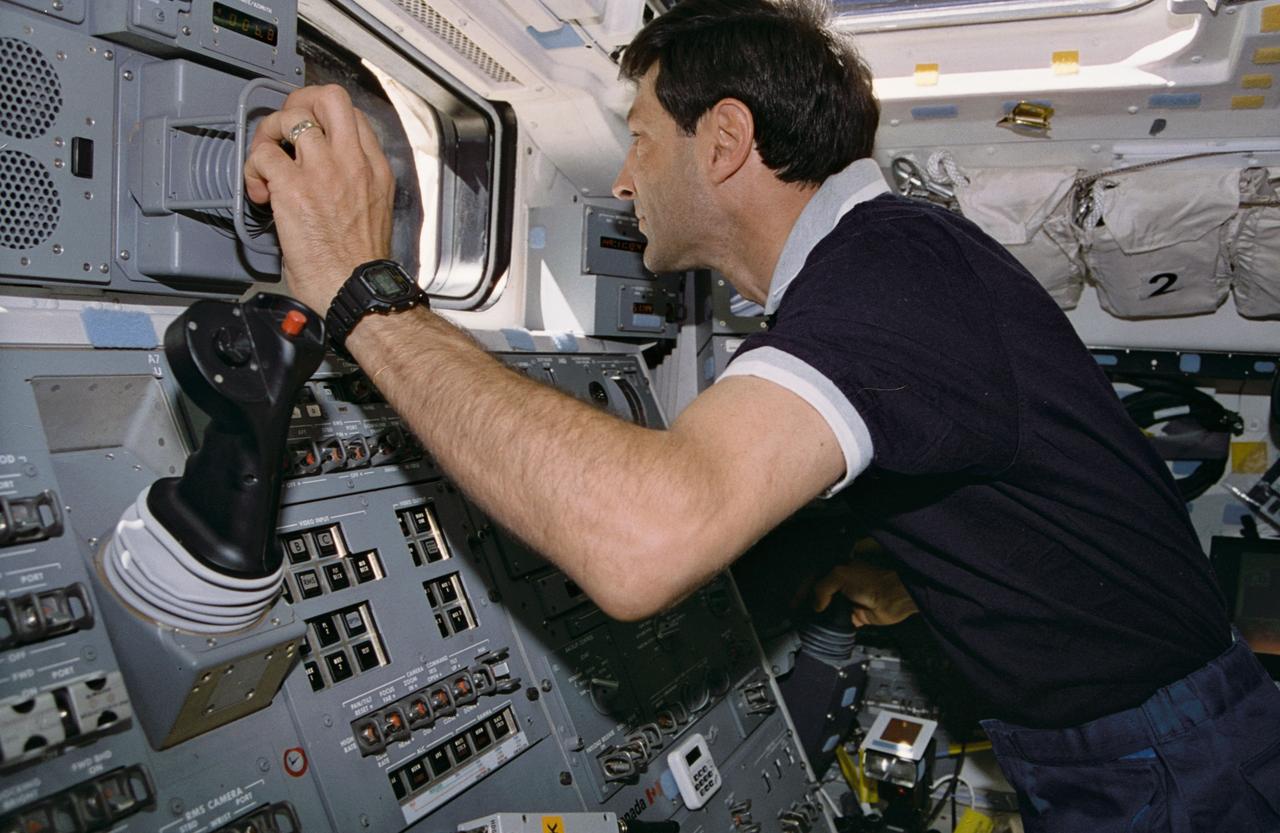
STS077-307-020 (19-29 May 1996) --- Astronaut Mario Runco, Jr., mission specialist, is pictured at the controls for the Remote Manipulator System (RMS) on the aft flight deck of the Space Shuttle Endeavour. Runco and five other astronauts went on to spend almost ten days aboard Endeavour in support of the Spacehab 4 mission and a number of other payloads.
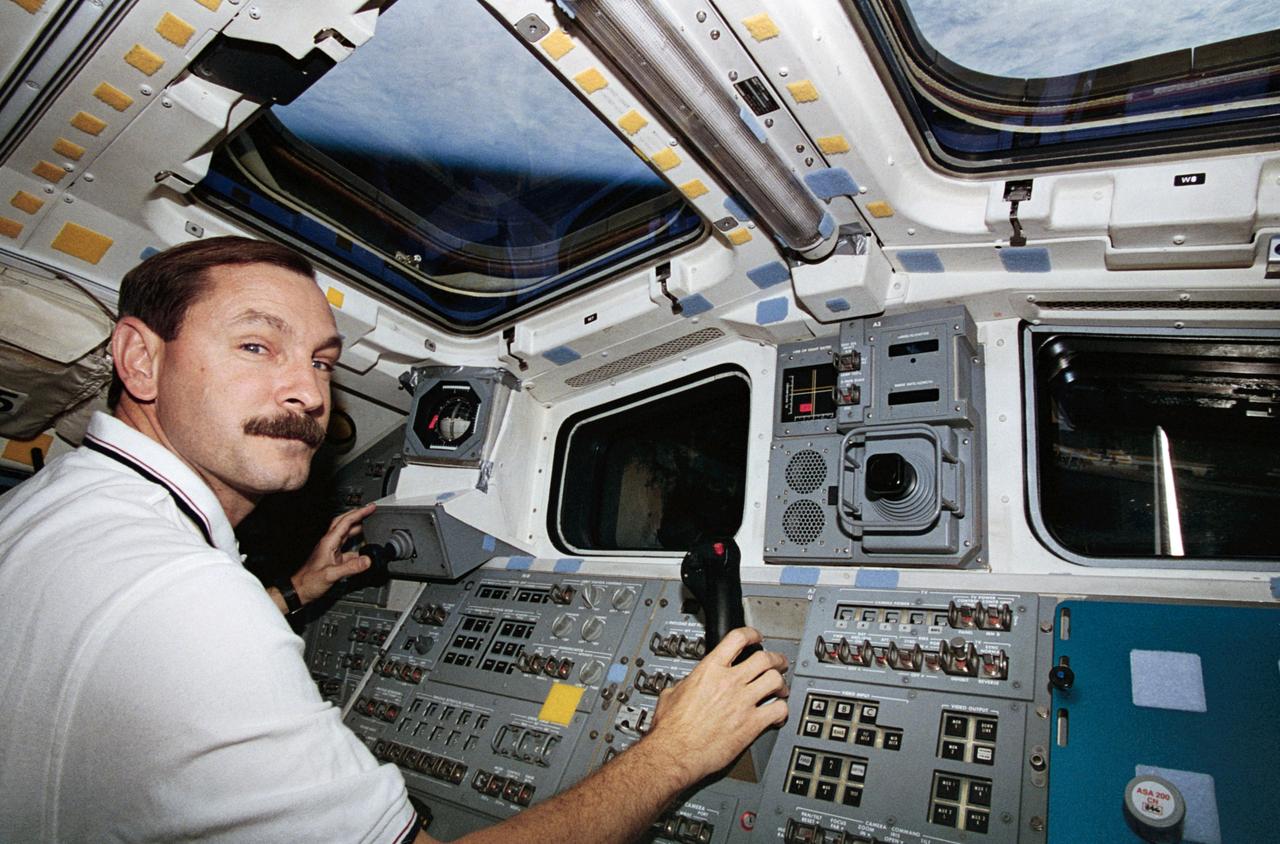
STS077-312-015 (19-29 May 1996) --- Astronaut Curtis L. Brown, Jr., pilot, mans the controls for the Remote Manipulator System (RMS) on the Space Shuttle Endeavour?s aft flight deck during rendezvous operations. During the flight, the six-member crew was involved in deployment and rendezvous operations with the Spartan 207/Inflatable Antenna Experiment (IAE) as well as the Passive Aerodynamically Stabilized Magnetically Damped Satellite (PAMS)/Satellite Test Unit (STU).
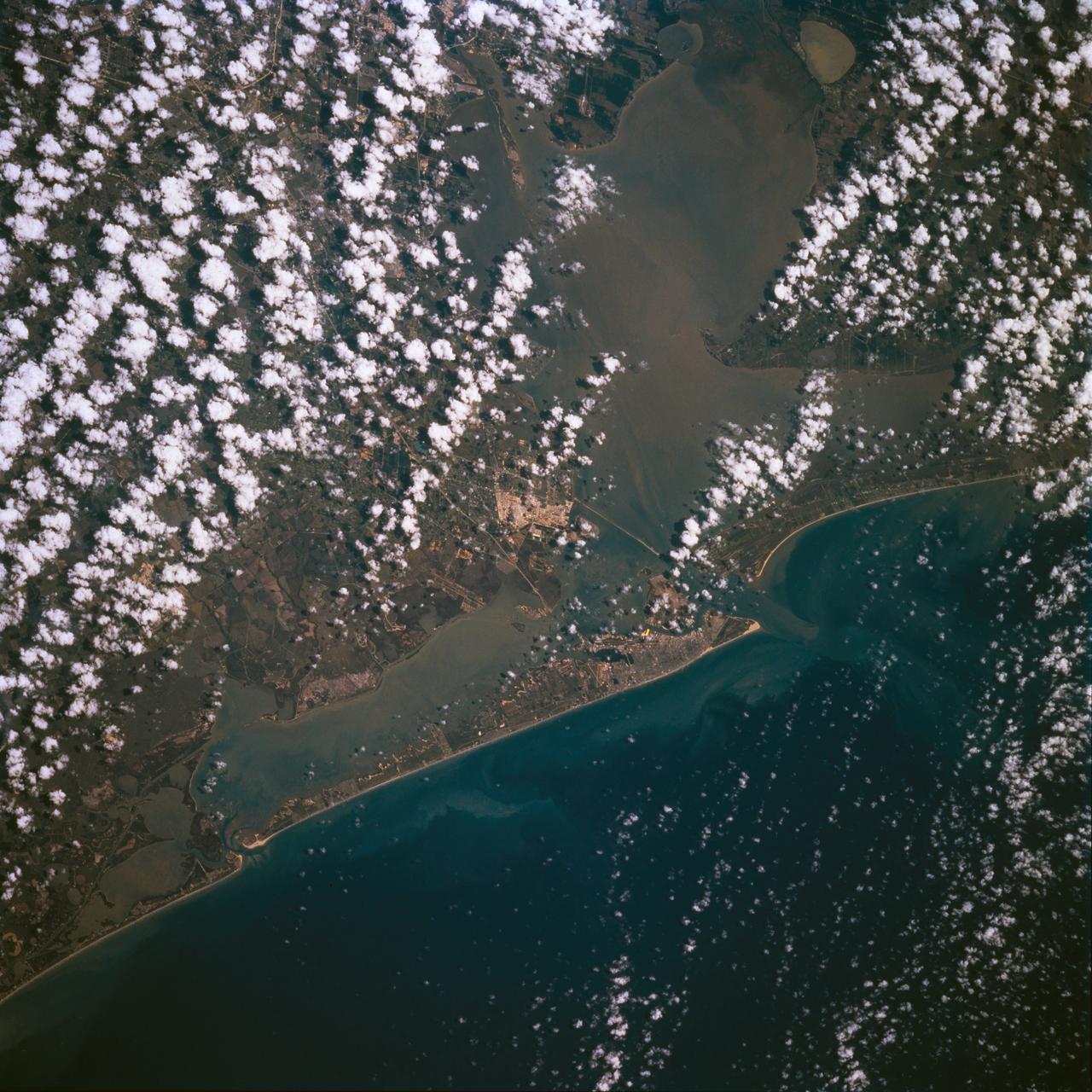
STS077-704-001 (19-29 May 1996) --- Clouds cover most of Houston, Texas, but all of Galveston Island, Galveston Bay and mainland Galveston County are visible in this 70mm image from the Space Shuttle Endeavour. Part of Interstate 10 shows up in the lower left corner. Such clarity exists in the photo that Galveston?s two jetties, the Texas City Dike, the I-45 causeway, the new Baytown Bridge and the San Luis Pass Bridge can be delineated.
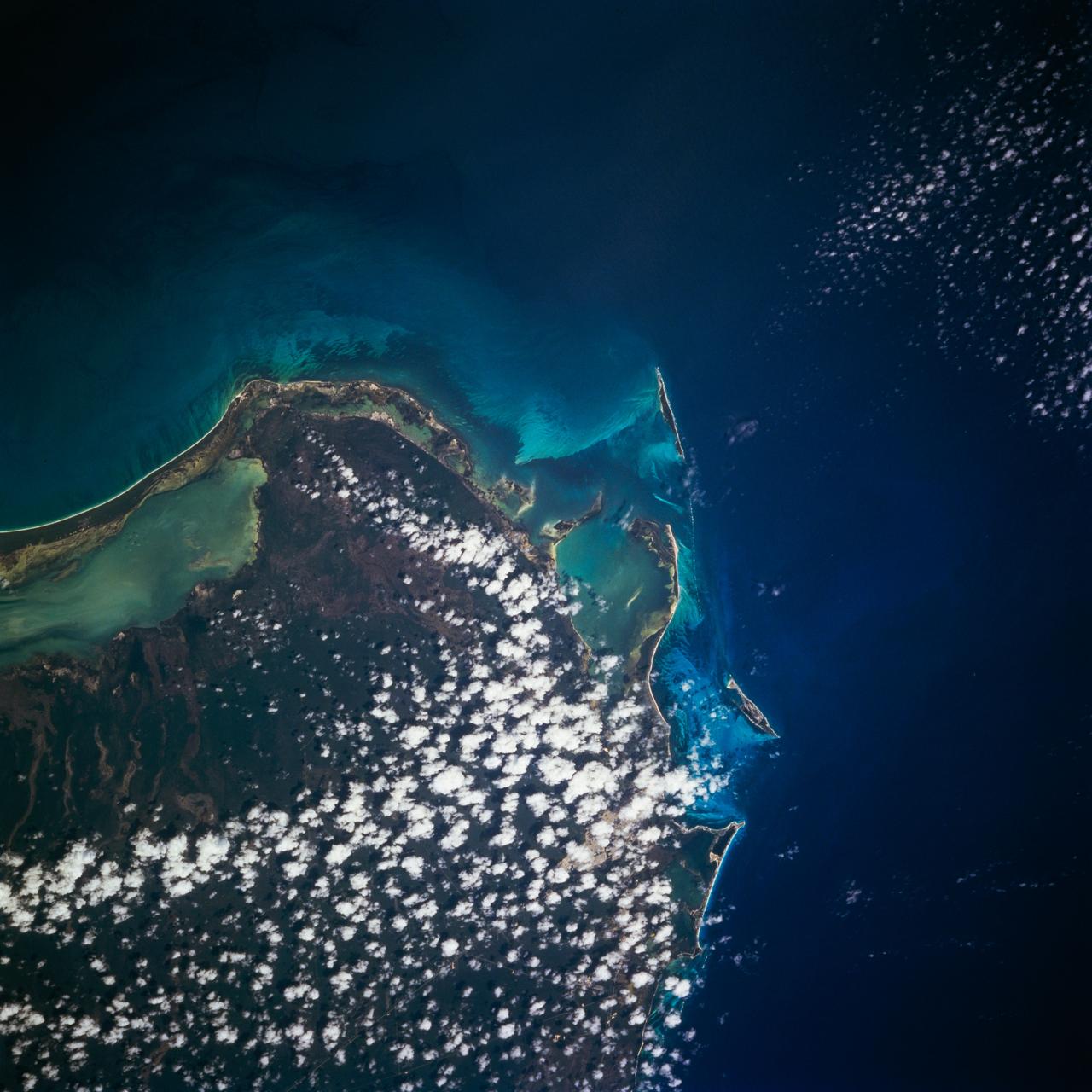
STS077-704-010 (19-29 May 1996) --- The northeastern tip of the Yucatan Peninsula is visible in this Earth scene. The eastern coast of the Yucatan Peninsula is characterized by bluffs, bays, and islands. Isla Mujeres is one of the larger islands off the eastern coast where a tourism industry is being developed. The different shades of blue along the coast is an indication of water depth, with the lighter shades representing more shallow water.
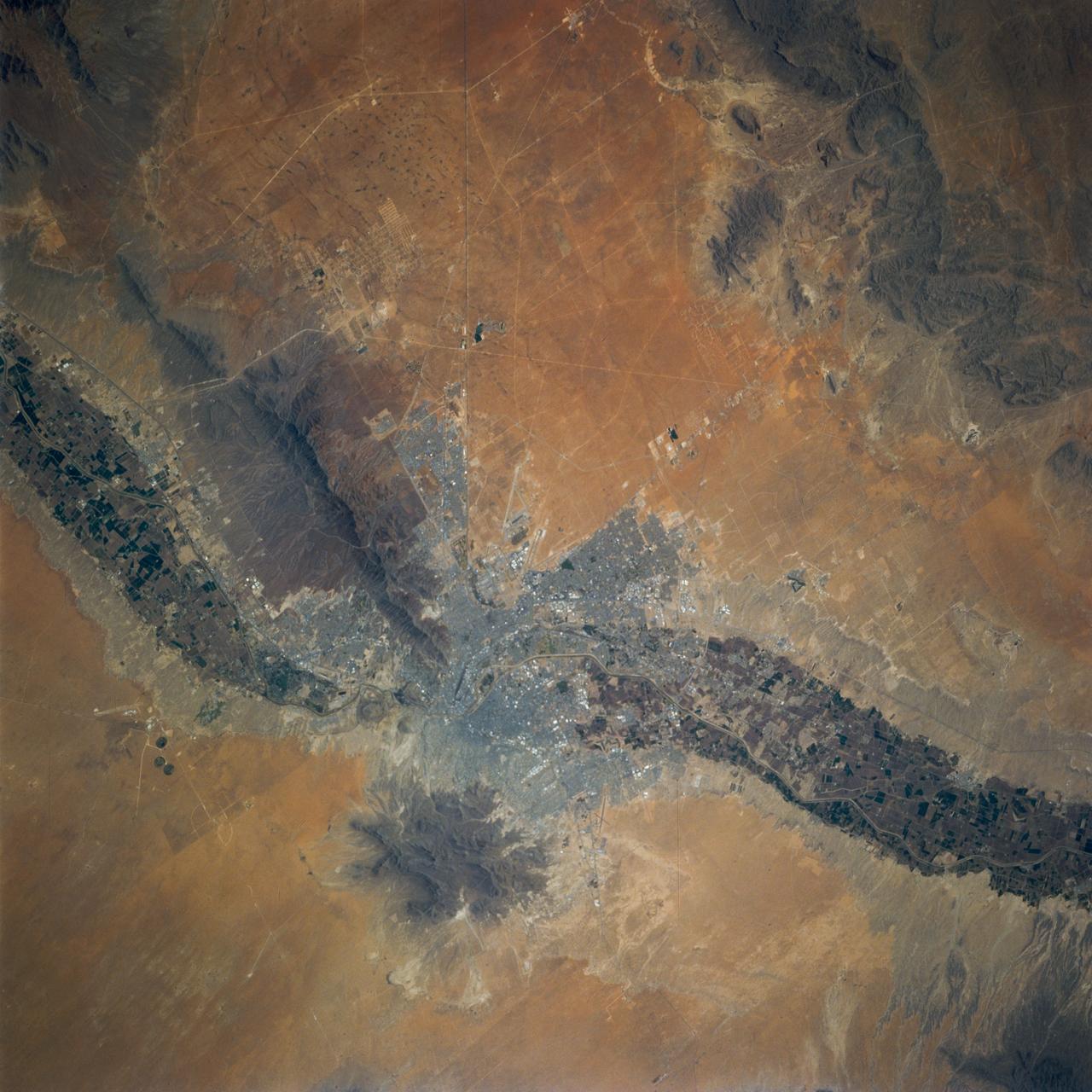
STS077-707-097 (19-29 May 1996) --- This 70mm photograph shows the contrasts between the Chihuahua Desert and the irrigated bottomlands of the Rio Grande. The twin cities of Juarez, Mexico, and El Paso, Texas, on opposite sides of the border are in the center of the frame. The area was first colonized in 1598 making it one of the oldest settlements of Europeans on the North American continent. The name of El Paso derives from the Spanish ?El Paso del Norte.? The City of El Paso became a United States city in 1873. The pass allows passage through the Rocky Mountains in this region. The extension of the Rockies to the northwest of El Paso is known as the Franklin Mountains. Juarez now has over a million people and El Paso has around 400,000. The economy is driven by the maquiladora industries. Fort Bliss on the United States side is a major employer also. Fort Bliss is the wedge shaped feature in El Paso. The post was first established in 1849 for protection from the Comanches and the last horse Calvary unit was disbanded in 1943.
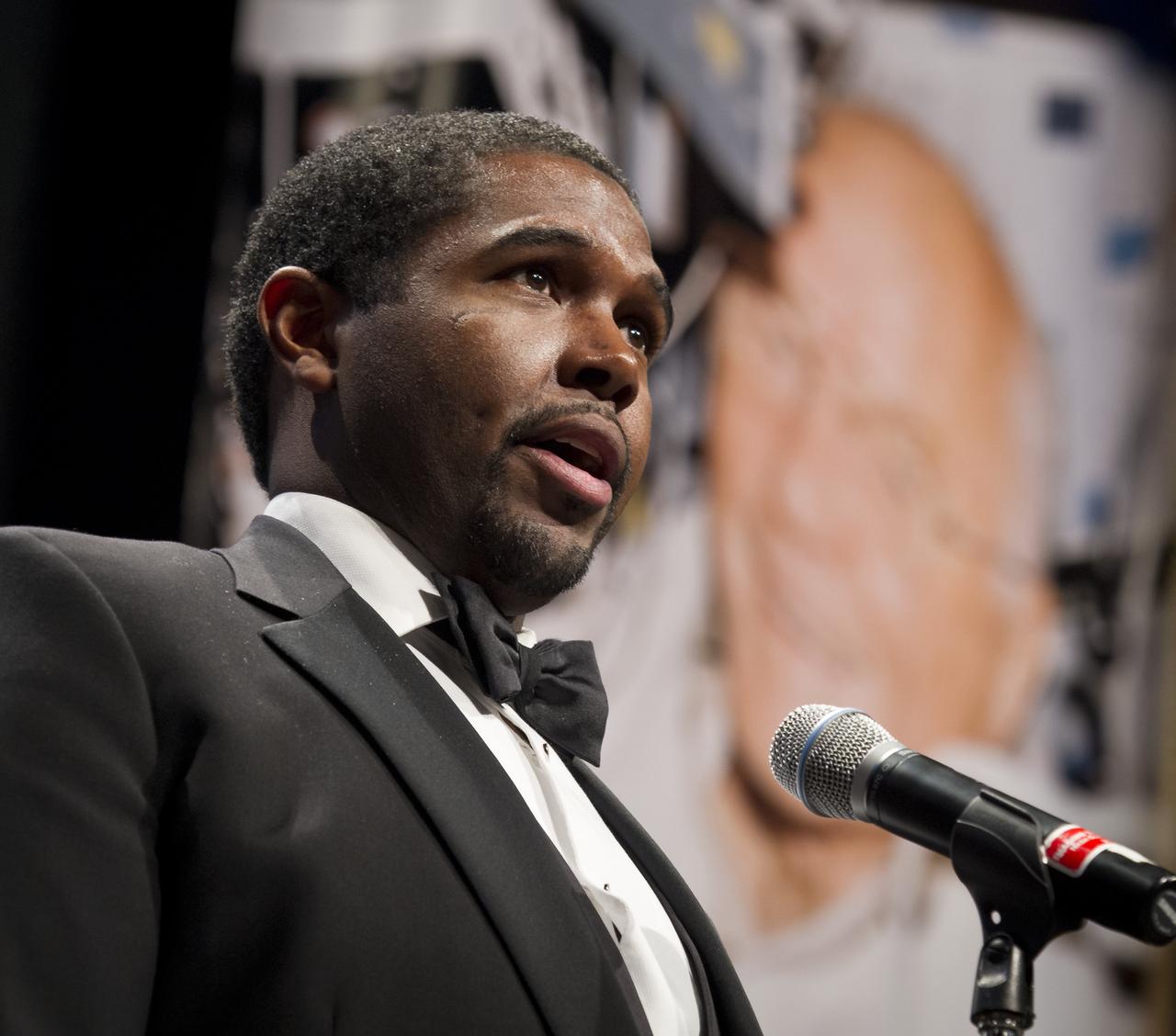
Cleveland State University Master of Music Major James Binion Jr. sings a musical tribute during an event celebrating John Glenn's legacy and 50 years of americans in orbit held at the university's Wolstein Center on Friday, March 3, 2012 in Cleveland, Ohio. In 1998 Lindsey flew onboard the space shuttle Discovery along with then 77 year-old Sen. John Glenn for the STS-95 mission. Glenn became the first American to orbit Earth in 1962. Photo Credit: (NASA/Bill Ingalls)
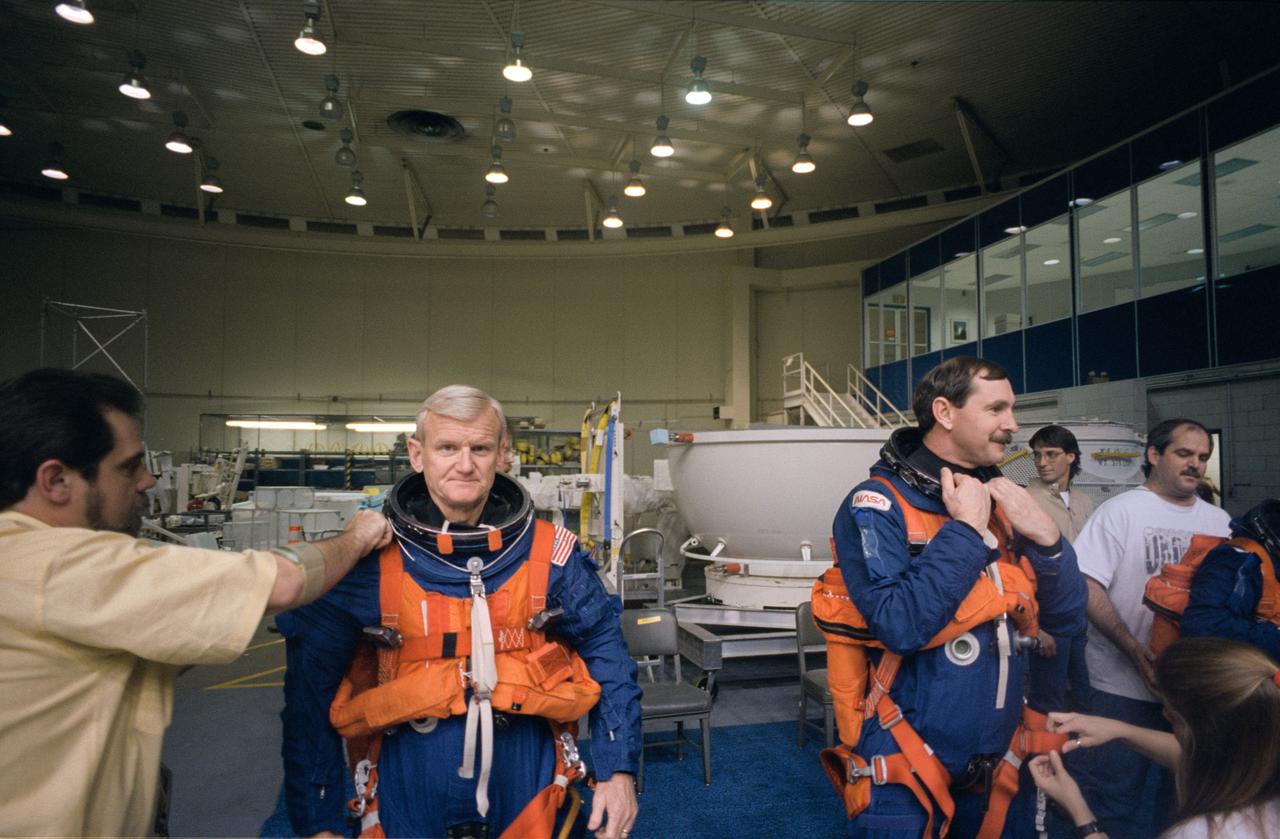
S96-08066 (April 1996) --- Left to right, astronauts John H. Casper, mission commander, and Curtis L. Brown, Jr., pilot, get help with the final touches of suit donning during emergency bailout training for STS-77 crew members in the Johnson Space Center?s (JSC) Weightless Environment Training Facility (WET-F). Casper and Brown will join four other astronauts for nine days aboard the Space Shuttle Endeavour next month.
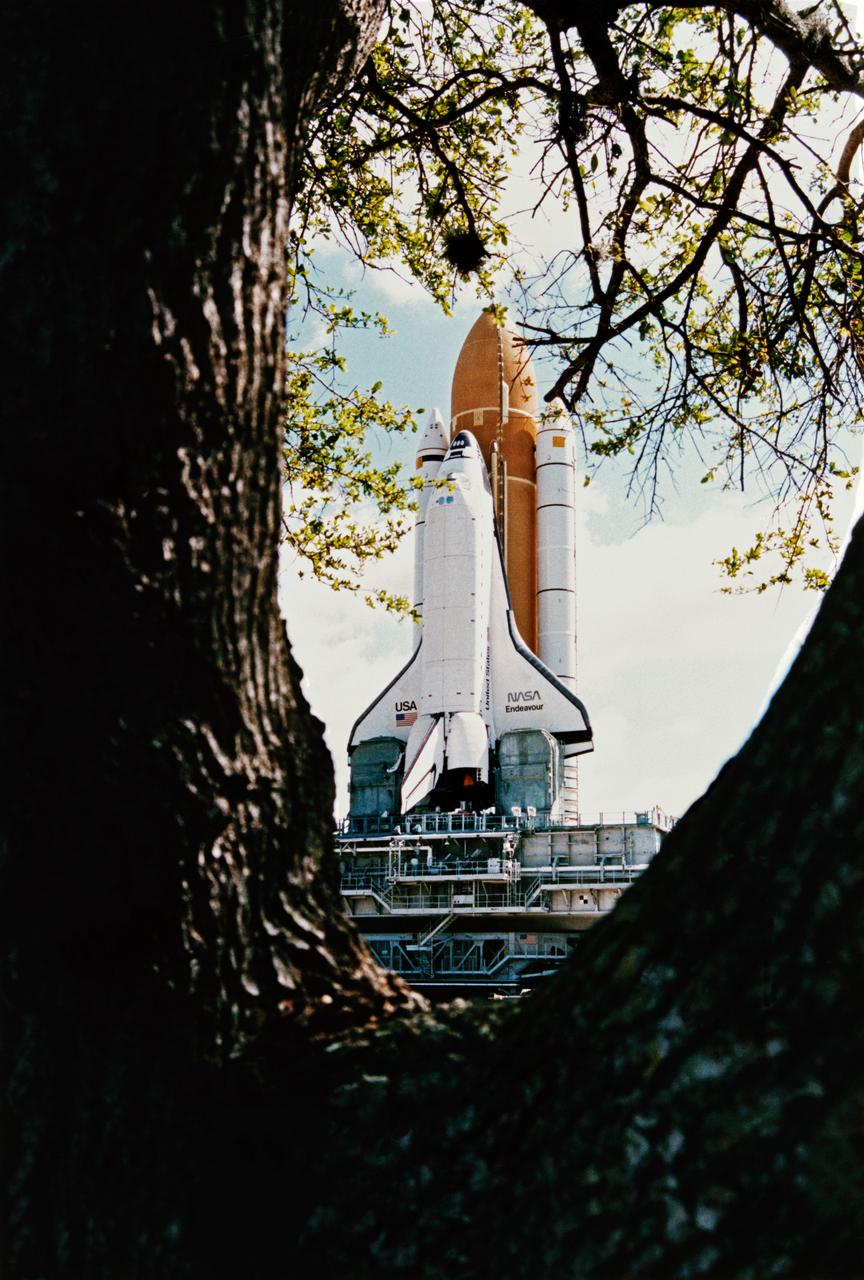
STS077-S-044 (16 April 1996) --- The Space Shuttle Endeavour atop the Mobile Launcher Platform and Crawler-Transporter (MLP/CT) slowly lumbers past a tree alongside the crawlerway, at the Kennedy Space Center (KSC). The journey from the Vehicle Assembly Building (VAB) to Launch Pad 39B will take about five to six hours to complete. Once hard down at the pad, preparations will continue to ready Endeavour for its upcoming spaceflight on STS-77.
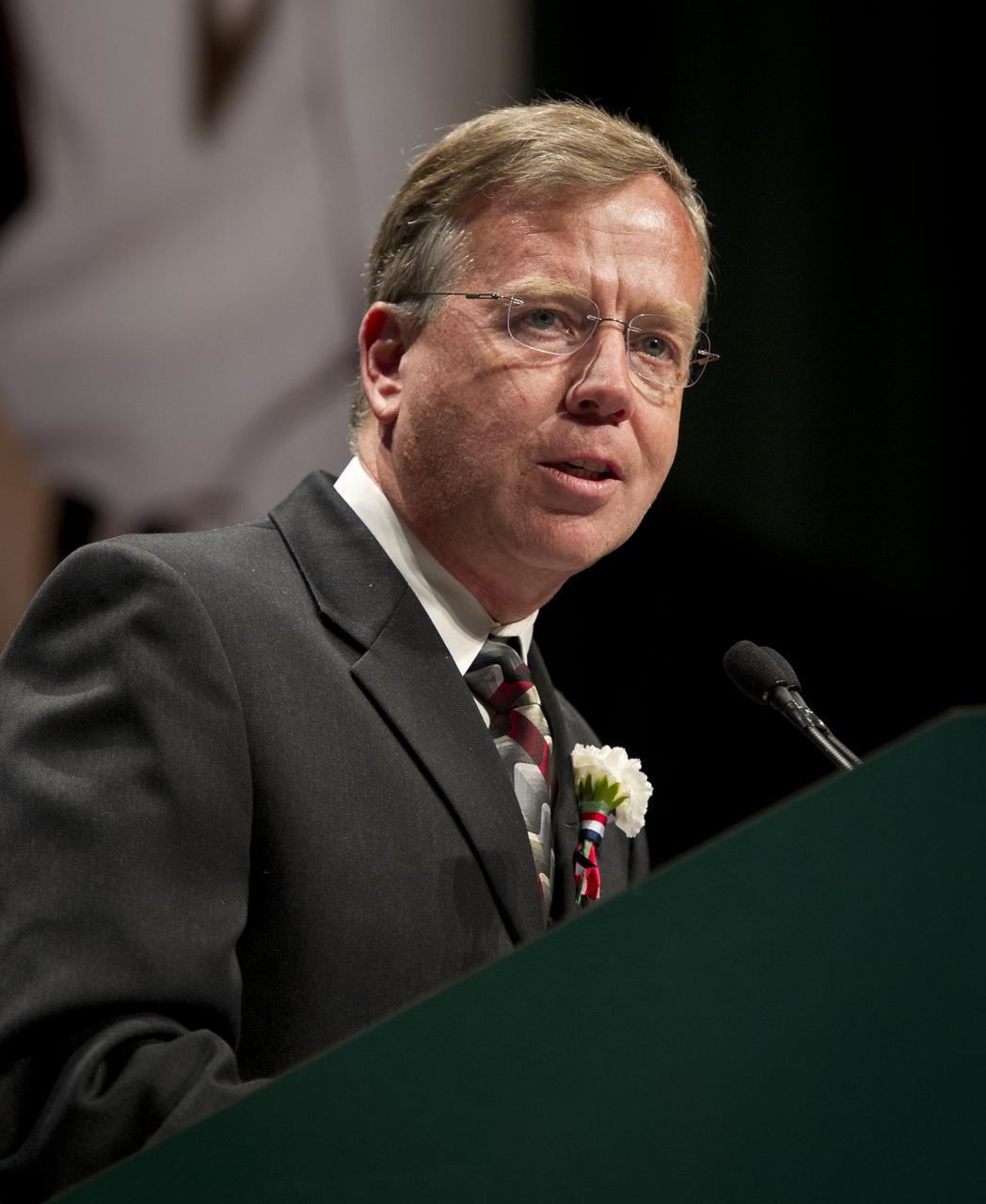
Former NASA Astronaut Steve Lindsey gives remarks at an event celebrating John Glenn's legacy and 50 years of americans in orbit held at the Cleveland State University Wolstein Center on Friday, March 3, 2012 in Cleveland, Ohio. In 1998 Lindsey flew onboard the space shuttle Discovery along with then 77 year-old Sen. John Glenn for the STS-95 mission. Glenn became the first American to orbit Earth in 1962. Photo Credit: (NASA/Bill Ingalls)
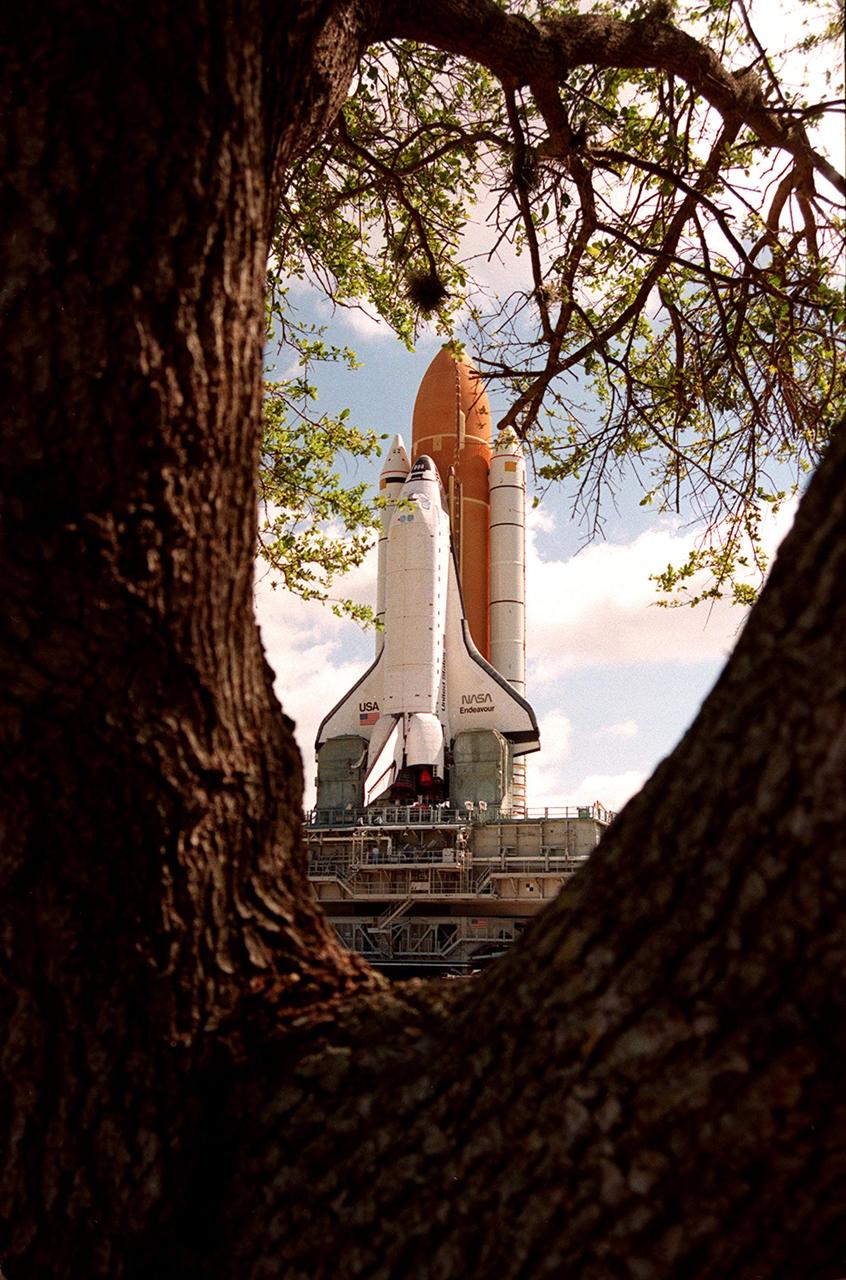
KENNEDY SPACE CENTER, FLA. -- The Space Shuttle Endeavour, atop the Mobile Launcher Platform and Crawler-Transporter, slowly lumbers past a tree alongside the crawlerway. The journey from the Vehicle Assembly Building to Pad 39B will take about five or six hours to complete. Once hard down at the pad, preparations will continue to ready Endeavour for its upcoming spaceflight on Mission STS-77
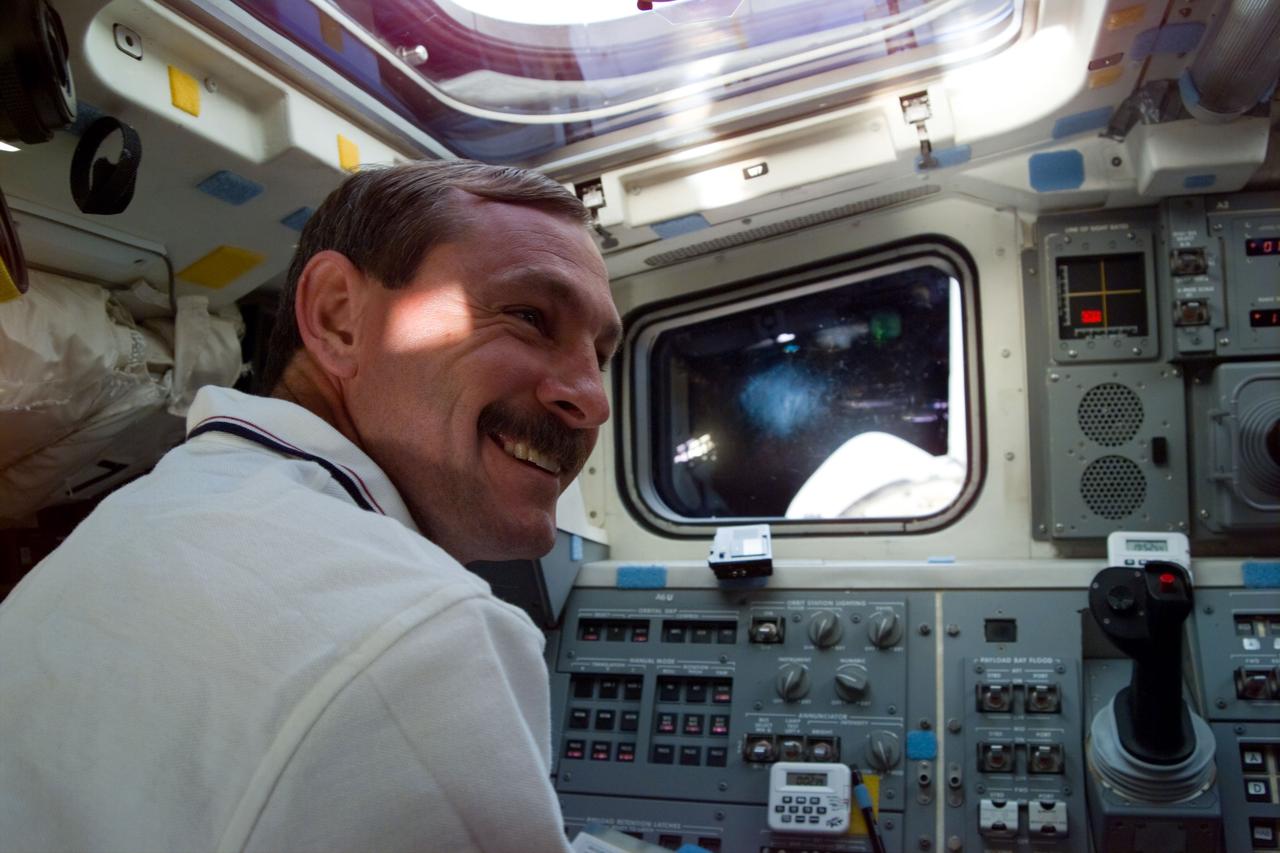
S77-E-5066 (22 May 1996) --- Astronaut Curtis L. Brown, Jr., pilot, is seen on the starboard side of the Space Shuttle Endeavour's aft flight deck just prior to the deployment of the Satellite Test Unit (STU), part of the Passive Aerodynamically Stabilized Magnetically Damped Satellite (PAMS). Brown's image was captured with an Electronic Still Camera (ESC). Minutes later the camera was being used to document the deployment of PAMS-STU. The six-member crew will continue operations (tracking, rendezvousing and station-keeping) with PAMS-STU periodically throughout the remainder of the mission.
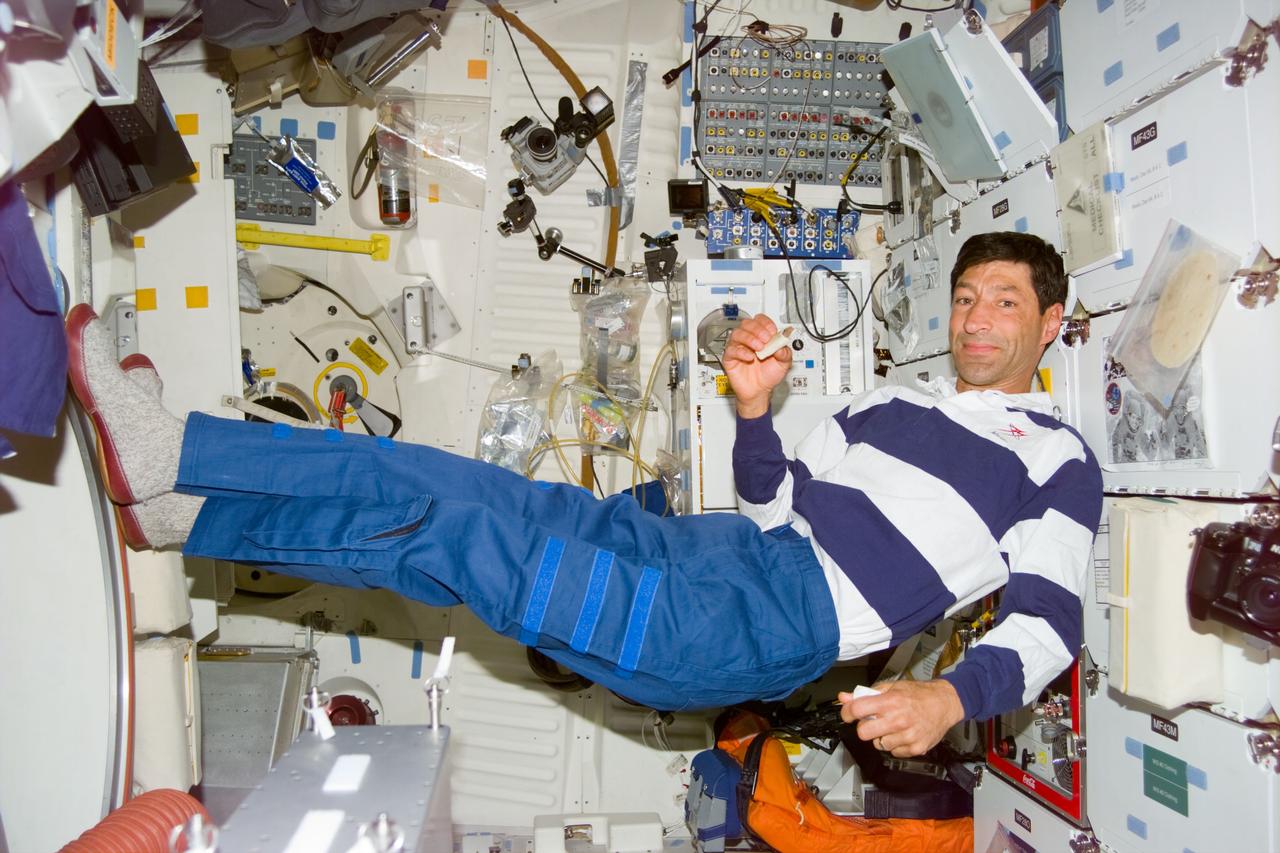
S77-E-5104 (26 May 1996) --- Astronaut Mario Runco, Jr., mission specialist, takes a break from activities on Space Shuttle Endeavour?s middeck. The scene was recorded with an Electronic Still Camera (ESC).
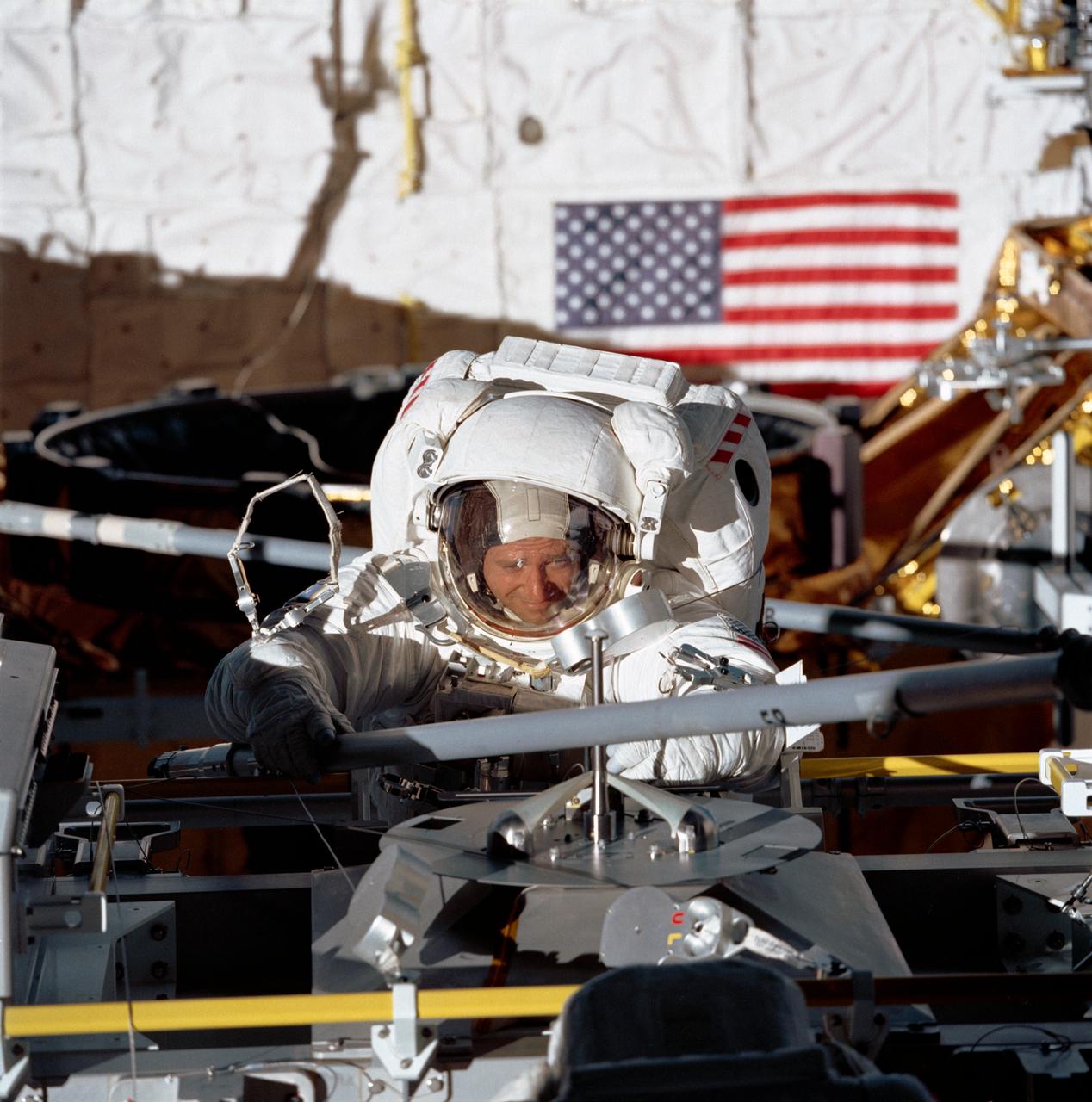
STS049-77-028 (14 May 1992) --- Astronaut Thomas D. Akers, STS-49 mission specialist, grabs a strut device as fourth period of extravehicular activity (EVA) gets underway in the Space Shuttle Endeavour's cargo bay. Akers is positioned near the Multi-purpose Support Structure (MPESS). The purpose of the final EVA on this nine-day mission was the evaluation of Assembly of Station by EVA Methods (ASEM). The scene was recorded on 70mm film by a fellow crew member in the space shuttle's cabin. Astronaut Kathryn C. Thornton (out of frame) joined Akers on the 7 1/2 hour EVA.
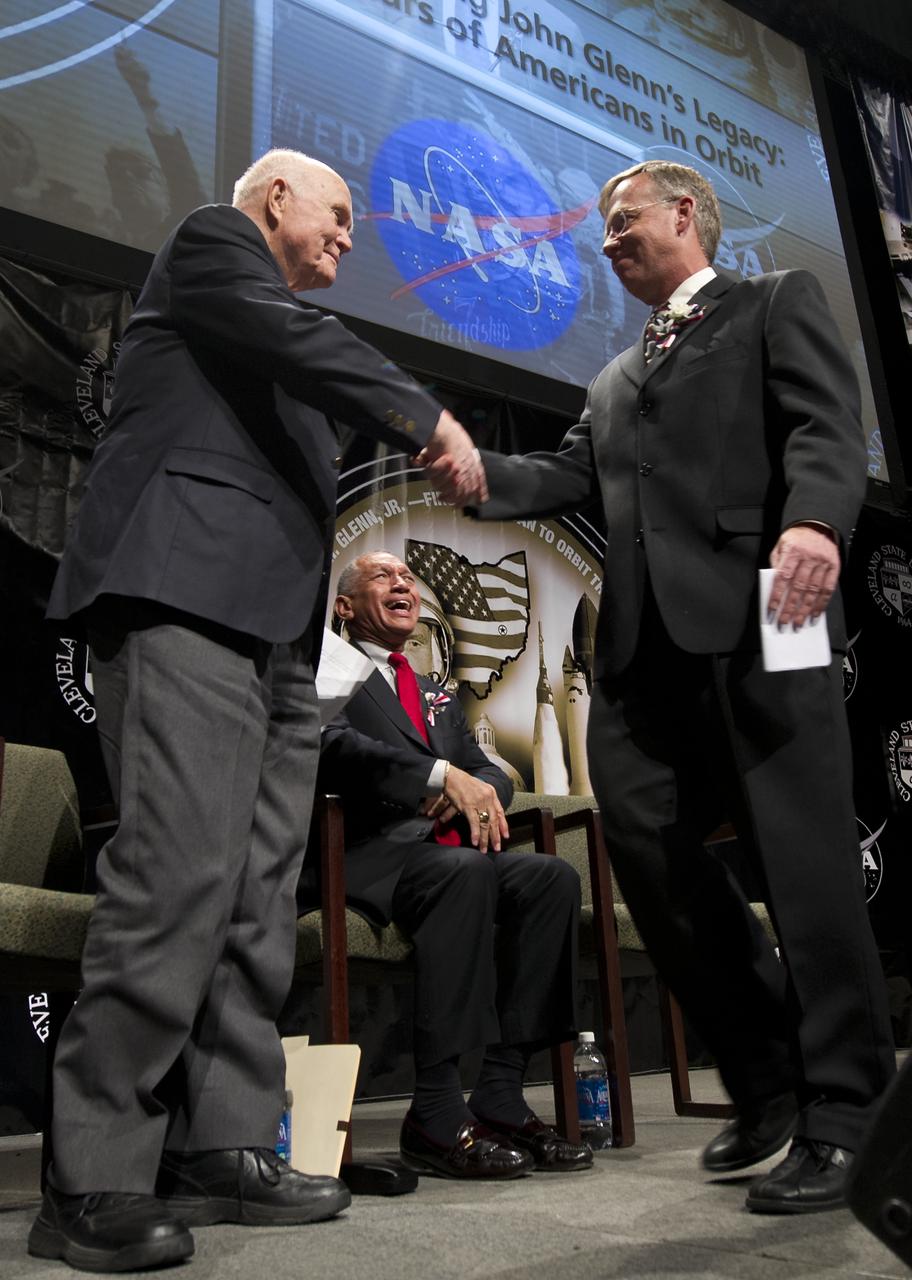
Sen. John Glenn, left, shakes hands with former Astronaut Steve Lindsey as NASA Administrator Charles Bolden smiles at an event celebrating John Glenn's legacy and 50 years of americans in orbit held at the Cleveland State University Wolstein Center on Friday, March 3, 2012 in Cleveland, Ohio. In 1998 Lindsey flew onboard the space shuttle Discovery along with then 77 year-old Sen. John Glenn for the STS-95 mission. Glenn became the first American to orbit Earth in 1962. Photo Credit: (NASA/Bill Ingalls)
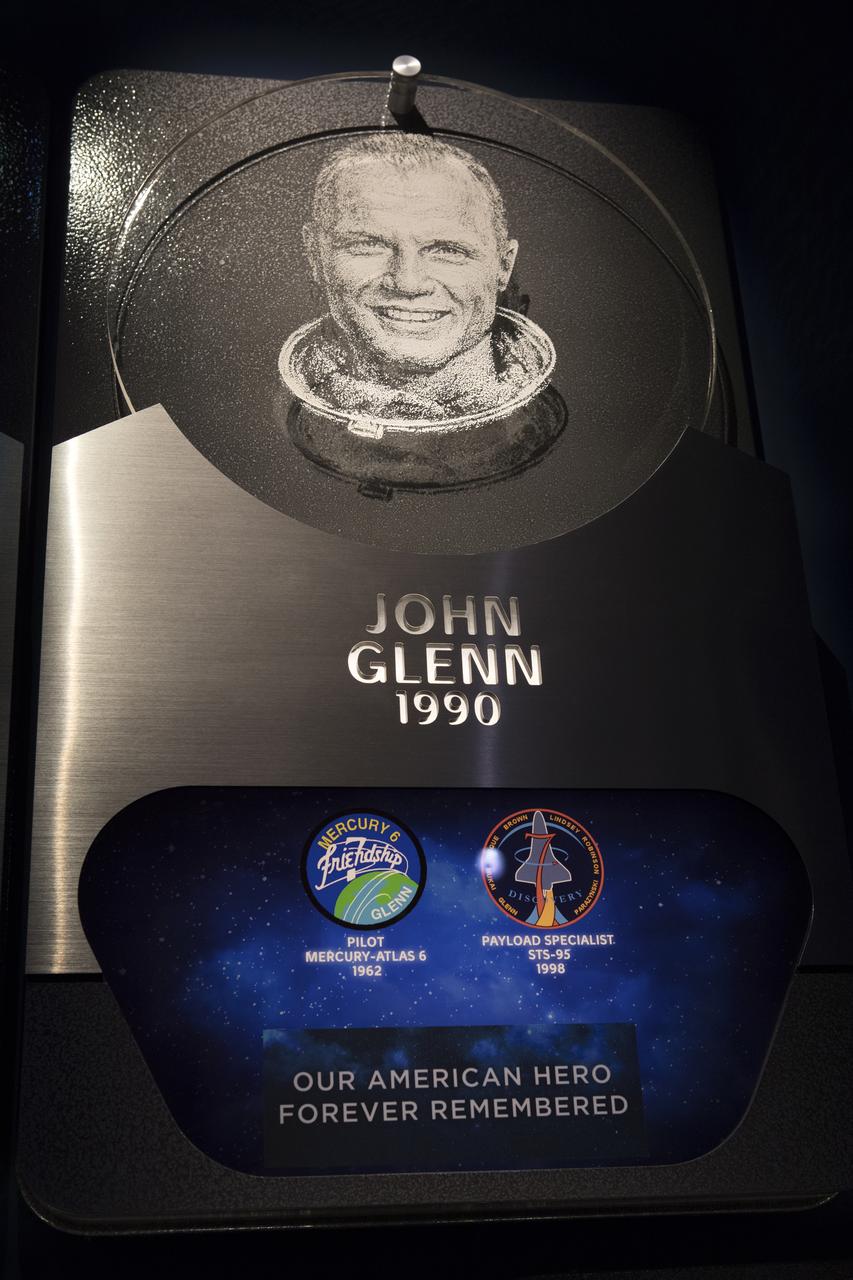
A plaque inside the Heroes and Legends exhibit hall at the Kennedy Space Center Visitor Complex shows astronaut Sen. John Glenn, along with his mission insignias for Friendship 7 and STS-95, the two flights he made into space. Glenn, who passed away Dec. 8, 2016 at age 95, was the last surviving member of NASA's original astronaut class. He gained worldwide acclaim during his Mercury mission that made him the first American to orbit the Earth. He flew again in 1998 aboard space shuttle Discovery at age 77.
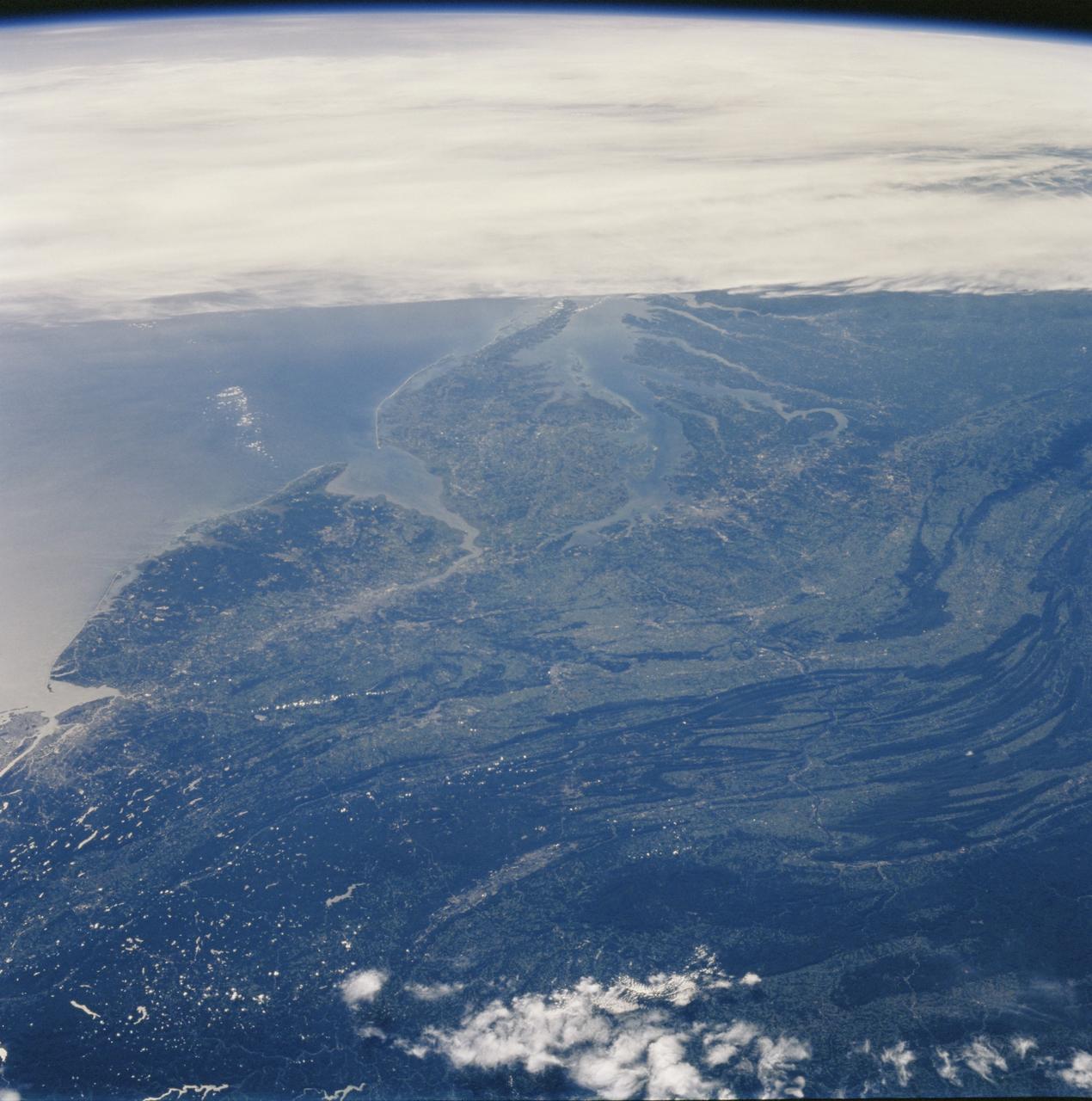
STS106-709-016 (19 September 2000) --- One of the STS-106 crew members on board the Space Shuttle Atlantis, 204 nautical miles above Earth, used a handheld 70mm camera to photograph this image of the shuttle's cargo bay, a broad band of clouds and a land scene featuring Lake Ontario. Center point coordinates of the ground area are 44 degrees north latitude and 77 degrees west longitude. The Spacehab module, which supports this mission to the International Space Station (ISS), can be seen at the back of the cargo bay. The Atlantis had earlier separated from the ISS after several days of being docked with the orbital outpost.
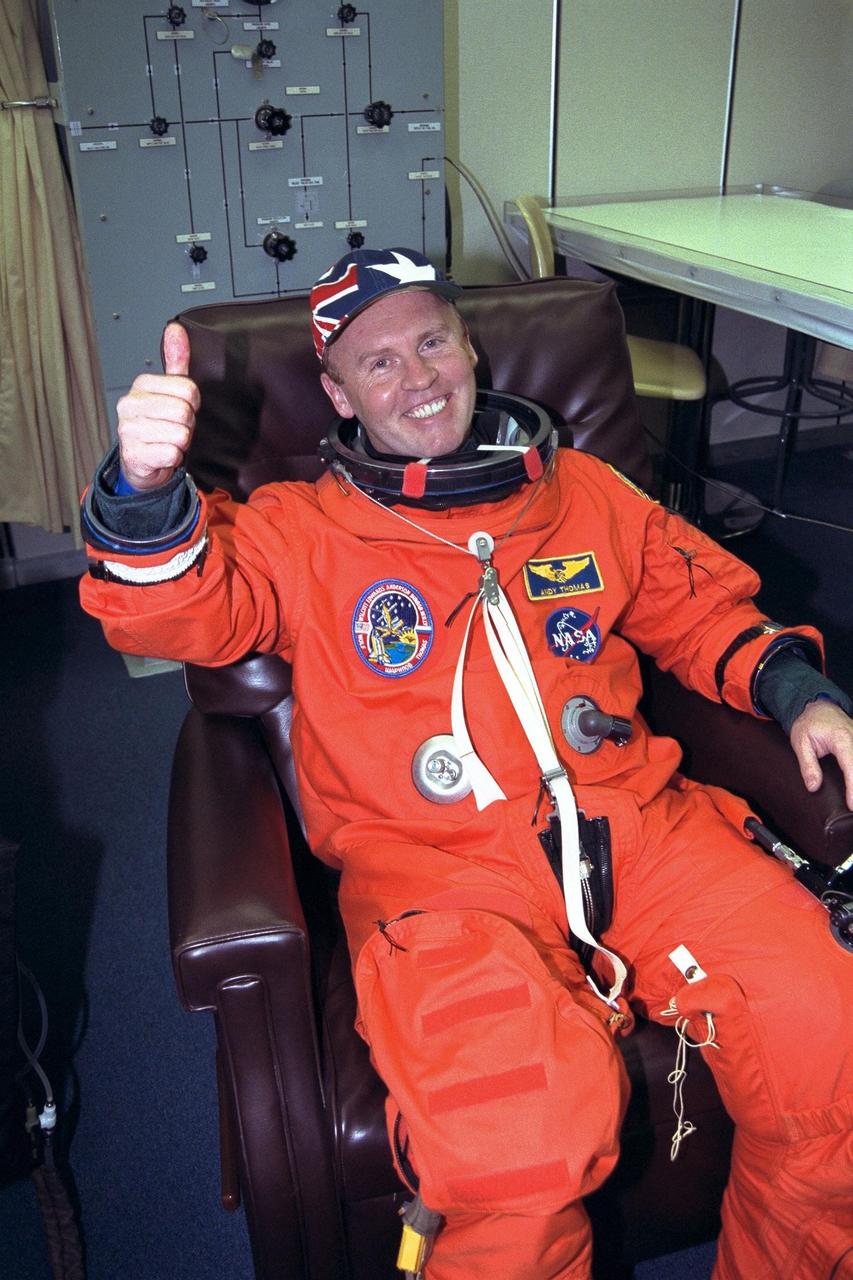
STS-89 Mission Specialist Andrew Thomas, Ph.D., gives a ‘thumbs up’ as he completes the donning of his launch/entry suit in the Operations and Checkout (O&C) Building. In June 1995, he was named as payload commander for STS-77 and flew his first flight in space on Endeavour in May 1996. He and six fellow crew members will soon depart the O&C and head for Launch Pad 39A, where the Space Shuttle Endeavour will lift off during a launch window that opens at 9:43 p.m. EST, Jan. 22. STS-89 is the eighth of nine planned missions to dock the Space Shuttle with Russia's Mir space station, where Dr. Thomas will succeed David Wolf, M.D

S95-00355 (12-14 September 1992) --- Astronaut candidate Koichi Wakata prepares to jump off a box during a parachute landing demonstration at Vance Air Force Base. This portion of the training is designed to familiarize the trainees with the proper way to hit the ground following a parachute jump. Looking on are astronaut candidates Michael L. Gernhardt (left) and Andrew W. S. Thomas (second left), along with a United States Air Force (USAF) instructor. Wakata, representing Japan's National Space Development Agency (NASDA), is one of seven international mission specialist candidates who joined 19 United States astronaut candidates, including Gernhardt and Thomas, for the three-day parachute/survival training school at the Oklahoma Base. EDITORS NOTE: Since this photograph was taken, Gernhardt, Wakata and Thomas have been named as mission specialists for the STS-69, STS-72 and STS-77 missions, respectively.
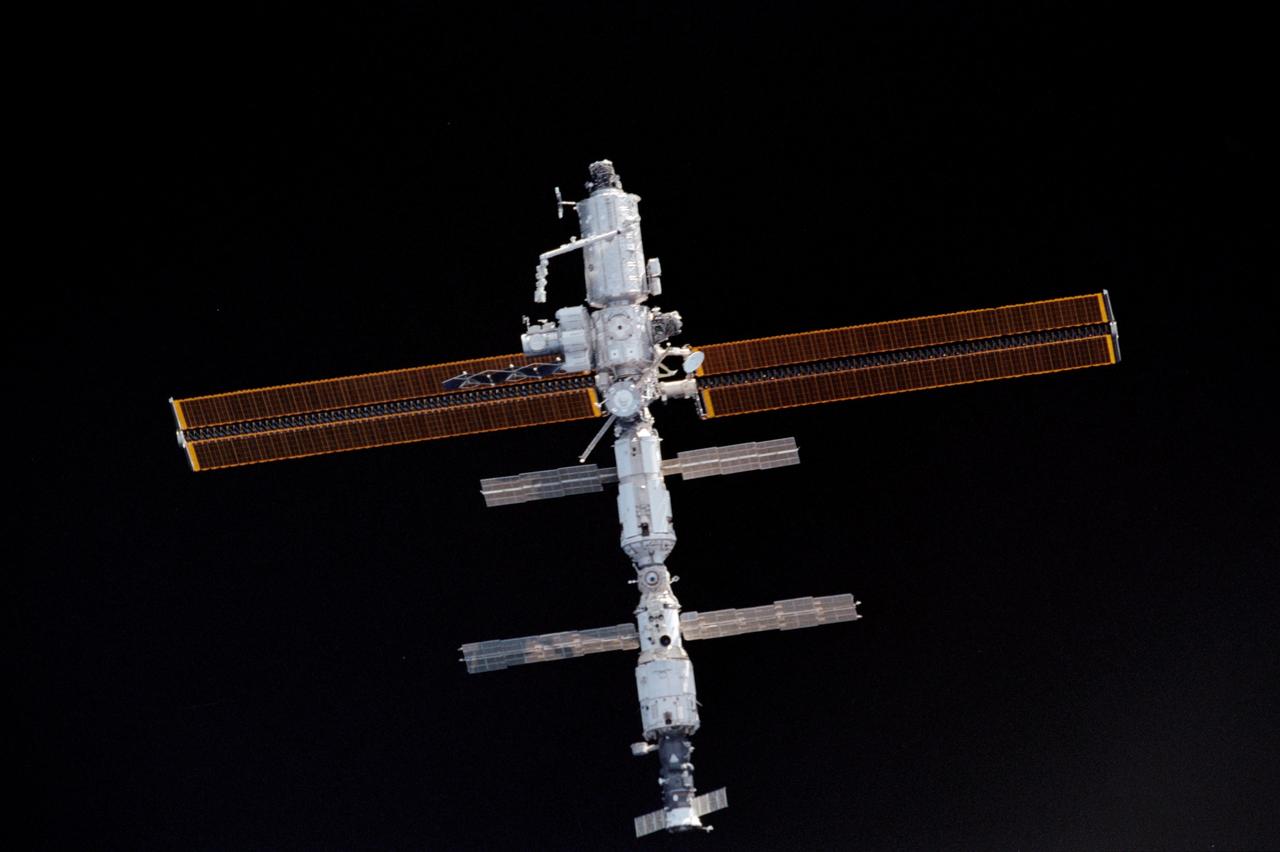
STS104-332-027 (21 July 2001) --- The International Space Station (ISS), just days after receiving the installment of the Quest airlock, was photographed by one the STS-104 astronauts during a fly-around of the orbital outpost. The survey occurred shortly after Atlantis' undocking. The Canadarm2 or Space Station Remote Manipulator System (SSRMS) appears to be pointed toward the new airlock on the station's starboard side. The STS-104 and Expedition Two crew's joint efforts in the past several days, in which the airlock was installed and other work was accomplished, marked the completion of the second phase of the station. Within the last year (beginning in July of 2000), 77 tons of hardware have been added to the complex, including the Zvezda module, the Z1 Truss Assembly, Pressurized Mating Adapter 3, the P6 Truss and its 240-foot long solar arrays, the U.S. laboratory Destiny, the Canadarm2 and finally the Quest airlock.
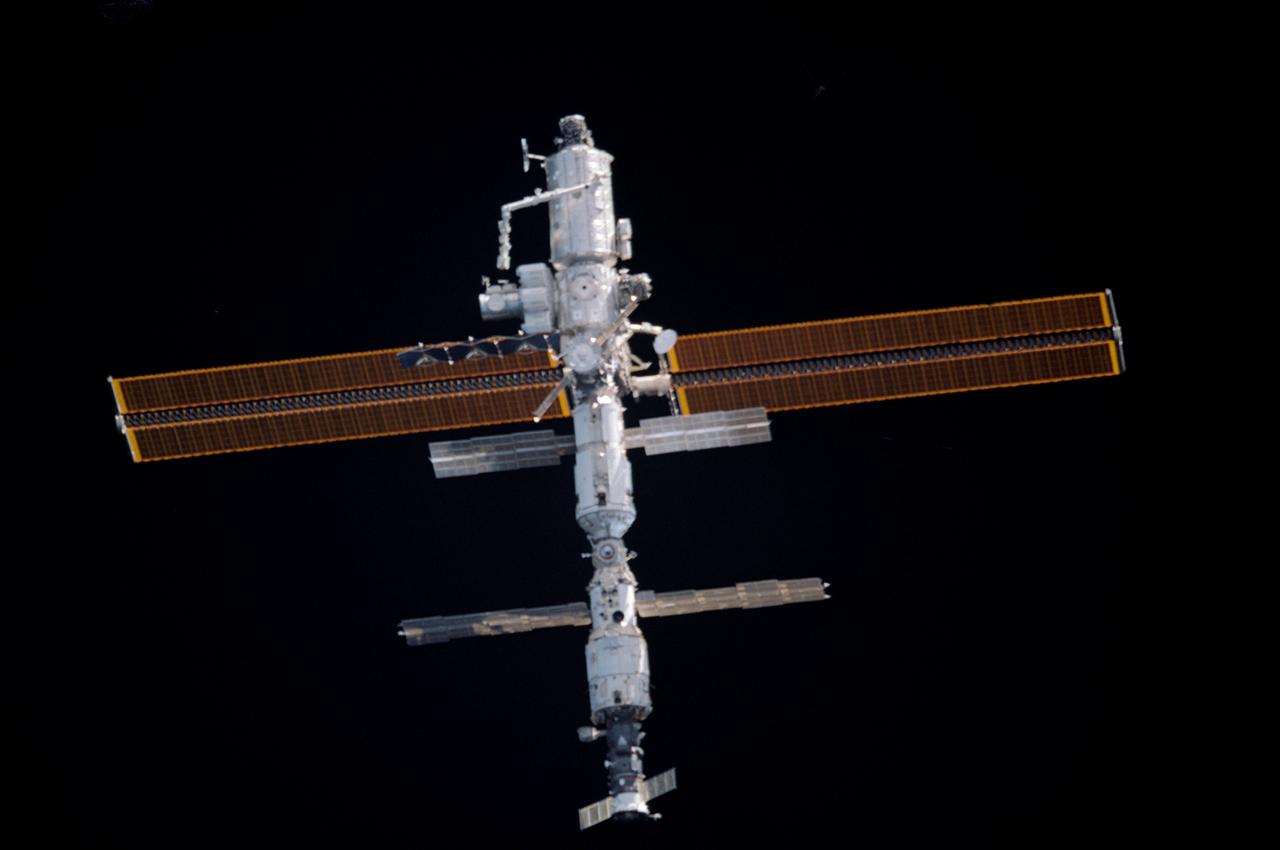
STS104-332-026 (21 July 2001) --- The International Space Station (ISS), just days after receiving the installment of the Quest airlock, was photographed by one the STS-104 astronauts during a fly-around of the orbital outpost. The survey occurred shortly after Atlantis' undocking. The Canadarm2 or Space Station Remote Manipulator System (SSRMS) appears to be pointed toward the new airlock on the station's starboard side. The STS-104 and Expedition Two crew's joint efforts in the past several days, in which the airlock was installed and other work was accomplished, marked the completion of the second phase of the station. Within the last year (beginning in July of 2000), 77 tons of hardware have been added to the complex, including the Zvezda module, the Z1 Truss Assembly, Pressurized Mating Adapter 3, the P6 Truss and its 240-foot long solar arrays, the U.S. laboratory Destiny, the Canadarm2 and finally the Quest airlock.

S77-E-5065 (21 May 1996) --- With a cloudy horizon scene as a backdrop, the Spartan 207 free-flyer is held in the grasp of the Space Shuttle Endeavour's Remote Manipulator System (RMS) following its re-capture on May 21, 1996. The view was captured with an onboard Electronic Still Camera (ESC). The six-member crew has spent a portion of the early stages of the mission in various activities involving the Spartan 207 and the related Inflatable Antenna Experiment (IAE). The Spartan project is managed by NASA's Goddard Space Flight Center (GSFC) for NASA's Office of Space Science, Washington, D.C.
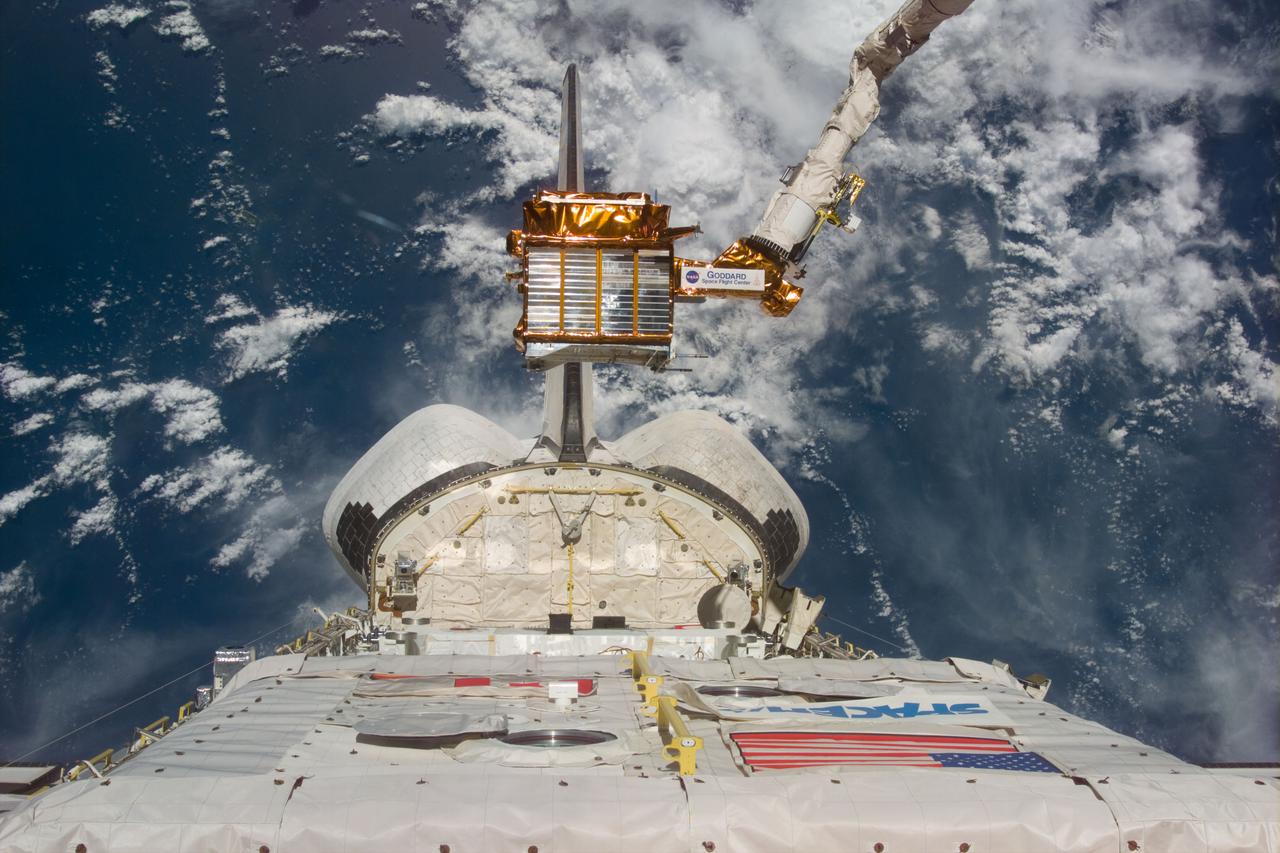
S77-E-5052 (21 May 1996) --- The Spartan 207 free-flyer is held in a low-hover mode above its berth in the Space Shuttle Endeavour's cargo bay in the grasp of the Remote Manipulator System (RMS). The free-flyer was re-captured by the six crew members on May 21, 1996. The crew has spent a portion of the early stages of the mission in various activities involving the Spartan 207 and the related Inflatable Antenna Experiment (IAE). The Spartan project is managed by NASA's Goddard Space Flight Center (GSFC) for NASA's Office of Space Science, Washington, D.C.
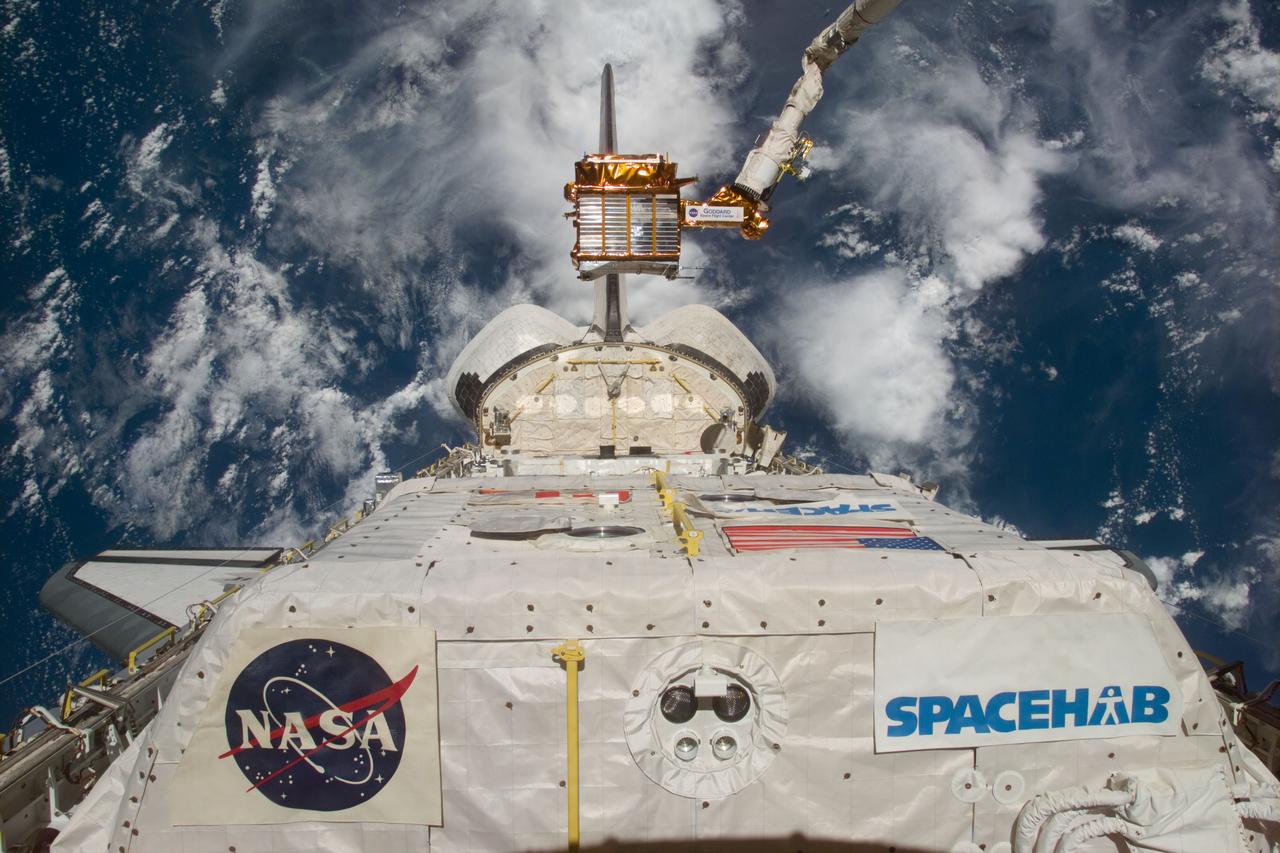
S77-E-5053 (21 May 1996) --- The Spartan 207 free-flyer is held in a low-hover mode above its berth in the Space Shuttle Endeavour's cargo bay in the grasp of the Remote Manipulator System (RMS). The Spacehab module can be seen in the foreground. The free-flyer was re-captured by the six crew members on May 21, 1996. The crew has spent a portion of the early stages of the mission in various activities involving the Spartan 207 and the related Inflatable Antenna Experiment (IAE). The Spartan project is managed by NASA's Goddard Space Flight Center (GSFC) for NASA's Office of Space Science, Washington, D.C.
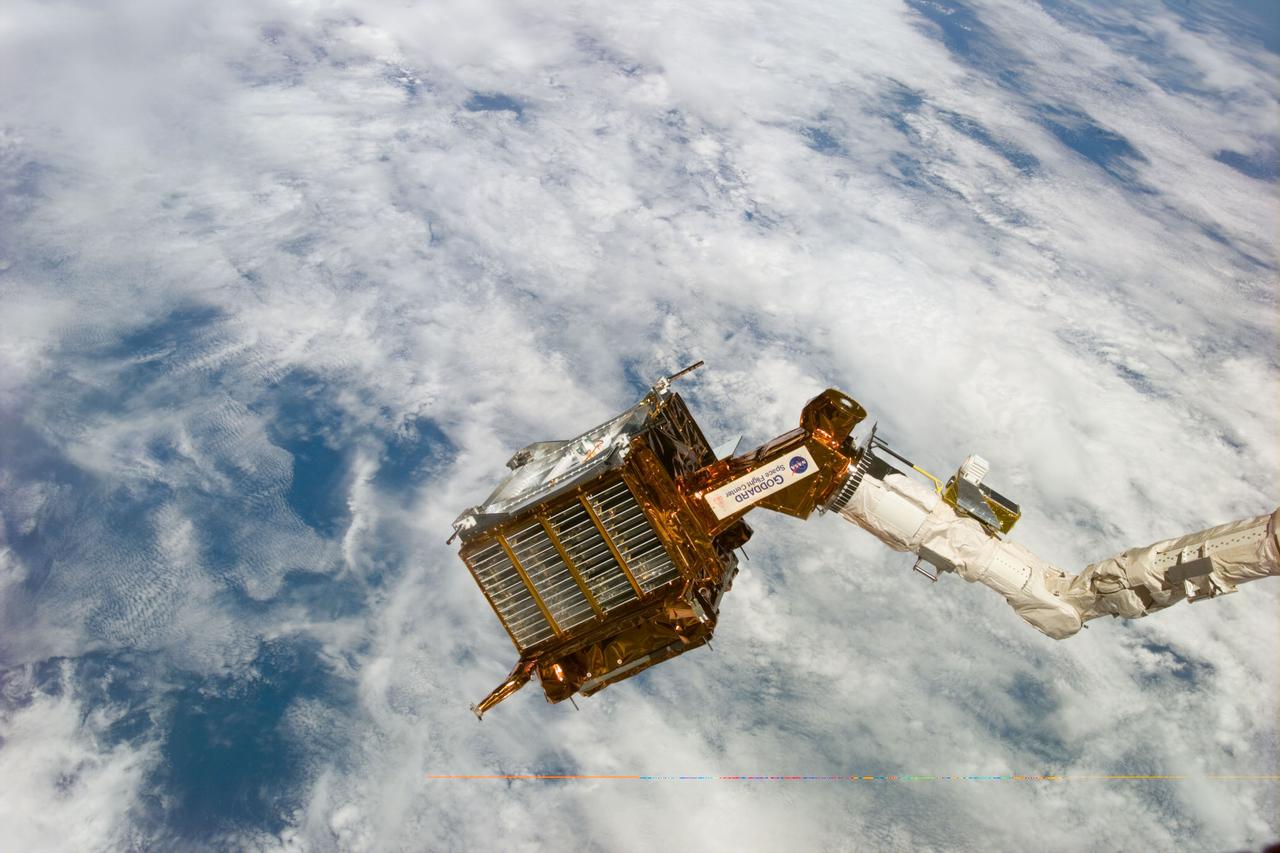
S77-E-5064 (21 May 1996)--- In this medium close-up view, captured by an Electronic Still Camera (ESC), the Spartan 207 free-flyer is held in the grasp of the Space Shuttle Endeavour's Remote Manipulator System (RMS) following its re-capture on May 21, 1996. The six-member crew has spent a portion of the early stages of the mission in various activities involving the Spartan 207 and the related Inflatable Antenna Experiment (IAE). The Spartan project is managed by NASA's Goddard Space Flight Center (GSFC) for NASA's Office of Space Science, Washington, D.C.
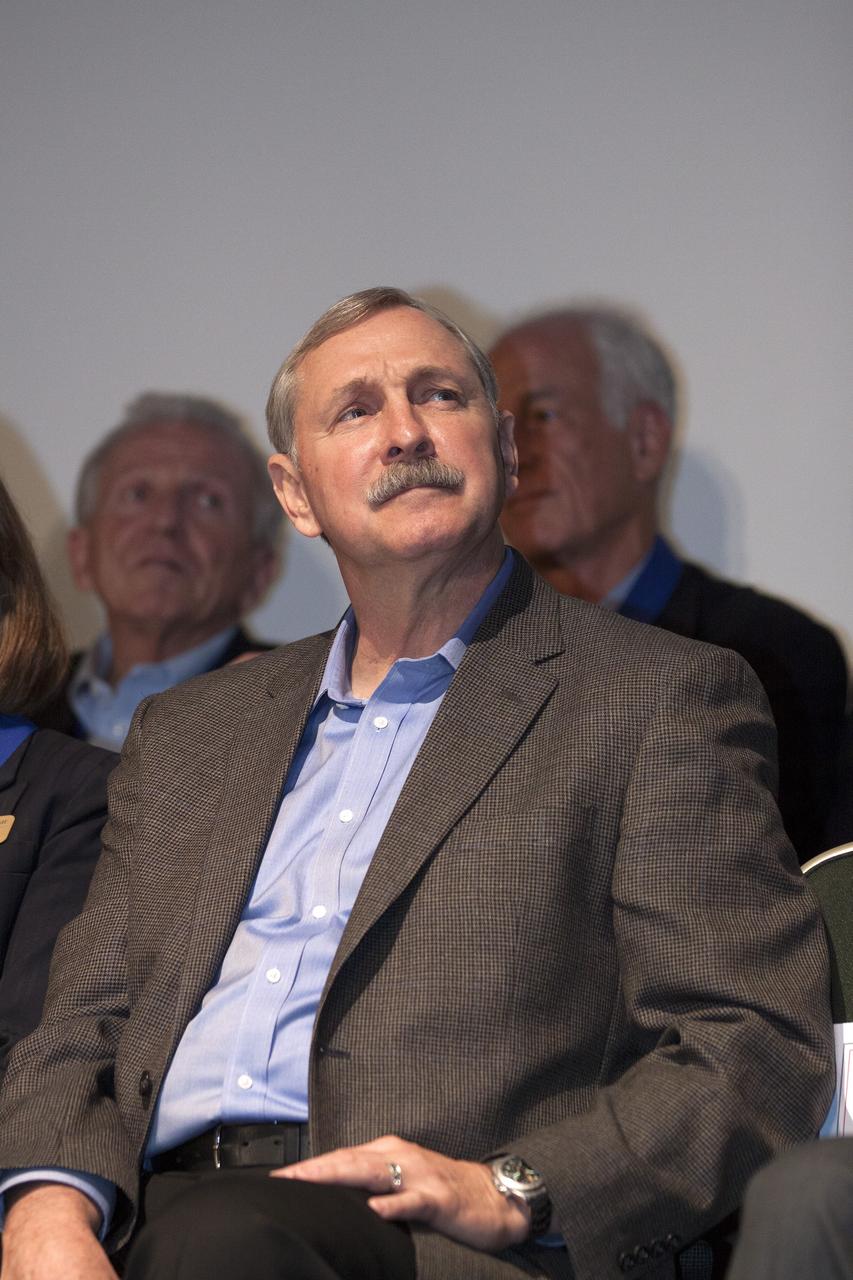
CAPE CANAVERAL, Fla. – At NASA’s Kennedy Space Center Visitor Complex in Florida, shuttle astronaut Curt Brown listens as he is being introduced for induction into the U.S. Astronaut Hall of Fame AHOF. Brown, a veteran of six spaceflights, began his career with NASA in 1987 as a pilot and has logged more than 1,383 hours in space. Brown’s missions aboard the space shuttle include STS-47, STS-66, STS-77, STS-85, STS-95 and STS-103. Shuttle astronauts Eileen Collins and Bonnie Dunbar also were inducted into the AHOF. This induction is the twelfth group of space shuttle astronauts named to the AHOF, and the first time two women are inducted at the same time. The year’s inductees were selected by a committee of current Hall of Fame astronauts, former NASA officials, historians and journalists. The selection process is administered by the Astronaut Scholarship Foundation. For more on the U.S. Astronaut Hall of Fame, go to http://www.kennedyspacecenter.com/astronaut-hall-of-fame.aspx For more on the Astronaut Scholarship Foundation, go to http://astronautscholarship.org/ Photo credit: NASA/ Kim Shiflett
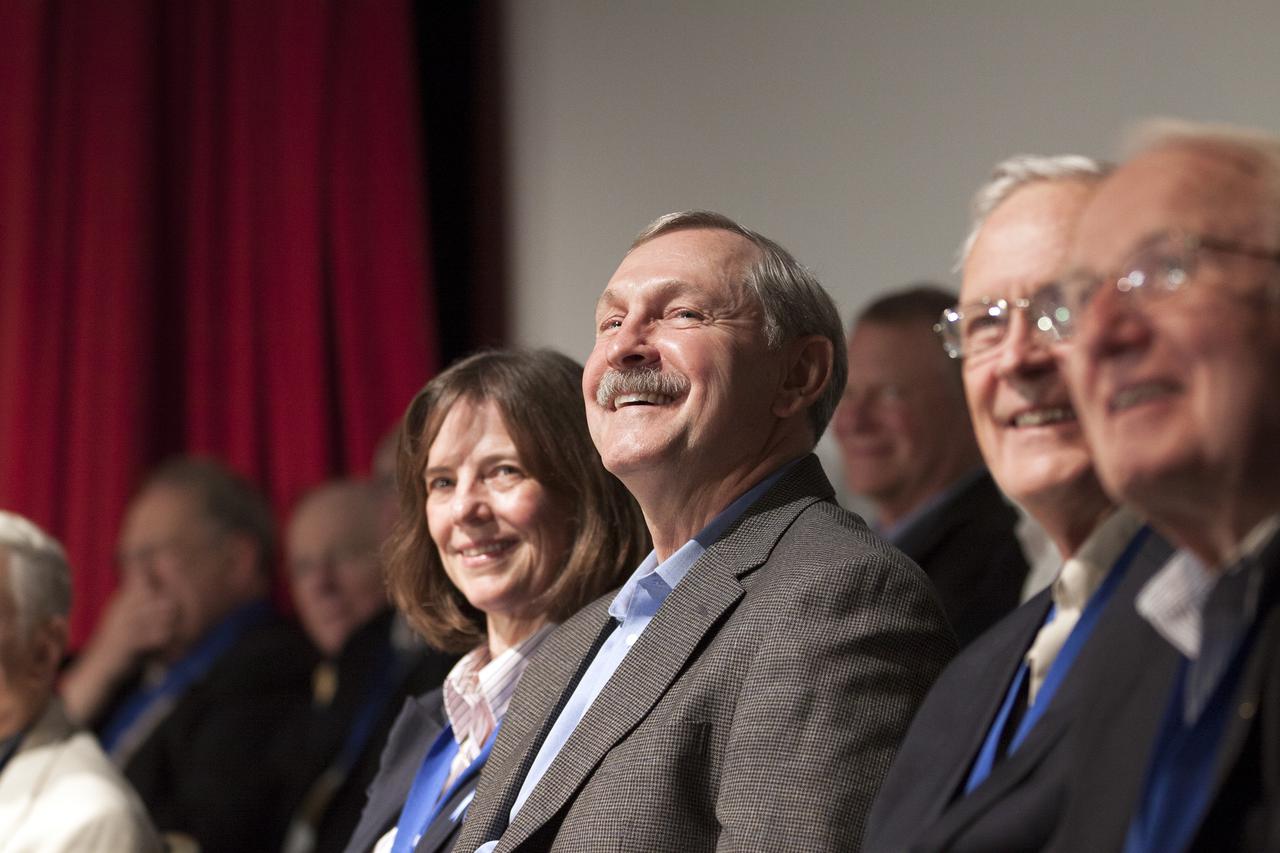
CAPE CANAVERAL, Fla. – At NASA’s Kennedy Space Center Visitor Complex in Florida, shuttle astronaut Curt Brown listens as he is being introduced for induction into the U.S. Astronaut Hall of Fame AHOF. Brown, a veteran of six spaceflights, began his career with NASA in 1987 as a pilot and has logged more than 1,383 hours in space. Brown’s missions aboard the space shuttle include STS-47, STS-66, STS-77, STS-85, STS-95 and STS-103. Shuttle astronauts Eileen Collins and Bonnie Dunbar also were inducted into the AHOF. This induction is the twelfth group of space shuttle astronauts named to the AHOF, and the first time two women are inducted at the same time. The year’s inductees were selected by a committee of current Hall of Fame astronauts, former NASA officials, historians and journalists. The selection process is administered by the Astronaut Scholarship Foundation. For more on the U.S. Astronaut Hall of Fame, go to http:__www.kennedyspacecenter.com_astronaut-hall-of-fame.aspx For more on the Astronaut Scholarship Foundation, go to http:__astronautscholarship.org_ Photo credit: NASA_ Kim Shiflett
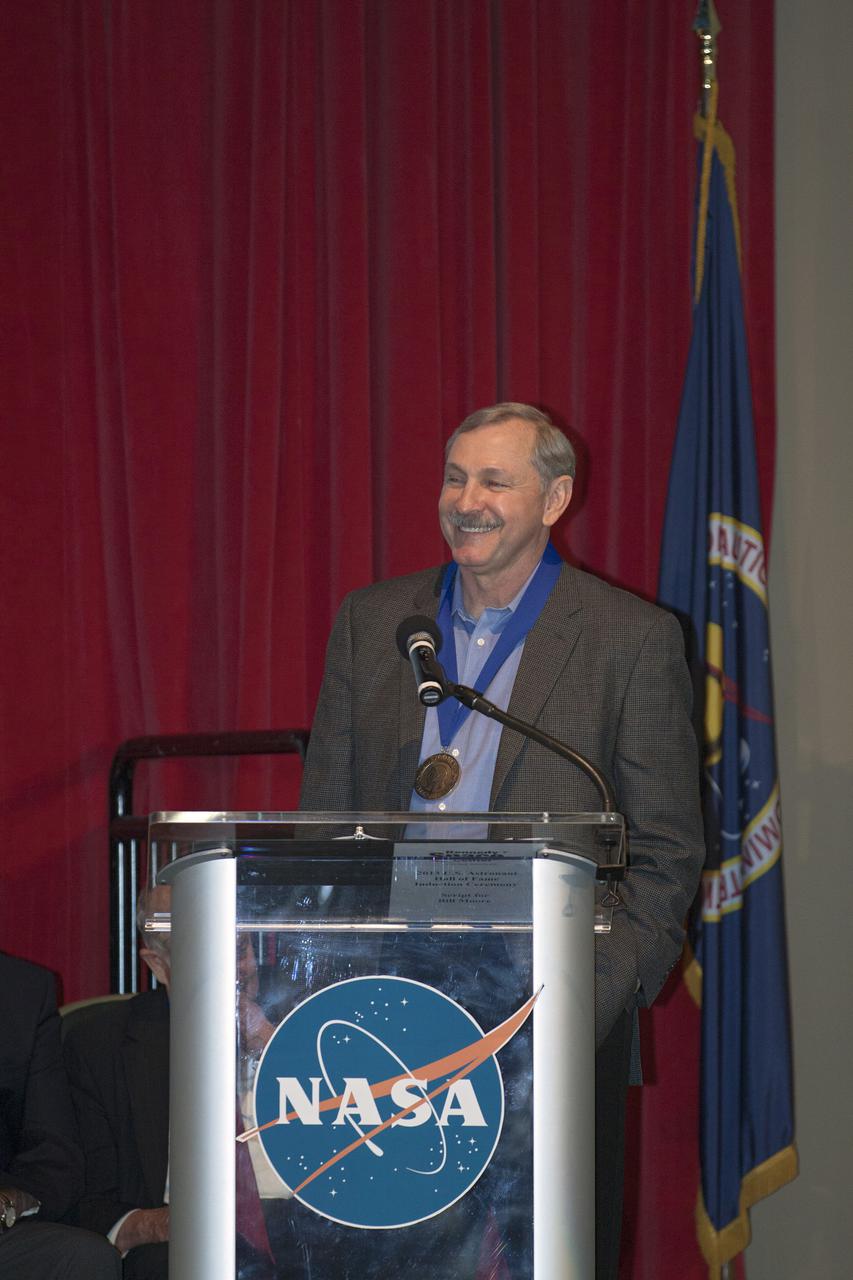
CAPE CANAVERAL, Fla. – At NASA’s Kennedy Space Center Visitor Complex in Florida, shuttle astronaut Curt Brown speaks after being inducted into the U.S. Astronaut Hall of Fame AHOF. Brown, a veteran of six spaceflights, began his career with NASA in 1987 as a pilot and has logged more than 1,383 hours in space. Brown’s missions aboard the space shuttle include STS-47, STS-66, STS-77, STS-85, STS-95 and STS-103. Shuttle astronauts Eileen Collins and Bonnie Dunbar also were inducted into the AHOF. This induction is the twelfth group of space shuttle astronauts named to the AHOF, and the first time two women are inducted at the same time. The year’s inductees were selected by a committee of current Hall of Fame astronauts, former NASA officials, historians and journalists. The selection process is administered by the Astronaut Scholarship Foundation. For more on the U.S. Astronaut Hall of Fame, go to http:__www.kennedyspacecenter.com_astronaut-hall-of-fame.aspx For more on the Astronaut Scholarship Foundation, go to http:__astronautscholarship.org_ Photo credit: NASA_ Kim Shiflett
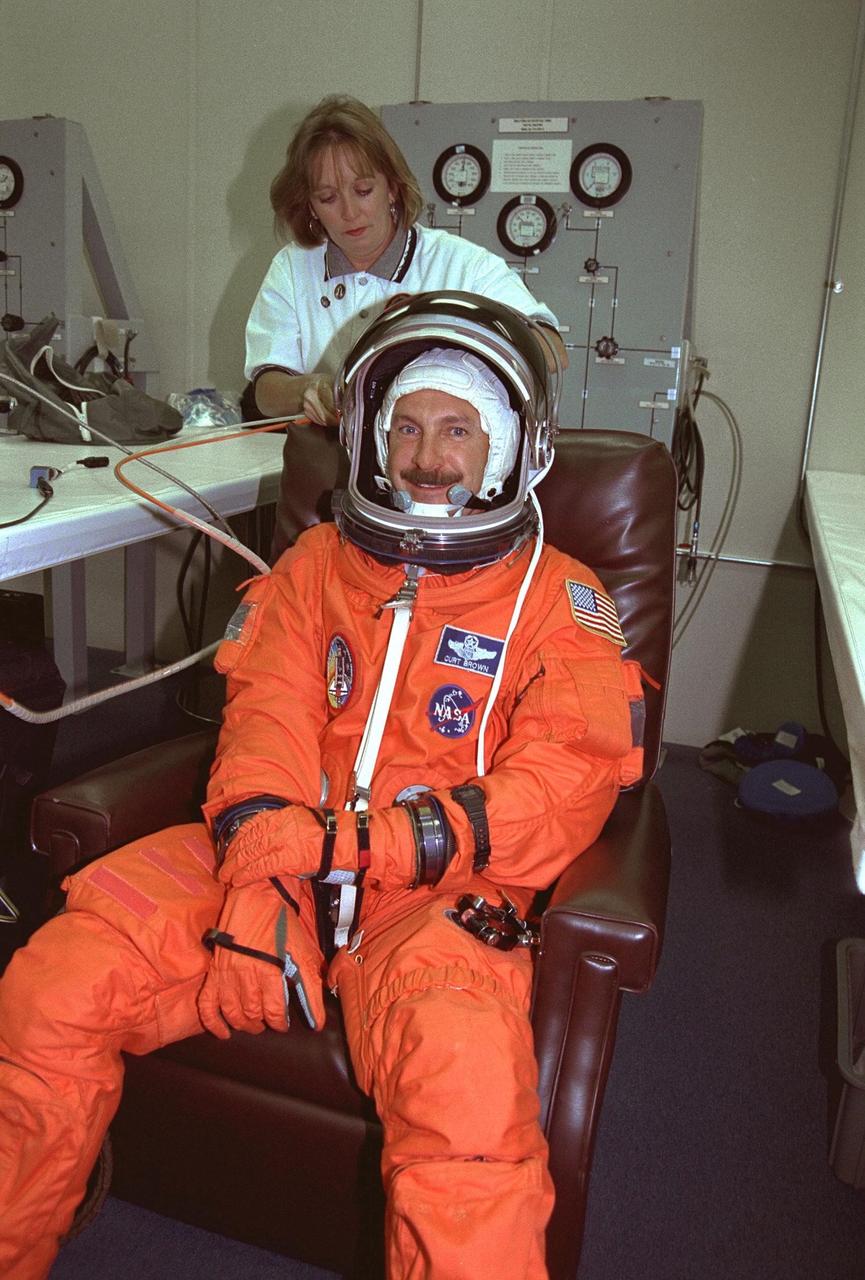
STS-85 Commander Curtis L. Brown, Jr. smiles as he is assisted with his ascent/reentry flight suit by a suit technician in the Operations and Checkout (O&C) Building. He is a lieutenant colonel in the Air Force and is on his fourth space flight. Brown has served as the pilot of STS-47, STS-66 and STS-77. A test pilot, he has more than 5,000 hours of flight time in jet aircraft. Brown will have responsibility for the overall success of this space flight and will operate and maintain Discovery throughout the mission. This will include the performance of station-keeping with the Cryogenic Infrared Spectrometers and Telescopes for the Atmosphere-Shuttle Pallet Satellite-2 (CRISTA-SPAS-2) free-flyer payload and many different maneuvers required by different payloads. The primary payload aboard the Space Shuttle orbiter Discovery is the CRISTA-SPAS-2. Other payloads on the 11-day mission include the Manipulator Flight Demonstration (MFD), and Technology Applications and Science-1 (TAS-1) and International Extreme Ultraviolet Hitchhiker-2 (IEH-2) experiments
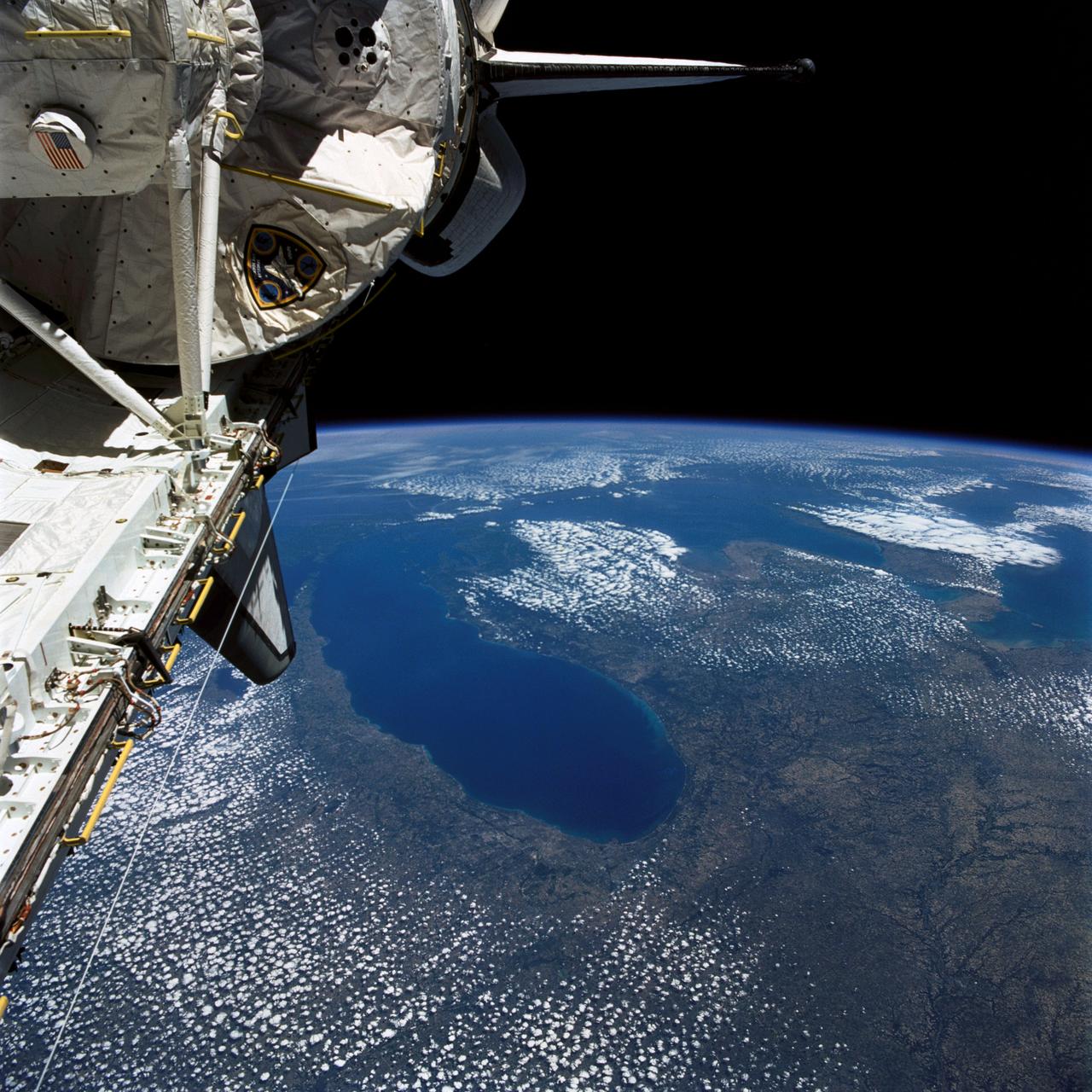
STS040-77-045 (6 June 1991) --- This image, photographed on June 6, 1991, is an oblique view looking north-northeast and shows most of the Great Lakes region. Part of Columbia's cargo bay and the Spacelab Life Sciences (SLS-1) module are in the foreground. In the center of the image is Lake Michigan with Chicago clearly visible along the southwest shore. According to NASA photo experts studying the STS-40 imagery, this image shows several interesting meteorological phenomena. The difference in temperature between the warming land and the cold lake waters is illustrated by the low level clouds. The warming land surface results in rising air and the formation of clouds, while the lake waters are cold and result in the lakes remaining cloud free. Also visible is evidence of lake breezes developing around several of the lakes. This phenomena is also driven by the difference in temperature between the land and the water. Winds blowing off the lakes must travel 25 - 30 miles inland before it warms sufficiently to create clouds.