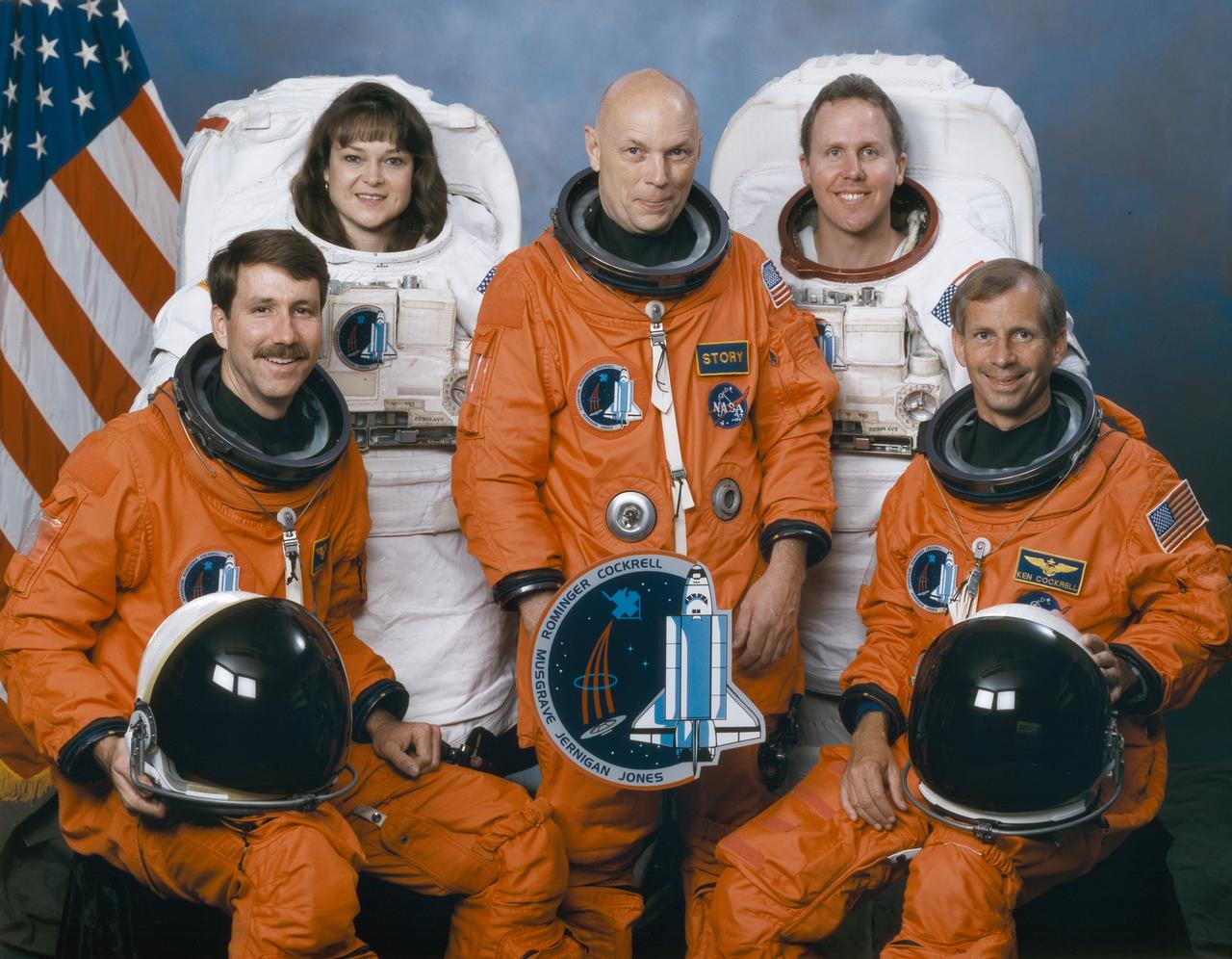
The crew assigned to the STS-79 mission included (seated left to right) Kent V. Rominger, pilot; and Kenneth D. Cockrell, commander. Standing (left to right) are mission specialists Tamara E. Jernigan, F. Story Musgrave, and Thomas D. Jones. Launched aboard the Space Shuttle Columbia on November 19, 1996 at 2:55:47 pm (EST), the STS-80 mission marked the final flight of 1996. The crew successfully deployed and operated the Orbiting and Retrievable Far and Extreme Ultraviolet Spectrometer-Shuttle Pallet Satellite II (ORFEUS-SPAS II), and deployed and retrieved the Wake Shield Facility-3 (WSF-3).

STS080-S-002 (August 1996) --- These five NASA astronauts are in training for the STS-80 mission, scheduled for launch aboard the Space Shuttle Columbia in the fall of this year. From the left are astronauts Kent V. Rominger, pilot; Tamara E. Jernigan, Story Musgrave and Thomas D. Jones, all mission specialists; and Kenneth D. Cockrell, mission commander.
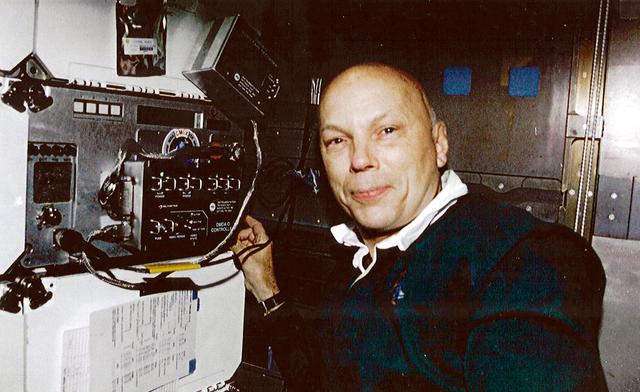
Experiments to seek solutions for a range of biomedical issues are at the heart of several investigations that will be hosted by the Commercial Instrumentation Technology Associates (ITA), Inc. The biomedical experiments CIBX-2 payload is unique, encompassing more than 20 separate experiments including cancer research, commercial experiments, and student hands-on experiments from 10 schools as part of ITA's ongoing University Among the stars program. Here, Astronaut Story Musgrave activates the CMIX-5 (Commercial MDA ITA experiment) payload in the Space Shuttle mid deck during the STS-80 mission in 1996 which is similar to CIBX-2. The experiments are sponsored by NASA's Space Product Development Program (SPD).
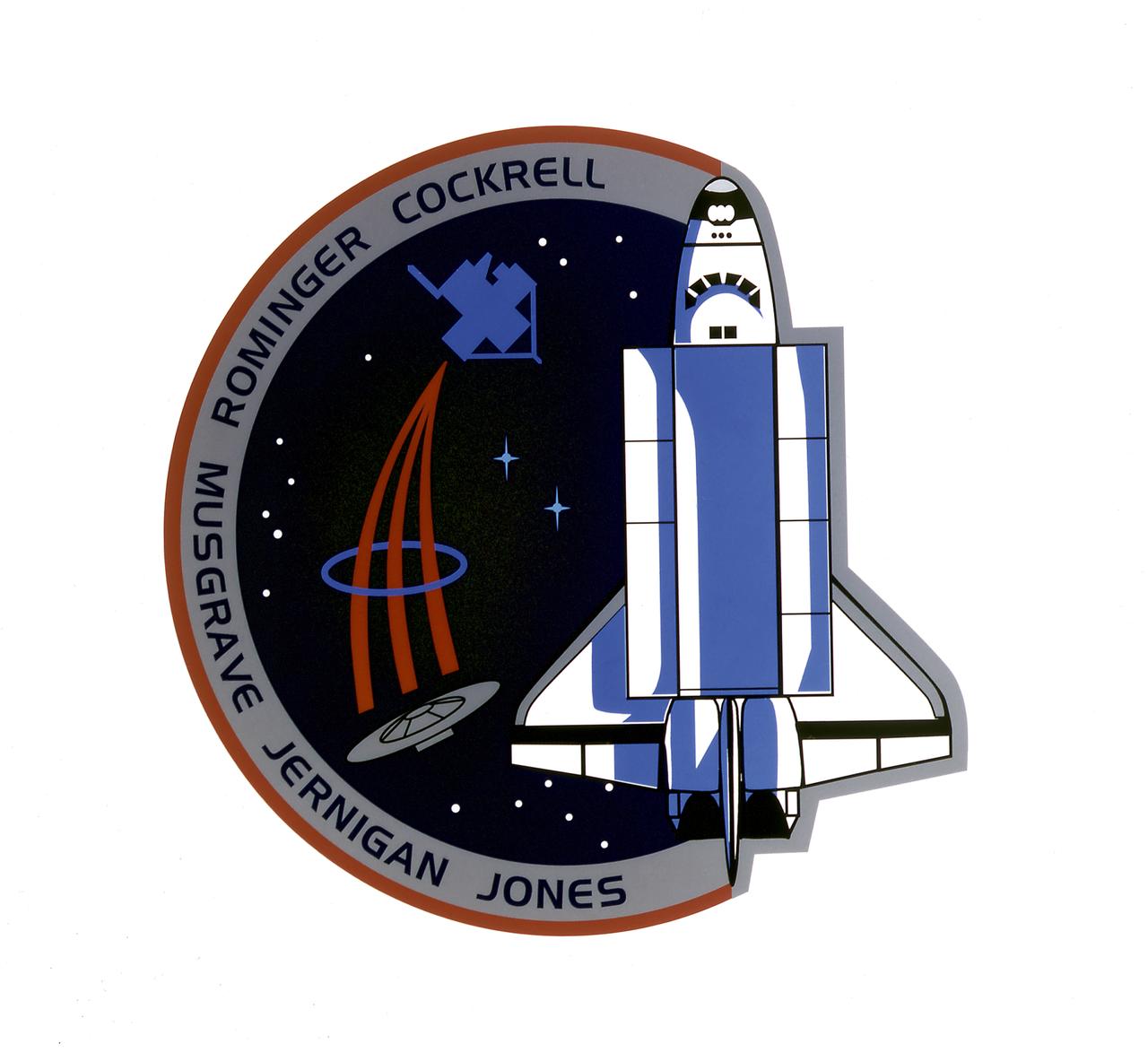
This mission patch for mission STS-80 depicts the Space Shuttle Columbia and the two research satellites its crew deployed into the blue field of space. The uppermost satellite is the Orbiting Retrievable Far and Extreme Ultraviolet Spectrograph-Shuttle Pallet Satellite (ORFEUS-SPAS), a telescope aimed at unraveling the life cycles of stars and understanding the gases that drift between them. The lower satellite is the Wake Shield Facility (WSF), flying for the third time. It will use the vacuum of space to create advanced semiconductors for the nation's electronics industry. ORFEUS and WSF are joined by the symbol of the Astronaut Corps, representing the human contribution to scientific progress in space. The two bright blue stars represent the mission's Extravehicular Activities (EVA), final rehearsals for techniques and tools to be used in assembly of the International Space Station (ISS). Surrounding Columbia is a constellation of 16 stars, one for each day of the mission, representing the stellar talents of the ground and flight teams that share the goal of expanding knowledge through a permanent human presence in space.

STS080-701-004 (19 Nov.-7 Dec. 1996) --- The STS-80 crew used a pre-set 70mm camera onboard the space shuttle Columbia's middeck to record its traditional inflight crew portrait. Back row, left to right, astronauts Kenneth D. Cockrell, mission commander; Tamara E. Jernigan, mission specialist; and Kent V. Rominger, pilot. Front row, astronauts Thomas D. Jones (left) and Story Musgrave, both mission specialists.
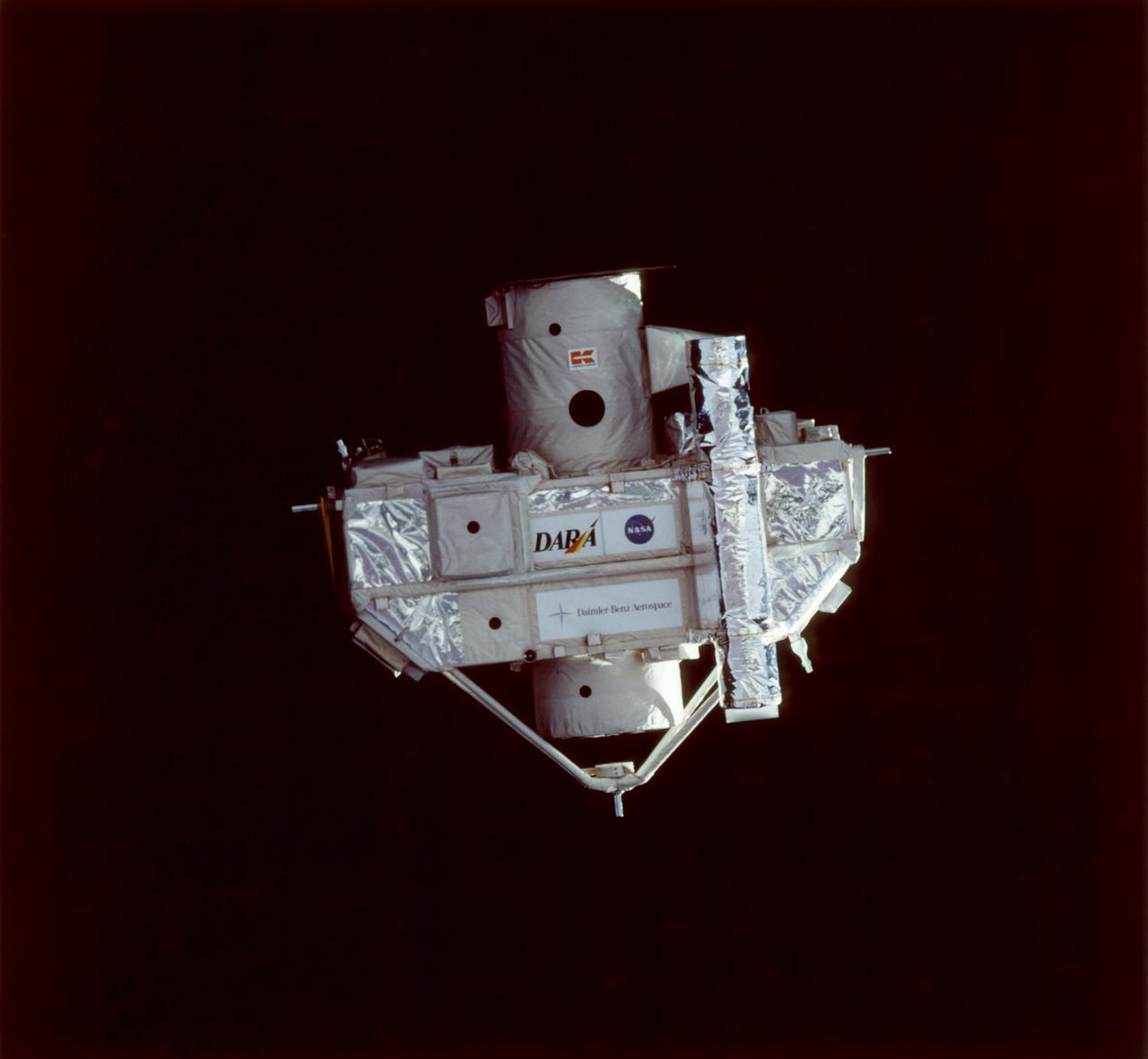
This STS-80 onboard photograph shows the Orbiting Retrievable Far and Extreme Ultraviolet Spectrometer-Shuttle Pallet Satellite II (ORFEUS-SPAS II), photographed during approach by the Space Shuttle Orbiter Columbia for retrieval. Built by the German Space Agency, DARA, the ORFEUS-SPAS II, a free-flying satellite, was dedicated to astronomical observations at very short wavelengths to: investigate the nature of hot stellar atmospheres, investigate the cooling mechanisms of white dwarf stars, determine the nature of accretion disks around collapsed stars, investigate supernova remnants, and investigate the interstellar medium and potential star-forming regions. Some 422 observations of almost 150 astronomical objects were completed, including the Moon, nearby stars, distant Milky Way stars, stars in other galaxies, active galaxies, and quasar 3C273. The STS-80 mission was launched November 19, 1996.
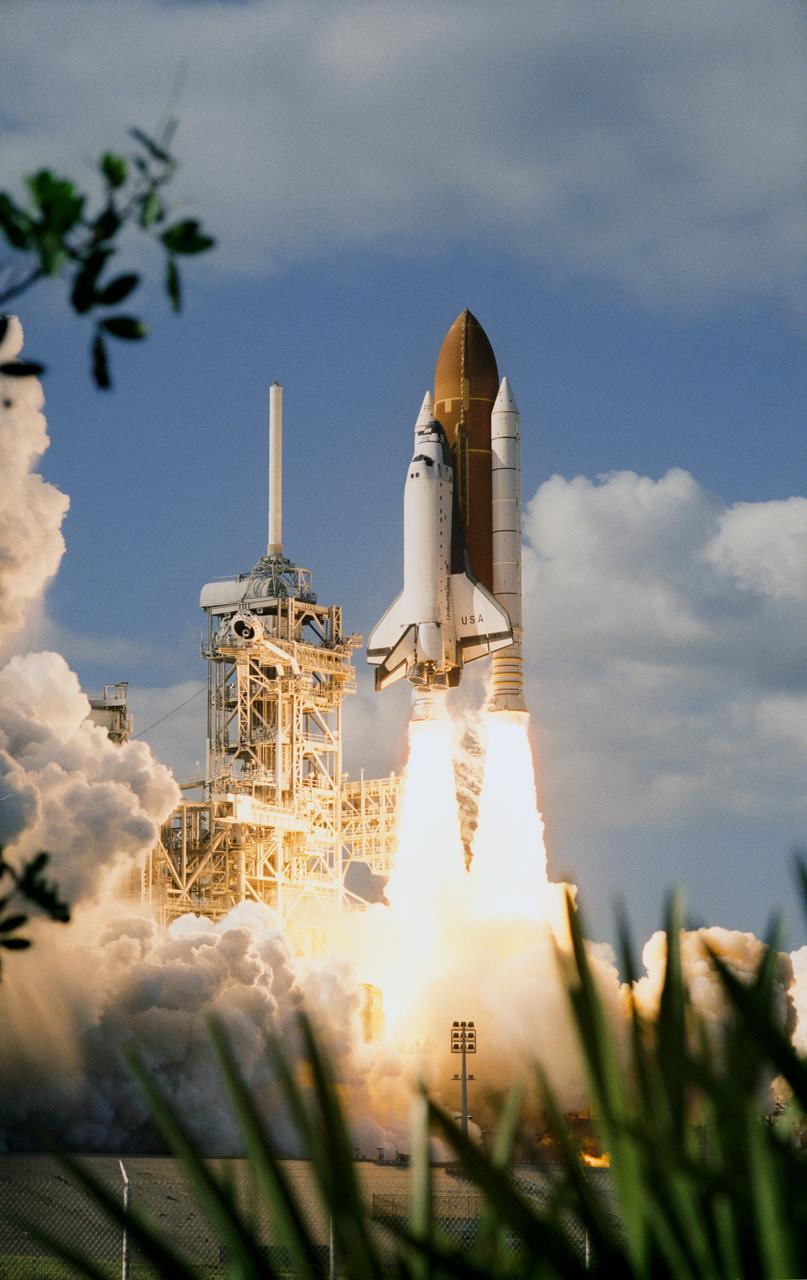
STS080-S-004 (19 Nov. 1996) --- The space shuttle Columbia lifts off from the Kennedy Space Center's (KSC) Launch Pad 39B at 2:55:47 p.m. (EST), Nov. 19, 1996. Onboard are astronauts Kenneth D. Cockrell, STS-80 mission commander; Kent V. Rominger, pilot; along with Story Musgrave, Tamara E. Jernigan and Thomas D. Jones, all mission specialists. The two primary payloads for STS-80 stowed in Columbia's cargo bay for later deployment and testing are the Wake Shield Facility (WSF-3) and the Orbiting and Retrievable Far and Extreme Ultraviolet Spectrometer (ORFEUS) with its associated Shuttle Pallet Satellite (SPAS).
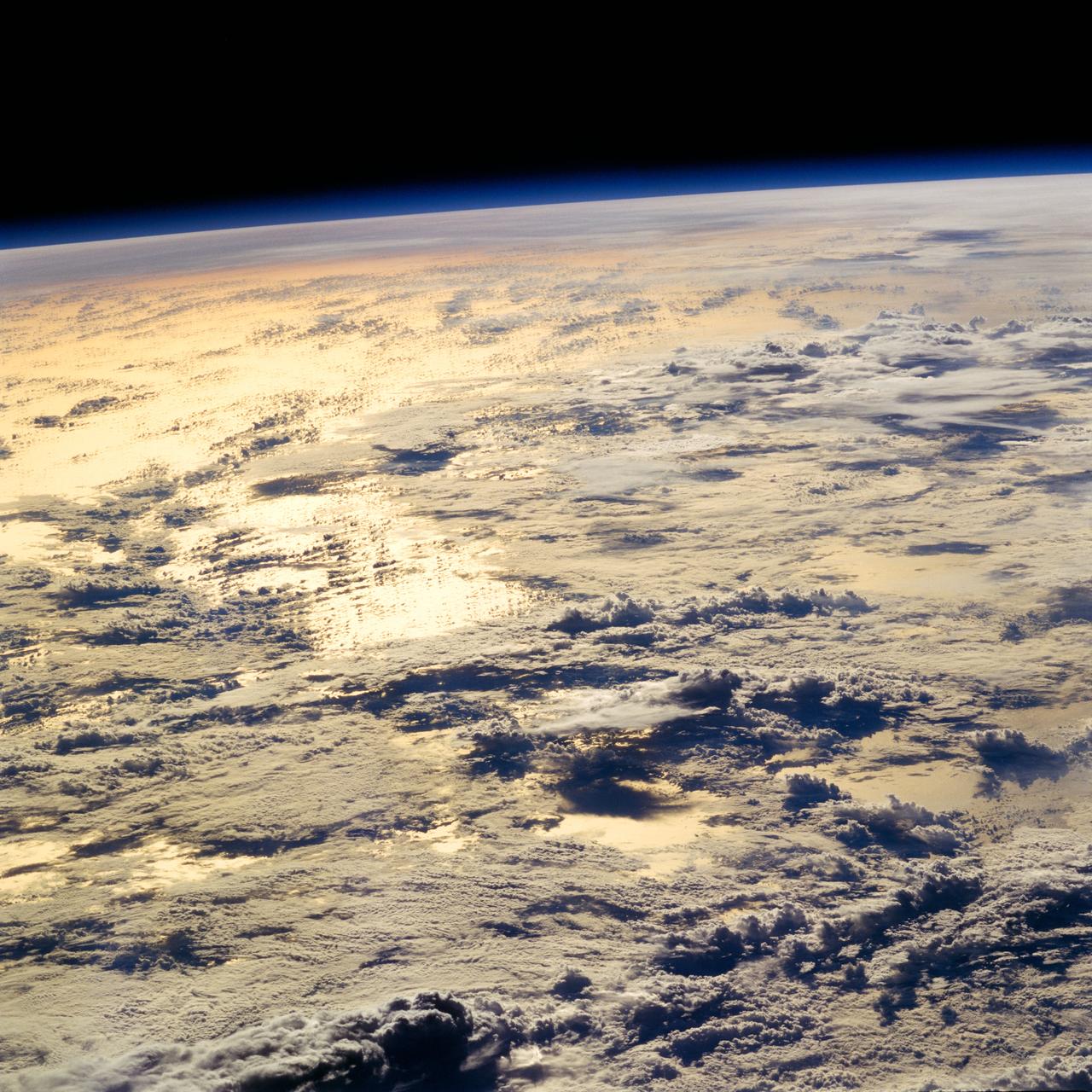
STS080-759-075 (19 Nov.-7 Dec. 1996) --- This 70mm handheld camera's panoramic view was photographed by the STS-80 crewmembers to capture the aesthetic side of space travel. The scene was in the South Pacific Ocean southwest of Hawaii and west of Christmas Island. The angle of the space shuttle Columbia and the sunglint feature gives the picture an almost three-dimensional affect.
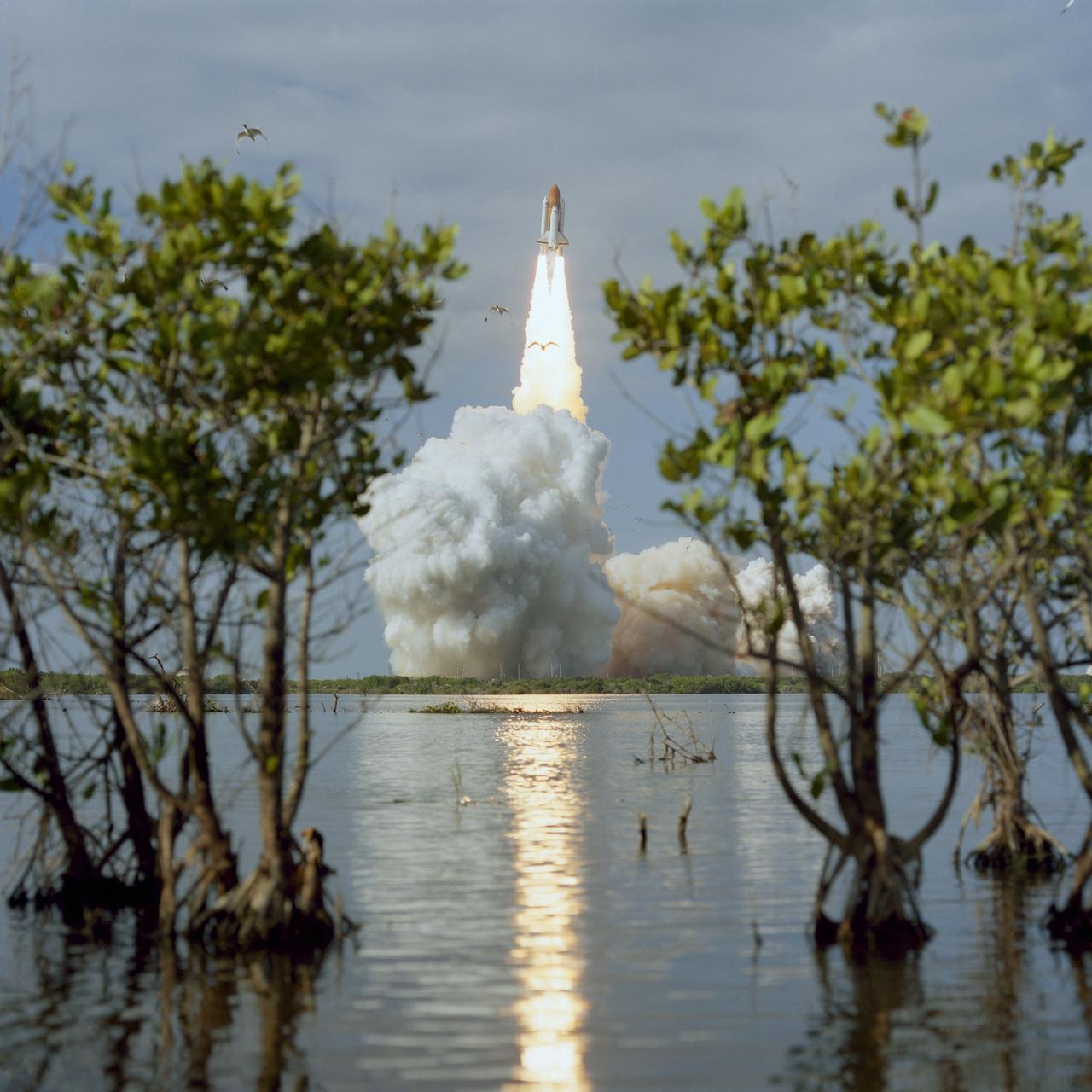
STS080-S-006 (19 Nov. 1996) --- The space shuttle Columbia lifts off from the Kennedy Space Center's (KSC) Launch Pad 39B at 2:55:47 p.m. (EST), Nov. 19, 1996. Onboard are astronauts Kenneth D. Cockrell, mission commander; Kent V. Rominger, pilot; along with Story Musgrave, Tamara E. Jernigan and Thomas D. Jones, all mission specialists. The two primary payloads for STS-80 stowed in Columbia's cargo bay for later deployment and testing are the Wake Shield Facility (WSF-3) and the Orbiting and Retrievable Far and Extreme Ultraviolet Spectrometer (ORFEUS) with its associated Shuttle Pallet Satellite (SPAS).
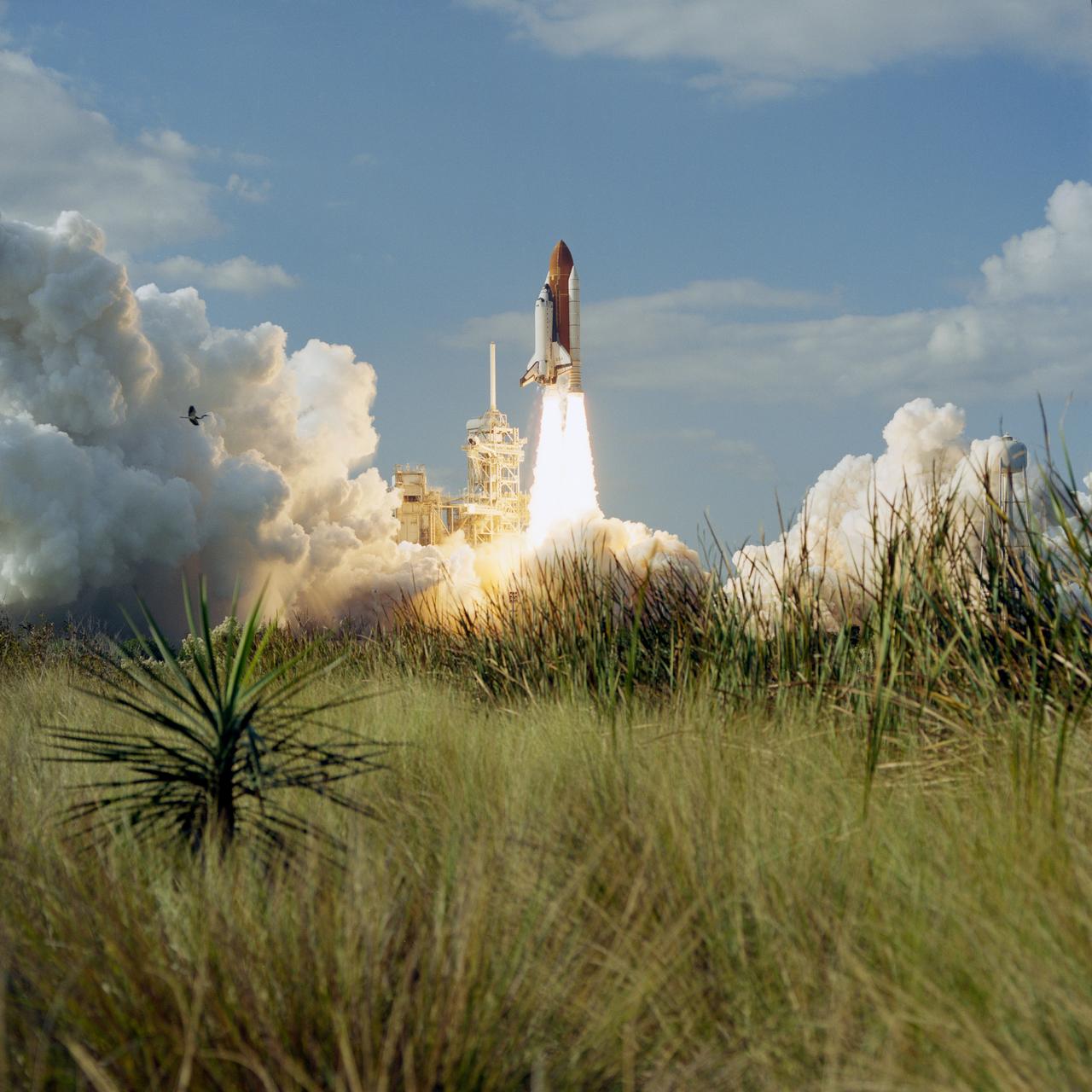
STS080-S-005 (19 Nov. 1996) --- The space shuttle Columbia lifts off from the Kennedy Space Center's (KSC) Launch Pad 39B at 2:55:47 p.m. (EST), Nov. 19, 1996. Onboard are astronauts Kenneth D. Cockrell, mission commander; Kent V. Rominger, pilot; along with Story Musgrave, Tamara E. Jernigan and Thomas D. Jones, all mission specialists. The two primary payloads for STS-80 stowed in Columbia's cargo bay for later deployment and testing are the Wake Shield Facility (WSF-3) and the Orbiting and Retrievable Far and Extreme Ultraviolet Spectrometer (ORFEUS) with its associated Shuttle Pallet Satellite (SPAS).
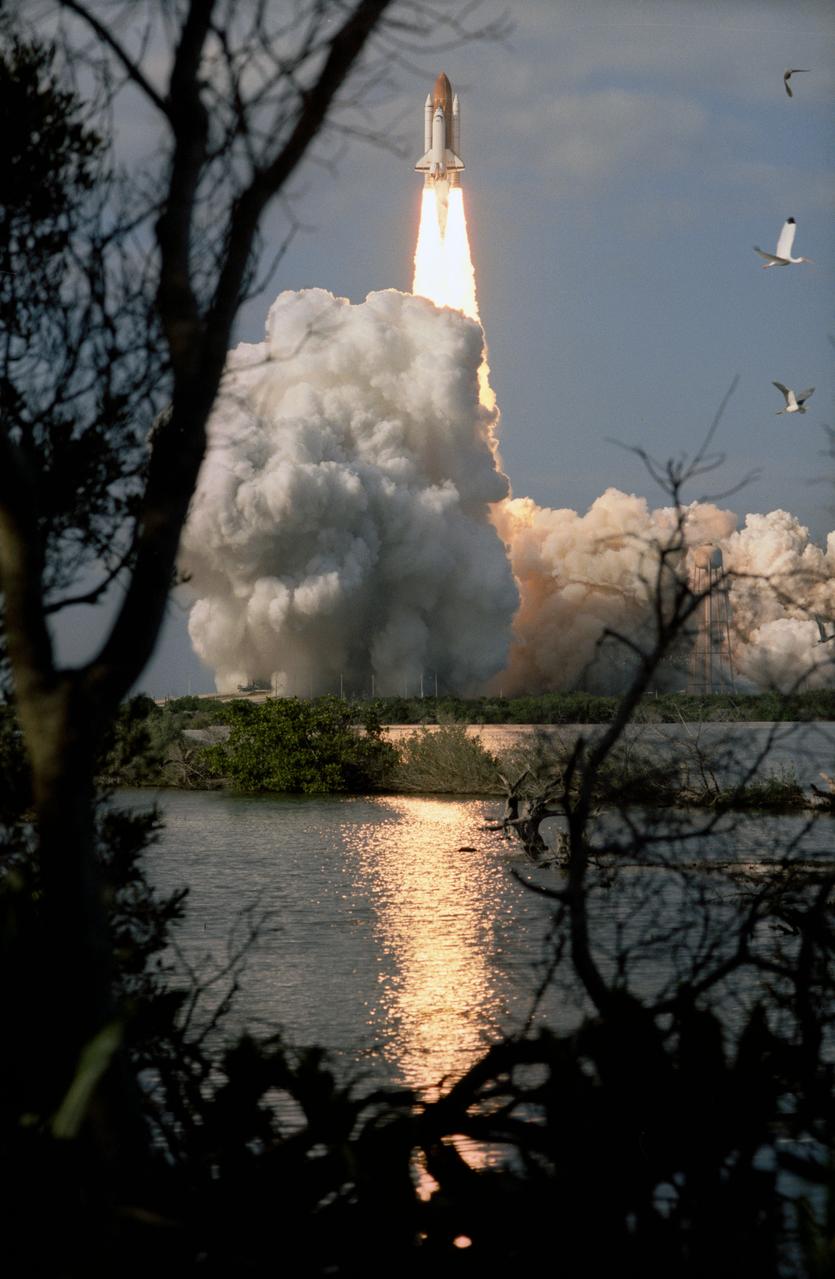
STS080-S-003 (19 Nov. 1996) --- The space shuttle Columbia lifts off from the Kennedy Space Center's (KSC) Launch Pad 39B at 2:55:47 p.m. (EST), November 19, 1996. Onboard are astronauts Kenneth D. Cockrell, mission commander; Kent V. Rominger, pilot; along with Story Musgrave, Tamara E. Jernigan and Thomas D. Jones, all mission specialists. The two primary payloads for STS-80 stowed in Columbia's cargo bay for later deployment and testing are the Wake Shield Facility (WSF-3) and the Orbiting and Retrievable Far and Extreme Ultraviolet Spectrometer (ORFEUS) with its associated Shuttle Pallet Satellite (SPAS).
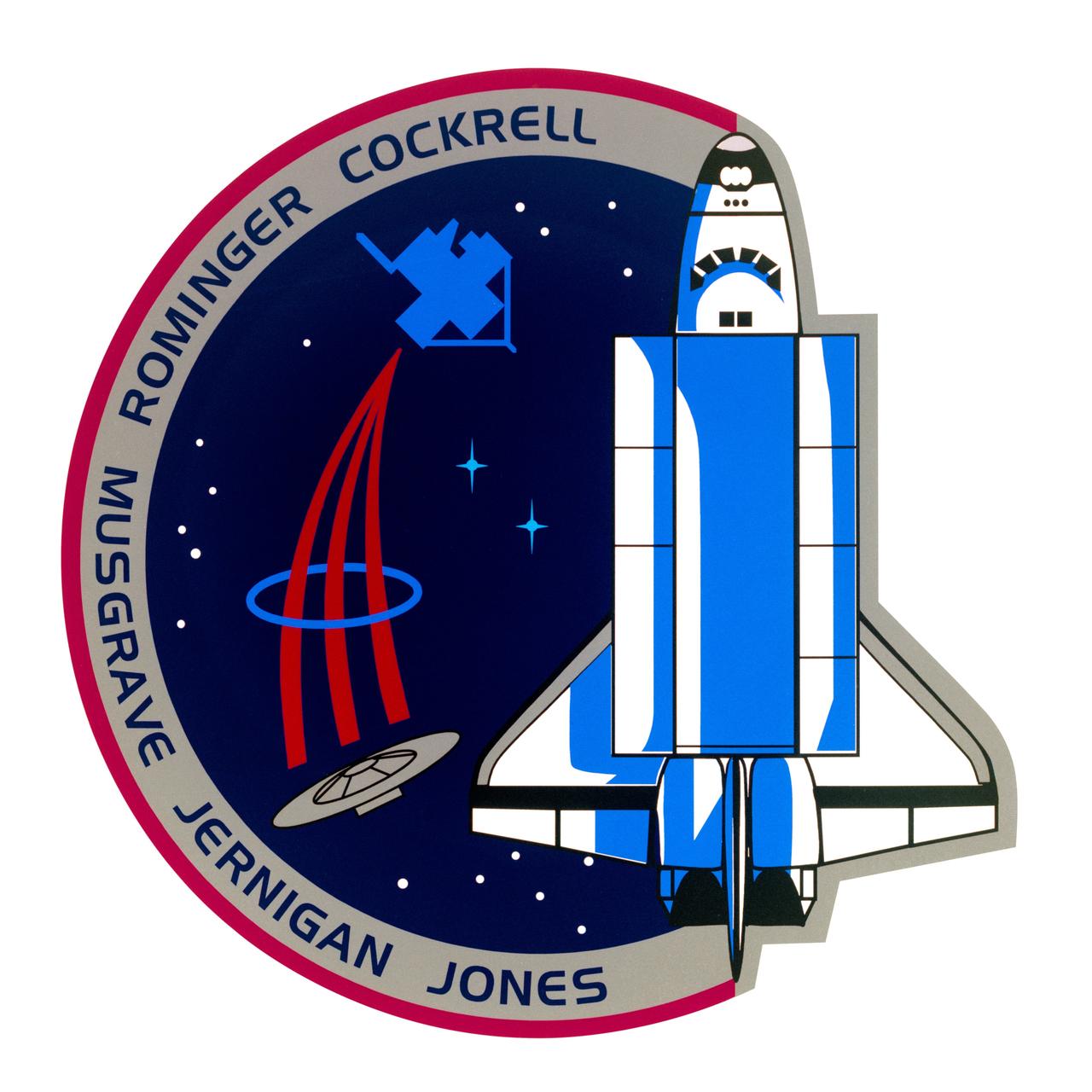
STS080-S-001 (August 1996) --- This STS-80 mission patch depicts the space shuttle Columbia and the two research satellites its crew will deploy into the blue field of space. The uppermost satellite is the Orbiting Retrievable Far and Extreme Ultraviolet Spectrograph-Shuttle Pallet Satellite (ORFEUS-SPAS), a telescope aimed at unraveling the life cycles of stars and understanding the gases that drift between them. The lower satellite is the Wake Shield Facility (WSF), flying for the third time. It will use the vacuum of space to create advanced semiconductors for the nation’s electronics industry. ORFEUS and WSF are joined by the symbol of the Astronaut Corps, representing the human contribution to scientific progress in space. The two bright blue stars represent the mission’s extravehicular activities (EVA), final rehearsals for techniques and tools to be used in assembly of the International Space Station (ISS). Surrounding Columbia is a constellation of 16 stars, one for each day of the mission, representing the stellar talents of the ground and flight teams that share the goal of expanding knowledge through a permanent human presence in space. The NASA insignia design for space shuttle flights is reserved for use by the astronauts and for other official use as the NASA Administrator may authorize. Public availability has been approved only in the forms of illustrations by the various news media. When and if there is any change in this policy, which is not anticipated, the change will be publicly announced. Photo credit: NASA
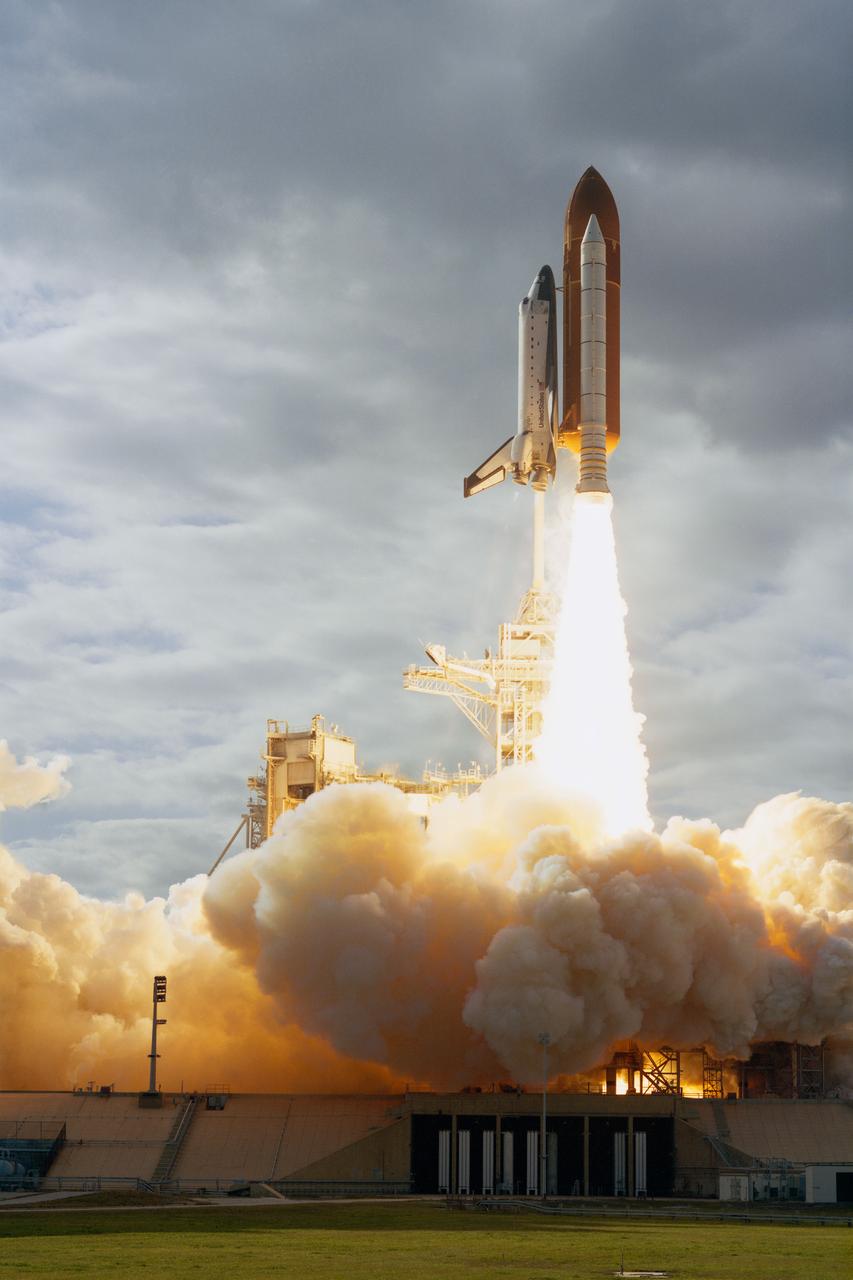
STS080-S-007 (19 Nov. 1996) --- One of the nearest remote camera stations to Launch Pad B captured this profile image of space shuttle Columbia's liftoff from the Kennedy Space Center's (KSC) Launch Complex 39 at 2:55:47 p.m. (EST), November 19, 1996. Onboard are astronauts Kenneth D. Cockrell, mission commander; Kent V. Rominger, pilot; along with Story Musgrave, Tamara E. Jernigan and Thomas D. Jones, all mission specialists. The two primary payloads for STS-80 stowed in Columbia?s cargo bay for later deployment and testing are the Wake Shield Facility (WSF-3) and the Orbiting and Retrievable Far and Extreme Ultraviolet Spectrometer (ORFEUS) with its associated Shuttle Pallet Satellite (SPAS).
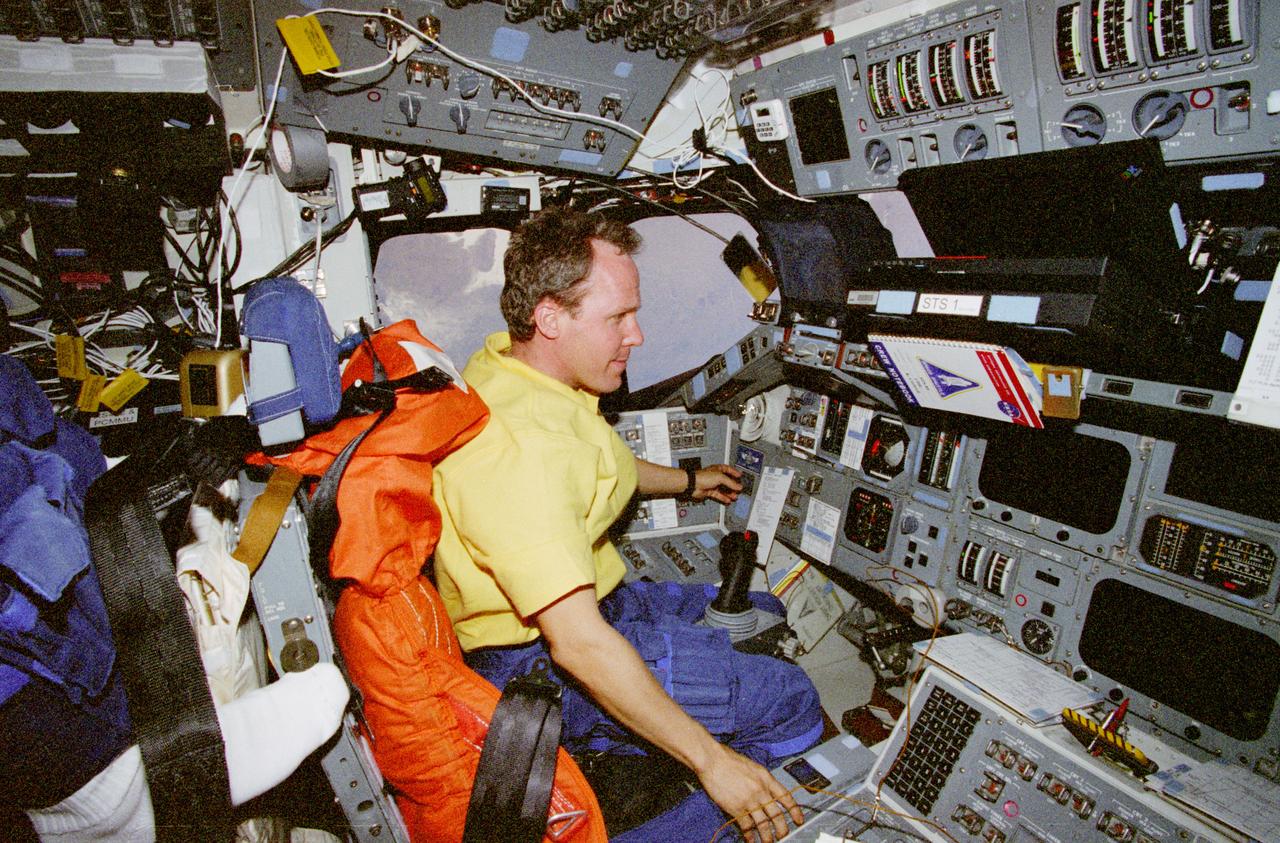
STS-80 Mission Specialist Tom Jones is seated in the flight deck commander's seat and conducts stationkeeping burns.
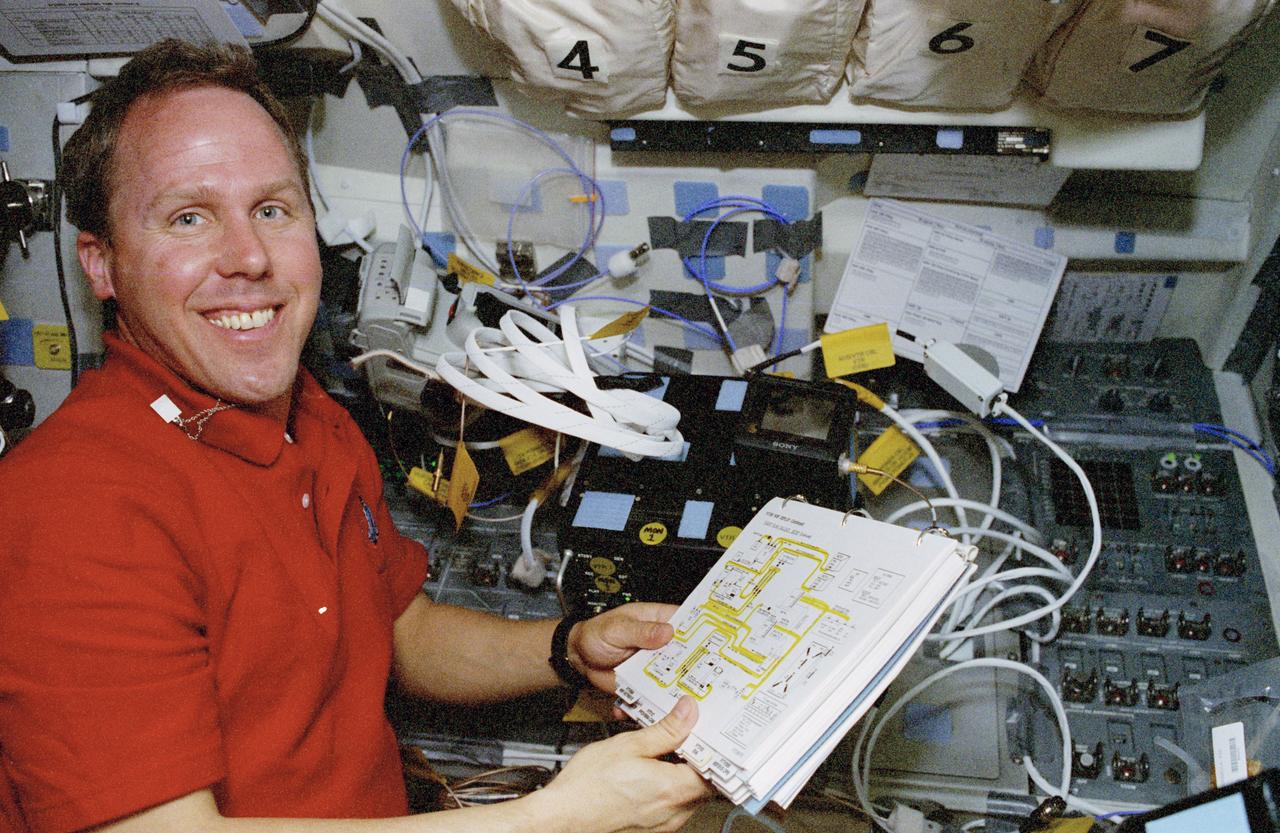
STS080-325-006 (19 Nov.-7 Dec. 1996) --- Astronaut Thomas D. Jones, STS-80 mission specialist, looks over a photo-television checklist on the flight deck of the Earth-orbiting space shuttle Columbia.
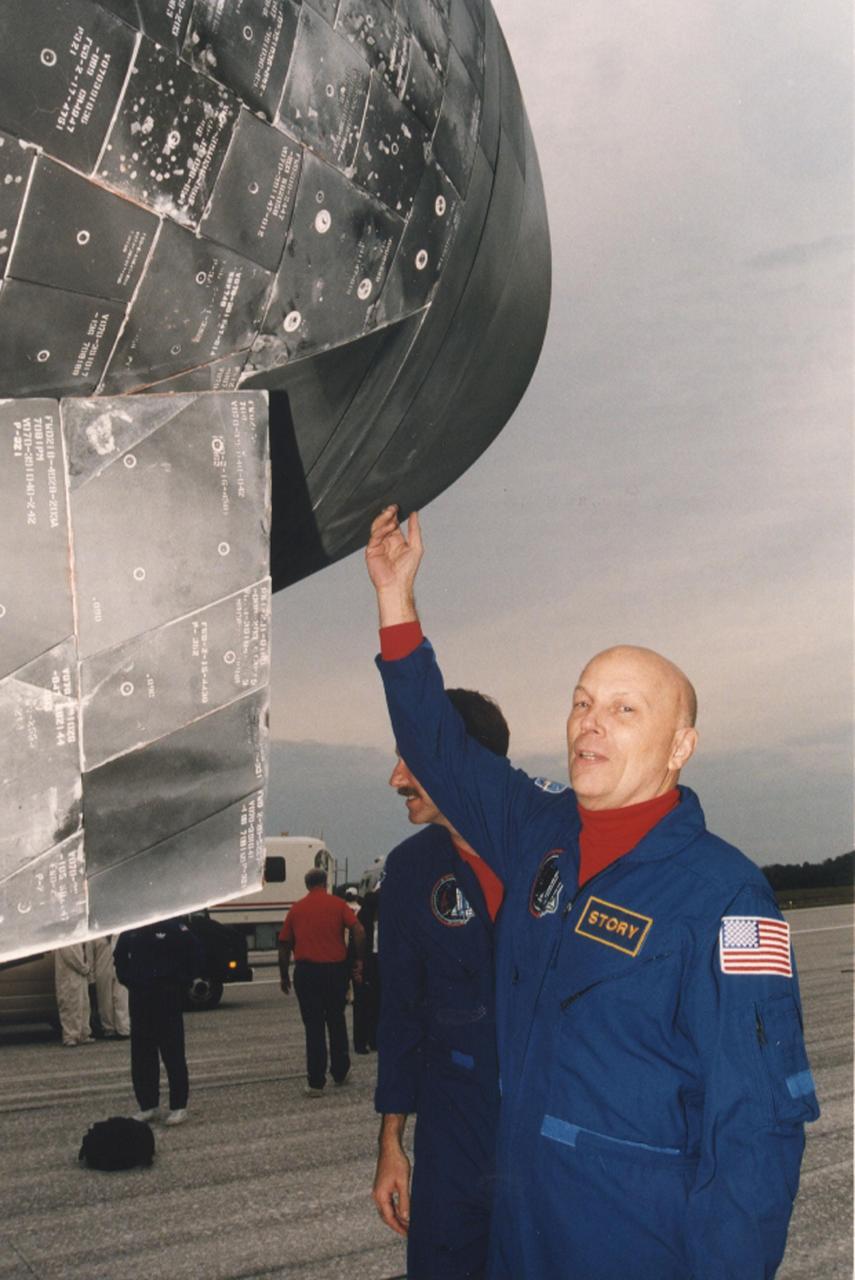
KENNEDY SPACE CENTER, FLA. -- His last spaceflight behind him, STS-80 Mission Specialist Story Musgrave takes one last look at the orbiter Columbia parked on Runway 33 of KSC’s Shuttle Landing Facility. Musgrave became at age 61 the oldest human being to fly into space and in completing his sixth spaceflight ties astronaut John Young’s record for most human spaceflight, while also setting a new record for most Shuttle flights. Columbia touched down at 6:49:05 a.m. EST, Dec. 7, wrapping up Mission STS-80 and the final Shuttle flight of 1996.
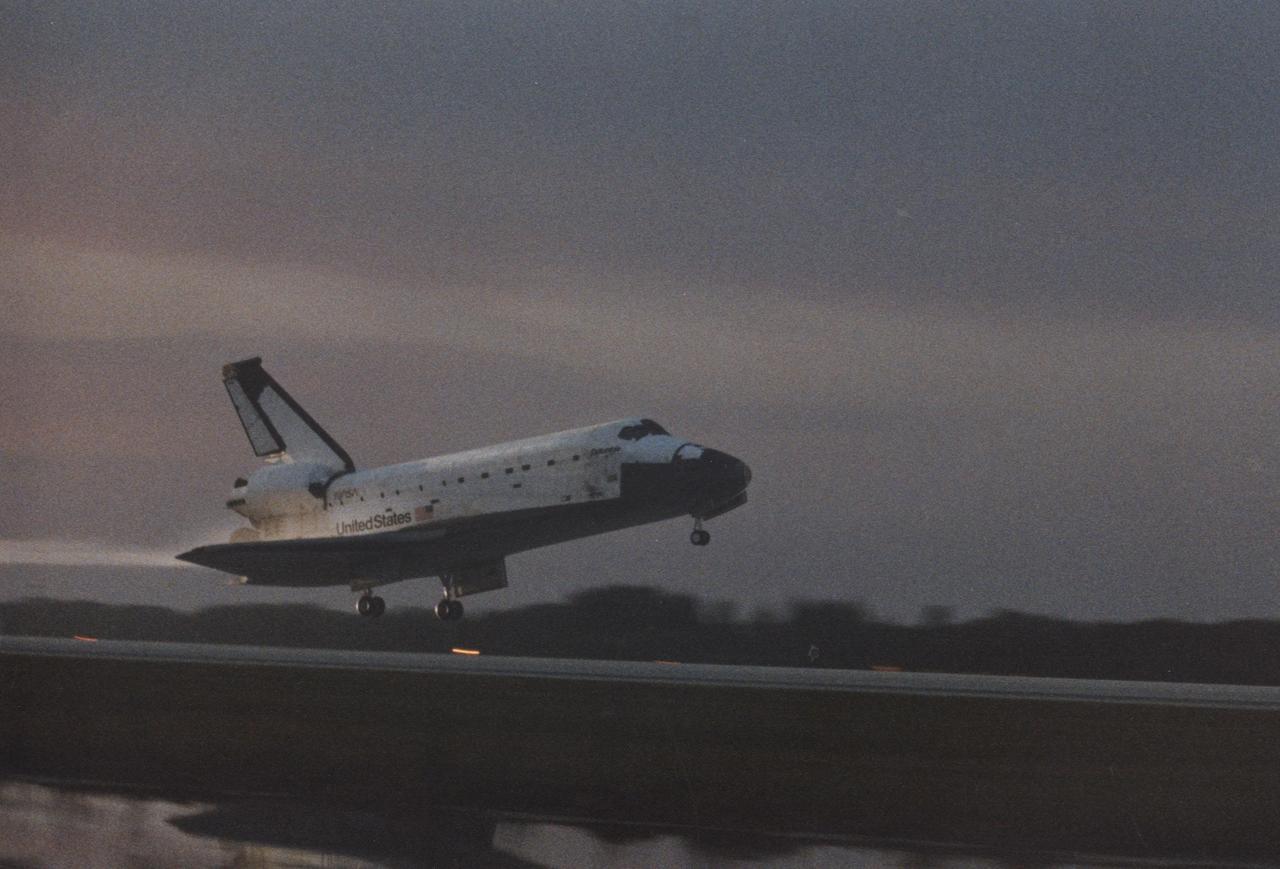
KENNEDY SPACE CENTER, FLA. -- With sunrise just minutes away, the orbiter Columbia swoops down on KSC’s Shuttle Landing Facility, Runway 33. The 33rd KSC landing in Shuttle program history is set to occur on the first opportunity Dec. 7 at 6:49 a.m. EST. Prior landing attempts Dec. 5 and 6 were scrubbed due to weather conditions. The extended time aloft allowed the five- member crew of Mission STS-80 to set a new record for long-duration Shuttle flight. At main gear touchdown, mission duration will be about 17 days, 16 hours, surpassing the 16-day, 21-hour set by the STS-78 crew earlier this year. Guiding Columbia onto the runway is STS-80 Commander Kenneth D. Cockrell; the pilot is Kent V. Rominger. The three mission specialists are Tamara E. Jernigan, Thomas D. Jones and Story Musgrave.
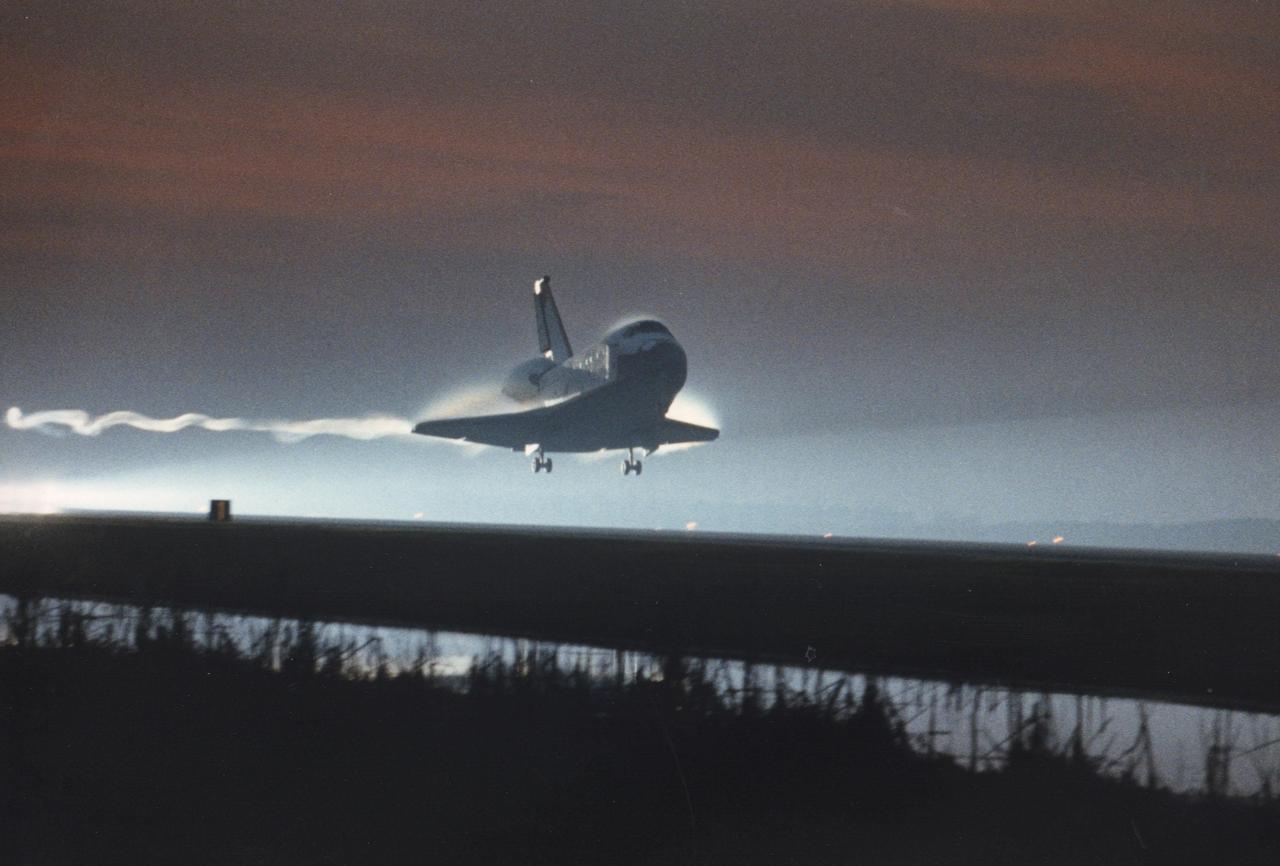
KENNEDY SPACE CENTER, FLA. -- With sunrise just minutes away, the orbiter Columbia swoops down on KSC’s Shuttle Landing Facility, Runway 33. The 33rd KSC landing in Shuttle program history is set to occur on the first opportunity Dec. 7 at 6:49 a.m. EST. Prior landing attempts Dec. 5 and 6 were scrubbed due to weather conditions. The extended time aloft allowed the five- member crew of Mission STS-80 to set a new record for long-duration Shuttle flight. At main gear touchdown, mission duration will be about 17 days, 16 hours, surpassing the 16-day, 21-hour set by the STS-78 crew earlier this year. Guiding Columbia onto the runway is STS-80 Commander Kenneth D. Cockrell; the pilot is Kent V. Rominger. The three mission specialists are Tamara E. Jernigan, Thomas D. Jones and Story Musgrave.
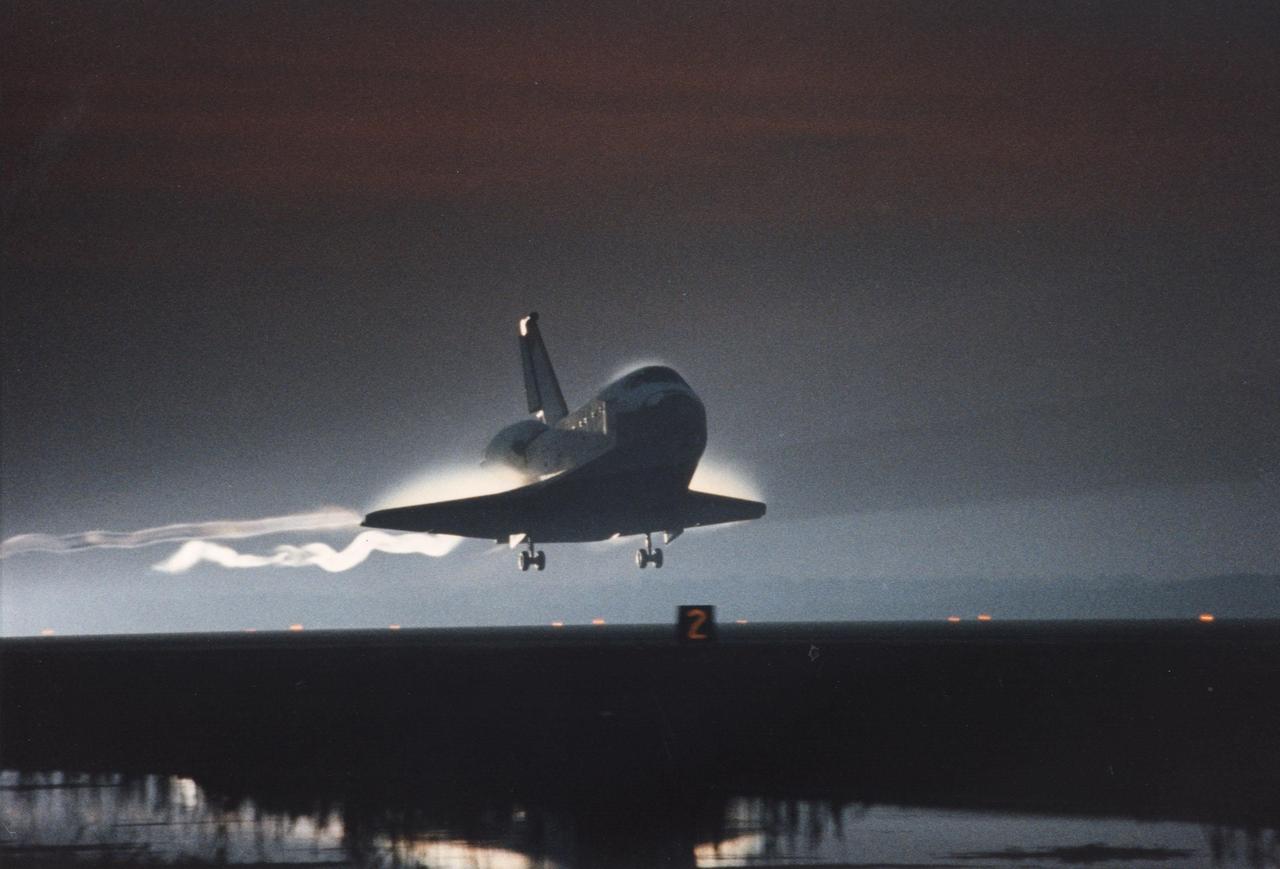
KENNEDY SPACE CENTER, FLA. -- With sunrise just minutes away, the orbiter Columbia swoops down on KSC’s Shuttle Landing Facility, Runway 33. The 33rd KSC landing in Shuttle program history is set to occur on the first opportunity Dec. 7 at 6:49 a.m. EST. Prior landing attempts Dec. 5 and 6 were scrubbed due to weather conditions. The extended time aloft allowed the five- member crew of Mission STS-80 to set a new record for long-duration Shuttle flight. At main gear touchdown, mission duration will be about 17 days, 16 hours, surpassing the 16-day, 21-hour set by the STS-78 crew earlier this year. Guiding Columbia onto the runway is STS-80 Commander Kenneth D. Cockrell; the pilot is Kent V. Rominger. The three mission specialists are Tamara E. Jernigan, Thomas D. Jones and Story Musgrave.
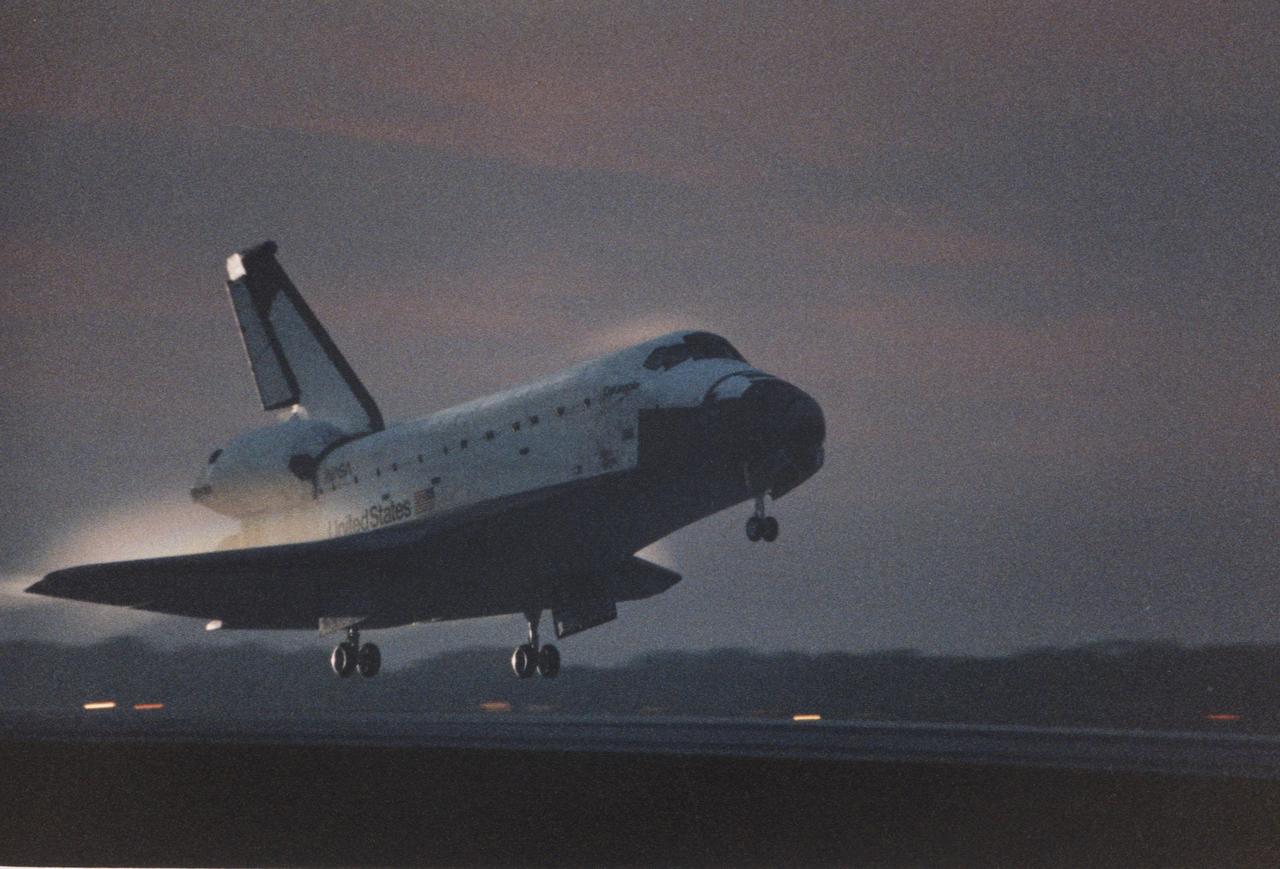
KENNEDY SPACE CENTER, FLA. -- With sunrise just minutes away, the orbiter Columbia swoops down on KSC’s Shuttle Landing Facility, Runway 33. The 33rd KSC landing in Shuttle program history is set to occur on the first opportunity Dec. 7 at 6:49 a.m. EST. Prior landing attempts Dec. 5 and 6 were scrubbed due to weather conditions. The extended time aloft allowed the five- member crew of Mission STS-80 to set a new record for long-duration Shuttle flight. At main gear touchdown, mission duration will be about 17 days, 16 hours, surpassing the 16-day, 21-hour set by the STS-78 crew earlier this year. Guiding Columbia onto the runway is STS-80 Commander Kenneth D. Cockrell; the pilot is Kent V. Rominger. The three mission specialists are Tamara E. Jernigan, Thomas D. Jones and Story Musgrave
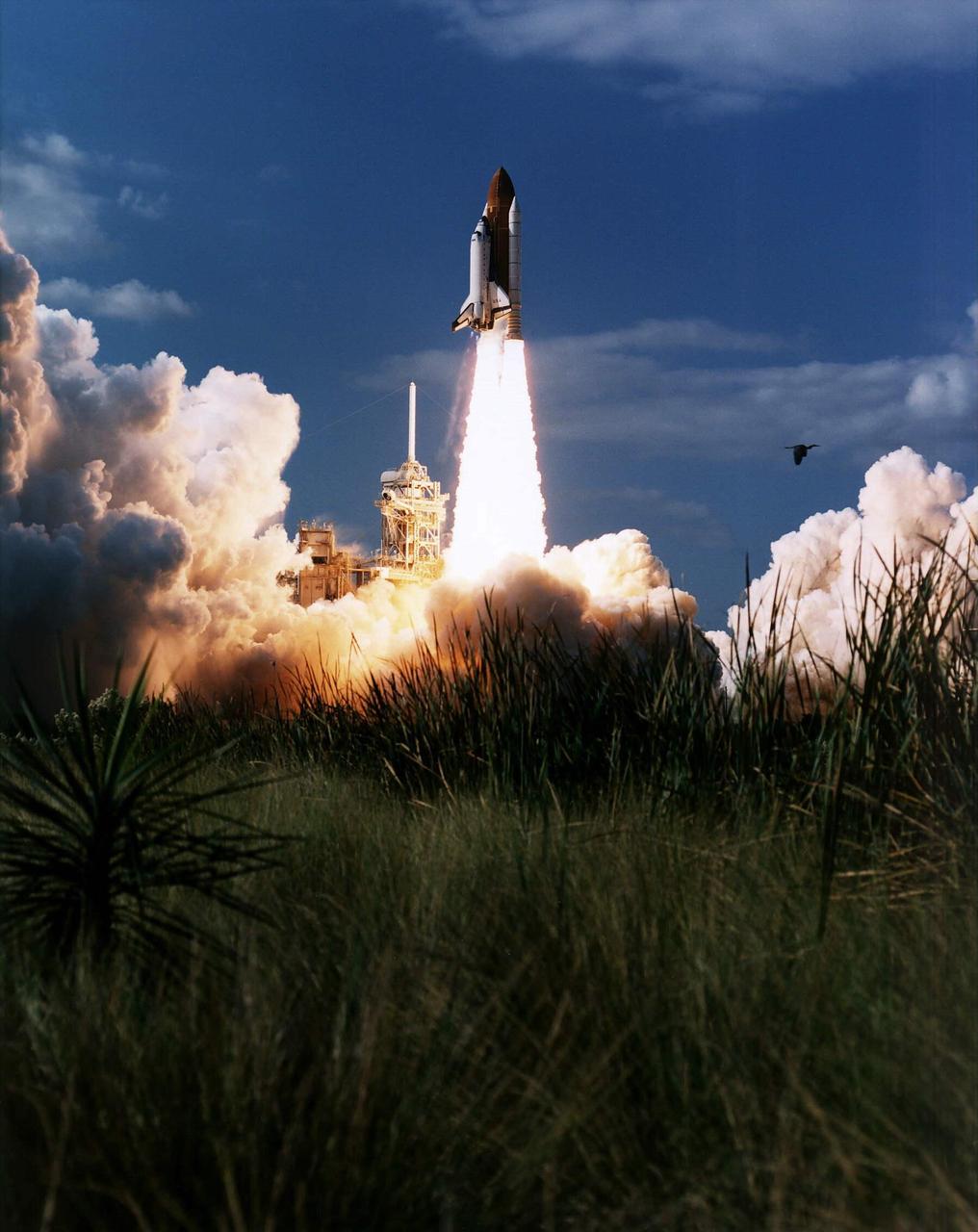
KENNEDY SPACE CENTER, FLA. -- Vividly framed by a tranquil Florida landscape, the Space Shuttle Columbia lifts off from Launch Pad 39B at 2:55:47 p.m. EST, Nov. 19, 1996. Leading the veteran crew of Mission STS-80 is Commander Kenneth D. Cockrell; Kent V. Rominger is the pilot and the three mission specialists are Tamara E. Jernigan, Story Musgrave and Thomas D. Jones. At age 61, Musgrave becomes the oldest person ever to fly in space; he also ties astronaut John Young’s record for most number of spaceflights by a human being, and in embarking on his sixth Shuttle flight Musgrave has logged the most flights ever aboard NASA’s reusable space vehicle. The two primary payloads for STS-80 are the Wake Shield Facility-3 (WSF-3) and the Orbiting and Retrievable Far and Extreme Ultraviolet Spectrometer-Shuttle Pallet Satellite II (ORFEUS-SPAS II). Two spacewalks also will be performed during the nearly 16-day mission. Mission STS-80 closes out the Shuttle flight schedule for 1996; it marks the 21st flight for Columbia and the 80th in Shuttle program history.
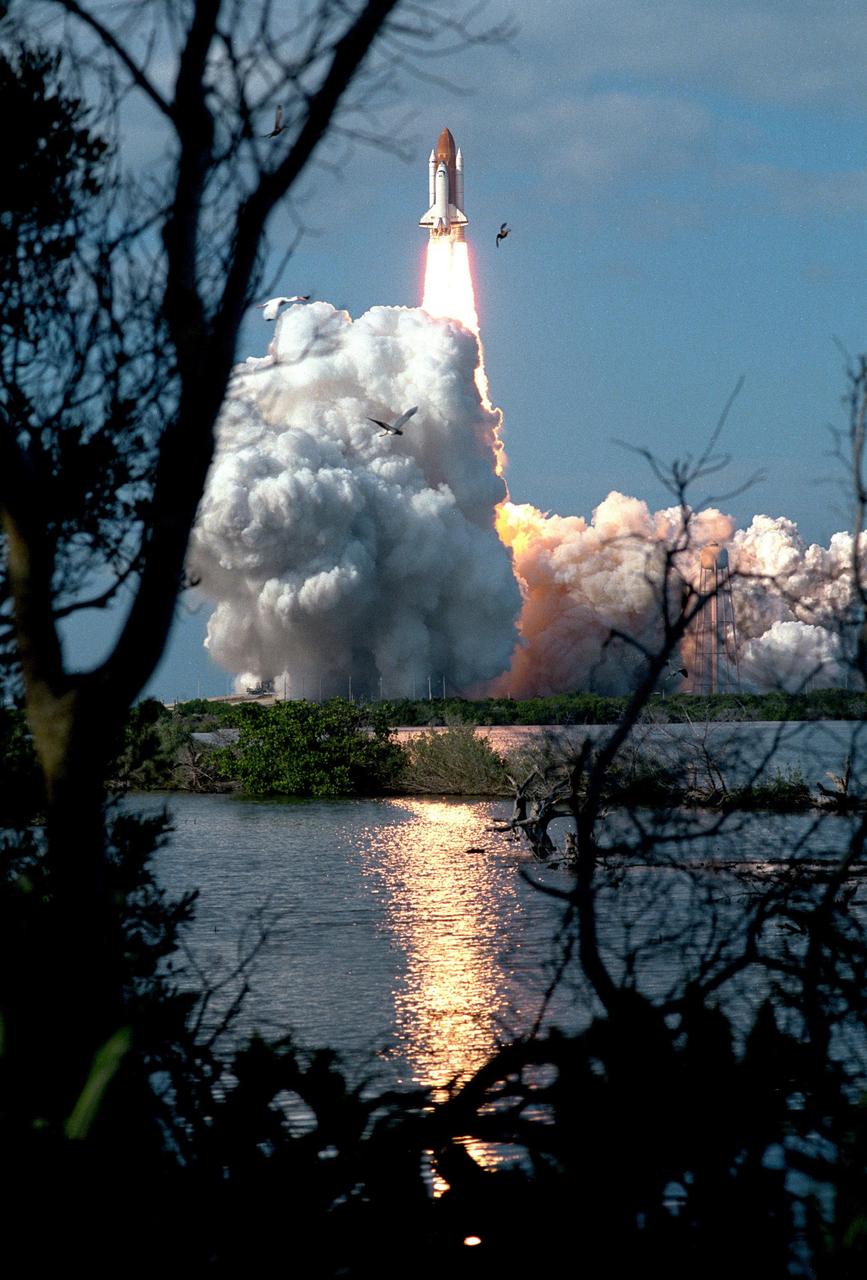
KENNEDY SPACE CENTER, FLA. -- A diversified mission of astronomy, commercial space research and International Space Station preparation gets under way as the Space Shuttle Columbia climbs skyward from Launch Pad 39B at 2:55:47 p.m. EST, Nov. 19, 1996. Leading the veteran crew of Mission STS-80 is Commander Kenneth D. Cockrell; Kent V. Rominger is the pilot and the three mission specialists are Tamara E. Jernigan, Story Musgrave and Thomas D. Jones. At age 61, Musgrave becomes the oldest person ever to fly in space; he also ties astronaut John Young’s record for most number of spaceflights by a human being, and in embarking on his sixth Shuttle flight Musgrave has logged the most flights ever aboard NASA’s reusable space vehicle. The two primary payloads for STS-80 are the Wake Shield Facility-3 (WSF-3) and the Orbiting and Retrievable Far and Extreme Ultraviolet Spectrometer-Shuttle Pallet Satellite II (ORFEUS-SPAS II). Two spacewalks also will be performed during the nearly 16-day mission. Mission STS-80 closes out the Shuttle flight schedule for 1996; it marks the 21st flight for Columbia and the 80th in Shuttle program history.
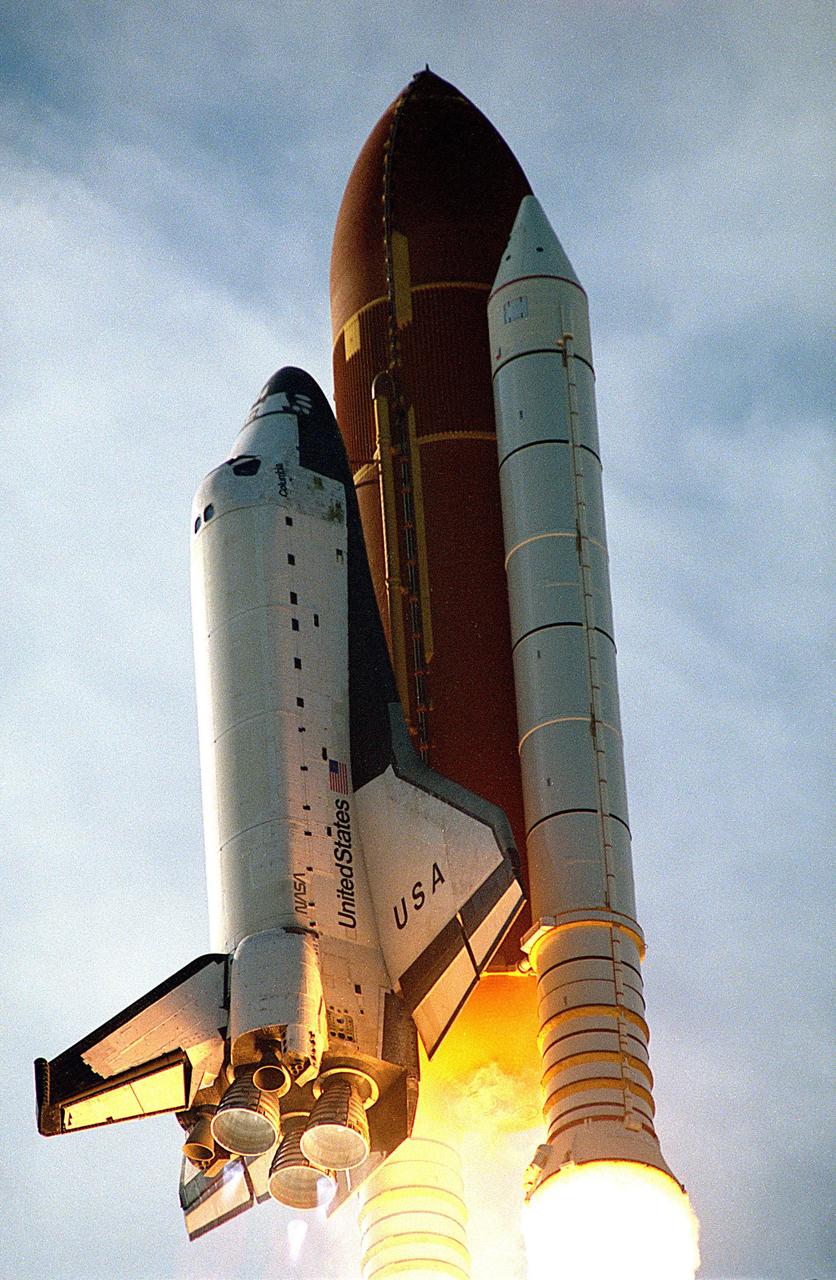
KENNEDY SPACE CENTER, FLA. -- A diversified mission of astronomy, commercial space research and International Space Station preparation gets under way as the Space Shuttle Columbia climbs skyward from Launch Pad 39B at 2:55:47 p.m. EST, Nov. 19, 1996. Leading the veteran crew of Mission STS-80 is Commander Kenneth D. Cockrell; Kent V. Rominger is the pilot and the three mission specialists are Tamara E. Jernigan, Story Musgrave and Thomas D. Jones. At age 61, Musgrave becomes the oldest person ever to fly in space; he also ties astronaut John Young’s record for most number of spaceflights by a human being, and in embarking on his sixth Shuttle flight Musgrave has logged the most flights ever aboard NASA’s reusable space vehicle. The two primary payloads for STS-80 are the Wake Shield Facility-3 (WSF-3) and the Orbiting and Retrievable Far and Extreme Ultraviolet Spectrometer-Shuttle Pallet Satellite II (ORFEUS-SPAS II). Two spacewalks also will be performed during the nearly 16-day mission. Mission STS-80 closes out the Shuttle flight schedule for 1996; it marks the 21st flight for Columbia and the 80th in Shuttle program history.
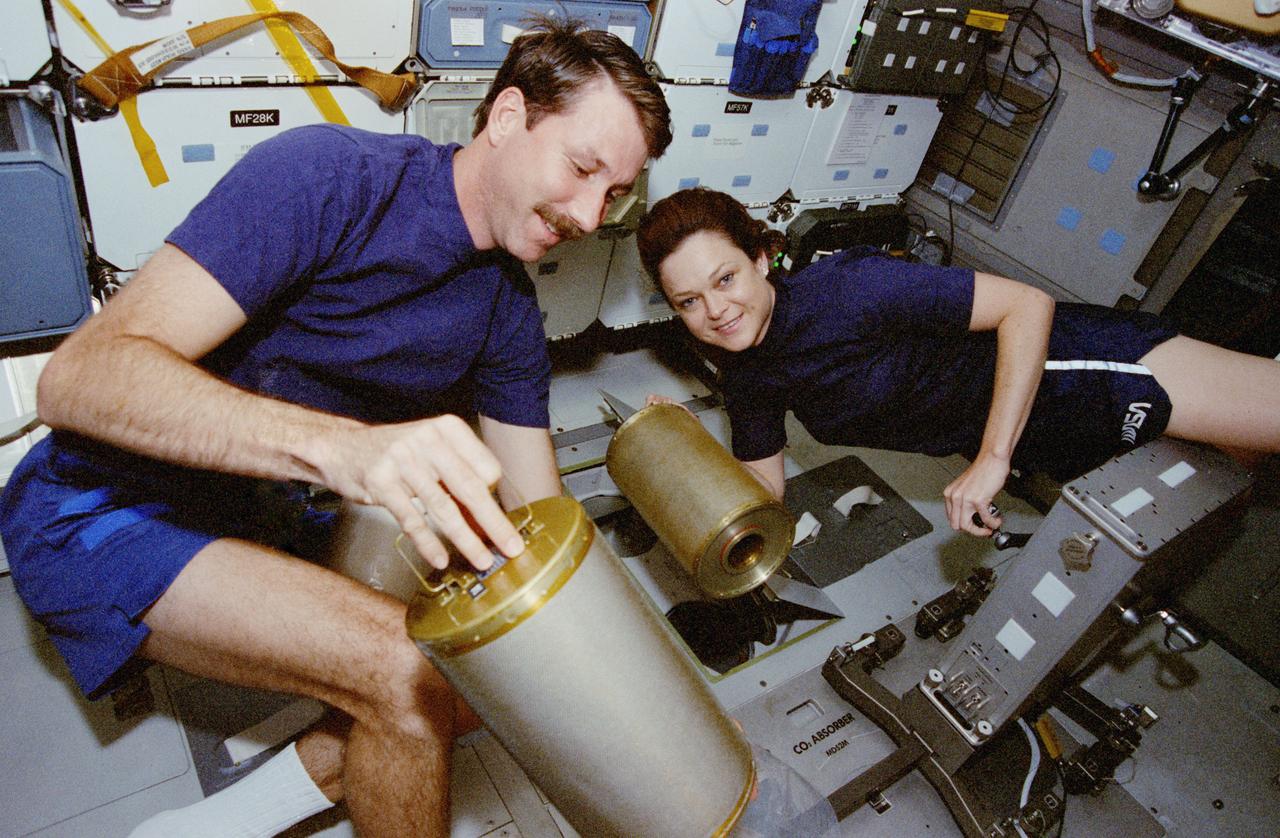
STS080-331-030 (19 Nov.-7 Dec. 1996) --- Astronauts Kent V. Rominger, STS-80 pilot, and Tamara E. Jernigan, mission specialist, perform a routine housekeeping chore during the space shuttle Columbia's record stay in Earth-orbit. The two are changing out the lithium hydroxide canisters beneath the middeck.
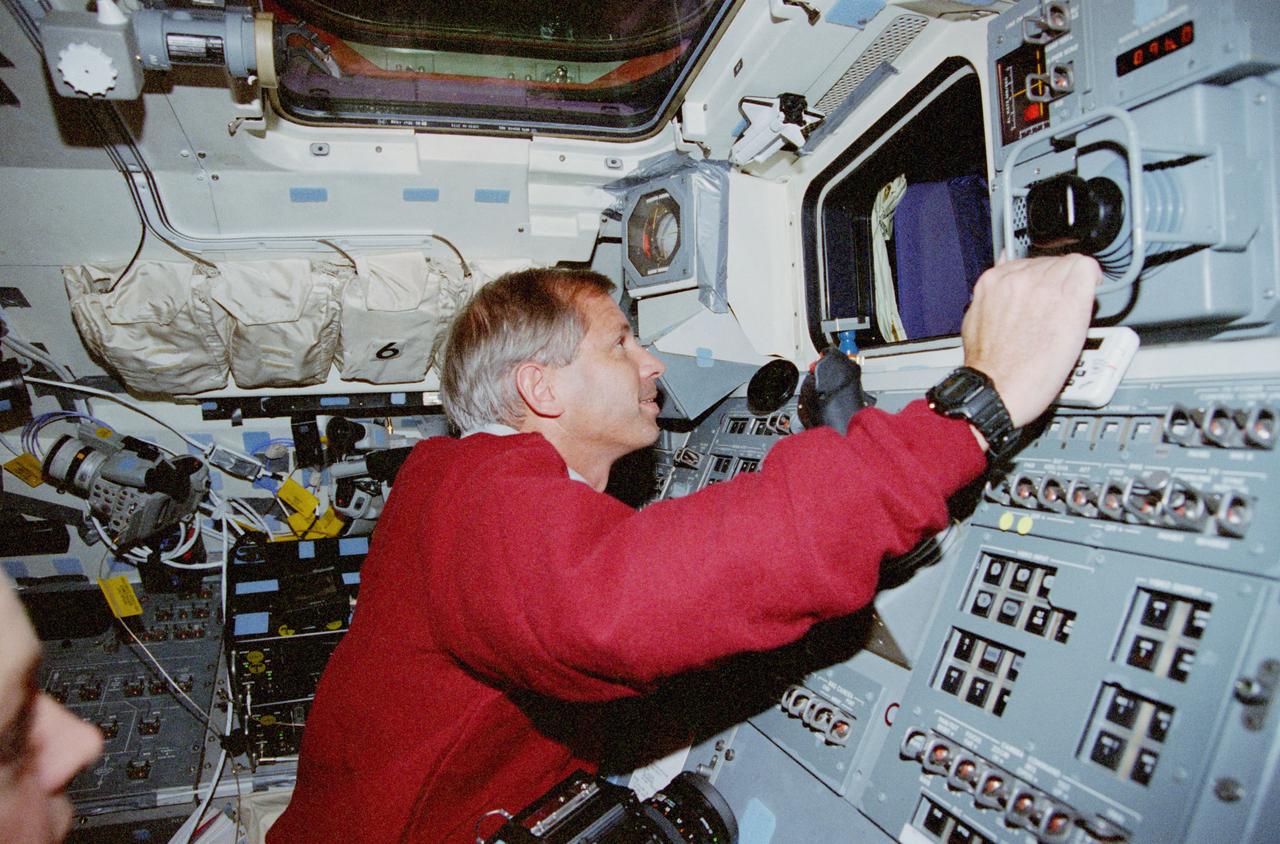
STS080-334-002 (19 Nov.-7 Dec. 1996) --- Astronaut Kenneth D. Cockrell, STS-80 mission commander, looks through a window on the space shuttle Columbia's aft flight deck during rendezvous operations with the Wake Shield Facility (WSF).
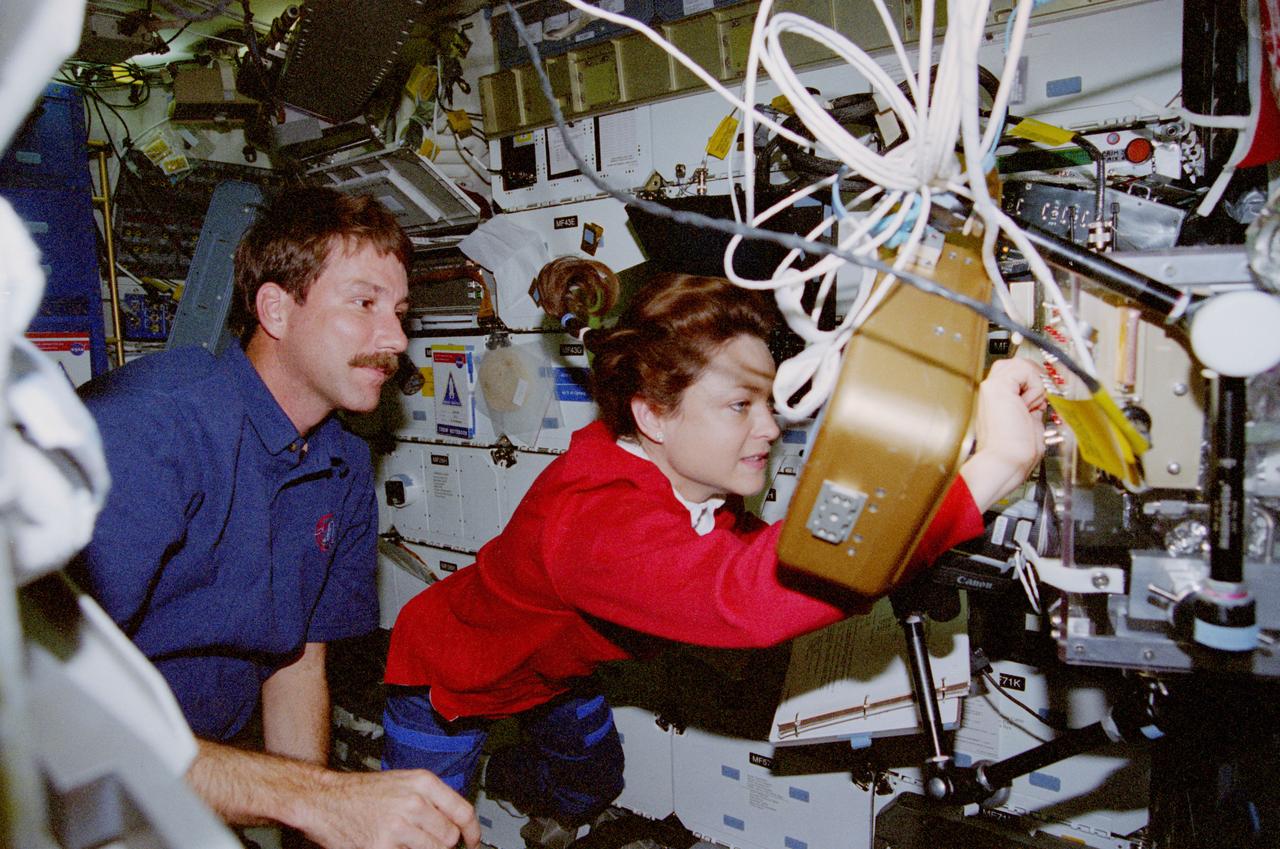
STS080-345-008 (19 Nov.-7 Dec. 1996) --- Continuing with a heavy agenda of middeck science, astronaut Tamara E. Jernigan, STS-80 mission specialist, works with the Capillary Pumped Loop (CPL) experiment while astronaut Kent V. Rominger, pilot, offers a hand.
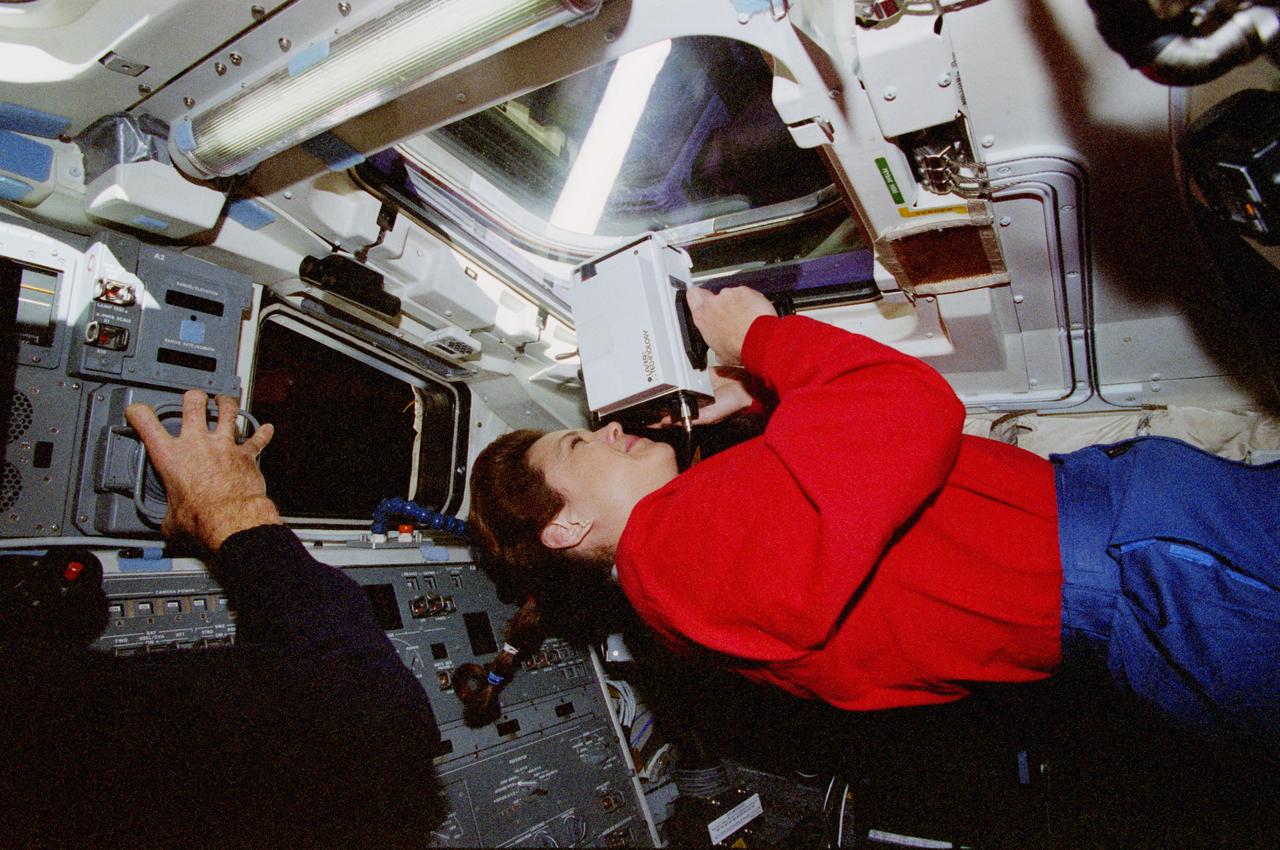
STS080-370-022 (19 Nov.-7 Dec. 1996) --- Astronaut Tamara E. Jernigan, STS-80 mission specialist, uses a laser ranging device during the space shuttle Columbia's rendezvous operations with the Orbiting Retrievable Far and Extreme Ultraviolet Spectrometer - Shuttle Pallet Satellite (ORFEUS-SPAS).
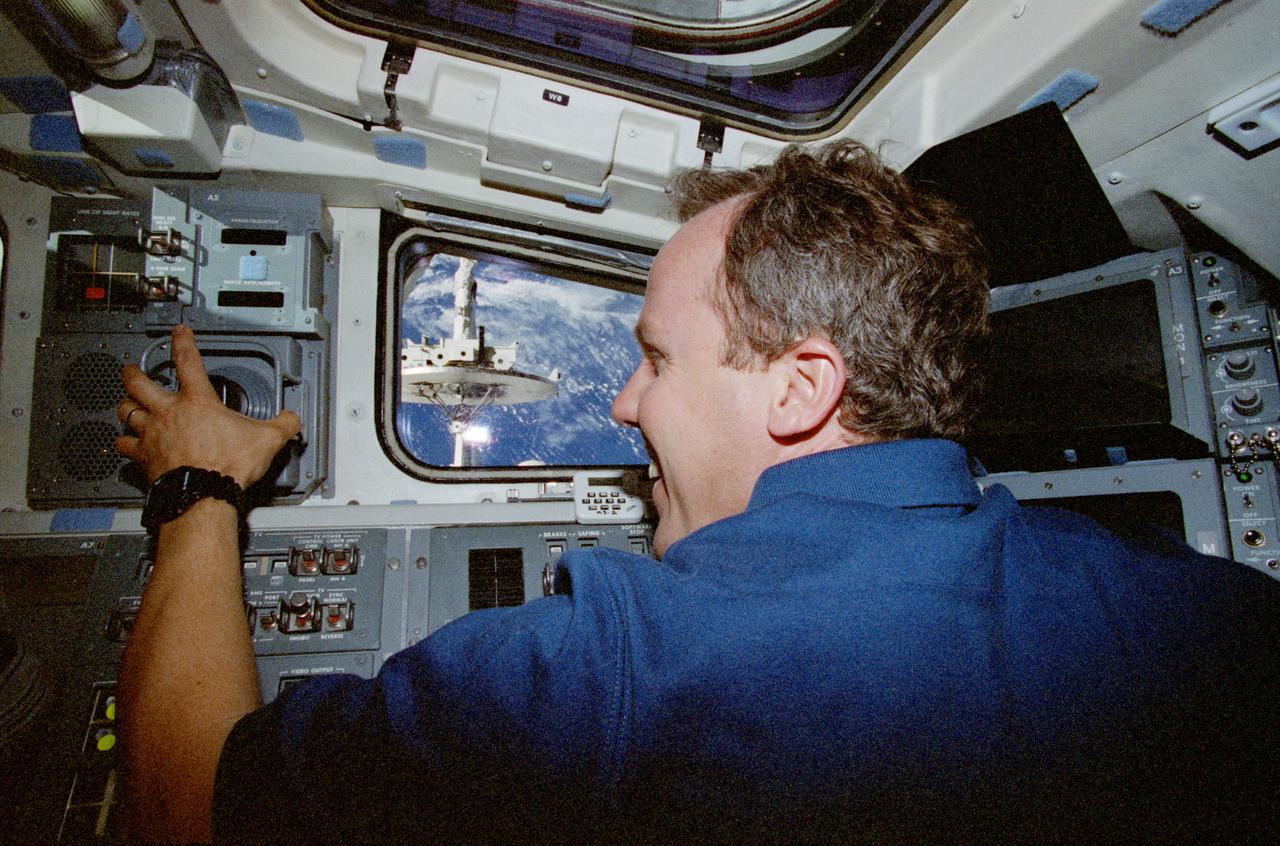
STS080-337-026 (19 Nov.-7 Dec. 1996) --- Astronaut Thomas D. Jones, STS-80 mission specialist, uses the controls of the space shuttle Columbia's Remote Manipulator System (RMS) to conduct a test with the captured Wake Shield Facility (WSF) seen through window at frame center.
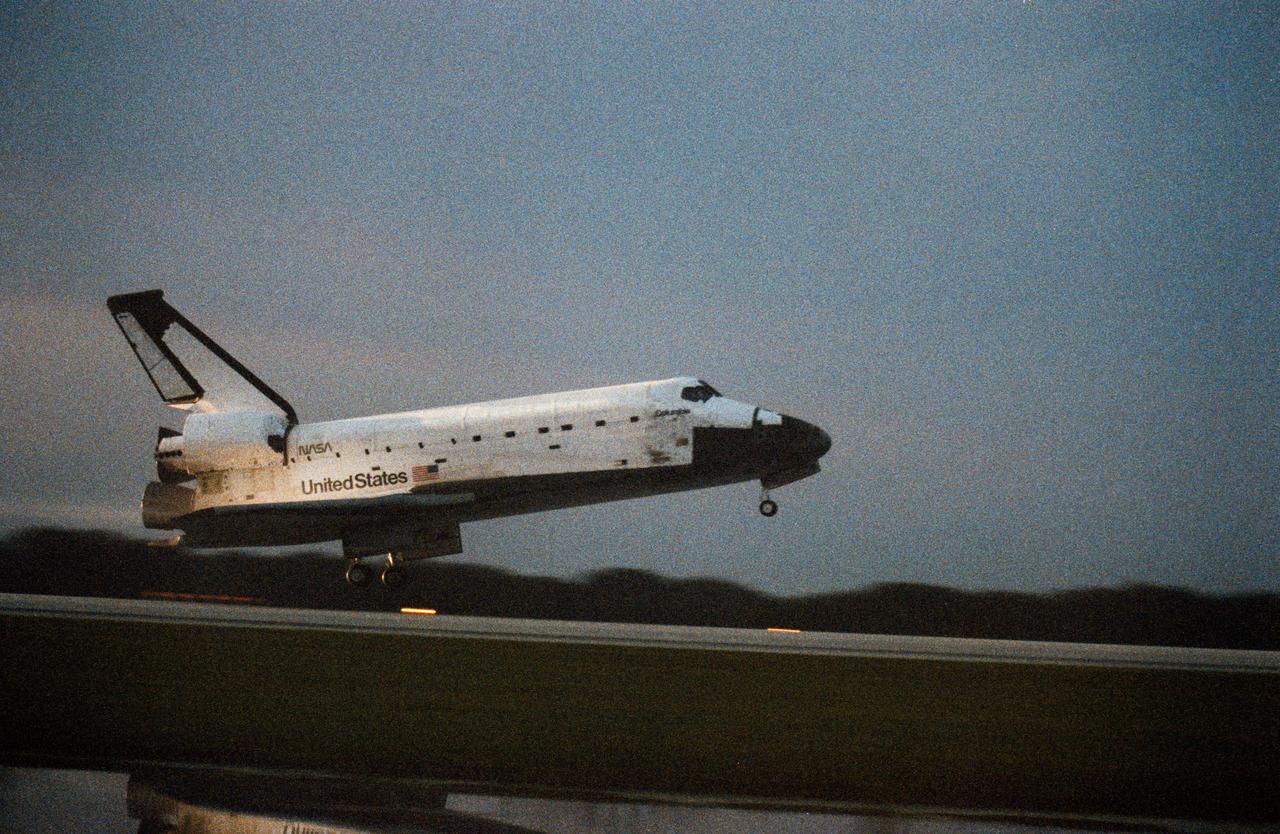
STS080-S-009 (7 Dec. 1996) --- Just prior to main gear touchdown, the space shuttle Columbia is pictured during landing on Runway 33 at the Kennedy Space Center's (KSC) Shuttle Landing Facility (SLF). Landing occurred at 6:49 a.m. (EST), Dec. 7, 1996 marking a total duration only eight hours short of 18 days. The landing is the 33rd at KSC for the Space Transportation System (STS). Crewmembers aboard were astronauts Kenneth D. Cockrell, mission commander; and Kent V. Rominger, pilot; along with Story Musgrave, Tamara E. Jernigan and Thomas D. Jones, all mission specialists.
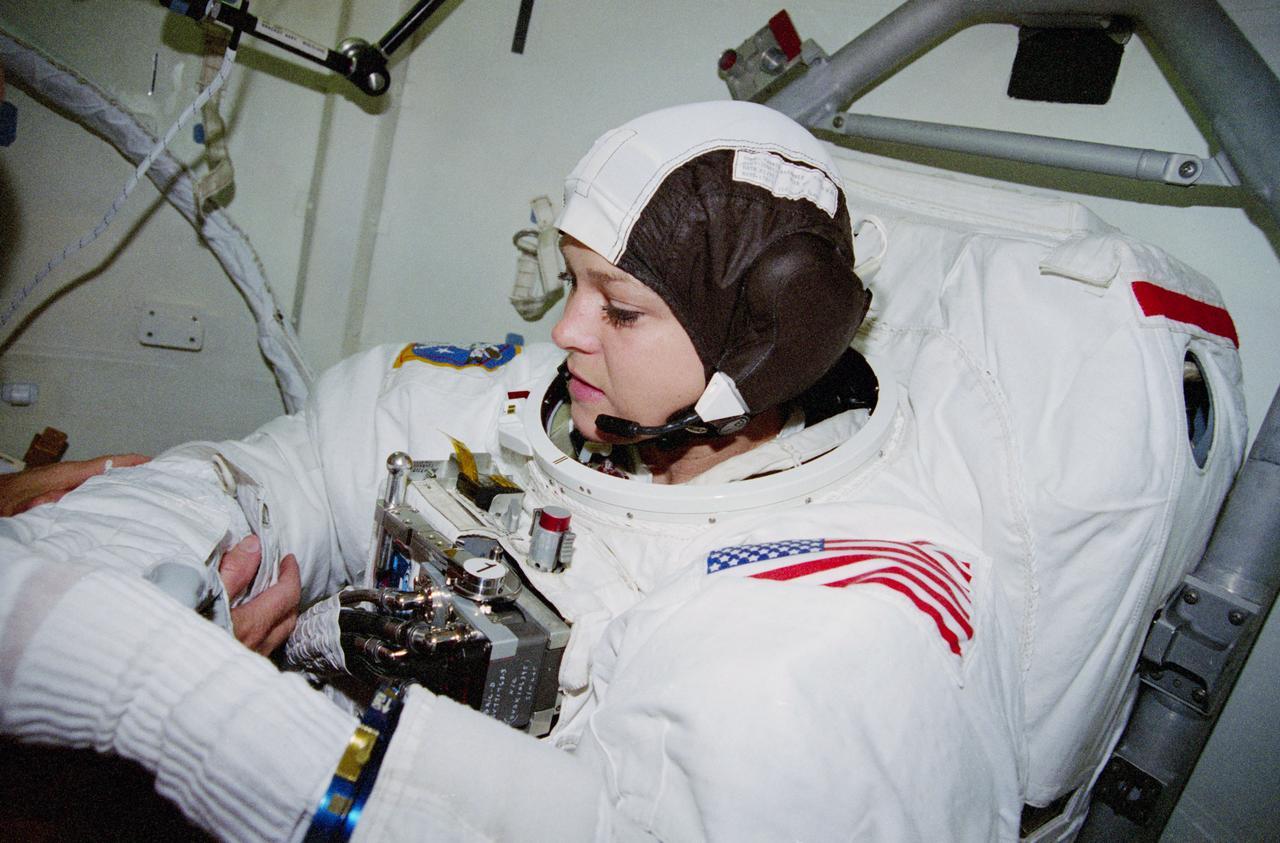
STS080-312-027 (28 Nov. 1996) --- Astronaut Tamara E. Jernigan uses the assistance of astronaut Story Musgrave (out of frame, left) during suit donning for a scheduled Extravehicular Activity (EVA). Unfortunately, the EVA was canceled after the astronauts were unable to open the Space Shuttle Columbia's hatch leading to the cargo bay.
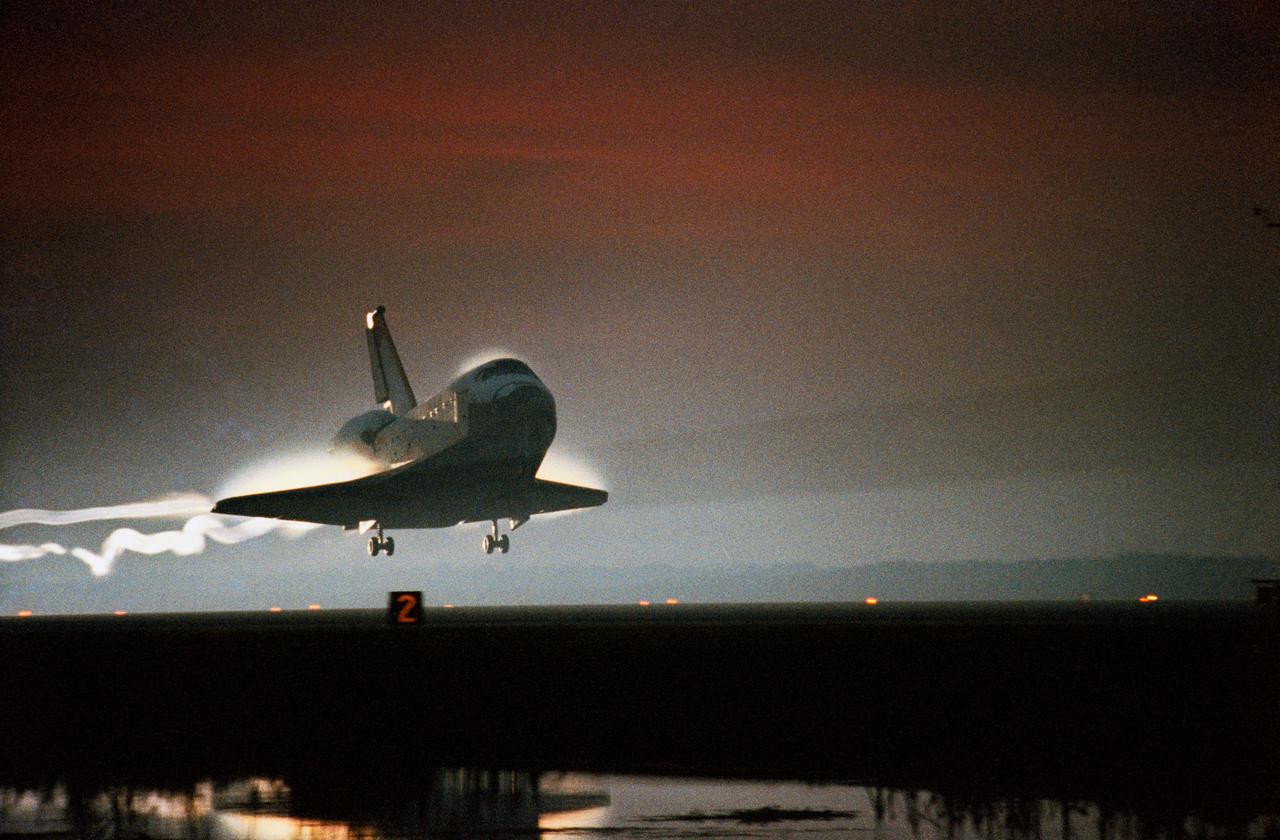
STS080-S-008 (7 Dec. 1996) --- Just prior to dawn, the space shuttle Columbia heads for a landing on Runway 33 at the Kennedy Space Center's (KSC) Shuttle Landing Facility (SLF) to successfully complete a 17-day mission. Landing occurred just before dawn, at 6:49 a.m. (EST). The landing is the 33rd at KSC for the Space Transportation System (STS). Crew members aboard were astronauts Kenneth D. Cockrell, mission commander; and Kent V. Rominger, pilot; along with Story Musgrave, Tamara E. Jernigan and Thomas D. Jones, all mission specialists.
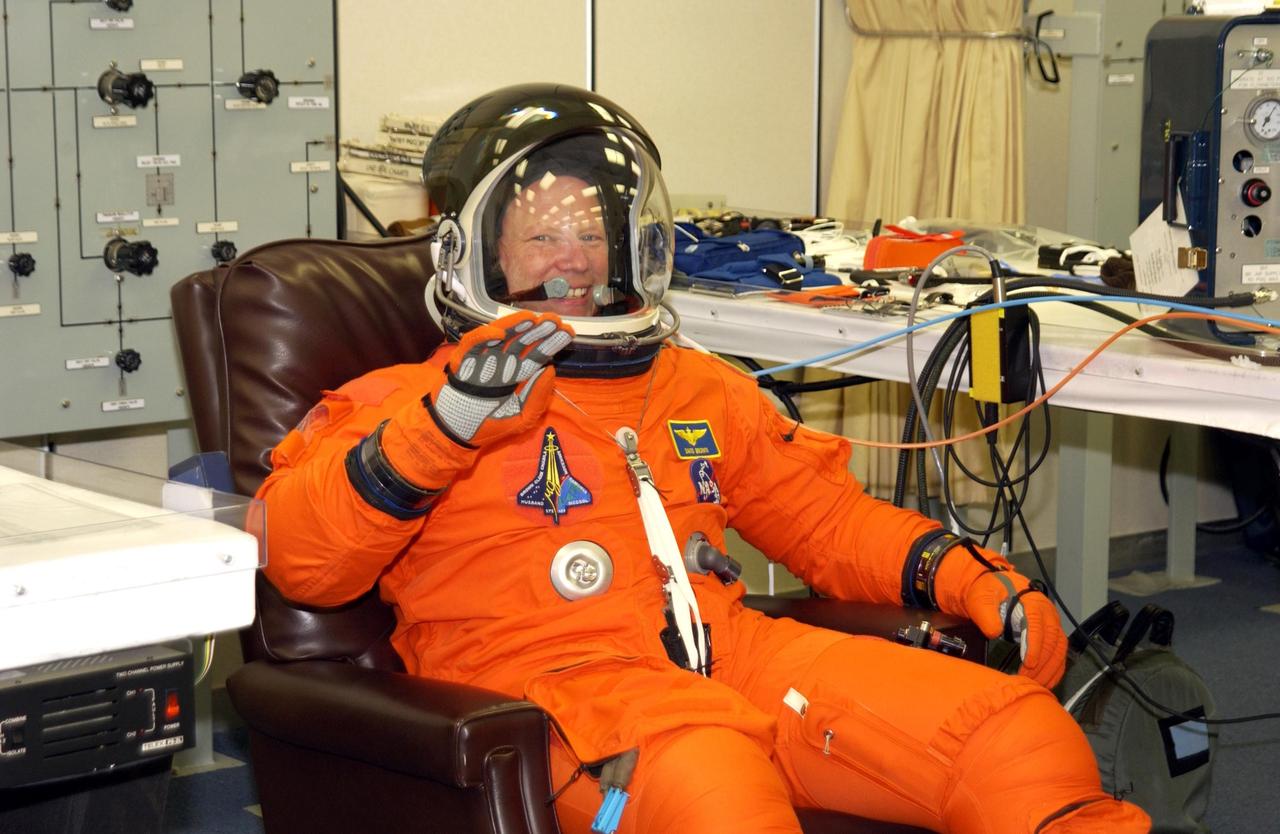
KENNEDY SPACE CENTER, FLA. -- STS-107 Mission Specialist David Brown waves as he completes suit check prior to Terminal Countdown Demonstration Test activities, which include a simulated launch countdown at the pad. STS-107 is a mission devoted to research and will include more than 80 experiments that will study Earth and space science, advanced technology development, and astronaut health and safety. Launch is planned for Jan. 16, 2003, between 10 a.m. and 2 p.m. EST aboard Space Shuttle Columbia. .
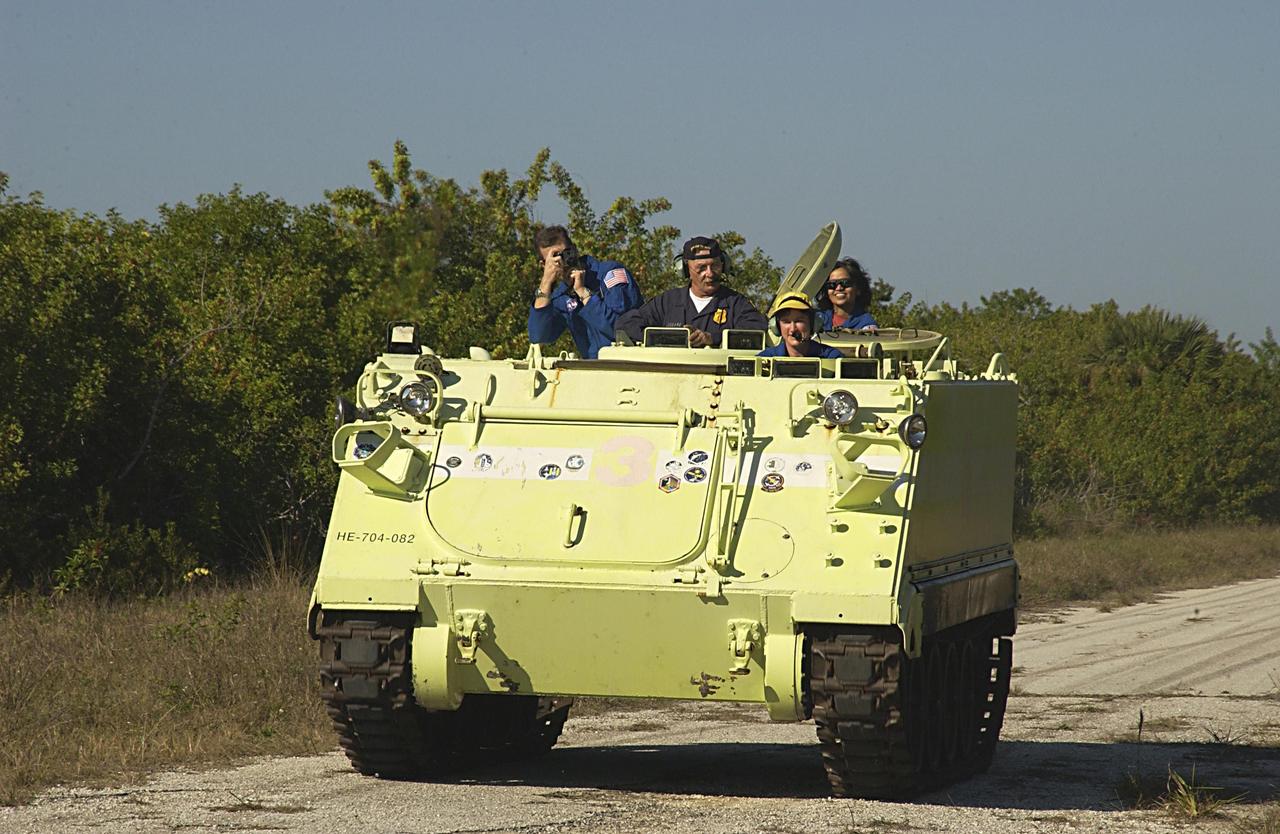
KENNEDY SPACE CENTER, FLA. -- STS-107 Mission Specialist Laurel Clark (in yellow cap) is instructed on the operation of an M113 armored personnel carrier during Terminal Countdown Demonstration Test activities, a standard part of launch preparations. STS-107 is a mission devoted to research and will include more than 80 experiments that will study Earth and space science, advanced technology development, and astronaut health and safety. Launch is planned for Jan. 16, 2003, between 10 a.m. and 2 p.m. EST aboard Space Shuttle Columbia.
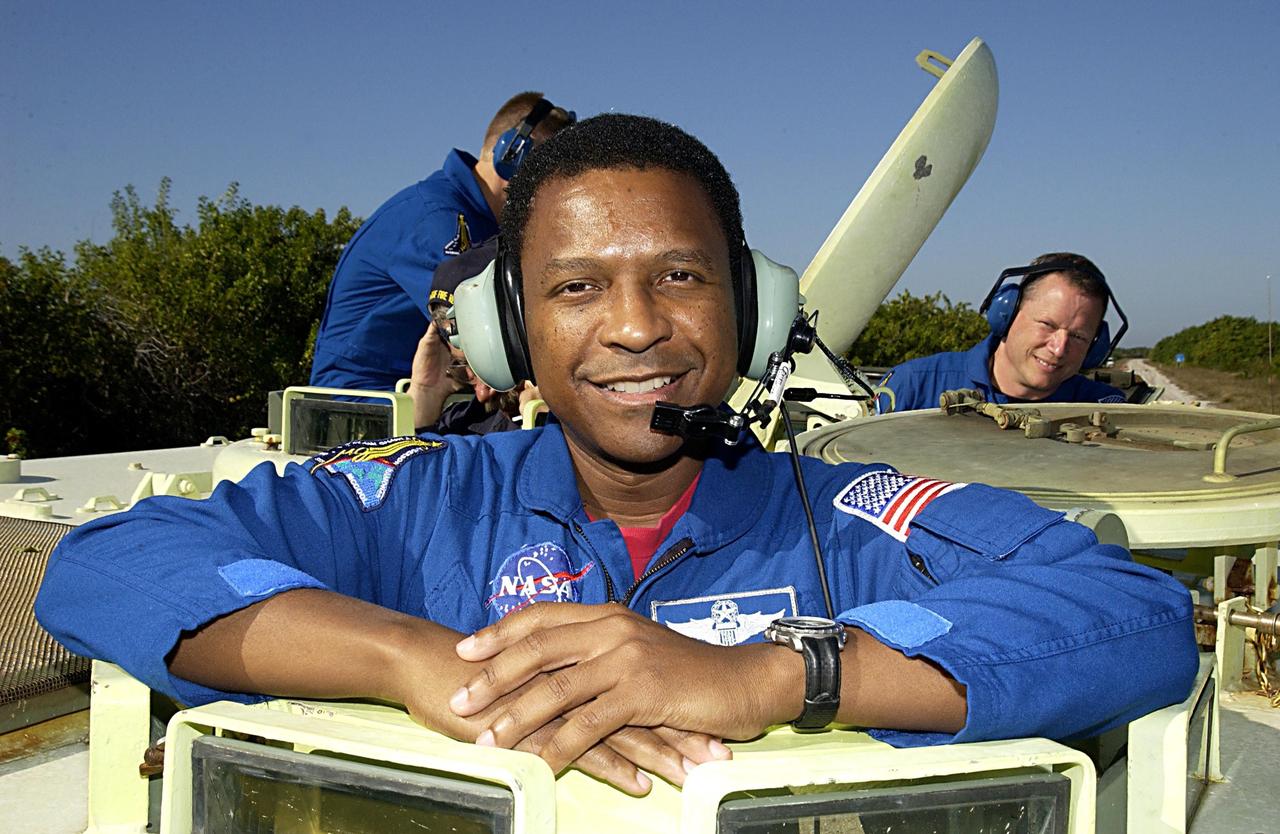
KENNEDY SPACE CENTER, FLA. -- -- STS-107 Payload Commander Michael Anderson takes a break during training on the operation of an M113 armored personnel carrier during Terminal Countdown Demonstration Test activities, a standard part of launch preparations. STS-107 is a mission devoted to research and will include more than 80 experiments that will study Earth and space science, advanced technology development, and astronaut health and safety. Launch is planned for Jan. 16, 2003, between 10 a.m. and 2 p.m. EST aboard Space Shuttle Columbia.
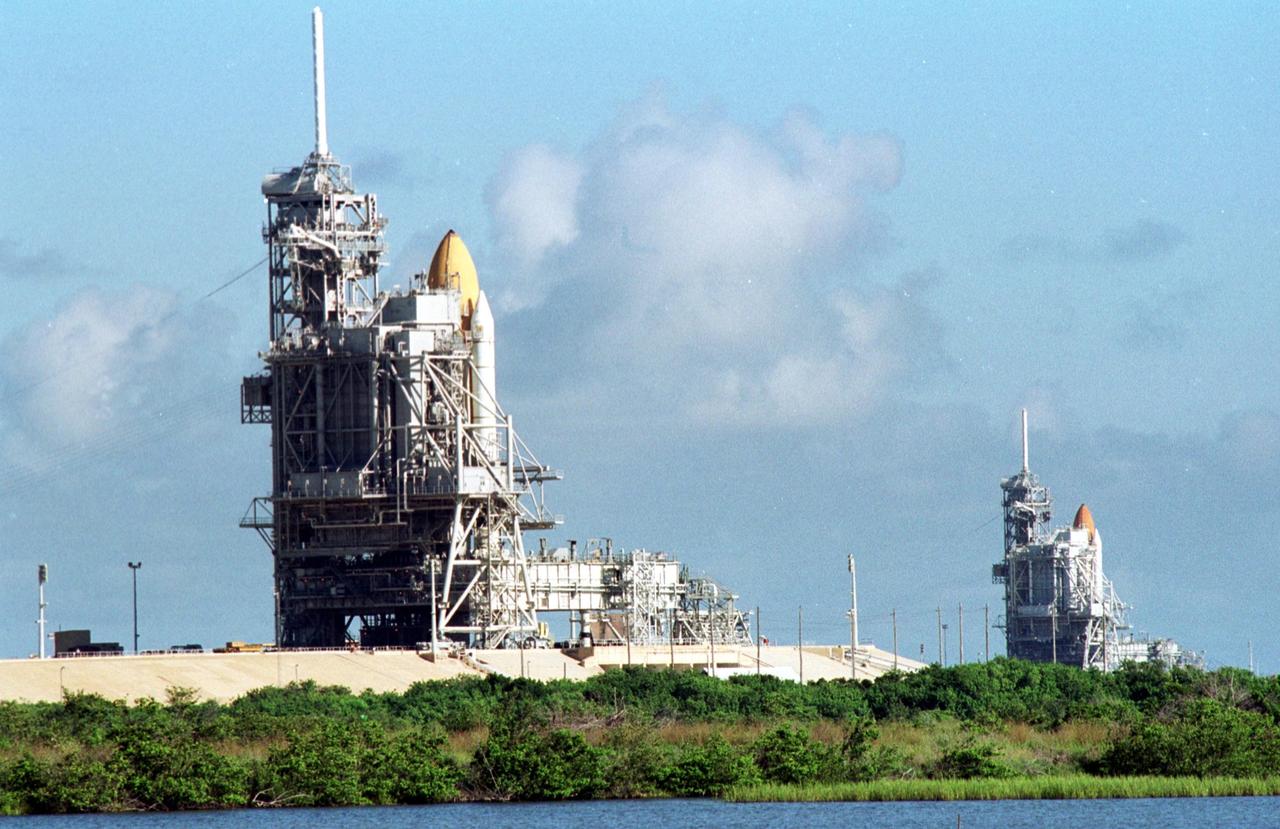
KENNEDY SPACE CENTER, Fla. -- Space Shuttle Discovery (foreground) and Space Shuttle Atlantis (background) both stand ready on their Launch Pads ( 39A and 39B respectively). Space Shuttle Discovery rolled out July 2 to be prepared for launch on mission STS-105 in August. Space Shuttle Atlantis is scheduled to launch Thursday, July 12, on mission STS-104. Towering above each Shuttle on the left is the 80-foot lightning rod that helps protect each Shuttle from lightning strikes
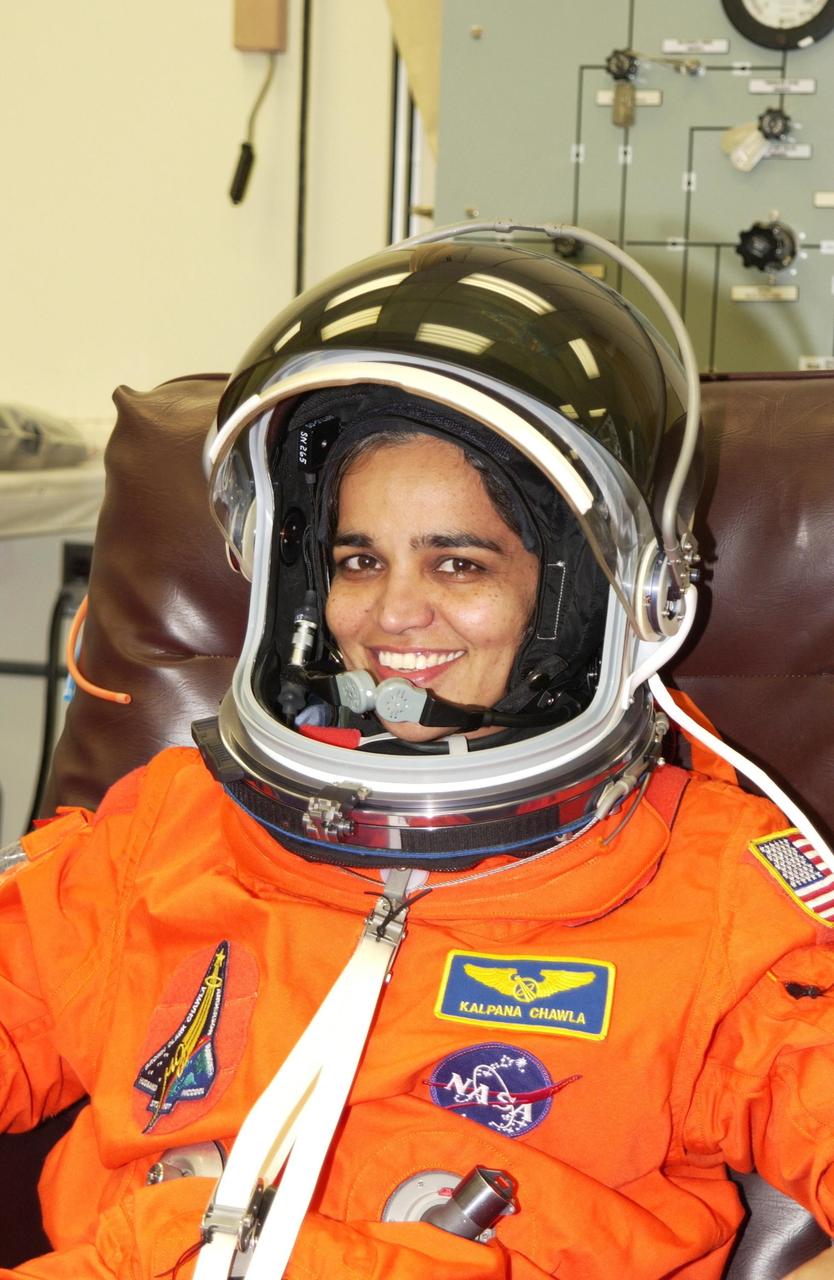
KENNEDY SPACE CENTER, FLA. -- STS-107 Mission Specialist Kalpana Chawla is helped suiting up for Terminal Countdown Demonstration Test activities, which include a simulated launch countdown at the pad. STS-107 is a mission devoted to research and will include more than 80 experiments that will study Earth and space science, advanced technology development, and astronaut health and safety. Launch is planned for Jan. 16, 2003, between 10 a.m. and 2 p.m. EST aboard Space Shuttle Columbia. .
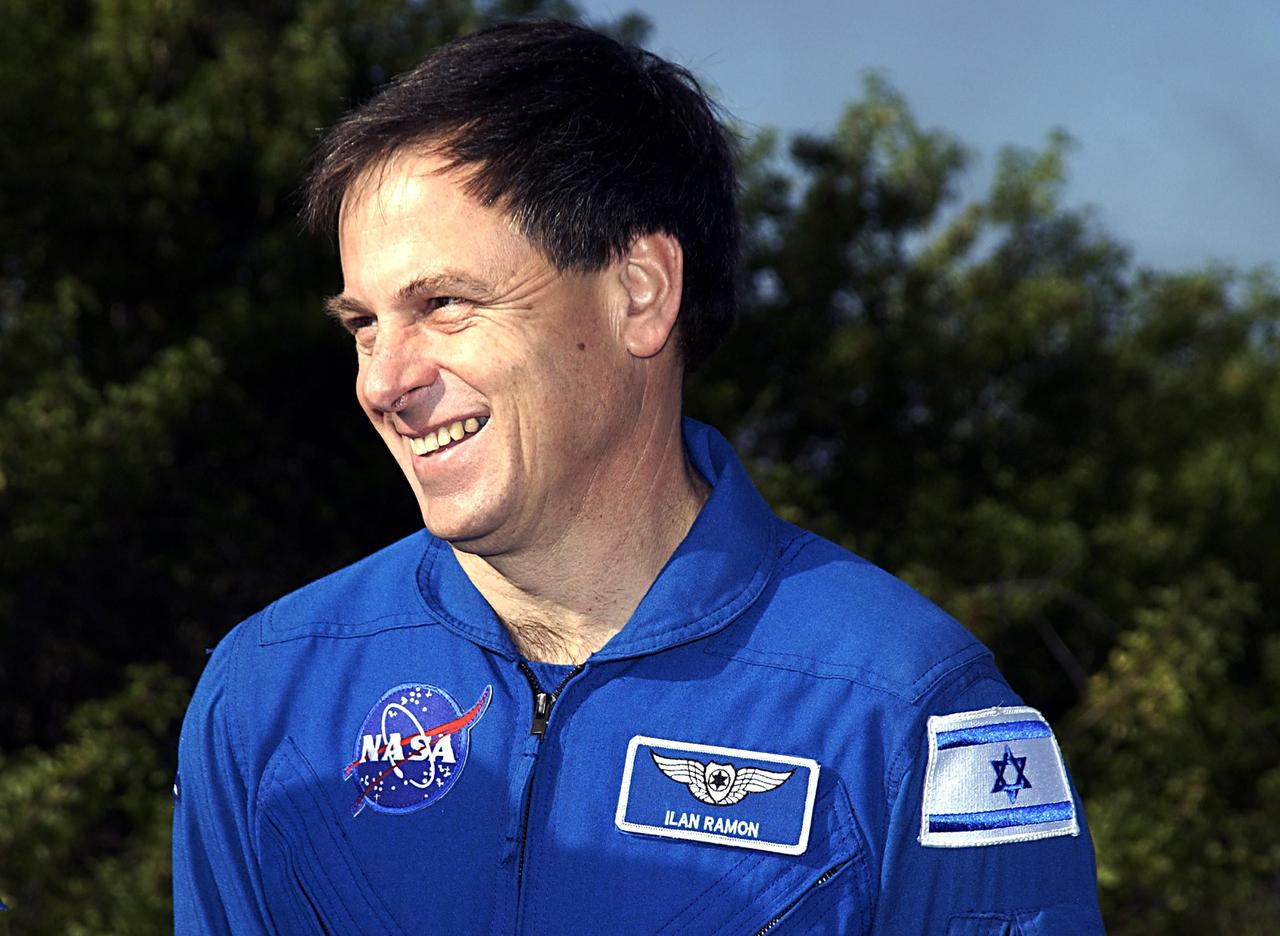
KENNEDY SPACE CENTER, FLA. -- STS-107 Payload Specialist Ilan Ramon, the first Israeli astronaut, participates in Terminal Countdown Demonstration Test activities, a standard part of Shuttle launch preparations. STS-107 is a mission devoted to research and will include more than 80 experiments that will study Earth and space science, advanced technology development, and astronaut health and safety. Launch is planned for Jan. 16, 2003, between 10 a.m. and 2 p.m. EST aboard Space Shuttle Columbia.
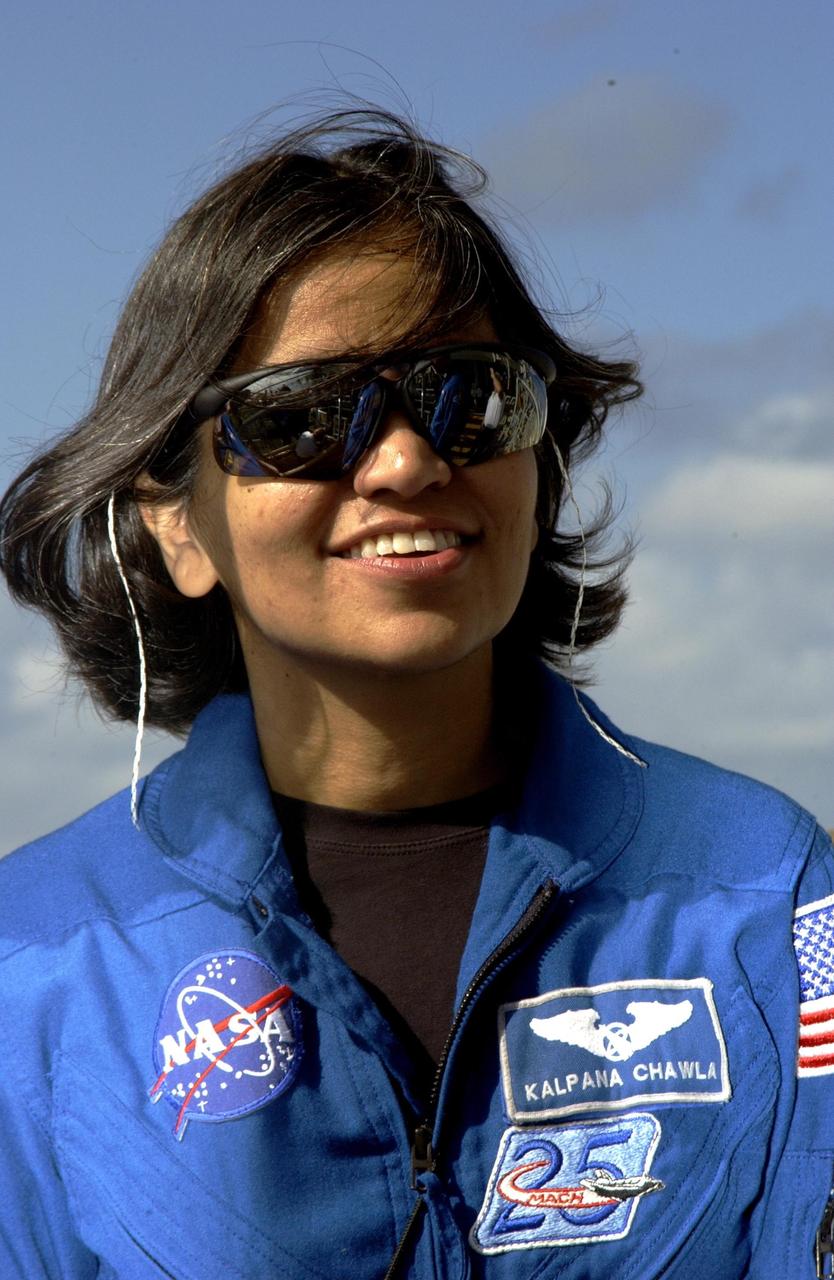
KENNEDY SPACE CENTER, FLA. - STS-107 Mission Specialist Kalpana Chawla is shown during the crew's Terminal Countdown Demonstration Test activities on Launch Pad 39A. The TCDT also includes a simulated launch countdown. STS-107 is a mission devoted to research and will include more than 80 experiments that will study Earth and space science, advanced technology development, and astronaut health and safety. Launch is planned for Jan. 16, 2003, between 10 a.m. and 2 p.m. EST aboard Space Shuttle Columbia. .
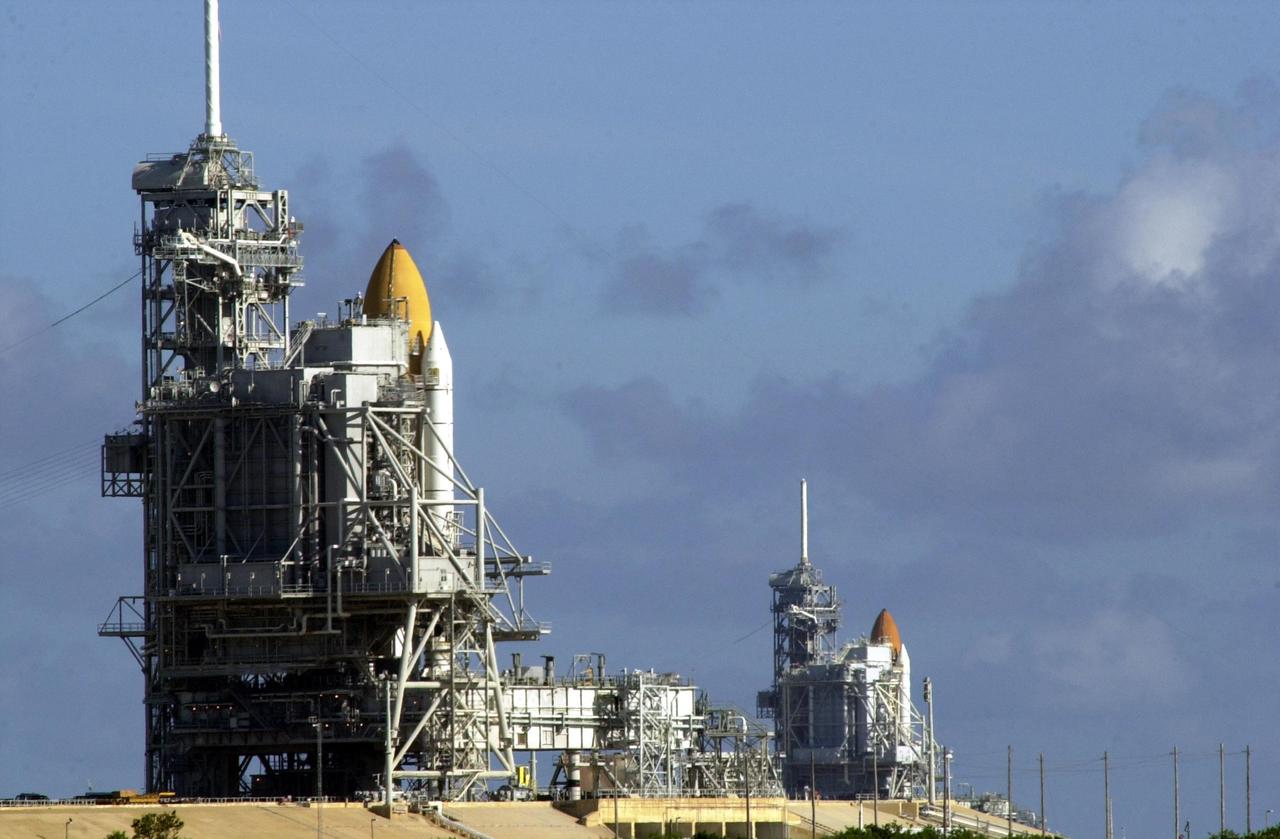
KENNEDY SPACE CENTER, Fla. - Space Shuttle Discovery (foreground) and Space Shuttle Atlantis (background) both stand ready on their Launch Pads ( 39A and 39B respectively). Space Shuttle Discovery rolled out July 2 to be prepared for launch on mission STS-105 in August. Space Shuttle Atlantis is scheduled to launch Thursday, July 12, on mission STS-104. Towering above each Shuttle on the left is the 80-foot lightning rod that helps protect each Shuttle from lightning strikes
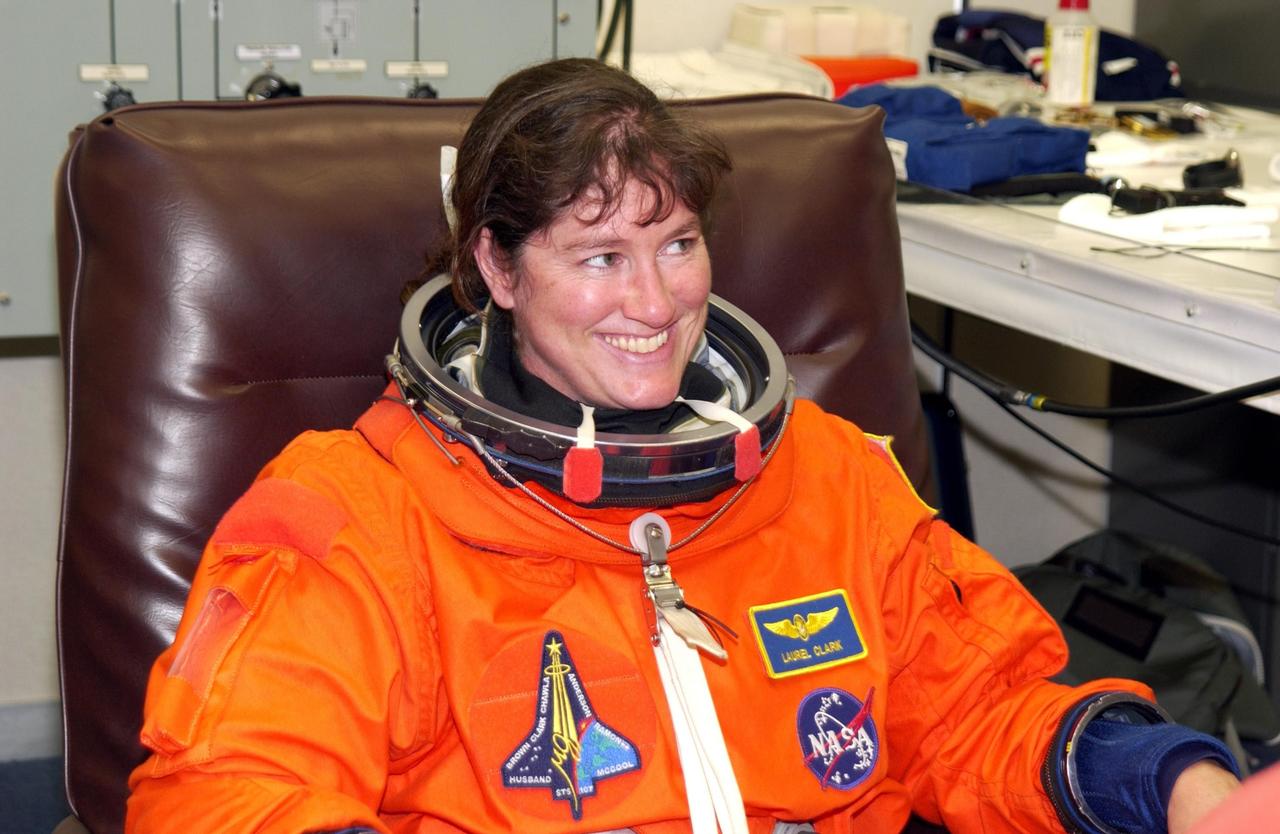
KENNEDY SPACE CENTER, FLA. - STS-107 Mission Specialist Laurel Clark happily submits to suit check prior to Terminal Countdown Demonstration Test activities, which include a simulated launch countdown at the pad. STS-107 is a mission devoted to research and will include more than 80 experiments that will study Earth and space science, advanced technology development, and astronaut health and safety. Launch is planned for Jan. 16, 2003, between 10 a.m. and 2 p.m. EST aboard Space Shuttle Columbia. .

KENNEDY SPACE CENTER, FLA. - STS-107 Payload Commander Michael Anderson smiles as he undergoes suit check prior to Terminal Countdown Demonstration Test activities, which include a simulated launch countdown at the pad. STS-107 is a mission devoted to research and will include more than 80 experiments that will study Earth and space science, advanced technology development, and astronaut health and safety. Launch is planned for Jan. 16, 2003, between 10 a.m. and 2 p.m. EST aboard Space Shuttle Columbia. .
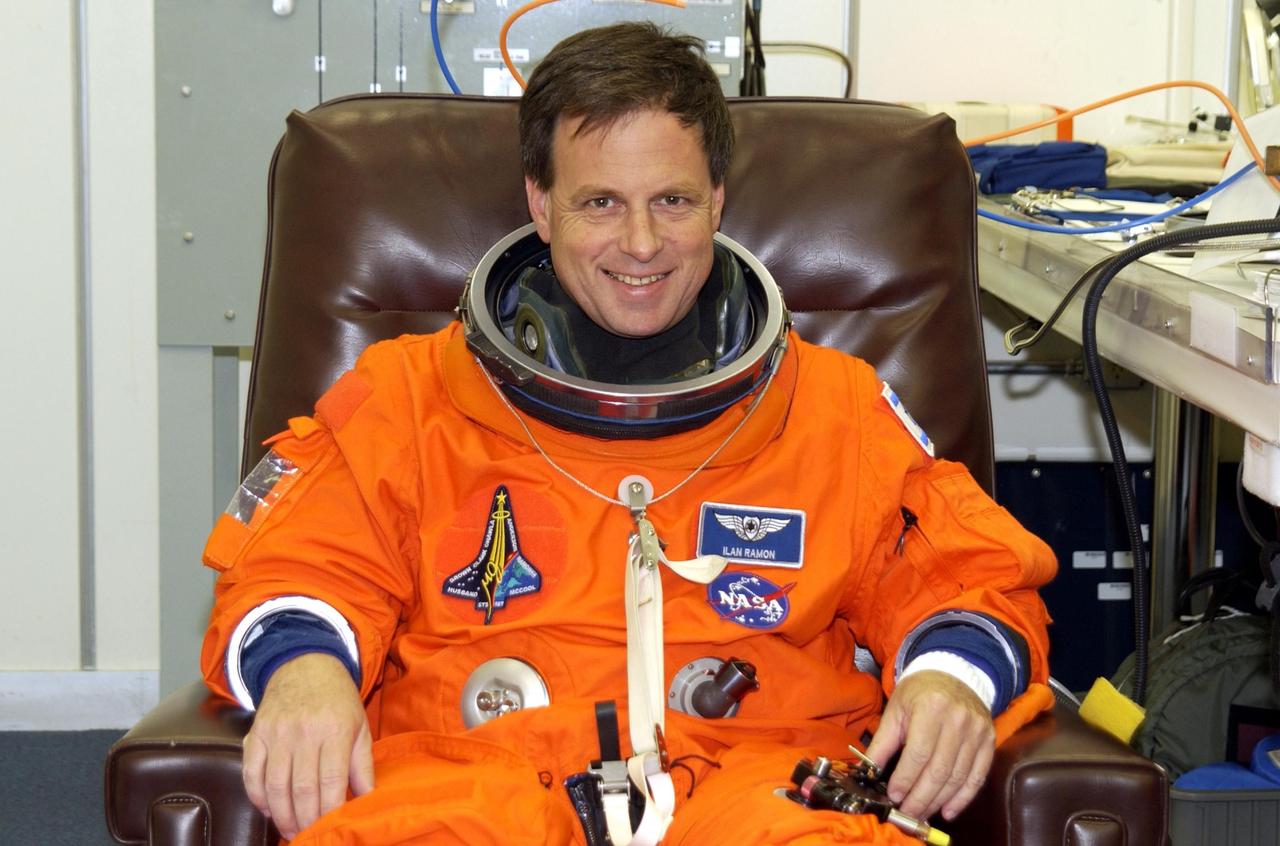
KENNEDY SPACE CENTER, FLA. - STS-107 Payload Specialist Ilan Ramon, the first Israeli astronaut, sits happily during suitup for Terminal Countdown Demonstration Test activities, which include a simulated launch countdown at the pad. STS-107 is a mission devoted to research and will include more than 80 experiments that will study Earth and space science, advanced technology development, and astronaut health and safety. Launch is planned for Jan. 16, 2003, between 10 a.m. and 2 p.m. EST aboard Space Shuttle Columbia. .
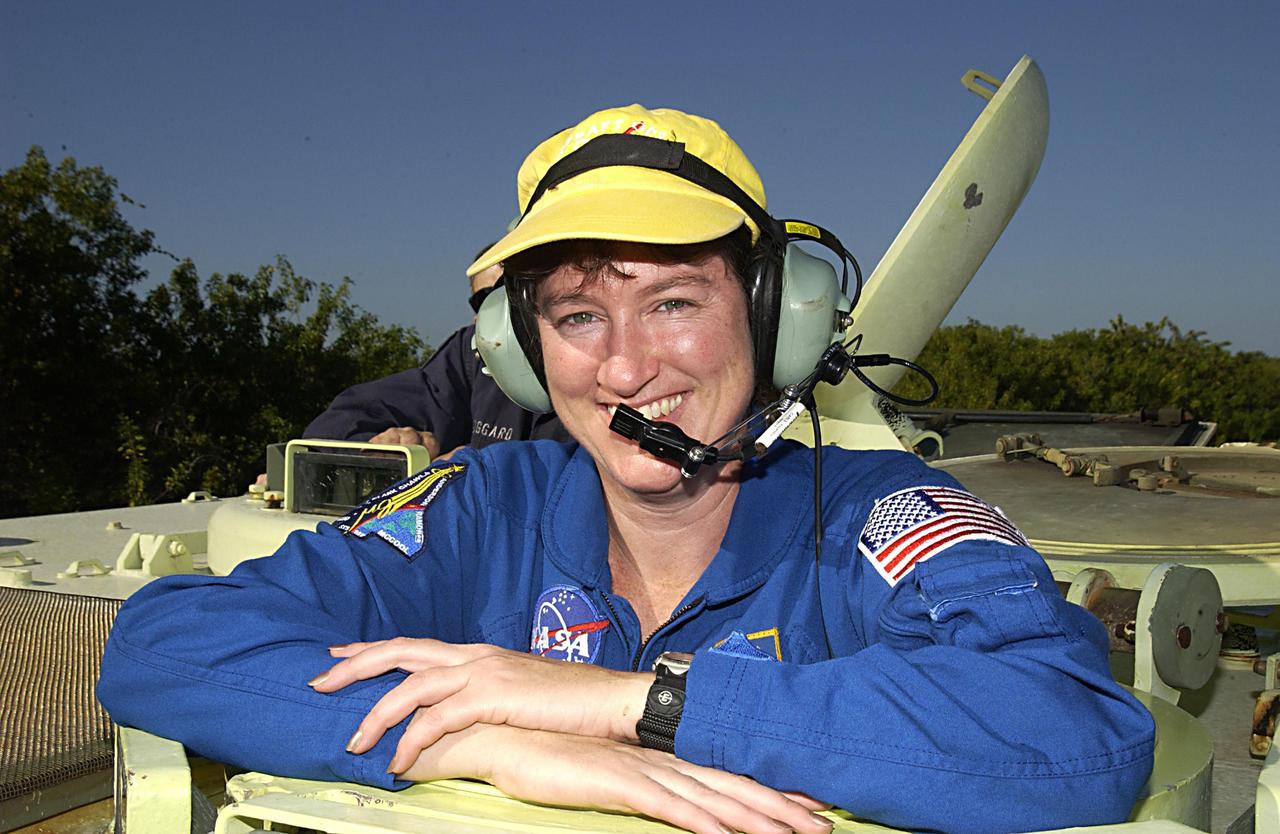
KENNEDY SPACE CENTER, FLA. -- STS-107 Mission Specialist Laurel Clark takes a break during training on the operation of an M113 armored personnel carrier during Terminal Countdown Demonstration Test activities, a standard part of launch preparations. STS-107 is a mission devoted to research and will include more than 80 experiments that will study Earth and space science, advanced technology development, and astronaut health and safety. Launch is planned for Jan. 16, 2003, between 10 a.m. and 2 p.m. EST aboard Space Shuttle Columbia.

KENNEDY SPACE CENTER, FLA. -- STS-107 Payload Specialist Ilan Ramon, the first Israeli astronaut, gets help with his suitup for Terminal Countdown Demonstration Test activities, which include a simulated launch countdown at the pad. STS-107 is a mission devoted to research and will include more than 80 experiments that will study Earth and space science, advanced technology development, and astronaut health and safety. Launch is planned for Jan. 16, 2003, between 10 a.m. and 2 p.m. EST aboard Space Shuttle Columbia. .
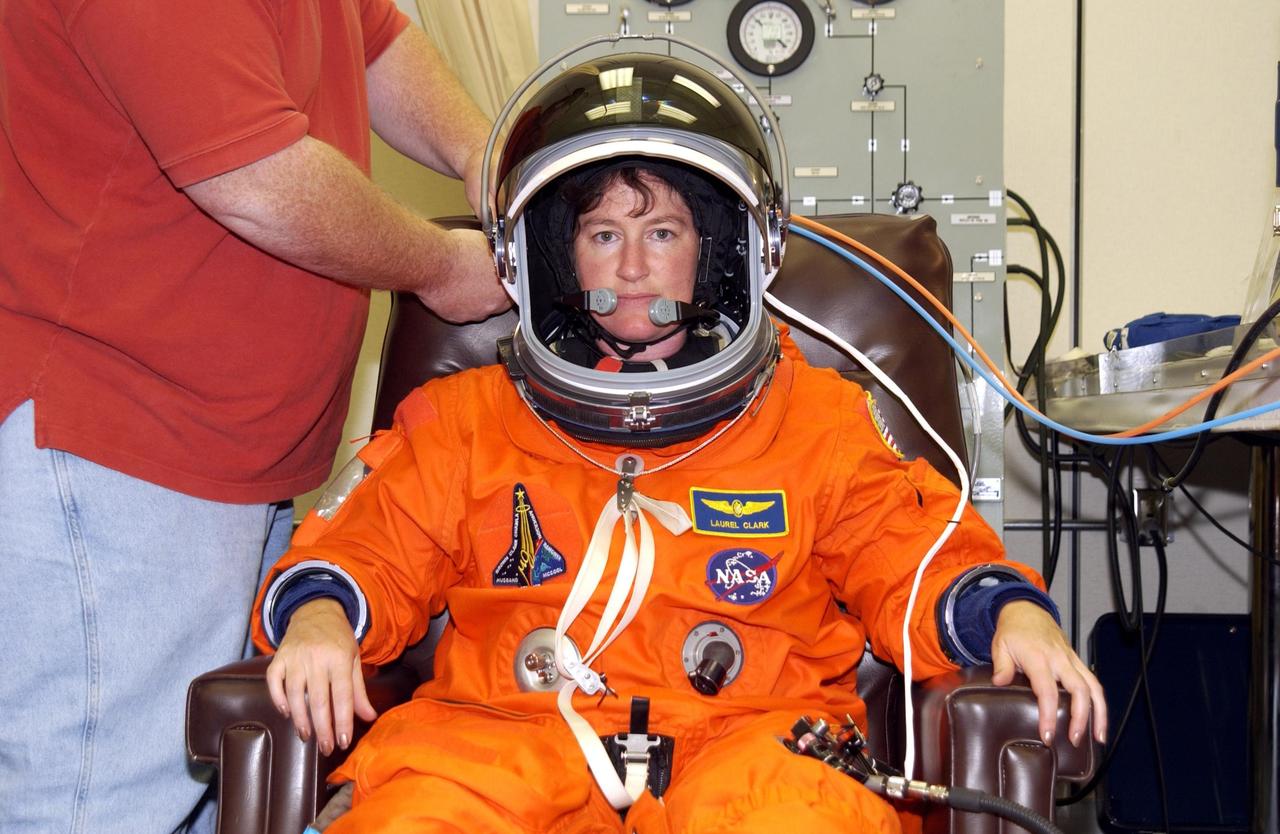
KENNEDY SPACE CENTER, FLA. -- STS-107 Mission Specialist Laurel Clark has her helmet checked during suitup for Terminal Countdown Demonstration Test activities, which include a simulated launch countdown at the pad. STS-107 is a mission devoted to research and will include more than 80 experiments that will study Earth and space science, advanced technology development, and astronaut health and safety. Launch is planned for Jan. 16, 2003, between 10 a.m. and 2 p.m. EST aboard Space Shuttle Columbia. .
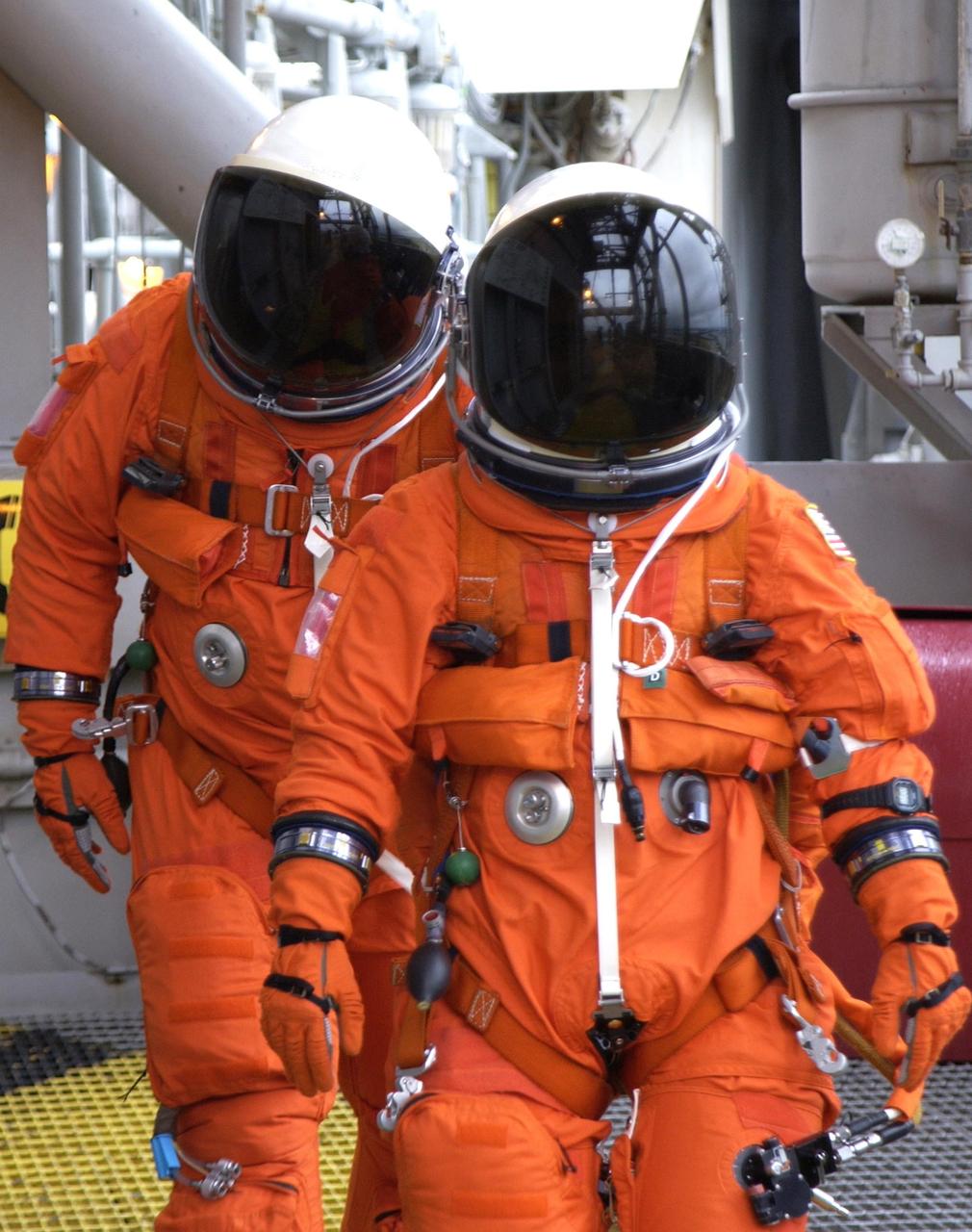
KENNEDY SPACE CENTER, FLA. - The STS-107 crew practice emergency egress from the launch pad during a simulated launch countdown, part of Terminal Countdown Demonstration Test activities. STS-107 is a mission devoted to research and will include more than 80 experiments that will study Earth and space science, advanced technology development, and astronaut health and safety. Launch is planned for Jan. 16, 2003, between 10 a.m. and 2 p.m. EST aboard Space Shuttle Columbia. .
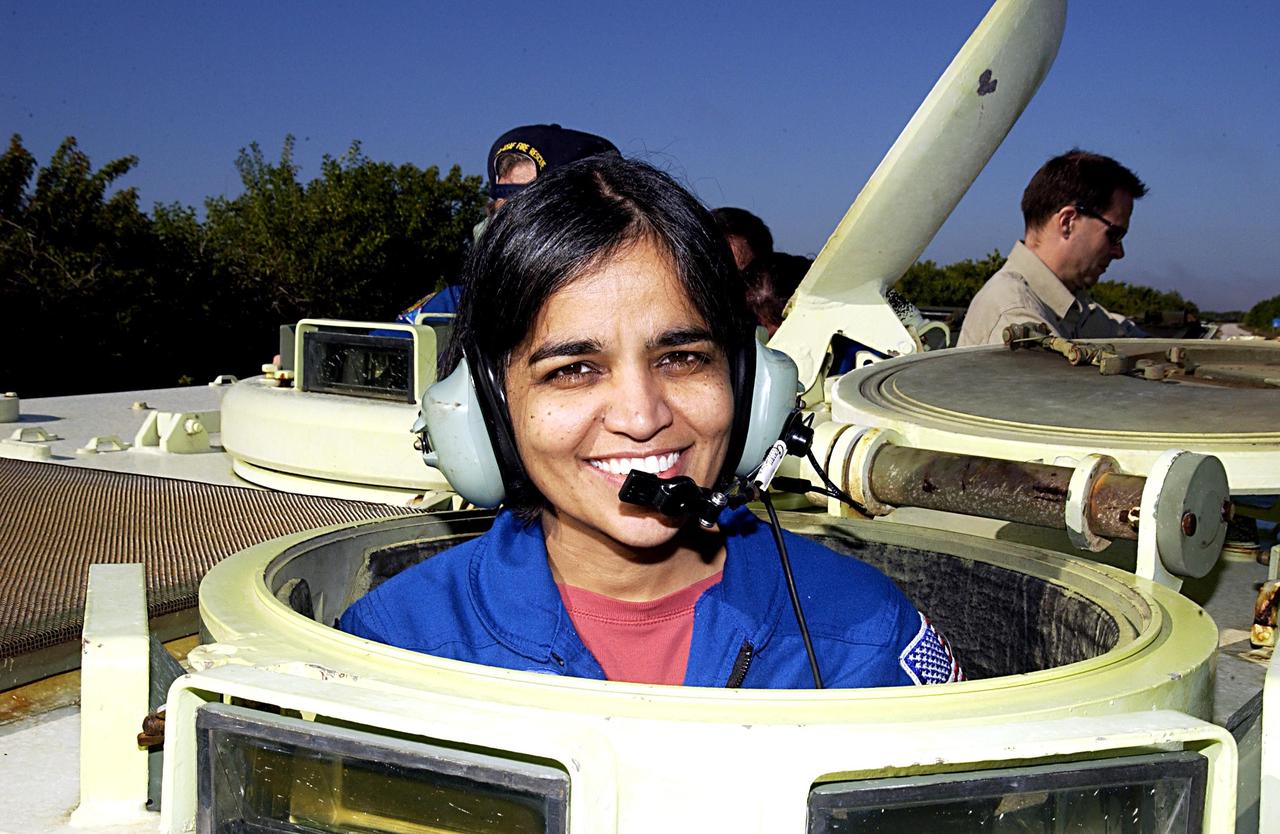
KENNEDY SPACE CENTER, FLA. -- STS-107 Mission Specialist Kalpana Chawla takes a break during training on the operation of an M113 armored personnel carrier during Terminal Countdown Demonstration Test activities, a standard part of launch preparations. STS-107 is a mission devoted to research and will include more than 80 experiments that will study Earth and space science, advanced technology development, and astronaut health and safety. Launch is planned for Jan. 16, 2003, between 10 a.m. and 2 p.m. EST aboard Space Shuttle Columbia.
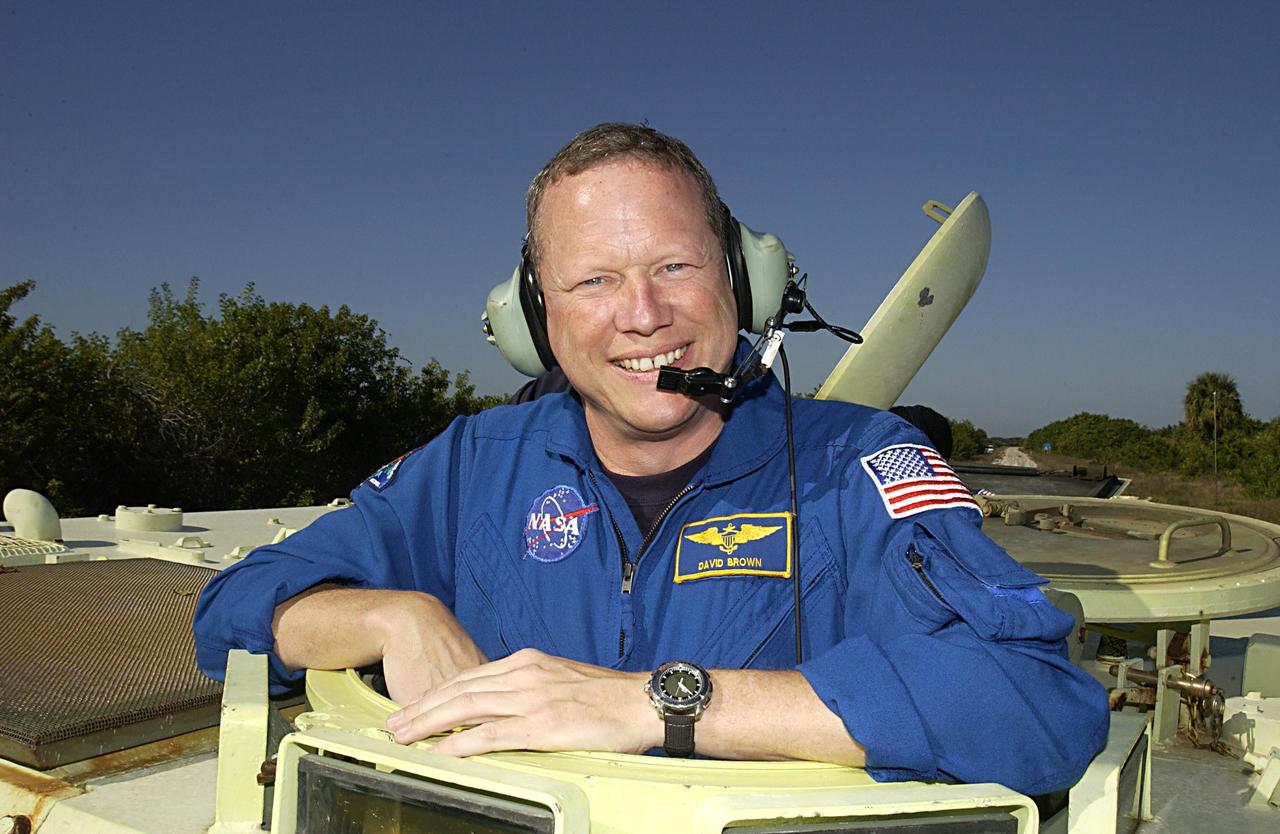
KENNEDY SPACE CENTER, FLA. -- -- STS-107 Mission Specialist David Brown takes a break during training on the operation of an M113 armored personnel carrier during Terminal Countdown Demonstration Test activities, a standard part of launch preparations. STS-107 is a mission devoted to research and will include more than 80 experiments that will study Earth and space science, advanced technology development, and astronaut health and safety. Launch is planned for Jan. 16, 2003, between 10 a.m. and 2 p.m. EST aboard Space Shuttle Columbia.
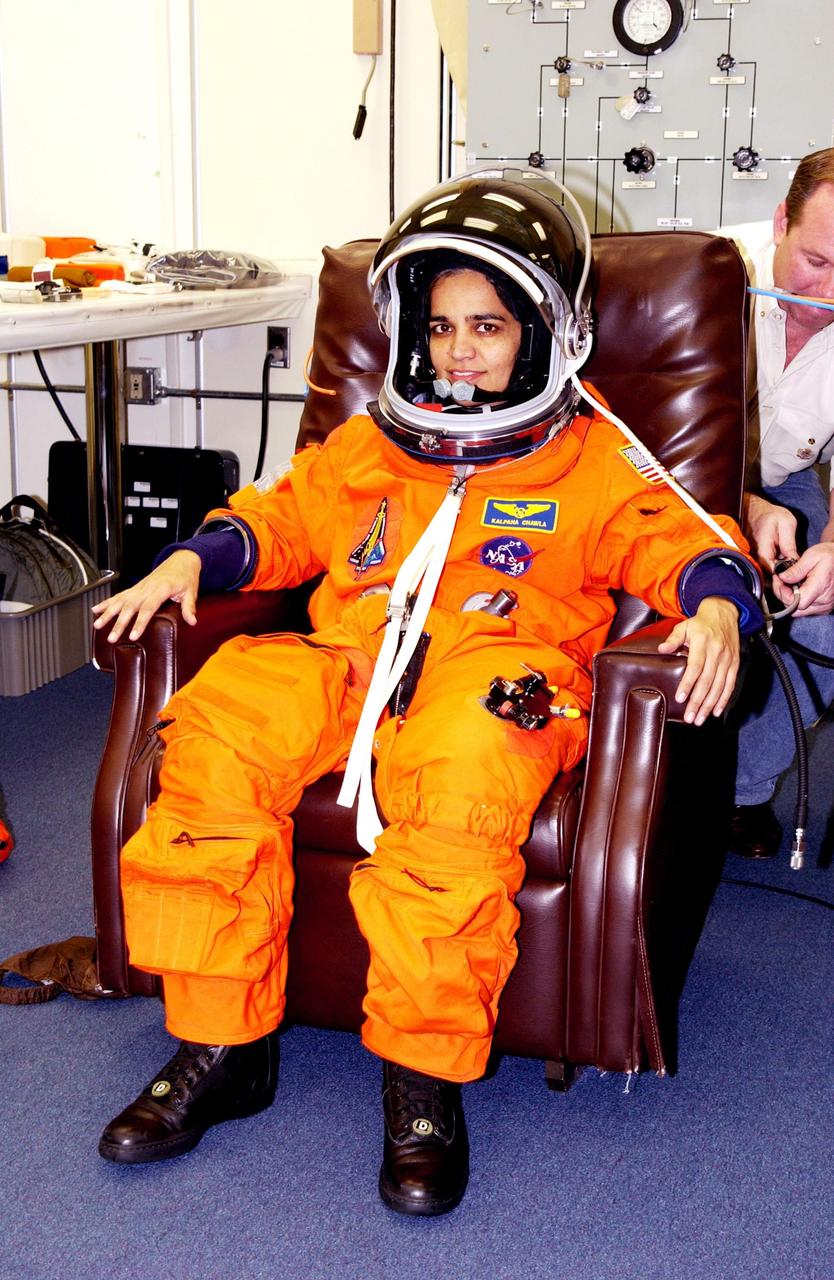
KENNEDY SPACE CENTER, FLA. -- STS-107 Mission Specialist Kalpana Chawla is helped suiting up for Terminal Countdown Demonstration Test activities, which include a simulated launch countdown at the pad. STS-107 is a mission devoted to research and will include more than 80 experiments that will study Earth and space science, advanced technology development, and astronaut health and safety. Launch is planned for Jan. 16, 2003, between 10 a.m. and 2 p.m. EST aboard Space Shuttle Columbia. .
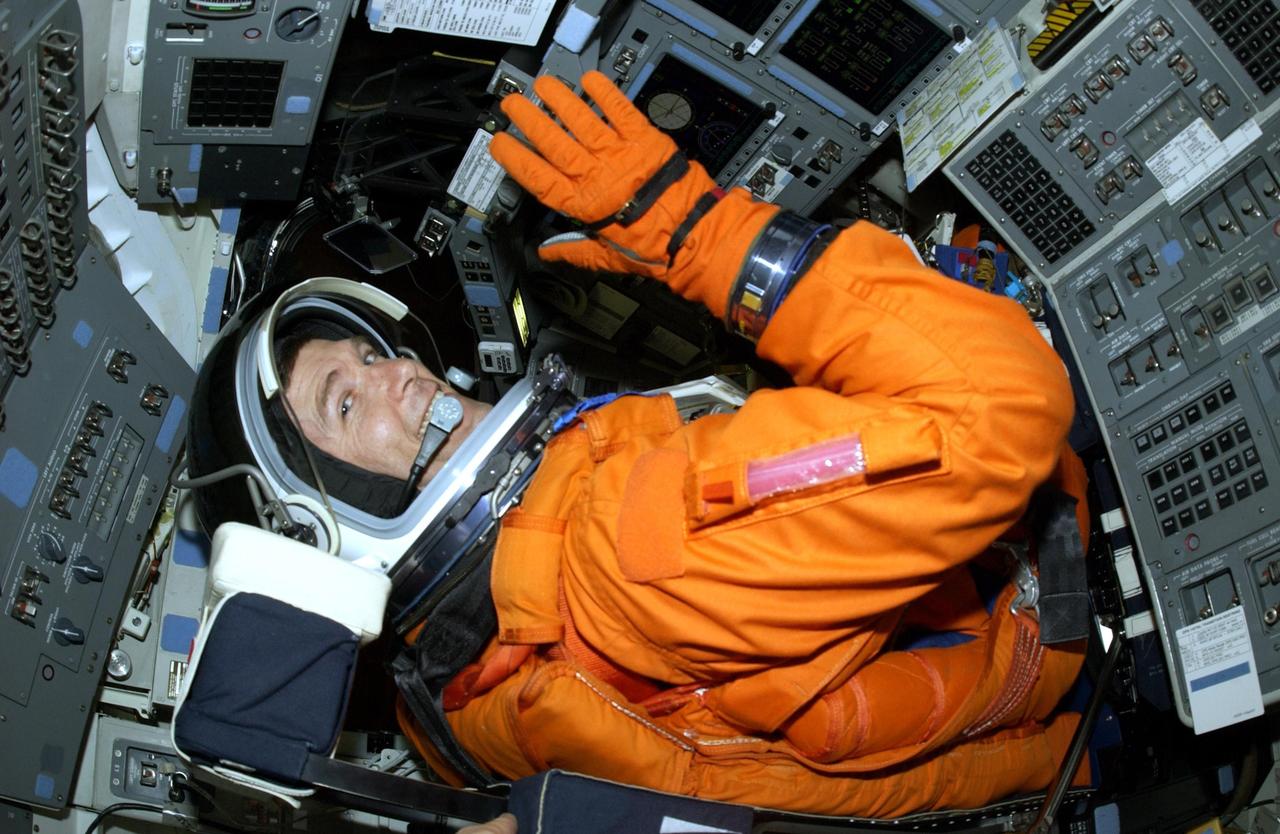
KENNEDY SPACE CENTER, FLA. - STS-107 Commander Rick Husband sits in the cockpit of Space Shuttle Columbia during a simulated launch countdown, part of Terminal Countdown Demonstration Test activities. STS-107 is a mission devoted to research and will include more than 80 experiments that will study Earth and space science, advanced technology development, and astronaut health and safety. Launch is planned for Jan. 16, 2003, between 10 a.m. and 2 p.m. EST aboard Space Shuttle Columbia. .

KENNEDY SPACE CENTER, FLA. -- After their arrival at KSC, STS-107 Payload Commander Michael Anderson and Mission Specialist Kalpana Chawla head to crew quarters. They and the rest of the crew are at KSC to take part in Terminal Countdown Demonstration Test activities, which include a simulated launch countdown. STS-107 is a mission devoted to research and will include more than 80 experiments that will study Earth and space science, advanced technology development, and astronaut health and safety. Launch is scheduled for Jan. 16, 2003.
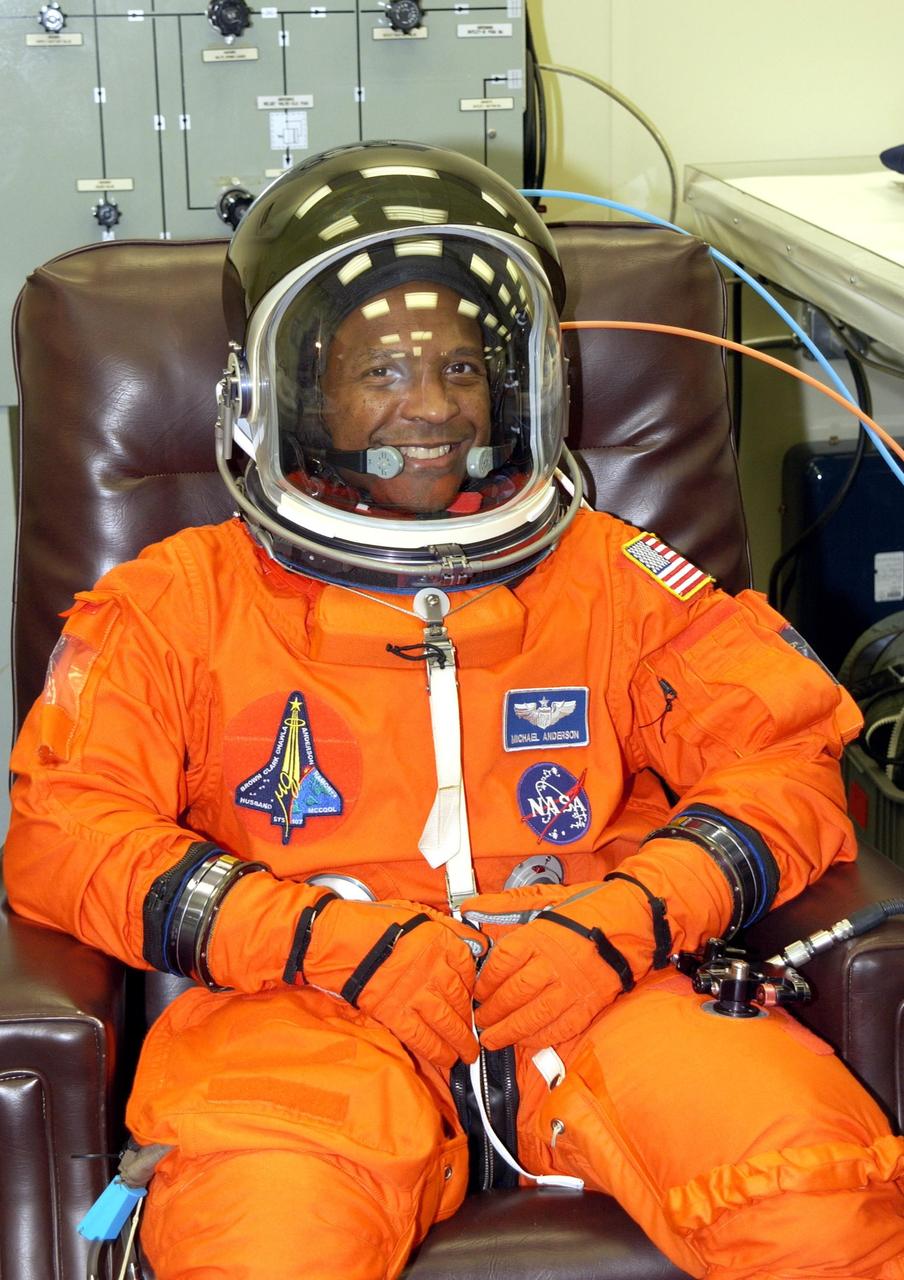
KENNEDY SPACE CENTER, FLA. -- STS-107 Payload Commander Michael Anderson completes suit check prior to Terminal Countdown Demonstration Test activities, which include a simulated launch countdown at the pad. STS-107 is a mission devoted to research and will include more than 80 experiments that will study Earth and space science, advanced technology development, and astronaut health and safety. Launch is planned for Jan. 16, 2003, between 10 a.m. and 2 p.m. EST aboard Space Shuttle Columbia. .
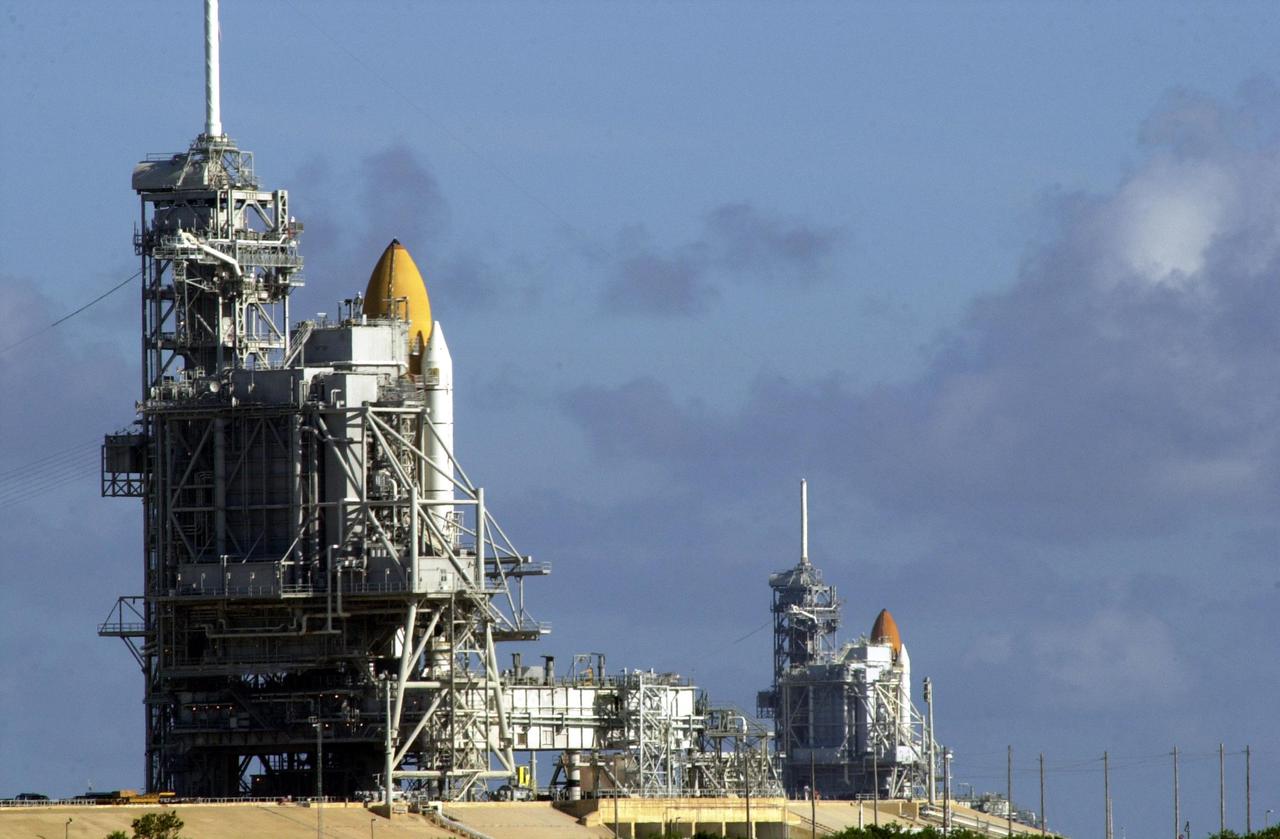
KENNEDY SPACE CENTER, Fla. - Space Shuttle Discovery (foreground) and Space Shuttle Atlantis (background) both stand ready on their Launch Pads ( 39A and 39B respectively). Space Shuttle Discovery rolled out July 2 to be prepared for launch on mission STS-105 in August. Space Shuttle Atlantis is scheduled to launch Thursday, July 12, on mission STS-104. Towering above each Shuttle on the left is the 80-foot lightning rod that helps protect each Shuttle from lightning strikes
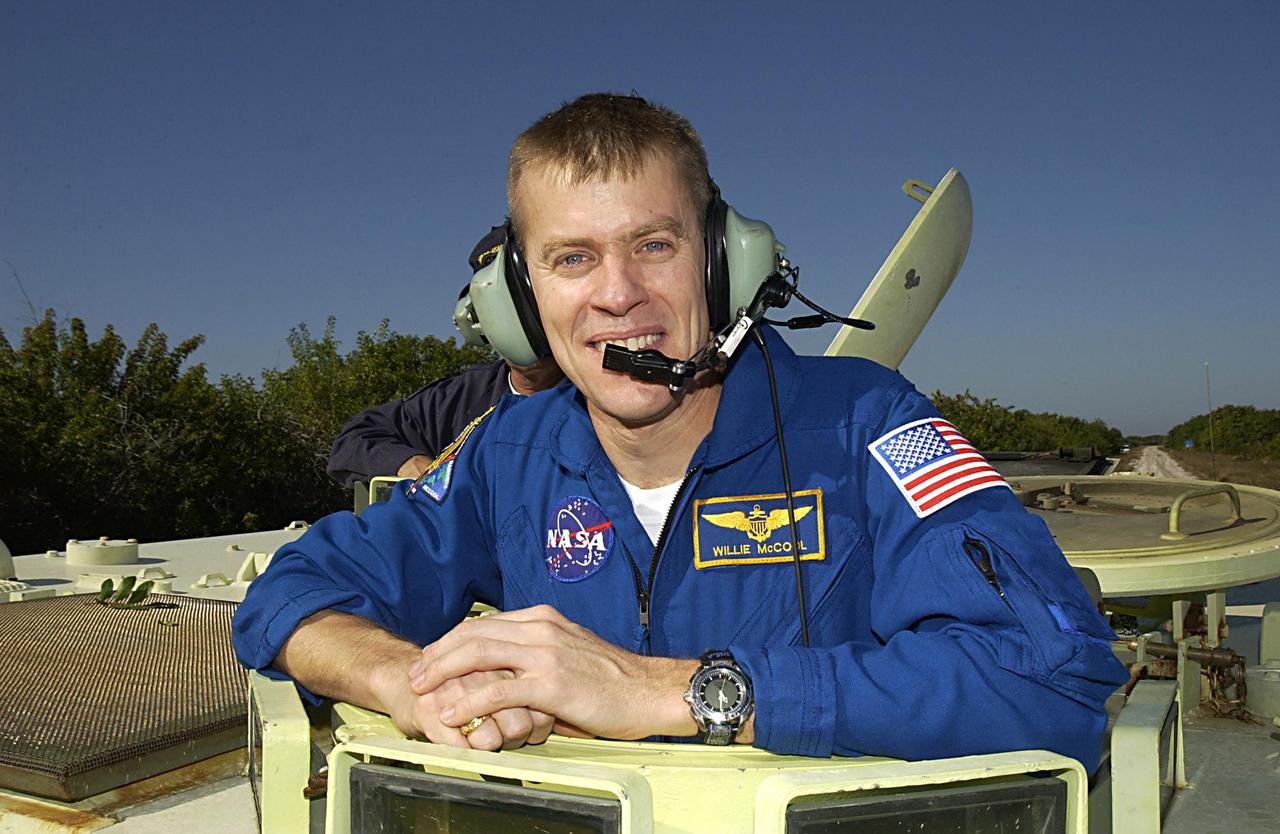
KENNEDY SPACE CENTER, FLA. -- -- STS-107 Pilot William "Willie" McCool takes a break during training on the operation of an M113 armored personnel carrier during Terminal Countdown Demonstration Test activities, a standard part of launch preparations. STS-107 is a mission devoted to research and will include more than 80 experiments that will study Earth and space science, advanced technology development, and astronaut health and safety. Launch is planned for Jan. 16, 2003, between 10 a.m. and 2 p.m. EST aboard Space Shuttle Columbia.
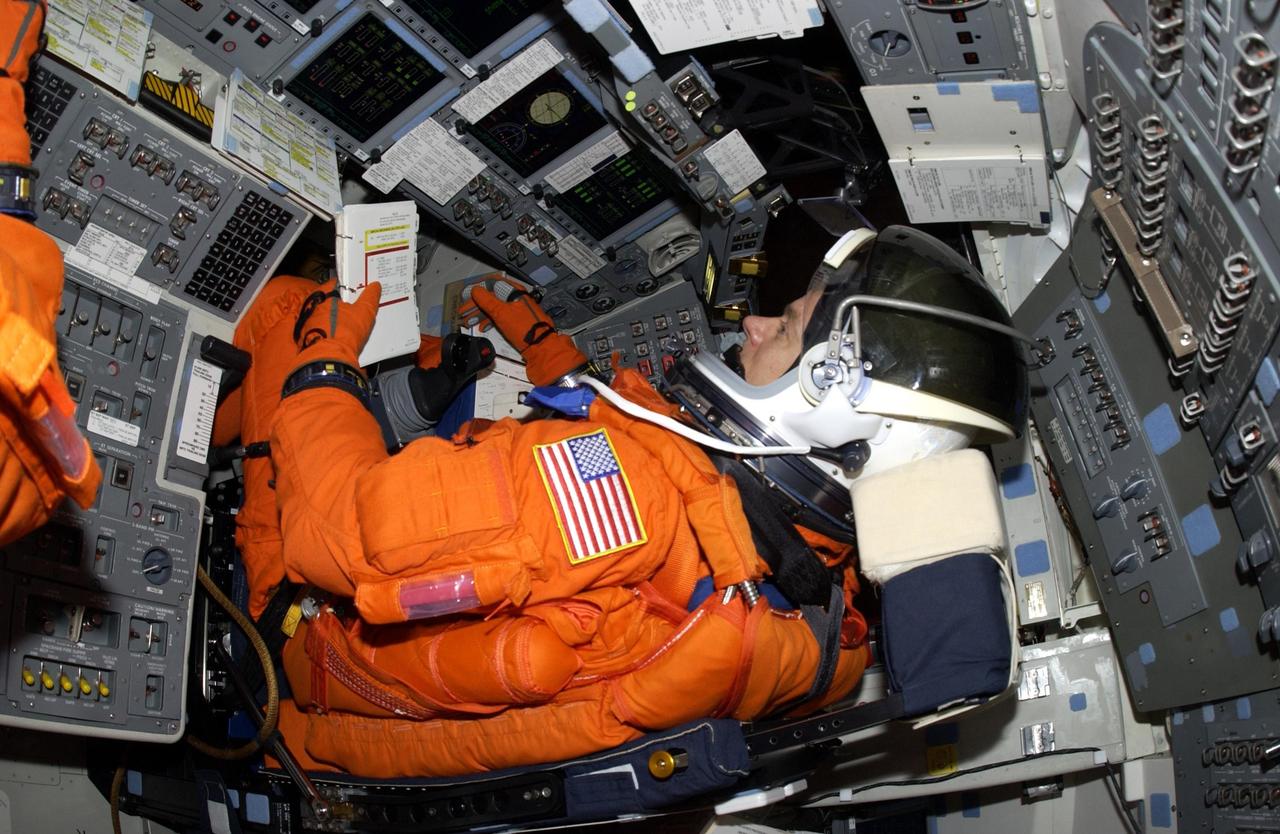
KENNEDY SPACE CENTER, FLA. - STS-107 Pilot William "Willie" McCool checks instructions in the cockpit of Space Shuttle Columbia during a simulated launch countdown, part of Terminal Countdown Demonstration Test activities. STS-107 is a mission devoted to research and will include more than 80 experiments that will study Earth and space science, advanced technology development, and astronaut health and safety. Launch is planned for Jan. 16, 2003, between 10 a.m. and 2 p.m. EST aboard Space Shuttle Columbia. .
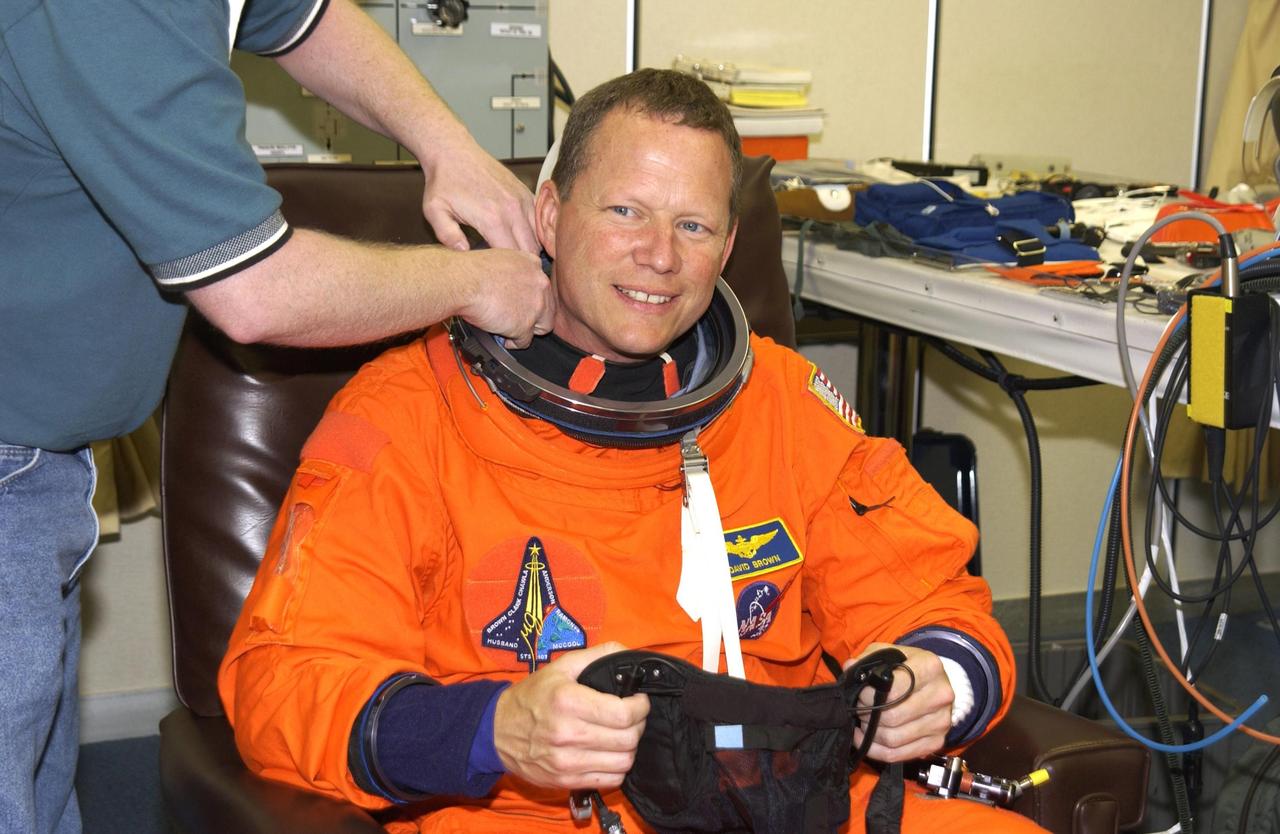
KENNEDY SPACE CENTER, FLA. -- STS-107 Mission Specialist David Brown happily submits to suit check prior to Terminal Countdown Demonstration Test activities, which include a simulated launch countdown at the pad. STS-107 is a mission devoted to research and will include more than 80 experiments that will study Earth and space science, advanced technology development, and astronaut health and safety. Launch is planned for Jan. 16, 2003, between 10 a.m. and 2 p.m. EST aboard Space Shuttle Columbia. .
![KENNEDY SPACE CENTER, FLA. -- At the conclusion of Terminal Countdown Demonstration Test activities, the STS-107 crew returns to Houston. In the cockpit of the T-38 jet trainer is Pilot William "Willie" McCool. Reflected in his helmet is another T-38 with other crew members. The launch of mission STS-107 is planned for Jan. 16, 2003, between 10 a.m. and 2 p.m. EST aboard Space Shuttle Columbia. A mission devoted to research, STS-107 will include more than 80 experiments that will study Earth and space science, advanced technology development, and astronaut health and safety. [Photo by: astronaut Willie McCool]](https://images-assets.nasa.gov/image/KSC-02pd2066/KSC-02pd2066~medium.jpg)
KENNEDY SPACE CENTER, FLA. -- At the conclusion of Terminal Countdown Demonstration Test activities, the STS-107 crew returns to Houston. In the cockpit of the T-38 jet trainer is Pilot William "Willie" McCool. Reflected in his helmet is another T-38 with other crew members. The launch of mission STS-107 is planned for Jan. 16, 2003, between 10 a.m. and 2 p.m. EST aboard Space Shuttle Columbia. A mission devoted to research, STS-107 will include more than 80 experiments that will study Earth and space science, advanced technology development, and astronaut health and safety. [Photo by: astronaut Willie McCool]
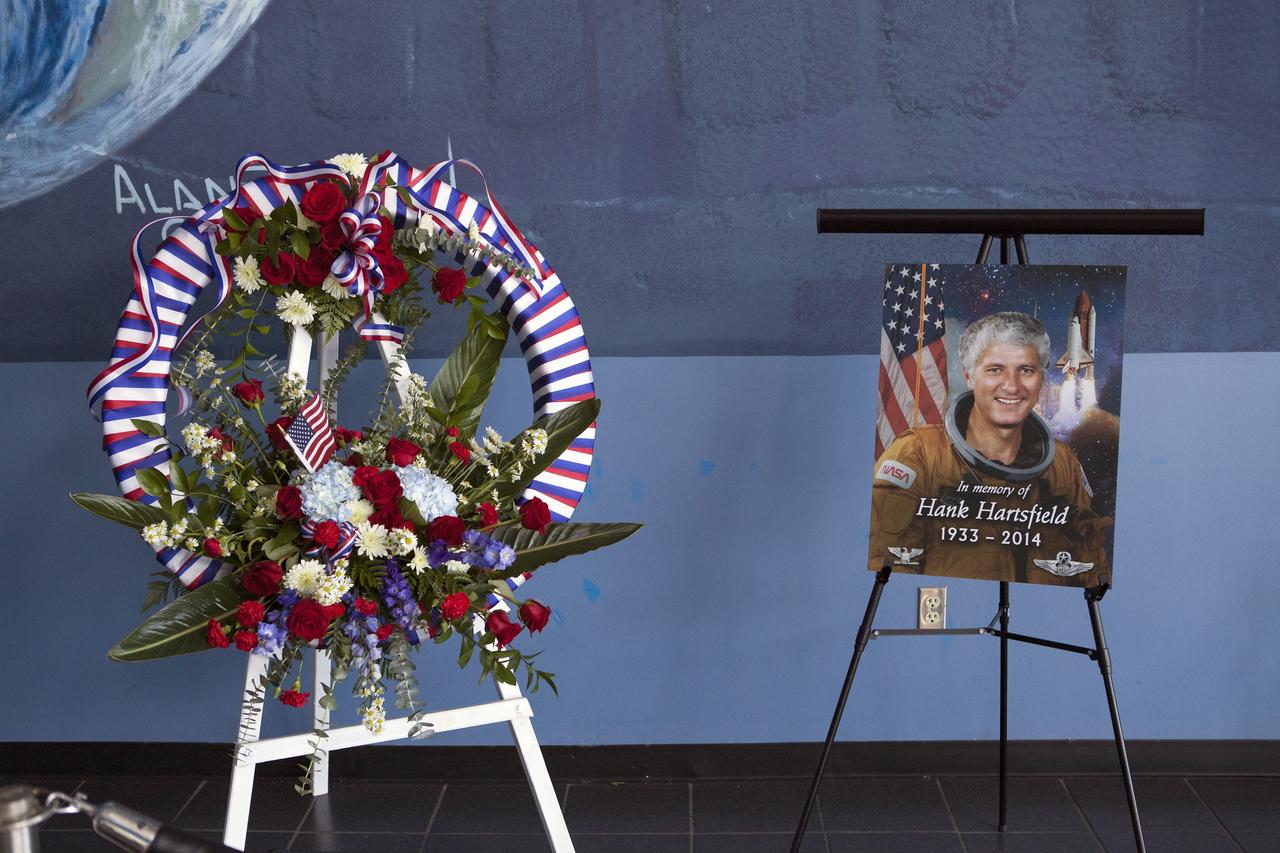
CAPE CANAVERAL, Fla. -- A wreath honoring Henry W. "Hank" Hartsfield is displayed beside his photo at the U.S. Astronaut Hall of Fame. Hartsfield commanded space shuttle Discovery's maiden mission and was a veteran of three shuttle flights. He died July 17 after an illness. He was 80 years old. Hartsfield joined NASA in 1969 and was part of the astronaut support crew for Apollo 16 and the Skylab 2, 3 and 4 missions. He logged 483 hours in space during missions STS-4, on which he served as pilot, as well as STS-41D and STS-61A, both of which he commanded. Photo credit: NASA/Dimitri Gerondidakis
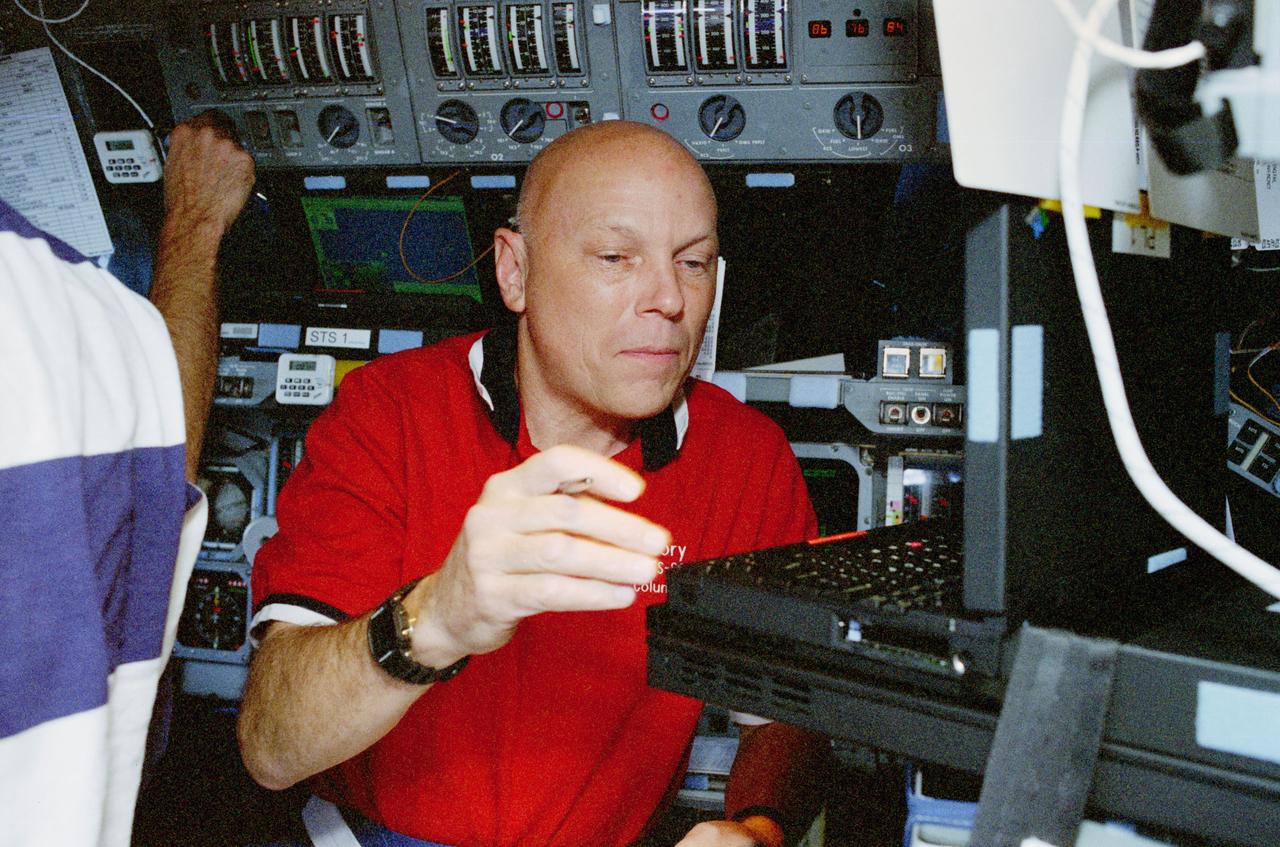
STS080-314-003 (19 Nov.-7 Dec. 1996) --- Astronaut Story Musgrave, STS-80 mission specialist, works with a pair of computers dedicated to Wake Shield Facility (WSF) operations onboard the space shuttle Columbia's flight deck. Musgrave marked his sixth appearance on a space shuttle flight during this duration record-setting space flight.
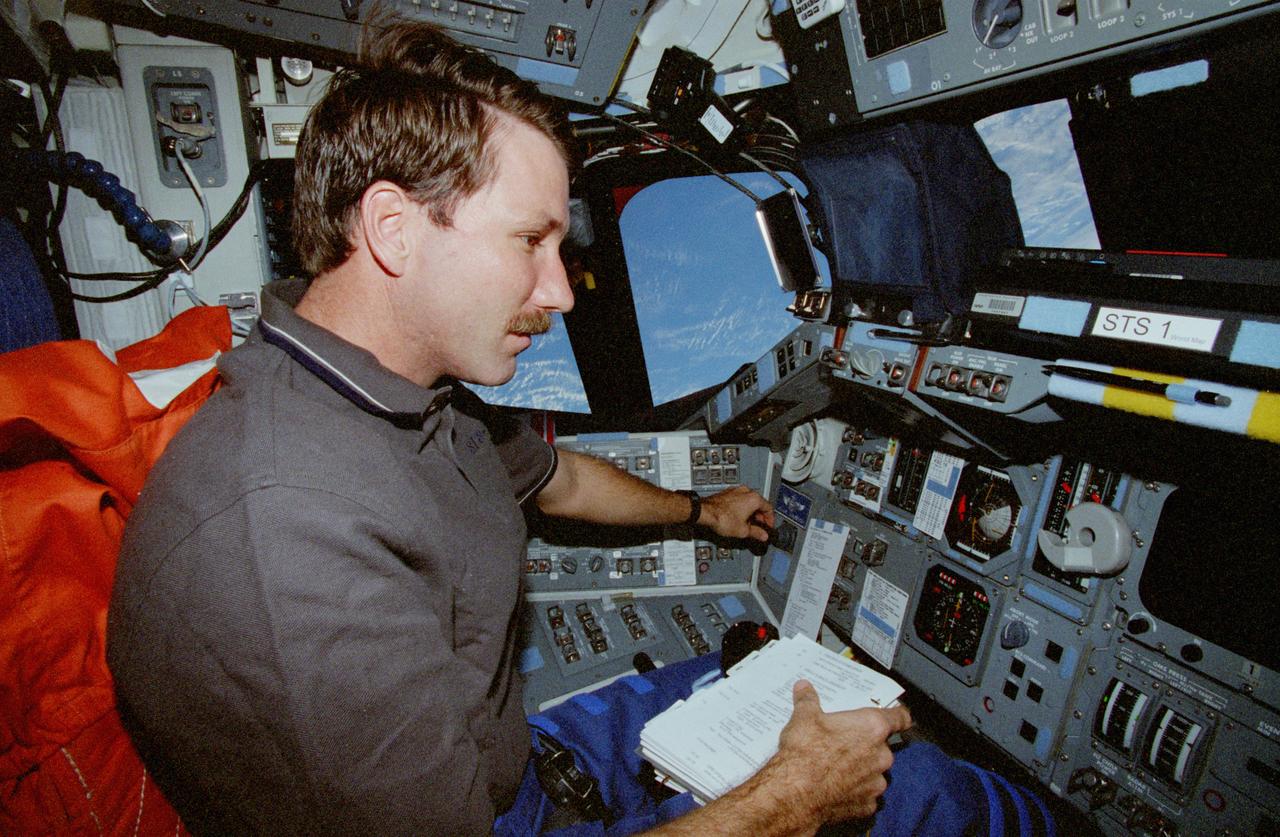
STS080-341-032 (19 Nov.-7 Dec. 1996) --- Astronaut Kent V. Rominger, STS-80 pilot, occupies the commander's station aboard the space shuttle Columbia during station keeping operations with the Orbiting Retrievable Far and Extreme Ultraviolet Spectrometer-Shuttle Pallet Satellite (ORFEUS-SPAS). Earth, actually some 190 nautical miles away, appears to be just beyond arm's length on Columbia's port side.
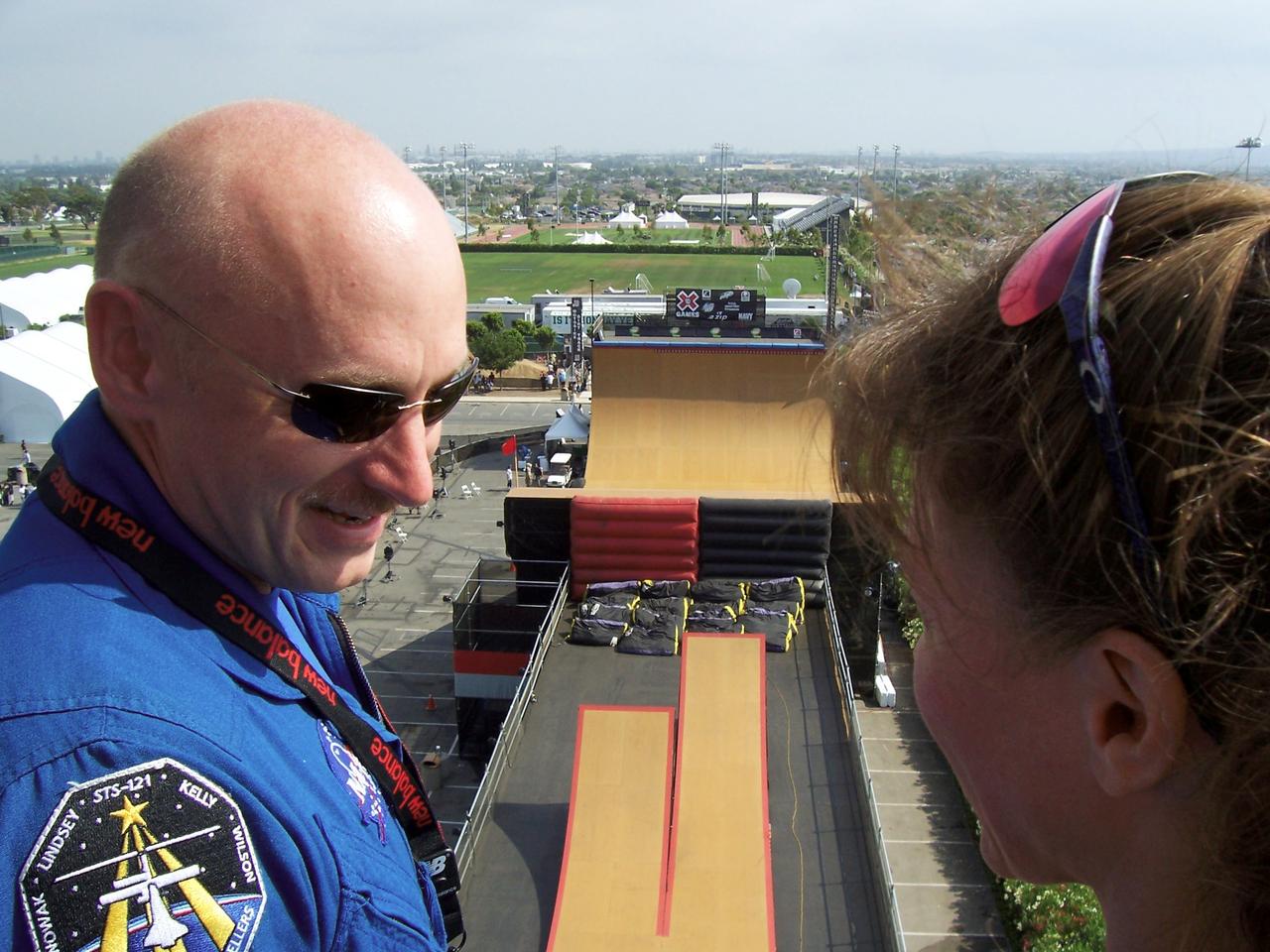
JSC2006-E-32814 (3 August 2006) --- The crew of STS-121 attended opening day of the 12th "X Games" in Los Angeles Aug. 3, discussing their recent mission to the International Space Station with students and athletes. Astronaut Mark E. Kelly, pilot, stands at the edge of the signature 80 foot high "Big Air Jump" skateboarding ramp - location for one of the event highlights. The crew's visit also included presentations at the Jet Propulsion Laboratory and the California Science Center.
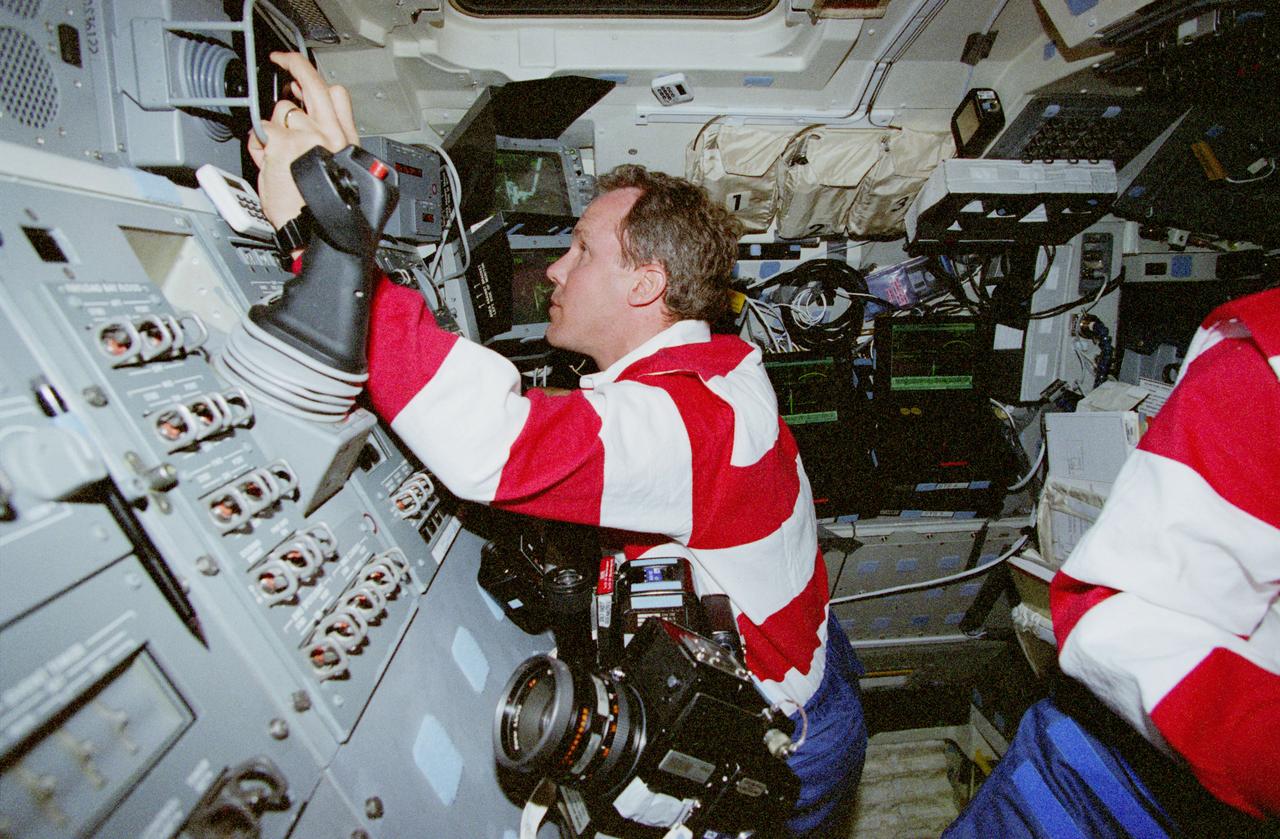
STS080-330-023 (19 Nov.-7 Dec. 1996) --- Astronaut Thomas D. Jones, STS-80 mission specialist, operates the Remote Manipulator System (RMS) controls during operations with the Wake Shield Facility (WSF). When this picture was taken, the part time free-flying WSF was in the grasp of the RMS' end effector, as evidenced by the scene on the space shuttle Columbia's aft flight deck monitor in upper right.
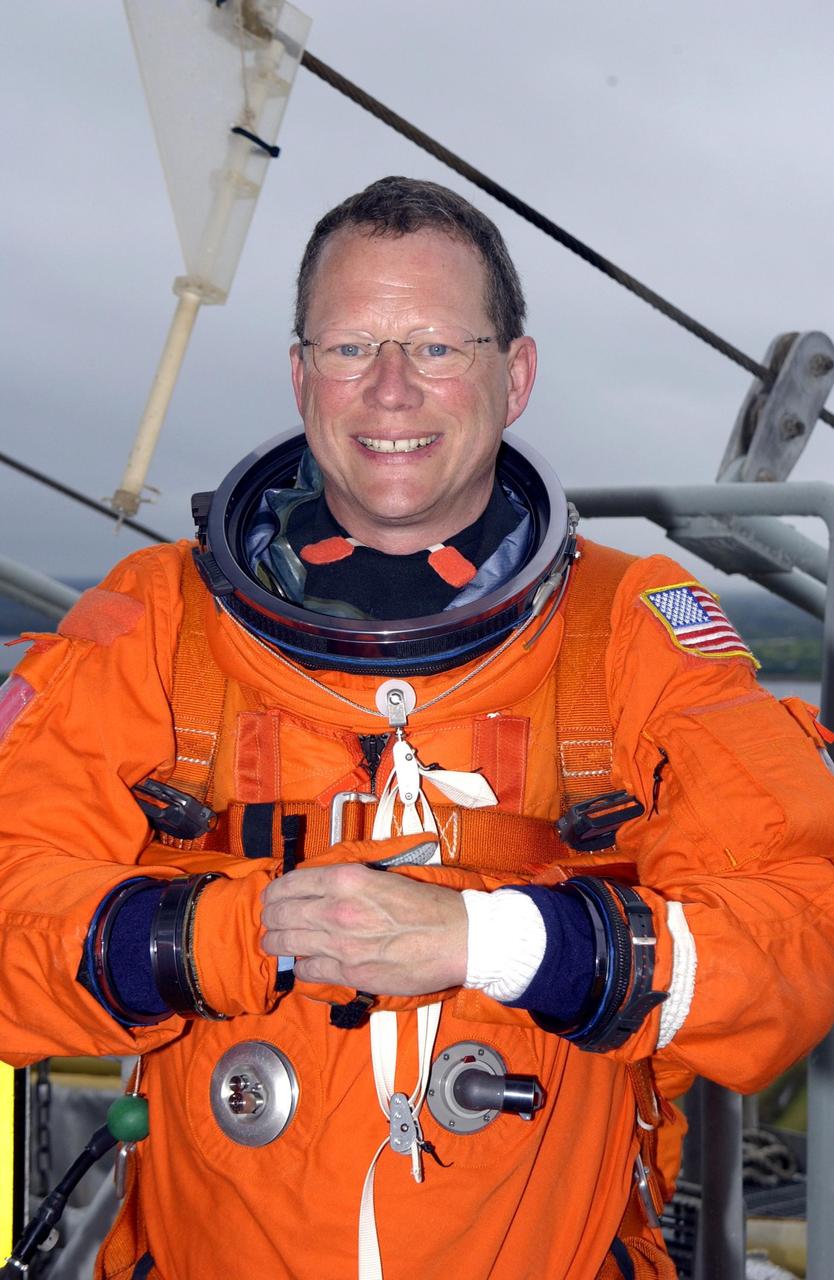
KENNEDY SPACE CENTER, FLA. -- Sitting in the slidewire basket on the launch pad is Mission Specialist David Brown. The crew is taking part in a simulated launch countdown, part of Terminal Countdown Demonstration Test activities. STS-107 is a mission devoted to research and will include more than 80 experiments that will study Earth and space science, advanced technology development, and astronaut health and safety. Launch is planned for Jan. 16, 2003, between 10 a.m. and 2 p.m. EST aboard Space Shuttle Columbia. .
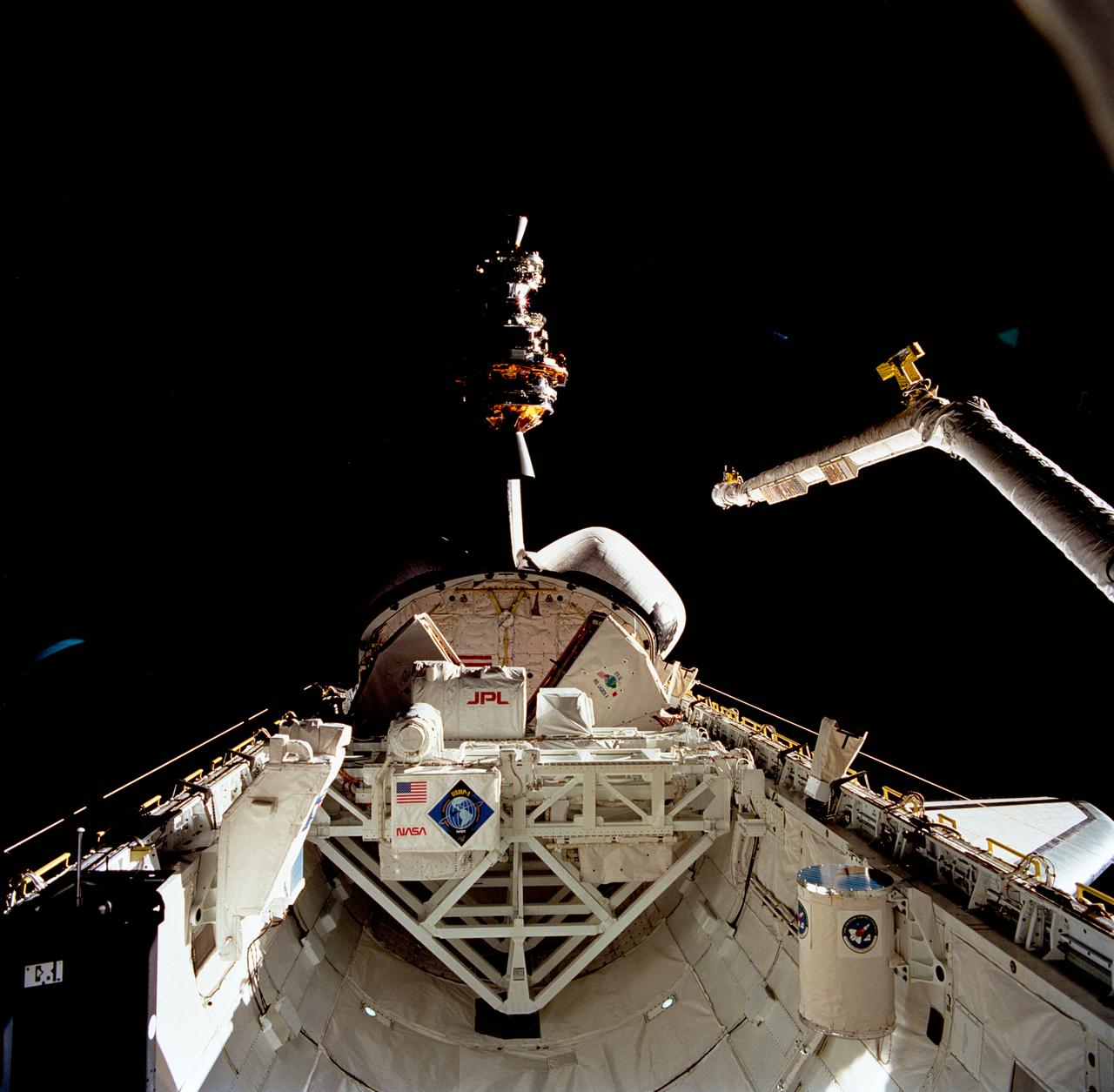
STS052-80-030 (23 Oct 1992) --- One of a series of three views of the deployment of the Laser Geodynamic Satellite (LAGEOS). The photograph was taken with a 70mm handheld camera aimed through the aft flight deck windows of the Earth-orbiting Space Shuttle Columbia. A crew of five NASA astronauts and a Canadian payload specialist spent ten days aboard Columbia for the STS-52 mission.
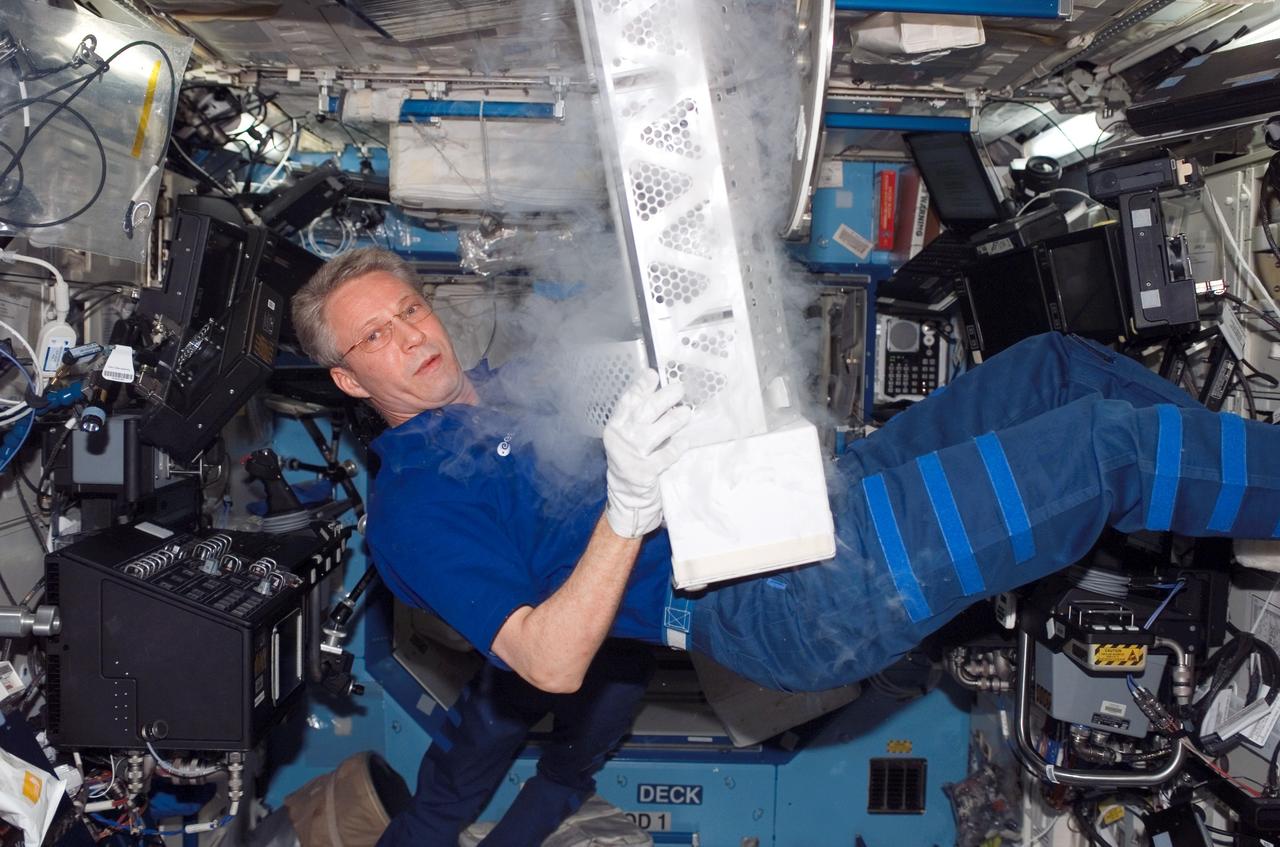
S116-E-07446 (19 Dec. 2006) --- European Space Agency (ESA) astronaut Thomas Reiter, STS-116 mission specialist, works with the Passive Observatories for Experimental Microbial Systems in Micro-G (POEMS) payload in the Minus Eighty Degree Laboratory Freezer for ISS (MELFI) in the Destiny laboratory of the International Space Station while Space Shuttle Discovery was docked with the station. MELFI is a low temperature freezer facility with nominal operating temperatures of -80, -26 and +4 degrees Celsius that will preserve experiment materials over long periods.
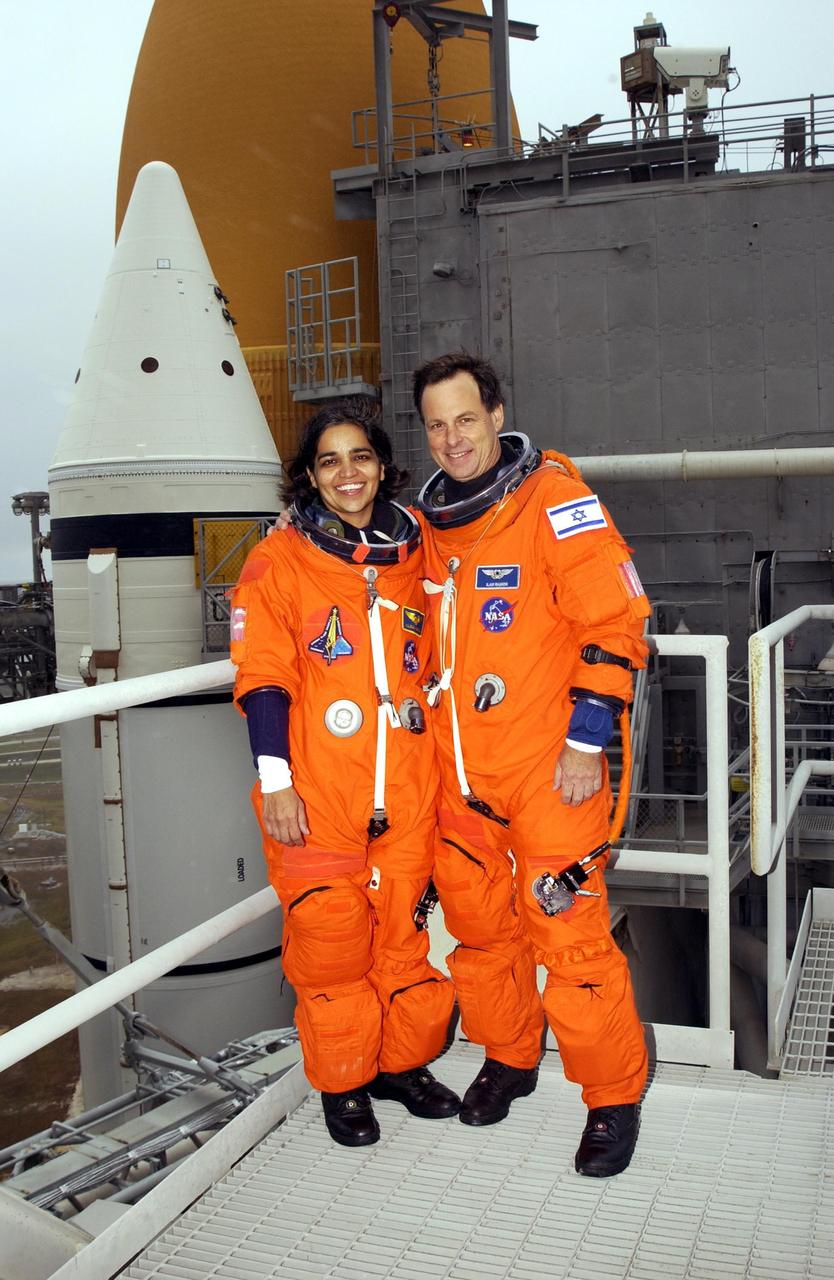
KENNEDY SPACE CENTER, FLA. -- - During Terminal Countdown Demonstration Test activities at the launch pad, Mission Specialists Kalpana Chawla and Ilan Ramon pause for a photo. Behind them is Space Shuttle Columbia. STS-107 is a mission devoted to research and will include more than 80 experiments that will study Earth and space science, advanced technology development, and astronaut health and safety. Launch is planned for Jan. 16, 2003, between 10 a.m. and 2 p.m. EST aboard Space Shuttle Columbia. .
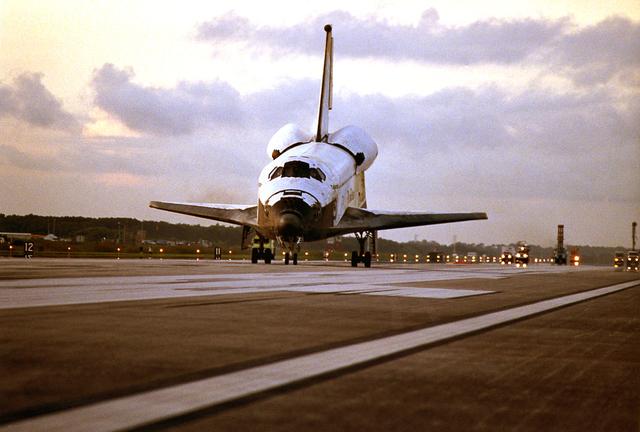
The Space Shuttle Columbia (STS-65) came to a stop at Kennedy Space Center's (KSC) Shuttle Landing Facility to complete the International Microgravity Laboratory 2 (IML-2) mission. During the record-setting spaceflight of 14 days, 17 hours, and 56 minutes, the seven-person crew conducted more than 80 materials and life sciences experiments,
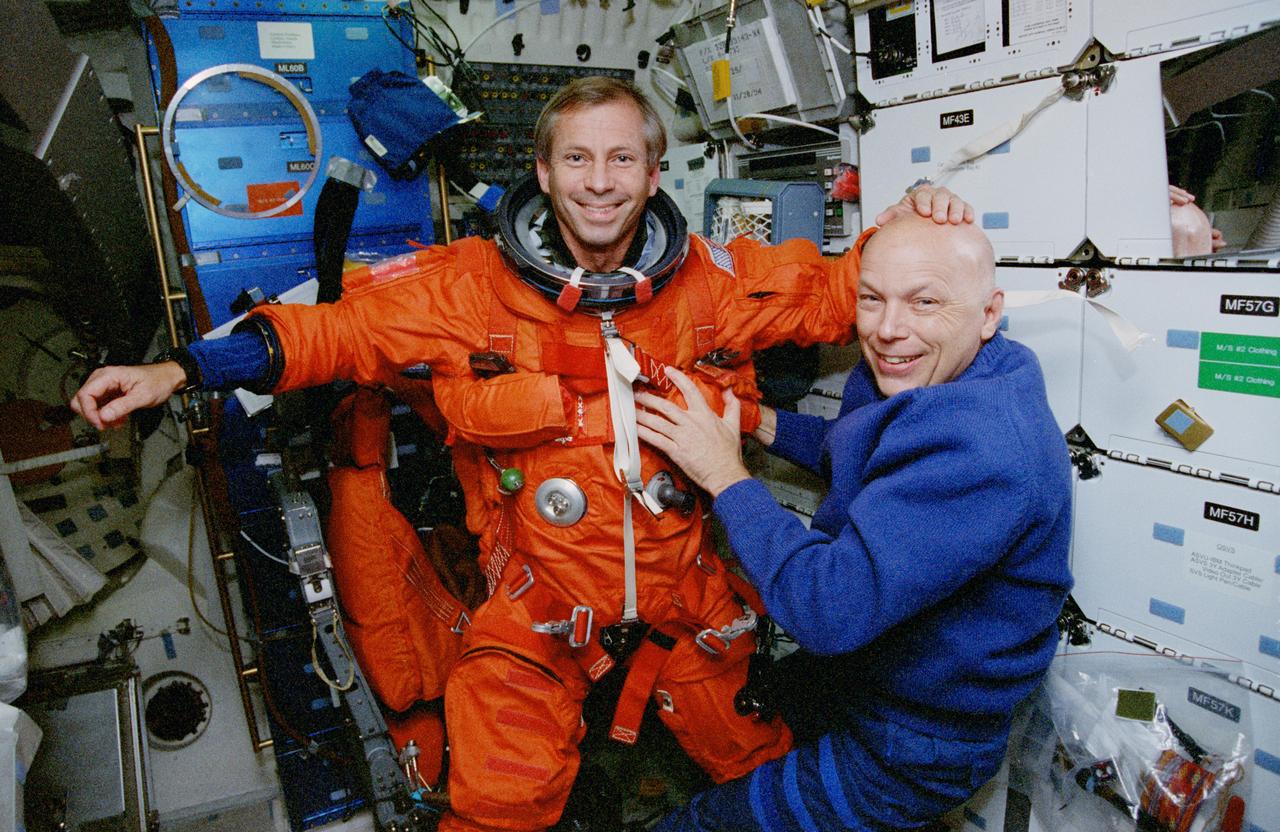
STS080-375-029 (6 Dec. 1996) --- On the middeck of the Earth-orbiting space shuttle Columbia, astronaut Story Musgrave helps with the final touches of suit donning for astronaut Kenneth D. Cockrell, STS-80 mission commander. The orange suit is a partial pressure launch and entry garment. The crew, initially waved off from its scheduled landing, eventually brought the Columbia home on Dec. 7, 1996.
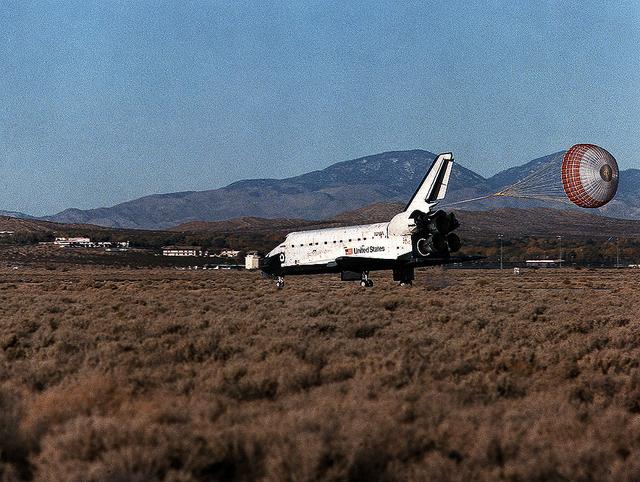
The drag-chute is fully deployed as the Space Shuttle Atlantis (STS-66) heads toward a stop at Edwards Air Force Base in southern California, ending a successful mission. The crew supported the Atmospheric Laboratory for Applications and Science (ATLAS-3), conducting approximately 80 experiments. The Cryogenic Infrared Spectrometer and Telescopes for the Atmosphere-Shuttle Pallet Satellite (CRISTA-SPAS), which was developed by German engineers, was successfully deployed and retrieved during this space mission.

STS080-312-004 (19 Nov.-7 Dec. 1996) --- Astronaut Kenneth D. Cockrell, STS-80 mission commander, washes his hair on the middeck of the Earth-orbiting space shuttle Columbia. Displaying a sense of humor, the commander asked astronaut Story Musgrave, who is bald, to address this visual during a briefing with Johnson Space Center (JSC) employees on Jan. 14, 1997. Equal to the task, Musgrave cracked a number of bald jokes and remarked that it was much easier to polish a head in zero gravity than to wash one.
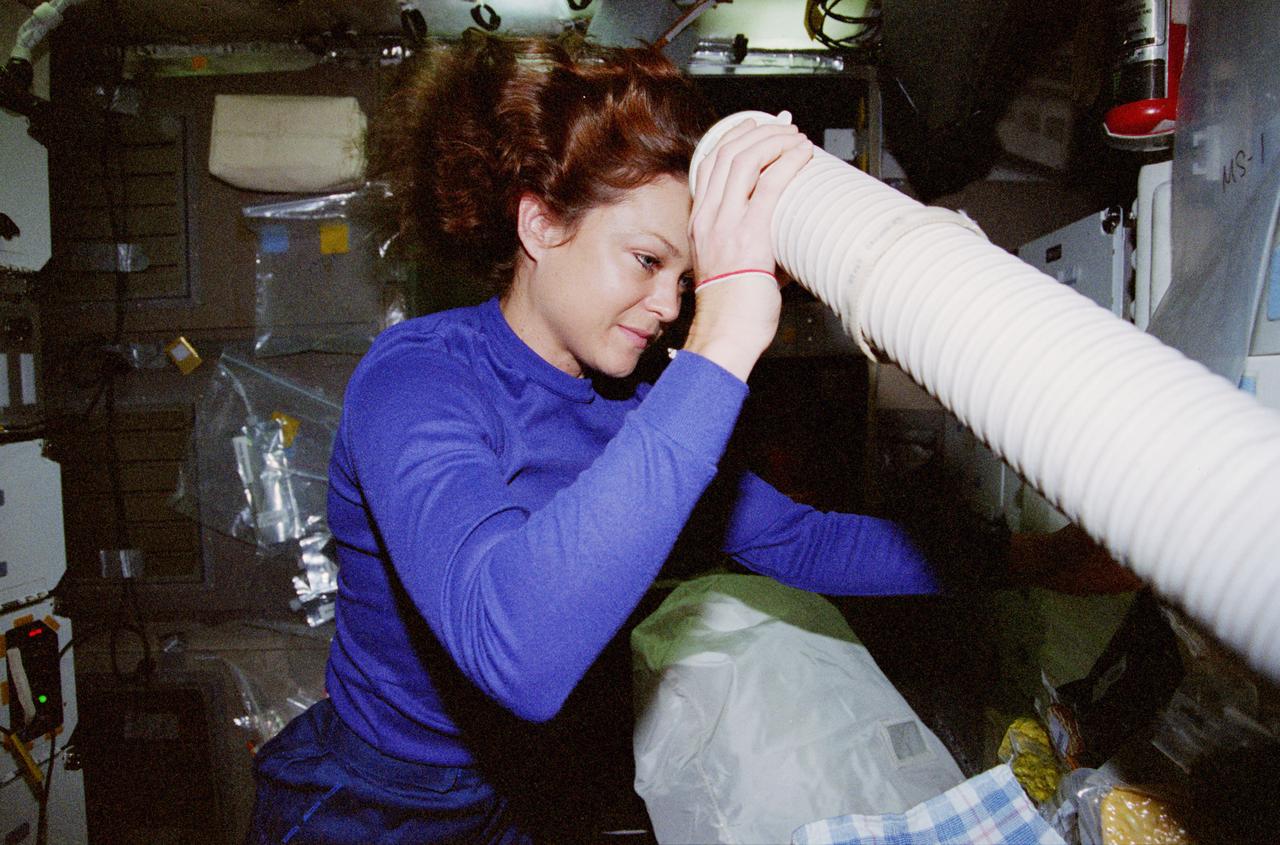
STS080-361-007 (19 Nov.-7 Dec. 1996) --- Astronaut Tamara E. Jernigan, STS-80 mission specialist, improvises onboard the space shuttle Columbia. Having just washed her hair, Jernigan temporarily "borrowed" a duct from the orbiter's air conditioning system to dry it. The off-duty activity was recorded with a 35mm camera.

STS052-80-024 (23 Oct 1992) --- One of a series of three views of the deployment of the Laser Geodynamic Satellite (LAGEOS). The photograph was taken with a 70mm handheld camera aimed through the aft flight deck windows of the Earth-orbiting Space Shuttle Columbia. A crew of five NASA astronauts and a Canadian payload specialist spent ten days aboard Columbia for the STS-52 mission.
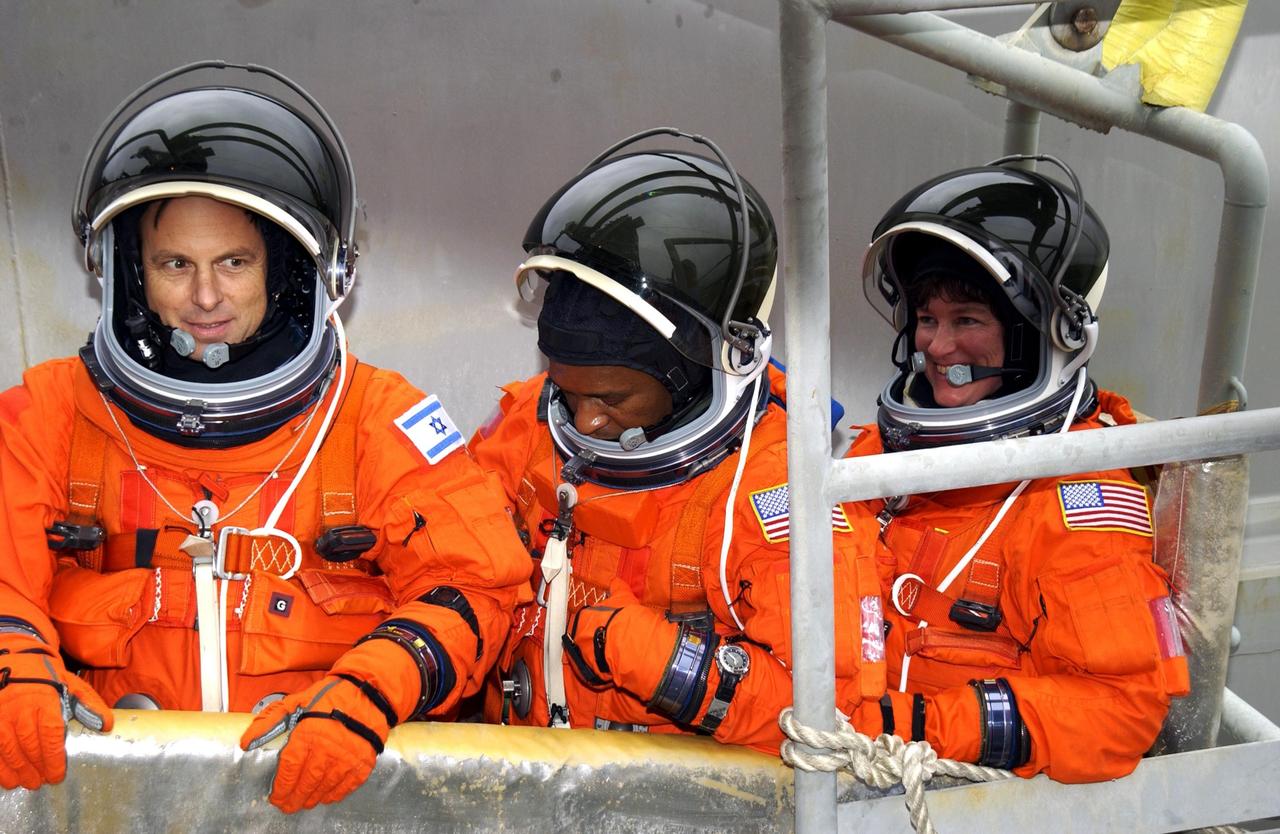
KENNEDY SPACE CENTER, FLA. - Sitting in the slidewire basket on the launch pad are (left to right) STS-107 Payload Specialist Ilan Ramon, Payload Commander Michael Anderson and Mission Specialist Laurel Clark. The crew is taking part in a simulated launch countdown, part of Terminal Countdown Demonstration Test activities. STS-107 is a mission devoted to research and will include more than 80 experiments that will study Earth and space science, advanced technology development, and astronaut health and safety. Launch is planned for Jan. 16, 2003, between 10 a.m. and 2 p.m. EST aboard Space Shuttle Columbia. .
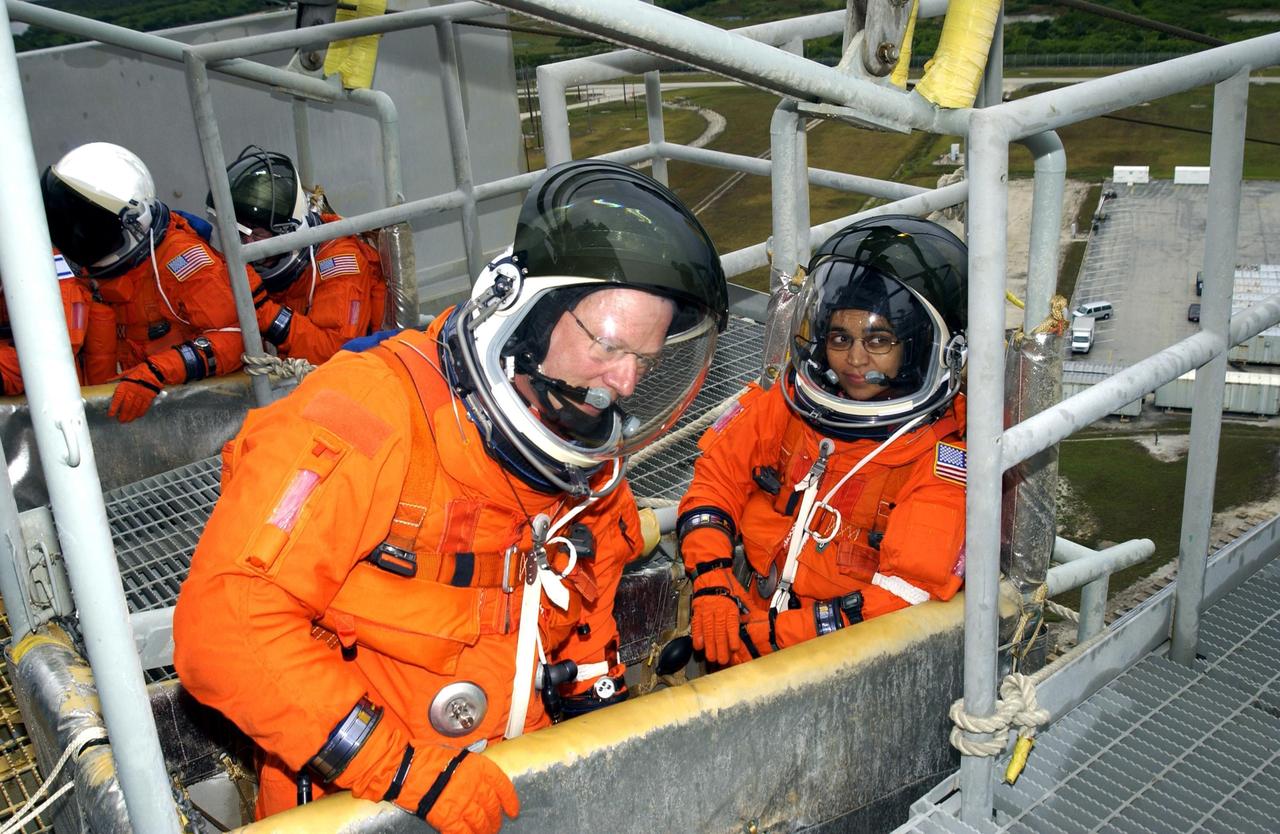
KENNEDY SPACE CENTER, FLA. - The STS-107 crew practice emergency egress from the launch pad during a simulated launch countdown, part of Terminal Countdown Demonstration Test activities. In the slidewire basket in the foreground are Mission Specialists David Brown and Kalpana Chawla. STS-107 is a mission devoted to research and will include more than 80 experiments that will study Earth and space science, advanced technology development, and astronaut health and safety. Launch is planned for Jan. 16, 2003, between 10 a.m. and 2 p.m. EST aboard Space Shuttle Columbia. .
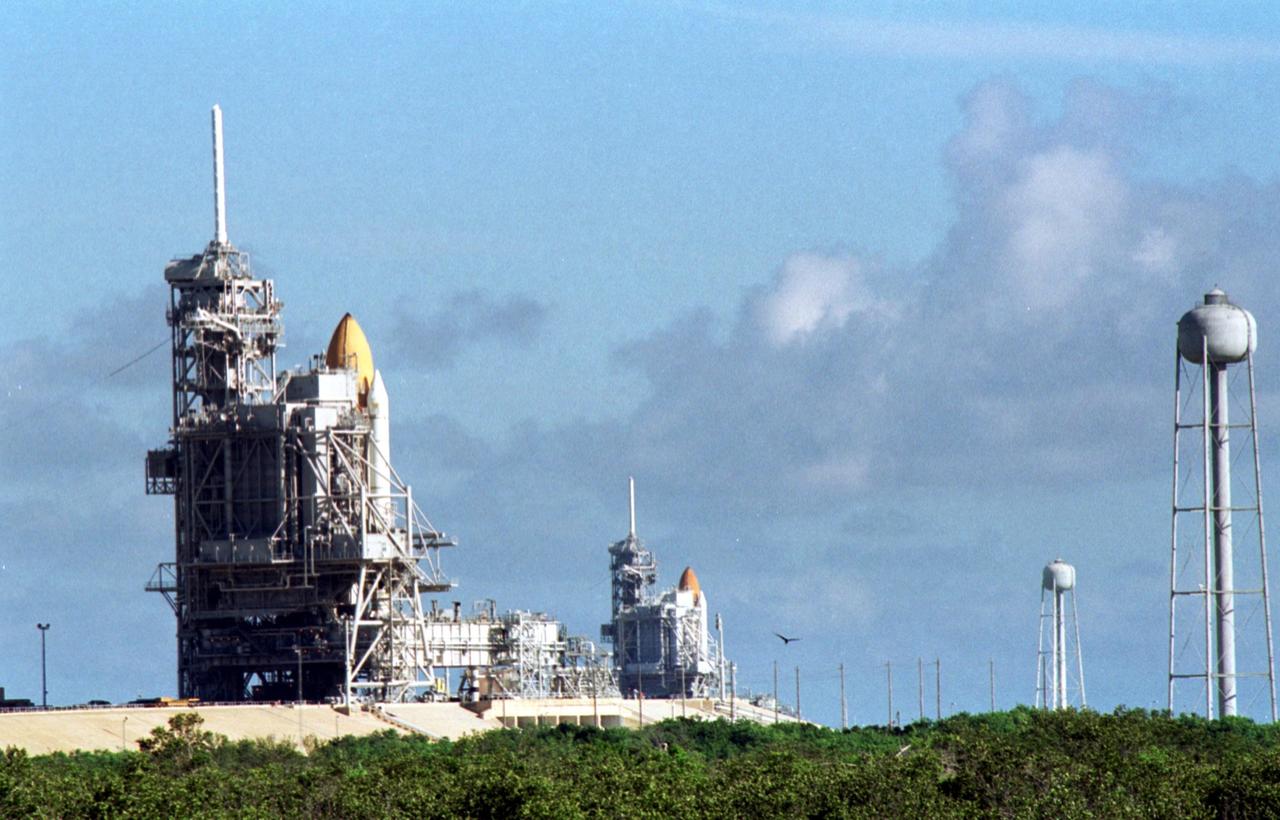
KENNEDY SPACE CENTER, Fla. -- Space Shuttle Discovery (foreground) and Space Shuttle Atlantis (background) both stand ready on their Launch Pads ( 39A and 39B respectively). Space Shuttle Discovery rolled out July 2 to be prepared for launch on mission STS-105 in August. Space Shuttle Atlantis is scheduled to launch Thursday, July 12, on mission STS-104. Towering above each Shuttle on the left is the 80-foot lightning rod that helps protect each Shuttle from lightning strikes. At right are the 290-foot water tanks that provide 300,000 gallons of water during liftoff. They are part of the sound suppression water system at each pad
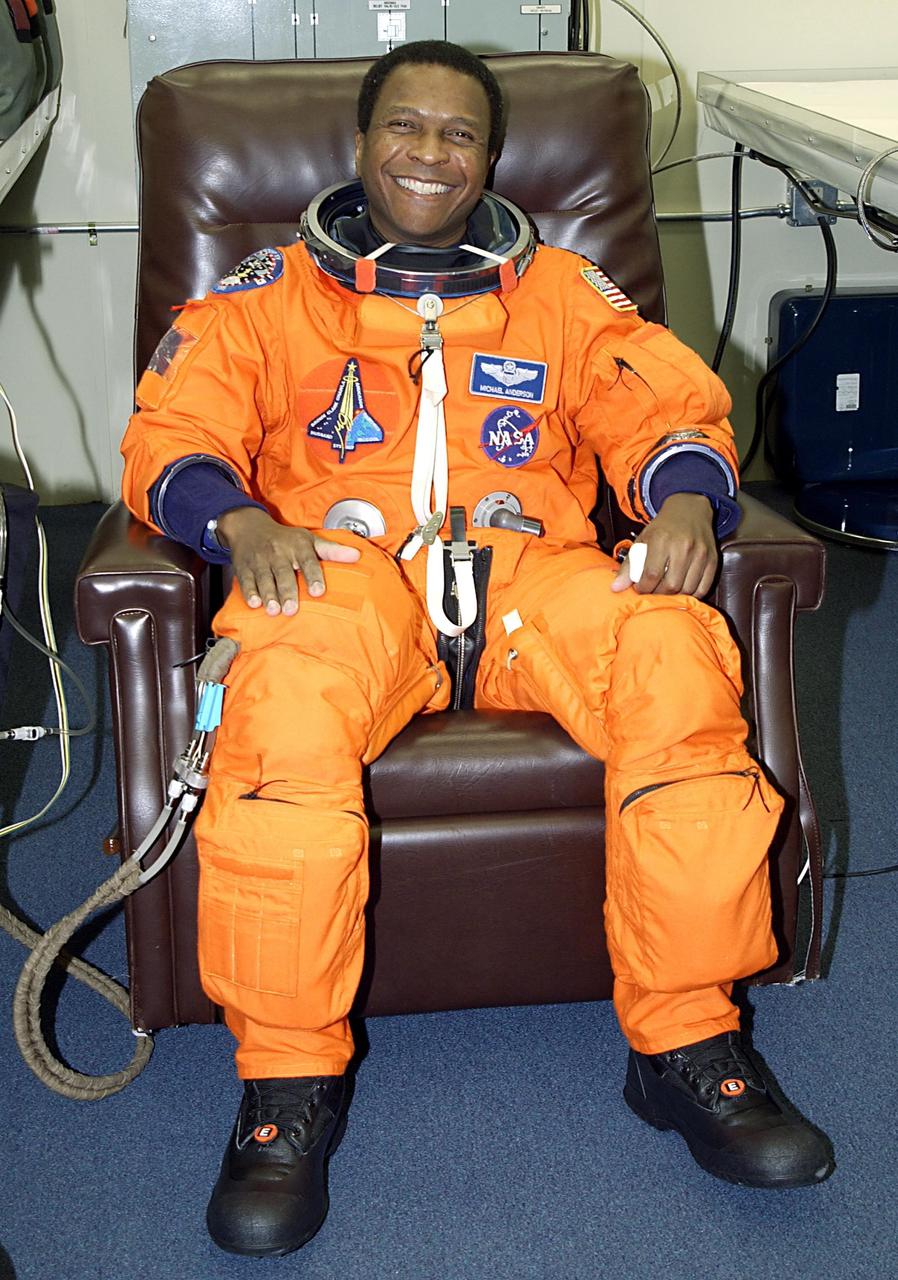
KENNEDY SPACE CENTER, FLA. - STS-107 Payload Commander Michael Anderson is happy to being suiting up for launch on mission STS-107. The mission is devoted to research and will include more than 80 experiments that will study Earth and space science, advanced technology development, and astronaut health and safety. The payload on Space Shuttle Columbia includes FREESTAR (Fast Reaction Experiments Enabling Science, Technology, Applications and Research) and the SHI Research Double Module (SHI/RDM), known as SPACEHAB. Experiments on the module range from material sciences to life sciences. Liftoff is scheduled for 10:39 a.m. EST.
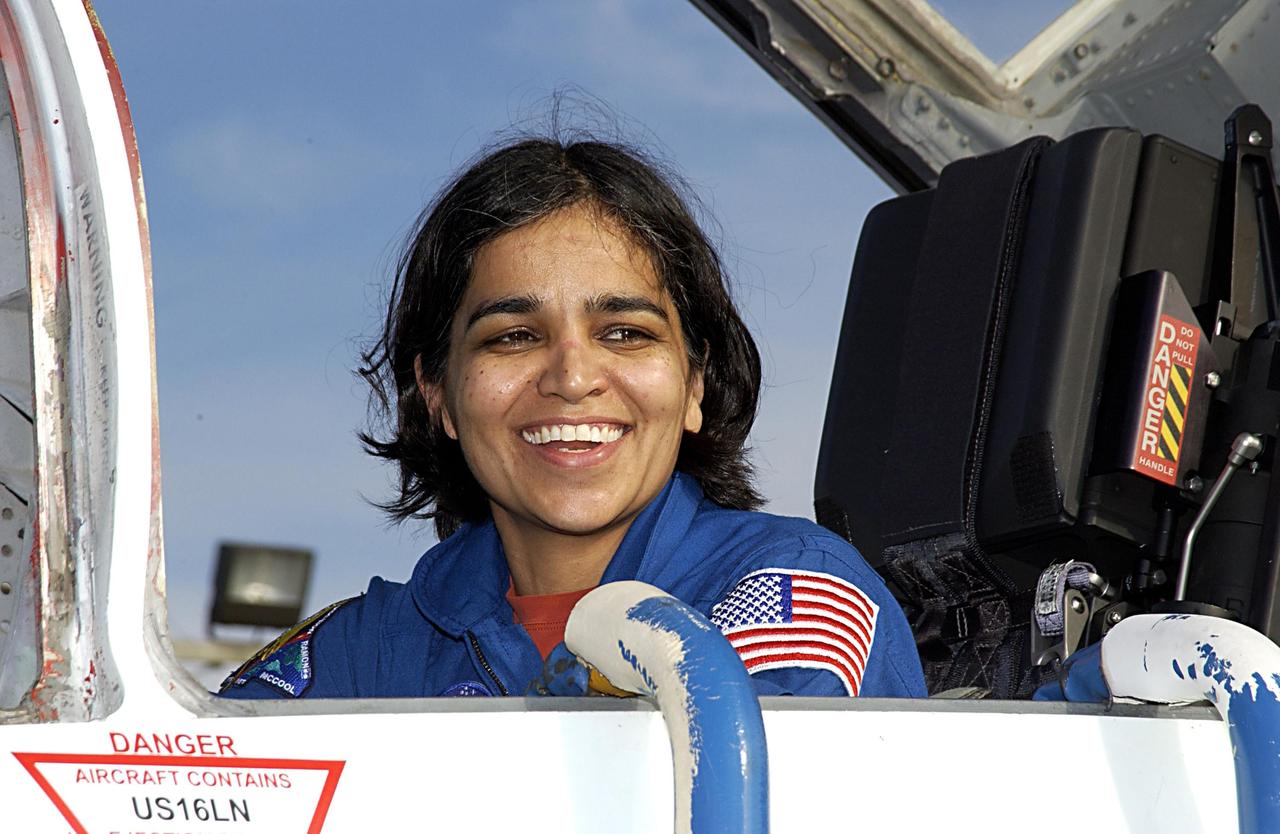
KENNEDY SPACE CENTER, FLA. - STS-107 Mission Specialist Kalpana Chawla arrives at KSC to take part in Terminal Countdown Demonstration Test activities, which include a simulated launch countdown. Other crew members are Commander Rick Husband, Pilot William "Willie" McCool, Payload Commander Michael Anderson, Mission Specialists David Brown and Laurel Clark and Payload Specialist Ilan Ramon (the first Israeli astronaut). STS-107 is a mission devoted to research and will include more than 80 experiments that will study Earth and space science, advanced technology development, and astronaut health and safety. Launch is scheduled for Jan. 16, 2003.
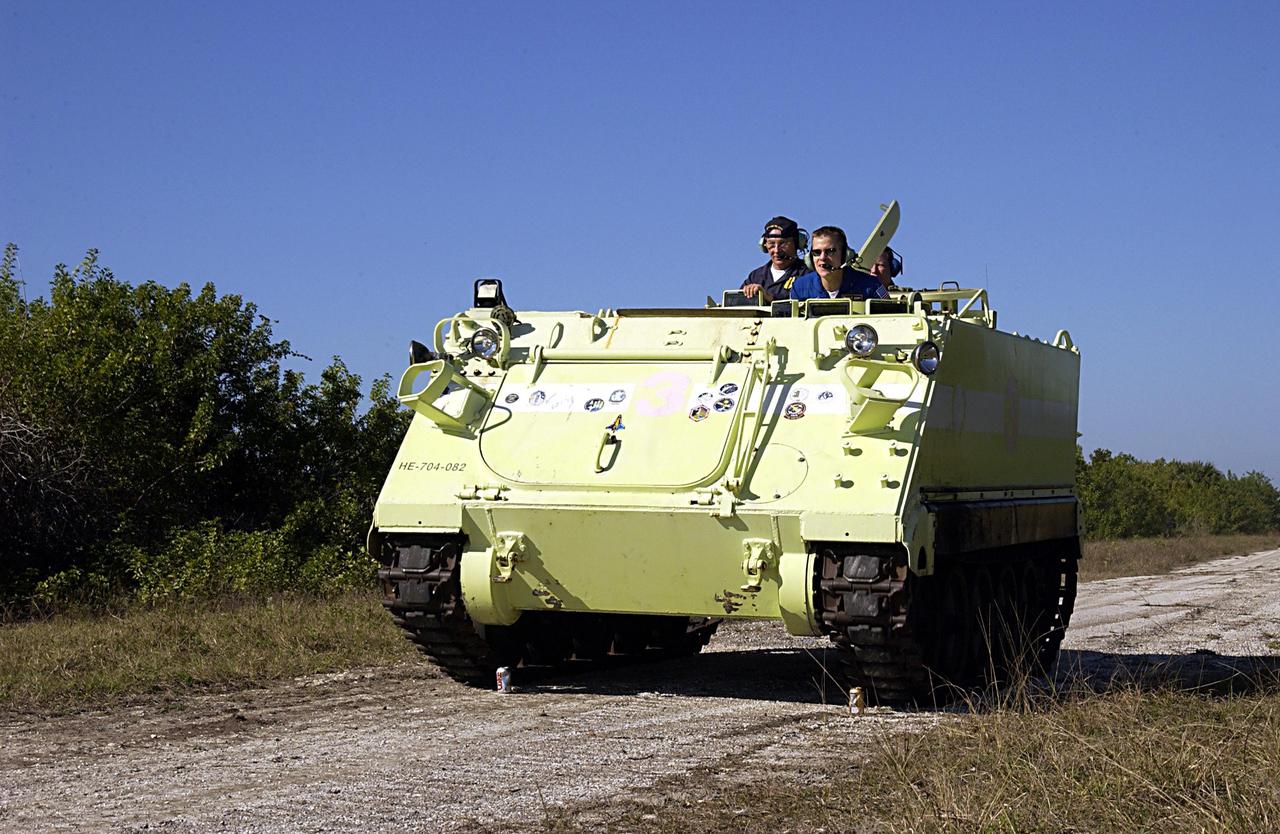
KENNEDY SPACE CENTER, FLA. -- -- STS-107 Pilot William "Willie" McCool operates an M113 armored personnel carrier during Terminal Countdown Demonstration Test activities, a standard part of launch preparations. Instructor George Hoggard (left) supervises the training. STS-107 is a mission devoted to research and will include more than 80 experiments that will study Earth and space science, advanced technology development, and astronaut health and safety. Launch is planned for Jan. 16, 2003, between 10 a.m. and 2 p.m. EST aboard Space Shuttle Columbia.
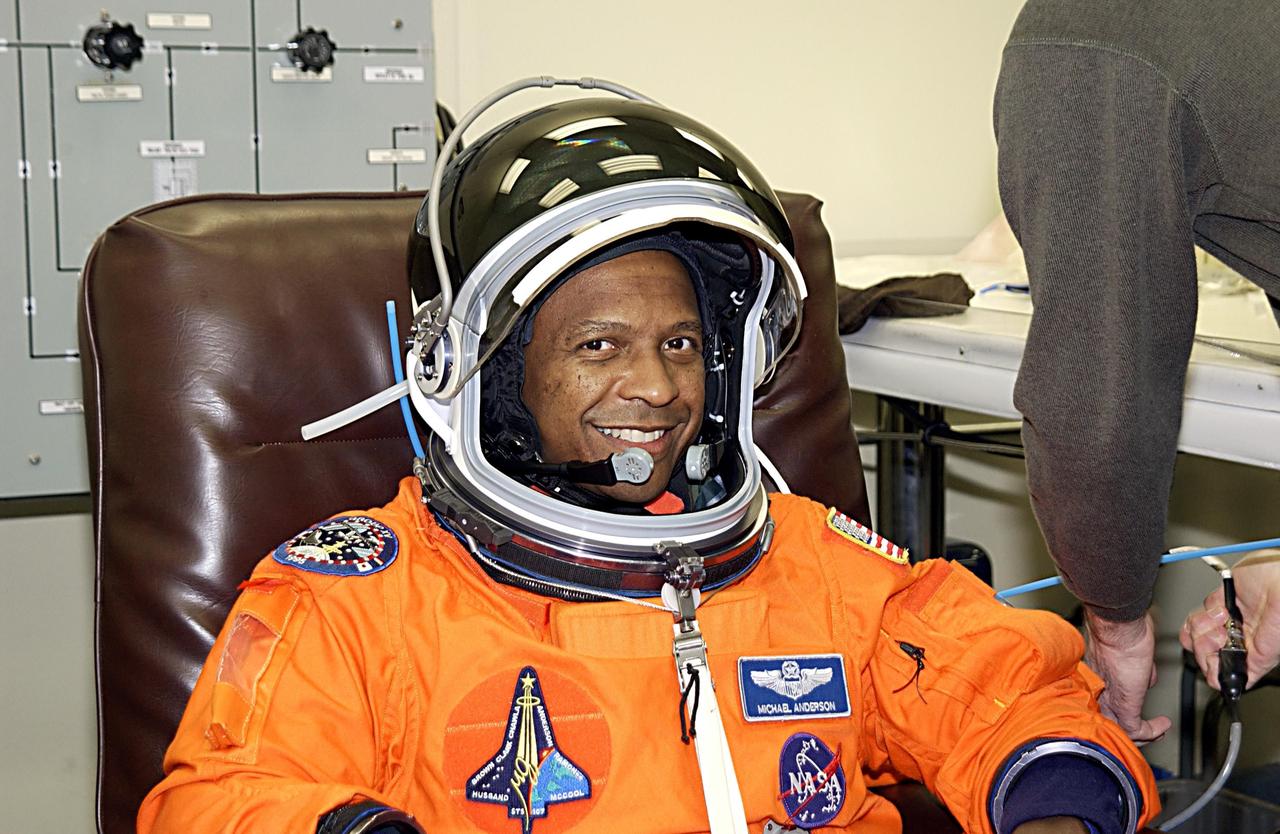
KENNEDY SPACE CENTER, FLA. - STS-107 Payload Commander Michael Anderson is helped with suit check, part of launch preparations. STS-107 is a mission devoted to research and will include more than 80 experiments that will study Earth and space science, advanced technology development, and astronaut health and safety. The payload on Space Shuttle Columbia includes FREESTAR (Fast Reaction Experiments Enabling Science, Technology, Applications and Research) and the SHI Research Double Module (SHI/RDM), known as SPACEHAB. Experiments on the module range from material sciences to life sciences. Launch is scheduled for Jan. 16, between 10 a.m. and 2 p.m.
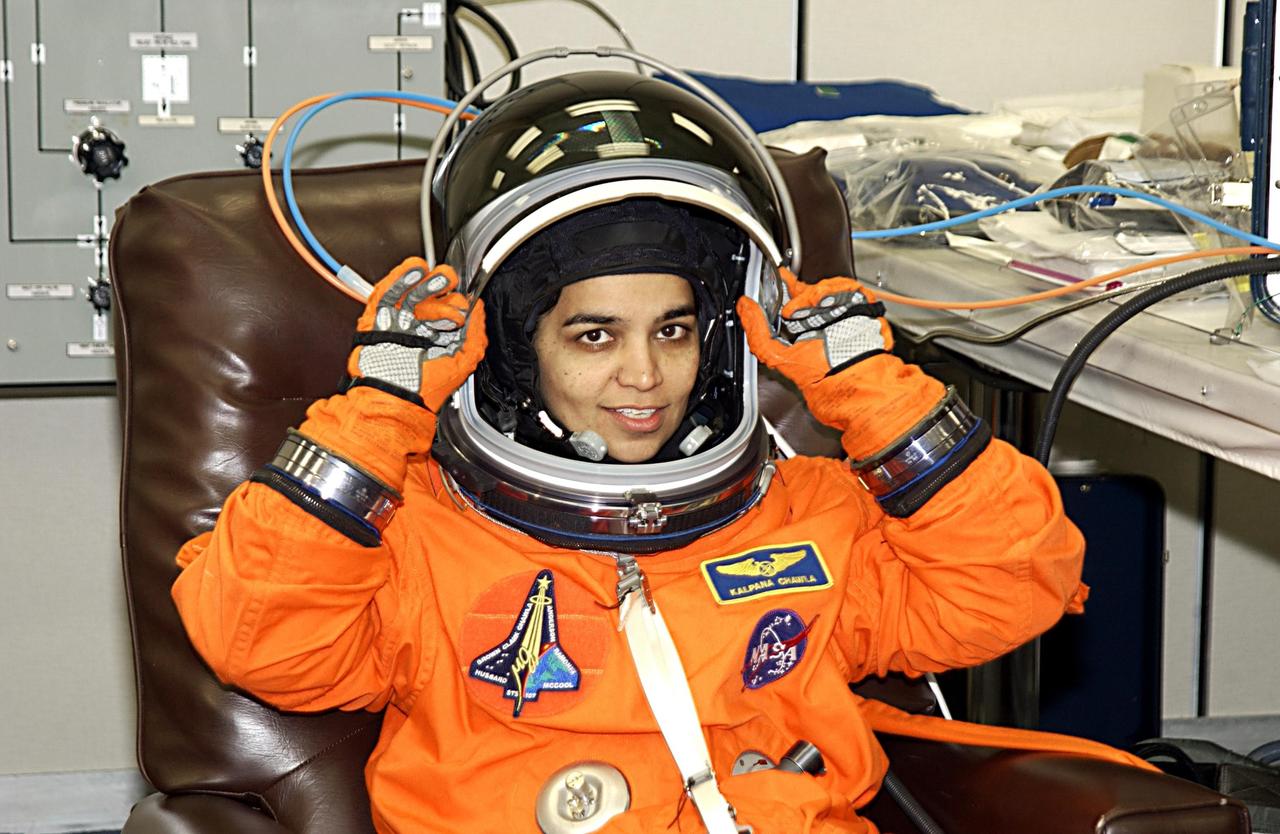
KENNEDY SPACE CENTER, FLA. -- STS-107 Mission Specialist Kalpana Chawla puts on her helmet during suit check, part of launch preparations. STS-107 is a mission devoted to research and will include more than 80 experiments that will study Earth and space science, advanced technology development, and astronaut health and safety. The payload on Space Shuttle Columbia includes FREESTAR (Fast Reaction Experiments Enabling Science, Technology, Applications and Research) and the SHI Research Double Module (SHI/RDM), known as SPACEHAB. Experiments on the module range from material sciences to life sciences. Launch is scheduled for Jan. 16, between 10 a.m. and 2 p.m.
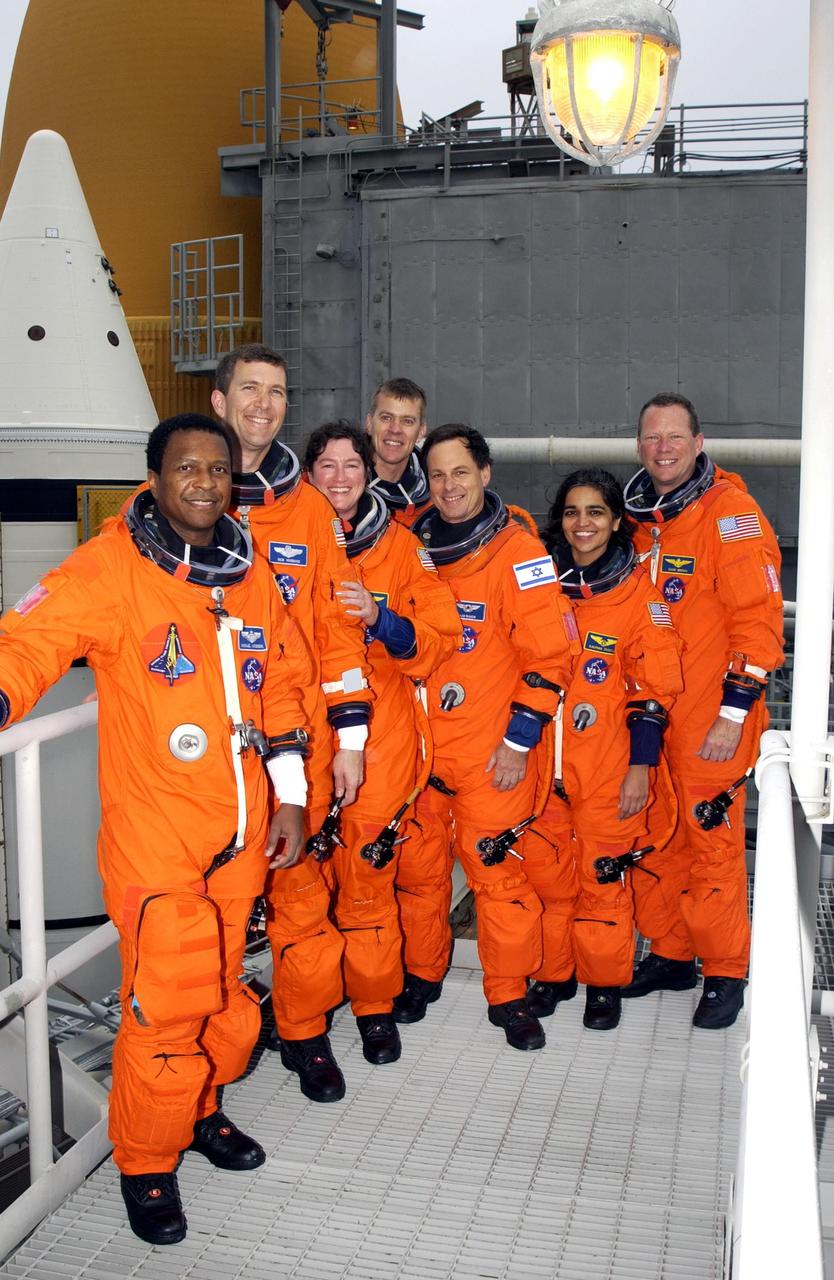
KENNEDY SPACE CENTER, FLA. - During Terminal Countdown Demonstration Test activities at the launch pad, the STS-107 crew pauses for a group photo. From left are Payload Commander Michael Anderson, Commander Rick Husband, Mission Specialist Laurel Clark, Pilot William "Willie" McCool, and Mission Specialists Ilan Ramon, Kalpana Chawla and David Brown. Behind them is Space Shuttle Columbia. STS-107 is a mission devoted to research and will include more than 80 experiments that will study Earth and space science, advanced technology development, and astronaut health and safety. Launch is planned for Jan. 16, 2003, between 10 a.m. and 2 p.m. EST aboard Space Shuttle Columbia. .
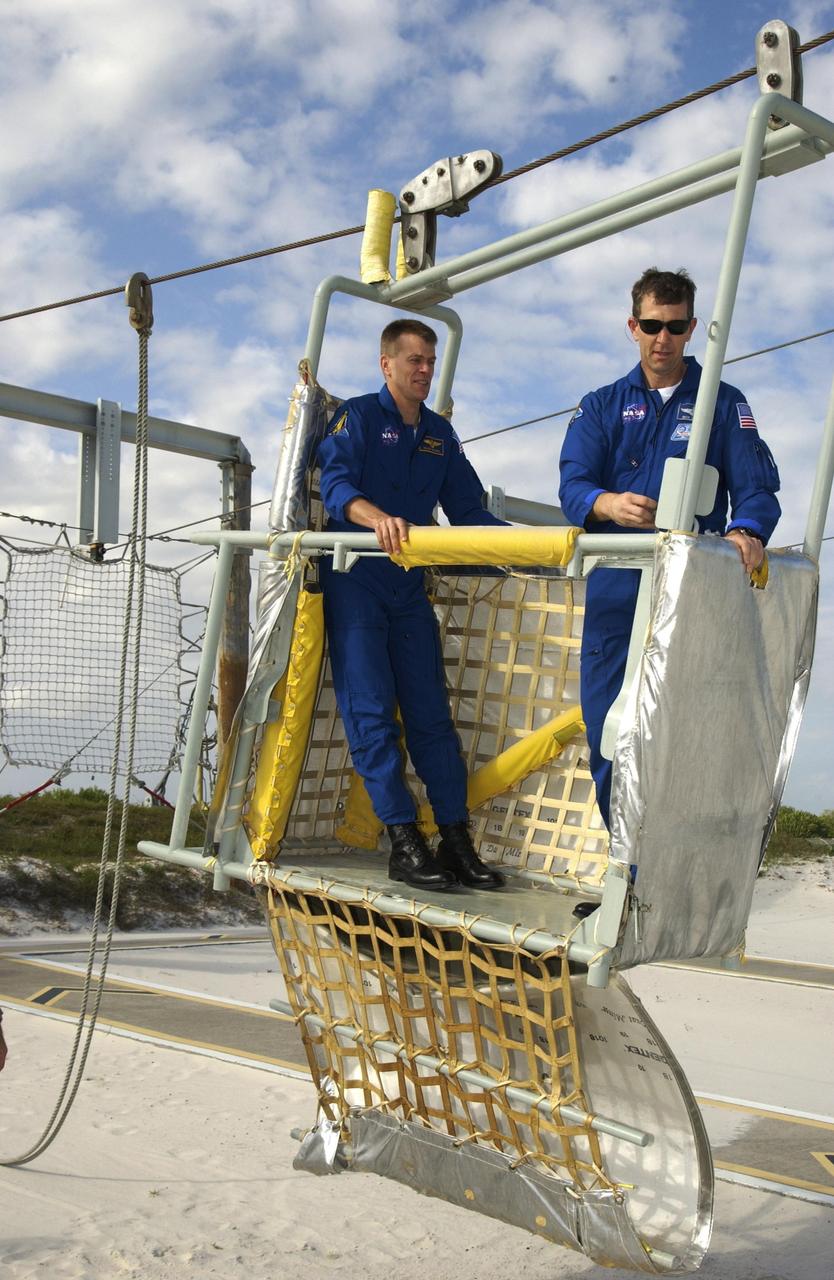
KENNEDY SPACE CENTER, FLA. -- During emergency egress training, part of Terminal Countdown Demonstration Test activities at the pad, STS-107 Pilot William "Willie" McCool and Commander Rick Husband share a slidewire basket. The TCDT also includes a simulated launch countdown. STS-107 is a mission devoted to research and will include more than 80 experiments that will study Earth and space science, advanced technology development, and astronaut health and safety. Launch is planned for Jan. 16, 2003, between 10 a.m. and 2 p.m. EST aboard Space Shuttle Columbia. .
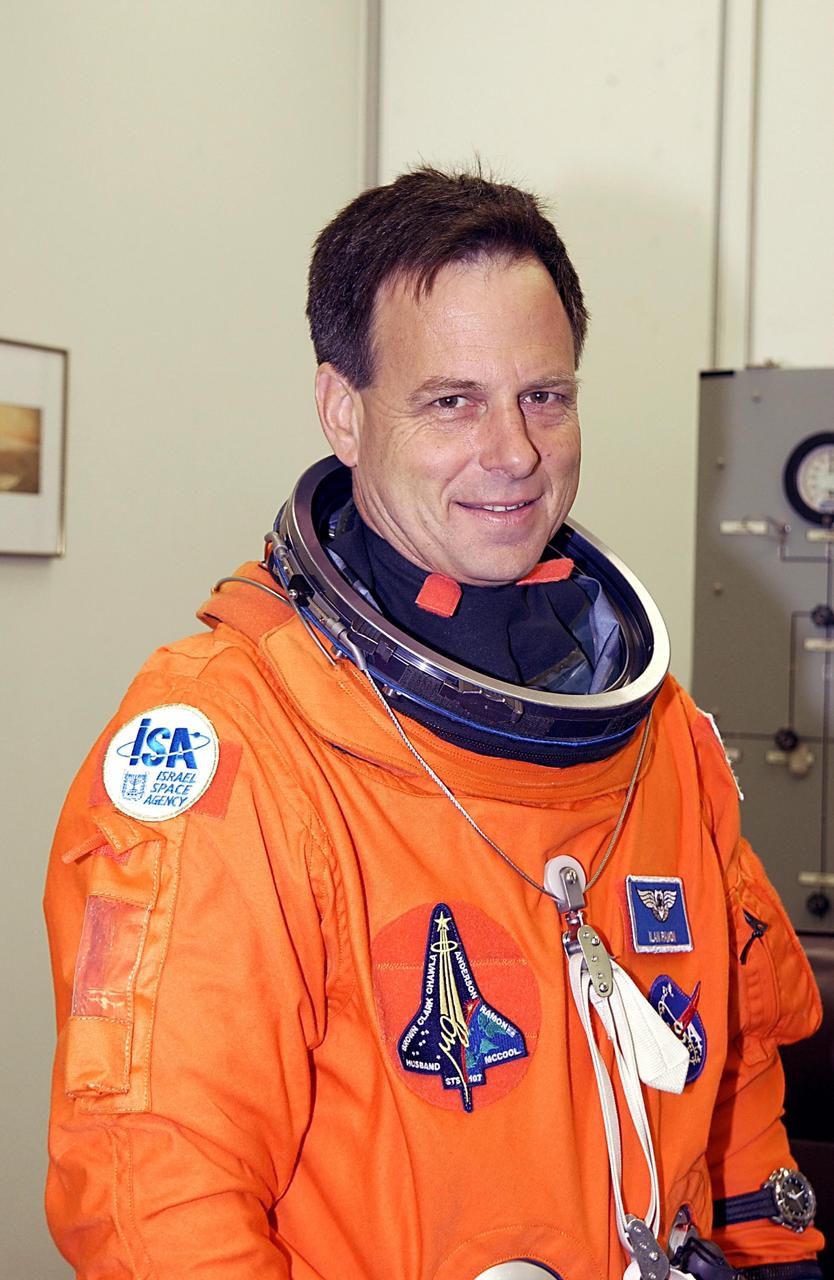
KENNEDY SPACE CENTER, FLA. -- STS-107 Payload Specialist Ilan Ramon, who represents the Israeli Space Agency, suits up for launch. STS-107 is a mission devoted to research and will include more than 80 experiments that will study Earth and space science, advanced technology development, and astronaut health and safety. The payload on Space Shuttle Columbia includes FREESTAR (Fast Reaction Experiments Enabling Science, Technology, Applications and Research) and the SHI Research Double Module (SHI/RDM), known as SPACEHAB. Experiments on the module range from material sciences to life sciences. Liftoff is scheduled for 10:39 a.m. EST.
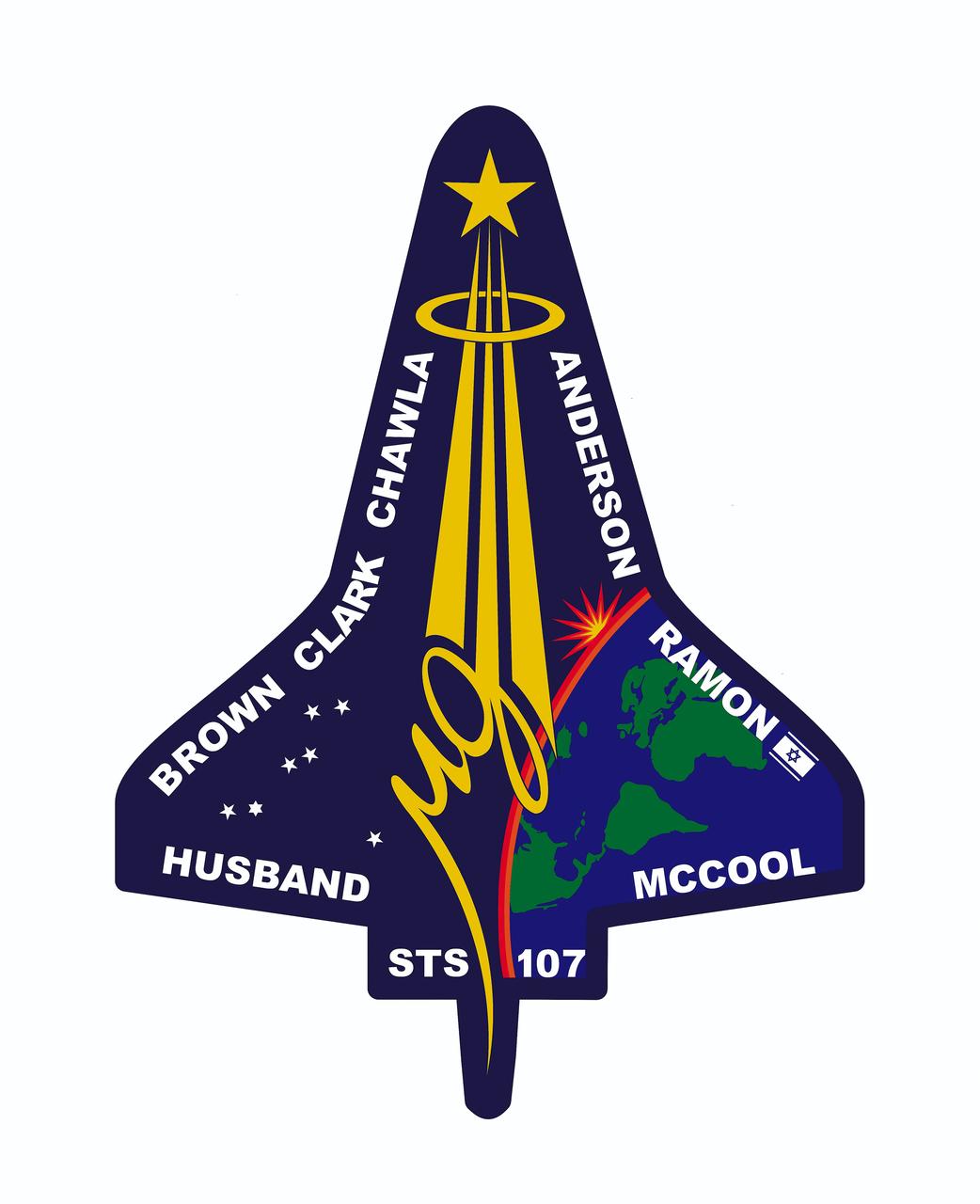
This is the insignia for the STS-107 mission which is a multidiscipline microgravity and Earth science research mission involving 80-plus International experiments to be performed by a crew of seven during the 16-day mission. The breadth of science conducted on this mission will have widespread benefits to life on Earth. Many of the experiments will be managed by the Marshall Space Flight Center in Huntsville, Alabama. The first shuttle mission in 2003, the STS-107 mission launched January 16, 2003, for the 28th flight of the Space Shuttle Orbiter Columbia and the 113th flight overall in NASA's Space Shuttle program.
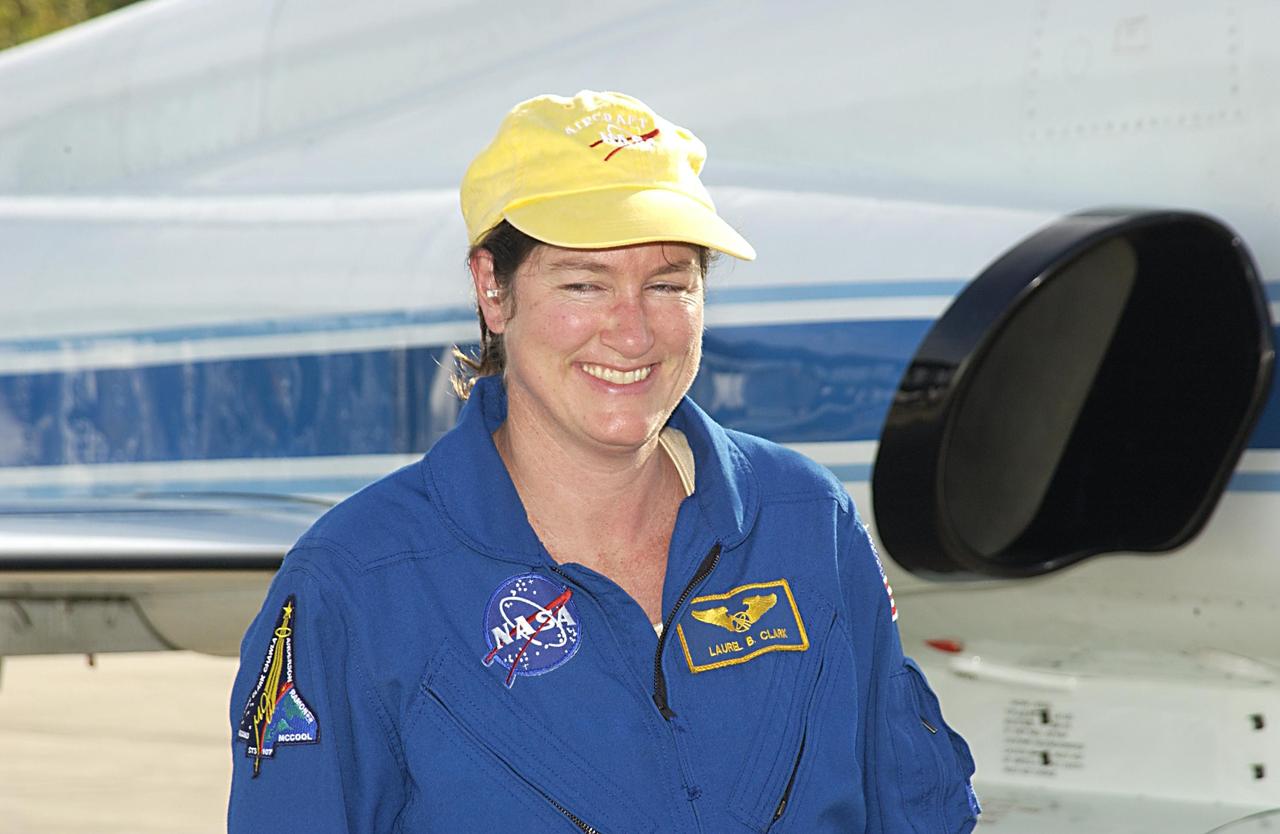
KENNEDY SPACE CENTER, FLA. -- STS-107 Mission Specialist Laurel Clark arrives at KSC to take part in Terminal Countdown Demonstration Test activities, which include a simulated launch countdown. Other crew members are Commander Rick Husband, Pilot William "Willie" McCool, Payload Commander Michael Anderson, Mission Specialists Kalpana Chawla and David Brown, and Payload Specialist Ilan Ramon, the first Israeli astronaut. STS-107 is a mission devoted to research and will include more than 80 experiments that will study Earth and space science, advanced technology development, and astronaut health and safety. Launch is scheduled for Jan. 16, 2003.
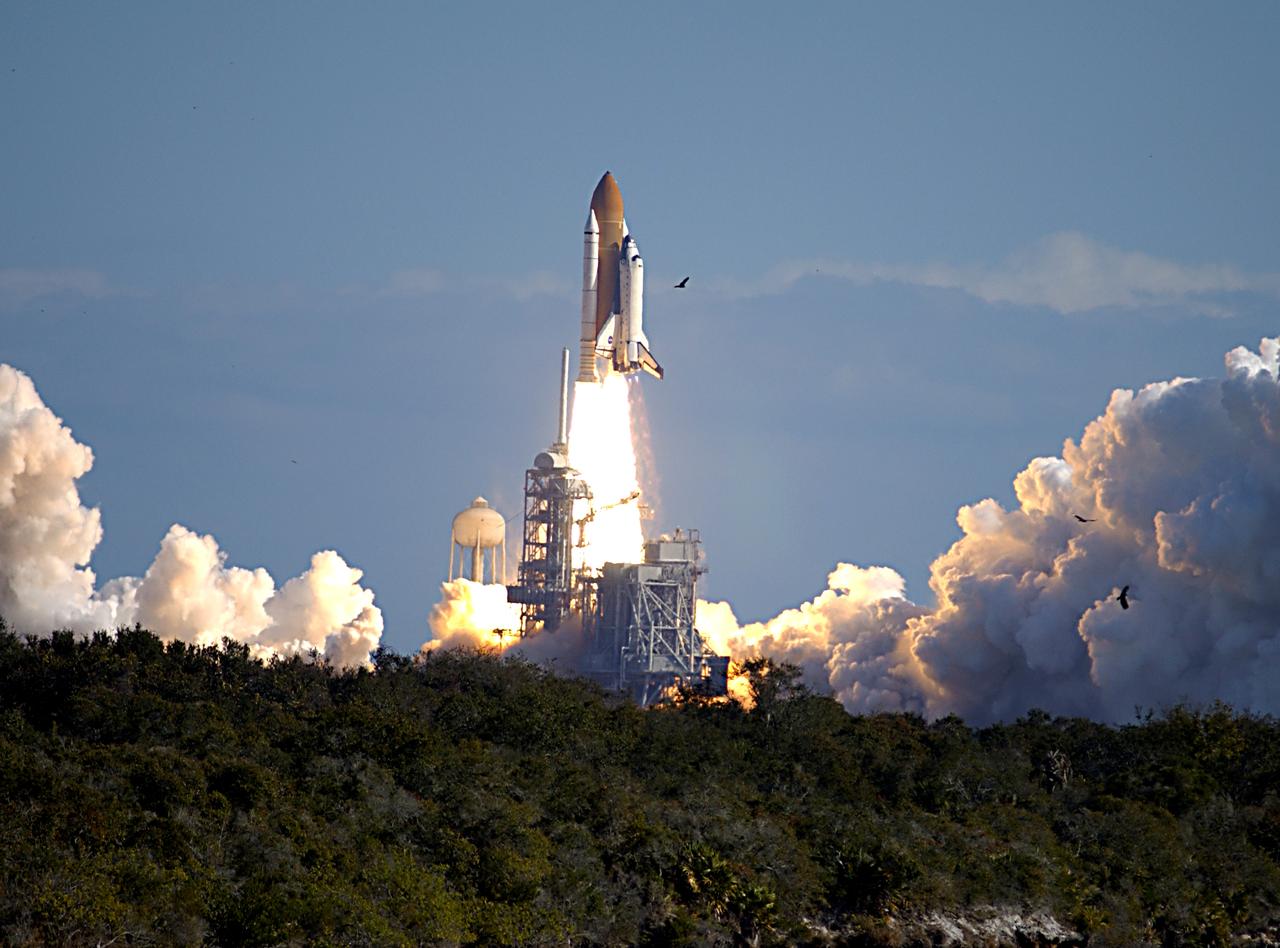
A clear blue sky hosts the Space Shuttle Orbiter Columbia STS-107 mission as it hurtles toward space from launch pad 39A at Kennedy Space Center on January 16, 2003. The 28th Columbia flight and 113th overall flight in NASA's Space Shuttle program, STS-107 is a multidiscipline microgravity and Earth science research mission involving 80-plus International experiments to be performed by a crew of seven during the 16-day mission. The breadth of science conducted on this mission will have widespread benefits to life on Earth, many of which will be managed by the Marshall Space Flight Center in Huntsville, Alabama.
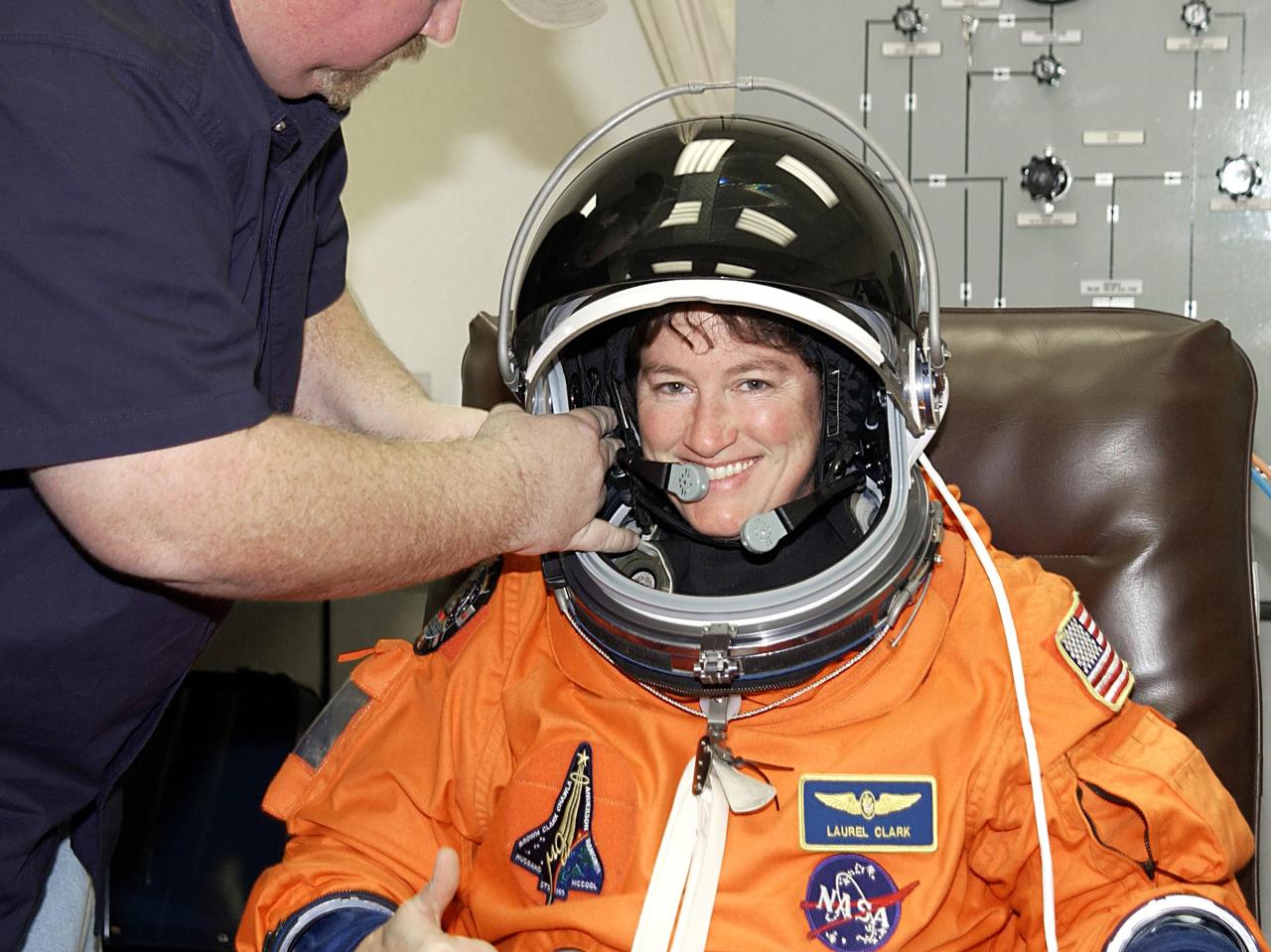
KENNEDY SPACE CENTER, FLA. - STS-107 Mission Specialist Laurel Clark is helped with her helmet during suitup for launch. STS-107 is a mission devoted to research and will include more than 80 experiments that will study Earth and space science, advanced technology development, and astronaut health and safety. The payload on Space Shuttle Columbia includes FREESTAR (Fast Reaction Experiments Enabling Science, Technology, Applications and Research) and the SHI Research Double Module (SHI/RDM), known as SPACEHAB. Experiments on the module range from material sciences to life sciences. Liftoff is scheduled for 10:39 a.m. EST.
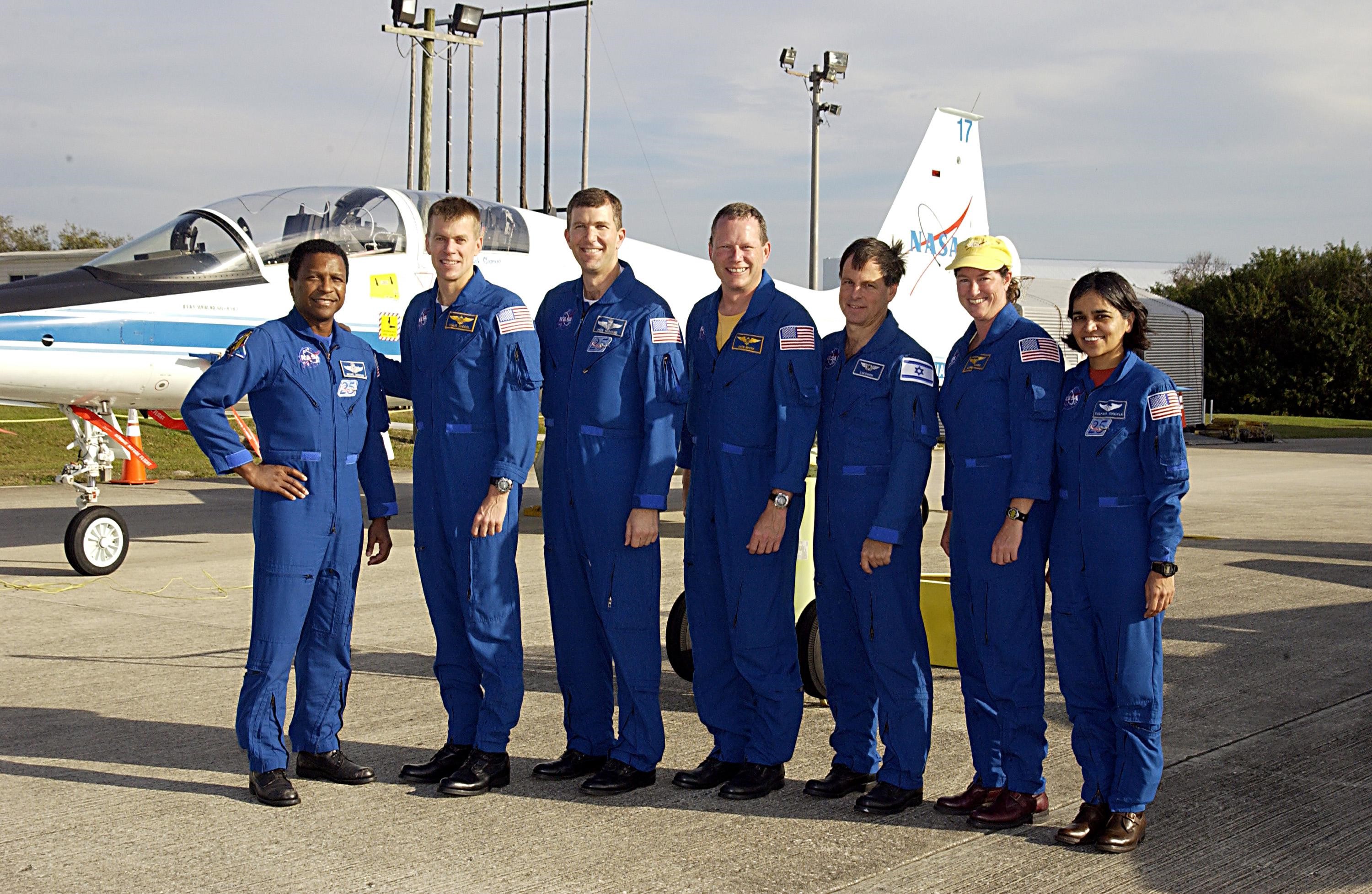
KENNEDY SPACE CENTER, FLA. -- The STS-107 crew arrives at KSC to take part in Terminal Countdown Demonstration Test activities. Standing, left to right, are Payload Commander Michael Anderson, Pilot William "Willie" McCool, Commander Rick Husband, Mission Specialist David Brown, Payload Specialist Ilan Ramon (the first Israeli astronaut), and Mission Specialists Laurel Clark and Kalpana Chawla. STS-107 is a mission devoted to research and will include more than 80 experiments that will study Earth and space science, advanced technology development, and astronaut health and safety.
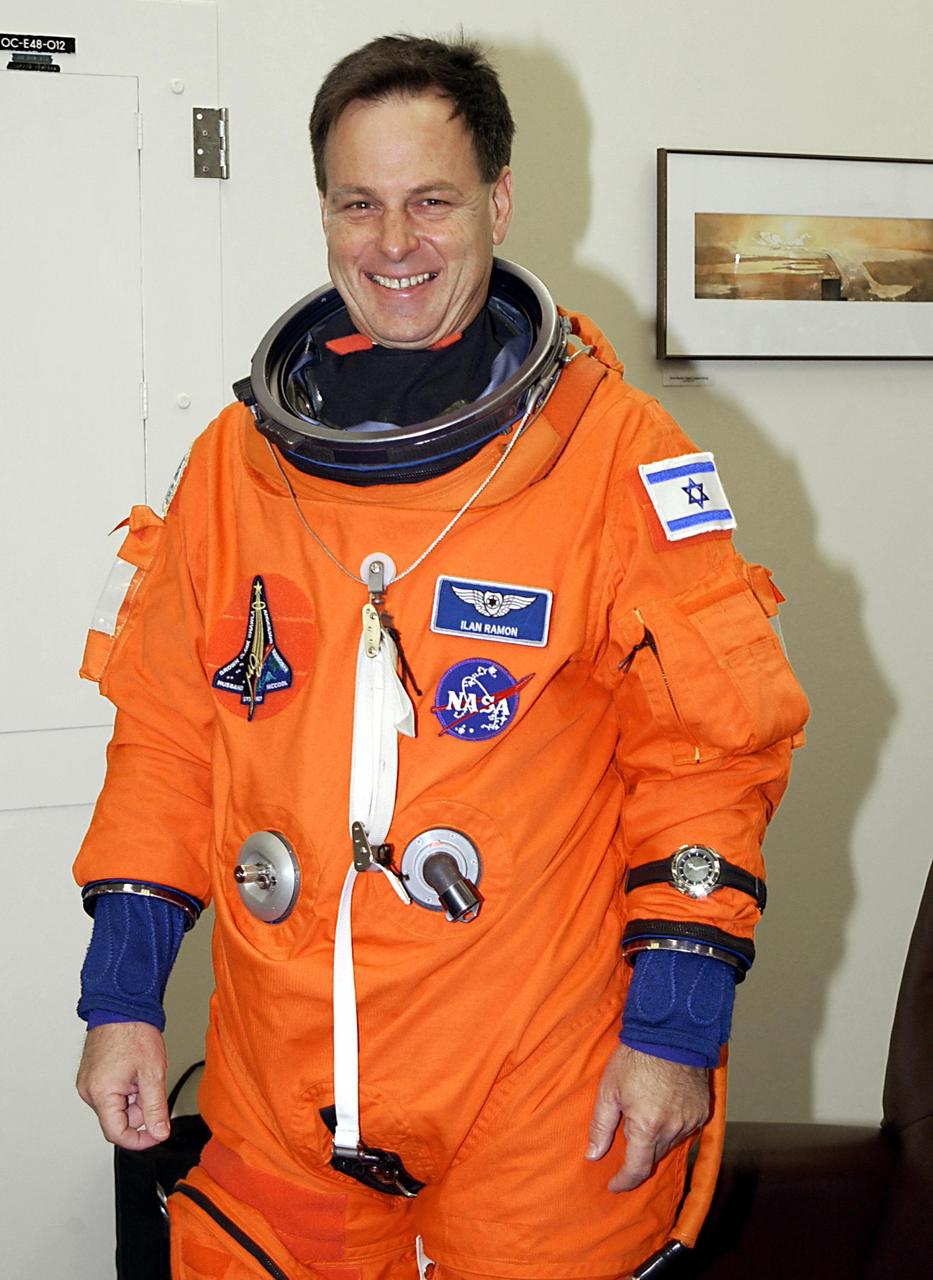
KENNEDY SPACE CENTER, FLA. -- STS-107 Payload Specialist Ilan Ramon, who represents the Israeli Space Agency, suits up for launch. STS-107 is a mission devoted to research and will include more than 80 experiments that will study Earth and space science, advanced technology development, and astronaut health and safety. The payload on Space Shuttle Columbia includes FREESTAR (Fast Reaction Experiments Enabling Science, Technology, Applications and Research) and the SHI Research Double Module (SHI/RDM), known as SPACEHAB. Experiments on the module range from material sciences to life sciences. Liftoff is scheduled for 10:39 a.m. EST.
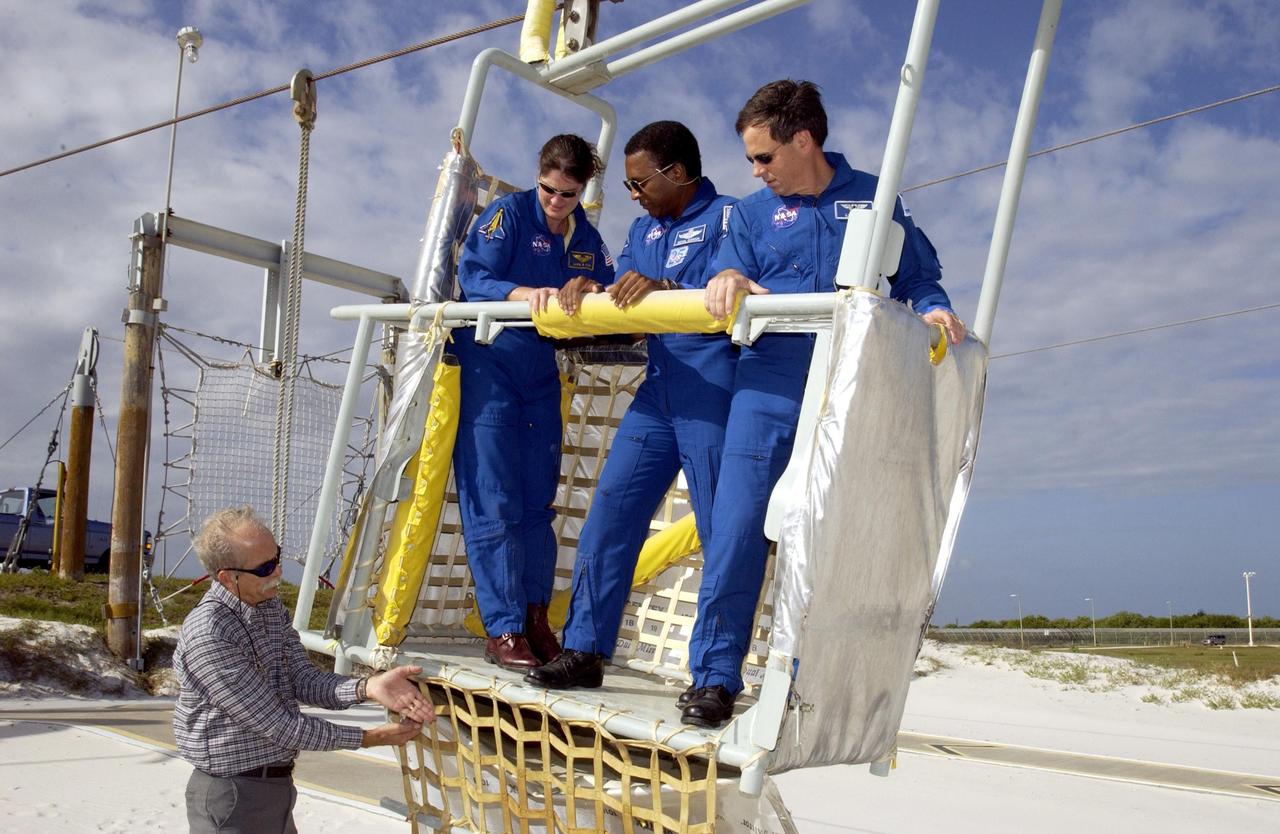
KENNEDY SPACE CENTER, FLA. -- The STS-107 crew gets instruction on the slidewire basket during emergency egress training, part of Terminal Countdown Demonstration Test activities. Seen are Mission Specialist Laurel Clark, Payload Commander Michael Anderson and Payload Specialist Ilan Ramon (the first Israeli astronaut). The TCDT also includes a simulated launch countdown. STS-107 is a mission devoted to research and will include more than 80 experiments that will study Earth and space science, advanced technology development, and astronaut health and safety. Launch is planned for Jan. 16, 2003, between 10 a.m. and 2 p.m. EST aboard Space Shuttle Columbia. .
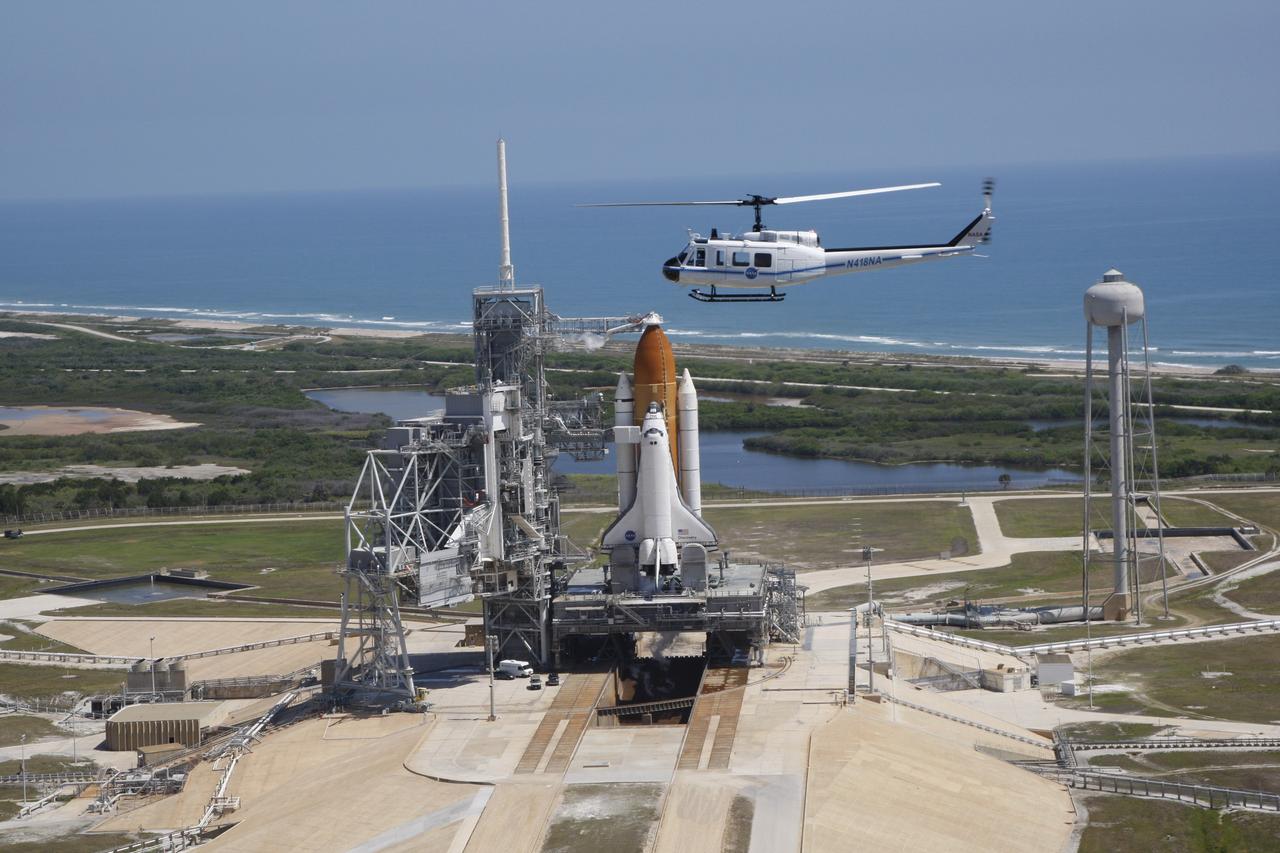
CAPE CANAVERAL, Fla. – A new NASA helicopter circles space shuttle Discovery on Launch Pad 39A prior to launch on the STS-124 mission. To the left of the shuttle is the fixed service structure with the 80-foot lightning mast on top. The rotating service structure, normally closed around the shuttle, is open for liftoff. At right of the pad is the 300,000-gallon water tower that provides the water used for sound suppression on the pad during liftoff. In the background is the Atlantic Ocean. Discovery is making its 35th flight. The STS-124 mission is the 26th in the assembly of the space station. It is the second of three flights launching components to complete the Japan Aerospace Exploration Agency's Kibo laboratory.
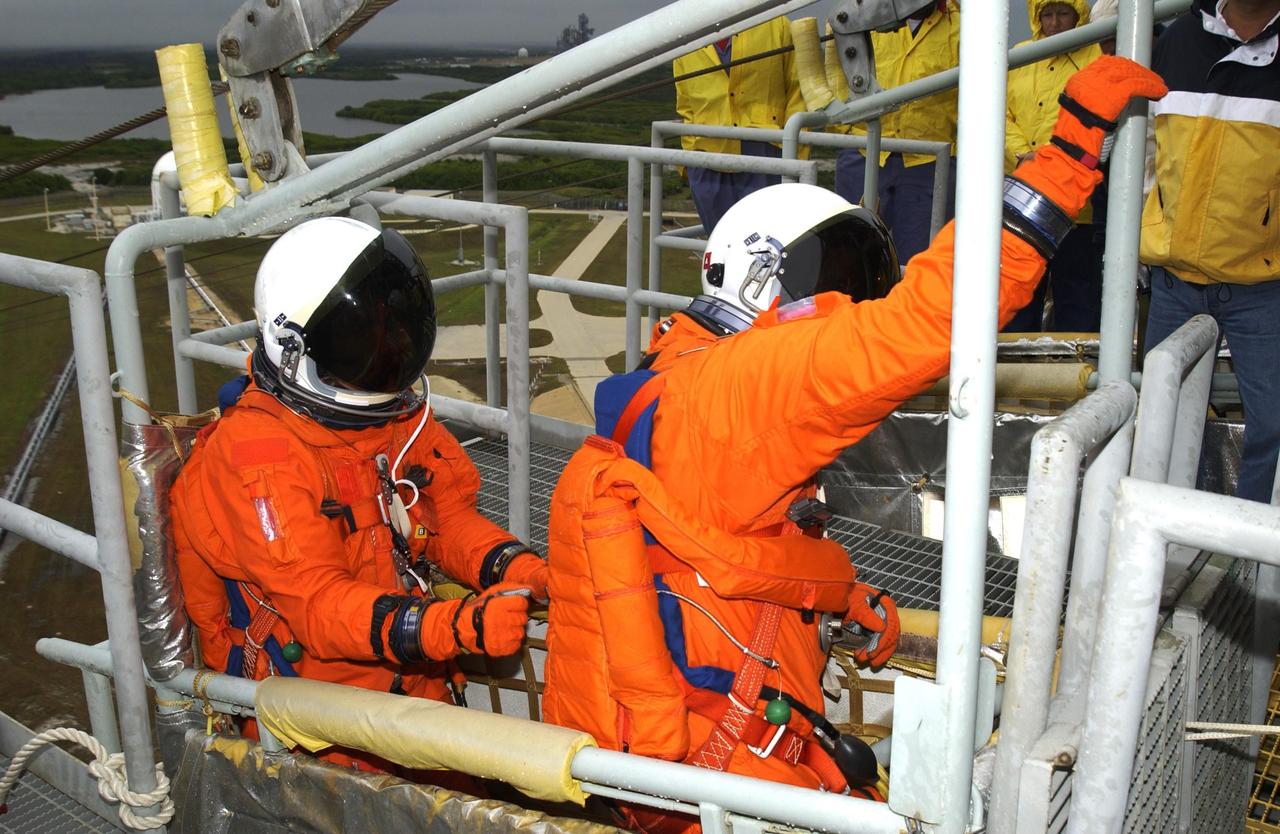
KENNEDY SPACE CENTER, FLA. - Members of the STS-107 crew practice emergency egress from the launch pad, reaching for the release lever of the slidewire basket they are in. The crew is taking part in a simulated launch countdown, part of Terminal Countdown Demonstration Test activities. STS-107 is a mission devoted to research and will include more than 80 experiments that will study Earth and space science, advanced technology development, and astronaut health and safety. Launch is planned for Jan. 16, 2003, between 10 a.m. and 2 p.m. EST aboard Space Shuttle Columbia. .
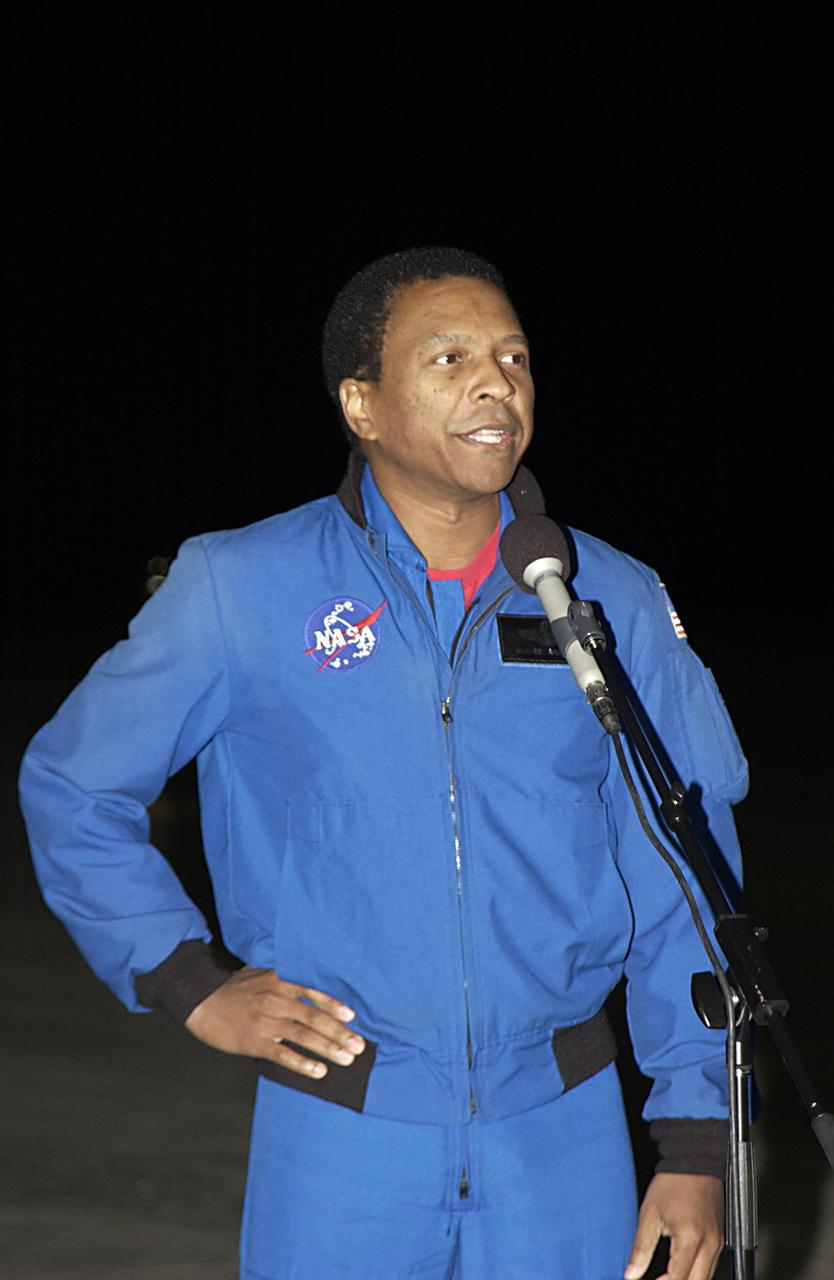
KENNEDY SPACE CENTER, FLA. - STS-107 Payload Commander Michael Anderson comments about the mission after the crew's arrival at KSC for pre-launch preparations. STS-107 is a mission devoted to research and will include more than 80 experiments that will study Earth and space science, advanced technology development, and astronaut health and safety. The payload on Space Shuttle Columbia includes FREESTAR (Fast Reaction Experiments Enabling Science, Technology, Applications and Research) and the SHI Research Double Module (SHI/RDM), known as SPACEHAB. Experiments on the module range from material sciences to life sciences. Launch of Columbia is targeted for Jan. 16 between 10 a.m. and 2 p.m.
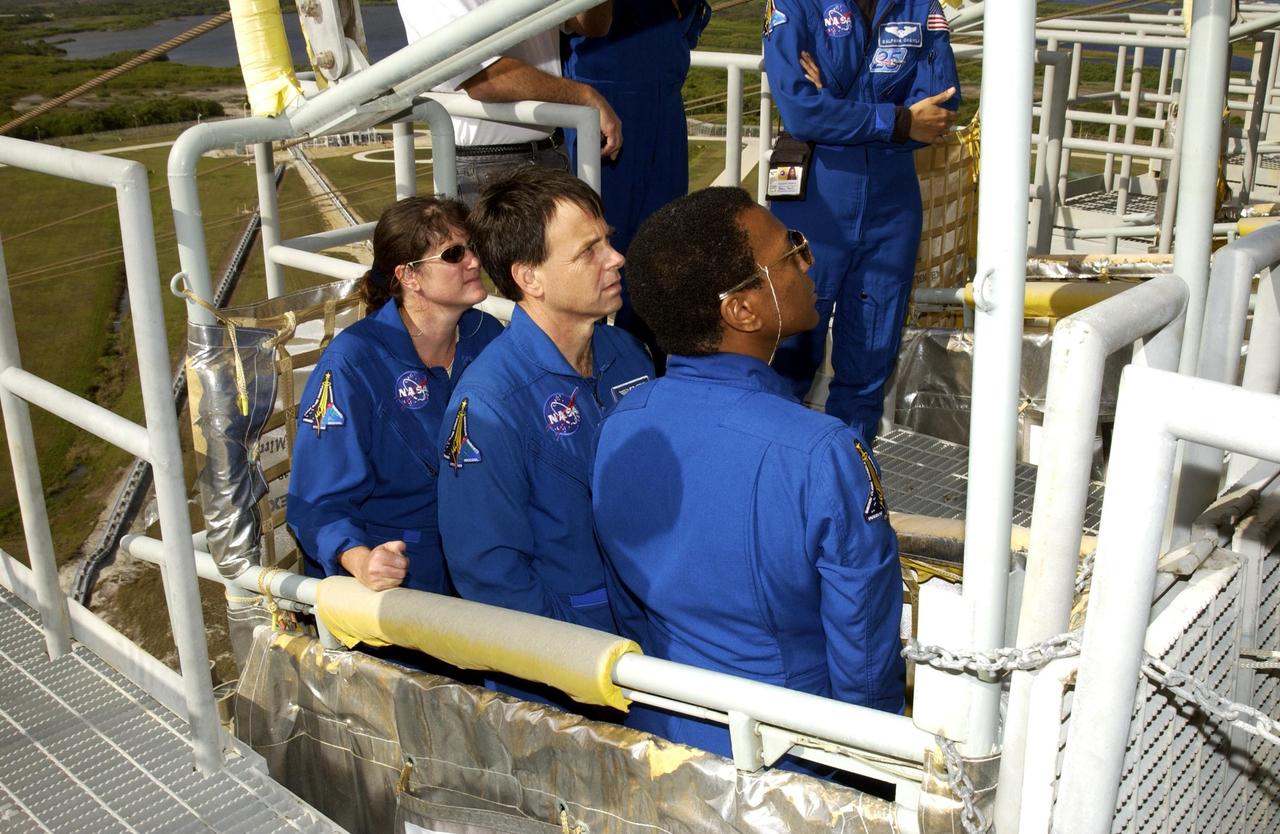
KENNEDY SPACE CENTER, FLA. - The STS-107 crew gets instruction on emergency egress from the pad during Terminal Countdown Demonstration Test activities. Standing in the slidewire basket are (from left) Mission Specialist Laurel Clark, Payload Specialist Ilan Ramon (the first Israeli astronaut) and Payload Commander Michael Anderson. The TCDT also includes a simulated launch countdown. STS-107 is a mission devoted to research and will include more than 80 experiments that will study Earth and space science, advanced technology development, and astronaut health and safety. Launch is planned for Jan. 16, 2003, between 10 a.m. and 2 p.m. EST aboard Space Shuttle Columbia. .
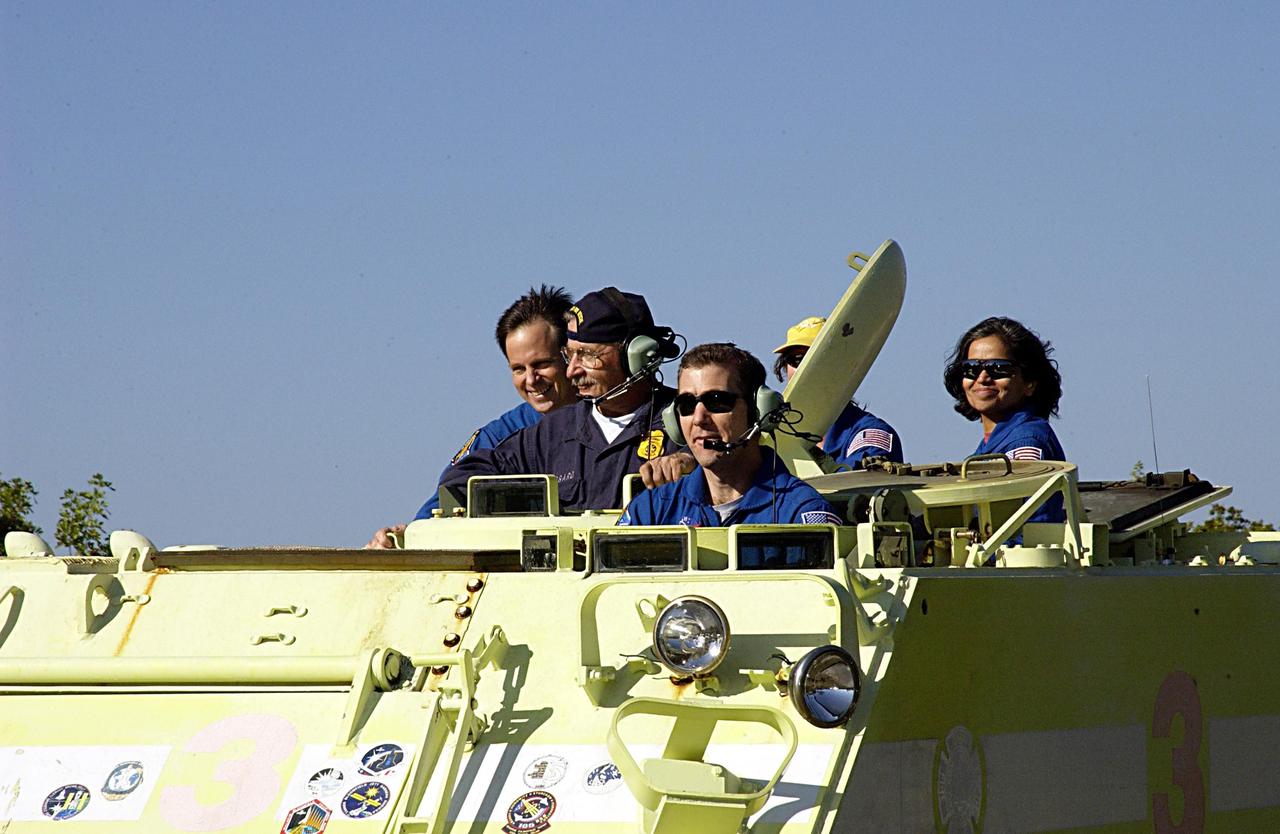
KENNEDY SPACE CENTER, FLA. -- STS-107 Commander Rick Husband operates an M113 armored personnel carrier during Terminal Countdown Demonstration Test activities, a standard part of launch preparations. From left, Payload Specialist Ilan Ramon, the first Israeli astronaut, Instructor George Hoggard, and Mission Specialists Laurel Clark (face obscured) and Kalpana Chawla enjoy the ride in the background. STS-107 is a mission devoted to research and will include more than 80 experiments that will study Earth and space science, advanced technology development, and astronaut health and safety. Launch is planned for Jan. 16, 2003, between 10 a.m. and 2 p.m. EST aboard Space Shuttle Columbia.
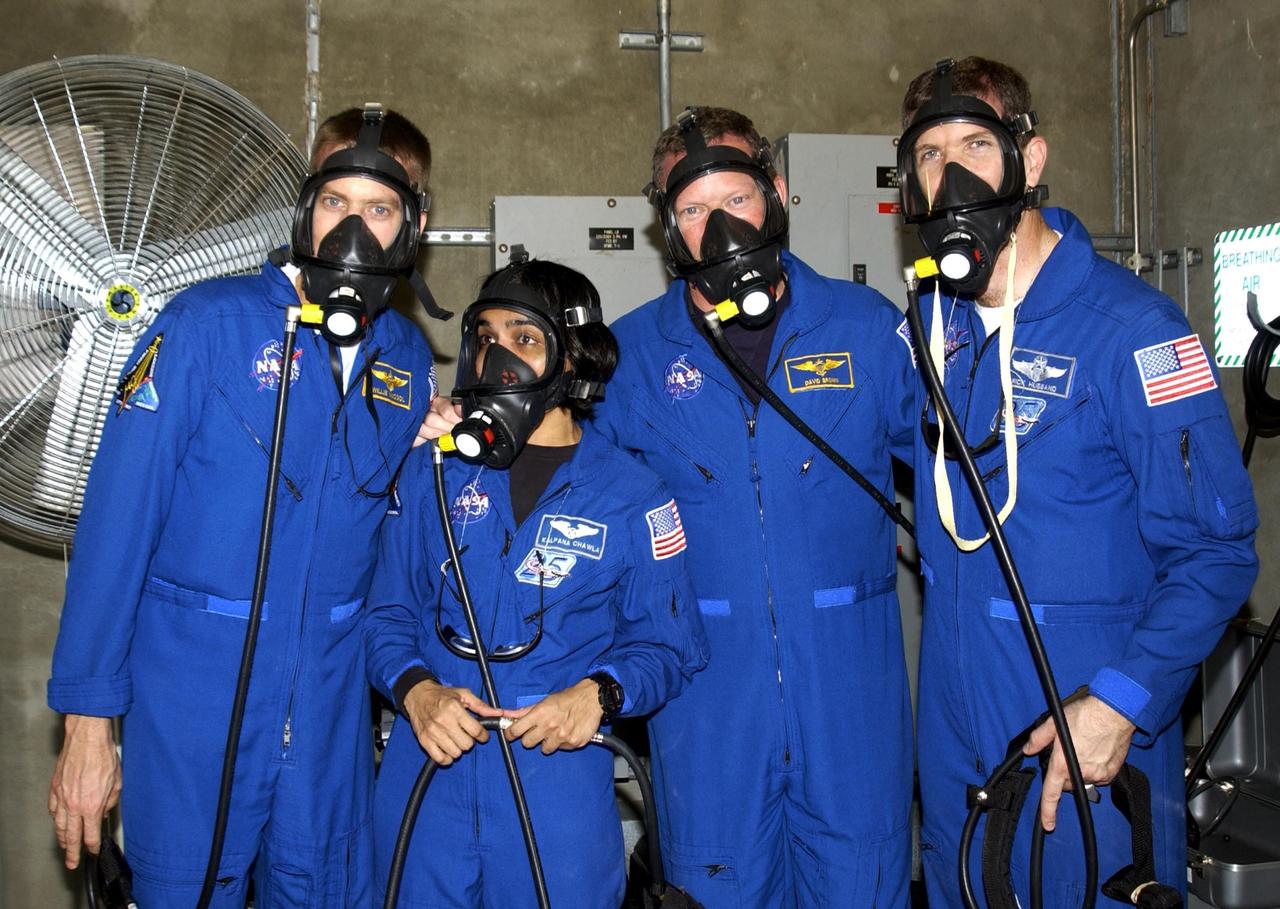
KENNEDY SPACE CENTER, FLA. -- During emergency egress training, part of Terminal Countdown Demonstration Test activities at the pad, STS-107 crew members test breathing masks in the emergency bunker. From left are Pilot William "Willie" McCool, Mission Specialists Kalpana Chawla and David Brown, and Commander Rick Husband. STS-107 is a mission devoted to research and will include more than 80 experiments that will study Earth and space science, advanced technology development, and astronaut health and safety. Launch is planned for Jan. 16, 2003, between 10 a.m. and 2 p.m. EST aboard Space Shuttle Columbia. .
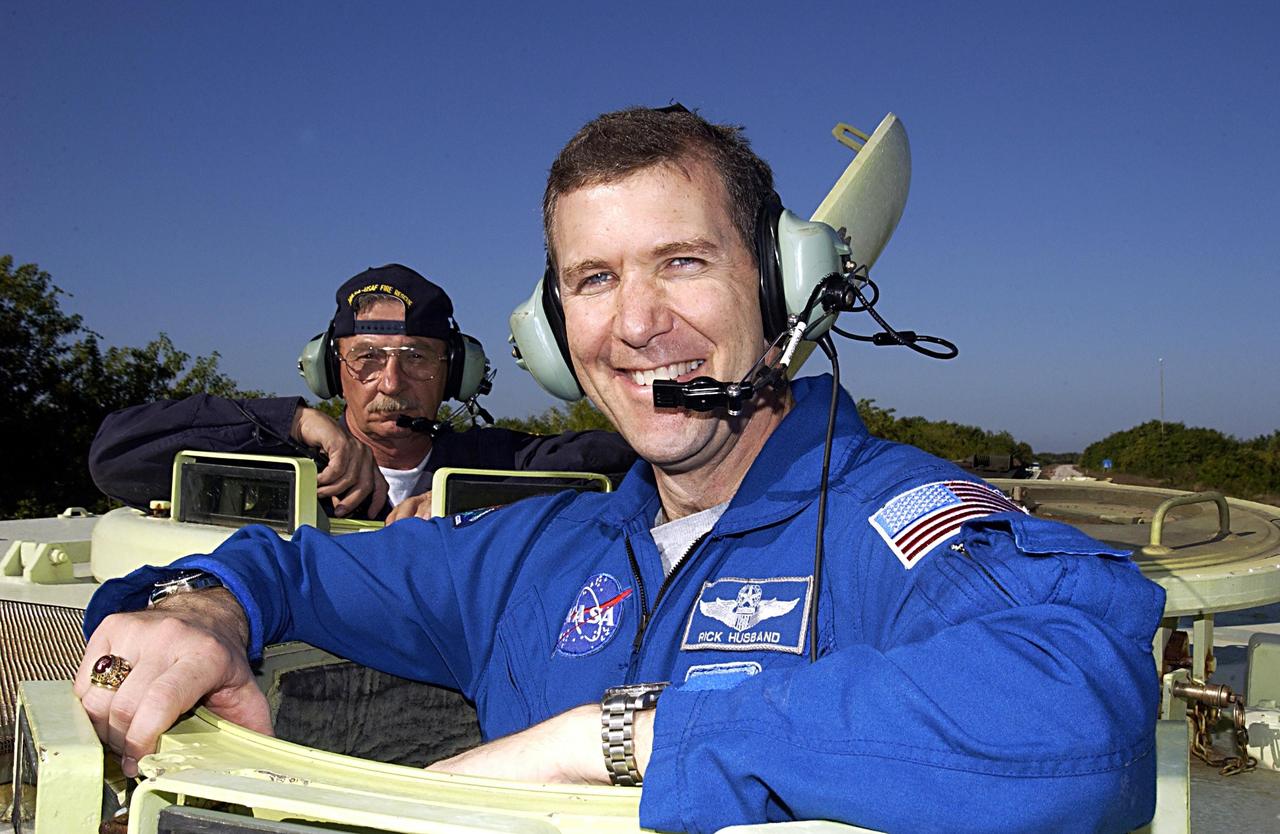
KENNEDY SPACE CENTER, FLA. -- STS-107 Commander Rick Husband takes a break during training on the operation of an M113 armored personnel carrier during Terminal Countdown Demonstration Test activities, a standard part of launch preparations. Instructor George Hoggard looks on over Husband's shoulder. STS-107 is a mission devoted to research and will include more than 80 experiments that will study Earth and space science, advanced technology development, and astronaut health and safety. Launch is planned for Jan. 16, 2003, between 10 a.m. and 2 p.m. EST aboard Space Shuttle Columbia.
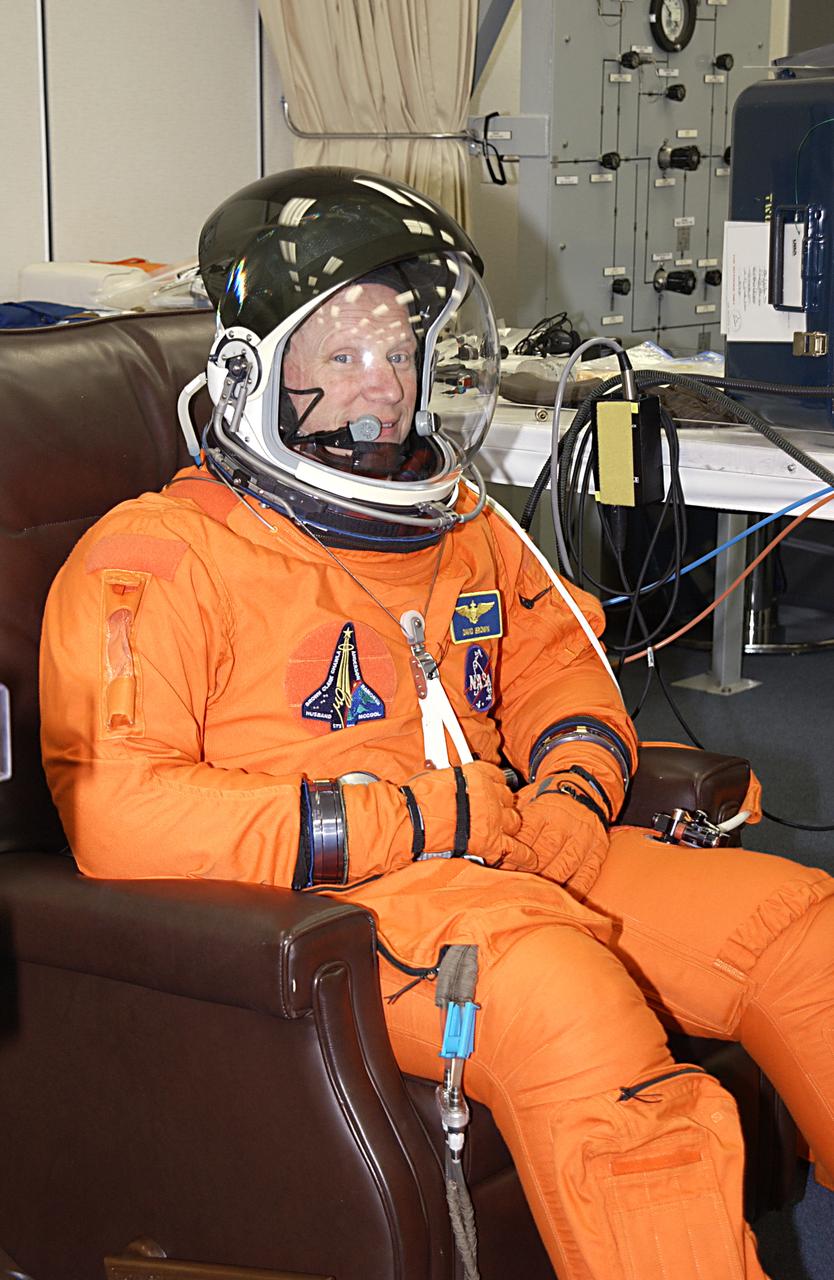
STS-107 Mission Specialist David Brown gets a final suit fit as part of launch preparations. STS-107 is a mission devoted to research and will include more than 80 experiments that will study Earth and space science, advanced technology development, and astronaut health and safety. The payload on Space Shuttle Columbia includes FREESTAR (Fast Reaction Experiments Enabling Science, Technology, Applications and Research) and the SHI Research Double Module (SHI/RDM), known as SPACEHAB. Experiments on the module range from material sciences to life sciences. Launch is scheduled for Jan. 16, between 10 a.m. and 2 p.m.
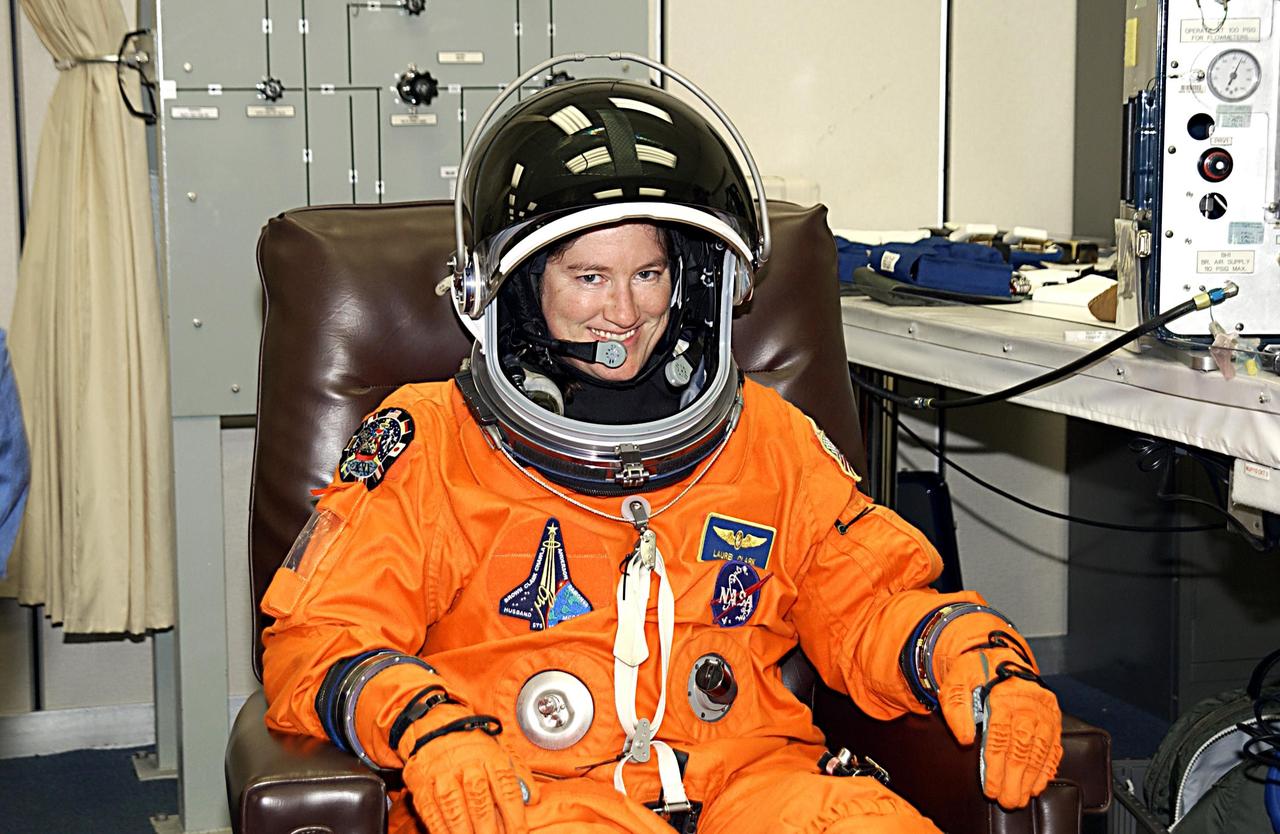
KENNEDY SPACE CENTER, FLA. - STS-107 Mission Specialist Laurel Clark gets a final fitting on her launch and entry suit as part of launch preparations. STS-107 is a mission devoted to research and will include more than 80 experiments that will study Earth and space science, advanced technology development, and astronaut health and safety. The payload on Space Shuttle Columbia includes FREESTAR (Fast Reaction Experiments Enabling Science, Technology, Applications and Research) and the SHI Research Double Module (SHI/RDM), known as SPACEHAB. Experiments on the module range from material sciences to life sciences. Launch is scheduled for Jan. 16, between 10 a.m. and 2 p.m.
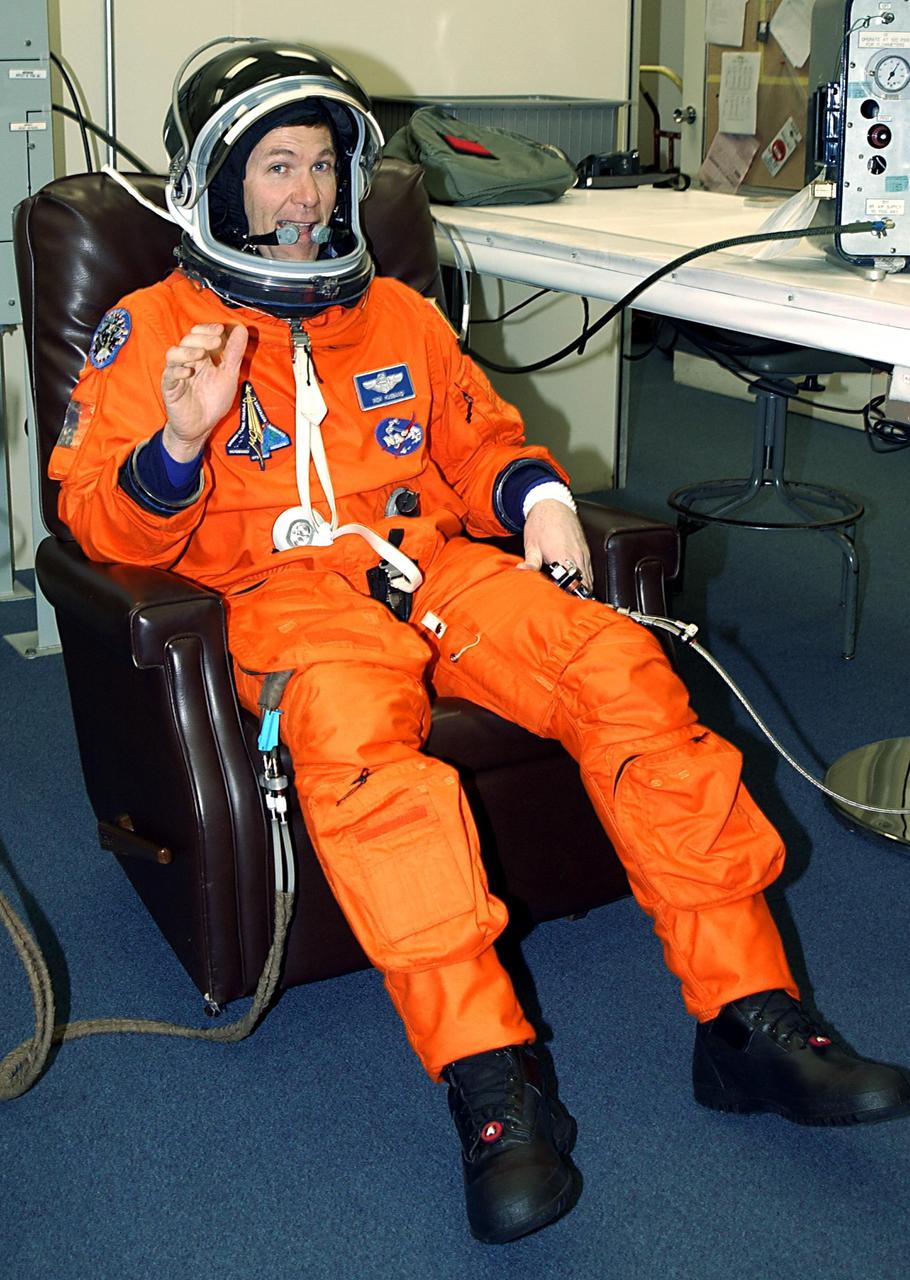
KENNEDY SPACE CENTER, FLA. - STS-107 Mission Commander Rick Husband waves during suitup for launch on mission STS-107. The mission is devoted to research and will include more than 80 experiments that will study Earth and space science, advanced technology development, and astronaut health and safety. The payload on Space Shuttle Columbia includes FREESTAR (Fast Reaction Experiments Enabling Science, Technology, Applications and Research) and the SHI Research Double Module (SHI/RDM), known as SPACEHAB. Experiments on the module range from material sciences to life sciences. Liftoff is scheduled for 10:39 a.m. EST.