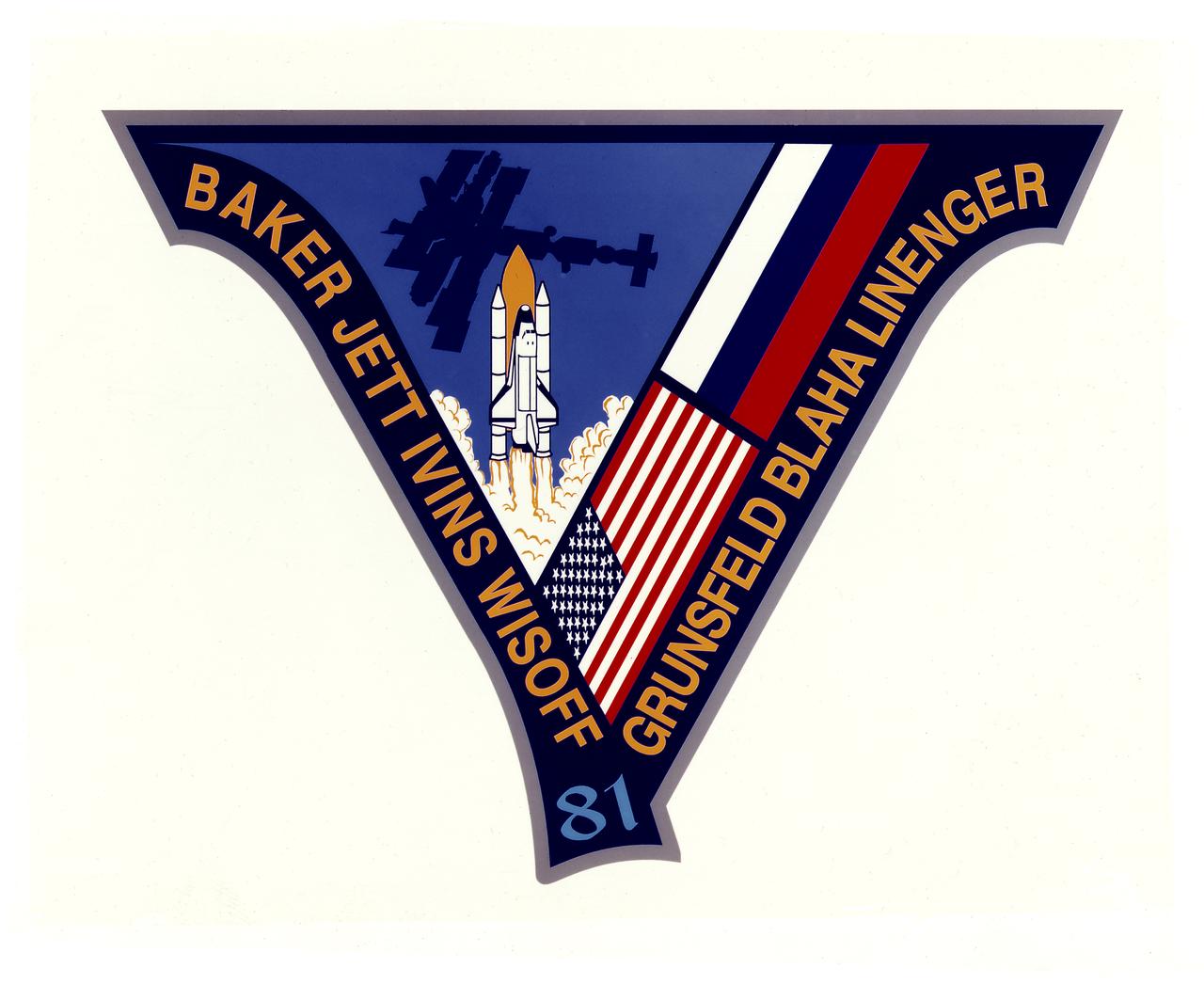
The crew patch for STS-81 , the fifth Shuttle-Mir docking mission, is shaped to represent the Roman numeral V. The Shuttle Atlantis is launching toward a rendezvous with Russia's Mir Space Station, silhouetted in the background. Atlantis and the STS-81 crew spent several days docked to Mir during which time Jerry M. Lineger (NASA-Mir-4) replaced astronaut John Blaha (NASA-Mir-3) as the U.S. crew member onboard Mir. The U.S. and Russian flags are depicted along with the names of the shuttle crew.
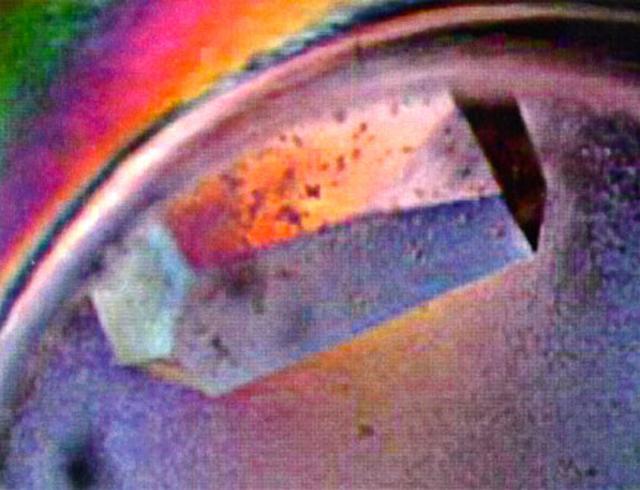
This is a large 2 mm crystal of histone octamer, grown on STS-81. A very dynamic structure which functions in many aspects of gene regulation from control of gene activity to the more subtle mechanisms of genetic imprinting. Principle Investigator is Dan Carter of New Century Pharmaceuticals.
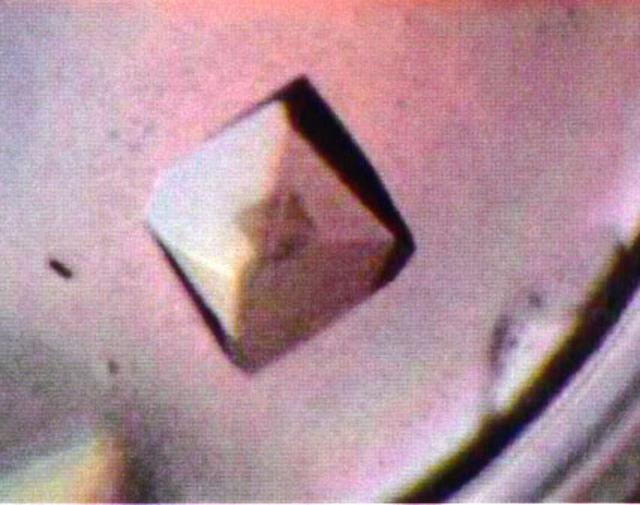
1 mm histone octamer crystal grown on STS-81. A very dynamic structure which functions in many aspects of gene regulation from control of gene activity to the more subtle mechanisms of genetic imprinting. Principle Investigator is Dan Carter of New Century Pharmaceuticals.

STS081-338-037 (12-22 Jan. 1997) --- Astronaut Michael A. Baker, STS-81 commander, mans the commander's station on the Space Shuttle Atlantis' flight deck.
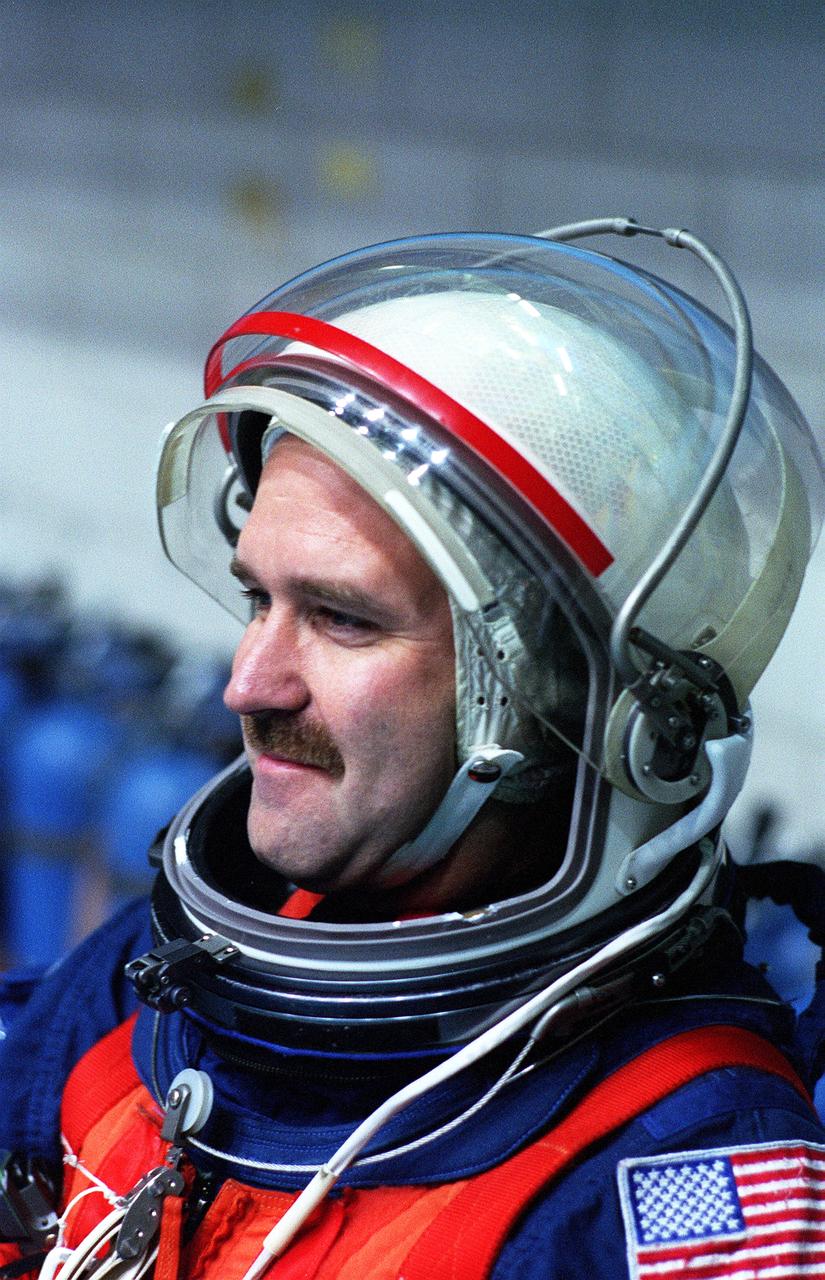
S96-15402 (26 Sept. 1996) --- In the Johnson Space Center's weightless environment training facility, astronaut John M. Grunsfeld, STS-81 mission specialist, prepares to simulate a parachute drop into water. Five STS-81 crewmates, out of frame, joined him for the bailout training exercises.
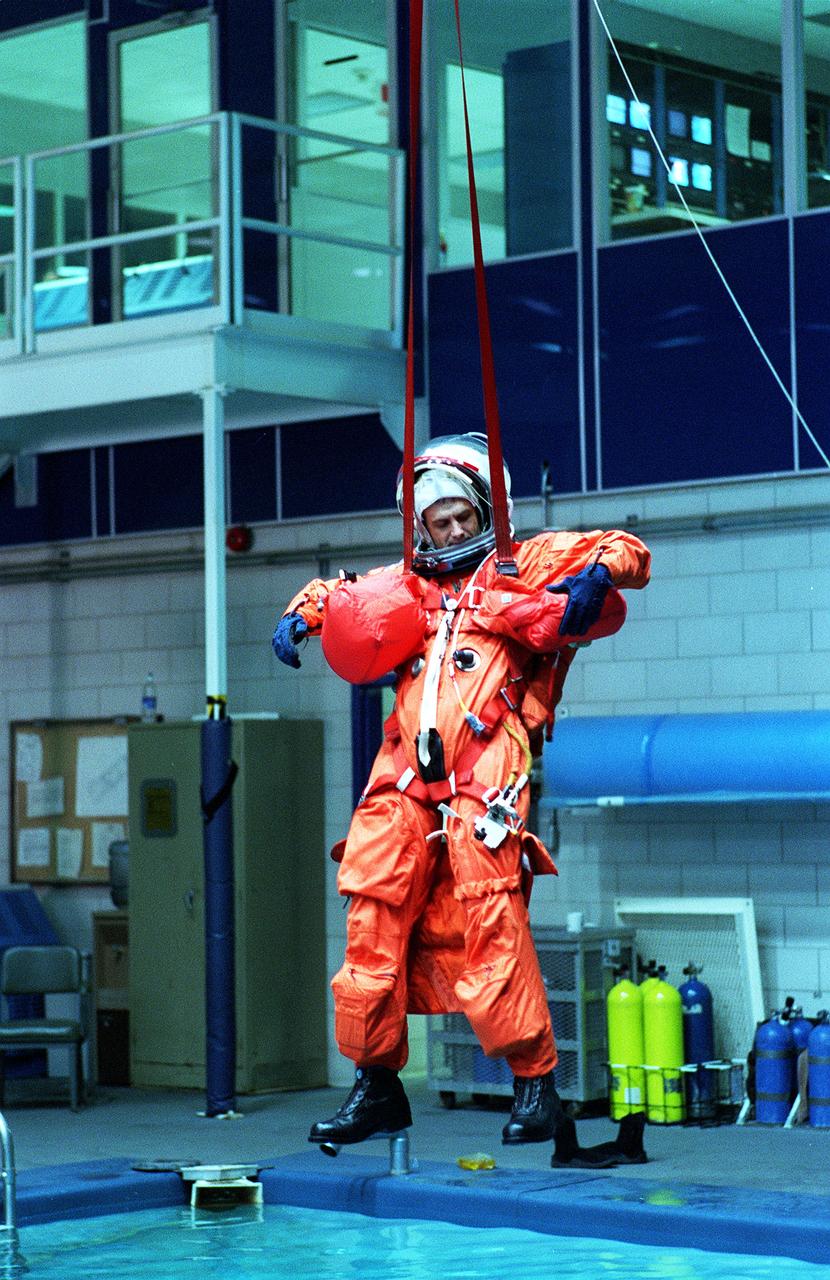
S96-15407 (26 Sept. 1996) --- In the Johnson Space Center's weightless environment training facility, astronaut Peter J.K. (Jeff) Wisoff, STS-81 mission specialist, simulates a parachute drop into water. Five STS-81 crewmates, out of frame, joined him for the bailout training exercises.
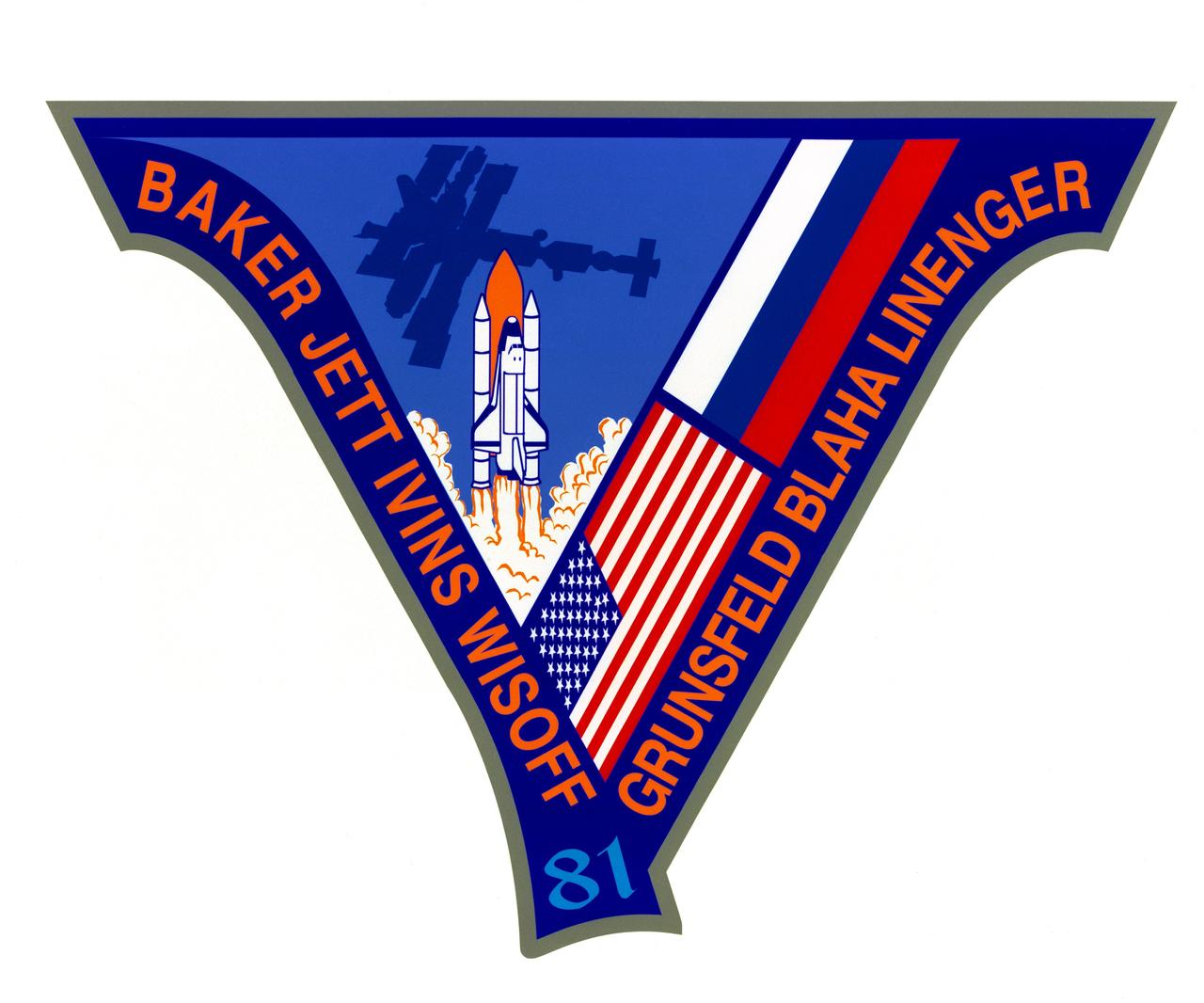
STS081-S-001 (June 1996) --- The STS-81 crew patch for the fifth Shuttle-Mir docking mission, is shaped to represent the Roman numeral V. The space shuttle Atlantis, OV-104, is launching toward a rendezvous with Russia?s Mir Space Station, silhouetted in the background. Atlantis and the STS-81 crew will spend several days docked to Mir during which time astronaut Jerry M. Linenger (NASA-Mir 4) will replace astronaut John E. Blaha (NASA-Mir 3) as the United States crew member onboard Mir. Scientific experiments and logistics will also be transferred between Atlantis and Mir. The United States and Russian flags are depicted along with the names of the shuttle crew members: Michael A. Baker, commander; Brent W. Jett, pilot; Peter J. K.(Jeff) Wisoff, mission specialist 1; John W. Grunsfeld, mission specialist 2; Marsha S. Ivins, mission specialist 3; Linenger; mission specialist 4; and Blaha, mission specialist 5. The NASA insignia design for space shuttle flights is reserved for use by the astronauts and for other official use as the NASA Administrator may authorize. Public availability has been approved only in the forms of illustrations by the various news media. When and if there is any change in this policy, which is not anticipated, the change will be publicly announced. Photo credit: NASA
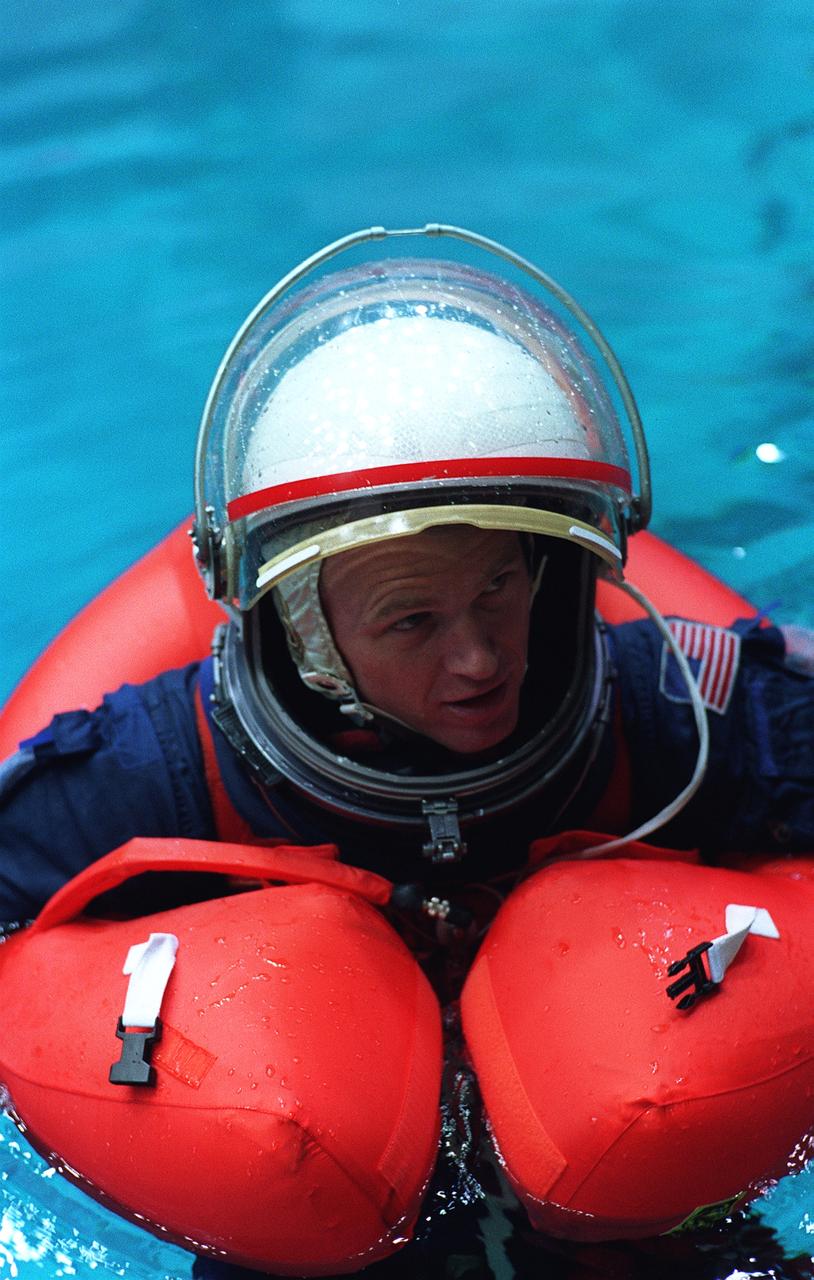
S96-15393 (26 Sept. 1996) --- In the Johnson Space Center's weightless environment training facility, astronaut Brent W. Jett Jr., STS-81 mission specialist, deploys his "Mae West" device to stay afloat during water bailout survival training. Five STS-81 crewmates, out of frame, joined him for the bailout training exercises.
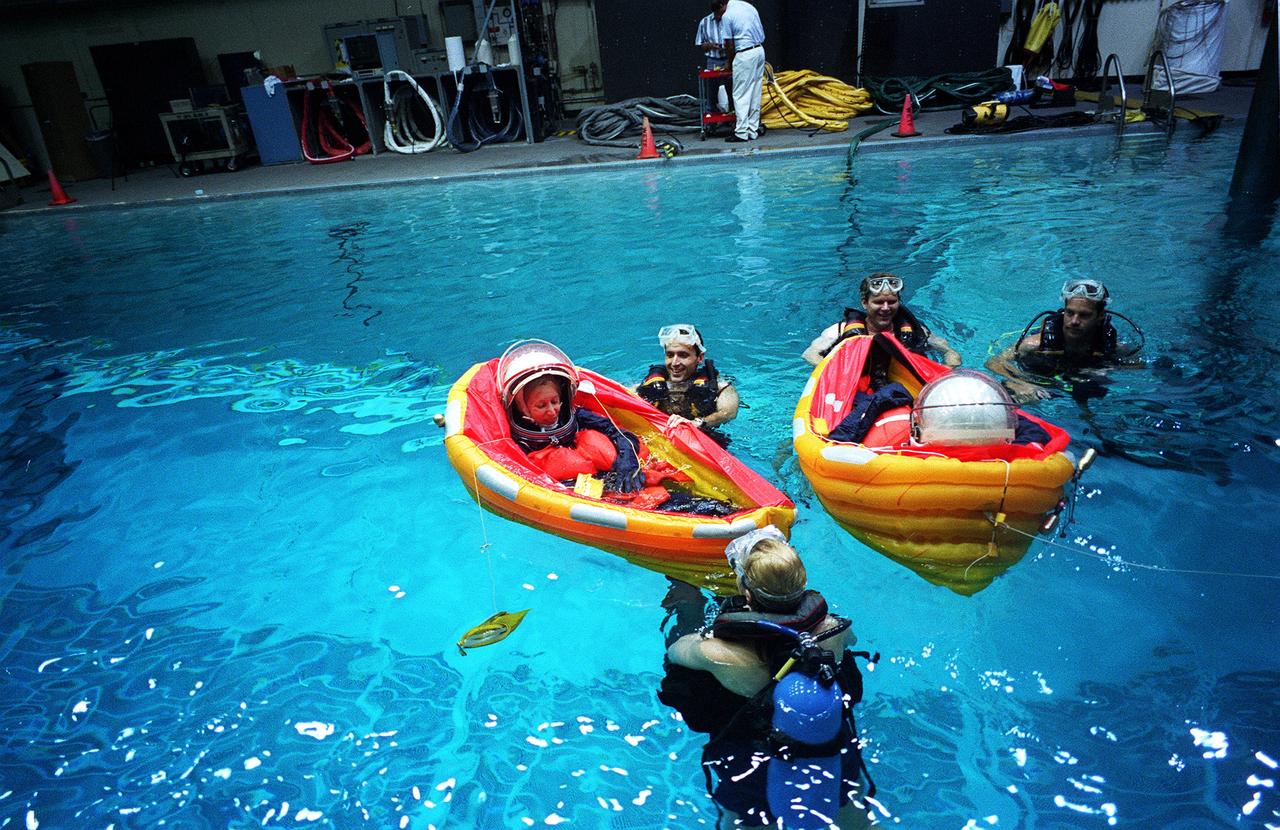
S96-15405 (26 Sept. 1996) --- In the Johnson Space Center's weightless environment training facility, astronaut Marsha S. Ivins, STS-81 mission specialist, bails water from her life raft during water bailout survival training. Astronaut Peter J.K. (Jeff) Wisoff (pictured in right raft) and four other STS-81 crewmates (out of frame) joined Ivins for the bailout training exercises. Several SCUBA-equipped divers assist in the training exercise.
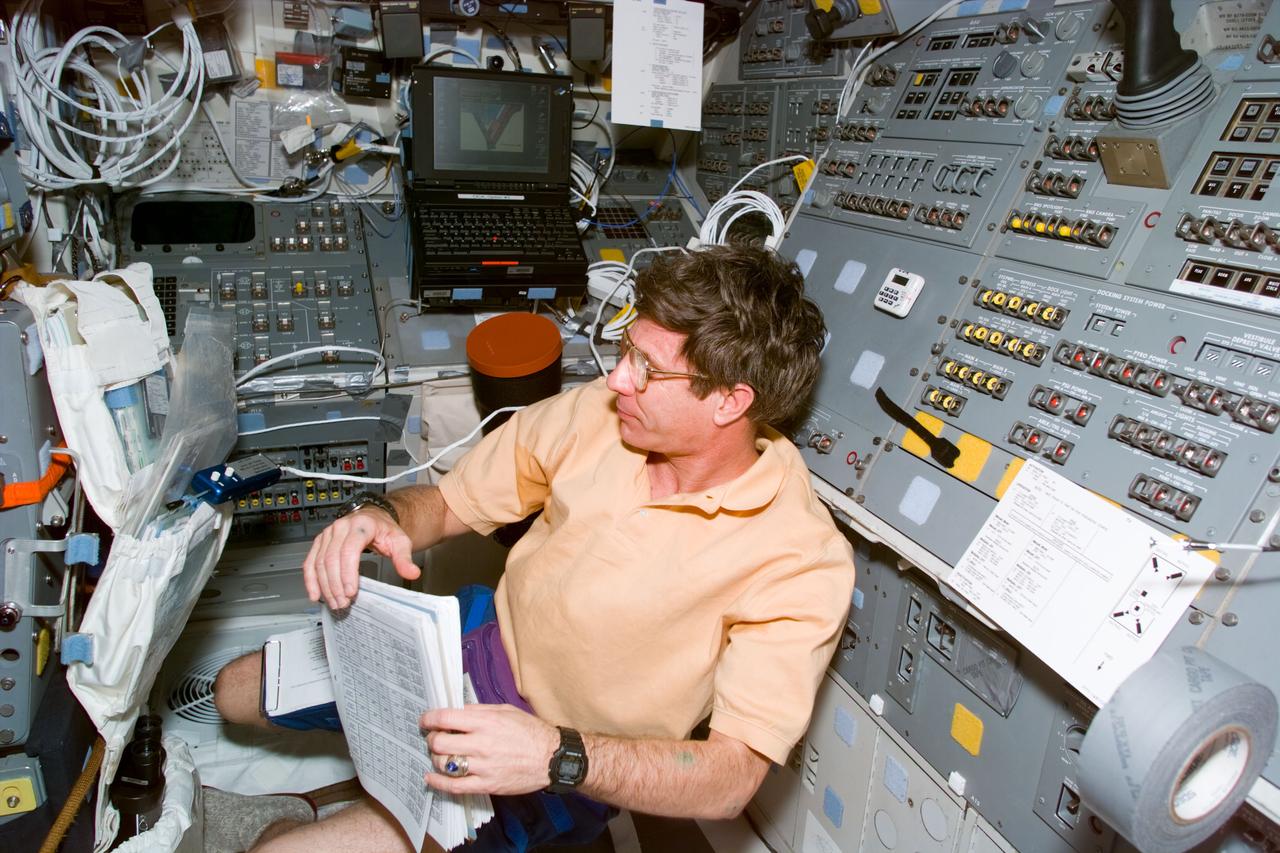
STS081-E-05504 (16 Jan. 1997) --- Astronaut John E. Blaha re-unites with the familiar surroundings of the Space Shuttle Atlantis' aft flight deck, which he has not seen since September 1996, when he went aboard the Russian Mir Space Station complex. After the January 15, 1997 docking of Mir and Atlantis, Blaha assumed the status of a STS-81 mission specialist. Here, he checks small items against a check list. The photograph was recorded with an Electronic Still Camera (ESC) and later was downlinked to flight controllers in Houston, Texas.
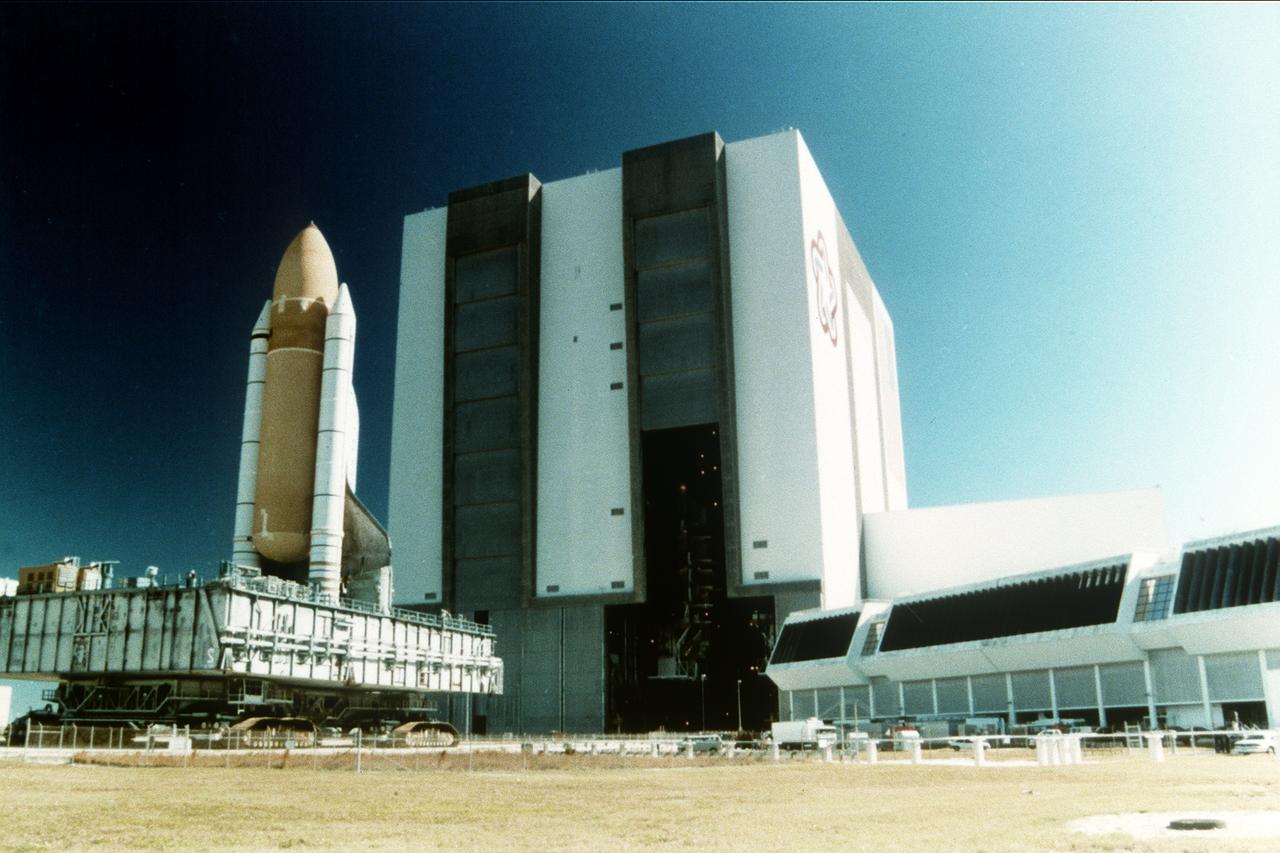
S97-00253 (10 Dec. 1996) ---- After clearing the high bay door of the Vehicle Assembly Building (VAB), the space shuttle Atlantis slowly moves out to Launch Pad 39B along the crawlerway. Atlantis is scheduled to liftoff Jan. 12 on STS-81, the first Shuttle mission of 1997. The planned nine-day flight will include the fifth Shuttle-Mir docking.
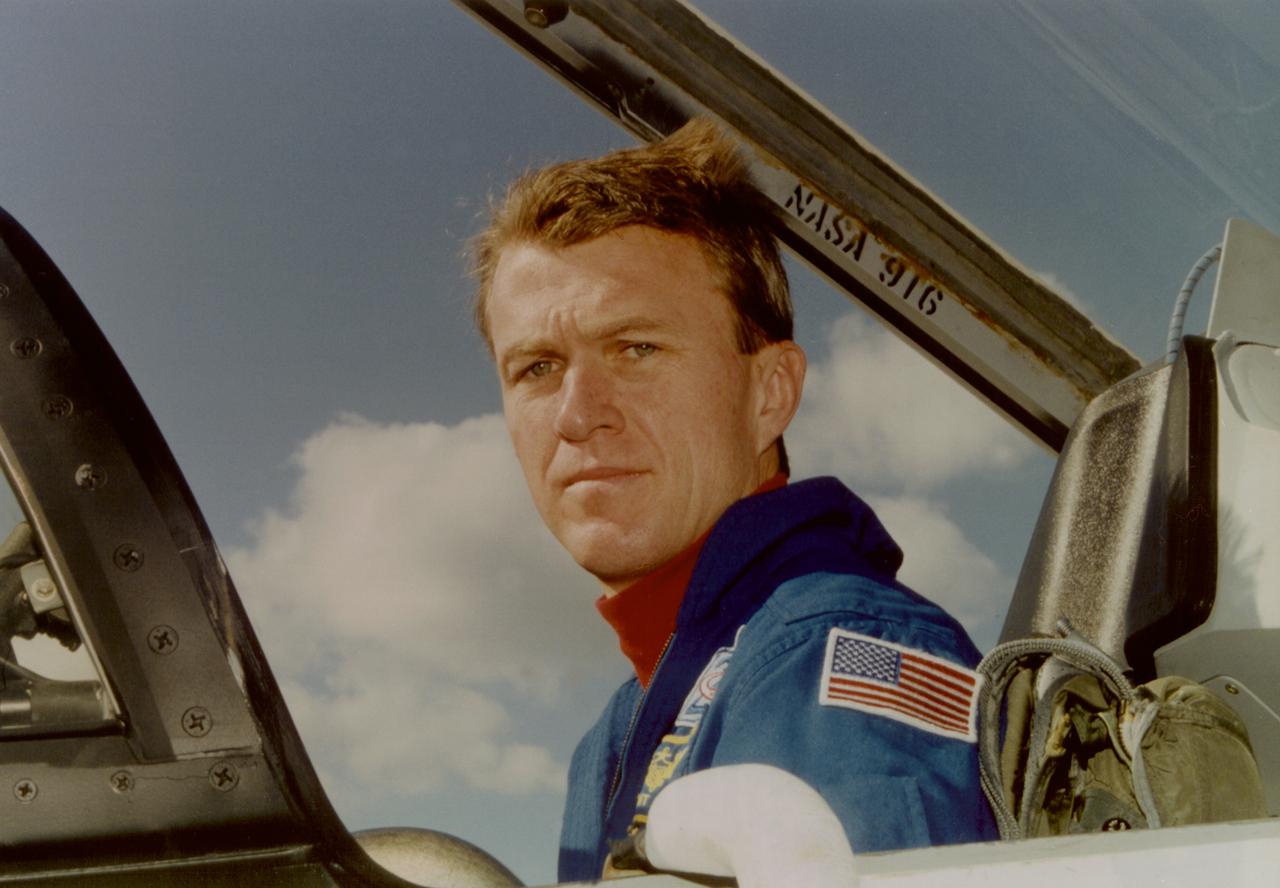
S97-00252 (15 Dec. 1996) --- Astronaut Brent W. Jett Jr., STS-81 pilot, arrives in a NASA T-38 jet trainer at the Kennedy Space Center's Shuttle Landing Facility for the Terminal Countdown Demonstration Test (TCDT). The TCDT represents a simulated final countdown until just before main engine ignition, now scheduled for Jan. 12, 1997.
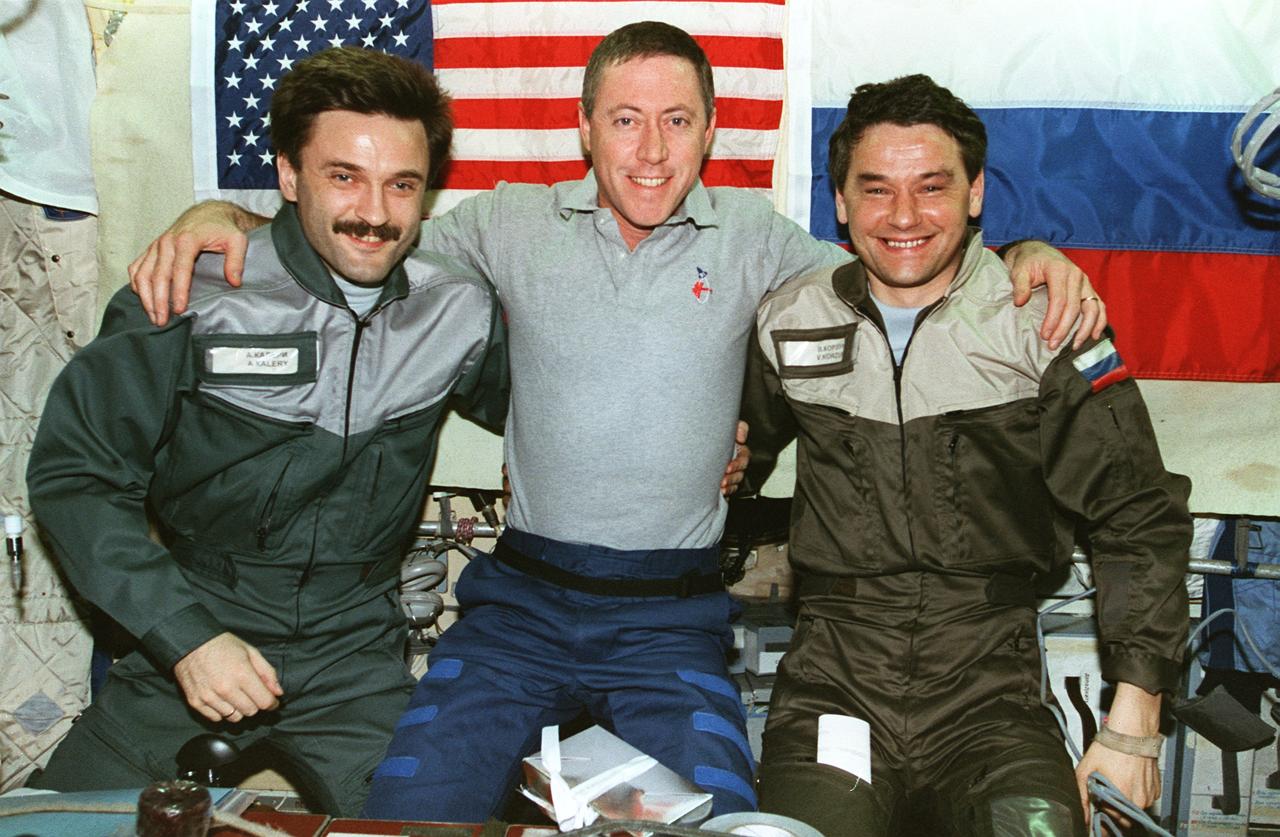
STS081-369-028 (12-22 Jan. 1997) --- On the eve of undocking of the Space Shuttle Atlantis and Russia's Mir Space Station, astronaut Michael A. Baker (center), STS-81 mission commander, bids farewell to cosmonauts Aleksandr Y. Kaleri (left), Mir-22 flight engineer, and Valeri G. Korzun, Mir-22 mission commander. The three are in the Base Block Module of the Mir complex.
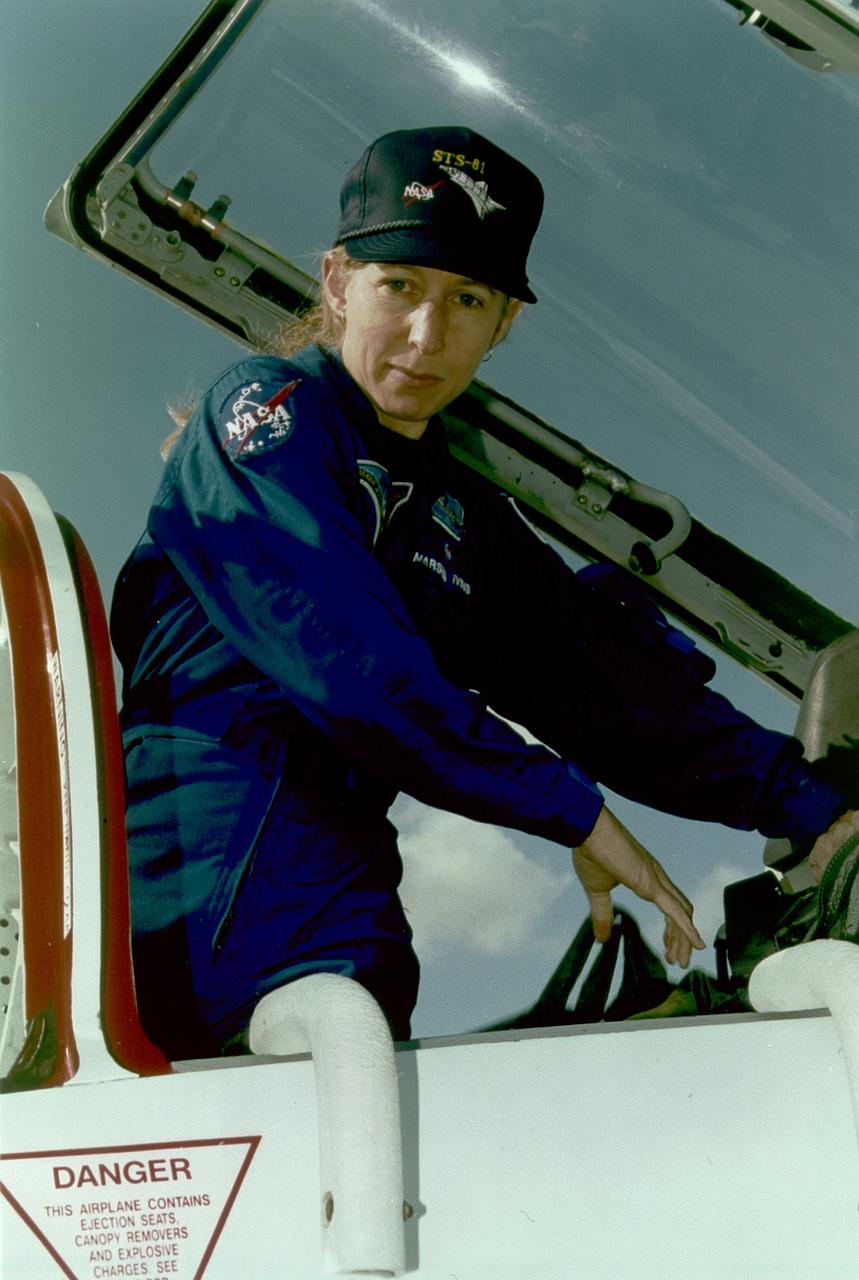
S97-00248 (15 Dec. 1996) --- Astronaut Marsha S. Ivins, STS-81 mission specialist, arrives in a NASA T-38 jet trainer at the Kennedy Space Center's Shuttle Landing Facility for the Terminal Countdown Demonstration Test (TCDT). The TCDT represents a simulated final countdown until just before main engine ignition, now scheduled for Jan. 12, 1997.
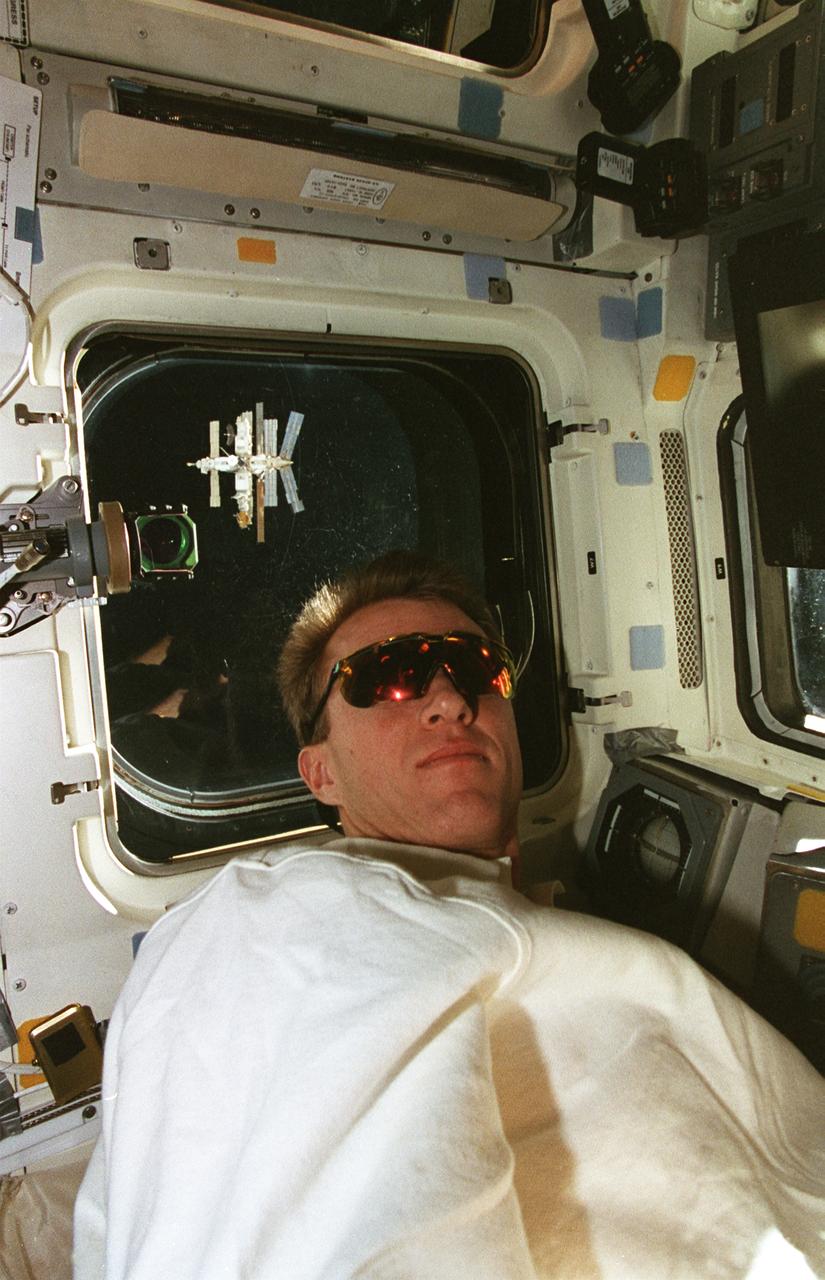
STS081-368-011 (12-22 Jan. 1997) --- Astronaut Brent W. Jett, Jr., STS-81 pilot, appears restful and unfazed as Russia's Mir Space Station appears in the window over his shoulder on the Space Shuttle Atlantis' aft flight deck. Following docking of Mir and Atlantis, Jett and his crew mates went on to spend several days sharing experiments and supply-transfer with the Mir-22 crewmembers.
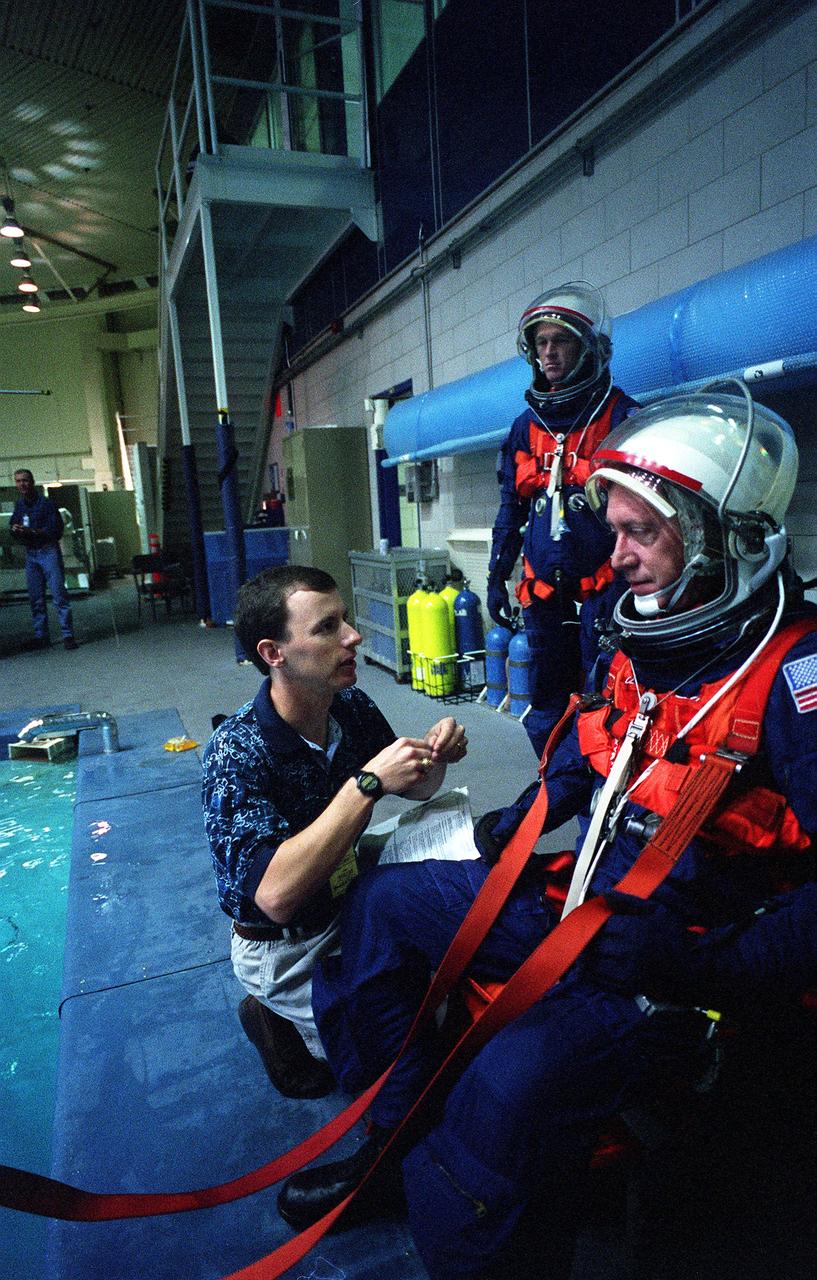
S96-15388 (26 Sept. 1996) --- In the Johnson Space Center's weightless environment training facility, astronaut Michael Baker, STS-81 mission commander, prepares to simulate a parachute drop into water. David Pogue helps with the final touches on Baker's training version of the launch and entry suit, as Brent W. Jett (background), pilot, looks on.
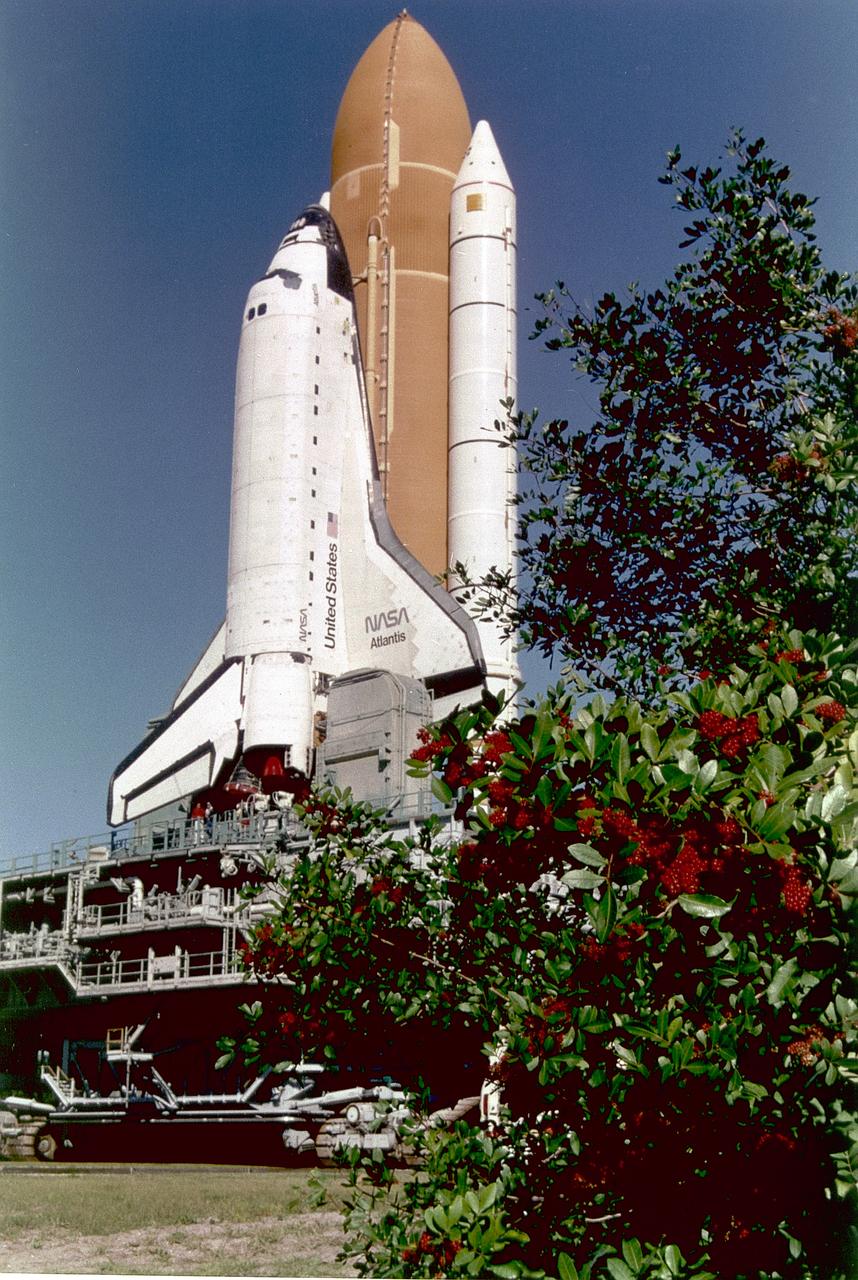
S97-00249 (10 Dec. 1996) --- Having departed the giant Vehicle Assembly Building (VAB), the space shuttle Atlantis slowly moves out to Launch Pad 39B along the Crawlerway. Atlantis is scheduled to liftoff Jan. 12 on STS-81, the first dhuttle mission of 1997. The planned nine-day flight will include the fifth Shuttle-Mir docking.
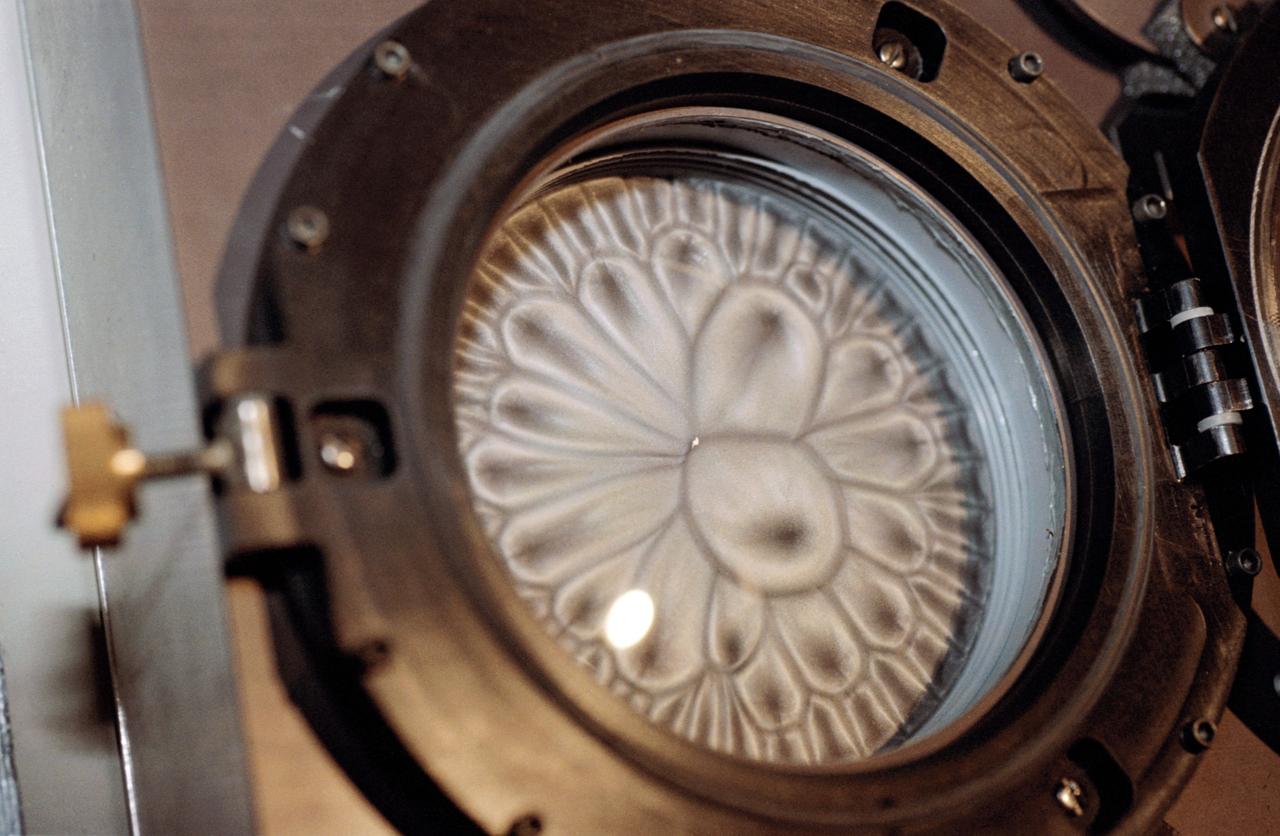
STS-42 closeup view shows Student Experiment 81-09 (SE 81-09), Convection in Zero Gravity experiment, with radial pattern caused by convection induced by heating an oil and aluminum powder mixture in the weightlessness of space. While the STS-42 crewmembers activated the Shuttle Student Involvement Program (SSIP) experiment on Discovery's, Orbiter Vehicle (OV) 103's, middeck, Scott Thomas, the student who designed the experiment, was able to observe the procedures via downlinked television (TV) in JSC's Mission Control Center (MCC). Thomas, now a physics doctoral student at the University of Texas, came up with the experiment while he participated in the SSIP as a student at Richland High School in Johnstown, Pennsylvia.
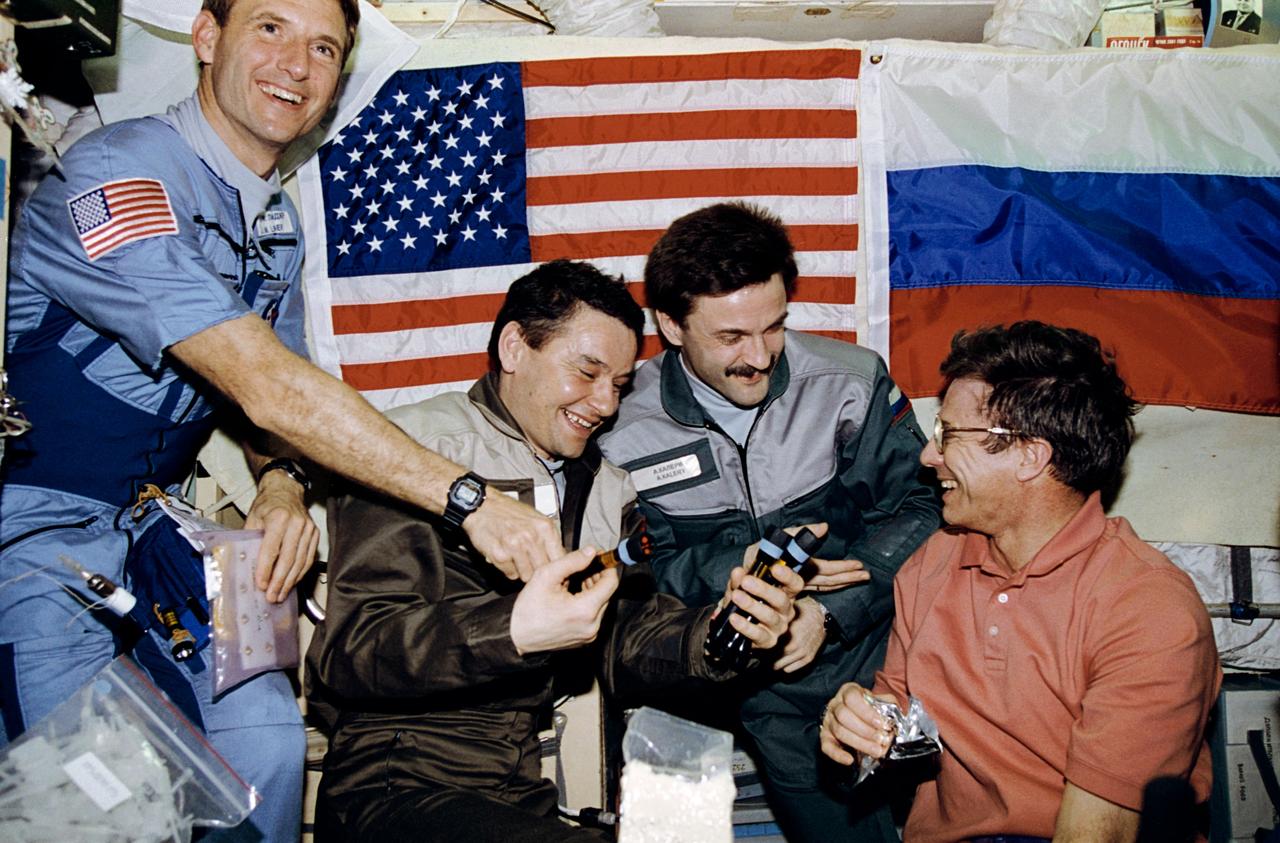
STS081-350-013 (12-22 Jan 1997) --- Members of Mir-22 crew show appreciation for small flash lights brought up by the STS-81 crew. Left to right, new cosmonaut guest researcher Jerry M. Linenger, cosmonauts Valeri G. Korzun, mission commander, and Aleksandr Y. Kaleri, flight engineer, along with former cosmonaut guest researcher John E. Blaha. The four are on the Base Block Module of Russia?s Mir Space Station on the eve of the Space Shuttle Atlantis and Mir undocking day.
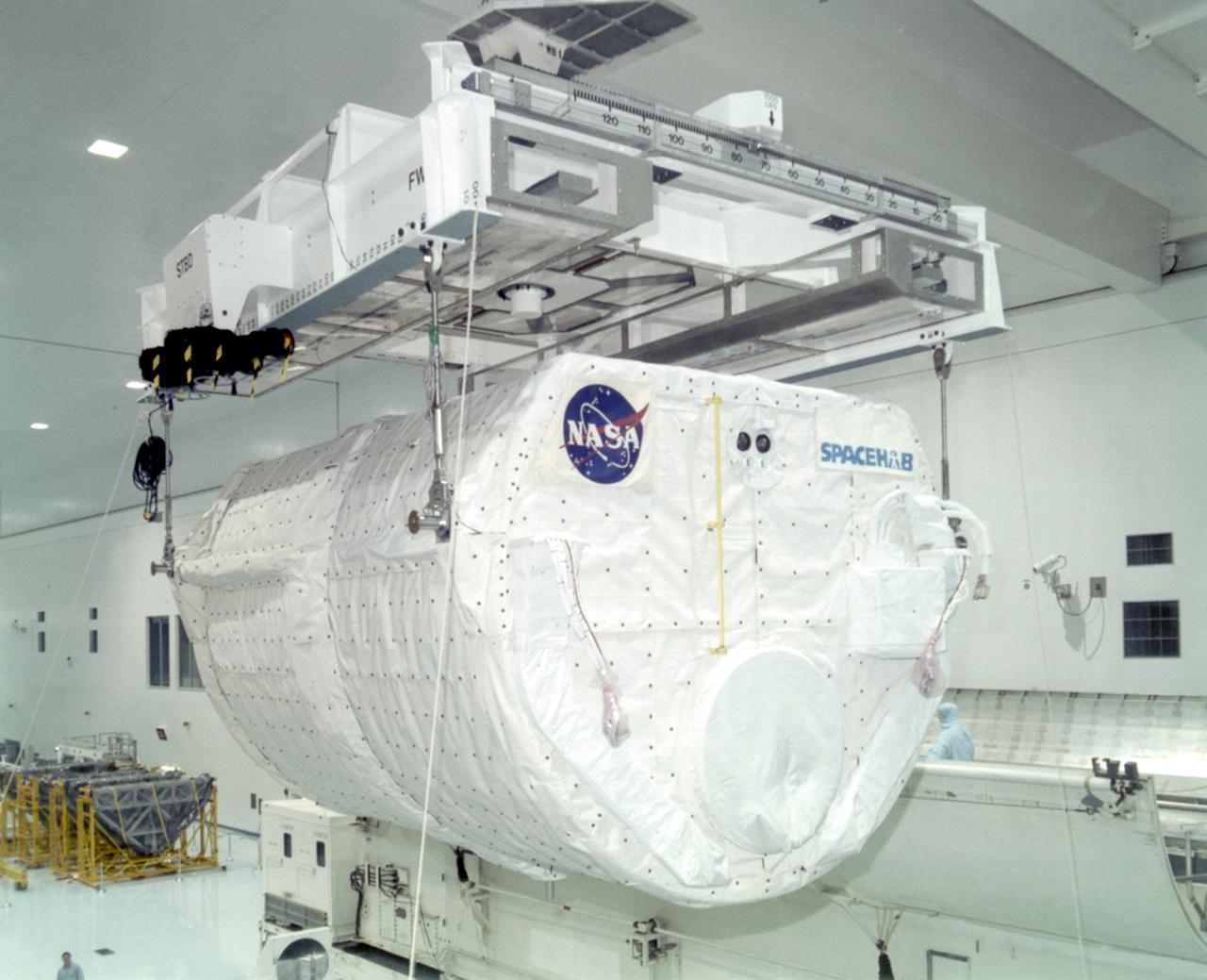
S97-00251 (5 Dec. 1996) --- The SPACEHAB-DM double module, scheduled to be used during STS-81 to transport Russian logistics material and supplies for the Mir-22 crew, is lowered into a payload canister in the Space Station Processing Facility at the Kennedy Space Center (KSC). The module will provide space for more than 2,000 pounds of hardware, food, water and other supplies which will be transferred by crewmembers into Mir during the 10-day mission. (Editor's Note: Following its installation into the canister, the module was transported on Jan. 12 to Launch Pad 39B and installed into the payload bay of the space shuttle Atlantis).
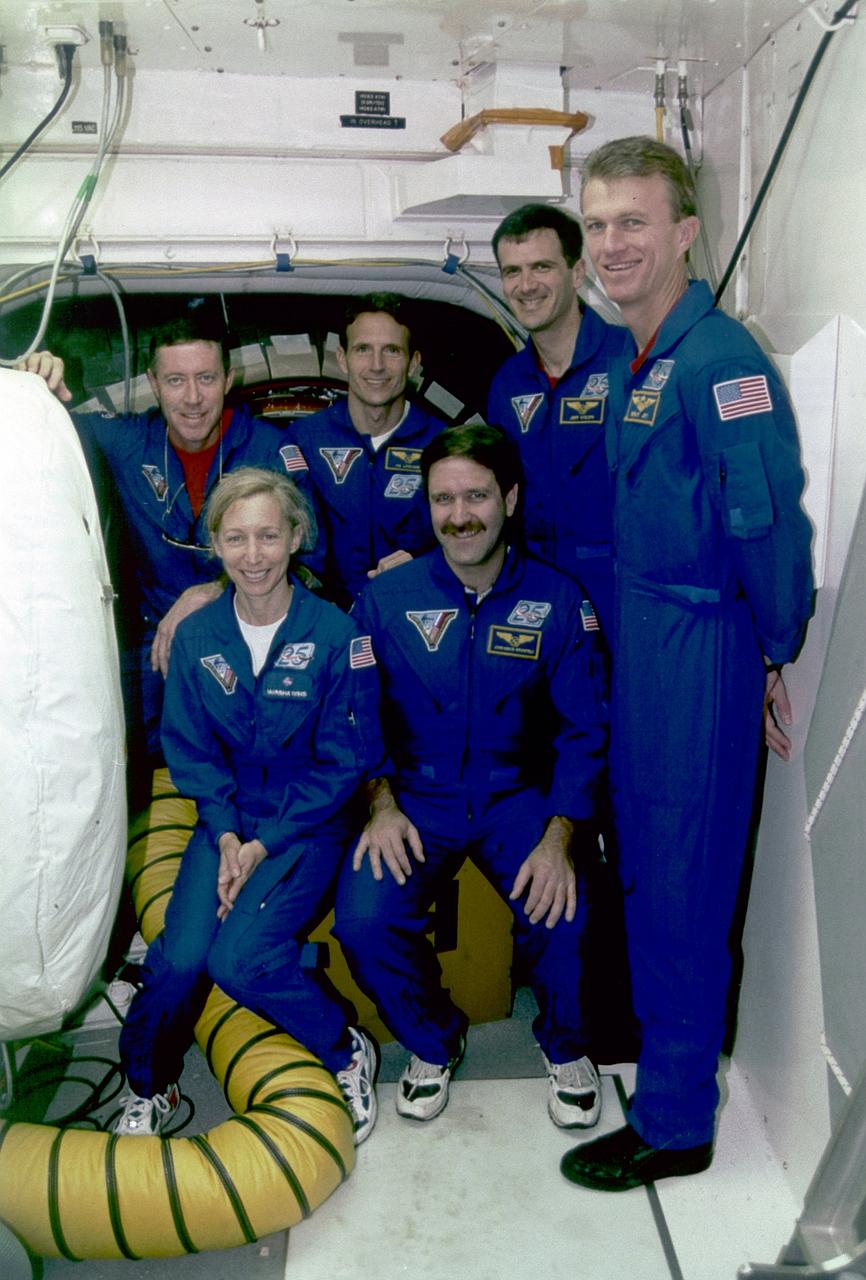
S97-00247 (15 Dec. 1996) --- The STS-81 mission flight crew poses outside the hatch of the space shuttle Atlantis at Launch Pad 39B during a Terminal Countdown Demonstration Test (TCDT). The TCDT represents a simulated final countdown rehearsal that ends just before main engine ignition. The actual launch is now scheduled for Jan. 12, 1997. Pictured (from the left) are astronauts Michael A. Baker, Marsha S. Ivins, Jerry M. Linenger, John M. Grunsfeld, Peter J.K. (Jeff) Wisoff, and Brent W. Jett Jr.
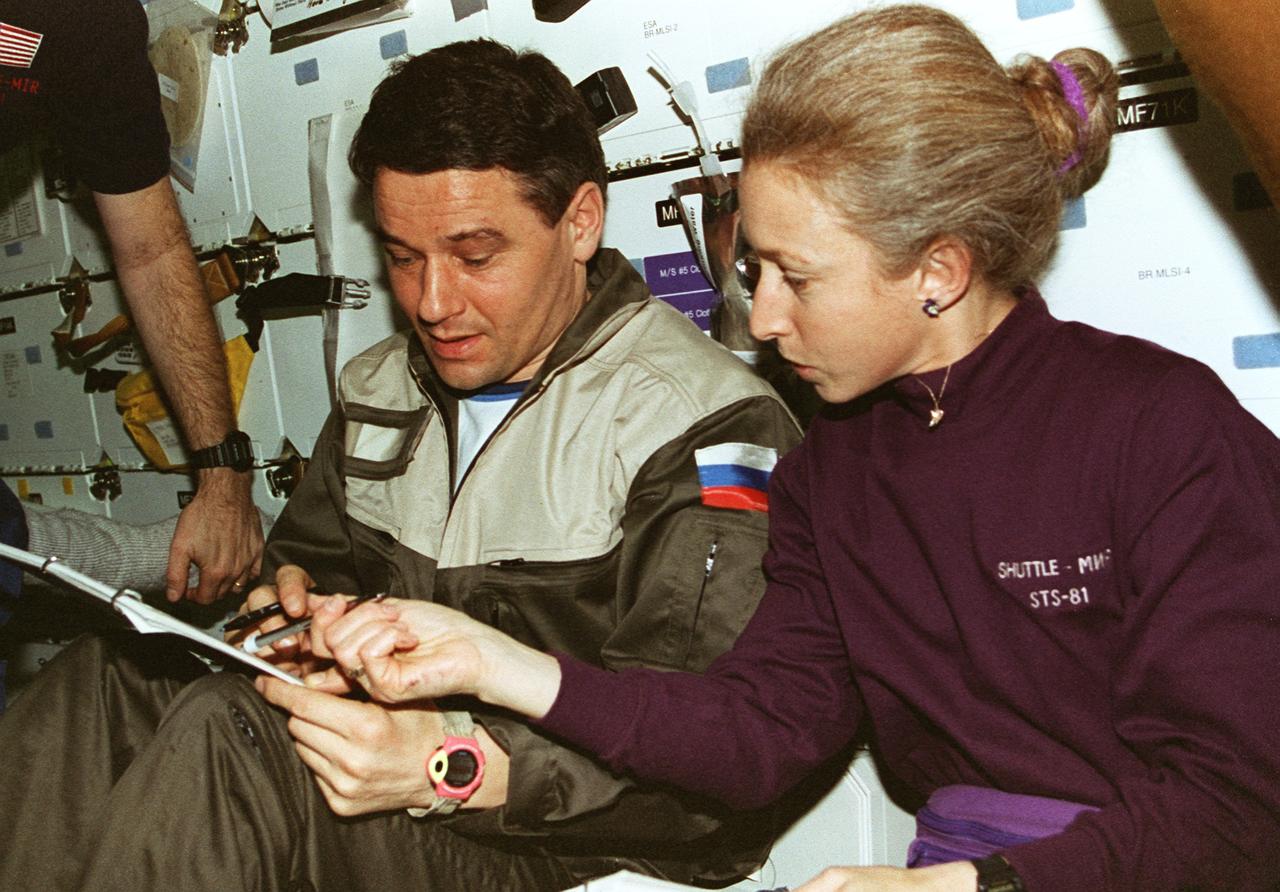
STS081-357-020 (12-22 Jan. 1997) --- Astronaut Marsha S. Ivins, STS-81 mission specialist, compares notes with cosmonaut Valeri G. Korzun, Mir-22 mission commander. The two were involved with the transfer of supplies from the Space Shuttle Atlantis to Russia's Mir Space Station, during the docking mission.
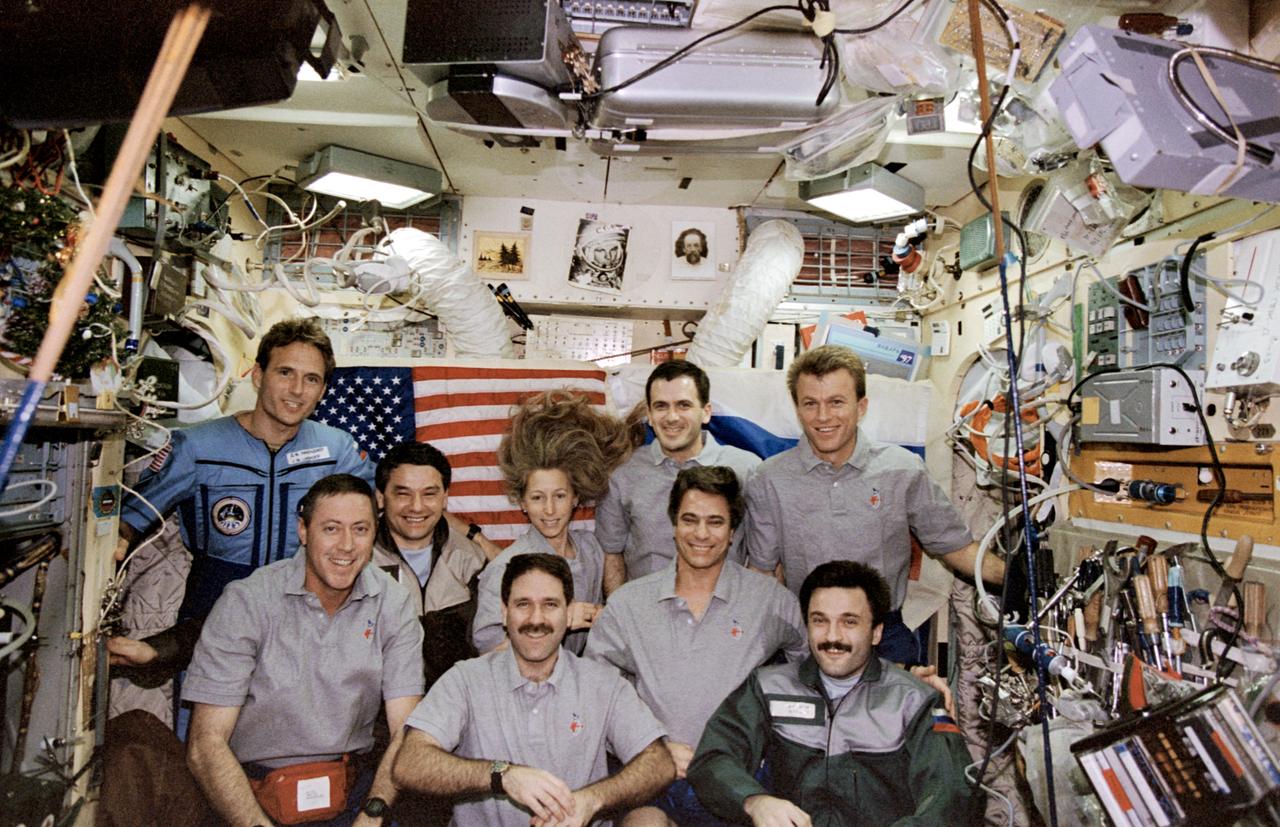
STS081-369-003 (12-22 Jan. 1997) --- Traditional inflight crew portrait of the combined Mir-22 and STS-81 crews in the Base Block Module aboard Russia's Mir Space Station. Front row: left to right, Michael A. Baker, commander; John M. Grunsfeld, mission specialist; and cosmonaut Aleksandr Y. Kaleri, Mir-22 flight engineer. Middle row: cosmonaut Valeri G. Korzun, Mir-22 commander; Marsha S. Ivins, mission specialist; and John E. Blaha, former cosmonaut guest researcher. Back row: Jerry M. Linenger, cosmonaut guest researcher; Peter J. K. (Jeff) Wisoff, mission specialist; and Brent W. Jett, Jr., pilot. Linenger is seen in a Russian jump suit, and Blaha now wears a Space Shuttle inflight garment as the two exchanged cosmonaut guest researcher roles on January 14, 1997, following the docking of the Atlantis and the Mir complex.
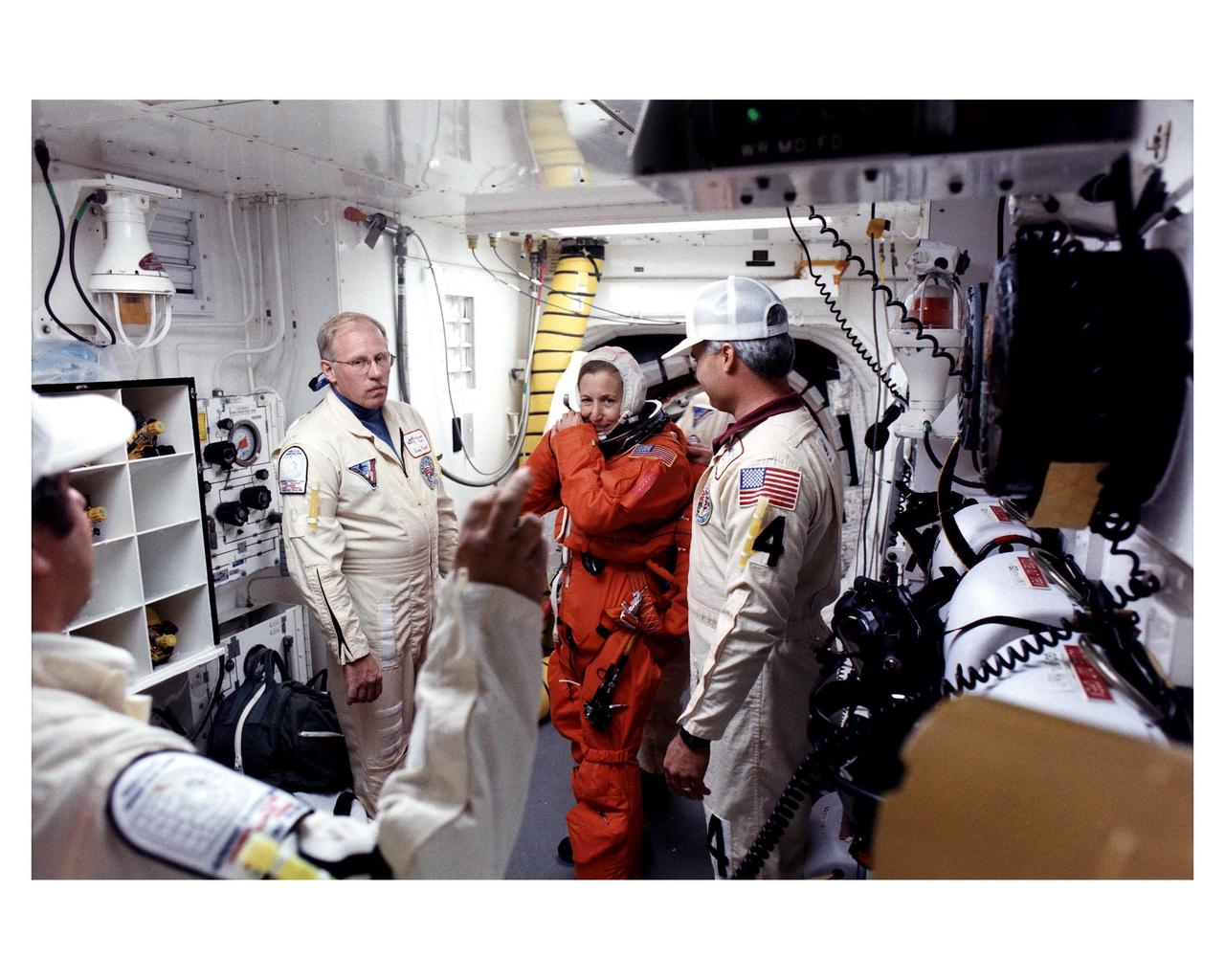
STS-81 crew in the White Room at LC 39
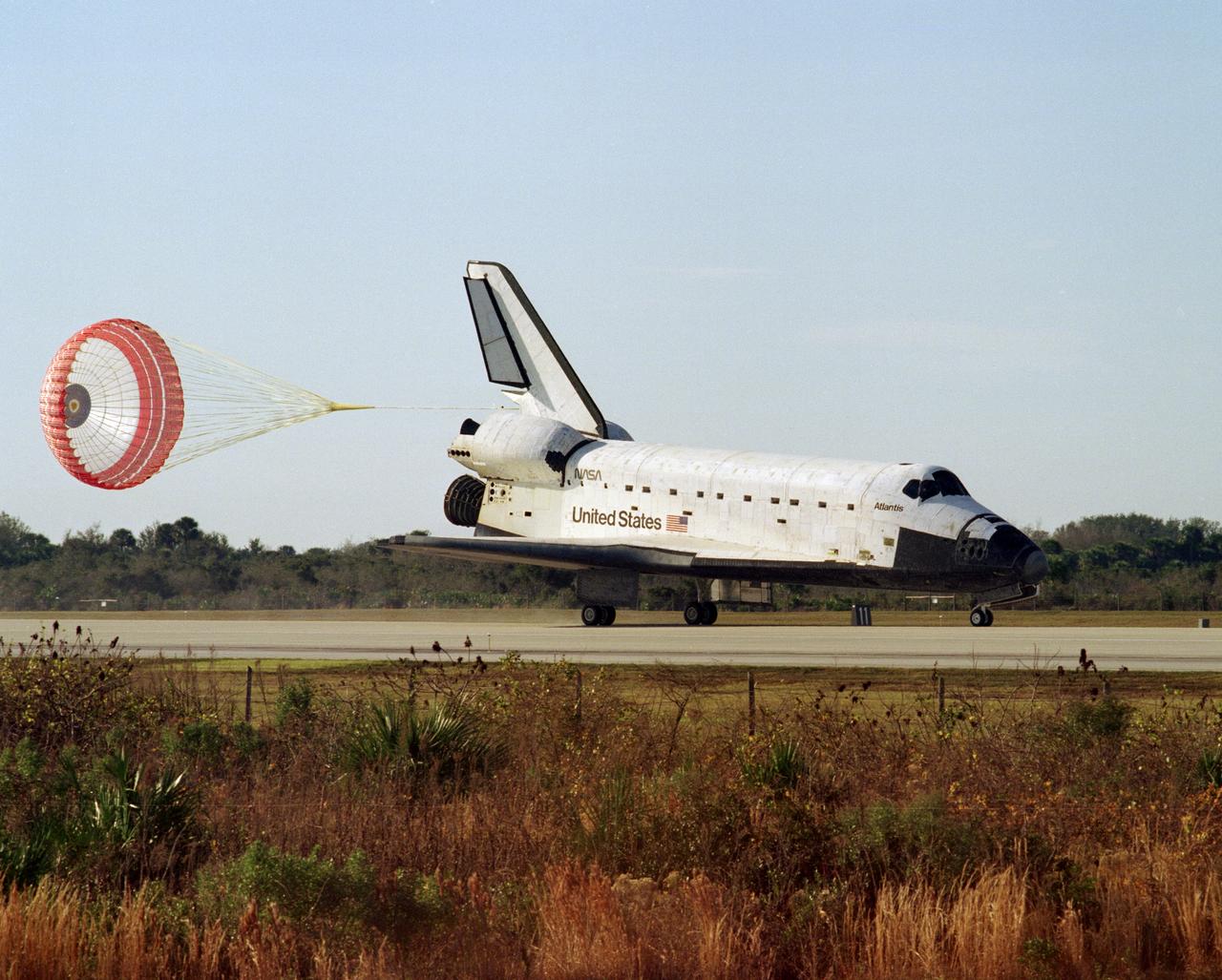
STS081-S-010 (22 Jan. 1997) --- A drag chute is deployed as the Space Shuttle Atlantis rolls toward a wheels stopped mode on Runway 33 at the Kennedy Space Center (KSC) to conclude the fifth Shuttle-Mir docking mission. Coming to a halt at 9:22:44 a.m. (EST), January 22, the mission also accomplished the return of astronaut John E. Blaha, cosmonaut guest researcher, who had been aboard Russia's Mir Space Station complex since mid September 1996. Blaha was replaced by Jerry M. Linenger during the five days of joint activities of the Mir-22 and STS-81 crew members while Atlantis and Mir were docked in Earth-orbit. At main gear touchdown, the mission's duration was 10 days, 4 hours and 55 minutes. This was the 34th space shuttle landing at KSC. The crew aboard at landing included astronauts Michael A. Baker, commander; Brent W. Jett, Jr., pilot; Blaha; and mission specialists Marsha S. Ivins, Peter J. K. (Jeff) Wisoff and John M. Grunsfeld.
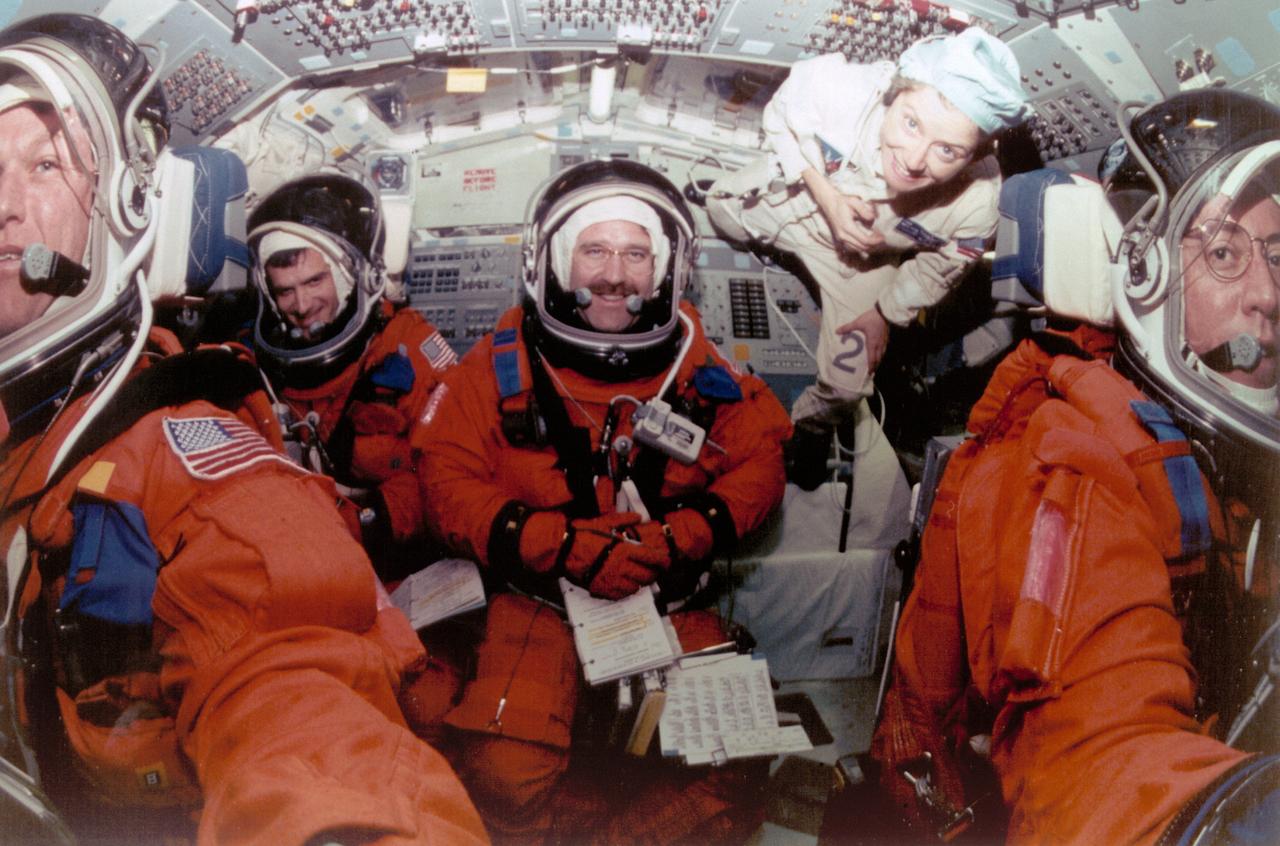
S97-00254 (17 Dec 1996) --- The STS-81 flight crew goes over pre-flight checklists on the flight deck of the Space Shuttle Atlantis during the final phase of the Terminal Countdown Demonstration Test (TCDT) exercises for the January 1997 mission. Crew members pictured, are (from the left) Brent W. Jett, Jr., pilot; Peter J. K. (Jeff) Wisoff and John M. Grunsfeld, mission specialists; along with Michael A. Baker, mission commander. The TCDT represents a simulated final countdown until just before main engine ignition. The astronauts are in their flight positions with the Orbiter in a vertical attitude at Launch Pad 39B, with the camera pointed down from the forward cabin. This angle creates the illusion that astronaut Pam Melroy (in lab suit), mission support assistant, is floating in space. On the mid-deck and out of frame are astronauts Marsha S. Ivins and Jerry M. Linenger. The six will visit Russia?s Mir Space Station, from which they will retrieve John M. Blaha who has been aboard the Mir since September of 1996. Linenger is to replace Blaha, as cosmonaut guest researcher.

STS081-S-008 (22 Jan. 1997) --- The Space Shuttle Atlantis touches down on Runway 33 at the Kennedy Space Center (KSC) to conclude the fifth Shuttle-Mir docking mission. Coming to a halt at 9:22:44 a.m. (EST), January 22, the mission also accomplished the return of astronaut John E. Blaha, cosmonaut guest researcher, who had been aboard Russia's Mir Space Station complex since mid September 1996. Blaha was replaced by Jerry M. Linenger during the five days of joint activities of the Mir-22 and STS-81 crewmembers while Atlantis and Mir were docked in Earth-orbit. At main gear touchdown, the mission's duration was 10 days, 4 hours and 55 minutes. This was the 34th space shuttle landing at KSC. The crew aboard at landing included astronauts Michael A. Baker, commander; Brent W. Jett, Jr., pilot; Blaha; and mission specialists Marsha S. Ivins, Peter J. K. (Jeff) Wisoff and John M. Grunsfeld.
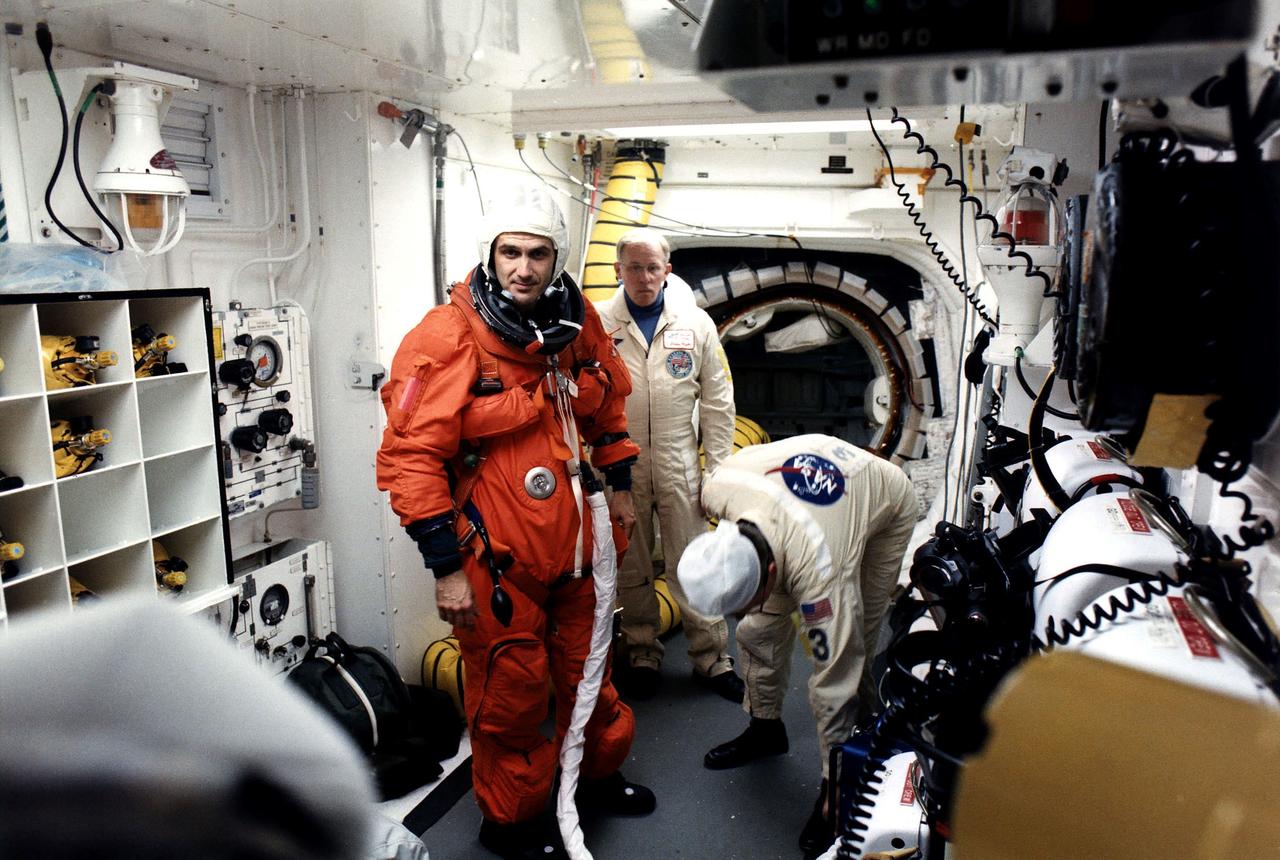
KENNEDY SPACE CENTER, FLA. - STS-81 Mission Specialist Jeff Wisoff prepares to enter the Space Shuttle Atlantis at Launch Pad 39B with help from White Room closeout crew members Danny Wyatt (center) and Al Rochford.
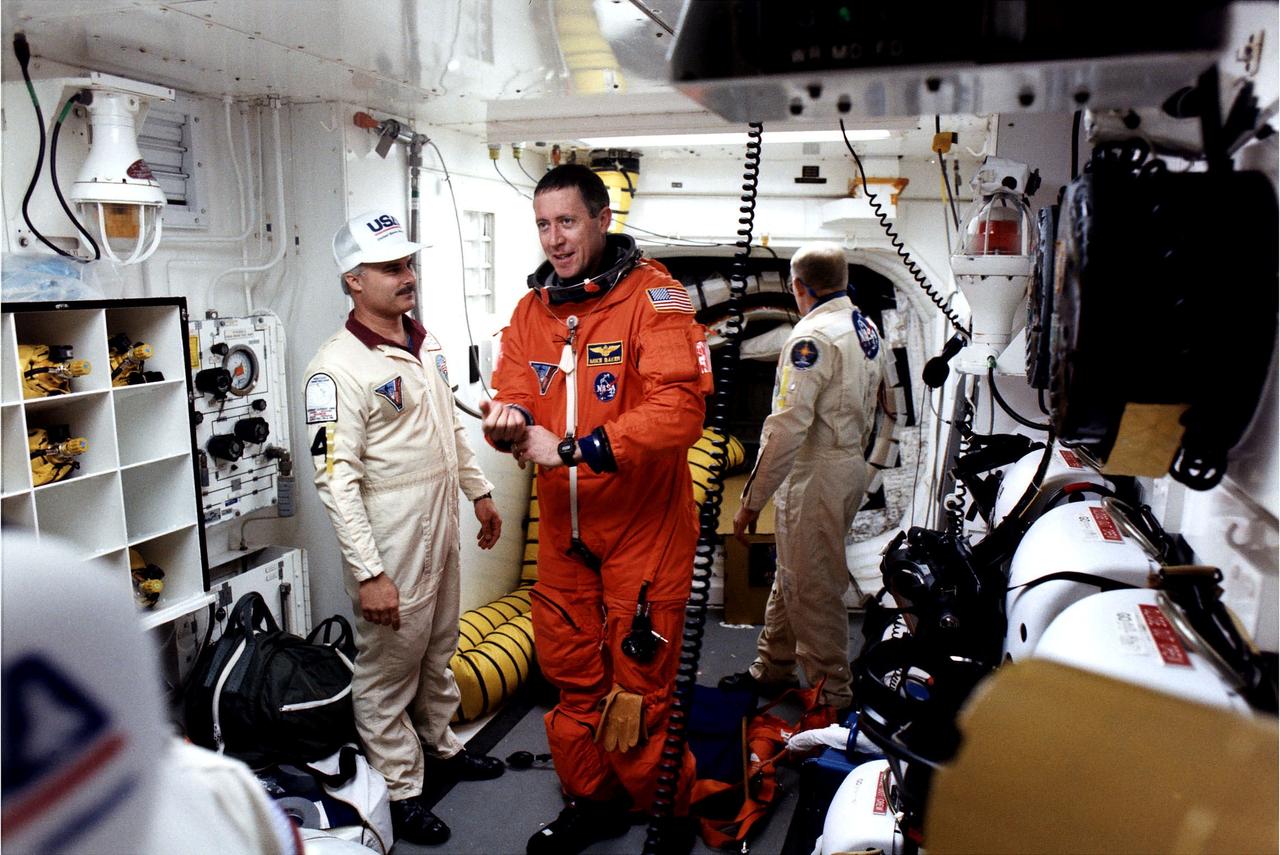
KENNEDY SPACE CENTER, FLA. - STS-81 Mission Commander Michael Baker prepares to enter the Space Shuttle Atlantis at Launch Pad 39B with help from White Room closeout crew members Chris Meinert (left) and Danny Wyatt.
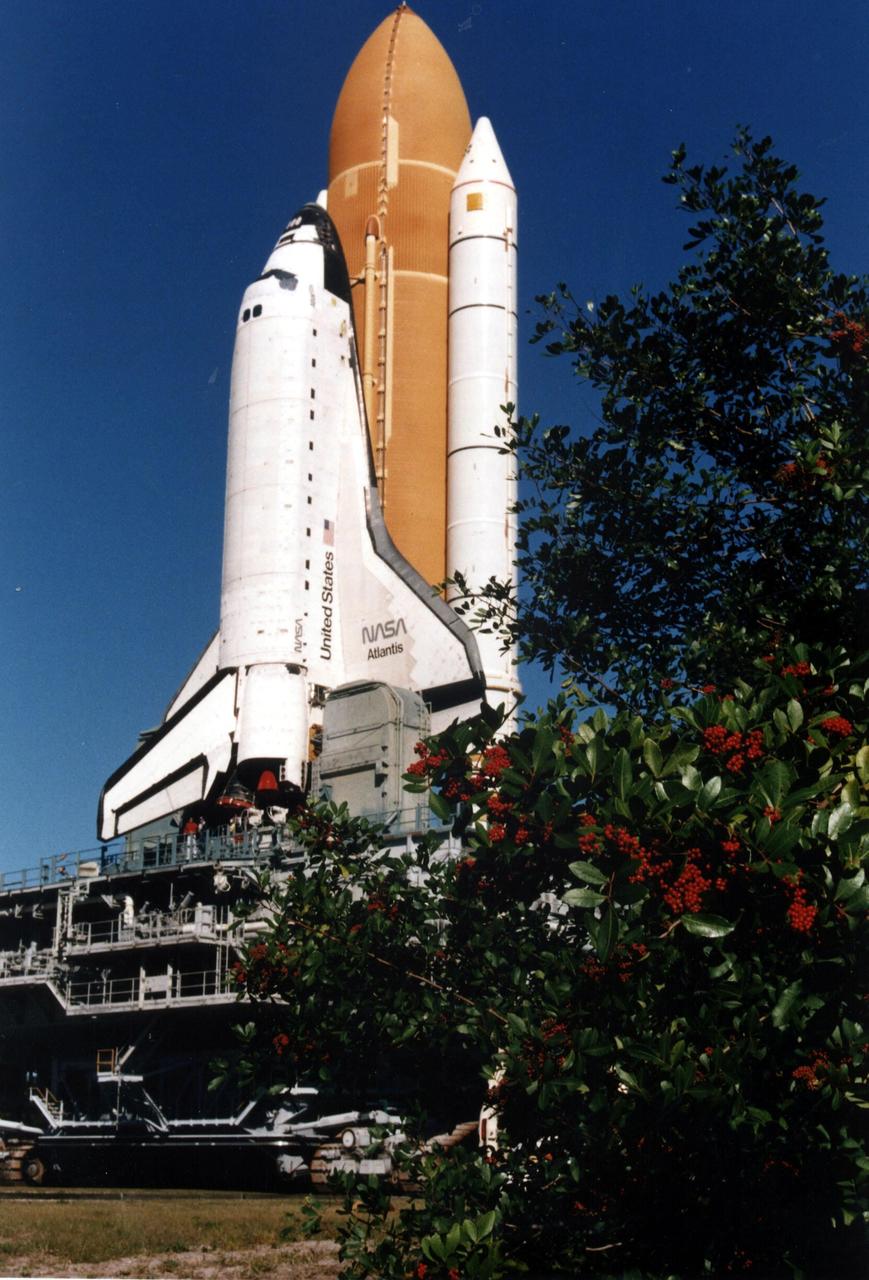
KENNEDY SPACE CENTER, FLA. -- Atlantis rolls out to Pad 39B for mission STS-81

KENNEDY SPACE CENTER, FLA. -- Atlantis rolls out to Pad 39B for mission STS-81
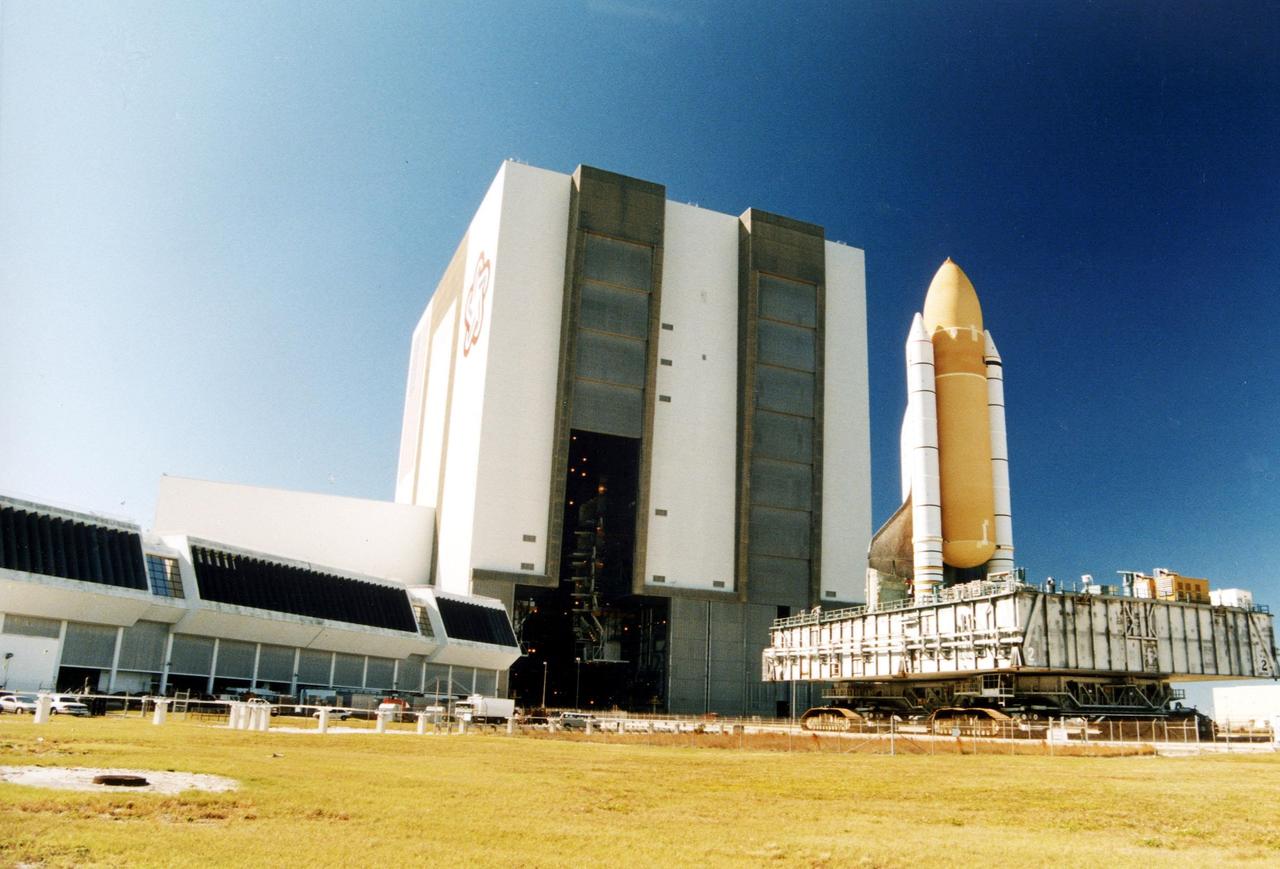
KENNEDY SPACE CENTER, FLA. -- Atlantis rolls out to Pad 39B for mission STS-81
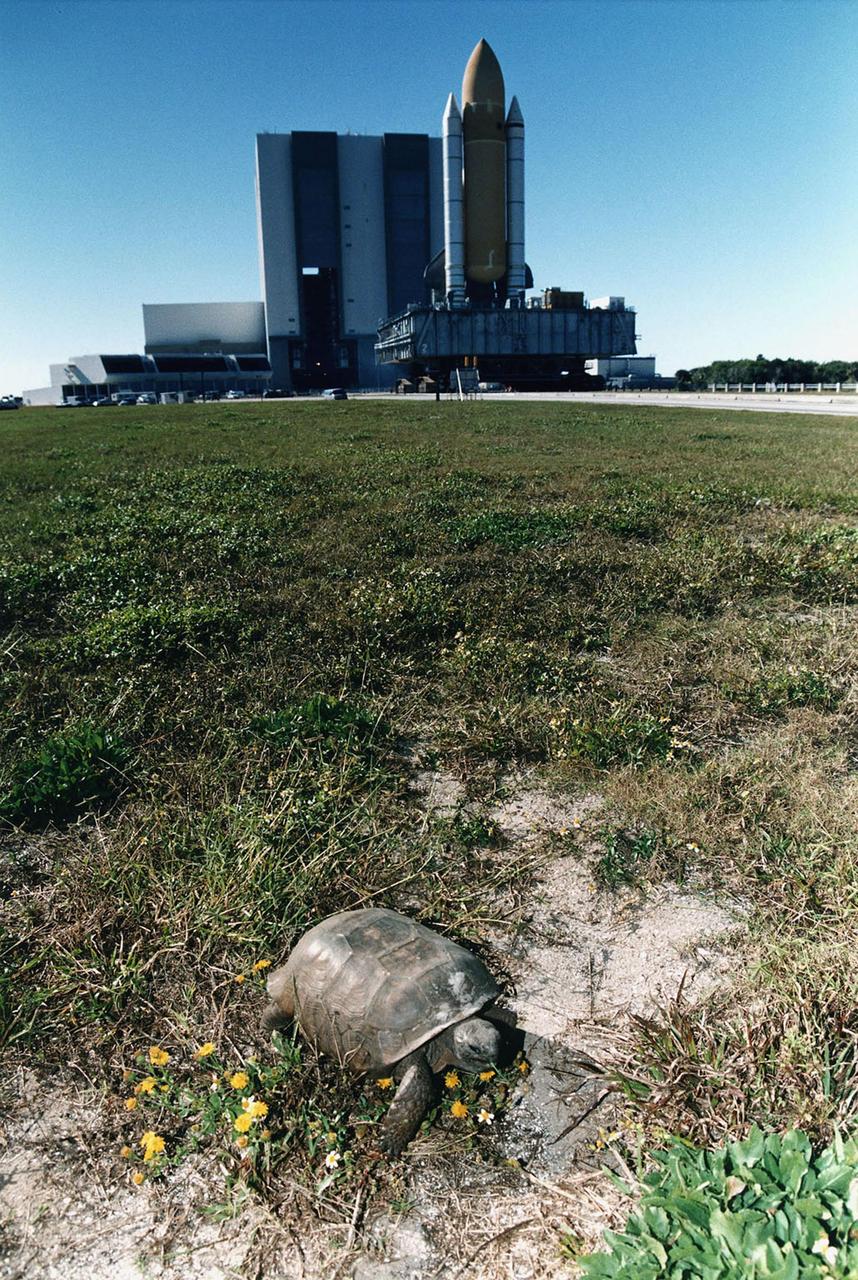
KENNEDY SPACE CENTER, FLA. -- Atlantis and a turtle race out to Pad 39B for mission STS-81
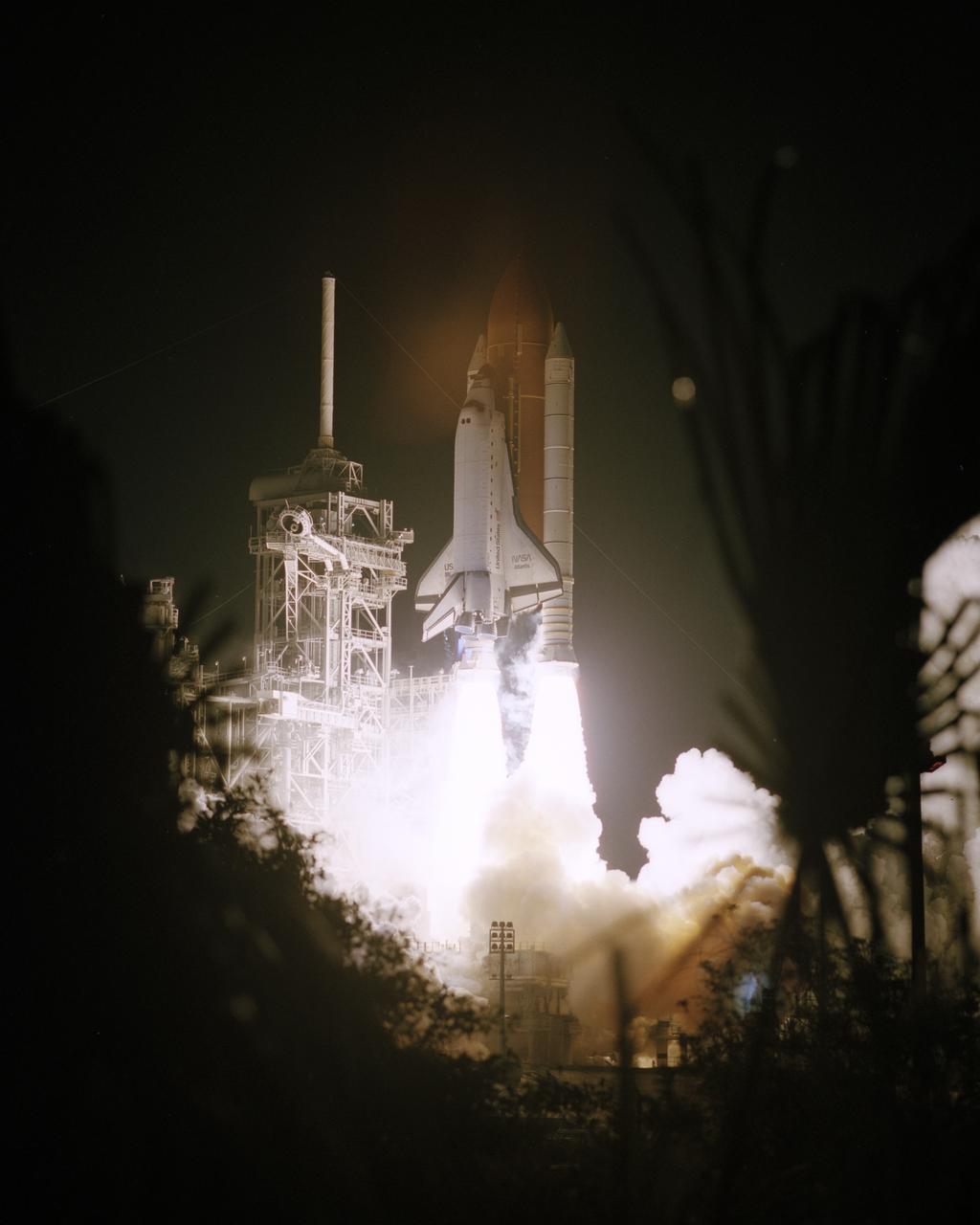
STS081-S-007 (12 Jan. 1997) --- Framed by a silhouette of Florida foliage, the Space Shuttle Atlantis lifts off from Pad 39B at 4:27:23 a.m. (EST) Jan. 12, 1997 on its way for a docking mission with Russia's Mir Space Station. Onboard are six astronauts and a SPACEHAB Double Module (DM), along with a large supply of food, water, hardware and other materials for Mir. Astronaut Jerry M. Linenger, now onboard Atlantis, will trade places with John E. Blaha, cosmonaut guest researcher, onboard Mir since mid September 1996. Along with Linenger, other crewmembers now aboard Atlantis are astronauts Michael A. Baker, commander; Brent W. Jett, Jr., pilot; and mission specialists John M. Grunsfeld, Marsha S. Ivins and Peter J. K. (Jeff) Wisoff.
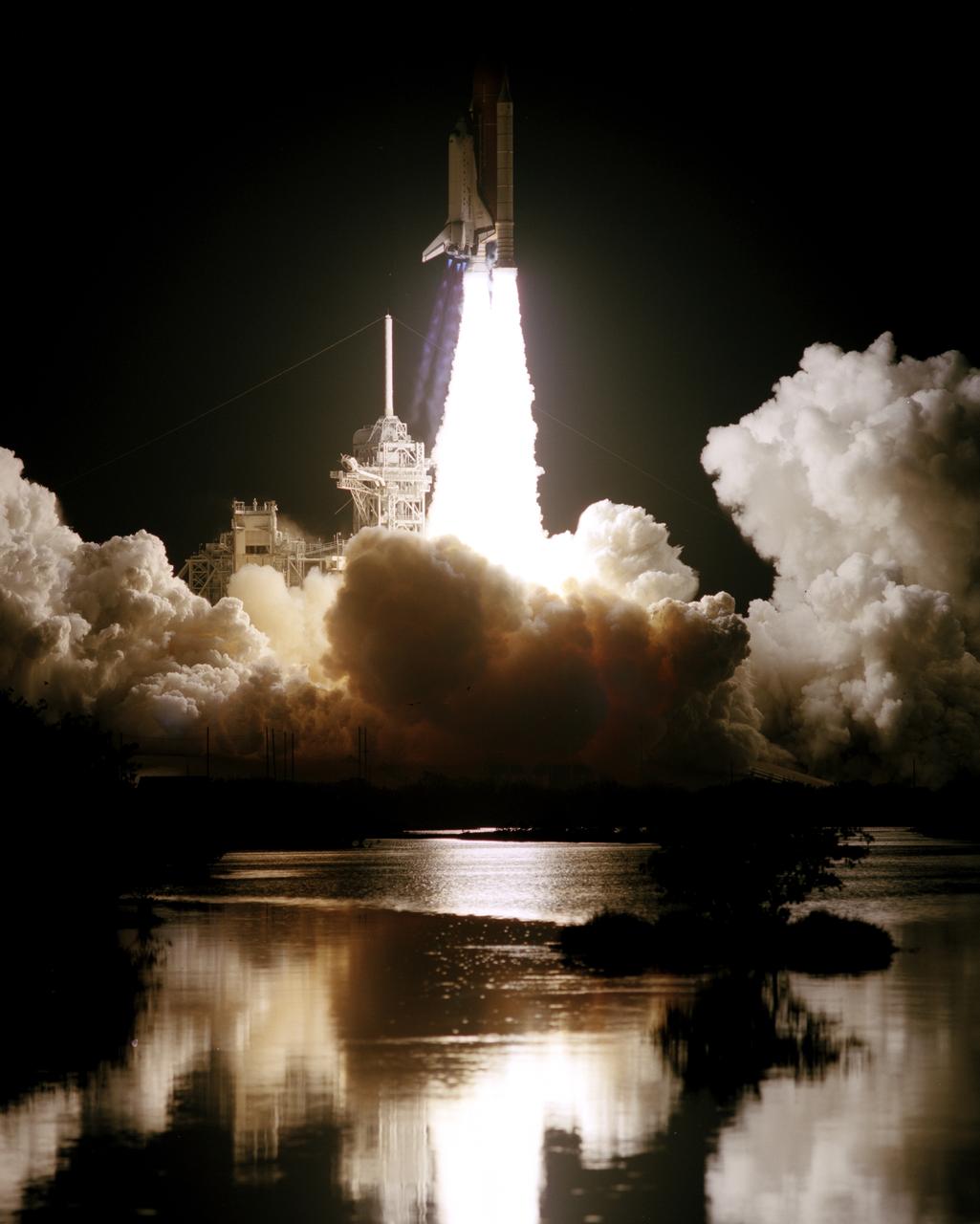
STS081-S-005 (12 Jan. 1997) --- Lighting up an early morning sky, the Space Shuttle Atlantis lifts off from Pad 39B to begin the new year of space missions for NASA's shuttle fleet. Launch occurred at 4:27:23 a.m. (EST), Jan. 12, 1997. Now on their way for a docking mission with Russia's Mir Space Station are a crew of six astronauts and a SPACEHAB Double Module (DM), along with a large supply of food, water, hardware and other materials for Mir. Astronaut Jerry M. Linenger, now onboard Atlantis, will trade places with John E. Blaha, cosmonaut guest researcher, onboard Mir since mid September 1996. Along with Linenger, other crewmembers now aboard Atlantis are astronauts Michael A. Baker, commander; Brent W. Jett, Jr., pilot; and mission specialists John M. Grunsfeld, Marsha S. Ivins and Peter J. K. (Jeff) Wisoff.
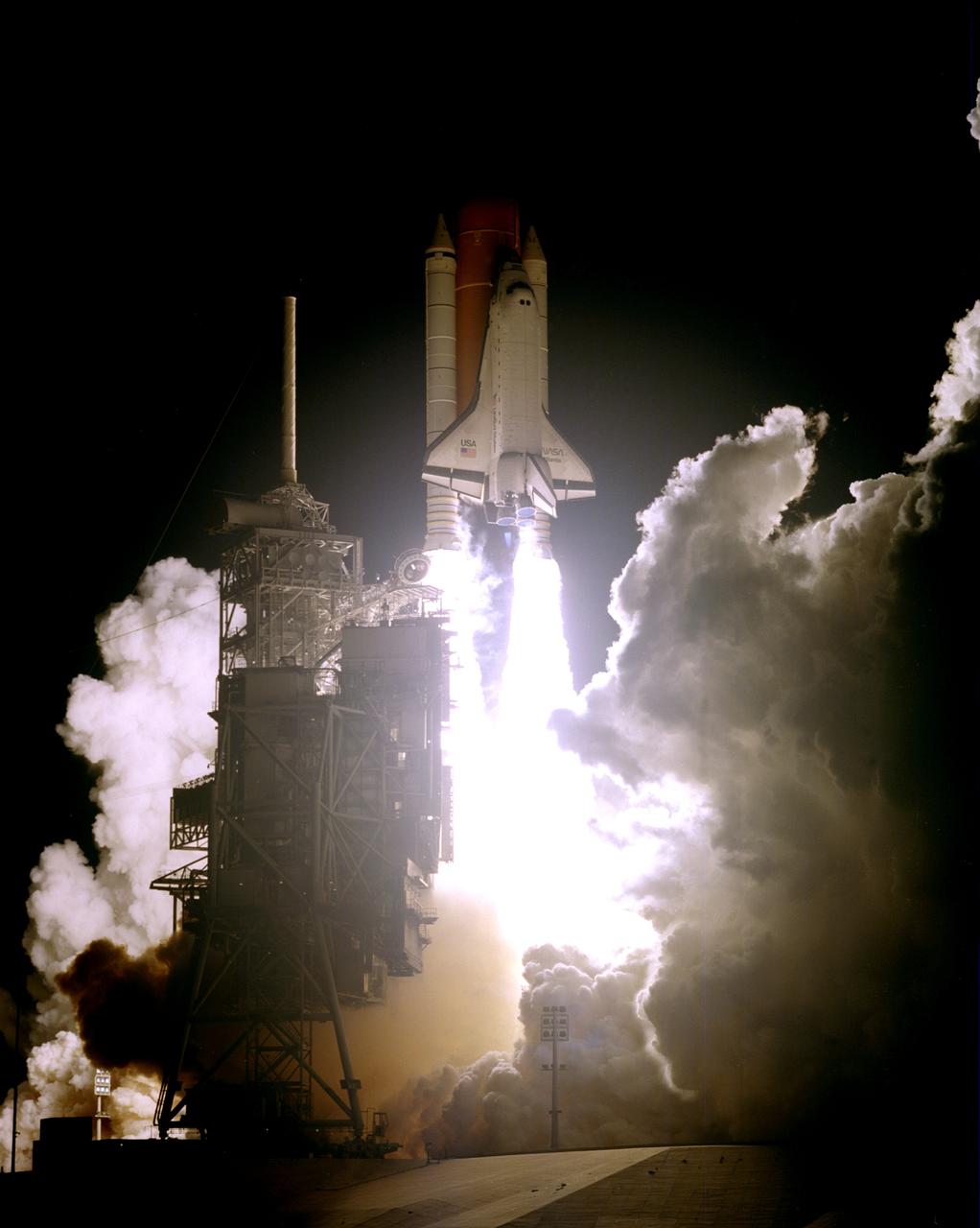
STS081-S-006 (12 Jan. 1997) --- The Space Shuttle Atlantis lifts off from Pad 39B at 4:27:23 a.m. (EST) Jan. 12, 1997 on its way for a docking mission with Russia's Mir Space Station. Onboard are six astronauts and a SPACEHAB Double Module (DM), along with a large supply of food, water, hardware and other materials for Mir. Astronaut Jerry M. Linenger, now onboard Atlantis, will trade places with John E. Blaha, cosmonaut guest researcher, onboard Mir since mid September 1996. Along with Linenger, other crewmembers now aboard Atlantis are astronauts Michael A. Baker, commander; Brent W. Jett, Jr., pilot; and mission specialists John M. Grunsfeld, Marsha S. Ivins and Peter J. K. (Jeff) Wisoff.
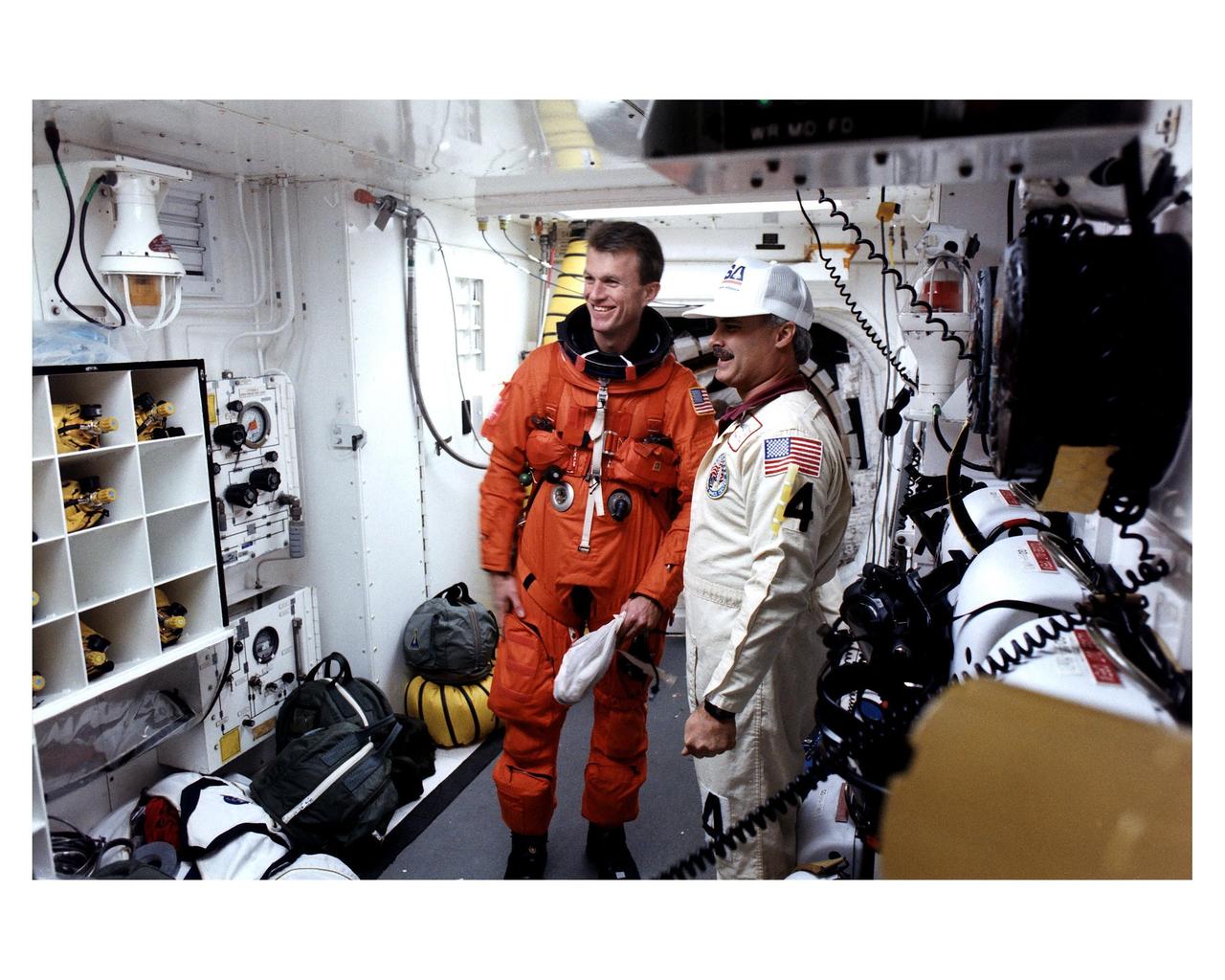
Pilot Jett talks to members of the suiting crew in the white room at Pad 39B before entering the Space Shuttle Atlantis for launch of the STS-81 mission
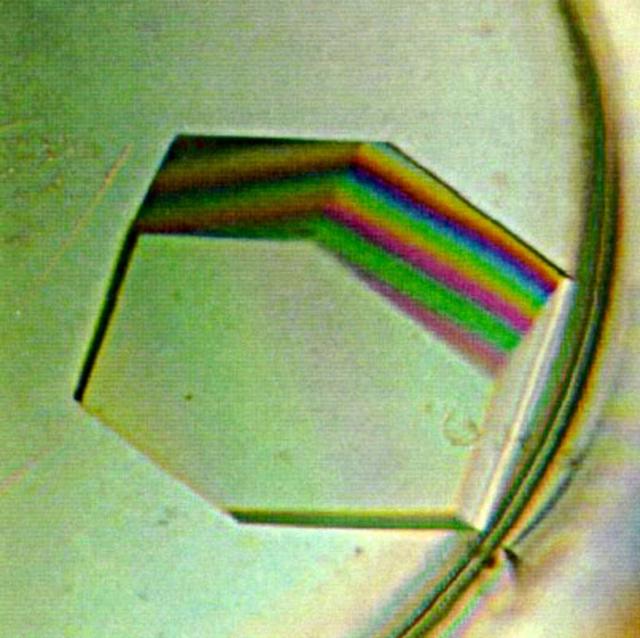
Lysozyme crystal grown on STS-81. A protein model for documentation of the effects of microgravity on crystal growth. Principal Investigator Dan Carter of New Century Pharmaceuticals.
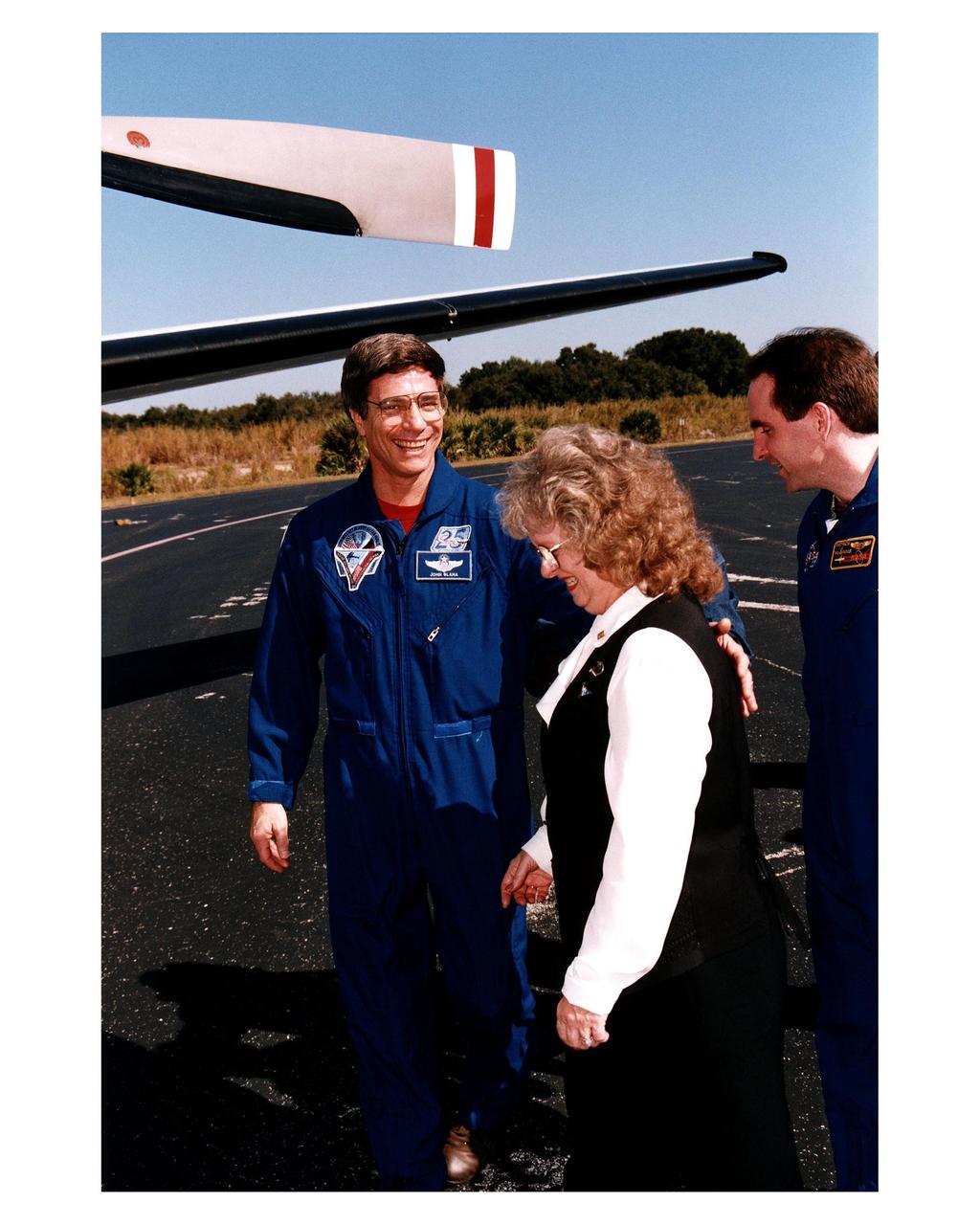
Returning NASA astronaut and former Mir 22 crew member John E. Blaha (left), puts his arm around his wife, Brenda, as they prepare to depart with the STS-81 crew for Johnson Space Center Jan. 23 from the Skid Strip at Cape Canaveral Air Station. NASA’s Patrick McGinnis is on the right. The STS-81 crew arrived at KSC aboard the Space Shuttle Atlantis Jan. 22 to conclude the fifth ShuttleMir docking mission and return Blaha to Earth after four months in space
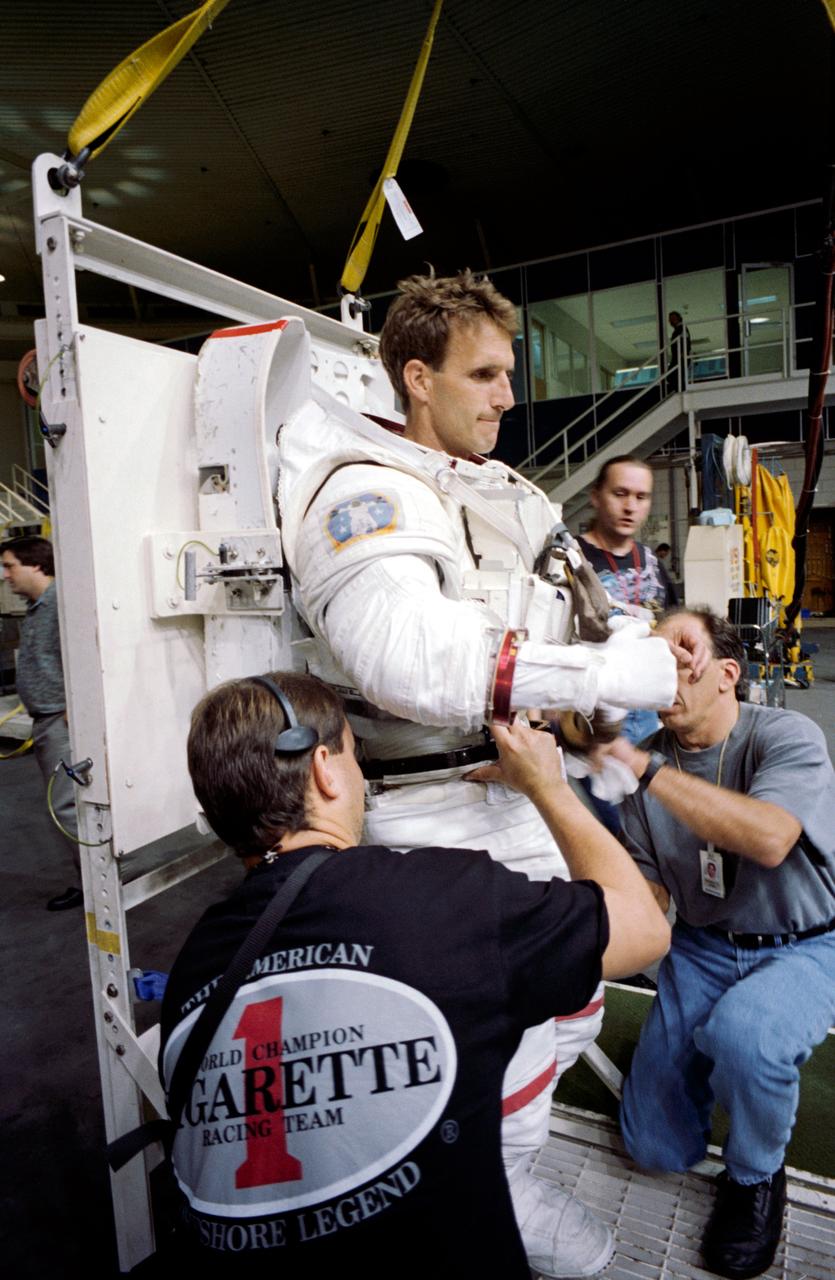
COLOR 13 SEPTEMBER 1996 S96-14353 JOHNSON SPACE CENTER, HOUSTON, TEXAS STS-81 TRAINING VIEW --- In the Johnson Space Center’s (JSC) Weightless Environment Training Facility (WET-F), astronaut Jerry M. Linenger, STS-81 mission specialist, prepares for an underwater simulation of a contingency Extravehicular Activity (EVA). Linenger, attired in a training version will utilize the nearby 25-feet deep pool, in which he will be able to achieve a neutrally buoyant state.
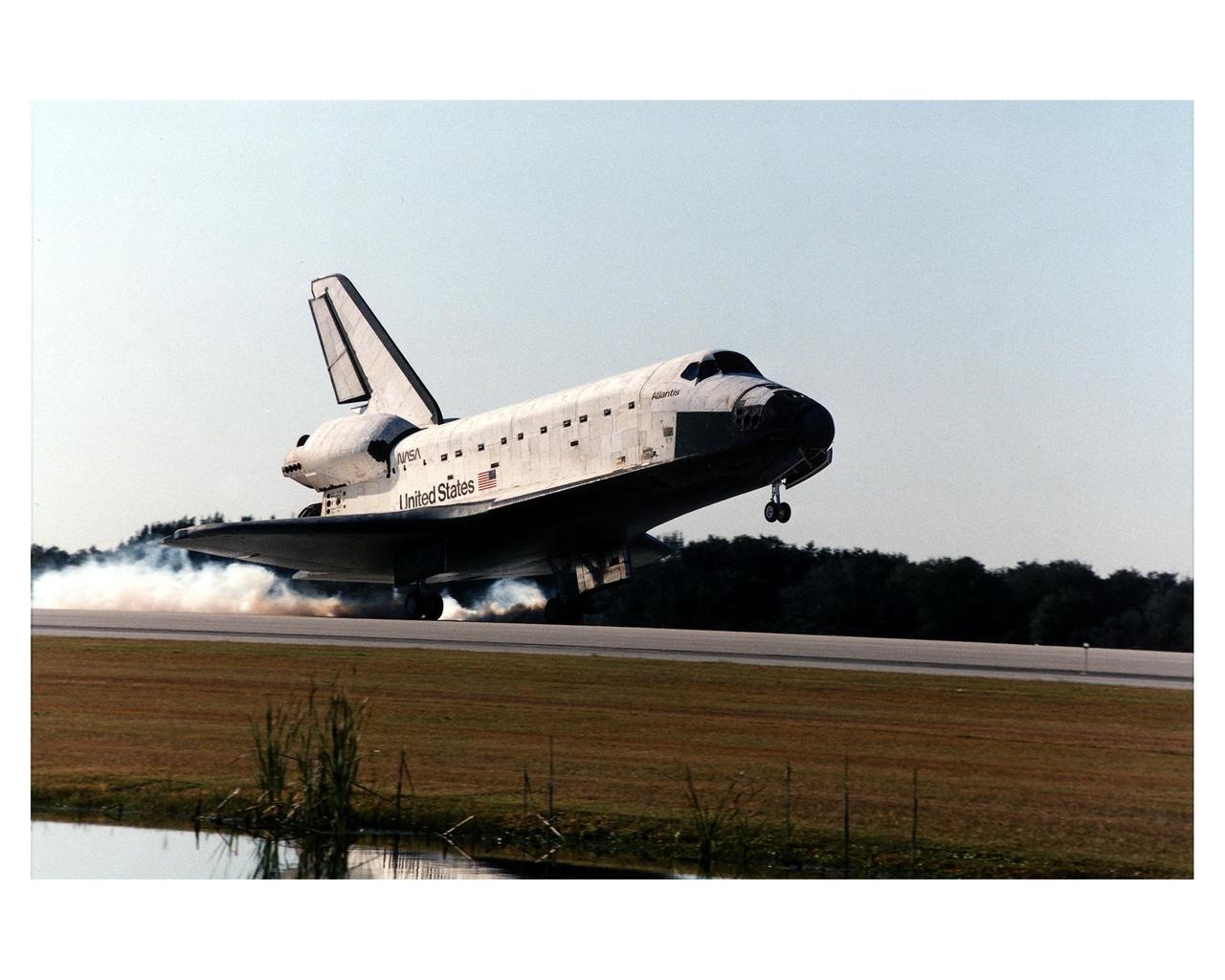
The Space Shuttle orbiter Atlantis touches down on Runway 33 at 9:22:44 a.m. EST Jan. 22 to conclude the fifth Shuttle-Mir docking mission and return NASA astronaut John Blaha to Earth after four months in space. Blaha was replaced by STS-81 Mission Specialist Jerry Linenger during the five days of docked operations. At main gear touchdown, the STS-81 mission duration was 10 days, 4 hours, 55 minutes. This was the 34th KSC landing in Shuttle history. Mission Commander Michael A. Baker flew Atlantis to a perfect landing, with help from Pilot Brent W. Jett, Jr. Other returning STS-81 crew members are Mission Specialists John M. Grunsfeld, Peter J. K. "Jeff" Wisoff and Marsha S. Ivins. Atlantis also brought back experiment samples from the Russian space station for analysis on Earth, along with Russian logistics equipment
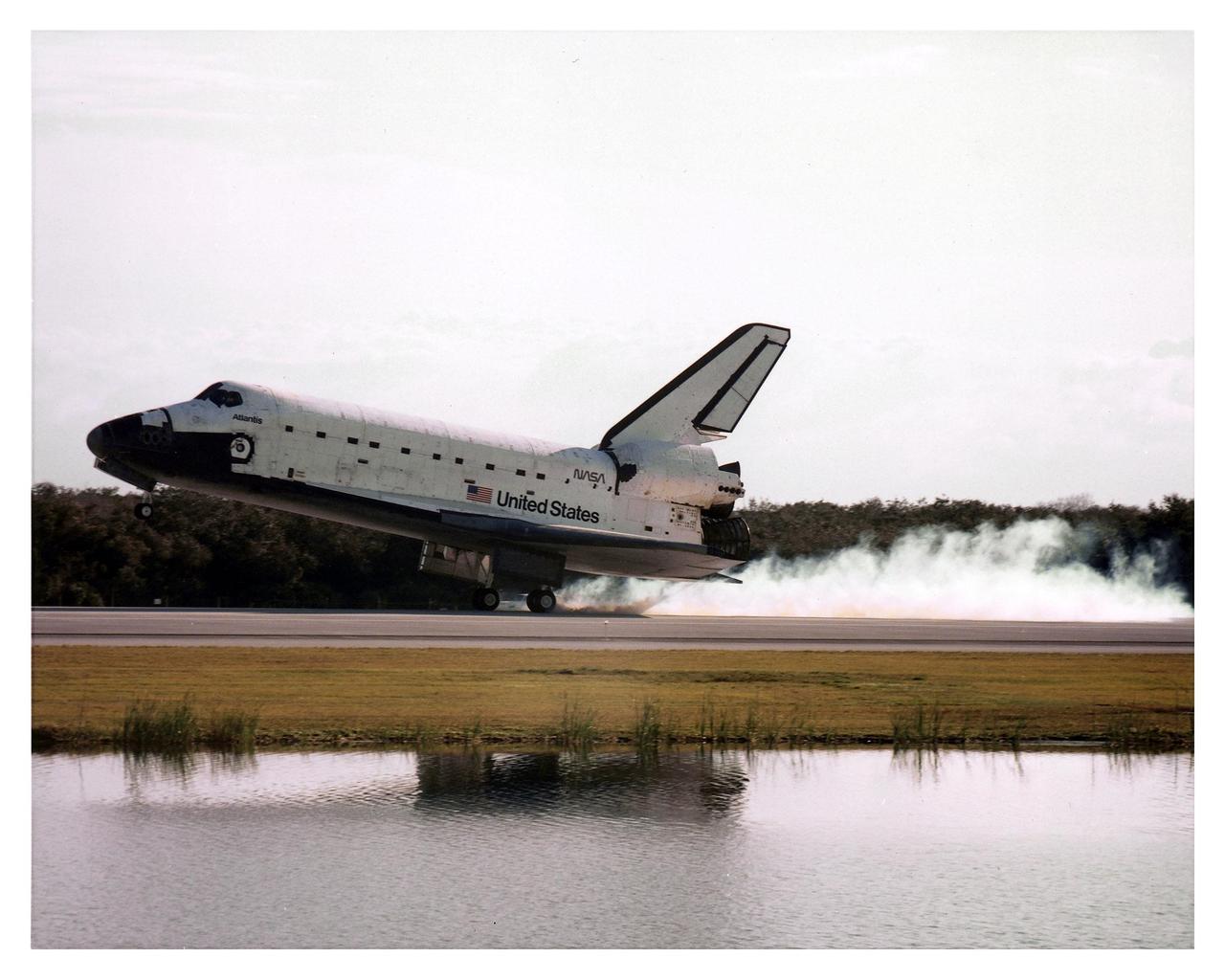
The Space Shuttle orbiter Atlantis touches down on Runway 33 at 9:22:44 a.m. EST Jan. 22 to conclude the fifth Shuttle-Mir docking mission and return NASA astronaut John Blaha to Earth after four months in space. Blaha was replaced by STS-81 Mission Specialist Jerry Linenger during the five days of docked operations. At main gear touchdown, the STS-81 mission duration was 10 days, 4 hours, 55 minutes. This was the 34th KSC landing in Shuttle history. Mission Commander Michael A. Baker flew Atlantis to a perfect landing, with help from Pilot Brent W. Jett, Jr. Other returning STS-81 crew members are Mission Specialists John M. Grunsfeld, Peter J. K. "Jeff" Wisoff and Marsha S. Ivins. Atlantis also brought back experiment samples from the Russian space station for analysis on Earth, along with Russian logistics equipment
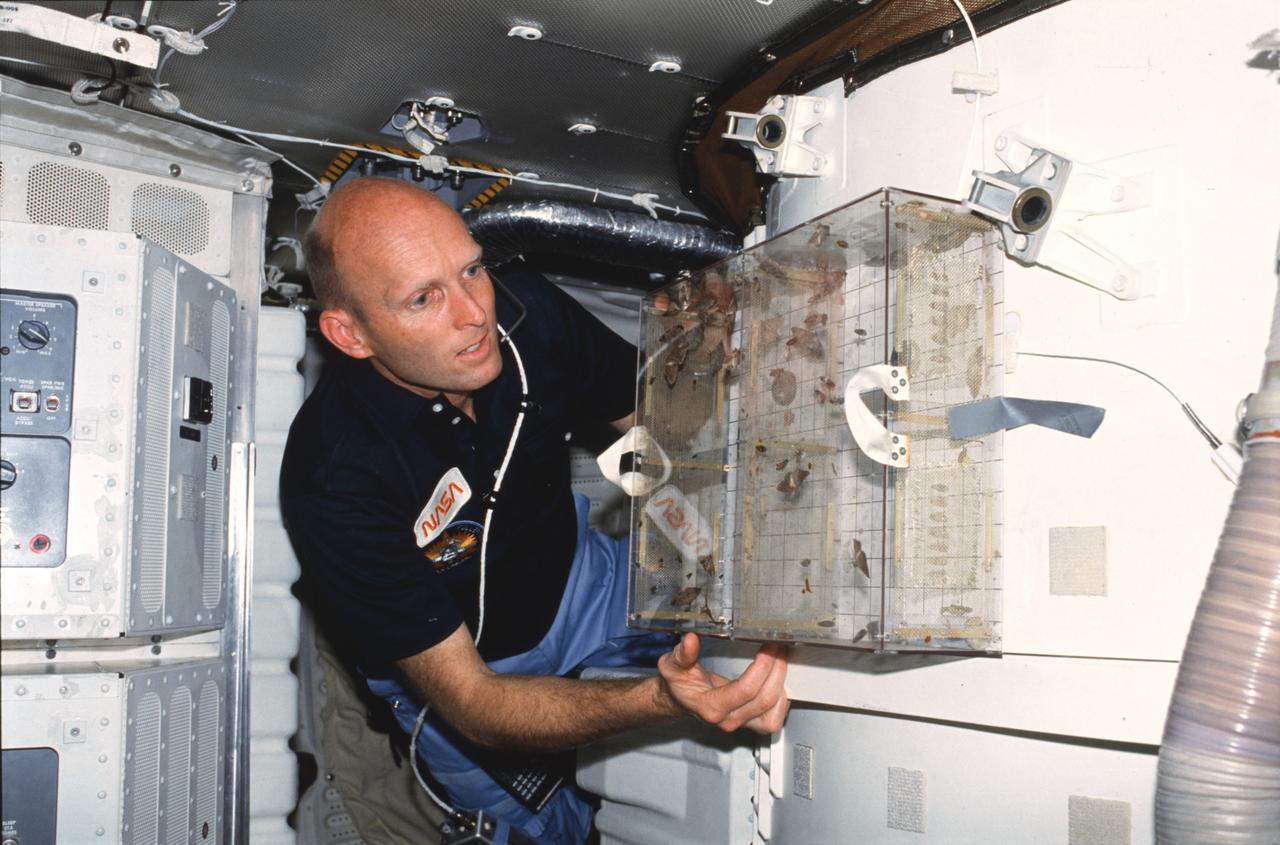
STS003-23-178 (22-30 March 1982) --- Astronaut C. Gordon Fullerton, STS-3 pilot, examines Student Experiment 81-8 (SE-81-8) Insect Flight Motion Study taped to the airlock on aft middeck. Todd Nelson, a high school senior from Minnesota, won a national contest to fly his experiment on this particular flight. Moths, flies, and bees were studied in the near weightless environment. Photo credit: NASA
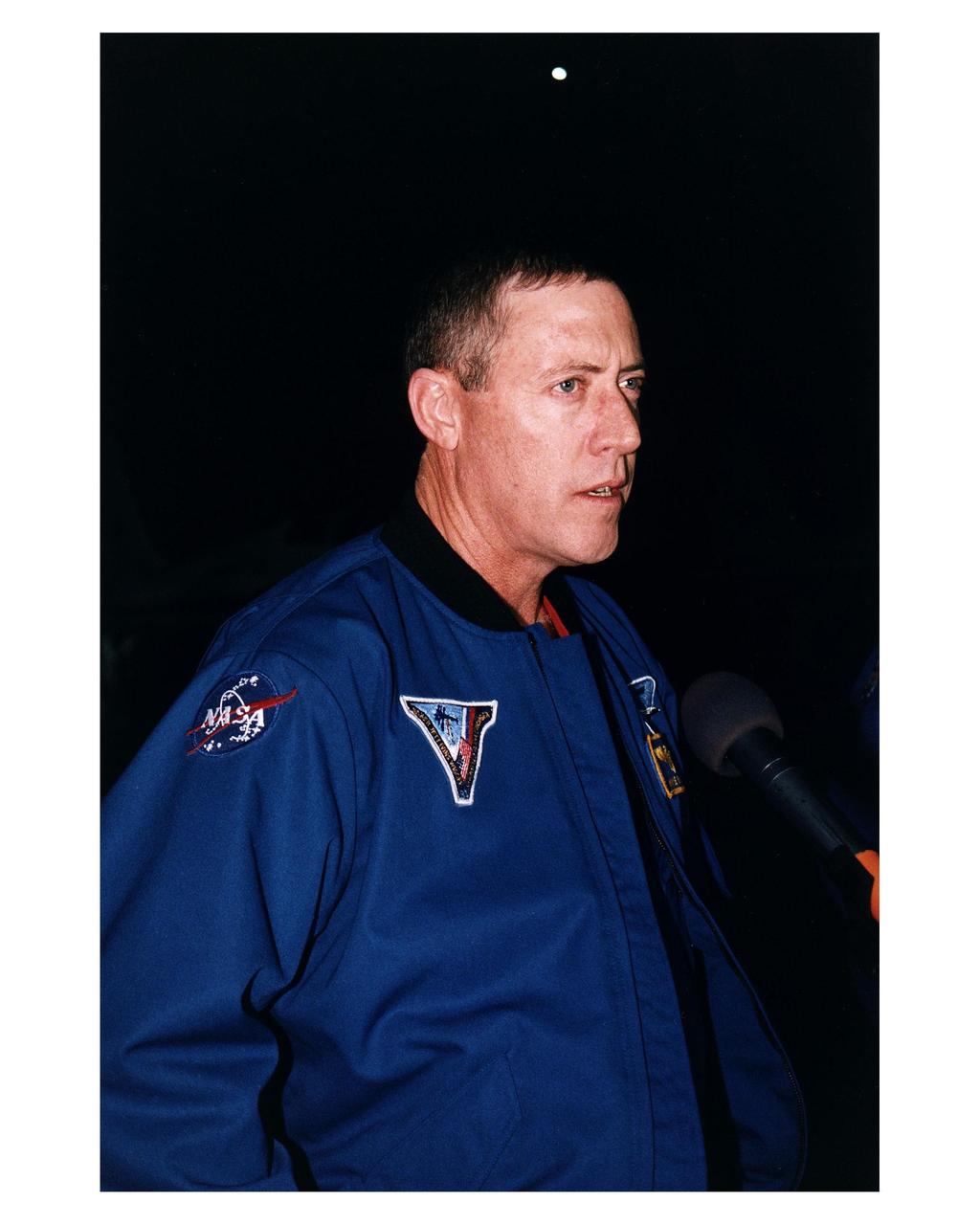
STS-81 Mission Commander Michael A. Baker talks to the press at the KSC Shuttle Landing Facility after he and his crew arrived at the space center for the final countdown preparations for the fifth Shuttle-Mir docking mission
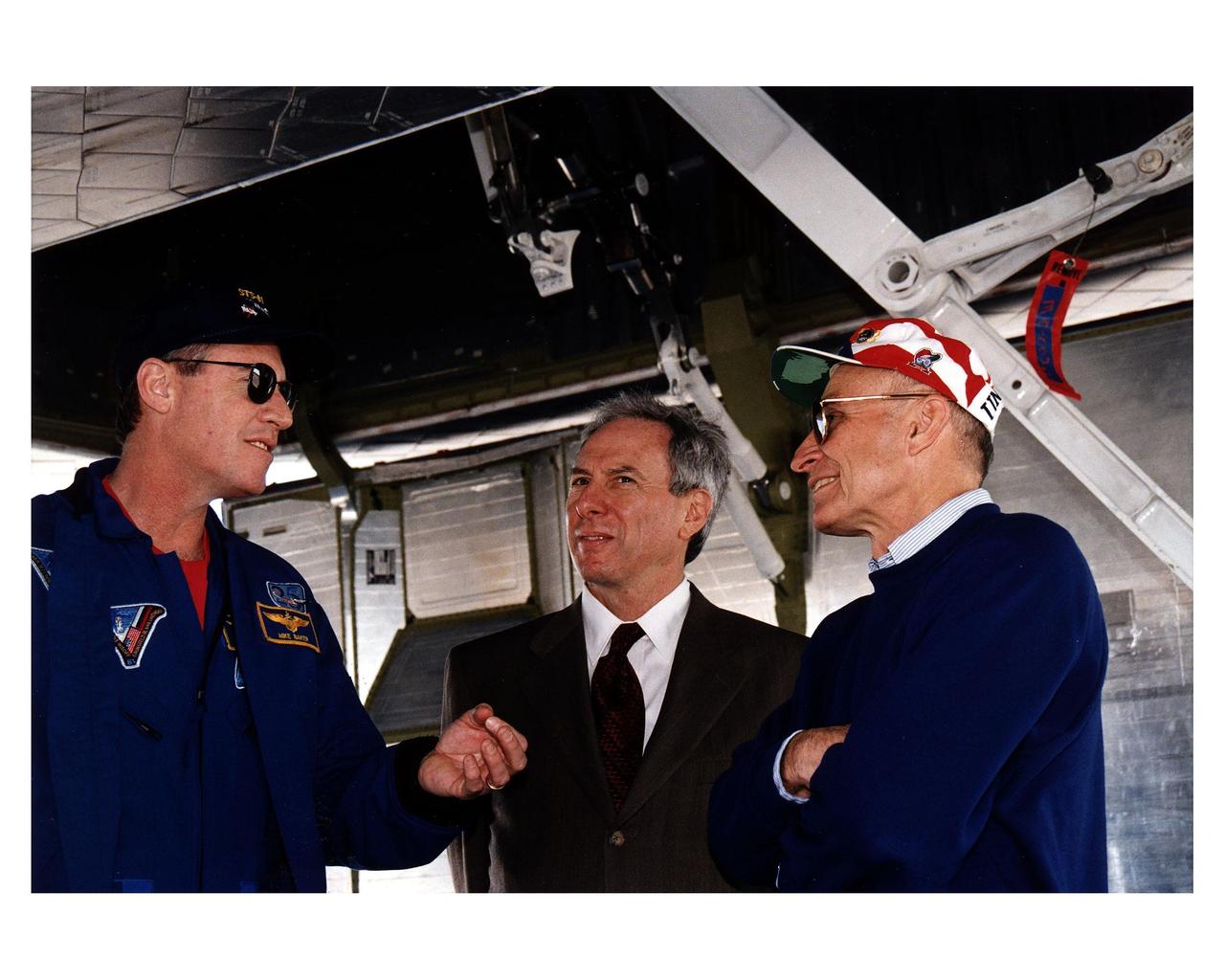
KENNEDY SPACE CENTER, FLA. -- NASA Administrator Daniel S. Goldin (center) and KSC Director of Shuttle Operations Robert B. Sieck (right) discuss the successful conclusion of the STS-81 mission with Mission Commander Michael A. Baker (left). They are underneath the Space Shuttle orbiter Atlantis after the space plane landed on Runway 33 at the KSC Shuttle Landing Facility at 9:22:44 a.m. EST Jan. 22 to conclude the fifth Shuttle-Mir docking mission. At main gear touchdown, the STS-81 mission duration was 10 days, 4 hours, 55 minutes. This was the 34th KSC landing in Shuttle history
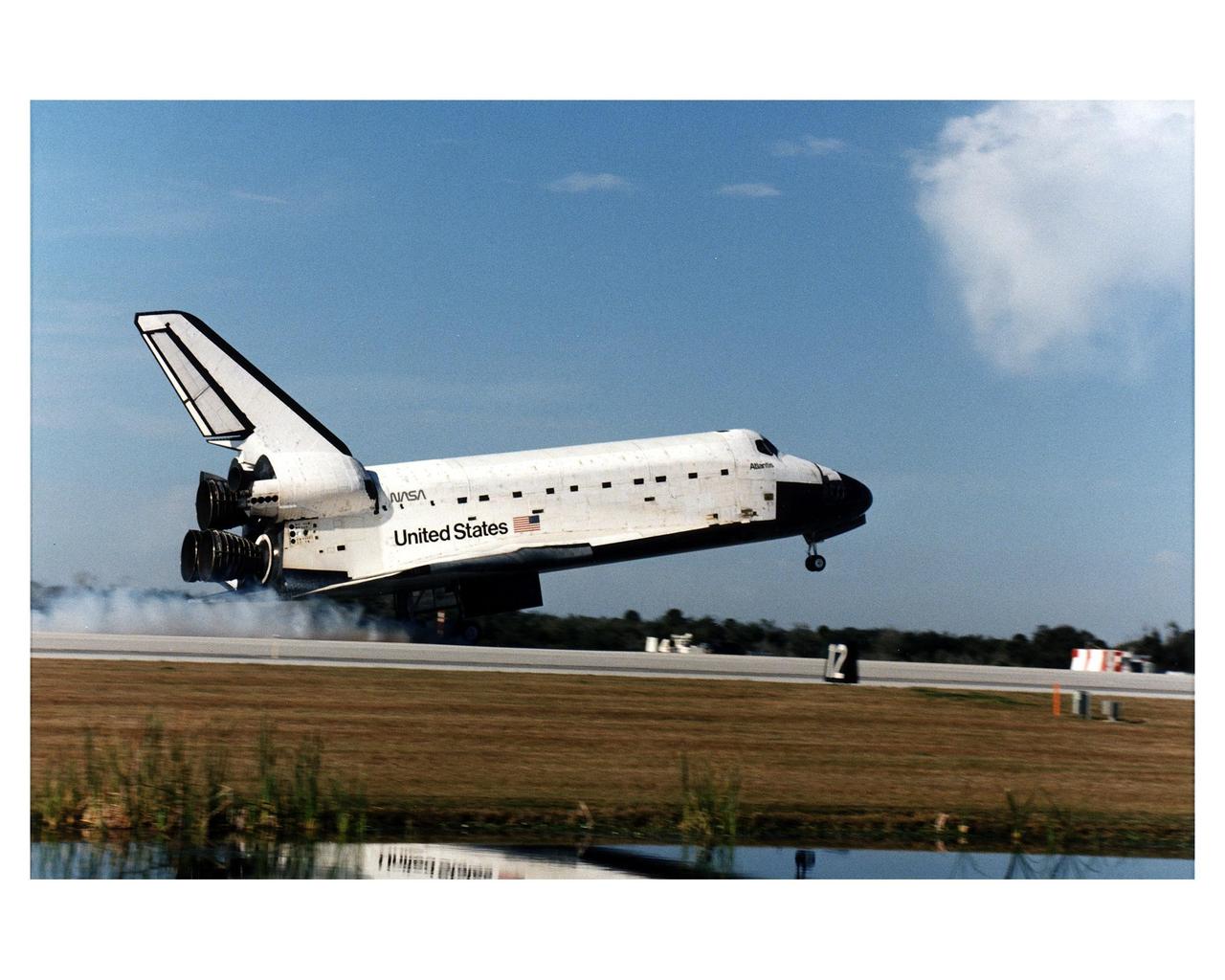
KENNEDY SPACE CENTER, FLA. -- The Space Shuttle orbiter Atlantis touches down on Runway 33 at 9:22:44 a.m. EST Jan. 22 to conclude the fifth Shuttle-Mir docking mission and return NASA astronaut John Blaha to Earth after four months in space. Blaha was replaced by STS-81 Mission Specialist Jerry Linenger during the five days of docked operations. At main gear touchdown, the STS-81 mission duration was 10 days, 4 hours, 55 minutes. This was the 34th KSC landing in Shuttle history. Mission Commander Michael A. Baker flew Atlantis to a perfect landing, with help from Pilot Brent W. Jett, Jr. Other returning STS-81 crew members are Mission Specialists John M. Grunsfeld, Peter J. K. "Jeff" Wisoff and Marsha S. Ivins. Atlantis also brought back experiment samples from the Russian space station for analysis on Earth, along with Russian logistics equipment
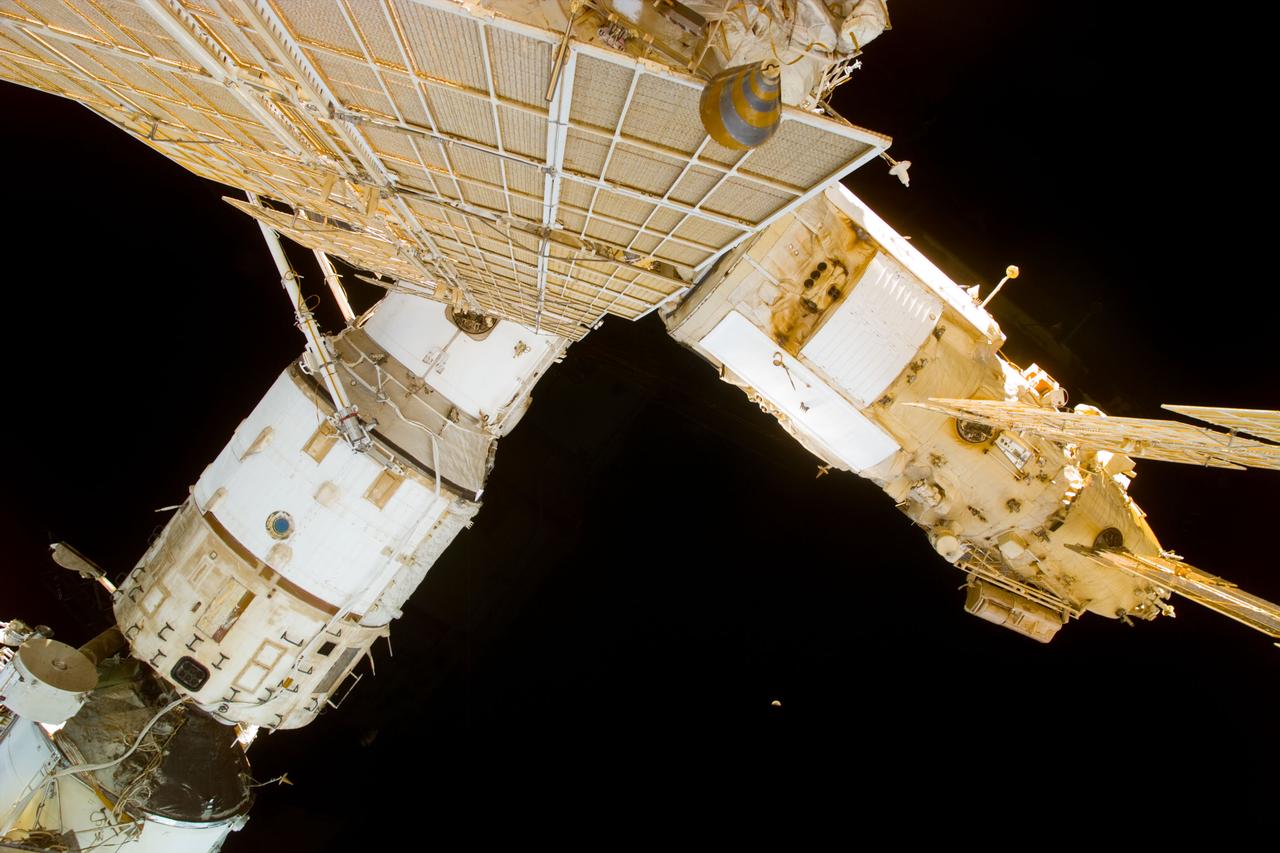
STS081-E-05501 (16 Jan. 1997) --- A view of several elements of the Russia's Mir Space Station complex as seen from the Space Shuttle Atlantis, to which it is docked for several days. The scene was recorded with an Electronic Still Camera (ESC) by one of the STS-81 crewmembers.
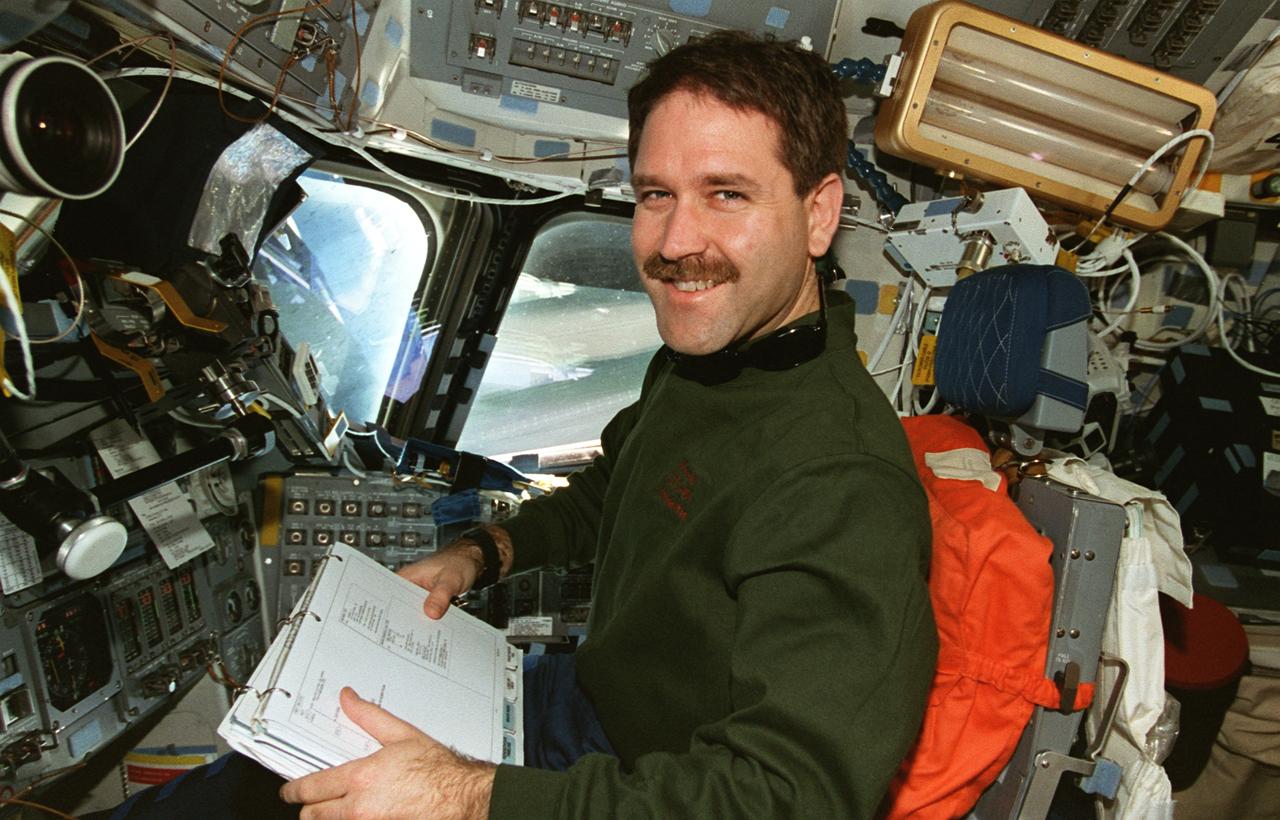
STS081-368-018 (12-22 Jan. 1997) --- Astronaut John M. Grunsfeld, STS-81 mission specialist, mans the pilot's station on the Space Shuttle Atlantis' flight deck during rendezvous operations with Russia's Mir Space Station.
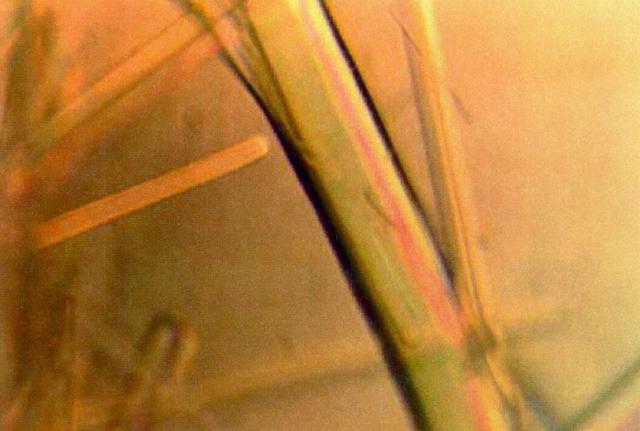
Nucleosome Core Particle grown on STS-81. The fundamental structural unit of chromatin and is the basis for organization within the genome by compaction of DNA within the nucleus of the cell and by making selected regions of chromosomes available for transcription and replication. Principal Investigator's are Dr. Dan Carter and Dr. Gerard Bunick of New Century Pharmaceuticals.

KENNEDY SPACE CENTER, FLA. -- With its drag chute deployed, the Space Shuttle orbiter Atlantis touches down on Runway 33 on the second opportunity at 9:22:44 a.m. EST Jan. 22 to conclude the fifth Shuttle-Mir docking mission and return NASA astronaut John Blaha to Earth after four months in space. At main gear touchdown, the STS-81 mission duration was 10 days, 4 hours, 55 minutes. This was the 34th KSC landing in Shuttle history. Mission Commander Michael A. Baker flew Atlantis to a perfect landing, with help from Pilot Brent W. Jett, Jr. Other returning STS-81 crew members are Mission Specialists John M.Grunsfeld, Peter J. K. "Jeff" Wisoff and Marsha S. Ivins. Atlantis also brought back experiment samples from the Russian space station Mir for analysis on Earth, along with Russian logistics equipment
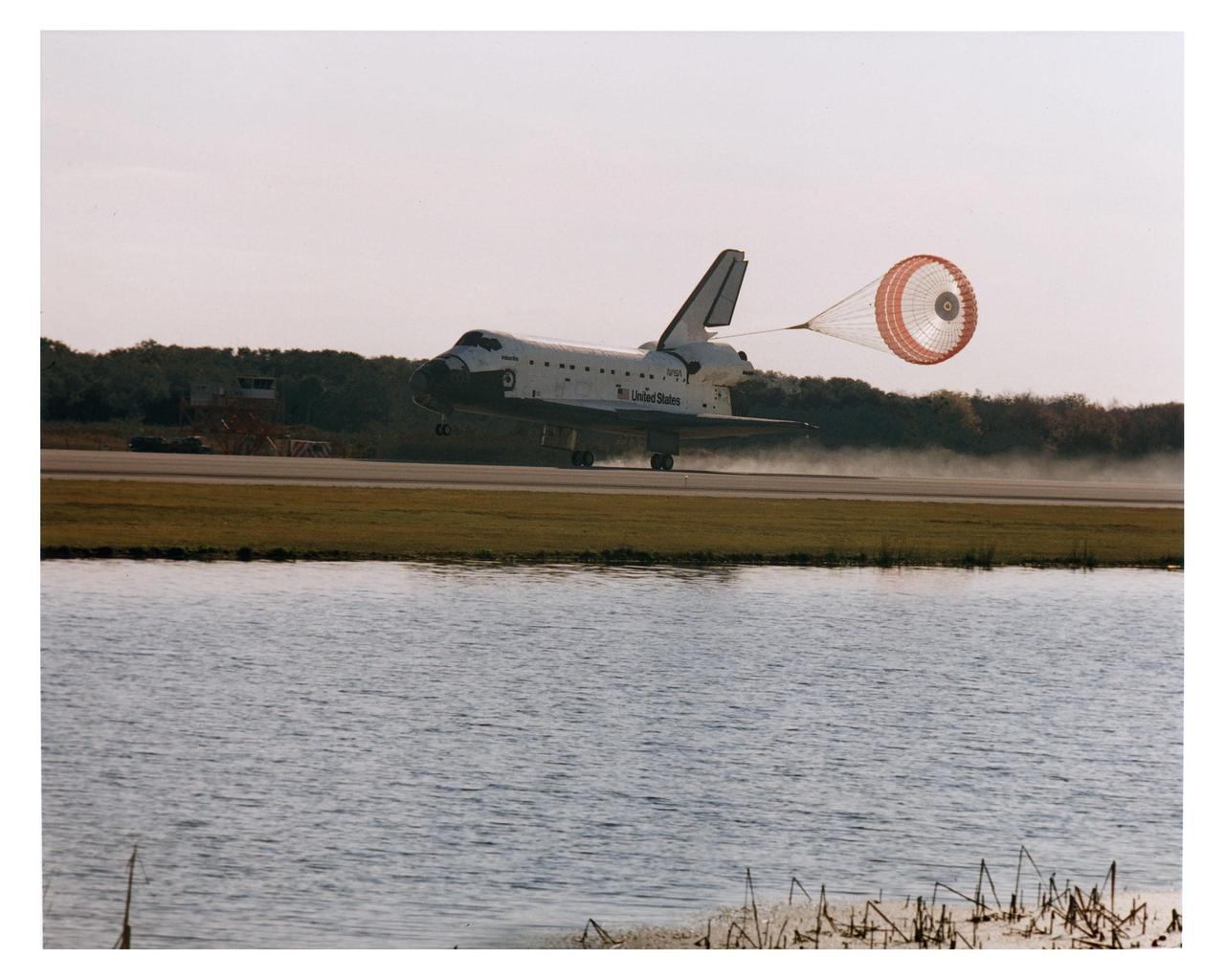
KENNEDY SPACE CENTER, FLA. -- With its drag chute deployed, the Space Shuttle orbiter Atlantis touches down on Runway 33 on the second opportunity at 9:22:44 a.m. EST Jan. 22 to conclude the fifth Shuttle-Mir docking mission and return NASA astronaut John Blaha to Earth after four months in space. At main gear touchdown, the STS-81 mission duration was 10 days, 4 hours, 55 minutes. This was the 34th KSC landing in Shuttle history. Mission Commander Michael A. Baker flew Atlantis to a perfect landing, with help from Pilot Brent W. Jett, Jr. Other returning STS-81 crew members are Mission Specialists John M.Grunsfeld, Peter J. K. "Jeff" Wisoff and Marsha S. Ivins. Atlantis also brought back experiment samples from the Russian space station Mir for analysis on Earth, along with Russian logistics equipment
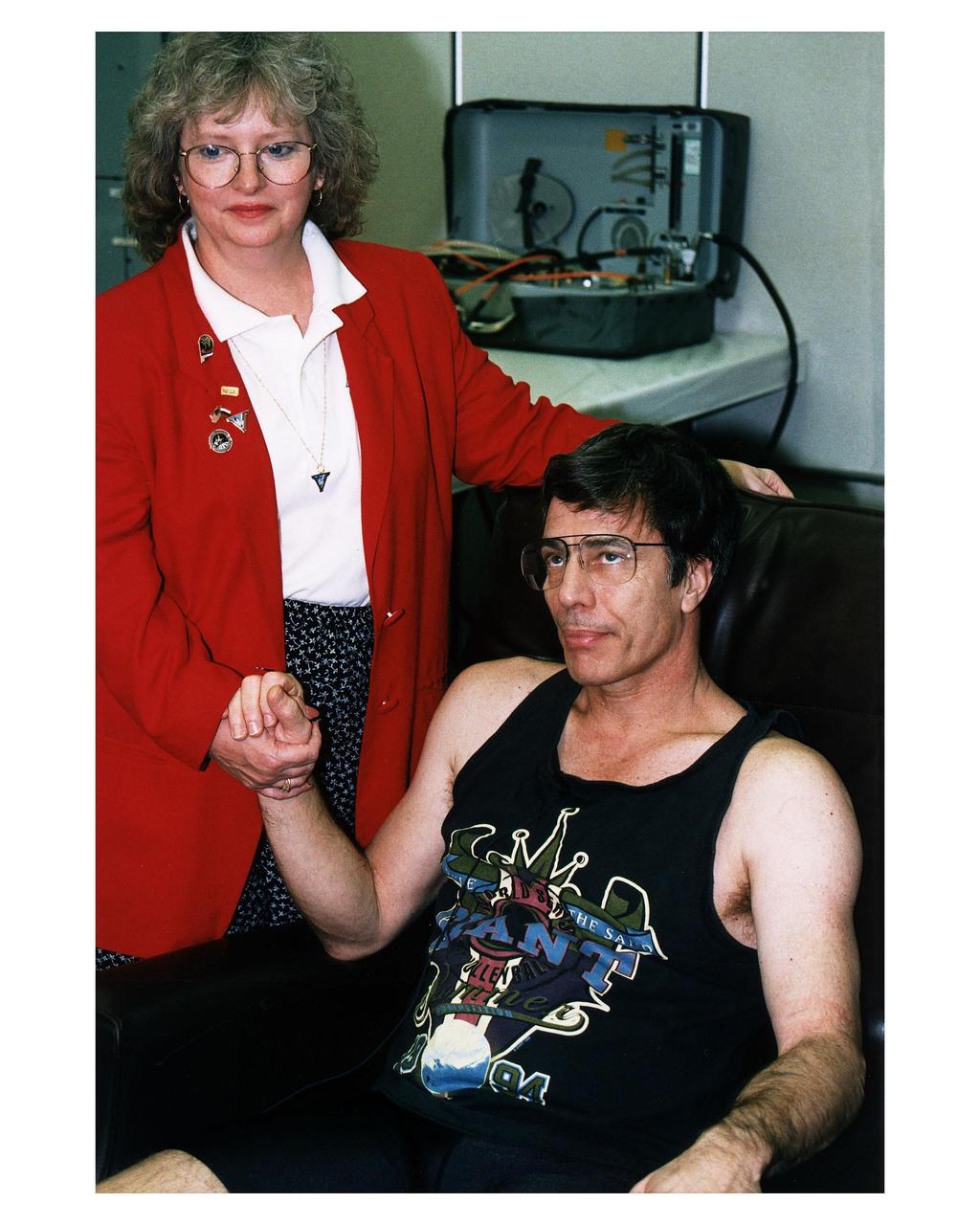
U. S. astronaut John E. Blaha and his wife, Brenda, hold hands in the crew quarters at KSC after he answered questions about his four-month stay aboard the Russian Mir space station. Blaha returned to Earth earlier today aboard the Space Shuttle orbiter Atlantis when it touched down at 9:22:44 a.m. EST Jan. 22 on Runway 33 of KSC’s Shuttle Landing Facility at the conclusion of the STS-81 mission. Blaha and the other five returning STS-81 crew members are spending the night here in the Operations and Checkout Building before returning to Johnson Space Center in Houston tomorrow morning. Blaha will undergo a two-week series of medical tests to help determine the physiological effects of his long-duration mission
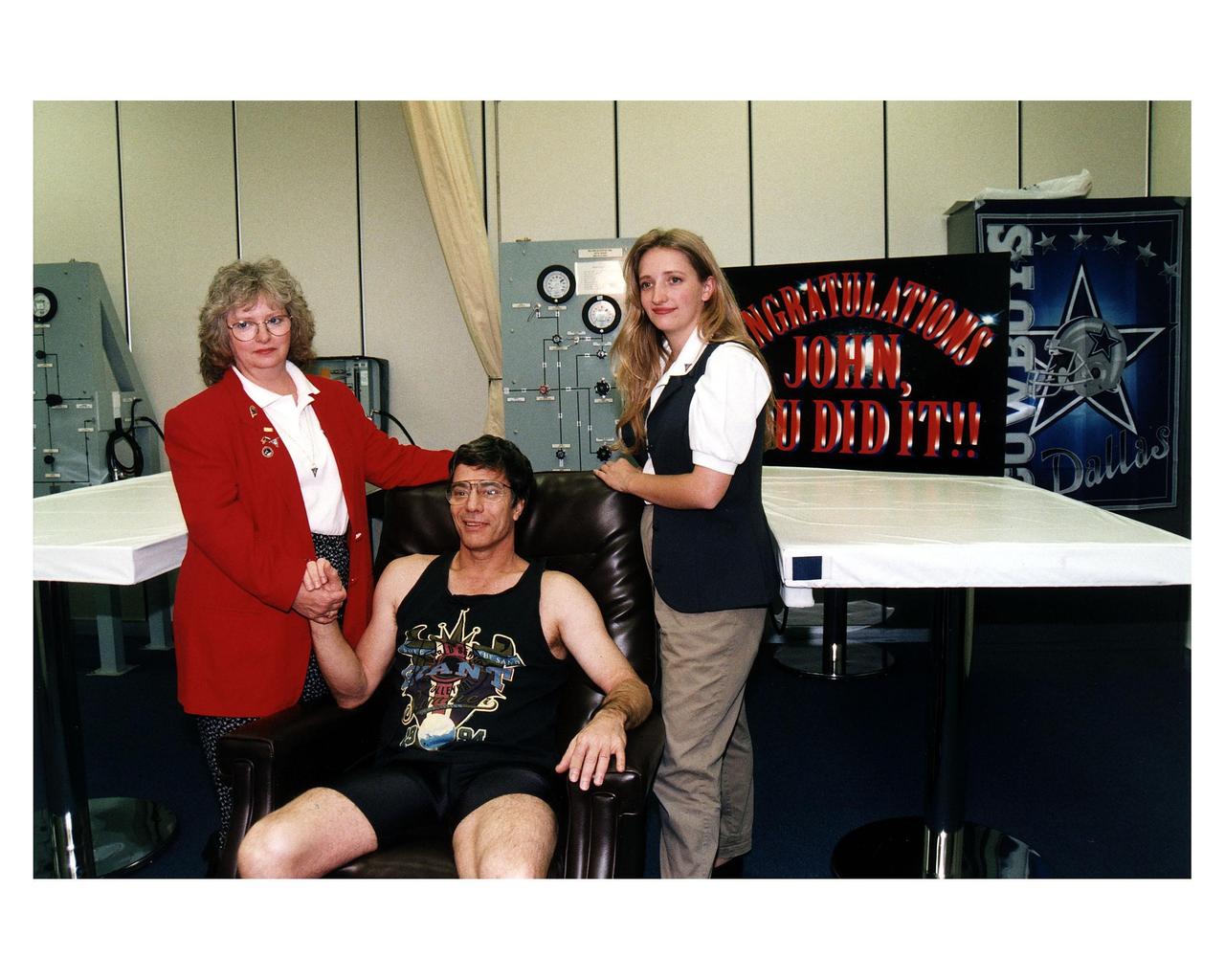
U. S. astronaut John E. Blaha poses with his wife, Brenda (left), and daughter, Carolyn (right), in the crew quarters at KSC after answering questions about his four-month stay aboard the Russian Mir space station. Blaha returned to Earth earlier today aboard the Space Shuttle orbiter Atlantis when it touched down at 9:22:44 a.m. EST Jan. 22 on Runway 33 of KSC’s Shuttle Landing Facility at the conclusion of the STS-81 mission. Blaha and the other five returning STS-81 crew members are spending the night here in the Operations and Checkout Building before returning to Johnson Space Center in Houston tomorrow morning. Blaha will undergo a two-week series of medical tests to help determine the physiological effects of his long-duration mission
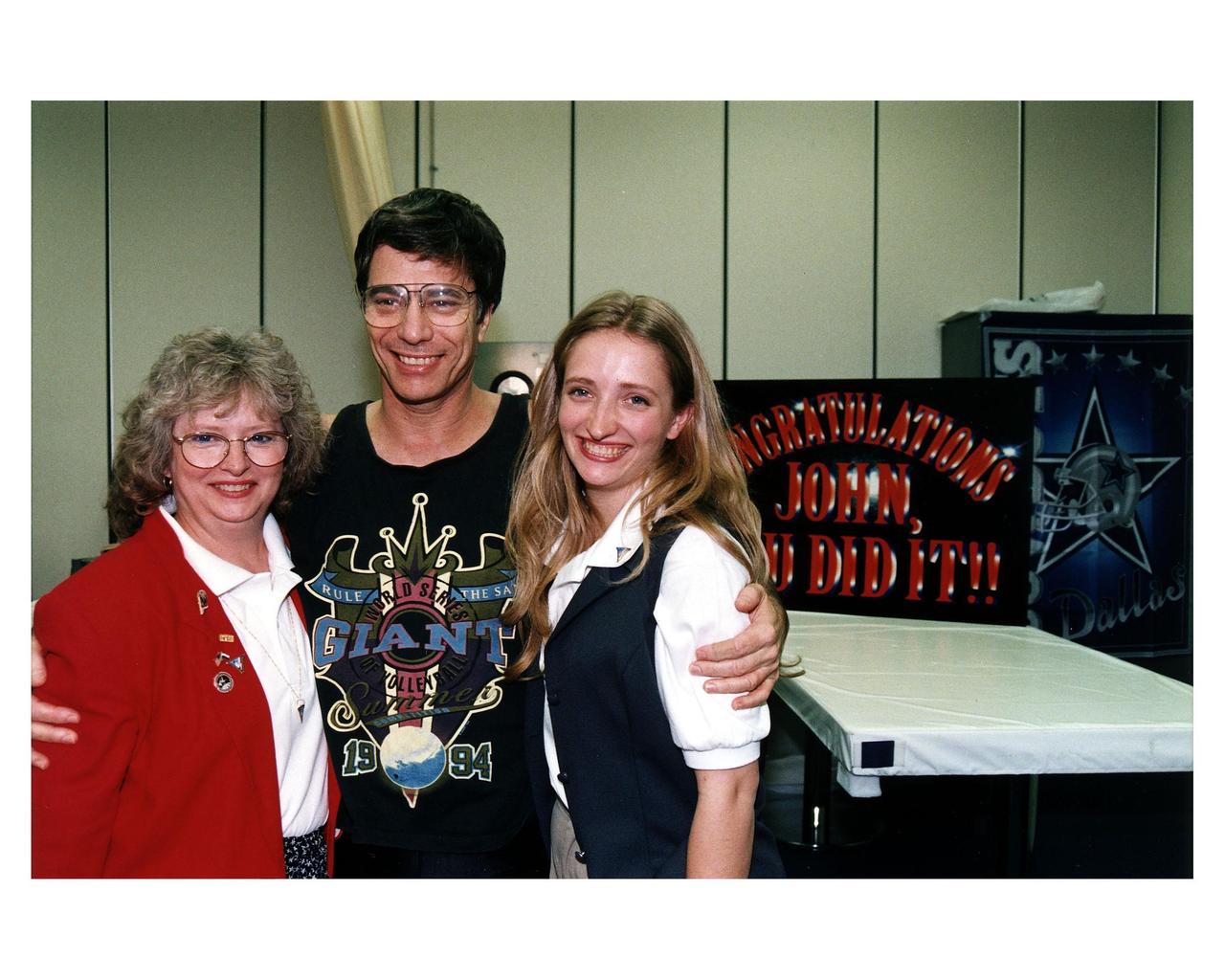
U. S. astronaut John E. Blaha and his family are all smiles as they embrace in the crew quarters at KSC after he answered questions about his four-month stay aboard the Russian Mir space station. Blaha’s wife, Brenda, is on the left and his daughter, Carolyn, is on the right. Blaha returned to Earth earlier today aboard the Space Shuttle orbiter Atlantis when it touched down at 9:22:44 a.m. EST Jan. 22 on Runway 33 of KSC’s Shuttle Landing Facility at the conclusion of the STS-81 mission. Blaha and the other five returning STS-81 crew members are spending the night here in the Operations and Checkout Building before returning to Johnson Space Center in Houston tomorrow morning. Blaha will undergo a two-week series of medical tests to help determine the physiological effects of his long-duration mission

KENNEDY SPACE CENTER, FLA. -- The Space Shuttle orbiter Atlantis glides out of a morning sky as it prepares to land on Runway 33 at a scheduled time of about 9:23 a.m. EST Jan. 22 to conclude the fifth Shuttle-Mir docking mission and return NASA astronaut John Blaha to Earth after four months in space. At main gear touchdown, the STS-81 mission duration will be 10 days, 4 hours, 55 minutes. This is the 34th KSC landing in Shuttle history. Mission Commander Michael A. Baker is steering Atlantis to a perfect landing, with help from Pilot Brent W. Jett, Jr. Other returning STS-81 crew members are Mission Specialists John M. Grunsfeld, Peter J. K. "Jeff" Wisoff and Marsha S. Ivins. Atlantis also brought back experiment samples from the Russian space station Mir for analysis on Earth
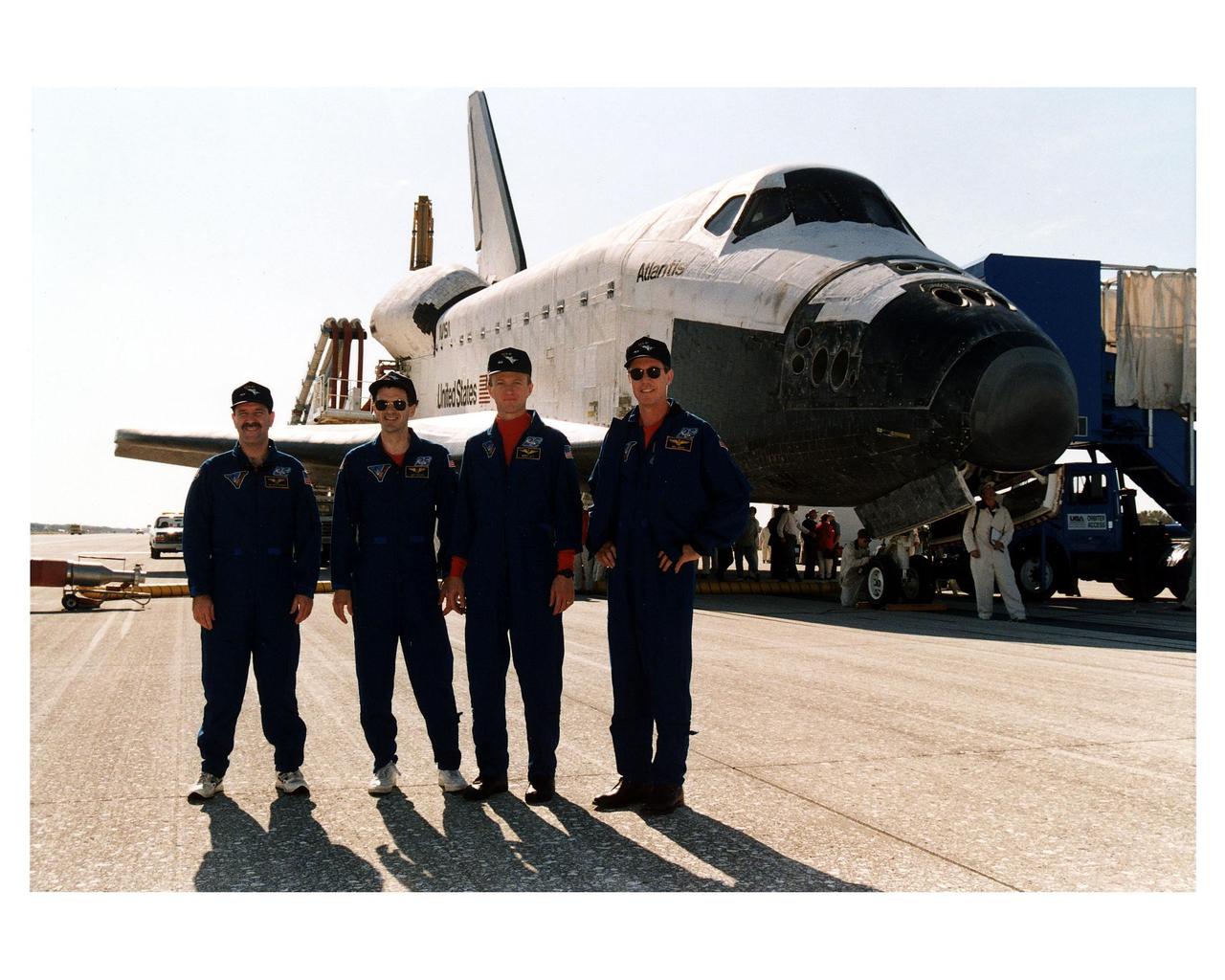
KENNEDY SPACE CENTER, FLA. -- Four members of the STS-81 crew pose in front of the Space Shuttle orbiter Atlantis on Runway 33 of KSC’s Shuttle Landing Facility after the space plane touched down at 9:22:44 a.m. EST Jan. 22 to conclude the fifth Shuttle-Mir docking mission. The crew members are (from left): Mission Specialists John M. Grunsfeld and Peter J. K. "Jeff" Wisoff ; Pilot Brent W. Jett, Jr.; and Mission Commander Michael A. Baker. Also returning on board Atlantis were Mission Specialist Marsha S. Ivins and John Blaha, who had been a member of the Mir 22 crew for four months. At main gear touchdown, the STS-81 mission duration was 10 days, 4 hours, 55 minutes. This was the 34th KSC landing in Shuttle history

STS081-711-009 (12-22 Jan. 1997) --- As photographed with a 70mm handheld camera from the Earth-orbiting Space Shuttle Atlantis, this image provides a northeastward panorama of the Florida peninsula, the northern Bahamas and Cuba as well as a synoptic view of the northern Caribbean region. Lake Okeechobee and the urban region around Miami are the two key visual points in Florida. The turquoise shallow water platforms around the Florida Keys, the Bahamas, and south of Cuba contrast with the deep blue color of the deeper channels which separate Florida from Cuba and the Bahamas. Offshore breezes keep the coastal areas clear of clouds.
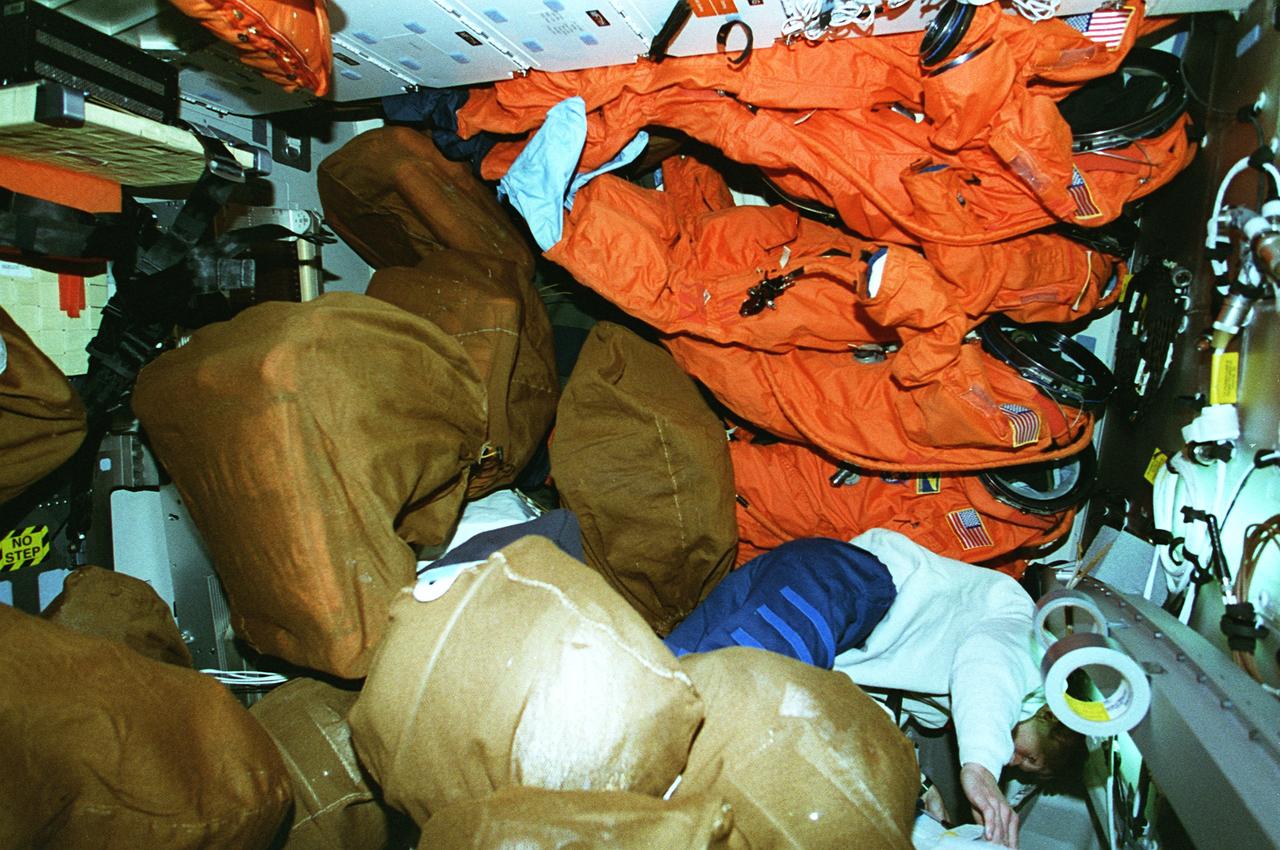
STS081-308-032 (12-22 Jan. 1997) --- Astronaut Marsha S. Ivins appears almost lost among the bags of material to be brought back to Earth at the impending conclusion of the Space Shuttle Atlantis and Russia's Mir Space Station docking mission. Several partial pressure garments which were used for launch and will soon be donned for the entry phase are in upper left.
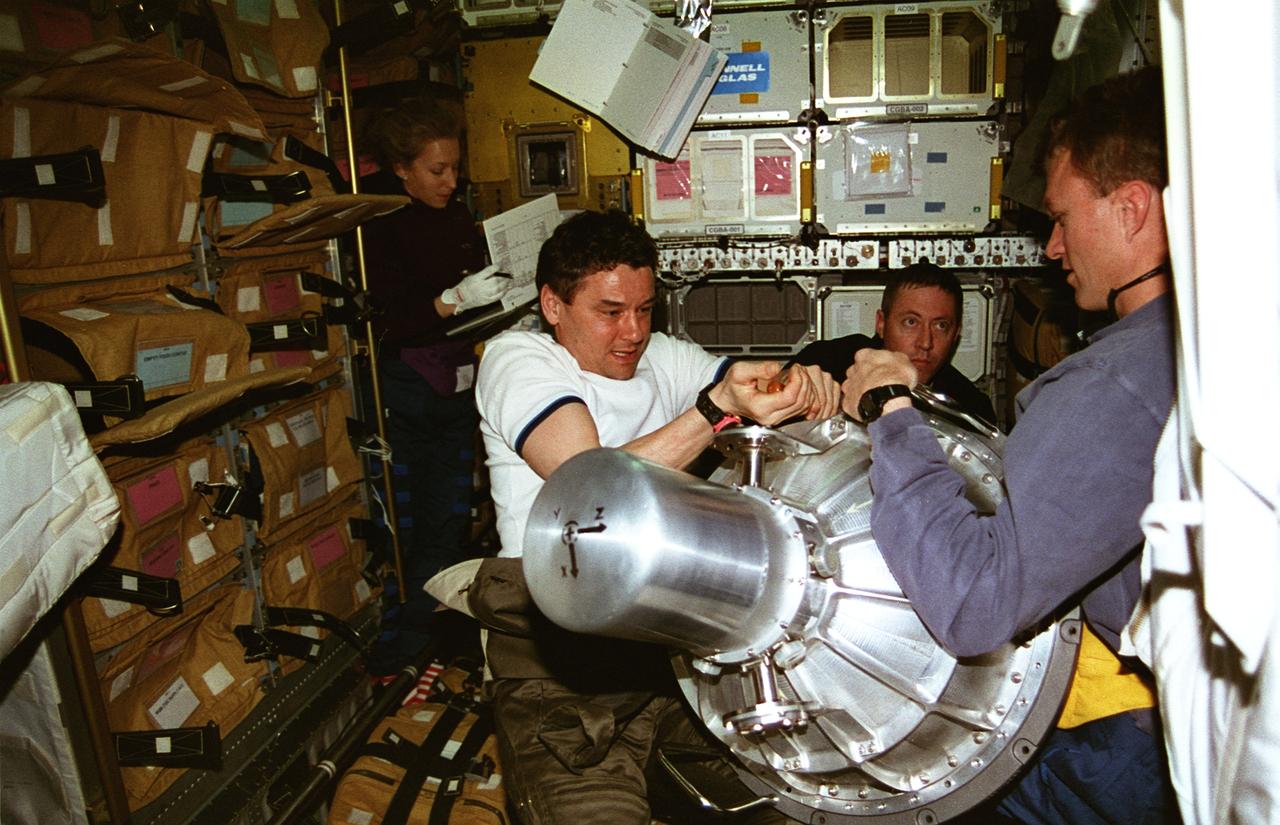
STS081-301-032 (12-22 Jan. 1997) --- Shortly after the docking of the Space Shuttle Atlantis and Russia's Mir Space Station, crewmembers from the respective spacecraft begin to transfer hardware from the Spacehab Double Module (DM) onto the Mir complex. In this scene, cosmonaut Valeri G. Korzun (second left) Mir-22 commander, along with astronauts Michael A. Baker (second right) commander, and Brent W. Jett, Jr., pilot, unstow a gyrodyne, a device used for attitude control, for transfer to Mir. Astronaut Marsha S. Ivins looks over a lengthy inventory of supplies to be transferred.
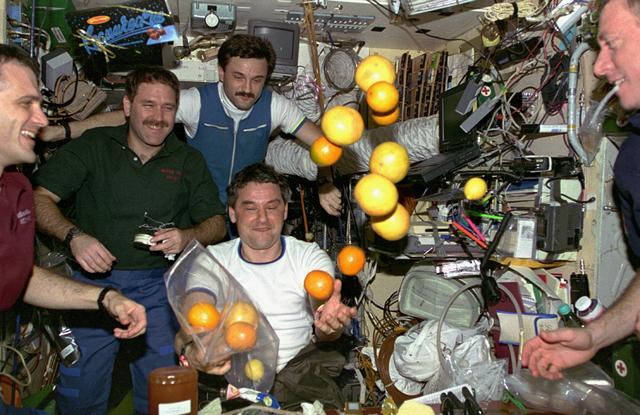
STS081-343-014 (12-22 Jan. 1997) --- Oranges and grapefruit brought up from Earth get a popular reception by the Mir-22 crewmembers. Left to right astronauts Peter J. K. (Jeff) Wisoff and John M. Grunsfeld, along with cosmonauts Aleksandr Y. Kaleri and Valeri G. Korzun, Mir-22 flight engineer and commander respectively, view the microgravity behavior of the seasonal gifts. Astronaut Michael A. Baker, mission commander, looks on at frame's right edge.

STS081-715-004 (12-22 Jan. 1997) --- As photographed with a 70mm camera aboard the Space Shuttle Atlantis, this scene features the Volga River and Volgograd under snow. Contrast in brightness shows up many features in this near-vertical view of the great bend of the Volga River's dark, open strip of water, center. The Volga flows south into the view from top right, then southeast from the center to the bottom. Volgograd appears as the gray zone along the left (west) side of the open water. Presumably the ice-free part of the river opposite Volgograd relates to the slightly warmer water which is spilled from prominent, ice-covered Lake Volgograd (top right). The wide patterns of swirls, center to lower right, are numerous meander bends on the Volga's floodplain (up to 20 miles wide), highlighted by snow. The main course of the Volga is once again ice covered in this floodplain belt. The Volga-Don Canal can be seen leaving the river just south of the bend, exiting the view center left. This canal, with others in the Moscow region, allows barge traffic to move through the Russian heartland, from the Black Sea to the Baltic at Leningrad. The long parallel lines in threes and fours are lines of trees used as wind breaks. They stretch across Russia for hundreds of miles.
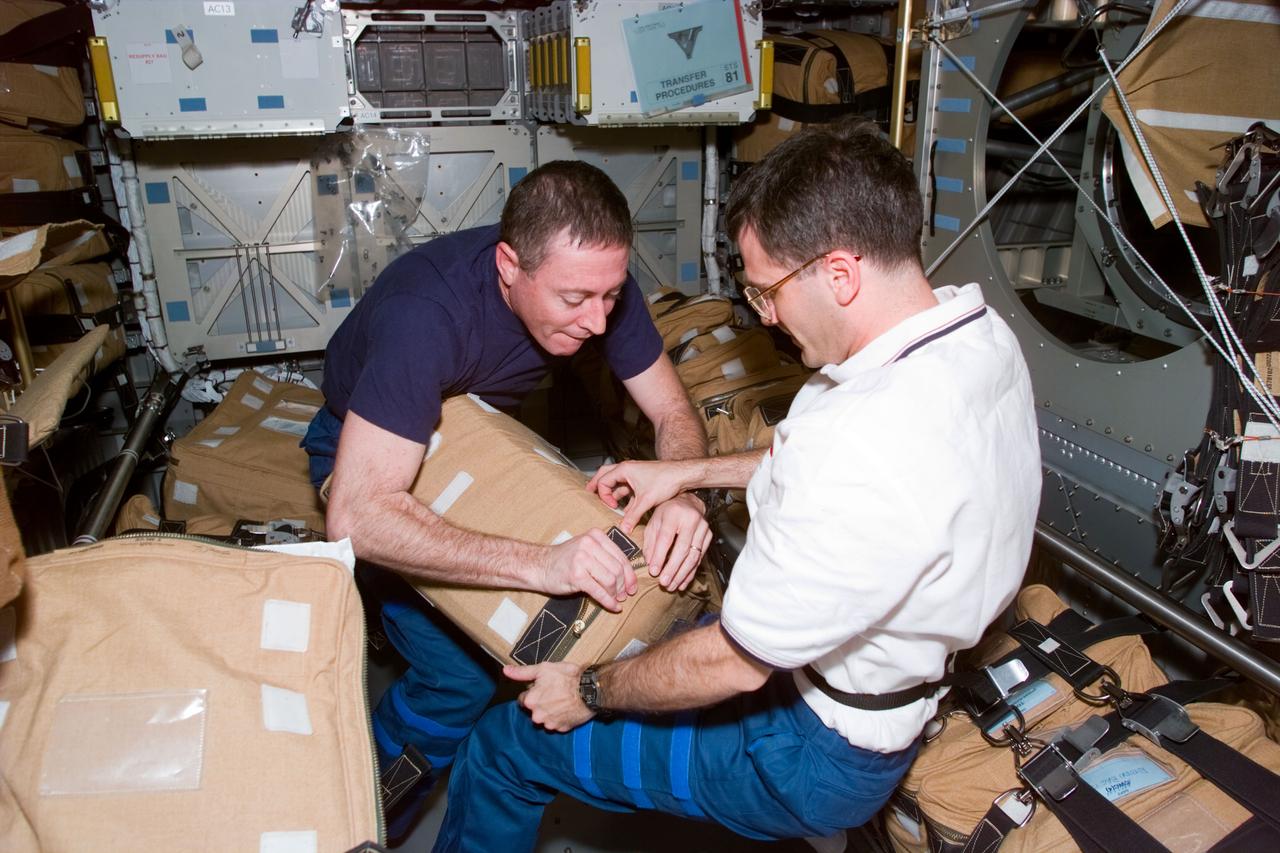
STS081-E-05515 (16 Jan. 1997) --- Astronauts Michael A. Baker, commander, and Peter J. K. (Jeff) Wisoff, mission specialist, secure a bag filled with a drawer of supplies in the Spacehab Double Module (DM). The scene was recorded with an Electronic Still Camera (ESC) and later downlinked to flight controllers in Houston, Texas.

STS081-719-084 (12-22 Jan. 1997) --- The capital of the state of Colorado is featured prominently in this winter scene. Located at the foothills of the Rocky Mountains, Denver's elevation is 5,280 feet and is known as the "Mile High City". The new Denver International Airport (DIA) opened in 1995 and is one of the countries largest airports, can be seen towards the right corner of the photograph. Above and to the right of DIA is the closed Stapleton Airport with its snow covered runways. Other prominent cities featured are Golden, due east of Denver and against the Rockies, and Boulder, to the northeast of the city and also against the Rockies. Brighton is northwest of Denver, near the South Platte River.
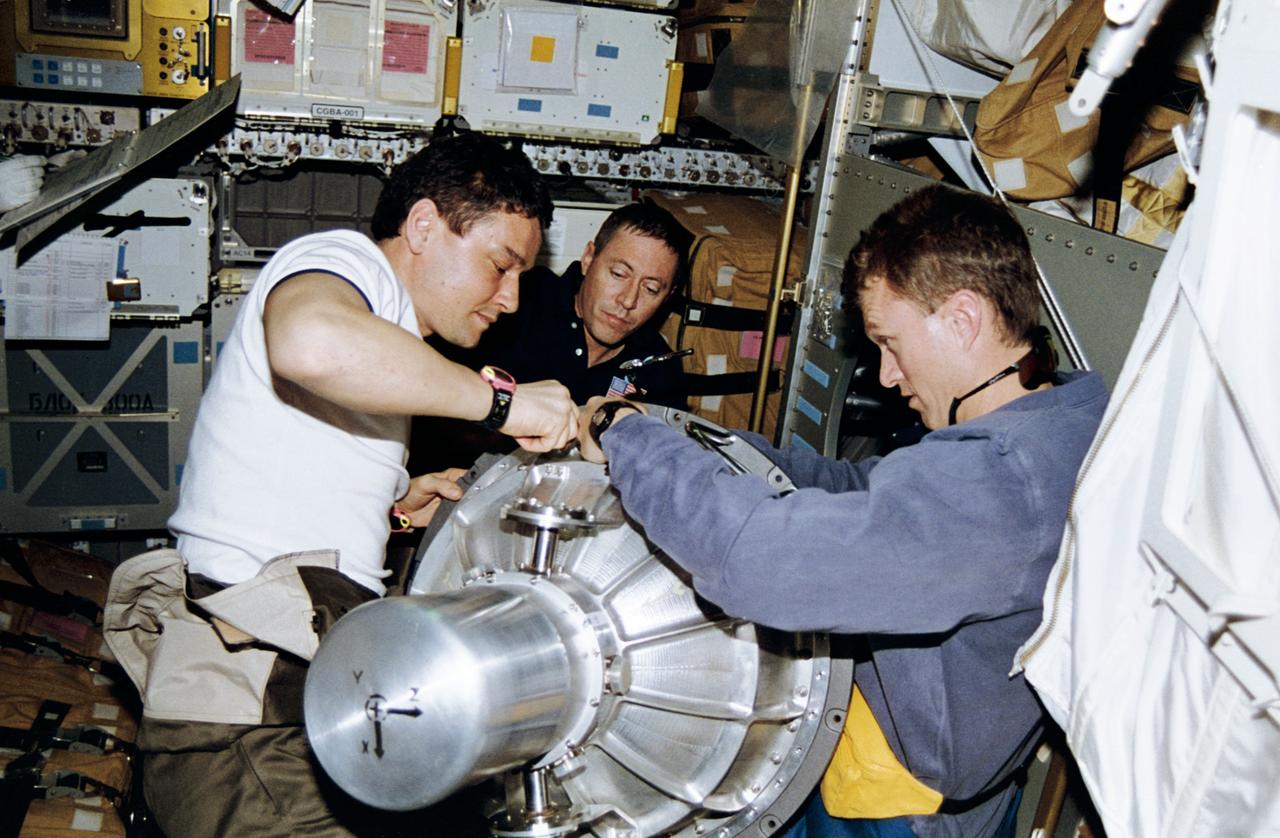
STS081-301-031 (12-22 Jan 1997) --- Shortly after docking of the Space Shuttle Atlantis and Russia's Mir Space Station, crew members from the respective spacecraft begin to transfer hardware from the Spacehab Double Module (DM) onto the Mir complex. Here, cosmonaut Valeri G. Korzun, Mir-22 commander, along with astronauts Michael A. Baker, commander, and Brent W. Jett, Jr., pilot, unstow a gyrodyne, device for attitude control, transfer to Mir.

STS081-717-096 (12-22 Jan. 1997) --- The crewmembers, like astronauts 30 years ago, found the Nile River and its conspicuous delta an irresistible photo target from space, in this case from the Space Shuttle Atlantis' overhead windows. The majority of people living in Egypt reside in the city of Cairo. One of the most intensely cultivated lands in the world, the Nile delta can lay claim to some of the highest levels of soil salinity, as well as to being one of the highest users of fertilizer. The majority of Egypt's arable land is located in the delta. Cairo is "young" when compared to Egypt's long history, and has been a city since the Roman Empire. Although the city itself is relatively young, a site on the eastern bank of the Nile became the first capital of Egypt around 4225 BC. The city was called "Oun", but later was renamed Heliopolis by the Greeks. In 1991 the population of Cairo was estimated to be 54,600,000. The Pyramids of Gizai, one of the Seven Wonders of the Ancient World, can be seen on the western edge of the Nile delta and Cairo. The smallest and youngest of three Old Kingdom pyramids, Menkaure, is hard to distinguish because of its small size which casts a small shadow. Khafre is located between Menkaure and the Great Pyramid, and was originally 143 meters high. From the ground it appears that Khafre is taller than the other pyramids but this is an illusion caused by Khafre being built on higher ground. Khufu, or the Great Pyramid, was the first of the three to be built, and at an original height of 147 meters, is the tallest pyramid.

STS081-750-048 (12-22 Jan. 1997) --- This photograph, made with a handheld 70mm camera aimed through the Space Shuttle Atlantis' overhead windows, shows the entire city-state of Singapore with its urban, industrial and commercial land use areas. Singapore is located at the tip of the Malay peninsula separated by Johor strait. This prosperous island state, once Asia's major trade center, is now highly industrialized despite its small area. The ideal location has made this island a hub of trade, shipping and service industries. This photograph shows the urban land uses and a large airport on the island. Several commercial harbors are seen on this photograph. The three large reservoirs in the center of the photograph are obscured by the clouds.
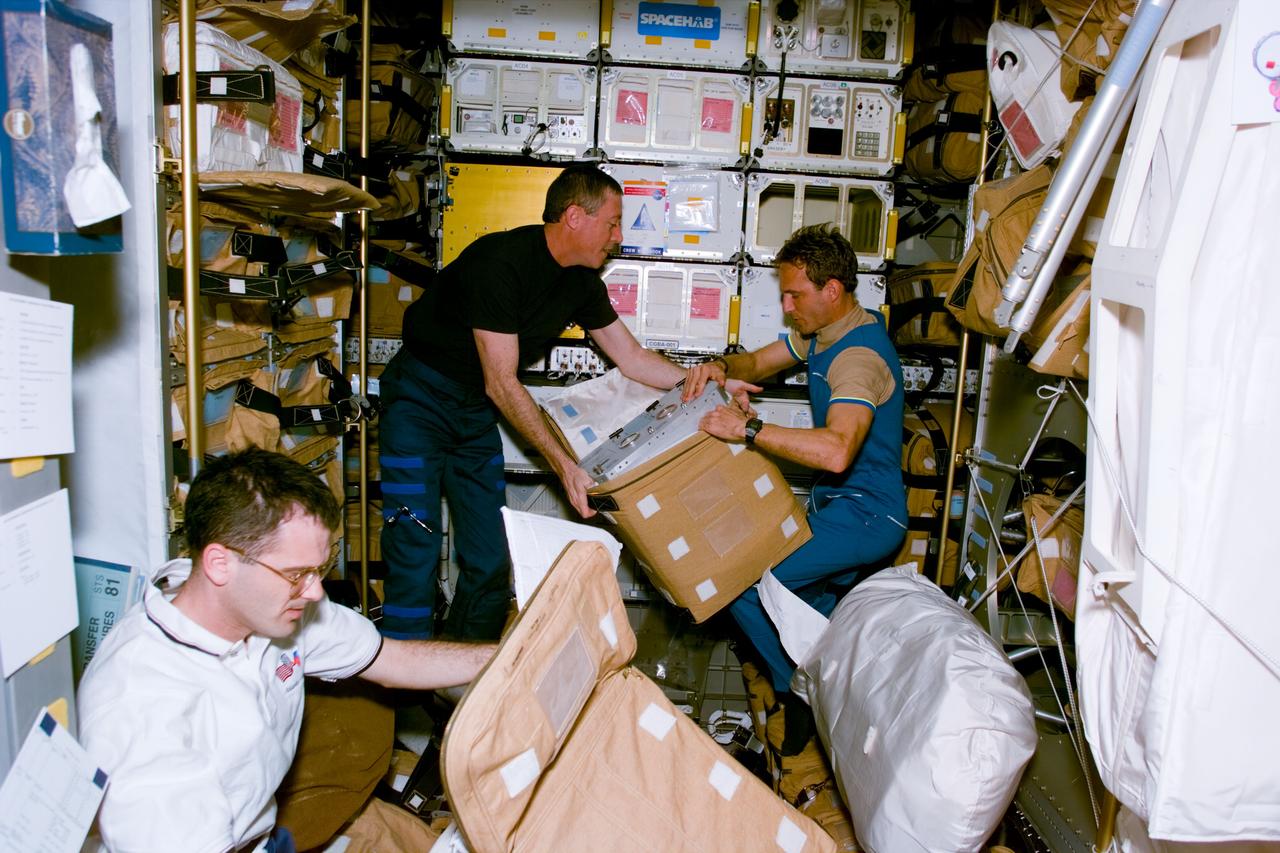
STS081-E-05514 (16 Jan. 1997) --- The transfer of equipment and supplies continues aboard the Spacehab Double Module (DM) aboard the Space Shuttle Atlantis. Here, left to right, astronauts Peter J. K. Wisoff and Michael A. Baker along with newly initiated "cosmonaut" Jerry M. Linenger, Mir-22 cosmonaut guest researcher, load and move supplies. The photograph was recorded with an Electronic Still Camera (ESC) and later was downlinked to flight controllers in Houston, Texas.
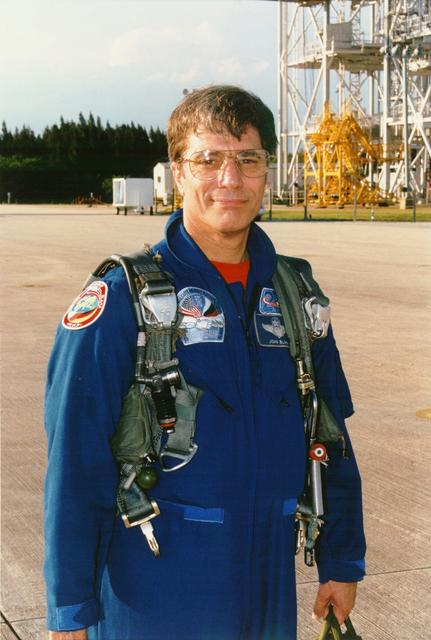
KENNEDY SPACE CENTER, FLA. - STS-79 Mission Specialist John E. Blaha arrives at KSC's Shuttle Landing Facility with five fellow astronauts, ready to participate in the Terminal Countdown Demonstration Test (TCDT). The TCDT is a dress rehearsal for launch for the flight crew and launch team. Over the next several days, the astronauts will take part in training exercises at the launch pad that will culminate in a simulated launch countdown. The Space Shuttle Atlantis is being prepared for liftoff around Sept. 12 on STS-79, the fourth docking between the U.S. Shuttle and Russian Space Station Mir. During the approximately nine-day flight, Blaha will change places with fellow spaceflight veteran Shannon Lucid, who is wrapping up a record-setting stay on Mir. Blaha will remain aboard the Station for about four months, returning to Earth in January 1997 withthe crew of Shuttle Mission STS-81.
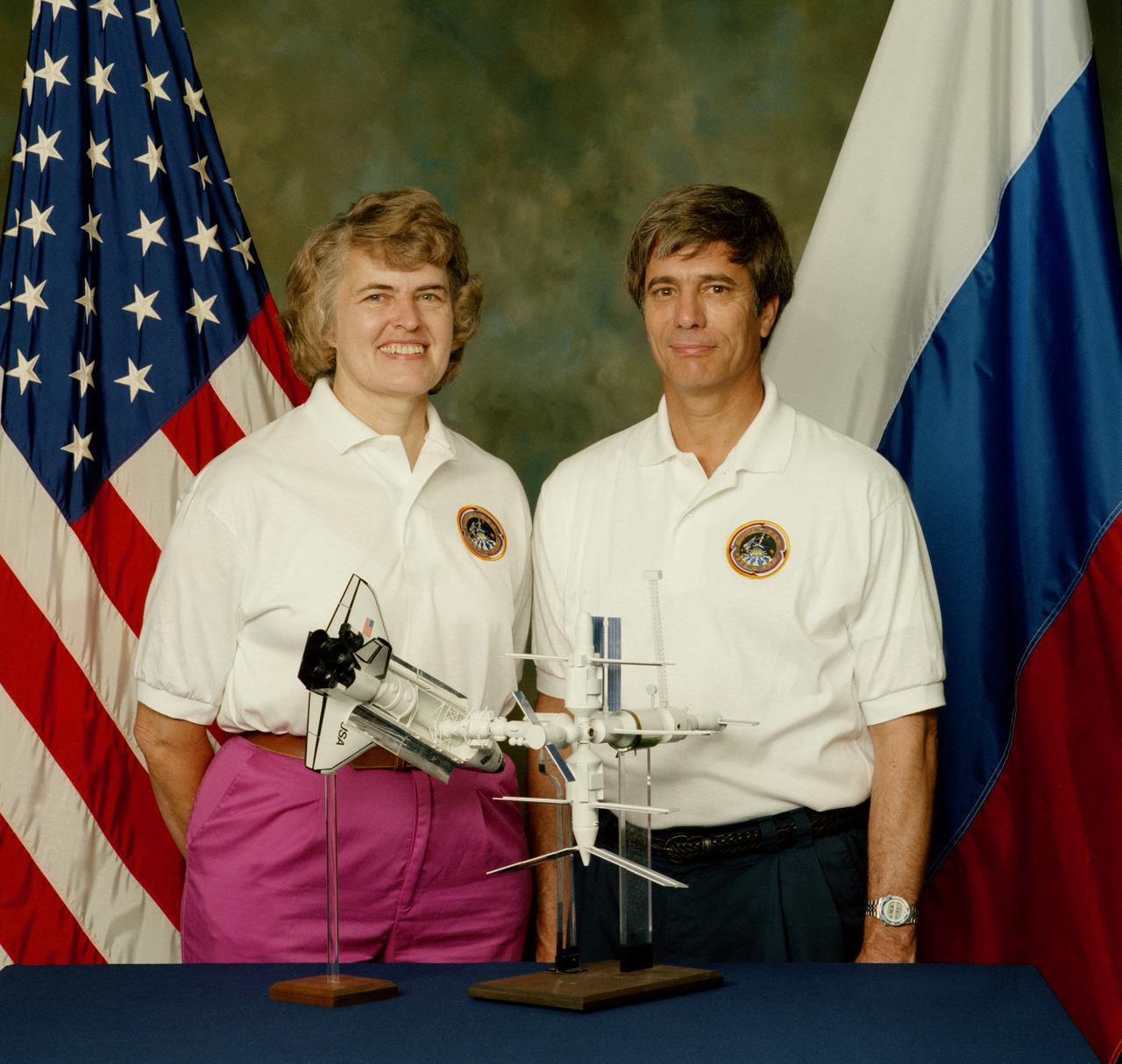
S95-16678 (September 1995) --- NASA astronauts Shannon W. Lucid and John E. Blaha next year will follow the lead of astronaut Norman E. Thagard's 1995 feat of extended stay aboard Russia's Mir Space Station. Lucid is to accompany the STS-76 crew in March and spend a little over four months aboard Mir before returning to Earth with the STS-79 crew. Blaha will go into space on the scheduled August mission of STS-79 and after four months aboard Mir will return to Earth with the STS-81 crew.
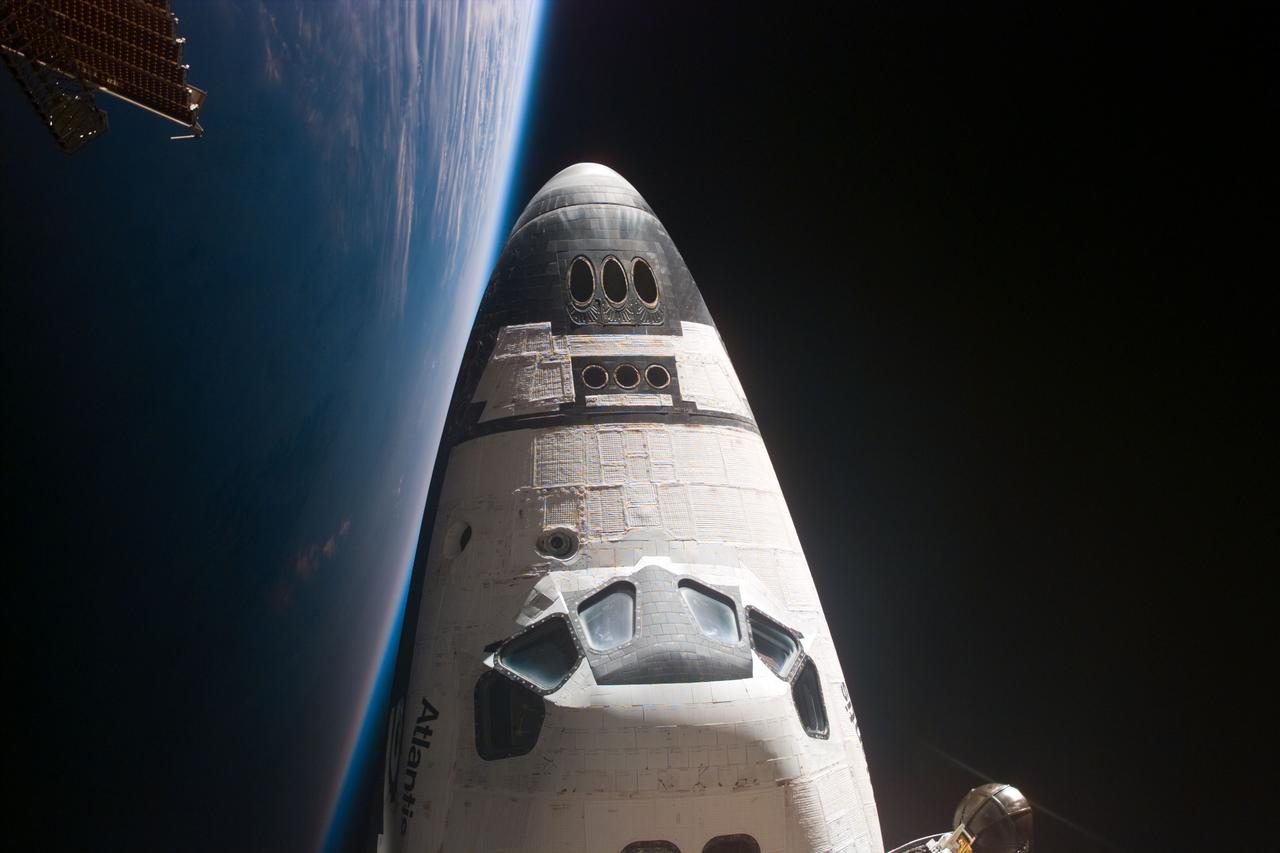
STS081-E-05436 (15 Jan. 1997) --- Soon after the astronauts docked the space shuttle Atlantis with Russia's Mir Space Station, astronaut Marsha S. Ivins, STS-81 mission specialist, went aboard the Mir complex and sought a window through which she could record this image of Atlantis' forward section. A solar array panel on the Mir is seen in one corner and the Ku-band antenna for Atlantis is visible in another. This view was taken with an electronic still camera (ESC). Photo credit: NASA
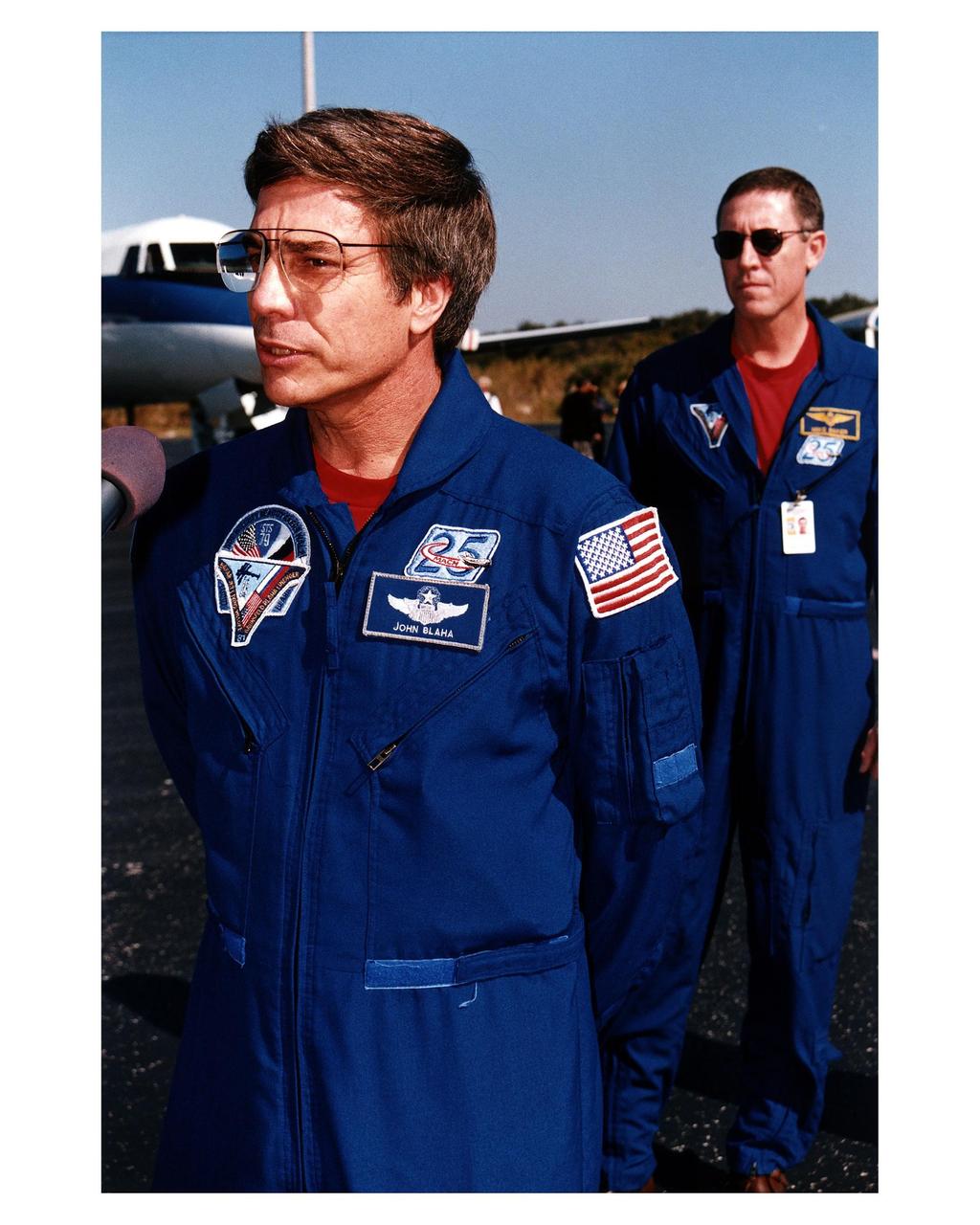
Returning NASA astronaut and former Mir 22 crew member John E. Blaha (left), addresses the news media at the Skid Strip at Cape Canaveral Air Station as he and fellow STS-81 crew members prepare to depart for Johnson Space Center Jan. 23. The crew arrived at KSC aboard the Space Shuttle Atlantis Jan. 22 to conclude the fifth Shuttle-Mir docking mission and return Blaha to Earth after four months in space. Behind Blaha is Mission Commander Michael A. Baker
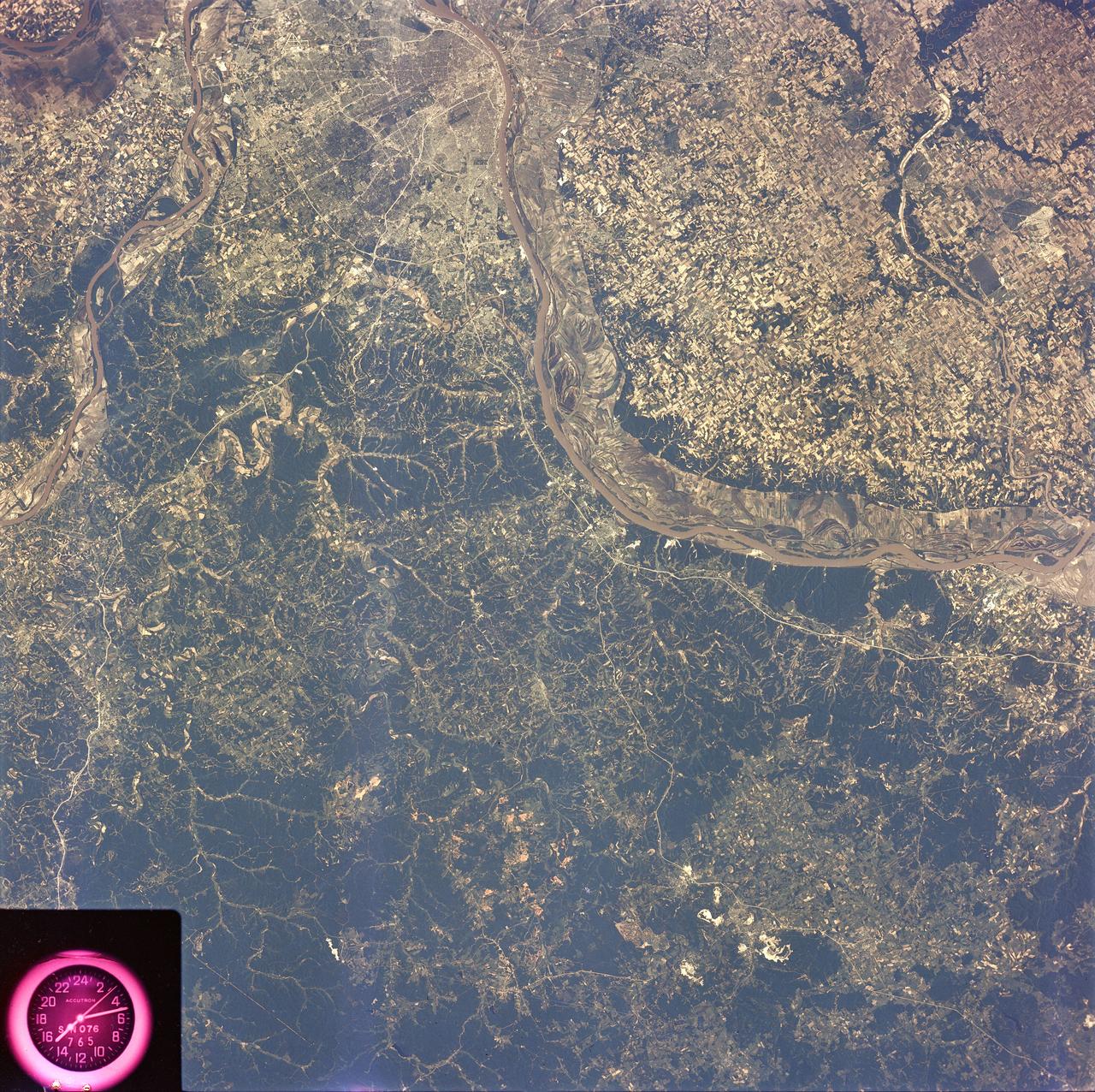
SL2-81-189 (22 June 1973) --- The well defined meanderings of the Mississippi River, just to the south of St. Louis, MO (38.5N, 90.5W) can easily be seen as curved lines and loops roughly paralleling the present river in this view showing the former water channels. The vegetated bluffs on either side of the river define the limits of the meanders where the rich river flood plain offers some of the most fertile land for agriculture although flooding remains a constant threat. Photo credit: NASA
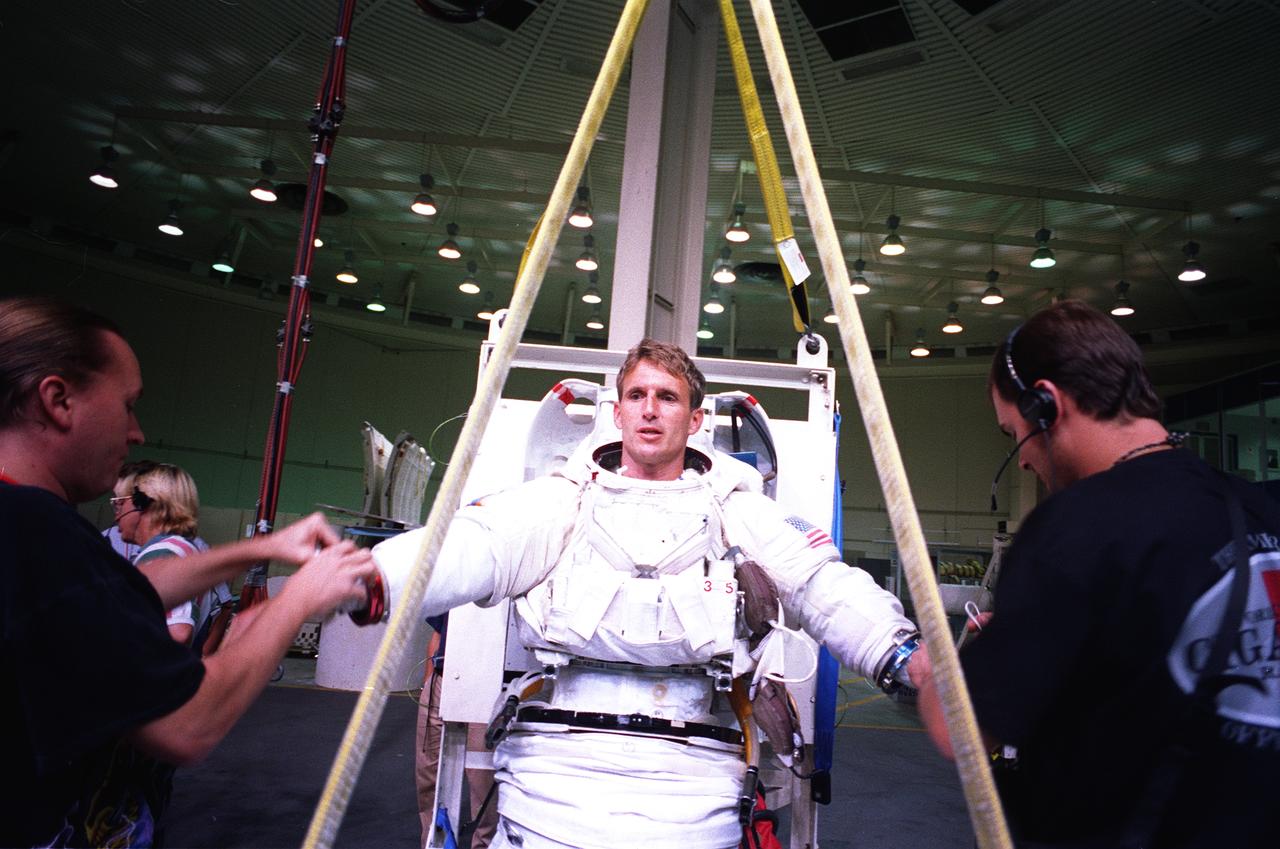
S96-14344 (13 Sept. 1996) --- In the Johnson Space Center's weightless environment training facility, astronaut Jerry M. Linenger, STS-81 mission specialist, prepares for an underwater simulation of a contingency space walk. Linenger, attired in a training version of the Extravehicular Mobility Unit (EMU ) will utilize the nearby 25-ft. deep pool, in which he will be able to achieve a neutrally buoyant state.
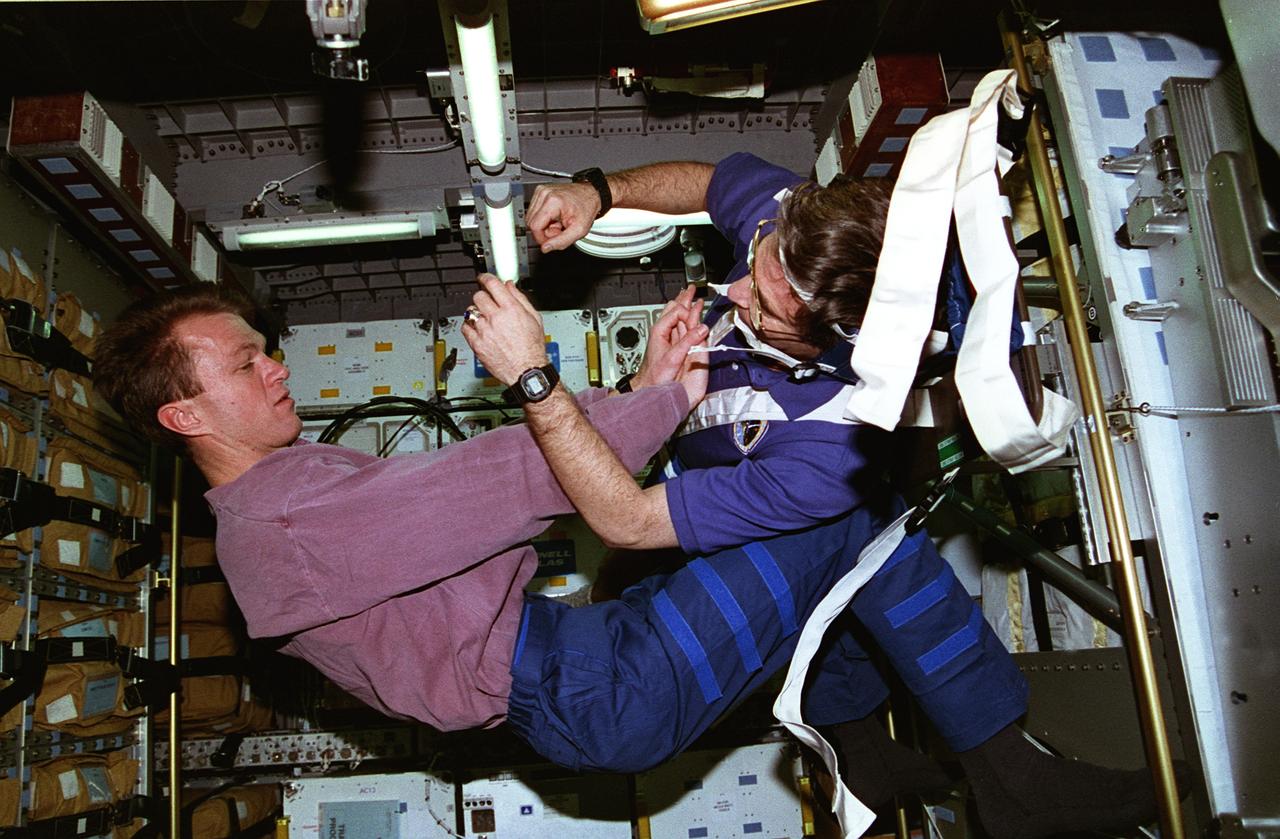
STS081-318-031 (12-22 Jan. 1997) --- Astronauts Brent W. Jett, Jr. (left), STS-81 pilot, and John E. Blaha in the Spacehab Double Module (DM) evaluate the Crew Medical Restraint System (CMRS) carrier, onboard the Space Shuttle Atlantis. The device is an emergency aid forerunner for hardware on the International Space Station (ISS).
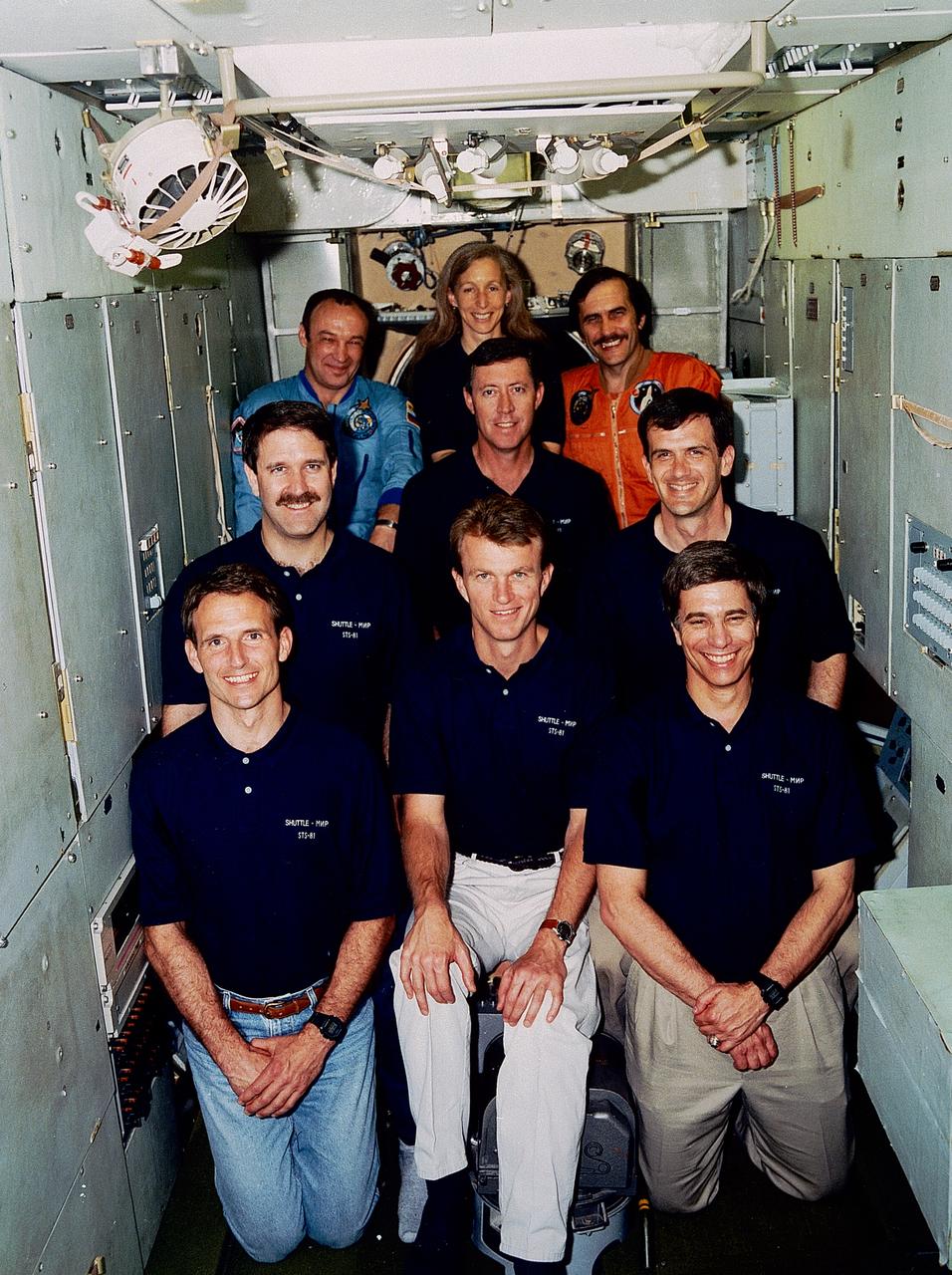
S96-10557 (May 1996) --- The original Mir-22 crew assigned to duty aboard Russia's Mir Space Station poses with the STS-81 crew. The cosmonauts, flanking astronaut Marsha S. Ivins on the top row, are Gennadiy M. Manakov (left) mission commander; and Pavel V. Vinogradov, flight engineer. After this photo was taken, a shift of Russian crew assignments occurred and Manakov and Vinogradov were replaced with Valeri G. Korzun and Aleksandr Y. Kaleri. The astronauts are, front row (left to right): Jerry M. Linenger, Brent W. Jett, Jr., and John E. Blaha. Second row, left to right, John W. Grunsfeld, Michael A. Baker and Peter J. K. (Jeff) Wisoff. All the STS-81 crewmembers except Blaha are scheduled to be launched in December 1996 aboard the Space Shuttle Atlantis and those six will be joined by Mir-22 cosmonaut researcher Blaha when the two spacecraft are joined in Earth-orbit. Blaha will have been launched into Earth-orbit to connect with Russia's Mir Space Station on an earlier mission - STS-79 - of the space shuttle Atlantis, scheduled for launch in the summer of 1996. Linenger will remain onboard Mir for a tour of duty as a cosmonaut researcher.
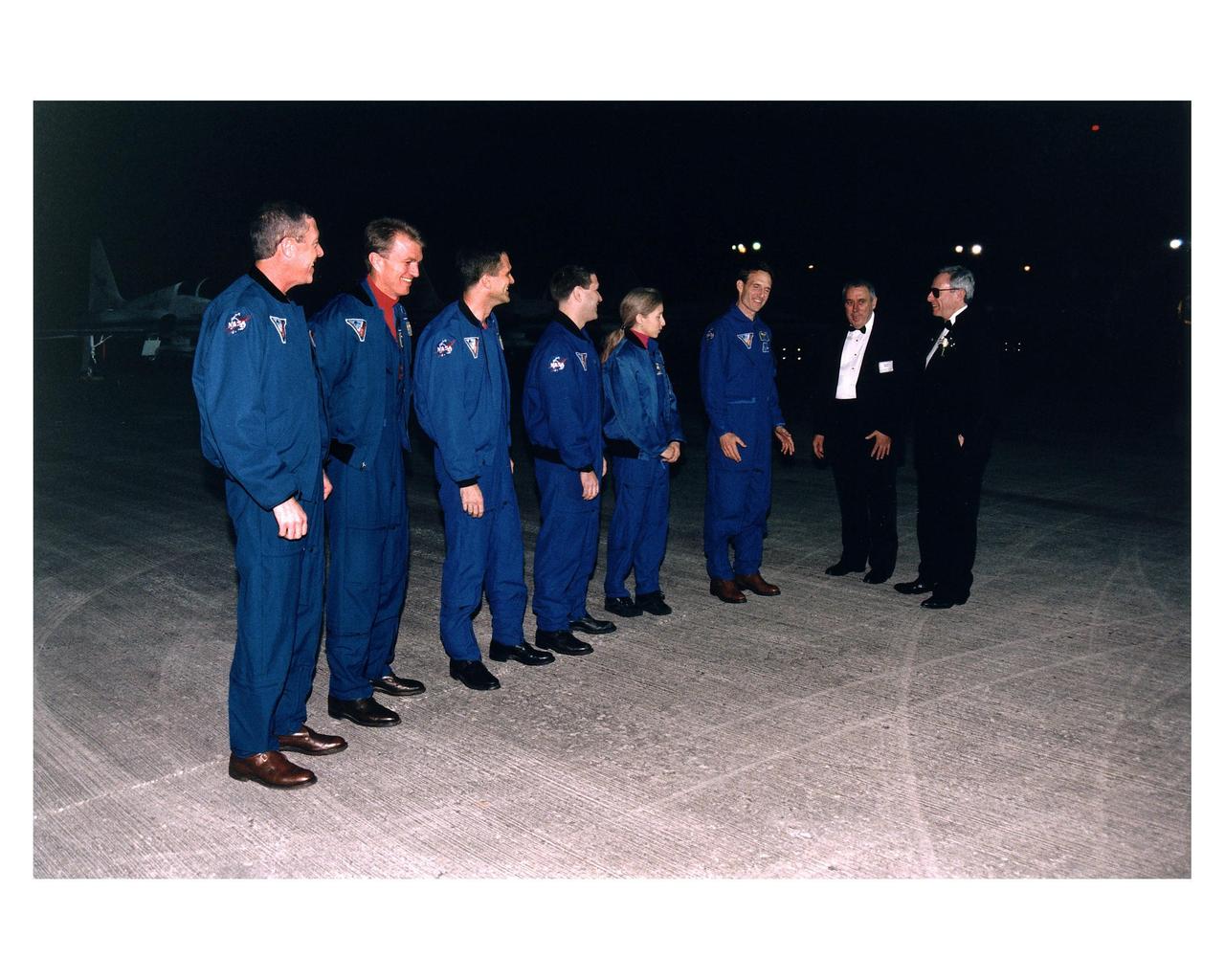
The STS-81 flight crew is welcomed to KSC by NASA Administrator Daniel Goldin (far right) and Johnson Space Center Director George Abbey (second from right) as they arrive at the space center for the final countdown preparations for the fifth Shuttle-Mir docking mission. They are (from left): Mission Commander Michael A. Baker; Pilot Brent W. Jett, Jr.; and Mission Specialists Peter J. K. "Jeff" Wisoff; John M. Grunsfeld, Marsha S. Ivins, and J.M. "Jerry" Linenger. The 10-day mission will feature the transfer of Linenger to Mir to replace astronaut John Blaha, who has been on the orbital laboratory since Sept. 19, 1996 after arrival there during the STS-79 mission. During STS-81, Shuttle and Mir crews will conduct risk mitigation, human life science, microgravity and materials processing experiments that will provide data for the design, development and operation of the International Space Station. The primary payload is the SPACEHAB-DM double module which will provide space for more than 2,000 pounds of hardware, food and water that will be transferred into the Russian space station during five days of docking operations. The SPACEHAB will also be used to return experiment samples from the Mir to Earth for analysis and for microgravity experiments during the mission
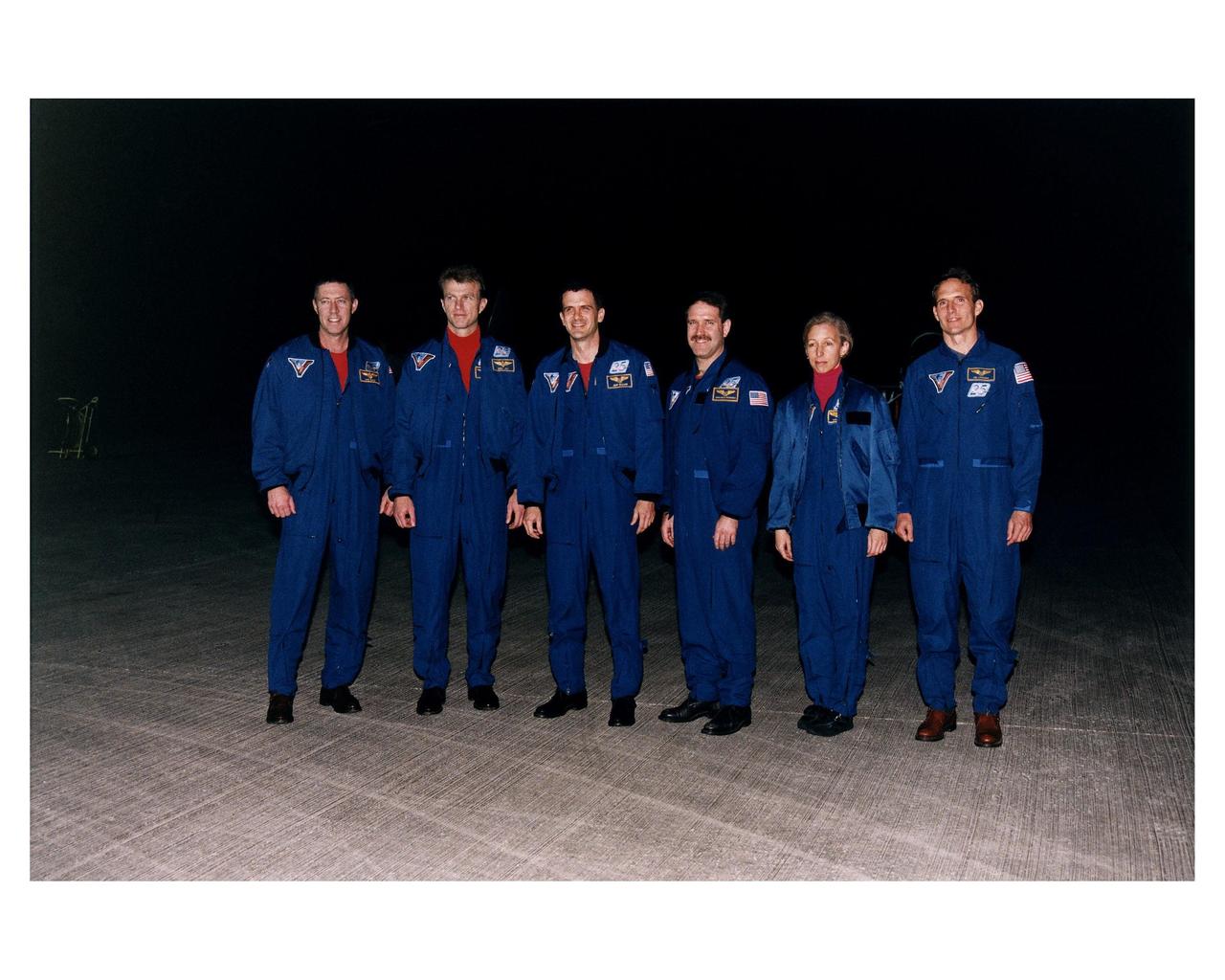
The STS-81 flight crew poses on the runway of KSC Shuttle Landing Facility after they arrive at the space center for the final countdown preparations for the fifth Shuttle-Mir docking mission. They are (from left): Mission Commander Michael A. Baker; Pilot Brent W. Jett, Jr.; and Mission Specialists Peter J. K. "Jeff" Wisoff; John M. Grunsfeld, Marsha S. Ivins, and J.M. "Jerry" Linenger. The 10-day mission will feature the transfer of Linenger to Mir to replace astronaut John Blaha, who has been on the orbital laboratory since Sept. 19, 1996 after arrival there during the STS-79 mission. During STS-81, Shuttle and Mir crews will conduct risk mitigation, human life science, microgravity and materials processing experiments that will provide data for the design, development and operation of the International Space Station. The primary payload is the SPACEHAB-DM double module which will provide space for more than 2,000 pounds of hardware, food and water that will be transferred into the Russian space station during five days of docking operations. The SPACEHAB will also be used to return experiment samples from the Mir to Earth for analysis and for microgravity experiments during the mission
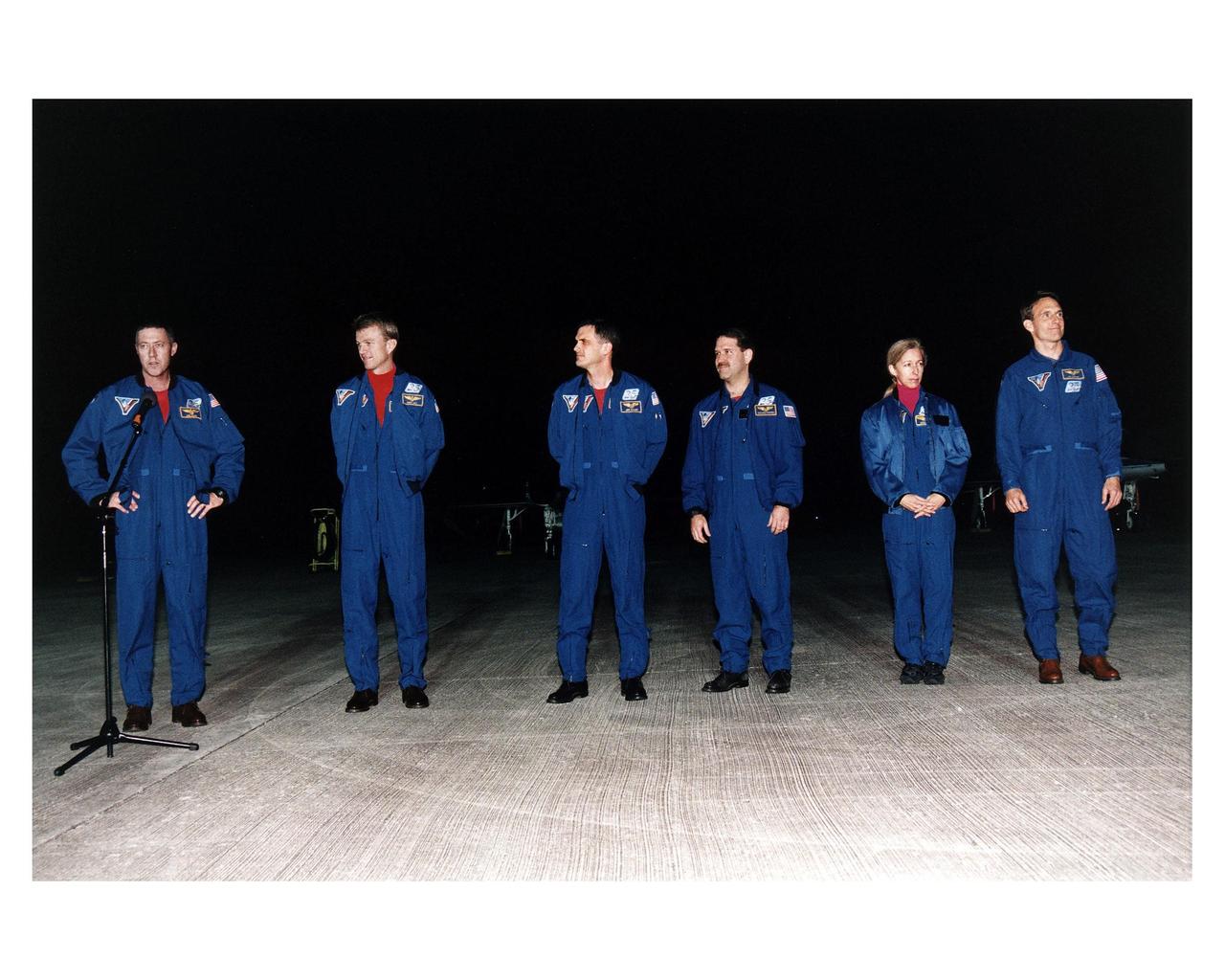
The STS-81 flight crew conducts a press briefing on the runway of KSC's Shuttle Landing Facility after they arrive at the space center for the final countdown preparations for the fifth Shuttle-Mir docking mission. They are (from left): Mission Commander Michael A. Baker; Pilot Brent W. Jett, Jr.; and Mission Specialists Peter J. K. "Jeff" Wisoff; John M. Grunsfeld, Marsha S. Ivins, and J.M. "Jerry" Linenger. The 10-day mission will feature the transfer of Linenger to Mir to replace astronaut John Blaha, who has been on the orbital laboratory since Sept. 19, 1996 after arrival there during the STS79 mission. During STS-81, Shuttle and Mir crews will conduct risk mitigation, human life science, microgravity and materials processing experiments that will provide data for the design, development and operation of the International Space Station. The primary payload is the SPACEHAB-DM double module which will provide space for more than 2,000 pounds of hardware, food and water that will be transferred into the Russian space station during five days of docking operations. The SPACEHAB will also be used to return experiment samples from the Mir to Earth for analysis and for microgravity experiments during the mission
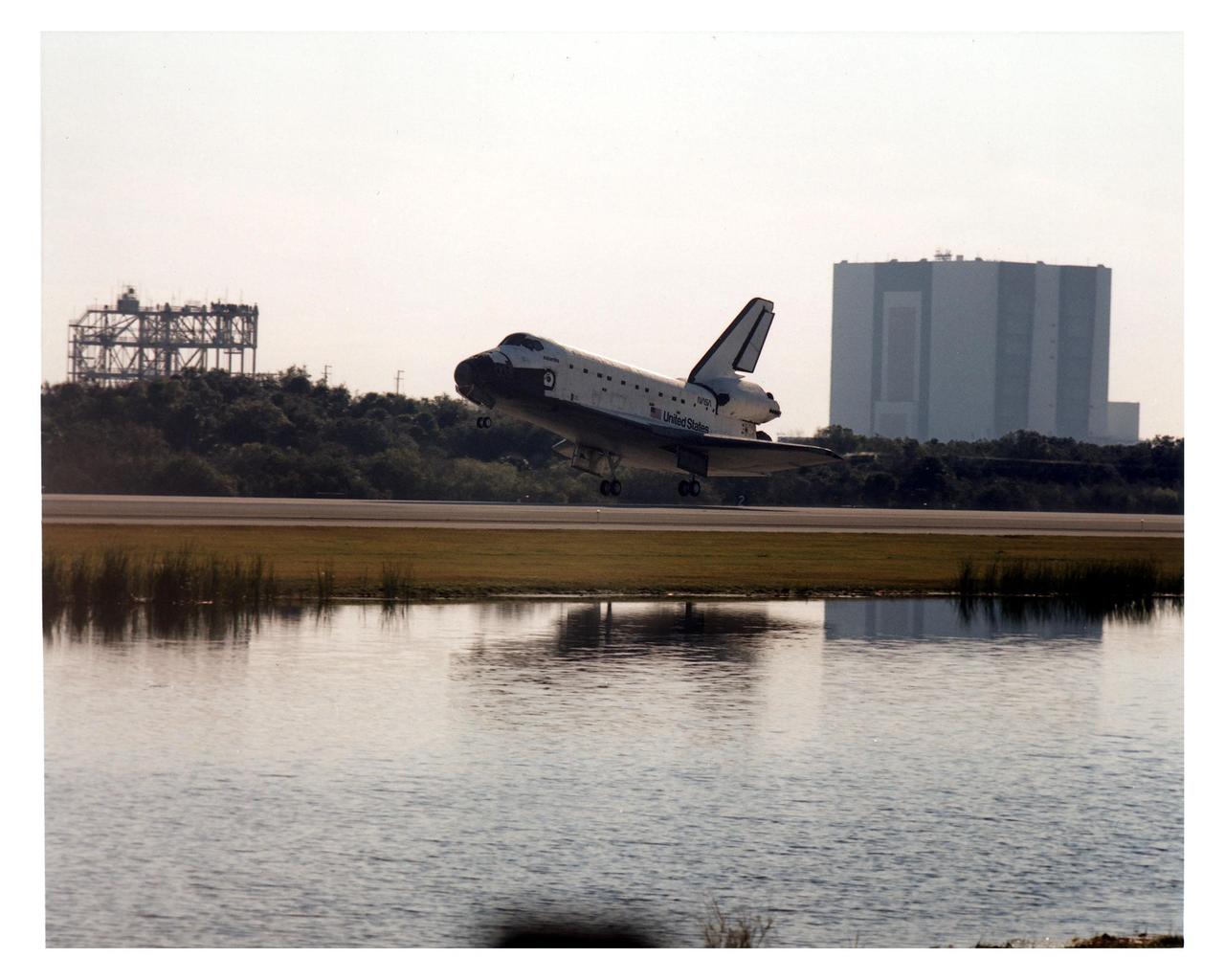
KENNEDY SPACE CENTER, FLA. -- With the Mate/Demate Device (MDD) on the left and the Vehicle Assembly Building (VAB) on the right, the Space Shuttle orbiter Atlantis approaches Runway 33 at KSC’s Shuttle Landing Facility for a scheduled touchdown at about 9:23 a.m. EST Jan. 22. When the orbiter lands, it will conclude the fifth Shuttle-Mir docking mission and return NASA astronaut John Blaha to Earth after four months in space. At main gear touchdown, the STS-81 mission duration will be 10 days, 4 hours, 55 minutes. This is the 34th KSC landing in Shuttle history. Mission Commander Michael A. Baker is steering Atlantis to a perfect landing, with help from Pilot Brent W. Jett, Jr. Other returning STS-81 crew members are Mission Specialists John M. Grunsfeld, Peter J. K. "Jeff" Wisoff and Marsha S. Ivins. Atlantis also brought back experiment samples from the Russian space station Mir for analysis on Earth
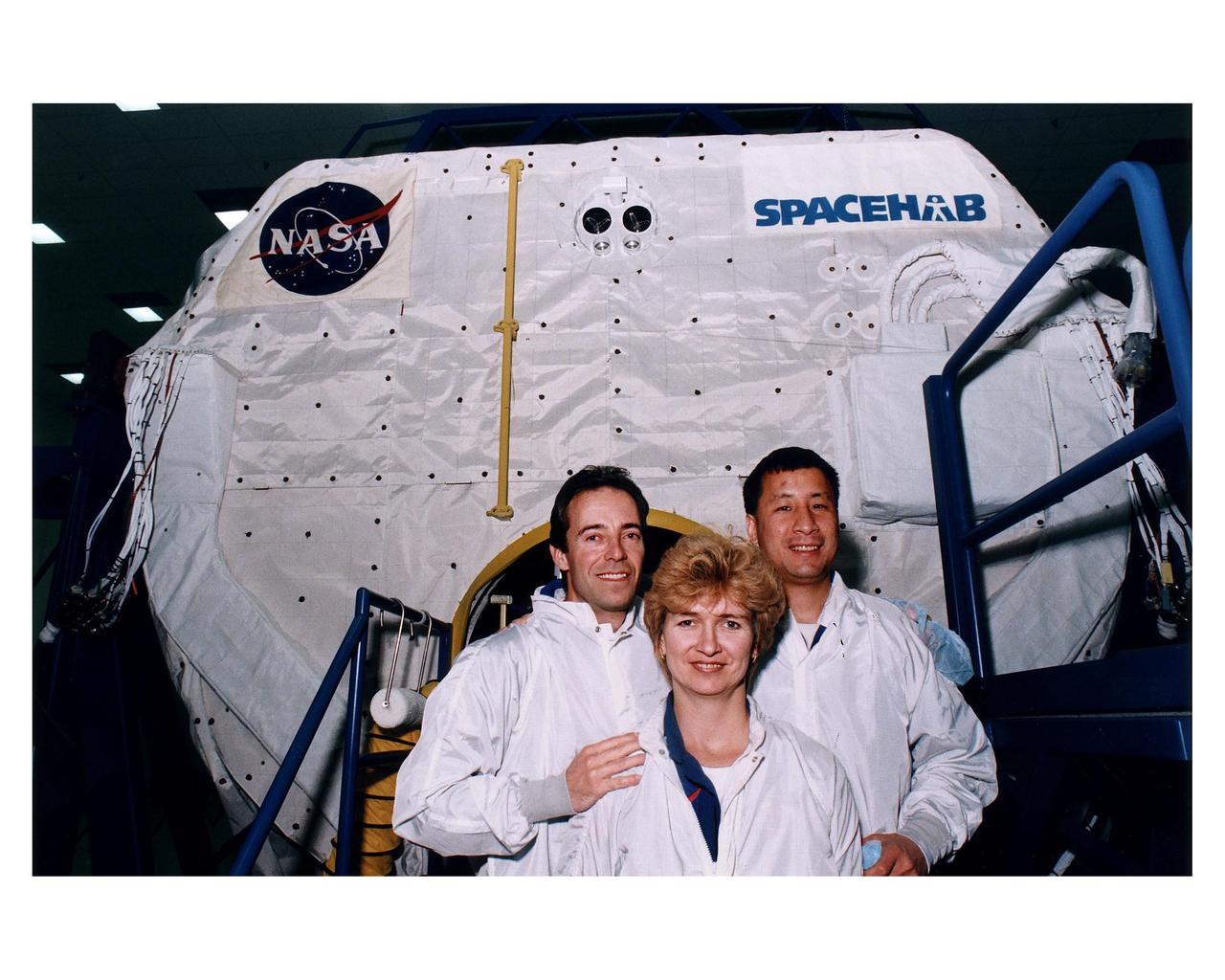
STS-84 crew members pose outside the SPACEHAB Double Module, which will carry more than 6,000 pounds of scientific experiments and logistics to the Russian Space Station Mir. From left, are Mission Specialists Jean-Francois Clervoy of the European Space Agency, Elena V. Kondakova of the Russian Space Agency, and Edward Tsang Lu of NASA. They are participating in the Crew Equipment Integration Test (CEIT) at the SPACEHAB Payload Processing Facility in Cape Canaveral. STS-84 will be the sixth docking of the Space Shuttle with Mir. It also will be the third consecutive crew member exchange of U.S. astronauts aboard Mir. STS-84 Mission Specialist C. Michael Foale will replace astronaut Jerry M. Linenger on Mir. Linenger has been on Mir since the STS-81 mission in January. Foale is scheduled to remain on Mir about four months. STS-84 is targeted for a May 15 liftoff

STS-84 mission specialists and SPACEHAB workers participate in the Crew Equipment Integration Test (CEIT) inside the SPACEHAB Double Module, which will carry more than 6,000 pounds of scientific experiments and logistics to the Russian Space Station Mir. Standing at left is JeanFrancois Clervoy of the European Space Agency. Sitting on the floor, from left, are Edward Tsang Lu of NASA and Elena V. Kondakova of the Russian Space Agency. The test is being conducted at the SPACEHAB Payload Processing Facility in Cape Canaveral. STS-84 will be the sixth docking of the Space Shuttle with Mir. It also will be the third consecutive crew member exchange of U.S. astronauts aboard Mir. STS-84 Mission Specialist C. Michael Foale will replace astronaut Jerry M. Linenger on Mir. Linenger has been on Mir since the STS-81 mission in January. Foale is scheduled to remain on Mir about four months. STS-84 is targeted for a May 15 liftoff
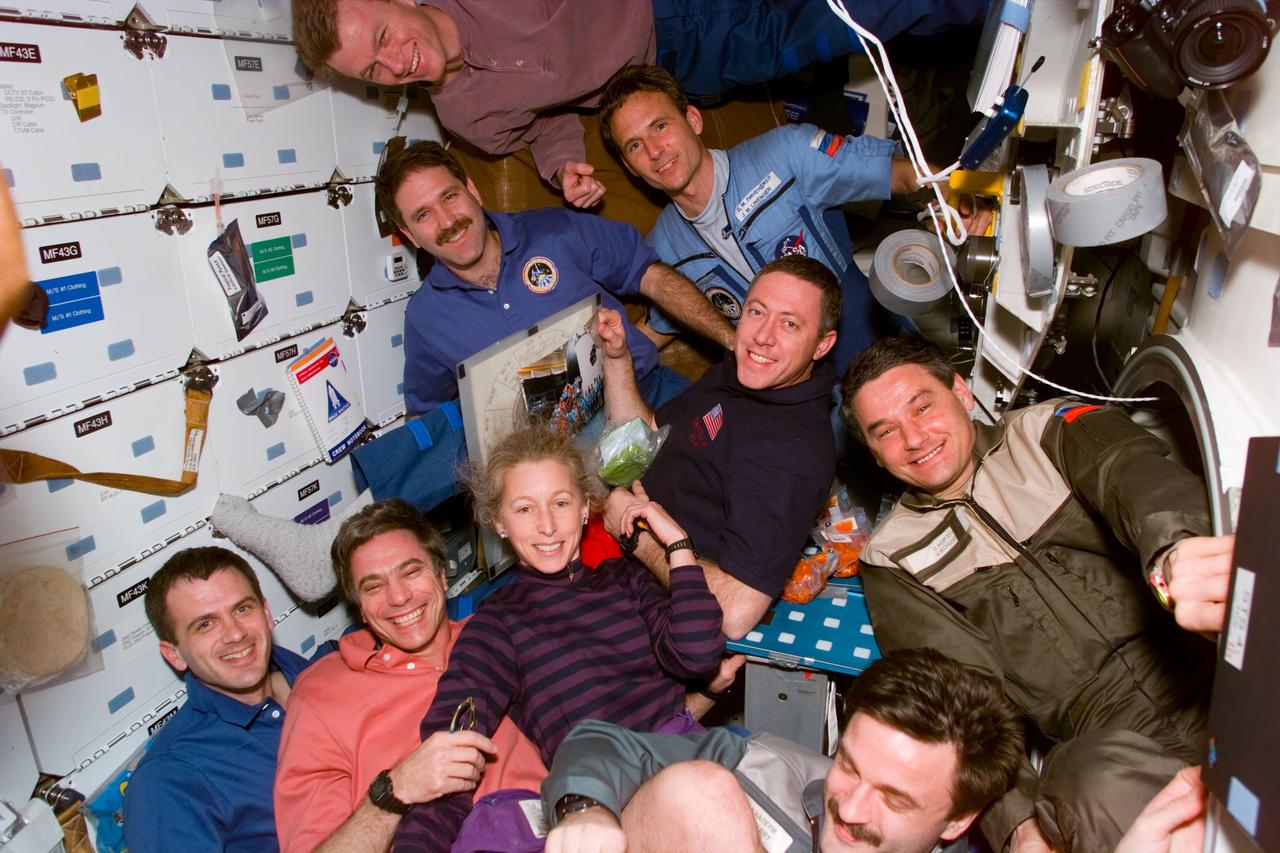
STS081-E-05535 (17 Jan. 1997) --- Seven NASA astronauts and two Russian cosmonauts take a break from busy supply-transfer duties on the space shuttle Atlantis' middeck halfway through the ten-day mission. Left to right at bottom of the frame are mission specialists Peter J. K. (Jeff) Wisoff, John E. Blaha, Marsha S. Ivins and cosmonaut Aleksandr Y. Kaleri, Mir-22 flight engineer. In the top half of the scene are, from the top left, Brent W. Jett, Jr., pilot; John M. Grunsfeld, mission specialist; Jerry M. Linenger, cosmonaut guest researcher; Michael A. Baker, commander; and cosmonaut Valeri G. Korzun, Mir-22 commander. The picture was recorded with a pre-set 35mm Electronic Still Camera (ESC).
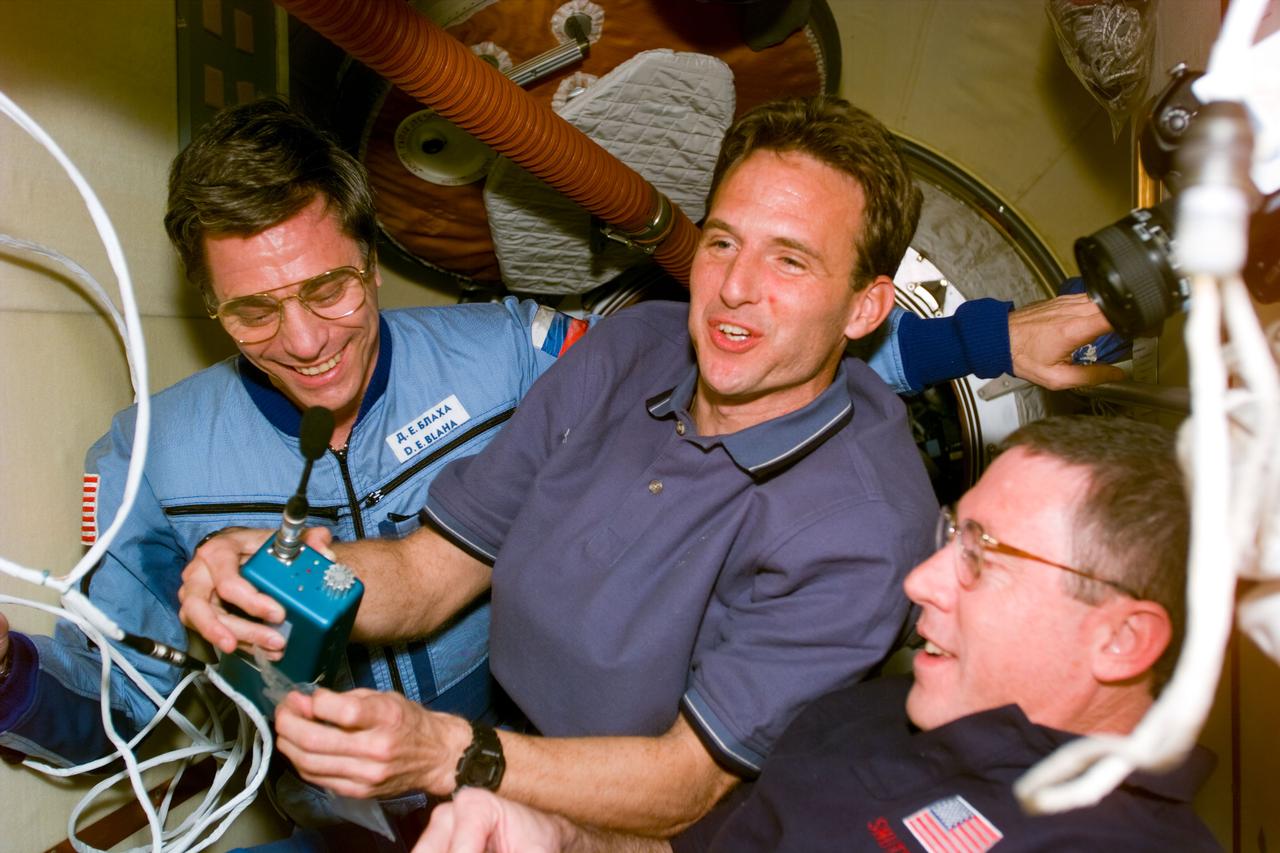
STS081-E-05432 (15 Jan. 1997) --- Left to right, astronaut John E. Blaha, his cosmonaut guest researcher replacement Jerry M. Linenger and Michael A. Baker, mission commander, shortly after docking and hatch opening. Blaha had just joined the NASA crew, having served as a cosmonaut guest researcher aboard Russia's Mir Space Station since mid September 1996. The photograph was taken with an Electronic Still Camera (ESC), which was used throughout the 10-day mission to downlink current photographs of the crews' joint activities.
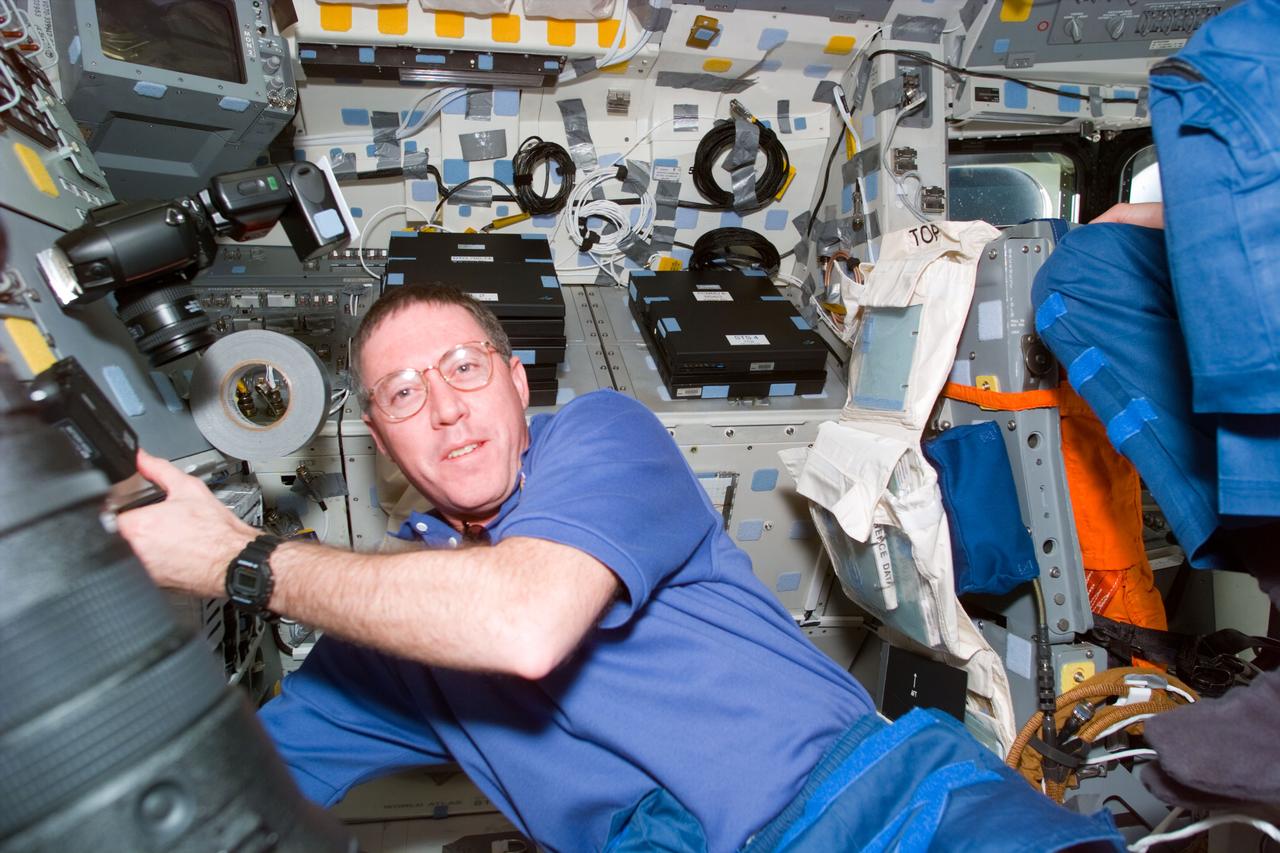
STS081-E-05091 (12 Jan. 1997) --- Astronaut Michael A. Baker, mission commander, prepares to retrieve a temporarily stowed camera from the Space Shuttle Atlantis' aft flight deck during early phases of the scheduled ten-day mission. Baker and five crew mates will dock with Russia's Mir Space Station around the middle of the week. This image was recorded with an Electronic Still Camera (ESC) and was later downlinked to flight controllers in Houston, Texas.
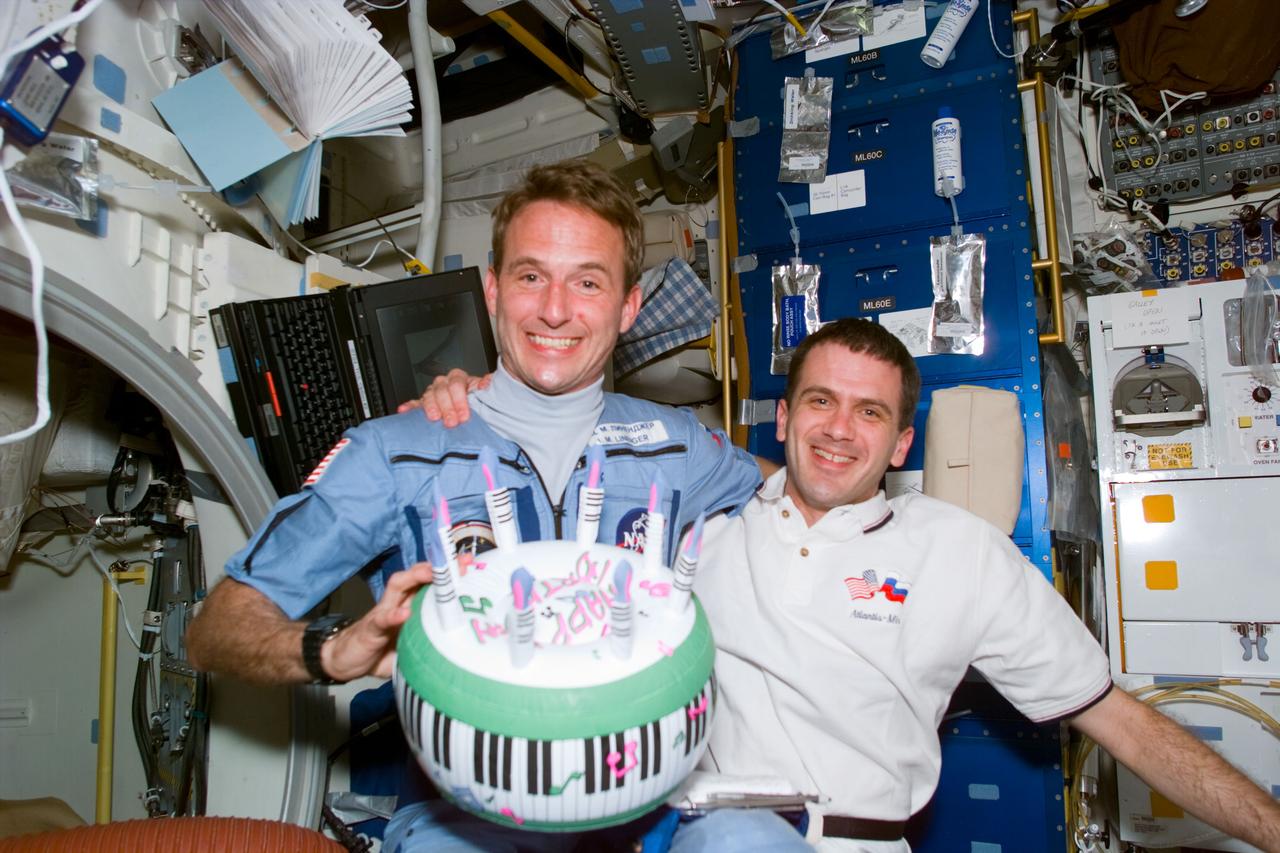
STS081-E-05498 (16 Jan. 1997) --- Supplies and equipment transfer are the topic of the day, as the Space Shuttle Atlantis and Russia's Mir Space Station respective commanders have a discussion aboard the Orbiter. Left to right are cosmonauts Valeri G. Korzun and Aleksandr Y. Kaleri, Mir-22 commander and flight engineer respectively; along with astronaut Michael A. Baker, mission commander. The photograph was recorded with an Electronic Still Camera (ESC) and later was downlinked to flight controllers in Houston, Texas.
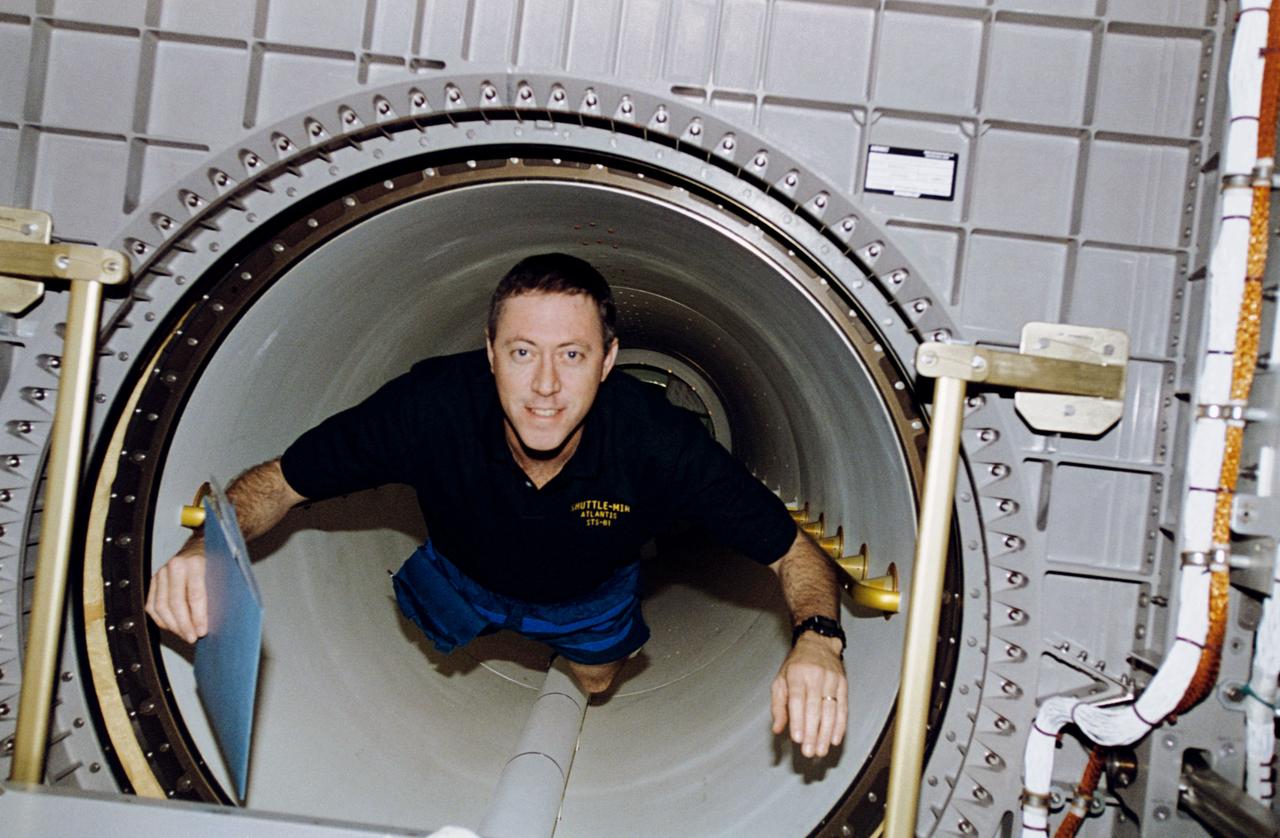
STS081-314-019 (12-22 Jan 1997) --- Astronaut Michael A. Baker, mission commander, floats through the tunnel leading from the Space Shuttle Atlantis mid-deck into Spacehab Double Module (DM). For a period of five days, seven astronauts and two Russian cosmonauts are sharing a variety of chores in space as the spacecraft from their respective nations are docked in Earth-orbit.

STS081-E-05126 (13 Jan. 1997) --- Astronaut Michael A. Baker, mission commander, uses a 35mm camera to photograph a target of opportunity on Earth from the Space Shuttle Atlantis' aft flight deck. Baker and five crew mates will dock with Russia's Mir Space Station around the middle of the week. This image was recorded with an Electronic Still Camera (ESC) and was later downlinked to flight controllers in Houston, Texas. A second ESC, devoted to an educational, geographic project called Kidsat, is mounted in the viewing port above Baker's head.
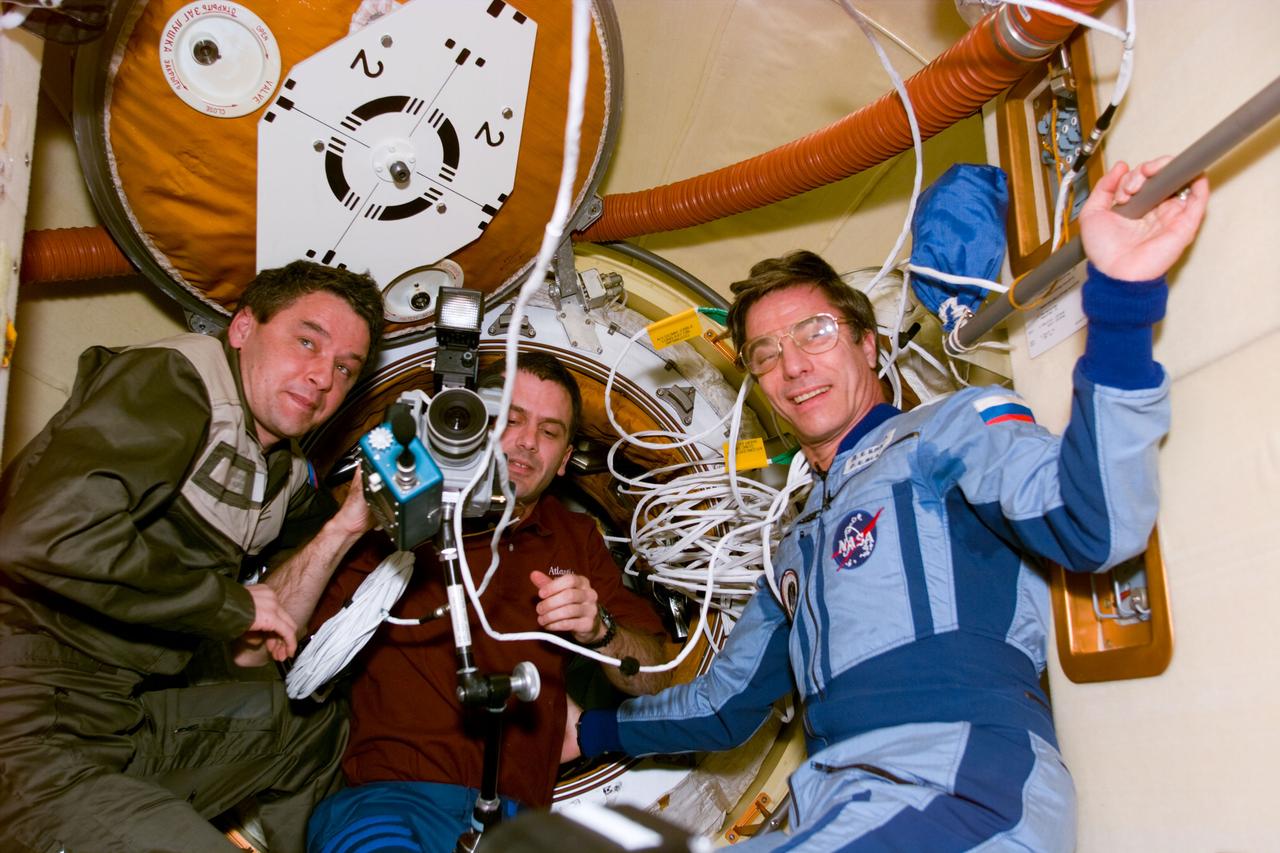
STS081-E-5424 (15 Jan. 1997) --- Left to right, cosmonaut Valeri G. Korzun, Mir-22 mission commander; and astronauts Peter J. K. (Jeff) Wisoff (holding 70mm camera) and John E. Blaha are pictured soon after hatch opening. Blaha had just joined the NASA crew, having served as a cosmonaut guest researcher aboard Russia's Mir Space Station since mid September 1996. The photograph was taken with an Electronic Still Camera (ESC), which was used throughout the 10-day mission to downlink current photographs of the crews'joint ativities.

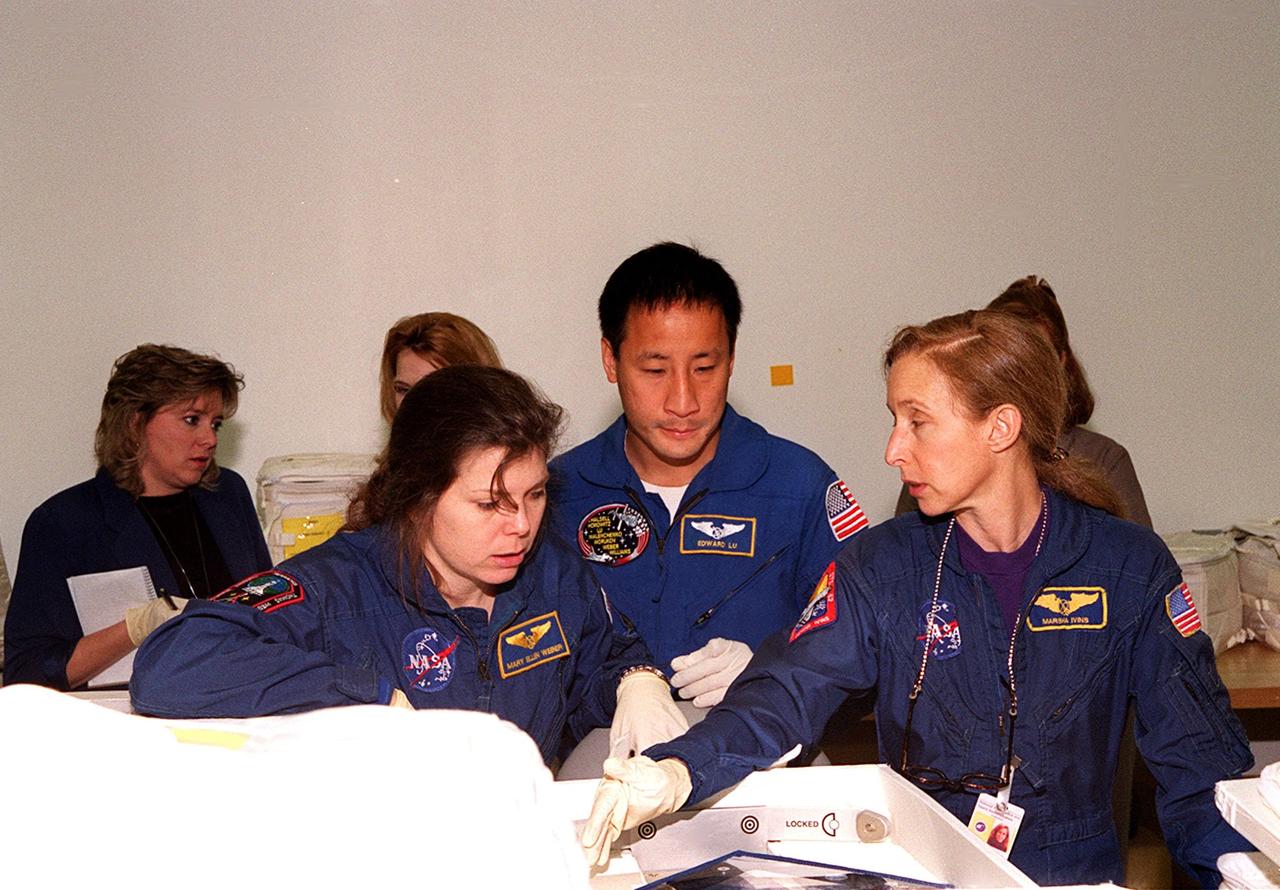
KENNEDY SPACE CENTER, FLA. -- At SPACEHAB, in Cape Canaveral, members of the STS-101 crew take part in a Crew Equipment Interface Test, which gives them an opportunity to look over equipment and payloads that will fly on the mission. In the foreground at left is Mission Specialist Mary Ellen Weber (Ph.D.), at center is Mission Specialist Edward Tsang Lu; at right is astronaut Marsha Ivins, who is assigned to mission STS-98 and is a veteran of five space flights. Her last flight, STS-81, including docking with the Russian Mir, and carrying the SPACEHAB double module to transfer tons of food and other cargo. On mission STS-101, Space Shuttle Atlantis will also be carrying the SPACEHAB Double Module, which will carry internal logistics and resupply cargo for station outfitting. Launch of Atlantis is scheduled no earlier than April 13, 2000
KENNEDY SPACE CENTER, FLA. -- At SPACEHAB, in Cape Canaveral, members of the STS-101 crew take part in a Crew Equipment Interface Test, which gives them an opportunity to look over equipment and payloads that will fly on the mission. In the foreground at left is Mission Specialist Mary Ellen Weber (Ph.D.), at center is Mission Specialist Edward Tsang Lu; at right is astronaut Marsha Ivins, who is assigned to mission STS-98 and is a veteran of five space flights. Her last flight, STS-81, including docking with the Russian Mir, and carrying the SPACEHAB double module to transfer tons of food and other cargo. On mission STS-101, Space Shuttle Atlantis will also be carrying the SPACEHAB Double Module, which will carry internal logistics and resupply cargo for station outfitting. Launch of Atlantis is scheduled no earlier than April 13, 2000
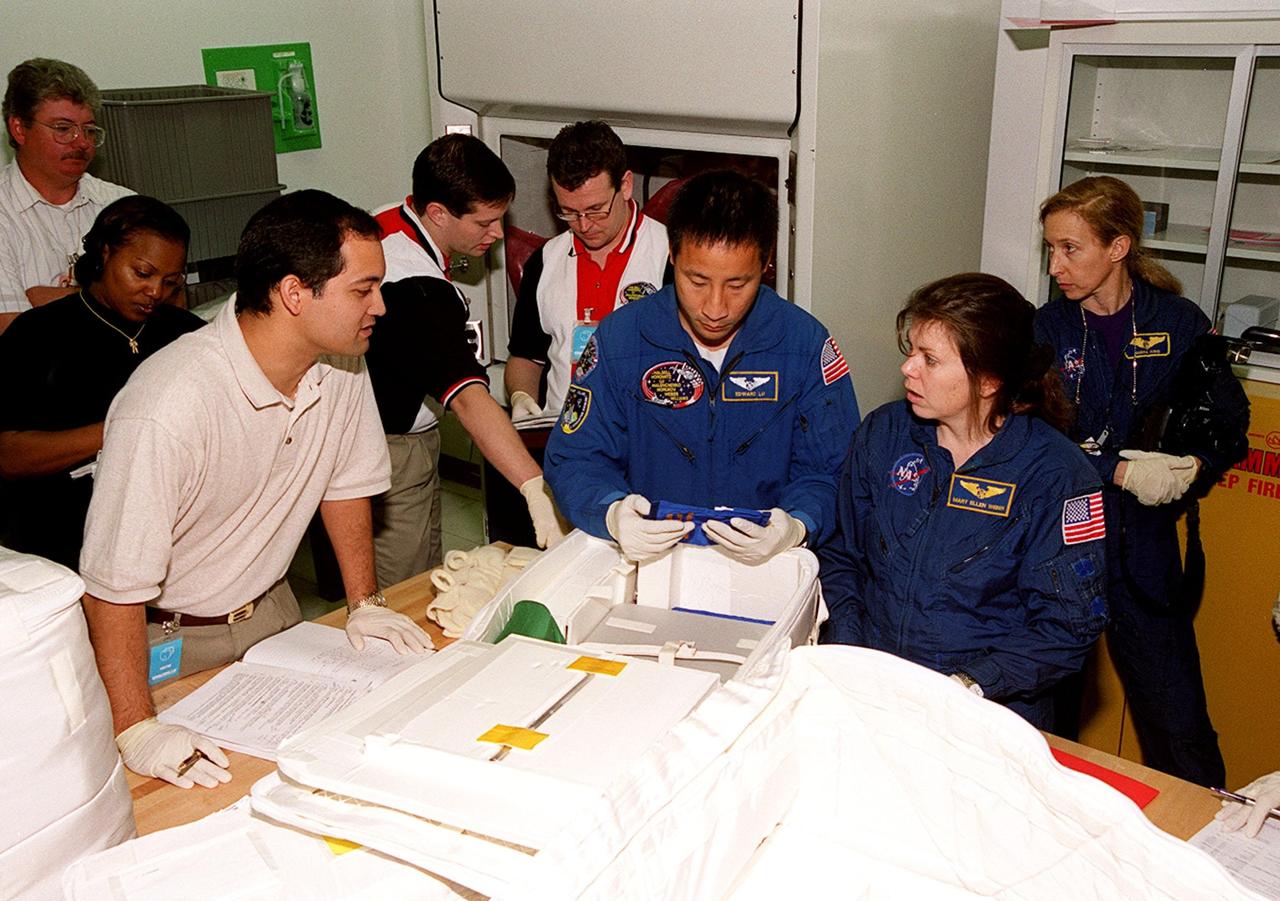
KENNEDY SPACE CENTER, FLA. -- With help from technicians at SPACEHAB, in Cape Canaveral, members of the STS-101 crew take part in a Crew Equipment Interface Test, which gives them an opportunity to look over equipment and payloads that will fly on the mission. In the center is Mission Specialist Edward Tsang Lu; at right is Mission Specialist Mary Ellen Weber (Ph.D.); in the background right is astronaut Marsha Ivins, who is assigned to mission STS-98 and is a veteran of four space flights. Her last flight, STS-81, including docking with the Russian Mir, and carrying the SPACEHAB double module to transfer tons of food and other cargo. On mission STS-101, Space Shuttle Atlantis will also be carrying the SPACEHAB Double Module, which will carry internal logistics and resupply cargo for station outfitting. Launch of Atlantis is scheduled no earlier than April 13, 2000

KENNEDY SPACE CENTER, FLA. -- With help from technicians at SPACEHAB, in Cape Canaveral, members of the STS-101 crew take part in a Crew Equipment Interface Test, which gives them an opportunity to look over equipment and payloads that will fly on the mission. In the center is Mission Specialist Edward Tsang Lu; at right is Mission Specialist Mary Ellen Weber (Ph.D.); in the background right is astronaut Marsha Ivins, who is assigned to mission STS-98 and is a veteran of four space flights. Her last flight, STS-81, including docking with the Russian Mir, and carrying the SPACEHAB double module to transfer tons of food and other cargo. On mission STS-101, Space Shuttle Atlantis will also be carrying the SPACEHAB Double Module, which will carry internal logistics and resupply cargo for station outfitting. Launch of Atlantis is scheduled no earlier than April 13, 2000
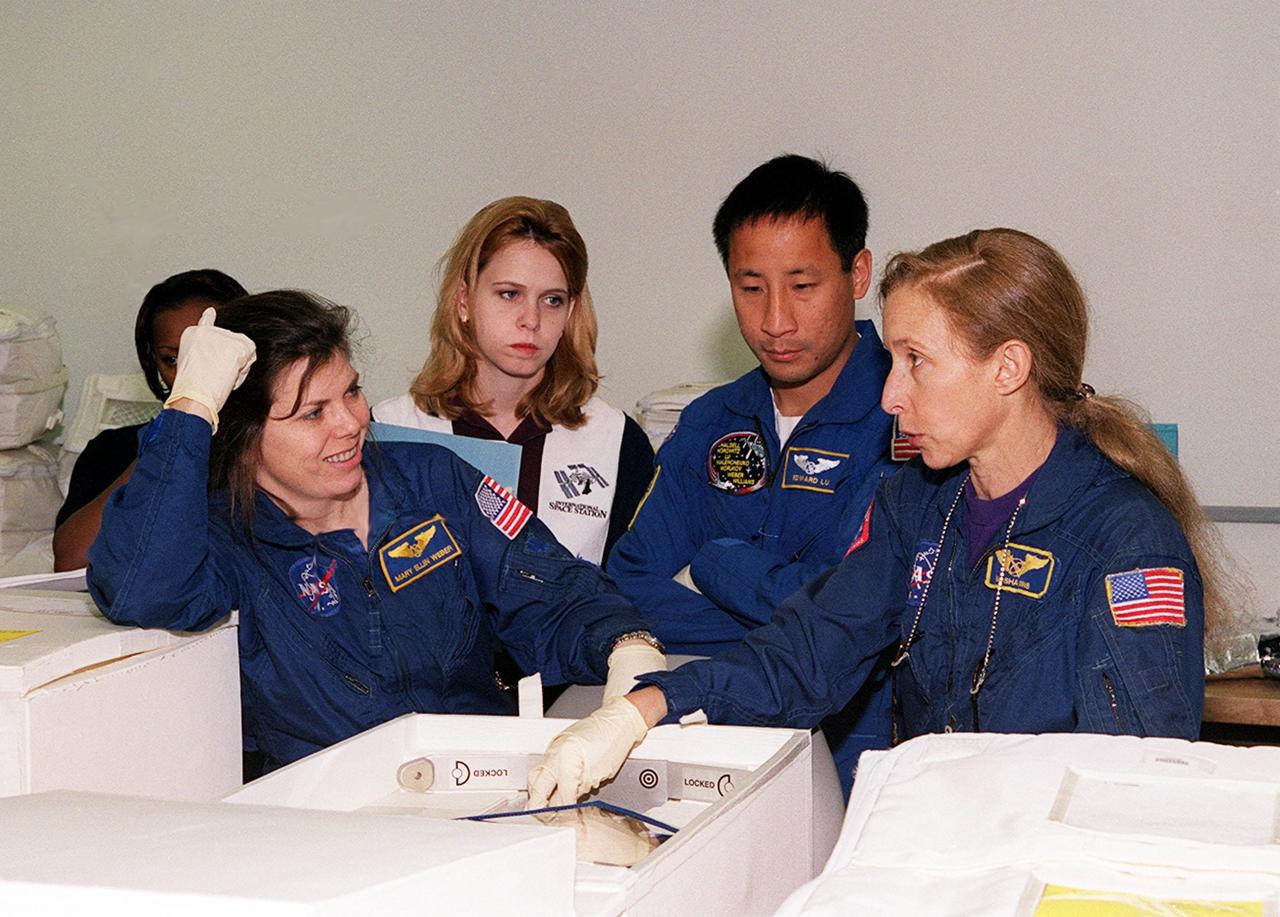
KENNEDY SPACE CENTER, FLA. -- With technicians looking on at SPACEHAB, in Cape Canaveral, members of the STS-101 crew take part in a Crew Equipment Interface Test, which gives them an opportunity to look over equipment and payloads that will fly on the mission. In the foreground at left is Mission Specialist Mary Ellen Weber (Ph.D.), at center is Mission Specialist Edward Tsang Lu; at right is astronaut Marsha Ivins, who is assigned to mission STS-98 and is a veteran of five space flights. Her last flight, STS-81, including docking with the Russian Mir, and carrying the SPACEHAB double module to transfer tons of food and other cargo. On mission STS-101, Space Shuttle Atlantis will also be carrying the SPACEHAB Double Module, which will carry internal logistics and resupply cargo for station outfitting. Launch of Atlantis is scheduled no earlier than April 13, 2000

KENNEDY SPACE CENTER, FLA. -- With technicians looking on at SPACEHAB, in Cape Canaveral, members of the STS-101 crew take part in a Crew Equipment Interface Test, which gives them an opportunity to look over equipment and payloads that will fly on the mission. In the foreground at left is Mission Specialist Mary Ellen Weber (Ph.D.), at center is Mission Specialist Edward Tsang Lu; at right is astronaut Marsha Ivins, who is assigned to mission STS-98 and is a veteran of five space flights. Her last flight, STS-81, including docking with the Russian Mir, and carrying the SPACEHAB double module to transfer tons of food and other cargo. On mission STS-101, Space Shuttle Atlantis will also be carrying the SPACEHAB Double Module, which will carry internal logistics and resupply cargo for station outfitting. Launch of Atlantis is scheduled no earlier than April 13, 2000
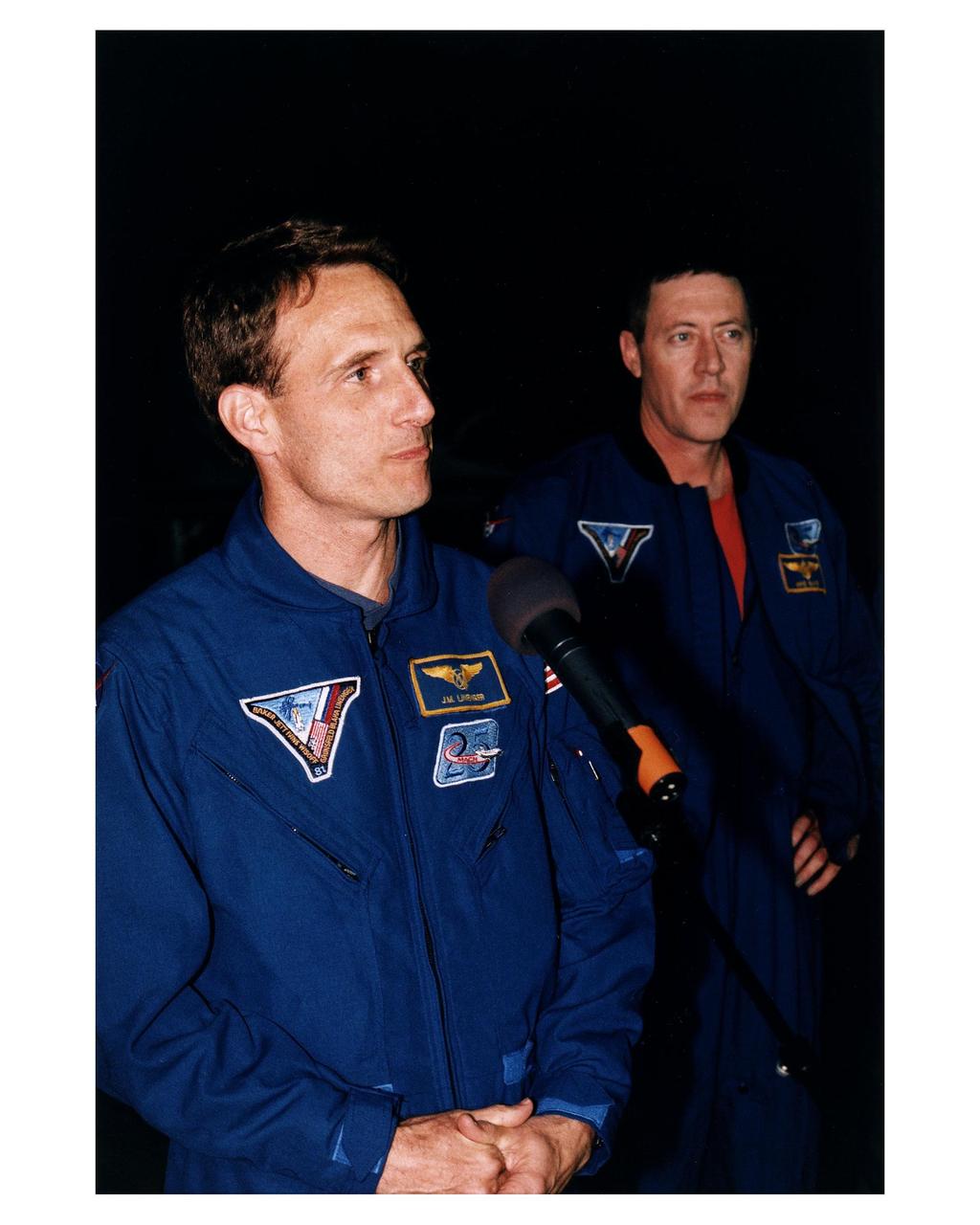
STS-81 Mission Specialist J.M. "Jerry" Linenger talks to the press at the KSC Shuttle Landing Facility after the flight crew arrived at the space center for the final countdown preparations for the fifth Shuttle-Mir docking mission. The 10-day mission will feature the transfer of Linenger to Mir to replace astronaut John Blaha, who has been on the orbital laboratory since Sept. 19, 1996. Linenger will be the fourth U.S. astronaut to stay onboard the Russian space station and serve as a Mir crew member. Mission Commander Michael A. Baker is to his left

Greeted by cheers from wellwishers at KSC and eager for their venture into space on the fifth Shuttle-Mir docking mission, the STS-81 astronauts depart the Operations and Checkout Building and board the Astrovan for their 25-minute trip to Launch Pad 39B. Leading the six-member crew is Mission Commander Michael A. Baker, followed by Pilot Brent W. Jett, Jr. Behind them are Mission Specialists John M. Grunsfeld, Jerry Linenger, Peter J. K. "Jeff" Wisoff, and Marsha S. Ivins. Once at the pad, they will take their positions in the crew cabin of the Space Shuttle Atlantis to await a liftoff during a seven-minute window that will open at 4:27 a.m. EST, January 12
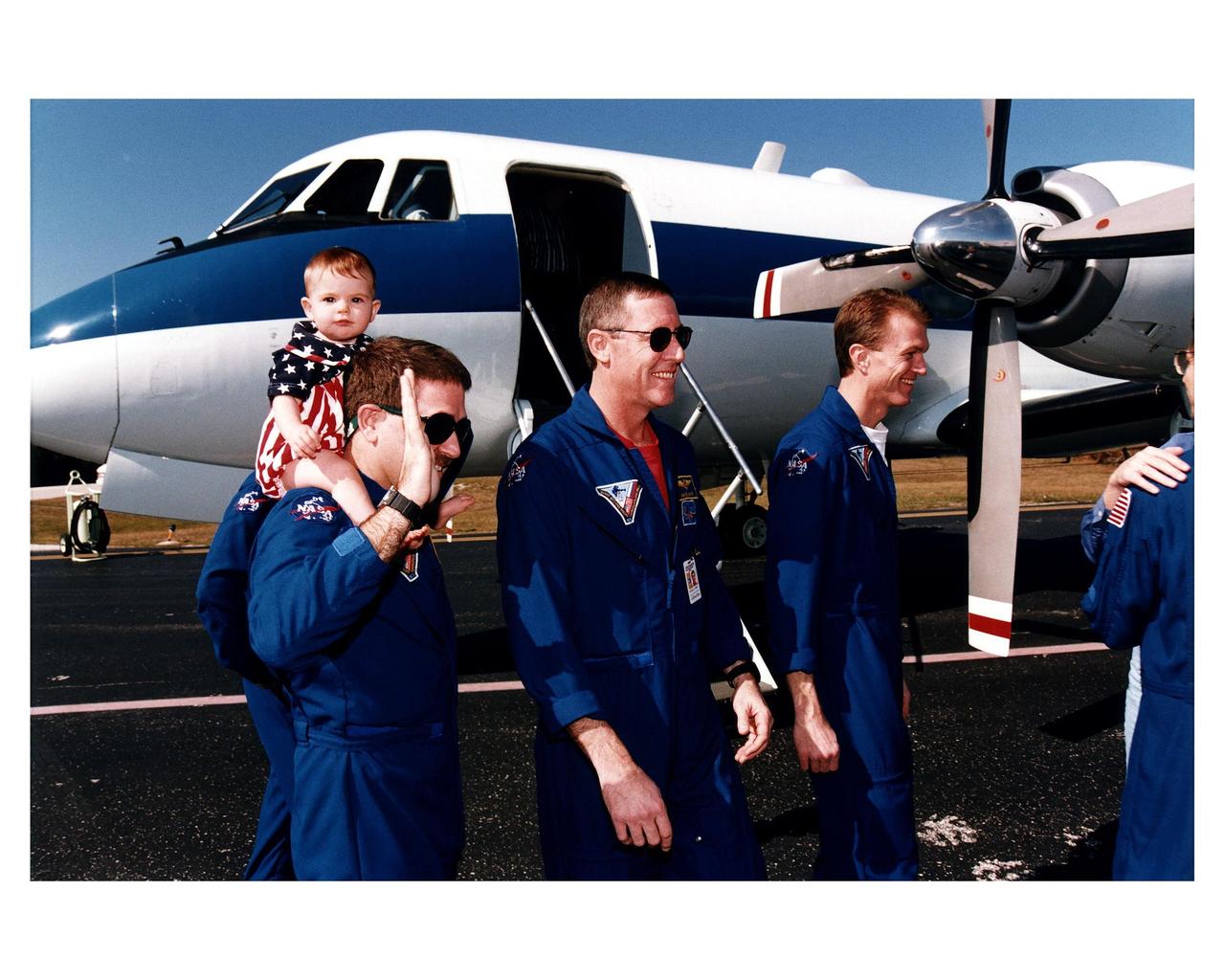
Members of the STS-81 crew prepare to depart for Johnson Space Center Jan. 23 from the Skid Strip at Cape Canaveral Air Station. The crew arrived at KSC aboard the Space Shuttle Atlantis Jan. 22 to conclude the fifth Shuttle-Mir docking mission and return U. S. astronaut John E. Blaha to Earth after four months in space as member of the Mir 22 crew. On the left is Mission Specialist John M. Grunsfeld, with his daughter, Sarah, on his back. Also pictured are Mission Commander Michael A. Baker (center); Pilot Brent W. Jett (second from right); and Blaha
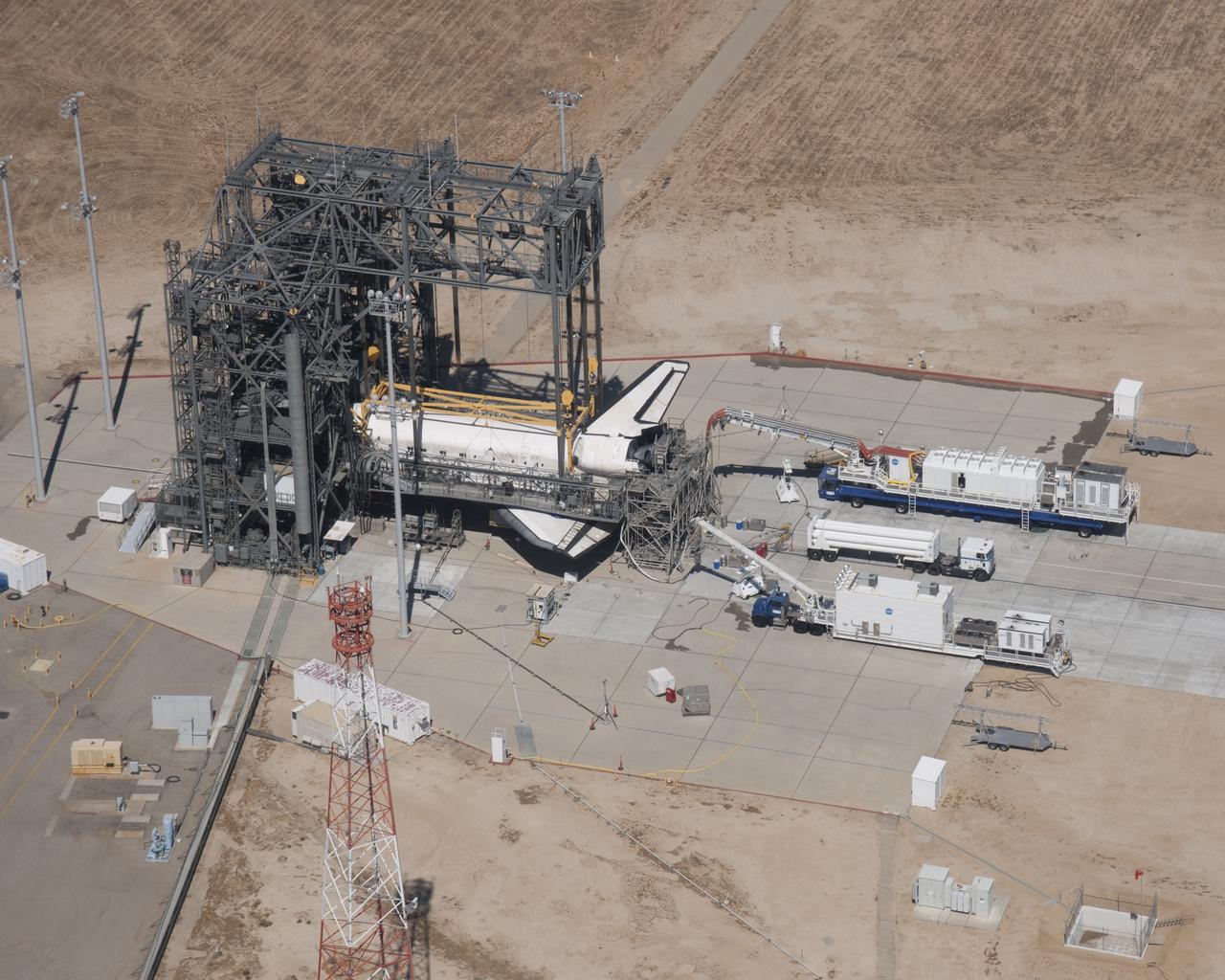
EDWARDS AIR FORCE BASE, Calif. – (ED09-0253-81) Space Shuttle Discovery is surrounded by the Mate-DeMate Device gantry and ground support equipment at NASA’s Dryden Flight Research Center during processing for its ferry flight back to the Kennedy Space Center in Florida. Discovery returned to Earth Sept. 11 on the STS-128 mission, landing at Edwards Air Force Base in California. The shuttle delivered more than 7 tons of supplies, science racks and equipment, as well as additional environmental hardware to sustain six crew members on the International Space Station. Photo credit: NASA/Carla Thomas
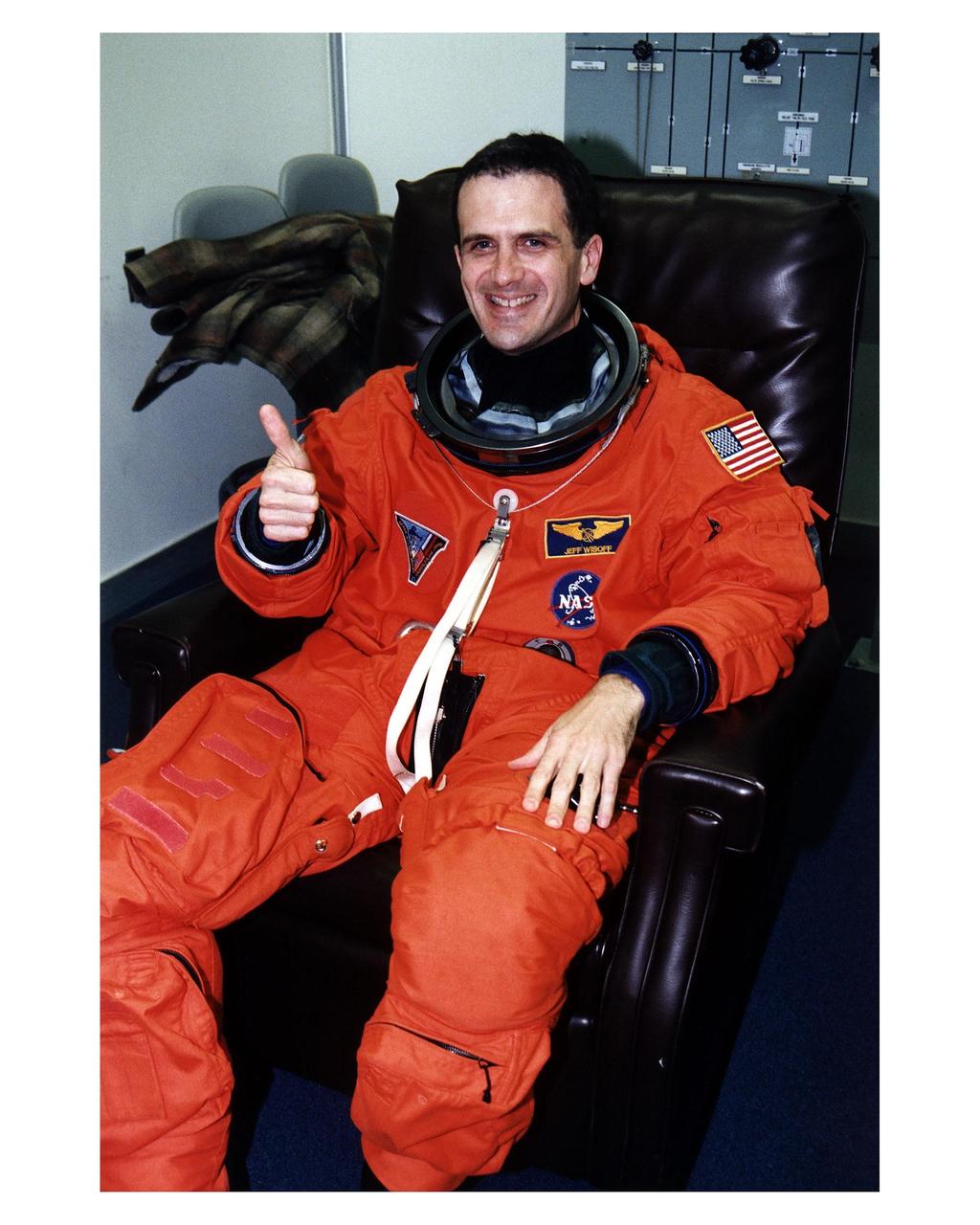
STS-81 Mission Specialist Peter J. K. "Jeff" Wisoff prepares for the fifth ShuttleMir docking as he waits in the Operations and Checkout (O&C) Building for the operation to fit him into his launch/entry suit to be completed. He conducted a spacewalk on his on his first Shuttle mission, STS57 and holds a doctorate degree in applied physics with an emphasis on lasers and semiconductor materials. He and five crew members will shortly depart the O&C and head for Launch Pad 39B, where the Space Shuttle Atlantis will lift off during a 7-minute window that opens at 4:27 a.m. EST, January 12
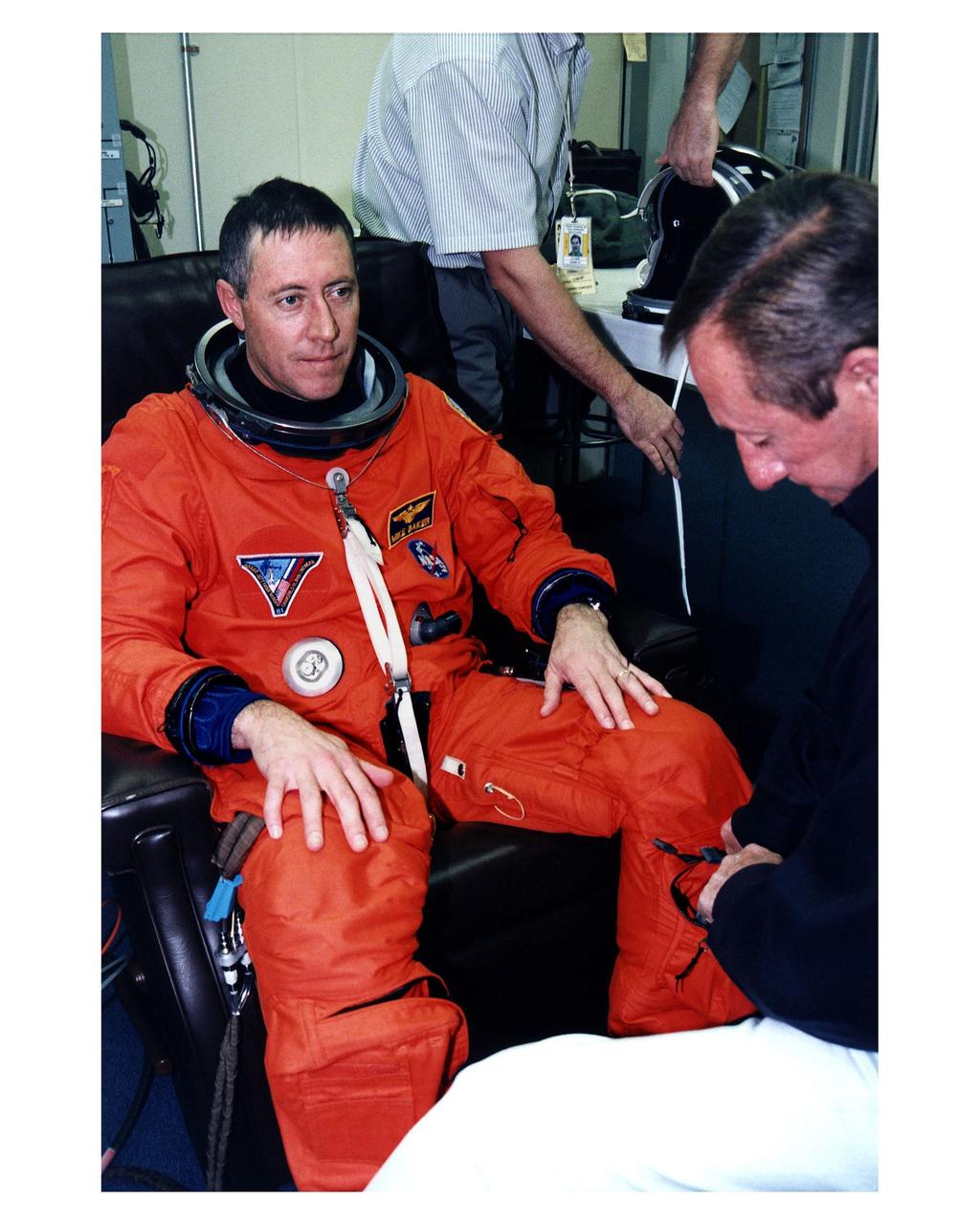
STS-81 Mission Commander Michael A. Baker is assisted into his launch/entry suit in the Operations and Checkout (O&C) Building. Baker is on his fourth space flight and will have responsibility for the 10-day mission, including the intricate docking and undocking maneuvers with the Russian Mir space station. He will also be in charge of two in-flight Risk Mitigation experiments and be the subject of a Human Life Sciences experiment. He and five crew members will shortly depart the O&C and head for Launch Pad 39B, where the Space Shuttle Atlantis will lift off during a 7-minute window that opens at 4:27 a.m. EST, January 12