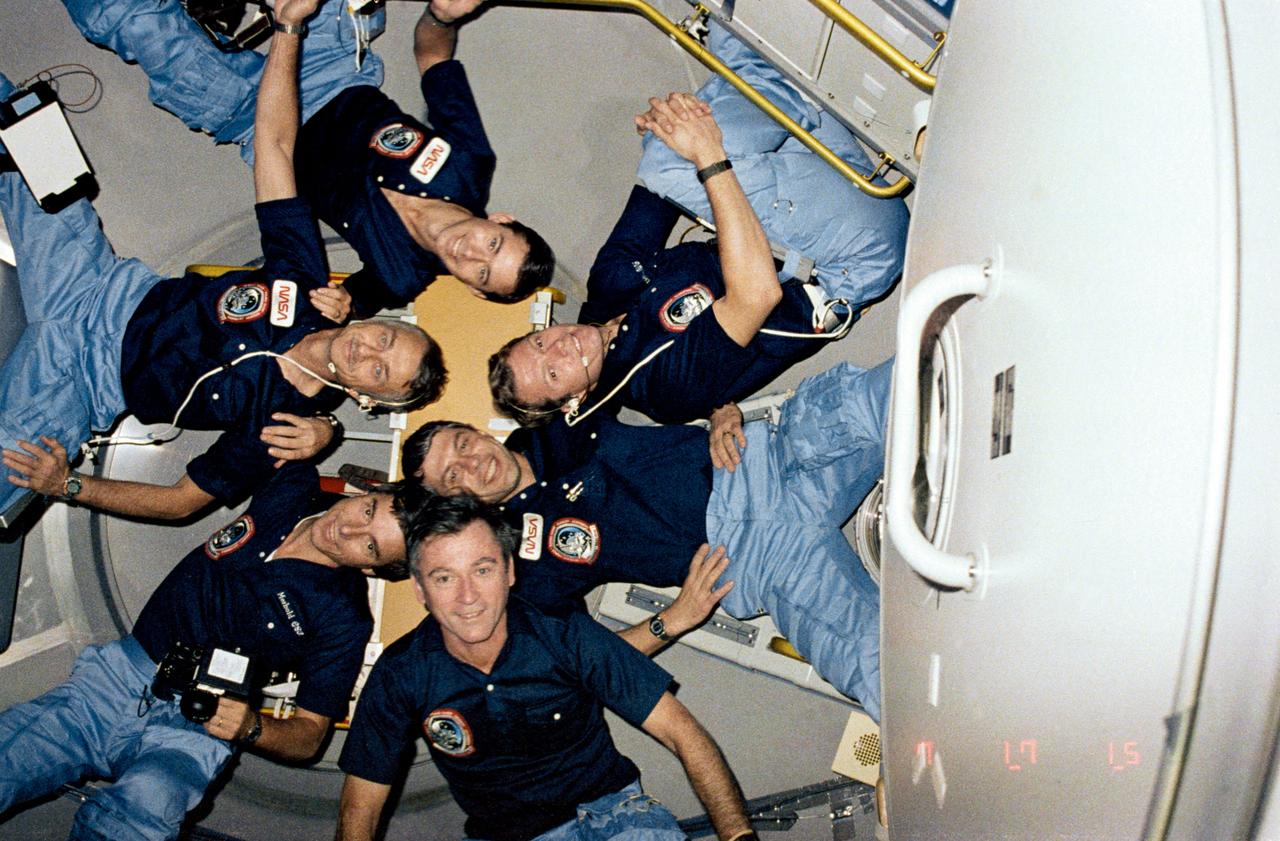
STS009-126-441 (28 Nov 1983) --- The six crewmembers of STS-9 position themselves in a star bust-like cluster in the aft end cone of Spacelab aboard the Shuttle Columbia. Clockwise, beginning with John W. Young, are Ulf Merbold, Owen K. Garriott, Brewster H. Shaw, Jr., Byron M. Lichtenberg and Robert A.R. Parker.

View of STS-9 Mission Specialist (MS) Owen K. Garriott with hardware.
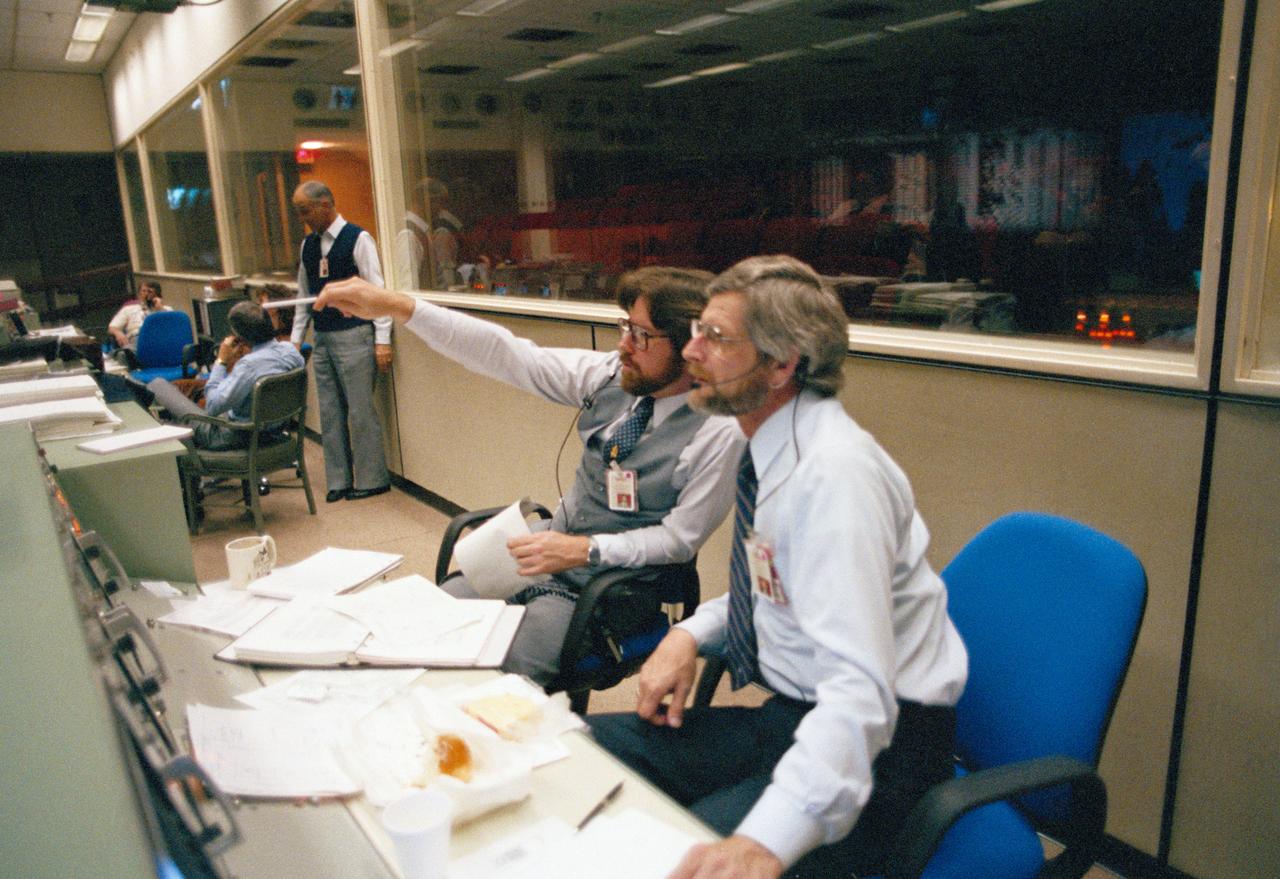
s83-46015 Views of the Mission Control Center activity of Eidophor with STS-9 Landing Data; PAO Console ith Steve Nesbitt and Harold S. Stall; FD Console with Charles Lewis and Ralph Hoodless, Lewis and M.P. "Pete" Frank; and the hanging of the STS-9 Plaque
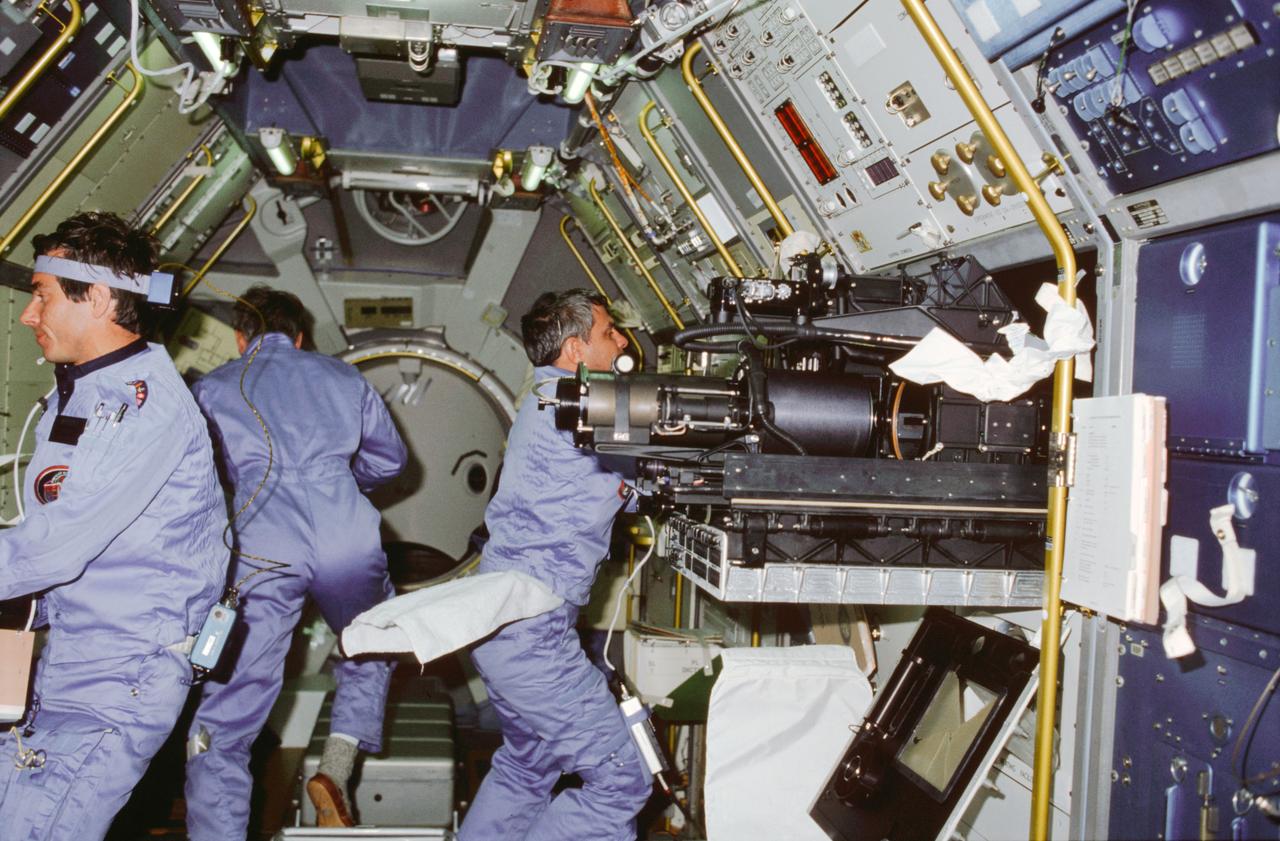
STS009-03-093 (28 Nov-8 Dec 1983) --- A mission specialist and two payload specialists busy themselves in the Spacelab 1 module aboard the Earth orbiting Space Shuttle Columbia. Left to right are Payload Specialist Robert A. R. Parker. Parker is partially obscured by a deployed instrument of the fluid physics module at the materials sciences double rack. Merbold, a physicist from Max-Planck Institute in the Federal Republic of Germany, wears a head band-like device and a recorder as part of an overall effort to learn more about space adaptation. Both Space lab 1 payload specialists wore the devices during most of their waking hours on this 10-day flight. The frame was exposed with a 35mm camera.
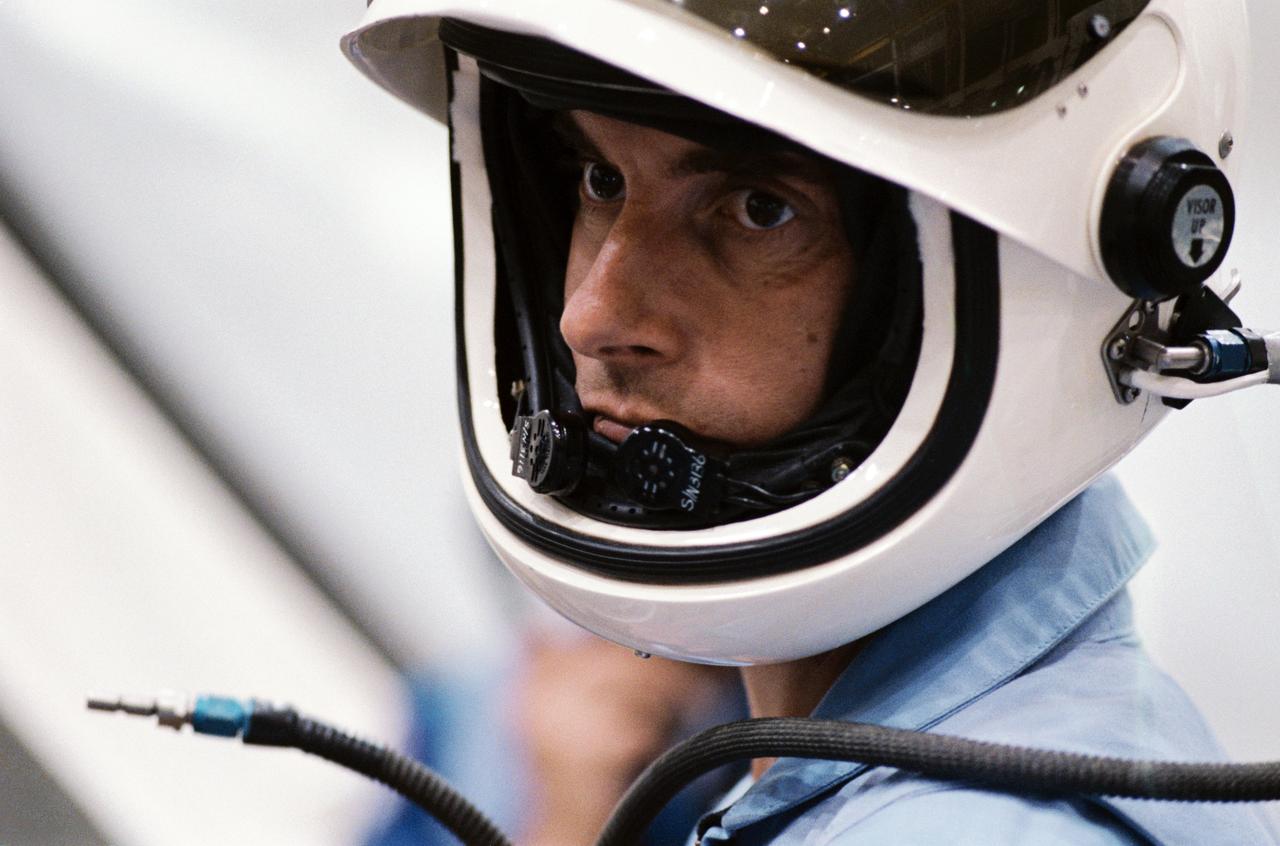
S83-41190 (9 September 1983) --- A close-up view of the serious countenance of West German Physicist Ulf Merbold was captured during a training session with all six STS-9 crewmembers in the Johnson Space Center’s (JSC) Shuttle Mockup and Integration Laboratory. Dr. Merbold is SL-1 payload specialist representing the European Space Agency (ESA). Dr. Merbold, from Max-Planck Institute in Stuttgart, is a specialist in crystal lattice defects and low-temperature physics. The photograph was taken by Otis Imboden.
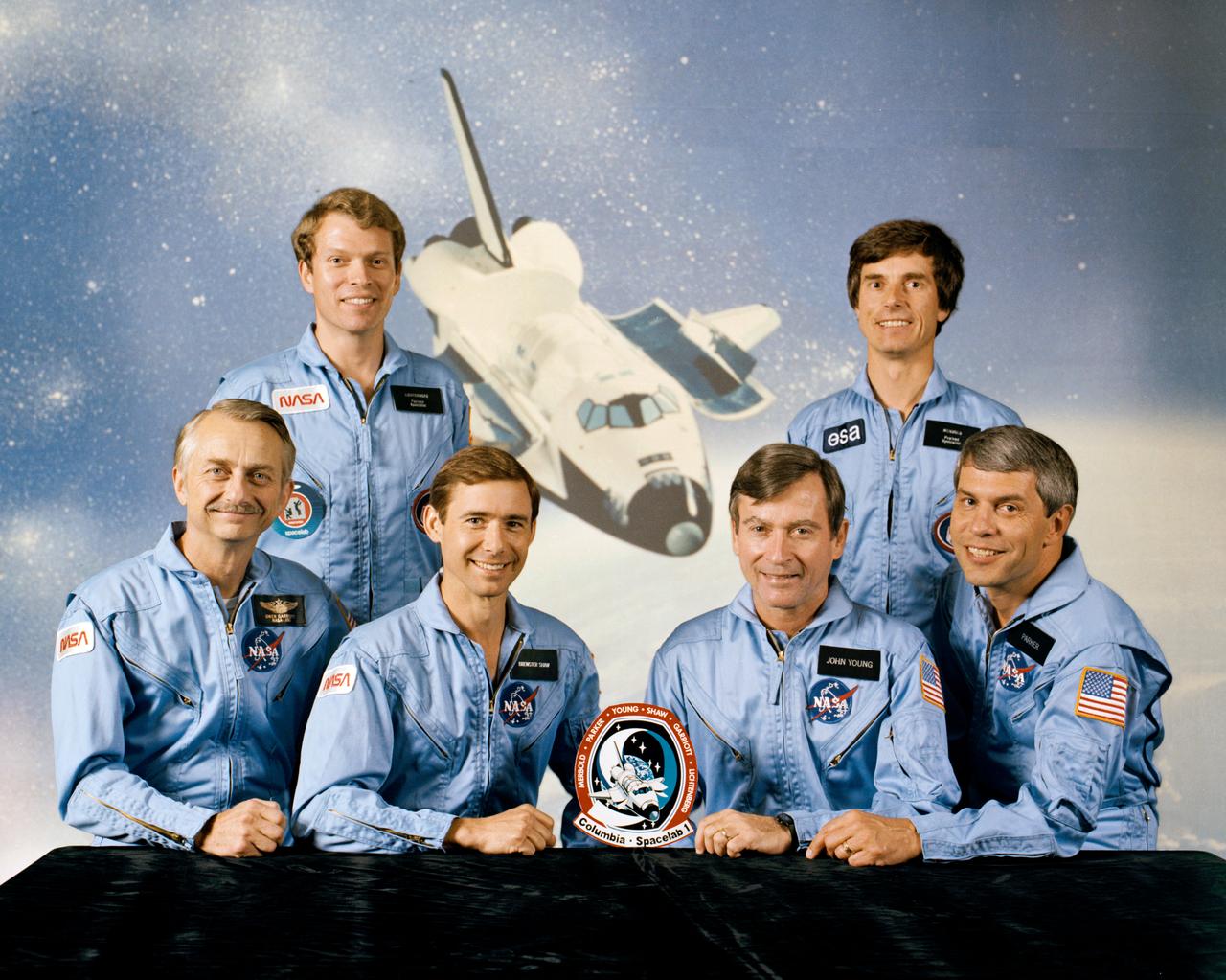
S83-35017 (June 1983) --- These six men represent the first crewmembers to man the Columbia when it gets reactivated later this year. The four NASA astronauts are joined by a European and MIT scientist payload specialist and the Spacelab module and experiment array for STS-9. On the front row are Astronauts Owen K. Garriott, mission specialist; Brewster H. Shaw, Jr., pilot; John W. Young, commander; and Robert A. R. Parker, mission specialist. Byron K. Lichtenberg of the Massachusetts of Technology, left and Ulf Merbold of the Republic of West Germany and the European Space Agency stand in front of an orbital scene featuring the Columbia. Columbia was used for the first five Space Transportation System missions in 1981 and 1982.
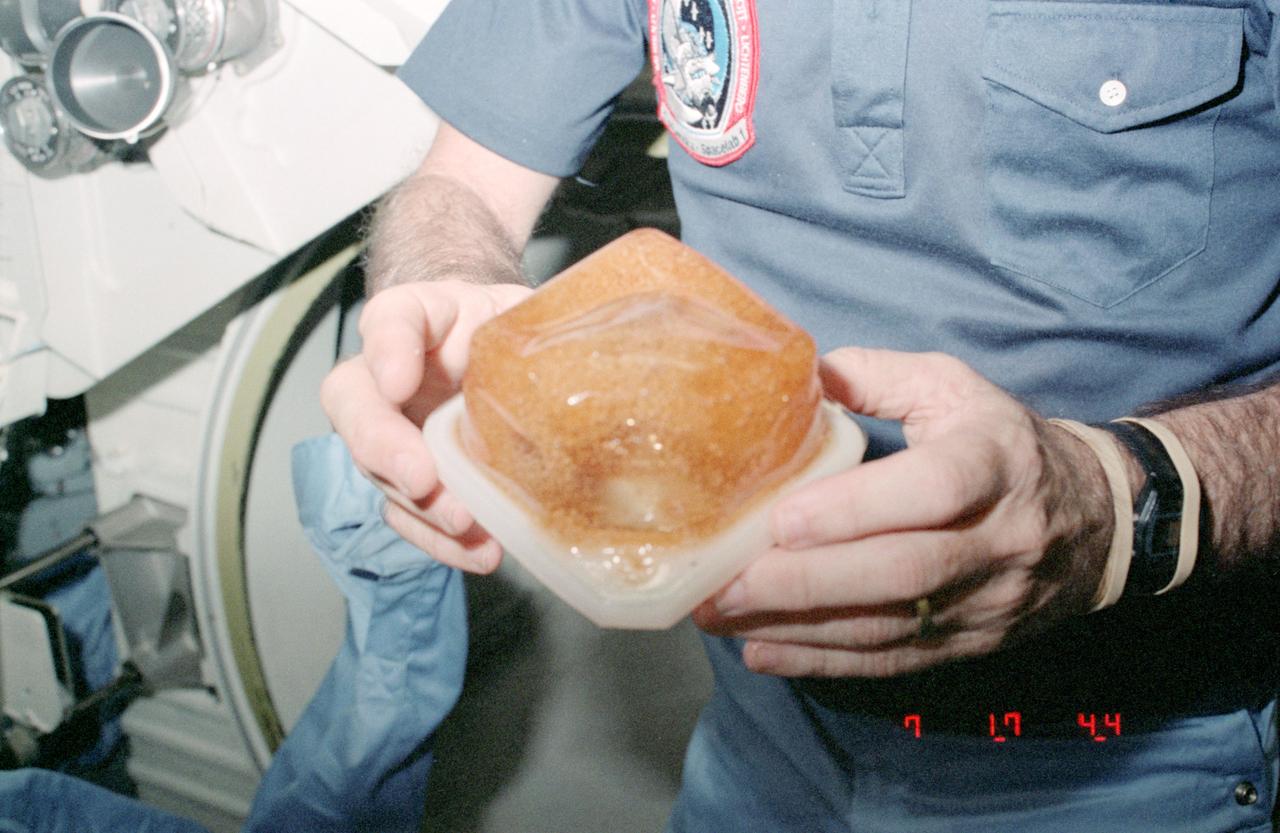
STS009-126-456 (28 Nov 1983) --- Water and coffee in beverage container during STS-9 flight. An extra amount of hydrogen in the H2O is believed to be the reason for the bubbling, distended effect in the container.
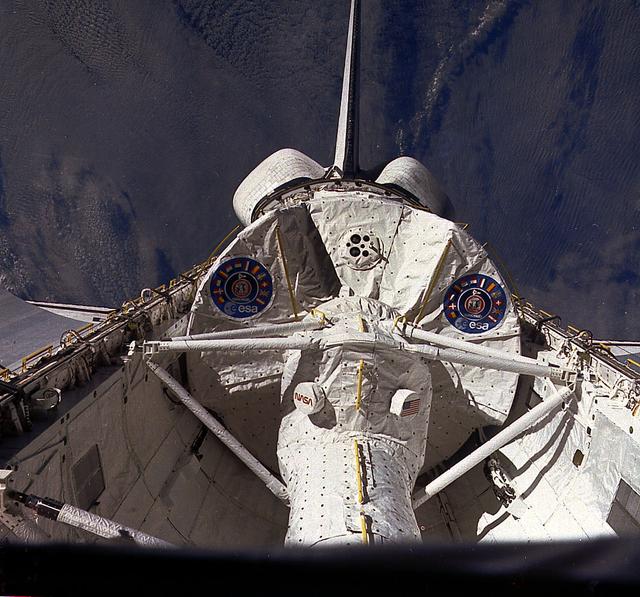
A Space Shuttle mission STS-9 onboard view show's Spacelab-1 (SL-1) module in orbiter Columbia's payload bay. Spacelab-1 was a cooperative venture of NASA and the European Space Agency. Scientists from eleven European nations plus Canada, Japan and the U.S. provided instruments and experimental procedures for over 70 different investigations in five research areas of disciplines: astronomy and solar physics, space plasma physics, atmospheric physics and Earth observations, life sciences and materials science.
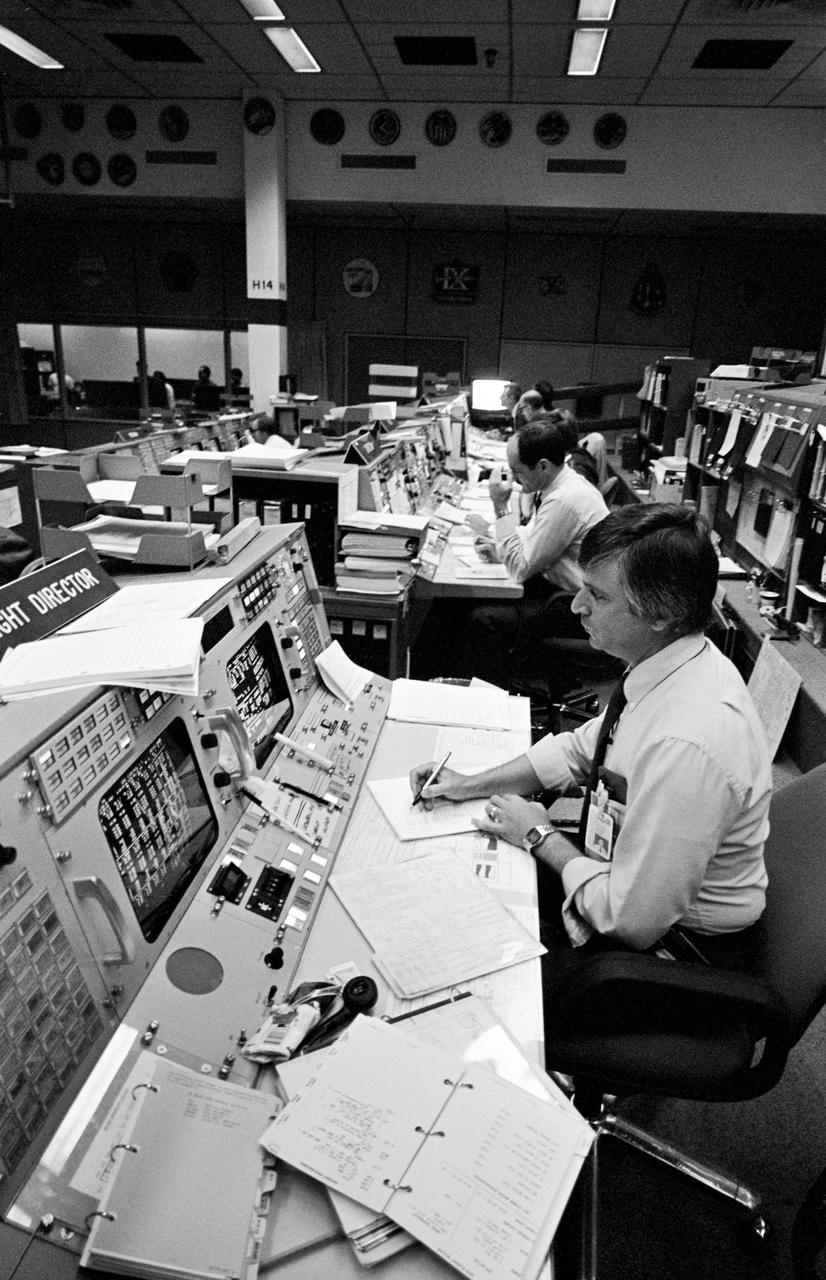
Mission Control Center (MCC) activities during Day-1 of the STS-9 mission with Flight Director Jay H. Greene and Lt. Gen. James A. Abrahamson. 1. Lt. General James A. Abrahamson 2. Jay H. Green 3. MOCR JSC, Houston, TX

STS009-15-755 (28 Nov-8 Dec 1983) --- The lone television monitor in the Spacelab module is a popular item in this 35mm scene of all four science specialists on the 10-day STS-9 mission. Left to right are Robert A. R. Parker, Byron K. Lichtenberg, Owen K. Garriott and Ulf Merbold.
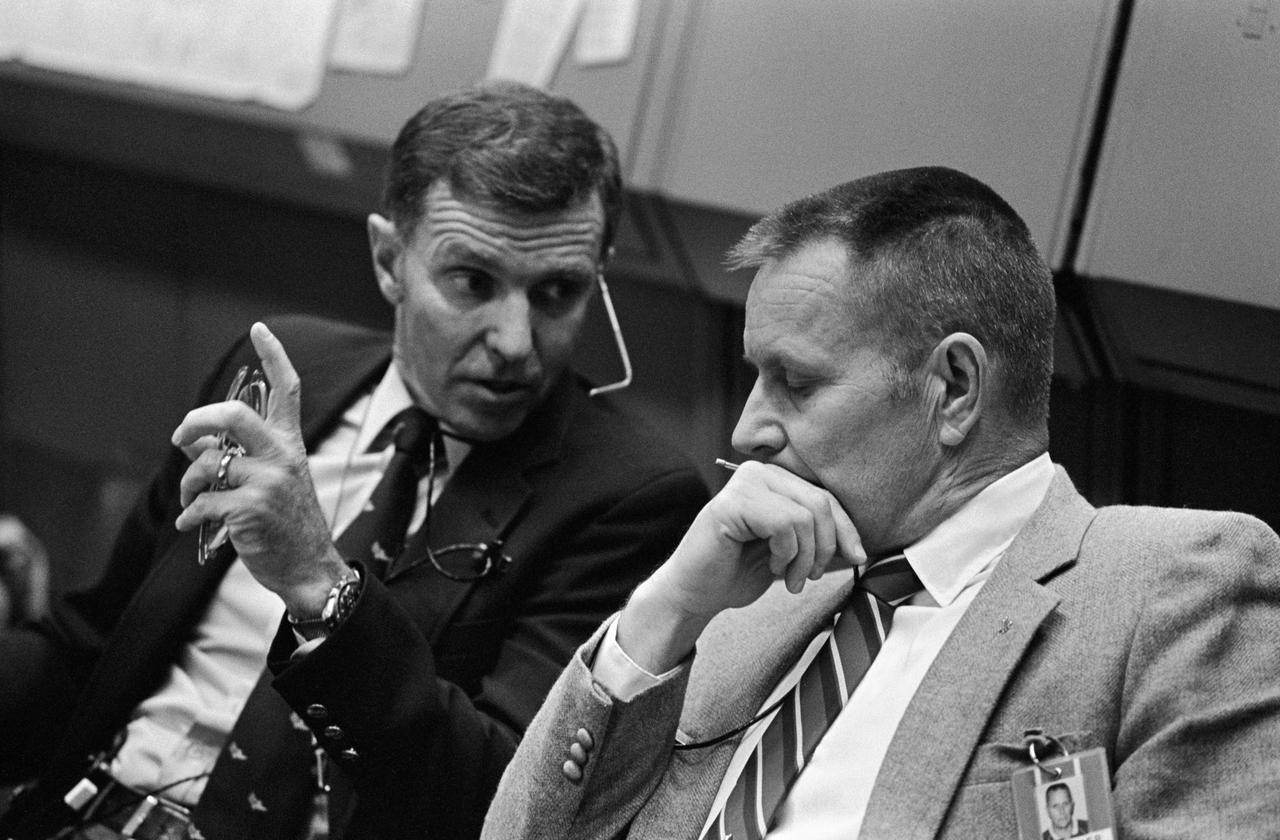
Mission Control Center (MCC) activities during Day-1 of the STS-9 mission with Flight Director Jay H. Greene and Lt. Gen. James A. Abrahamson. 1. Lt. General James A. Abrahamson 2. Jay H. Green 3. MOCR JSC, Houston, TX
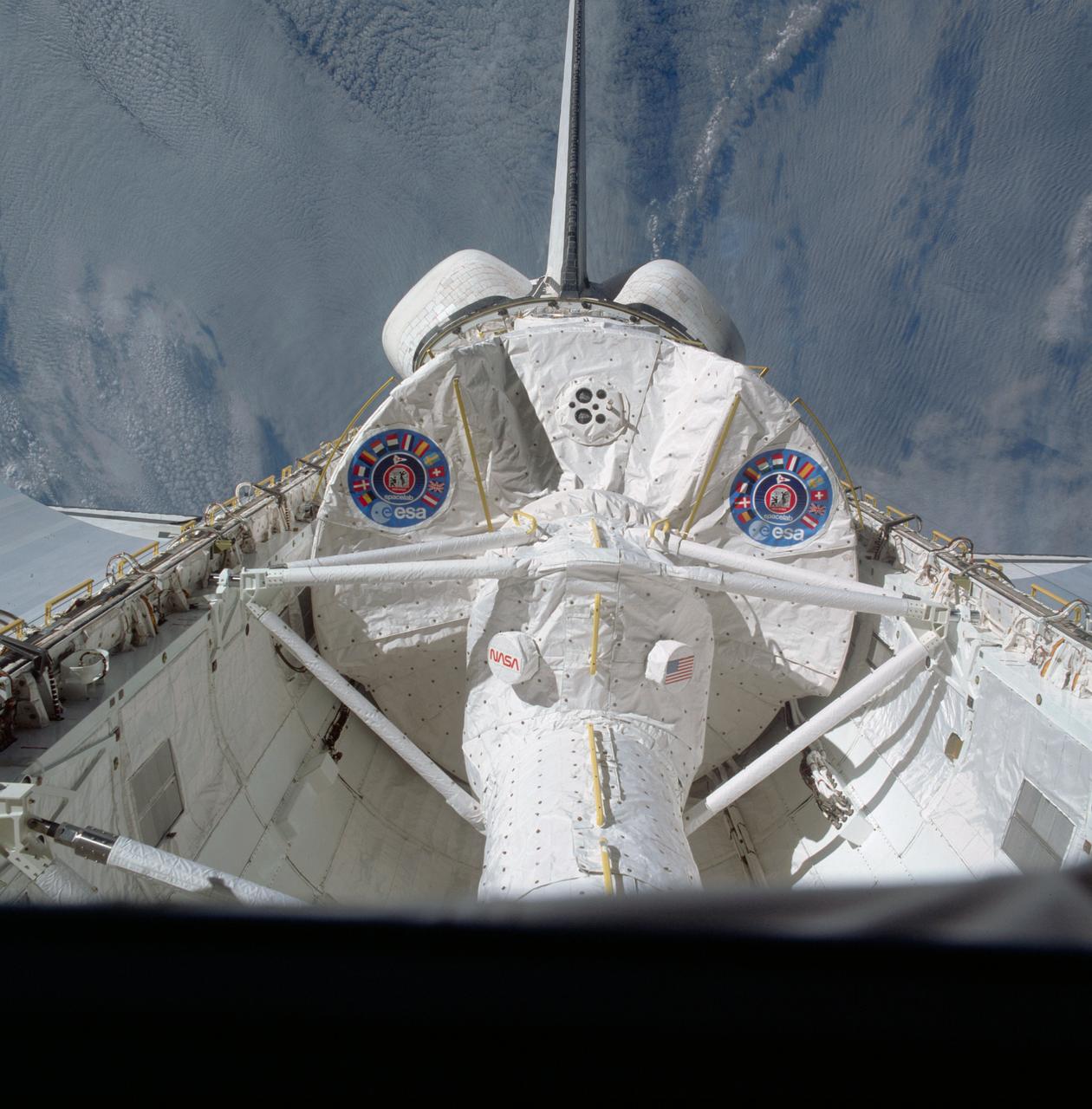
STS009-32-1112 (28 Nov-8 Dec 1983) --- A handheld Hasselblad camera was aimed through the aft windows on the flight deck of Columbia for this initially released scene of the active Spacelab module in the cargo bay. The docking tunnel, leading from the shirt-sleeve environment of the orbiter to the equally comfortable environment of Spacelab, is in the foreground.
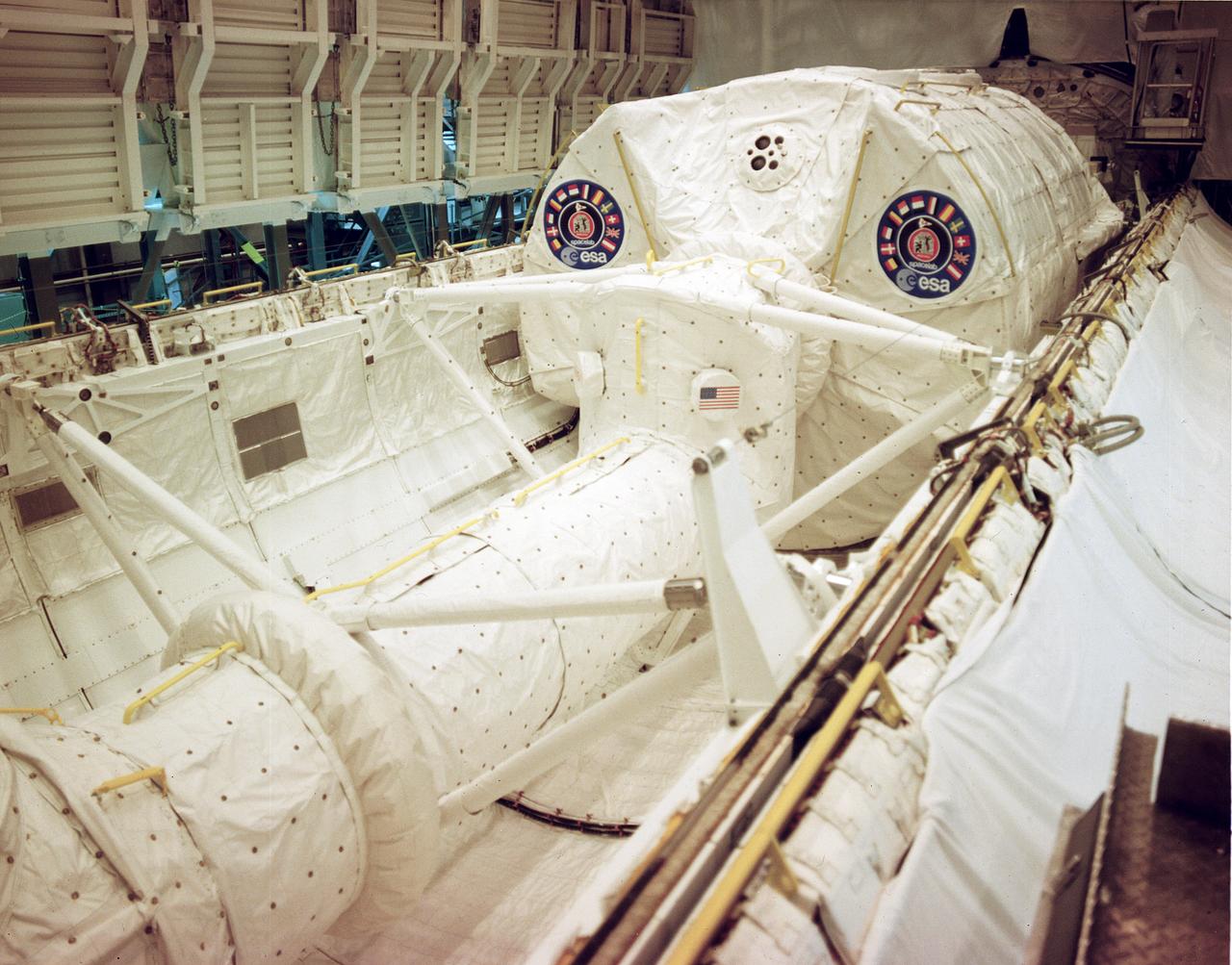
This photograph shows the Spacelab-1 module and Spacelab access turnel being installed in the cargo bay of orbiter Columbia for the STS-9 mission. The oribiting laboratory, built by the European Space Agency, is capable of supporting many types of scientific research that can best be performed in space. The Spacelab access tunnel, the only major piece of Spacelab hardware made in the U.S., connects the module with the mid-deck level of the orbiter cabin. The first Spacelab mission, Spacelab-1, sponsored jointly and shared equally by NASA and the European Space Agency, was a multidisciplinary mission; that is, investigations were performed in several different fields of scientific research. The overall goal of the mission was to verify Spacelab performance through a variety of scientific experiments. The disciplines represented by these experiments were: astronomy and solar physics, earth observations, space plasma physics, materials sciences, atmospheric physics, and life sciences. International in nature, Spacelab-1 conducted experiments from the United States, Japan, the Netherlands, United Kingdom, Beluga, France, Germany, Italy, and Switzerland. Spacelab-1, was launched from the Kennedy Space Center on November 28, 1983 aboard the orbiter Columbia (STS-9). The Marshall Space Flight Center was responsible for managing the Spacelab missions.
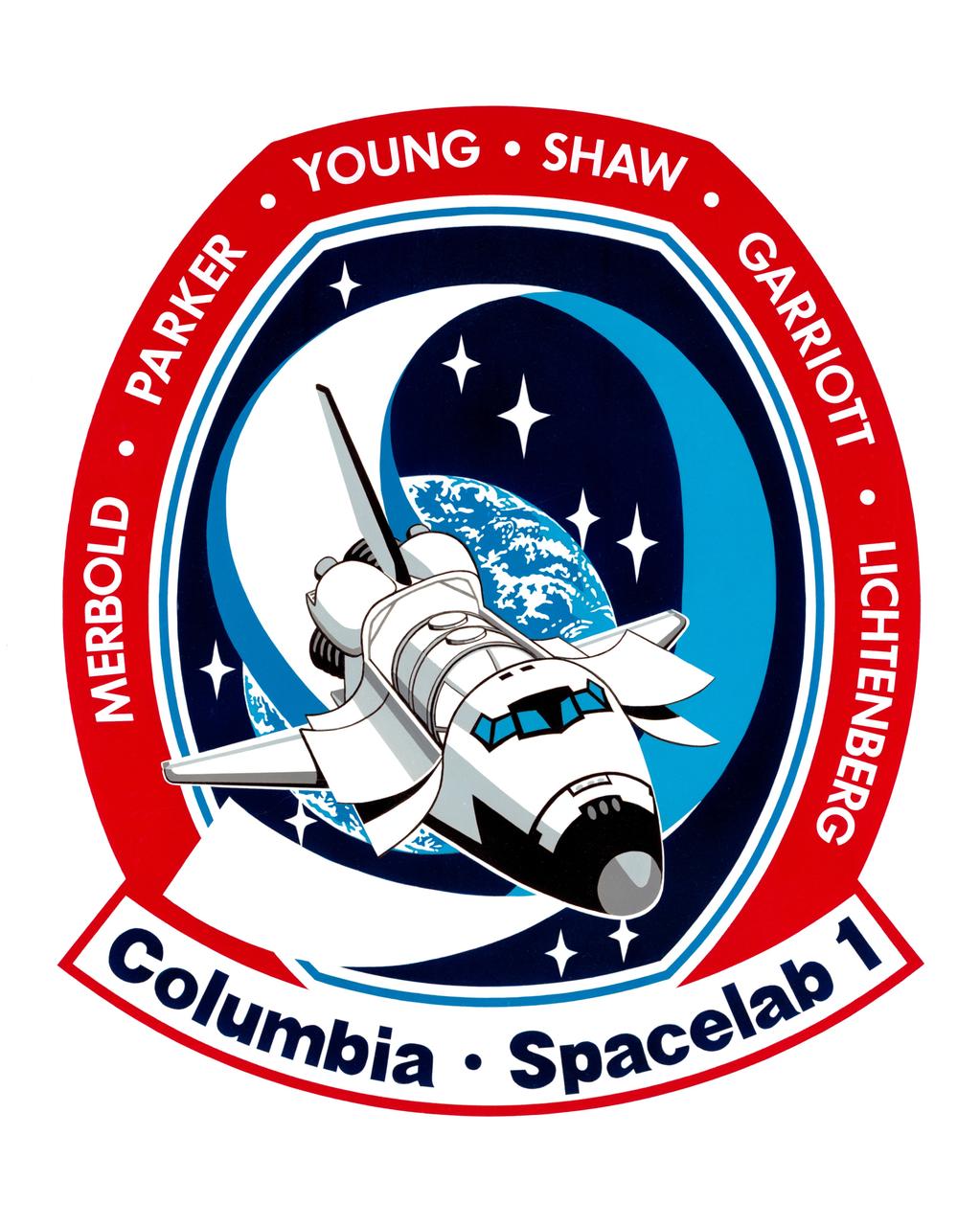
S83-32900 (25 May 1983) --- This is the official insignia for STS-9, the major payload of which is Spacelab-1, depicted in the cargo bay of the space shuttle Columbia. The nine stars and the path of the orbiter tell the flight's numerical designation in the Space Transportation System's mission sequence. Astronaut John W. Young is crew commander; Brewster H. Shaw Jr., pilot. NASA astronauts Owen K. Garriott and Robert A.R. Parker are mission specialists. Byron K. Lichtenberg of the Massachusetts Institute of Technology and Ulf Merbold of the Republic of West Germany are the Spacelab-1 payload specialists. Launch has been set for late 1983. Merbold is a physicist representing the European Space Agency (ESA). The NASA insignia design for space shuttle flights is reserved for use by the astronauts and for other official use as the NASA Administrator may authorize. Public availability has been approved only in the forms of illustrations by the various news media. When and if there is any change in this policy, which is not anticipated, the change will be publicly announced. Photo credit: NASA

jsc2024e052328 (July 22, 2024) --- NASA’s SpaceX Crew-9 Mission Specialist Stephanie Wilson focuses during the crew equipment interface test (CEIT). She has collectively spent 42 days in space aboard three space shuttle Discovery missions – STS-120, STS-121, and STS-131. Credit: SpaceX
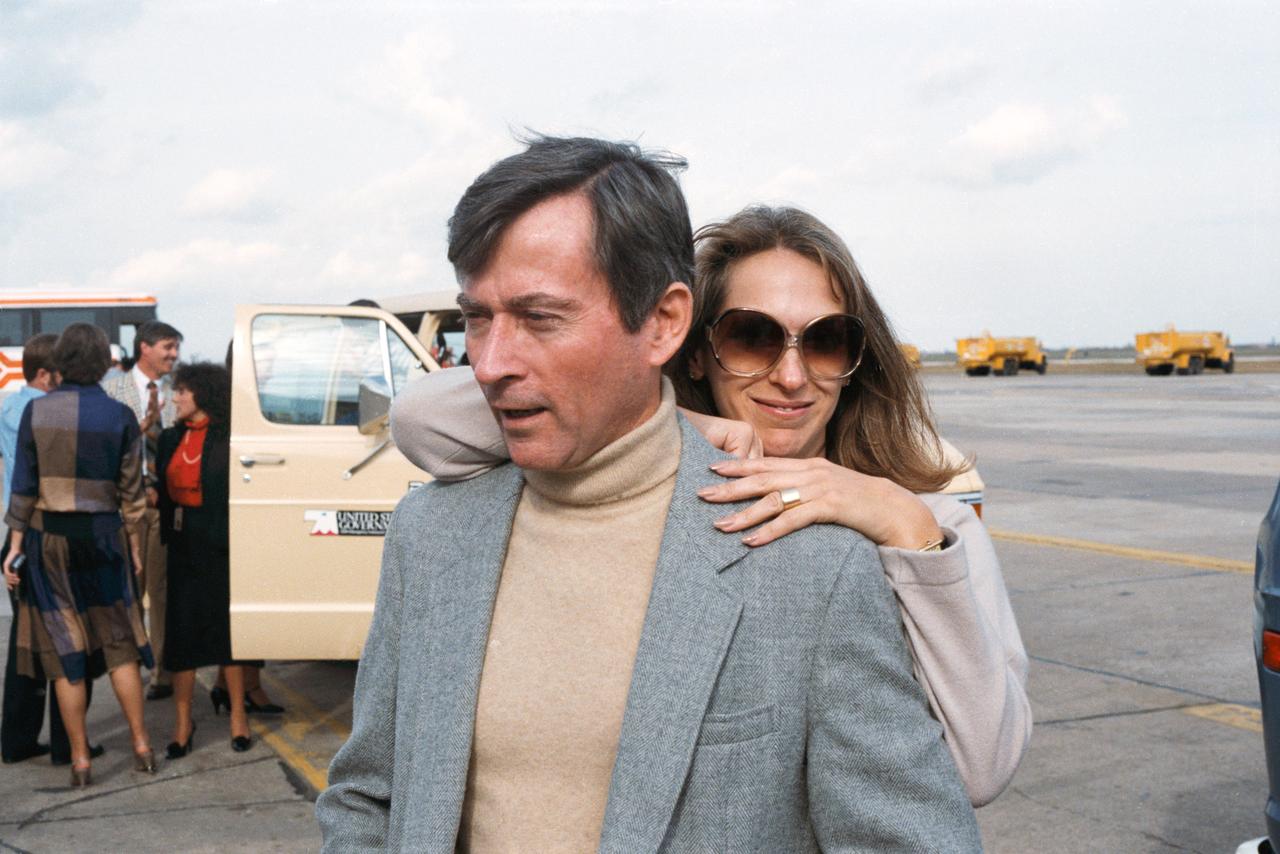
Views of STS-9/41A Crewmen John Young, with wife Susy, and Brewster Shaw with his family upn their return. EAFB, HOUSTON, TX
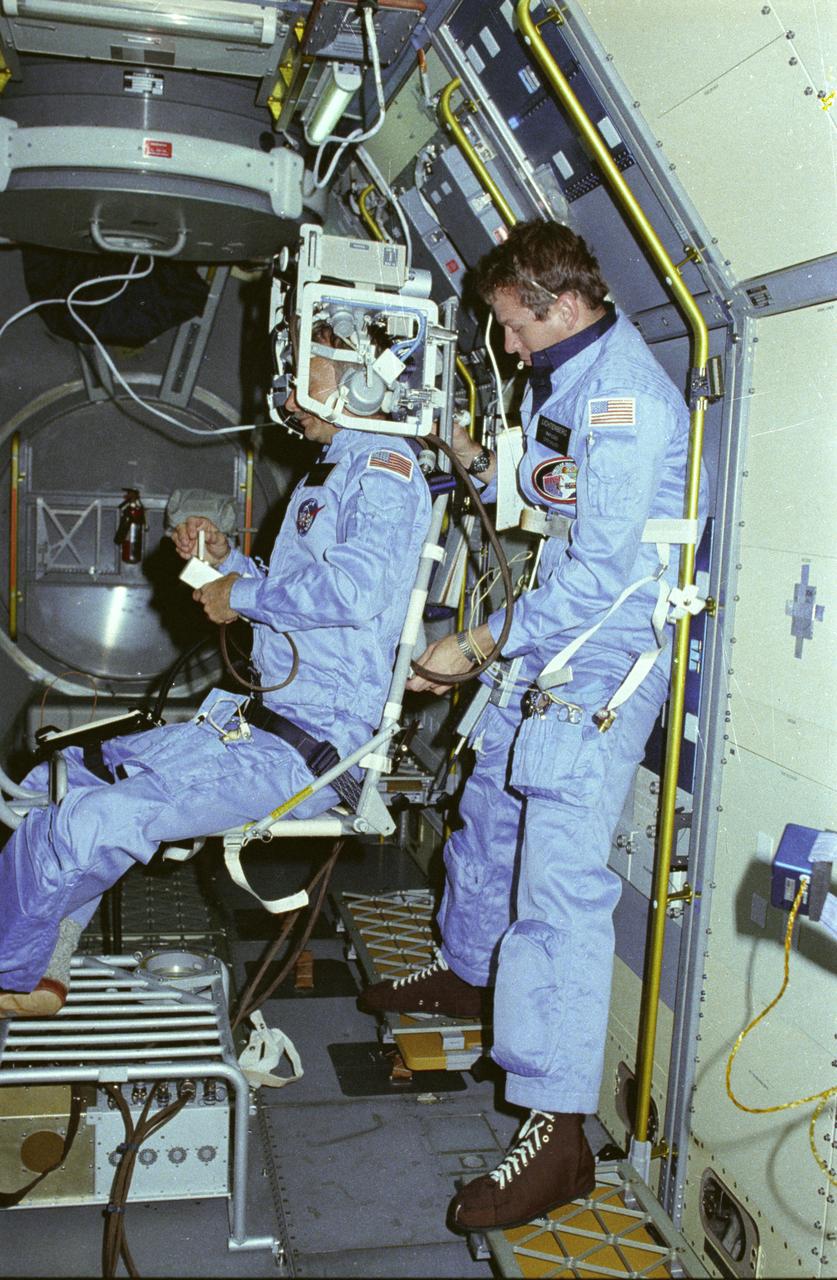
In this photograph, astronauts Owen Garriott on the body restriant system and Byron Lichtenberg prepare for a Vestibular Experiment during the Spacelab-1 mission. The Vestibular Experiments in Space were the study of the interaction among the otoliths, semicircular canals, vision, and spinal reflexes in humans. The main objective was to determine how the body, which receives redundant information for several sensory sources, interprets this information in microgravity. Another objective was to record and characterize the symptoms of space sickness experienced by crewmembers. The body restraint system was a rotating chair with a harness to hold the test subject in place. The crewmember wore an accelerometer and electrodes to record head motion and horizontal and vertical eye movement as the body rotated. The first Spacelab mission, Spacelab-1, sponsored jointly and shared equally by NASA and the European Space Agency, was a multidisciplinary mission; that is, investigations were performed in several different fields of scientific research. The overall goal of the mission was to verify Spacelab performance through a variety of scientific experiments. The Spacelab-1 was launched aboard the Space Shuttle Orbiter Columbia for the STS-9 mission on November 28, 1983. The Marshall Space Flight Center had management responsibilities for the mission.
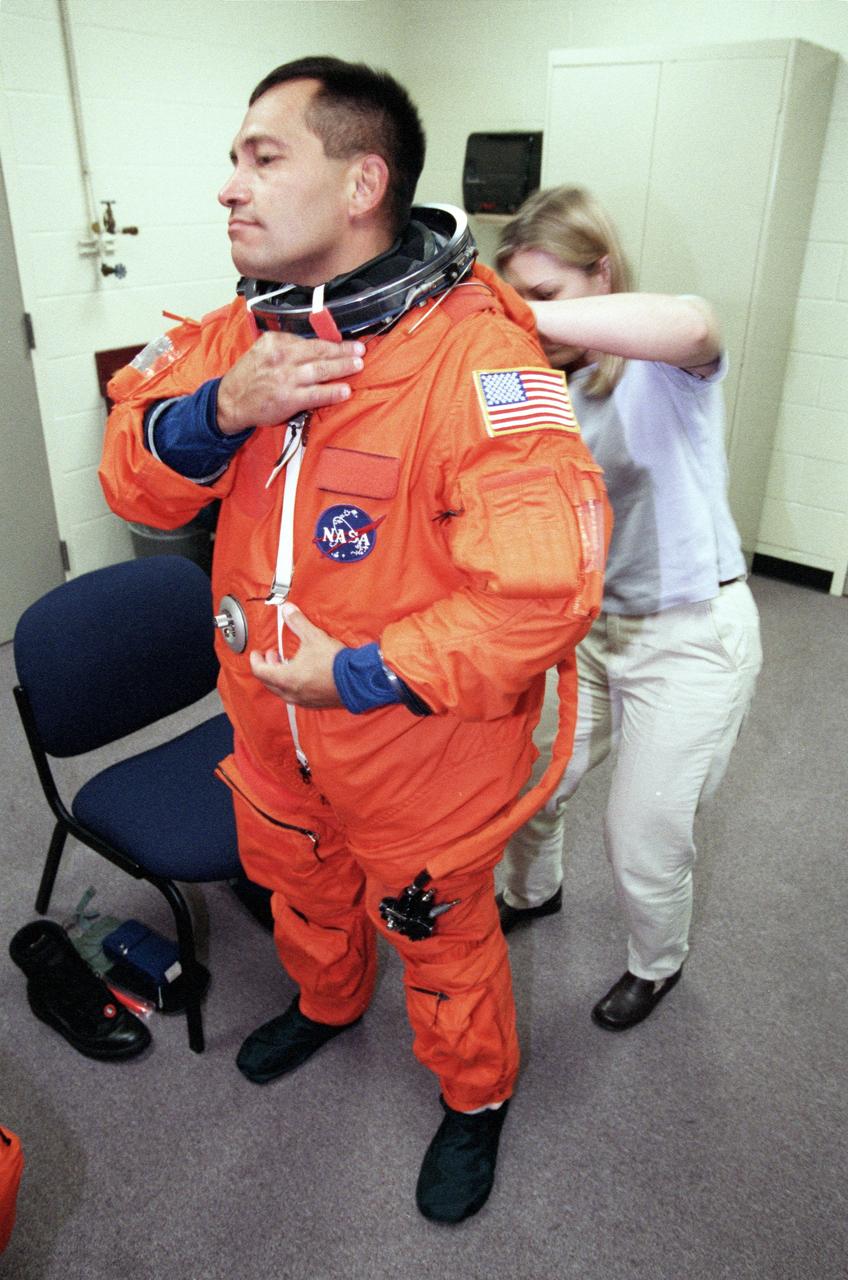
Photographic documentation showing the STS-97 crew training in the Crew Compartment Trainer II (CCT II) in bldg. 9. Views include: STS-97 pilot Michael J. Bloomfield wearing a Launch and Entry Suit (LES) with no helmet (04749); STS-97 Mission Specialist (MS) Carlos I. Noriega with personnel helping him with his LES 904750); Left to right in a locker room, with all wearing LES: STS-97 mission commaner Brett W. Jett, Bloomfield, MS Joseph R. Tanner and MS Marc Garneau (04751); Noriega, wearing LES and helmet, strapped down in CCT II (04752); personnel help Bloomfield with his LES (04753). CCTII mockup. Crew includes: Brent Jett, Michael Bloomfield, Joseph Tanner, Carlos Noriega, Marc Garneau
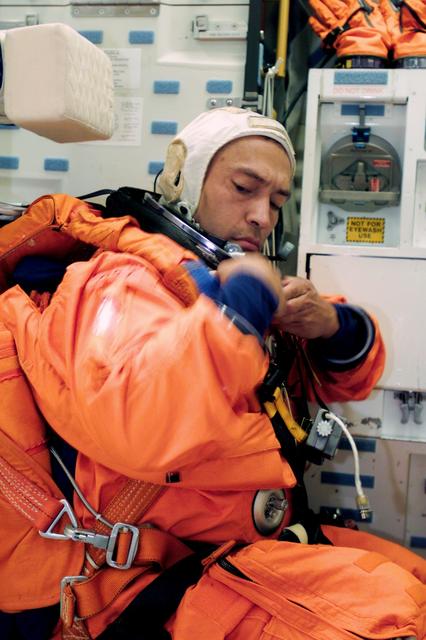
Photographic documentation of the STS-97 preflight training which occurred in Building 9 Crew Compartment Trainer II (CCTII). Views include: Astronaut Brent W. Jett (center), STS-97 mission commander, shares a light moment with two of the mission specialists on his crew, astronauts Joseph R. Tanner (left) and Carlos I. Noriega. The three are about to don training versions of the orange Launch and entry suit (LES) prior to a dry run of countdown procedures (23524). Astronaut Joseph R. Tanner (left), mission specialist, helps astronaut Michael J. Bloomfield, pilot, with final touches on his suit-donning process as USA suit technicians Bill Todd (standing) and Brad Milling look on (23525). Astronaut Carlos I. Noriega, attired in a blue thermal undergarment, and USA suit technician Mike Birkenseher help astronaut Brent W. Jett, STS-97 mission commander, with final touches of suit donning (23526). Astronaut Marc Garneau, mission specialist representing the Canadian Space Agency (CSA), looks on as two crew mates assist him with final touches of suit-donning prior to a training session in the Johnson Space Center's Systems Integration Facility. Helping out are astronauts Carlos I. Noriega (left) and Joseph R. Tanner, mission specialists (23527). Astronaut Michael J. Bloomfield, left, discusses his launch and entry suit with USA technician Bill Todd prior to a training session (23528). Astronaut Joseph R. Tanner lends a helping hand to astronaut Carlos I. Noriega as the two STS-97 mission specialists prepare for a dry run going over launch procedures in a nearby simulator (23529). Astronaut Joseph R. Tanner receives a helping hand from astronaut Carlos I. Noriega as the two STS-97 mission specialists don training versions of their pressure ascent and entry garments (23530). Noriega adjusts his LES while in the CCTII middeck mock-up (23531).
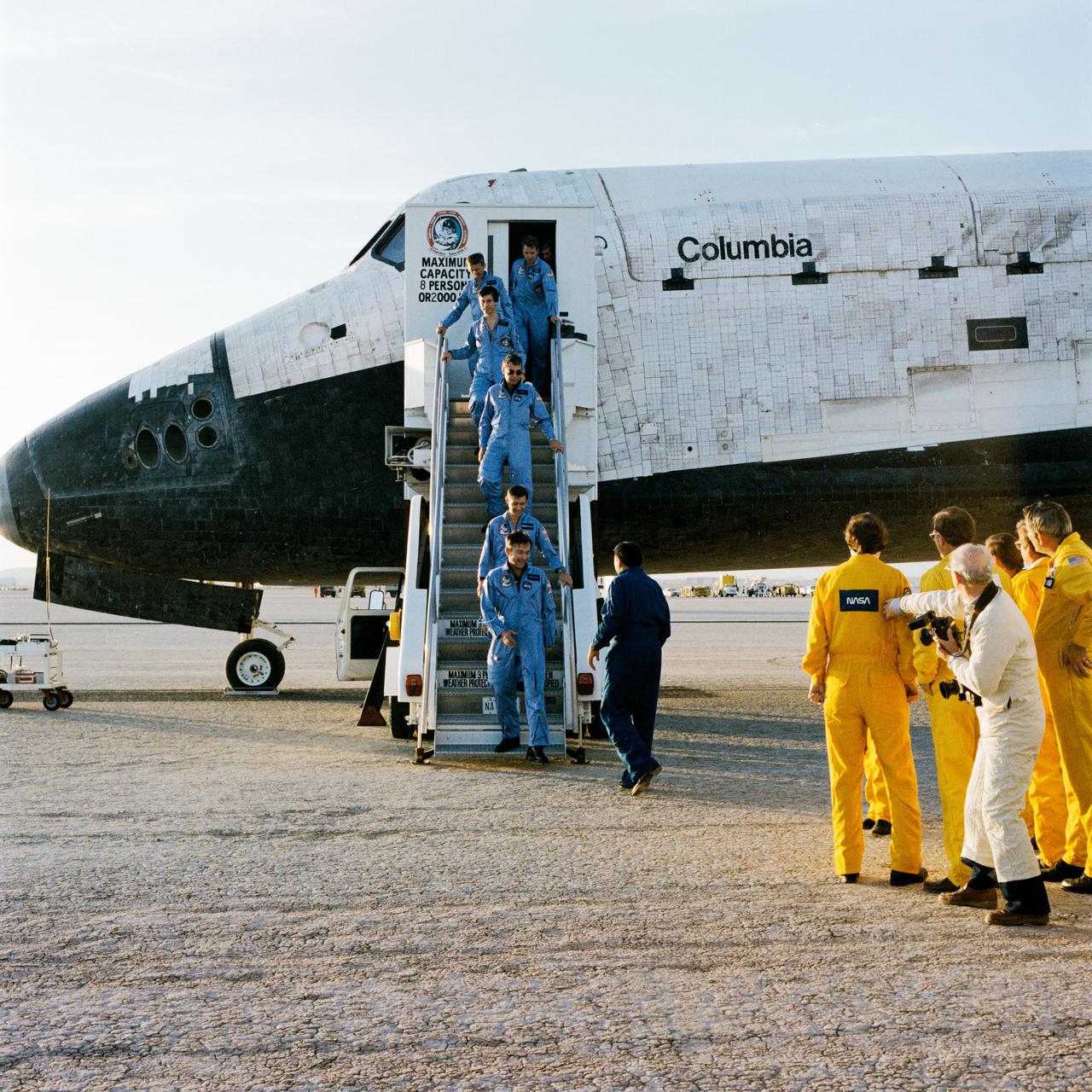
S83-45648 (8 Dec 1983) --- After more than 10 days in Earth orbit, the crewmembers for STS-9 egress the Space Shuttle Columbia following its successful landing at Edwards Air Force Base in southern California. Descending the stairs are (from bottom) Astronaut John W. Young, Brewster H. Shaw Jr. and Robert A. R. Parker; West German physicist Dr. Ulf Merbold; Astronaut Owen K. Garriott, and Dr. Byron K. Lichtenberg, a biomedical engineer from the Massachusetts Institute of Technology. Young was STS-9 crew commander; Shaw, pilot Drs. Parker and Garriott were mission specialists; and Drs. Merbold and Lichtenberg, payload specialists. Dr. Merbold was the European Space Agency?s first scientist to fly aboard a NASA spacecraft and Dr. Lichtenberg was America?s first non-astronaut to join a NASA crew in space. On hand to greet the crewmembers is George W. S. Abbey, director of flight crew operations.
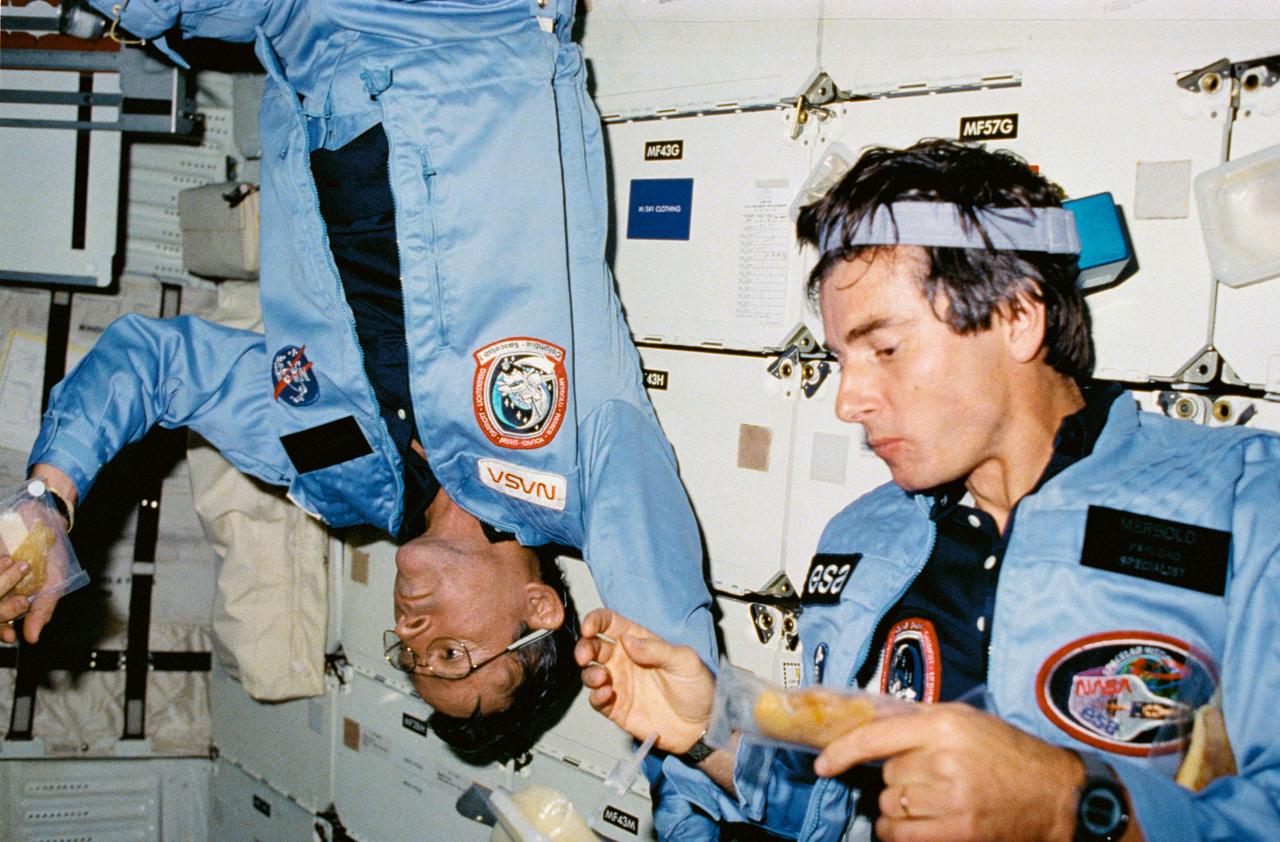
STS009-003-075 (28 November - 8 December 1983) --- Astronaut John W. Young (left), STS-9 crew commander; and Ulf Merbold, payload specialist, enjoy a meal in the middeck of the Earth-orbiting Space Shuttle Columbia. Merbold is a physicist from the Federal Republic of Germany, representing the European Space Agency (ESA) on this 10-day flight. Many of the nearby stowage lockers are used for clothing and food. The photograph was made with a 35mm camera.
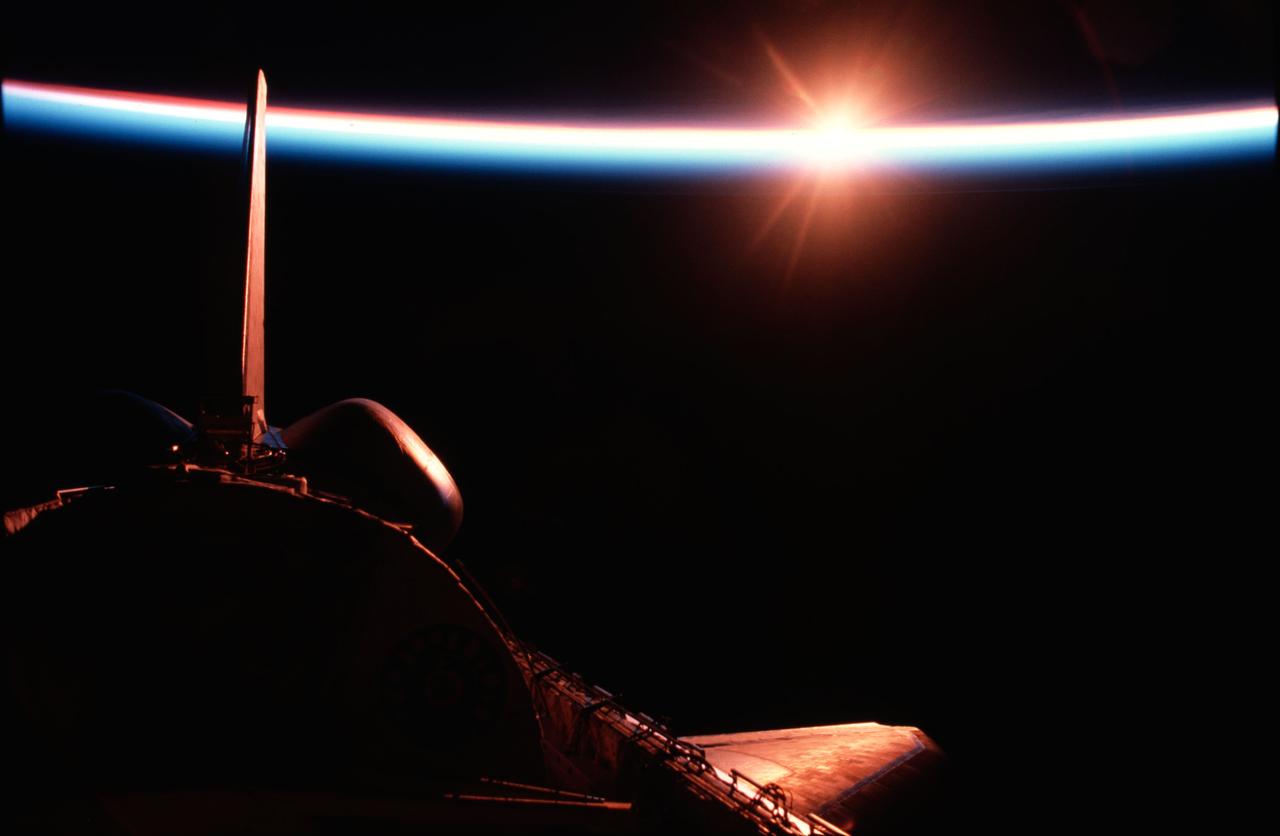
STS009-11-675 (December 1983) --- The Space Shuttle Columbia passes into a brilliant sunrise scene during the STS-9\Spacelab 1 mission. The photograph was taken with a 35mm camera aimed through Columbia's aft flight deck windows. Part of the science module, which hosted more than a week's scientific experimentation, is silhouetted against the scene.

STS009-05-0153 (28 Nov. - 8 Dec. 1983) --- Though STS-9 was the space shuttle Columbia's sixth spaceflight, it was the first opportunity for an onboard galley, some of the results of which are shown in this 35mm scene on the flight deck. The metal tray makes for easy preparation and serving of in-space meals for crew members. This crewman is seated at the pilot's station on the flight deck. The actual galley is located in the middeck. Photo credit: NASA
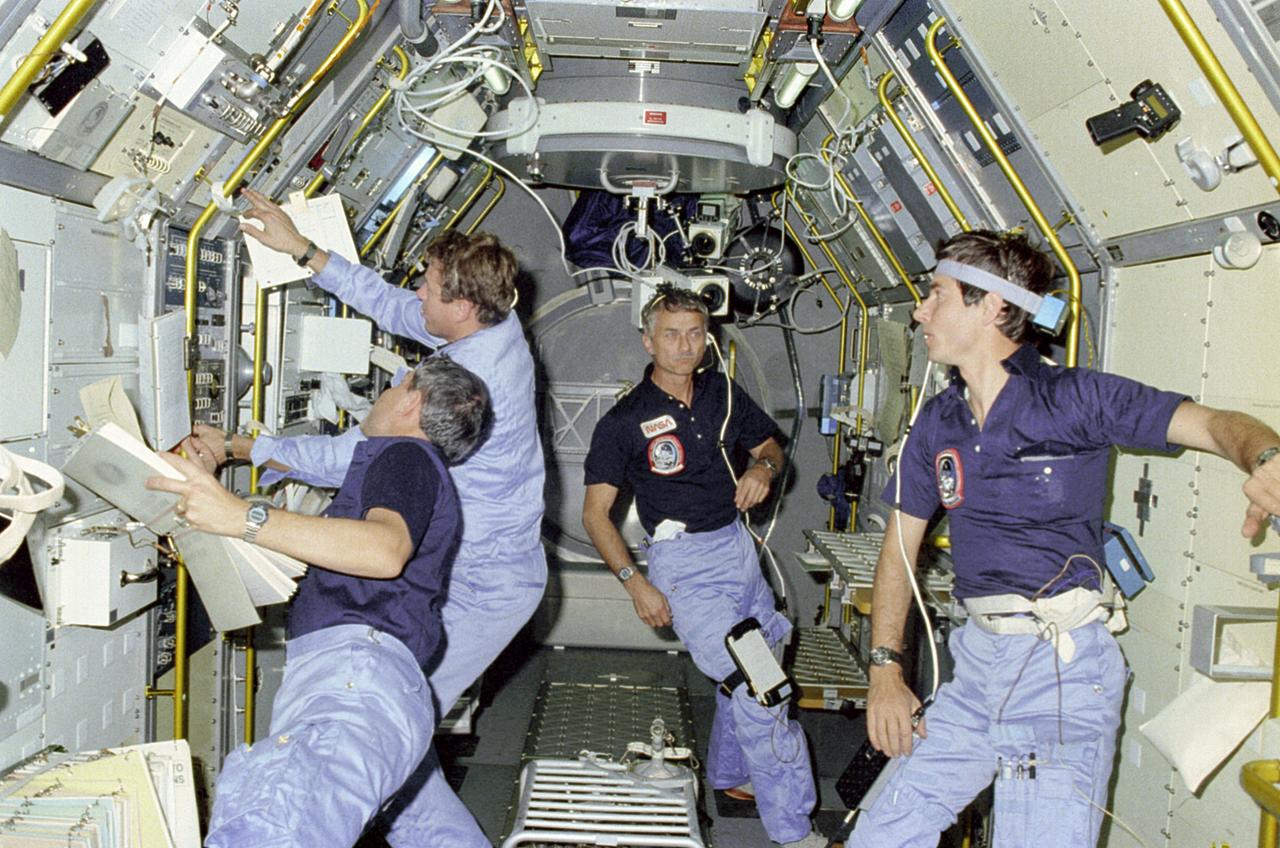
This photograph shows activities inside the science module during the Spacelab-1 (STS-9) mission. Left to right are Mission Specialist Robert Parker, Payload Specialist Byron Lichtenberg, Mission Specialist Owen Garriott, and Payload Specialist Ulf Merbold. The overall goal of the Spacelab-1 mission, the first mission of the Spacelab facility, were: (1) To verify the Spacelab system capability, (2) to obtain valuable scientific, applications, and technology data from a U.S./European multidisciplinary payload, and (3) to demonstrate the broad capability of Spacelab for scientific research. More than 70 experiments in 5 disciplines from 14 nations were conducted during the mission. The mission marked the the entry of non-astronaut persornel, called Payload Specialists, into space as working members of the crew. They are fellow scientists representing the international group of investigators using the mission. Mission Specialists are NASA astronauts who have broad scientific training. They operate various Orbiter-Spacelab systems, perform any required activity outside the spacecraft, and support investigations as needed. The Space Shuttle Orbiter Columbia that carried Spacelab-1 was operated by two other NASA astronauts serving as commander and pilot. The STS-9 mission, managed by the Marshall Space Flight Center, was launched on November 28, 1983.
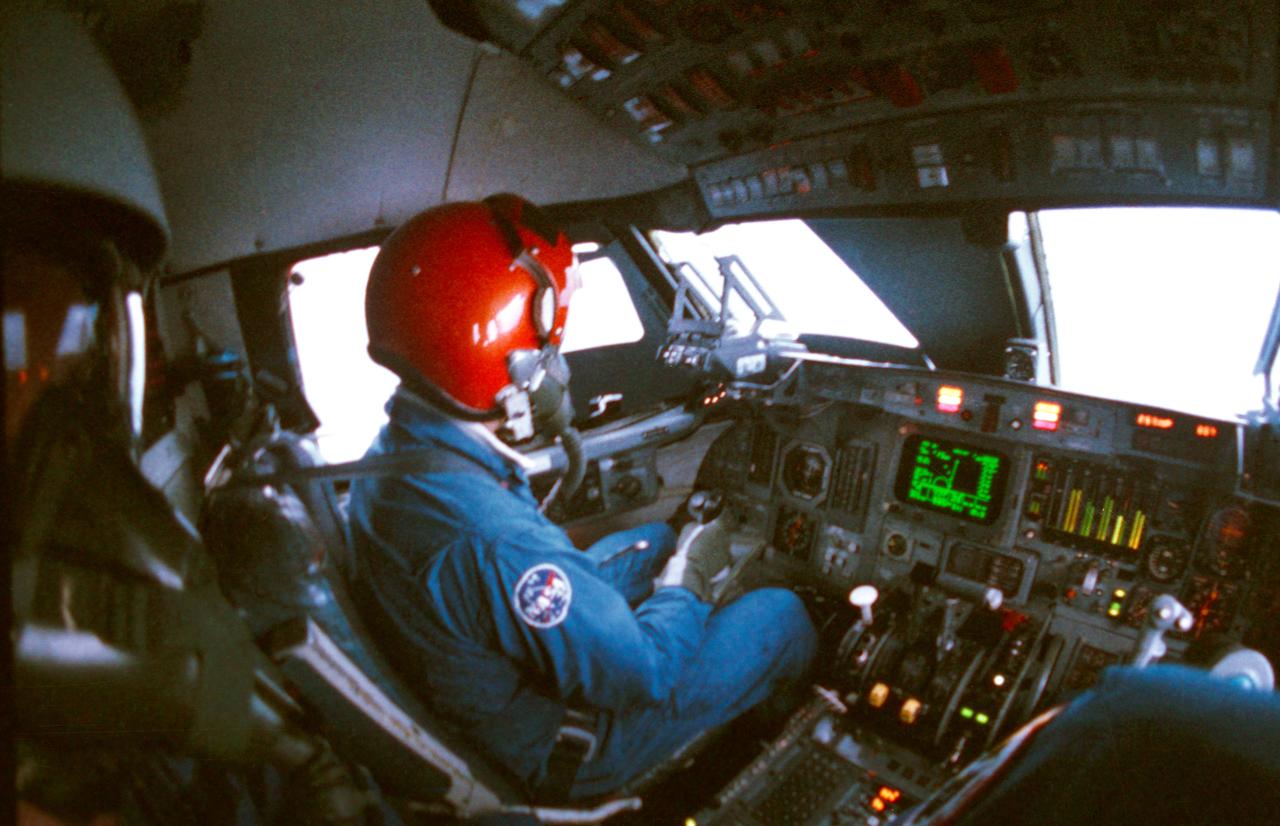
Astronauts John Young and Brewster Shaw in Shuttle Training Aircraft (STA), shot by National Geographic/Otis Imboden.
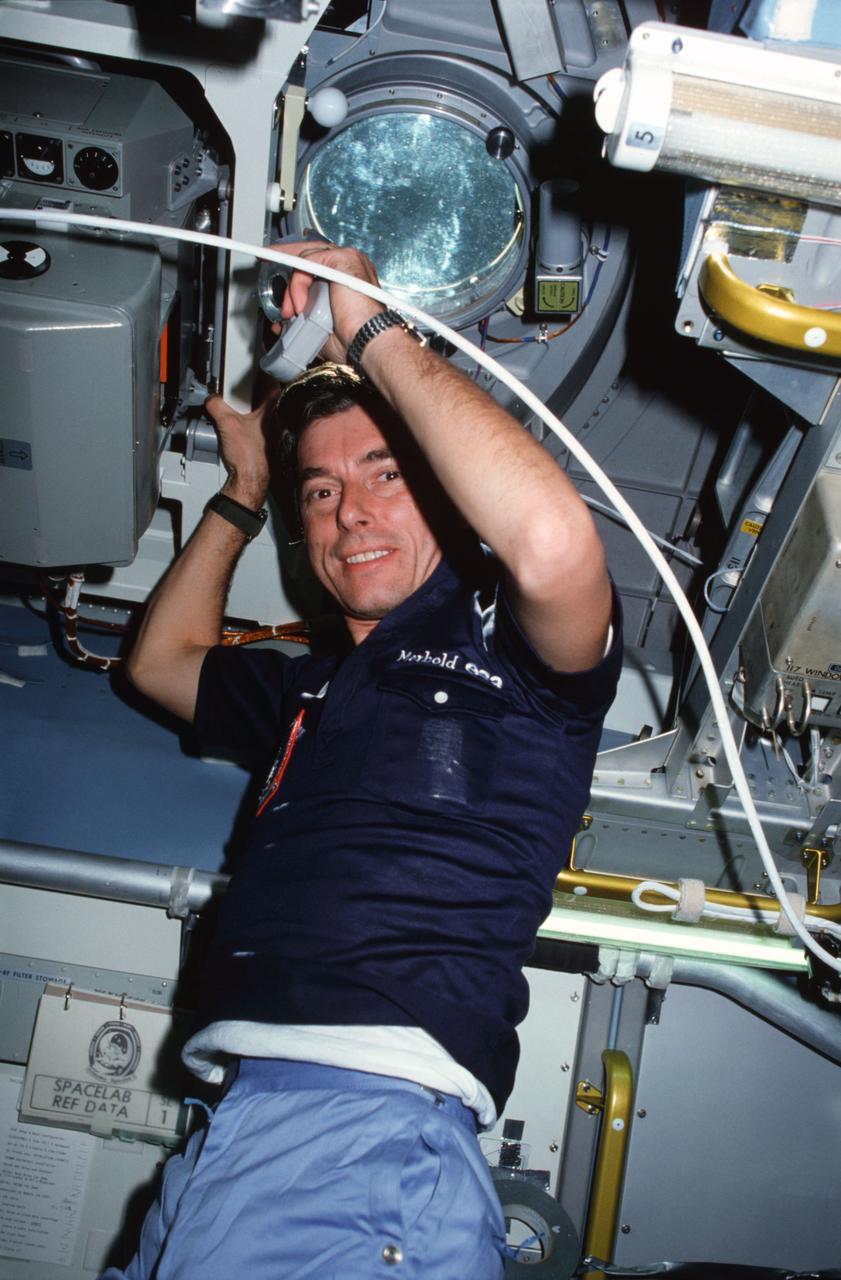
STS009-04-116 (28 Nov 1983) --- Payload Specialist Ulf Merbold shown working in the Spacelab 1 module onboard the Space Shuttle Columbia.
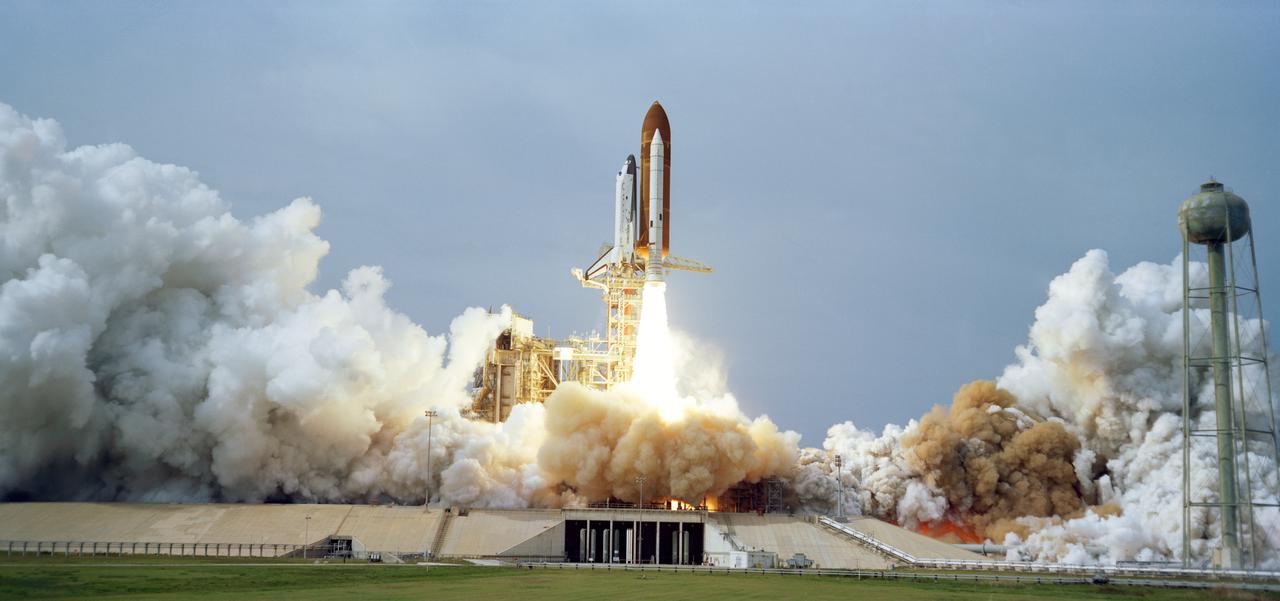
S83-44997 (28 Nov 1983) --- The Columbia lifts off once again from launch pad 39A at the Kennedy Space Center to begin a busy nine days in space for six crewmembers. Official launch time was 11:00:00:84 a.m. (EST). Onboard the spacecraft are Astronauts John W. Young, Brewster Shaw, Jr., Dr. Owen K. Garriott, Dr. Robert A. R. Parker; the European Space Agency?s Dr. Ulf Merbold; and Dr. Byron K. Lichtenberg, biomedical engineer with Massachusetts Institute of Technology.
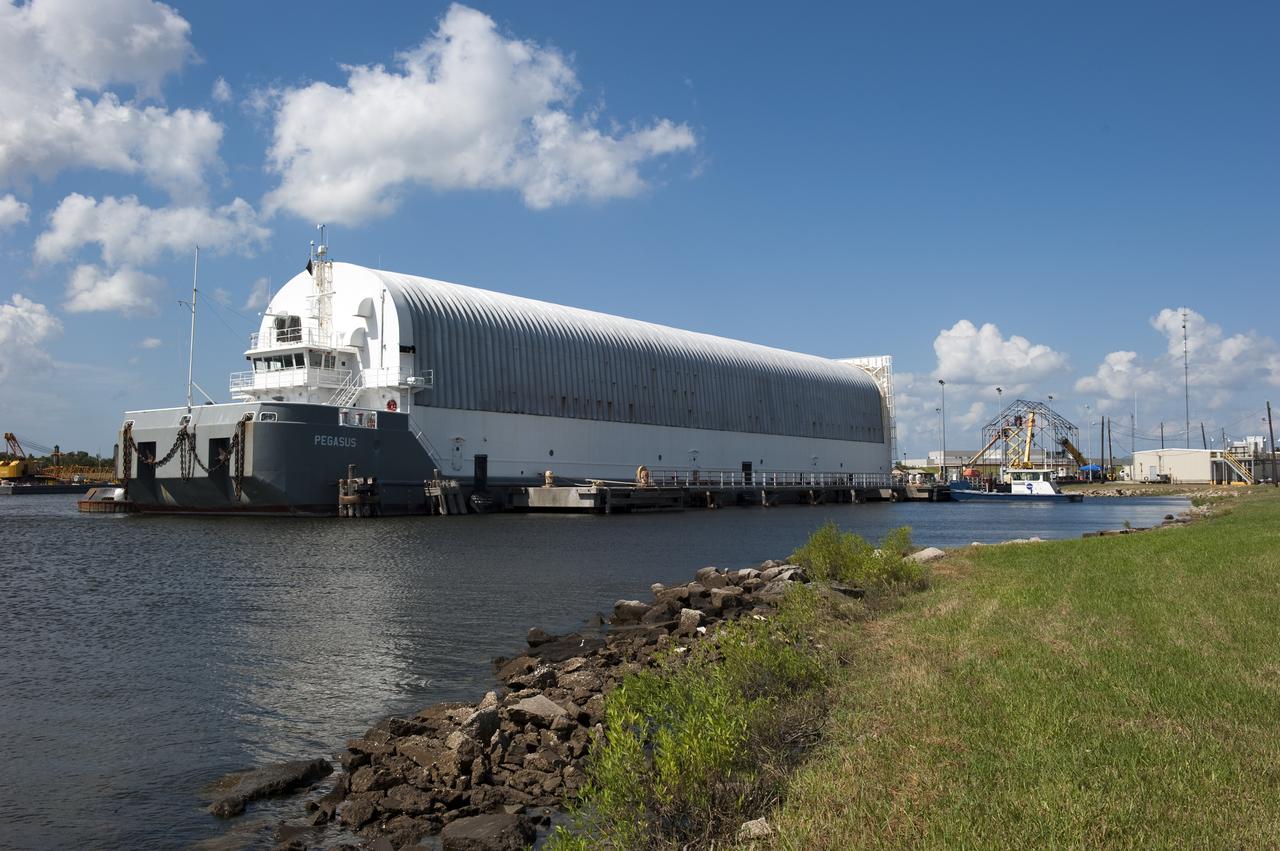
STS-335 LAUNCH ON NEED - ET-122 DEPARTS MICHOUD - ENROUTE TO KSC - 9-20-10 THRU 9-26-10
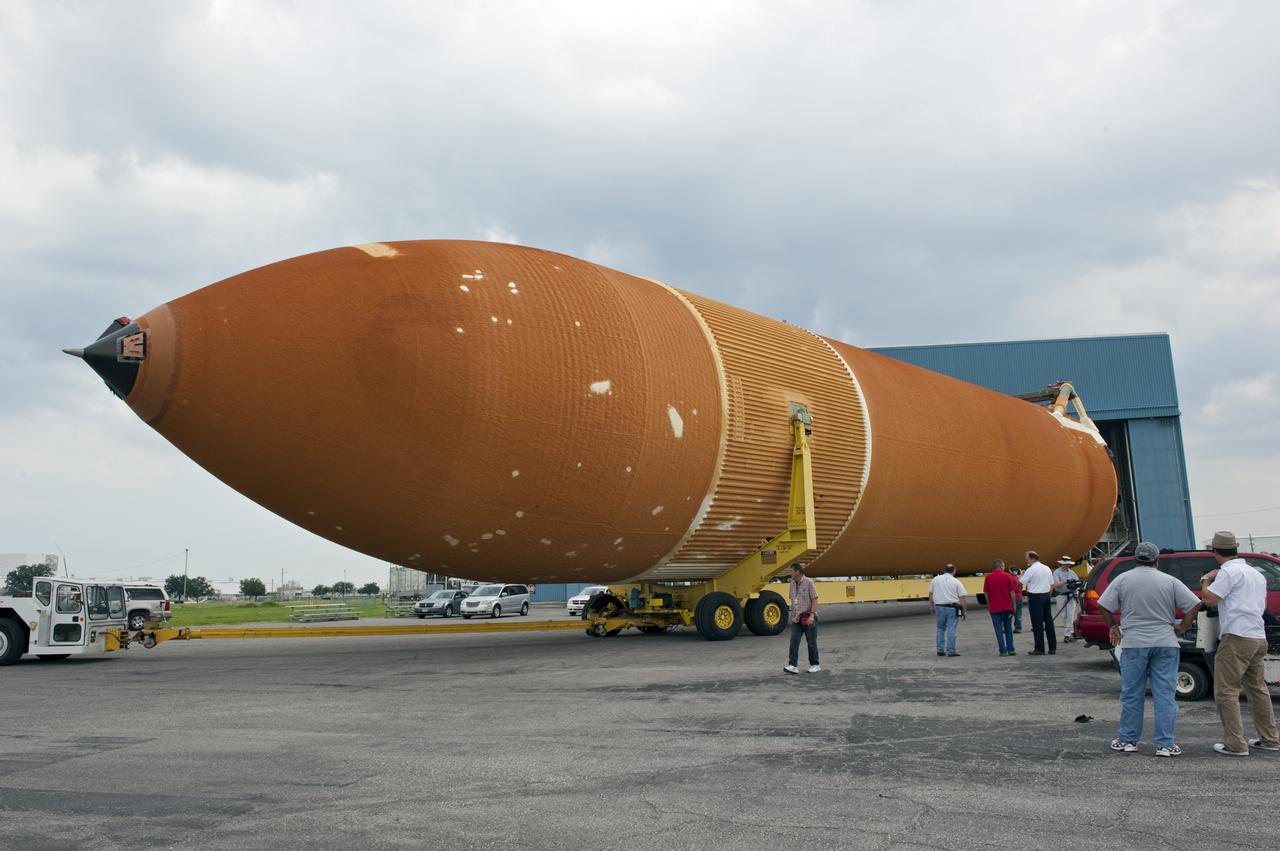
STS-335 LAUNCH ON NEED - ET-122 DEPARTS MICHOUD - ENROUTE TO KSC - 9-20-10 THRU 9-26-10
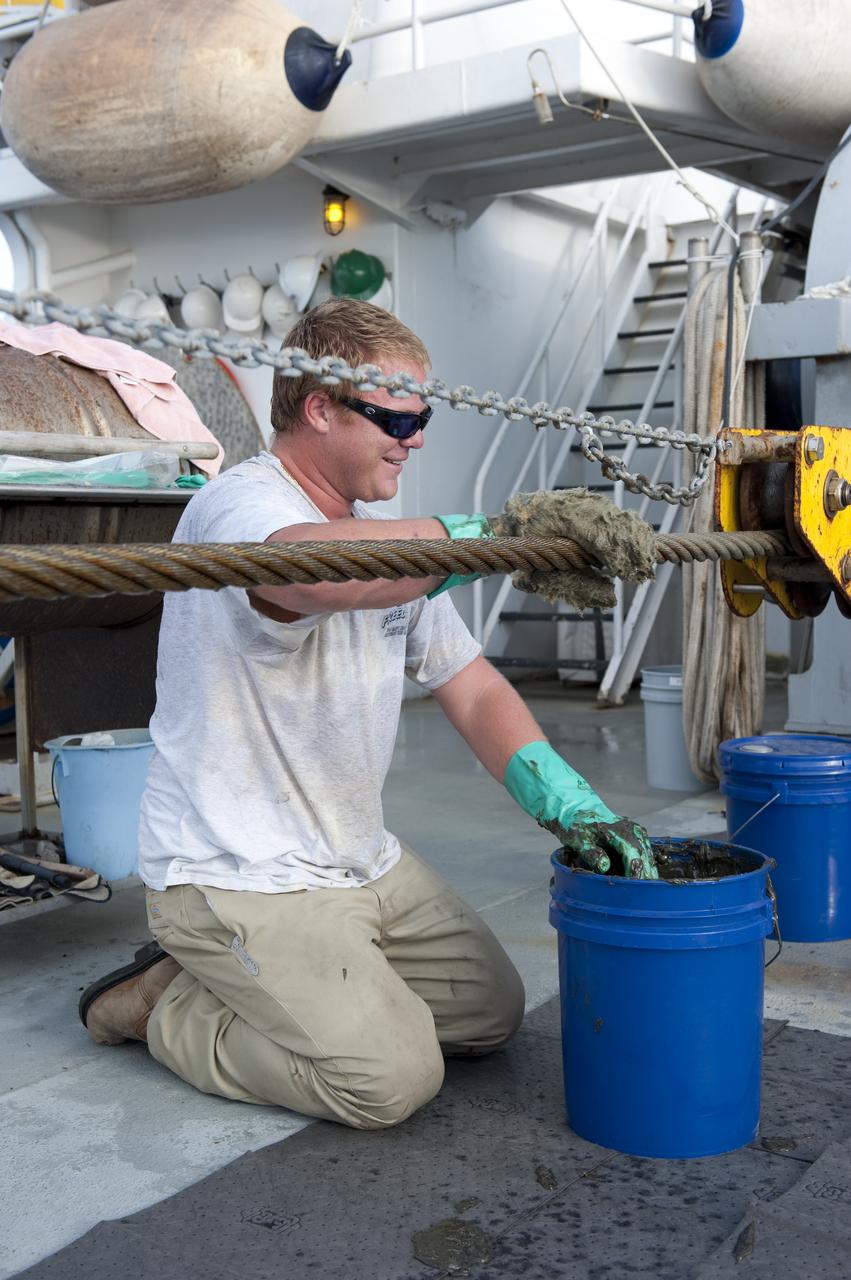
STS-335 LAUNCH ON NEED - ET-122 DEPARTS MICHOUD - ENROUTE TO KSC - 9-20-10 THRU 9-26-10
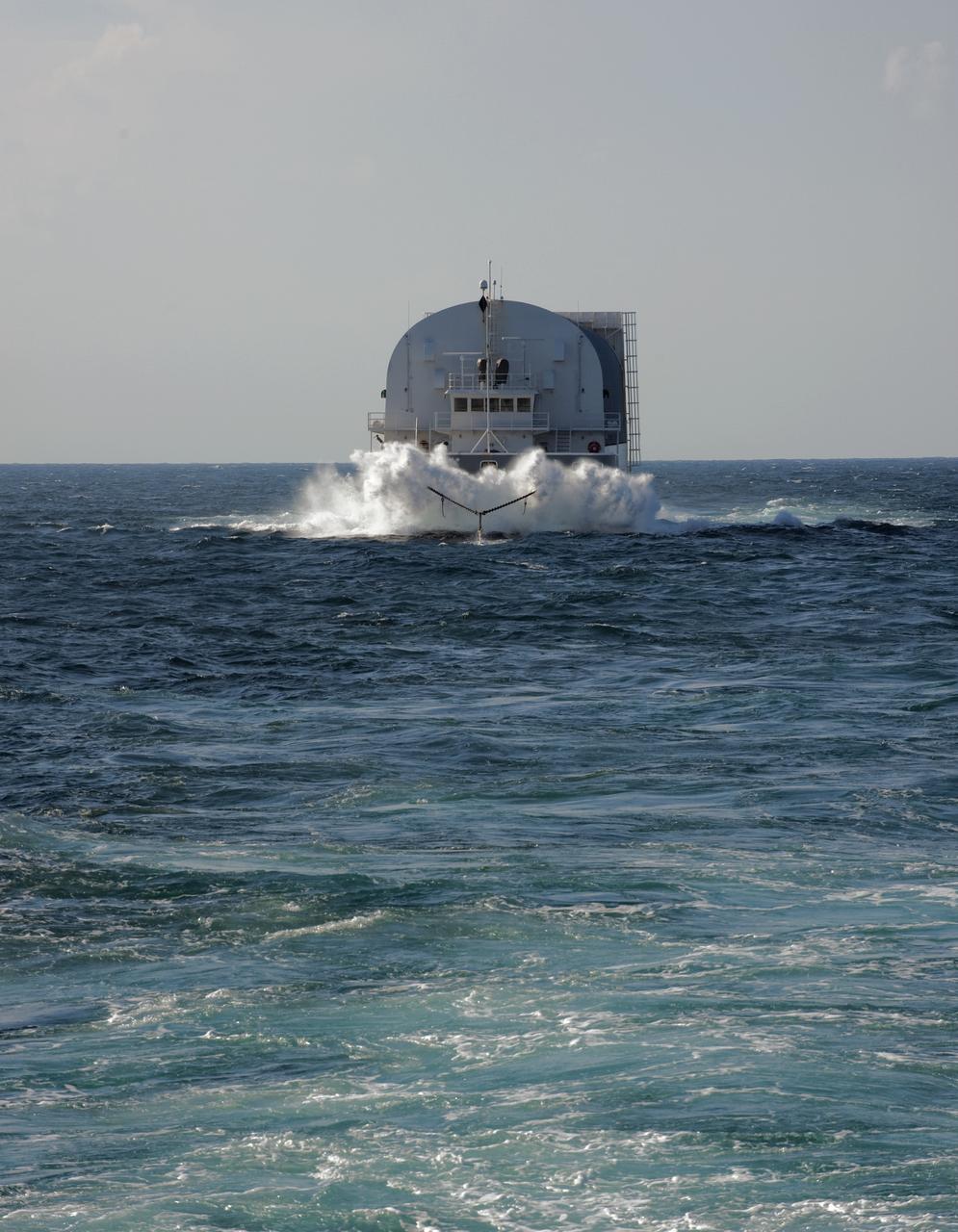
STS-335 LAUNCH ON NEED - ET-122 DEPARTS MICHOUD - ENROUTE TO KSC - 9-20-10 THRU 9-26-10
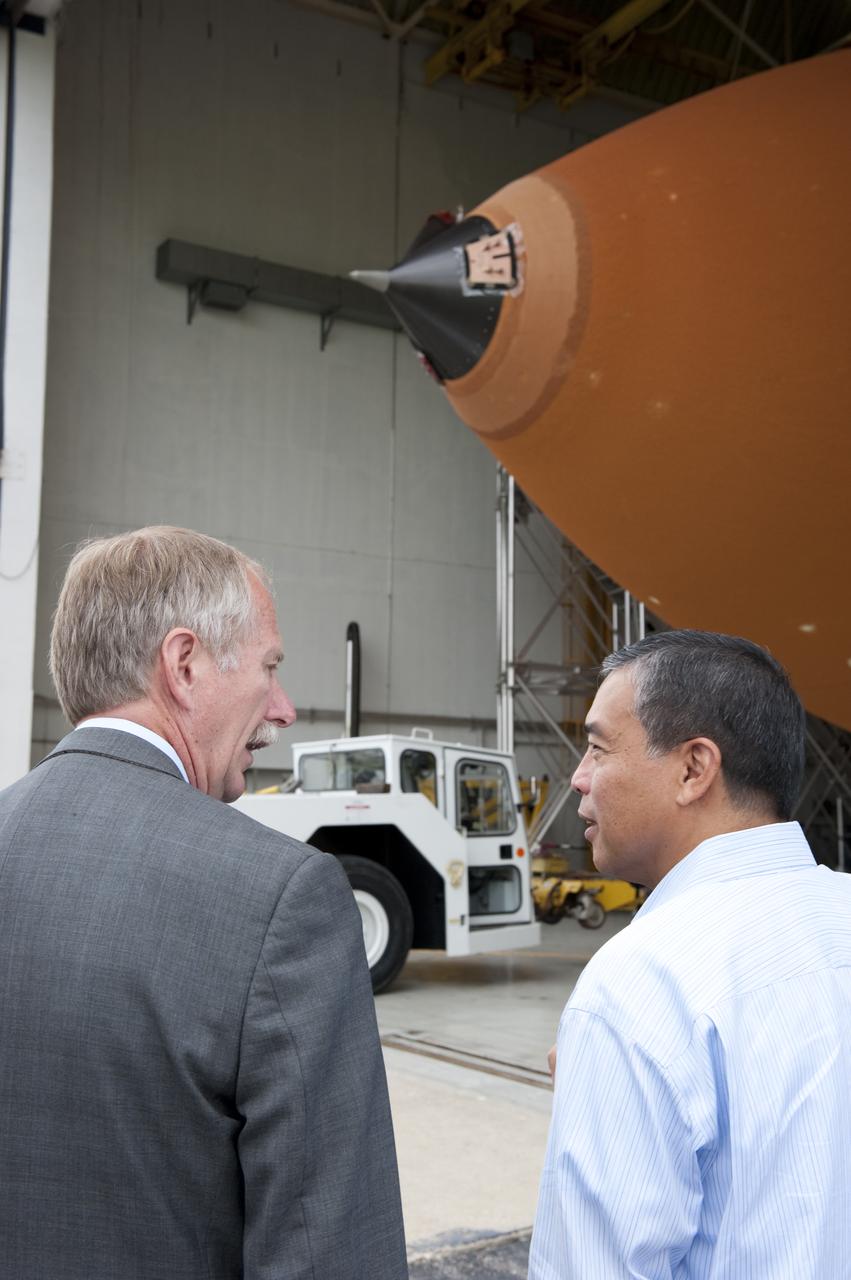
STS-335 LAUNCH ON NEED - ET-122 DEPARTS MICHOUD - ENROUTE TO KSC - 9-20-10 THRU 9-26-10
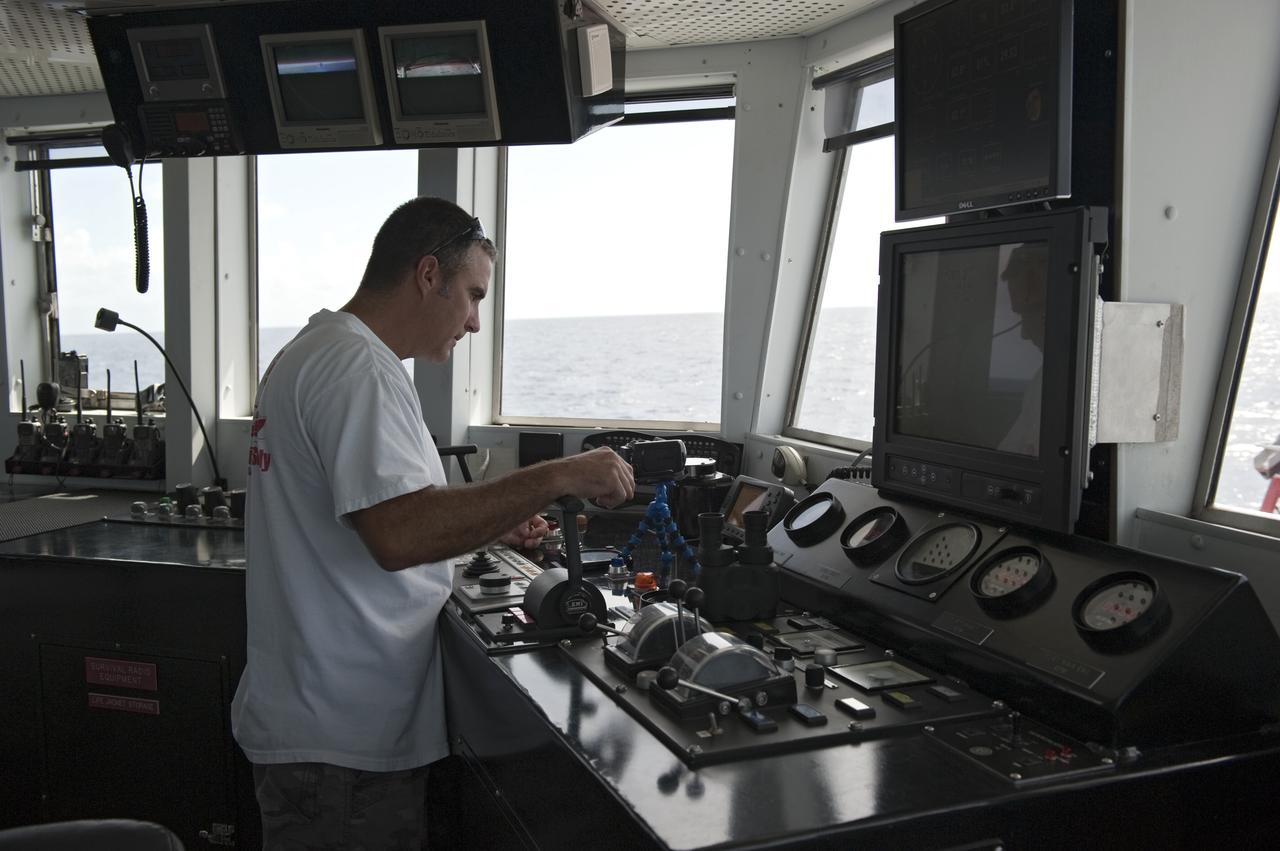
STS-335 LAUNCH ON NEED - ET-122 DEPARTS MICHOUD - ENROUTE TO KSC - 9-20-10 THRU 9-26-10
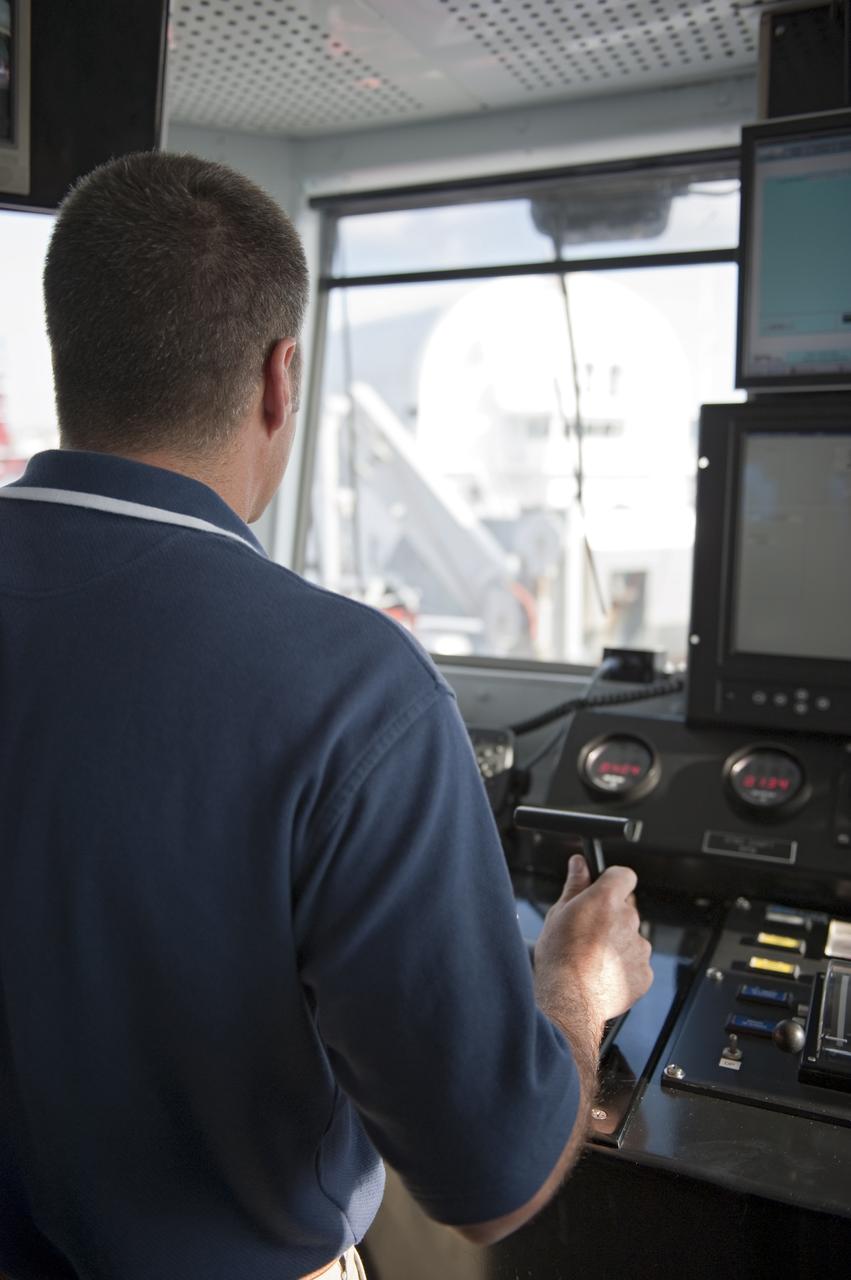
STS-335 LAUNCH ON NEED - ET-122 DEPARTS MICHOUD - ENROUTE TO KSC - 9-20-10 THRU 9-26-10
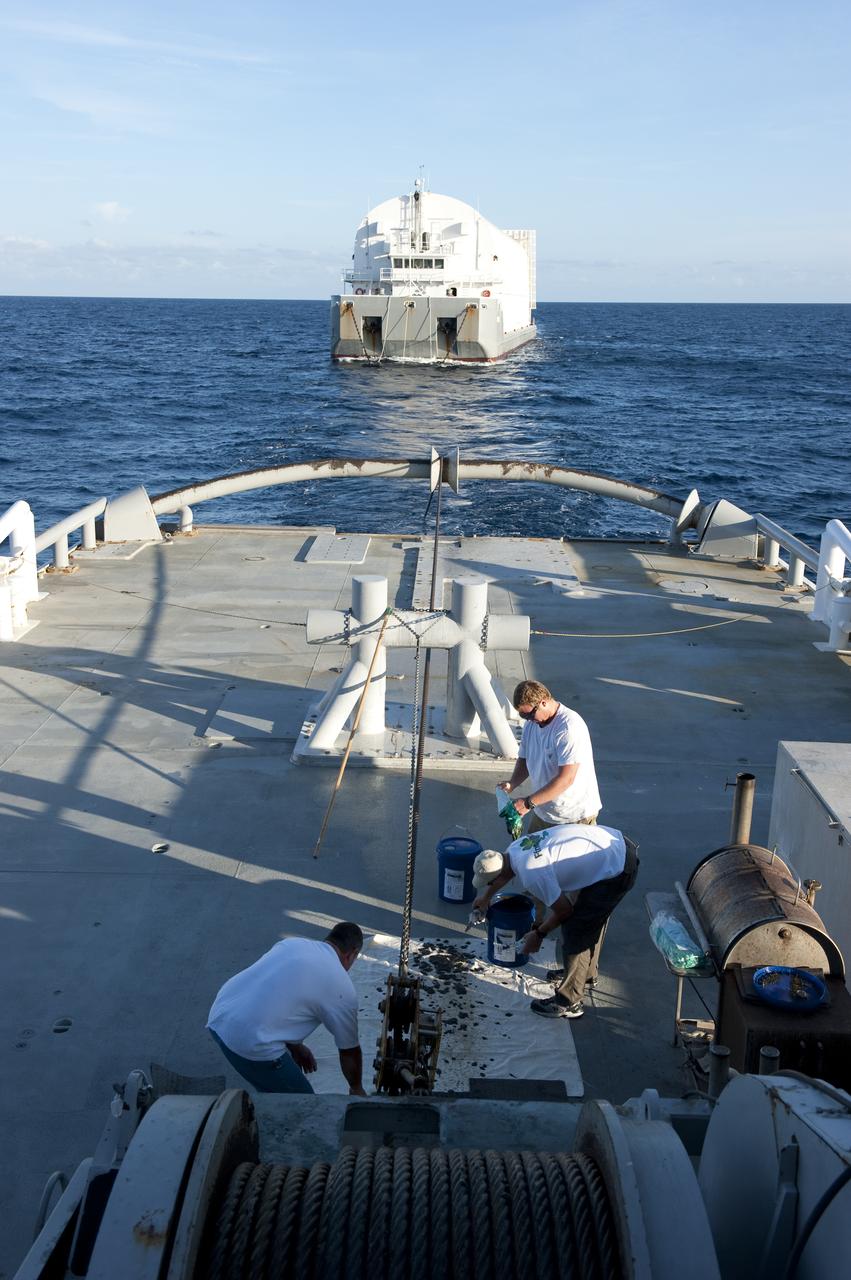
STS-335 LAUNCH ON NEED - ET-122 DEPARTS MICHOUD - ENROUTE TO KSC - 9-20-10 THRU 9-26-10
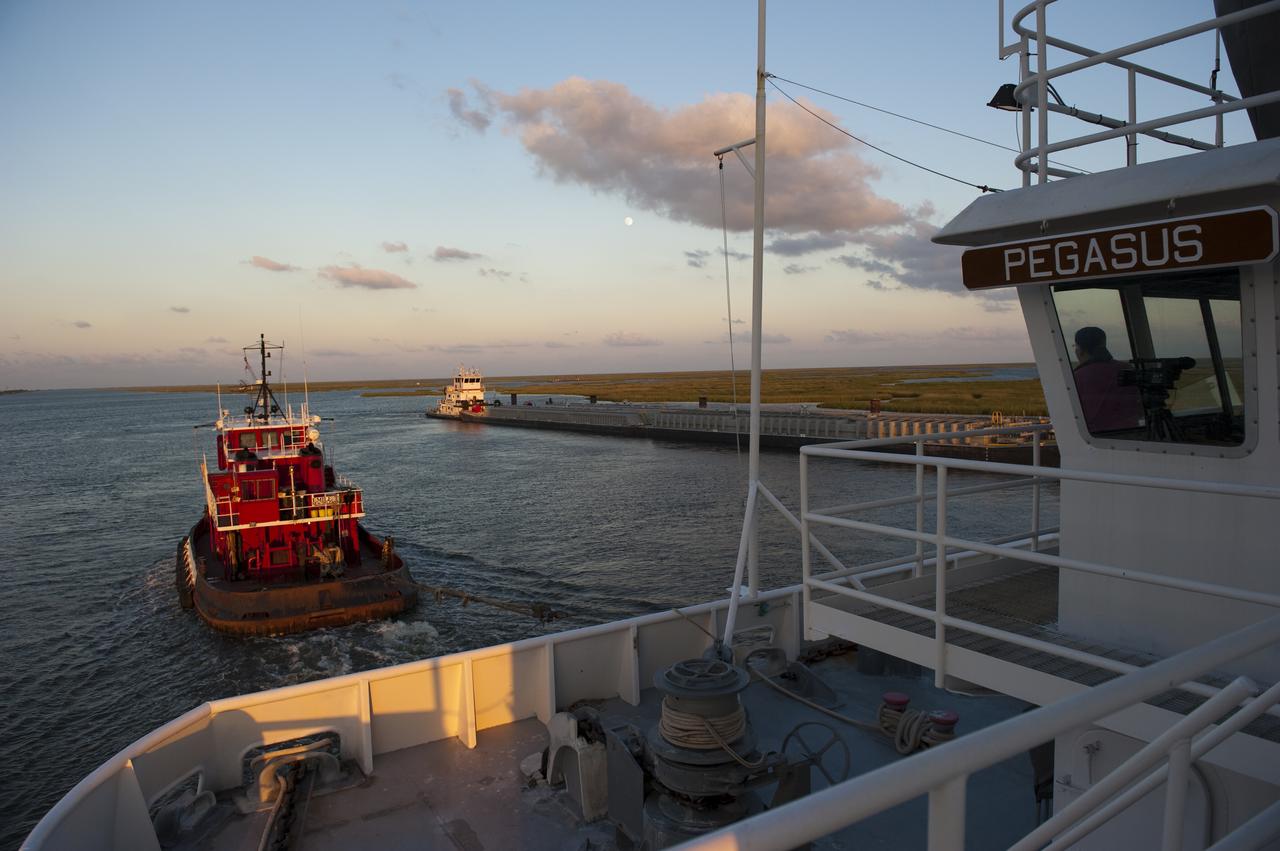
STS-335 LAUNCH ON NEED - ET-122 DEPARTS MICHOUD - ENROUTE TO KSC - 9-20-10 THRU 9-26-10
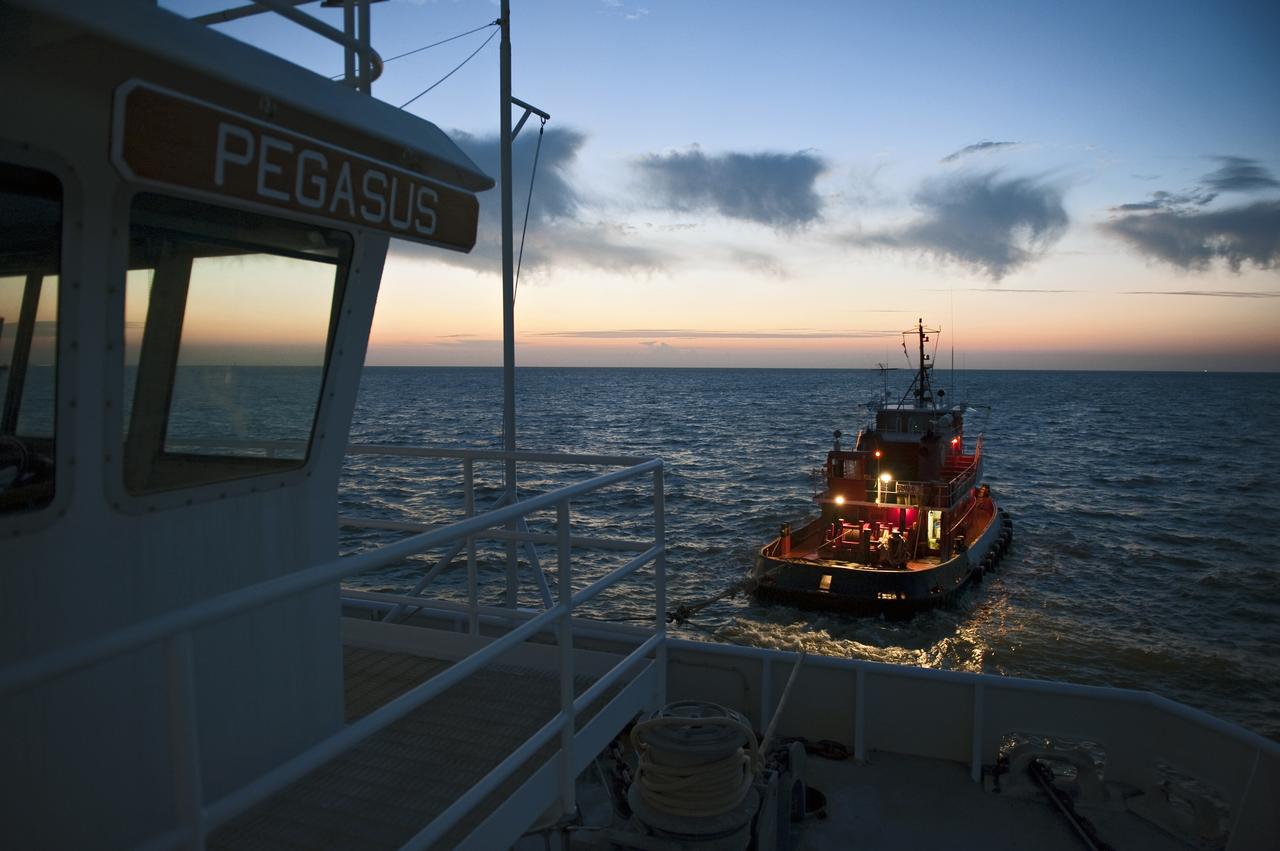
STS-335 LAUNCH ON NEED - ET-122 DEPARTS MICHOUD - ENROUTE TO KSC - 9-20-10 THRU 9-26-10
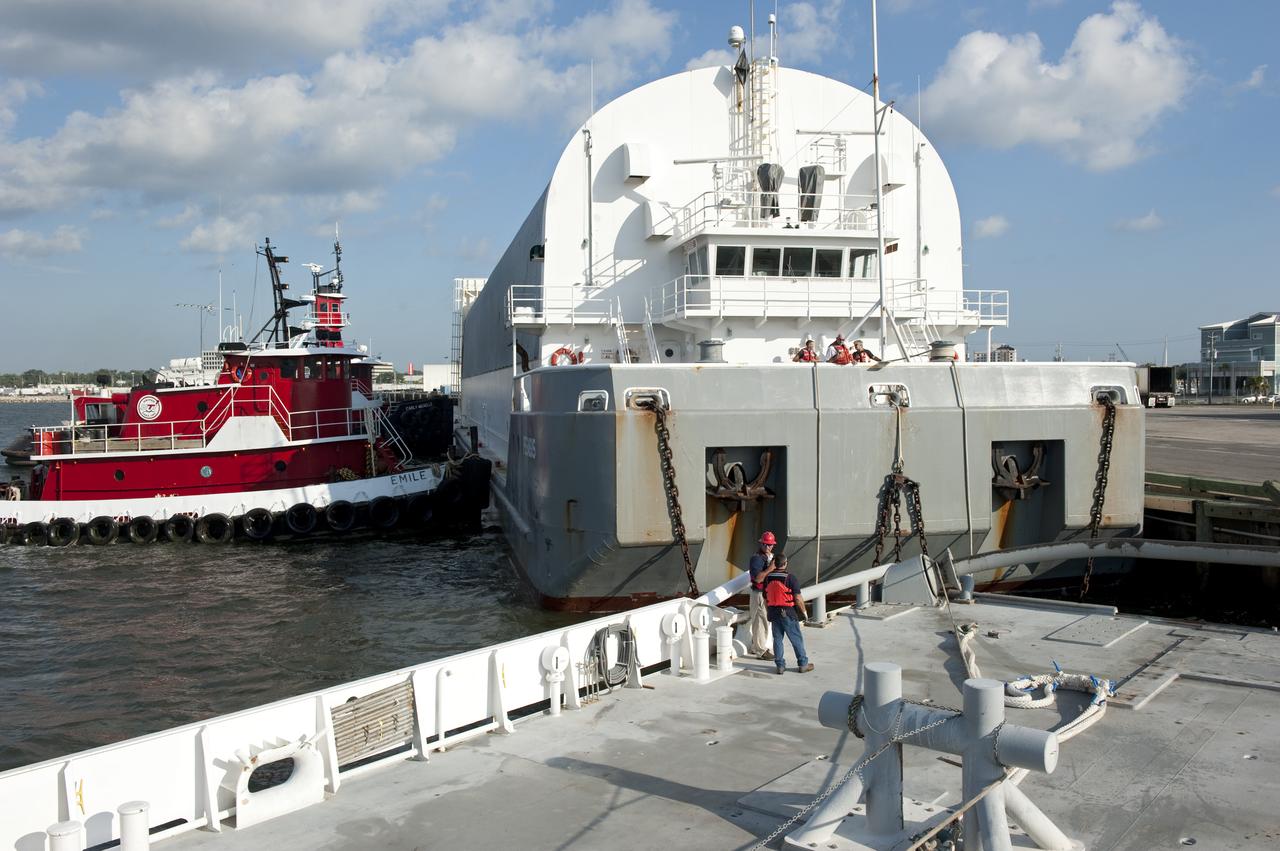
STS-335 LAUNCH ON NEED - ET-122 DEPARTS MICHOUD - ENROUTE TO KSC - 9-20-10 THRU 9-26-10
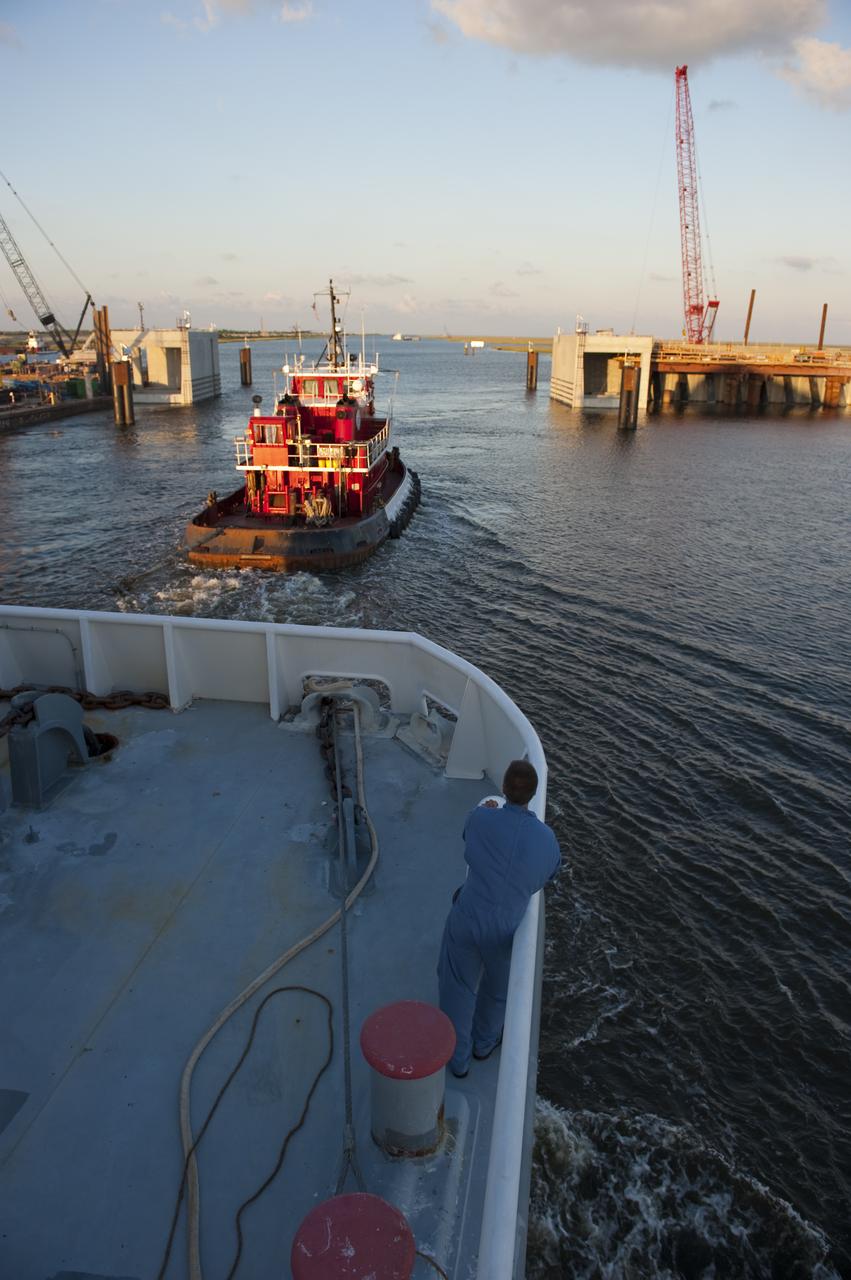
STS-335 LAUNCH ON NEED - ET-122 DEPARTS MICHOUD - ENROUTE TO KSC - 9-20-10 THRU 9-26-10
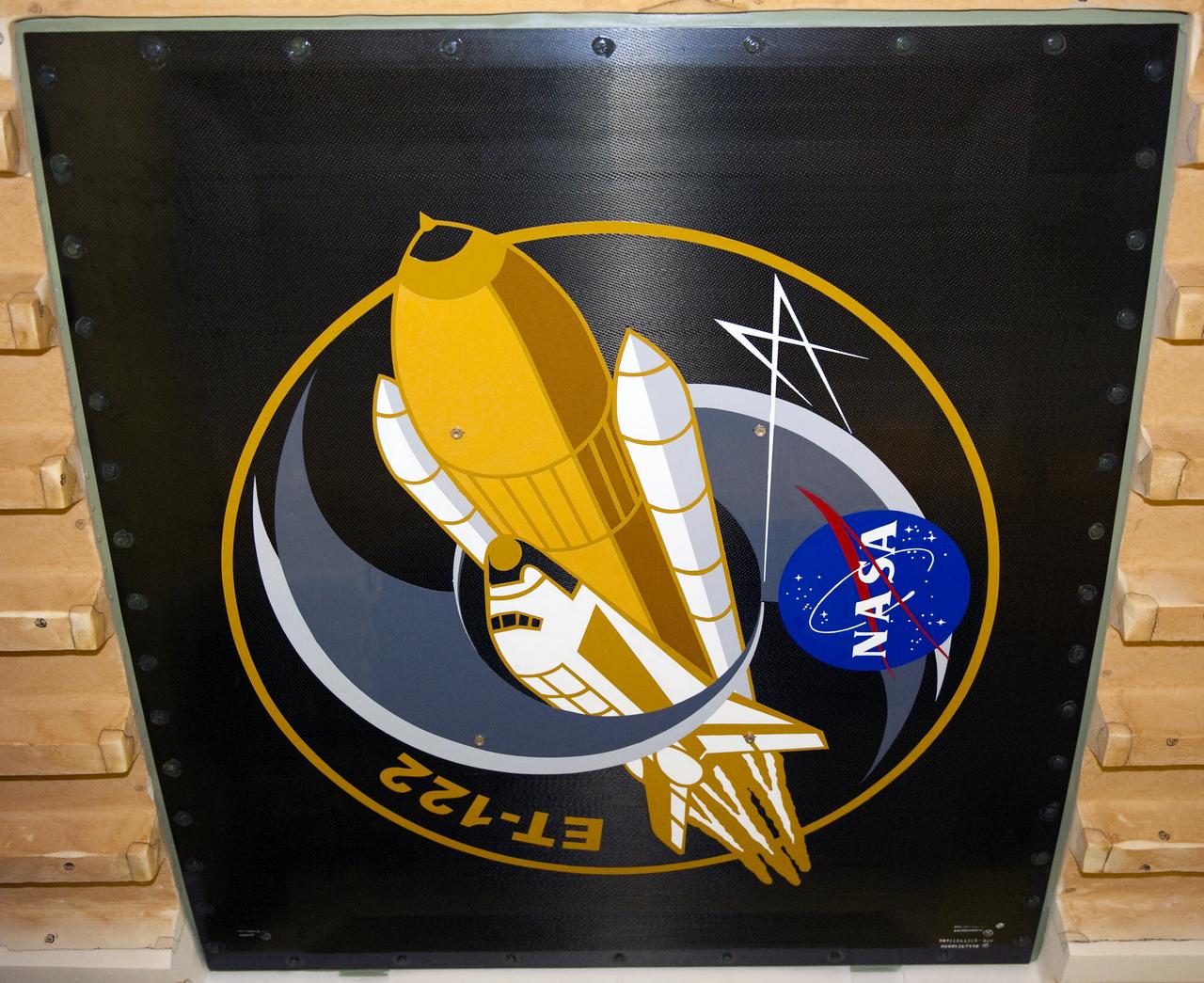
STS-335 LAUNCH ON NEED - ET-122 DEPARTS MICHOUD - ENROUTE TO KSC - 9-20-10 THRU 9-26-10
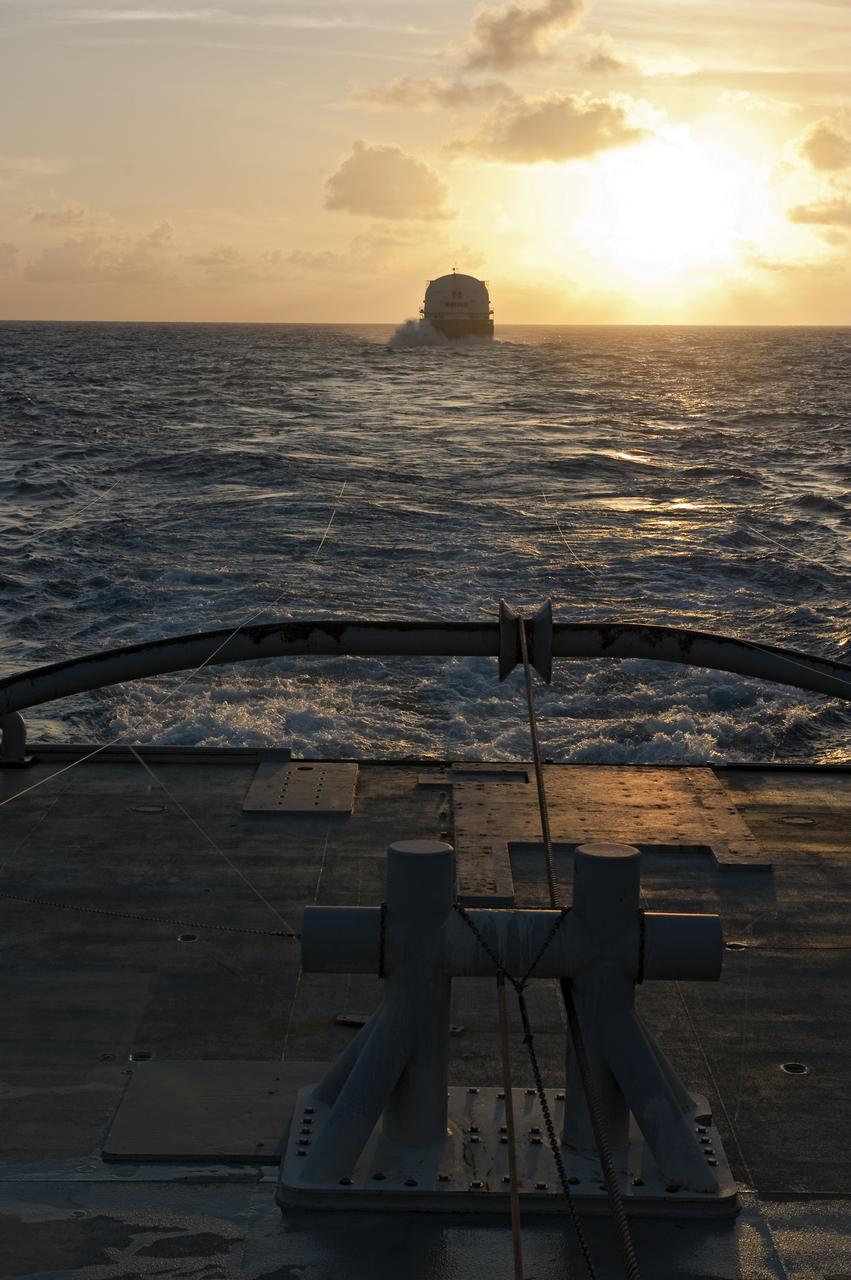
STS-335 LAUNCH ON NEED - ET-122 DEPARTS MICHOUD - ENROUTE TO KSC - 9-20-10 THRU 9-26-10
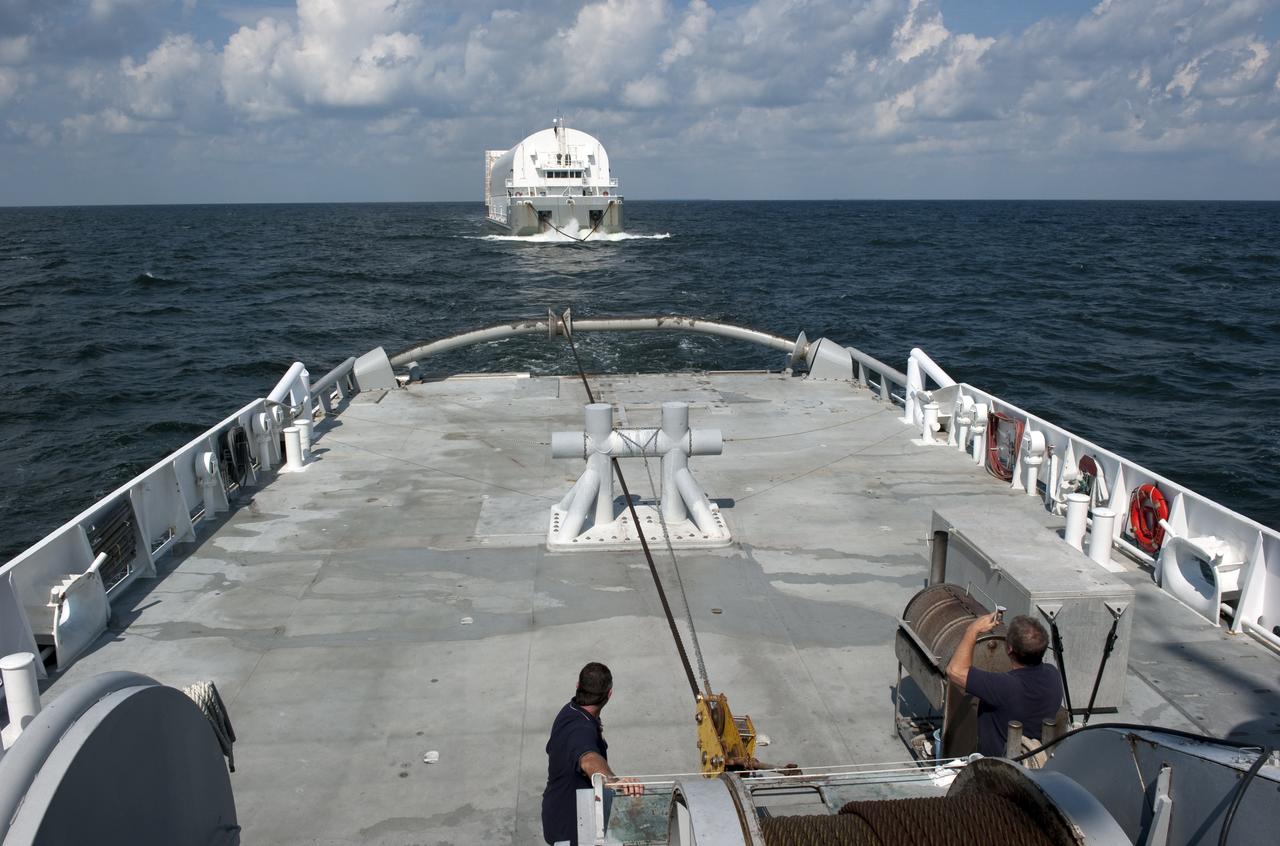
STS-335 LAUNCH ON NEED - ET-122 DEPARTS MICHOUD - ENROUTE TO KSC - 9-20-10 THRU 9-26-10
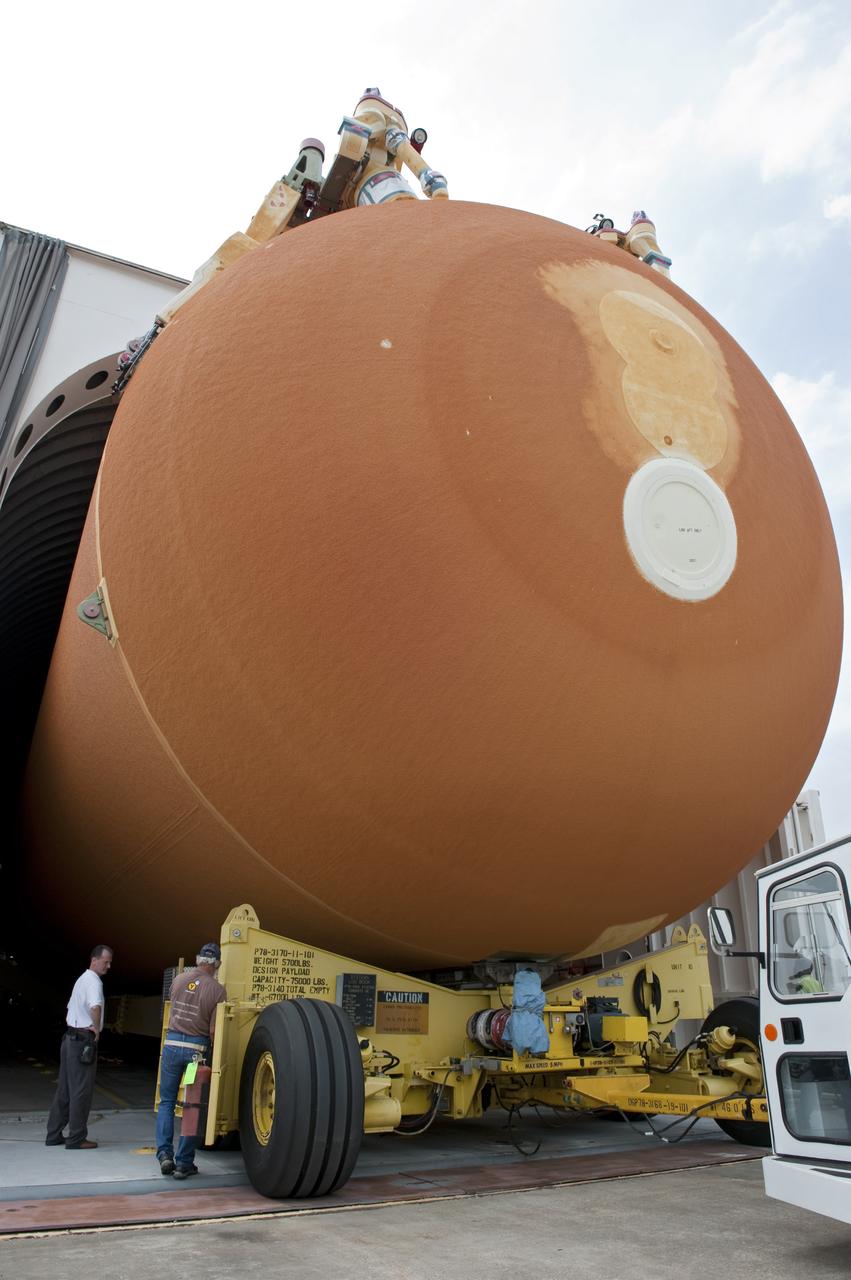
STS-335 LAUNCH ON NEED - ET-122 DEPARTS MICHOUD - ENROUTE TO KSC - 9-20-10 THRU 9-26-10
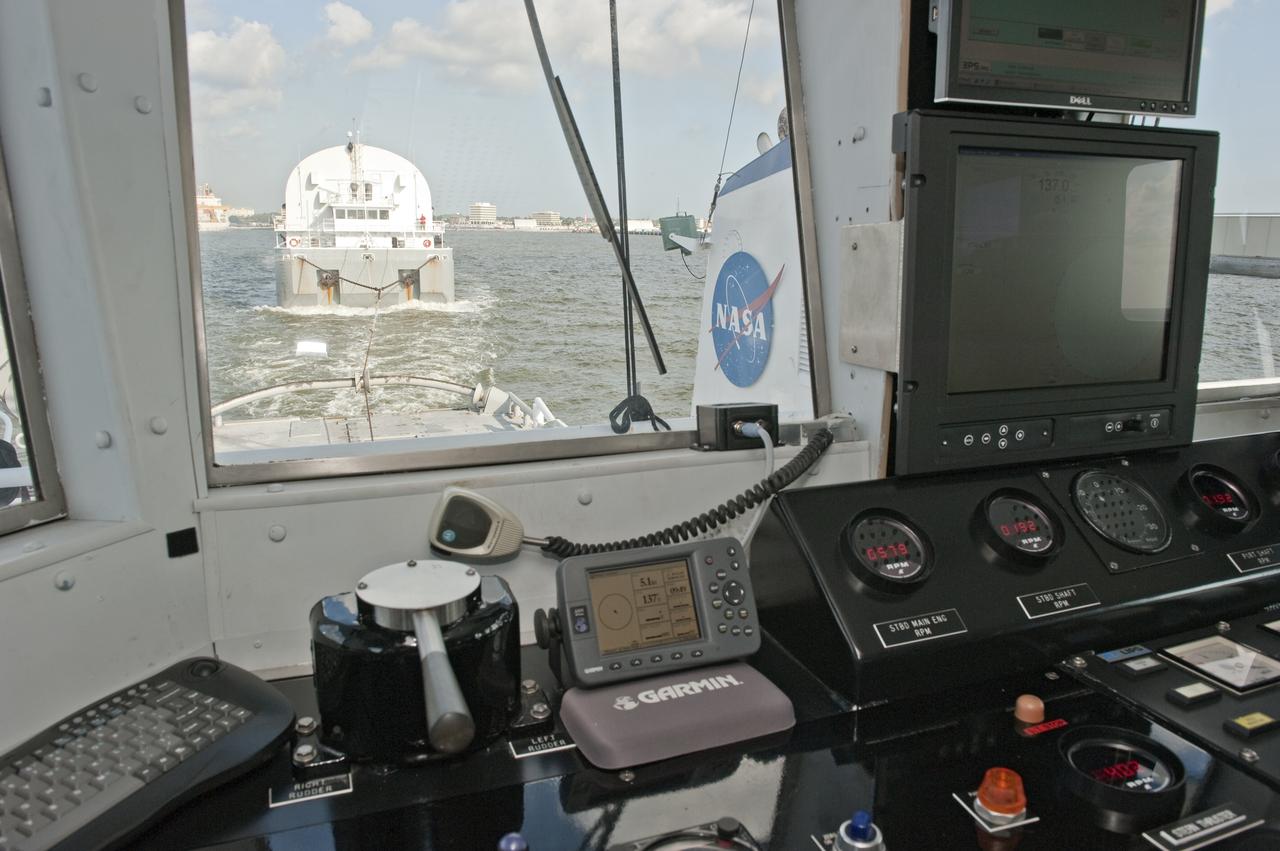
STS-335 LAUNCH ON NEED - ET-122 DEPARTS MICHOUD - ENROUTE TO KSC - 9-20-10 THRU 9-26-10
STS-335 LAUNCH ON NEED - ET-122 DEPARTS MICHOUD - ENROUTE TO KSC - 9-20-10 THRU 9-26-10
STS-335 LAUNCH ON NEED - ET-122 DEPARTS MICHOUD - ENROUTE TO KSC - 9-20-10 THRU 9-26-10
STS-335 LAUNCH ON NEED - ET-122 DEPARTS MICHOUD - ENROUTE TO KSC - 9-20-10 THRU 9-26-10
STS-335 LAUNCH ON NEED - ET-122 DEPARTS MICHOUD - ENROUTE TO KSC - 9-20-10 THRU 9-26-10
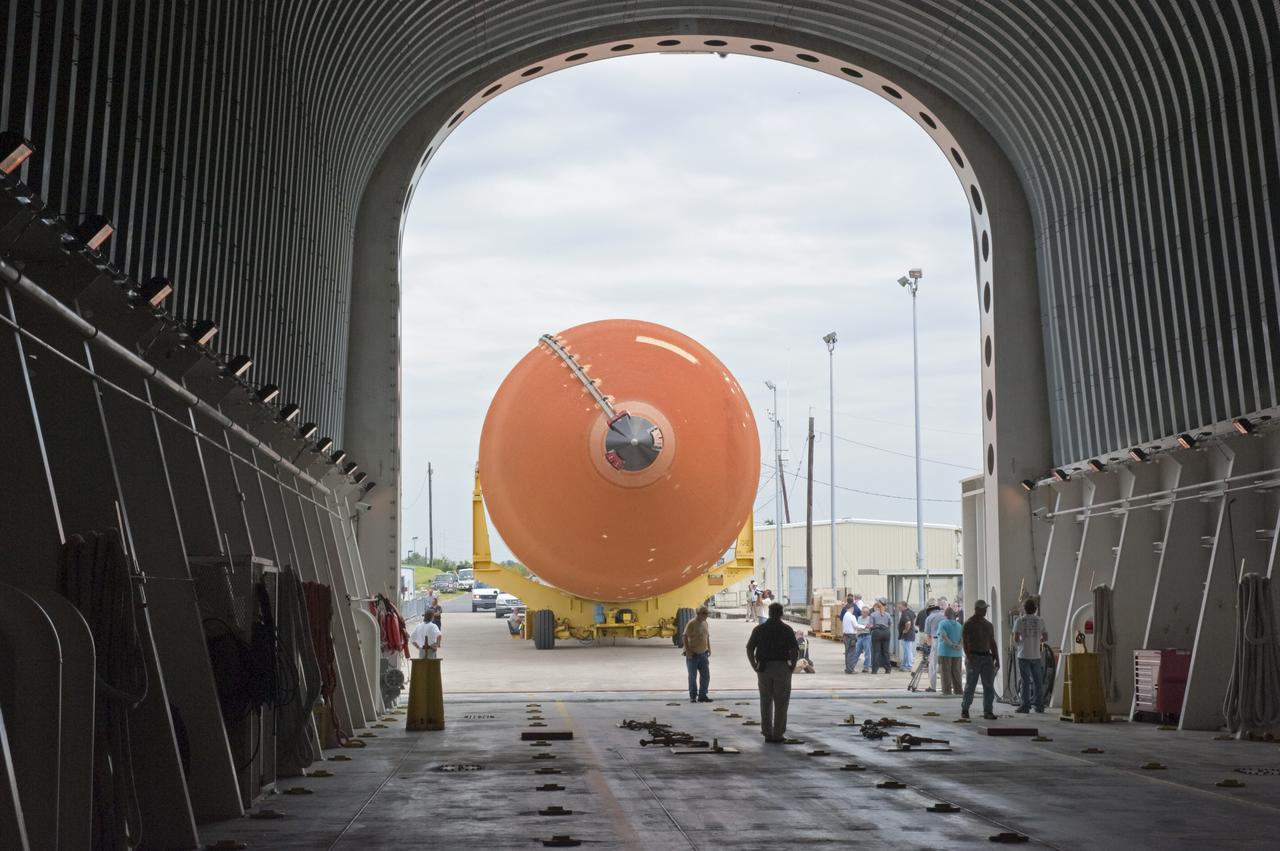
STS-335 LAUNCH ON NEED - ET-122 DEPARTS MICHOUD - ENROUTE TO KSC - 9-20-10 THRU 9-26-10
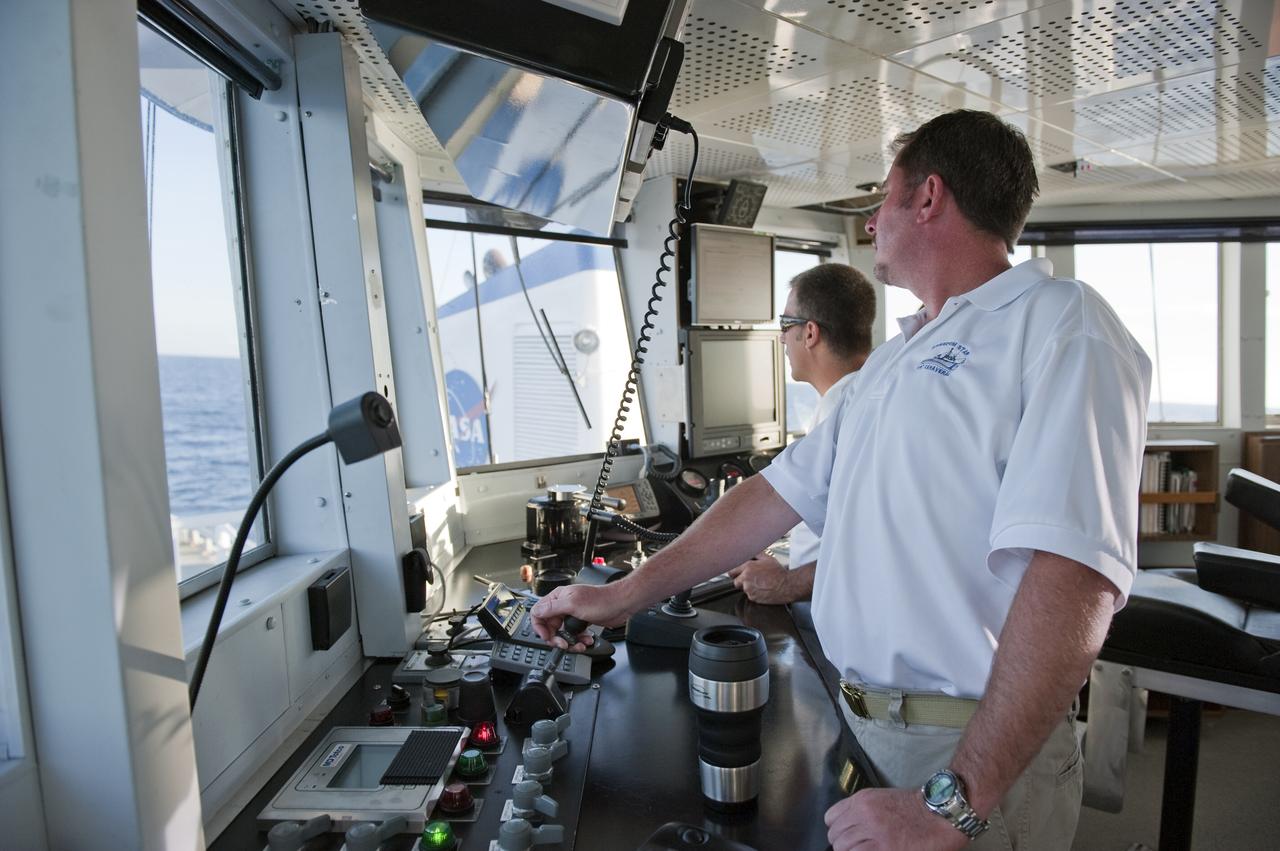
STS-335 LAUNCH ON NEED - ET-122 DEPARTS MICHOUD - ENROUTE TO KSC - 9-20-10 THRU 9-26-10
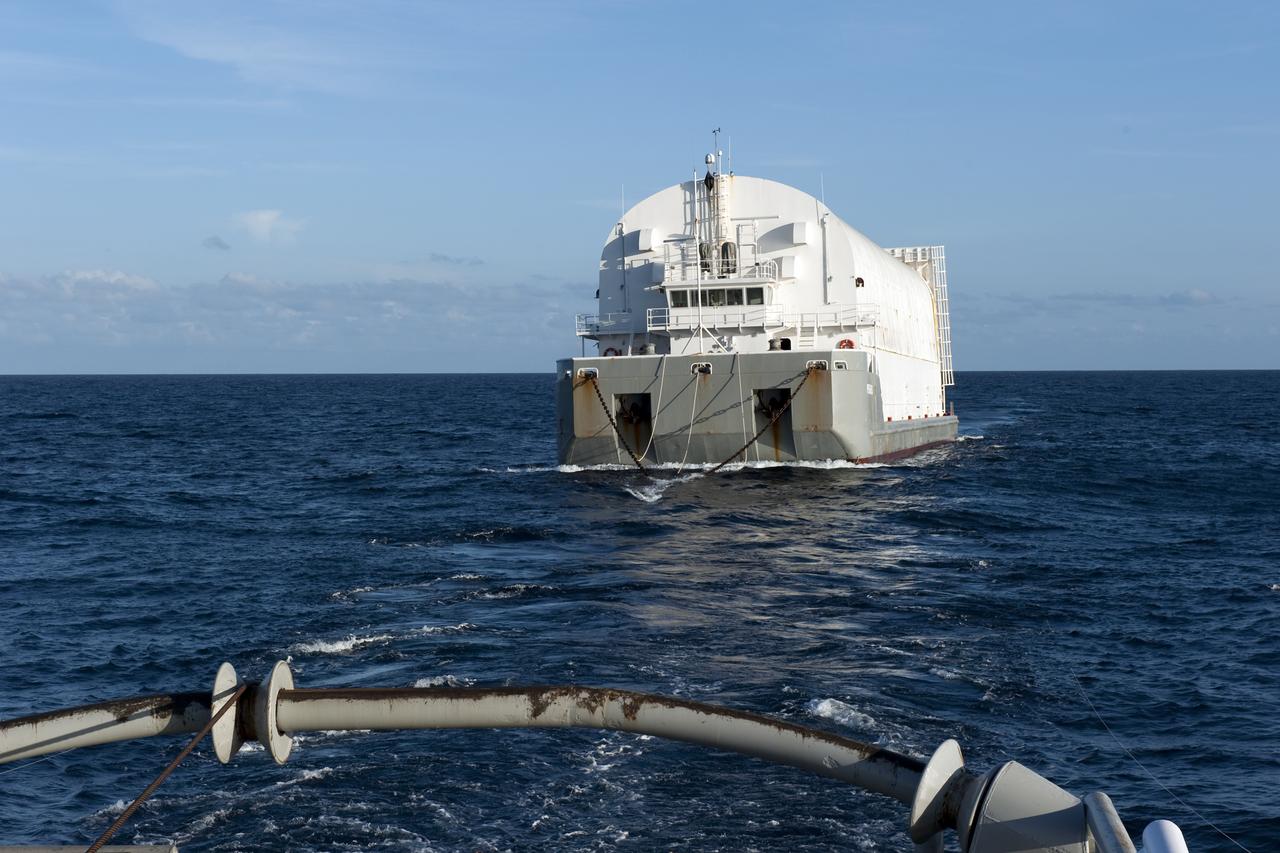
STS-335 LAUNCH ON NEED - ET-122 DEPARTS MICHOUD - ENROUTE TO KSC - 9-20-10 THRU 9-26-10
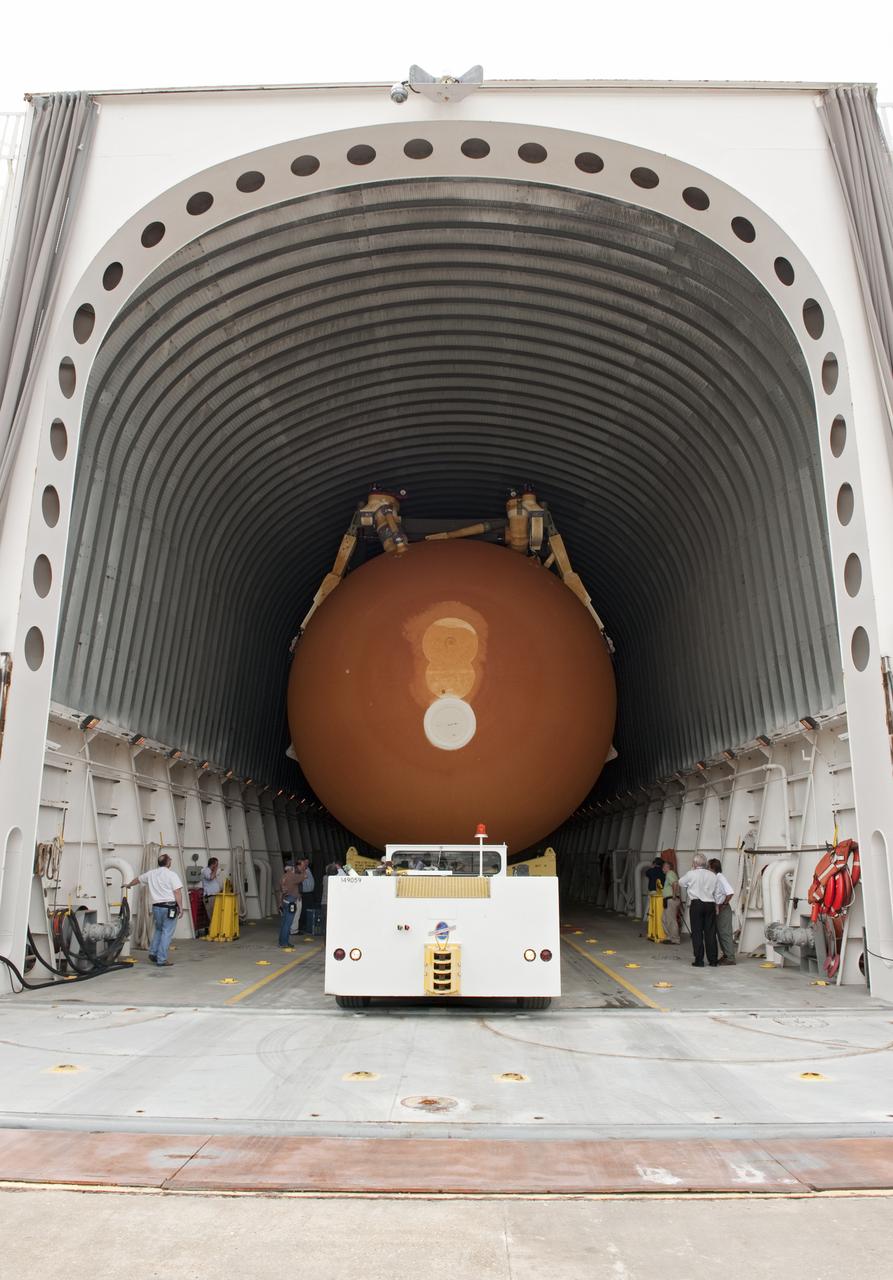
STS-335 LAUNCH ON NEED - ET-122 DEPARTS MICHOUD - ENROUTE TO KSC - 9-20-10 THRU 9-26-10
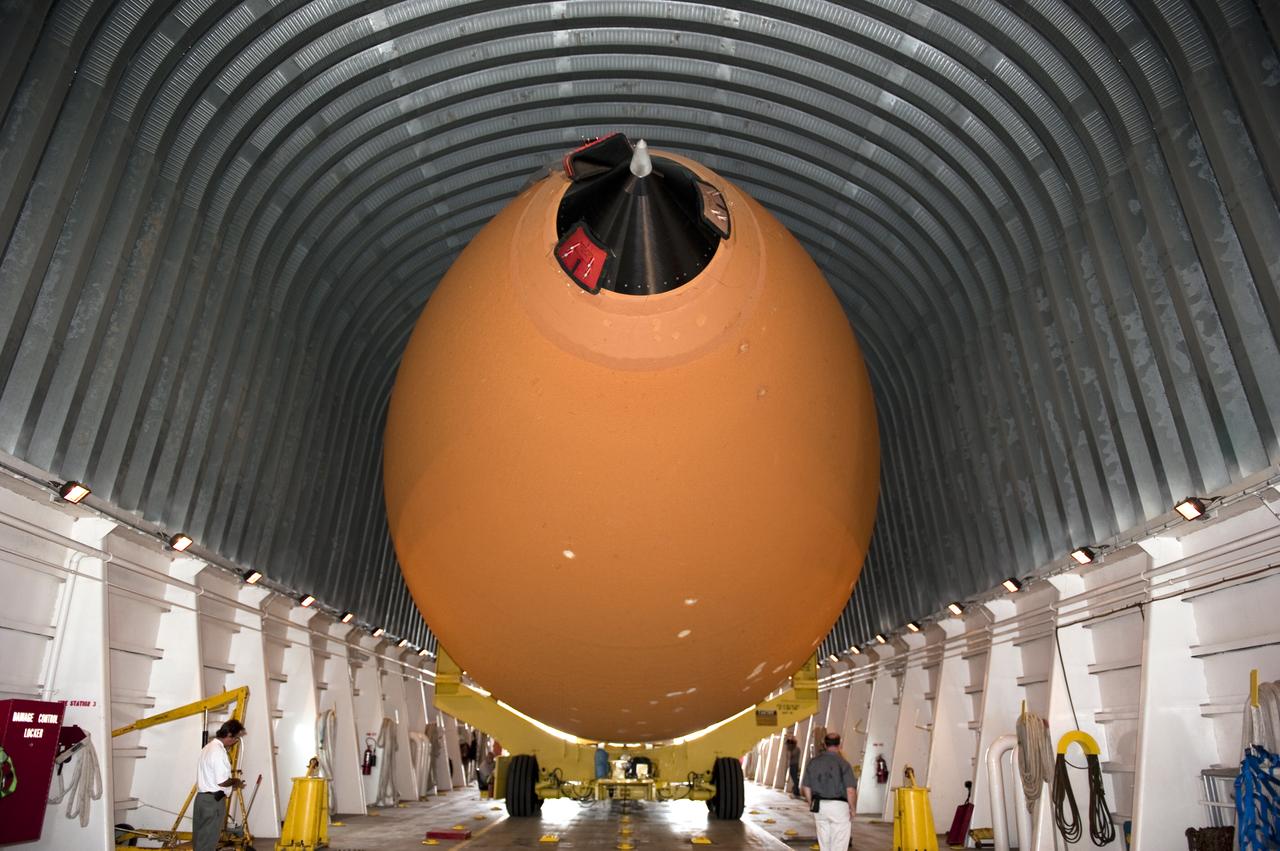
STS-335 LAUNCH ON NEED - ET-122 DEPARTS MICHOUD - ENROUTE TO KSC - 9-20-10 THRU 9-26-10
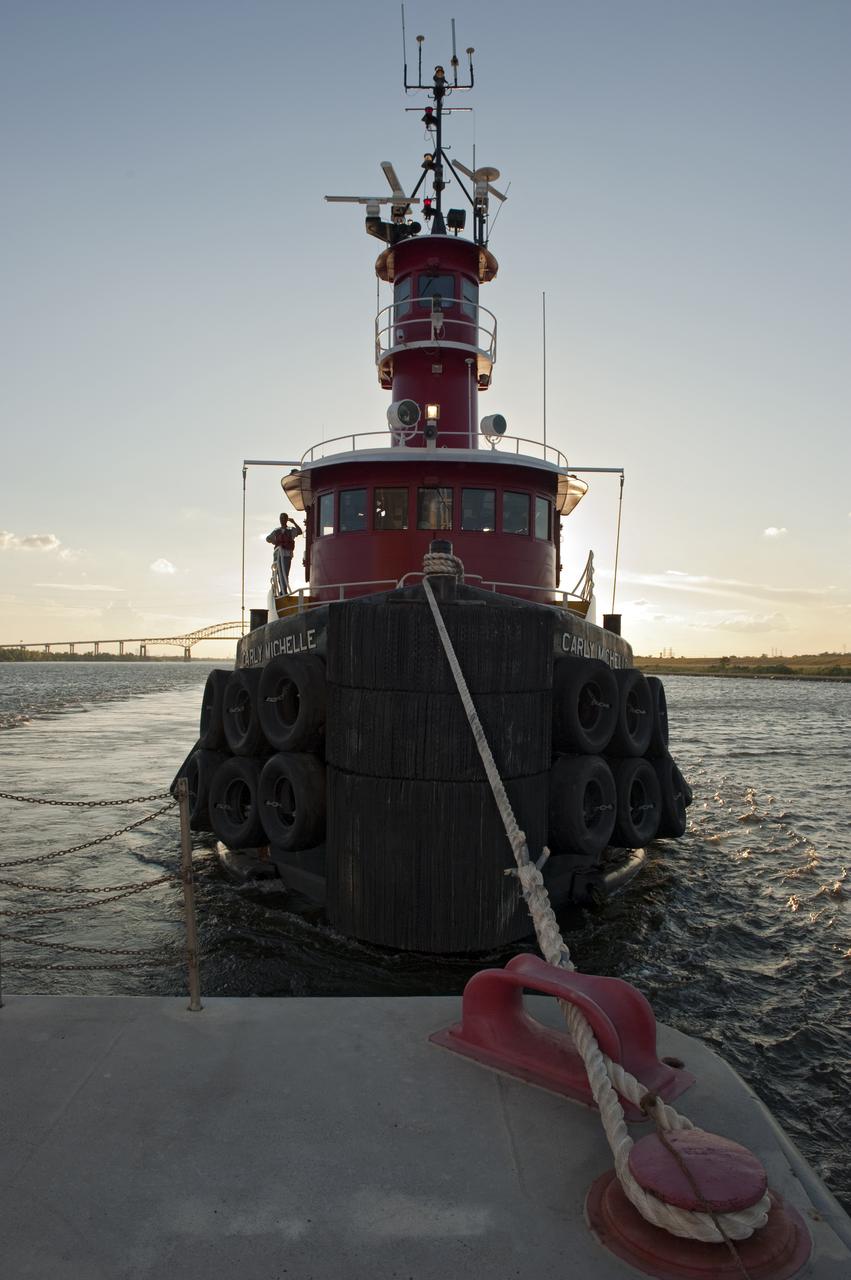
STS-335 LAUNCH ON NEED - ET-122 DEPARTS MICHOUD - ENROUTE TO KSC - 9-20-10 THRU 9-26-10
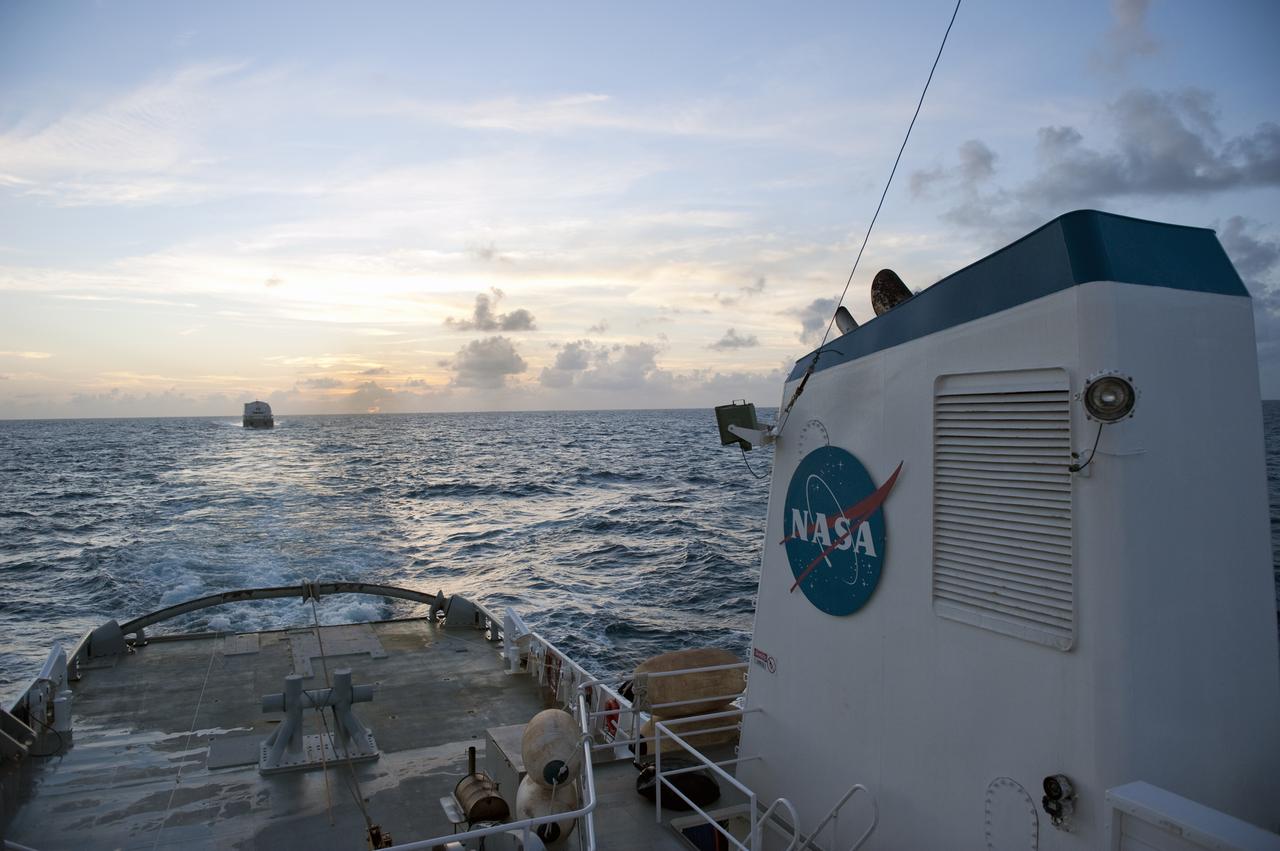
STS-335 LAUNCH ON NEED - ET-122 DEPARTS MICHOUD - ENROUTE TO KSC - 9-20-10 THRU 9-26-10
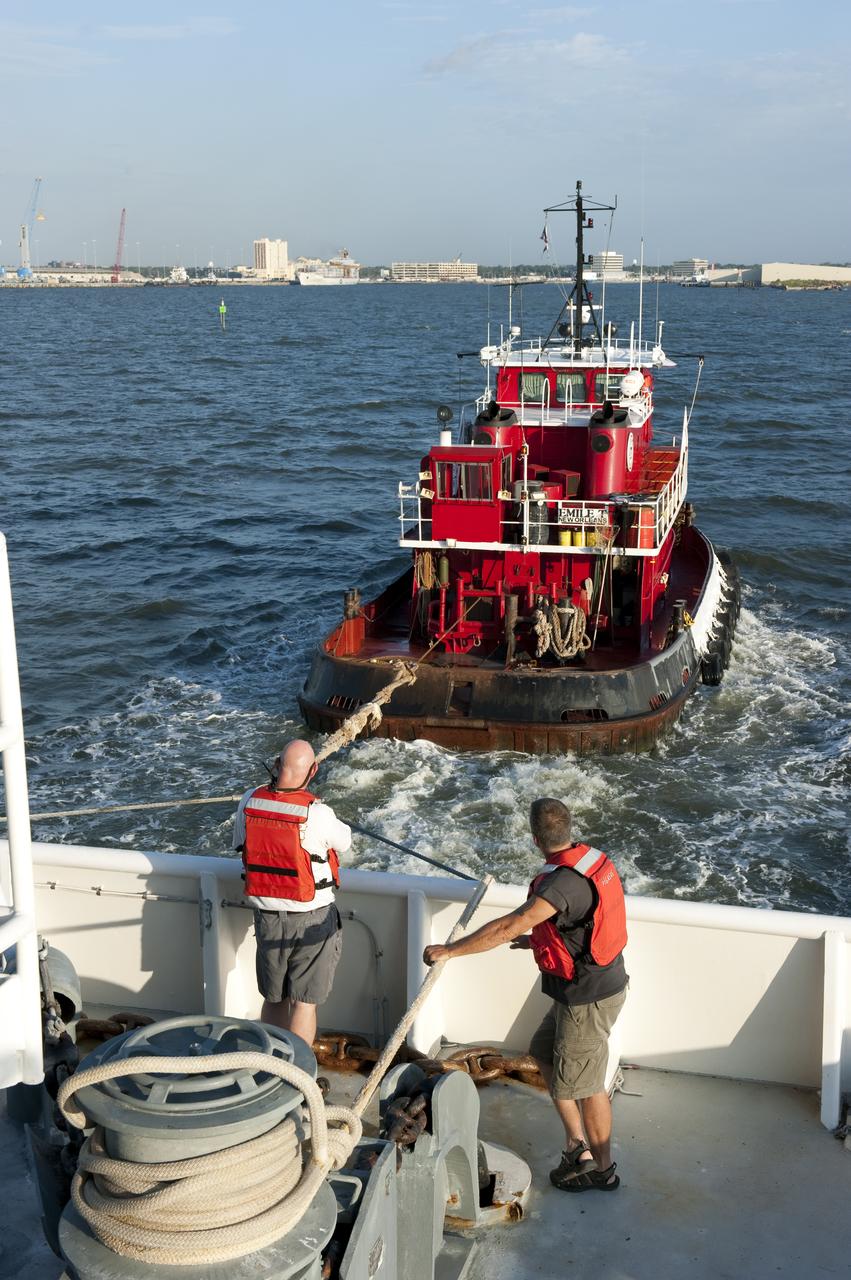
STS-335 LAUNCH ON NEED - ET-122 DEPARTS MICHOUD - ENROUTE TO KSC - 9-20-10 THRU 9-26-10
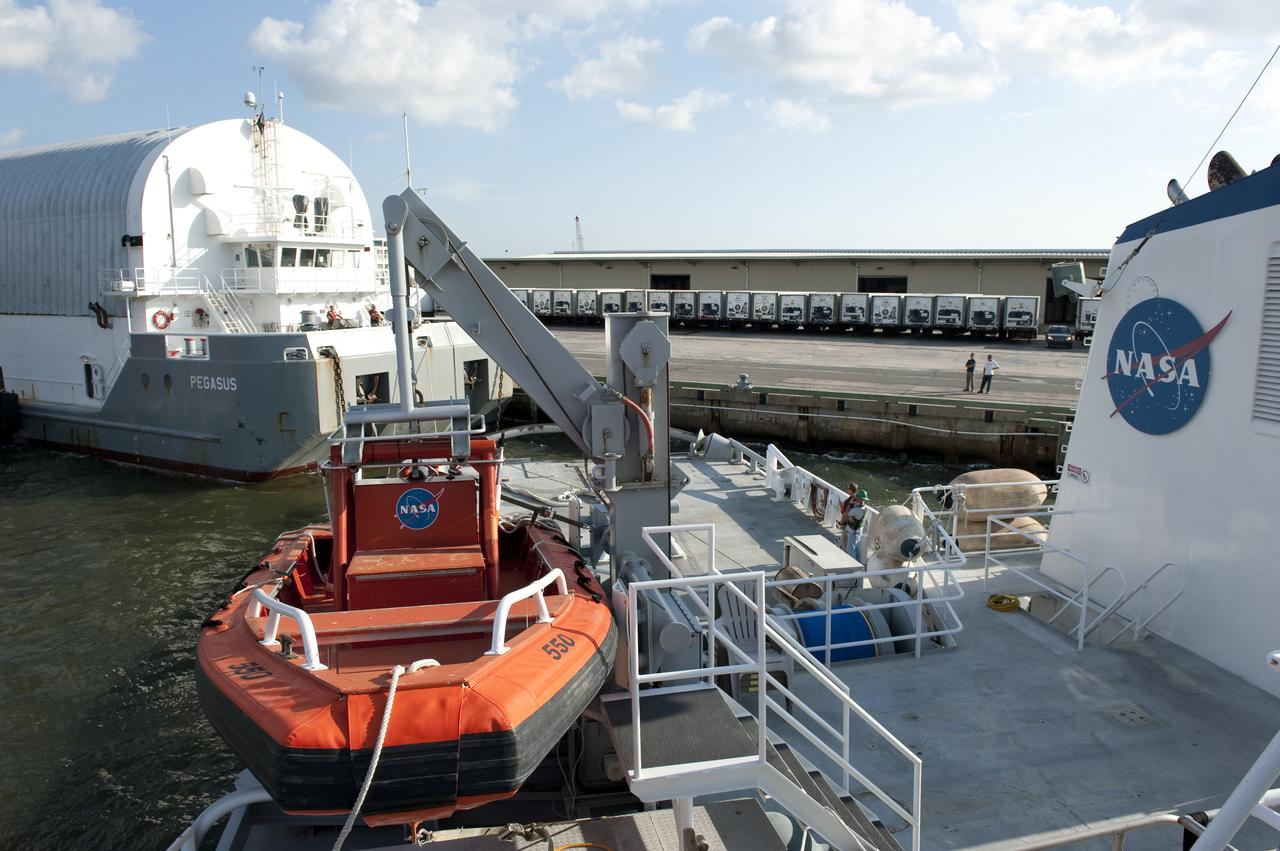
STS-335 LAUNCH ON NEED - ET-122 DEPARTS MICHOUD - ENROUTE TO KSC - 9-20-10 THRU 9-26-10
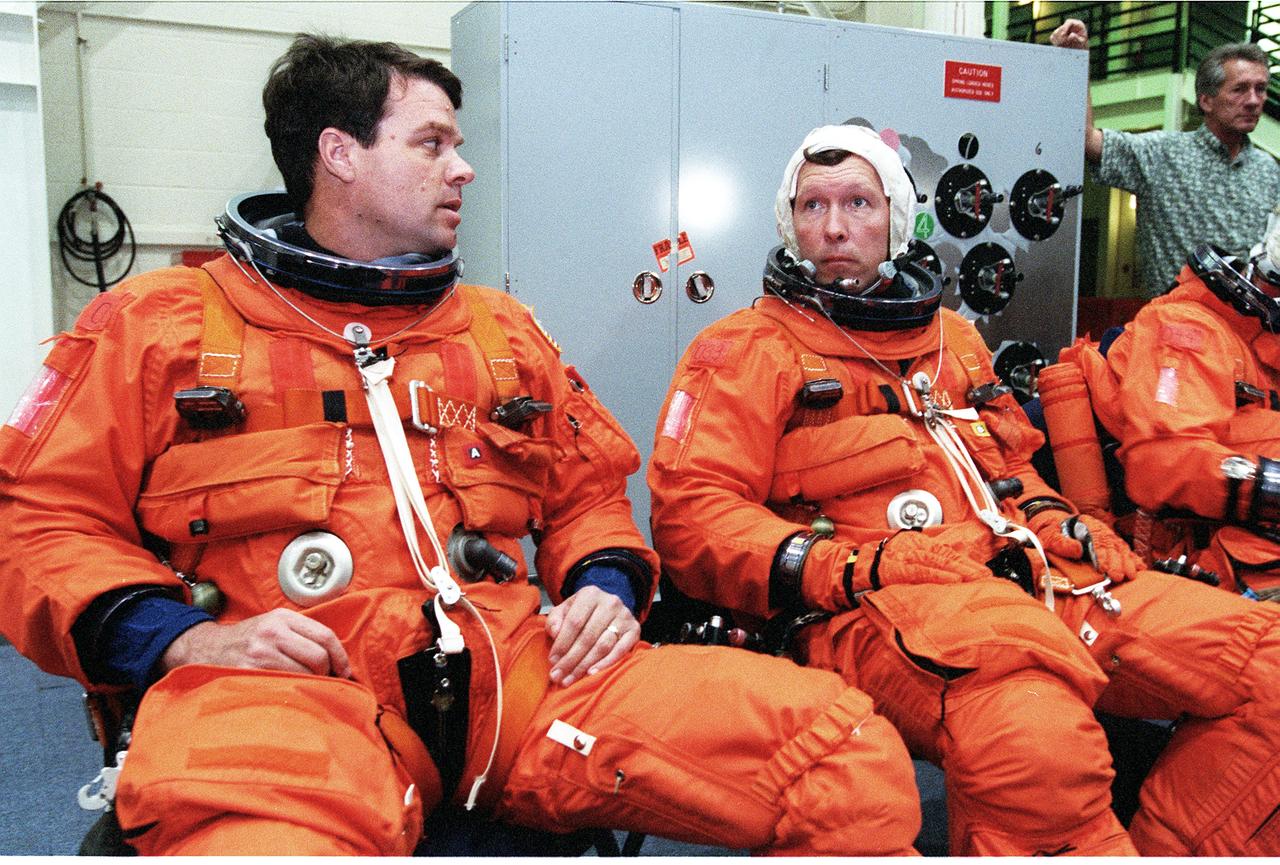
S99-05619 (19 May 1999) --- Astronauts Kevin R. Kregel (left) and Dominic L. Gorie, mission commander and pilot, respectively, for STS-99, are pictured during the briefing portion of emergency bailout training at the Johnson Space Center's Systems Integration Facility. Other members of the crew are out of frame at right.
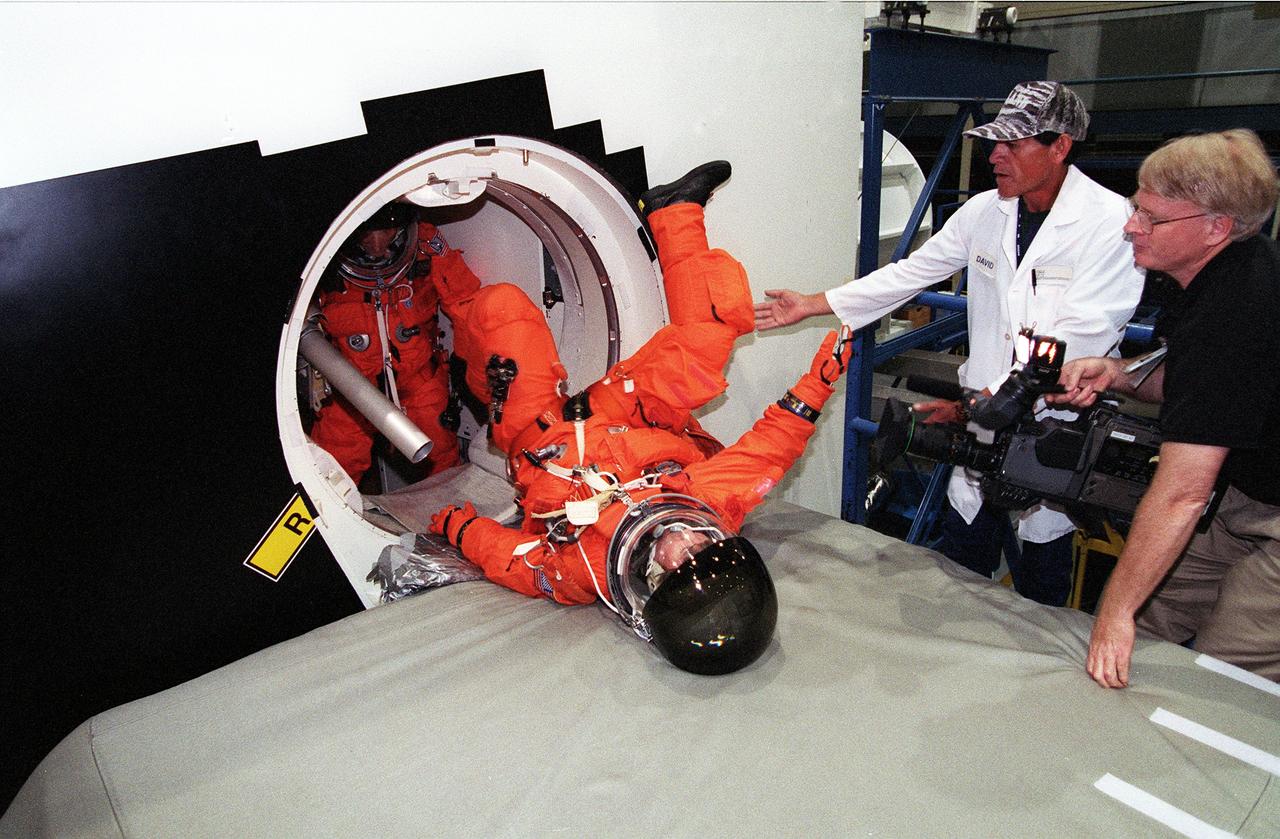
S99-05615 (19 May 1999) --- Astronaut Gerhard P.J. Thiele, mission specialist representing the European Space Agency (ESA), slides off the shuttle escape pole onto a soft surface during emergency bailout training for the STS-99 crew members. A second STS-99 crew member awaits his turn. Looking on are technician David Borjas (second right) and videographer Charles Clendaniel (right). The training took place at the crew compartment trainer (CCT) in the Systems Integration Facility at the Johnson Space Center (JSC).
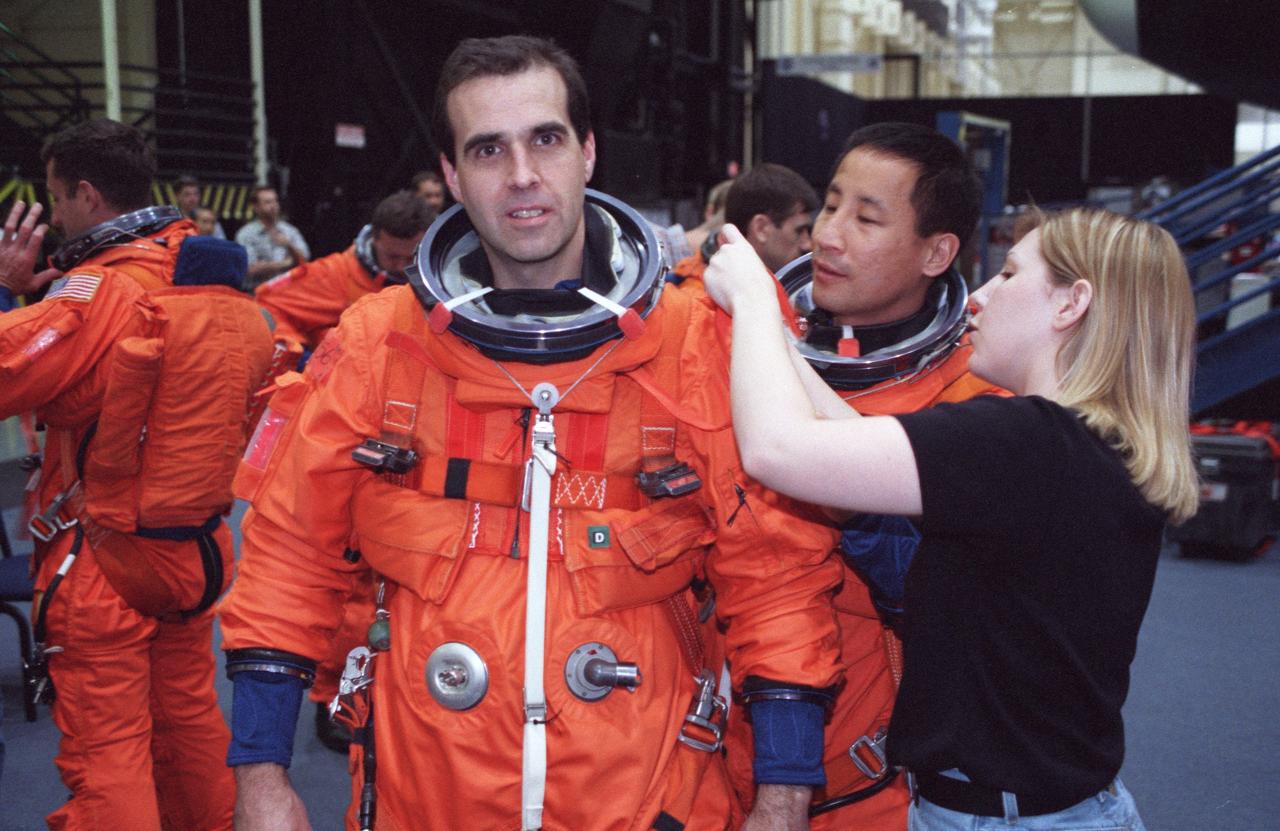
JSC2000-02223 (March 2000) --- Astronaut Edward T. Lu (center foreground) and United Space Alliance suit technician Erin Traina assist astronaut Richard A. Mastracchio with his launch and entry suit. The two astronauts were about to join their five crewmates for a simulation of mission activity in the Systems Integration Facility at the Johnson Space Center (JSC).

JSC2000-02225 (March 2000) --- Astronaut Daniel C. Burbank, mission specialist, fastens the communications carrier assembly (CCA) on his launch and entry suit (LES). Burbank was about to join his six STS-106 crewmates for a simulation exercise in the Systems Integration Facility at the Johnson Space Center (JSC).
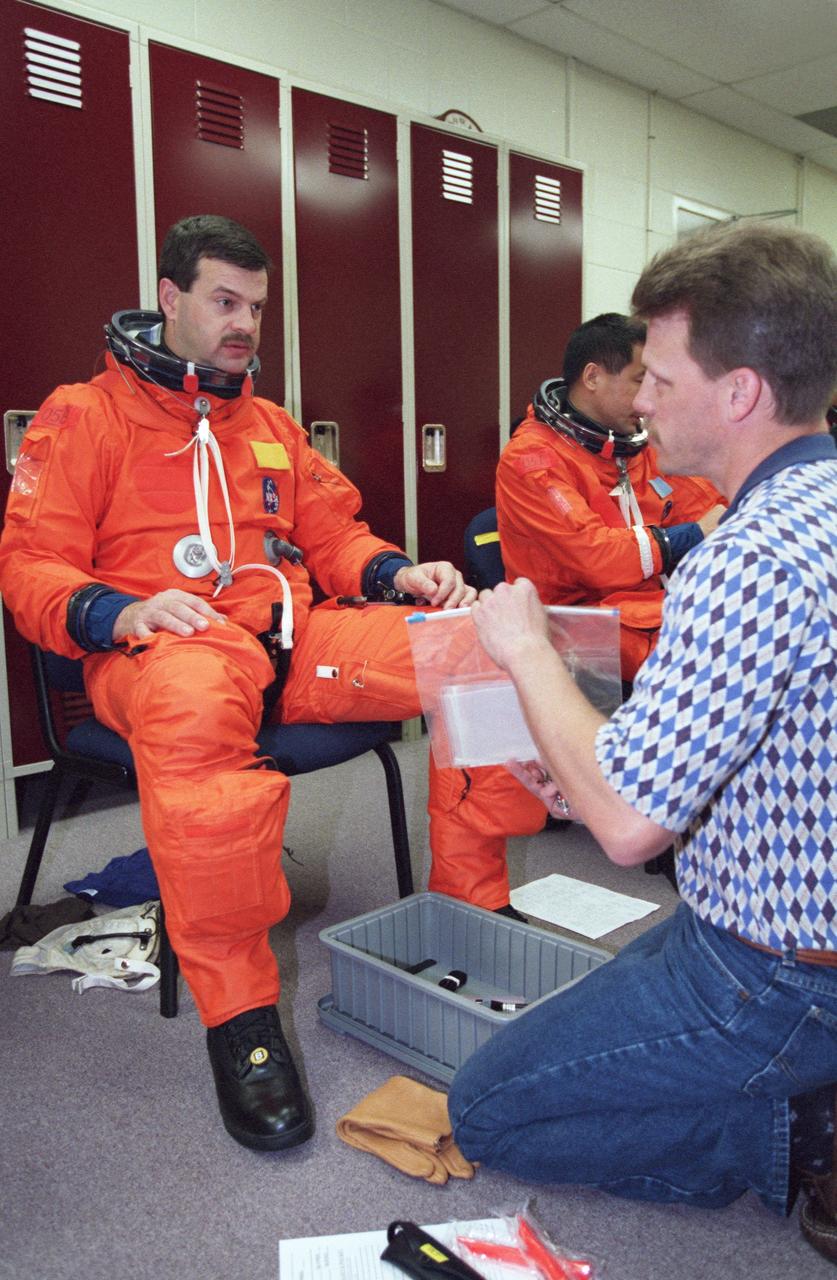
JSC2000-02218 (March 2000) --- United Space Alliance (USA) suit technician Brad Milling assists astronaut Scott D. Altman, pilot for STS-106, with his launch and entry suit. Altman was getting ready for a training session in the Systems Integration Facility at the Johnson Space Center (JSC). Astronaut Edward T. Lu, mission specialist, can be seen in the background.
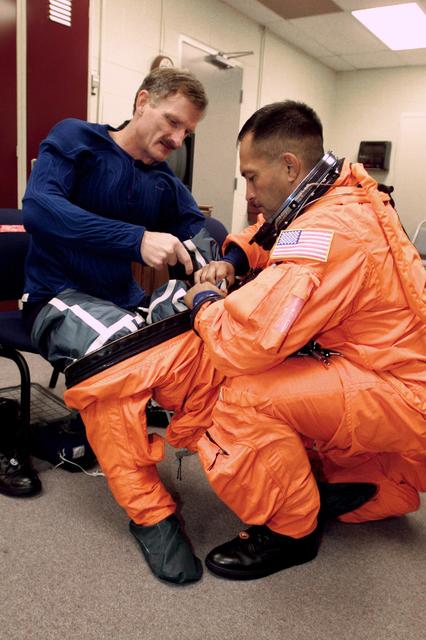
JSC2000-E-23530 (October 2000) --- Astronaut Joseph R. Tanner receives a helping hand from astronaut Carlos I. Noriega as the two STS-97 mission specialists don training versions of their pressure ascent and entry garments. The two were about to participate in a simulation of various parts of their scheduled November mission aboard the Space Shuttle Endeavour.
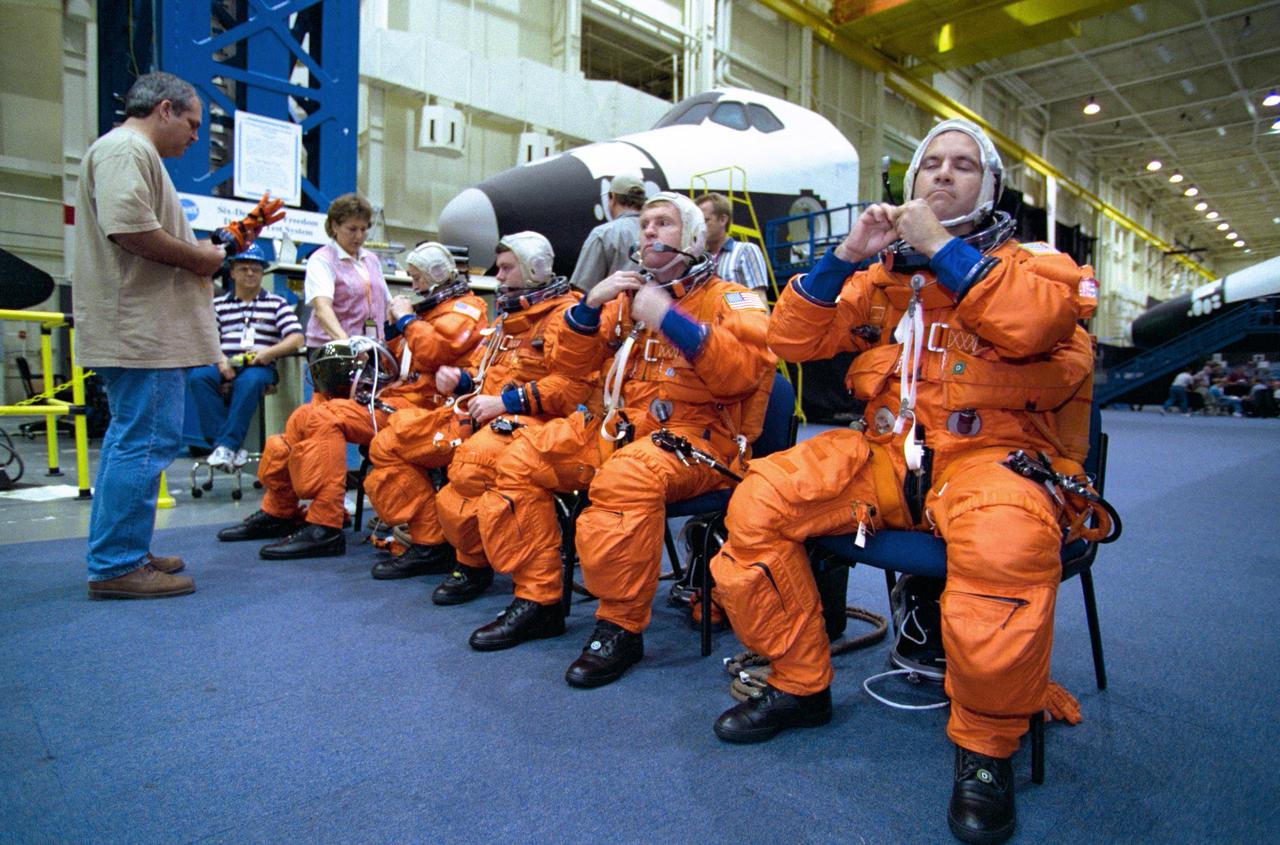
JSC2000-05551 (3 August 2000) --- Four astronauts, who comprise the core crew for STS-102, listen to a launch and entry garment briefing by suit technician Lloyd Armintor in the Systems Integration Facility as they suit up for a contingency simulation exercise in preparation for next year's visit to the International Space Station (ISS). From the left are astronauts James D. Wetherbee, commander; James M. Kelly, pilot; and Andrew S.W. Thomas and Paul W. Richards, both mission specialists. The four will be joined by a cosmonaut and two other astronauts scheduled to share the "up" ride for a lengthy stay aboard the orbiting outpost. Then, they will bring back a threesome made up an astronaut and two cosmonauts who will have been onboard the station since early November 2000.
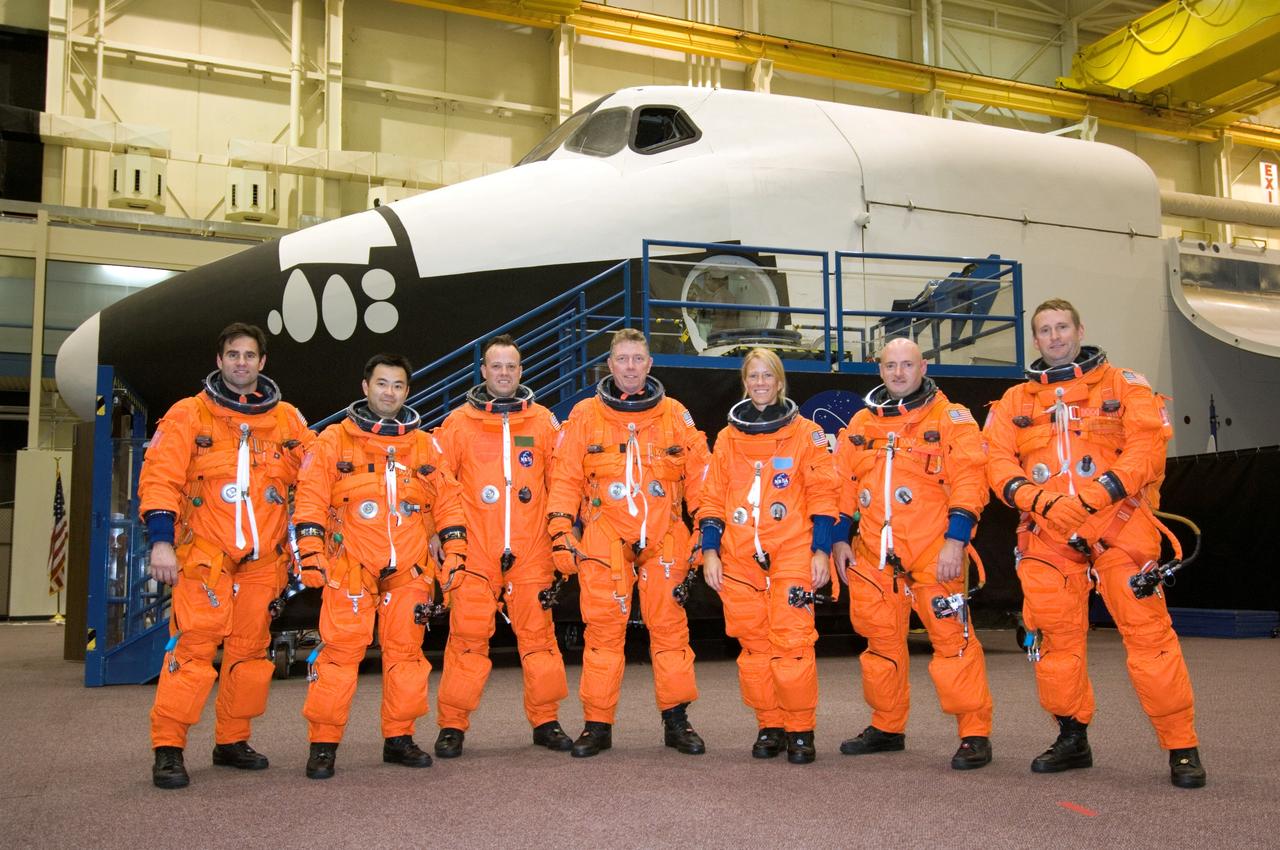
JSC2007-E-48272 (28 Sept. 2007) --- Astronauts Gregory E. Chamitoff (left), Expedition 17 flight engineer; Japan Aerospace Exploration Agency's (JAXA) Akihiko Hoshide, Ronald J. Garan, Michael E. Fossum, Karen L. Nyberg, all STS-124 mission specialists; Mark E. Kelly and Kenneth T. Ham, STS-124 commander and pilot, respectively, pose for a group photo prior to a training session in the Space Vehicle Mockup Facility at Johnson Space Center. The crewmembers are wearing training versions of their shuttle launch and entry suits.

STS009-48-3139 (6 Dec 1983) --- A vertical view of the Manicouagan Impact Crater, some 300 miles (480 kilometers) north-northwest of Quebec City. The 50-mile (80 kilometers) diameter structure was left by a massive meteorite collision in the distant past. Untrue to the winter season, this picture is missing the conspicuous presence of ice on the Manicouagan Reservoir, which is created by the Daniel Johnson Dam.
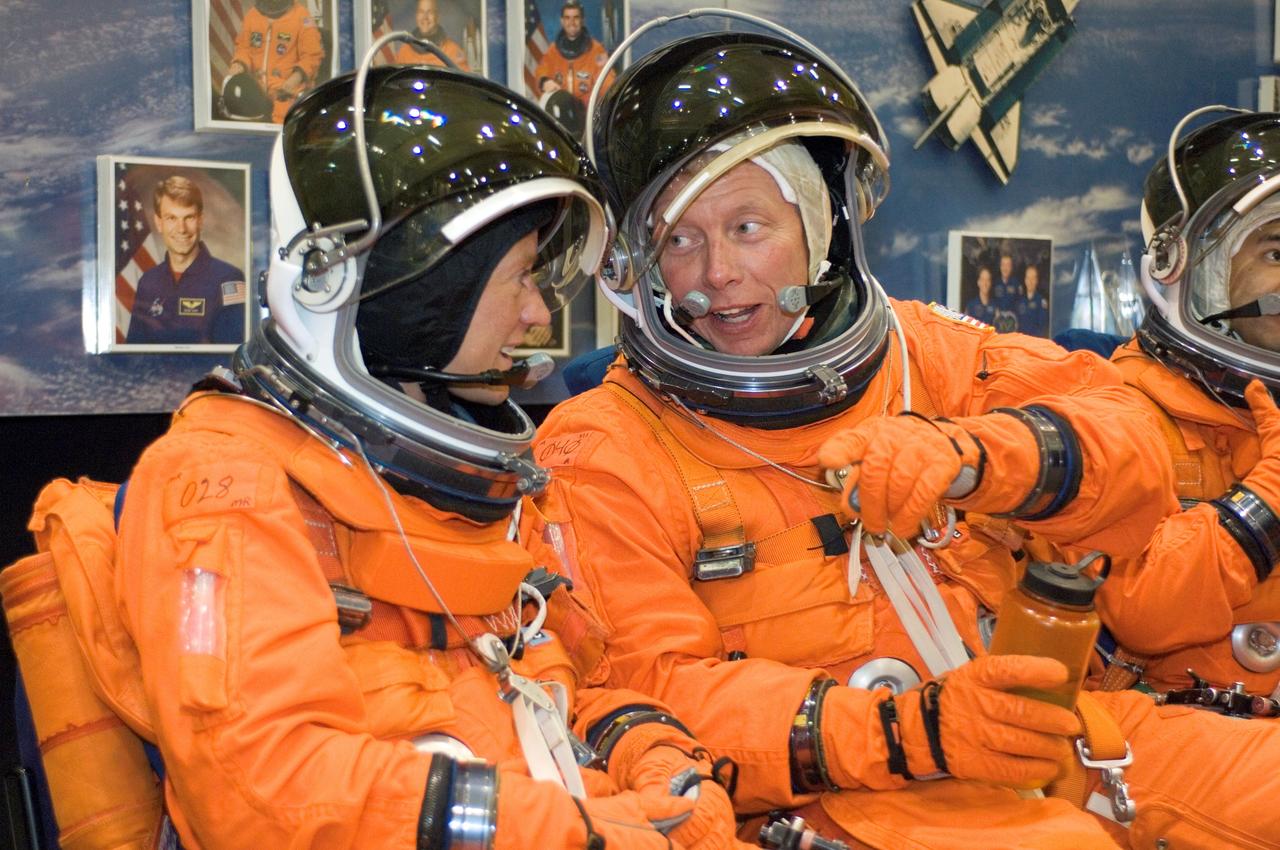
JSC2007-E-48230 (28 Sept. 2007) --- Attired in training versions of their shuttle launch and entry suits, astronauts Karen L. Nyberg (left) and Michael E. Fossum, both STS-124 mission specialists, exchange thoughts as they await the start of a training session in the Space Vehicle Mockup Facility at Johnson Space Center.
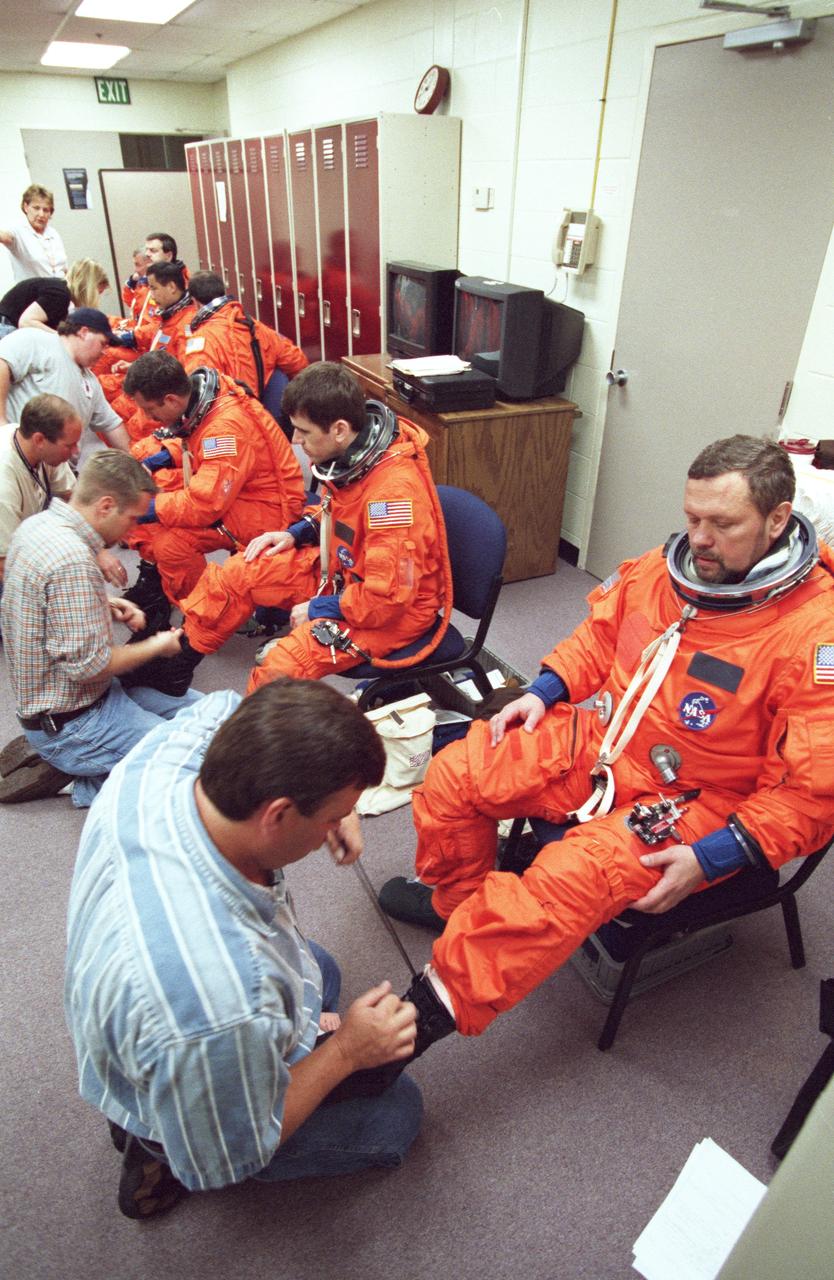
JSC2000-02217 (March 2000) --- United Space Alliance suit technician Mike Birkenseher helps cosmonaut Boris V. Morukov with the donning of his launch and entry suit (LES) prior to STS-106 training in the Systems Integration Facility at the Johnson Space Center (JSC).
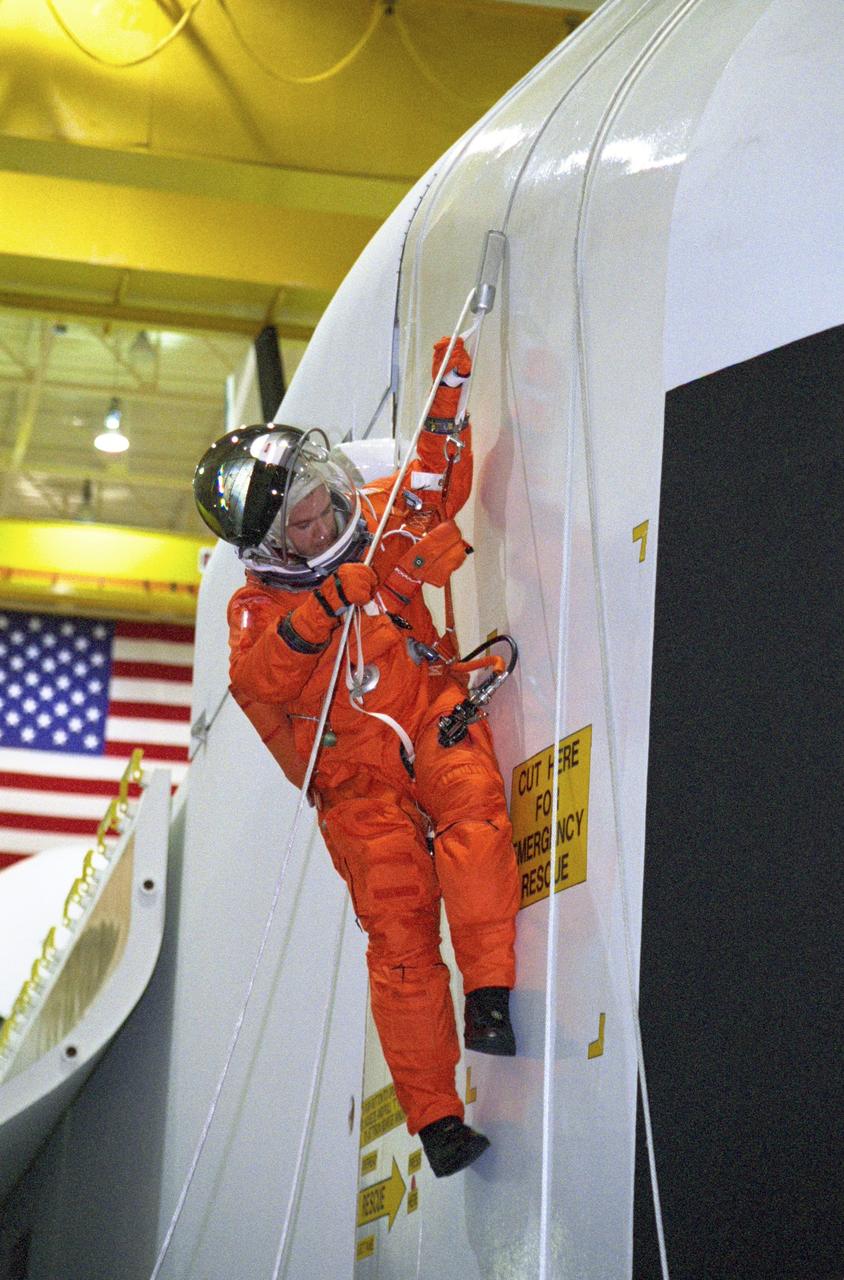
JSC2000-05553 (3 August 2000) --- Astronaut Paul W. Richards, STS-102 mission specialist, during a session of egress training in the Johnson Space Center's Systems Integration Facility, uses a Sky-genie device to escape from a simulated shuttle in trouble. The full fuselage trainer (FFT) is a full scale mockup of a shuttle.
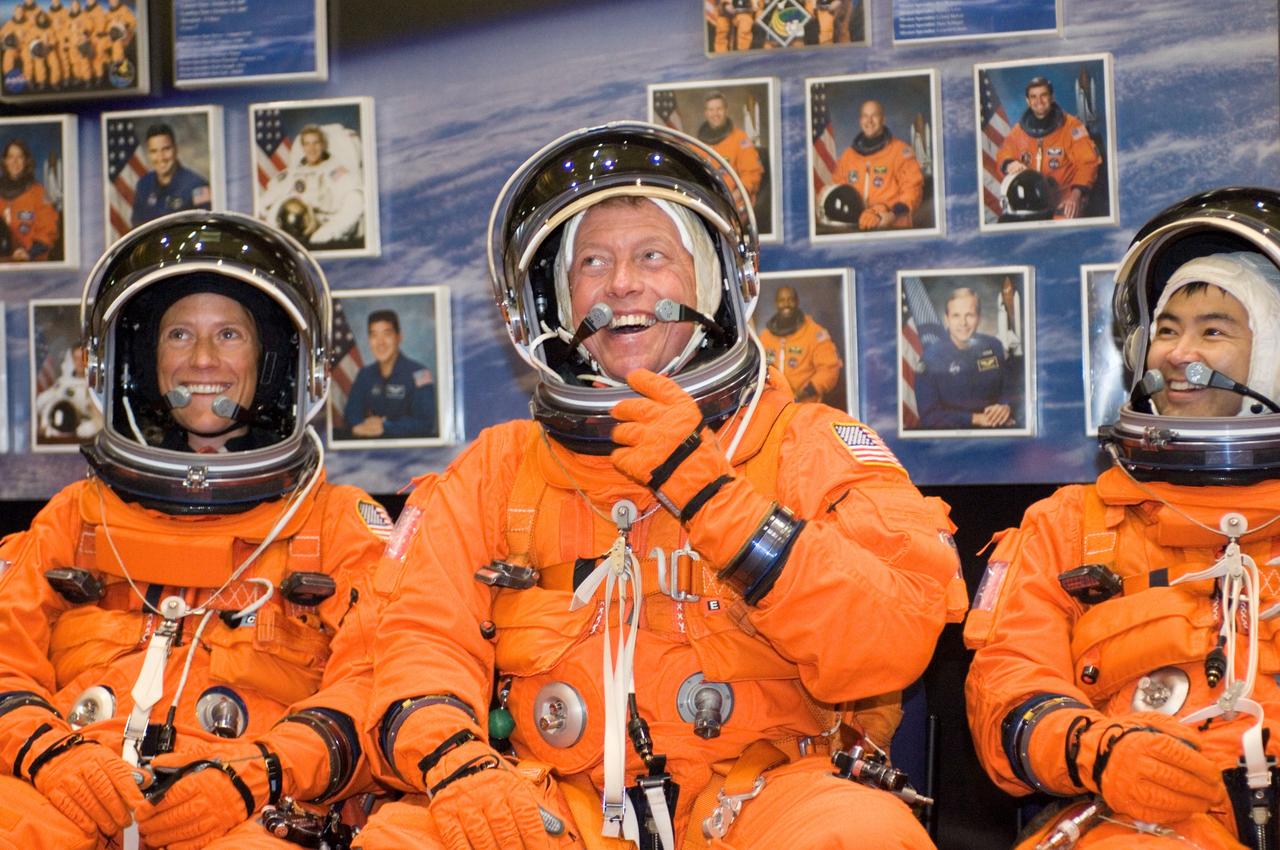
JSC2007-E-48226 (28 Sept. 2007) --- Attired in training versions of their shuttle launch and entry suits, astronauts Karen L. Nyberg (left), Michael E. Fossum and Japan Aerospace Exploration Agency's (JAXA) Akihiko Hoshide, all STS-124 mission specialists, await the start of a training session in the Space Vehicle Mockup Facility at Johnson Space Center.
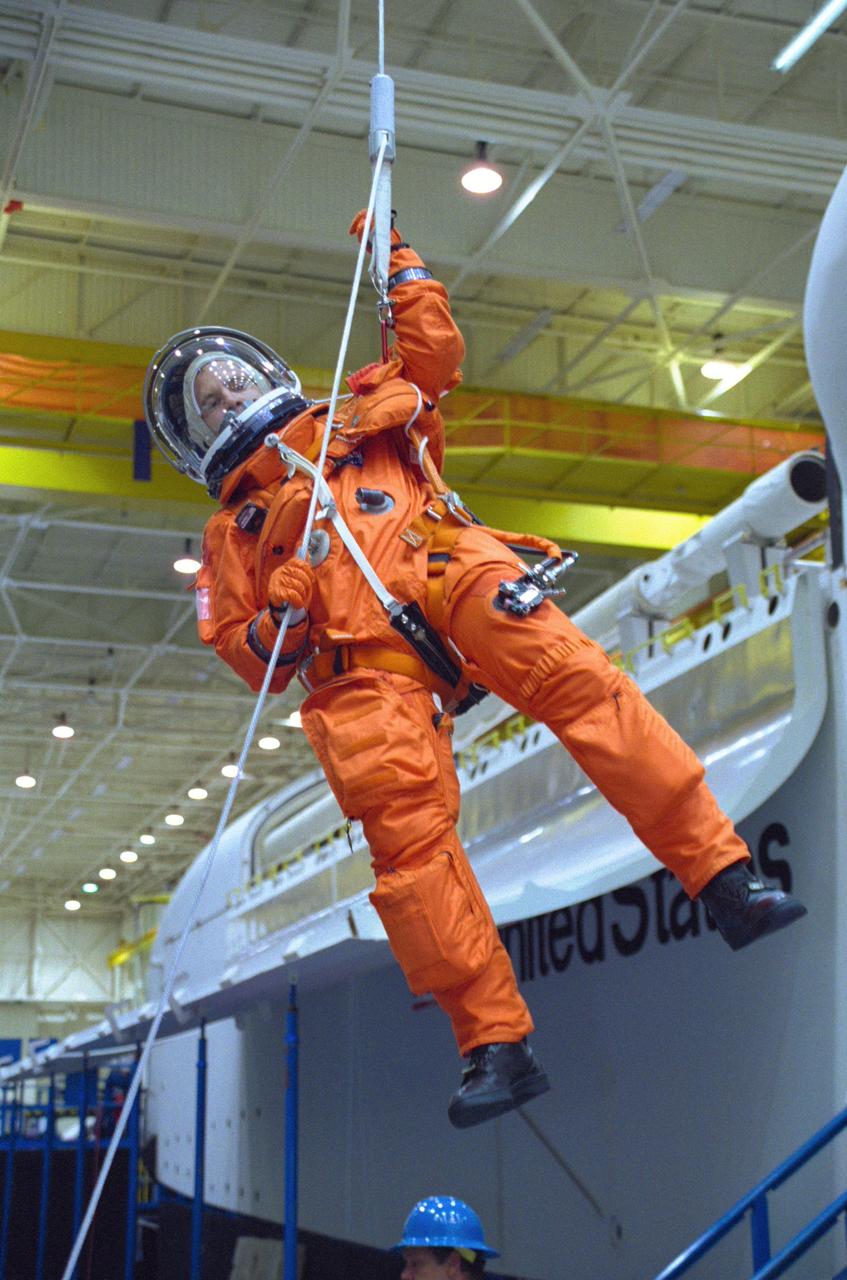
JSC2000-05554 (3 August 2000) --- Astronaut Paul W. Richards, STS-102 mission specialist, rappels from the top of the shuttle full fuselage trainer (FFT) during an emergency egress training exercise at the Johnson Space Center's Systems Integration Facility.
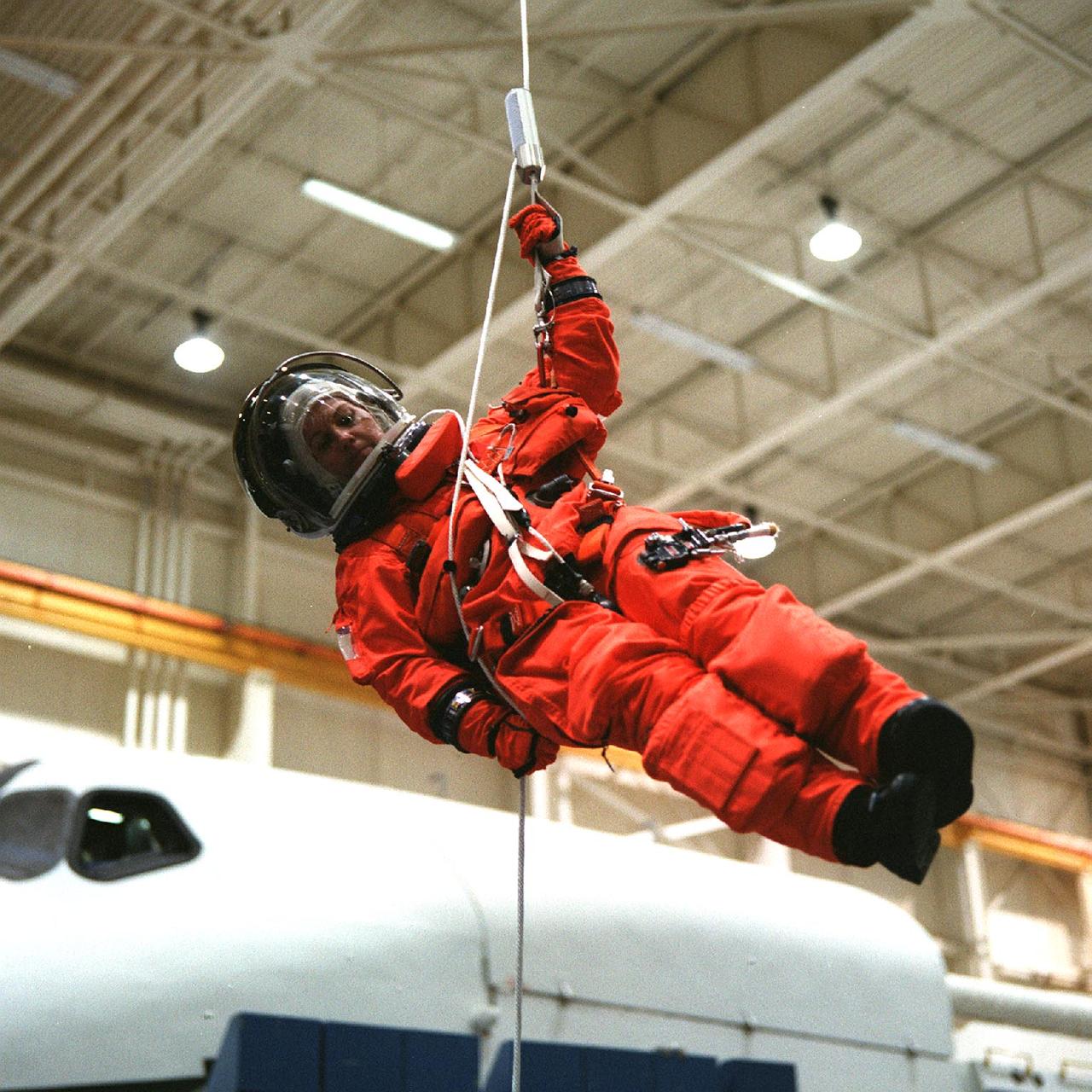
S98-09839 (6-29-98) --- Astronaut Eileen M. Collins lowers herself from a simulated shuttle in trouble during an emergency egress training session in the Systems Integration Facility at the Johnson Space Center (JSC). Collins, mission commander for STS-93, will be joined by four other astronauts for a scheduled five-day mission aboard the Space Shuttle Columbia in the spring of next year.
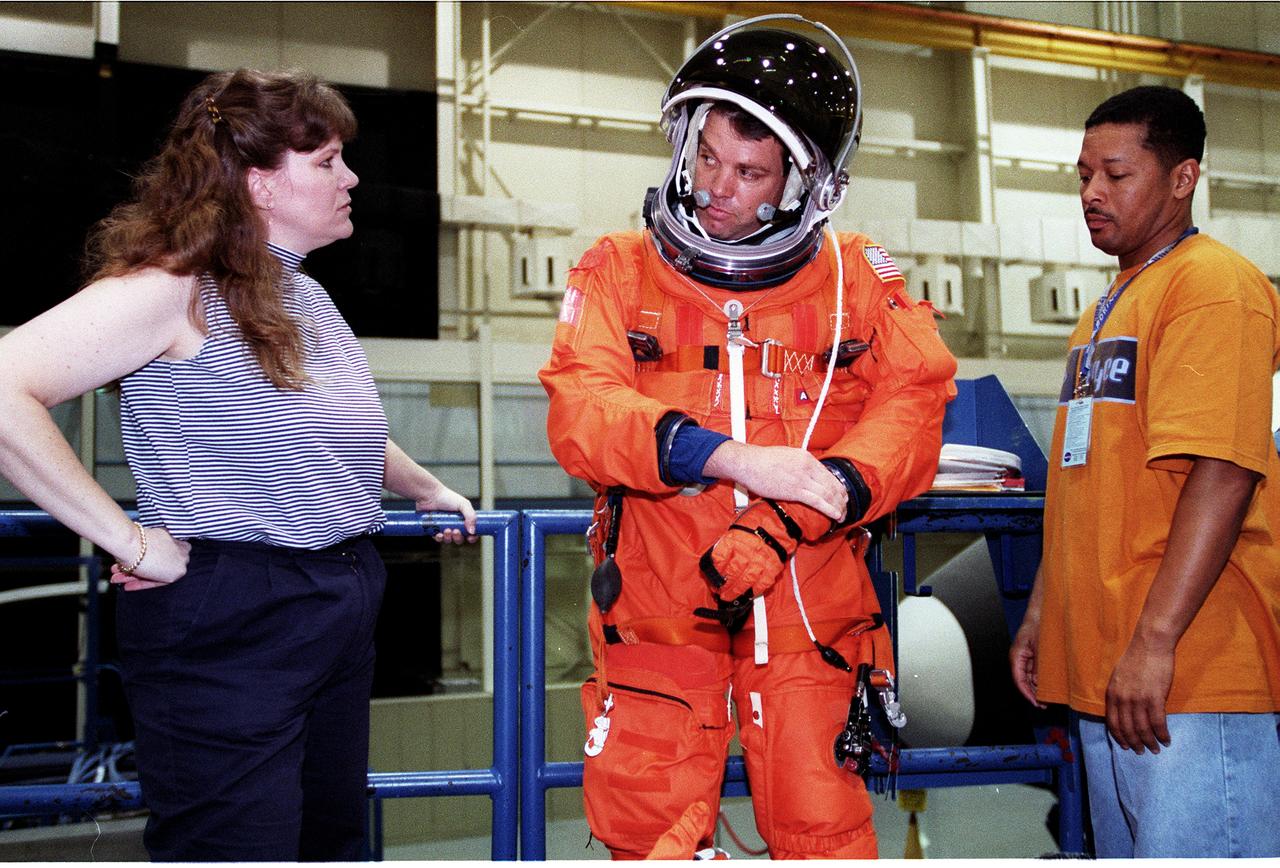
S99-05620 (19 May 1999) --- Astronaut Kevin R. Kregel (left), STS-99 mission commander, is briefed by a member of the crew training staff (out of frame at left) during emergency bailout training at the Johnson Space Center's Systems Integration Facility. Looking on is insertion technician George Britingham, United Space Alliance.
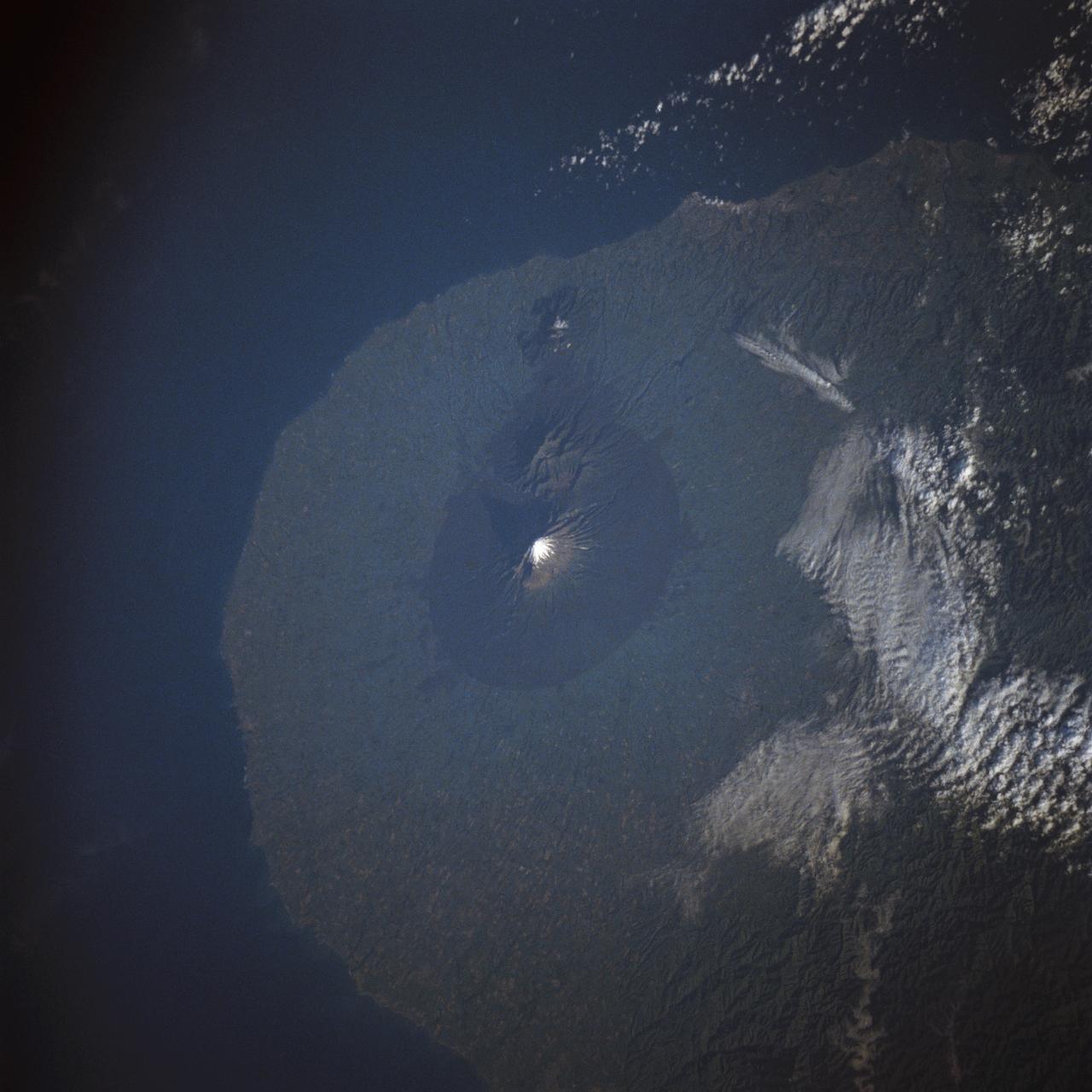
STS009-40-2574 (28 Nov-8 Dec 1983) --- New Zealand?s Mount Egmont volcano rises 8300 ft (2520 meters) out of the Tasman Sea and has been designated as a national park. It is on the North Island, 125 miles (200 Km) SSW of Auckland. The border fence of the national park is clearly seen because the lighter green area surrounding it is a grazing range.

JSC2000-03357 (19 April 2000) --- Cosmonaut Boris V. Morukov, mission specialist representing the Russian Aviation and Space Agency, participates in a launch and entry procedures simulation on the mid deck of one of the crew compartment trainers in the Johnson Space Center's Systems Integration Facility.
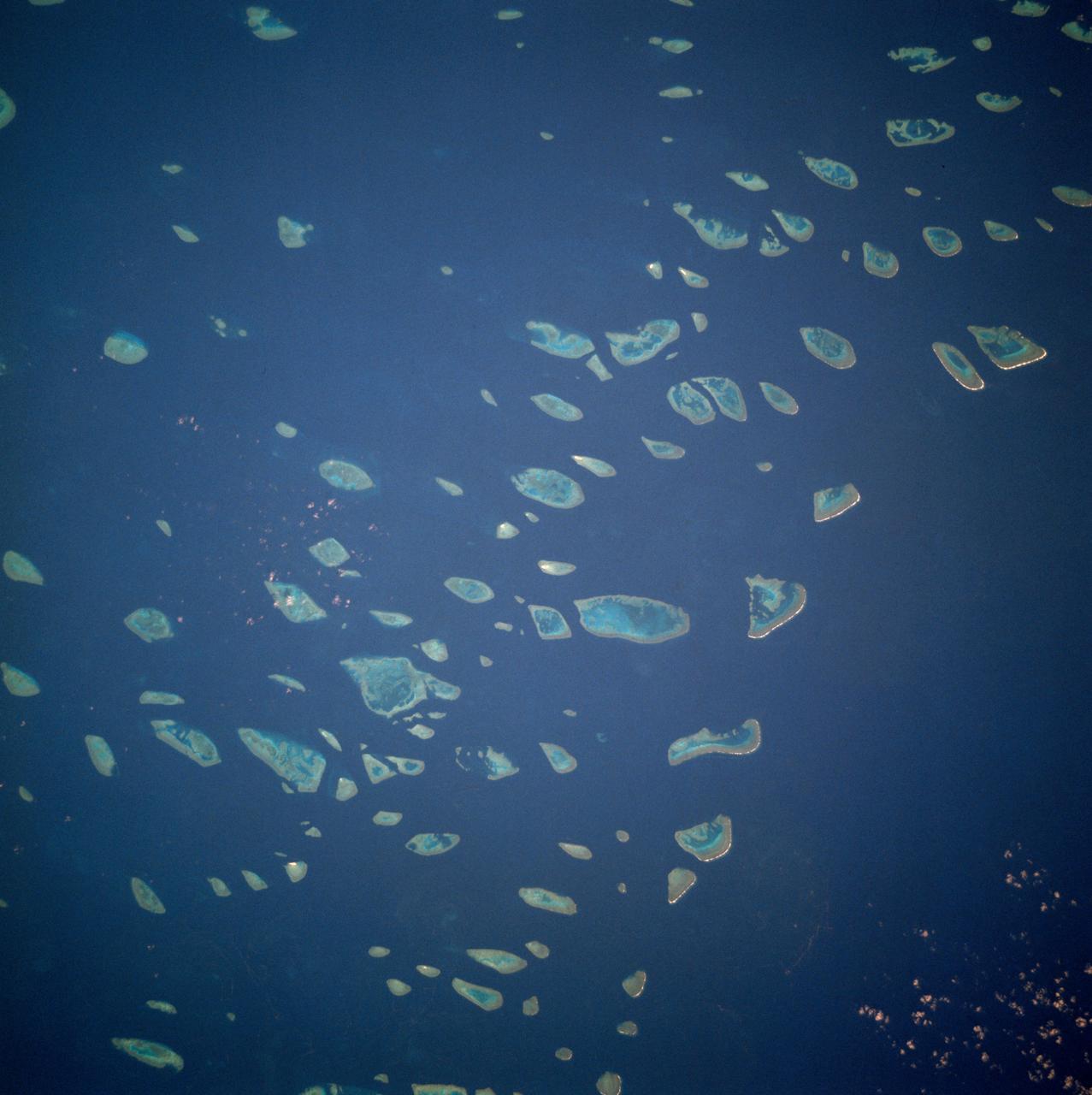
STS009-46-1856 (28 Nov-8 Dec 1983) --- East of the Australian state of Queensland lies the worlds largest reef. The Great Barrier Reef. A portion of the reef is seen. Although beautiful from space, coral reefs, channels, etc?, has long confounded navigators, mapmakers, and oceanographers.
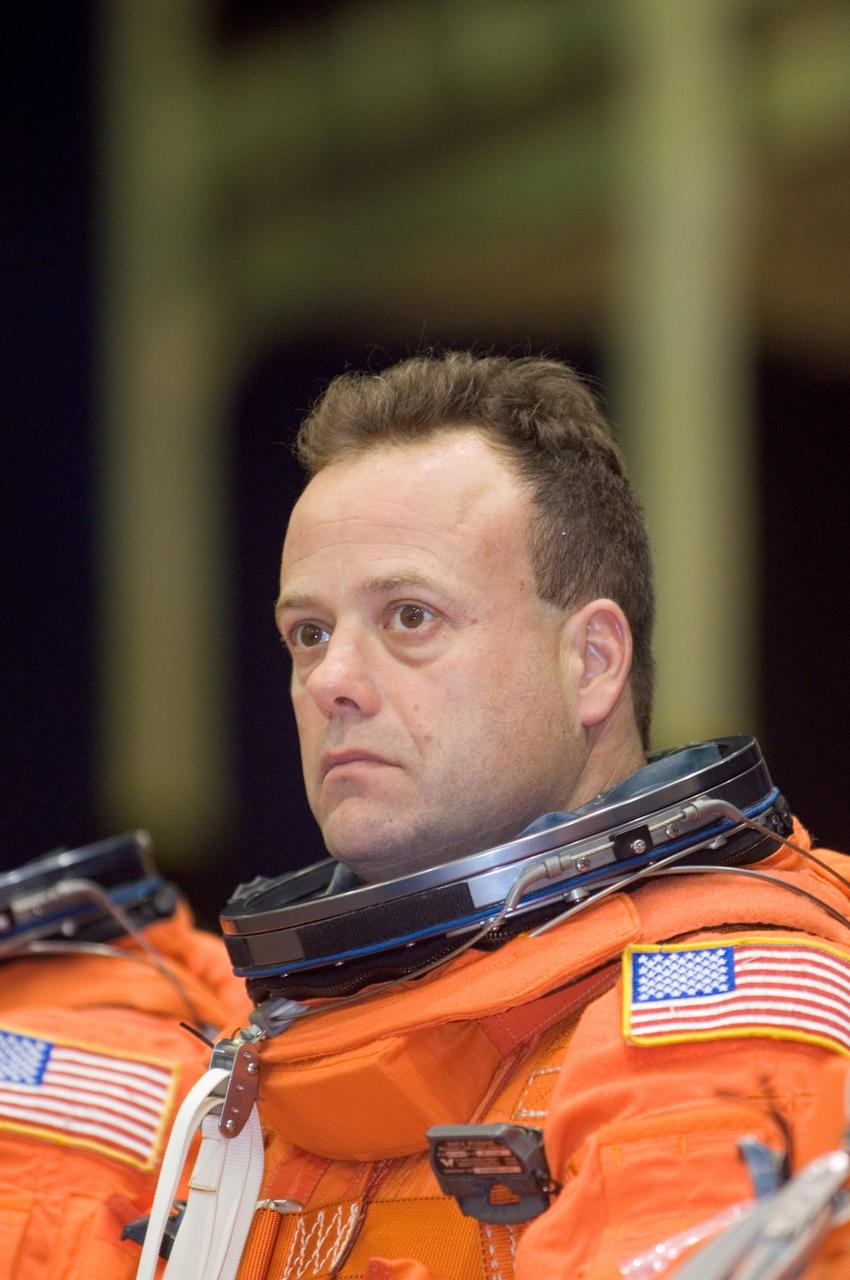
JSC2007-E-48235 (28 Sept. 2007) --- Attired in a training version of his shuttle launch and entry suit, astronaut Ronald J. Garan, STS-124 mission specialist, awaits the start of a training session in the Space Vehicle Mockup Facility at Johnson Space Center.
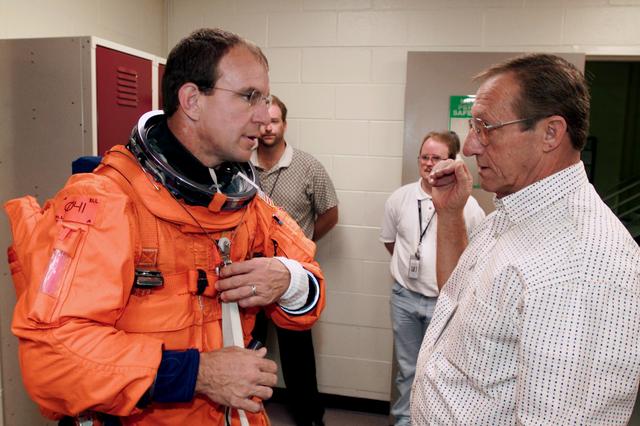
JSC2000-E-23528 (October 2000) --- Astronaut Michael J. Bloomfield, left, discusses his launch and entry suit with USA technician Bill Todd prior to a training session in the Johnson Space Center's Systems Integration Facility.
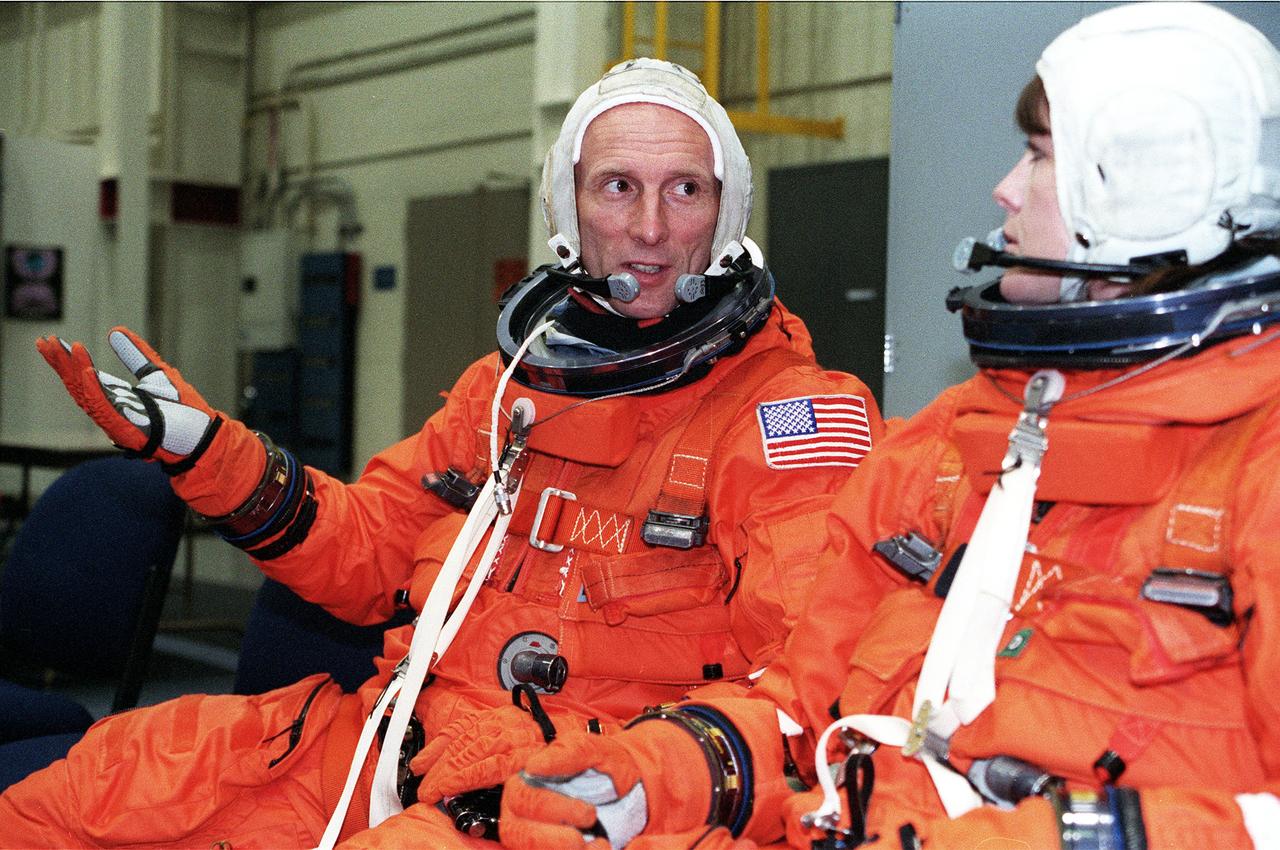
S99-05616 (19 May 1999) --- Astronauts Gerhard P.J. Thiele and Janet L. Kavandi await a briefing about emergency egress procedures during a training session at the Johnson Space Center's Systems Integration Facility. Thiele represents the European Space Agency (ESA). Other STS-99 crew members are out of frame at right.

JSC2000-05556 (3 August 2000) --- Astronaut James M. Kelly, STS-102 pilot, during a session of egress training in the Johnson Space Center's Systems Integration Facility, prepares to use a Sky-genie device to escape from a simulated shuttle in trouble. Crew trainer David Pogue (right) gives the pilot some tips on using the device.
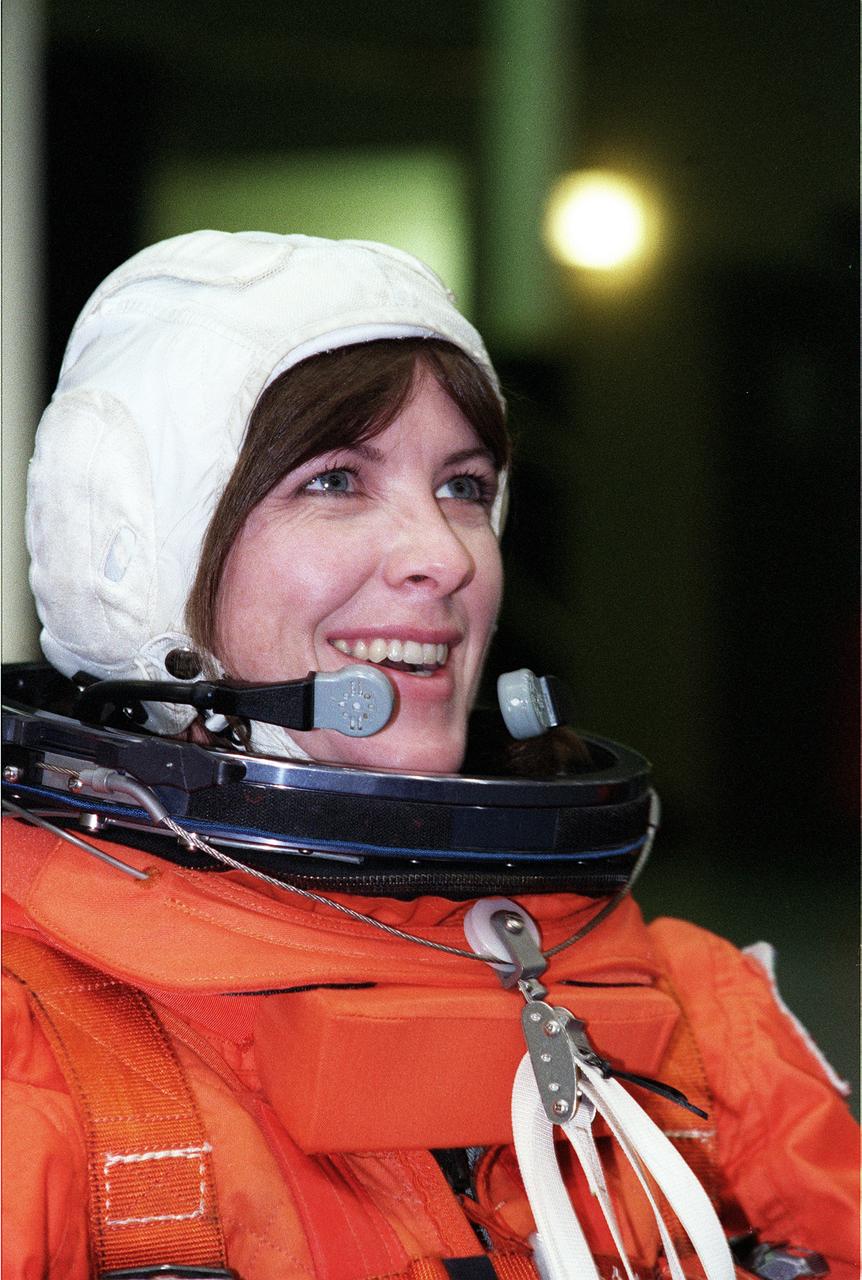
S99-05617 (19 May 1999) --- Astronaut Janet L. Kavandi, mission specialist, listens to a briefing about emergency egress procedures during a training session at the Johnson Space Center's Systems Integration Facility. Kavandi wears a training version of the partial pressure launch and entry garment.
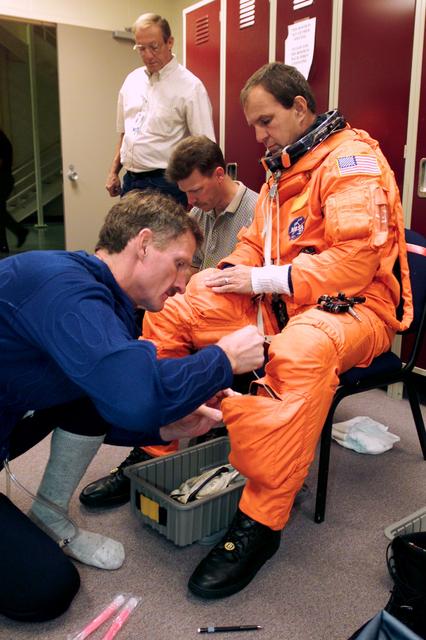
JSC2000-E-23525 (October 2000) --- Astronaut Joseph R. Tanner (left), mission specialist, helps astronaut Michael J. Bloomfield, pilot, with final touches on his suit-donning process as USA suit technicians Bill Todd (standing) and Brad Milling look on. The two were about to join the other three STS-97 crew members for a training session in the Johnson Space Center's Systems Integration Facility.
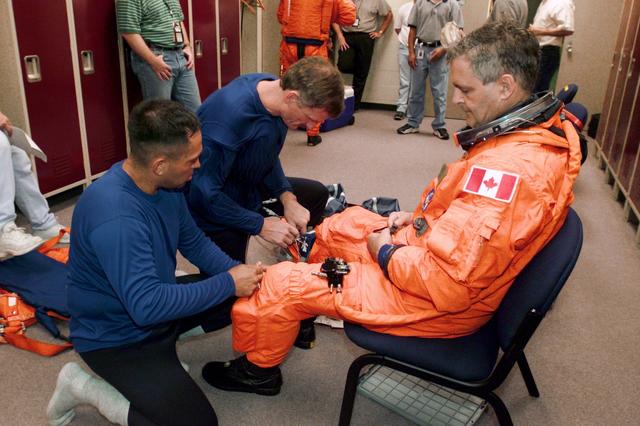
JSC2000-E-23527 (October 2000) --- Astronaut Marc Garneau, mission specialist representing the Canadian Space Agency (CSA), looks on as two crew mates assist him with final touches of suit-donning prior to a training session in the Johnson Space Center's Systems Integration Facility. Helping out are astronauts Carlos I. Noriega (left) and Joseph R. Tanner, mission specialists.
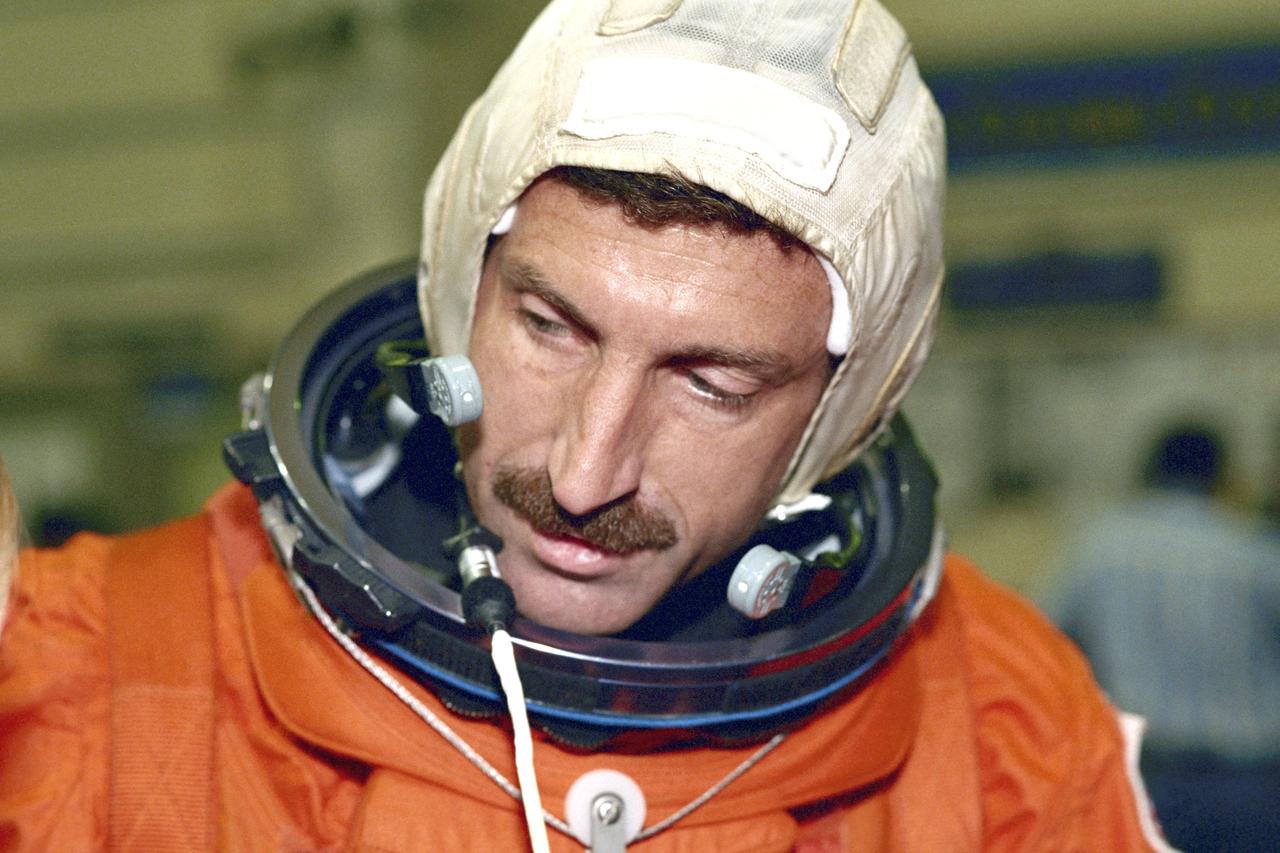
JSC2000-03345 (19 April 2000) --- Astronaut Daniel C. Burbank, STS-106 mission specialist, checks his communication gear during suit-donning prior to a training exercise at JSC's Systems Integration Facility. The mission specialist is scheduled to join four other NASA astronauts and two Russian cosmonauts for a late summer mission to the International Space Station.
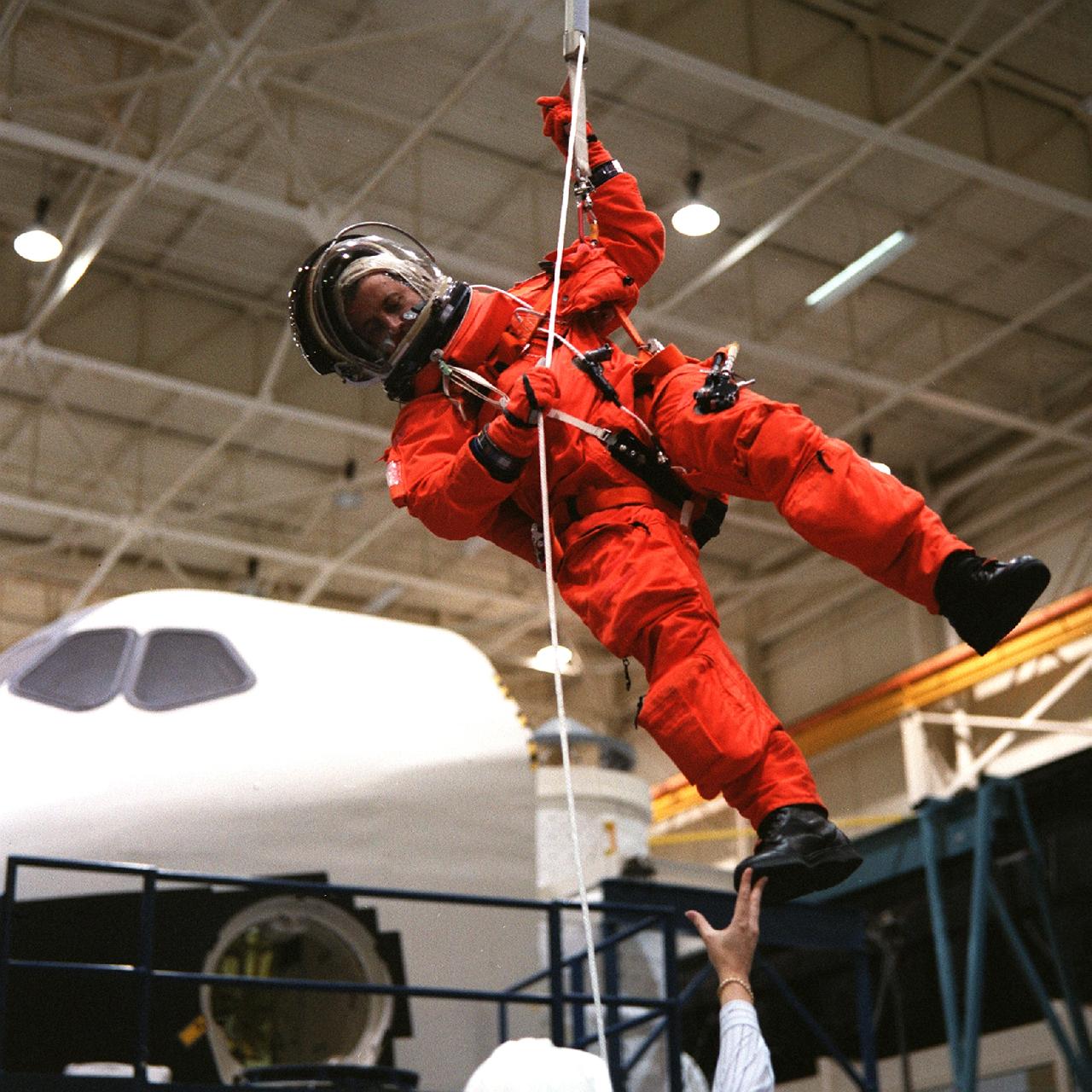
S98-09838 (6-29-98) --- Astronaut Michel Tognini lowers himself from a simulated shuttle in trouble during an emergency egress training session in the Systems Integration Facility at the Johnson Space Center (JSC). Tognini, a mission specialist representing France's Centre National d'Etudes Spatiales (CNES), will join four other astronauts for a scheduled five-day mission aboard the Space Shuttle Columbia in the spring of next year.
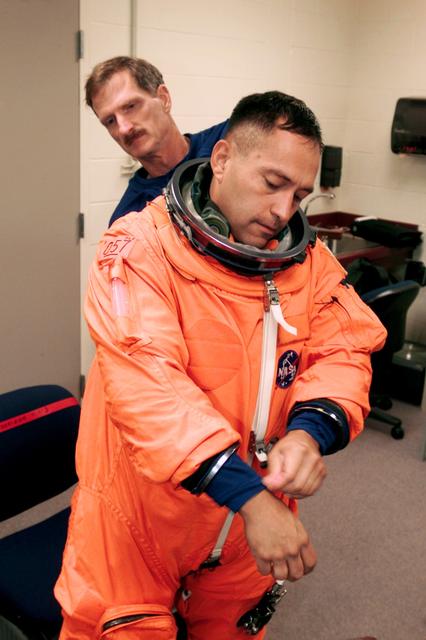
JSC2000-E-23529 (October 2000) --- Astronaut Joseph R. Tanner lends a helping hand to astronaut Carlos I. Noriega as the two STS-97 mission specialists prepare for a "dry run" going over launch procedures in a nearby simulator, in the Johnson Space Center's Systems Integration Facility.
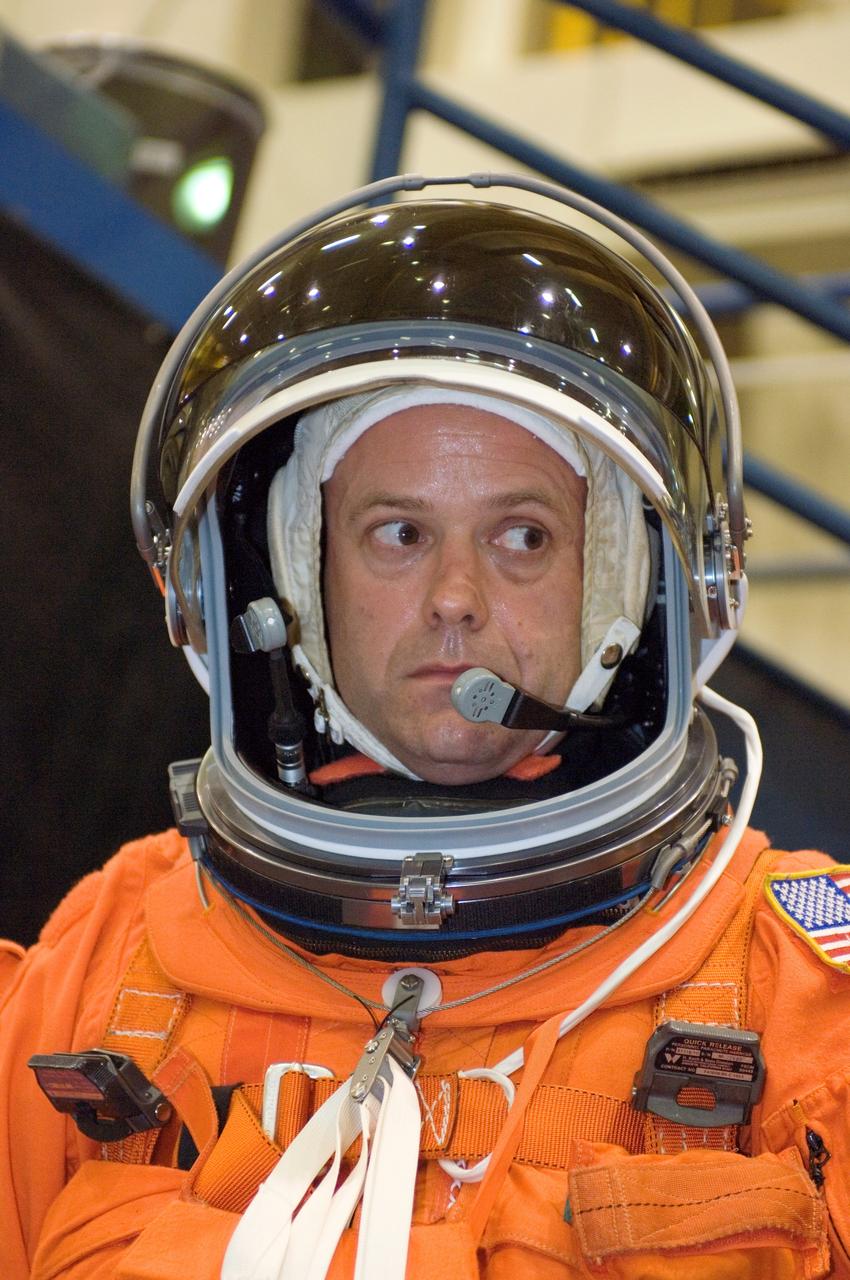
JSC2007-E-48225 (28 Sept. 2007) --- Attired in a training version of his shuttle launch and entry suit, astronaut Ronald J. Garan, STS-124 mission specialist, awaits the start of a training session in the Space Vehicle Mockup Facility at Johnson Space Center.
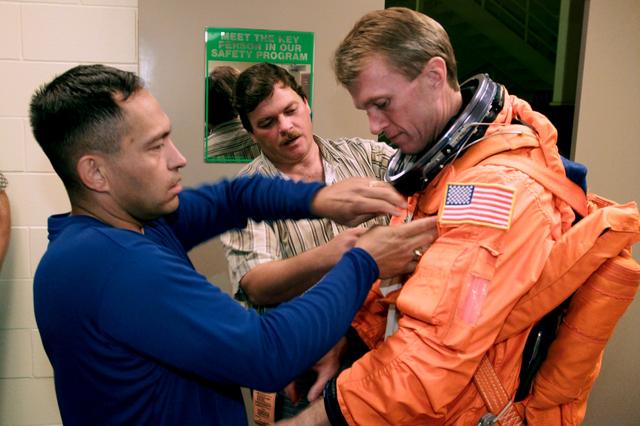
JSC2000-E-23526 (October 2000) --- Astronaut Carlos I. Noriega, attired in a blue thermal undergarment, and USA suit technician Mike Birkenseher help astronaut Brent W. Jett, STS-97 mission commander, with final touches of suit donning. The five STS-97 crew members were participating in a training session for their scheduled November launch aboard the Space Shuttle Endeavour.
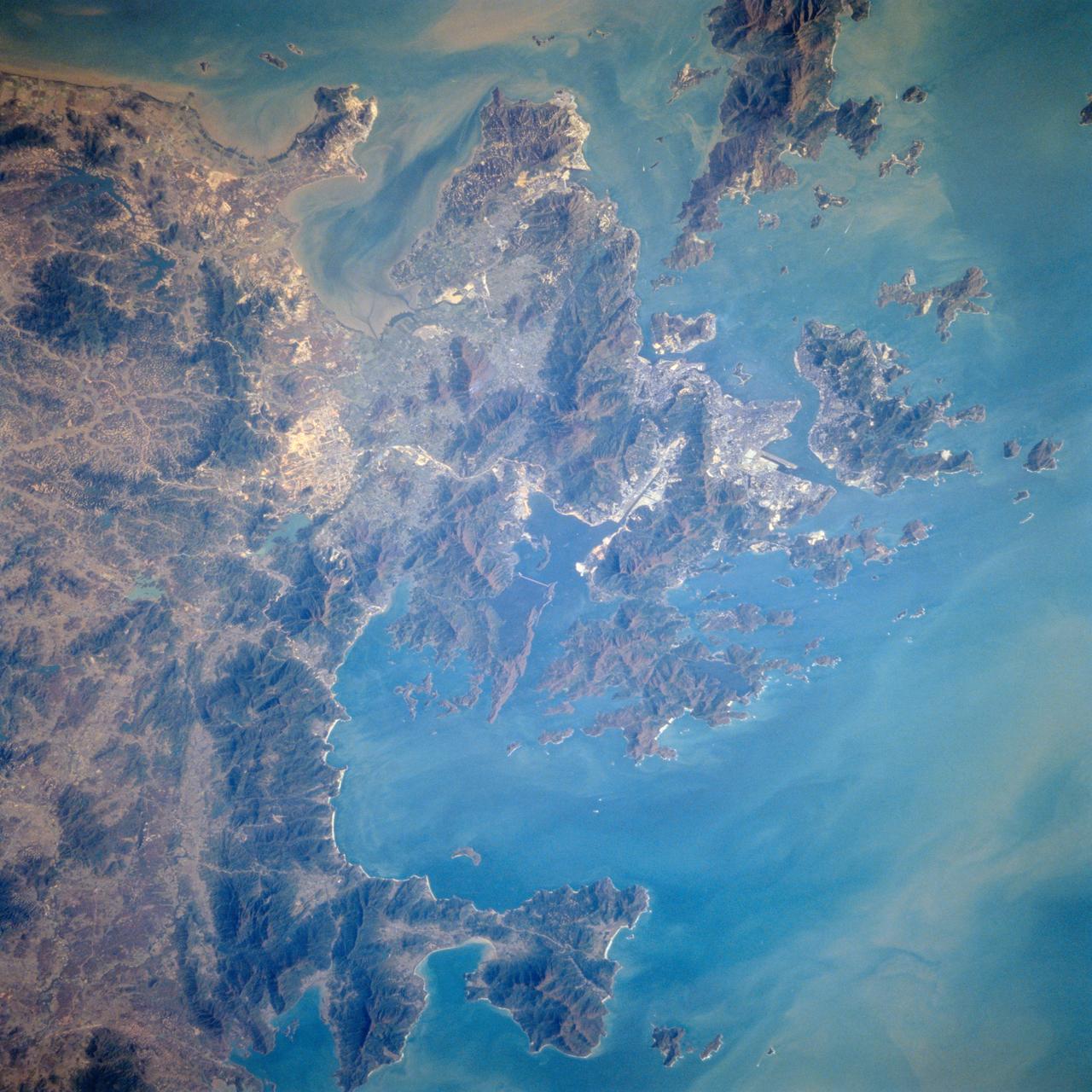
STS009-33-1276 (28 Nov- 8 Dec 1983) --- The entire British Crown Colony of Hong Kong and a portion of Kwangtung Province of China are seen. The city of Victoria is on Hong Kong Island. The Colony?s airport (Kai Tak) is seen at the mainland city of Kowloon.
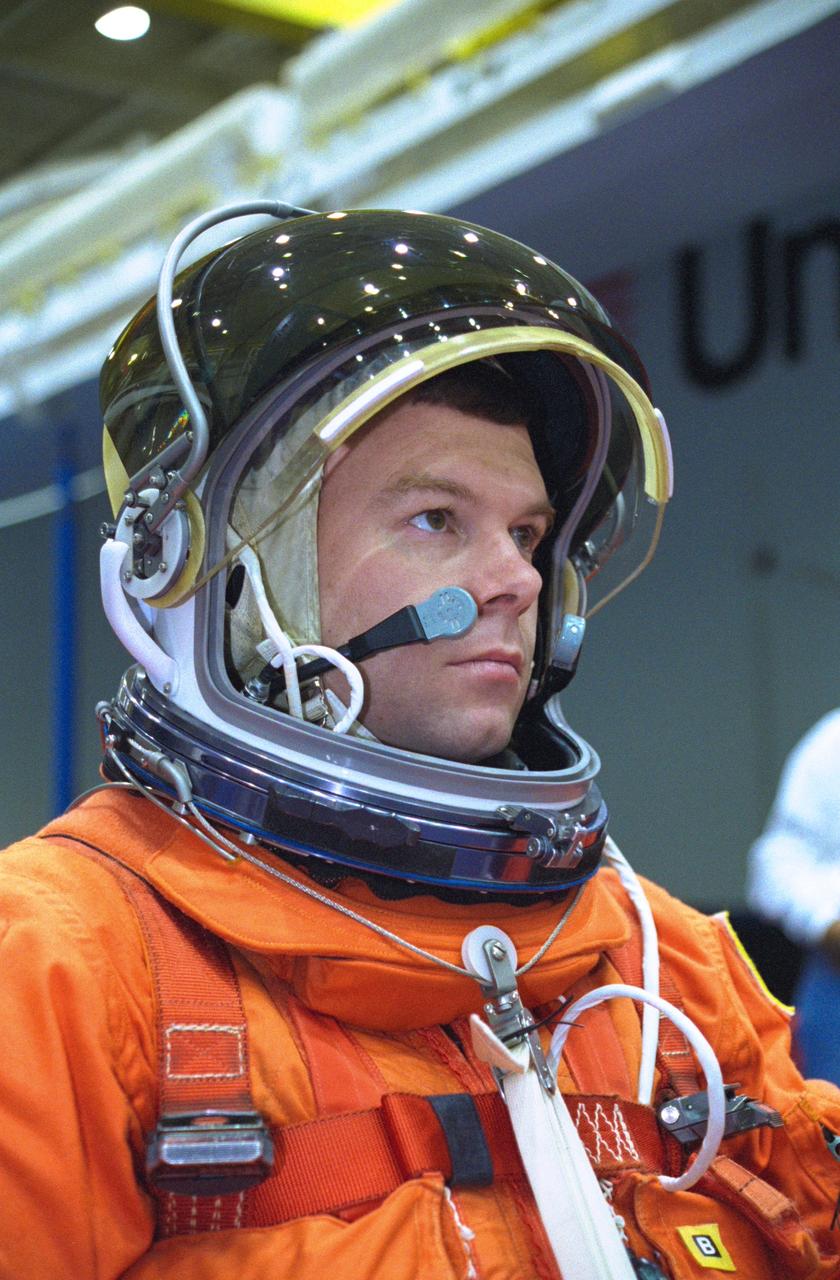
JSC2000-05557 (3 August 2000) --- Astronaut James M. Kelly, STS-102 pilot, listens as a crew training staff member briefs the astronauts at the Full Fuselage Trainer (FFT) during an emergency egress training exercise at the Johnson Space Center's Systems Integration Facility.

JSC2000-03346 (19 April 2000) --- Astronauts Edward T. Lu (left) and Richard A. Mastracchio put final touches on their suit-donning process prior to a training session in JSC's Systems Integration Facility. The two mission specialists are scheduled to join three other NASA astronauts and two Russian cosmonauts for a late summer mission to the International Space Station.
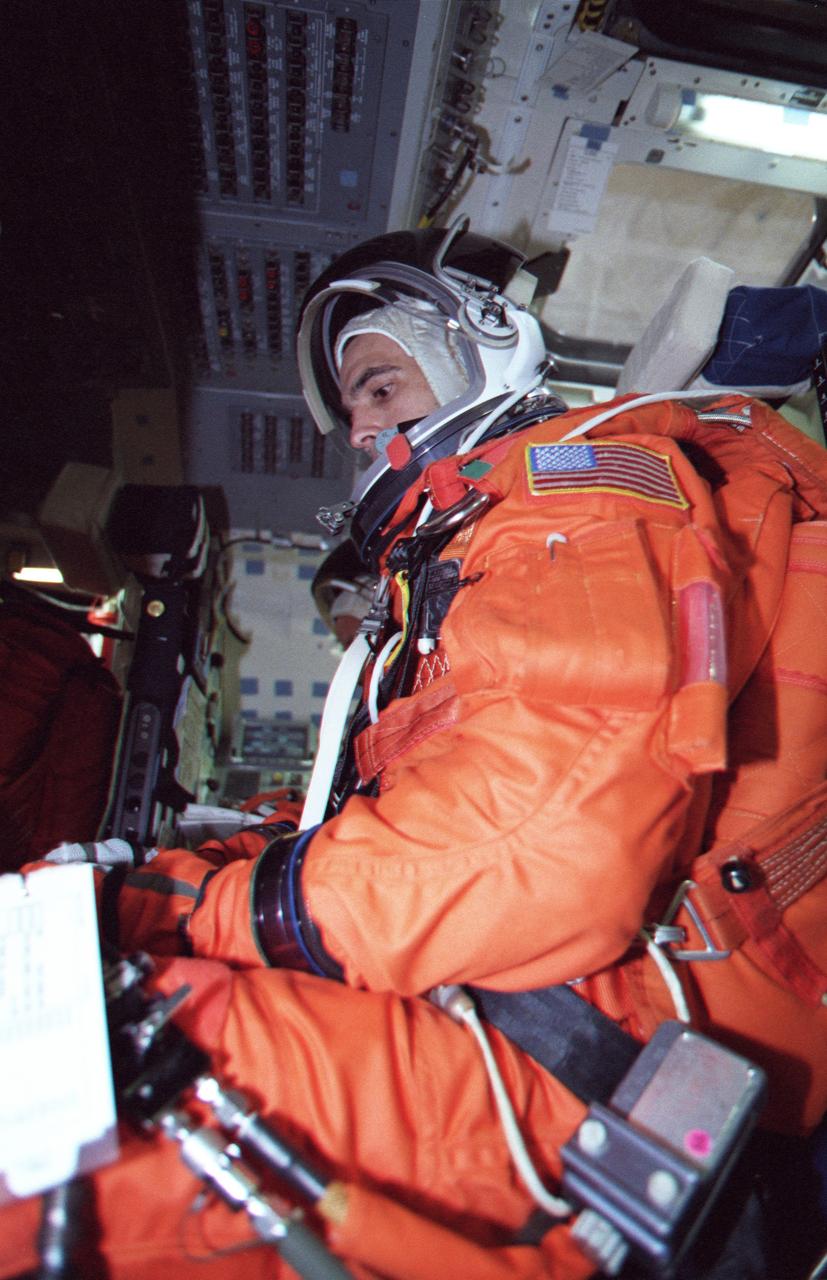
JSC2000-02222 (March 2000) --- Astronaut Richard A. Mastracchio, mission specialist, participates in a simulation exercise on the flight deck of the crew compartment trainer (CCT-1) at the Johnson Space Center's Systems Integration Facility. With four crew members seated on the flight deck and three on the mid deck, the astronauts rehearsed procedures for countdown and launch.
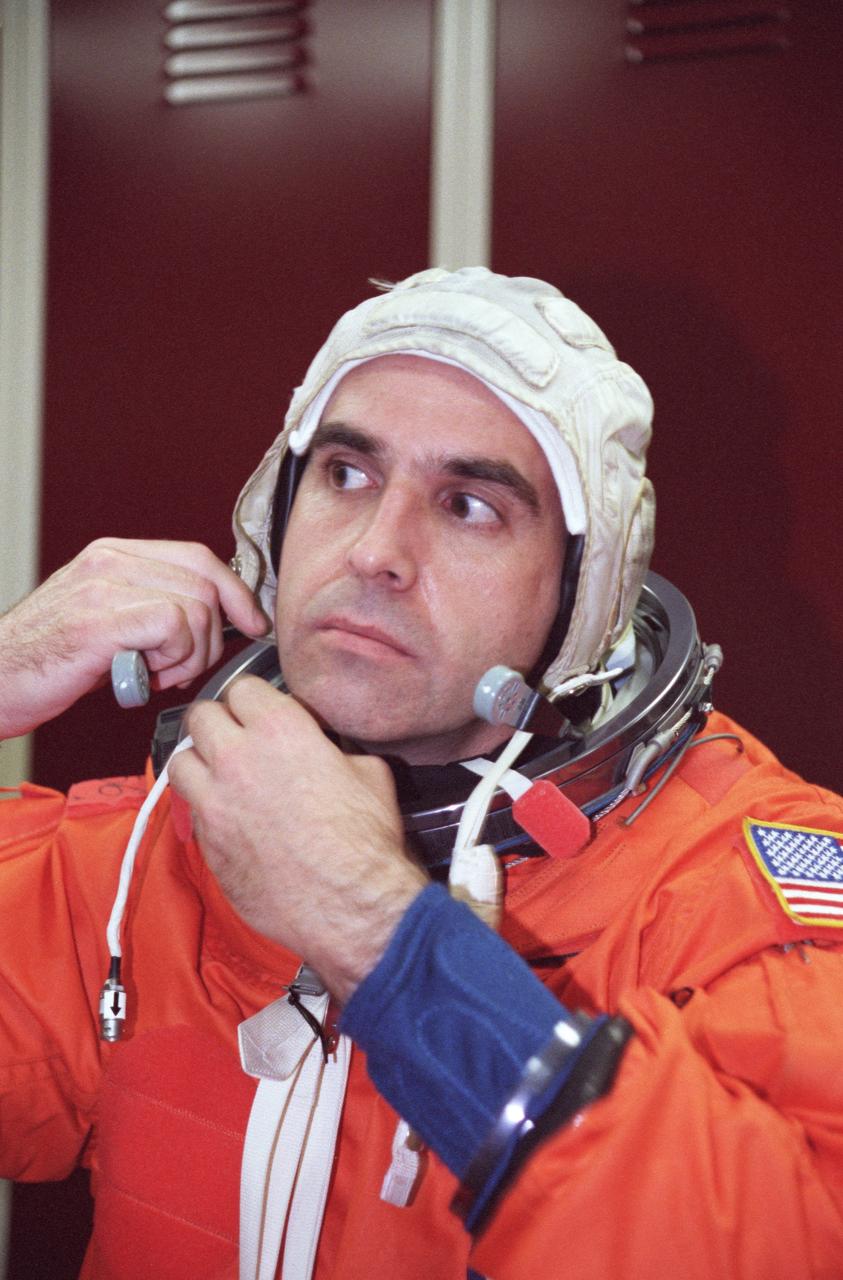
JSC2000-02219 (March 2000) --- Astronaut Richard A. Mastracchio, mission specialist, fastens his communications carrier assembly (CCA), part of the launch and entry suit (LES), during a training session at the Johnson Space Center's Systems Integration Facility.
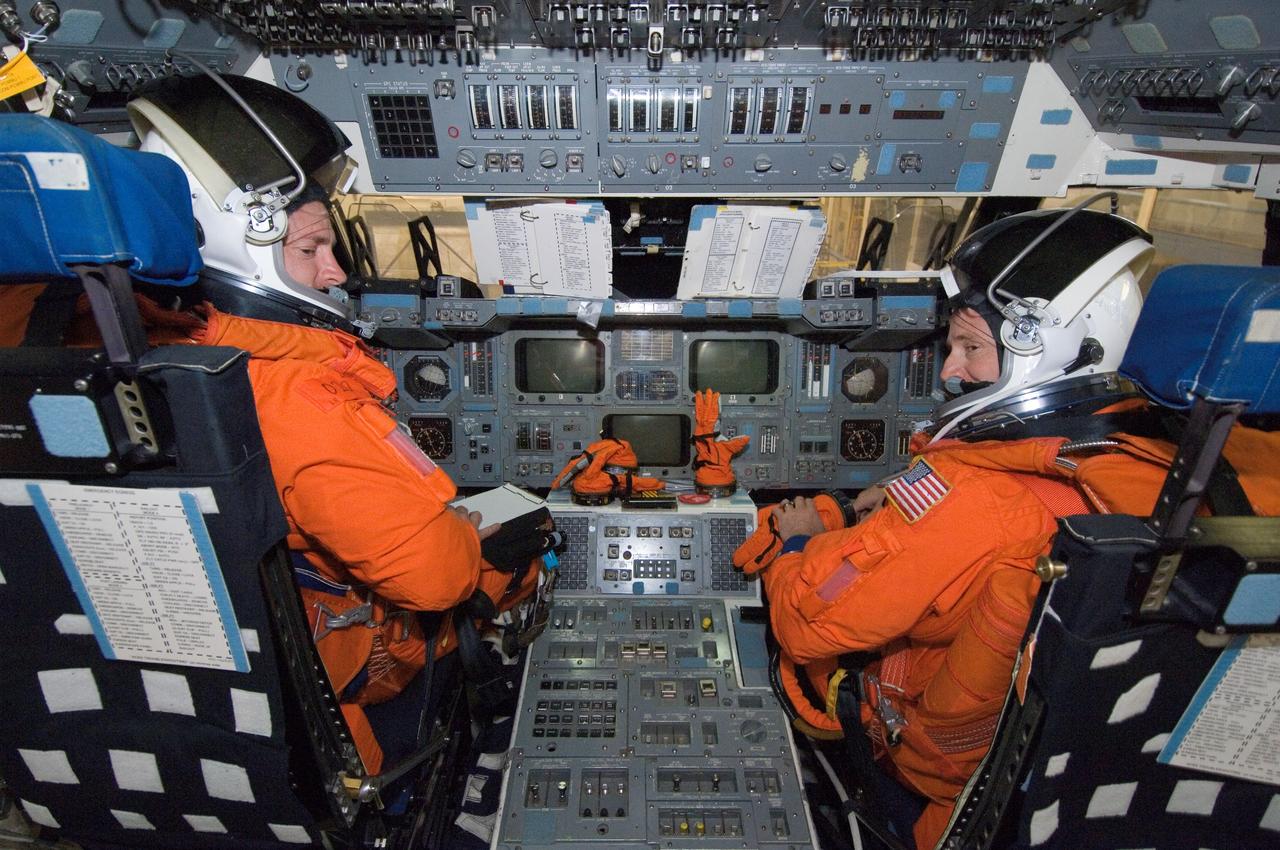
JSC2007-E-48205 (28 Sept. 2007) --- While seated at the commander's and pilot's stations, astronauts Mark E. Kelly (left) and Kenneth T. Ham, STS-124 commander and pilot, respectively, participate in a training session in the crew compartment trainer (CCT-2) in the Space Vehicle Mockup Facility at Johnson Space Center. Kelly and Ham are wearing training versions of their shuttle launch and entry suits.
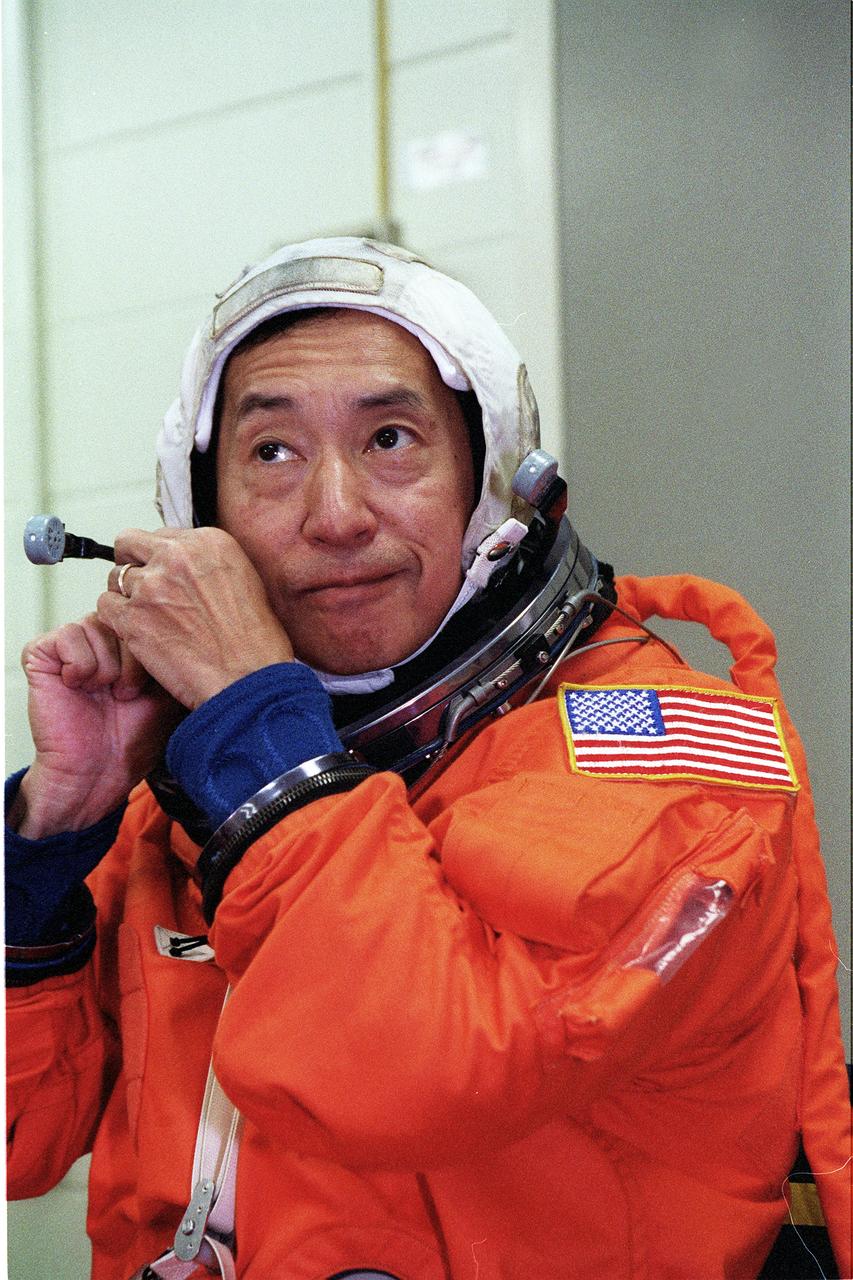
S99-05622 (19 May 1999) --- Astronaut Mamoru Mohri, mission specialist representing Japan's National Space Development Agency, works with his communications gear prior to participating in emergency bailout training at the Johnson Space Center's Systems Integration Facility. Mohri wears a training version of the partial pressure launch and entry garment.

STS009-35-1622 (28 Nov-8 Dec 1983) --- In the Coral Sea to the last of Australia?s Great Barrier Reed, a massive area is covered with floating material. Its origin is presently unknown nor is it known to be of biological origin or man-made. However, it covers thousands of square miles, thus massive, and is unreported.
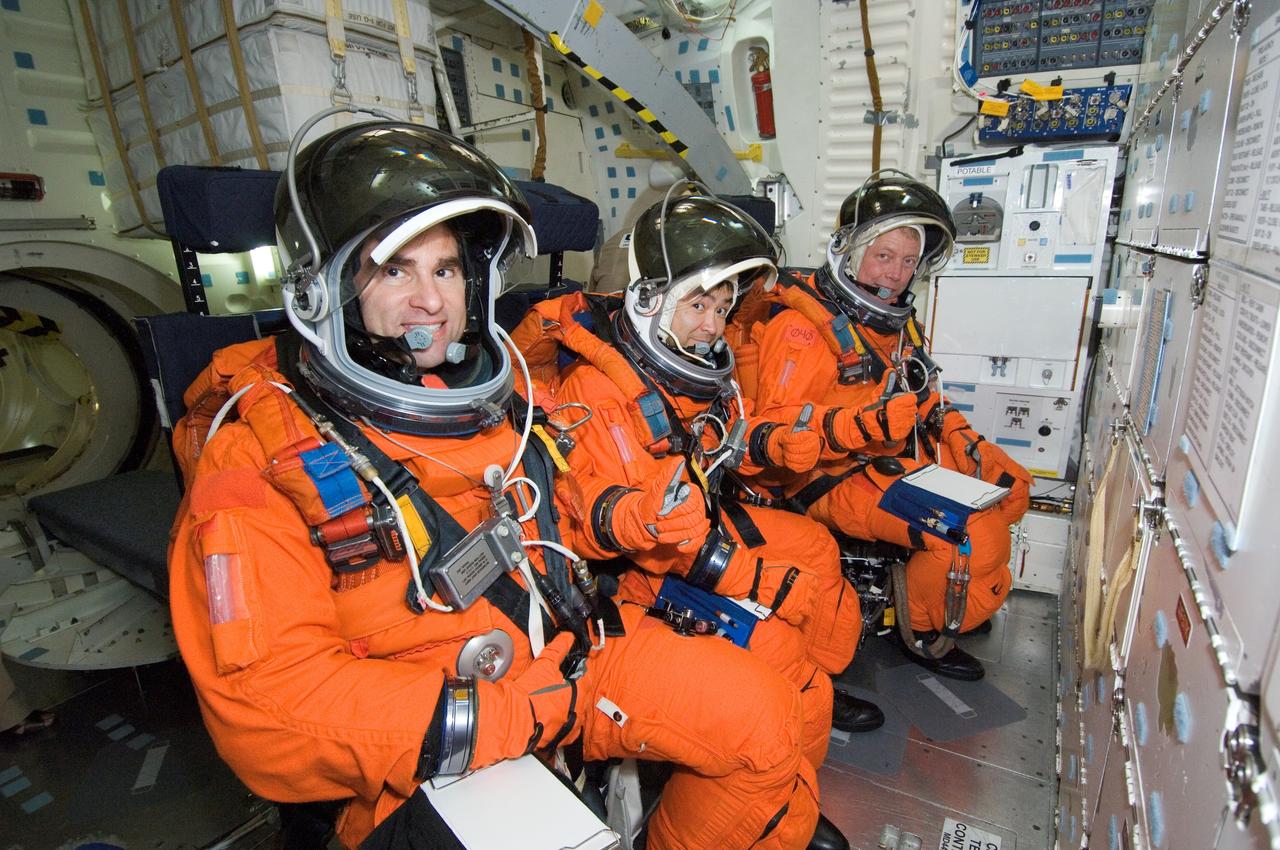
JSC2007-E-48215 (28 Sept. 2007) --- Astronauts Gregory E. Chamitoff (left), Expedition 17 flight engineer; Japan Aerospace Exploration Agency's (JAXA) Akihiko Hoshide and Michael E. Fossum, both STS-124 mission specialists, participate in a training session in one of the full-scale trainers in the Space Vehicle Mockup Facility at Johnson Space Center. Attired in training versions of their shuttle launch and entry suits, the three are seated on the middeck for a post insertion training session.
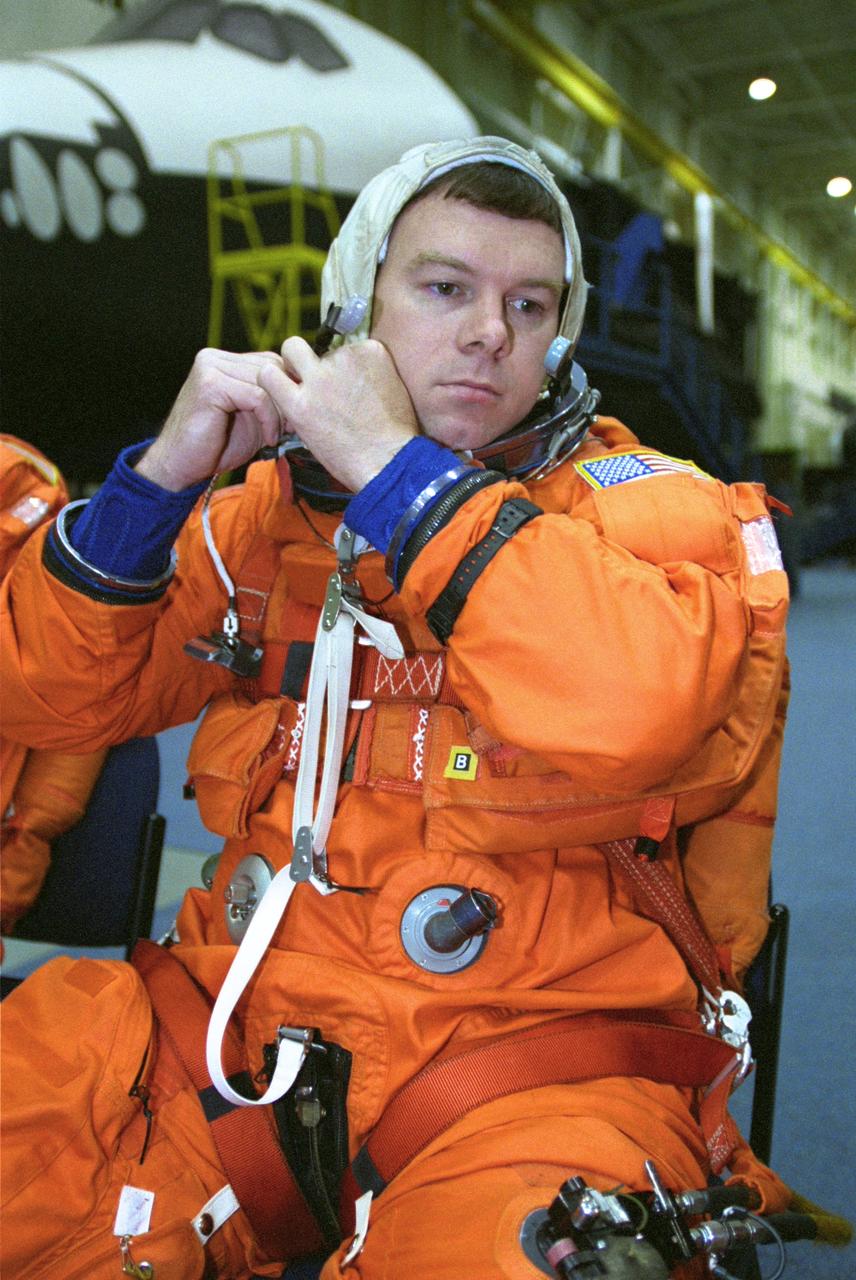
JSC2000-05552 (3 August 2000) --- Astronaut James M. Kelly, STS-102 pilot, snaps on his communications head gear prior to a session of egress training in the Johnson Space Center's Systems Integration Facility.
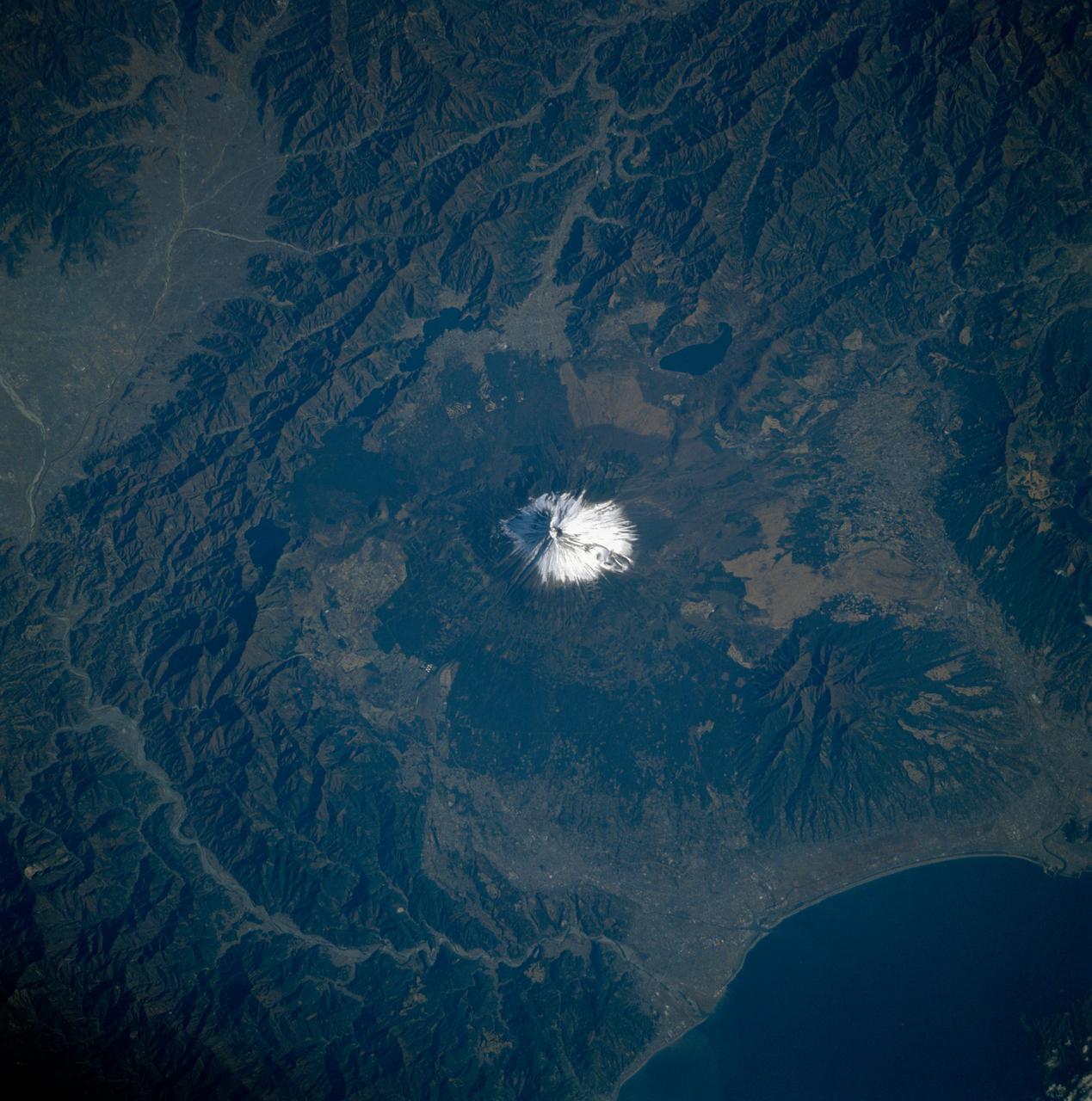
STS009-40-2575 (28 Nov-8 Dec 1983) --- This view of the Fuji volcano, Japan was taken on the 54th orbit of the Space Shuttle Columbia. The center coordinates are 35.5 degrees north latitude and 139.0 degrees east longitude. This was the first time a non-United States crew member was flown aboard the United States Space Shuttle, European Space Agency (ESA) payload specialist Ulf Merbold, Germany. The crew included NASA astronauts John W. Young, commander; Brewster H. Shaw Jr., pilot; Owen K. Garriott, mission specialist, Robert A. Parker, mission specialist; and Byron Lichtenberg, payload specialist.
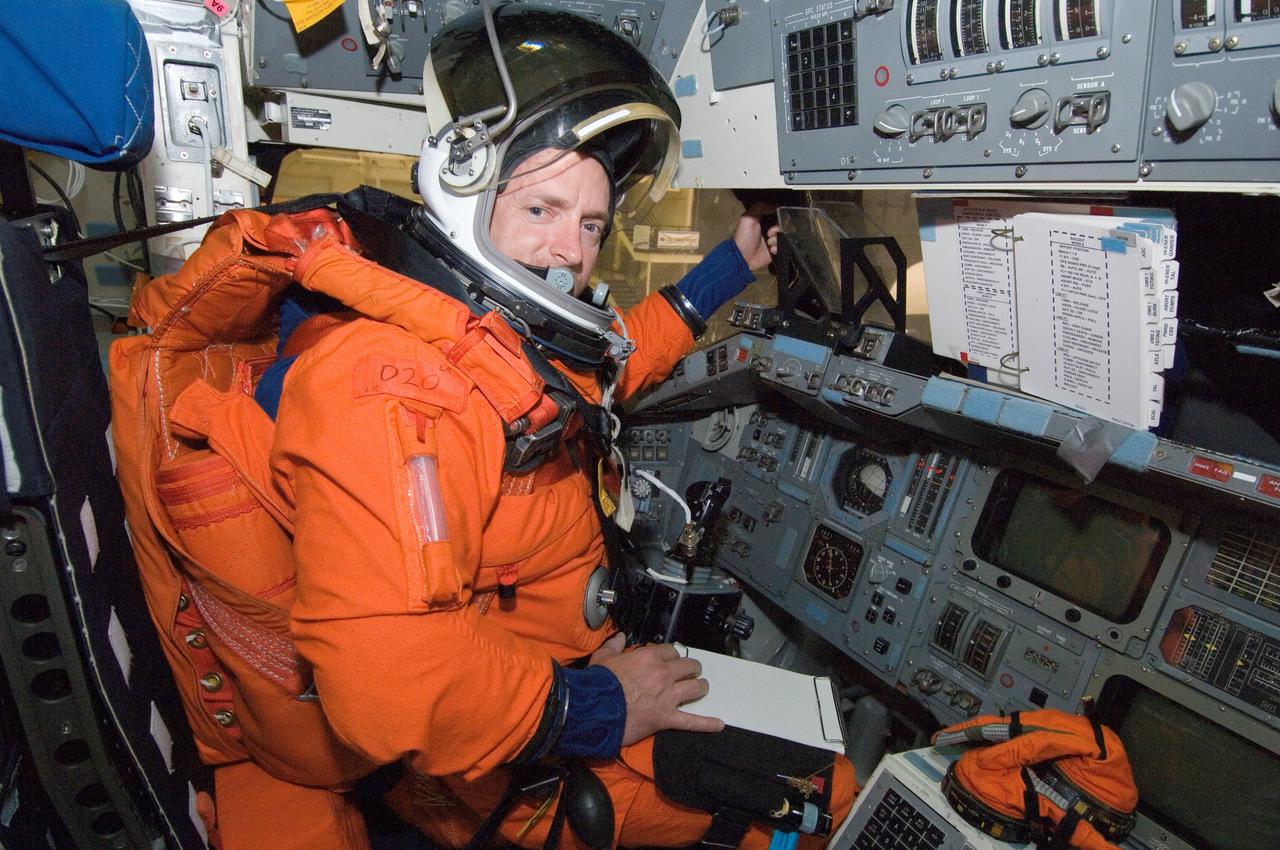
JSC2007-E-48207 (28 Sept. 2007) --- While seated at the commander's station, astronaut Mark E. Kelly, STS-124 commander, participates in a training session in the crew compartment trainer (CCT-2) in the Space Vehicle Mockup Facility at Johnson Space Center. Kelly is wearing a training version of his shuttle launch and entry suit.