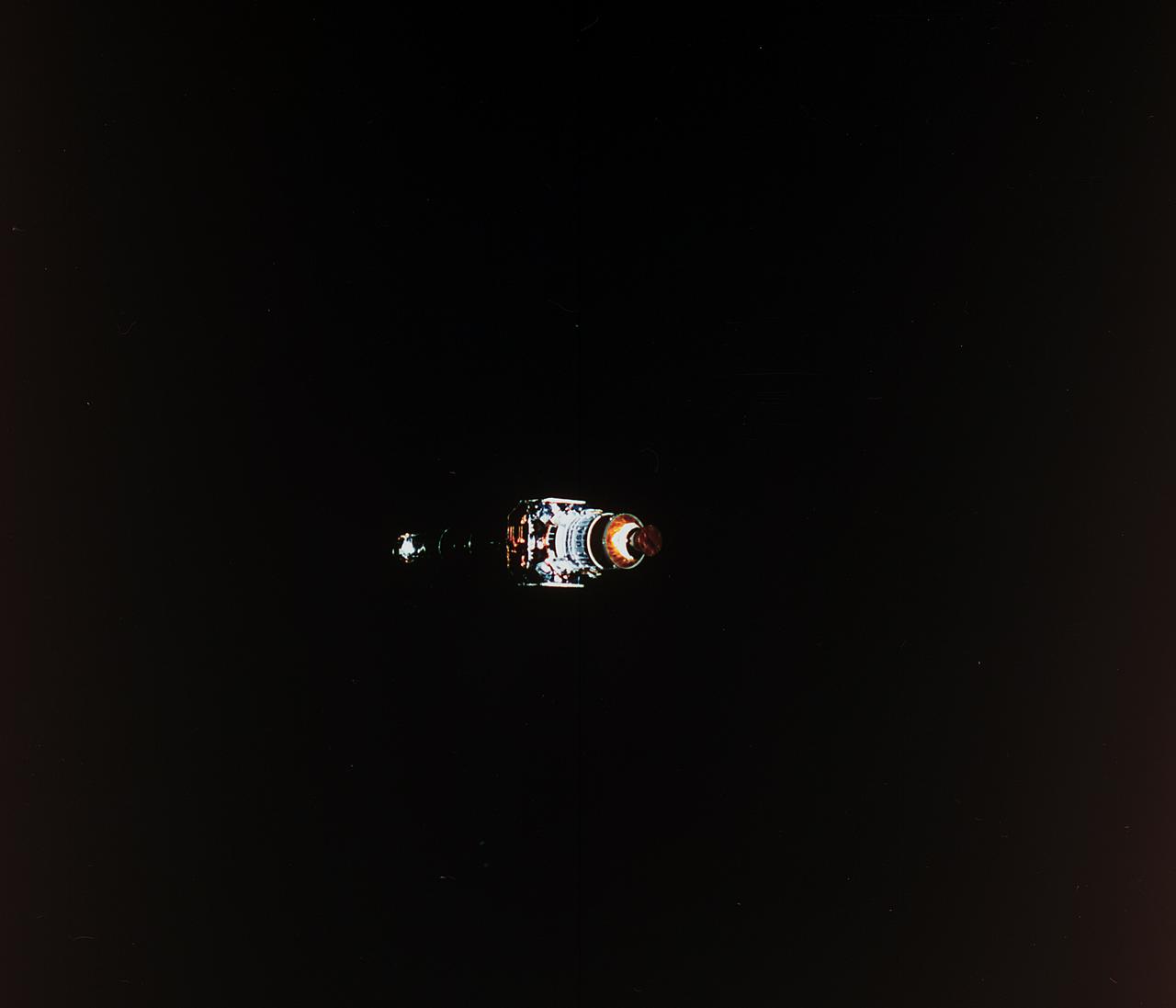
A crew member of the STS-93 mission took this photograph of the Chandra X-Ray Observatory, still attached to the Inertial Upper Stage (IUS), backdropped against the darkness of space not long after its release from Orbiter Columbia. Two firings of an attached IUS rocket placed the Observatory into its working orbit. The primary duty of the crew of this mission was to deploy the 50,162-pound Observatory, the world's most powerful x-ray telescope.
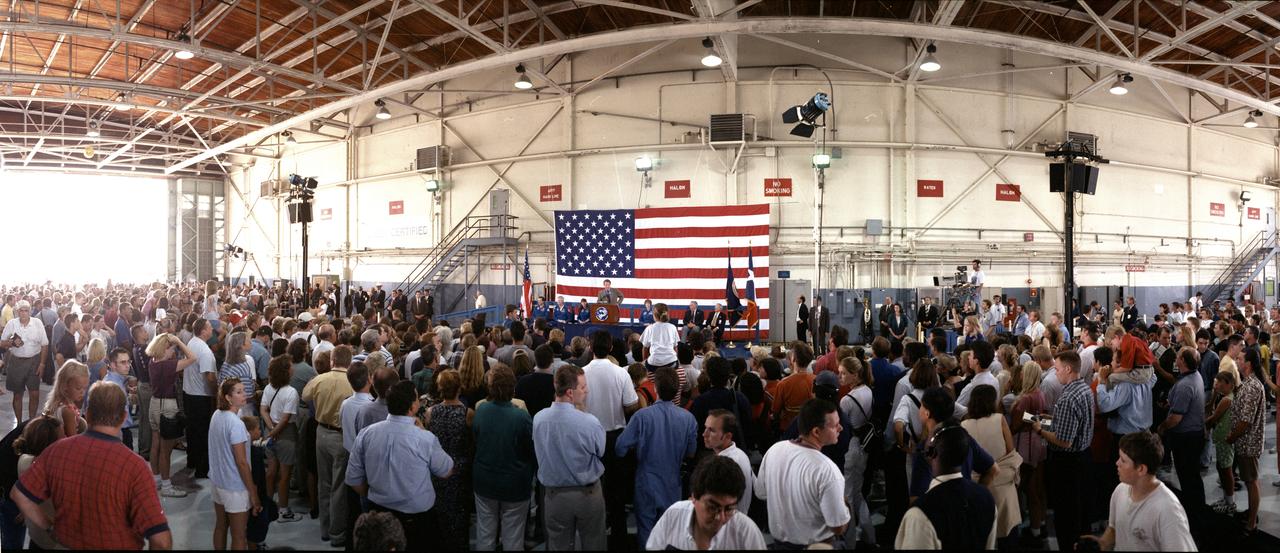
S99-08178 (28 July 1999) --- Normally housing NASA's fleet of T-38 jet trainers, this Ellington Field hangar was filled instead with well wishers for the returning crew of STS-93 on the morning of July 28, 1999.
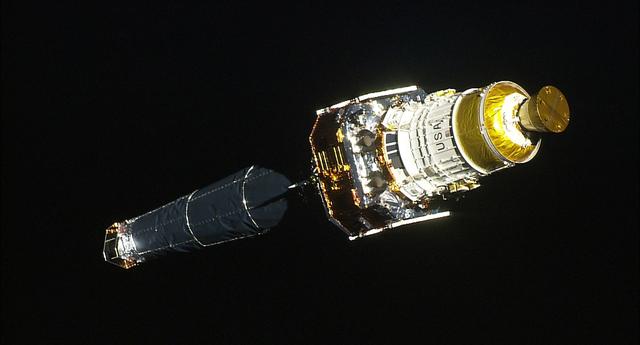
99-E-10028 (23 July 1999) --- The Chandra X-Ray observatory and its upper stage were captured during separation from the Space Shuttle Columbia with the STS-93 HDTV Camcorder inside the crew cabin.
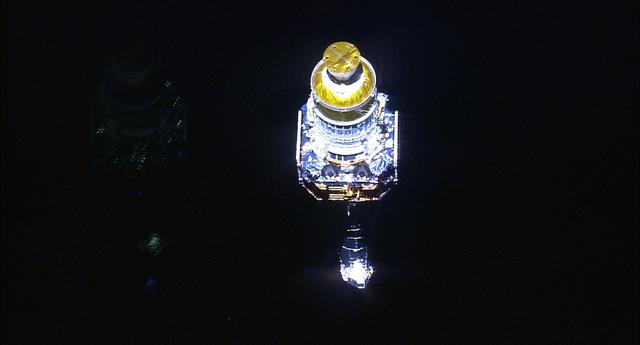
99-E-10027 (23 July 1999) --- The Chandra X-Ray observatory and its upper stage were captured during separation from the Space Shuttle Columbia with the STS-93 HDTV Camcorder inside the crew cabin.
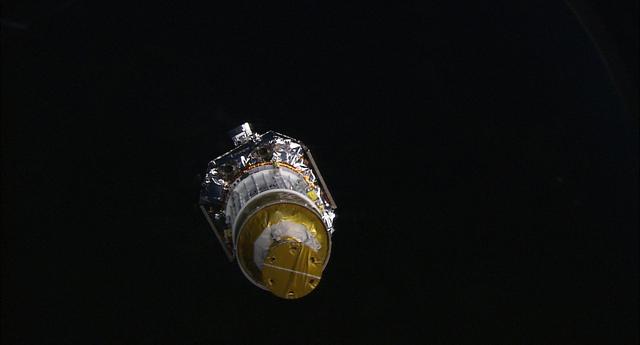
99-E-10026 (23 July 1999) --- The Chandra X-Ray observatory and its upper stage were captured during separation from the Space Shuttle Columbia with the STS-93 HDTV Camcorder inside the crew cabin.
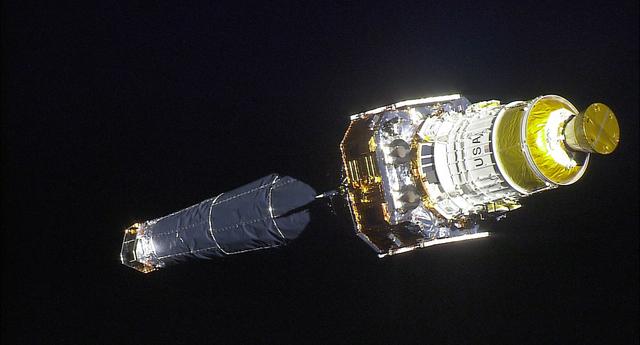
99-E-10020 (23 July 1999) --- The Chandra X-Ray observatory and its upper stage were captured during separation from the Space Shuttle Columbia with the STS-93 HDTV Camcorder inside the crew cabin.
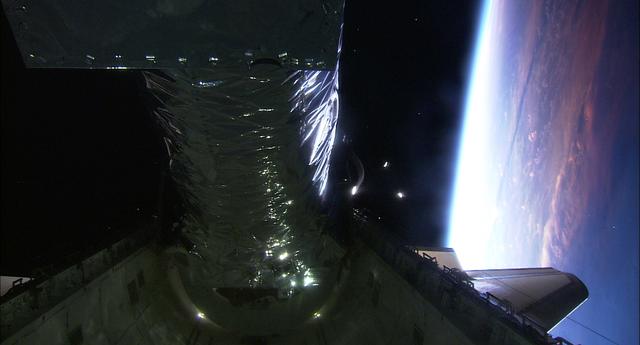
99-E-10019 (23 July 1999) --- The Chandra X-Ray observatory was recorded with the STS-93 HDTV Camcorder as it moved from its stowed position in the cargo bay of the Space Shuttle Columbia. Deployment of the giant telescope occurred only hours after the shuttle reached Earth orbit.
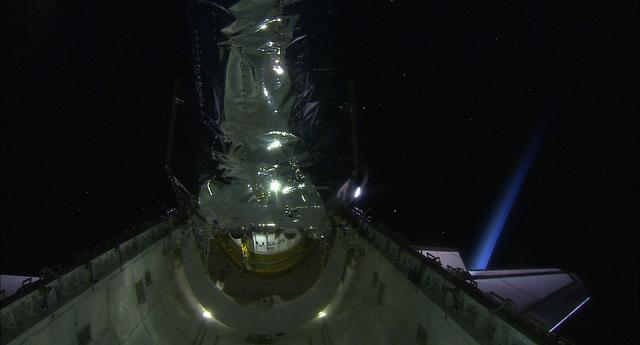
99-E-10023 (23 July 1999) --- The Chandra X-Ray observatory was recorded with the STS-93 HDTV Camcorder prior to its deployment from the cargo bay of the Space Shuttle Columbia. Separation of the giant telescope occurred only hours after the shuttle reached Earth orbit.
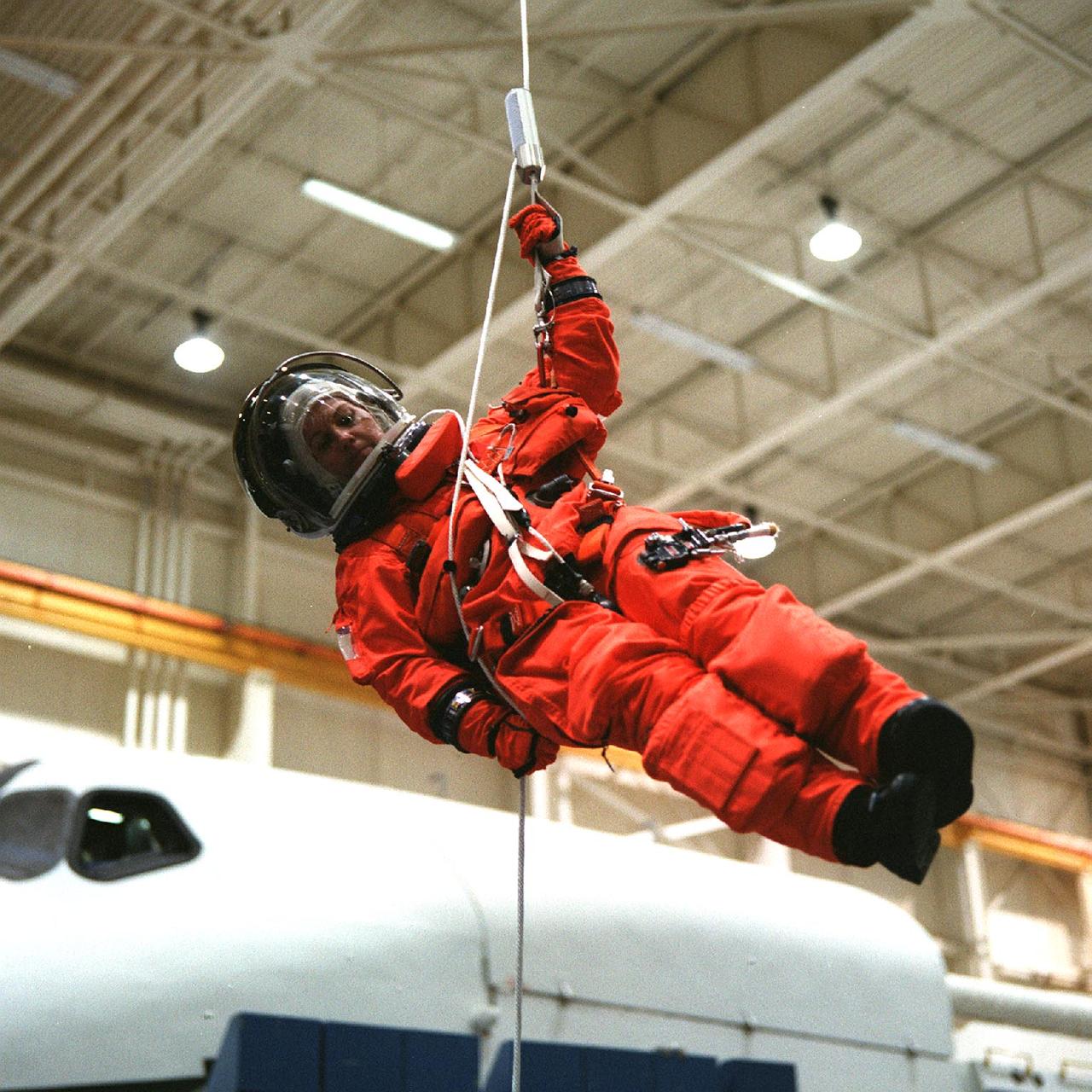
S98-09839 (6-29-98) --- Astronaut Eileen M. Collins lowers herself from a simulated shuttle in trouble during an emergency egress training session in the Systems Integration Facility at the Johnson Space Center (JSC). Collins, mission commander for STS-93, will be joined by four other astronauts for a scheduled five-day mission aboard the Space Shuttle Columbia in the spring of next year.
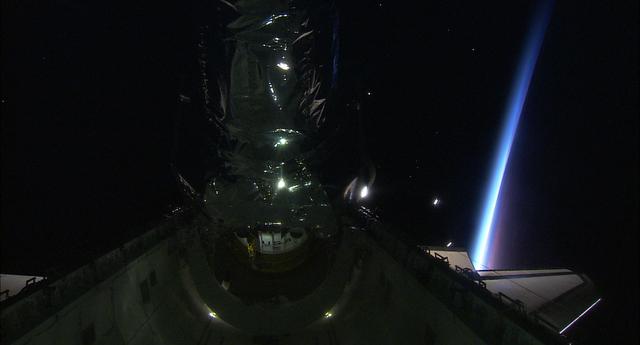
99-E-10022 (23 July 1999) --- The Chandra X-Ray observatory was recorded with the STS-93 HDTV Camcorder as it moved from its stowed position in the cargo bay of the Space Shuttle Columbia. The blue and purple airglow over Earth's horizon forms part of the backdrop for the scene. Deployment of the giant telescope occurred only hours after the shuttle reached Earth orbit.
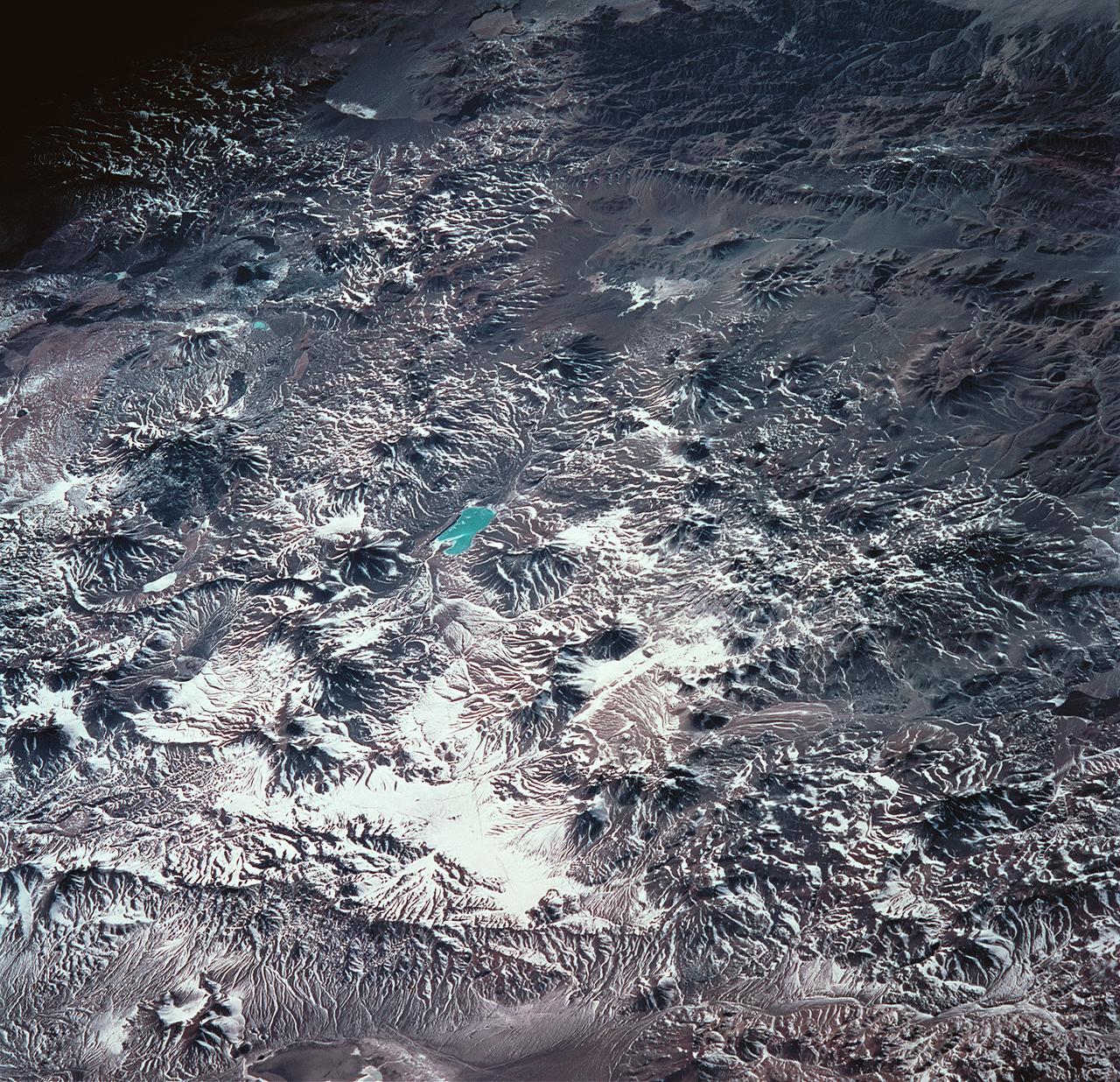
STS093-704-087 (23-27 July 1999) --- This low angle, early morning shot over Chile was photographed from the Earth-orbiting Space Shuttle Columbia during the STS-93 mission. In the words of one of the scientists studying the STS-93 Earth imagery, Laguna Verde, in the Atacama Province of Chile (near the Argentine border), lies like a turquoise jewel among the stark black and white snow covered volcanic peaks of the High Andes. The ambient elevation in this part of the Andes is 16,000 feet (4,877 meters) with the highest local peak, Nevada Ojas de Salado (just to the right of the lake), reaching to 23,240 feet. (7084 meters.)

STS093-708-062 (23-27 July 1999) --- The STS-93 astronauts took this picture of the Island of Borneo, which is divided among Indonesia, Malaysia and Brunei. The Rajang River meets the South China Sea in the northwestern portion of the Malaysian state of Sarawak. Smoke from both large and small fires is blowing north by the prevailing summer winds. Notice the contrast of dark colored rainforest with the lighter clearings where the largest fires are burning. According to NASA scientists studying the STS-93 photo collection, the sediment plumes along the coast are mostly shoreline erosional materials caught up in longshore currents. The Saribas River can be seen at the bottom.

S98-09499 (6-24-98) --- Astronaut Eileen M. Collins gets a refresher course in water survival as part of her preparation for her role as commander in next year's scheduled STS-93 mission. Wearing a training version of the partial pressure launch and entry suit for Shuttle flights, Collins watches as a crew member simulates a parachute jump into the pool of the Neutral Buoyancy Laboratory (NBL) at the Johnson Space Center's Sonny Carter Training Center.
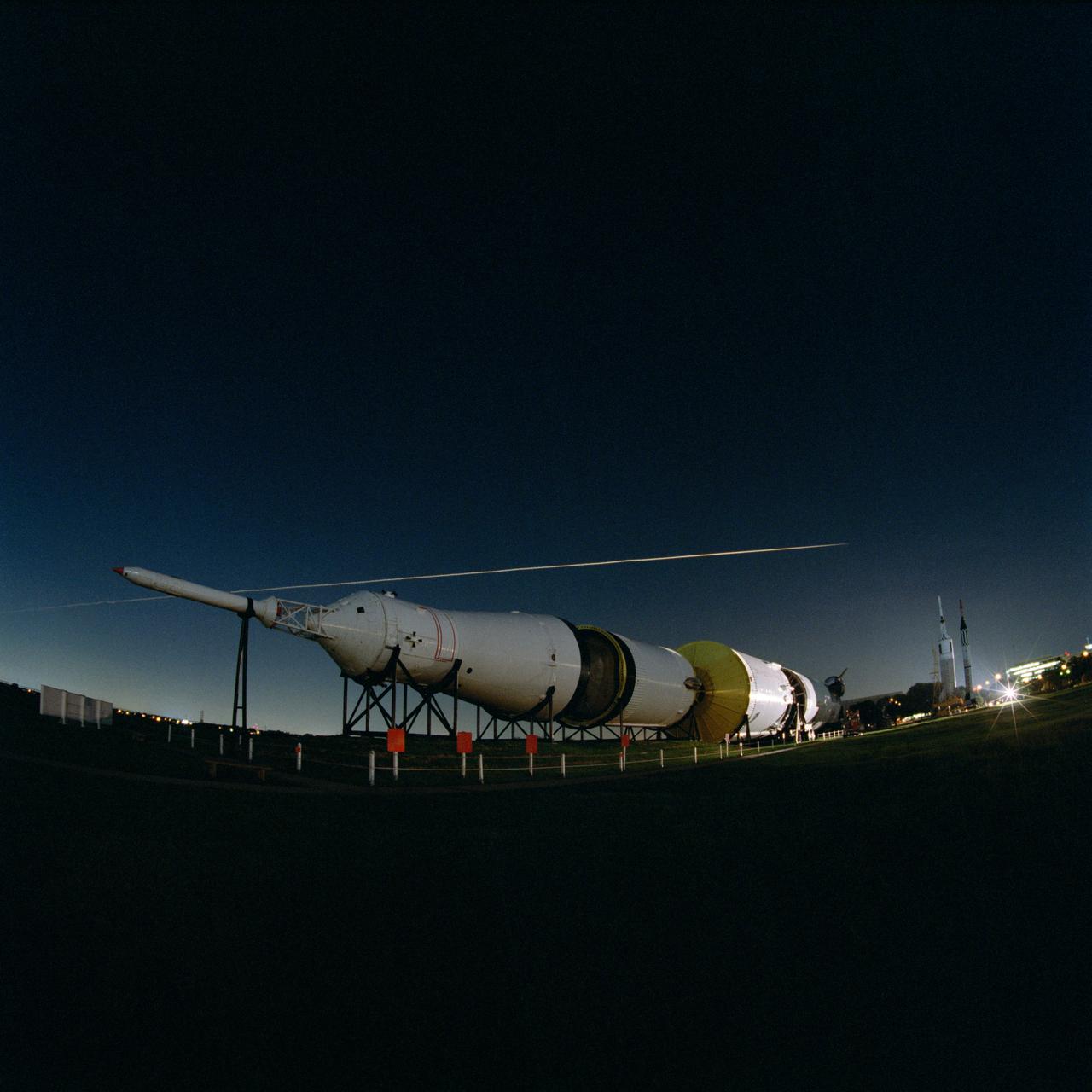
S99-08357 (27 July 1999) --- The fly-over of Space Shuttle Columbia's STS-93 re-entry is seen above the Johnson Space Center's Rocket Park. The Saturn V is below the streak that was left by Columbia re-entering the atmosphere. The image was captured with a Hasselblad 503cx medium format camera with a 30mm Hasselblad lens using an 8-second exposure and an aperture setting of f/8. The film was Kodak PMZ 1000 color negative film. The photographer was Mark Sowa of the NASA Johnson Space Center's photography group.
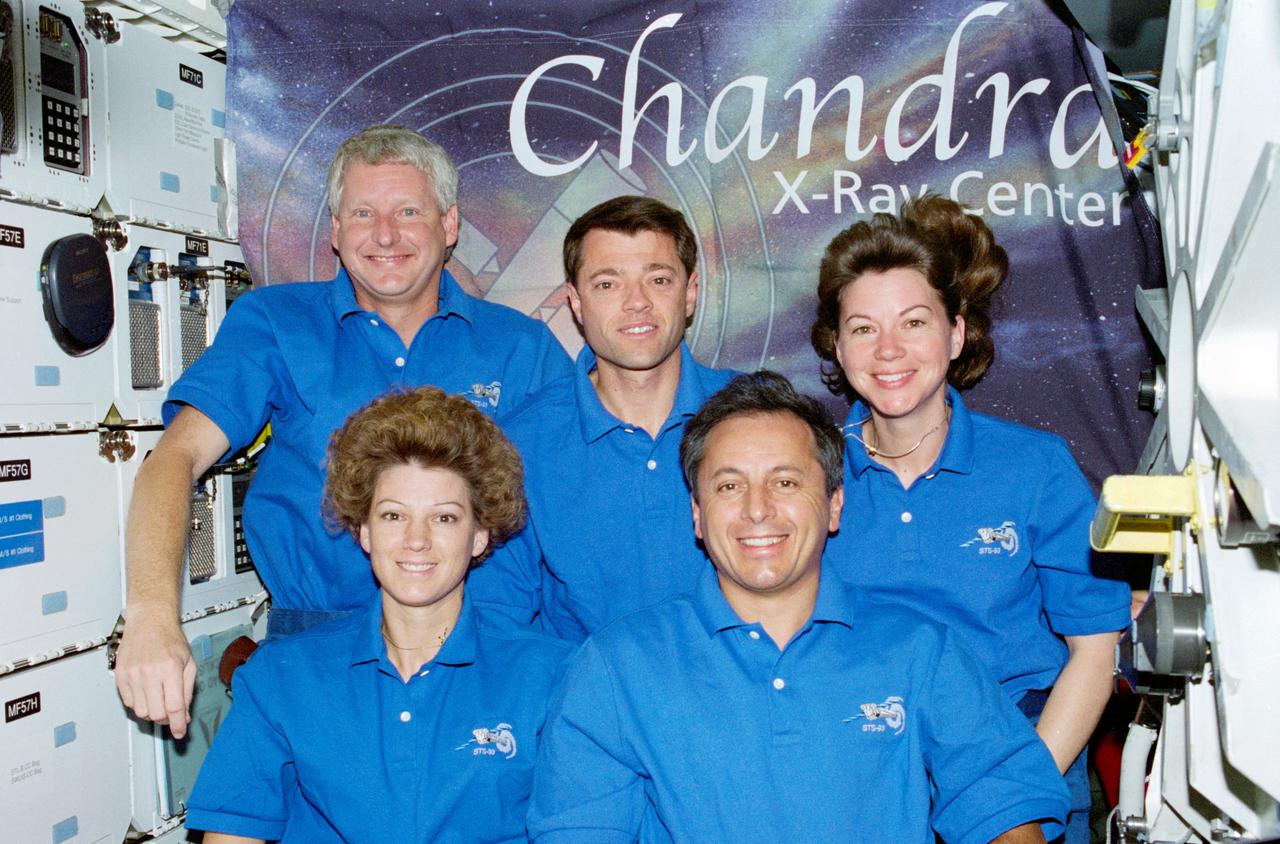
STS093-322-017 (23-27 July 1999) --- The five STS-93 astronauts pose for the traditional inflight crew portrait on Columbia's middeck. In front are astronauts Eileen M. Collins, mission commander, and Michel Tognini, mission specialist, representing France's Centre National d'Etudes Spatiales (CNES). Behind them are (from the left) astronauts Steven A. Hawley, mission specialist; Jeffrey S. Ashby, pilot; and Catherine G. (Cady) Coleman, mission specialist.
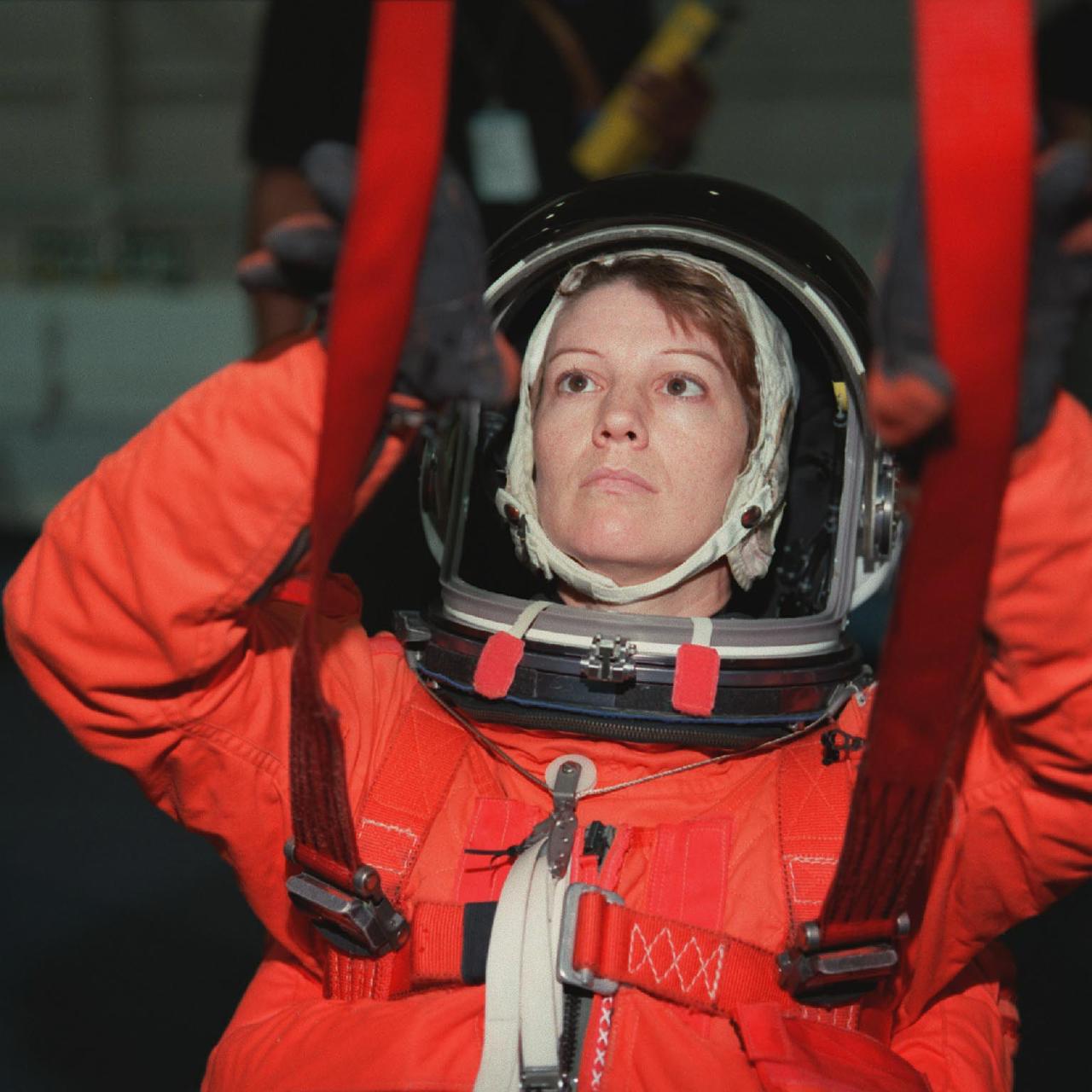
S98-09501 (6-14-98) --- Astronaut Eileen M. Collins participates in a simulation of an emergency egress from a shuttle during preparations for her role as mission commander for next year's STS-93 flight. Collins was joined by four other crewmembers for the training session, held in and around the deep Neutral Buoyancy Laboratory (NBL)pool at the Johnson Space Center's Sonny Carter Training Center.
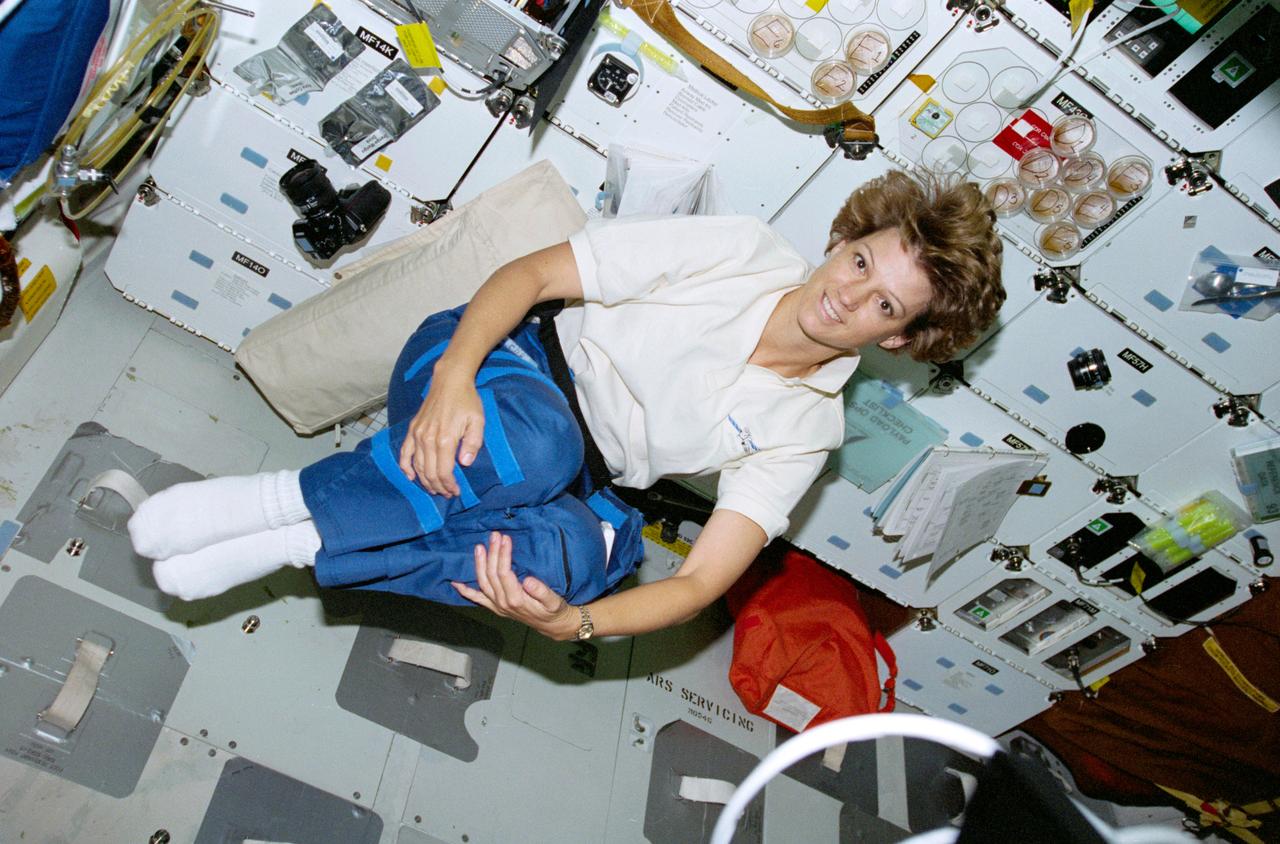
STS093-321-017 (23-27 July 1999) --- Astronaut Eileen M. Collins, mission commander, floats on Columbia's middeck during a free moment. She and four other astronauts spent almost five days in Earth orbit in support of the STS-93 mission. The first day was perhaps the astronauts' busiest, as it was on that day they deployed the world's most powerful X-Ray telescope and began to conduct a battery of in-cabin experiments.
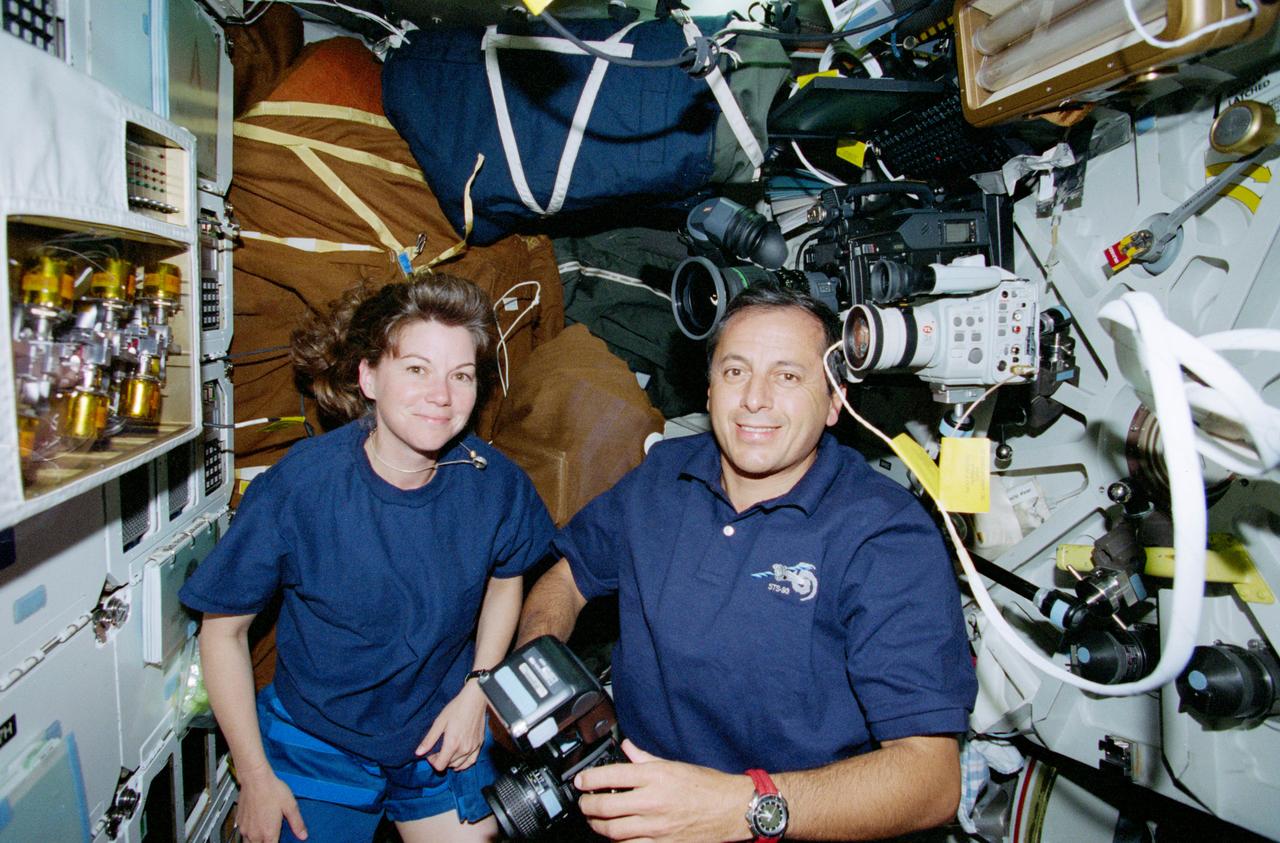
STS093-321-035 (23-27 July 1999) --- Astronauts Catherine G. (Cady) Coleman and Michel Tognini, mission specialists, check out the Lightweight Flexible Solar Array Hinge (LFSAH, upper left) on Columbia's middeck. LFSAH consists of several hinges fabricated from shape-memory alloys and other spacecraft appendages. During the five-day STS-93 flight, the experiment demonstrated the deployment capability of a number of hinge configurations. The experiment is sponsored by the U.S. Air Force Research Lab, Kirtland Air Force Base. Tognini represents the Centre National d'Etudes Spatiales (CNES) of France.
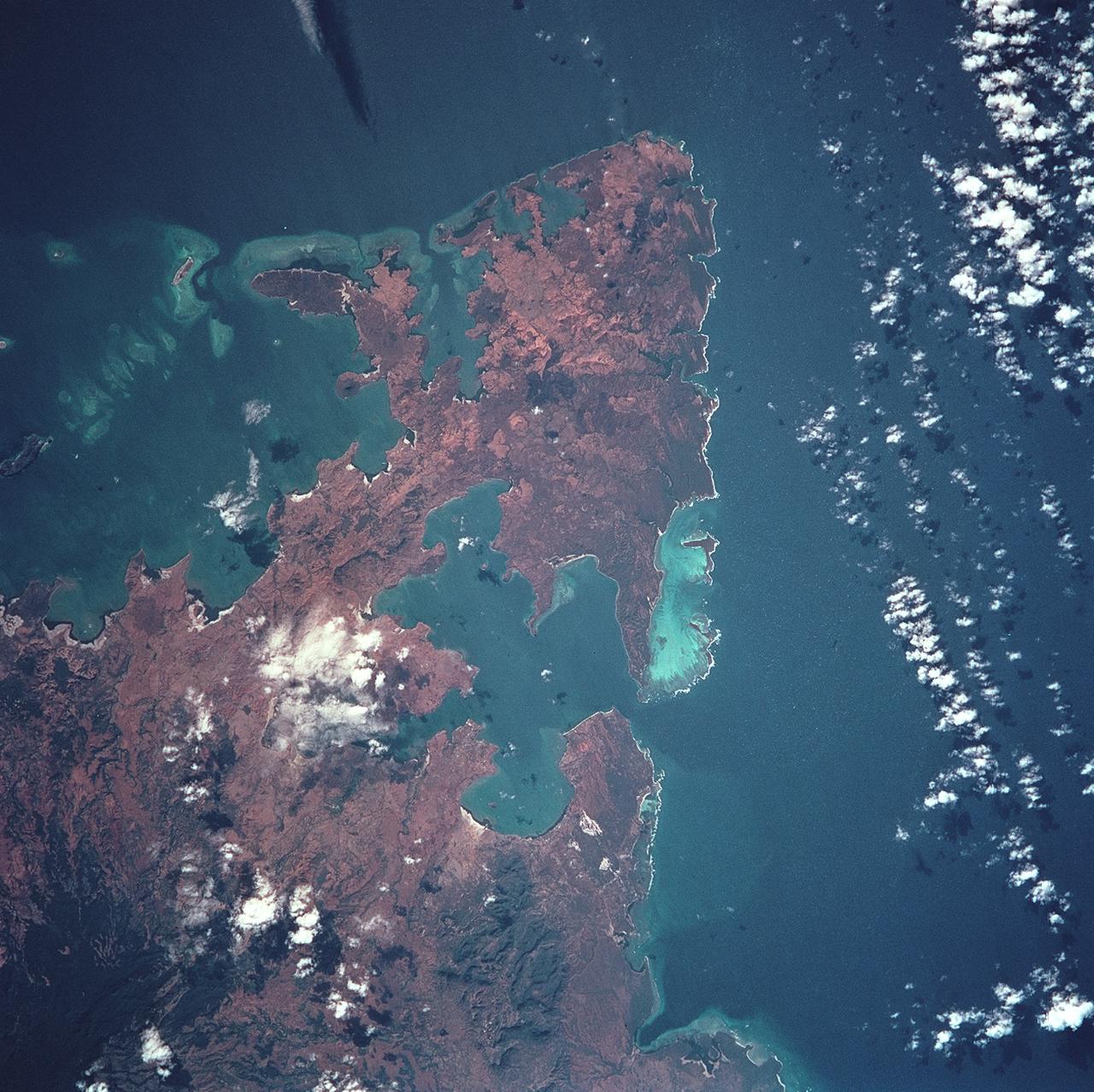
STS093-722-051 (23-27 July 1999) --- The STS-93 astronauts aboard the Space Shuttle Columbia took this picture over the Indian Ocean. The distinctive arrowhead shape of the northern tip of the island of Madagascar is easily recognizable. The land appears red with patches of dark green on the upper slopes. According to NASA scientists studying the STS-93 photo collection, the dark areas are the remnants of forests and the red areas are cleared land. When the photo was taken, the shuttle was flying over a point located at 14.7 degrees south latitude and 44.0 degrees east longitude. Data back information on the 70mm film listed the date and time of the photo as 11:38:20 GMT, July 24, 1999 (Orbit 21).
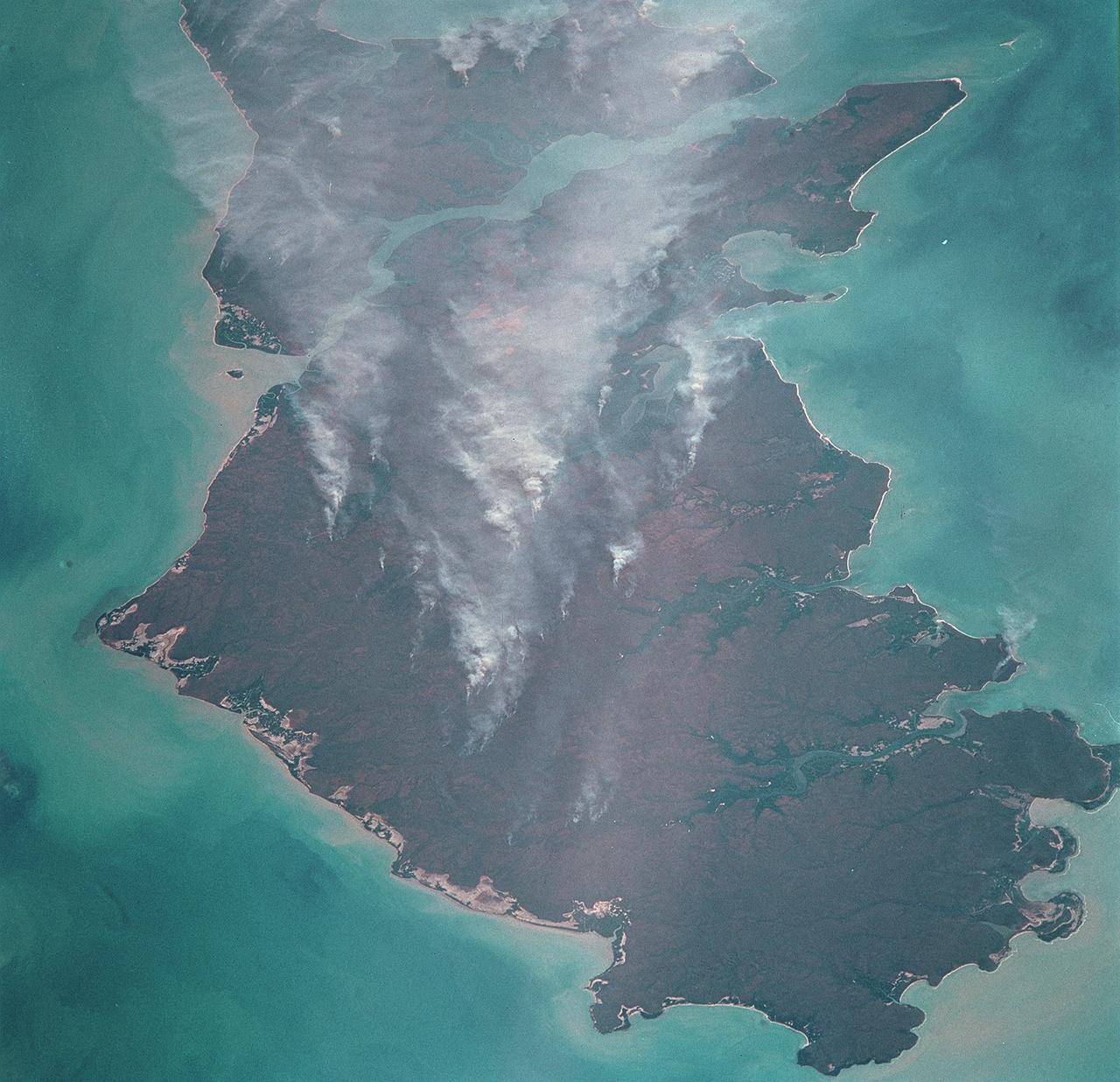
STS093-709-046 (23-27 July 1999) --- The STS-93 astronauts aboard the Space Shuttle Columbia took this picture featuring the Northern Territory of Australia. Melville Island (bottom) and Bathurst Island are across Clarence Strait just north of the city of Darwin. According to scientists studying the STS-93 photo collection, seasonal fires are common in the region. Winter is the season for agricultural land clearing of the native monsoon forests. Smoke from the fires on the islands is being blown northwest by the prevailing winter winds. Data back information on the 70mm film that recorded this image lists time and date as 05:38:45 GMT, July 25, 1999. When the photo was taken, the shuttle was flying over a point located at 18.4 degrees south latitude and 118.7 east longitude.
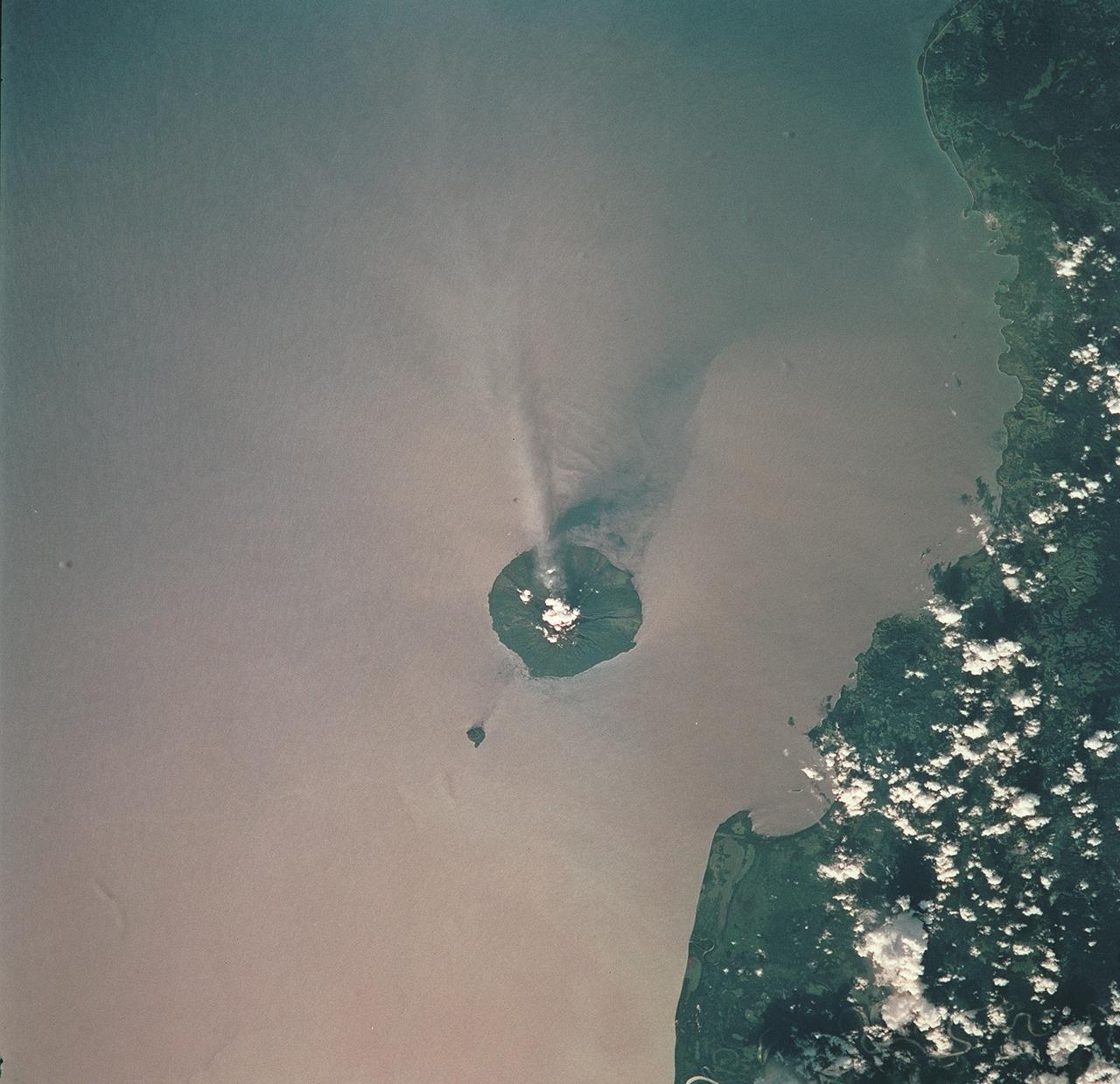
STS093-709-051 (23-27 July 1999) --- The STS-93 astronauts aboard the Space Shuttle Columbia took this picture of the volcanic island of Manam, along the northeast coast of Papua New Guinea. Manam is one in a string of currently active volcanoes called the Bismarck Arc. It is the most active of the group, having begun its present activity in 1994. The plume of steam and ash streaming from its crater extends more than 20 miles into the atmosphere. When the photo was taken, the shuttle was flying over a point located at 12.2 degrees south latitude and 132.0 degrees east longitude. Data back information on the 70mm film lists time and date of the photo as 05:42:31 GMT, July 25, 1999 (orbit 33).
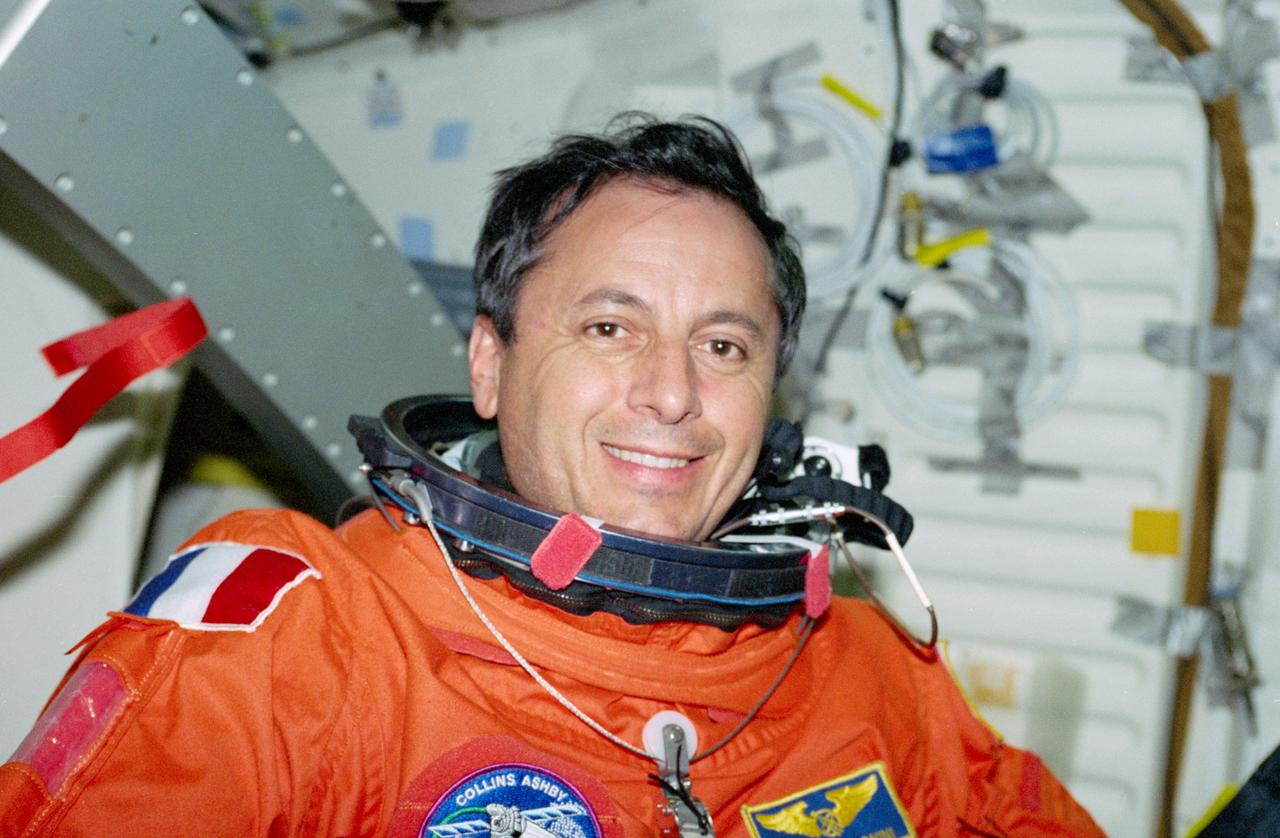
STS093-325-034 (27 July 1999) --- Astronaut Michel Tognini, mission specialist representing France's Centre National d'Etudes Spatiales (CNES), prepares for Columbia's descent to Earth on the fifth and final day of the STS-93 mission. He is wearing the special partial pressure launch and entry suit, minus its helmet at this point. Behind him is the escape pole designed to be used in emergency egress.
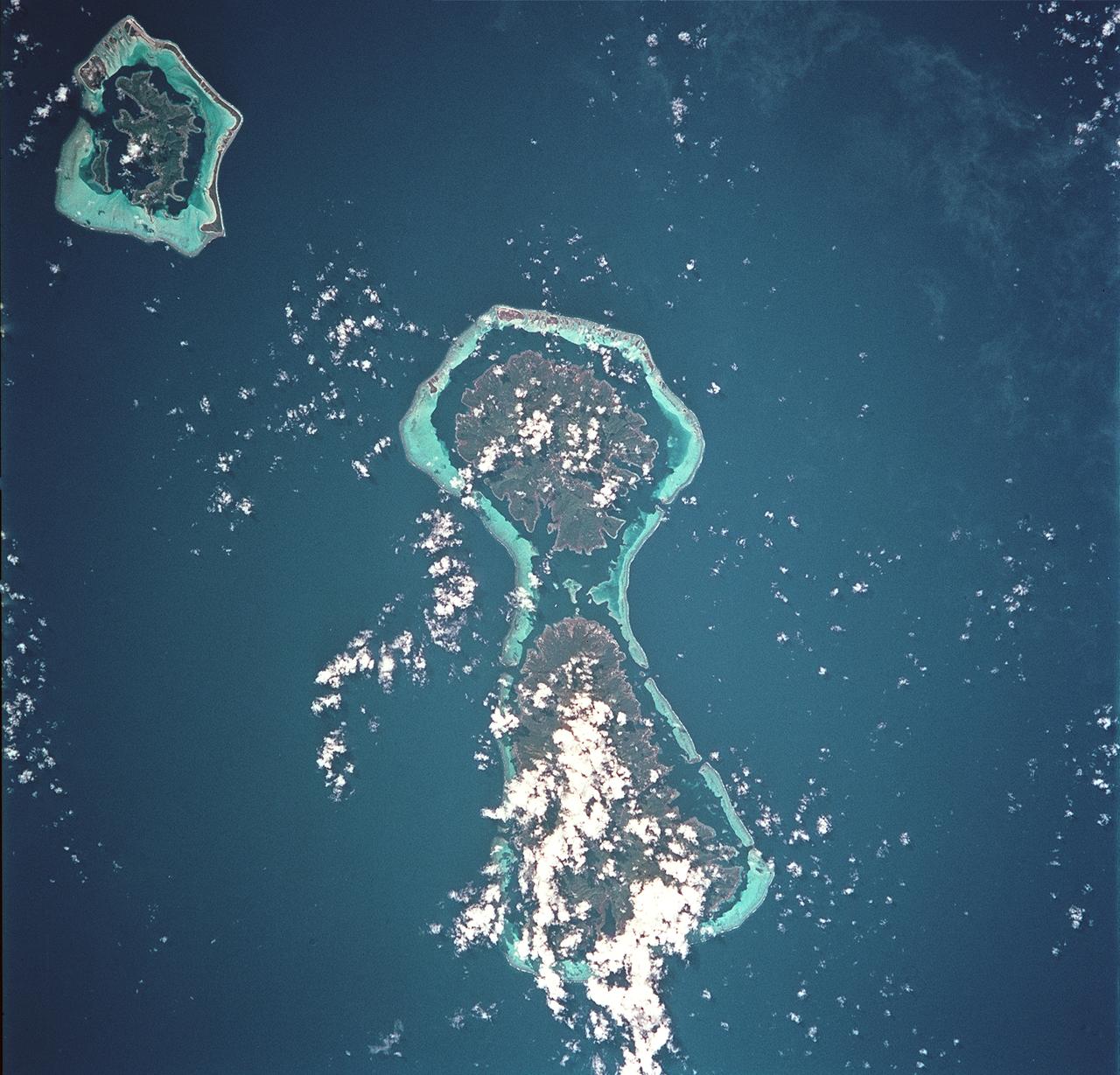
STS093-717-066 (23-27 July 1999) --- The STS-93 astronauts aboard the Space Shuttle Columbia took this picture featuring the Society Islands. Delicate coral reefs ring the islands of Bora Bora (top), Tahaa (center) and Raiatea (bottom). The Society Islands, which also include the island of Tahiti, are one of many archipelagoes that constitute French Polynesia in the central South Pacific. When the photo was taken, the shuttle was flying over a point located at 16.2 degrees south latitude and 151.8 degrees west longitude. Data back information on the 70mm listed the time and date as 23:36:16 GMT, July 25, 1999 (Orbit 45).
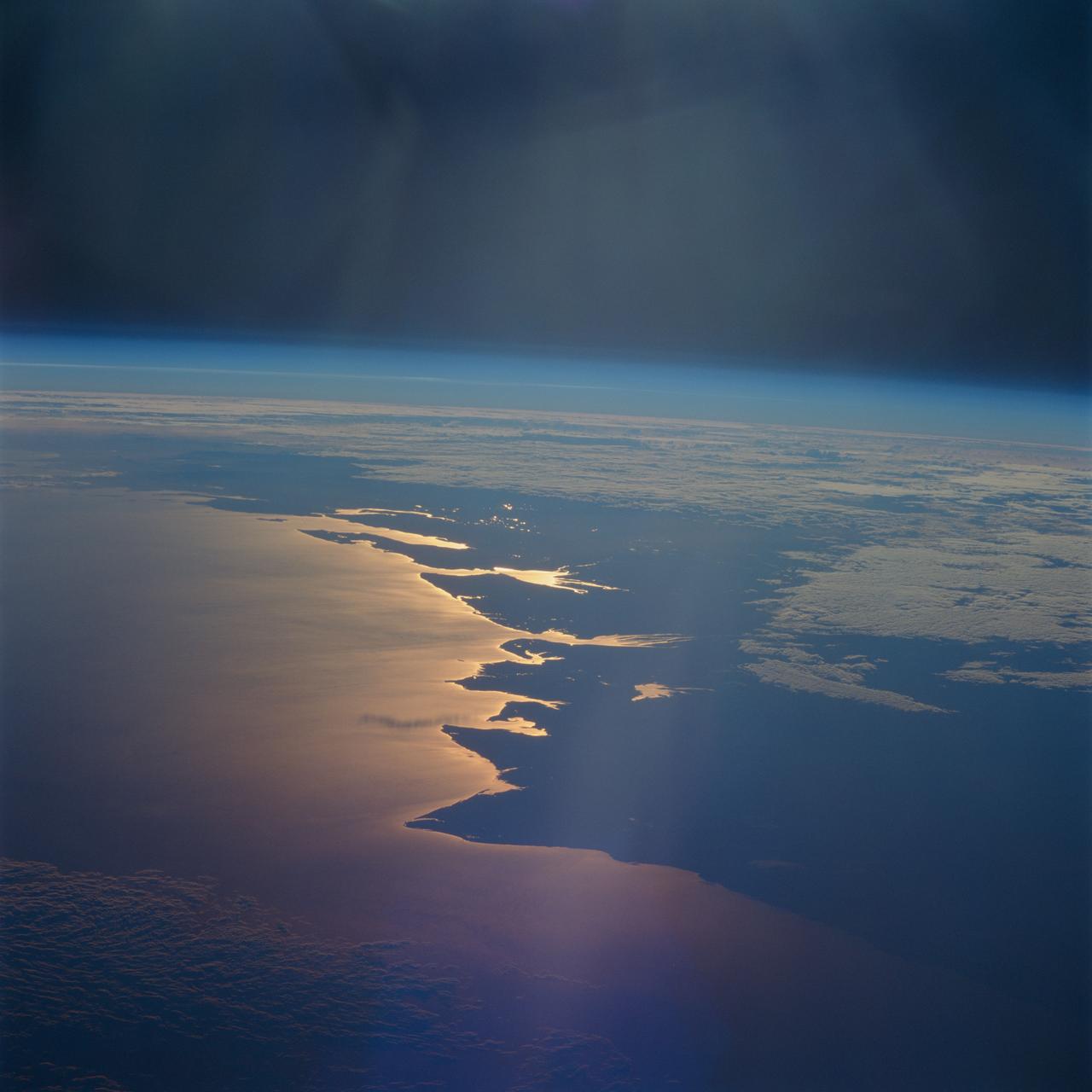
STS093-716-065 (23-27 July 1999) --- The STS-93 astronauts aboard the Space Shuttle Columbia took this picture of a sunrise on the Mozambique Channel along the coast of Madagascar. The nearest point of land is Cape Saint Andre, which forms the northwest corner of the island. Sunglint highlights the land-water boundary along a series of dynamic estuaries. The fifth inlet from the bottom just above the small lake is the Betsiboka Estuary. When the photo was taken, the shuttle was flying over a point located at 18.7 degrees south latitude and 36.1 degrees east longitude. Data back information on the 70mm film listed the time and date as 03:40:43 GMT, July 26, 1999 (orbit 48).
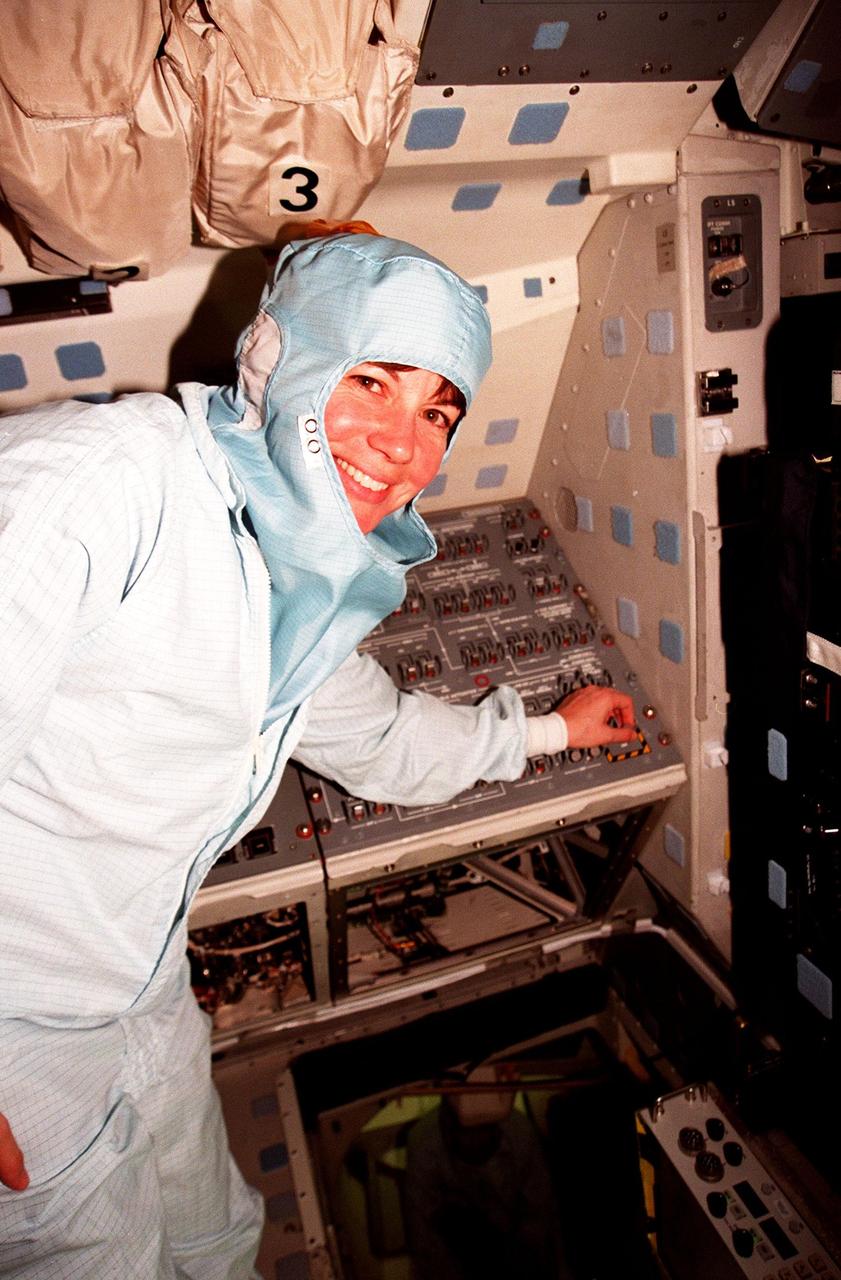
In the Orbiter Processing Facility Bay 3, during the Crew Equipment Interface Test (CEIT), Mission Specialist Catherine G. Coleman checks equipment that will fly on mission STS-93. The STS-93 mission will deploy the Advanced X-ray Astrophysics Facility (AXAF) which comprises three major elements: the spacecraft, the telescope, and the science instrument module (SIM). AXAF will allow scientists from around the world to obtain unprecedented X-ray images of a variety of high-energy objects to help understand the structure and evolution of the universe. The other STS-93 crew members are Mission Commander Eileen M. Collins, Pilot Jeffrey S. Ashby, Mission Specialist Steven A. Hawley and Mission Specialist Michel Tognini of France. Targeted date for the launch of STS-93 is March 18, 1999
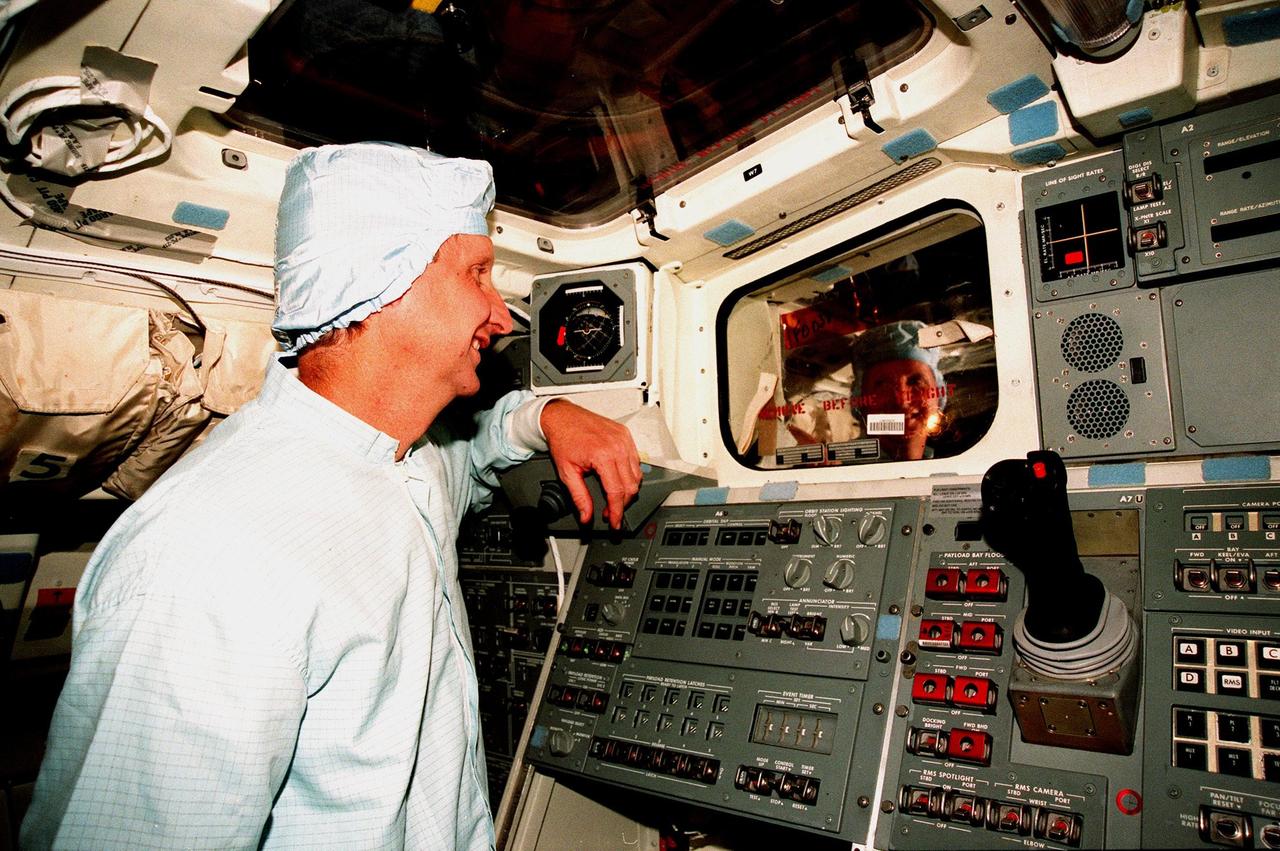
In the Orbiter Processing Facility Bay 3, during the Crew Equipment Interface Test (CEIT) for mission STS-93, Mission Specialist Steven A. Hawley checks out equipment in the orbiter Columbia. The CEIT provides an opportunity for crew members to check equipment and facilities that will be aboard the orbiter during their mission. The STS-93 mission will deploy the Advanced X-ray Astrophysics Facility (AXAF), which comprises three major elements: the spacecraft, the telescope, and the science instrument module (SIM). AXAF will allow scientists from around the world to obtain unprecedented X-ray images of a variety of high-energy objects to help understand the structure and evolution of the universe. The other STS-93 crew members are Mission Commander Eileen M. Collins, Pilot Jeffrey S. Ashby, Mission Specialist Catherine G. Coleman and Mission Specialist Michel Tognini of France. Targeted date for the launch of STS-93 is March 18, 1999
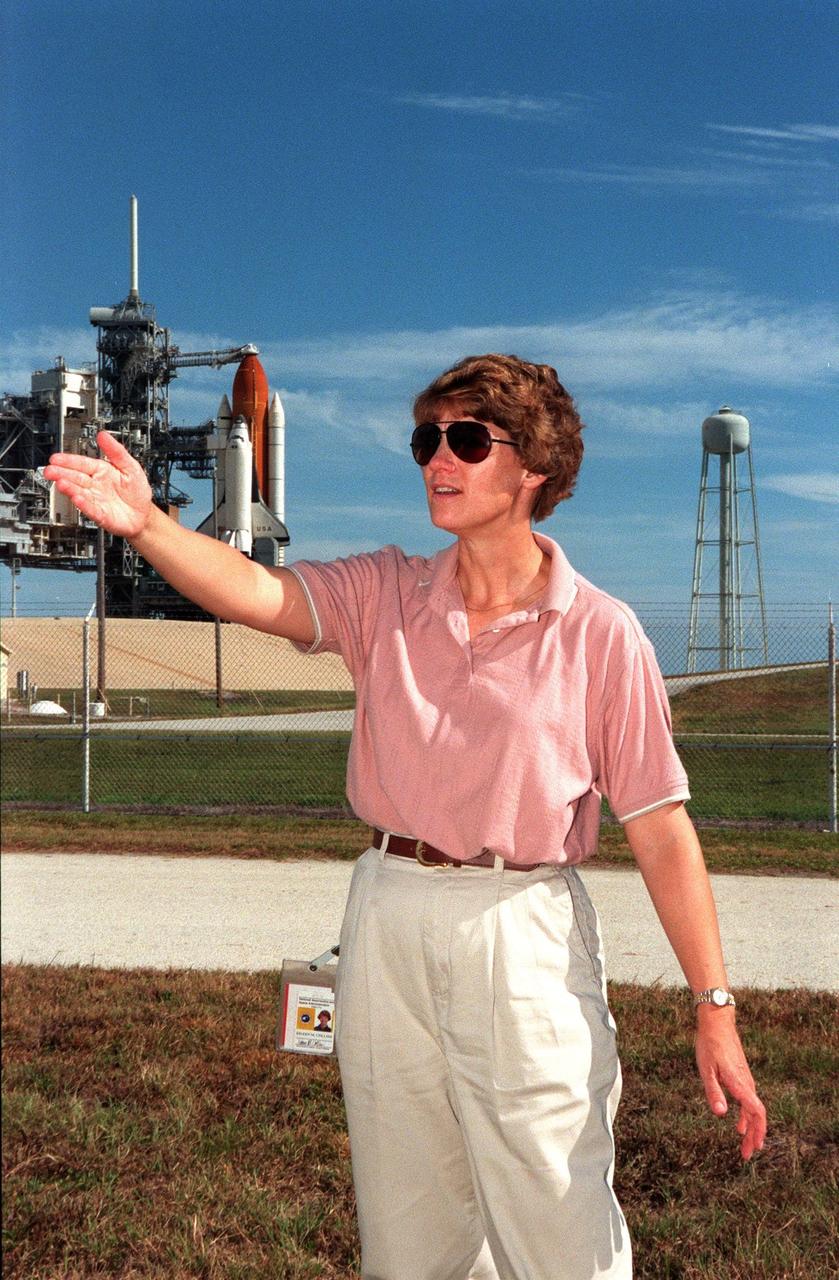
STS-93 Commander Eileen M. Collins waves to her family nearby, a last meeting before launch of mission STS-93 on July 20. Liftoff is scheduled for 12:36 a.m. EDT. The primary mission of STS-93 is the release of the Chandra X-ray Observatory, which will allow scientists from around the world to study some of the most distant, powerful and dynamic objects in the universe. The new telescope is 20 to 50 times more sensitive than any previous X-ray telescope and is expected to unlock the secrets of supernovae, quasars and black holes. The STS-93 crew numbers five: Commander Collins, Pilot Jeffrey S. Ashby, and Mission Specialists Steven A. Hawley (Ph.D.), Catherine G. Coleman (Ph.D.) and Michel Tognini of France, with the Centre National d'Etudes Spatiales (CNES). Collins is the first woman to serve as commander of a shuttle mission
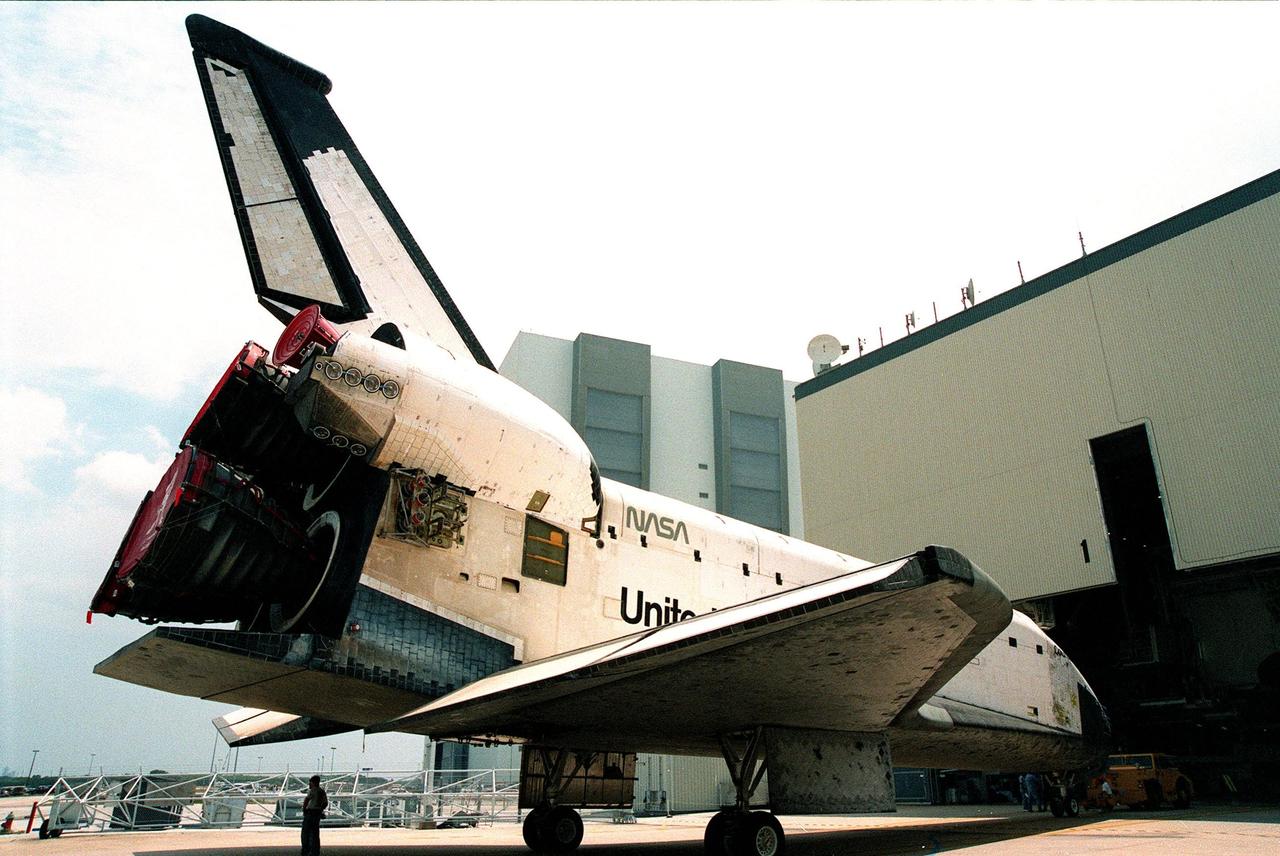
The Space Shuttle orbiter Columbia sits outside the Orbiter Processing Facility bay 1 after transfer from the Vehicle Assembly Building. Columbia will undergo processing for mission STS-93, targeted for launch in July 1999. The STS-93 mission will deploy the Chandra X-ray Observatory (formerly AXAF) which comprises three major elements: the spacecraft, the telescope, and the science instrument module (SIM). Chandra will allow scientists from around the world to obtain unprecedented X-ray images of a variety of high-energy objects to help understand the structure and evolution of the universe. The STs-93 mission commander is Eileen M. Collins, the first woman to serve in that capacity
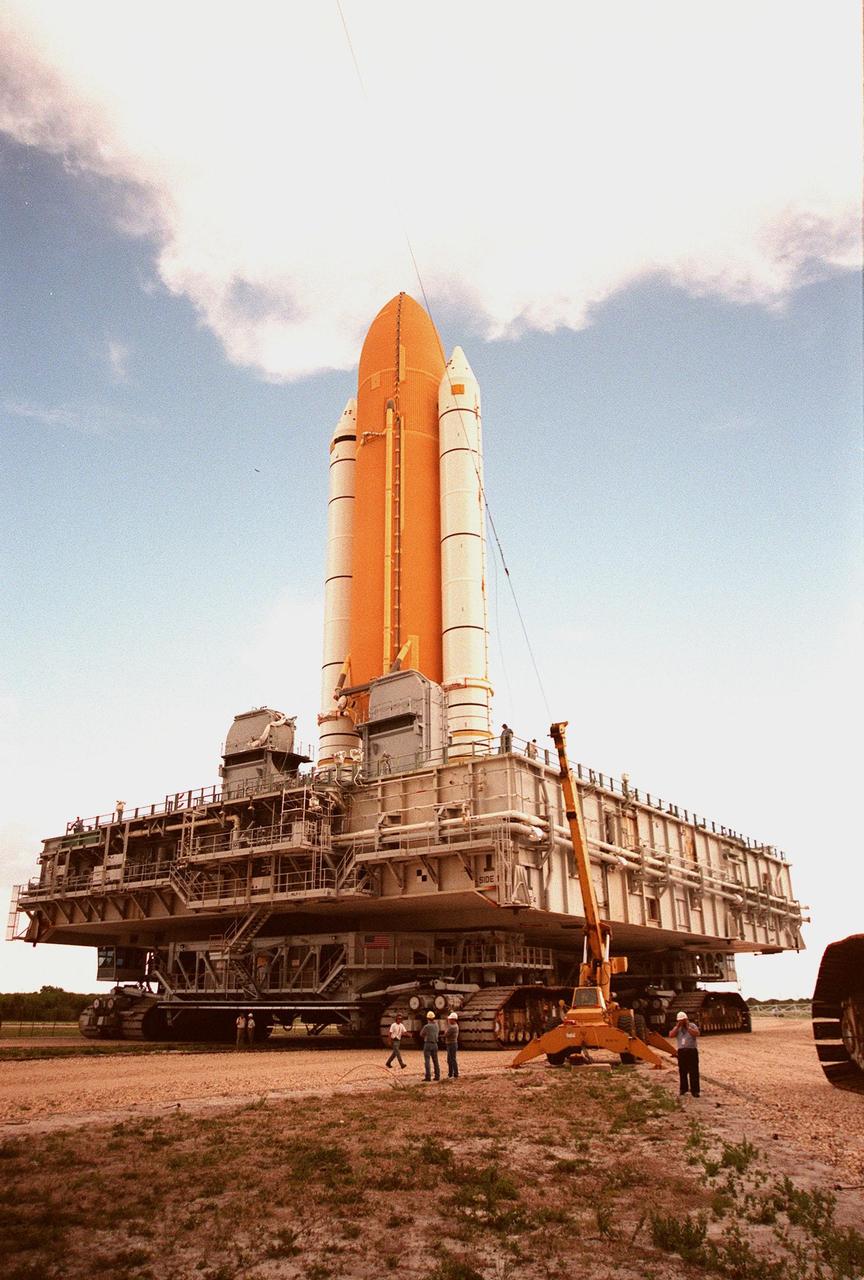
KENNEDY SPACE CENTER, FLA. -- As the STS-93 stack of solid rocket boosters and external tank moves toward the Vehicle Assembly Building (VAB), it passes underneath one of the lightning shield wires strung from the roof of the VAB for protection. The stack is temporarily being stored outside while repair work is being done inside on the hail-damaged external tank of Space Shuttle Discovery. Discovery was rolled back from Pad 39B to the VAB for repairs because access to all of the damaged areas was not possible at the pad. The STS-93 stack is expected to be moved back into the VAB after Discovery returns to the pad. The scheduled date for launch of mission STS-96 is no earlier than May 27. STS-93 is targeted for launch on July 22, carrying the Chandra X-ray Observatory
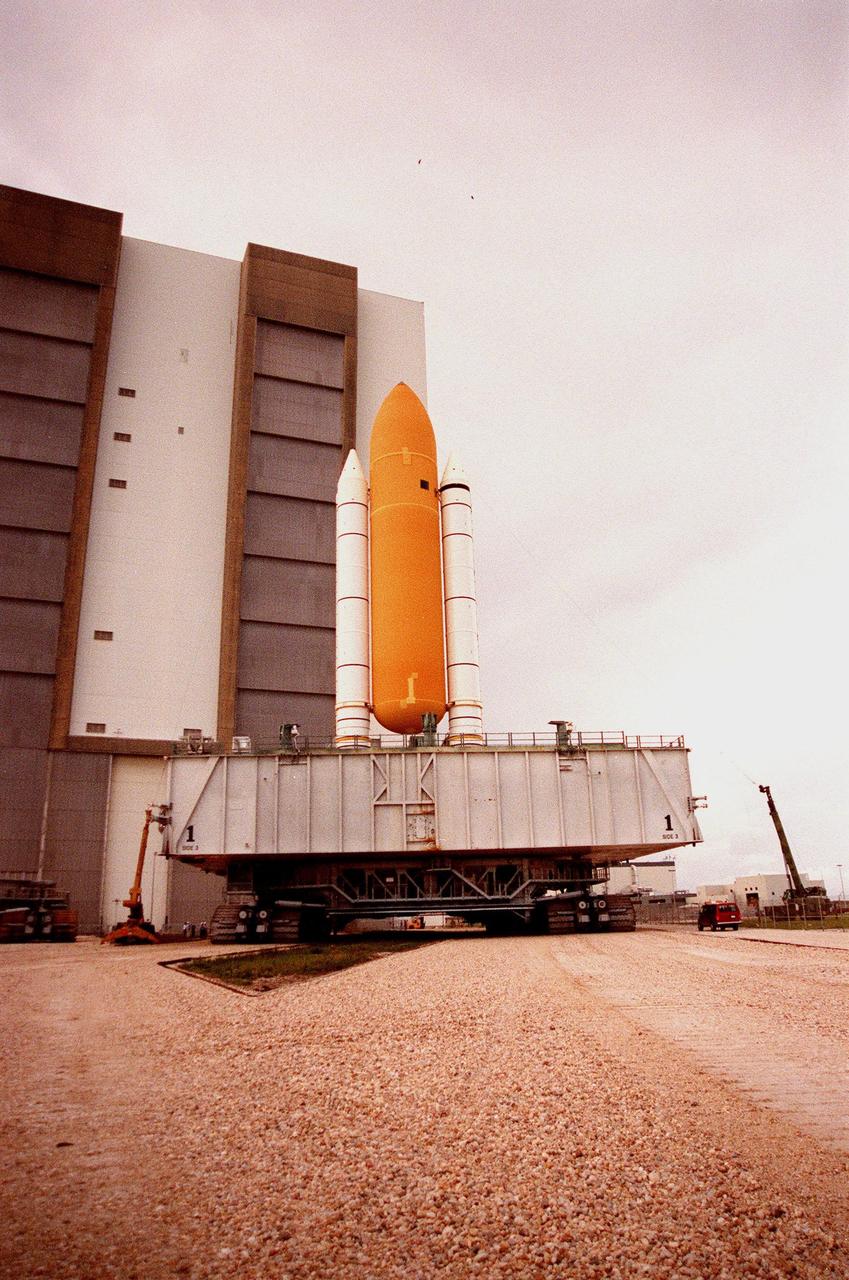
KENNEDY SPACE CENTER, FLA. -- The STS-93 stack of solid rocket boosters and external tank nears the Vehicle Assembly Building (VAB) where it will sit underneath the lightning shield wires strung from the roof of the VAB for protection. The stack is temporarily being stored outside while repair work is being done inside on the hail-damaged external tank of Space Shuttle Discovery. Discovery was rolled back from Pad 39B to the VAB for repairs because access to all of the damaged areas was not possible at the pad. The STS-93 stack is expected to be moved back into the VAB after Discovery returns to the pad. The scheduled date for launch of mission STS-96 is no earlier than May 27. STS-93 is targeted for launch on July 22, carrying the Chandra X-ray Observatory
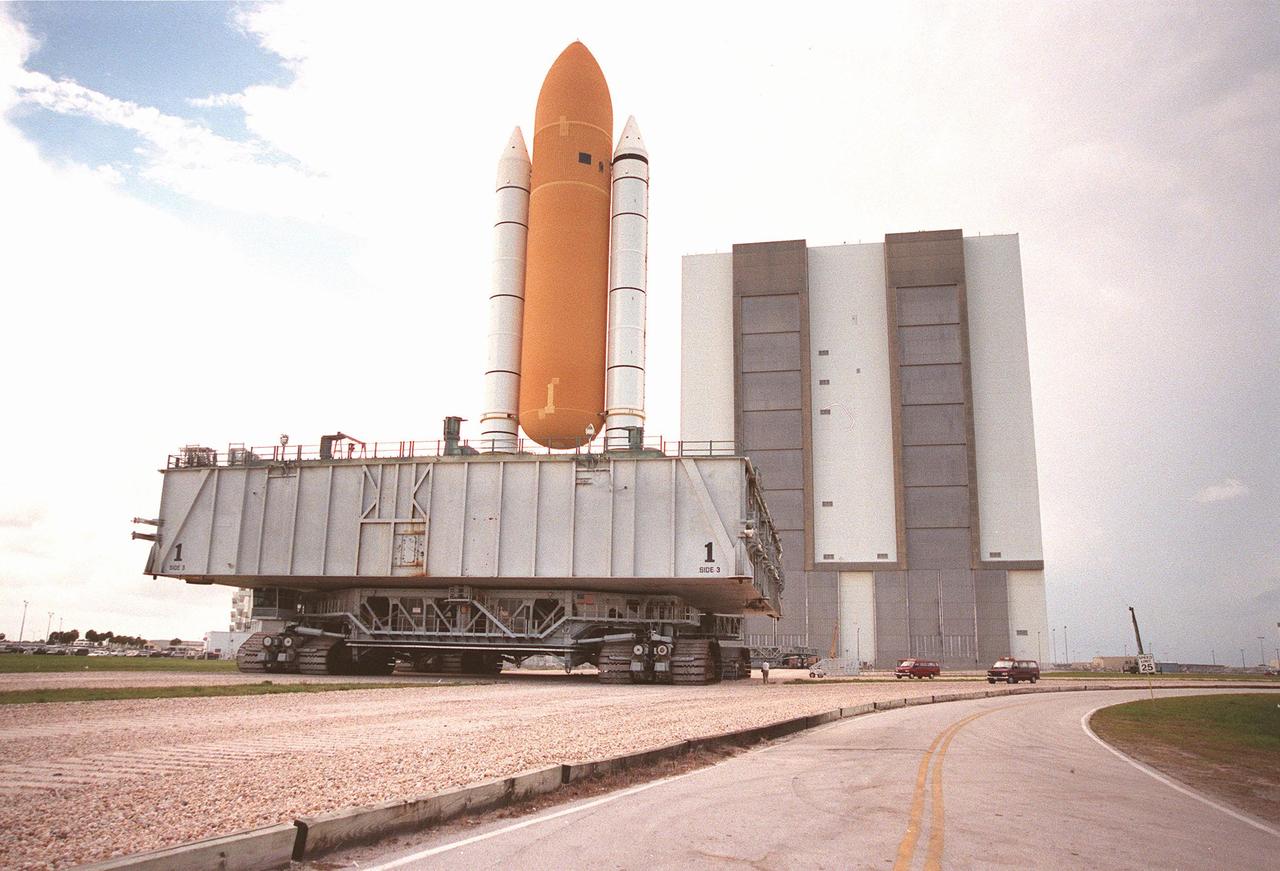
KENNEDY SPACE CENTER, FLA. -- The STS-93 stack of solid rocket boosters and external tank moves toward the Vehicle Assembly Building (VAB) after lightning shield wires were strung from the roof of the VAB for protection. The stack is temporarily being stored outside the VAB while repair work is being done inside on the hail-damaged external tank of Space Shuttle Discovery. Discovery was rolled back from Pad 39B to the VAB for repairs because access to all of the damaged areas was not possible at the pad. The STS-93 stack is expected to be moved back into the VAB after Discovery returns to the pad. The scheduled date for launch of mission STS-96 is no earlier than May 27. STS-93 is targeted for launch on July 22, carrying the Chandra X-ray Observatory
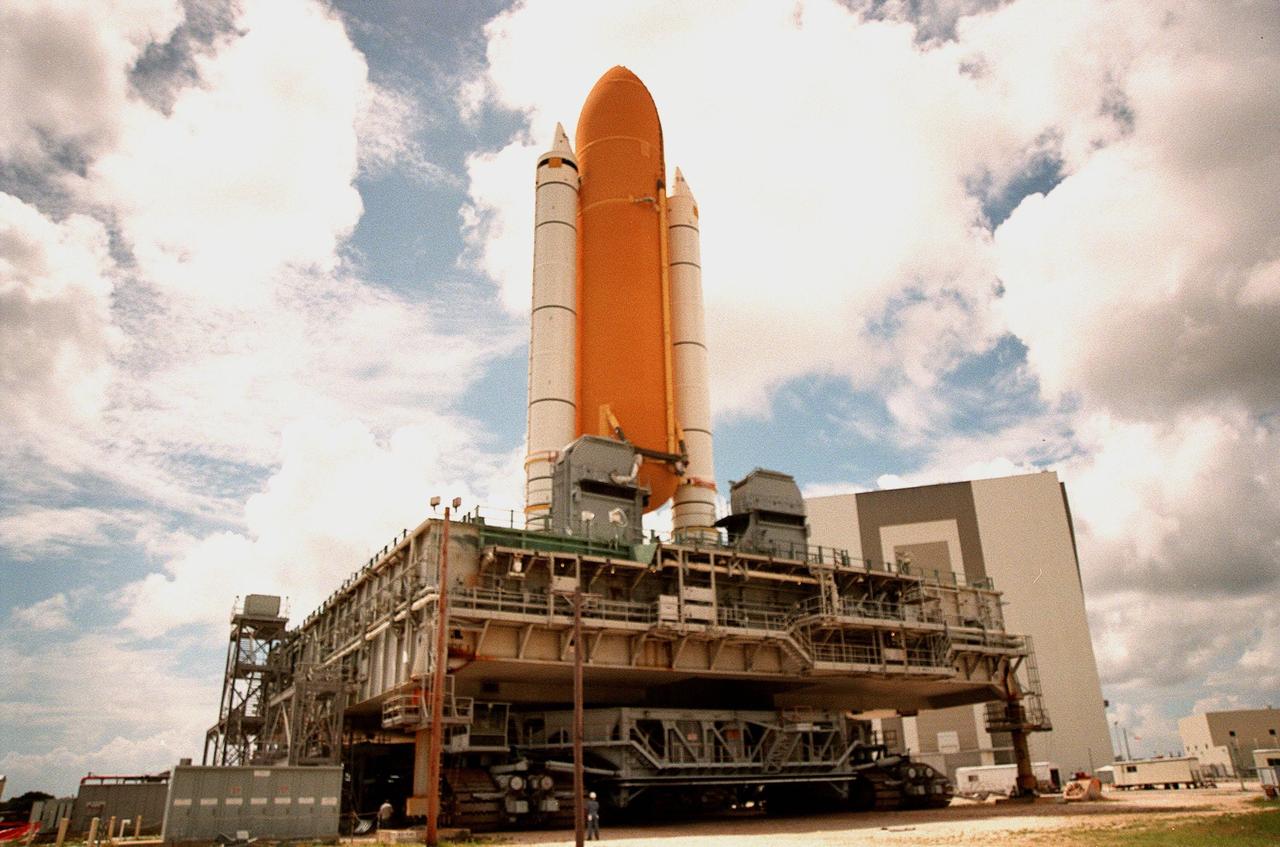
KENNEDY SPACE CENTER, FLA. -- The STS-93 stack of solid rocket boosters and external tank sits at the Mobile Launcher Platform park site waiting for lightning shield wires to be installed on the Vehicle Assembly Building (VAB) in the background. The stack is being temporarily stored outside the VAB while Space Shuttle Discovery undergoes repair to hail damage in High Bay 1. Discovery was rolled back from Pad 39B to the VAB for repairs because access to all of the damaged areas was not possible at the pad. The STS-93 stack will be moved under the wires at the VAB for protection until Discovery returns to the pad, later this week. The scheduled date for launch of mission STS-96 is no earlier than May 27. STS-93 is targeted for launch on July 22, carrying the Chandra X-ray Observatory
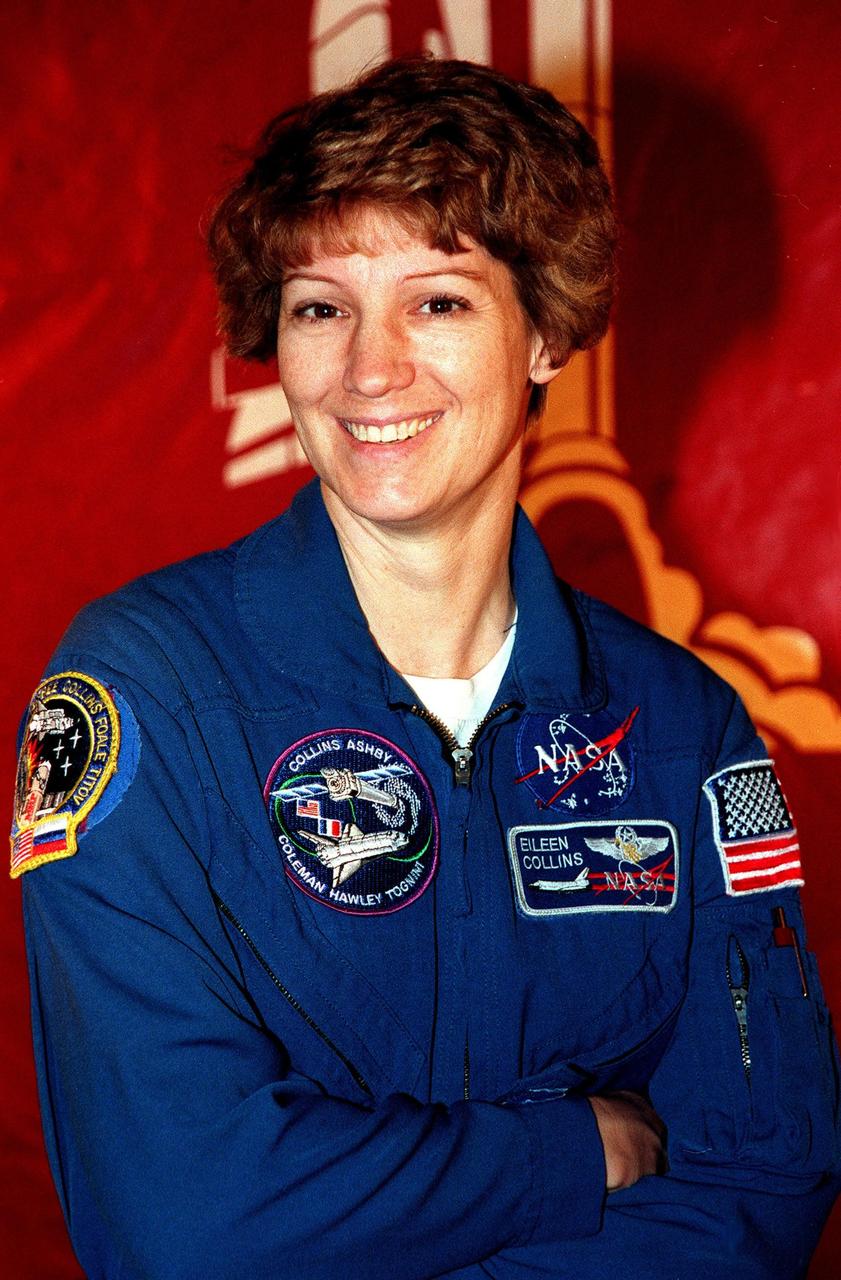
STS-93 Commander Eileen Collins (pictured) is the first woman to serve as a shuttle mission commander. She was the first woman pilot of a Space Shuttle, on mission STS-63, and also served as pilot on mission STS-84. Collins will command the crew of STS-93 on a five-day mission aboard Space Shuttle Columbia on its newly scheduled launch date July 9. The other STS-93 crew members are Pilot Jeffrey S. Ashby and Mission Specialists Steven A. Hawley, Catherine G. Coleman and Michel Tognini of France, representing the Centre National d'Etudes Spatiales (CNES). The primary mission of STS-93 is the deployment of the Chandra X-ray Observatory. Formerly called the Advanced X-ray Astrophysics Facility, Chandra comprises three major elements: the spacecraft, the science instrument module (SIM), and the world's most powerful X-ray telescope. Chandra will allow scientists from around the world to see previously invisible black holes and high-temperature gas clouds, giving the observatory the potential to rewrite the books on the structure and evolution of our universe

STS093-715-006 (23-27 July 1999) --- The STS-93 astronauts aboard the Space Shuttle Columbia took this picture featuring the early morning sun highlighting Laguna Verde and the High Andes of the Atacama Province of Chile and the Catamarca Province of Argentina. The jewel-like Laguna Verde (center left) sits amid apparent east-west lines of volcanic peaks that average 19,000 feet (5791 meters) elevation. At the upper right are darker mountains of folded and thrusted rocks. The light colored areas at the bottom are Salar de Perdenales (left) and Salar de Maricunga (right). Salars, which are common in the Andes, are salty lakebeds that are usually dry. The prevailing wind direction (out of the west) is clearly discernible at the edges of the salars. When this photo was taken, the shuttle was flying over a point located at 25.2 degrees south latitude and 70.4 degrees west longitude. Data back information on the 70mm film lists the time and date of the photo as 12:46:31 GMT, July 25, 1999 (orbit 38).

Seated in the Banana Creek viewing site, First Lady Hillary Rodham Clinton appears attentive to the conversation of a fellow spectator. Mrs. Clinton and others are gathered to watch the second launch attempt of STS-93. Moments before the first scheduled launch, July 20, STS-93 was scrubbed at the T-7 second mark in the countdown due to an indication of a high concentration of hydrogen in an aft engine compartment. The reading proved to be a false alarm. The launch was rescheduled for July 22 at 12:28 a.m. Much attention has been generated over STS-93 due to Commander Eileen M. Collins, the first woman to serve as commander of a Shuttle mission. The primary payload of the five-day mission is the Chandra X-ray Observatory, which will allow scientists from around the world to study some of the most distant, powerful and dynamic objects in the universe
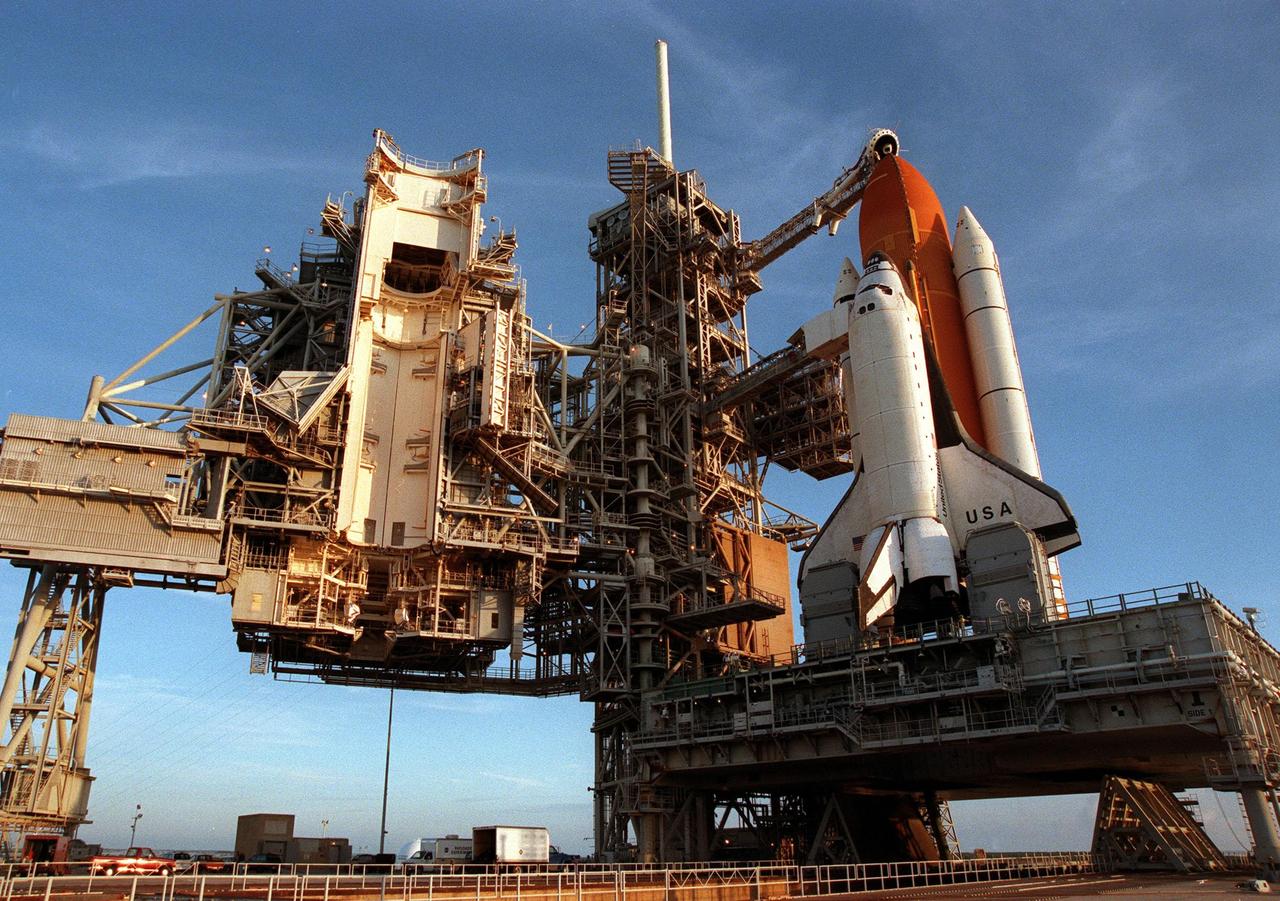
The rollback of the Rotating Service Structure on launch Pad 39-B reveals Space Shuttle Columbia on its mobile launcher platform, waiting for the launch of mission STS-93 on July 20 at 12:36 a.m. EDT. The primary payload of STS-93 is the Chandra X-ray Observatory, which will allow scientists from around the world to study some of the most distant, powerful and dynamic objects in the universe. The new telescope is 20 to 50 times more sensitive than any previous X-ray telescope and is expected unlock the secrets of supernovae, quasars and black holes. The STS-93 crew numbers five: Commander Eileen M. Collins, Pilot Jeffrey S. Ashby, and Mission Specialists Steven A. Hawley (Ph.D.), Catherine G. Coleman (Ph.D.) and Michel Tognini of France, with the Centre National d'Etudes Spatiales (CNES). Collins is the first woman to serve as commander of a shuttle mission
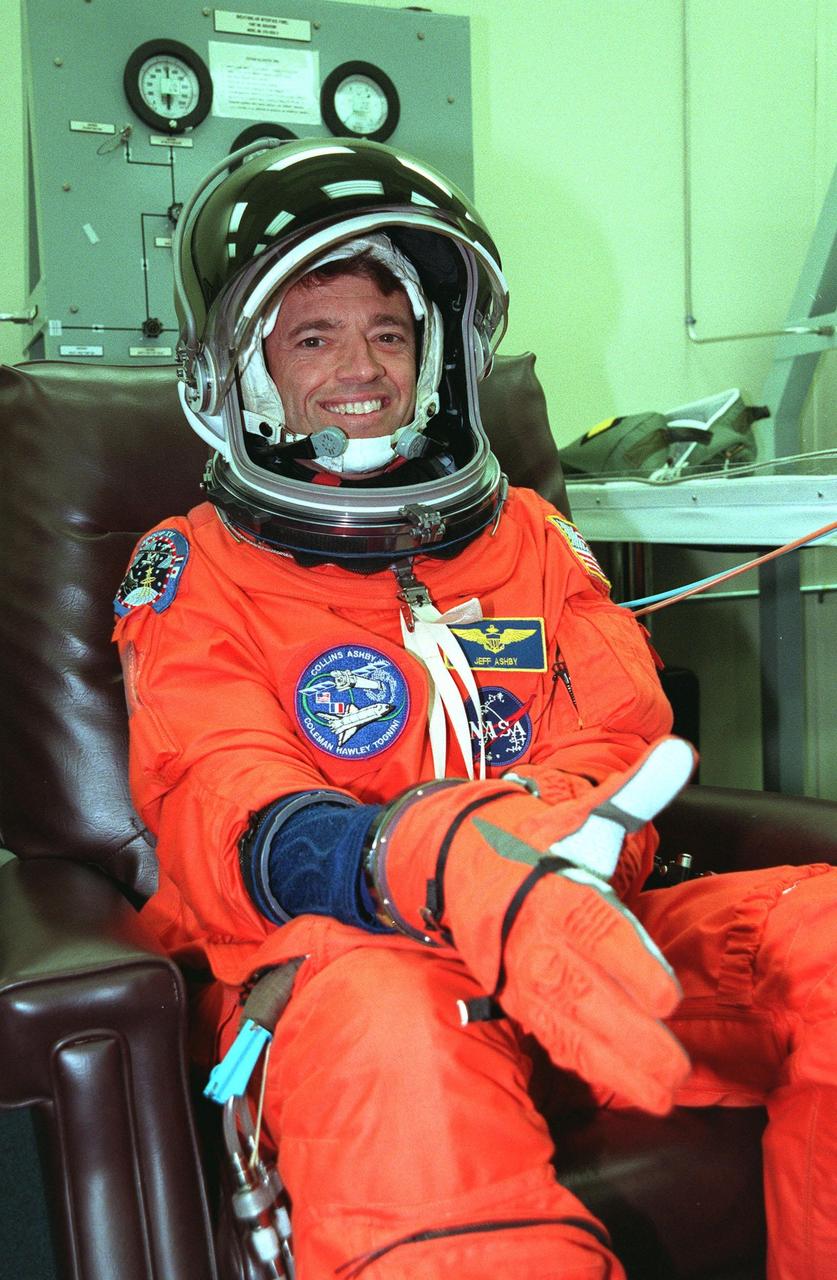
In the Operations and Checkout Building during final launch preparations for the third time, STS-93 Pilot Jeffrey S. Ashby pulls on his glove, part of his launch and entry suit. After Space Shuttle Columbia's July 20 and 22 launch attempts were scrubbed, the launch was again rescheduled for Friday, July 23, at 12:24 a.m. EDT. STS-93 is a five-day mission primarily to release the Chandra X-ray Observatory, which will allow scientists from around the world to study some of the most distant, powerful and dynamic objects in the universe. The STS-93 crew numbers five: Commander Eileen Collins, Ashby, and Mission Specialists Steven A. Hawley (Ph.D.), Catherine G. Coleman (Ph.D.) and Michel Tognini of France, with the Centre National d'Etudes Spatiales (CNES). Collins is the first woman to serve as commander of a shuttle mission
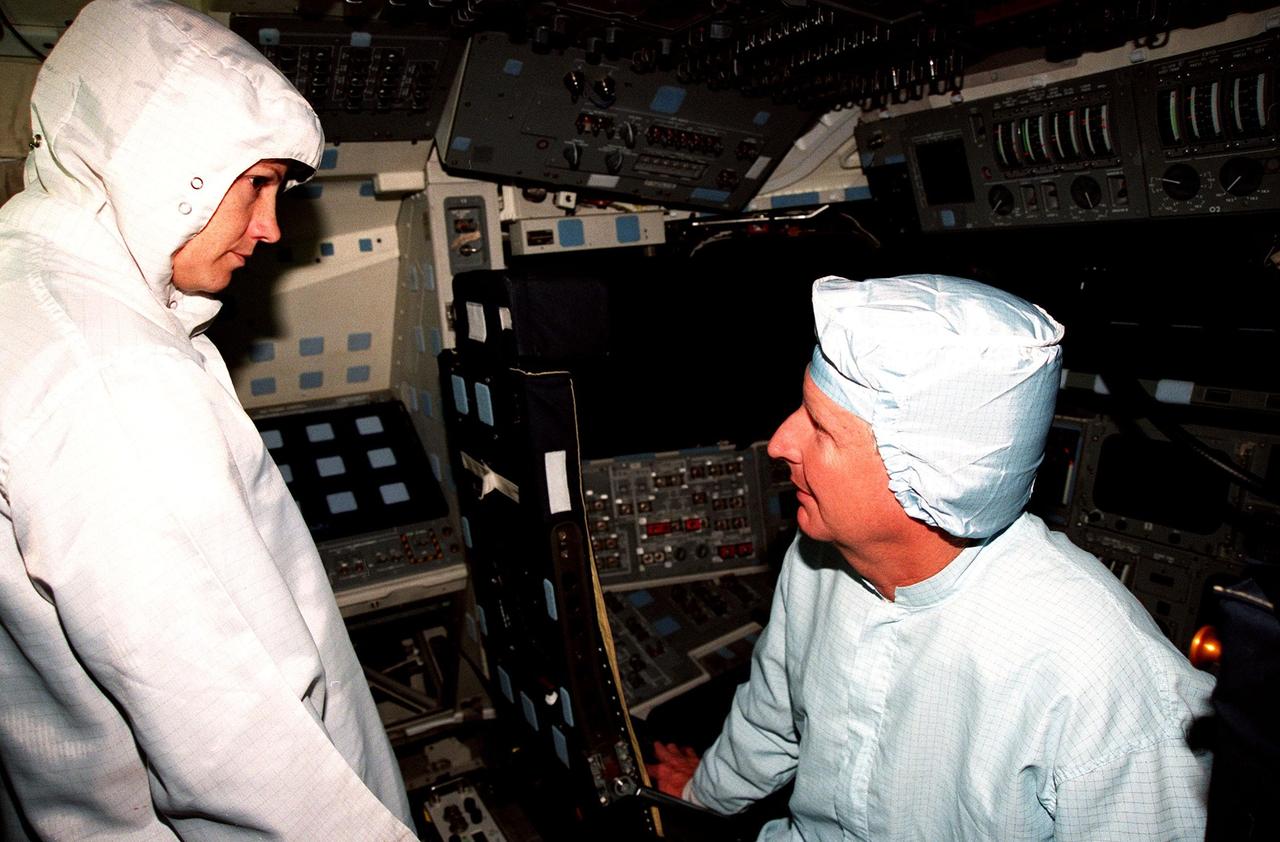
In the Orbiter Processing Facility Bay 3, aboard the orbiter Columbia, STS-93 Mission Commander Eileen M. Collins listens to Mission Specialist Steven A. Hawley during the Crew Equipment Interface Test (CEIT). Collins is the first woman to serve as a mission commander on a shuttle flight. The CEIT provides an opportunity for crew members to check equipment and facilities that will be aboard the orbiter during their mission. The rest of the crew members are Pilot Jeffrey S. Ashby, Mission Specialist Catherine G. Coleman, and Mission Specialist Michel Tognini of France. The STS-93 mission will deploy the Advanced X-ray Astrophysics Facility (AXAF), which comprises three major elements: the spacecraft, the telescope, and the science instrument module (SIM). AXAF will allow scientists from around the world to obtain unprecedented X-ray images of a variety of high-energy objects to help understand the structure and evolution of the universe. Targeted date for the launch of STS-93 is March 18, 1999
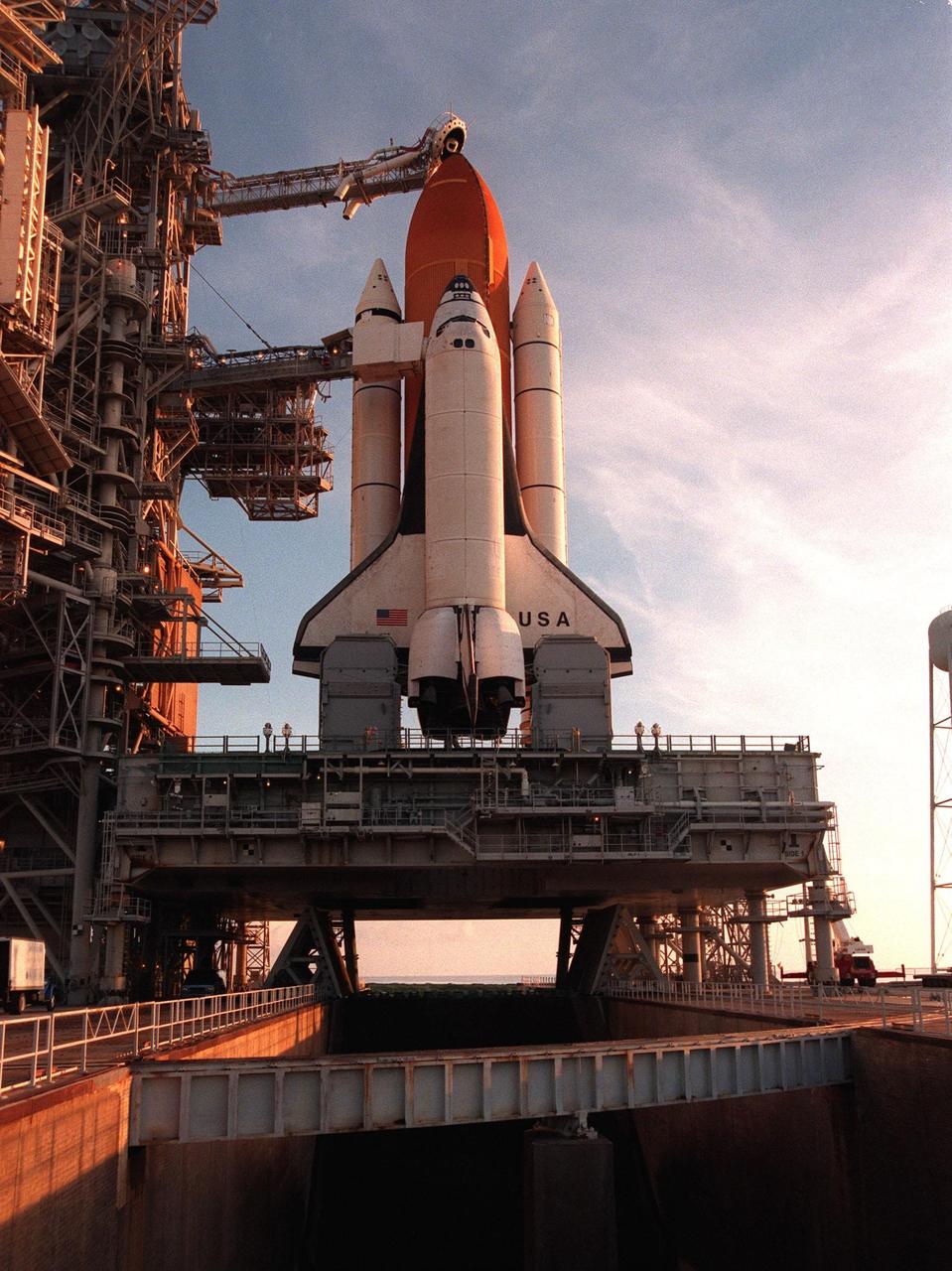
Space Shuttle Columbia, sitting on its mobile launcher platform, is framed against the early morning sky after the rollback of the Rotating Service Structure on Launch Pad 39-B. Columbia waits for the launch of mission STS-93 July 20 at 12:36 a.m. EDT. The primary payload of STS-93 is the Chandra X-ray Observatory, which will allow scientists from around the world to study some of the most distant, powerful and dynamic objects in the universe. The new telescope is 20 to 50 times more sensitive than any previous X-ray telescope and is expected unlock the secrets of supernovae, quasars and black holes. The STS-93 crew numbers five: Commander Eileen M. Collins, Pilot Jeffrey S. Ashby, and Mission Specialists Steven A. Hawley (Ph.D.), Catherine G. Coleman (Ph.D.) and Michel Tognini of France, with the Centre National d'Etudes Spatiales (CNES). Collins is the first woman to serve as commander of a shuttle mission
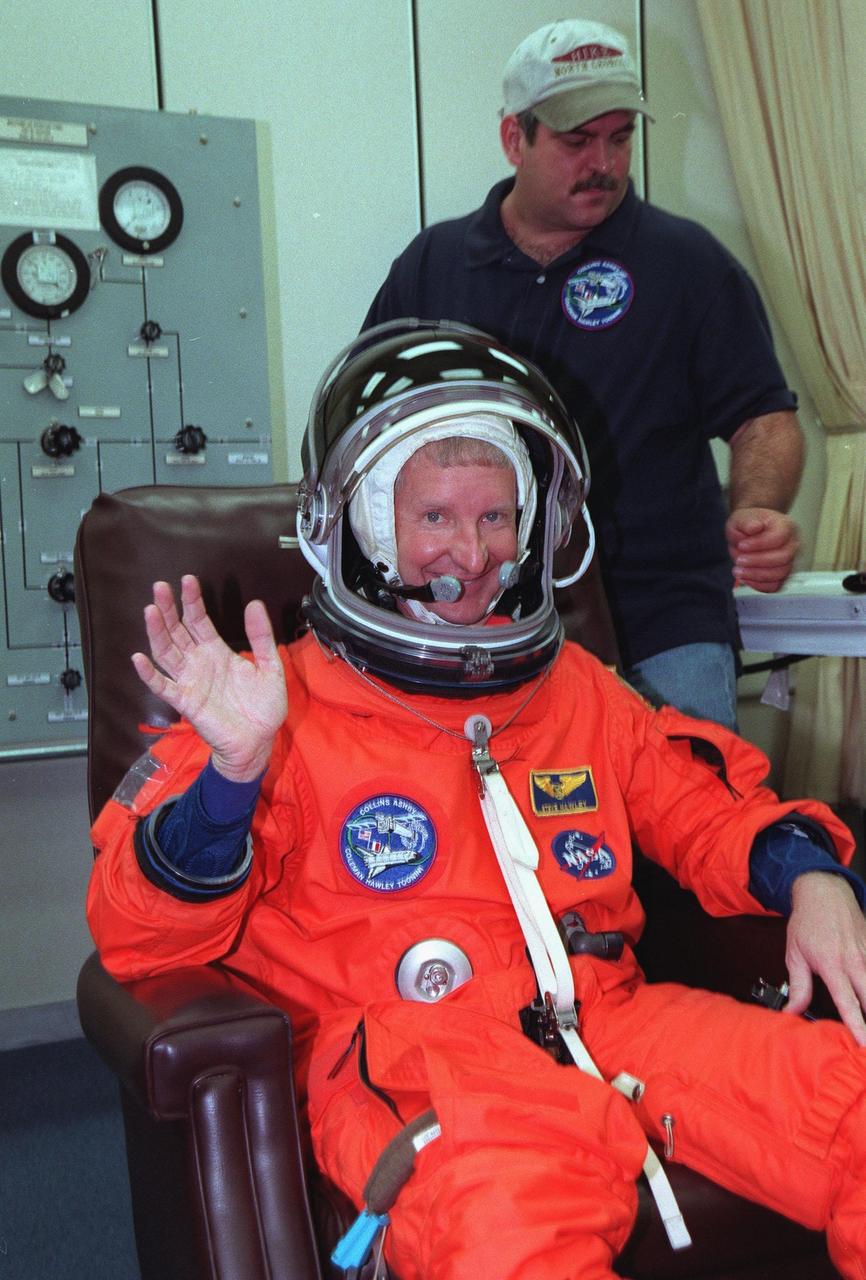
For the third time, during final launch preparations in the Operations and Checkout Building, STS-93 Mission Specialist Steven A. Hawley (Ph.D.) waves after donning his launch and entry suit. After Space Shuttle Columbia's July 20 and 22 launch attempts were scrubbed, the launch was again rescheduled for Friday, July 23, at 12:24 a.m. EDT. STS-93 is a five-day mission primarily to release the Chandra X-ray Observatory, which will allow scientists from around the world to study some of the most distant, powerful and dynamic objects in the universe. The STS-93 crew numbers five: Commander Eileen M. Collins, Pilot Jeffrey S. Ashby, and Mission Specialists Hawley, Catherine G. Coleman (Ph.D.) and Michel Tognini of France, with the Centre National d'Etudes Spatiales (CNES). Collins is the first woman to serve as commander of a shuttle mission
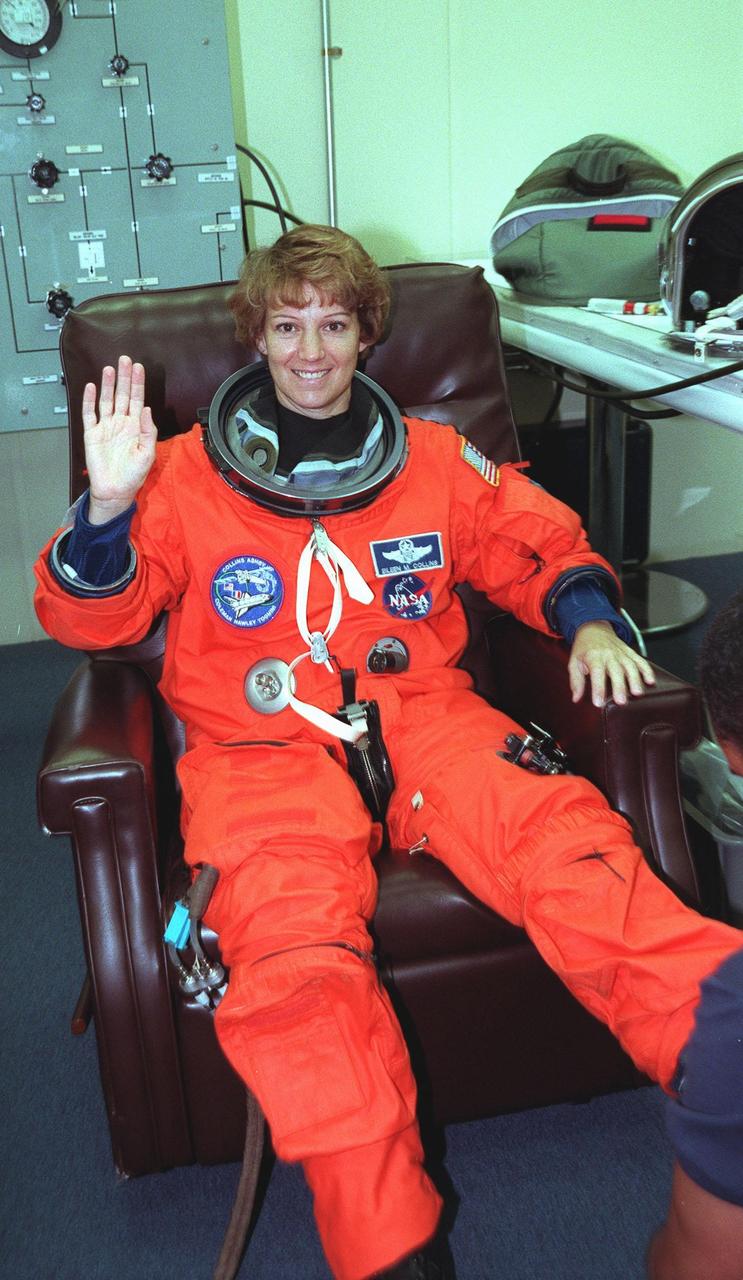
During the third launch preparations in the Operations and Checkout Building, STS-93 Commander Eileen M. Collins waves while having her launch and entry suit checked. After Space Shuttle Columbia's July 20 and 22 launch attempts were scrubbed, the launch was again rescheduled for Friday, July 23, at 12:24 a.m. EDT. STS-93 is a five-day mission primarily to release the Chandra X-ray Observatory, which will allow scientists from around the world to study some of the most distant, powerful and dynamic objects in the universe. The STS-93 crew numbers five: Commander Collins, Pilot Jeffrey S. Ashby, and Mission Specialists Steven A. Hawley (Ph.D.), Catherine G. Coleman (Ph.D.) and Michel Tognini of France, with the Centre National d'Etudes Spatiales (CNES). Collins is the first woman to serve as commander of a shuttle mission

For the third time, in the Operations and Checkout Building, STS-93 Commander Eileen M. Collins tries on her helmet with her launch and entry suit. After Space Shuttle Columbia's July 20 and 22 launch attempts were scrubbed, the launch was again rescheduled for Friday, July 23, at 12:24 a.m. EDT. STS-93 is a five-day mission primarily to release the Chandra X-ray Observatory, which will allow scientists from around the world to study some of the most distant, powerful and dynamic objects in the universe. The STS-93 crew numbers five: Commander Collins, Pilot Jeffrey S. Ashby, and Mission Specialists Steven A. Hawley (Ph.D.), Catherine G. Coleman (Ph.D.) and Michel Tognini of France, with the Centre National d'Etudes Spatiales (CNES). Collins is the first woman to serve as commander of a shuttle mission
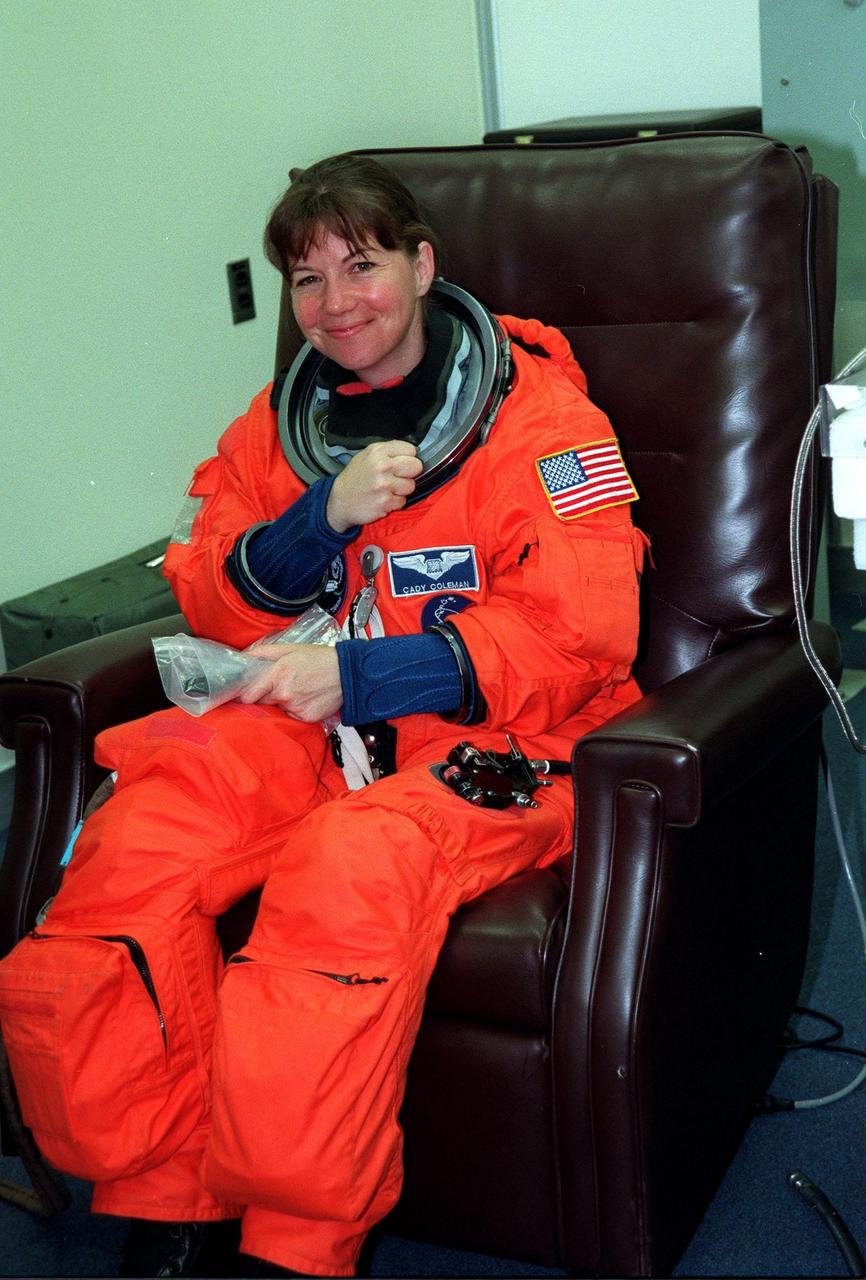
For the third time, during final launch preparations in the Operations and Checkout Building, STS-93 Mission Specialist Catherine G. Coleman (Ph.D.) dons her launch and entry suit. After Space Shuttle Columbia's July 20 and 22 launch attempts were scrubbed, the launch was again rescheduled for Friday, July 23, at 12:24 a.m. EDT. STS-93 is a five-day mission primarily to release the Chandra X-ray Observatory, which will allow scientists from around the world to study some of the most distant, powerful and dynamic objects in the universe. The STS-93 crew numbers five: Commander Eileen M. Collins, Pilot Jeffrey S. Ashby, and Mission Specialists Steven A. Hawley (Ph.D.), Coleman, and Michel Tognini of France, with the Centre National d'Etudes Spatiales (CNES). Collins is the first woman to serve as commander of a shuttle mission
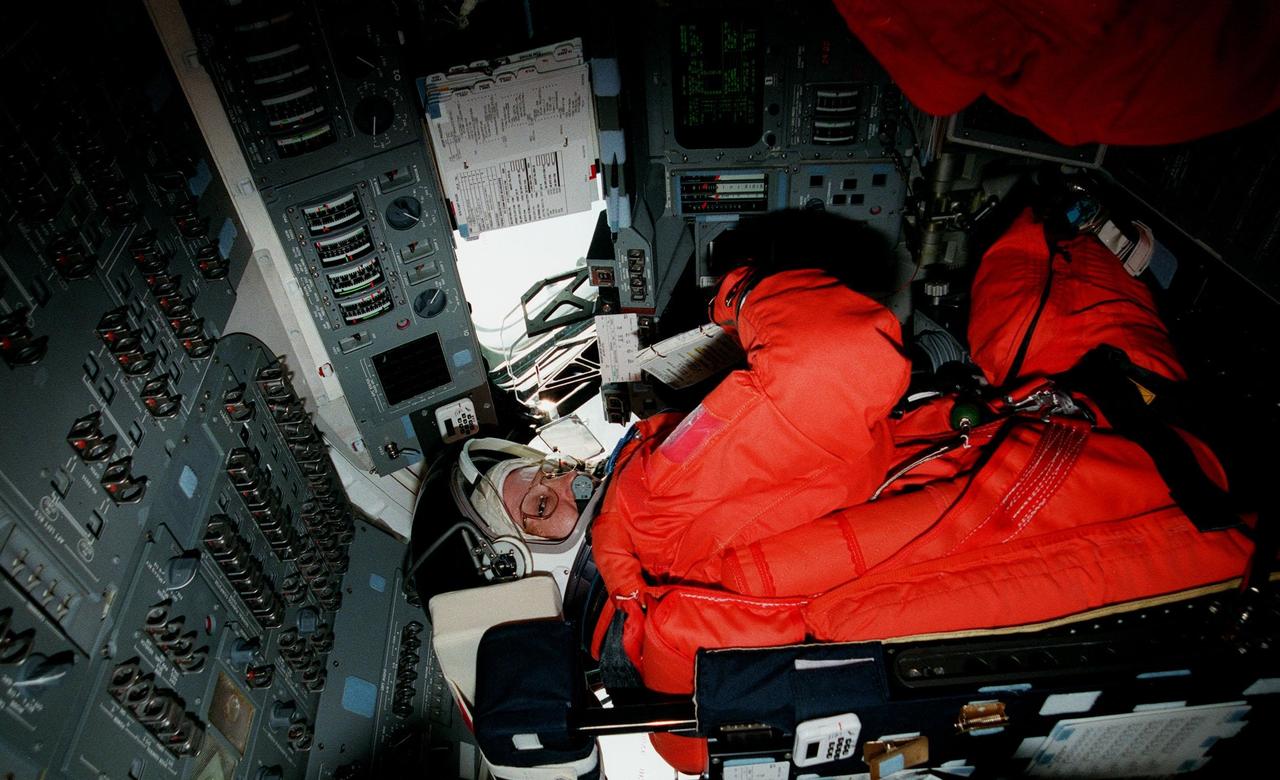
STS-93 Commander Eileen M. Collins sits on the flight deck of the orbiter Columbia during Terminal Countdown Demonstration Test (TCDT) activities that include emergency exit training and a launch-day dress rehearsal culminating with a simulated main engine cut-off. Other crew members participating are Pilot Jeffrey S. Ashby, and Mission Specialists Catherine G. Coleman (Ph.D.), Steven A. Hawley (Ph.D.) and Michel Tognini of France, who represents the Centre National d'Etudes Spatiales (CNES). Collins is the first woman to serve as a Shuttle commander. The primary mission of STS-93 is the release of the Chandra X-ray Observatory, which will allow scientists from around the world to obtain unprecedented X-ray images of exotic environments in space to help understand the structure and evolution of the universe. The targeted launch date for STS-93 is no earlier than July 20 at 12:36 a.m. EDT from Launch Pad 39B
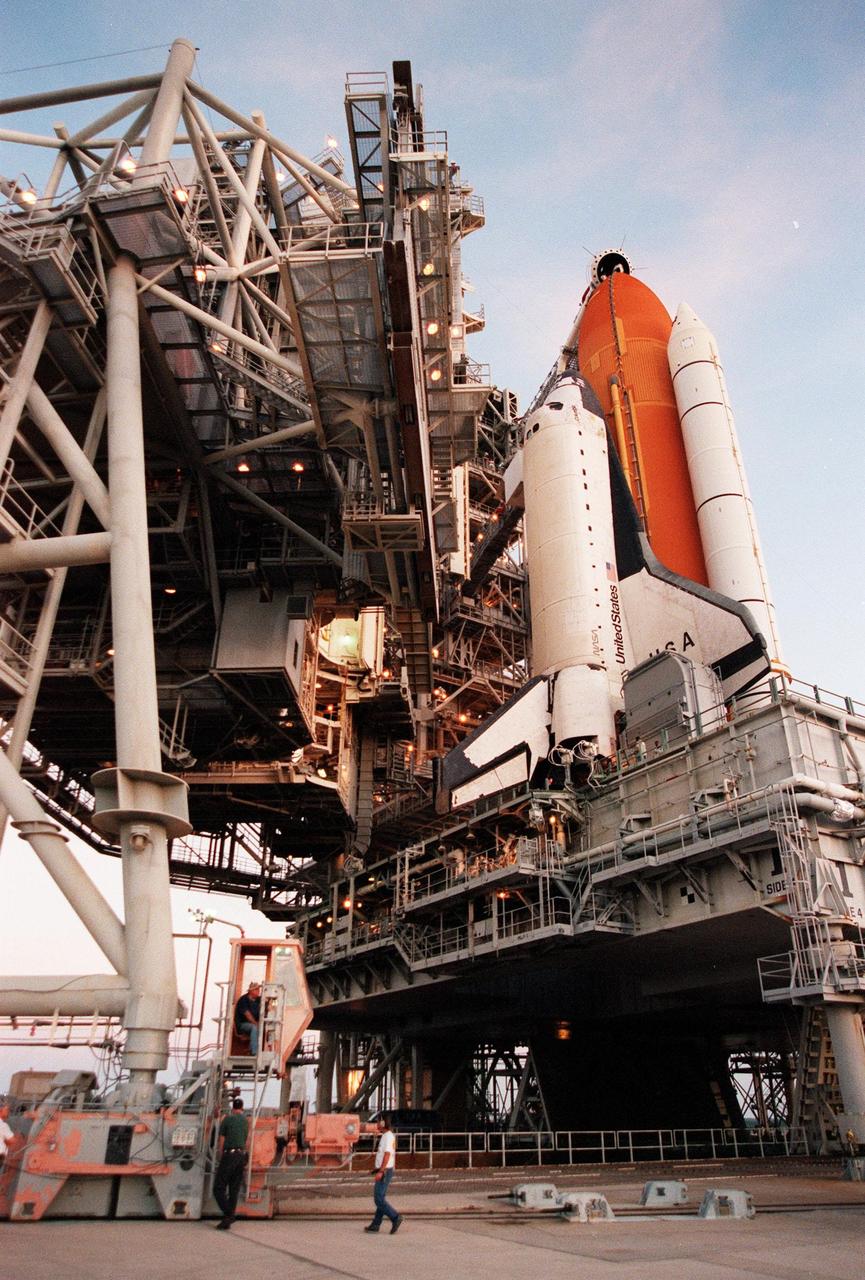
The Rotating Service Structure is rolled back from Space Shuttle Columbia on Launch Pad 39-B, in preparation for launch of mission STS-93 July 20 at 12:36 a.m. EDT. The primary payload of STS-93 is the Chandra X-ray Observatory, which will allow scientists from around the world to study some of the most distant, powerful and dynamic objects in the universe. The new telescope is 20 to 50 times more sensitive than any previous X-ray telescope and is expected unlock the secrets of supernovae, quasars and black holes. The STS-93 crew numbers five: Commander Eileen M. Collins, Pilot Jeffrey S. Ashby, and Mission Specialists Steven A. Hawley (Ph.D.), Catherine G. Coleman (Ph.D.) and Michel Tognini of France, with the Centre National d'Etudes Spatiales (CNES). Collins is the first woman to serve as commander of a shuttle mission

From their seats in the Banana Creek viewing site, First Lady Hillary Rodham Clinton (center, right) and her daughter, Chelsea (next to her at left) eagerly await the second launch attempt of STS-93. Moments before the first scheduled launch, July 20, STS-93 was scrubbed at the T-7 second mark in the countdown due to an indication of a high concentration of hydrogen in an aft engine compartment. The reading proved to be a false alarm. The launch was rescheduled for July 22 at 12:28 a.m. Much attention has been generated over STS-93 due to Commander Eileen M. Collins, the first woman to serve as commander of a Shuttle mission. The primary payload of the five-day mission is the Chandra X-ray Observatory, which will allow scientists from around the world to study some of the most distant, powerful and dynamic objects in the universe

NASA Administrator Daniel Goldin and First Lady Hillary Rodham Clinton are among the spectators at the Banana Creek viewing site to watch the launch of STS-93, the second attempt. Moments before the first scheduled launch, July 20, STS-93 was scrubbed at the T-7 second mark in the countdown due to an indication of a high concentration of hydrogen in an aft engine compartment. The reading proved to be a false alarm. The launch was rescheduled for July 22 at 12:28 a.m. Much attention has been generated over STS-93 due to Commander Eileen M. Collins, the first woman to serve as commander of a Shuttle mission. The primary payload of the five-day mission is the Chandra X-ray Observatory, which will allow scientists from around the world to study some of the most distant, powerful and dynamic objects in the universe

For the third time, in the Operations and Checkout Building, STS-93 Mission Specialist Michel Tognini of France, who represents the Centre National d'Etudes Spatiales (CNES), waves after donning his launch and entry suit during final launch preparations. After Space Shuttle Columbia's July 20 and 22 launch attempts were scrubbed, the launch was again rescheduled for Friday, July 23, at 12:24 a.m. EDT. STS-93 is a five-day mission primarily to release the Chandra X-ray Observatory, which will allow scientists from around the world to study some of the most distant, powerful and dynamic objects in the universe. The STS-93 crew numbers five: Commander Eileen M. Collins, Pilot Jeffrey S. Ashby, and Mission Specialists Steven A. Hawley (Ph.D.), Catherine G. Coleman (Ph.D.) and Tognini. Collins is the first woman to serve as commander of a shuttle mission
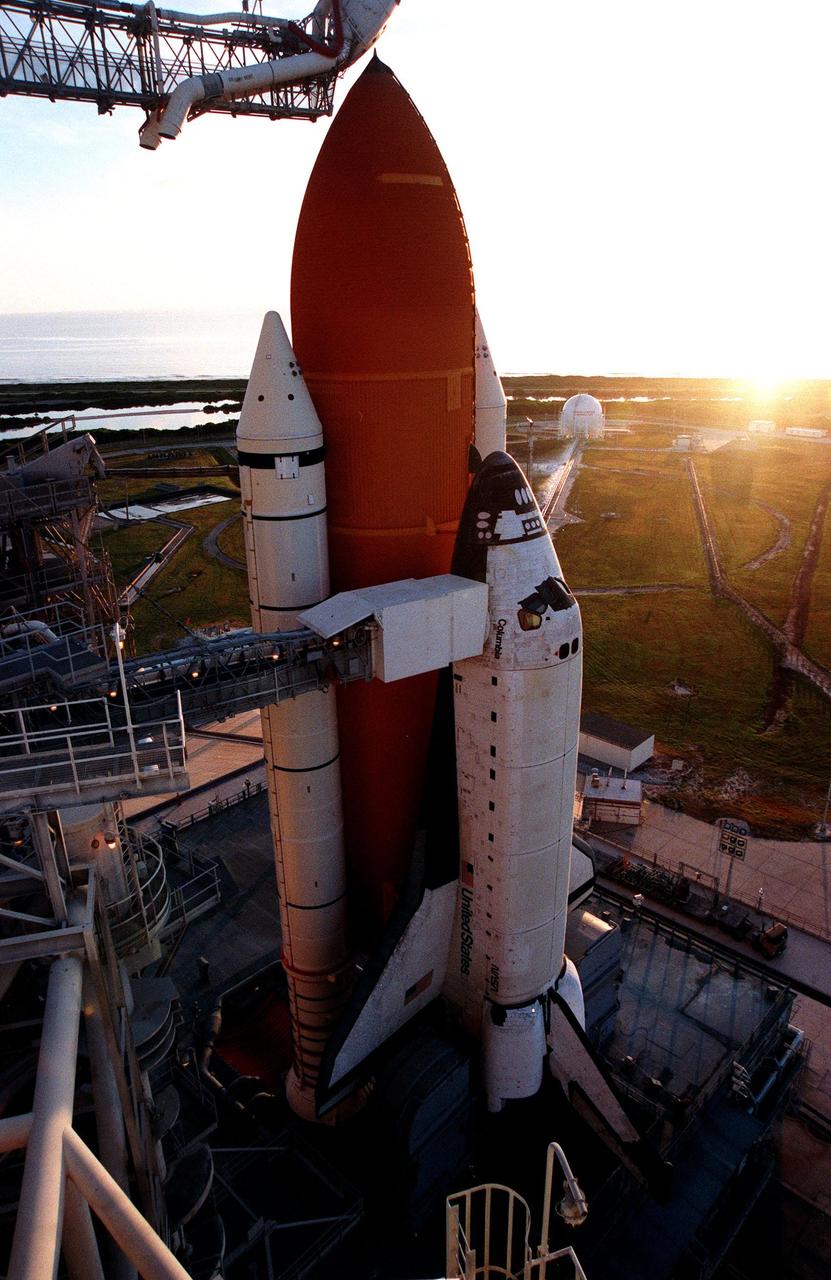
Space Shuttle Columbia catches the rising sun after the rollback of the Rotating Service Structure on Launch Pad 39-B. Columbia waits for the launch of mission STS-93 July 20 at 12:36 a.m. EDT. The primary payload of STS-93 is the Chandra X-ray Observatory, which will allow scientists from around the world to study some of the most distant, powerful and dynamic objects in the universe. The new telescope is 20 to 50 times more sensitive than any previous X-ray telescope and is expected unlock the secrets of supernovae, quasars and black holes. The STS-93 crew numbers five: Commander Eileen M. Collins, Pilot Jeffrey S. Ashby, and Mission Specialists Steven A. Hawley (Ph.D.), Catherine G. Coleman (Ph.D.) and Michel Tognini of France, with the Centre National d'Etudes Spatiales (CNES). Collins is the first woman to serve as commander of a shuttle mission
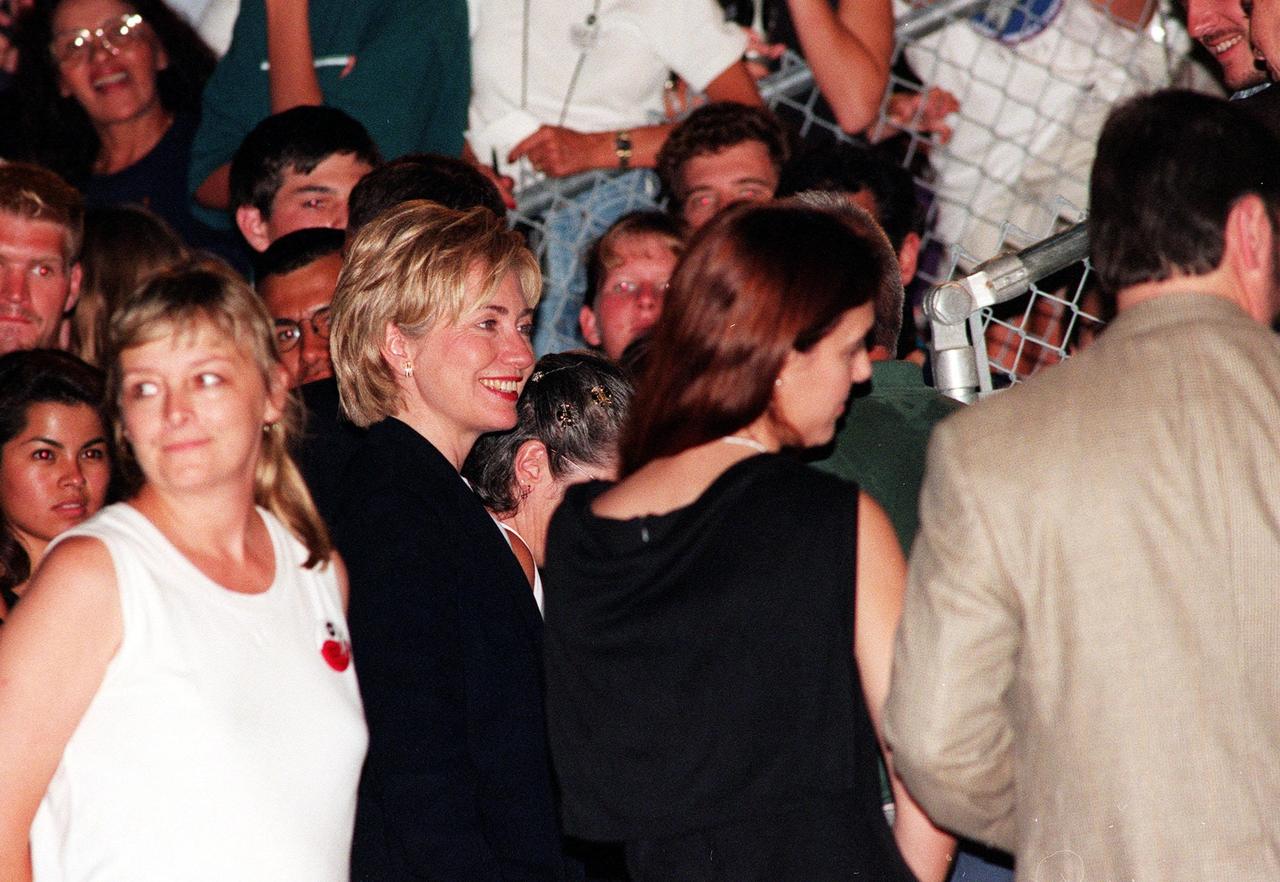
First Lady Hillary Rodham Clinton joins other VIPs at the Banana Creek viewing site to watch the launch of STS-93, the second attempt. Moments before the first scheduled launch, July 20, STS-93 was scrubbed at the T-7 second mark in the countdown due to an indication of a high concentration of hydrogen in an aft engine compartment. The reading proved to be a false alarm. The launch was rescheduled for July 22 at 12:28 a.m. Much attention has been generated over STS-93 due to Commander Eileen M. Collins, the first woman to serve as commander of a Shuttle mission. The primary payload of the five-day mission is the Chandra X-ray Observatory, which will allow scientists from around the world to study some of the most distant, powerful and dynamic objects in the universe
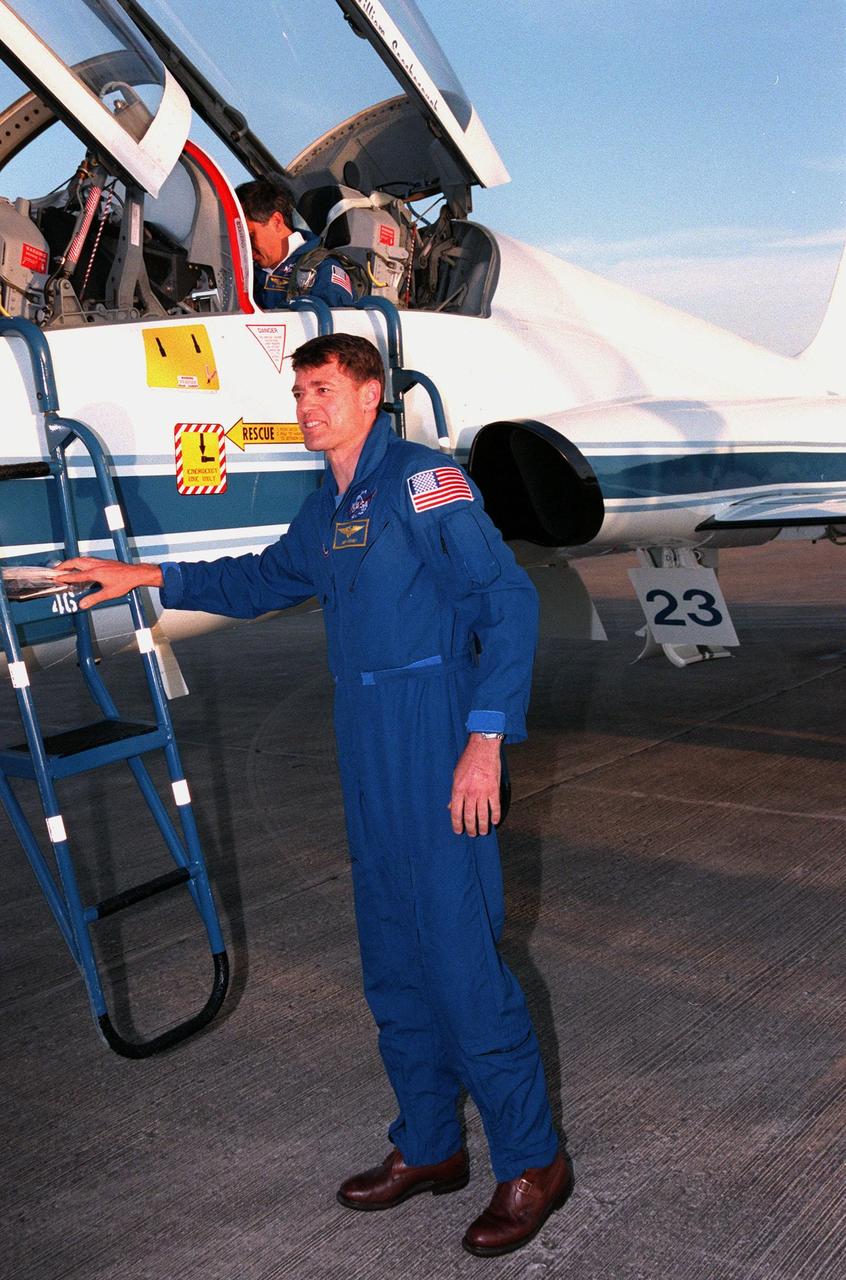
STS-93 Pilot Jeffrey S. Ashby lands at Kennedy Space Center's Shuttle Landing Facility (SLF) aboard a T-38 jet aircraft. He and other crew members Commander Eileen Collins and Mission Specialists Steven A. Hawley (Ph.D.), Catherine G. "Cady" Coleman (Ph.D.) and Michel Tognini of France, with the Centre National d'Etudes Spatiales (CNES), are arriving for pre-launch activities. STS-93 is Ashby's inaugural Shuttle flight. The primary mission of STS-93 is the release of the Chandra X-ray Observatory, which will allow scientists from around the world to study some of the most distant, powerful and dynamic objects in the universe. The new telescope is 20 to 50 times more sensitive than any previous X-ray telescope and is expected to unlock the secrets of supernovae, quasars and black holes
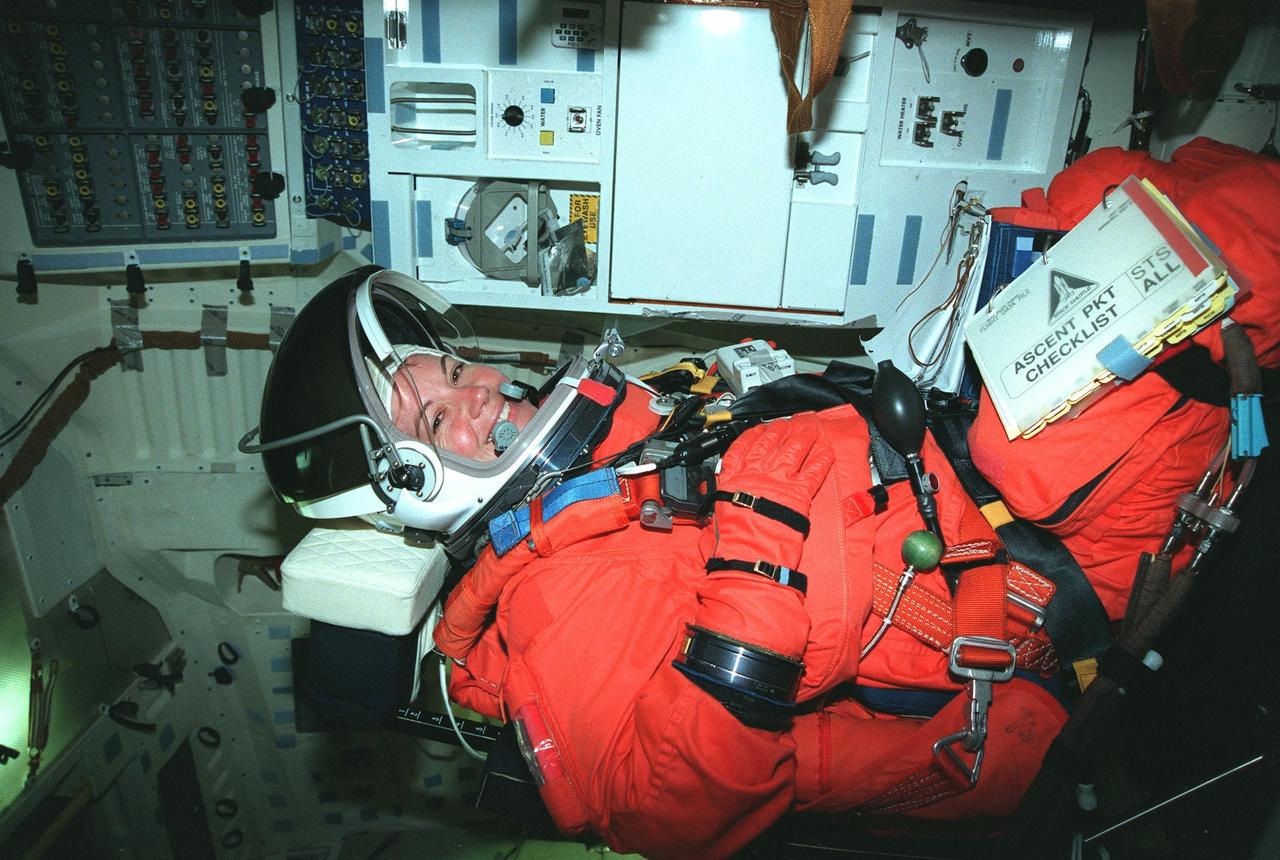
STS-93 Catherine G. Coleman (Ph.D.) sits inside the orbiter Columbia during Terminal Countdown Demonstration Test (TCDT) activities that include emergency exit training and a launch-day dress rehearsal culminating with a simulated main engine cut-off. Other crew members participating are Commander Eileen M. Collins, Pilot Jeffrey S. Ashby, and Mission Specialists Steven A. Hawley (Ph.D.) and Michel Tognini of France, who represents the Centre National d'Etudes Spatiales (CNES). Collins is the first woman to serve as a Shuttle commander. The primary mission of STS-93 is the release of the Chandra X-ray Observatory, which will allow scientists from around the world to obtain unprecedented X-ray images of exotic environments in space to help understand the structure and evolution of the universe. The targeted launch date for STS-93 is no earlier than July 20 at 12:36 a.m. EDT from Launch Pad 39B

In the Operations and Checkout Building, STS-93 Mission Specialist Michel Tognini of France, who represents the Centre National d'Etudes Spatiales (CNES), waves after donning his launch and entry suit during final launch preparations. STS-93 is a five-day mission primarily to release the Chandra X-ray Observatory, which will allow scientists from around the world to study some of the most distant, powerful and dynamic objects in the universe. The new telescope is 20 to 50 times more sensitive than any previous X-ray telescope and is expected unlock the secrets of supernovae, quasars and black holes. The STS-93 crew numbers five: Commander Eileen M. Collins, Pilot Jeffrey S. Ashby, and Mission Specialists Stephen A. Hawley (Ph.D.), Catherine G. Coleman (Ph.D.) and Tognini. Collins is the first woman to serve as commander of a shuttle mission. STS-93 is scheduled to lift off at 12:36 a.m. EDT July 20. The target landing date is July 24 at 11:30 p.m. EDT
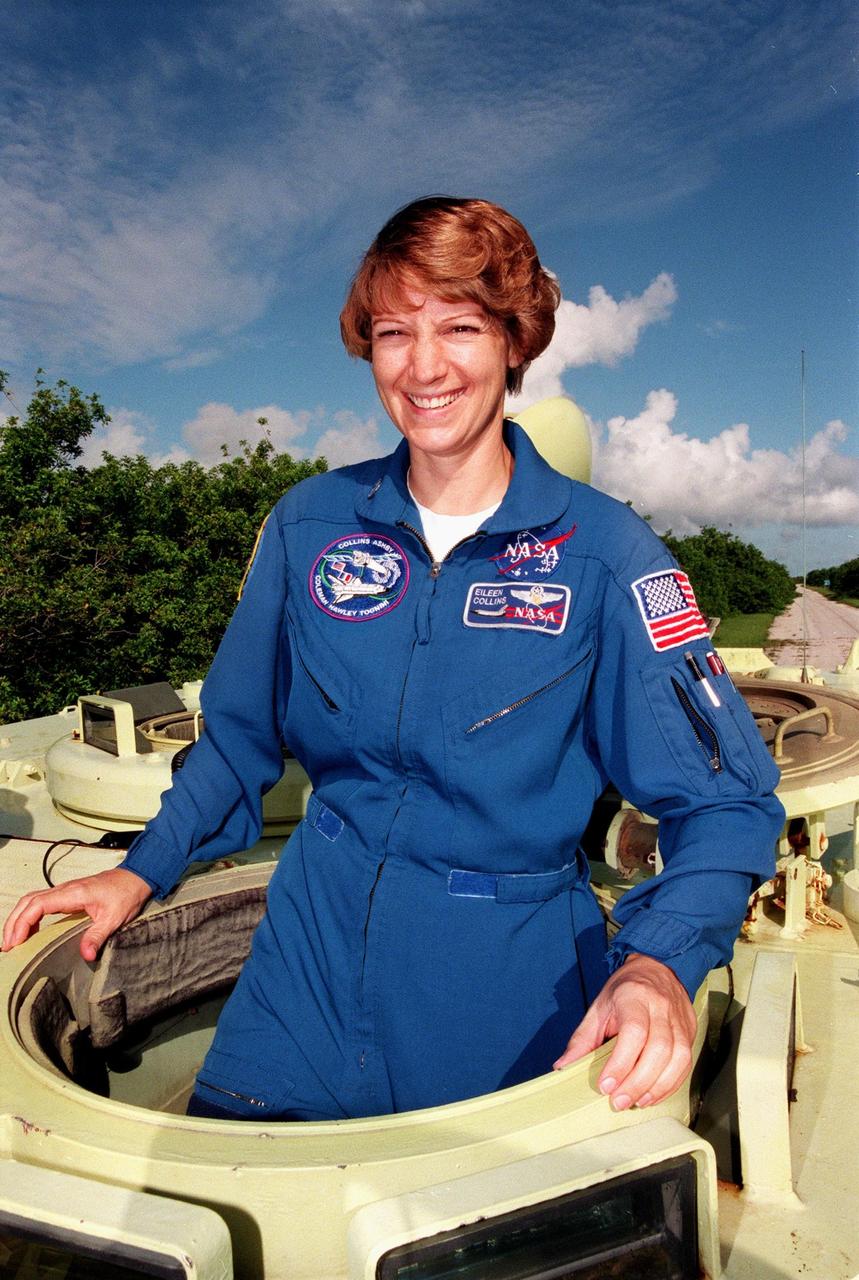
STS-93 Commander Eileen M. Collins climbs into an M-113 armored personnel carrier at the launch pad to take part in emergency egress training. Collins is the first woman to serve as mission commander. In preparation for their mission, the STS-93 crew are participating in Terminal Countdown Demonstration Test activities that also include a launch-day dress rehearsal culminating with a simulated main engine cut-off. Others in the crew are Pilot Jeffrey S. Ashby and Mission Specialists Steven A. Hawley (Ph.D.), Catherine G. Coleman (Ph.D.), and Michel Tognini of France, who represents the Centre National d'Etudes Spatiales (CNES). The primary mission of STS-93 is the release of the Chandra X-ray Observatory, which will allow scientists from around the world to obtain unprecedented X-ray images of exotic environments in space to help understand the structure and evolution of the universe. Chandra is expected to provide unique and crucial information on the nature of objects ranging from comets in our solar system to quasars at the edge of the observable universe. Since X-rays are absorbed by the Earth's atmosphere, space-based observatories are necessary to study these phenomena and allow scientists to analyze some of the greatest mysteries of the universe. The targeted launch date for STS-93 is no earlier than July 20 at 12:36 a.m. EDT from Launch Pad 39B
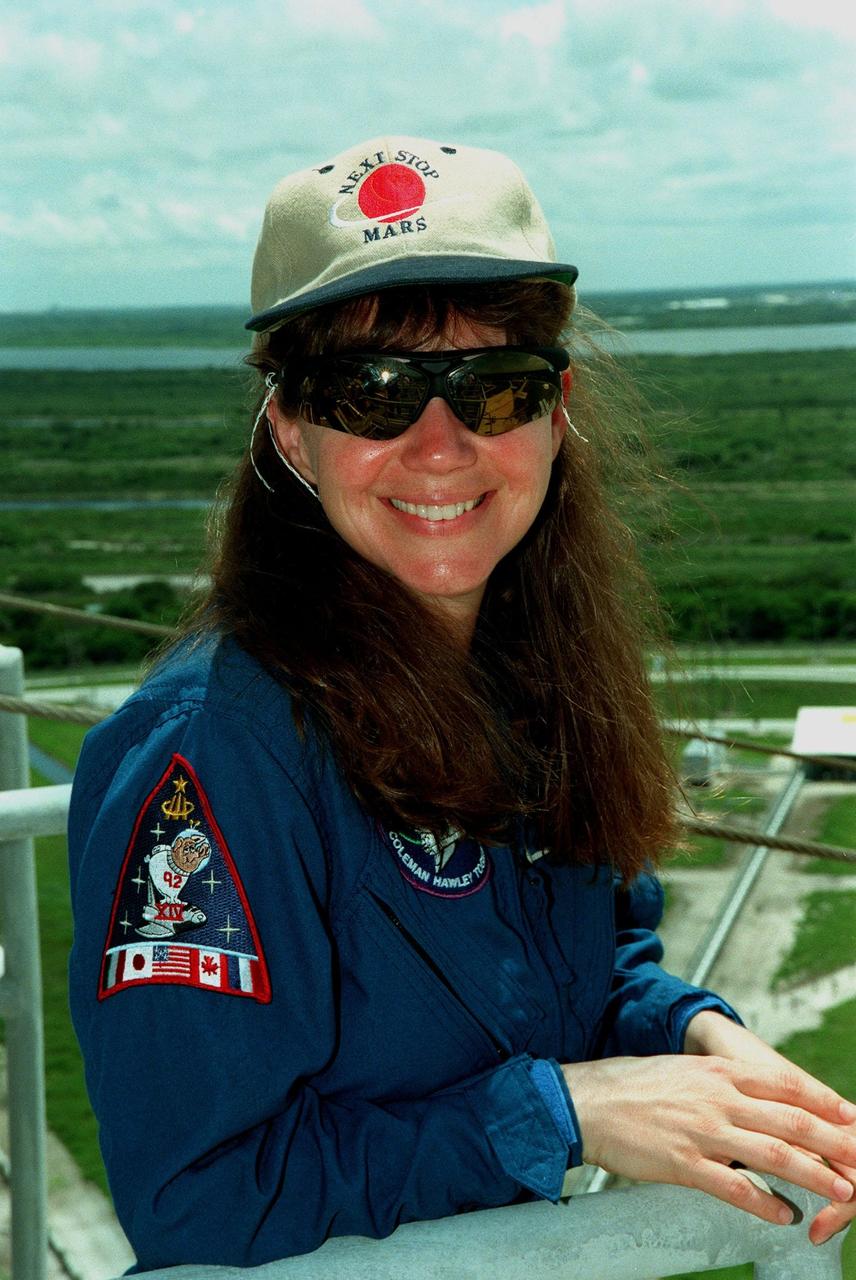
At the 195-foot level of Launch Pad 39B, STS-93 Mission Specialist Catherine G. Coleman (Ph.D.) takes in the view. The STS-93 crew members are at KSC to participate in a Terminal Countdown Demonstration Test, which familiarizes them with the mission, provides training in emergency exit from the orbiter and launch pad, and includes a launch-day dress rehearsal culminating with a simulated main engine cut-off. Other crew members are Commander Eileen M. Collins, Pilot Jeffrey S. Ashby, and Mission Specialists Steven A. Hawley (Ph.D.) and Michel Tognini of France, who represents the Centre National d'Etudes Spatiales (CNES). The primary mission of STS-93 is the release of the Chandra X-ray Observatory, which will allow scientists from around the world to obtain unprecedented X-ray images of exotic environments in space to help understand the structure and evolution of the universe. The targeted launch date for STS-93 is no earlier than July 20 at 12:36 a.m. EDT from Launch Pad 39B
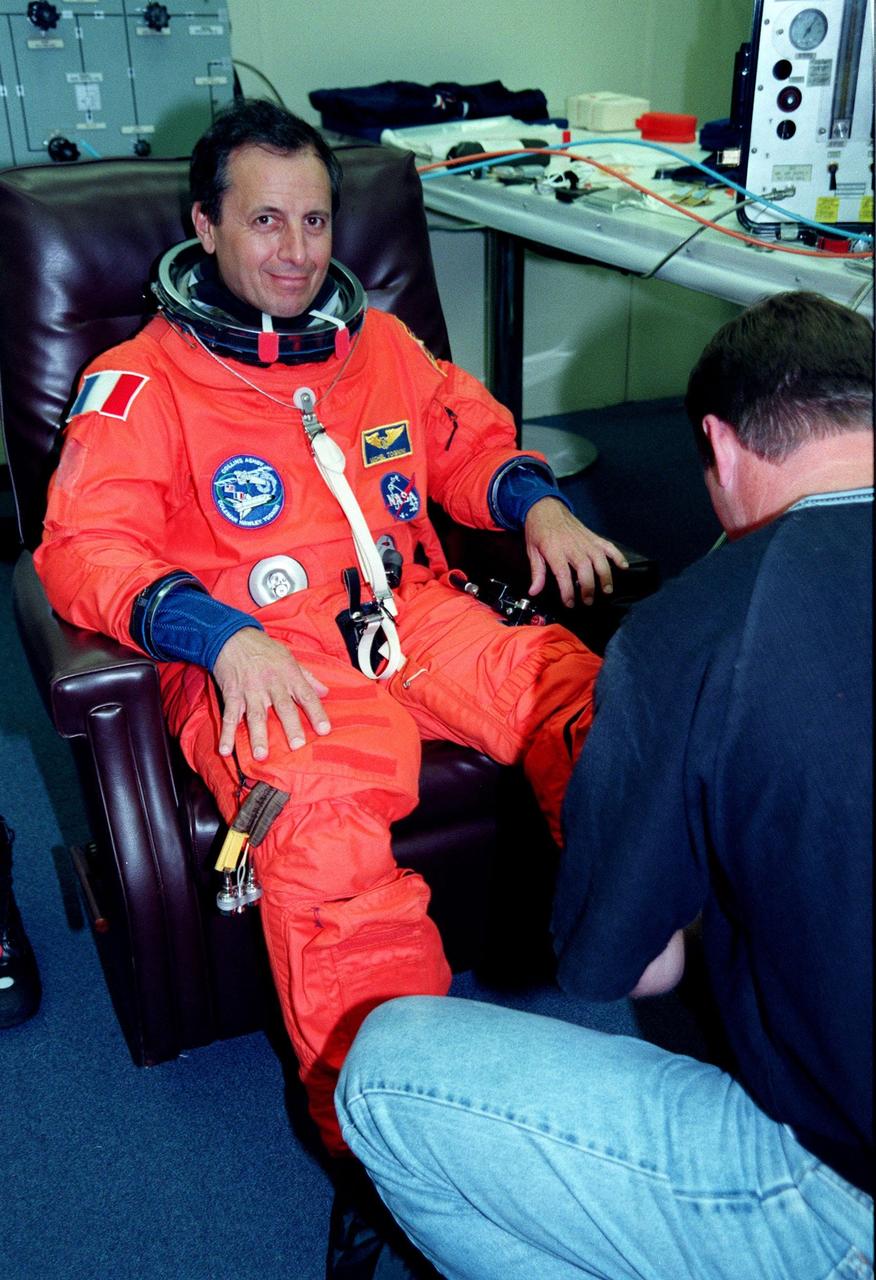
STS-93 Mission Specialist Michel Tognini of France, who represents the Centre National d'Etudes Spatiales (CNES), has his launch and entry suit checked by a technician in the Operations and Checkout Bldg. In preparation for their mission, the STS-93 crew are participating in Terminal Countdown Demonstration Test activities that also include equipment check and a launch-day dress rehearsal culminating with a simulated main engine cut-off. Others in the crew participating are Commander Eileen M. Collins, Pilot Jeffrey S. Ashby, and Mission Specialists Steven A. Hawley (Ph.D.) and Catherine G. Coleman (Ph.D.). Collins is the first woman to serve as a Shuttle commander. The primary mission of STS-93 is the release of the Chandra X-ray Observatory, which will allow scientists from around the world to obtain unprecedented X-ray images of exotic environments in space to help understand the structure and evolution of the universe. The targeted launch date for STS-93 is no earlier than July 20 at 12:36 a.m. EDT from Launch Pad 39B
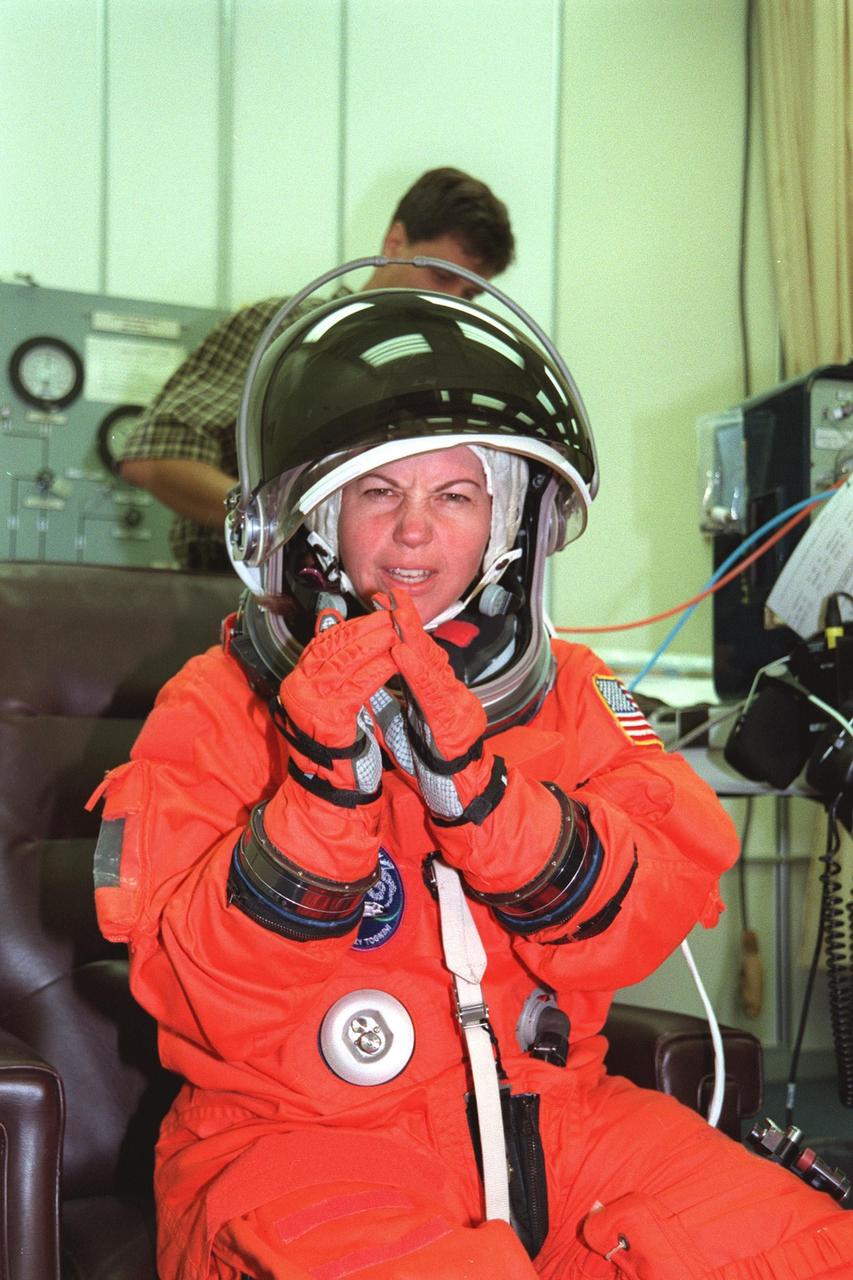
In the Operations and Checkout Bldg., STS-93 Mission Specialist Catherine G. Coleman (Ph.D.) checks out her launch and entry suit. In preparation for their mission, the STS-93 crew are participating in Terminal Countdown Demonstration Test activities that also include equipment check and a launch-day dress rehearsal culminating with a simulated main engine cut-off. Others in the crew participating are Commander Eileen M. Collins, Pilot Jeffrey S. Ashby, Mission Specialist Steven A. Hawley (Ph.D.) and Michel Tognini of France, who represents the Centre National d'Etudes Spatiales (CNES). Collins is the first woman to serve as a Shuttle commander. The primary mission of STS-93 is the release of the Chandra X-ray Observatory, which will allow scientists from around the world to obtain unprecedented X-ray images of exotic environments in space to help understand the structure and evolution of the universe. The targeted launch date for STS-93 is no earlier than July 20 at 12:36 a.m. EDT from Launch Pad 39B
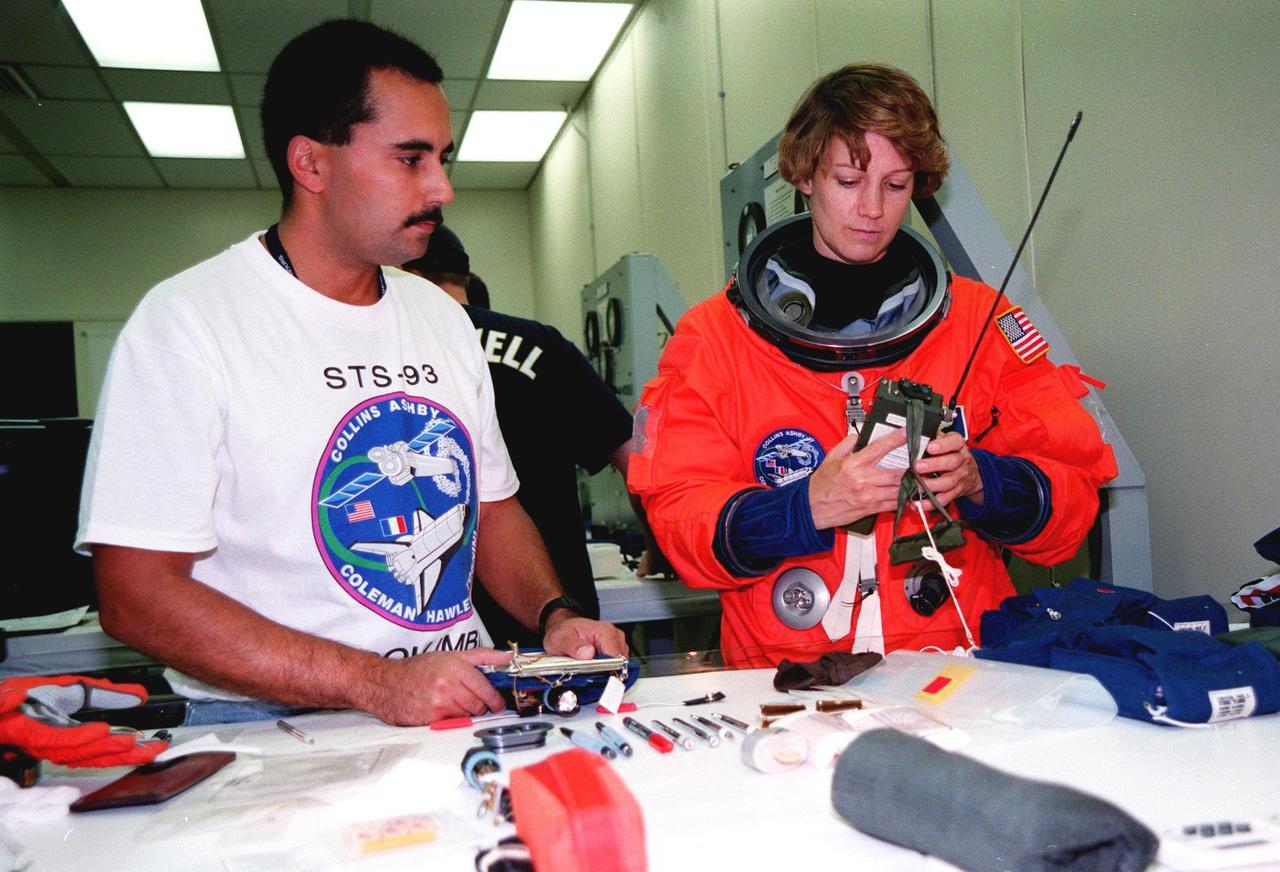
In the Operations and Checkout Bldg., STS-93 Commander Eileen M. Collins checks out a PRC-112 survival radio, part of flight equipment, under the eye of Ray Cuevas, with United Space Alliance. In preparation for their mission, the STS-93 crew are participating in Terminal Countdown Demonstration Test activities that also include equipment check and a launch-day dress rehearsal culminating with a simulated main engine cut-off. Others in the crew participating are Pilot Jeffrey S. Ashby, and Mission Specialists Steven A. Hawley (Ph.D.), Catherine G. Coleman (Ph.D.), and Michel Tognini of France, who represents the Centre National d'Etudes Spatiales (CNES). Collins is the first woman to serve as a Shuttle commander. The primary mission of STS-93 is the release of the Chandra X-ray Observatory, which will allow scientists from around the world to obtain unprecedented X-ray images of exotic environments in space to help understand the structure and evolution of the universe. The targeted launch date for STS-93 is no earlier than July 20 at 12:36 a.m. EDT from Launch Pad 39B
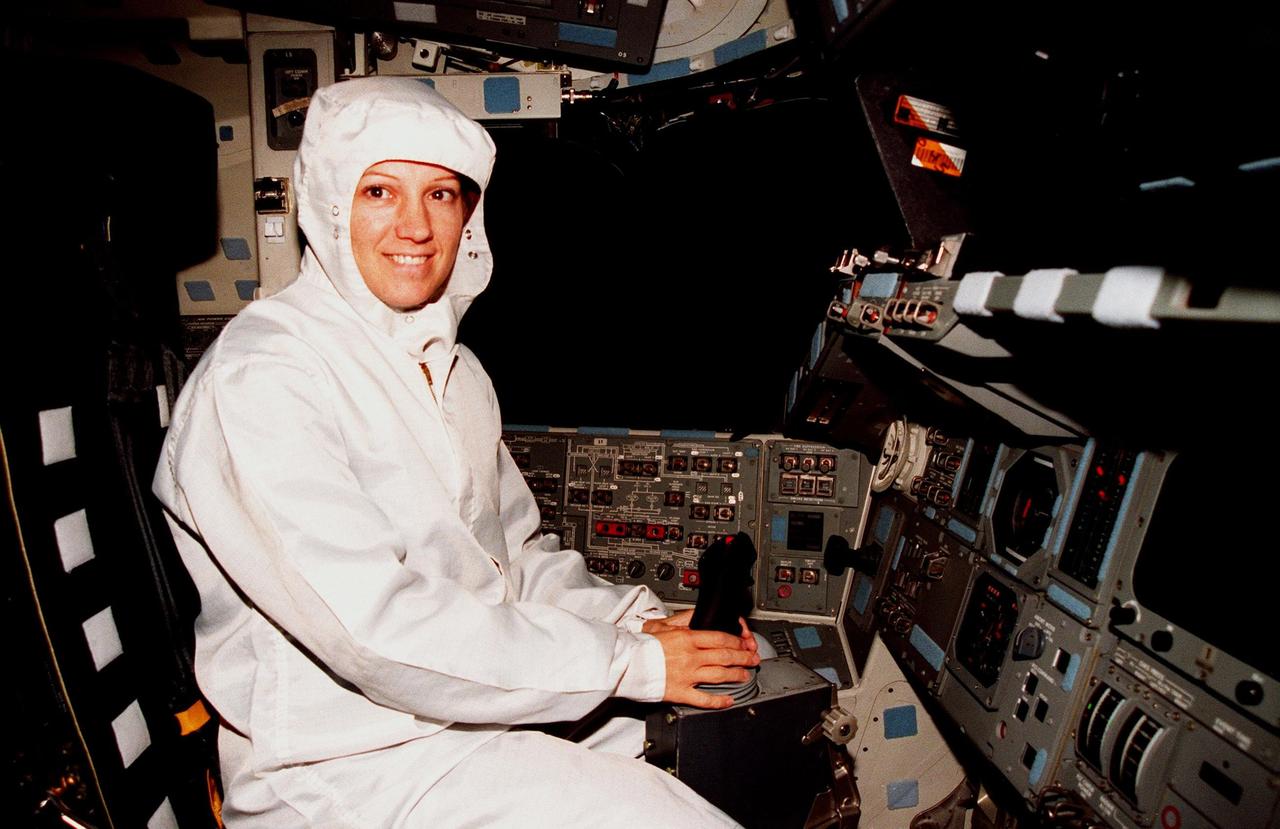
In the Orbiter Processing Facility Bay 3, during the Crew Equipment Interface Test (CEIT) for mission STS-93, Mission Commander Eileen M. Collins checks out her seat in the orbiter Columbia. Collins is the first woman to serve as a mission commander on a shuttle flight. The CEIT provides an opportunity for crew members to check equipment and facilities that will be aboard the orbiter during their mission. The STS-93 mission will deploy the Advanced X-ray Astrophysics Facility (AXAF), which comprises three major elements: the spacecraft, the telescope, and the science instrument module (SIM). AXAF will allow scientists from around the world to obtain unprecedented X-ray images of a variety of high-energy objects to help understand the structure and evolution of the universe. The other STS-93 crew members are Pilot Jeffrey S. Ashby, Mission Specialist Catherine G. Coleman, Mission Specialist Steven A. Hawley and Mission Specialist Michel Tognini of France. Targeted date for the launch of STS-93 is March 18, 1999
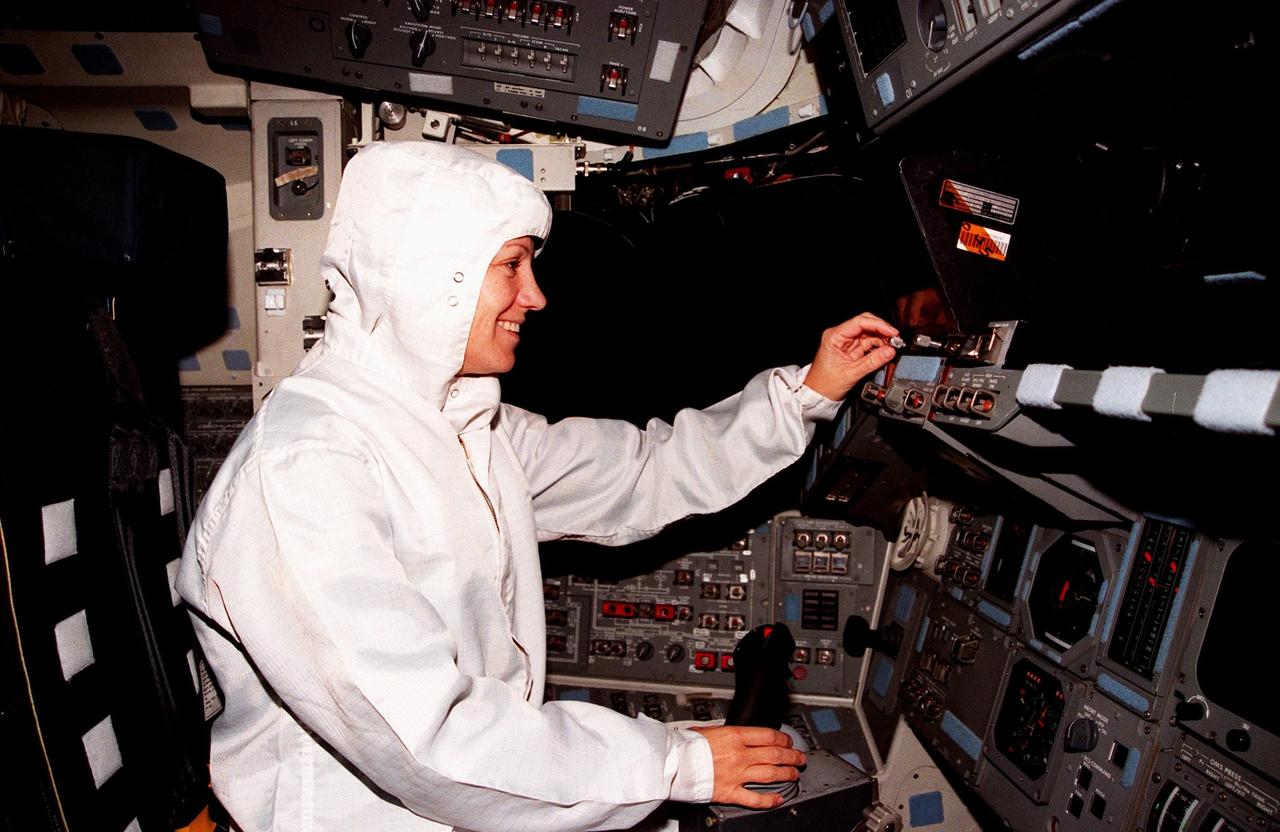
During the Crew Equipment Interface Test (CEIT) for mission STS-93, Mission Commander Eileen M. Collins checks out the flight deck on the orbiter Columbia, in the Orbiter Processing Facility Bay 3. The CEIT provides an opportunity for crew members to check equipment and facilities that will be aboard the orbiter during their mission. The STS-93 mission will deploy the Advanced X-ray Astrophysics Facility (AXAF) which comprises three major elements: the spacecraft, the telescope, and the science instrument module (SIM). AXAF will allow scientists from around the world to obtain unprecedented X-ray images of a variety of high-energy objects to help understand the structure and evolution of the universe. Collins is the first woman to serve as a shuttle mission commander. The other STS-93 crew members are Mission Specialist Catherine G. Coleman, Pilot Jeffrey S. Ashby, Mission Specialist Steven A. Hawley and Mission Specialist Michel Tognini of France. Targeted date for the launch of STS-93 is March 18, 1999

In the Operations and Checkout Building, STS-93 Mission Specialist Steven A. Hawley (Ph.D.) smiles after donning his launch and entry suit during final launch preparations. STS-93 is a five-day mission primarily to release the Chandra X-ray Observatory, which will allow scientists from around the world to study some of the most distant, powerful and dynamic objects in the universe. The new telescope is 20 to 50 times more sensitive than any previous X-ray telescope and is expected unlock the secrets of supernovae, quasars and black holes. The STS-93 crew numbers five: Commander Eileen M. Collins, Pilot Jeffrey S. Ashby, and Mission Specialists Hawley, Catherine G. Coleman (Ph.D.) and Michel Tognini of France, with the Centre National d'Etudes Spatiales (CNES). Collins is the first woman to serve as commander of a shuttle mission. STS-93 is scheduled to lift off at 12:36 a.m. EDT July 20. The target landing date is July 24 at 11:30 p.m. EDT
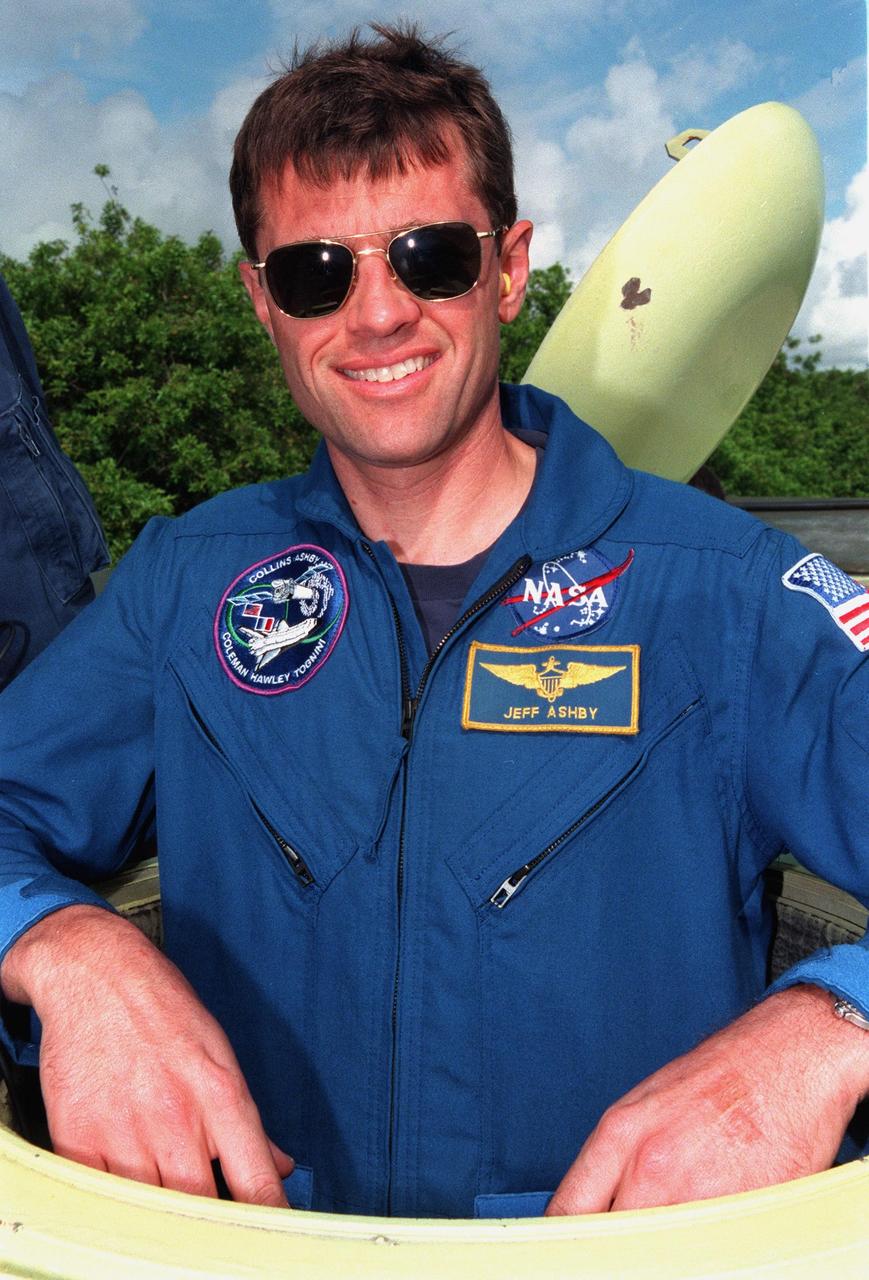
STS-93 Pilot Jeffrey S. Ashby pauses for the photographer before climbing into an M-113 armored personnel carrier at the launch pad to take part in emergency egress training. In preparation for their mission, the STS-93 crew are participating in Terminal Countdown Demonstration Test activities that also include a launch-day dress rehearsal culminating with a simulated main engine cut-off. Others in the crew are Commander Eileen M. Collins and Mission Specialists Steven A. Hawley (Ph.D.), Catherine G. Coleman (Ph.D.), and Michel Tognini of France, who represents the Centre National d'Etudes Spatiales (CNES). Collins is the first woman to serve as a mission commander. The primary mission of STS-93 is the release of the Chandra X-ray Observatory, which will allow scientists from around the world to obtain unprecedented X-ray images of exotic environments in space to help understand the structure and evolution of the universe. Chandra is expected to provide unique and crucial information on the nature of objects ranging from comets in our solar system to quasars at the edge of the observable universe. Since X-rays are absorbed by the Earth's atmosphere, space-based observatories are necessary to study these phenomena and allow scientists to analyze some of the greatest mysteries of the universe. The targeted launch date for STS-93 is no earlier than July 20 at 12:36 a.m. EDT from Launch Pad 39B
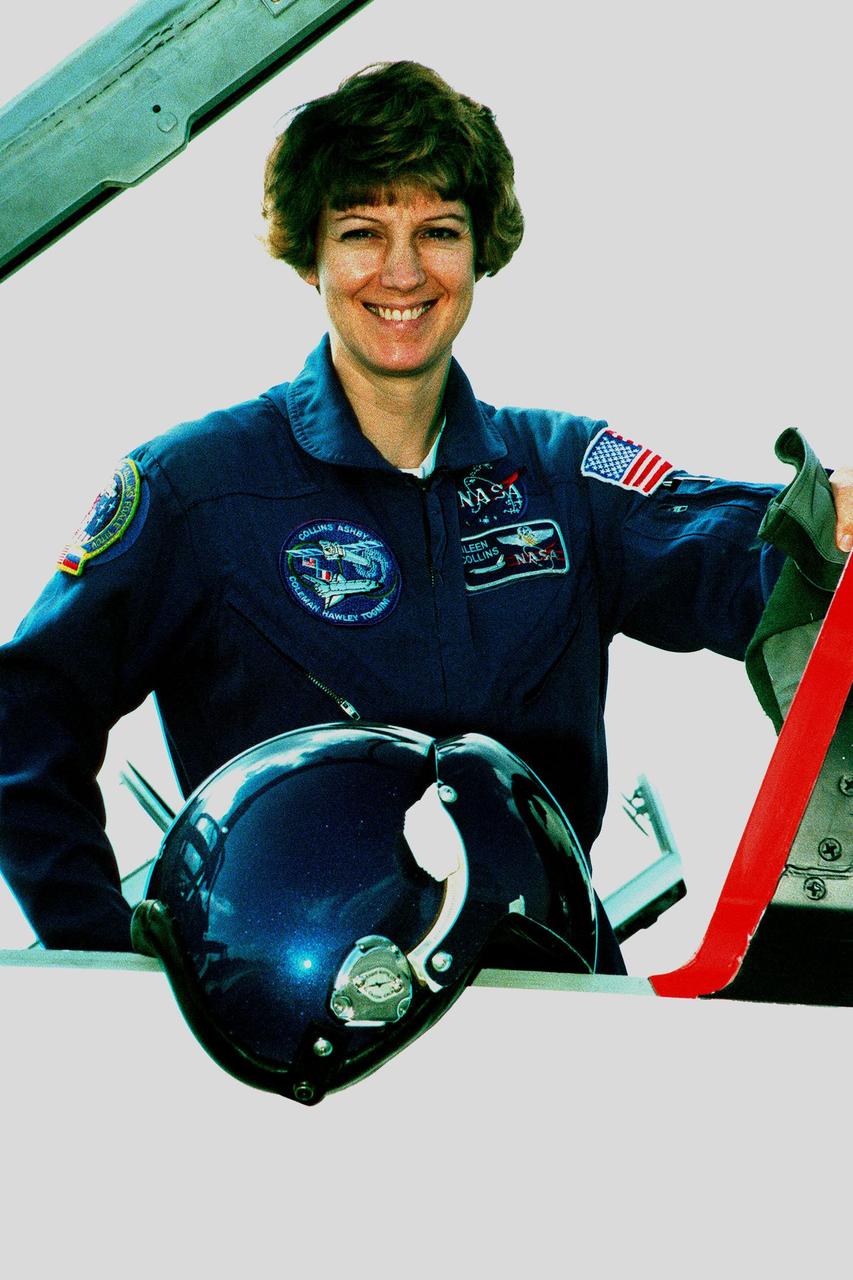
Before leaving KSC, STS-93 Commander Eileen M. Collins poses by a T-38 jet trainer aircraft at the Shuttle Landing Facility. She and the rest of the STS-93 crew spent two days visiting mission-related sites, including the Vertical Processing Facility where the Chandra X-ray Observatory is undergoing testing. STS-93 is scheduled to launch July 9 aboard Space Shuttle Columbia and has the primary mission of the deployment of the observatory. Formerly called the Advanced X-ray Astrophysics Facility, Chandra comprises three major elements: the spacecraft, the science instrument module (SIM), and the world's most powerful X-ray telescope. Chandra will allow scientists from around the world to see previously invisible black holes and high-temperature gas clouds, giving the observatory the potential to rewrite the books on the structure and evolution of our universe. Collins is the first woman to serve as commander of a Space Shuttle. Other STS-93 crew members are Pilot Jeffrey S. Ashby and Mission Specialists Catherine G. Coleman, Steven A. Hawley, and Michel Tognini of France, who represents the Centre National d'Etudes Spatiales (CNES)
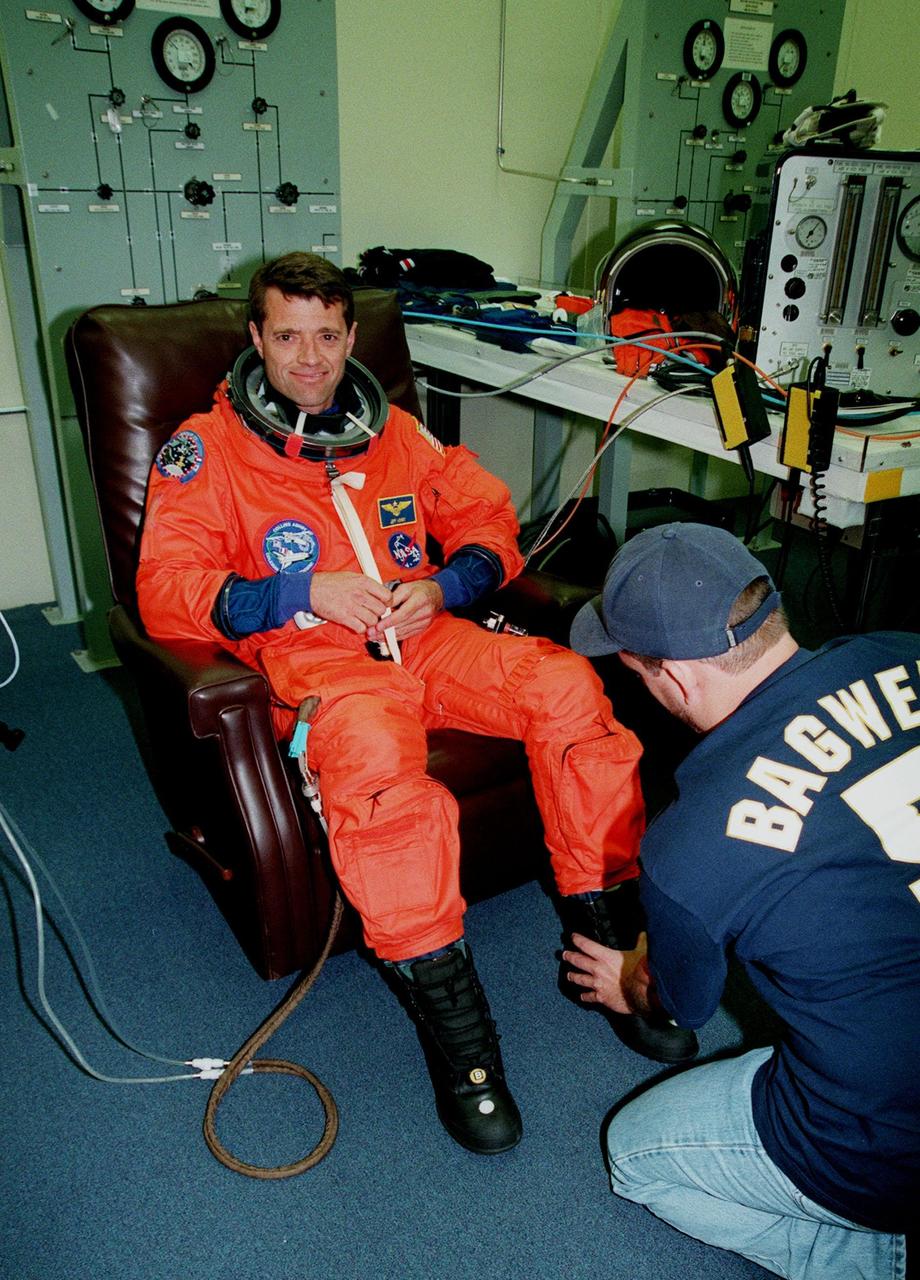
STS-93 Pilot Jeffrey S. Ashby has his launch and entry suit checked by a technician in the Operations and Checkout Bldg. In preparation for their mission, the STS-93 crew are participating in Terminal Countdown Demonstration Test activities that also include equipment check and a launch-day dress rehearsal culminating with a simulated main engine cut-off. Others in the crew participating are Commander Eileen M. Collins and Mission Specialists Steven A. Hawley (Ph.D.), Catherine G. Coleman (Ph.D.) and Michel Tognini of France, who represents the Centre National d'Etudes Spatiales (CNES). Collins is the first woman to serve as a Shuttle commander. The primary mission of STS-93 is the release of the Chandra X-ray Observatory, which will allow scientists from around the world to obtain unprecedented X-ray images of exotic environments in space to help understand the structure and evolution of the universe. The targeted launch date for STS-93 is no earlier than July 20 at 12:36 a.m. EDT from Launch Pad 39B
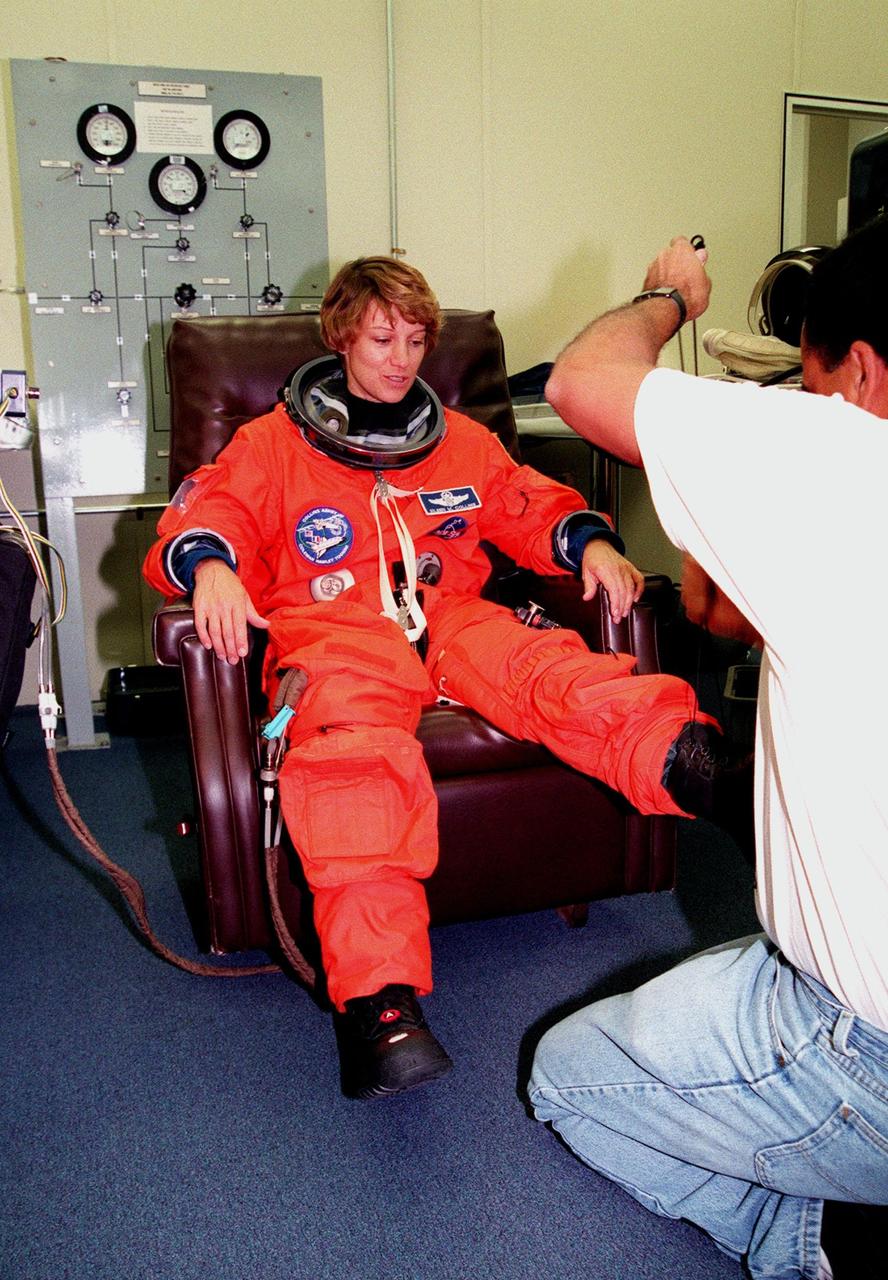
STS-93 Commander Eileen M. Collins has her launch and entry suit checked by a technician in the Operations and Checkout Bldg. In preparation for their mission, the STS-93 crew are participating in Terminal Countdown Demonstration Test activities that also include equipment check and a launch-day dress rehearsal culminating with a simulated main engine cut-off. Others in the crew participating are Pilot Jeffrey S. Ashby, and Mission Specialists Steven A. Hawley (Ph.D.), Catherine G. Coleman (Ph.D.) and Michel Tognini of France, who represents the Centre National d'Etudes Spatiales (CNES). Collins is the first woman to serve as a Shuttle commander. The primary mission of STS-93 is the release of the Chandra X-ray Observatory, which will allow scientists from around the world to obtain unprecedented X-ray images of exotic environments in space to help understand the structure and evolution of the universe. The targeted launch date for STS-93 is no earlier than July 20 at 12:36 a.m. EDT from Launch Pad 39B
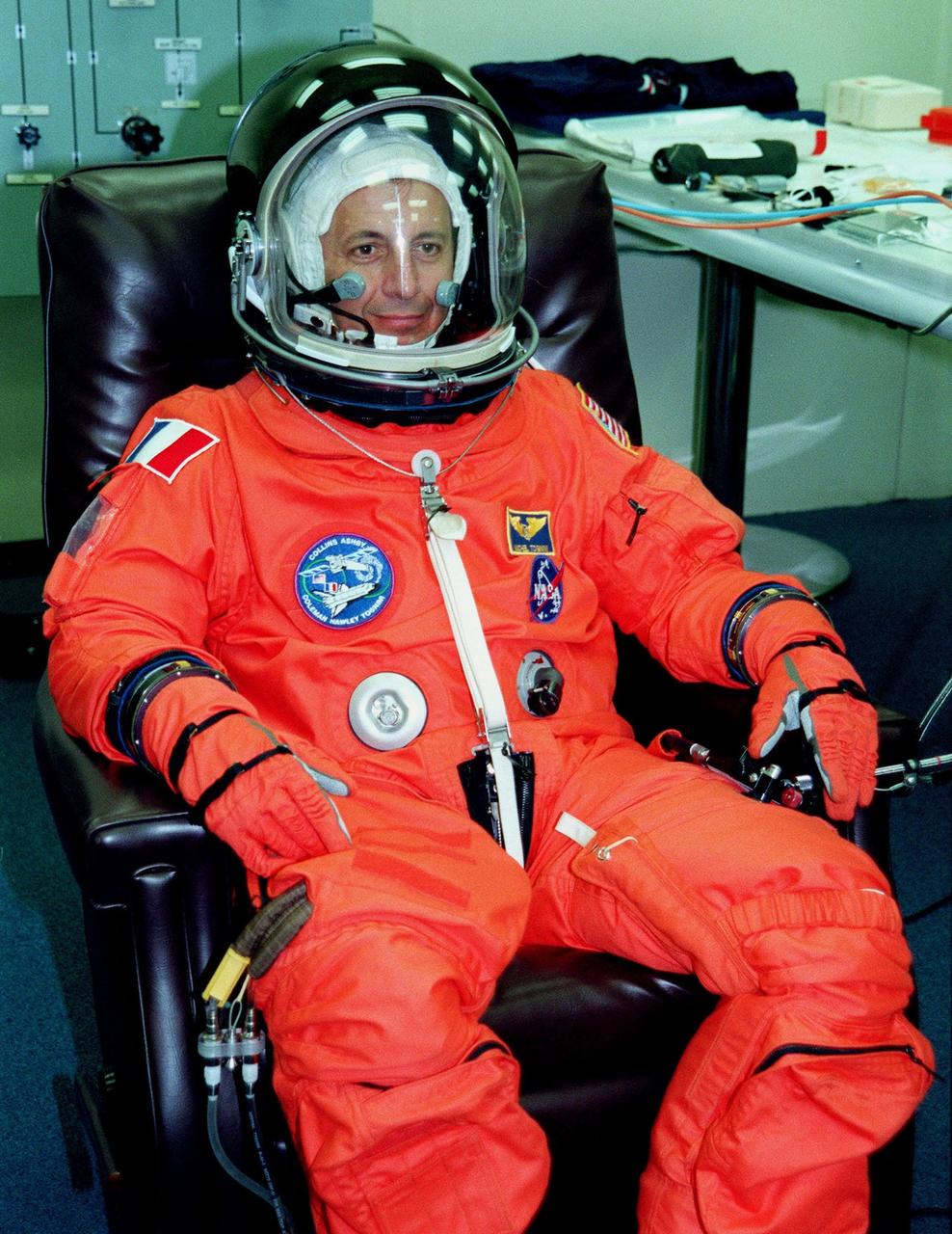
During launch and entry suit check in the Operations and Checkout Bldg, STS-93 Mission Specialist Michel Tognini of France, who represents the Centre National d'Etudes Spatiales (CNES), tries on his helmet. In preparation for their mission, the STS-93 crew are participating in Terminal Countdown Demonstration Test activities that also include equipment check and a launch-day dress rehearsal culminating with a simulated main engine cut-off. Others in the crew participating are Commander Eileen M. Collins, Pilot Jeffrey S. Ashby, and Mission Specialists Steven A. Hawley (Ph.D.) and Catherine G. Coleman (Ph.D.). Collins is the first woman to serve as a Shuttle commander. The primary mission of STS-93 is the release of the Chandra X-ray Observatory, which will allow scientists from around the world to obtain unprecedented X-ray images of exotic environments in space to help understand the structure and evolution of the universe. The targeted launch date for STS-93 is no earlier than July 20 at 12:36 a.m. EDT from Launch Pad 39B
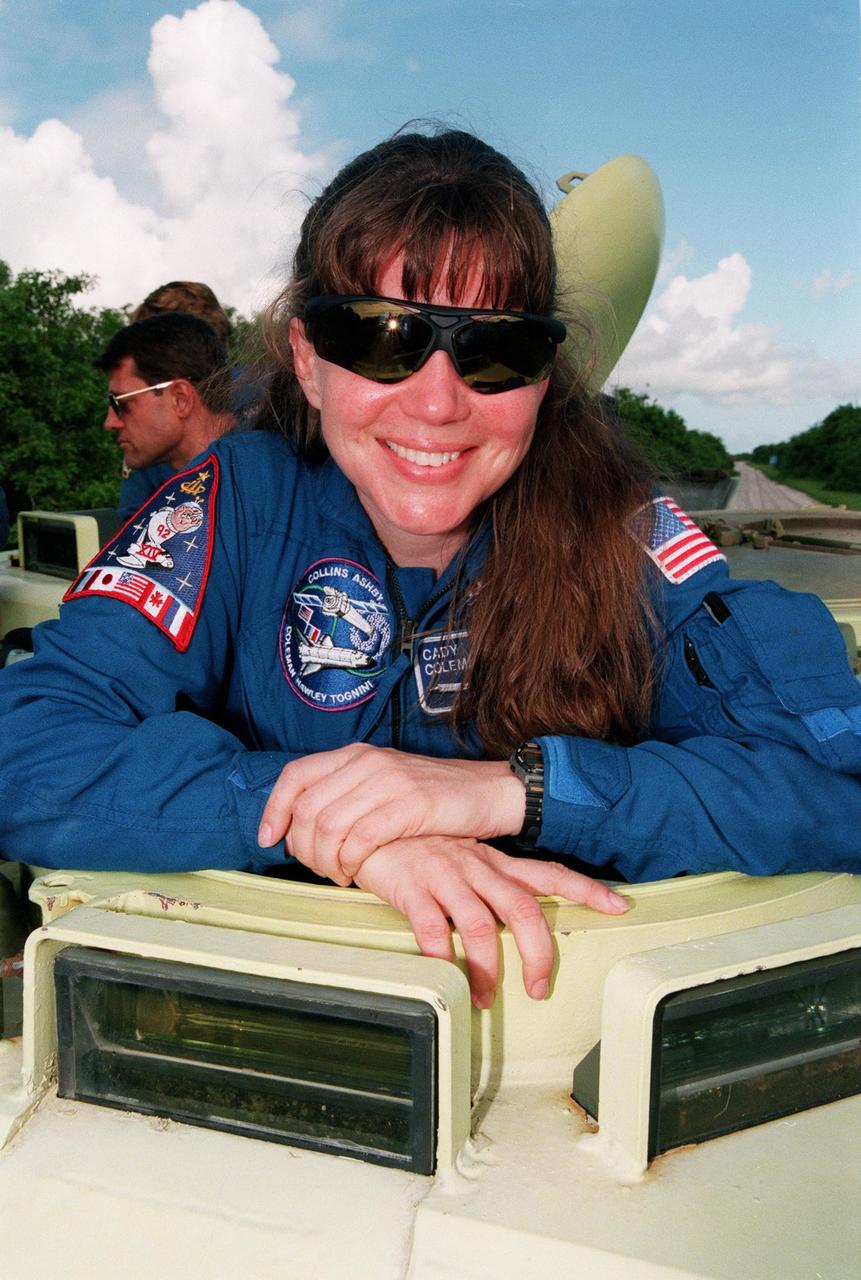
STS-93 Mission Specialist Catherine G. Coleman (Ph.D.) smiles for the photographer before climbing into an M-113 armored personnel carrier at the launch pad to take part in emergency egress training. In preparation for their mission, the STS-93 crew are participating in Terminal Countdown Demonstration Test activities that also include a launch-day dress rehearsal culminating with a simulated main engine cut-off. Others in the crew are Commander Eileen M. Collins, Pilot Jeffrey S. Ashby, and Mission Specialists Steven A. Hawley (Ph.D.) and Michel Tognini of France, who represents the Centre National d'Etudes Spatiales (CNES). Collins is the first woman to serve as a mission commander. The primary mission of STS-93 is the release of the Chandra X-ray Observatory, which will allow scientists from around the world to obtain unprecedented X-ray images of exotic environments in space to help understand the structure and evolution of the universe. Chandra is expected to provide unique and crucial information on the nature of objects ranging from comets in our solar system to quasars at the edge of the observable universe. Since X-rays are absorbed by the Earth's atmosphere, space-based observatories are necessary to study these phenomena and allow scientists to analyze some of the greatest mysteries of the universe. The targeted launch date for STS-93 is no earlier than July 20 at 12:36 a.m. EDT from Launch Pad 39B
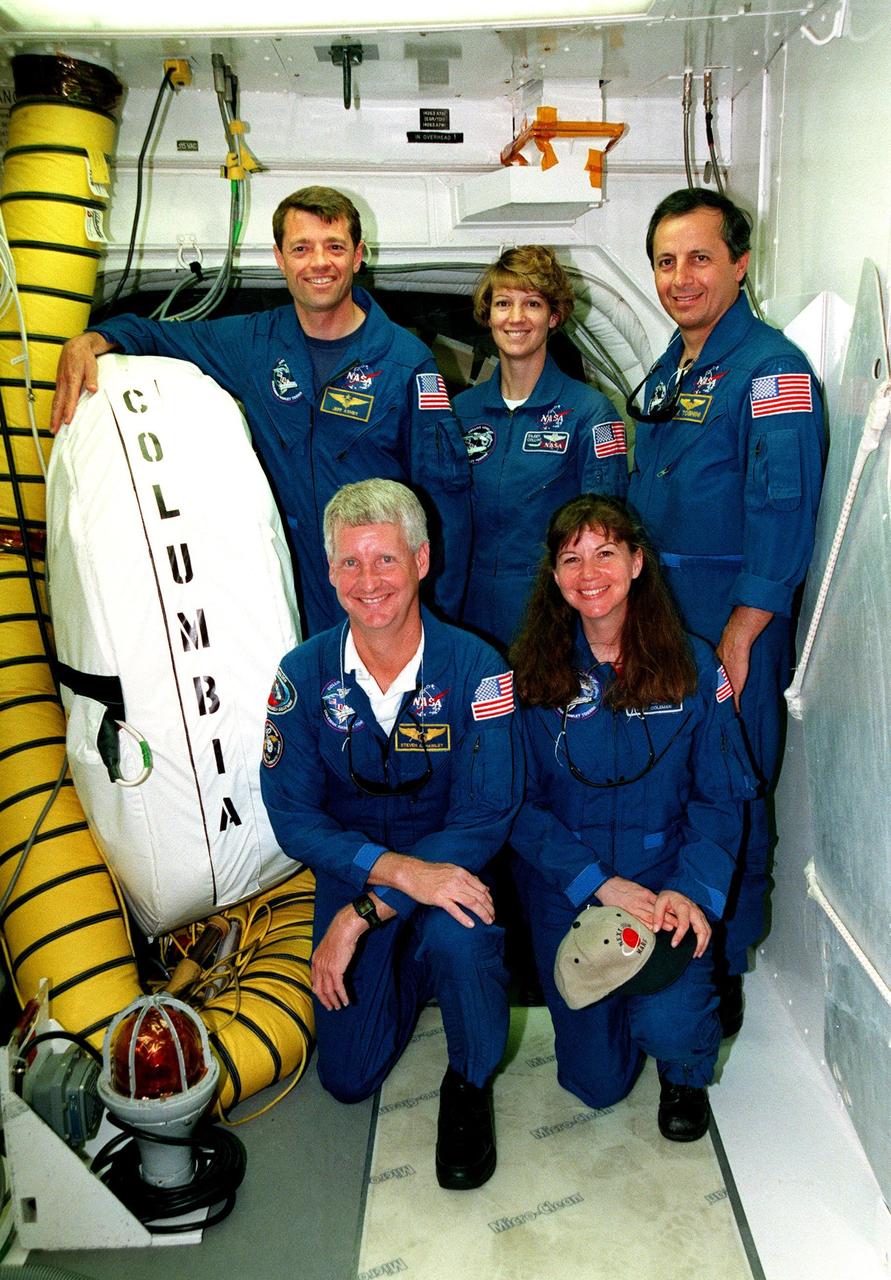
KENNEDY SPACE CENTER, FLA. -- Inside the "White Room" at Launch Pad 39B, the STS-93 crew poses for a photo before passing through the hatch on the orbiter Columbia. In the back row are Pilot Jeffrey S. Ashby, Commander Eileen M. Collins and Mission Specialist Michel Tognini of France, who represents the Centre National d'Etudes Spatiales (CNES). Kneeling in front are Mission Specialists Steven A. Hawley (Ph.D.), and Catherine G. Coleman (Ph.D.). The White Room is an environmentally controlled chamber that abuts the orbiter hatch. In preparation for their mission, the STS-93 crew members are participating in a Terminal Countdown Demonstration Test, which familiarizes them with the mission, provides training in emergency exit from the orbiter and launch pad, and includes a launch-day dress rehearsal culminating with a simulated main engine cut-off. The primary mission of STS-93 is the release of the Chandra X-ray Observatory, which will allow scientists from around the world to obtain unprecedented X-ray images of exotic environments in space to help understand the structure and evolution of the universe. The targeted launch date for STS-93 is no earlier than July 20 at 12:36 a.m. EDT from Launch Pad 39B
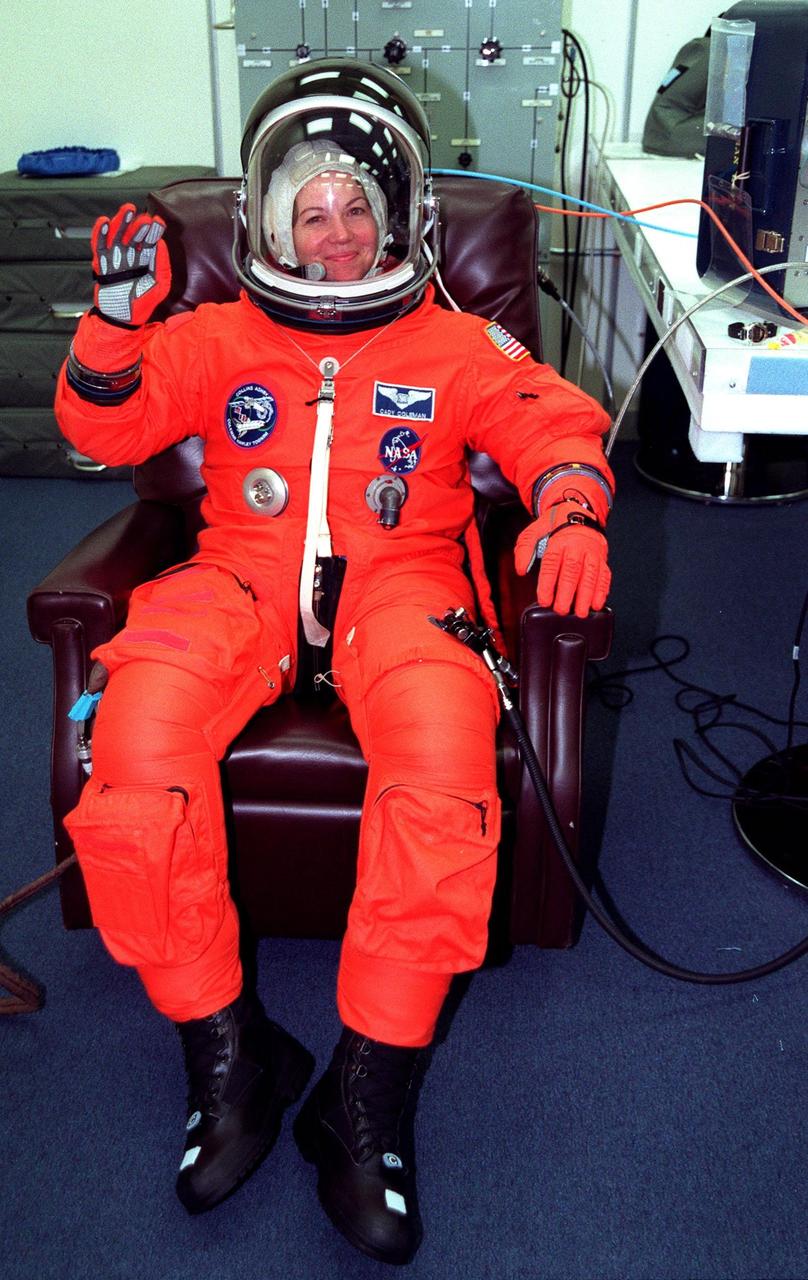
In the Operations and Checkout Building, STS-93 Mission Specialist Catherine G. Coleman (Ph.D.) waves after donning her launch and entry suit during final launch preparations. STS-93 is a five-day mission primarily to release the Chandra X-ray Observatory, which will allow scientists from around the world to study some of the most distant, powerful and dynamic objects in the universe. The new telescope is 20 to 50 times more sensitive than any previous X-ray telescope and is expected unlock the secrets of supernovae, quasars and black holes. The STS-93 crew numbers five: Commander Eileen M. Collins, Pilot Jeffrey S. Ashby, and Mission Specialists Stephen A. Hawley (Ph.D.), Coleman and Michel Tognini of France, who represents the Centre National d'Etudes Spatiales (CNES). Collins is the first woman to serve as commander of a shuttle mission. STS-93 is scheduled to lift off at 12:36 a.m. EDT July 20. The target landing date is July 24 at 11:30 p.m. EDT
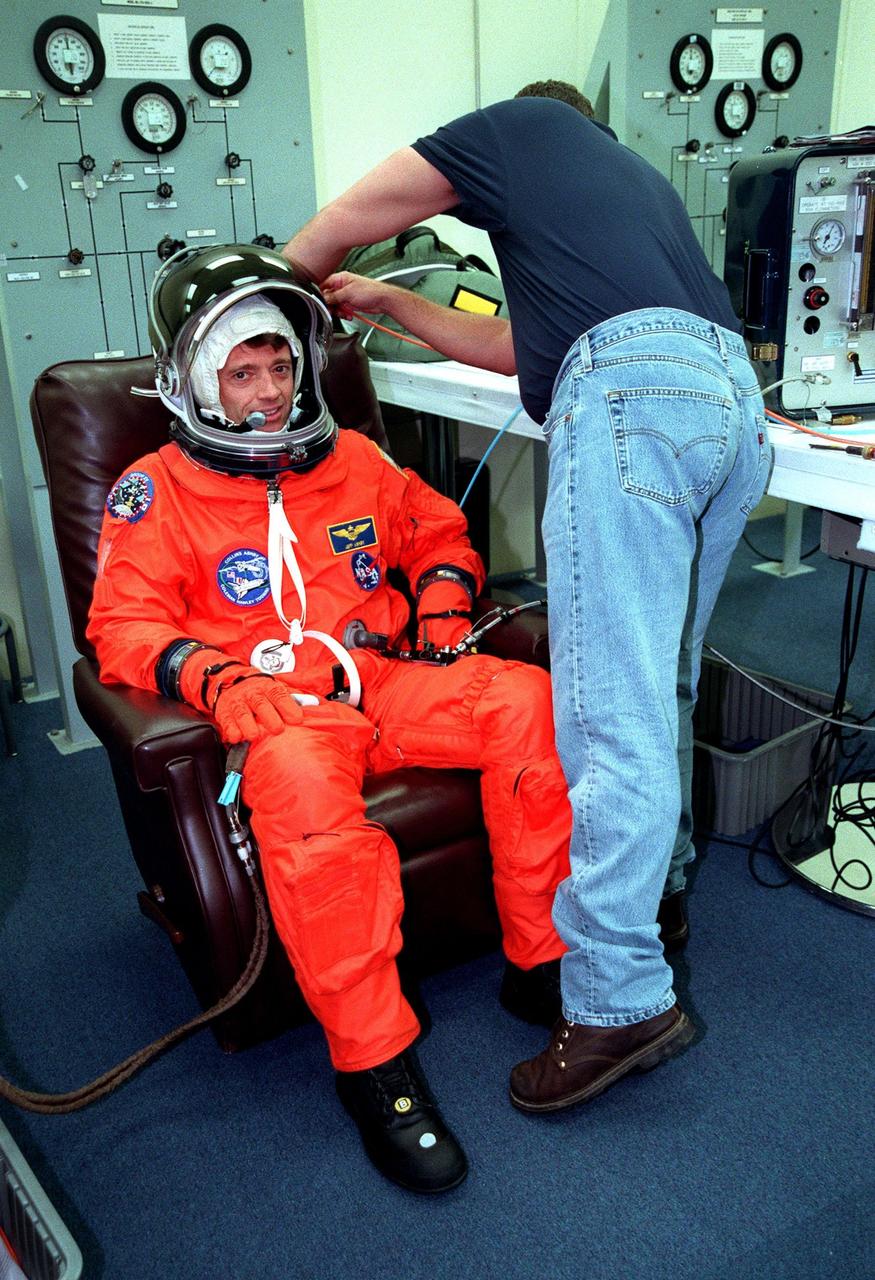
In the Operations and Checkout Building during final launch preparations, STS-93 Pilot Jeffrey S. Ashby waits after donning his launch and entry suit while a suit tech adjusts his helmet. STS-93 is a five-day mission primarily to release the Chandra X-ray Observatory, which will allow scientists from around the world to study some of the most distant, powerful and dynamic objects in the universe. The new telescope is 20 to 50 times more sensitive than any previous X-ray telescope and is expected unlock the secrets of supernovae, quasars and black holes. The STS-93 crew numbers five: Commander Eileen M. Collins, Ashby, and Mission Specialists Stephen A. Hawley (Ph.D.), Catherine G. Coleman (Ph.D.) and Michel Tognini of France, with the Centre National d'Etudes Spatiales (CNES). Collins is the first woman to serve as commander of a shuttle mission. STS-93 is scheduled to lift off at 12:36 a.m. EDT July 20. The target landing date is July 24 at 11:30 p.m. EDT
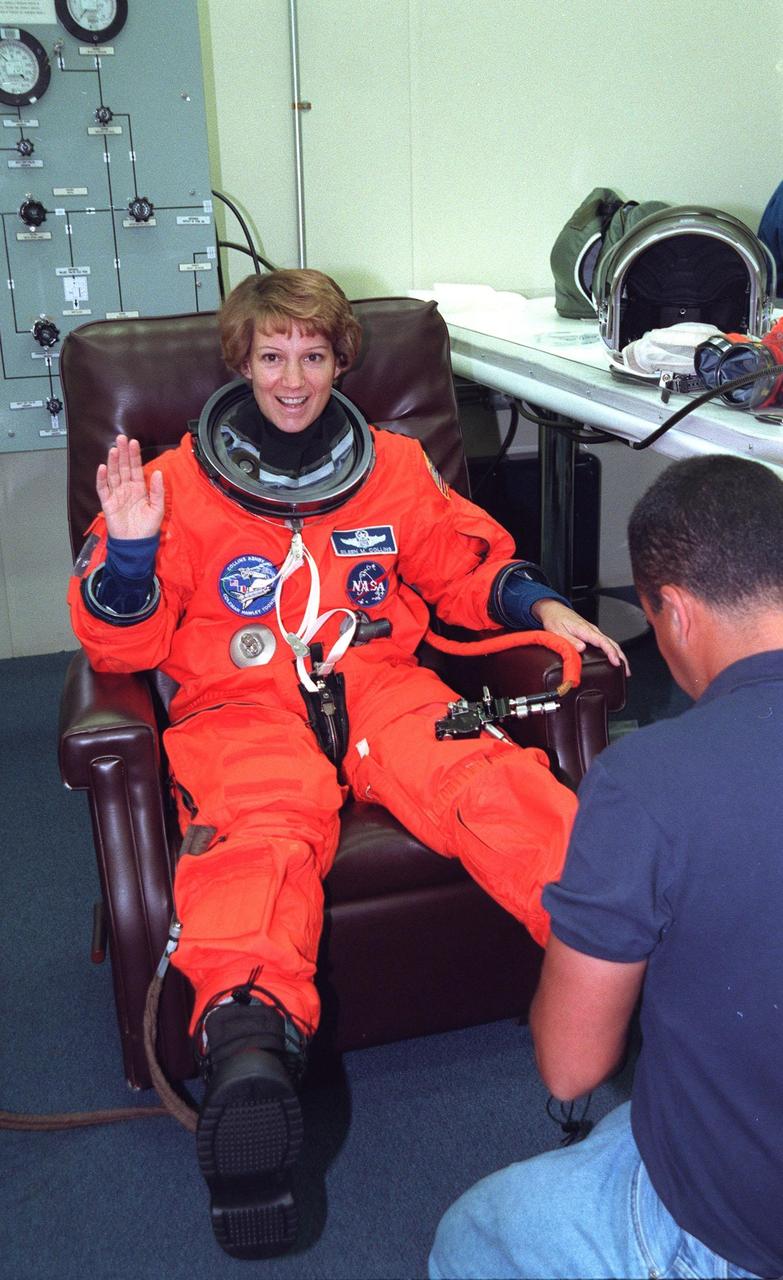
In the Operations and Checkout Building, STS-93 Commander Eileen M. Collins waves while a suit tech adjusts her boot, part of the launch and entry suit, during final launch preparations. STS-93 is a five-day mission primarily to release the Chandra X-ray Observatory, which will allow scientists from around the world to study some of the most distant, powerful and dynamic objects in the universe. The new telescope is 20 to 50 times more sensitive than any previous X-ray telescope and is expected unlock the secrets of supernovae, quasars and black holes. The STS-93 crew numbers five: Commander Collins, Pilot Jeffrey S. Ashby, and Mission Specialists Stephen A. Hawley (Ph.D.), Catherine G. Coleman (Ph.D.) and Michel Tognini of France, with the Centre National d'Etudes Spatiales (CNES). Collins is the first woman to serve as commander of a shuttle mission. STS-93 is scheduled to lift off at 12:36 a.m. EDT July 20. The target landing date is July 24 at 11:30 p.m. EDT
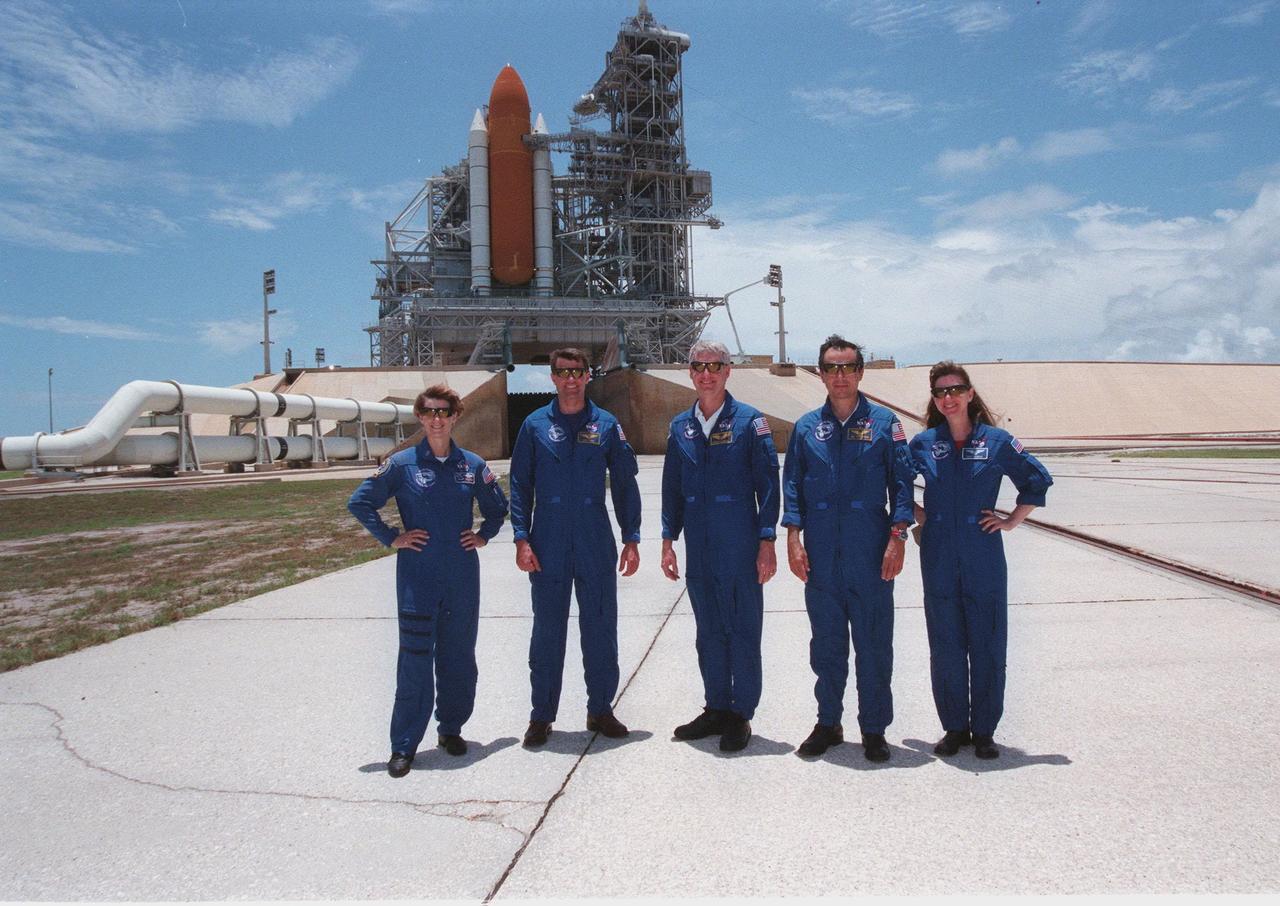
The STS-93 crew poses for a photo on Launch Pad 39B during a break in Terminal Countdown Demonstration Test (TCDT) activities. From left are Commander Eileen M. Collins, Pilot Jeffrey S. Ashby, and Mission Specialists Steven A. Hawley (Ph.D.), Michel Tognini of France, who represents the Centre National d'Etudes Spatiales (CNES), and Catherine G. Coleman (Ph.D.). Collins is the first woman to serve as a Shuttle commander. Behind them is the Space Shuttle Columbia, with only the solid rocket boosters and external tank showing, on the mobile launcher platform. In preparation for their mission, the STS-93 crew members are participating in the TCDT, which familiarizes them with the mission, provides training in emergency exit from the orbiter and launch pad, and includes a launch-day dress rehearsal culminating with a simulated main engine cut-off. The primary mission of STS-93 is the release of the Chandra X-ray Observatory, which will allow scientists from around the world to obtain unprecedented X-ray images of exotic environments in space to help understand the structure and evolution of the universe. The targeted launch date for STS-93 is no earlier than July 20 at 12:36 a.m. EDT from Launch Pad 39B
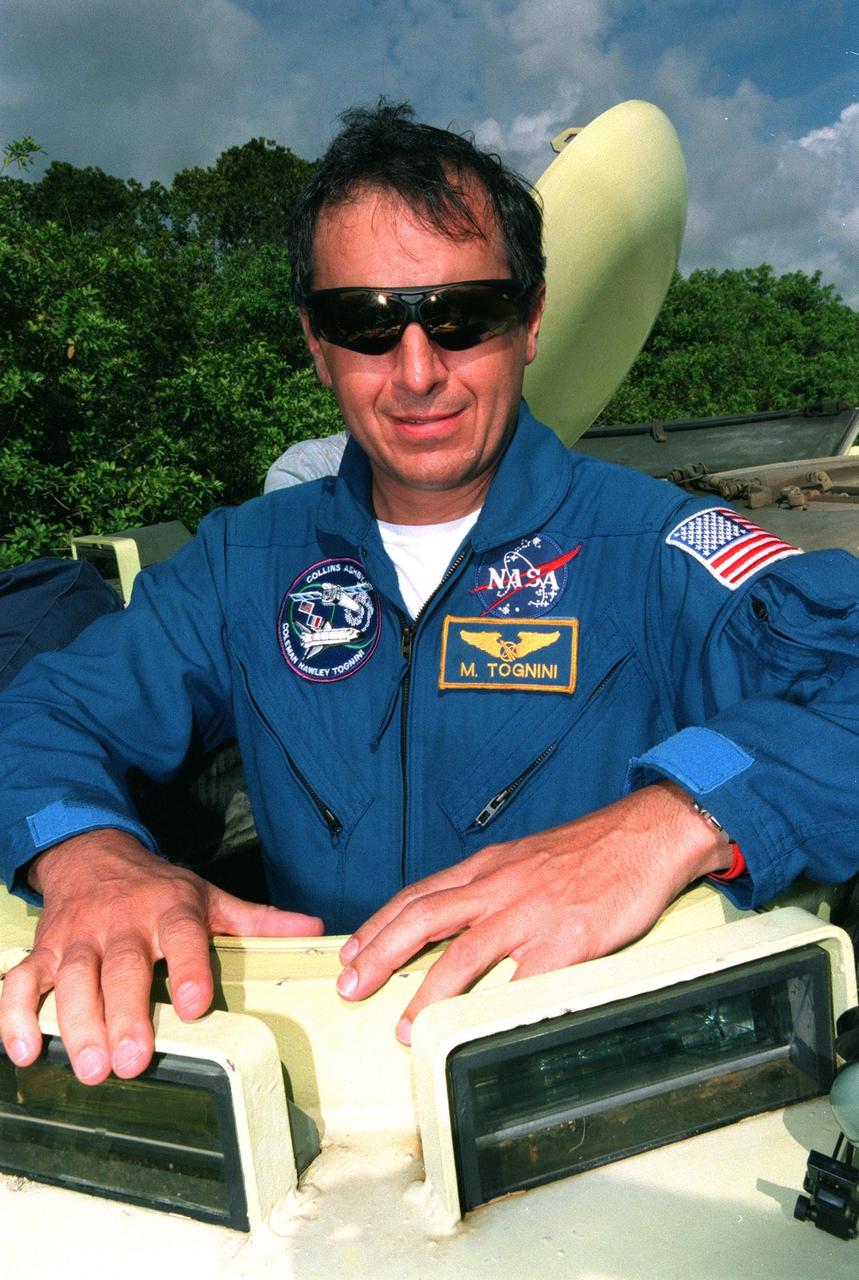
STS-93 Michel Tognini of France, who represents the Centre National d'Etudes Spatiales (CNES), pauses for the photographer before climbing into an M-113 armored personnel carrier at the launch pad to take part in emergency egress training. In preparation for their mission, the STS-93 crew are participating in Terminal Countdown Demonstration Test activities that also include a launch-day dress rehearsal culminating with a simulated main engine cut-off. Others in the crew are Commander Eileen M. Collins, Pilot Jeffrey S. Ashby, and Mission Specialists Steven A. Hawley (Ph.D.) and Catherine G. Coleman (Ph.D.). Collins is the first woman to serve as a mission commander. The primary mission of STS-93 is the release of the Chandra X-ray Observatory, which will allow scientists from around the world to obtain unprecedented X-ray images of exotic environments in space to help understand the structure and evolution of the universe. Chandra is expected to provide unique and crucial information on the nature of objects ranging from comets in our solar system to quasars at the edge of the observable universe. Since X-rays are absorbed by the Earth's atmosphere, space-based observatories are necessary to study these phenomena and allow scientists to analyze some of the greatest mysteries of the universe. The targeted launch date for STS-93 is no earlier than July 20 at 12:36 a.m. EDT from Launch Pad 39B
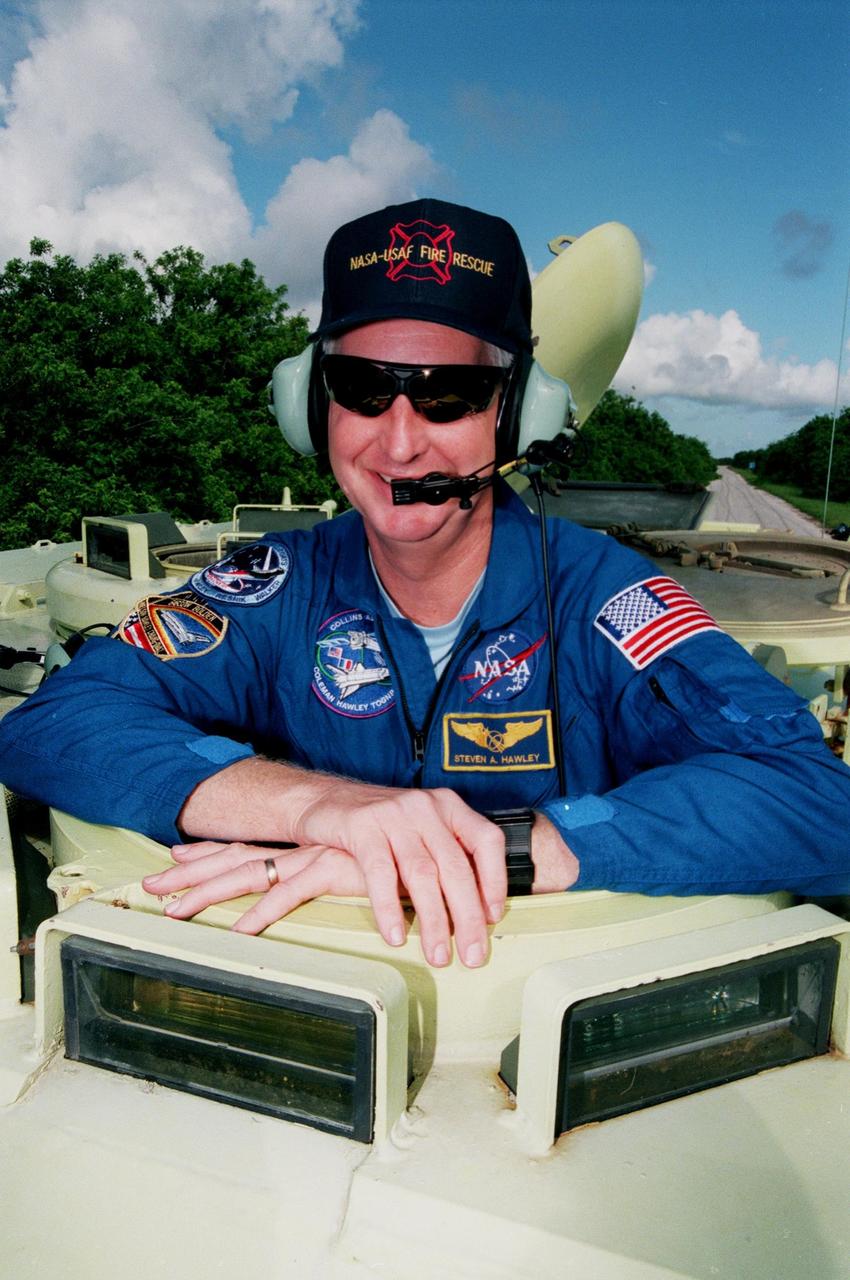
STS-93 Mission Specialist Steven A. Hawley (Ph.D.) smiles for the photographer before climbing into an M-113 armored personnel carrier at the launch pad to take part in emergency egress training. In preparation for their mission, the STS-93 crew are participating in Terminal Countdown Demonstration Test activities that also include a launch-day dress rehearsal culminating with a simulated main engine cut-off. Others in the crew are Commander Eileen M. Collins, Pilot Jeffrey S. Ashby, and Mission Specialists Catherine G. Coleman (Ph.D.) and Michel Tognini of France, who represents the Centre National d'Etudes Spatiales (CNES). Collins is the first woman to serve as a mission commander. The primary mission of STS-93 is the release of the Chandra X-ray Observatory, which will allow scientists from around the world to obtain unprecedented X-ray images of exotic environments in space to help understand the structure and evolution of the universe. Chandra is expected to provide unique and crucial information on the nature of objects ranging from comets in our solar system to quasars at the edge of the observable universe. Since X-rays are absorbed by the Earth's atmosphere, space-based observatories are necessary to study these phenomena and allow scientists to analyze some of the greatest mysteries of the universe. The targeted launch date for STS-93 is no earlier than July 20 at 12:36 a.m. EDT from Launch Pad 39B
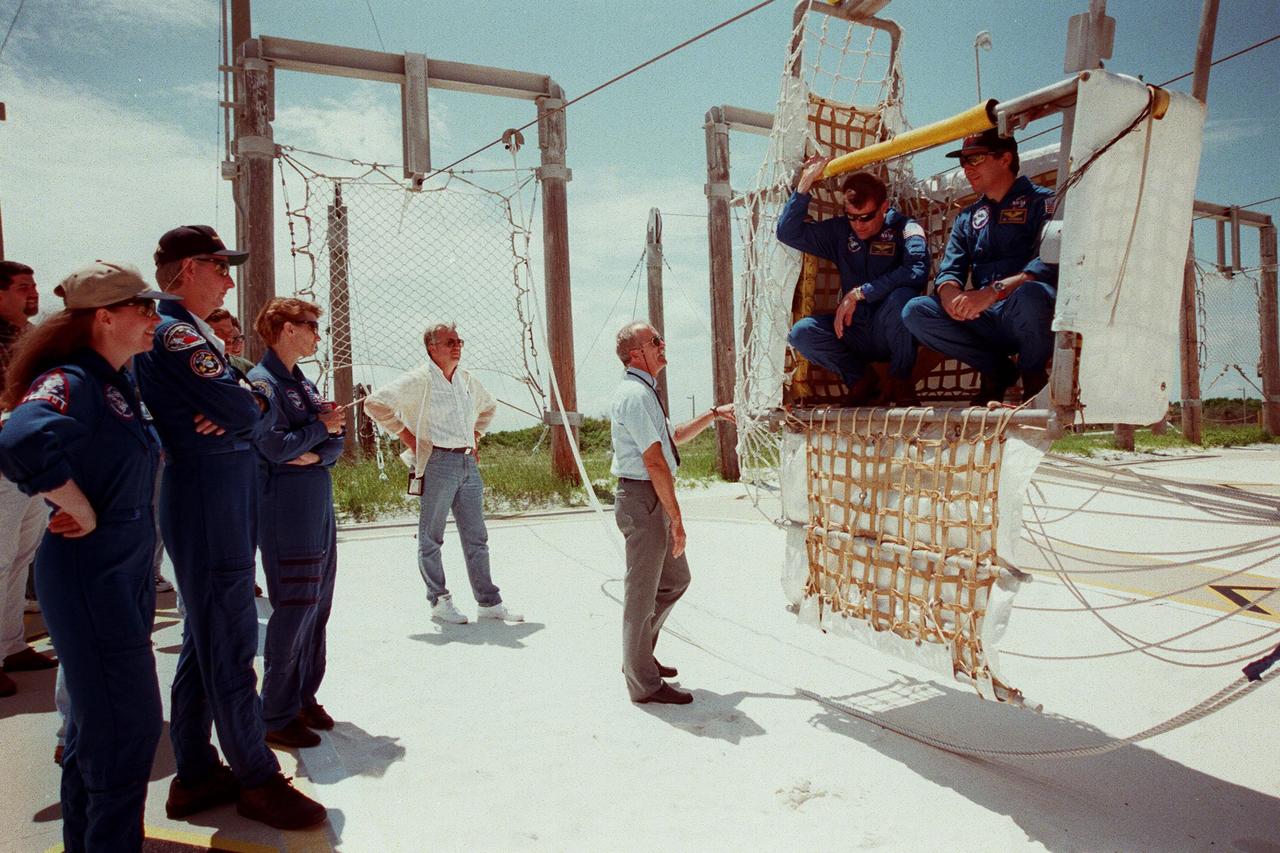
(From left) STS-93 Mission Specialists Catherine G. Coleman (Ph.D.) and Steven A. Hawley (Ph.D.), and Commander Eileen M. Collins watch and listen to Bob Parks, a Safety Egress trainer with United Space Alliance, explaining the use of the slideware basket for emergency egress from the pad. Inside the basket are Pilot Jeffrey S. Ashby and Mission Specialist Michel Tognini of France, who represents the Centre National d'Etudes Spatiales (CNES). The STS-93 crew members are at KSC to participate in a Terminal Countdown Demonstration Test, which familiarizes them with the mission, provides training in emergency exit from the orbiter and launch pad, and includes a launch-day dress rehearsal culminating with a simulated main engine cut-off. The primary mission of STS-93 is the release of the Chandra X-ray Observatory, which will allow scientists from around the world to obtain unprecedented X-ray images of exotic environments in space to help understand the structure and evolution of the universe. The targeted launch date for STS-93 is no earlier than July 20 at 12:36 a.m. EDT from Launch Pad 39B
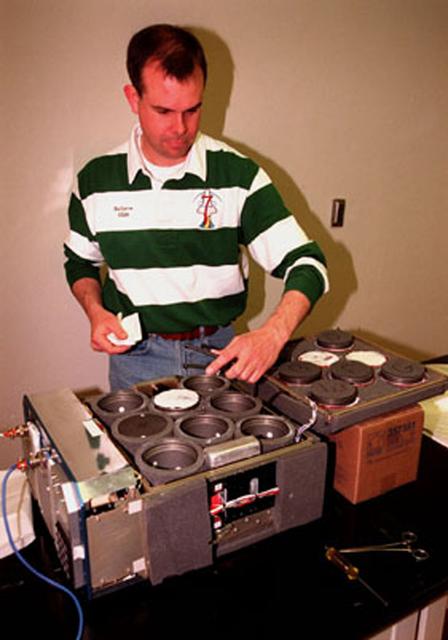
BioServe engineer Mark Rupert with the Version 3 Isothermal Containment Module containing the STS-93 experiment, NIH-B, being flown in cooperation with the National Institutes of Health (NIH).
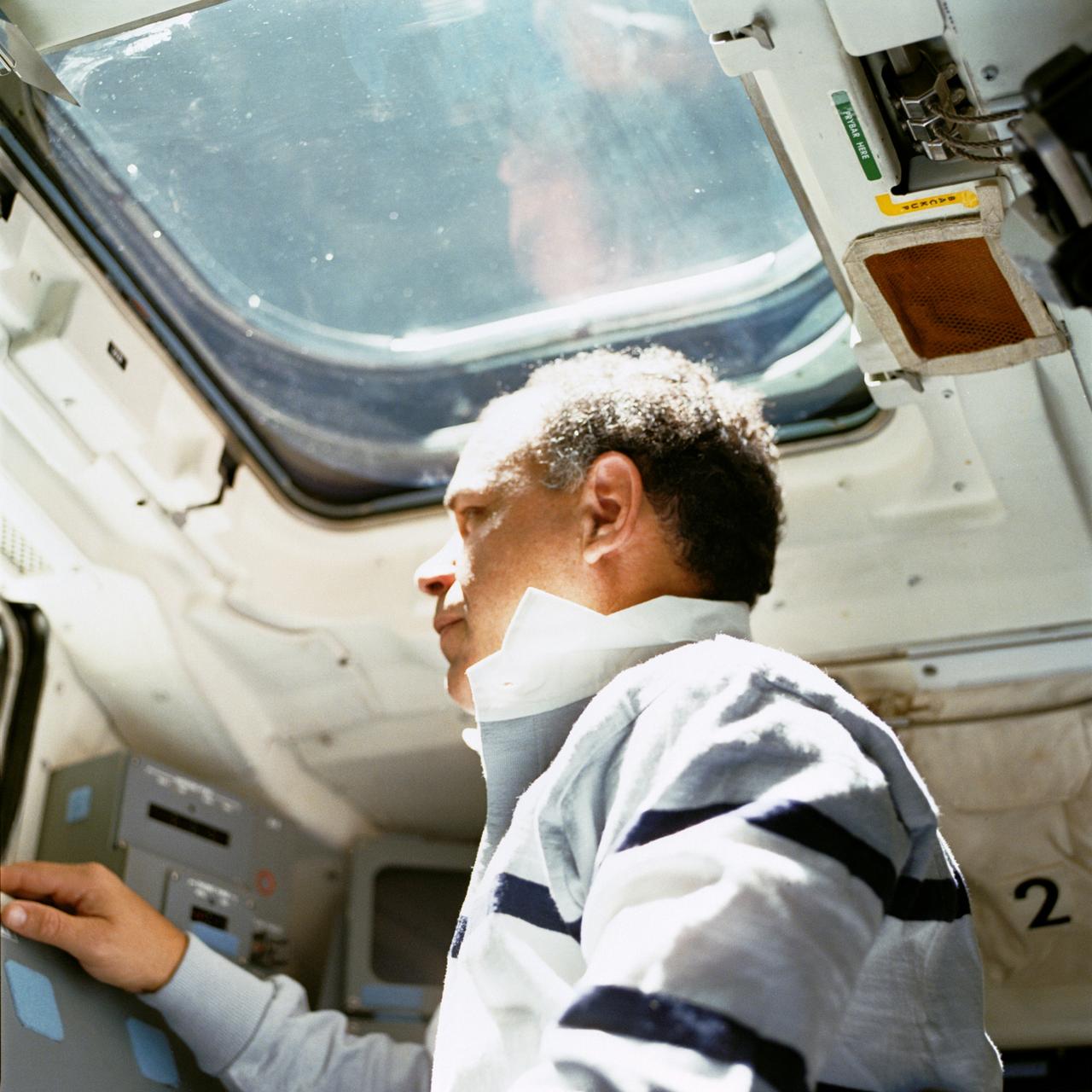
STS033-93-034 (22-27 Nov. 1989) --- Astronaut Frederick D. Gregory, STS-33 commander looks through aft flight deck viewing window while onboard the Space Shuttle Discovery.
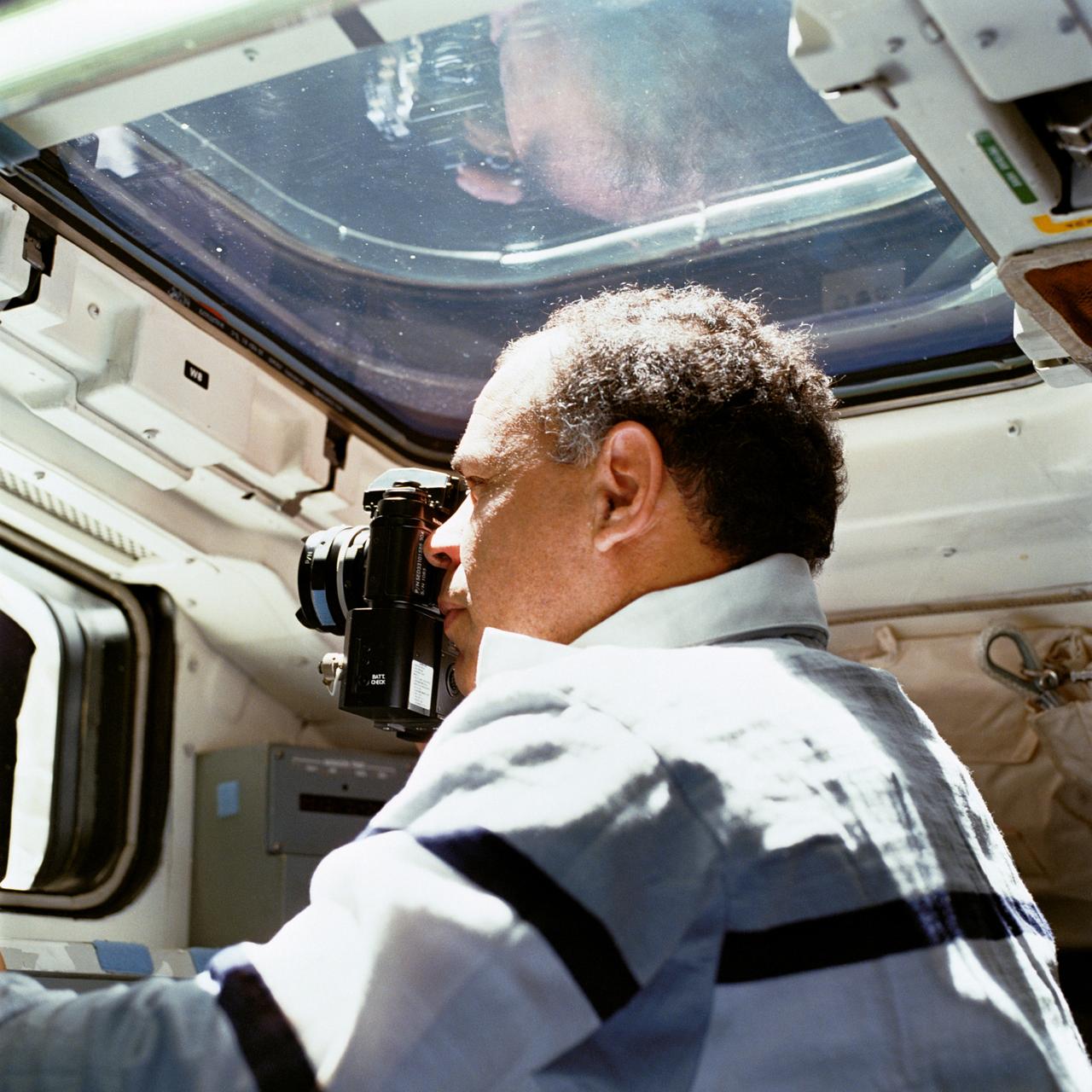
STS033-93-036 (22-27 Nov. 1989) --- Astronaut Frederick D. Gregory, STS-33 commander, aims a 35mm camera out an aft flight deck viewing window while onboard the Space Shuttle Discovery.
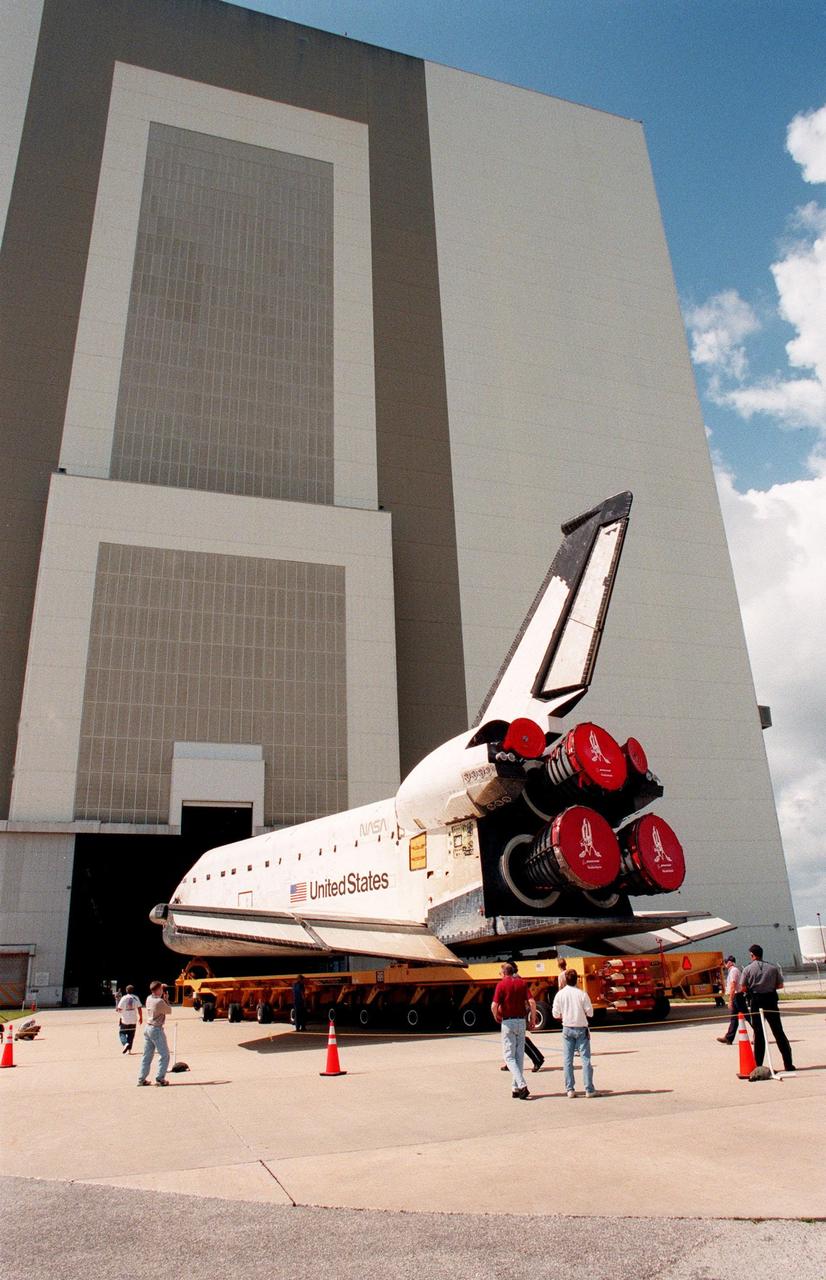
KENNEDY SPACE CENTER, FLA. -- The orbiter Columbia, aboard its orbiter transporter system, rolls toward the opening in the Vehicle Assembly Building where it will undergo external tank mating operations. Columbia is scheduled for rollout to Launch Pad 39B on Monday, June 7, for mission STS-93. The primary mission objective will be the deployment of the Advanced X-ray Astrophysics Facility, recently renamed the Chandra X-Ray Observatory. Mission STS-93 will be the first Space Shuttle commanded by a woman, Commander Eileen M. Collins. It is scheduled to launch July 22 at 12:27 a.m. EDT although that date is currently under review
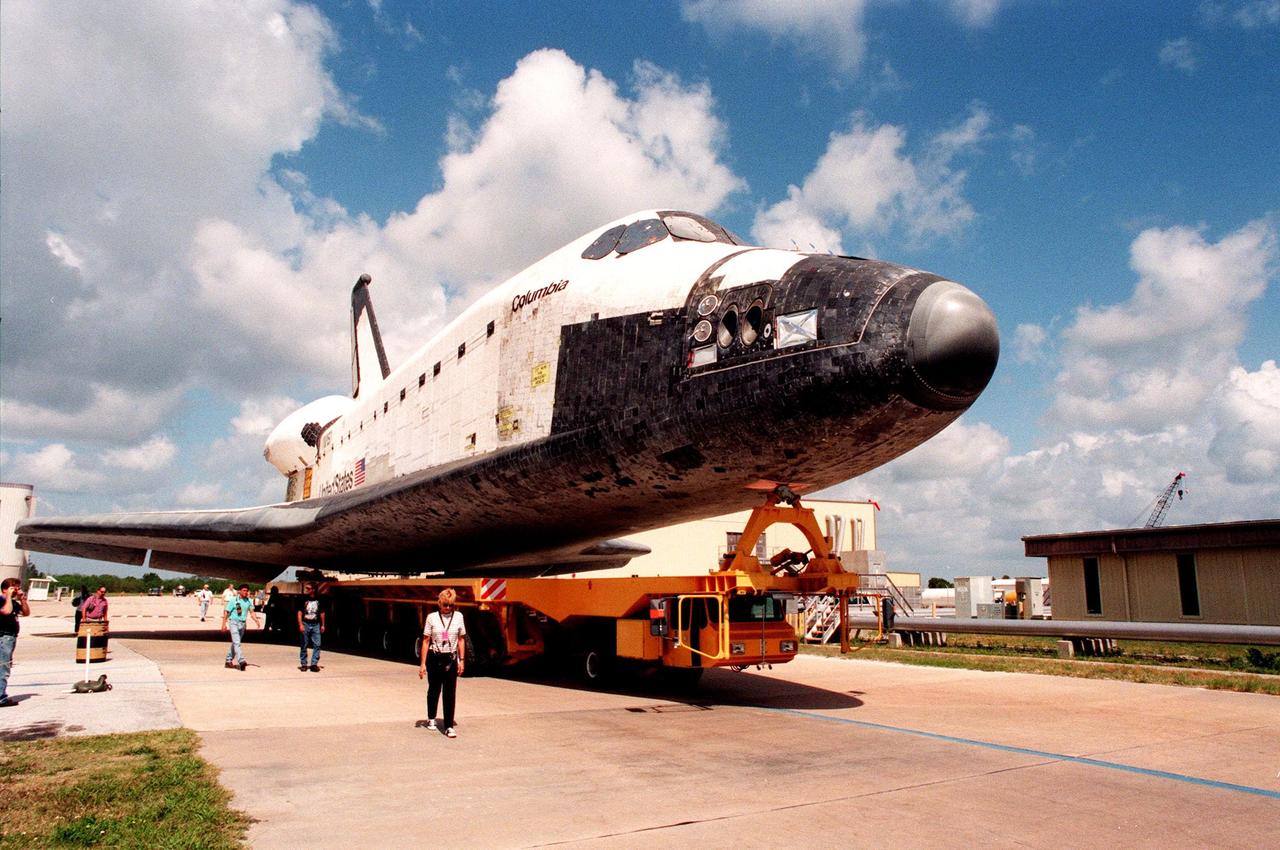
KENNEDY SPACE CENTER, FLA. -- The orbiter Columbia, aboard its orbiter transporter system, heads for the Vehicle Assembly Building to undergo external tank mating operations. Columbia is scheduled for rollout to Launch Pad 39B on Monday, June 7, for mission STS-93. The primary mission objective will be the deployment of the Advanced X-ray Astrophysics Facility, recently renamed the Chandra X-Ray Observatory. Mission STS-93 will be the first Space Shuttle commanded by a woman, Commander Eileen M. Collins. It is scheduled to launch July 22 at 12:27 a.m. EDT although that date is currently under review
KENNEDY SPACE CENTER, FLA. -- The orbiter Columbia is rolled out from the Orbiter Processing Facility (background) on its transporter. It is being moved to the nearby Vehicle Assembly Building (VAB) for external tank mating operations. Columbia is scheduled for rollout to Launch Pad 39B on Monday, June 7, for mission STS-93. The primary mission objective will be the deployment of the Advanced X-ray Astrophysics Facility, recently renamed the Chandra X-Ray Observatory. Mission STS-93 will be the first Space Shuttle commanded by a woman, Commander Eileen M. Collins. It is scheduled to launch July 22 at 12:27 a.m. EDT although that date is currently under review

KENNEDY SPACE CENTER, FLA. -- At the Apollo/Saturn V Center, country music recording artist Teresa performs a song, "Brave New Girls," written for astronaut Catherine "Cady" Coleman, mission specialist on STS-93. She entertains participants and attendees of a women's forum held in the center. The attendees are planning to view the launch of STS-93 at the Banana Creek viewing sight. Much attention has been generated over the launch due to Commander Eileen M. Collins, the first woman to serve as commander of a Shuttle mission. Liftoff is scheduled for July 20 at 12:36 a.m. EDT
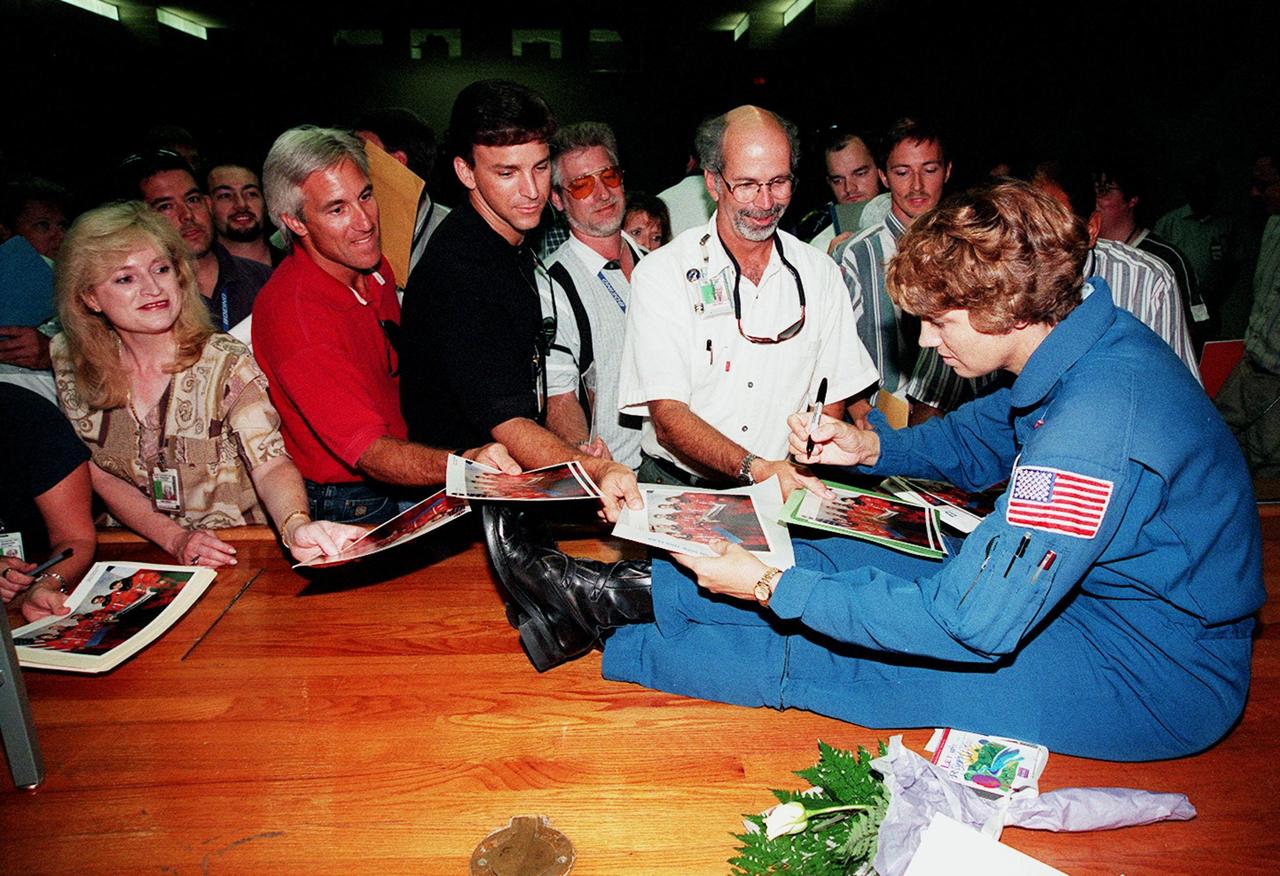
STS-93 Commander Eileen M. Collins signs autographs after a mission presentation for KSC employees. The five-day mission primarily released the Chandra X-ray Observatory, allowing scientists from around the world to study some of the most distant, powerful and dynamic objects in the universe. Chandra is expected to provide unique and crucial information on the nature of objects ranging from comets in our solar system to quasars at the edge of the observable universe. Since X-rays are absorbed by the Earth's atmosphere, space-based observatories are necessary to study these phenomena and allow scientists to analyze some of the greatest mysteries of the universe. STS-93 was also the first mission to have a woman serving as Shuttle commander
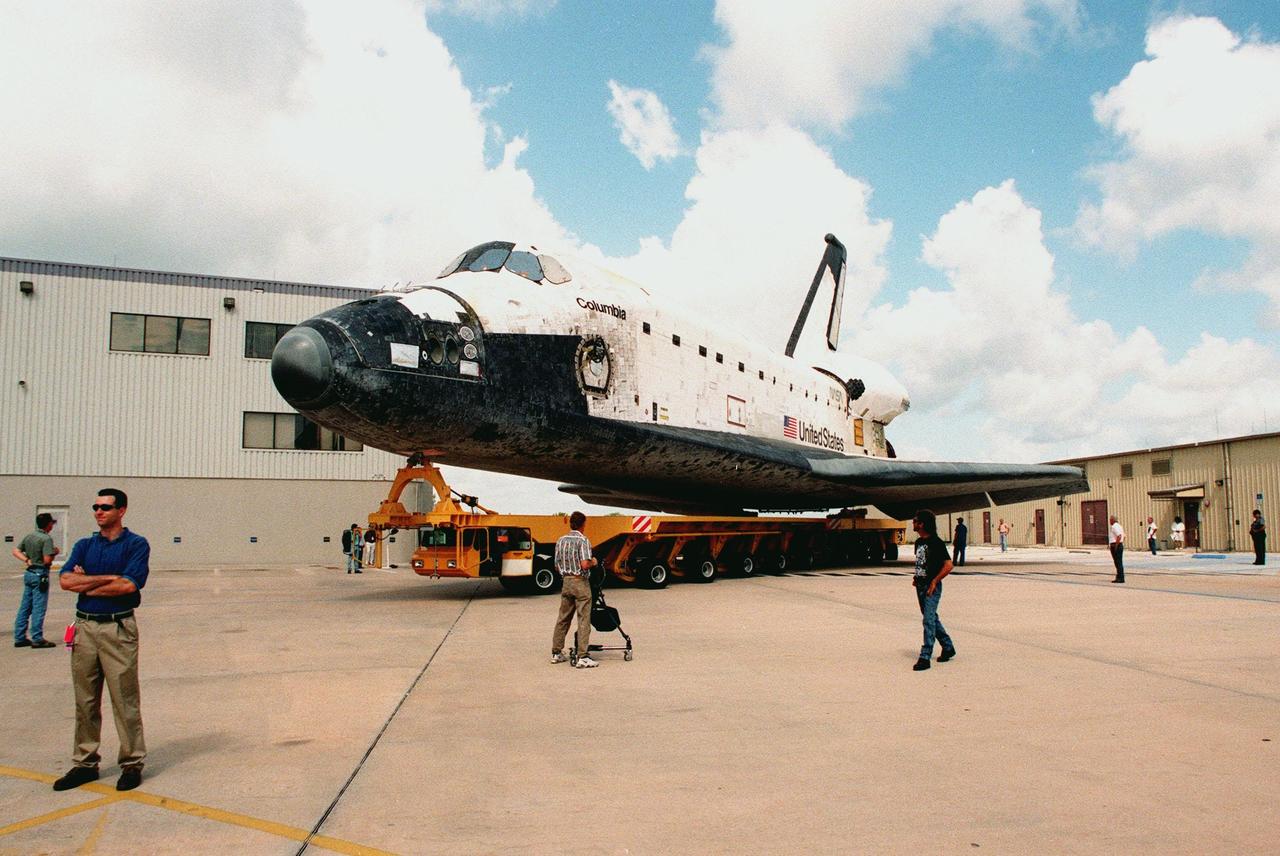
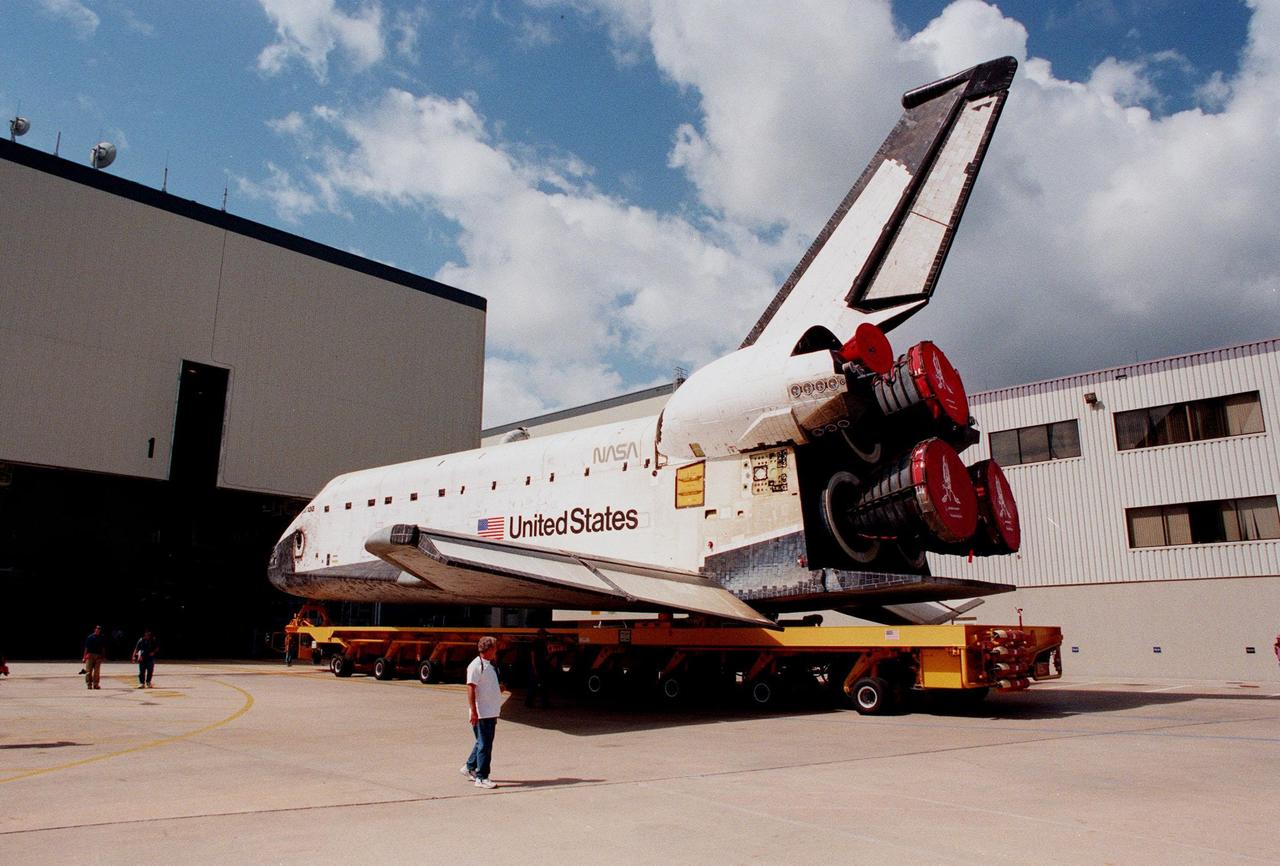
KENNEDY SPACE CENTER, FLA. -- The orbiter Columbia, aboard its orbiter transporter system, makes the turn from the Orbiter Processing Facility (behind it, left) to the nearby Vehicle Assembly Building (VAB) for external tank mating operations. Columbia is scheduled for rollout to Launch Pad 39B on Monday, June 7, for mission STS-93. The primary mission objective will be the deployment of the Advanced X-ray Astrophysics Facility, recently renamed the Chandra X-Ray Observatory. Mission STS-93 will be the first Space Shuttle commanded by a woman, Commander Eileen M. Collins. It is scheduled to launch July 22 at 12:27 a.m. EDT although that date is currently under review
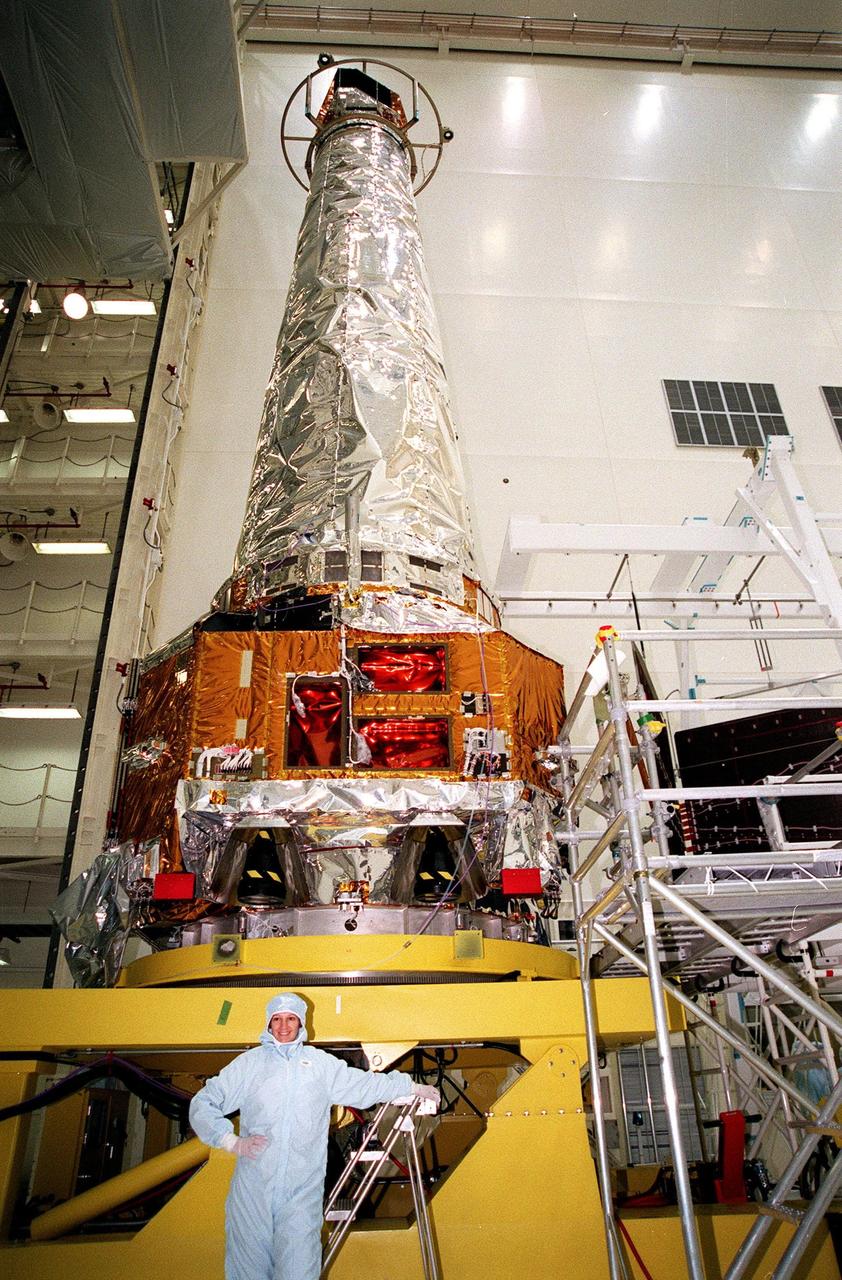
STS-93 Commander Eileen Collins poses at the foot of the Chandra X-ray Observatory during payload familiarization. Other members of the STS-93 crew who are at KSC are Pilot Jeffrey S. Ashby and Mission Specialists Catherine G. Coleman and Michel Tognini of France, who represents the Centre National d'Etudes Spatiales (CNES). Collins is the first woman to serve as a shuttle mission commander. She was the first woman pilot of a Space Shuttle, on mission STS-63, and also served as pilot on mission STS-84. The fifth member of the crew is Mission Specialist Steven A. Hawley. Chandra is scheduled for launch July 9 aboard Space Shuttle Columbia, on mission STS-93 . Formerly called the Advanced X-ray Astrophysics Facility, Chandra comprises three major elements: the spacecraft, the science instrument module (SIM), and the world's most powerful X-ray telescope. Chandra will allow scientists from around the world to see previously invisible black holes and high-temperature gas clouds, giving the observatory the potential to rewrite the books on the structure and evolution of our universe
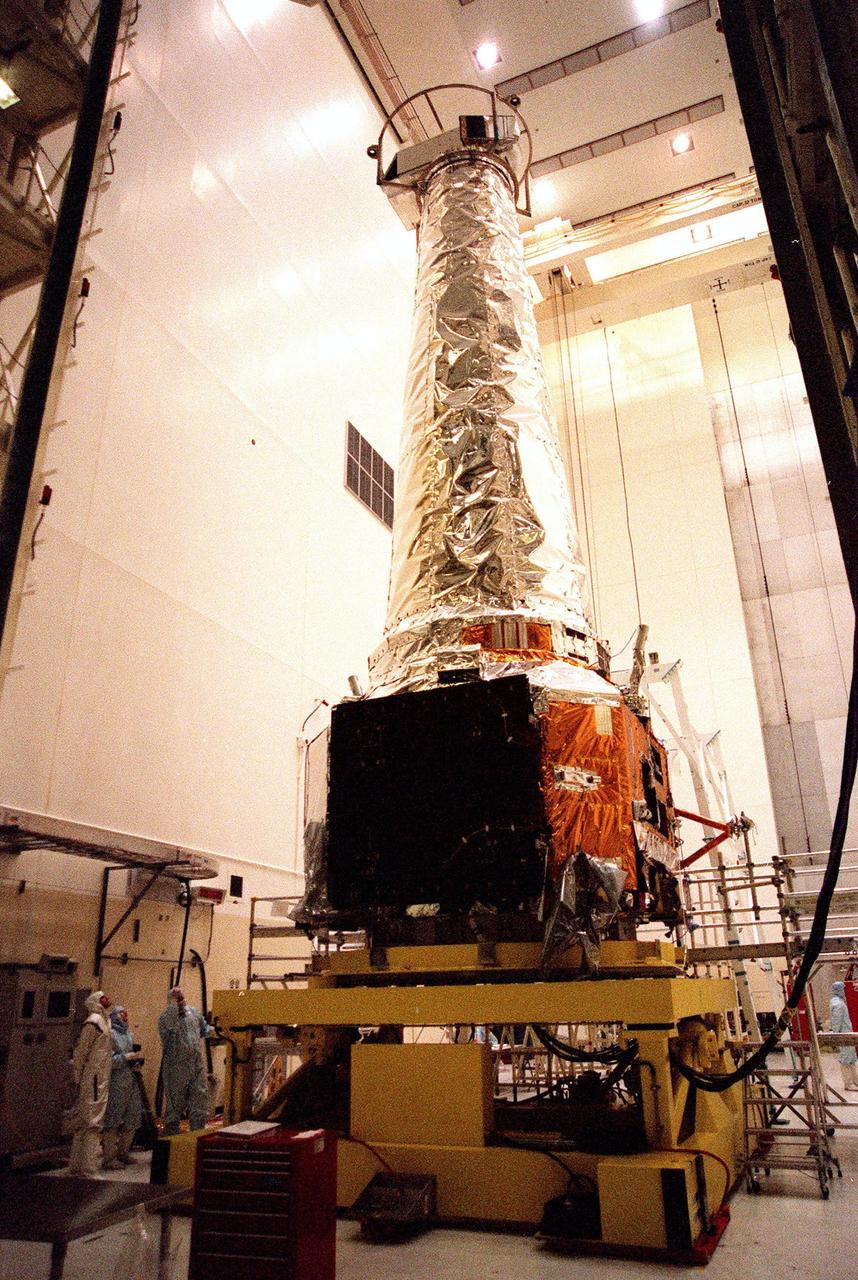
In the Vertical Processing Facility, STS-93 Pilot Jeffrey S. Ashby and Commander Eileen Collins join a TRW technician observing the Chandra X-ray Observatory on top of a work stand. Other members of the STS-93 crew who are at KSC for payload familiarization are Mission Specialists Catherine G. Coleman and Michel Tognini of France, who represents the Centre National d'Etudes Spatiales (CNES). Collins is the first woman to serve as a shuttle mission commander. She was the first woman pilot of a Space Shuttle, on mission STS-63, and also served as pilot on mission STS-84. The fifth member of the crew is Mission Specialist Steven A. Hawley. Chandra is scheduled for launch July 9 aboard Space Shuttle Columbia, on mission STS-93 . Formerly called the Advanced X-ray Astrophysics Facility, Chandra comprises three major elements: the spacecraft, the science instrument module (SIM), and the world's most powerful X-ray telescope. Chandra will allow scientists from around the world to see previously invisible black holes and high-temperature gas clouds, giving the observatory the potential to rewrite the books on the structure and evolution of our universe
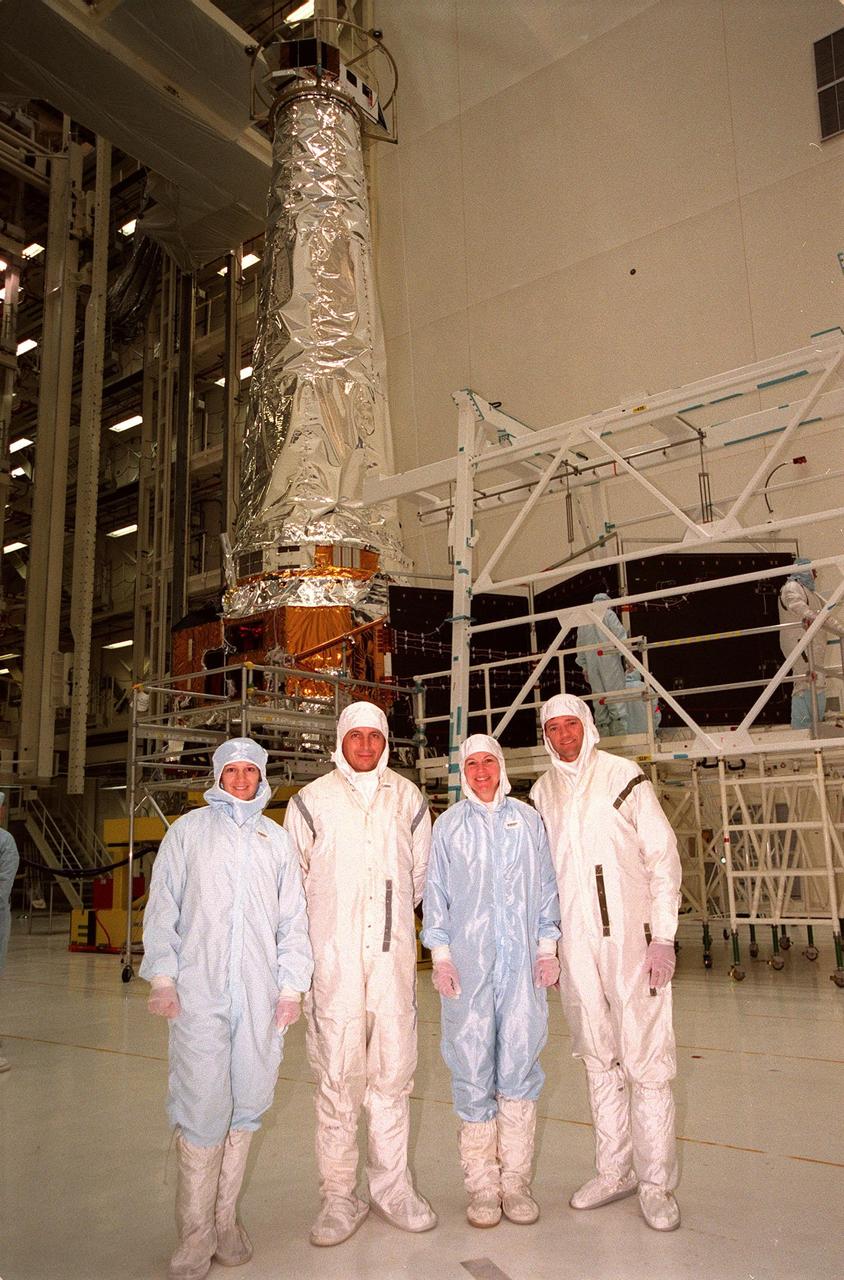
During payload familiarization, four members of the STS-93 crew pose in front of the Chandra X-ray Observatory, which is in the Vertical Processing Facility. From left are Commander Eileen Collins, Mission Specialists Michel Tognini of France and Catherine G. Coleman, and Pilot Jeffrey S. Ashby. Tognini represents the Centre National d'Etudes Spatiales (CNES). Collins is the first woman to serve as a shuttle mission commander. She was the first woman pilot of a Space Shuttle, on mission STS-63, and also served as pilot on mission STS-84. The fifth member of the STS-93 crew is Mission Specialist Steven A. Hawley. Chandra is scheduled for launch July 9 aboard Space Shuttle Columbia, on mission STS-93 . Formerly called the Advanced X-ray Astrophysics Facility, Chandra comprises three major elements: the spacecraft, the science instrument module (SIM), and the world's most powerful X-ray telescope. Chandra will allow scientists from around the world to see previously invisible black holes and high-temperature gas clouds, giving the observatory the potential to rewrite the books on the structure and evolution of our universe
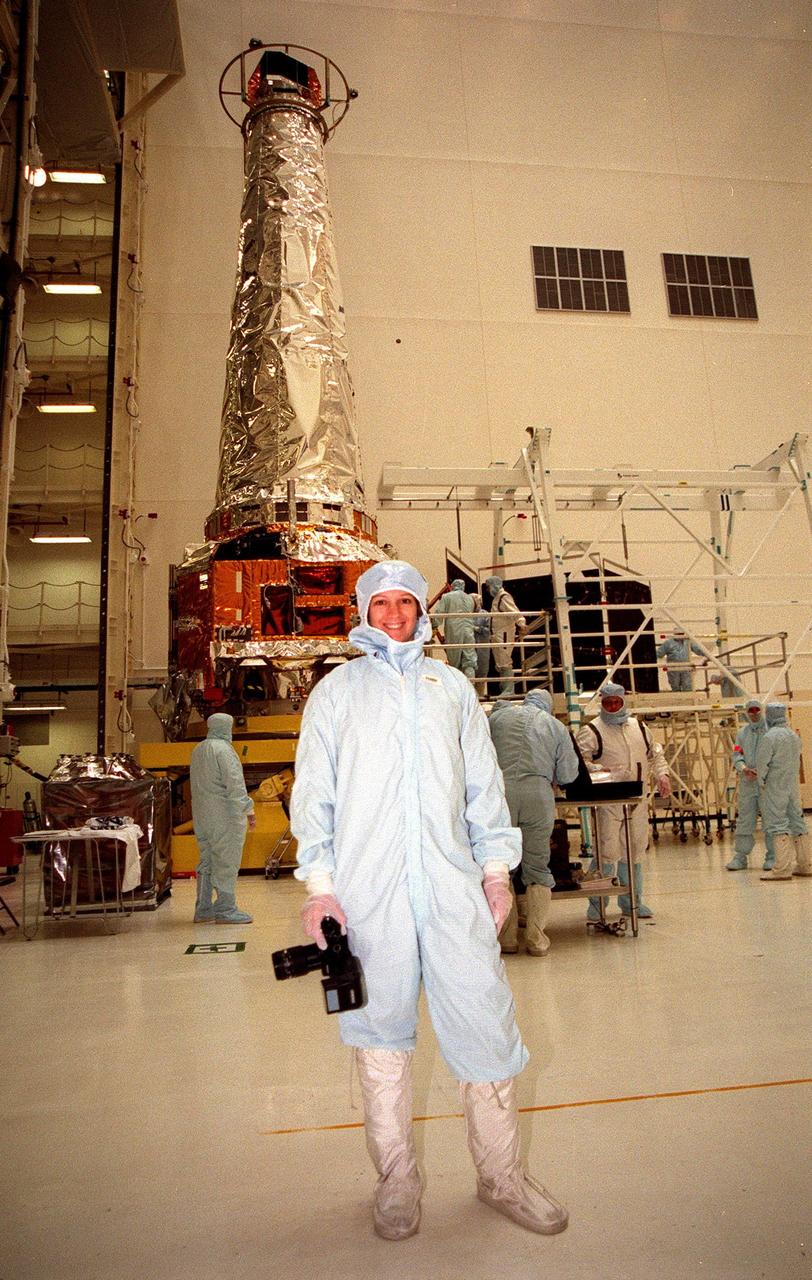
STS-93 Commander Eileen Collins poses with her camera in front of the Chandra X-ray Observatory during payload familiarization. Other members of the STS-93 crew who are at KSC are Pilot Jeffrey S. Ashby and Mission Specialists Catherine G. Coleman and Michel Tognini of France, who represents the Centre National d'Etudes Spatiales (CNES). Collins is the first woman to serve as a shuttle mission commander. She was the first woman pilot of a Space Shuttle, on mission STS-63, and also served as pilot on mission STS-84. The fifth member of the crew is Mission Specialist Steven A. Hawley. Chandra is scheduled for launch July 9 aboard Space Shuttle Columbia, on mission STS-93 . Formerly called the Advanced X-ray Astrophysics Facility, Chandra comprises three major elements: the spacecraft, the science instrument module (SIM), and the world's most powerful X-ray telescope. Chandra will allow scientists from around the world to see previously invisible black holes and high-temperature gas clouds, giving the observatory the potential to rewrite the books on the structure and evolution of our universe
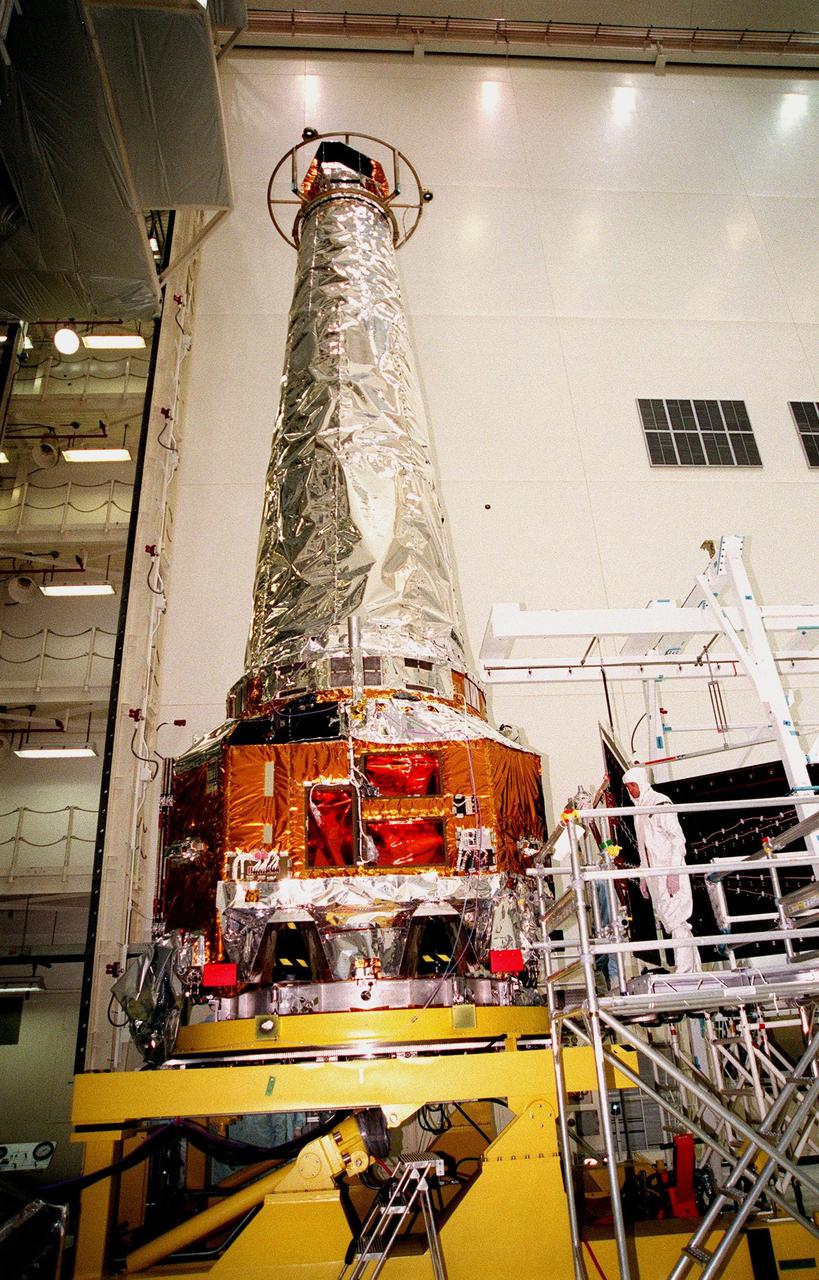
In the Vertical Processing Facility, STS-93 Pilot Jeffrey S. Ashby gets a close look at the Chandra X-ray Observatory. Other members of the STS-93 crew who are at KSC for payload familiarization are Commander Eileen Collins and Mission Specialists Catherine G. Coleman and Michel Tognini of France, who represents the Centre National d'Etudes Spatiales (CNES). Collins is the first woman to serve as a shuttle mission commander. She was the first woman pilot of a Space Shuttle, on mission STS-63, and also served as pilot on mission STS-84. The fifth member of the crew is Mission Specialist Steven A. Hawley. Chandra is scheduled for launch July 9 aboard Space Shuttle Columbia, on mission STS-93 . Formerly called the Advanced X-ray Astrophysics Facility, Chandra comprises three major elements: the spacecraft, the science instrument module (SIM), and the world's most powerful X-ray telescope. Chandra will allow scientists from around the world to see previously invisible black holes and high-temperature gas clouds, giving the observatory the potential to rewrite the books on the structure and evolution of our universe
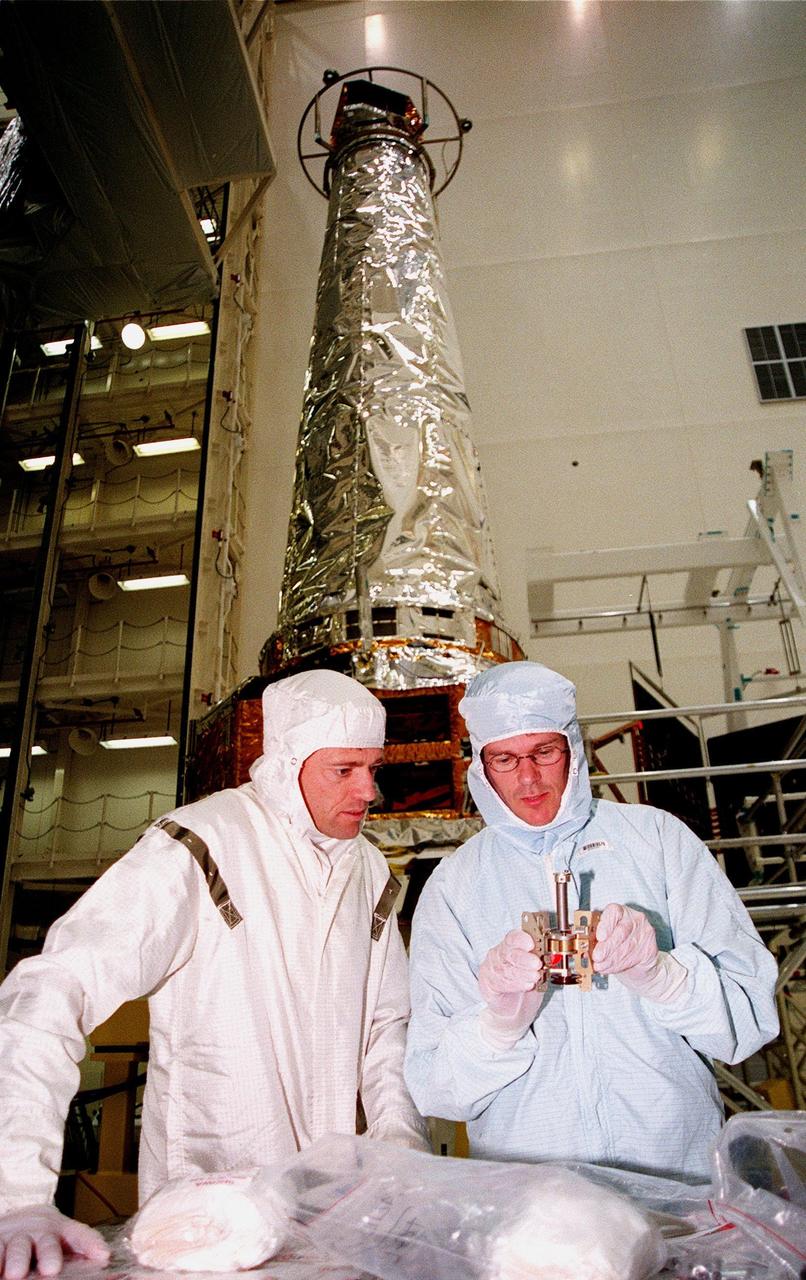
STS-93 Pilot Jeffrey S. Ashby learns about the solar panel hinge, held by a TRW technician, and its use on the Chandra X-ray Observatory behind them. Members of the STS-93 crew are at KSC for payload familiarization, including Mission Specialists Catherine G. Coleman and Michel Tognini of France, who represents the Centre National d'Etudes Spatiales (CNES). Collins is the first woman to serve as a shuttle mission commander. She was the first woman pilot of a Space Shuttle, on mission STS-63, and also served as pilot on mission STS-84. The fifth member of the crew is Mission Specialist Steven A. Hawley. Chandra is scheduled for launch July 9 aboard Space Shuttle Columbia, on mission STS-93 . Formerly called the Advanced X-ray Astrophysics Facility, Chandra comprises three major elements: the spacecraft, the science instrument module (SIM), and the world's most powerful X-ray telescope. Chandra will allow scientists from around the world to see previously invisible black holes and high-temperature gas clouds, giving the observatory the potential to rewrite the books on the structure and evolution of our universe
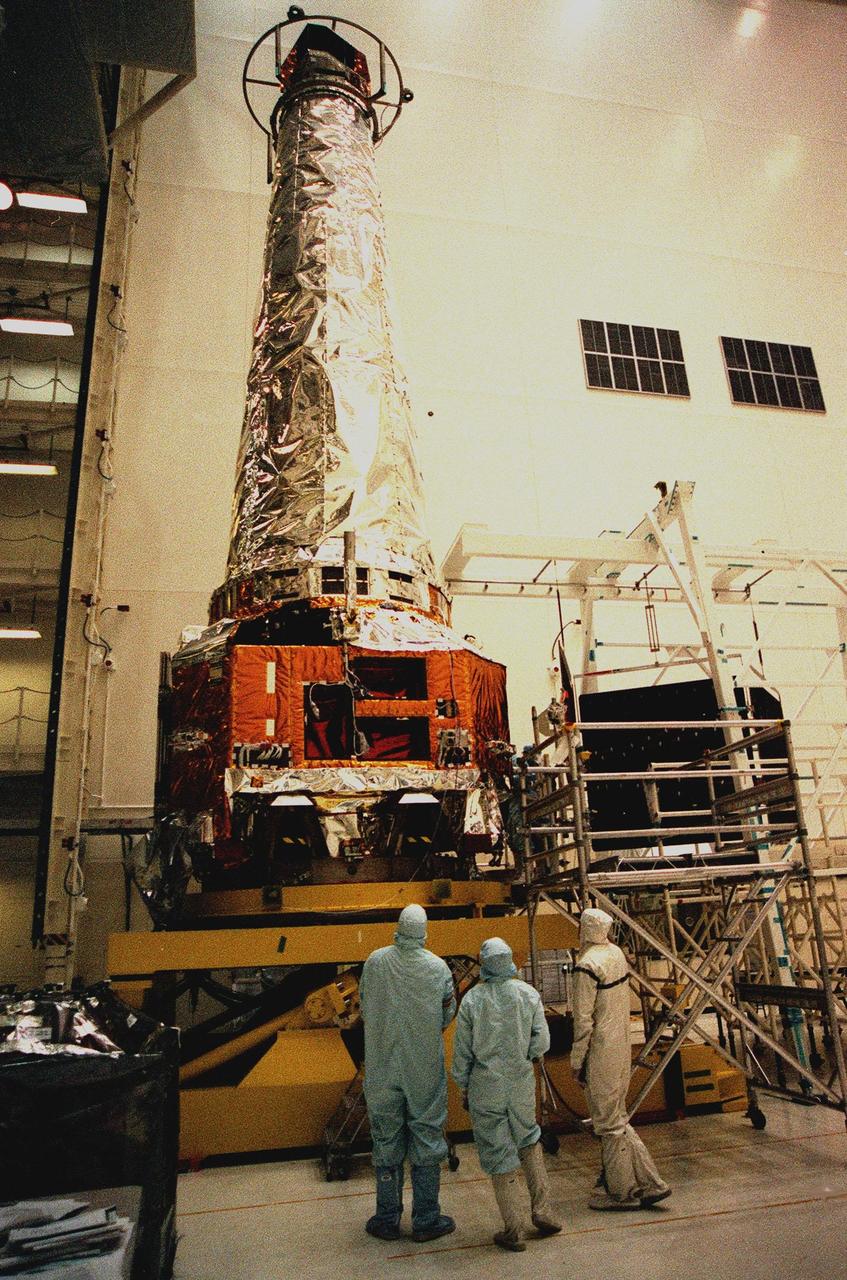
A TRW technician joins STS-93 Commander Eileen Collins (center) and Pilot Jeffrey S. Ashby (right) as they observe the Chandra X-ray Observatory on its work stand inside the Vertical Processing Facility. Other members of the STS-93 crew who are at KSC for payload familiarization are Mission Specialists Catherine G. Coleman and Michel Tognini of France, who represents the Centre National d'Etudes Spatiales (CNES). Collins is the first woman to serve as a shuttle mission commander. She was the first woman pilot of a Space Shuttle, on mission STS-63, and also served as pilot on mission STS-84. The fifth member of the crew is Mission Specialist Steven A. Hawley. Chandra is scheduled for launch July 9 aboard Space Shuttle Columbia, on mission STS-93 . Formerly called the Advanced X-ray Astrophysics Facility, Chandra comprises three major elements: the spacecraft, the science instrument module (SIM), and the world's most powerful X-ray telescope. Chandra will allow scientists from around the world to see previously invisible black holes and high-temperature gas clouds, giving the observatory the potential to rewrite the books on the structure and evolution of our universe
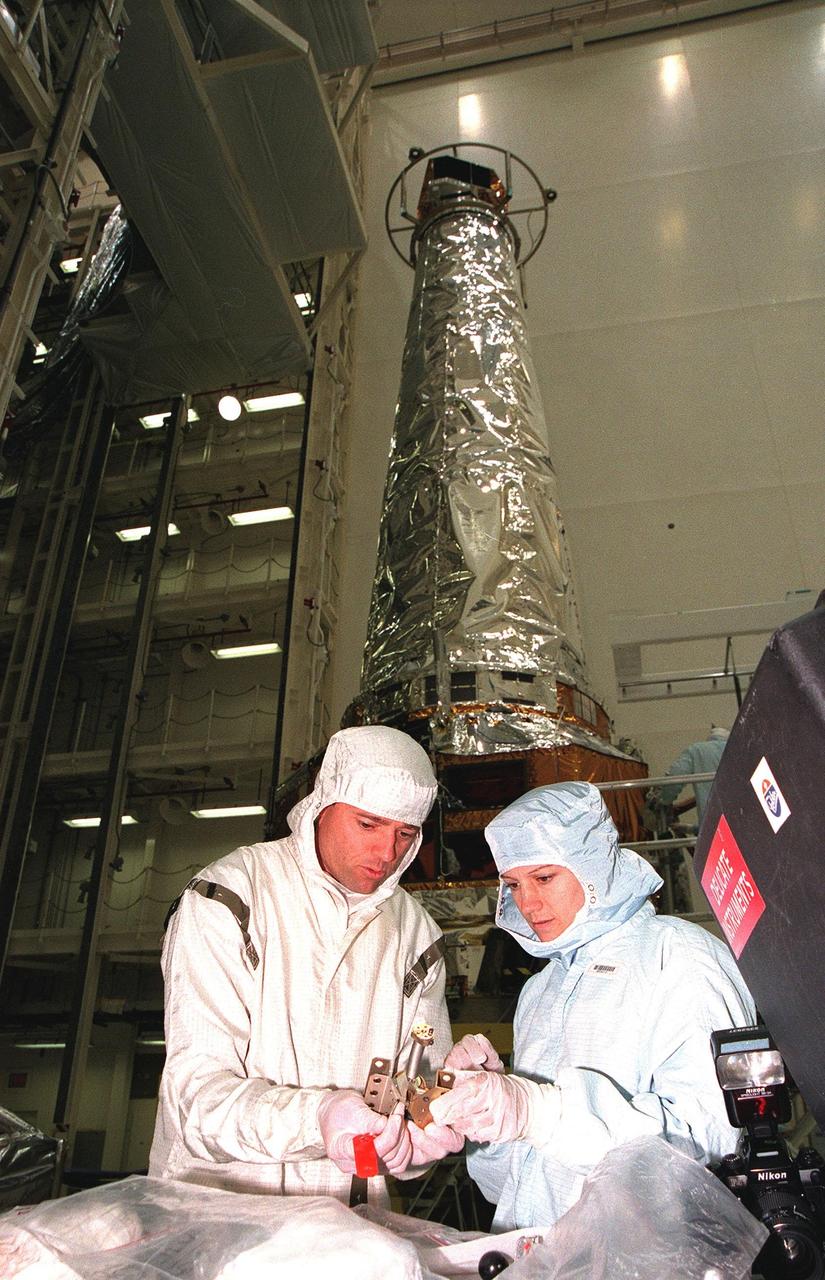
In the Vertical Processing Facility, STS-93 Pilot Jeffrey S. Ashby and Commander Eileen M. Collins look at a hinge used on the solar panels of the Chandra X-ray Observatory. Members of the STS-93 crew are at KSC for payload familiarization. Also participating are Mission Specialists Catherine G. Coleman and Michel Tognini of France, representing the Centre National d'Etudes Spatiales (CNES). Collins is the first woman to serve as a shuttle mission commander. She was the first woman pilot of a Space Shuttle, on mission STS-63, and also served as pilot on mission STS-84. The fifth member of the crew is Mission Specialist Steven A. Hawley. Chandra is scheduled for launch July 9 aboard Space Shuttle Columbia, on mission STS-93 . Formerly called the Advanced X-ray Astrophysics Facility, Chandra comprises three major elements: the spacecraft, the science instrument module (SIM), and the world's most powerful X-ray telescope. Chandra will allow scientists from around the world to see previously invisible black holes and high-temperature gas clouds, giving the observatory the potential to rewrite the books on the structure and evolution of our universe
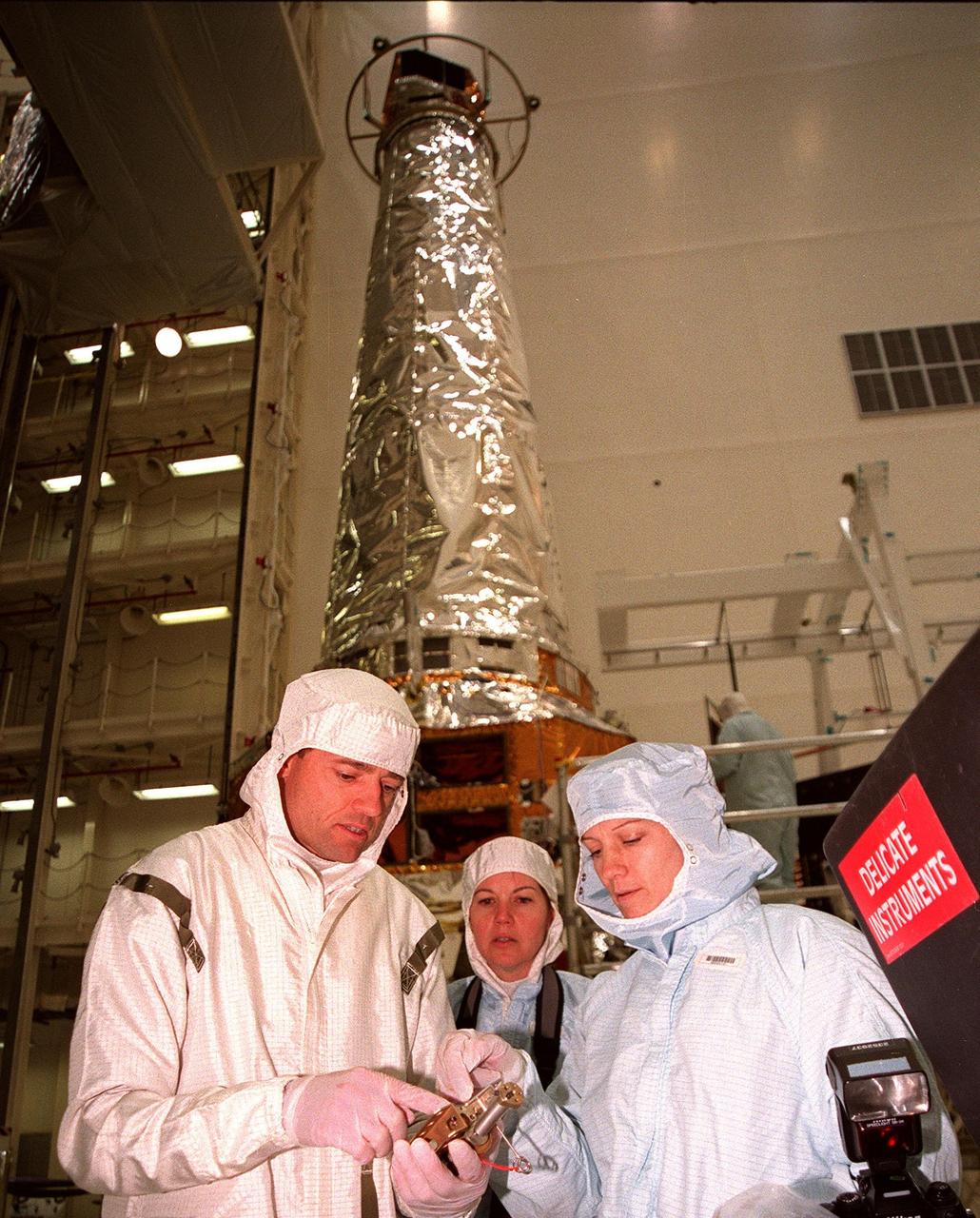
In the Vertical Processing Facility, STS-93 Pilot Jeffrey S. Ashby, Mission Specialist Catherine G. Coleman and Commander Eileen M. Collins look at a hinge used on the solar panels of the Chandra X-ray Observatory. Members of the STS-93 crew are at KSC for payload familiarization, including Mission Specialist Michel Tognini of France, representing the Centre National d'Etudes Spatiales (CNES). Collins is the first woman to serve as a shuttle mission commander. She was the first woman pilot of a Space Shuttle, on mission STS-63, and also served as pilot on mission STS-84. The fifth member of the crew is Mission Specialist Steven A. Hawley. Chandra is scheduled for launch July 9 aboard Space Shuttle Columbia, on mission STS-93 . Formerly called the Advanced X-ray Astrophysics Facility, Chandra comprises three major elements: the spacecraft, the science instrument module (SIM), and the world's most powerful X-ray telescope. Chandra will allow scientists from around the world to see previously invisible black holes and high-temperature gas clouds, giving the observatory the potential to rewrite the books on the structure and evolution of our universe
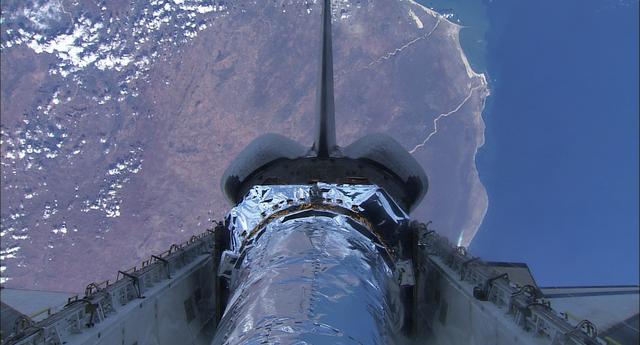
99-E-10024 (23 July 1999) --- This pre-deployment view of the Chandra X-Ray observatory backdropped against part of Namibia was recorded with the HDTV Camcorder from inside Columbia's crew cabin.
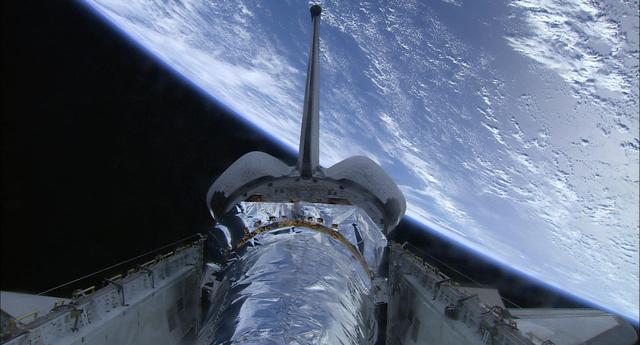
99-E-10025 (23 July 1999) --- This pre-deployment view of the Chandra X-Ray observatory was recorded with the HDTV Camcorder from inside Columbia's crew cabin.
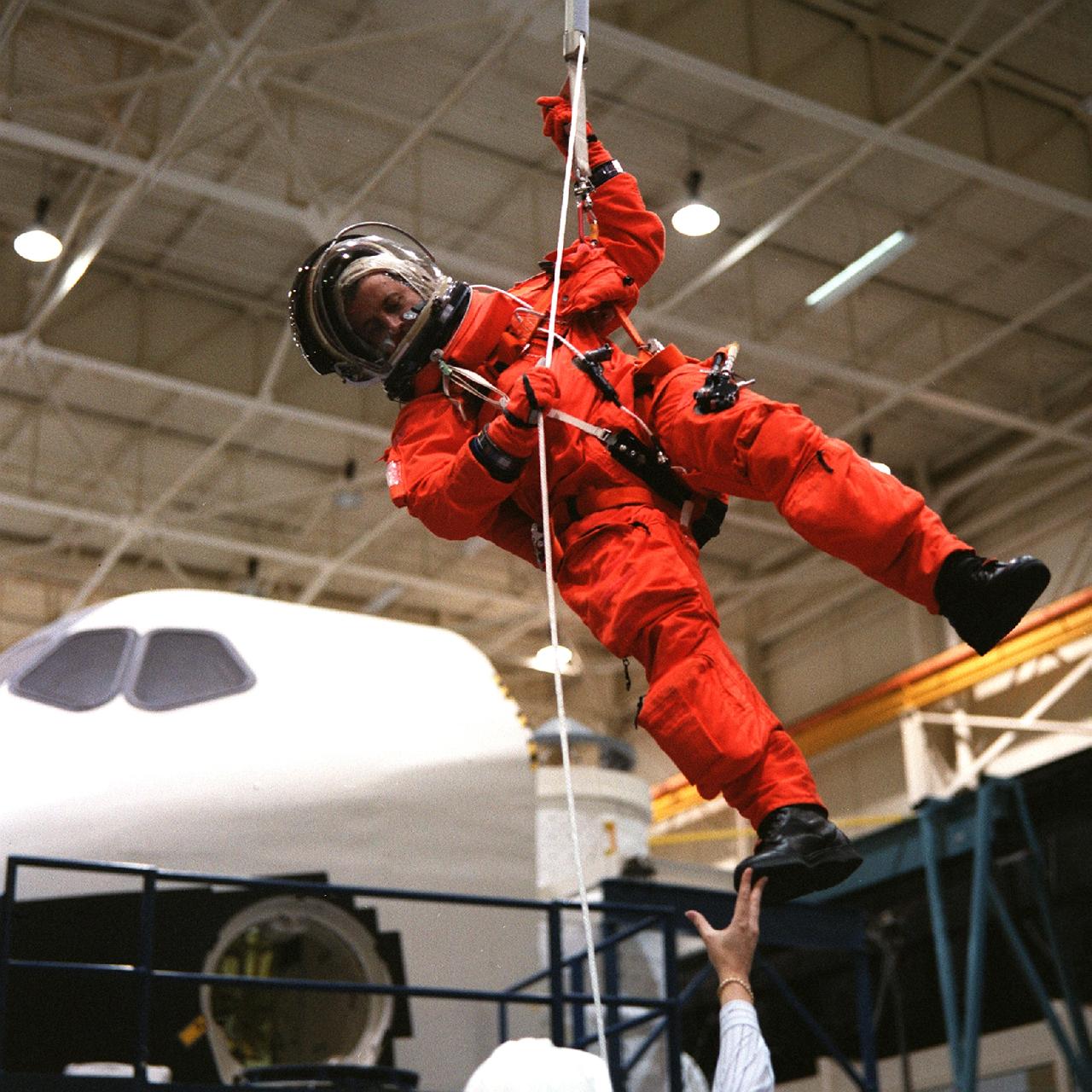
S98-09838 (6-29-98) --- Astronaut Michel Tognini lowers himself from a simulated shuttle in trouble during an emergency egress training session in the Systems Integration Facility at the Johnson Space Center (JSC). Tognini, a mission specialist representing France's Centre National d'Etudes Spatiales (CNES), will join four other astronauts for a scheduled five-day mission aboard the Space Shuttle Columbia in the spring of next year.
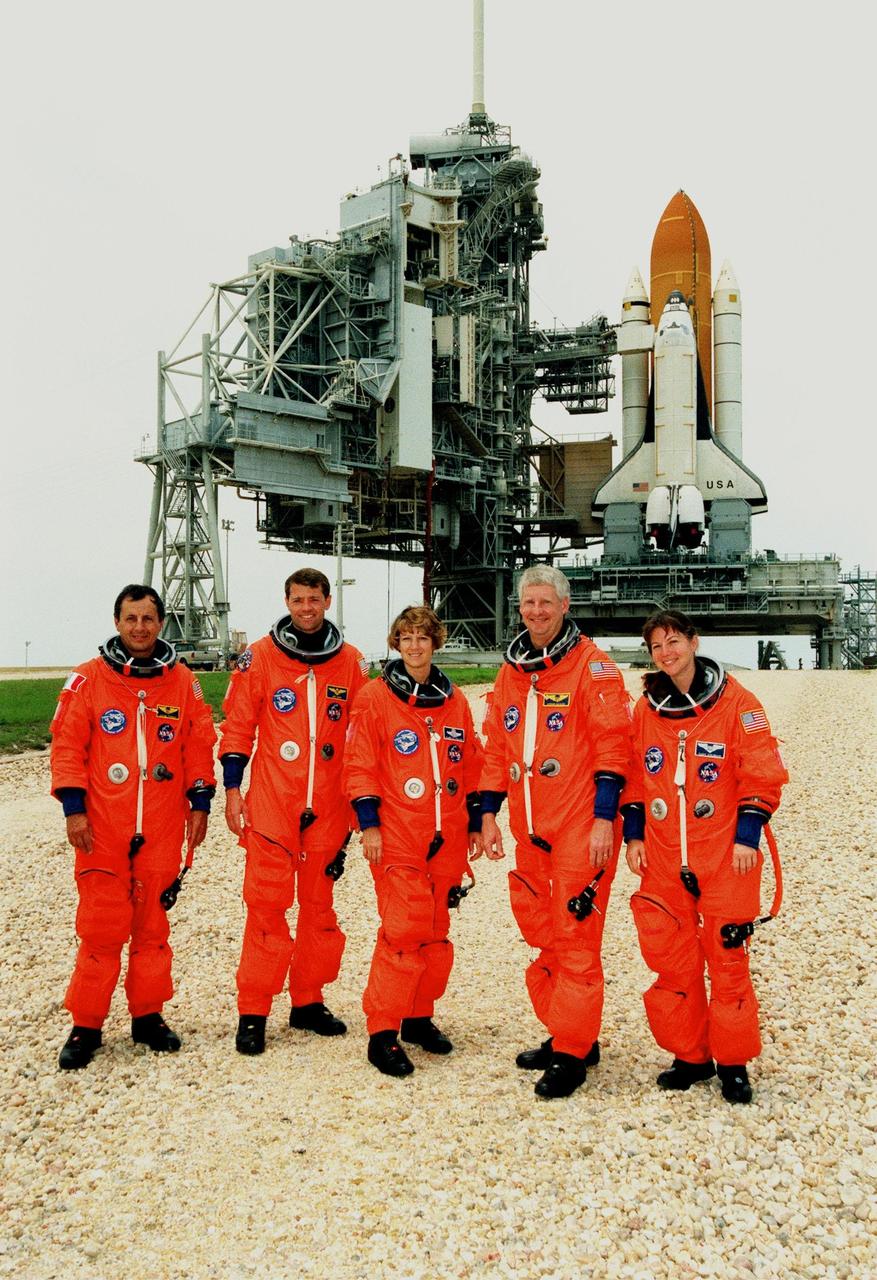
KENNEDY SPACE CENTER, FLA. -- The STS-93 crew pauses at the launch pad for a photograph before heading for Space Shuttle Columbia (in the background) and a launch-day dress rehearsal. From left are Mission Specialist Michel Tognini of France, who represents the Centre National d'Etudes Spatiales (CNES), Pilot Jeffrey S. Ashby, Commander Eileen M. Collins, and Mission Specialists Steven A. Hawley (Ph.D.) and Catherine G. Coleman (Ph.D.). Collins is the first woman to serve as a Shuttle commander. The crew members have been taking part in a Terminal Countdown Demonstration Test, which familiarizes them with the mission, provides training in emergency exit from the orbiter and launch pad, and includes the dress rehearsal culminating with a simulated main engine cut-off. The primary mission of STS-93 is the release of the Chandra X-ray Observatory, which will allow scientists from around the world to obtain unprecedented X-ray images of exotic environments in space to help understand the structure and evolution of the universe. The targeted launch date for STS-93 is no earlier than July 20 at 12:36 a.m. EDT from Launch Pad 39B
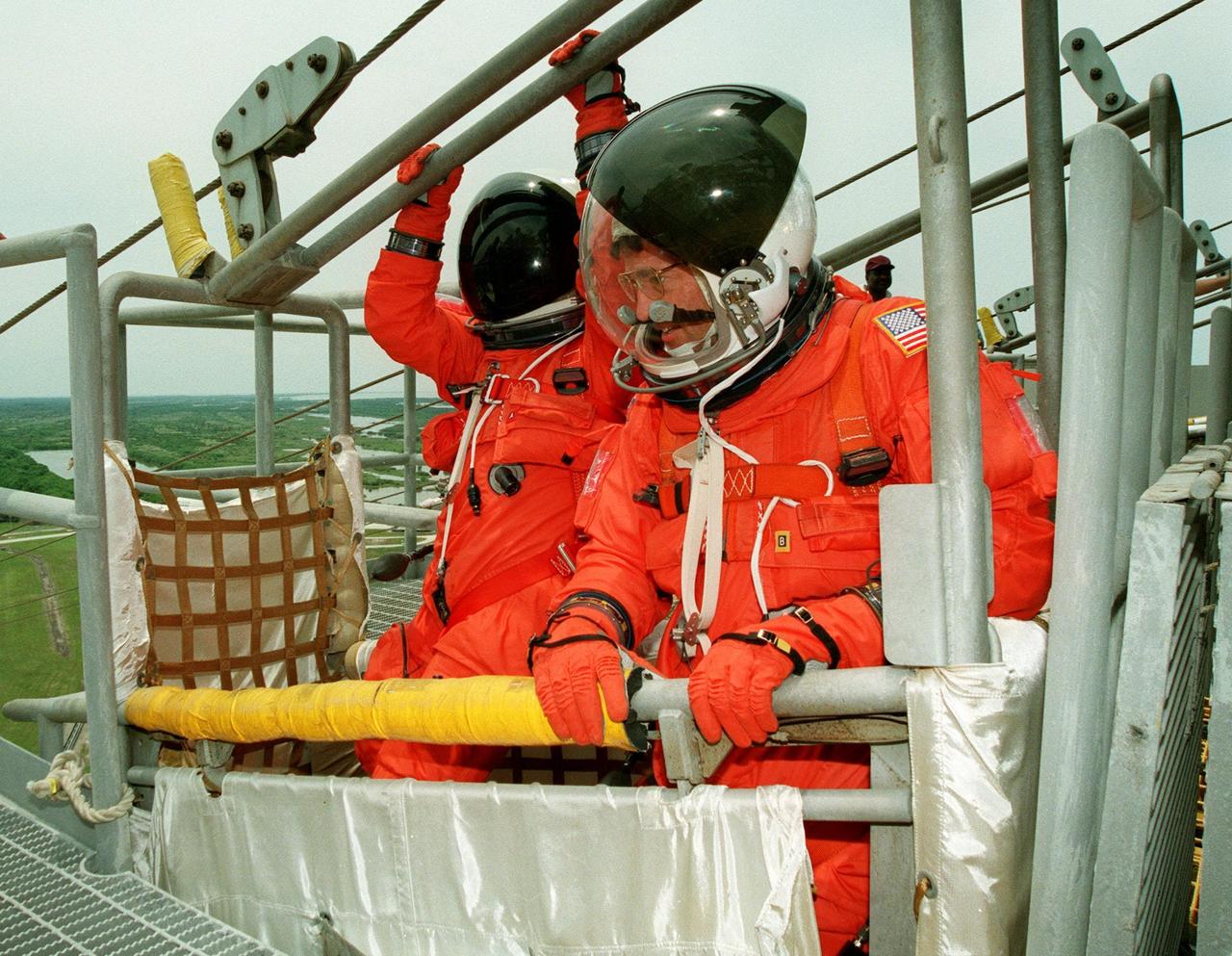
During an emergency egress exercise at the launch pad, Pilot Jeffrey S. Ashby (left) and Commander Eileen M. Collins (right) practice getting into the slidewire basket that is part of an emergency escape route for persons in the Shuttle and on the Rotating Service Structure. The STS-93 crew has been taking part in Terminal Countdown Demonstration Test (TCDT) activities that include the emergency exit training and a launch-day dress rehearsal culminating with a simulated main engine cut-off. Other crew members participating are Mission Specialists Catherine G. Coleman (Ph.D.), Steven A. Hawley (Ph.D.), and Michel Tognini of France, who represents the Centre National d'Etudes Spatiales (CNES). Collins is the first woman to serve as a Shuttle commander. The primary mission of STS-93 is the release of the Chandra X-ray Observatory, which will allow scientists from around the world to obtain unprecedented X-ray images of exotic environments in space to help understand the structure and evolution of the universe. The targeted launch date for STS-93 is no earlier than July 20 at 12:36 a.m. EDT from Launch Pad 39B
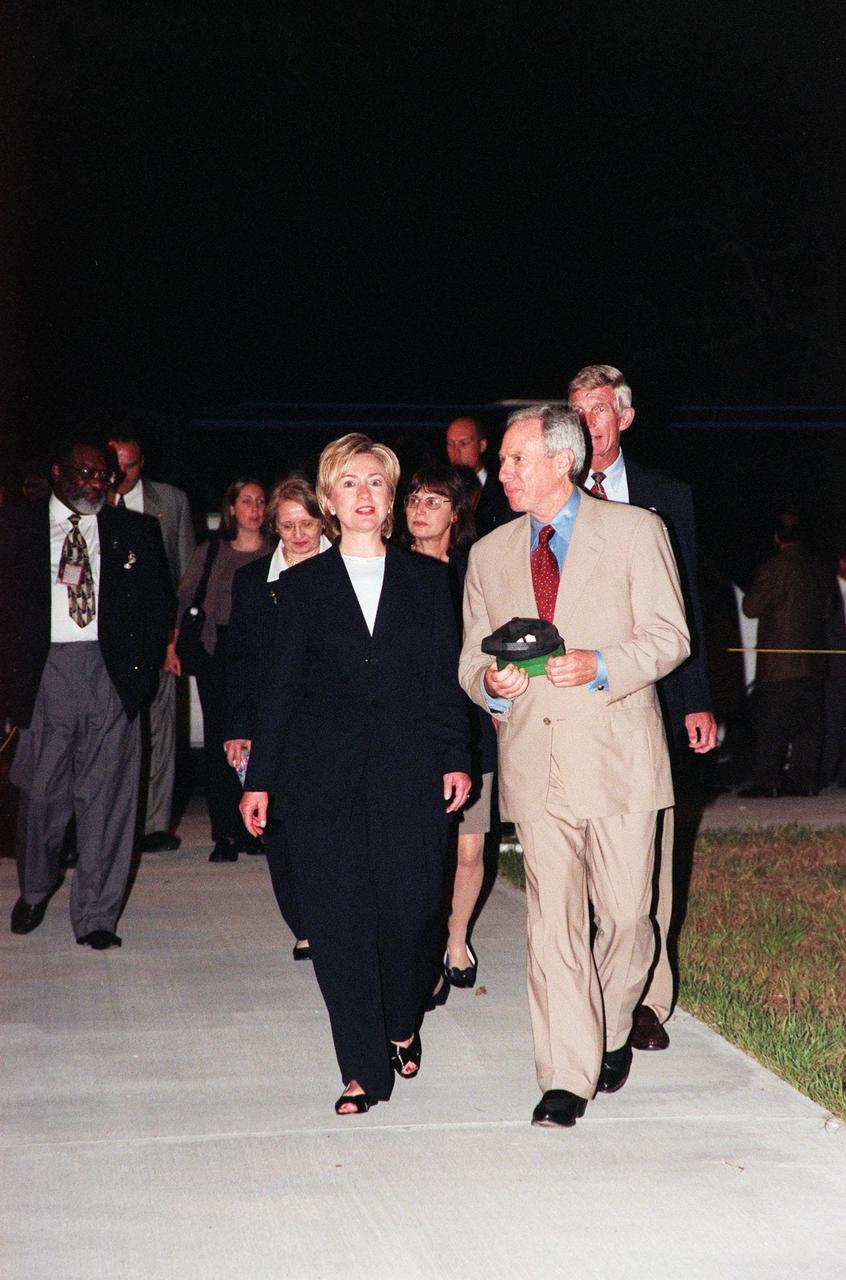
Entering the Banana Creek viewing site, First Lady Hillary Rodham Clinton is joined by NASA Administrator Daniel Goldin (right), and in the background, Deputy Director of Business Operations Jim Jennings (far left) and Director of Installation Operations Marv Jones (right, behind Goldin). Mrs. Clinton and others are at the site to watch the second launch attempt of STS-93. Moments before the first scheduled launch, July 20, STS-93 was scrubbed at the T-7 second mark in the countdown due to an indication of a high concentration of hydrogen in an aft engine compartment. The reading proved to be a false alarm. The launch was rescheduled for July 22 at 12:28 a.m. Much attention has been generated over STS-93 due to Commander Eileen M. Collins, the first woman to serve as commander of a Shuttle mission. The primary payload of the five-day mission is the Chandra X-ray Observatory, which will allow scientists from around the world to study some of the most distant, powerful and dynamic objects in the universe
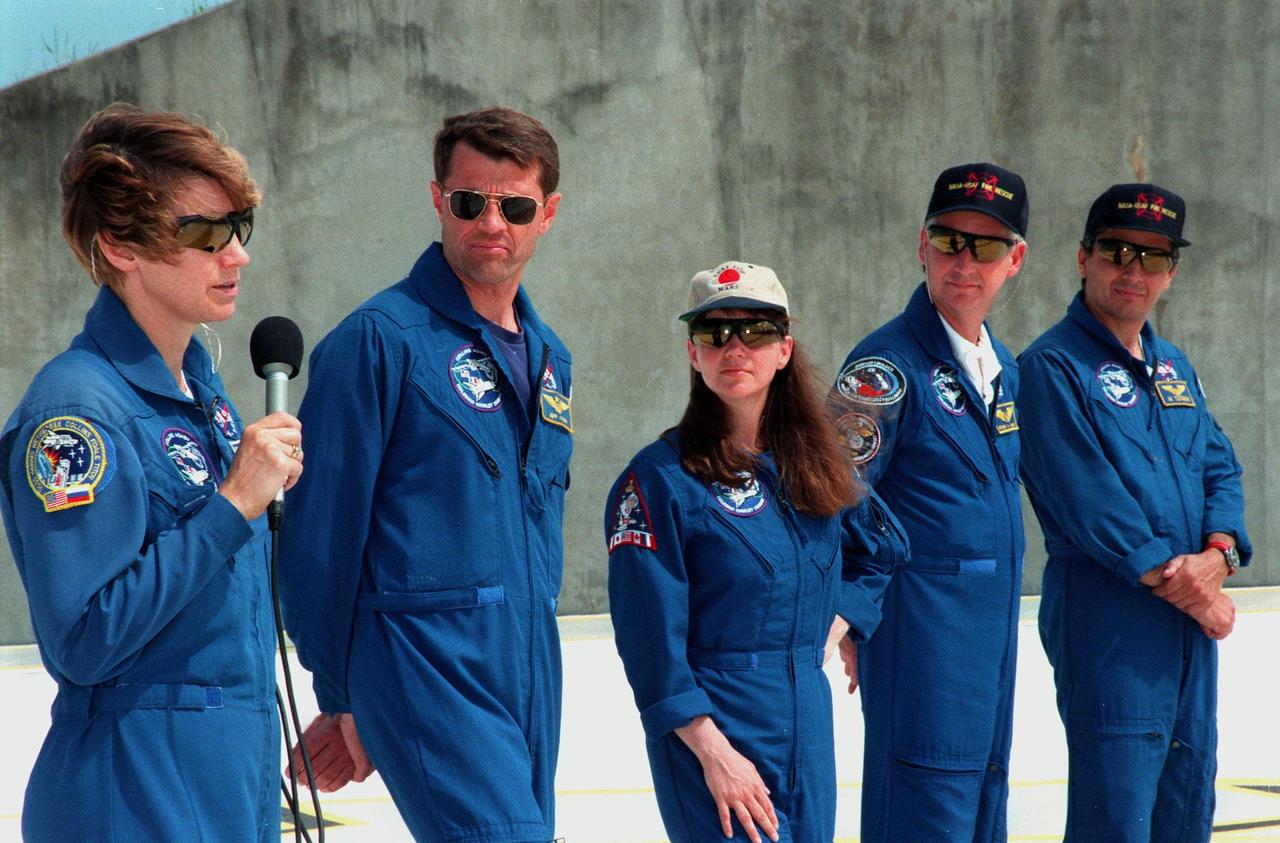
STS-93 Commander Eileen M. Collins (with microphone) talks to the press at a question and answer session at the slidewire basket area of Launch Pad 39B. She is joined by other crew members (from left) Pilot Jeffrey S. Ashby and Mission Specialists Catherine G. Coleman (Ph.D.), Steven A. Hawley (Ph.D.) and Michel Tognini of France, who represents the Centre National d'Etudes Spatiales (CNES). The crew members have been taking part in a Terminal Countdown Demonstration Test, which familiarizes them with the mission, provides training in emergency exit from the orbiter and launch pad, and includes a launch-day dress rehearsal culminating with a simulated main engine cut-off. The primary mission of STS-93 is the release of the Chandra X-ray Observatory, which will allow scientists from around the world to obtain unprecedented X-ray images of exotic environments in space to help understand the structure and evolution of the universe. The targeted launch date for STS-93 is no earlier than July 20 at 12:36 a.m. EDT from Launch Pad 39B