
An artist's concept of Phase III of the International Space Station (ISS) with the Shuttle approaching.

Artist's concept of the final configuration of the International Space Station (ISS) Alpha. The ISS is a multidisciplinary laboratory, technology test bed, and observatory that will provide an unprecedented undertaking in scientific, technological, and international experimentation.

Artist's concept of the International Space Station (ISS) Alpha deployed and operational. This figure also includes the docking procedures for the Space Shuttle (shown with cargo bay open). The ISS is a multidisciplinary laboratory, technology test bed, and observatory that will provide an unprecedented undertaking in scientific, technological, and international experimentation.
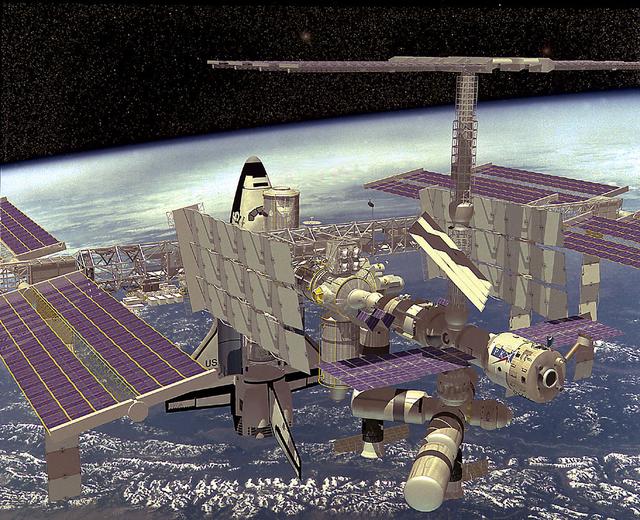
Artist's concept for Phase III of the International Space Station (ISS) as shown here in its completed and fully operational state with elements from the United States, Europe, Canada, Japan, and Russia. Sixteen countries are cooperating to provide a multidisciplinary laboratory, technology test bed, and observatory that will provide an unprecedented undertaking in scientific, technological, and international experimentation.

An artist's conception of what the final configuration of the International Space Station (ISS) will look like when it is fully built and deployed. The ISS is a multidisciplinary laboratory, technology test bed, and observatory that will provide an unprecedented undertaking in scientific, technological, and international experimentation.
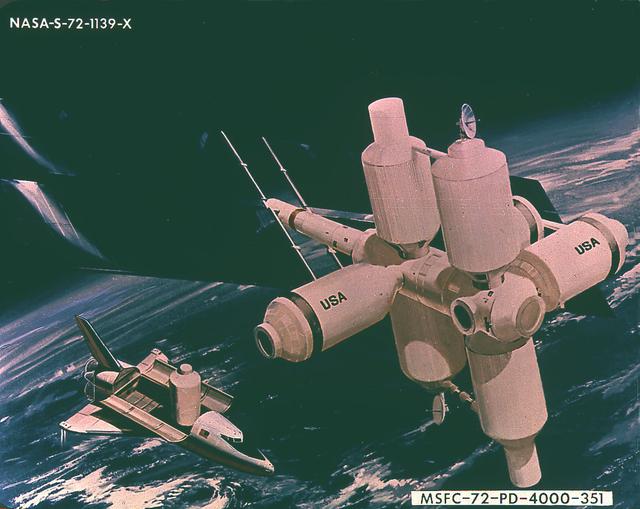
This is an artist's concept of a modular space station. In 1970 the Marshall Space Flight Center arnounced the completion of a study concerning a modular space station that could be launched by the planned-for reusable Space Shuttle. The study envisioned a space station composed of cylindrical sections 14 feet in diameter and of varying lengths joined to form any one of a number of possible shapes. The sections were restricted to 14 feet in diameter and 58 feet in length to be consistent with a shuttle cargo bay size of 15 by 60 feet. Center officials said that the first elements of the space station could be in orbit by about 1978 and could be manned by three or six men. This would be an interim space station with sections that could be added later to form a full 12-man station by the early 1980s.
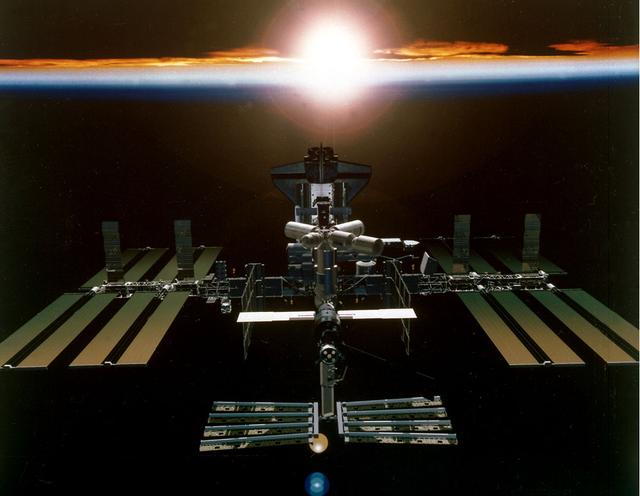
Artist's digital concept of the International Space Station (ISS), a gateway to permanent human presence in space, after all assembly is completed in Year 2003. The Station will be powered by almost an acre of solar panels and have a mass of almost one million pounds. Station modules are being provided by the United States, Russia, Japan, and Europe. Canada is providing a mechanical arm and Canada Hand. Sixteen countries are cooperating to provide a multidisciplinary laboratory, technology test bed, and observatory that will provide an unprecedented undertaking in scientific, technological, and international experimentation.
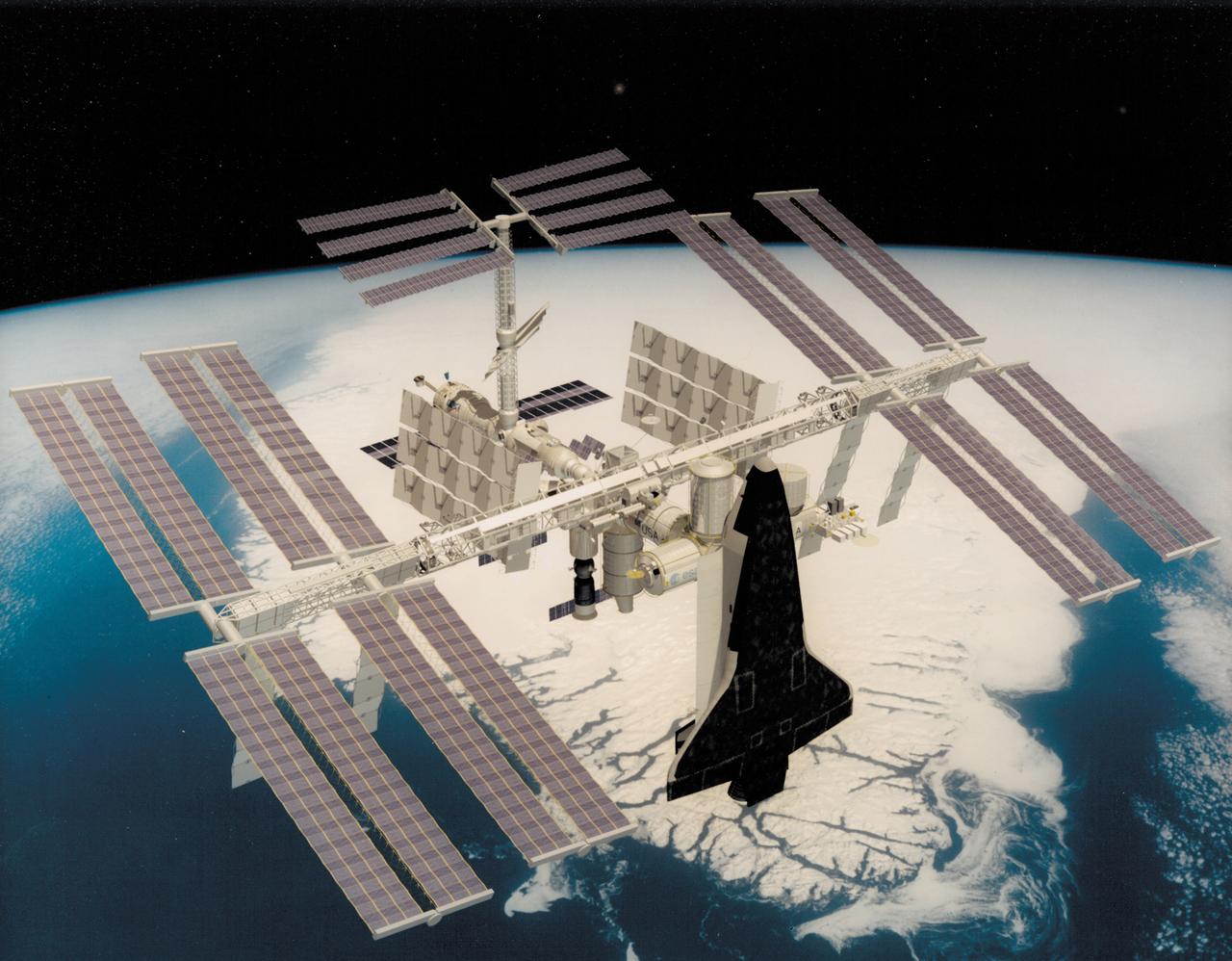
An artist's concept of what the International Space Station (ISS)Alpha will look like in its completed and fully operational state. All the elements of the Station are shown - the United States, European, Japanese, and Russian. The artist also included the Space Shuttle in the docked position. Sixteen countries are cooperating to provide a multidisciplinary laboratory, technology test bed, and observatory that will provide an unprecedented undertaking in scientific, technological, and international experimentation.

An artist's concept of a fully deployed International Space Station (ISS) Alpha. The ISS-A is a multidisciplinary laboratory, technology test bed, and observatory that will provide an unprecedented undertaking in scientific, technological, and international experiments.
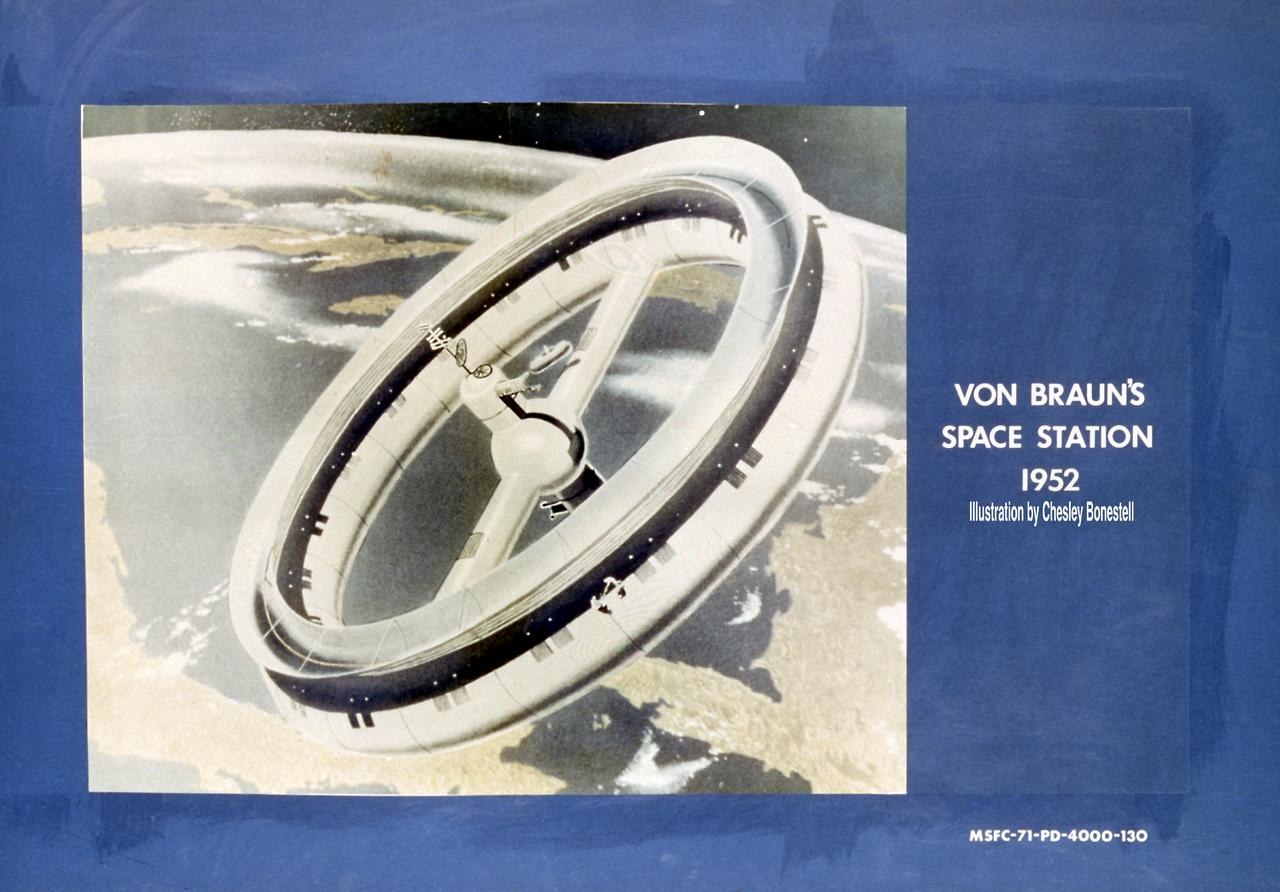
This is a von Braun 1952 space station concept. In a 1952 series of articles written in Collier's, Dr. Wernher von Braun, then Technical Director of the Army Ordnance Guided Missiles Development Group at Redstone Arsenal, wrote of a large wheel-like space station in a 1,075-mile orbit. This station, made of flexible nylon, would be carried into space by a fully reusable three-stage launch vehicle. Once in space, the station's collapsible nylon body would be inflated much like an automobile tire. The 250-foot-wide wheel would rotate to provide artificial gravity, an important consideration at the time because little was known about the effects of prolonged zero-gravity on humans. Von Braun's wheel was slated for a number of important missions: a way station for space exploration, a meteorological observatory and a navigation aid. This concept was illustrated by artist Chesley Bonestell.

Pictured is an artist's concept of the International Space Station (ISS) with solar panels fully deployed. In addition to the use of solar energy, the ISS will employ at least three types of propulsive support systems for its operation. The first type is to reboost the Station to correct orbital altitude to offset the effects of atmospheric and other drag forces. The second function is to maneuver the ISS to avoid collision with oribting bodies (space junk). The third is for attitude control to position the Station in the proper attitude for various experiments, temperature control, reboost, etc. The ISS, a gateway to permanent human presence in space, is a multidisciplinary laboratory, technology test bed, and observatory that will provide an unprecedented undertaking in scientific, technological, and international experimentation by cooperation of sixteen countries.
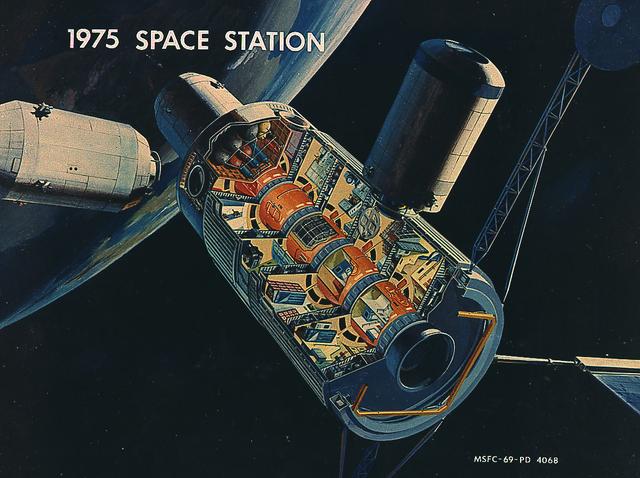
This picture illustrates a concept of a 33-Foot-Diameter Space Station Leading to a Space Base. In-house work of the Marshall Space Flight Center, as well as a Phase B contract with the McDornel Douglas Astronautics Company, resulted in a preliminary design for a space station in 1969 and l970. The Marshall-McDonnel Douglas approach envisioned the use of two common modules as the core configuration of a 12-man space station. Each common module was 33 feet in diameter and 40 feet in length and provided the building blocks, not only for the space station, but also for a 50-man space base. Coupled together, the two modules would form a four-deck facility: two decks for laboratories and two decks for operations and living quarters. Zero-gravity would be the normal mode of operation, although the station would have an artificial gravity capability. This general-purpose orbital facility was to provide wide-ranging research capabilities. The design of the facility was driven by the need to accommodate a broad spectrum of activities in support of astronomy, astrophysics, aerospace medicine, biology, materials processing, space physics, and space manufacturing. To serve the needs of Earth observations, the station was to be placed in a 242-nautical-mile orbit at a 55-degree inclination. An Intermediate-21 vehicle (comprised of Saturn S-IC and S-II stages) would have launched the station in 1977.

This is an illustration of the Space Base concept. In-house work of the Marshall Space Flight Center, as well as a Phase B contract with the McDornel Douglas Astronautics Company, resulted in a preliminary design for a space station in 1969 and l970. The Marshall-McDonnel Douglas approach envisioned the use of two common modules as the core configuration of a 12-man space station. Each common module was 33 feet in diameter and 40 feet in length and provided the building blocks, not only for the space station, but also for a 50-man space base. Coupled together, the two modules would form a four-deck facility: two decks for laboratories and two decks for operations and living quarters. Zero-gravity would be the normal mode of operation, although the station would have an artificial-gravity capability. This general-purpose orbital facility was to provide wide-ranging research capabilities. The design of the facility was driven by the need to accommodate a broad spectrum of activities in support of astronomy, astrophysics, aerospace medicine, biology, materials processing, space physics, and space manufacturing. To serve the needs of Earth observations, the station was to be placed in a 242-nautical-mile orbit at a 55-degree inclination. An Intermediate-21 vehicle (comprised of Saturn S-IC and S-II stages) would have launched the station in 1977.
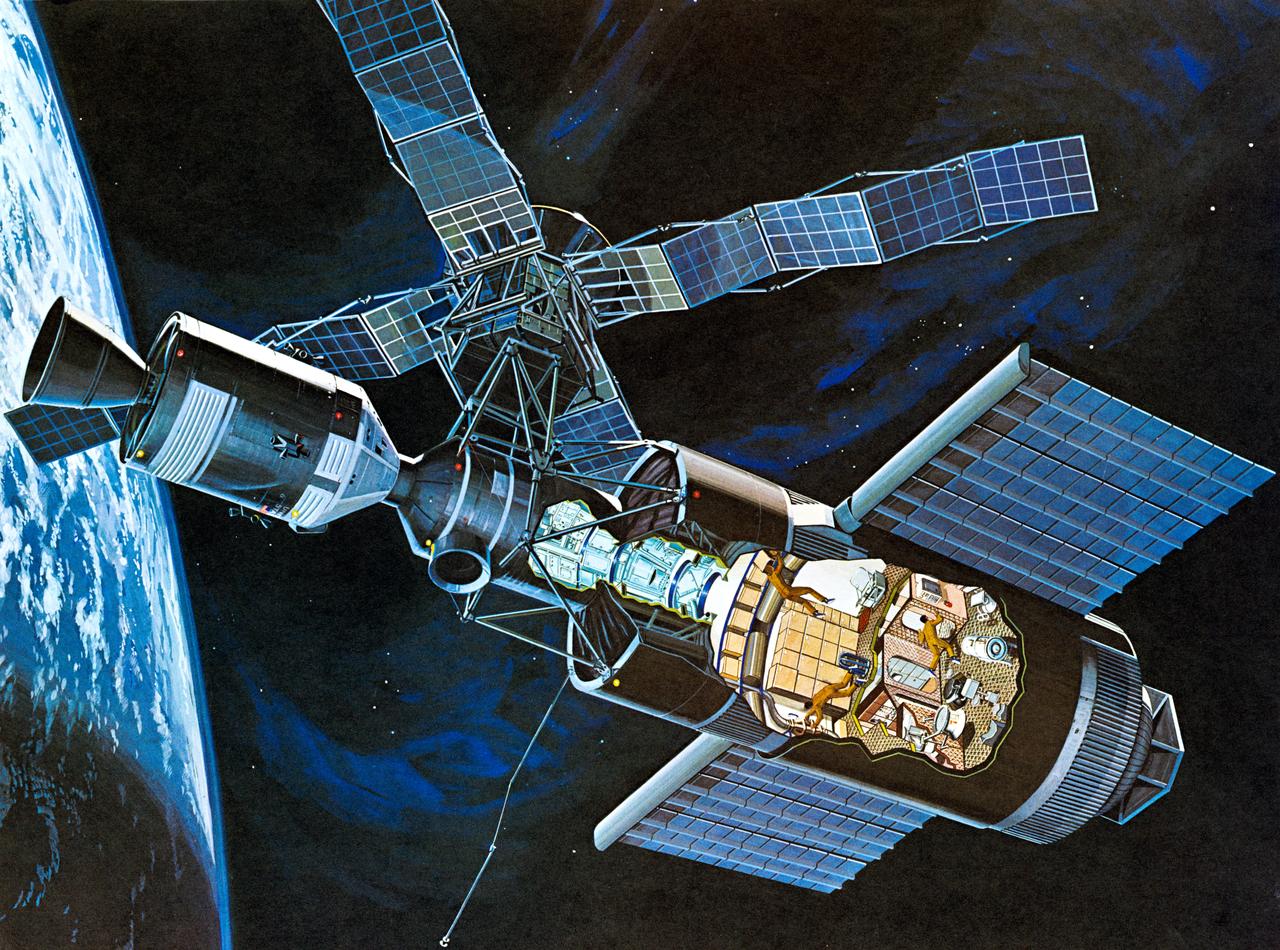
S71-52192 (1971) --- An artist's concept of the Skylab space station cluster in Earth's orbit. The cutaway view shows astronaut activity in the Orbital Workshop (OWS). The Skylab cluster is composed of the OWS, Airlock Module (AM), Multiple Docking Adapter (MDA), Apollo Telescope Mount (ATM), and the Command and Service Module (CSM). Photo credit: NASA
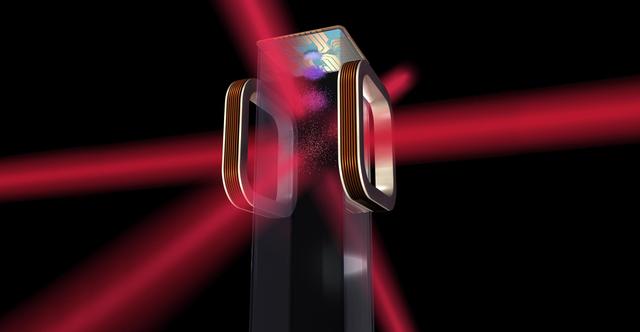
Artist concept of a magneto-optical trap and atom chip to be used by NASA Cold Atom Laboratory CAL aboard the International Space Station.
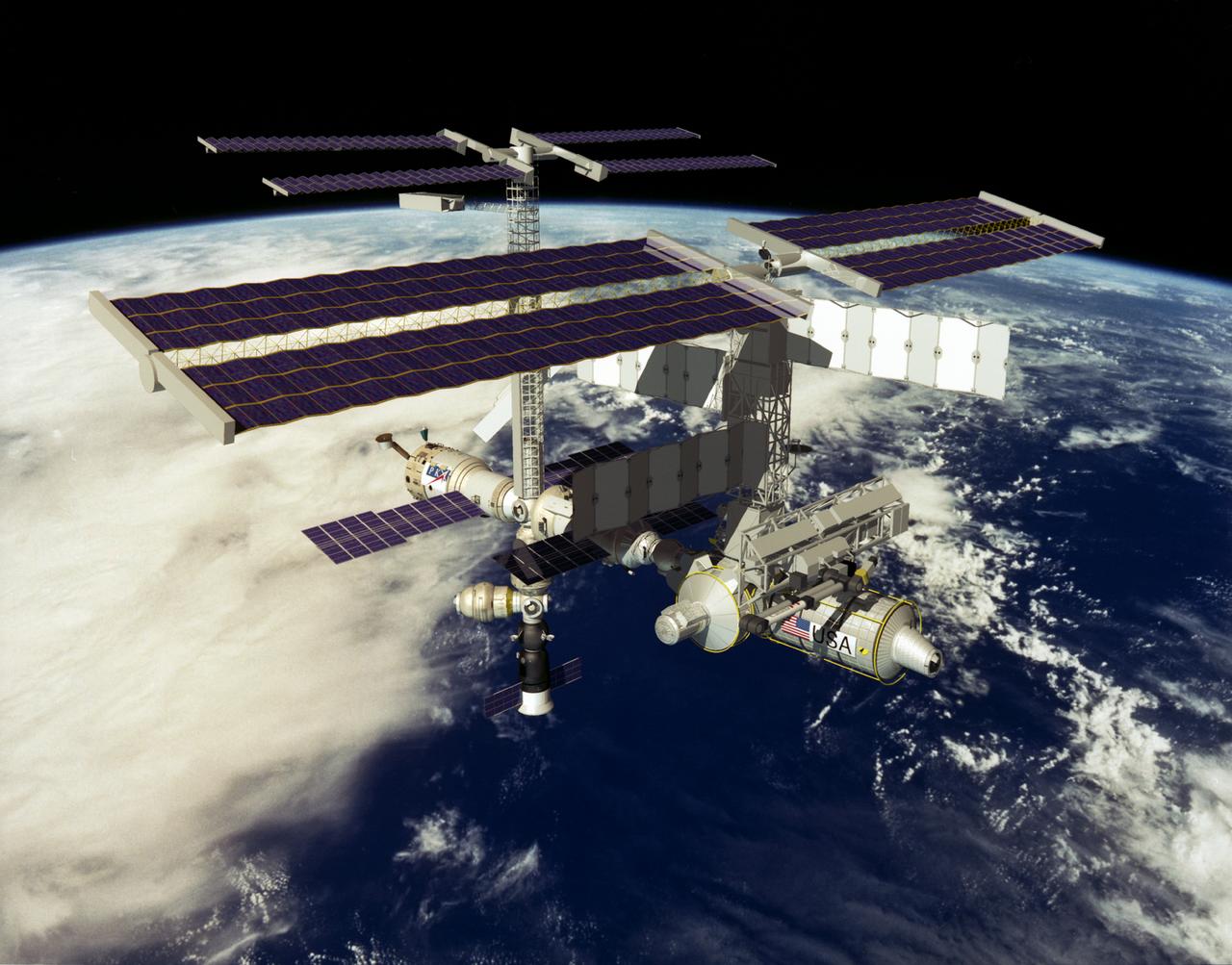
This computer generated scene of the International Space Station (ISS) represents the first addition of hardware following the completion of Phase II. The 8-A Phase shows the addition of the S-9 truss.
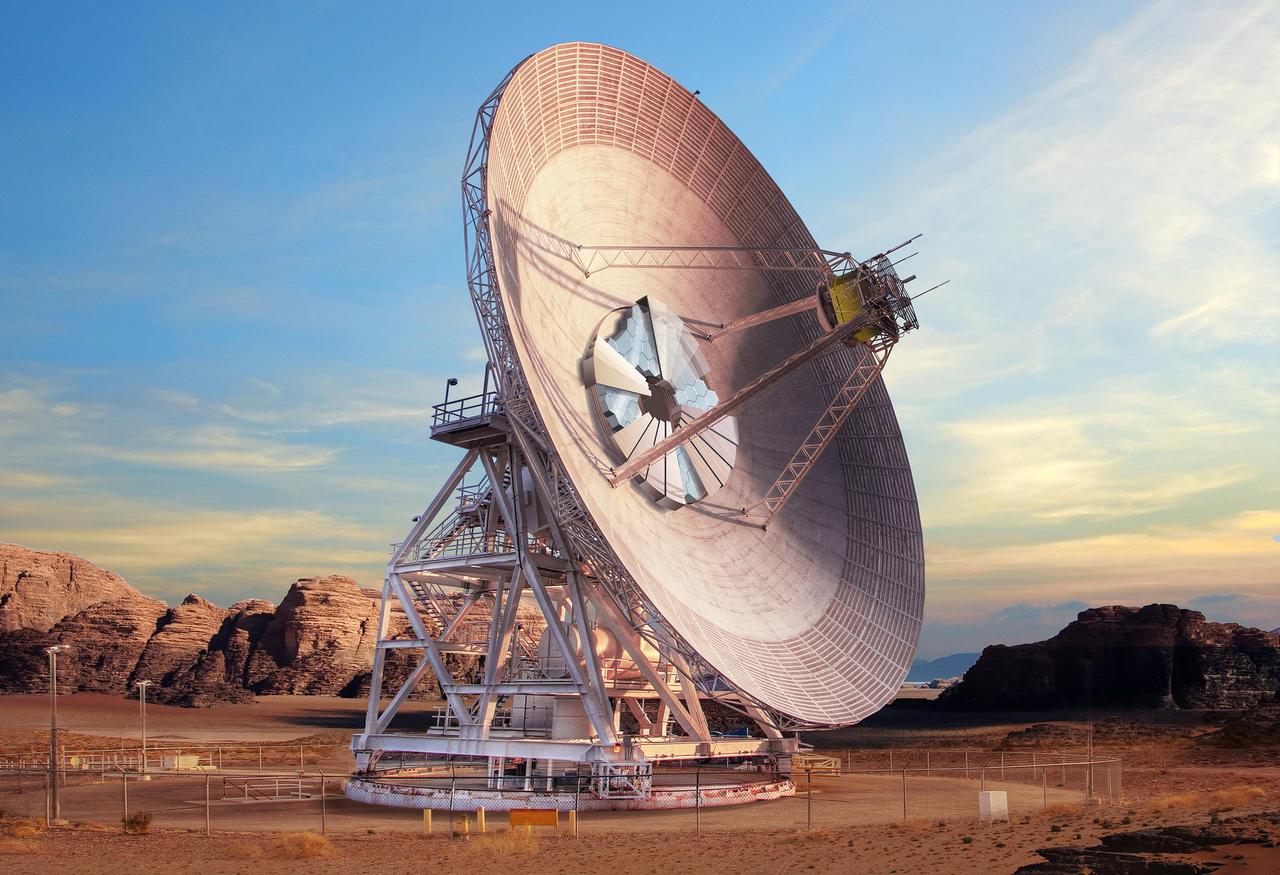
This artist's concept shows what Deep Space Station-23, a new antenna dish at the Deep Space Network's complex in Goldstone, California, will look like when complete in several years. DSS-23 will communicate with NASA's deep space missions using radio waves and lasers. Retractable covers will be able to fan out across the mirrors at the center of the dish to protect them from the elements. https://photojournal.jpl.nasa.gov/catalog/PIA23617
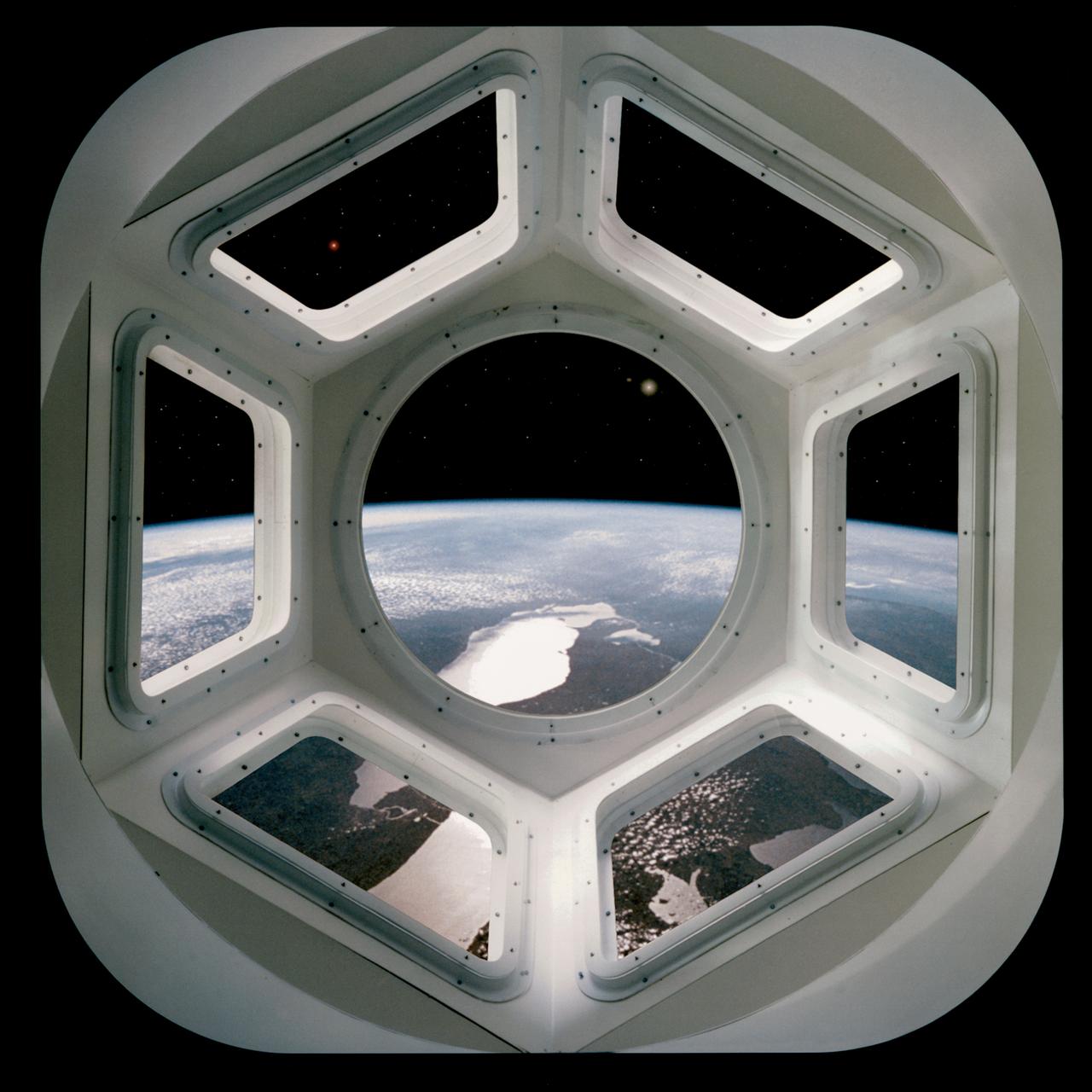
S94-47164 (December 1994) --- A computer generated scene gives the perspective of a crew member looking through the Cupola on the International Space Station (ISS). Several of the Great Lakes help to form the backdrop for the scene.
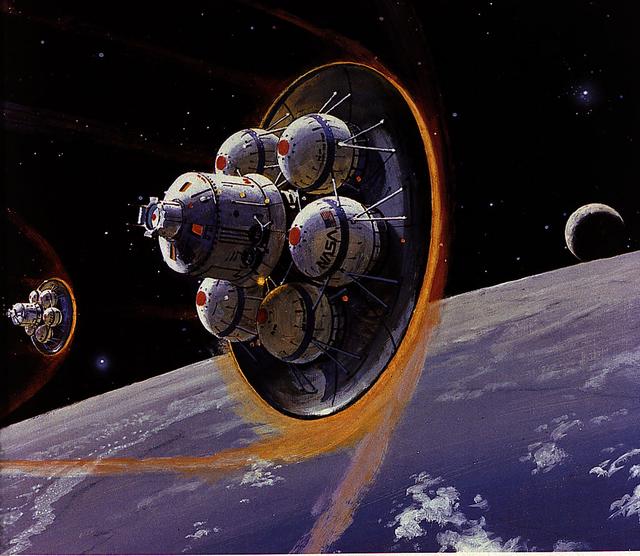
In June 1989 the Marshall Space Flight Center initiated studies of Space Transfer Vehicle (STV) concepts. A successor to the Orbital Transfer Vehicle (OTV) concept, the STV would be a high-performance space vehicle capable of transferring automated payloads from a Space Station to geosynchronous orbits, the Moon, or planets. Illustrated in this artist's concept are two STV's undergoing aerobraking maneuvers as they approach a Space Station.
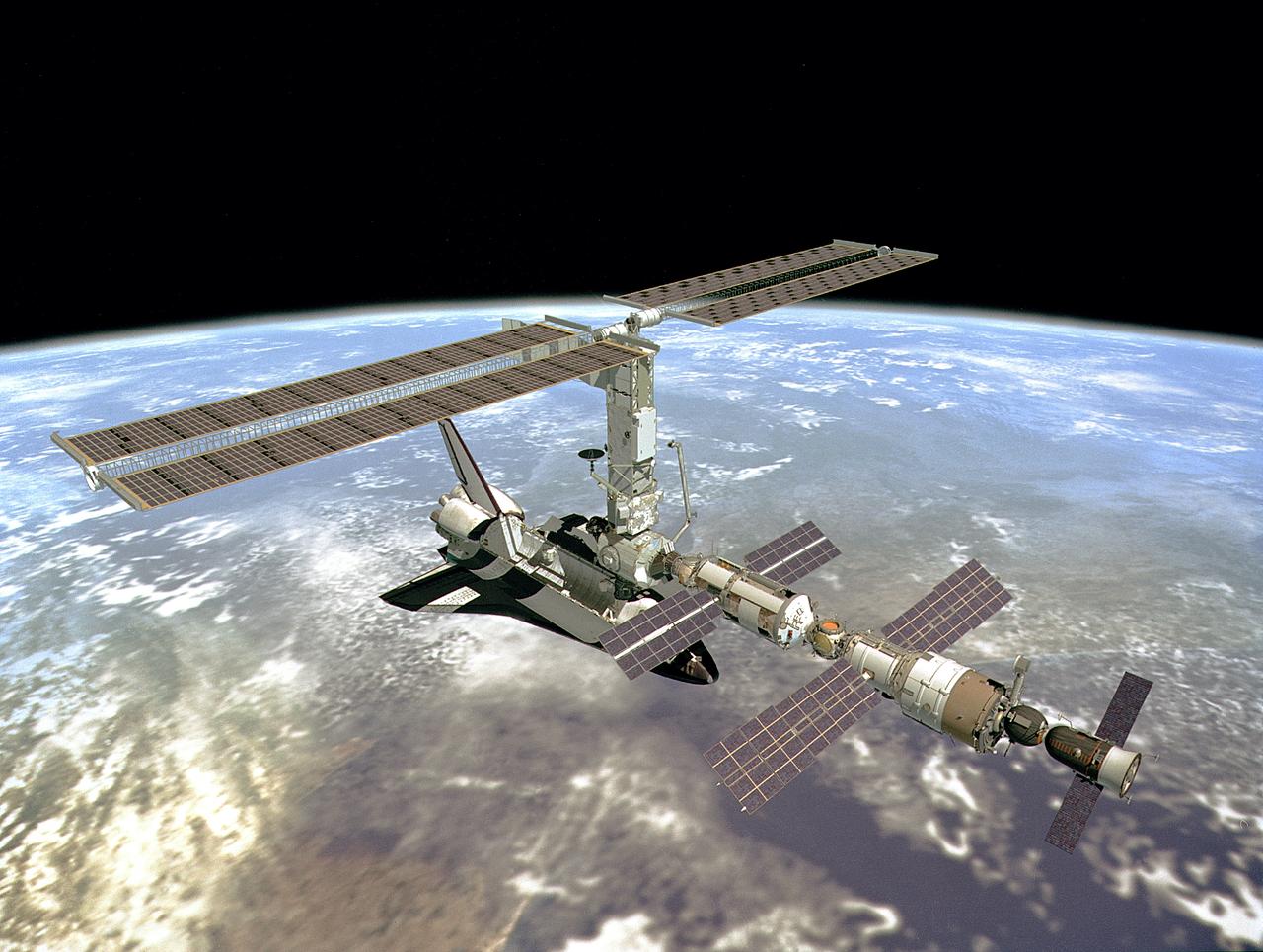
This concept depicts the International Space Station in orbit following its solar array deployment by the crew of the Space Shuttle STS-97 mission.
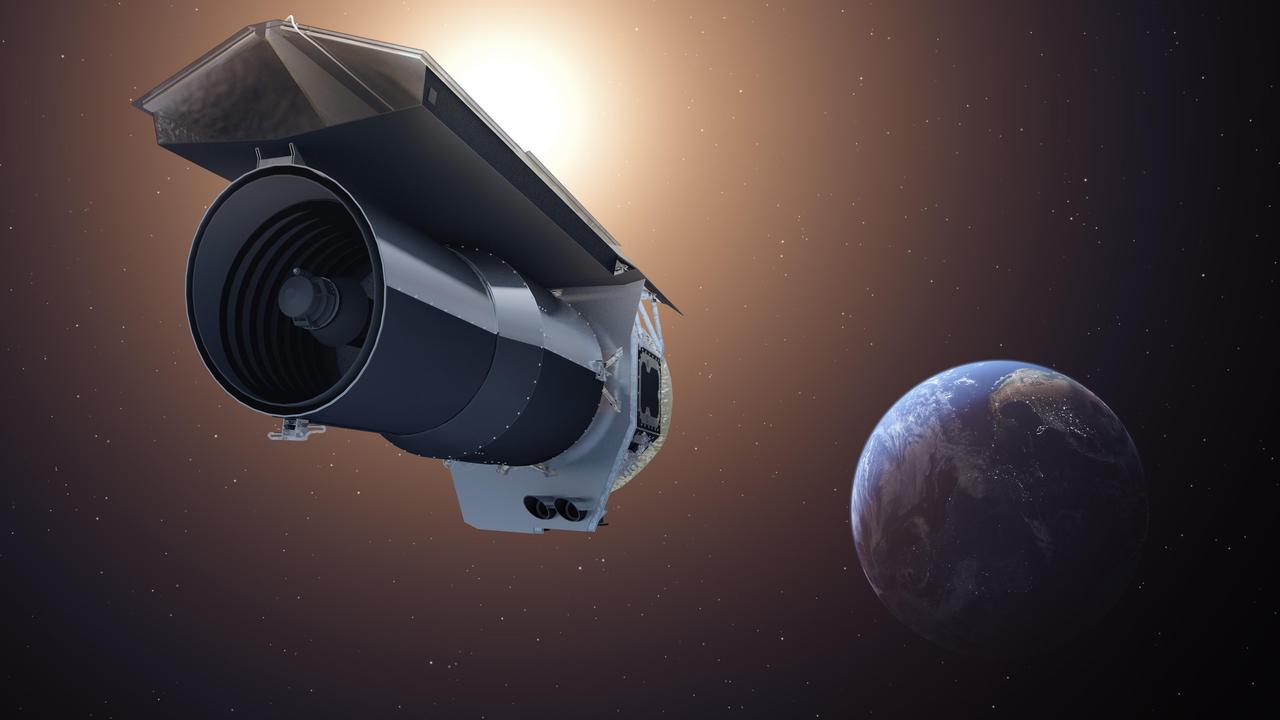
This artist's concept shows NASA's Spitzer Space Telescope. Spitzer begins its "Beyond" mission phase on Oct. 1, 2016. Spitzer is depicted in the orientation it assumes to establish communications with ground stations. Spitzer is over 130 million miles (210 million kilometers) away from Earth, or about 1.5 times the distance between Earth and the Sun. The selected research proposals for Spitzer's Beyond phase include a variety of objects that the mission was not originally planned to address -- such as galaxies in the early universe, the black hole at the center of the Milky Way and exoplanets. Spitzer faces increasing challenges and risks in its Beyond phase. To enable this riskier mode of operations, the mission team will have to override some autonomous safety systems. Mission engineers are hard at work preparing for these new challenges. http://photojournal.jpl.nasa.gov/catalog/PIA20913
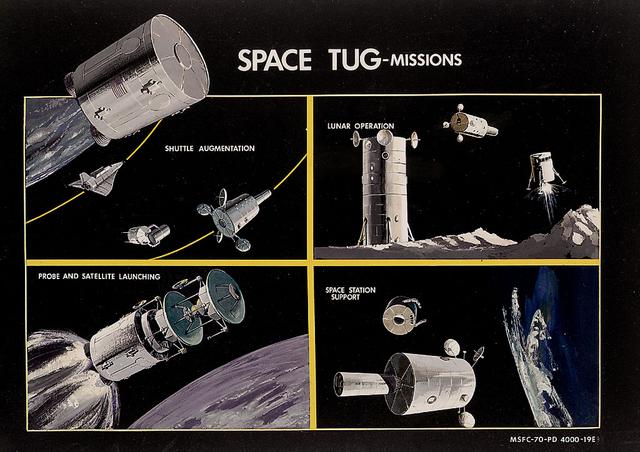
Managed by Marshall Space Flight Center, the Space Tug concept was intended to be a reusable multipurpose space vehicle designed to transport payloads to different orbital inclinations. Utilizing mission-specific combinations of its three primary modules (crew, propulsion, and cargo) and a variety of supplementary kits, the Space Tug was capable of numerous space applications. This 1970 artist's concept illustrates several examples of how the Tug's propulsion module could be implemented to support missions such as landing large payloads on a lunar surface, returning crew and cargo to lunar orbit, launching planetary probes from Earth orbit, and space station support.The Space Tug program was cancelled and did not become a reality.
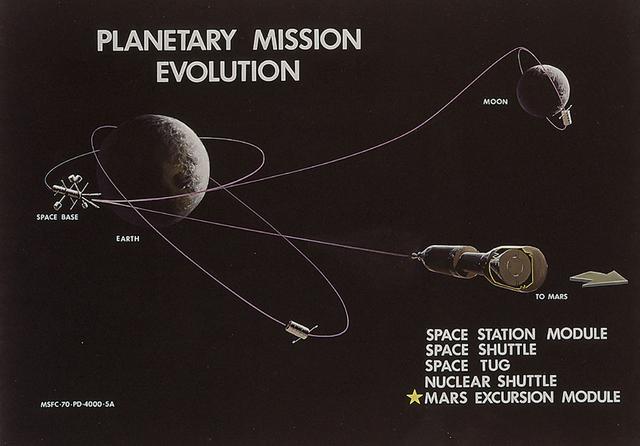
As part of the Space Task Group's recommendations for more commonality and integration in America's space program, Marshall Space Flight Center engineers proposed the use of a Nuclear Shuttle in conjunction with a space station module, illustrated in this 1970 artist's concept, as the basis for a Mars excursion module.
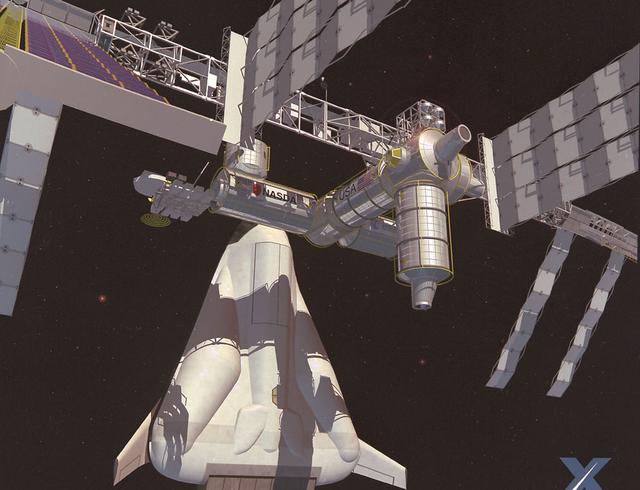
Pictured here is an artist's depiction of Lockheed Martin's Lifting Body Single-Stage-to-Orbit (SSTO) Reusable Launch Vehicle (RLV) concept servicing the International Space Station. The development of the RLV is essential in the cost reduction of future space travel.
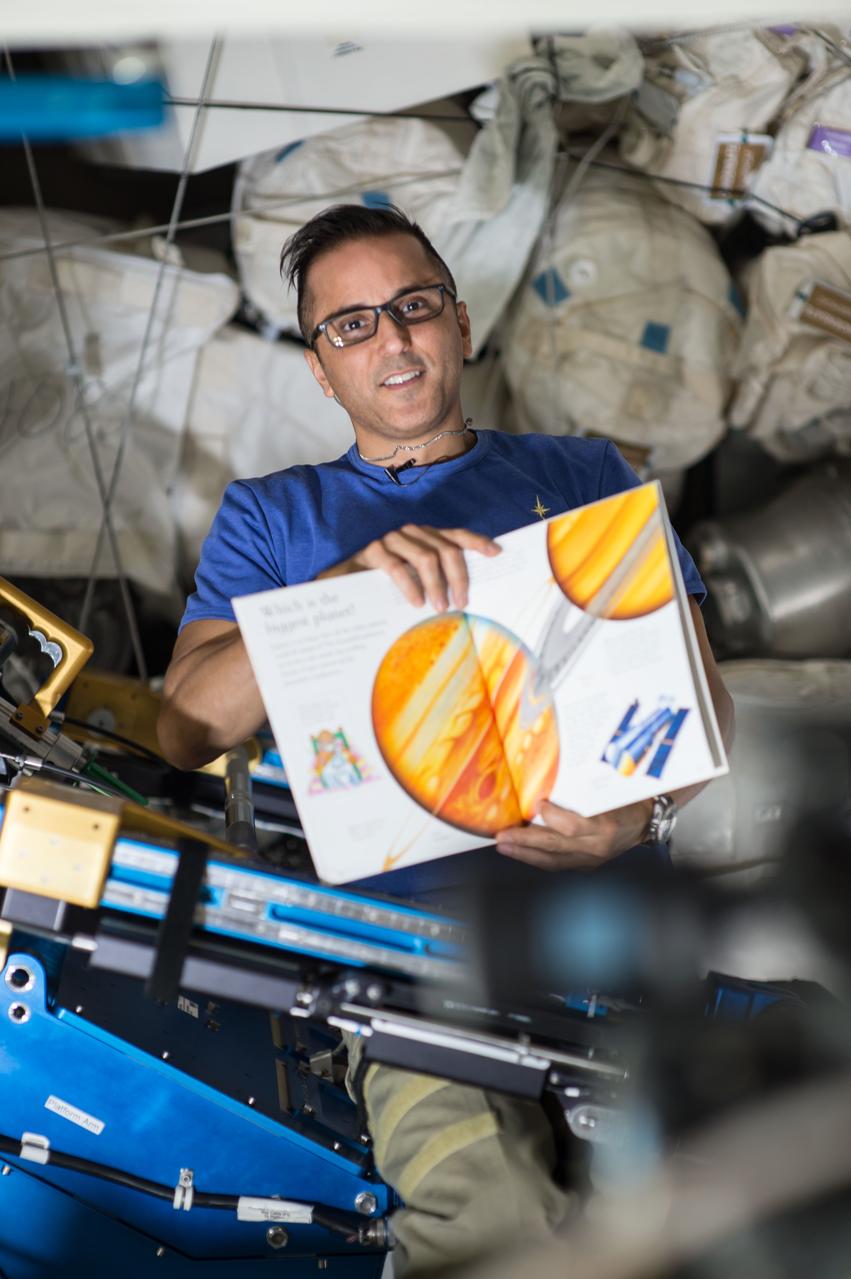
iss053e210425 (Nov. 7, 2017) --- Flight Engineer Joe Acaba holds a children's book that he is reading from as part of the Story Time From Space program. Astronauts read aloud from a STEM-related children's book while being videotaped and demonstrate simple science concepts and experiments aboard the International Space Station.
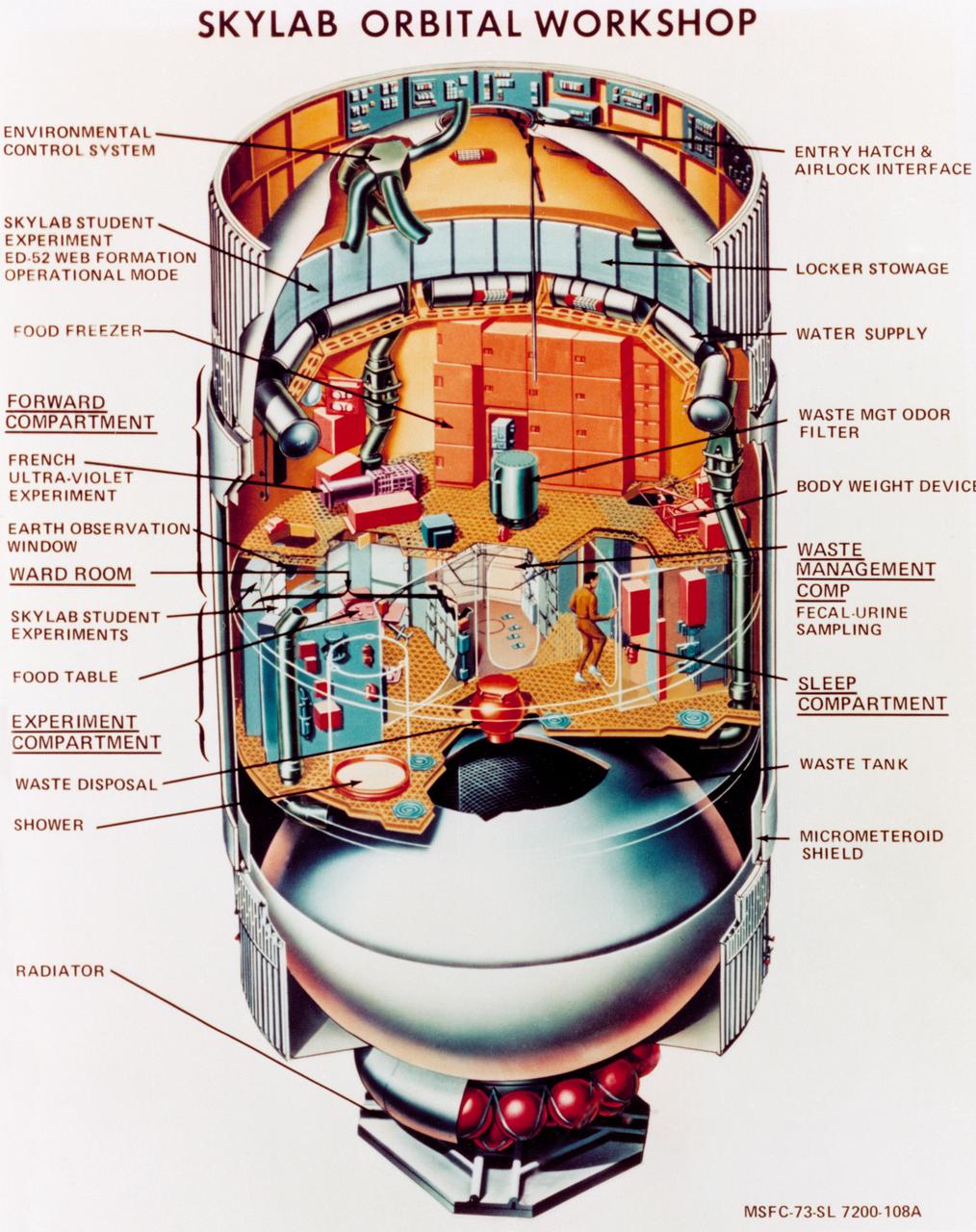
S73-23919 (May 1973) --- An artist's concept illustrating a cutaway view of the Skylab 1 Orbital Workshop (OWS). The OWS is one of the five major components of the Skylab 1 space station cluster which was launched by a Saturn V on May 14, 1973 into Earth orbit. Photo credit: NASA
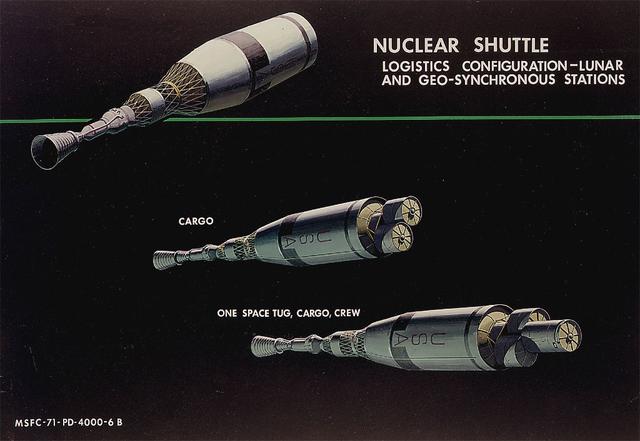
This 1971 artist's concept shows the Nuclear Shuttle in both its lunar logistics configuraton and geosynchronous station configuration. As envisioned by Marshall Space Flight Center Program Development persornel, the Nuclear Shuttle would deliver payloads to lunar orbits or other destinations then return to Earth orbit for refueling and additional missions.
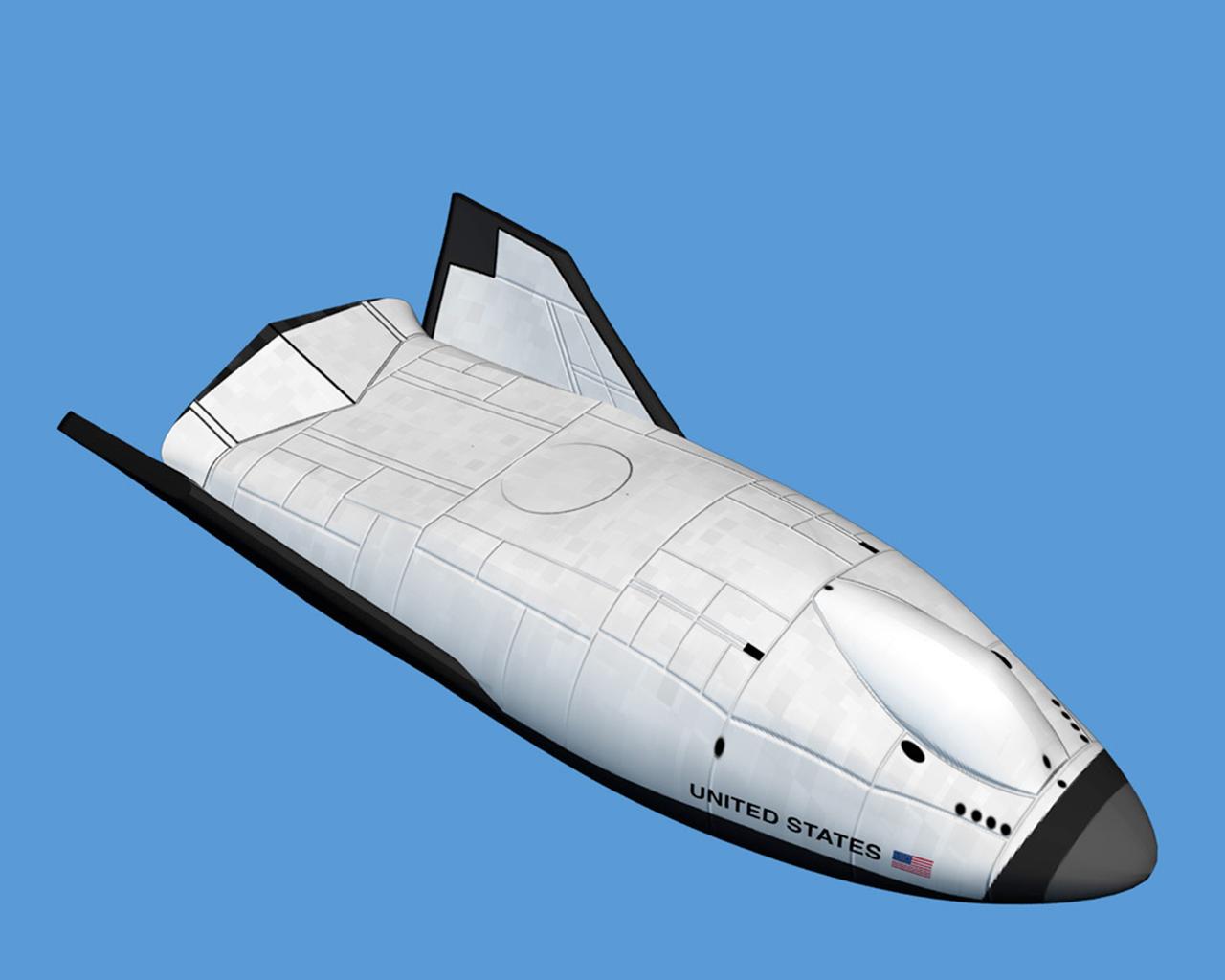
This is an artist's concept of the X-38 Crew Return Vehicle (CRV). The X-38 will take place of the Russian Soyuz capsule and is well underway on development for the International Space Station. The Soyuz can only stay on orbit for six months as opposed to three years for the CRV.
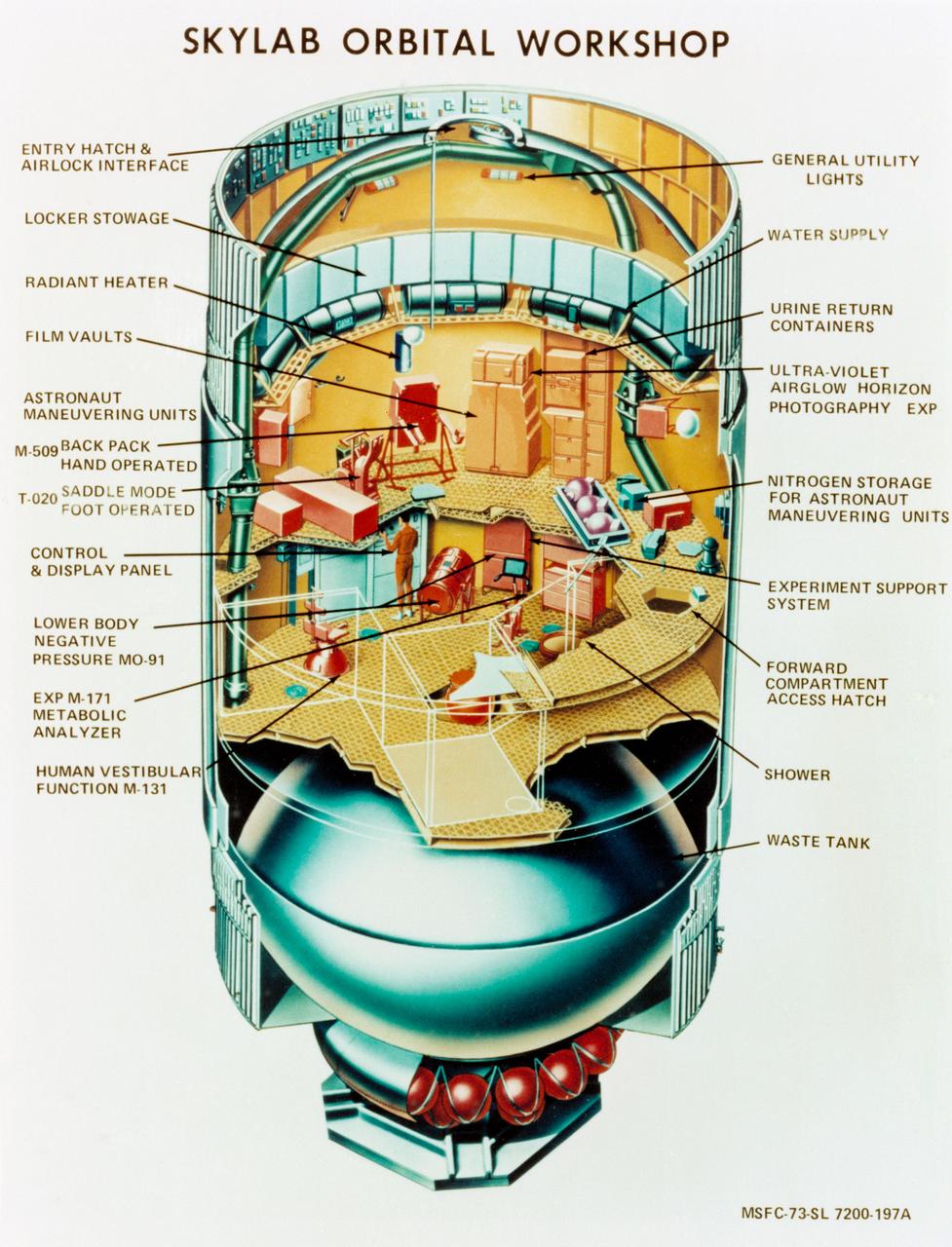
S73-23918 (May 1973) --- An artist's concept illustrating a cutaway view of the Skylab 1 Orbital Workshop (OWS). The OWS is one of the five major components of the Skylab 1 space station cluster which was launched by a Saturn V on May 14, 1973 into Earth orbit. Photo credit: NASA
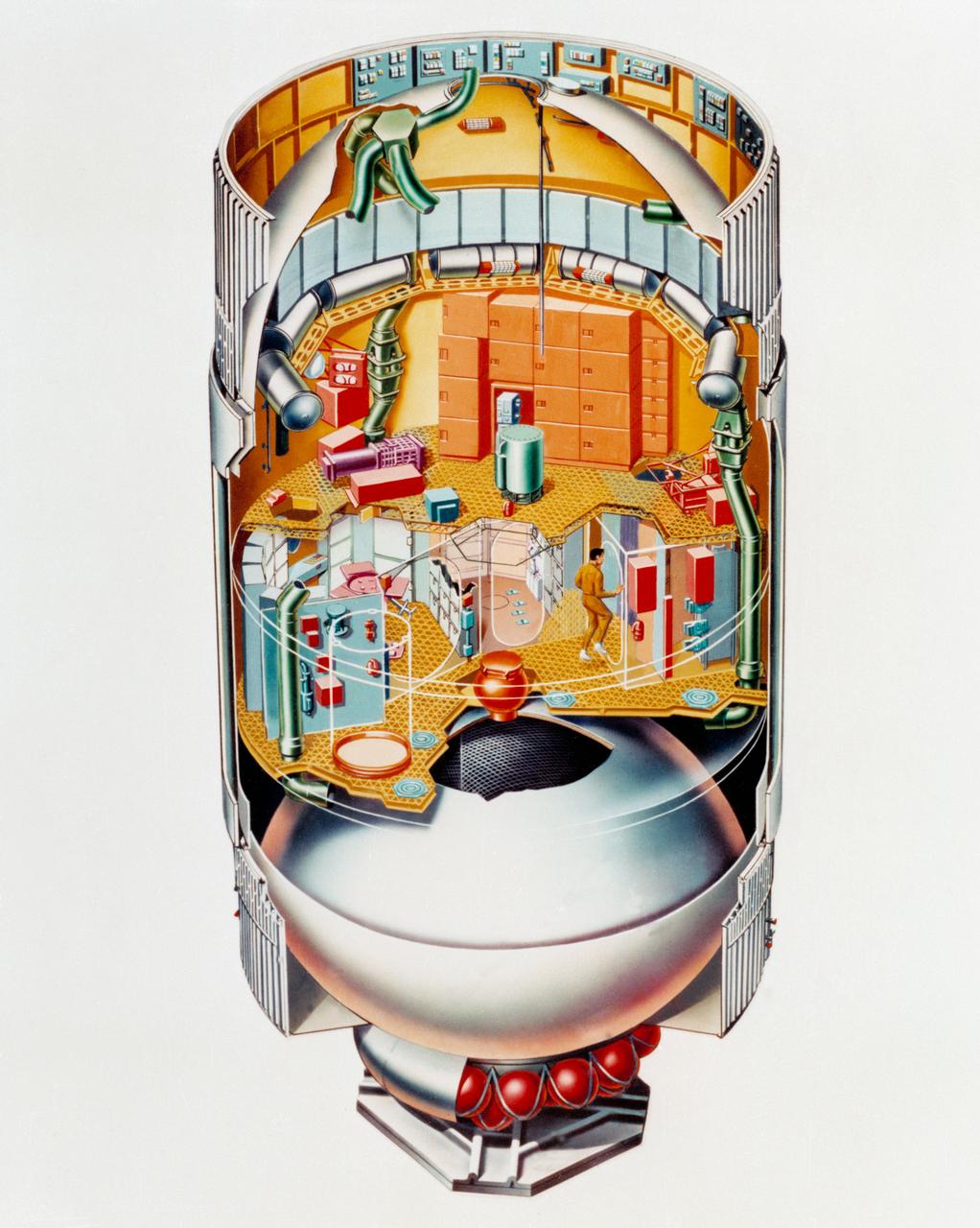
S73-24316 (May 1973) --- An artist's concept illustrating a cutaway view of the Skylab 1 Orbital Workshop (OWS). The OWS is one of the five major components of the Skylab 1 space station cluster which was launched by a Saturn V on May 14, 1973 into Earth orbit. Photo credit: NASA

This artist's concept depicts the Space Station Freedom as it would look orbiting the Earth; illustrated by Marshall Space Flight Center artist, Tom Buzbee. Scheduled to be completed in late 1999, this smaller configuration of the Space Station features a horizontal truss structure that supported U.S., European, and Japanese Laboratory Modules; the U.S. Habitation Module; and three sets of solar arrays. The Space Station Freedom was an international, permanently marned, orbiting base to be assembled in orbit by a series of Space Shuttle missions that were to begin in the mid-1990's.
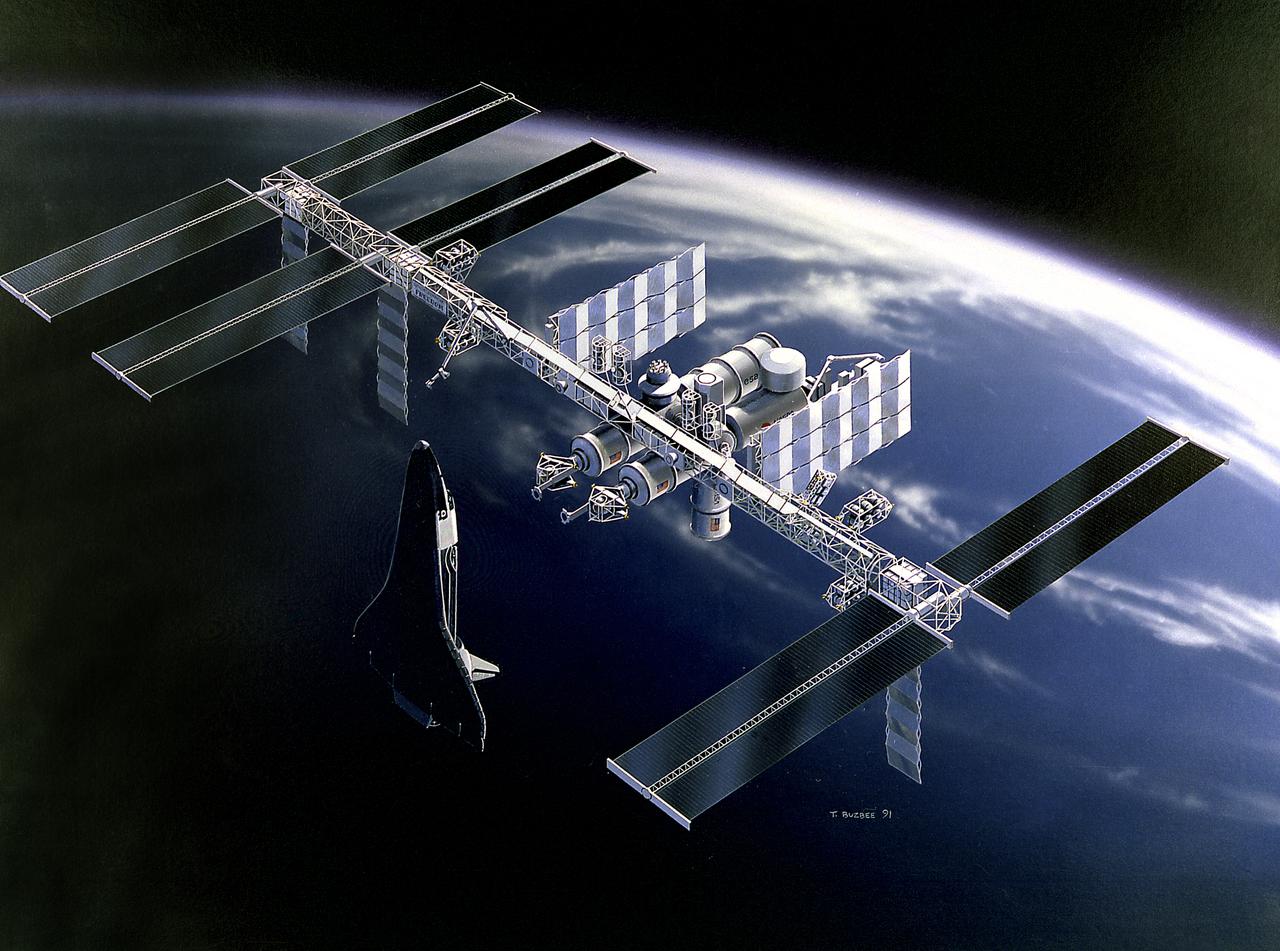
This artist's concept depicts the Space Station Freedom as it would look orbiting the Earth, illustrated by Marshall Space Flight Center artist, Tom Buzbee. Scheduled to be completed in late 1999, this smaller configuration of the Space Station featured a horizontal truss structure that supported U.S., European, and Japanese Laboratory Modules; the U.S. Habitation Module; and three sets of solar arrays. The Space Station Freedom was an international, permanently marned, orbiting base to be assembled in orbit by a series of Space Shuttle missions that were to begin in the mid-1990's.

The `once upon a time' science fiction concept of a space elevator has been envisioned and studied as a real mass transportation system in the latter part of the 21st century. David Smitherman of NASA's Marshall Space Flight Center's Advanced Projects Office has compiled plans for such an elevator. The space elevator concept is a structure extending from the surface of the Earth to geostationary Earth orbit (GEO) at 35,786 km in altitude. The tower would be approximately 50 km tall with a cable tethered to the top. Its center mass would be at GEO such that the entire structure orbits the Earth in sync with the Earth's rotation maintaining a stationary position over its base attachment at the equator. Electromagnetic vehicles traveling along the cable could serve as a mass transportation system for transporting people, payloads, and power between space and Earth. This illustration by artist Pat Rawling shows the concept of a space elevator as viewed from the geostationary transfer station looking down the length of the elevator towards the Earth.
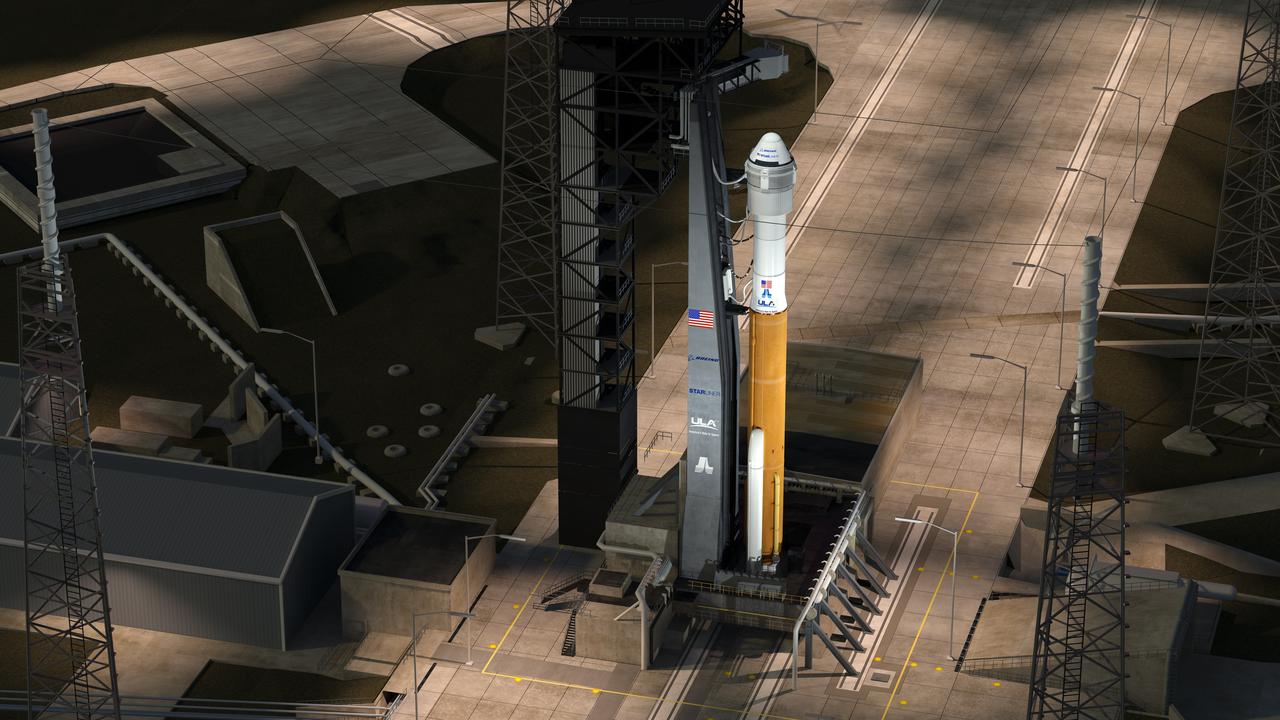
This artist concept shows a United Launch Alliance Atlas V rocket with a Boeing CST-100 Starliner capsule at Space Launch Complex-41 at Cape Canaveral Air Force Station in Florida. The Starliner/Atlas V system is under development by Boeing and ULA in partnership with NASA's Commercial Crew Program to launch astronauts to the International Space Station.
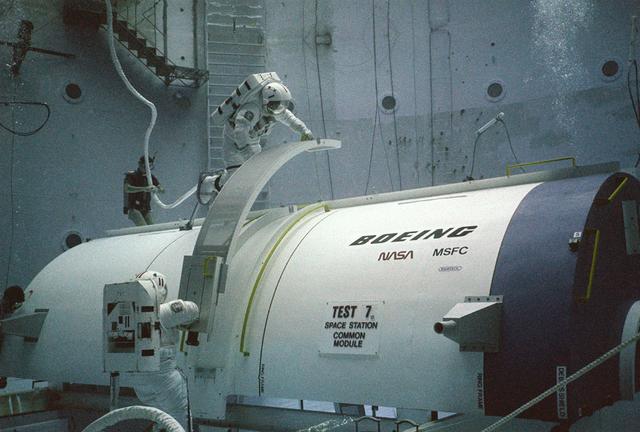
Skylab's success proved that scientific experimentation in a low gravity environment was essential to scientific progress. A more permanent structure was needed to provide this space laboratory. President Ronald Reagan, on January 25, 1984, during his State of the Union address, claimed that the United States should exploit the new frontier of space, and directed NASA to build a permanent marned space station within a decade. The idea was that the space station would not only be used as a laboratory for the advancement of science and medicine, but would also provide a staging area for building a lunar base and manned expeditions to Mars and elsewhere in the solar system. President Reagan invited the international community to join with the United States in this endeavour. NASA and several countries moved forward with this concept. By December 1985, the first phase of the space station was well underway with the design concept for the crew compartments and laboratories. Pictured are two NASA astronauts, at Marshall Space Flight Center's (MSFC) Neutral Buoyancy Simulator (NBS), practicing construction techniques they later used to construct the space station after it was deployed.
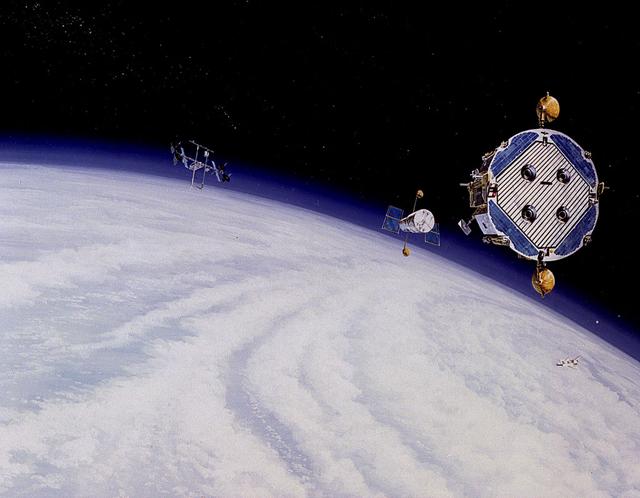
In this 1986 artist's concept, the Orbital Maneuvering Vehicle (OMV), at right, prepares to reboost the Hubble Space Telescope after being deployed from an early Space Station configuration (left). As envisioned by Marshall Space Flight Center plarners, the OMV would be a remotely-controlled free-flying space tug which would place, rendezvous, dock, and retrieve orbital payloads.
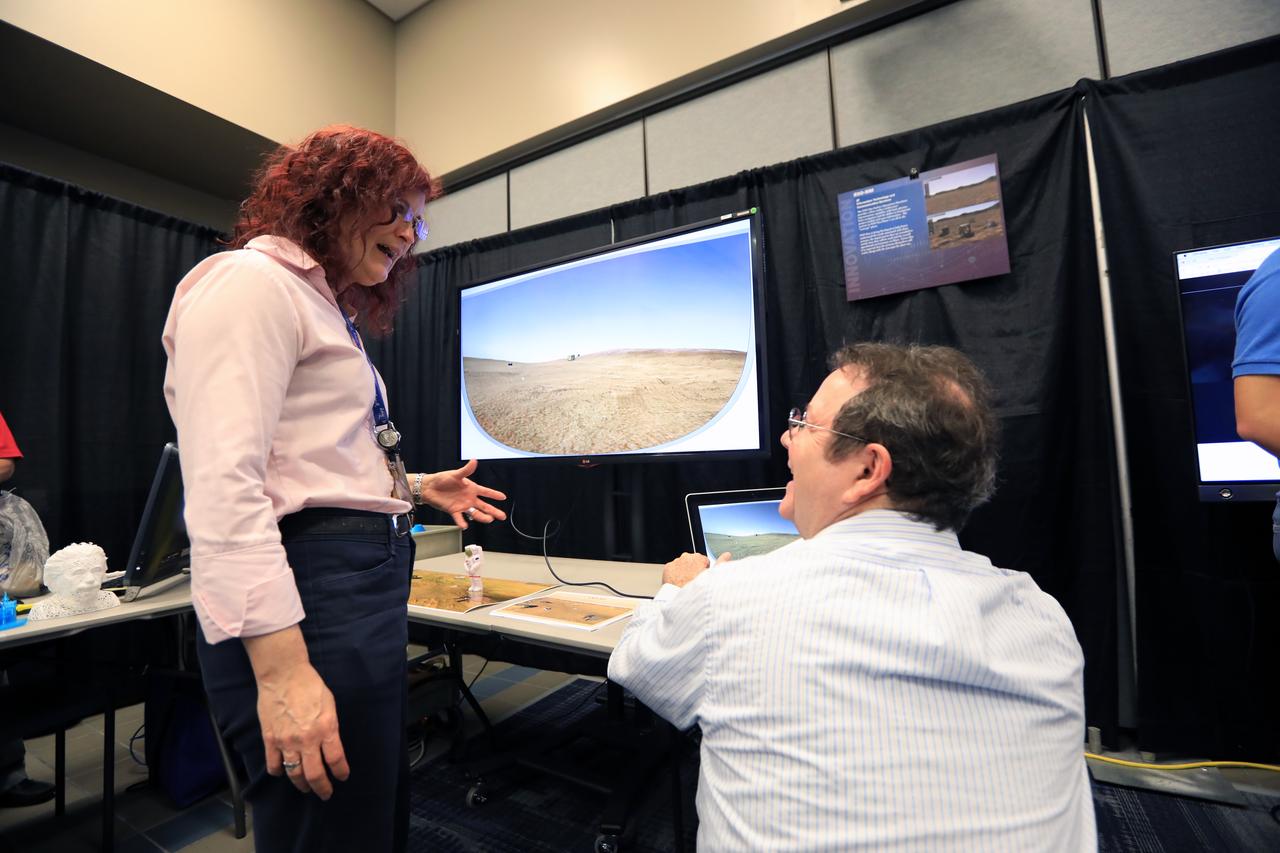
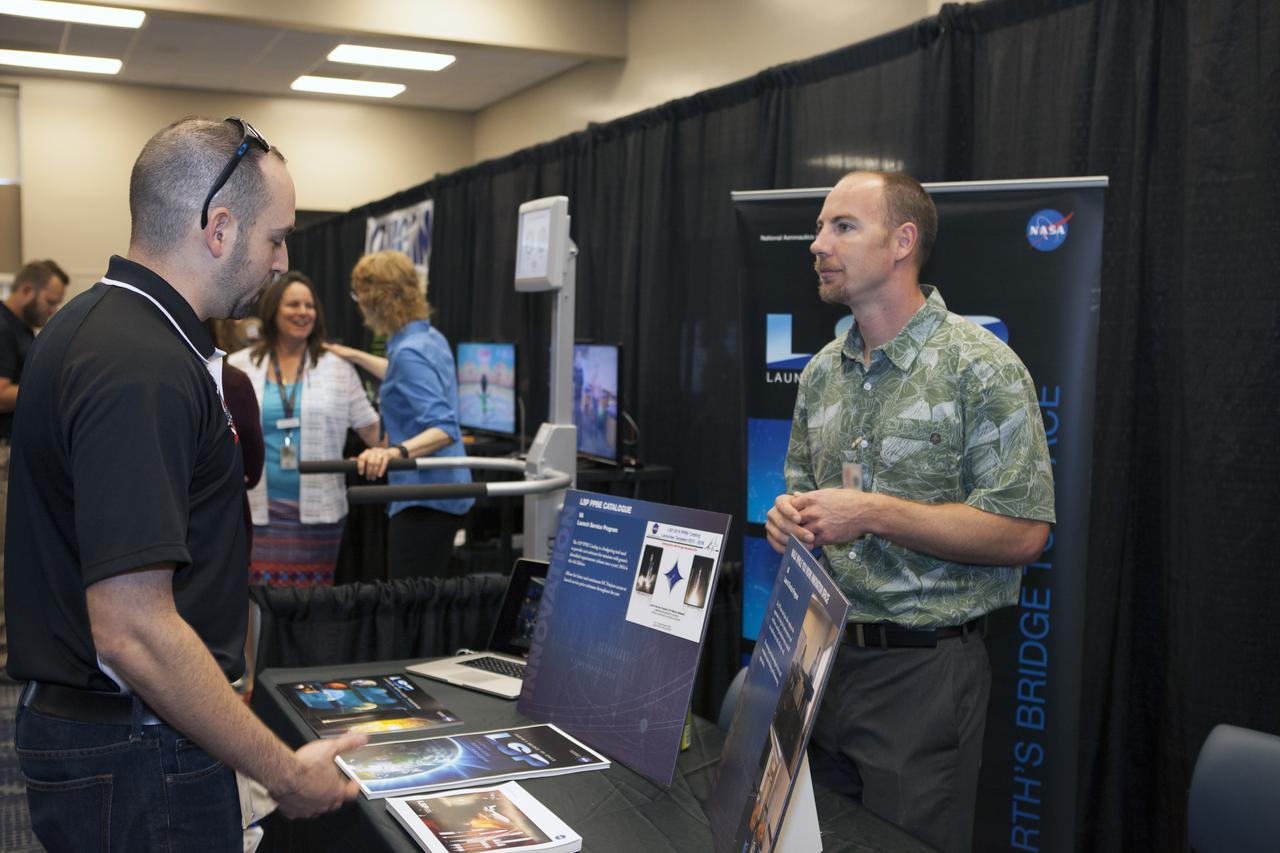
Kennedy Space Center Director Bob Cabana stops by a NASA booth in the Space Station Processing Facility conference center during the 2016 Innovation Expo. Now in its fifth year, the purpose of the Innovation Expo is to help foster innovation and creativity among Kennedy employees who are encouraged to look for ways to do their work better and to propose concepts for tackling future mission needs.
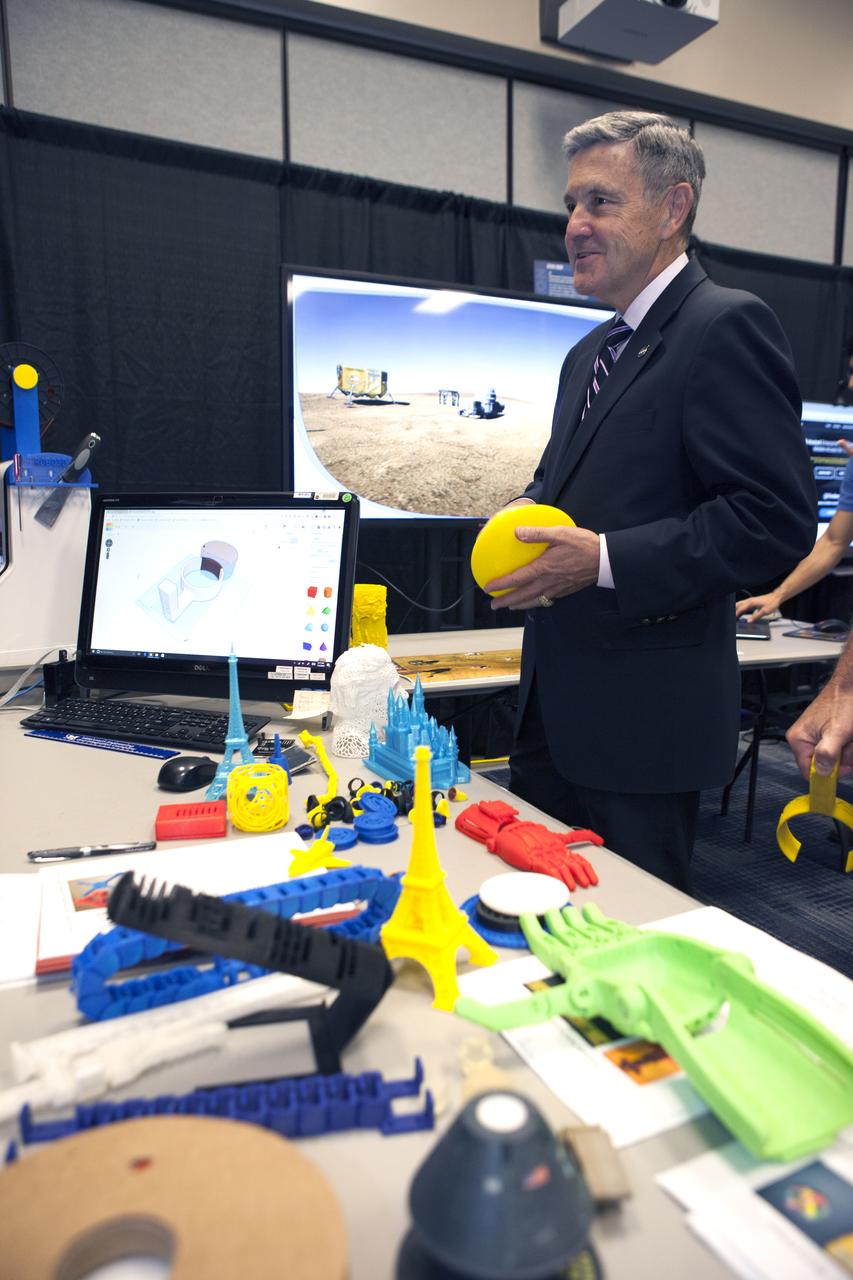
Kennedy Space Center Director Bob Cabana stops by a NASA booth in the Space Station Processing Facility conference center during the 2016 Innovation Expo. Now in its fifth year, the purpose of the Innovation Expo is to help foster innovation and creativity among Kennedy employees who are encouraged to look for ways to do their work better and to propose concepts for tackling future mission needs.
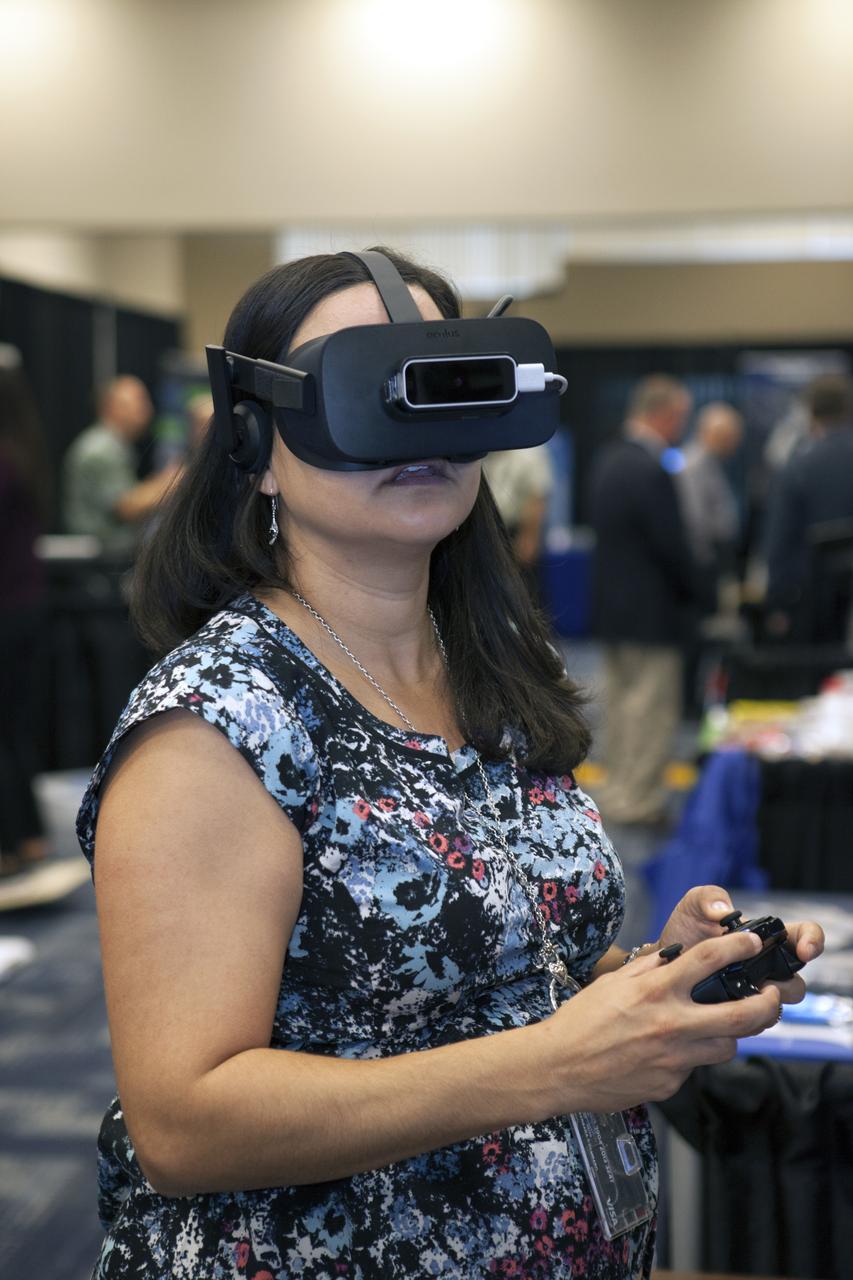
A visitor checks out a virtual reality device at a NASA booth in the Space Station Processing Facility conference center during NASA's Kennedy Space Center during the 2016 Innovation Expo. Now in its fifth year, the purpose of the Innovation Expo is to help foster innovation and creativity among Kennedy employees who are encouraged to look for ways to do their work better and to propose concepts for tackling future mission needs.
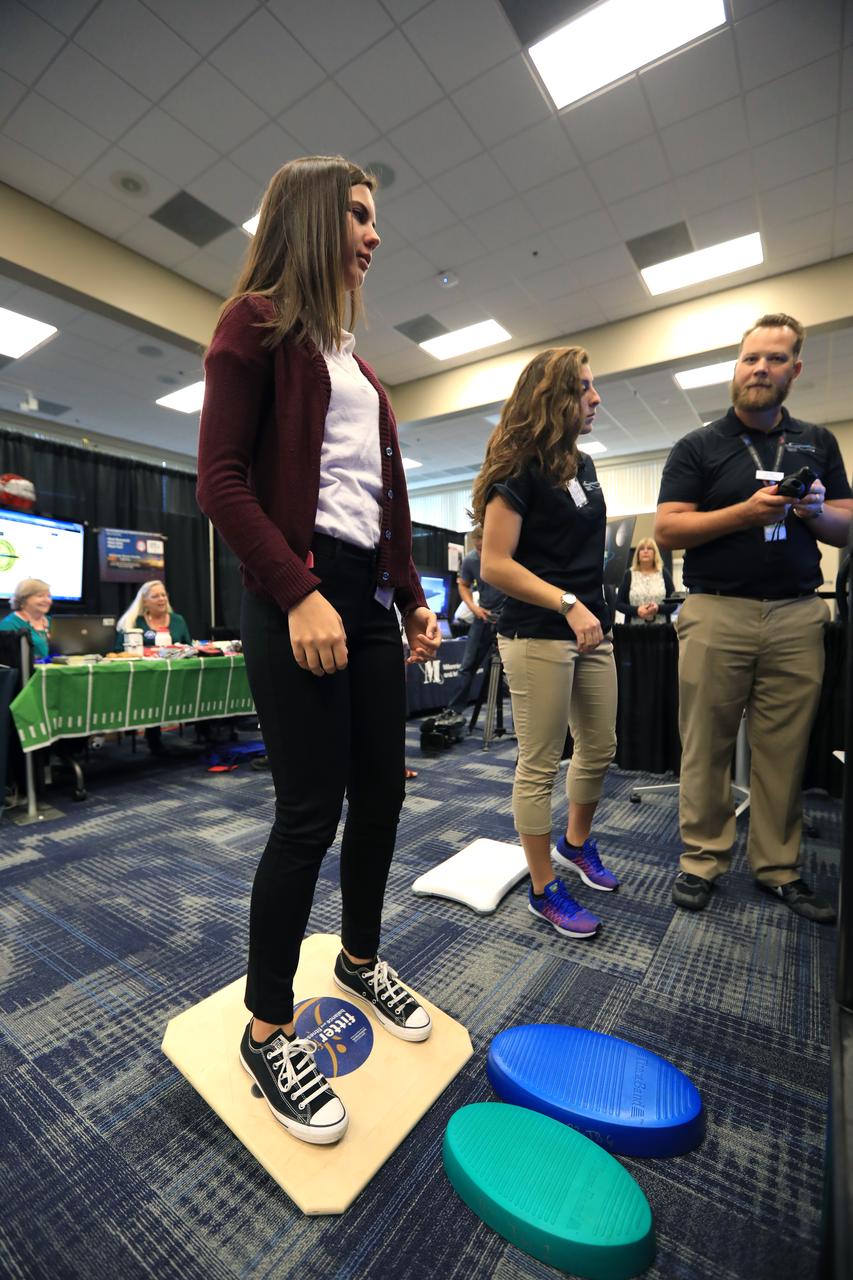
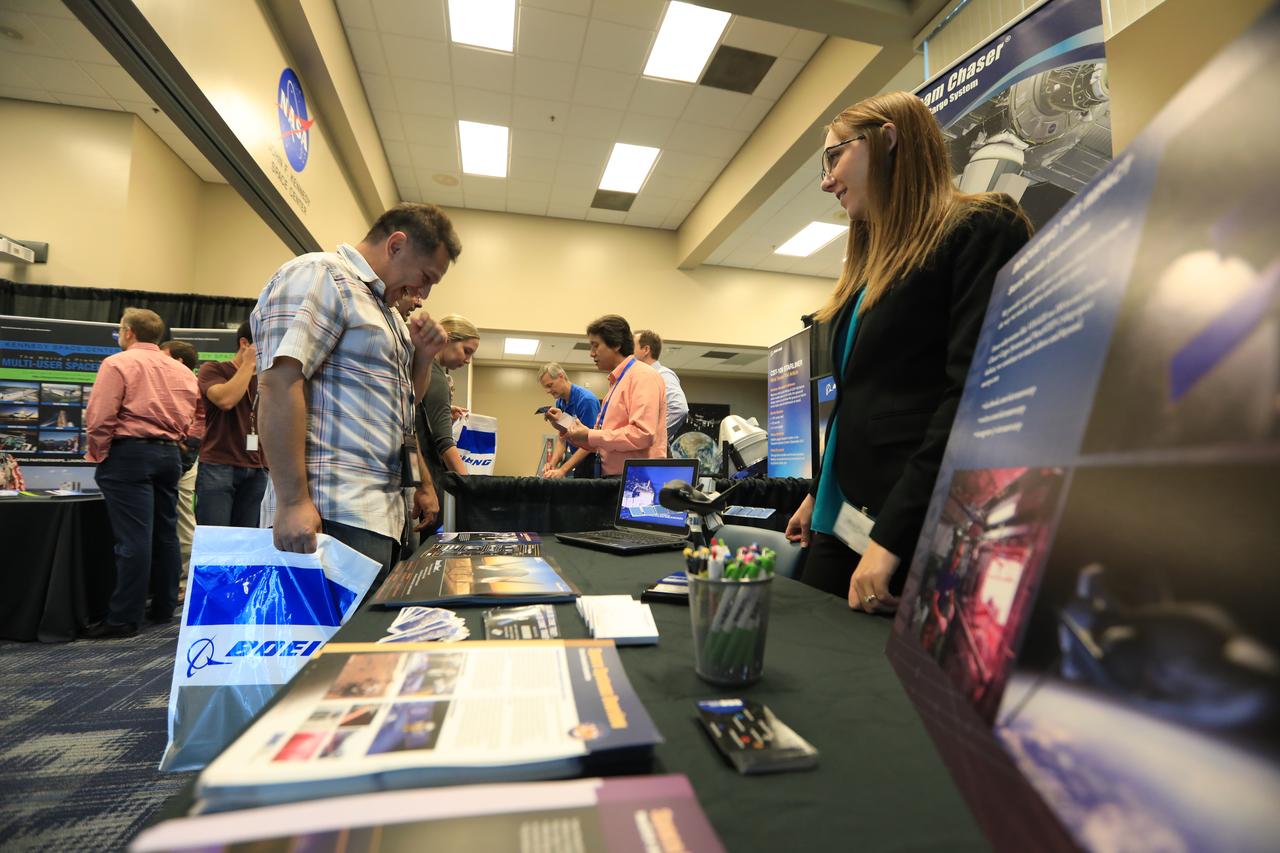
Visitors stop by a NASA booth in the Space Station Processing Facility conference center at NASA's Kennedy Space Center during the 2016 Innovation Expo. Now in its fifth year, the purpose of the Innovation Expo is to help foster innovation and creativity among Kennedy employees who are encouraged to look for ways to do their work better and to propose concepts for tackling future mission needs.
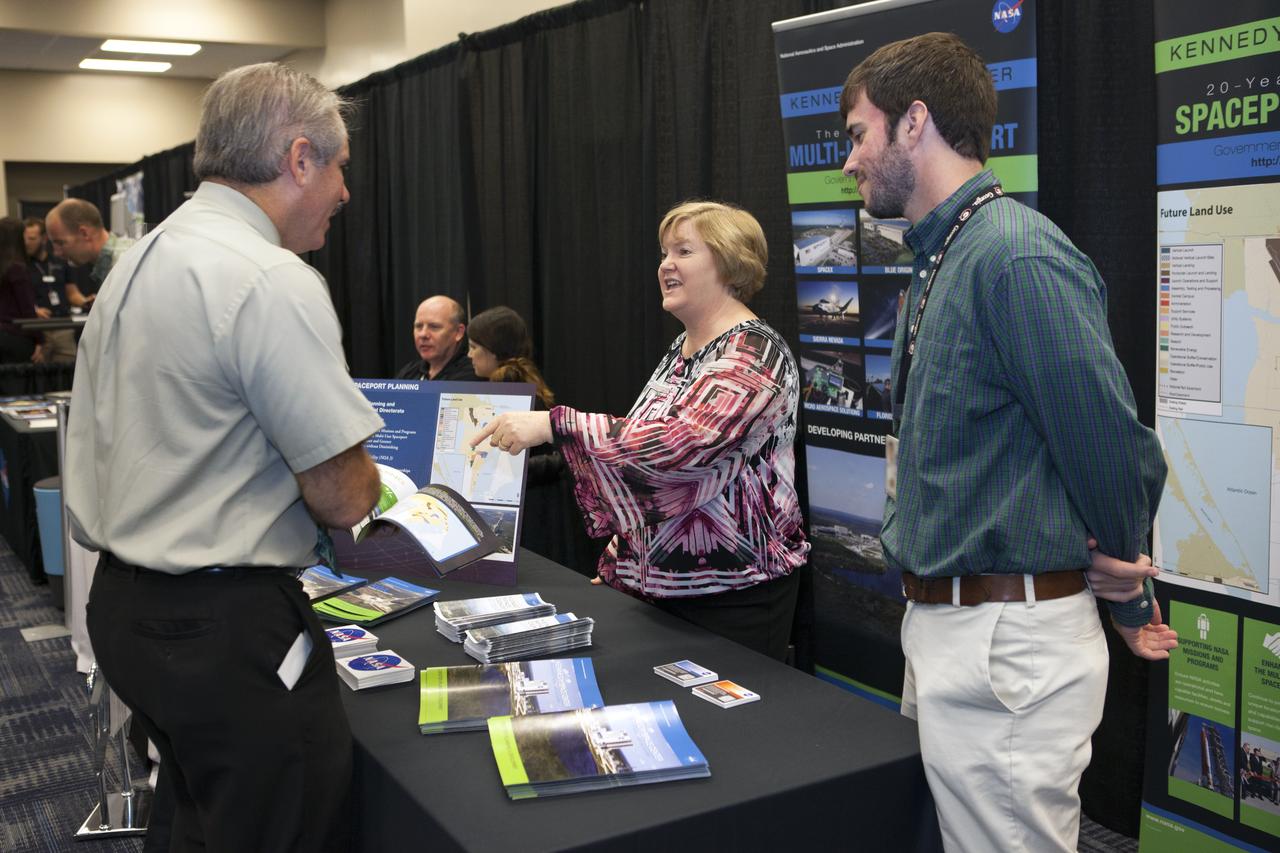
Visitors stop by a NASA booth in the Space Station Processing Facility conference center at NASA's Kennedy Space Center during the 2016 Innovation Expo. Now in its fifth year, the purpose of the Innovation Expo is to help foster innovation and creativity among Kennedy employees who are encouraged to look for ways to do their work better and to propose concepts for tackling future mission needs.
Visitors stop by a NASA booth in the Space Station Processing Facility conference center at NASA's Kennedy Space Center during the 2016 Innovation Expo. Now in its fifth year, the purpose of the Innovation Expo is to help foster innovation and creativity among Kennedy employees who are encouraged to look for ways to do their work better and to propose concepts for tackling future mission needs.
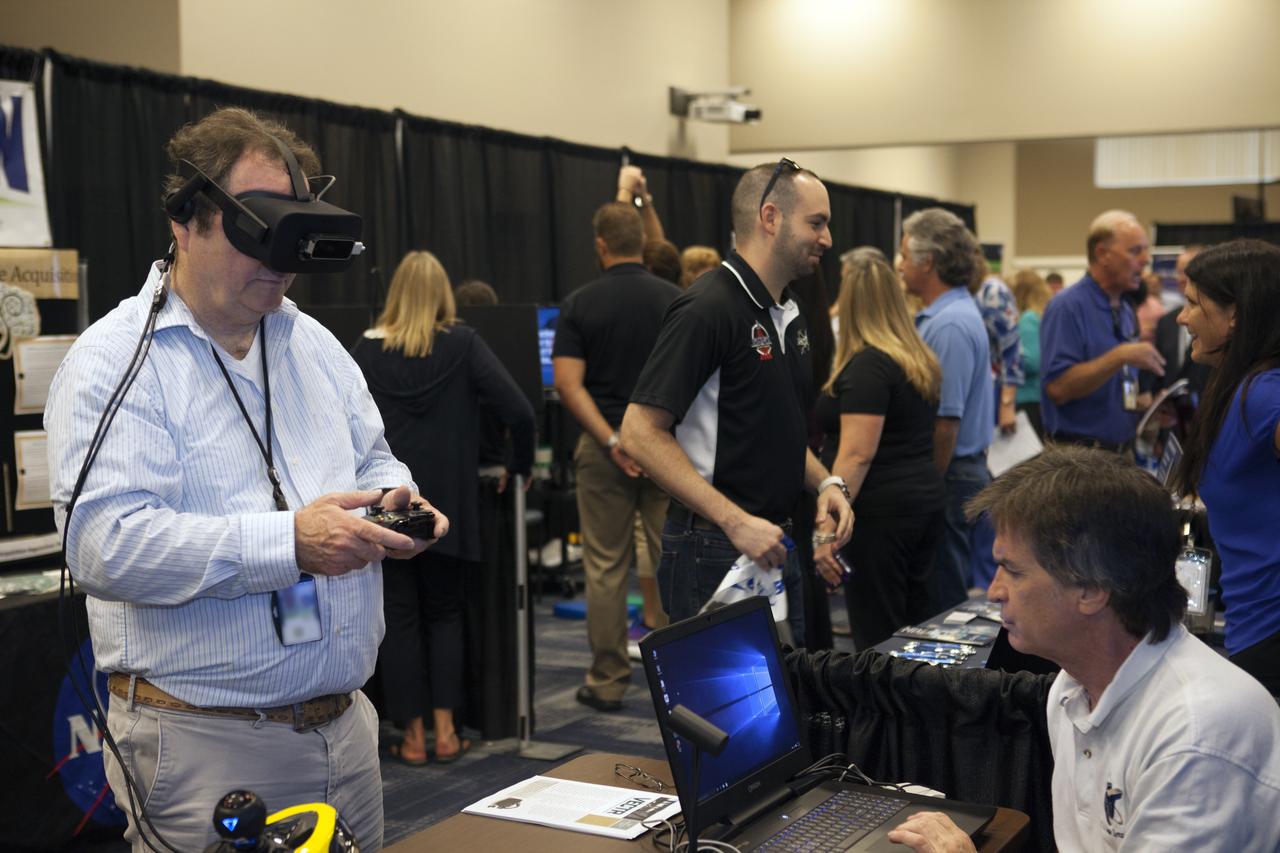
Visitors stop by a NASA booth in the Space Station Processing Facility conference center at NASA's Kennedy Space Center during the 2016 Innovation Expo. Now in its fifth year, the purpose of the Innovation Expo is to help foster innovation and creativity among Kennedy employees who are encouraged to look for ways to do their work better and to propose concepts for tackling future mission needs.
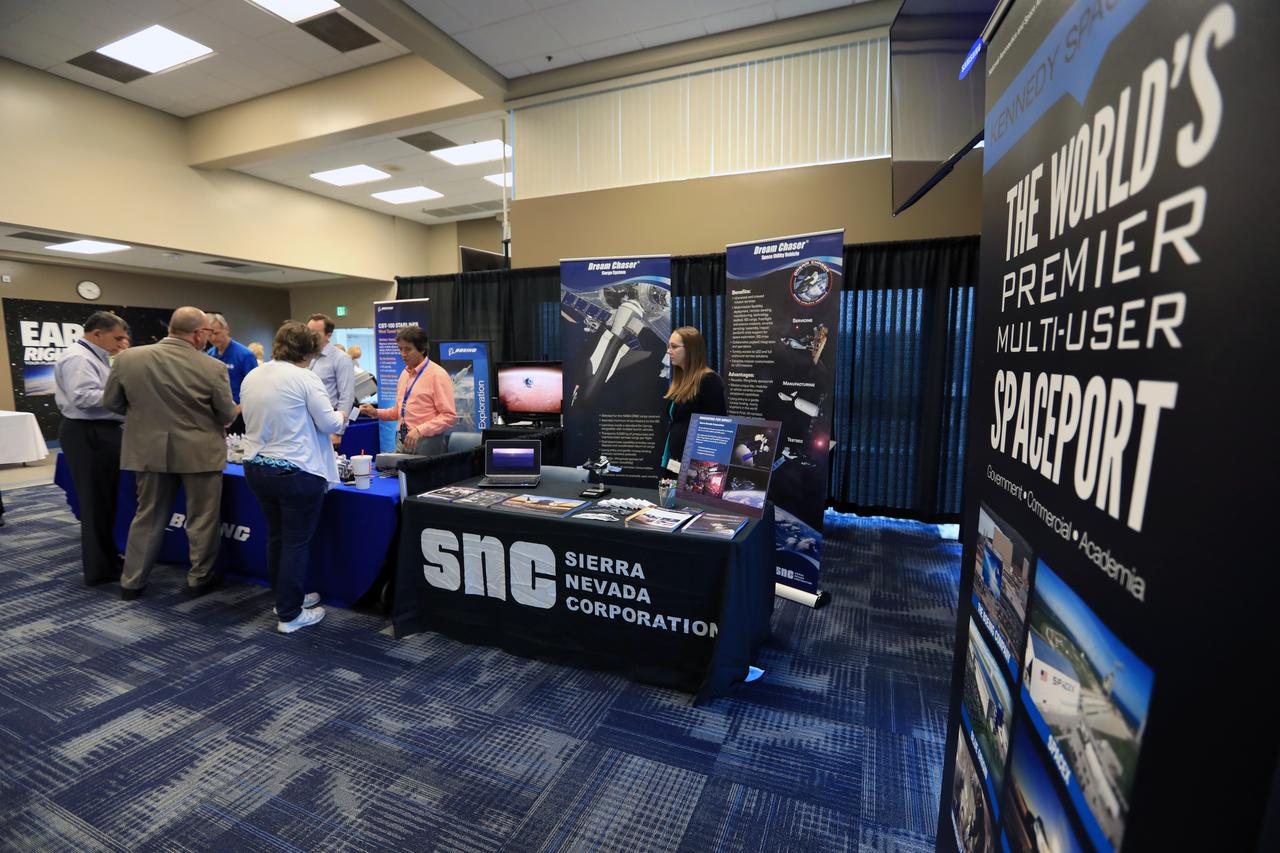
Visitors stop by a NASA booth in the Space Station Processing Facility conference center at NASA's Kennedy Space Center during the 2016 Innovation Expo. Now in its fifth year, the purpose of the Innovation Expo is to help foster innovation and creativity among Kennedy employees who are encouraged to look for ways to do their work better and to propose concepts for tackling future mission needs.

Visitors stop by a NASA booth in the Space Station Processing Facility conference center at NASA's Kennedy Space Center during the 2016 Innovation Expo. Now in its fifth year, the purpose of the Innovation Expo is to help foster innovation and creativity among Kennedy employees who are encouraged to look for ways to do their work better and to propose concepts for tackling future mission needs.
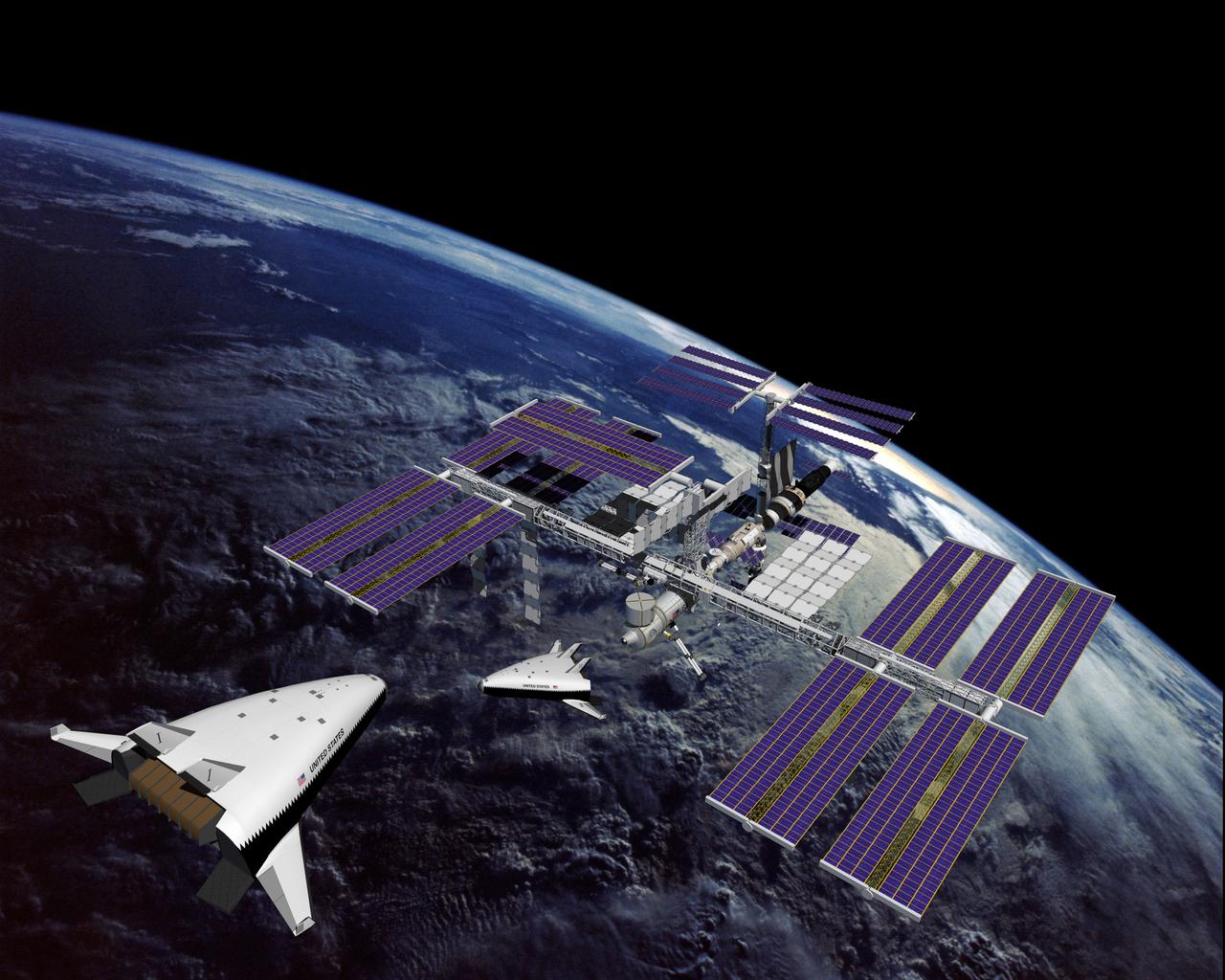
This is an artist's concept of the completely operational International Space Station being approached by an X-33 Reusable Launch Vehicle (RLV). The X-33 program was designed to pave the way to a full-scale, commercially developed RLV as the flagship technology demonstrator for technologies that would lower the cost of access to space. It is unpiloted, taking off vertically like a rocket, reaching an altitude of up to 60 miles and speeds between Mach 13 and 15, and landing horizontally like an airplane. The X-33 program was cancelled in 2001.
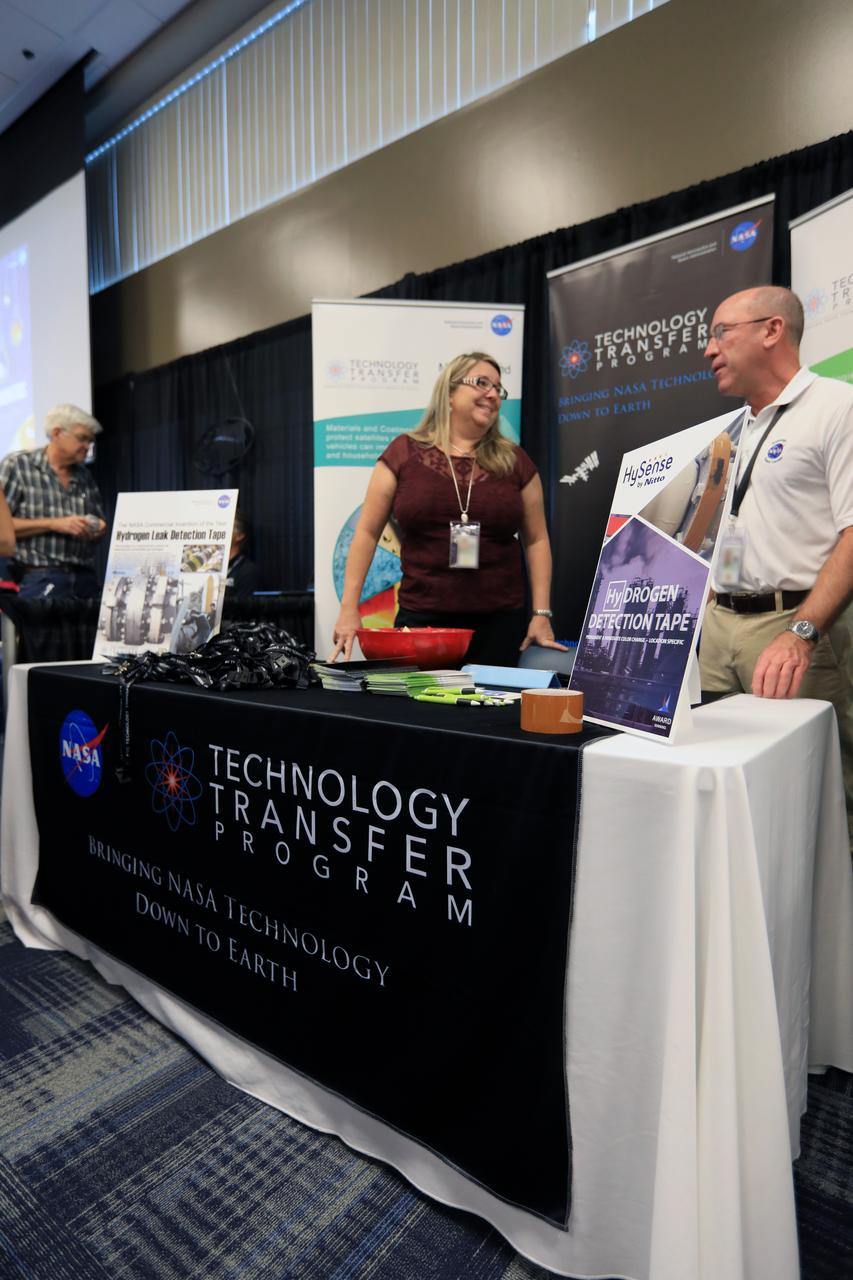
Visitors were recently given an opportunity to stop by a NASA booth in the Space Station Processing Facility conference center at NASA's Kennedy Space Center during the 2016 Innovation Expo. Now in its fifth year, the purpose of the Innovation Expo is to help foster innovation and creativity among Kennedy employees who are encouraged to look for ways to do their work better and to propose concepts for tackling future mission needs.
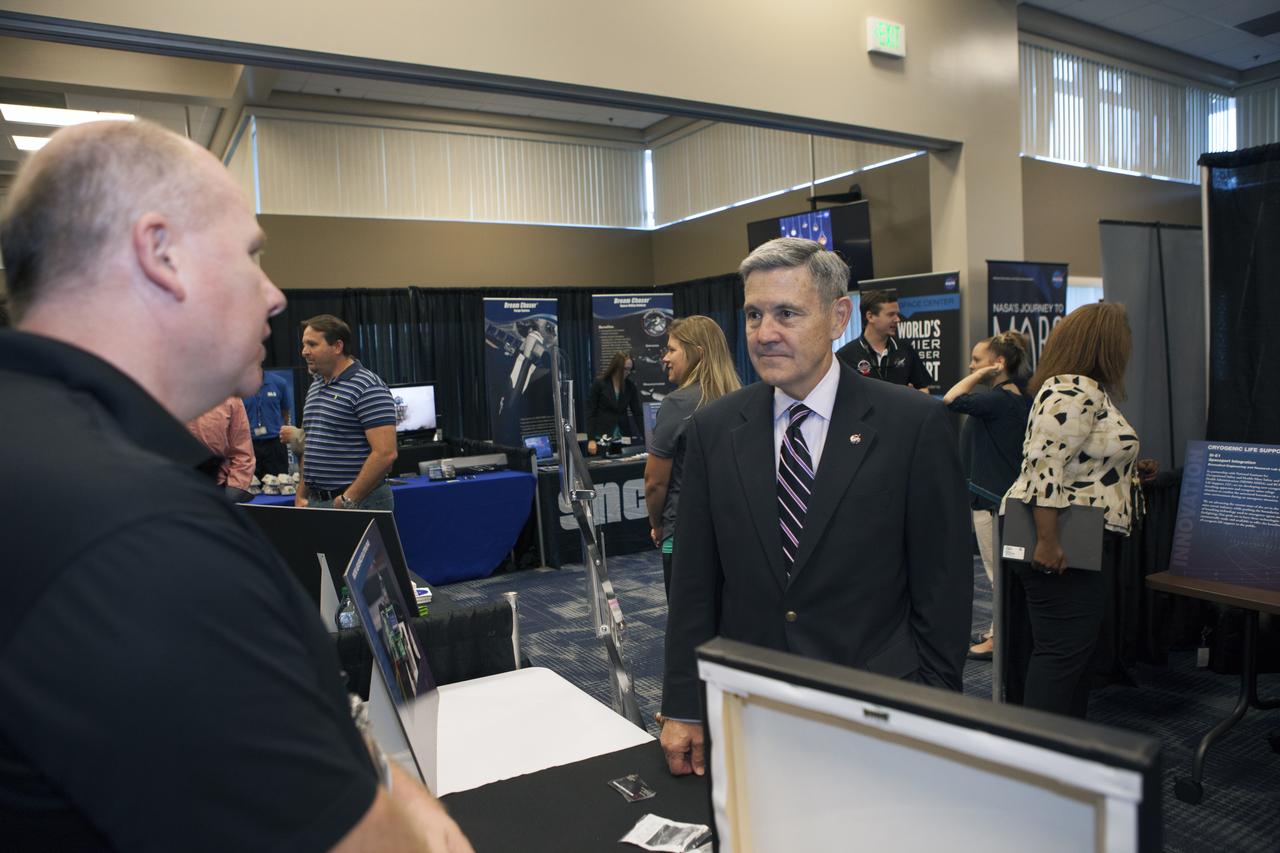
Kennedy Space Center Director Bob Cabana stops by a NASA booth in the Space Station Processing Facility conference center during the 2016 Innovation Expo. Now in its fifth year, the purpose of the Innovation Expo is to help foster innovation and creativity among Kennedy employees who are encouraged to look for ways to do their work better and to propose concepts for tackling future mission needs.
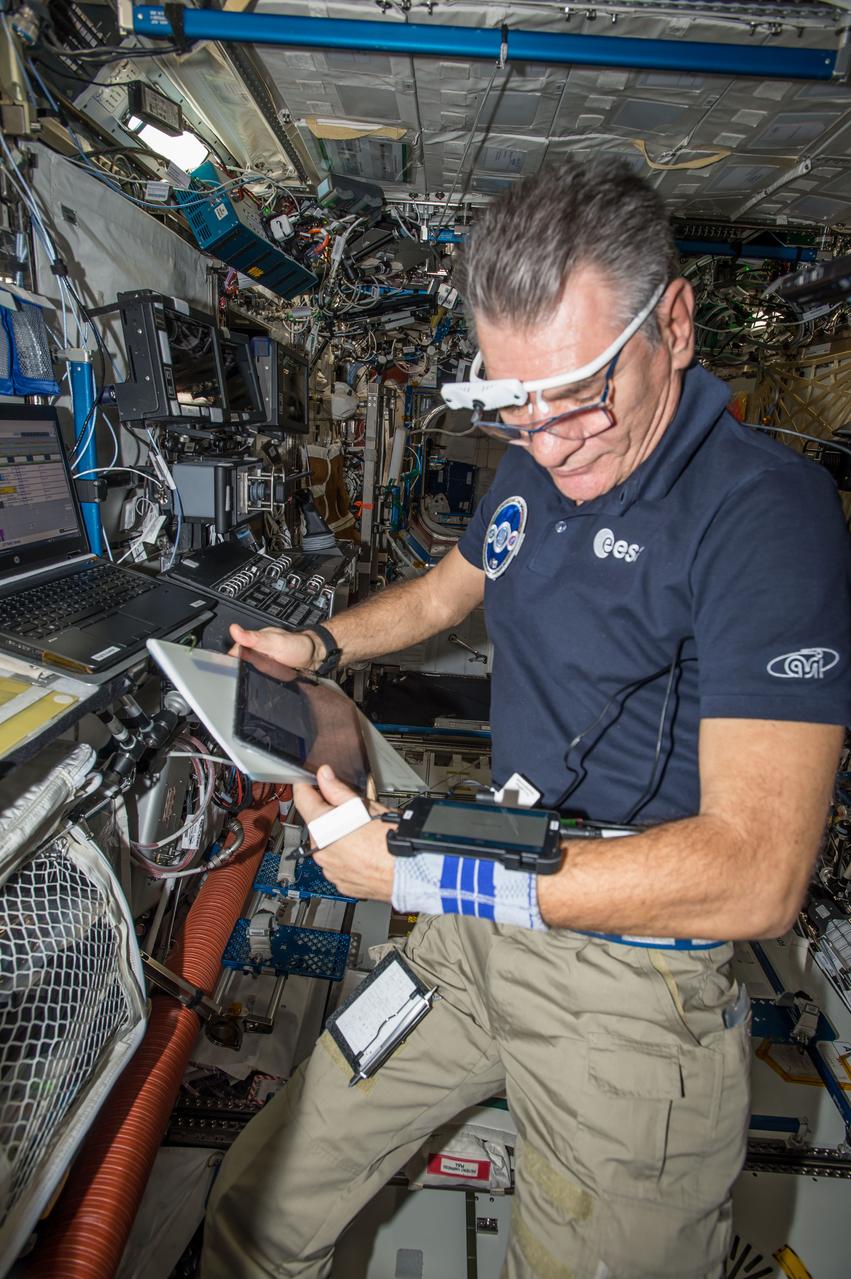
iss053e061054 (9/29/2017) --- European Space Agency (ESA) astronaut Paolo Nespoli, setting up the Mobile Procedure Viewer (MobiPV), in the U.S. Laboratory aboard the International Space Station (ISS). The Mobile Procedure Viewer (mobiPV) experiment demonstrates new technologies and operations concepts for ISS crew procedure execution as task support, both for on board crew, and for the supporting ground expert team.
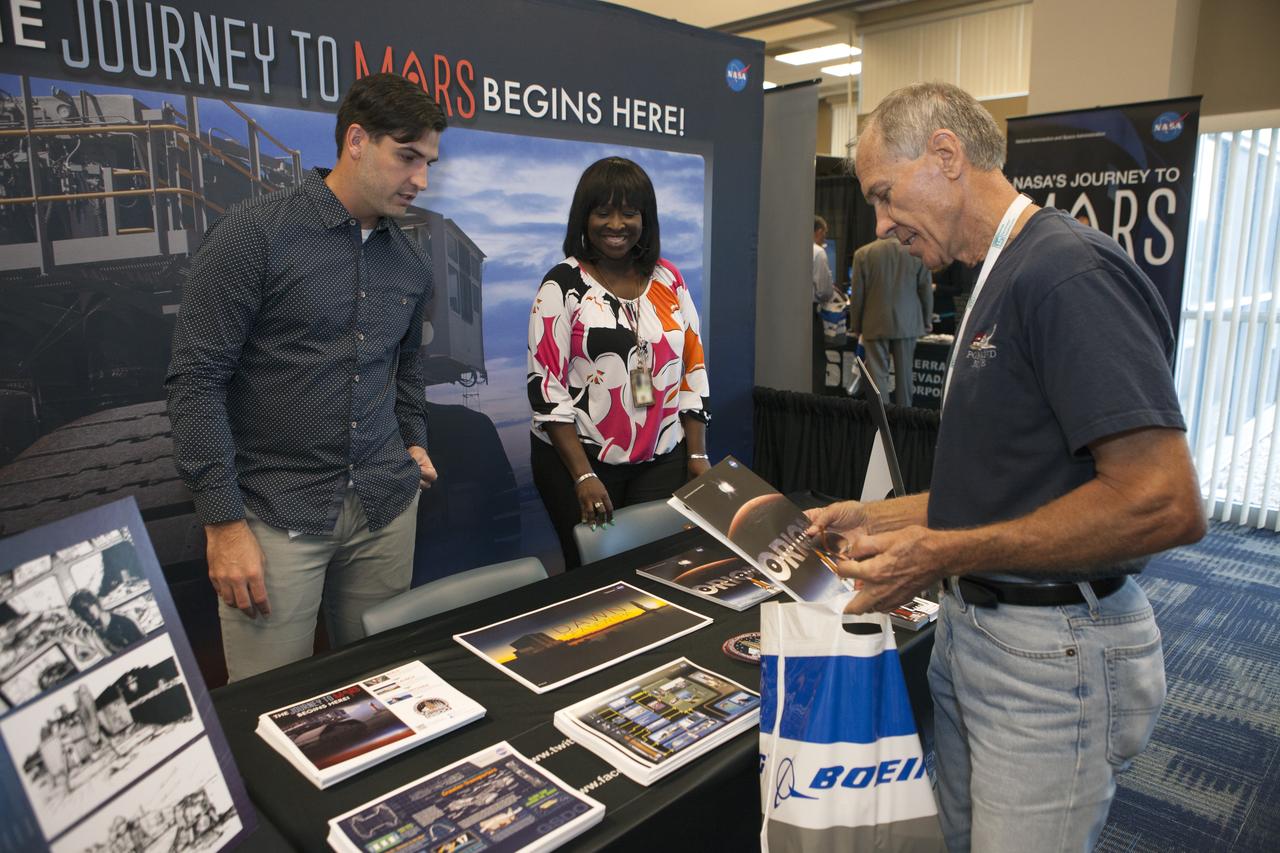
Visitors stop by a NASA booth in the Space Station Processing Facility conference center at NASA's Kennedy Space Center during the 2016 Innovation Expo. Now in its fifth year, the purpose of the Innovation Expo is to help foster innovation and creativity among Kennedy employees who are encouraged to look for ways to do their work better and to propose concepts for tackling future mission needs.
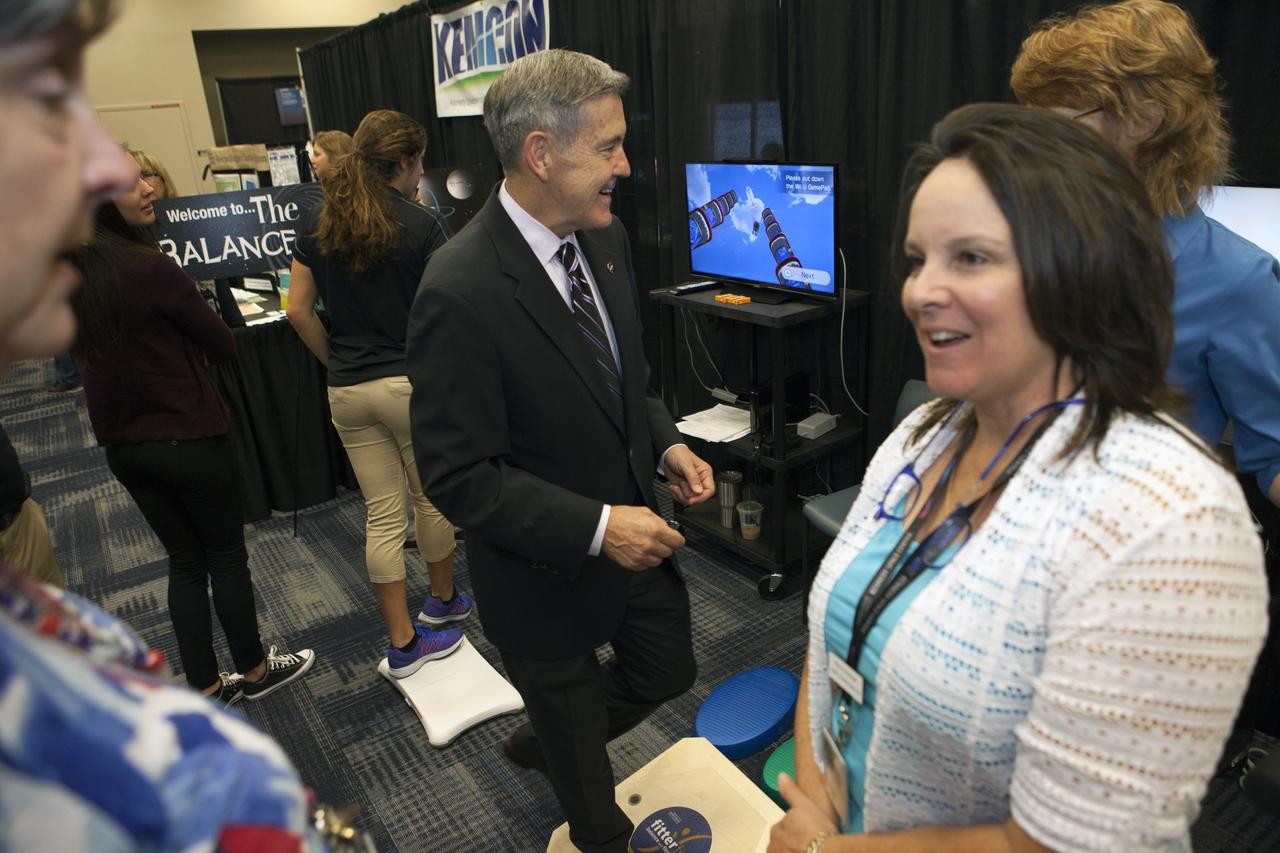
Kennedy Space Center Director Bob Cabana stops by a NASA booth in the Space Station Processing Facility conference center during the 2016 Innovation Expo. Now in its fifth year, the purpose of the Innovation Expo is to help foster innovation and creativity among Kennedy employees who are encouraged to look for ways to do their work better and to propose concepts for tackling future mission needs.
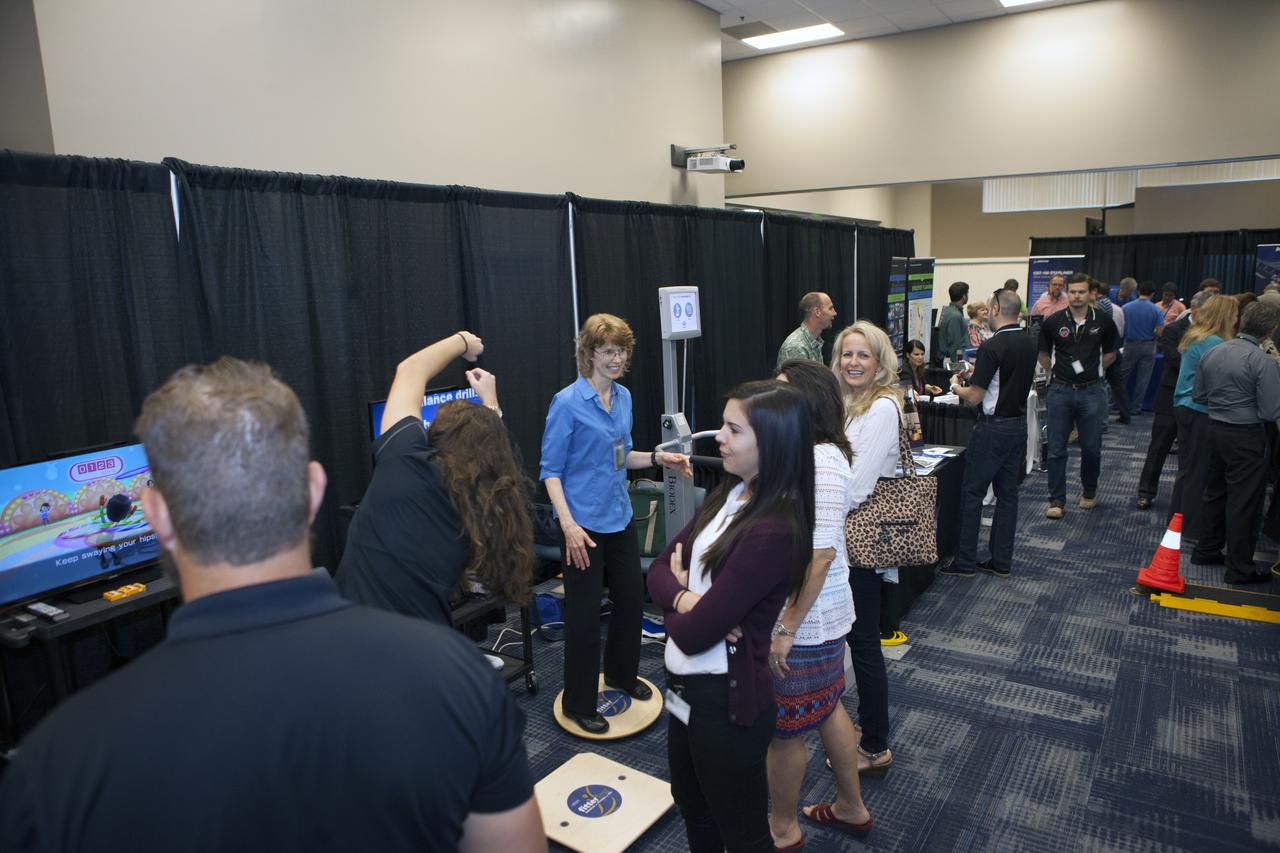
Visitors stop by a NASA booth in the Space Station Processing Facility conference center at NASA's Kennedy Space Center during the 2016 Innovation Expo. Now in its fifth year, the purpose of the Innovation Expo is to help foster innovation and creativity among Kennedy employees who are encouraged to look for ways to do their work better and to propose concepts for tackling future mission needs.
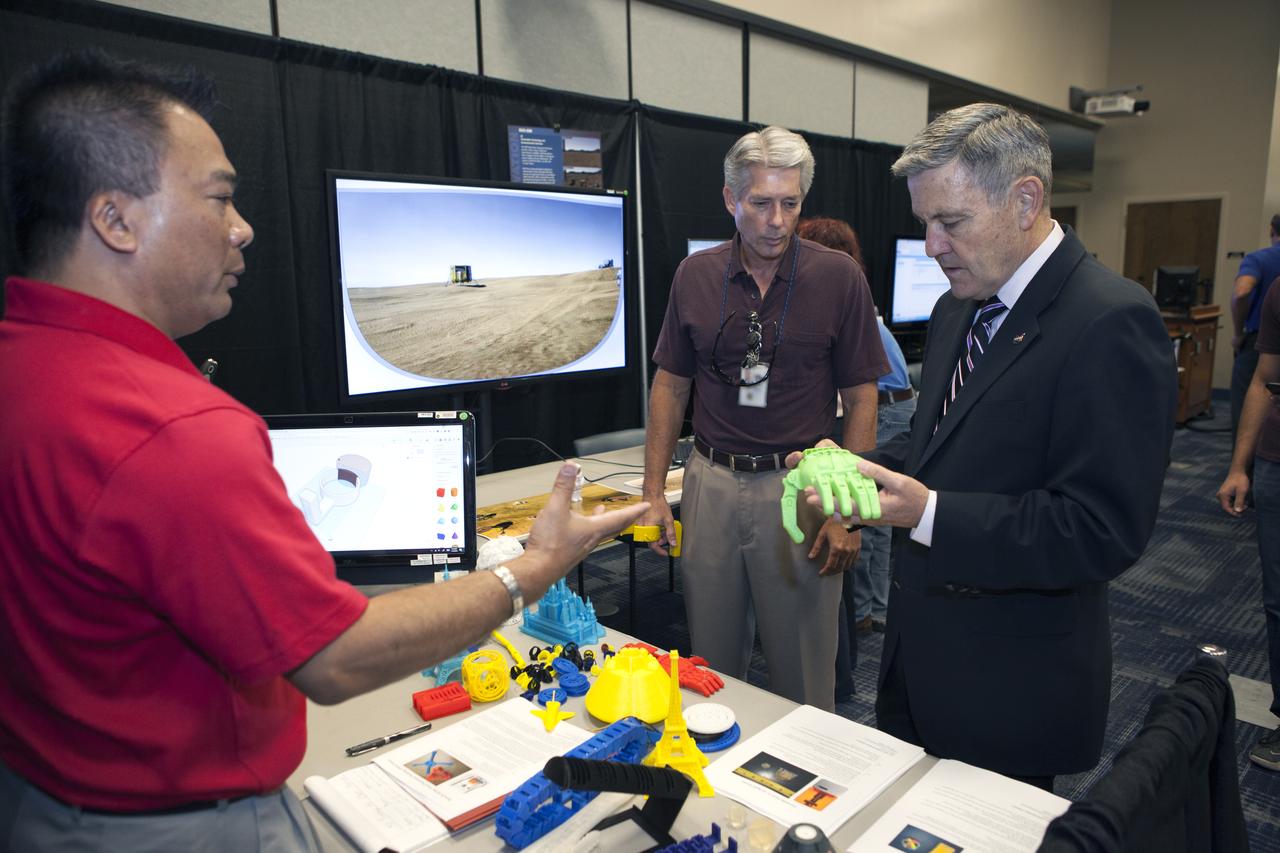
Kennedy Space Center Director Bob Cabana stops by a NASA booth in the Space Station Processing Facility conference center during the 2016 Innovation Expo. Now in its fifth year, the purpose of the Innovation Expo is to help foster innovation and creativity among Kennedy employees who are encouraged to look for ways to do their work better and to propose concepts for tackling future mission needs.
Kennedy Space Center Director Bob Cabana stops by a NASA booth in the Space Station Processing Facility conference center during the 2016 Innovation Expo. Now in its fifth year, the purpose of the Innovation Expo is to help foster innovation and creativity among Kennedy employees who are encouraged to look for ways to do their work better and to propose concepts for tackling future mission needs.
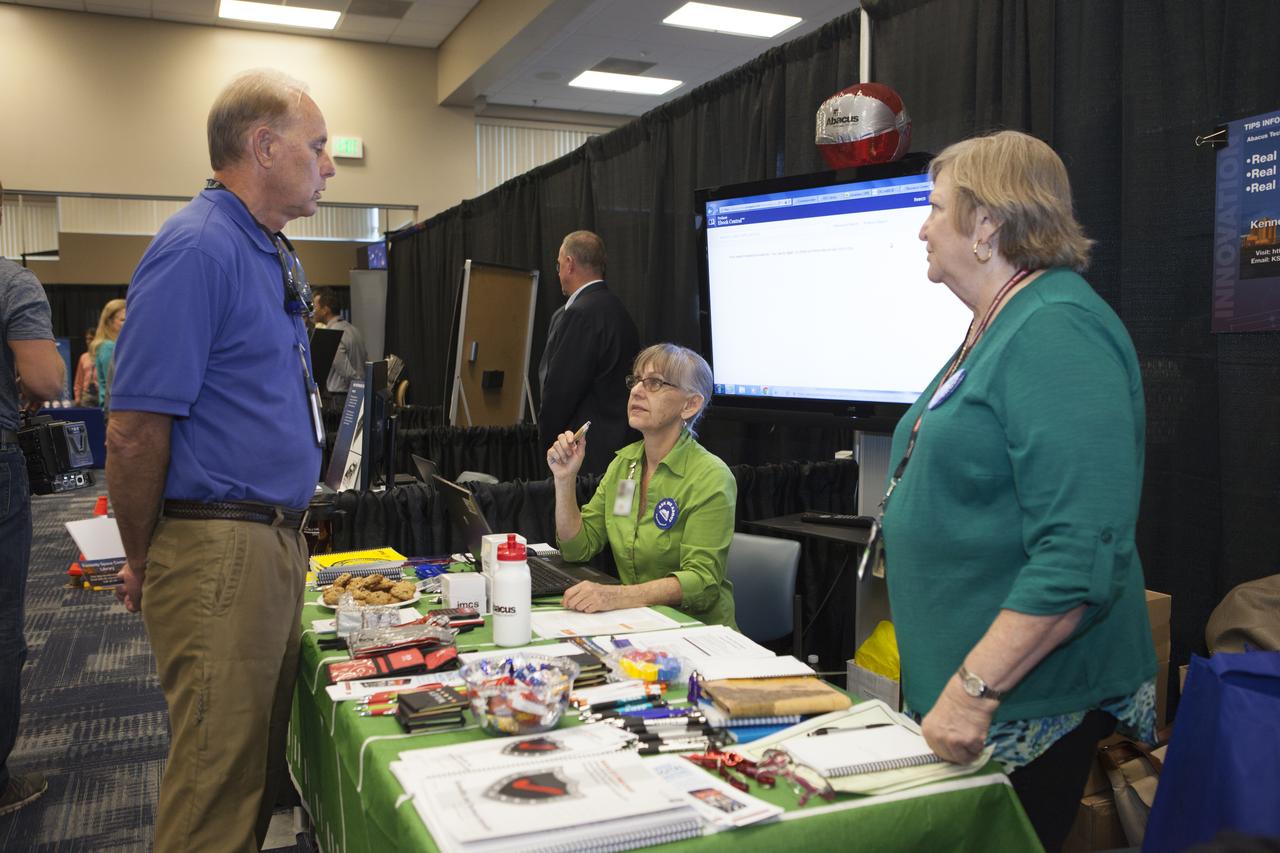
Visitors stop by a NASA booth in the Space Station Processing Facility conference center at NASA's Kennedy Space Center during the 2016 Innovation Expo. Now in its fifth year, the purpose of the Innovation Expo is to help foster innovation and creativity among Kennedy employees who are encouraged to look for ways to do their work better and to propose concepts for tackling future mission needs.
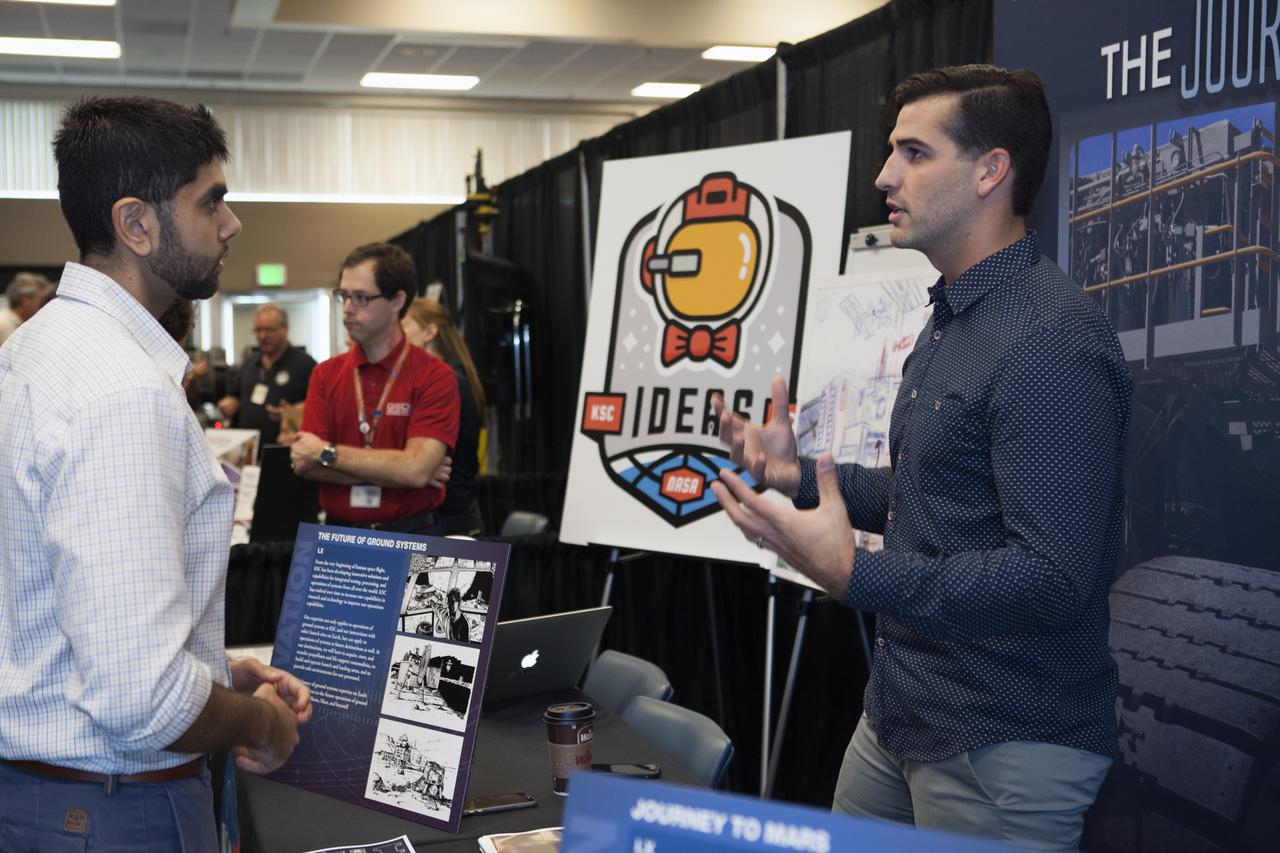
Visitors stop by a NASA booth in the Space Station Processing Facility conference center at NASA's Kennedy Space Center during the 2016 Innovation Expo. Now in its fifth year, the purpose of the Innovation Expo is to help foster innovation and creativity among Kennedy employees who are encouraged to look for ways to do their work better and to propose concepts for tackling future mission needs.
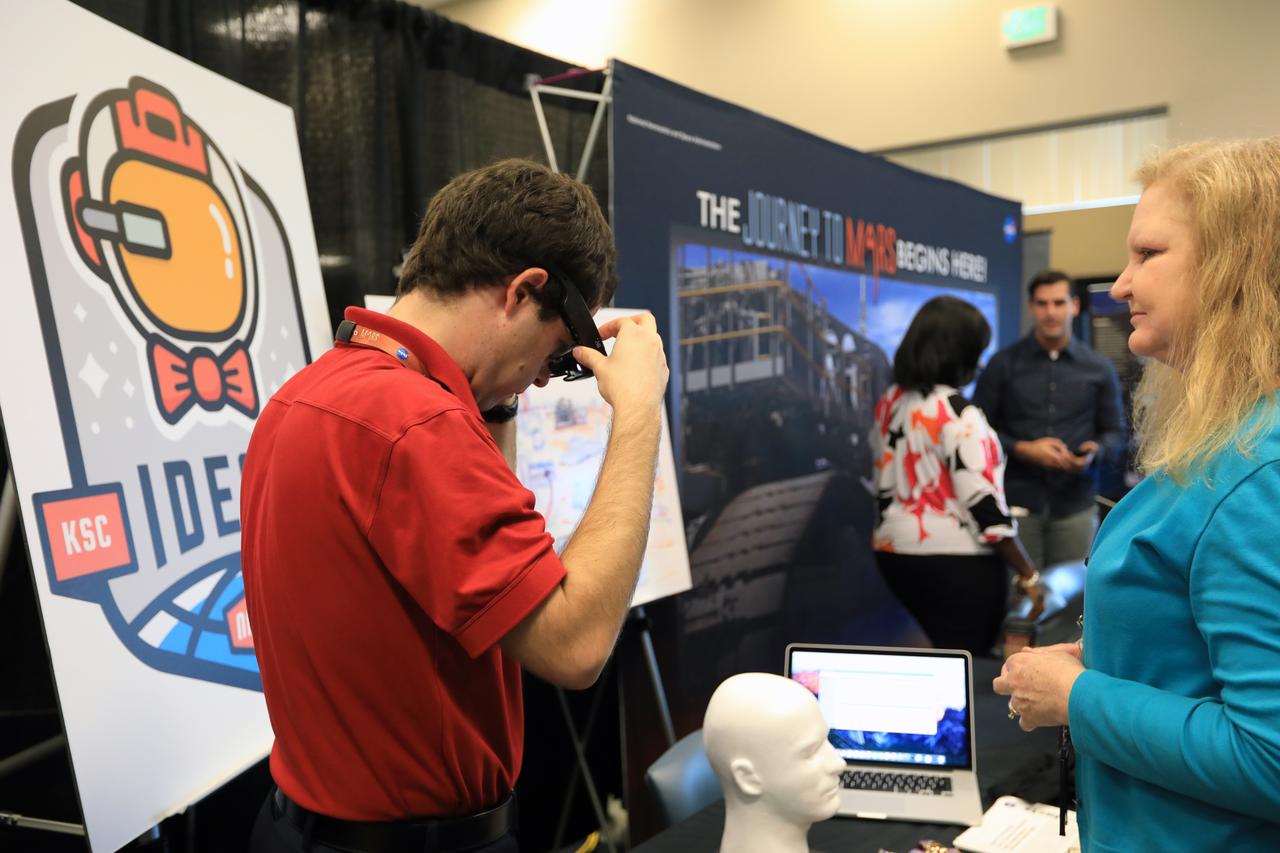
Kennedy Space Center Director Bob Cabana stops by a NASA booth in the Space Station Processing Facility conference center during the 2016 Innovation Expo. Now in its fifth year, the purpose of the Innovation Expo is to help foster innovation and creativity among Kennedy employees who are encouraged to look for ways to do their work better and to propose concepts for tackling future mission needs.
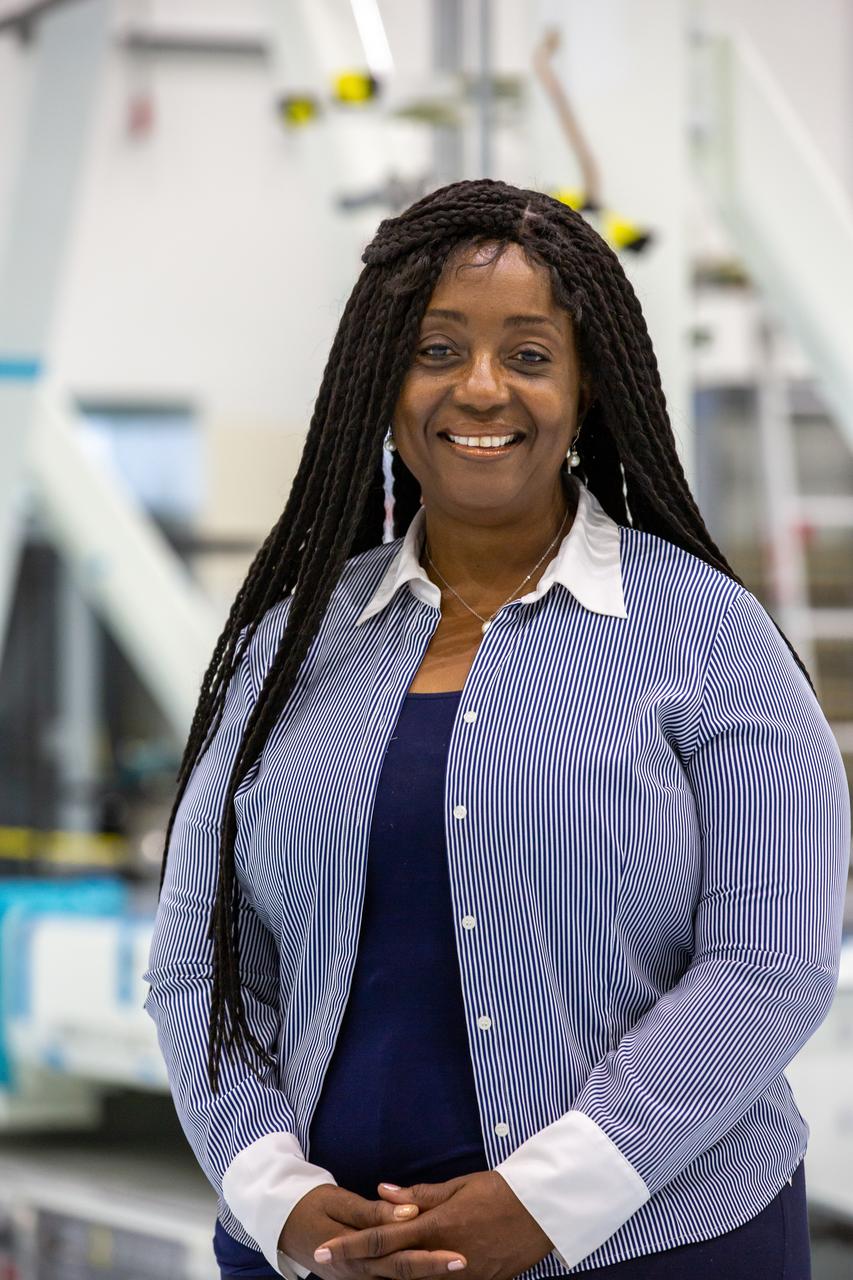
Barbara L. Brown, director of Exploration Research and Technology Programs at NASA's Kennedy Space Center in Florida, poses for a portrait inside the spaceport’s Space Station Processing Facility High Bay on Aug. 5, 2022. Brown leads processing, assembly, integration, and test of payloads and flight science experiments bound for the International Space Station. Additionally, Brown serves as Kennedy’s lead for the formulation of concepts to support uncrewed operations on the Moon and Mars, directing research, development, testing, and demonstration of flight systems and technologies to advance exploration and space systems. The programs and projects under her purview span NASA’s Exploration Systems, Science, Space Operations, and Space Technology mission directorates.

This artist's concept depicts the completely assembled International Space Station (ISS) passing over Florida and the Bahamas. As a gateway to permanent human presence in space, the Space Station Program is to expand knowledge benefiting all people and nations. The ISS is a multidisciplinary laboratory, technology test bed, and observatory that will provide unprecedented undertakings in scientific, technological, and international experimentation. Experiments to be conducted in the ISS include: microgravity research, Earth science, space science, life sciences, space product development, and engineering research and technology. The sixteen countries participating in the ISS are: United States, Russian Federation, Canada, Japan, United Kingdom, Germany, Italy, France, Norway, Netherlands, Belgium, Spain, Denmark, Sweden, Switzerland, and Brazil.

This artist's digital concept depicts the completely assembled International Space Station (ISS) passing over Florida. As a gateway to permanent human presence in space, the Space Station Program is to expand knowledge benefiting all people and nations. The ISS is a multidisciplinary laboratory, technology test bed, and observatory that will provide unprecedented undertakings in scientific, technological, and international experimentation. Experiments to be conducted in the ISS include: microgravity research, Earth science, space science, life sciences, space product development, and engineering research and technology. The sixteen countries participating the ISS are: United States, Russian Federation, Canada, Japan, United Kingdom, Germany, Italy, France, Norway, Netherlands, Belgium, Spain, Denmark, Sweden, Switzerland, and Brazil.
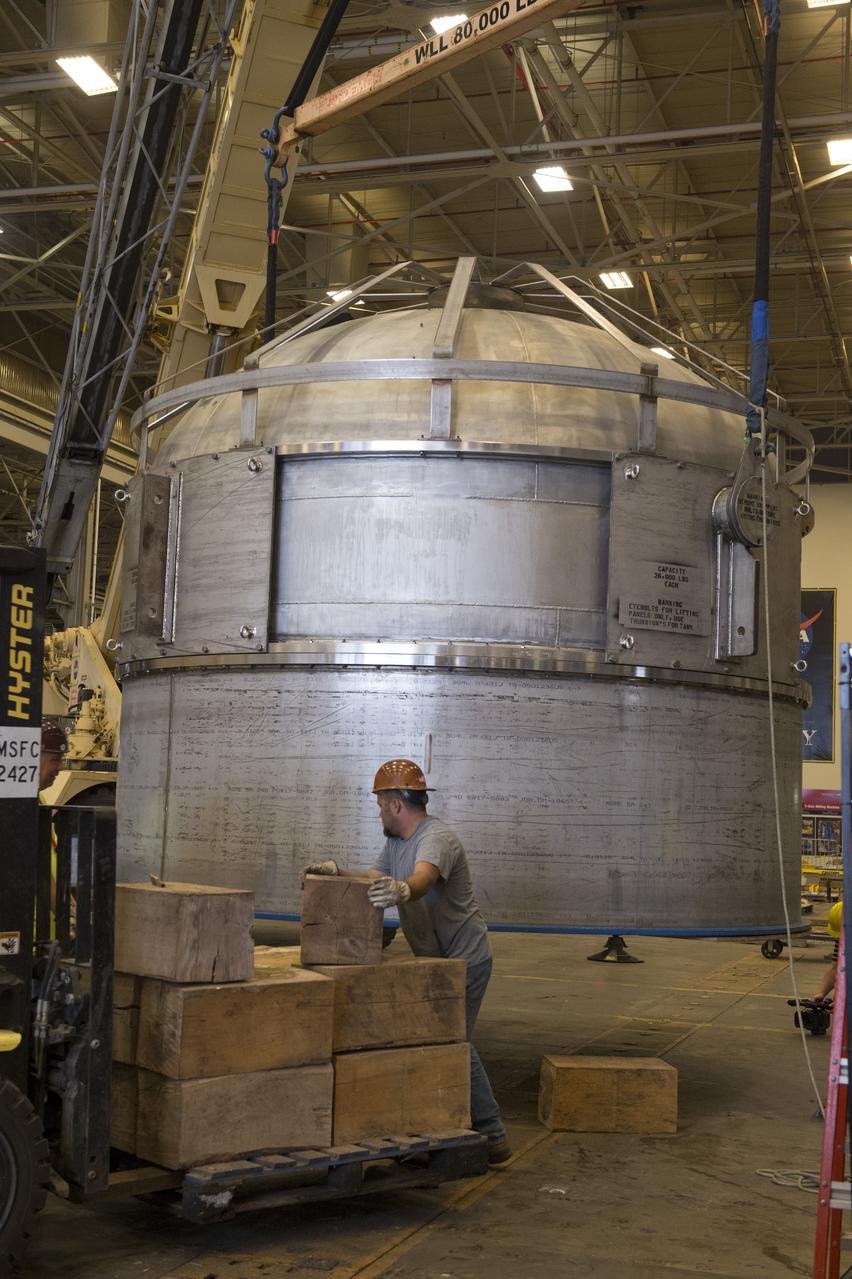
SHIIVER (Structural Heat Intercept Insulation Vibration Evaluation Rig) is a cryogenic test tank developed to evaluate heat intercept concepts. It arrived at Marshall Space Flight Center on August 10, 2017. The tank will receive heat sensors and spray-on foam insulation before making its way to Plum Brook station for further insulation and testing.
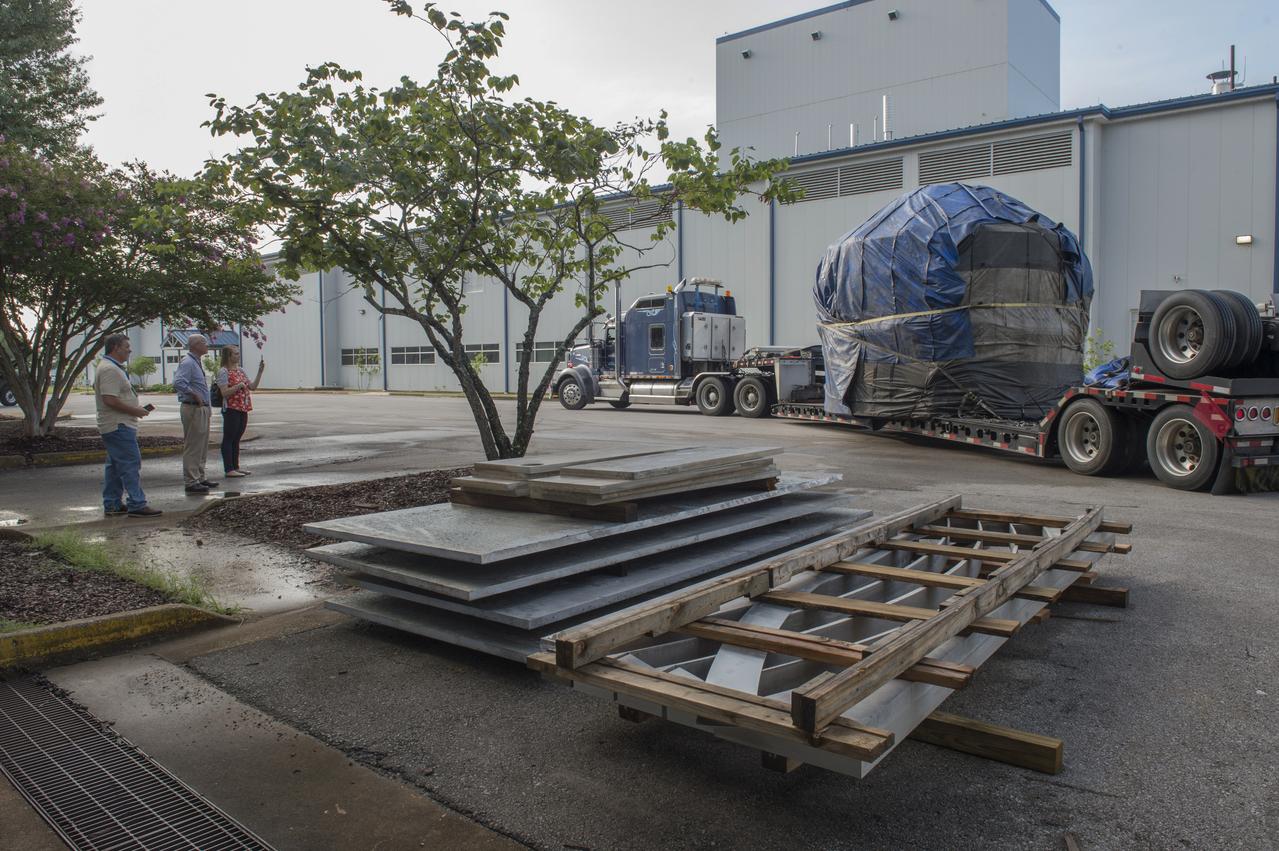
SHIIVER (Structural Heat Intercept Insulation Vibration Evaluation Rig) is a cryogenic test tank developed to evaluate heat intercept concepts. It arrived at Marshall Space Flight Center on August 10, 2017. The tank will receive heat sensors and spray-on foam insulation before making its way to Plum Brook station for further insulation and testing.
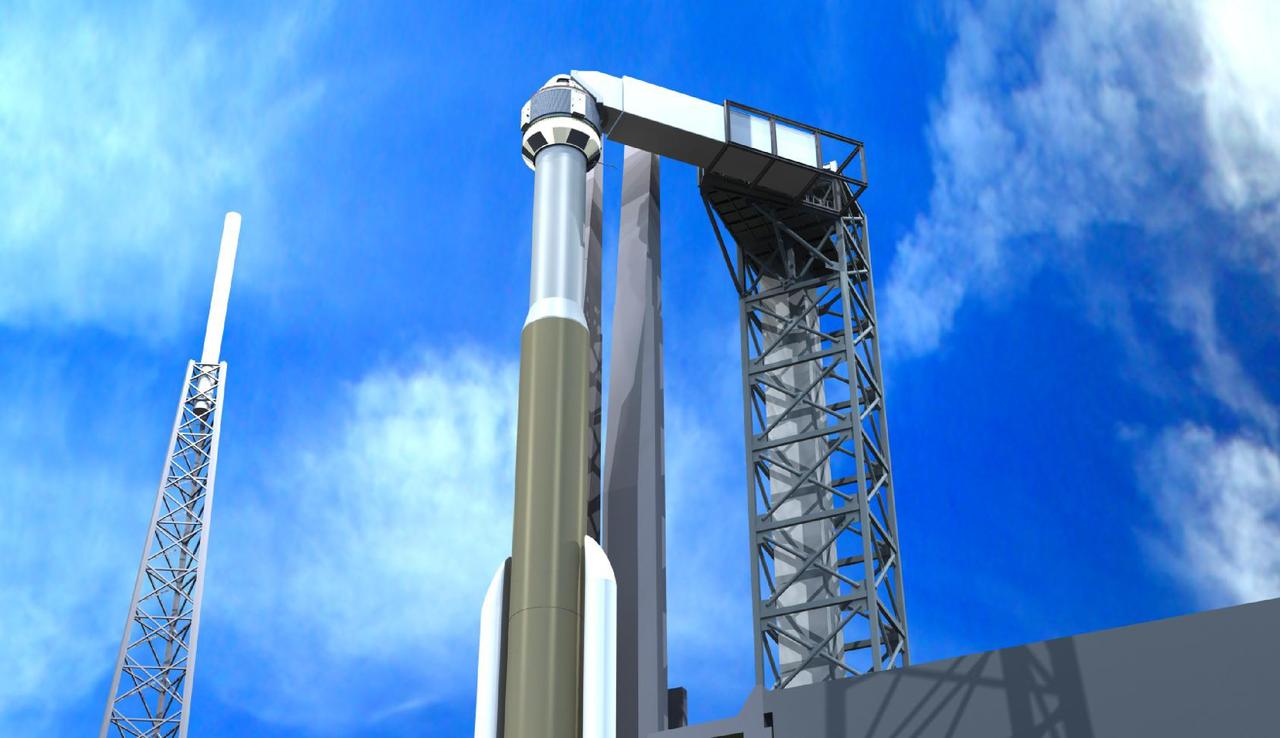
CAPE CANAVERAL, Fla. -- This is an artist's concept of The Boeing Company's CST-100 spacecraft and United Launch Alliance, or ULA, Atlas V rocket at Space Launch Complex 41 on Cape Canaveral Air Force Station in Florida. The integrated system is being developed in collaboration with NASA's Commercial Crew Program during the Commercial Crew Integrated Capability, or CCiCap, initiative. Image credit: Boeing
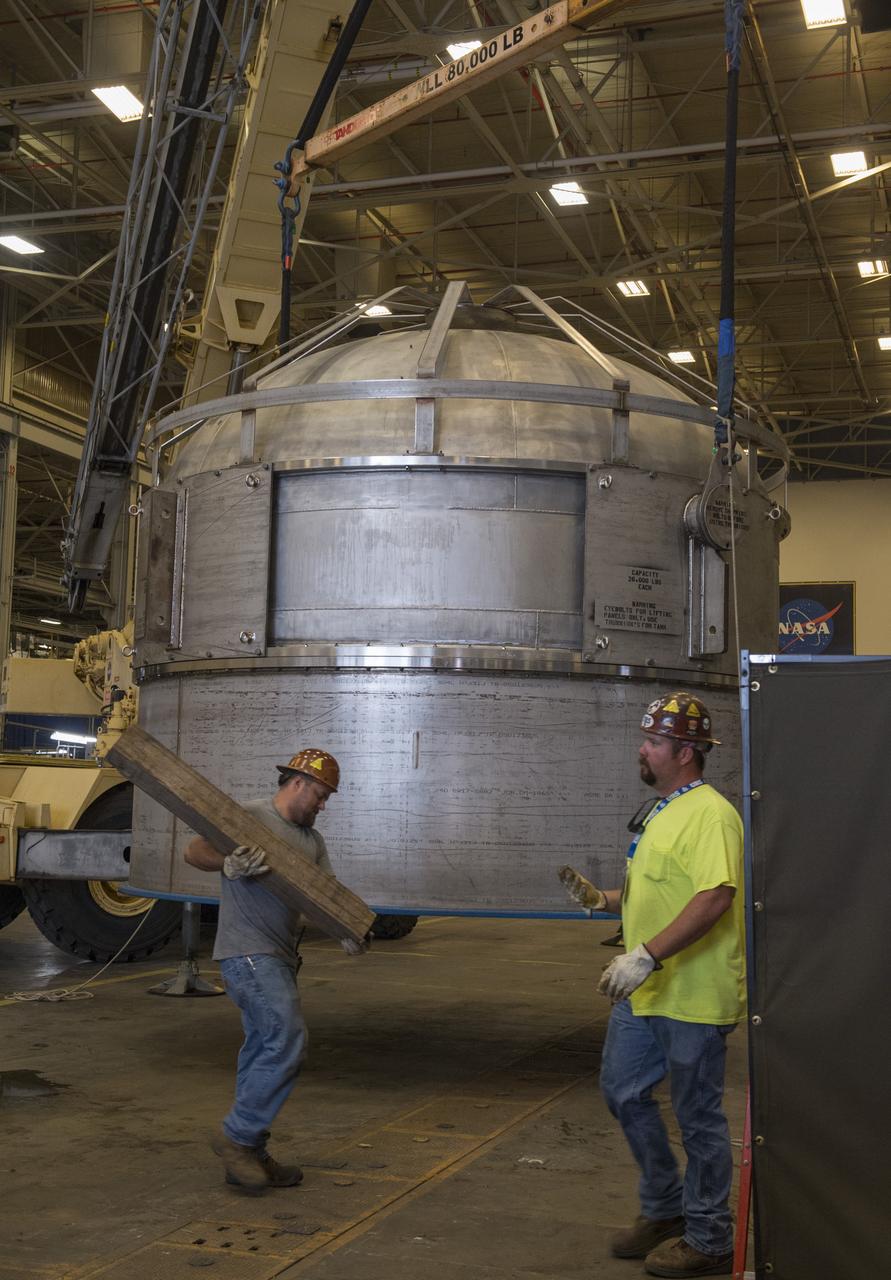
SHIIVER (Structural Heat Intercept Insulation Vibration Evaluation Rig) is a cryogenic test tank developed to evaluate heat intercept concepts. It arrived at Marshall Space Flight Center on August 10, 2017. The tank will receive heat sensors and spray-on foam insulation before making its way to Plum Brook station for further insulation and testing.
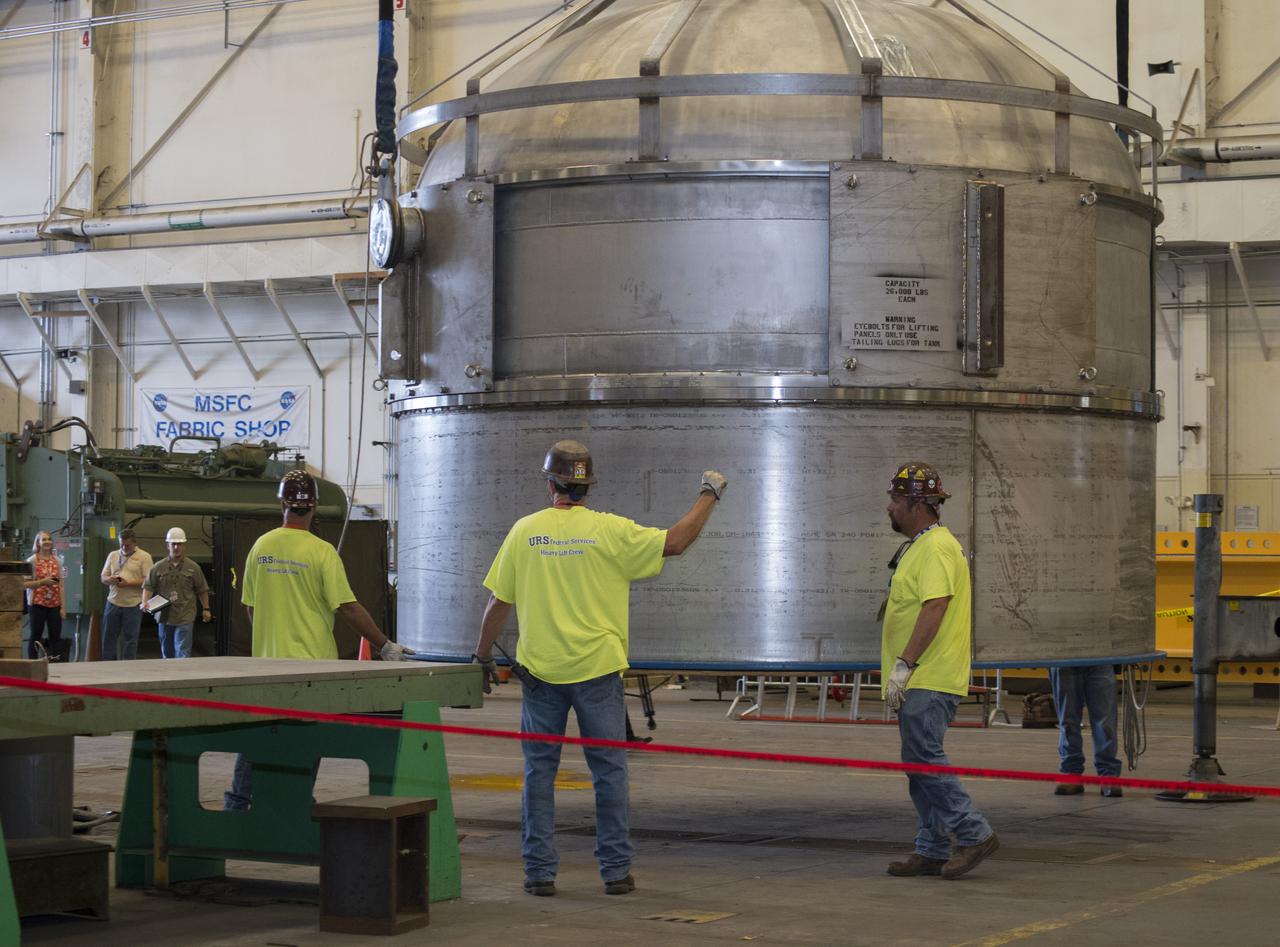
SHIIVER (Structural Heat Intercept Insulation Vibration Evaluation Rig) is a cryogenic test tank developed to evaluate heat intercept concepts. It arrived at Marshall Space Flight Center on August 10, 2017. The tank will receive heat sensors and spray-on foam insulation before making its way to Plum Brook station for further insulation and testing.
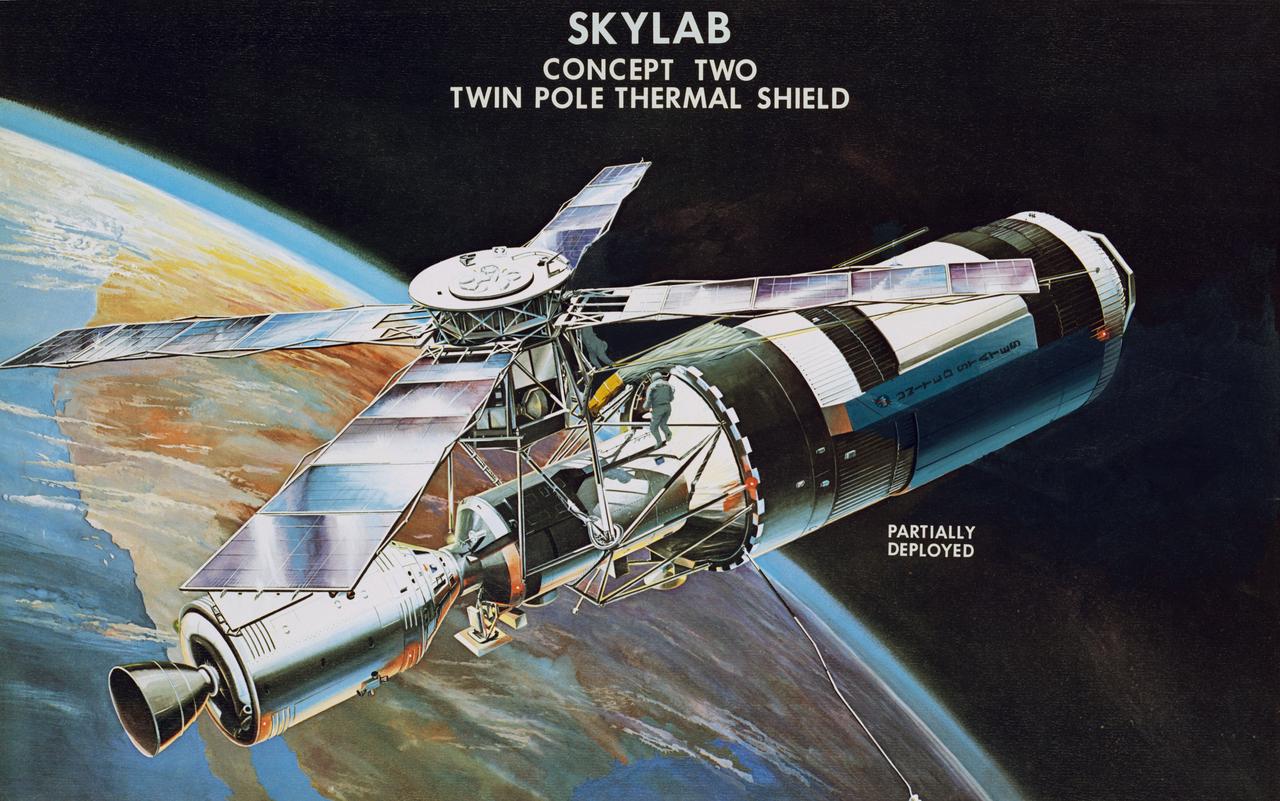
S73-26128 (1973) --- An artist's concept of the Skylab space station cluster in Earth orbit illustrating the deployment of the twin pole thermal shield to shade the Orbital Workshop (OWS) from the sun. This is one of the sunshade possibilities considered to solve the problem of the overheated OWS. In this view the Skylab astronauts have partially deployed the sunshade. Photo credit: NASA
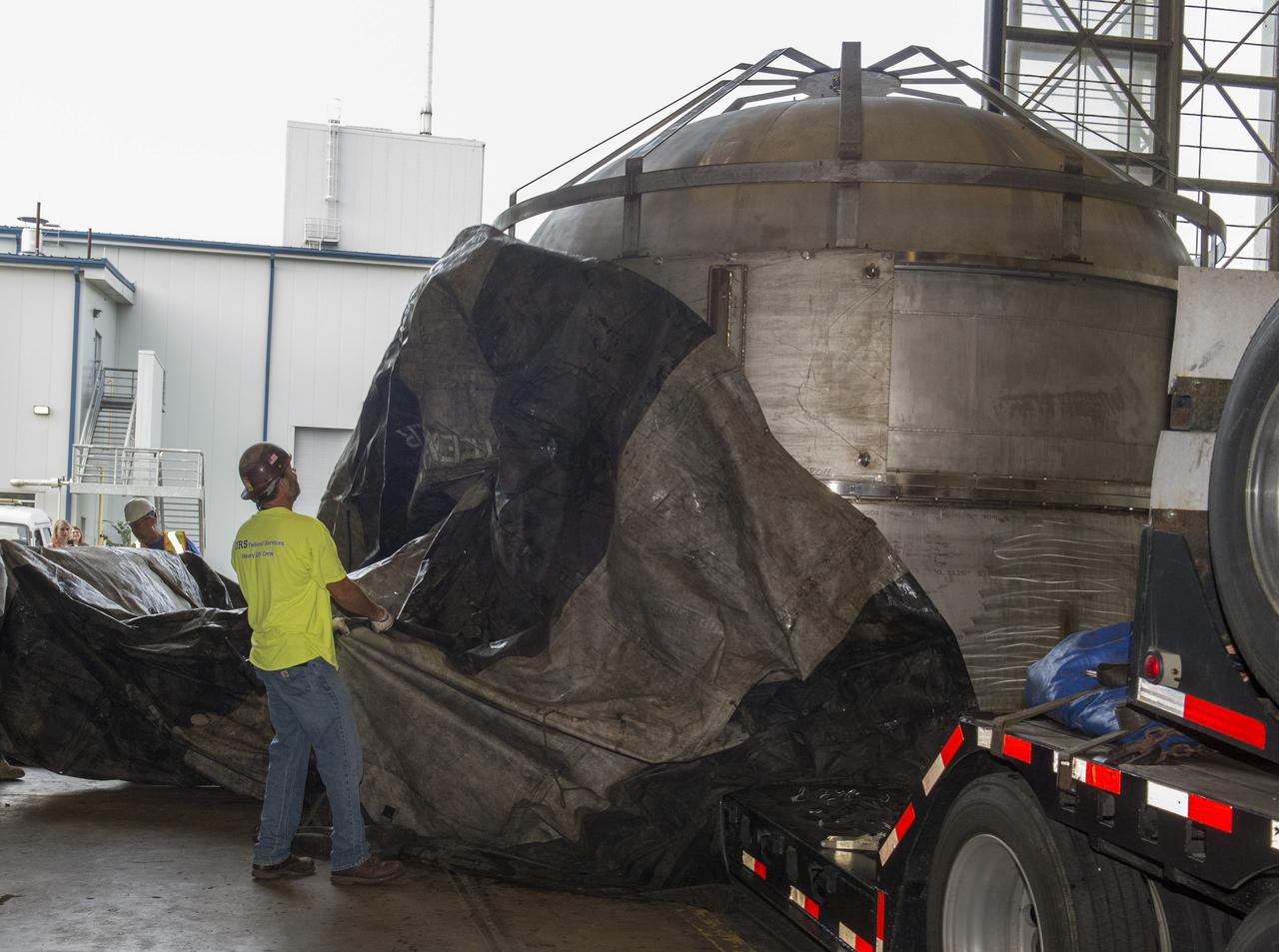
SHIIVER Tank Arrives at NASA’s Marshall Center for Spray-On Foam InsulationSHIIVER (Structural Heat Intercept Insulation Vibration Evaluation Rig) is a cryogenic test tank developed to evaluate heat intercept concepts. It arrived at Marshall Space Flight Center on August 10, 2017. The tank will receive heat sensors and spray-on foam insulation before making its way to Plum Brook station for further insulation and testing.
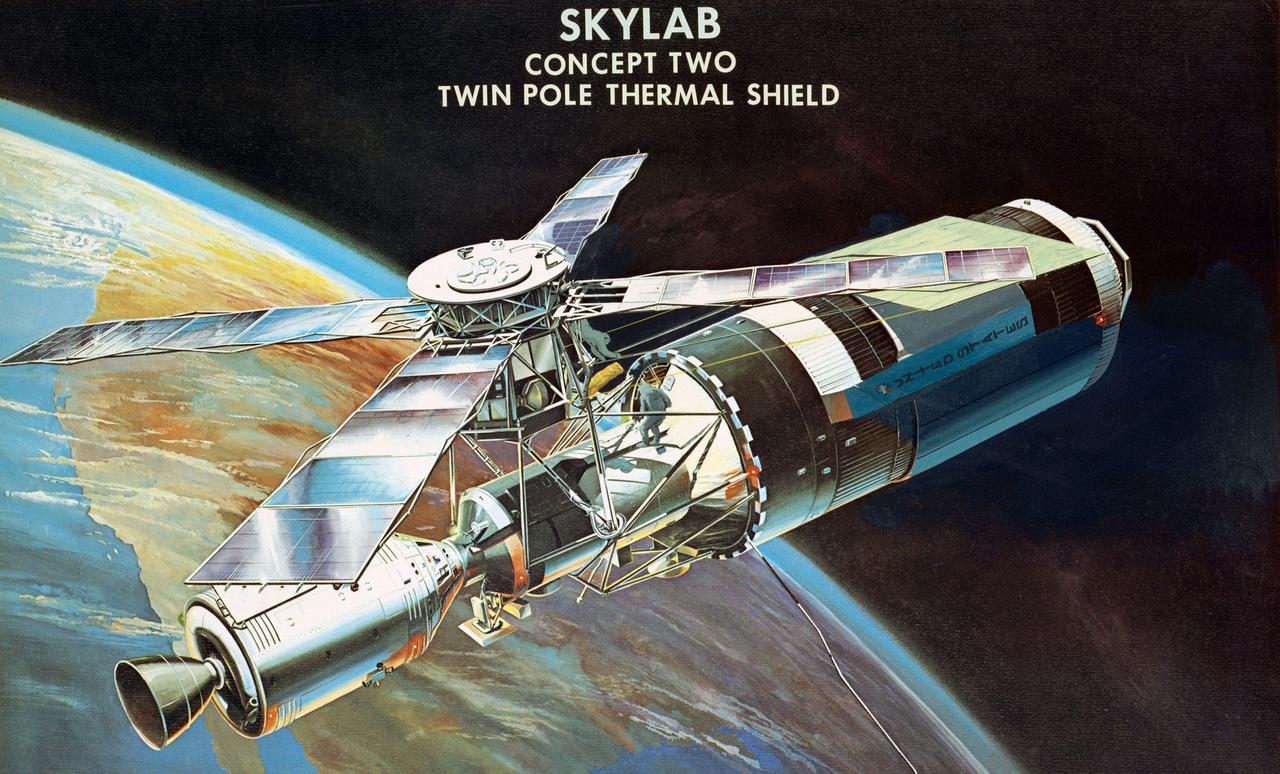
S73-26127 (1973) --- An artist's concept of the Skylab space station cluster in Earth orbit illustrating the deployment of the twin pole thermal shield to shade the Orbital Workshop (OWS) from the sun. This is one of the sunshade possibilities considered to solve the problem of the overheated OWS. Here the two Skylab 2 astronauts have completely deployed the sunshade. Note the evidence of another Skylab problem - the solar panels on the OWS are not deployed as required. Photo credit: NASA

SHIIVER (Structural Heat Intercept Insulation Vibration Evaluation Rig) is a cryogenic test tank developed to evaluate heat intercept concepts. It arrived at Marshall Space Flight Center on August 10, 2017. The tank will receive heat sensors and spray-on foam insulation before making its way to Plum Brook station for further insulation and testing.SHIIVER Tank Arrives at NASA’s Marshall Center for Spray-On Foam Insulation
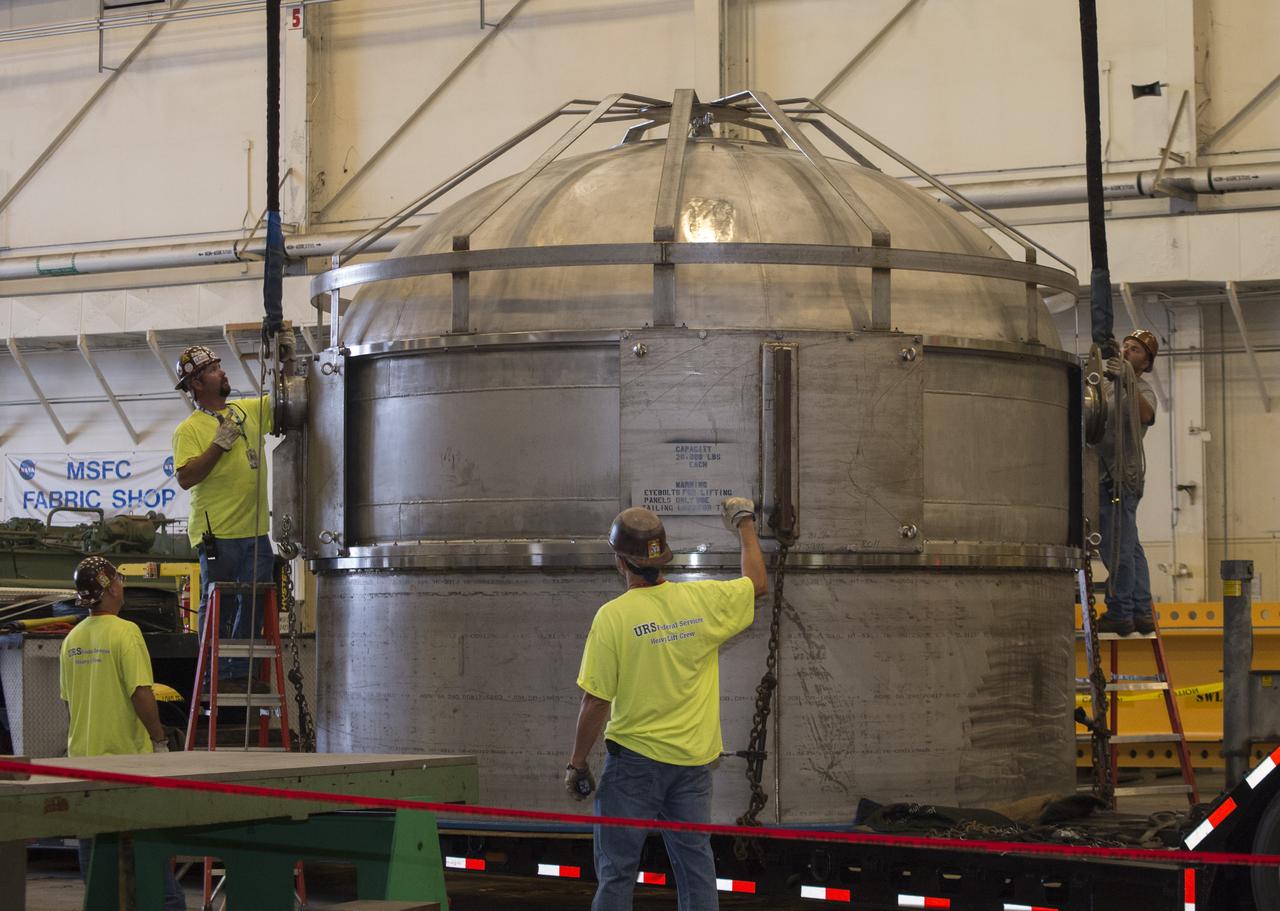
SHIIVER (Structural Heat Intercept Insulation Vibration Evaluation Rig) is a cryogenic test tank developed to evaluate heat intercept concepts. It arrived at Marshall Space Flight Center on August 10, 2017. The tank will receive heat sensors and spray-on foam insulation before making its way to Plum Brook station for further insulation and testing.
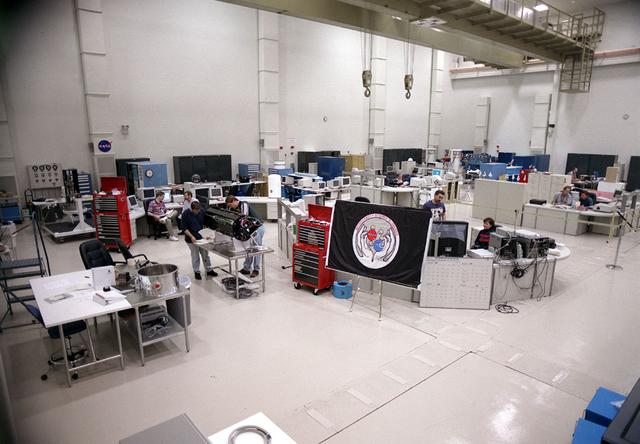
The Magnetically Damped Furnace (MDF) breadboard is being developed in response to NASA's mission and goals to advance the scientific knowledge of microgravity research, materials science, and related technologies. The objective of the MDF is to dampen the fluid flows due to density gradients and surface tension gradients in conductive melts by introducing a magnetic field during the sample processing. The MDF breadboard will serve as a proof of concept that the MDF performance requirements can be attained within the International Space Station resource constraints.
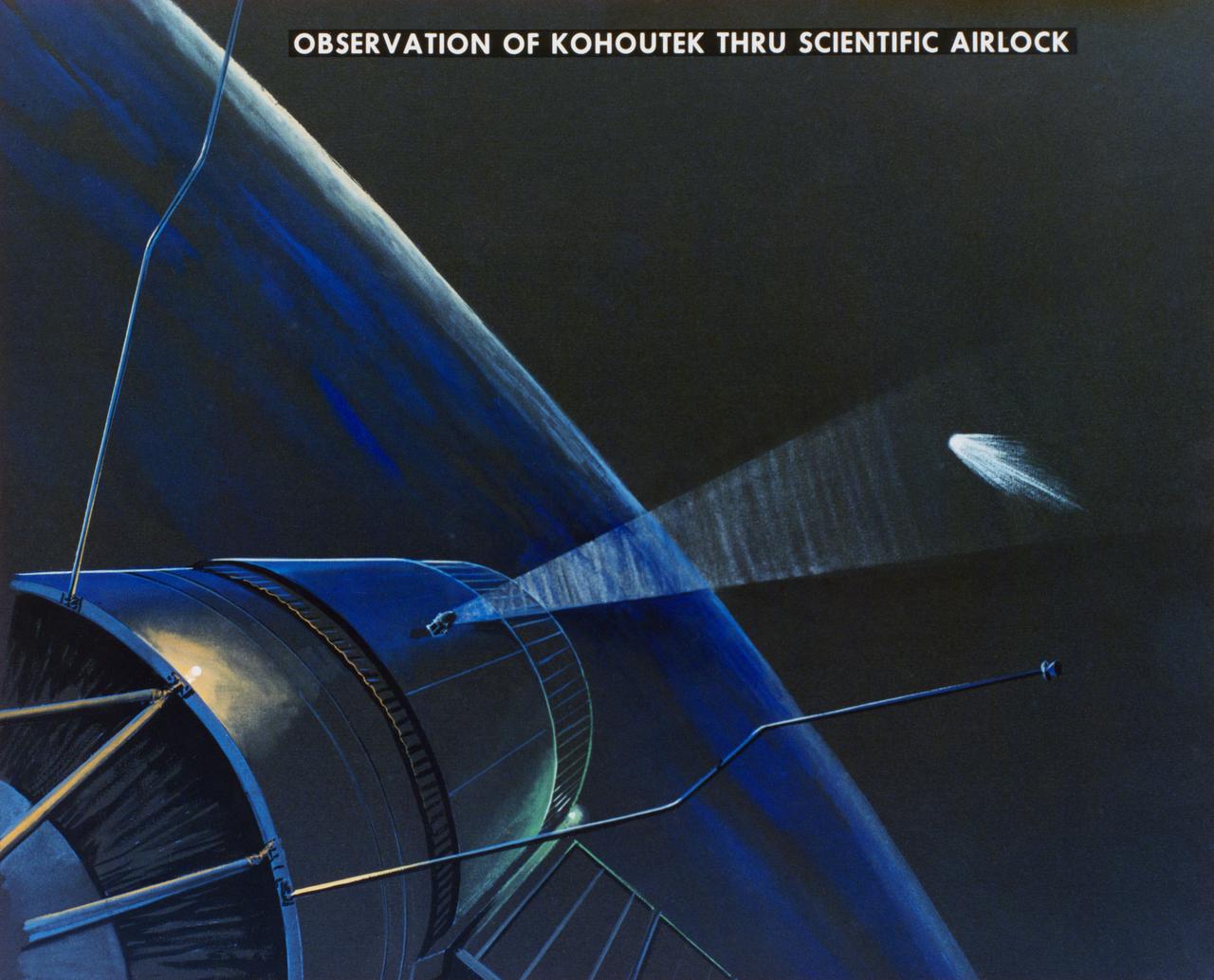
S73-37274 (1973) --- An artist's concept illustrating how the Skylab 4 astronauts will observe, through the scientific airlock of the Orbital Workshop, the passing of the newly-discovered Comet Kohoutek. The favorable location of the Skylab space station in Earth orbit will help provide a comprehensive investigation of the nature and evolution of the coma and tails as the comet approaches, passes, and recedes from the sun. Photo credit: NASA
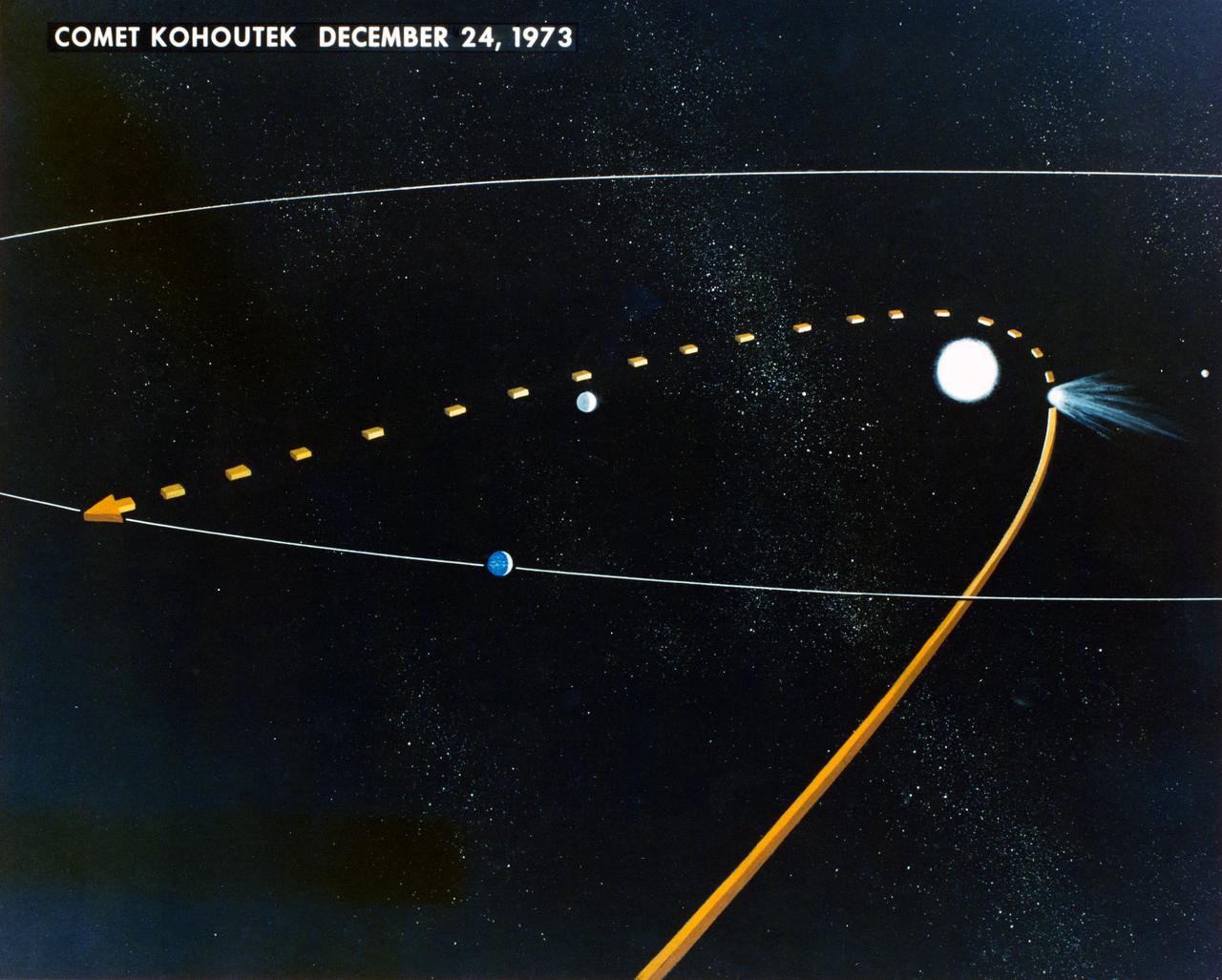
S73-37273 (24 Dec. 1973) --- An artist's concept illustrating the trajectory of the newly-discovered Comet Kohoutek in relation to the sun and to Earth and the plane of Earth's orbit. The picture show's the position of Kohoutek on Christmas Eve, 1973. The Skylab space station in Earth orbit will provide a favorable location from which to observe the passing of the comet. Photo credit: NASA
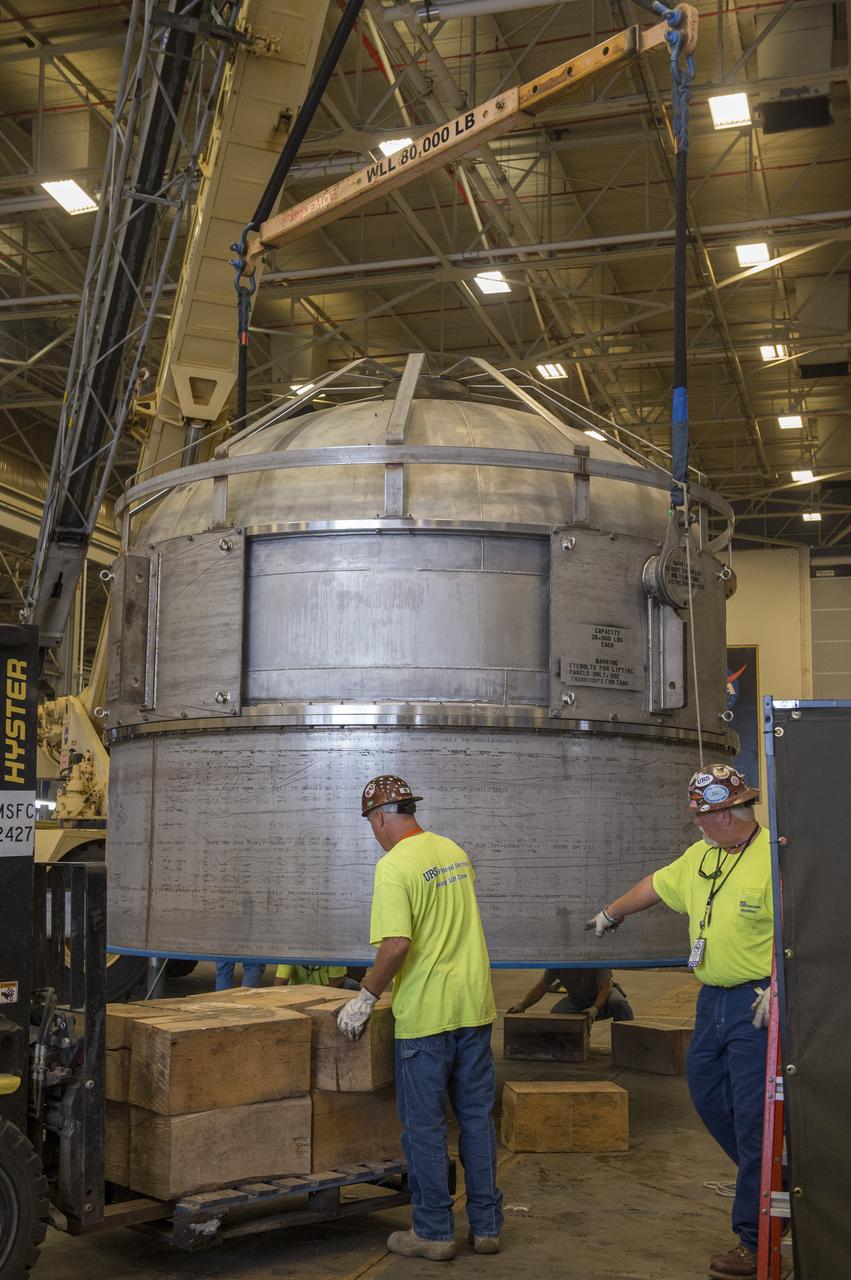
SHIIVER (Structural Heat Intercept Insulation Vibration Evaluation Rig) is a cryogenic test tank developed to evaluate heat intercept concepts. It arrived at Marshall Space Flight Center on August 10, 2017. The tank will receive heat sensors and spray-on foam insulation before making its way to Plum Brook station for further insulation and testing.
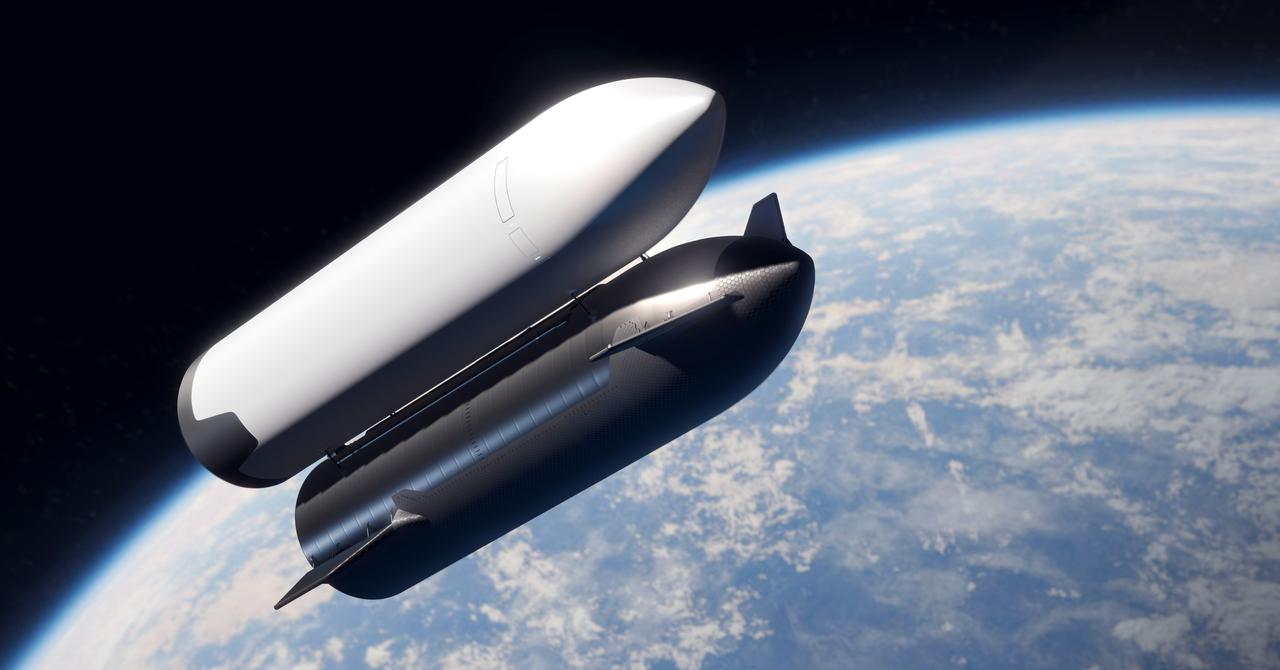
These artist’s concepts show SpaceX’s Starship Human Landing System (HLS) in operation on its journey to the Moon. Before astronauts launch in NASA’s Orion spacecraft atop the agency’s SLS (Space Launch System) rocket, SpaceX will launch a storage depot to Earth orbit. For Artemis III and Artemis IV, SpaceX plans to complete propellant loading operations in Earth orbit to send a fully fueled Starship HLS to the Moon. Starship HLS will then dock directly to Orion so that two astronauts can transfer from the spacecraft to the lander to descend to the Moon’s surface, while two others remain in Orion. Beginning with Artemis IV, NASA’s Gateway lunar space station will serve as the crew transfer point. NASA is working with SpaceX to develop Starship HLS to carry astronauts from lunar orbit to the Moon’s surface and back for Artemis III and Artemis IV as part of the agency’s Artemis campaign.

These artist’s concepts show SpaceX’s Starship Human Landing System (HLS) in operation on its journey to the Moon. Before astronauts launch in NASA’s Orion spacecraft atop the agency’s SLS (Space Launch System) rocket, SpaceX will launch a storage depot to Earth orbit. For Artemis III and Artemis IV, SpaceX plans to complete propellant loading operations in Earth orbit to send a fully fueled Starship HLS to the Moon. Starship HLS will then dock directly to Orion so that two astronauts can transfer from the spacecraft to the lander to descend to the Moon’s surface, while two others remain in Orion. Beginning with Artemis IV, NASA’s Gateway lunar space station will serve as the crew transfer point. NASA is working with SpaceX to develop Starship HLS to carry astronauts from lunar orbit to the Moon’s surface and back for Artemis III and Artemis IV as part of the agency’s Artemis campaign.
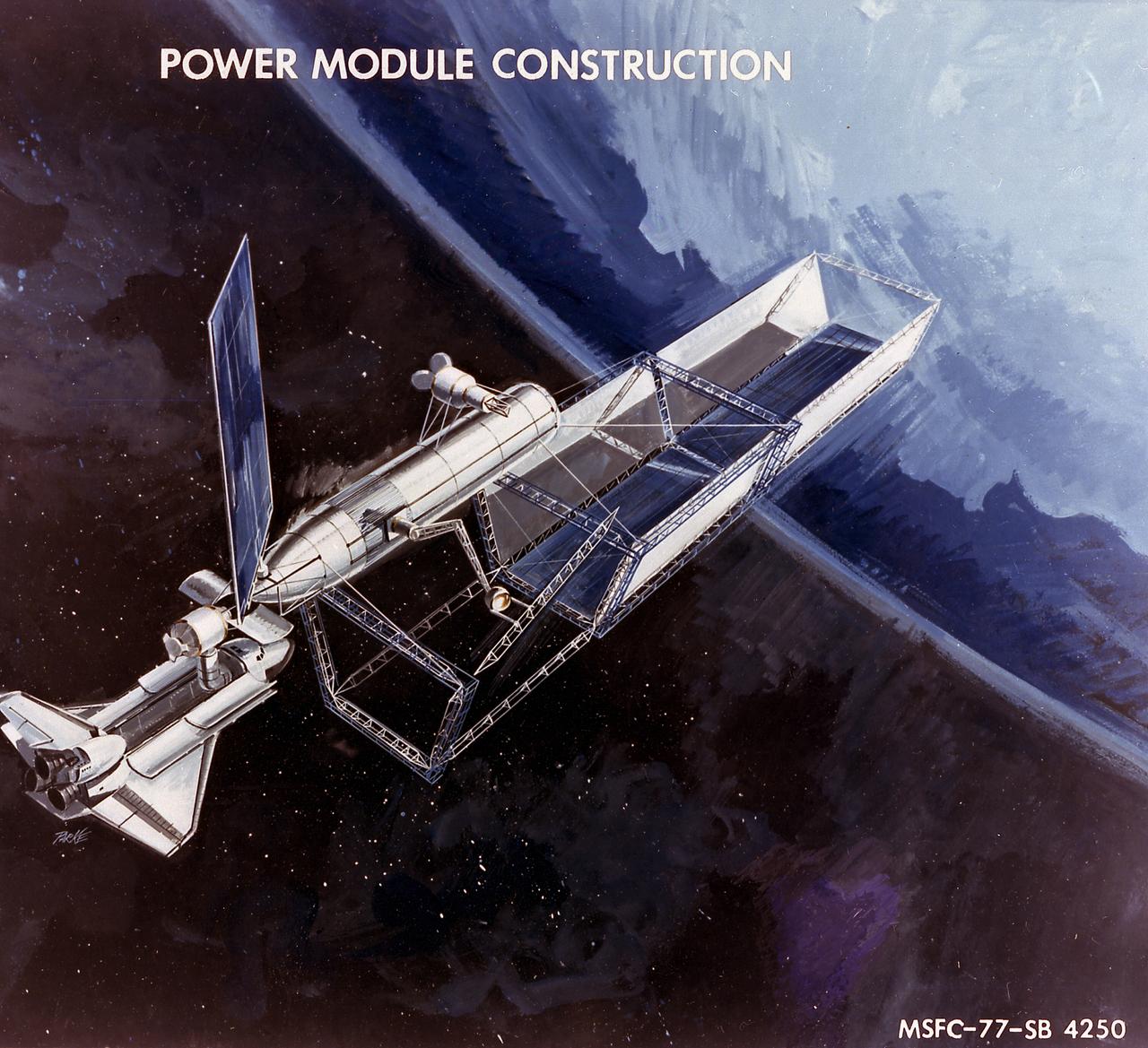
The Marshall Space Flight Center (MSFC) and the Johnson Space Center (JSC) were each awarded 16-month contracts in April 1976 for the Space Station Systems Analysis Study (SSSAS). Grumman Aerospace Corporation was MSFC's contractor and McDornell Douglas Aerospace Company was JSC's contractor. The goal of this study was to formulate plans for a permanent operational base and laboratory facility in Earth orbit in addition to developing a space construction base design for implementing the program. An expended Space Shuttle external tank was to be the central core platform of the base, and additional pressurized modules could be added to provide laboratory facilities. This artist's concept depicts a space construction base design for implementing the SSSAS.
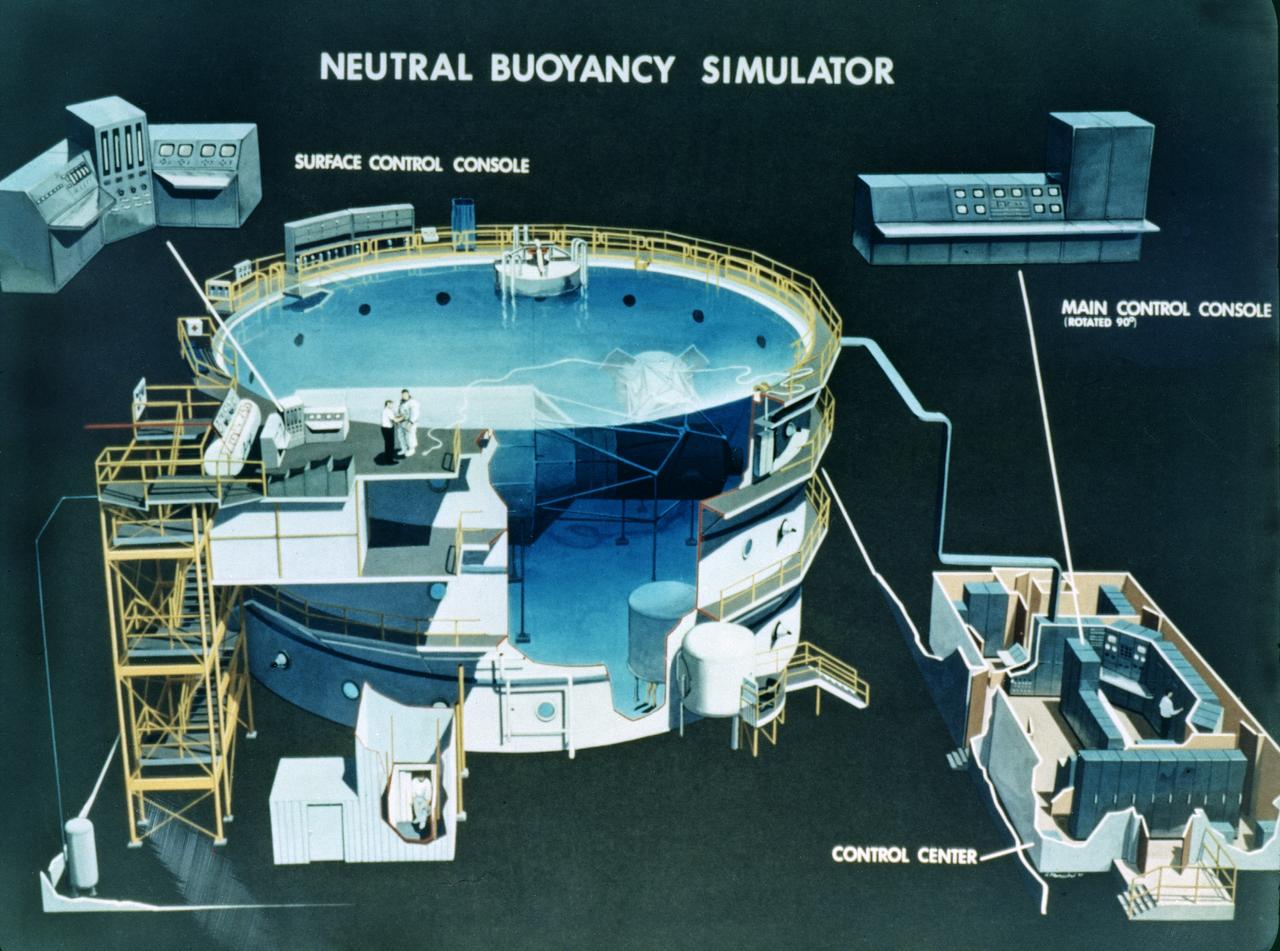
This is a cutaway illustration of the Neutral Buoyancy Simulator (NBS) at the Marshall Space Flight Center (MSFC ). The MSFC NBS provided an excellent environment for testing hardware to examine how it would operate in space and for evaluating techniques for space construction and spacecraft servicing. Here, engineers, designers, and astronauts performed various tests to develop basic concepts, preliminary designs, final designs, and crew procedures. The NBS was constructed of welded steel with polyester-resin coating. The water tank was 75-feet (22.9- meters) in diameter, 40-feet (12.2-meters) deep, and held 1.32 million gallons of water. Since it opened for operation in 1968, the NBS had supported a number of successful space missions, such as the Skylab, Solar Maximum Mission Satellite, Marned Maneuvering Unit, Experimental Assembly of Structures in Extravehicular Activity/Assembly Concept for Construction of Erectable Space Structures (EASE/ACCESS), the Hubble Space Telescope, and the Space Station. The function of the MSFC NBS was moved to the larger simulator at the Johnson Space Center and is no longer operational.
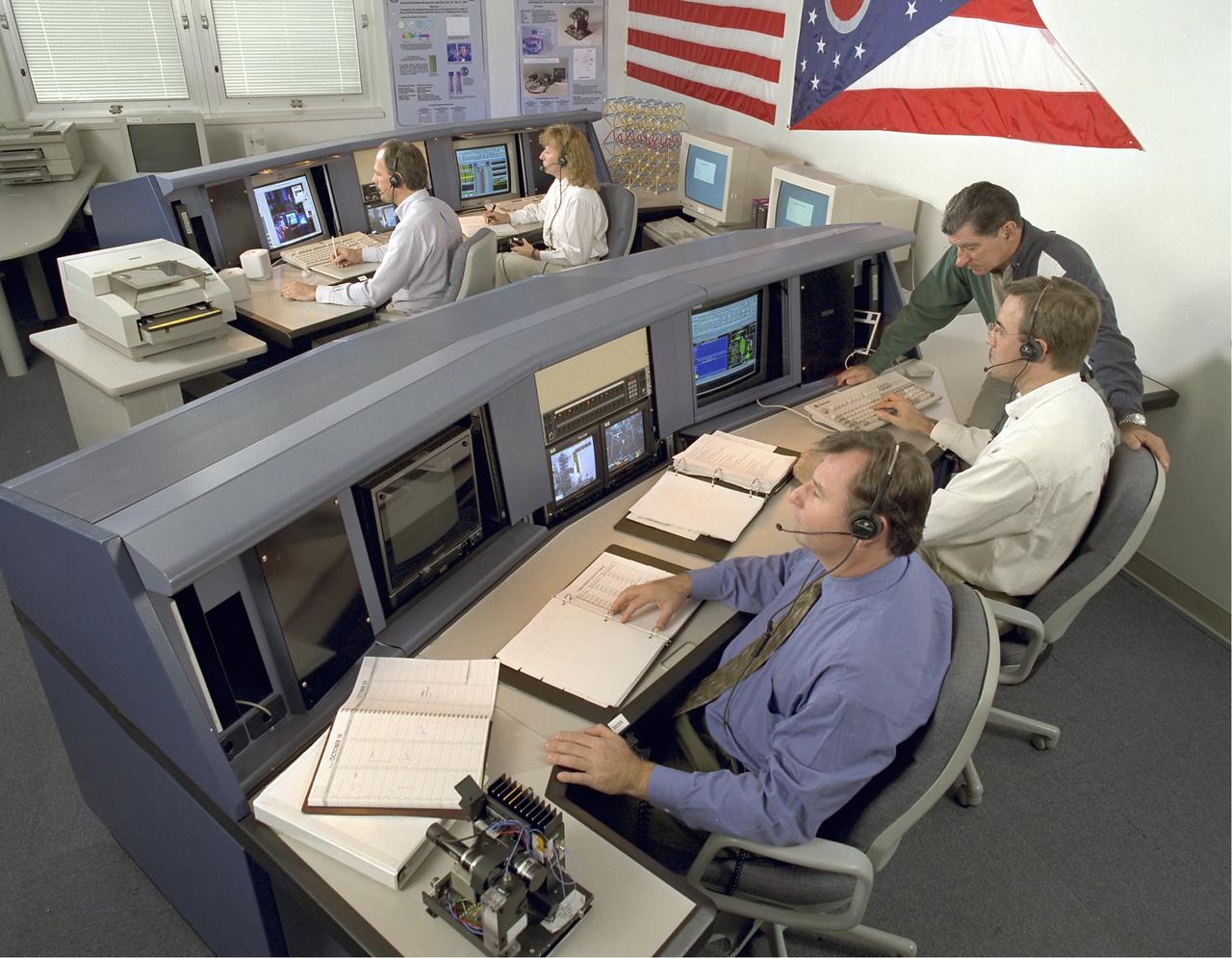
The Glenn Research Center (GRC) Telescience Support Center (TSC) is a NASA telescience ground facility that provides the capability to execute ground support operations of on-orbit International Space Station (ISS) and Space Shuttle payloads. This capability is provided with the coordination with the Marshall Space Flight Center (MSFC) Huntsville Operations Support Center (HOSC), the Johnson Space Center (JSC) Mission Control Center in Houston (MCC-H) and other remote ground control facilities. The concept of telescience is a result of NASA's vision to provide worldwide distributed ISS ground operations that will enable payload developers and scientists to control and monitor their on-board payloads from any location -- not necessarily a NASA site. This concept enhances the quality of scientific and technological data while decreasing operation costs of long-term support activities by providing ground operation services to a Principal Investigator and Engineering Team at their home site. The TSC acts as a hub in which users can either locate their operations staff within the walls of the TSC or request the TSC operation capabilities be extended to a location more convenient such as a university.
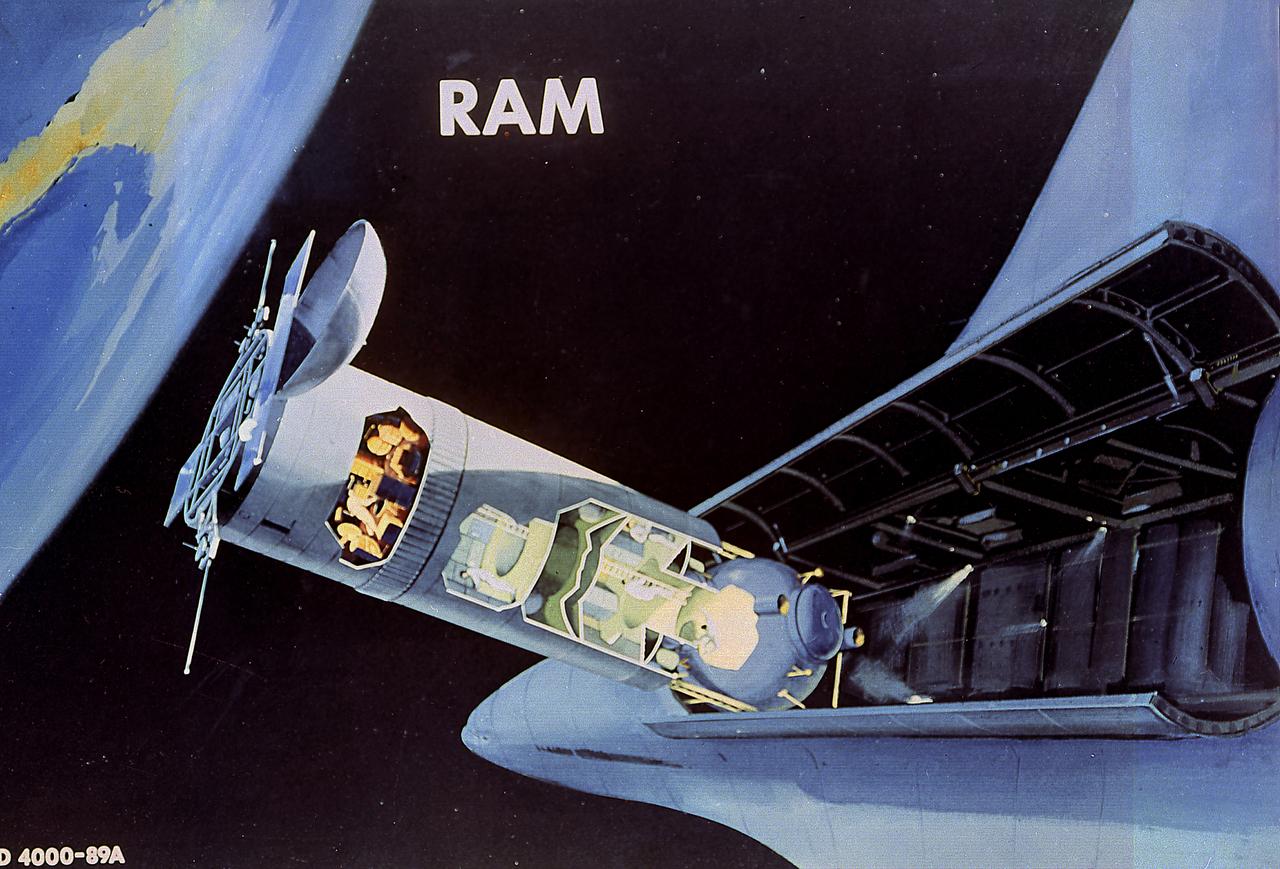
This is an artist's concept of the Research and Applications Modules (RAM). Evolutionary growth was an important consideration in space station plarning, and another project was undertaken in 1971 to facilitate such growth. The RAM study, conducted through a Marshall Space Flight Center contract with General Dynamics Convair Aerospace, resulted in the conceptualization of a series of RAM payload carrier-sortie laboratories, pallets, free-flyers, and payload and support modules. The study considered two basic manned systems. The first would use RAM hardware for sortie mission, where laboratories were carried into space and remained attached to the Shuttle for operational periods up to 7 days. The second envisioned a modular space station capability that could be evolved by mating RAM modules to the space station core configuration. The RAM hardware was to be built by Europeans, thus fostering international participation in the space program.
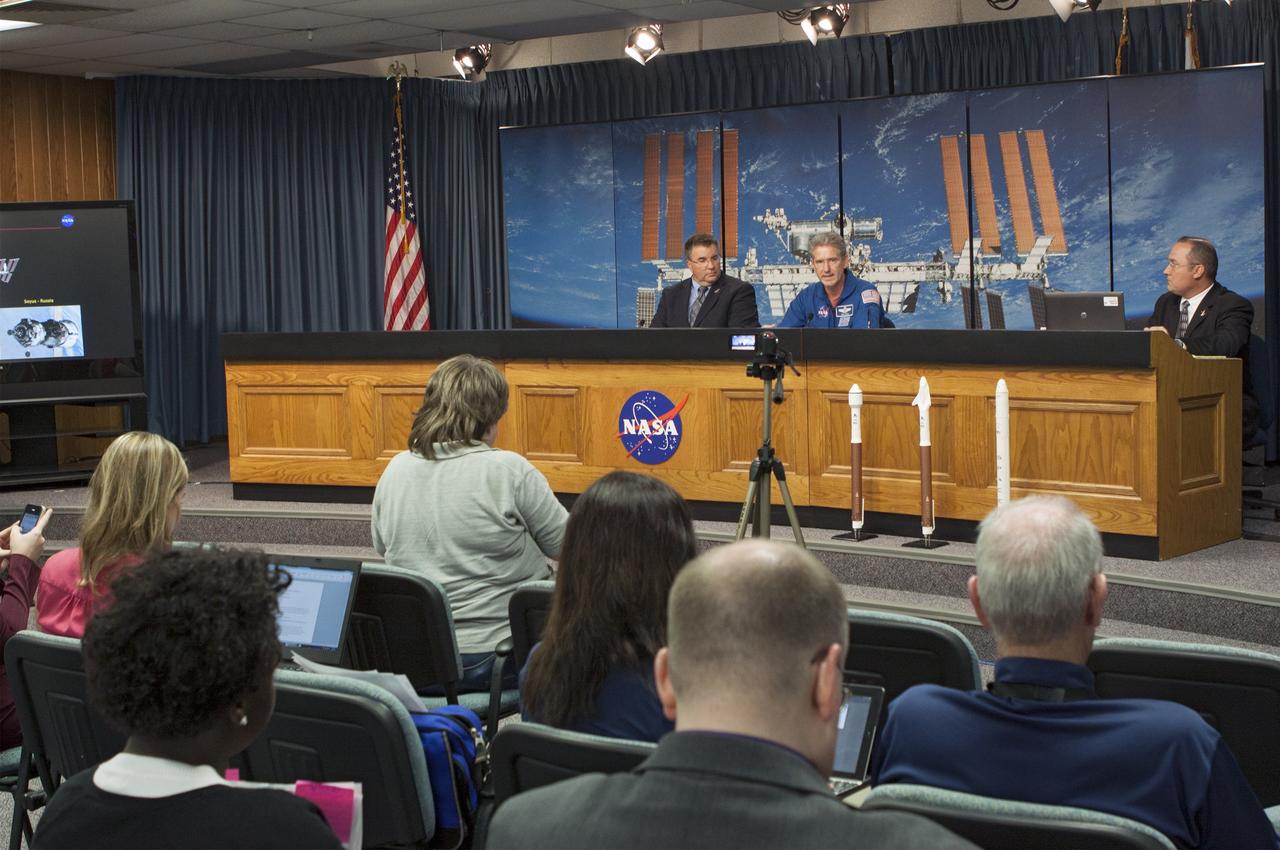
CAPE CANAVERAL, Fla. - NASA's Commercial Crew Program Manager Ed Mango and astronaut Mike Good media on the progress of American human spaceflight development at Kennedy Space Center in Florida. At right is NASA Public Affairs Officer Gregory Harland. They also discussed the future steps the program will take to certify crew transportation systems for missions to the International Space Station. The program is working toward the next phase of certification, which will be called Commercial Crew Transportation Capability, or CCtCap. That phase will include a joint test concept in which NASA astronauts will play a role in flight testing the systems. To learn more about CCP, visit www.nasa.gov/commercialcrew. Photo credit: Jim Grossmann
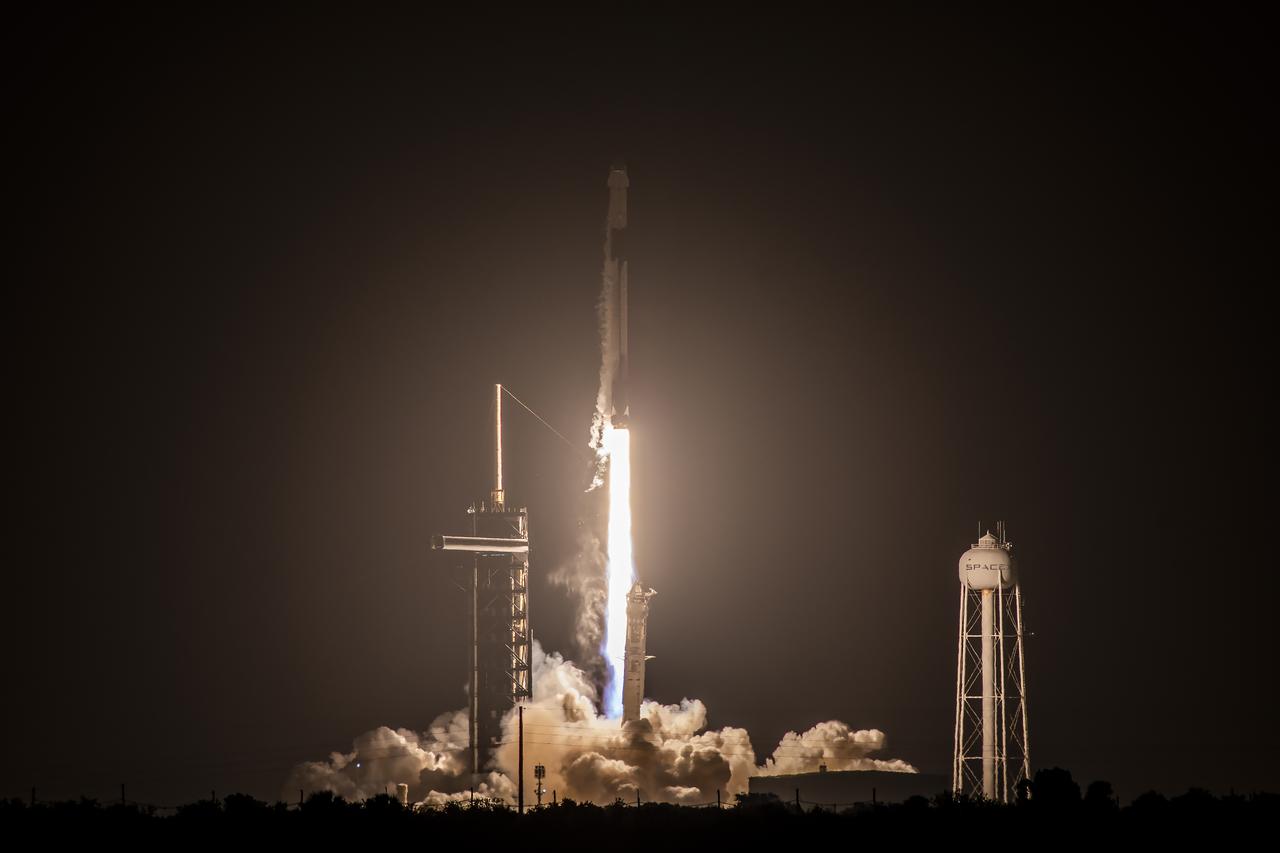
The SpaceX Falcon 9 rocket carrying the Dragon spacecraft lifts off from Launch Complex 39A at NASA’s Kennedy Space Center in Florida on Monday, April 21, on the company’s 32nd commercial resupply services mission for the agency to the International Space Station. Liftoff was at 4:15 a.m. EDT. Dragon will deliver a variety of science experiments, including a demonstration of refined maneuvers for free-floating robots. Dragon also carries an enhanced air quality monitoring system that could protect crew members on exploration missions to the Moon and Mars, and two atomic clocks to examine fundamental physics concepts such as relativity and test worldwide synchronization of precision timepieces.
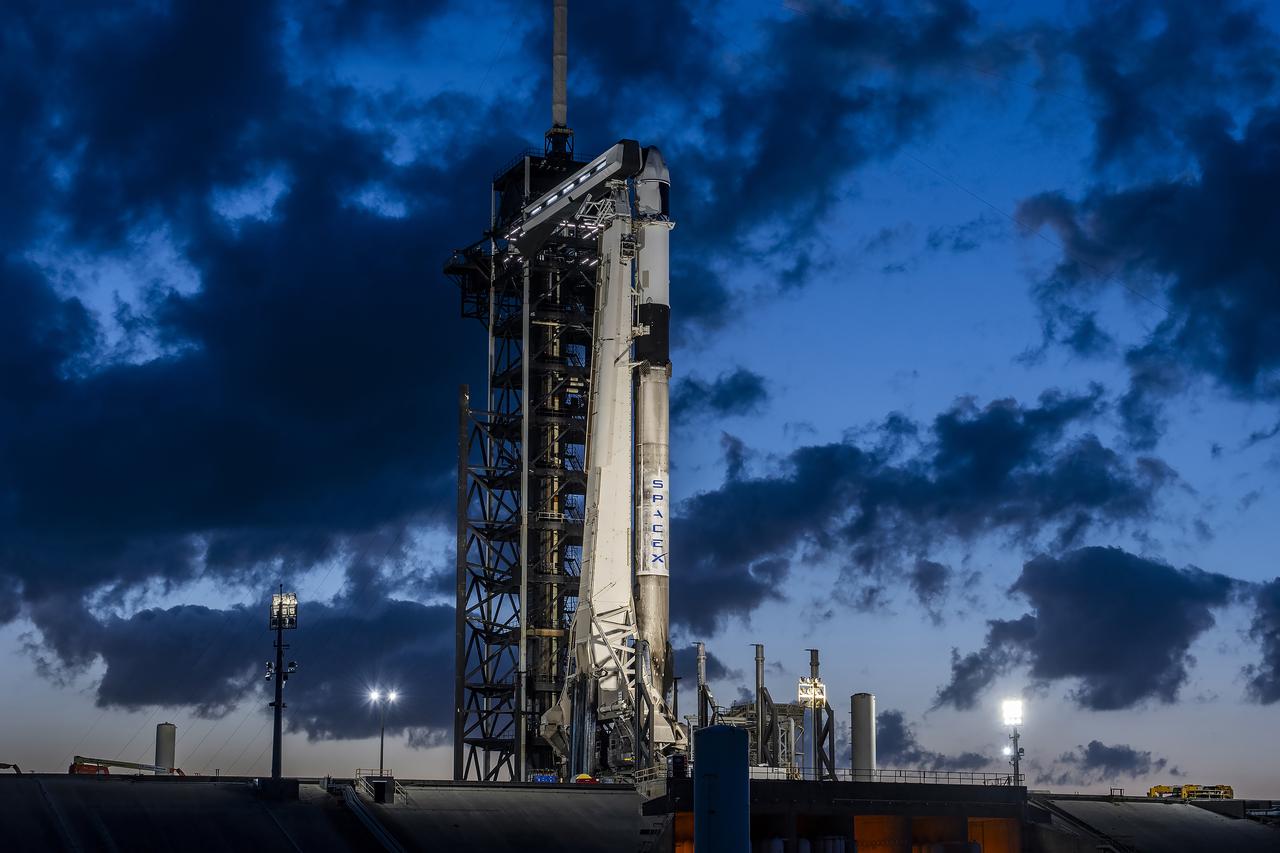
A SpaceX Falcon 9 rocket, with the company’s Dragon spacecraft atop, stands in a vertical position at Launch Complex 39A at NASA’s Kennedy Space Center in Florida on Monday, April 21, in preparation for the 32nd commercial resupply services launch to the International Space Station. Dragon is delivering a variety of science experiments, including a demonstration of refined maneuvers for free-floating robots. Dragon also carries an enhanced air quality monitoring system that could protect crew members on exploration missions to the Moon and Mars, and two atomic clocks to examine fundamental physics concepts such as relativity and test worldwide synchronization of precision timepieces.
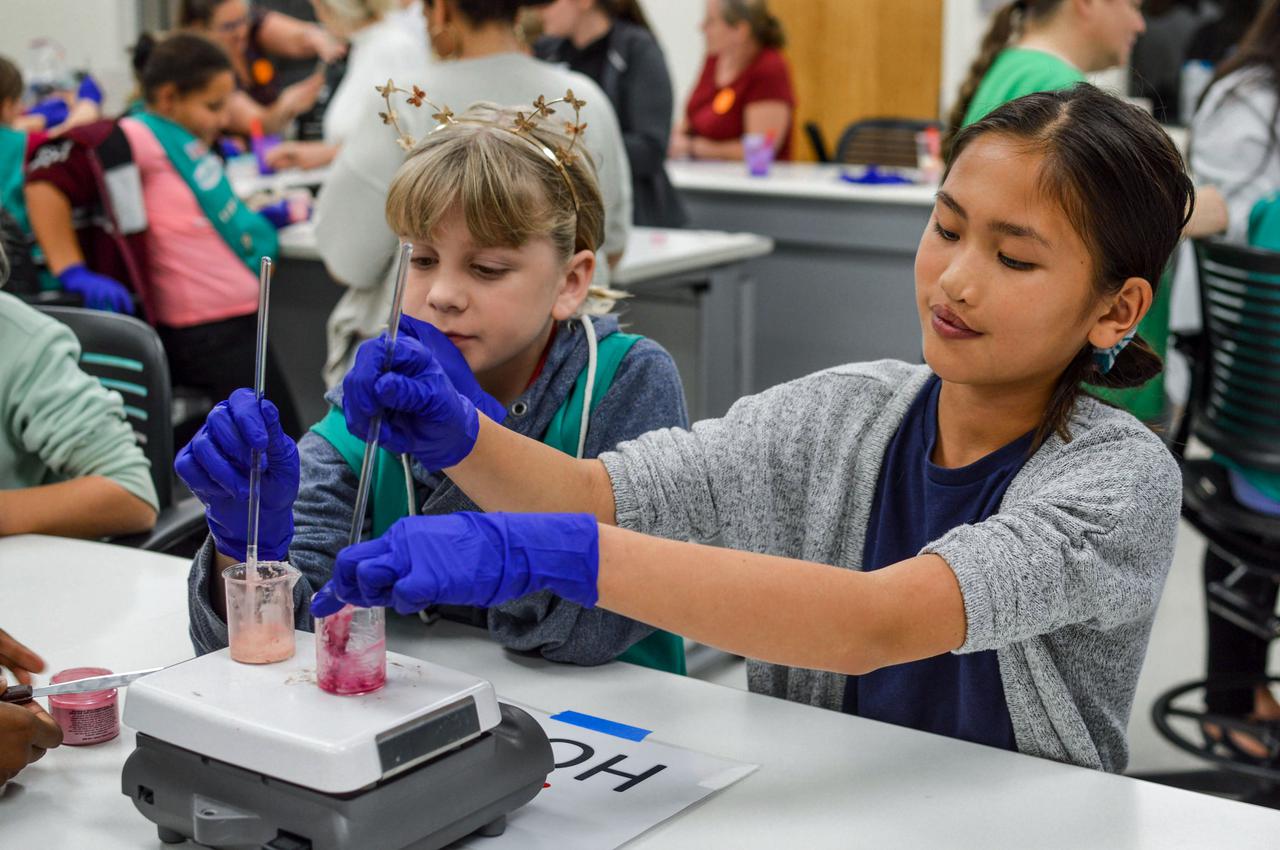
jsc2021e037279 (11/15/2019) --- Girl Scouts prepare experiments as part of a STEM collaboration with the Girl Scouts of Citrus Council. Faraday-Girl Scouts-1 (Faraday-Girls Scouts) offers Girl Scouts the opportunity to conduct a control experiment and observe the actual experiments on plant growth, ant colonization, and brine shrimp lifecycle in Faraday boxes aboard the International Space Station. This is part of a year-long effort by the Girl Scouts of Citrus Council to engage scouts in the study and understanding of space. The program also provides scouts firsthand experience with the concept of an experimental control. Image Credit: Girl Scouts Citrus Council
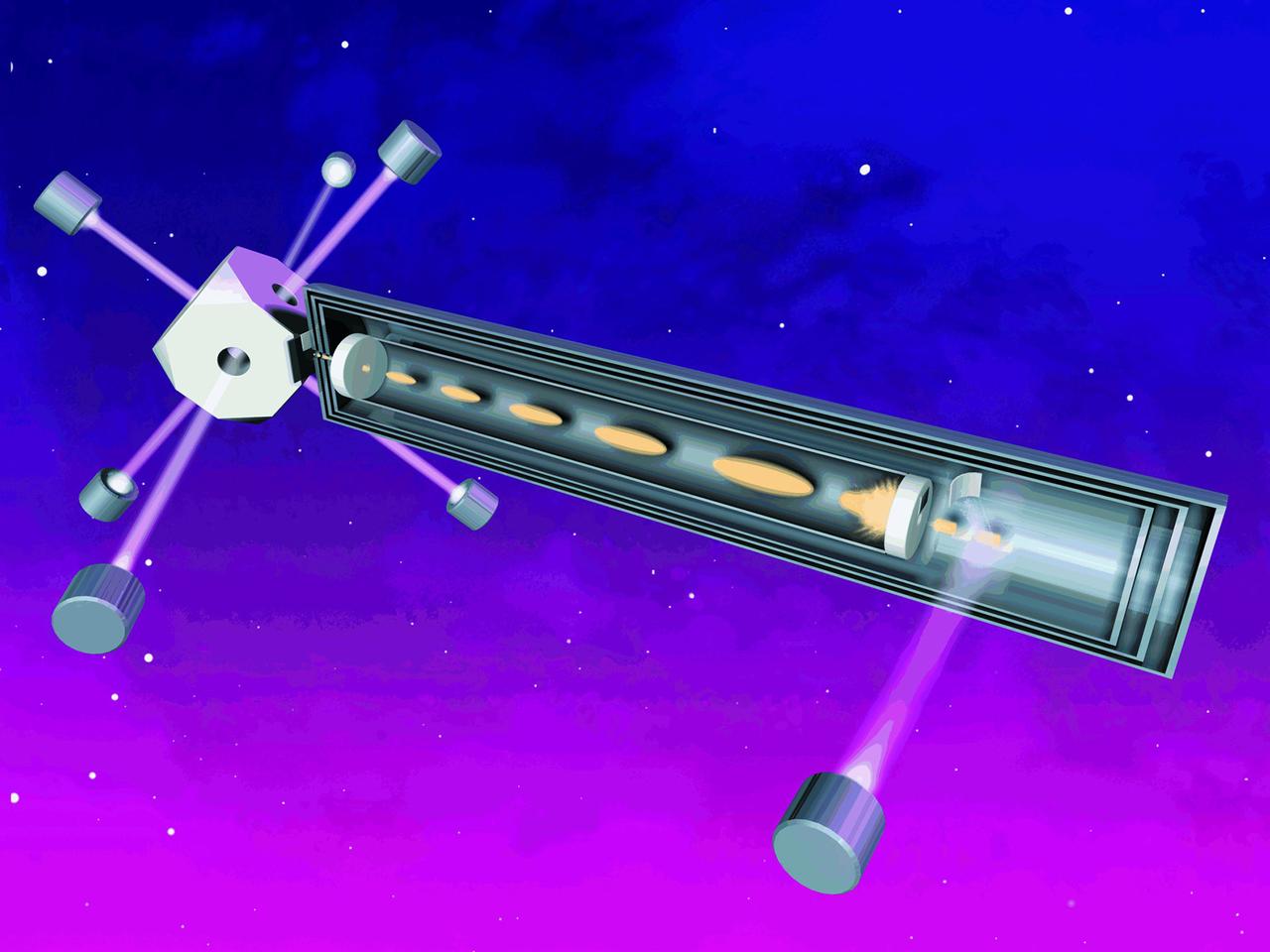
An artist's concept of the Primary Atomic Clock Reference System (PARCS) plarned to fly on the International Space Station (ISS). PARCS will make even more accurate atomic time available to everyone, from physicists testing Einstein's Theory of Relativity, to hikers using the Global Positioning System to find their way. In ground-based atomic clocks, lasers are used to cool and nearly stop atoms of cesium whose vibrations are used as the time base. The microgravity of space will allow the atoms to be suspended in the clock rather than circulated in an atomic fountain, as required on Earth. PARCS is being developed by the Jet Propulsion Laboratory with principal investigators at the National Institutes of Standards and Technology and the University of Colorado, Boulder. See also No. 0103191
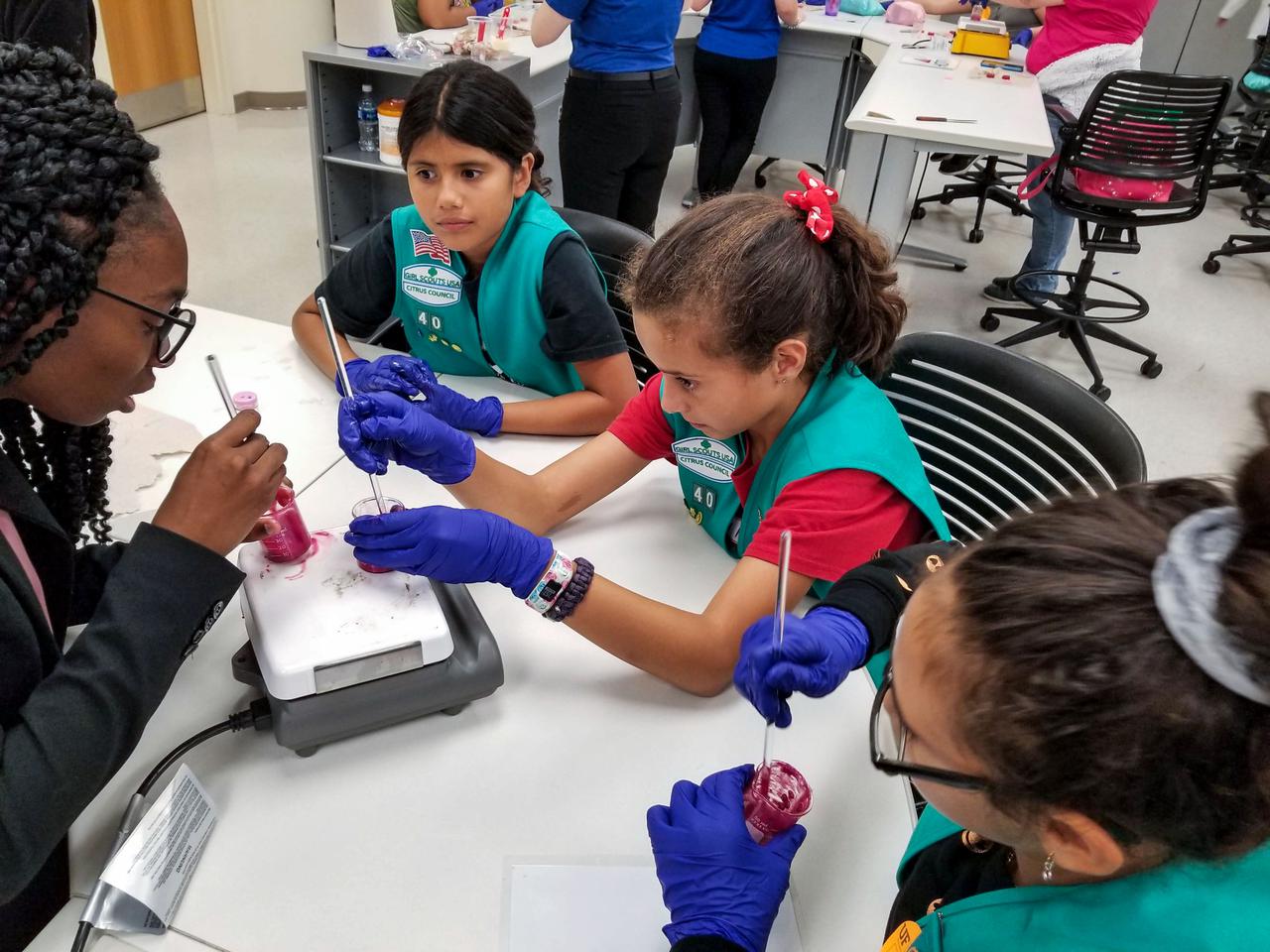
jsc2021e037278 (11/15/2019) --- Girl Scouts prepare experiments as part of a STEM collaboration with the Girl Scouts of Citrus Council. Faraday-Girl Scouts-1 (Faraday-Girls Scouts) offers Girl Scouts the opportunity to conduct a control experiment and observe the actual experiments on plant growth, ant colonization, and brine shrimp lifecycle in Faraday boxes aboard the International Space Station. This is part of a year-long effort by the Girl Scouts of Citrus Council to engage scouts in the study and understanding of space. The program also provides scouts firsthand experience with the concept of an experimental control. Image Credit: Girl Scouts Citrus Council
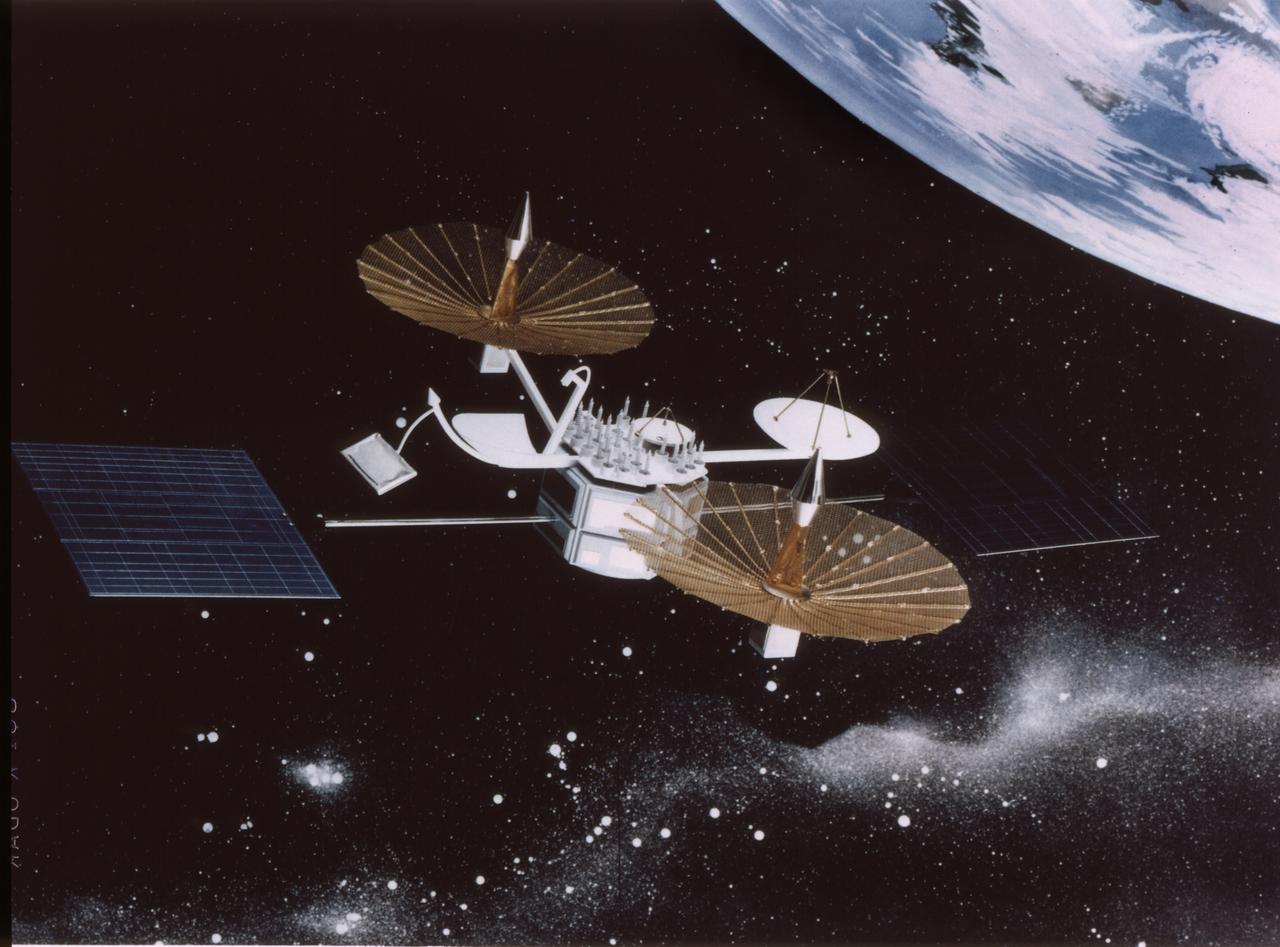
This artist's concept drawing depicts the Tracking and Data Relay Satellite-C (TDRS-C), which was the primary payload of the Space Shuttle Discovery on the STS-26 mission, launched on September 29, 1988. The TDRS system provides almost uninterrupted communications with Earth-orbiting Shuttles and satellites, and had replaced the intermittent coverage provided by globe-encircling ground tracking stations used during the early space program. The TDRS can transmit and receive data, and track a user spacecraft in a low Earth orbit. The deployment of TDRS-G on the STS-70 mission being the latest in the series, NASA has successfully launched six TDRSs.
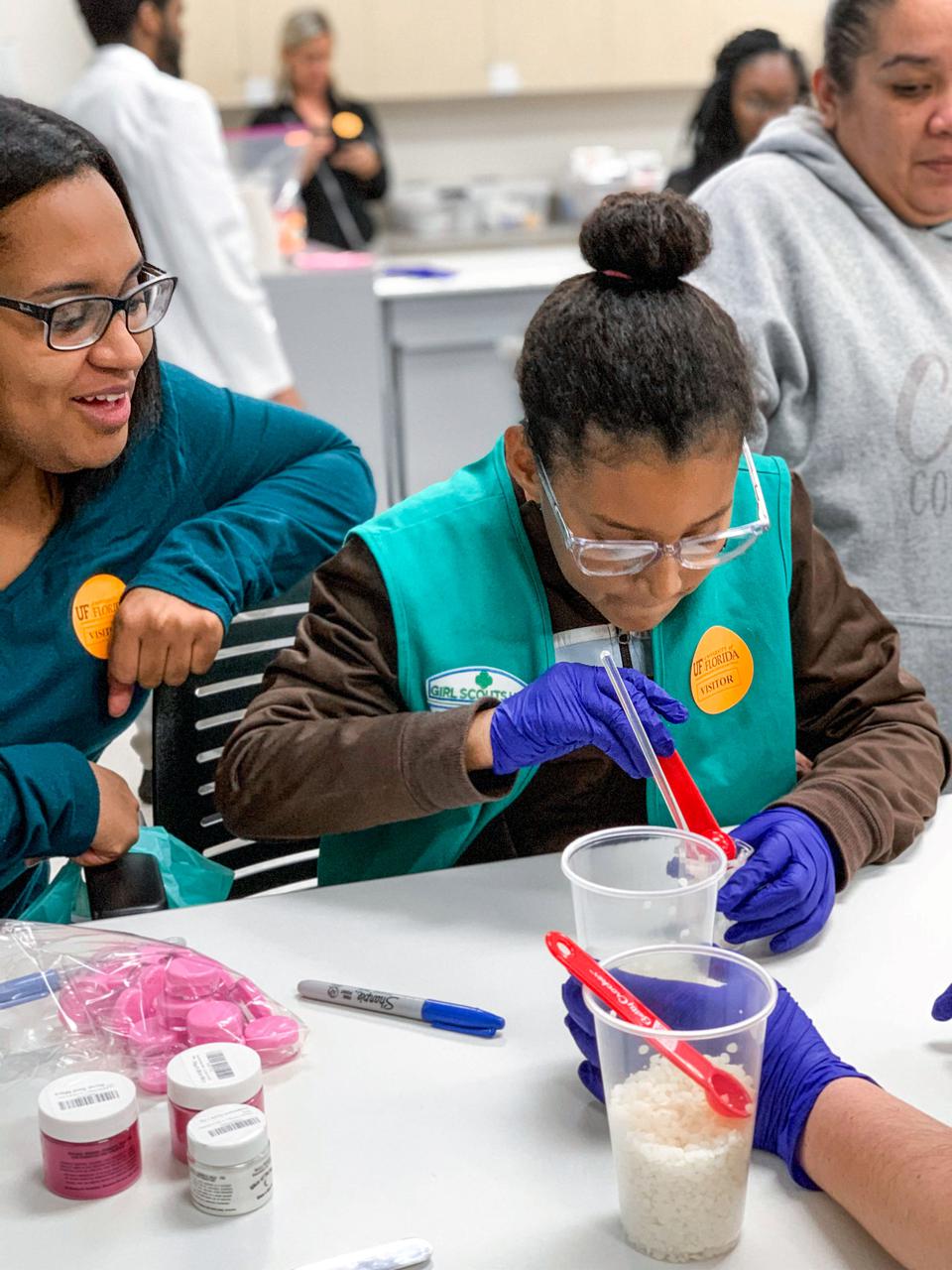
jsc2021e037280 (11/15/2019) --- Girl Scouts prepare experiments as part of a STEM collaboration with the Girl Scouts of Citrus Council. Faraday-Girl Scouts-1 (Faraday-Girls Scouts) offers Girl Scouts the opportunity to conduct a control experiment and observe the actual experiments on plant growth, ant colonization, and brine shrimp lifecycle in Faraday boxes aboard the International Space Station. This is part of a year-long effort by the Girl Scouts of Citrus Council to engage scouts in the study and understanding of space. The program also provides scouts firsthand experience with the concept of an experimental control. Image Credit: Girl Scouts Citrus Council
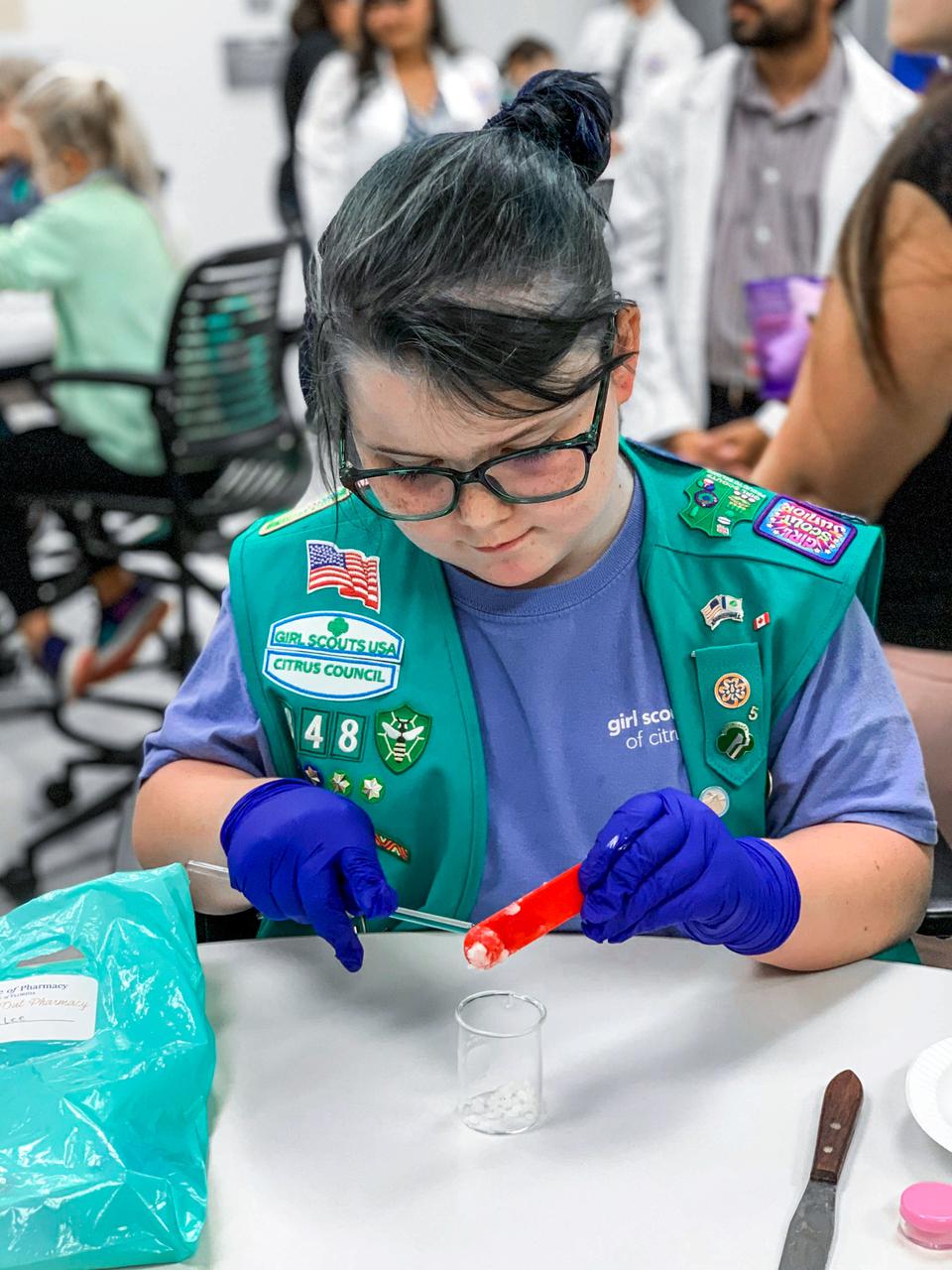
jsc2021e037281 (11/15/2019) --- Girl Scouts prepare experiments as part of a STEM collaboration with the Girl Scouts of Citrus Council. Faraday-Girl Scouts-1 (Faraday-Girls Scouts) offers Girl Scouts the opportunity to conduct a control experiment and observe the actual experiments on plant growth, ant colonization, and brine shrimp lifecycle in Faraday boxes aboard the International Space Station. This is part of a year-long effort by the Girl Scouts of Citrus Council to engage scouts in the study and understanding of space. The program also provides scouts firsthand experience with the concept of an experimental control. Image Credit: Girl Scouts Citrus Council
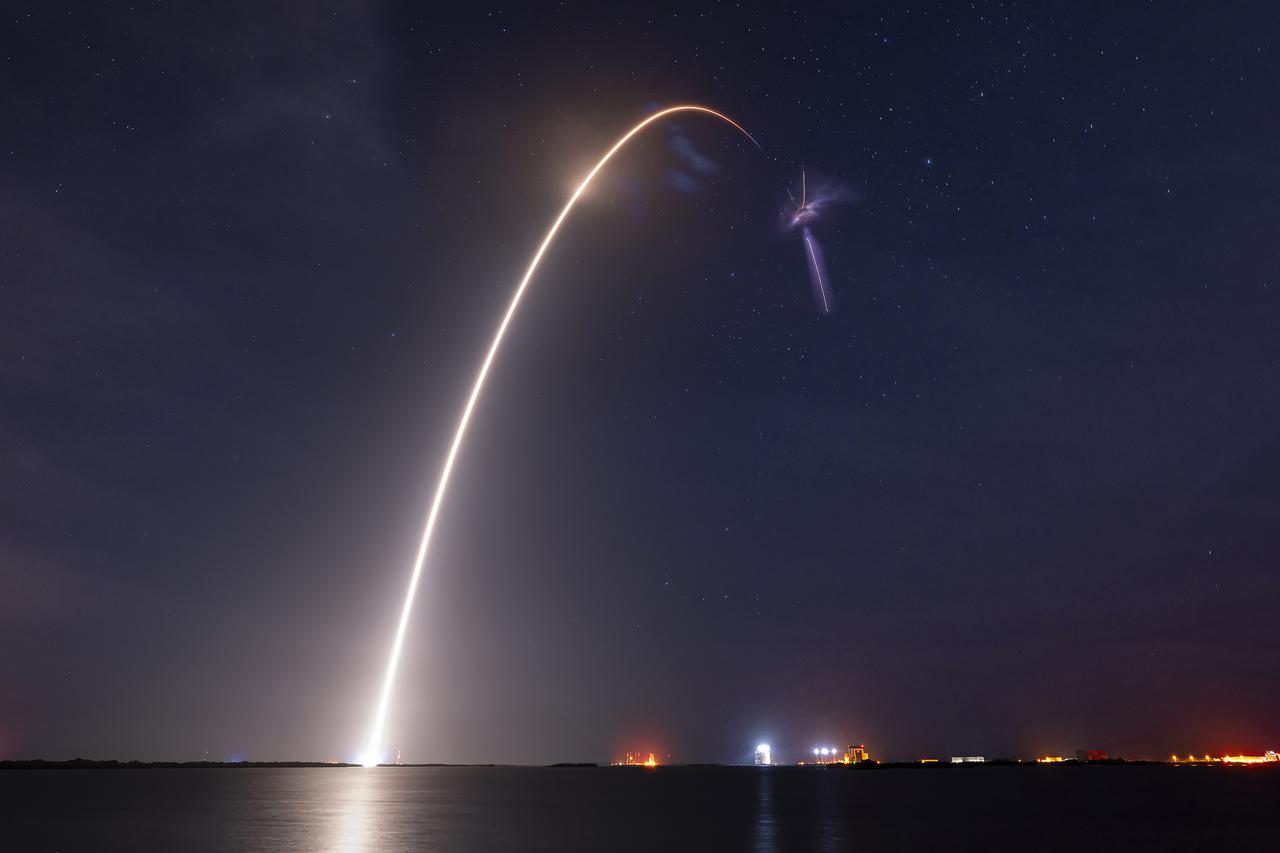
The SpaceX Falcon 9 rocket carrying the Dragon spacecraft lifts off from Launch Complex 39A at NASA’s Kennedy Space Center in Florida on Monday, April 21, on the company’s 32nd commercial resupply services mission for the agency to the International Space Station. Liftoff was at 4:15 a.m. EDT. Dragon will deliver a variety of science experiments, including a demonstration of refined maneuvers for free-floating robots. Dragon also carries an enhanced air quality monitoring system that could protect crew members on exploration missions to the Moon and Mars, and two atomic clocks to examine fundamental physics concepts such as relativity and test worldwide synchronization of precision timepieces.
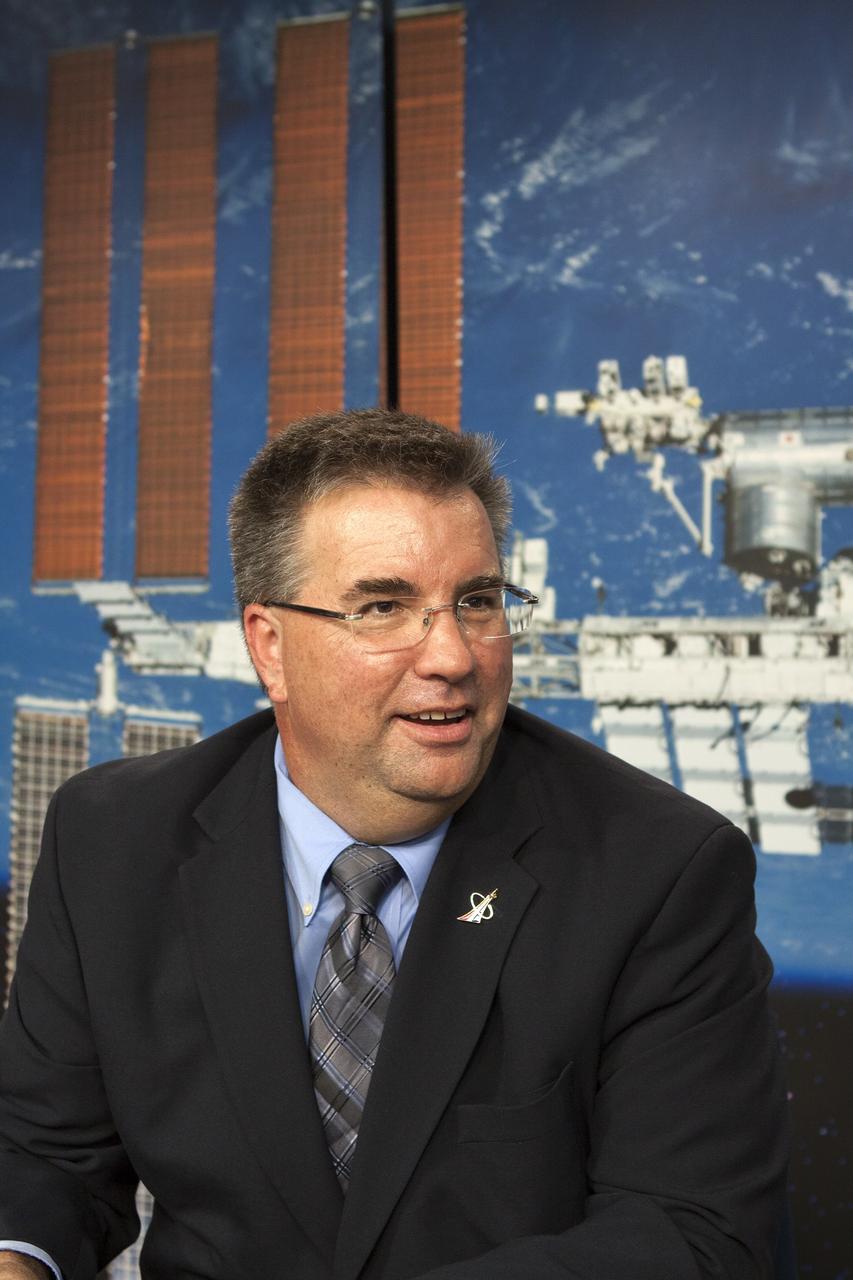
CAPE CANAVERAL, Fla. - NASA's Commercial Crew Program Manager Ed Mango updates media on the progress of American human spaceflight development at Kennedy Space Center in Florida. He and astronaut Mike Good discussed the future steps the program will take to certify crew transportation systems for missions to the International Space Station. The program is working toward the next phase of certification, which will be called Commercial Crew Transportation Capability, or CCtCap. That phase will include a joint test concept in which NASA astronauts will play a role in flight testing the systems. To learn more about CCP, visit www.nasa.gov/commercialcrew. Photo credit: Jim Grossmann
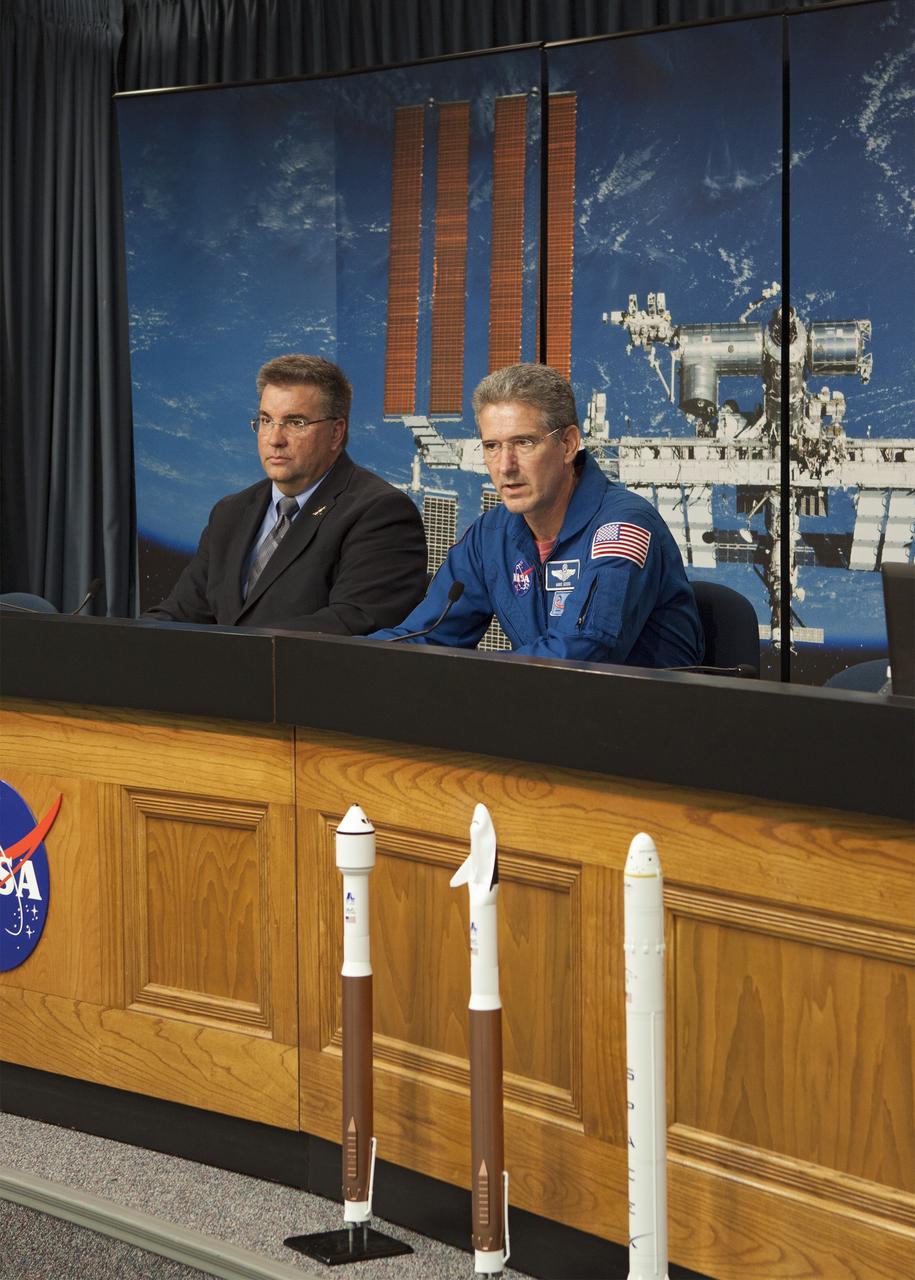
CAPE CANAVERAL, Fla. - NASA's Commercial Crew Program Manager Ed Mango and astronaut Mike Good media on the progress of American human spaceflight development at Kennedy Space Center in Florida. They also discussed the future steps the program will take to certify crew transportation systems for missions to the International Space Station. The program is working toward the next phase of certification, which will be called Commercial Crew Transportation Capability, or CCtCap. That phase will include a joint test concept in which NASA astronauts will play a role in flight testing the systems. To learn more about CCP, visit www.nasa.gov/commercialcrew. Photo credit: Jim Grossmann
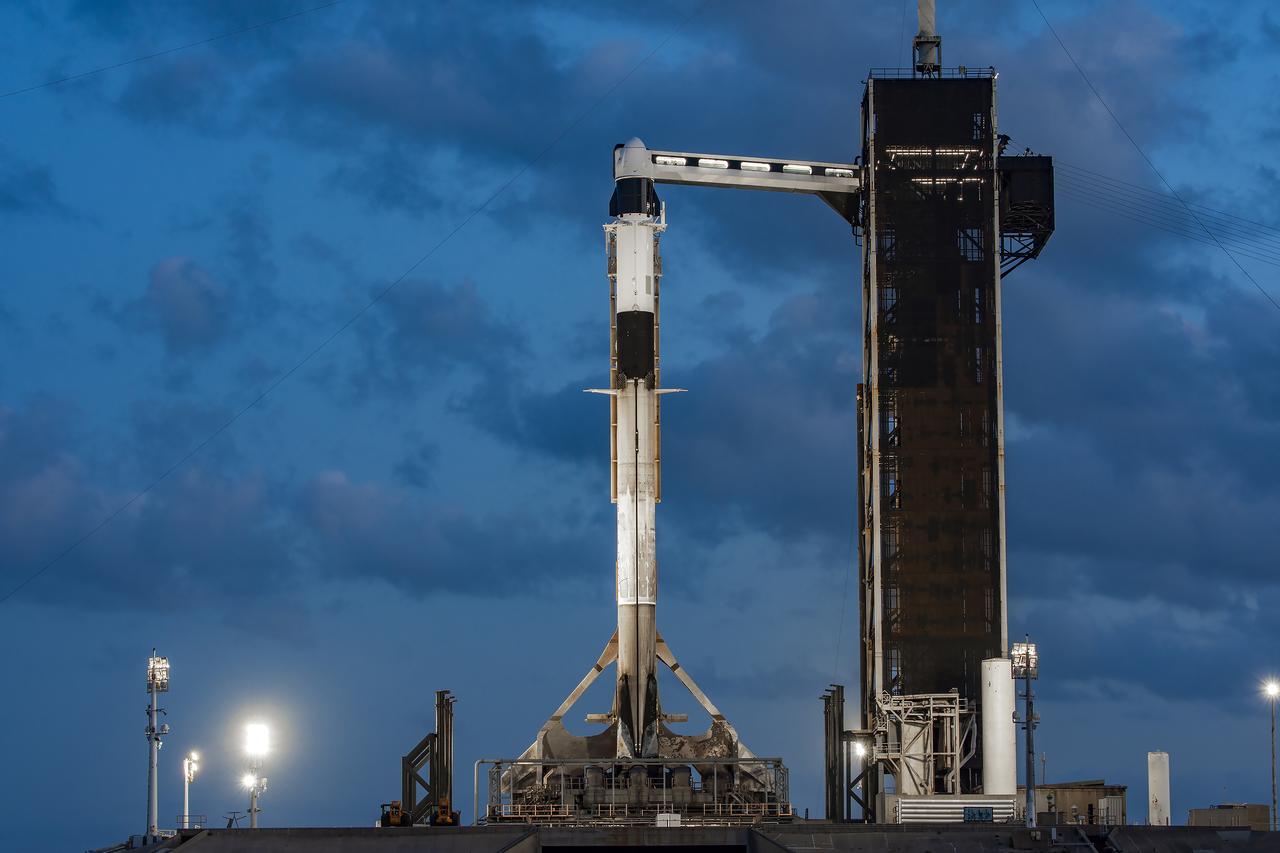
A SpaceX Falcon 9 rocket, with the company’s Dragon spacecraft atop, stands in a vertical position at Launch Complex 39A at NASA’s Kennedy Space Center in Florida on Monday, April 21, in preparation for the 32nd commercial resupply services launch to the International Space Station. Dragon is delivering a variety of science experiments, including a demonstration of refined maneuvers for free-floating robots. Dragon also carries an enhanced air quality monitoring system that could protect crew members on exploration missions to the Moon and Mars, and two atomic clocks to examine fundamental physics concepts such as relativity and test worldwide synchronization of precision timepieces.
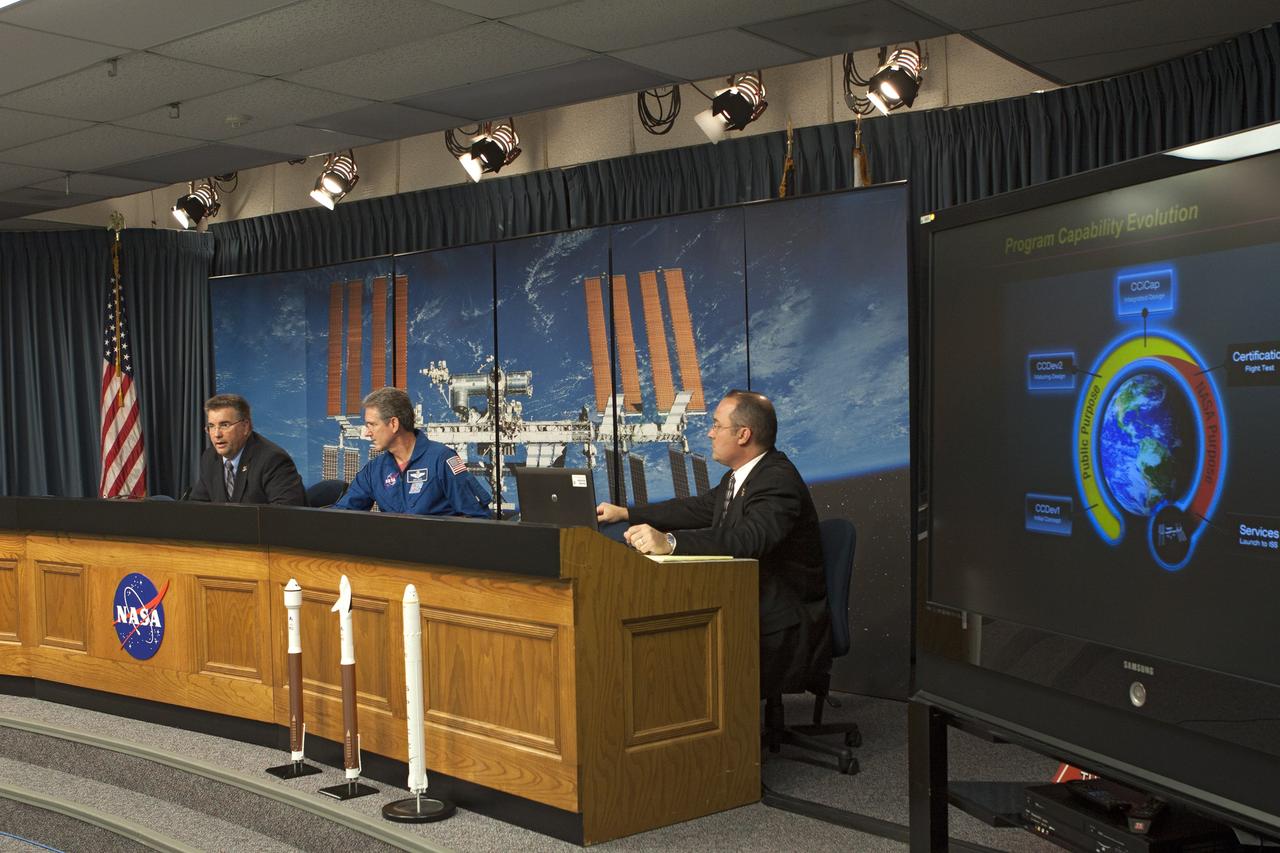
CAPE CANAVERAL, Fla. - NASA's Commercial Crew Program Manager Ed Mango and astronaut Mike Good media on the progress of American human spaceflight development at Kennedy Space Center in Florida. At right is NASA Public Affairs Officer Gregory Harland. They also discussed the future steps the program will take to certify crew transportation systems for missions to the International Space Station. The program is working toward the next phase of certification, which will be called Commercial Crew Transportation Capability, or CCtCap. That phase will include a joint test concept in which NASA astronauts will play a role in flight testing the systems. To learn more about CCP, visit www.nasa.gov/commercialcrew. Photo credit: Jim Grossmann
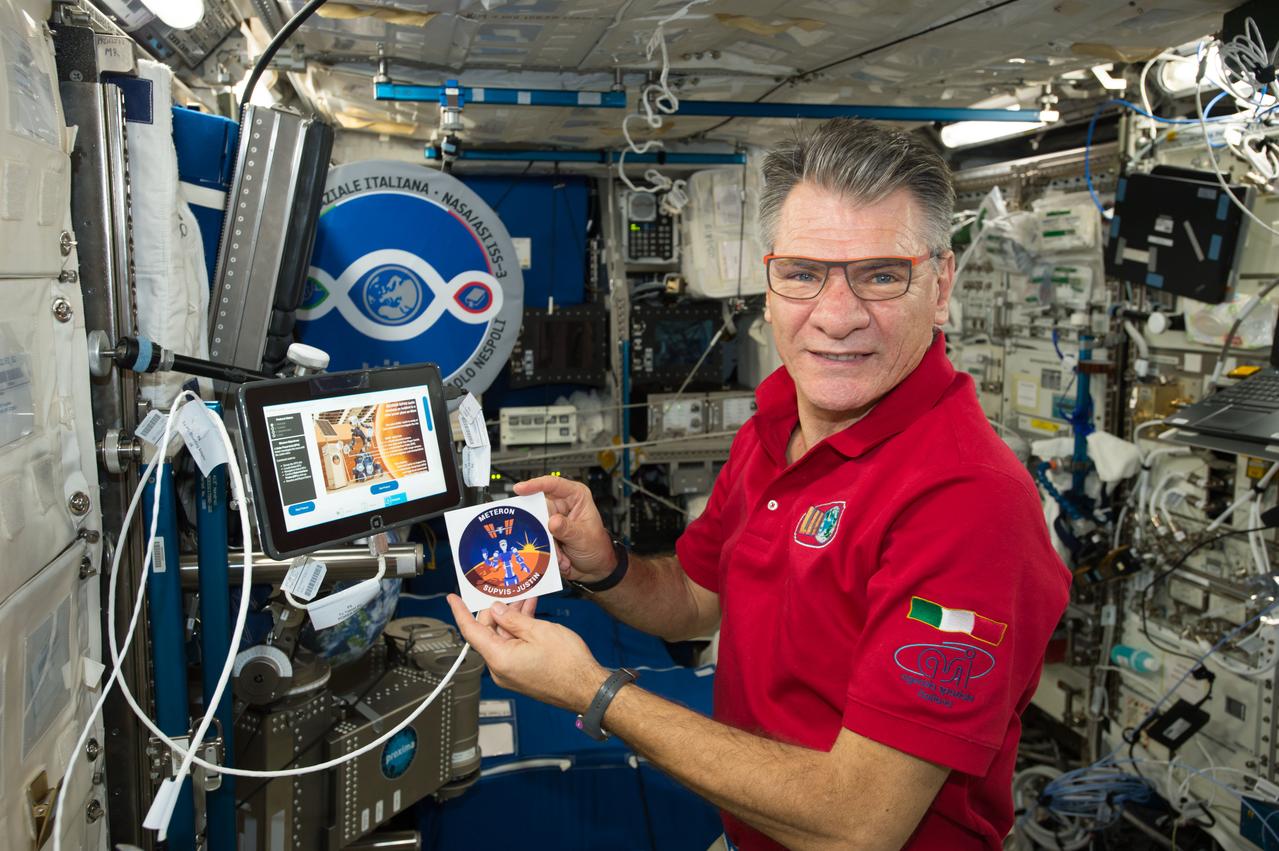
iss052e075356 (8/25/2017) --- European Space Agency (ESA) astronaut Paolo Nespoli is photographed performing protocol operation for ESA’s SUPVIS-Justin investigation. SUPVIS-Justin, part of the Meteron program, aims to demonstrate that an astronaut on an orbiting space station can command a robot via a tablet PC to perform complex tasks on a planetary surface. The SUPVIS Justin experiment includes an extended supervised autonomy concept: the crew gives high level commands to the robot, which then uses its local intelligence and decision-making capability to execute a task independently, according to pre-programmed algorithms. In this sense, the responsibility of decision-making is shared between the crew and the robot. External Caption
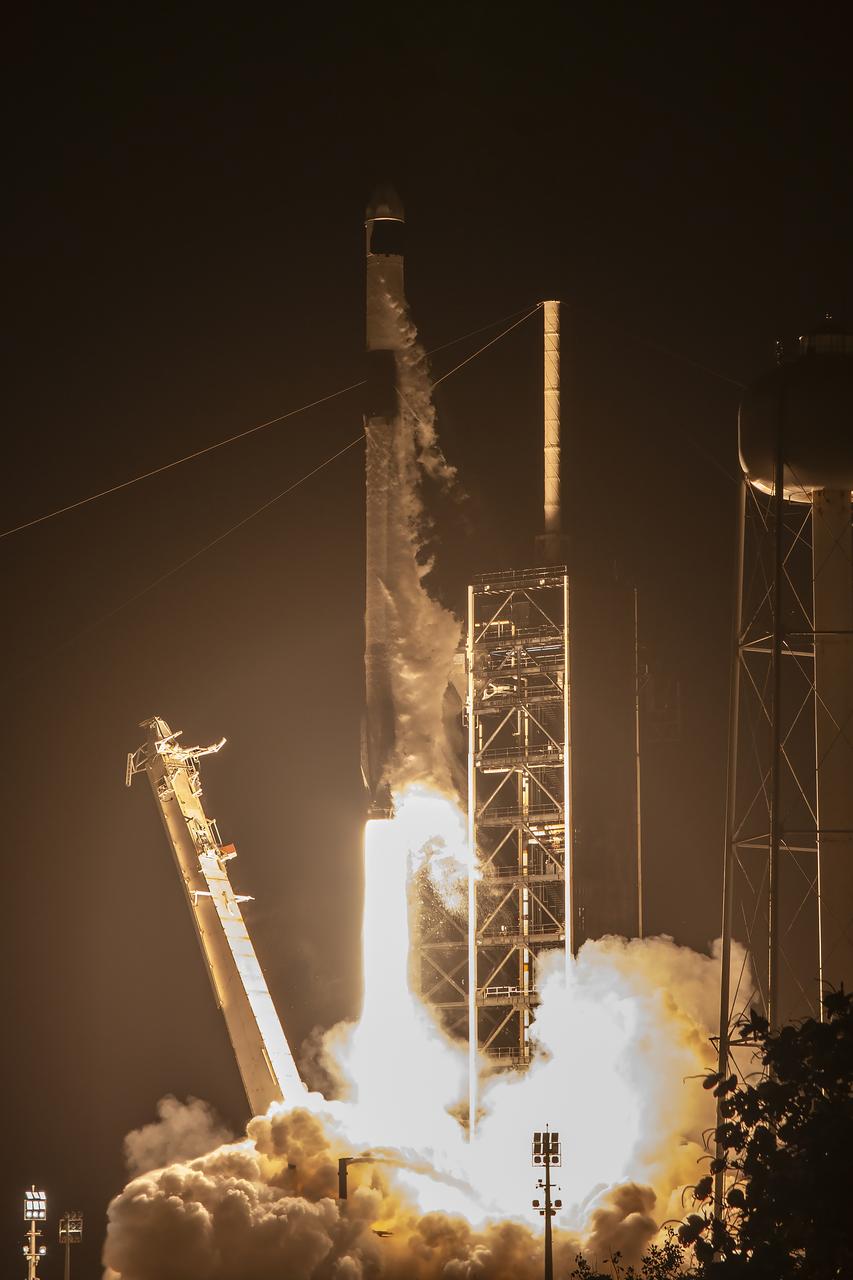
The SpaceX Falcon 9 rocket carrying the Dragon spacecraft lifts off from Launch Complex 39A at NASA’s Kennedy Space Center in Florida on Monday, April 21, on the company’s 32nd commercial resupply services mission for the agency to the International Space Station. Liftoff was at 4:15 a.m. EDT. Dragon will deliver a variety of science experiments, including a demonstration of refined maneuvers for free-floating robots. Dragon also carries an enhanced air quality monitoring system that could protect crew members on exploration missions to the Moon and Mars, and two atomic clocks to examine fundamental physics concepts such as relativity and test worldwide synchronization of precision timepieces.
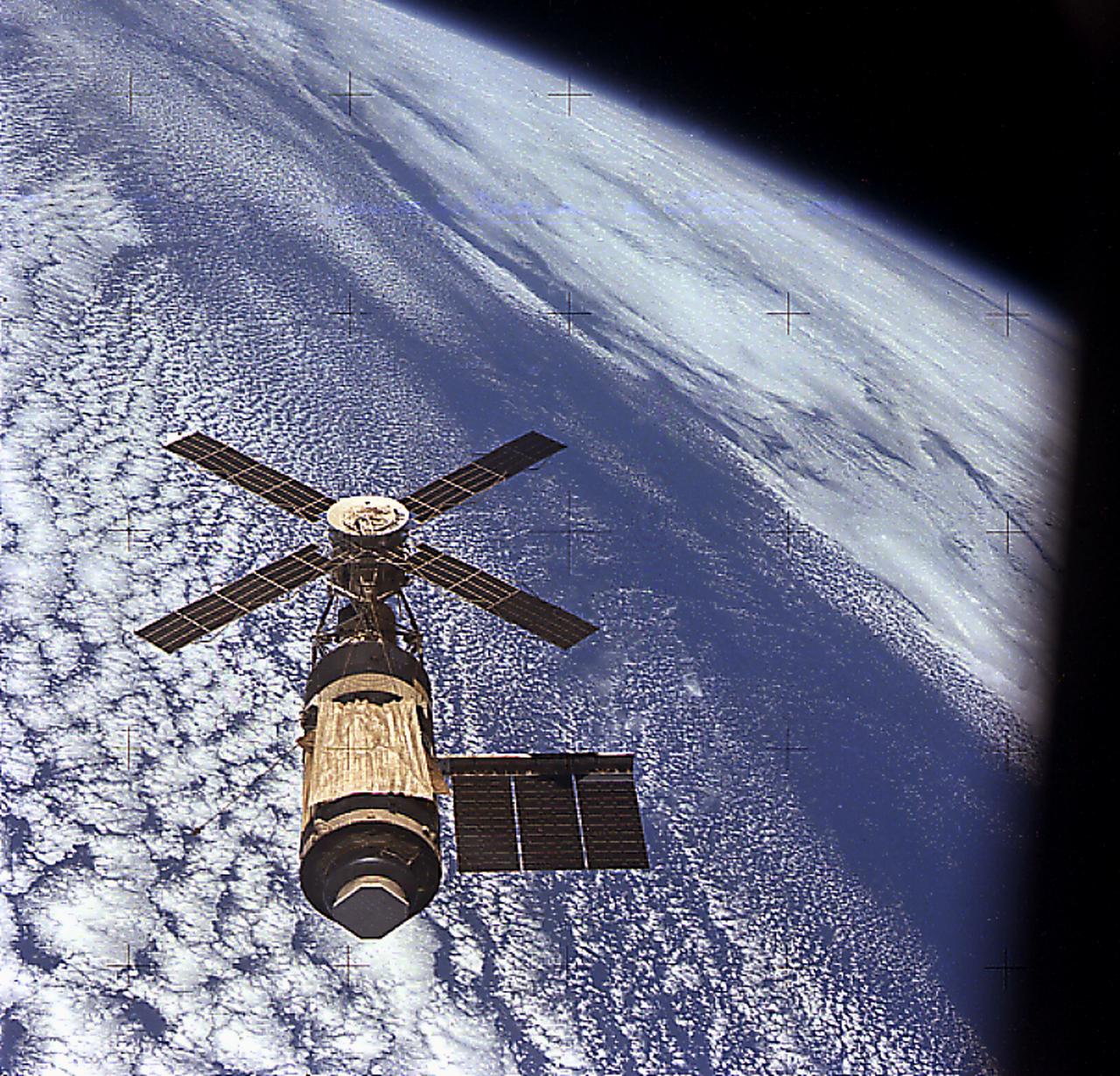
The idea that ultimately became Skylab first surfaced in 1962 as a proposal to convert a spent Saturn upper stage (Saturn V S-II stage) into an orbital workshop. In 1968, the Marshall Space Flight Center proposed an alternative to the wet workshop concept of refurbishing a space station in orbit. Instead, a fully equipped dry workshop could be launched as a complete unit ready for occupancy. Skylab became the free world's first space station. Launched in May 1973, the Skylab space station was occupied in succession by three teams of three crewmembers. These crews spent 28, 59, and 84 days respectively, orbiting the Earth and performing nearly 300 experiments. This view of Skylab in orbit was taken by the Skylab 4 (the last Skylab mission) crew.

A Nasdaq moderator, center, talks with NanoRacks CEO Jeff Manber, left, NASA Manager of the International Space Station Research Office Marybeth Edeen, AlphaSpace Founder and Chairman Stephanie Murphy, and Made in Space Vice President of Advanced Programs and Concepts Justin Kugler, right, during a live social media event shortly after NASA announced a five-part plan to open the International Space Station to expanded commercial and marketing activities and private astronaut missions to the station and enable additional commercial destinations in low-Earth orbit, Friday, June 7, 2019 at the Nasdaq MarketSite in New York City. NASA will continue to maintain human presence and research in low-Earth orbit, and the long-term goal is to achieve a robust economy from which NASA can purchase services at a lower cost. Photo Credit: (NASA/Bill Ingalls)
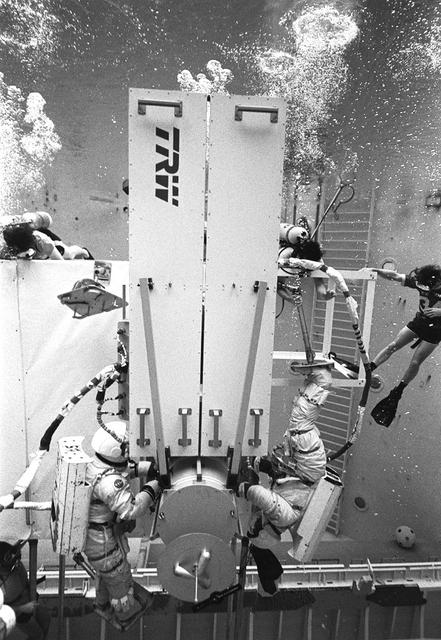
The Space Platform was first conceived as a launching site for deep space exploration. The original idea was to build this space platform either on the moon's surface or near lunar orbit. It would be used as a staging base, where the reusable launch vehicles (later known as Space Shuttles) would ferry machinery and equipment to assemble deep space exploration vehicles. Replaced by the Space Station concept, the space platform idea was never completed. However, early in the space platform development, astronauts trained at the Marshall Space Flight Center's (MSFC) Neutral Buoyancy Simulator (NBS), as pictured here, working on solar array equipment. This experiment was deployed from the shuttle to study the motions of large structures in space. Similar arrays will be used on the Space Station and large observatory spacecraft in the future.
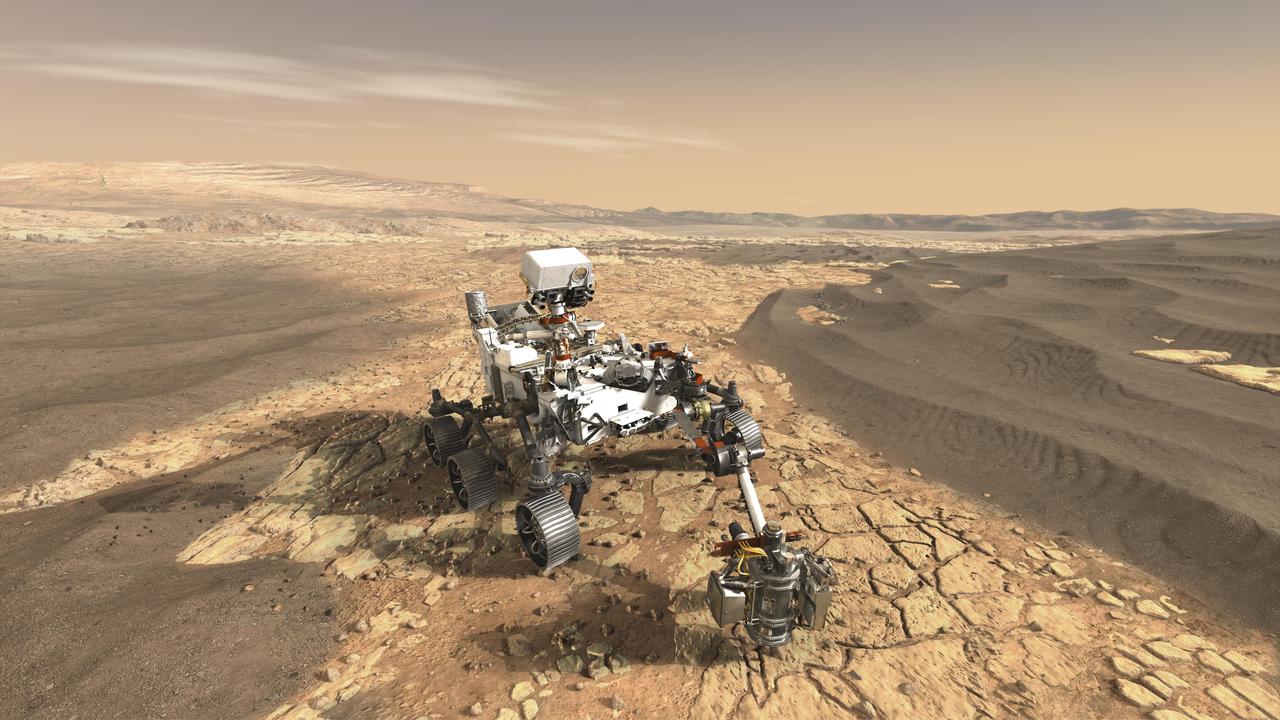
This artist's concept depicts NASA's Mars 2020 rover on the surface of Mars. The mission takes the next step by not only seeking signs of habitable conditions on Mars in the ancient past, but also searching for signs of past microbial life itself. The Mars 2020 rover introduces a drill that can collect core samples of the most promising rocks and soils and set them aside on the surface of Mars. A future mission could potentially return these samples to Earth. Mars 2020 is targeted for launch in July/August 2020 aboard an Atlas V 541 rocket from Space Launch Complex 41 at Cape Canaveral Air Force Station in Florida. https://photojournal.jpl.nasa.gov/catalog/PIA21635