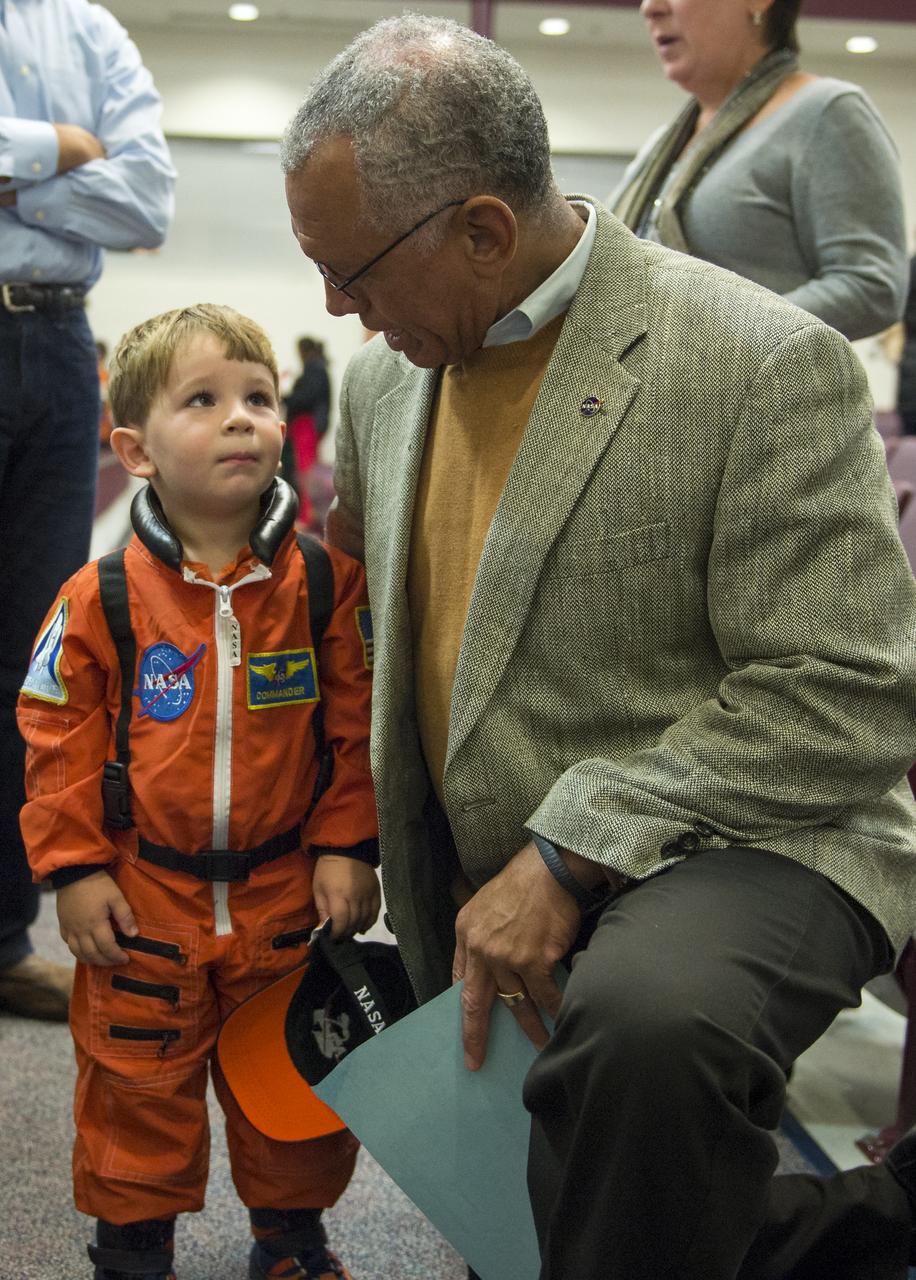
NASA Administrator Charles F. Bolden greets Lucas Yaroschuk, 3, of Arlington, Va., during a stargazing event at Hoffman-Boston Elementary School in Arlington, Va. on Thursday, Nov. 7, 2013. Photo Credit: (NASA/Jay Westcott)
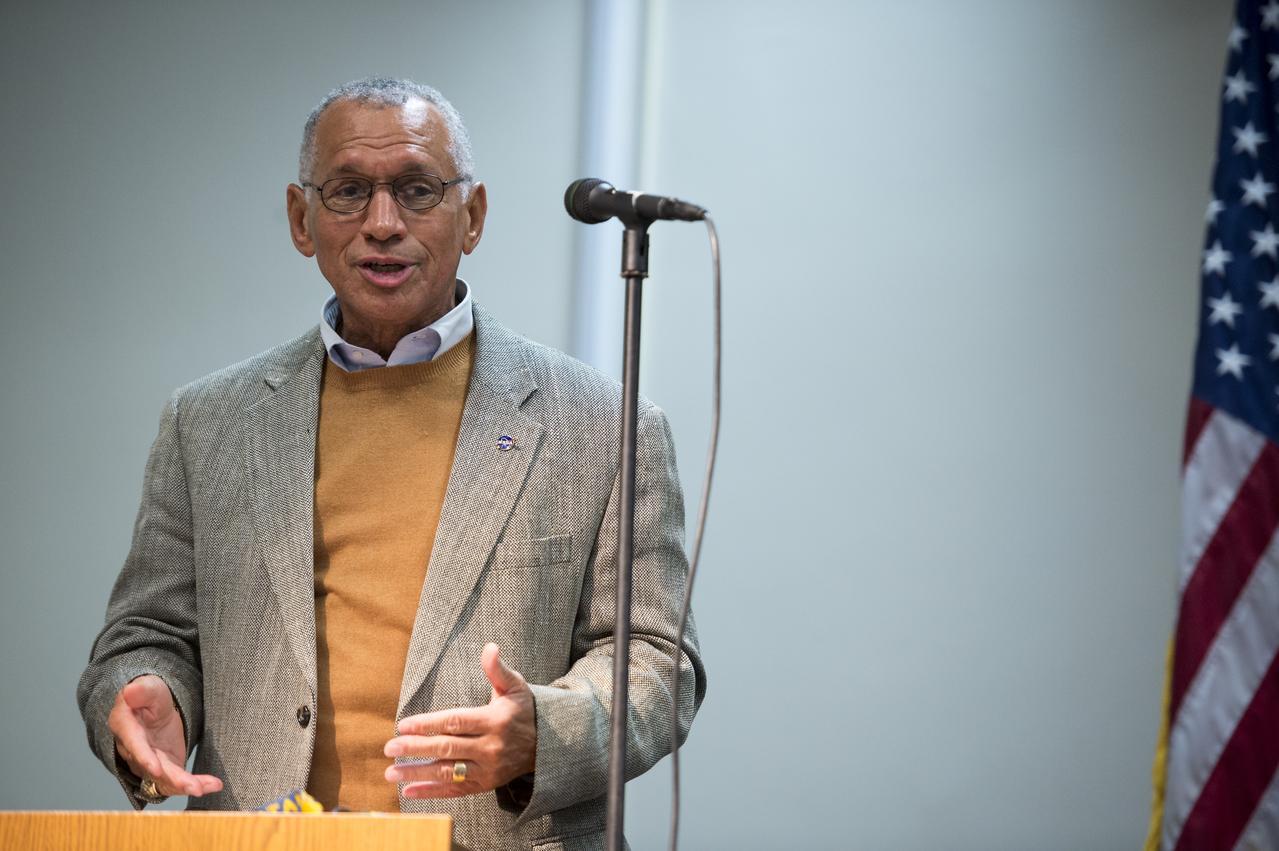
NASA Administrator Charles F. Bolden gestures while making remarks before a stargazing event at Hoffman-Boston Elementary School in Arlington, Va. on Thursday, Nov. 7, 2013. Photo Credit: (NASA/Jay Westcott)
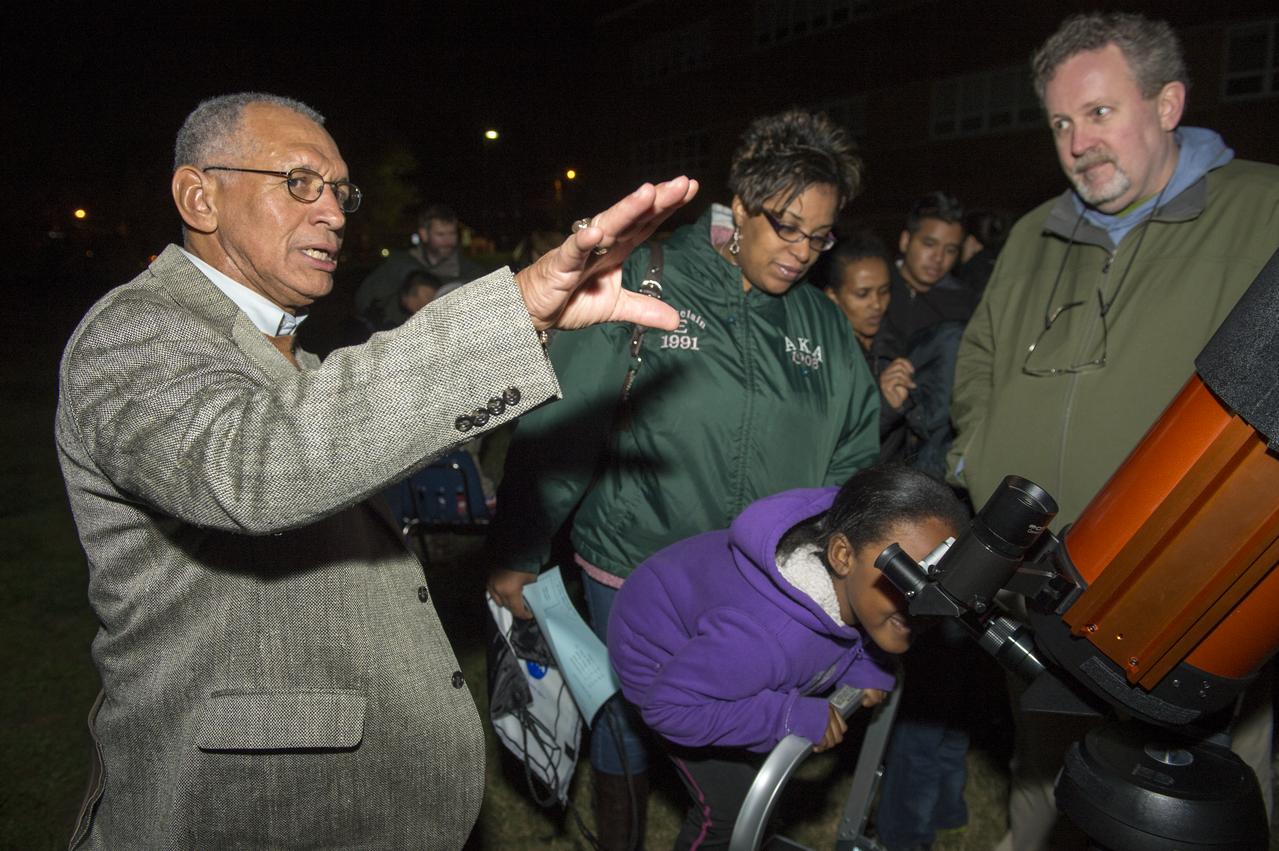
NASA Administrator Charles F. Bolden gestures while making remarks at a stargazing event at Hoffman-Boston Elementary School in Arlington, Va. on Thursday, Nov. 7, 2013. Photo Credit: (NASA/Jay Westcott)

Deputy Director Colleen Hartman from NASA Goddard Space Flight Center looks on as Kamal Amiral, 5, of Arlington, Va., looks at the moon through a telescope during a stargazing event at Hoffman-Boston Elementary School in Arlington, Va. on Thursday, Nov. 7, 2013. NASA Administrator Charles F. Bolden is also pictured. Photo Credit: (NASA/Jay Westcott)
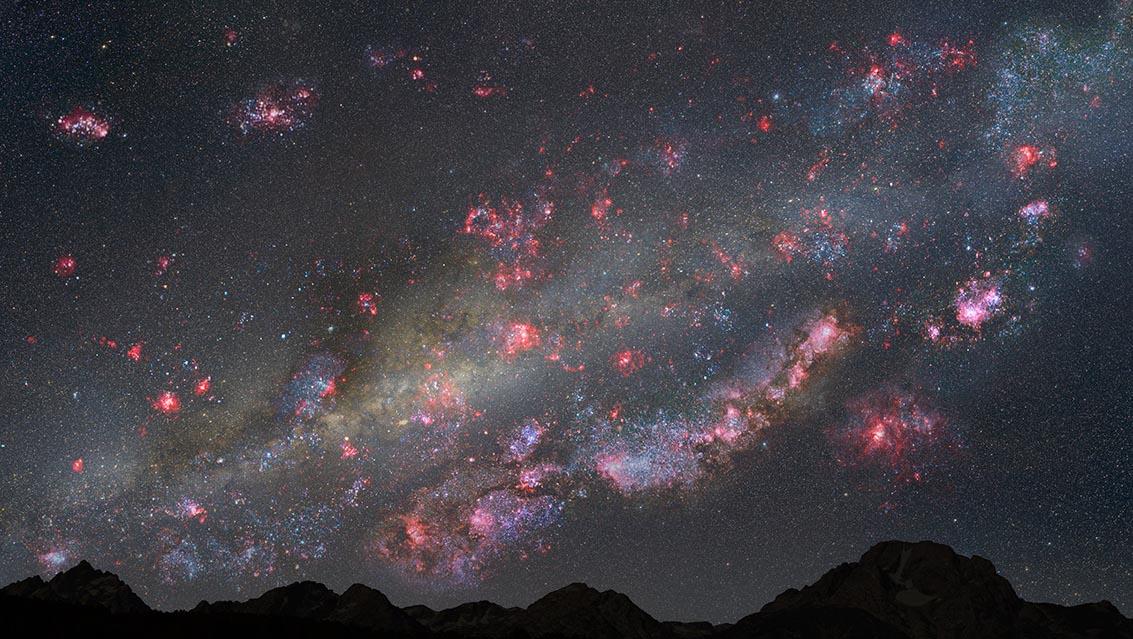
Caption: Artist's view of night sky from a hypothetical planet within a young Milky Way-like galaxy 10 billion years ago, the sky are ablaze with star birth. Pink clouds of gas harbor newborn stars, and bluish-white, young star clusters litter the landscape. Image Credit: NASA/ESA/Z. Levay (STScI) More info: In one of the most comprehensive multi-observatory galaxy surveys yet, astronomers find that galaxies like our Milky Way underwent a stellar “baby boom,” churning out stars at a prodigious rate, about 30 times faster than today. Our sun, however, is a late “boomer.” The Milky Way’s star-birthing frenzy peaked 10 billion years ago, but our sun was late for the party, not forming until roughly 5 billion years ago. By that time the star formation rate in our galaxy had plunged to a trickle. Missing the party, however, may not have been so bad. The sun’s late appearance may actually have fostered the growth of our solar system’s planets. Elements heavier than hydrogen and helium were more abundant later in the star-forming boom as more massive stars ended their lives early and enriched the galaxy with material that served as the building blocks of planets and even life on Earth. Astronomers don’t have baby pictures of our Milky Way’s formative years to trace the history of stellar growth so they studied galaxies similar in mass to our Milky Way, found in deep surveys of the universe. The farther into the universe astronomers look, the further back in time they are seeing, because starlight from long ago is just arriving at Earth now. From those surveys, stretching back in time more than 10 billion years, researchers assembled an album of images containing nearly 2,000 snapshots of Milky Way-like galaxies. The new census provides the most complete picture yet of how galaxies like the Milky Way grew over the past 10 billion years into today’s majestic spiral galaxies. The multi-wavelength study spans ultraviolet to far-infrared light, combining observations from NASA’s Hubble and Spitzer space telescopes, the European Space Agency’s Herschel Space Observatory, and ground-based telescopes, including the Magellan Baade Telescope at the Las Campanas Observatory in Chile. Read more: <a href="http://www.nasa.gov/content/goddard/our-sun-came-late-to-the-milky-way-s-star-birth-party/" rel="nofollow">www.nasa.gov/content/goddard/our-sun-came-late-to-the-mil...</a> <b><a href="http://www.nasa.gov/audience/formedia/features/MP_Photo_Guidelines.html" rel="nofollow">NASA image use policy.</a></b> <b><a href="http://www.nasa.gov/centers/goddard/home/index.html" rel="nofollow">NASA Goddard Space Flight Center</a></b> enables NASA’s mission through four scientific endeavors: Earth Science, Heliophysics, Solar System Exploration, and Astrophysics. Goddard plays a leading role in NASA’s accomplishments by contributing compelling scientific knowledge to advance the Agency’s mission. <b>Follow us on <a href="http://twitter.com/NASAGoddardPix" rel="nofollow">Twitter</a></b> <b>Like us on <a href="http://www.facebook.com/pages/Greenbelt-MD/NASA-Goddard/395013845897?ref=tsd" rel="nofollow">Facebook</a></b> <b>Find us on <a href="http://instagrid.me/nasagoddard/?vm=grid" rel="nofollow">Instagram</a></b>
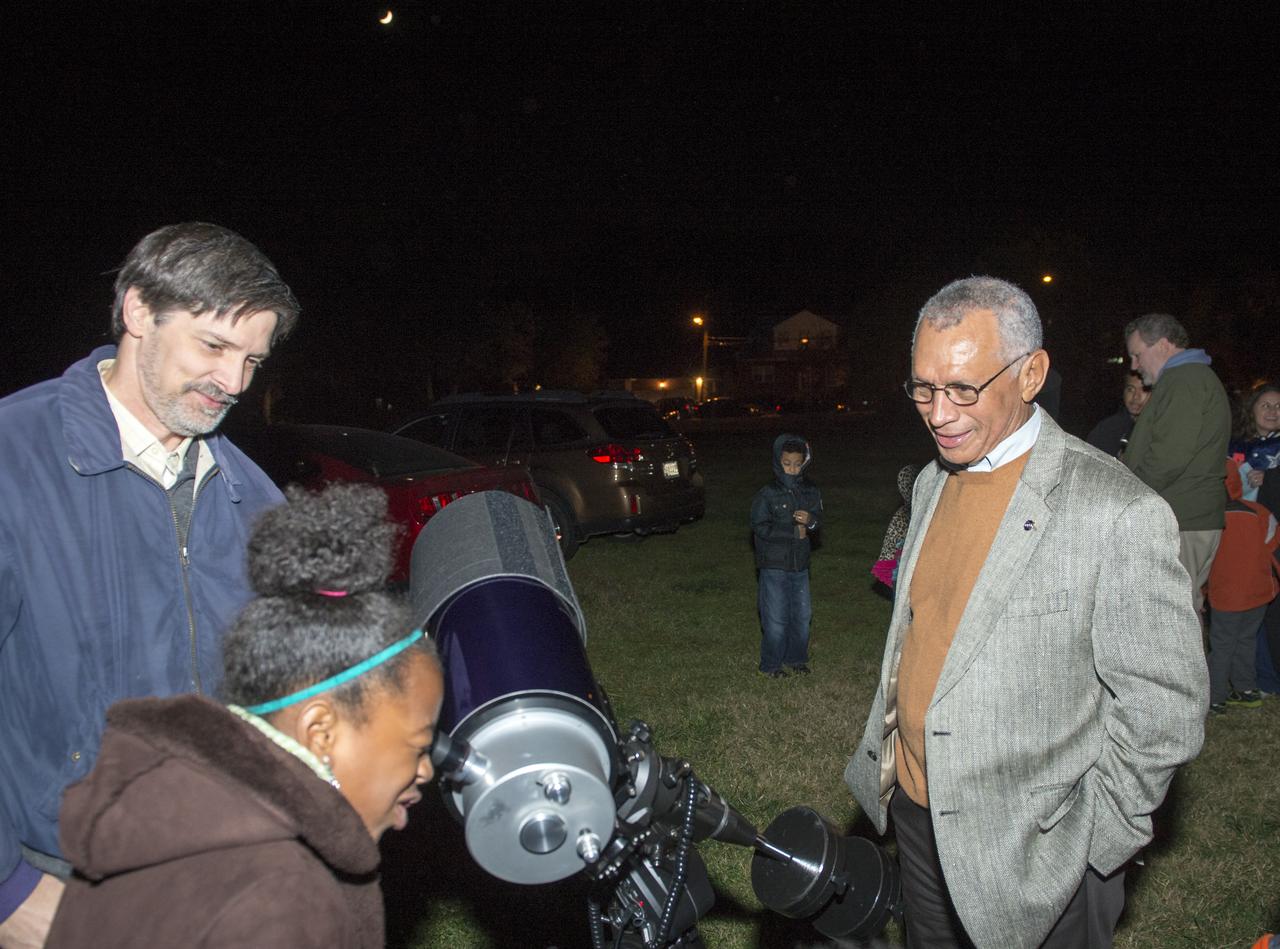
NASA Administrator Charles F. Bolden looks on as Kalani Brown, 9, of Arlington, Va., looks at the moon through a telescope during a stargazing event at Hoffman-Boston Elementary School in Arlington, Va. on Thursday, Nov. 7, 2013. Photo Credit: (NASA/Jay Westcott)

KENNEDY SPACE CENTER, FLA. -- The rock band Aerosmith, with their guests, stop on the red carpet entrance to the site of the world premiere of the movie "Armageddon," which was held at the Kennedy Space Center in Florida. A special theater was constructed for the premiere outside the Apollo/Saturn V Center. The band, which provided four songs for the film's soundtrack, performed at a private party on the site after the screening. Lead vocalist Steve Tyler (middle) is the father of one of the stars of the movie, Liv Tyler. The movie was partly filmed at KSC, and as part of the premiere festivities, guests had a chance to see many of the sites actually used in the film as well as explore a wide range of NASA artifacts and displays.
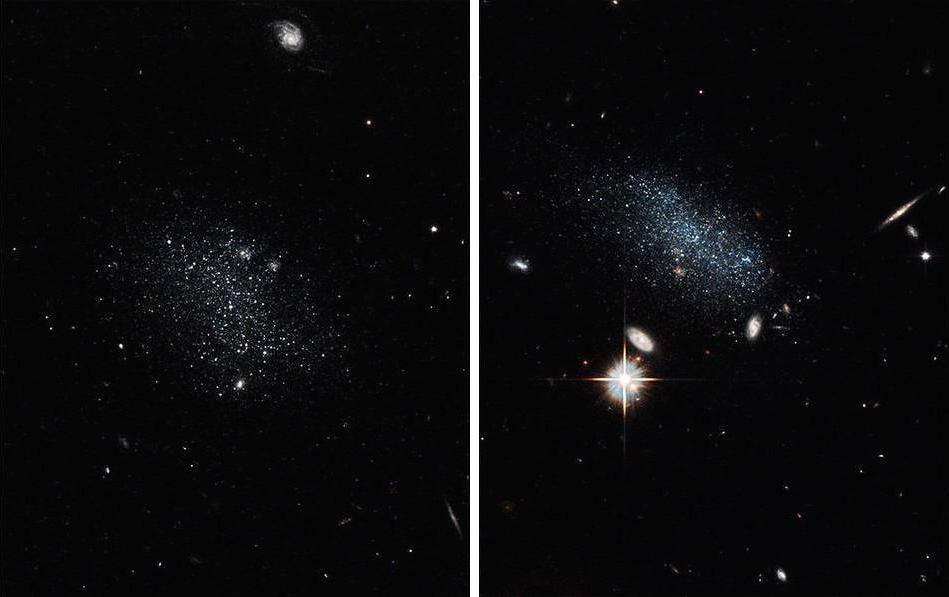
NASA’s Hubble Space Telescope uncovered two tiny dwarf galaxies that have wandered from a vast cosmic wilderness into a nearby “big city” packed with galaxies. After being idle for billions of years, they are ready to party by starting a firestorm of star birth. Hubble captured the glow of new stars in these small, ancient galaxies, called Pisces A and Pisces B. Observations suggests the galaxies are late bloomers because they have spent most of their existence in the Local Void, a region of the universe sparsely populated with galaxies. The Local Void is roughly 150 million light-years across. Credits: NASA, ESA, and E. Tollerud (STScI) <b><a href="http://www.nasa.gov/audience/formedia/features/MP_Photo_Guidelines.html" rel="nofollow">NASA image use policy.</a></b> <b><a href="http://www.nasa.gov/centers/goddard/home/index.html" rel="nofollow">NASA Goddard Space Flight Center</a></b> enables NASA’s mission through four scientific endeavors: Earth Science, Heliophysics, Solar System Exploration, and Astrophysics. Goddard plays a leading role in NASA’s accomplishments by contributing compelling scientific knowledge to advance the Agency’s mission. <b>Follow us on <a href="http://twitter.com/NASAGoddardPix" rel="nofollow">Twitter</a></b> <b>Like us on <a href="http://www.facebook.com/pages/Greenbelt-MD/NASA-Goddard/395013845897?ref=tsd" rel="nofollow">Facebook</a></b> <b>Find us on <a href="http://instagrid.me/nasagoddard/?vm=grid" rel="nofollow">Instagram</a></b>