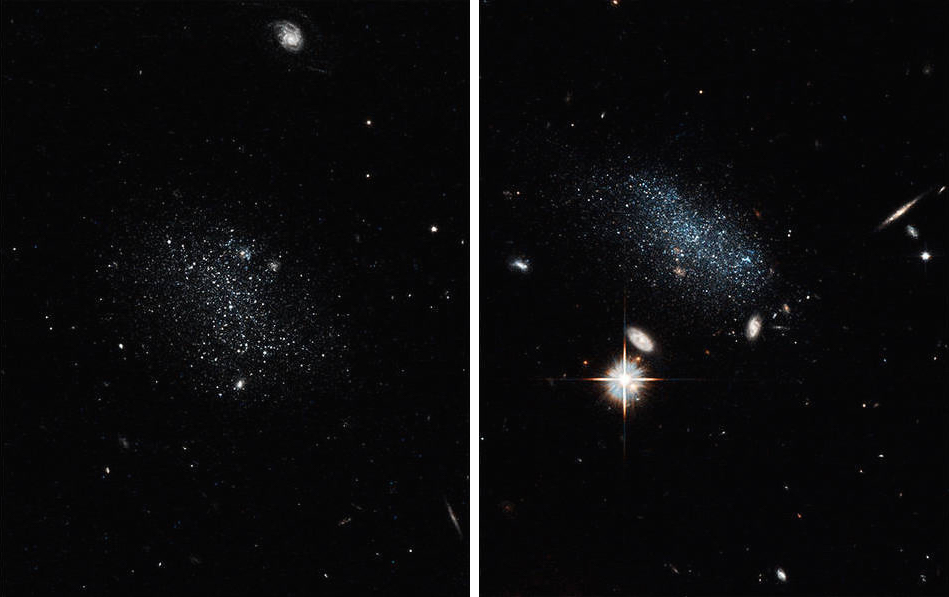
NASA’s Hubble Space Telescope uncovered two tiny dwarf galaxies that have wandered from a vast cosmic wilderness into a nearby “big city” packed with galaxies. After being idle for billions of years, they are ready to party by starting a firestorm of star birth. Hubble captured the glow of new stars in these small, ancient galaxies, called Pisces A and Pisces B. Observations suggests the galaxies are late bloomers because they have spent most of their existence in the Local Void, a region of the universe sparsely populated with galaxies. The Local Void is roughly 150 million light-years across. Credits: NASA, ESA, and E. Tollerud (STScI) NASA image use policy. NASA Goddard Space Flight Center enables NASA’s mission through four scientific endeavors: Earth Science, Heliophysics, Solar System Exploration, and Astrophysics. Goddard plays a leading role in NASA’s accomplishments by contributing compelling scientific knowledge to advance the Agency’s mission. Follow us on Twitter Like us on Facebook Find us on Instagram