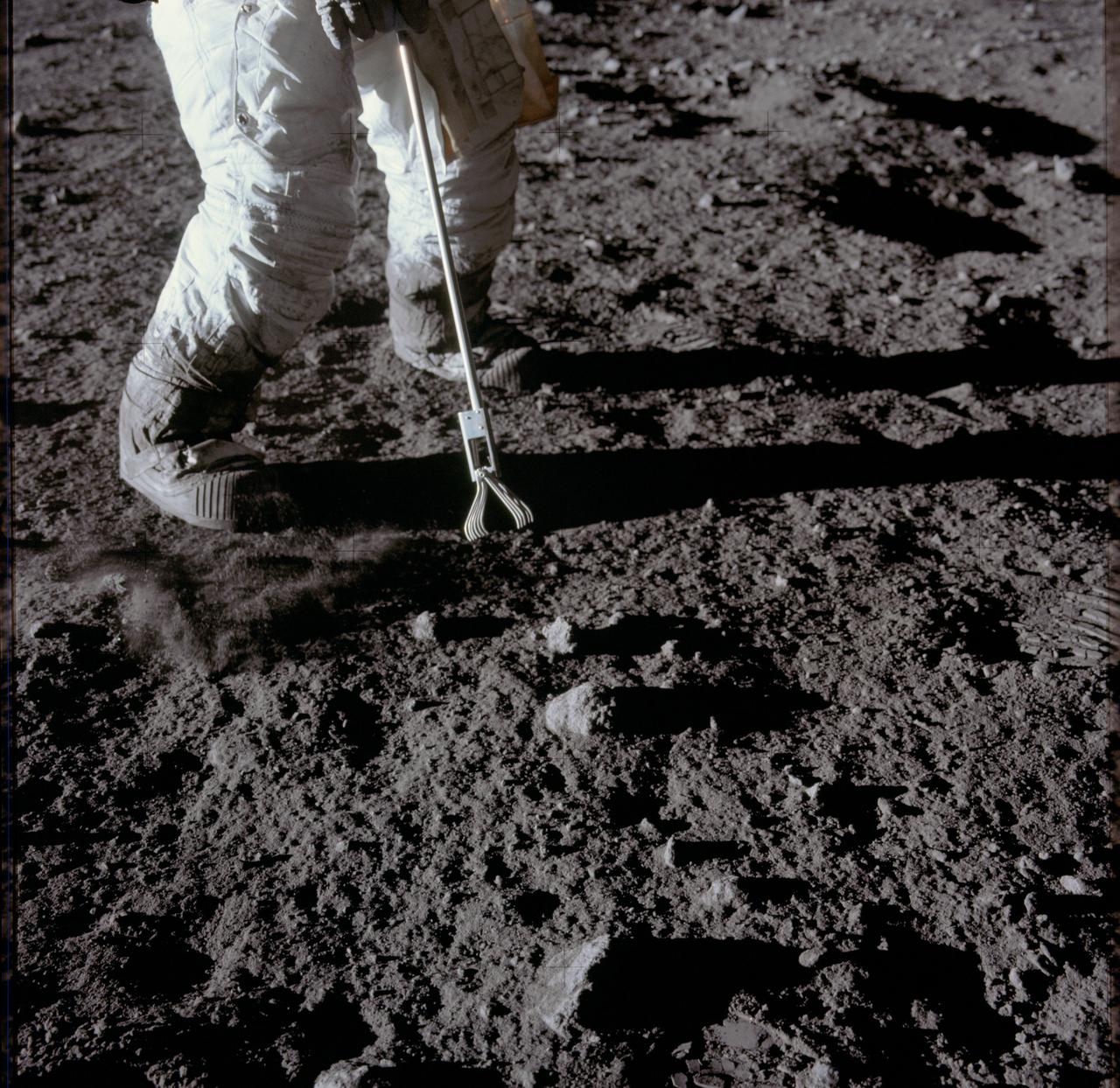
AS12-47-6932 (19 Nov. 1969) --- Close-up view of a set of tongs, an Apollo Lunar Hand Tool, being used by astronaut Charles Conrad Jr., commander, to pick up lunar samples during the Apollo 12 extravehicular activity. This photograph shows Conrad's legs and a good view of the lunar soil.
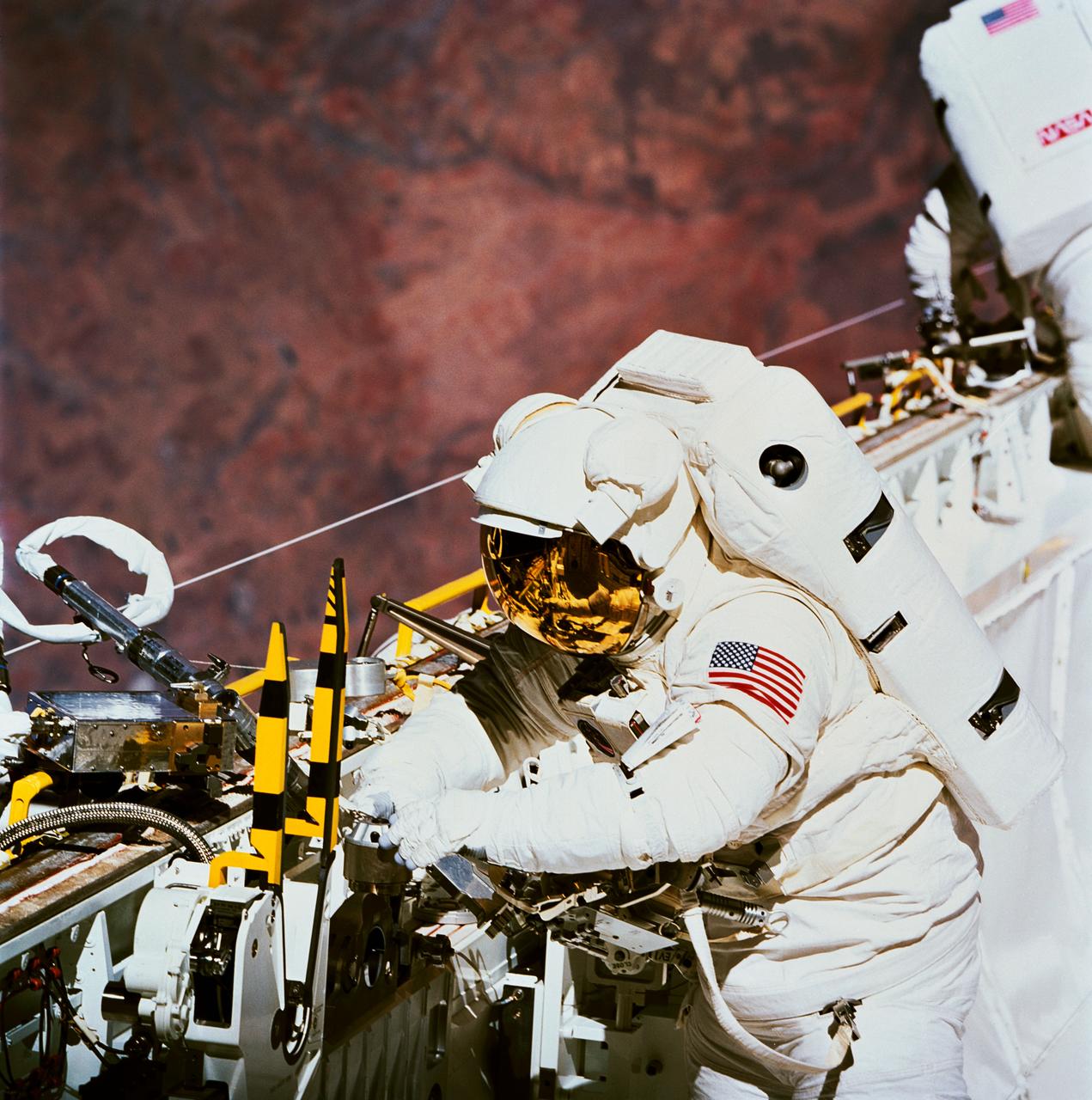
In Discovery's cargo bay, astronaut James H. Newman works with the power ratchet tool (PRT). Astronaut Carl E. Walz, who joined Newman for the lengthy period of extravehicular activity (EVA), is partially visible in the background. The two mission specialists devoted part of their EVA to evaluating tools and equipment expected to be used in the Hubble Space Telescope servicing. A desert area in Africa forms the backdrop for the 70mm scene.
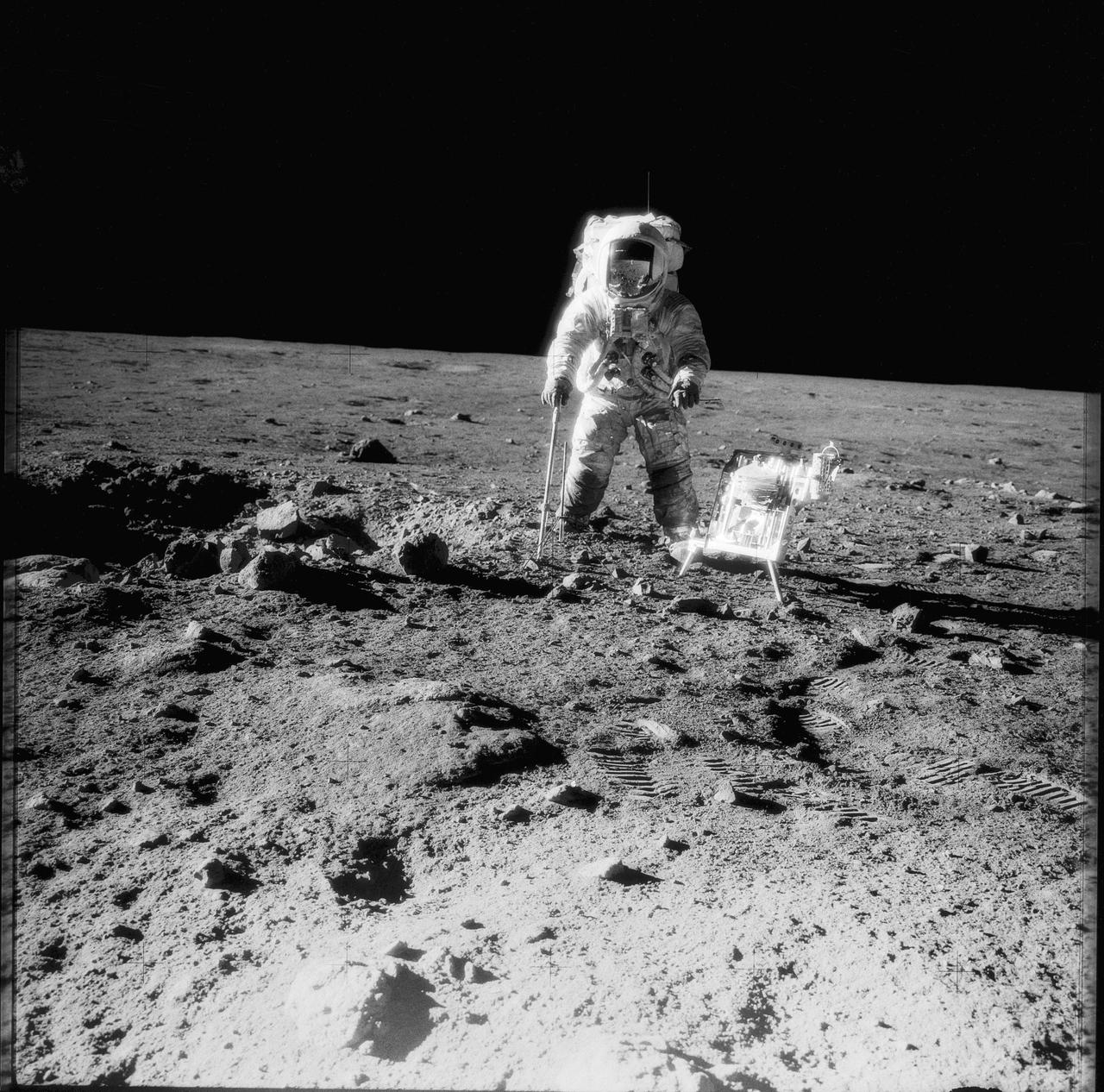
AS12-49-7318 (19-20 Nov. 1969) --- One of the Apollo 12 crew members is photographed with the tools and carrier of the Apollo Lunar Hand Tools (ALHT) during extravehicular activity (EVA) on the surface of the moon. Several footprints made by the two crew members during their EVA are seen in the foreground. While astronauts Charles Conrad Jr., commander, and Alan L. Bean, lunar module pilot, descended in the Lunar Module (LM) "Intrepid" to explore the Ocean of Storms region of the moon, astronaut Richard F. Gordon Jr., command module pilot, remained with the Command and Service Modules (CSM) "Yankee Clipper" in lunar orbit.
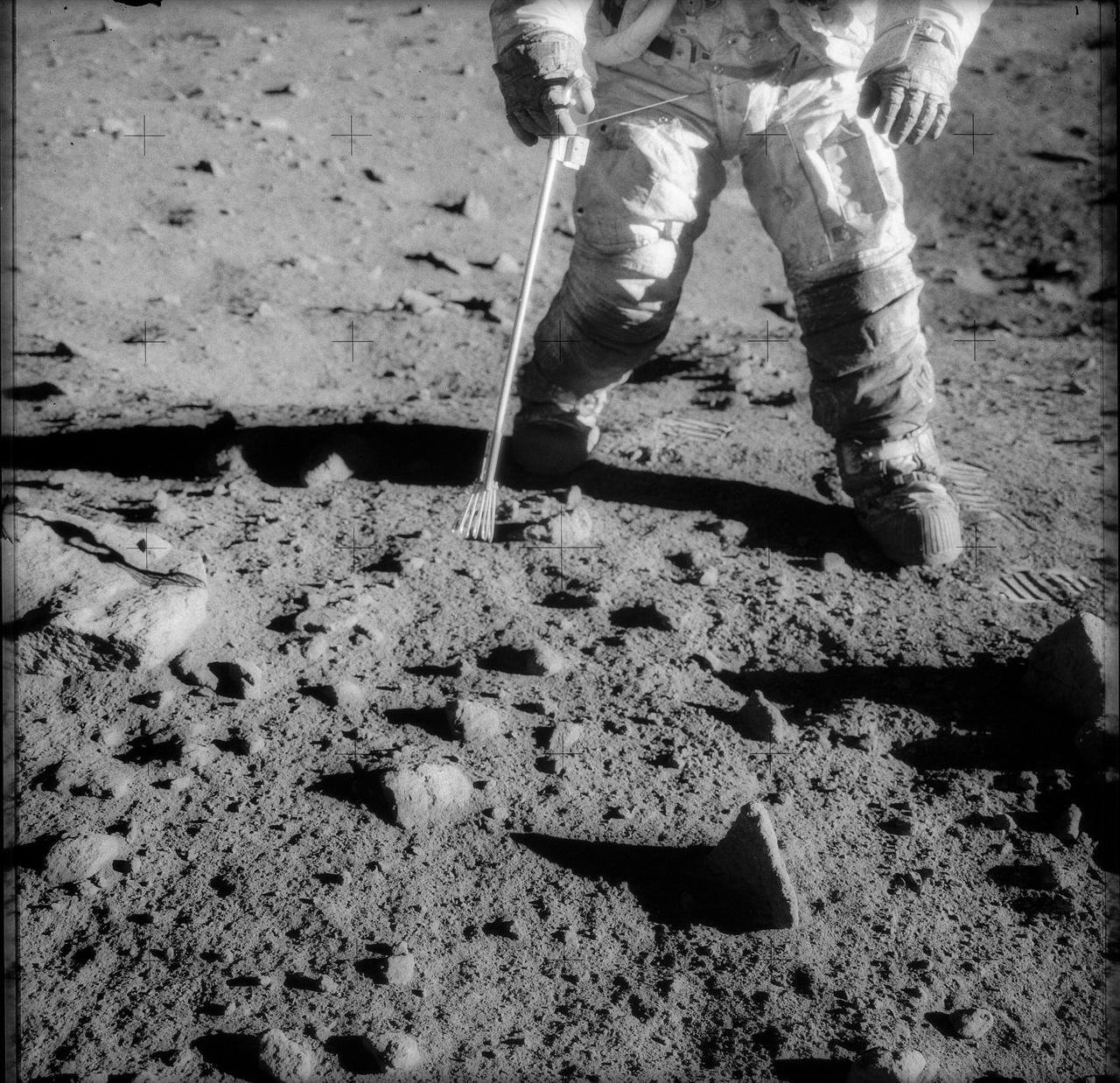
AS12-48-7149 (20 Nov. 1969) --- A close-up view of astronaut Charles Conrad Jr., commander of the Apollo 12 lunar landing mission, photographed during the extravehicular activity (EVA) on the surface of the moon. An EVA checklist is on Conrad's left wrist. A set of tongs, an Apollo Lunar Hand Tool (ALHT), is held in his right hand. Several footprints can be seen. Astronaut Richard F. Gordon Jr., command module pilot, remained with the Command and Service Modules (CSM) in lunar orbit while astronauts Conrad and Alan L. Bean, lunar module pilot, descended in the LM to explore the moon. Note lunar soil on the suit of Conrad, especially around the knees and below.

AS16-110-17960 (22 April 1972) --- Astronaut John W. Young, commander, replaces tools in the Apollo Lunar Hand Tool (ALHT) carrier at the aft end of the Lunar Roving Vehicle (LRV) during the second Apollo 16 extravehicular activity (EVA) on the high side of Stone Mountain at the Descartes landing site. Astronaut Charles M. Duke Jr., lunar module pilot, took this photograph near the conclusion of Station 4 activities. Smoky Mountain, with the large Ravine Crater on its flank, is in the left background. This view is looking northeast. While astronauts Young and Duke descended in the Apollo 16 Lunar Module (LM) "Orion" to explore the Descartes highlands landing site on the moon, astronaut Thomas K. Mattingly II, command module pilot, remained with the Command and Service Modules (CSM) "Casper" in lunar orbit.
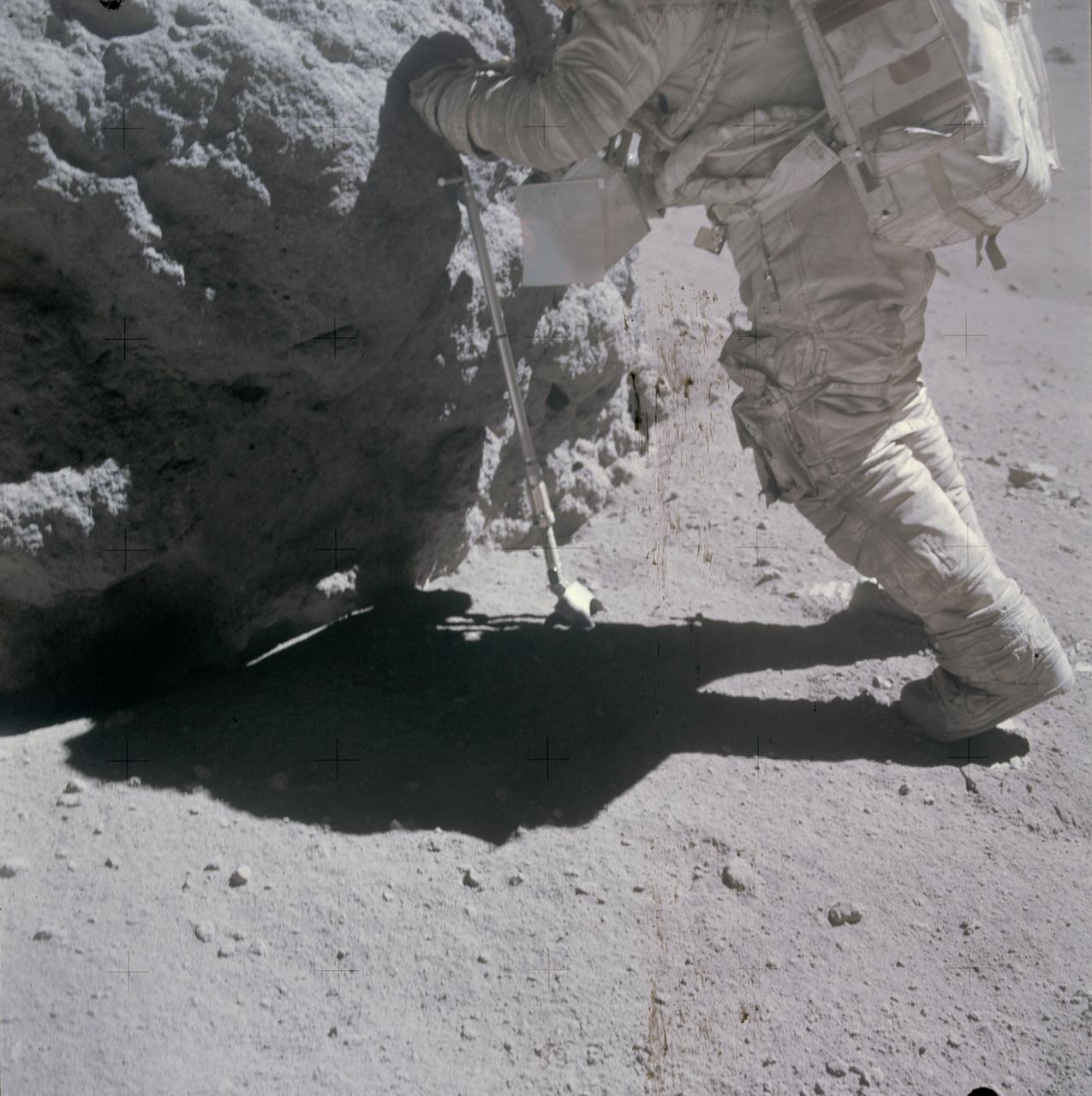
AS16-116-18671 (23 April 1972) --- Astronaut Charles M. Duke Jr., lunar module pilot, works at the "Shadow Rock", discovered during the missions third extravehicular activity (EVA) in the area of North Ray Crater (Station 13), April 23, 1972. The scoop, a geological hand tool, leans against the rock. This view was exposed by astronaut John W. Young, commander. The two moon-exploring crew men sampled this rock, which got its name because of a permanently shadowed area it protected. While astronauts Young and Duke descended in the Apollo 16 Lunar Module (LM) "Orion" to explore the Descartes highlands landing site on the moon, astronaut Thomas K. Mattingly II, command module pilot, remained with the Command and Service Modules (CSM) "Casper" in lunar orbit.
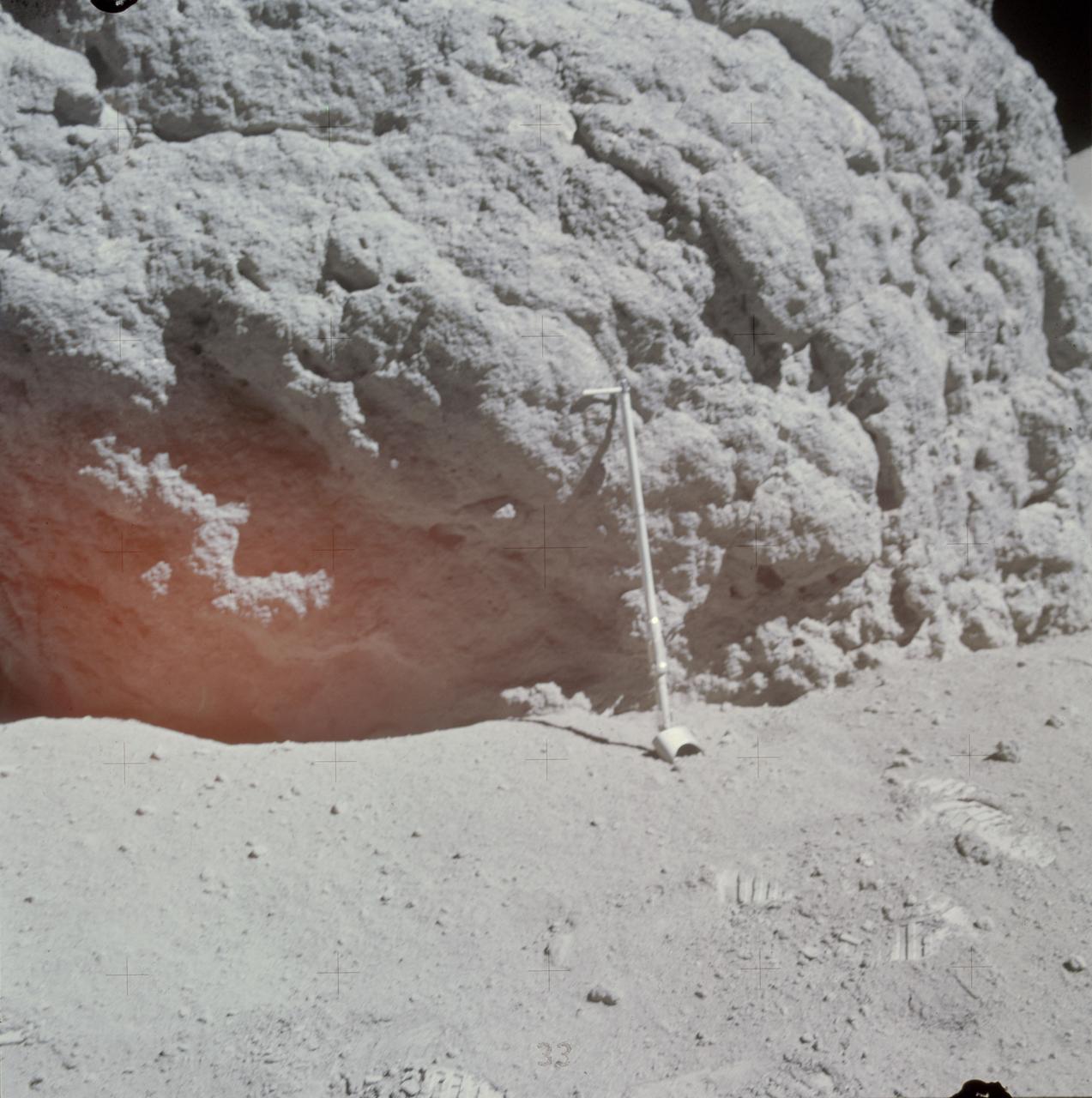
AS16-117-18728 (23 April 1972) --- Astronaut Charles M. Duke Jr., lunar module pilot, exposed this view of the huge "Shadow Rock" with his 70mm Hasselblad camera during the mission's third and final extravehicular activity (EVA), on April 23, 1972. This particular stop was referenced as Station 13. The scoop, a geological hand tool, leans against the rock and helps to give an idea of the size. Station 13 is a little southeast of North Ray Crater at the Descartes area. While astronauts John W. Young, commander; and Duke descended in the Apollo 16 Lunar Module (LM) "Orion" to explore the Descartes highlands landing site on the moon, astronaut Thomas K. Mattingly II, command module pilot, remained with the Command and Service Modules (CSM) "Casper" in lunar orbit.
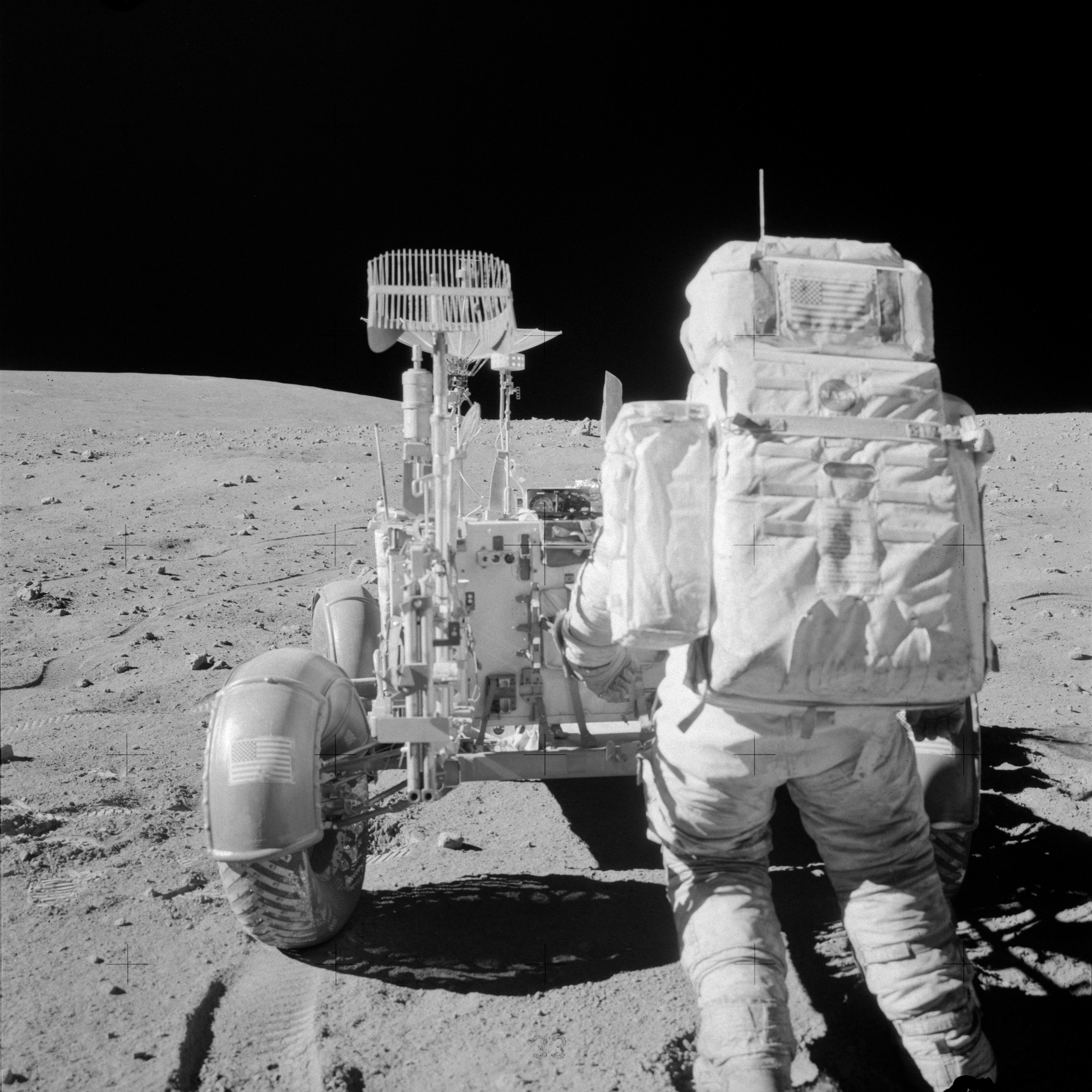
AS16-108-17622 (22 April 1972) --- Astronaut John W. Young, commander of the Apollo 16 lunar landing mission, reaches for tools in the Apollo Lunar Hand Tool Carrier at the aft end of the Lunar Roving Vehicle (LRV) during the second Apollo 16 extravehicular activity (EVA) at the Descartes landing site. This photograph was taken by astronaut Charles M. Duke Jr., lunar module pilot. This view is looking south from the base of Stone Mountain. While astronauts Young and Duke descended in the Lunar Module (LM) "Orion" to explore the Descartes highlands region of the moon, astronaut Thomas K. Mattingly II, command module pilot, remained with the Command and Service Modules (CSM) "Casper" in lunar orbit.
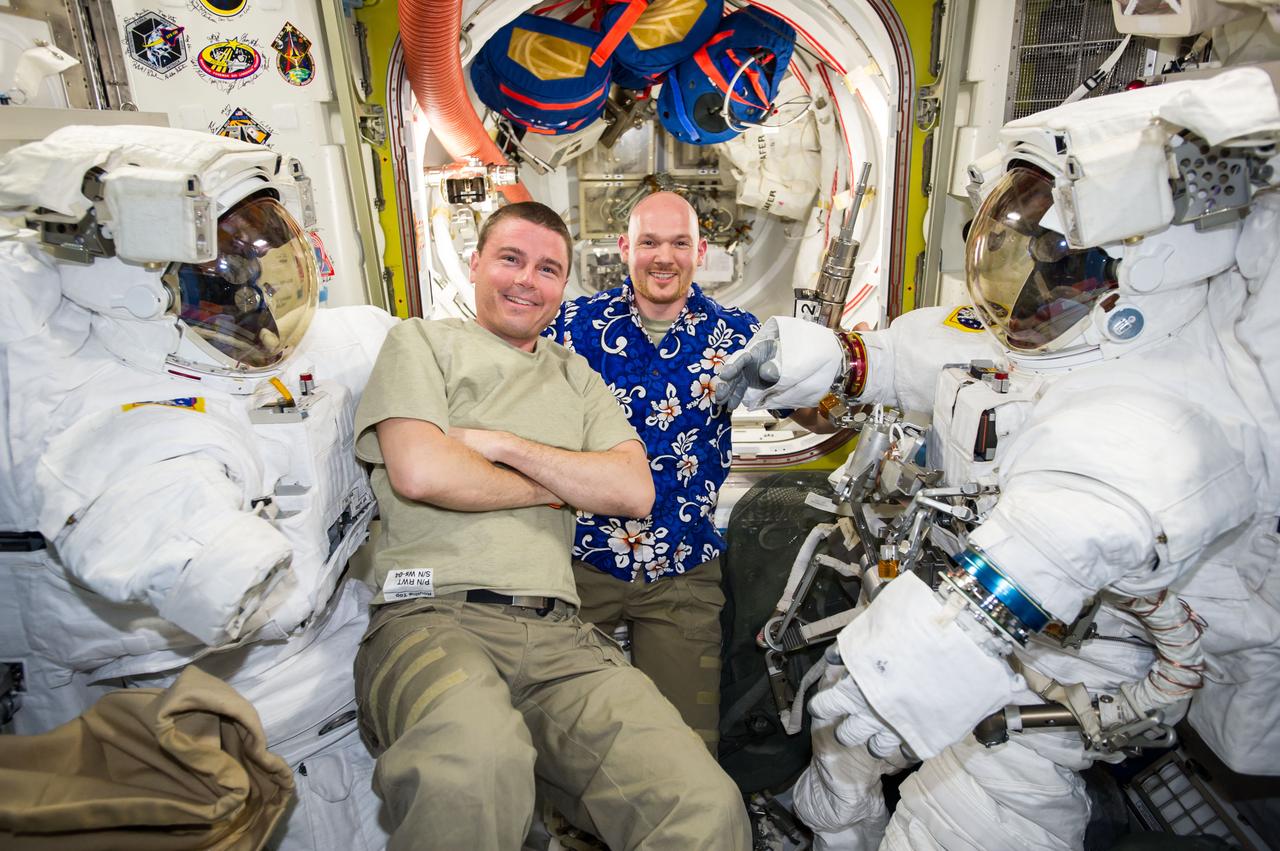
ISS041-E-017047 (19 Sept. 2014) --- NASA astronaut Reid Wiseman (left) and European Space Agency astronaut Alexander Gerst, both Expedition 41 flight engineers, take a moment to pose for a photo with two Extravehicular Mobility Unit (EMU) spacesuits in the Quest airlock of the International Space Station while preparing for two spacewalks scheduled in October 2014.
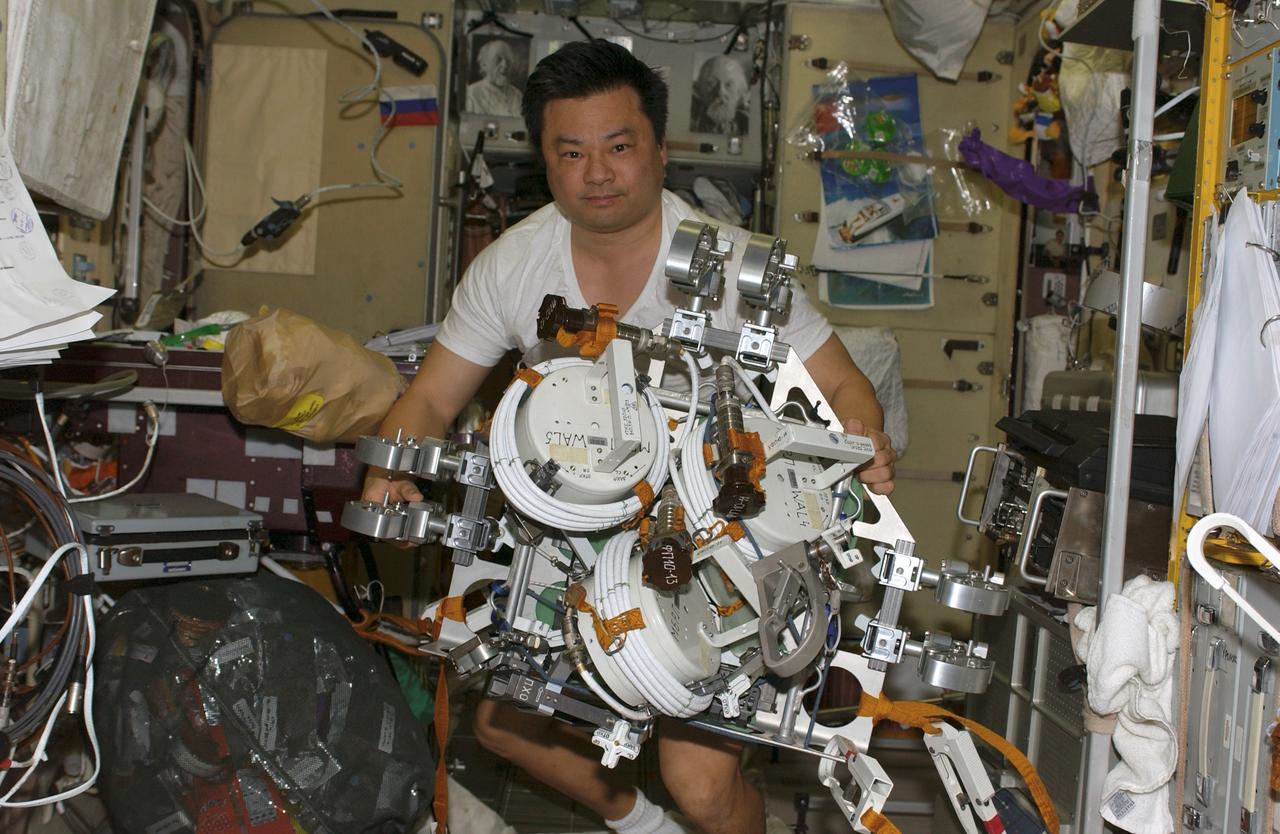
ISS010-E-20747 (21 March 2005) --- Astronaut Leroy Chiao, Expedition 10 commander and NASA ISS science officer, works with a tool caddy containing extravehicular activities (EVA) equipment and tools in the Zvezda Service Module of the International Space Station (ISS) in preparation for the spacewalk scheduled for March 28.
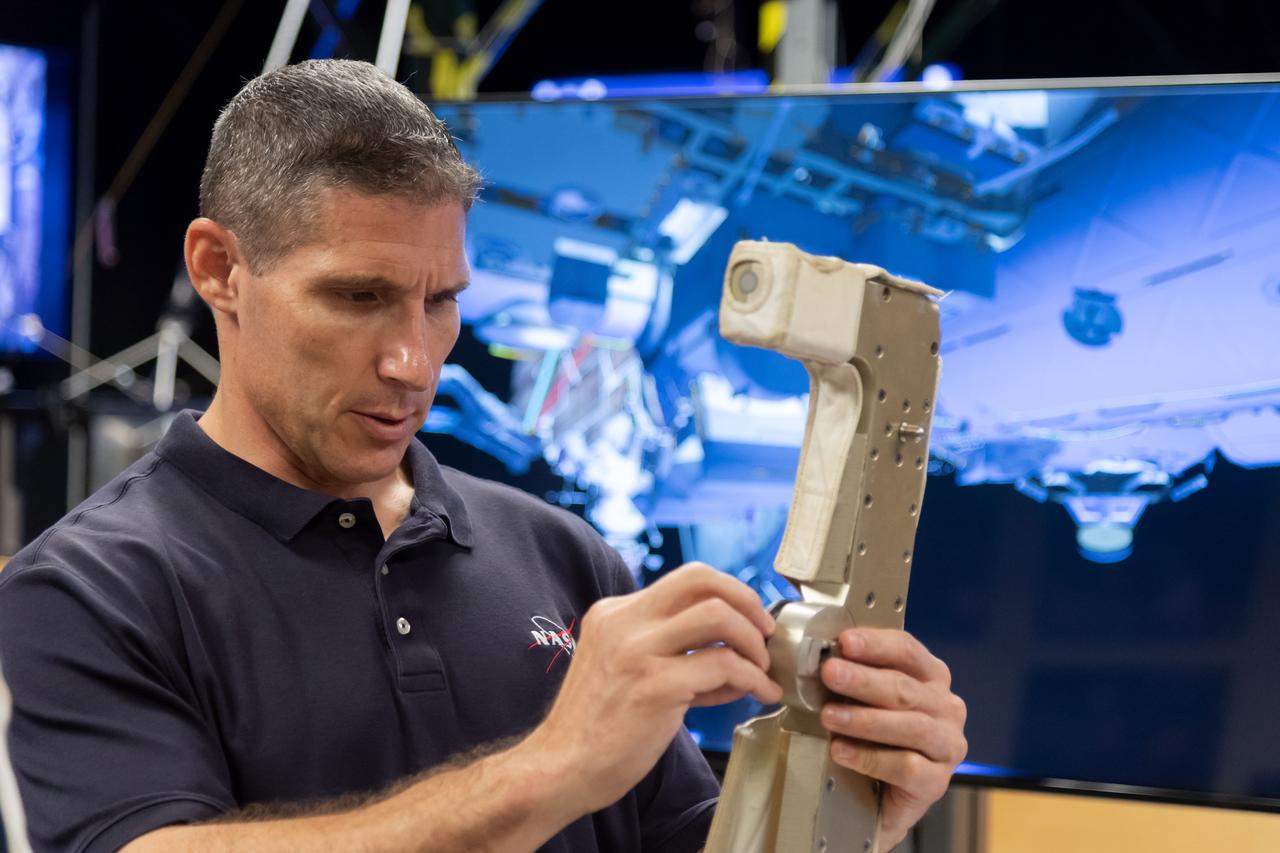
NASA commercial crew astronaut Mike Hopkins trains with Extravehicular Activity (EVA) tools and hardware in Johnson Space Center’s Space Vehicle Mockup Facility in Houston. Hopkins is assigned to the second crewed flight of SpaceX’s Crew Dragon.
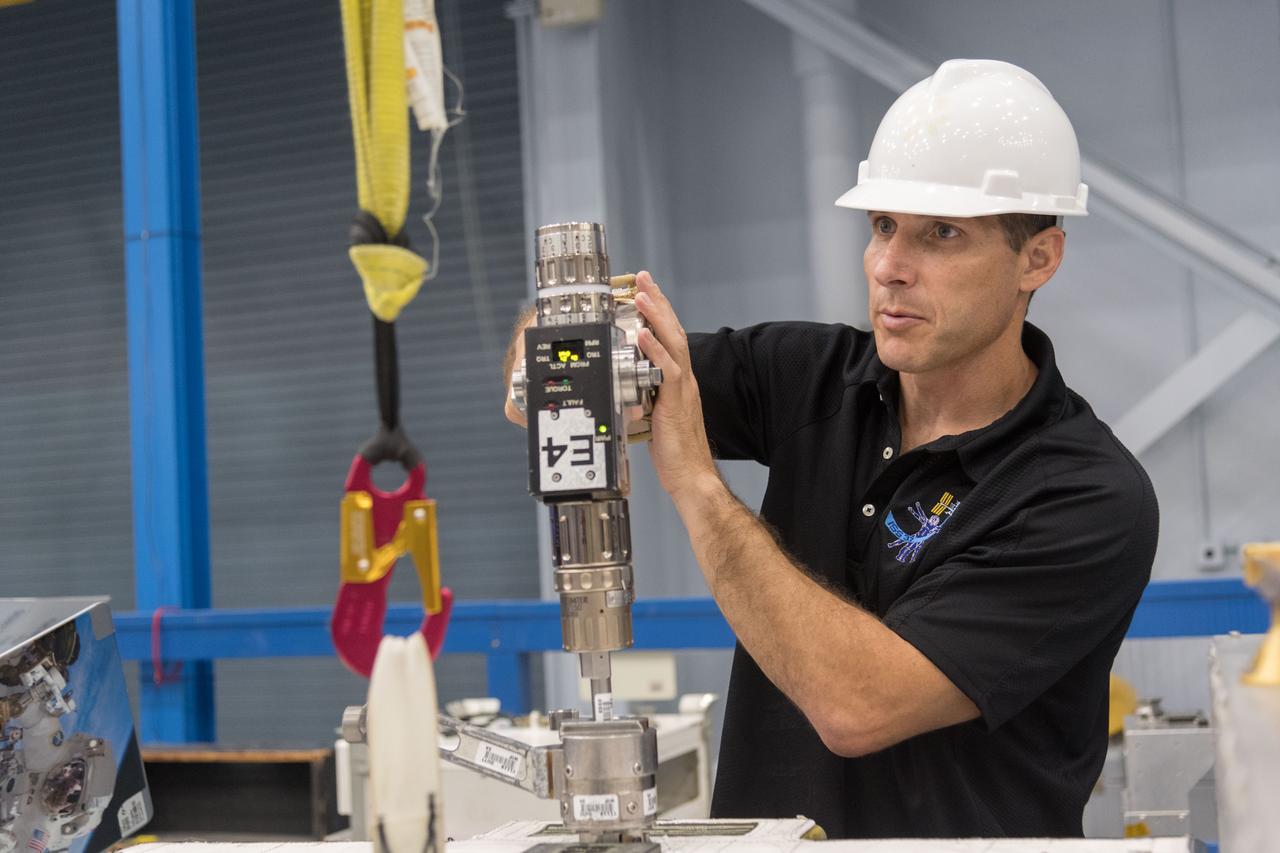
NASA commercial crew astronaut Mike Hopkins trains with Extravehicular Activity (EVA) tools and hardware in Johnson Space Center’s Space Vehicle Mockup Facility in Houston. Hopkins is assigned to the second crewed flight of SpaceX’s Crew Dragon.
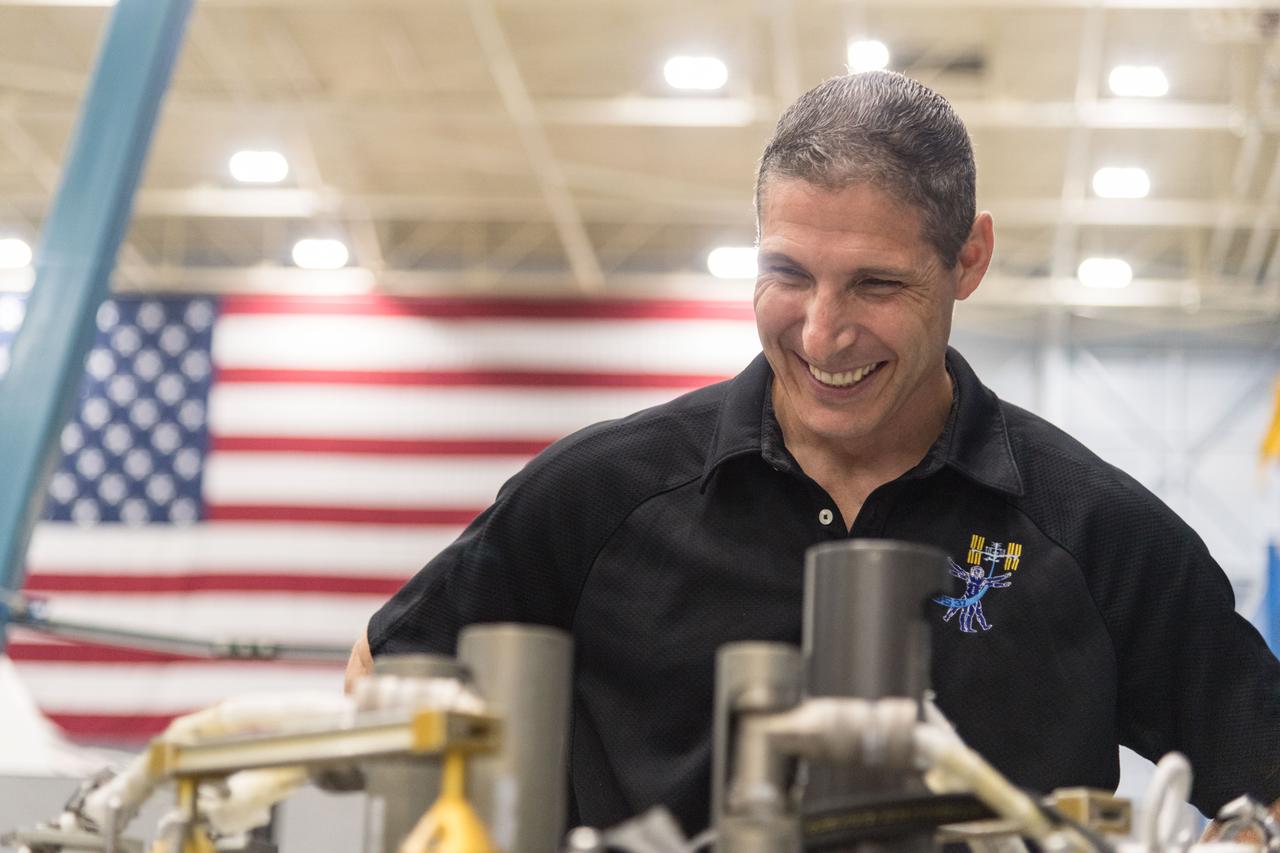
NASA commercial crew astronaut Mike Hopkins trains with Extravehicular Activity (EVA) tools and hardware in Johnson Space Center’s Space Vehicle Mockup Facility in Houston. Hopkins is assigned to the second crewed flight of SpaceX’s Crew Dragon.
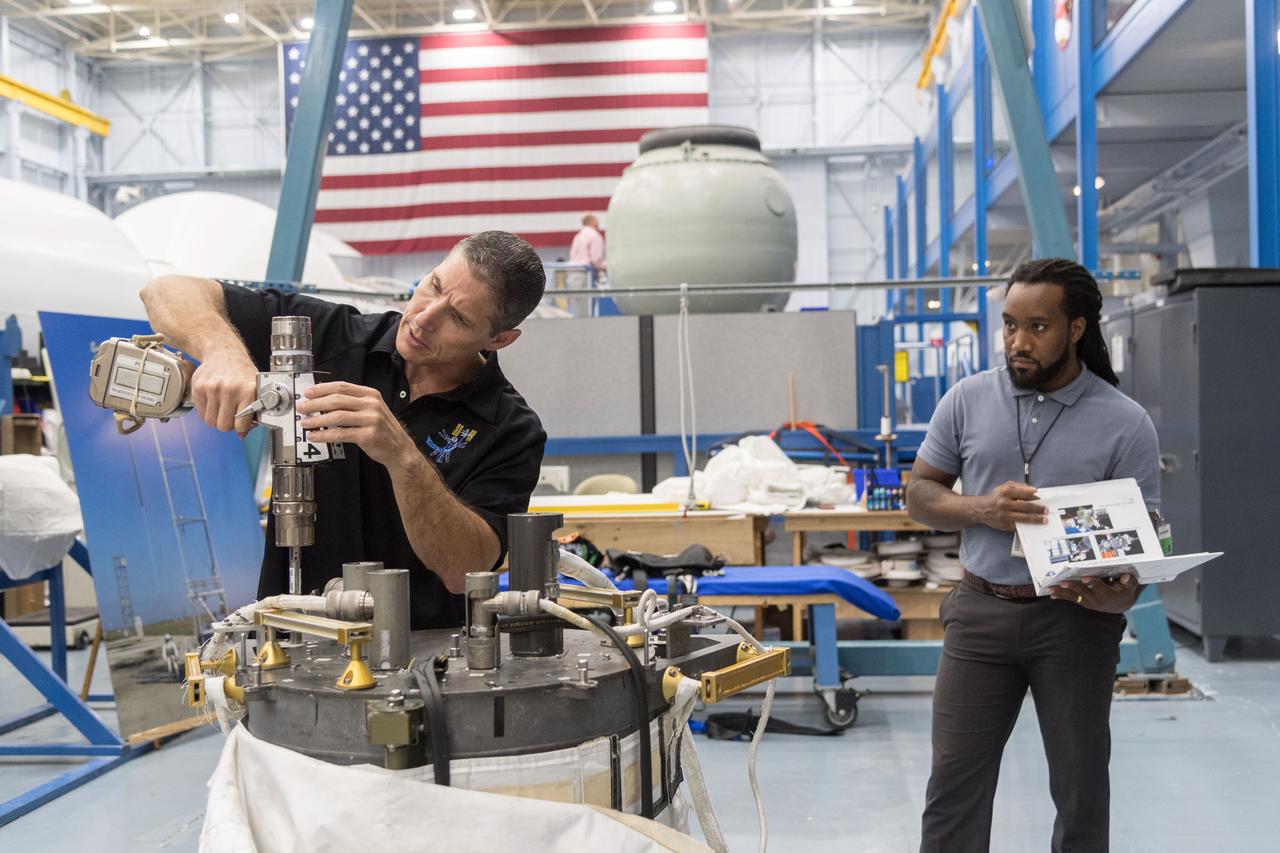
NASA commercial crew astronaut Mike Hopkins trains with Extravehicular Activity (EVA) tools and hardware in Johnson Space Center’s Space Vehicle Mockup Facility in Houston. Hopkins is assigned to the second crewed flight of SpaceX’s Crew Dragon.
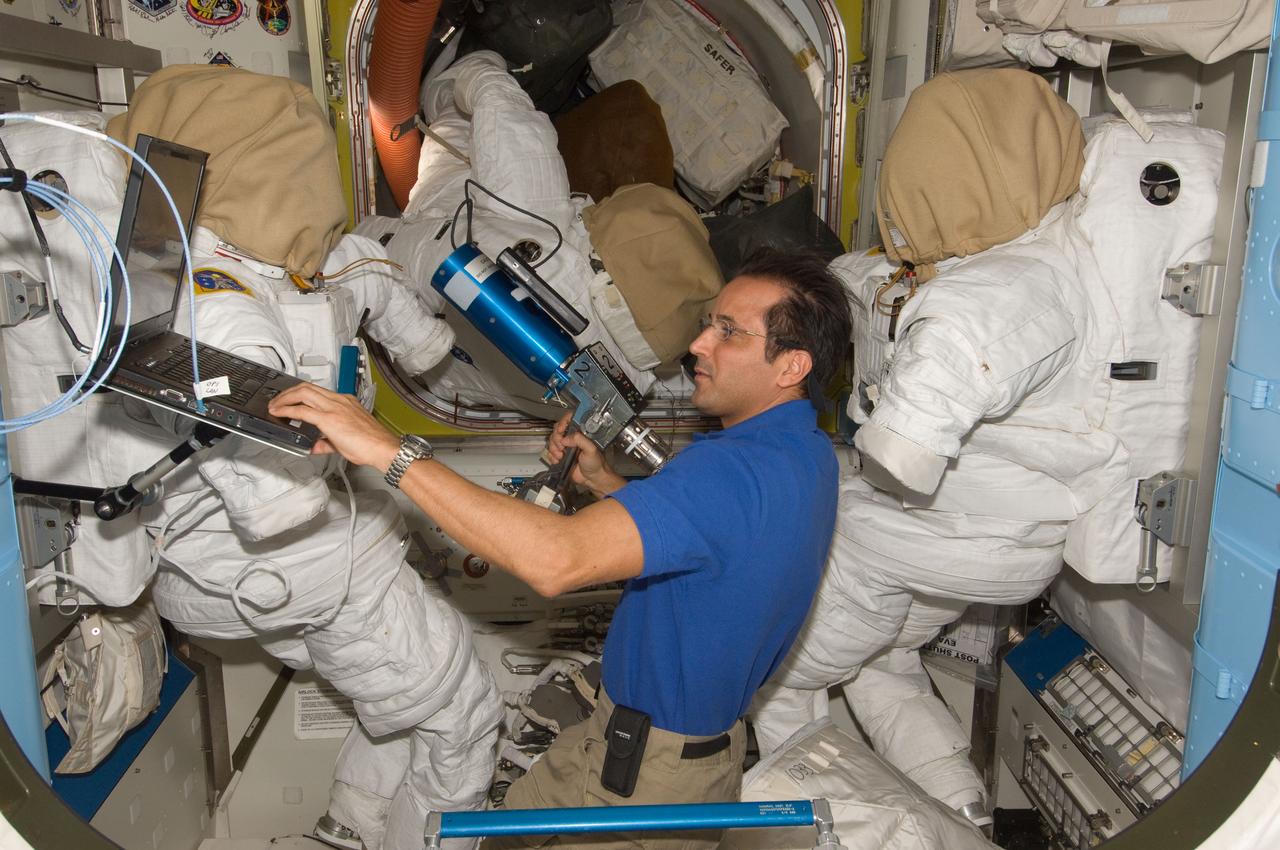
ISS031-E-149757 (28 June 2012) --- NASA astronaut Joe Acaba, Expedition 31 flight engineer, uses a computer while working with extravehicular activity (EVA) tools in the Quest airlock of the International Space Station.
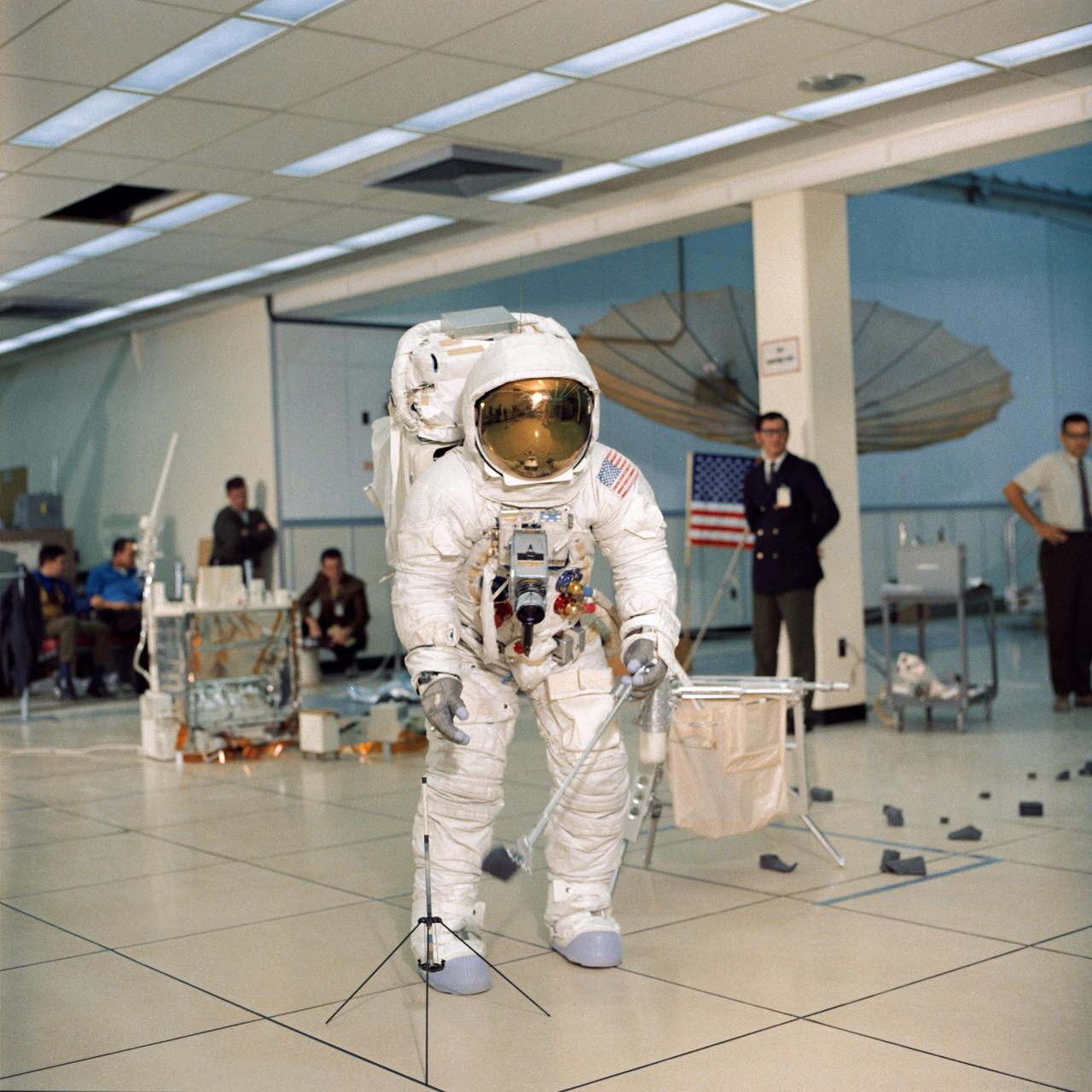
S70-27037 (4 Feb. 1970) --- Astronaut James A. Lovell Jr., commander of the Apollo 13 lunar landing mission, simulates lunar surface extravehicular activity during training exercises in the Kennedy Space Center’s Flight Crew Training Building. Lovell, wearing an Extravehicular Mobility Unit (EMU), is holding an Apollo Lunar Hand Tool (a set of tongs) in his left hand. A gnomon is in front of his right foot. A tool carrier is in the right background.
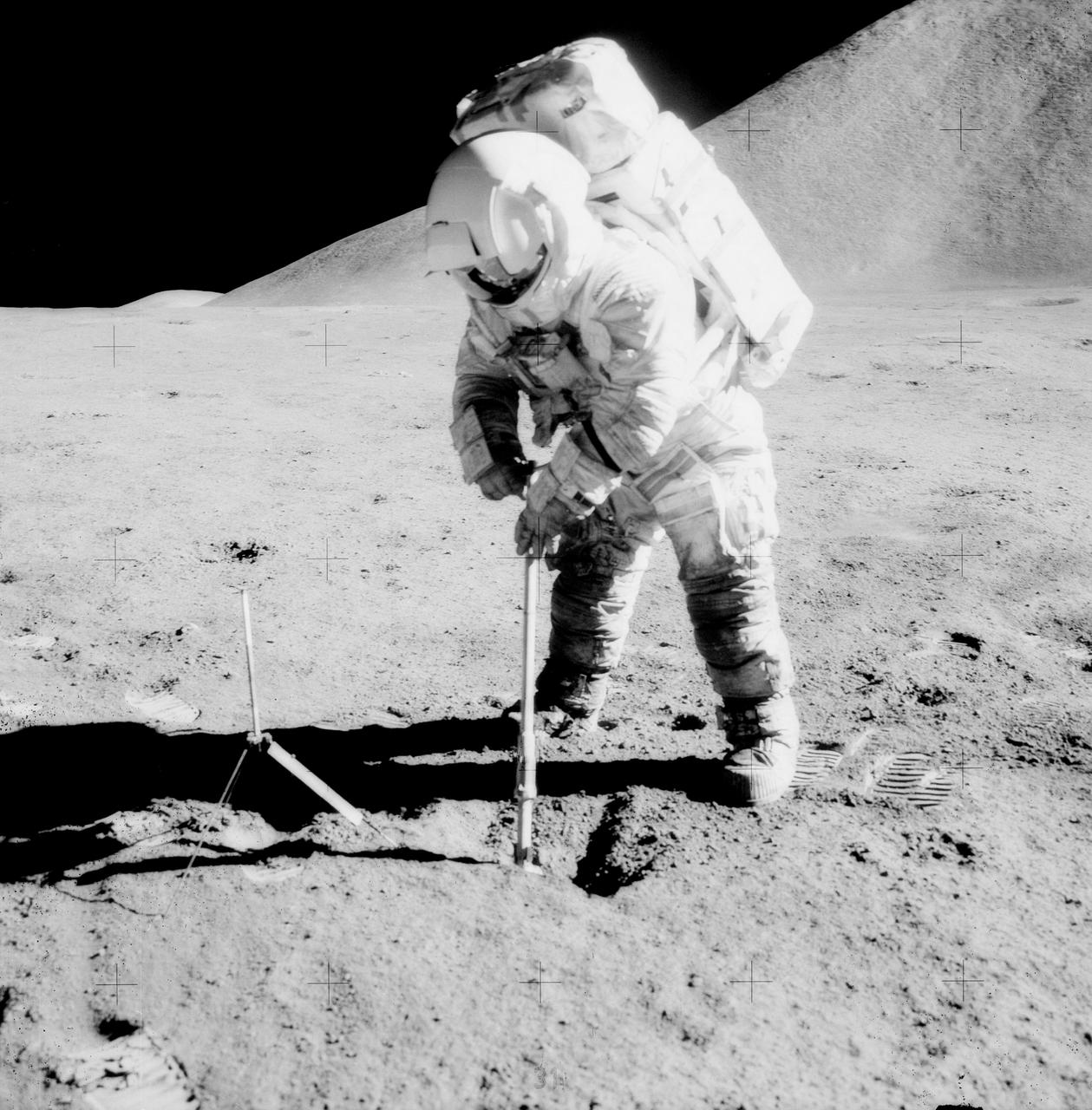
AS15-92-12424 (31 July-2 Aug. 1971) --- Astronaut James B. Irwin, lunar module pilot, uses a scoop in making a trench in the lunar soil during Apollo 15 extravehicular activity (EVA) on the moon. Mount Hadley, which rises approximately 14,765 feet (about 4,500 meters) above the plain, is in the background. Its base is some 14 kilometers (about 8.4 miles) away. The gnomon is at left. While astronauts Irwin, and David R. Scott, commander, descended in the Lunar Module (LM) to explore the moon, astronaut Alfred M. Worden, command module pilot, remained with the Command and Service Modules (CSM) in lunar orbit.
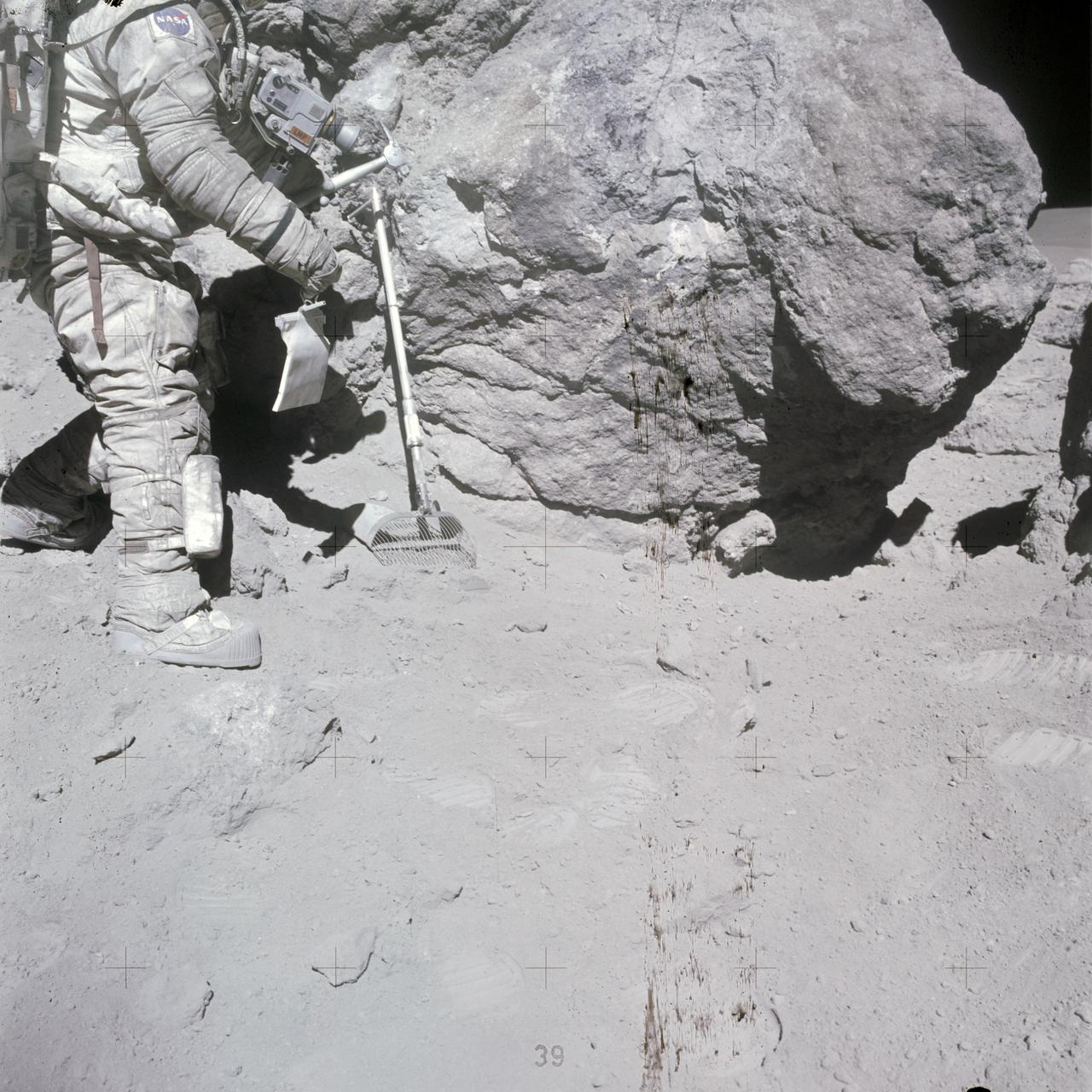
AS16-116-18653 (23 April 1972) --- Astronaut Charles M. Duke Jr., Apollo 16 lunar module pilot, stands at a big rock adjacent (south) to the huge "House Rock" (barely out of view at right edge). Note shadow at extreme right center where the two moon-exploring crew members of the mission sampled what they referred to as the "east-by-west split of House Rock" or the open space between this rock and "House Rock". At their post-mission press conference, the crewmen expressed the opinion that this rock was once a part of "House Rock" which had broken away. The two sampled the big boulder seen here also. Duke has a sample bag in his hand, and a lunar surface rake leans against the large boulder. Astronaut John W. Young, commander, exposed this view with a color magazine in his 70mm Hasselblad camera. While astronauts Young and Duke descended in the Apollo 16 Lunar Module (LM) "Orion" to explore the Descartes highlands landing site on the moon, astronaut Thomas K. Mattingly II, command module pilot, remained with the Command and Service Modules (CSM) "Casper" in lunar orbit.
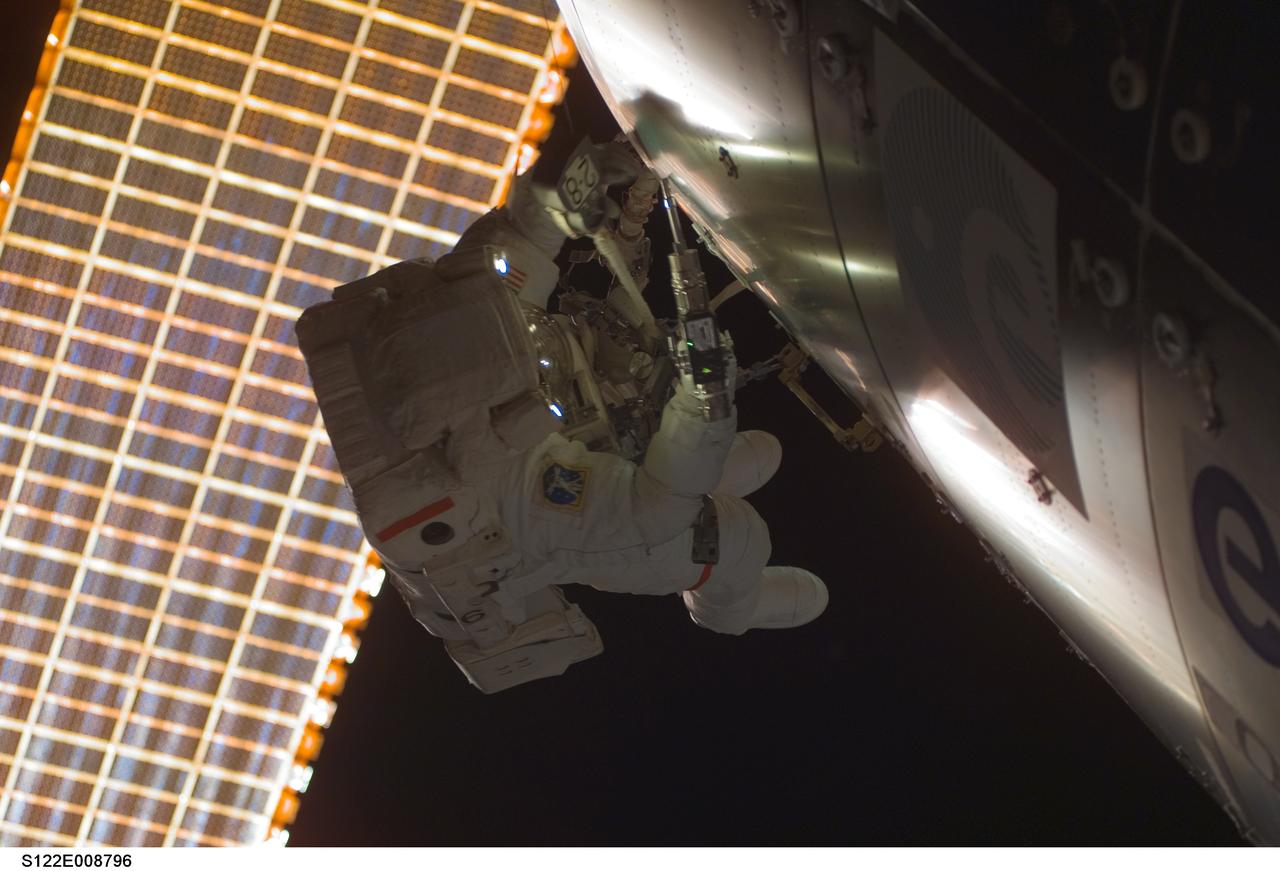
S122-E-008796 (15 Feb. 2008) --- Astronaut Rex Walheim, mission specialist, uses a power tool while installing a handrail on the Columbus laboratory, the newest piece of hardware on the International Space Station. Astronaut Stanley Love (out of frame), mission specialist, shared this extravehicular activity with Walheim.
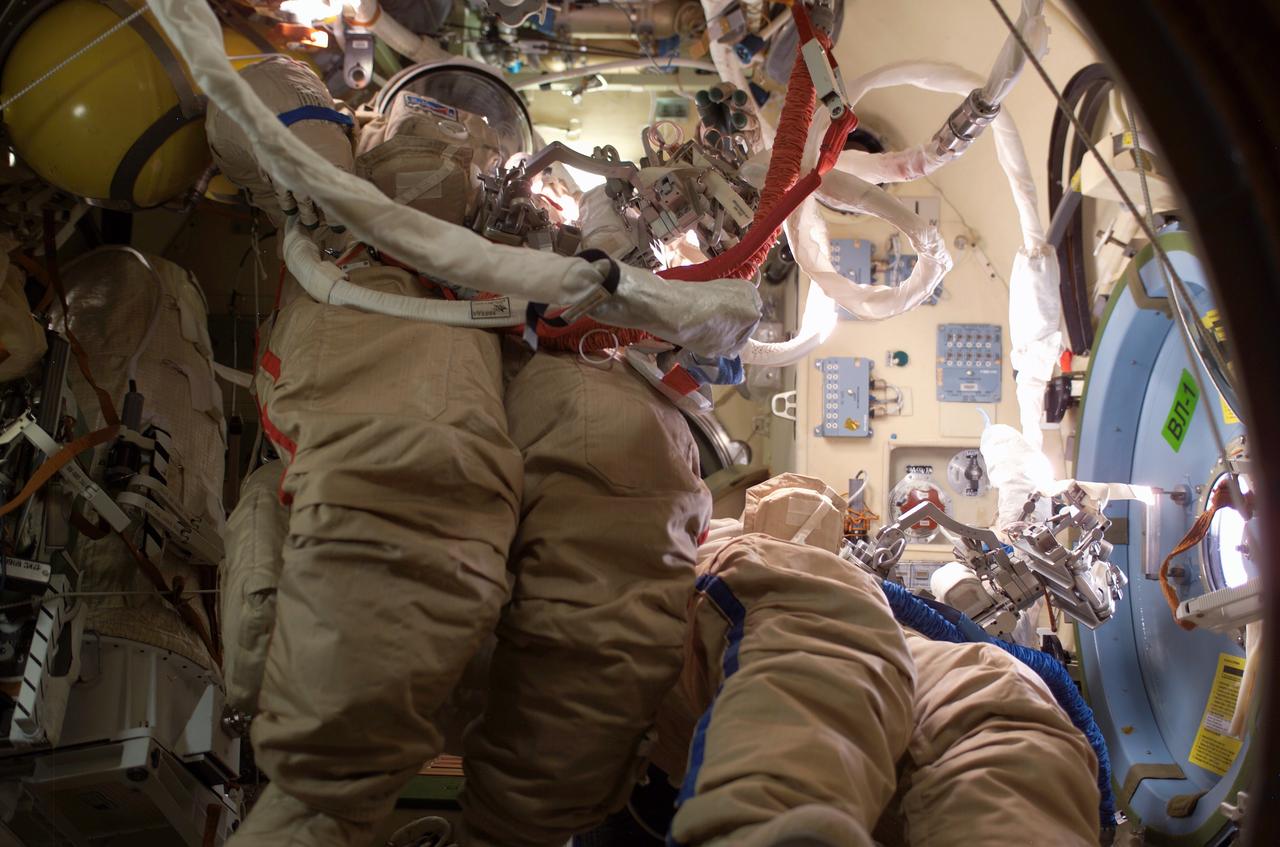
ISS008-E-17187 (26 February 2004) --- This view shows a duo of Russian Orlan space suit lower torsos stowed in the Pirs Docking Compartment on the International Space Station (ISS) following completion of an extravehicular activity (EVA) conducted by the Expedition 8 crew. A tool caddy is attached to each suit.

ISS014-E-09523 (12 Dec. 2006) --- Astronaut Robert L. Curbeam, Jr., STS-116 mission specialist, participates in the mission's first of three planned sessions of extravehicular activity (EVA) as construction resumes on the International Space Station. A power tool, attached to Curbeam's spacesuit, floats at left.
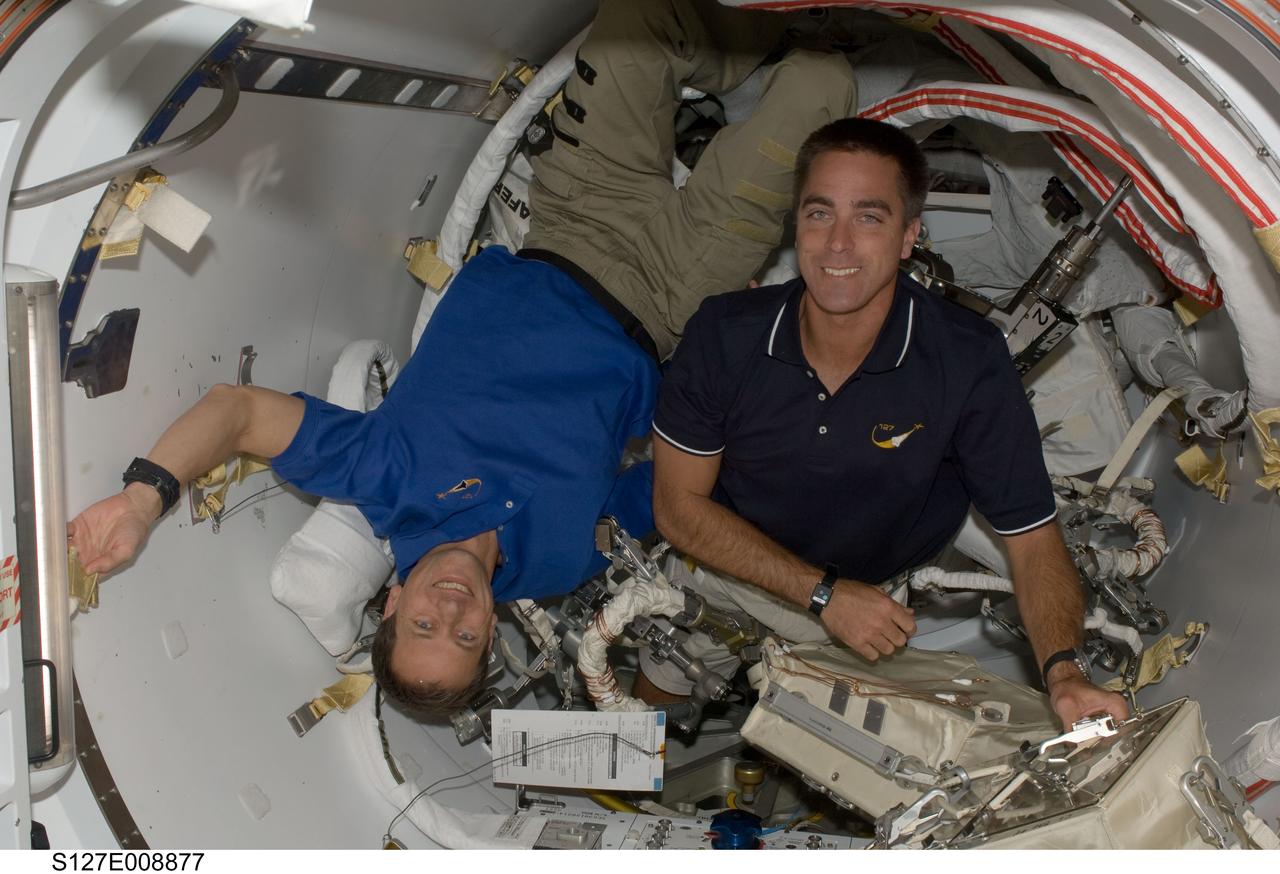
S127-E-008877 (26 July 2009) --- Astronauts Tom Marshburn (left) and Christopher Cassidy, both STS-127 mission specialists, work with extravehicular activity (EVA) tools in the Quest airlock of the International Space Station while Space Shuttle Endeavour remains docked with the station.
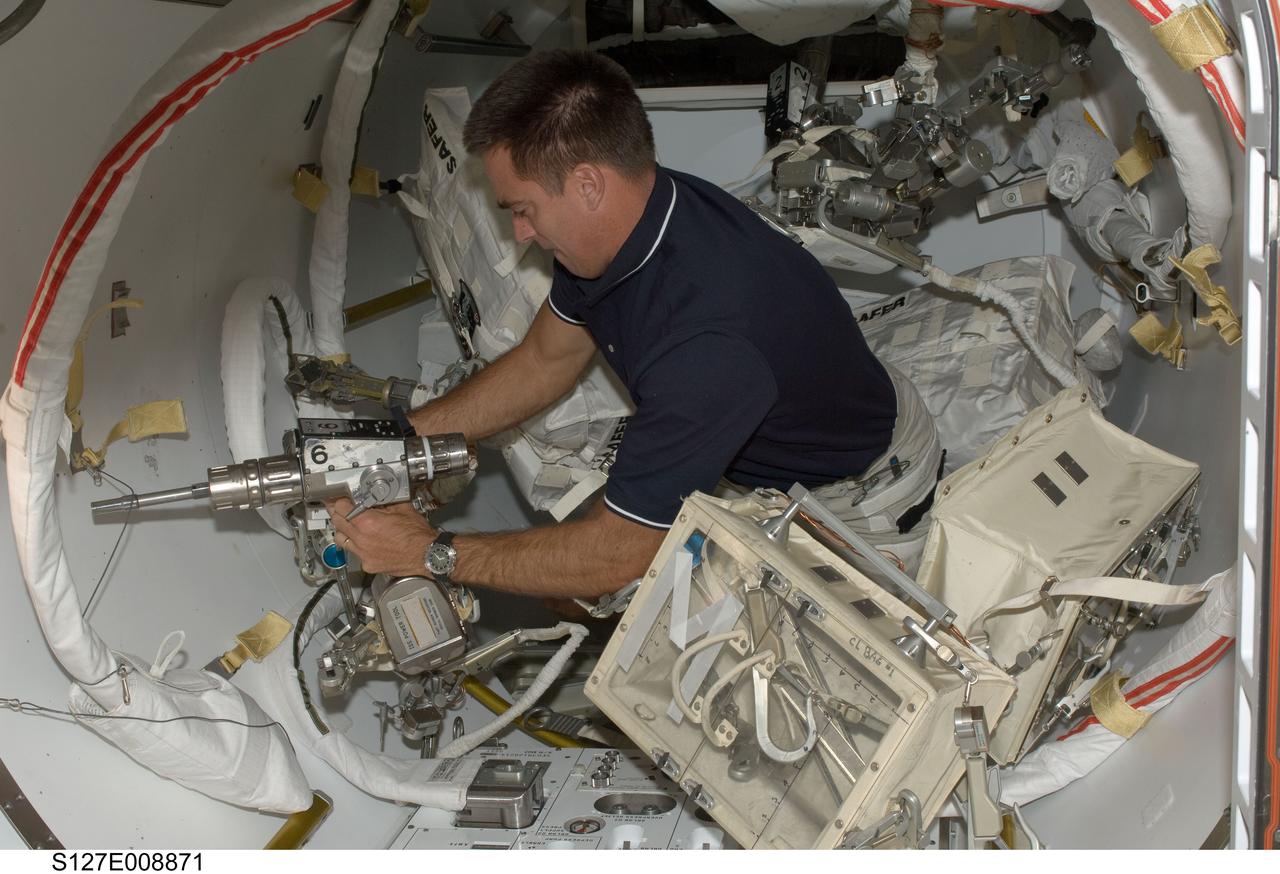
S127-E-008871 (26 July 2009) --- Astronaut Christopher Cassidy, STS-127 mission specialist, works with extravehicular activity (EVA) tools in the Quest airlock of the International Space Station while Space Shuttle Endeavour remains docked with the station.
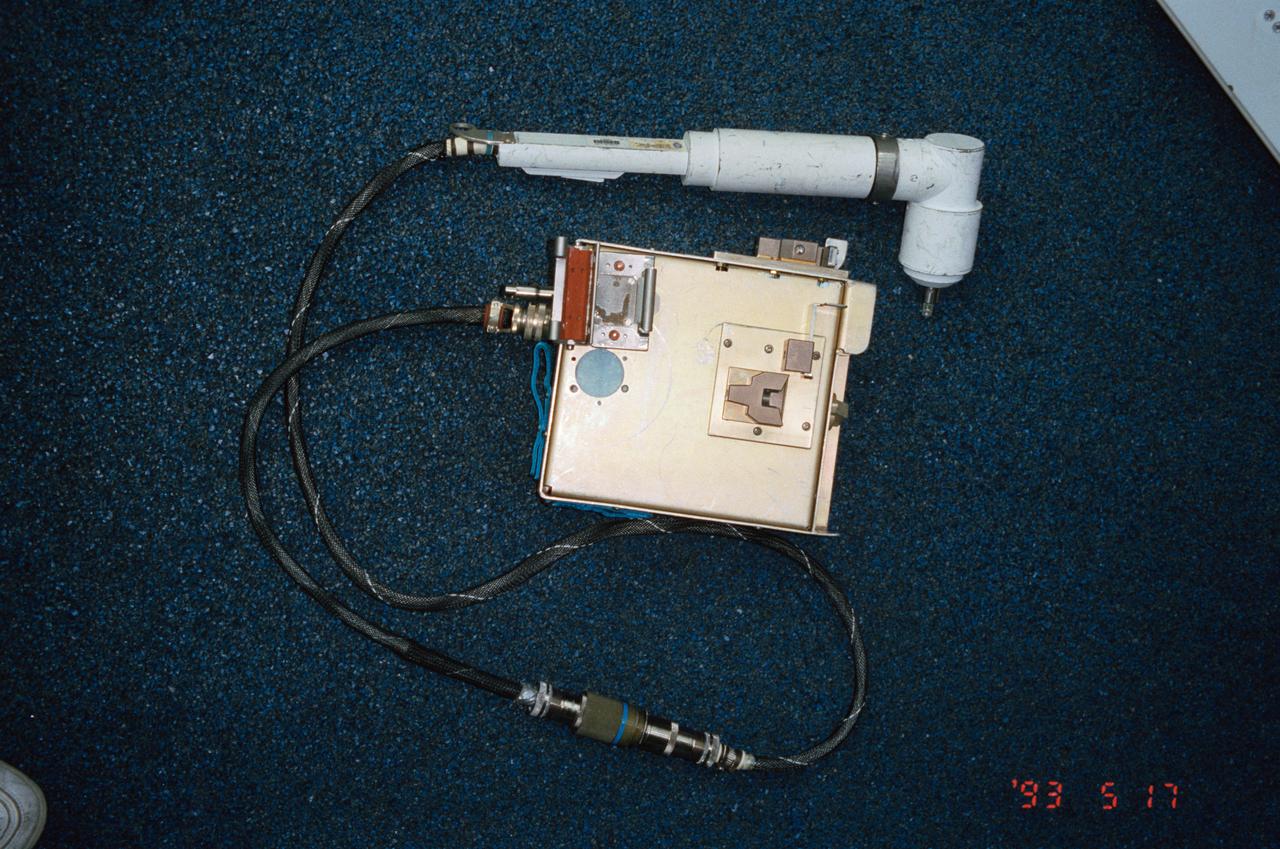
S93-35367 (Nov 1993) --- A close-up view of the special ratchet tool to be used by the STS-61 astronauts assigned to perform servicing of the Hubble Space Telescope (HST) in December of this year. Four astronauts will perform a total of five sessions of extravehicular activity (EVA) during the flight.
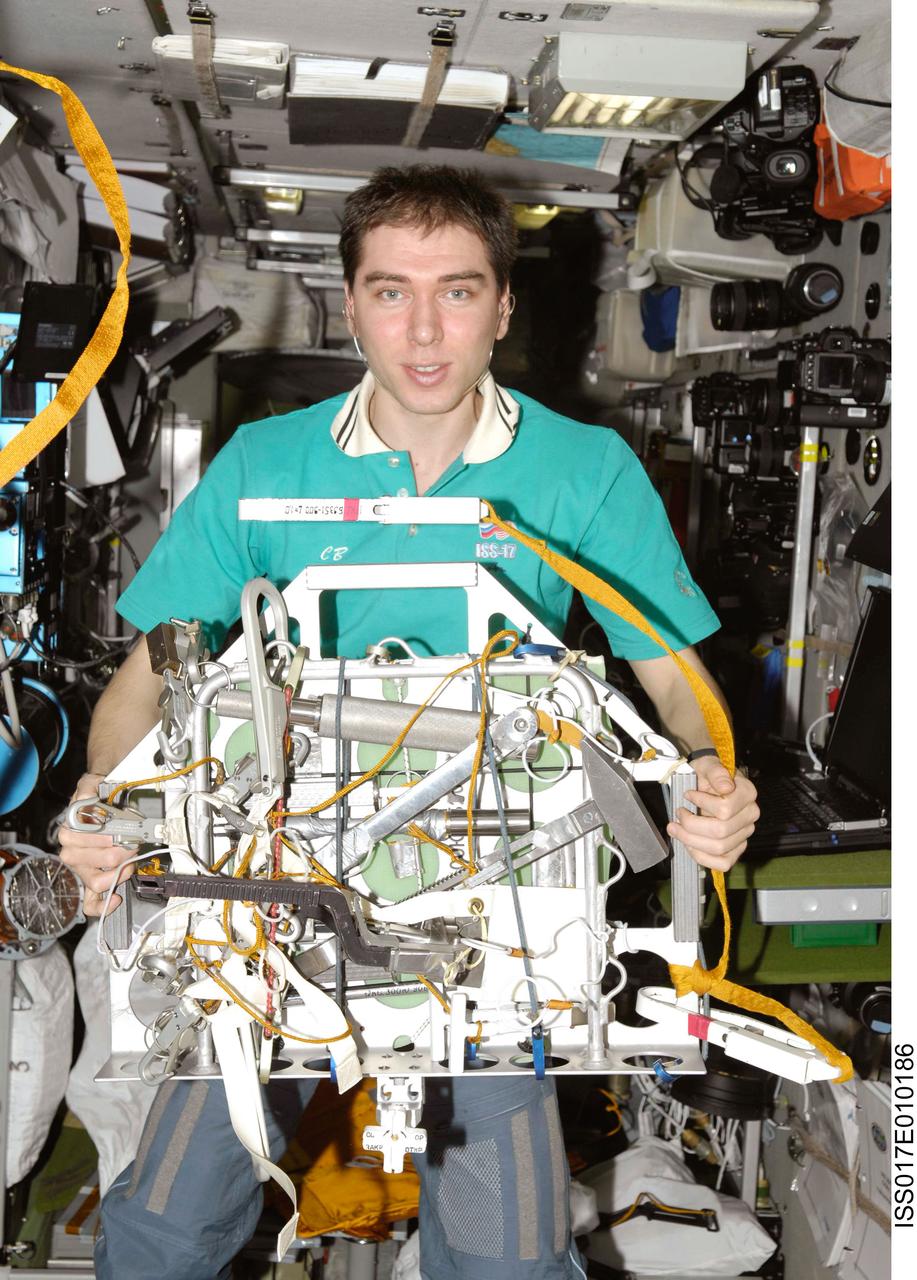
ISS017-E-010186 (1 July 2008) --- Russian Federal Space Agency cosmonaut Sergei Volkov, Expedition 17 commander, holds extravehicular activity (EVA) equipment and tools within a caddy in the Zvezda Service Module of the International Space Station.
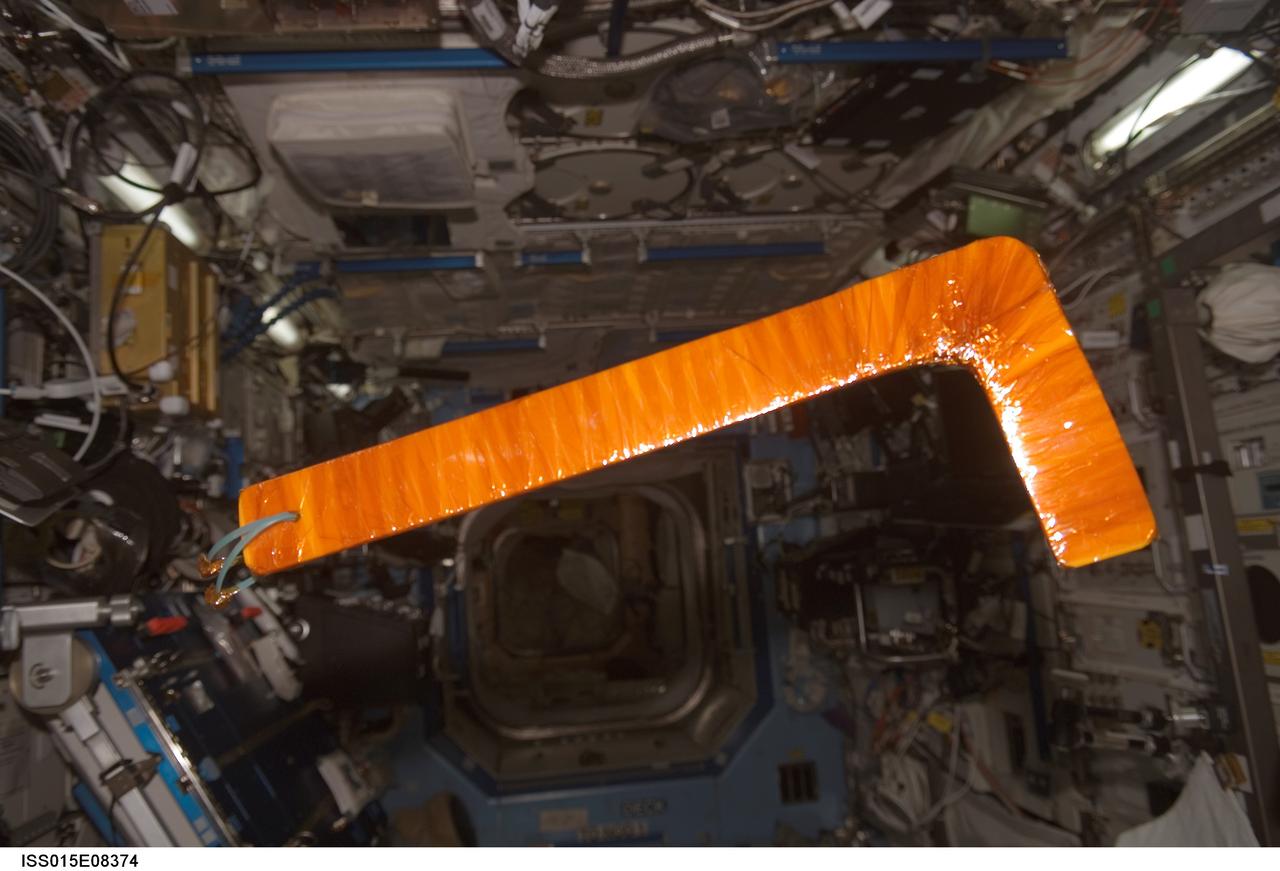
ISS015-E-08374 (17 May 2007) --- A view of a hockey-stick-shaped tool wrapped in insulating tape and floating freely in the Destiny laboratory of the International Space Station, scheduled for possible use during STS-117 extravehicular activity (EVA) as construction resumes on the International Space Station.
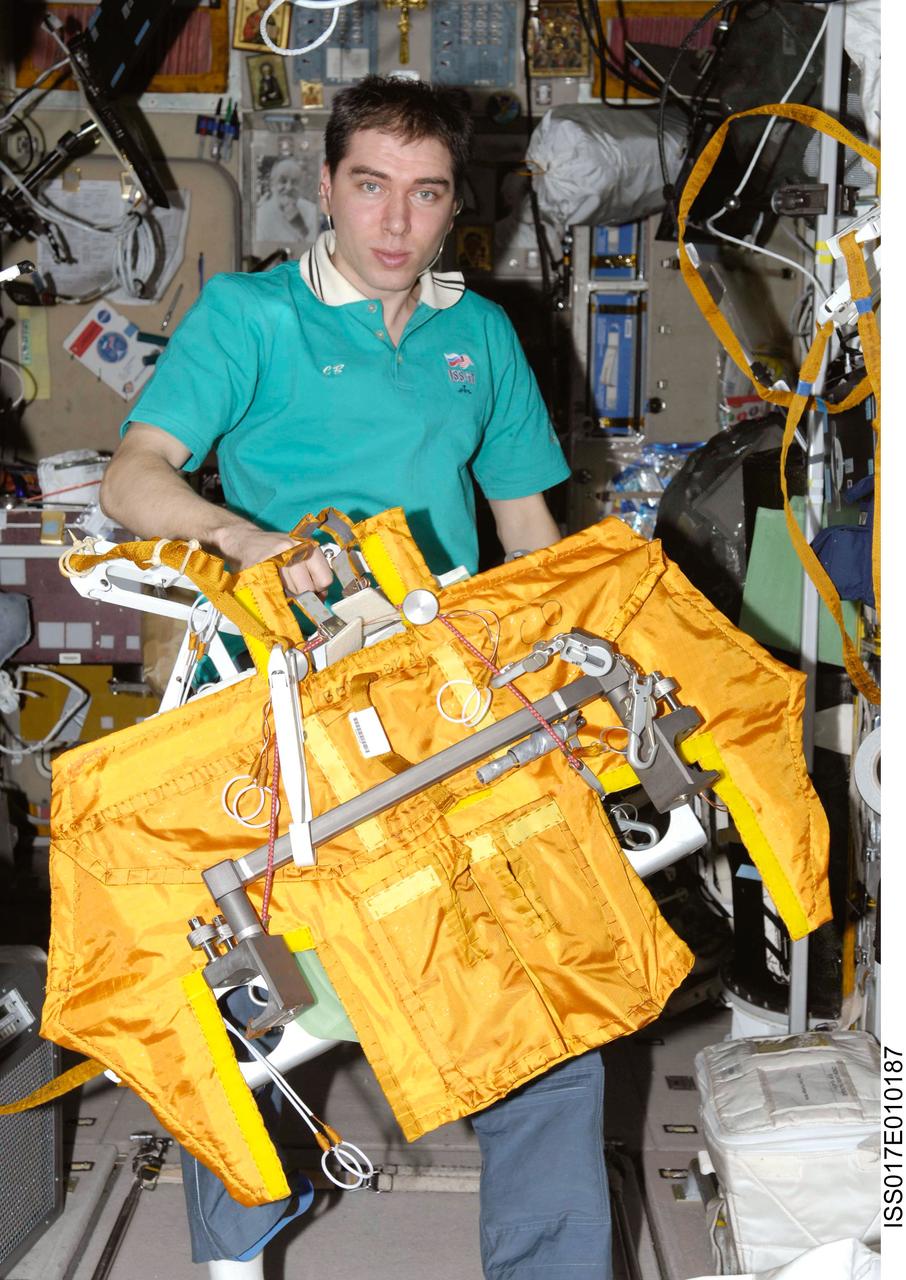
ISS017-E-010187 (1 July 2008) --- Russian Federal Space Agency cosmonaut Sergei Volkov, Expedition 17 commander, holds covered extravehicular activity (EVA) equipment and tools within a caddy in the Zvezda Service Module of the International Space Station.
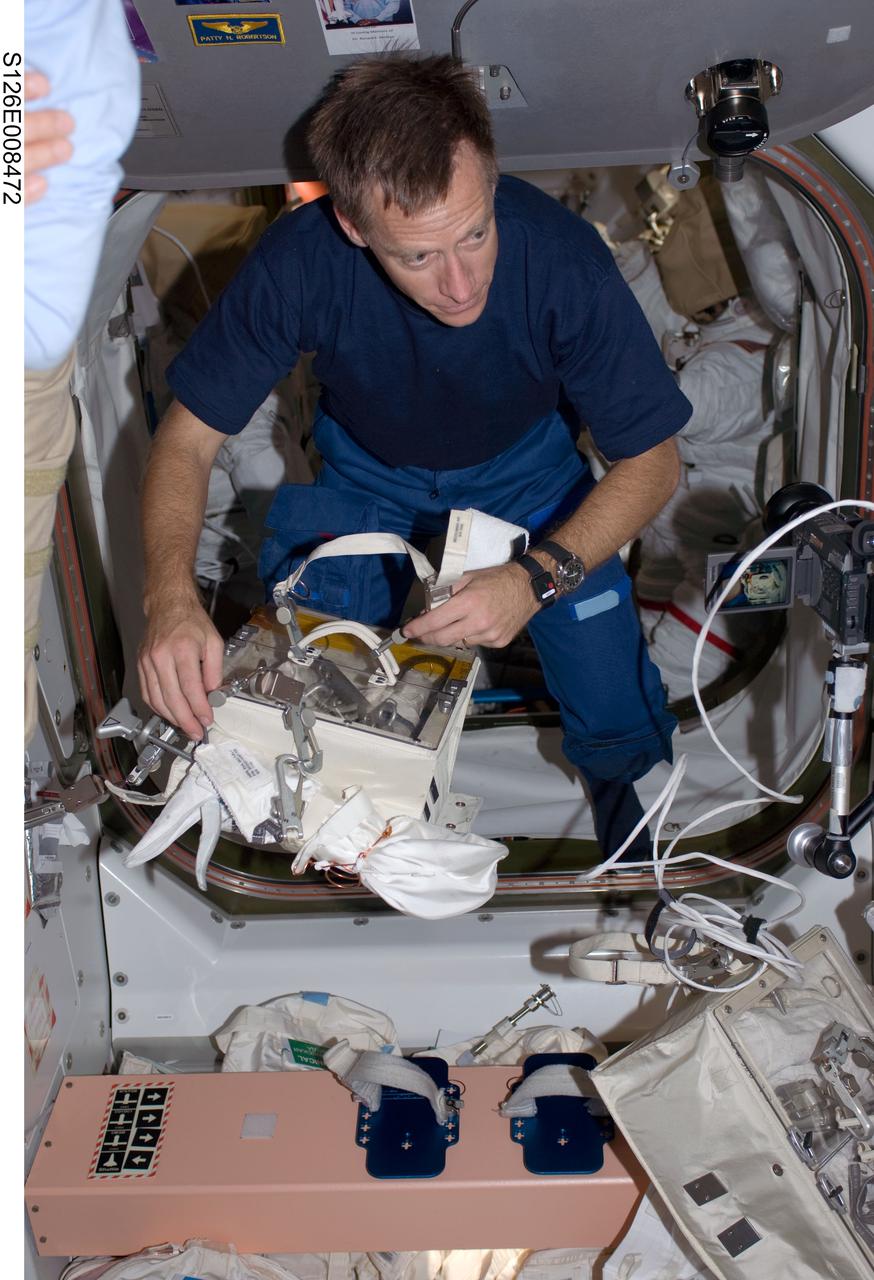
S126-E-008472 (19 Nov. 2008) --- Astronaut Chris Ferguson, STS-126 commander, holds a crew lock bag which contains extravehicular activity (EVA) tools in the Unity node of the International Space Station while Space Shuttle Endeavour remains docked with the station.
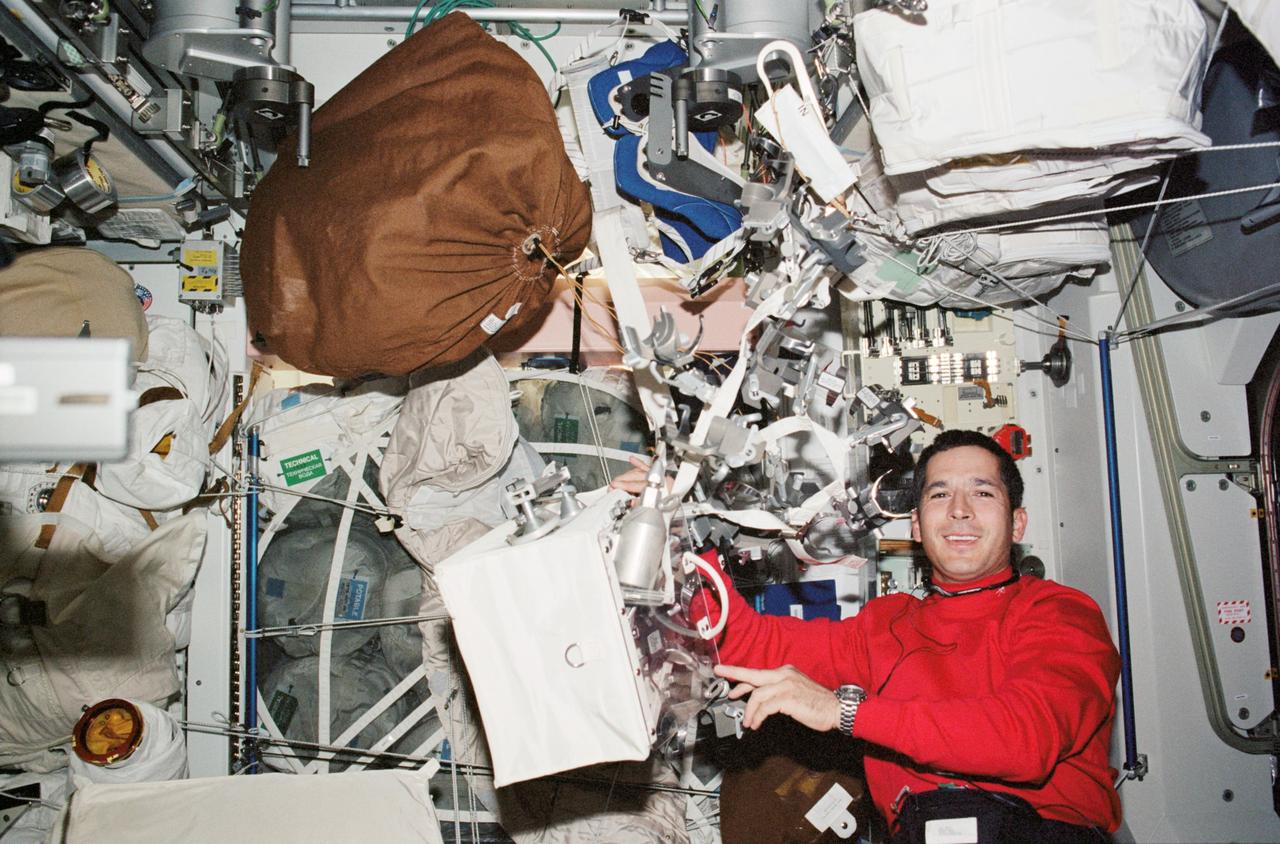
STS113-344-031 (23 November – 7 December 2002) --- Astronaut John B. Herrington, STS-113 mission specialist, is pictured in the Unity node on the International Space Station (ISS). Various extravehicular activity (EVA) tools float near Herrington.
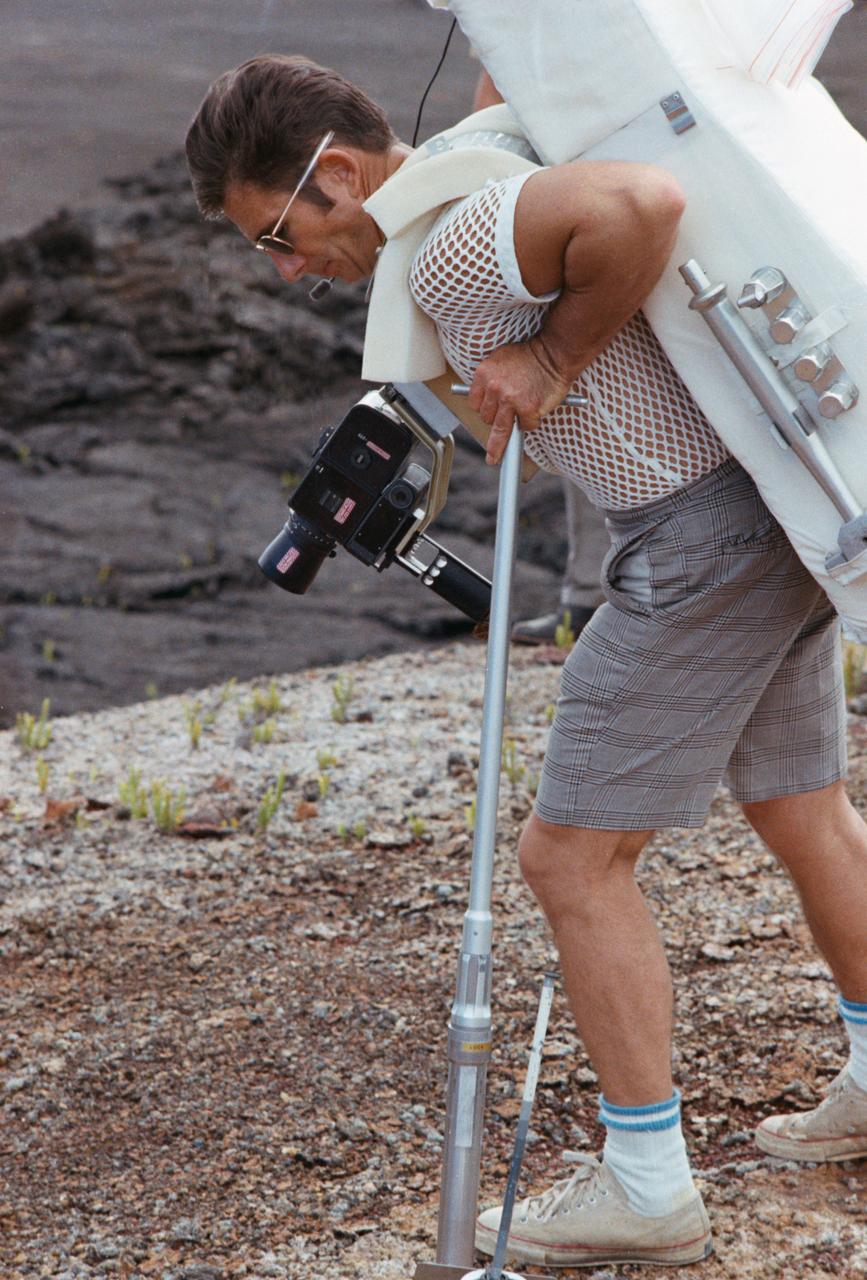
S70-56433 (December 1970) --- Astronaut James B. Irwin, lunar module pilot of the Apollo 15 lunar landing mission, participates in lunar surface extravehicular activity (EVA) training during a visit to Hawaii. He is simulating using lunar surface geological tools to collect a core sample.
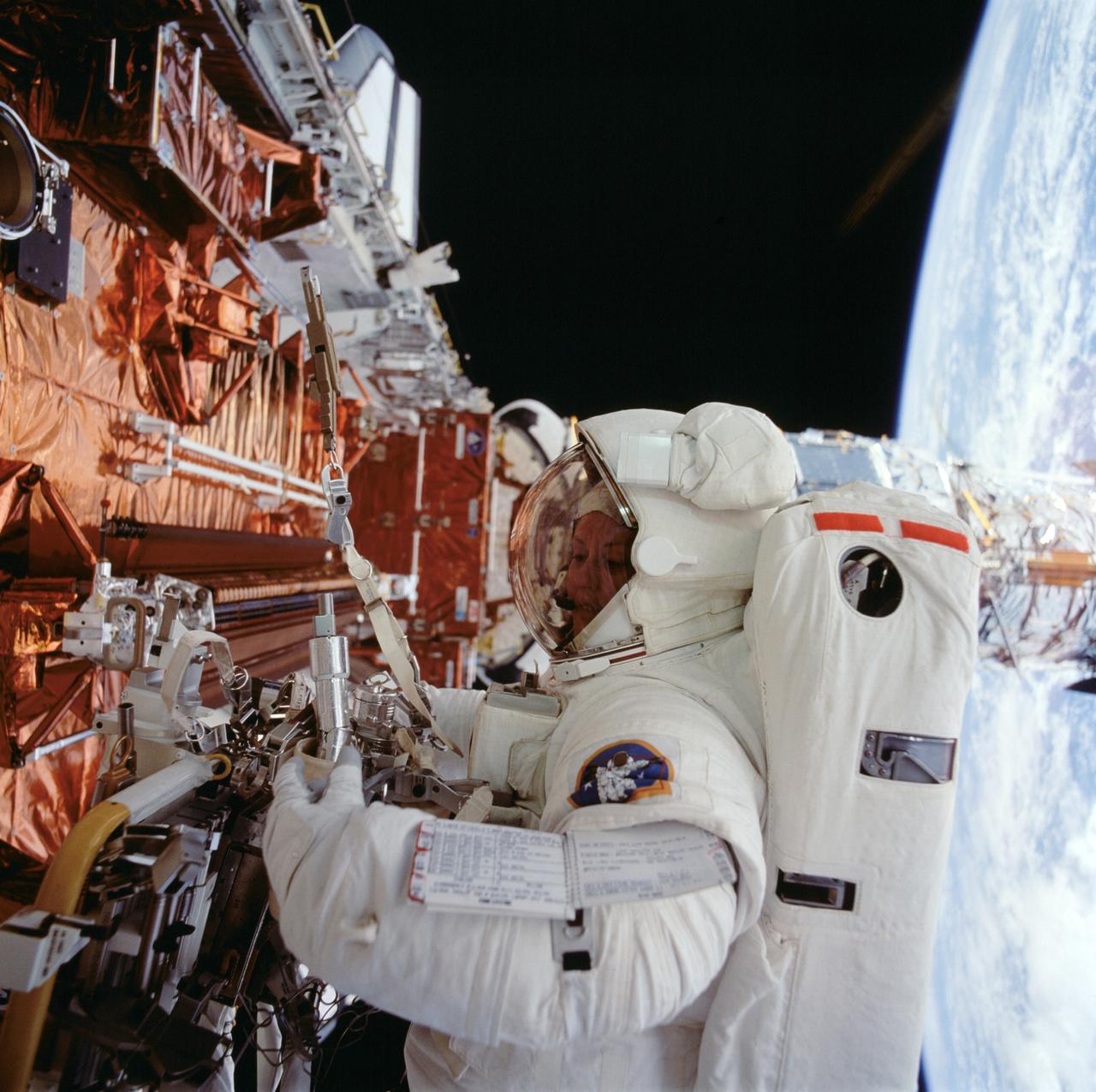
STS061-098-000K (8 Dec. 1993) --- Astronaut Kathryn C. Thornton works with equipment associated with servicing chores on the Hubble Space Telescope (HST) during the fourth extravehicular activity (EVA) on the eleven-day mission.
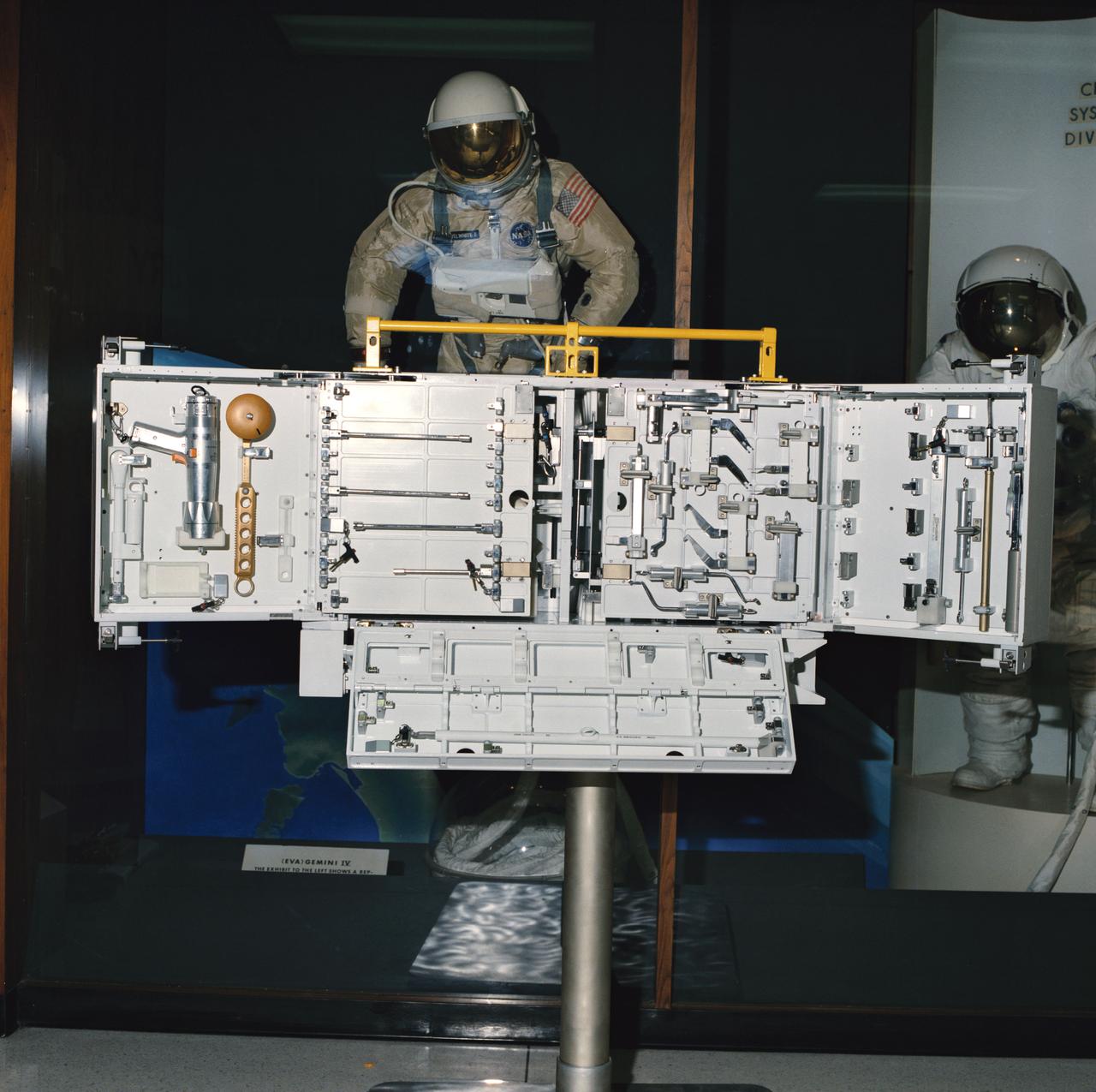
S87-49426 (1987) --- The Hubble Space Telescope (HST) tool box provides stowage of individual tools, tool boards and tool caddies required for maintenance of the telescope. The basic box design was revised from the LEASAT (U.S. Navy) equipment stowage container. It can be mounted to a base plate or back plate depending on the mission location requirements. A four-point latching system secured with pip pins is used to latch the tool box doors for launch. Various other latches are designed into the door panels and tool mounting locations for tool retention. The box consists of aluminum sides and base, a dividing wall and deep doors. Along three sides there are handrails by which STS-61 extravehicular activity (EVA) crew members can translate themselves or brace themselves when stowing and unstowing equipment.
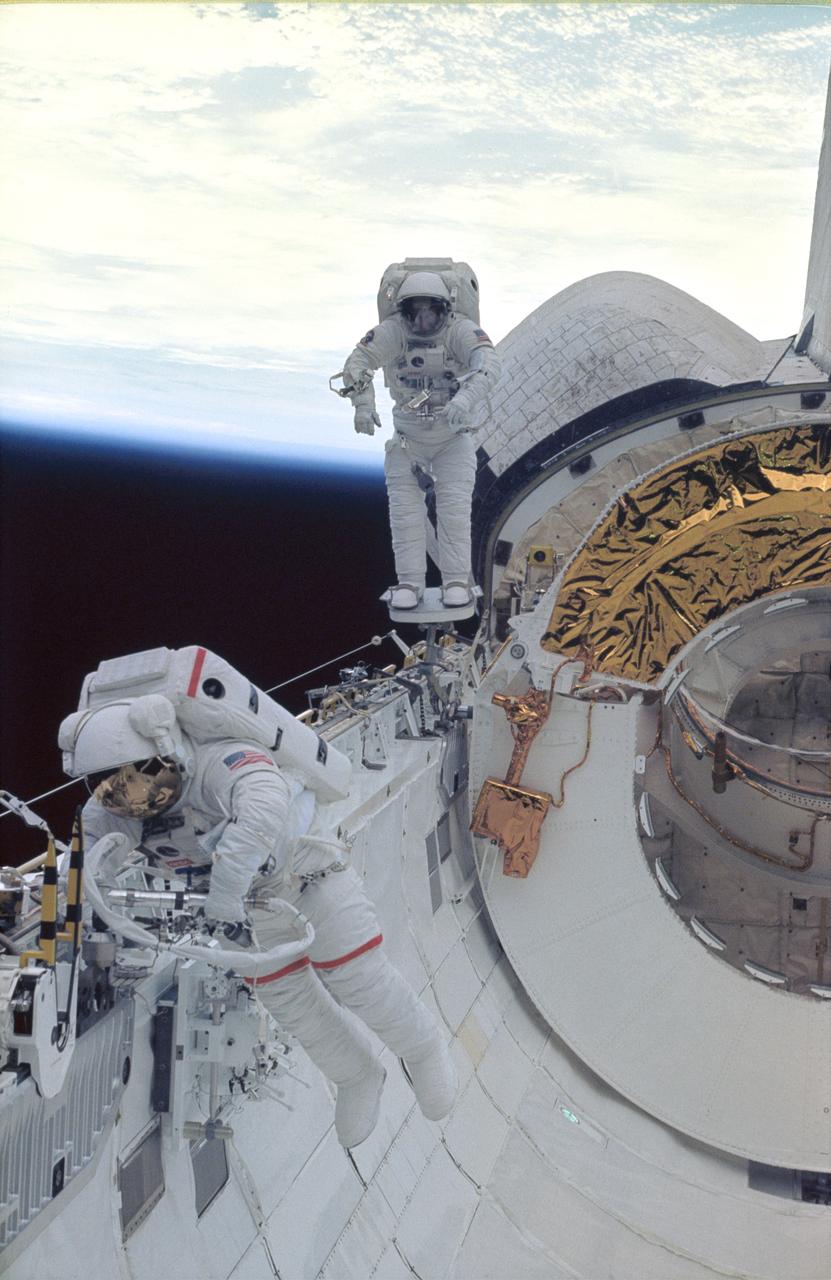
STS051-06-037 (16 Sept 1993) --- Astronauts Carl E. Walz (foreground) and James H. Newman evaluate some important gear. Walz reaches for the Power Ratchet Tool (PRT) while Newman checks out mobility on the Portable Foot Restraint (PFR) near the Space Shuttle Discovery's starboard Orbital Maneuvering System (OMS) pod. The tools and equipment will be instrumental on some of the five periods of extravehicular activity (EVA) scheduled for the Hubble Space Telescope (HST) STS-61 servicing mission later this year.
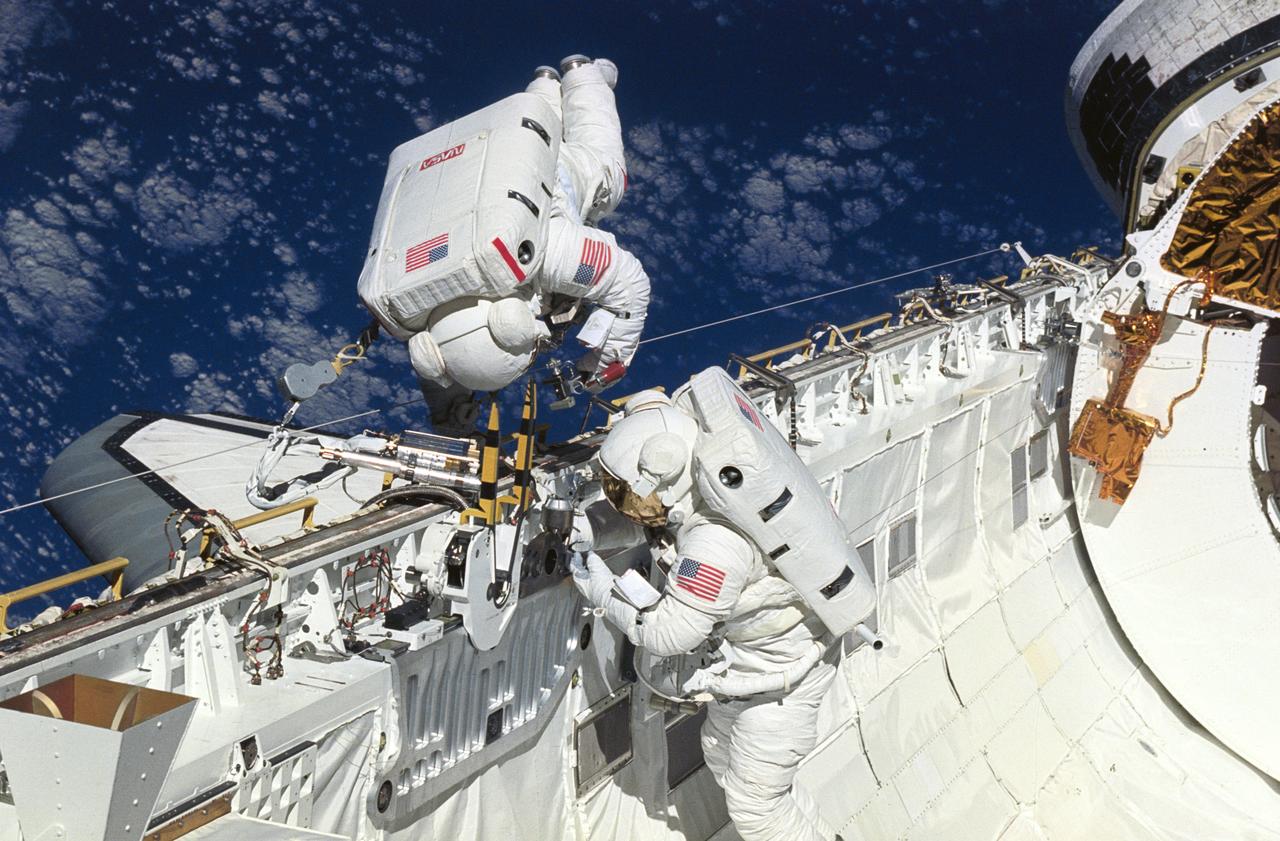
STS051-06-023 (16 Sept 1993) --- Astronauts James H. Newman (in bay) and Carl E. Walz, mission specialists, practice space walking techniques and evaluate tools to be used on the first Hubble Space Telescope (HST) servicing mission scheduled for later this year. Walz rehearses using the Power Ratchet Tool (PRT), one of several special pieces of gear to be put to duty during the scheduled five periods of extravehicular activity (EVA) on the STS-61 mission.
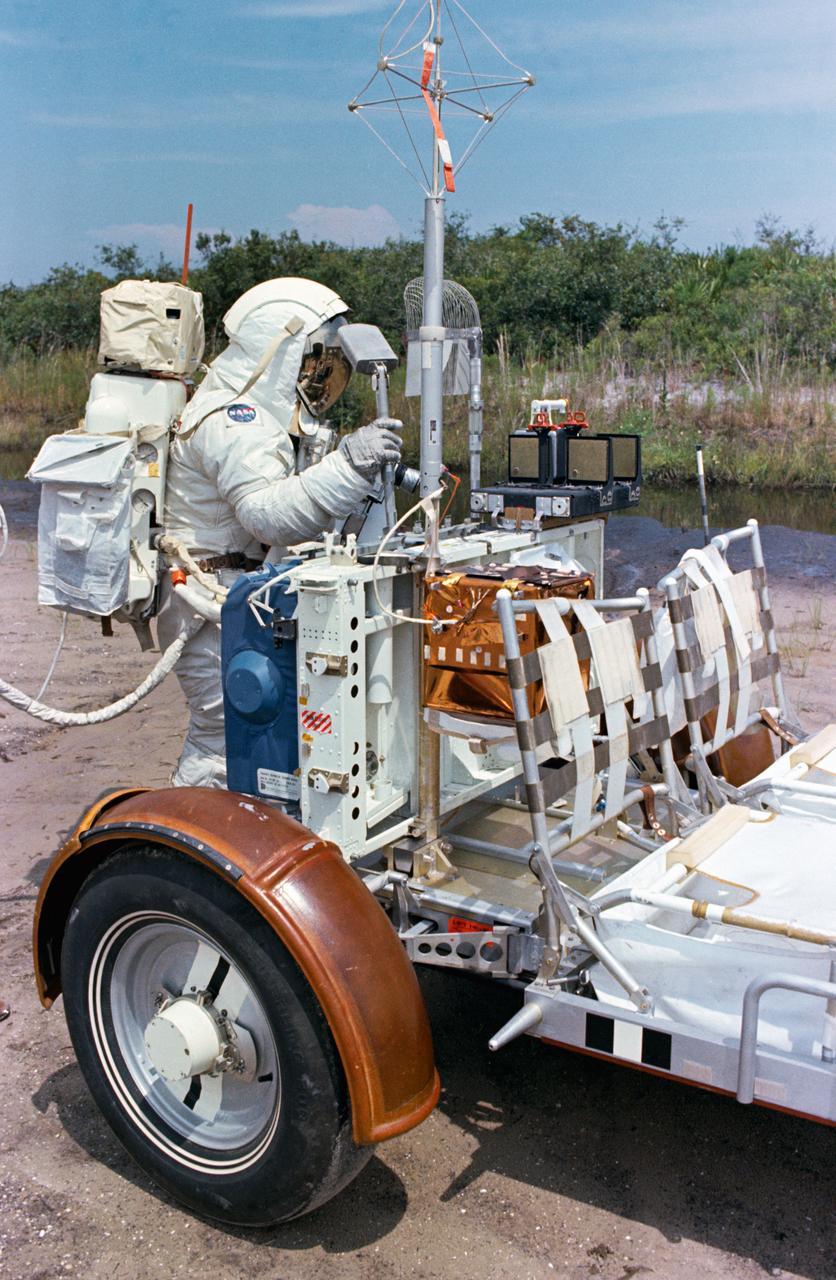
S72-48890 (September 1972) --- Scientist-astronaut Harrison H. Schmitt, lunar module pilot of the Apollo 17 lunar landing mission, procures a geological hand tool from the tool carrier at the aft end of the Lunar Roving Vehicle during lunar surface extravehicular activity simulation training at the Kennedy Space Center (KSC), Florida. Schmitt grasps a scoop with extension handle in his right hand.
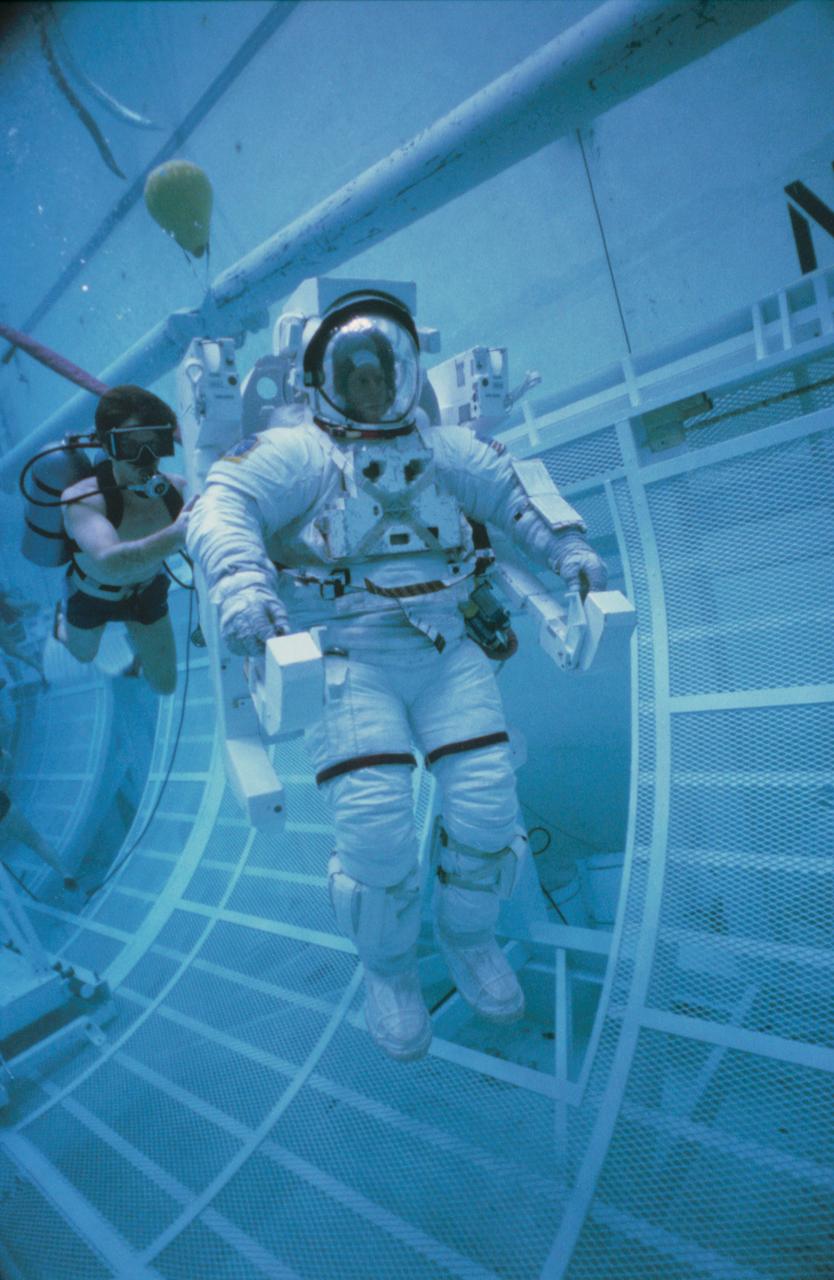
Underwater extravehicular activity (EVA) training in the weightless environment training facility (WETF) with astronauts George Nelson and James van Hoften. They are using tools to assemble material in the facility while surrounded by divers (428895); View of George Nelson in full extravehicular mobility unit (EMU) floating inside the space shuttle payload bay mockup with a diver behind him (42896).
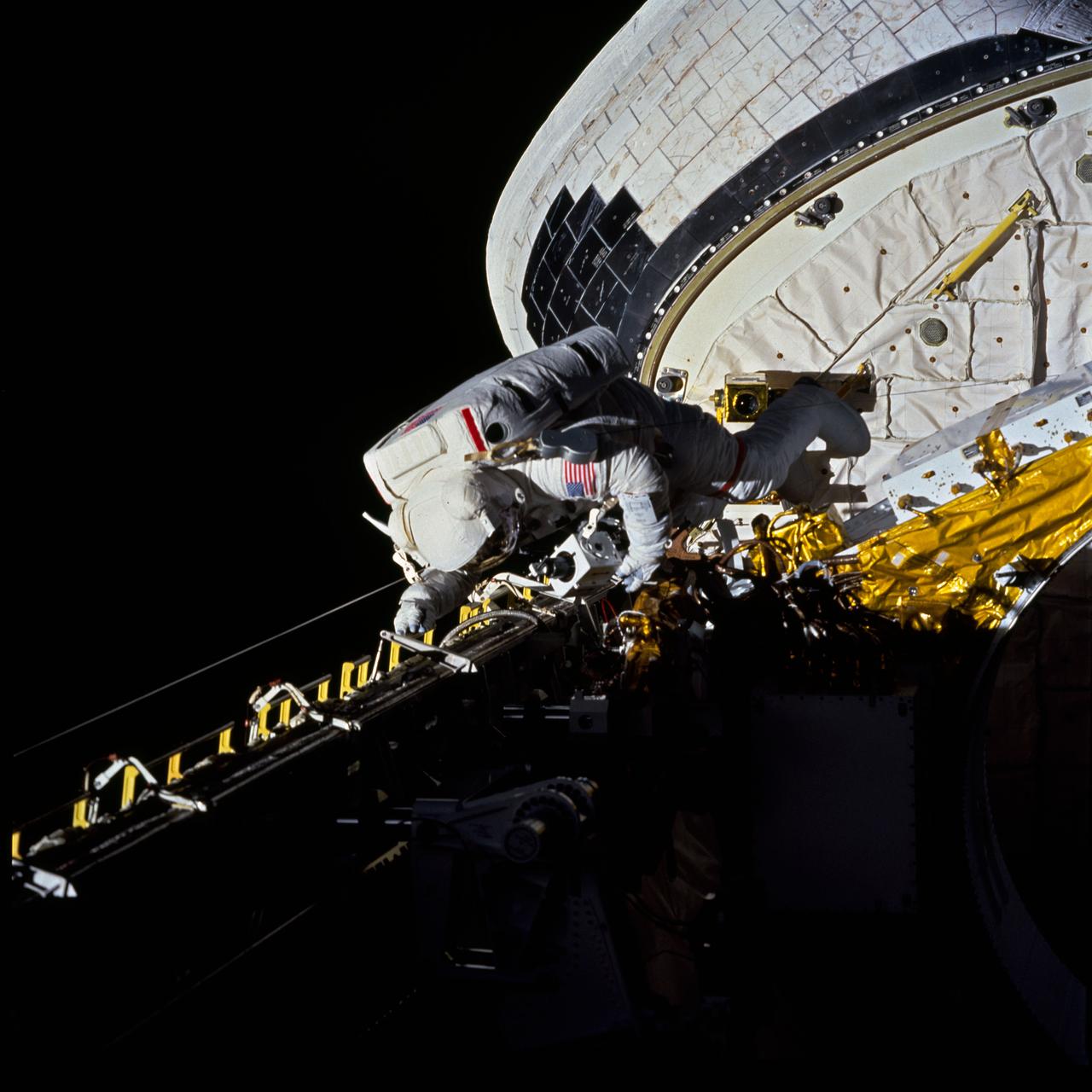
STS054-80-0N (17 Jan 1993) --- Astronaut Gregory J. Harbaugh moves along the starboard side of Endeavour's cargo bay during the four-plus hour long extravehicular activity (EVA) on January 17, 1993. The photograph was taken with a 70mm camera from inside Endeavour's cabin by a fellow crewmember. Three astronauts remained inside to support the spacewalk by astronauts Harbaugh and Mario Runco Jr. (out of frame).
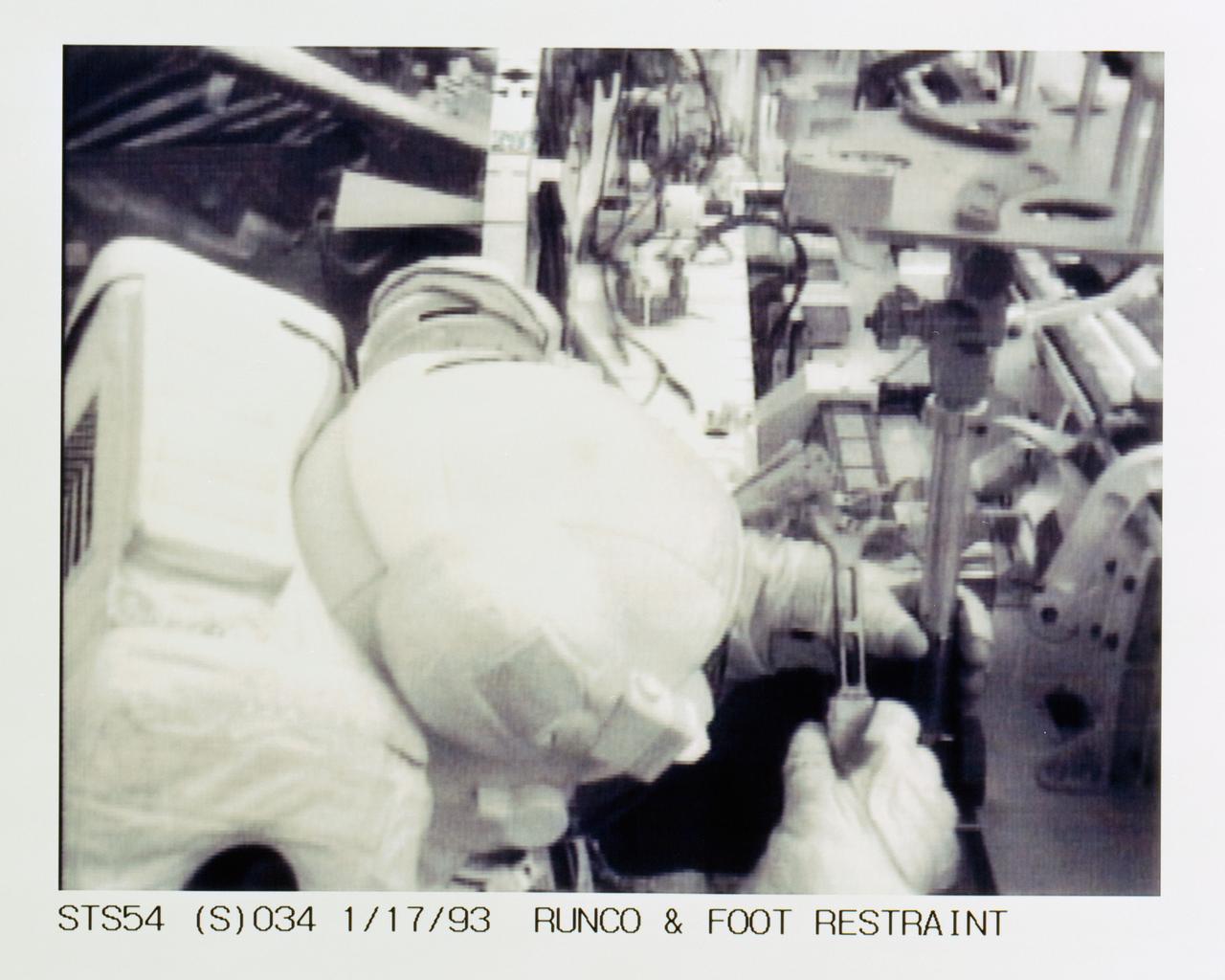
STS054-S-034 (17 Jan 1993) --- Closeup view of Runco as he works to install a mobile foot restraint during extravehicular activity (EVA) in Endeavour's cargo bay. The scene was downlinked at 11:55:07:24 GMT, Jan. 17, 1993.
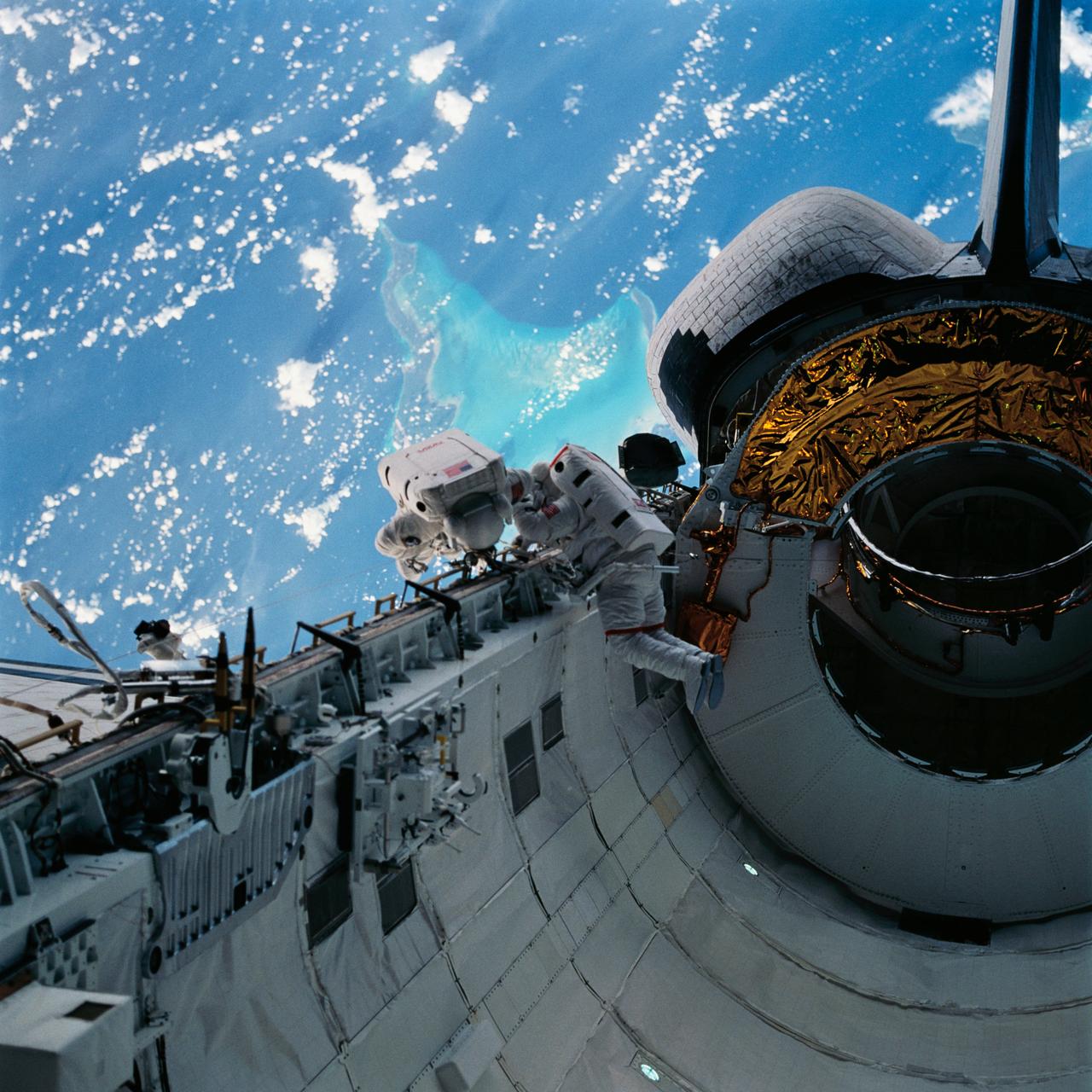
With the Caribbean Sea and part of the Bahama Islands chain as a backdrop, two STS-51 crewmembers evaluate procedures and gear to be used on the upcoming Hubble Space Telescope (HST)-servicing mission. Sharing the lengthy extravehicular activity in and around Discovery's cargo bay were astronauts James H. Newman (left), and Carl E. Walz, mission specialists.
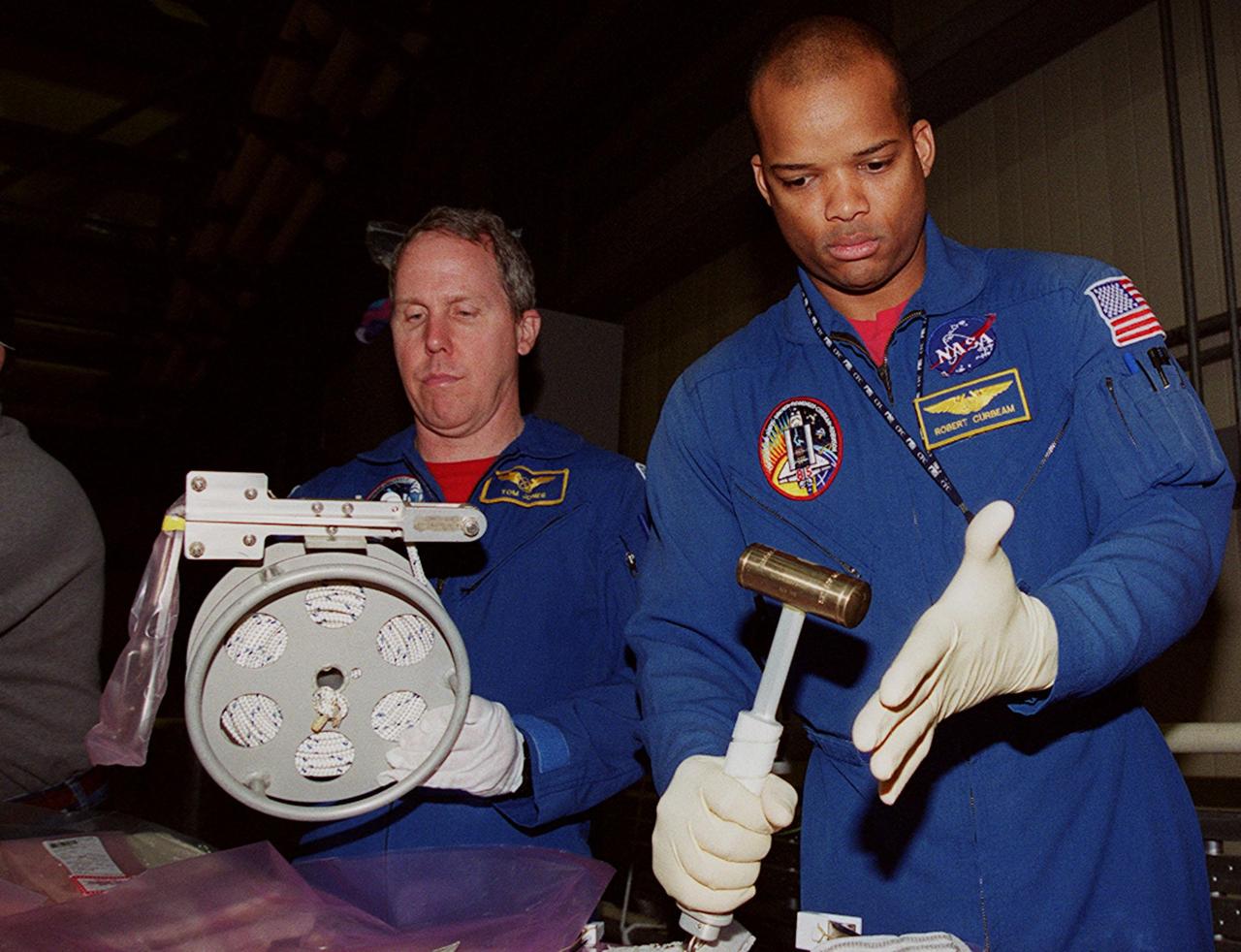
KENNEDY SPACE CENTER, FLA. -- In Orbiter Processing Facility bay 3, STS-98 Mission Specialists Tom Jones and Robert Curbeam test tools that will be used during extravehicular activities (EVA) on their mission. Scheduled for launch Jan. 18, 2001, STS-98 will be transporting the U.S. Lab, Destiny, to the International Space Station with five system racks already installed inside of the module. After delivery of electronics in the lab, electrically powered attitude control for Control Moment Gyroscopes will be activated
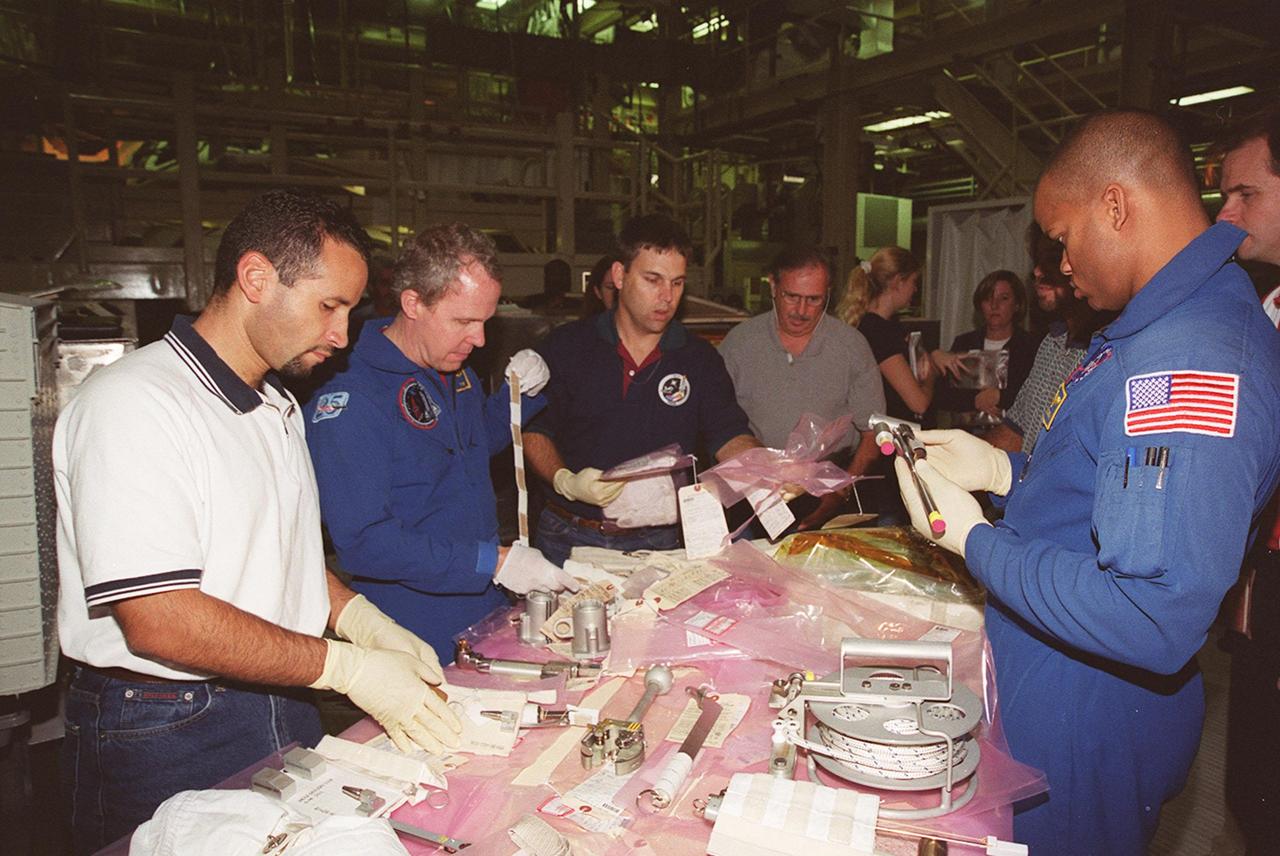
KENNEDY SPACE CENTER, FLA. -- In Orbiter Processing Facility bay 3, STS-98 Mission Specialists Tom Jones (second from left) and Robert Curbeam (right) test tools that will be used during extravehicular activities (EVA) on their mission. Scheduled for launch Jan. 18, 2001, STS-98 will be transporting the U.S. Lab, Destiny, to the International Space Station with five system racks already installed inside of the module. After delivery of electronics in the lab, electrically powered attitude control for Control Moment Gyroscopes will be activated
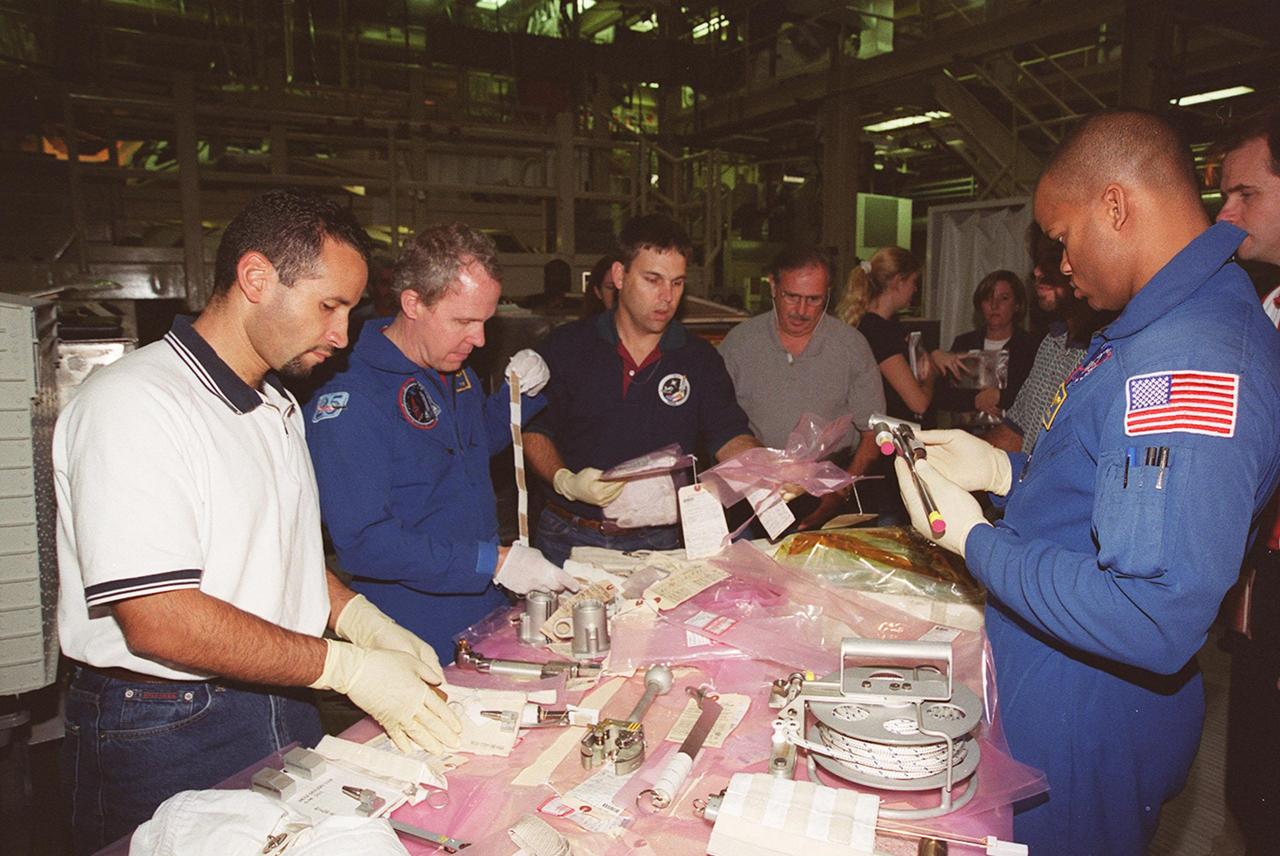
KENNEDY SPACE CENTER, FLA. -- In Orbiter Processing Facility bay 3, STS-98 Mission Specialists Tom Jones (second from left) and Robert Curbeam (right) test tools that will be used during extravehicular activities (EVA) on their mission. Scheduled for launch Jan. 18, 2001, STS-98 will be transporting the U.S. Lab, Destiny, to the International Space Station with five system racks already installed inside of the module. After delivery of electronics in the lab, electrically powered attitude control for Control Moment Gyroscopes will be activated
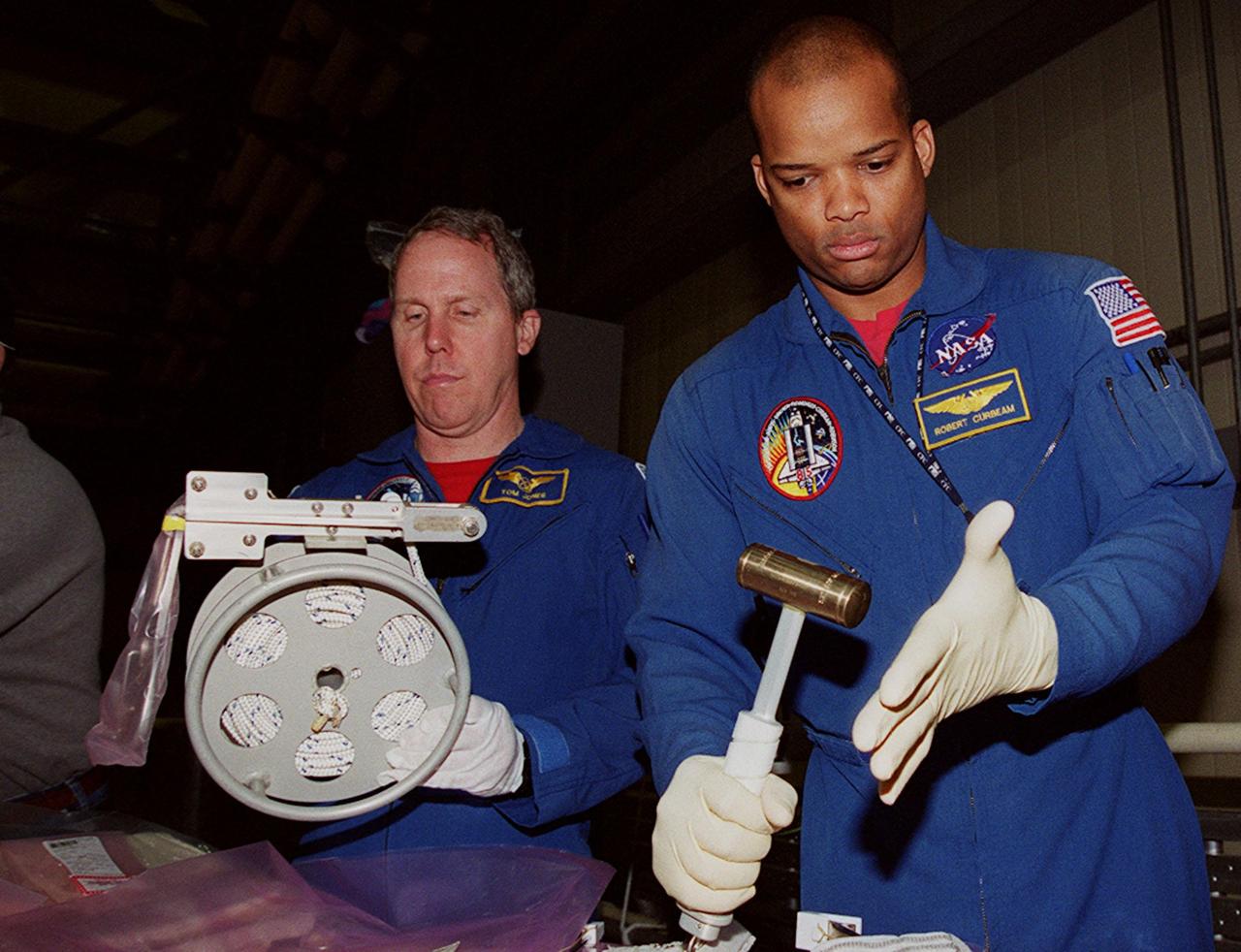
KENNEDY SPACE CENTER, FLA. -- In Orbiter Processing Facility bay 3, STS-98 Mission Specialists Tom Jones and Robert Curbeam test tools that will be used during extravehicular activities (EVA) on their mission. Scheduled for launch Jan. 18, 2001, STS-98 will be transporting the U.S. Lab, Destiny, to the International Space Station with five system racks already installed inside of the module. After delivery of electronics in the lab, electrically powered attitude control for Control Moment Gyroscopes will be activated
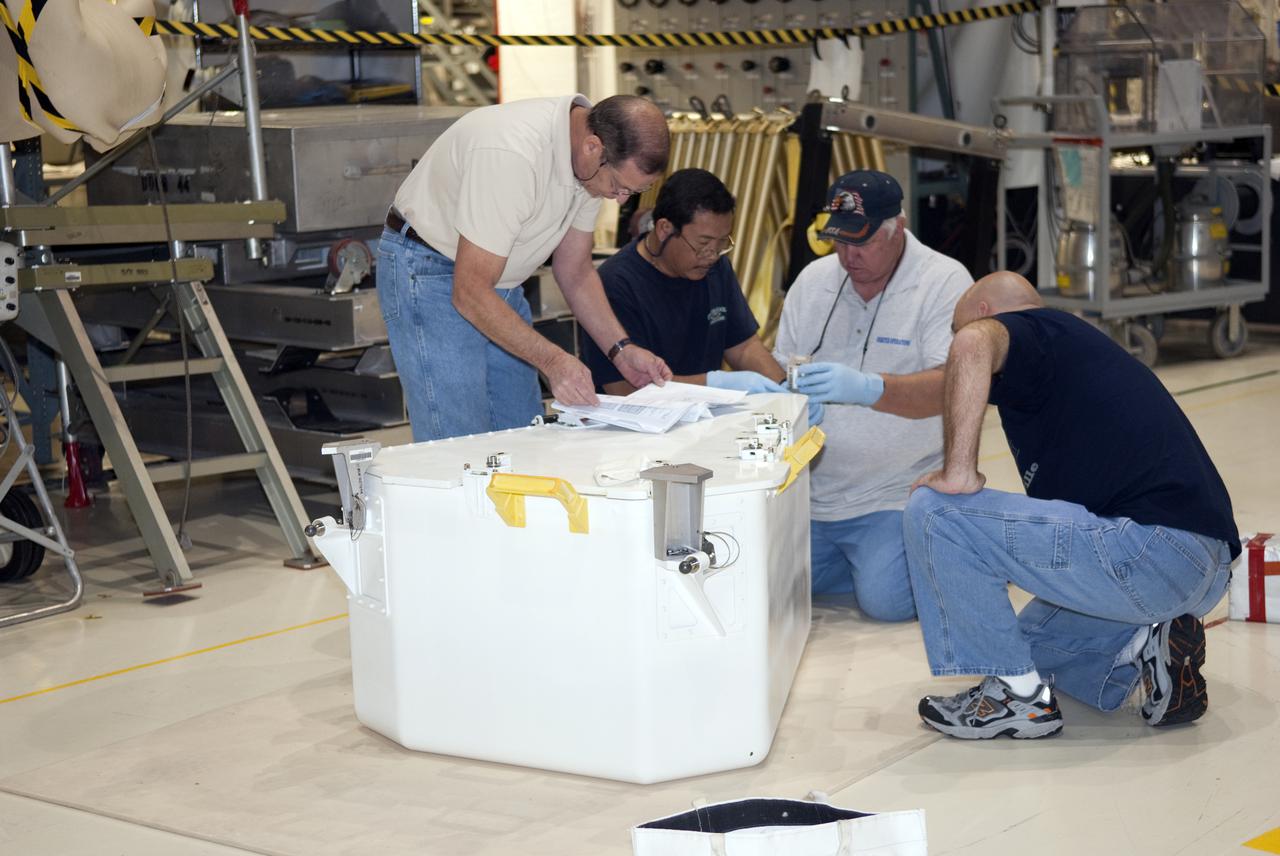
CAPE CANAVERAL, Fla. – In Orbiter Processing Facility-1 at NASA's Kennedy Space Center in Florida, workers prepare the tool stowage assembly for installation into space shuttle Atlantis' payload bay. The assembly contains tools and hardware that will be needed on the extravehicular activities, or spacewalks, conducted during the STS-132 mission. On STS-132, the six-member crew will deliver an Integrated Cargo Carrier and a Russian-built Mini-Research Module to the International Space Station. STS-132 is the 34th mission to the station and the 132nd space shuttle mission. Launch is targeted for May 14. For information on the STS-132 mission, visit http:__www.nasa.gov_mission_pages_shuttle_shuttlemissions_sts132_index.html. Photo credit: NASA_Jim Grossmann
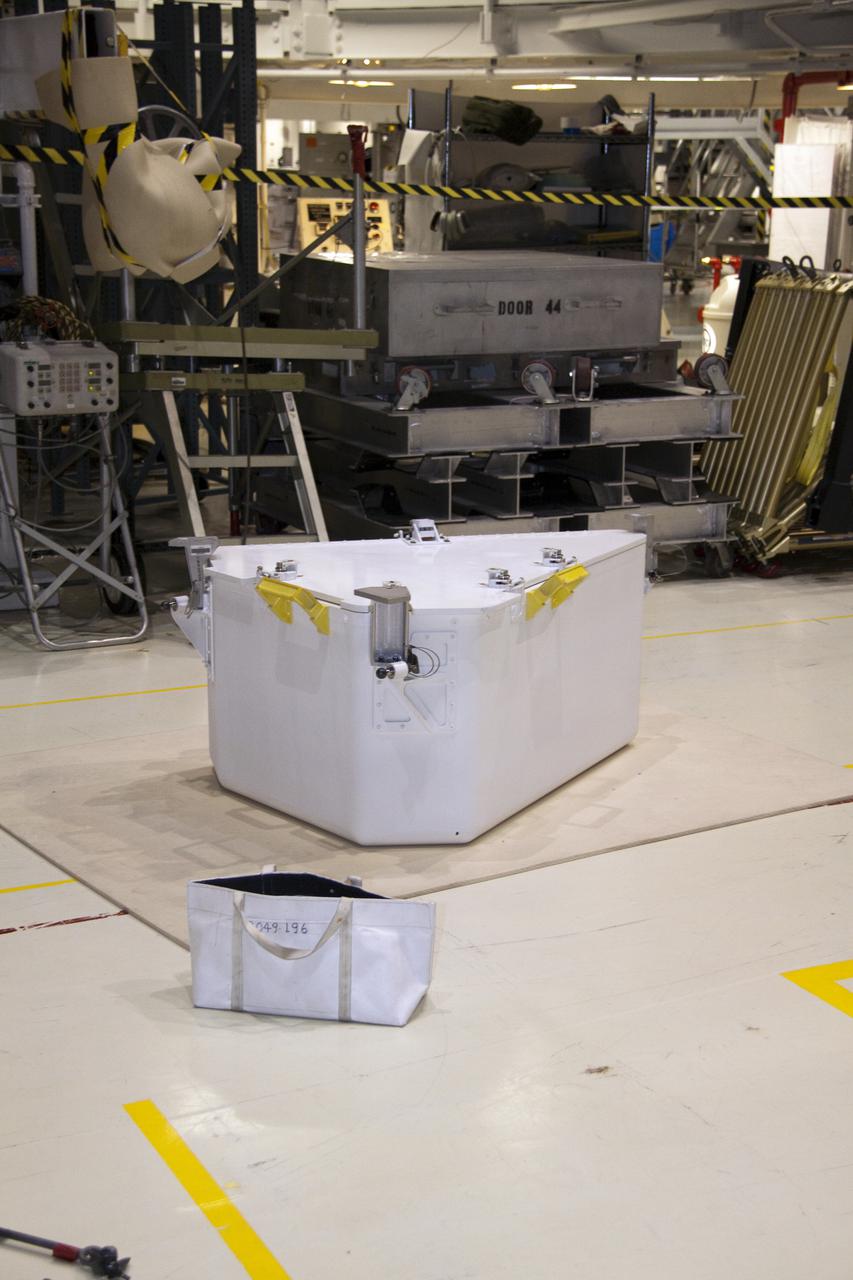
CAPE CANAVERAL, Fla. – In Orbiter Processing Facility-1 at NASA's Kennedy Space Center in Florida, preparations are under way to lift the tool stowage assembly into space shuttle Atlantis' payload bay. The assembly contains tools and hardware that will be needed on the extravehicular activities, or spacewalks, conducted during the STS-132 mission. On STS-132, the six-member crew will deliver an Integrated Cargo Carrier and a Russian-built Mini-Research Module to the International Space Station. STS-132 is the 34th mission to the station and the 132nd space shuttle mission. Launch is targeted for May 14. For information on the STS-132 mission, visit http:__www.nasa.gov_mission_pages_shuttle_shuttlemissions_sts132_index.html. Photo credit: NASA_Jack Pfaller
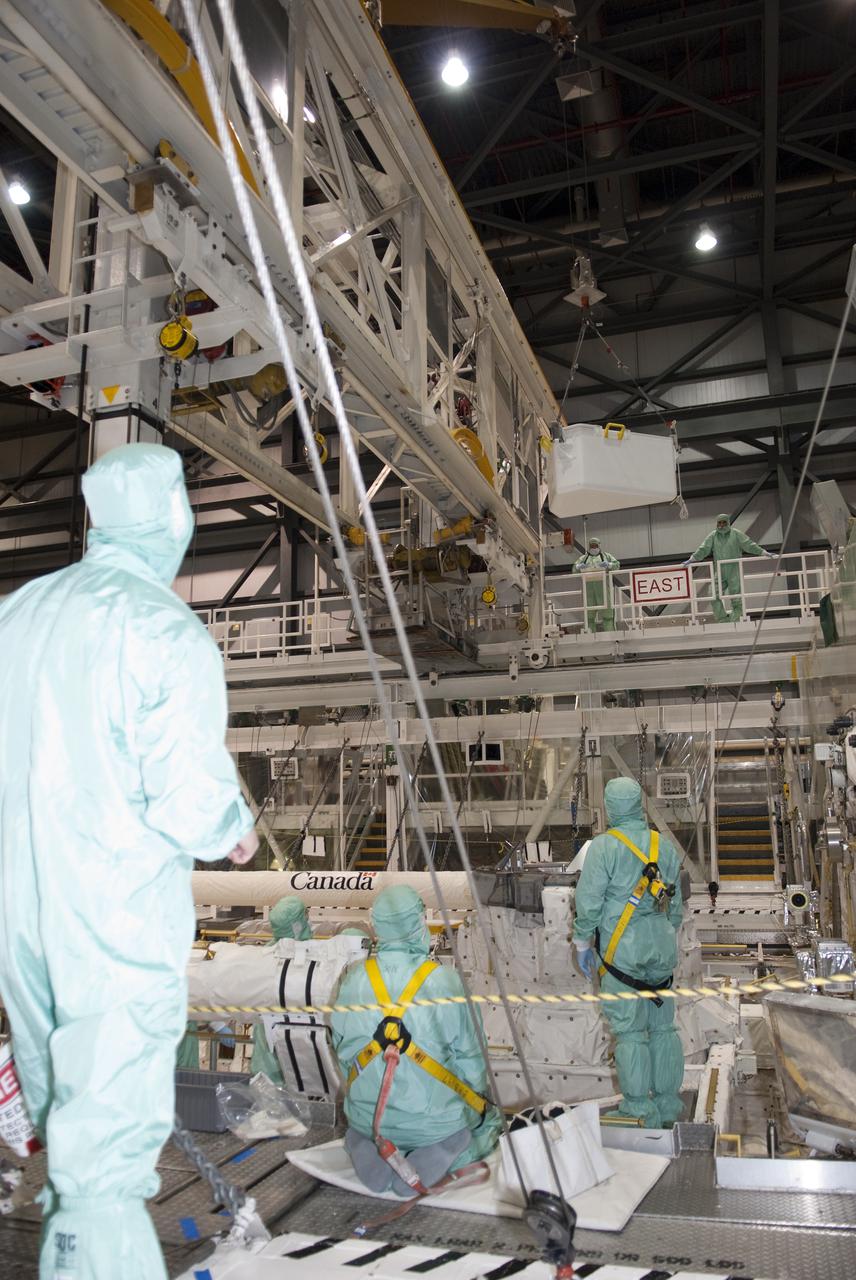
CAPE CANAVERAL, Fla. – In Orbiter Processing Facility-1 at NASA's Kennedy Space Center in Florida, a jib crane lowers the tool stowage assembly into space shuttle Atlantis' payload bay where it will be installed. The assembly contains tools and hardware that will be needed on the extravehicular activities, or spacewalks, conducted during the STS-132 mission. On STS-132, the six-member crew will deliver an Integrated Cargo Carrier and a Russian-built Mini-Research Module to the International Space Station. STS-132 is the 34th mission to the station and the 132nd space shuttle mission. Launch is targeted for May 14. For information on the STS-132 mission, visit http:__www.nasa.gov_mission_pages_shuttle_shuttlemissions_sts132_index.html. Photo credit: NASA_Jim Grossmann
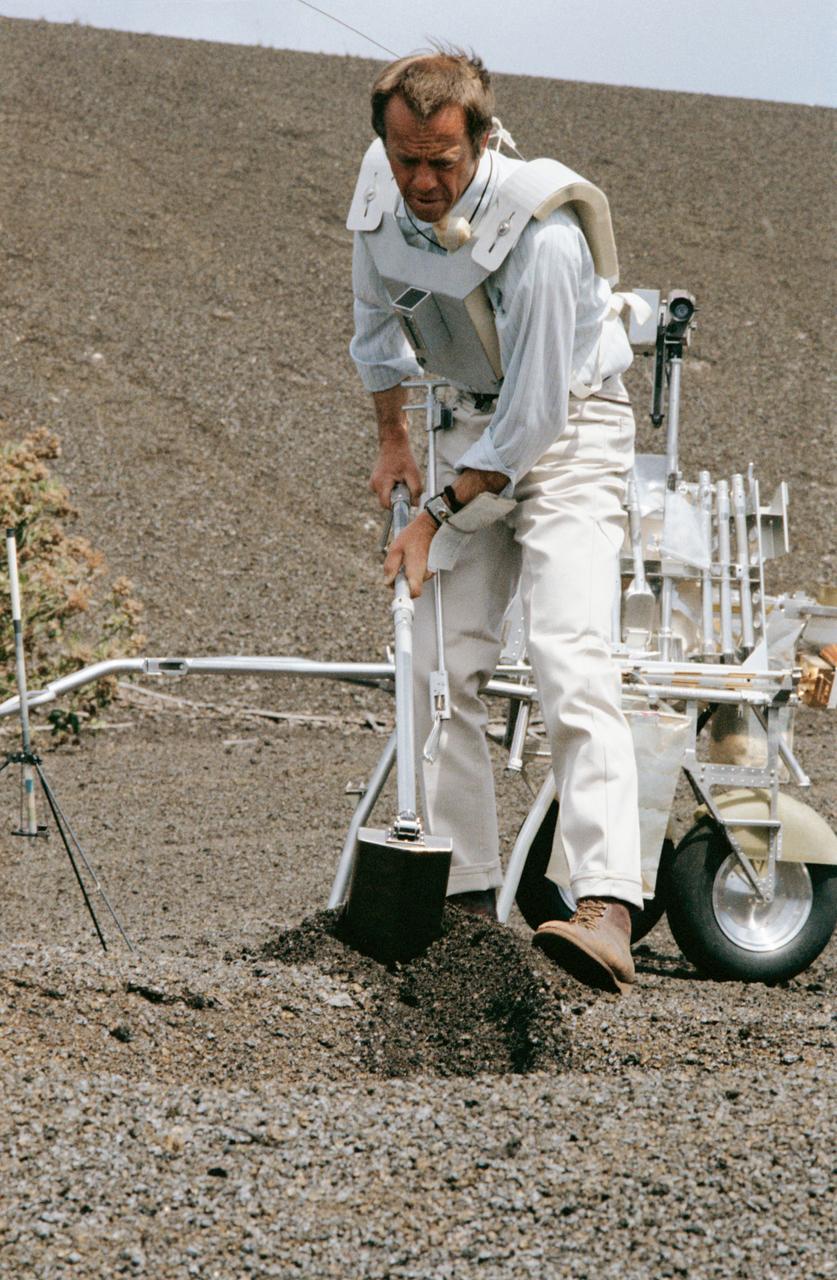
S70-34415 (April 1970) --- Astronaut Alan B. Shepard Jr., prime crew commander of the Apollo 14 mission, uses a trenching tool during a simulation of a traverse on the lunar surface. Members of the Apollo 14 prime and backup crews were in Hawaii to train for the extravehicular activity of their upcoming mission. Features of the terrain at Kapoho and other Hawaiian sites are very similar to those found on the lunar surface. A modular equipment transporter (MET), nicknamed the "Rickshaw" because of its appearance and method of propulsion, is behind Shepard, and a gnomon, one of the Apollo lunar hand tools (ALHT) is at extreme left.
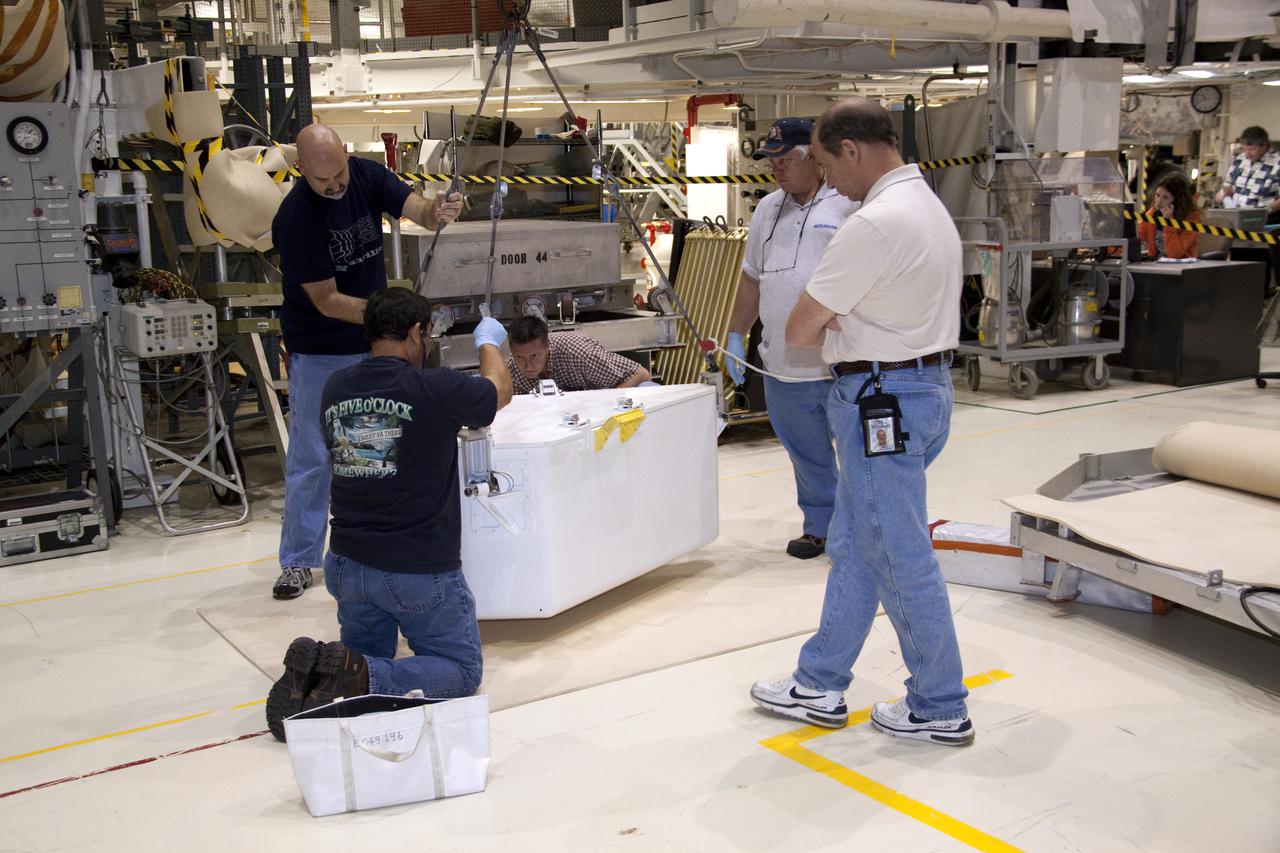
CAPE CANAVERAL, Fla. – In Orbiter Processing Facility-1 at NASA's Kennedy Space Center in Florida, workers attach the tool stowage assembly to a jib crane that will lift it into space shuttle Atlantis' payload bay. The assembly contains tools and hardware that will be needed on the extravehicular activities, or spacewalks, conducted during the STS-132 mission. On STS-132, the six-member crew will deliver an Integrated Cargo Carrier and a Russian-built Mini-Research Module to the International Space Station. STS-132 is the 34th mission to the station and the 132nd space shuttle mission. Launch is targeted for May 14. For information on the STS-132 mission, visit http:__www.nasa.gov_mission_pages_shuttle_shuttlemissions_sts132_index.html. Photo credit: NASA_Jack Pfaller
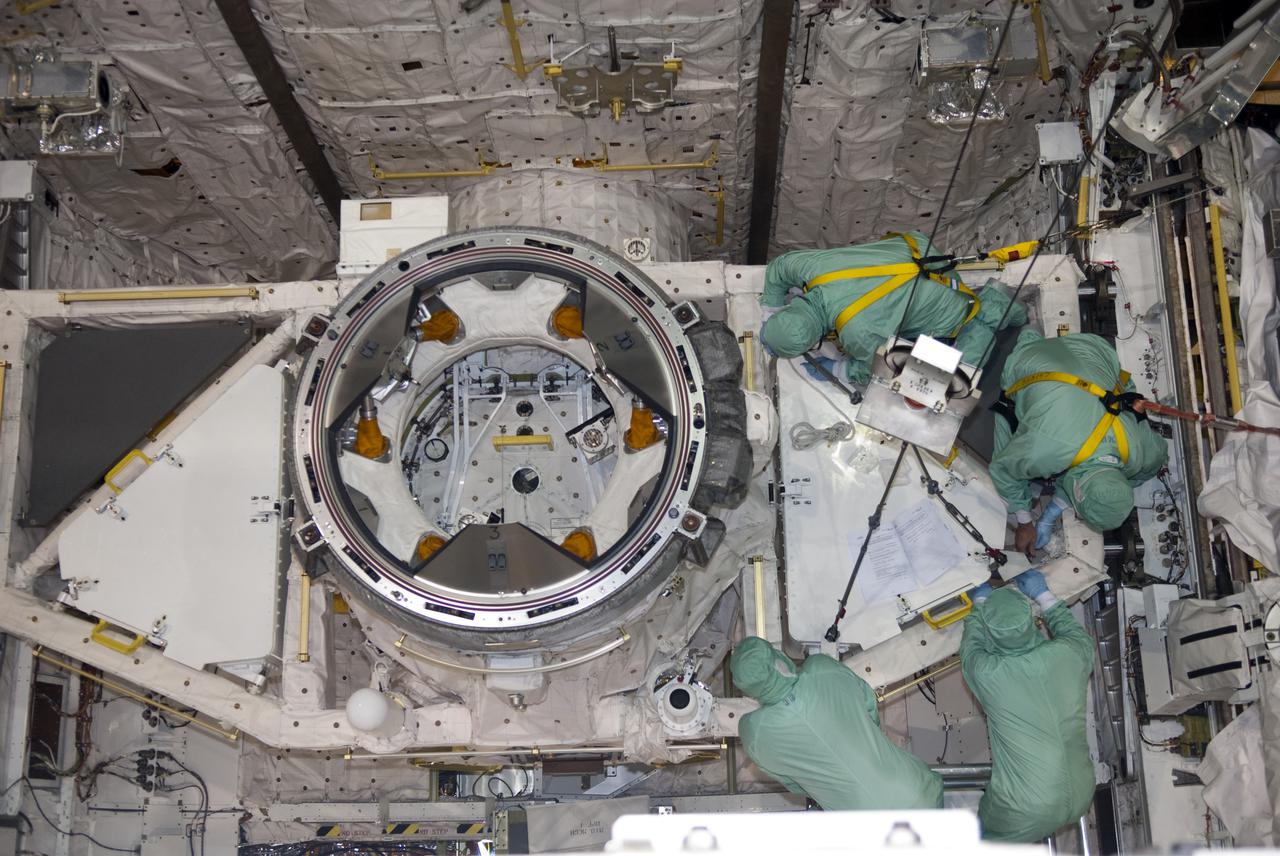
CAPE CANAVERAL, Fla. – In Orbiter Processing Facility-1 at NASA's Kennedy Space Center in Florida, workers dressed in clean room attire, known as bunny suits, install the tool stowage assembly in space shuttle Atlantis' payload bay. The assembly contains tools and hardware that will be needed on the extravehicular activities, or spacewalks, conducted during the STS-132 mission. On STS-132, the six-member crew will deliver an Integrated Cargo Carrier and a Russian-built Mini-Research Module to the International Space Station. STS-132 is the 34th mission to the station and the 132nd space shuttle mission. Launch is targeted for May 14. For information on the STS-132 mission, visit http:__www.nasa.gov_mission_pages_shuttle_shuttlemissions_sts132_index.html. Photo credit: NASA_Jim Grossmann
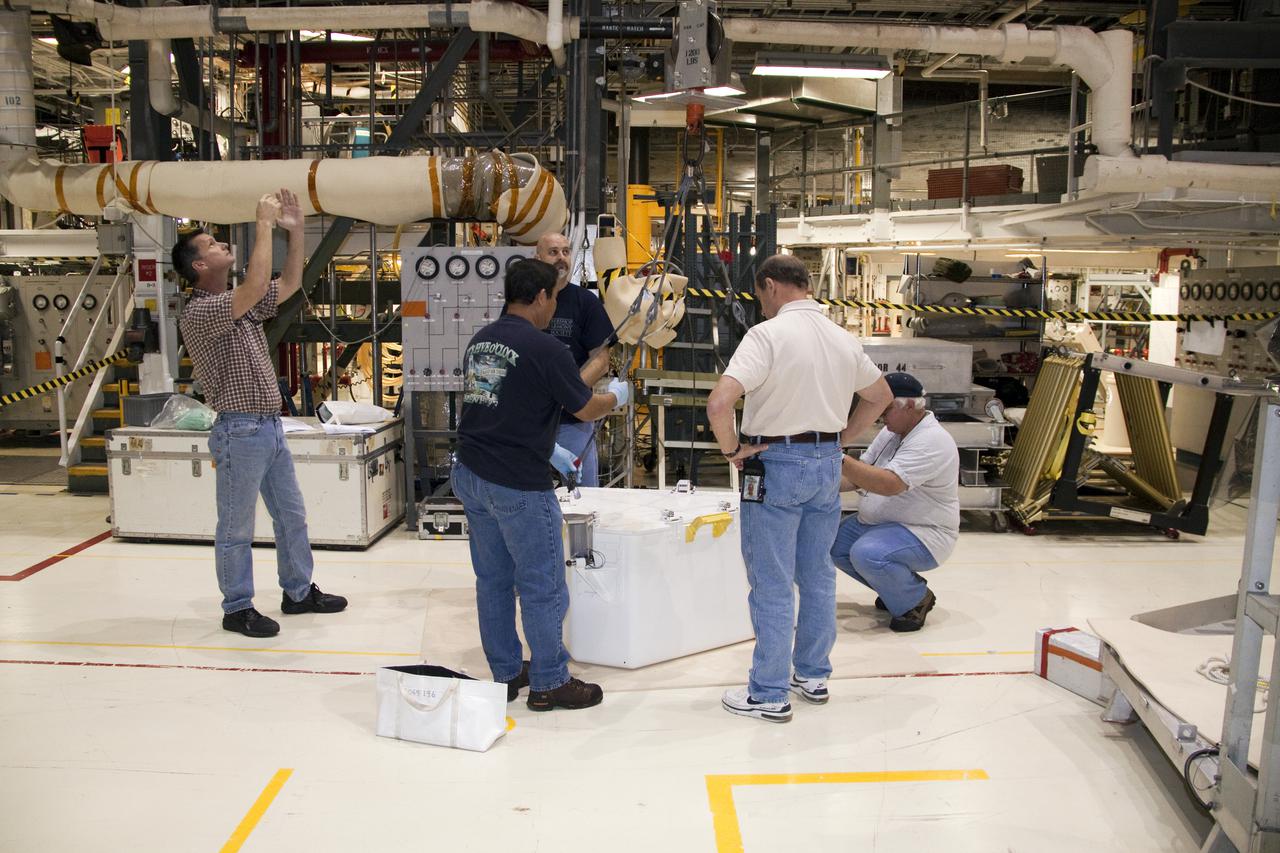
CAPE CANAVERAL, Fla. – In Orbiter Processing Facility-1 at NASA's Kennedy Space Center in Florida, workers prepare to attach the tool stowage assembly to a jib crane that will lift it into space shuttle Atlantis' payload bay. The assembly contains tools and hardware that will be needed on the extravehicular activities, or spacewalks, conducted during the STS-132 mission. On STS-132, the six-member crew will deliver an Integrated Cargo Carrier and a Russian-built Mini-Research Module to the International Space Station. STS-132 is the 34th mission to the station and the 132nd space shuttle mission. Launch is targeted for May 14. For information on the STS-132 mission, visit http:__www.nasa.gov_mission_pages_shuttle_shuttlemissions_sts132_index.html. Photo credit: NASA_Jack Pfaller
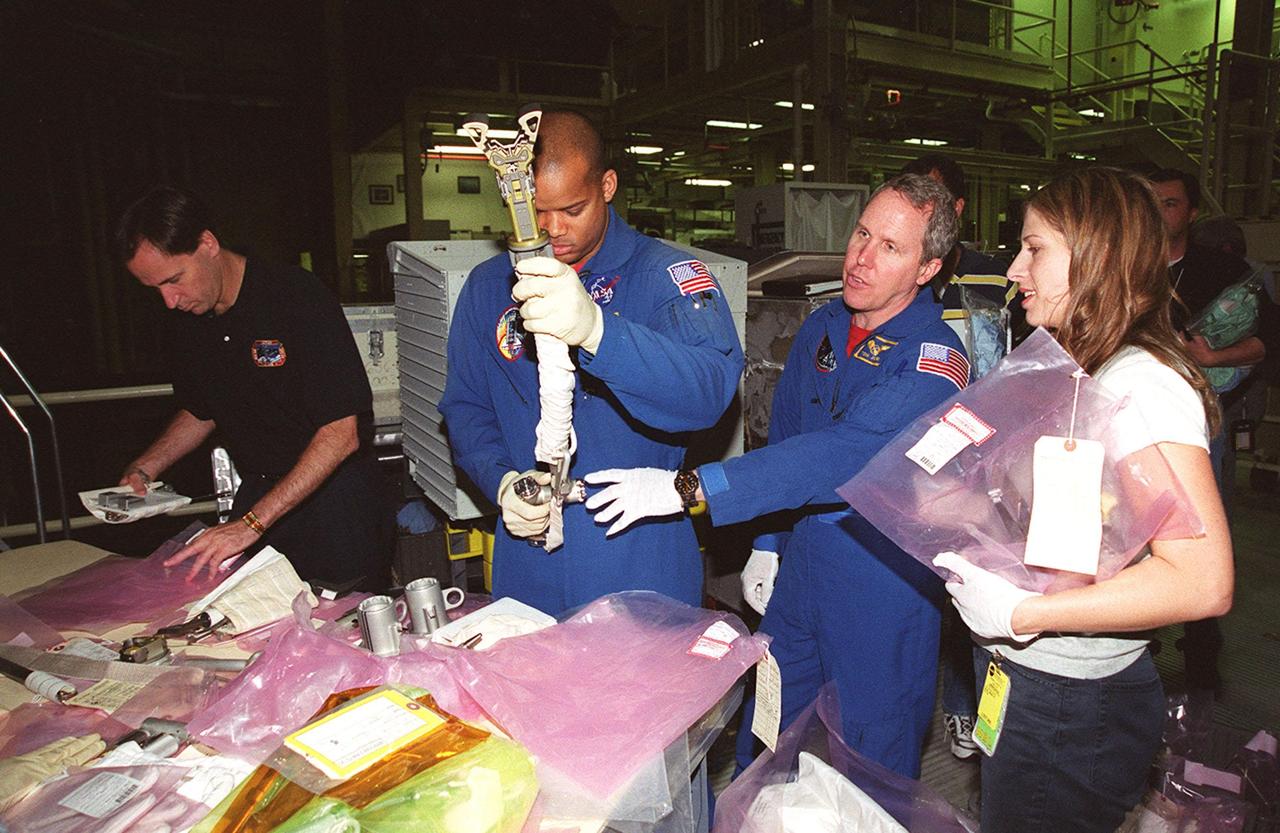
KENNEDY SPACE CENTER, FLA. -- In the Orbiter Processing Facility, STS-98 Mission Specialists Robert Curbeam (center left) and Tom Jones (center right) practice with tools that will be used on extravehicular activities on their mission. The STS-98 crew is at KSC for Crew Equipment Interface Test activities. Launch on mission STS-98 is scheduled for Jan. 18, 2001. It will be transporting the U.S. Lab, Destiny, to the International Space Station with five system racks already installed inside of the module. After delivery of electronics in the lab, electrically powered attitude control for Control Moment Gyroscopes will be activated
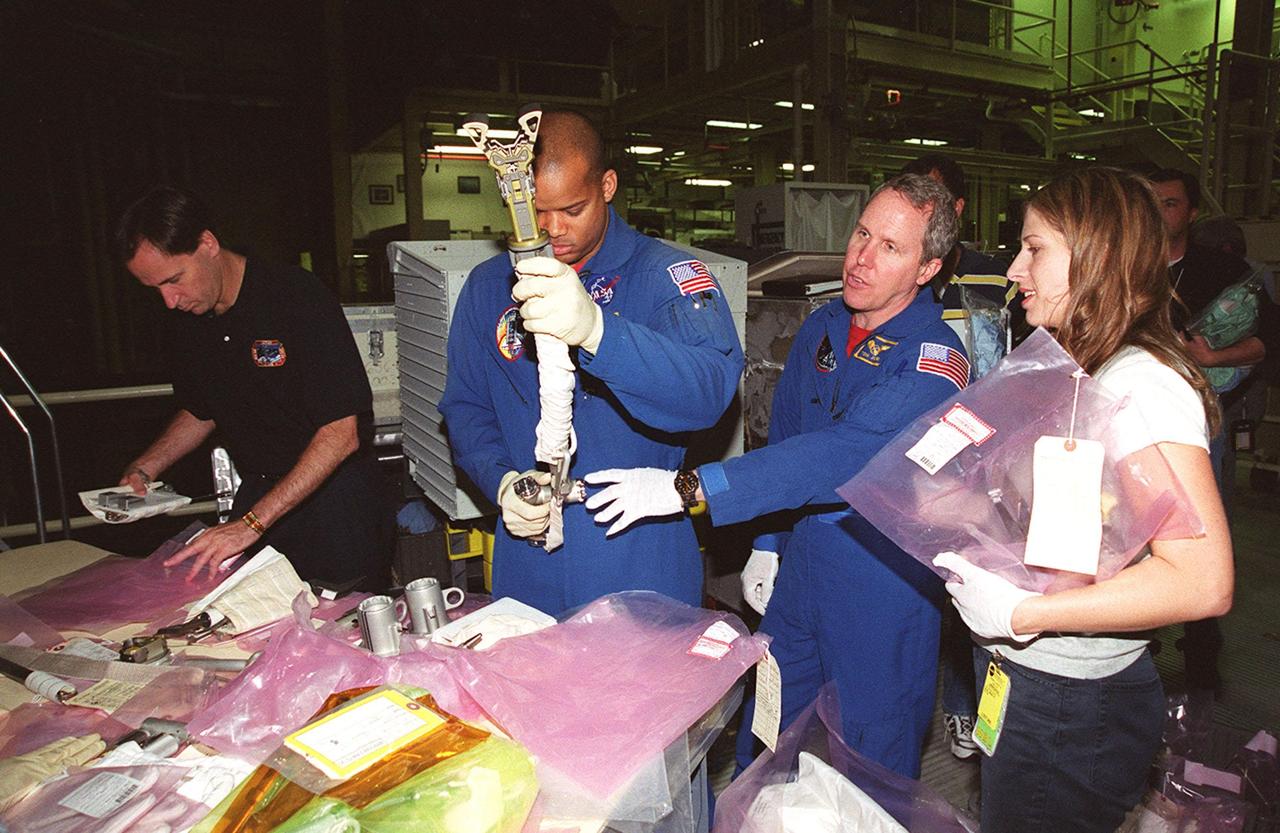
KENNEDY SPACE CENTER, FLA. -- In the Orbiter Processing Facility, STS-98 Mission Specialists Robert Curbeam (center left) and Tom Jones (center right) practice with tools that will be used on extravehicular activities on their mission. The STS-98 crew is at KSC for Crew Equipment Interface Test activities. Launch on mission STS-98 is scheduled for Jan. 18, 2001. It will be transporting the U.S. Lab, Destiny, to the International Space Station with five system racks already installed inside of the module. After delivery of electronics in the lab, electrically powered attitude control for Control Moment Gyroscopes will be activated
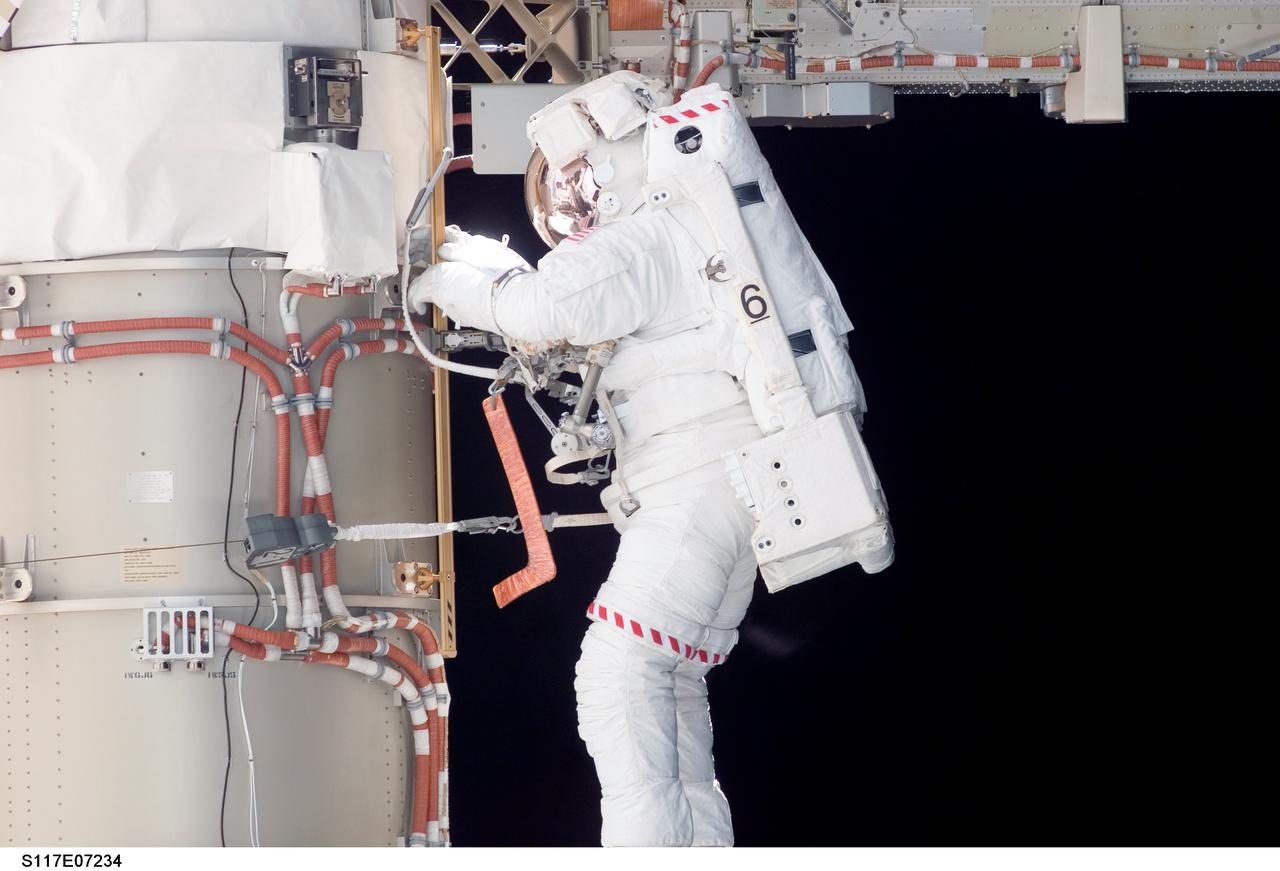
S117-E-07234 (13 June 2007) --- Astronauts Steven Swanson and Patrick Forrester (out of frame), both STS-117 mission specialists, participate in the mission's second planned session of extravehicular activity (EVA), as construction resumes on the International Space Station. Among other tasks, Forrester and Swanson removed all of the launch locks holding the 10-foot-wide solar alpha rotary joint in place and began the solar array retraction. Tethered to his Extravehicular Mobility Unit (EMU) spacesuit, a hockey-stick-shaped tool wrapped in insulating tape, is visible in front of Swanson.
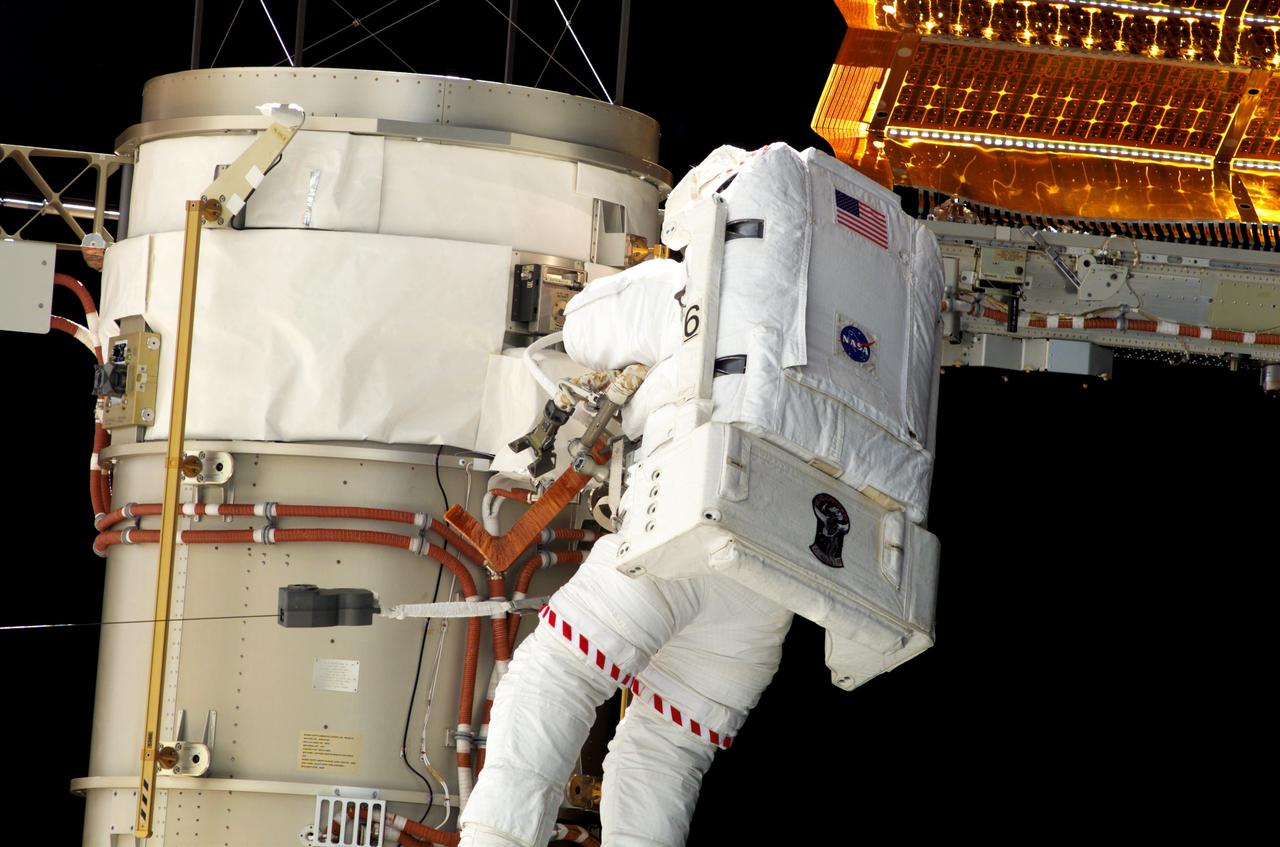
S117-E-07233 (13 June 2007) --- Astronauts Steven Swanson and Patrick Forrester (out of frame), both STS-117 mission specialists, participate in the mission's second planned session of extravehicular activity (EVA), as construction resumes on the International Space Station. Among other tasks, Forrester and Swanson removed all of the launch locks holding the 10-foot-wide solar alpha rotary joint in place and began the solar array retraction. Tethered to his Extravehicular Mobility Unit (EMU) spacesuit, a hockey-stick-shaped tool wrapped in insulating tape, is visible in front of Swanson.
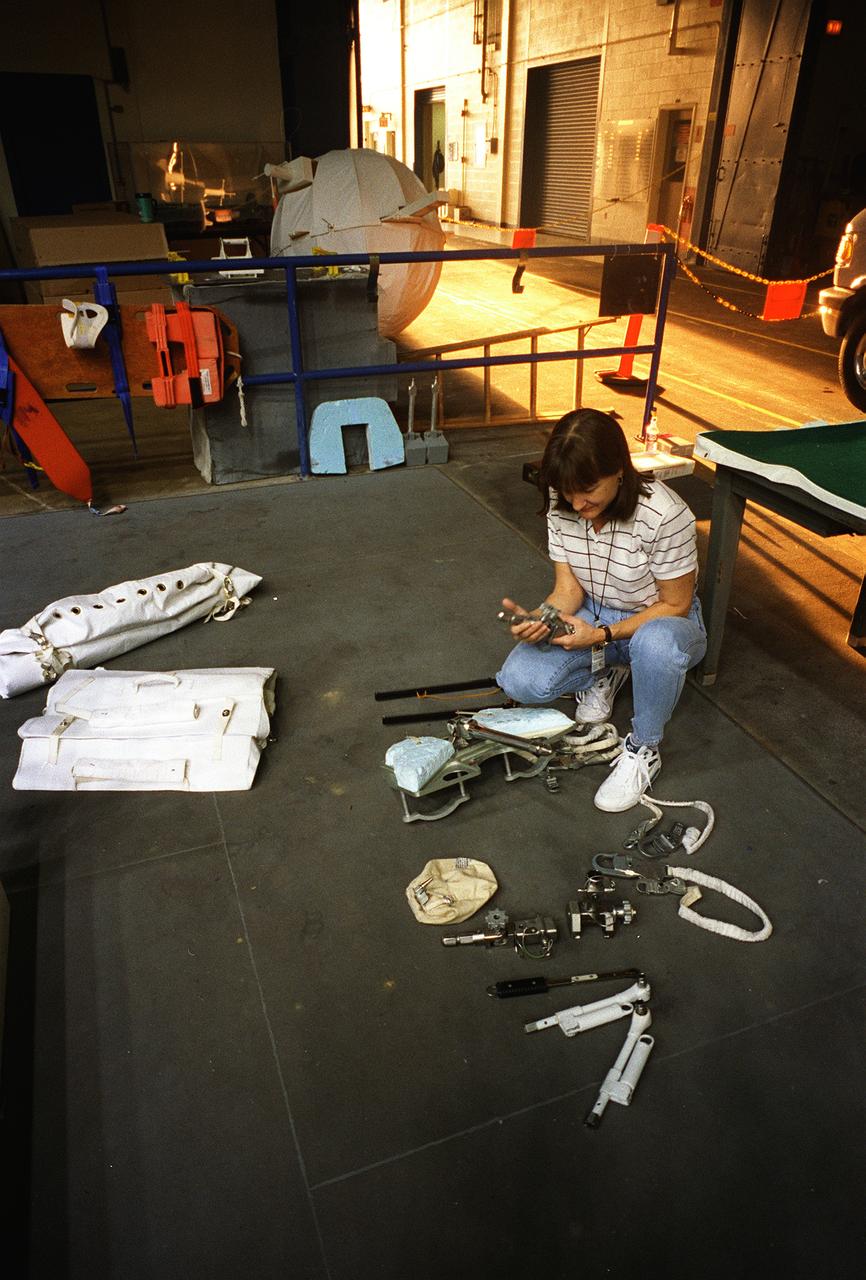
S95-21275 (September 1995) --- Astronaut Linda M. Godwin, mission specialist, checks training versions of tools to be used in a scheduled Extravehicular Activity (EVA) during the March mission. Astronaut Michael R. (Rich) Clifford, mission specialist, who will join Godwin on the EVA, is out of frame. The two checked out the hardware before donning training versions of the Extravehicular Mobility Unit (EMU) spacesuit in preparation for being submerged in a 25-feet deep pool at the Johnson Space Center's (JSC) Weightless Environment Training Facility (WET-F).
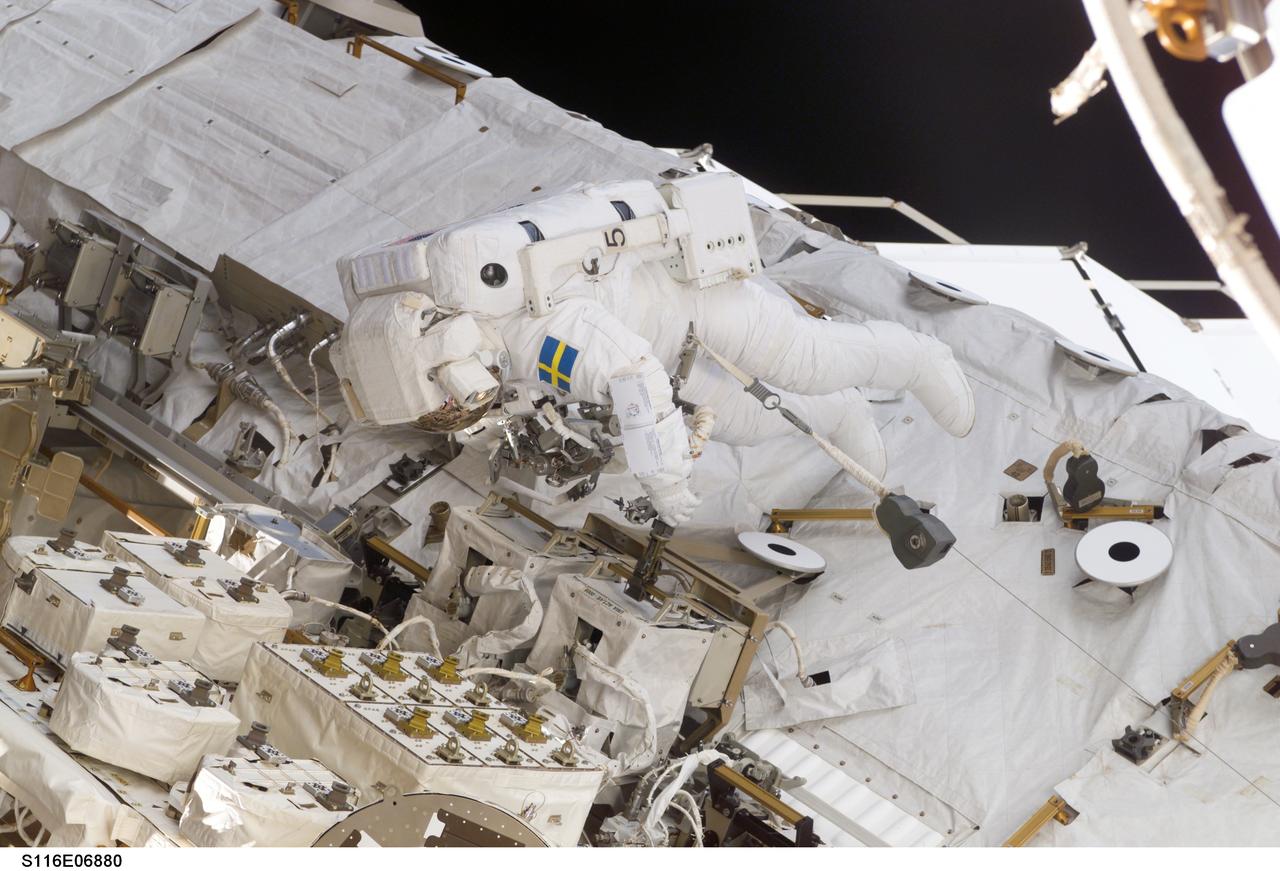
S116-E-06880 (18 Dec. 2006) --- European Space Agency (ESA) astronaut Christer Fuglesang, STS-116 mission specialist, participates in the mission's fourth session of extravehicular activity (EVA) while Space Shuttle Discovery was docked with the International Space Station. Astronaut Robert L. Curbeam Jr. (out of frame), mission specialist, worked in tandem with Fuglesang, using specially-prepared, tape-insulated tools, to guide the array wing neatly inside its blanket box during the 6-hour, 38-minute spacewalk.
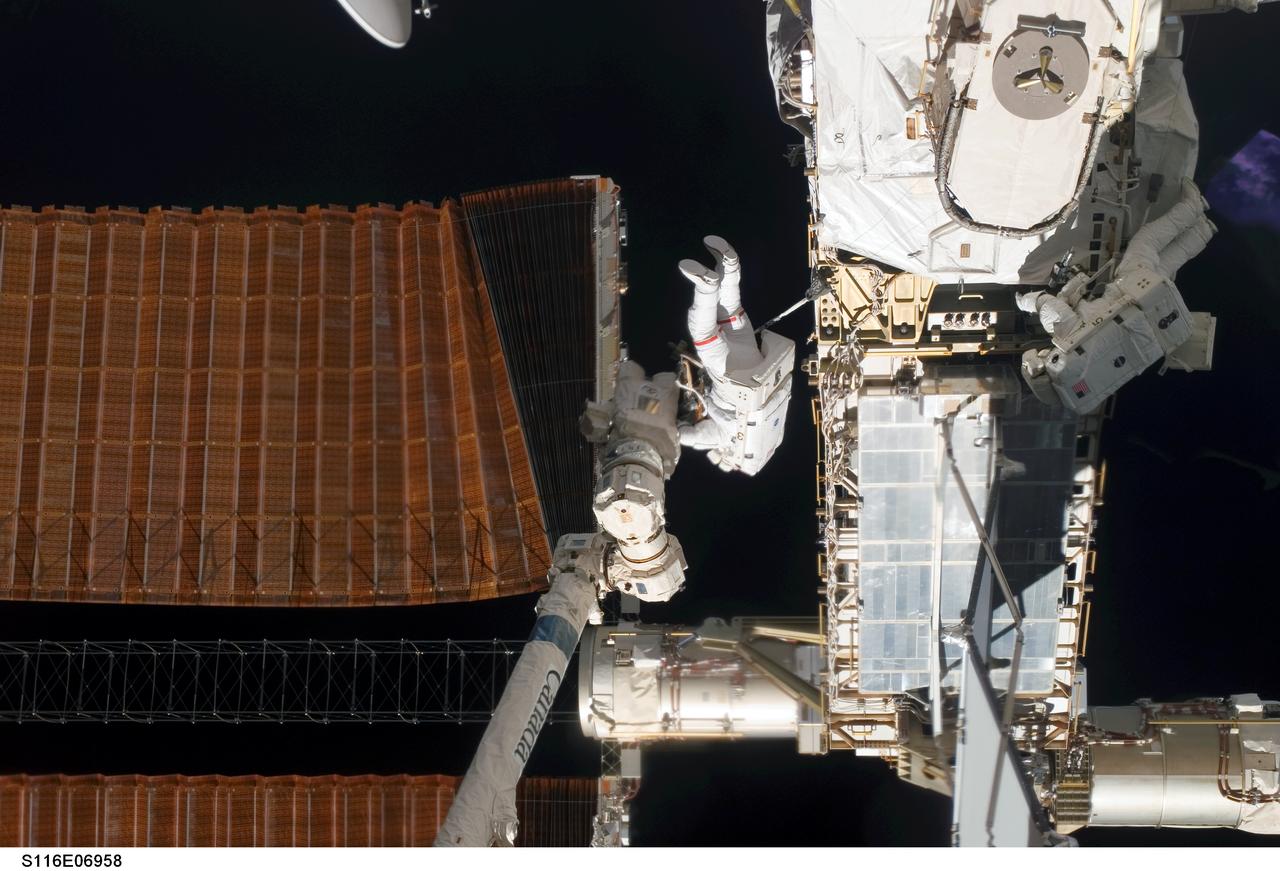
S116-E-06958 (18 Dec. 2006) --- Astronaut Robert L. Curbeam Jr. (center) and European Space Agency (ESA) astronaut Christer Fuglesang (right), both STS-116 mission specialists, work with the port overhead solar array wing on the International Space Station's P6 truss during the mission's fourth session of extravehicular activity (EVA). The spacewalkers used specially-prepared, tape-insulated tools, to guide the array wing neatly inside its blanket box during the 6-hour, 38-minute spacewalk.
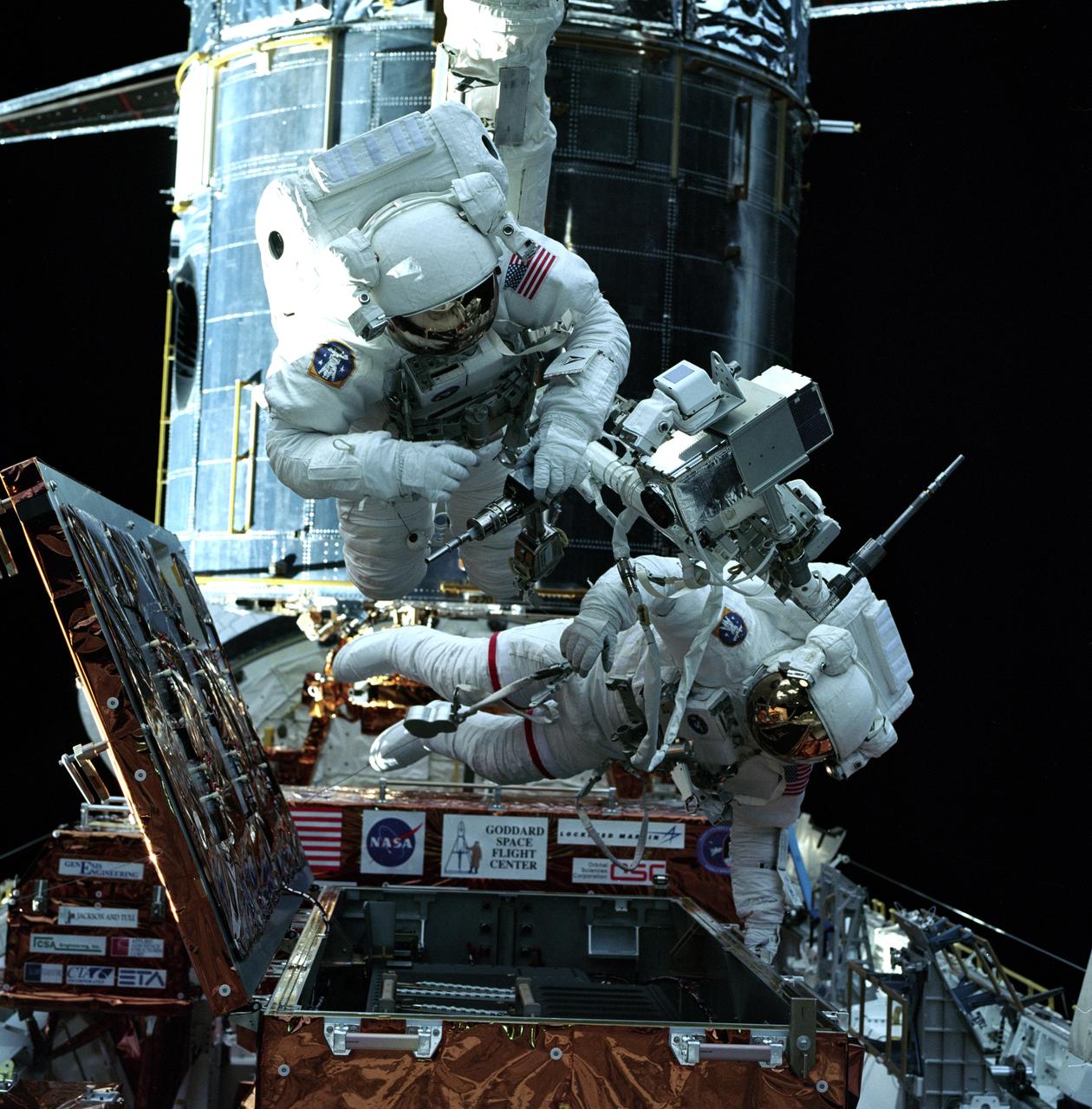
STS082-717-026 (13 Feb. 1997) --- Gearing up with tools for the first Extravehicular Activity (EVA-1) to service the Hubble Space Telescope (HST, background) are astronauts Steven L. Smith (left) and Mark C. Lee. They were among four STS-82 crewmembers who are to share several alternating two-member space walking work sessions during the flight. The photograph was made from inside Discovery's cabin with a 70mm camera.
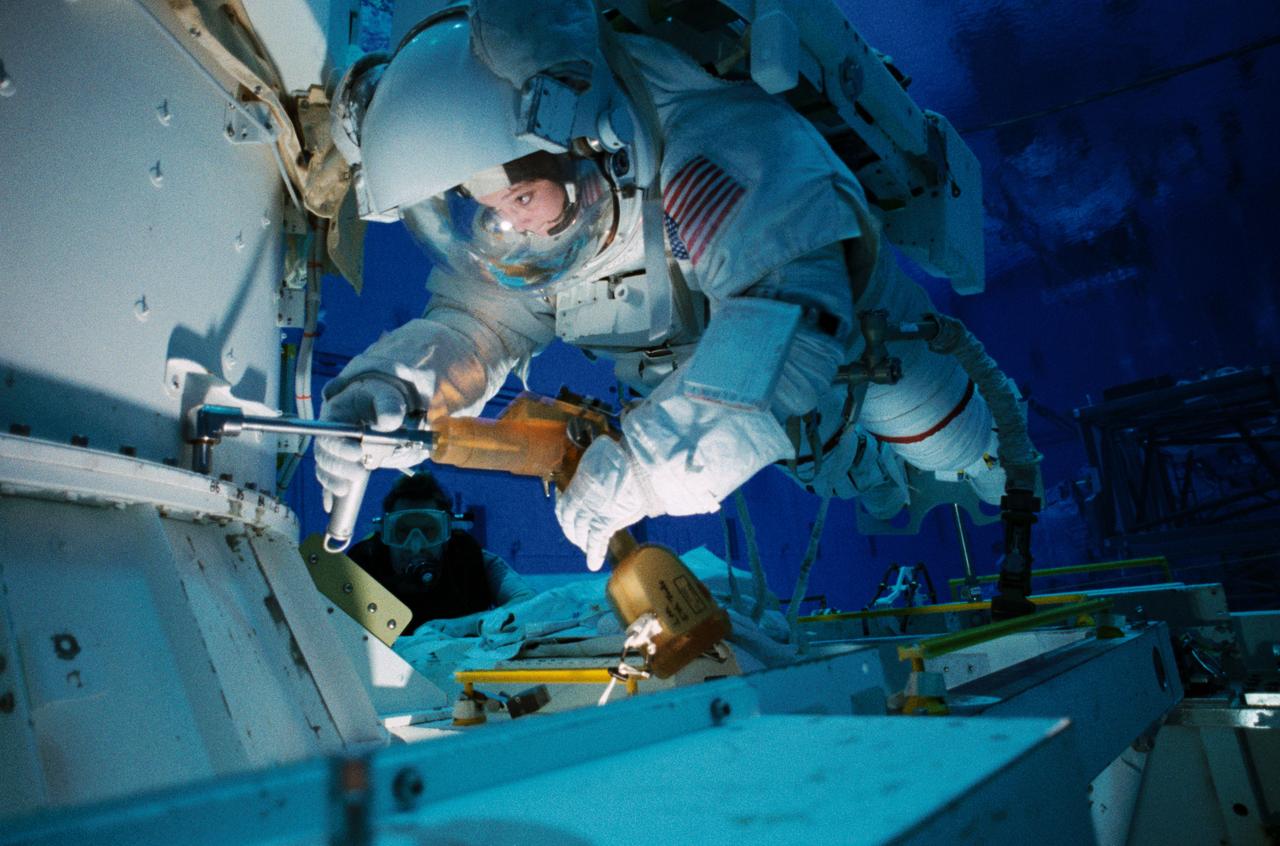
S99-01054 (15 Jan 1999) --- Astronaut Tamara E. Jernigan, mission specialist, uses a special tool during an underwater simulation of a Extravehicular Activity (EVA) scheduled for the mission. Jernigan was joined by astronaut Daniel T. Barry (out of frame) for the simulation, conducted in the Neutral Buoyancy Laboratory (NBL), at Johnson Space Center?s (JSC) Sonny Carter Training Facility (SCTF).
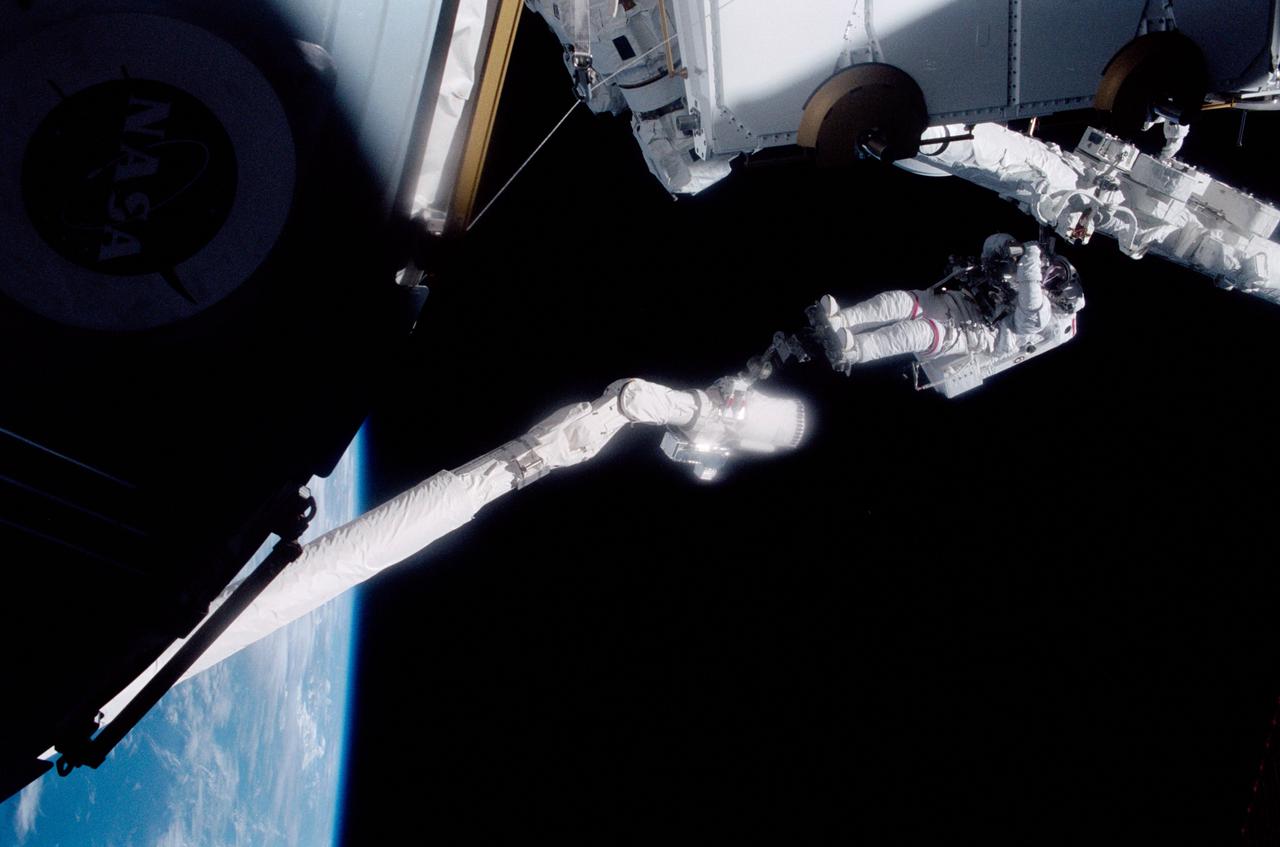
STS100-333-028 (19 April-1 May 2001) --- Astronaut Chris A. Hadfield, STS-100 mission specialist representing the Canadian Space Agency (CSA), stands on the portable foot restraint (PFR) connected to the Endeavour's remote manipulator system (RMS) robotic arm, using an International Space Station (ISS) pistol grip tool during one of two days of extravehicular activity (EVA).
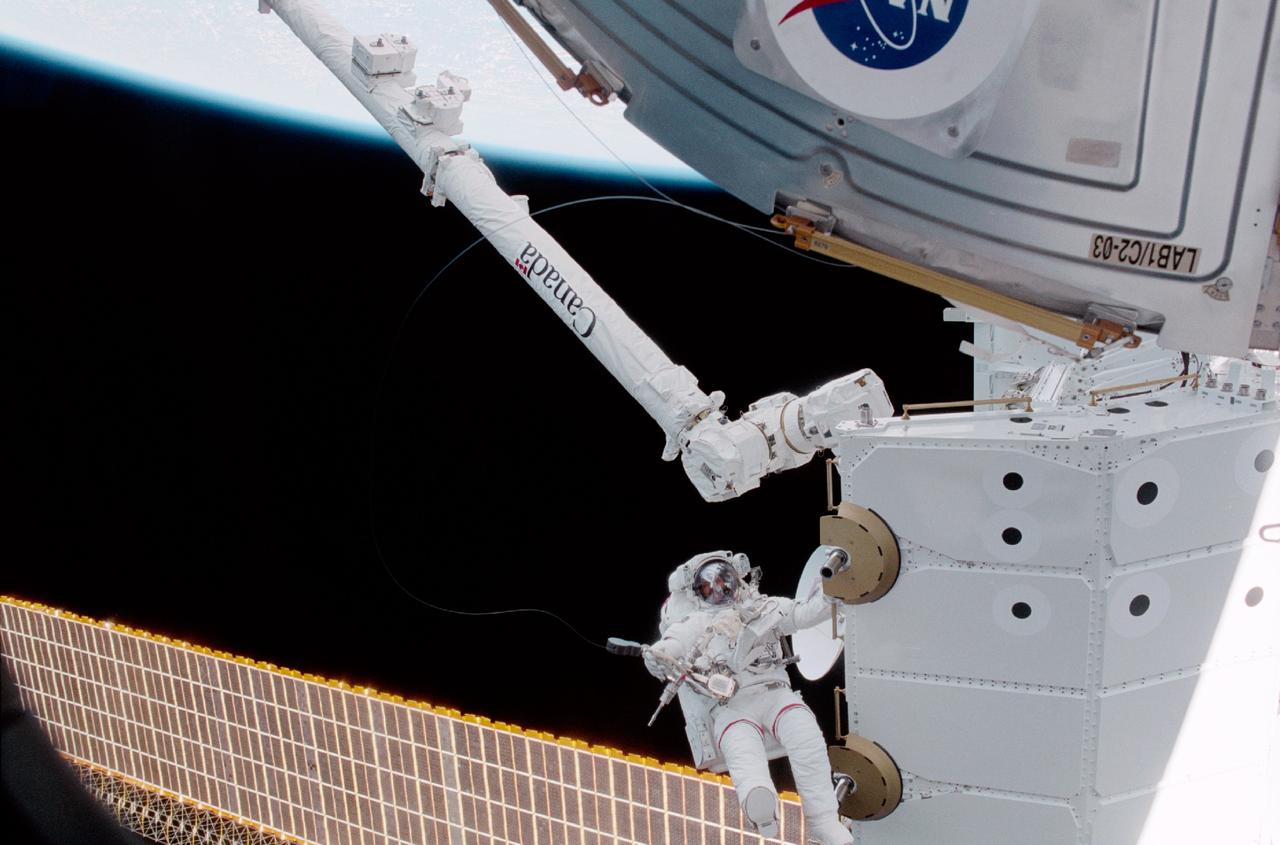
STS100-342-010 (19 April-1 May 2001) --- Astronaut Chris A. Hadfield, mission specialist representing the Canadian Space Agency (CSA), is seen near the Canadarm2 as the new robotics tool for the International Space Station (ISS) grasps the Spacelab pallet. Hadfield participated in two days of extravehicular activity (EVA) on the STS-100 mission.
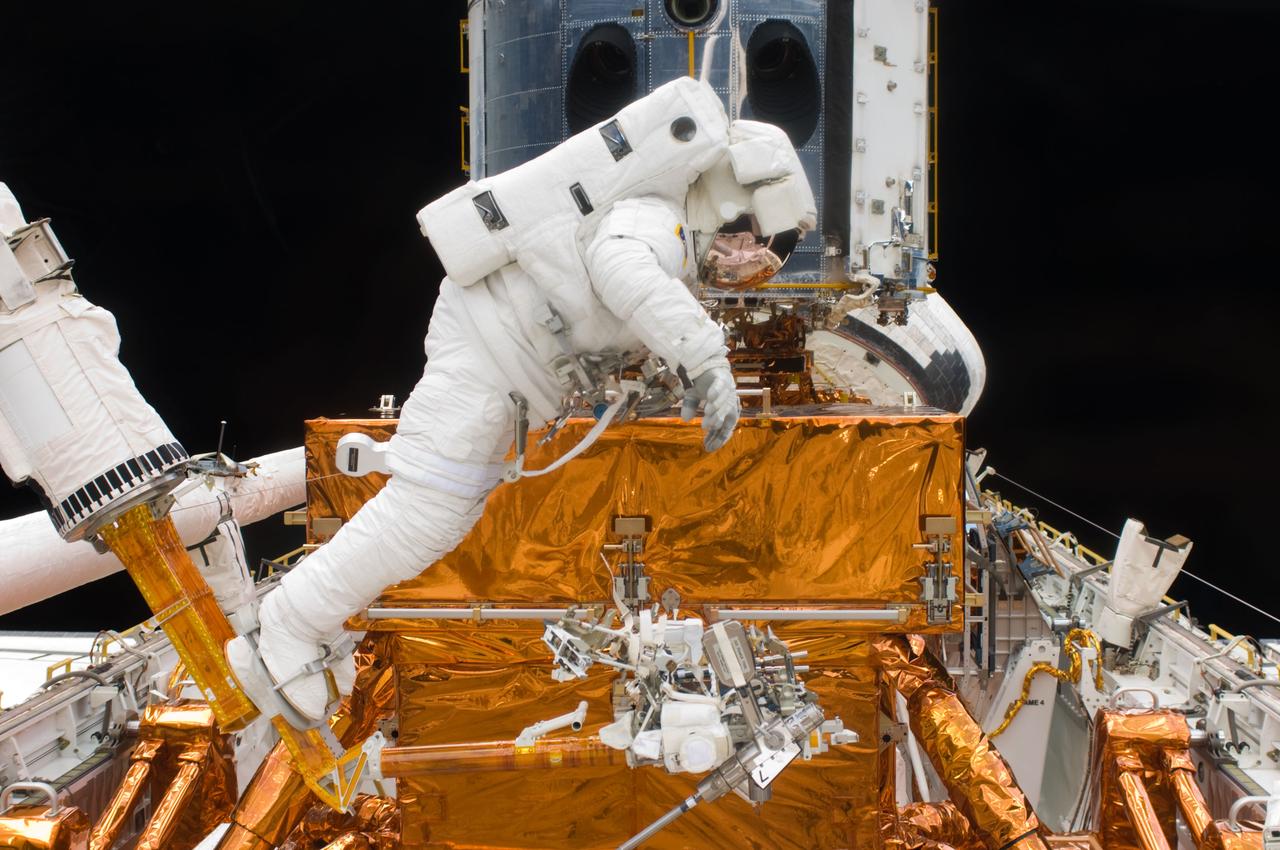
S125-E-007240 (14 May 2009) --- Astronaut Andrew Feustel, STS-125 mission specialist, appears to be selecting his next tool to use while participating in the first of his crew's five scheduled sessions of extravehicular activity to perform final hands-on servicing of the Hubble Space Telescope. Feustel and veteran astronaut John Grunsfeld (out of frame) are scheduled to participate in a total of three of those spacewalks.
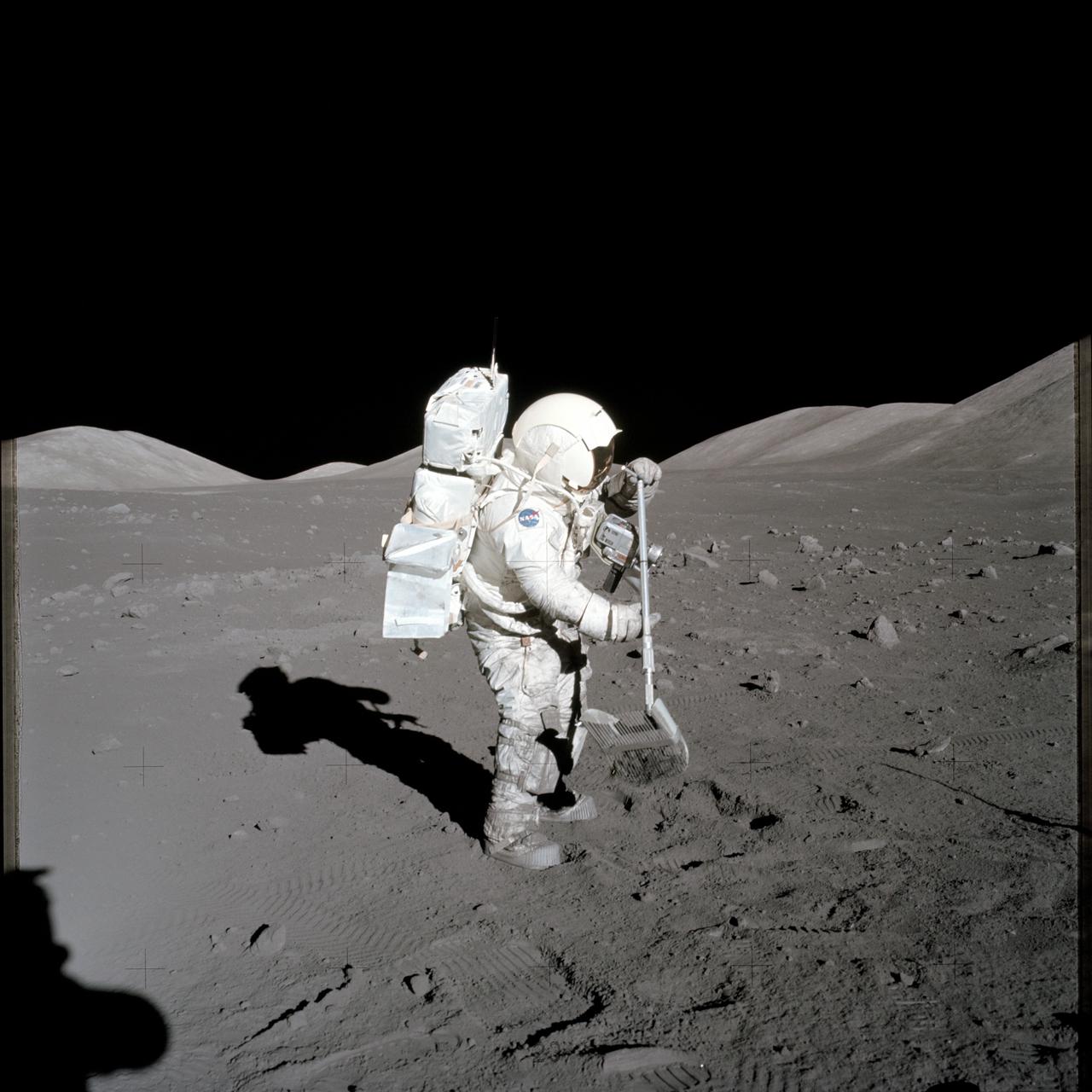
AS17-134-20425 (11 Dec. 1972) --- Scientist-astronaut Harrison H. Schmitt, lunar module pilot, collects lunar rake samples at Station 1 during the first Apollo 17 extravehicular activity (EVA) at the Taurus-Littrow landing site. This picture was taken by astronaut Eugene Cernan, commander. The lunar rake, an Apollo lunar geology hand tool, is used to collect discrete samples of rocks and rock chips ranging in size from one-half inch (1.3 centimeter) to one inch (2.5 centimeter).
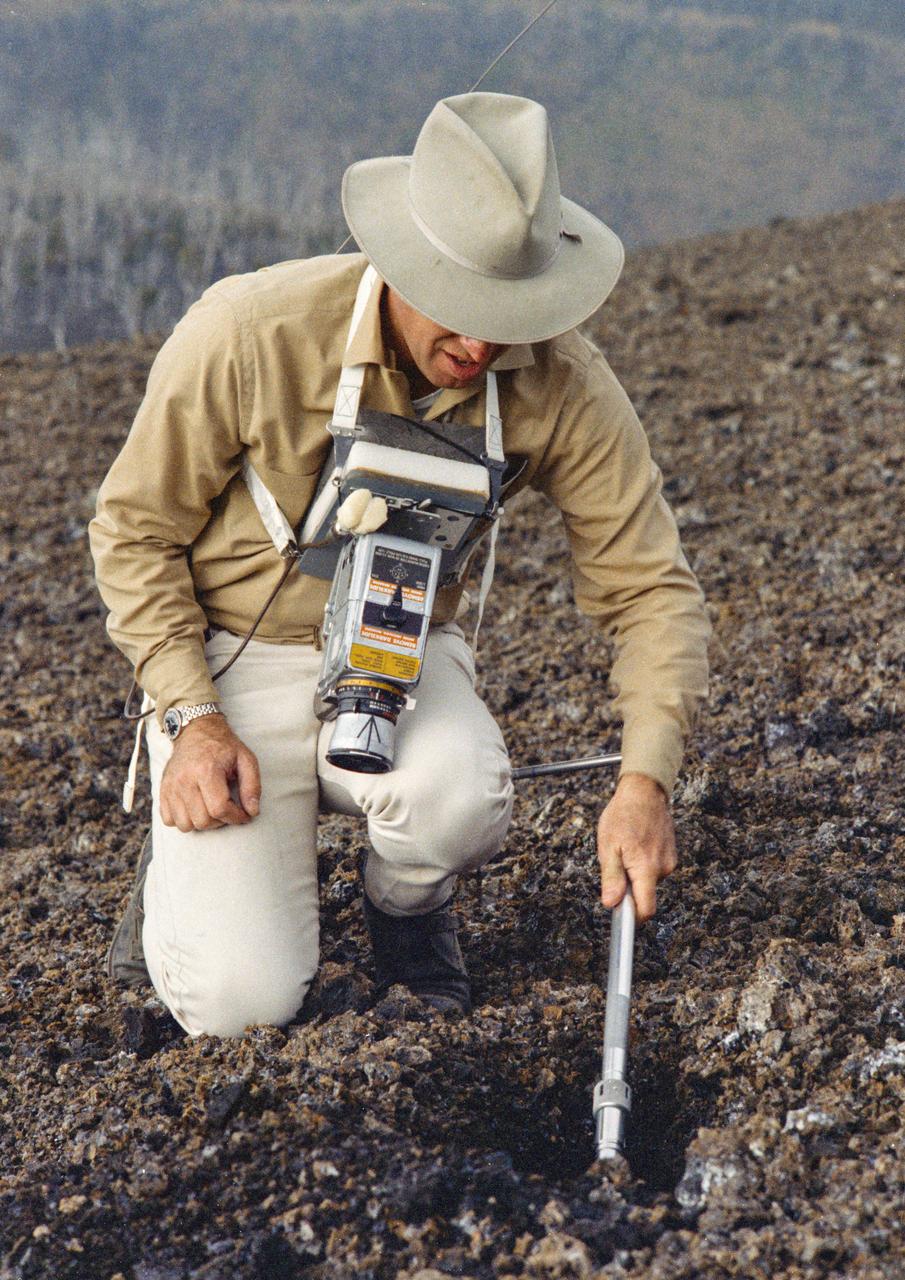
S70-20272 (December 1969) --- Astronaut James A. Lovell Jr., commander of the upcoming Apollo 13 lunar landing mission, uses a scoop from the Apollo Lunar Hand Tools (ALHT) during a simulated lunar surface traverse at the Kapoho, Hawaii training site. While at the Hawaii training sites, Lovell and Haise are participating in thorough rehearsals of their extravehicular activity (EVA). Photo credit: NASA
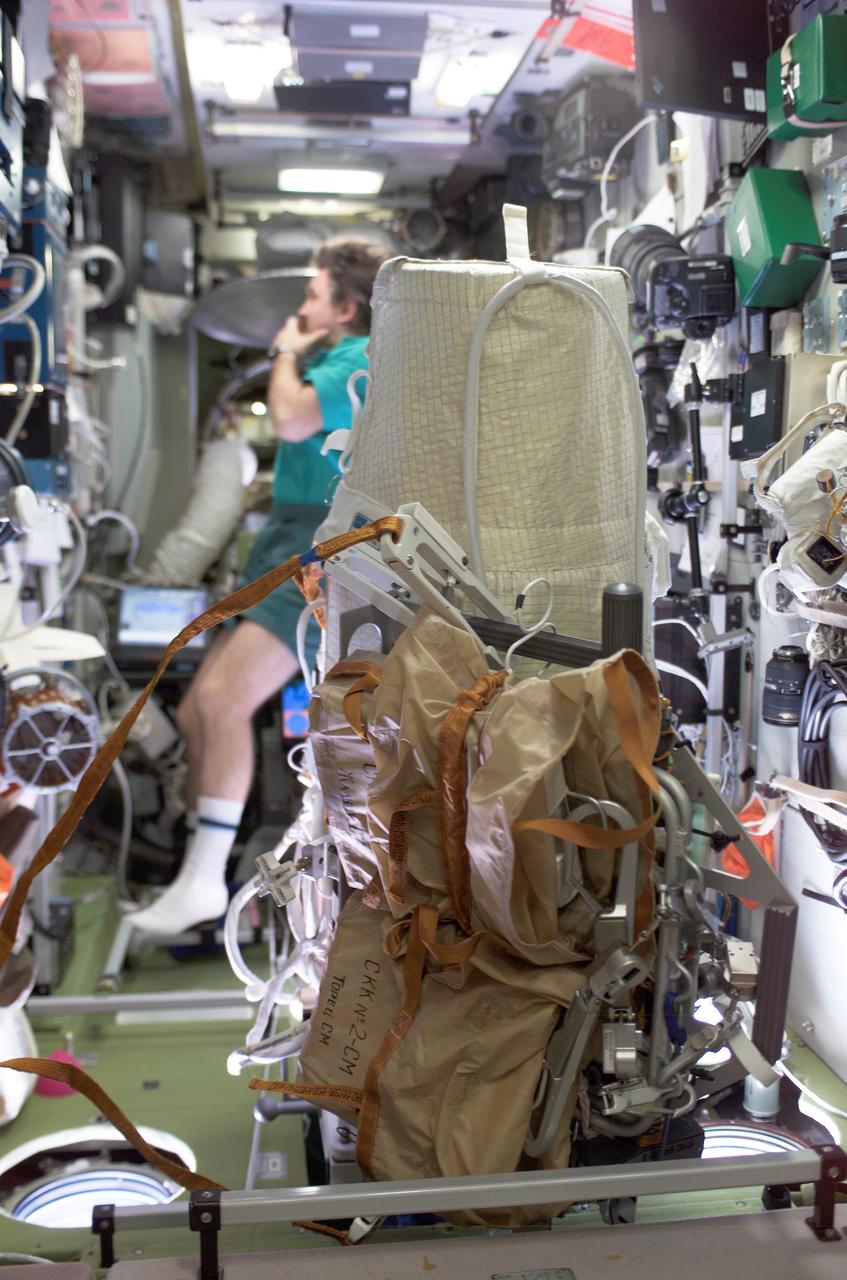
ISS008-E-17183 (24 February 2004) --- This image shows a close-up view of the extravehicular activity (EVA) bundle in the Zvezda Service Module on the International Space Station (ISS). The Matroshka experiment package is shrouded (aft) with the brown carry bags for the CKK hardware (fwd) along with tools and other needed items. It is all bundled to a Russian EVA integrated equipment carrier. Cosmonaut Alexander Y. Kaleri, flight engineer representing Russia’s Federal Space Agency, is in the background.
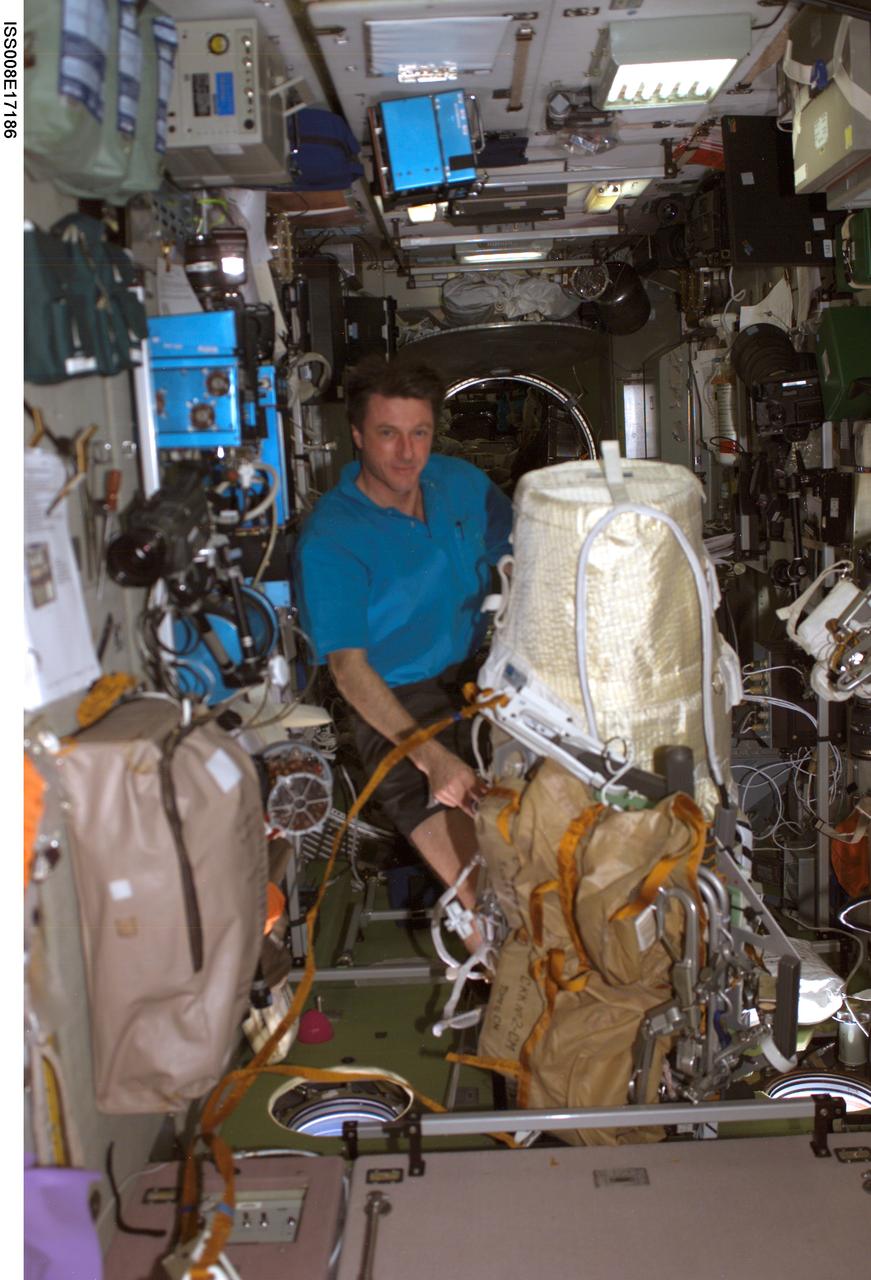
ISS008-E-17186 (24 February 2004) --- Astronaut C. Michael Foale, Expedition 8 NASA ISS science officer and commander, works with the extravehicular activity (EVA) bundle in the Zvezda Service Module on the International Space Station (ISS). The Matroshka experiment package is shrouded (aft) with the brown carry bags for the CKK hardware (fwd) along with tools and other needed items. It is all bundled to a Russian EVA integrated equipment carrier.
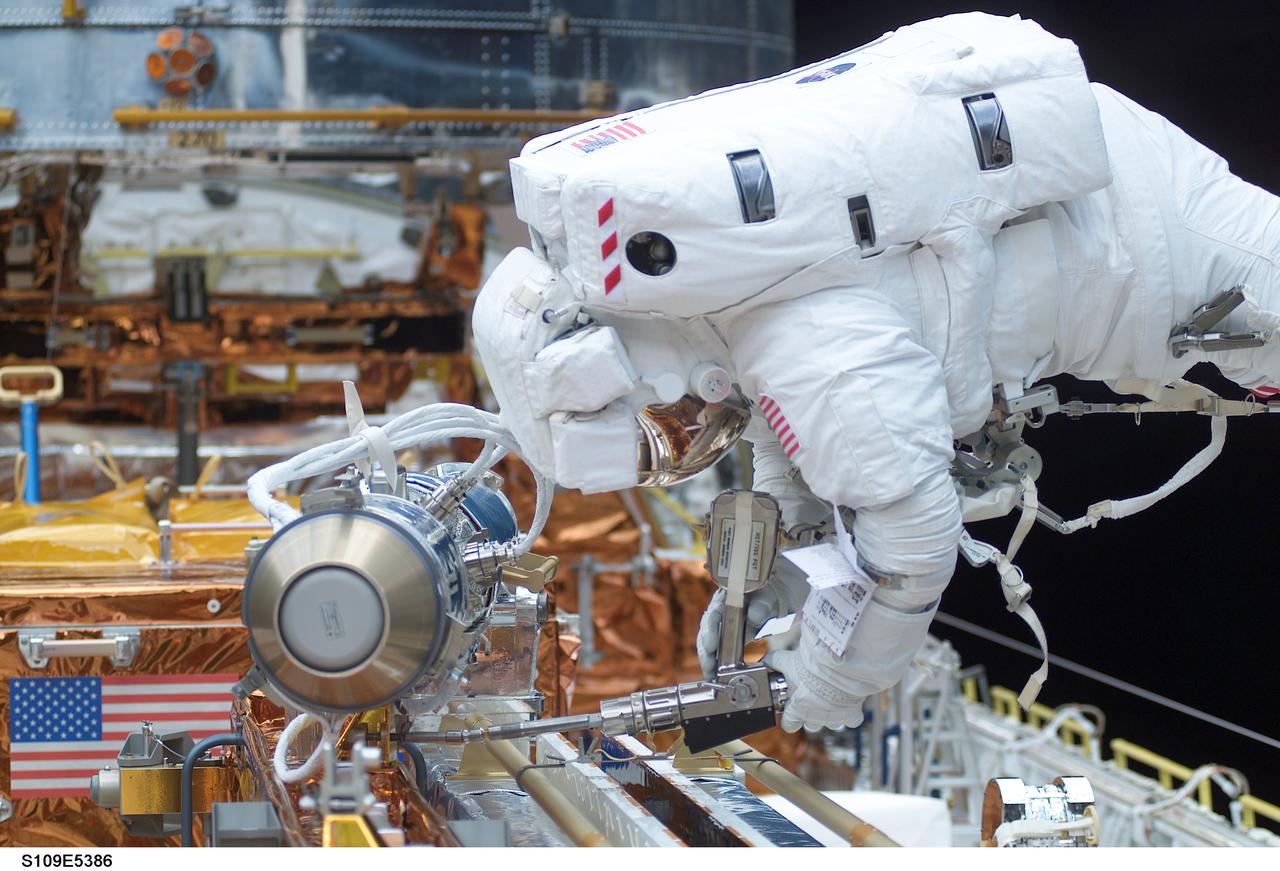
STS109-E-5386 (5 March 2002) --- Astronaut Michael J. Massimino, mission specialist, checks a tool in the cargo bay of the Space Shuttle Columbia during the STS-109 mission's second day of extravehicular activity (EVA). Astronauts Massimino and James H. Newman worked to replace the second set of solar arrays on the Hubble Space Telescope (HST). The image was recorded with a digital still camera.
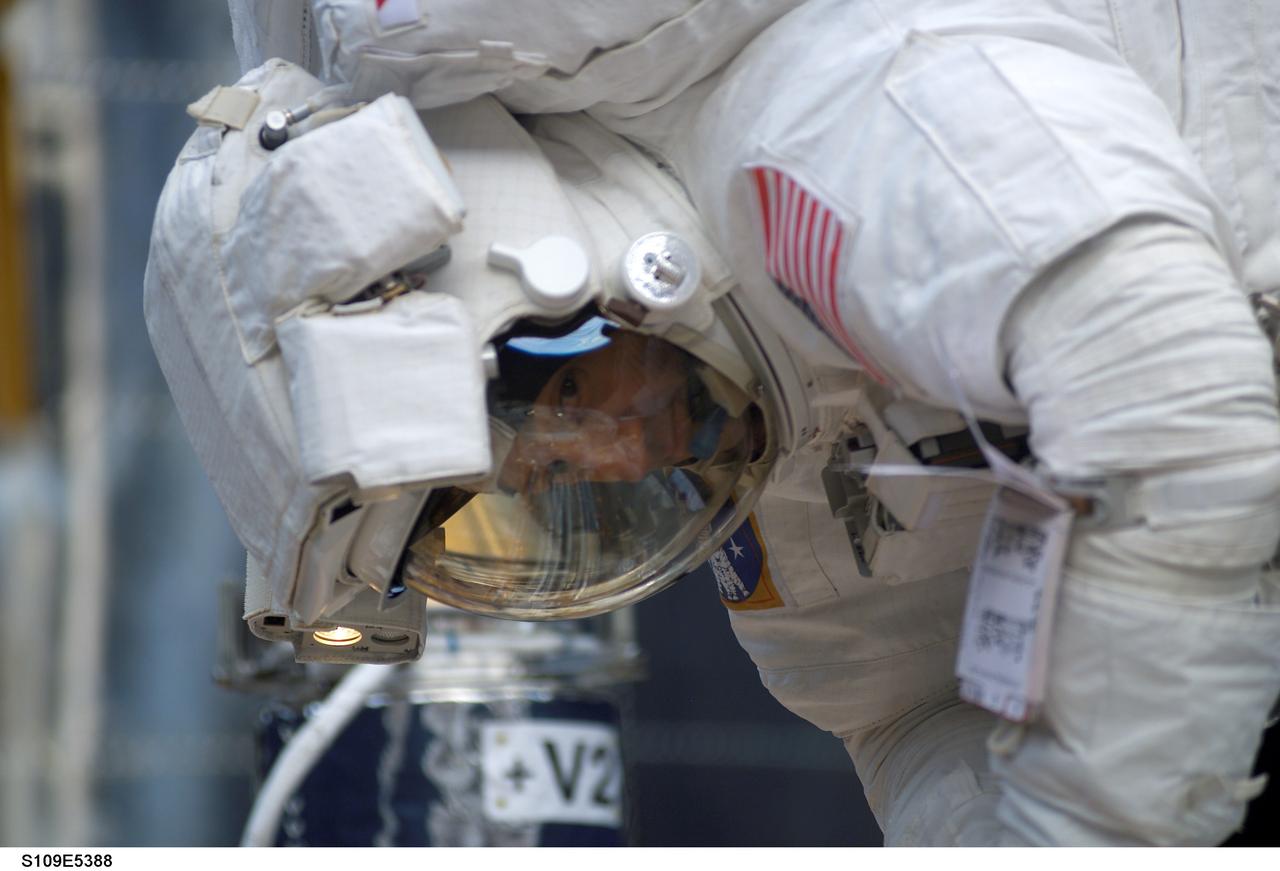
STS109-E-5388 (5 March 2002) --- Astronaut Michael J. Massimino, mission specialist, checks a tool in the cargo bay of the Space Shuttle Columbia during the STS-109 mission's second day of extravehicular activity (EVA). Astronauts Massimino and James H. Newman worked to replace the second set of solar arrays on the Hubble Space Telescope (HST). The image was recorded with a digital still camera.
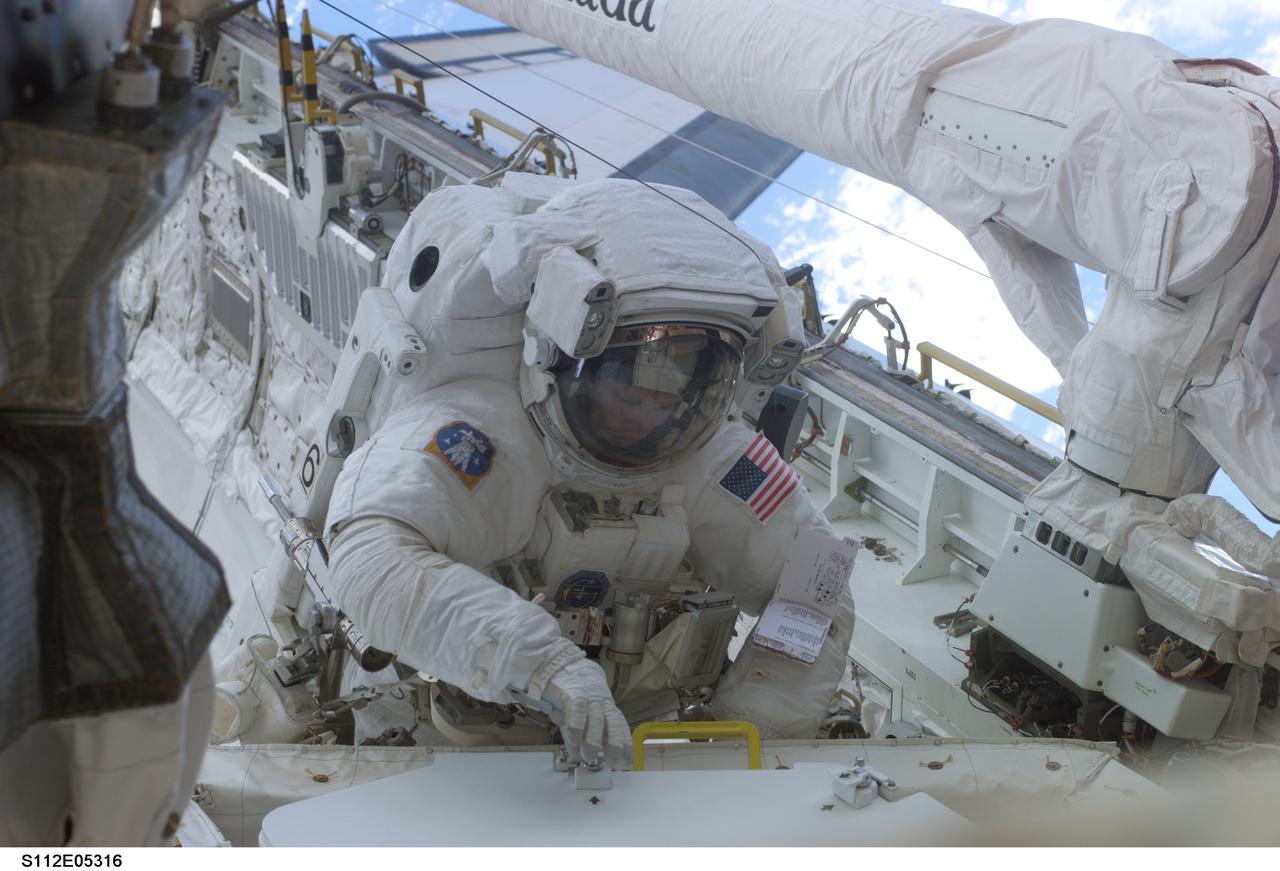
STS112-E-5316 (12 October 2002) --- Astronaut Piers J. Sellers. STS-112 mission specialist, prepares to fetch a spacewalking tool in the forward cargo bay of the Space Shuttle Atlantis. Sellers was in the midst of a six hour, four minute session of extravehicular activity (EVA) on which he was joined by astronaut David A. Wolf (out of frame).
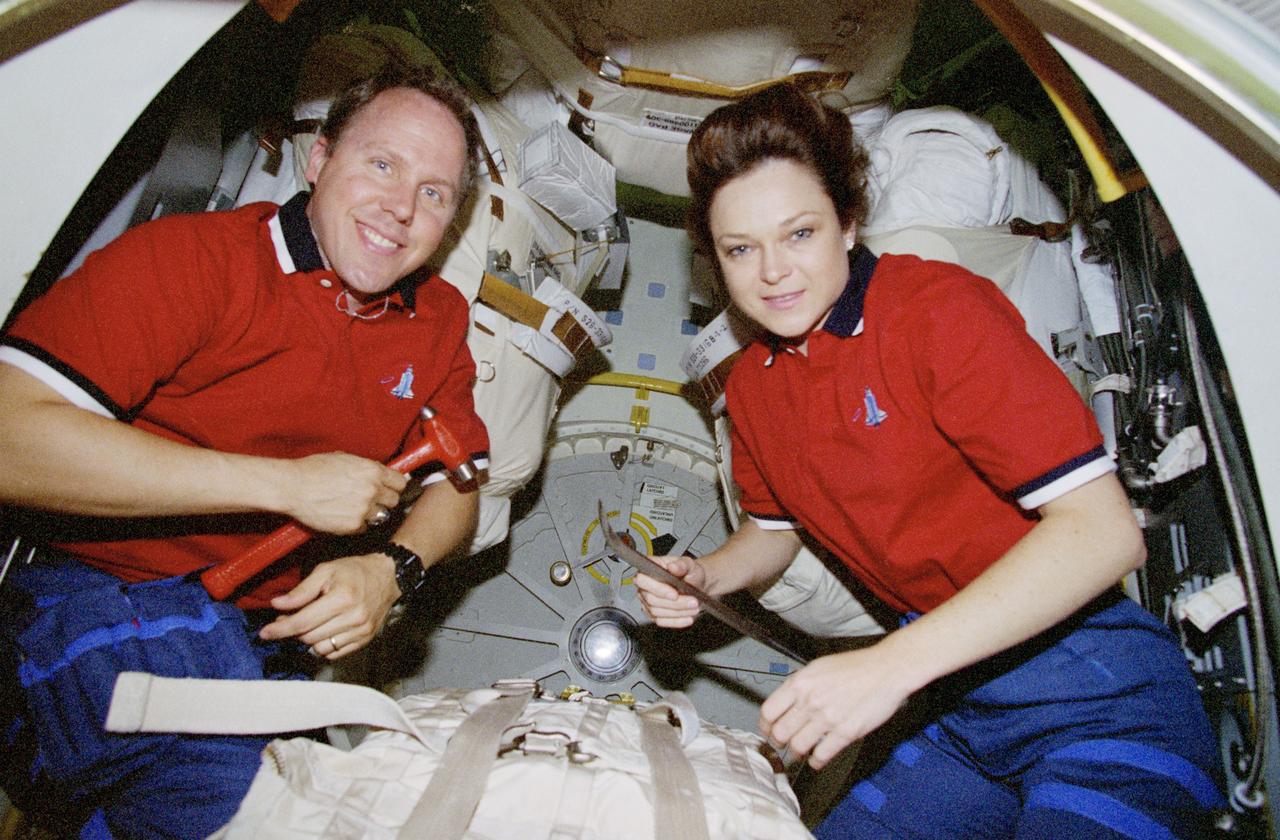
STS080-317-018 (28 Nov. 1996) --- Astronauts Thomas D. Jones, with a hammer, and Tamara E. Jernigan, holding a crow bar, display just two of the tools they called on during an intense effort to open the space shuttle Columbia's hatch leading to the cargo bay. Scheduled Extravehicular Activities (EVA) for the two were canceled by NASA when all efforts to open the hatch were unsuccessful.
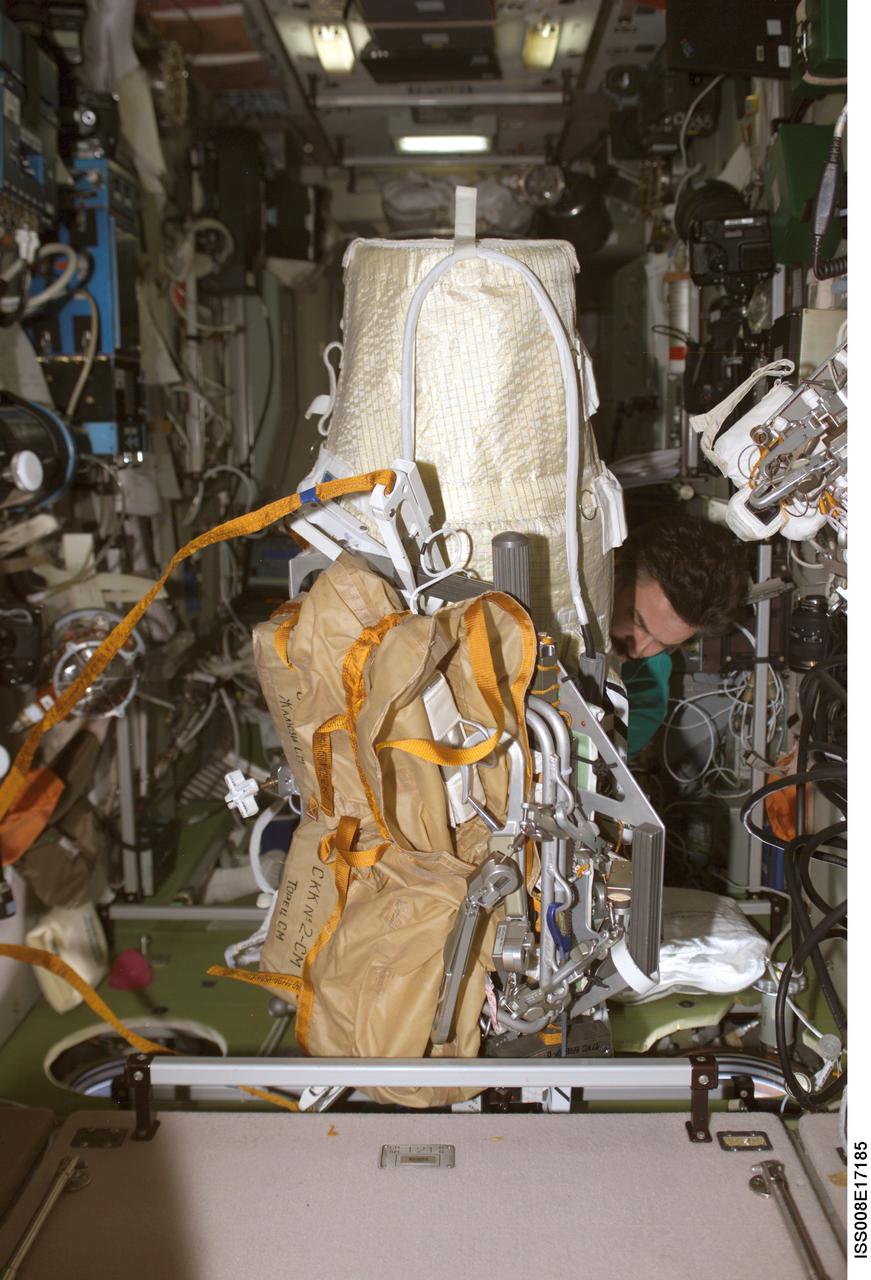
ISS008-E-17185 (24 February 2004) --- Cosmonaut Alexander Y. Kaleri, Expedition 8 flight engineer, works with the extravehicular activity (EVA) bundle in the Zvezda Service Module on the International Space Station (ISS). The Matroshka experiment package is shrouded (aft) with the brown carry bags for the CKK hardware (fwd) along with tools and other needed items. It is all bundled to a Russian EVA integrated equipment carrier. Kaleri represents Rosaviakosmos.
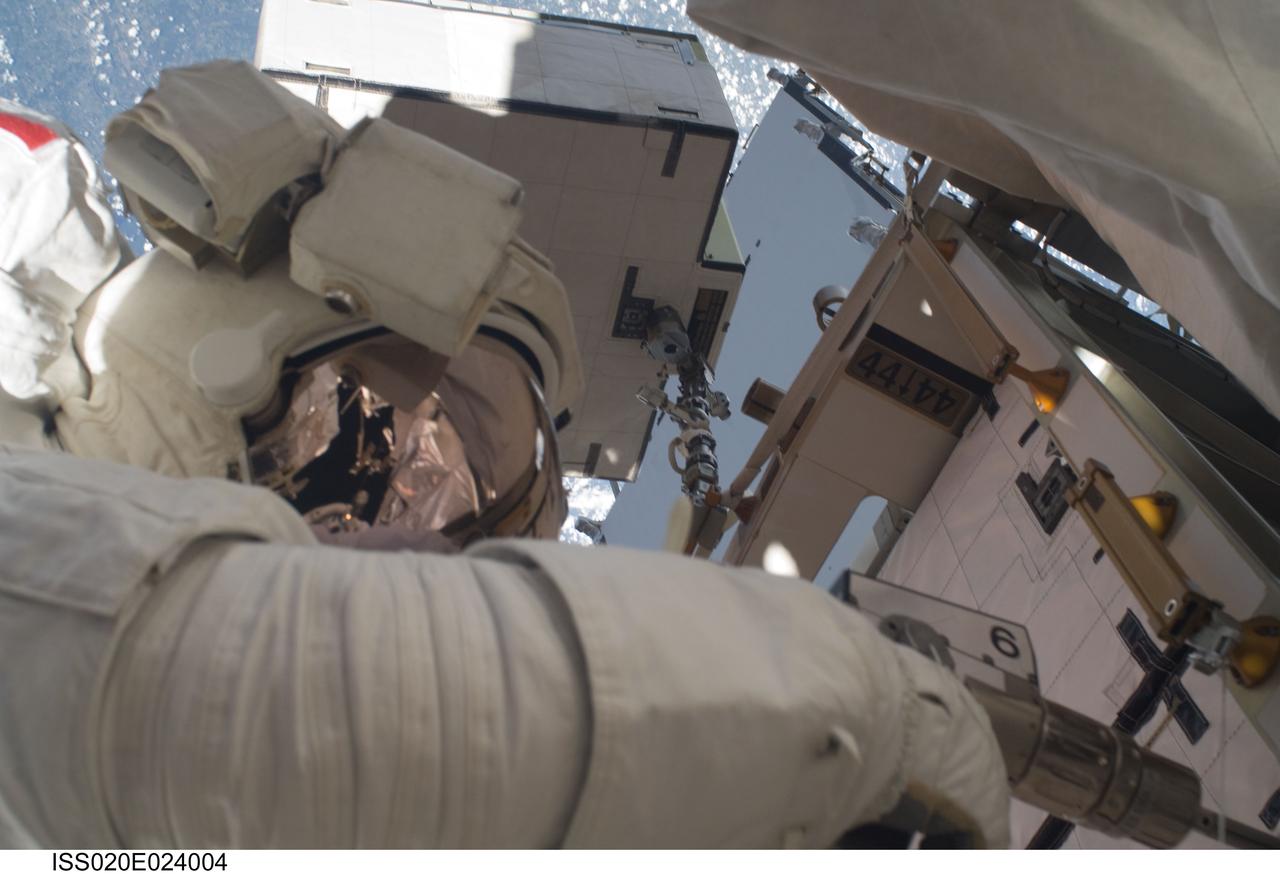
ISS020-E-024004 (24 July 2009) --- This is a close-up view of astronaut Tom Marshburn using a power tool during his second spacewalk on July 24. Out of frame is astronaut Christopher Cassidy with whom he'll team again on July 27 for the STS-127 crew's fifth and final session of extravehicular activity. Eleven astronauts and cosmonauts remained inside the International Space Station and the shuttle to which it was docked, while the two suited astronauts continued work on the orbital outpost.
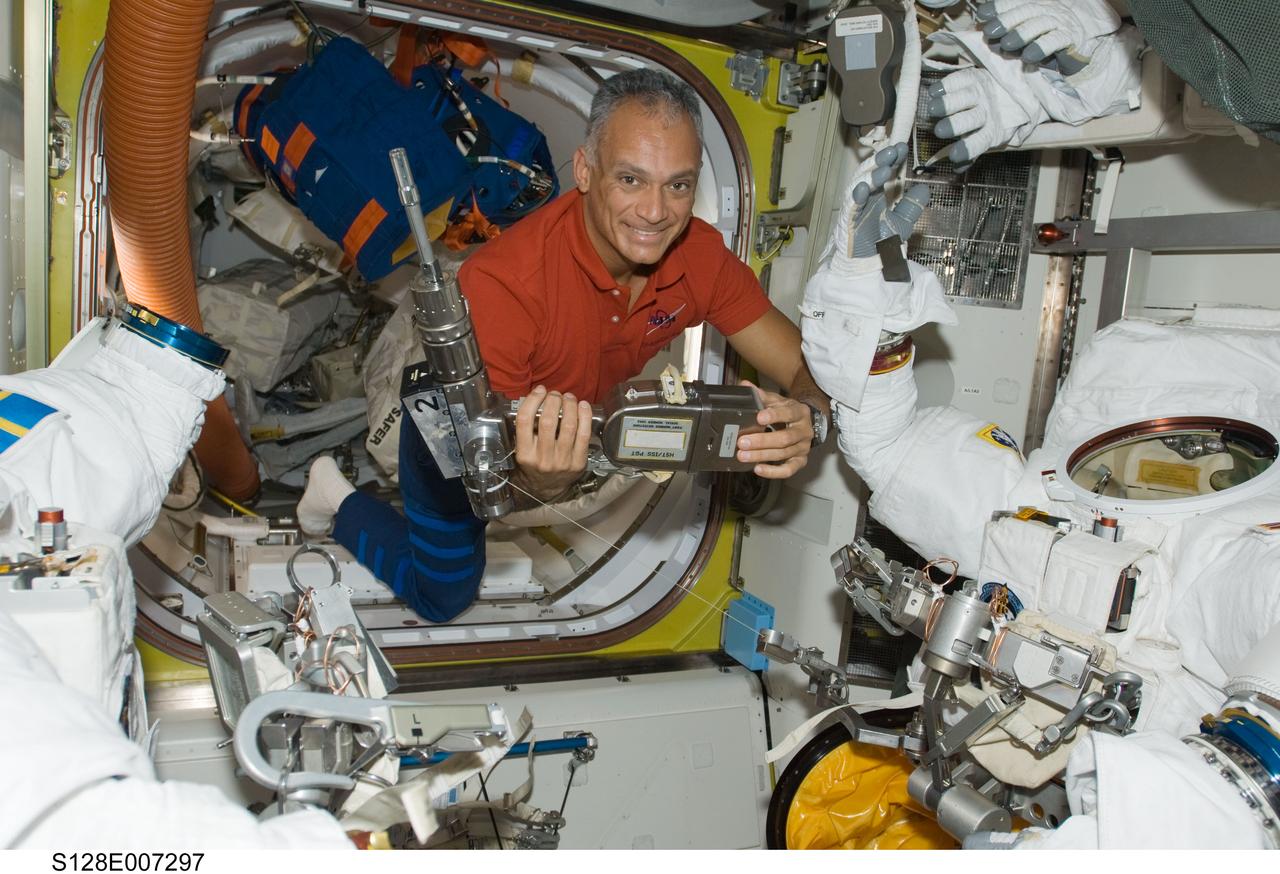
S128-E-007297 (4 Sept. 2009) ---- Astronaut John “Danny” Olivas, STS-128 mission specialist, checks out a power tool. The Space Shuttle Discovery is currently docked with the International Space Station while the STS-128 astronauts work with the Expedition 20 crewmembers aboard the orbital outpost. In the last several days, Olivas has already participated in two days of extravehicular activity and is preparing for his third and final spacewalk on Sept. 5.
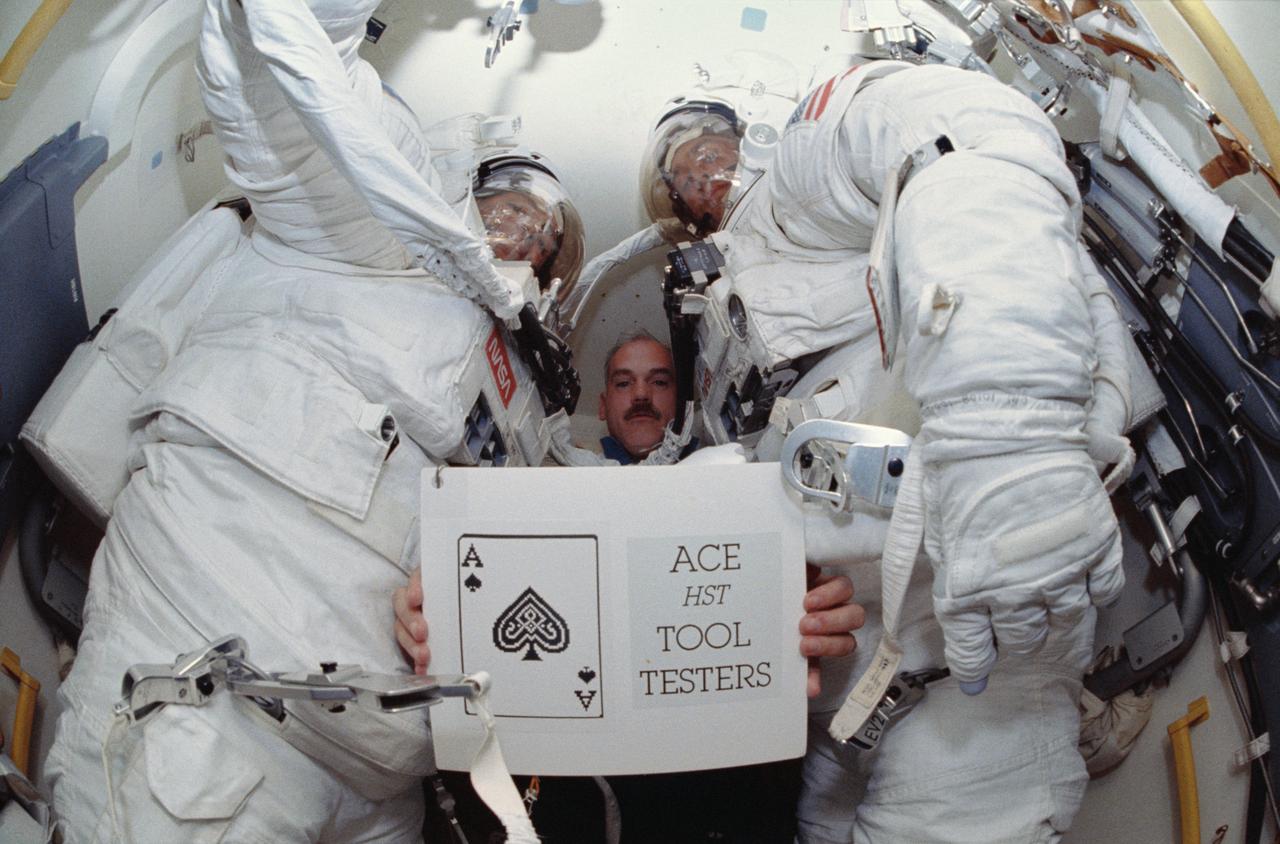
STS051-66-009 (16 Sept 1993) --- In Discovery's airlock, astronaut William F. Readdy, pilot, holds up a STS-51 slogan -- "Ace HST Tool Testers" -- for still and video cameras to record. Readdy is flanked by astronauts Carl E. Walz (left) and James H. Newman, who had just shared a lengthy period of extravehicular activity (EVA) in and around Discovery's cargo bay. Not pictured are astronauts Frank L. Culbertson Jr., mission commander, and Daniel W. Bursch, mission specialist.
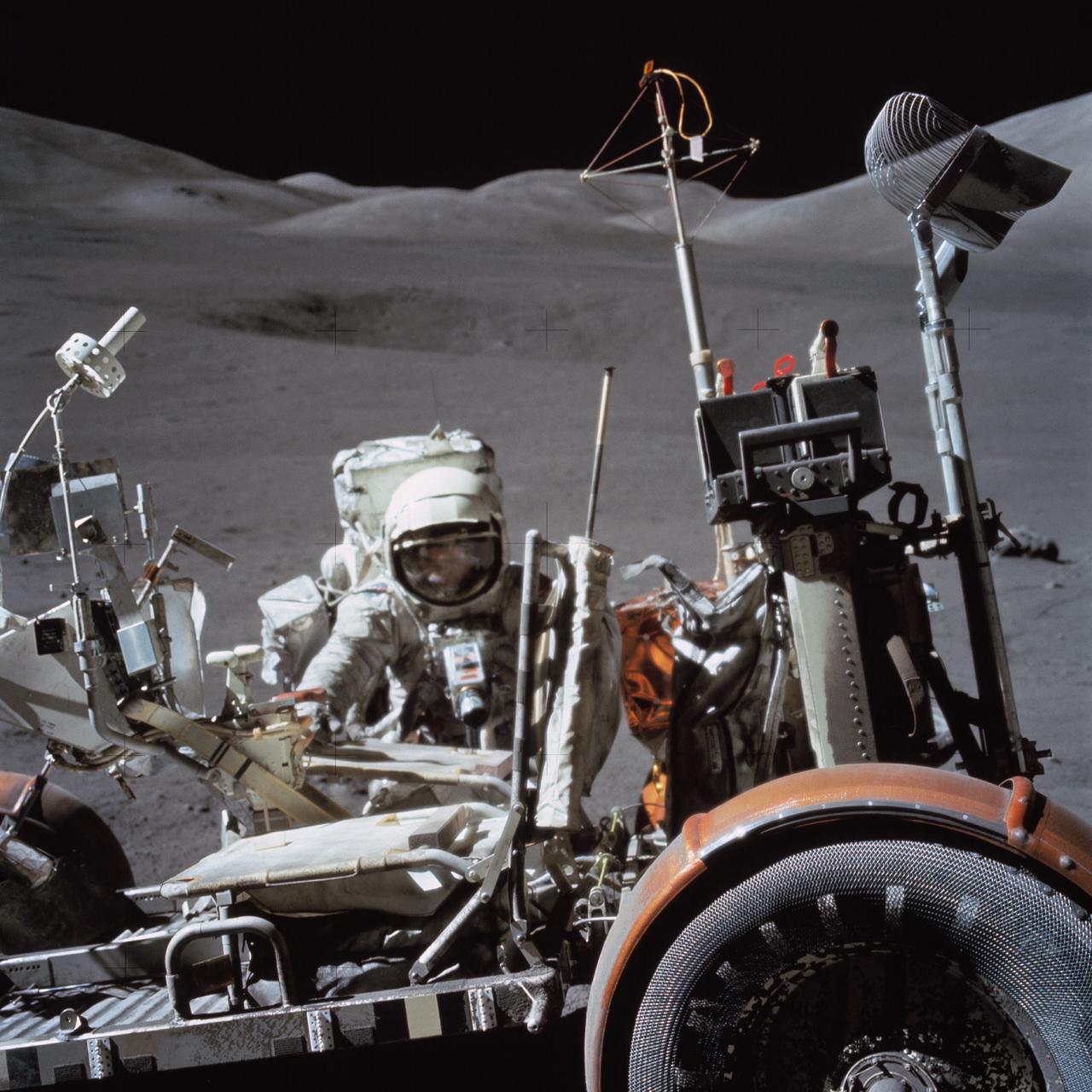
AS17-146-22296 (13 Dec. 1972) --- Astronaut Harrison H. Schmitt, lunar module pilot, works near the Lunar Roving Vehicle (LRV) during the third Apollo 17 extravehicular activity (EVA) at the Taurus-Littrow site on the lunar surface. The front part of the LRV is out of frame at left, but the seats and several geological tools can be seen. The photo was taken by astronaut Eugene A. Cernan, mission commander.

JSC2000-E-20585 (August 2000) --- Two members of the STS-106 crew participate in a bench review of equipment and gear scheduled to fly on the September mission aboard the Space Shuttle Atlantis. Astronaut Edward T. Lu (left) and cosmonaut Yuri I. Malenchenko inspect tools they'll possibly be using during scheduled extravehicular activity (EVA) on the International Space Station (ISS).
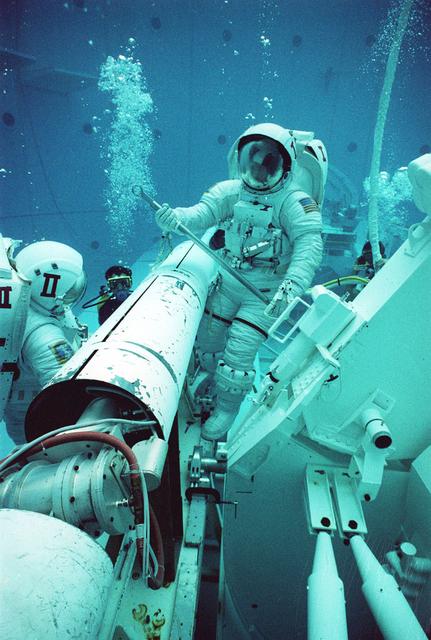
Two years prior to being used during a shuttle mission, the Transfer to Orbit System (TOS) is being demonstrated at Marshall Space Flight Center's (MSFC) Neutral Buoyancy Simulator (NBS). TOS is an upper stage launch system used to place satellites into higher orbits. TOS was used only once, on September 12, 1993 when the Space Shuttle Discovery (STS51) deployed ACTS (Advanced Communications Technology Satellite). The test pictured was to provide an evaluation of the extravehicular activity (EVA) tools that were to be used by future shuttle crews.
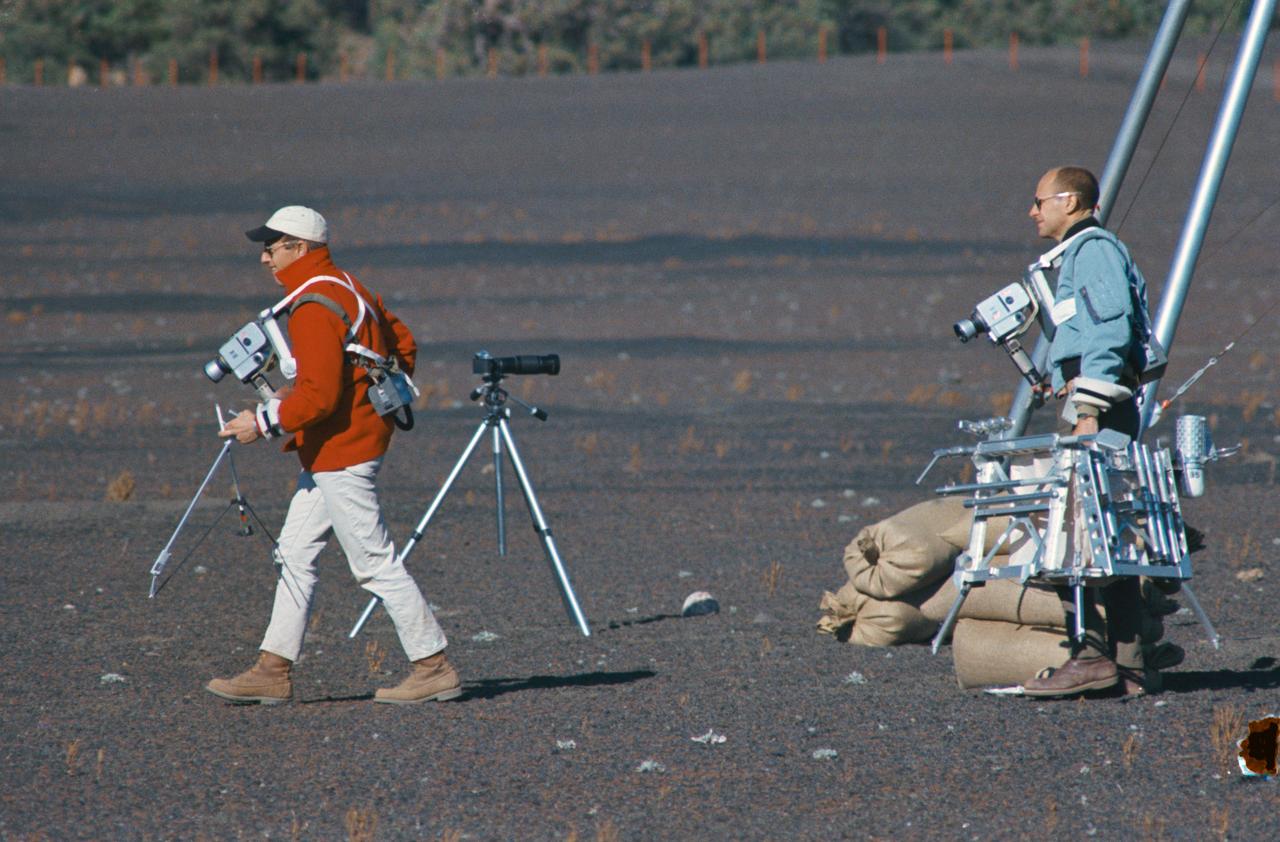
S69-55667 (10 Oct. 1969) --- Astronauts Charles Conrad Jr. and Alan L. Bean train for their upcoming Apollo 12 lunar landing mission. Here they are entering a simulated lunar surface area near Flagstaff, Arizona. Both are wearing lunar surface cameras strapped to their bodies. Conrad (left), the Apollo 12 mission commander, is carrying some of the tools from the geological tool container. The geological tool container, being carried here by Bean, the lunar module pilot, is similar to the one which will be used during scheduled extravehicular activity (EVA) periods on Nov. 19 and 20, 1969, on the lunar surface. While astronauts Conrad and Bean conduct their scheduled EVA on the moon's surface, astronaut Richard F. Gordon Jr., command module pilot, will man the Command and Service Modules (CSM) in lunar orbit.
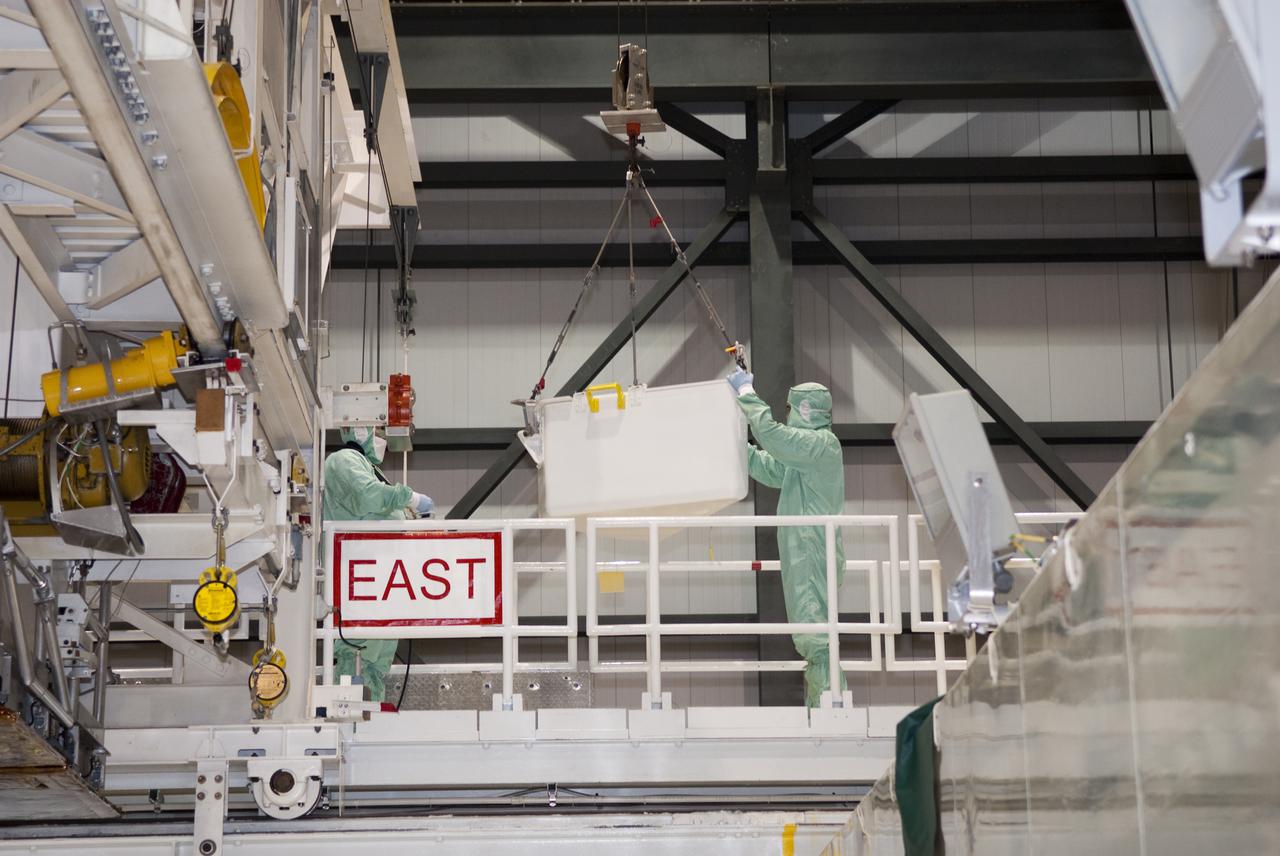
CAPE CANAVERAL, Fla. – In Orbiter Processing Facility-1 at NASA's Kennedy Space Center in Florida, workers dressed in clean room attire, known as bunny suits, carefully guide the tool stowage assembly across the work platform on which they are standing. The tool box is being installed into space shuttle Atlantis' payload bay. The assembly contains tools and hardware that will be needed on the extravehicular activities, or spacewalks, conducted during the STS-132 mission. On STS-132, the six-member crew will deliver an Integrated Cargo Carrier and a Russian-built Mini-Research Module to the International Space Station. STS-132 is the 34th mission to the station and the 132nd space shuttle mission. Launch is targeted for May 14. For information on the STS-132 mission, visit http:__www.nasa.gov_mission_pages_shuttle_shuttlemissions_sts132_index.html. Photo credit: NASA_Jim Grossmann
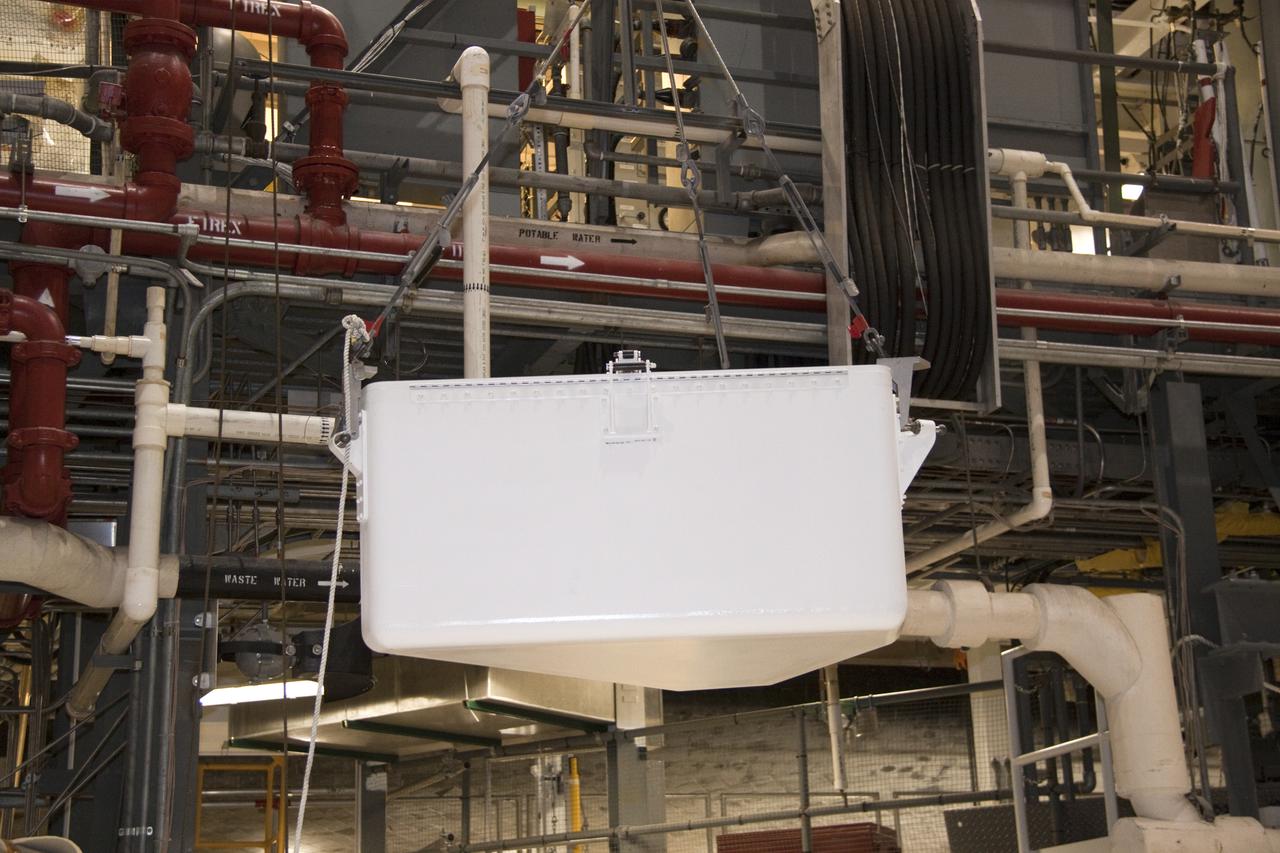
CAPE CANAVERAL, Fla. – In Orbiter Processing Facility-1 at NASA's Kennedy Space Center in Florida, the tool stowage assembly is lifted by jib crane above the floor of the clean room. The tool box is being installed into space shuttle Atlantis' payload bay. The assembly contains tools and hardware that will be needed on the extravehicular activities, or spacewalks, conducted during the STS-132 mission. On STS-132, the six-member crew will deliver an Integrated Cargo Carrier and a Russian-built Mini-Research Module to the International Space Station. STS-132 is the 34th mission to the station and the 132nd space shuttle mission. Launch is targeted for May 14. For information on the STS-132 mission, visit http:__www.nasa.gov_mission_pages_shuttle_shuttlemissions_sts132_index.html. Photo credit: NASA_Jack Pfaller
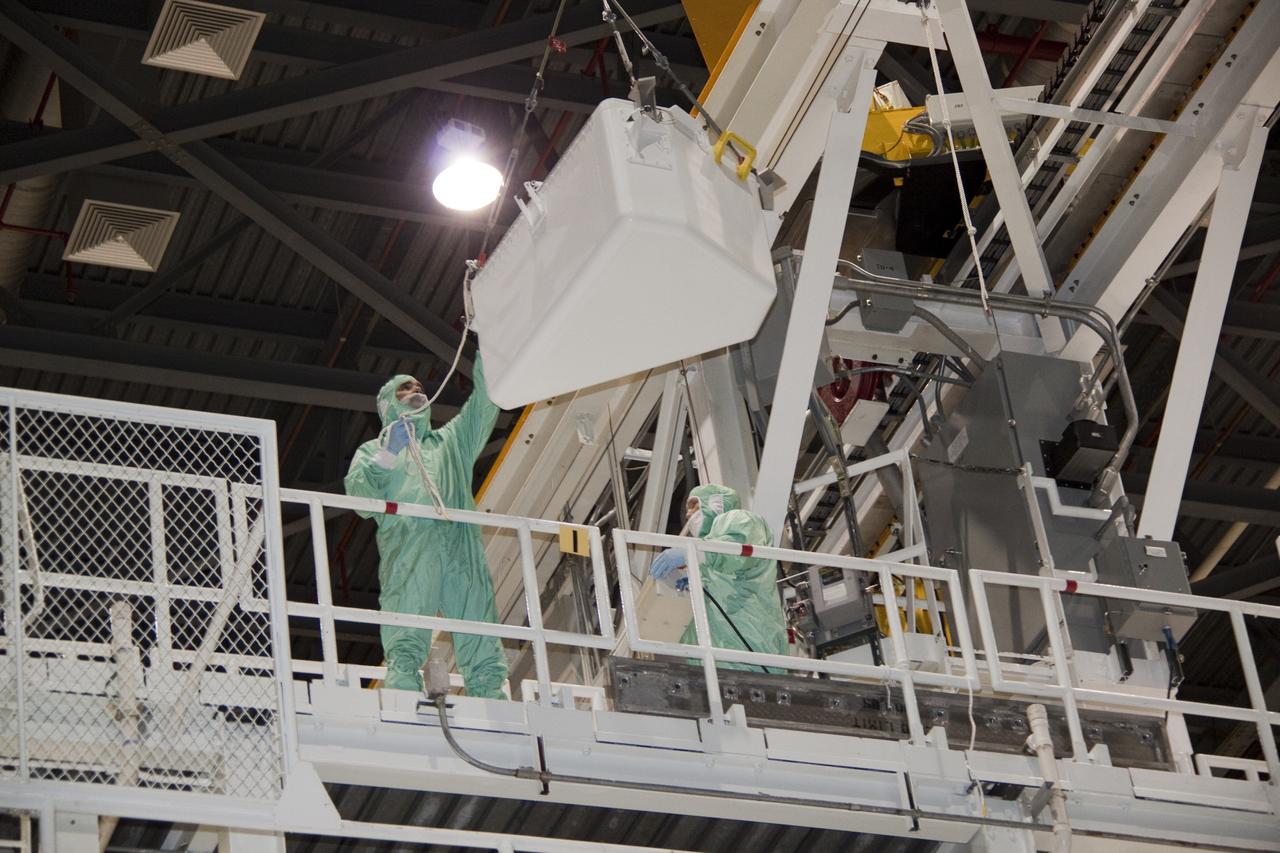
CAPE CANAVERAL, Fla. – In Orbiter Processing Facility-1 at NASA's Kennedy Space Center in Florida, workers dressed in clean room attire, known as bunny suits, guide the tool stowage assembly as it is lifted by jib crane toward the work platform on which they are standing. The tool box is being installed into space shuttle Atlantis' payload bay. The assembly contains tools and hardware that will be needed on the extravehicular activities, or spacewalks, conducted during the STS-132 mission. On STS-132, the six-member crew will deliver an Integrated Cargo Carrier and a Russian-built Mini-Research Module to the International Space Station. STS-132 is the 34th mission to the station and the 132nd space shuttle mission. Launch is targeted for May 14. For information on the STS-132 mission, visit http:__www.nasa.gov_mission_pages_shuttle_shuttlemissions_sts132_index.html. Photo credit: NASA_Jack Pfaller
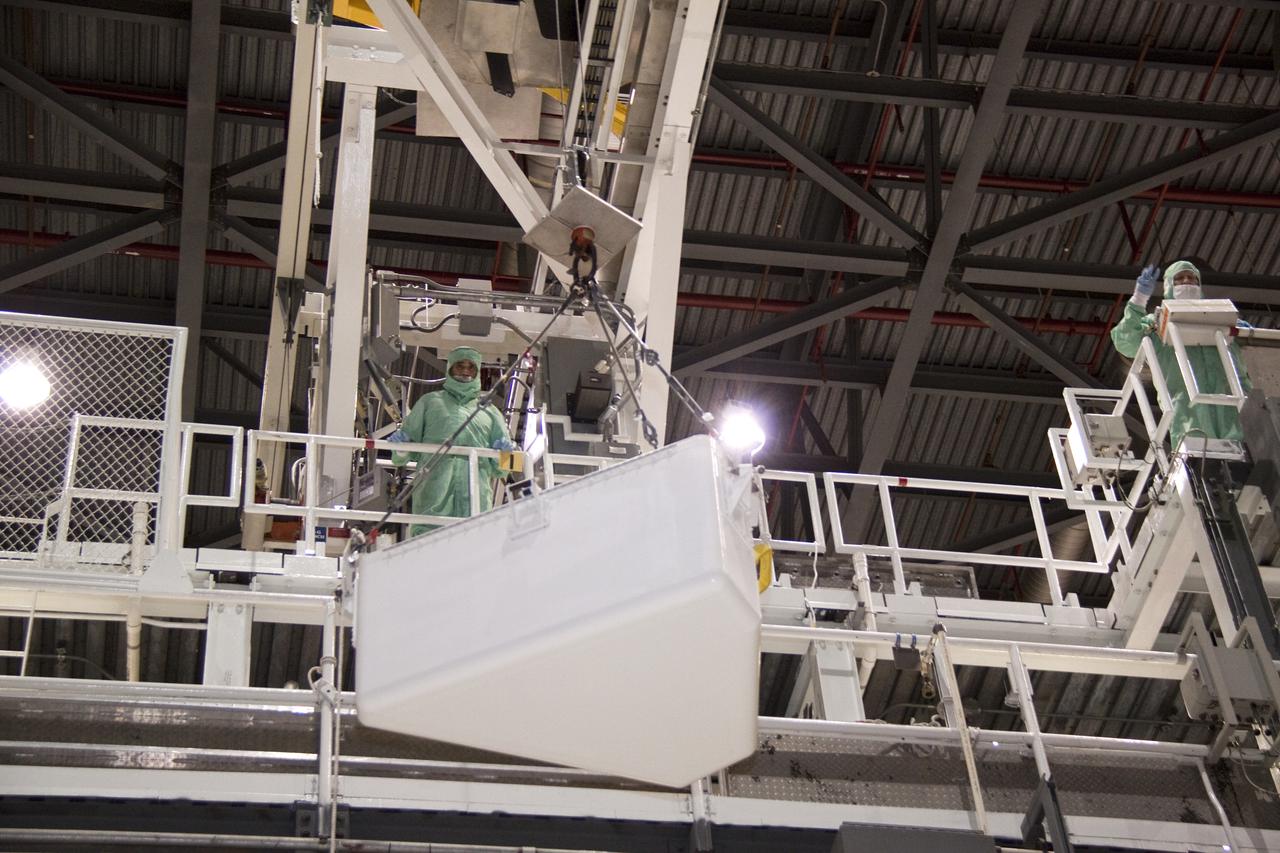
CAPE CANAVERAL, Fla. – In Orbiter Processing Facility-1 at NASA's Kennedy Space Center in Florida, workers dressed in clean room attire, known as bunny suits, monitor the lift by jib crane of the tool stowage assembly. The tool box is being installed into space shuttle Atlantis' payload bay. The assembly contains tools and hardware that will be needed on the extravehicular activities, or spacewalks, conducted during the STS-132 mission. On STS-132, the six-member crew will deliver an Integrated Cargo Carrier and a Russian-built Mini-Research Module to the International Space Station. STS-132 is the 34th mission to the station and the 132nd space shuttle mission. Launch is targeted for May 14. For information on the STS-132 mission, visit http:__www.nasa.gov_mission_pages_shuttle_shuttlemissions_sts132_index.html. Photo credit: NASA_Jack Pfaller
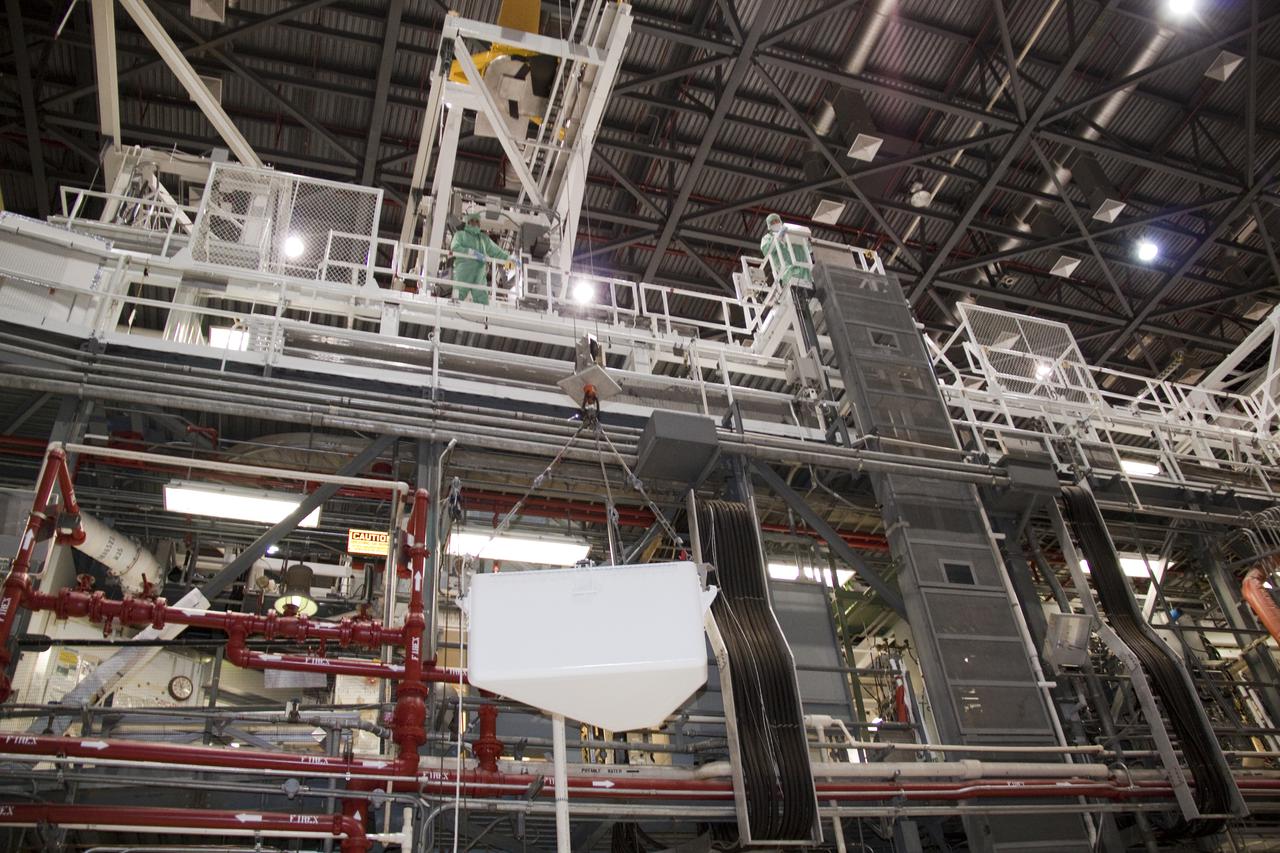
CAPE CANAVERAL, Fla. – In Orbiter Processing Facility-1 at NASA's Kennedy Space Center in Florida, the tool stowage assembly is lifted by jib crane toward the ceiling of the clean room. The tool box is being installed into space shuttle Atlantis' payload bay. The assembly contains tools and hardware that will be needed on the extravehicular activities, or spacewalks, conducted during the STS-132 mission. On STS-132, the six-member crew will deliver an Integrated Cargo Carrier and a Russian-built Mini-Research Module to the International Space Station. STS-132 is the 34th mission to the station and the 132nd space shuttle mission. Launch is targeted for May 14. For information on the STS-132 mission, visit http:__www.nasa.gov_mission_pages_shuttle_shuttlemissions_sts132_index.html. Photo credit: NASA_Jack Pfaller
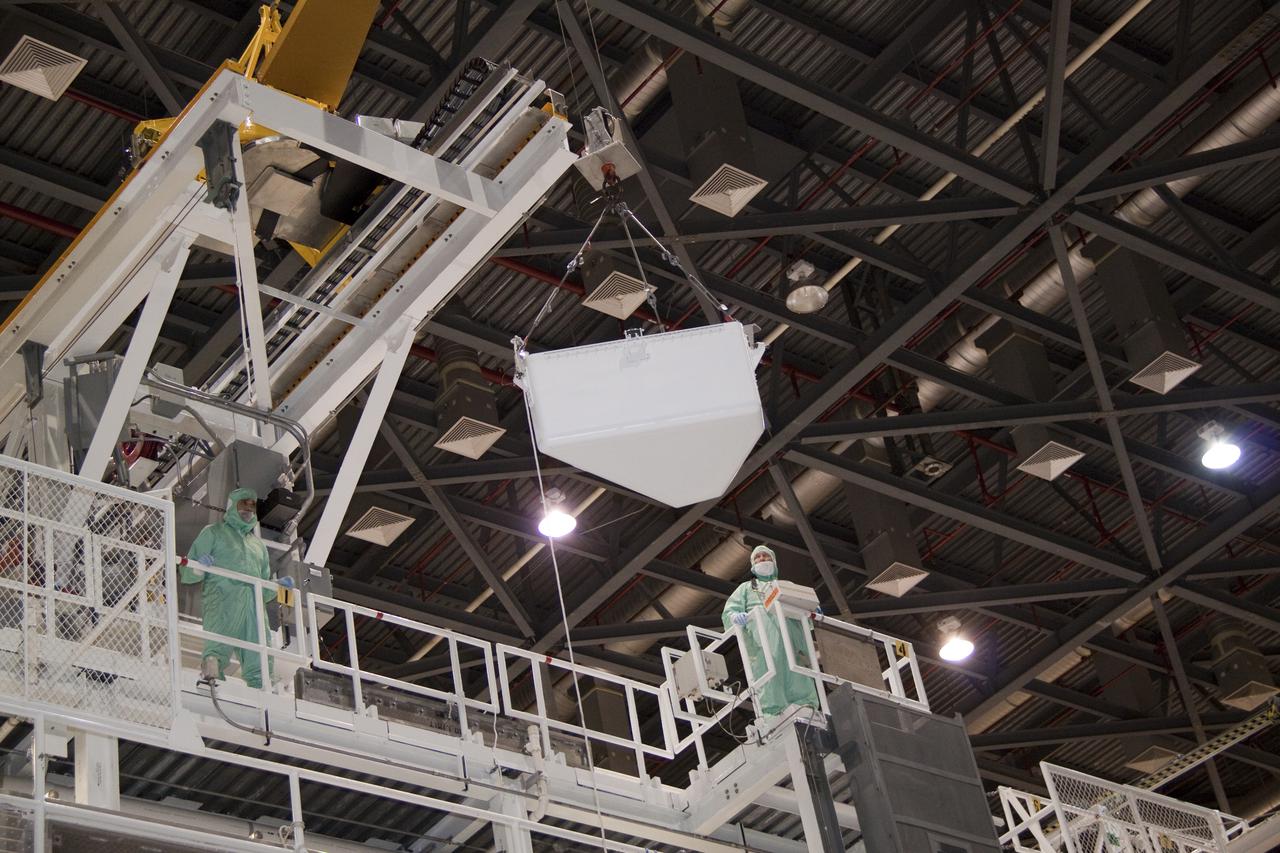
CAPE CANAVERAL, Fla. – In Orbiter Processing Facility-1 at NASA's Kennedy Space Center in Florida, workers dressed in clean room attire, known as bunny suits, monitor the tool stowage assembly as it is lifted by jib crane above the work platform on which they are standing. The tool box is being installed into space shuttle Atlantis' payload bay. The assembly contains tools and hardware that will be needed on the extravehicular activities, or spacewalks, conducted during the STS-132 mission. On STS-132, the six-member crew will deliver an Integrated Cargo Carrier and a Russian-built Mini-Research Module to the International Space Station. STS-132 is the 34th mission to the station and the 132nd space shuttle mission. Launch is targeted for May 14. For information on the STS-132 mission, visit http:__www.nasa.gov_mission_pages_shuttle_shuttlemissions_sts132_index.html. Photo credit: NASA_Jack Pfaller
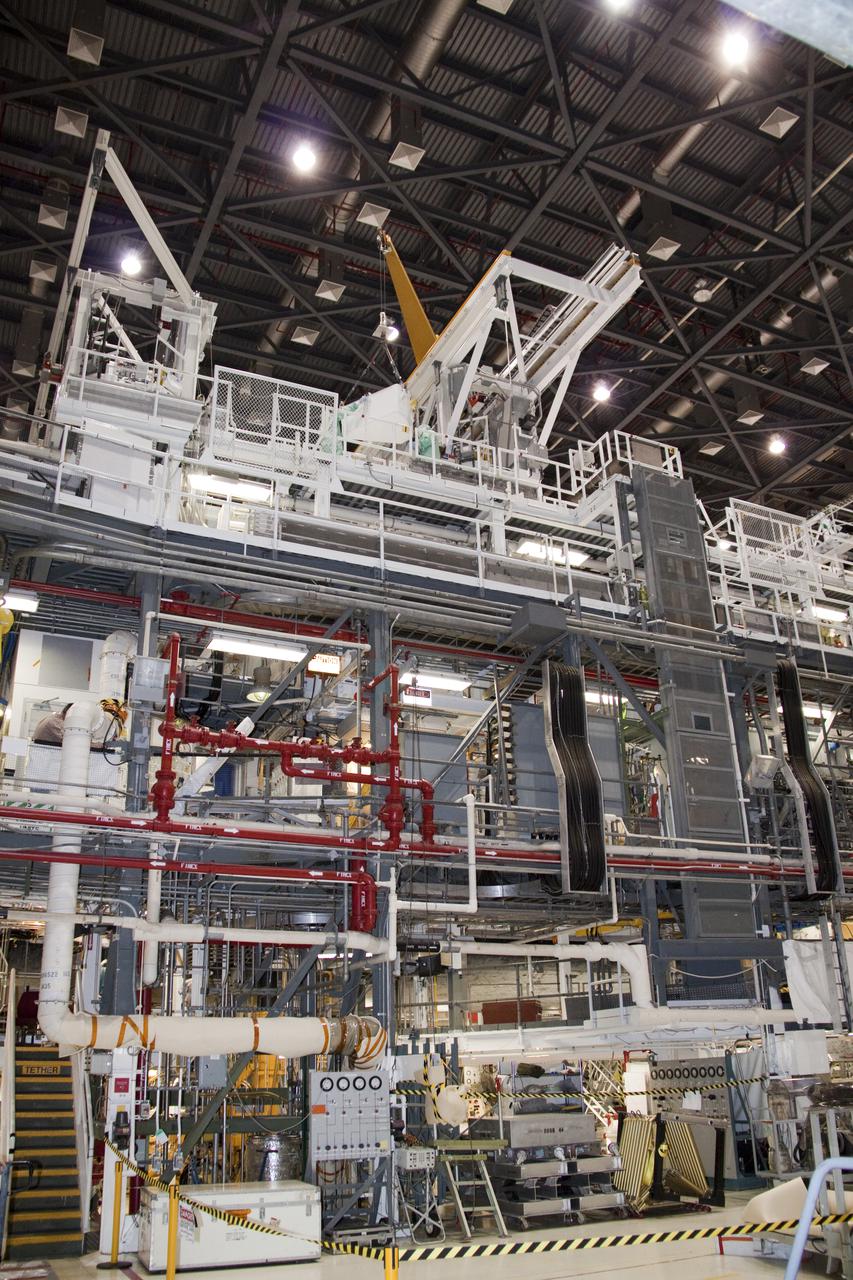
CAPE CANAVERAL, Fla. – In Orbiter Processing Facility-1 at NASA's Kennedy Space Center in Florida, the tool stowage assembly is lifted by jib crane over a work platform. The tool box will be moved across the platform and installed into space shuttle Atlantis' payload bay. The assembly contains tools and hardware that will be needed on the extravehicular activities, or spacewalks, conducted during the STS-132 mission. On STS-132, the six-member crew will deliver an Integrated Cargo Carrier and a Russian-built Mini-Research Module to the International Space Station. STS-132 is the 34th mission to the station and the 132nd space shuttle mission. Launch is targeted for May 14. For information on the STS-132 mission, visit http:__www.nasa.gov_mission_pages_shuttle_shuttlemissions_sts132_index.html. Photo credit: NASA_Jack Pfaller
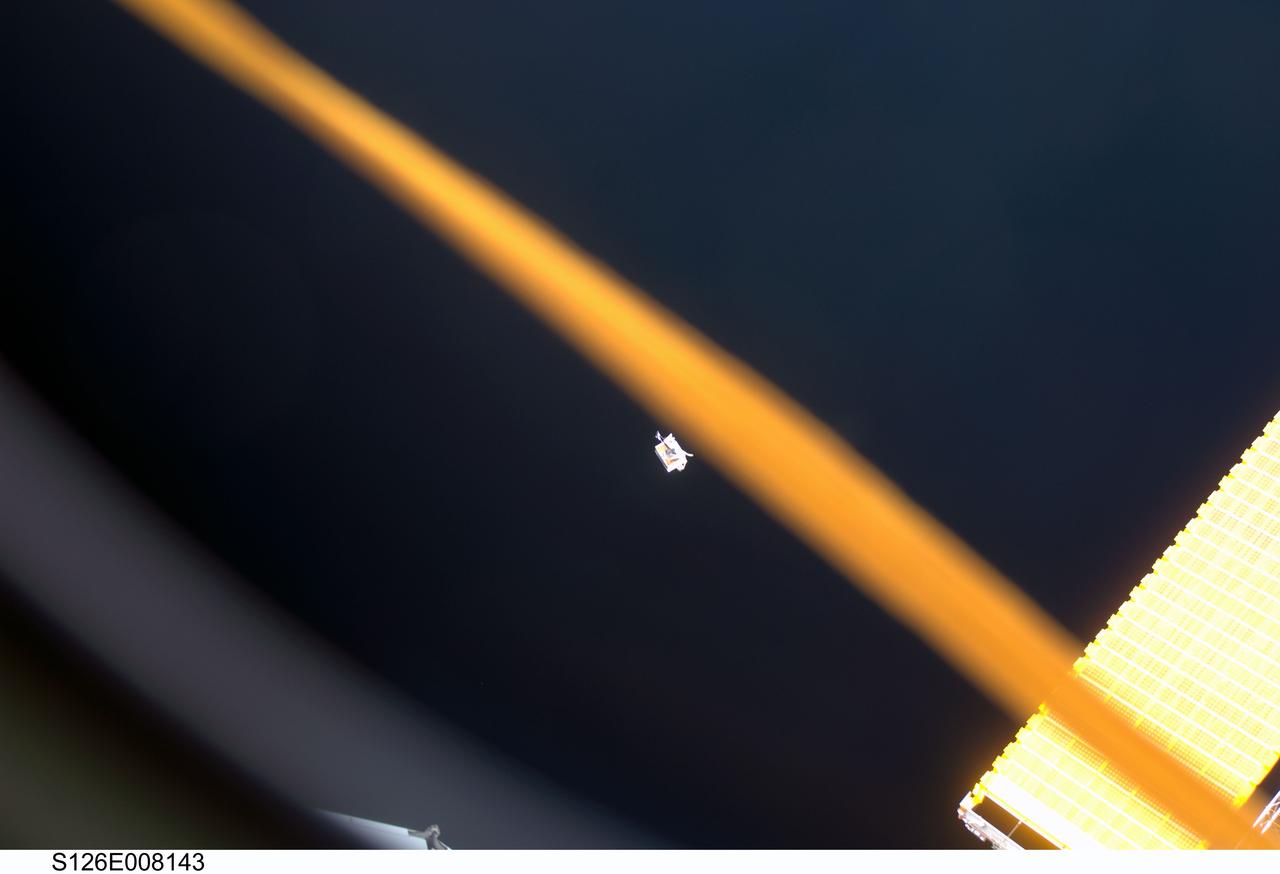
S126-E-008143 (18 Nov. 2008) --- An extravehicular activity (EVA) tool bag drifts away from the International Space Station during the mission's first scheduled spacewalk for STS-126. About halfway into the spacewalk, one of the grease guns that astronaut Heidemarie Stefanyshyn-Piper (out of frame), mission specialist, was preparing to use on the Solar Alpha Rotary Joint released some Braycote grease into her crew lock bag, which is the tool bag the spacewalkers use during their activities. As she was cleaning the inside of the bag, it drifted away from her and toward the aft and starboard portion of the International Space Station. Inside the bag were two grease guns, a scraper, a scraper debris container, several wipes in a caddy and tethers.
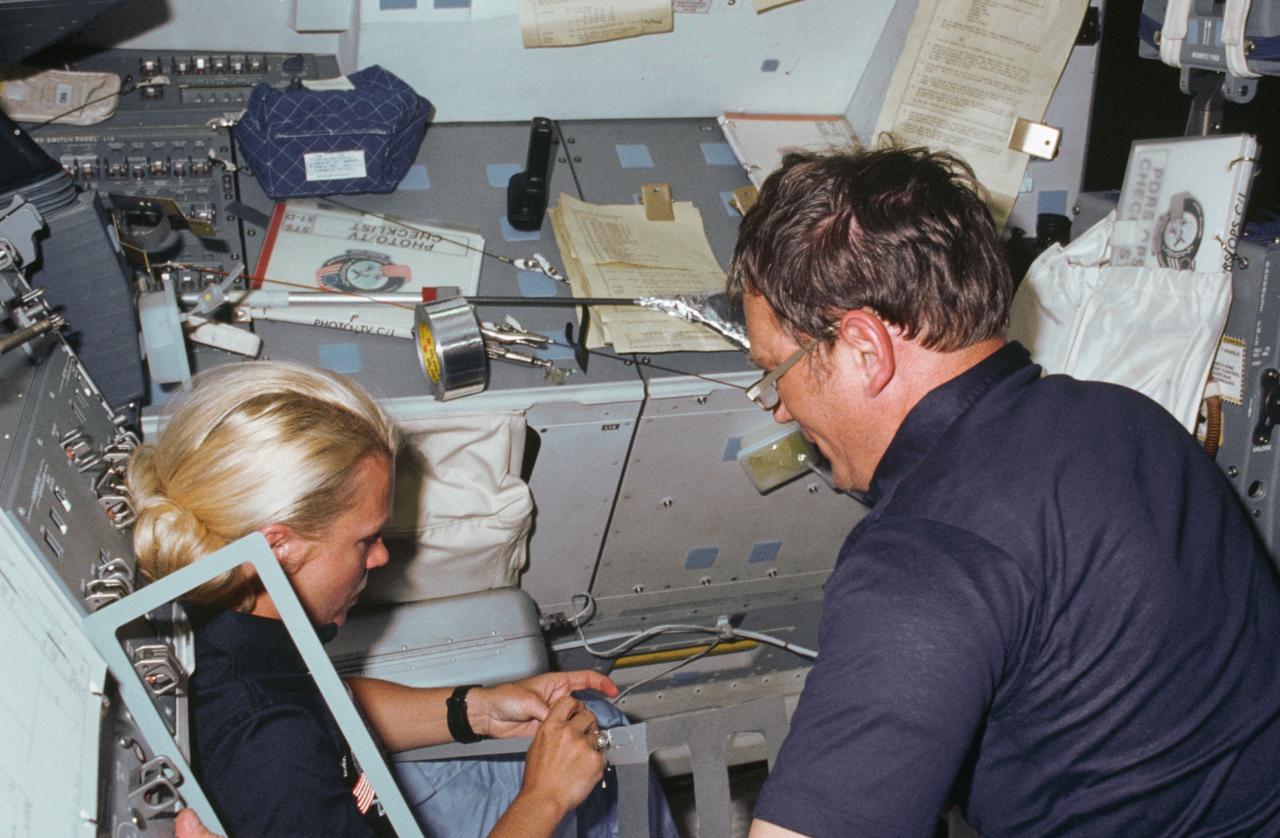
51D-04-015 (15 April 1985) --- Astronaut Rhea Seddon and Karol J. Bobko continue work on snag-type extension for the Remote Manipulator System (RMS) as part of an effort to activate a lever on a troubled communications satellite. Since the crew learned soon after deployment of the Syncom IV (LEASAT) spacecraft that it was not functioning properly plans were formulated for a rendezvous in space between the Discovery and the satellite. A fly swatter-like extension and another resembling a LaCrosse stick were fashioned from onboard supplies and furnishings. Stowage lockers nearby serve as a work bench for the two. At various times during the seven-day mission, the majority of the seven-member crew participated in the tool-making and preparations for an extravehicular activity (EVA) by the flights other two mission specialists -- Jeffrey A. Hoffman and S. David Griggs -- to connect the two tools to the RMS. Bobko is mission commander and Dr. Seddon, a mission specialist.
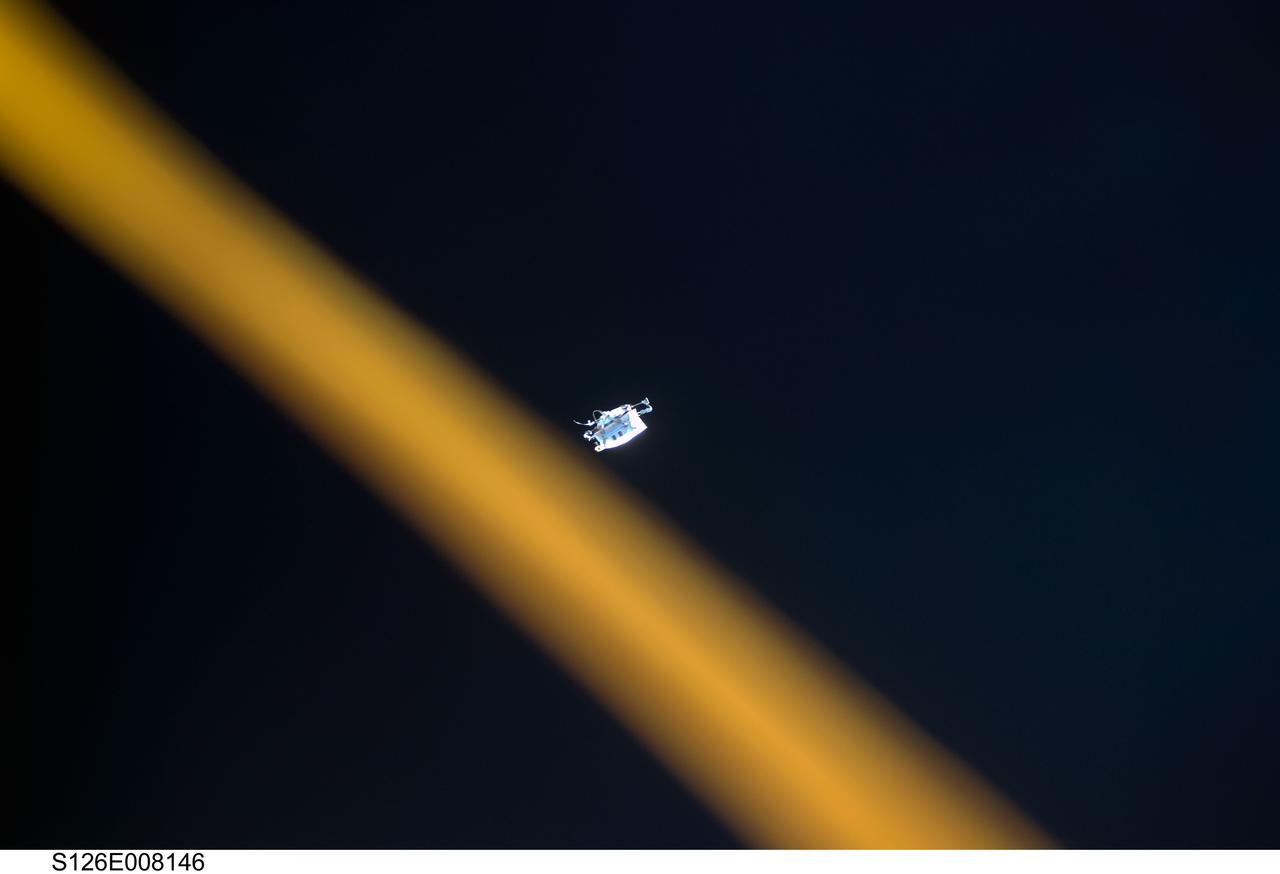
S126-E-008146 (18 Nov. 2008) --- An extravehicular activity (EVA) tool bag drifts away from the International Space Station during the mission's first scheduled spacewalk for STS-126. About halfway into the spacewalk, one of the grease guns that astronaut Heidemarie Stefanyshyn-Piper (out of frame), mission specialist, was preparing to use on the Solar Alpha Rotary Joint released some Braycote grease into her crew lock bag, which is the tool bag the spacewalkers use during their activities. As she was cleaning the inside of the bag, it drifted away from her and toward the aft and starboard portion of the International Space Station. Inside the bag were two grease guns, a scraper, a scraper debris container, several wipes in a caddy and tethers.

S126-E-008155 (18 Nov. 2008) --- An extravehicular activity (EVA) tool bag drifts away from the International Space Station during the mission's first scheduled spacewalk for STS-126. About halfway into the spacewalk, one of the grease guns that astronaut Heidemarie Stefanyshyn-Piper (out of frame), mission specialist, was preparing to use on the Solar Alpha Rotary Joint released some Braycote grease into her crew lock bag, which is the tool bag the spacewalkers use during their activities. As she was cleaning the inside of the bag, it drifted away from her and toward the aft and starboard portion of the International Space Station. Inside the bag were two grease guns, a scraper, a scraper debris container, several wipes in a caddy and tethers.
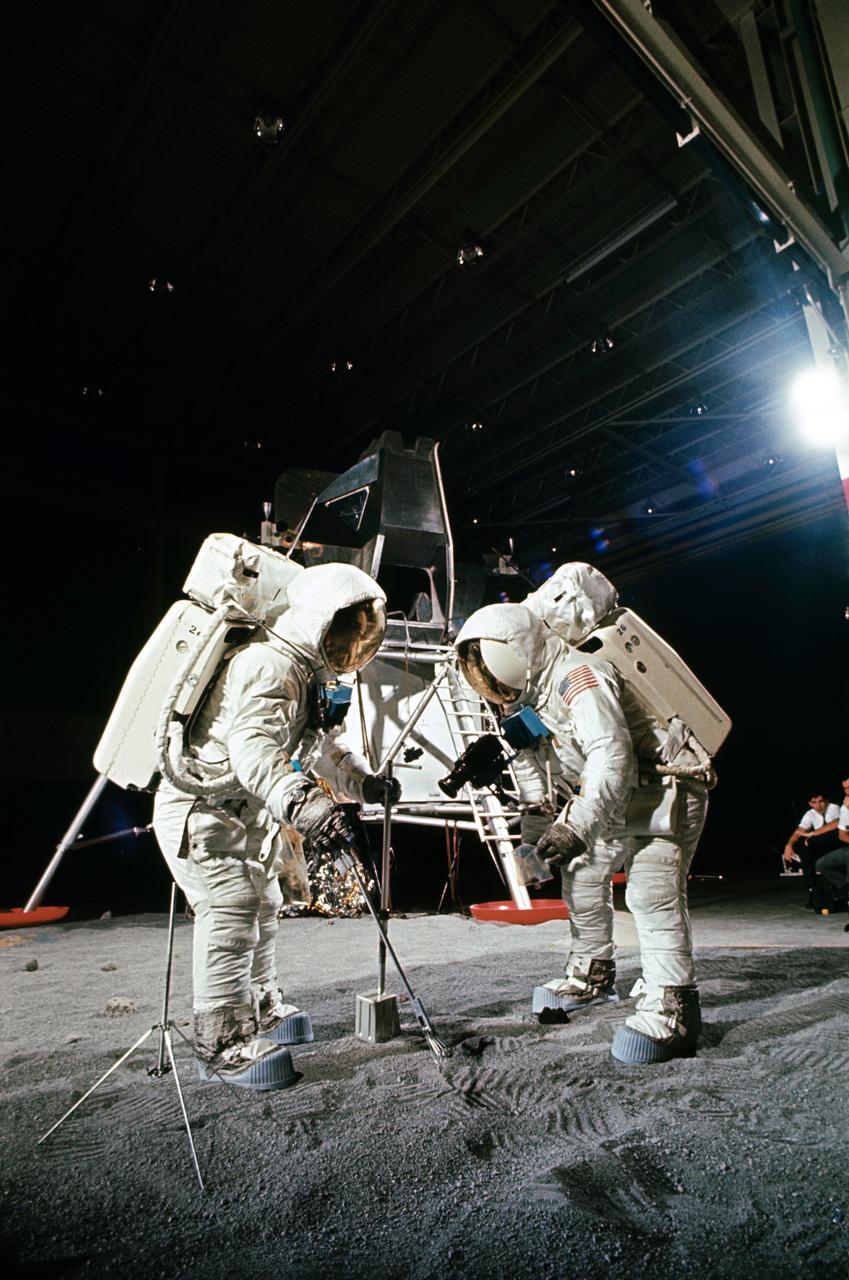
Two members of the Apollo 11 lunar landing mission participate in a simulation of deploying and using lunar tools on the surface of the moon during a training exercise in bldg 9 on April 22, 1969. Astronaut Edwin E. Aldrin Jr. (on left), lunar module pilot, uses scoop and tongs to pick up sample. Astronaut Neil A. Armstrong, Apollo 11 commander, holds bag to receive sample. In the background is a Lunar Module mockup. Both men are wearing Extravehicular Mobility Units (EMU).
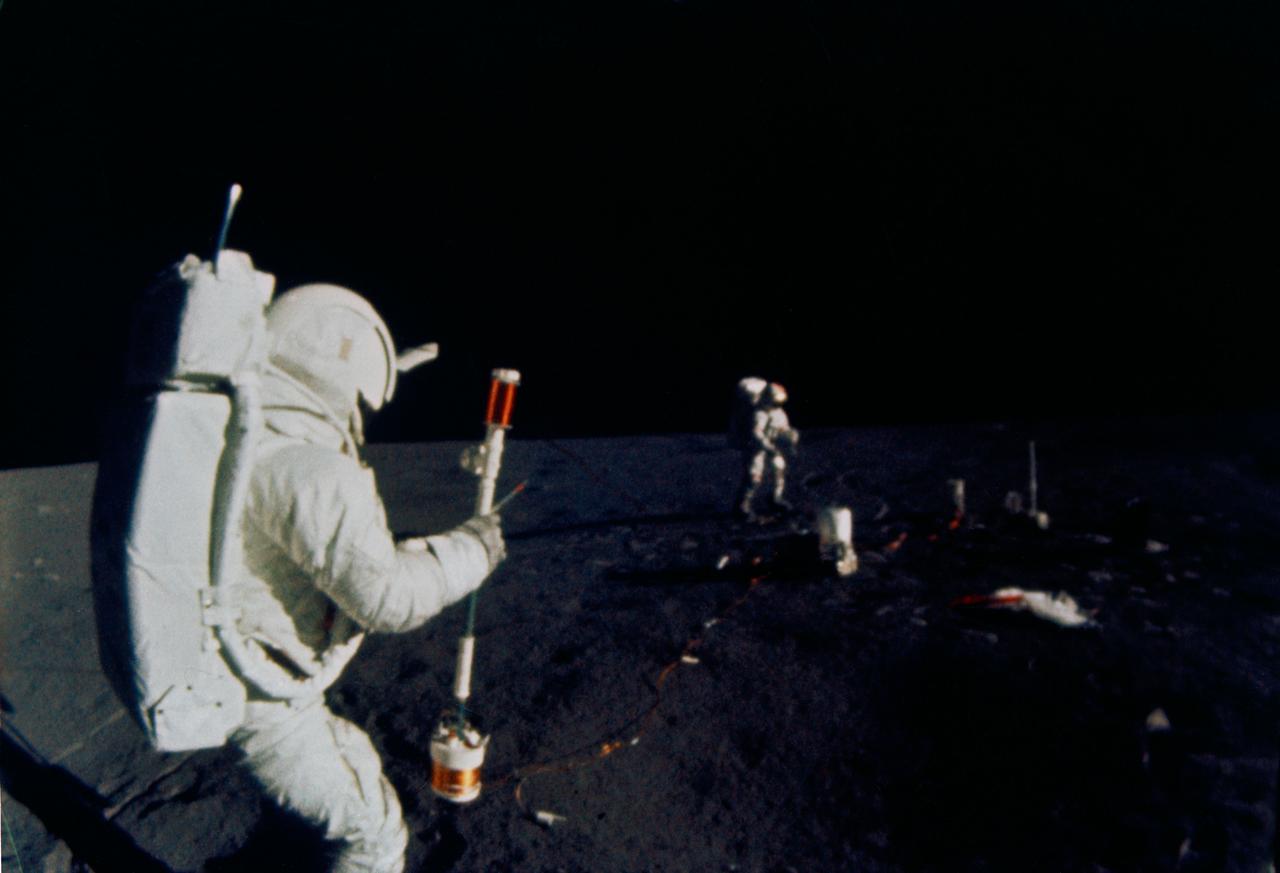
S71-19509 (5 Feb. 1971) --- Astronaut Edgar D. Mitchell, lunar module pilot, operates the Active Seismic Experiment's (ASE) thumper during the first Apollo 14 extravehicular activity (EVA) on the moon. Astronaut Alan B. Shepard Jr., commander, walks near deployed components of the Apollo Lunar Surface Experiments Package (ALSEP) in the background. This photograph was taken by an automatic 16mm camera mounted on the Apollo lunar hand tool carrier aboard the Modularized Equipment Transporter (MET). While astronauts Shepard and Mitchell descended in the LM to explore the moon, astronaut Stuart A. Roosa, command module pilot, remained with the Command and Service Modules (CSM) in lunar orbit.
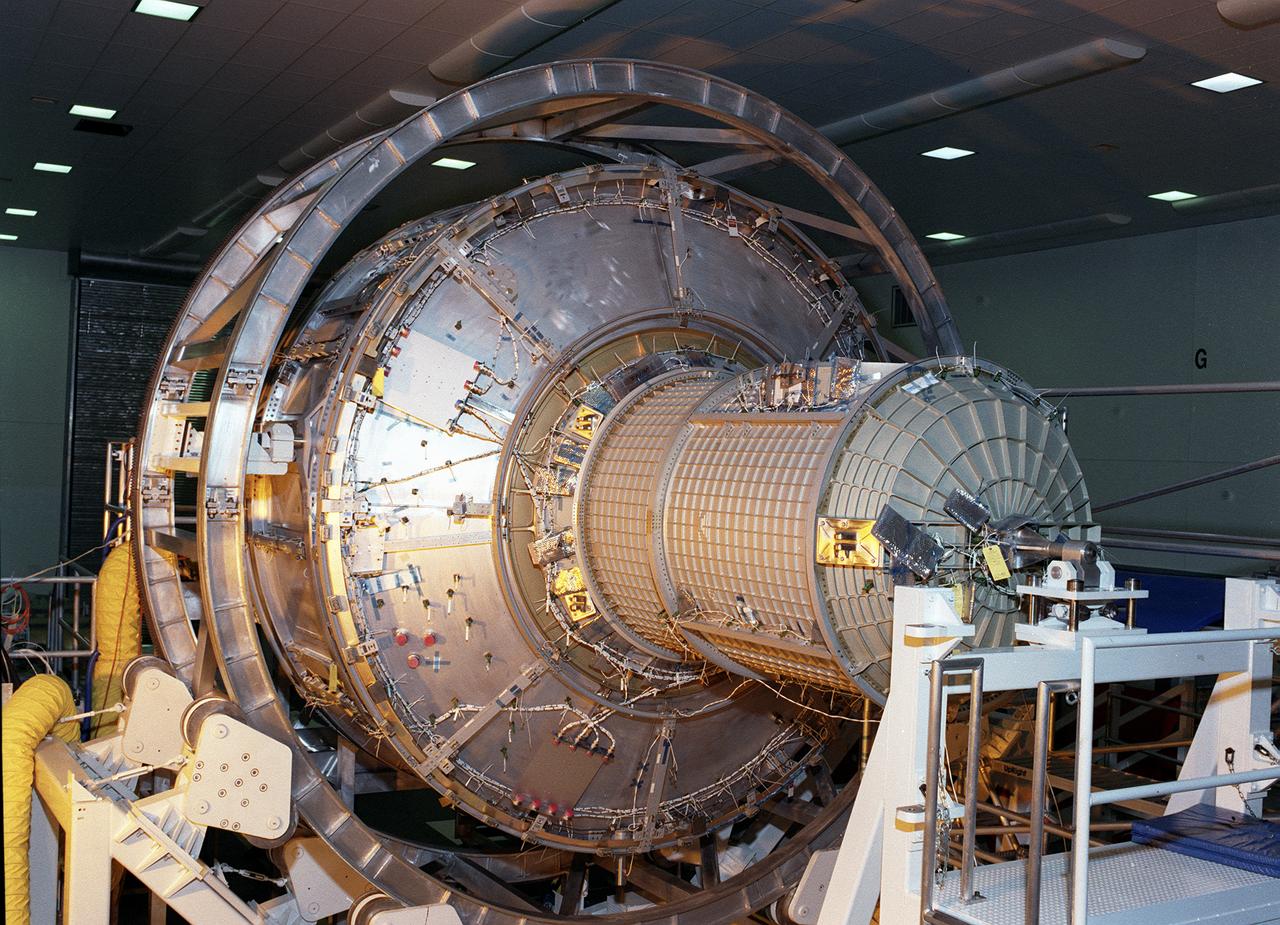
The Joint Airlock Module for the International Space Station (ISS) awaits shipment to the Kennedy Space Center in the Space Station manufacturing facility at the Marshall Space Flight Center in Huntsville, Alabama. The Airlock includes two sections. The larger equipment lock on the left is where crews will change into and out of their spacesuits for extravehicular activities, and store spacesuits, batteries, power tools, and other supplies. The narrower crewlock from which the astronauts will exit into space for extravehicular activities, is on the right. The airlock is 18 feet long and has a mass of about 13,500 pounds. It was launched to the station aboard the Space Shuttle orbiter Atlantis (STS-104 mission) on July 12, 2001. The MSFC is playing a primary role in NASA's development, manufacturing, and operations of the ISS.
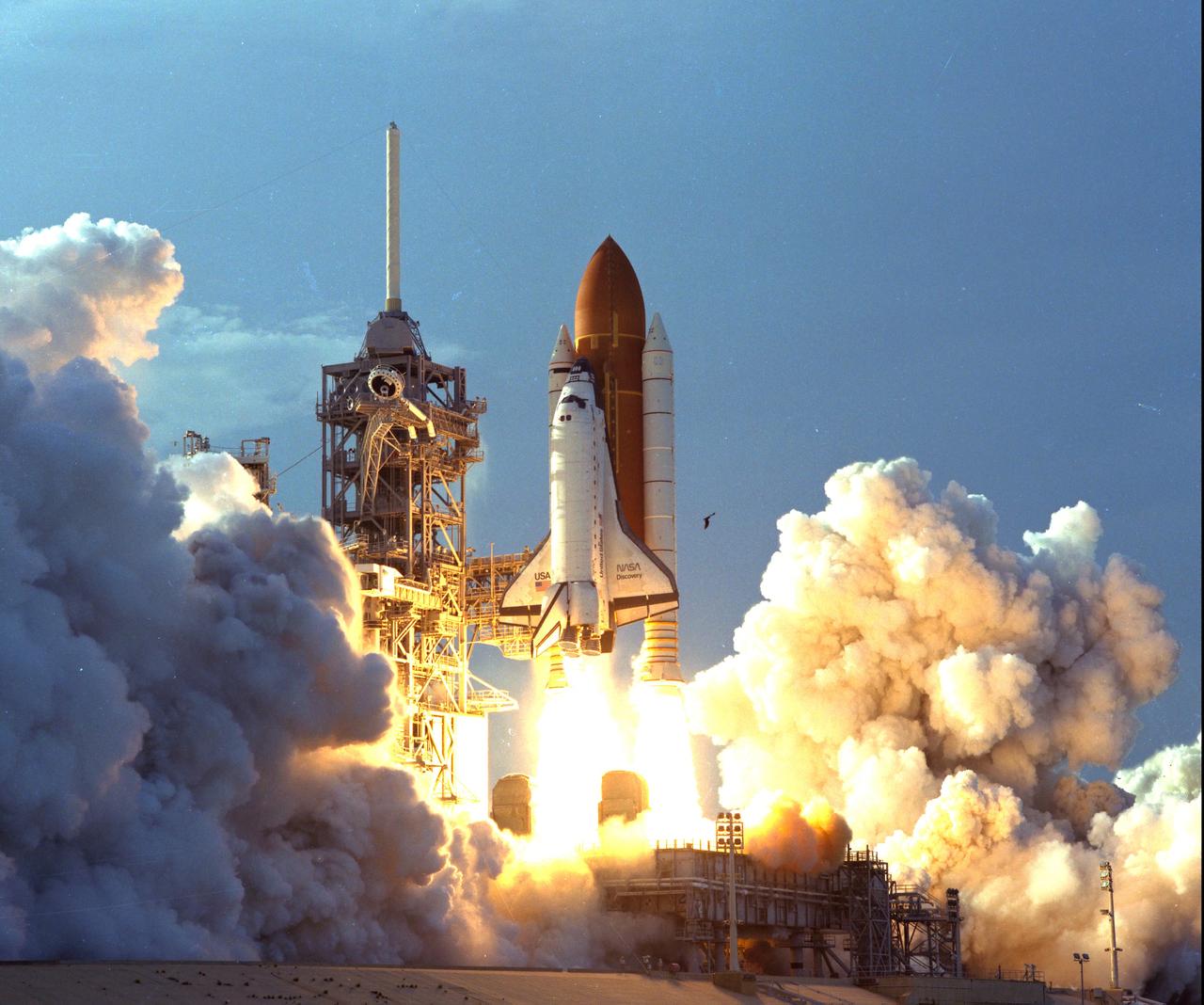
KENNEDY SPACE CENTER, FLA. - The turbulent weather common to a Florida afternoon in the summer subsides into a serene canopy of cornflower blue, and a manmade "bird" takes flight. The Space Shuttle Discovery soars skyward from Launch Pad 39B on Mission STS-64 at 6:22:35 p.m. EDT, Sept. 9. On board are a crew of six: Commander Richard N. Richards; Pilot L. Blaine Hammond Jr.; and Mission Specialists Mark C. Lee, Carl J. Meade, Susan J. Helms and Dr. J.M. Linenger. Payloads for the flight include the Lidar In-Space Technology Experiment (LITE), the Shuttle Pointed Autonomous Research Tool for Astronomy-201 (SPARTAN-201) and the Robot Operated Material Processing System (ROMPS). Mission Specialists Lee and Meade also are scheduled to perform an extravehicular activity during the 64th Shuttle mission.
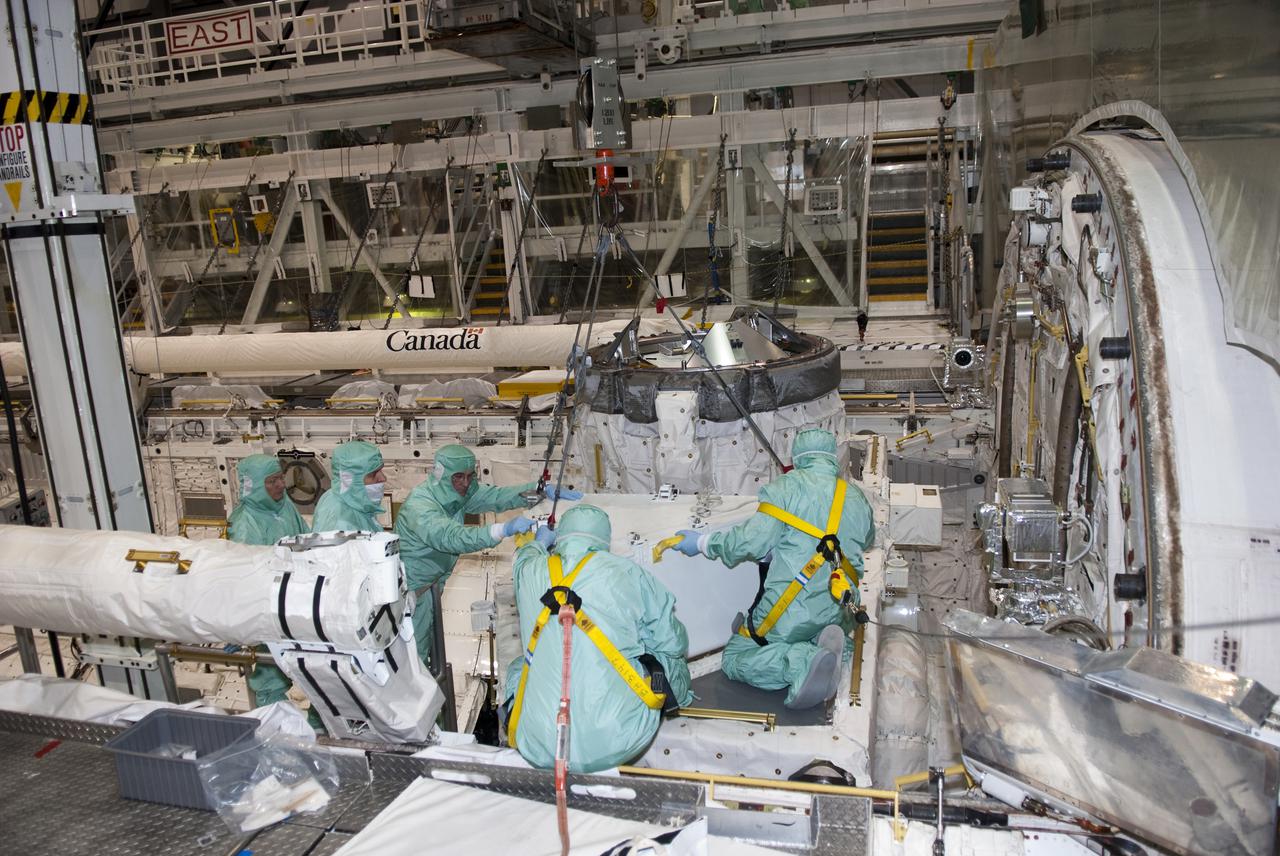
CAPE CANAVERAL, Fla. – In Orbiter Processing Facility-1 at NASA's Kennedy Space Center in Florida, workers dressed in clean room attire, known as bunny suits, guide the tool stowage assembly into position in space shuttle Atlantis' payload bay where it will be installed. The assembly contains tools and hardware that will be needed on the extravehicular activities, or spacewalks, conducted during the STS-132 mission. On STS-132, the six-member crew will deliver an Integrated Cargo Carrier and a Russian-built Mini-Research Module to the International Space Station. STS-132 is the 34th mission to the station and the 132nd space shuttle mission. Launch is targeted for May 14. For information on the STS-132 mission, visit http:__www.nasa.gov_mission_pages_shuttle_shuttlemissions_sts132_index.html. Photo credit: NASA_Jim Grossmann

CAPE CANAVERAL, Fla. – In Orbiter Processing Facility-1 at NASA's Kennedy Space Center in Florida, workers dressed in clean room attire, known as bunny suits, are on hand in space shuttle Atlantis' payload bay to receive the tool stowage assembly being lowered into the bay for installation. The assembly contains tools and hardware that will be needed on the extravehicular activities, or spacewalks, conducted during the STS-132 mission. On STS-132, the six-member crew will deliver an Integrated Cargo Carrier and a Russian-built Mini-Research Module to the International Space Station. STS-132 is the 34th mission to the station and the 132nd space shuttle mission. Launch is targeted for May 14. For information on the STS-132 mission, visit http:__www.nasa.gov_mission_pages_shuttle_shuttlemissions_sts132_index.html. Photo credit: NASA_Jim Grossmann
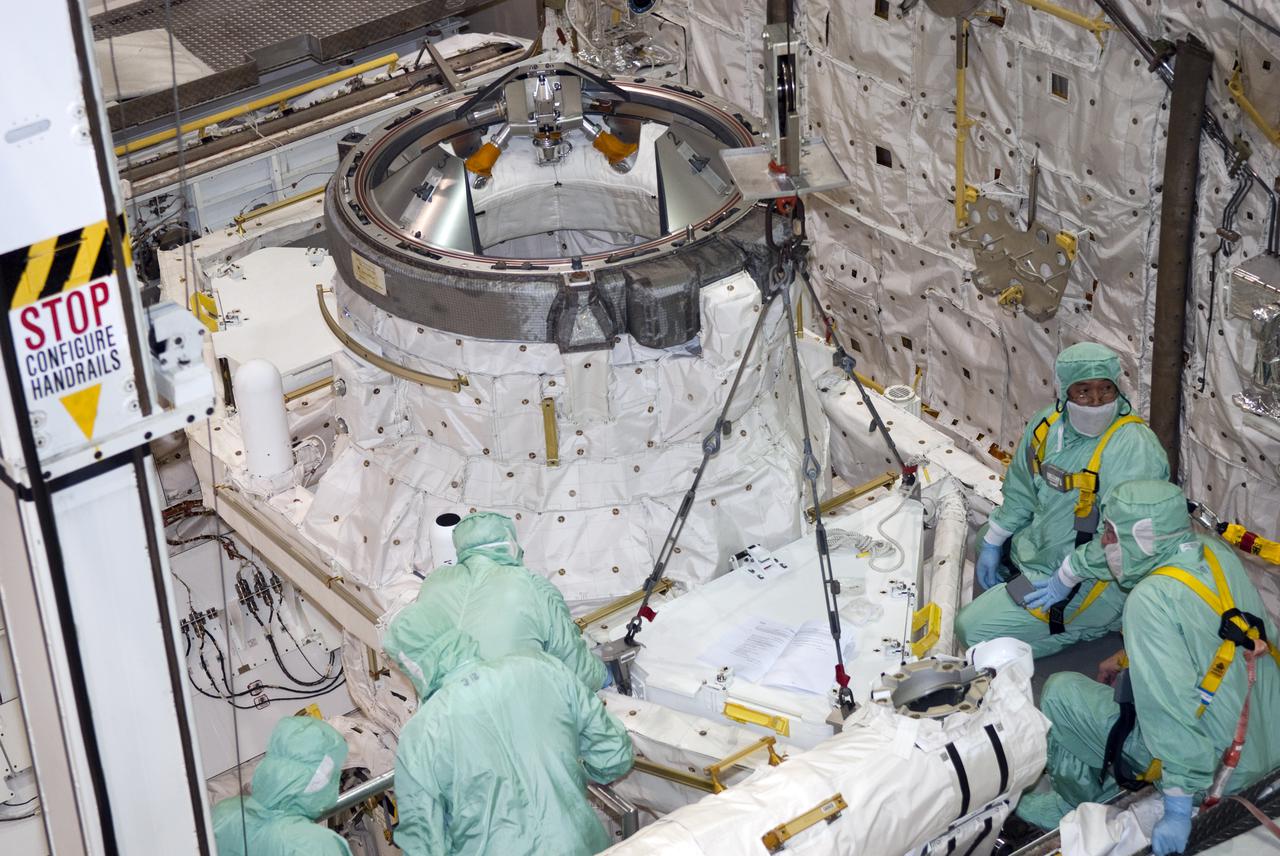
CAPE CANAVERAL, Fla. – In Orbiter Processing Facility-1 at NASA's Kennedy Space Center in Florida, workers dressed in clean room attire, known as bunny suits, ensure the tool stowage assembly is in the proper position in space shuttle Atlantis' payload bay for installation. The assembly contains tools and hardware that will be needed on the extravehicular activities, or spacewalks, conducted during the STS-132 mission. On STS-132, the six-member crew will deliver an Integrated Cargo Carrier and a Russian-built Mini-Research Module to the International Space Station. STS-132 is the 34th mission to the station and the 132nd space shuttle mission. Launch is targeted for May 14. For information on the STS-132 mission, visit http:__www.nasa.gov_mission_pages_shuttle_shuttlemissions_sts132_index.html. Photo credit: NASA_Jim Grossmann
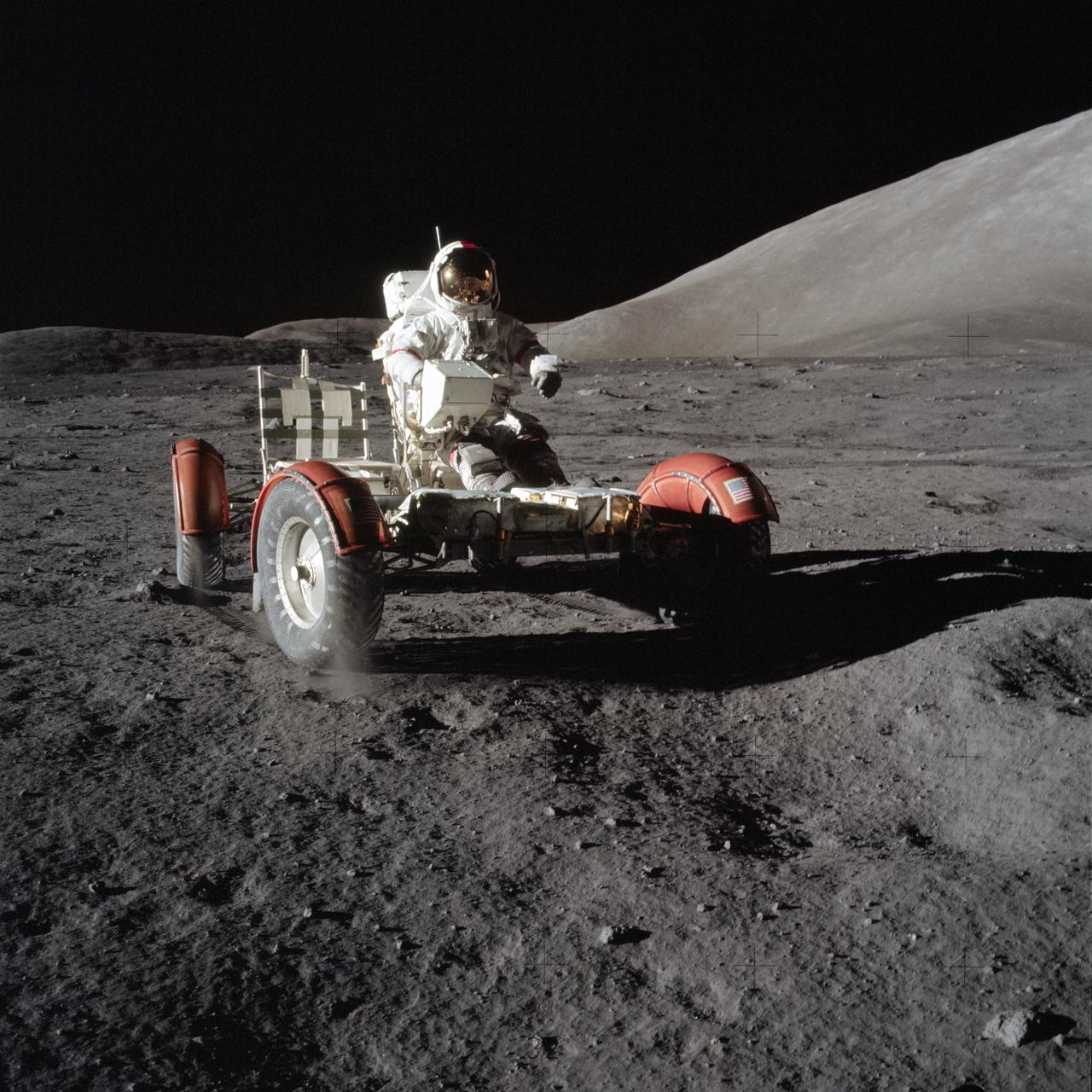
AS17-147-22526 (11 Dec. 1972) --- Astronaut Eugene A. Cernan, commander, makes a short checkout of the Lunar Roving Vehicle (LRV) during the early part of the first Apollo 17 extravehicular activity (EVA) at the Taurus-Littrow landing site. This view of the "stripped down" LRV is prior to loading up. Equipment later loaded onto the LRV included the ground-controlled television assembly, the lunar communications relay unit, hi-gain antenna, low-gain antenna, aft tool pallet, lunar tools and scientific gear. This photograph was taken by scientist-astronaut Harrison H. Schmitt, lunar module pilot. The mountain in the right background is the east end of South Massif. While astronauts Cernan and Schmitt descended in the Lunar Module (LM) "Challenger" to explore the moon, astronaut Ronald E. Evans, command module pilot, remained with the Command and Service Modules (CSM) "America" in lunar orbit.
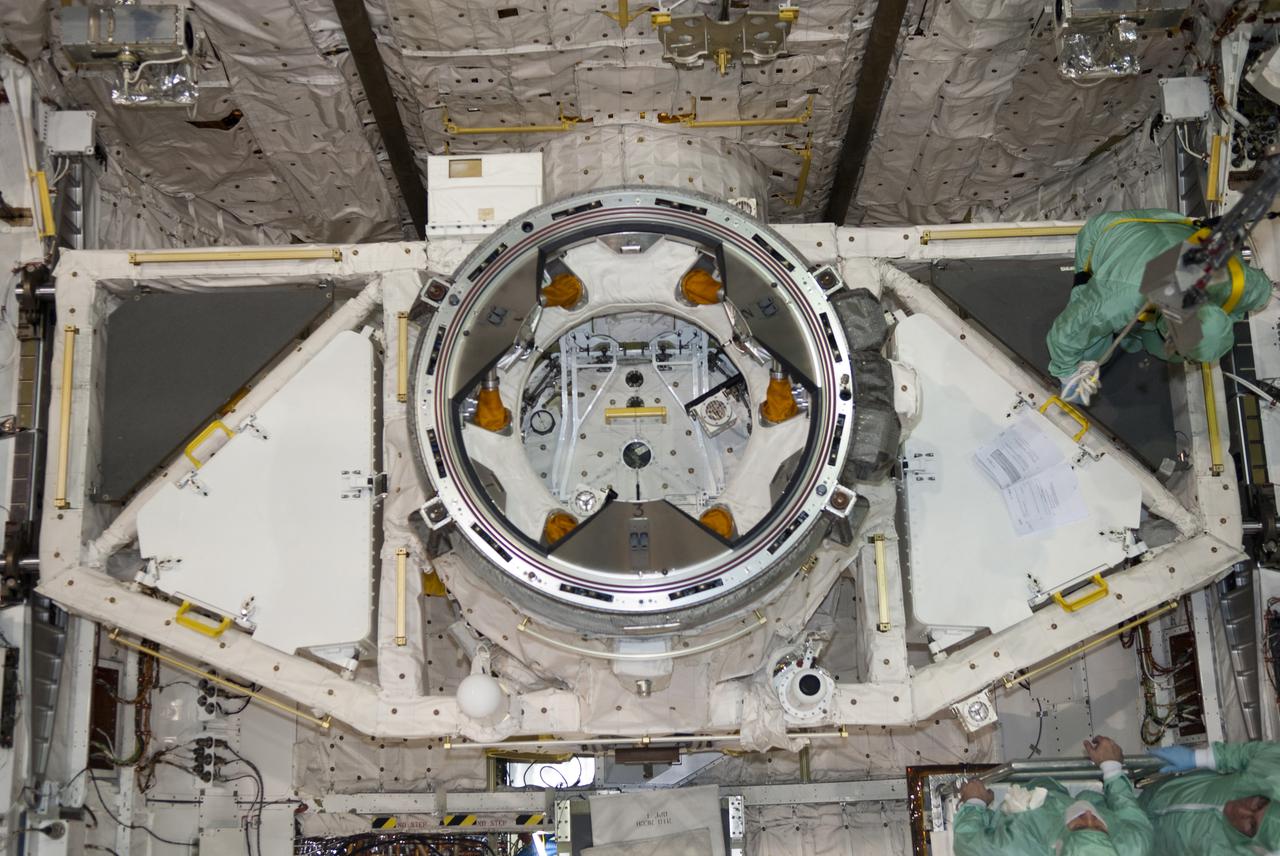
CAPE CANAVERAL, Fla. – In Orbiter Processing Facility-1 at NASA's Kennedy Space Center in Florida, workers dressed in clean room attire, known as bunny suits, disconnect the tool stowage assembly from the jib crane which delivered it into space shuttle Atlantis' payload bay. The assembly contains tools and hardware that will be needed on the extravehicular activities, or spacewalks, conducted during the STS-132 mission. On STS-132, the six-member crew will deliver an Integrated Cargo Carrier and a Russian-built Mini-Research Module to the International Space Station. STS-132 is the 34th mission to the station and the 132nd space shuttle mission. Launch is targeted for May 14. For information on the STS-132 mission, visit http:__www.nasa.gov_mission_pages_shuttle_shuttlemissions_sts132_index.html. Photo credit: NASA_Jim Grossmann
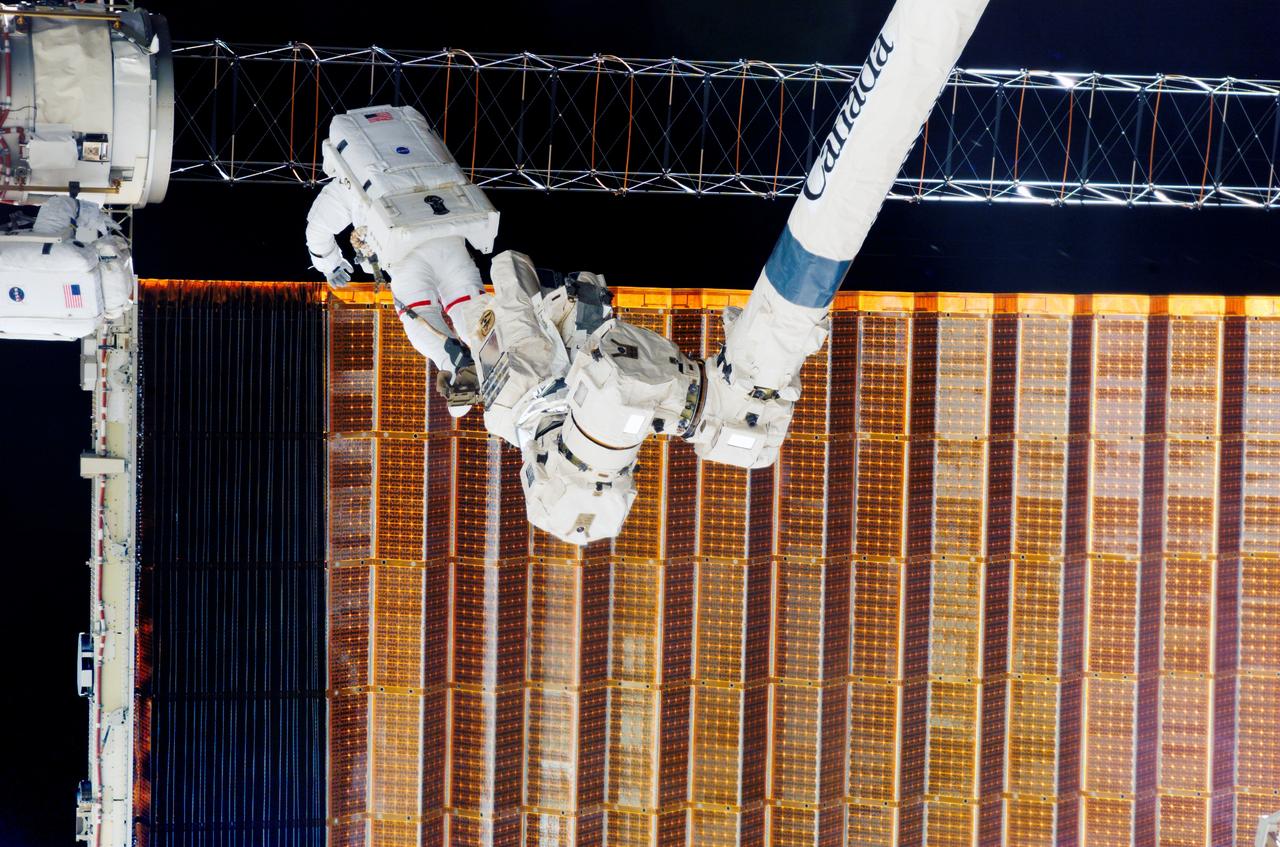
S116-E-06993 (18 Dec. 2006) --- Anchored to the International Space Station's Canadarm2 foot restraint, astronaut Robert L. Curbeam Jr. and European Space Agency (ESA) astronaut Christer Fuglesang (left, partially out of frame), both STS-116 mission specialists, work with the port overhead solar array wing on the station's P6 truss during the mission's fourth session of extravehicular activity (EVA). The spacewalkers used specially-prepared, tape-insulated tools, to guide the array wing neatly inside its blanket box during the 6-hour, 38-minute spacewalk.
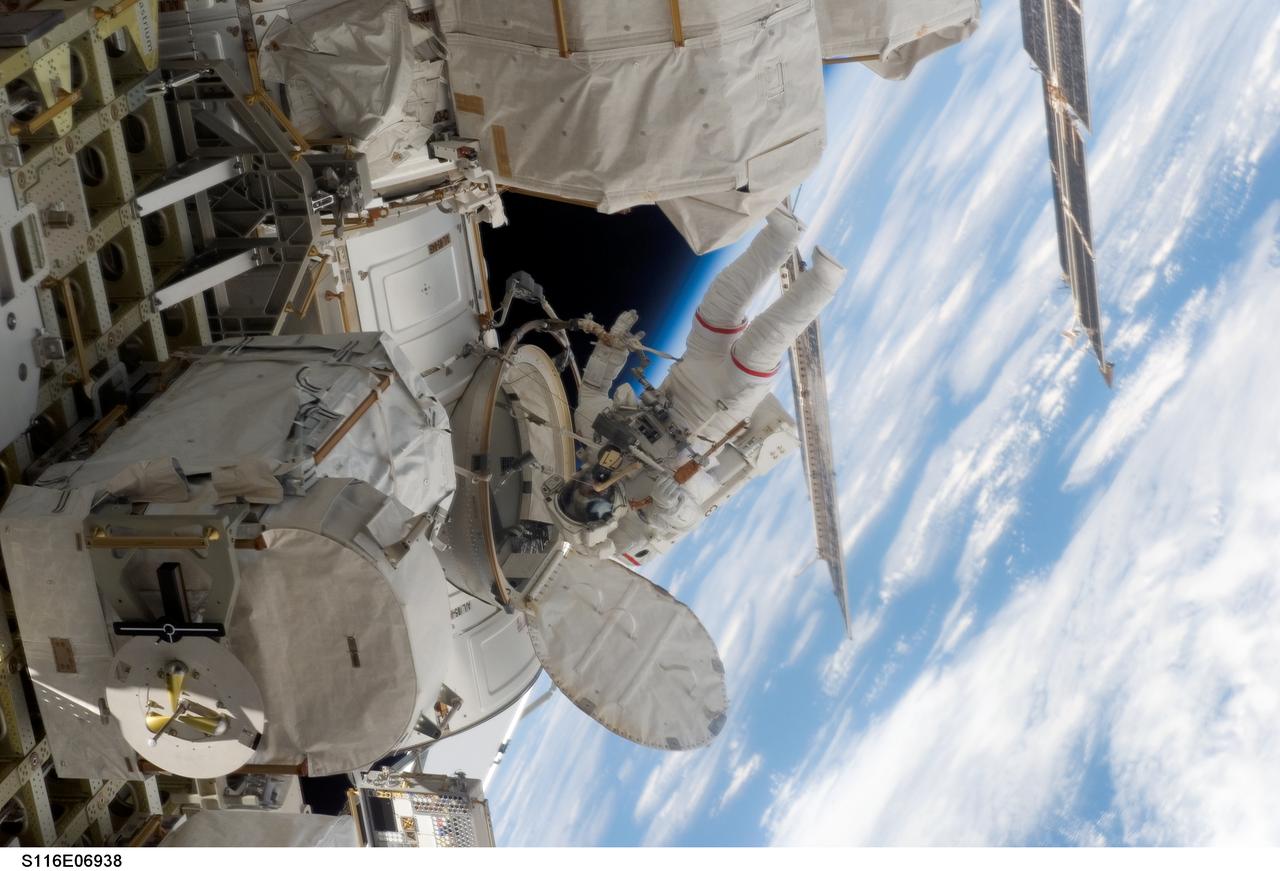
S116-E-06938 (18 Dec. 2006) --- Astronaut Robert L. Curbeam Jr., STS-116 mission specialist, exits the Quest Airlock of the International Space Station as he and European Space Agency (ESA) astronaut Christer Fuglesang (out of frame), mission specialist, begin the mission's fourth session of extravehicular activity (EVA) while Space Shuttle Discovery was docked with the station. Curbeam and Fuglesang worked in tandem, using specially-prepared, tape-insulated tools, to guide the array wing neatly inside its blanket box during the 6-hour, 38-minute spacewalk.