
The flags of the United States and Uruguay are seen during an Artemis Accords signing ceremony, Thursday, Feb. 15, 2024, at the Mary W. Jackson NASA Headquarters building in Washington. Uruguay is the 36th country to sign the Artemis Accords, which establish a practical set of principles to guide space exploration cooperation among nations participating in NASA’s Artemis program. Photo Credit: (NASA/Keegan Barber)
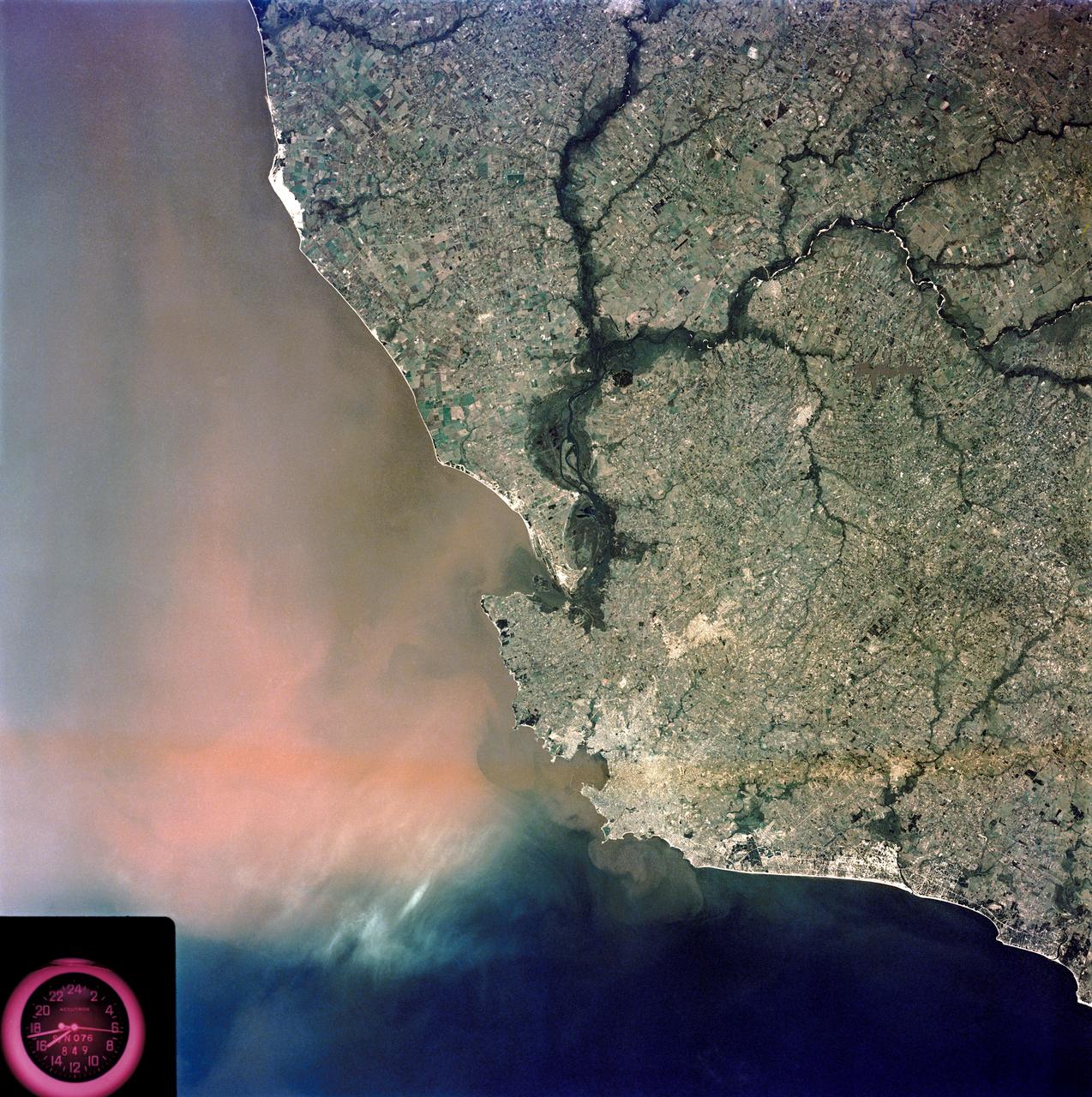
SL3-84-202 (July-September 1973) --- A vertical view of the Montevideo, Uruguay area of South America is seen in this Skylab 3 Earth Resources Experiments Package S190-B (five-inch Earth terrain camera) photograph taken from the Skylab space station in Earth orbit. The large body of water is Rio de la Plata which flows into the South Atlantic Ocean at the bottom of the picture. The red plum in the Rio de la Plata is probably sediment moving seaward. The Santa Lucia River enters the Rio de la Plata west of Montevideo and is the major drainage for the region. Note the small Isla del Tigre at the mouth of the Santa Lucia. The white beach and sand dune areas are plainly visible along the coast. A major airport can be seen immediately east of downtown Montevideo. Major thoroughfares and residential areas, such as the bright one in the suburbs, are clearly visible, also. Farm tracts in green and grey rectangular patterns indicate agricultural regions. Photo credit: NASA

Uruguayan Foreign Minister Omar Pagani, right, delivers remarks alongside NASA Administrator Bill Nelson during an Artemis Accords signing ceremony, Thursday, Feb. 15, 2024, at the Mary W. Jackson NASA Headquarters building in Washington. Uruguay is the 36th country to sign the Artemis Accords, which establish a practical set of principles to guide space exploration cooperation among nations participating in NASA’s Artemis program. Photo Credit: (NASA/Keegan Barber)
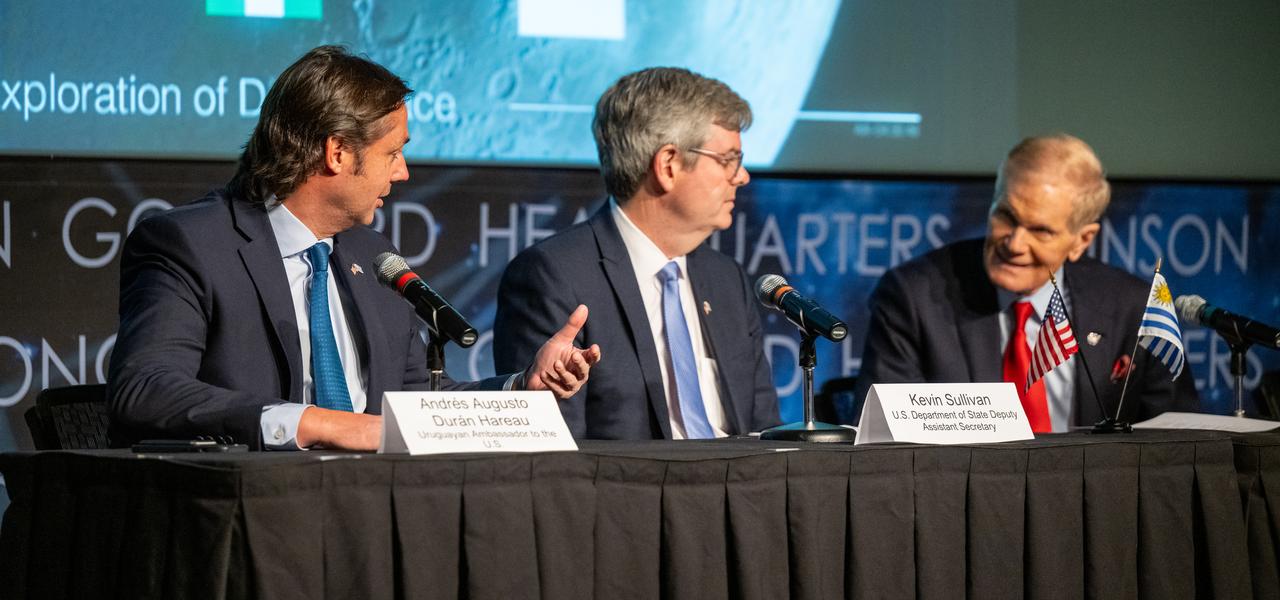
Uruguayan Ambassador to the United States Andrés Augusto Durán Hareau, left, delivers remarks during an Artemis Accords signing ceremony, Thursday, Feb. 15, 2024, at the Mary W. Jackson NASA Headquarters building in Washington. Uruguay is the 36th country to sign the Artemis Accords, which establish a practical set of principles to guide space exploration cooperation among nations participating in NASA’s Artemis program. Photo Credit: (NASA/Keegan Barber)
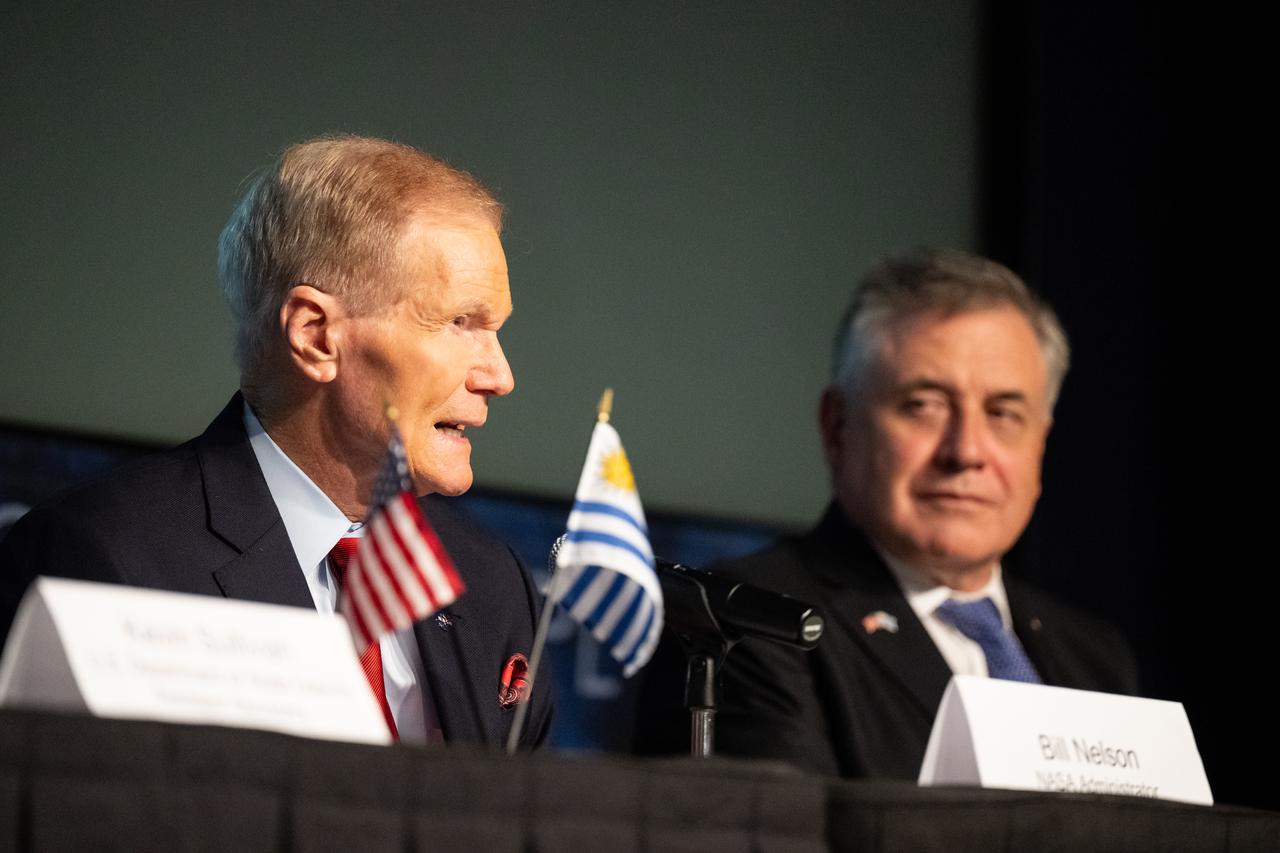
NASA Administrator Bill Nelson, left, delivers remarks alongside Uruguayan Foreign Minister Omar Pagani during an Artemis Accords signing ceremony, Thursday, Feb. 15, 2024, at the Mary W. Jackson NASA Headquarters building in Washington. Uruguay is the 36th country to sign the Artemis Accords, which establish a practical set of principles to guide space exploration cooperation among nations participating in NASA’s Artemis program. Photo Credit: (NASA/Keegan Barber)

Administrator Bill Nelson, left, shakes hands with Uruguayan Foreign Minister Omar Pagani, right, during an Artemis Accords signing ceremony, Thursday, Feb. 15, 2024, at the Mary W. Jackson NASA Headquarters building in Washington. Uruguay is the 36th country to sign the Artemis Accords, which establish a practical set of principles to guide space exploration cooperation among nations participating in NASA’s Artemis program. Photo Credit: (NASA/Keegan Barber)

Uruguayan Foreign Minister Omar Pagani signs the Artemis Accords, Thursday, Feb. 15, 2024, at the Mary W. Jackson NASA Headquarters building in Washington. Uruguay is the 36th country to sign the Artemis Accords, which establish a practical set of principles to guide space exploration cooperation among nations participating in NASA’s Artemis program. Photo Credit: (NASA/Keegan Barber)

Uruguayan Foreign Minister Omar Pagani, right, delivers remarks during an Artemis Accords signing ceremony, Thursday, Feb. 15, 2024, at the Mary W. Jackson NASA Headquarters building in Washington. Uruguay is the 36th country to sign the Artemis Accords, which establish a practical set of principles to guide space exploration cooperation among nations participating in NASA’s Artemis program. Photo Credit: (NASA/Keegan Barber)

From left to right, Uruguayan Ambassador to the United States Andrés Augusto Durán Hareau, U.S. Department of State Deputy Assistant Secretary Kevin Sullivan, NASA Administrator Bill Nelson, and Uruguayan Foreign Minister Omar Paganini are seen during an Artemis Accords signing ceremony, Thursday, Feb. 15, 2024, at the Mary W. Jackson NASA Headquarters building in Washington. Uruguay is the 36th country to sign the Artemis Accords, which establish a practical set of principles to guide space exploration cooperation among nations participating in NASA’s Artemis program. Photo Credit: (NASA/Keegan Barber)
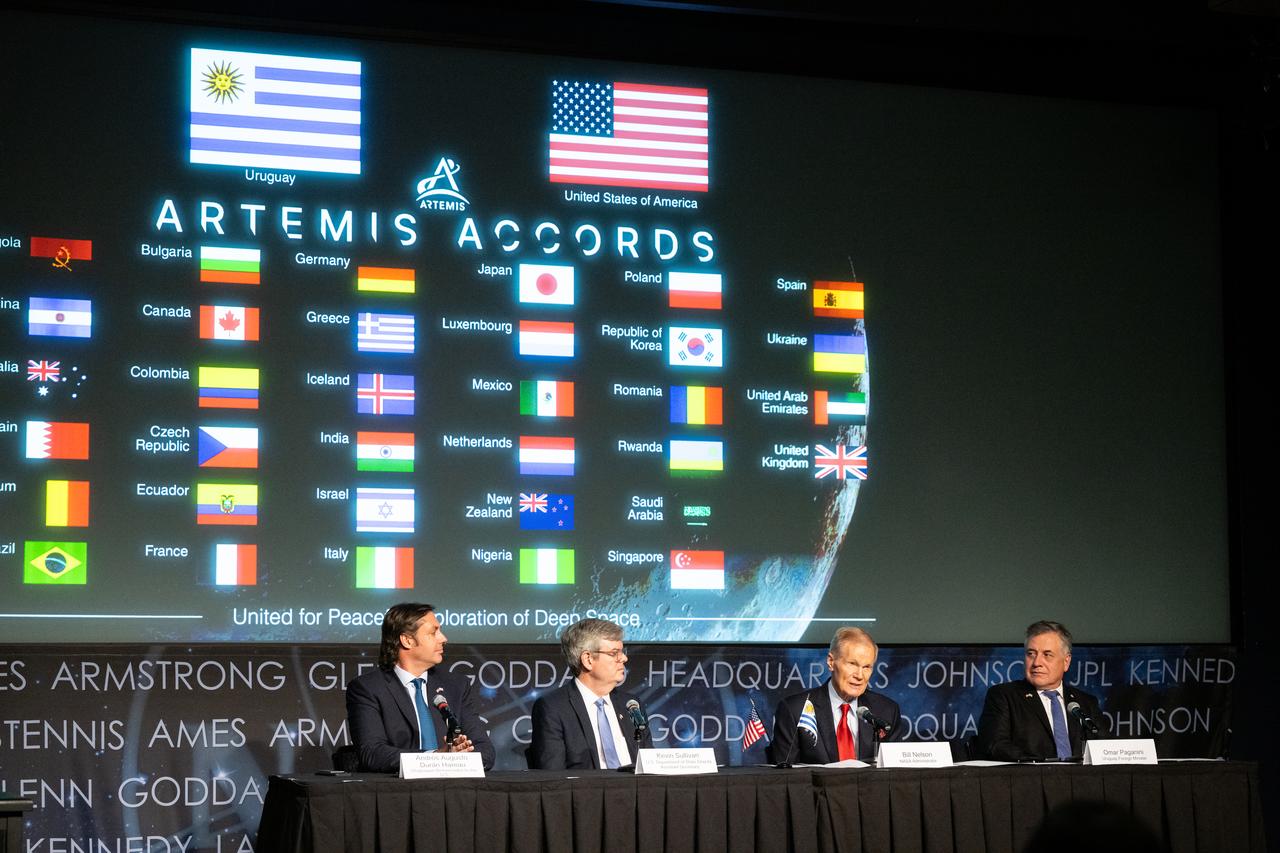
From left to right, Uruguayan Ambassador to the United States Andrés Augusto Durán Hareau, U.S. Department of State Deputy Assistant Secretary Kevin Sullivan, NASA Administrator Bill Nelson, and Uruguayan Foreign Minister Omar Paganini are seen during an Artemis Accords signing ceremony, Thursday, Feb. 15, 2024, at the Mary W. Jackson NASA Headquarters building in Washington. Uruguay is the 36th country to sign the Artemis Accords, which establish a practical set of principles to guide space exploration cooperation among nations participating in NASA’s Artemis program. Photo Credit: (NASA/Keegan Barber)

From left to right, Uruguayan Ambassador to the United States Andrés Augusto Durán Hareau, U.S. Department of State Deputy Assistant Secretary Kevin Sullivan, NASA Administrator Bill Nelson, and Uruguayan Foreign Minister Omar Paganini are seen during an Artemis Accords signing ceremony, Thursday, Feb. 15, 2024, at the Mary W. Jackson NASA Headquarters building in Washington. Uruguay is the 36th country to sign the Artemis Accords, which establish a practical set of principles to guide space exploration cooperation among nations participating in NASA’s Artemis program. Photo Credit: (NASA/Keegan Barber)
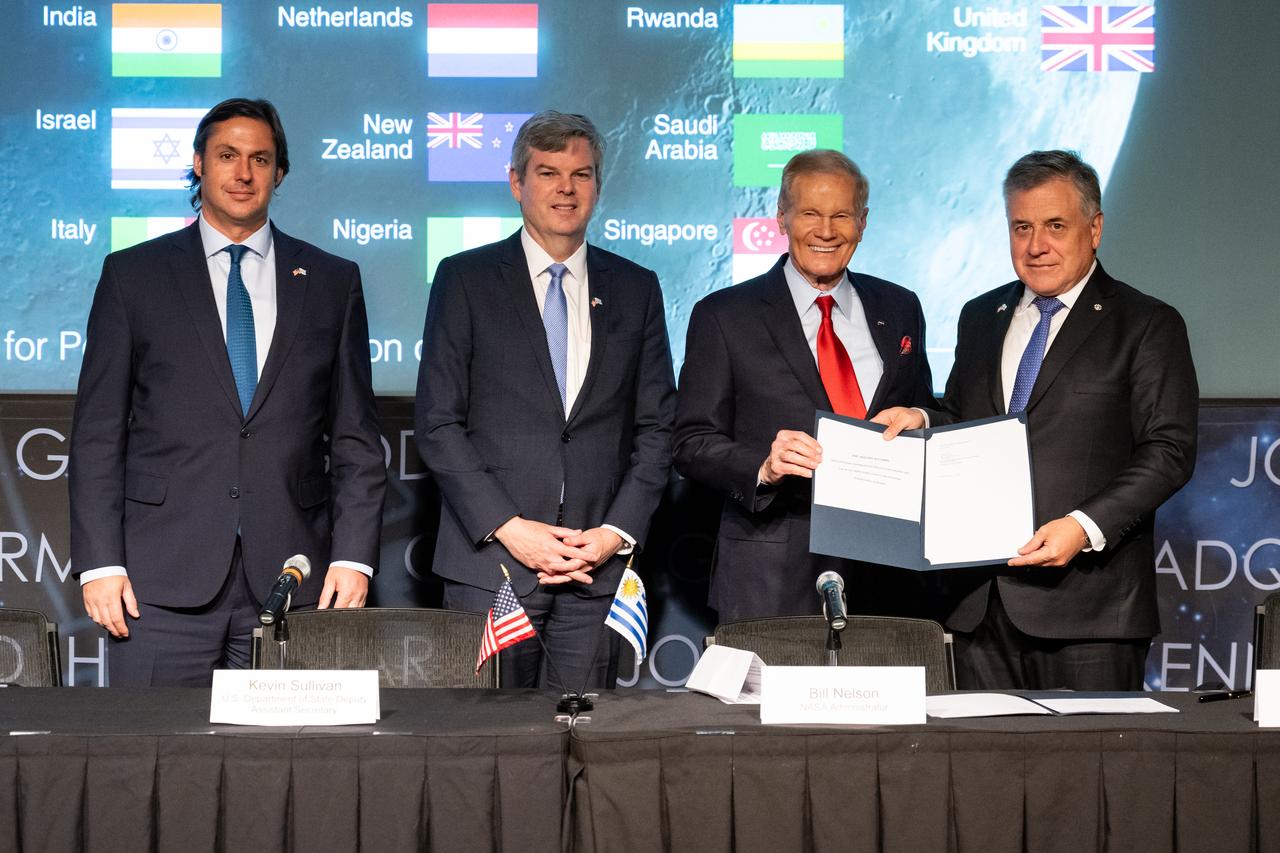
From left to right, Uruguayan Ambassador to the United States Andrés Augusto Durán Hareau, U.S. Department of State Deputy Assistant Secretary Kevin Sullivan, NASA Administrator Bill Nelson, and Uruguayan Foreign Minister Omar Paganini pose for a photo during an Artemis Accords signing ceremony, Thursday, Feb. 15, 2024, at the Mary W. Jackson NASA Headquarters building in Washington. Uruguay is the 36th country to sign the Artemis Accords, which establish a practical set of principles to guide space exploration cooperation among nations participating in NASA’s Artemis program. Photo Credit: (NASA/Keegan Barber)

iss073e0176311 (May 20, 2025) --- Montevideo, Uruguay, the South American nation's capital and largest city with a population of about 1.28 million on the bank of the Rio de la Plata, is pictured at approximately 4:43 a.m. local time from the International Space Station as it orbited 267 miles above.
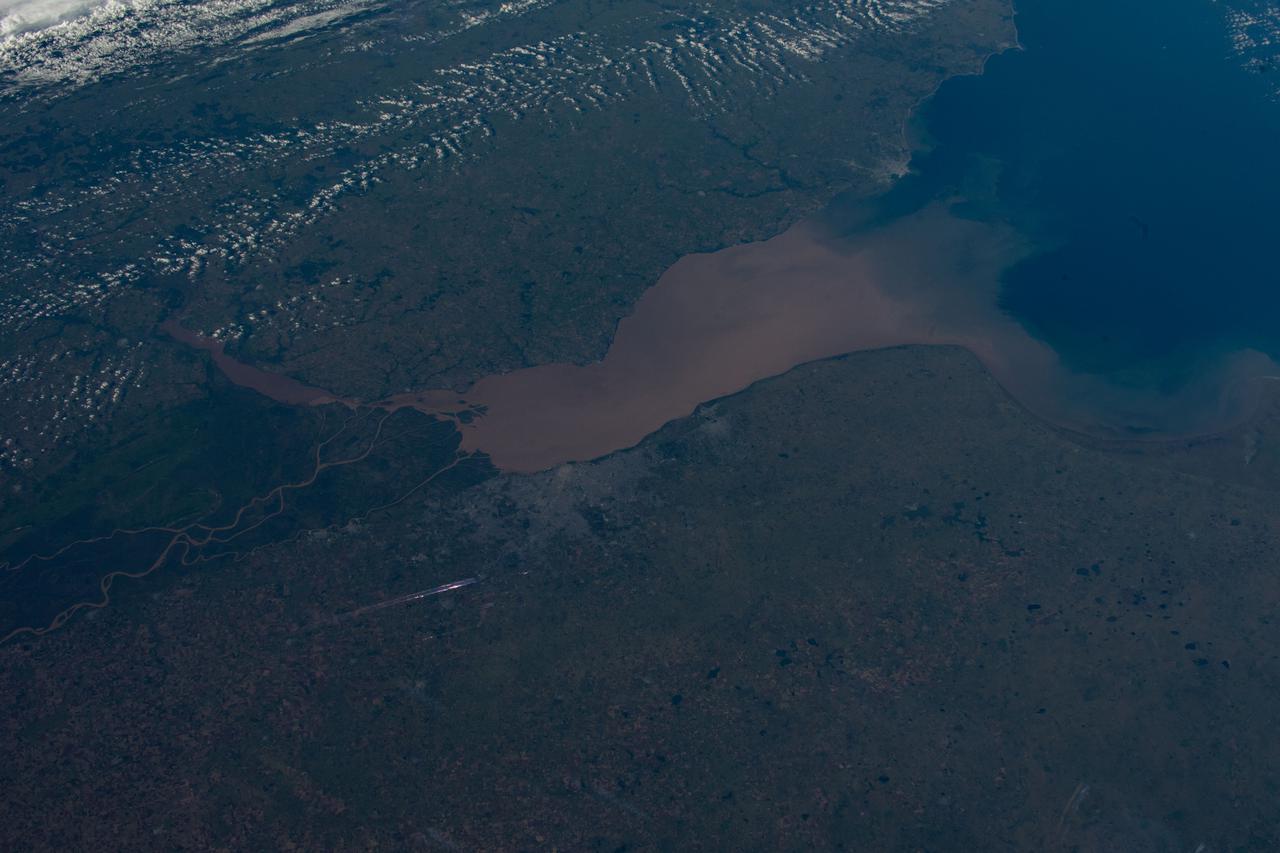
iss067e031912 (April 27, 2022) --- The Rio de la Plata separates the nations of Argentina (bottom) and Uruguay (top) in this photograph from the International Space Station as it orbited 269 miles above. Barely visible in the fertile lowlands of South America, are the populous cities of Buenos Aires, Argentina (center), and Montevideo, Uruguay (upper right).
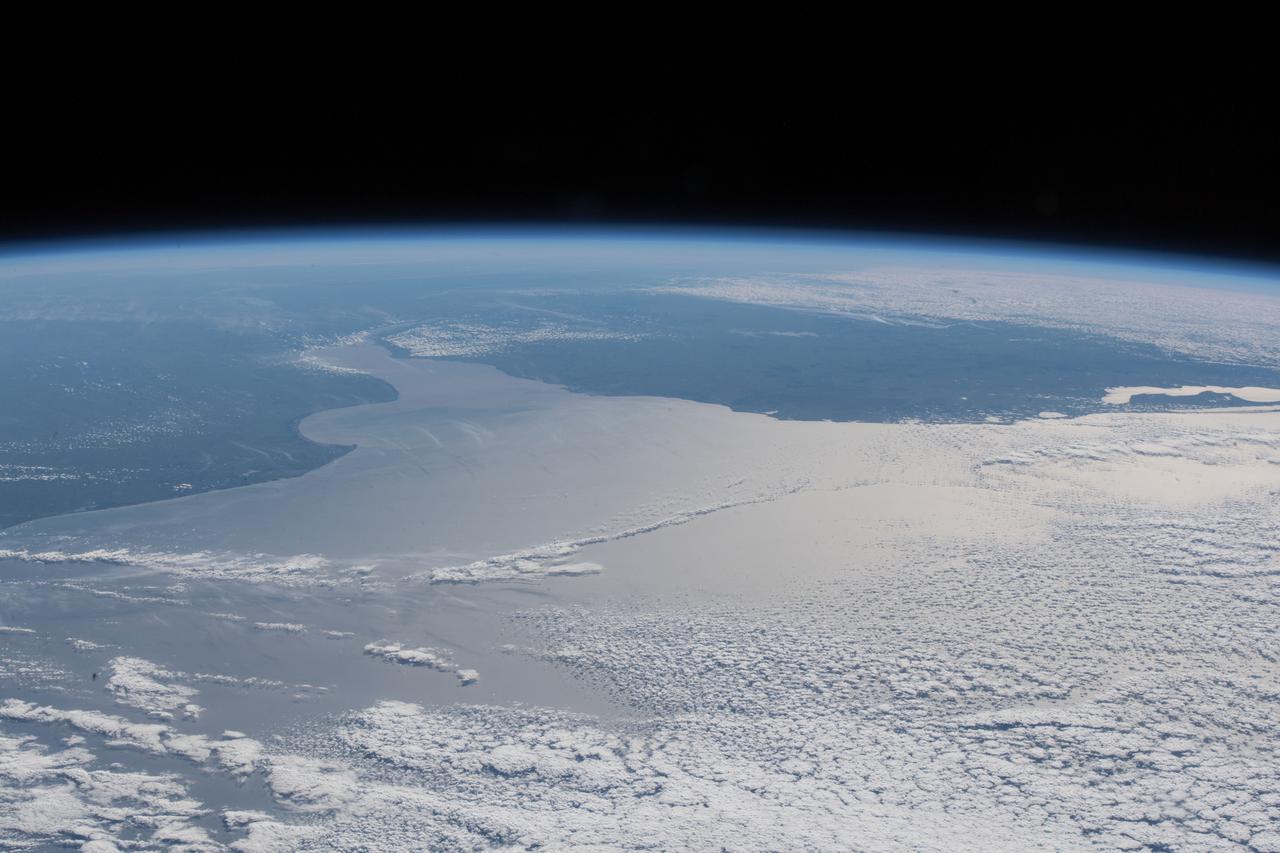
iss055e070222 (May 12, 2018) --- The Rio de la Plata and the Atlantic coasts of Argentina, Uruguay and Brazil are pictured from the International Space Station.
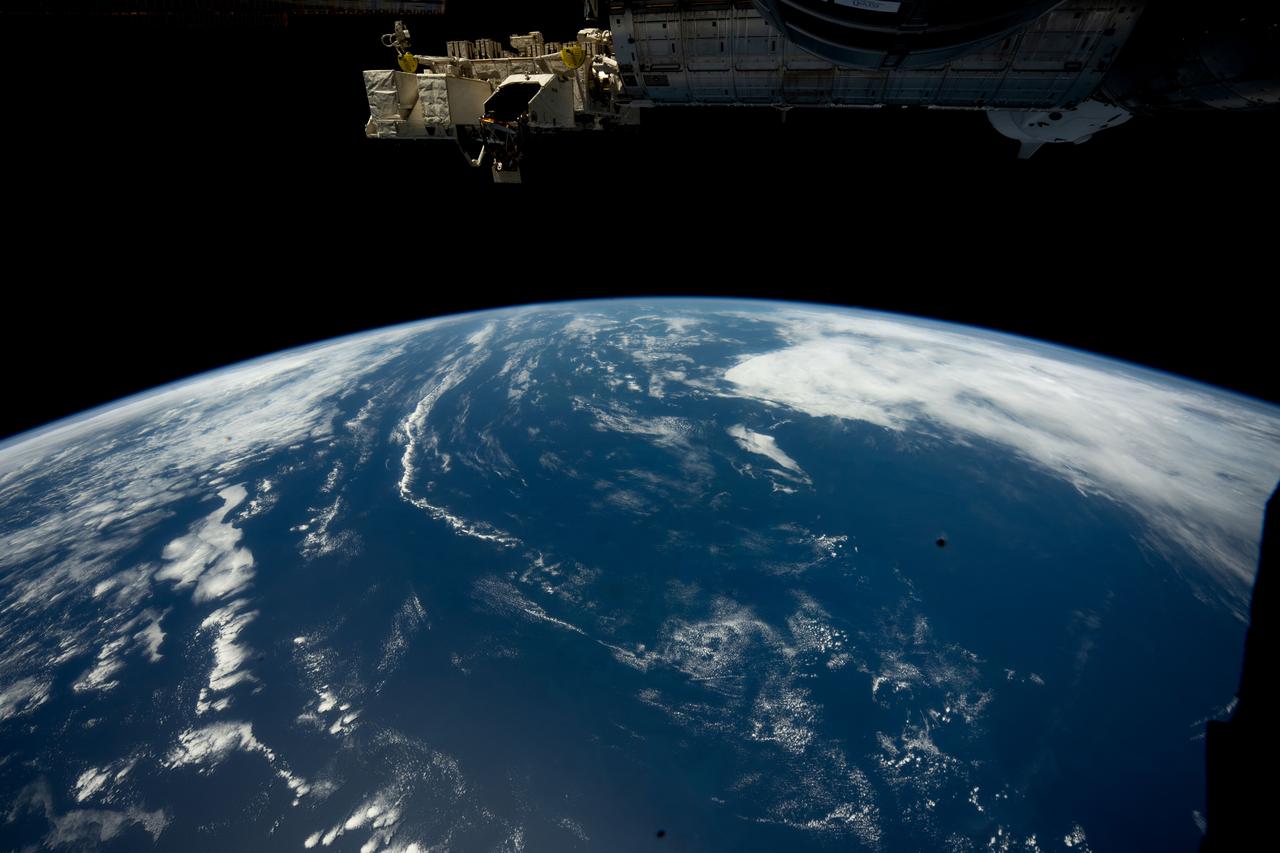
iss072e143657 (Nov. 1, 2024) -- The International Space Station soared 264 miles above the South Atlantic Ocean off the coast of Uruguay as this photograph was taken.
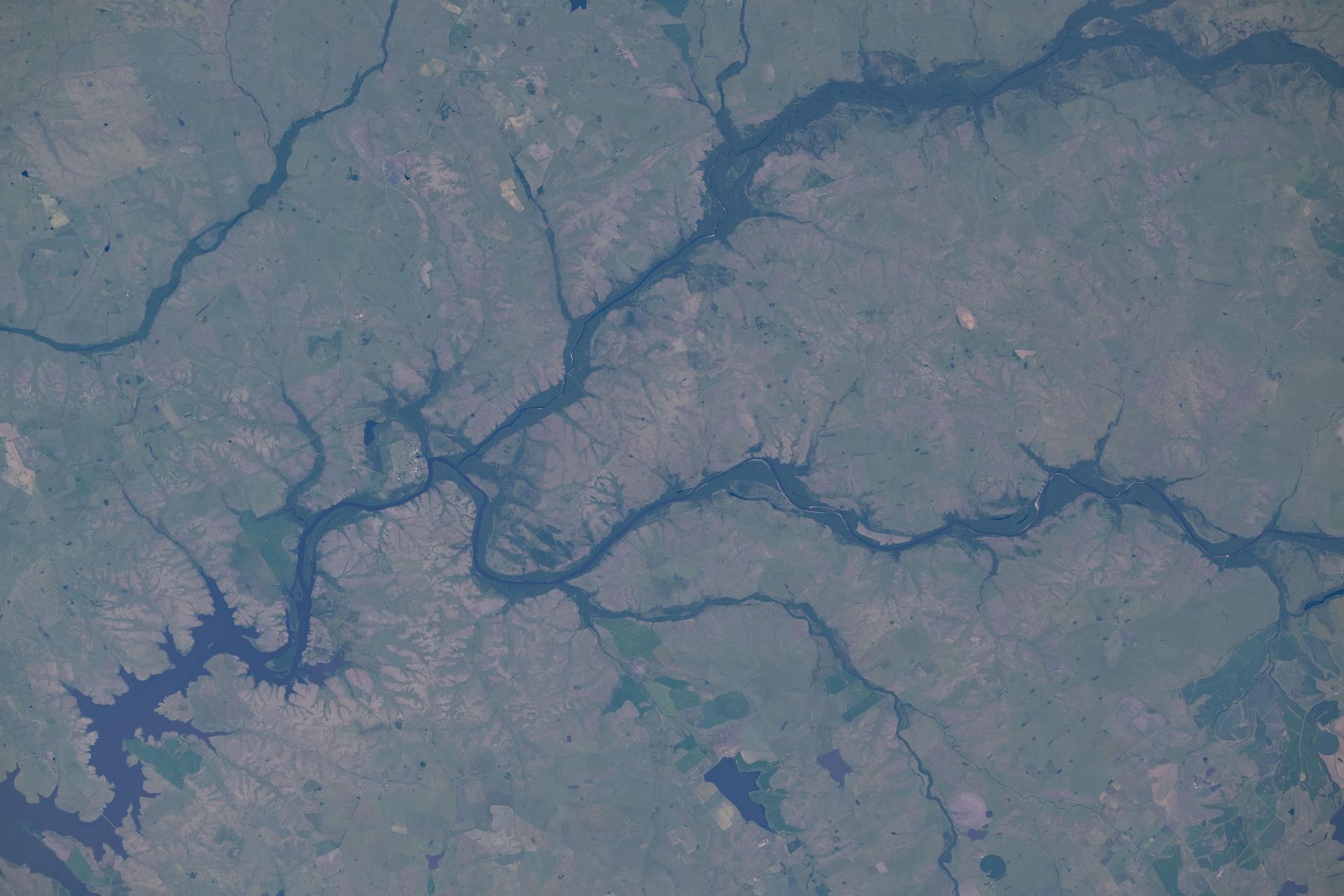
iss074e0046046 (Jan. 5, 2025) --- The Arapey Grande River splits into its tributary, the Arapey Chico River, in northern Uruguay within the Arapey Grande Basin—a region characterized by rolling hills, natural grasslands, and dense woodlands that support a biodiverse ecosystem. The International Space Station was orbiting 268 miles above the Brazil–Uruguay border when this photograph was taken. Credit: NASA/Chris Williams
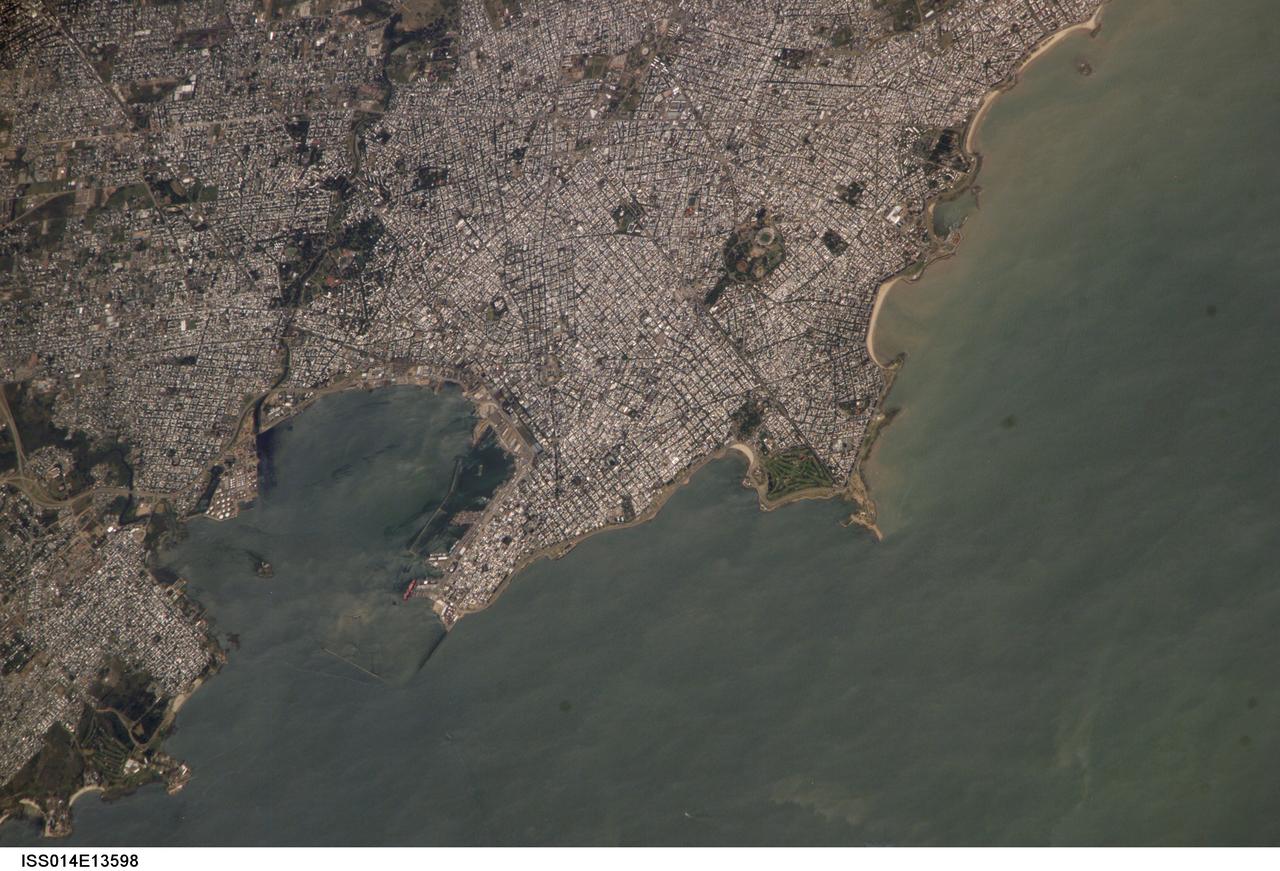
ISS014-E-13598 (29 Jan. 2007) --- Montevideo, Uruguay is featured in this image photographed by an Expedition 14 crewmember on the International Space Station. Reflective roofing materials and dark asphalt streets outline the urban grid pattern of Uruguay's capital city of Montevideo in this image. The city may be viewed as a precursor of the predicted global population shift from dominantly rural to urban environments (by 2030, according to recent United Nations estimates) -- nearly half of Uruguay's total population now lives in the Montevideo metropolitan area. Located on the southern coastline of Uruguay along the Rio de la Plata, Montevideo Bay provides an important harbor and port facilities for transport of South American agricultural products. This view is of sufficient resolution (approximately 7 meters/pixel) to discriminate between dark green canopied tree cover and light green grass - important information for study of urban ecology and climate, as well as city water use planning - in a large golf course located at the southern edge of the city (near center right). Sediment plumes along the coastline to the southeast of the city are also visible; rough patterns in the water surface of Montevideo Bay and the Rio de la Plata are a combination of wind disturbance and sediments.
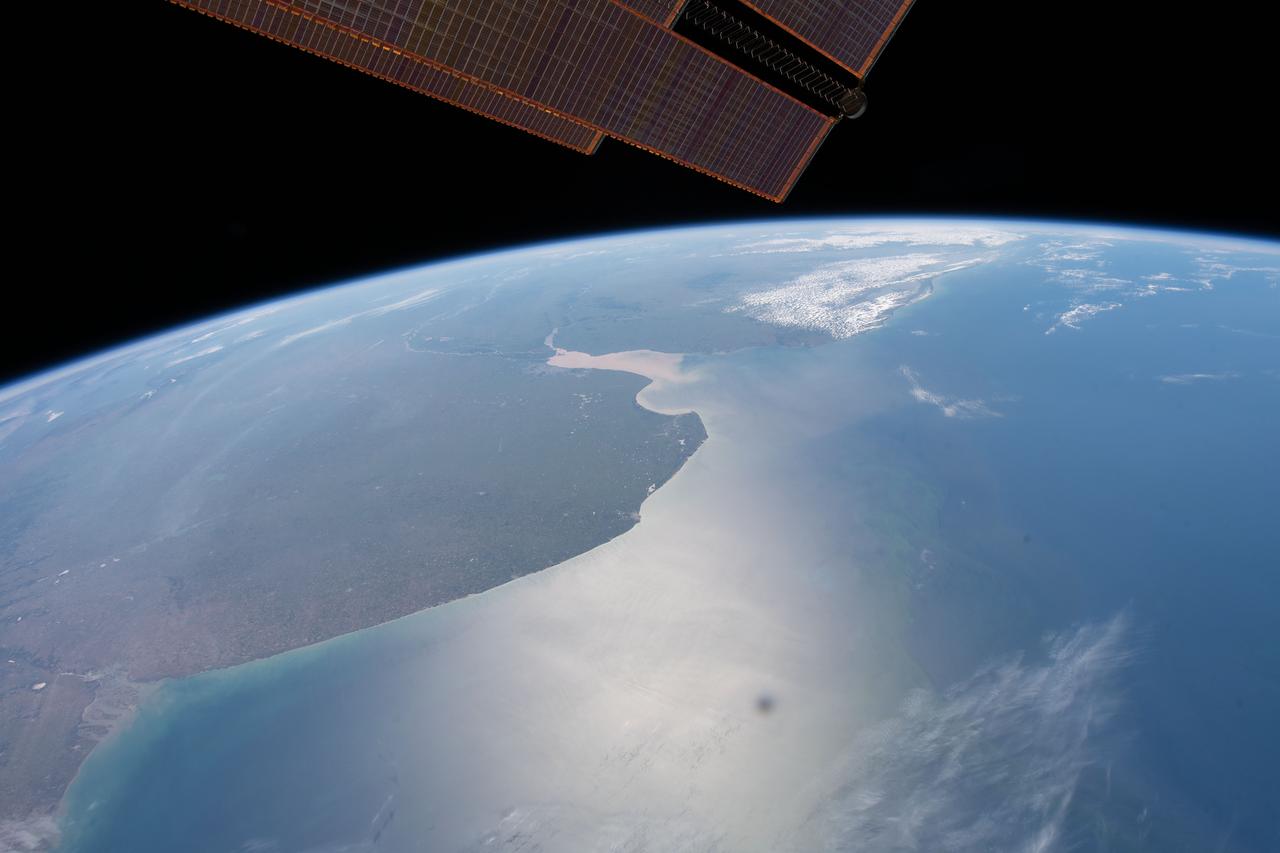
iss062e105694 (March 23, 2020) --- The Rio de la Plata in South America separates the nations of Argentina and Uruguay and was pictured as the International Space Station orbited above the Atlantic Ocean
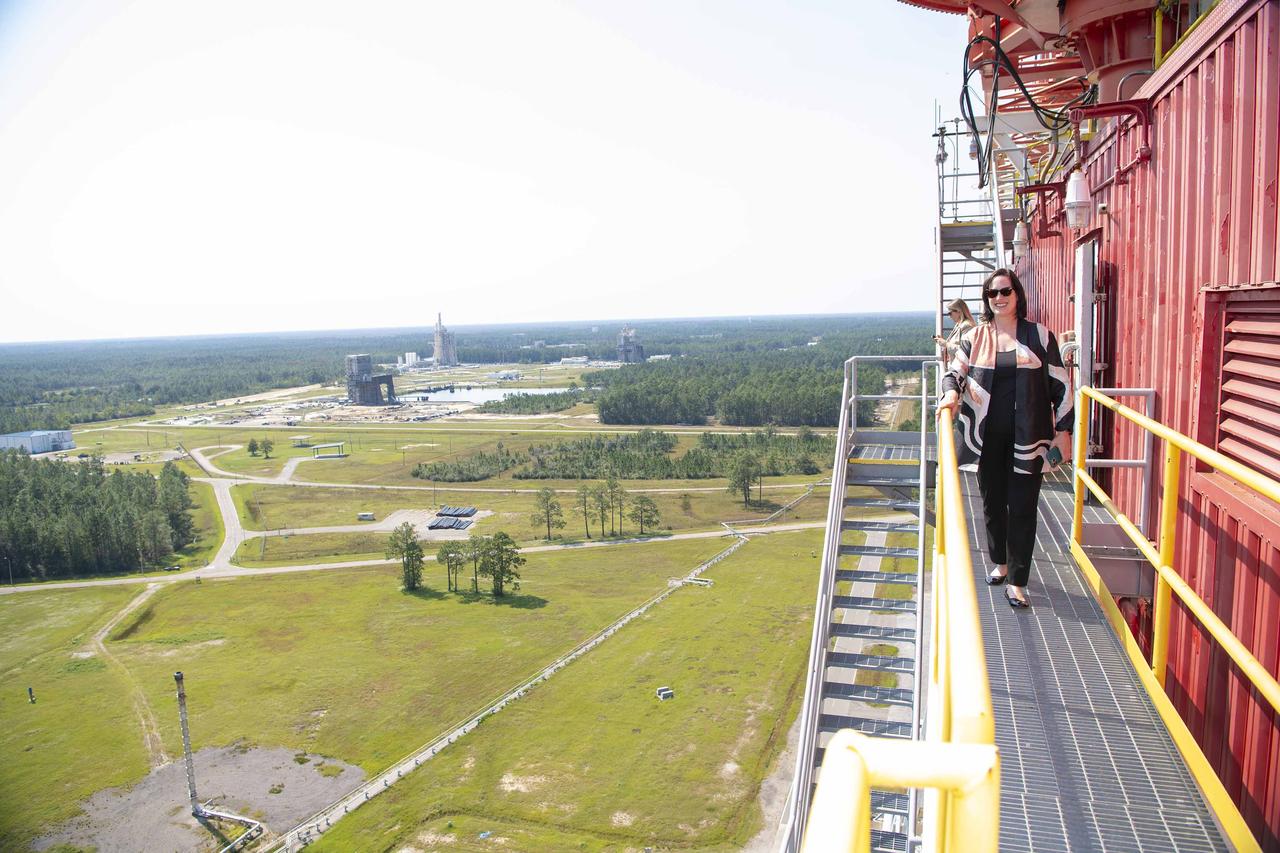
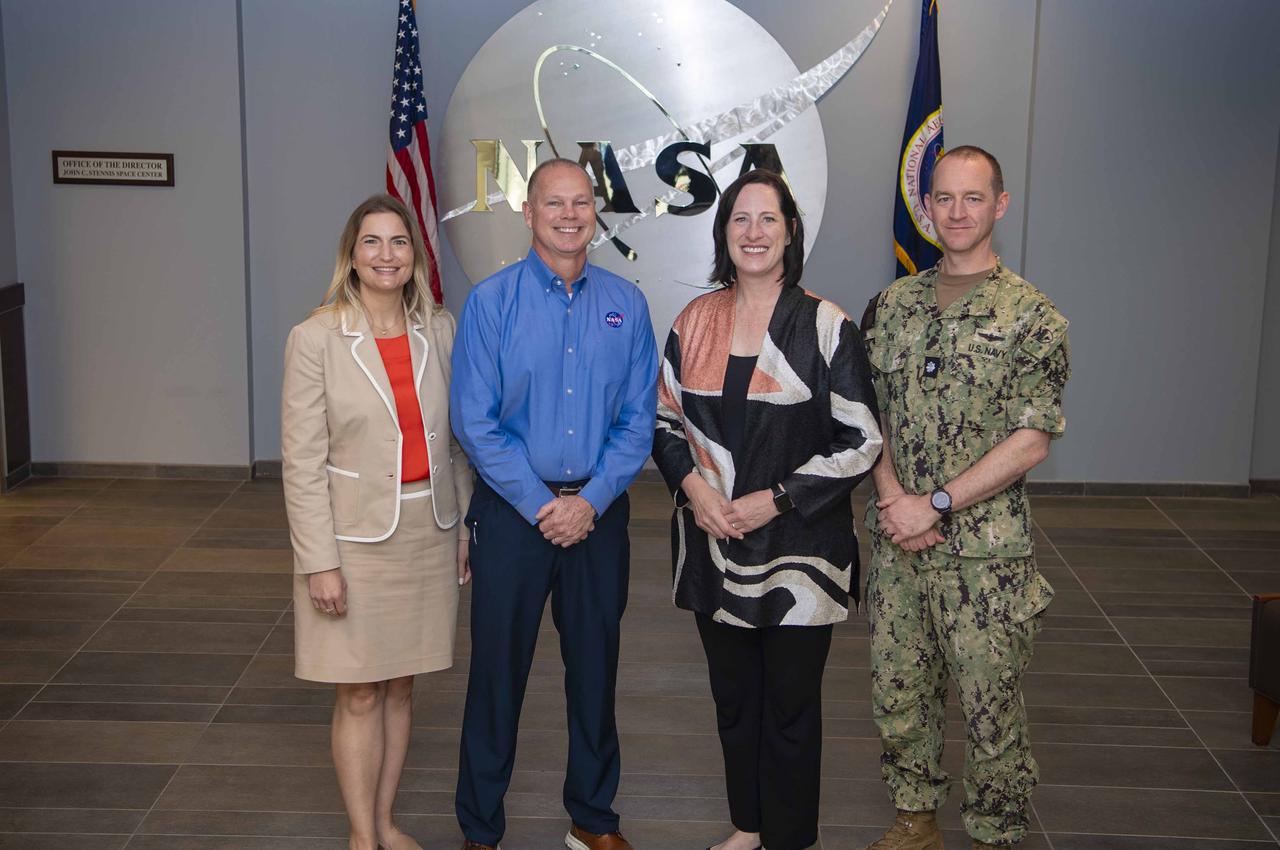
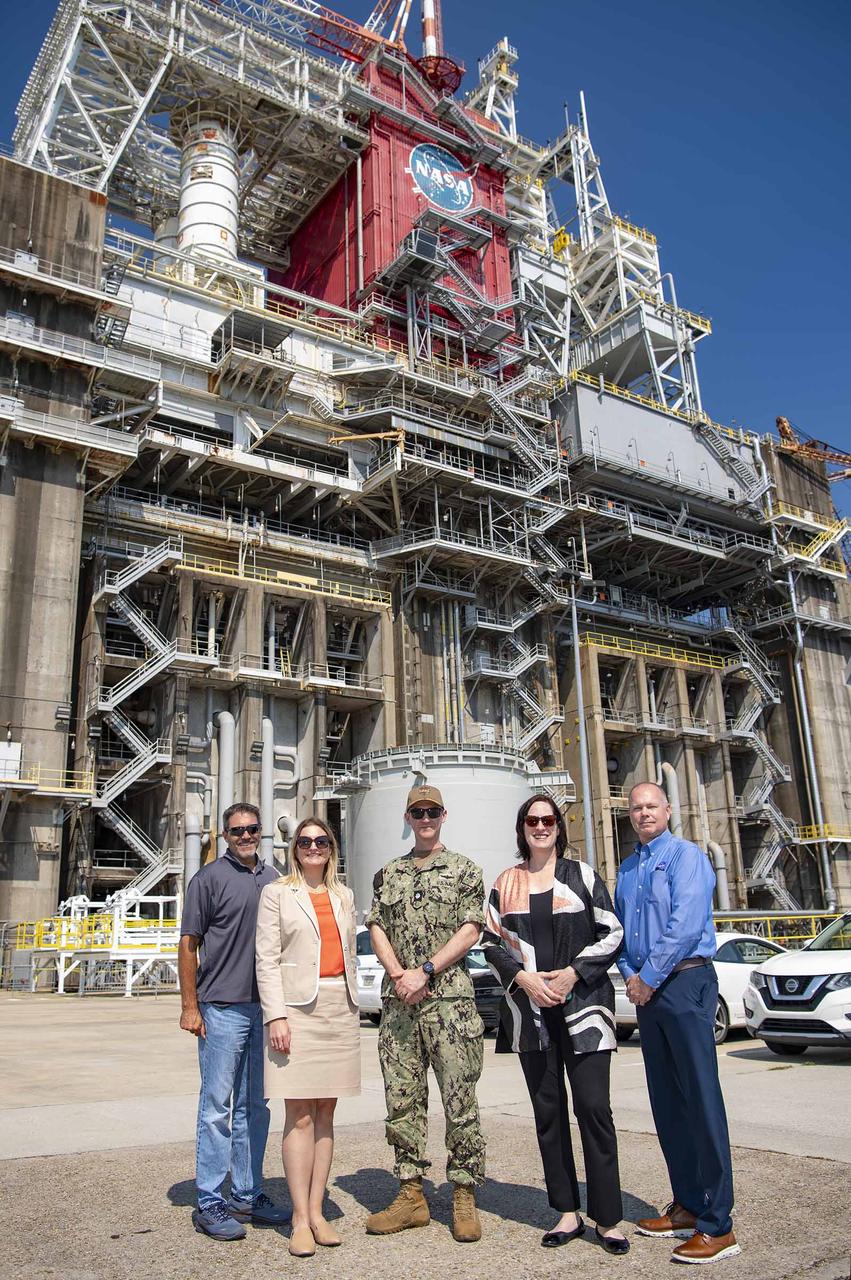
Heide Fulton, U.S. Ambassador to the Oriental Republic of Uruguay, visits NASA Stennis on Oct. 8 to meet with site leadership and tour test complex facilities. During her visit, Fulton met with NASA Stennis Director John Bailey and other leaders of the center and the NASA Shared Services Center located onsite. She also toured the rocket propulsion test complex, visiting the B-2 side of the Thad Cochran Test Stand, where she was briefed by B-2 Stand Director Ryan Roberts about NASA Stennis testing for the SLS (Space Launch System) rocket and NASA’s Artemis missions to the Moon and beyond. Uruguay is one of 45 nations who have signed the Artemis Accords, which establish a practical set of principles to guide space exploration cooperation among nations. The country became the 36th nation to sign the Artemis Accords during a Washington, D.C. ceremony in February. Ambassador Fulton was joined on the visit by Cmdr. Brendan Rok, chief of the U.S. Navy Office of Defense Cooperation at the U.S. Embassy in Montevideo, Uruguay; and Leah Thorstenson, foreign policy advisor with the U.S. Marines Corps. Forces South.
Heide Fulton, U.S. Ambassador to the Oriental Republic of Uruguay, visits NASA Stennis on Oct. 8 to meet with site leadership and tour test complex facilities. During her visit, Fulton met with NASA Stennis Director John Bailey and other leaders of the center and the NASA Shared Services Center located onsite. She also toured the rocket propulsion test complex, visiting the B-2 side of the Thad Cochran Test Stand, where she was briefed by B-2 Stand Director Ryan Roberts about NASA Stennis testing for the SLS (Space Launch System) rocket and NASA’s Artemis missions to the Moon and beyond. Uruguay is one of 45 nations who have signed the Artemis Accords, which establish a practical set of principles to guide space exploration cooperation among nations. The country became the 36th nation to sign the Artemis Accords during a Washington, D.C. ceremony in February. Ambassador Fulton was joined on the visit by Cmdr. Brendan Rok, chief of the U.S. Navy Office of Defense Cooperation at the U.S. Embassy in Montevideo, Uruguay; and Leah Thorstenson, foreign policy advisor with the U.S. Marines Corps. Forces South.
Heide Fulton, U.S. Ambassador to the Oriental Republic of Uruguay, visits NASA Stennis on Oct. 8 to meet with site leadership and tour test complex facilities. During her visit, Fulton met with NASA Stennis Director John Bailey and other leaders of the center and the NASA Shared Services Center located onsite. She also toured the rocket propulsion test complex, visiting the B-2 side of the Thad Cochran Test Stand, where she was briefed by B-2 Stand Director Ryan Roberts about NASA Stennis testing for the SLS (Space Launch System) rocket and NASA’s Artemis missions to the Moon and beyond. Uruguay is one of 45 nations who have signed the Artemis Accords, which establish a practical set of principles to guide space exploration cooperation among nations. The country became the 36th nation to sign the Artemis Accords during a Washington, D.C. ceremony in February. Ambassador Fulton was joined on the visit by Cmdr. Brendan Rok, chief of the U.S. Navy Office of Defense Cooperation at the U.S. Embassy in Montevideo, Uruguay; and Leah Thorstenson, foreign policy advisor with the U.S. Marines Corps. Forces South.
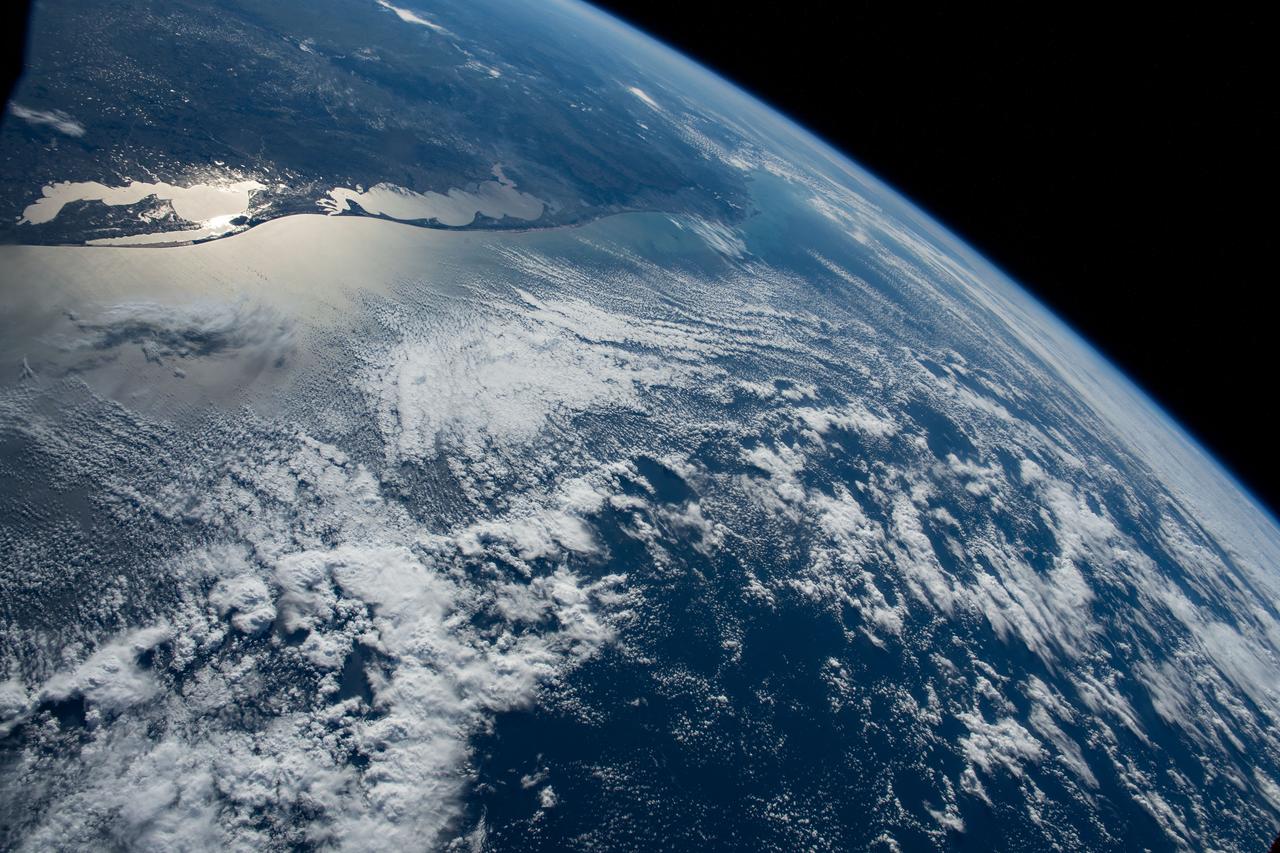
iss063e040041 (July 3, 2020) --- The southern tip of Brazil (upper left) bordering Uruguay was pictured as the International Space Station orbited off the Atlantic coast of South America. The water bodies of Lagoa Mirim, Lagoa Mangueria and Lagoa dos Patos are also seen in this photograph.
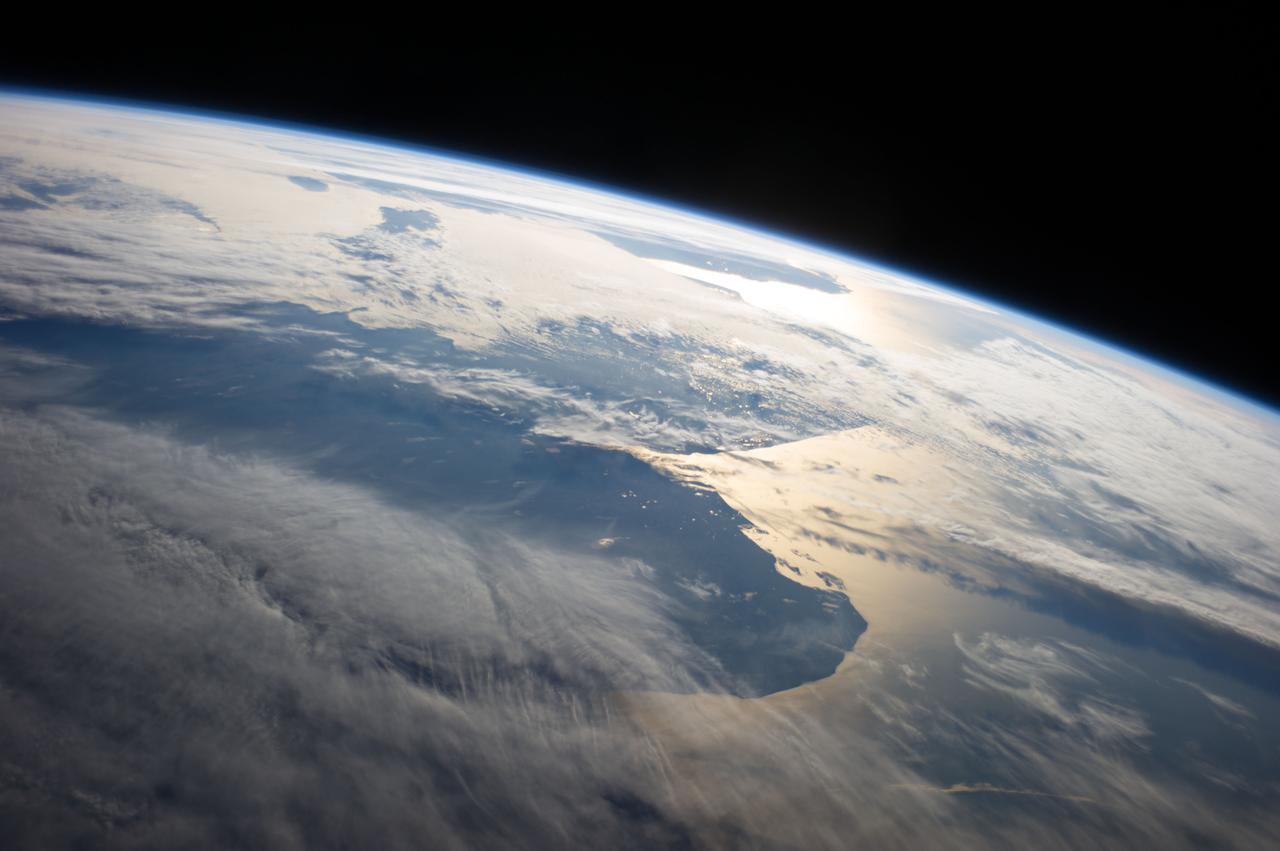
Earth Observation taken during a day pass by the Expedition 40 crew aboard the International Space Station (ISS). Folder lists this as: Uruguay Argentina sun glint coastlines. Also sent down via Twitter message: This was the Argentina coastline a few hours ago.

iss063e033273 (June 28, 2020) --- The International Space Station, with the Progress 74 cargo craft in the foreground, orbited across South America and over the Atlantic Ocean when this photograph was taken of the Rio de la Plata that separates the nations of Argentina and Uruguay.
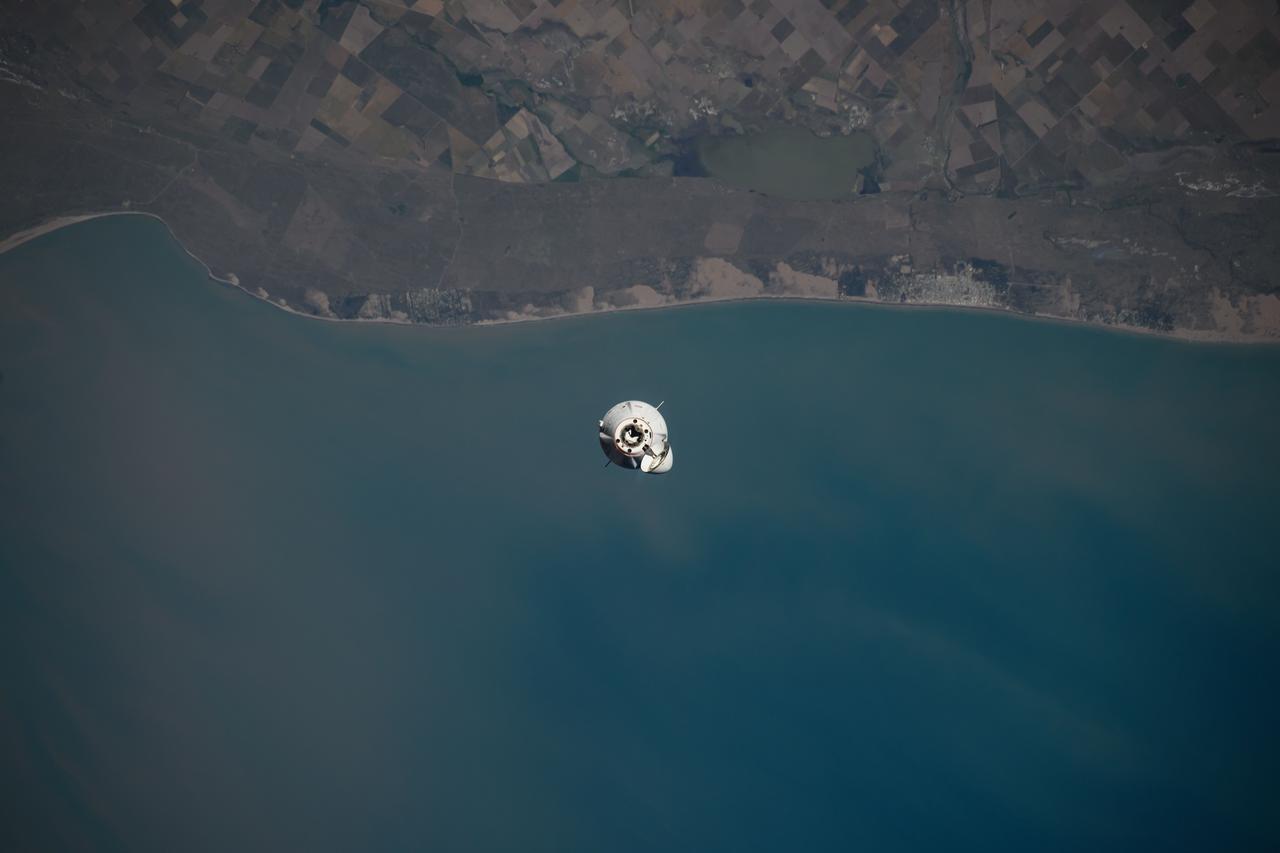
iss072e147436 (Nov. 5, 2024) --- The SpaceX Dragon cargo spacecraft, carrying over 6,000 pounds of science, supplies, and hardware, approaches the International Space Station 265 miles above the Atlantic Ocean off the coast of Uruguay for a docking to its space-facing port on the Harmony module.
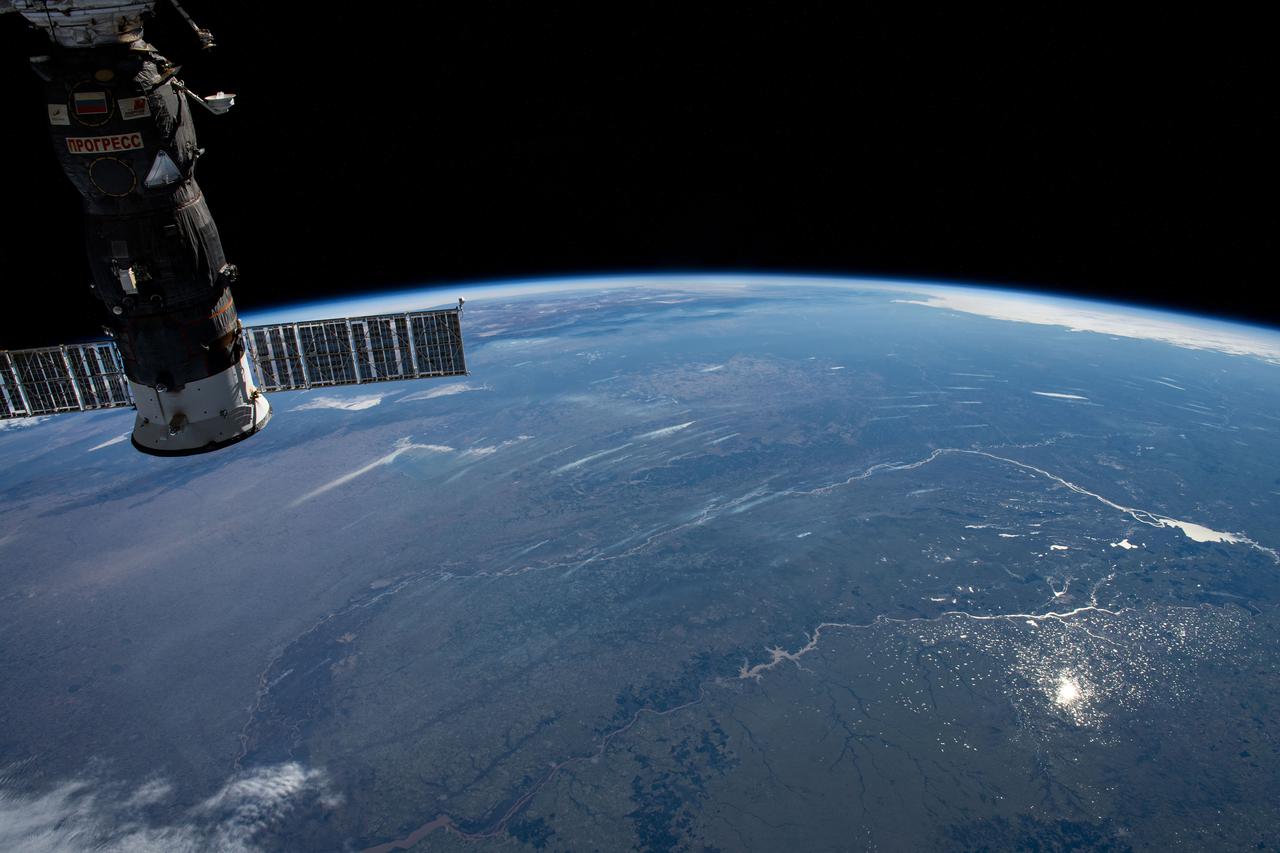
iss063e040037 (July 3, 2020) --- This photograph of the Earth's horizon looks back towards Uruguay as the International Space Station orbited just off the coast of the South American nation. The Progress 75 cargo craft from Russia is pictured in the left foreground.
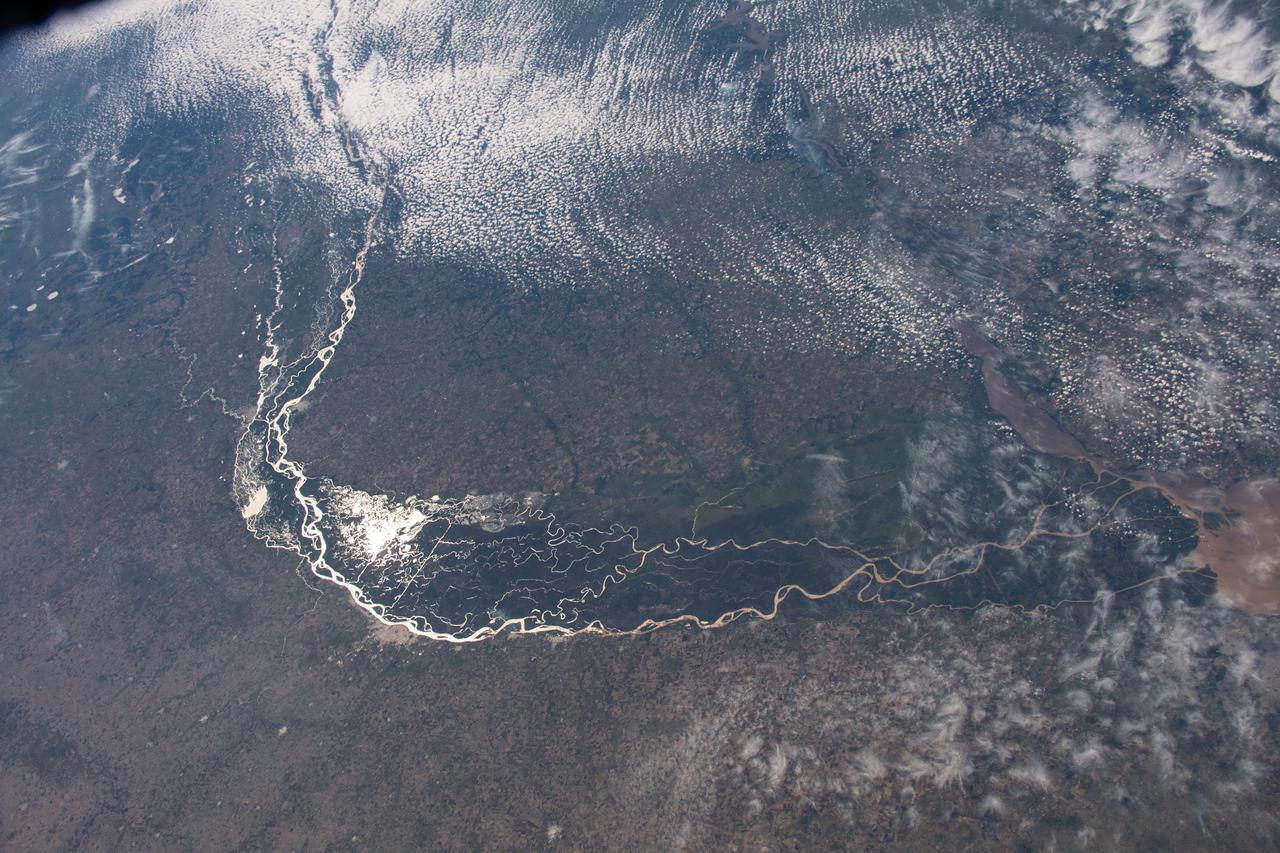
iss067e034812 (May 5, 2022) --- The Paraná River, pictured from the International Space Station at an altitude of 269 miles, leads into the Paraná Delta and empties into the Rio de la Plata which separates Argentina from Uruguay on South America's Atlantic coast. The fertile lowlands region is also known as the Pampas.
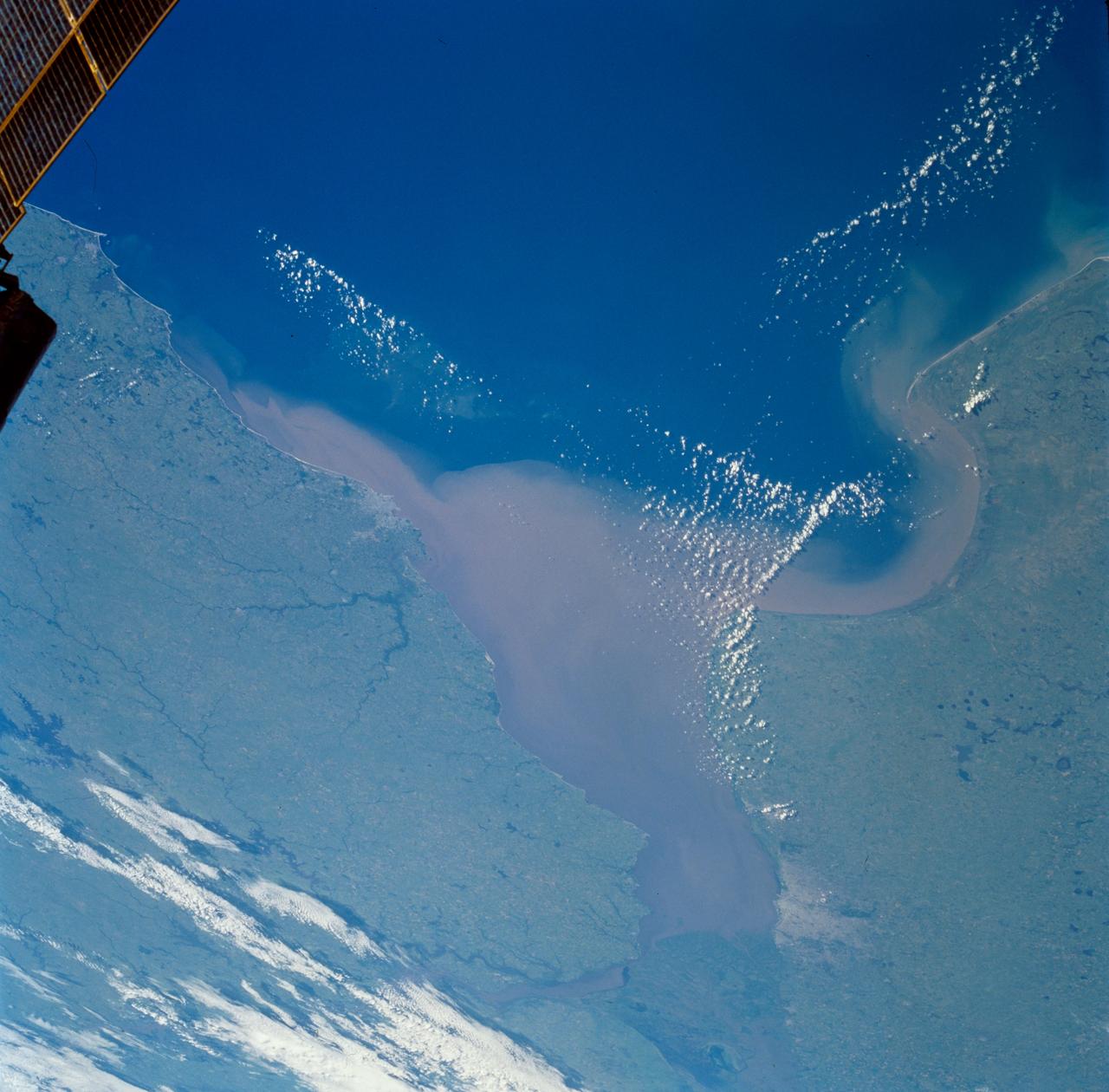
STS089-703-056 (22-31 Jan. 1998) --- This oblique picture of Argentina and other parts of South America was photographed with a 70mm handheld camera from the Earth-orbiting space shuttle Endeavour. Looking westward across the continent, north is toward the upper right corner and the Atlantic Ocean is in the foreground. Rio de la Plata in the center (the confluence of Rio Uruguay and Rio Parana) shows a sediment plume generated by drainage of El Niño rains upslope in the Andean foothills. The sediment plume is possibly more extensive than usual and extends down the coast and out of the bay to the left (south). The city of Buenos Aires, Argentina (population 13 million) is at upper left, and at right center is the city of Montevideo, Uruguay (population 1.2 million). Photo credit: NASA
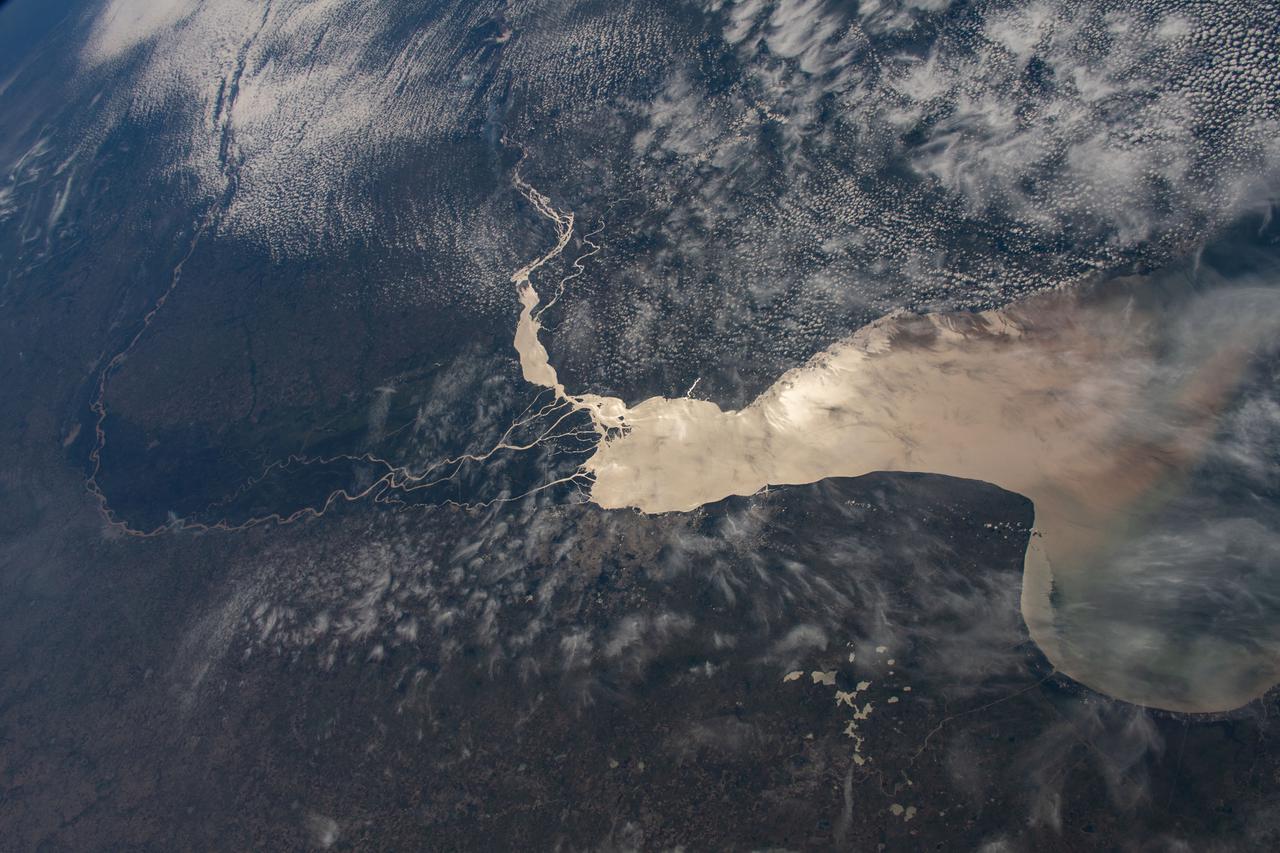
iss067e034832 (May 5, 2022) --- The Rio de la Plata separates the nations of Argentina (bottom) and Uruguay (top) in this photograph from the International Space Station as it orbited 270 miles above. Barely visible (at lower center), is the populous city of Buenos Aires, Argentina, at the mouth of the Paraná Delta which empties in to the Rio de la Plata.
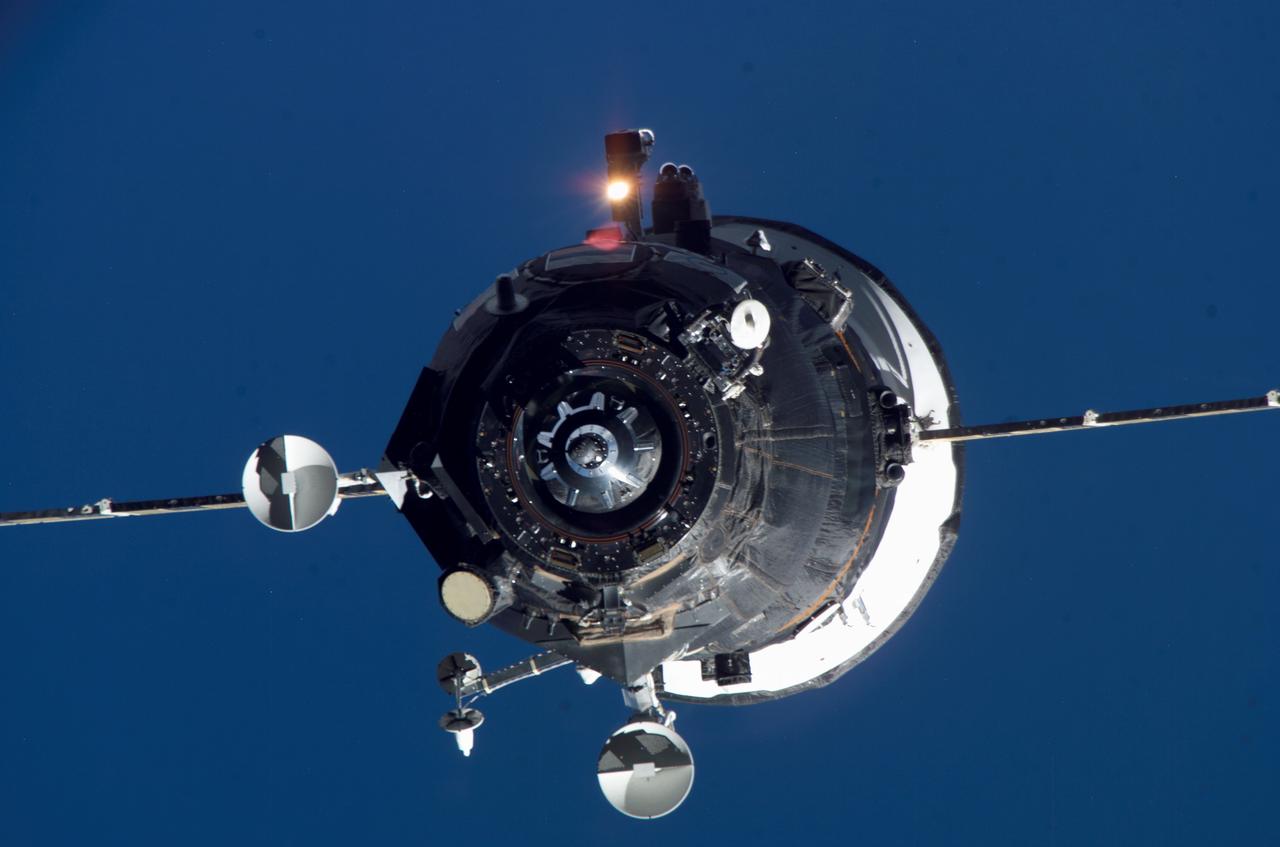
ISS014-E-12364 (19 Jan. 2007) --- Backdropped by a blue Earth, an unpiloted Progress supply vehicle approaches the International Space Station. The Progress 24 resupply craft launched at 8:12 p.m. (CST) on Jan. 17, 2007 from the Baikonur Cosmodrome in Kazakhstan to deliver 2.5 tons of food, fuel, oxygen and other supplies to the Expedition 14 crewmembers onboard the station. Progress automatically docked to the Pirs Docking Compartment at 8:59 p.m. (CST) on Jan. 19 as the spacecraft and the station flew approximately 220 miles above a point near the South Atlantic off the southeast coast of Uruguay.
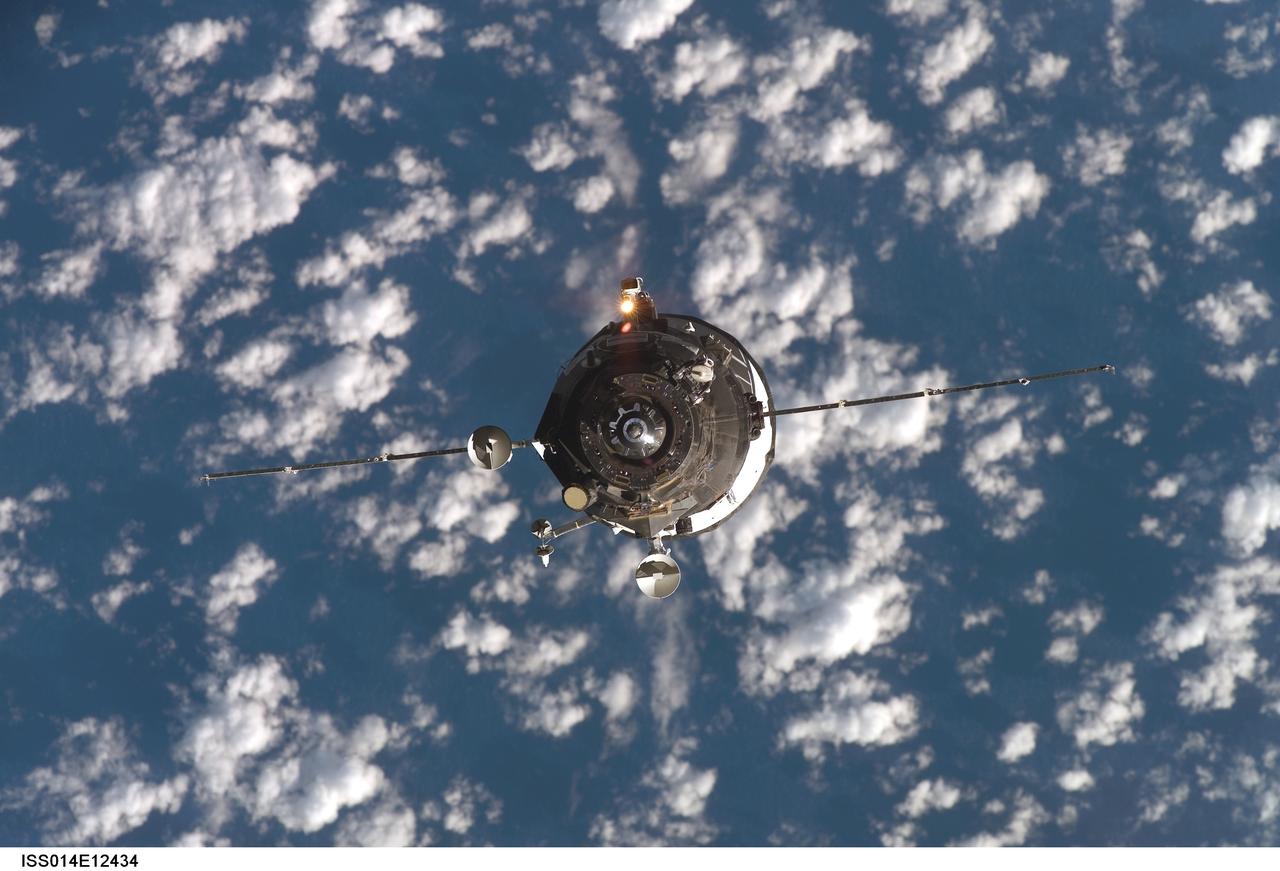
ISS014-E-12434 (19 Jan. 2007) --- Backdropped by a blue and white Earth, an unpiloted Progress supply vehicle approaches the International Space Station. The Progress 24 resupply craft launched at 8:12 p.m. (CST) on Jan. 17, 2007 from the Baikonur Cosmodrome in Kazakhstan to deliver 2.5 tons of food, fuel, oxygen and other supplies to the Expedition 14 crewmembers onboard the station. Progress automatically docked to the Pirs Docking Compartment at 8:59 p.m. (CST) on Jan. 19 as the spacecraft and the station flew approximately 220 miles above a point near the South Atlantic off the southeast coast of Uruguay.
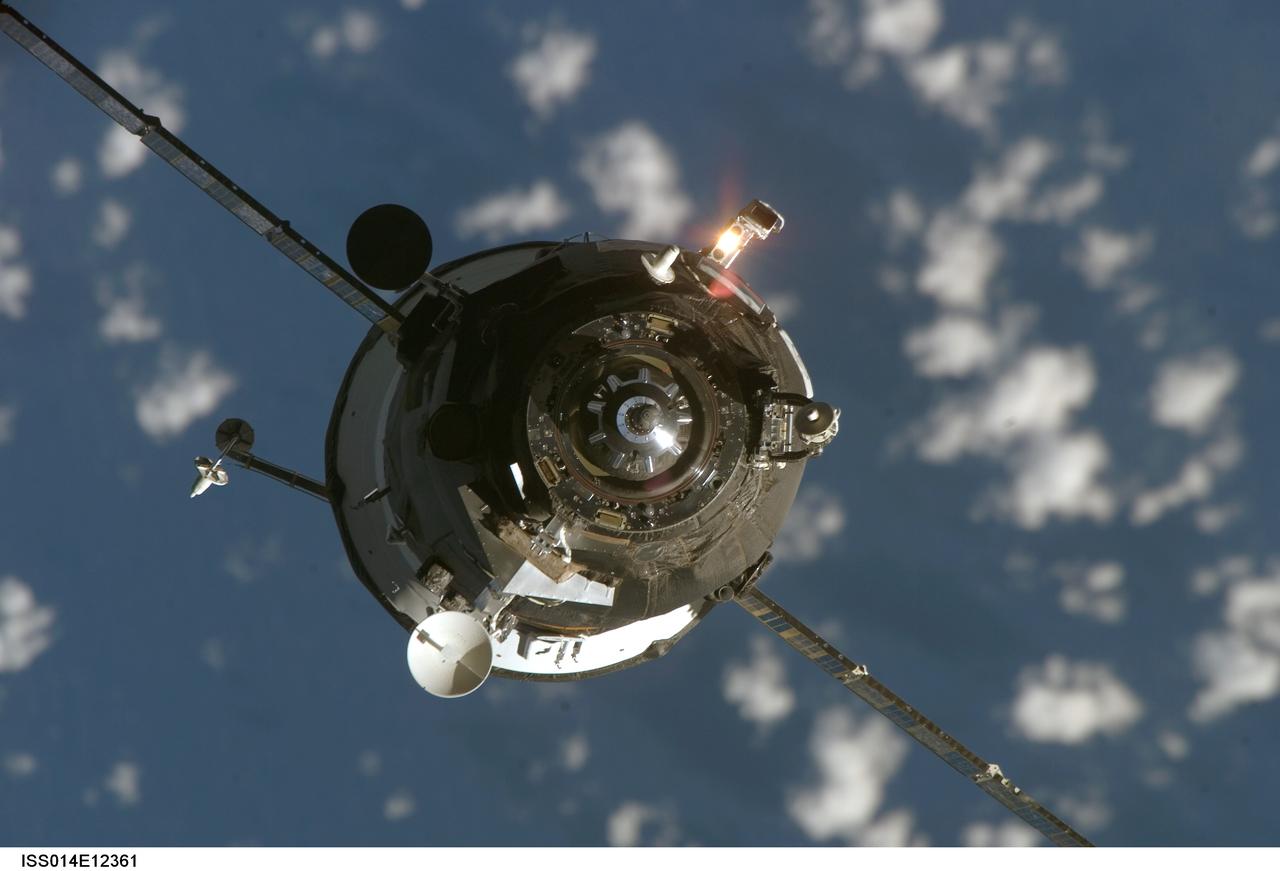
ISS014-E-12361 (19 Jan. 2007) --- Backdropped by a sprinkling of small clouds over a blue Earth, an unpiloted Progress supply vehicle approaches the International Space Station. The Progress 24 resupply craft launched at 8:12 p.m. (CST) on Jan. 17, 2007 from the Baikonur Cosmodrome in Kazakhstan to deliver 2.5 tons of food, fuel, oxygen and other supplies to the Expedition 14 crewmembers onboard the station. Progress automatically docked to the Pirs Docking Compartment at 8:59 p.m. (CST) on Jan. 19 as the spacecraft and the station flew approximately 220 miles above a point near the South Atlantic off the southeast coast of Uruguay.
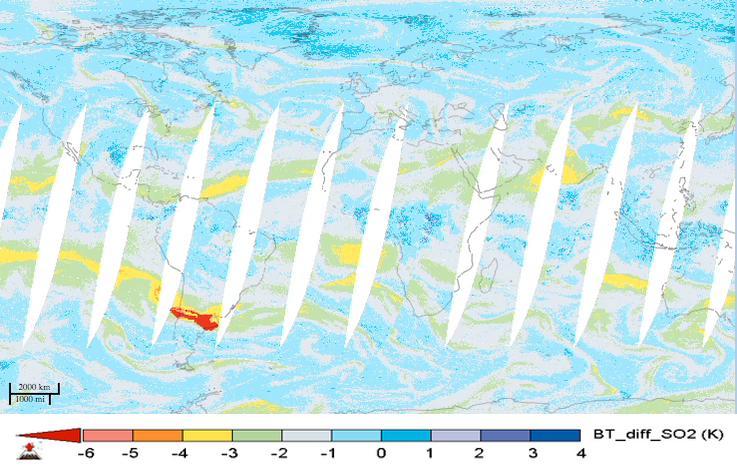
For the first time in 40 years, the Calbuco volcano in southern Chile erupted on April 22, 2015. The eruption caused airline flight cancellations in Chile, Argentina and Uruguay and the evacuation of approximately 4,000 people. This movie shows alternating day and nighttime views of the plume of sulfur dioxide gas emitted by Calbuco, as observed by NASA's Atmospheric Infrared Sounder (AIRS) instrument on NASA's Aqua spacecraft, from April 22 to May 5, 2015. Significant amounts of sulfur dioxide are shown in bright red. The largest plume is apparent over South America during the initial eruption on April 22. The plume is then carried by winds across the south Atlantic Ocean and southern Africa. A second large eruption on April 29 produced a smaller plume. Volcanic sulfur dioxide can be an important factor in climate. Some of it is carried into Earth's stratosphere, where it is transformed into highly reflective droplets of sulfuric acid. By reflecting sunlight, these droplets can cool Earth. Large eruptions, like Mt. Pinatubo in 1991, cool our planet and disrupt rainfall patterns. Though an impressive eruption, Calbuco is expected to have only a small impact on Earth's climate. http://photojournal.jpl.nasa.gov/catalog/PIA19385