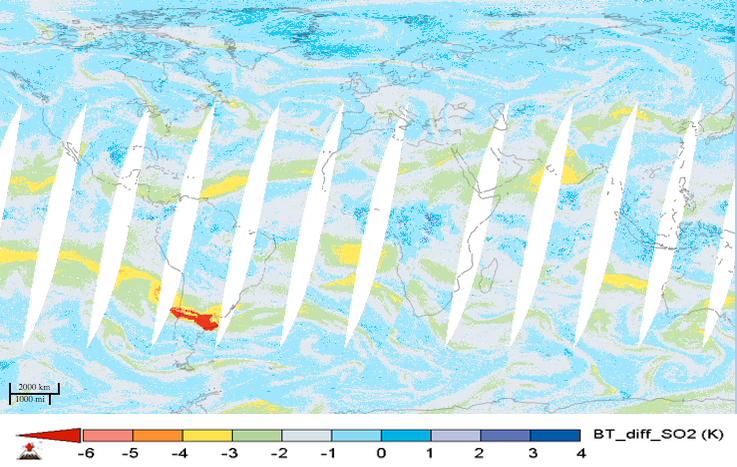
For the first time in 40 years, the Calbuco volcano in southern Chile erupted on April 22, 2015. The eruption caused airline flight cancellations in Chile, Argentina and Uruguay and the evacuation of approximately 4,000 people. This movie shows alternating day and nighttime views of the plume of sulfur dioxide gas emitted by Calbuco, as observed by NASA's Atmospheric Infrared Sounder (AIRS) instrument on NASA's Aqua spacecraft, from April 22 to May 5, 2015. Significant amounts of sulfur dioxide are shown in bright red. The largest plume is apparent over South America during the initial eruption on April 22. The plume is then carried by winds across the south Atlantic Ocean and southern Africa. A second large eruption on April 29 produced a smaller plume. Volcanic sulfur dioxide can be an important factor in climate. Some of it is carried into Earth's stratosphere, where it is transformed into highly reflective droplets of sulfuric acid. By reflecting sunlight, these droplets can cool Earth. Large eruptions, like Mt. Pinatubo in 1991, cool our planet and disrupt rainfall patterns. Though an impressive eruption, Calbuco is expected to have only a small impact on Earth's climate. http://photojournal.jpl.nasa.gov/catalog/PIA19385