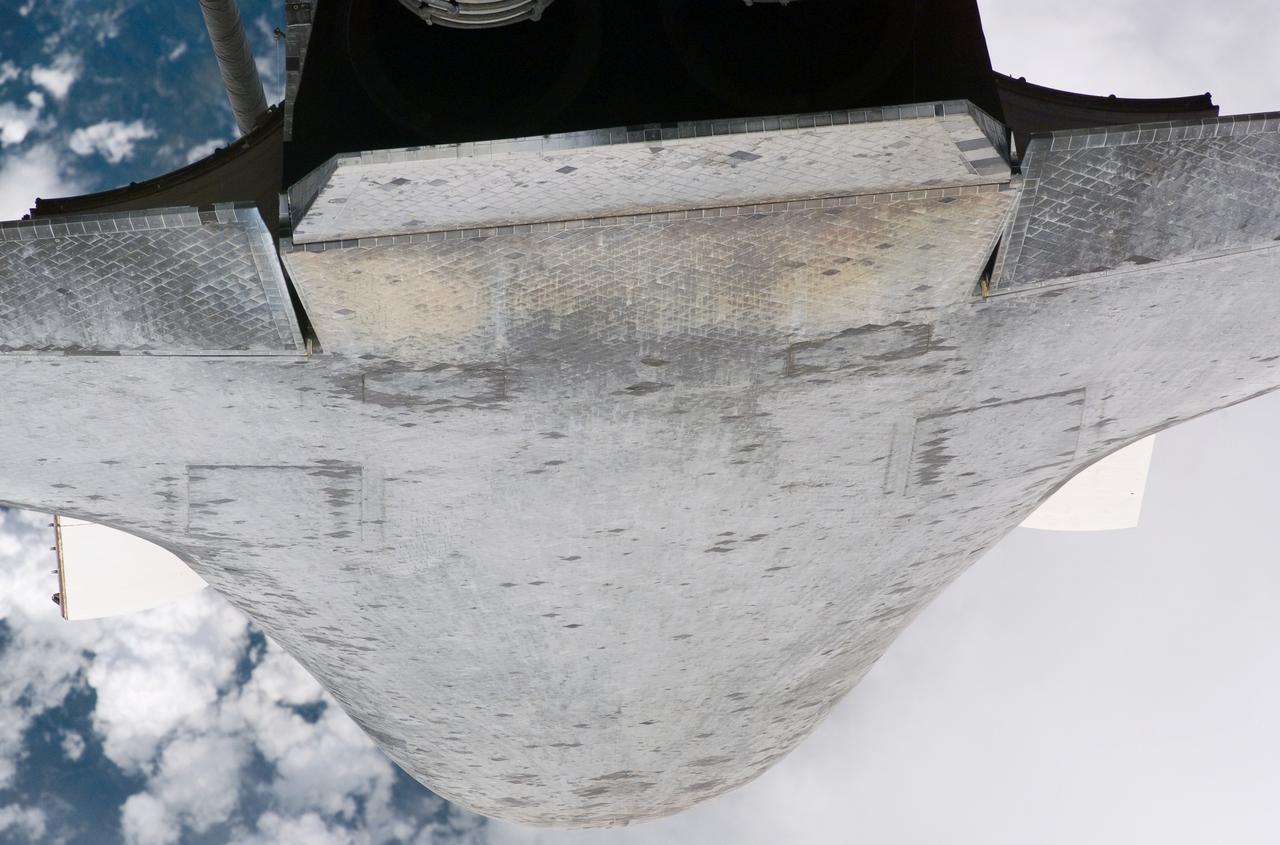
Though very close to the International Space Station, the majority of Discovery's underside is visible in this frame. The image was captured by one of the Expedition 13 crew members onboard the International Space Station (ISS) during the STS-121 Rotating Pitch Maneuver (RPM) survey prior to docking of the two spacecraft.
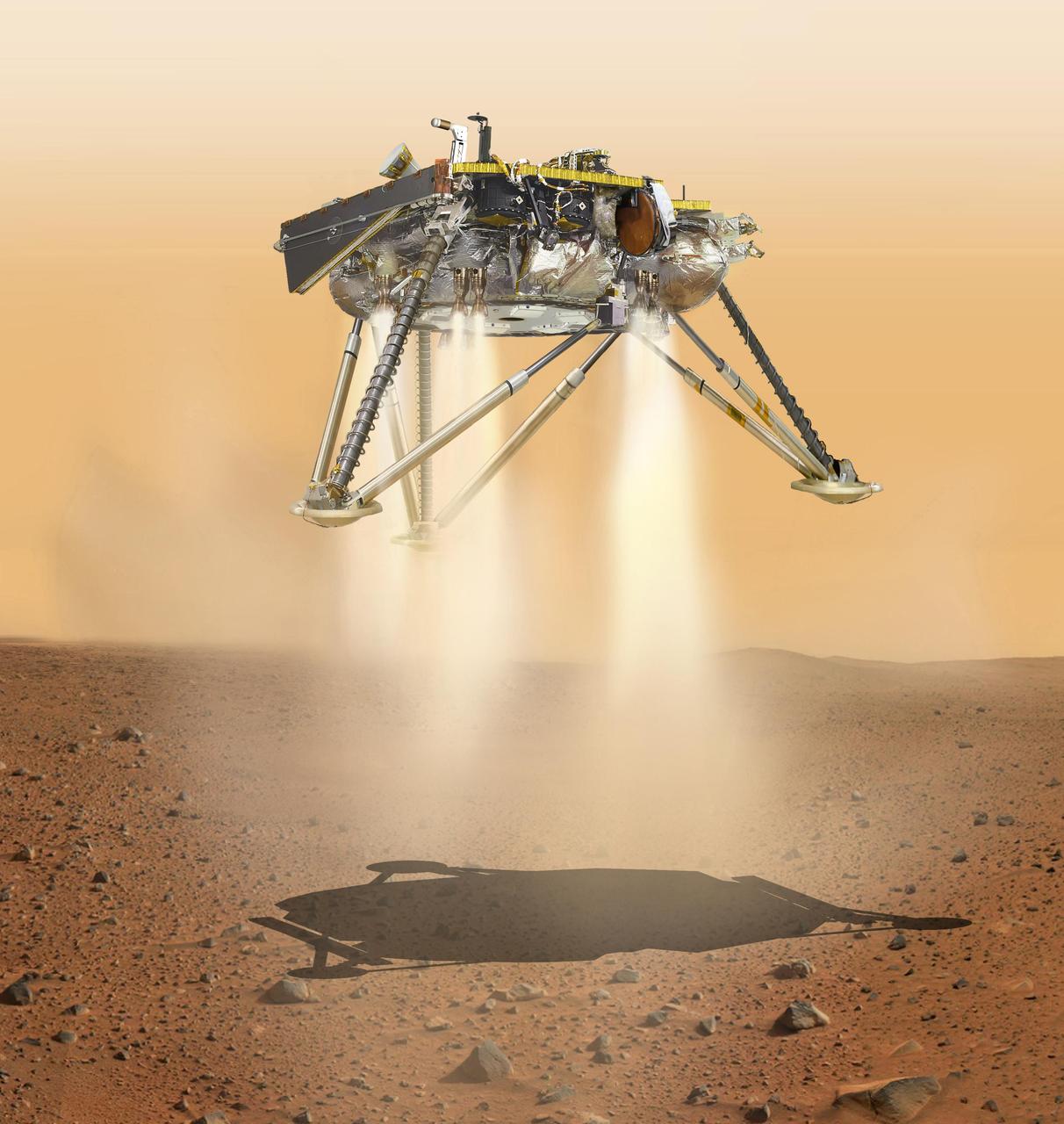
This is an illustration showing a simulated view of NASA's InSight lander about to land on the surface of Mars. This view shows the underside of the spacecraft. https://photojournal.jpl.nasa.gov/catalog/PIA22812
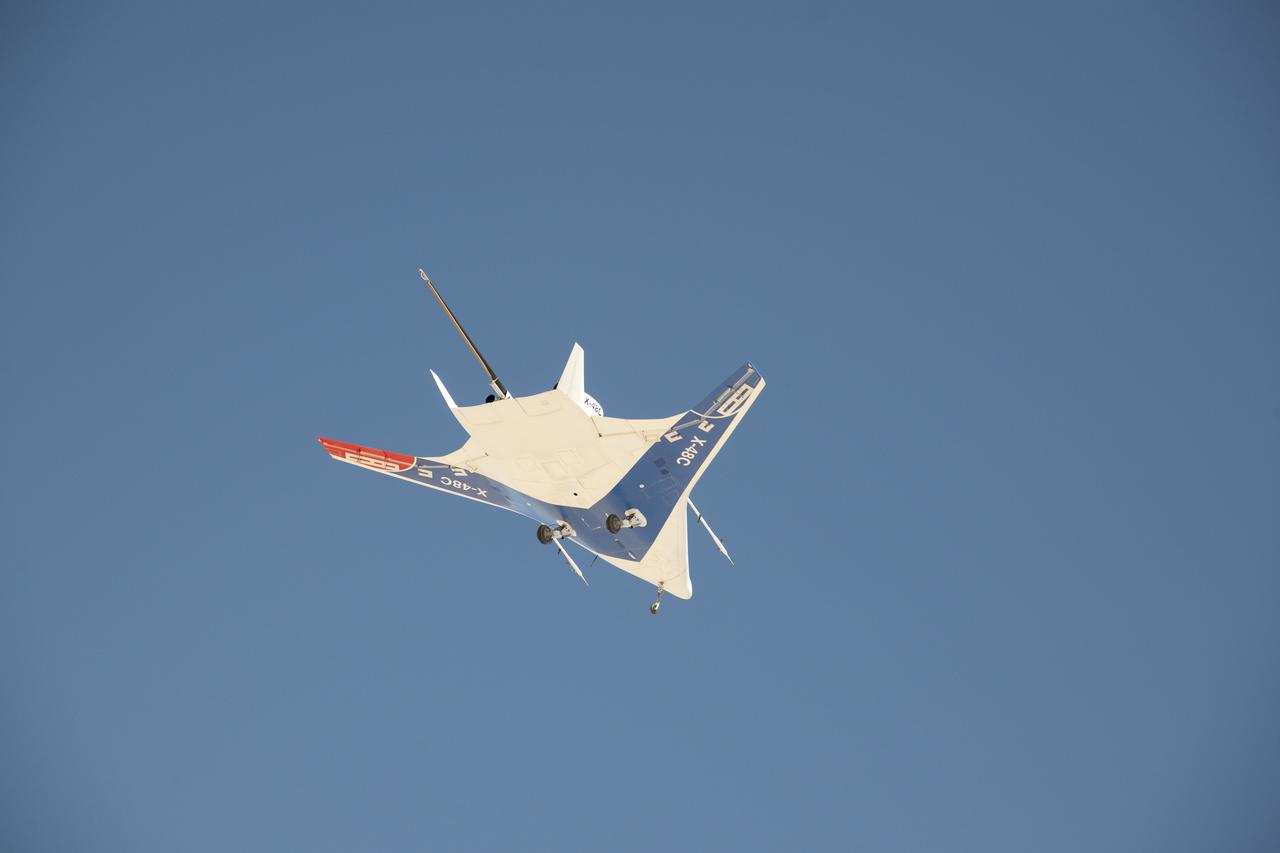
The manta ray-like shape of the X-48C Hybrid Wing Body aircraft was obvious in this underside view as it flew over Edwards Air Force Base on a test flight on Feb. 28, 2013.
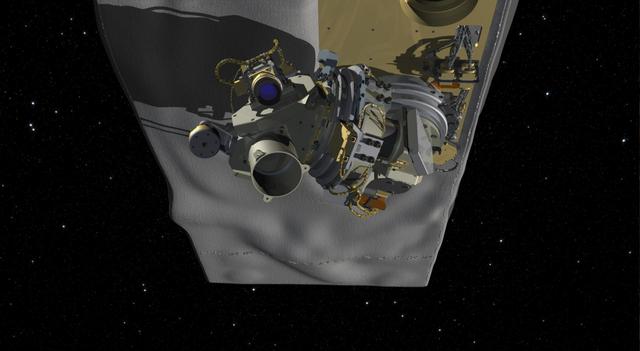
Illustration of NASA's OCO-3 mounted on the underside of the International Space Station. https://photojournal.jpl.nasa.gov/catalog/PIA22837
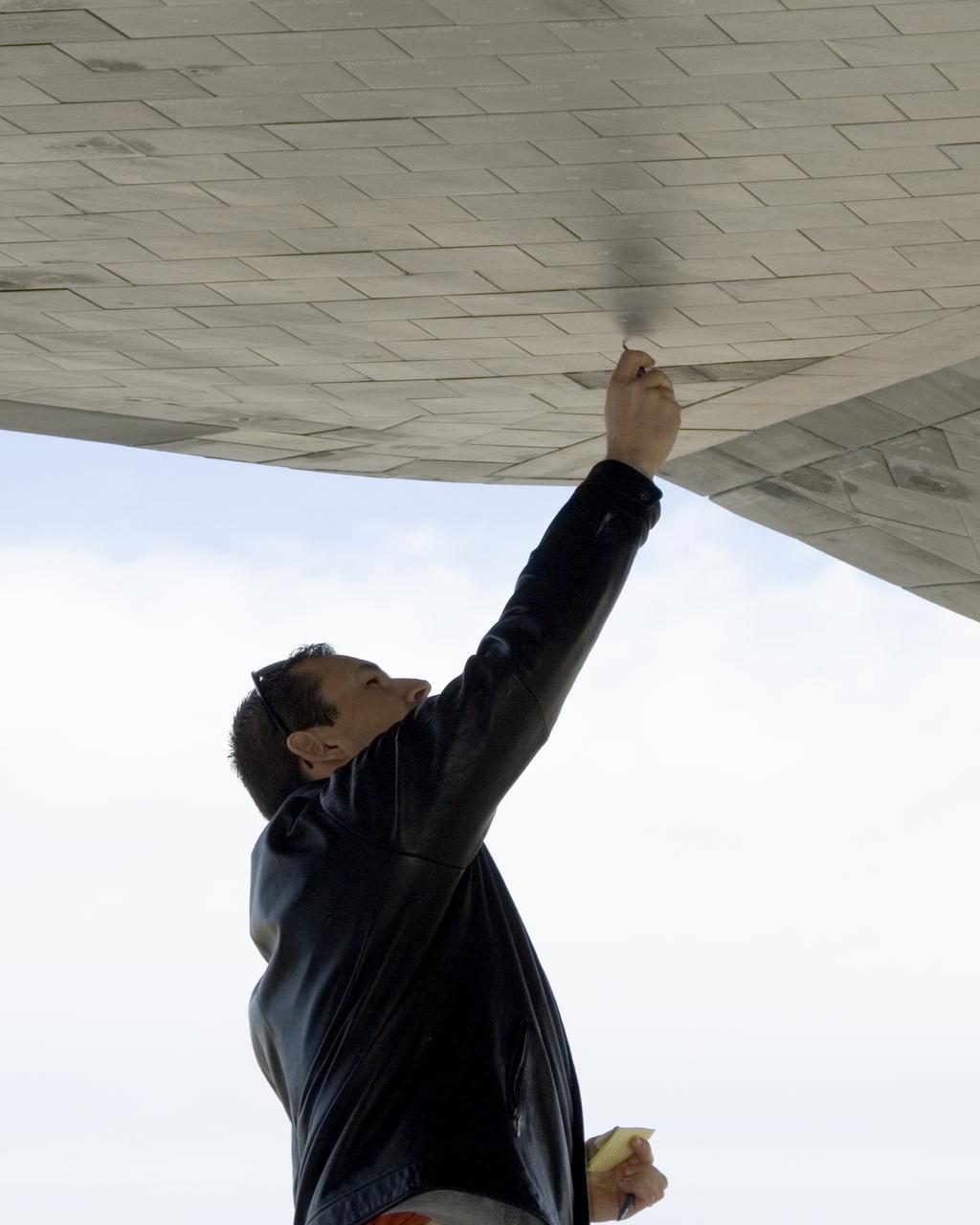
A United Space Alliance technician carefully checks the thermal tiles on the underside of Space Shuttle Endeavour for nicks and dings following its landing at Edwards Air Force Base to conclude mission STS-126.
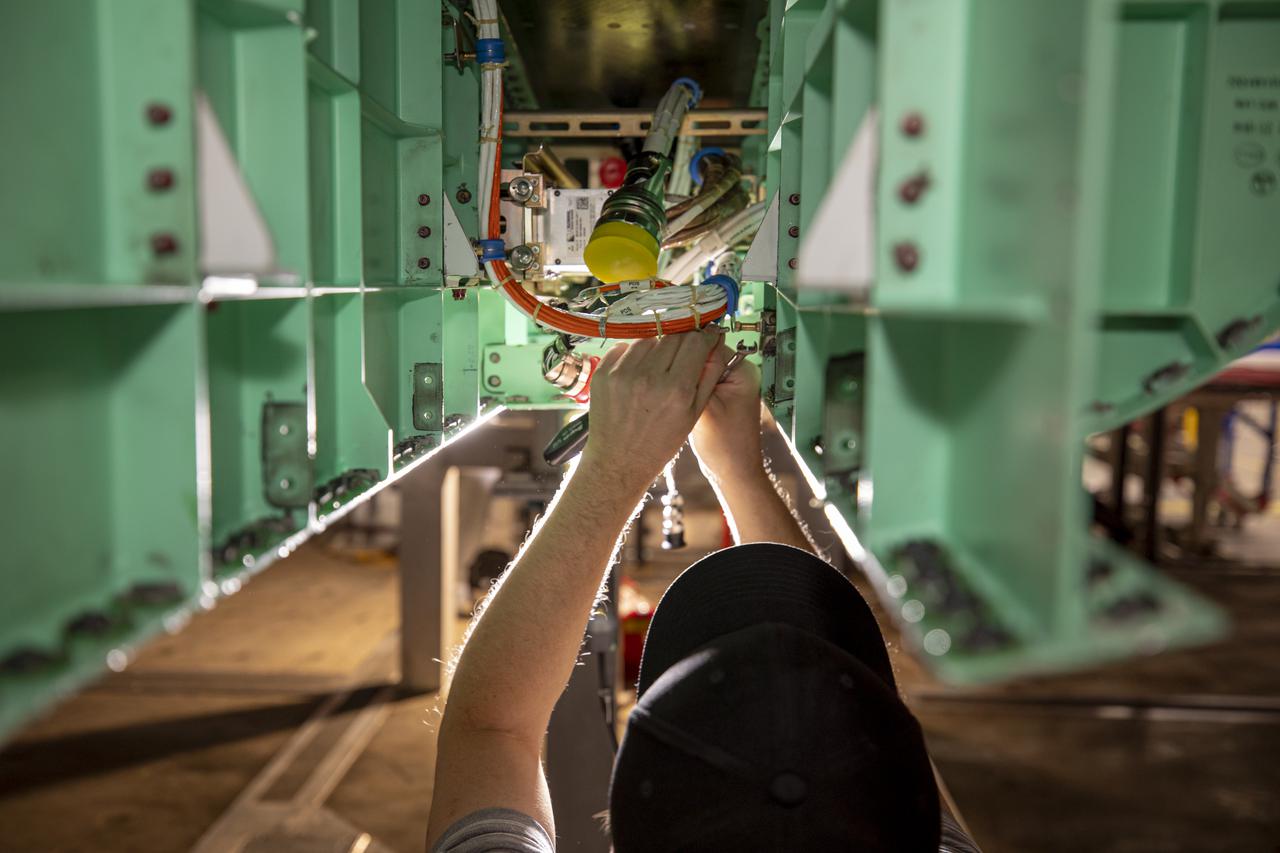
A technician is shown working on the underside of the X-59. The aircraft, under construction at Lockheed Martin Skunk Works in Palmdale, California, will fly to demonstrate the ability to fly supersonic while reducing the loud sonic boom to a quiet sonic thump. Lockheed Martin Photography By Garry Tice 1011 Lockheed Way, Palmdale, Ca. 93599 Event: SEG 450 Mid Bay - PDS Fit Check Date: 5/03/2021
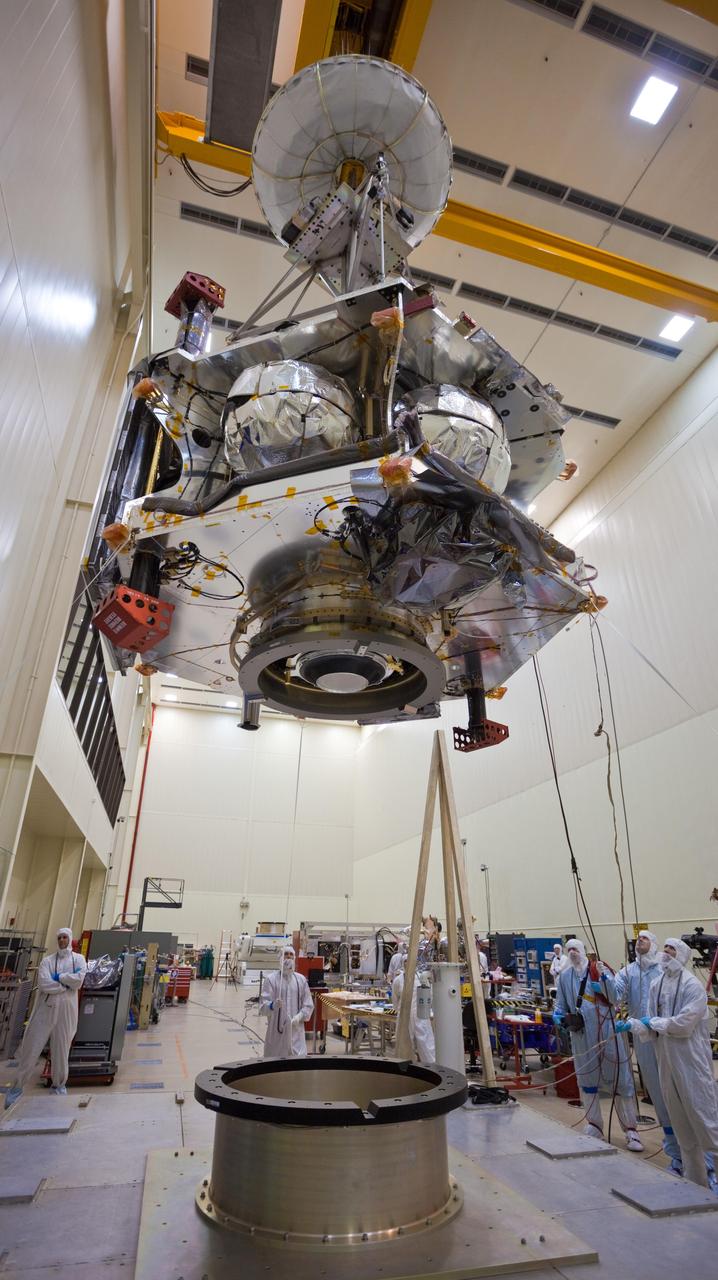
Technicians transfer NASA Juno spacecraft from its rotation fixture to the base of its shipping container in preparation for a move to environmental testing facilities. Juno’s main engine, its cover closed, is visible on the spacecraft’s underside.
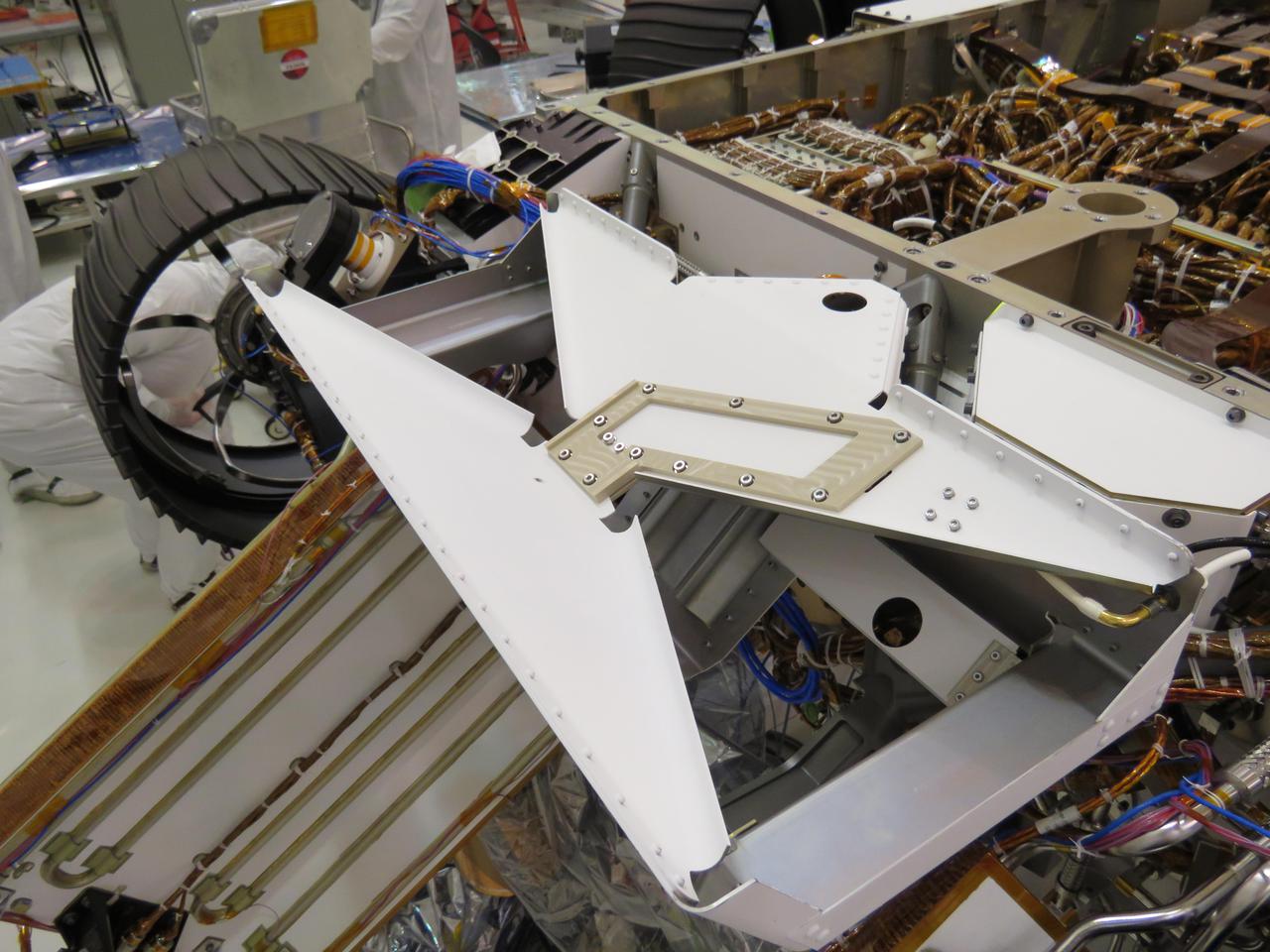
The bowtie-shaped antenna for the Radar Imager for Mars' Subsurface Experiment (RIMFAX) instrument has been mounted on the underside of the Perseverance rover. This antenna points down at the hard, frozen ground on Mars and sends the ground penetrating radar signal more than 30 feet (10 meters) below the surface of Mars. RIMFAX will enable scientists to learn about sources of briny water or ice below the surface. https://photojournal.jpl.nasa.gov/catalog/PIA24206
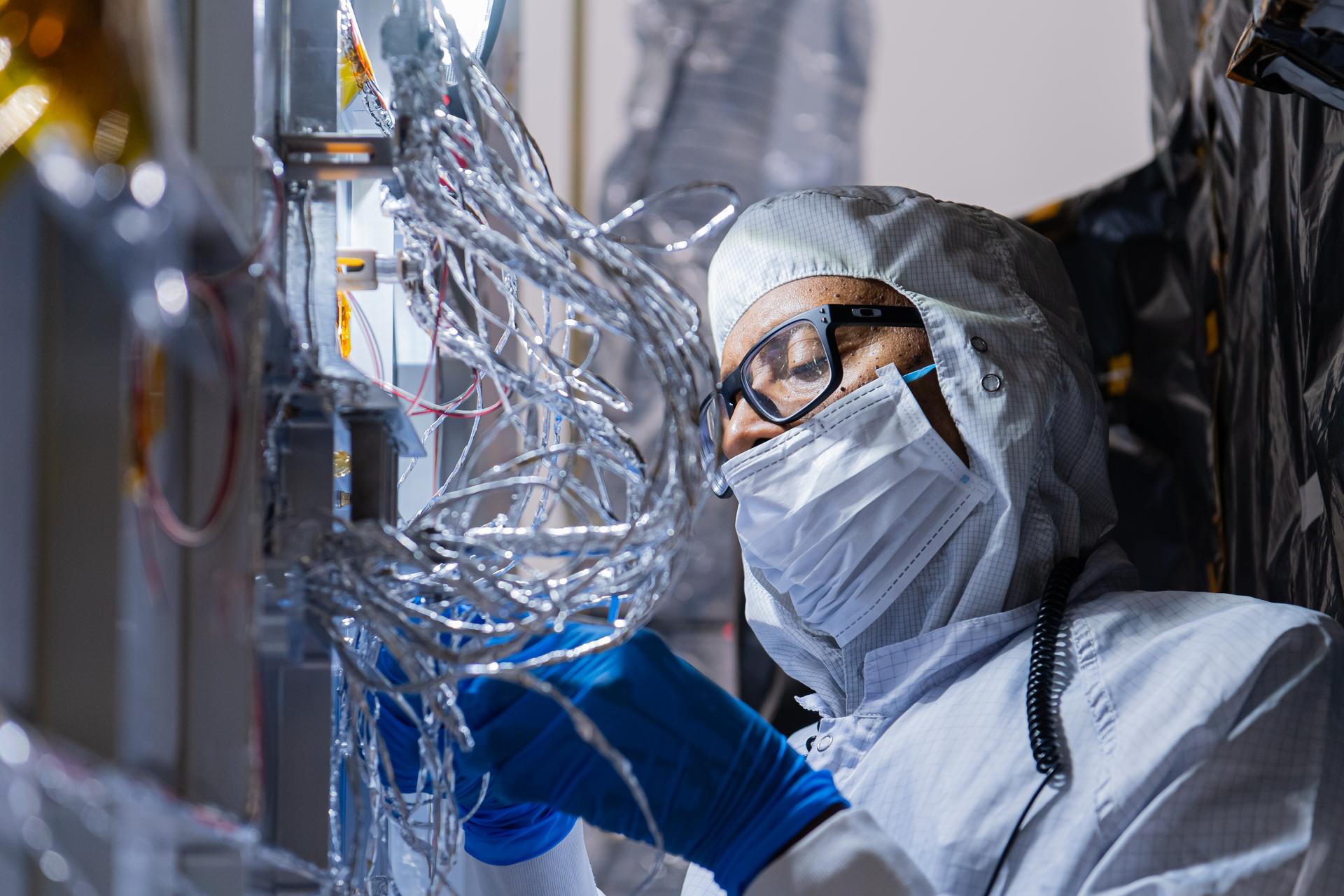
OSAM-1 Electrical Engineer Gregory Griffin tapes hardware on the underside of the OSAM-1 Servicing Payload inside cleanroom at Goddard Space Flight Center, Greenbelt Md., Aug 19, 2024. This photo has been reviewed by the Export Control Office, project Management, and Maxar release authority and is released for public view. NASA/Mike Guinto
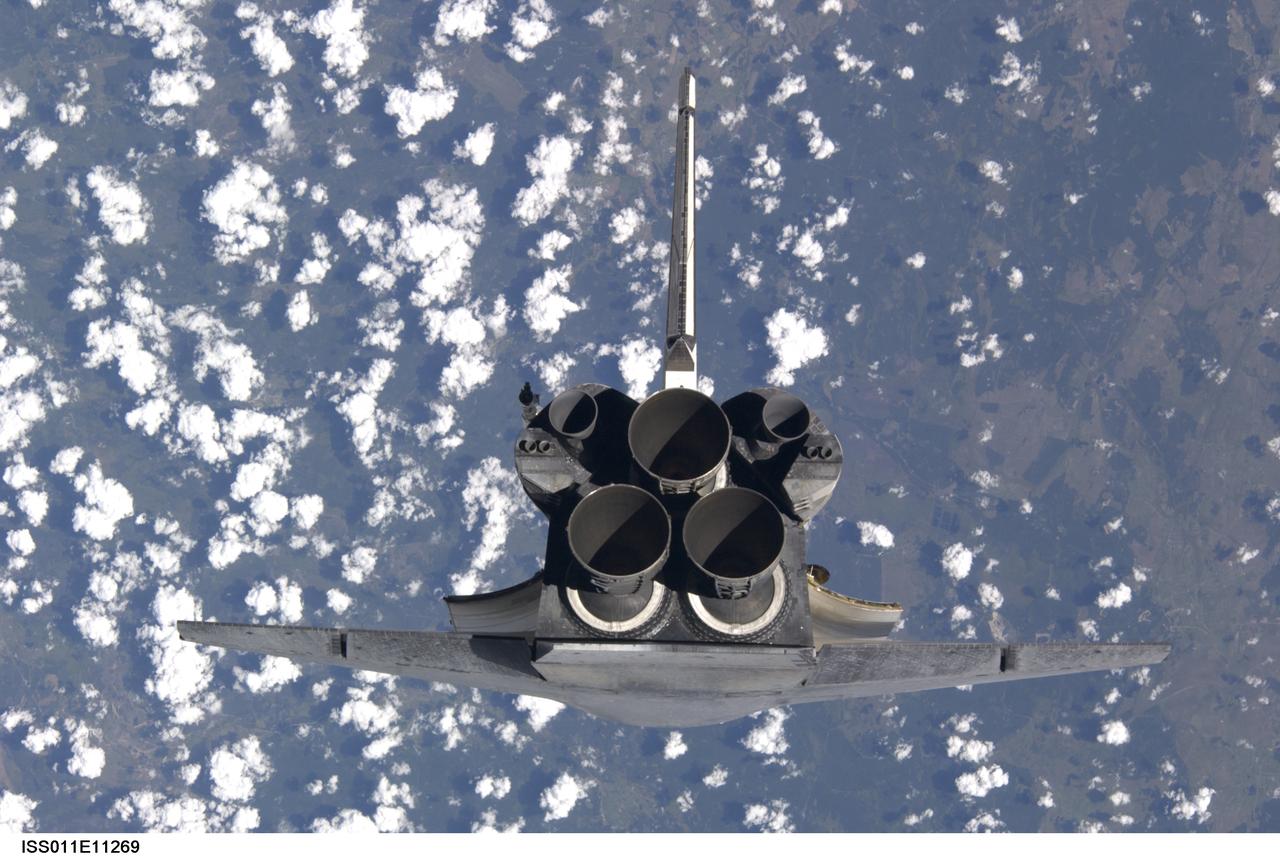
Launched on July 26, 2005 from the Kennedy Space Center in Florida, STS-114 was classified as Logistics Flight 1. Among the Station-related activities of the mission were the delivery of new supplies and the replacement of one of the orbital outpost's Control Moment Gyroscopes (CMGs). STS-114 also carried the Raffaello Multi-Purpose Logistics Module and the External Stowage Platform-2. A major focus of the mission was the testing and evaluation of new Space Shuttle flight safety, which included new inspection and repair techniques. Upon its approach to the International Space Station (ISS), the Space Shuttle Discovery underwent a photography session in order to assess any damages that may have occurred during its launch and/or journey through Space. Discovery was over Switzerland, about 600 feet from the ISS, when Cosmonaut Sergei K. Kriklev, Expedition 11 Commander, and John L. Phillips, NASA Space Station officer and flight engineer photographed the spacecraft as it performed a back flip to allow photography of its heat shield. Astronaut Eileen M. Collins, STS-114 Commander, guided the shuttle through the flip. The photographs were analyzed by engineers on the ground to evaluate the condition of Discovery’s heat shield. The crew safely returned to Earth on August 9, 2005. The mission historically marked the Return to Flight after nearly a two and one half year delay in flight after the Space Shuttle Columbia tragedy in February 2003.
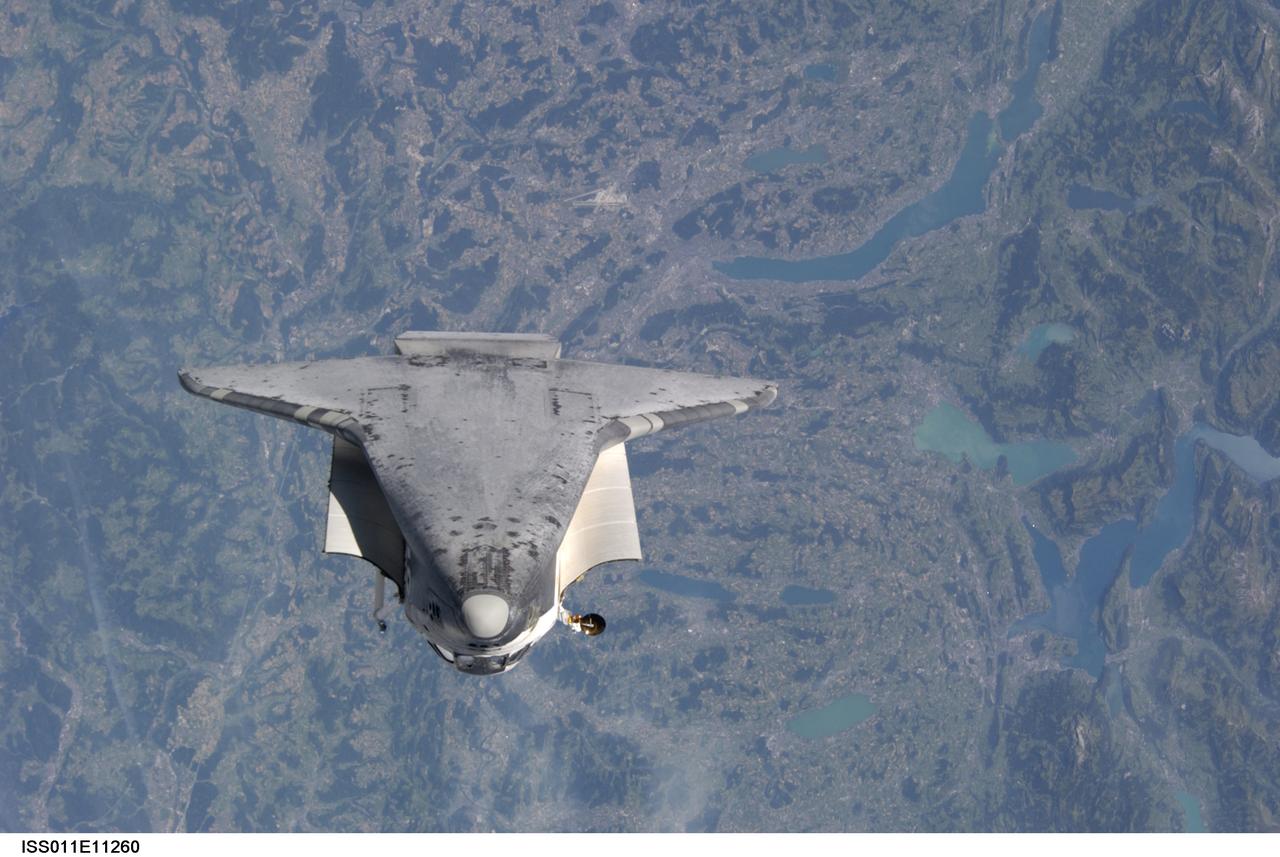
Launched on July 26, 2005, from the Kennedy Space Center in Florida, STS-114 was classified as Logistics Flight 1. Among the Station-related activities of the mission were the delivery of new supplies and the replacement of one of the orbital outpost's Control Moment Gyroscopes (CMGs). STS-114 also carried the Raffaello Multi-Purpose Logistics Module and the External Stowage Platform-2. A major focus of the mission was the testing and evaluation of new Space Shuttle flight safety, which included new inspection and repair techniques. Upon its approach to the International Space Station (ISS), the Space Shuttle Discovery underwent a photography session in order to assess any damages that may have occurred during its launch and/or journey through Space. Discovery was over Switzerland, about 600 feet from the ISS, when Cosmonaut Sergei K. Kriklev, Expedition 11 Commander, and John L. Phillips, NASA Space Station officer and flight engineer photographed the under side of the spacecraft as it performed a back flip to allow photography of its heat shield. Astronaut Eileen M. Collins, STS-114 Commander, guided the shuttle through the flip. The photographs were analyzed by engineers on the ground to evaluate the condition of Discovery’s heat shield. The crew safely returned to Earth on August 9, 2005. The mission historically marked the Return to Flight after nearly a two and one half year delay in flight after the Space Shuttle Columbia tragedy in February 2003.
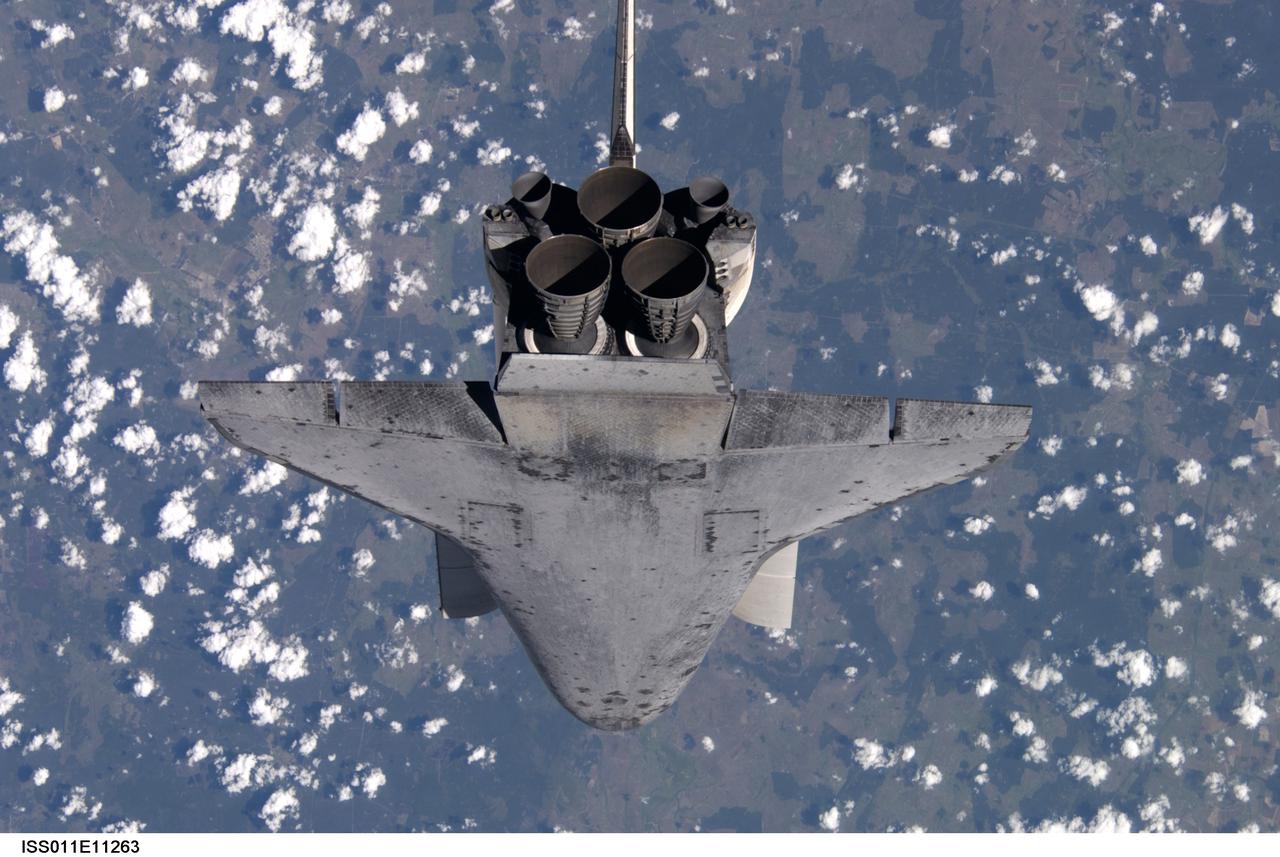
Launched on July 26, 2005 from the Kennedy Space Center in Florida, STS-114 was classified as Logistics Flight 1. Among the Station-related activities of the mission were the delivery of new supplies and the replacement of one of the orbital outpost's Control Moment Gyroscopes (CMGs). STS-114 also carried the Raffaello Multi-Purpose Logistics Module and the External Stowage Platform-2. A major focus of the mission was the testing and evaluation of new Space Shuttle flight safety, which included new inspection and repair techniques. Upon its approach to the International Space Station (ISS), the Space Shuttle Discovery underwent a photography session in order to assess any damages that may have occurred during its launch and/or journey through Space. Discovery was over Switzerland, about 600 feet from the ISS, when Cosmonaut Sergei K. Kriklev, Expedition 11 Commander, and John L. Phillips, NASA Space Station officer and flight engineer photographed the under side of the spacecraft as it performed a back flip to allow photography of its heat shield. Astronaut Eileen M. Collins, STS-114 Commander, guided the shuttle through the flip. The photographs were analyzed by engineers on the ground to evaluate the condition of Discovery’s heat shield. The crew safely returned to Earth on August 9, 2005. The mission historically marked the Return to Flight after nearly a two and one half year delay in flight after the Space Shuttle Columbia tragedy in February 2003.
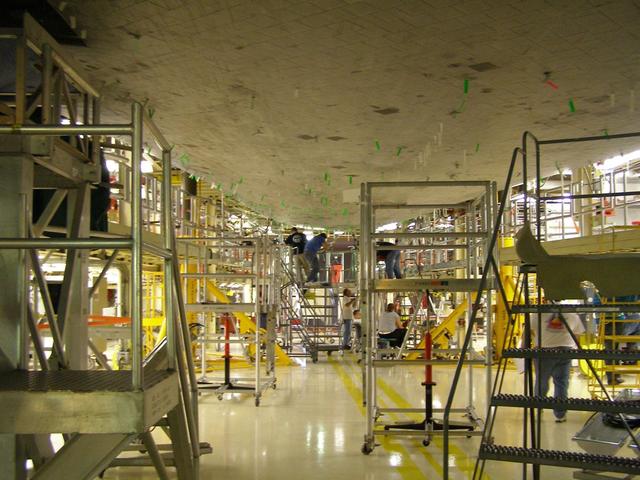
Orbiter Processing Facility High Bay No. 3, orbiter underside with moveable platforms, looking north, July 31, 2006
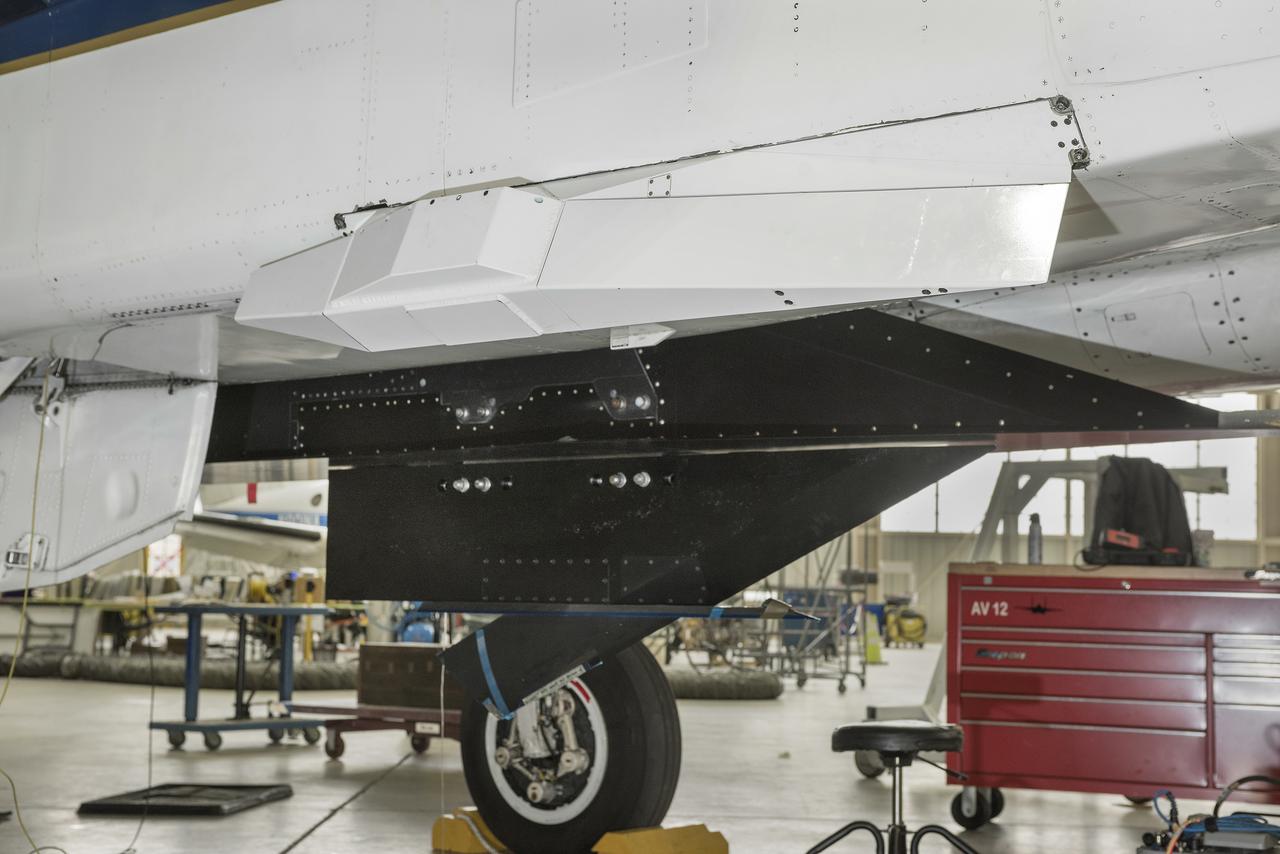
The Swept Wing Laminar Flow test article, integrated to the underside of a NASA F-15, will examine the effectiveness of different configurations of small dots, called distributed roughness elements, to extend smooth, laminar airflow over a wing’s depth, reducing friction drag.
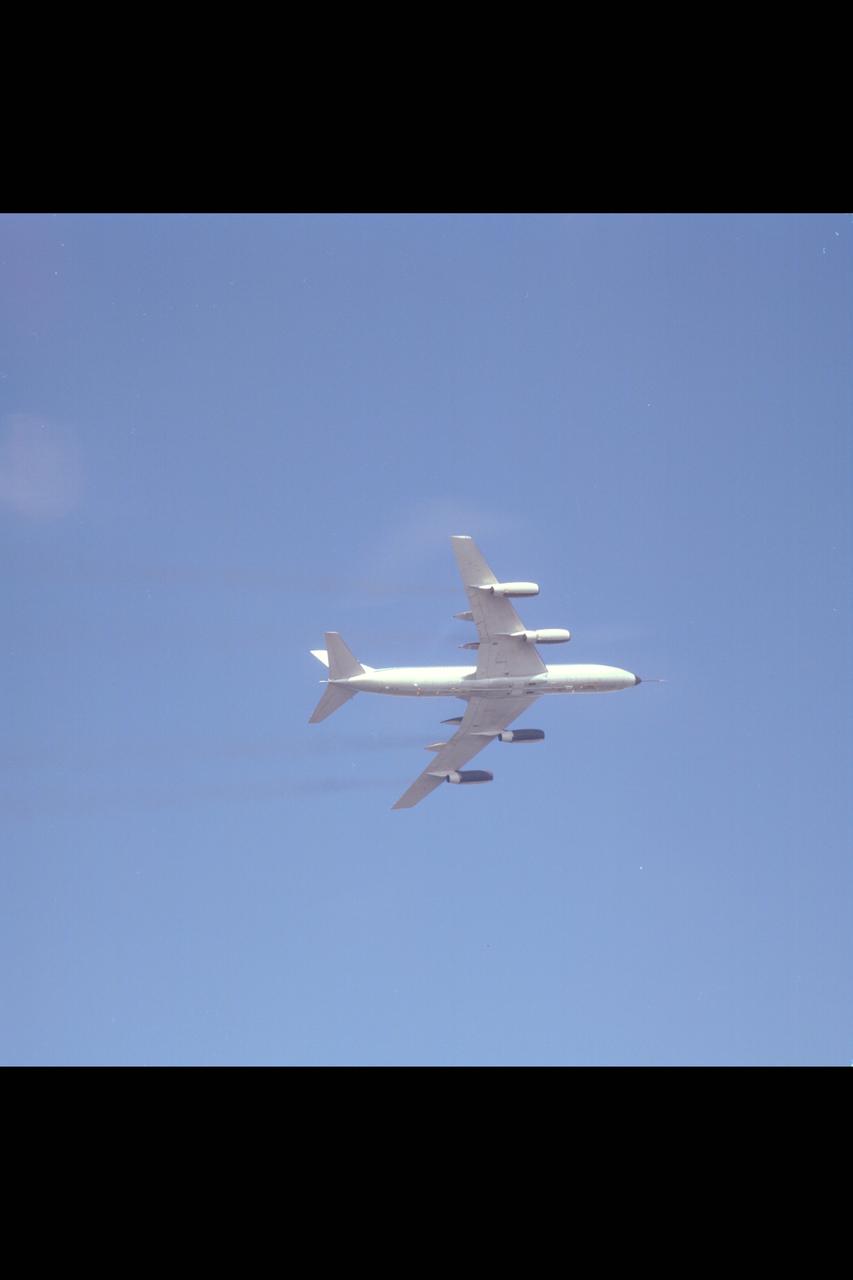
CV-990 (NASA-712) air to air view of underside of aircraft during banked turn during flight up California coastline
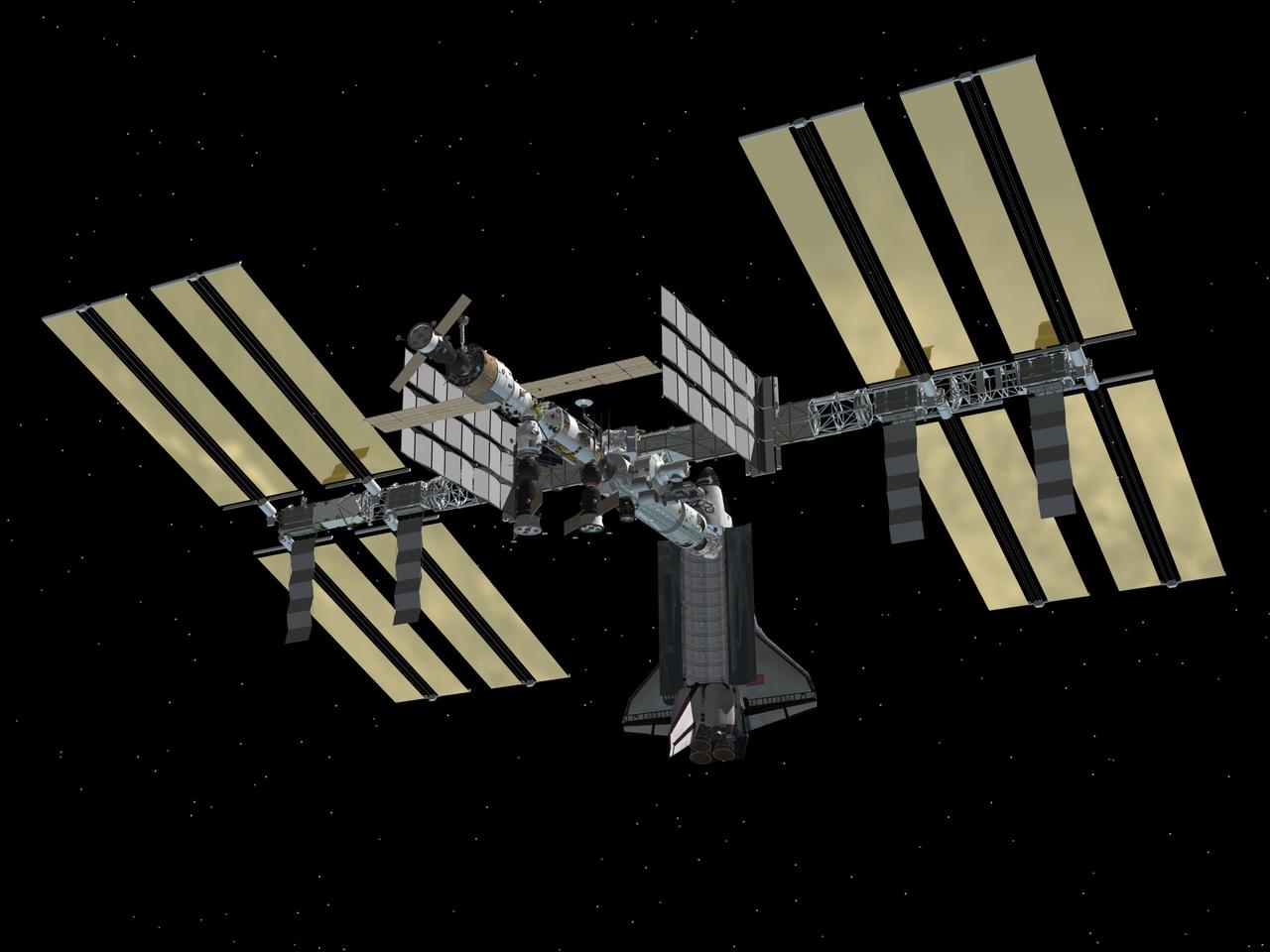
JSC2003-E-64498 (December 2003) - Post 10A underside/aft view of the International Space Station with Shuttle docked to Node 2.
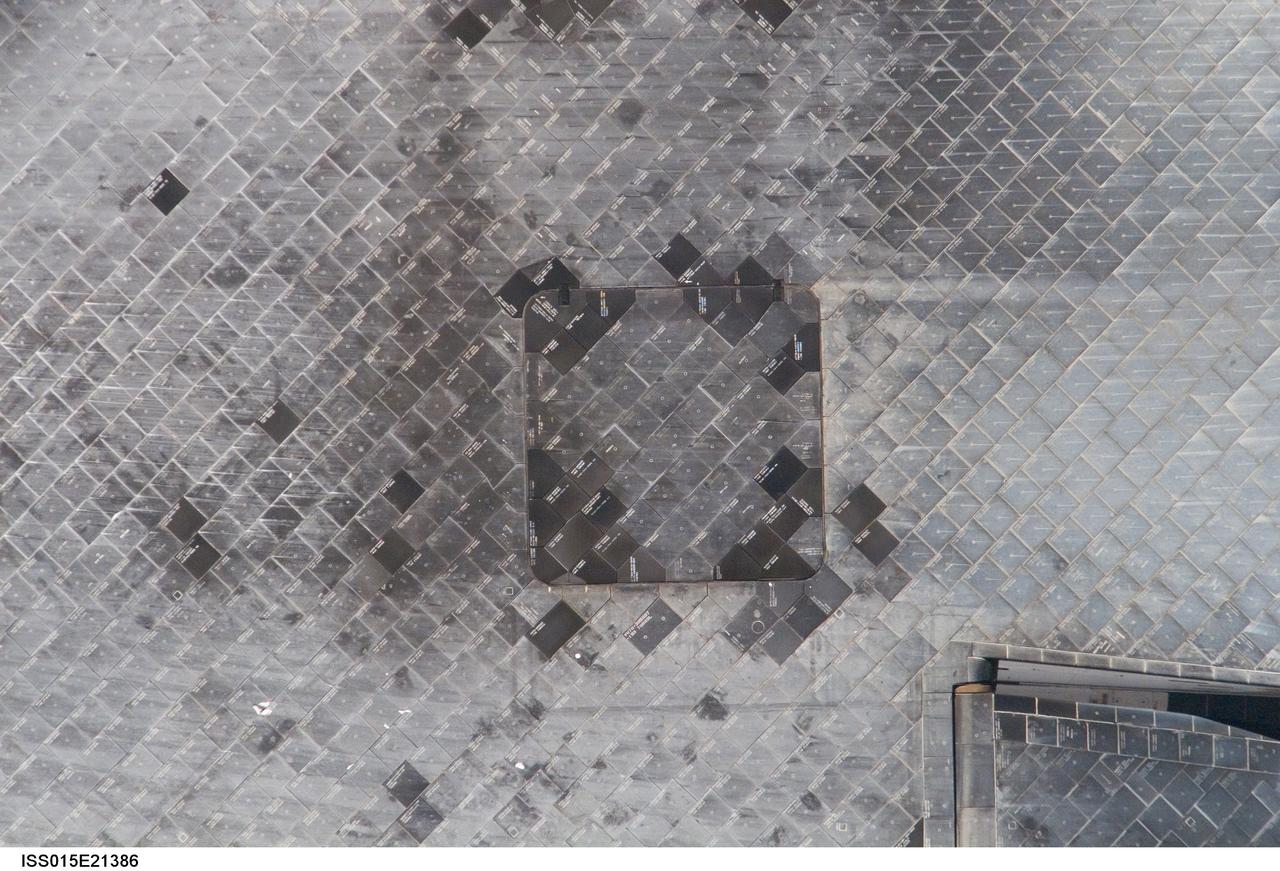
ISS015-E-21386 (10 Aug. 2007) --- This photo of the underside of the Space Shuttle Endeavour was taken from the International Space Station during a back flip and careful survey by crewmembers onboard the orbital outpost. After ground studies, mission managers suspect debris came off Endeavour's external fuel tank one minute after liftoff on Wednesday and struck tiles on the shuttle's underside, near the right main landing gear door.
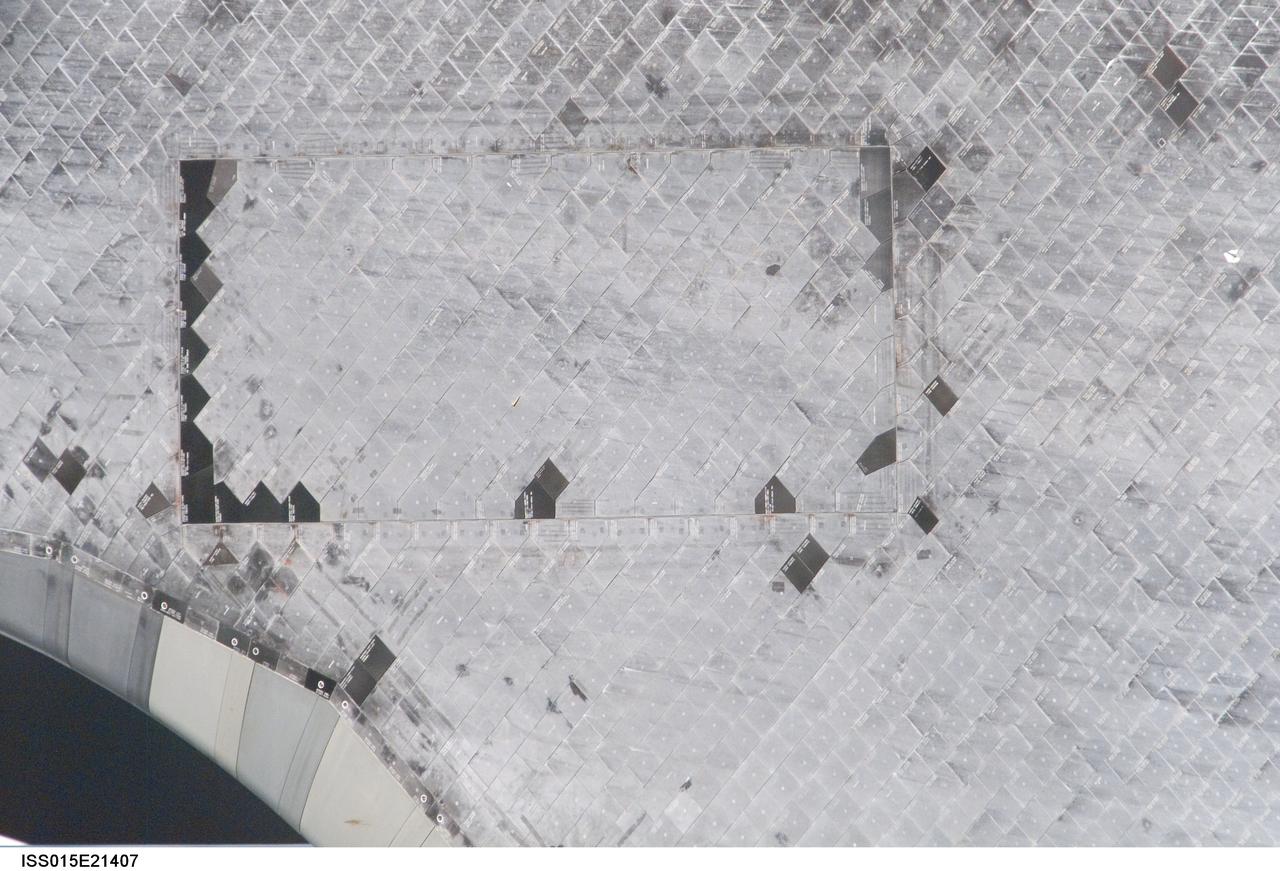
ISS015-E-21407 (10 Aug. 2007) --- This photo of the underside of the Space Shuttle Endeavour was taken from the International Space Station during a back flip and careful survey by crewmembers onboard the orbital outpost. After ground studies, mission managers suspect debris came off Endeavour's external fuel tank one minute after liftoff on Wednesday and struck tiles on the shuttle's underside, near the right main landing gear door.
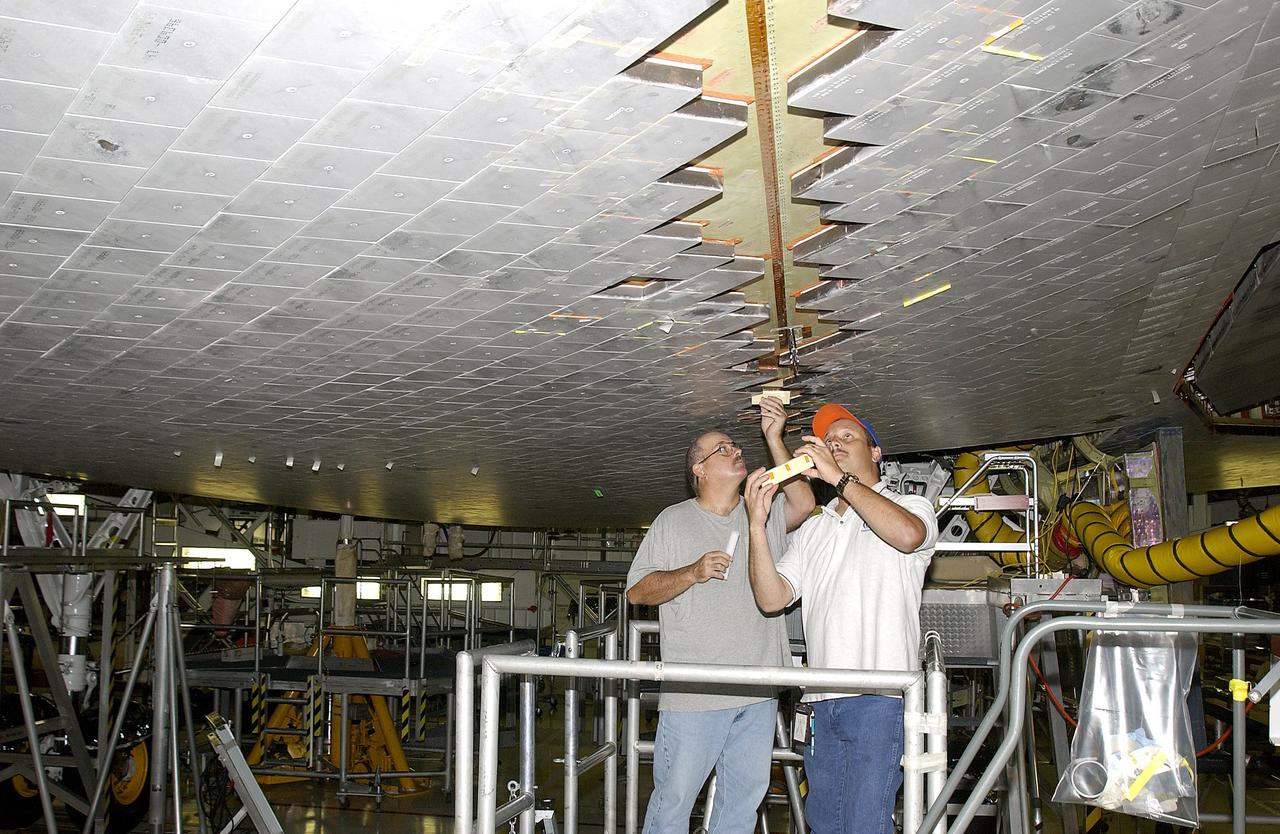
In the Orbiter Processing Facility, David Sanborn and Rick Cady, with United Space Alliance, check tiles on the underside of Endeavour. Tile check is part of routine maintenance and return to flight activities on the orbiter fleet.
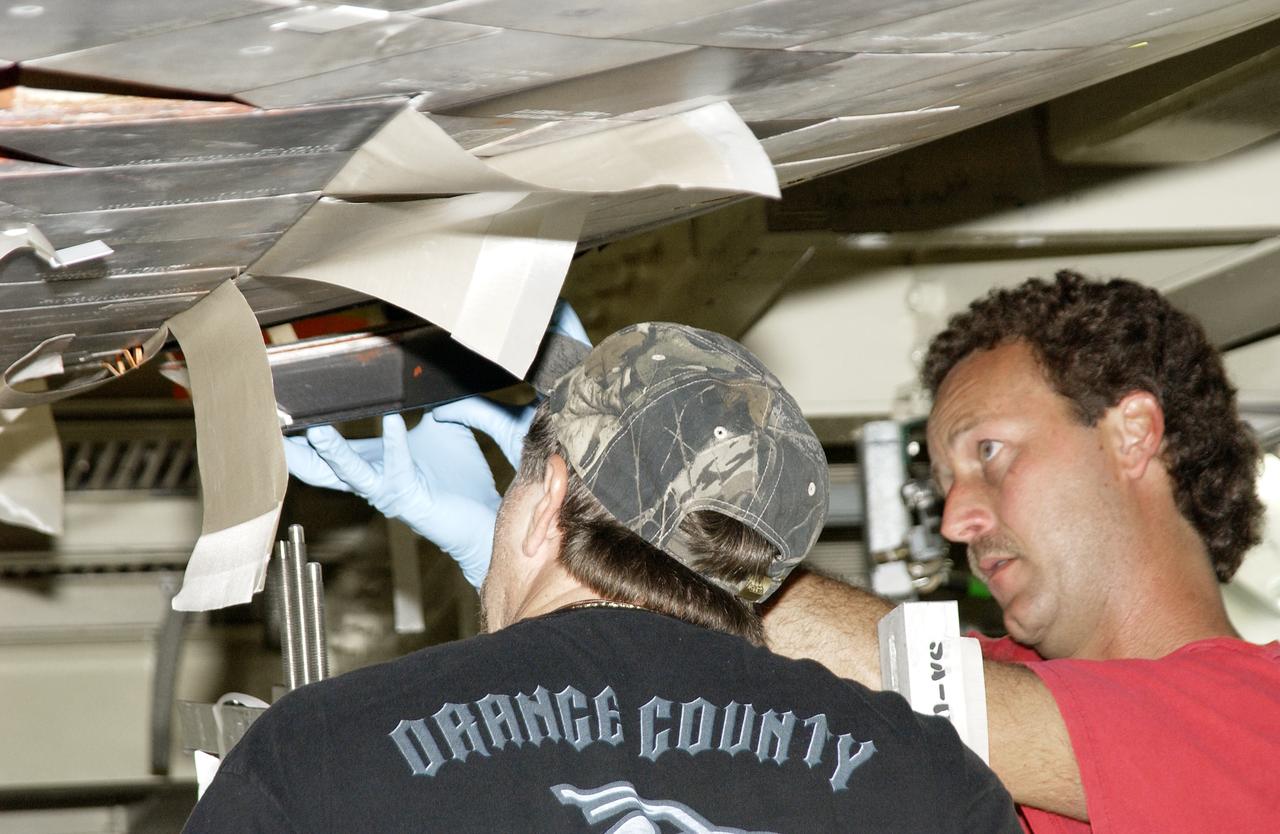
Workers make a tile-fit check on the underside of the orbiter Discovery in the Orbiter Processing Facility. The vehicle has undergone Orbiter Major Modifications in the past year, a process that includes the tile check.
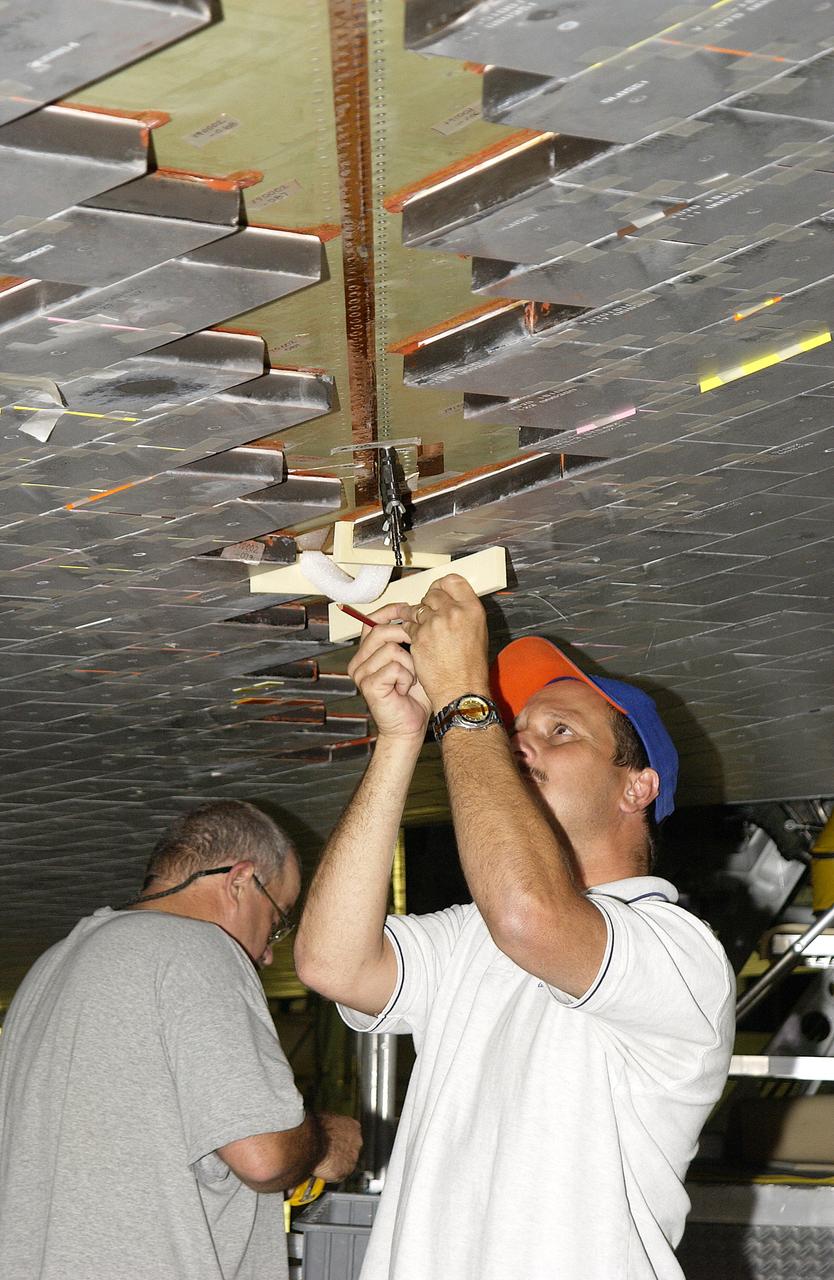
In the Orbiter Processing Facility, David Sanborn and Rick Cady, with United Space Alliance, check tiles on the underside of Endeavour. Tile check is part of routine maintenance and return to flight activities on the orbiter fleet.
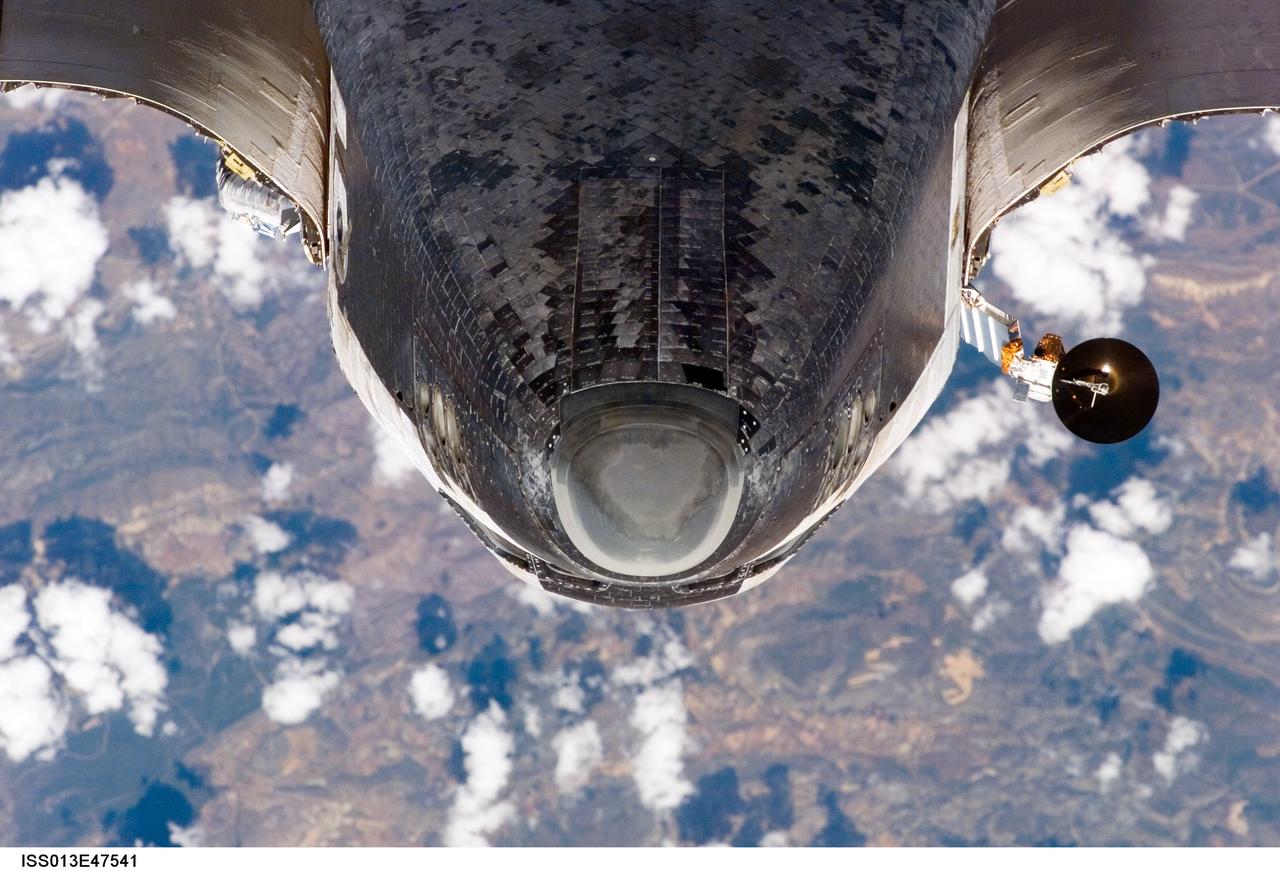
ISS013-E-47541 (6 July 2006) --- The nose of Shuttle Discovery and part of the forward underside as photographed by one of the Expedition 13 crewmembers from the International Space Station on July 6 during RPM survey.
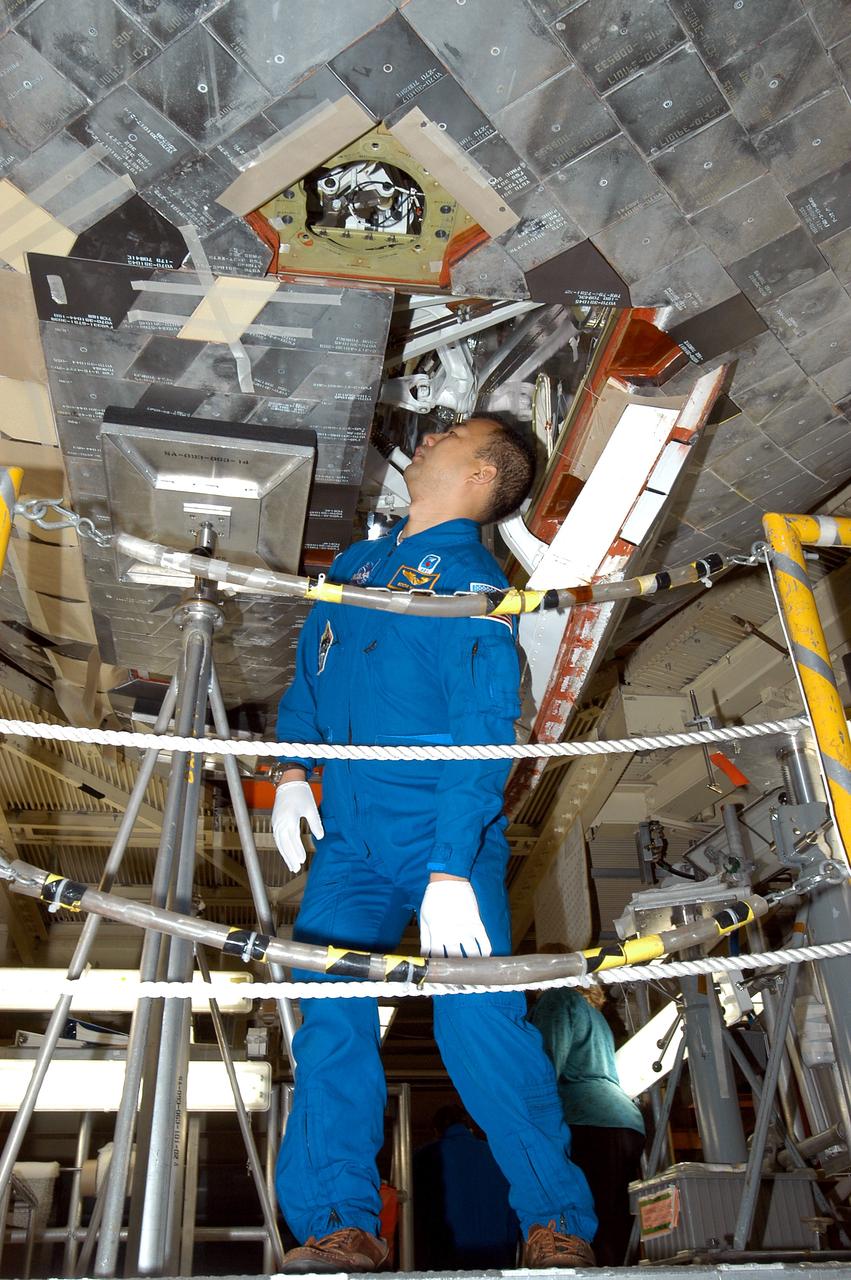
KENNEDY SPACE CENTER, FLA. - STS-114 Mission Specialist Soichi Noguchi looks at tile on the underside of the orbiter Discovery. Noguchi is with the Japanese Aerospace and Exploration Agency. He and other crew members are at KSC becoming familiar with Shuttle and mission equipment. The mission is Logistics Flight 1, which is scheduled to deliver supplies and equipment plus the external stowage platform to the International Space Station.
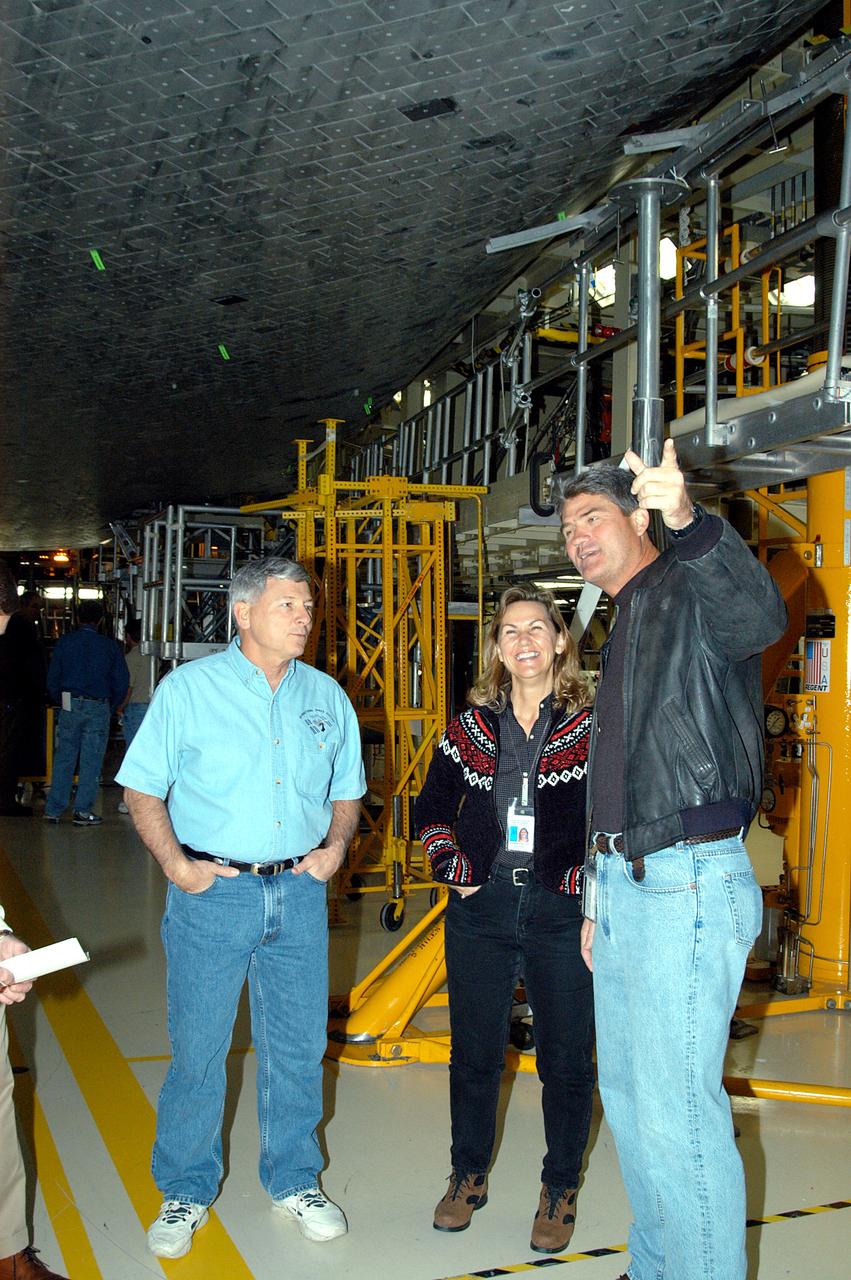
KENNEDY SPACE CENTER, FLA. -- From left, NASA Deputy Associate Administrator for Space Station and Shuttle Programs Michael Kostelnik, United Space Alliance (USA) Director of Orbiter Operations Patty Stratton, and NASA Space Shuttle Program Manager William Parsons view the underside of Shuttle Discovery in Orbiter Processing Facility Bay 3. NASA and USA Space Shuttle program management are participating in a leadership workday. The day is intended to provide management with an in-depth, hands-on look at Shuttle processing activities at KSC.
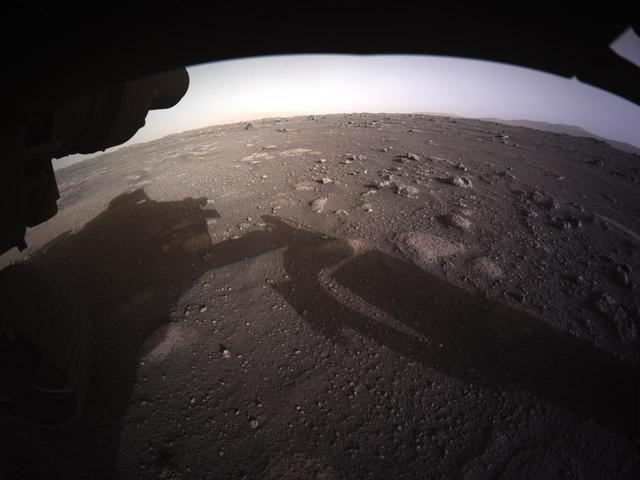
This is the first high-resolution, color image to be sent back by the Hazard Cameras (Hazcams) on the underside of NASA's Perseverance Mars rover after its landing on Feb. 18, 2021. A key objective for Perseverance's mission on Mars is astrobiology, including the search for signs of ancient microbial life. The rover will characterize the planet's geology and past climate, pave the way for human exploration of the Red Planet, and be the first mission to collect and cache Martian rock and regolith (broken rock and dust). Subsequent NASA missions, in cooperation with ESA (the European Space Agency), would send spacecraft to Mars to collect these cached samples from the surface and return them to Earth for in-depth analysis. https://photojournal.jpl.nasa.gov/catalog/PIA24430
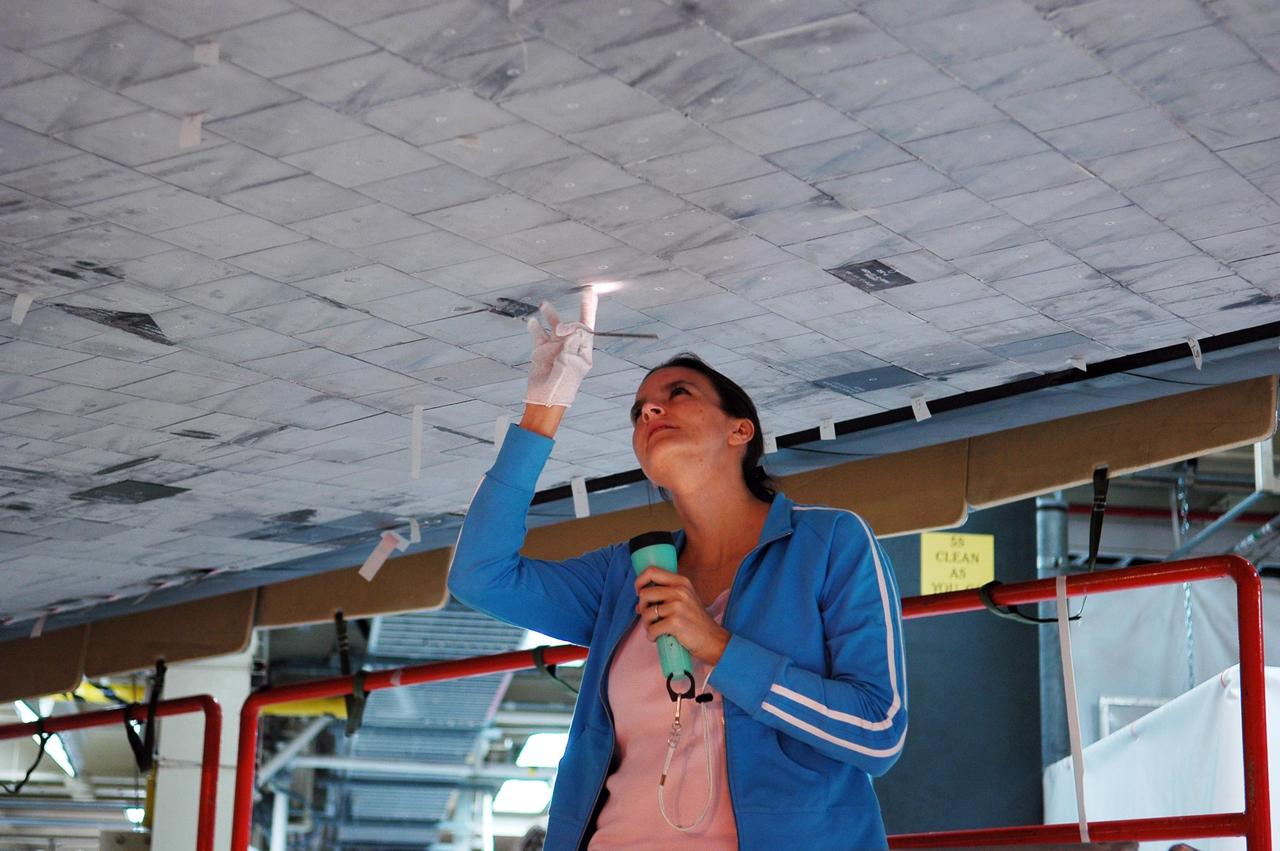
KENNEDY SPACE CENTER, FLA. - In NASA’s Orbiter Processing Facility Bay 3, United Space Alliance technician Erin Schlichenmaier inspects previous tile repair on Discovery’s underside. Discovery processing is under way for the second return to flight test mission, STS-121.
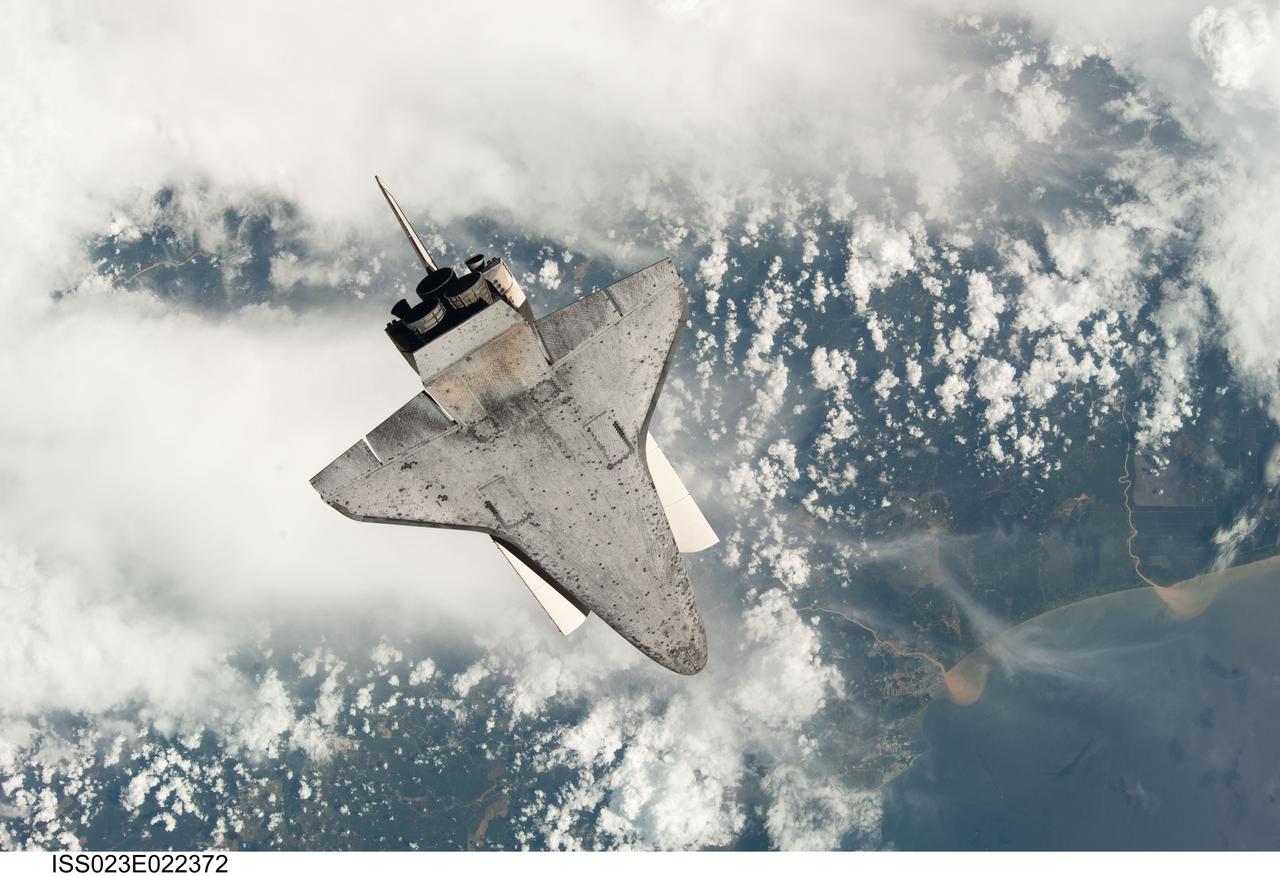
ISS023-E-022372 (7 April 2010) --- The underside of space shuttle Discovery is featured in this image photographed by an Expedition 23 crew member as the shuttle approaches the International Space Station during STS-131 rendezvous and docking operations. Docking occurred at 2:44 a.m. (CDT) on April 7, 2010.
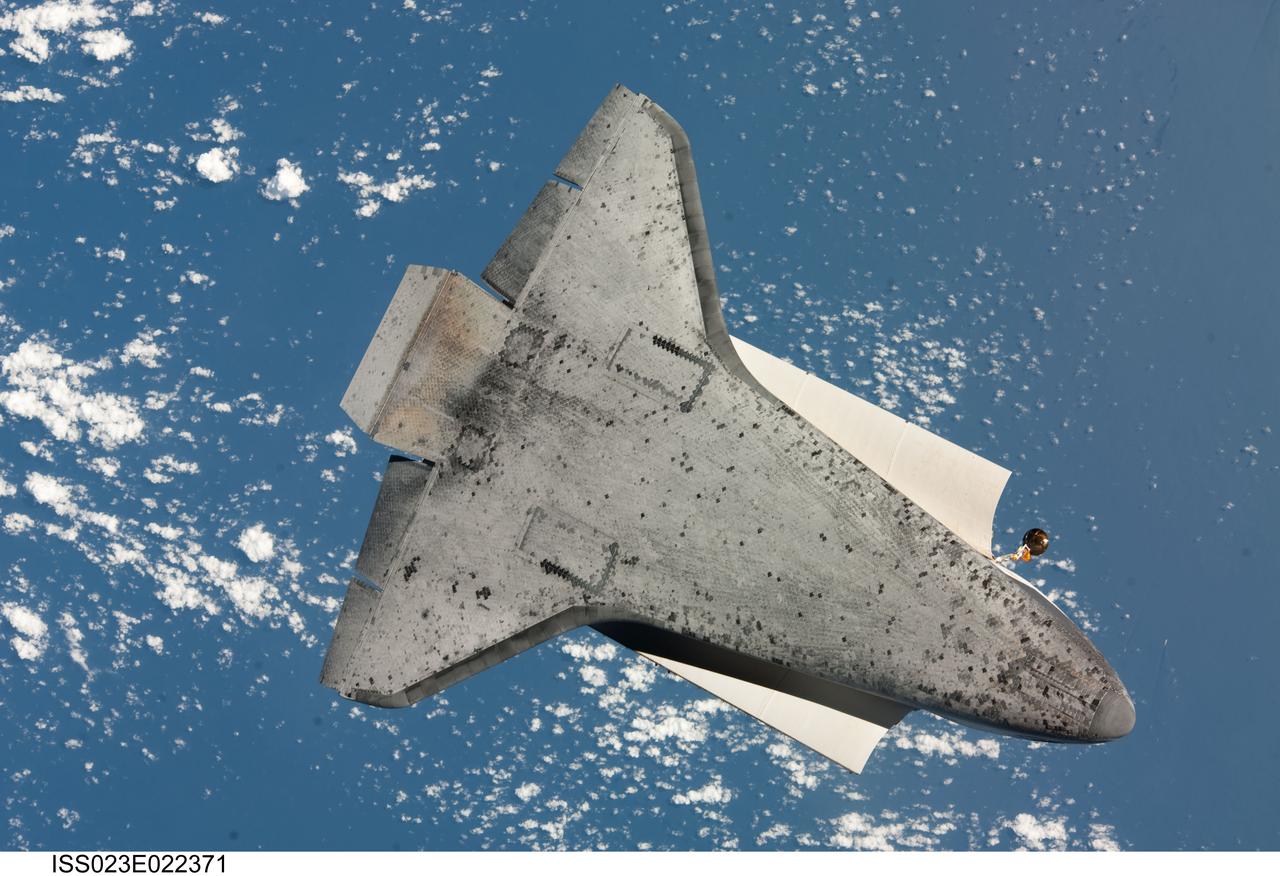
ISS023-E-022371 (7 April 2010) --- The underside of space shuttle Discovery is featured in this image photographed by an Expedition 23 crew member as the shuttle approaches the International Space Station during STS-131 rendezvous and docking operations. Docking occurred at 2:44 a.m. (CDT) on April 7, 2010.
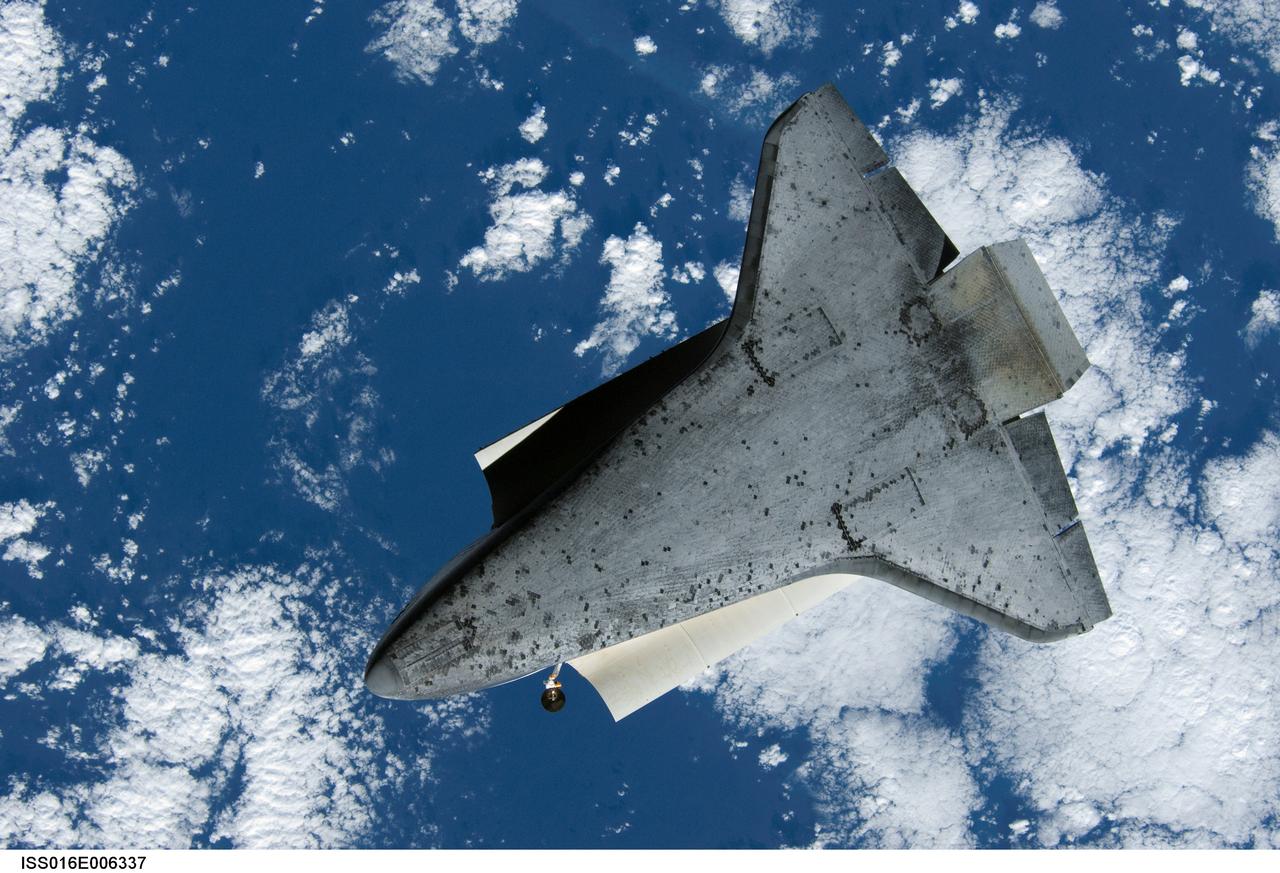
ISS016-E-006337 (25 Oct. 2007) --- Backdropped by a blue and white Earth, the underside of the Space Shuttle Discovery is featured in this image photographed by an Expedition 16 crewmember during a backflip maneuver performed by the approaching visitors (STS-120) to the International Space Station.
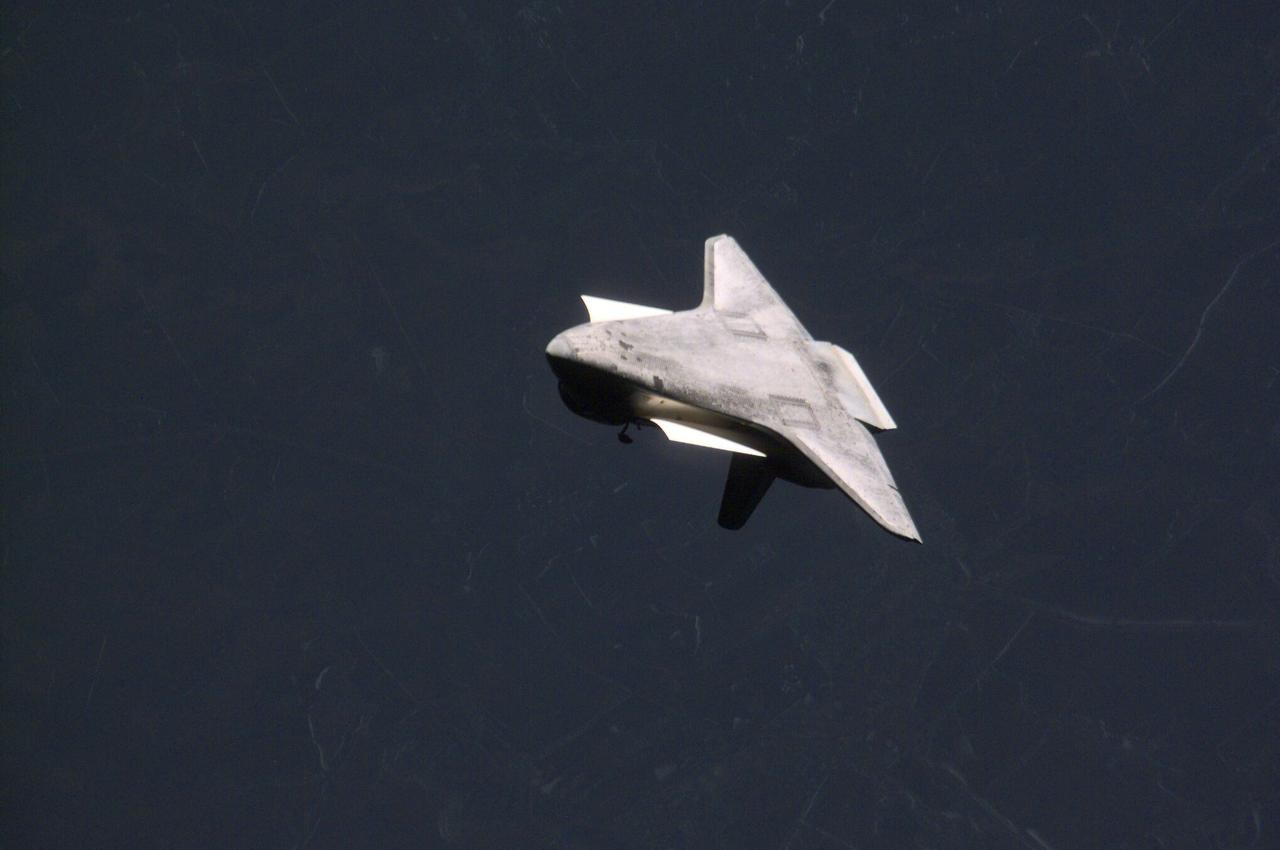
ISS01-E-5396 (16 February 2001) --- This rarely seen image of the underside of the Space Shuttle Atlantis was photographed by the three-man Expedition One crew aboard the International Space Station (ISS) after the shuttle and the outpost unlinked following several days of joint operations of the two crews. The scene was recorded with a digital still camera.
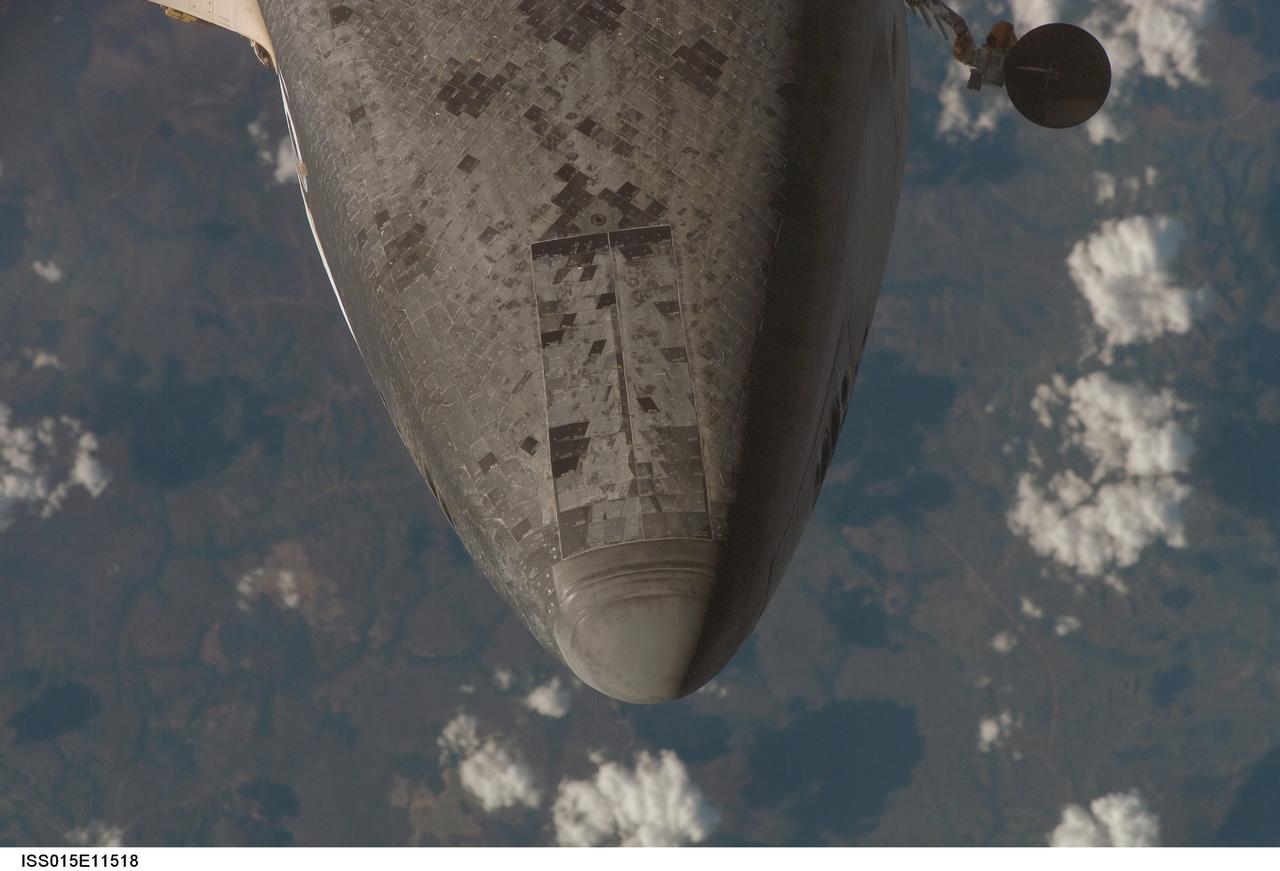
ISS015-E-11518 (10 June 2007) --- This view of the nose of Space Shuttle Atlantis and part of the forward underside was provided by an Expedition 15 crewmember during a back-flip for the RPM survey by the approaching STS-117 crew to the International Space Station. Distance from the station and shuttle at this time was approximately 600 feet.
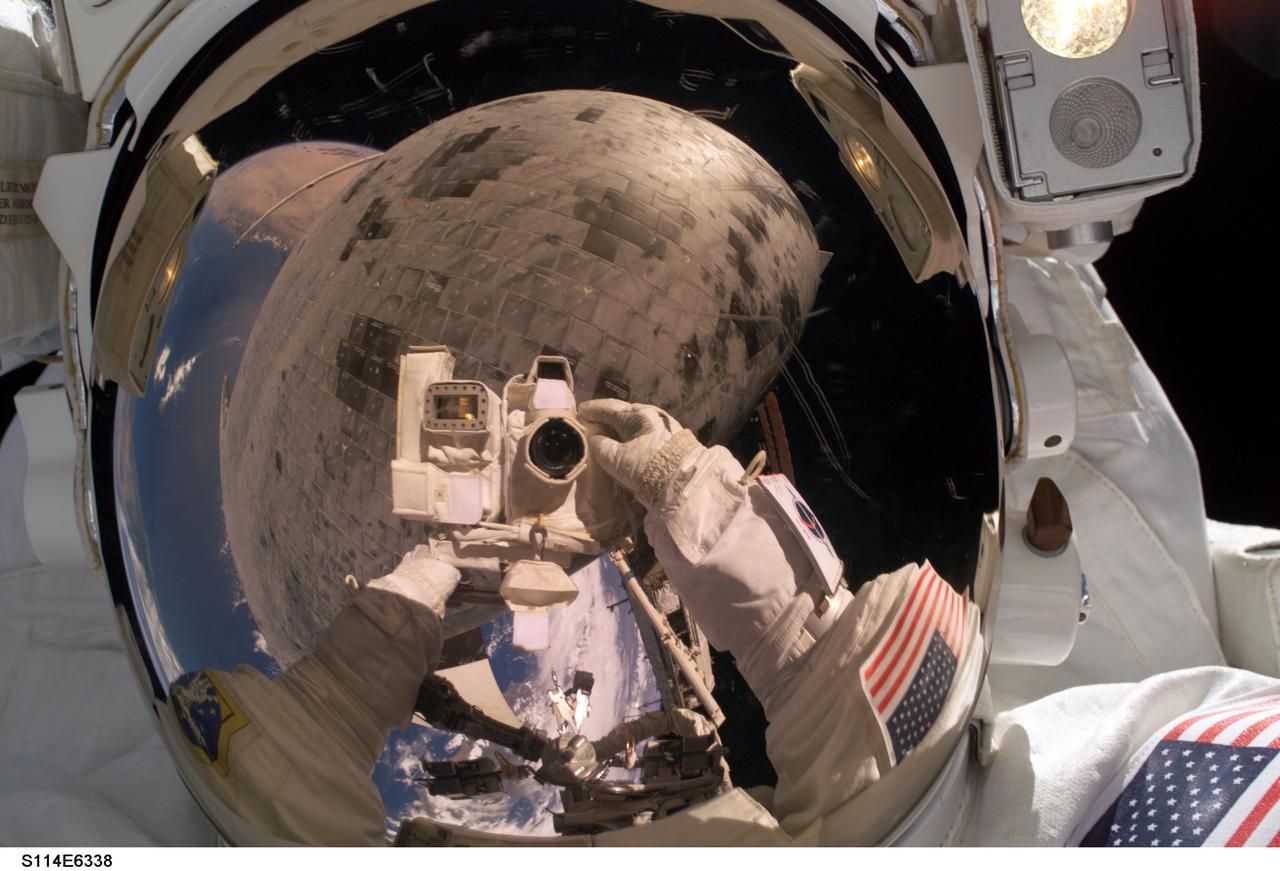
S114-E-6338 (3 August 2005) --- Astronaut Stephen K. Robinson, STS-114 mission specialist, used the pictured digital camera to expose a photo of his helmet visor during today;s extravehicular activities (EVA). Also visible in the reflection are thermal protection tiles on Space Shuttle Discovery;s underside.
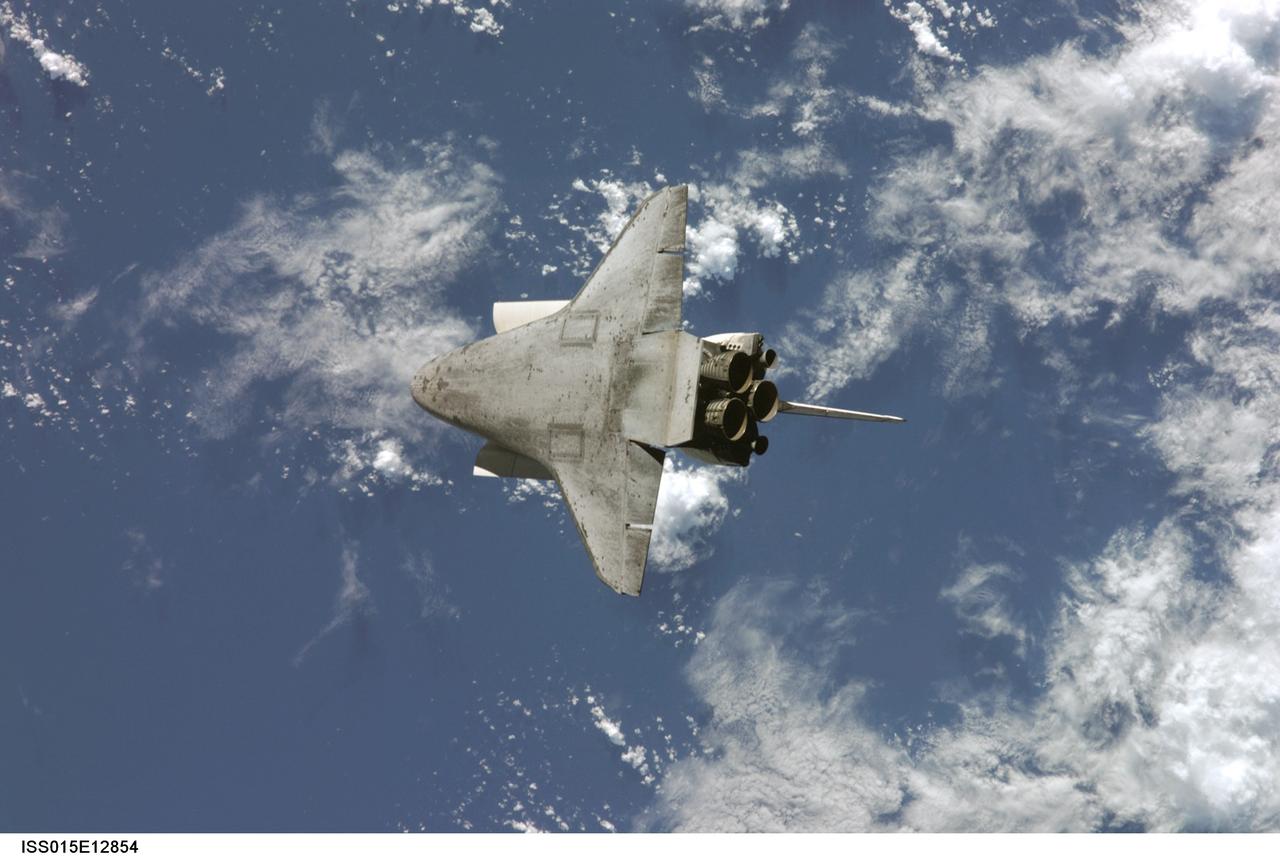
ISS015-E-12854 (10 June 2007) --- This underside view of the Space Shuttle Atlantis was photographed by an Expedition 15 crewmember as Atlantis approached the International Space Station and performed a back-flip to allow photography of its heat shield. The photos will be analyzed by engineers on the ground as additional data to evaluate the condition of Atlantis' heat shield.
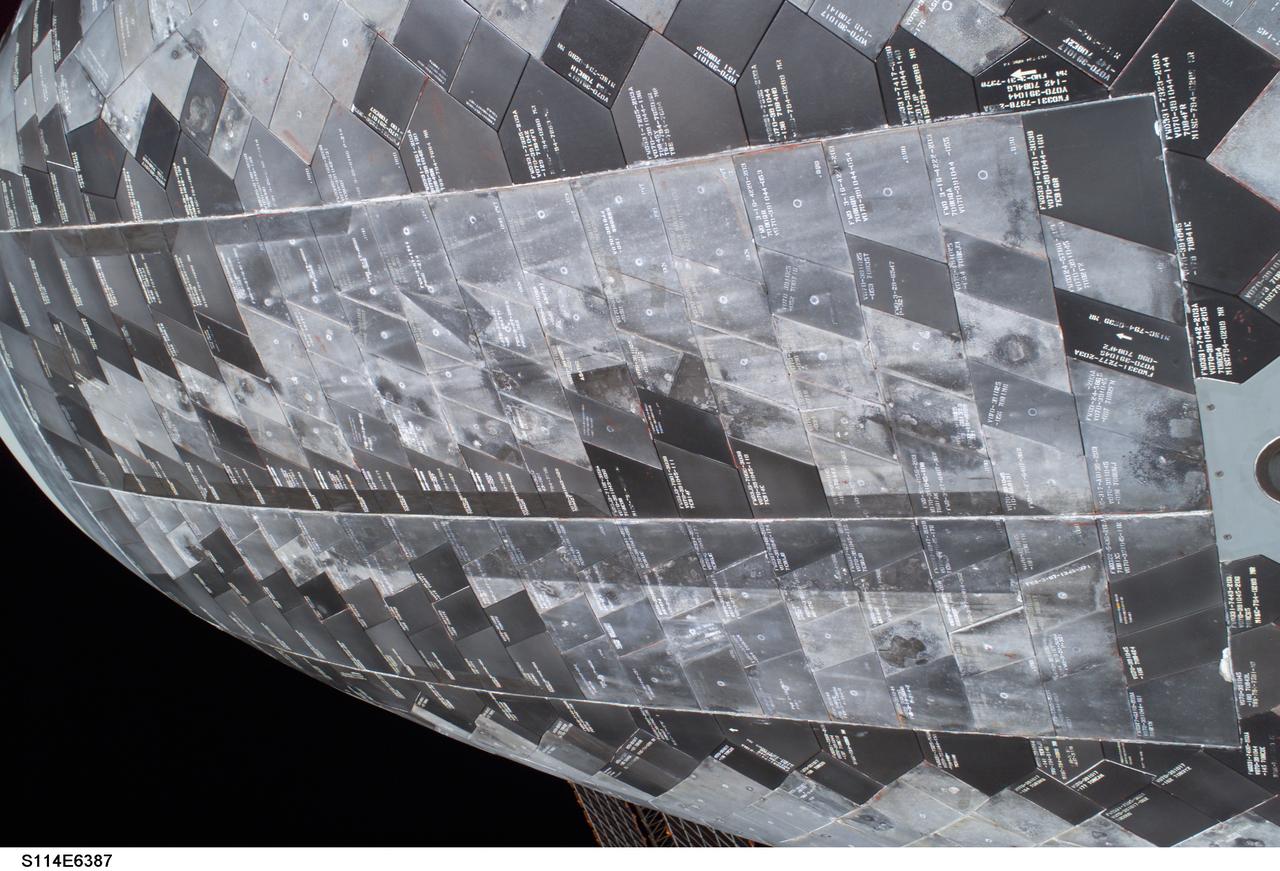
S114-E-6387 (3 August 2005) --- A close-up view of a portion of the thermal protection tiles on Space Shuttle Discovery’s underside is featured in this image photographed by astronaut Stephen K. Robinson, STS-114 mission specialist, during the mission’s third session of extravehicular activities (EVA).
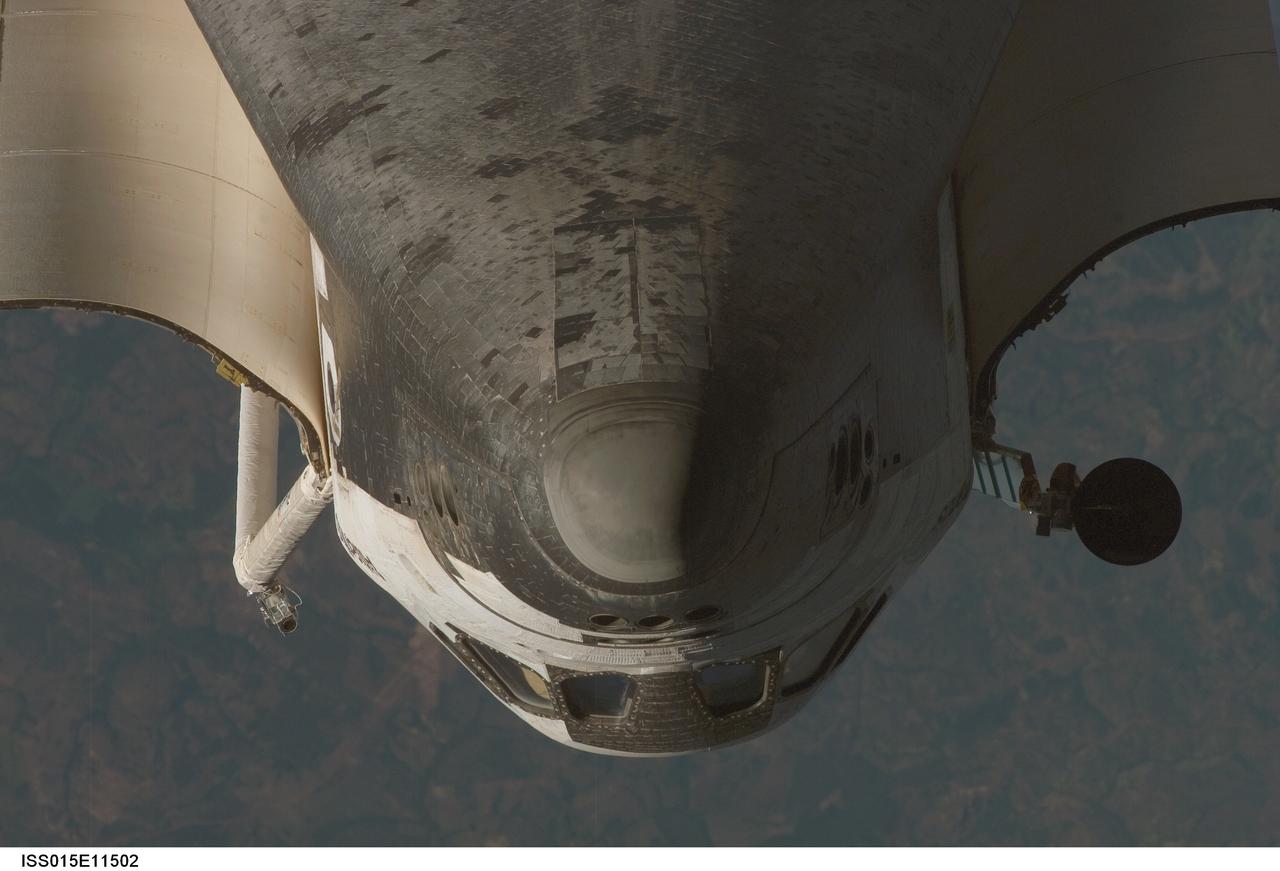
ISS015-E-11502 (10 June 2007) --- This view of the nose of Space Shuttle Atlantis and part of the forward underside was provided by an Expedition 15 crewmember during a back-flip for the RPM survey by the approaching STS-117 crew to the International Space Station. Distance from the station and shuttle at this time was approximately 600 feet.

S114-E-6412 (3 August 2005) --- Space Shuttle Discovery’s underside thermal protection tiles are featured in this image photographed by astronaut Stephen K. Robinson, STS-114 mission specialist, during the mission’s third session of extravehicular activities (EVA).
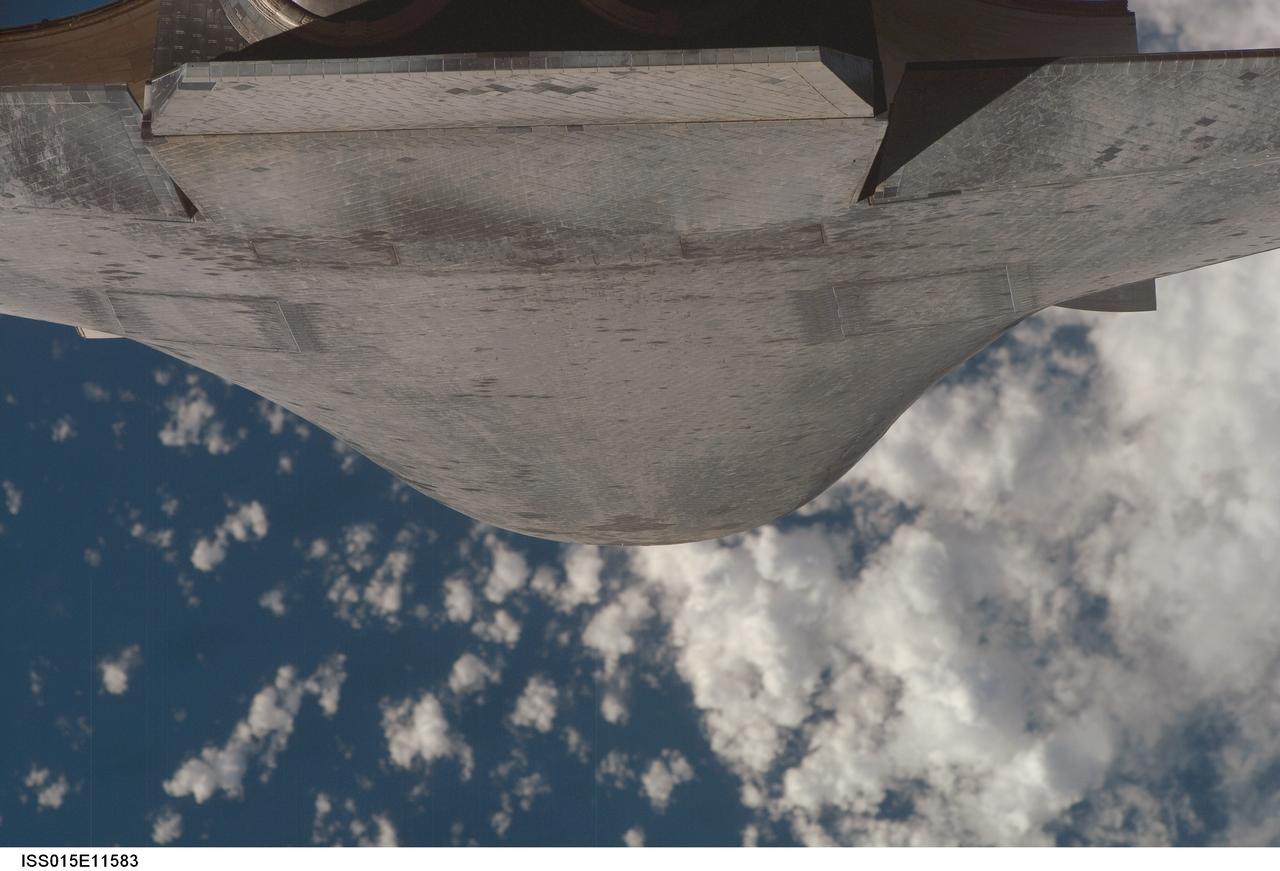
ISS015-E-11583 (10 June 2007) --- This view of the underside of Space Shuttle Atlantis was provided by an Expedition 15 crewmember during a back-flip for the RPM survey by the approaching STS-117 crew to the International Space Station. Distance from the station and shuttle at this time was approximately 600 feet.
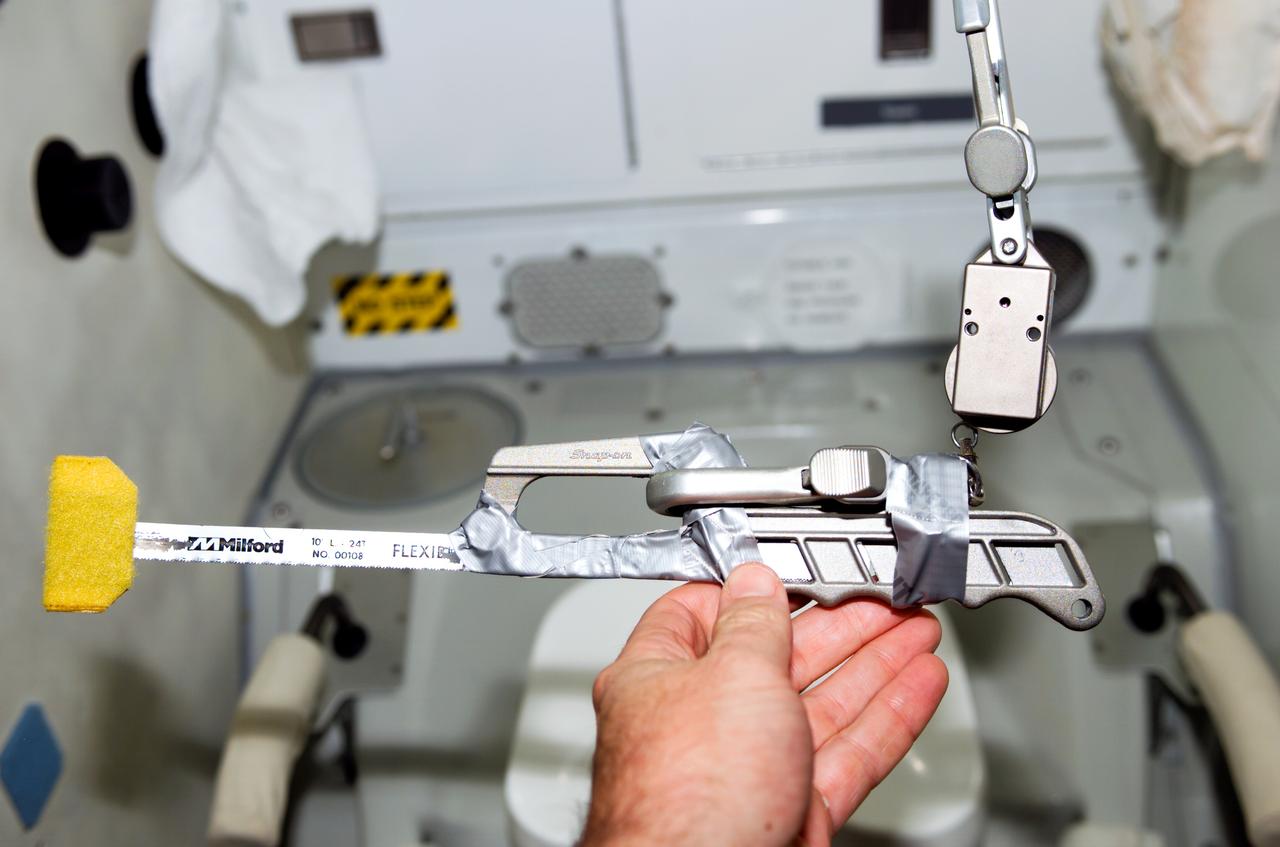
S114-E-6034 (2 August 2005) --- This image taken aboard the Shuttle Discovery shows the modifications the crew has made to a hacksaw they will carry with them during a spacewalk planned for Wednesday. The hacksaw could be used if needed to cut off a thermal protection system gap filler that is protruding from the underside of Discovery.
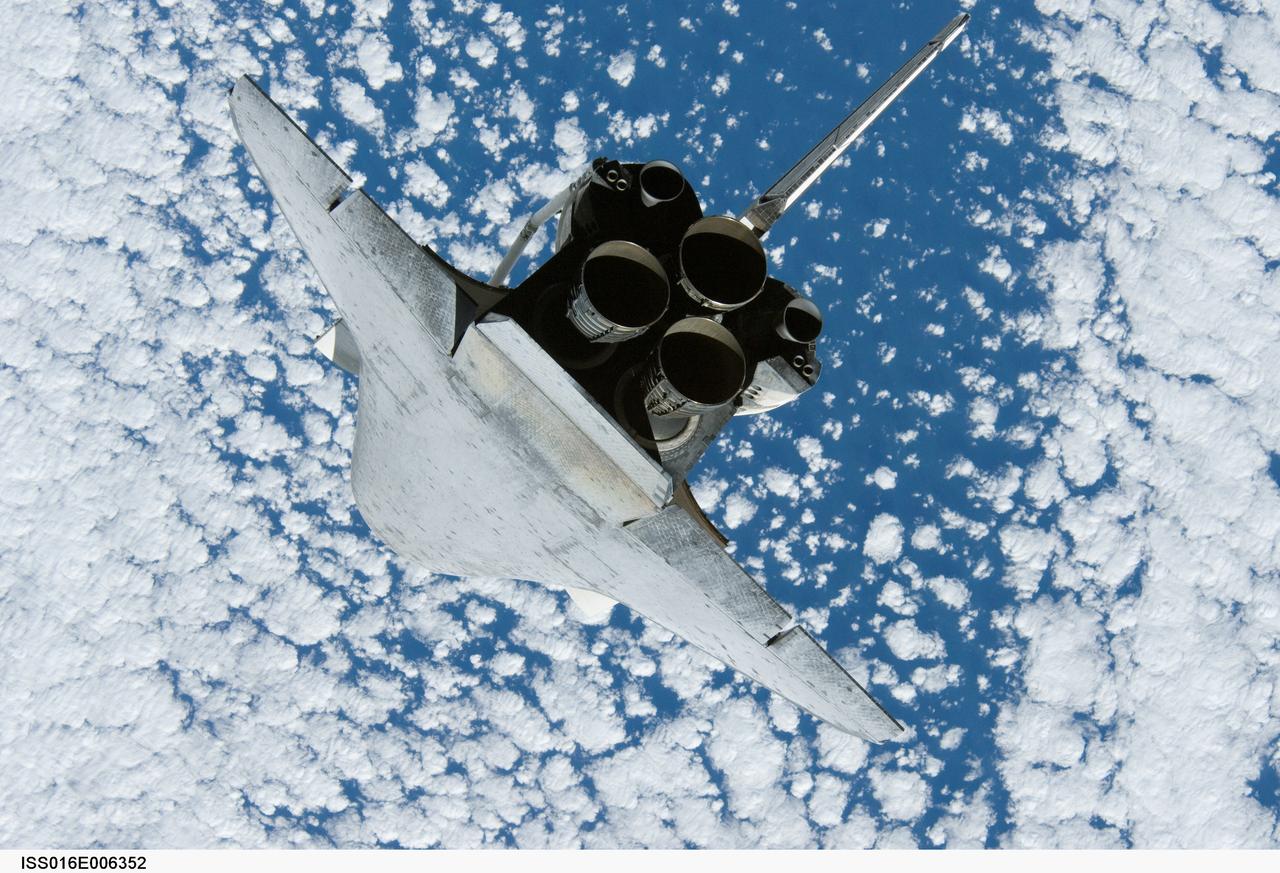
ISS016-E-006352 (25 Oct. 2007) --- Backdropped by a blue and white Earth, the tail section and underside of the Space Shuttle Discovery are featured in this image photographed by an Expedition 16 crewmember during a backflip maneuver performed by the approaching visitors (STS-120) to the International Space Station.

ISS013-E-79951 (11 Sept. 2006) --- This view of the nose and part of the underside of the Space Shuttle Atlantis was provided by an Expedition 13 crew member during a backflip maneuver performed by the approaching visitors to the International Space Station. The Ku-band antenna, very important in communications operations, is visible on the port side of the orbiter.
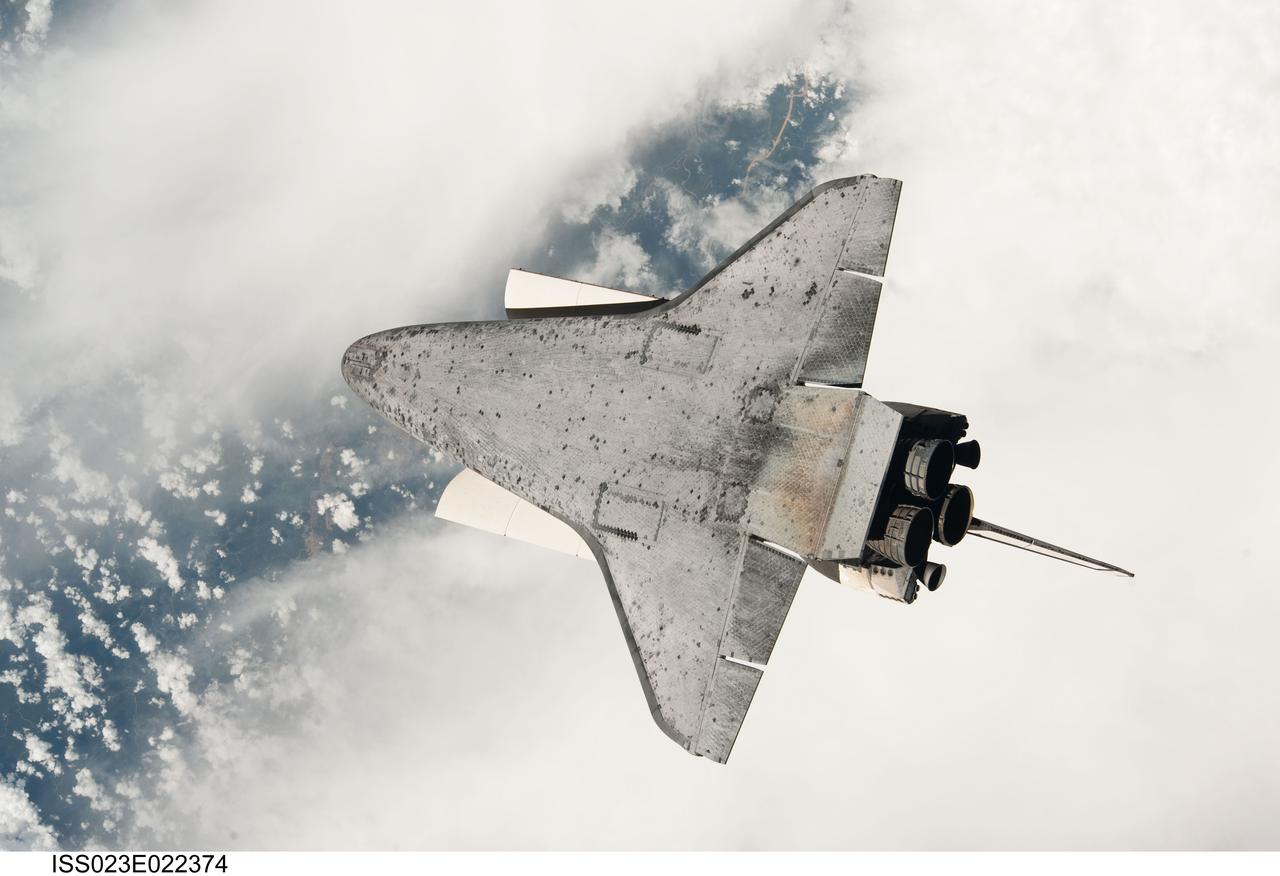
ISS023-E-022374 (7 April 2010) --- The underside of space shuttle Discovery is featured in this image photographed by an Expedition 23 crew member as the shuttle approaches the International Space Station during STS-131 rendezvous and docking operations. Docking occurred at 2:44 a.m. (CDT) on April 7, 2010.
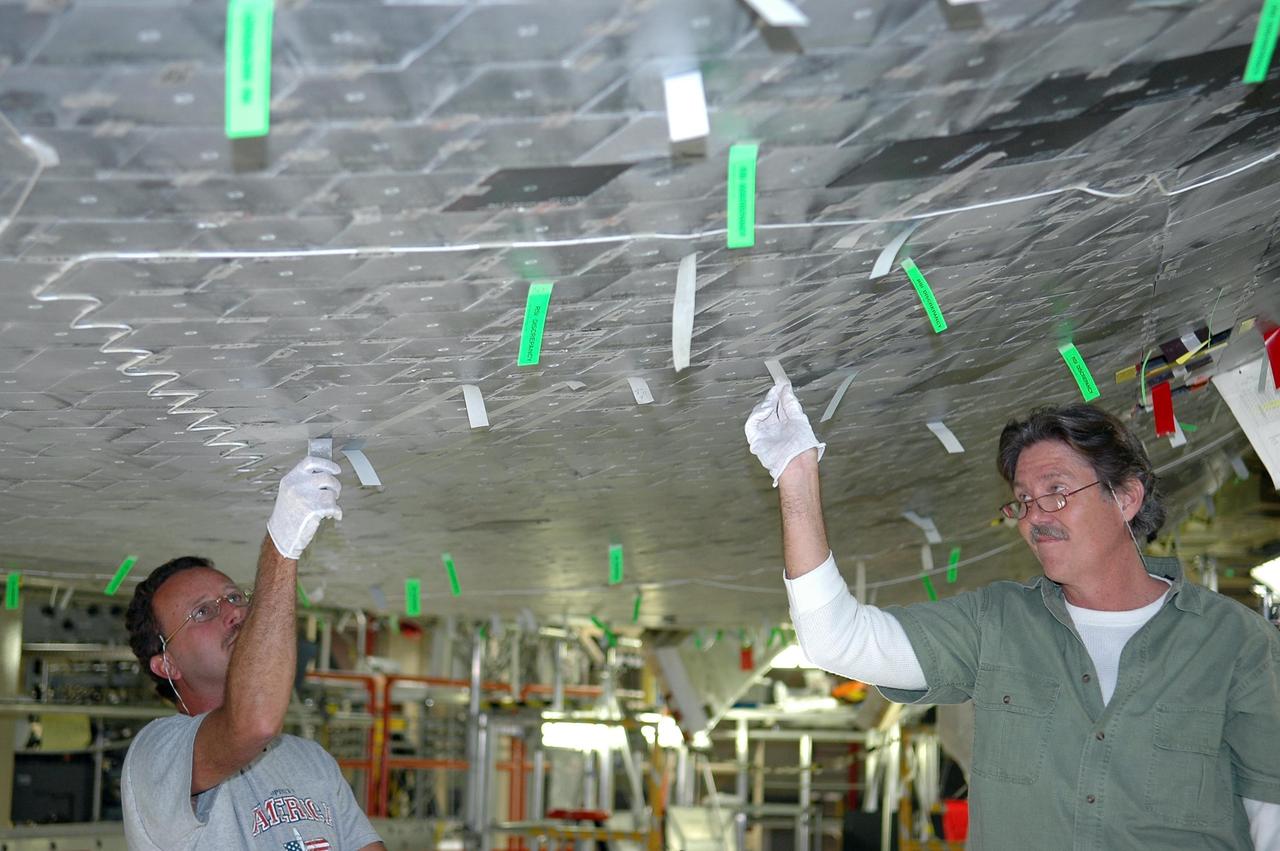
KENNEDY SPACE CENTER, FLA. - In NASA’s Orbiter Processing Facility Bay 3, United Space Alliance technicians Gene Peavler (left) and Richard McGehee (right) are on a stand removing gap filler and inspecting tile repair on Discovery’s underside. Discovery processing is under way for the second return to flight test mission, STS-121.
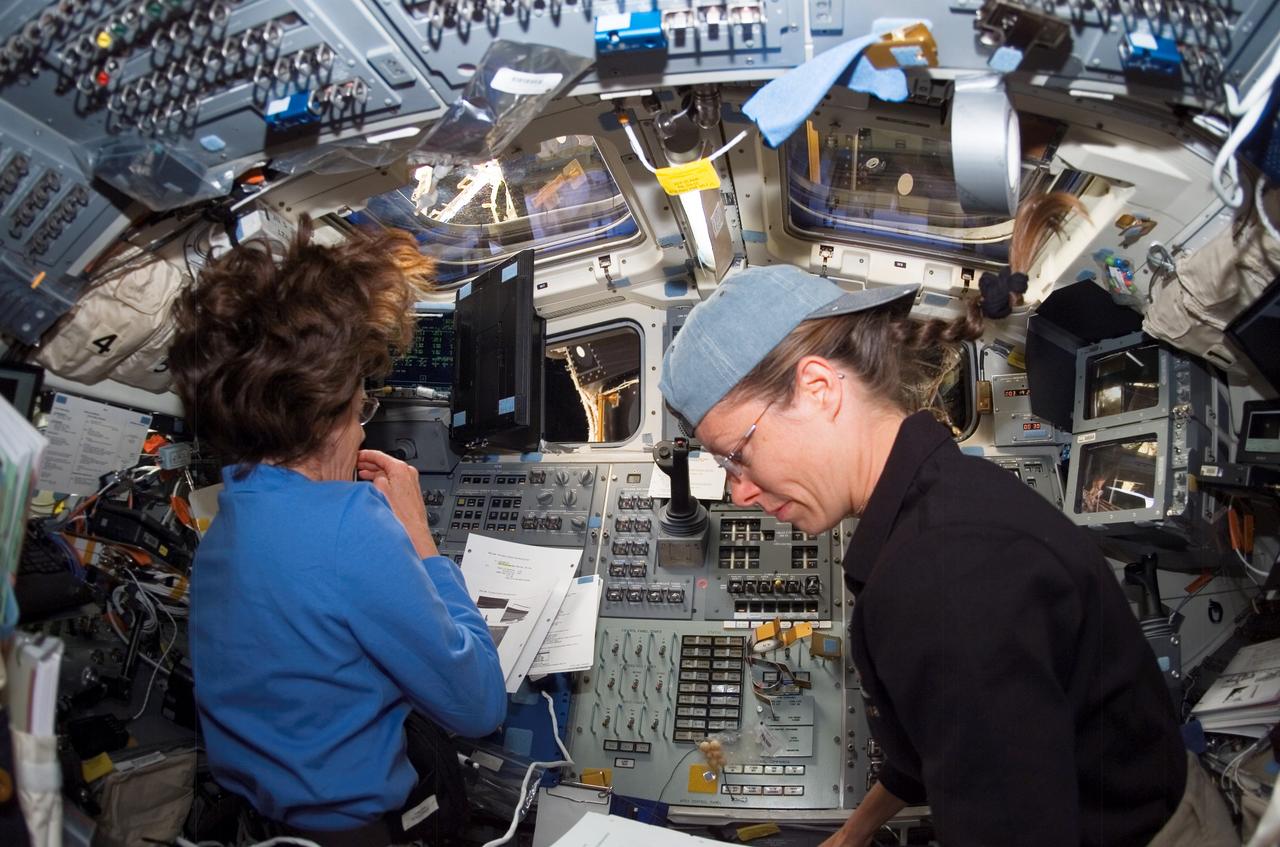
ISS015-E-22201 (12 Aug. 2007) --- During a focused inspection of apparent damage on the underside of the shuttle, astronauts Barbara R. Morgan (left) and Tracy Caldwell, both STS-118 mission specialists, work at the aft flight deck controls of Space Shuttle Endeavour while docked with the International Space Station.
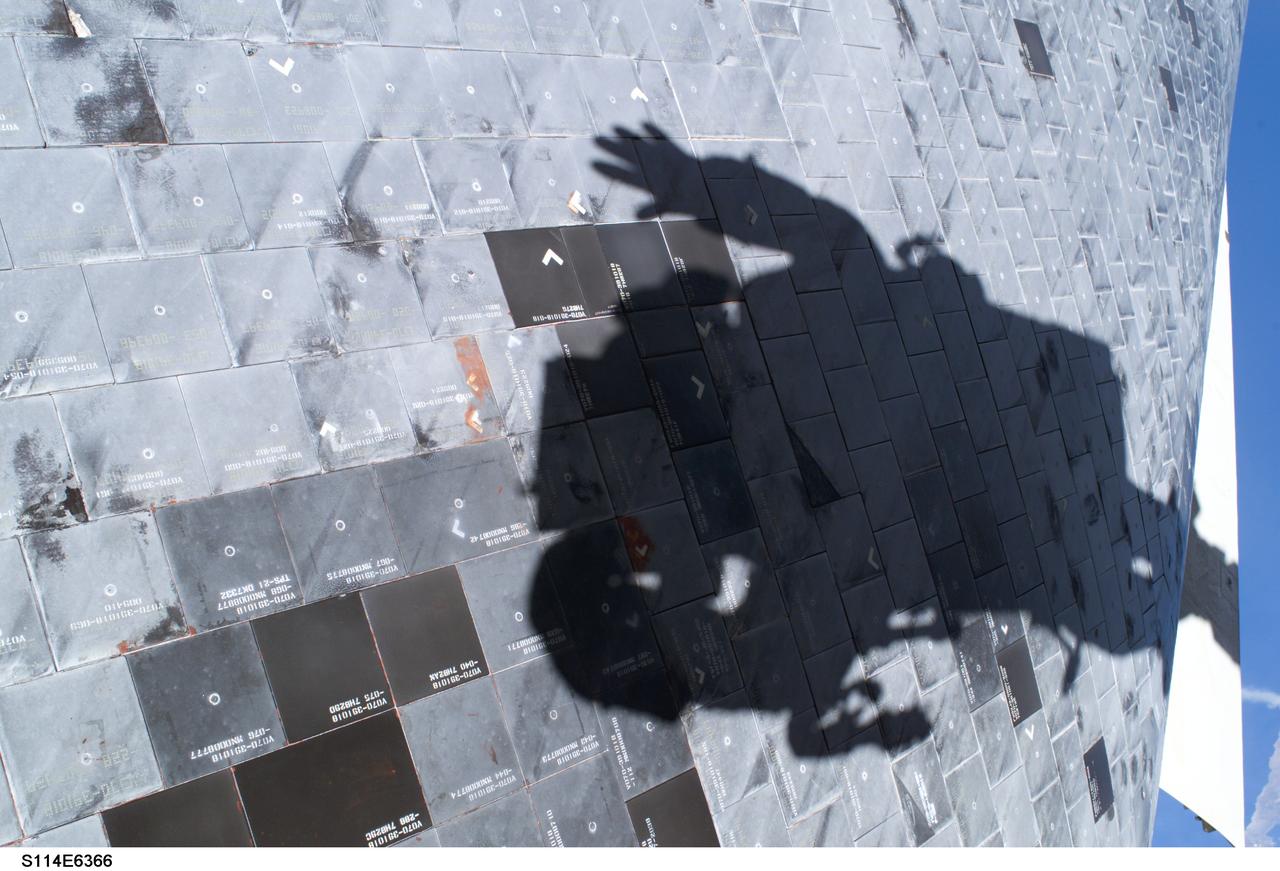
S114-E-6366 (3 August 2005) --- Space Shuttle Discovery’s underside is featured in this image photographed by astronaut Stephen K. Robinson, STS-114 mission specialist, during today’s extravehicular activities (EVA). Robinson’s shadow is visible on the thermal protection tiles.
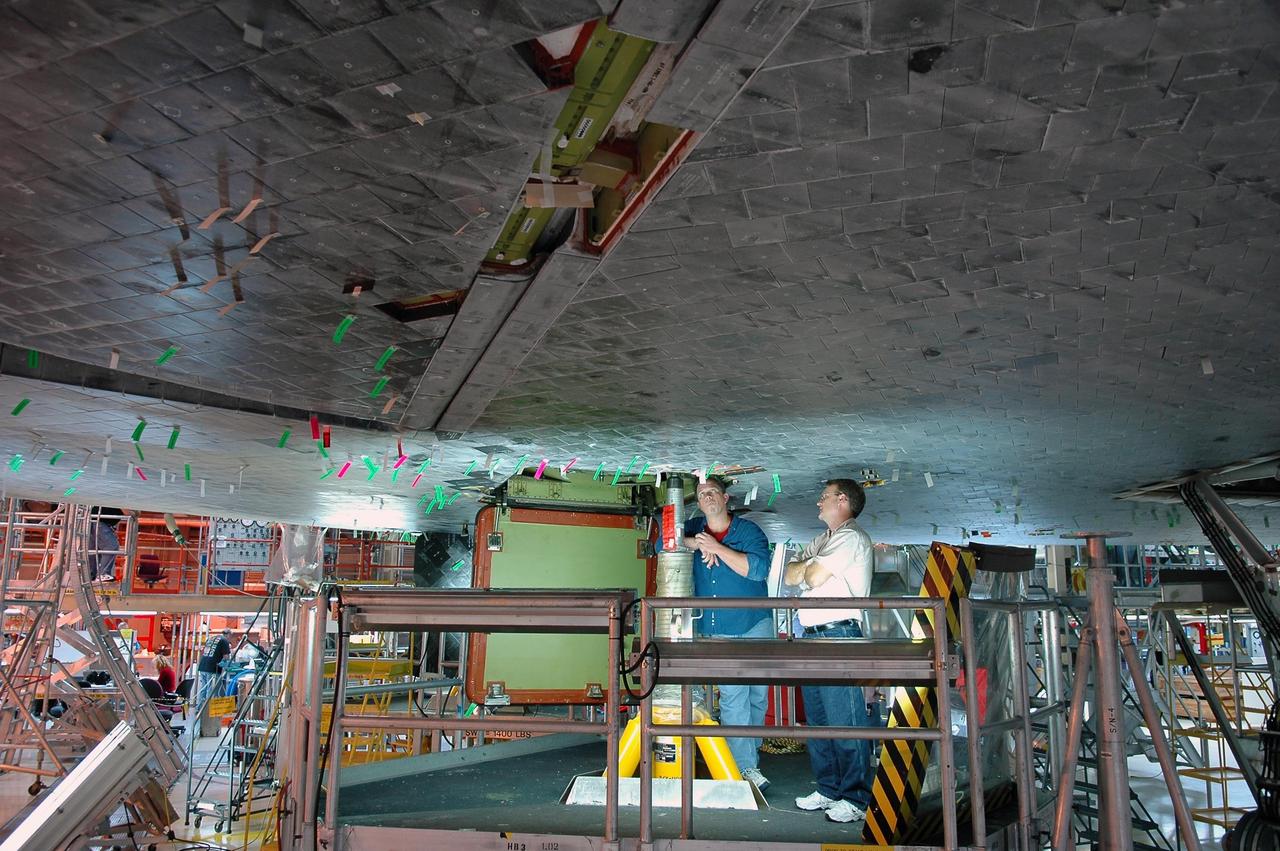
KENNEDY SPACE CENTER, FLA. - In NASA’s Orbiter Processing Facility Bay 3, United Space Alliance technicians are inspecting tile repair on Discovery’s underside. Discovery processing is under way for the second return to flight test mission, STS-121.
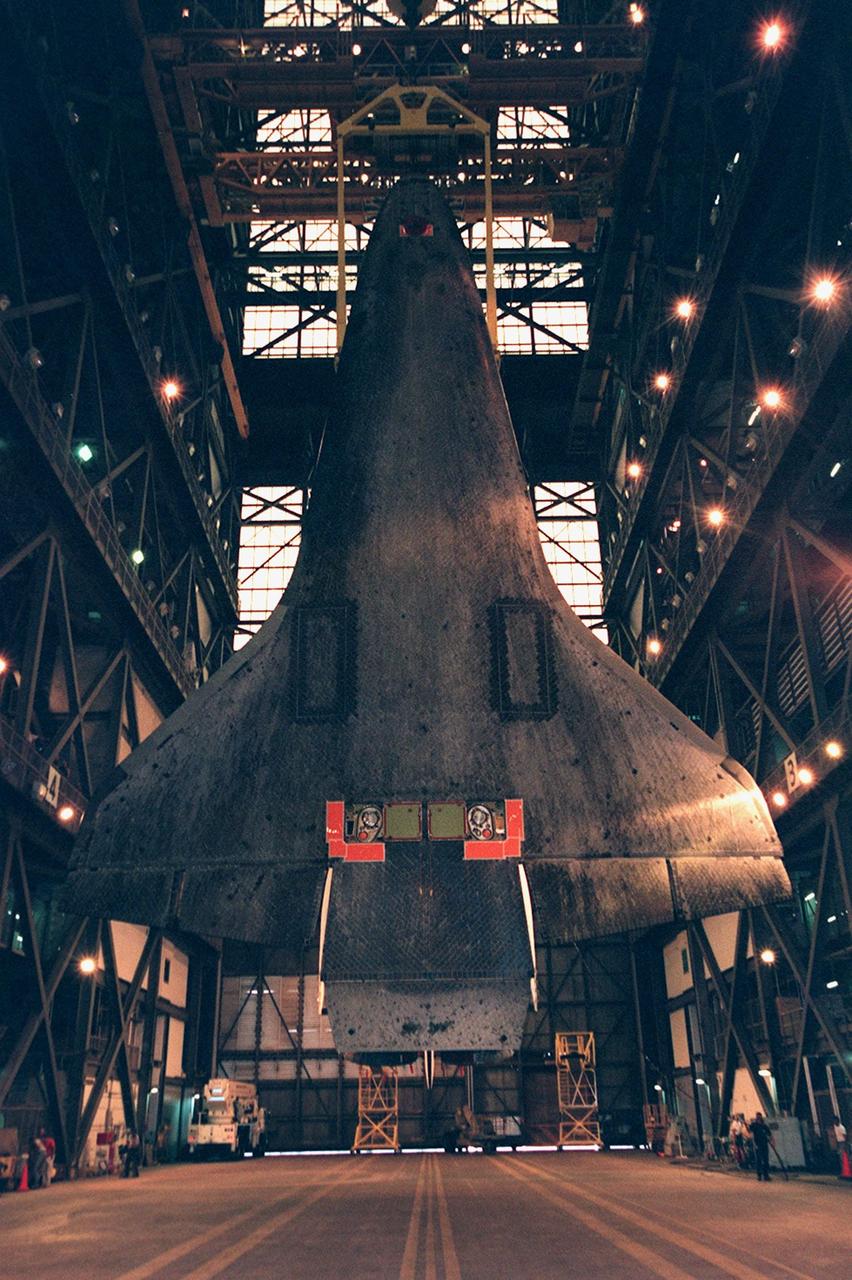
KENNEDY SPACE CENTER, FLA. -- In the transfer aisle of the Vehicle Assembly Building (VAB), the orbiter Atlantis hangs suspended vertically from an overhead crane. Shown is the underside of the orbiter. The black-outlined rectangles near the wings are the location of the main landing gear doors. At the lower end, the two squares centered between the red corners are two of the connection points for the external tank. Another connection is at the top of the underside, between the two red areas shown there. The 122-foot-long orbiter is easily accommodated inside the 525-foot-tall, 518-foot-wide VAB. Atlantis will be mated with its external tank and solid rocket boosters before being transported to Launch Pad 39A. Atlantis will fly on mission STS-101 to the International Space Station, where its crew of seven will prepare the Station for the arrival of the next pressurized module, the Russian-built Zvezda. Atlantis is expected to launch no earlier than April 17, 2000
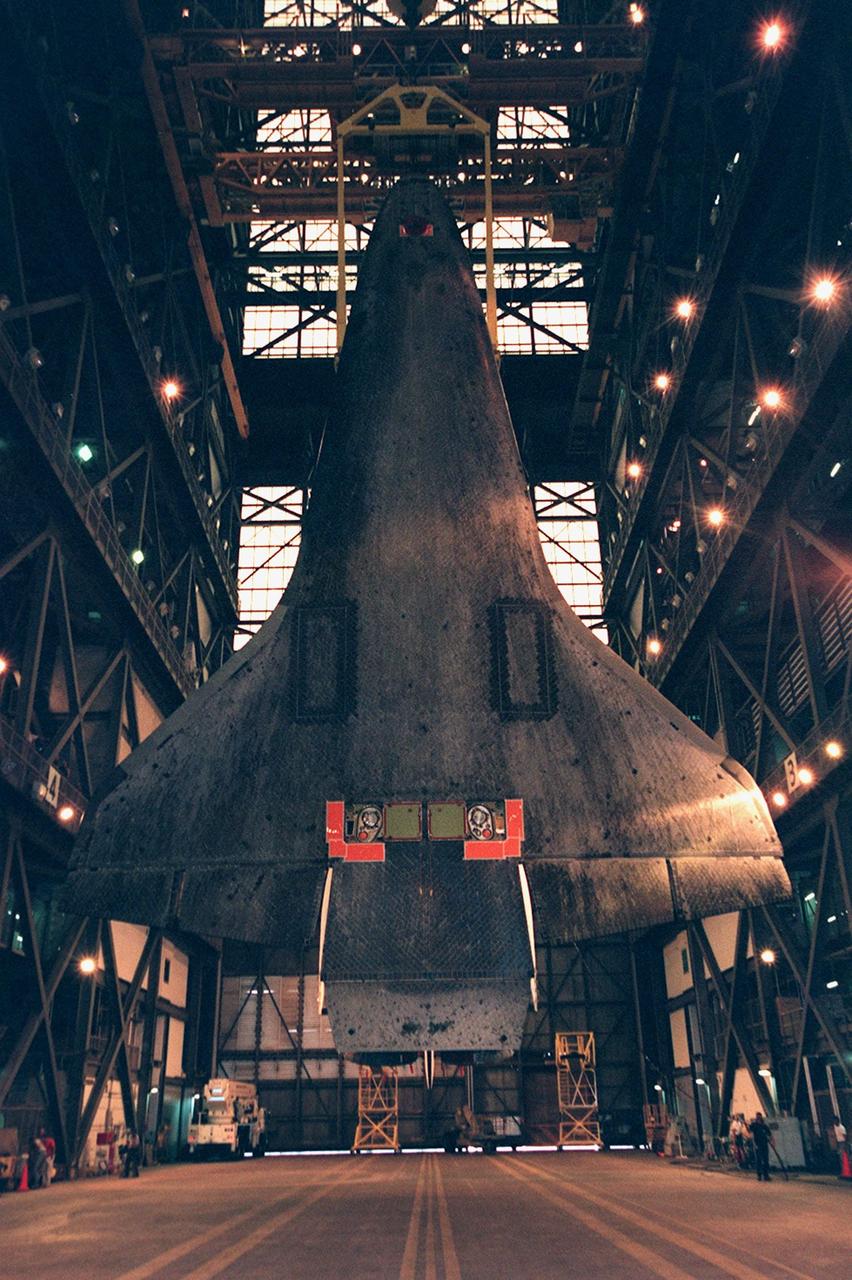
KENNEDY SPACE CENTER, FLA. -- In the transfer aisle of the Vehicle Assembly Building (VAB), the orbiter Atlantis hangs suspended vertically from an overhead crane. Shown is the underside of the orbiter. The black-outlined rectangles near the wings are the location of the main landing gear doors. At the lower end, the two squares centered between the red corners are two of the connection points for the external tank. Another connection is at the top of the underside, between the two red areas shown there. The 122-foot-long orbiter is easily accommodated inside the 525-foot-tall, 518-foot-wide VAB. Atlantis will be mated with its external tank and solid rocket boosters before being transported to Launch Pad 39A. Atlantis will fly on mission STS-101 to the International Space Station, where its crew of seven will prepare the Station for the arrival of the next pressurized module, the Russian-built Zvezda. Atlantis is expected to launch no earlier than April 17, 2000
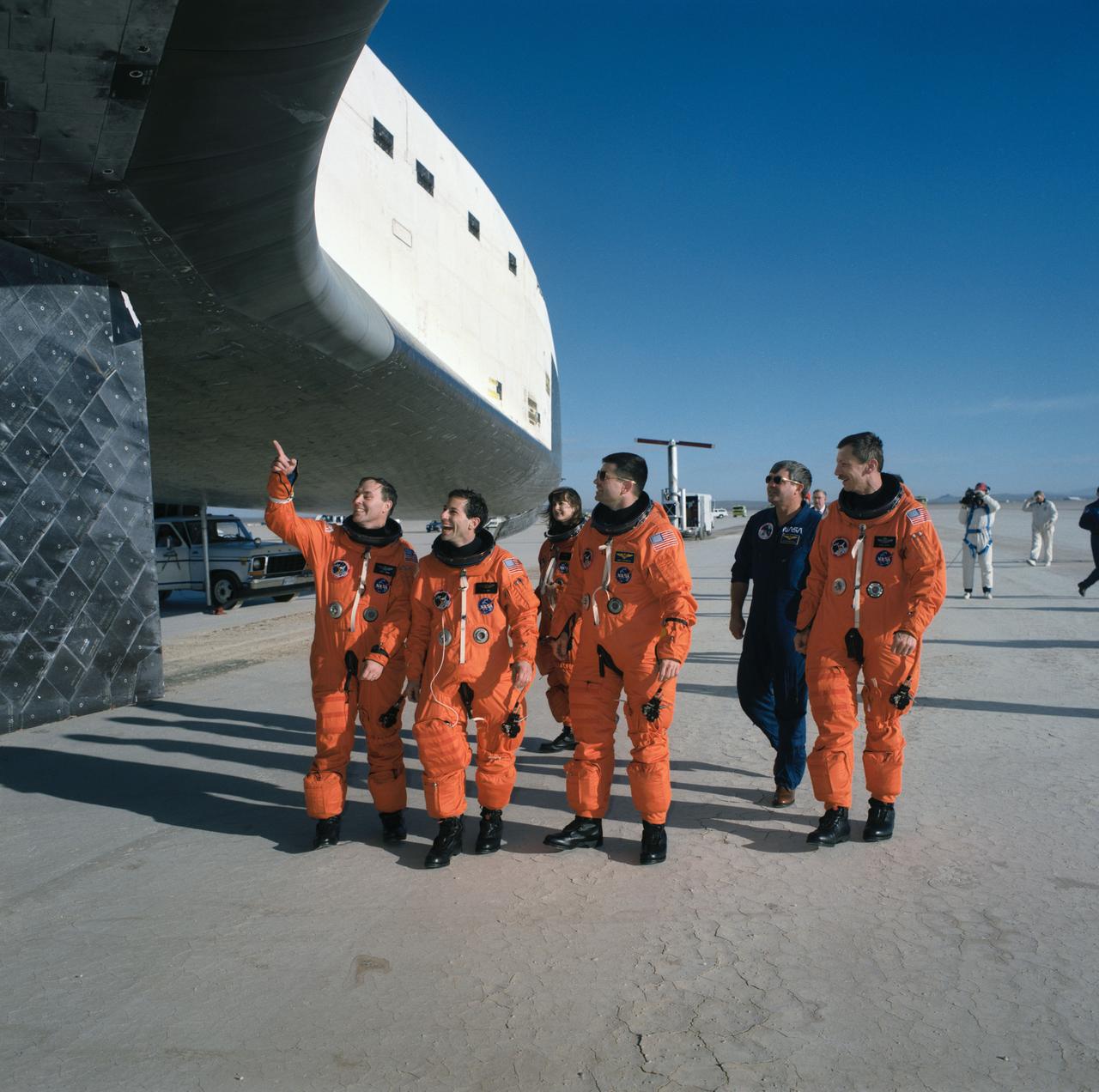
STS037-S-085 (11 April 1991) --- Following their egress from the Space Shuttle Atlantis at Edwards Air Force Base the STS-37 astronauts survey their "home" for the past six days. Pictured, left to right, are astronauts Jerry L. Ross, Jerome J. Apt, Linda M. Godwin, Kenneth D. Cameron, Daniel C. Brandenstein and Steven R. Nagel, mission commander. Brandenstein, chief of the Astronaut Office at JSC, flew the Shuttle training aircraft and took photographs during Atlantis's landing. Complete wheel stop occurred at 6:56:26 (PDT), April 11, 1991.
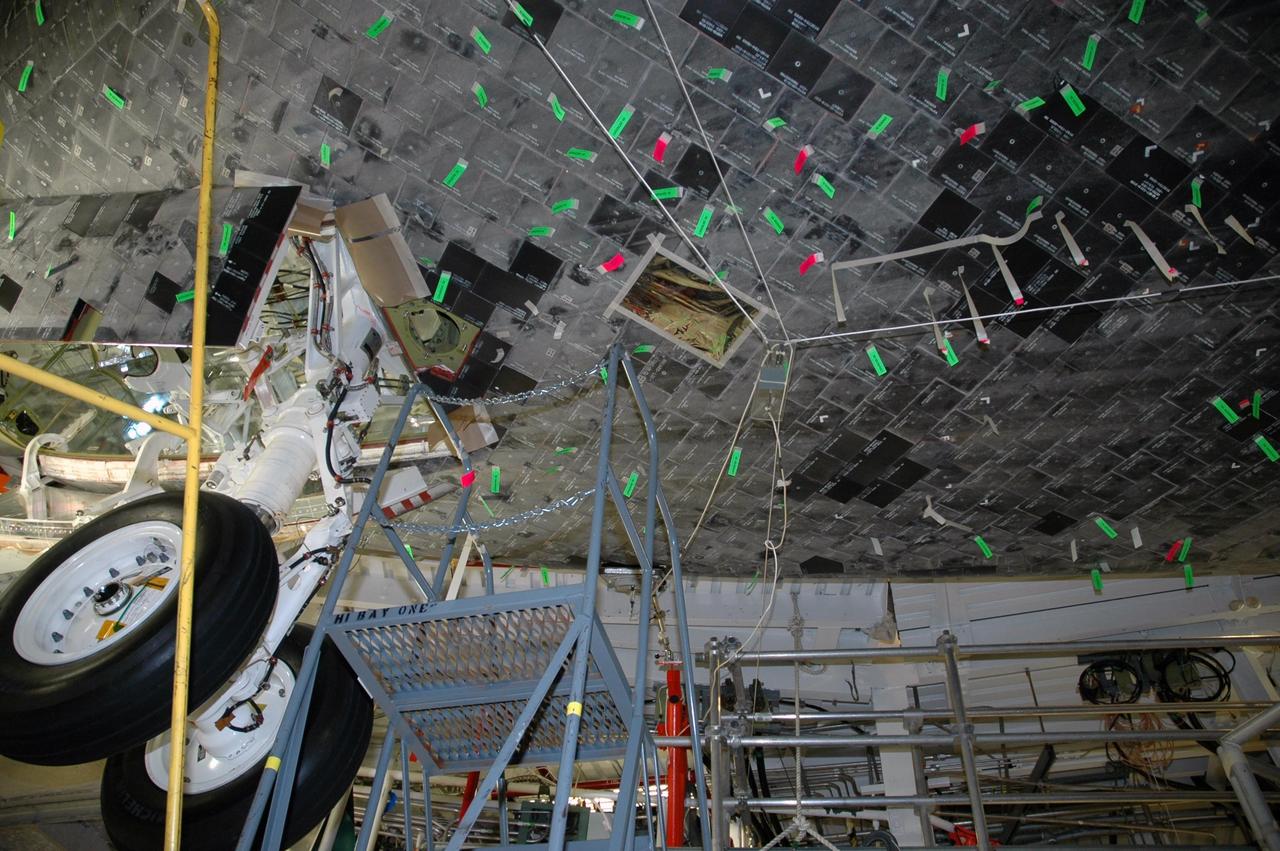
KENNEDY SPACE CENTER, FLA. - In bay 3 of the Orbiter Processing Facility, the thermal protection system tiles on the underside of Atlantis are marked for post-flight inspection. Atlantis returned from mission STS-115 on Sept. 21 and is being prepared for her next mission, STS-117. The mission will be the 21st to the International Space Station and construction flight 13A. The mission payload comprises the starboard arrays 3 and 4. Launch is scheduled for no earlier than Feb. 22, 2007. Photo credit: NASA/Jack Pfaller
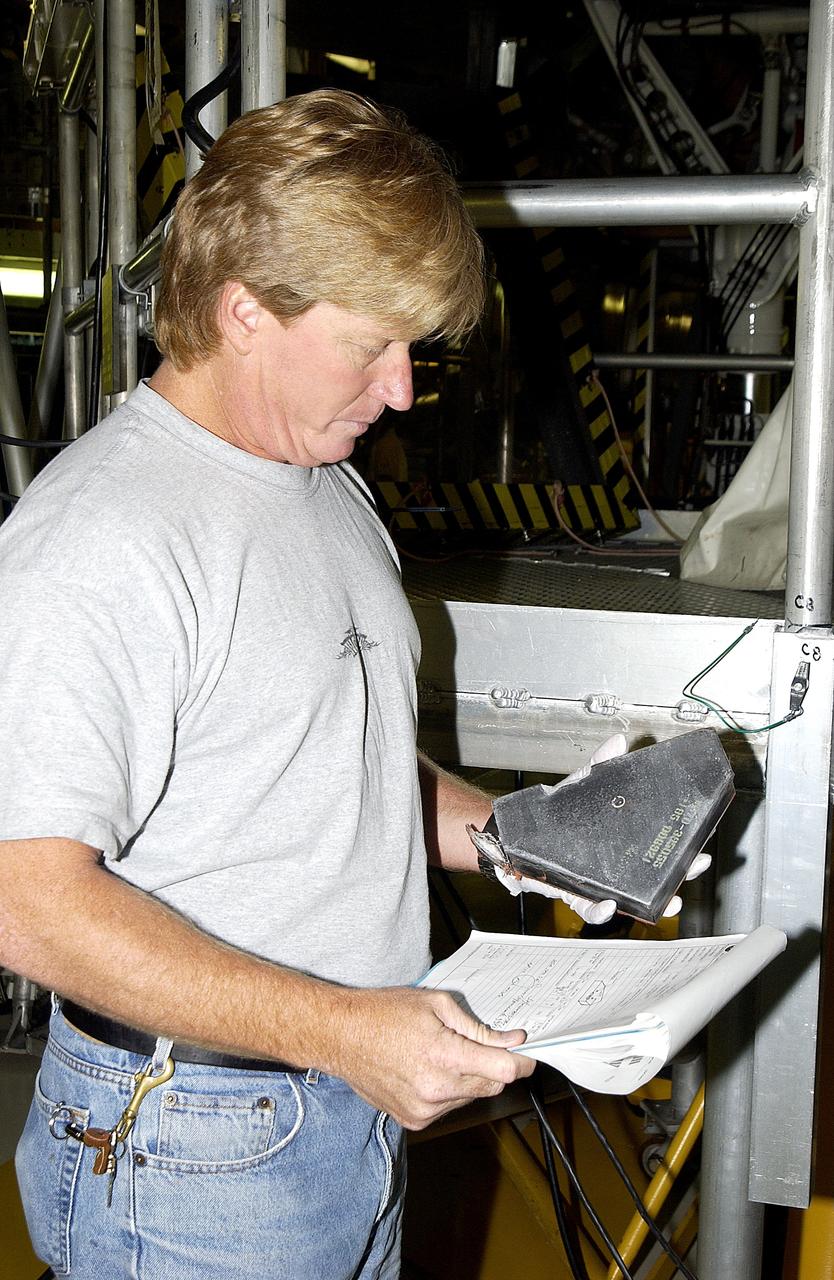
KENNEDY SPACE CENTER, FLA. - In the Orbiter Processing Facility, Ryan Levann, with United Space Alliance, checks data on the tile removed from the thermal barrier around the umbilical areas, the external tank attach points, on the underside of Atlantis. The umbilical areas are closed off after ET separation by a door, seen here. The exposed area of each closed door is covered with reusable surface insulation.
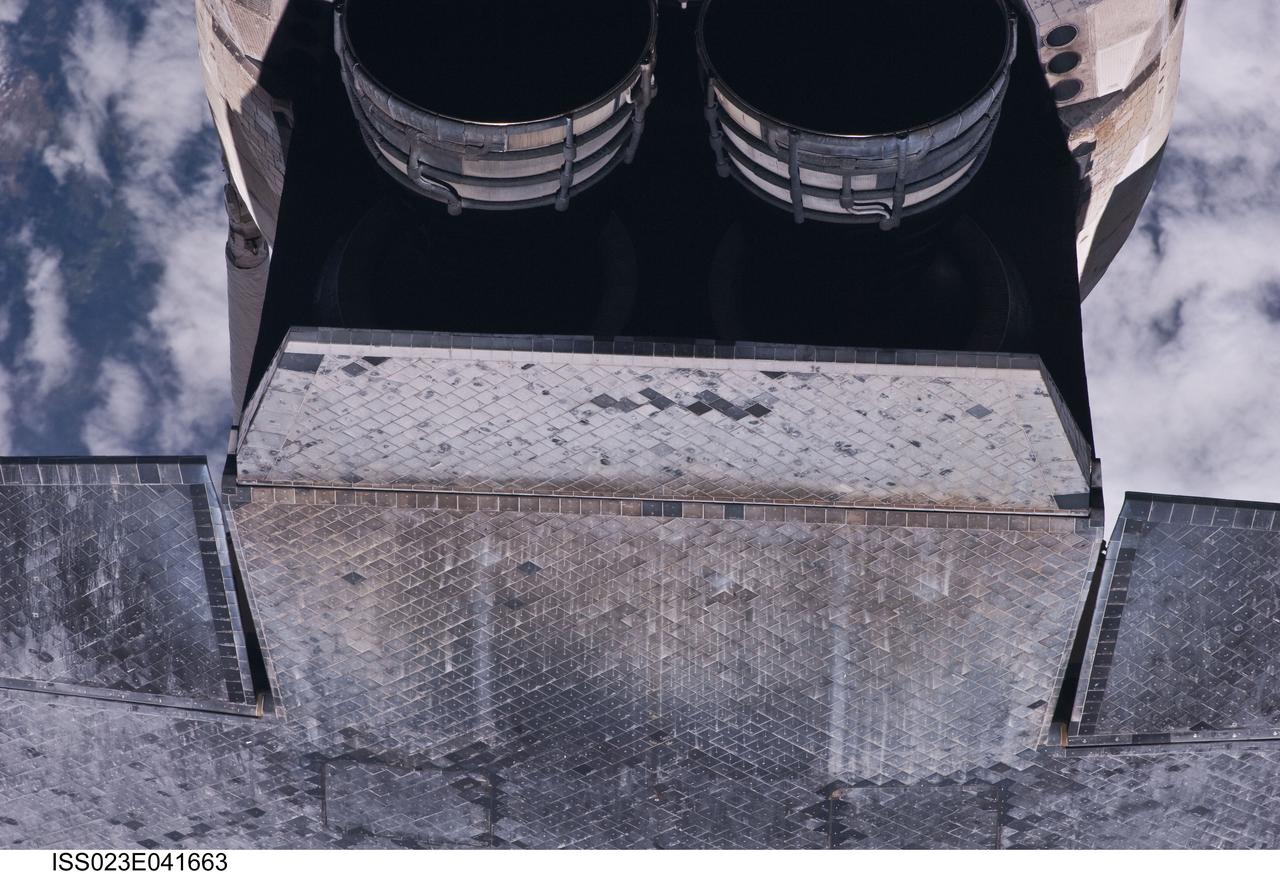
ISS023-E-041663 (16 May 2010) --- This view of the underside of the space shuttle Atlantis was provided by an Expedition 23 crew member during a survey of the approaching STS-132 vehicle prior to docking with the International Space Station. As part of the survey and part of every mission's activities, Atlantis performed a back-flip for the rendezvous pitch maneuver (RPM). The image was photographed with a digital still camera, using a 400mm lens at a distance of about 600 feet (180 meters).
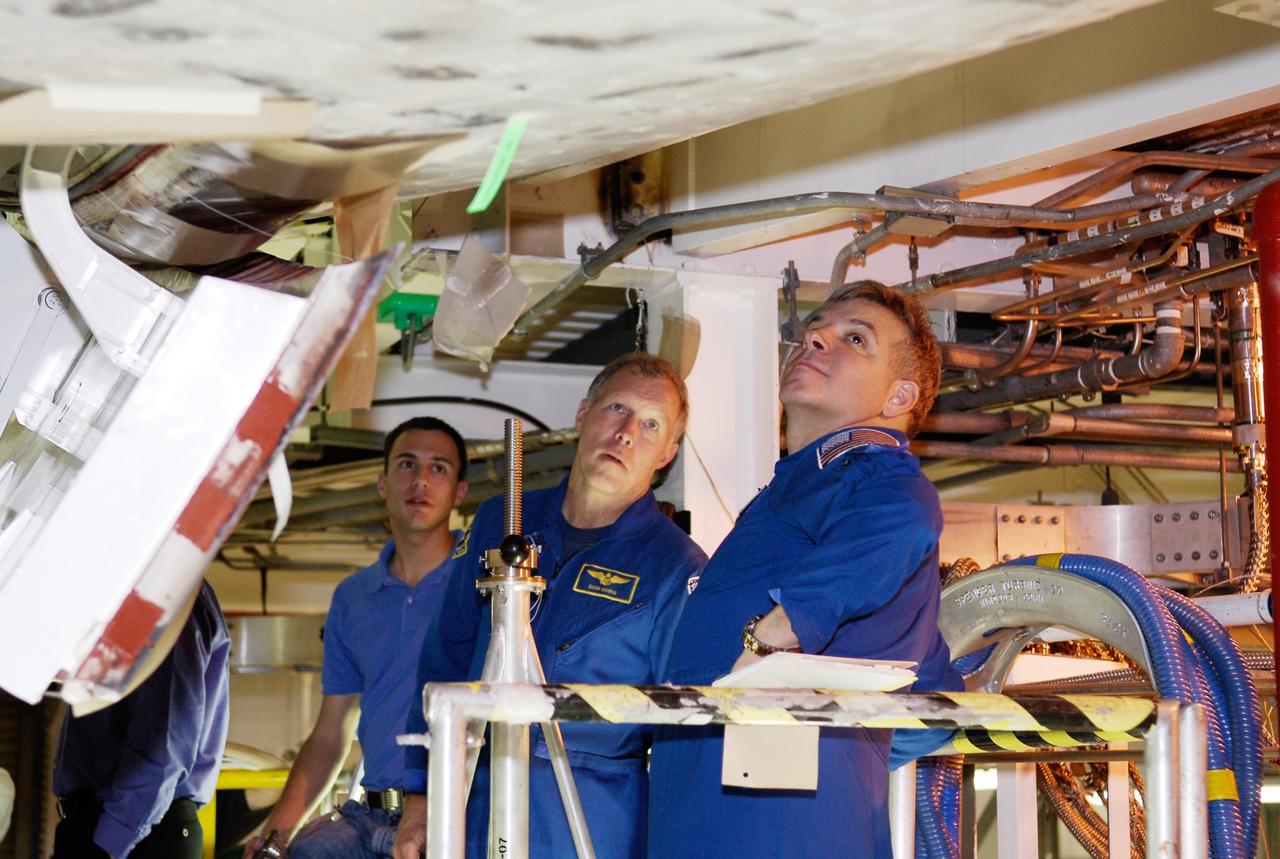
KENNEDY SPACE CENTER, FLA. -- In the Orbiter Processing Facility, STS-123 crew members inspect the thermal protection system tiles on the underside of space shuttle Endeavour. At center is Commander Dominic Gorie; at right is Pilot Gregory Johnson. They and other crew members are at NASA's Kennedy Space Center for a crew equipment interface test, a process of familiarization with payloads, hardware and the space shuttle. The STS-123 mission is targeted for launch on space shuttle Endeavour on Feb. 14. It will be the 25th assembly flight of the station. Photo credit: NASA/Kim Shiflett
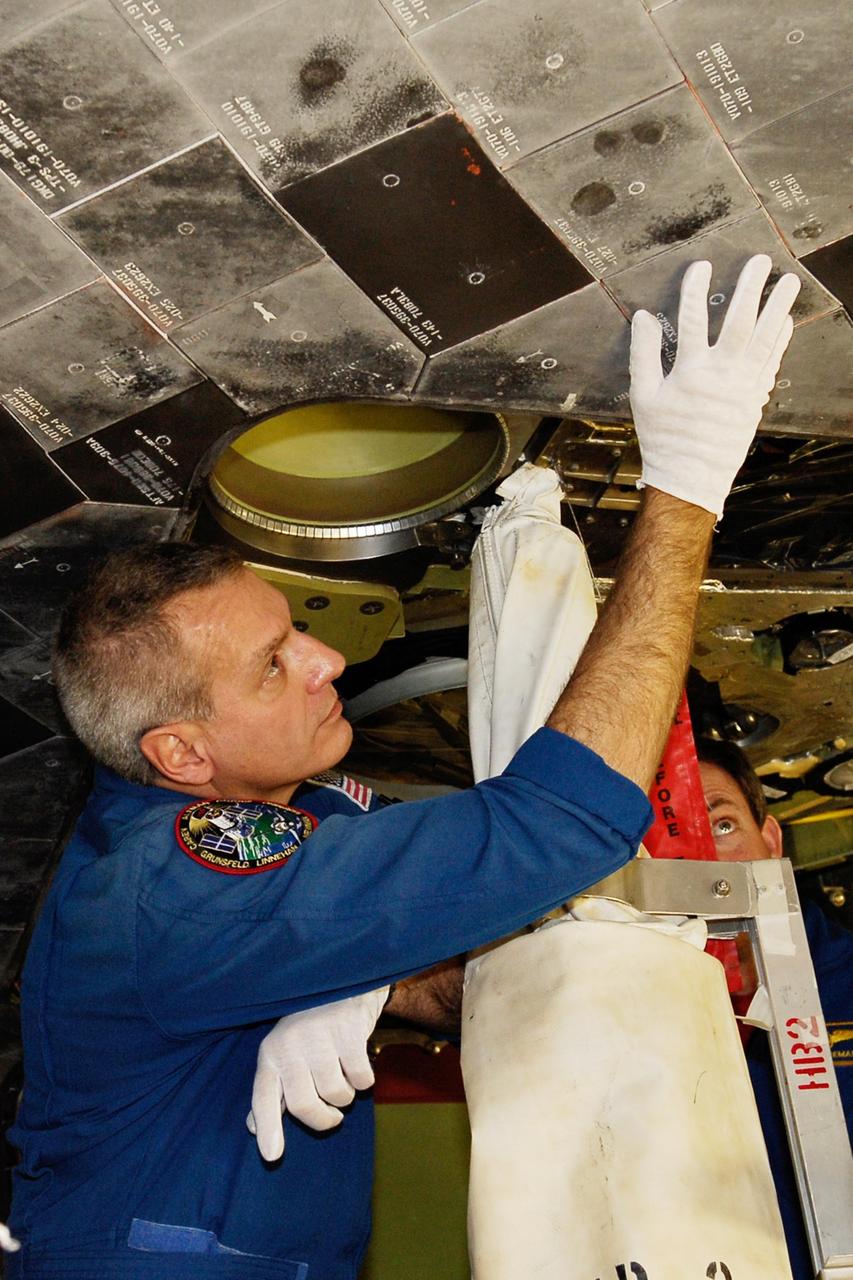
KENNEDY SPACE CENTER, FLA. -- In the Orbiter Processing Facility, STS-123 Mission Specialist Richard Linnehan makes a hands-on inspection of the thermal protection system tiles on the underside of space shuttle Endeavour. He and other crew members are at NASA's Kennedy Space Center for a crew equipment interface test, a process of familiarization with payloads, hardware and the space shuttle. The STS-123 mission is targeted for launch on space shuttle Endeavour on Feb. 14. It will be the 25th assembly flight of the station. Photo credit: NASA/Kim Shiflett
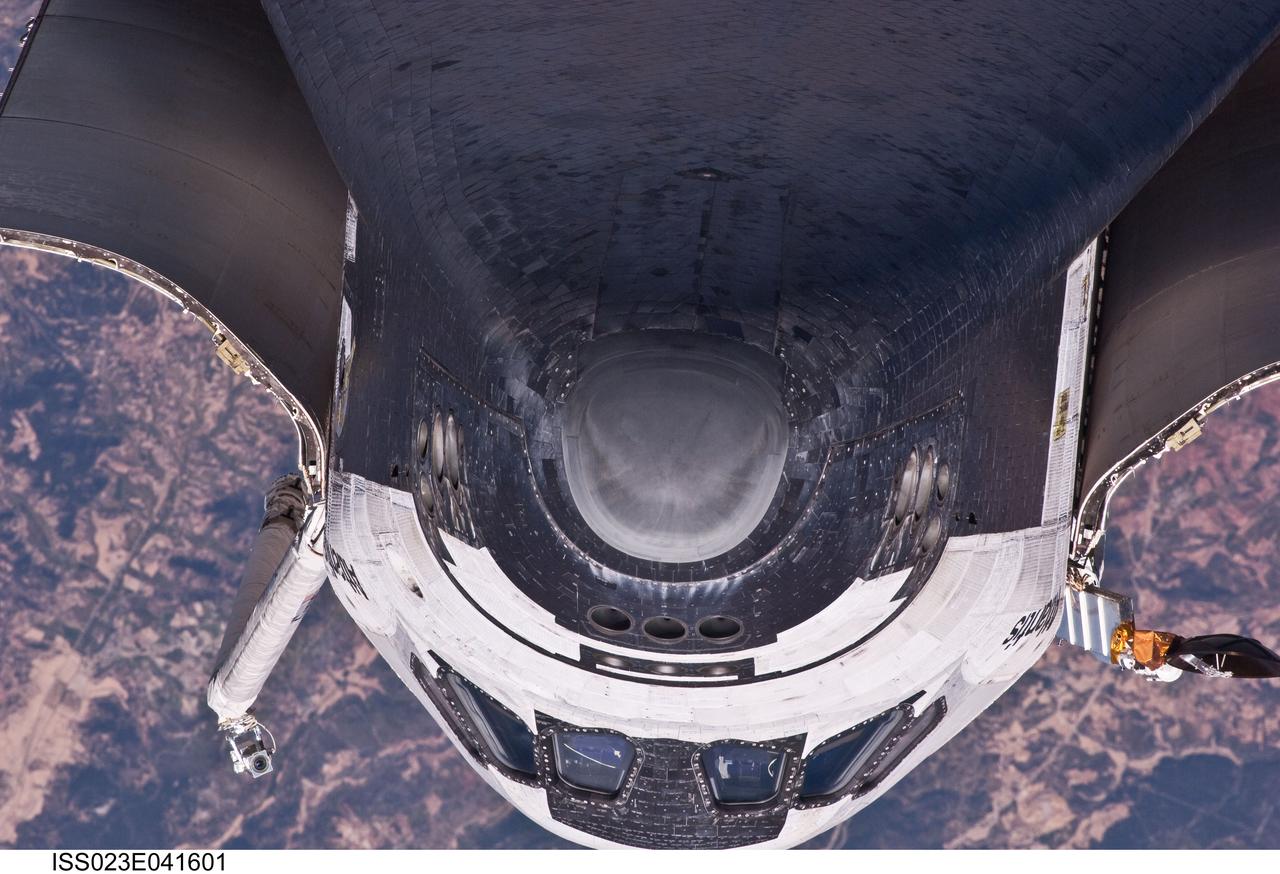
ISS023-E-041601 (16 May 2010) --- This view of the underside of the crew cabin of the space shuttle Atlantis was provided by an Expedition 23 crew member during a survey of the approaching STS-132 vehicle prior to docking with the International Space Station. As part of the survey and part of every mission's activities, Atlantis performed a back-flip for the rendezvous pitch maneuver (RPM). The image was photographed with a digital still camera, using a 400mm lens at a distance of about 600 feet (180 meters).
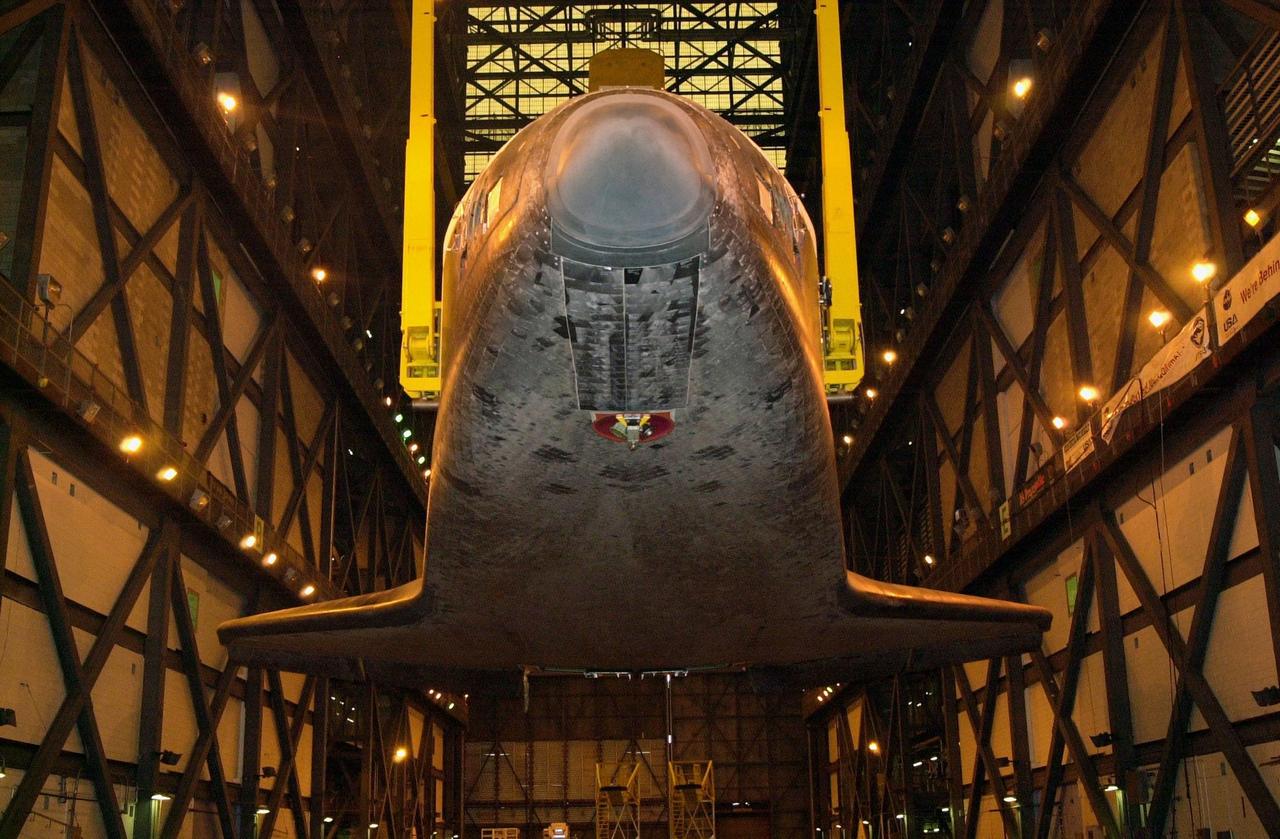
The underside of orbiter Discovery is seen as it is lifted to vertical in the transfer aisle of the Vehicle Assembly Building. It will then be lifted up and into high bay 1 for mating with its solid rocket boosters and external tank. Discovery will be launched March 8 on mission STS-102, the eighth construction flight to the International Space Station. The Shuttle will carry the Multi-Purpose Logistics Module Leonardo, the first of three pressurized modules provided by the Italian Space Agency to carry supplies and equipment to the Space Station and back to earth
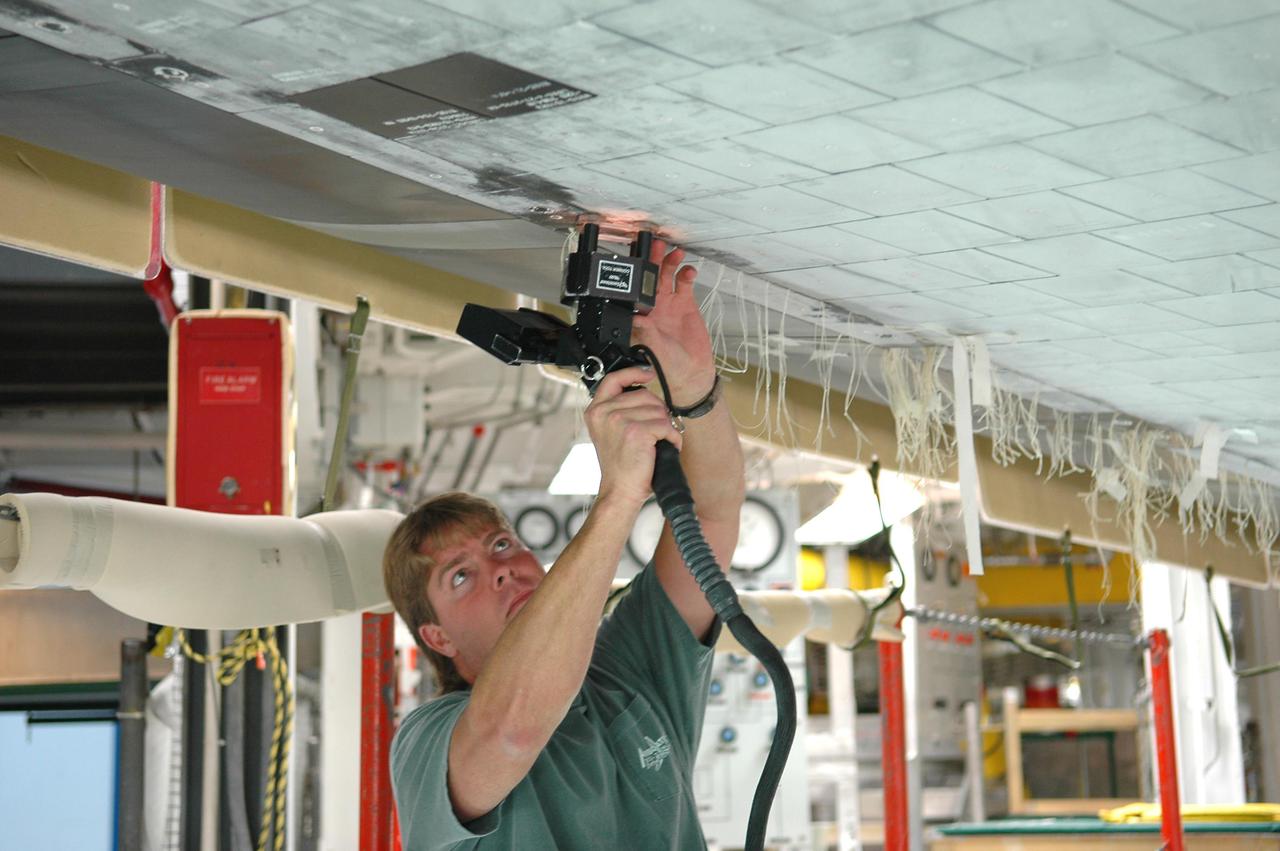
KENNEDY SPACE CENTER, FLA. - In Orbiter Processing Facility bay 1 at NASA’s Kennedy Space Center, United Space Alliance technician Greg Goforth uses a laser tool to take step and gap measurements on Thermal Protection System tiles on the underside of orbiter Atlantis. Other processing continues on Atlantis for its mission, designated STS-121, to the International Space Station. The launch planning window is Sept. 9 - 24.
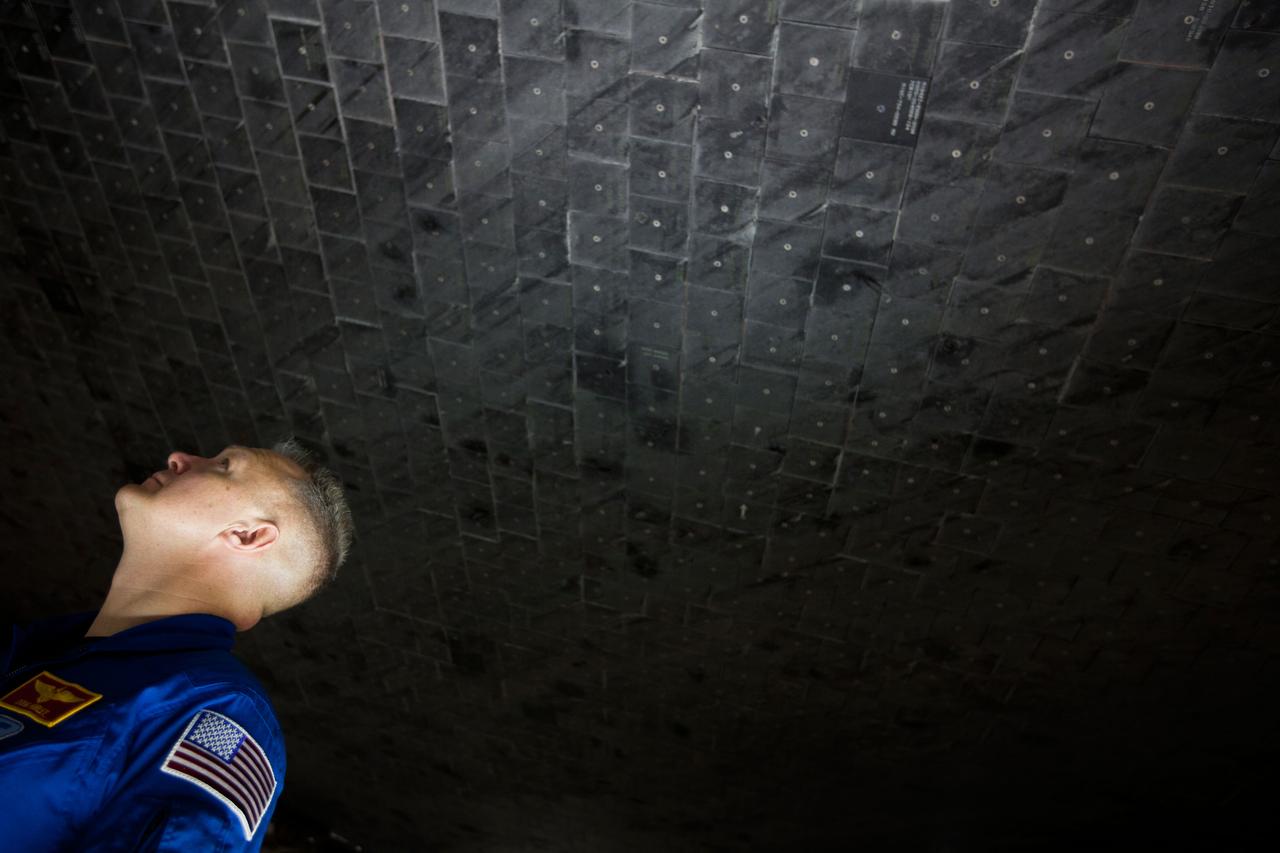
JSC2011-E-040343 (7 April 2011) --- NASA astronaut Doug Hurley, STS-135 pilot, looks at the thermal protection system on the underside of the space shuttle Atlantis during the mission's Crew Equipment Interface Test (CEIT) at the Kennedy Space Center in Florida on April 7, 2011. Photo credit: NASA Photo/Houston Chronicle, Smiley N. Pool
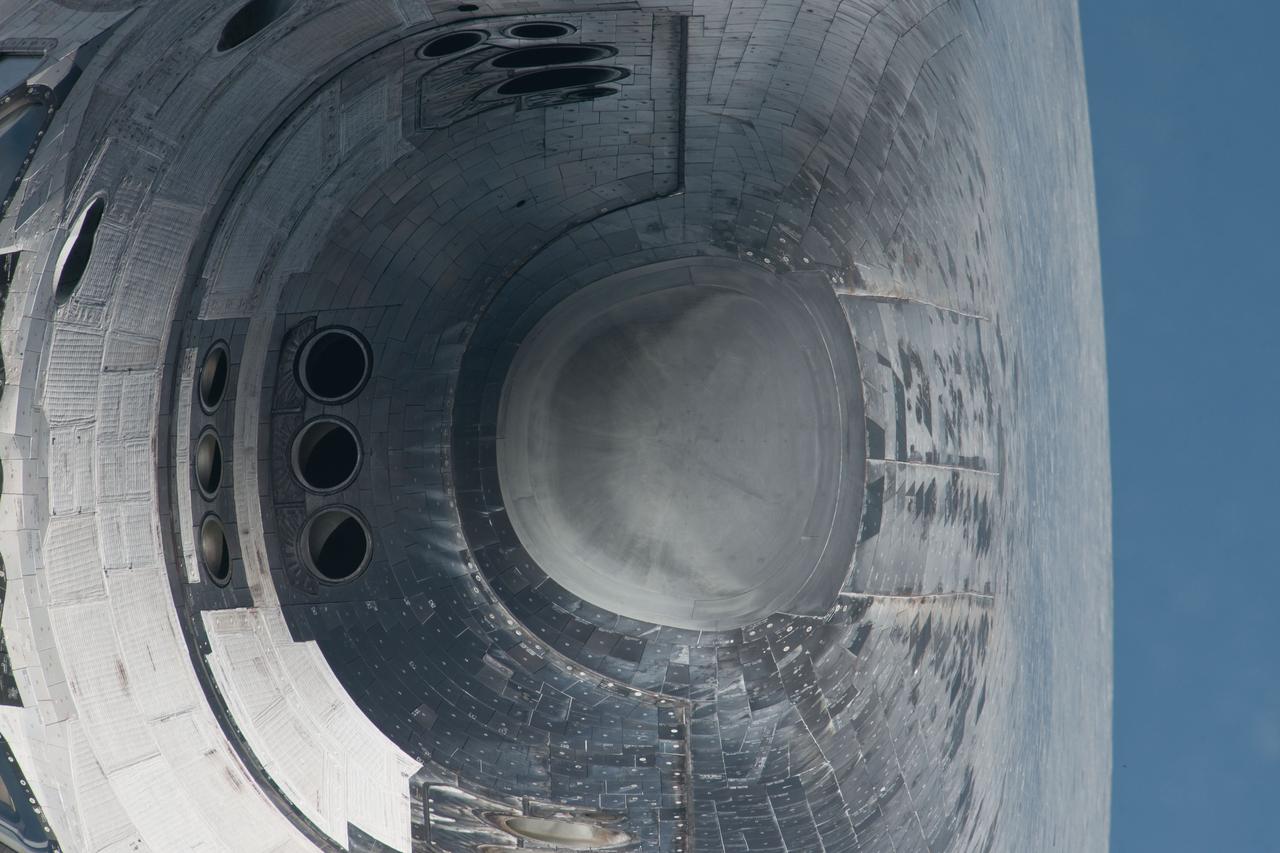
ISS028-E-015671 (10 July 2011) --- This head-on picture of Atlantis' nose and part of the underside's thermal protective system tiles is one of a series of images showing various parts of the shuttle in Earth orbit as photographed by one of three crew members -- half the station crew -- who were equipped with still cameras for this purpose on the International Space Station as the shuttle “posed” for photos and visual surveys and performed a back-flip for the rendezvous pitch maneuver (RPM). A 1000 millimeter lens was used to capture this particular series of images.
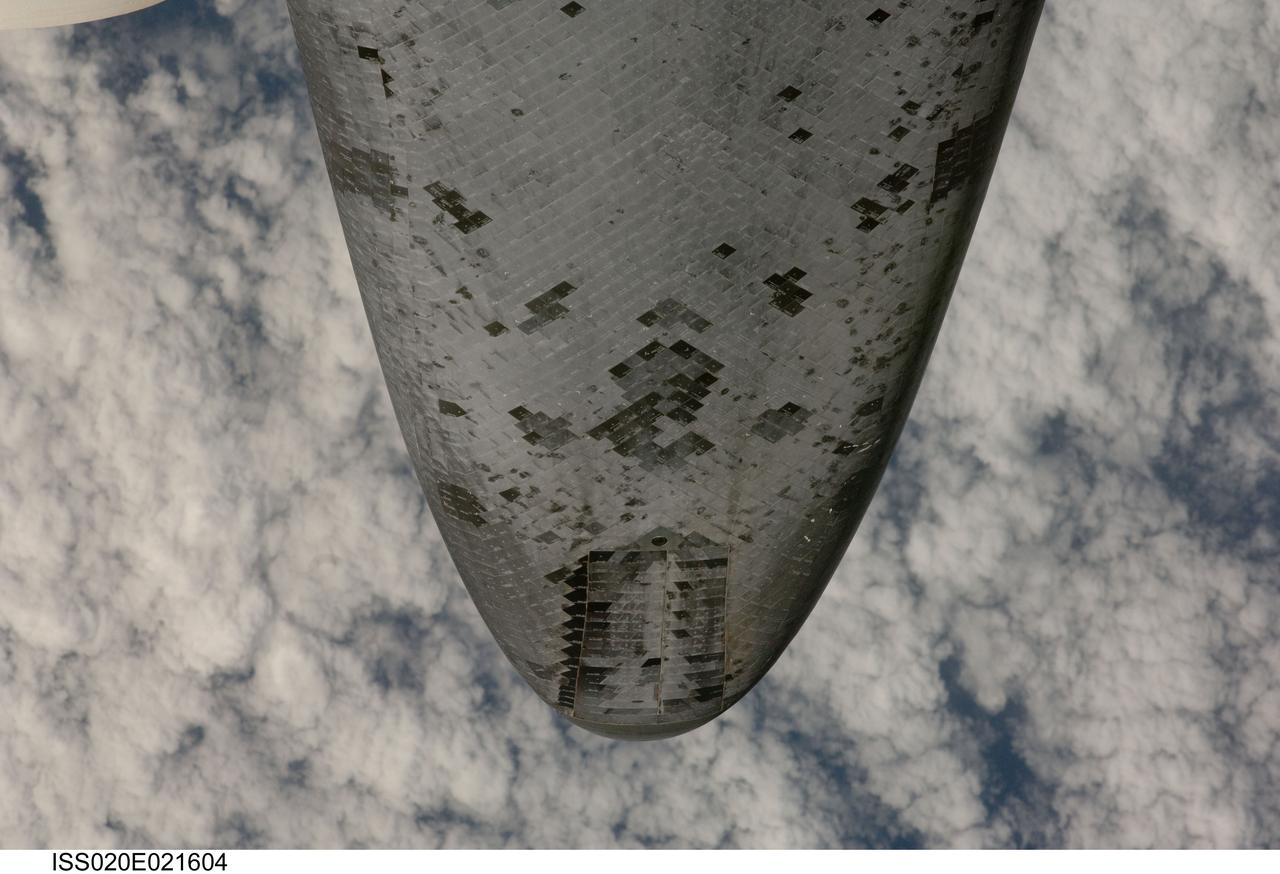
ISS020-E-021604 (17 July 2009) --- This view of the underside of the crew cabin of the Space Shuttle Endeavour was provided by an Expedition 20 crewmember during a survey of the approaching vehicle prior to docking with the International Space Station. As part of the survey and part of every mission's activities, the STS-127 Endeavour crew performed a back-flip for the rendezvous pitch maneuver (RPM). The image was photographed with a digital still camera, using a 400mm lens at a distance of about 600 feet (180 meters).
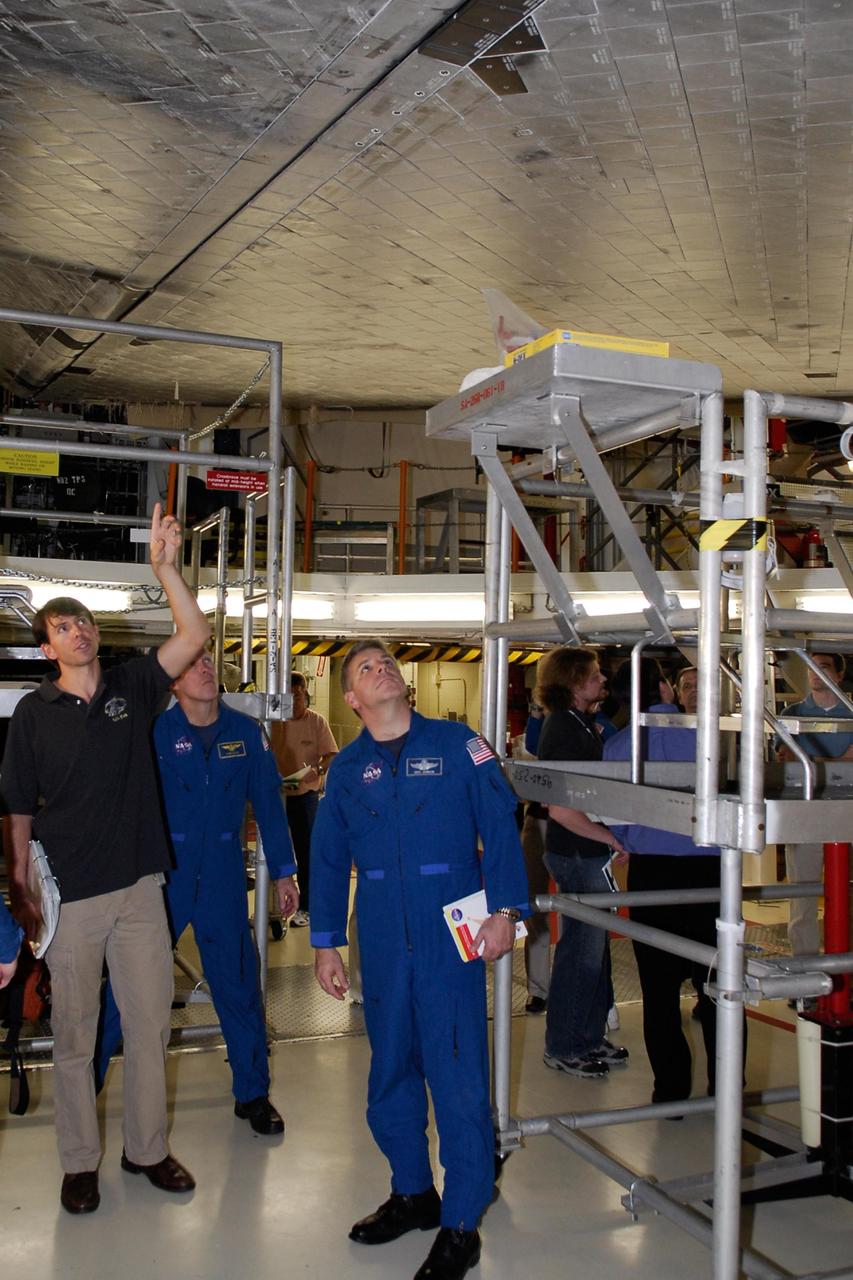
KENNEDY SPACE CENTER, FLA. -- In the Orbiter Processing Facility, STS-123 Commander Dominic Gorie (center) and Pilot Gregory Johnson (right) inspect the thermal protection system tiles on the underside of space shuttle Endeavour. They and other crew members are at NASA's Kennedy Space Center for a crew equipment interface test, a process of familiarization with payloads, hardware and the space shuttle. The STS-123 mission is targeted for launch on space shuttle Endeavour on Feb. 14. It will be the 25th assembly flight of the station. Photo credit: NASA/Kim Shiflett

ISS020-E-021544 (17 July 2009) --- This view of the underside of the crew cabin of the Space Shuttle Endeavour was provided by an Expedition 20 crewmember during a survey of the approaching vehicle prior to docking with the International Space Station. As part of the survey and part of every mission's activities, the STS 127 Endeavour crew performed a back-flip for the rendezvous pitch maneuver (RPM). The image was photographed with a digital still camera, using a 400mm lens at a distance of about 600 feet (180 meters).
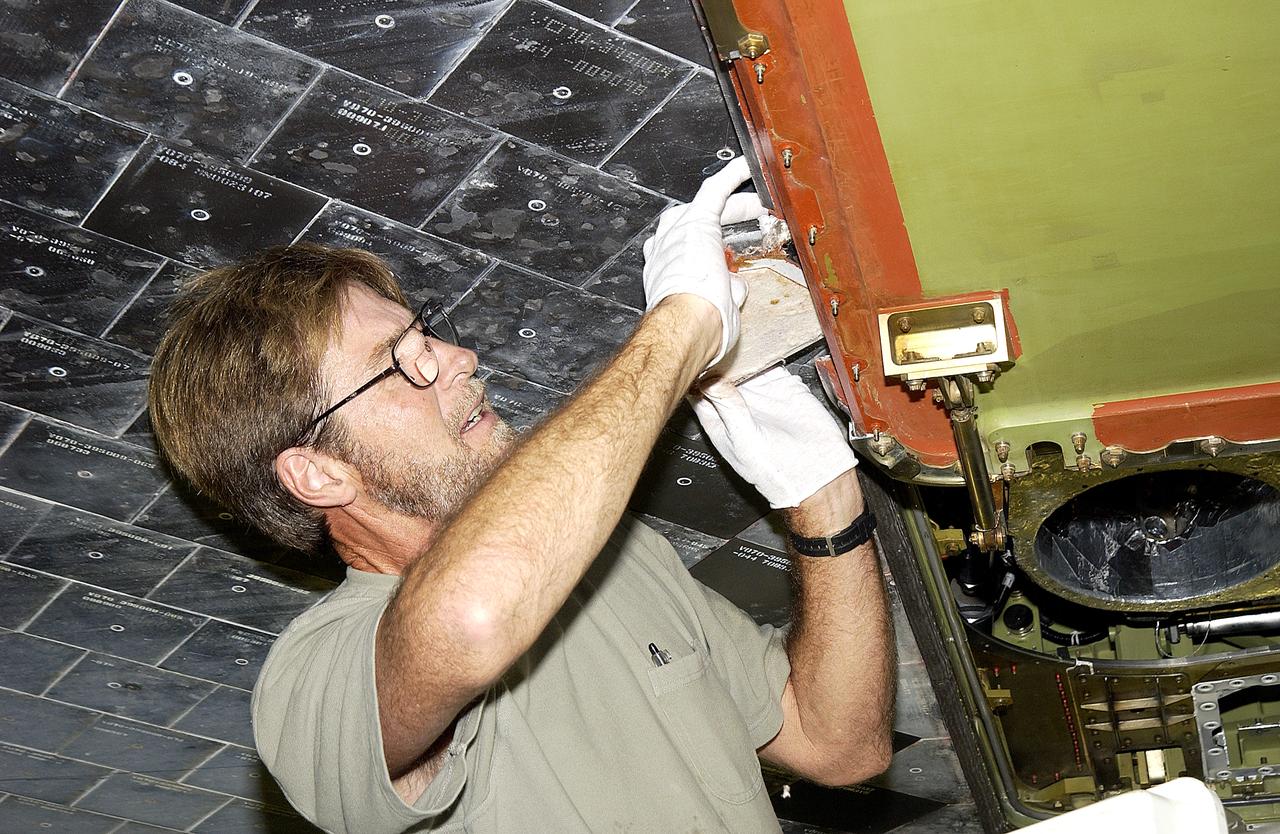
In the Orbiter Processing Facility, Harrell Watts, with United Space Alliance, removes a tile from the thermal barrier around the umbilical areas, the external tank attach points, on the underside of Atlantis. The umbilical areas are closed off after ET separation by a door, seen here. The exposed area of each closed door is covered with reusable surface insulation.
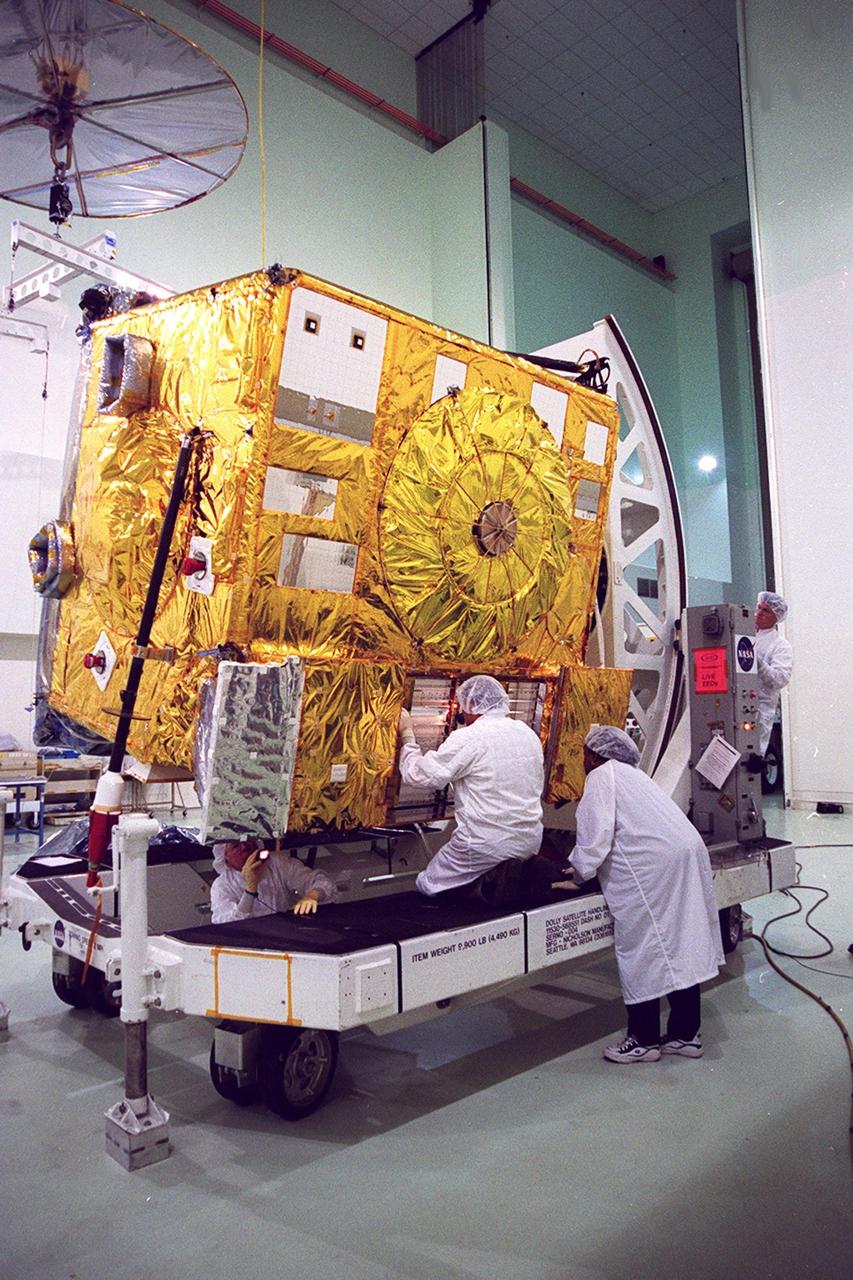
With the GOES-M satellite tilted on a workstand at Astrotech, Titusville, Fla, workers check out a part of the underside. The GOES-M provides weather imagery and quantitative sounding data used to support weather forecasting, severe storm tracking and meteorological research. The satellite is undergoing testing at Astrotech before its scheduled launch July 12 on an Atlas-IIA booster, Centaur upper stage from Cape Canaveral Air Force Station
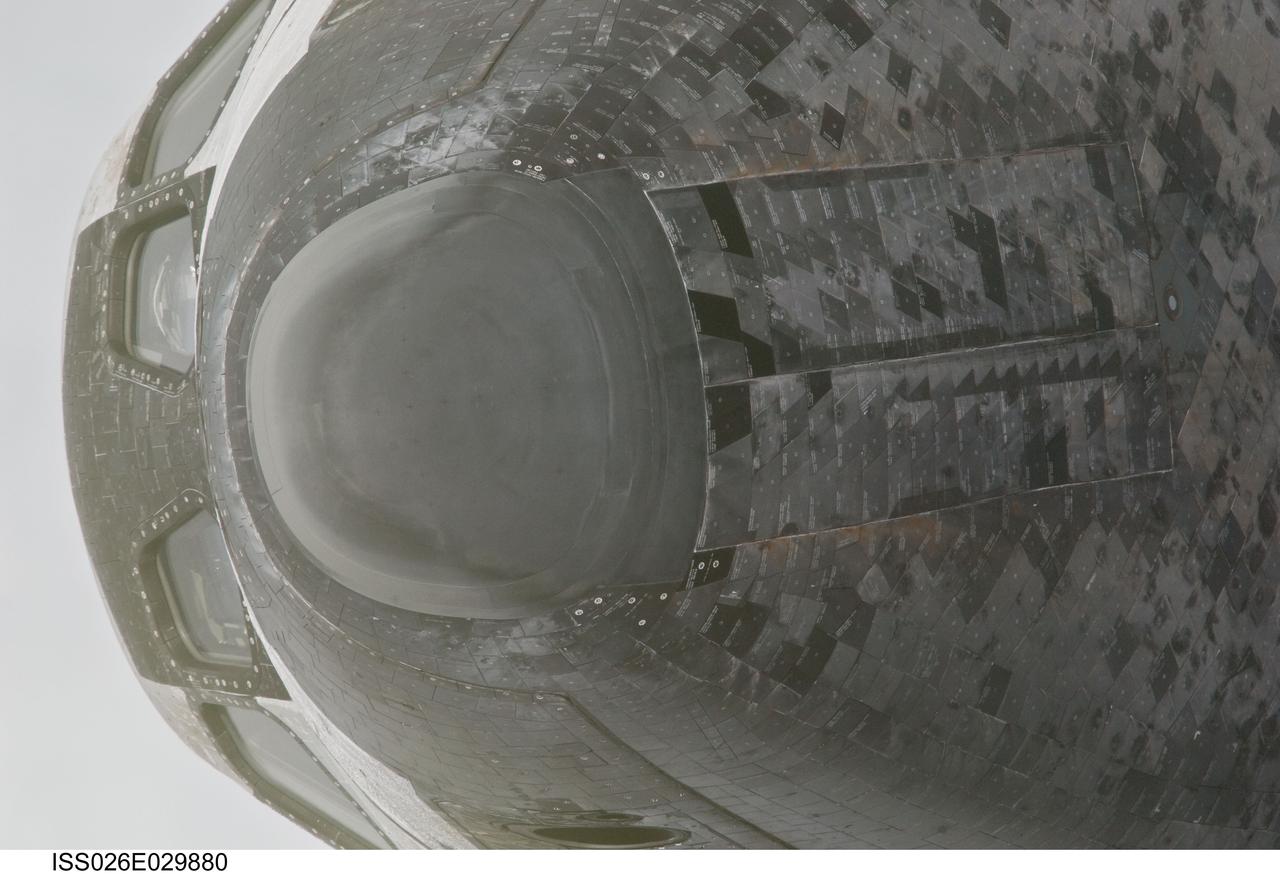
ISS026-E-029880 (26 Feb. 2011) --- This view of the nose, the forward underside and crew cabin of the space shuttle Discovery was provided by an Expedition 26 crew member during a survey of the approaching STS-133 vehicle prior to docking with the International Space Station. As part of the survey and part of every mission's activities, Discovery performed a back-flip for the rendezvous pitch maneuver (RPM). The station crew member used a digital still camera with an 800mm focal length, as the two spacecraft were approximately 600 feet (180 meters) apart.
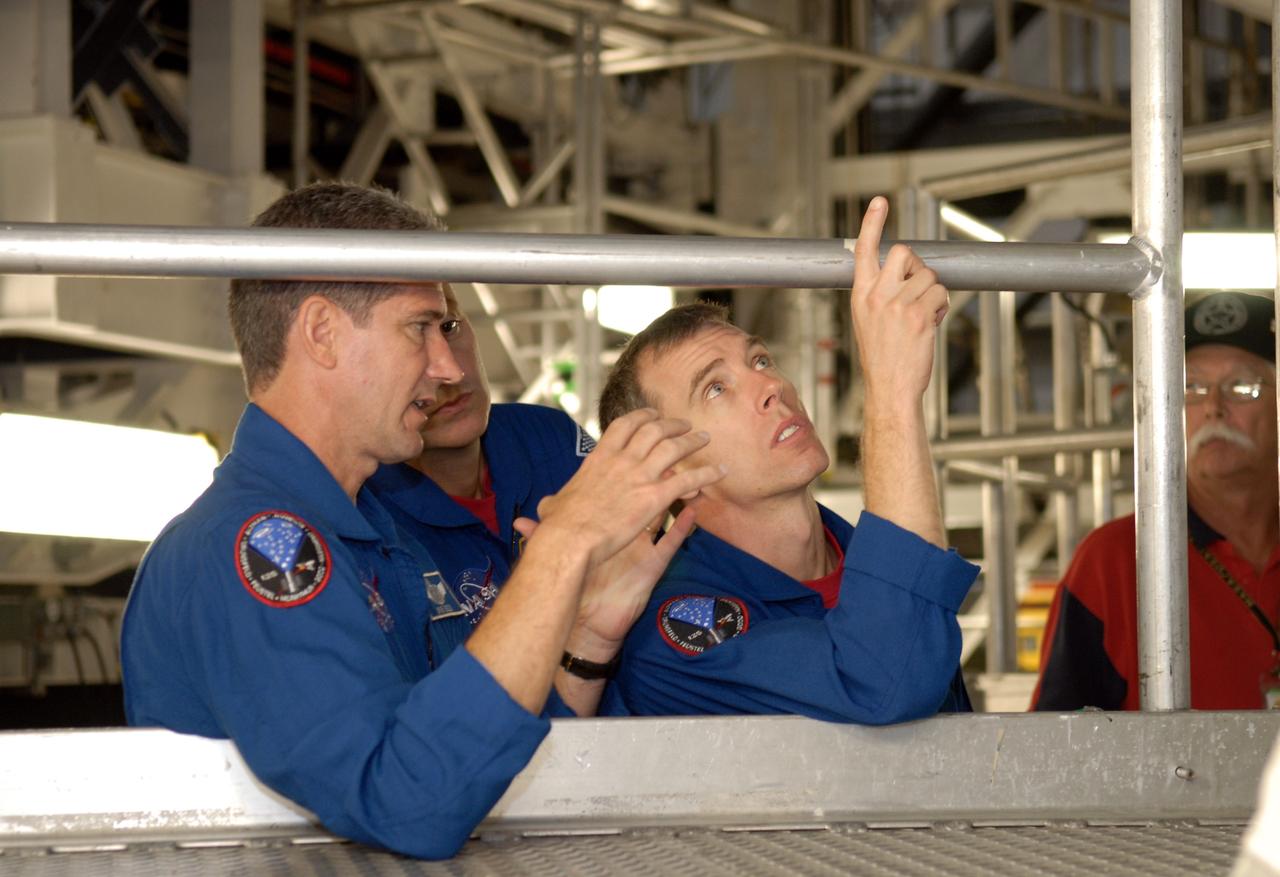
CAPE CANAVERAL, Fla. – In the Orbiter Processing Facility at NASA's Kennedy Space Center, STS-125 Mission Specialists Michael Good, Mike Massimino and Andrew Feustel discuss the tiles they are looking at on the underside of space shuttle Atlantis. Crew members are at Kennedy for a crew equipment interface test, which provides hands-on experience with hardware and equipment for their mission. Atlantis is targeted to launch on the STS-125 Hubble Servicing Mission 4 on Oct. 8. Photo credit: NASA/Kim Shiflett
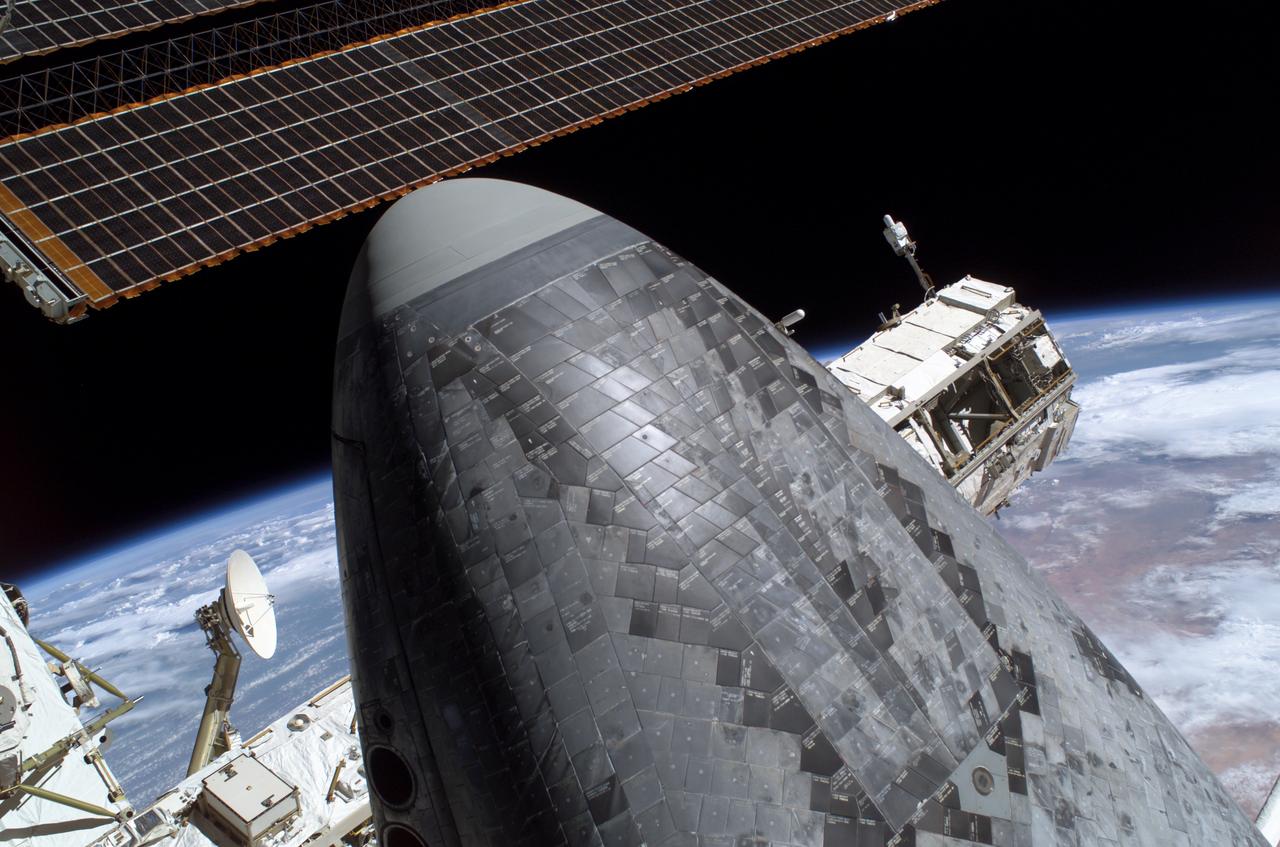
S114-E-6405 (3 August 2005) --- Space Shuttle Discovery’s underside nosecone thermal protection tiles are featured in this image photographed by astronaut Stephen K. Robinson, STS-114 mission specialist, during the mission’s third session of extravehicular activities (EVA). Part of the P1 truss and a solar array are visible in the background. The blackness of space and a blue and white Earth form the backdrop for the image.
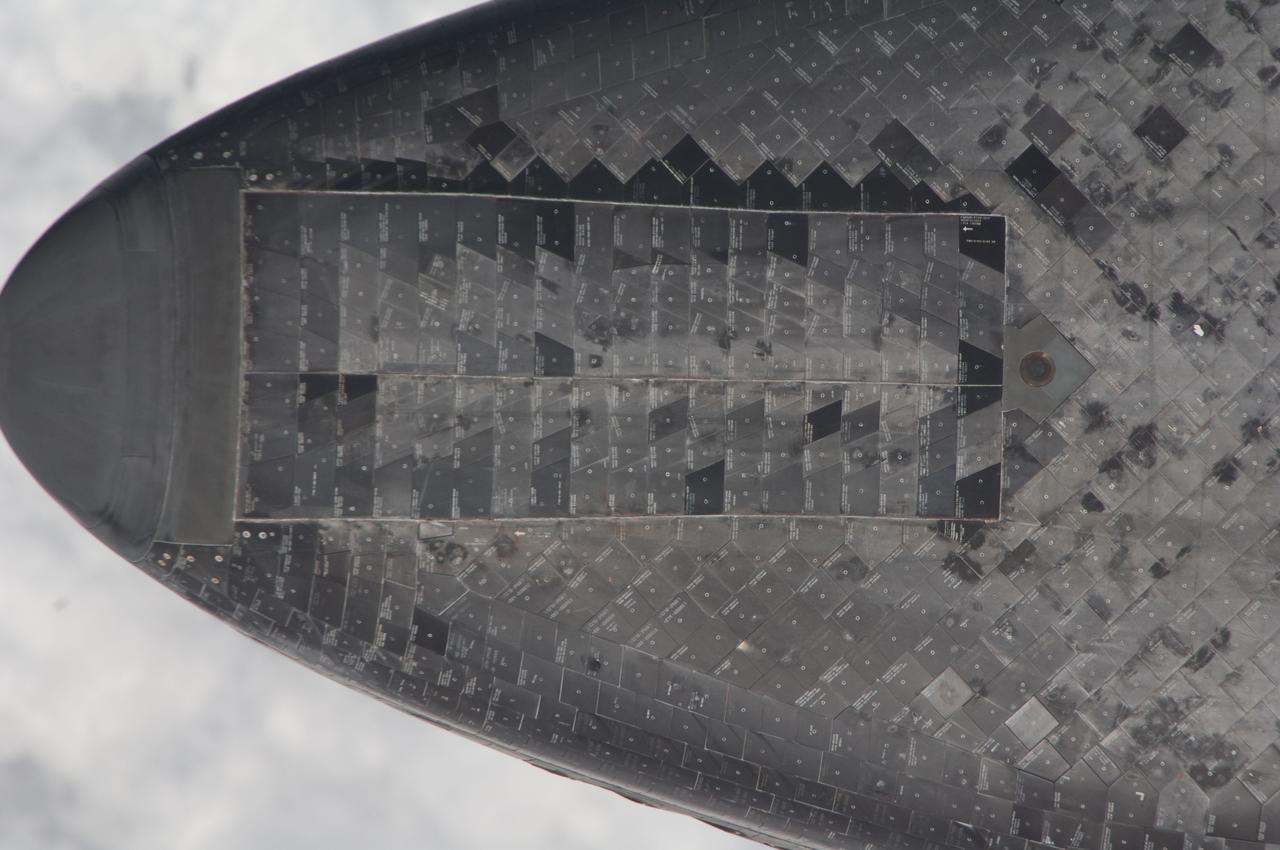
ISS027-E-032166 (18 May 2011) --- This underside view of the nose of space shuttle Endeavour was provided by an Expedition 27 crew member during a survey of the approaching STS-134 vehicle prior to docking with the International Space Station. As part of the survey and part of every mission's activities, Endeavour performed a back-flip for the rendezvous pitch maneuver (RPM). The station crew member used a digital still camera with an 800mm focal length, as the two spacecraft were approximately 600 feet (180 meters) apart.
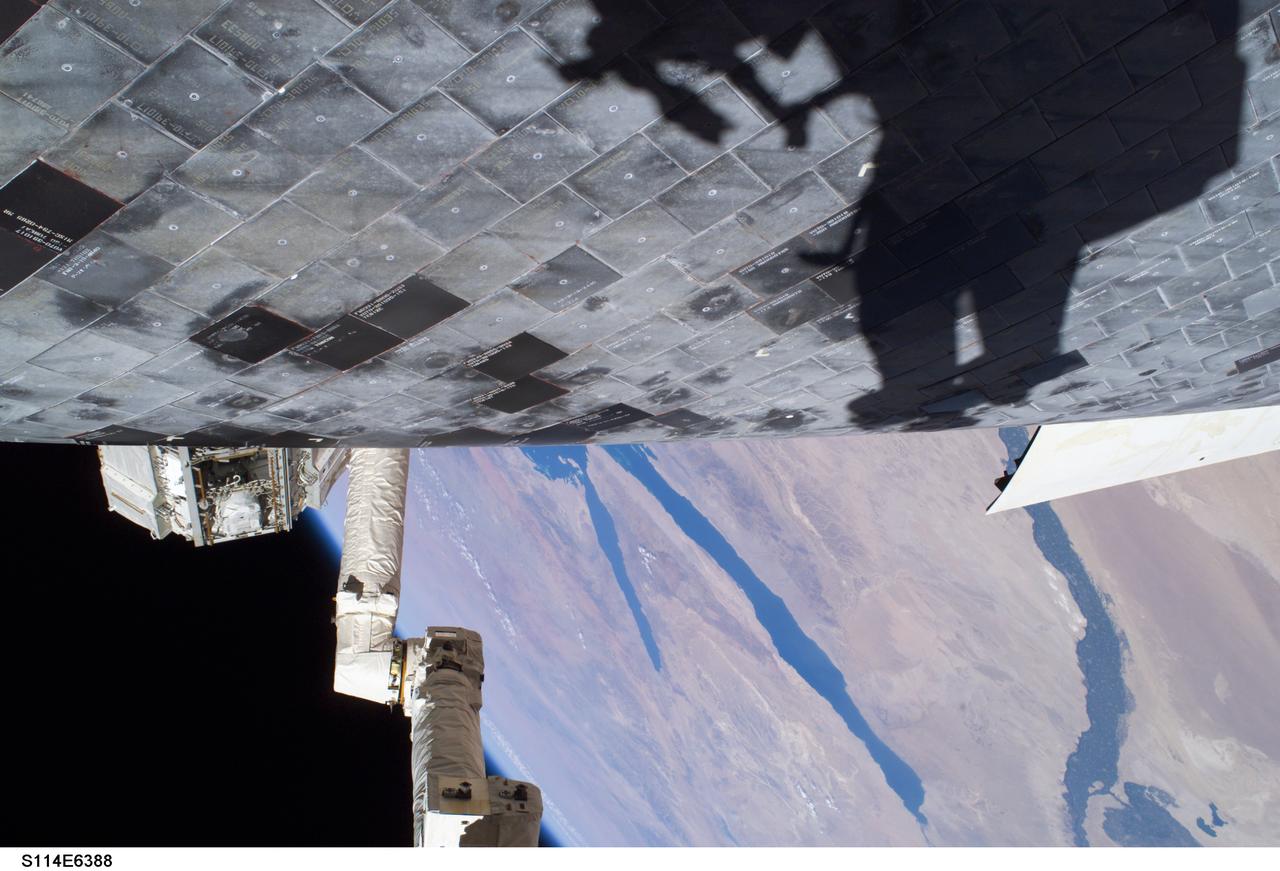
S114-E-6388 (3 August 2005) --- A close-up view of a portion of the thermal protection tiles on Space Shuttle Discovery’s underside is featured in this image photographed by astronaut Stephen K. Robinson, STS-114 mission specialist, during the mission’s third session of extravehicular activities (EVA). Robinson’s shadow is visible on the thermal protection tiles and a portion of the Canadian-built remote manipulator system (RMS) robotic arm and the Nile River is visible at bottom.
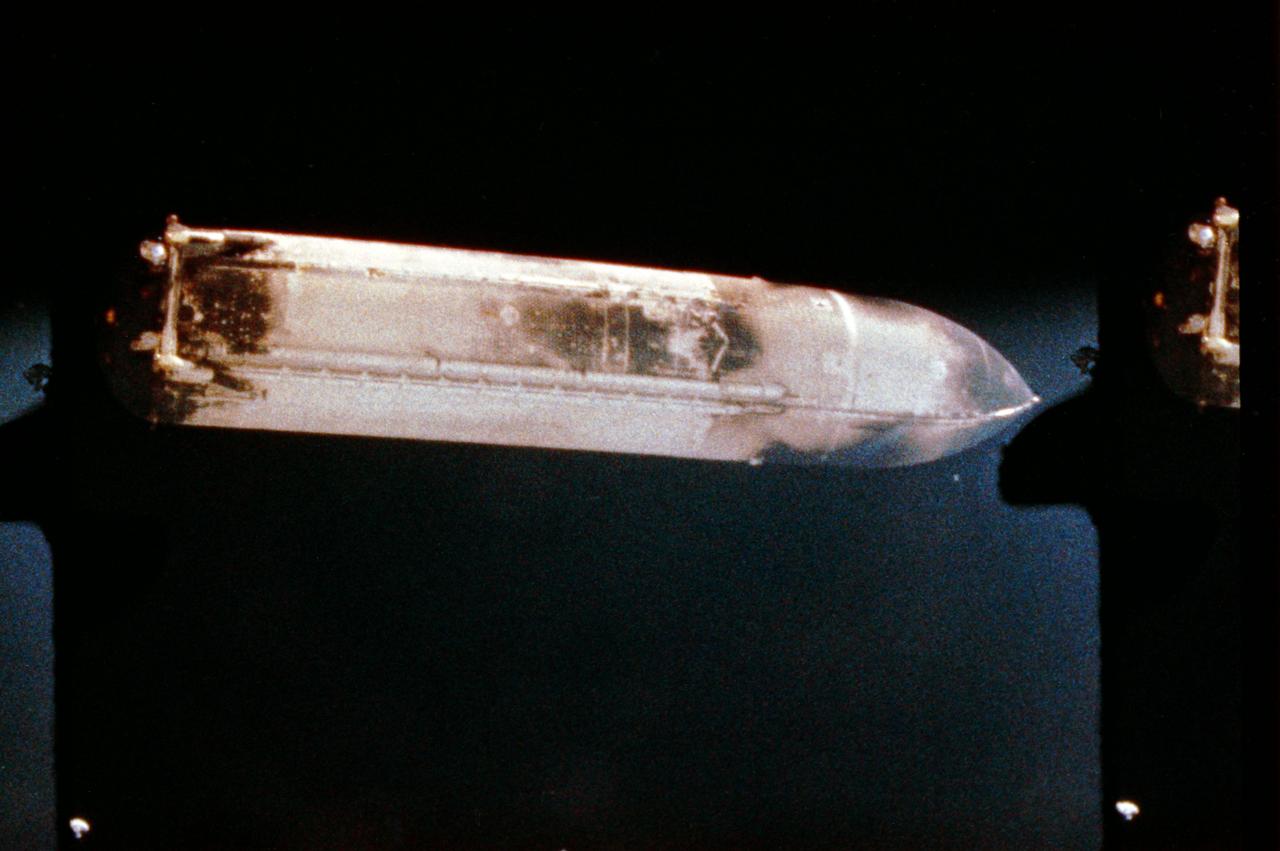
S81-30509 (12 April 1981) --- Separation of space shuttle Columbia?s external tank, photographed by motion picture cameras in the umbilical bays, occurred following the shutdown of the vehicle?s three main engines. The Columbia?s cameras were able to record the underside of the tank as the orbiter headed toward its Earth-orbital mission with astronauts John W. Young and Robert L. Crippen aboard, and the fuel tank fell toward Earth, passing through the atmosphere rapidly. Photo credit: NASA
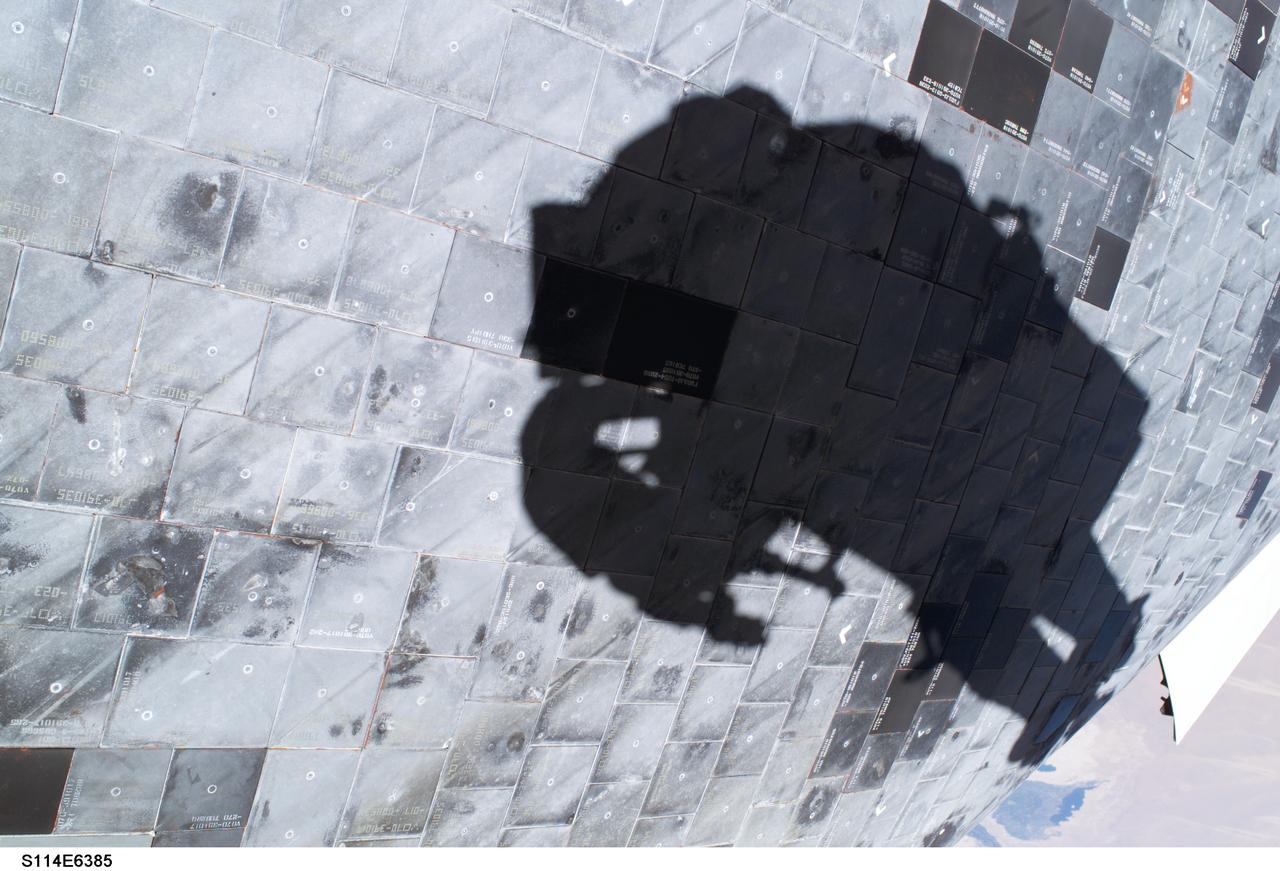
S114-E-6385 (3 August 2005) --- A close-up view of a portion of Space Shuttle Discovery’s underside is featured in this image photographed by astronaut Stephen K. Robinson, STS-114 mission specialist, during the mission’s third session of extravehicular activities (EVA). Robinson’s shadow is visible on the thermal protection tiles.
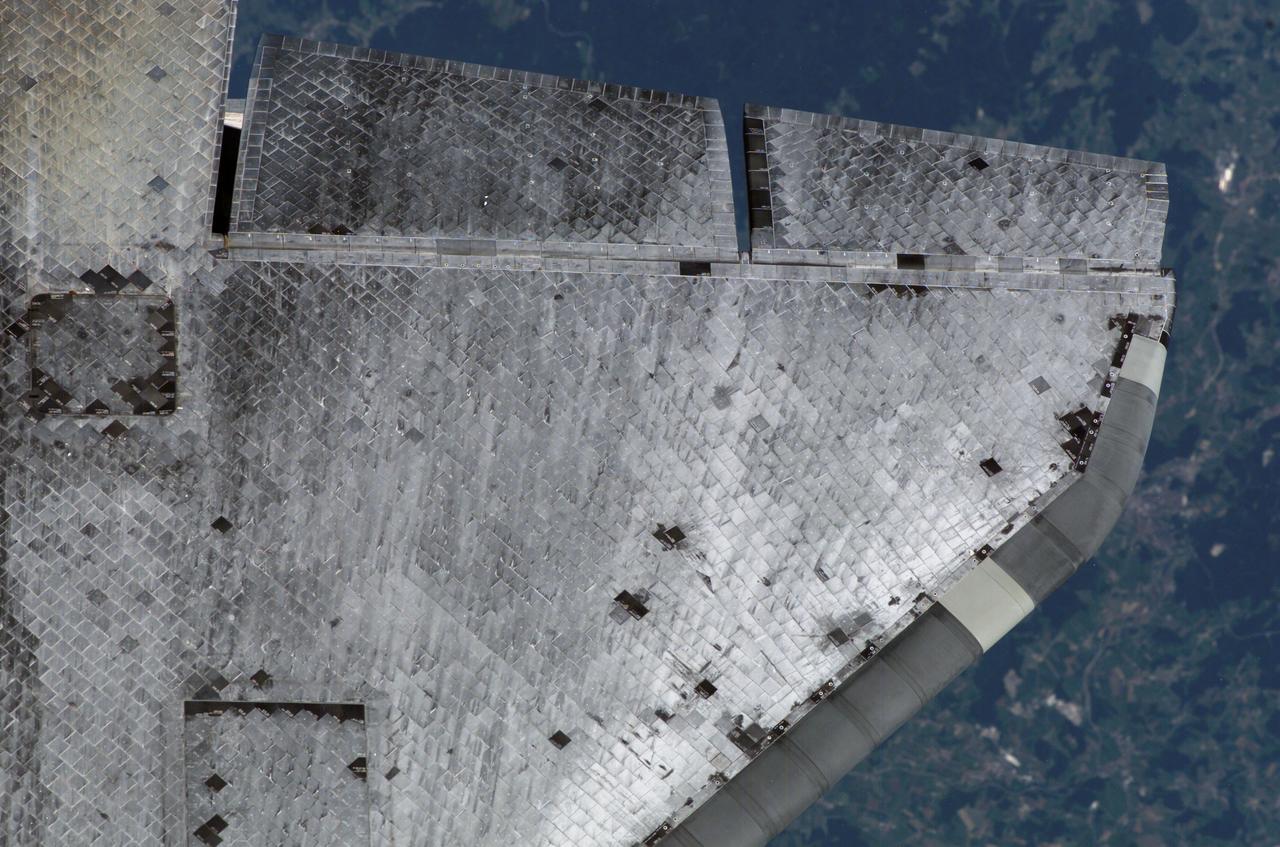
ISS011-E-11078 (28 July 2005) --- View of the Space Shuttle Discovery’s underside starboard wing and Thermal Protection System tiles photographed during the survey sequence performed by the Expedition 11 crew on the international space station during the STS-114 R-Bar Pitch Maneuver during rendezvous and docking operations. Discovery docked with the station at 6:18 a.m. (CDT) on Thursday July 28, 2005.
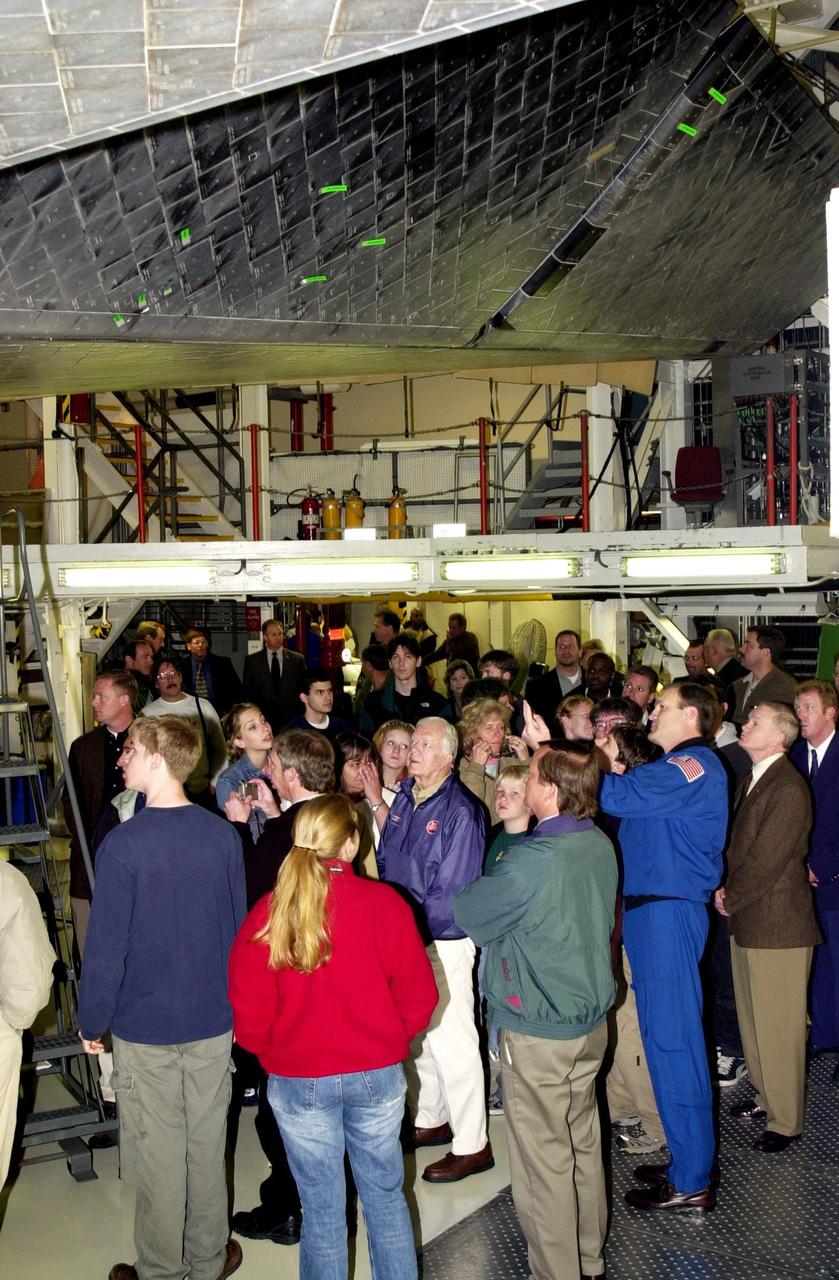
KENNEDY SPACE CENTER, FLA. -- In the Orbiter Processing Facility, former President Jimmy Carter (center) gets a closeup view of the underside of an orbiter space vehicle. On the outer edge of the crowd are (left to riht) Launch Director Mike Leinbach (green jacket), Space Shuttle Launch Integration Manager Jim Halsell and Center Director Roy D. Bridges. Carter and former First Lady Rosalyn Carter are touring KSC
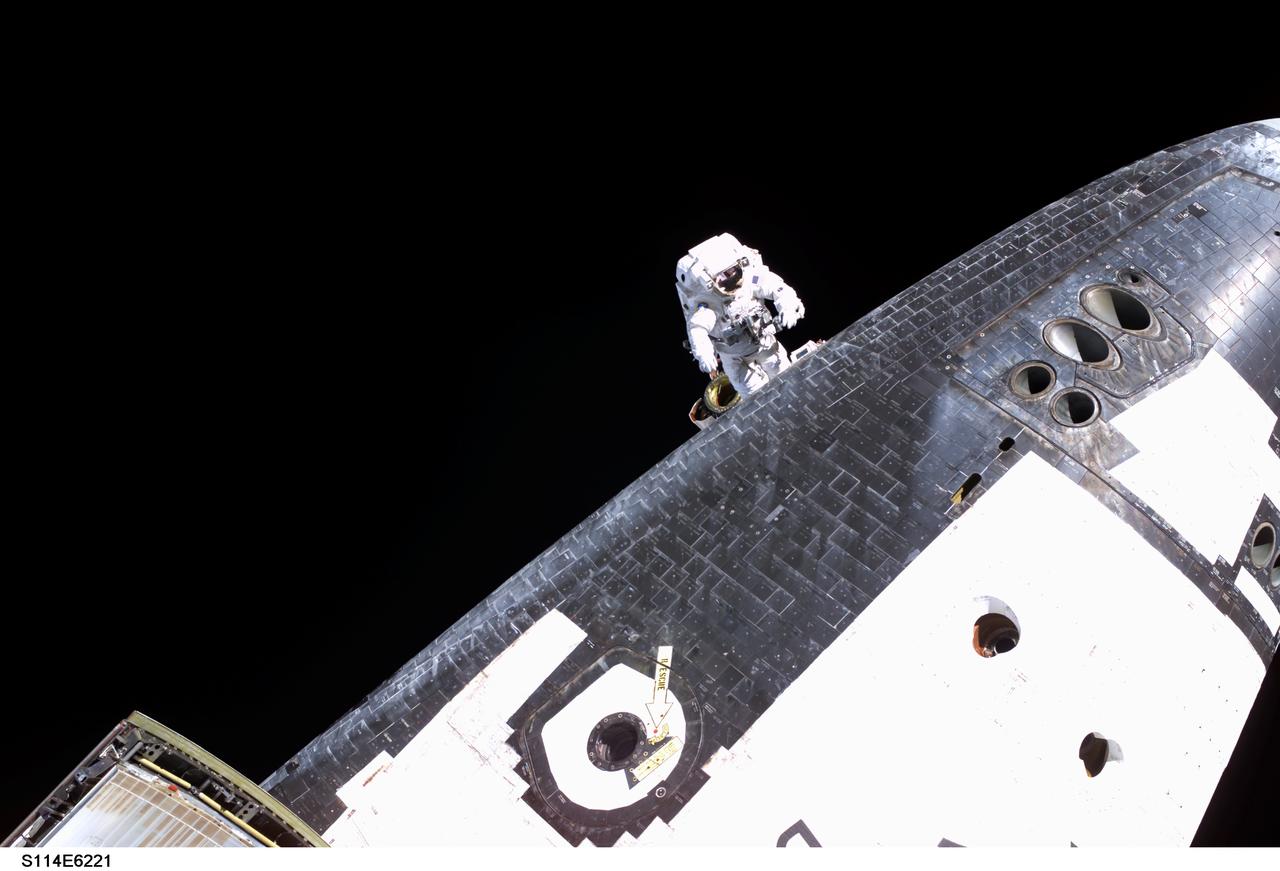
S114-E-6221 (3 August 2005) --- Astronaut Stephen K. Robinson, STS-114 mission specialist, on the end of the station’s Canadarm2 (out of frame), slowly and cautiously makes his way to the underside of Space Shuttle Discovery to remove gap fillers from between the orbiter’s heat-shielding tiles during the mission’s third session of extravehicular activity (EVA).

jsc2026e034372 (April 28, 2026) --- Preflight image of TIGERS-X experiment payload cube showing the underside (-z face) with mission patch, flag of Thailand, Chulabhorn Royal Academy (CRA) logo, and signature wall of the research and development team. This investigation tests a mixer in a space environment aboard the International Space Station. Credit: Chulabhorn Royal Academy. Credit: Chulabhorn Royal Academy.
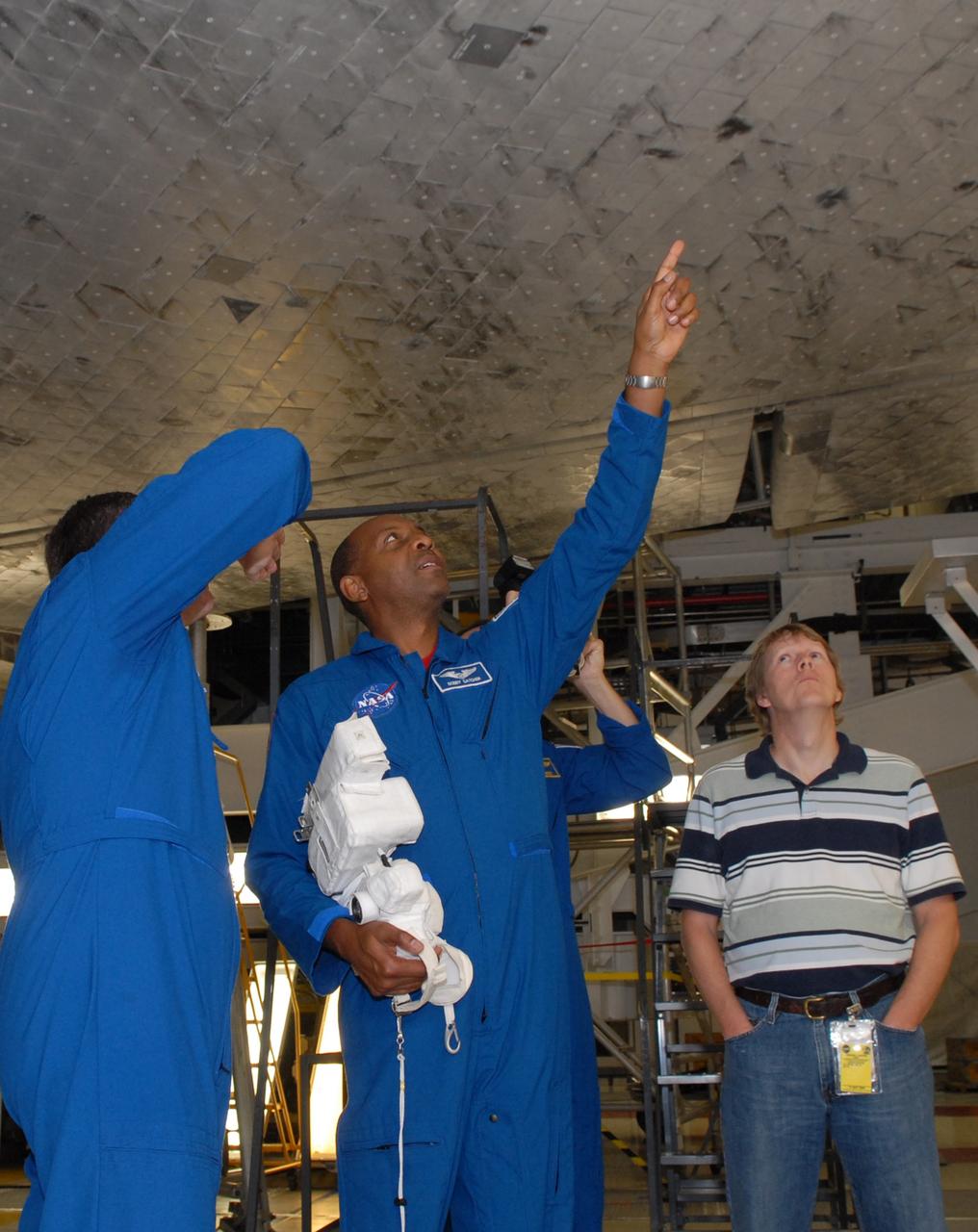
CAPE CANAVERAL, Fla. – In NASA Kennedy Space Center's Orbiter Processing Facility 1, STS-129 Mission Specialists Michael Foreman and Robert Satcher take a close look at some of the tiles on the underside of space shuttle Atlantis. The crew is at Kennedy for a Crew Equipment Interface Test, which provides hands-on training and observation of shuttle and flight hardware. Atlantis' STS-129 mission is targeted to launch Nov. 12. Photo credit: NASA/Jim Grossmann
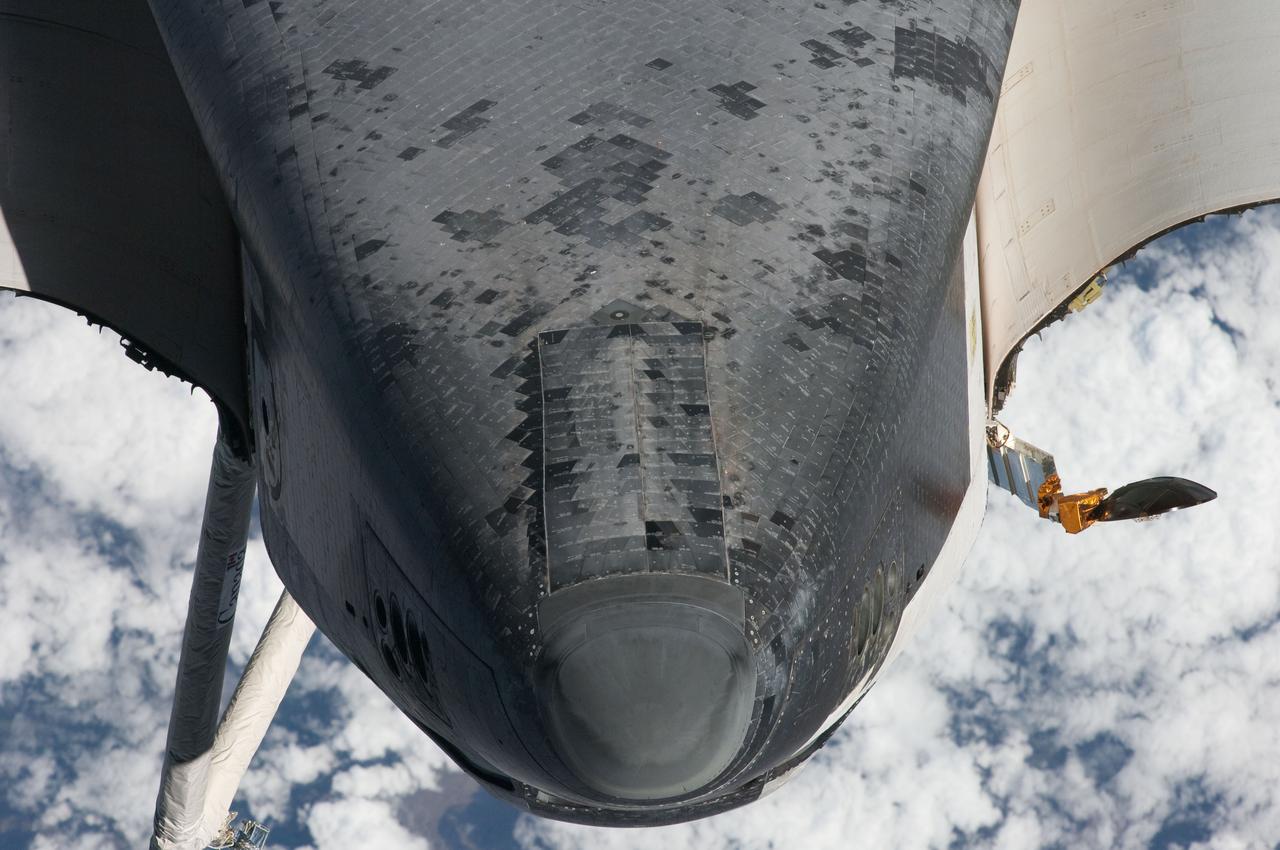
ISS027-E-032274 (18 May 2011) --- This view of the nose and the forward underside of the space shuttle Endeavour was provided by an Expedition 27 crew member during a survey of the approaching STS-134 vehicle prior to docking with the International Space Station. As part of the survey and part of every mission's activities, Endeavour performed a back-flip for the rendezvous pitch maneuver (RPM). The image was photographed with a digital still camera, using a 400mm lens at a distance of about 600 feet (180 meters).
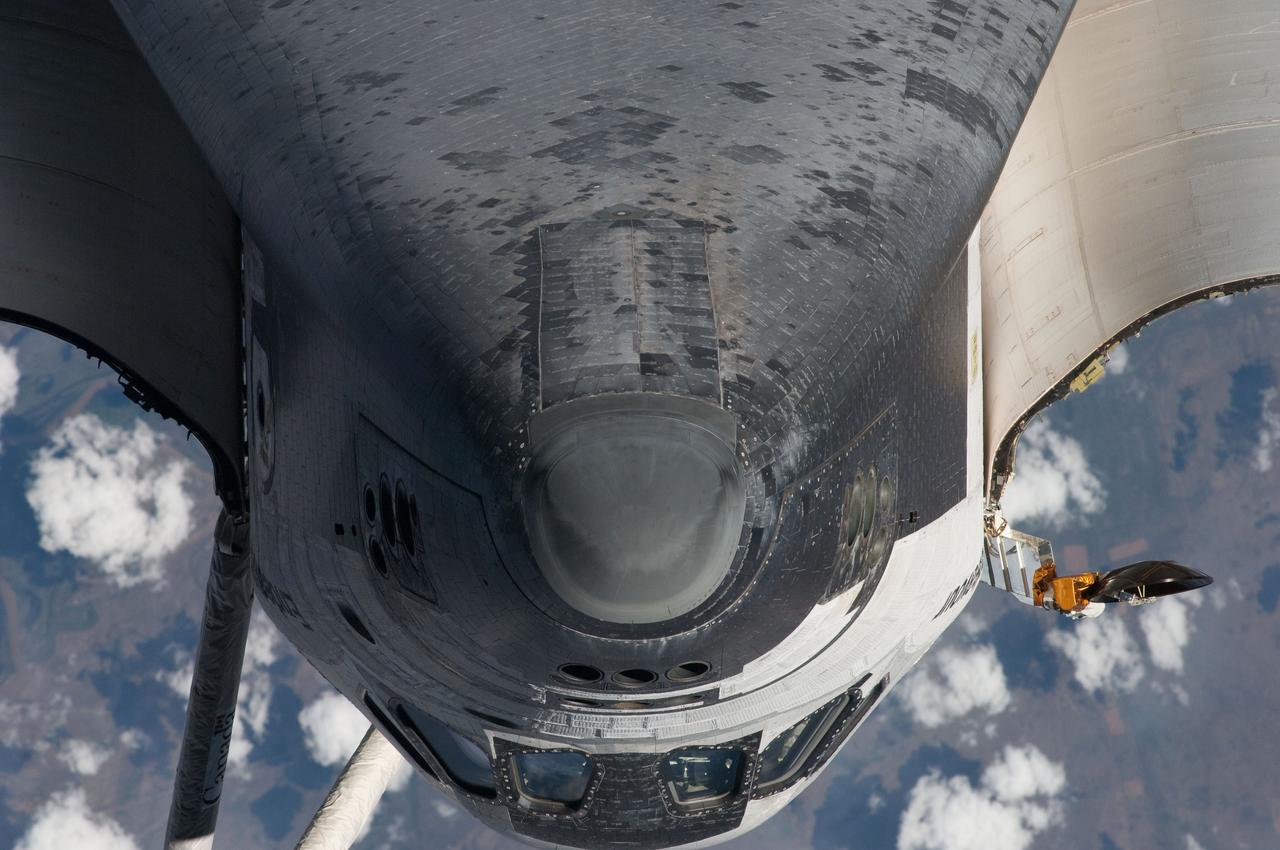
ISS027-E-032264 (18 May 2011) --- This view of the nose, the forward underside and crew cabin of the space shuttle Endeavour was provided by an Expedition 27 crew member during a survey of the approaching STS-134 vehicle prior to docking with the International Space Station. As part of the survey and part of every mission's activities, Endeavour performed a back-flip for the rendezvous pitch maneuver (RPM). The image was photographed with a digital still camera, using a 400mm lens at a distance of about 600 feet (180 meters).
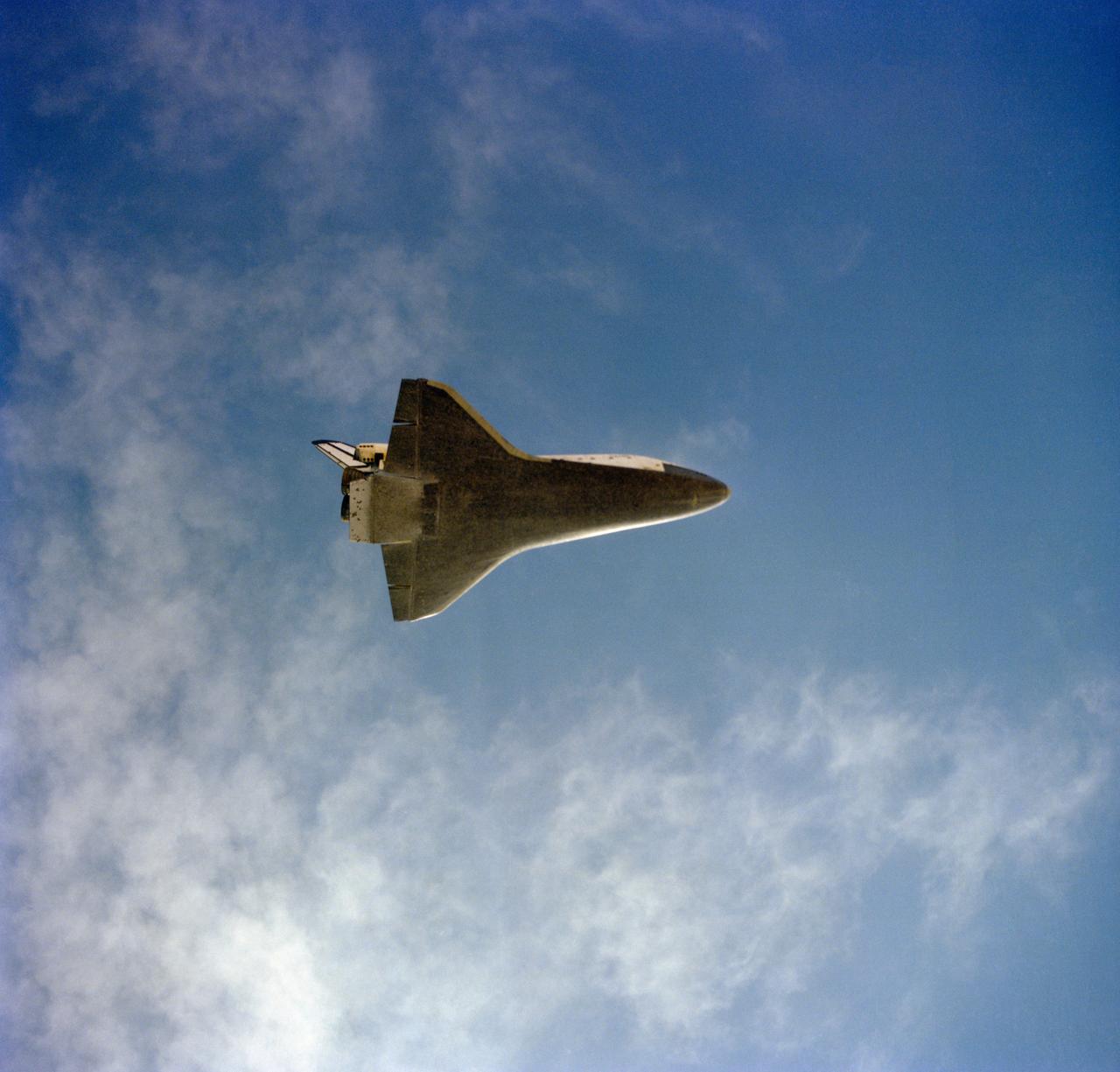
S82-28835 (30 March 1982) --- This unique view of the underside of the space shuttle orbiter Columbia was taken with a handheld camera aboard a T-38 chase plane over the White Sands Missile Range in New Mexico. Bad weather here yesterday vanished and the STS-3 crew of astronaut Jack R. Lousma and C. Gordon Fullerton greeted a pleasant climate along with a large crowd of spectators upon their landing. The successful landing was the first attempted in the actual orbiter on New Mexico soil. Photo credit: NASA
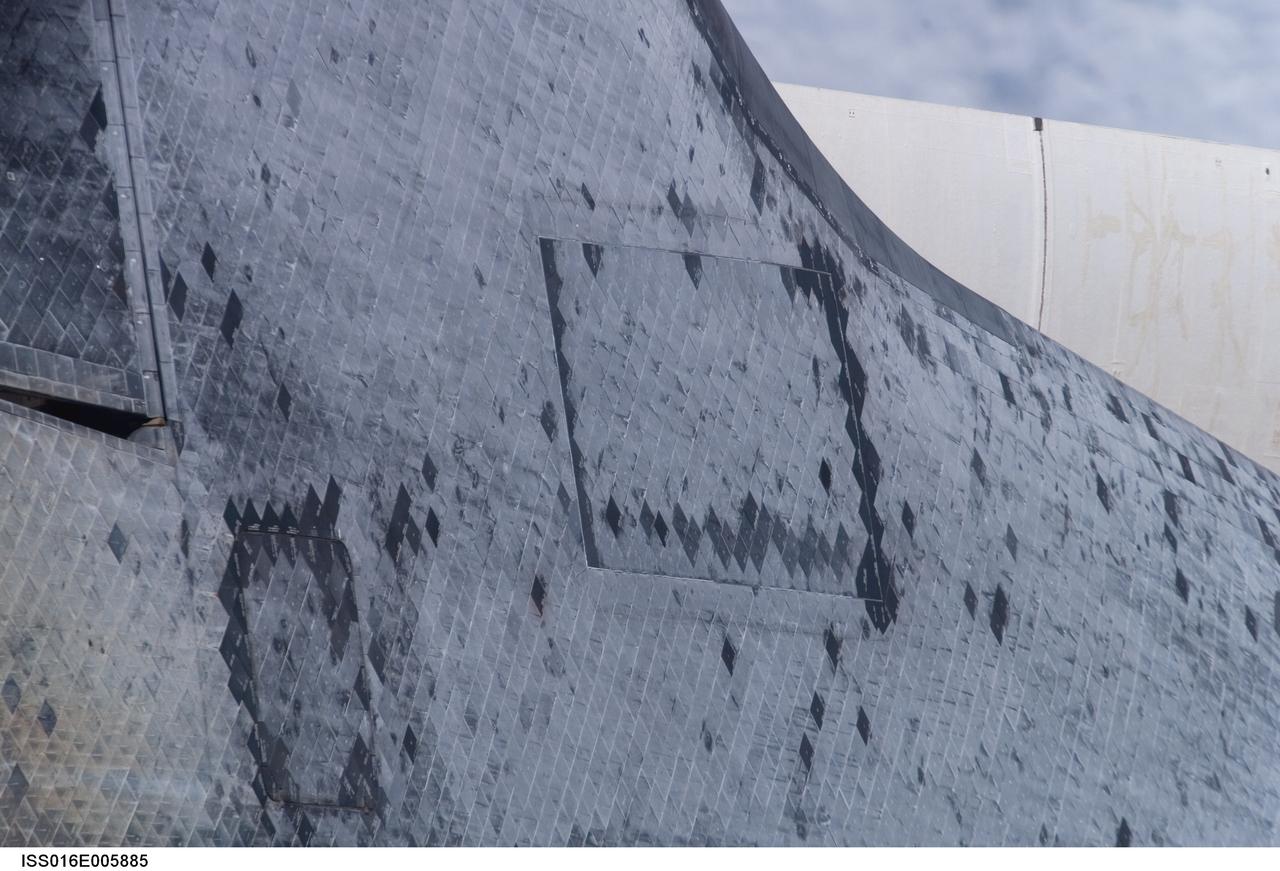
ISS016-E-005885 (25 Oct. 2007) --- The underside of the Space Shuttle Discovery is featured in this image photographed by an Expedition 16 crewmember during a backflip maneuver performed by the approaching visitors (STS-120) to the International Space Station. Visible are a landing gear door (large square at center) and an external tank (ET) umbilical door (lower left).
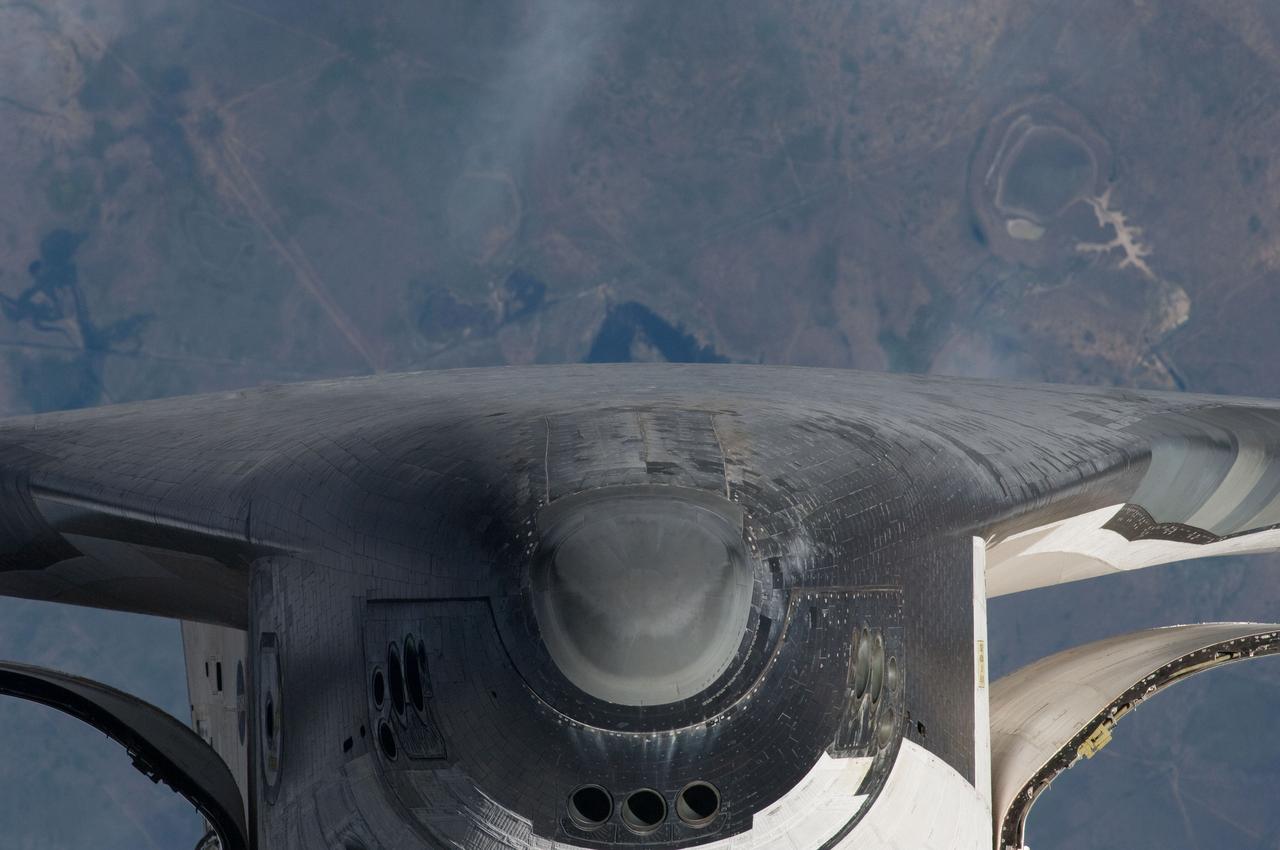
ISS027-E-032255 (18 May 2011) --- This view of the nose and the forward underside of the space shuttle Endeavour was provided by an Expedition 27 crew member during a survey of the approaching STS-134 vehicle prior to docking with the International Space Station. As part of the survey and part of every mission's activities, Endeavour performed a back-flip for the rendezvous pitch maneuver (RPM). The image was photographed with a digital still camera, using a 400mm lens at a distance of about 600 feet (180 meters).

In the Orbiter Processing Facility, Harrell Watts (left), with United Space Alliance, removes a tile from the thermal barrier around the umbilical areas, the external tank attach points, on the underside of Atlantis. The umbilical areas are closed off after ET separation by a door, seen here. The exposed area of each closed door is covered with reusable surface insulation.
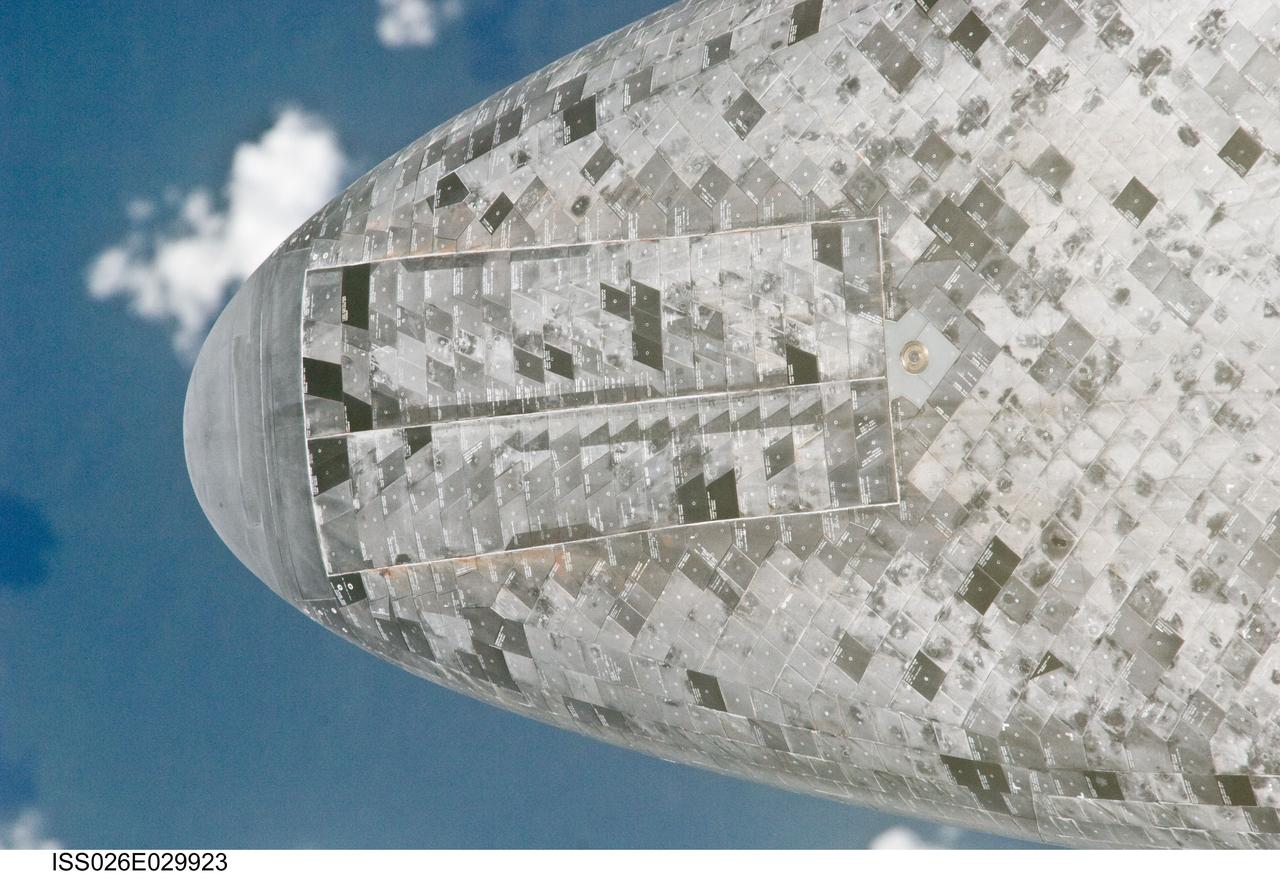
ISS026-E-029923 (26 Feb. 2011) --- This underside view of the nose of the space shuttle Discovery was provided by an Expedition 26 crew member during a survey of the approaching STS-133 vehicle prior to docking with the International Space Station. As part of the survey and part of every mission's activities, Discovery performed a back-flip for the rendezvous pitch maneuver (RPM). The station crew member used a digital still camera with an 800mm focal length, as the two spacecraft were approximately 600 feet (180 meters) apart.
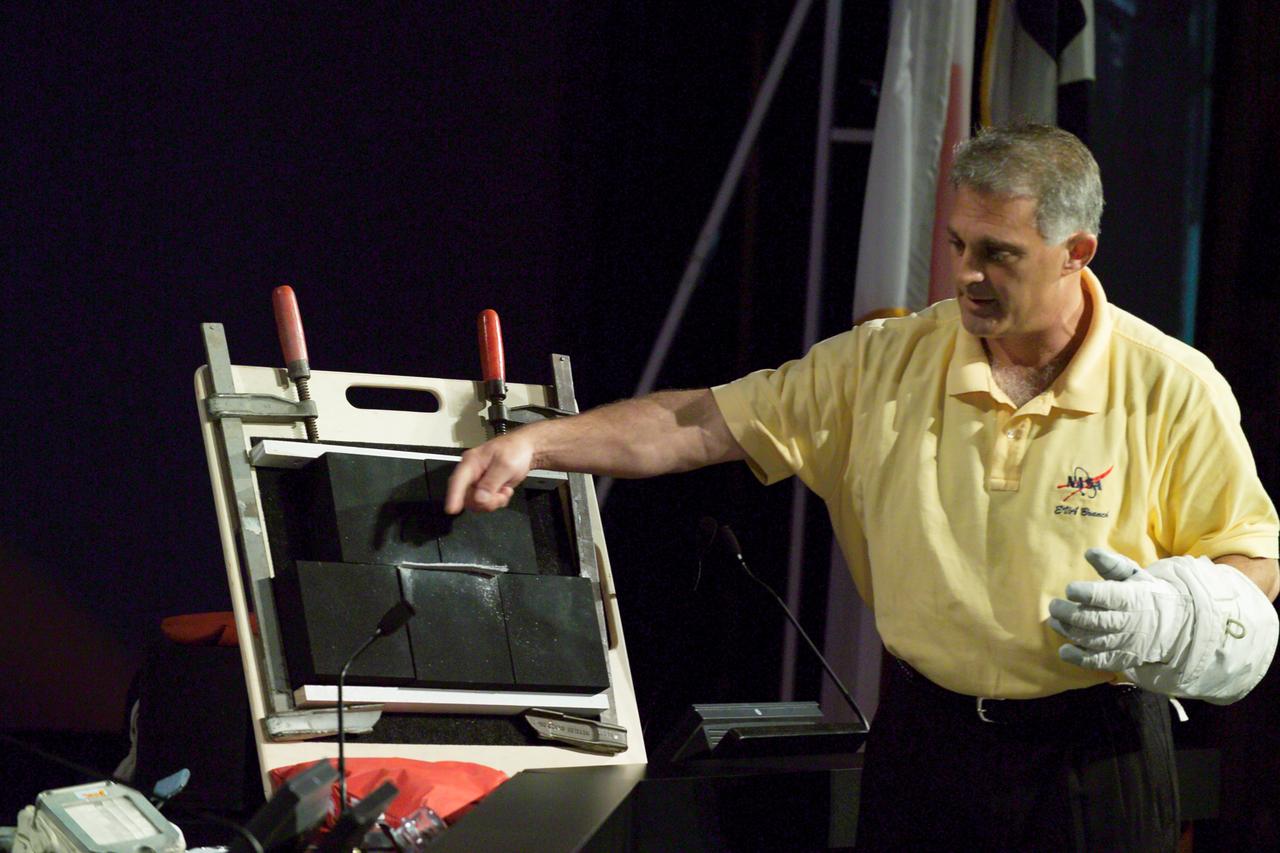
JSC2005-E-31523 (2 August 2005) --- Astronaut David A. Wolf points to a simulated piece of protruding fiber on a set-up of thermal tiles to demonstrate for a press conference audience possible techniques to extract the gap filler material on the underside of the Space Shuttle Discovery. The STS-114 crew will conduct a spacewalk on August 3 to remove two such pieces.
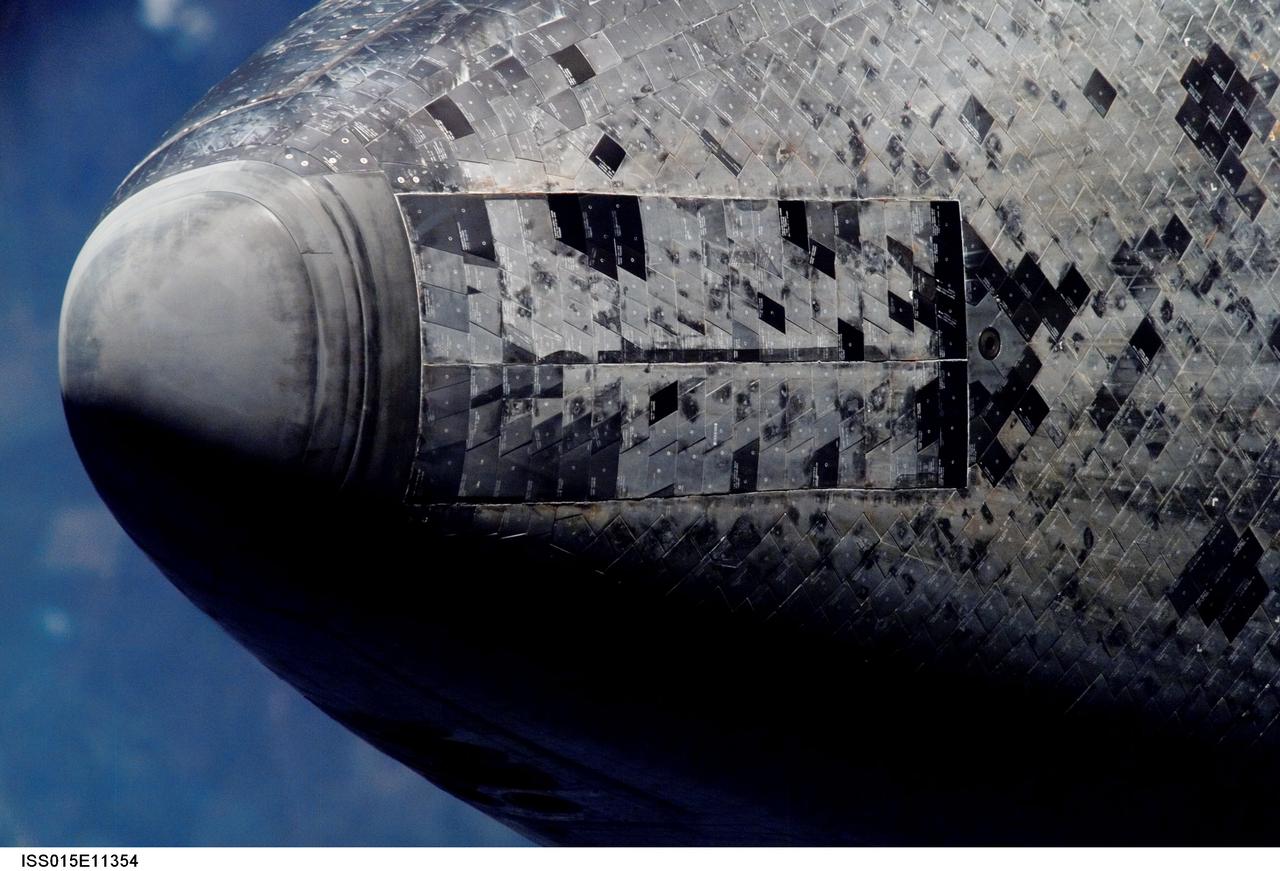
ISS015-E-11354 (10 June 2007) --- This is one of a series of images photographed with a digital still camera using an 800mm focal length featuring the different areas of the Space Shuttle Atlantis as it approached the International Space Station and performed a back-flip to accommodate close scrutiny by eyeballs and cameras. This image shows a view of the underside of nose/nosecap and forward landing gear doors. Distance from the station and shuttle at this time was approximately 600 feet.

ISS023-E-020026 (7 April 2010) --- This view of the underside of the crew cabin of the space shuttle Discovery was provided by an Expedition 23 crew member during a survey of the approaching STS-131 crew to the International Space Station. As part of the survey and part of every mission's activities, Discovery performed a back-flip for the rendezvous pitch maneuver (RPM). The image was photographed with a digital still camera, using a 400mm lens at a distance of about 600 feet (180 meters).
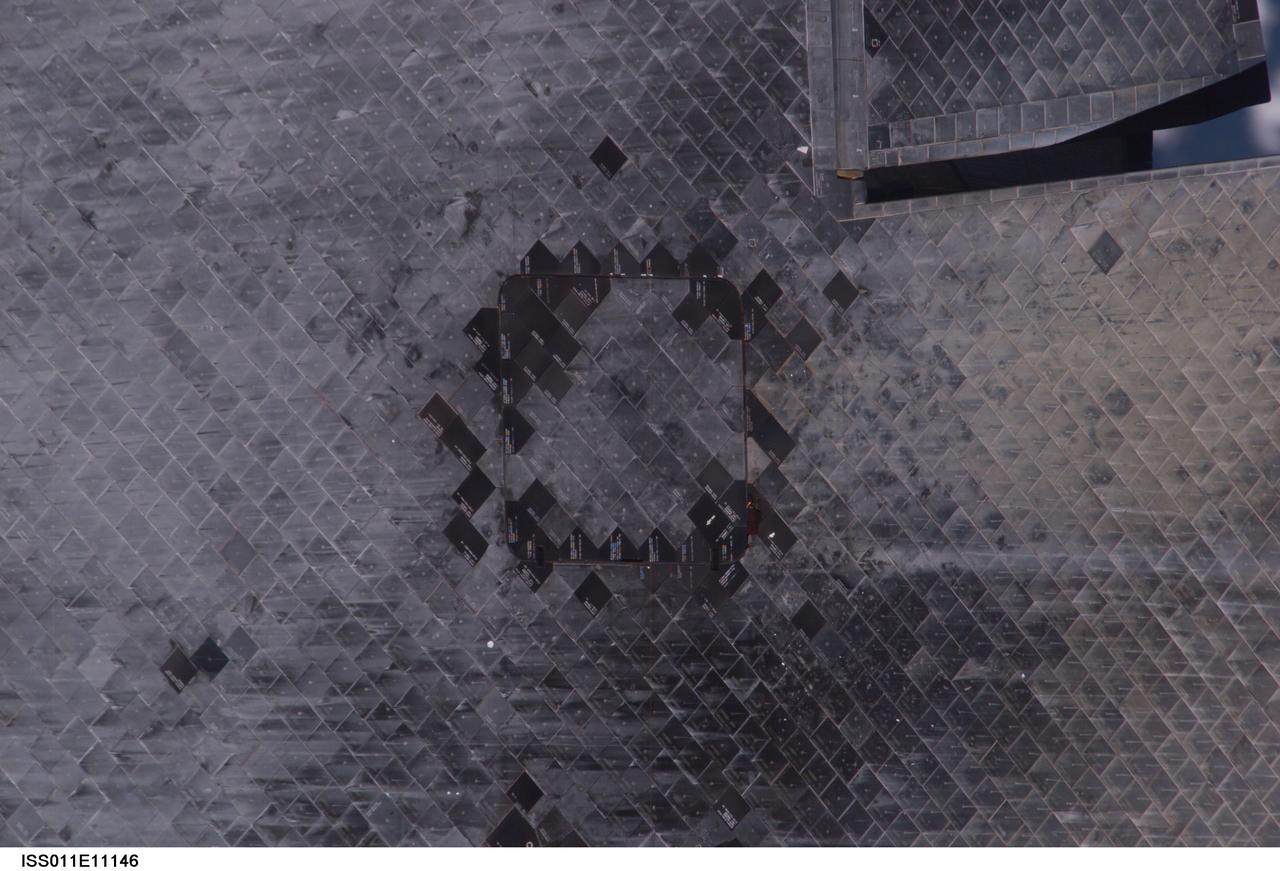
ISS011-E-11146 (28 July 2005) --- View of the Space Shuttle Discovery's underside (near Orbital Maneuvering System pod), photographed as part of the survey sequence performed by the Expedition 11 crew during the STS-114 R-Bar Pitch Maneuver on Flight Day 3. This picture was used by Steve M. Poulos, Jr. Manager, Space Shuttle Vehicle Engineering Office, as one of his visual aids in a July 28, 2005 press conference in the Teague Auditorium at the Johnson Space Center.

KENNEDY SPACE CENTER, FLA. -- In the Orbiter Processing Facility, STS-123 Mission Specialist Richard Linnehan inspects the thermal protection system tiles on the underside of space shuttle Endeavour. He and other crew members are at NASA's Kennedy Space Center for a crew equipment interface test, a process of familiarization with payloads, hardware and the space shuttle. The STS-123 mission is targeted for launch on space shuttle Endeavour on Feb. 14. It will be the 25th assembly flight of the station. Photo credit: NASA/Kim Shiflett
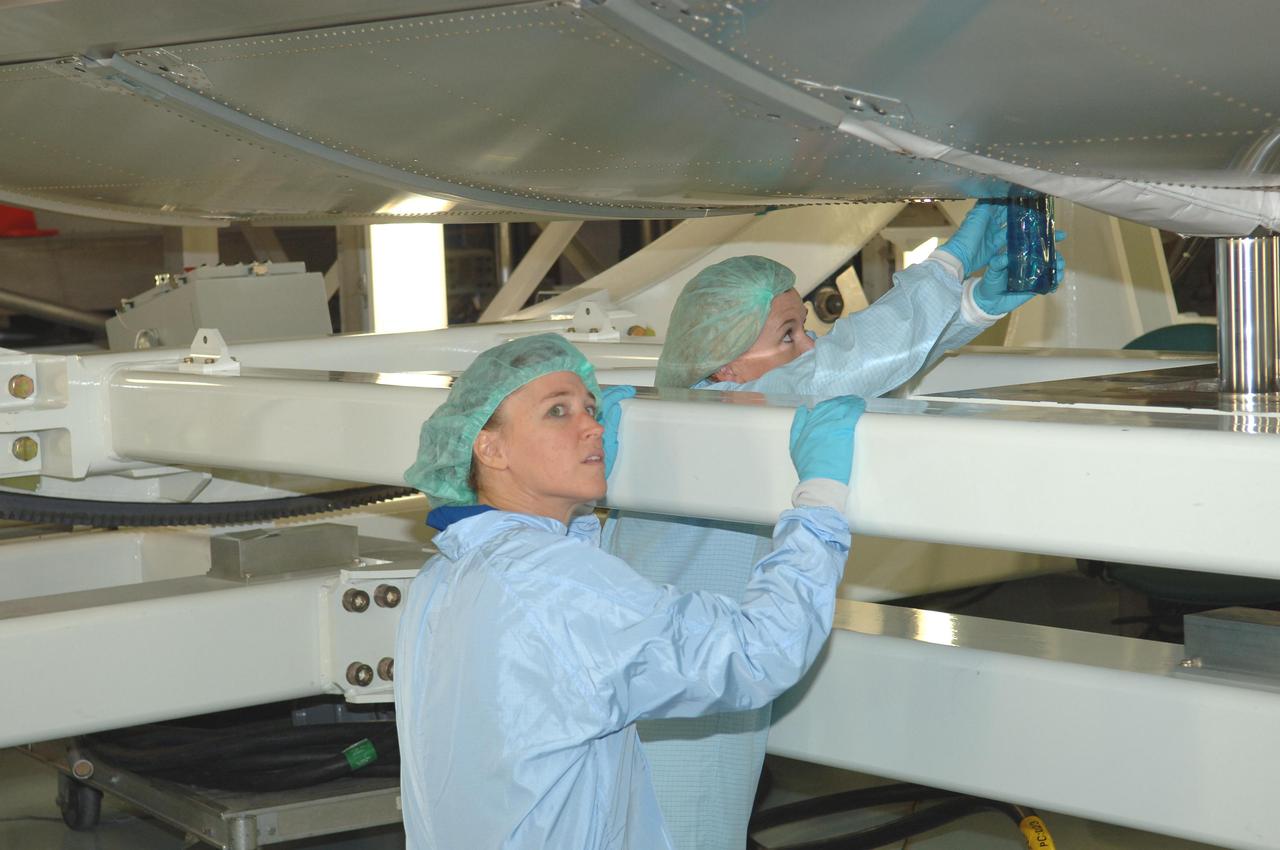
KENNEDY SPACE CENTER, FLA. - In the Space Station Processing Facility at NASA Kennedy Space Center, members of the STS-121 crew look at the underside of the Multi-Purpose Logistics Module Leonardo, which is part of the payload on the mission. The crew is at KSC to take part in Crew Equipment Interface Test activities, which provide hands-on experience with equipment they will use on-orbit. STS-121, the second Return to Flight mission, is targeted for launch in a lighted planning window of Sept. 9 to Sept. 25.
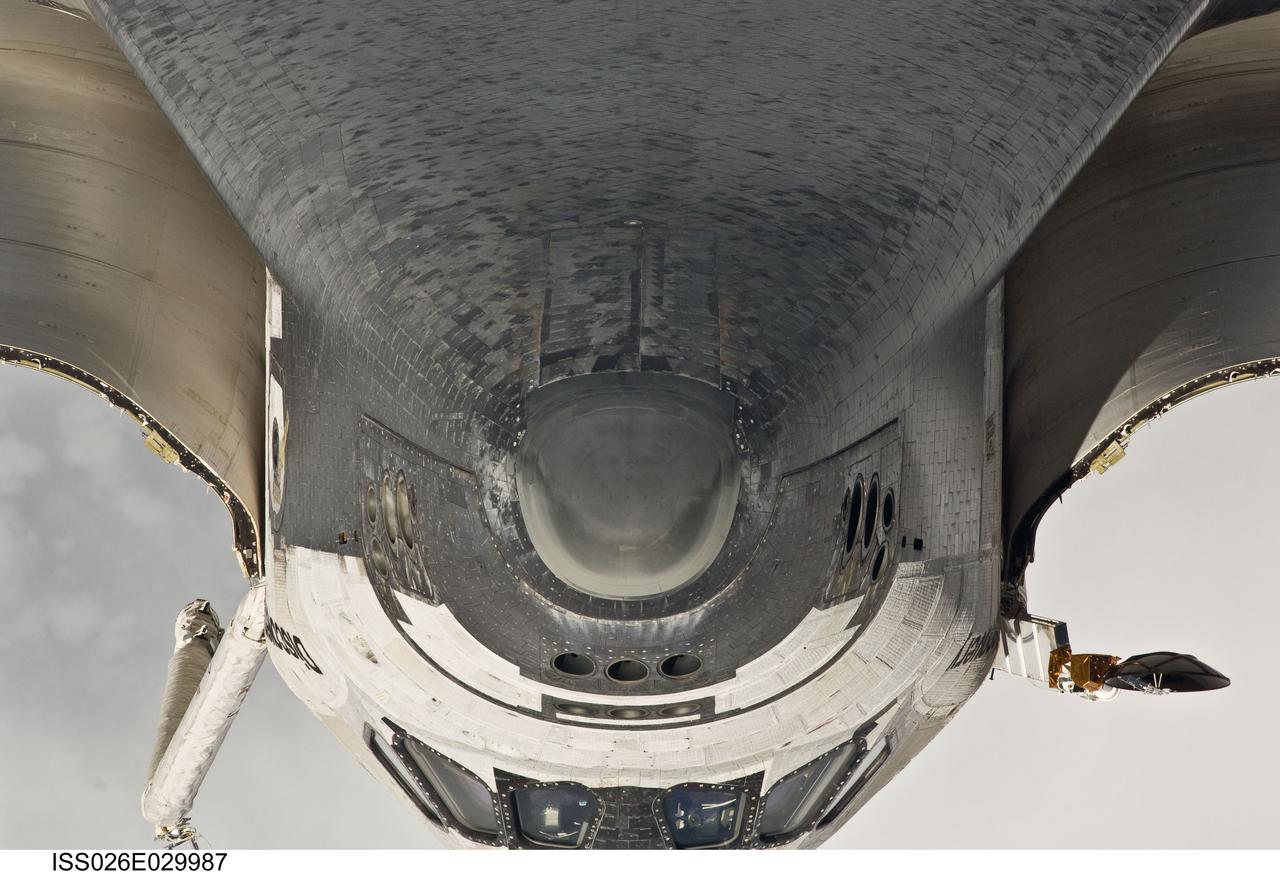
ISS026-E-029987 (26 Feb. 2011) --- This view of the nose, the forward underside and crew cabin of the space shuttle Discovery was provided by an Expedition 26 crew member during a survey of the approaching STS-133 vehicle prior to docking with the International Space Station. As part of the survey and part of every mission's activities, Discovery performed a back-flip for the rendezvous pitch maneuver (RPM). The image was photographed with a digital still camera, using a 400mm lens at a distance of about 600 feet (180 meters).
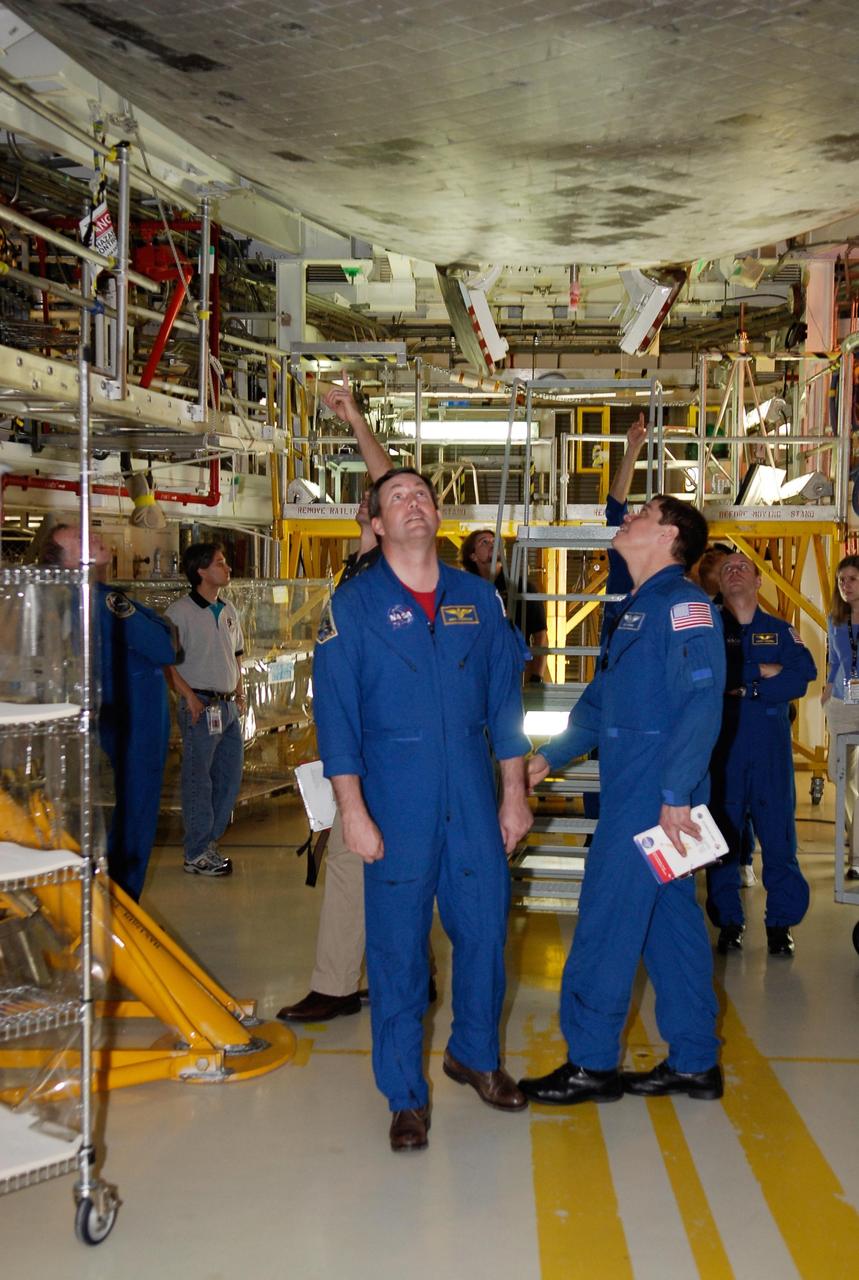
KENNEDY SPACE CENTER, FLA. -- In the Orbiter Processing Facility, STS-123 Mission Specialists Michael Foreman and Robert Behnken inspect the thermal protection system tiles on the underside of space shuttle Endeavour. They and other crew members are at NASA's Kennedy Space Center for a crew equipment interface test, a process of familiarization with payloads, hardware and the space shuttle. The STS-123 mission is targeted for launch on space shuttle Endeavour on Feb. 14. It will be the 25th assembly flight of the station. Photo credit: NASA/Kim Shiflett
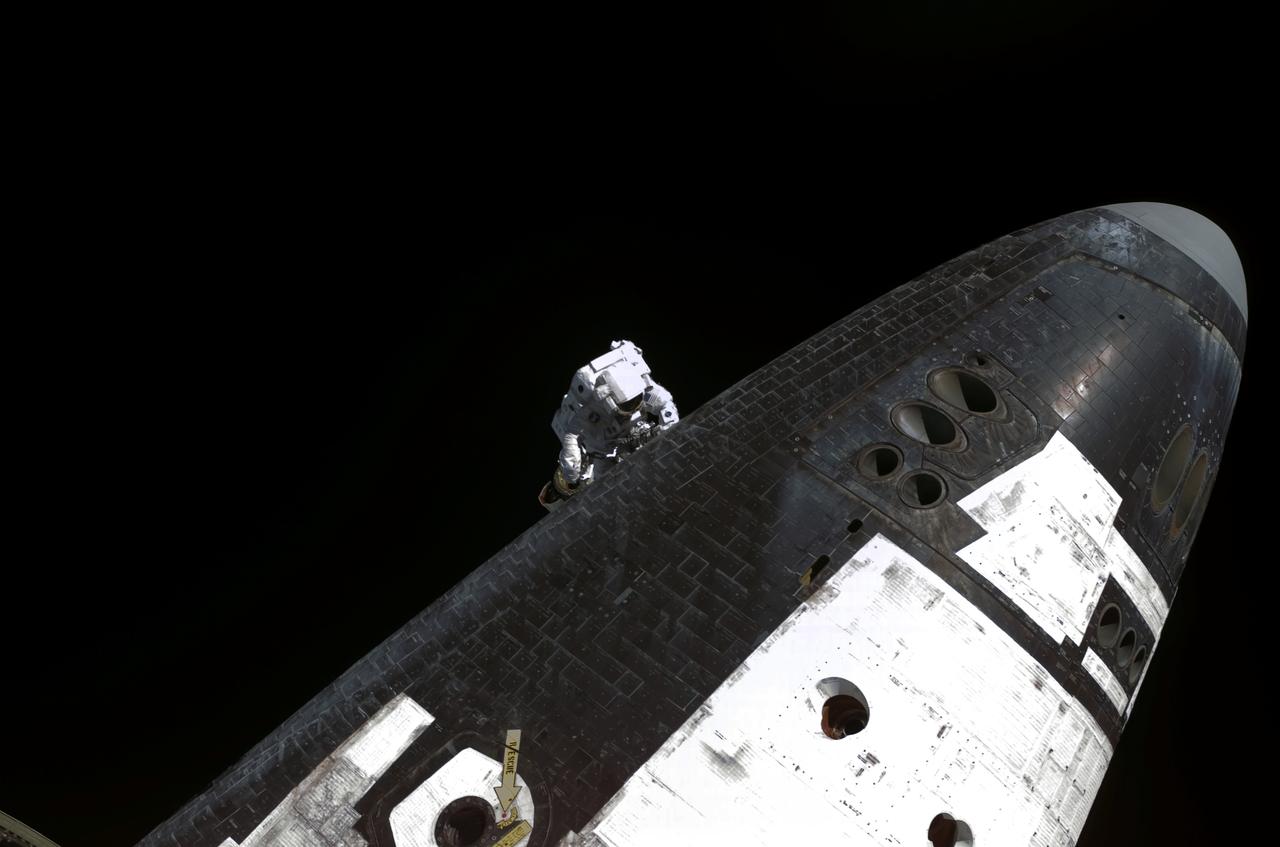
S114-E-6215 (3 August 2005) --- Astronaut Stephen K. Robinson, STS-114 mission specialist, on the end of the station’s Canadarm2 (out of frame), slowly and cautiously makes his way to the underside of Space Shuttle Discovery to remove gap fillers from between the orbiter’s heat-shielding tiles during the mission’s third of three sessions of extravehicular activity (EVA).
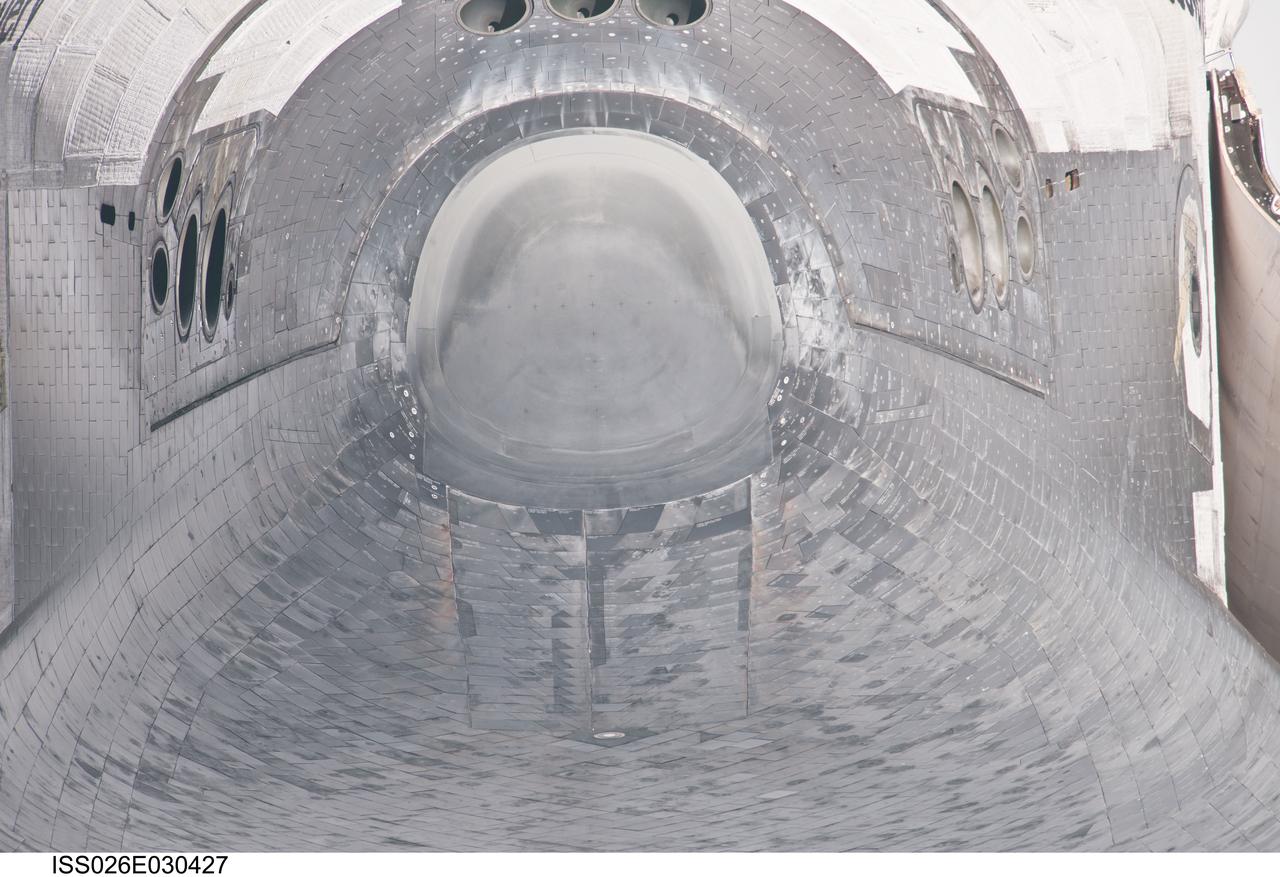
ISS026-E-030427 (26 Feb. 2011) --- This unique view of the nose and forward underside of the space shuttle Discovery was provided by an Expedition 26 crew member during a survey of the approaching STS-133 vehicle prior to docking with the International Space Station. As part of the survey and part of every mission's activities, Discovery performed a back-flip for the rendezvous pitch maneuver (RPM). The image was photographed with a digital still camera, using a 1000mm lens.
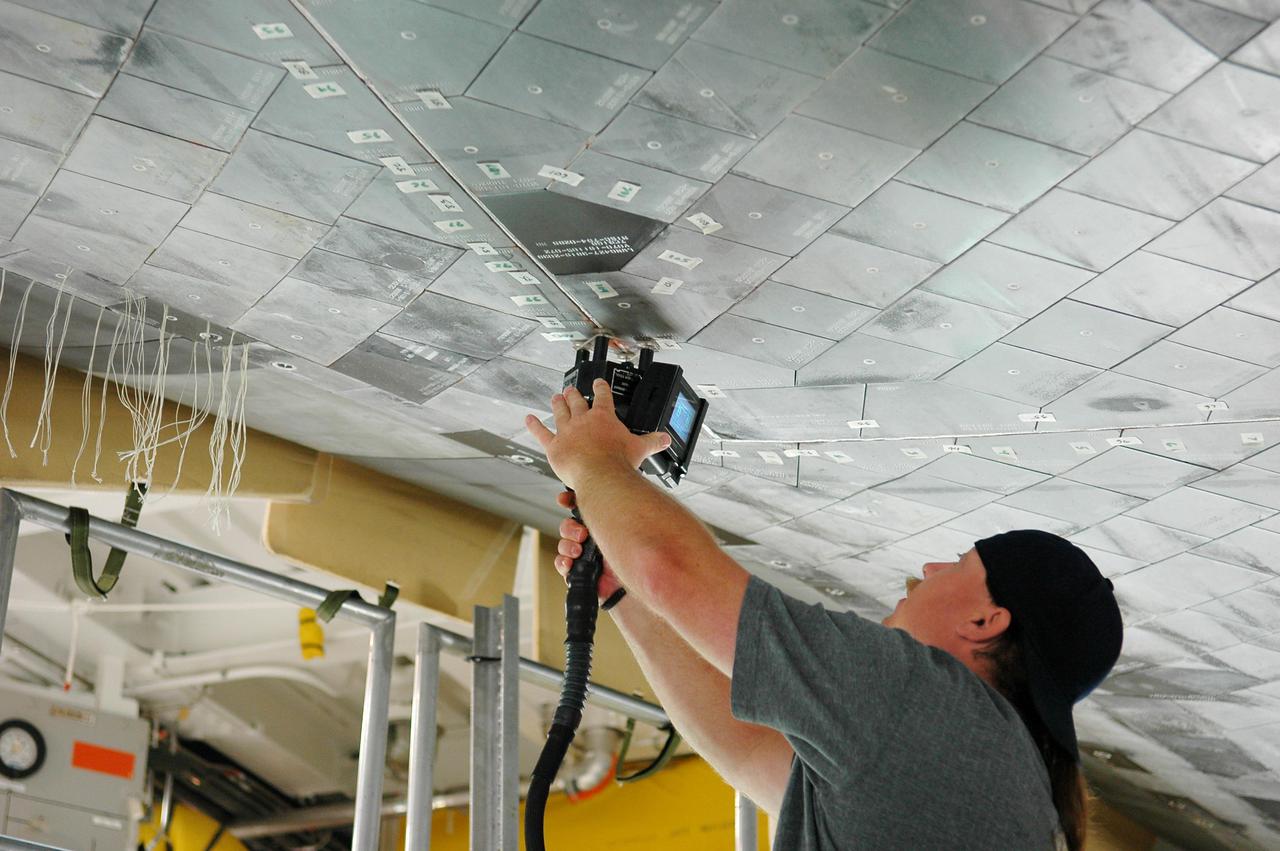
KENNEDY SPACE CENTER, FLA. - In Orbiter Processing Facility bay 1 at NASA’s Kennedy Space Center, United Space Alliance technician Butch Lato uses a laser tool to take step and gap measurements on Thermal Protection System tiles on the underside of orbiter Atlantis. Other processing continues on Atlantis for its mission, designated STS-121, to the International Space Station. The launch planning window is Sept. 9 - 24.
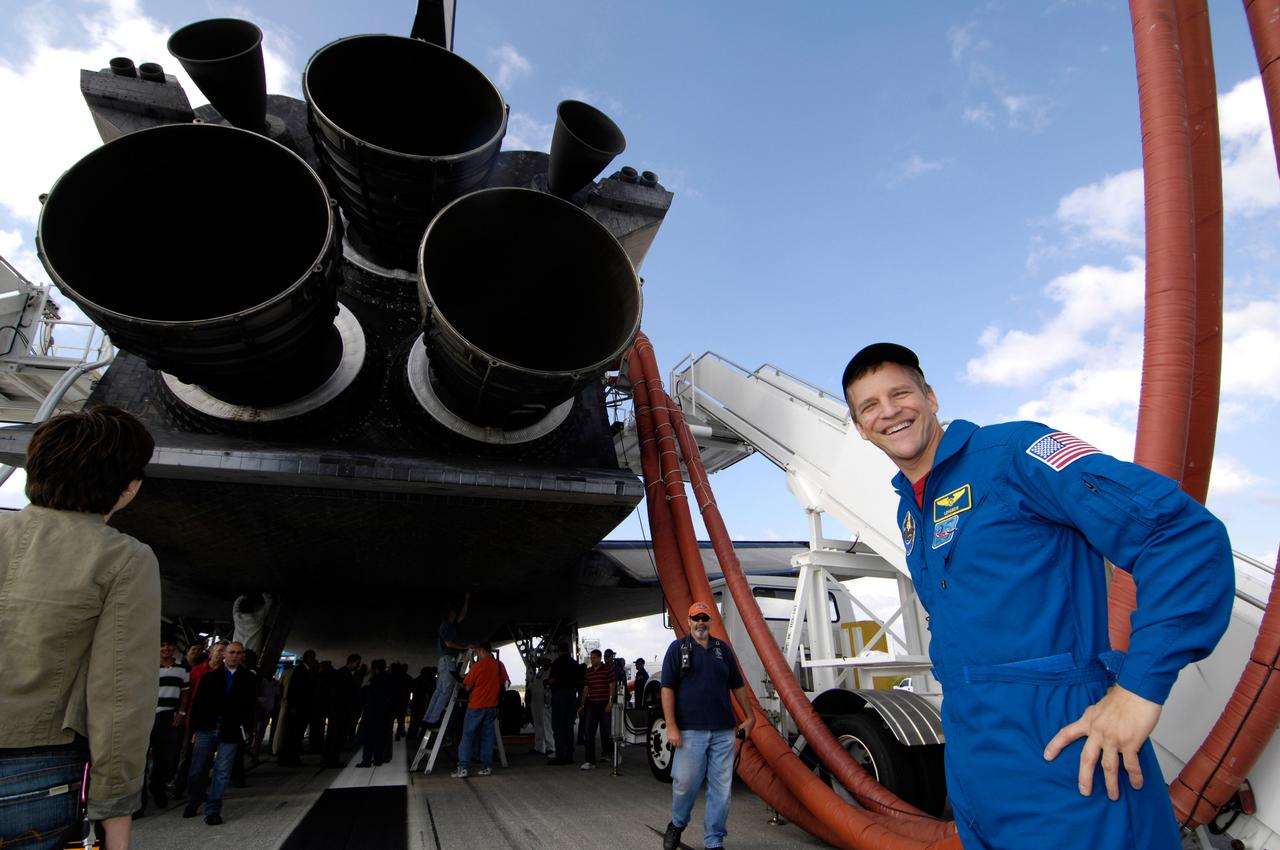
Astronaut Scott Parazynski smiles for a photo while he and the crew of STS-120 walk around and look at the underside of the space shuttle Discovery shortly after their 1:01pm EST landing at NASA's Kennedy Space Center in Florida. Parazynski performed a repair of a damaged solar array during one of his spacewalks at the International Space Station. Photo Credit: "NASA/Bill Ingalls"
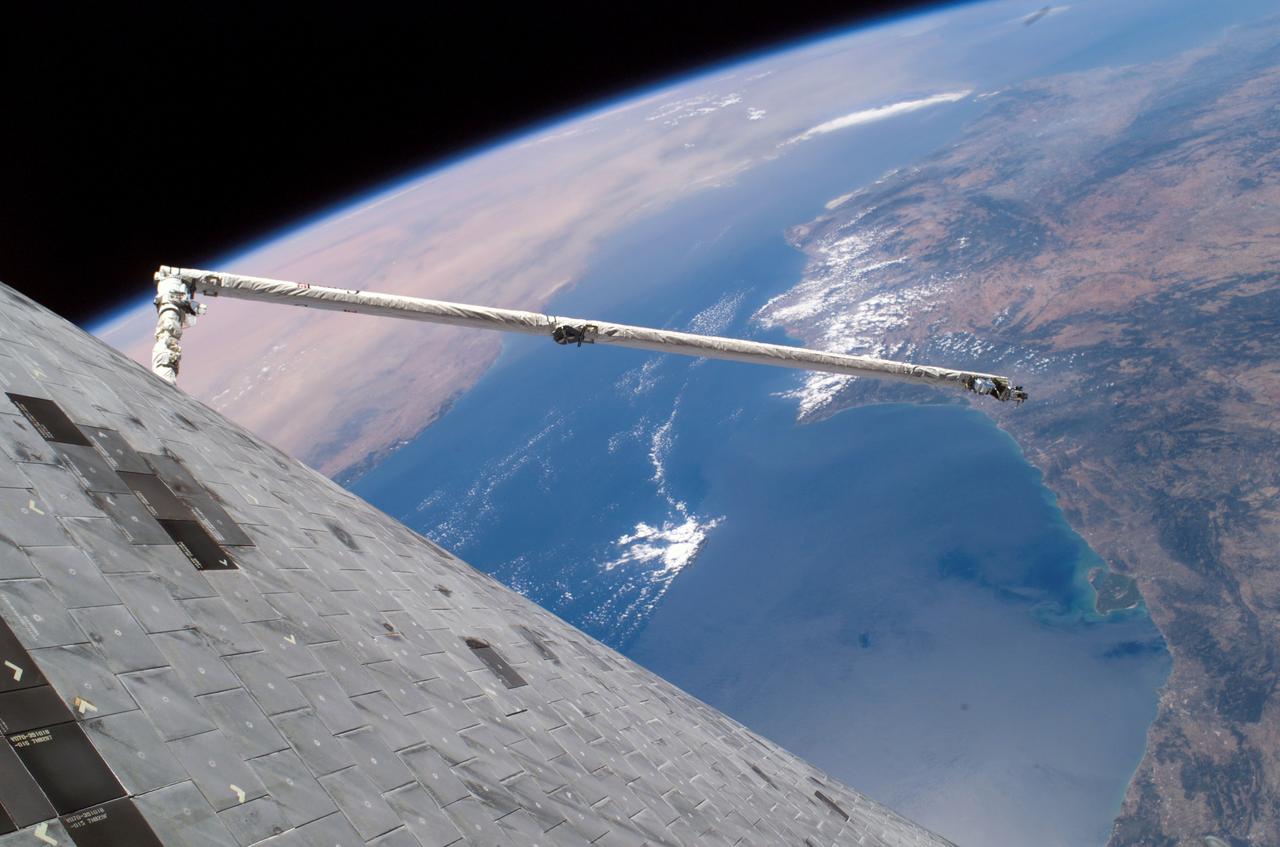
S114-E-6310 (3 August 2005) --- The Red Sea forms the backdrop for this view featuring a portion of thermal protection tiles on the Space Shuttle Discovery’s underside and the Canadian-built remote manipulator system (RMS) robotic arm while docked to the international space station during the STS-114 mission. The image was photographed by astronaut Stephen K. Robinson (out of frame), mission specialist, during today’s extravehicular activities (EVA).
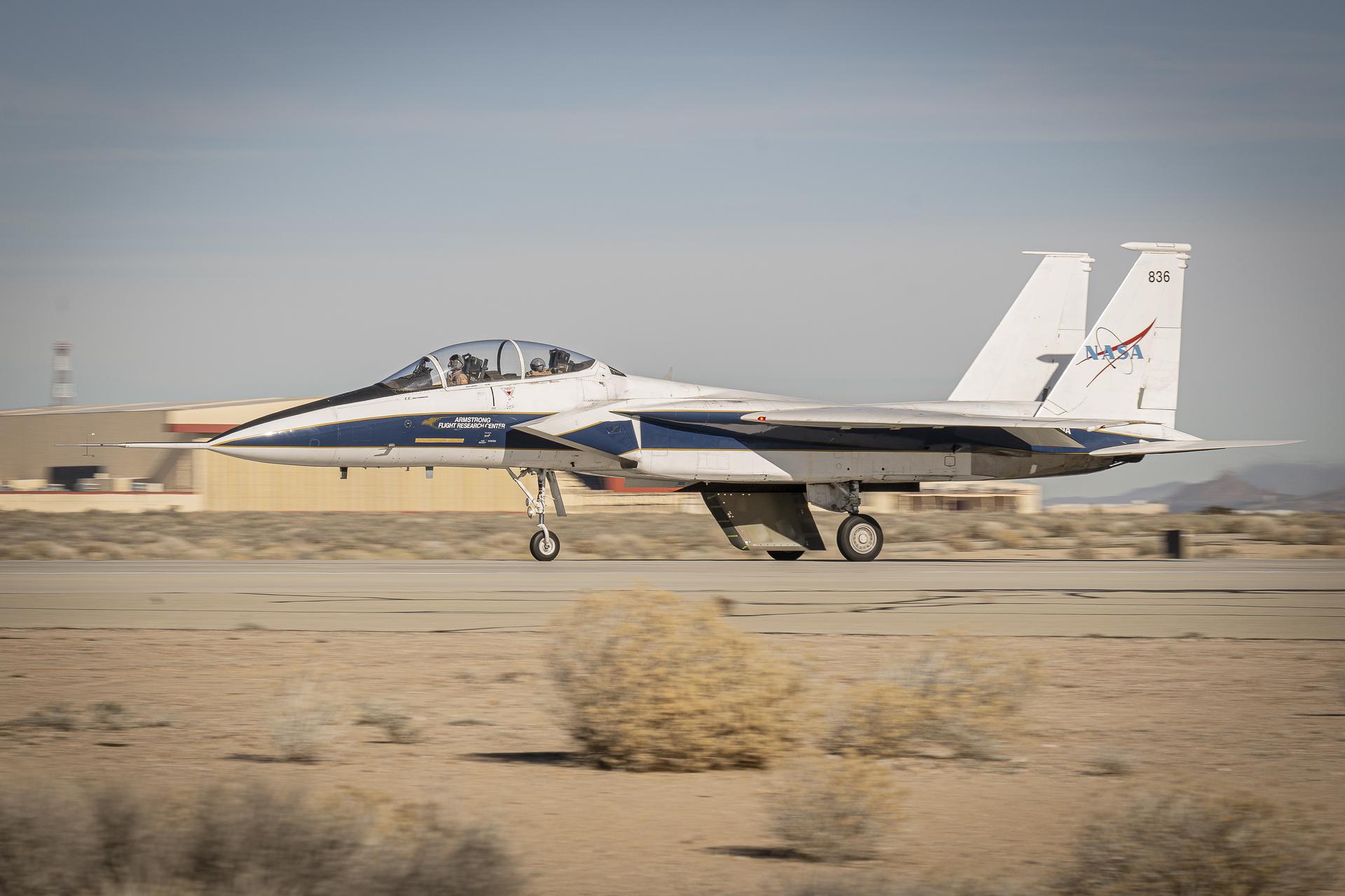
NASA’s Cross Flow Attenuated Natural Laminar Flow (CATNLF) scale model completes its first major milestone – high-speed taxi test – Tuesday, Jan. 12, 2026, at Edwards Air Force Base in California. NASA’s F-15 research aircraft, with the 3-foot-tall test article mounted on its underside, reached speeds of approximately 144 mph during testing. If successful, the technology could be applied to future commercial aircraft to improve efficiency and potentially reduce fuel consumption.

KENNEDY SPACE CENTER, FLA. -- Astronaut Scott Parazynski smiles for a photo while he and the crew of STS-120 walk around and look at the underside of the space shuttle Discovery shortly after their 1:01 p.m. EST landing at NASA's Kennedy Space Center in Florida. Parazynski performed a repair of a damaged solar array during one of his spacewalks at the International Space Station. Photo credit: NASA/Bill Ingalls
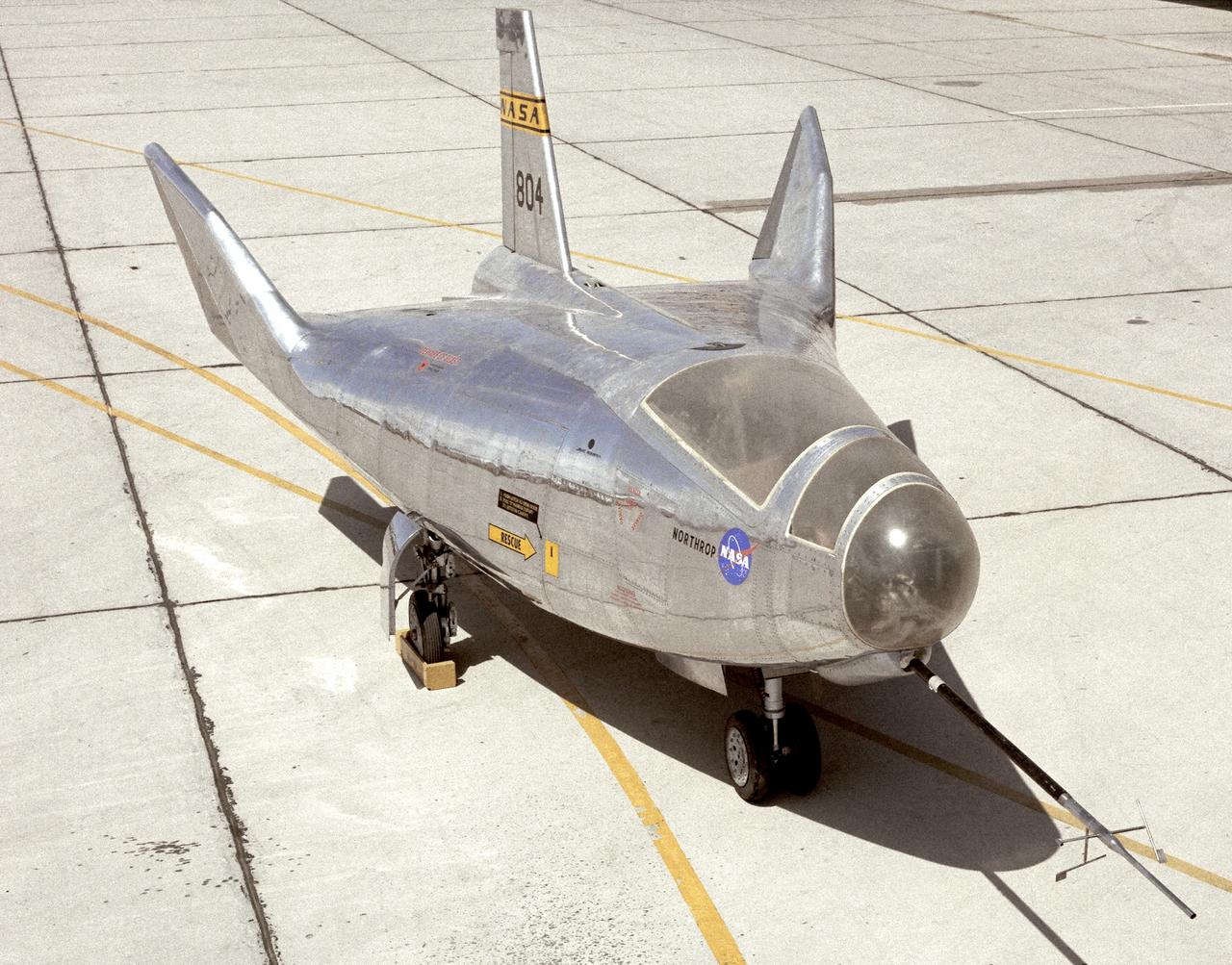
The HL-10, seen here parked on the ramp at NASA's Flight Research Center in 1966, had a radically different shape from that of the M2-F2/F3. While the M2s were flat on top and had rounded undersides (giving them a bathtub shape), the HL-10 had a flat lower surface and a rounded top. Both shapes provided lift without wings, however. This photo was taken before the HL-10's fins were modified.
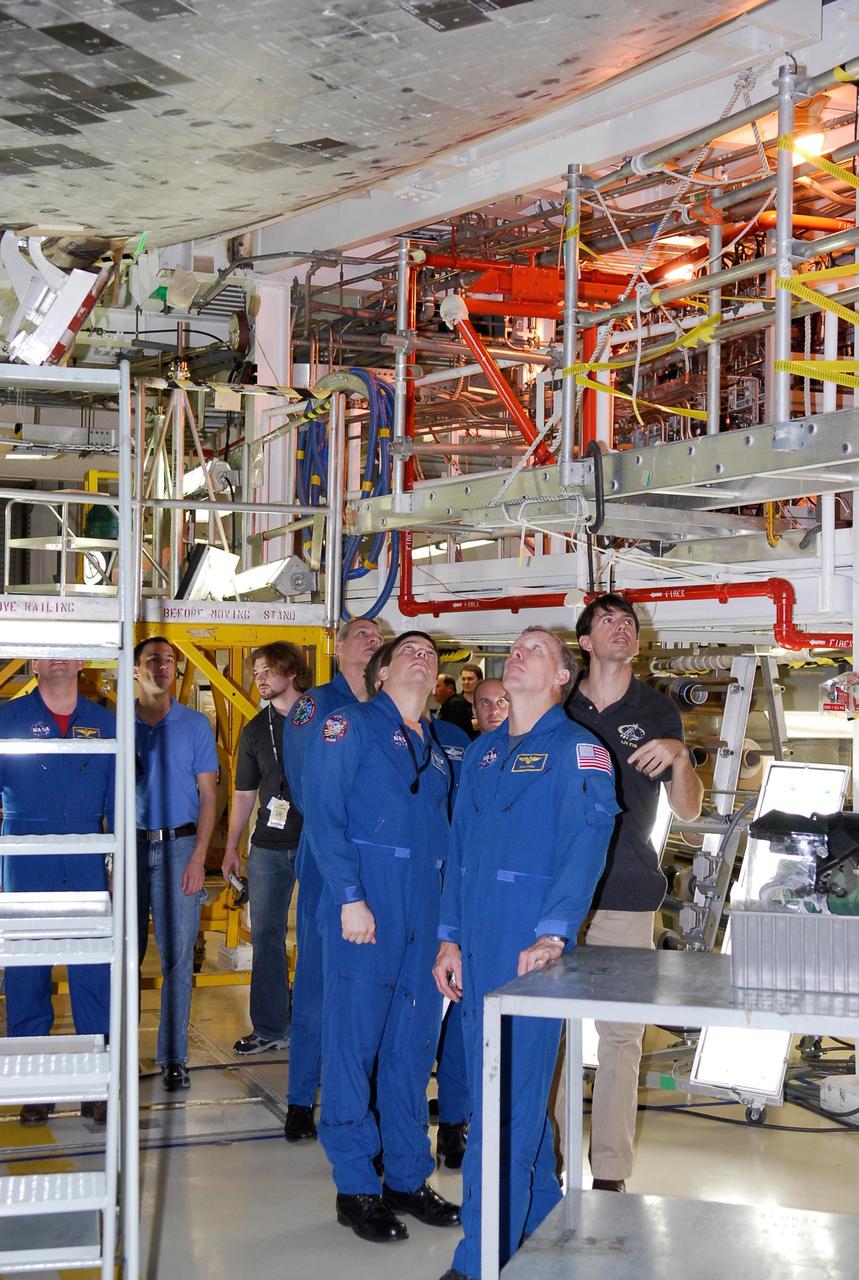
KENNEDY SPACE CENTER, FLA. -- In the Orbiter Processing Facility, STS-123 crew members inspect the thermal protection system tiles on the underside of space shuttle Endeavour. In the center are Mission Specialists Richard Linnehan and Robert Behnken, and Commander Dominic Gorie. They are at NASA's Kennedy Space Center for a crew equipment interface test, a process of familiarization with payloads, hardware and the space shuttle. The STS-123 mission is targeted for launch on space shuttle Endeavour on Feb. 14. It will be the 25th assembly flight of the station. Photo credit: NASA/Kim Shiflett
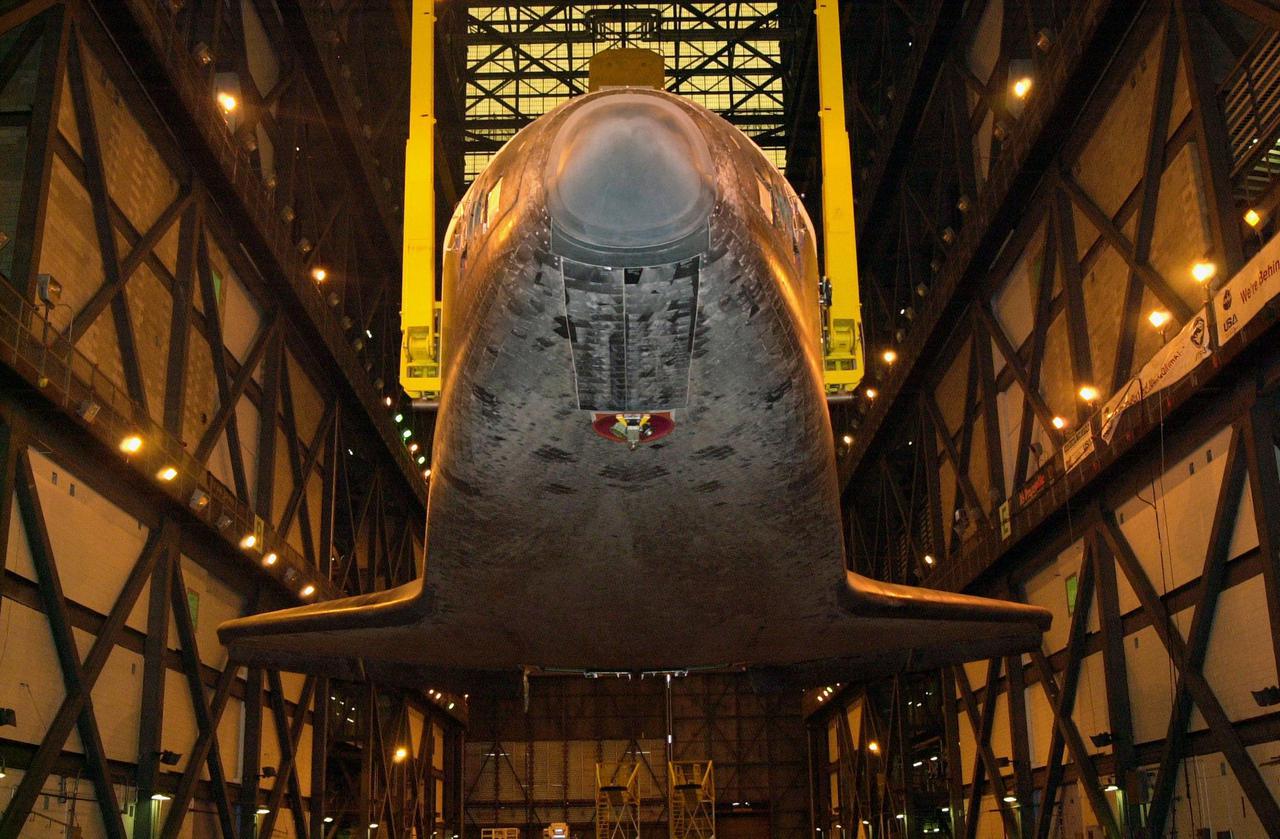
The underside of orbiter Discovery is seen as it is lifted to vertical in the transfer aisle of the Vehicle Assembly Building. It will then be lifted up and into high bay 1 for mating with its solid rocket boosters and external tank. Discovery will be launched March 8 on mission STS-102, the eighth construction flight to the International Space Station. The Shuttle will carry the Multi-Purpose Logistics Module Leonardo, the first of three pressurized modules provided by the Italian Space Agency to carry supplies and equipment to the Space Station and back to earth