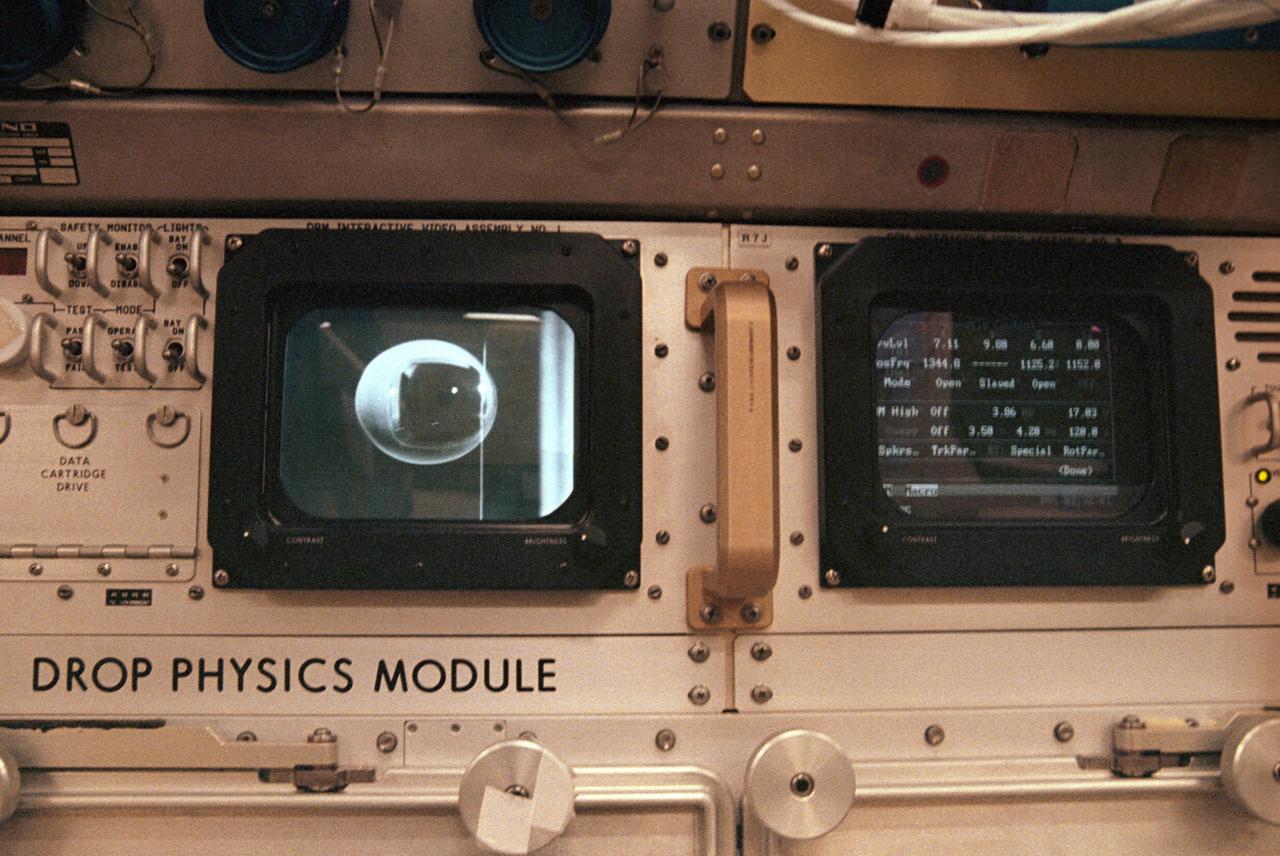
The first United States Microgravity Laboratory (USML-1) was one of NASA's science and technology programs that provided scientists an opportunity to research various scientific investigations in a weightlessness environment inside the Spacelab module. It also provided demonstrations of new equipment to help prepare for advanced microgravity research and processing aboard the Space Station. The USML-1 flew in orbit for extended periods, providing greater opportunities for research in materials science, fluid dynamics, biotechnology (crystal growth), and combustion science. This is a close-up view of the Drop Physics Module (DPM) in the USML science laboratory. The DPM was dedicated to the detailed study of the dynamics of fluid drops in microgravity: their equilibrium shapes, the dynamics of their flows, and their stable and chaotic behaviors. It also demonstrated a technique known as containerless processing. The DPM and microgravity combine to remove the effects of the container, such as chemical contamination and shape, on the sample being studied. Sound waves, generating acoustic forces, were used to suspend a sample in microgravity and to hold a sample of free drops away from the walls of the experiment chamber, which isolated the sample from potentially harmful external influences. The DPM gave scientists the opportunity to test theories of classical fluid physics, which have not been confirmed by experiments conducted on Earth. This image is a close-up view of the DPM. The USML-1 flew aboard the STS-50 mission on June 1992, and was managed by the Marshall Space Flight Center.
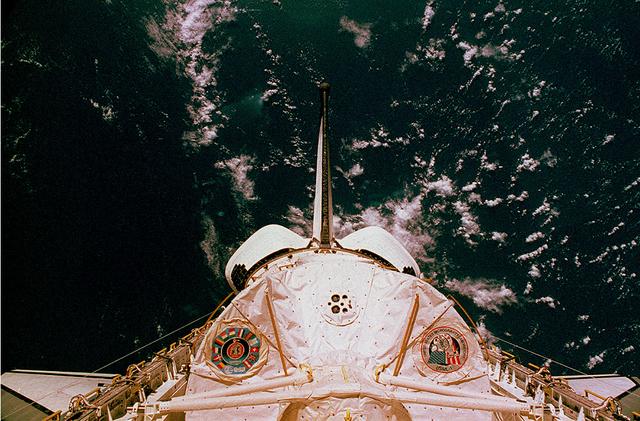
This is a photograph of the Spacelab module for the first United States Microgravity Laboratory (USML-1) mission, showing logos of the Spacelab mission on the left and the USML-1 mission on the right. The USML-1 was one part of a science and technology program that opened NASA's next great era of discovery and established the United States' leadership in space. From investigations designed to gather fundamental knowledge in a variety of areas to demonstrations of new equipment, USML-1 forged the way for future USML missions and helped prepare for advanced microgravity research and processing aboard the Space Station. Thirty-one investigations comprised the payload of the first USML-1 mission. The experiments aboard USML-1 covered five basic areas: fluid dynamics, the study of how liquids and gases respond to the application or absence of differing forces; crystal growth, the production of inorganic and organic crystals; combustion science, the study of the processes and phenomena of burning; biological science, the study of plant and animal life; and technology demonstrations. The USML-1 was managed by the Marshall Space Flight Center and launched aboard the Space Shuttle Orbiter Columbia (STS-50) on June 25, 1992.

The first United States Microgravity Laboratory (USML-1) flew in orbit inside the Spacelab science module for extended periods, providing scientists and researchers greater opportunities for research in materials science, fluid dynamics, biotechnology (crystal growth), and combustion science. This photograph shows Astronaut Larry De Lucas wearing a stocking plethysmograph during the mission. Muscle size in the legs changes with exposure to microgravity. A stocking plethysmograph, a device for measuring the volume of a limb, was used to help determine these changes. Several times over the course of the mission, an astronaut will put on the plethysmograph, pull the tapes tight and mark them. By comparing the marks, changes in muscle volume can be measured. The USML-1 was launched aboard the Space Shuttle Orbiter Columbia (STS-50) on June 25, 1992.
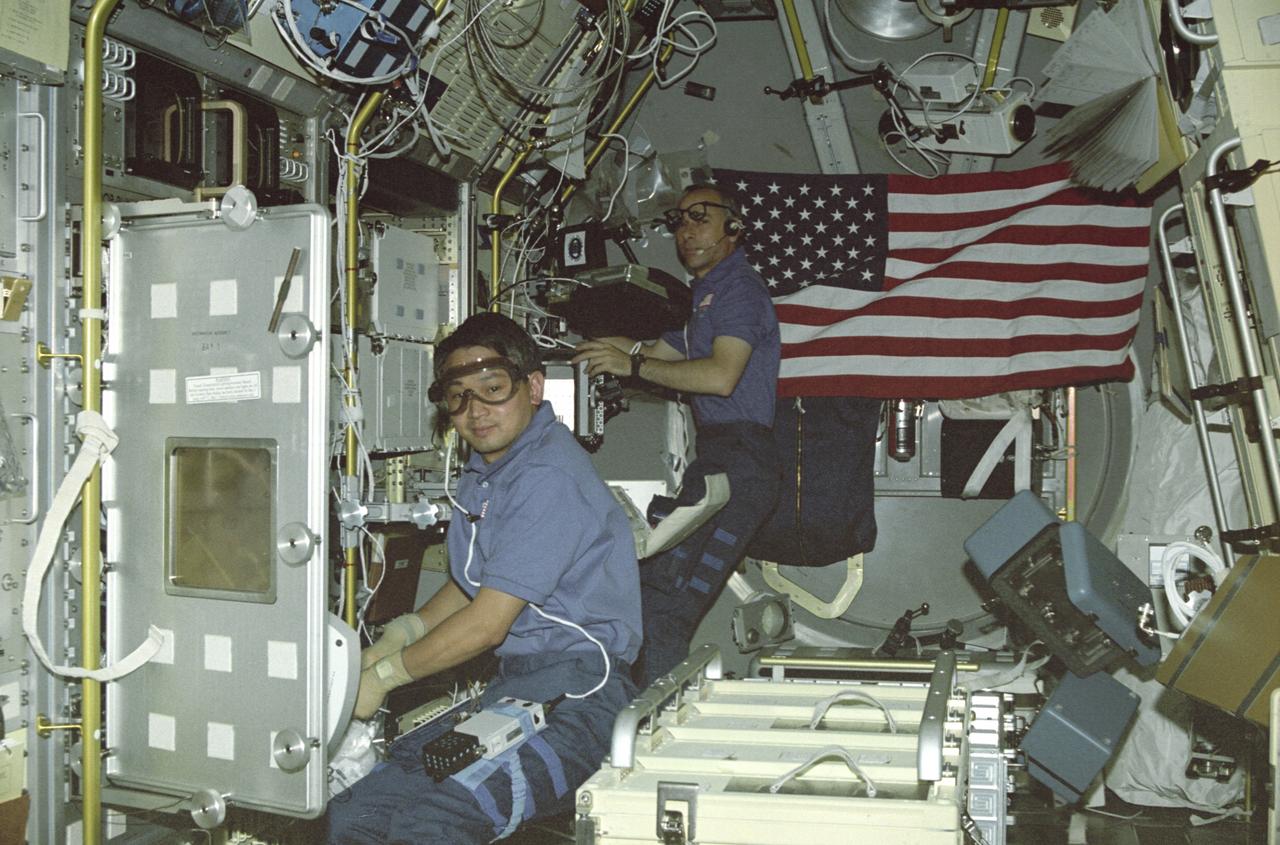
In this photograph, astronaut Eugene Trinh, a payload specialist for this mission, is working at the Drop Physics Module (DPM), and mission specialist Carl Meade is working on the experiment at the Glovebox inside the first United States Microgravity Laboratory (USML-1) Science Module. The USML-1 was one of NASA's missions dedicated to scientific investigations in a microgravity environment inside the Spacelab module. Investigations aboard the USML-1 included: materials science, fluid dynamics, biotechnology (crystal growth), and combustion science. The DPM is dedicated to the detailed study of the dynamics of fluid drops in microgravity. The Glovebox offers experimenters new capabilities and technologies in microgravity with a clean working space and minimizes contamination risks to both Spacelab and experiment samples. Payload specialists are professional scientists or engineers whose only assignment on a space flight is to carry out scientific and technological experiments. Their specific training for a space flight is usually limited to a short period of learning how to live and work in weightlessness. Mission Specialists are both professional scientists and career astronauts. Thus they are a link or bridge between the other crew members, and combine the functions of resident maintenance engineers, in-space counterparts of flight engineers in aircraft, and fully qualified scientists. The USML-1 flew aboard the STS-50 mission on June 1992, and was managed by the Marshall Space Flight Center.
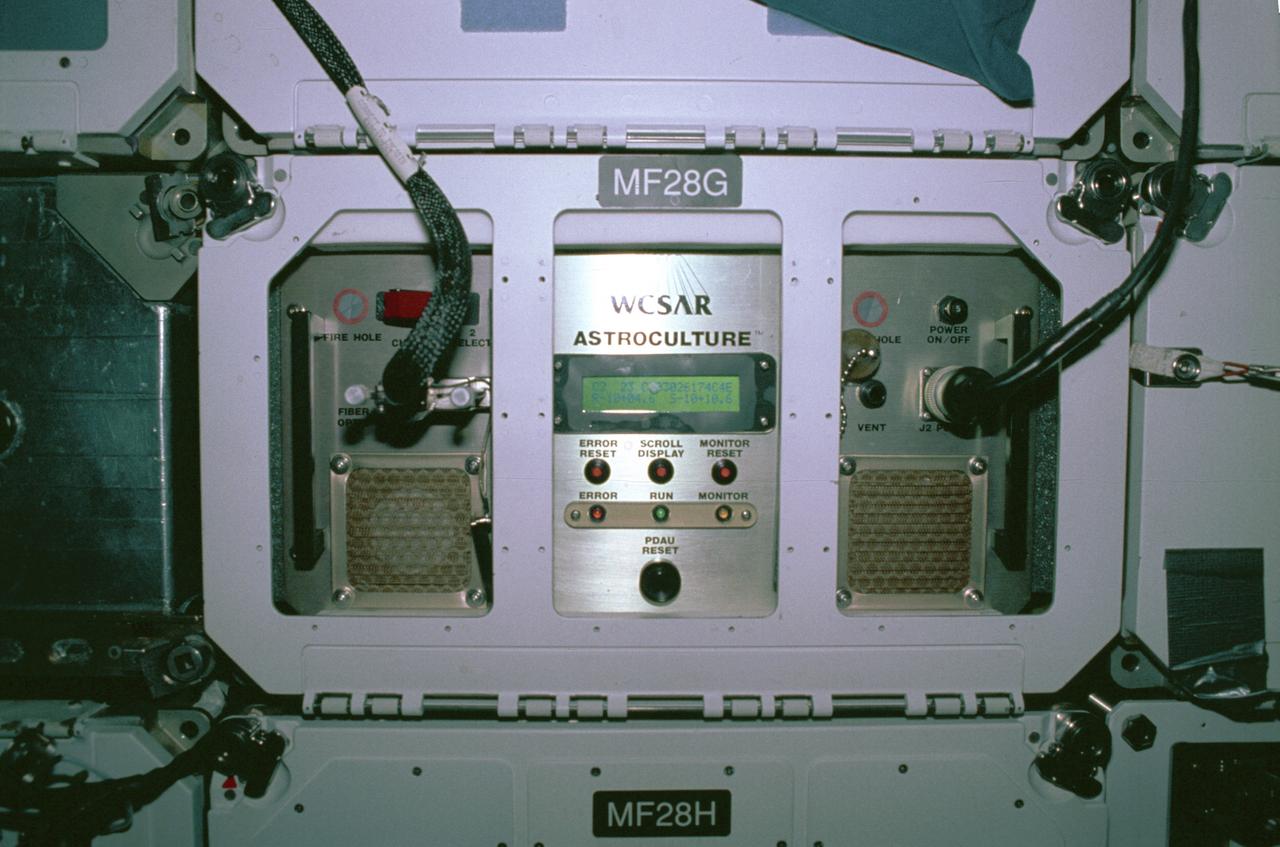
The first United States Microgravity Laboratory (USML-1) was one of NASA's science and technology programs that provided scientists an opportunity to research various scientific investigations in a weightless environment inside the Spacelab module. It also provided demonstrations of new equipment to help prepare for advanced microgravity research and processing aboard the Space Station. The USML-1 flew in orbit for extended periods, providing greater opportunities for research in materials science, fluid dynamics, biotechnology (crystal growth), and combustion science. This is a close-up view of the Astroculture experiment rack in the middeck of the orbiter. The Astroculture experiment was to evaluate and find effective ways to supply nutrient solutions for optimizing plant growth and avoid releasing solutions into the crew quarters in microgravity. Since fluids behave differently in microgravity, plant watering systems that operate well on Earth do not function effectively in space. Plants can reduce the costs of providing food, oxygen, and pure water, as well as lower the costs of removing carbon dioxide in human space habitats. The USML-1 flew aboard the STS-50 mission on June 1992 and was managed by the Marshall Space Flight Center.
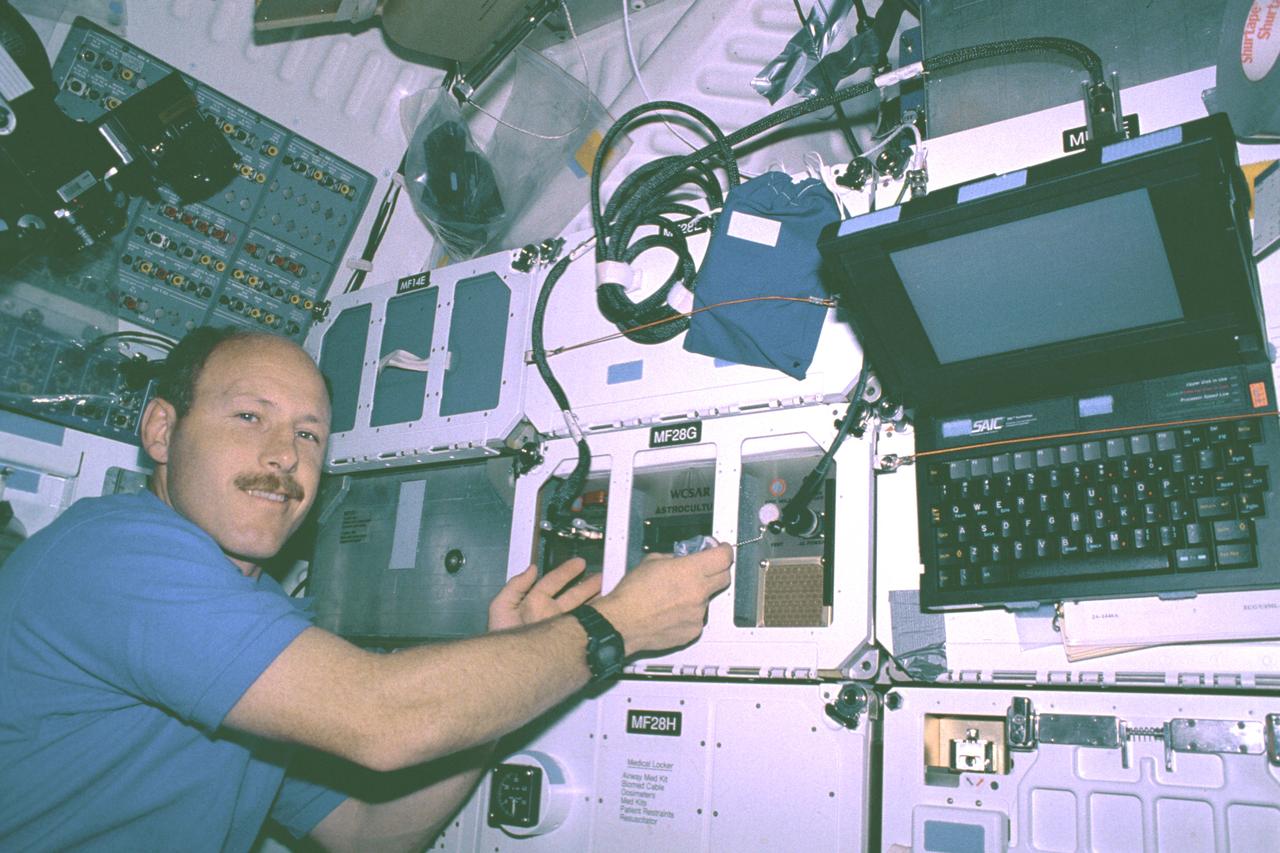
The first United States Microgravity Laboratory (USML-1) was one of NASA's science and technology programs that provided scientists an opportunity to research various scientific investigations in a weightless environment inside the Spacelab module. It also provided demonstrations of new equipment to help prepare for advanced microgravity research and processing aboard the Space Station. The USML-1 flew in orbit for extended periods, providing greater opportunities for research in materials science, fluid dynamics, biotechnology (crystal growth), and combustion science. This photograph shows astronaut Ken Bowersox conducting the Astroculture experiment in the middeck of the orbiter Columbia. This experiment was to evaluate and find effective ways to supply nutrient solutions for optimizing plant growth and avoid releasing solutions into the crew quarters in microgravity. Since fluids behave differently in microgravity, plant watering systems that operate well on Earth do not function effectively in space. Plants can reduce the costs of providing food, oxygen, and pure water as well as lower the costs of removing carbon dioxide in human space habitats. The Astroculture experiment flew aboard the STS-50 mission in June 1992 and was managed by the Marshall Space Flight Center.
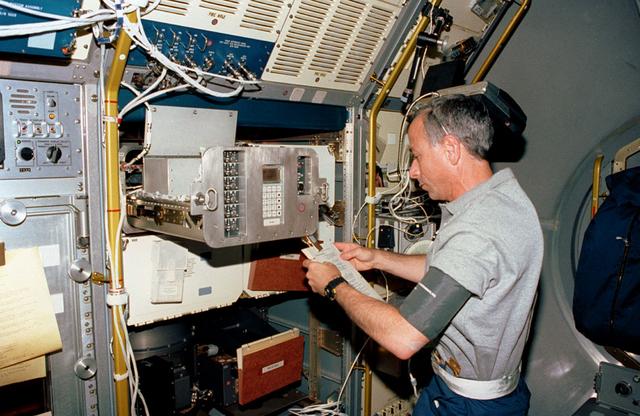
The first United States Microgravity Laboratory (USML-1) was one of NASA's science and technology programs and provided scientists an opportunity to research various scientific investigations in a weightless environment inside the Spacelab module. It also provided demonstrations of new equipment to help prepare for advanced microgravity research and processing aboard the Space Station. The USML-1 flew in orbit for extended periods, providing greater opportunities for research in materials science, fluid dynamics, biotechnology, and combustion science. In this photograph, astronaut Carl Meade is reviewing the manual to activate the Generic Bioprocessing Apparatus (GBA) inside the Spacelab module. The GBA for the USML-1 mission was a multipurpose facility that could help us answer important questions about the relationship between gravity and biology. This unique facility allowed scientists to study biological processes in samples ranging from molecules to small organisms. For example, scientists would examine how collagen, a protein substance found in cornective tissue, bones, and cartilage, forms fibers. In microgravity, it might be possible to alter collagen fiber assembly so that this material could be used more effectively as artificial skin, blood vessels, and other parts of the body. The USML-1 was managed by the Marshall Space Flight Center and waslaunched aboard the Space Shuttle Orbiter Columbia (STS-50) on June 25, 1992.
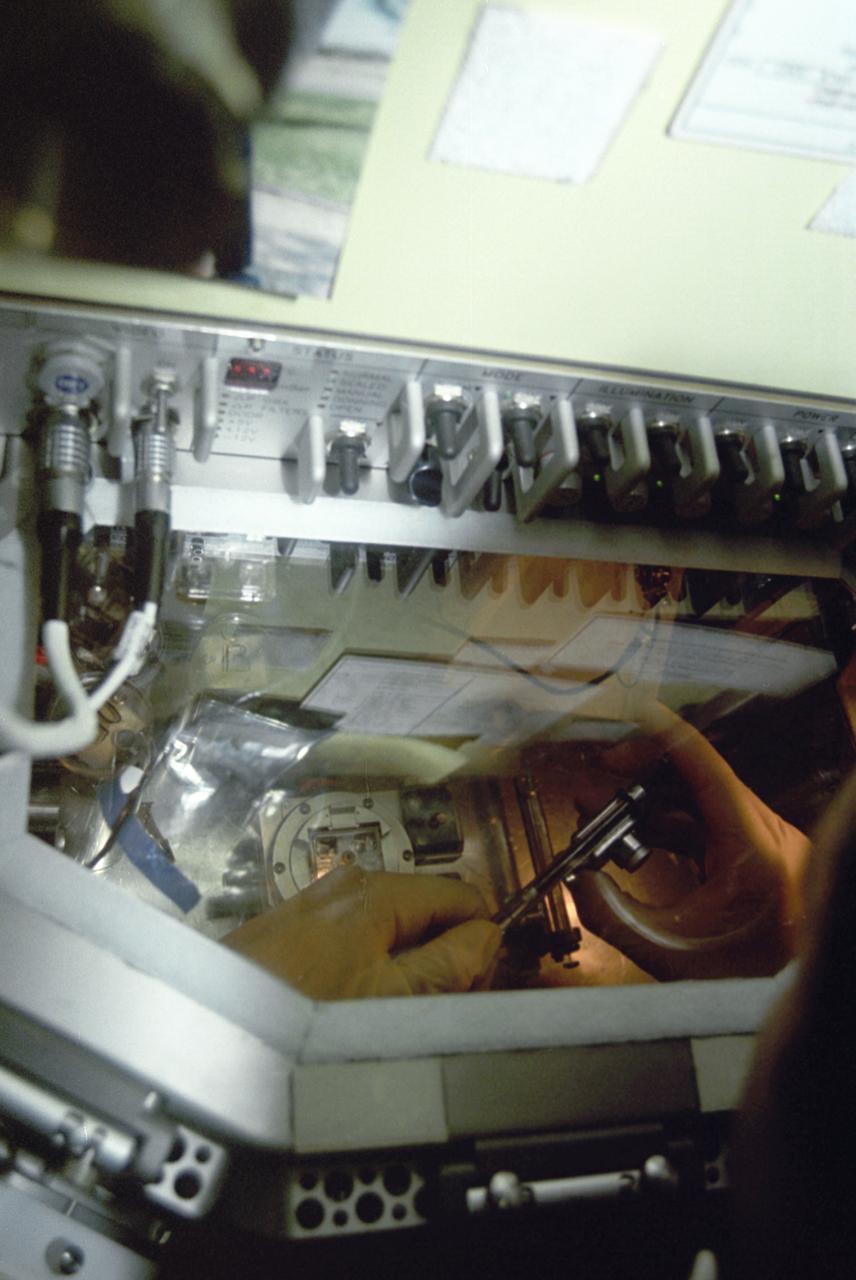
The first United States Microgravity Laboratory (USML-1) provided scientific research in materials science, fluid dynamics, biotechnology, and combustion science in a weightless environment inside the Spacelab module. This photograph is a close-up view of the Glovebox in operation during the mission. The Spacelab Glovebox, provided by the European Space Agency, offers experimenters new capabilities to test and develop science procedures and technologies in microgravity. It enables crewmembers to handle, transfer, and otherwise manipulate materials in ways that are impractical in the open Spacelab. The facility is equipped with three doors: a central port through which experiments are placed in the Glovebox and two glovedoors on both sides with an attachment for gloves or adjustable cuffs and adapters for cameras. The Glovebox has an enclosed compartment that offers a clean working space and minimizes the contamination risks to both Spacelab and experiment samples. Although fluid containment and ease of cleanup are major benefits provided by the facility, it can also contain powders and bioparticles; toxic, irritating, or potentially infectious materials; and other debris produced during experiment operations. The facility is equipped with photographic/video capabilities and permits mounting a microscope. For the USML-1 mission, the Glovebox experiments fell into four basic categories: fluid dynamics, combustion science, crystal growth, and technology demonstration. The USML-1 flew aboard the STS-50 mission in June 1992.
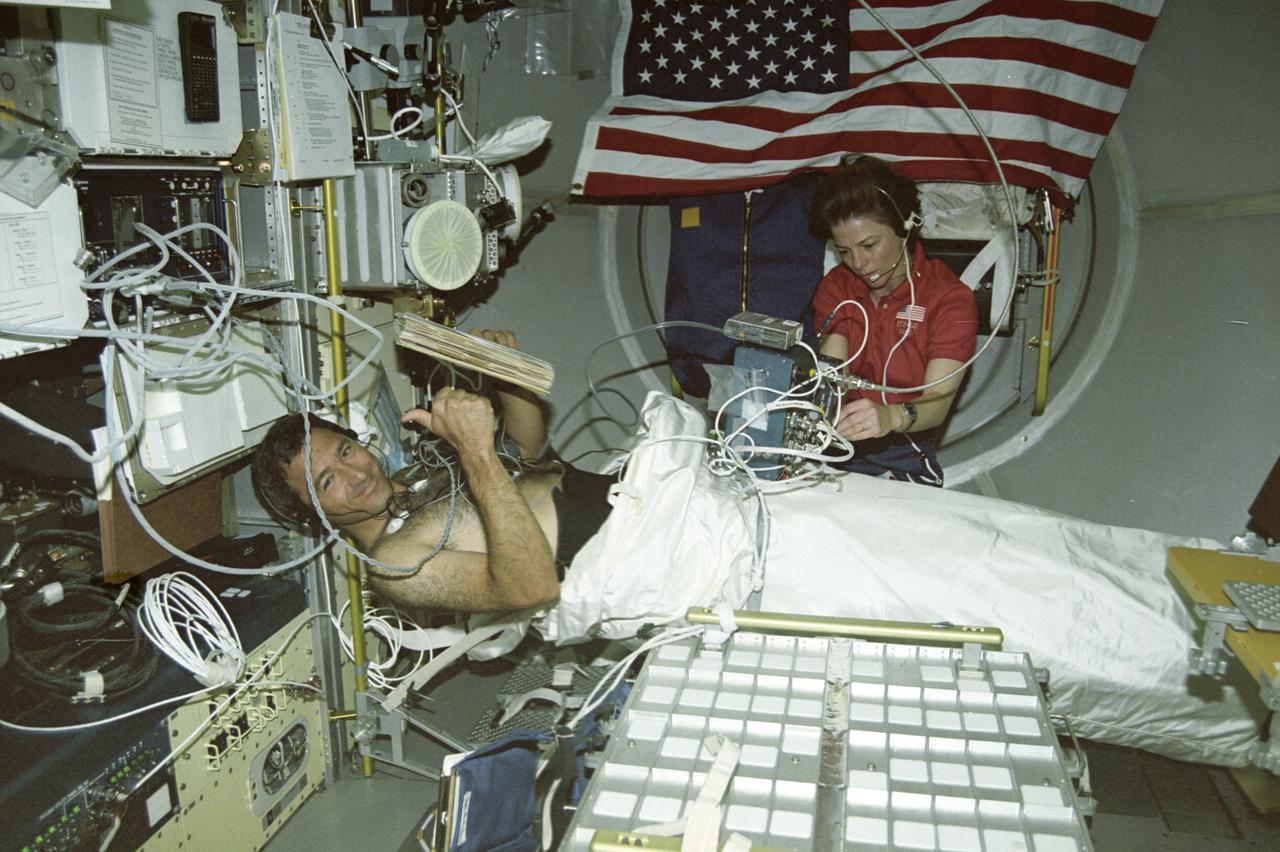
The first United States Microgravity Laboratory (USML-1) flew in orbit inside the Spacelab science module for extended periods, providing scientists and researchers greater opportunities for research in materials science, fluid dynamics, biotechnology (crystal growth), and combustion science. In this photograph, Astronaut Bornie Dunbar and Astronaut Larry DeLucas are conducting the Lower Body Negative Pressure (LBNP) experiment, which is to protect the health and safety of the crew and to shorten the time required to readapt to gravity when they return to Earth. When humans go into space, the lack of gravity causes many changes in the body. One change is that fluids normally kept in the lower body by gravity, shift upward to the head and chest. This is why astronauts' faces appear chubby or puffy. The change in fluid volume also affects the heart. The reduced fluid volume means that there is less blood to circulate through the body. Crewmembers may experience reduced blood flow to the brain when returning to Earth. This leads to fainting or near-fainting episodes. With the use of LBNP to simulate the pull of gravity in conjunction with fluids, salt tablets can recondition the cardiovascular system. This treatment, called "soak," is effective up to 24 hours. The LBNP uses a three-layer collapsible cylinder that seals around the crewmember's waist which simulates the effects of gravity and helps pull fluids into the lower body. The data collected will be analyzed to determine physiological changes in the crewmembers and effectiveness of the treatment. The USML-1 was launched aboard the Space Shuttle Orbiter Columbia (STS-50) on June 25, 1992.
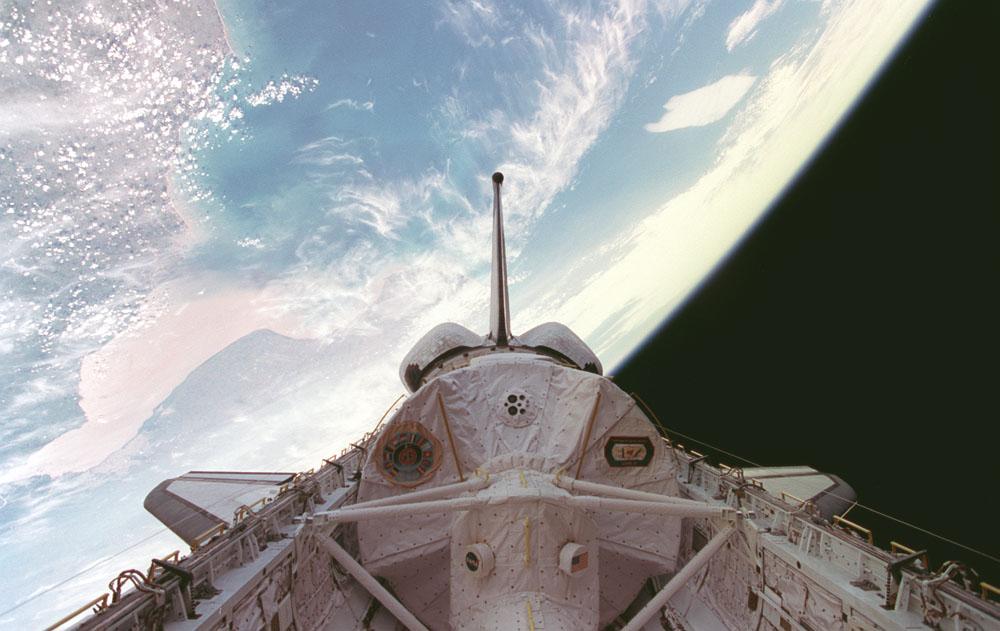
Onboard photo of space shuttle Columbia (STS-73) cargo bay payload - the United States Microgravity Laboratory-2 (USML-2) with an earthview.
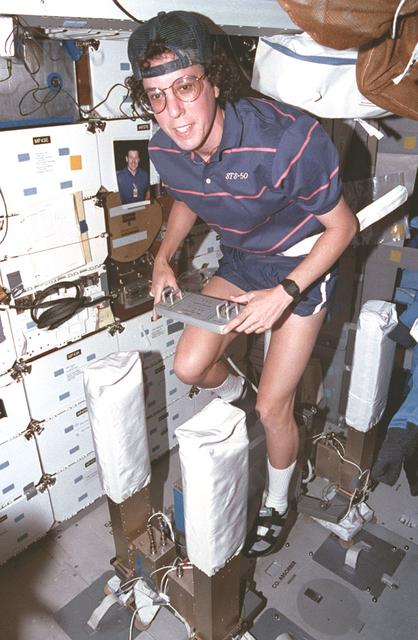
Onboard Space Shuttle Columbia (STS-50) in the United States Microgravity Laboratory (USML-1) mission specialist Ellen S. Baker is hard at work.
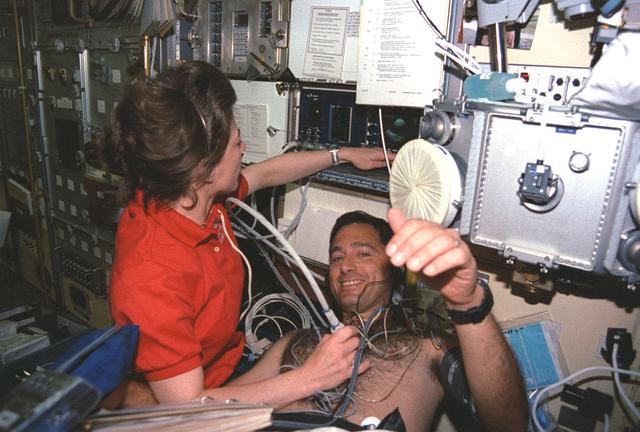
Onboard Space Shuttle Columbia (STS-50) payload commander Bornie Dunbar performs life science experiments on crewmember payload specialist Lawrence Delucas in the United States Microgravity Laboratory (USML-1) science module.
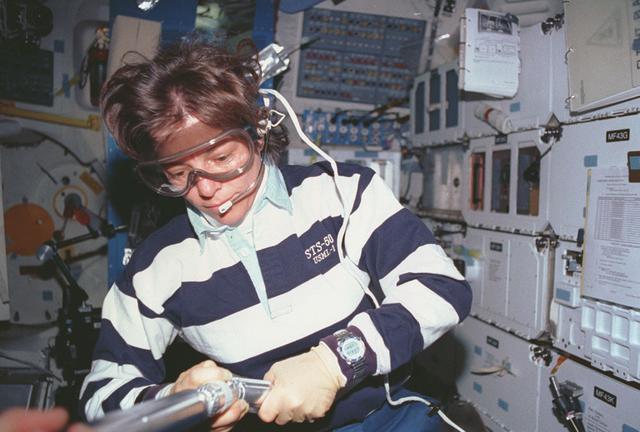
Space Shuttle Columbia (STS-50) astronaut Bornie Dunbar wears protective goggles to assemble a zeolite sample cartridge for the Crystal Growth Furnace (CGF) in the United States Microgravity Laboratory-1 (USML-1) science module.
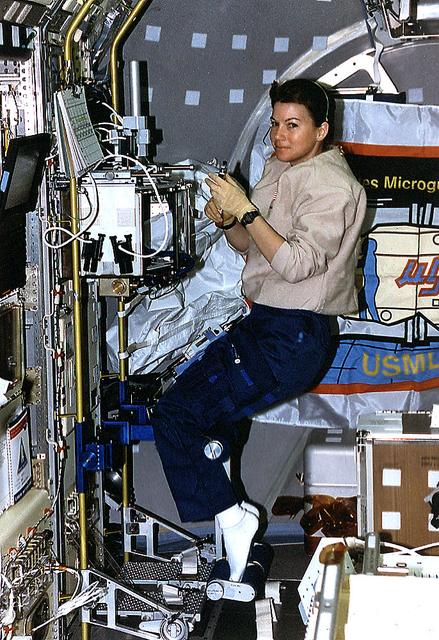
Onboard Space Shuttle Columbia (STS-73) Mission Specialists Catherine Cady Coleman works at the glovebox facility in support of the Protein Crystal Growth Glovebox (PCG-GBX) experiment in the United States Microgravity Laboratory 2 (USML-2) Spacelab science module.
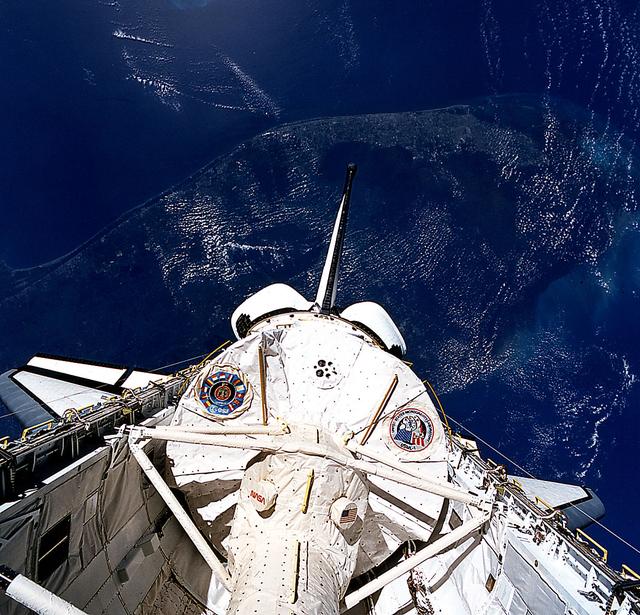
Space Shuttle Columbia (STS-50) onboard photo of the United States Microgravity Laboratory (USML-1) module in payload bay in this scene over the southern two-thirds of the Florida peninsula. Kennedy Space Center (KSC) can be seen just above Columbia's starboard wing.
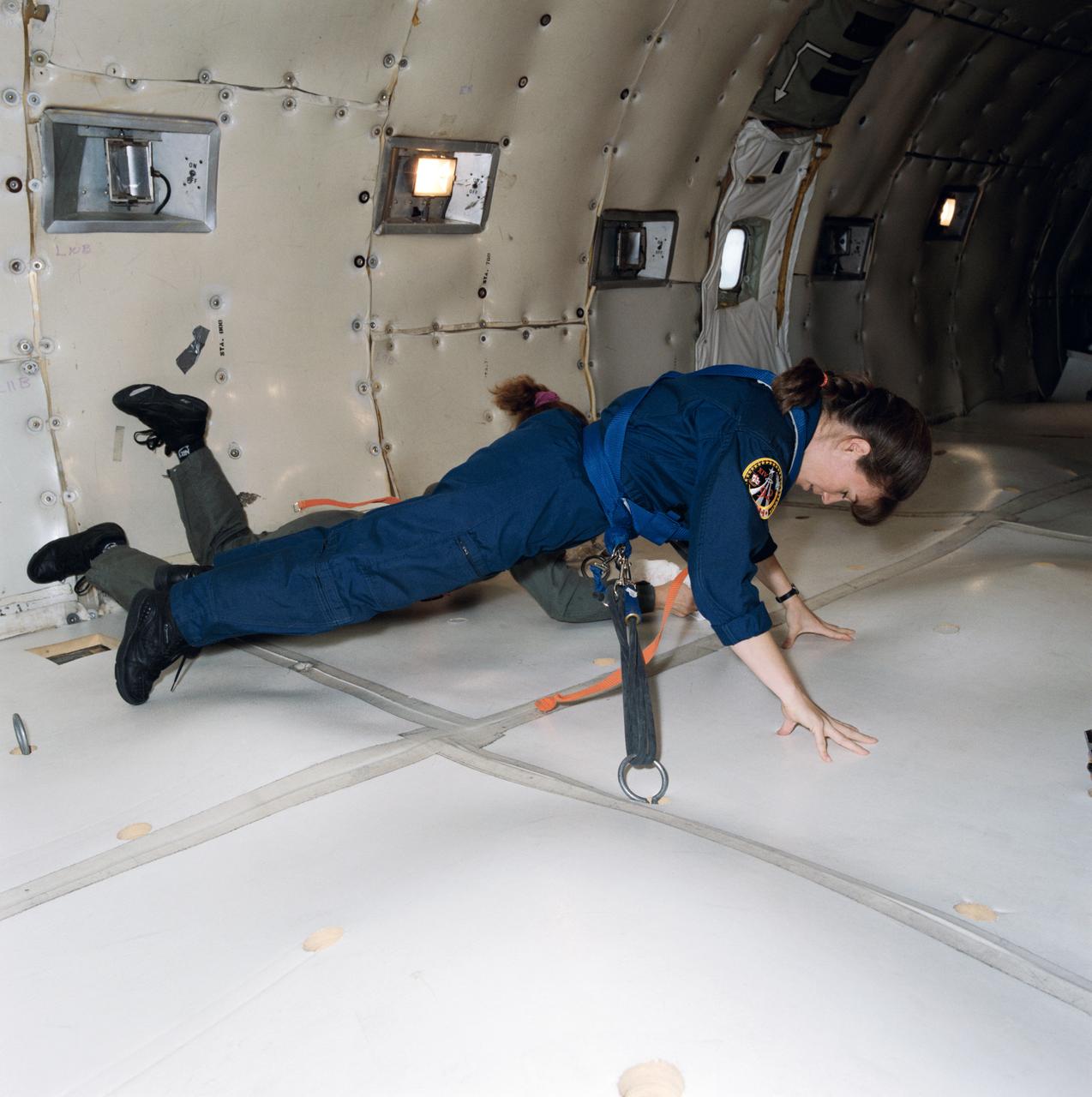
S94-35542 (June 1994) --- Astronaut Catherine G. Coleman, mission specialist, gets a preview of next year?s United States Microgravity Laboratory (USML-2) mission aboard the Space Shuttle Columbia. The weightless experience was afforded by a special parabolic pattern flown by NASA?s KC-135 ?zero gravity? aircraft.
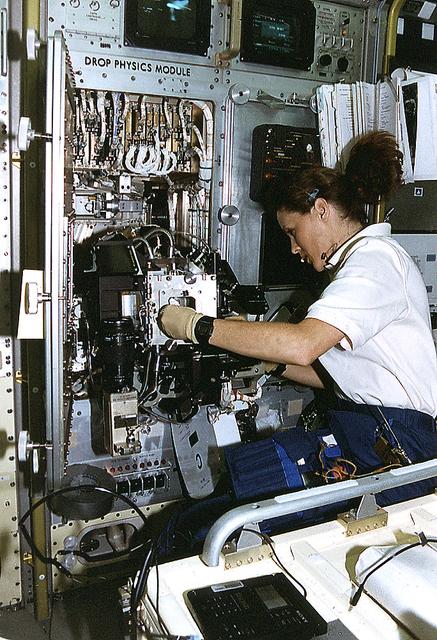
Onboard Space Shuttle Columbia (STS-73) Payload Commander Kathryn Thornton works with the Drop Physics Module (DPM) in the United States Microgravity Laboratory 2 (USML-2) Spacelab Science Module cleaning the experiment chamber of the DPM.
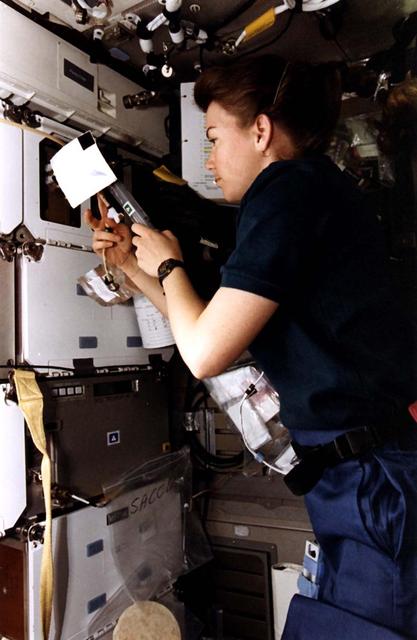
Astronaut Catherine G. Coleman, mission specialist, checks out an Astroculture sample on the mid-deck of the Earth-orbiting Space Shuttle Columbia. Coleman was joined by four other NASA astronauts and two guest researchers for 16 full days of in-space research in support of the United States Microgravity Laboratory (USML-2) mission.
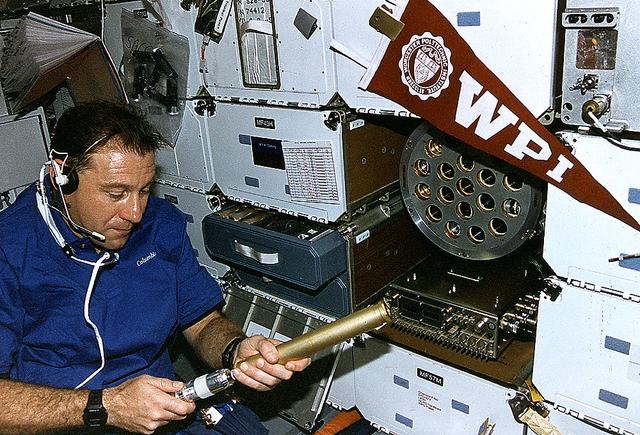
Onboard Space Shuttle Columbia (STS-73) Payload Specialist Albert Sacco loads autoclaves using a power screwdriver into the Zeolite Crystal Growth (ZCG) experiment in the middeck for the United States Microgravity Laboratory 2 (USML-2) Spacelab mission.
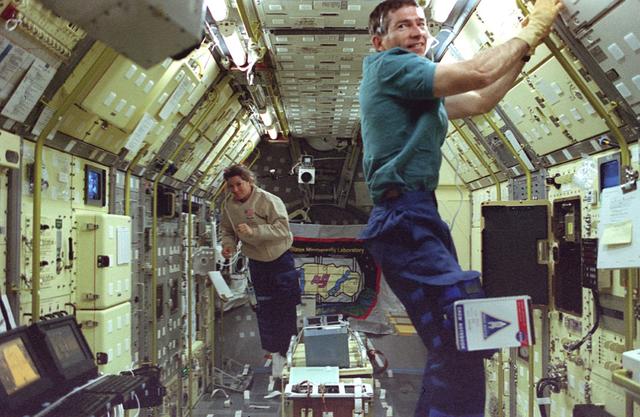
Onboard photo of space shuttle Columbia (STS-73) crewmembers Fred Leslie (foreground) and Catherine Coleman aboard the United States Microgravity Laboratory (USML) conducting experiments in a microgravitational environment available in the Orbiter's cargo bay while in low earth orbit.
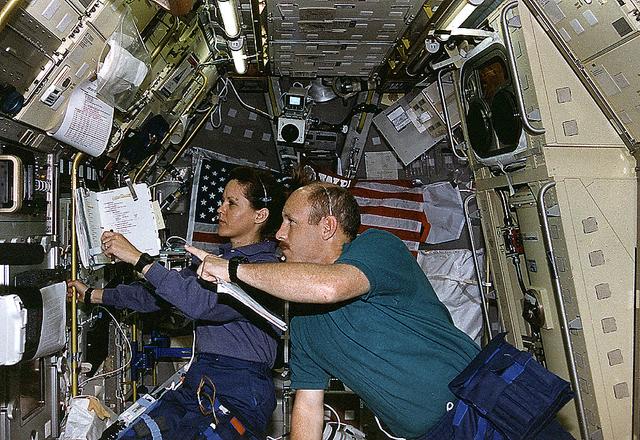
Onboard Space Shuttle Columbia (STS-73) Payload Commander Kathryn Thornton and Commander Ken Bowersox discuss the Drop Physics Module (DPM) experiment in the United States Microgravity Laboratory 2 (USML-2) spacelab science module.
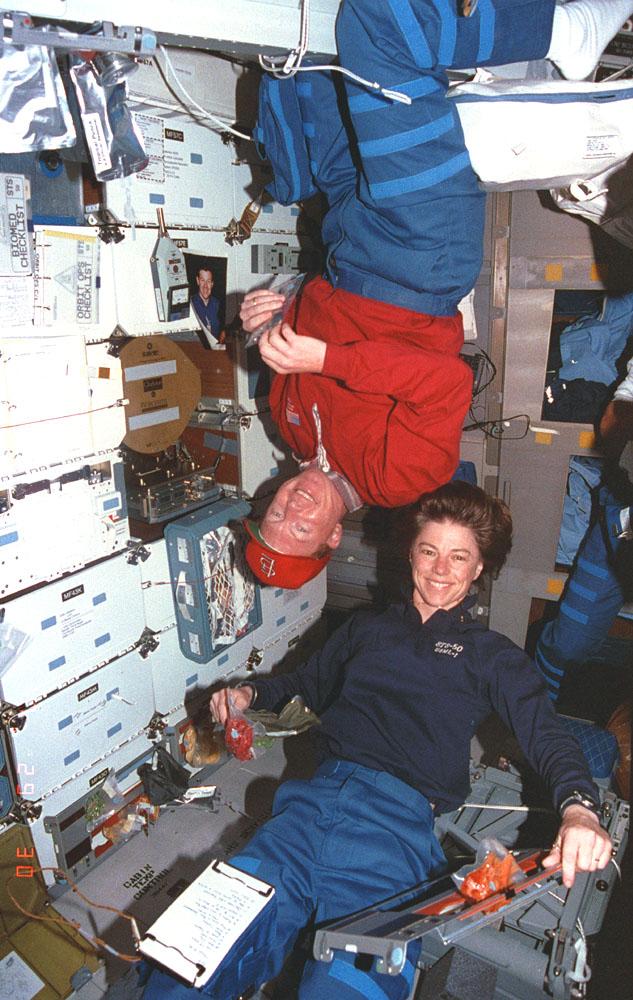
Onboard Space Shuttle Columbia (STS-50) all work and no play make commander Richard (Dick) Richards and payload commander Bornie Dunbar take a break from their work in the United States Microgravity Laboratory (USML-1) responsibilities.
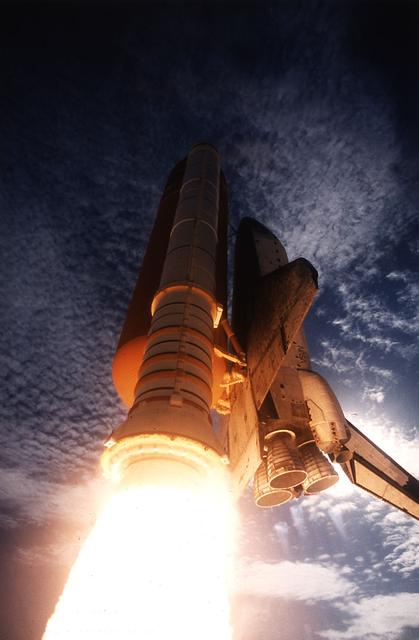
A unique view of the Space Shuttle Columbia (STS-73) moments after bursting into Earth's atmosphere on its way toward space. Onboard the orbiter is the United States Microgravity Laboratory 2 (USML-2), a Marshall managed payload, where Columbia's seven member crew will perform experiments while in orbit.
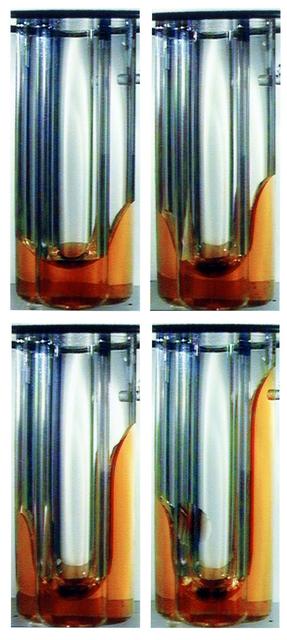
Interface Configuration Experiment on the Second United States Microgravity Laboratory (USML-2). Over time the photos show a change in the shape of the interface between a liquid and a gas in a sealed, slightly asymmetrical container. Under the force of Earth's gravity, the interface would remain nearly flat, but in microgravity, the interface shape and location changes significantly in the container, resulting in major shifts of liquid arising from small asymmetries in the container shape.
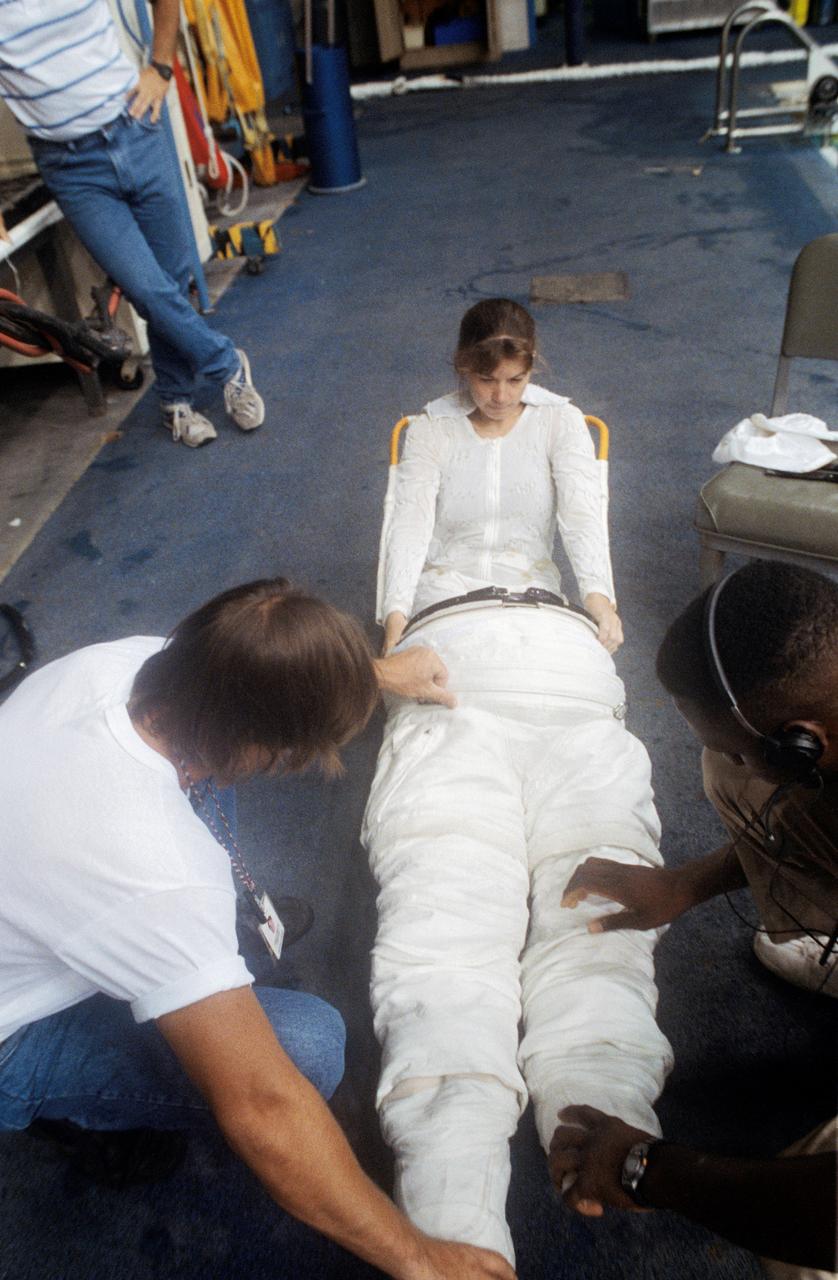
Astronaut and mission specialist for STS-73, Catherine G. Coleman, dons a high fidelity training version of the Extravehicular Mobility Unit (EMU) space suit at the Johnson Space Center’s (JSC) Weightless Environment Training Facility (WET-F) in preparation for the mission. The STS-73 mission was the second flight of the United States Microgravity Laboratory (USML-2), managed by scientists and engineers from the Marshall Space Flight Center.
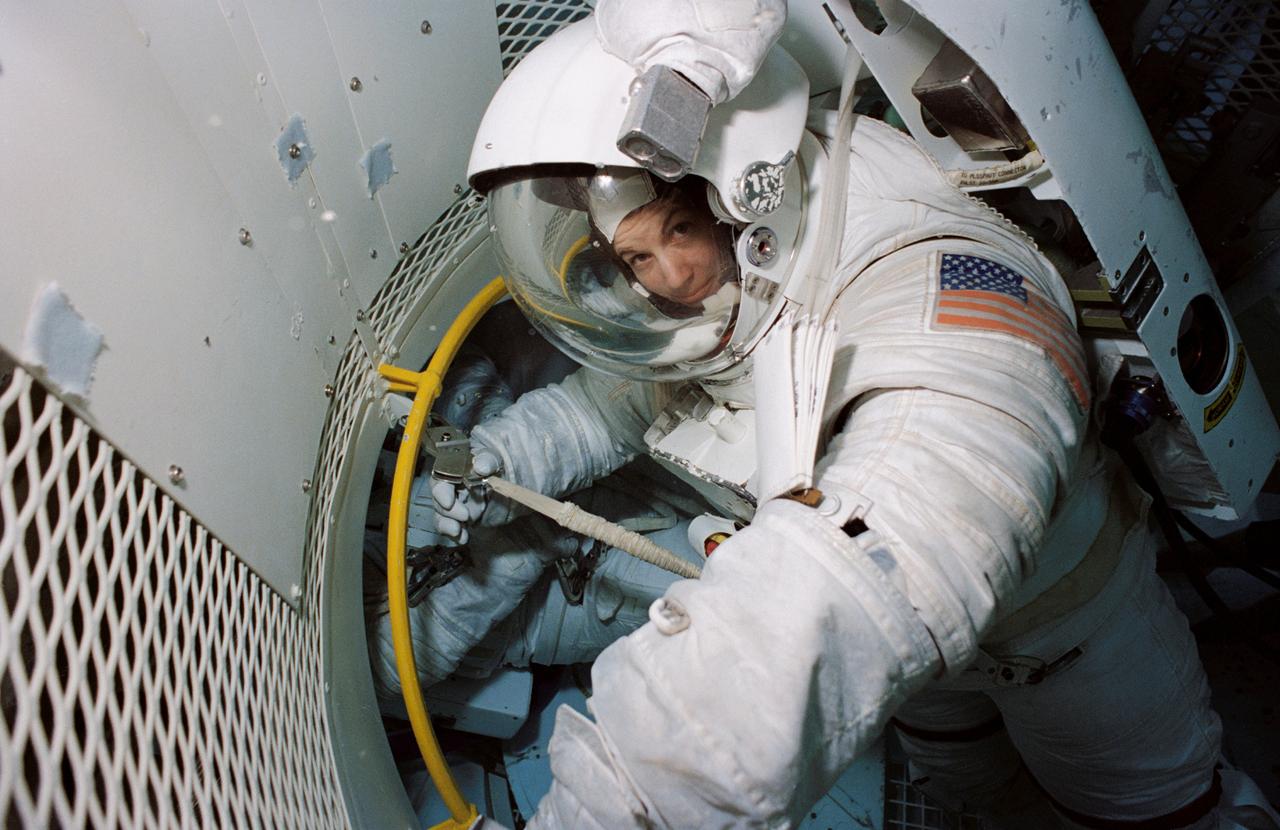
Astronaut and mission specialist Catherine G. Coleman,attired in a high fidelity training version of the Extravehicular Mobility Unit (EMU) space suit, trains for a contingency space walk at the Johnson Space Center’s (JSC) Weightless Environment Training Facility (WET-F). This particular training was in preparation for the STS-73 mission. The STS-73 mission was the second flight of the United States Microgravity Laboratory (USML-2), managed by scientists and engineers from the Marshall Space Flight Center.
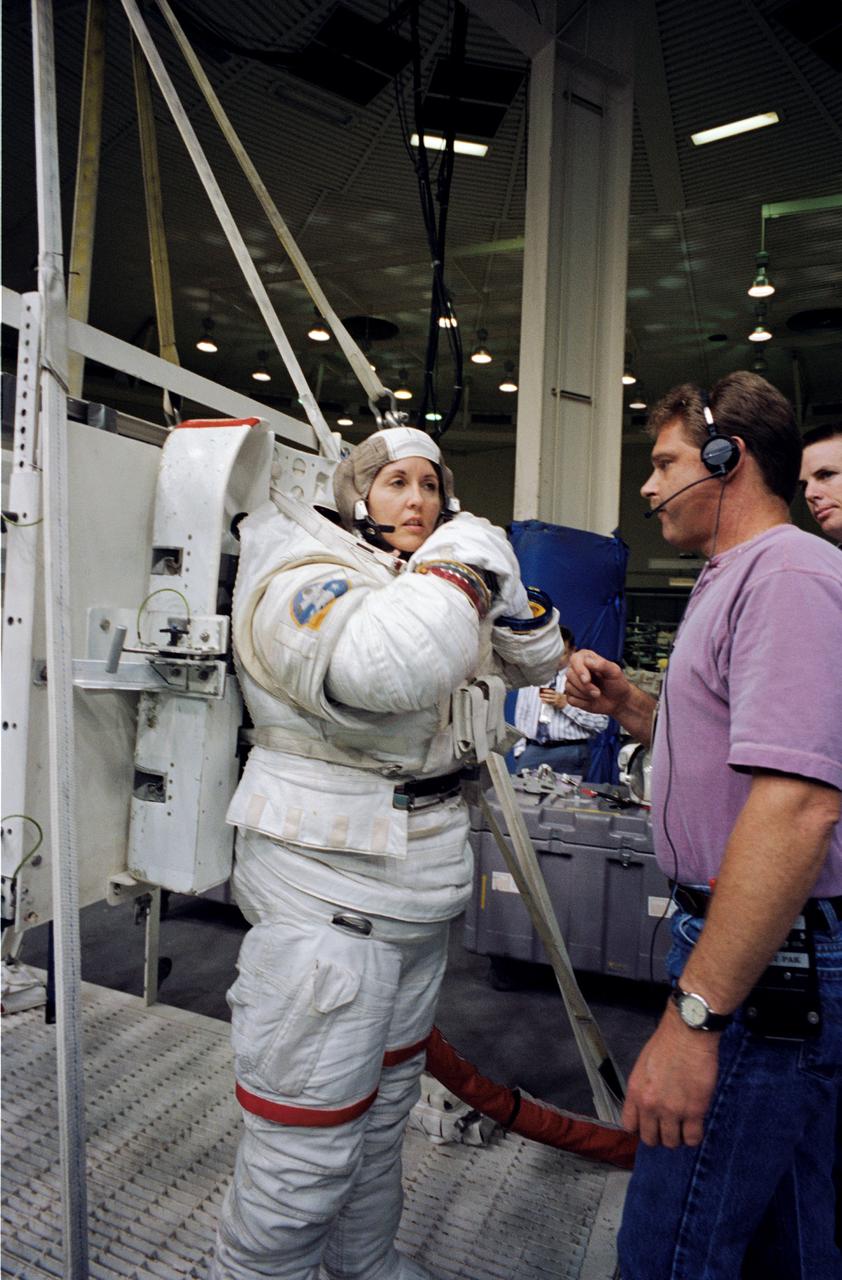
Astronaut Kathryn Thornton, payload commander for the STS-73 mission, attired in a high fidelity training version of the Extravehicular Mobility Unit (EMU) space suit, prepares to go underwater in the Johnson Space Center’s (JSC) Weightless Environment Training Facility (WET-F). The STS-73 mission was the second flight of the United States Microgravity Laboratory (USML-2), managed by scientists and engineers from the Marshall Space Flight Center.
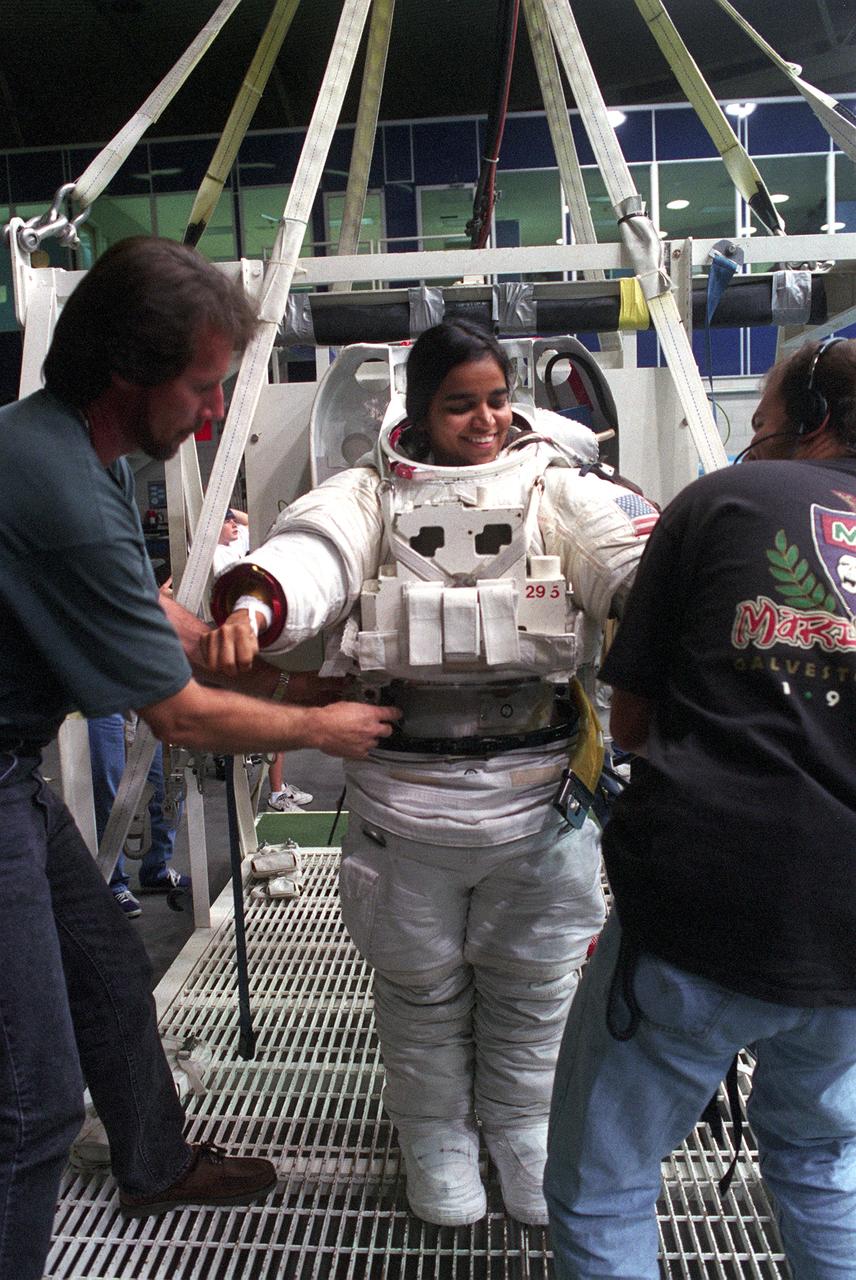
Astronaut and mission specialist Kalpana Chawla, receives assistance in donning a training version of the Extravehicular Mobility Unit (EMU) space suit, prior to an underwater training session in the Neutral Buoyancy Laboratory (NBL) near Johnson Space Center. This particular training was in preparation for the STS-87 mission. The Space Shuttle Columbia (STS-87) was the fourth flight of the United States Microgravity Payload (USMP-4) and Spartan-201 satellite, both managed by scientists and engineers from the Marshall Space Flight Center.
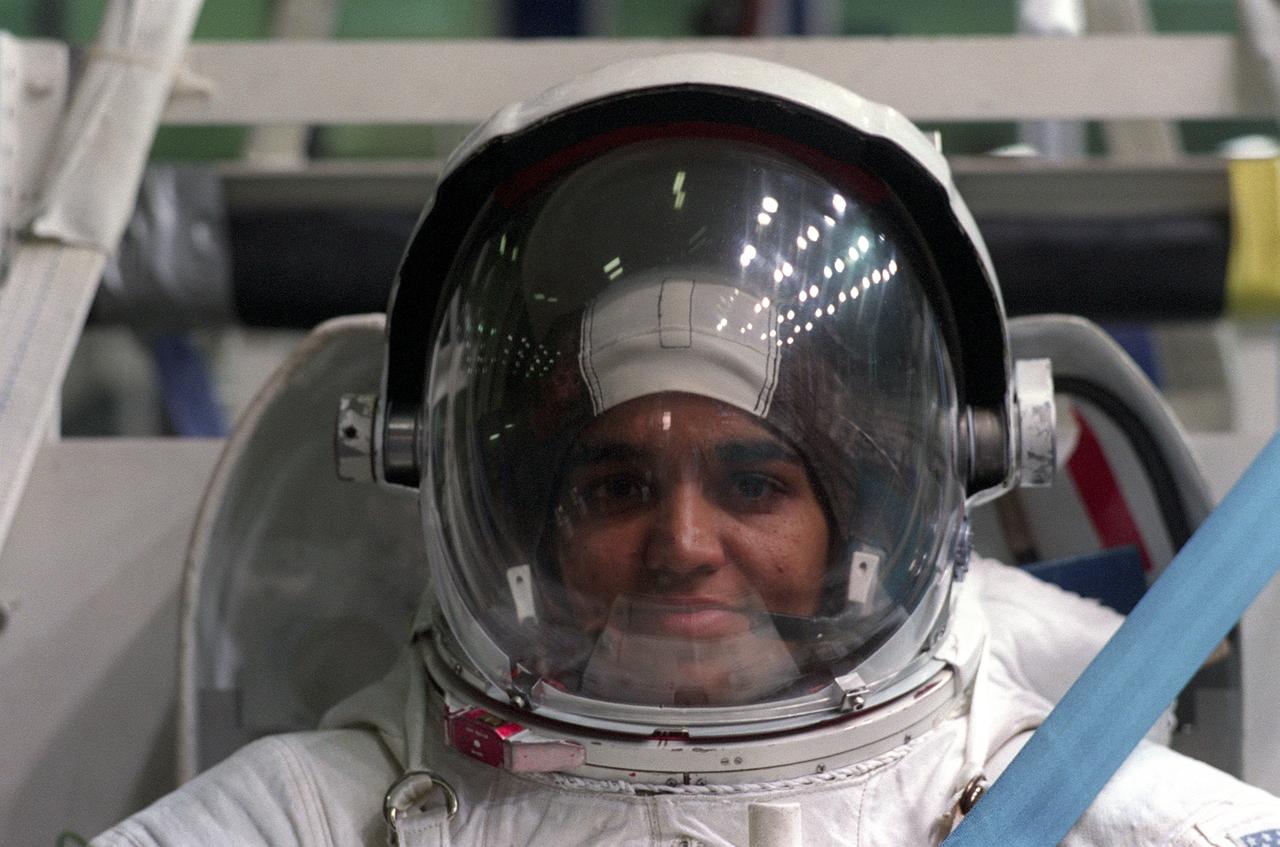
Attired in a training version of the Extravehicular Mobility Unit (EMU) space suit, astronaut and mission specialist Kalpana Chawla, prepares to go underwater in the Neutral Buoyancy Laboratory (NBL) near Johnson Space Center. This particular training was in preparation for the STS-87 mission. The Space Shuttle Columbia (STS-87) was the fourth flight of the United States Microgravity Payload (USMP-4) and Spartan-201 satellite, both managed by scientists and engineers from the Marshall Space Flight Center.
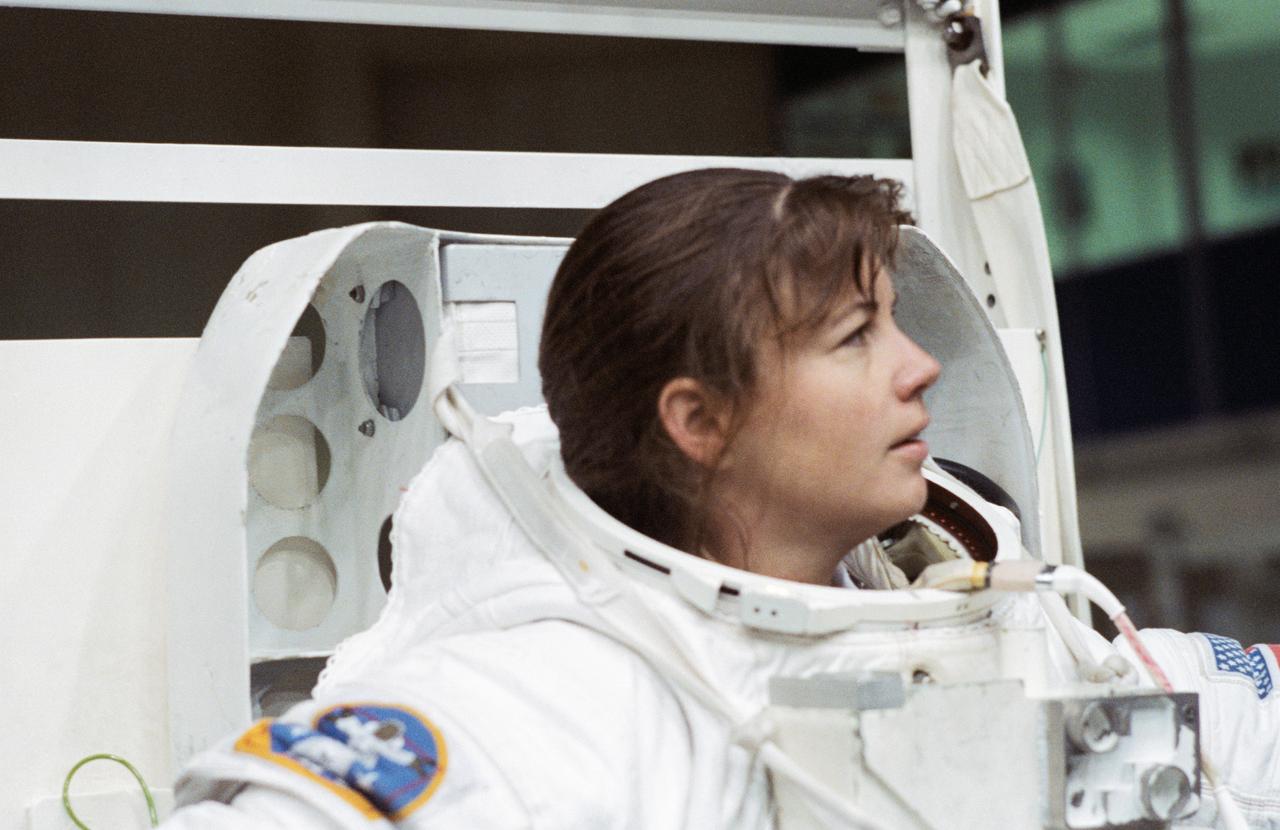
Astronaut and mission specialist Catherine G. Coleman is about to don the helmet portion of a high fidelity training version of the Extravehicular Mobility Unit (EMU) space suit at the Johnson Space Center’s (JSC) Weightless Environment Training Facility (WET-F). This particular training was in preparation for the STS-73 mission. The STS-73 mission was the second flight of the United States Microgravity Laboratory (USML-2), managed by scientists and engineers from the Marshall Space Flight Center.
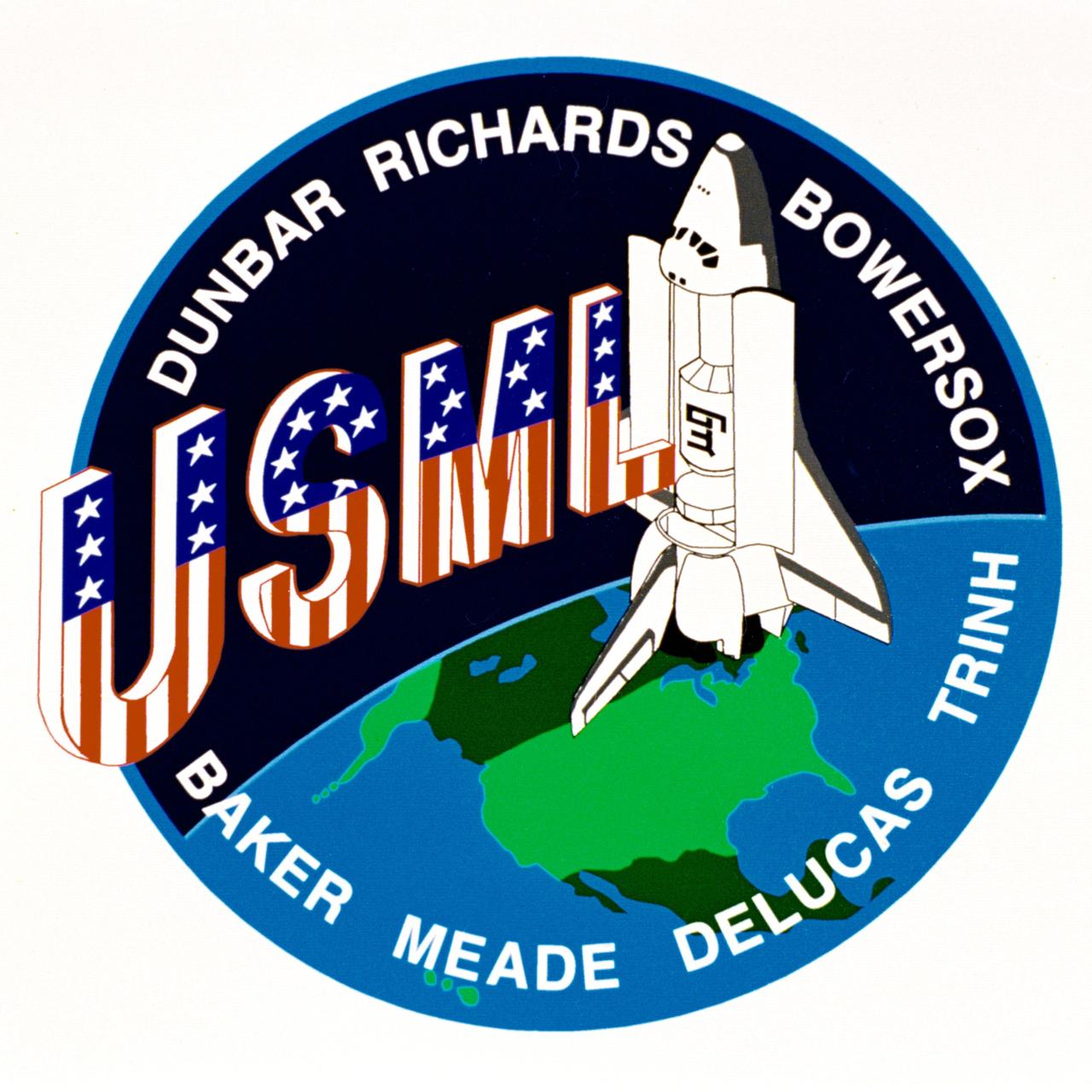
STS050-S-001 (January 1992) --- Designed by the flight crew, the insignia for the United States Microgravity Laboratory (USML-1), captures a space shuttle traveling above Earth while trailing the USML banner. The orbiter is oriented vertically in a typical attitude for microgravity science and in this position represents the numeral 1 in the mission's abbreviated title. This flight represents the first in a series of USML flights on which the primary objective is microgravity science, planned and executed through the combined efforts of the United States of America's government, industry and academia. Visible in the payload bay are the Spacelab module, and the extended duration orbiter "cryo" pallet which will be making its first flight. The small g and Greek letter mu on the Spacelab module symbolize the microgravity environment being used for research in the areas of materials science and fluid physics. The large block letter U extends outside the patch perimeter, symbolizing the potential for the experiments on this flight to expand the current boundaries of knowledge in microgravity science. The Stars and Stripes of the USML block letters and the United States landmass in the Earth scene below reflect the crew's pride in the United States origin of all onboard experiments. The NASA insignia design for space shuttle flights is reserved for use by the astronauts and for other official use as the NASA Administrator may authorize. Public availability has been approved only in the forms of illustrations by the various news media. When and if there is any change in this policy, which is not anticipated, the change will be publicly announced. Photo credit: NASA
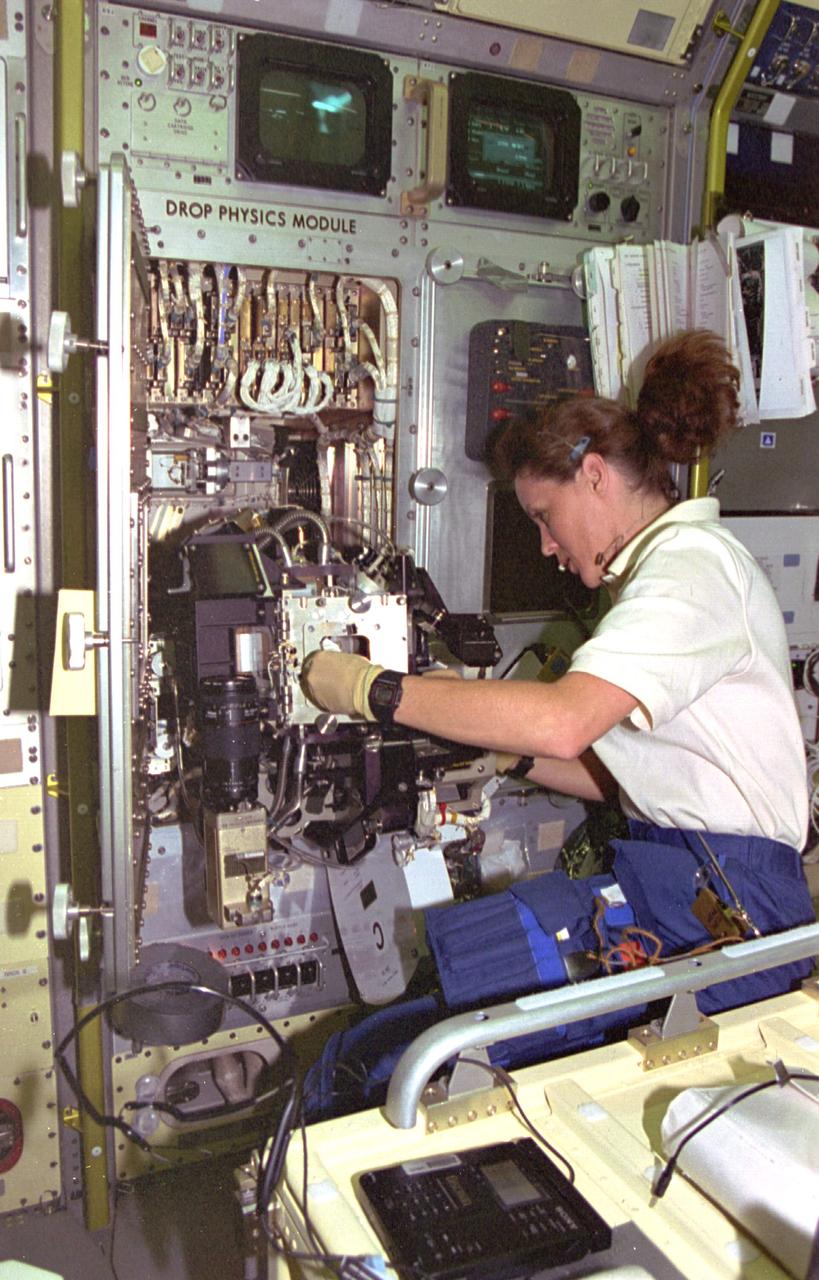
STS073-143-026 (20 October-5 November 1995) --- Astronaut Kathryn C. Thornton, STS-73 payload commander for the United States Microgravity Laboratory (USML-2), explores the inner workings of the Drop Physics Module (DPM). Thornton was joined by four other NASA astronauts and two guest researchers for almost 16 days of research aboard the Space Shuttle Columbia in Earth-orbit.
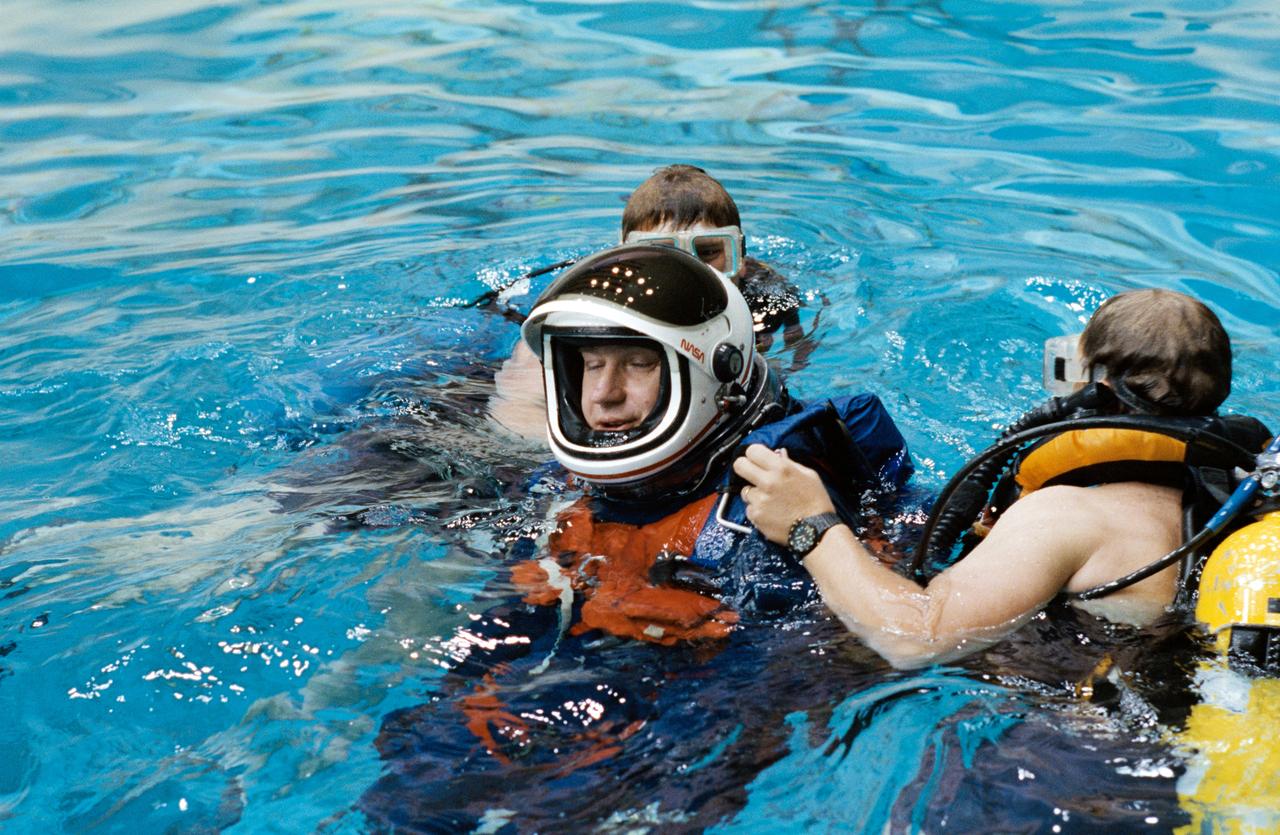
S92-32108 (May 1992) --- Payload specialist Albert Sacco Jr. uses a one-person life raft during emergency bailout training exercises in the Johnson Space Center?s (JSC) Weightless Environment Training Facility (WET-F). Sacco is an alternate payload specialist for the United States Microgravity Laboratory (USML-1) mission, scheduled for launch later this year. EDITOR?S NOTE: Sacco was later named as prime crew payload specialist for the USML-2 mission (STS-73), scheduled for 1995.
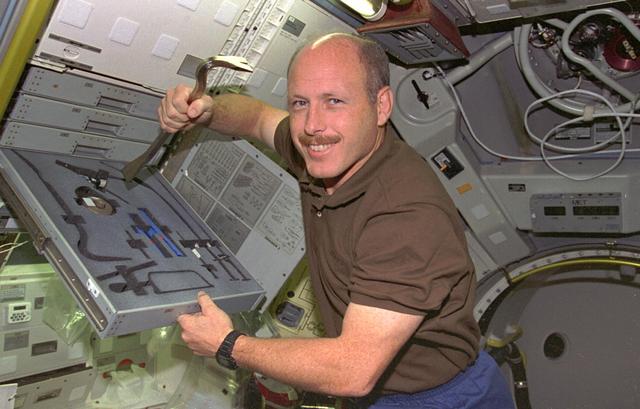
STS073-351-024 (20 October - 5 November 1995) --- Astronaut Kenneth D. Bowersox, STS-73 mission commander, retrieves a crow bar from a tool set onboard the science module in the cargo bay of the Earth-orbiting Space Shuttle Columbia. Various tools were available for a variety of in-flight maintenance tasks for the crew to carry out during the 16-day United States Microgravity Laboratory (USML-2) mission.
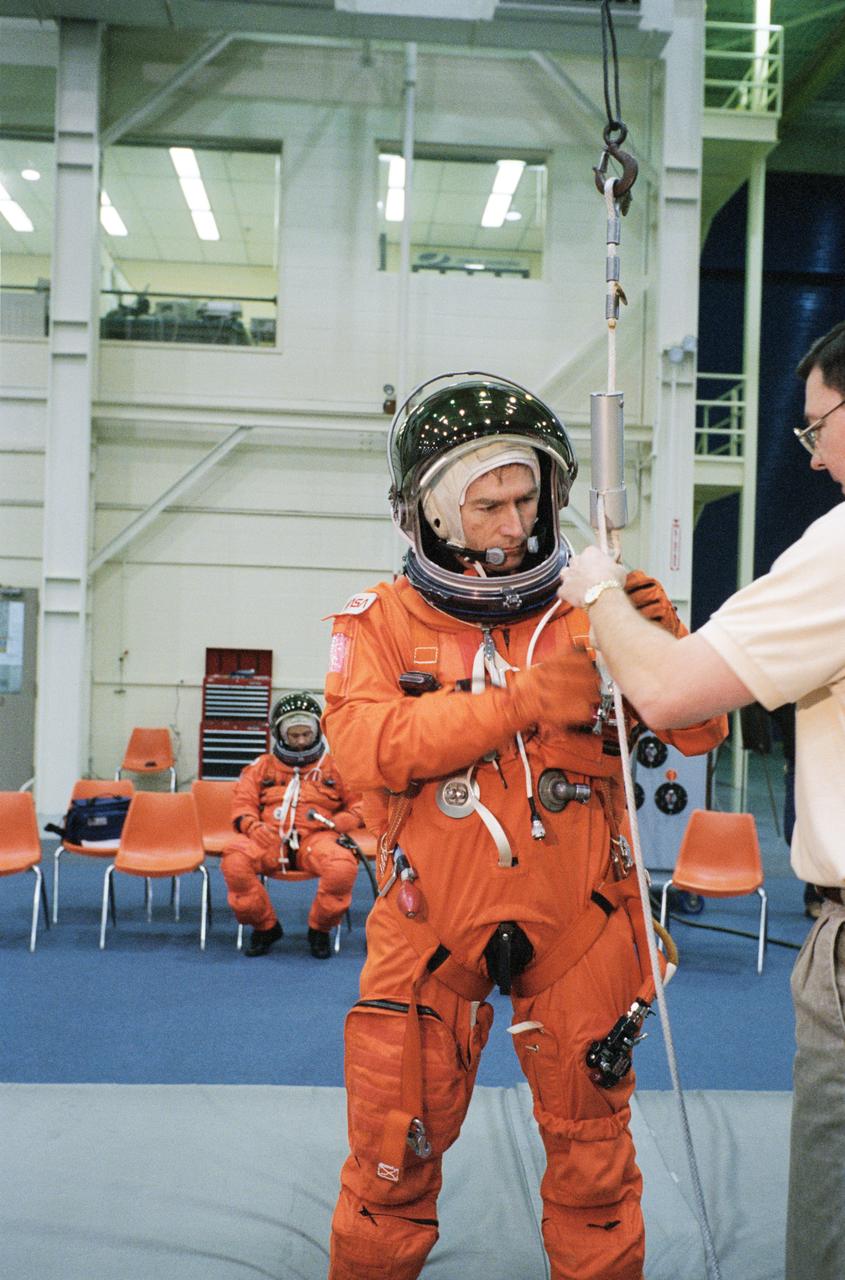
S95-09157 (27 Apr. 1995) --- Payload specialist Fred W. Leslie has just translated from the top of a Shuttle mockup-trainer using a Sky-genie device during emergency egress training with his six STS-73 crew mates. He is assisted here by Scott Gill, a member of the STS-73 training staff. The seven will fly aboard the Space Shuttle Columbia later this year to support the United States Microgravity Laboratory (USML-2) mission.
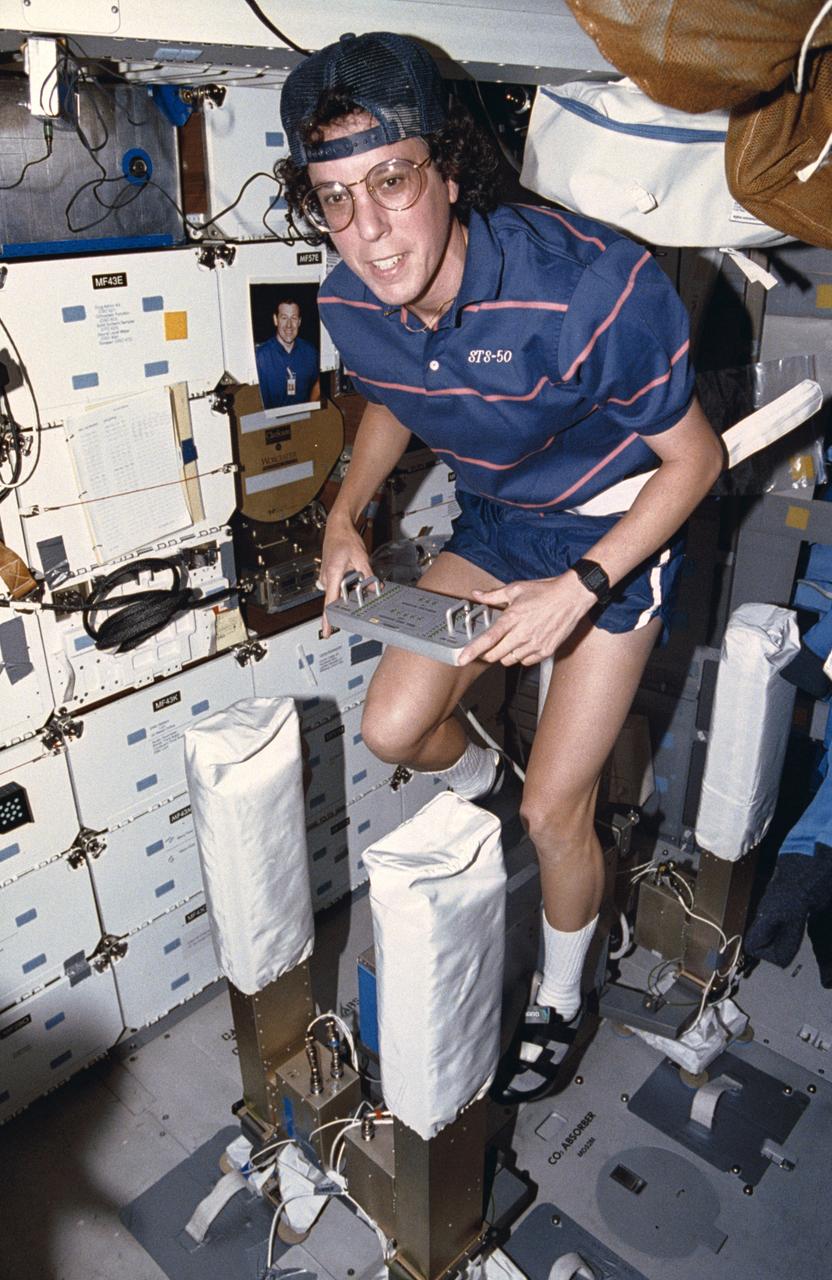
STS050-21-035 (25 June- 9 July 1992) --- Astronaut Ellen S. Baker, mission specialist, works out on the bicycle ergometer on the mid-deck of the Earth-orbiting Space Shuttle Columbia. Baker was joined by four other astronauts and two scientists from the private sector for the record-setting 14-day United States Microgravity Laboratory 1 (USML-1) mission.
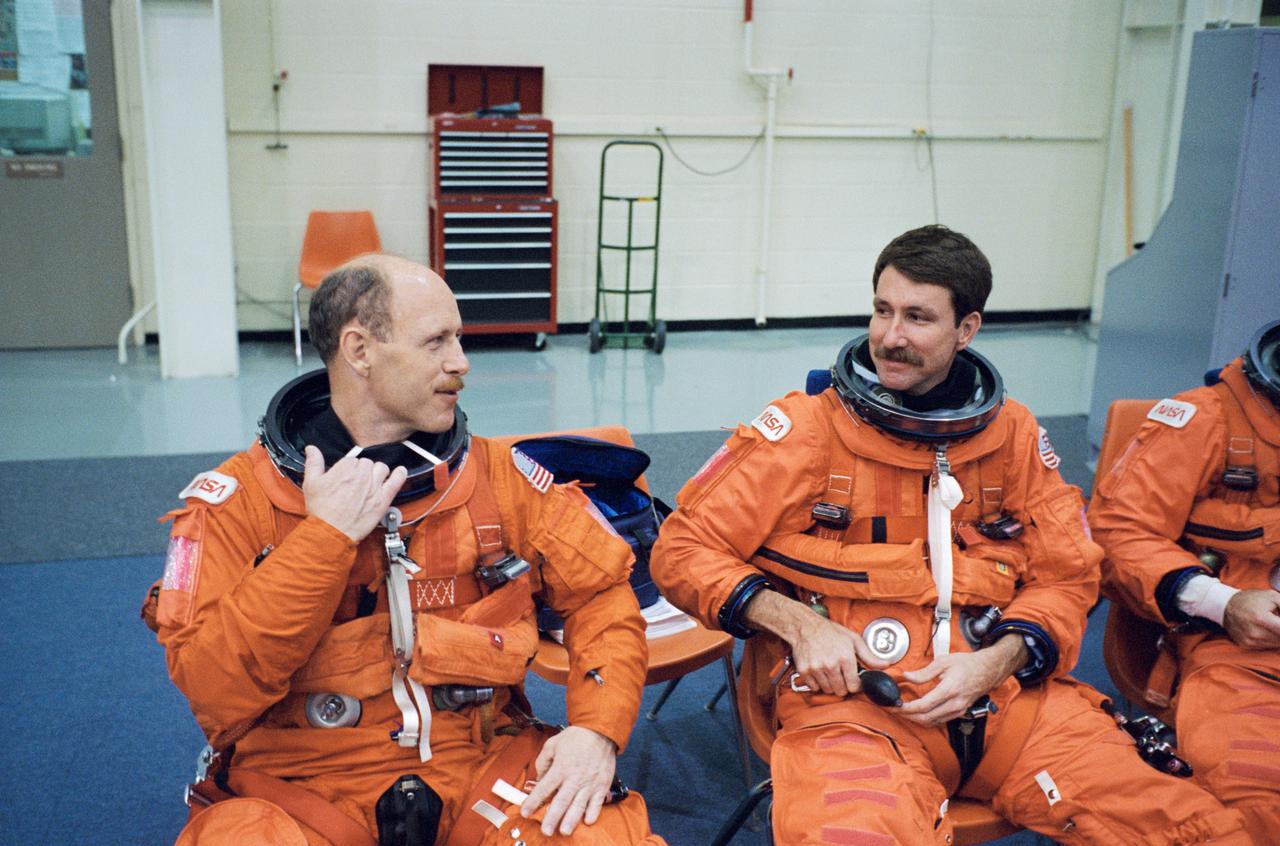
S95-09140 (27 Apr. 1995) --- Attired in training versions of the Space Shuttle partial pressure launch and entry garment, astronauts Kenneth D. Bowersox (left) and Kent V. Rominger prepare to rehearse an emergency situation with the Space Shuttle. The two are commander and pilot, respectively, for the United States Microgravity Laboratory (USML-2) mission. Bowersox was pilot for the USML-1 mission. The emergency egress training exercises took place in the Systems Integration Facility at the Johnson Space Center (JSC).
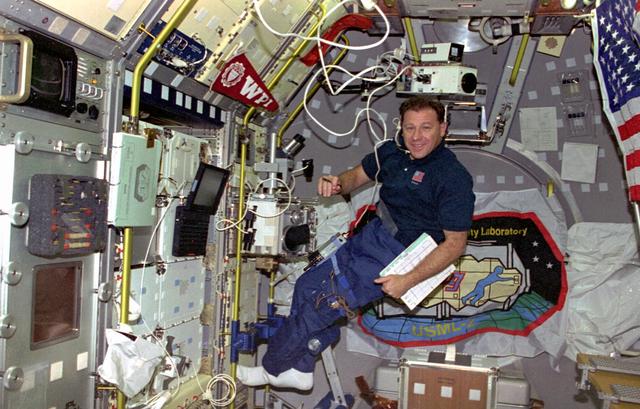
STS073-106-001 (20 October-5 November 1995) --- Payload specialist Albert Sacco Jr. takes direction from a crew mate out of frame onboard the United States Microgravity Laboratory (USML-2) science module in the cargo bay of the Space Shuttle Columbia. Sacco was about to check out an experiment in a glovebox, which represented one of the busier areas during the 16-day USML-2 flight.
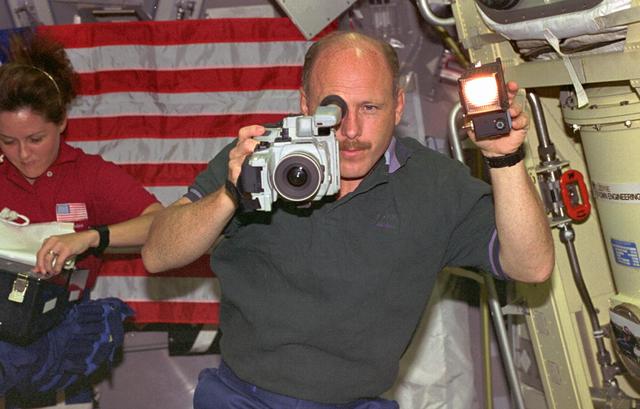
STS073-230-014 (20 October - 5 November 1995) --- Astronaut Kenneth D. Bowersox, STS-73 mission commander, uses a camcorder to record United States Microgravity Laboratory 2 (USML-2) activities onboard the Space Shuttle Columbia. Nearby, astronaut Kathryn C. Thornton, payload commander, prepares to open a supply chest to support one of many science experiments conducted by the seven-member crew during the 16-day USML-2 flight.
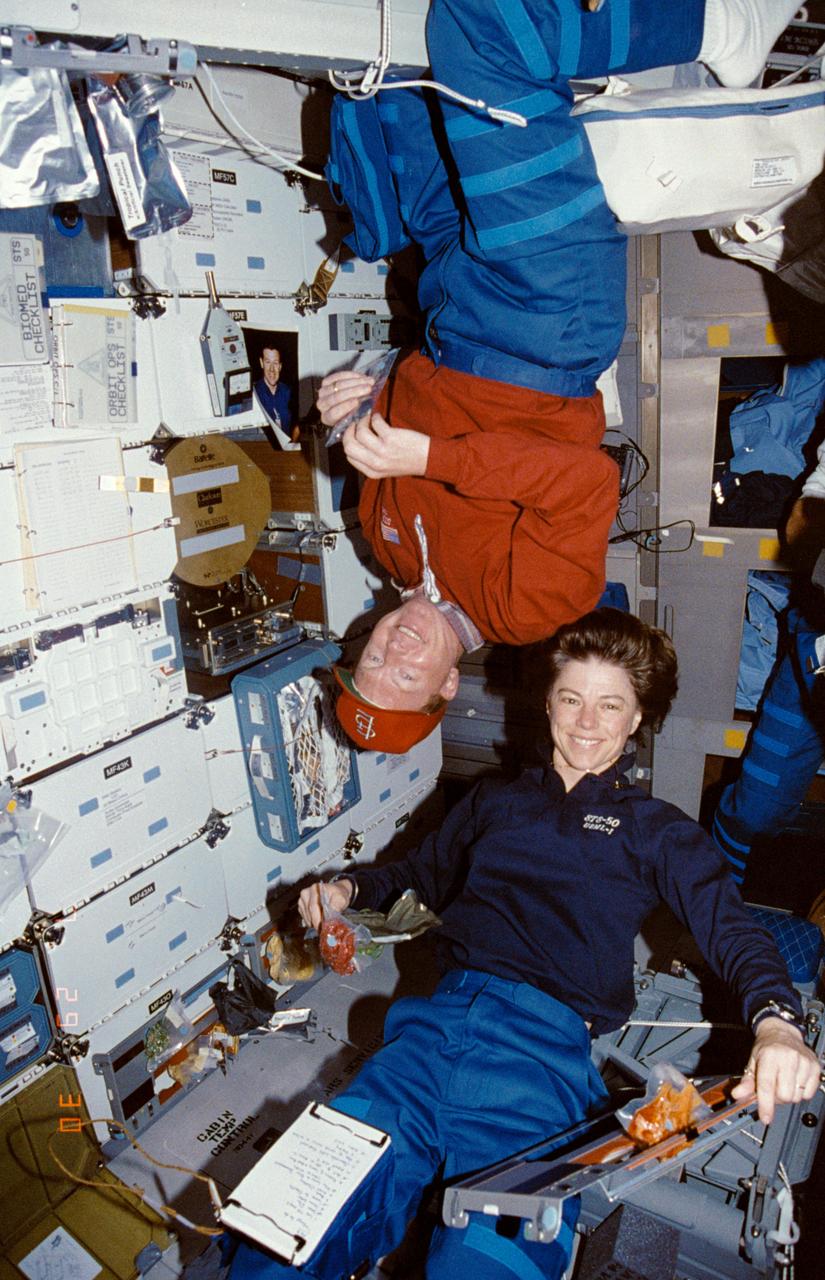
STS050-25-024 (25 June-9 July 1992) --- Astronauts Richard N. Richards and Bonnie J. Dunbar, momentarily on leave from the United States Microgravity Laboratory (USML-1) science module, share a meal on the middeck of the Earth-orbiting Space Shuttle Columbia. Richards is mission commander, and Dunbar is payload commander on the record-setting 14-day mission. Near Richards' head is the Astroculture experiment.
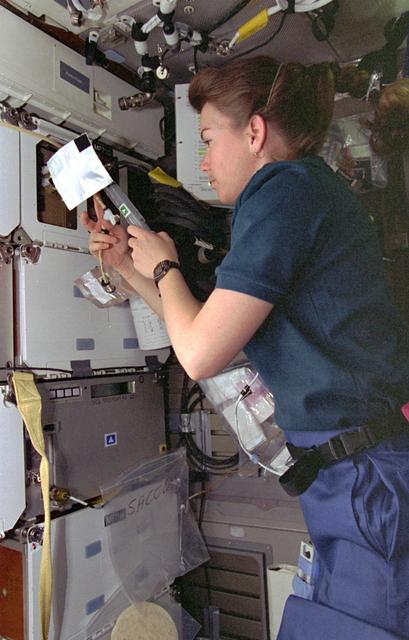
STS073-356-029 (20 October - 5 November 1995) --- Astronaut Catherine G. Coleman, STS-73 mission specialist, checks out an Astroculture sample on the middeck of the Earth-orbiting Space Shuttle Columbia. Coleman was joined by four other NASA astronauts and two guest researchers for 16 full days of in-space research in support of the United States Microgravity Laboratory (USML-2) mission.
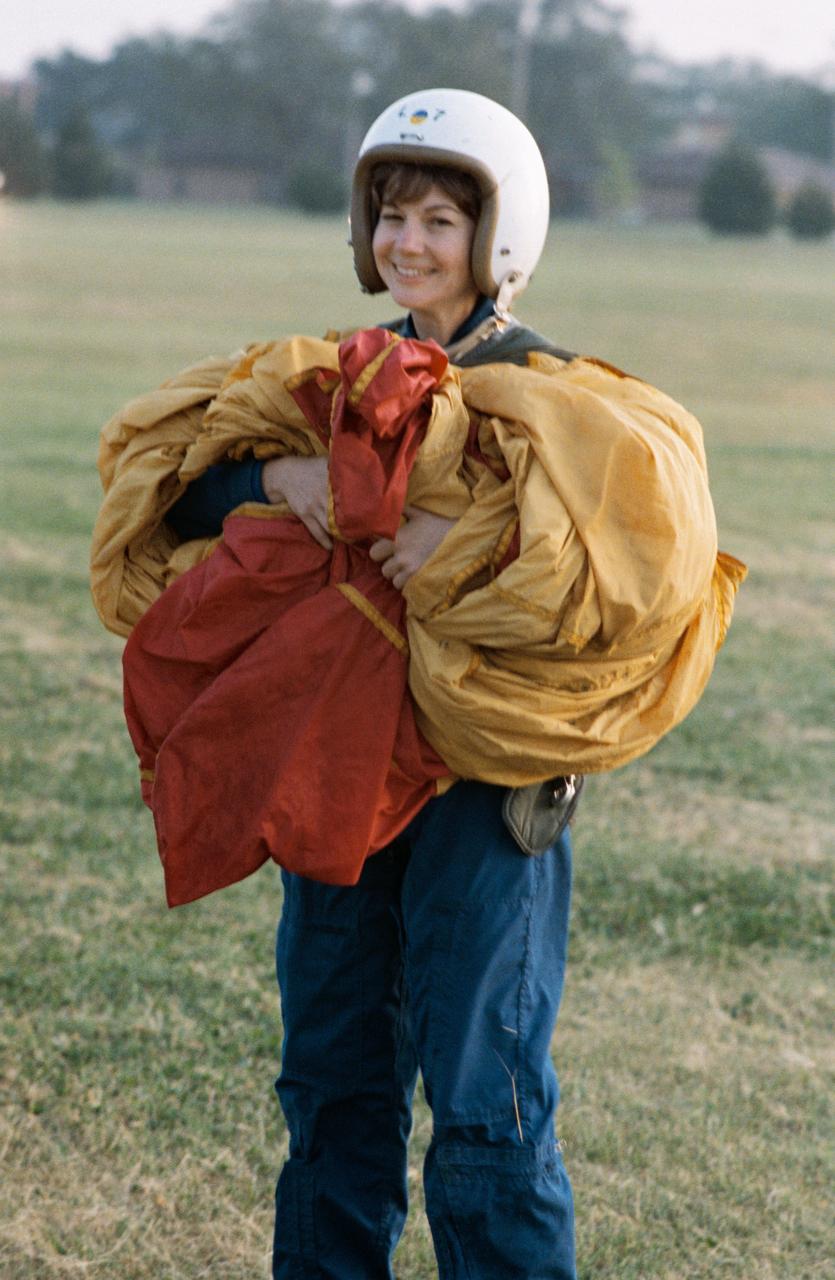
S93-38725 (12-14 Sept. 1992) --- Catherine G. Coleman, a member of the 1992 class of astronaut candidates at the Johnson Space Center (JSC), gathers up a parachute. The chute had just been used in one of many exercises experienced by the trainees at a three-day parachute/survival course hosted by Vance Air Force Base near Enid, Oklahoma. EDITOR?S NOTE: Coleman was later named as mission specialist for the United States Microgravity Laboratory (USML-2) mission, scheduled to fly as STS-73 in 1995.
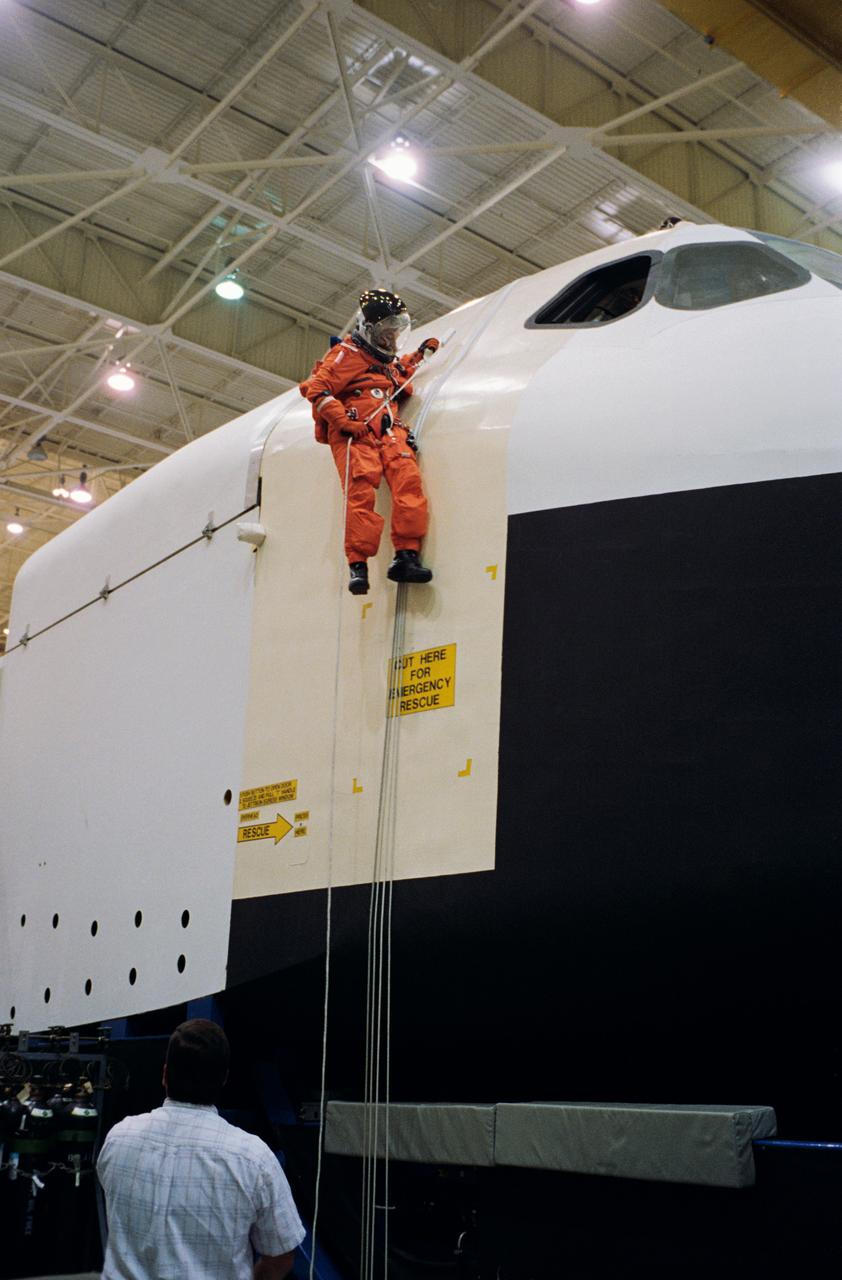
S95-09163 (27 Apr. 1995) --- Payload specialist Albert Sacco Jr. rappels from the top of a Shuttle mockup-trainer using a Sky-genie device during emergency egress training with his six STS-73 crew mates. The seven will fly aboard the Space Shuttle Columbia later this year to support the United States Microgravity Laboratory (USML-2) mission.
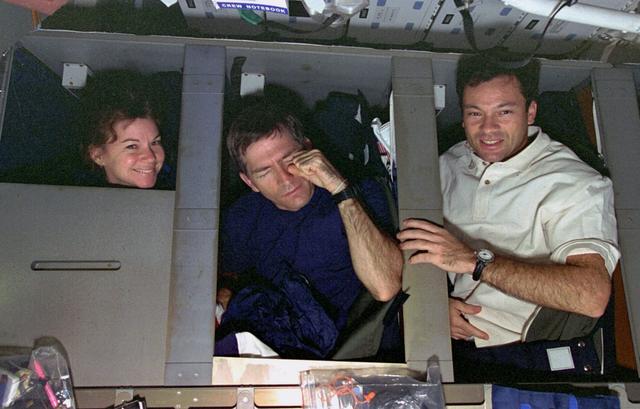
STS073-351-035 (20 October - 5 November 1995) --- Three crew members are captured on camera at the end of their sleep shift on the middeck of the Earth-orbiting Space Shuttle Columbia. Pictured are (left to right) astronaut Catherine G. Coleman, mission specialist; payload specialist Fred W. Leslie and astronaut Michael E. Lopez-Alegria, mission specialist. The trio joined four other crewmembers for 16 days of in-space research in support of the United States Microgravity Laboratory (USML-2) mission.
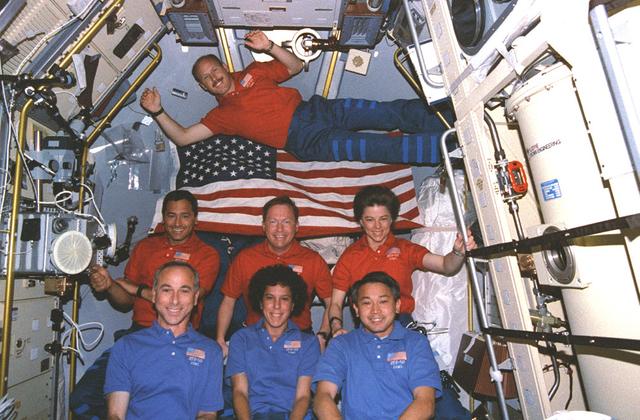
Onboard Space Shuttle Columbia (STS-50) crewmembers rally around the American flag in the United States Microgravity Laboratory-1 (USML-1). Pictured are (from top, left to right) pilot Kerneth D. Bowersox; payload specialist Lawrence J. Delucas; commander Richard N. Richards; payload commander Bonnie J. Dunbar; mission specialists Carl J. Meade and Ellen S. Baker; and payload specialist Eugene H. Trinh.
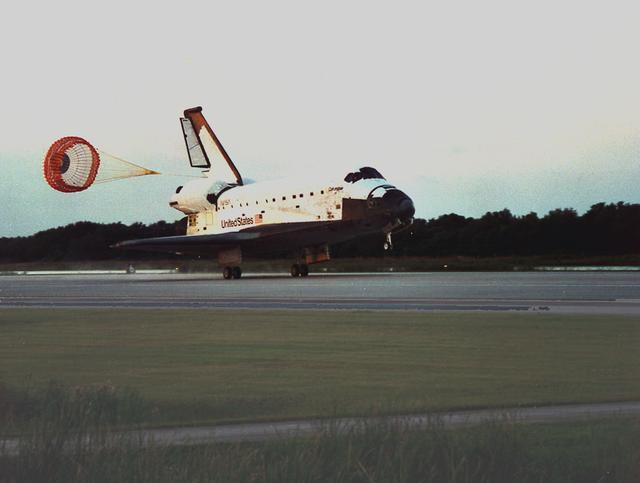
After completion of another United States Microgravity Laboratory (USML-2) mission, Space Shuttle Columbia (STS-73) and her seven member crew return to Earth on a clear November morning. Pictured is Columbia with her landing parachute deployed on final touchdown. Results from the mission's USML-2 will be sent to Marshall Space Flight Center who managed the mission.
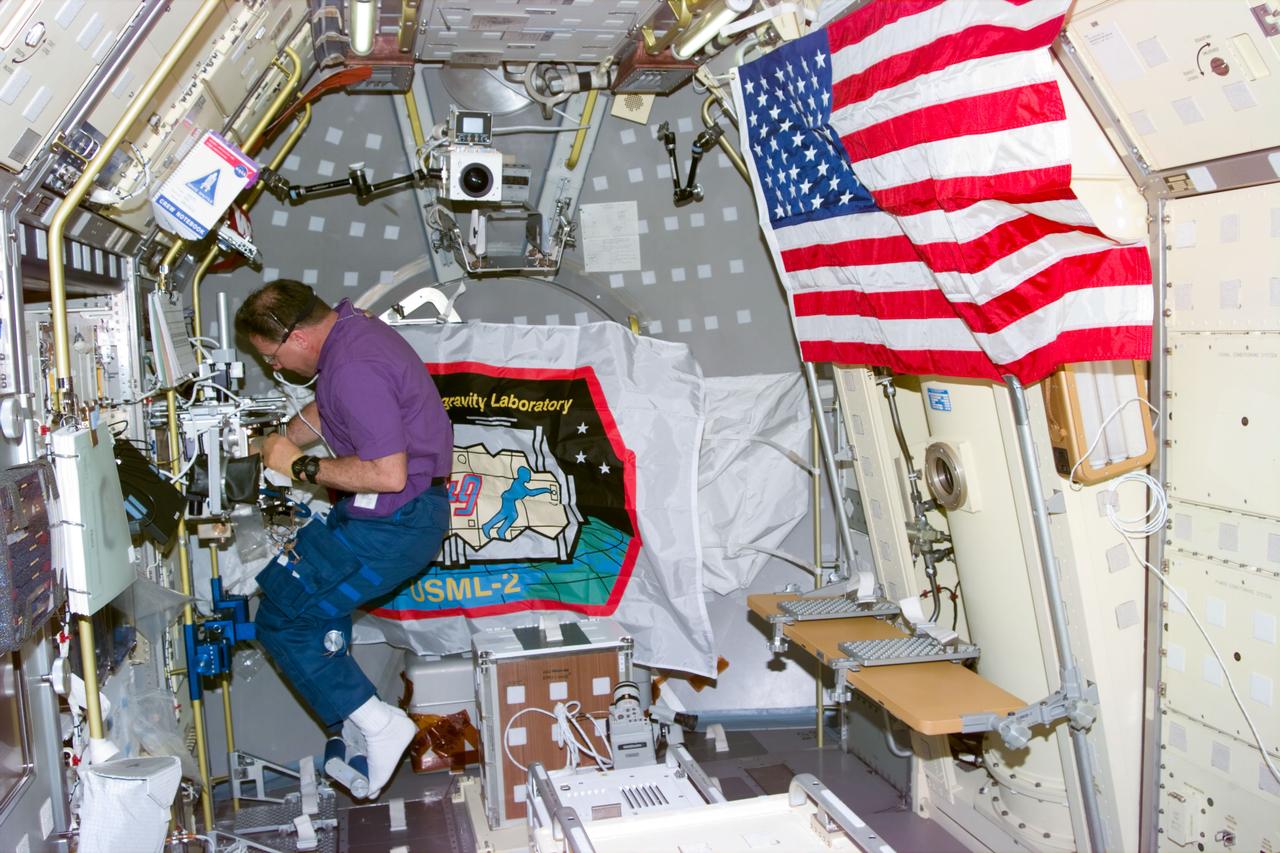
STS073-E-5024 (23 Oct. 1995)--- Albert Sacco Jr., STS-73 payload specialist, works in the Glovebox on the portside of the science module aboard the space shuttle Columbia in Earth orbit. This frame was exposed with the color Electronic Still Camera (ESC) assigned to the scheduled 16-day United States Microgravity Laboratory (USML-2) mission.
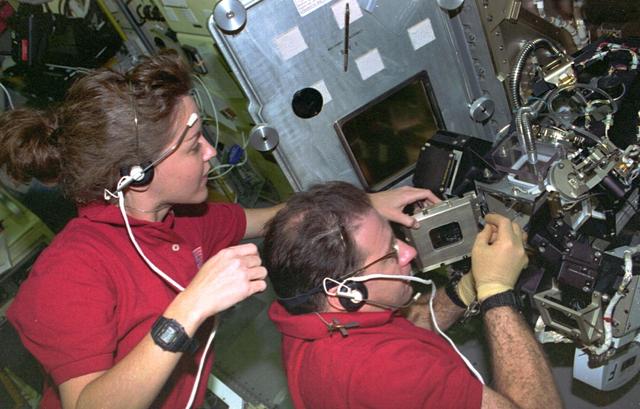
STS073-108-005 (20 October-5 November 1995) --- Two members of the crew perform an in-flight maintenance on the Drop Physics Module (DPM) in the science module aboard the Earth-orbiting Space Shuttle Columbia. Payload commander Kathryn C. Thornton and payload specialist Albert Sacco Jr. were part of a seven-member crew that spent 16 full days in space in support of the United States Microgravity Laboratory (USML-2) mission.
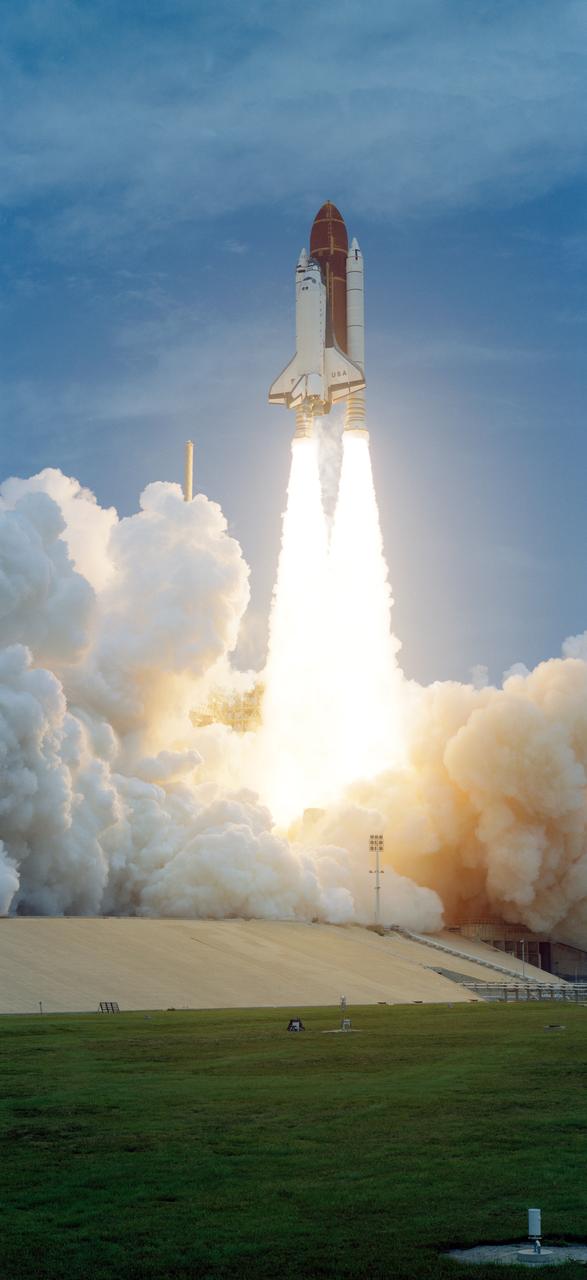
STS050-S-038 (25 June 1992) --- The Space Shuttle Columbia, NASA's first Extended Duration Orbiter (EDO), lifts off on its way toward a scheduled record 13-day mission in Earth-orbit. Liftoff occurred at 12:12:23:0534 p.m. (EDT) on June 25, 1992. Five NASA astronauts and two scientists/payload specialists are aboard. The seven will divide into two shifts to support United States Microgravity Laboratory (USML) research.
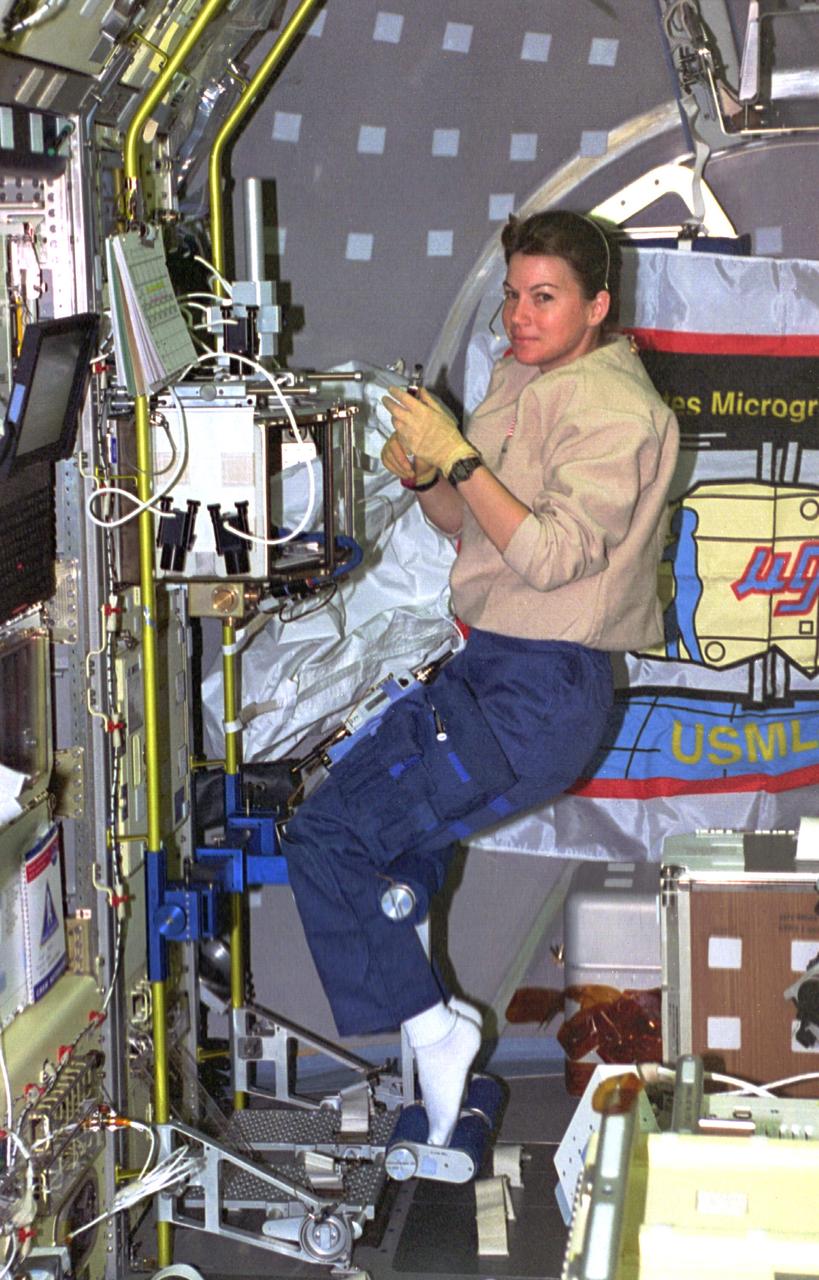
STS073-105-011 (20 October-5 November 1995) --- Astronaut Catherine G. Coleman, STS-73 mission specialist, settles in for a session of work at the glovebox on the starboard side of the United States Microgravity Laboratory (USML-2) module. Coleman was joined by four other NASA astronauts and two guest researchers for almost 16 days of research aboard the Space Shuttle Columbia in Earth-orbit.
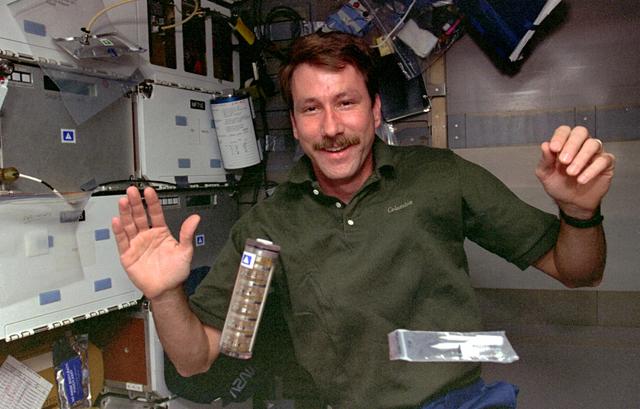
STS073-351-009 (20 October - 5 November 1995) --- Astronaut Kent V. Rominger, STS-73 pilot, retrieves a protein sample on the middeck of the Earth-orbiting Space Shuttle Columbia. Rominger, along with four other NASA astronauts and two guest researchers, spent 16 full days in space in support of the United States Microgravity Laboratory (USML-2) mission.

STS050-02-023 (25 June-9 July 1992) --- Astronaut Bonnie J. Dunbar, payload commander, unstows United States Microgravity Laboratory 1 (USML-1) experiment paraphernalia in early stages of the mission. The Multipurpose Glove Box (MPGB) is at upper left. And, at right center, is the Space Station design foot restraint, making its first flight aboard a Space Shuttle on the record-setting 14-day mission.
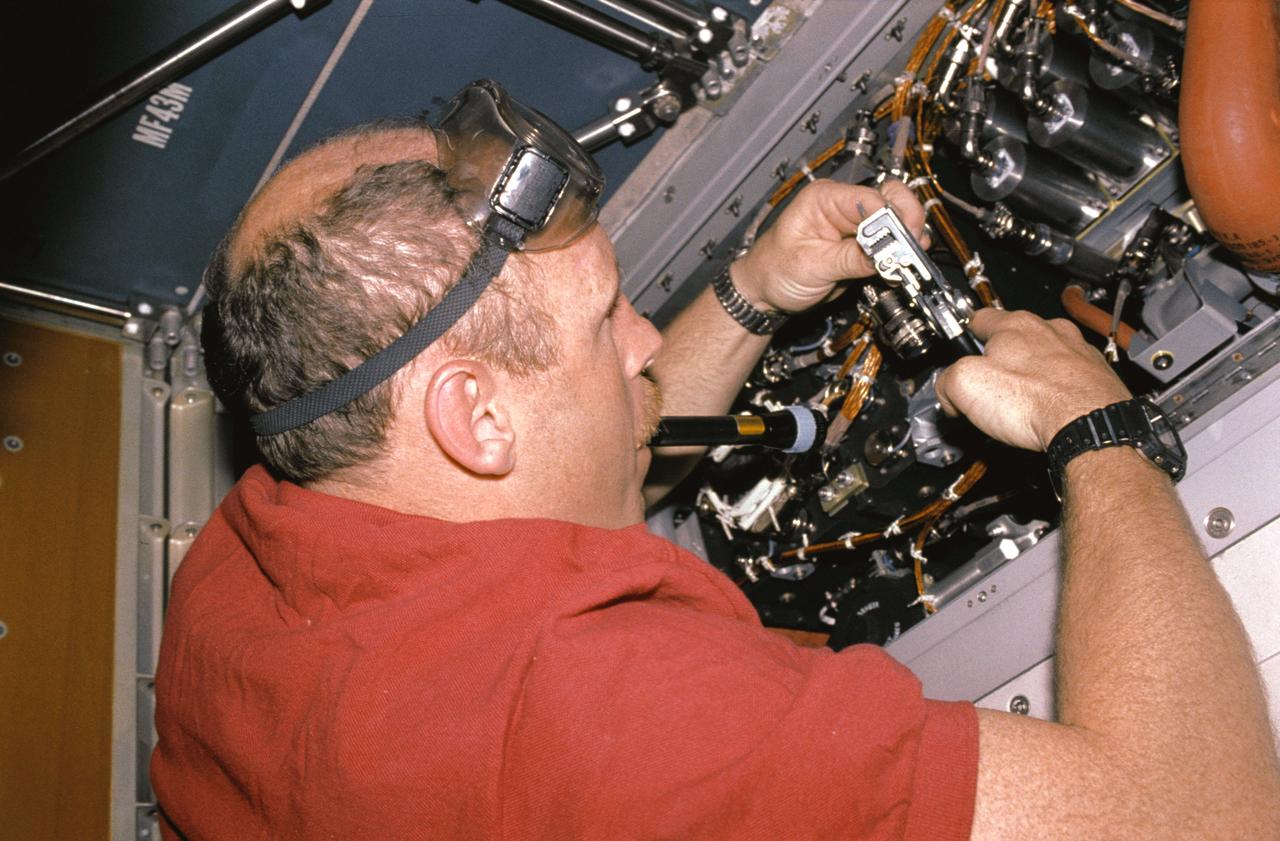
STS050-20-012 (26 June 1992) --- Astronaut Kenneth D. Bowersox, pilot, performs in-flight maintenance (IFM) on the Regenerative Carbon Dioxide Removal System (RCRS) on the mid-deck of the Earth-orbiting Space Shuttle Columbia. Bowersox was joined by four other astronauts and two scientists from the private sector for a record-setting 14-day stay aboard the Space Shuttle in support of the United States Microgravity Laboratory 1 (USML-1).
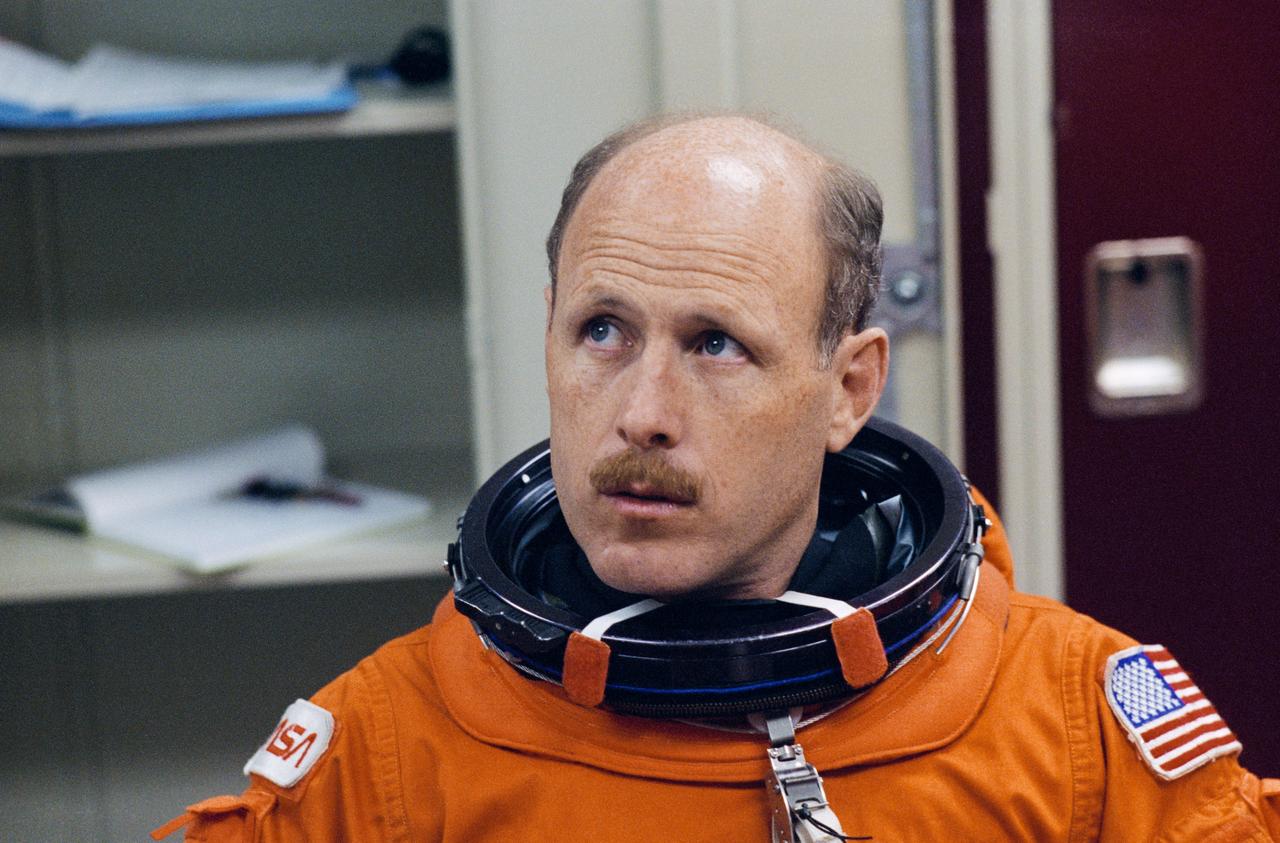
S95-09132 (27 Apr. 1995) --- As he watches one his STS-73 crew mates rappel from the top of a ?troubled Shuttle,? astronaut Kenneth D. Bowersox, mission commander, prepares to participate in an emergency egress training session in the Johnson Space Center?s (JSC) Systems Integration Facility. Five astronauts and two payload specialists from the private sector will fly aboard the Space Shuttle Columbia later this year to support the United States Microgravity Laboratory (USML-2) mission.
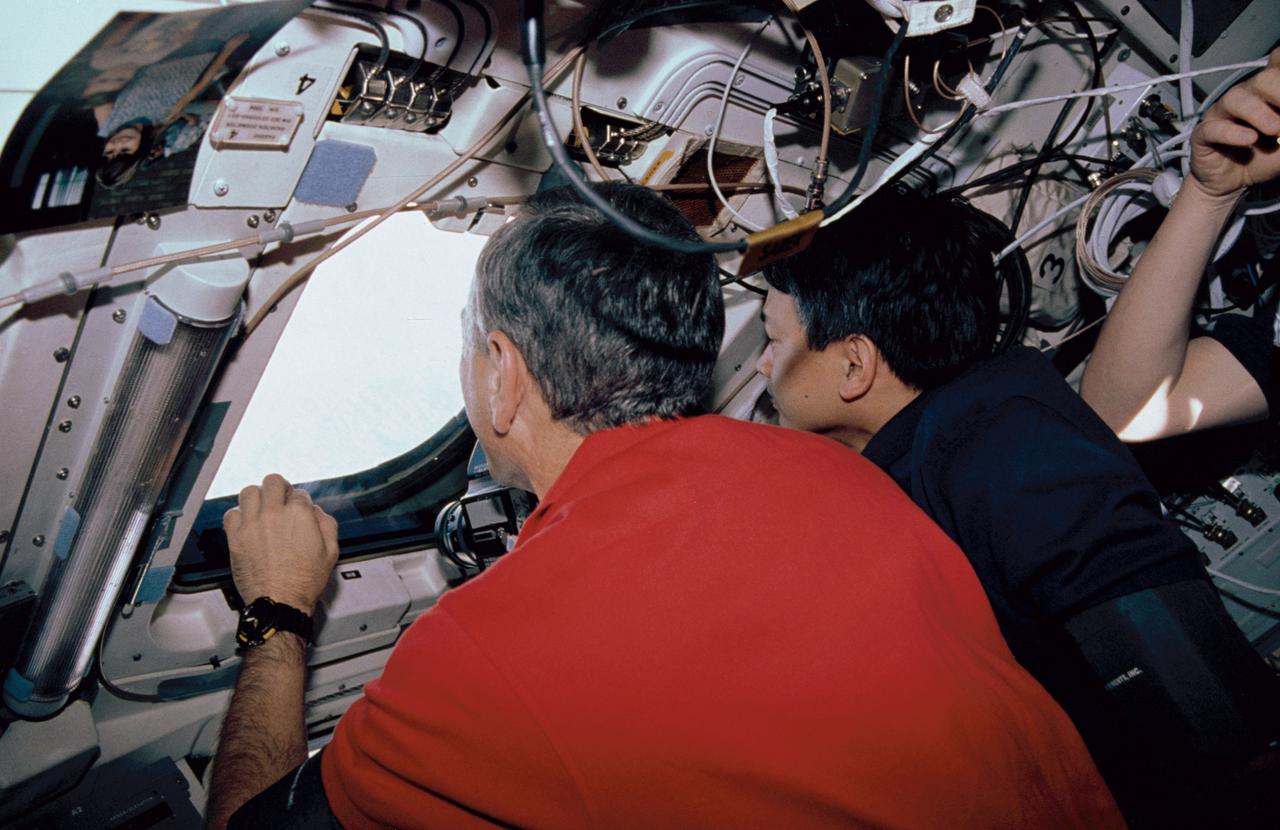
STS050-06-011 (25 June-9 July 1992) --- Astronaut Carl J. Meade (left), mission specialist, and Eugene H. Trinh, payload specialist, share a view through one of the Space Shuttle Columbia's aft flight deck windows during a break in photography of Earth. The two were among seven crew members who shared 14 record-setting days aboard the Space Shuttle supporting the United States Microgravity Laboratory (USML-1) mission.
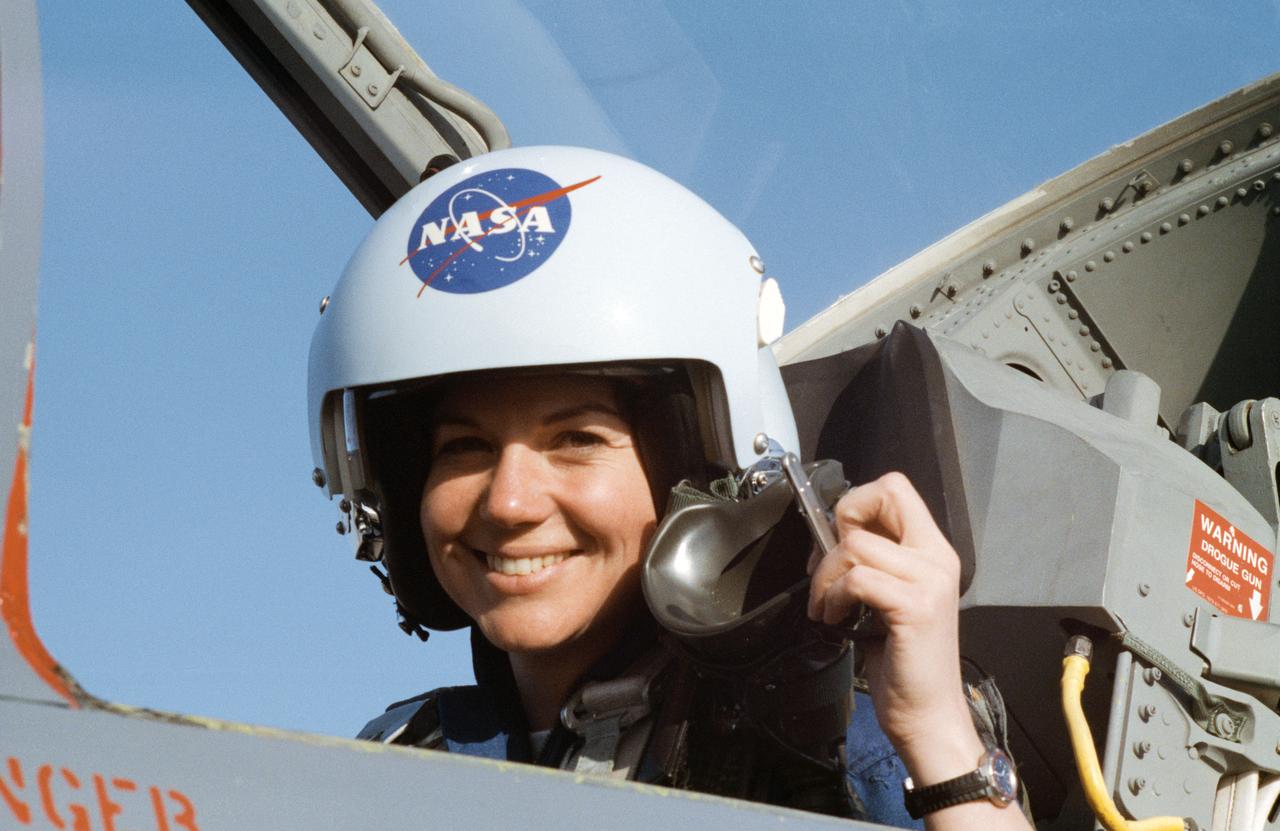
S93-30754 (September 1992) --- Astronaut Catherine G. Coleman, who had recently begun a year?s training and evaluation program at the Johnson Space Center (JSC), sits in the rear station of a T-38 jet trainer. She was about to take a familiarization flight in the jet. Coleman was later named mission specialist for NASA?s STS-73/United States Microgravity Laboratory (USML-2) mission.

STS073-355-003 (20 October - 5 November 1995) --- Doing her version of "Look, Ma, no hands" is astronaut Catherine G. Coleman. The STS-73 mission specialist works out on the bicycle ergometer on the flight deck of the Earth-orbiting Space Shuttle Columbia. Coleman was one of five NASA astronauts who were joined by two guest researchers for 16 days of in-space research in support of the United States Microgravity Laboratory (USML-2) mission.

STS073-E-5003 (23 Oct. 1995) --- Astronaut Kathryn C. Thornton, STS-73 payload commander, works at the Drop Physics Module (DPM) on the portside of the science module aboard the Space Shuttle Columbia in Earth orbit. Payload specialist Albert Sacco Jr. conducts an experiment at the Glovebox. This frame was exposed with the color Electronic Still Camera (ESC) assigned to the 16-day United States Microgravity Laboratory (USML-2) mission.
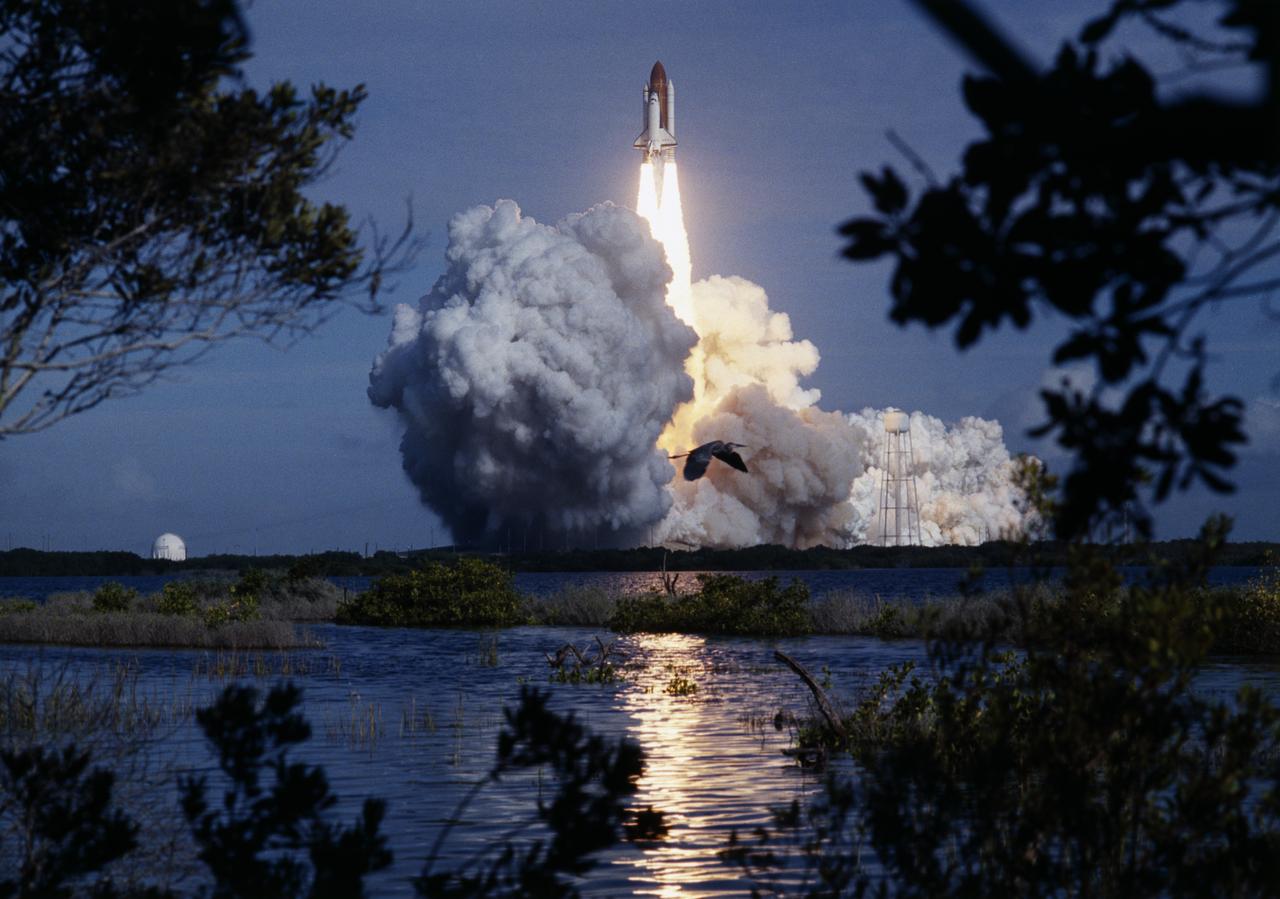
A Great Blue Heron seems oblivious to the tremendous spectacle of light and sound generated by a Shuttle liftoff, as the Space Shuttle Columbia (STS-73) soars skyward from Launch Pad 39B. Columbia's seven member crew's mission included continuing experimentation in the Marshall managed payloads including the United States Microgravity Laboratory 2 (USML-2) and the keel-mounted accelerometer that characterizes the very low frequency acceleration environment of the orbiter payload bay during space flight, known as the Orbital Acceleration Research Experiment (OARE).
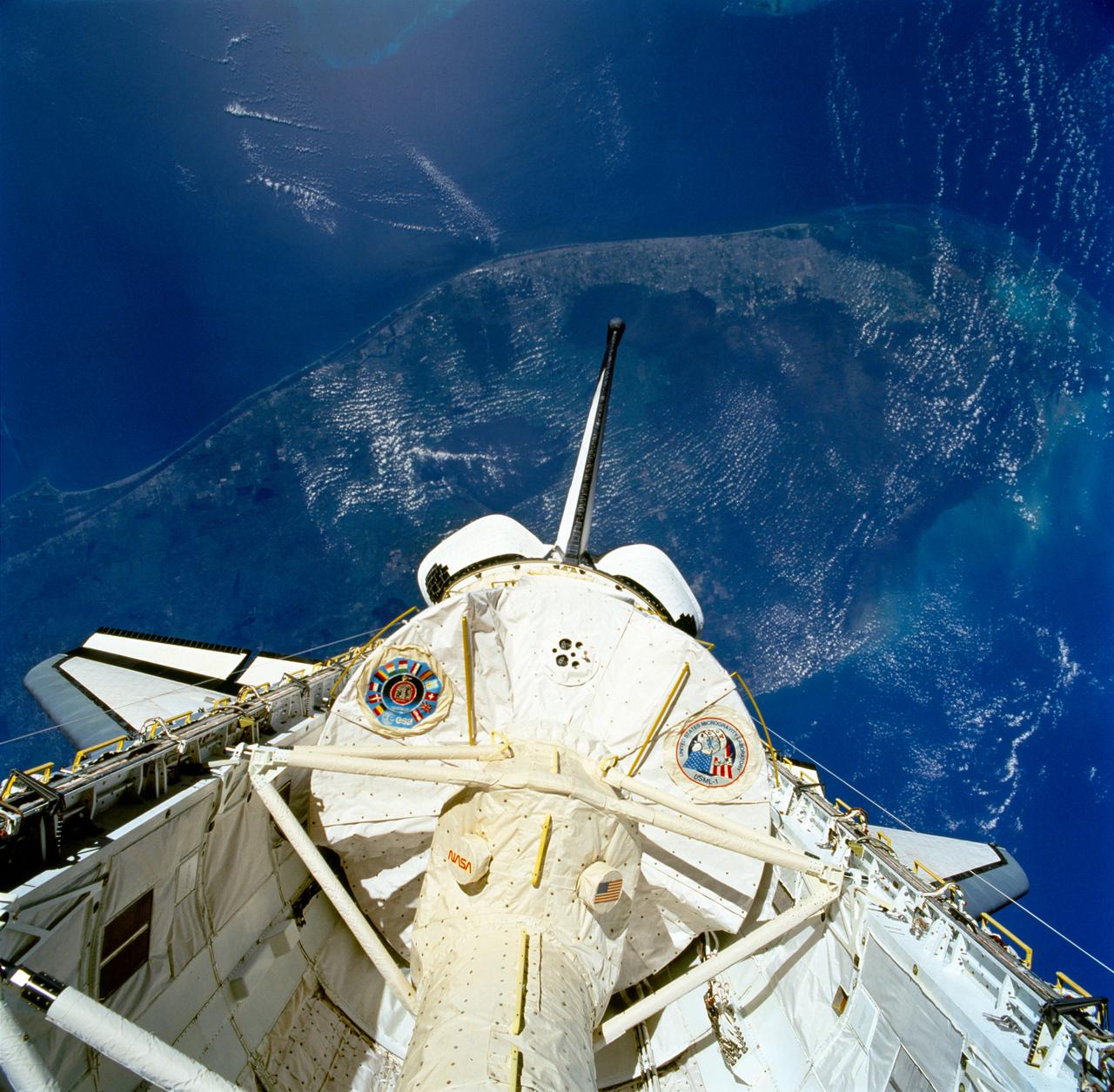
STS050-81-027 (25 June-9 July 1992) --- The first United States Microgravity Laboratory 1 (USML-1) module is pictured in the payload bay of the Earth-orbiting Space Shuttle Columbia in this scene over the southern two-thirds of the Florida peninsula. The Kennedy Space Center (KSC), where the mission began, can be seen just above Columbia's starboard wing. (Hold photo with number at left.)
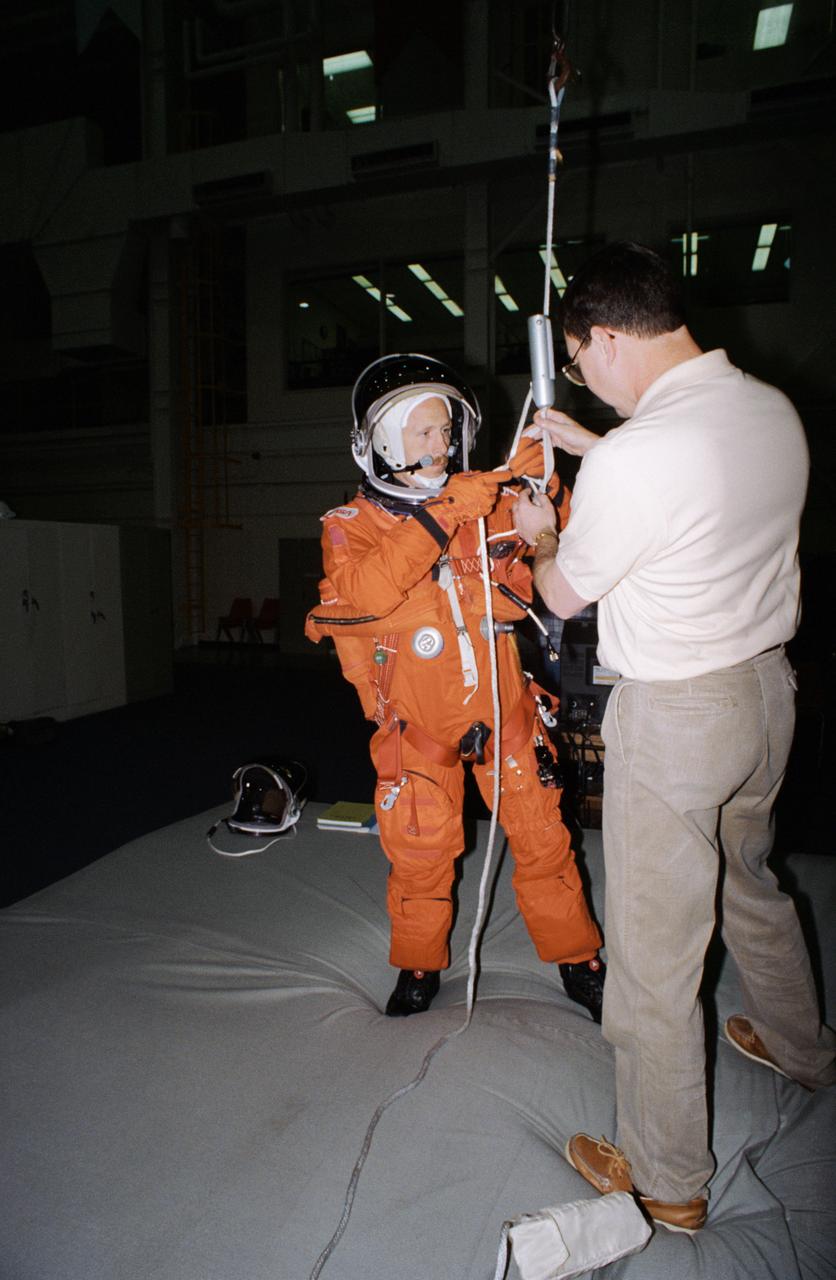
S95-09153 (27 Apr. 1995) --- Astronaut Kenneth D. Bowersox has just translated from the top of a Shuttle mockup-trainer using a Sky-genie device during emergency egress training with his six STS-73 crew mates. He is assisted here by Scott Gill, a member of the STS-73 training staff. The seven will fly aboard the Space Shuttle Columbia later this year to support the United States Microgravity Laboratory (USML-2) mission.

STS073-E-5000 (23 Oct. 1995) --- Astronaut Catherine G. Coleman, STS-73 mission specialist, works in the Glovebox on the portside of the science module aboard the space shuttle Columbia in Earth orbit. This Electronic Still Camera (ESC) frame was the first downlinked from the spacecraft during the scheduled 16-day United States Microgravity Laboratory (USML-2) mission.
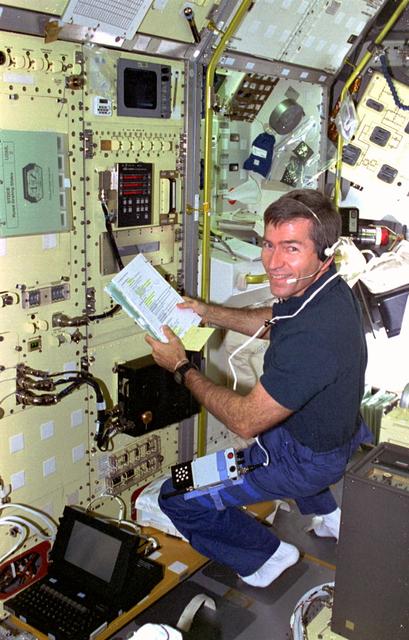
STS073-103-015 (20 October-5 November 1995) --- Payload specialist Fred W. Leslie works with the Surface Tension Driven Convection Experiment (STDCE) aboard the science module in the cargo bay of the Earth-orbiting Space Shuttle Columbia. Leslie joined another guest researcher and five NASA astronauts for 16 full days of in-space research in support of the United States Microgravity Laboratory (USML-2) mission.

This artist's concept depicts the completely assembled International Space Station (ISS) passing over Florida and the Bahamas. As a gateway to permanent human presence in space, the Space Station Program is to expand knowledge benefiting all people and nations. The ISS is a multidisciplinary laboratory, technology test bed, and observatory that will provide unprecedented undertakings in scientific, technological, and international experimentation. Experiments to be conducted in the ISS include: microgravity research, Earth science, space science, life sciences, space product development, and engineering research and technology. The sixteen countries participating in the ISS are: United States, Russian Federation, Canada, Japan, United Kingdom, Germany, Italy, France, Norway, Netherlands, Belgium, Spain, Denmark, Sweden, Switzerland, and Brazil.
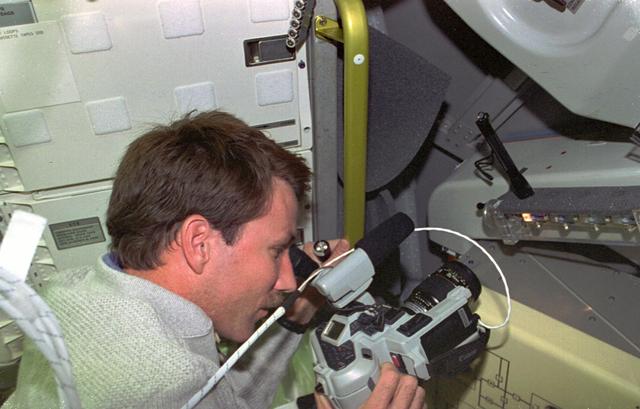
STS073-131-014 (20 October-5 November 1995) --- Astronaut Kent V. Rominger, STS-73 pilot, uses a camcorder to record progress in the Hand-Held Diffusion Test Cell (HHDTC) experiment. This test dealt with crystal growth by liquid-to-liquid diffusion. Four HHDTC units containing four test cells each produced protein crystals by diffusing one liquid to another. Rominger joined four other NASA astronauts and two guest researchers for 16 days of in-space United States Microgravity Laboratory 2 (USML-2) research aboard the Space Shuttle Columbia.

This artist's digital concept depicts the completely assembled International Space Station (ISS) passing over Florida. As a gateway to permanent human presence in space, the Space Station Program is to expand knowledge benefiting all people and nations. The ISS is a multidisciplinary laboratory, technology test bed, and observatory that will provide unprecedented undertakings in scientific, technological, and international experimentation. Experiments to be conducted in the ISS include: microgravity research, Earth science, space science, life sciences, space product development, and engineering research and technology. The sixteen countries participating the ISS are: United States, Russian Federation, Canada, Japan, United Kingdom, Germany, Italy, France, Norway, Netherlands, Belgium, Spain, Denmark, Sweden, Switzerland, and Brazil.

These five astronauts and two United States Microgravity Laboratory (USML) payload specialists pause from a rigid training schedule for the STS-73 crew portrait. On the front row, left to right, are Albert Sacco Jr., payload specialist; Kent V. Rominger, pilot; and Michael E. Lopez-Alegria, mission specialist. On the back row are, left to right, Catherine G. Coleman, mission specialist; Kenneth D. Bowersox, commander; Fred W. Leslie, payload specialist; and Kathryn C. Thornton, payload commander. The STS-073 crew launched aboard the Space Shuttle Columbia on October 20, 1995 at 9:53:00.069 am (EDT). The mission served as the second flight of the Microgravity Laboratory (USML-2).
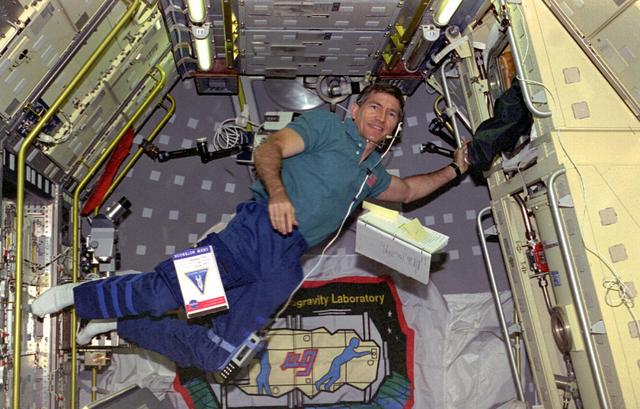
STS073-101-018 (20 October-5 November 1995) --- Payload specialist Fred W. Leslie maneuvers his body to a position conducive to research at the Crystal Growth Furnace (CGF) aboard the science module in the cargo bay of the Earth-orbiting Space Shuttle Columbia. Crystallization has been discovered to be more effectively studied in the weightless environment of space than on Earth, because the gravity-induced phenomena that obscure or change the process or change the process are greatly reduced or eliminated. Leslie was joined by a second guest researcher and five NASA astronauts for 16 full days of in-space research in support of the United States Microgravity Laboratory (USML-2) mission.

STS073-356-018 (20 October - 5 November 1995) --- Astronaut Kent V. Rominger, pilot, demonstrates an age-old trash-compacting method on the middeck of the Earth-orbiting Space Shuttle Columbia. Following a meal, Rominger had collected the residue wrappers, etc. and filled a plastic bag. Following his compacting maneuvers, Rominger went on to deposit the sack into a temporary trash-stowage area beneath the middeck. Making his first flight into space, Rominger joined four other NASA astronauts and two guest researchers for more than two weeks' research in support of the United States Microgravity Laboratory (USML-2) mission.
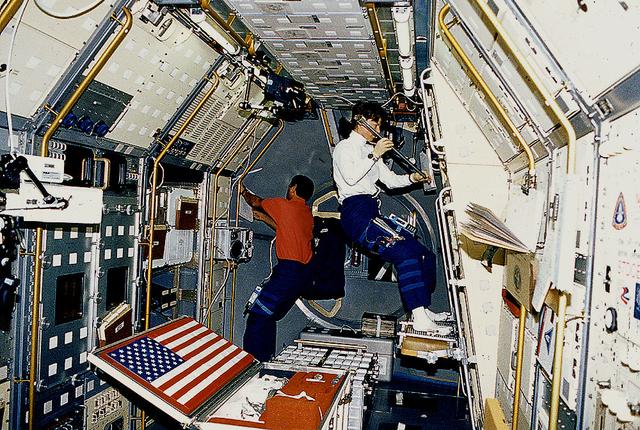
Space Shuttle Columbia (STS-50) onboard photo of astronauts working in United States Microgravity Laboratory (USML-1). USML-1 will fly in orbit for extended periods of time attached to the Shuttle, providing greater opportunities for research in materials science, fluid dynamics, biotechnology, and combustion science. The scientific data gained from the USML-1 missions will constitute a landmark in space science, pioneering investigations into the role of gravity in a wide array of important processes and phenomena. In addition, the missions will also provide much of the experience in performing research in space and in the design of instruments needed for Space Station Freedom and the programs to follow in the 21st Century.
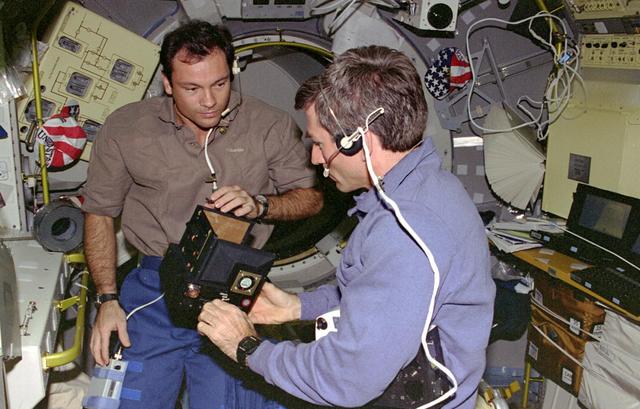
STS073-233-032 (20 October - 5 November 1995) --- Astronaut Michael E. Lopez-Alegria (left), STS-73 mission specialist, assists payload specialist Fred W. Leslie in an in-flight maintenance task involving the Fiber Support Droplet Combustion (FSDC) experiment. This new Glovebox investigation tests a technique for studying combustion in the weightless environment of space. The two joined five other crew members onboard the Space Shuttle Columbia for 16 days of in-space research in support of the United States Microgravity Laboratory (USML-2) mission.
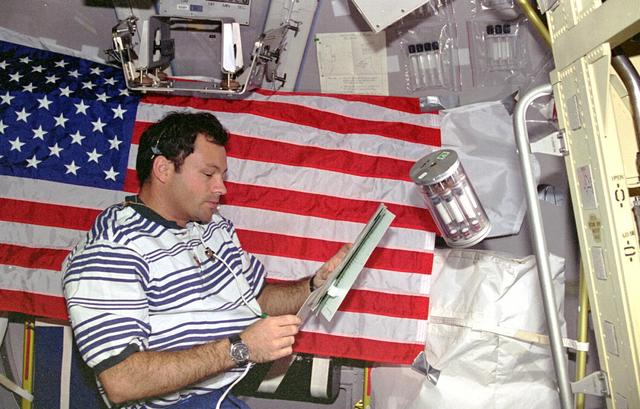
STS073-232-013 (20 October - 5 November 1995) --- Astronaut Michael E. Lopez-Alegria, STS-73 mission specialist, checks notes related to the Commercial Generic Bioprocessing Apparatus (CGBA) aboard the Earth-orbiting Space Shuttle Columbia. CGBA supported over one hundred individual experiments on small quantities of samples ranging from molecules to small organisms. Lopez-Alegria joined four other NASA astronauts and two guest researchers for 16-days of United States Microgravity Laboratory 2 (USML-2) research aboard the Space Shuttle Columbia.
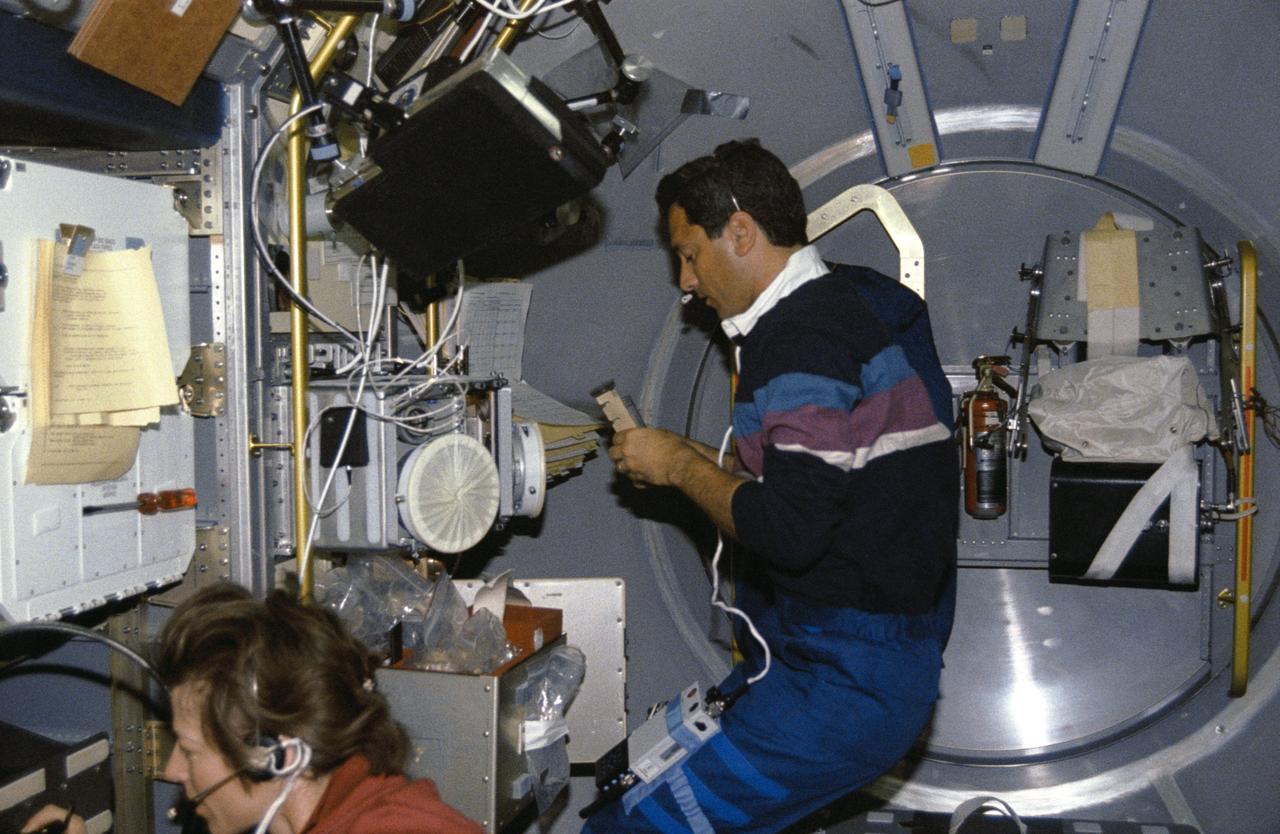
STS050-254-007 (25 June-9 July 1992) --- Lawrence J. DeLucas, payload specialist, handles a Protein Crystal Growth (PCG) sample at the multipurpose glovebox aboard the Earth-orbiting Space Shuttle Columbia. Astronaut Bonnie J. Dunbar, payload commander, communicates with ground controllers about the Solid Surface Combustion Experiment (SSCE), one of the United States Microgravity Laboratory 1’s (USML-1) three experiments on Rack 10. Five other crew members joined the pair for a record-setting 14-days of scientific data gathering.
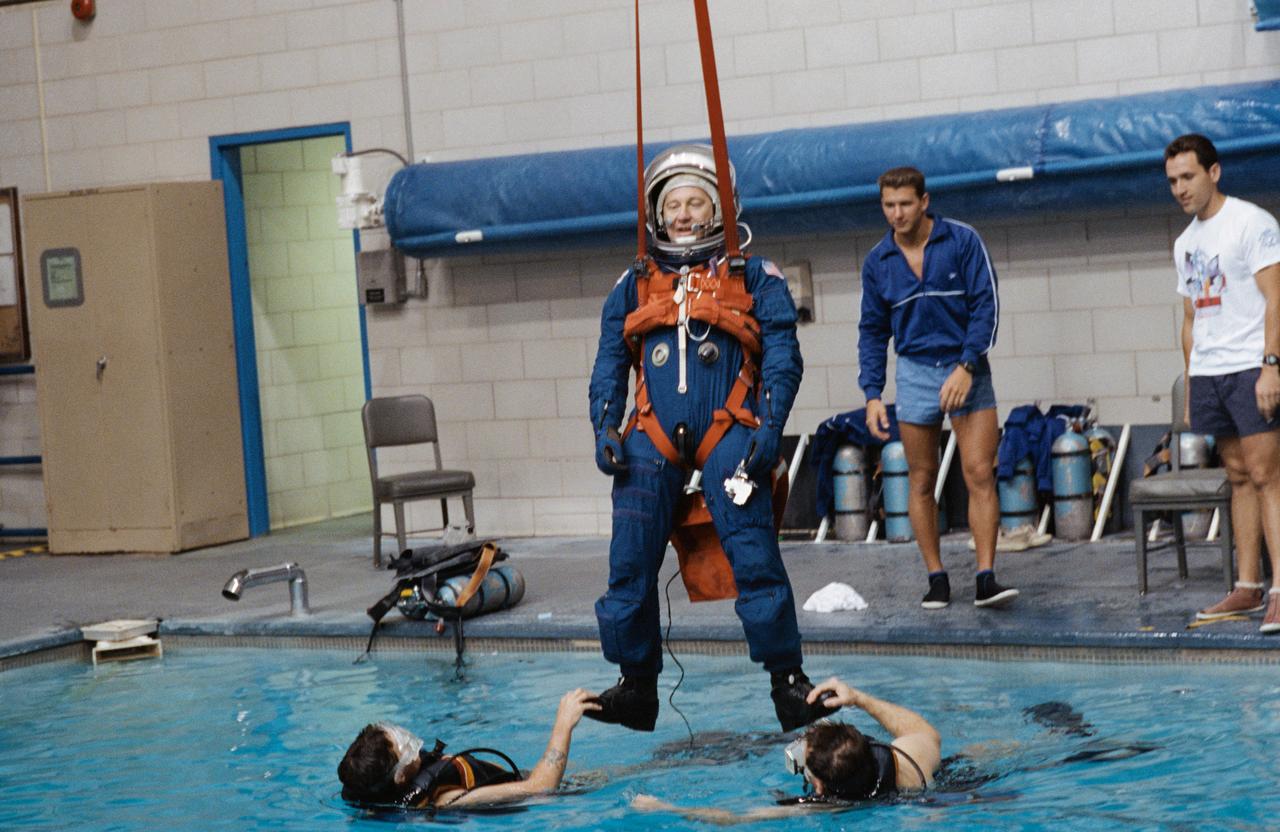
S92-32111 (May 1992) --- Payload specialist Albert Sacco Jr. is assisted by two SCUBA-equipped divers as he hangs by his parachute harness during emergency bailout training exercises in the Johnson Space Center?s (JSC) Weightless Environment Training Facility (WET-F). Sacco is an alternate payload specialist for the United States Microgravity Laboratory (USML-1) mission, scheduled for launch later this year. EDITOR?S NOTE: Sacco was later named as prime crew payload specialist for the USML-2 mission (STS-73), scheduled for 1995.
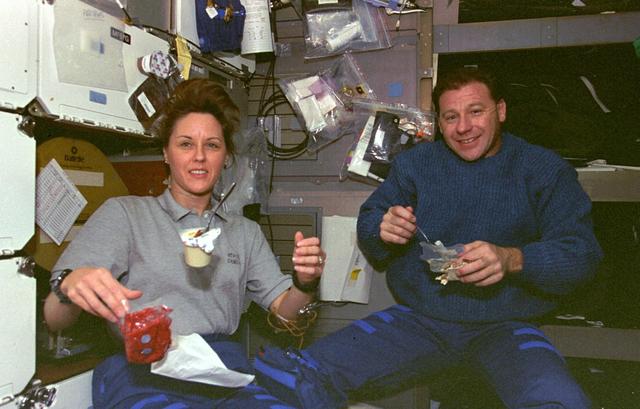
STS073-356-024 (20 October - 5 November 1995) --- Payload specialist Albert Sacco Jr. joins astronaut Kathryn C. Thornton, payload commander, for mealtime on the middeck of the Earth-orbiting Space Shuttle Columbia. Thornton is about to open a packet of strawberries, while a can of vanilla pudding floats before her. Sacco is about to grab a spoonful of rice pilaf while holding a peanut butter and jelly sandwich on a tortilla. The two were joined by five other crewmembers in support of 16-days' in-space research in support of the United States Microgravity Laboratory (USML-2) mission.
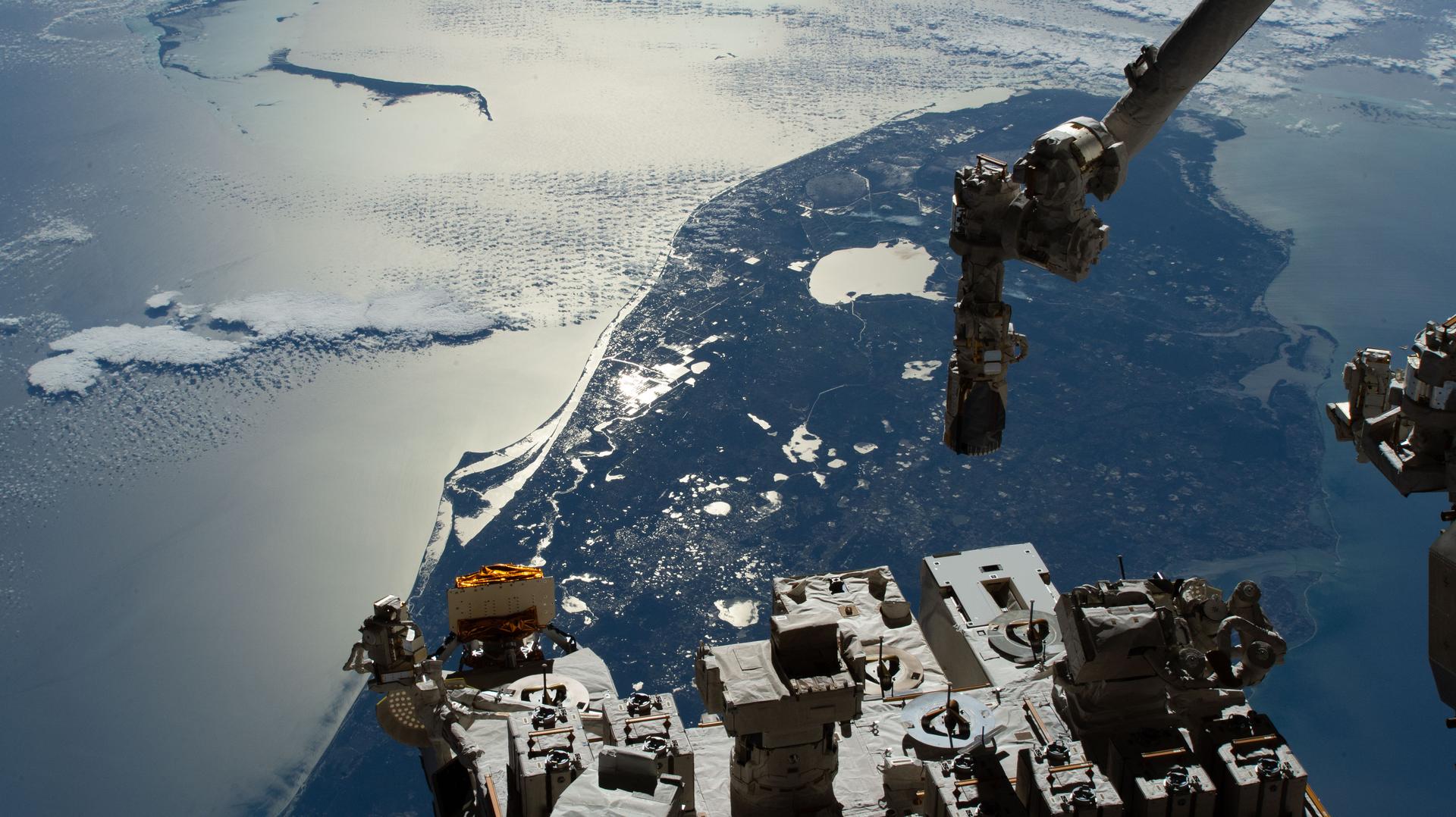
iss074e0006008 (Dec. 12, 2025) --- The sun’s glint beams off the Atlantic Ocean, contrasting with southern Florida and a portion of the Bahamas (upper left) in this photograph taken from the International Space Station as it orbited 262 miles above the southeastern United States. In the bottom foreground is the Kibo laboratory module’s Exposed Facility, which hosts a variety of experiment payloads and other hardware exposed to the external microgravity environment. Extending from the top right of the frame is the Japanese robotic arm, which can maneuver payloads into and out of Kibo’s airlock for placement on the Exposed Facility.

STS073-S-002 (July 1995) --- These five astronauts and two United States Microgravity Laboratory (USML) payload specialists pause from a rigid training schedule for the STS-73 crew portrait. On the front row, left to right, are Albert Sacco Jr., payload specialist; Kent V. Rominger, pilot; Michael E. Lopez-Alegria, mission specialist. On the back row are, left to right, Catherine G. Coleman, mission specialist; Kenneth D. Bowersox, commander; Fred W. Leslie, payload specialist; and Kathryn C. Thornton, payload commander.

STS050-S-040 (25 June 1992) --- A low-angle perspective captures the Space Shuttle Columbia as it lifts off on its way toward a scheduled record 13-day mission in Earth-orbit. Liftoff occurred at 12:12:23:0534 p.m. (EDT) on June 25, 1992. The modified Columbia is NASA's first Extended Duration Orbiter (EDO). Five NASA astronauts and two scientists/payload specialists are aboard. The seven will divide into two shifts to support United States Microgravity Laboratory 1 (USML-1) research.
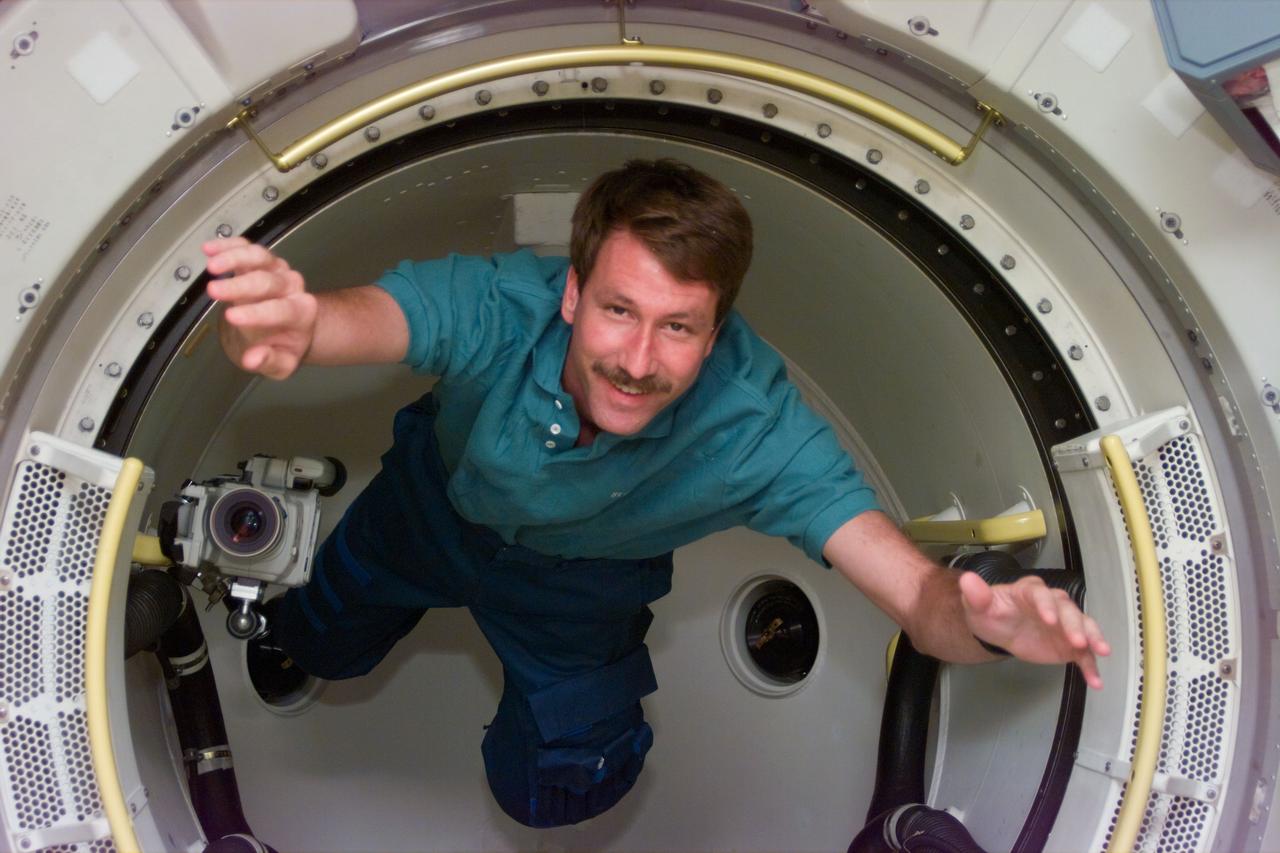
STS073-E-5053 (26 Oct. 1995) --- Astronaut Kent V. Rominger, STS-73 pilot, floats through a tunnel connecting the space shuttle Columbia's cabin and its science module. Rominger is one of seven crewmembers in the midst of a 16-day multi-faceted mission aboard Columbia. For the next week and a half, the crew will continue working in shifts around the clock on a diverse assortment of United States Microgravity Laboratory (USML-2) experiments located in the science module. Fields of study include fluid physics, materials science, biotechnology, combustion science and commercial space processing technologies. The frame was exposed with an Electronic Still Camera (ESC).
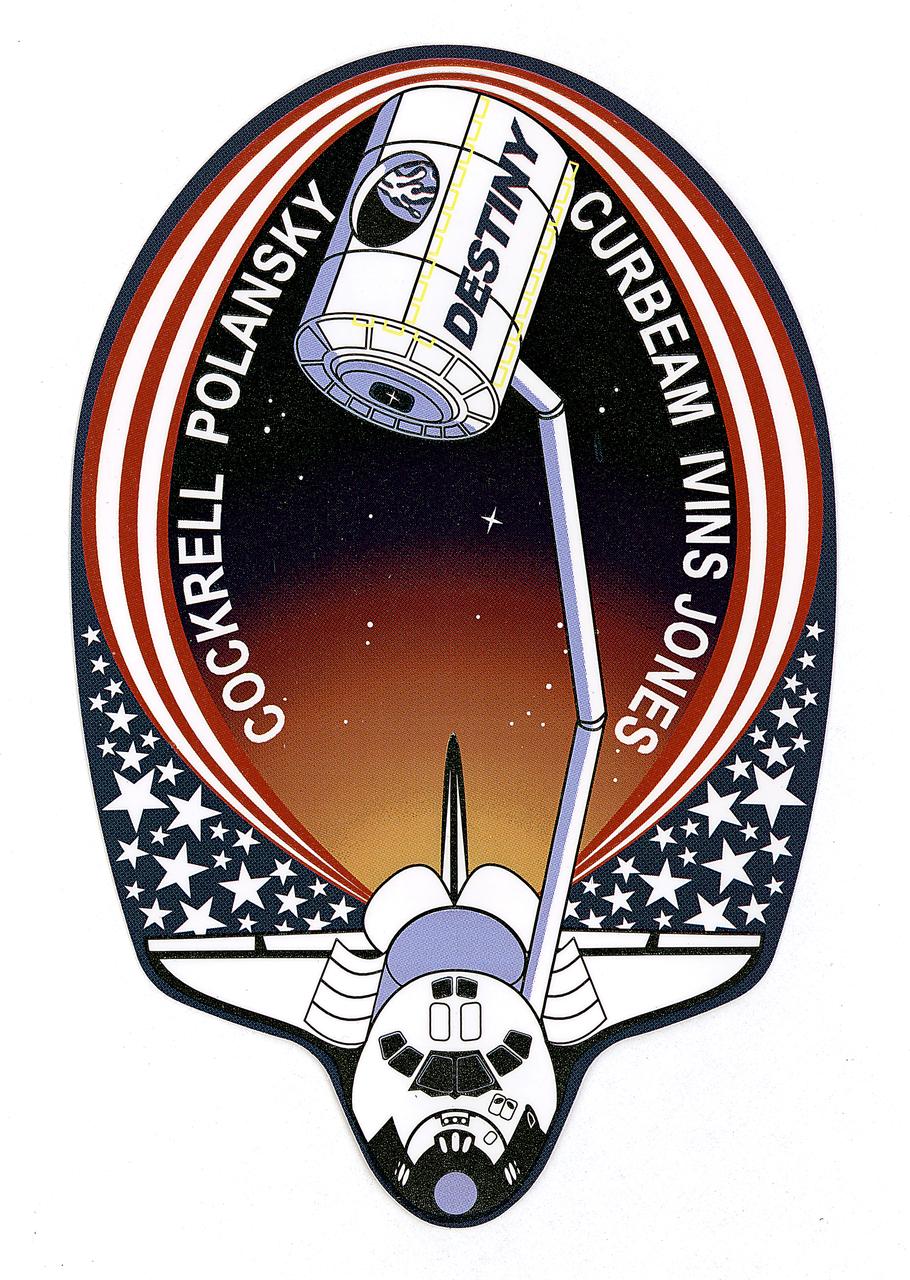
This is the insignia for STS-98, which marks a major milestone in assembly of the International Space Station (ISS). Atlantis' crew delivered the United States Laboratory, Destiny, to the ISS. Destiny will be the centerpiece of the ISS, a weightless laboratory where expedition crews will perform unprecedented research in the life sciences, materials sciences, Earth sciences, and microgravity sciences. The laboratory is also the nerve center of the Station, performing guidance, control, power distribution, and life support functions. With Destiny's arrival, the Station will begin to fulfill its promise of returning the benefits of space research to Earth's citizens. The crew patch depicts the Space Shuttle with Destiny held high above the payload bay just before its attachment to the ISS. Red and white stripes, with a deep blue field of white stars, border the Shuttle and Destiny to symbolize the continuing contribution of the United States to the ISS. The constellation Hercules, seen just below Destiny, captures the Shuttle and Station's team efforts in bringing the promise of orbital scientific research to life. The reflection of Earth in Destiny's window emphasizes the connection between space exploration and life on Earth.

This artist's concept depicts the completely assembled International Space Station (ISS) passing over the Straits of Gibraltar and the Mediterranean Sea. As a gateway to permanent human presence in space, the Space Station Program is to expand knowledge benefiting all people and nations. The ISS is a multidisciplinary laboratory, technology test bed, and observatory that will provide unprecedented undertakings in scientific, technological, and international experimentation. Experiments to be conducted in the ISS include: microgravity research, Earth science, space science, life sciences, space product development, and engineering research and technology. The sixteen countries participating the ISS are: United States, Russian Federation, Canada, Japan, United Kingdom, Germany, Italy, France, Norway, Netherlands, Belgium, Spain, Denmark, Sweden, Switzerland, and Brazil.

STS057-S-001 (February 1993) --- Designed by the crew members, the STS-57 crew patch depicts the space shuttle Endeavour maneuvering to retrieve the European Space Agency's (ESA) microgravity experiment satellite EURECA. SpaceHab - the first commercial space laboratory - is depicted in the cargo bay, and its characteristic shape is represented by the inner red border of the patch. The three gold plumes surrounded by the five stars trailing EURECA are suggestive of the United States astronaut logo. The five gold stars together with the shape of the orbiter's mechanical arm form the mission's numerical designation. The six stars on the American flag represent the United States astronauts who comprise the crew. With detailed input from the crew members, the final artwork was accomplished by artist Tim Hall. The NASA insignia design for space shuttle flights is reserved for use by the astronauts and for other official use as the NASA Administrator may authorize. Public availability has been approved only in the form of illustrations by the various news media. When and if there is any change in this policy, which we do not anticipate, it will be publicly announced. Photo credit: NASA
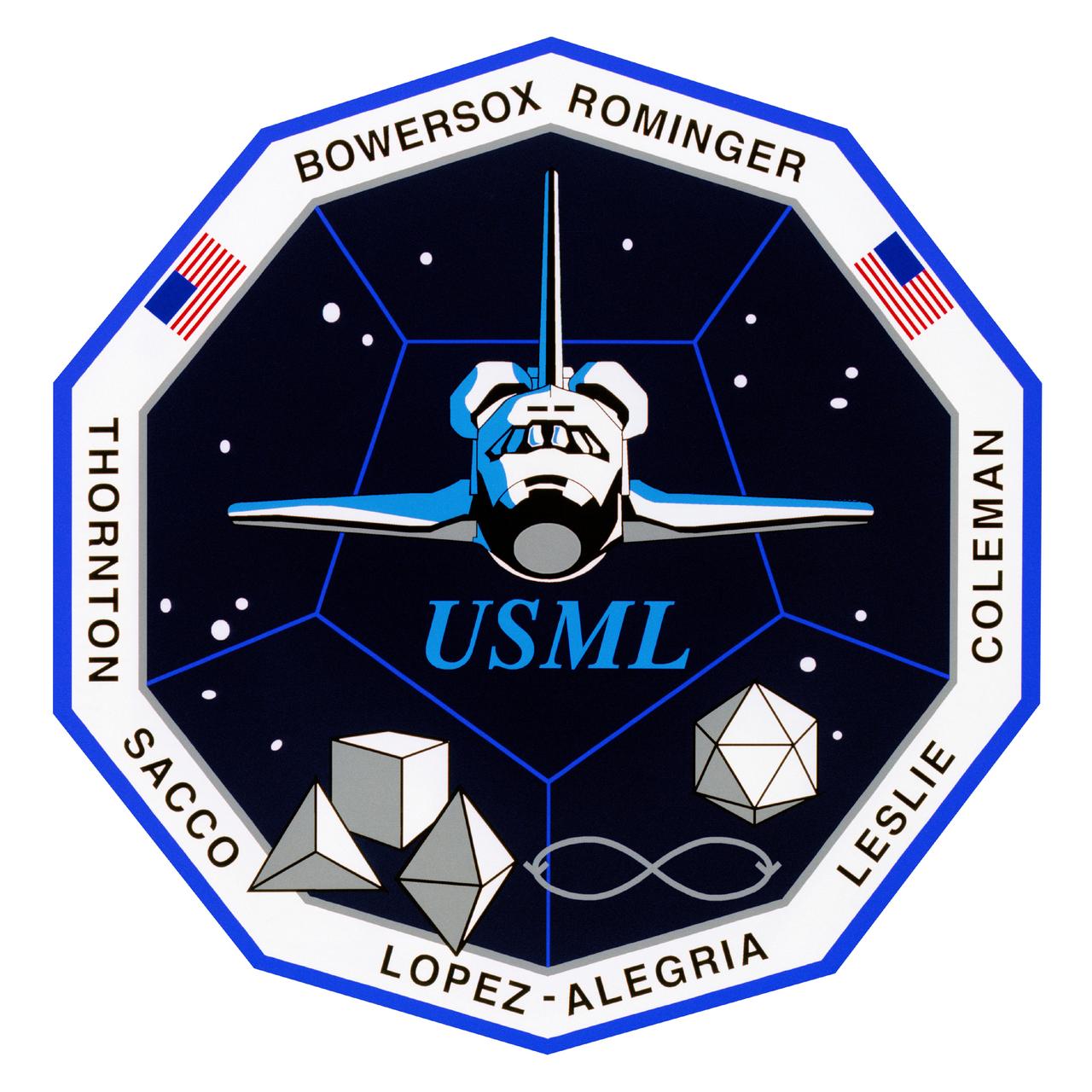
The crew patch of STS-73, the second flight of the United States Microgravity Laboratory (USML-2), depicts the Space Shuttle Columbia in the vastness of space. In the foreground are the classic regular polyhedrons that were investigated by Plato and later Euclid. The Pythagoreans were also fascinated by the symmetrical three-dimensional objects whose sides are the same regular polygon. The tetrahedron, the cube, the octahedron, and the icosahedron were each associated with the Natural Elements of that time: fire (on this mission represented as combustion science); Earth (crystallography), air and water (fluid physics). An additional icon shown as the infinity symbol was added to further convey the discipline of fluid mechanics. The shape of the emblem represents a fifth polyhedron, a dodecahedron, which the Pythagoreans thought corresponded to a fifth element that represented the cosmos.
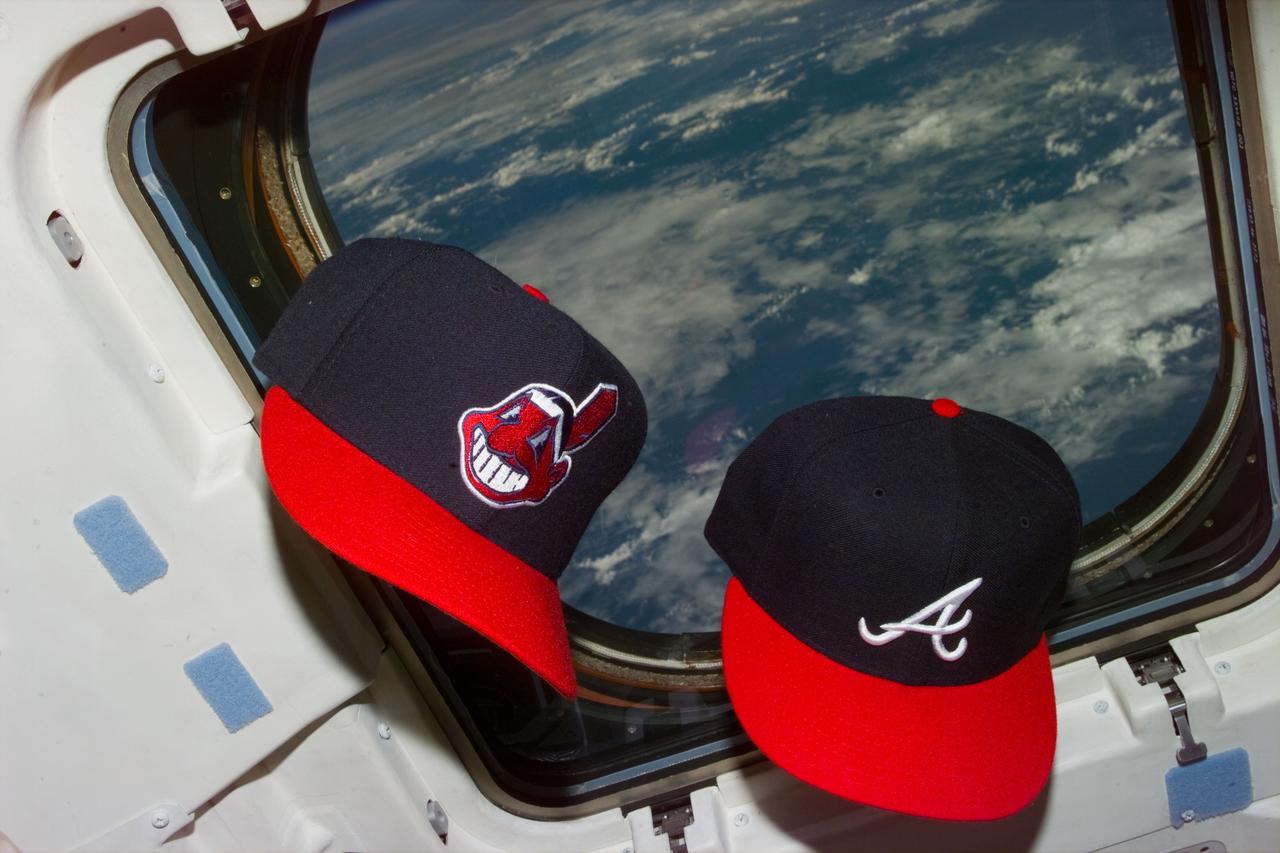
STS073-E-5135 (26 Oct. 1995) --- Baseball caps from the two 1995 World Series representative franchises float near the cabin windows of the Earth-orbiting space shuttle Columbia, with the Earth in the background. The American League champion Cleveland Indians and their National League counterpart Atlanta Braves were engaged in a scheduled best-of-seven World Series throughout the first portion of the scheduled 16-day mission in space. Off-duty crewmembers came out of a rest period to set up the scene in tribute to the October classic. The crew will continue working in shifts around the clock on a diverse assortment of United States Microgravity Laboratory (USML-2) experiments located in the science module. Fields of study include fluid physics, materials science, biotechnology, combustion science and commercial space processing technologies. The frame was exposed with an Electronic Still Camera (ESC).
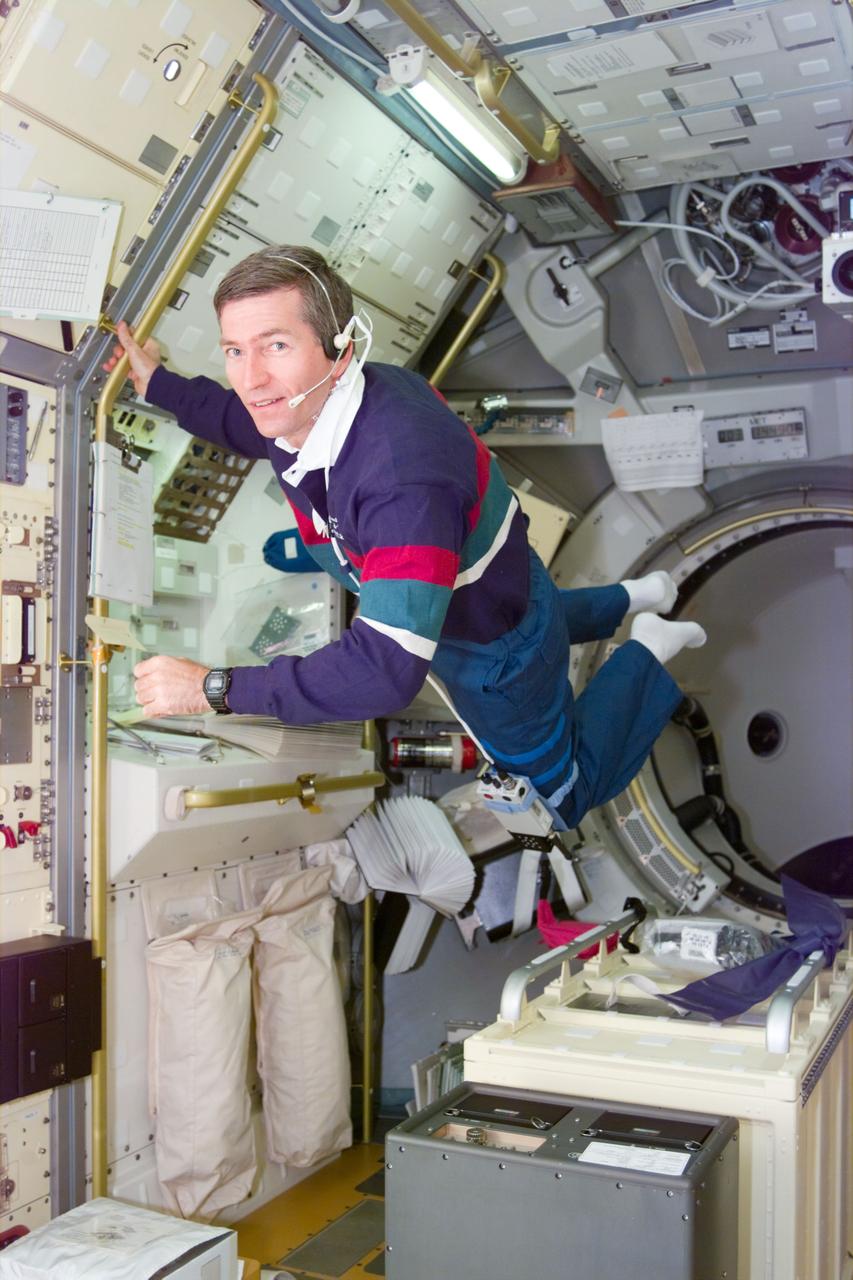
STS073-E-5041 (26 Oct. 1995) --- Fred W. Leslie, STS-73 payload specialist, working out of NASA's Marshall Space Flight Center (MSFC), in Alabama, grabs a support bar on a science workstation rack after floating from the space shuttle Columbia's cabin into the science module. Leslie is one of seven crewmembers in the midst of a 16-day multi-faceted mission aboard Columbia. For the next week and a half, Leslie and the rest of the crew will continue working in shifts around the clock on a diverse assortment of United States Microgravity Laboratory (USML-2) experiments located in the science module. Fields of study include fluid physics, materials science, biotechnology, combustion science and commercial space processing technologies. The frame was exposed with an Electronic Still Camera (ESC).
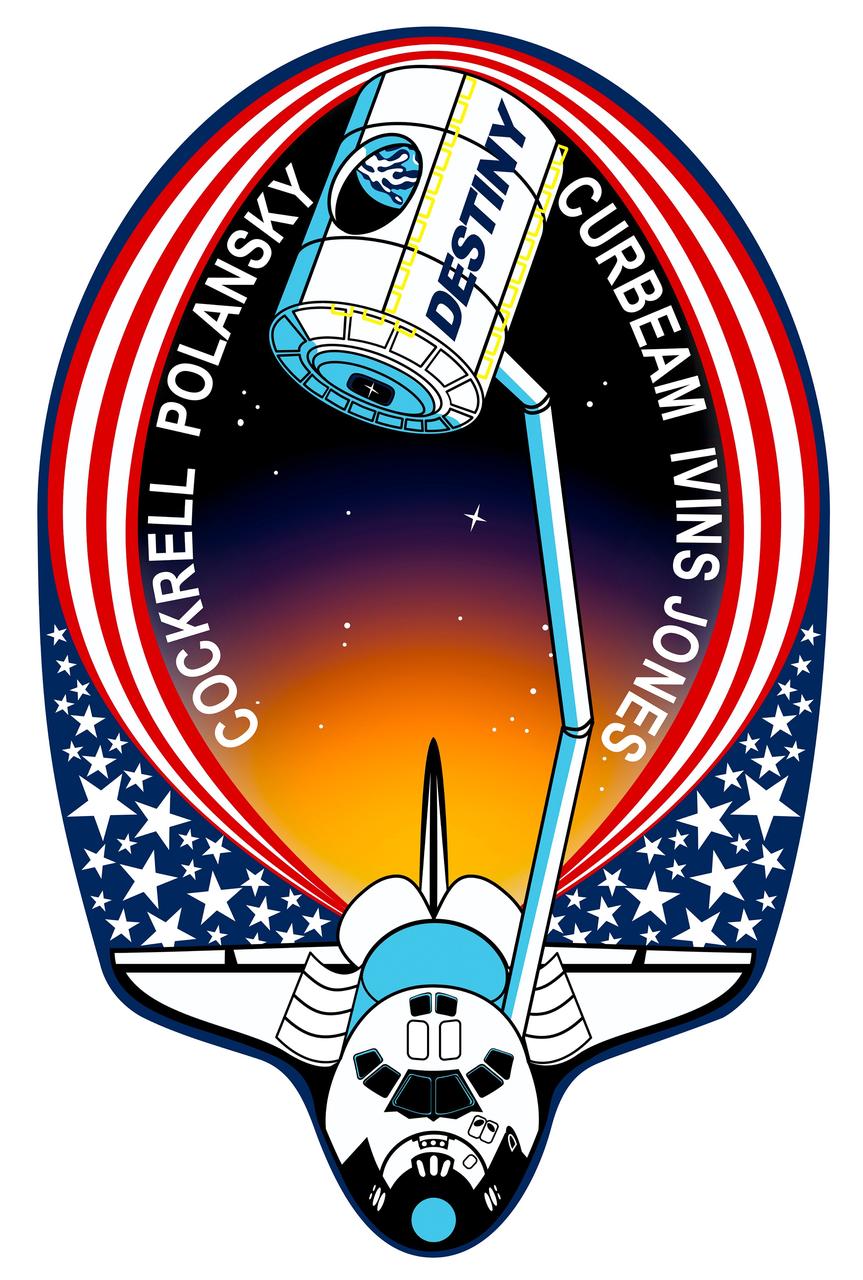
STS098-S-001 (November 2000) --- This is the insignia for STS-98, which marks a major milestone in assembly of the International Space Station (ISS). Atlantis' crew will deliver the United States Laboratory, Destiny, to the ISS. Destiny will be the centerpiece of the ISS, a weightless laboratory where expedition crews will perform unprecedented research in the life sciences, materials sciences, Earth sciences, and microgravity sciences. The laboratory is also the nerve center of the station, performing guidance, control, power distribution, and life support functions. With Destiny's arrival, the station will begin to fulfill its promise of returning the benefits of space research to Earth's citizens. The crew patch depicts the space shuttle with Destiny held high above the payload bay just before its attachment to the ISS. Red and white stripes, with a deep blue field of white stars, border the shuttle and Destiny to symbolize the continuing contribution of the United States to the ISS. The constellation Hercules, seen just below Destiny, captures the shuttle and station's team efforts in bringing the promise of orbital scientific research to life. The reflection of Earth in Destiny's window emphasizes the connection between space exploration and life on Earth. The NASA insignia design for space shuttle flights is reserved for use by the astronauts and for other official use as the NASA Administrator may authorize. Public availability has been approved only in the forms of illustrations by the various news media. When and if there is any change in this policy, which is not anticipated, the change will be publicly announced. Photo credit: NASA
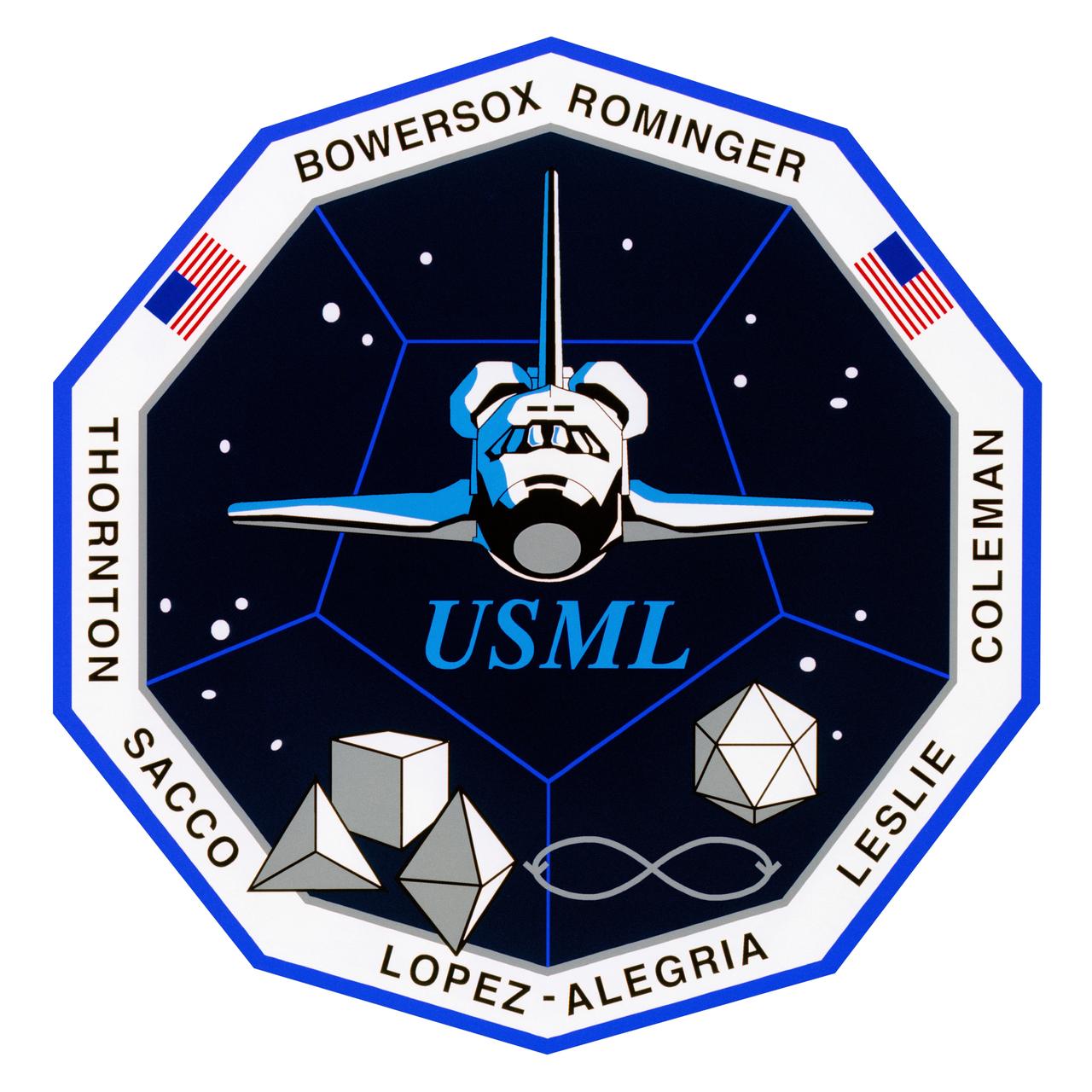
STS073-S-001 (May 1995) --- The crew patch of STS-73, the second flight of the United States Microgravity Laboratory (USML-2), depicts the space shuttle Columbia in the vastness of space. In the foreground are the classic regular polyhedrons that were investigated by Plato and later Euclid. The Pythagoreans were also fascinated by the symmetrical three-dimensional objects whose sides are the same regular polygon. The tetrahedron, the cube, the octahedron, and the icosahedron were each associated with the "Natural Elements" of that time: fire (on this mission represented as combustion science); Earth (crystallography), air and water (fluid physics). An additional icon shown as the infinity symbol was added to further convey the discipline of fluid mechanics. The shape of the emblem represents a fifth polyhedron, a dodecahedron, which the Pythagoreans thought corresponded to a fifth element that represented the cosmos. The NASA insignia design for space shuttle flights is reserved for use by the astronauts and for other official use as the NASA Administrator may authorize. Public availability has been approved only in the forms of illustrations by the various news media. When and if there is any change in this policy, which is not anticipated, the change will be publicly announced. Photo credit: NASA
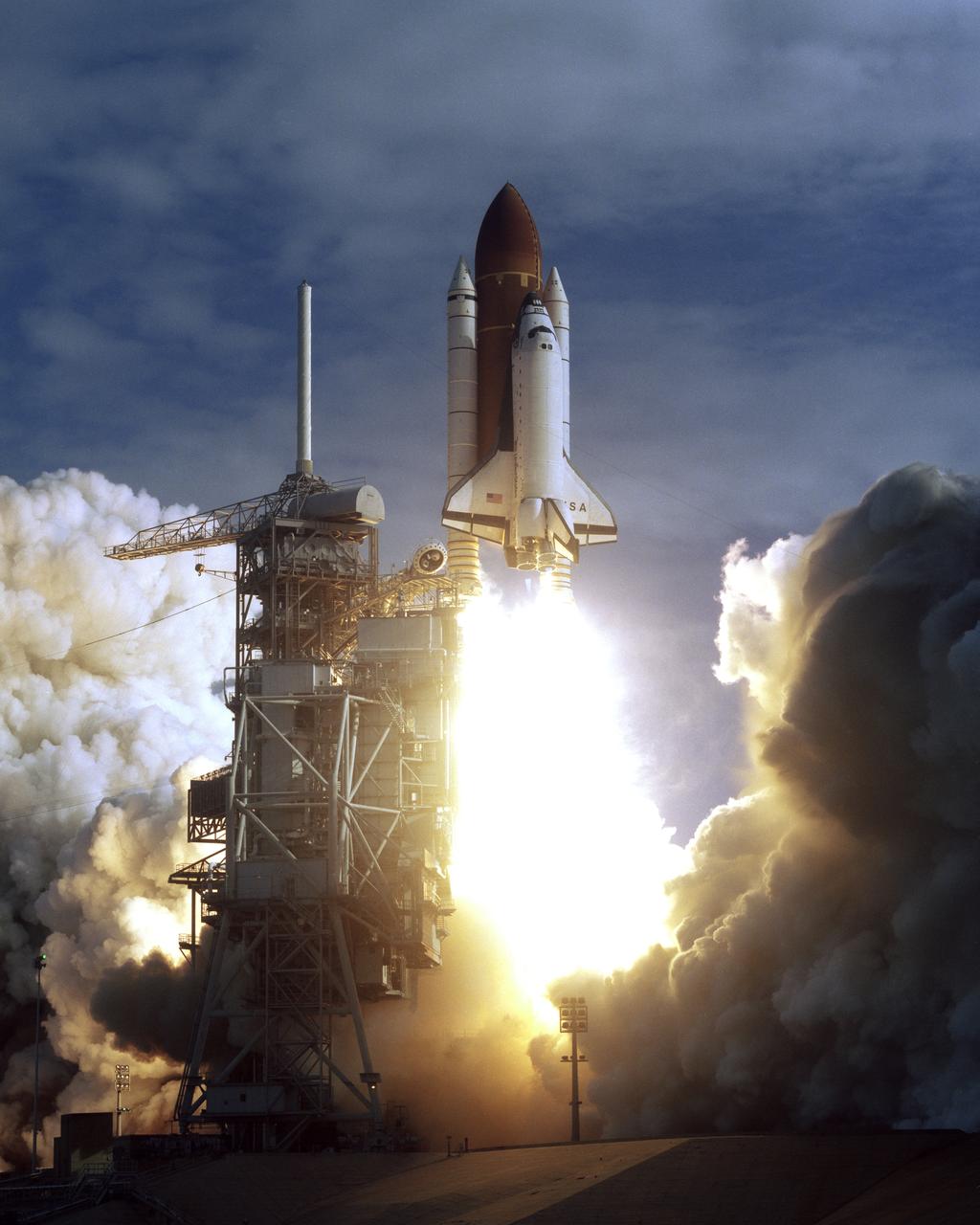
STS073-S-030 (20 Oct. 1995) --- The space shuttle Columbia lifts off from Launch Pad 39B, at the Kennedy Space Center (KSC), to begin a scheduled 16-day mission in Earth orbit in support of the United States Microgravity Laboratory (USML-2). Five NASA astronauts and two scientists from the private sector were onboard. Liftoff occurred at 9:53:00 a.m. (EDT) on Oct. 20, 1995. The mission represents the 72nd space shuttle flight for NASA. The crew will be working around the clock on a diverse assortment of USML-2 experiments located in a science module in Columbia's cargo bay. Fields of study include fluid physics, materials science, biotechnology, combustion science and commercial space processing technologies. The crew is made up of astronauts Kenneth D. Bowersox, commander; Kent V. Rominger, pilot; Kathryn C. Thornton, payload commander; Michael E. Lopez-Alegria and Catherine G. Coleman, both mission specialists; along with Fred W. Leslie and Albert Sacco Jr., payload specialists. Photo credit: NASA
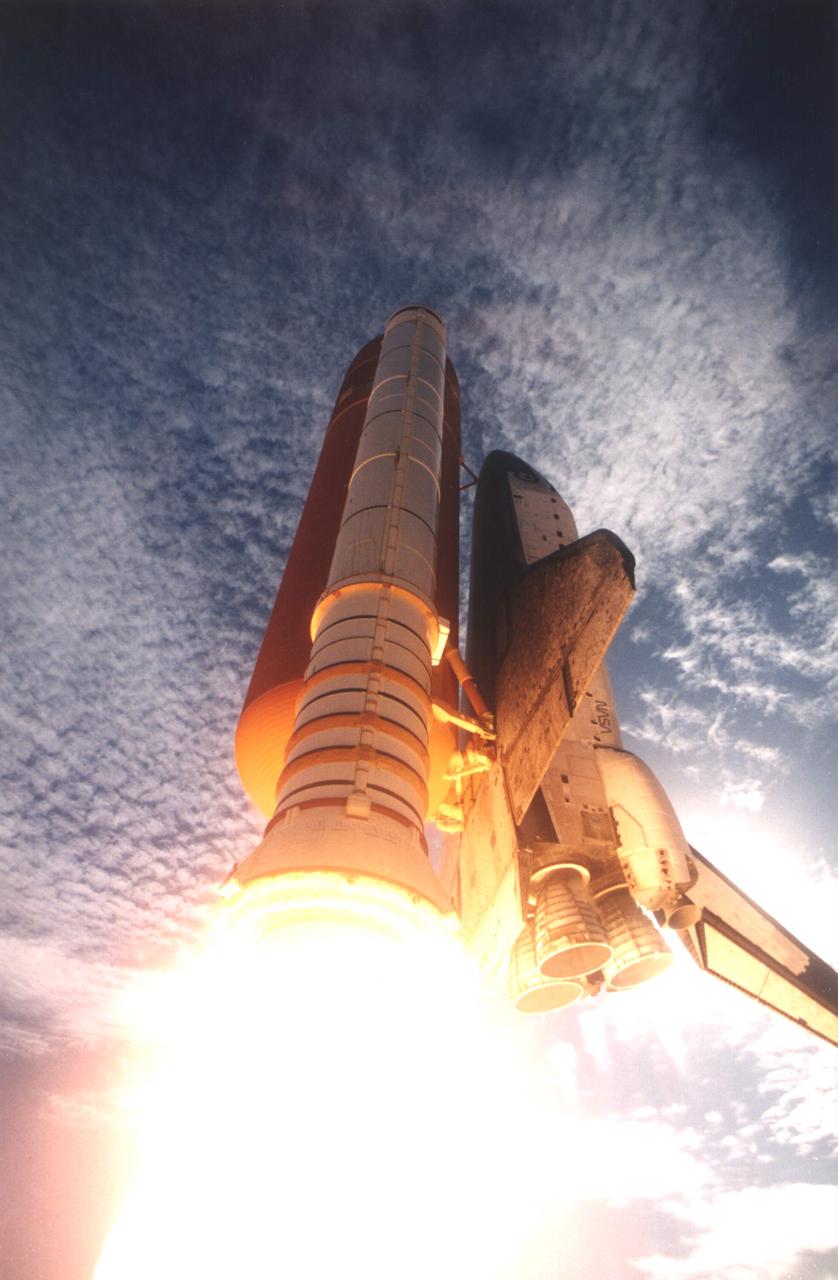
STS073-S-027 (20 October 1995) --- A 35mm camera captured this low-angle view of the Space Shuttle Columbia as it lifted off from Launch Pad 39B, at the Kennedy Space Center (KSC), to begin a scheduled 16-day mission in Earth-orbit in support of the United States Microgravity Laboratory (USML-2). Five NASA astronauts and two scientists from the private sector were onboard. Liftoff occurred at 9:53:00 a.m. (EDT) on October 20, 1995. The mission represents the 72nd Space Shuttle flight for NASA. The crew will be working around the clock on a diverse assortment of USML-2 experiments located in a science module in Columbia's cargo bay. Fields of study include fluid physics, materials science, biotechnology, combustion science and commercial space processing technologies. The crew is made up of astronauts Kenneth D. Bowersox, commander; Kent V. Rominger, pilot; Kathryn C. Thornton, payload commander; Michael E. Lopez-Alegria and Catherine G. Coleman, mission specialists; along with Fred W. Leslie and Albert Sacco Jr., payload specialists.

STS073-S-029 (20 October 1995) --- A stationary 70mm camera captured this wide view of the Space Shuttle Columbia as it lifted off from Launch Pad 39B, at the Kennedy Space Center (KSC), to begin a scheduled 16-day mission in Earth-orbit in support of the United States Microgravity Laboratory (USML-2). Five NASA astronauts and two scientists from the private sector were onboard. Liftoff occurred at 9:53:00 a.m. (EDT) on October 20, 1995. The mission represents the 72nd Space Shuttle flight for NASA. The crew will be working around the clock on a diverse assortment of USML-2 experiments located in a science module in Columbia's cargo bay. Fields of study include fluid physics, materials science, biotechnology, combustion science and commercial space processing technologies. The crew is made up of astronauts Kenneth D. Bowersox, commander; Kent V. Rominger, pilot; Kathryn C. Thornton, payload commander; Michael E. Lopez-Alegria and Catherine G. Coleman, mission specialists; along with Fred W. Leslie and Albert Sacco Jr., payload specialists.