
This image shows (part of) a 6-kilometer crater located on the northern slope of Bond Crater. Pole-facing gullies have eroded the northern slope of this small crater, located just west of where Uzboi Valles emanates from Bond and continues in a northerly direction. However, Hale Crater to the south has numerous gullies on its slopes and even on its central peak region. Researchers have analyzed both Bond and Hale Craters to try to determine why Bond has no gullies on its slopes, except for a small 7-km crater on the floor in its central area. (Reiss et al., 2009, PSS). The gullies in this observation have eroded into bedrock layers forming tributaries in the upper slope region and distributary channels further downslope on the debris fans. Research attributes these features to fluvial processes. (Gulick et al., 2018, Geol. Soc. London.) https://photojournal.jpl.nasa.gov/catalog/PIA25504
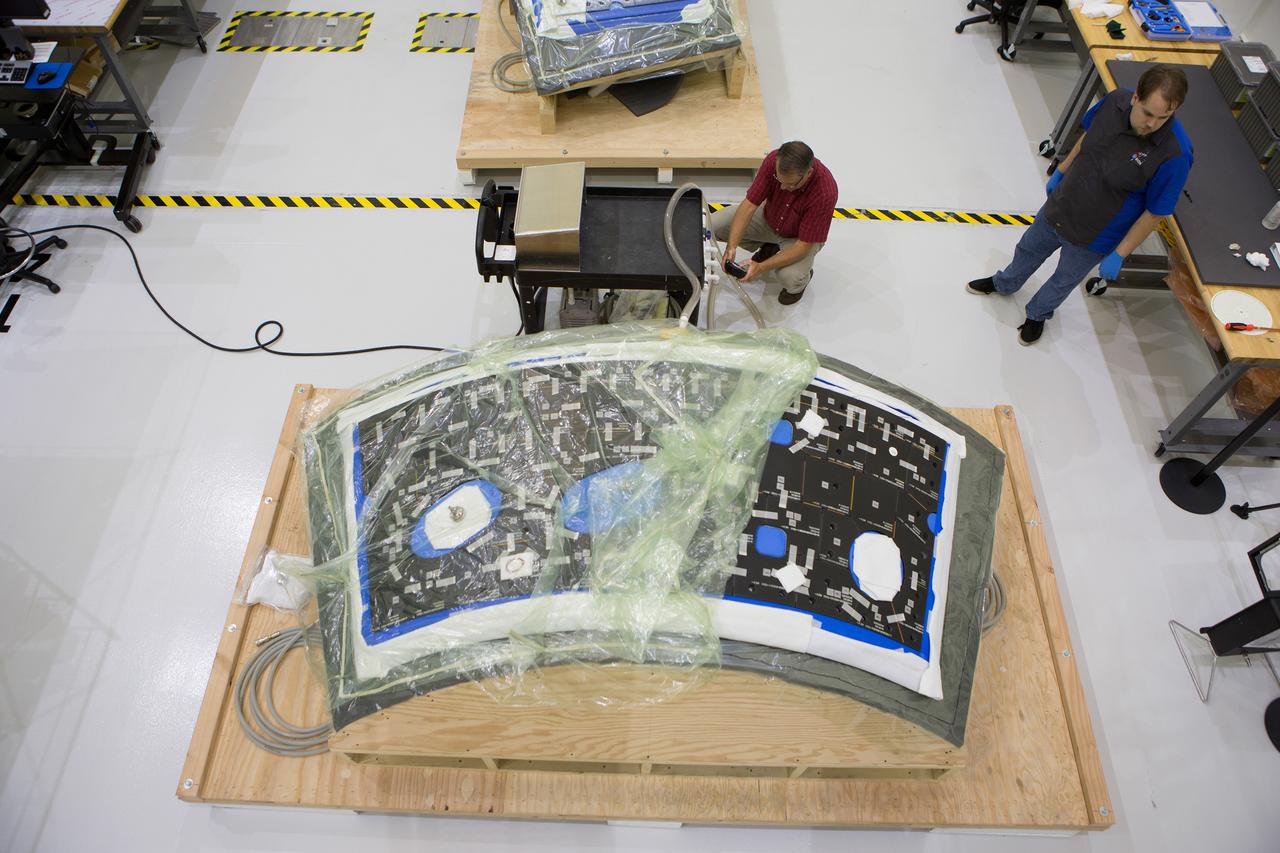
At Kennedy Space Center in Florida, technicians bond thermal protection system tiles to Orion's backshell panels on July 8, 2016...While similar to those used on the space shuttle, Orion only requires about 1,300 tiles compared to more than 24,000 on the shuttle. The tiles, along with the spacecraft’s heat shield, will protect Orion from the 5,000 degree Fahrenheit heat of re-entry.
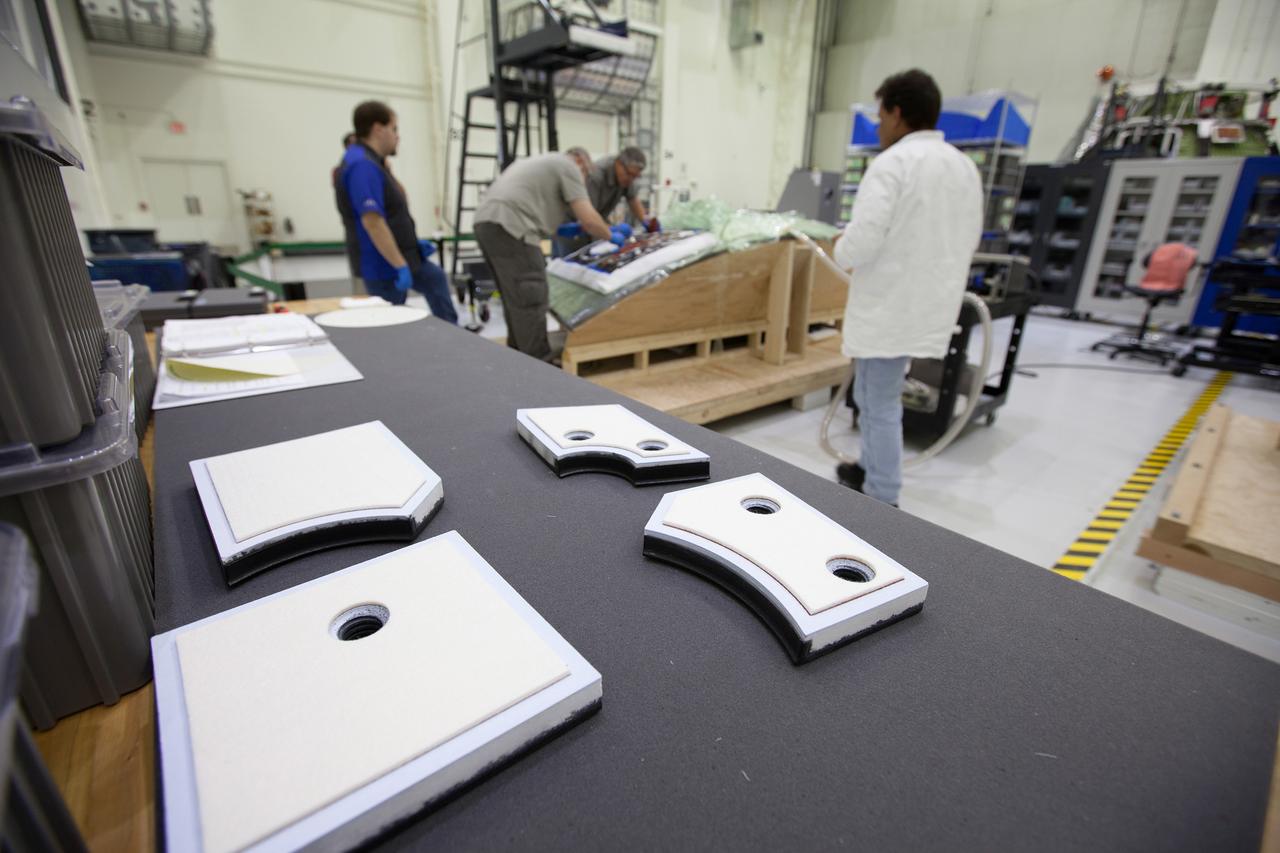
At Kennedy Space Center in Florida, technicians bond thermal protection system tiles to Orion's backshell panels on July 8, 2016...While similar to those used on the space shuttle, Orion only requires about 1,300 tiles compared to more than 24,000 on the shuttle. The tiles, along with the spacecraft’s heat shield, will protect Orion from the 5,000 degree Fahrenheit heat of re-entry.
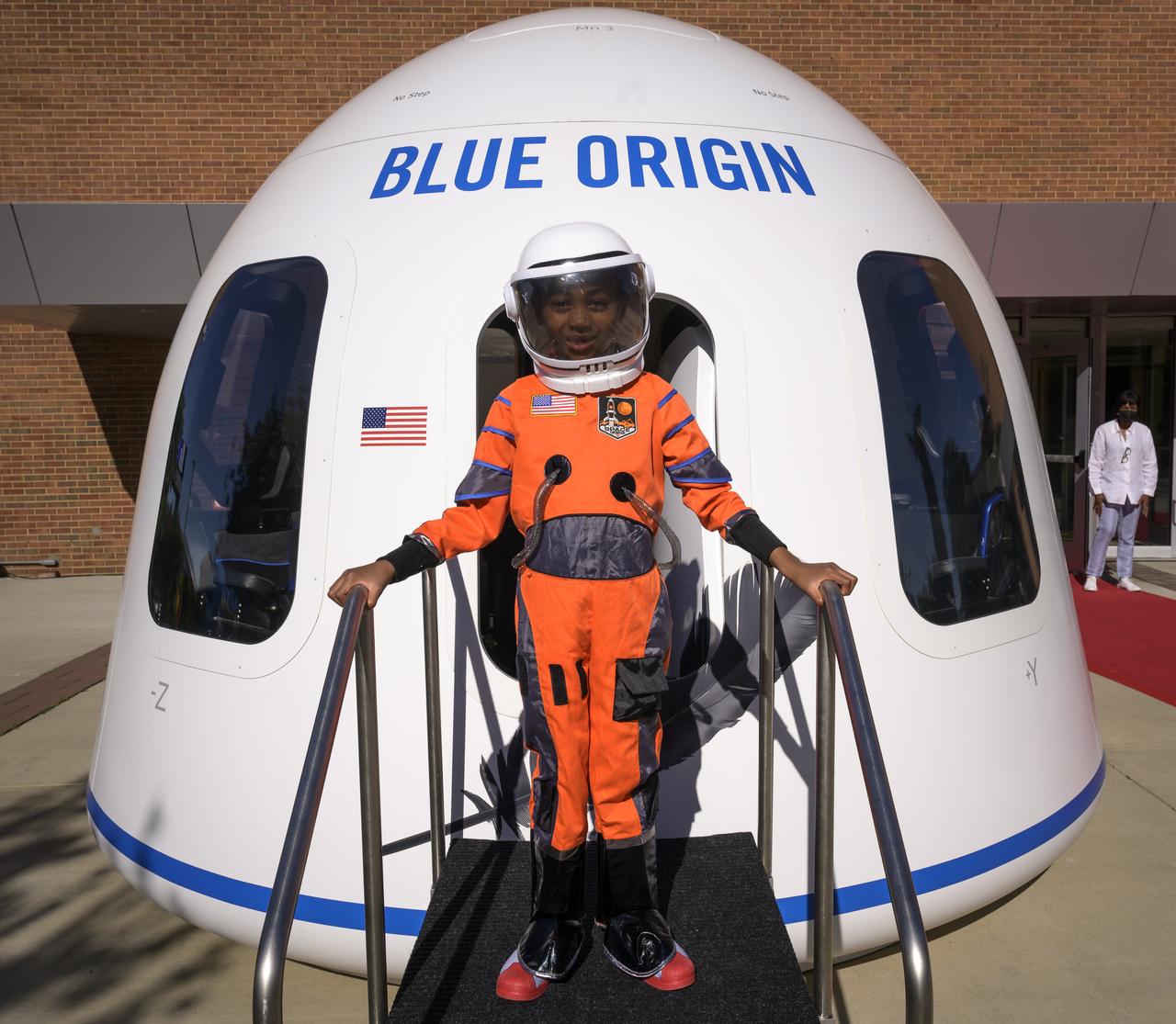
6-year old Armani Bonds poses for a photograph as he exits a Blue Origin New Shepard capsule mockup prior to the screening of the NASA produced documentary “The Color of Space” at Howard University’s Cramton Auditorium in Washington, Saturday, June 18, 2022. Premiering on Juneteenth, the federal holiday commemorating the end of slavery in the United States, “The Color of Space” is an inspirational documentary that tells the stories of NASA’s Black astronauts determined to reach the stars. Photo Credit: (NASA/Bill Ingalls)
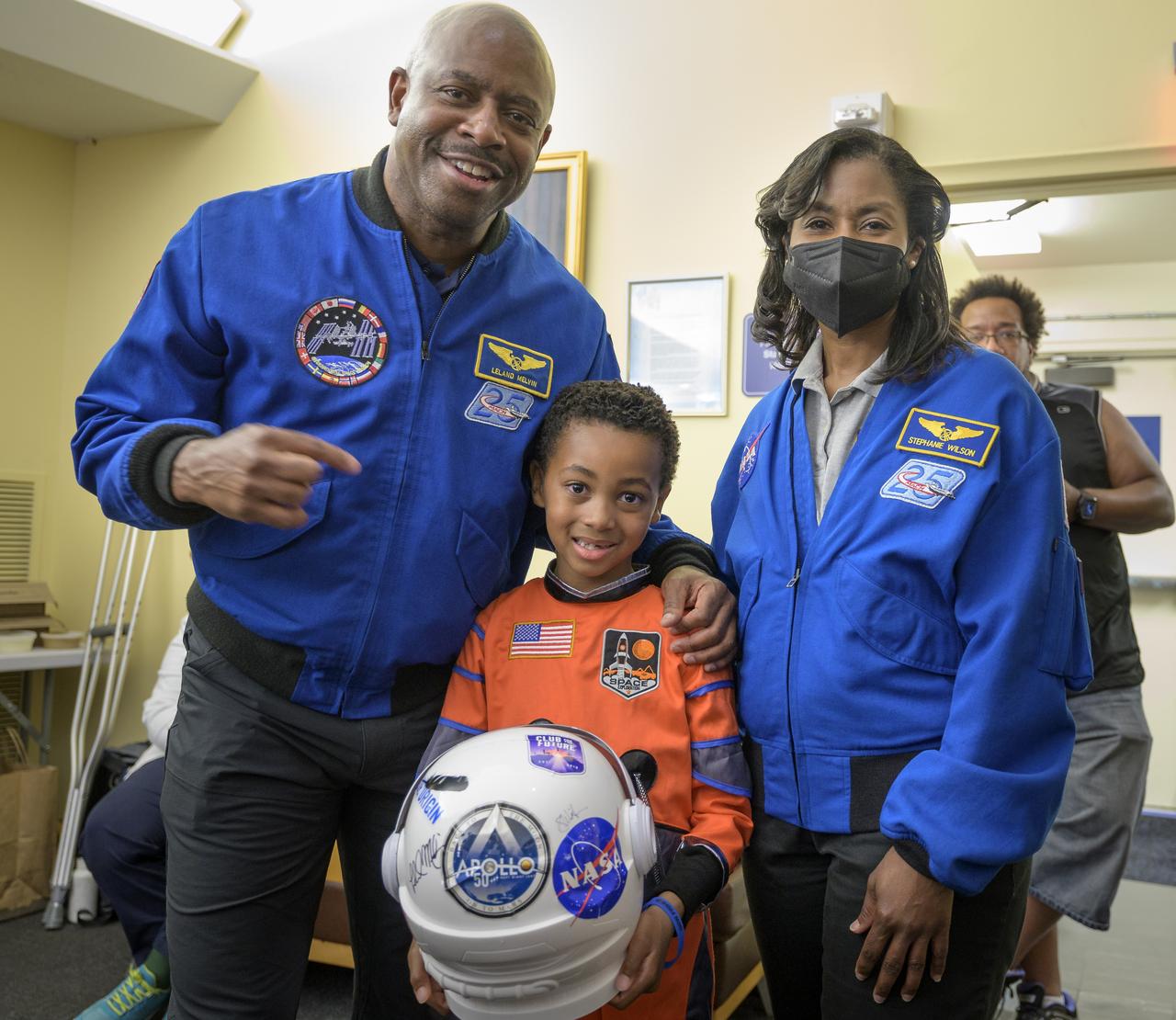
Former NASA astronaut Leland Melvin, left, and NASA astronaut Stephanie Wilson, pose for photograph with 6-year old Armani Bonds prior to the screening of the NASA produced documentary “The Color of Space” at Howard University’s Cramton Auditorium in Washington, Saturday, June 18, 2022. Premiering on Juneteenth, the federal holiday commemorating the end of slavery in the United States, “The Color of Space” is an inspirational documentary that tells the stories of NASA’s Black astronauts determined to reach the stars. Photo Credit: (NASA/Bill Ingalls)
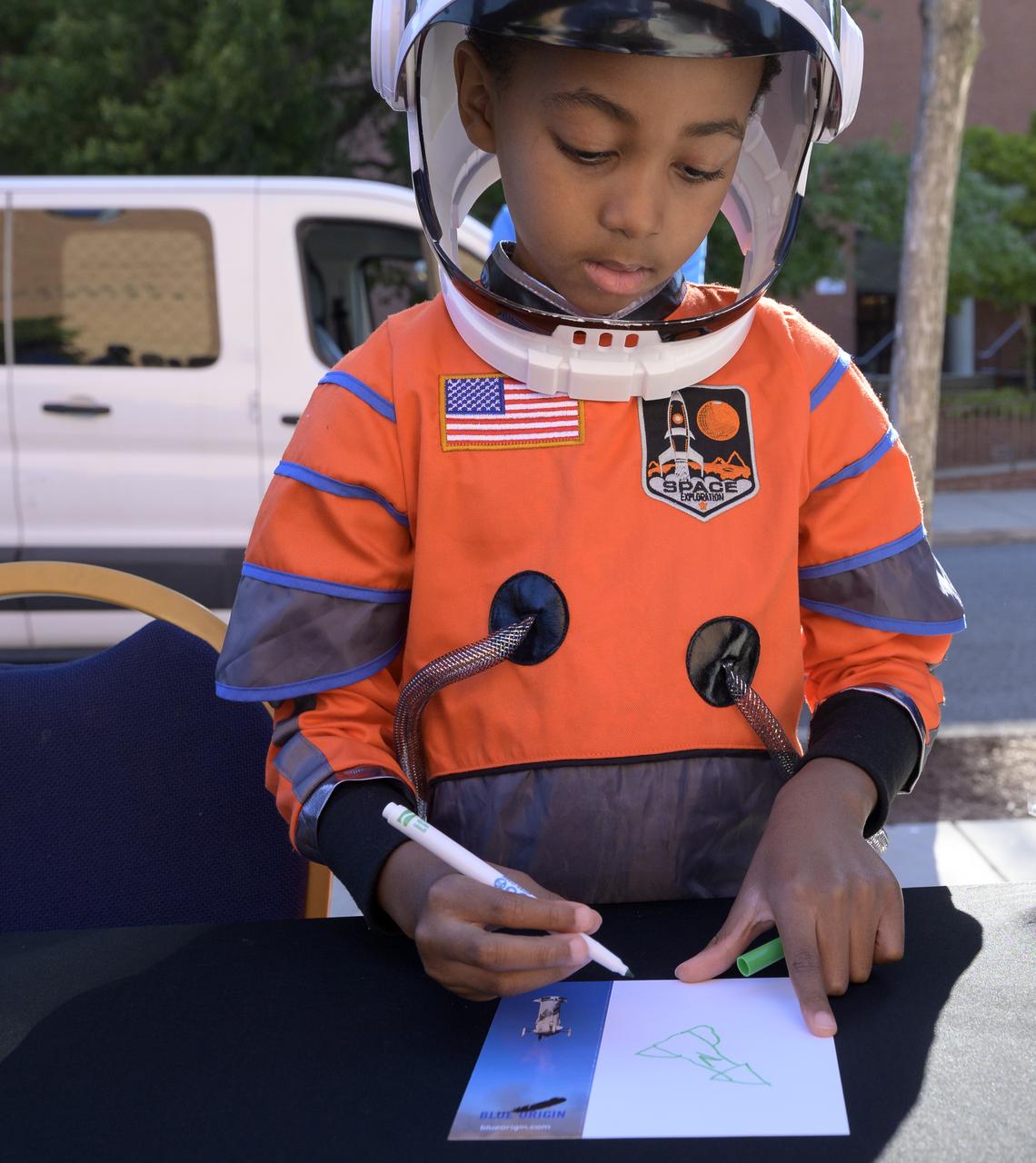
6-year old Armani Bonds draws on a postcard that will be sent to space by Club for the Future on a Blue Origin New Shepard rocket prior to he and his family screening the NASA produced documentary “The Color of Space” at Howard University’s Cramton Auditorium in Washington, Saturday, June 18, 2022. Premiering on Juneteenth, the federal holiday commemorating the end of slavery in the United States, “The Color of Space” is an inspirational documentary that tells the stories of NASA’s Black astronauts determined to reach the stars. Photo Credit: (NASA/Bill Ingalls)
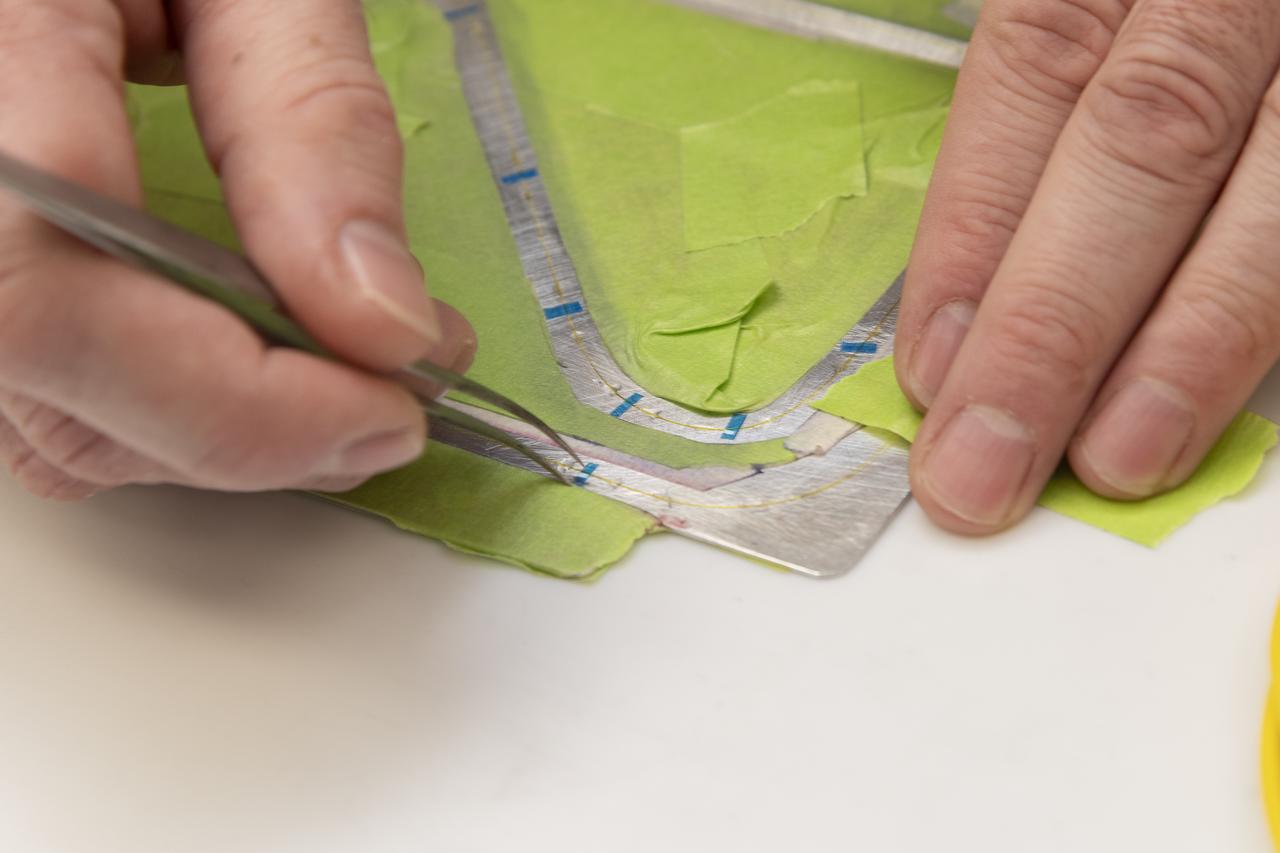
Engineering technician Jeff Howell removes thin pieces of tape from fiber used for a bonding process on the Mock Truss-Braced Wing 10-foot model at NASA’s Armstrong Flight Research Center in Edwards, California.
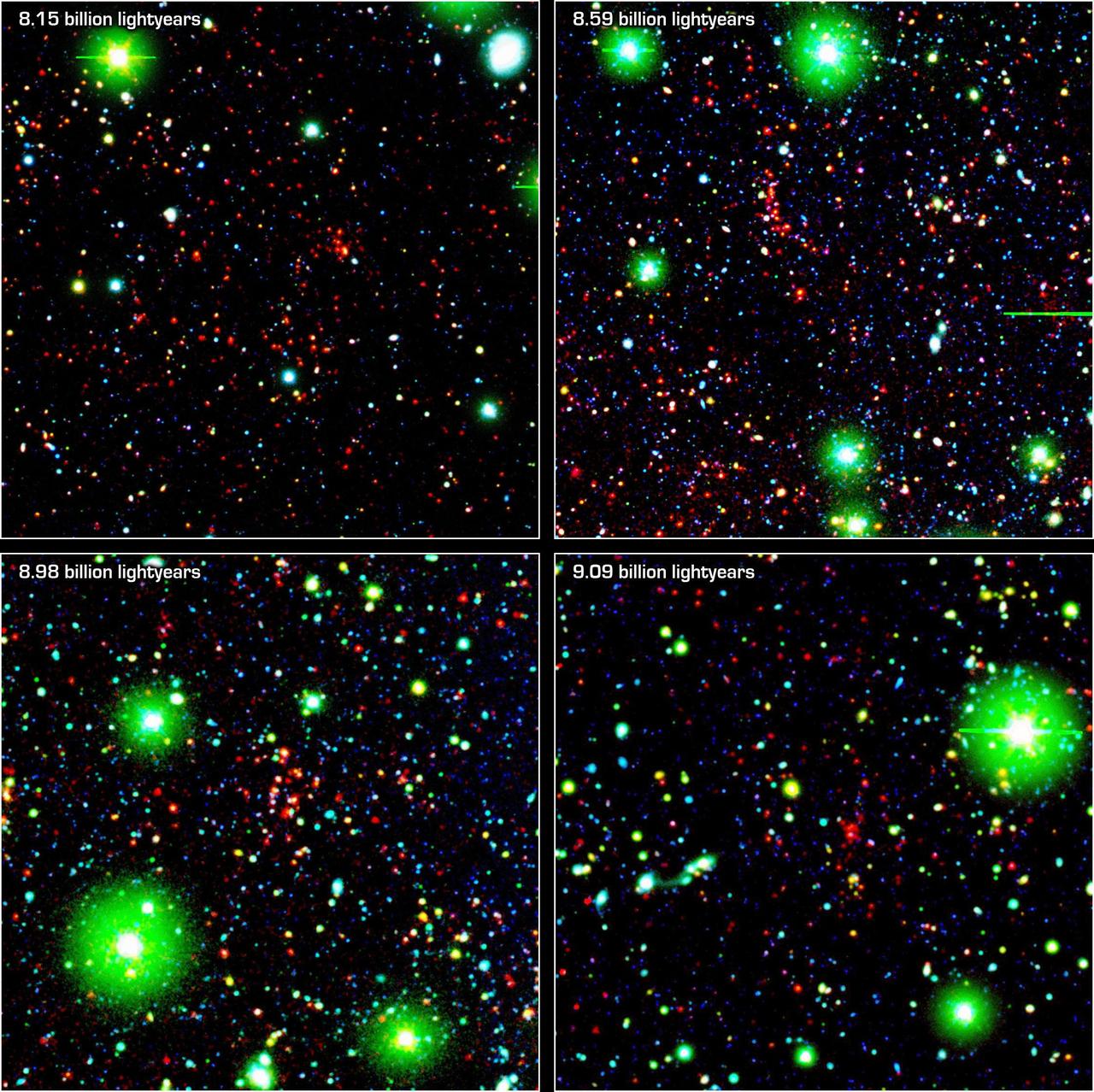
Like great friends, galaxies stick together. Astronomers using NASA Spitzer Space Telescope have spotted a handful of great galactic pals bonding back when the universe was a mere 4.6 billion years old.
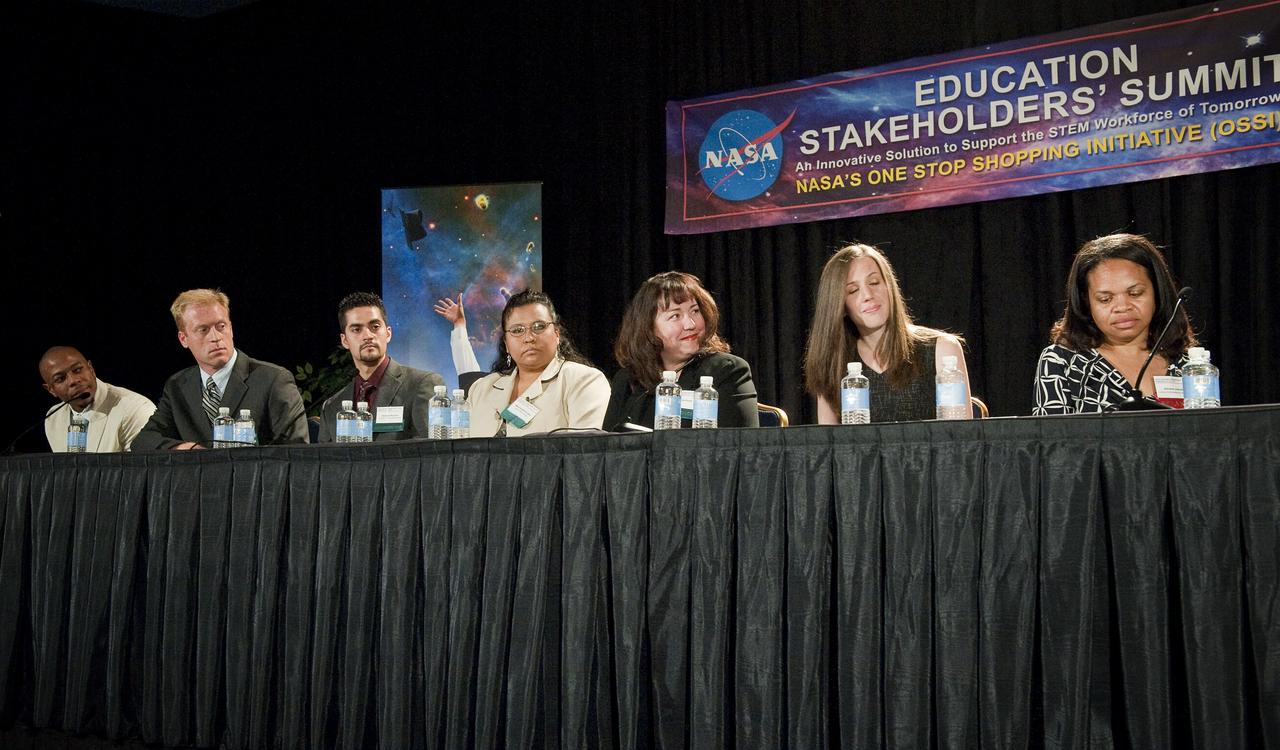
NASA Student Ambassadors and Facilitator are seen on a panel at the NASA Education Stakeholders’ Summit One Stop Shopping Initiative (OSSI), Monday, Sep. 13, 2010, at the Westfields Marriott Conference Center in Chantilly, VA. From left to right are: Quenton Bonds, University of South Florida; Geoffrey Wawrzyniak, Purdue University; Heriberto Reynoso, University of Texas at Brownsville; Marie Kingbird-Lowry, Leech Lake Tribal College; Kareen Borders, University of Washington; Katelyn Doran, University of North Carolina at Charlotte and Ashanti Johnson, PhD, Executive Director, Institute for Broadening Participation. (Photo Credit: NASA/Carla Cioffi)
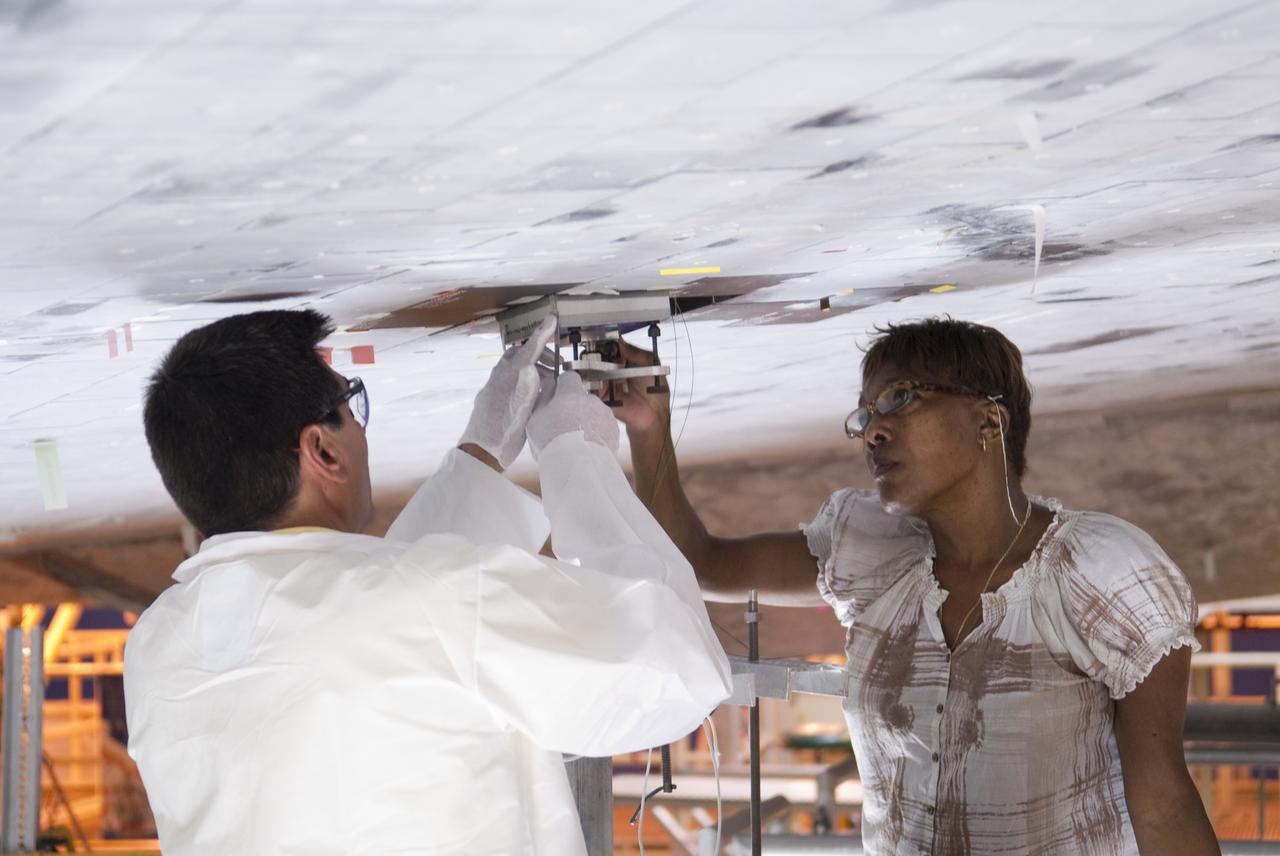
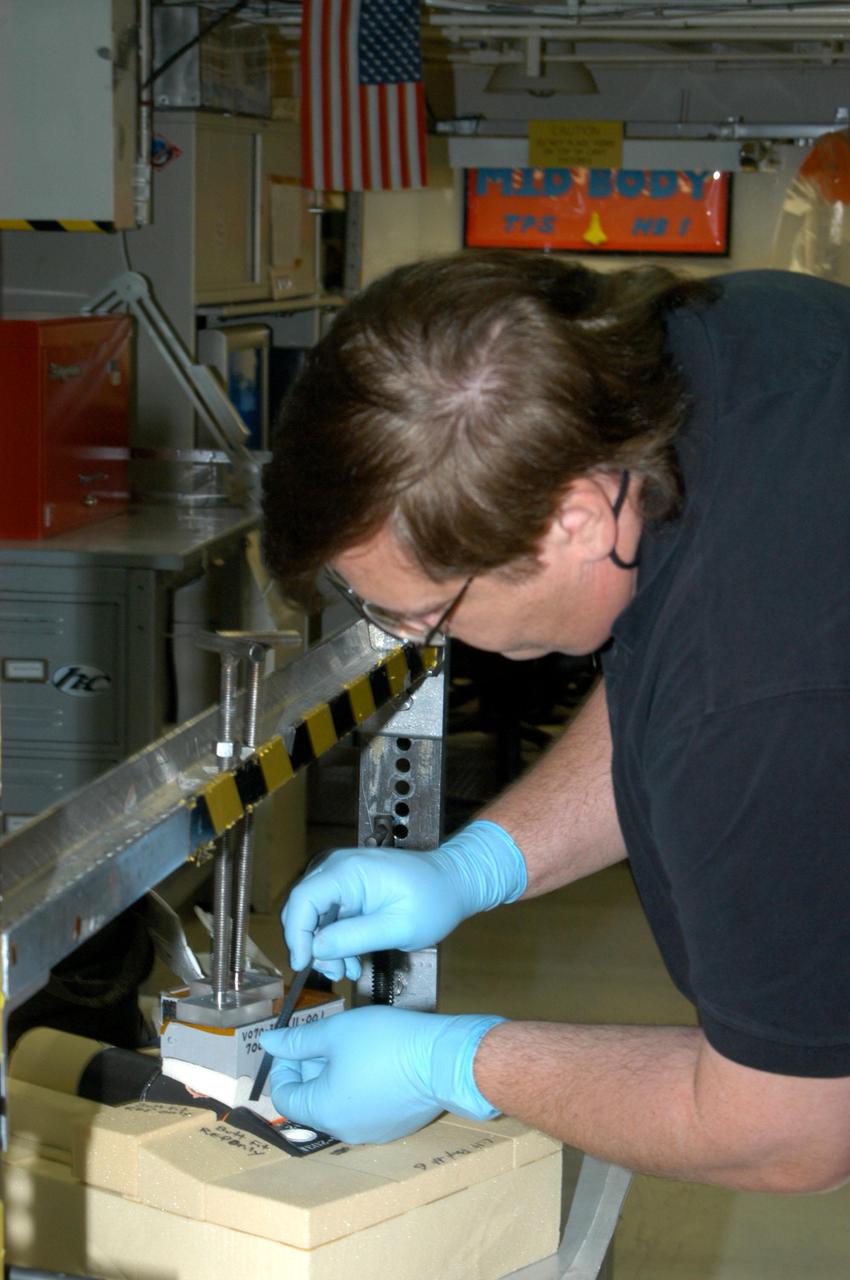
STS-133 DISCOVERY BOUNDARY LAYER TRANSITION TILE BONDING
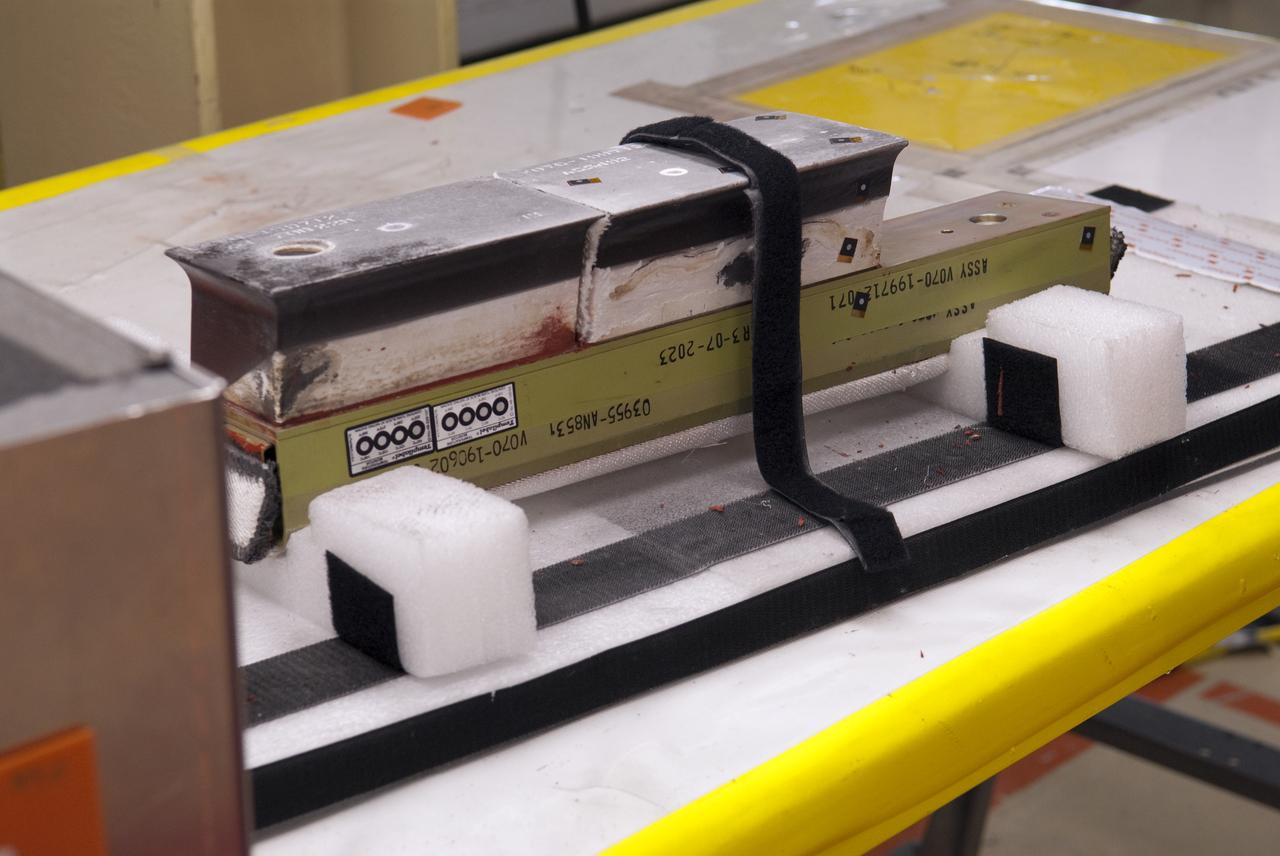
STS-133 DISCOVERY BOUNDARY LAYER TRANSITION TILE BONDING
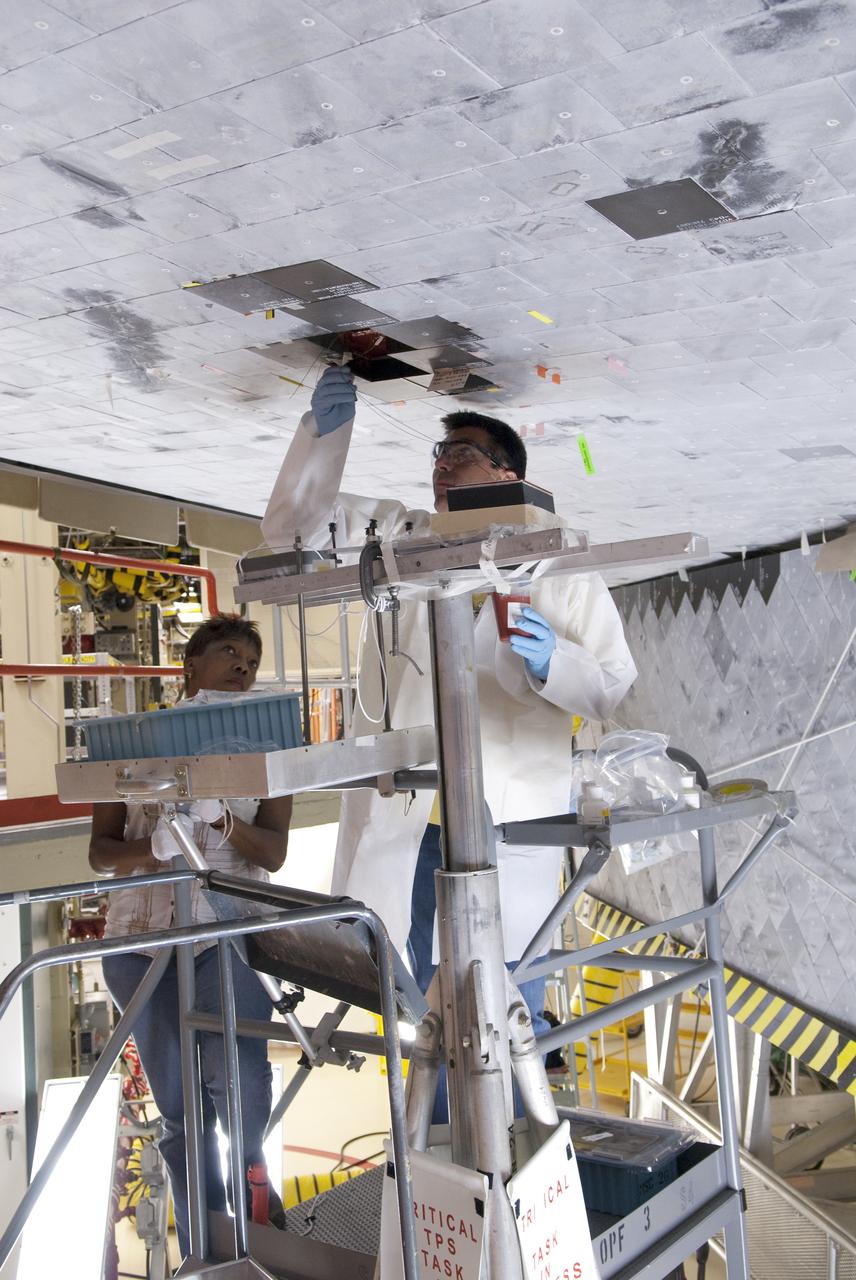
STS-133 DISCOVERY BOUNDARY LAYER TRANSITION TILE BONDING
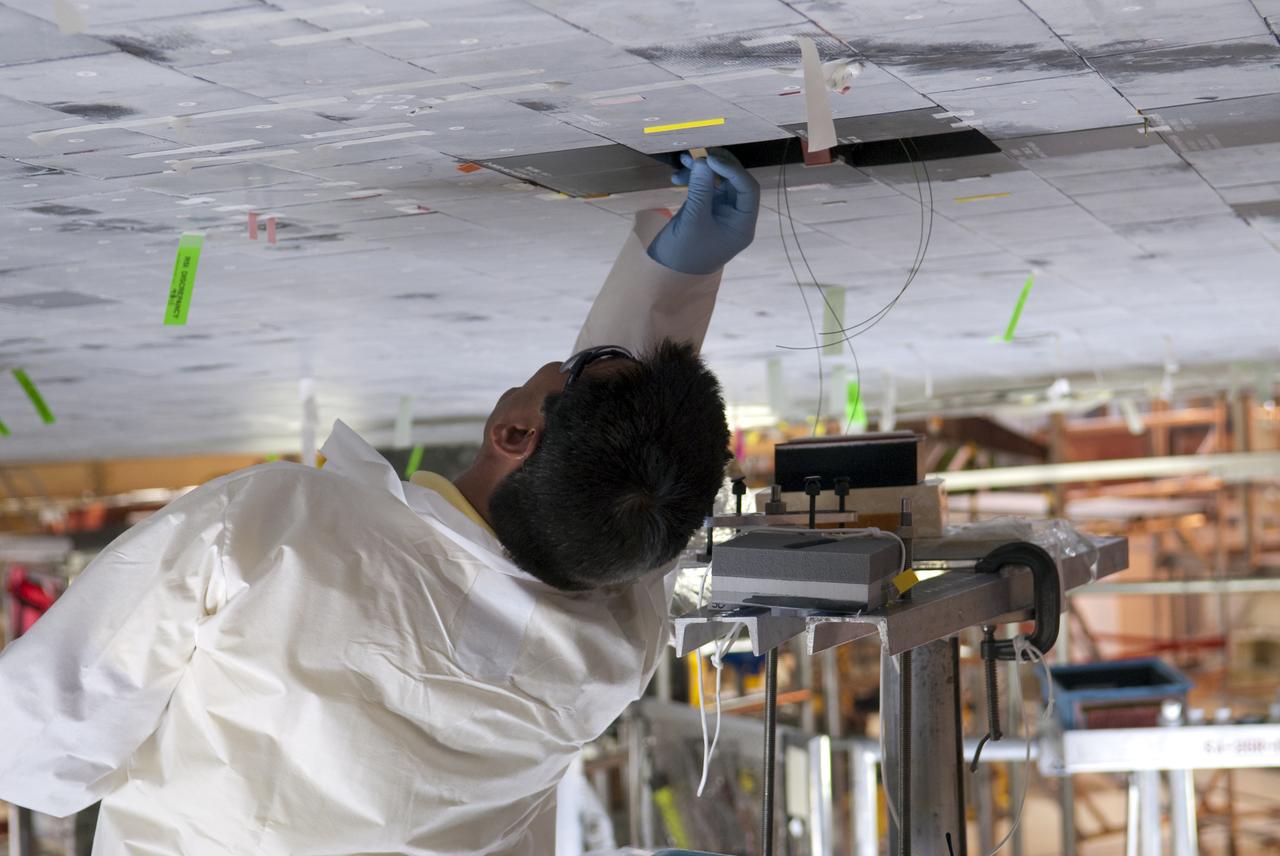
STS-133 DISCOVERY BOUNDARY LAYER TRANSITION TILE BONDING
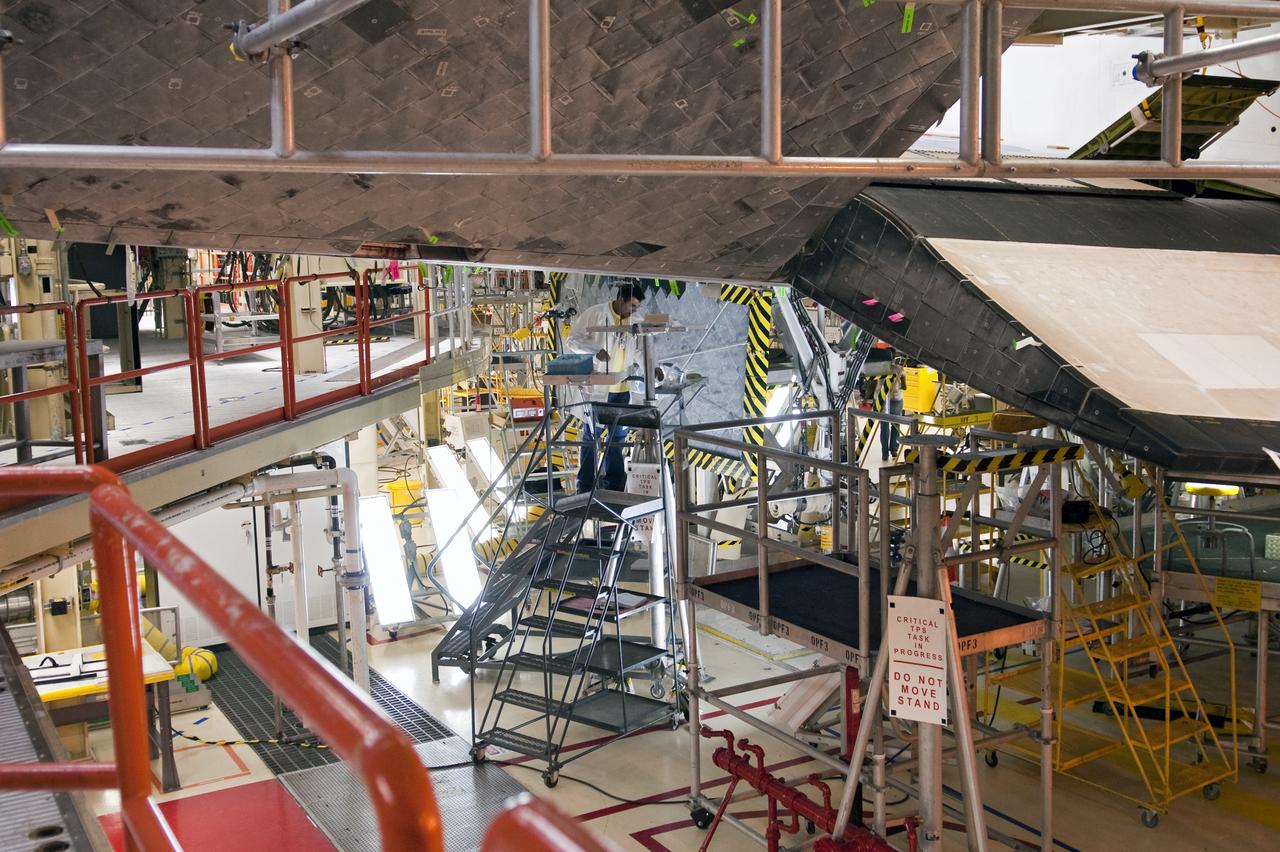
STS-133 DISCOVERY BOUNDARY LAYER TRANSITION TILE BONDING
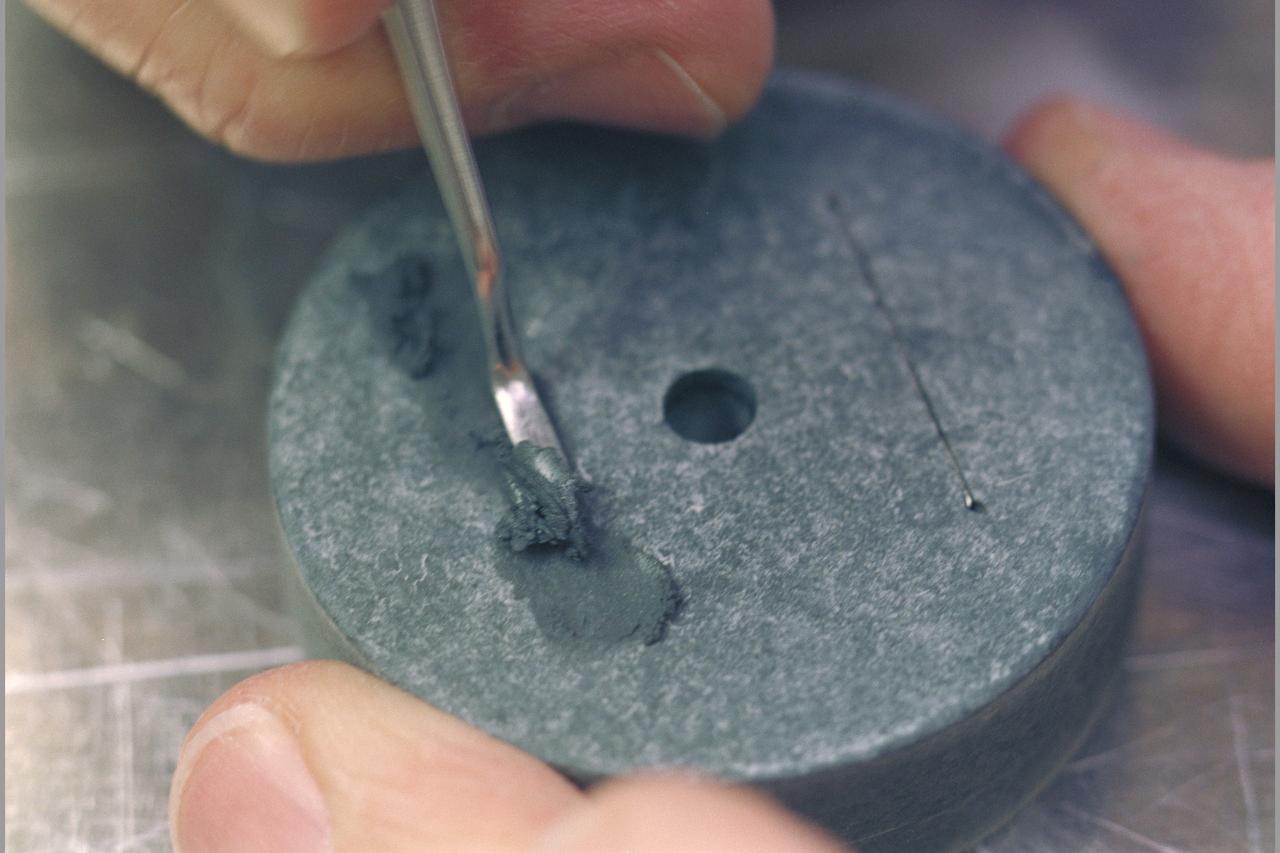
X-33 (Leeward) Aeroshell flight test instrumentation bond verification procedure (shop)
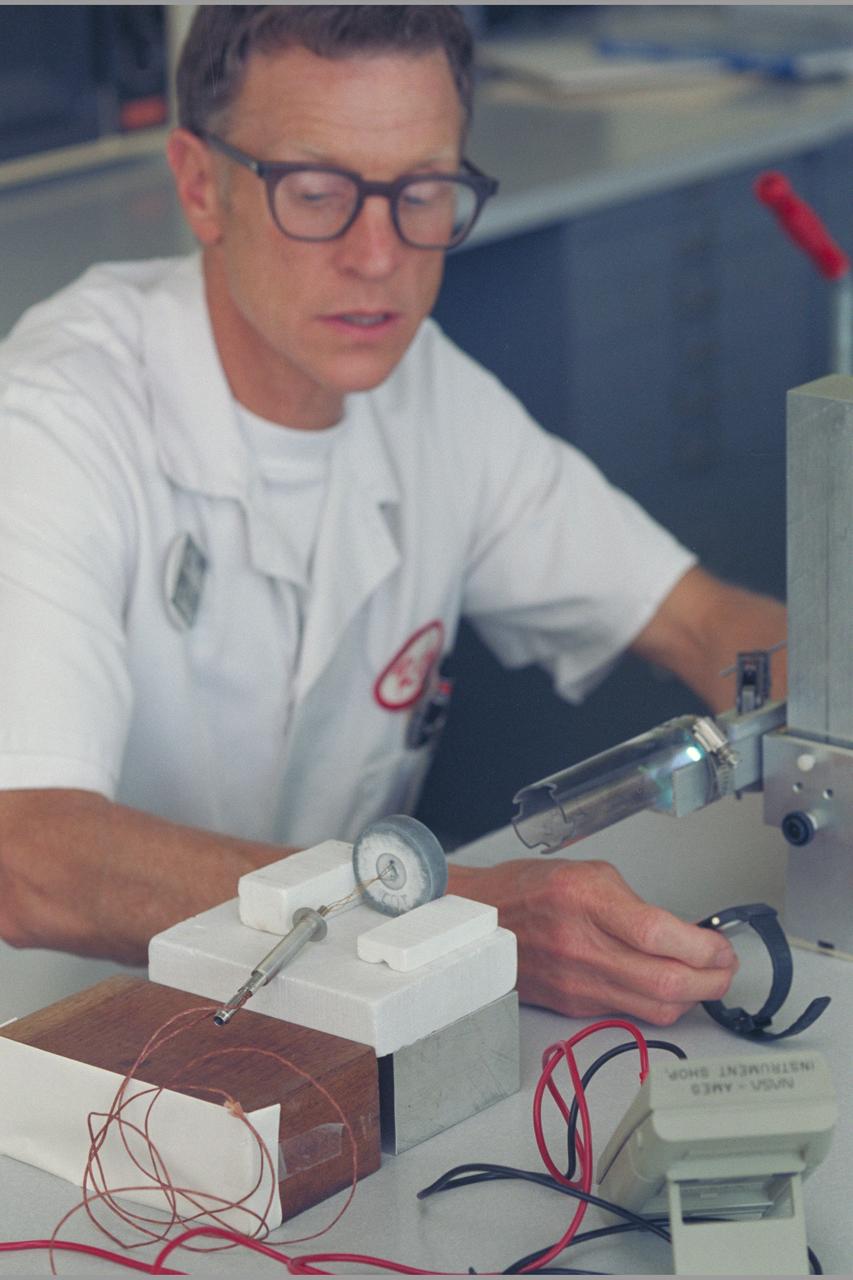
X-33 (Leeward) Aeroshell flight test instrumentation bond verification procedure (shop)
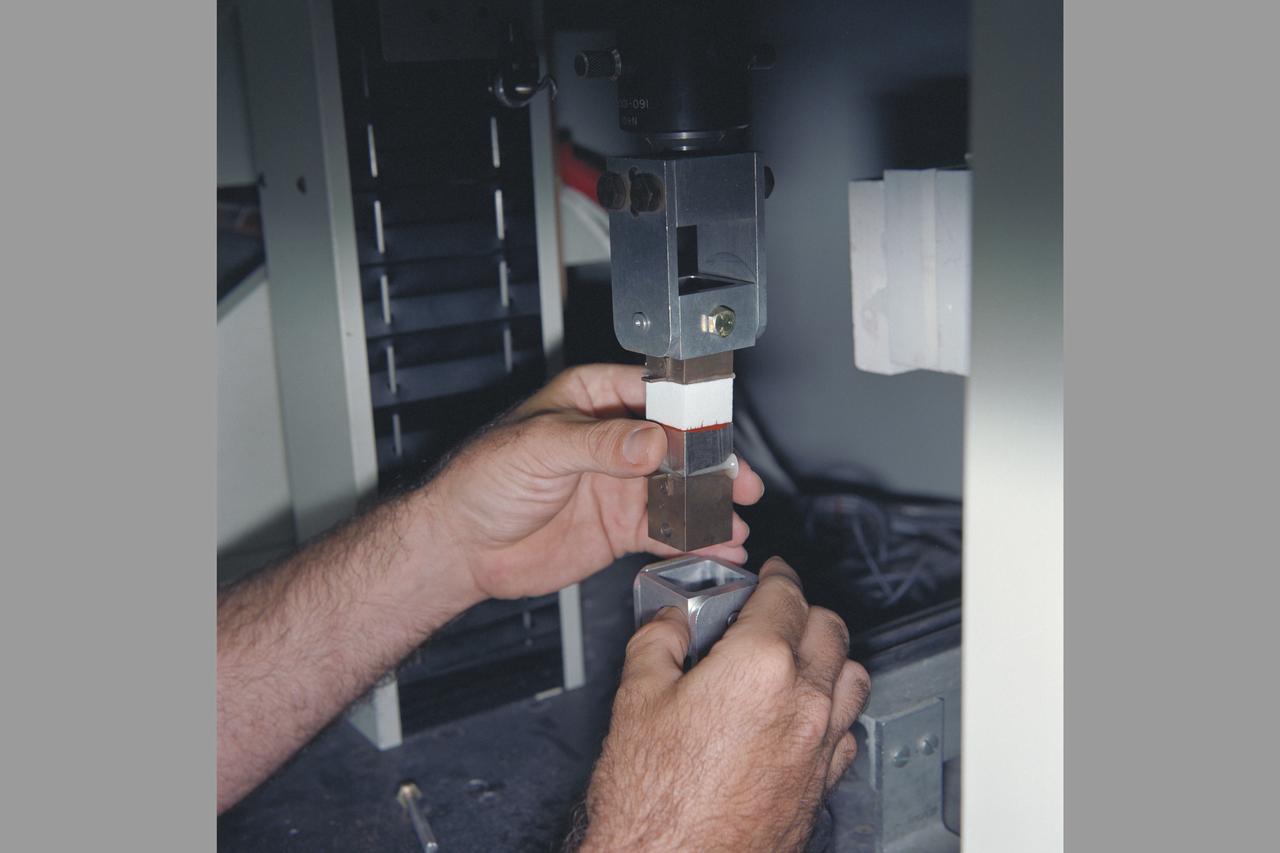
X-33 (Leeward) Aeroshell flight test instrumentation bond verification procedure (shop)
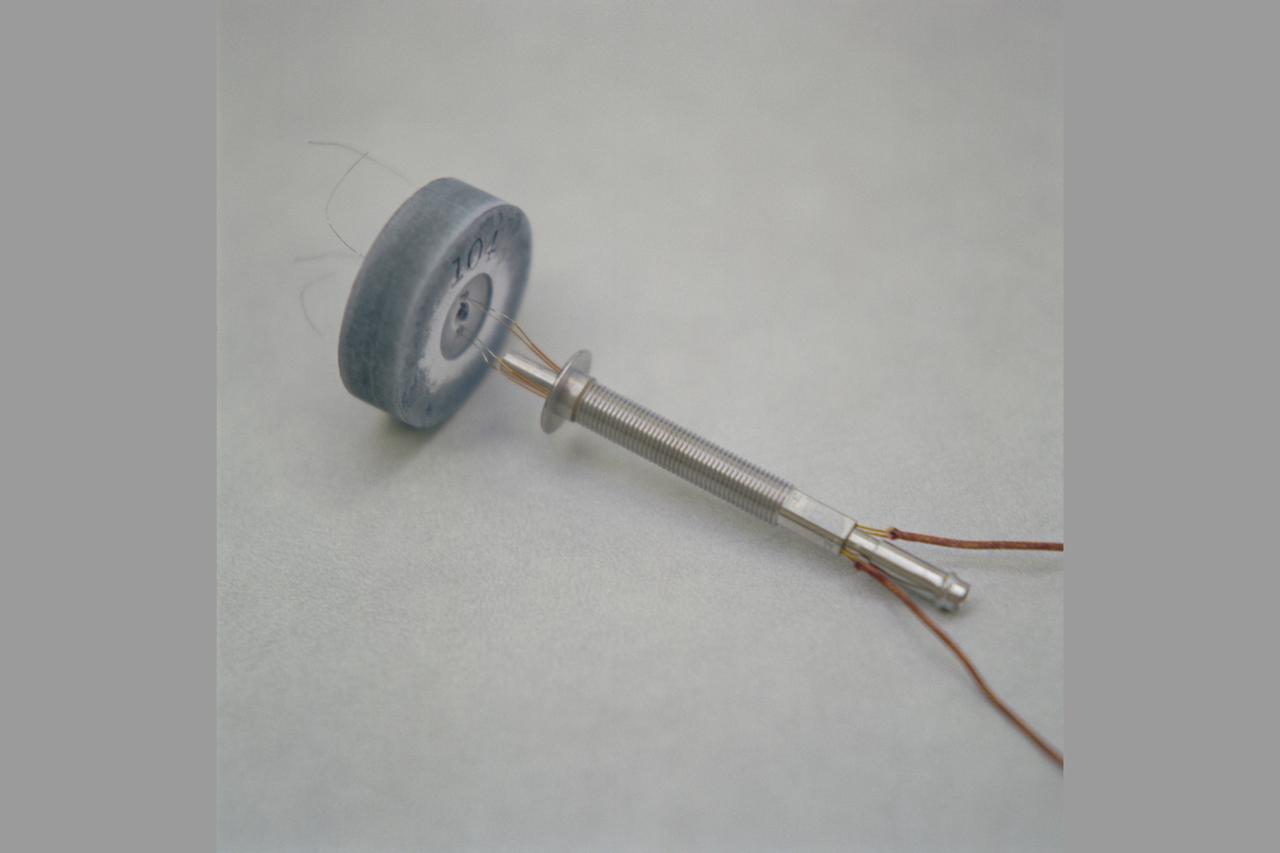
X-33 (Leeward) Aeroshell flight test instrumentation bond verification procedure (shop)
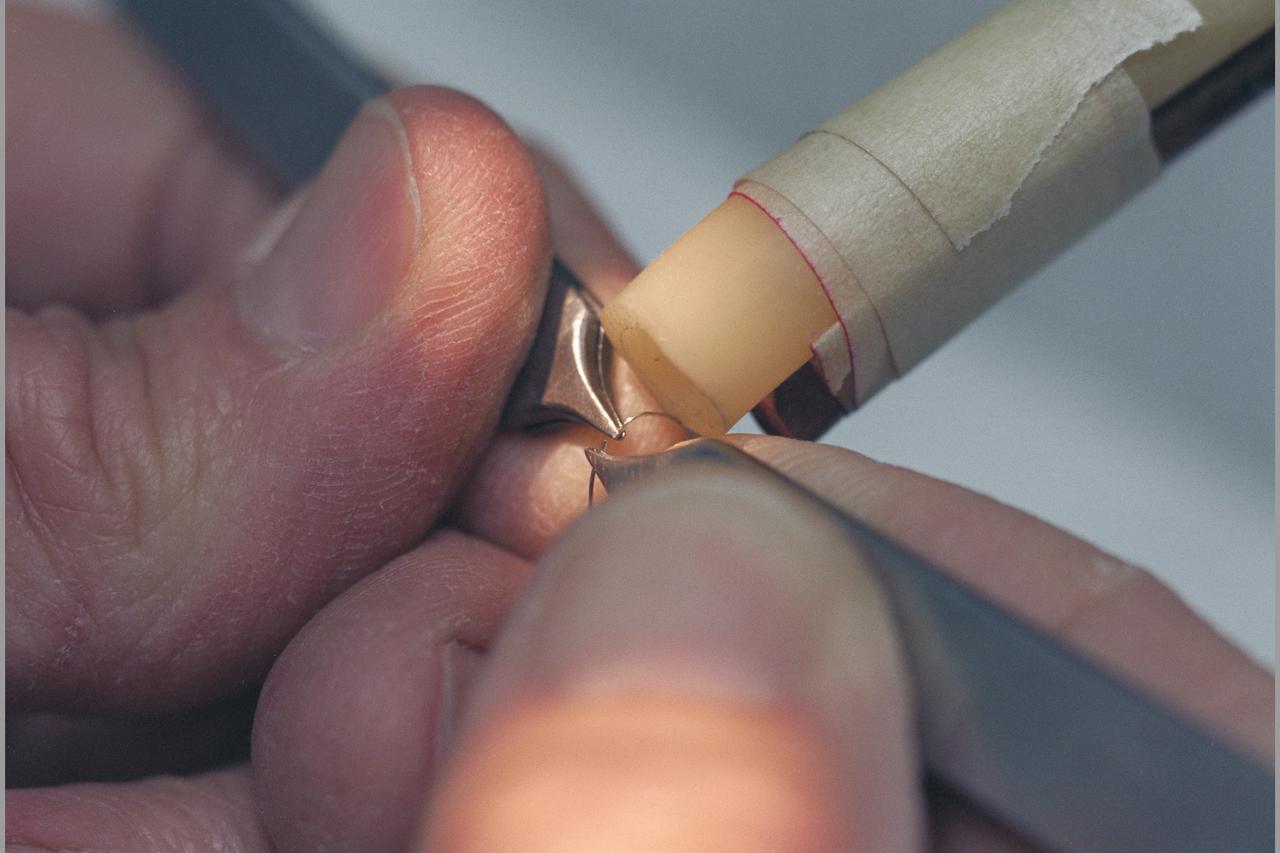
X-33 (Leeward) Aeroshell flight test instrumentation bond verification procedure (shop)
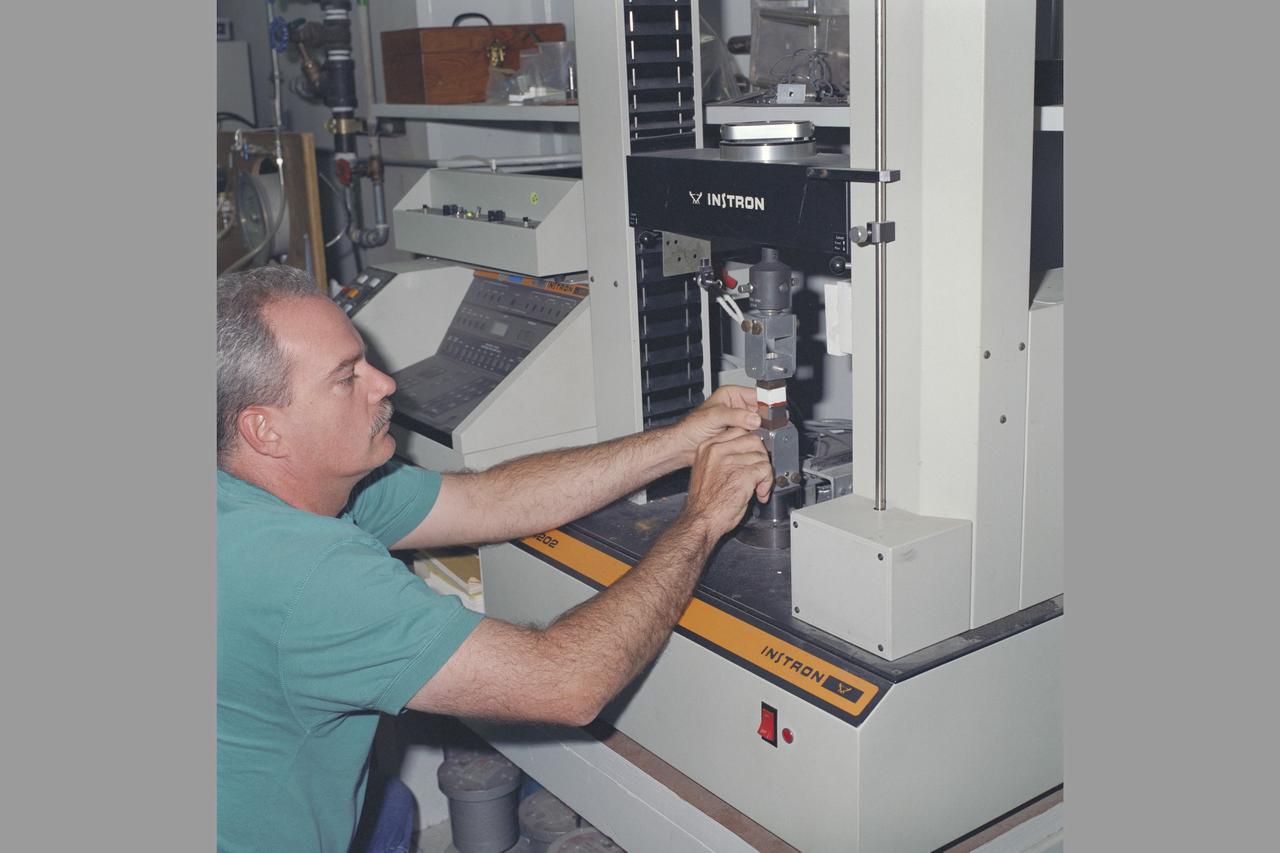
X-33 (Leeward) Aeroshell flight test instrumentation bond verification procedure (shop) with Richard Piquette
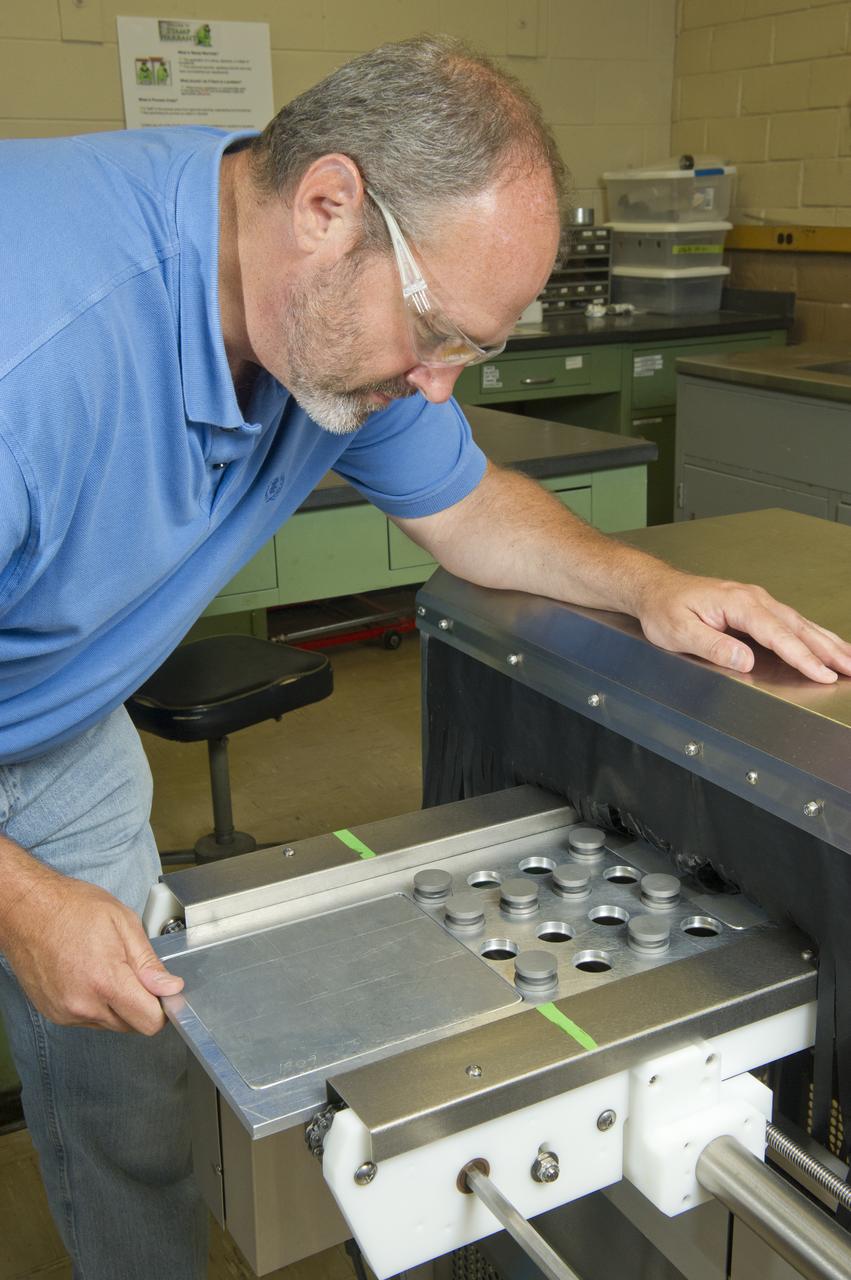
MARK MITCHELL WITH SOROTEK SYSTEM SUPPORTS LOW LEVEL CONTAMINATION APPLICATION FOR BOND SENSITIVITY TESTING.
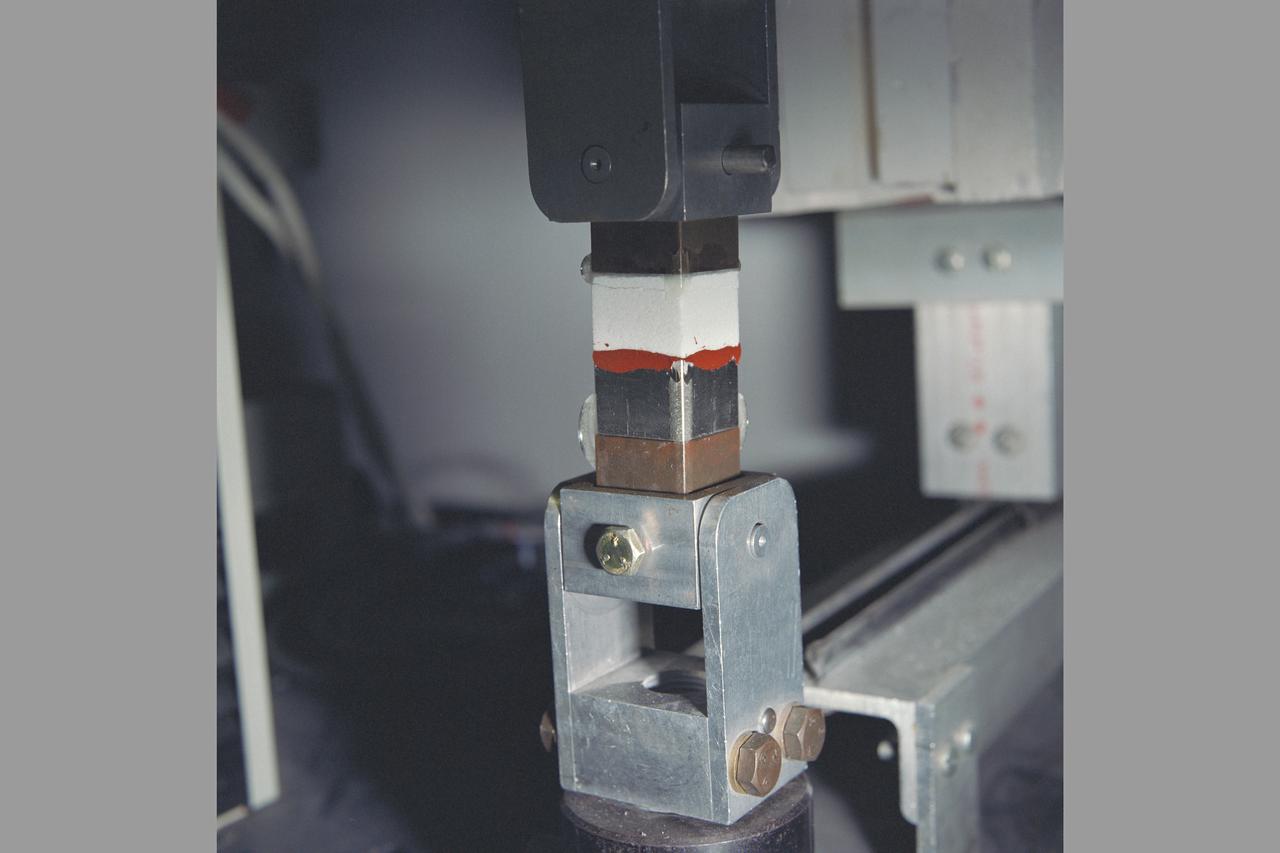
X-33 (Leeward) Aeroshell flight test instrumentation bond verification procedure (shop)
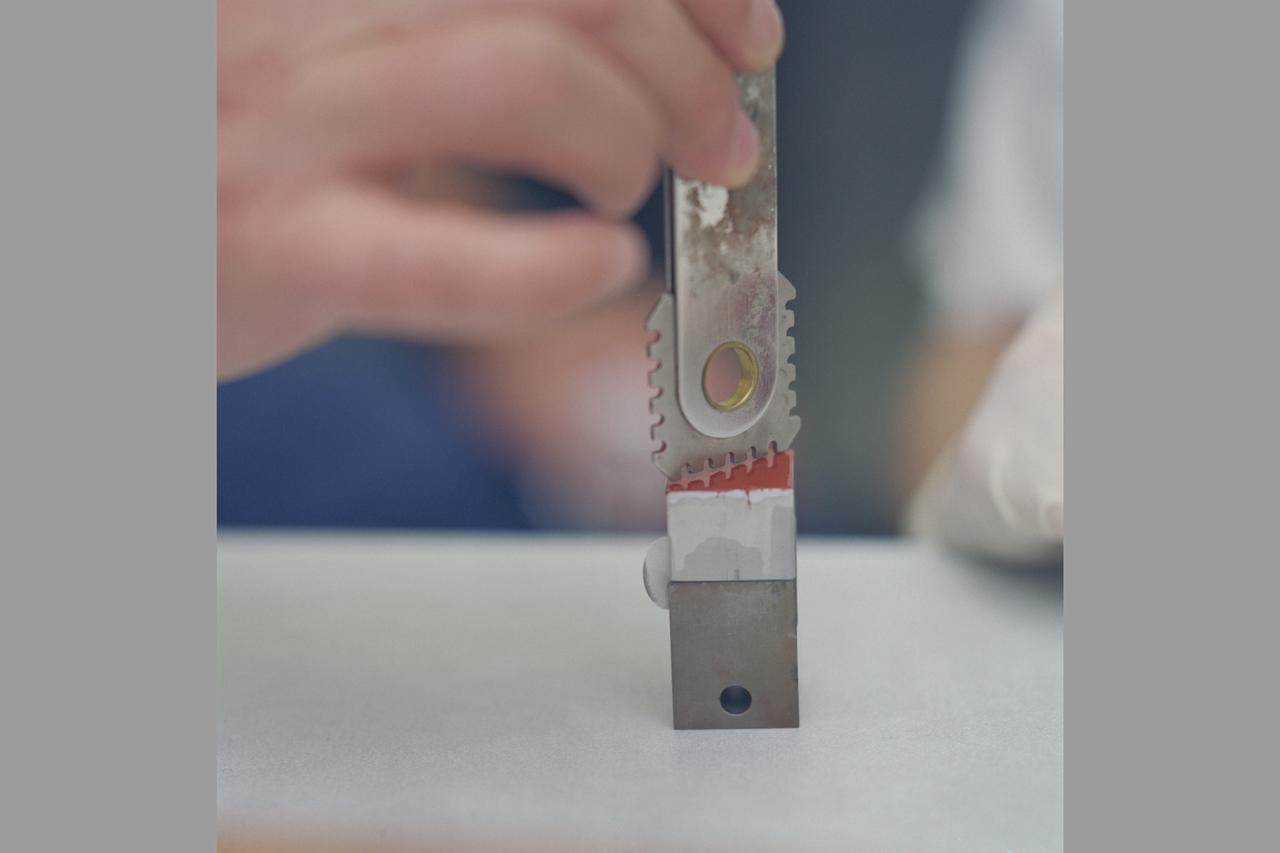
X-33 (Leeward) Aeroshell flight test instrumentation bond verification procedure (shop)
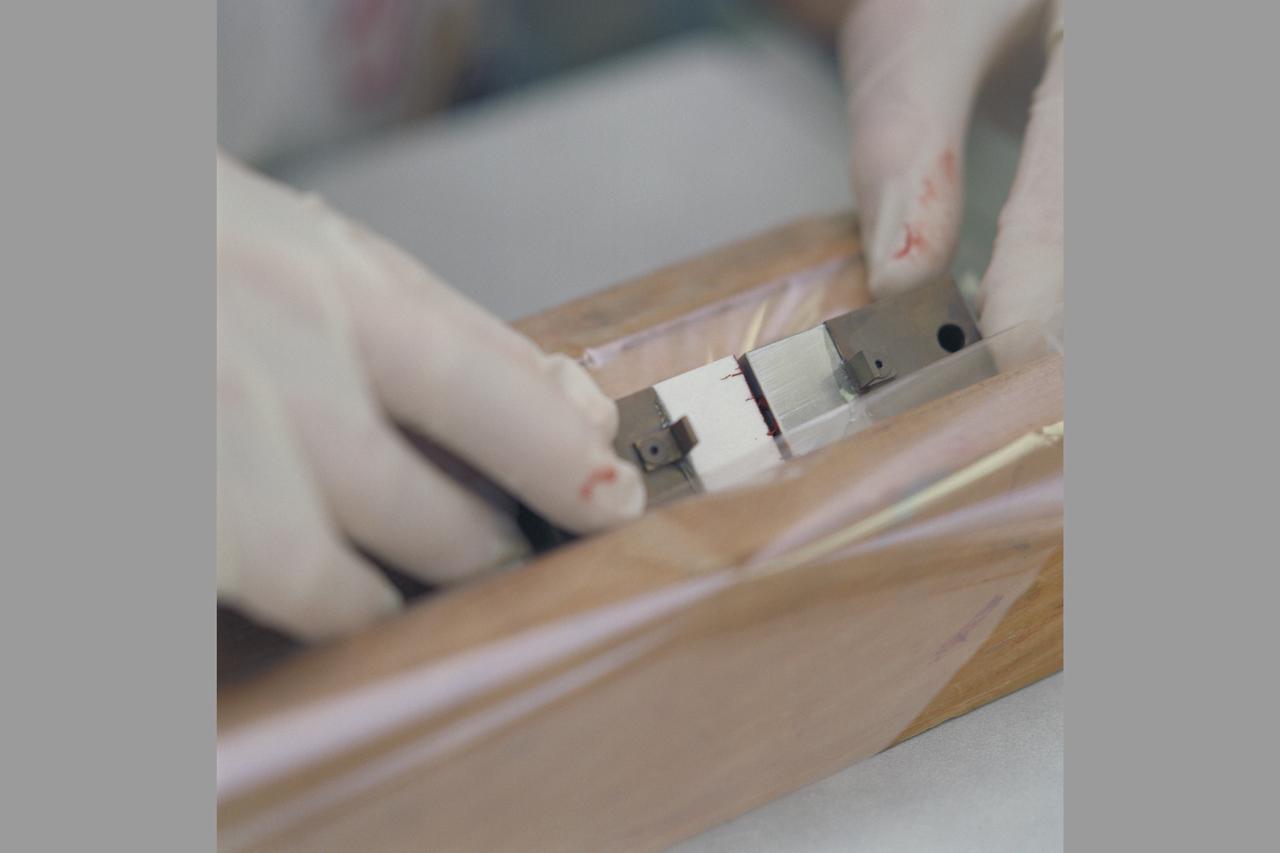
X-33 (Leeward) Aeroshell flight test instrumentation bond verification procedure (shop)
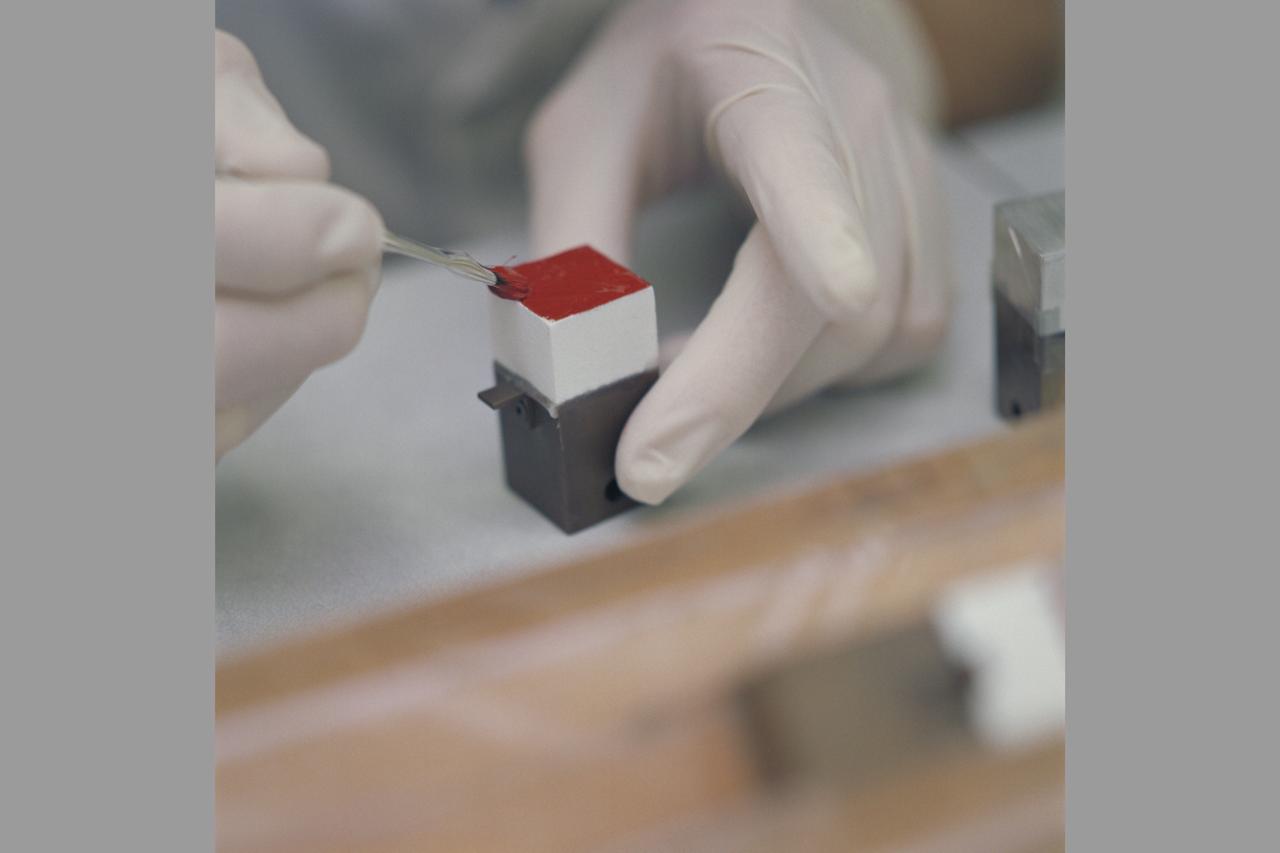
X-33 (Leeward) Aeroshell flight test instrumentation bond verification procedure (shop)
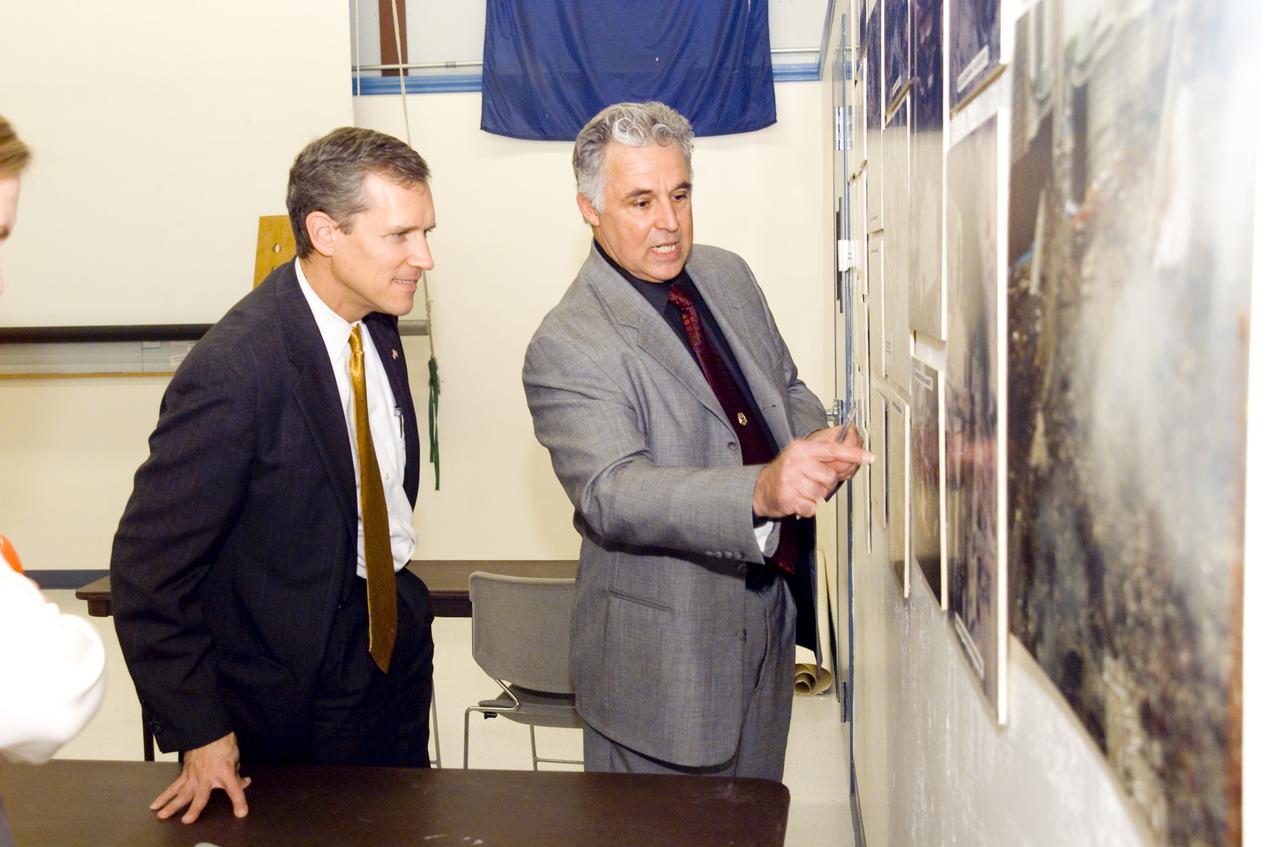
VISIT; PHILLIP BOND, UNDERSECRETARY OF COMMERCE FOR TECHNOLOGY AND CONNIE J PARTOYAN, COUNSELOR & SENIOR ADVISOR TO THE UNDER SECRETARY OF TECHNOLOGY: N-200 AND COLLOPSED STRUCTURE FACILITY
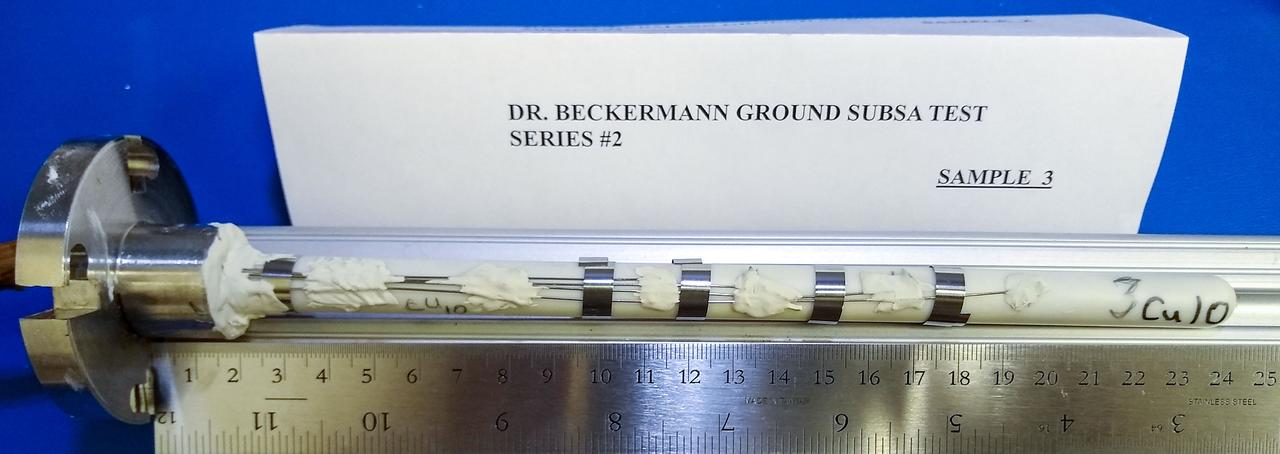
jsc2020e017722 (3/30/2020) --- A preflight view of an Alumina ampoule containing an Al-10%Cu alloy sample. The thermocouple wires are secured to the outside of the ampoule with refractory bonding material, while the metal clips provide additional support.
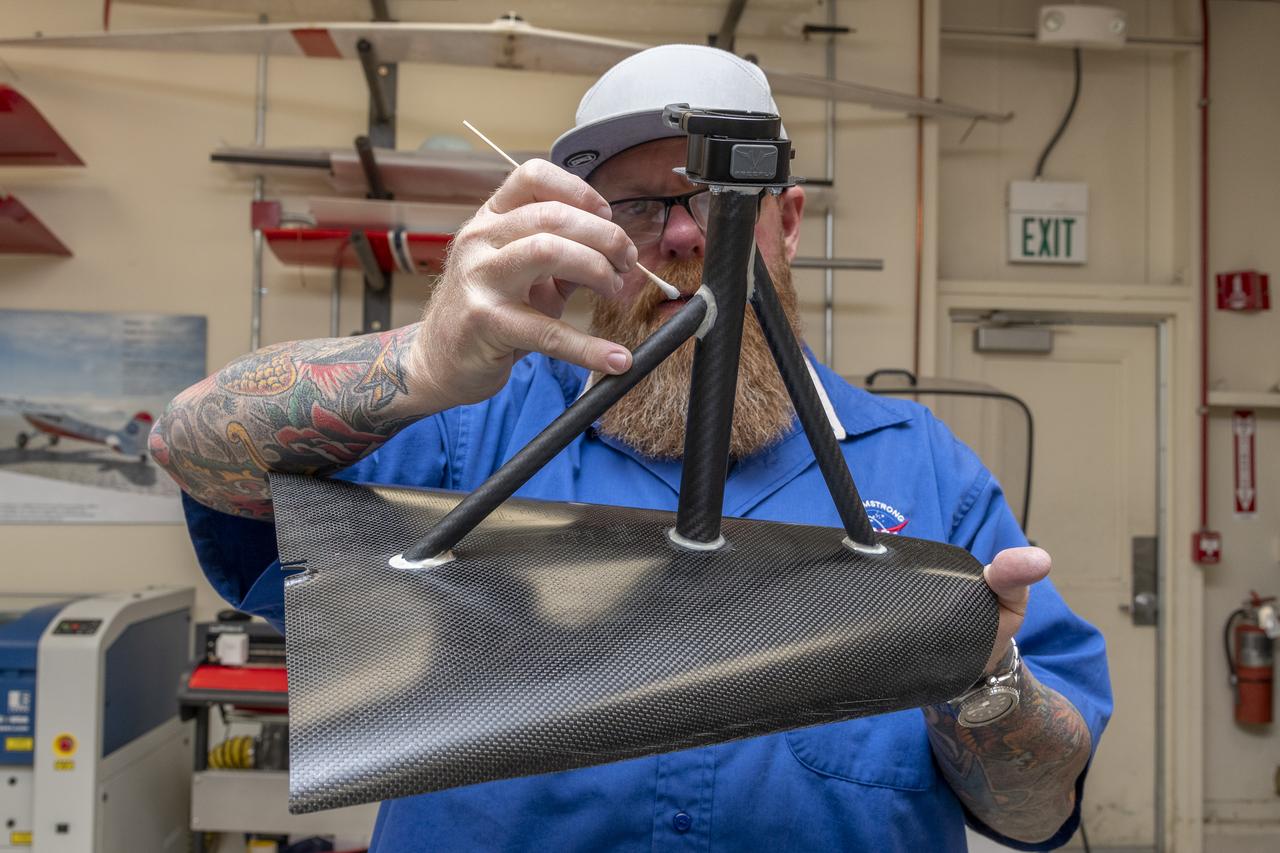
Justin Hall bonds pieces of a cradle for a rotorcraft launch system for a proposed atmospheric probe set to fly in summer 2024 at NASA’s Armstrong Flight Research Center in Edwards, California. Hall is a designer, technician, and pilot at the center’s Dale Reed Subscale Flight Research Laboratory.

CAPE CANAVERAL, Fla. -- Vibration and laser testing is being conducted on Ares I-X segments at NASA's Kennedy Space Center. Here, technician Todd Reeves installs a Stinger Rod from the Shaker to a load plate that was bonded to the solid rocket motor case. Photo credit: NASA/Dimitri Gerondidakis
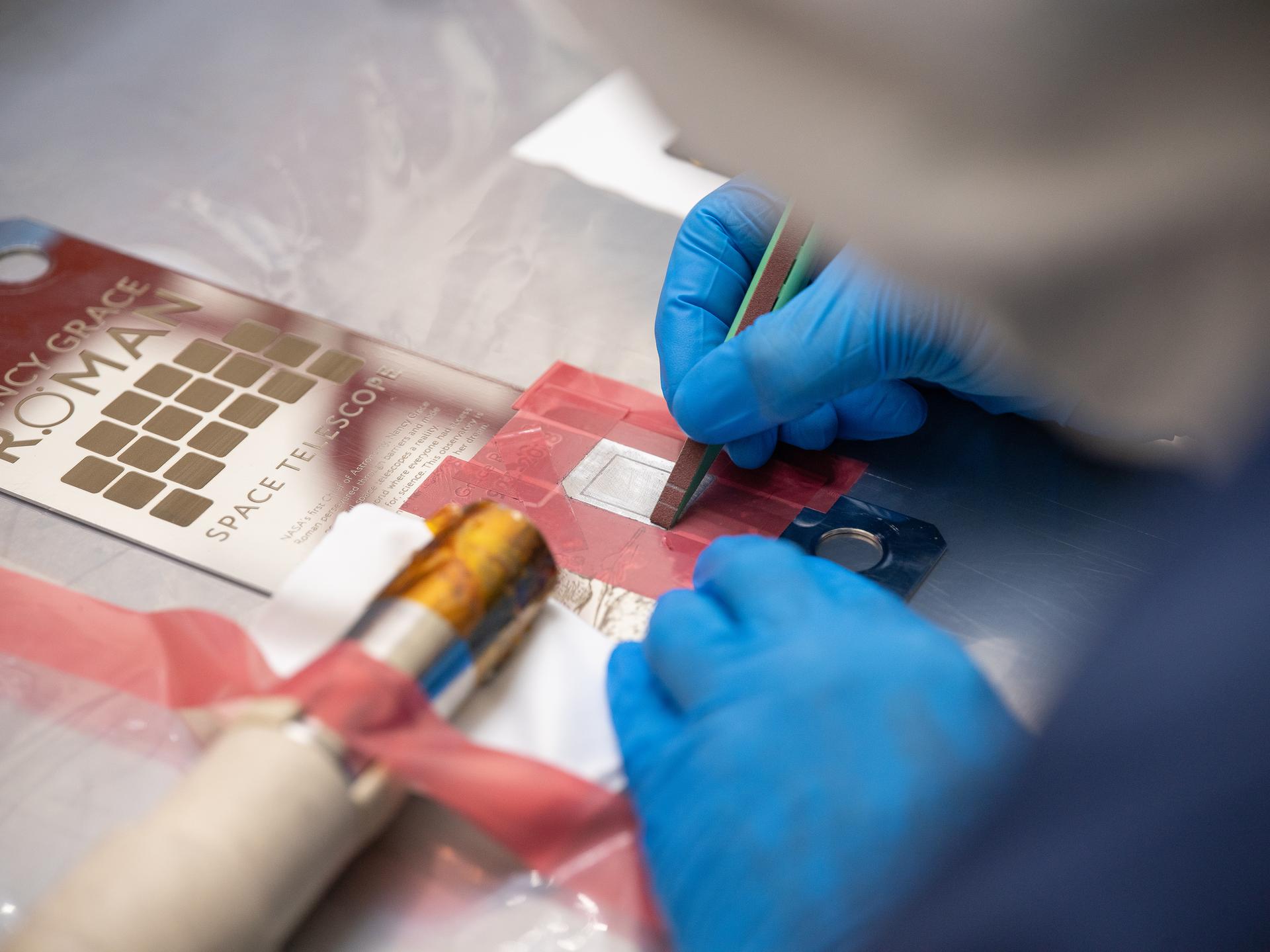
A technician inside the Payload Hazardous Servicing Facility at NASA’s Kennedy Space Center in Florida installs a memory card containing a total of 1,350,144 names as part of a commemorative plaque on the Nancy Grace Roman Space Telescope on Friday, July 17, 2026. The names, submitted by people from across the globe, including astronauts from NASA’s Artemis II and Artemis III missions, will travel with the Roman observatory to the Sun-Earth Lagrange point 2, or L2, about one million miles from Earth, where the Sun’s and Earth’s gravity balance out. Roman is named after Dr. Nancy Grace Roman, NASA’s first chief astronomer and one of the architects of the agency’s modern science program.
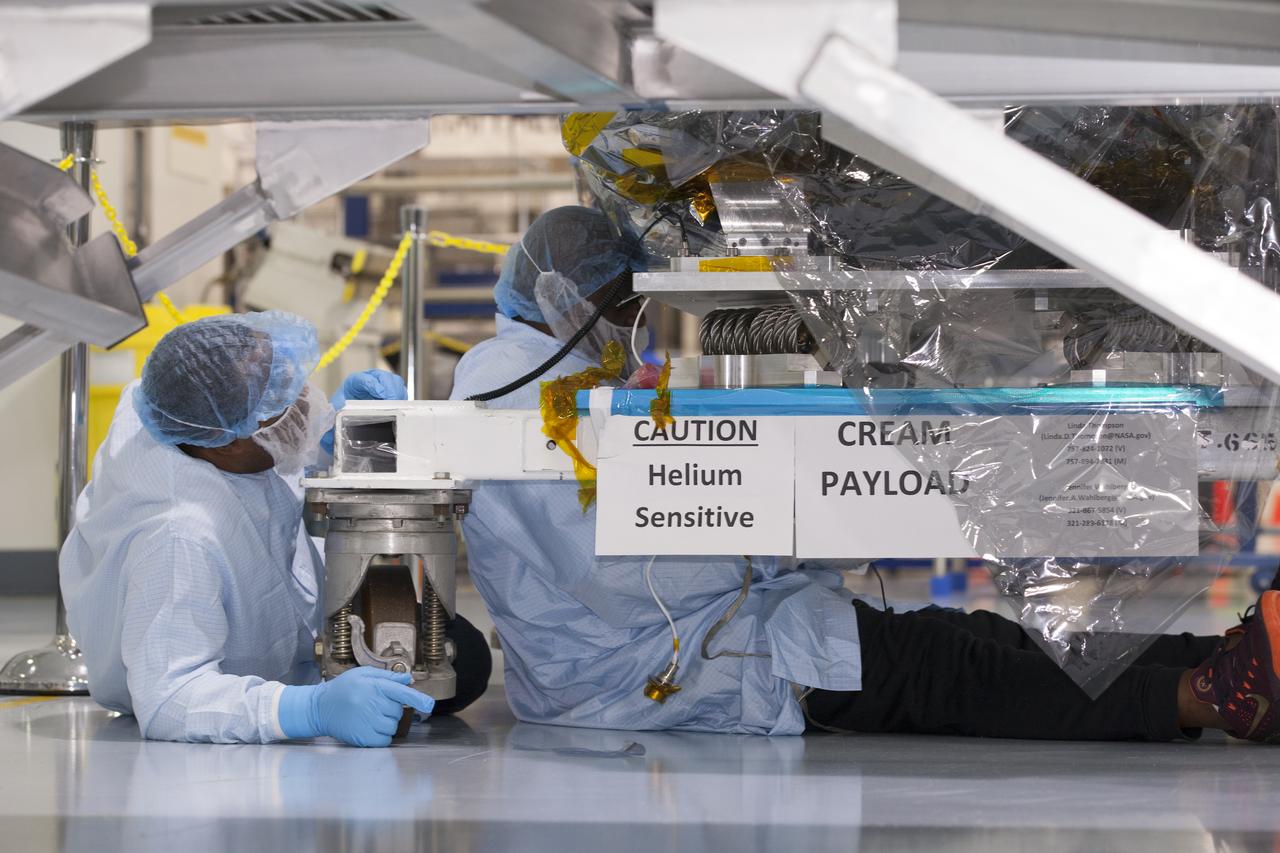
In the Space Station Processing Facility at NASA's Kennedy Space Center in Florida, technicians and engineers remove a protective cover on the Cosmic-Ray Energetics and Mass investigation, or CREAM, instrument. It is designed to measure the charges of cosmic rays to better understand what gives them such incredible energies, and how that effects the composition of the universe. The instrument will be launched to the space station on the SpaceX CRS-12 commercial resupply mission in August 2017.
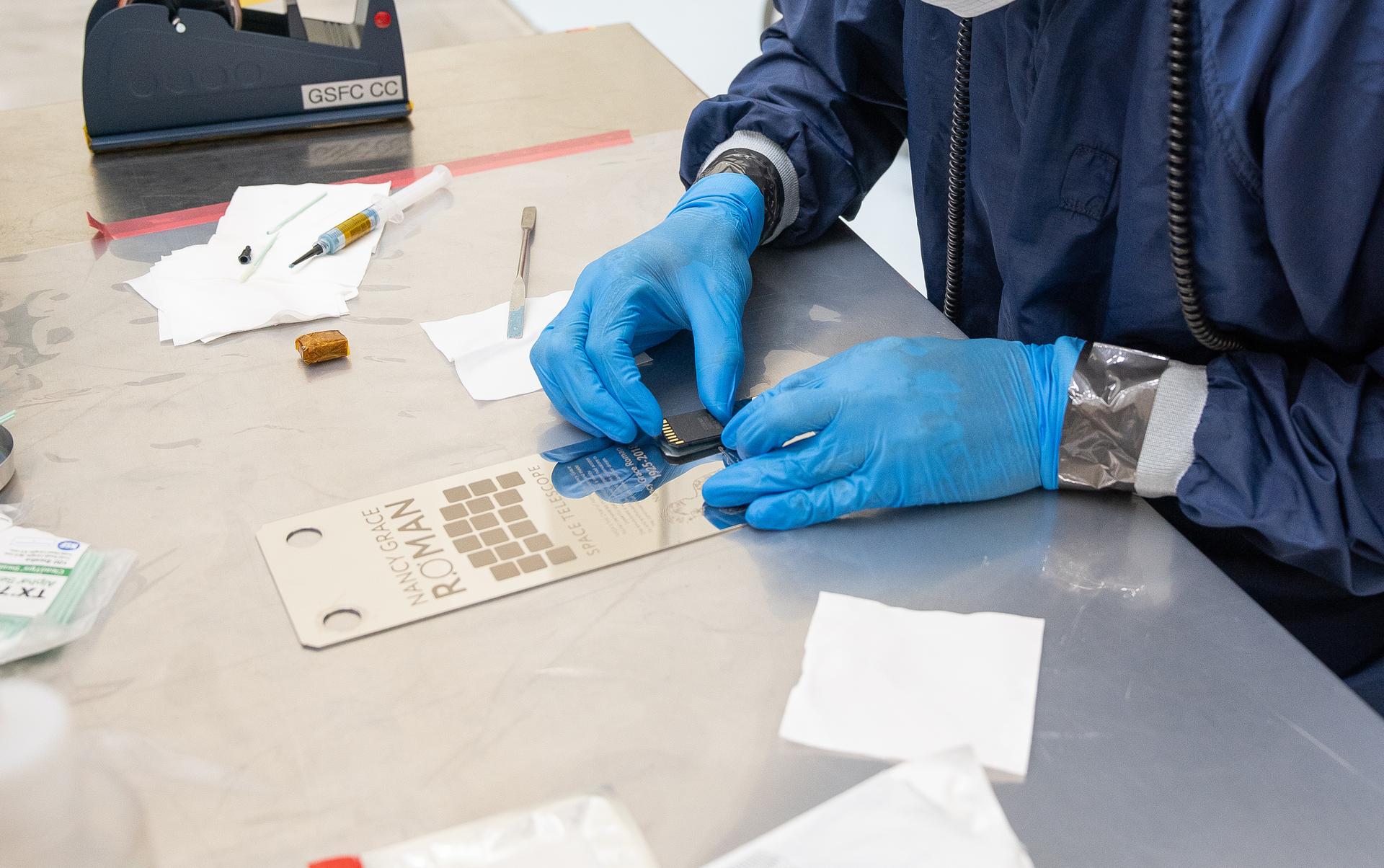
A technician inside the Payload Hazardous Servicing Facility at NASA’s Kennedy Space Center in Florida installs a memory card containing a total of 1,350,144 names as part of a commemorative plaque on the Nancy Grace Roman Space Telescope on Friday, July 17, 2026. The names, submitted by people from across the globe, including astronauts from NASA’s Artemis II and Artemis III missions, will travel with the Roman observatory to the Sun-Earth Lagrange point 2, or L2, about one million miles from Earth, where the Sun’s and Earth’s gravity balance out. Roman is named after Dr. Nancy Grace Roman, NASA’s first chief astronomer and one of the architects of the agency’s modern science program.
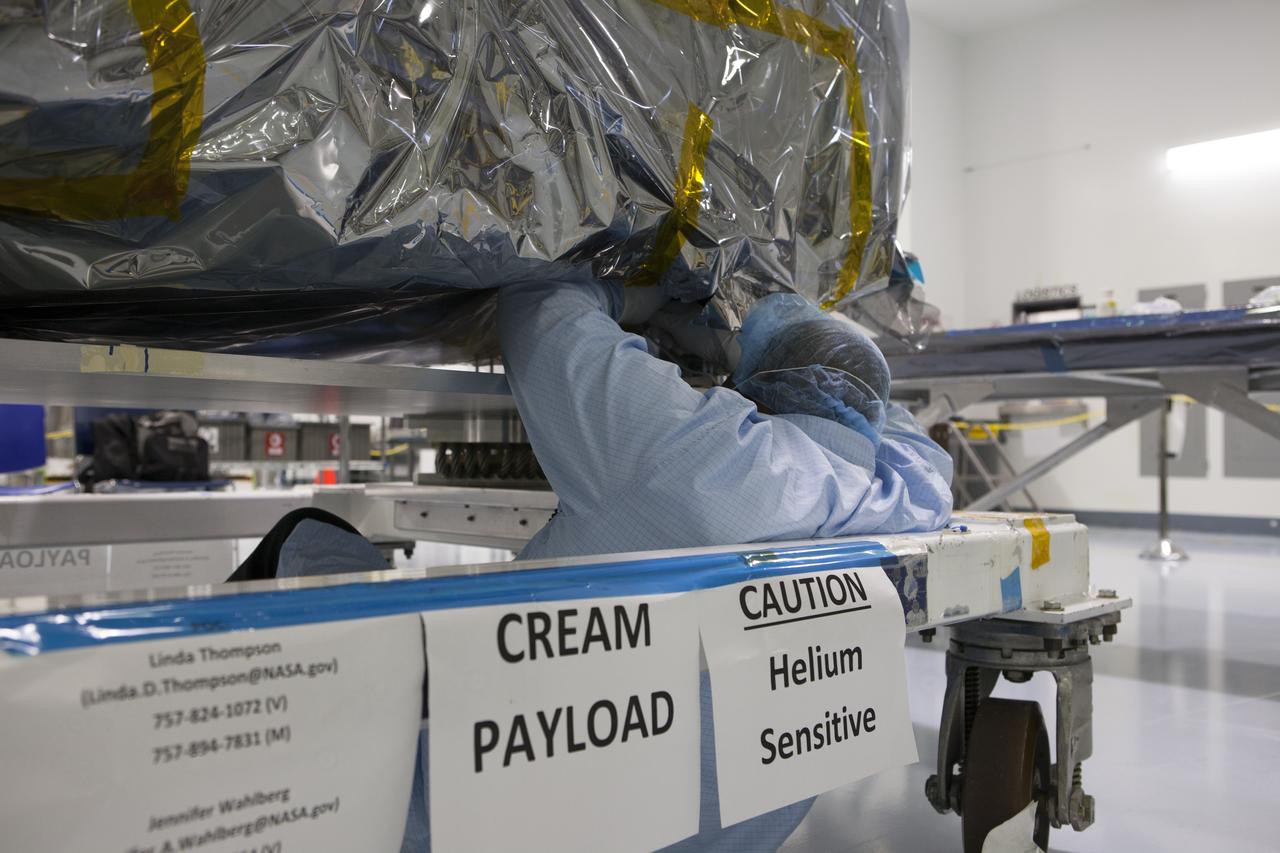
In the Space Station Processing Facility at NASA's Kennedy Space Center in Florida, a technician remove a protective cover on the Cosmic-Ray Energetics and Mass investigation, or CREAM, instrument. It is designed to measure the charges of cosmic rays to better understand what gives them such incredible energies, and how that effects the composition of the universe. The instrument will be launched to the space station on the SpaceX CRS-12 commercial resupply mission in August 2017.
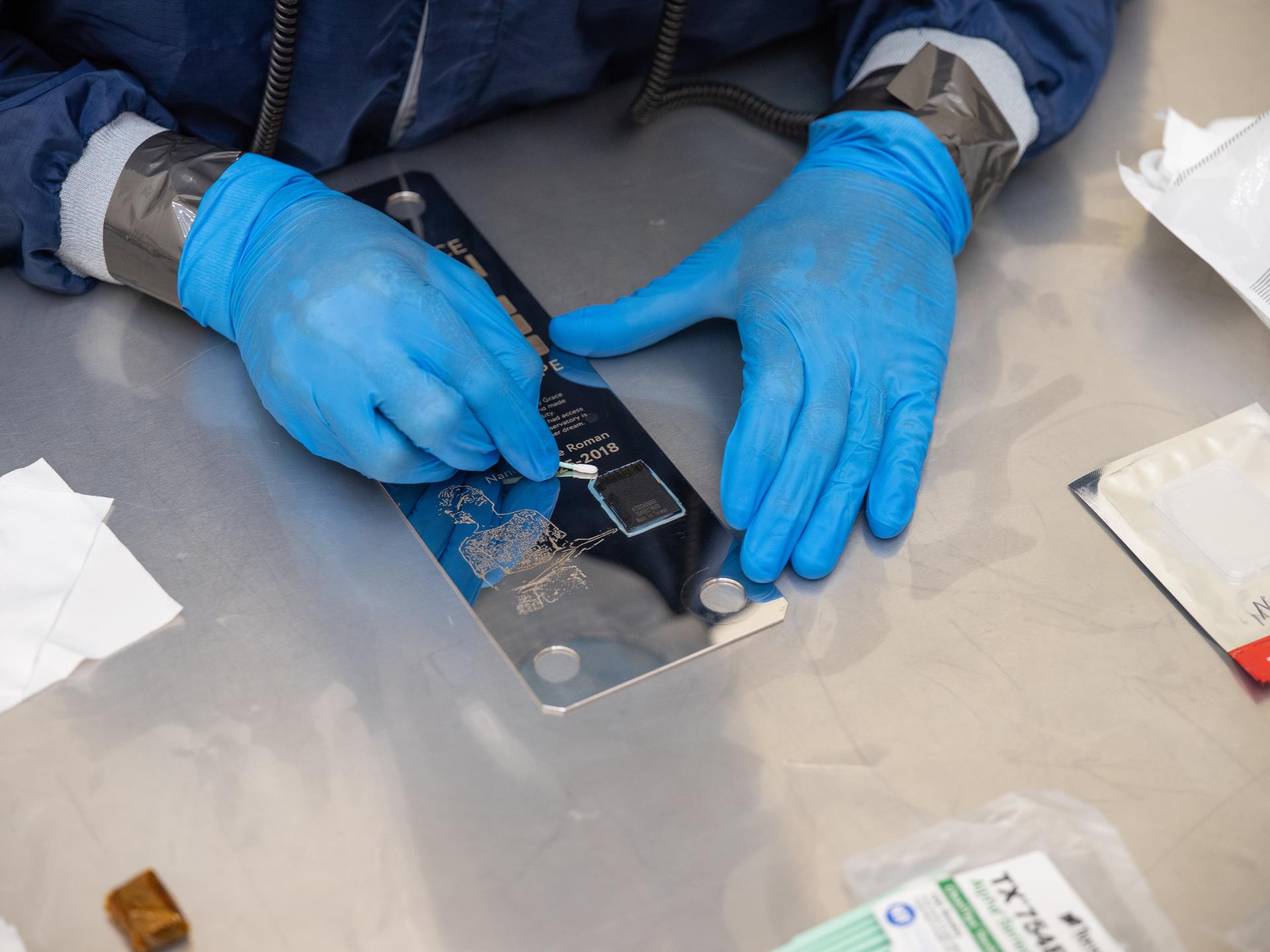
A technician inside the Payload Hazardous Servicing Facility at NASA’s Kennedy Space Center in Florida installs a memory card containing a total of 1,350,144 names as part of a commemorative plaque on the Nancy Grace Roman Space Telescope on Friday, July 17, 2026. The names, submitted by people from across the globe, including astronauts from NASA’s Artemis II and Artemis III missions, will travel with the Roman observatory to the Sun-Earth Lagrange point 2, or L2, about one million miles from Earth, where the Sun’s and Earth’s gravity balance out. Roman is named after Dr. Nancy Grace Roman, NASA’s first chief astronomer and one of the architects of the agency’s modern science program.
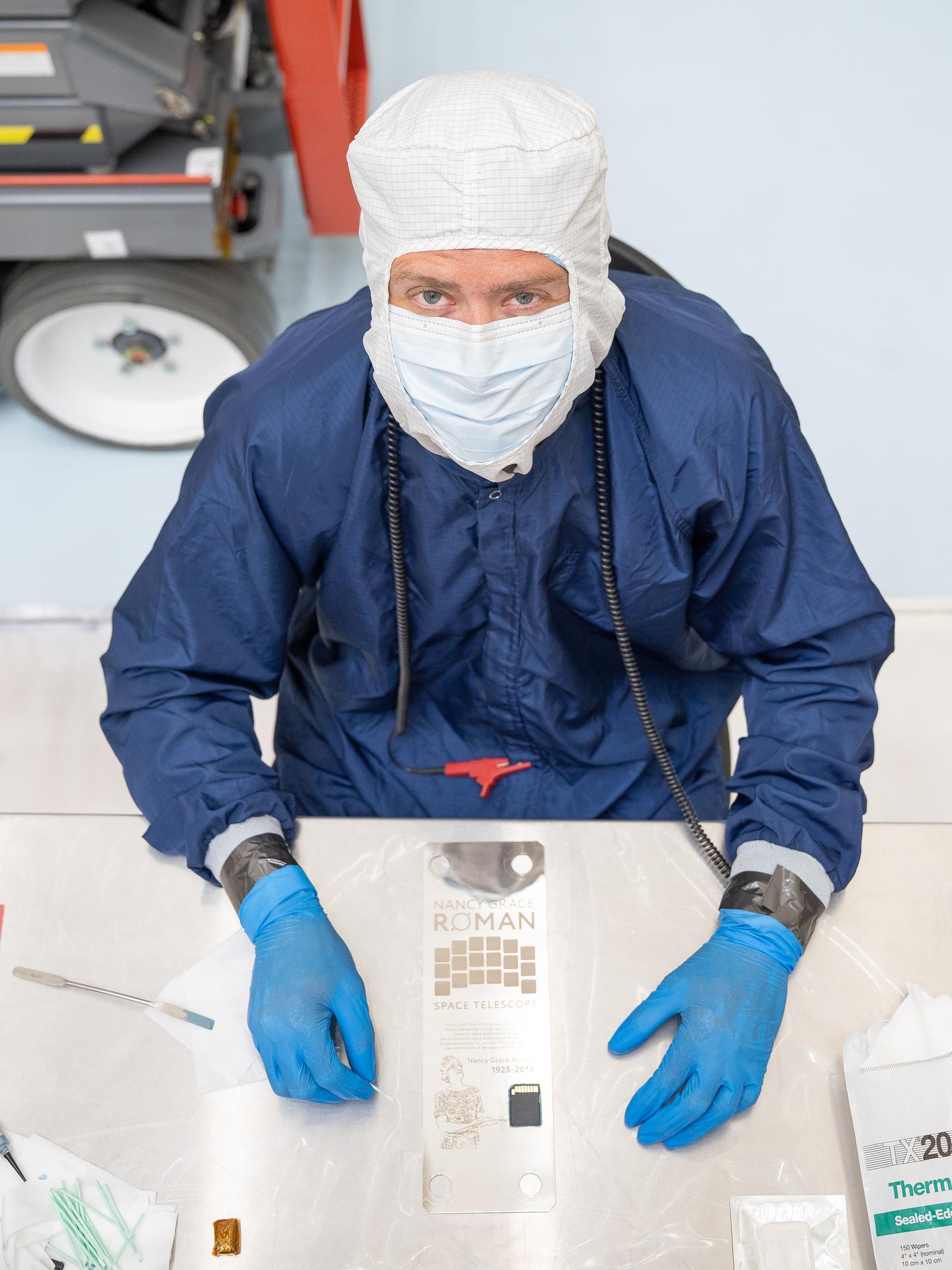
Inside the Payload Hazardous Servicing Facility at NASA’s Kennedy Space Center in Florida, Harry Willems, a mechanical technician from the agency’s Goddard Space Flight Center in Greenbelt, Maryland, installs a memory card containing a total of 1,350,144 names as part of a commemorative plaque on the Nancy Grace Roman Space Telescope on Friday, July 17, 2026. The names, submitted by people from across the globe, including astronauts from NASA’s Artemis II and Artemis III missions, will travel with the Roman observatory to the Sun-Earth Lagrange point 2, or L2, about one million miles from Earth, where the Sun’s and Earth’s gravity balance out. Roman is named after Dr. Nancy Grace Roman, NASA’s first chief astronomer and one of the architects of the agency’s modern science program.
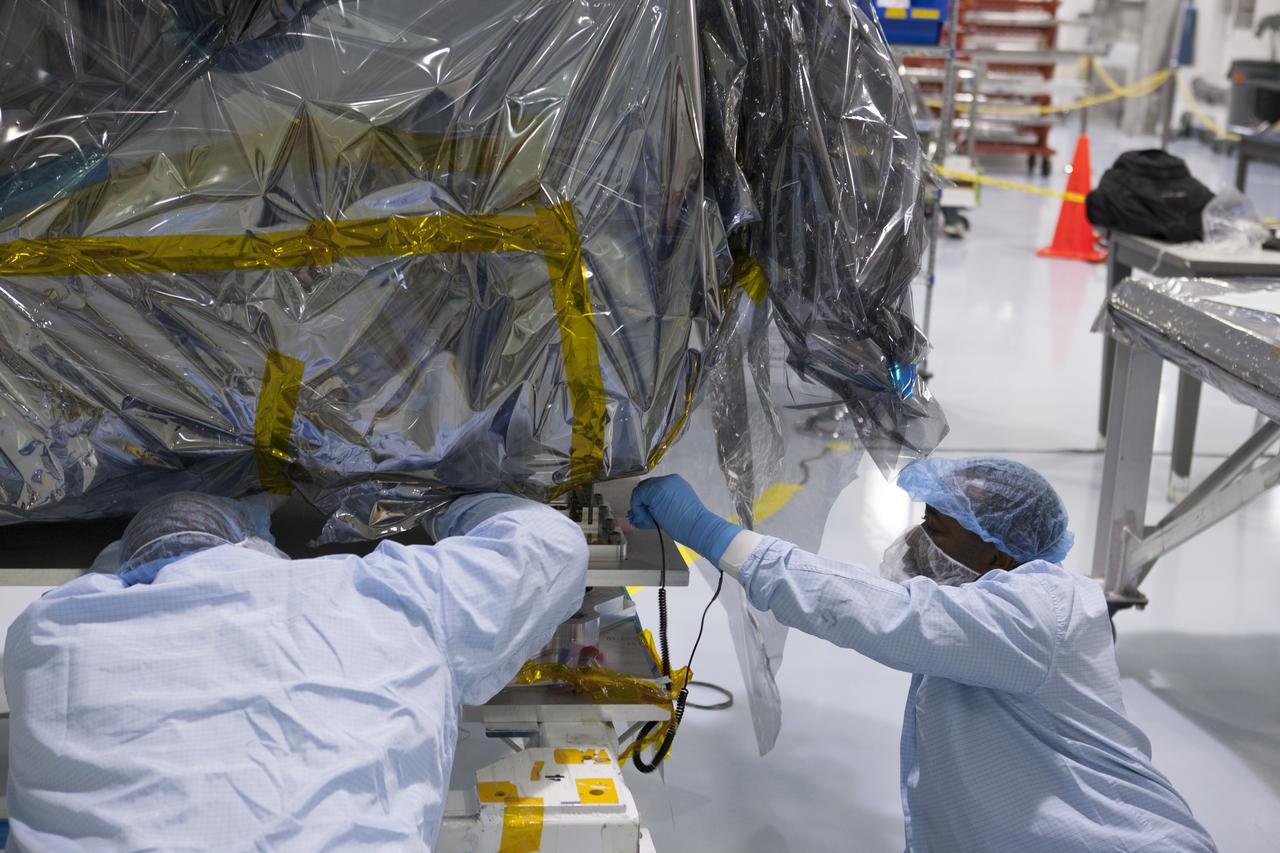
In the Space Station Processing Facility at NASA's Kennedy Space Center in Florida, technicians and engineers remove a protective cover on the Cosmic-Ray Energetics and Mass investigation, or CREAM, instrument. It is designed to measure the charges of cosmic rays to better understand what gives them such incredible energies, and how that effects the composition of the universe. The instrument will be launched to the space station on the SpaceX CRS-12 commercial resupply mission in August 2017.
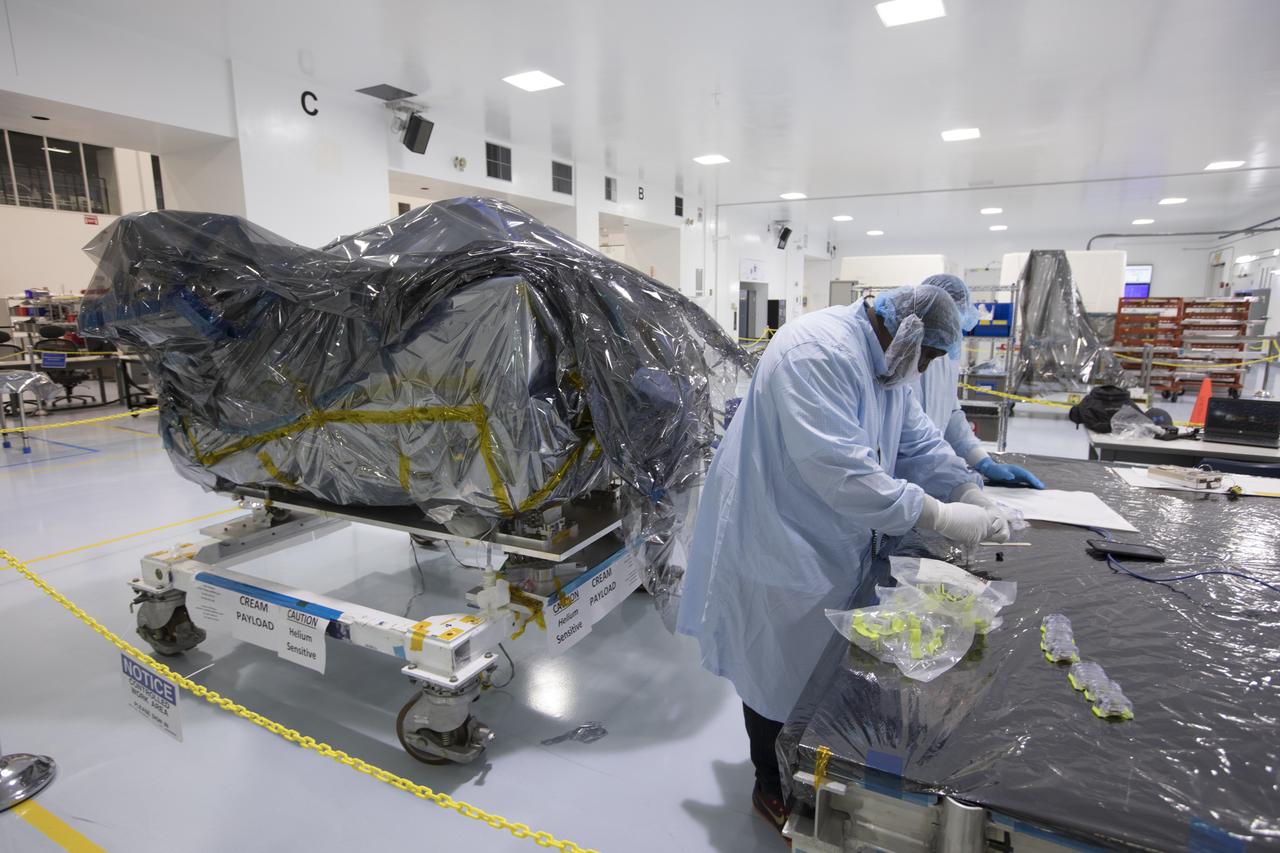
In the Space Station Processing Facility at NASA's Kennedy Space Center in Florida, technicians and engineers inspect components for the Cosmic-Ray Energetics and Mass investigation, or CREAM, instrument. It is designed to measure the charges of cosmic rays to better understand what gives them such incredible energies, and how that effects the composition of the universe. The instrument will be launched to the space station on the SpaceX CRS-12 commercial resupply mission in August 2017.
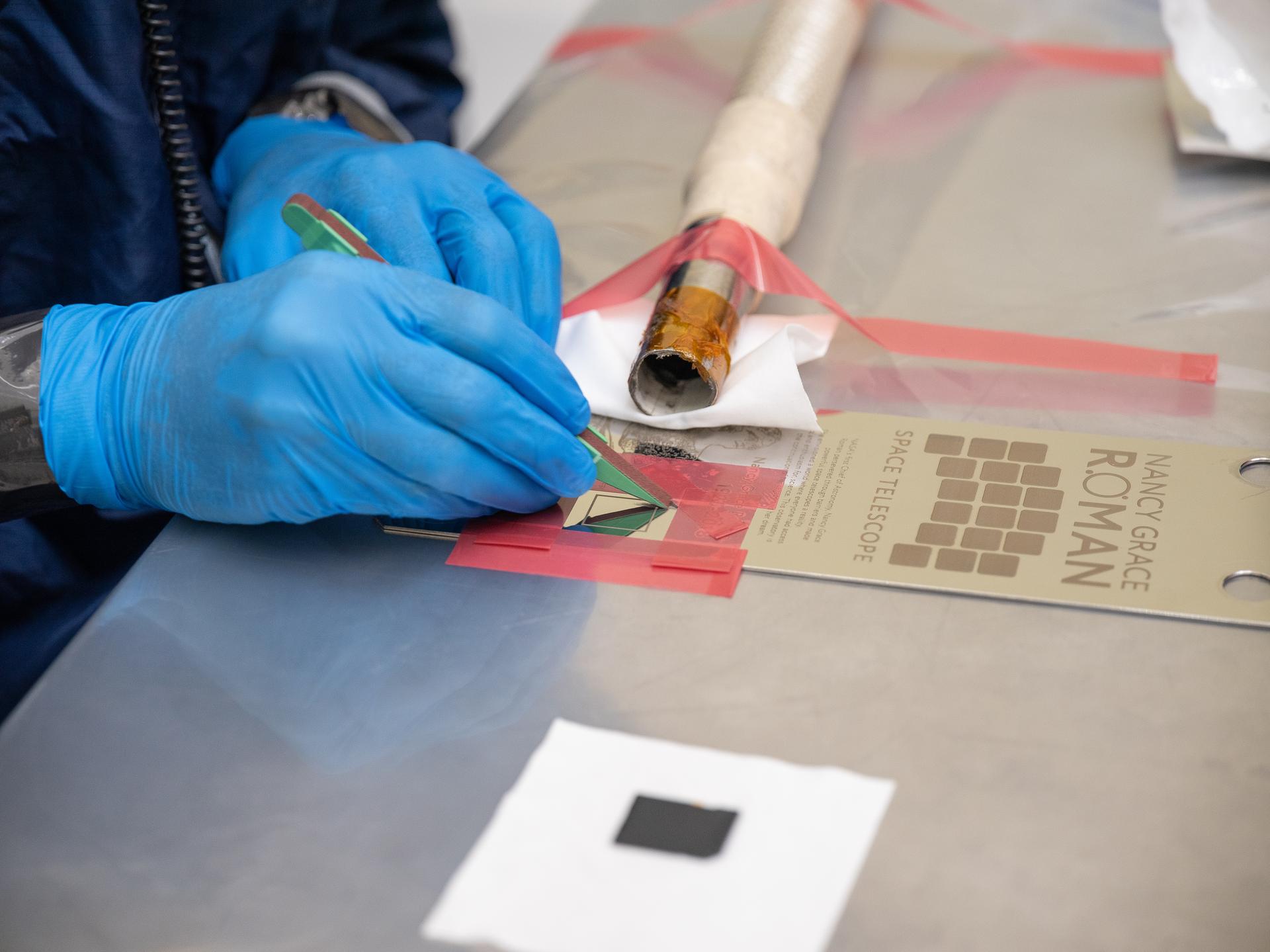
A technician inside the Payload Hazardous Servicing Facility at NASA’s Kennedy Space Center in Florida installs a memory card containing a total of 1,350,144 names as part of a commemorative plaque on the Nancy Grace Roman Space Telescope on Friday, July 17, 2026. The names, submitted by people from across the globe, including astronauts from NASA’s Artemis II and Artemis III missions, will travel with the Roman observatory to the Sun-Earth Lagrange point 2, or L2, about one million miles from Earth, where the Sun’s and Earth’s gravity balance out. Roman is named after Dr. Nancy Grace Roman, NASA’s first chief astronomer and one of the architects of the agency’s modern science program.
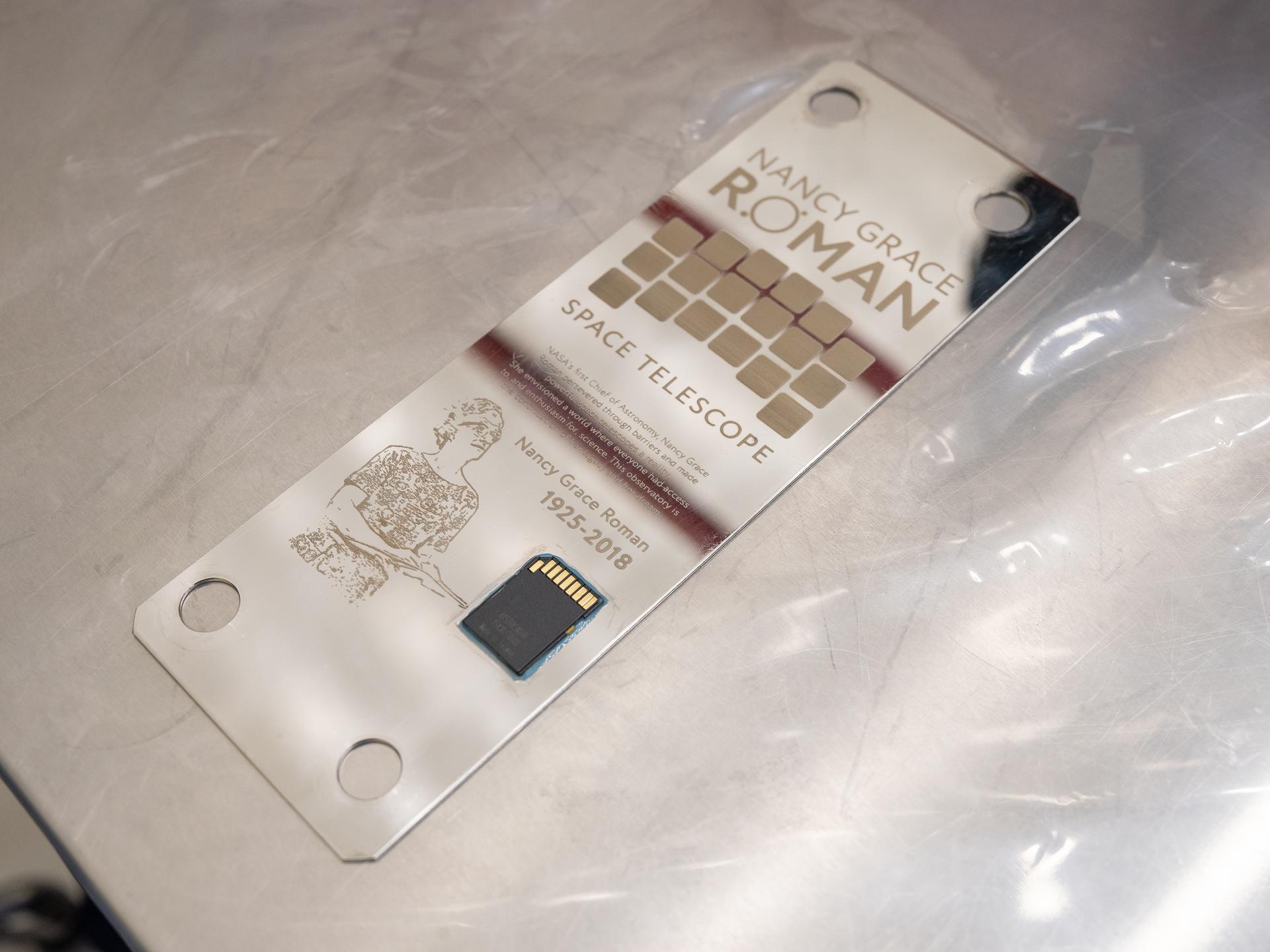
A technician inside the Payload Hazardous Servicing Facility at NASA’s Kennedy Space Center in Florida installs a memory card containing a total of 1,350,144 names as part of a commemorative plaque on the Nancy Grace Roman Space Telescope on Friday, July 17, 2026. The names, submitted by people from across the globe, including astronauts from NASA’s Artemis II and Artemis III missions, will travel with the Roman observatory to the Sun-Earth Lagrange point 2, or L2, about one million miles from Earth, where the Sun’s and Earth’s gravity balance out. Roman is named after Dr. Nancy Grace Roman, NASA’s first chief astronomer and one of the architects of the agency’s modern science program.
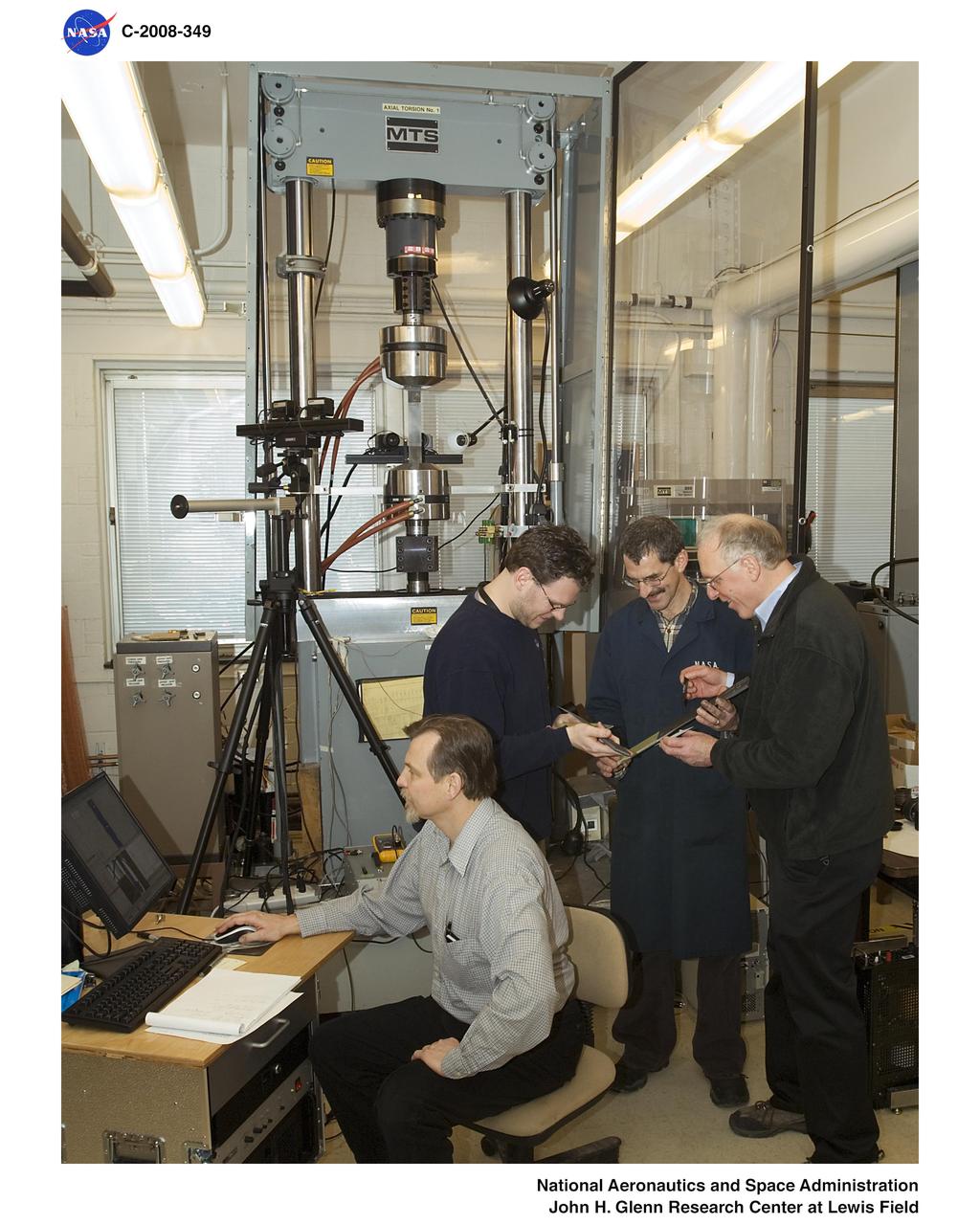
Code R and Code D hosted NESC Principal Engineer Mike Kirsch who is Program Leader for Composite Crew Module (CCM). The purpose of the visit was to review/observe experiments that GRC is performing in support of the CCM program. The test object is the critical Low Impact Docking System/Tunnel interface joint that links the metal docking ring with the polymer composite tunnel element of the crew module pressure vessel. The rectangular specimens simulated the splice joint between the aluminum and the PMC sheets, including a PMC doubler sheet. GRC was selected for these tests due to our expertise in composite testing and our ability to perform 3D fullfield displacement and strain measurements of the complex bond geometry using digital image correlation. The specimens performed above their minimum load requirements and the full field strain measurements showed the strain levels at the critical bond line. This work is part of a joint Code D & R investigation.
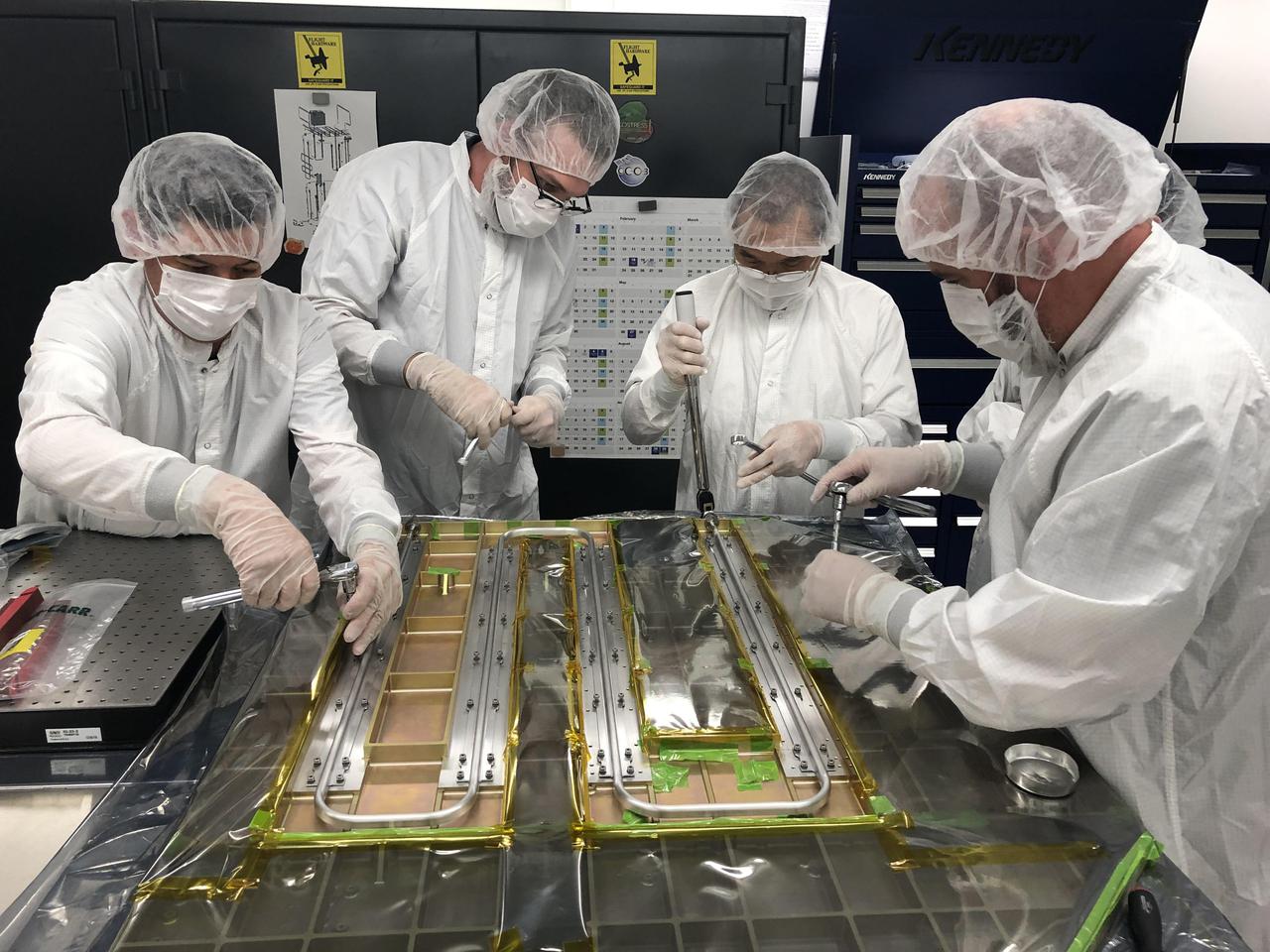
Europa Clipper technicians and engineers at NASA's Jet Propulsion Laboratory in Southern California work together in a cleanroom on Sept. 12, 2019. They bond thermal tubing to the spacecraft's Radio Frequency (RF) panel, which was built by Johns Hopkins University Applied Physics Laboratory (APL) in Laurel, Maryland. The tubing is part of a Heat Redistribution System (HRS) that pumps coolant all around the spacecraft and helps control its temperature as it travels through space. With an internal global ocean twice the size of Earth's oceans combined, Europa may have the potential to harbor life. NASA's Europa Clipper spacecraft will swoop around Jupiter on an elliptical path, dipping close to the moon on each flyby to collect data. Understanding Europa's habitability will help scientists better understand how life developed on Earth and the potential for finding life beyond our planet. Europa Clipper is aiming for a launch readiness date of 2024. https://photojournal.jpl.nasa.gov/catalog/PIA24324
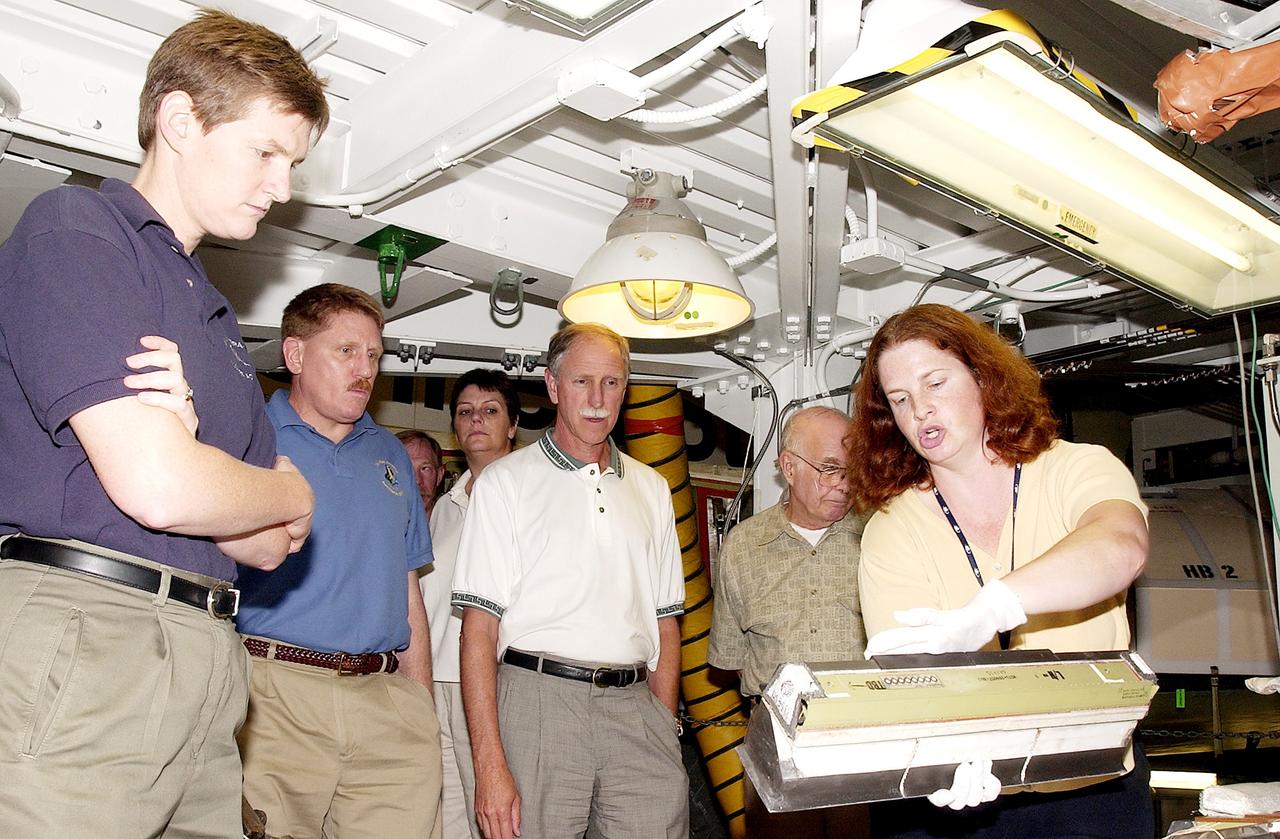
KENNEDY SPACE CENTER, FLA. - NASA worker Joy Huff (right) shows a leading edge subsystems (LESS) with tile bonded to it to members of the Stafford-Covey Return to Flight Task Group (SCTG). From left are Dr. Amy Donahue, David Lengyel, Dr. Kathryn Clark, Richard Covey, former Space Shuttle commander, and William Wegner. Covey is co-chair of the SCTG along with Thomas P. Stafford, Apollo commander. Chartered by NASA Administrator Sean O’Keefe, the task group will perform an independent assessment of NASA’s implementation of the final recommendations by the Columbia Accident Investigation Board.

The load pad bonding process for the vertical tails was a preliminary step in the process to test the F/A-18E from the Naval Air Systems Command (NAVAIR) in Patuxent River, Maryland. The aircraft is in NASA’s Armstrong Flight Research Center Flight Loads Laboratory in Edwards, California, for the center’s biggest load calibrations tests. This testing is needed before the aircraft can serve as a test vehicle for determining if it can safely manage maneuvers and proposed upgrades.
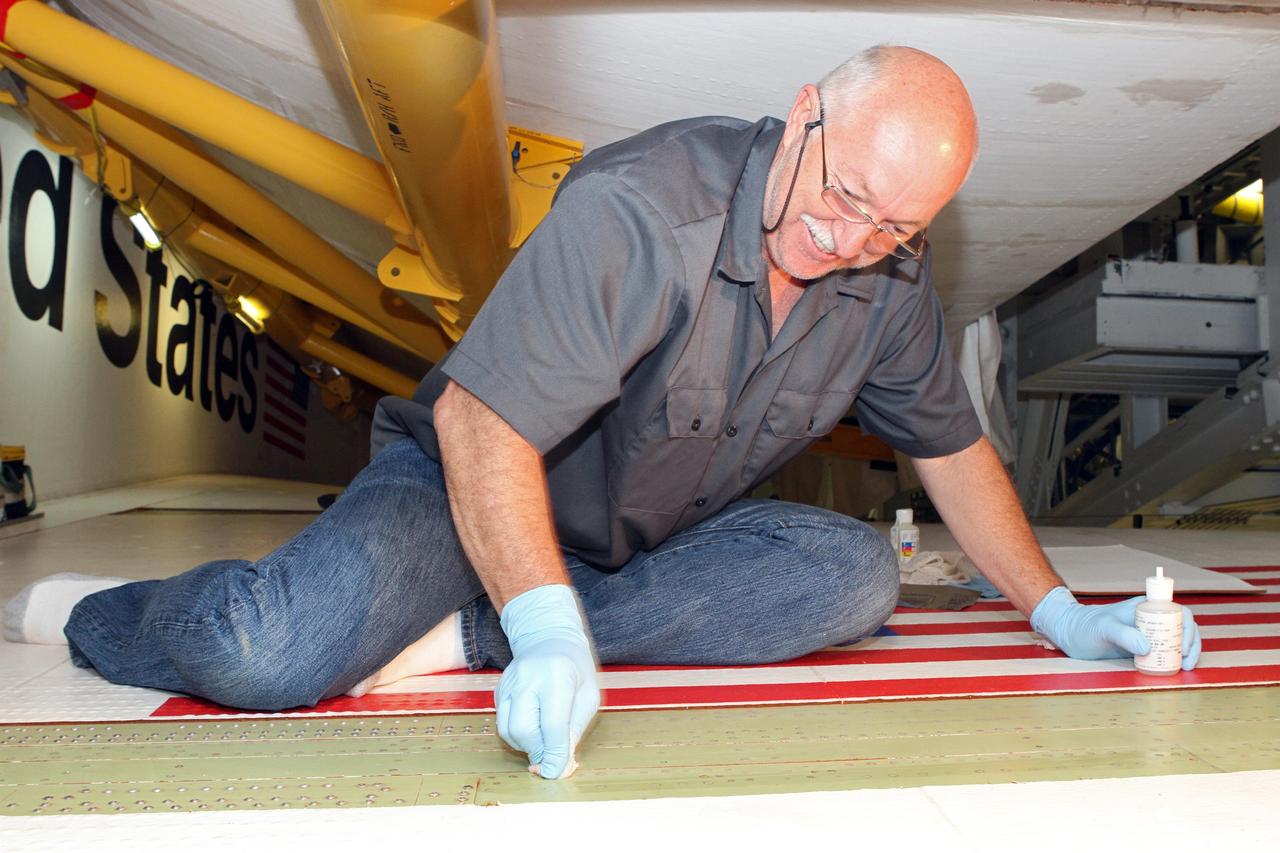
CAPE CANAVERAL, Fla. – Inside Orbiter Processing Facility-2 at NASA's Kennedy Space Center in Florida, Mike Williams, a thermal protection system technician with United Space Alliance, crouches on space shuttle Endeavour's right wing as he prepares the wing surface for tile bonding. Ongoing transition and retirement activities are preparing the spacecraft for public display at the California Science Center in Los Angeles. Endeavour flew 25 missions during its 19-year career. Photo credit: NASA/Cory Huston
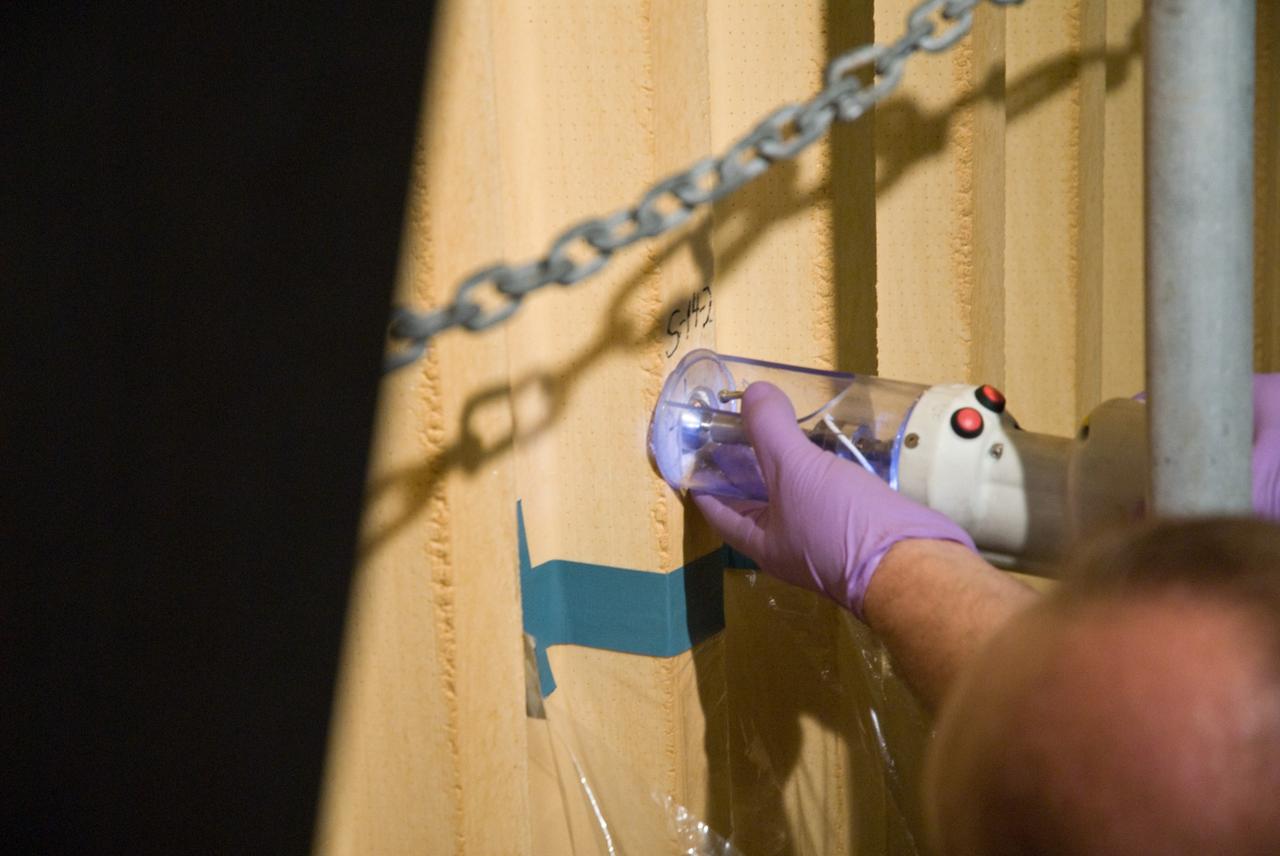
CAPE CANAVERAL, Fla. – In the Vehicle Assembly Building's High Bay 1 at NASA's Kennedy Space Center in Florida, foam adhesion is being tested on the intertank of space shuttle Discovery's external tank. Foam samples an inch-and-half in diameter are being collected for analysis to confirm the foam is bonded well to the metal primer underneath. The testing was prompted by the foam loss during launch of space shuttle Endeavour on the STS-127 mission July 15. Samples are being sent to Michoud for study. Photo credit: NASA/Tim Jacobs

KENNEDY SPACE CENTER, FLA. - In the Vehicle Assembly Building at NASA’s Kennedy Space Center, Troy Smith, with Lockheed Martin Astronautics, pulls off tabs from the heating element to test the bonding to the bellows. The element was recently attached to the liquid hydrogen feedline bellows on External Tank 121. Seen behind Smith is the External Tank. The tank will be used on the orbiter Discovery for Return to Flight mission STS-114, which has a launch window extending from July 13 to July 31.
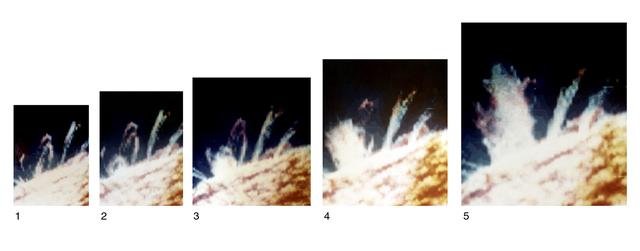
Breaking the grip of the closed magnetic loops that constrain other gases around it, a spray of chromospheric material surges upward, free of the Sun. Views 1 through 5 were recorded about 5 minutes apart by Skylab and comprise a composite of separate images made in chromospheric (red), transition region (green), and coronal (blue) temperatures of an ultraviolet sequence that depicts a solar eruption. Eruption begins (view 2) as material in or near a small, compact loop develops enough energy to overcome the Sun's magnetic bonds.
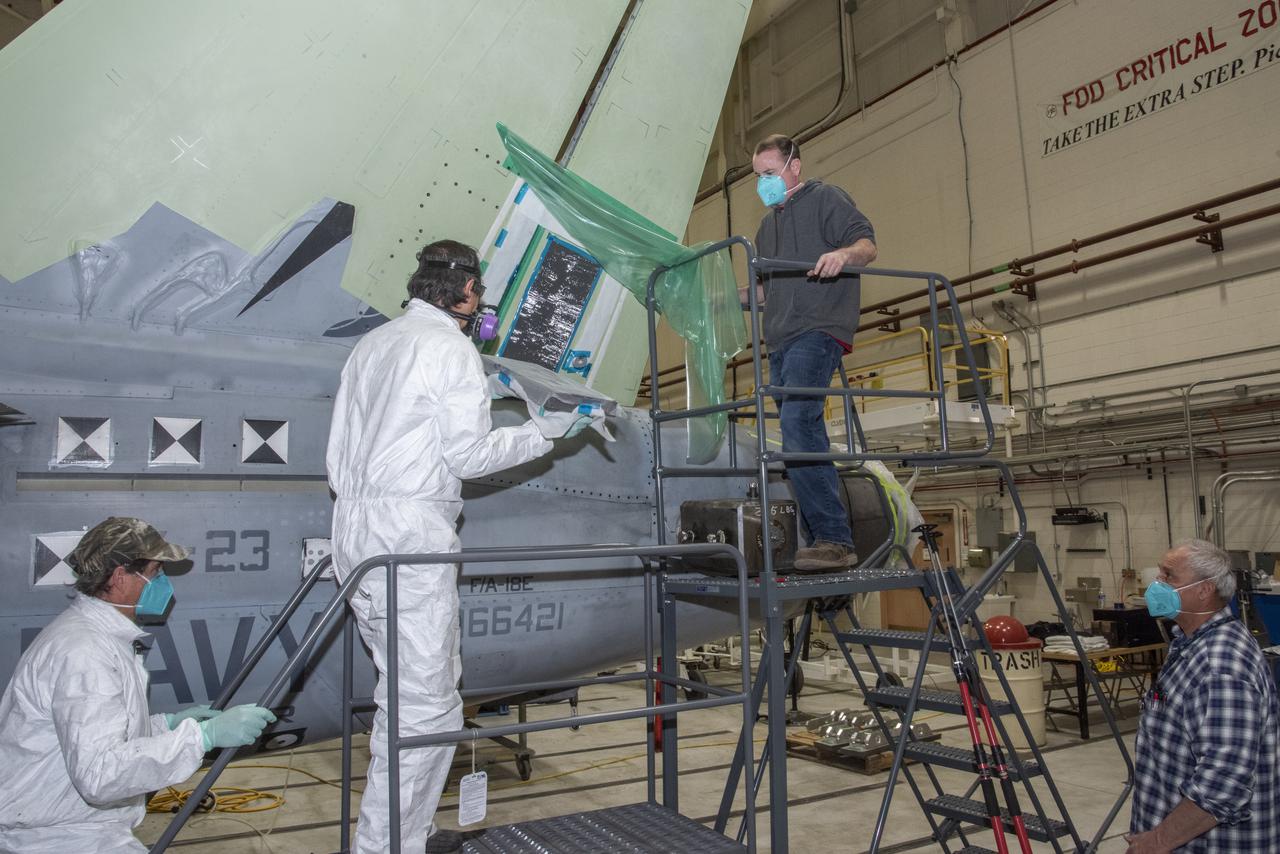
The load pad bonding process for the vertical tails was a preliminary step in the process to test the F/A-18E from the Naval Air Systems Command (NAVAIR) in Patuxent River, Maryland. The aircraft is in NASA’s Armstrong Flight Research Center Flight Loads Laboratory in Edwards, California, for the center’s biggest load calibrations tests. This testing is needed before the aircraft can serve as a test vehicle for determining if it can safely manage maneuvers and proposed upgrades.
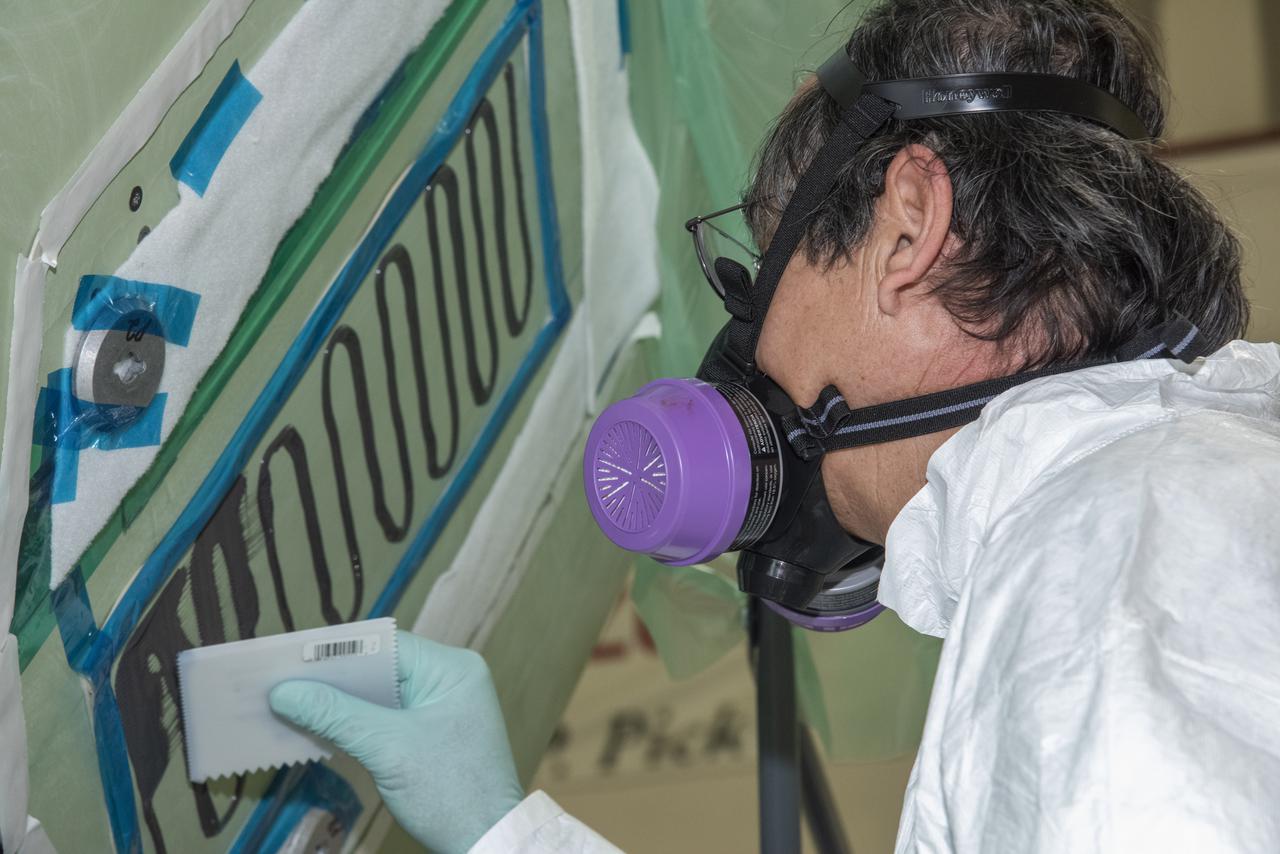
The load pad bonding process for the vertical tails was a preliminary step in the process to test the F/A-18E from the Naval Air Systems Command (NAVAIR) in Patuxent River, Maryland. The aircraft is in NASA’s Armstrong Flight Research Center Flight Loads Laboratory in Edwards, California, for the center’s biggest load calibrations tests. This testing is needed before the aircraft can serve as a test vehicle for determining if it can safely manage maneuvers and proposed upgrades.
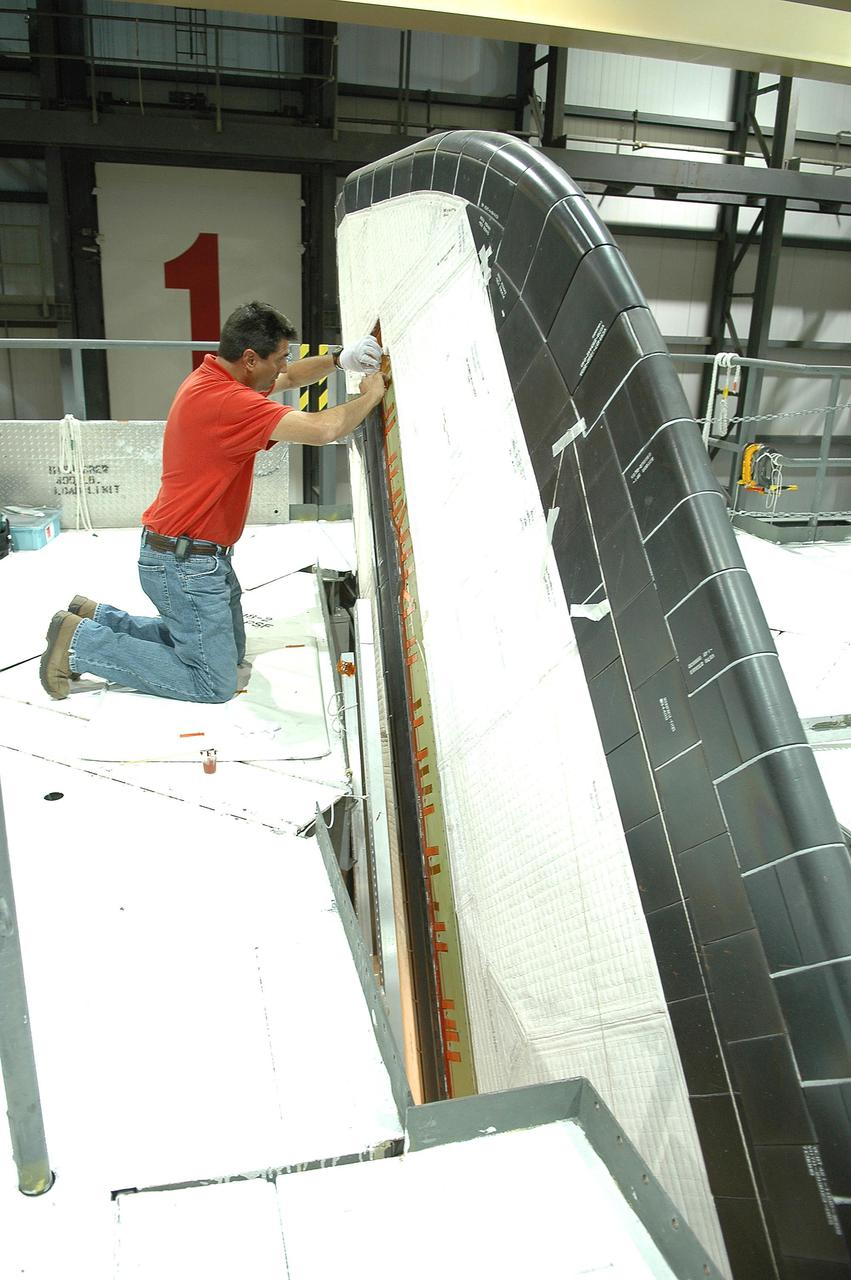
KENNEDY SPACE CENTER, FLA. - In the Orbiter Processing Facility at NASA’s Kennedy Space Center, United Space Alliance tile technician Jimmy Carter works on instrument wire spot bonding on Atlantis’ vertical tail_rudder speed brake. Atlantis is being processed for launch on the second Return to Flight mission, STS-121, which is scheduled to fly in July.
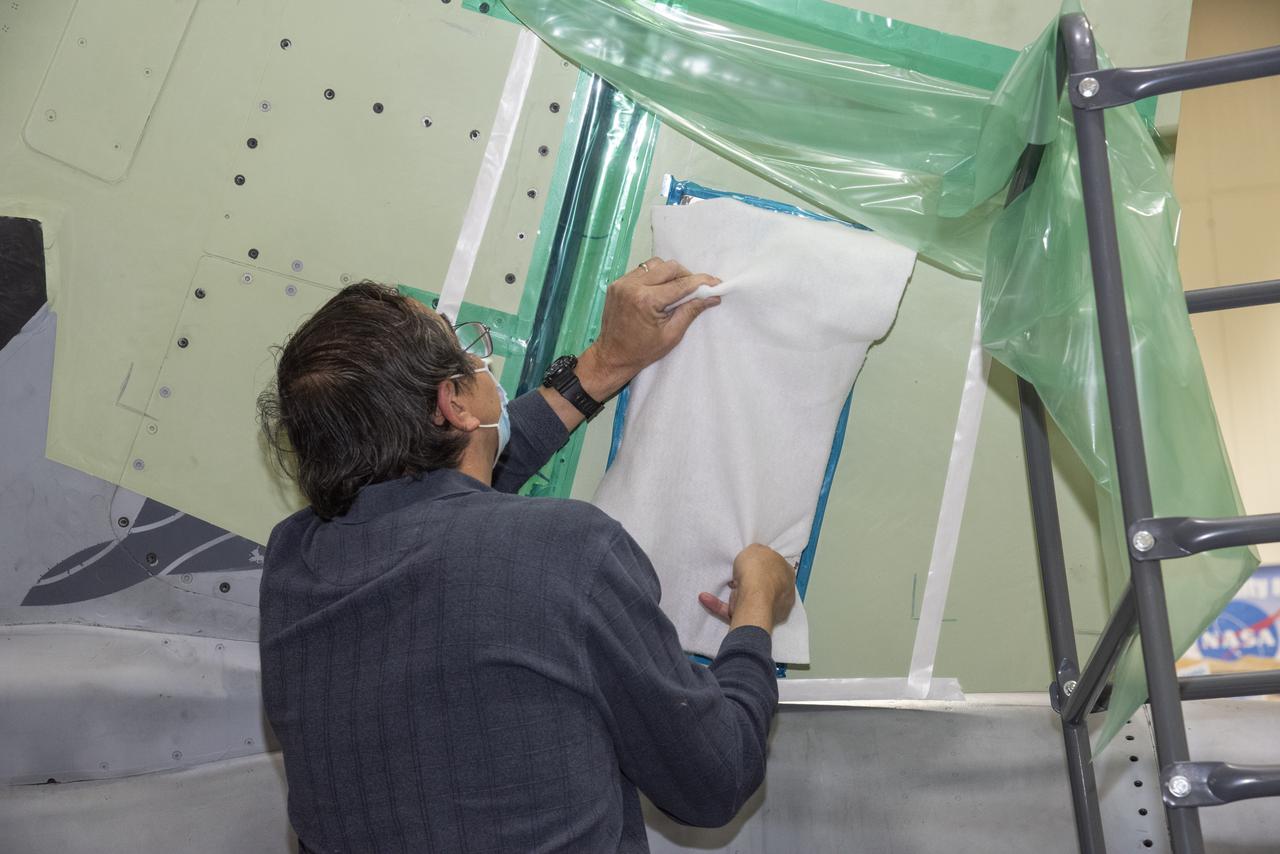
The load pad bonding process for the vertical tails was a preliminary step in the process to test the F/A-18E from the Naval Air Systems Command (NAVAIR) in Patuxent River, Maryland. The aircraft is in NASA’s Armstrong Flight Research Center Flight Loads Laboratory in Edwards, California, for the center’s biggest load calibrations tests. This testing is needed before the aircraft can serve as a test vehicle for determining if it can safely manage maneuvers and proposed upgrades.
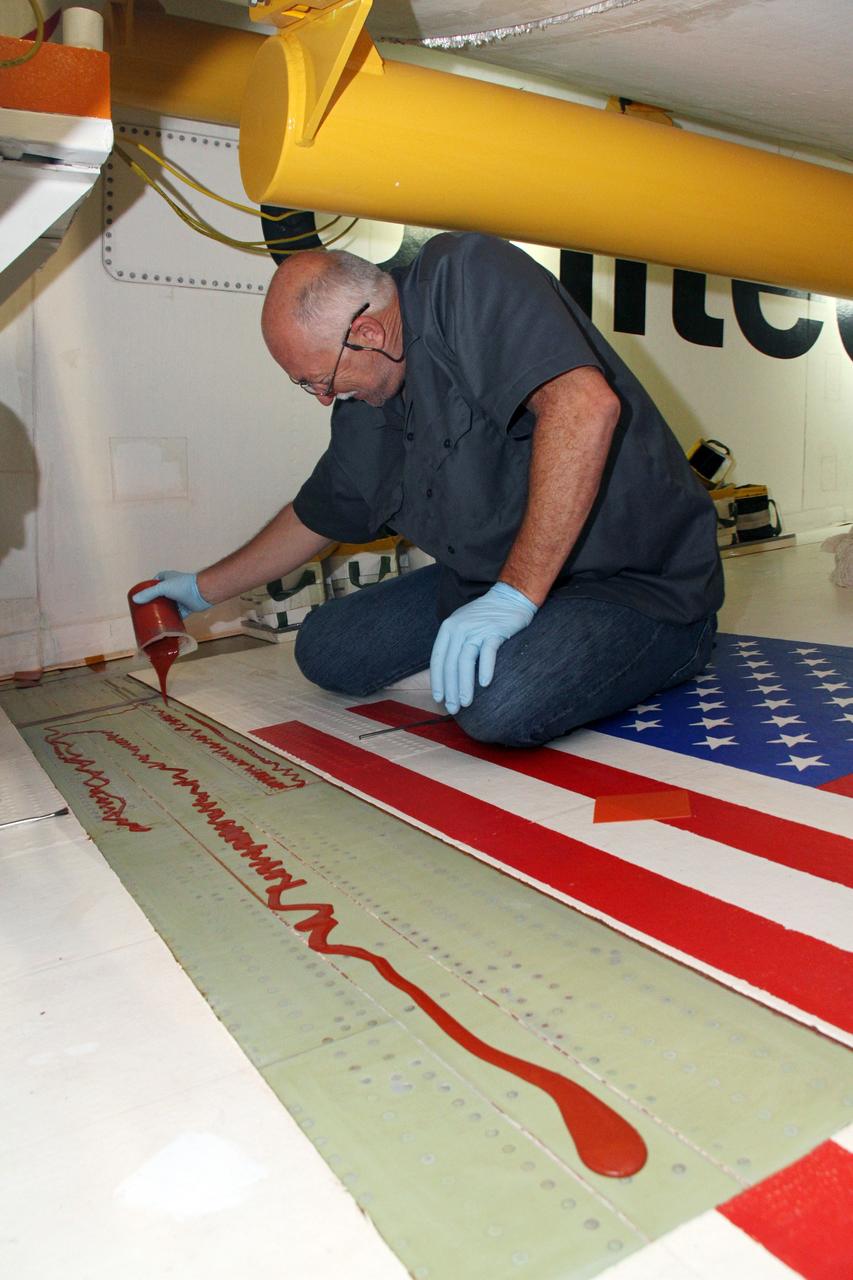
CAPE CANAVERAL, Fla. – Inside Orbiter Processing Facility-2 at NASA's Kennedy Space Center in Florida, Mike Williams, a thermal protection system technician with United Space Alliance, applies adhesive to the right wing of space shuttle Endeavour in preparation for tile bonding. Ongoing transition and retirement activities are preparing the spacecraft for public display at the California Science Center in Los Angeles. Endeavour flew 25 missions during its 19-year career. Photo credit: NASA/Cory Huston

Load pads are bonded to the aircraft surface of a F/A-18E from the Naval Air Systems Command (NAVAIR) in Patuxent River, Maryland, while under pressure. The aircraft is in NASA’s Armstrong Flight Research Center Flight Loads Laboratory in Edwards, California, for the center’s biggest load calibrations tests. This testing is needed before the aircraft can serve as a test vehicle for determining if it can safely manage maneuvers and proposed upgrades
KENNEDY SPACE CENTER, FLA. - In the Orbiter Processing Facility bay 1, United Space Alliance technician George Arnett works on tile bonding for the orbiter Atlantis. The orbiter is scheduled to fly on Return to Flight mission STS-121 in July. STS-121 is a Return to Flight Utilities and Logistics Flight (ULF-2) to the International Space Station.
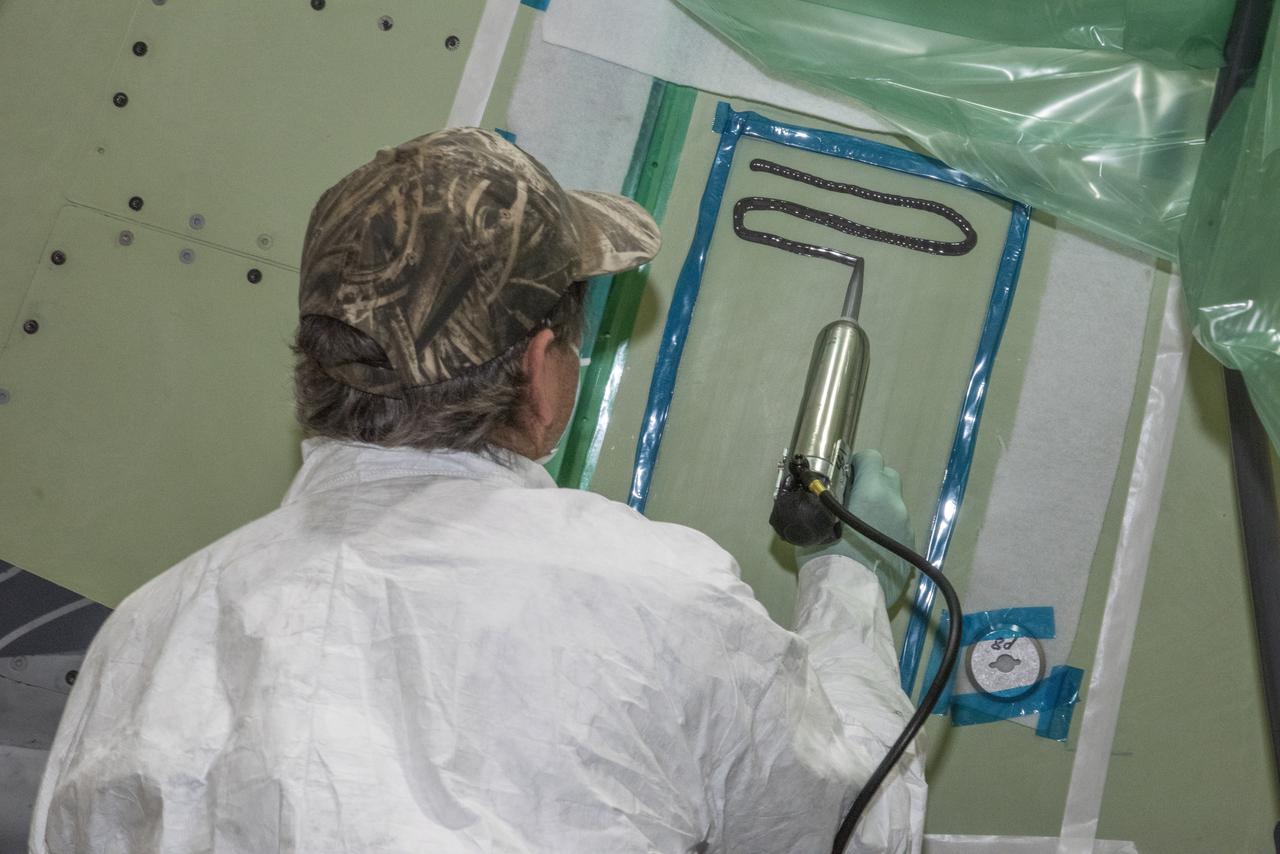
The load pad bonding process for the vertical tails was a preliminary step in the process to test the F/A-18E from the Naval Air Systems Command (NAVAIR) in Patuxent River, Maryland. The aircraft is in NASA’s Armstrong Flight Research Center Flight Loads Laboratory in Edwards, California, for the center’s biggest load calibrations tests. This testing is needed before the aircraft can serve as a test vehicle for determining if it can safely manage maneuvers and proposed upgrades.
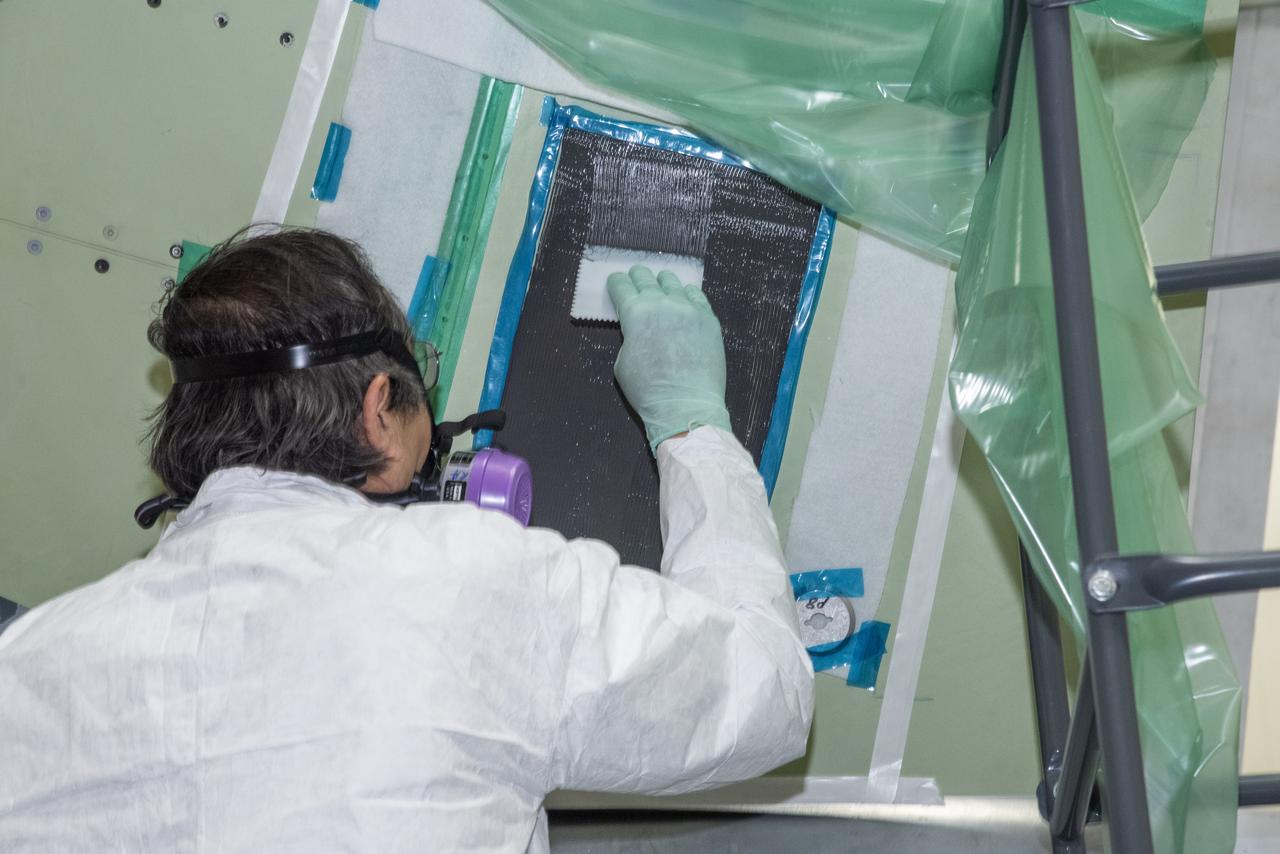
The load pad bonding process for the vertical tails was a preliminary step in the process to test the F/A-18E from the Naval Air Systems Command (NAVAIR) in Patuxent River, Maryland. The aircraft is in NASA’s Armstrong Flight Research Center Flight Loads Laboratory in Edwards, California, for the center’s biggest load calibrations tests. This testing is needed before the aircraft can serve as a test vehicle for determining if it can safely manage maneuvers and proposed upgrades.

S64-16482 (1964) --- At the Manned Spacecraft Center, Wesley Hjornevik, Assistant Director for Administration, with members of House Subcommittee and MSC Officials outside Central Data Building (Building 12) after briefing. Others pictured are Don Fuqua, Bob Casey, Edward J. Patten, Alec C. Bond, Maxime Faget, Wesley Hjornevik, Charles W. Mathews. Photo credit: NASA
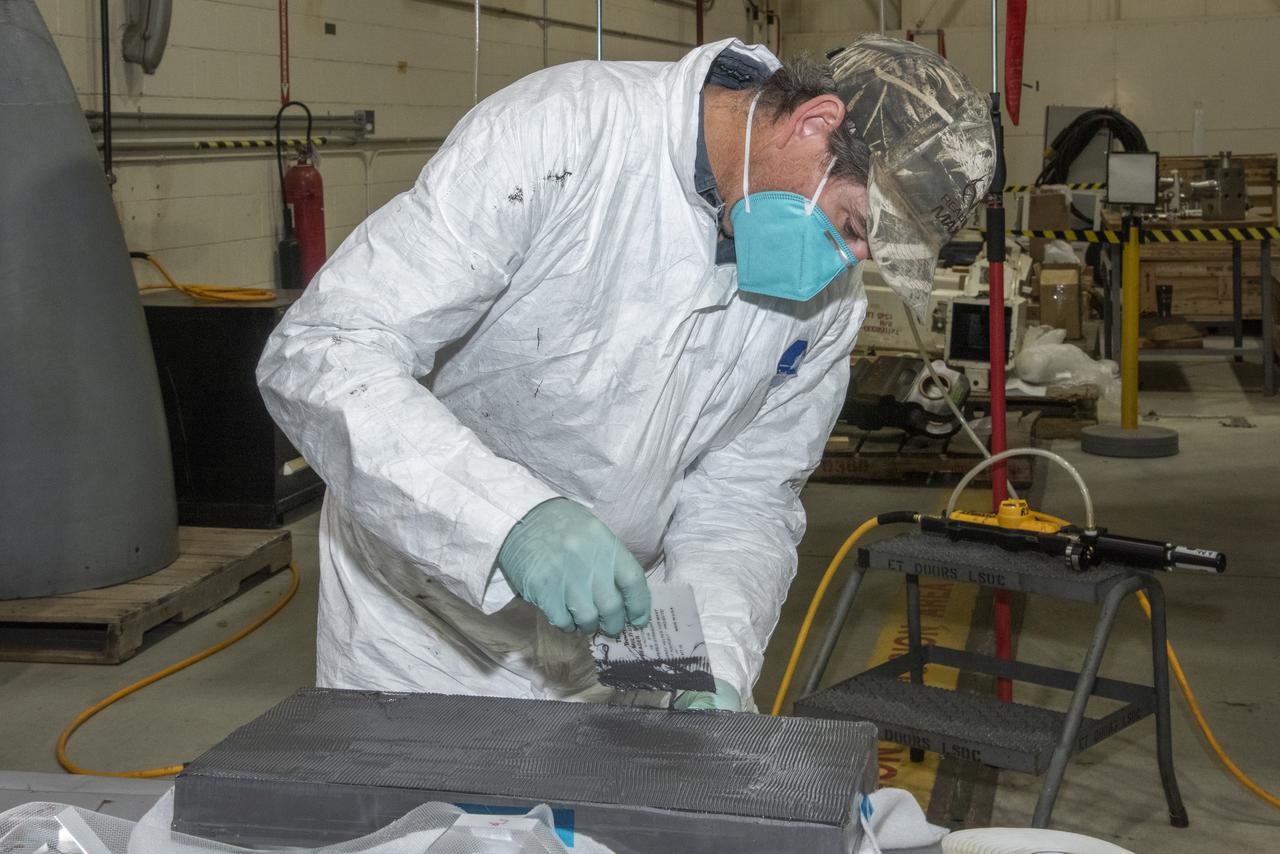
The load pad bonding process for the vertical tails was a preliminary step in the process to test the F/A-18E from the Naval Air Systems Command (NAVAIR) in Patuxent River, Maryland. The aircraft is in NASA’s Armstrong Flight Research Center Flight Loads Laboratory in Edwards, California, for the center’s biggest load calibrations tests. This testing is needed before the aircraft can serve as a test vehicle for determining if it can safely manage maneuvers and proposed upgrades.
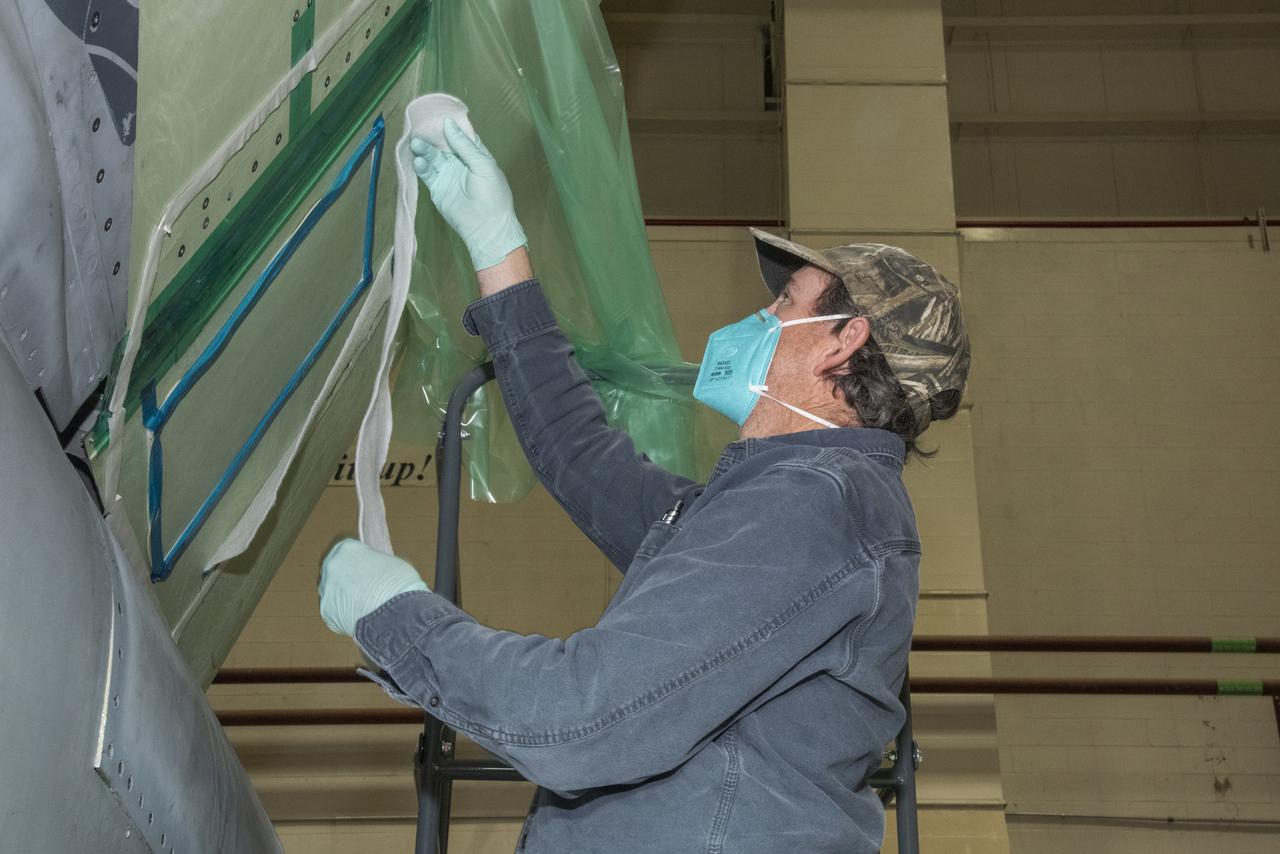
The load pad bonding process for the vertical tails was a preliminary step in the process to test the F/A-18E from the Naval Air Systems Command (NAVAIR) in Patuxent River, Maryland. The aircraft is in NASA’s Armstrong Flight Research Center Flight Loads Laboratory in Edwards, California, for the center’s biggest load calibrations tests. This testing is needed before the aircraft can serve as a test vehicle for determining if it can safely manage maneuvers and proposed upgrades.
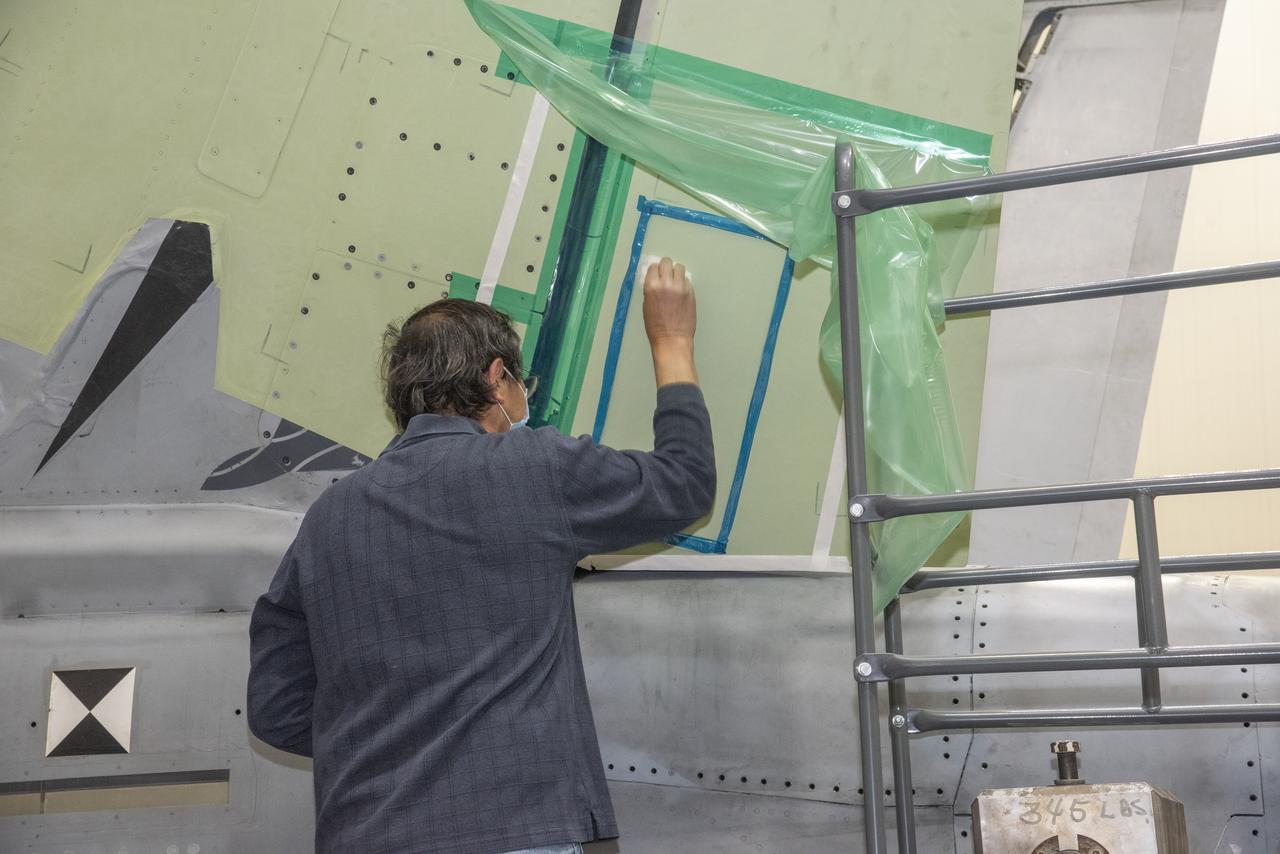
The load pad bonding process for the vertical tails was a preliminary step in the process to test the F/A-18E from the Naval Air Systems Command (NAVAIR) in Patuxent River, Maryland. The aircraft is in NASA’s Armstrong Flight Research Center Flight Loads Laboratory in Edwards, California, for the center’s biggest load calibrations tests. This testing is needed before the aircraft can serve as a test vehicle for determining if it can safely manage maneuvers and proposed upgrades.
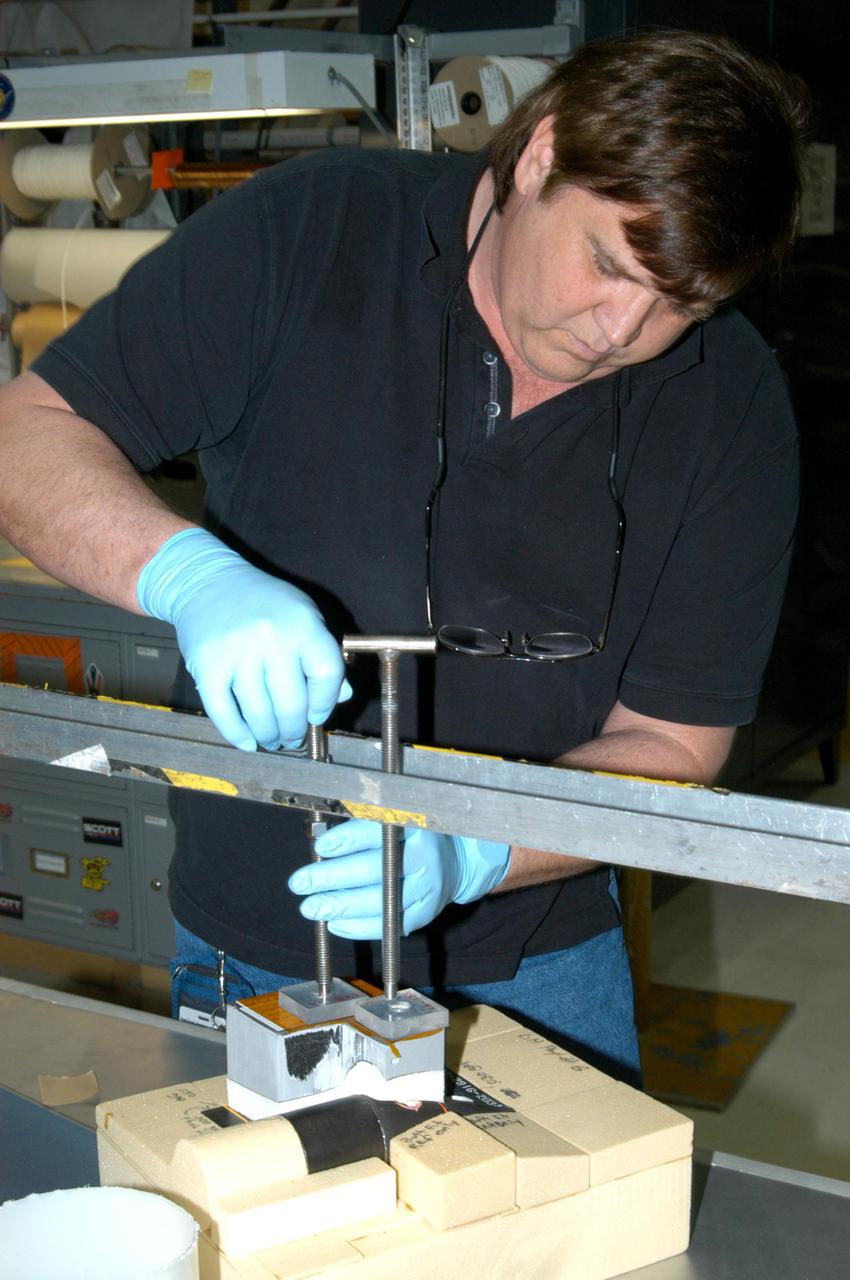
KENNEDY SPACE CENTER, FLA. - In the Orbiter Processing Facility bay 1, United Space Alliance technician George Arnett works on tile bonding for the orbiter Atlantis. The orbiter is scheduled to fly on Return to Flight mission STS-121 in July. STS-121 is a Return to Flight Utilities and Logistics Flight (ULF-2) to the International Space Station.
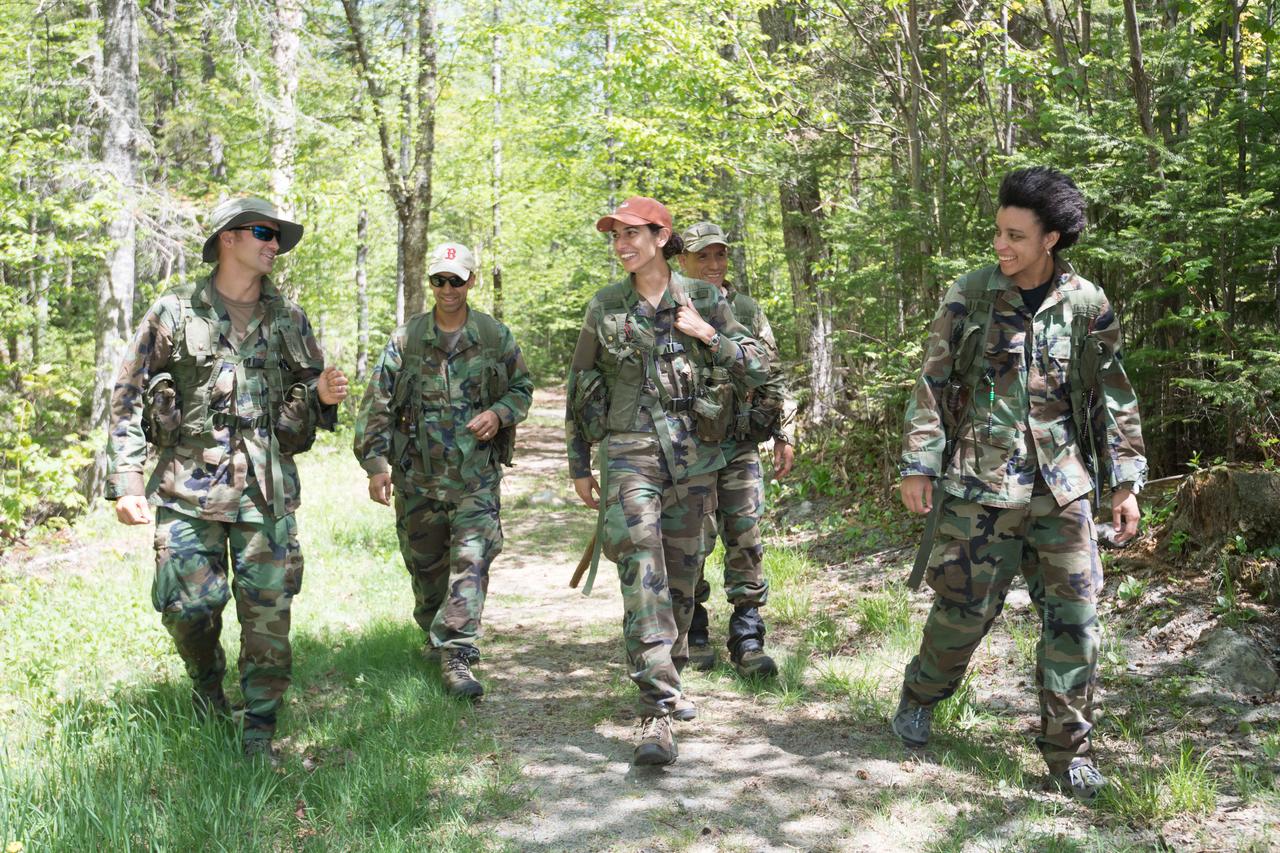
jsc2018e052141 (May 30, 2018) --- (From left) 2017 NASA astronaut candidates Matthew Dominick, Raja Chari, Jasmin Moghbeli, Frank Rubio, and Jessica Watkins take time to bond on their hike during wilderness survival training at the U.S. Navy’s Survival, Evasion, Resistance, and Escape School in Brunswick, Maine. Photo Credit: (NASA/Josh Valcarcel)
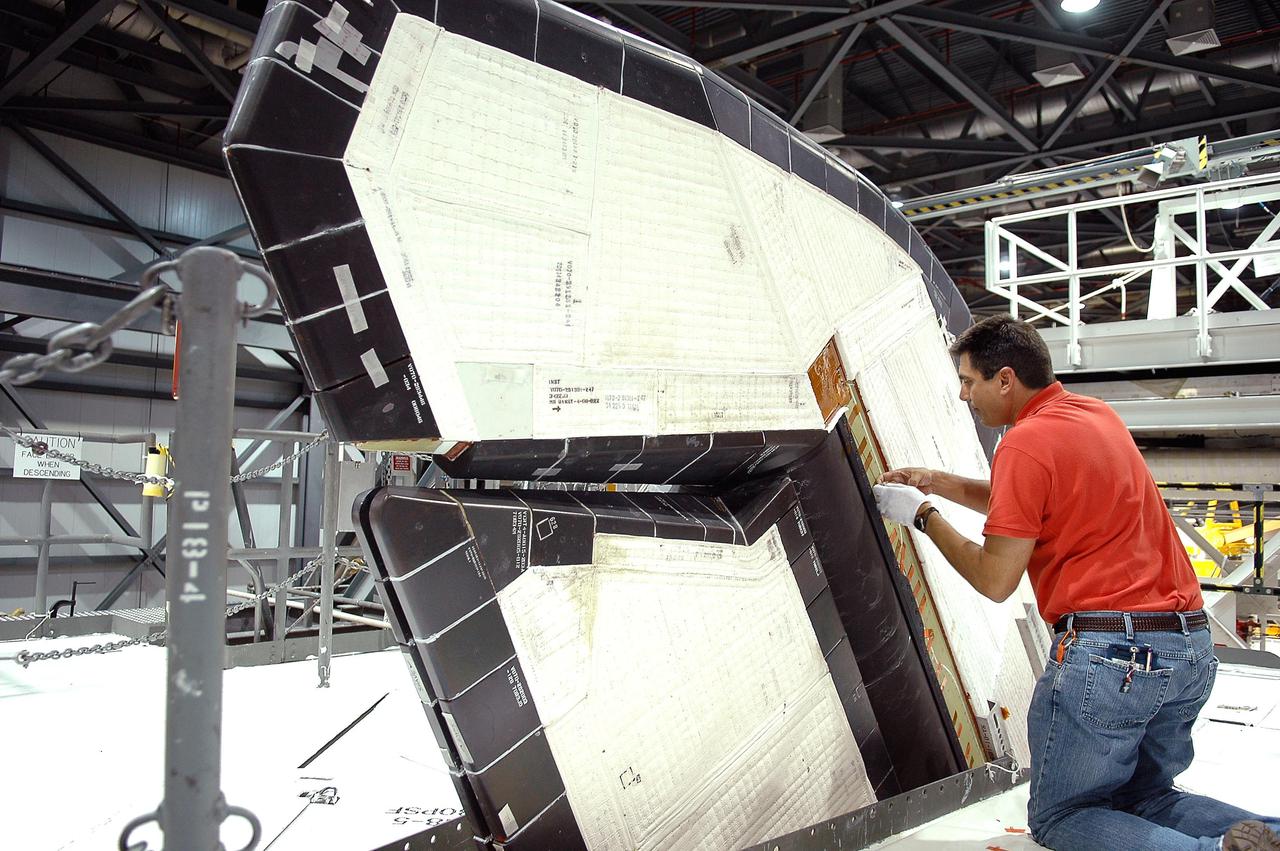
KENNEDY SPACE CENTER, FLA. - In the Orbiter Processing Facility at NASA’s Kennedy Space Center, United Space Alliance tile technician Jimmy Carter works on instrument wire spot bonding on Atlantis’ vertical tail_rudder speed brake. Atlantis is being processed for launch on the second Return to Flight mission, STS-121, which is scheduled to fly in July.
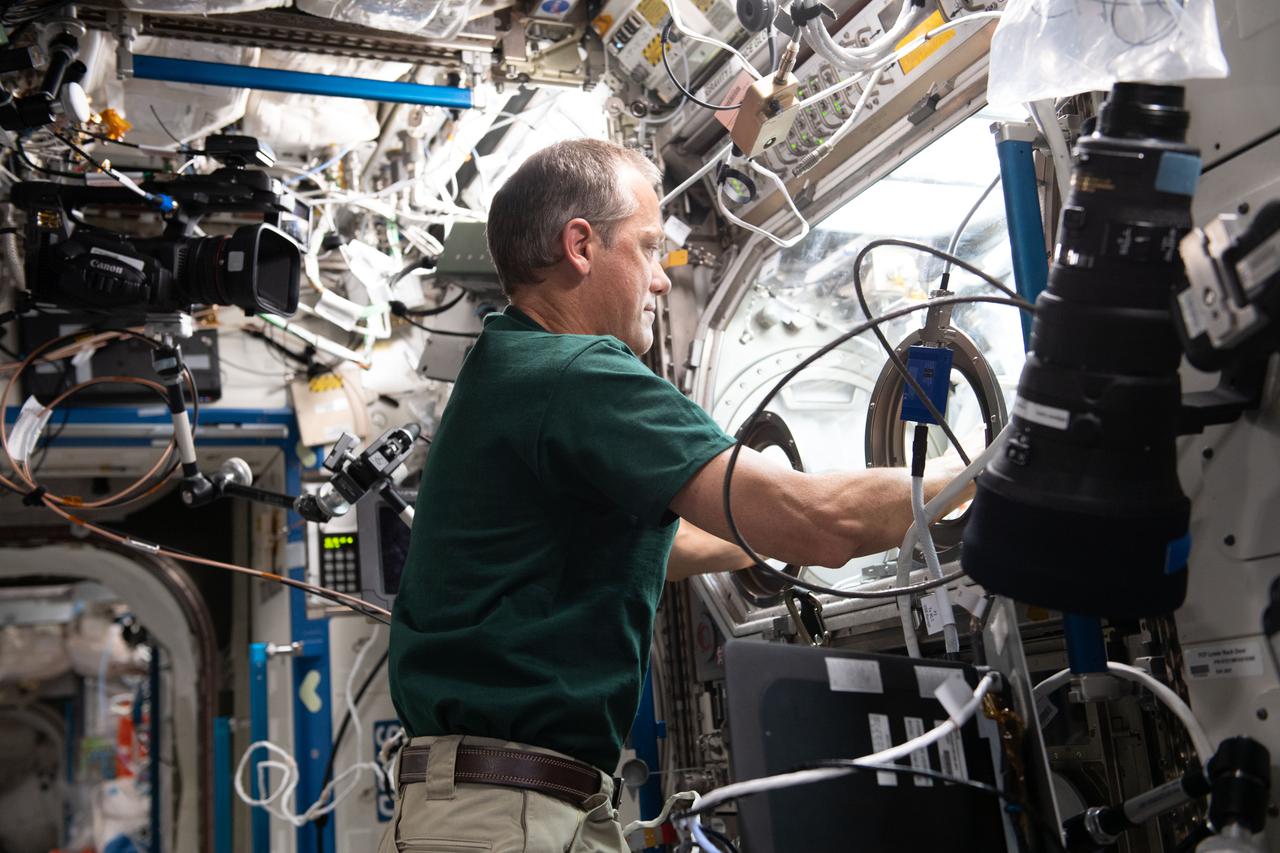
iss066e078282 (November 17, 2021) --- NASA astronaut Tom Marshburn works on the SUBSA-BRAINS space physics experiment, which examines differences in capillary flow, interface reactions, and bubble formation during solidification of brazing alloys in microgravity. Brazing technology bonds similar materials (such as an aluminum alloy to aluminum) or dissimilar ones (such as aluminum alloy to ceramics) at temperatures above 450°C. It is a potential tool for construction of human space habitats and manufactured systems as well as to repair damage from micrometeoroids or space debris.
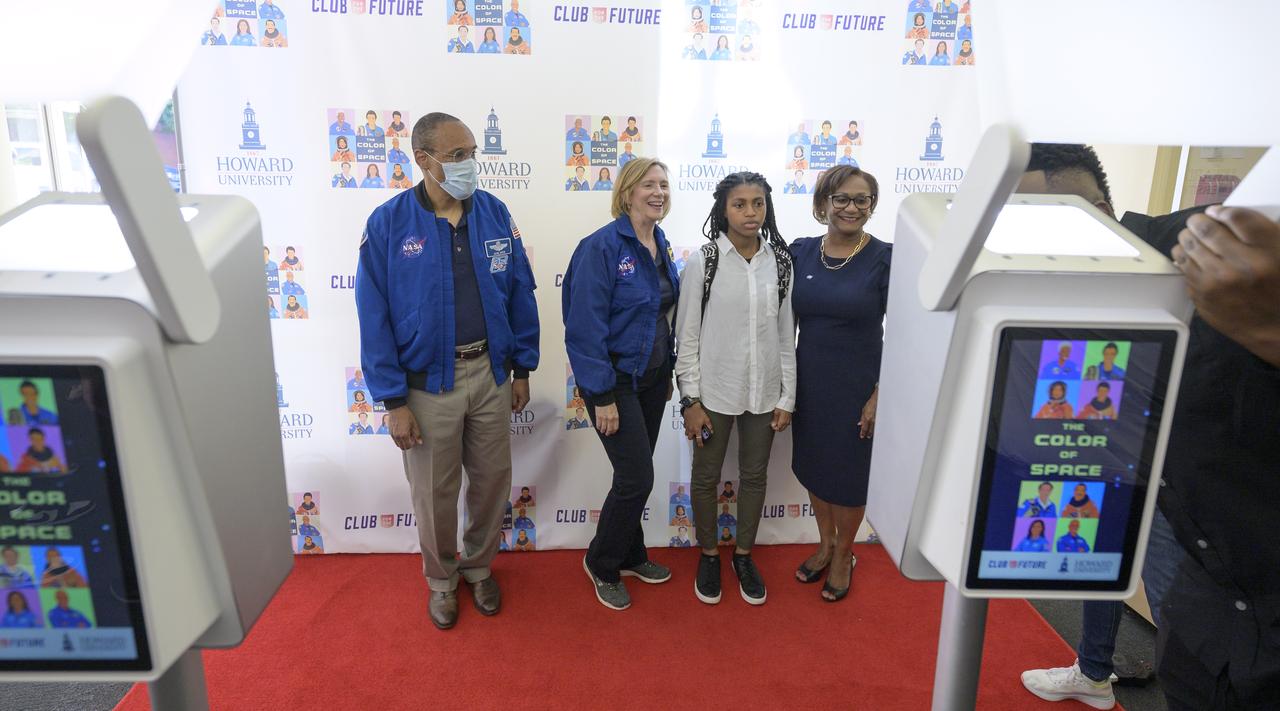
Attendees for the screening the NASA produced documentary “The Color of Space” get their photos taken with former NASA astronaut Alvin Drew, left, former astronaut Susan Kilrain, and NASA Johnson Space Center Director Vanessa Wyche, right, at Howard University’s Cramton Auditorium in Washington, Saturday, June 18, 2022. Premiering on Juneteenth, the federal holiday commemorating the end of slavery in the United States, “The Color of Space” is an inspirational documentary that tells the stories of NASA’s Black astronauts determined to reach the stars. Photo Credit: (NASA/Bill Ingalls)
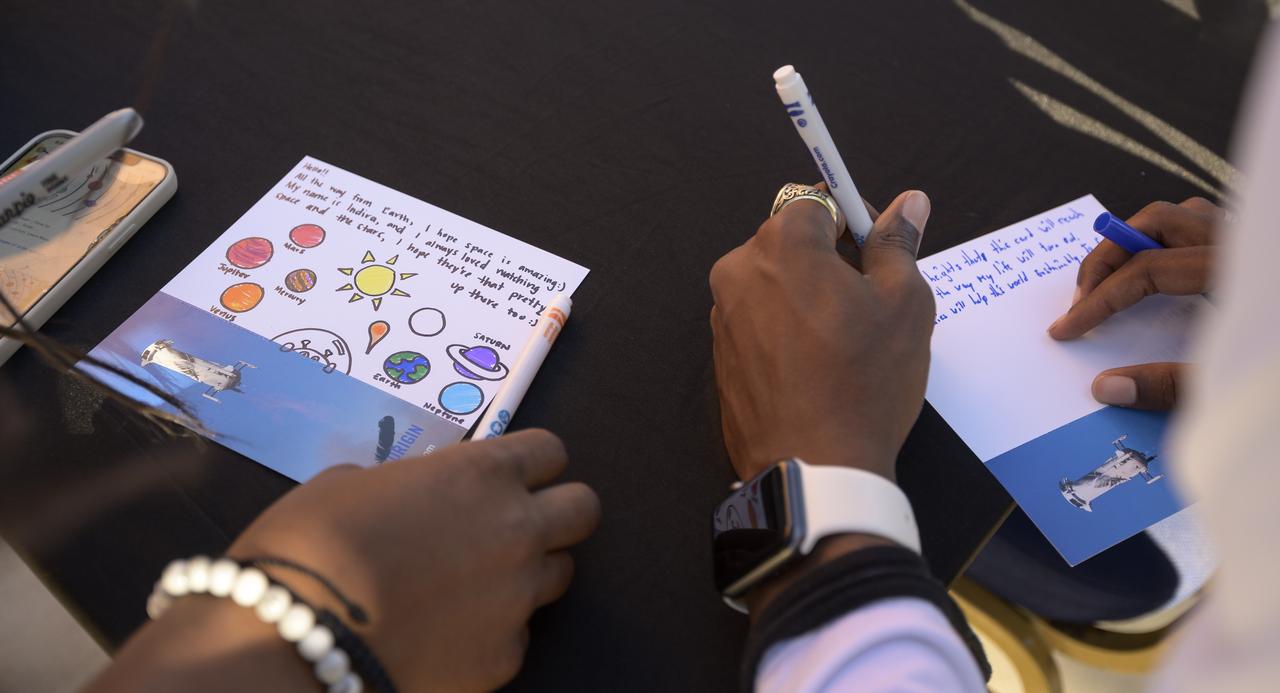
Children in attendance for the screening the NASA produced documentary “The Color of Space” draw on postcards that will be sent to space by Club for the Future on a Blue Origin New Shepard rocket at Howard University’s Cramton Auditorium in Washington, Saturday, June 18, 2022. Premiering on Juneteenth, the federal holiday commemorating the end of slavery in the United States, “The Color of Space” is an inspirational documentary that tells the stories of NASA’s Black astronauts determined to reach the stars. Photo Credit: (NASA/Bill Ingalls)
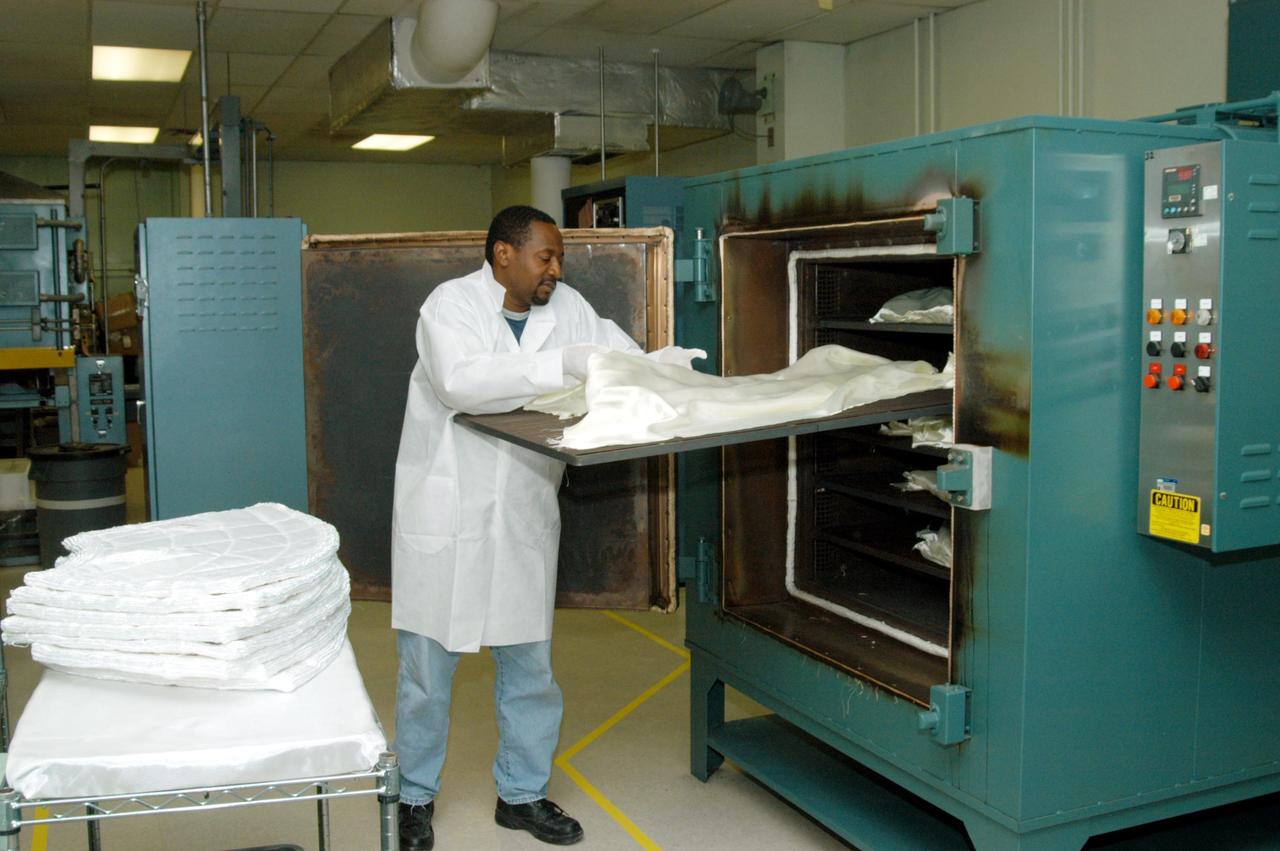
KENNEDY SPACE CENTER, FLA. -- Damon Petty, with United Space Alliance, prepares the cover of another insulation blanket in the “oven” prior to heat cleaning. The blankets fit inside the nose cap of an orbiter. They consist of layered, pure silica felt sandwiched between a layer of silica fabric (the hot side) and a layer of S-Glass fabric. The blanket is through-stitched with pure silica thread in a 1-inch grid pattern. After fabrication, the blanket is bonded directly to the vehicle structure and finally coated with a high purity silica coating that improves erosion resistance. The blankets are semi-rigid and can be made as large as 30 inches by 30 inches.
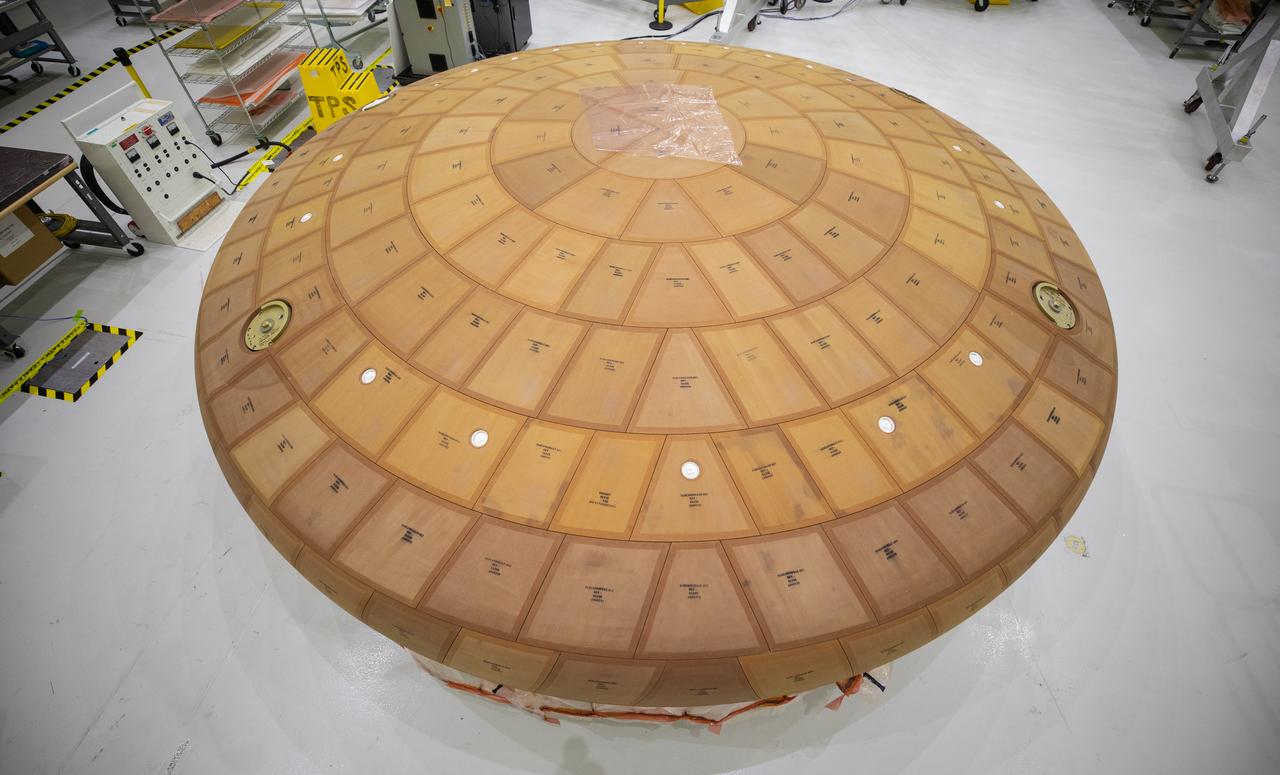
Inside the Neil Armstrong Operations and Checkout Building high bay at NASA's Kennedy Space Center in Florida, the AVOCAT block bonding is complete on the Artemis II heat shield on July 2, 2020. The heat shield is one of the most critical elements of Orion and will protect the capsule and astronauts during reentry through Earth’s atmosphere. Artemis II is the first crewed mission in a series of missions to the Moon and on to Mars. Artemis II will confirm all of the Orion spacecraft’s systems operate as designed in the actual environment of deep space with astronauts aboard. As part of the Artemis Program, NASA will send the first woman and next man to the Moon by 2024.
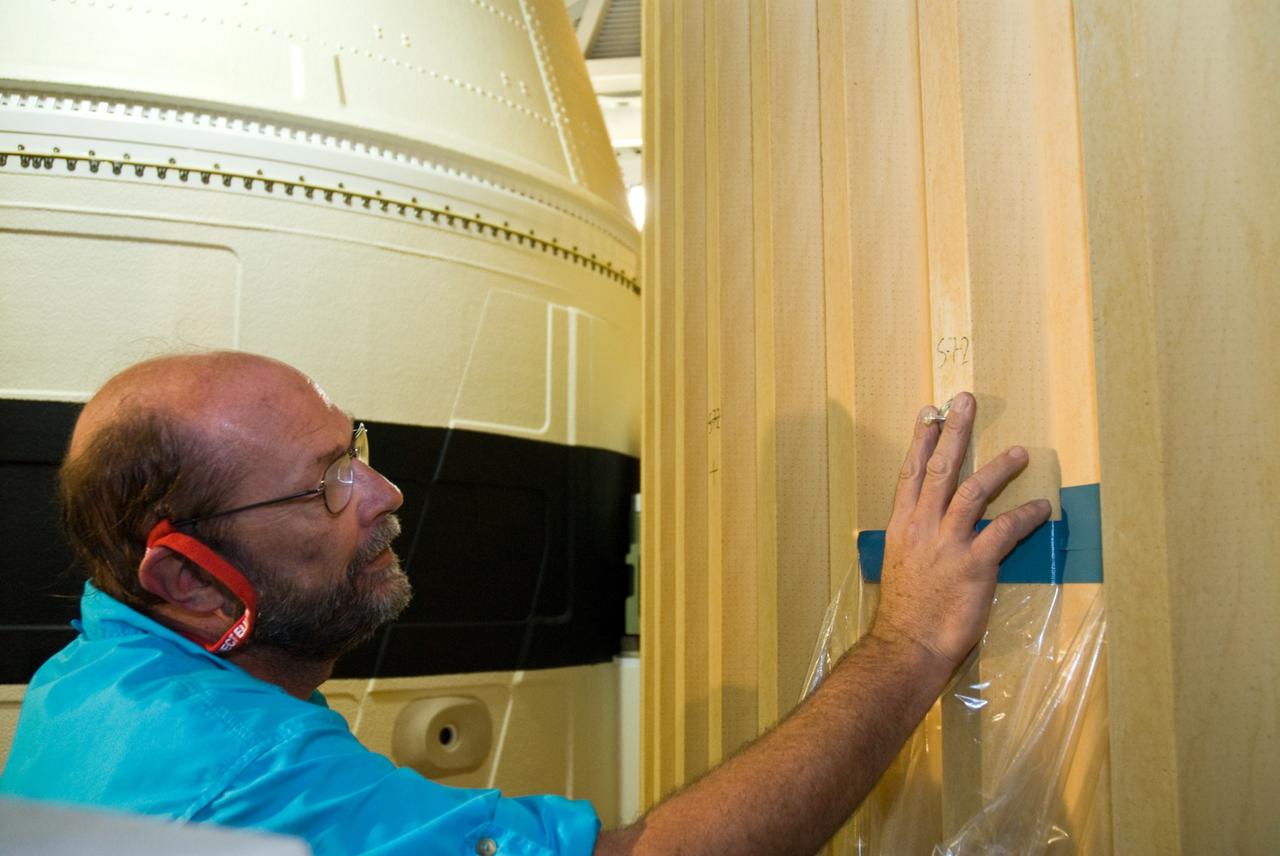
CAPE CANAVERAL, Fla. – In the Vehicle Assembly Building's High Bay 1 at NASA's Kennedy Space Center in Florida, David Buras, a Material and Process engineer from NASA's Michoud Assembly Facility near New Orleans where the fuel tanks are built, is testing foam adhesion on the intertank of space shuttle Discovery's external tank . He is collecting foam samples an inch-and-half in diameter for analysis to confirm the foam is bonded well to the metal primer underneath. The testing was prompted by the foam loss during launch of space shuttle Endeavour on the STS-127 mission July 15. Samples are being sent to Michoud for study. Photo credit: NASA/Tim Jacobs
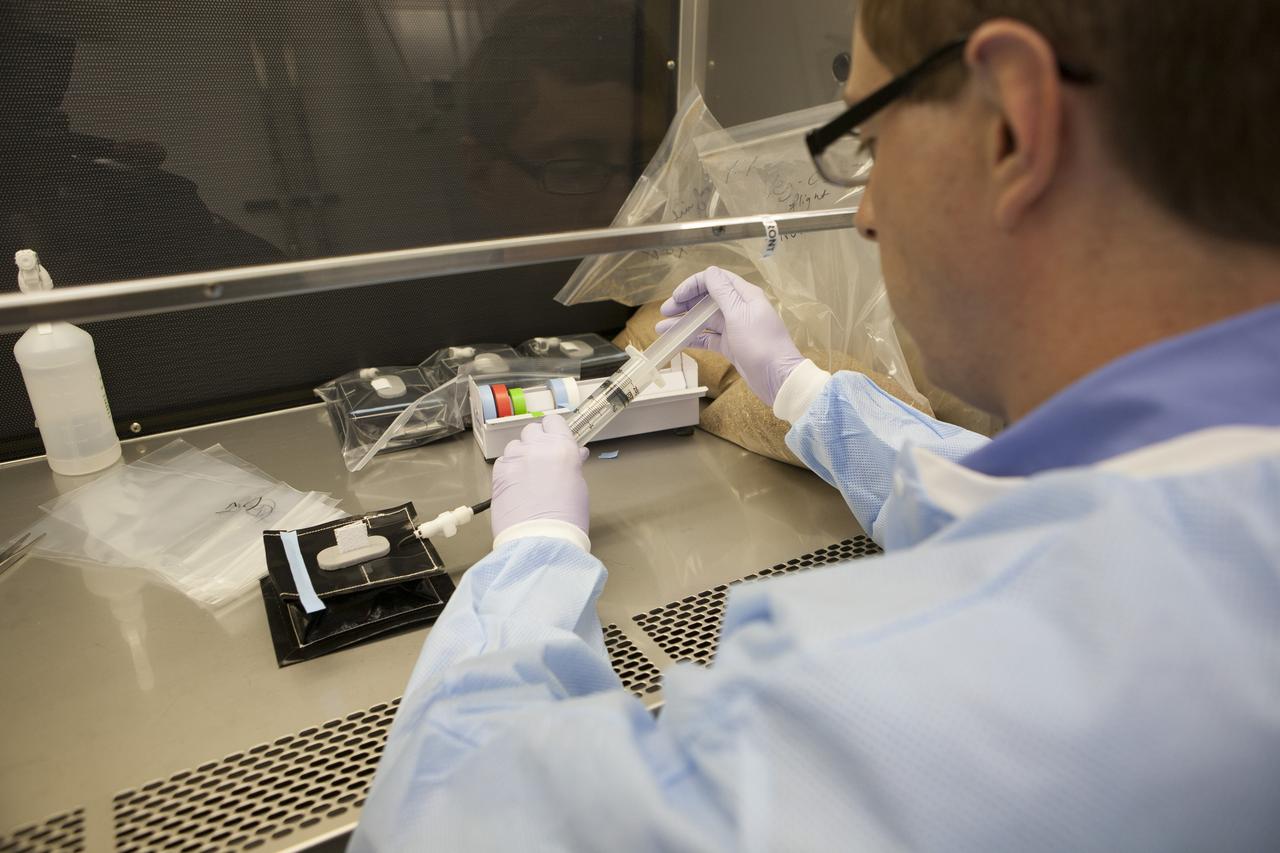
Inside a laboratory in the Space Station Processing Facility at NASA’s Kennedy Space Center in Florida, research scientists prepare the plant pillows for the Veg-03 experiment that will be delivered to the International Space Station aboard the eighth SpaceX Dragon commercial resupply mission. Dr. Mathew Mickens, a post-doctoral researcher, inserts a bonding agent into one of the Veg-03 plant pillows. The Veg-03 plant pillows will contain ‘Tokyo Bekana’ cabbage seeds and lettuce seeds for NASA’s third Veggie plant growth system experiment. The experiment will continue NASA’s deep space plant growth research to benefit the Earth and the agency’s journey to Mars.
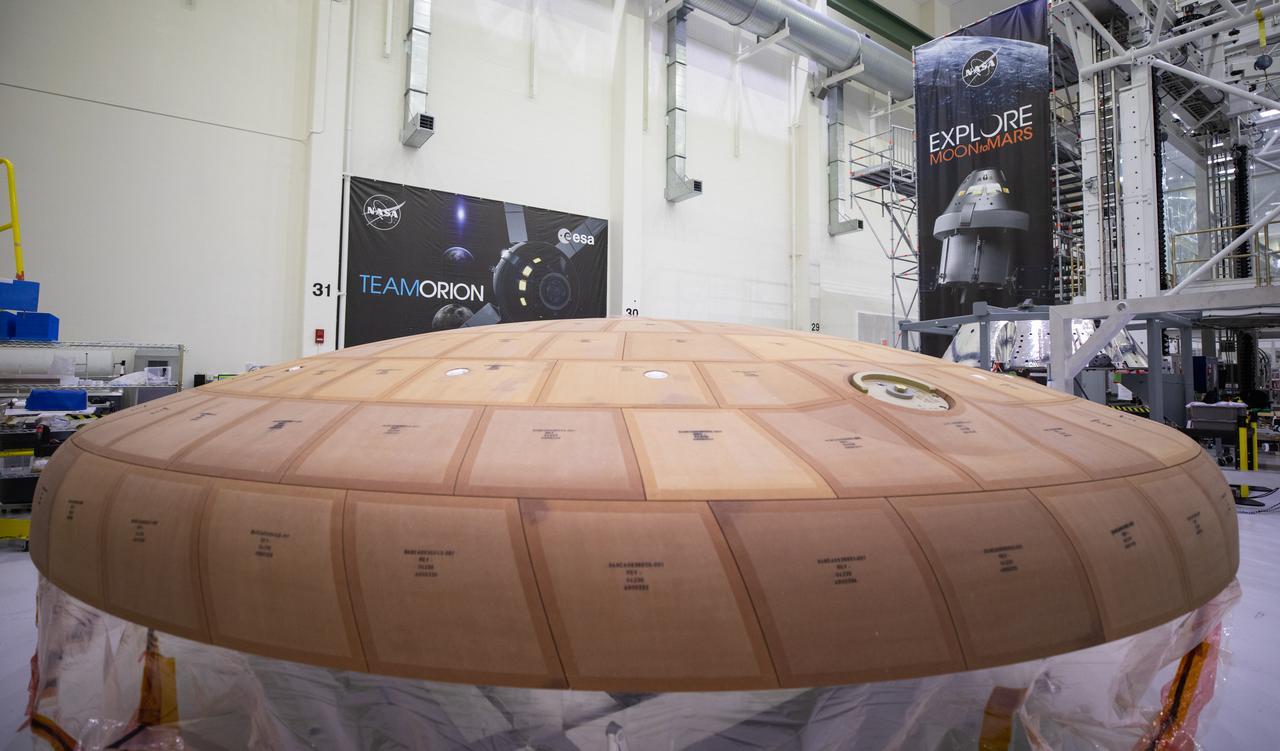
Inside the Neil Armstrong Operations and Checkout Building high bay at NASA's Kennedy Space Center in Florida, the AVCOAT block bonding is complete on the Artemis II heat shield on July 2, 2020. The heat shield is one of the most critical elements of Orion and will protect the capsule and astronauts during reentry through Earth’s atmosphere. Artemis II is the first crewed mission in a series of missions to the Moon and on to Mars. Artemis II will confirm all of the Orion spacecraft’s systems operate as designed in the actual environment of deep space with astronauts aboard. As part of the Artemis Program, NASA will send the first woman and next man to the Moon by 2024.
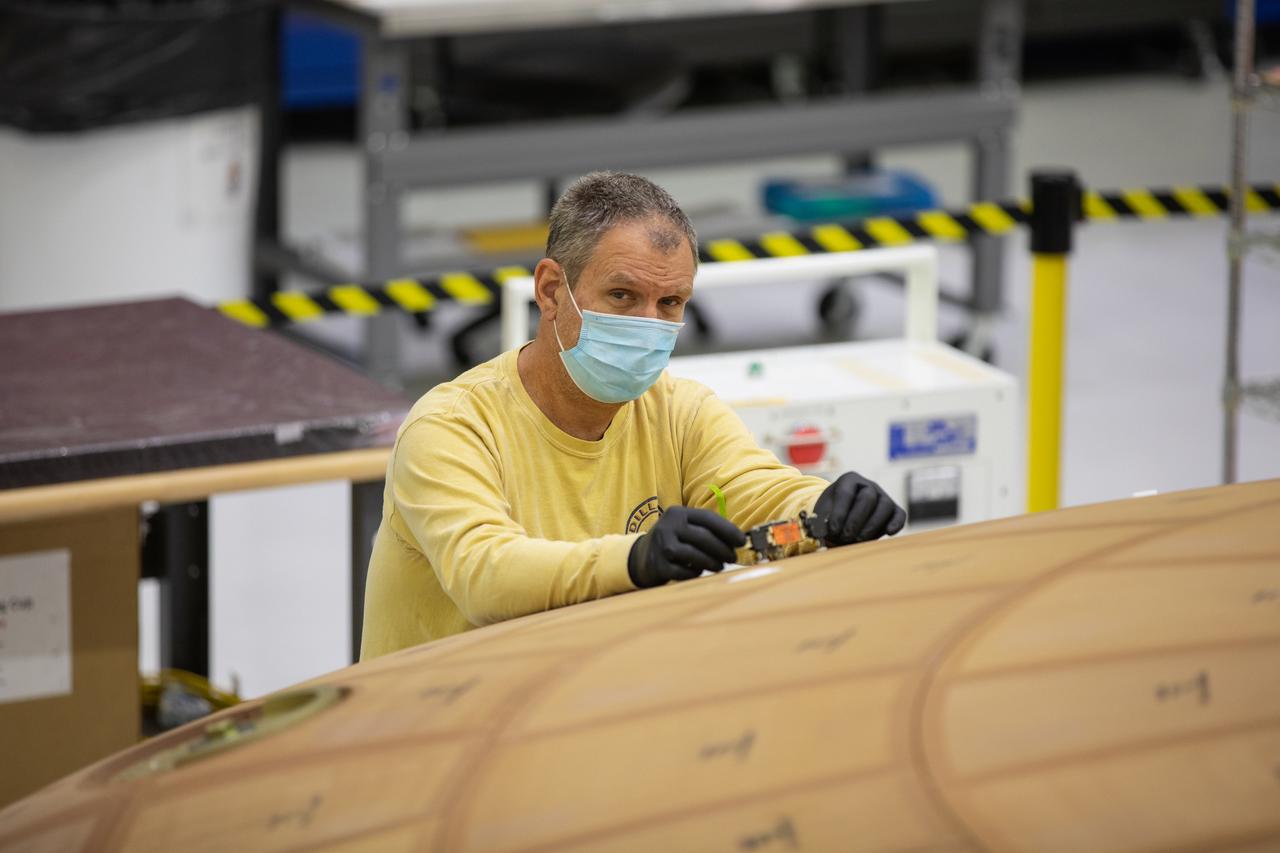
Inside the Neil Armstrong Operations and Checkout Building high bay at NASA's Kennedy Space Center in Florida, technician Kenny Leidner with ASRC Federal, inspects AVCOAT block bonding on the Artemis II heat shield on July 2, 2020. The heat shield is one of the most critical elements of Orion and will protect the capsule and astronauts during reentry through Earth’s atmosphere. Artemis II is the first crewed mission in a series of missions to the Moon and on to Mars. Artemis II will confirm all of the Orion spacecraft’s systems operate as designed in the actual environment of deep space with astronauts aboard. As part of the Artemis Program, NASA will send the first woman and next man to the Moon by 2024.
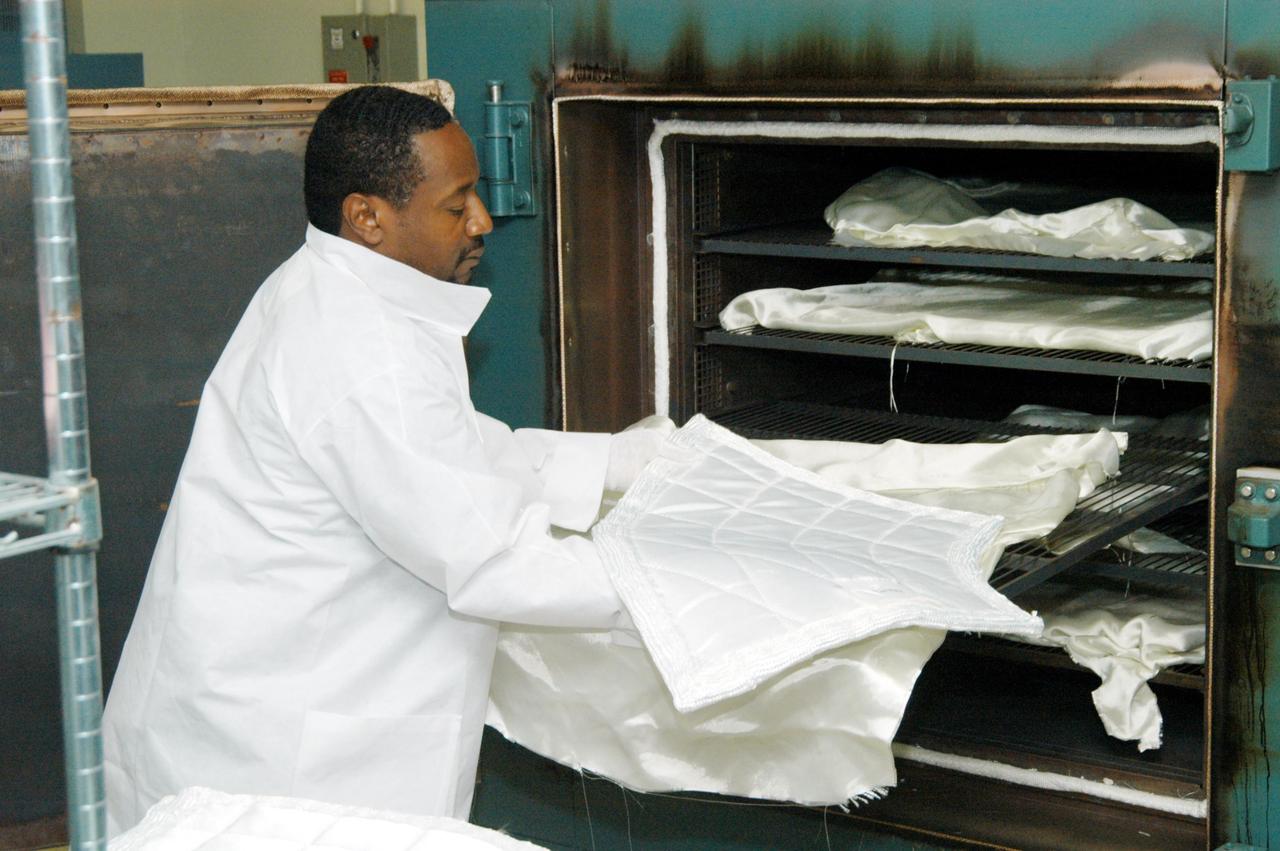
KENNEDY SPACE CENTER, FLA. -- Damon Petty, with United Space Alliance, removes a piece of insulation blanket from an “oven” after heat cleaning. The blankets fit inside the nose cap of an orbiter. They consist of layered, pure silica felt sandwiched between a layer of silica fabric (the hot side) and a layer of S-Glass fabric. The blanket is through-stitched with pure silica thread in a 1-inch grid pattern. After fabrication, the blanket is bonded directly to the vehicle structure and finally coated with a high purity silica coating that improves erosion resistance. The blankets are semi-rigid and can be made as large as 30 inches by 30 inches.
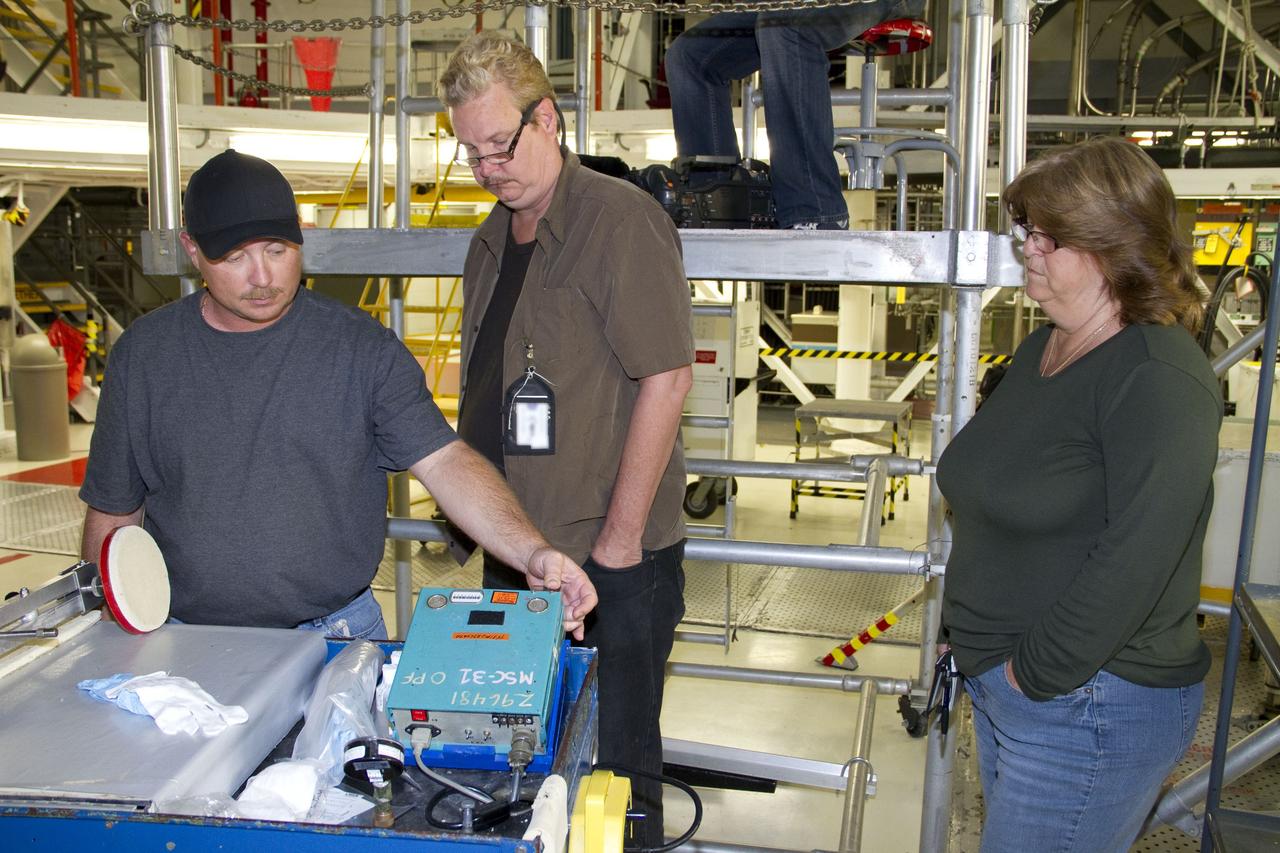
CAPE CANAVERAL, Fla. -- United Space Alliance technicians gear up for a pull test of shuttle Atlantis' thermal protection tiles in Orbiter Processing Facility-1 at NASA's Kennedy Space Center in Florida. The pull test measures the force it takes to pull a tile off of the shuttle in order to make sure the bond between the two is strong enough to withstand the force of launch and landing. Atlantis is being prepared for the STS-135 mission, which will deliver the Raffaello multipurpose logistics module packed with supplies, logistics and spare parts to the International Space Station. STS-135 is targeted to launch June 28, and will be the last spaceflight for the Space Shuttle Program. Photo credit: NASA/Jack Pfaller
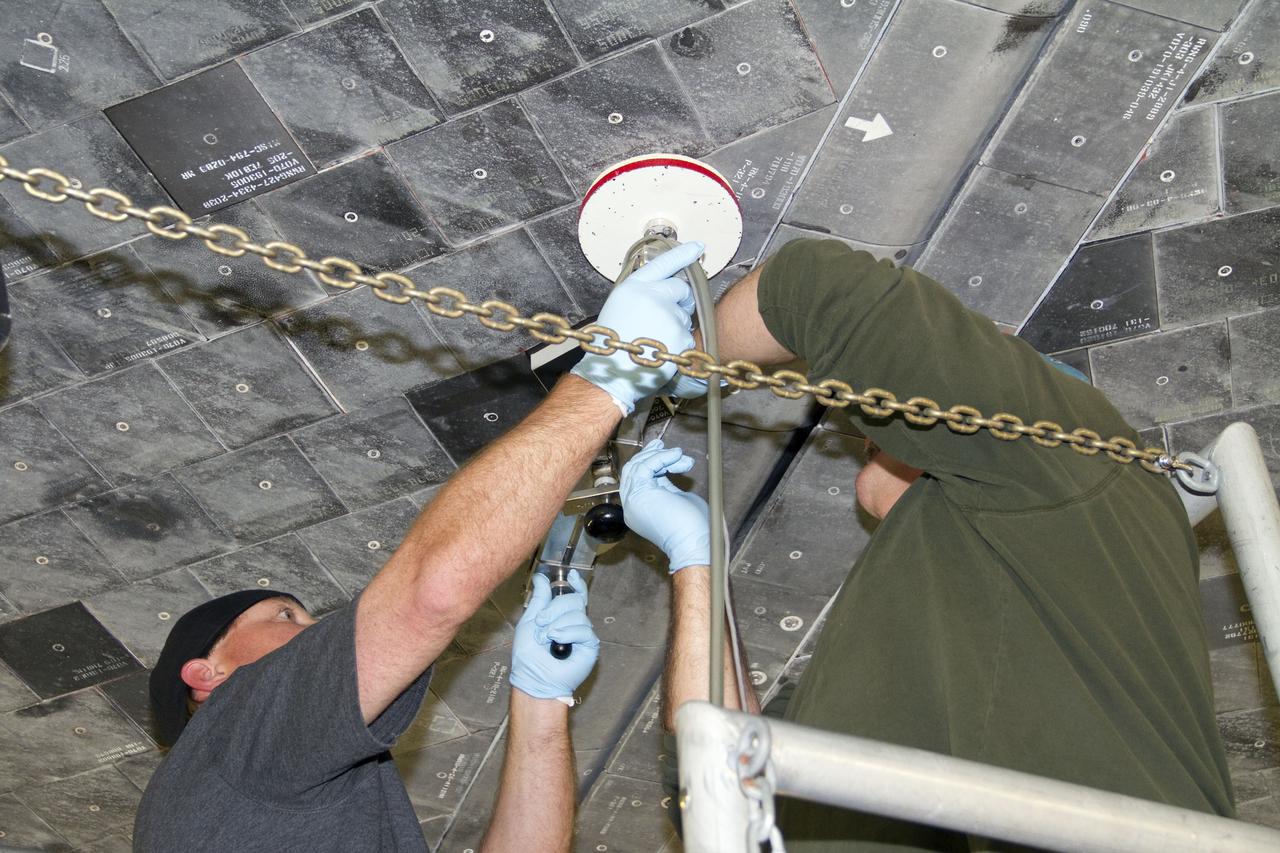
CAPE CANAVERAL, Fla. -- United Space Alliance technicians perform a pull test on shuttle Atlantis' thermal protection tiles in Orbiter Processing Facility-1 at NASA's Kennedy Space Center in Florida. The pull test measures the force it takes to pull a tile off of the shuttle in order to make sure the bond between the two is strong enough to withstand the force of launch and landing. Atlantis is being prepared for the STS-135 mission, which will deliver the Raffaello multipurpose logistics module packed with supplies, logistics and spare parts to the International Space Station. STS-135 is targeted to launch June 28, and will be the last spaceflight for the Space Shuttle Program. Photo credit: NASA/Jack Pfaller
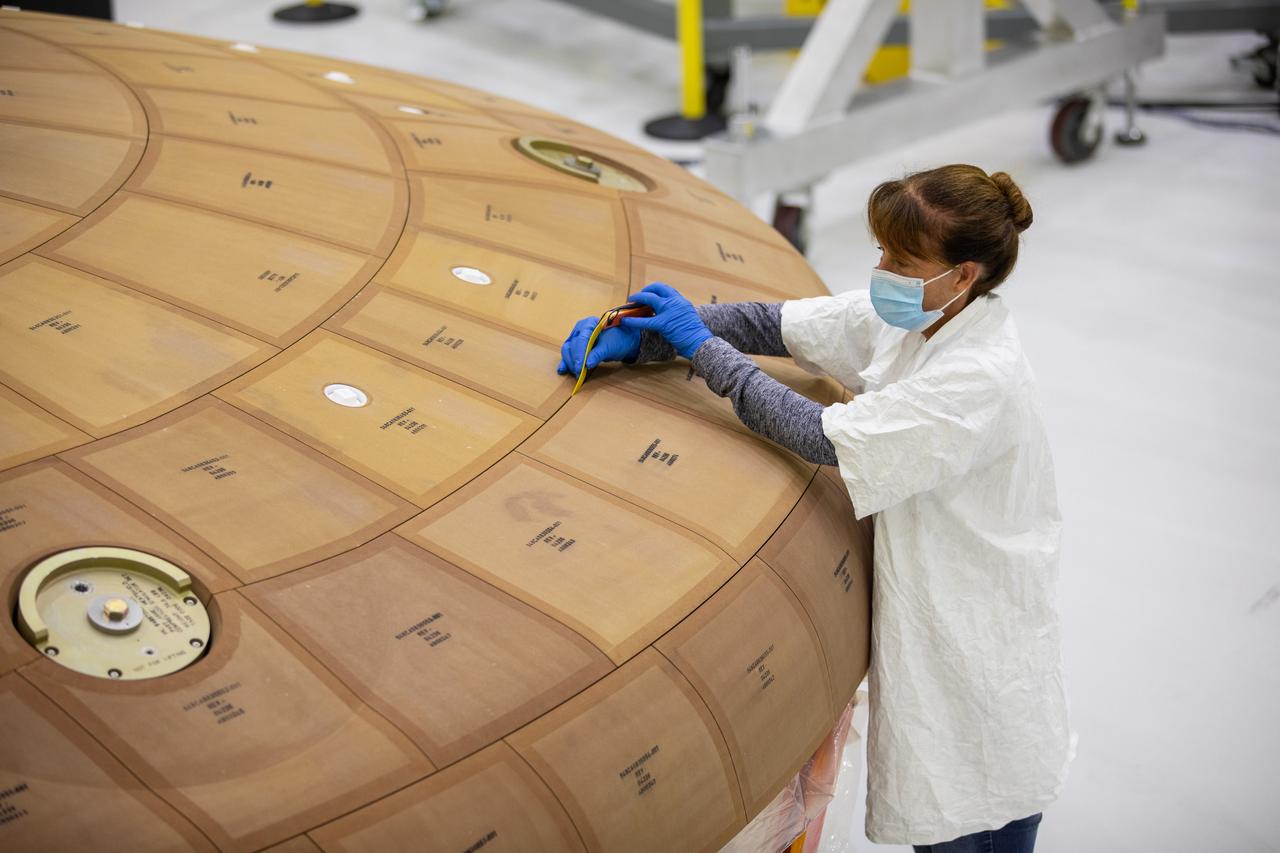
Inside the Neil Armstrong Operations and Checkout Building high bay at NASA's Kennedy Space Center in Florida, Darlene Beville with ASRC Federal, inspects AVOCAT block bonding on the Artemis II heat shield on July 2, 2020. The heat shield is one of the most critical elements of Orion and will protect the capsule and astronauts during reentry through Earth’s atmosphere. Artemis II is the first crewed mission in a series of missions to the Moon and on to Mars. Artemis II will confirm all of the Orion spacecraft’s systems operate as designed in the actual environment of deep space with astronauts aboard. As part of the Artemis Program, NASA will send the first woman and next man to the Moon by 2024.
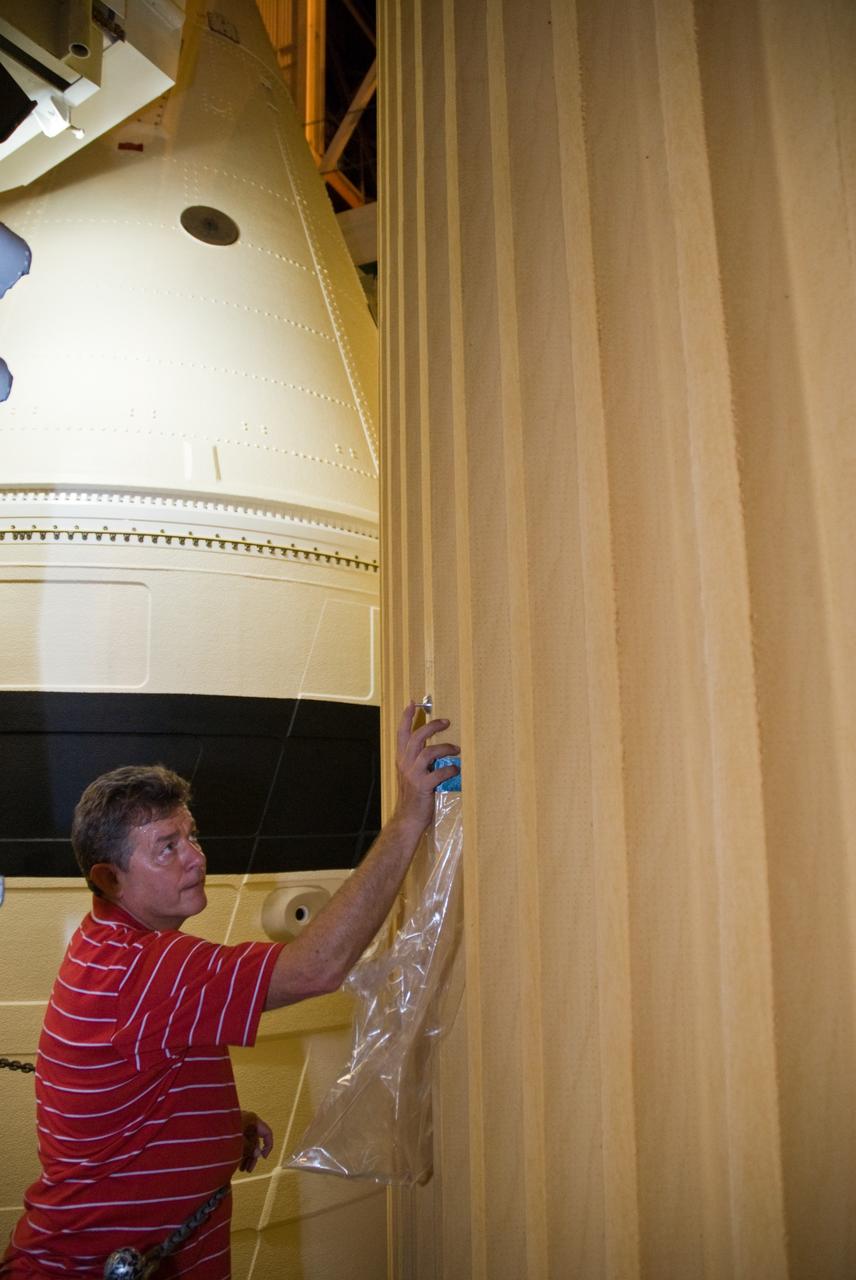
CAPE CANAVERAL, Fla. – In the Vehicle Assembly Building's High Bay 1 at NASA's Kennedy Space Center in Florida, Eugene Sweet, a principal liaison engineer from NASA's Michoud Assembly Facility near New Orleans where the external fuel tanks are built, is testing foam adhesion on the intertank of space shuttle Discovery's external tank. He is collecting foam samples an inch-and-half in diameter for analysis to confirm the foam is bonded well to the metal primer underneath. The testing was prompted by the foam loss during launch of space shuttle Endeavour on the STS-127 mission July 15. Samples are being sent to Michoud for study. Photo credit: NASA/Tim Jacobs
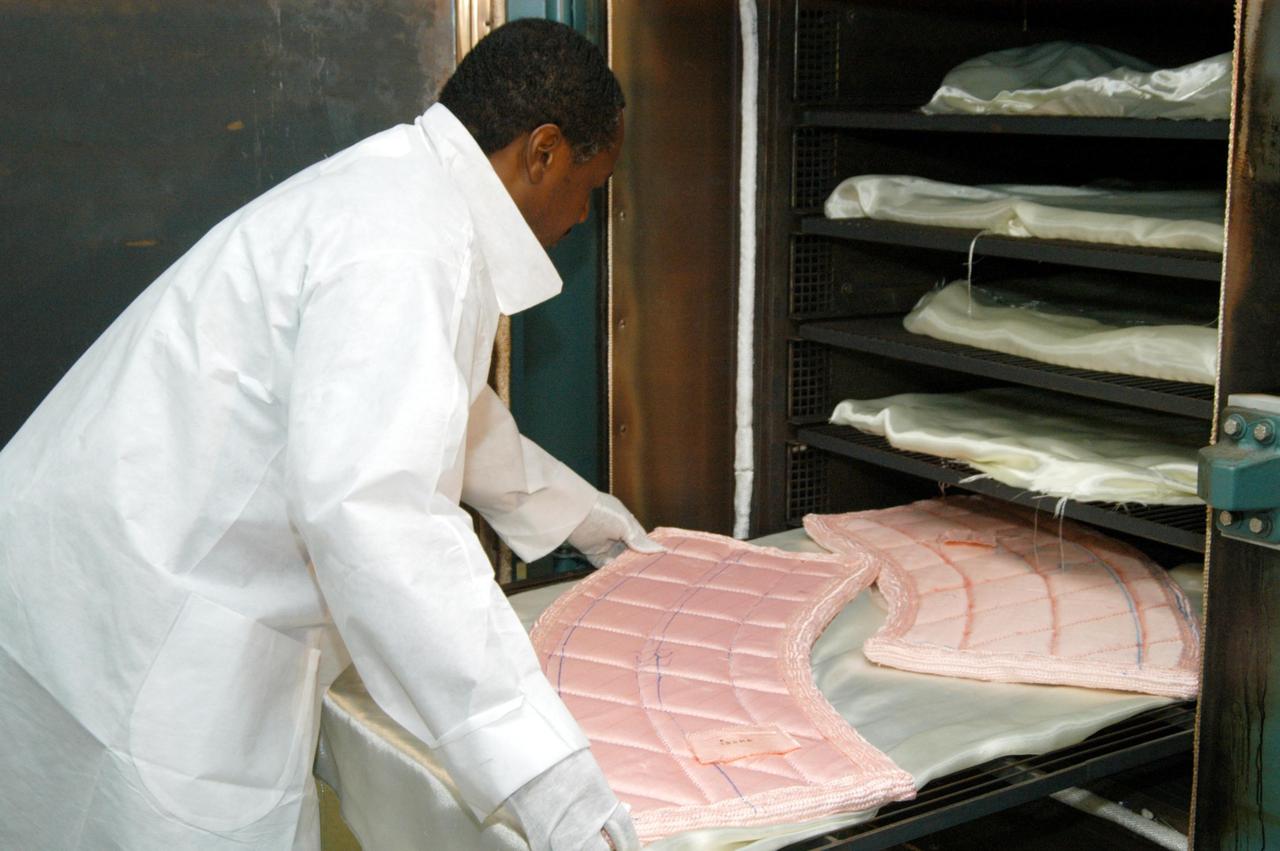
KENNEDY SPACE CENTER, FLA. -- Damon Petty, with United Space Alliance, places pieces of insulation blanket into an “oven” for heat cleaning. The blankets fit inside the nose cap of an orbiter. They consist of layered, pure silica felt sandwiched between a layer of silica fabric (the hot side) and a layer of S-Glass fabric. The blanket is through-stitched with pure silica thread in a 1-inch grid pattern. After fabrication, the blanket is bonded directly to the vehicle structure and finally coated with a high purity silica coating that improves erosion resistance. The blankets are semi-rigid and can be made as large as 30 inches by 30 inches.
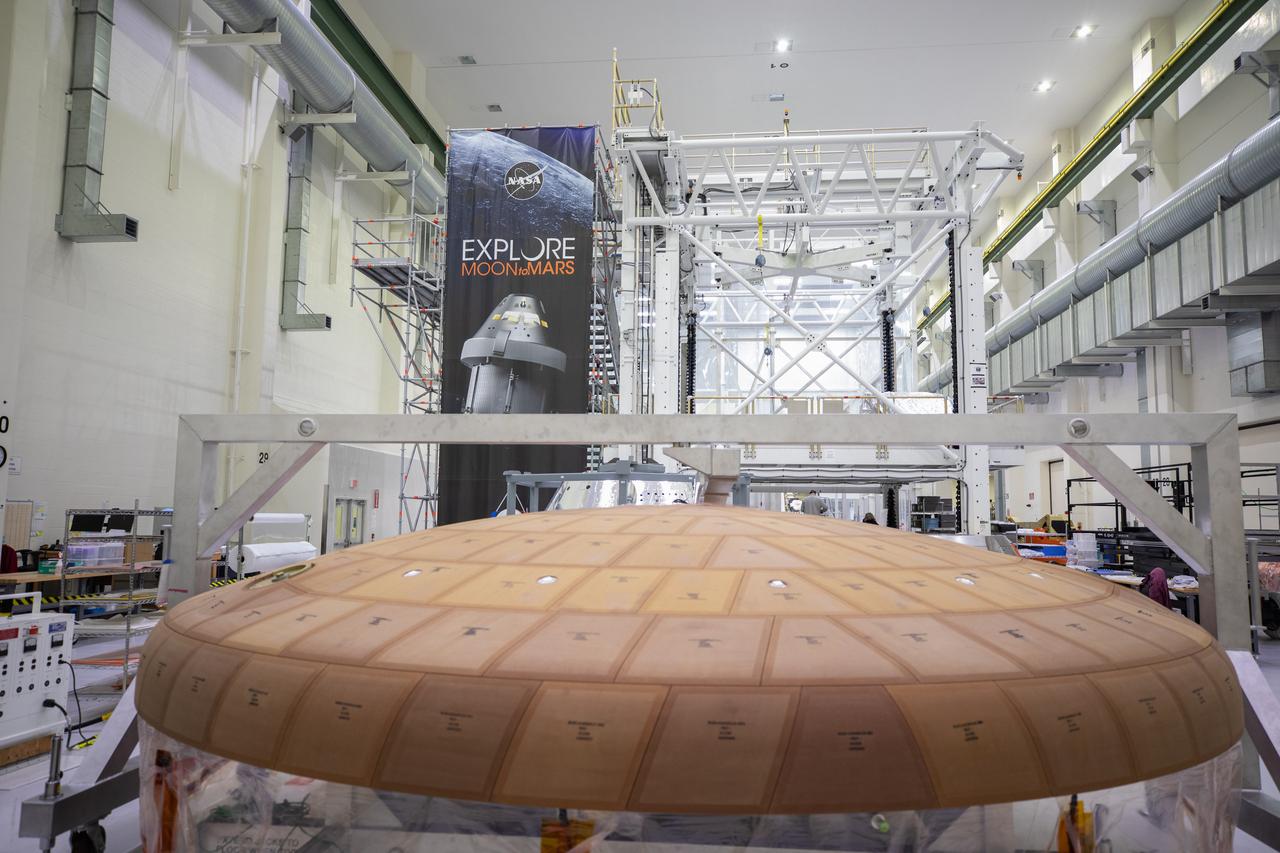
Inside the Neil Armstrong Operations and Checkout Building high bay at NASA's Kennedy Space Center in Florida, the AVCOAT block bonding is complete on the Artemis II heat shield on July 2, 2020. The heat shield is one of the most critical elements of Orion and will protect the capsule and astronauts during reentry through Earth’s atmosphere. Artemis II is the first crewed mission in a series of missions to the Moon and on to Mars. Artemis II will confirm all of the Orion spacecraft’s systems operate as designed in the actual environment of deep space with astronauts aboard. As part of the Artemis Program, NASA will send the first woman and next man to the Moon by 2024.
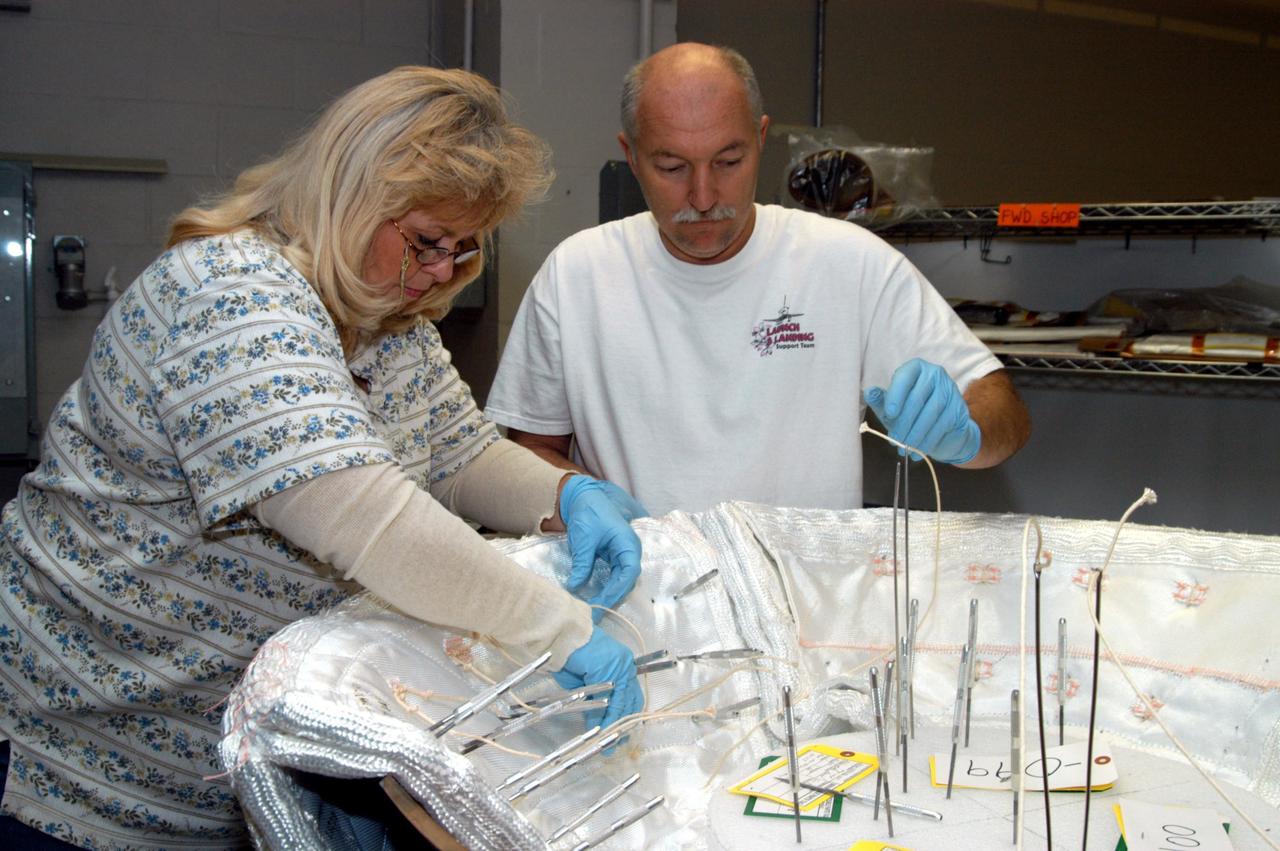
KENNEDY SPACE CENTER, FLA. -- United Space Alliance workers Ginger Morrison and Michael Williams stitch together pieces of insulation blankets inside the ring that fits in the nose cap of Discovery. The blankets consist of layered, pure silica felt sandwiched between a layer of silica fabric (the hot side) and a layer of S-Glass fabric. The blankets are semi-rigid and can be made as large as 30 inches by 30 inches. The blanket is through-stitched with pure silica thread in a 1-inch grid pattern. After fabrication, the blanket is bonded directly to the vehicle structure and finally coated with a high purity silica coating that improves erosion resistance.
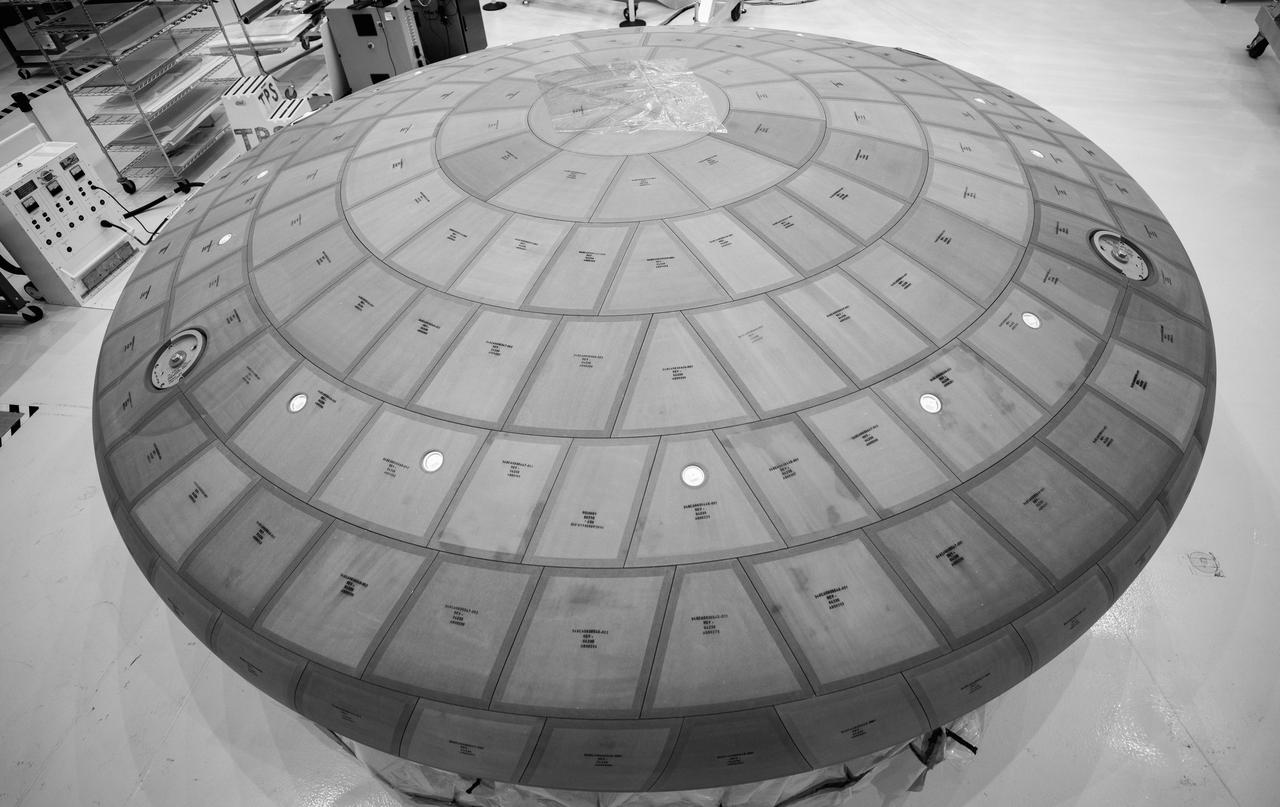
Inside the Neil Armstrong Operations and Checkout Building high bay at NASA's Kennedy Space Center in Florida, the AVOCAT block bonding is complete on the Artemis II heat shield on July 2, 2020. The heat shield is one of the most critical elements of Orion and will protect the capsule and astronauts during reentry through Earth’s atmosphere. Artemis II is the first crewed mission in a series of missions to the Moon and on to Mars. Artemis II will confirm all of the Orion spacecraft’s systems operate as designed in the actual environment of deep space with astronauts aboard. As part of the Artemis Program, NASA will send the first woman and next man to the Moon by 2024.
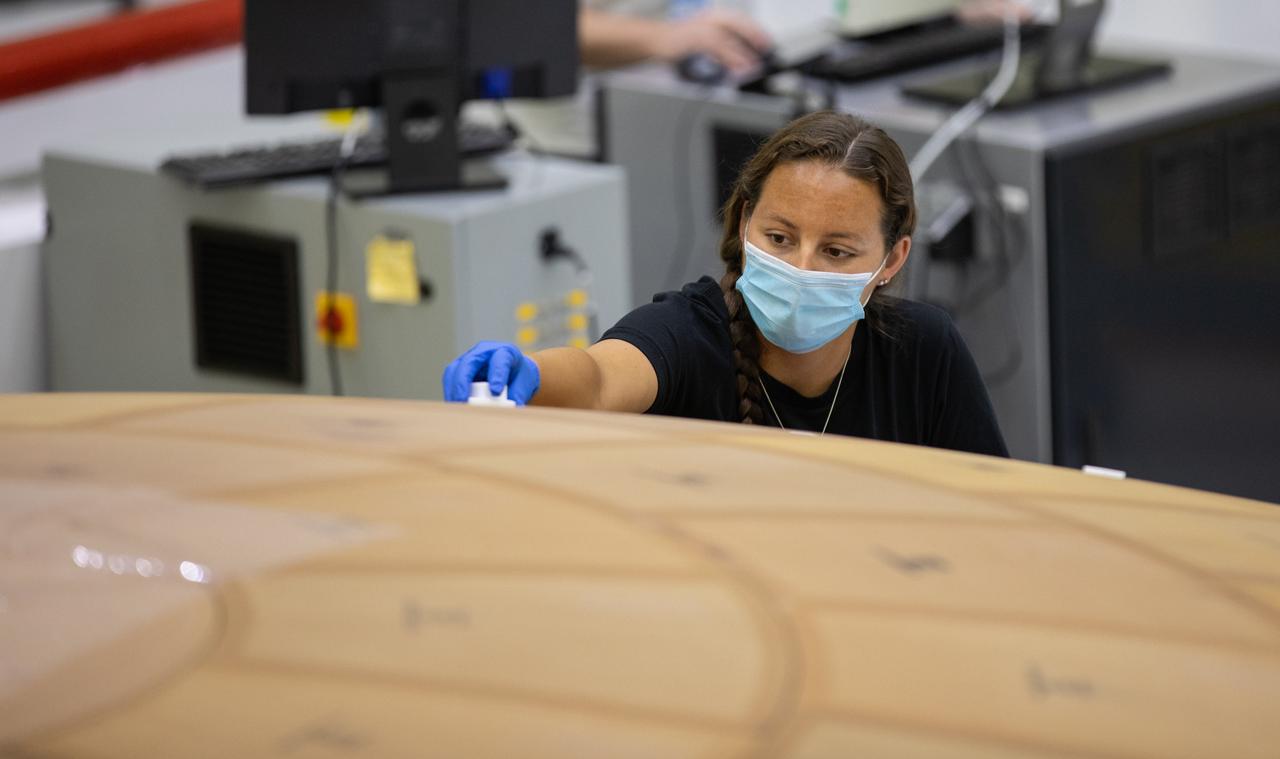
Inside the Neil Armstrong Operations and Checkout Building high bay at NASA's Kennedy Space Center in Florida, technician Diamond ScharSenstine with ASRC Federal, inspects AVCOAT block bonding on the Artemis II heat shield on July 2, 2020. The heat shield is one of the most critical elements of Orion and will protect the capsule and astronauts during reentry through Earth’s atmosphere. Artemis II is the first crewed mission in a series of missions to the Moon and on to Mars. Artemis II will confirm all of the Orion spacecraft’s systems operate as designed in the actual environment of deep space with astronauts aboard. As part of the Artemis Program, NASA will send the first woman and next man to the Moon by 2024.
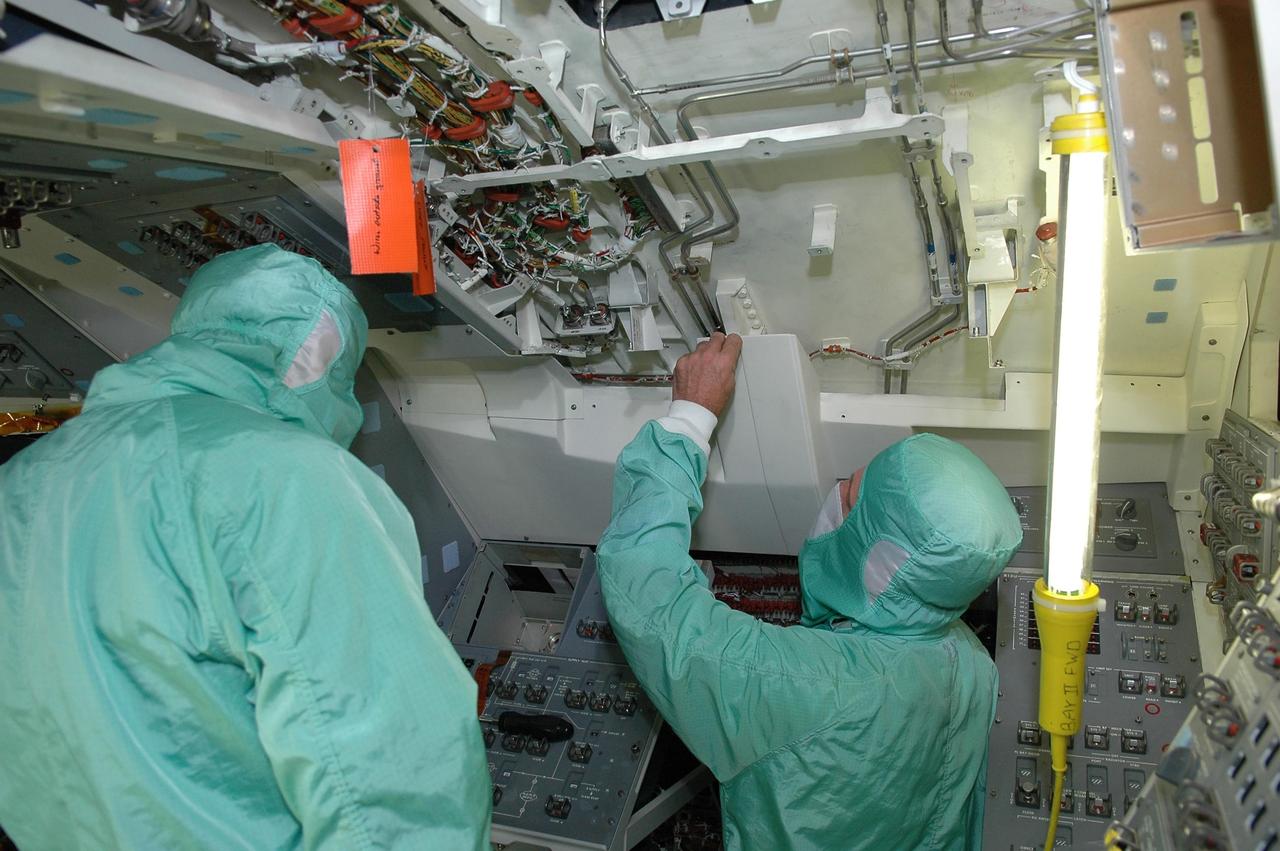
KENNEDY SPACE CENTER, FLA. - In bay 2 of the Orbiter Processing Facility, workers are installing the Multifunction Electronic Display Subsystem - a state-of-the-art “glass cockpit” - on the orbiter Endeavour. The “bunny suits” they are wearing are clean room attire required for anyone coming in close proximity to the orbiter. The full-color, flat-panel MEDS upgrade improves crew/orbiter interaction with easy-to-read, graphic portrayals of key flight indicators like attitude display and mach speed. Endeavour is undergoing major modifications, which include inspecting more than 150 miles of wiring and bonding 1,000 thermal tiles, along with installing the display system.
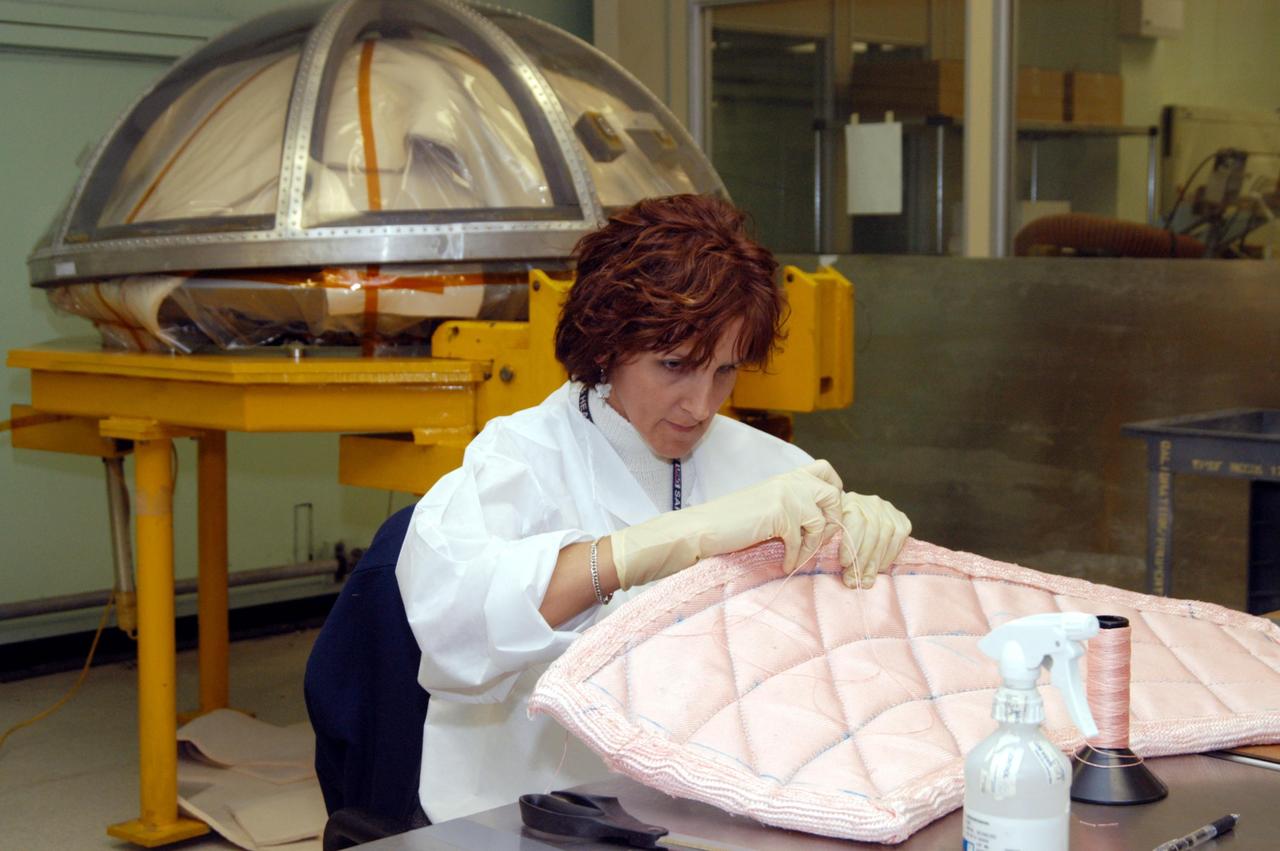
KENNEDY SPACE CENTER, FLA. -- In the Thermal Protection System Facility, Pilar Ryan, with United Space Alliance, stitches a piece of insulation blanket for Atlantis. The blankets will be sewn into the inside of a ring that will be inserted in the nose cap. In the background is a cover for the nose cap. The blankets consist of layered, pure silica felt sandwiched between a layer of silica fabric (the hot side) and a layer of S-Glass fabric. The blankets are semi-rigid and can be made as large as 30 inches by 30 inches. The blanket is through-stitched with pure silica thread in a 1-inch grid pattern. After fabrication, the blanket is bonded directly to the vehicle structure and finally coated with a high purity silica coating that improves erosion resistance.
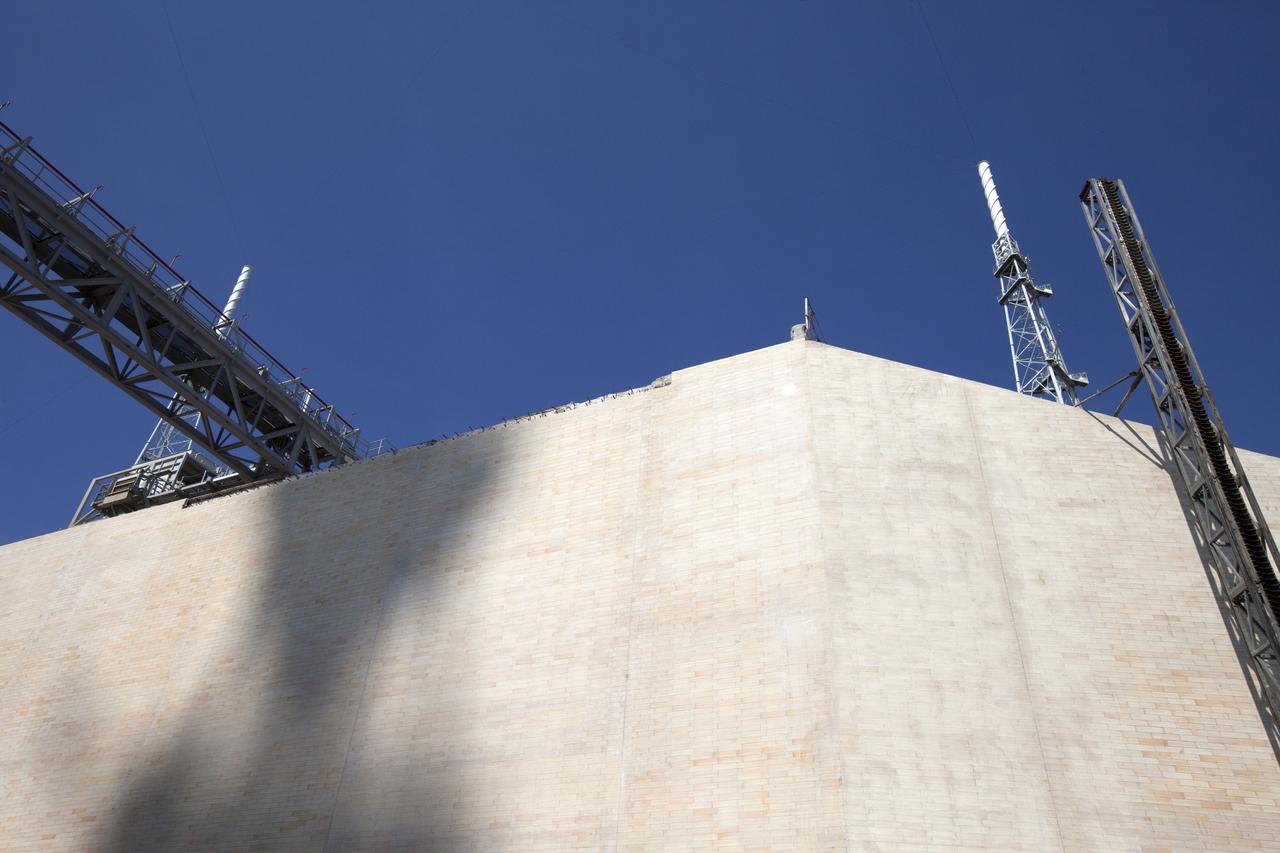
A view looking up from the north side of the flame trench beneath the pad at Launch Complex 39B at NASA's Kennedy Space Center in Florida. The walls of the flame trench are being upgraded to withstand the intense heat and fire at launch of NASA's Space Launch System rocket with Orion atop. About 96,000 heat-resistant bricks, in three different sizes, were secured to the walls using bonding mortar in combination with adhesive anchors. The Ground Systems Development and Operations Program is overseeing upgrades and modifications to Pad 39B to support the launch of the SLS and Orion spacecraft for Exploration Mission-1 and NASA’s journey to Mars.
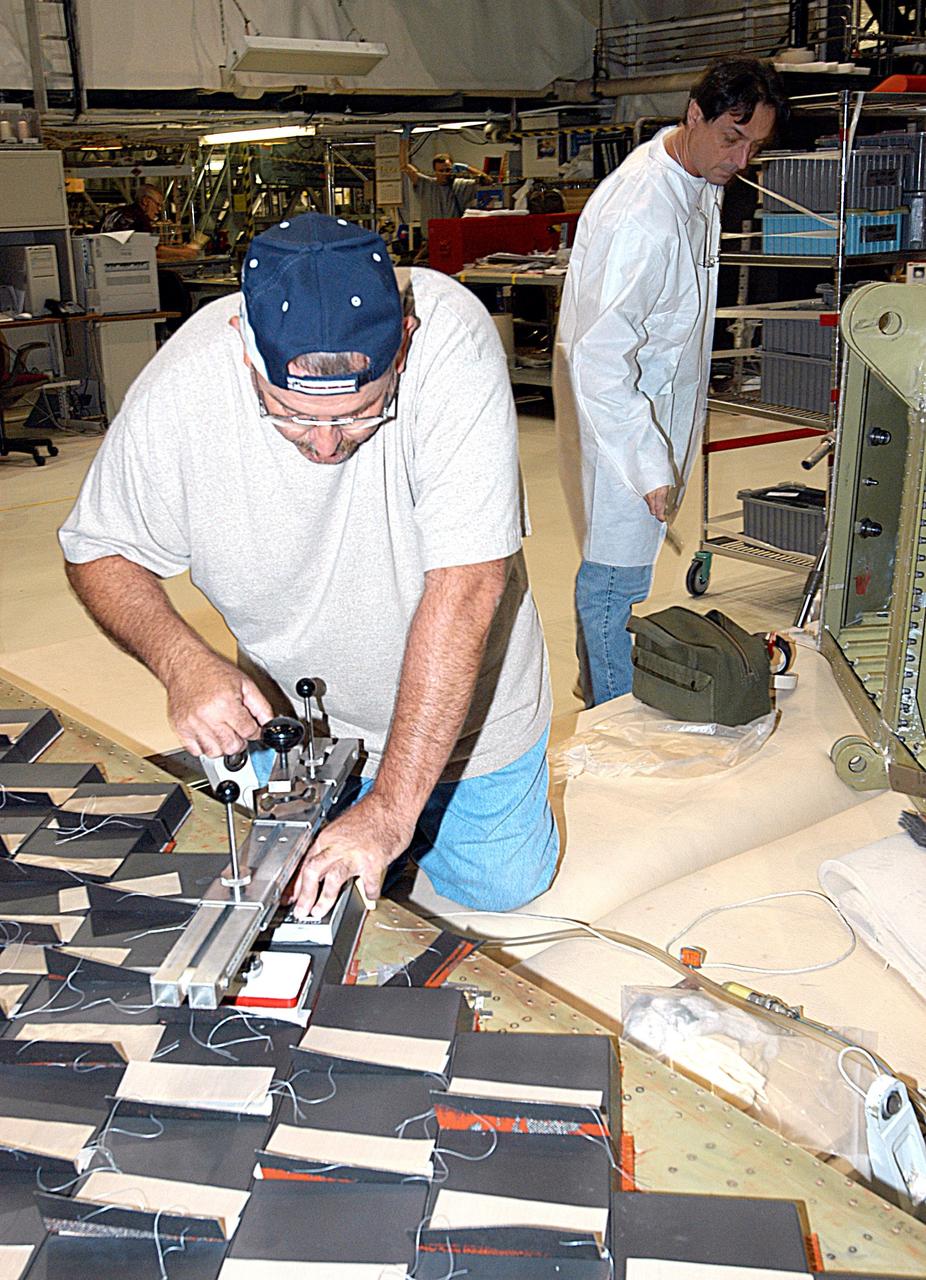
KENNEDY SPACE CENTER, FLA. -- In the Orbiter Processing Facility, United Space Alliance employee Dave Sanborn (left) conducts a bond verification test on Thermal Protection System tiles installed on a main landing gear door of Space Shuttle orbiter Enterprise (OV-101). Sections of Enterprise were borrowed from the Smithsonian Institution's Air and Space Museum where the orbiter is being stored at the Washington Dulles International Airport. Enterprise was the first orbiter built in the Shuttle fleet and was used to conduct the Approach and Landing Test Program before the first powered Shuttle flight. After the tile installation is complete, the sections will be transferred to the Southwest Research Institute for testing requested by the Columbia Accident Investigation Board.
CAPE CANAVERAL, Fla. – In the Vehicle Assembly Building's High Bay 1 at NASA's Kennedy Space Center in Florida, workers begin "pull plug testing" on foam adhesion from the intertank of space shuttle Discovery's external tank. They are collecting 26 foam samples an inch-and-half in diameter for analysis to confirm the foam is bonded well to the metal primer underneath. The testing was prompted by the foam loss during launch of space shuttle Endeavour on the STS-127 mission July 15. Samples are being sent to Michoud for study. Photo credit: NASA/Tim Jacobs
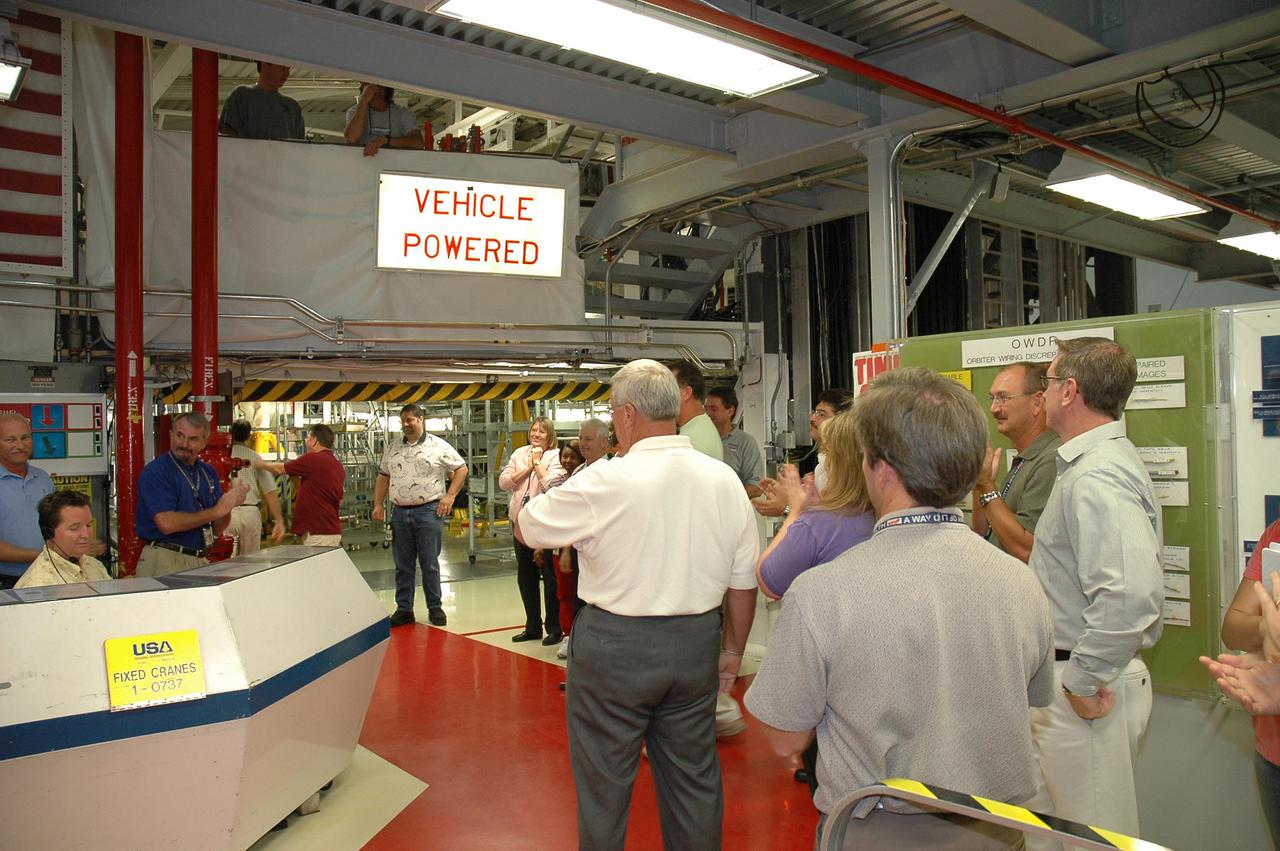
KENNEDY SPACE CENTER, FLA. - In NASA’s Orbiter Processing Facility bay 2, workers gather as the orbiter Endeavour’s electrical system is partially powered up, after nearly 2 years. Full power-up will take place in October. Endeavour has been in its Orbiter Major Modification period, which began in December 2003. In that time, 124 modifications were completed, including installing the glass cockpit; 150 miles of wiring were inspected; and more than 1,000 tiles were bonded. This is the second full modification conducted at Kennedy.
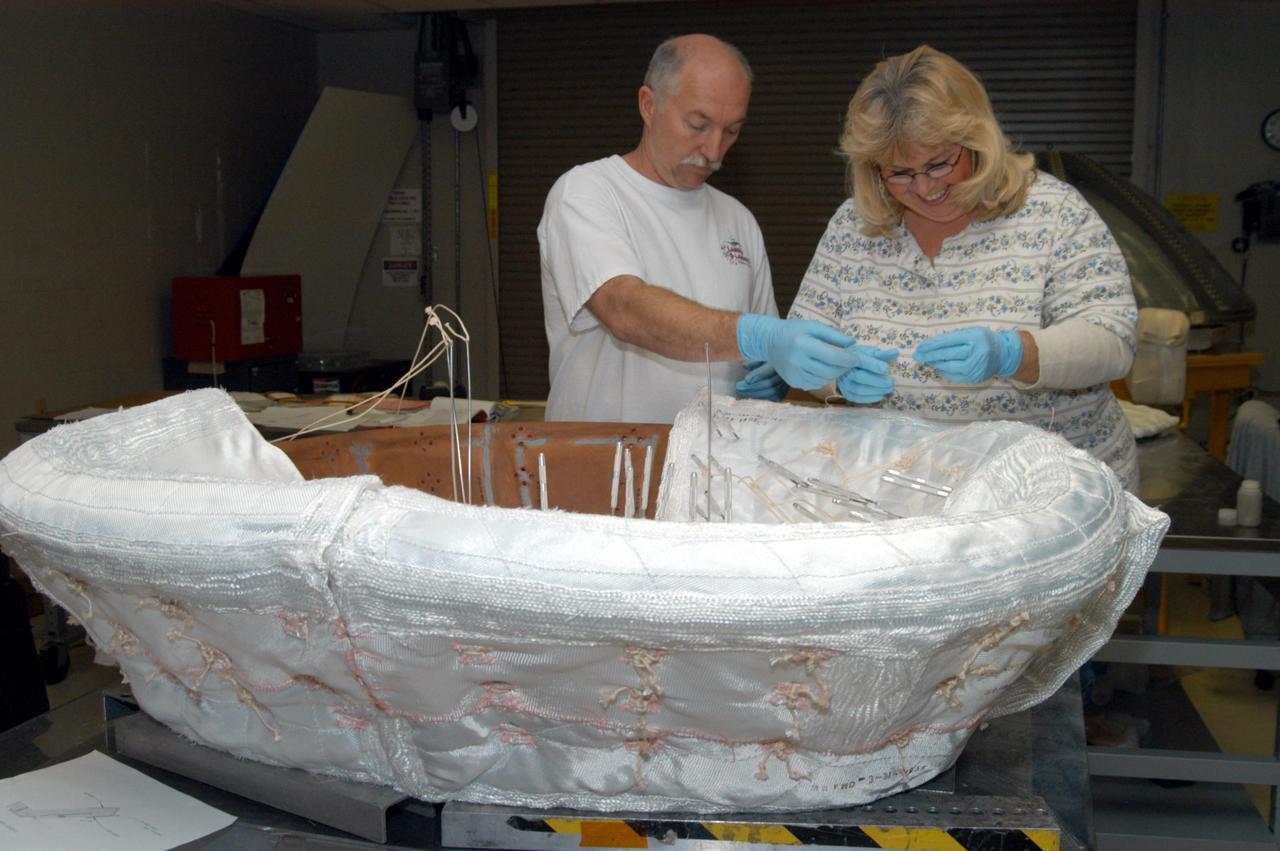
KENNEDY SPACE CENTER, FLA. -- United Space Alliance workers Michael Williams and Ginger Morrison stitch together pieces of insulation blankets inside the ring that fits in the nose cap of Discovery. The blankets consist of layered, pure silica felt sandwiched between a layer of silica fabric (the hot side) and a layer of S-Glass fabric. The blankets are semi-rigid and can be made as large as 30 inches by 30 inches. The blanket is through-stitched with pure silica thread in a 1-inch grid pattern. After fabrication, the blanket is bonded directly to the vehicle structure and finally coated with a high purity silica coating that improves erosion resistance.

KENNEDY SPACE CENTER, FLA. -- A closeup of the stitching being done on pieces of insulation blankets inside the ring that fits in the nose cap of Discovery. The blankets consist of layered, pure silica felt sandwiched between a layer of silica fabric (the hot side) and a layer of S-Glass fabric. The blankets are semi-rigid and can be made as large as 30 inches by 30 inches. The blanket is through-stitched with pure silica thread in a 1-inch grid pattern. After fabrication, the blanket is bonded directly to the vehicle structure and finally coated with a high purity silica coating that improves erosion resistance.
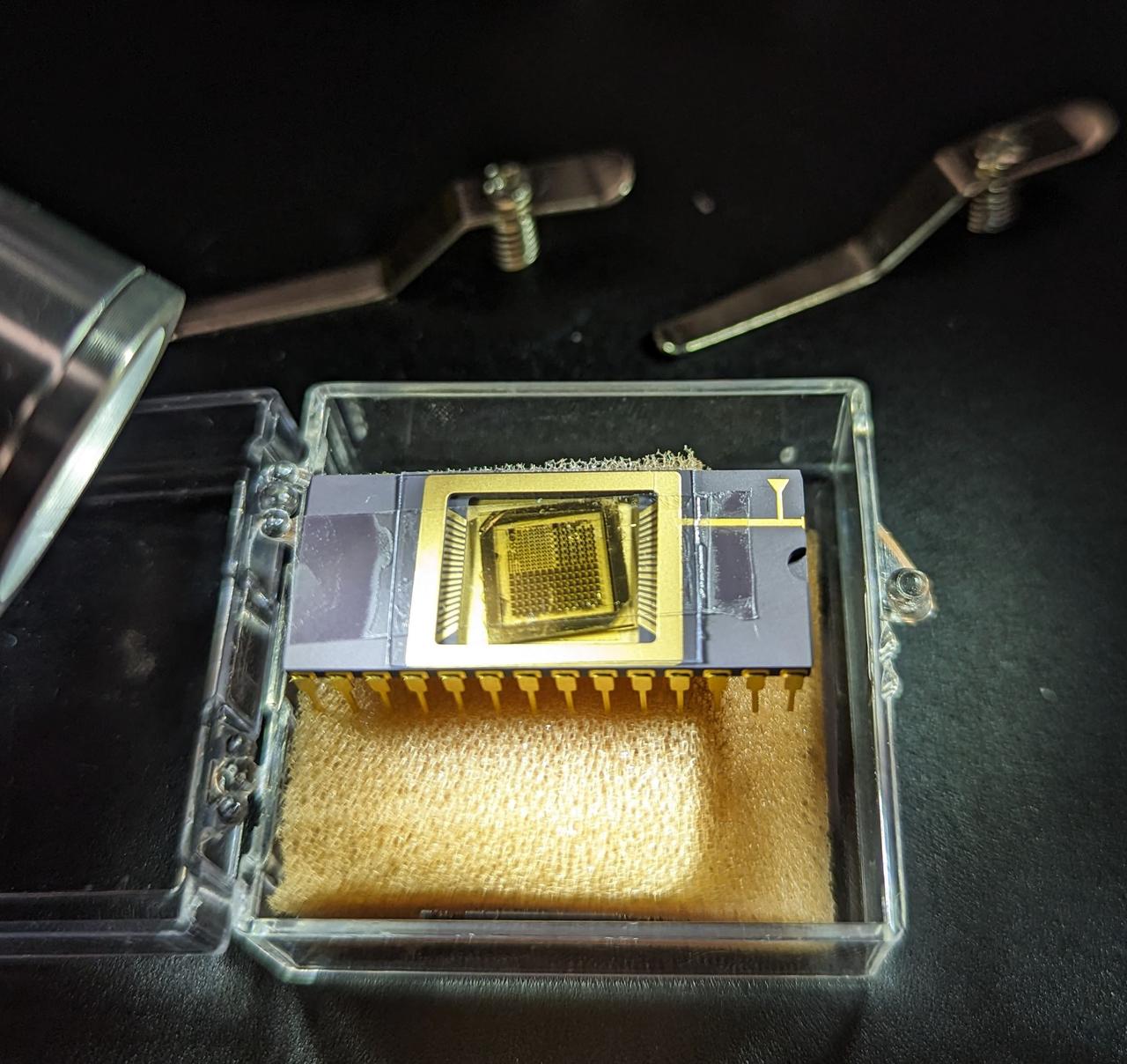
jsc2025e015685c(3/6/2025) --- The GaN devices wire bonded to a chip carrier as part of the High Performance Radiation Hardened GaN High Electron Mobility Transistors for Space Applications (Radiation Harden GaN) investigation which studies how radiation affects a type of transistor used in the semiconductor industry. Researchers measure the performance of the devices before, during, and after flight to determine whether performance degrades. This could help determine how well the transistors can tolerate radiation in space. Image courtesy of Department of Electrical and Computer Engineering, University of Delaware.
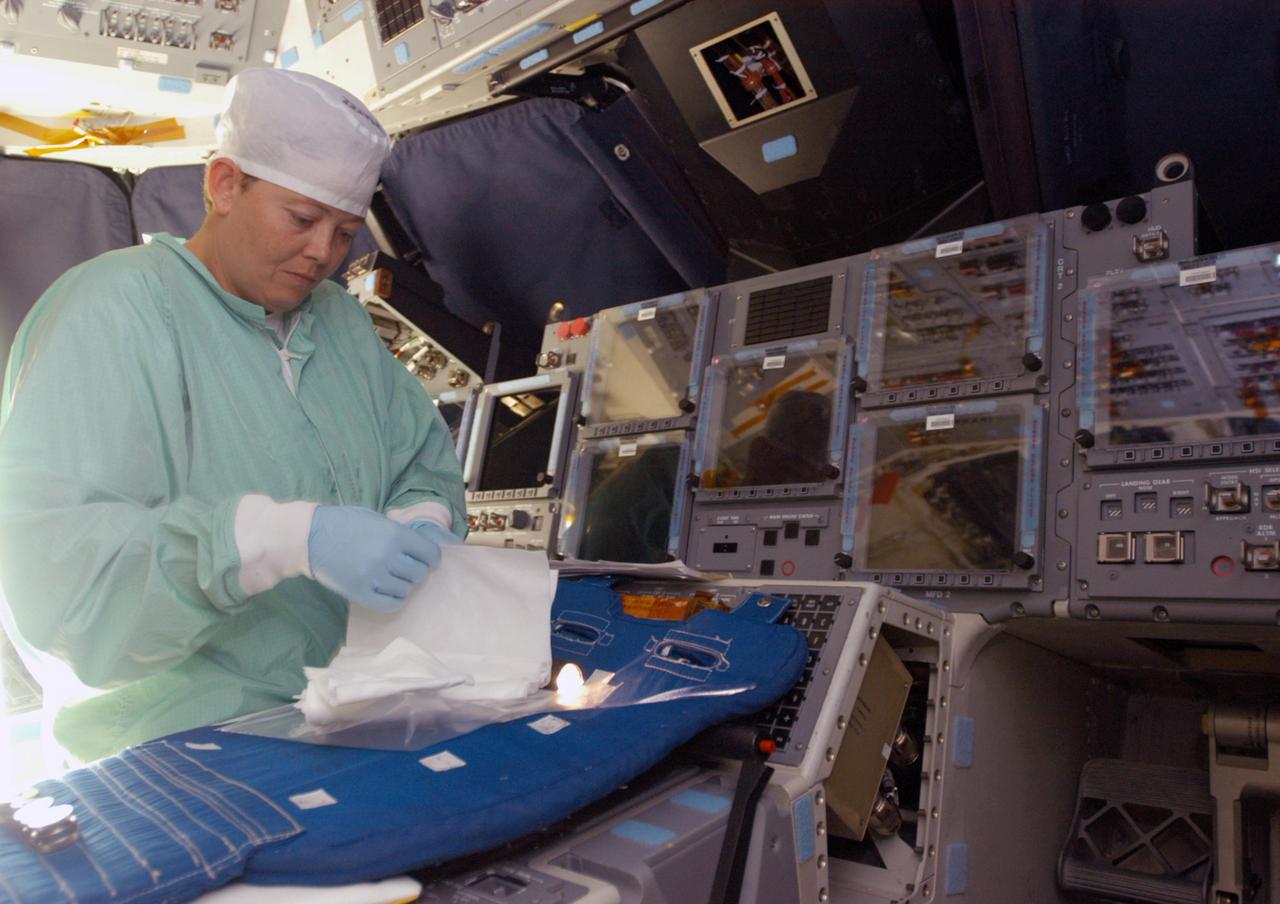
KENNEDY SPACE CENTER, FLA. - Carmen Prater, with United Space Alliance, works on the flight deck of the orbiter Endeavour in bay 2 of the Orbiter Processing Facility. She wears a “bunny suit,” clean room attire required for anyone coming in close proximity to the orbiter. Endeavour is undergoing major modifications, which include inspecting more than 150 miles of wiring, bonding 1,000 thermal tiles, and installing the Multifunction Electronic Display Subsystem - a state-of-the-art “glass cockpit.” The full-color, flat-panel MEDS upgrade improves crew/orbiter interaction with easy-to-read, graphic portrayals of key flight indicators like attitude display and mach speed.
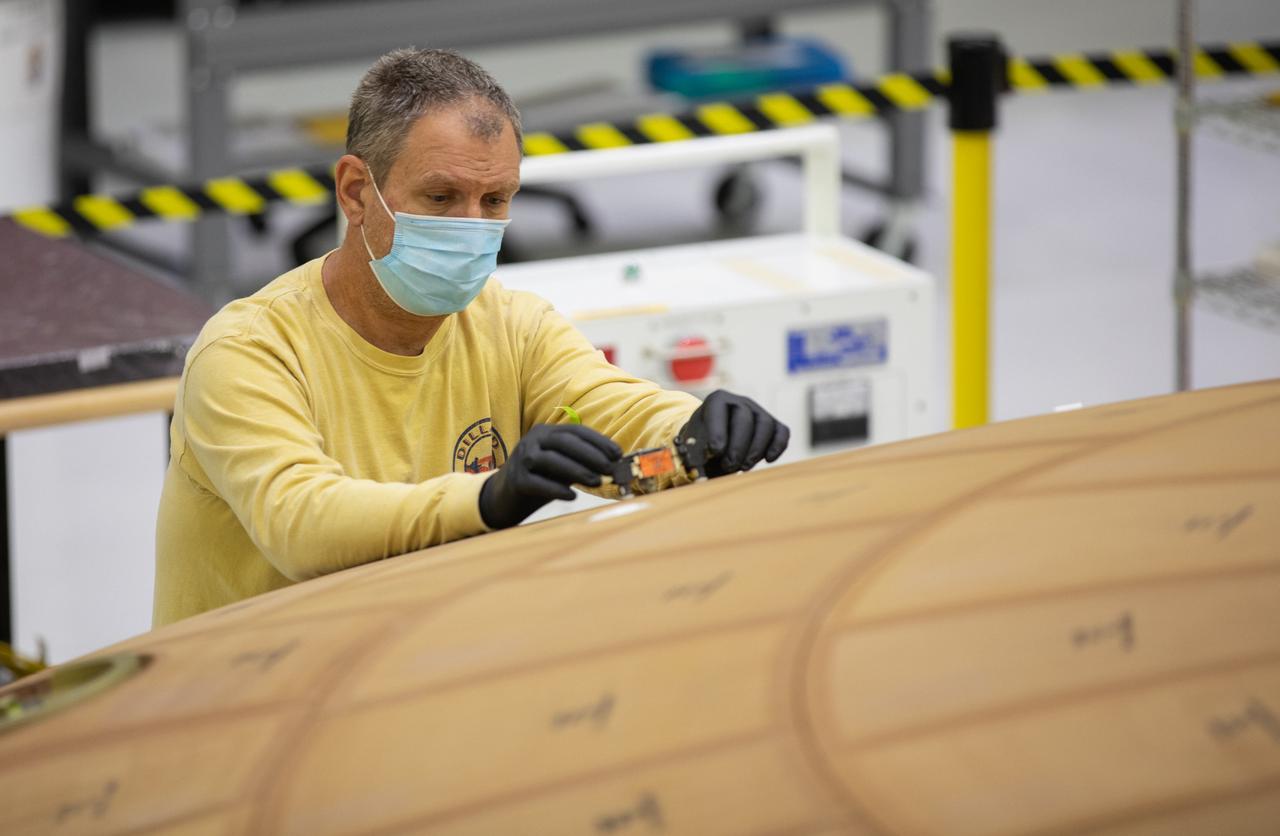
Inside the Neil Armstrong Operations and Checkout Building high bay at NASA's Kennedy Space Center in Florida, technician Kenny Leidner with ASRC Federal, inspects AVCOAT block bonding on the Artemis II heat shield on July 2, 2020. The heat shield is one of the most critical elements of Orion and will protect the capsule and astronauts during reentry through Earth’s atmosphere. Artemis II is the first crewed mission in a series of missions to the Moon and on to Mars. Artemis II will confirm all of the Orion spacecraft’s systems operate as designed in the actual environment of deep space with astronauts aboard. As part of the Artemis Program, NASA will send the first woman and next man to the Moon by 2024.
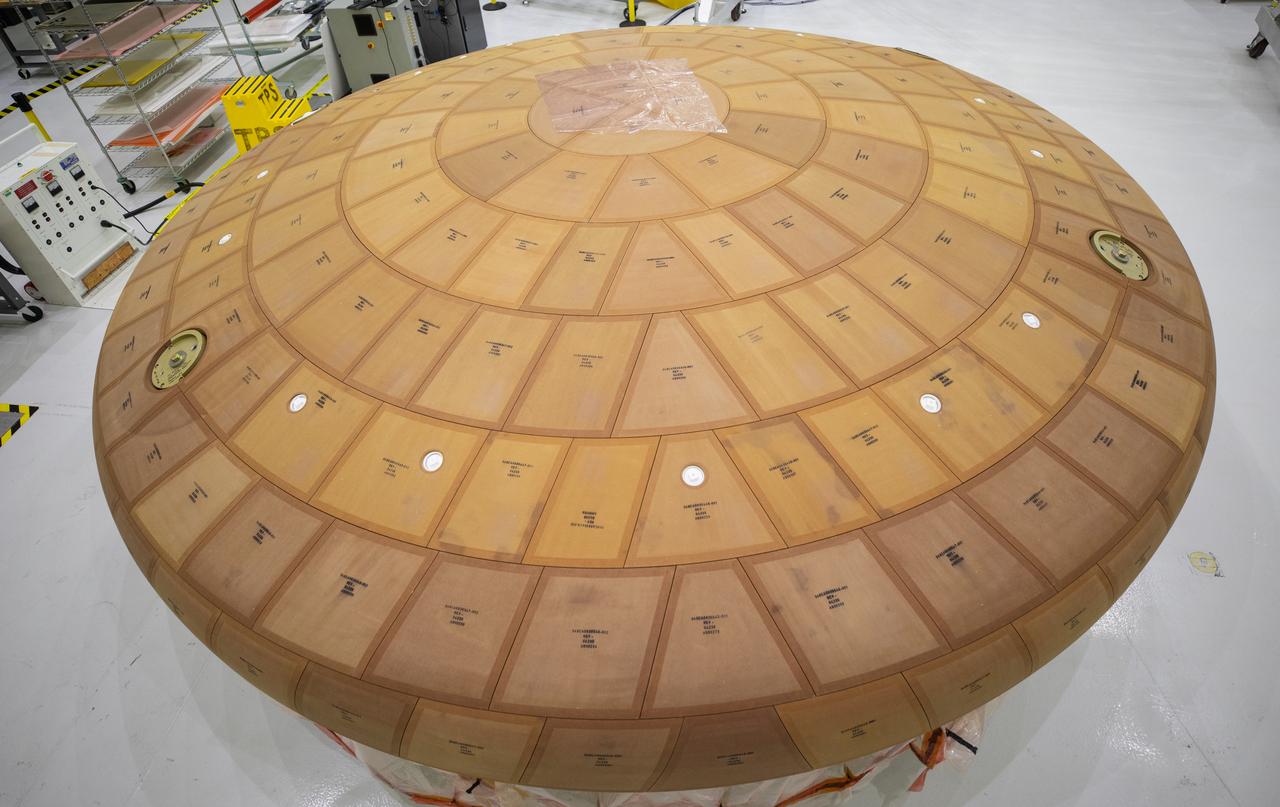
Inside the Neil Armstrong Operations and Checkout Building high bay at NASA's Kennedy Space Center in Florida, the AVOCAT block bonding is complete on the Artemis II heat shield on July 2, 2020. The heat shield is one of the most critical elements of Orion and will protect the capsule and astronauts during reentry through Earth’s atmosphere. Artemis II is the first crewed mission in a series of missions to the Moon and on to Mars. Artemis II will confirm all of the Orion spacecraft’s systems operate as designed in the actual environment of deep space with astronauts aboard. As part of the Artemis Program, NASA will send the first woman and next man to the Moon by 2024.
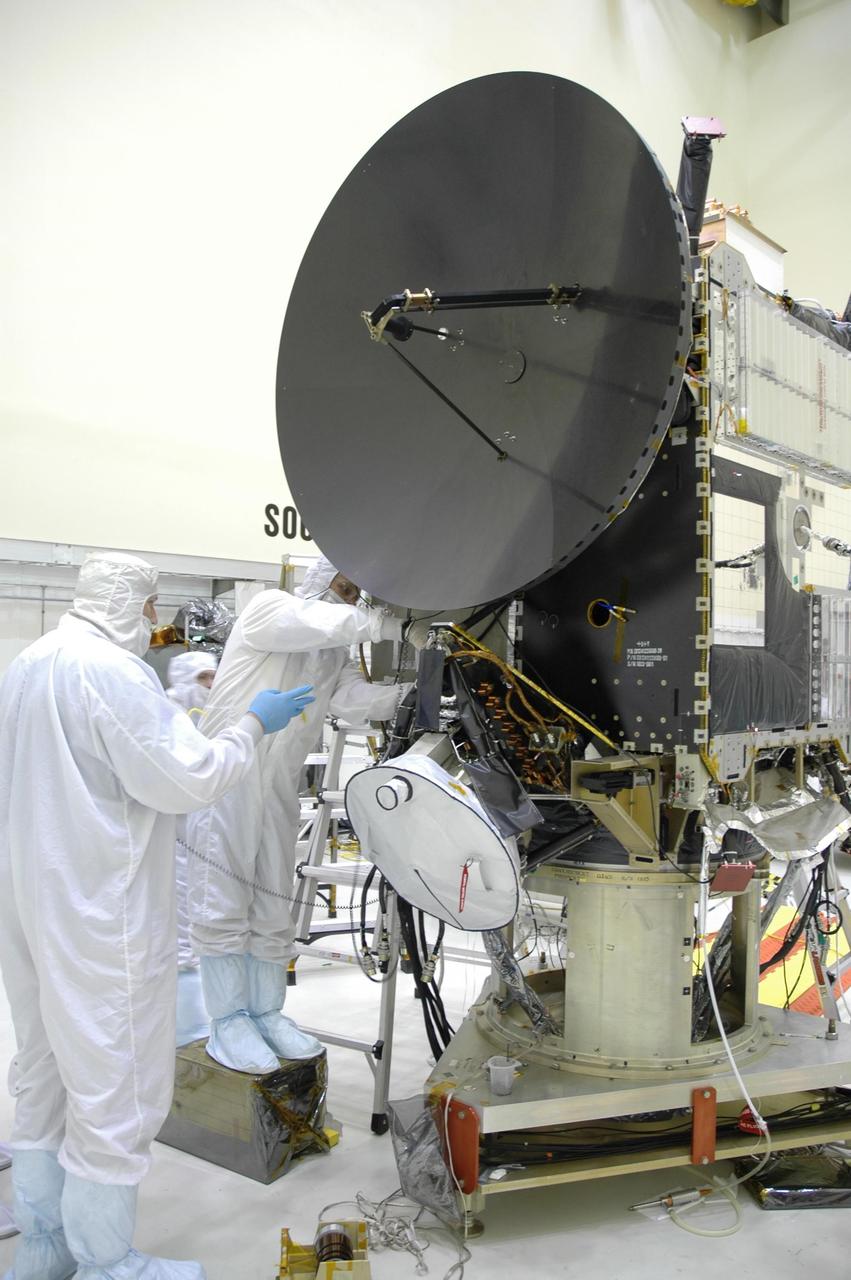
KENNEDY SPACE CENTER, FLA. -- In the Astrotech Space Operations facility, Orbital Science technicians verify that a computer chip is securely bonded to a side brace on the Dawn spacecraft. The silicon chip holds the names of more than 360,000 space enthusiasts worldwide who signed up to participate in a virtual voyage to the asteroid belt and is about the size of an American five-cent coin. Dawn's mission is to explore two of the asteroid belt's most intriguing and dissimilar occupants: asteroid Vesta and the dwarf planet Ceres. Dawn is scheduled to launch June 30 from Launch Complex 17-B. Photo credit: NASA/George Shelton
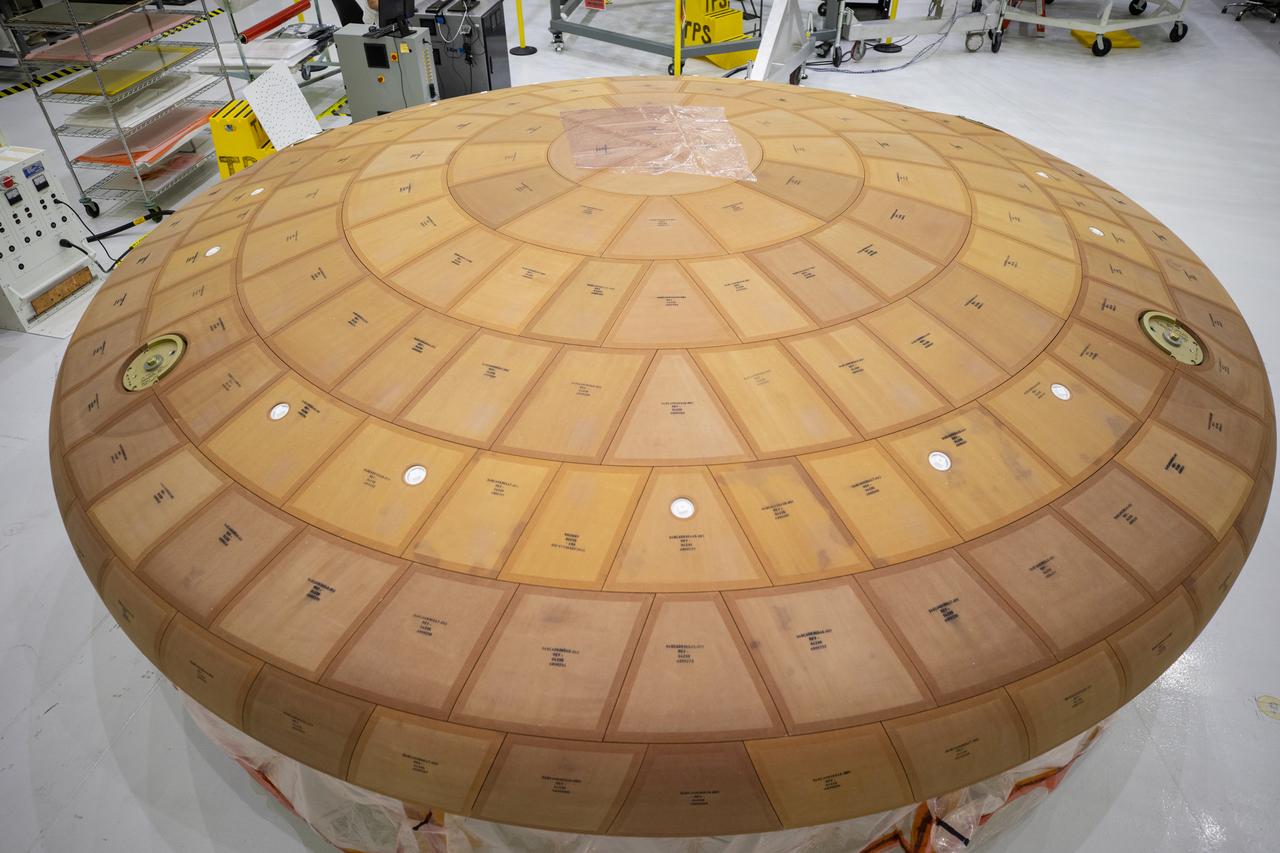
Inside the Neil Armstrong Operations and Checkout Building high bay at NASA's Kennedy Space Center in Florida, the AVCOAT block bonding is complete on the Artemis II heat shield on July 2, 2020. The heat shield is one of the most critical elements of Orion and will protect the capsule and astronauts during reentry through Earth’s atmosphere. Artemis II is the first crewed mission in a series of missions to the Moon and on to Mars. Artemis II will confirm all of the Orion spacecraft’s systems operate as designed in the actual environment of deep space with astronauts aboard. As part of the Artemis Program, NASA will send the first woman and next man to the Moon by 2024.
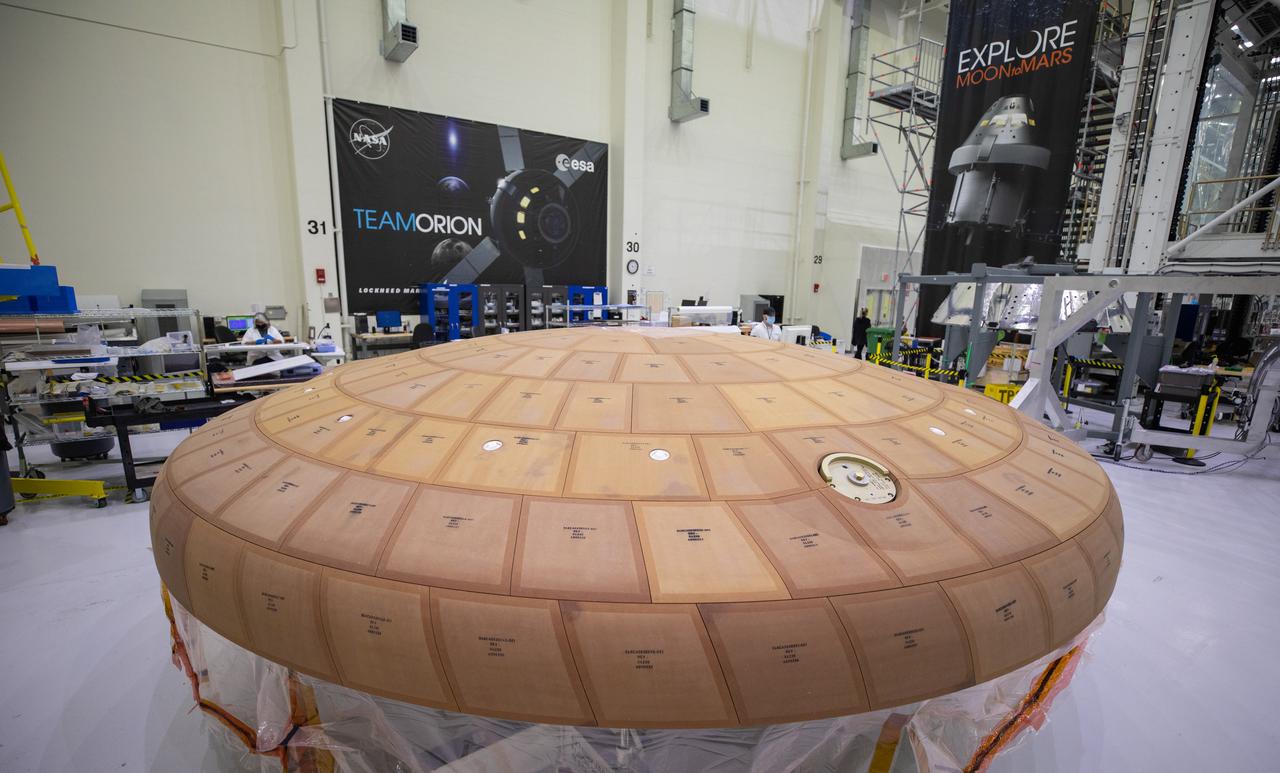
Inside the Neil Armstrong Operations and Checkout Building high bay at NASA's Kennedy Space Center in Florida, the AVCOAT block bonding is complete on the Artemis II heat shield on July 2, 2020. The heat shield is one of the most critical elements of Orion and will protect the capsule and astronauts during reentry through Earth’s atmosphere. Artemis II is the first crewed mission in a series of missions to the Moon and on to Mars. Artemis II will confirm all of the Orion spacecraft’s systems operate as designed in the actual environment of deep space with astronauts aboard. As part of the Artemis Program, NASA will send the first woman and next man to the Moon by 2024.
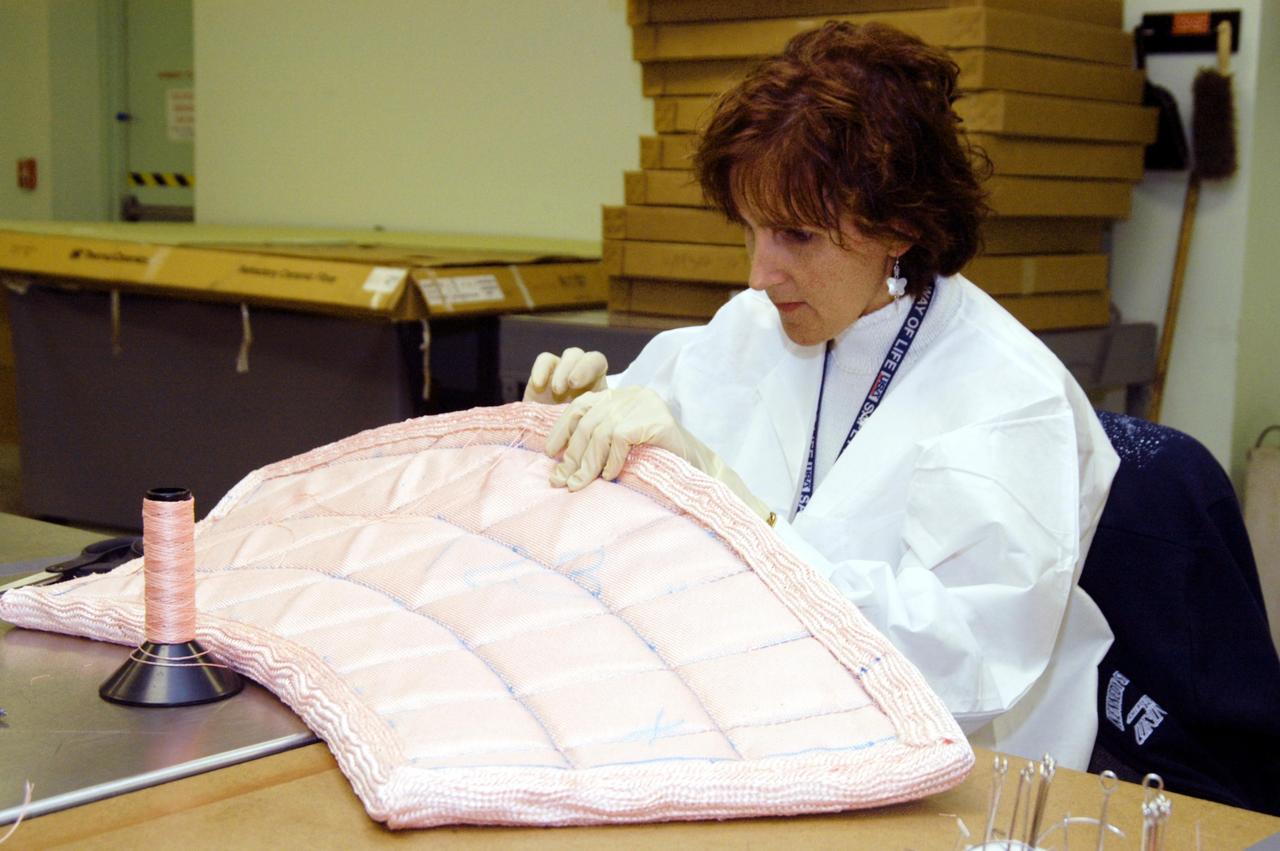
KENNEDY SPACE CENTER, FLA. -- In the Thermal Protection System Facility, Pilar Ryan, with United Space Alliance, stitches a piece of insulation blanket for Atlantis's nose cap. The blankets consist of layered, pure silica felt sandwiched between a layer of silica fabric (the hot side) and a layer of S-Glass fabric. The blankets are semi-rigid and can be made as large as 30 inches by 30 inches. The blanket is through-stitched with pure silica thread in a 1-inch grid pattern. After fabrication, the blanket is bonded directly to the vehicle structure and finally coated with a high purity silica coating that improves erosion resistance.
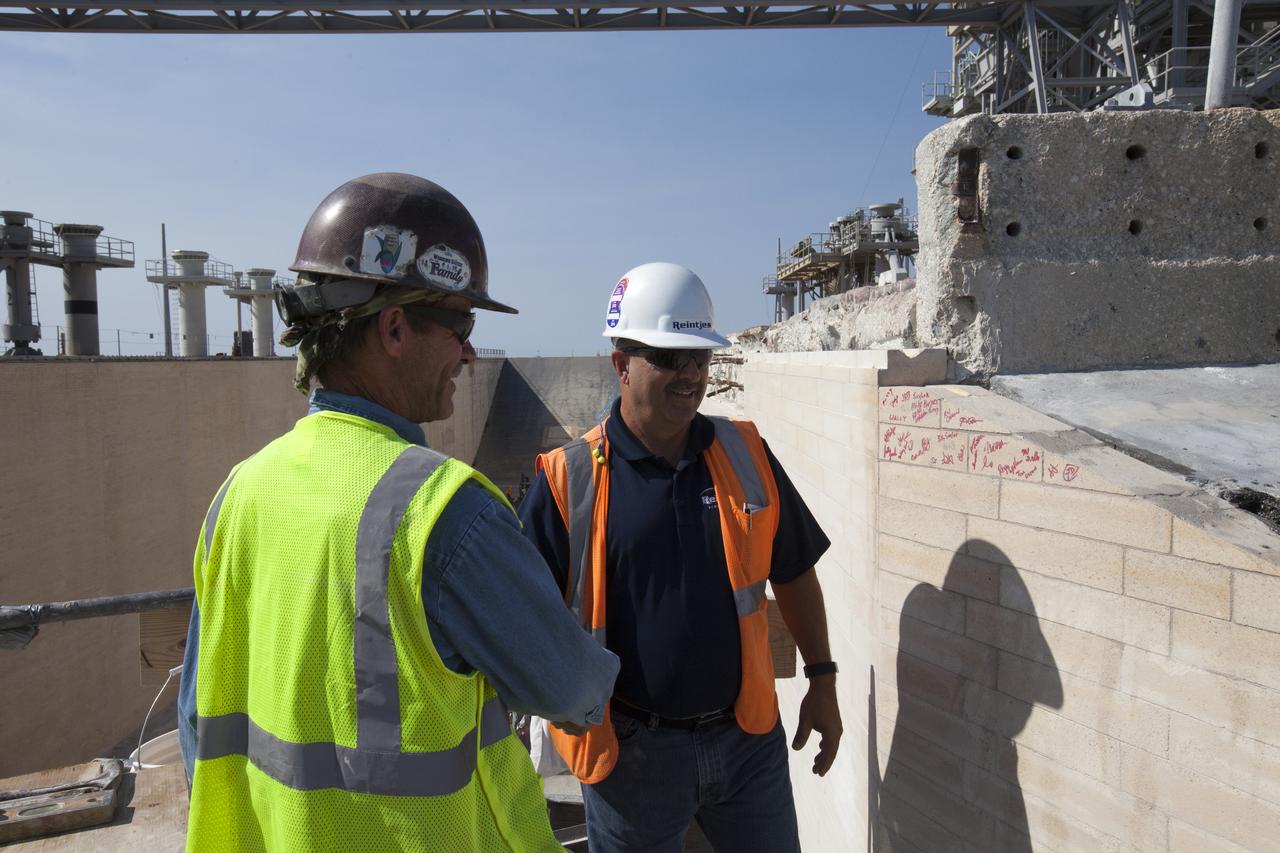
Construction workers sign the final bricks after they were installed on the north side of the flame trench at Launch Complex 39B at NASA’s Kennedy Space Center in Florida. The walls of the flame trench are being upgraded to withstand the intense heat and fire at launch of NASA's Space Launch System rocket with Orion atop. About 96,000 heat-resistant bricks, in three different sizes, were secured to the walls using bonding mortar in combination with adhesive anchors. The Ground Systems Development and Operations Program is overseeing upgrades and modifications to Pad 39B to support the launch of the SLS and Orion spacecraft for Exploration Mission-1 and NASA’s journey to Mars.
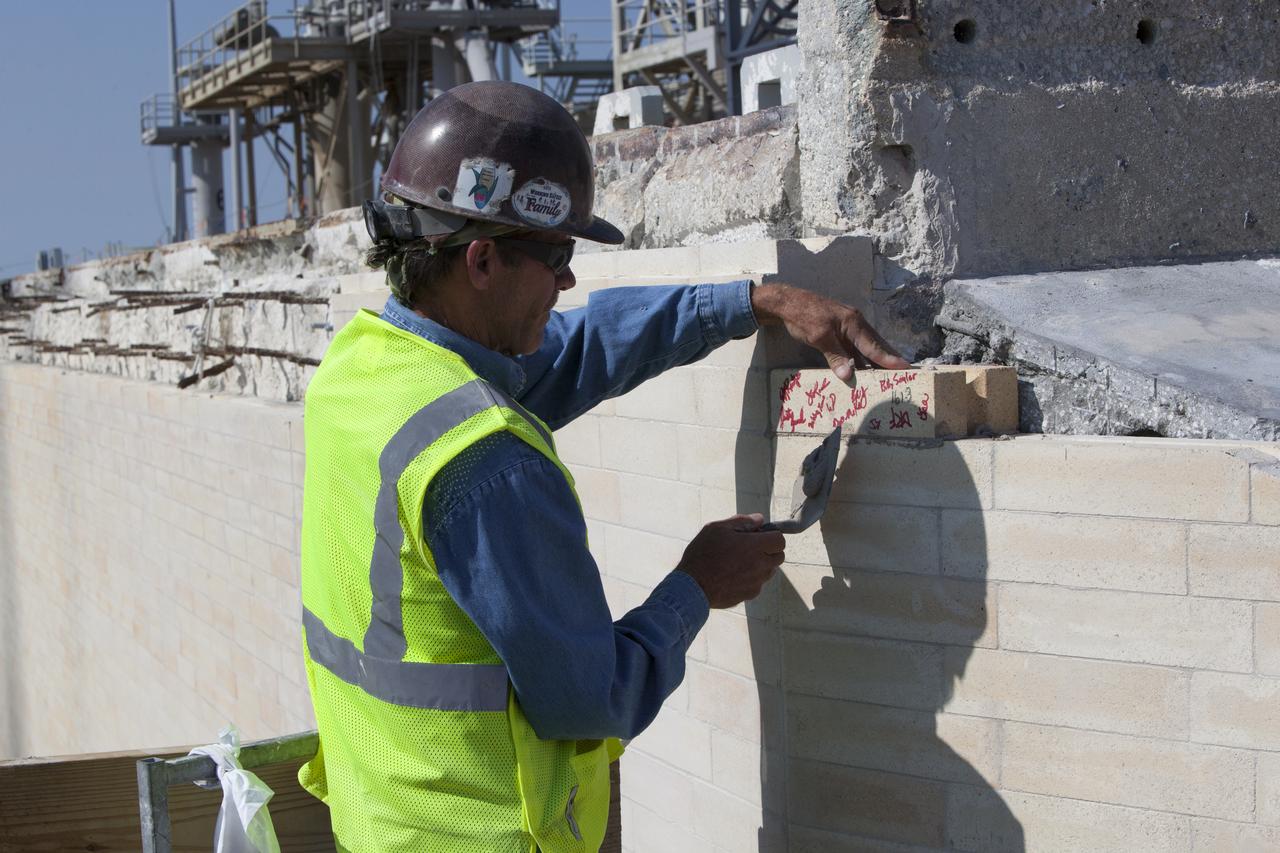
A construction worker installs one of the final bricks on the north side of the flame trench at Launch Complex 39B at NASA's Kennedy Space Center in Florida. The walls of the flame trench are being upgraded to withstand the intense heat and fire at launch of NASA's Space Launch System rocket with Orion atop. About 96,000 heat-resistant bricks, in three different sizes, were secured to the walls using bonding mortar in combination with adhesive anchors. The Ground Systems Development and Operations Program is overseeing upgrades and modifications to Pad 39B to support the launch of the SLS and Orion spacecraft for Exploration Mission-1 and NASA’s journey to Mars.