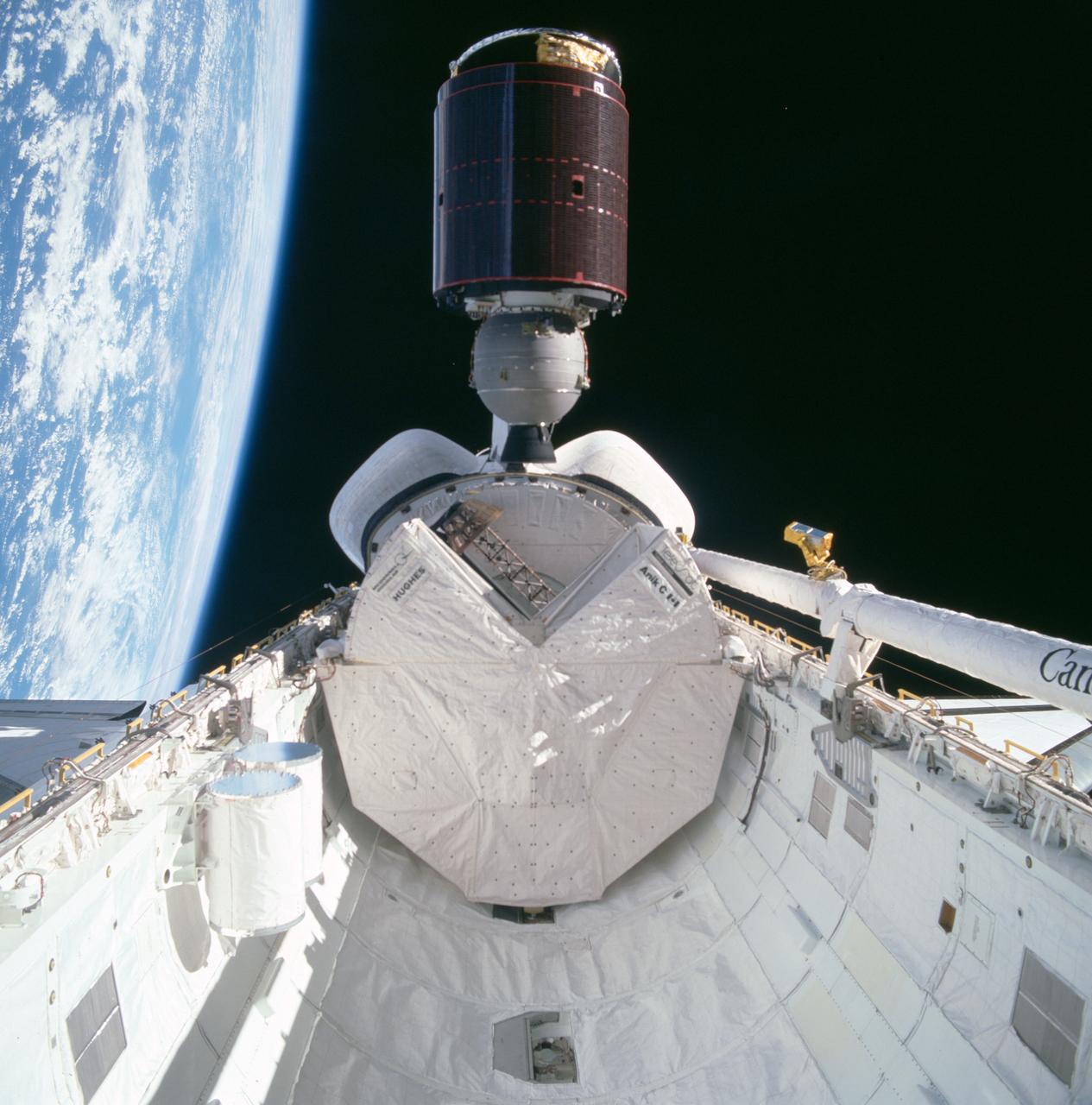
51D-31-050 (12 April 1985) --- Among 51-D's first day activities was the deployment of the Telesat-I (Anik C-1) communications satellite. Earth and blackness of space share the background in the 70mm frame.
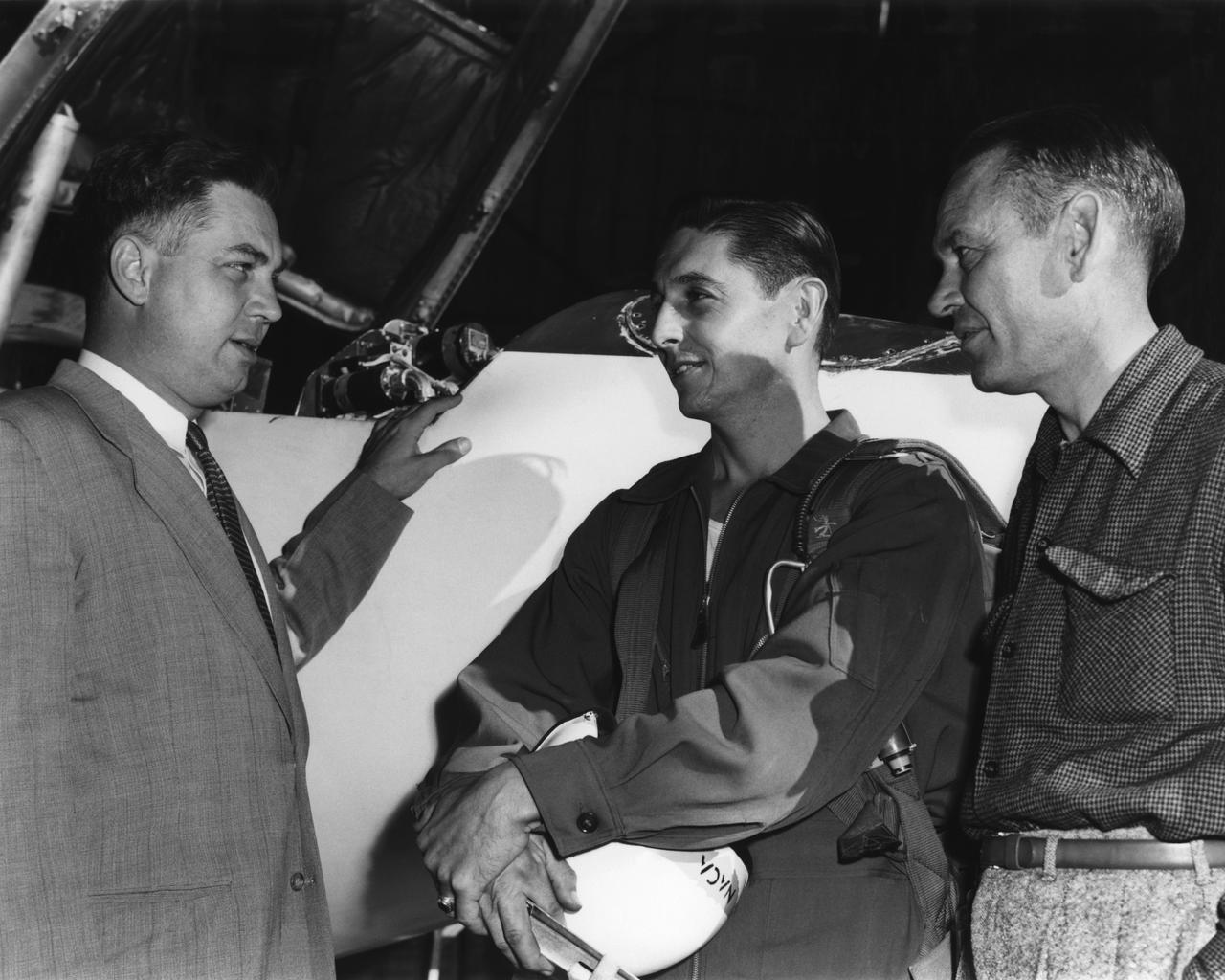
High-Speed Research Station Director Walter C. Williams, NACA pilot A. Scott Crossfield, and Director of Flight Operations Joe Vensel in front of the Douglas D-558-2 after the first Mach 2 flight.
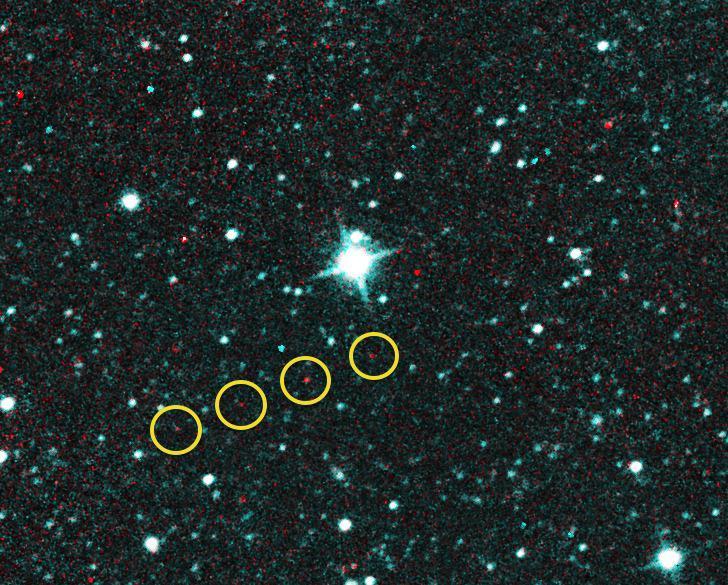
Comet C/2013 UQ4 Catalina first looked like an asteroid when NASA NEOWISE team first observed it on December 31, 2013. These exposures were taken that day, when the comet was at a distance of about 2.9 AU from the sun.
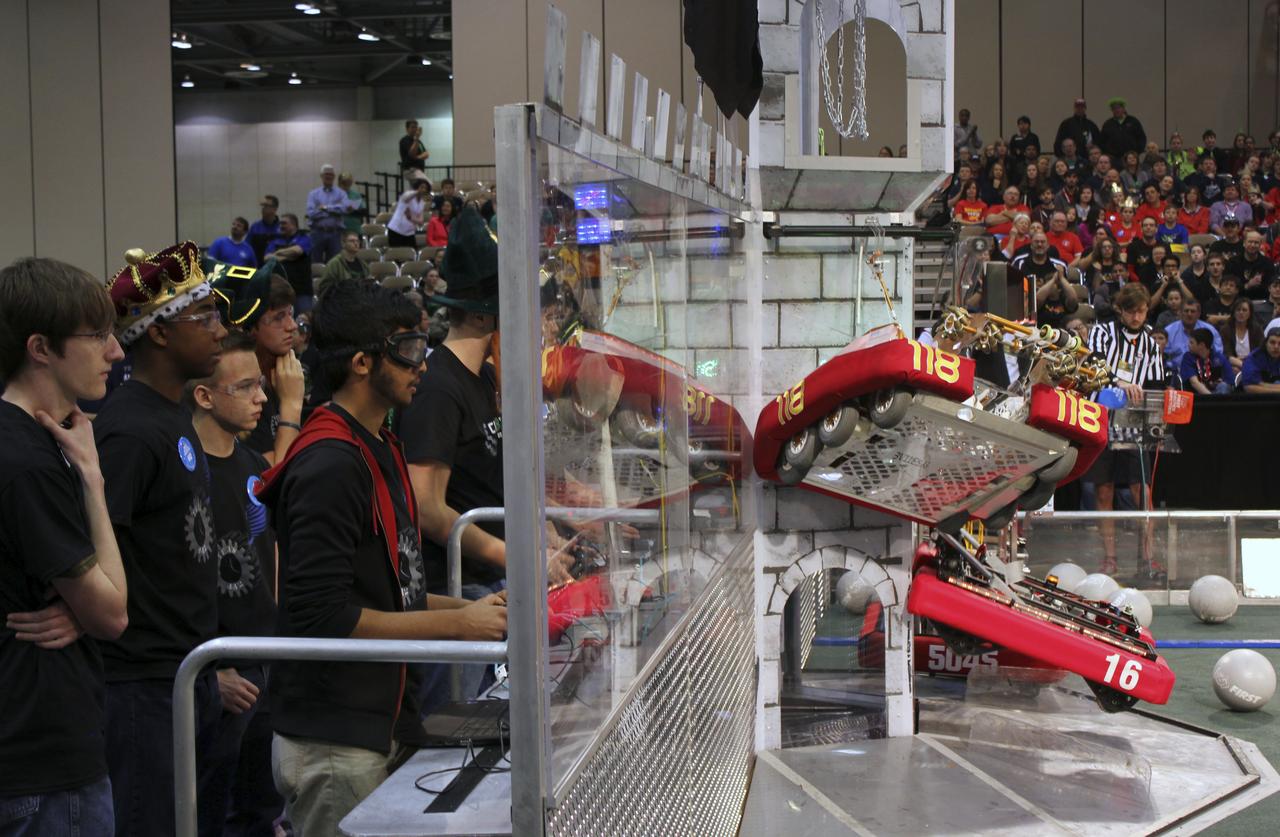
THE REDSTONE ROBOTICS OF HUNTSVILLE’S LEE AND NEW CENTURY TECH DEMO HIGH SCHOOLS WORK DURING THE “ROCKET CITY REGIONAL” FIRST ROBOTICS COMPETITION AT THE VON BRAUN CENTER IN 2016.

NASA’s B200 King Air team includes, from left, principal engineer Cory Hill, operations engineer KC Sujan, pilot Tracy Phelps, crew chief Mario Soto, aircraft technician Ruben Saiza, quality assurance technician Scott Silver, and senior engineer Alexander Soibel. The compact Fire Infrared Radiance Spectral Tracker (c-FIRST) instrument was tested on the B200 aircraft – based at NASA’s Armstrong Flight Research Center in Edwards, California – over the wildfires in the Pacific Palisades and Altadena, California, on November 21, 2024.
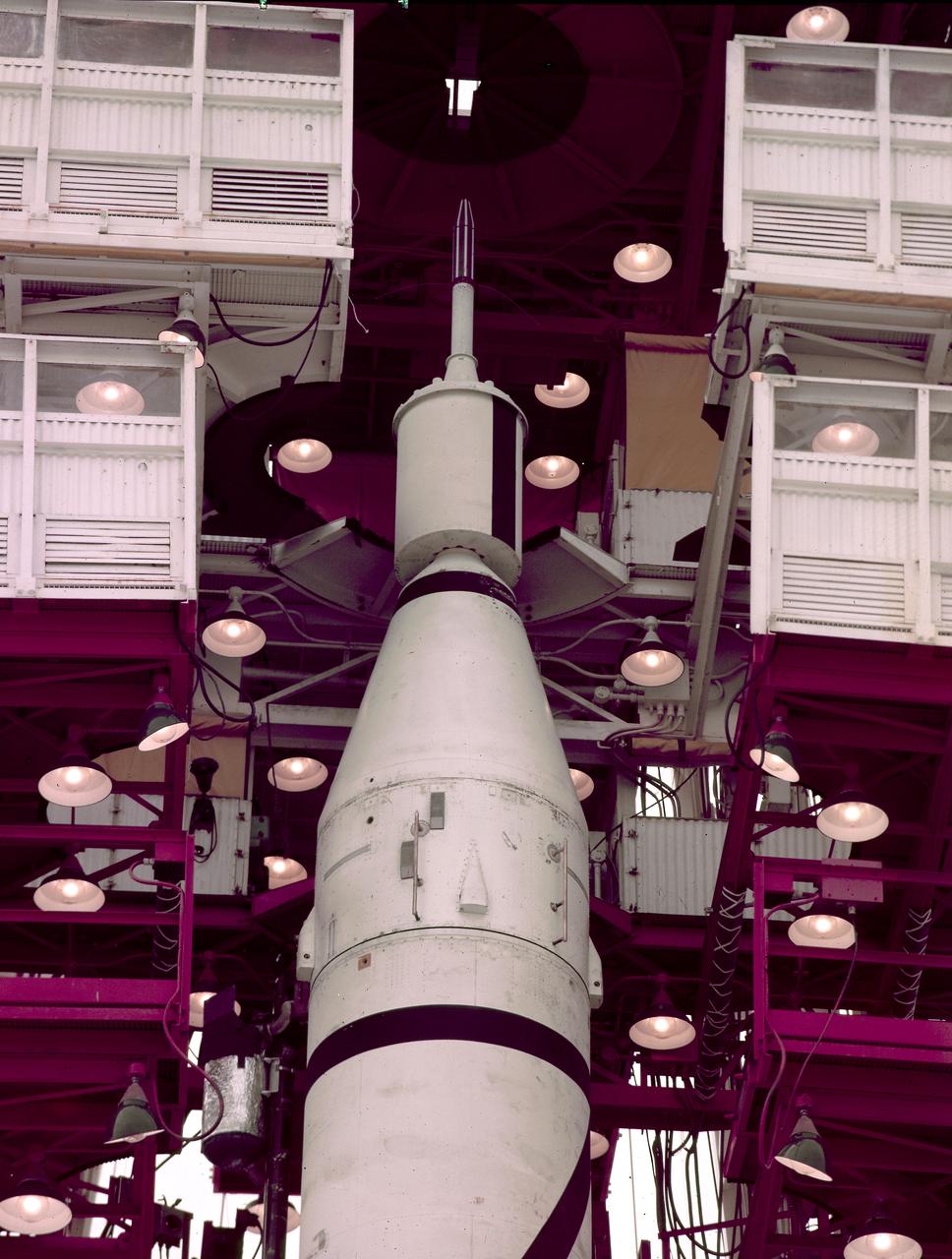
Explorer 1 atop a Jupiter-C in gantry. Jupiter-C carrying the first American satellite, Explorer 1, was successfully launched on January 31, 1958. The Jupiter-C launch vehicle consisted of a modified version of the Redstone rocket's first stage and two upper stages of clustered Baby Sergeant rockets developed by the Jet Propulsion Laboratory and later designated as Juno boosters for space launches
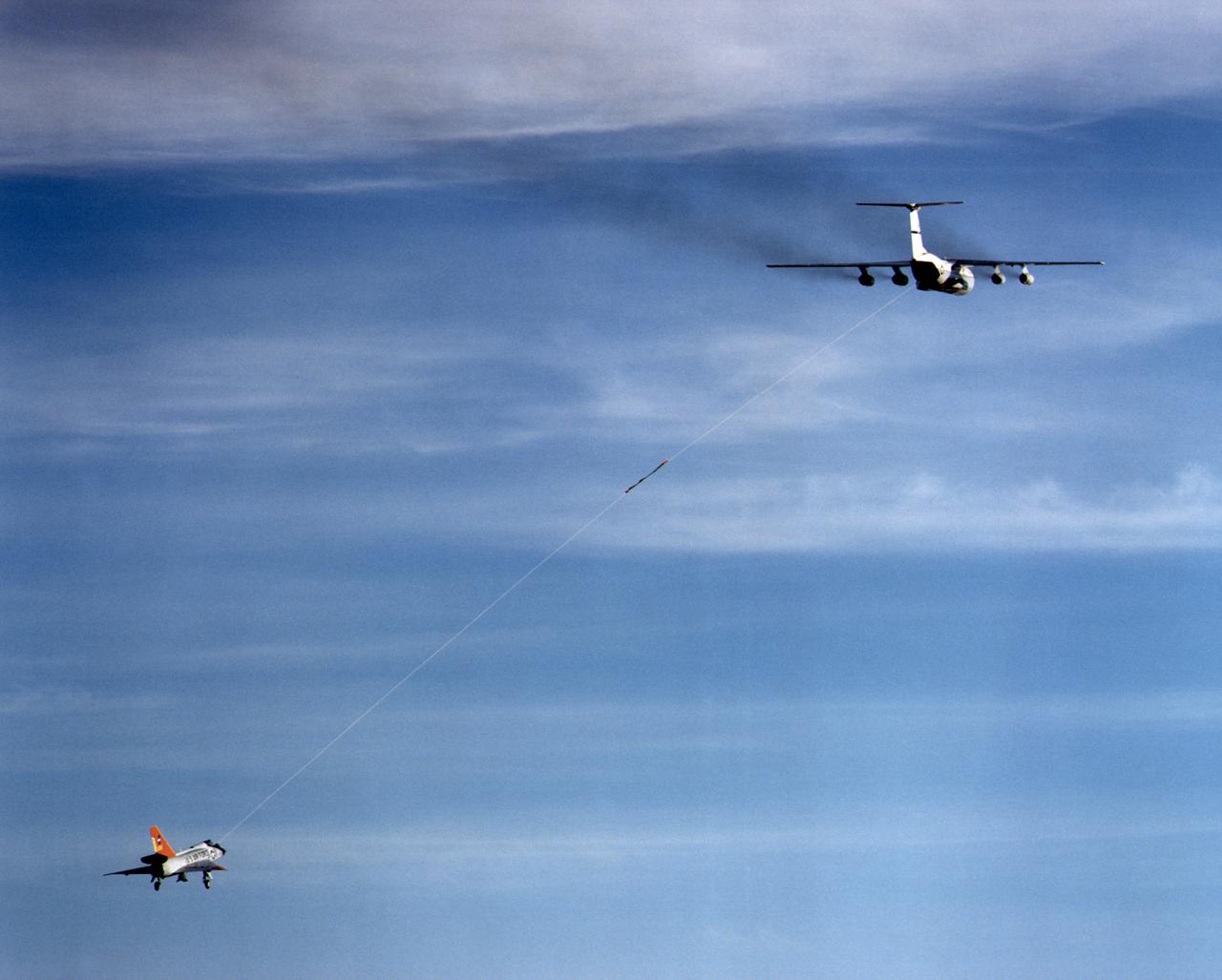
Eclipse project QF-106 and C-141A climbs out under tow on first tethered flight December 20, 1997
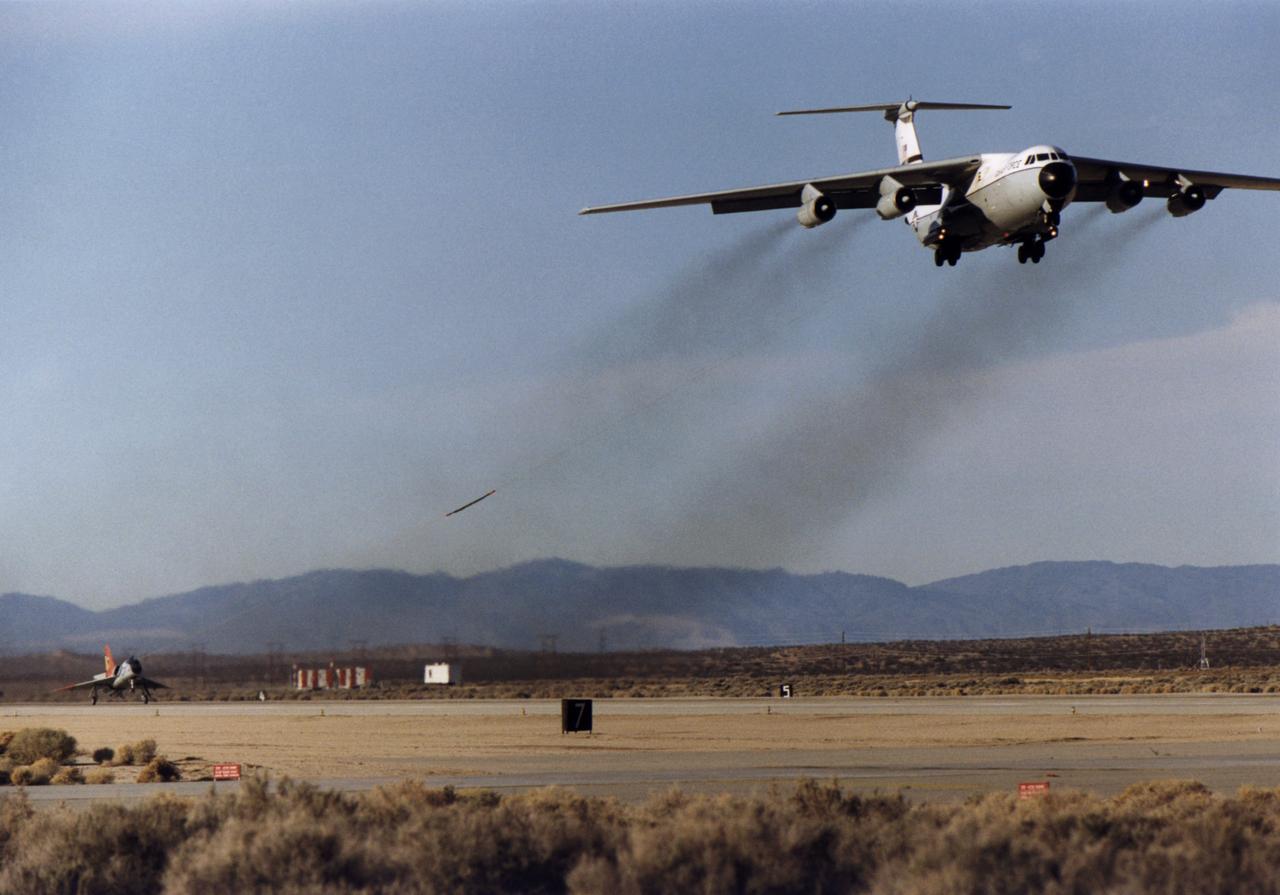
Eclipse project QF-106 and C-141A takeoff on first tethered flight December 20, 1997
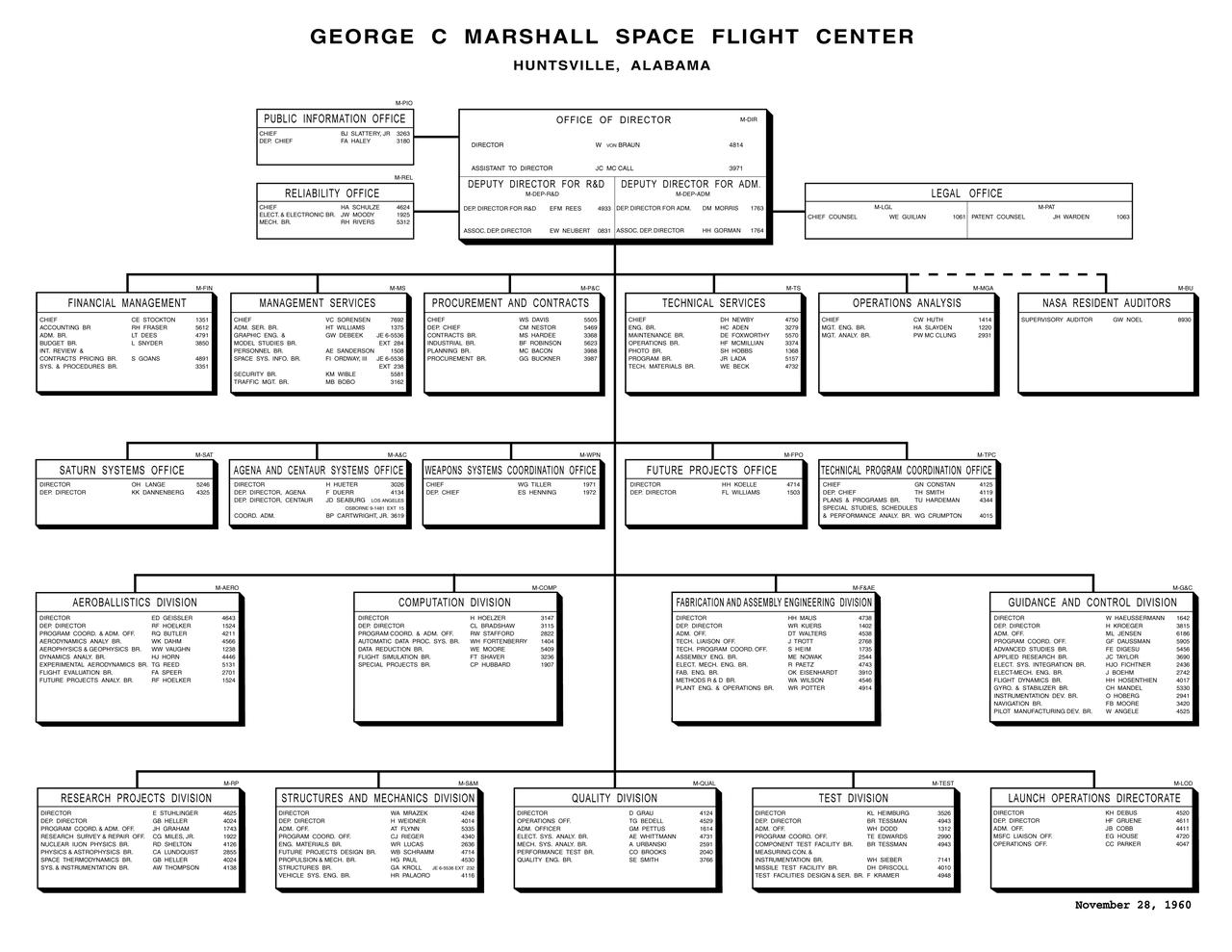
The first organizational chart for the George C. Marshall Space Flight Center (MSFC) with individual assignments, dated November 28, 1960.
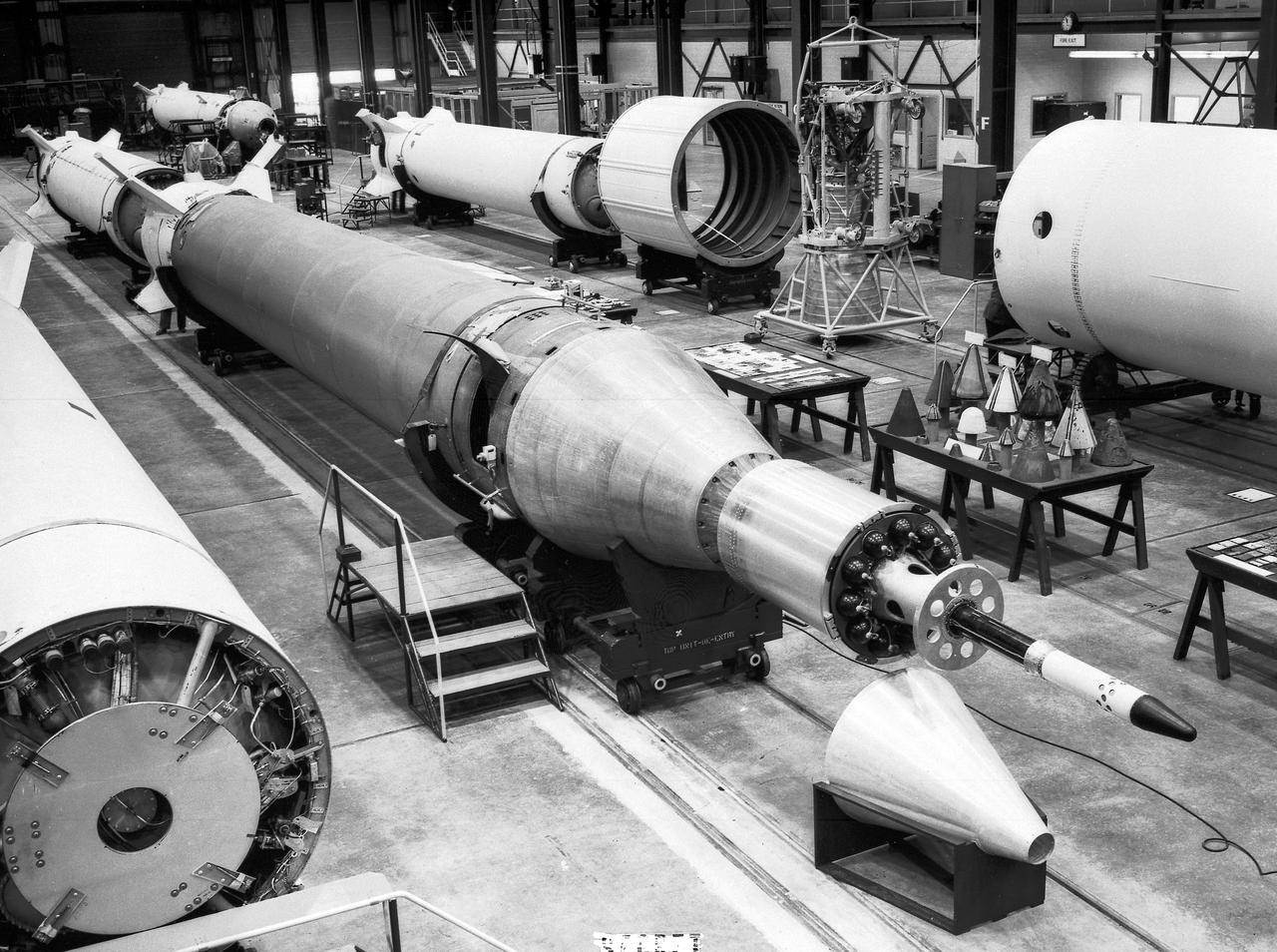
Jupiter-C Missile No. 27 assembly at the Army Ballistic Missile Agency (ABMA), Redstone Arsenal, in Huntsville, Aalabama. The Jupiter-C was a modification of the Redstone Missile, and originally developed as a nose cone re-entry test vehicle for the Jupiter Intermediate Range Ballistic Missile (IRBM). Jupiter-C successfully launched the first American Satellite, Explorer 1, in orbit on January 31, 1958.
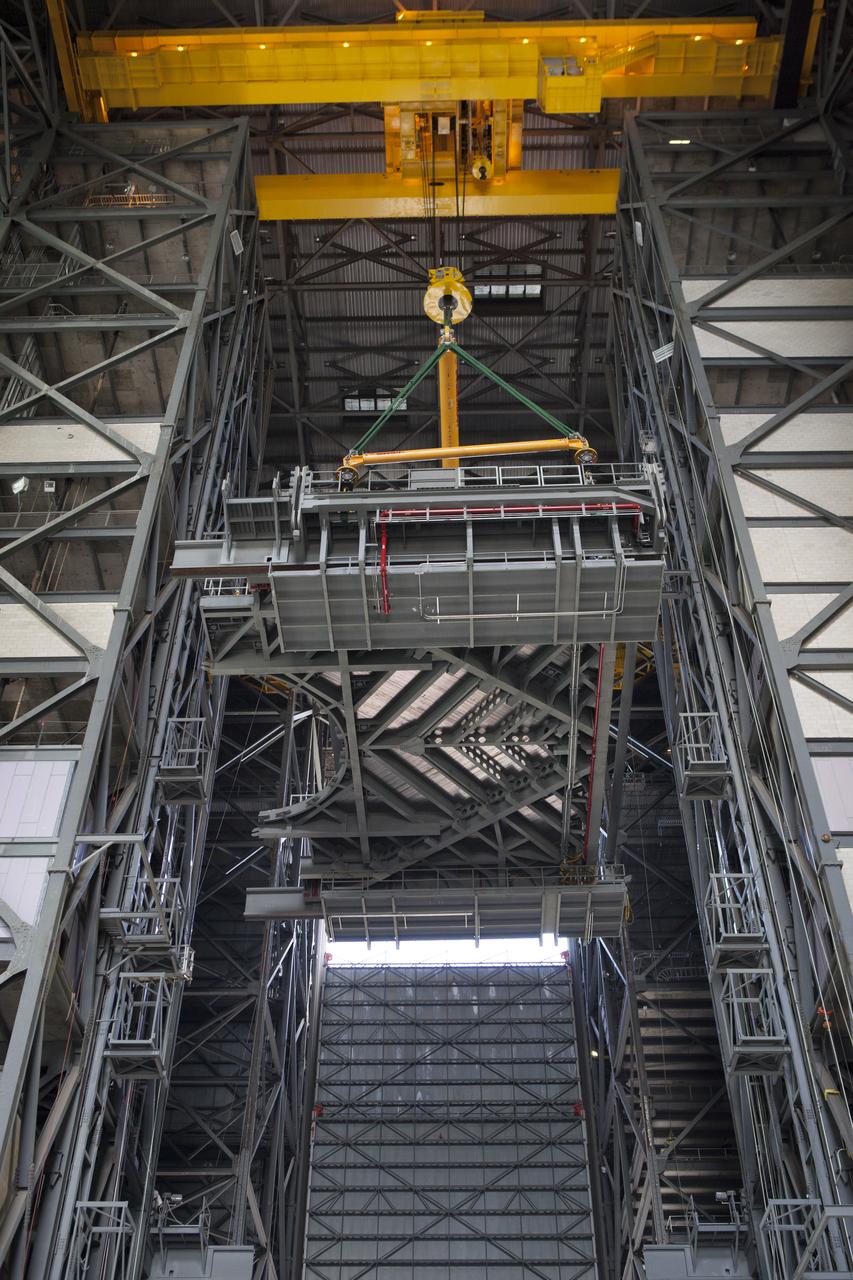
A heavy-lift crane lifts the first half of the C-level work platforms, C south, for NASA’s Space Launch System (SLS) rocket, high up from the transfer aisle floor of the Vehicle Assembly Building (VAB) at NASA’s Kennedy Space Center in Florida. The C platform will be moved into High Bay 3 for installation on the south wall. The C platforms are the eighth of 10 levels of work platforms that will surround and provide access to the SLS rocket and Orion spacecraft for Exploration Mission 1. The Ground Systems Development and Operations Program is overseeing upgrades and modifications to VAB High Bay 3, including installation of the new work platforms, to prepare for NASA’s Journey to Mars.
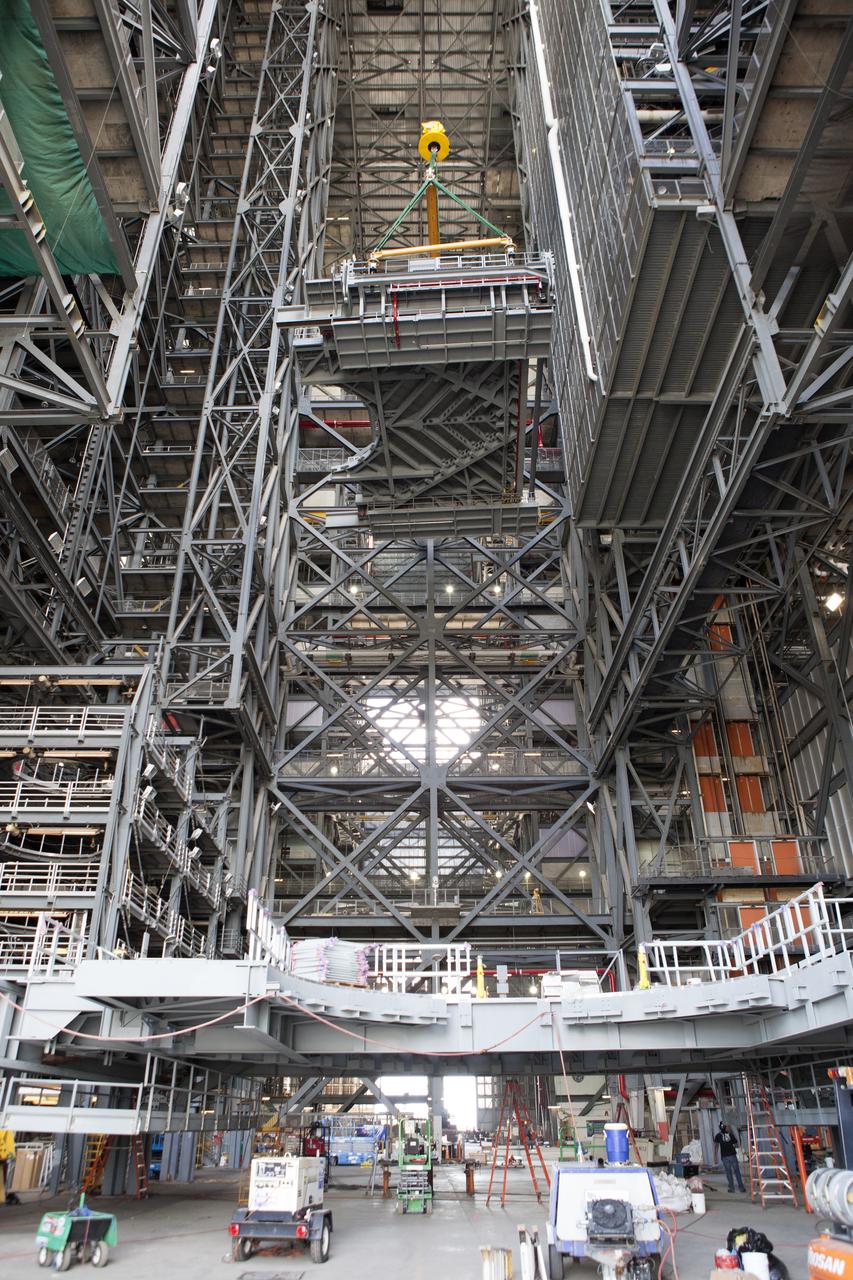
A heavy-lift crane lifts the first half of the C-level work platforms, C south, for NASA’s Space Launch System (SLS) rocket, high up from the transfer aisle floor of the Vehicle Assembly Building (VAB) at NASA’s Kennedy Space Center in Florida. The C platform will be installed on the south side of High Bay 3. The C platforms are the eighth of 10 levels of work platforms that will surround and provide access to the SLS rocket and Orion spacecraft for Exploration Mission 1. The Ground Systems Development and Operations Program is overseeing upgrades and modifications to VAB High Bay 3, including installation of the new work platforms, to prepare for NASA’s Journey to Mars.
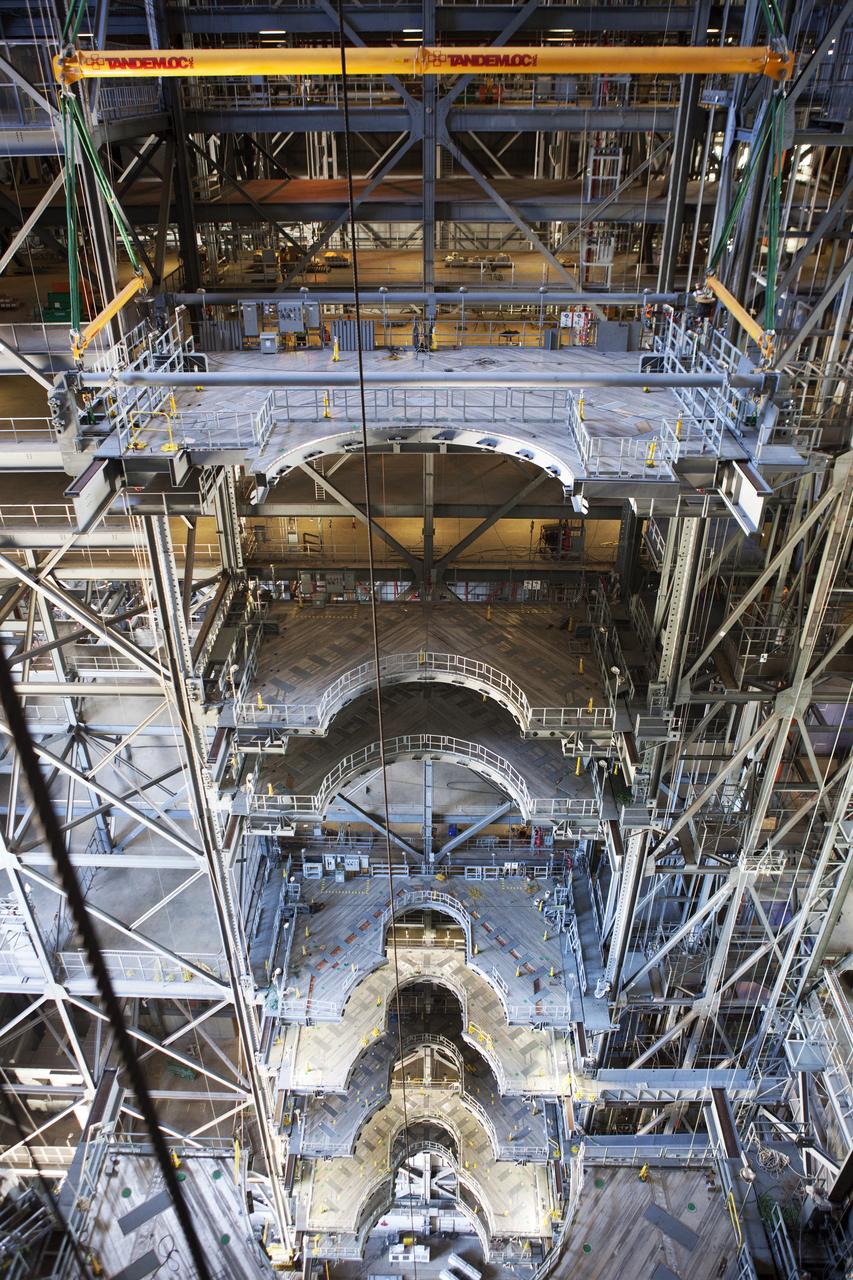
A heavy-lift crane lowers the first half of the C-level work platforms, C south, for NASA’s Space Launch System (SLS) rocket, for installation on the south side of High Bay 3 in the Vehicle Assembly Building (VAB) at NASA’s Kennedy Space Center in Florida. The C platforms are the eighth of 10 levels of work platforms that will surround and provide access to the SLS rocket and Orion spacecraft for Exploration Mission 1. In view below Platform C are several of the previously installed platforms. The Ground Systems Development and Operations Program is overseeing upgrades and modifications to VAB High Bay 3, including installation of the new work platforms, to prepare for NASA’s Journey to Mars.
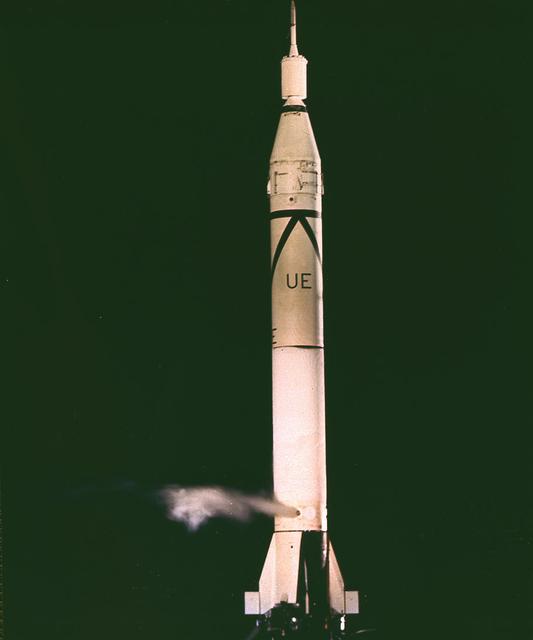
Juno I, a slightly modified Jupiter-C launch vehicle, shortly before the January 31, 1958 launch of America's first satellite, Explorer I. The Jupiter-C, developed by Dr. Wernher von Braun and the rocket team at Redstone Arsenal in Huntsville, Alabama, consisted of a modified version of the Redstone rocket's first stage and two upper stages of clustered Baby Sergeant rockets developed by the Jet Propulsion Laboratory.
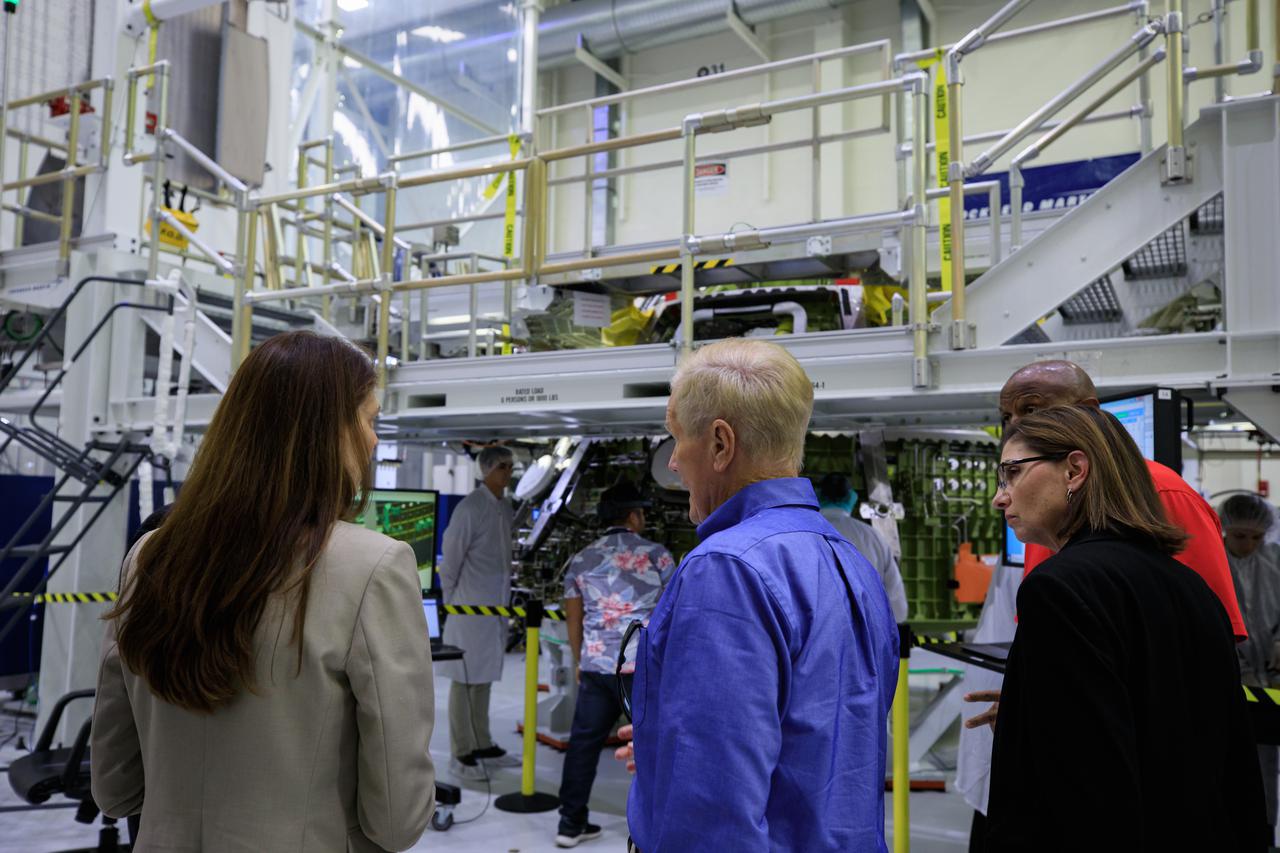
NASA Administrator Bill Nelson, center, tours the Neil Armstrong Operations and Checkout (O&C) Building high bay during a visit to the agency’s Kennedy Space Center in Florida on July 27, 2021. While at the O&C, Nelson had the opportunity to view some of the flight hardware for Artemis II – the first test flight of the Space Launch System rocket and Orion spacecraft with crew on board. Through Artemis, NASA will land the first woman and first person of color on the lunar surface, as well as establish a sustainable presence on and around the Moon.
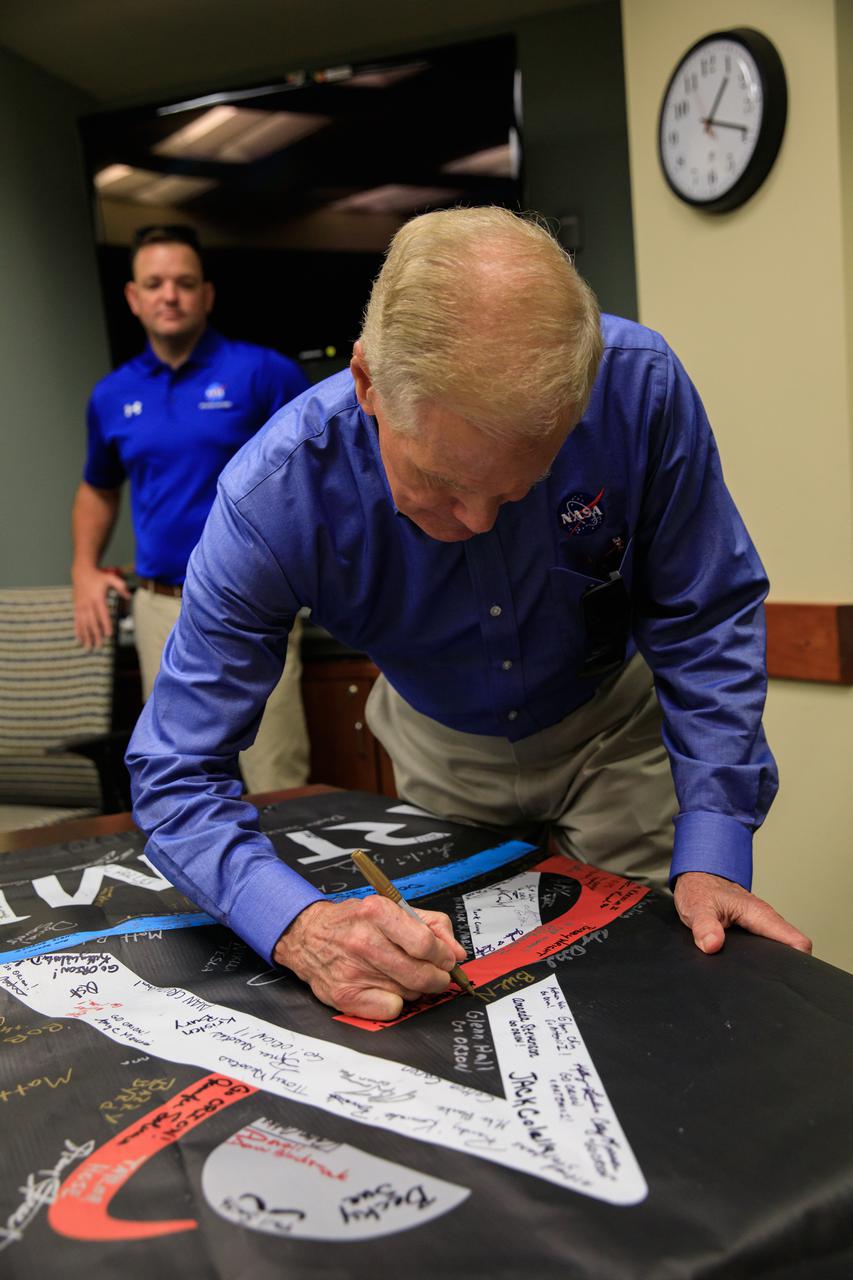
NASA Administrator Bill Nelson adds his signature to an Artemis banner inside the Neil Armstrong Operations and Checkout (O&C) Building during a visit to the agency’s Kennedy Space Center in Florida on July 27, 2021. While at the O&C, Nelson had the opportunity to view some of the flight hardware for Artemis II – the first test flight of the Space Launch System rocket and Orion spacecraft with crew on board. Through Artemis, NASA will land the first woman and first person of color on the lunar surface, as well as establish a sustainable presence on and around the Moon.
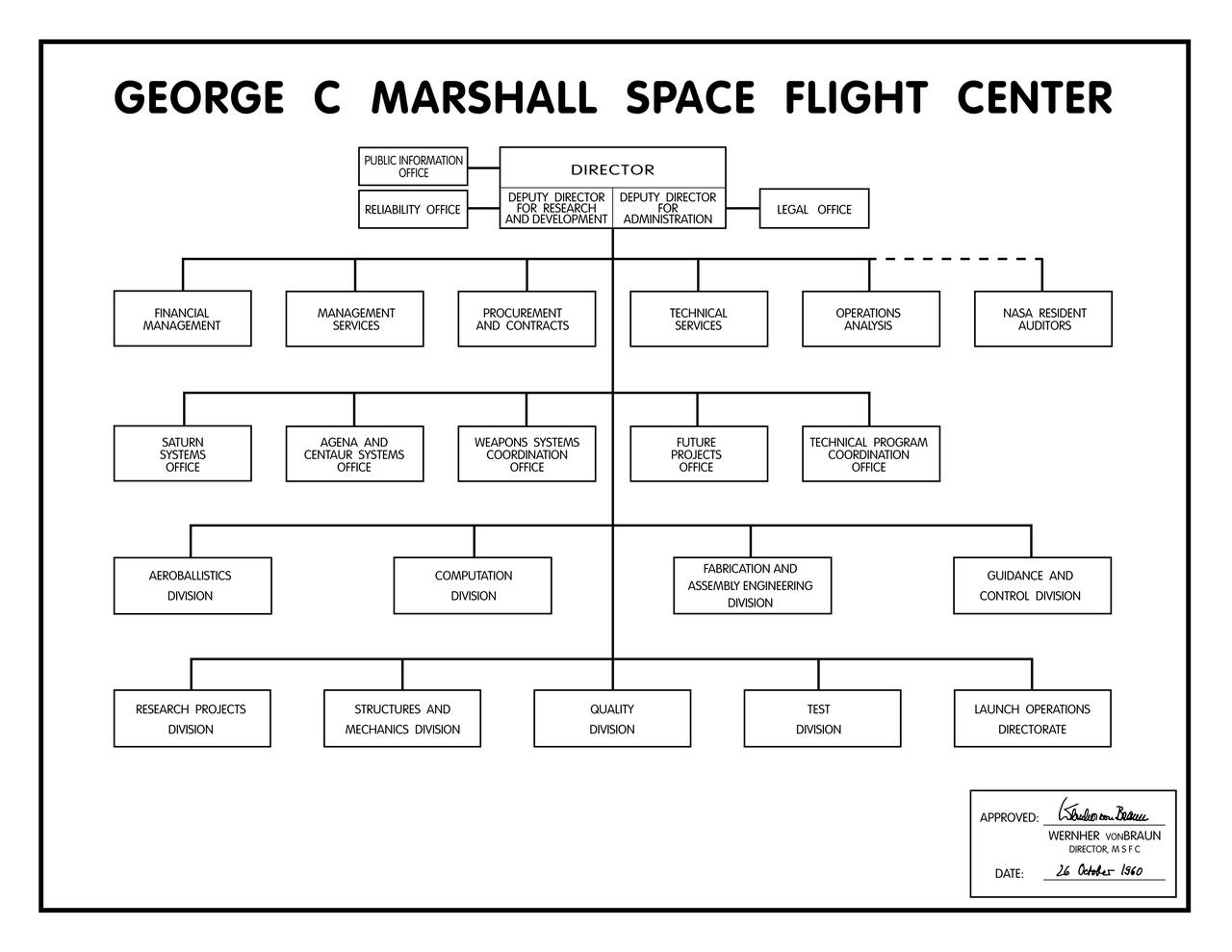
The first organizational chart of the George C. Marshall Space Flight Center (MSFC) which was approved and signed by Dr. Wernher von Braun, Director, MSFC, on 26 October 1960.
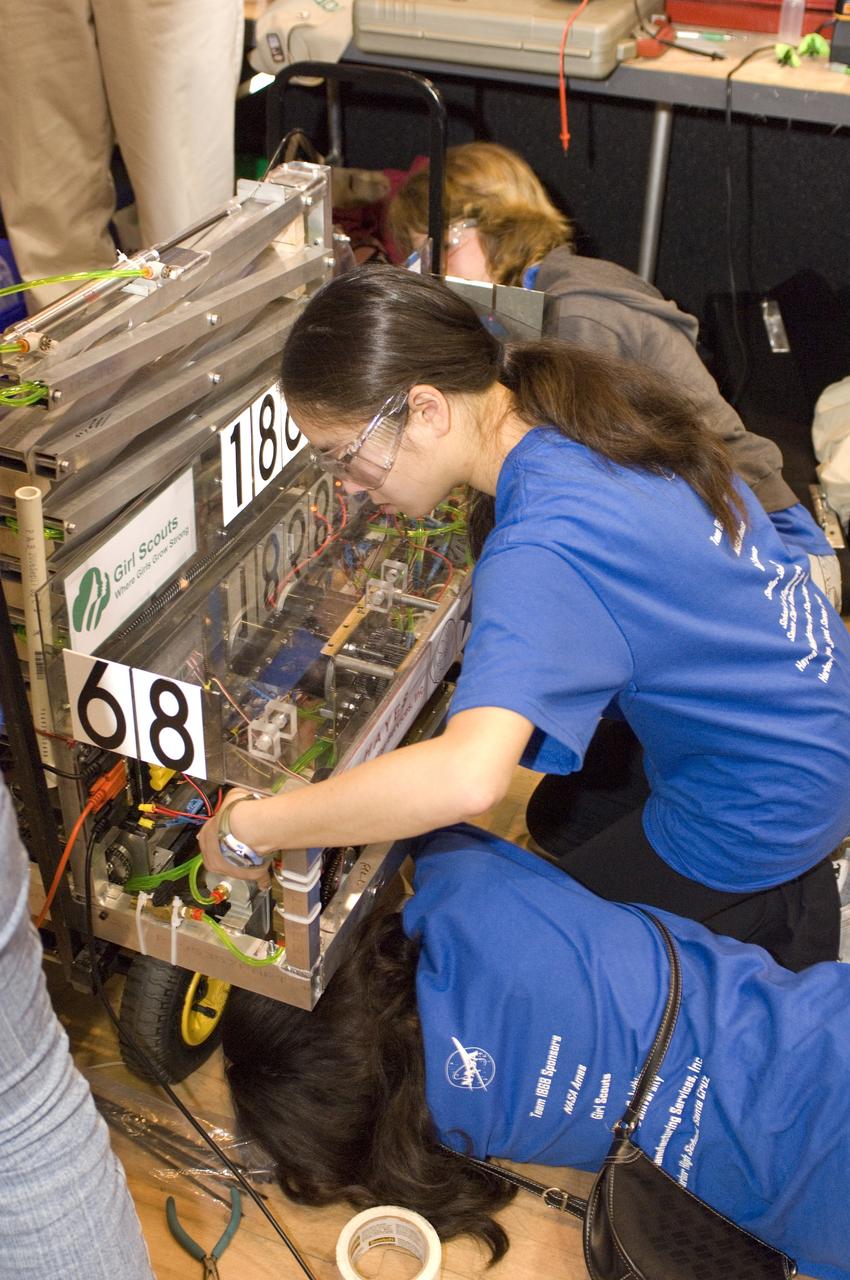
Silicon Valley FIRST Regional Robotics competition: Cheesy Poofs - Team 254 - NASA Ames Research Center & Bellarmine College Prep, San Jose, California (C)
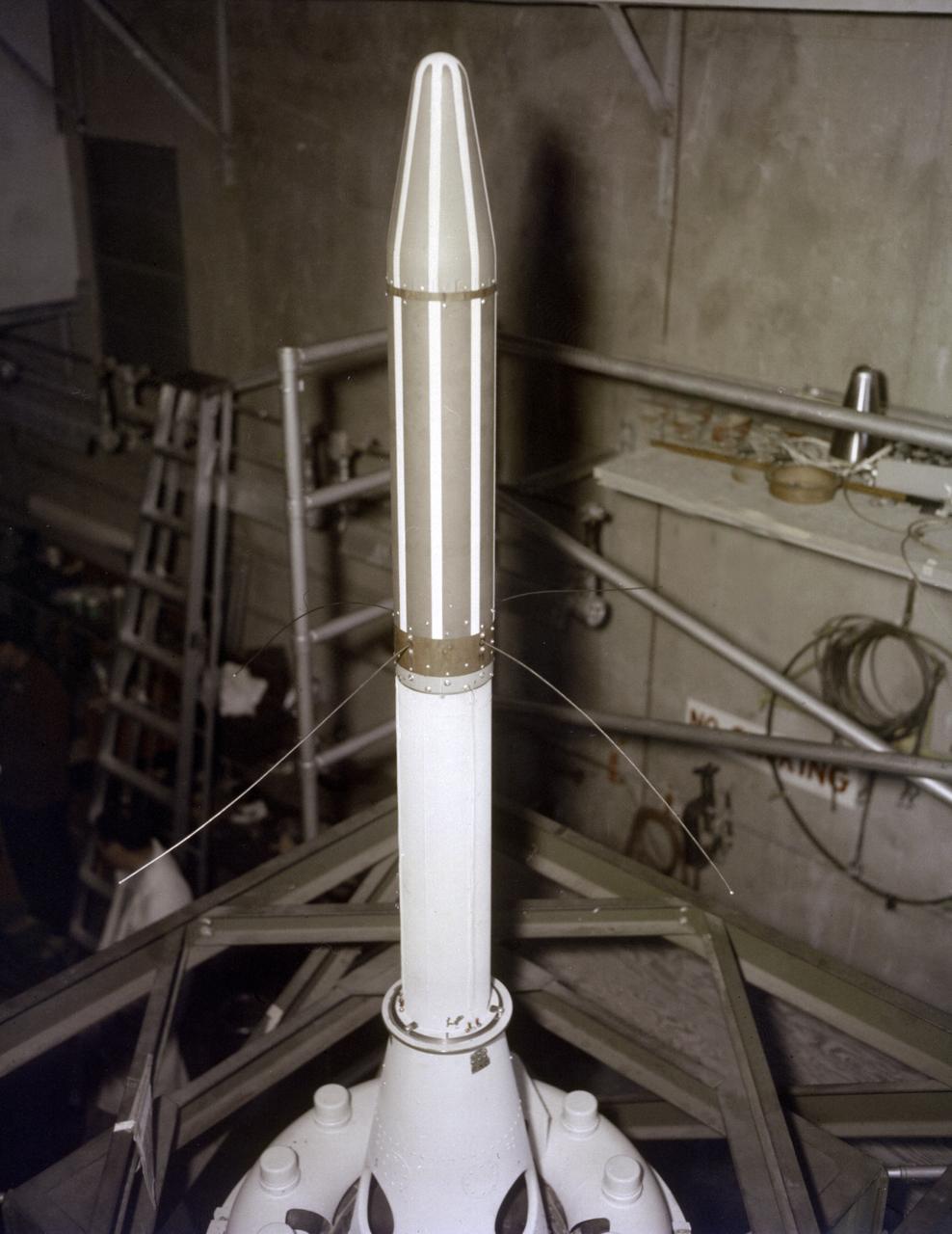
Explorer 1 satellite. This photo was taken during the installation of Explorer-1, the first United States' Earth-orbiting satellite, to its launch vehicle, Jupiter-C, in January 1958
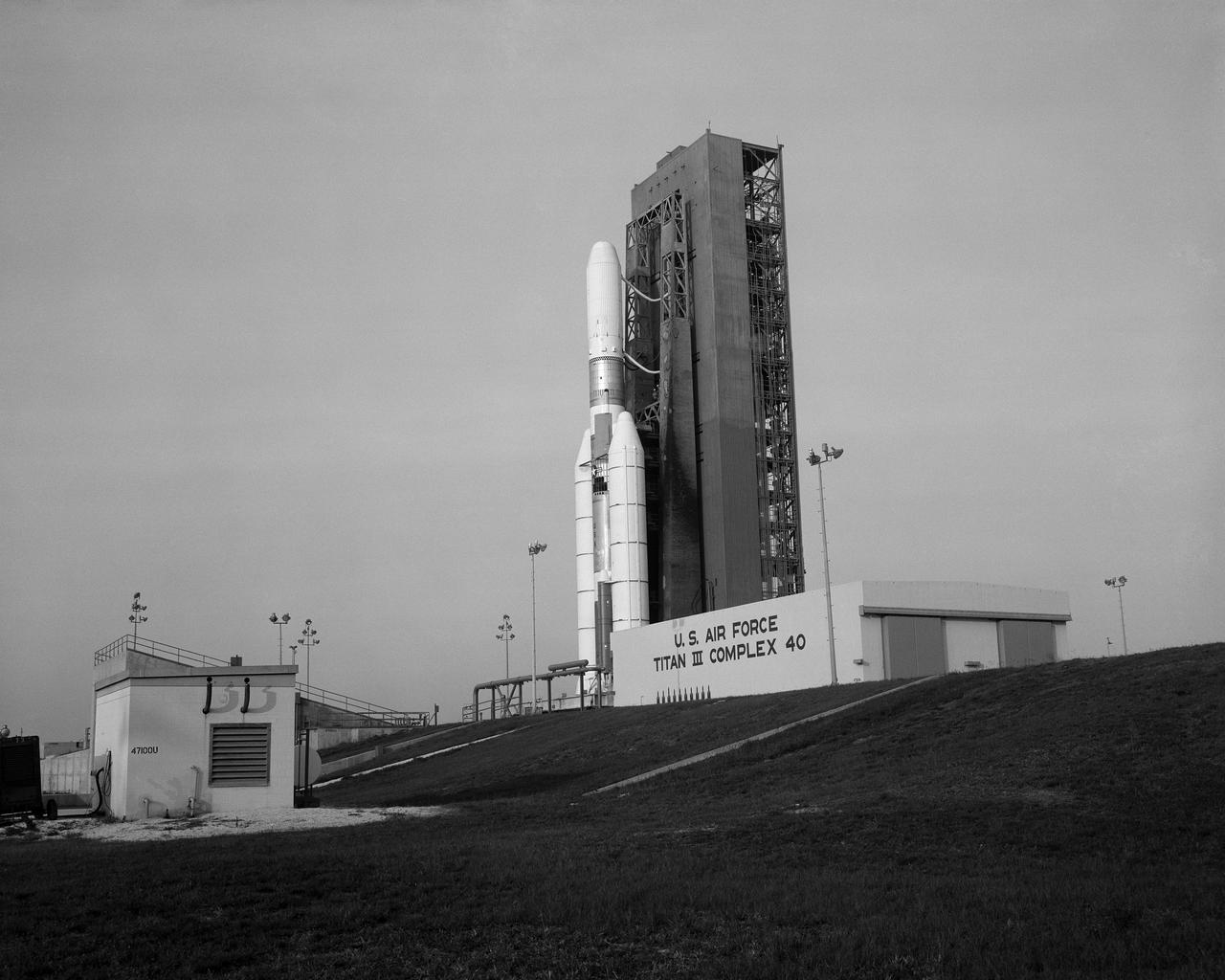
A Titan III-C stands poised on Complex 40 at Cape Canaveral Air Force Station for the launch of Application Technology Satellite-F, first in a new generation of NASA communications satellites. (1.3-2)
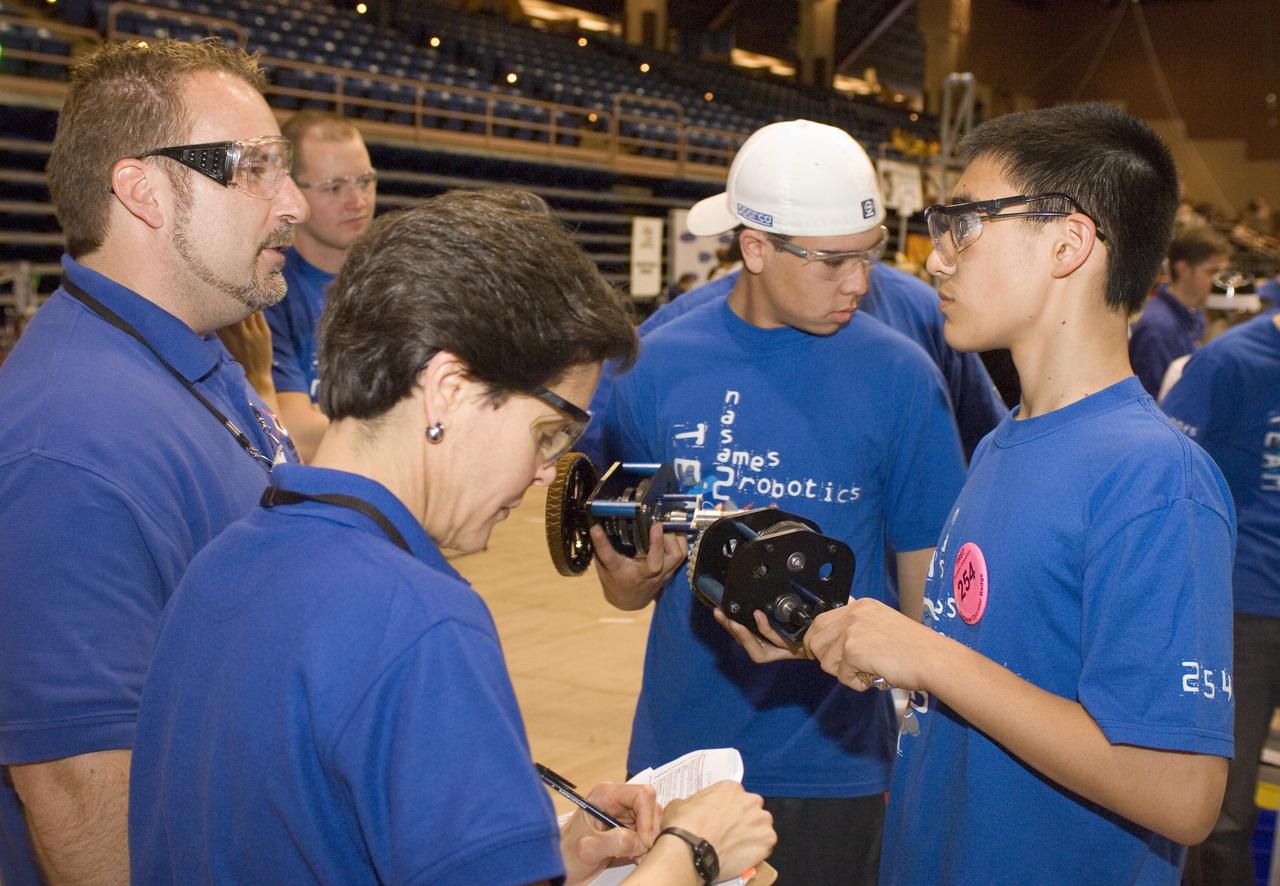
Silicon Valley FIRST Regional Robotics competition: Cheesy Poofs - Team 254 - NASA Ames Research Center & Bellarmine College Prep, San Jose, California (C)
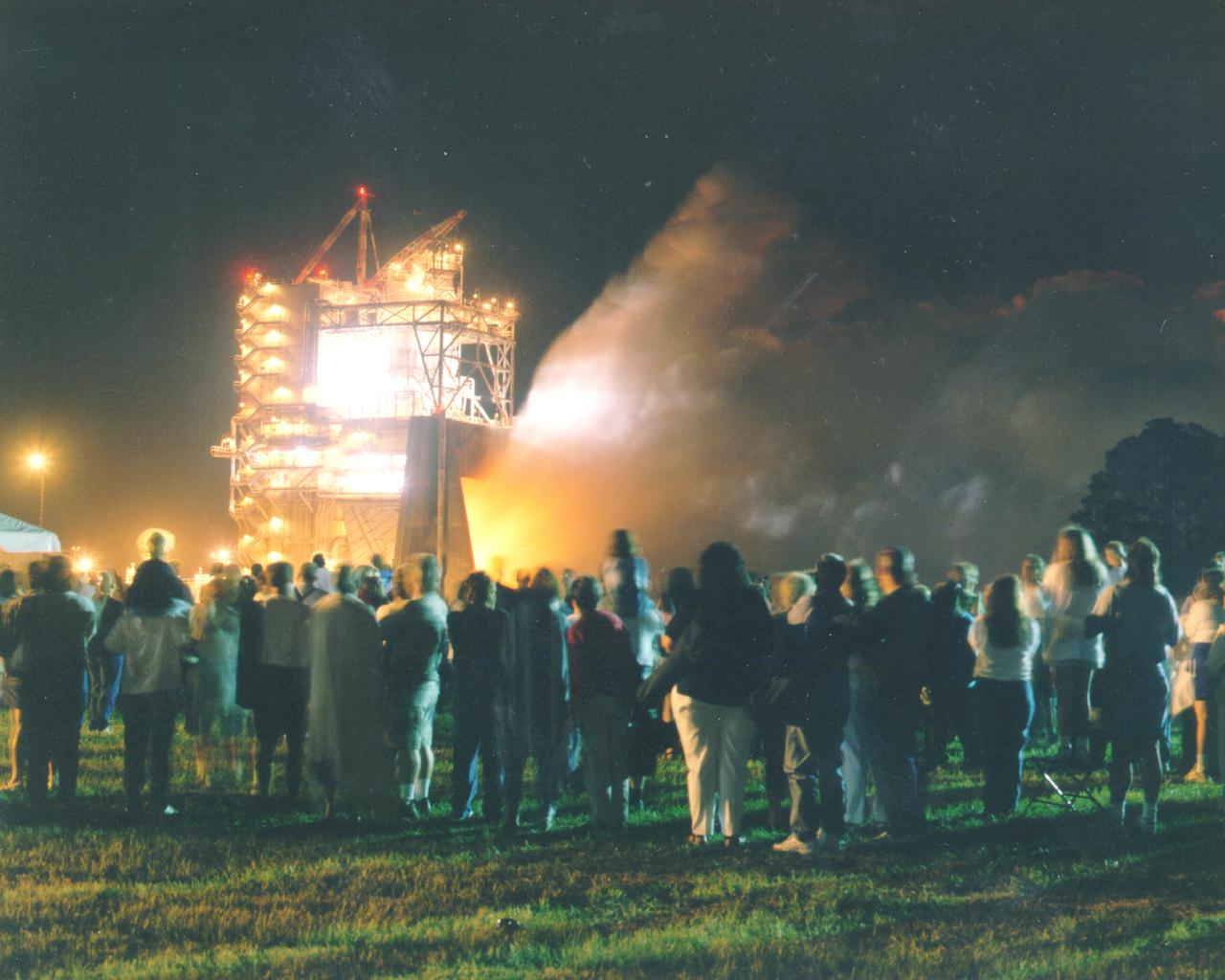
Thousands of people watch the first-ever evening public engine test of a Space Shuttle Main Engine at NASA's John C. Stennis Space Center. The spectacular test marked Stennis Space Center's 20th anniversary celebration of the first Space Shuttle mission.
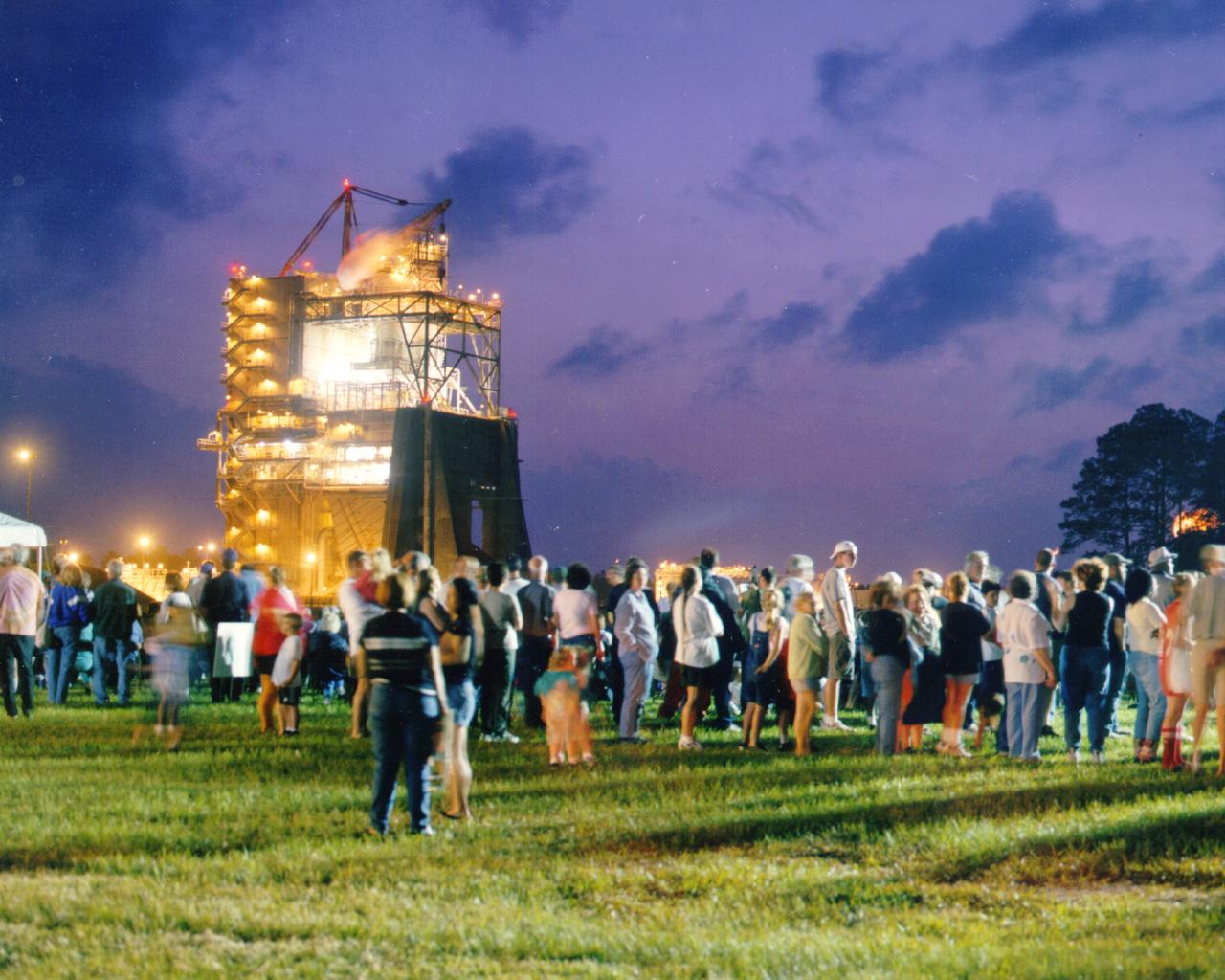
Approximately 13,000 people fill the grounds at NASA's John C. Stennis Space Center for the first-ever evening public engine test of a Space Shuttle Main Engine. The test marked Stennis Space Center's 20th anniversary celebration of the first Space Shuttle mission.
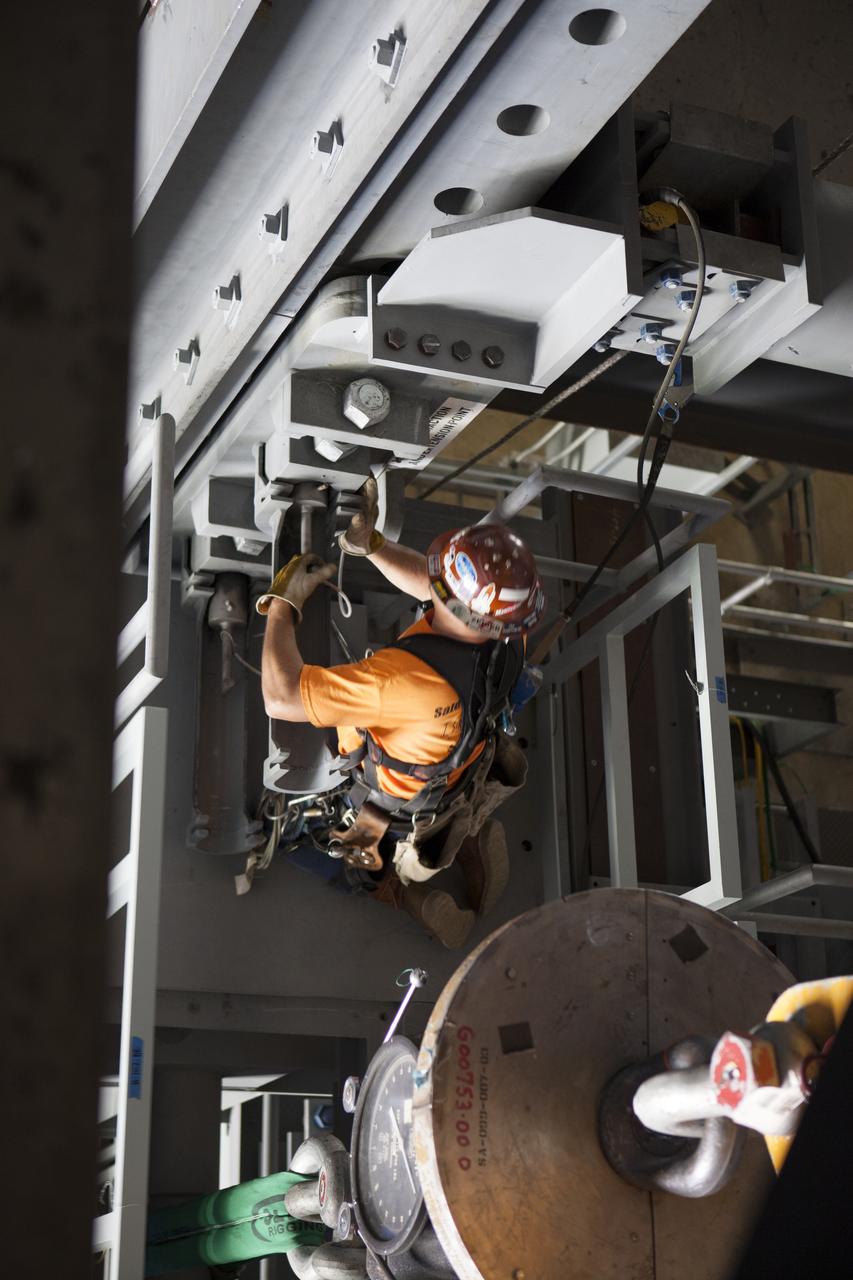
Inside the Vehicle Assembly Building at NASA’s Kennedy Space Center in Florida, a construction worker assist with the installation of the first half of the C-level work platforms, C south, for NASA’s Space Launch System (SLS) rocket. The large bolts that hold the platform in place on the south wall are being secured. The C platforms are the eighth of 10 levels of work platforms that will surround and provide access to the SLS rocket and Orion spacecraft for Exploration Mission 1. The Ground Systems Development and Operations Program is overseeing upgrades and modifications to VAB High Bay 3, including installation of the new work platforms, to prepare for NASA’s Journey to Mars.
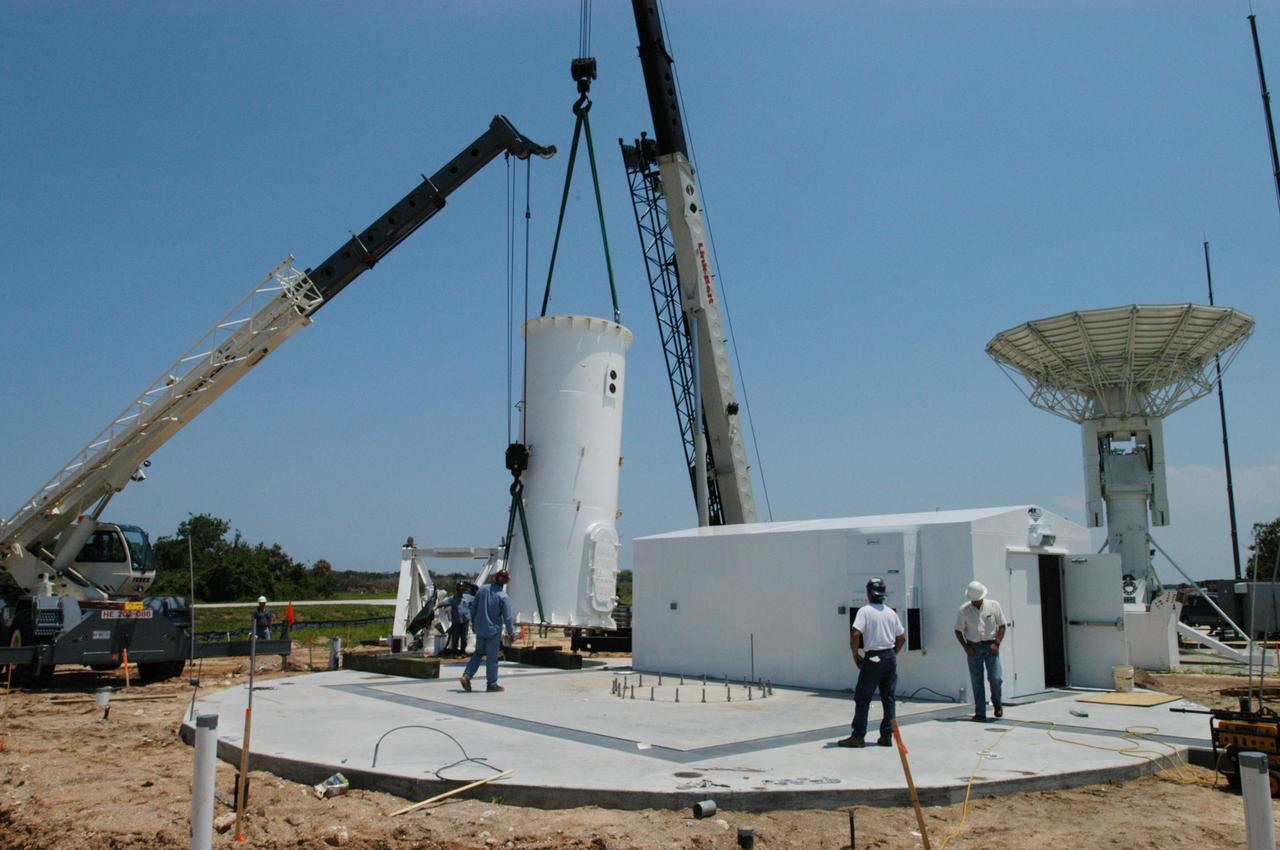
KENNEDY SPACE CENTER, FLA. - Equipment is delivered for installation of another NASA C-band radar at a radar site on North Merritt Island, Fla. The 50-foot C-band radar will be used for long-term Shuttle missions to track the launches and observe possible debris coming from the Shuttle. In the background is an existing 30-foot C-band Pathfinder radar whose use was demonstrated on the Delta Messenger launch. It will be used on the upcoming two Return to Flight missions. The launch window for the first Return to Flight mission, STS-114, is July 13 to July 31.
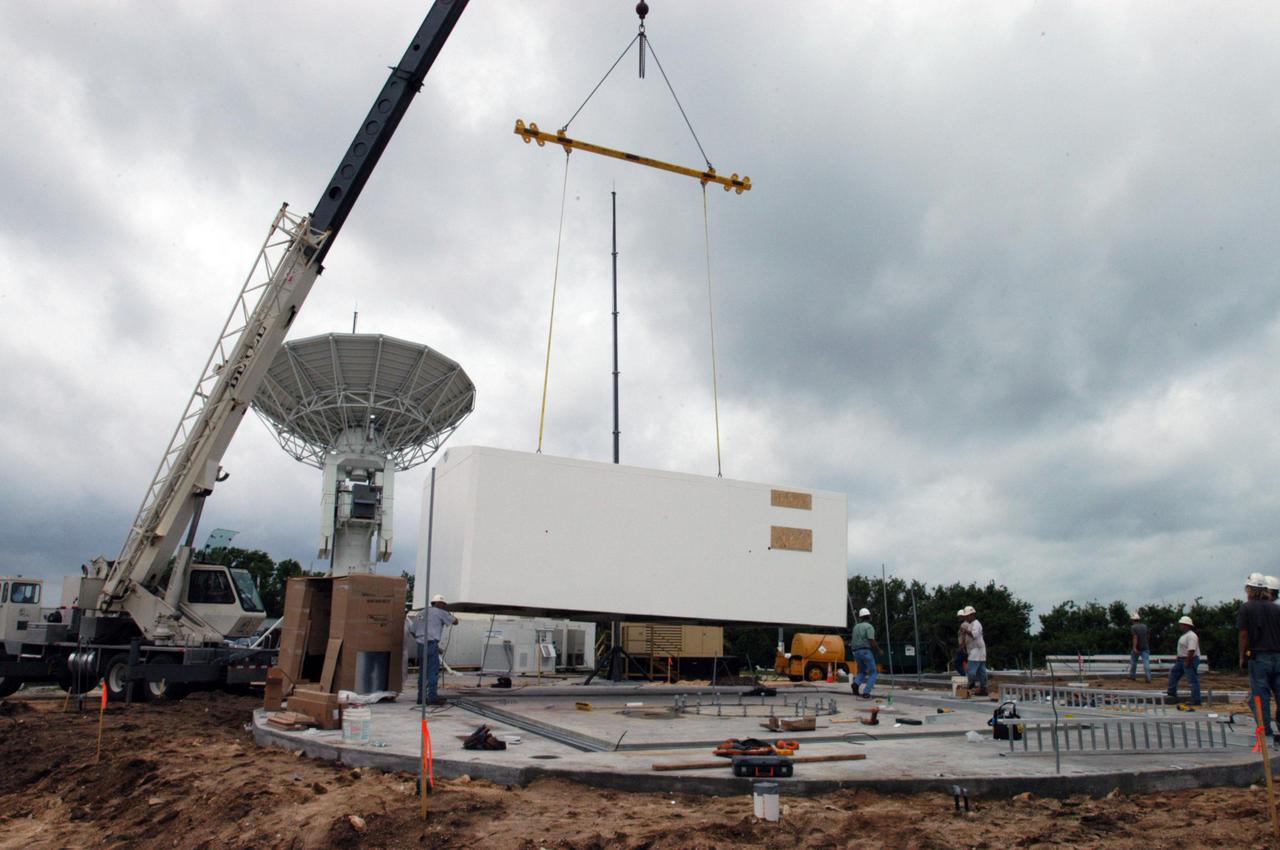
KENNEDY SPACE CENTER, FLA. - Equipment is delivered for installation of another NASA C-band radar at a radar site on North Merritt Island, Fla. The 50-foot C-band radar will be used for long-term Shuttle missions to track the launches and observe possible debris coming from the Shuttle. In the background is an existing 30-foot C-band Pathfinder radar whose use was demonstrated on the Delta Messenger launch. It will be used on the upcoming two Return to Flight missions. The launch window for the first Return to Flight mission, STS-114, is July 13 to July 31.
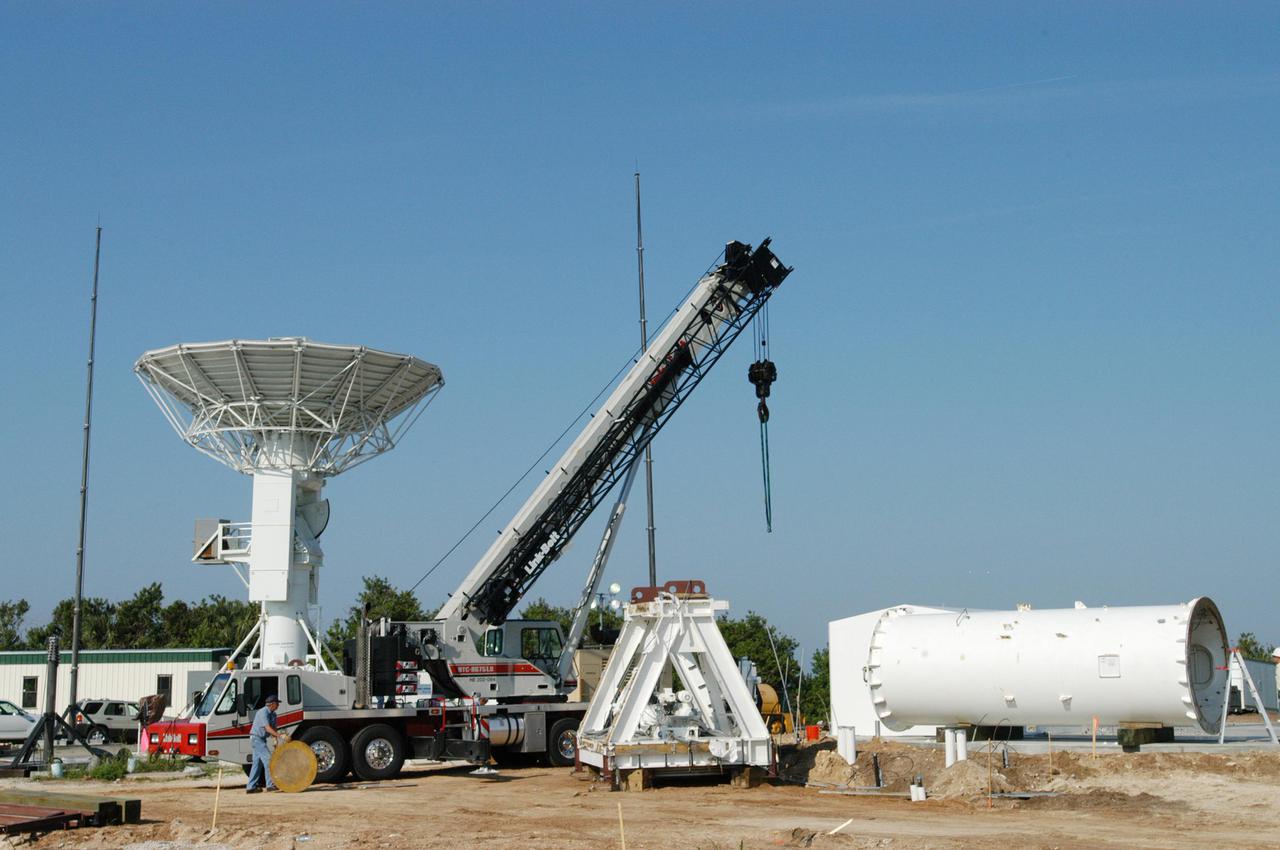
KENNEDY SPACE CENTER, FLA. - Equipment is delivered for installation of another NASA C-band radar at a radar site on North Merritt Island, Fla. The 50-foot C-band radar will be used for long-term Shuttle missions to track the launches and observe possible debris coming from the Shuttle. In the background is an existing 30-foot C-band Pathfinder radar whose use was demonstrated on the Delta Messenger launch. It will be used on the upcoming two Return to Flight missions. The launch window for the first Return to Flight mission, STS-114, is July 13 to July 31.
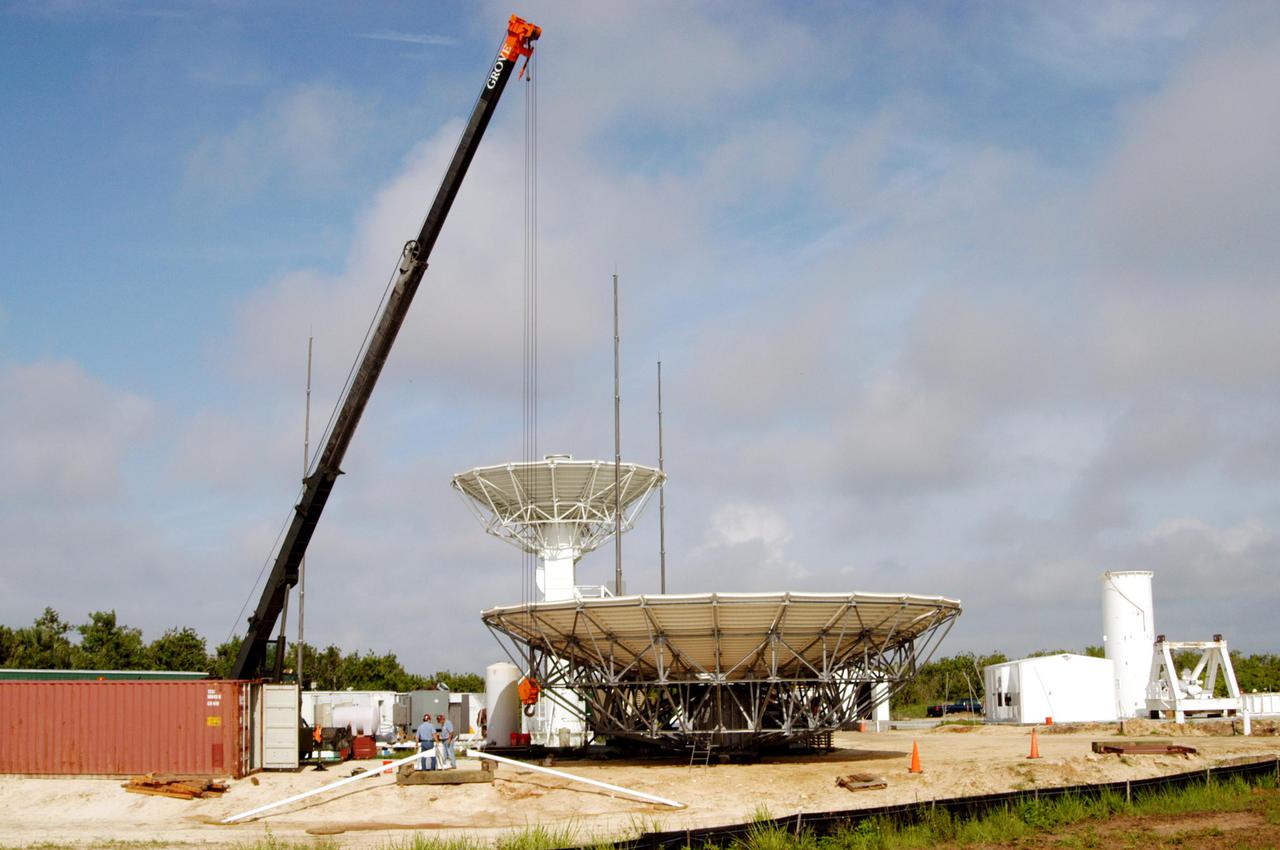
KENNEDY SPACE CENTER, FLA. - On June 6, progress is made in the erection of a C-band radar antenna at a radar site on North Merritt Island, Fla. The 50-foot C-band radar will be used for long-term Shuttle missions to track the launches and observe possible debris coming from the Shuttle. In the background is an existing 30-foot C-band Pathfinder radar whose use was demonstrated on the Delta Messenger launch. It will be used on the upcoming two Return to Flight missions. The launch window for the first Return to Flight mission, STS-114, is July 13 to July 31.

KENNEDY SPACE CENTER, FLA. - On June 13, the base for a C-band radar antenna (seen at left) can be seen under construction (at right) on a radar site on North Merritt Island, Fla. The 50-foot C-band radar will be used for long-term Shuttle missions to track the launches and observe possible debris coming from the Shuttle. In the background (center) is an existing 30-foot C-band Pathfinder radar whose use was demonstrated on the Delta Messenger launch. It will be used on the upcoming two Return to Flight missions. The launch window for the first Return to Flight mission, STS-114, is July 13 to July 31.
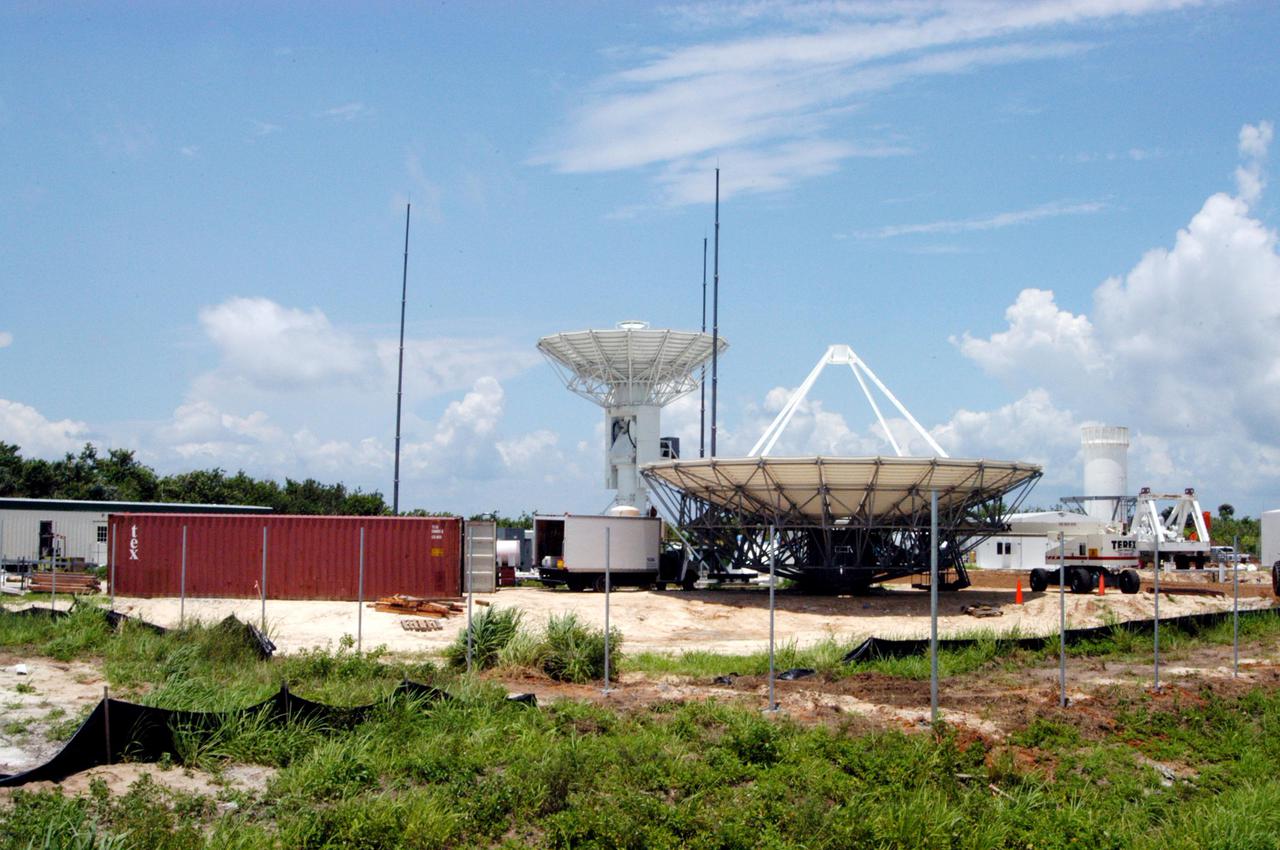
KENNEDY SPACE CENTER, FLA. - On June 8, further progress is made in the erection of a C-band radar antenna at a radar site on North Merritt Island, Fla. The 50-foot C-band radar will be used for long-term Shuttle missions to track the launches and observe possible debris coming from the Shuttle. In the background is an existing 30-foot C-band Pathfinder radar whose use was demonstrated on the Delta Messenger launch. It will be used on the upcoming two Return to Flight missions. The launch window for the first Return to Flight mission, STS-114, is July 13 to July 31.
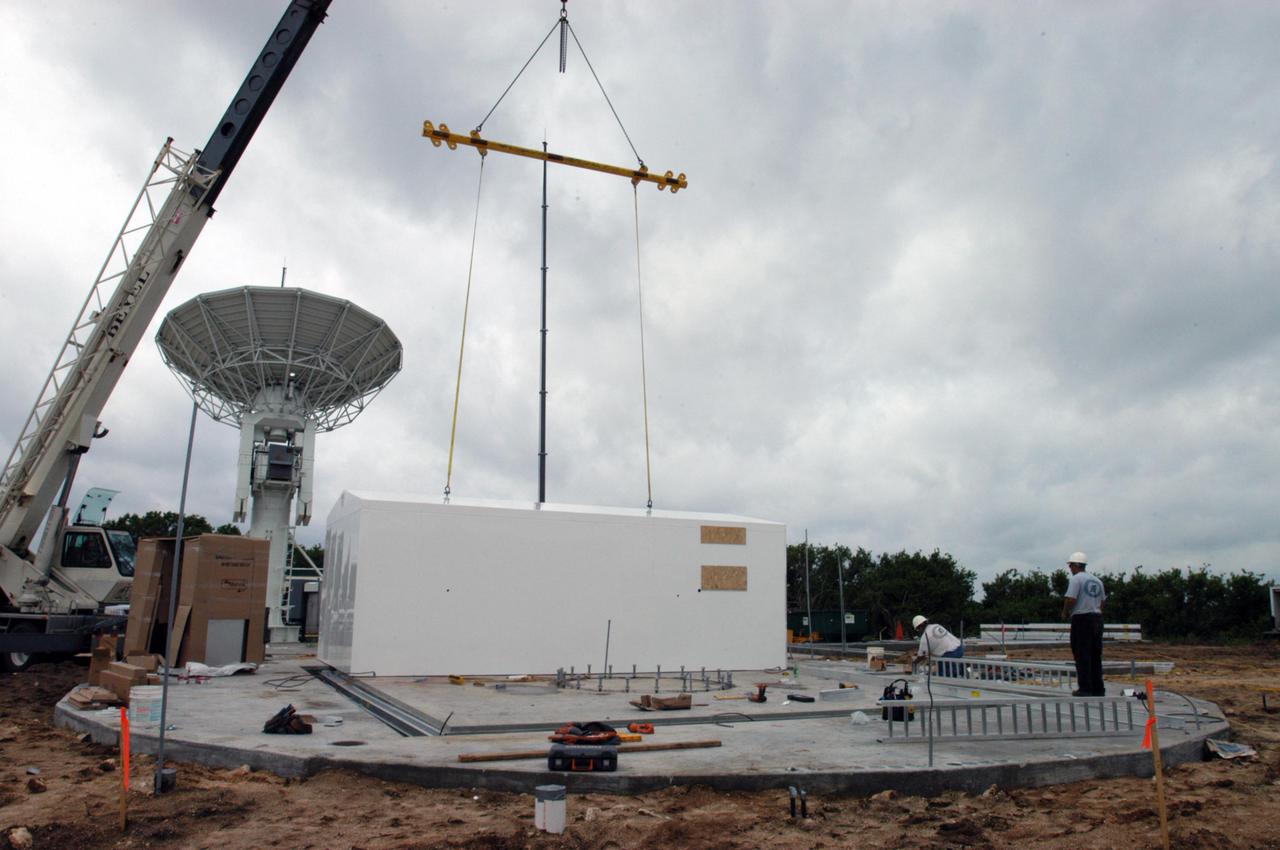
KENNEDY SPACE CENTER, FLA. - Equipment is delivered for installation of another NASA C-band radar at a radar site on North Merritt Island, Fla. The 50-foot C-band radar will be used for long-term Shuttle missions to track the launches and observe possible debris coming from the Shuttle. In the background is an existing 30-foot C-band Pathfinder radar whose use was demonstrated on the Delta Messenger launch. It will be used on the upcoming two Return to Flight missions. The launch window for the first Return to Flight mission, STS-114, is July 13 to July 31.
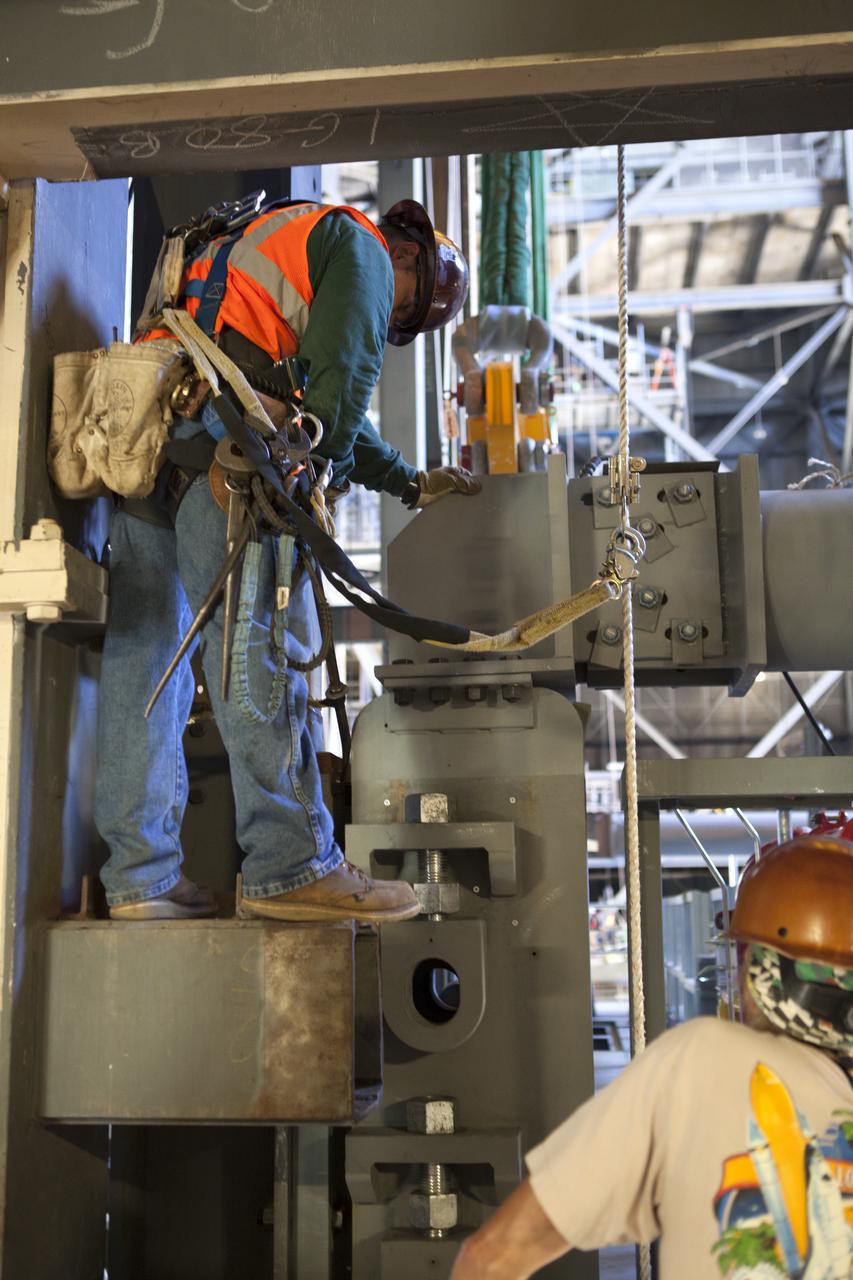
Inside the Vehicle Assembly Building at NASA’s Kennedy Space Center in Florida, construction workers assist with the installation of the first half of the C-level work platforms, C south, for NASA’s Space Launch System (SLS) rocket. The large bolts that hold the platform in place on the south wall are being secured. The C platforms are the eighth of 10 levels of work platforms that will surround and provide access to the SLS rocket and Orion spacecraft for Exploration Mission 1. The Ground Systems Development and Operations Program is overseeing upgrades and modifications to VAB High Bay 3, including installation of the new work platforms, to prepare for NASA’s Journey to Mars.
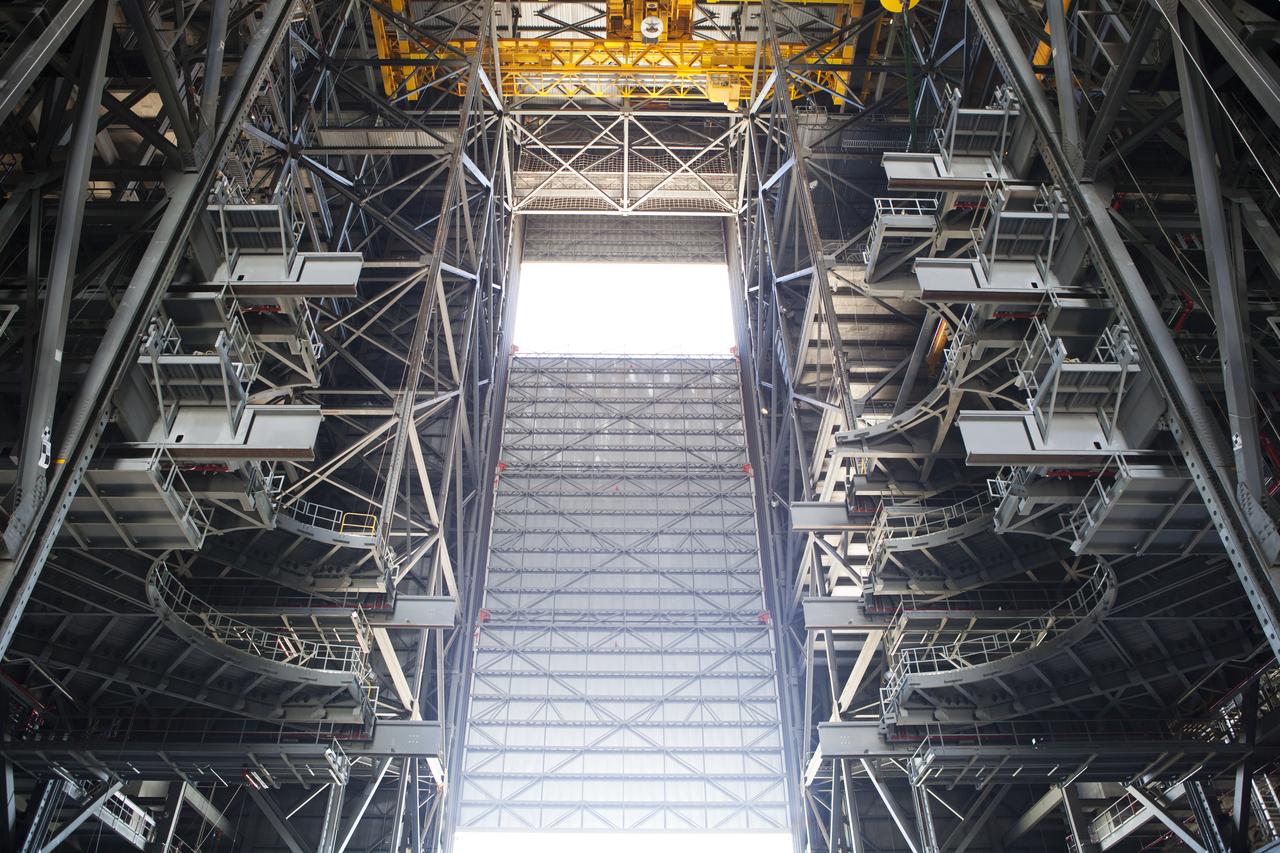
Inside the Vehicle Assembly Building at NASA’s Kennedy Space Center in Florida, the first half of the C-level work platforms, C south, for NASA’s Space Launch System (SLS) rocket, has been installed on the south side of the high bay. In view below are several levels of previously installed platforms. The C platforms are the eighth of 10 levels of work platforms that will surround and provide access to the SLS rocket and Orion spacecraft for Exploration Mission 1. The Ground Systems Development and Operations Program is overseeing upgrades and modifications to VAB High Bay 3, including installation of the new work platforms, to prepare for NASA’s Journey to Mars.
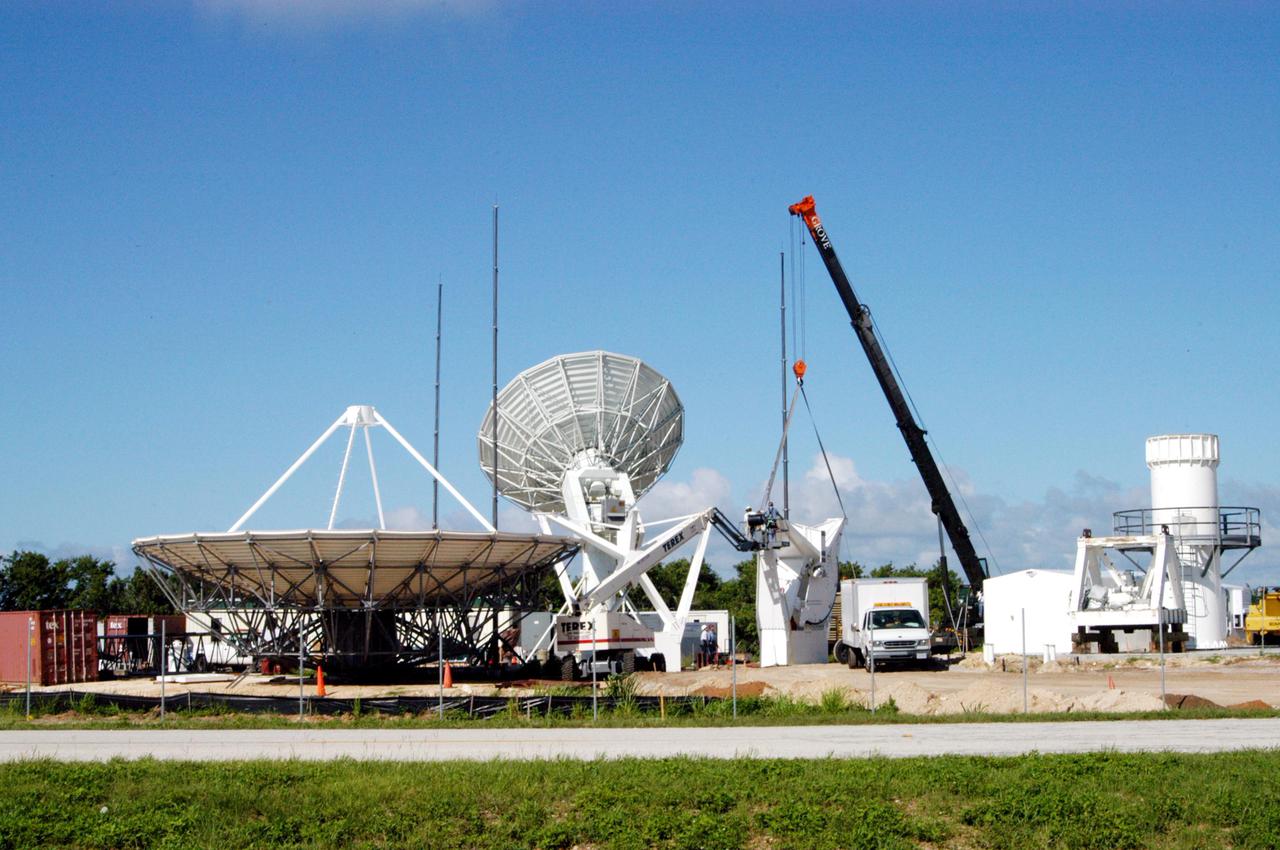
KENNEDY SPACE CENTER, FLA. - On June 14, work is underway on a radar site on North Merritt Island, Fla., constructing a C-band radar antenna (seen at left) and its base. The 50-foot C-band radar will be used for long-term Shuttle missions to track the launches and observe possible debris coming from the Shuttle. In the background (center) is an existing 30-foot C-band Pathfinder radar whose use was demonstrated on the Delta Messenger launch. It will be used on the upcoming two Return to Flight missions. The launch window for the first Return to Flight mission, STS-114, is July 13 to July 31.
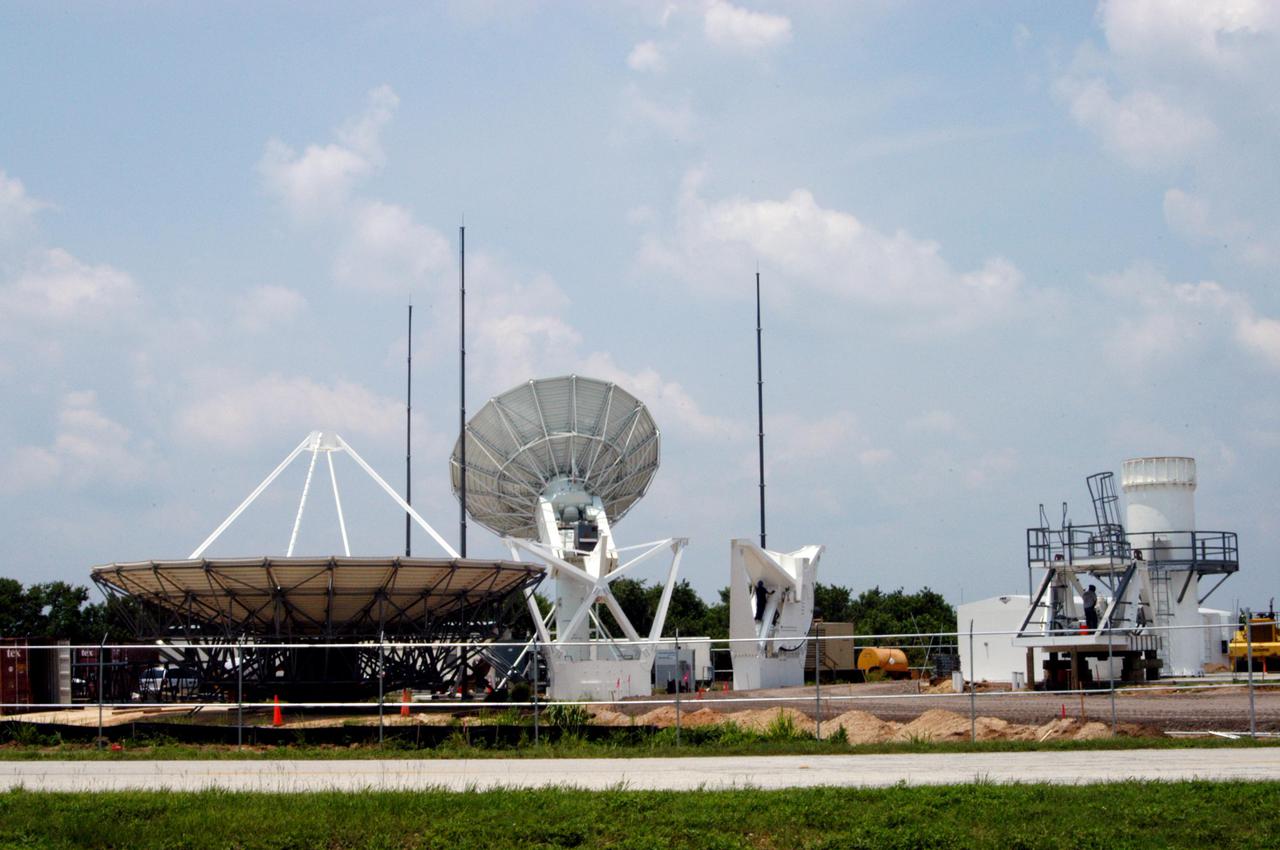
KENNEDY SPACE CENTER, FLA. - On June 16, work is underway on a radar site on North Merritt Island, Fla., constructing a C-band radar antenna (seen at left) and its base. The 50-foot C-band radar will be used for long-term Shuttle missions to track the launches and observe possible debris coming from the Shuttle. In the background (center) is an existing 30-foot C-band Pathfinder radar whose use was demonstrated on the Delta Messenger launch. It will be used on the upcoming two Return to Flight missions. The launch window for the first Return to Flight mission, STS-114, is July 13 to July 31.
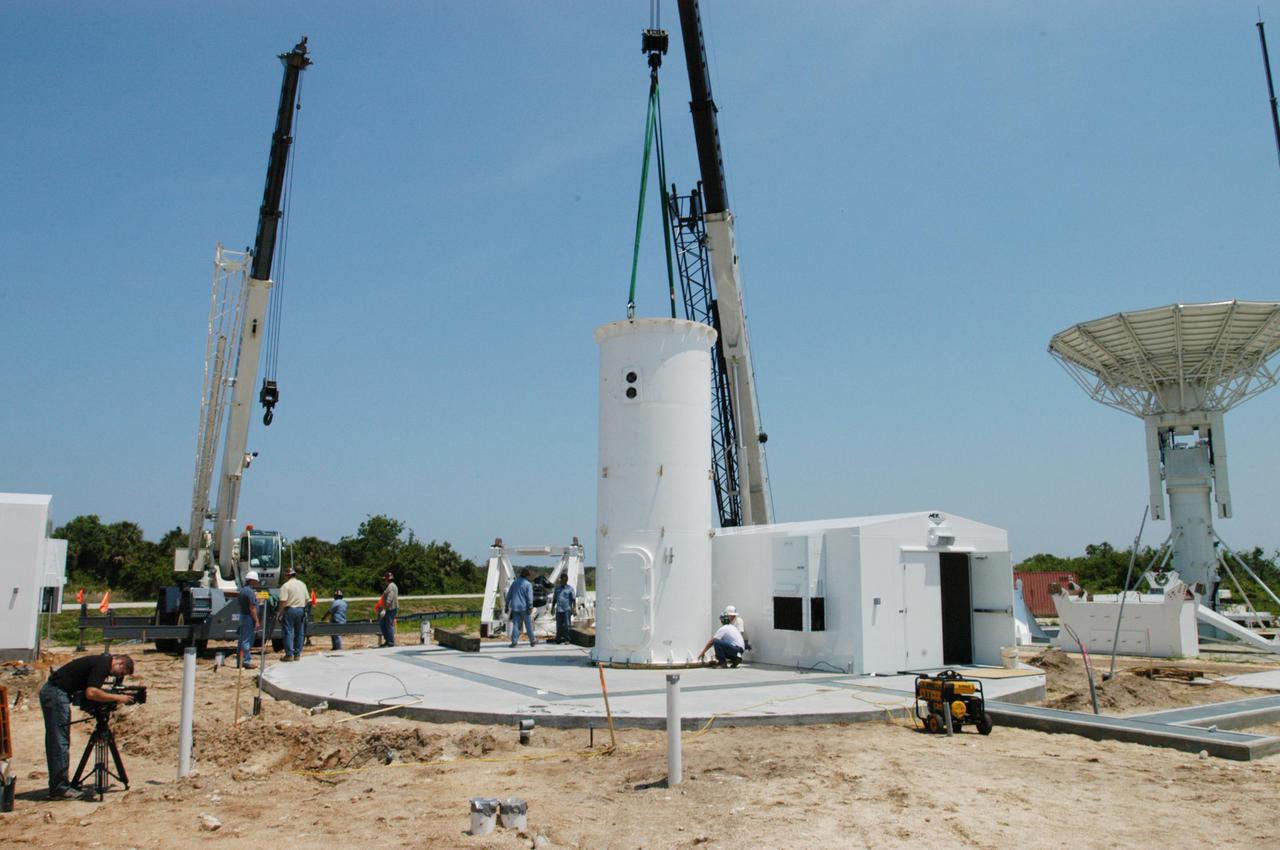
KENNEDY SPACE CENTER, FLA. - Equipment is delivered for installation of another NASA C-band radar at a radar site on North Merritt Island, Fla. The 50-foot C-band radar will be used for long-term Shuttle missions to track the launches and observe possible debris coming from the Shuttle. In the background is an existing 30-foot C-band Pathfinder radar whose use was demonstrated on the Delta Messenger launch. It will be used on the upcoming two Return to Flight missions. The launch window for the first Return to Flight mission, STS-114, is July 13 to July 31.

KENNEDY SPACE CENTER, FLA. - Equipment is delivered for installation of another NASA C-band radar at a radar site on North Merritt Island, Fla. The 50-foot C-band radar will be used for long-term Shuttle missions to track the launches and observe possible debris coming from the Shuttle. In the background is an existing 30-foot C-band Pathfinder radar whose use was demonstrated on the Delta Messenger launch. It will be used on the upcoming two Return to Flight missions. The launch window for the first Return to Flight mission, STS-114, is July 13 to July 31.
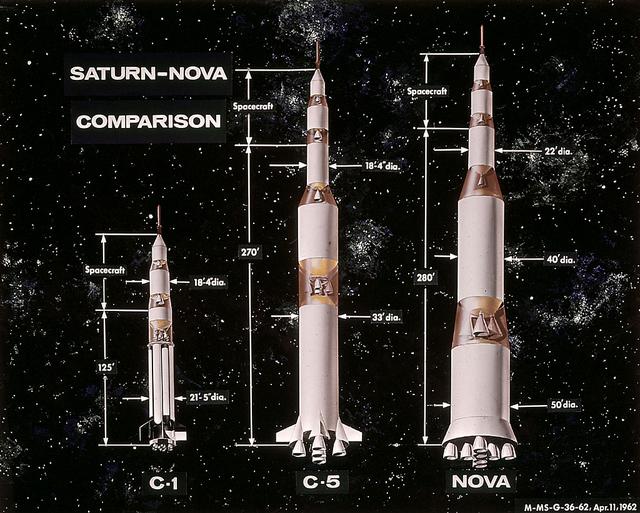
In this 1962 artist's concept , a proposed Nova rocket, shown at right, is compared to a Saturn C-1, left, and a Saturn C-5, center. The Marshall Space Flight Center directed studies of Nova configuration from 1960 to 1962 as a means of achieving a marned lunar landing with a direct flight to the Moon. Various configurations of the vehicle were examined, the largest being a five-stage vehicle using eight F-1 engines in the first stage. Although the program was effectively cancelled in 1962 when NASA planners selected the lunar-orbital rendezvous mode, the proposed F-1 engine was eventually used to propel the first stage of the Saturn V launch vehicle in the Apollo Program.
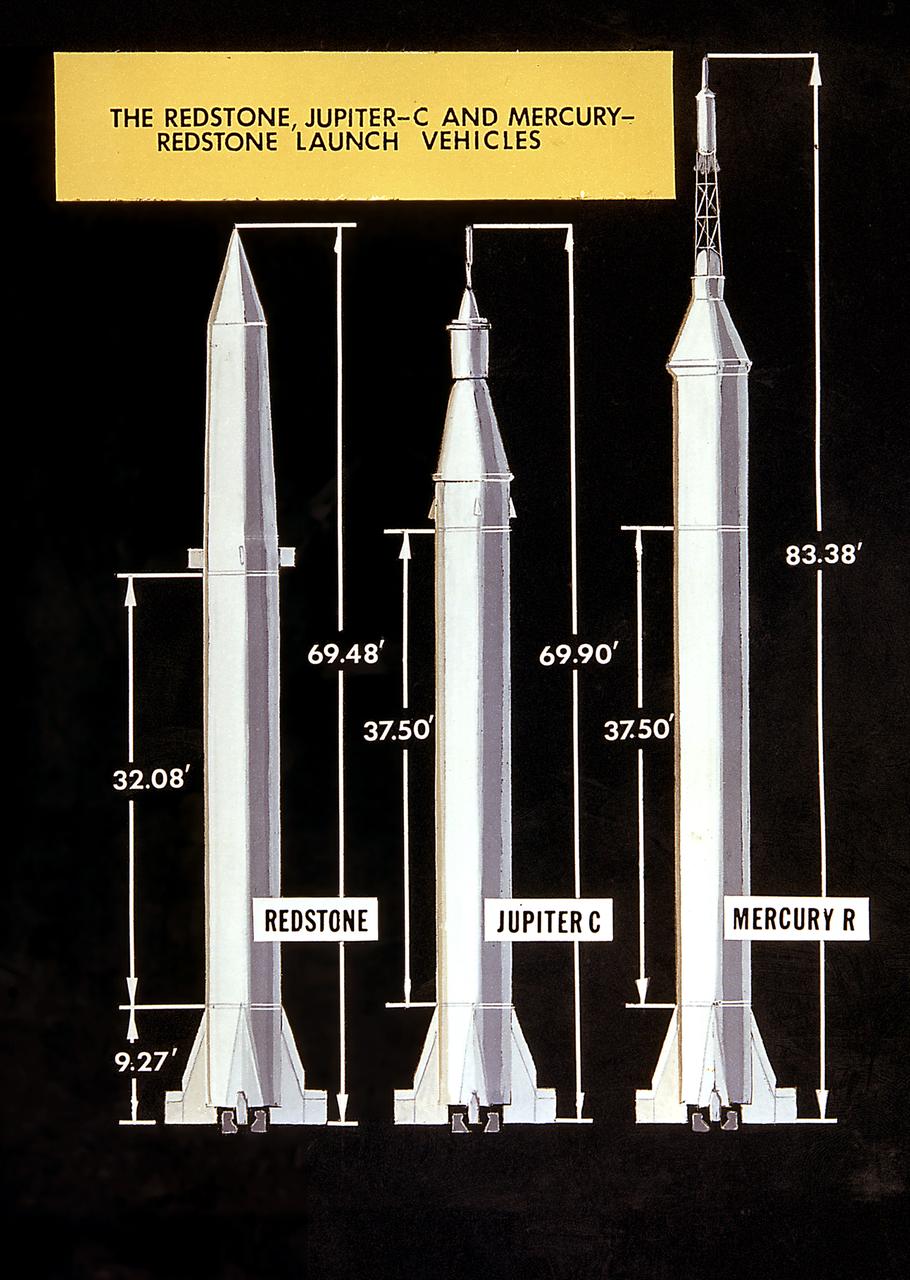
This is a comparison illustration of the Redstone, Jupiter-C, and Mercury Redstone launch vehicles. The Redstone ballistic missile was a high-accuracy, liquid-propelled, surface-to-surface missile. Originally developed as a nose cone re-entry test vehicle for the Jupiter intermediate range ballistic missile, the Jupiter-C was a modification of the Redstone missile and successfully launched the first American Satellite, Explorer-1, in orbit on January 31, 1958. The Mercury Redstone lifted off carrying the first American, astronaut Alan Shepard, in his Mercury spacecraft Freedom 7, on May 5, 1961.
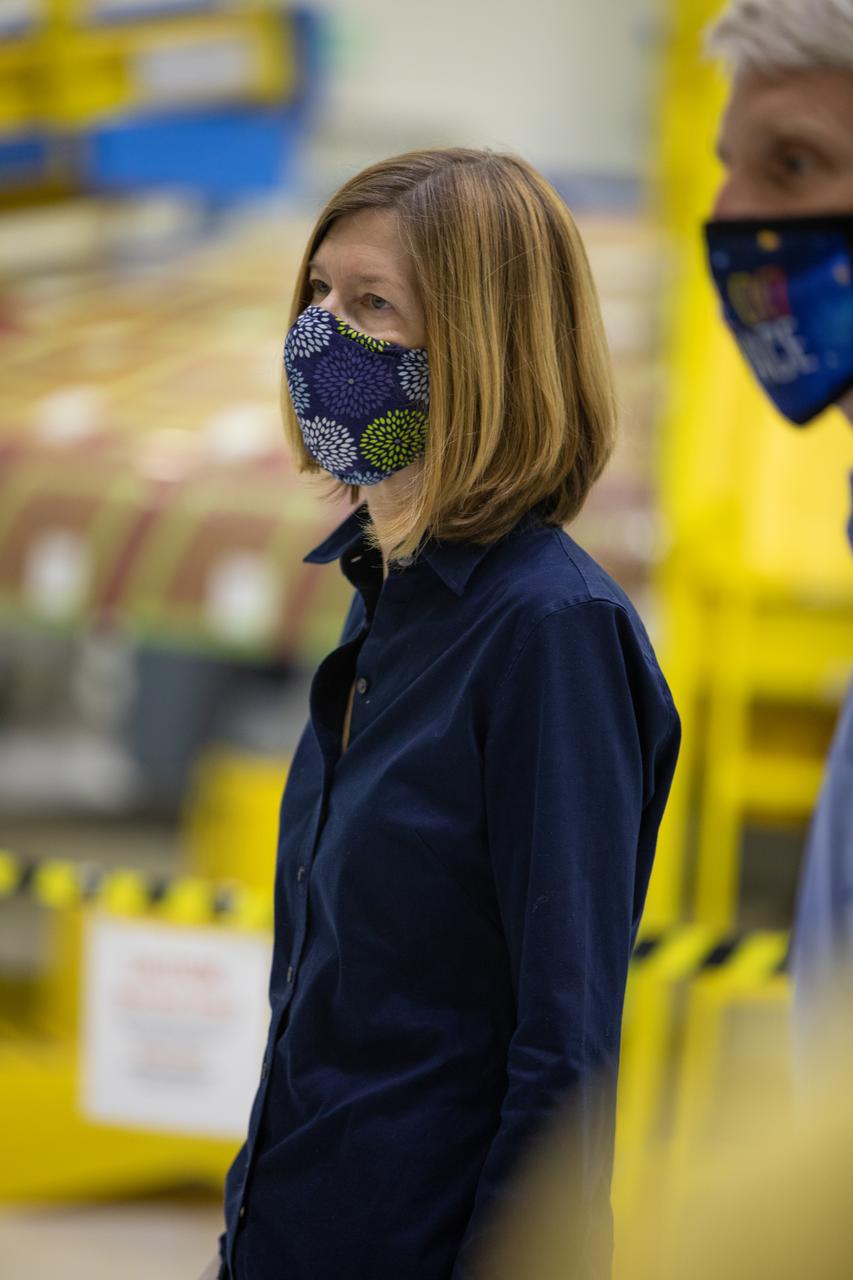
Kathy Lueders, associate administrator of NASA’s Human Exploration and Operations Mission Directorate, visits the Neil Armstrong Operations and Checkout (O&C) Building high bay at the agency’s Kennedy Space Center in Florida on Nov. 5, 2020. While at the O&C, Lueders and senior managers of Orion and Lockheed Martin had the opportunity to view the Artemis I and II spacecraft. In the background is the heat shield for Artemis II. The first in a series of increasingly complex missions, Artemis I will test the Space Launch System rocket and Orion spacecraft as an integrated system prior to crewed flights to the Moon. Under the Artemis program, NASA is planning to land the first woman and the next man on the lunar surface by 2024.
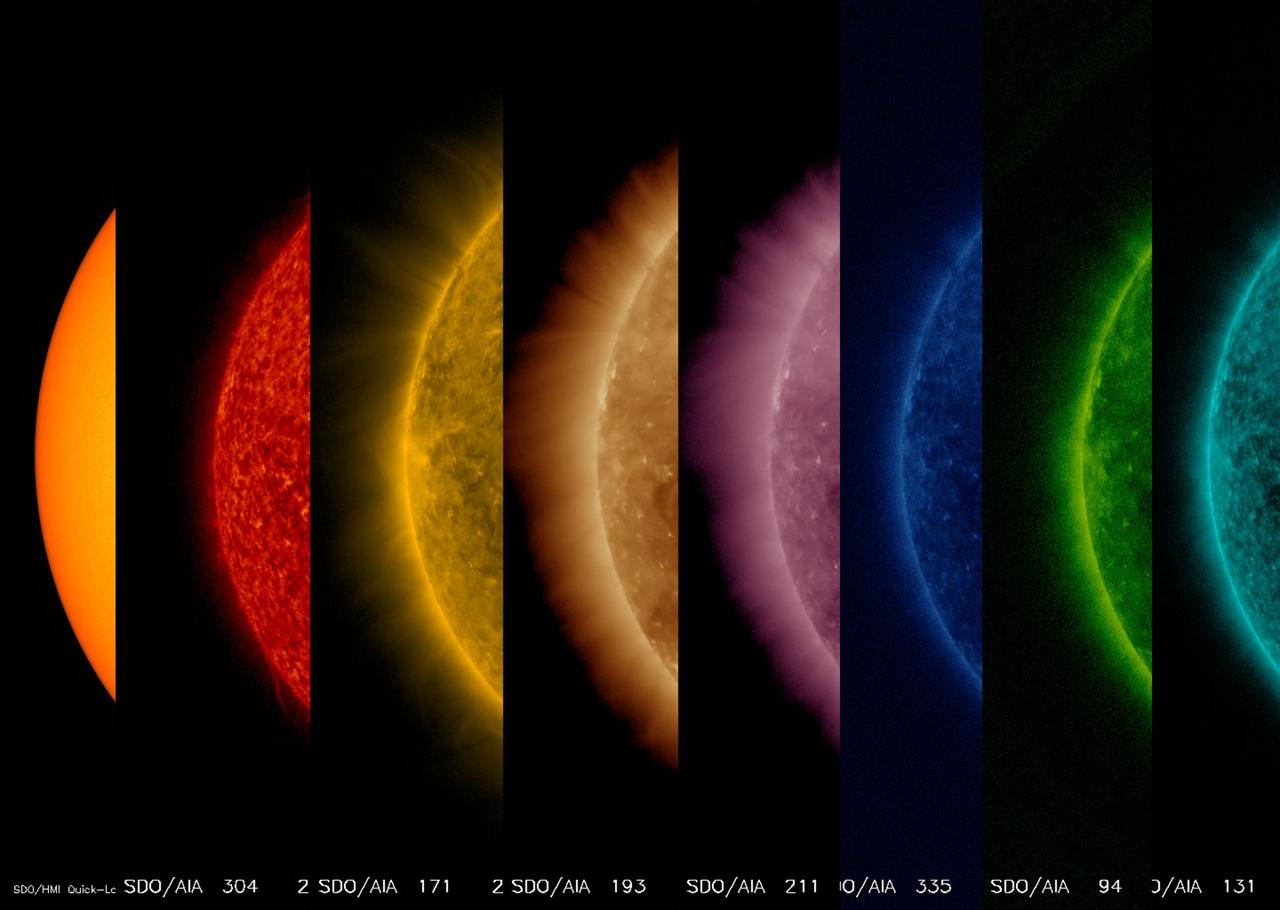
This sequence of images shows the sun from its surface to its upper atmosphere all taken at about the same time (Oct. 27, 2017). The first shows the surface of the sun in filtered white light; the other seven images were taken in different wavelengths of extreme ultraviolet light. Note that each wavelength reveals somewhat different features. They are shown in order of temperature from the first one at 6,000 degree C. surface out to about 10 million degrees C. in the upper atmosphere. Yes, the sun's outer atmosphere is much, much hotter than the surface. Scientists are getting closer to solving the processes that generate this phenomenon. https://photojournal.jpl.nasa.gov/catalog/PIA22055
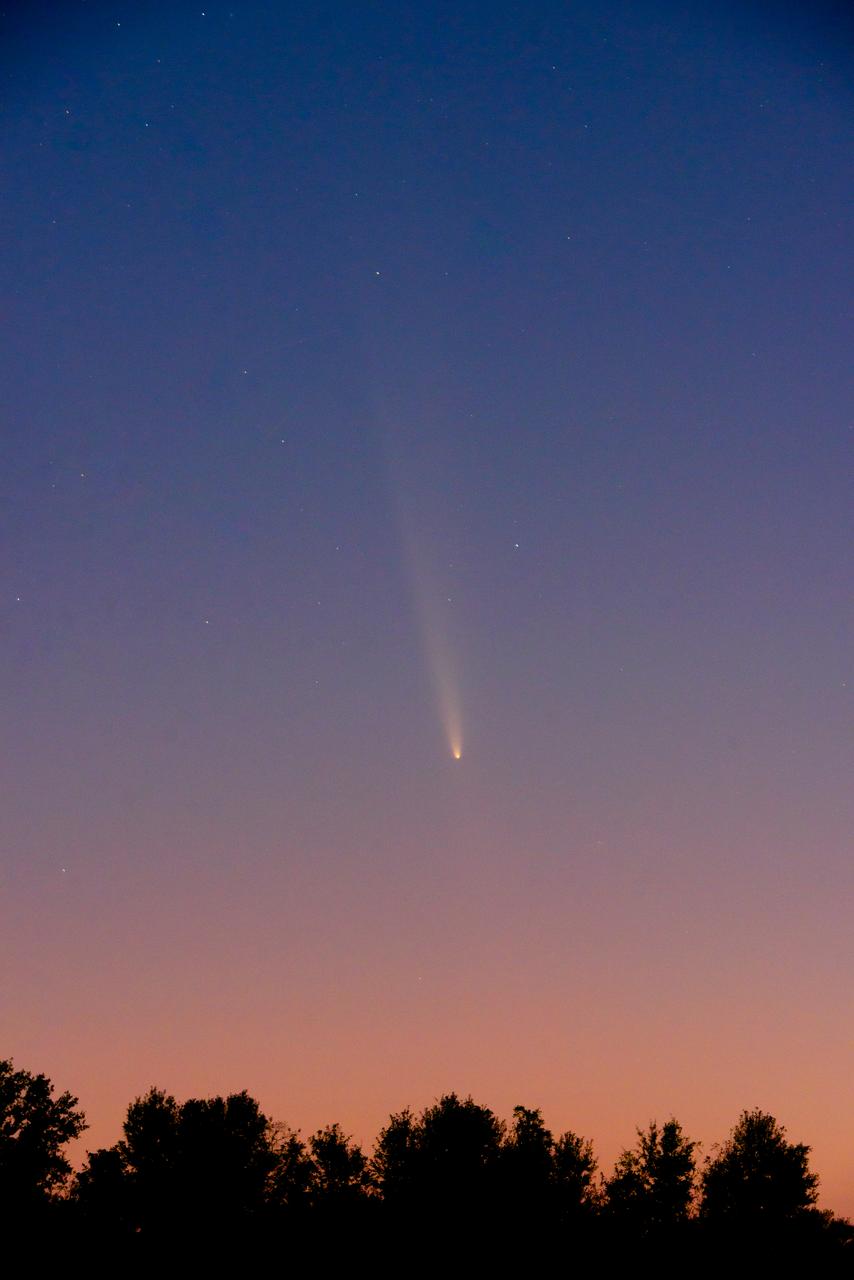
The Oort Cloud comet, called C/2023 A3 Tsuchinshan-ATLAS, passes over Southeast Louisiana near New Orleans, home of NASA’s Michoud Assembly Facility, Sunday, Oct. 13, 2024. The comet is making its first appearance in documented human history; it was last seen in the night sky 80,000 years ago. The Tsuchinshan-ATLAS comet made its first close pass by Earth in mid-October and will remain visible to viewers in the Northern Hemisphere just between the star Arcturus and planet Venus through early November.
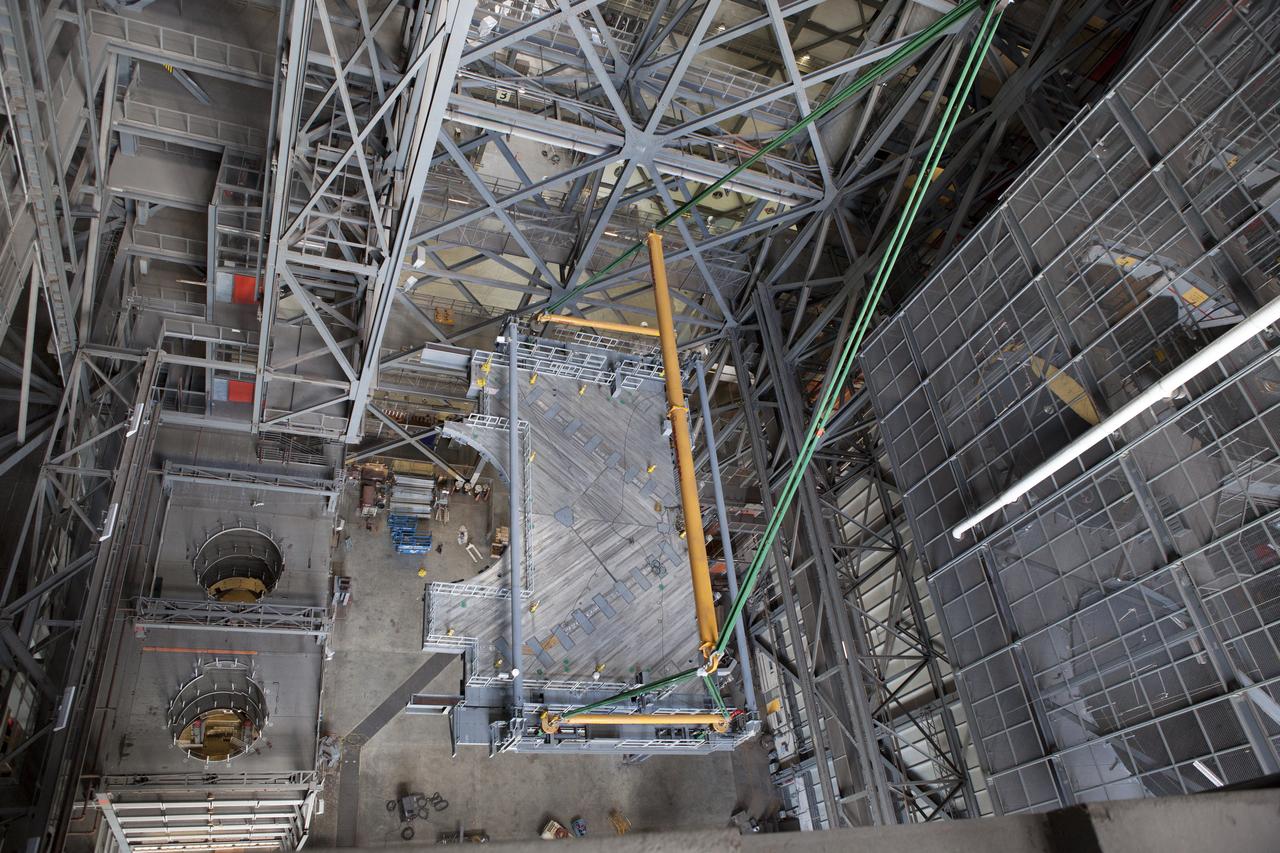
A heavy-lift crane lifts the first half of the C-level work platforms, C south, for NASA’s Space Launch System (SLS) rocket, up from the transfer aisle floor of the Vehicle Assembly Building (VAB) at NASA’s Kennedy Space Center in Florida. Large Tandemloc bars have been attached to the platform to keep it level during lifting and installation. The C platform will be installed on the south side of High Bay 3. The C platforms are the eighth of 10 levels of work platforms that will surround and provide access to the SLS rocket and Orion spacecraft for Exploration Mission 1. The Ground Systems Development and Operations Program is overseeing upgrades and modifications to VAB High Bay 3, including installation of the new work platforms, to prepare for NASA’s Journey to Mars.

STS049-S-002 (16 Jan. 1992) --- These seven NASA astronauts are currently training for the first flight of the Space Shuttle Endeavour, seen in the background. Daniel C. Brandenstein, center, is mission commander; and Kevin P. Chilton, third from right, is pilot. Mission specialists are, left to right, Kathryn C. Thornton, Bruce E. Melnick, Pierre J. Thout, Thomas D. Akers and Richard J. Hieb.
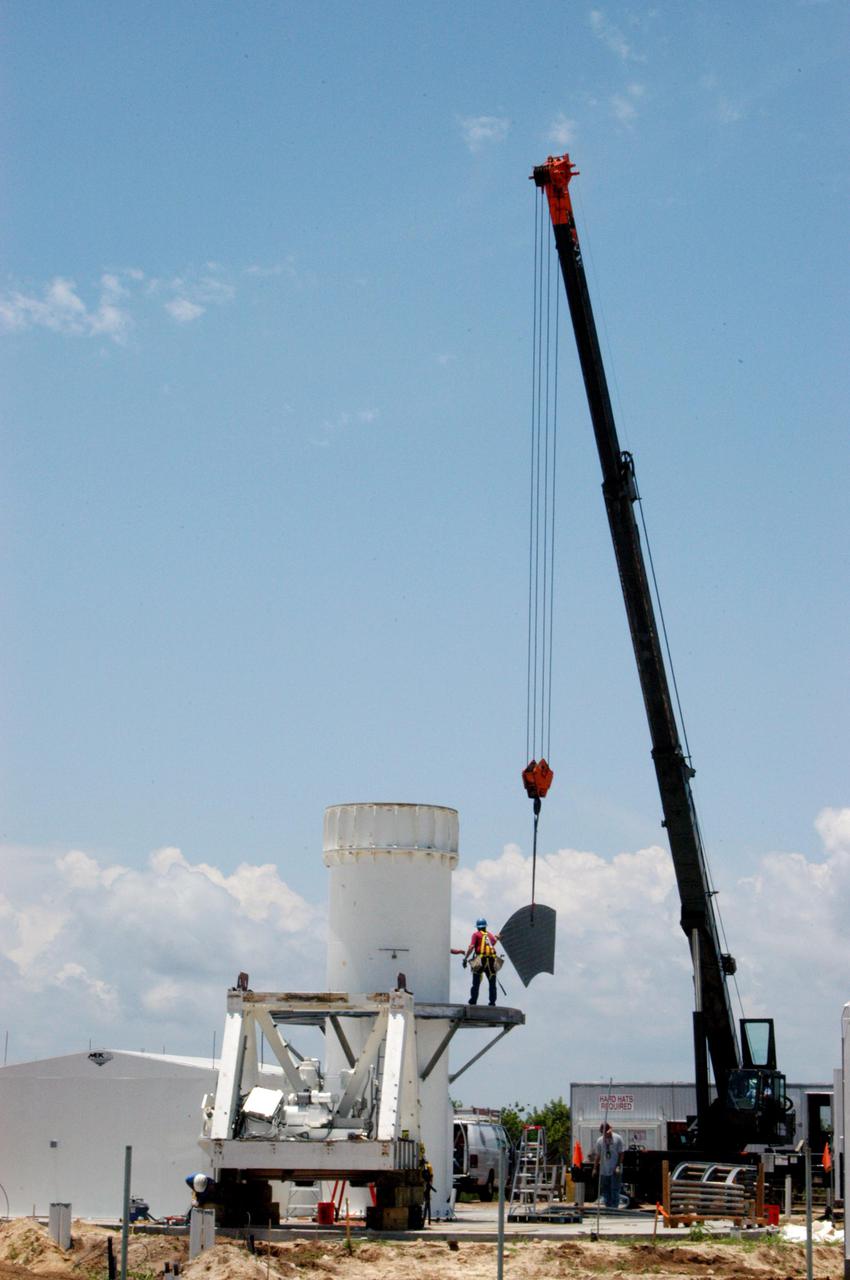
KENNEDY SPACE CENTER, FLA. - On June 8, the base for a C-band radar antenna is being constructed at a radar site on North Merritt Island, Fla. The 50-foot C-band radar will be used for long-term Shuttle missions to track the launches and observe possible debris coming from the Shuttle. The launch window for the first Return to Flight mission, STS-114, is July 13 to July 31.
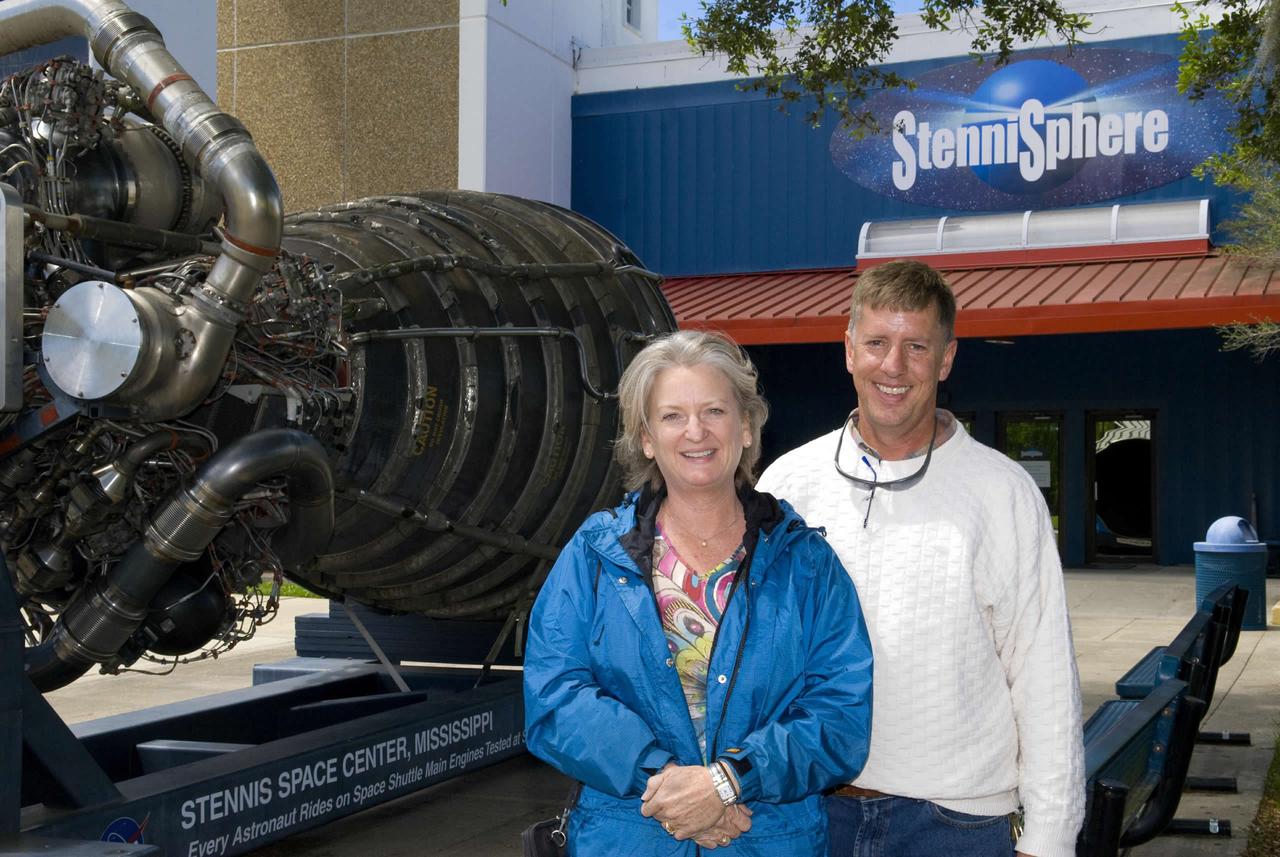
Jane Kenna of Atlanta, granddaughter of the late Sen. John C. Stennis, visits StenniSphere, the visitor center at NASA's John C. Stennis Space Center. Kenna and her husband, John, visited Stennis on April 6, her first trip to the rocket engine testing facility since the 1988 ceremony to rename the site in honor of her grandfather.
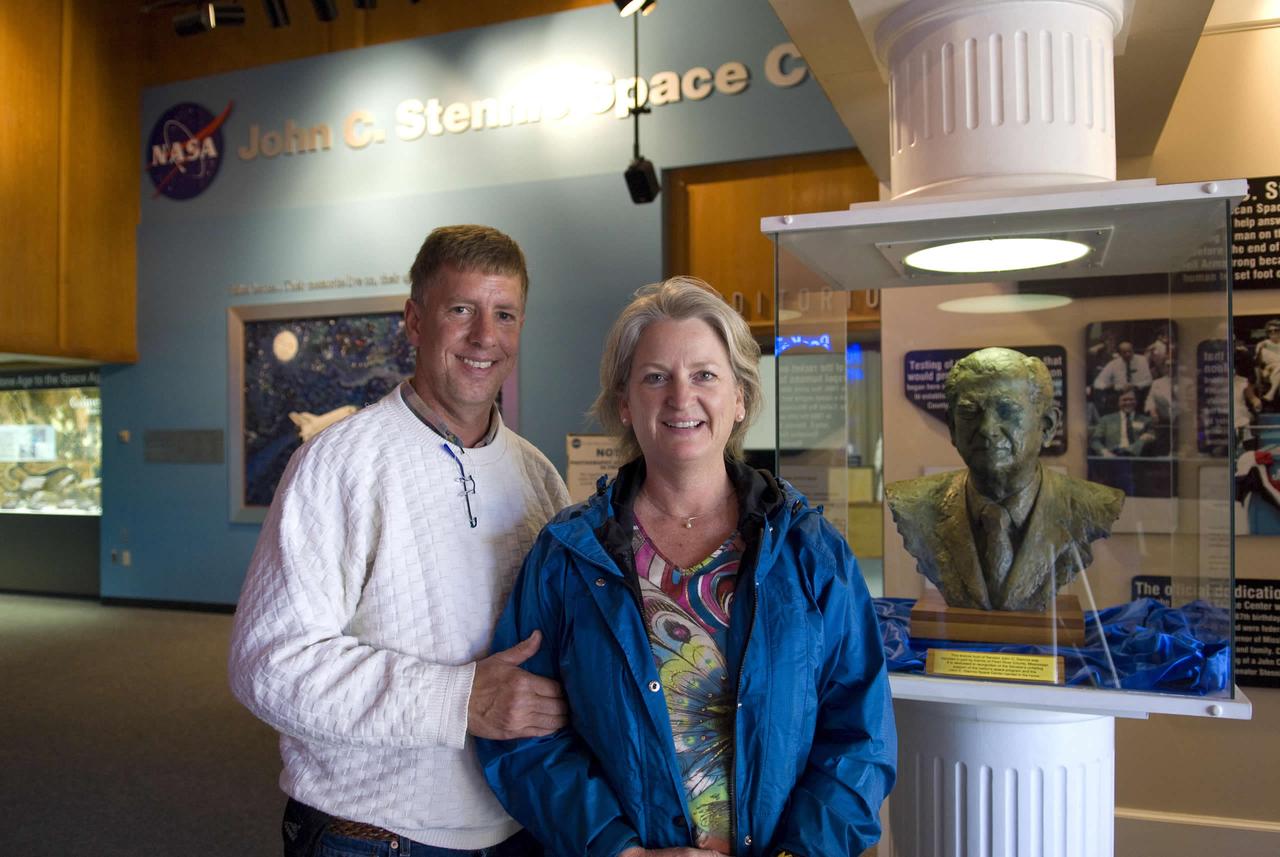
Jane Kenna of Atlanta, granddaughter of the late Sen. John C. Stennis, stands with her husband, John, near a bust of her grandfather displayed in StenniSphere, the visitor center at NASA's John C. Stennis Space Center. Kenna visited Stennis on April 6, her first trip to the rocket engine testing facility since the 1988 ceremony to rename the site in honor of Stennis.
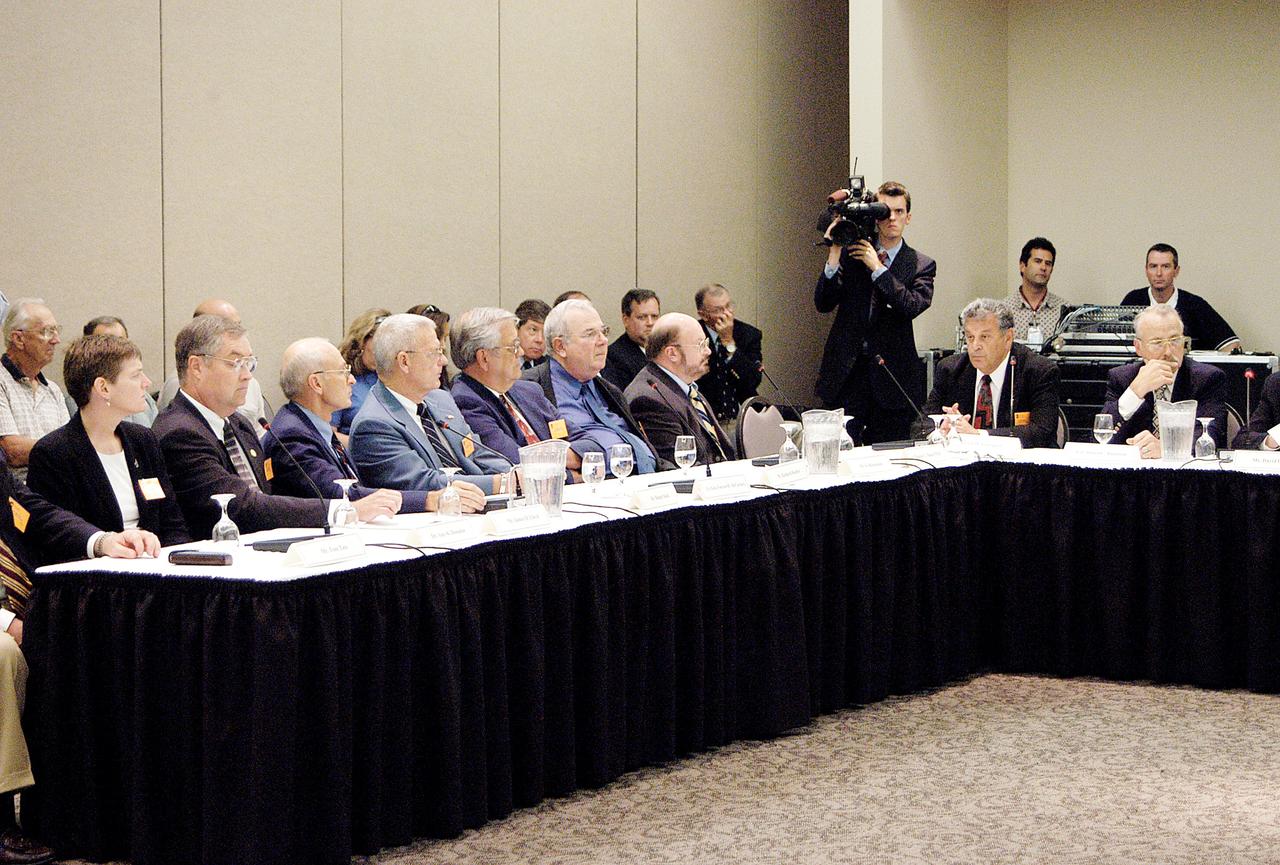
KENNEDY SPACE CENTER, FLA. - The Return To Flight Task Group (RTFTG) holds the first public meeting at the Debus Center, KSC Visitor Complex. Shown at the table on the left are Dr. Amy K. Donahue, James D. Lloyd, Robert Sieck, retired Air Force Lt. Gen. Forrest C. McCartney, Richard Kohrs, Sy Rubenstein and Dr. Charles C. Daniel. The group is co-chaired by former Shuttle commander Richard O. Covey and retired Air Force Lt. Gen. Thomas P. Stafford, who was an Apollo commander. The RTFTG was at KSC to conduct organizational activities, tour Space Shuttle facilities and receive briefings on Shuttle-related topics. The task group was chartered by NASA Administrator Sean O’Keefe to perform an independent assessment of NASA’s implementation of the final recommendations of the Columbia Accident Investigation Board.

IM-1, the first NASA Commercial Launch Program Services launch for Intuitive Machines’ Nova-C lunar lander, will carry multiple payloads to the Moon, including Lunar Node-1, demonstrating autonomous navigation via radio beacon to support precise geolocation and navigation among lunar orbiters, landers, and surface personnel. NASA’s CLPS initiative oversees industry development of small robotic landers and rovers to support NASA’s Artemis campaign.
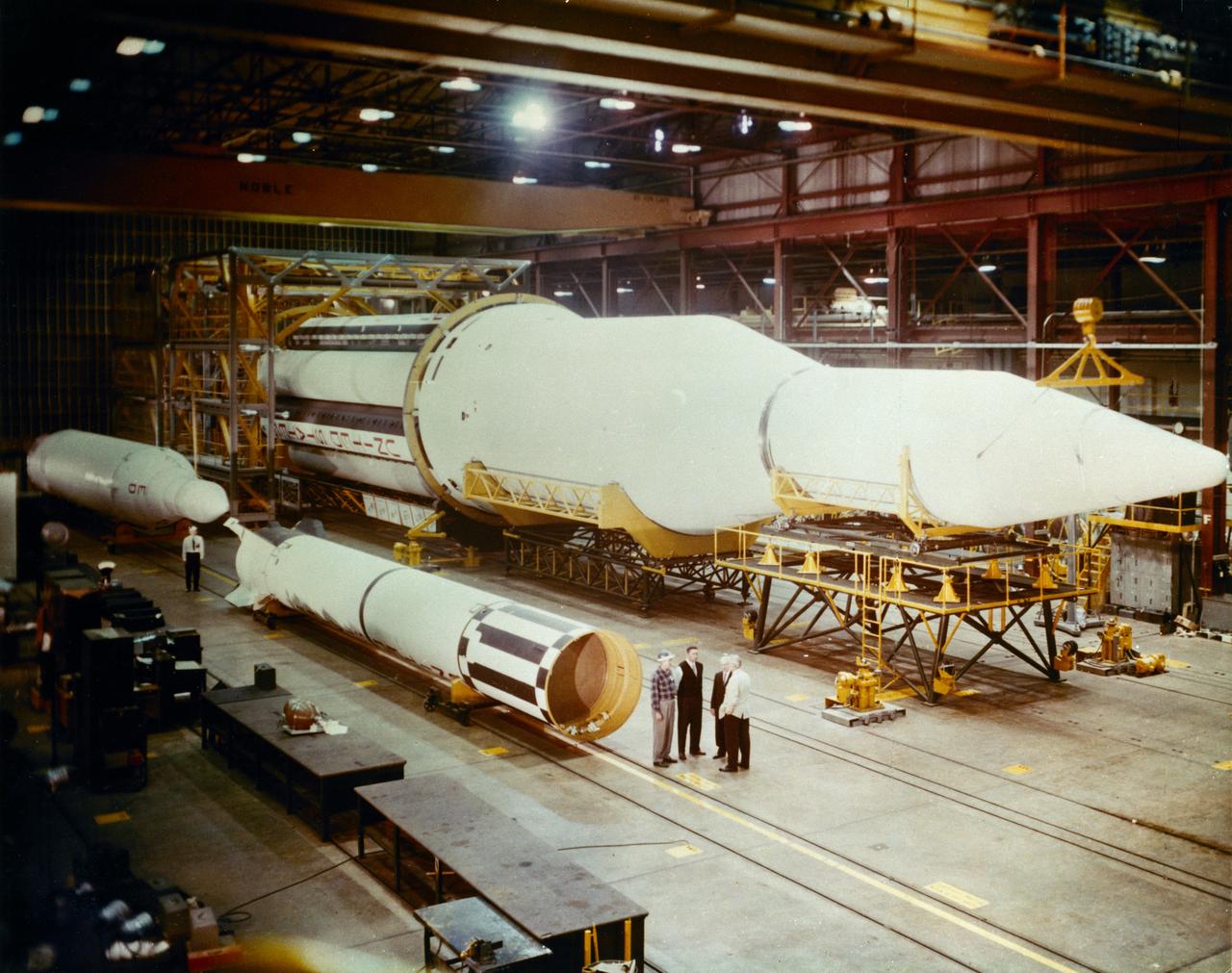
Progress in the Saturn program, depicted below, was described by Dr. Wernher von Braun, Marshall Space Flight Center (MSFC) Director, in an appearance before the Senate Committee of Aeronautical and Space Sciences. "The flight configuration of the giant three-stage Saturn C-1 rocket (later called Saturn I Block I) is seen in the Fabrication and Assembly Engineering Division at MSFC. Dwarfed by the 180-foot C-1 are a Juno II rocket (left rear) and a Mercury-Redstone rocket (front foreground). The C-1 (first version of the Saturn rocket) is composed of an S-1 first stage or booster (rear), powered by eight H-1 engines having a thrust of 1,500,000 pounds, followed by a dummy S-IV second stage and a dummy S-V third stage. The "live" S-IV for later flights, under development by Douglas Aircraft Co., will be powered by four Pratt Whitney LR-119 engines having 17,500,000 pounds thrust each. The live S-V, under development by Convair Division of General Dynamics Corp., will use two LR-119 engines. With all three stages live, the C-1 will be capable of placing 19,000 pounds into a 300-mile Earth orbit, sending 5,000 pounds to escape velocity, or lofting 2,500 pounds to Mars or Venus. The second version Saturn C-2 (later called Saturn 1 Block II) would double these capabilities. Early C-1 flights will employ a live S-1 with dummy upper stages. The first such flight is scheduled late this year."
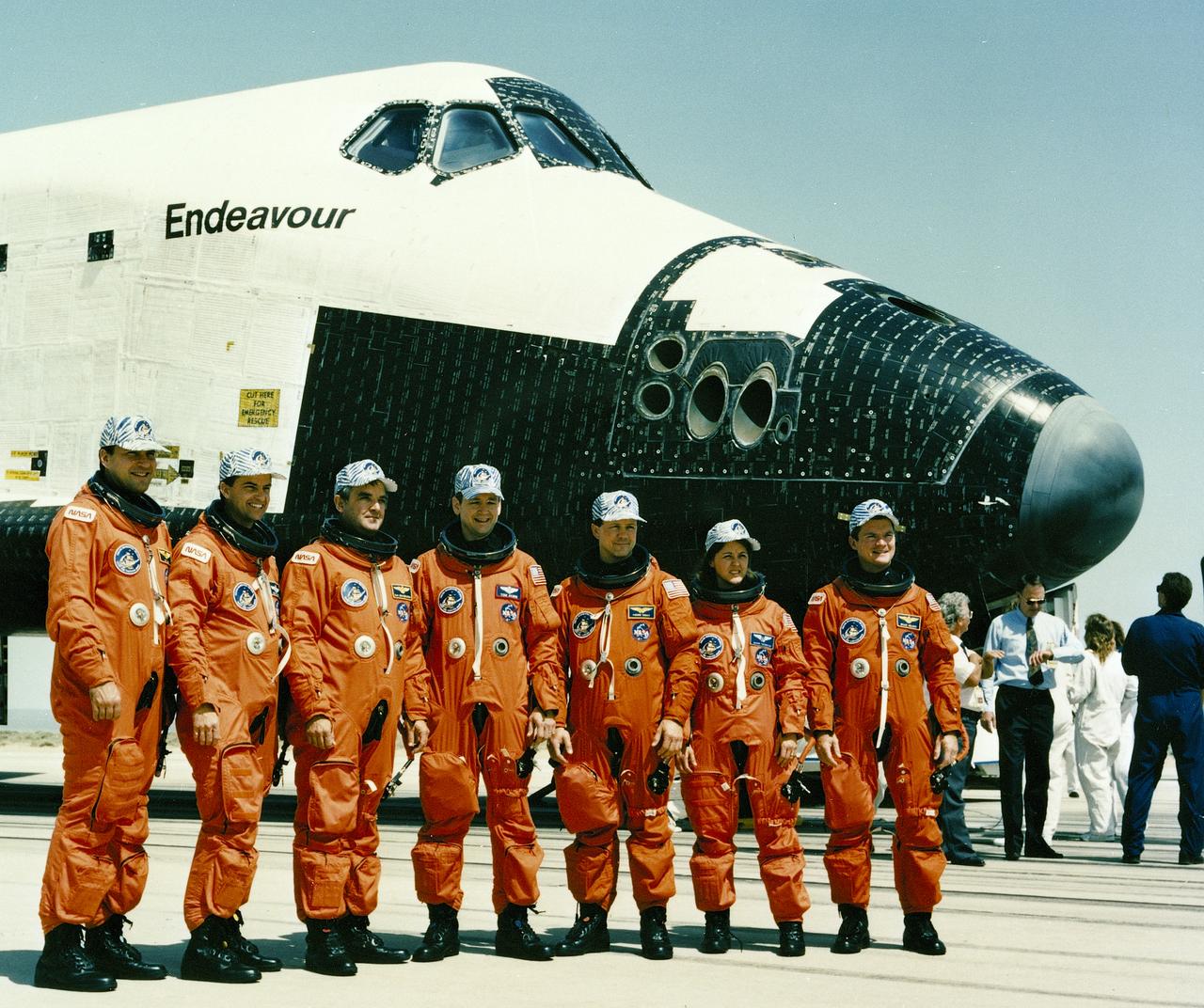
The STS-49 crew members pose near Endeavour after landing. Pictured left to right are: Richard J. Hieb, mission specialist; Kevin P. Chiltin, pilot; Daniel C. Brandenstein, commander; and mission specialists Thomas D. Akers, Pierre J. Thuot, Kathryn C. Thornton, and Bruce E. Melnick. Launched on May 7, 1992 at 7:40:00 pm (EDT), the crew of seven was the first to fly aboard the Space Shuttle Endeavor. The mission was the first US orbital flight to feature 4 extravehicular activities (EVAs), and the first flight to involve 3 crew members simultaneously working outside of the spacecraft. The primary objective was the capture and redeployment of the INTELSAT VI (F-3) which was stranded in an unusable orbit since its launch aboard the Titan rocket in March 1990.
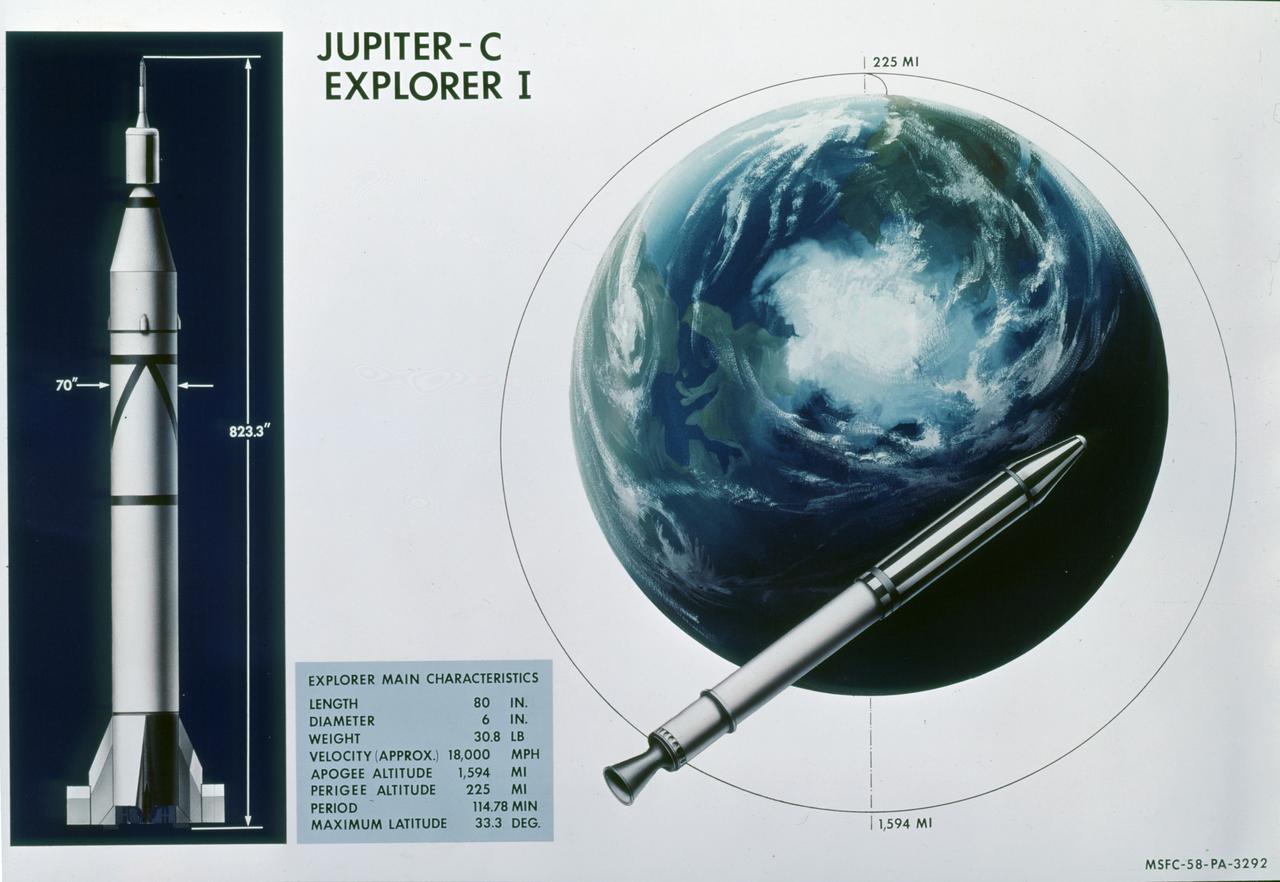
This illustration shows the main characteristics of the Jupiter C launch vehicle and its payload, the Explorer I satellite. The Jupiter C, America's first successful space vehicle, launched the free world's first scientific satellite, Explorer 1, on January 31, 1958. The four-stage Jupiter C measured almost 69 feet in length. The first stage was a modified liquid fueled Redstone missile. This main stage was about 57 feet in length and 70 inches in diameter. Fifteen scaled down SERGENT solid propellant motors were used in the upper stages. A "tub" configuration mounted on top of the modified Redstone held the second and third stages. The second stage consisted of 11 rockets placed in a ring formation within the tub. Inserted into the ring of second stage rockets was a cluster of 3 rockets making up the third stage. A fourth stage single rocket and the satellite were mounted atop the third stage. This "tub", all upper stages, and the satellite were set spirning prior to launching. The complete upper assembly measured 12.5 feet in length. The Explorer I carried the radiation detection experiment designed by Dr. James Van Allen and discovered the Van Allen Radiation Belt.
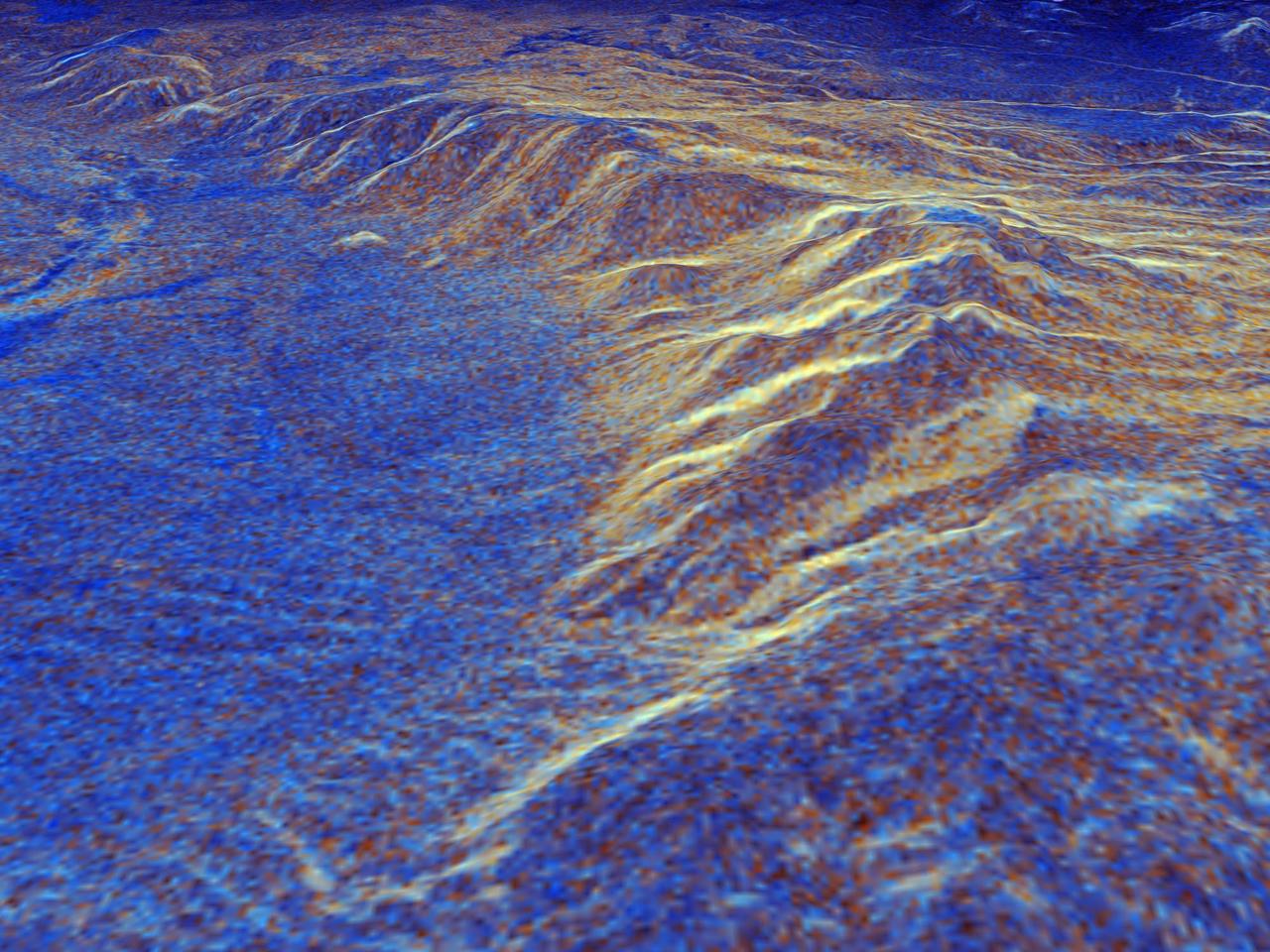
This is a three-dimensional perspective view of Long Valley, California by the Spaceborne Imaging Radar-C/X-band Synthetic Aperture Radar on board the space shuttle Endeavour. This view was constructed by overlaying a color composite SIR-C image on a digital elevation map. The digital elevation map was produced using radar interferometry, a process by which radar data are acquired on different passes of the space shuttle and, which then, are compared to obtain elevation information. The data were acquired on April 13, 1994 and on October 3, 1994, during the first and second flights of the SIR-C/X-SAR radar instrument. The color composite radar image was produced by assigning red to the C-band (horizontally transmitted and vertically received) polarization; green to the C-band (vertically transmitted and received) polarization; and blue to the ratio of the two data sets. Blue areas in the image are smooth and yellow areas are rock outcrops with varying amounts of snow and vegetation. The view is looking north along the northeastern edge of the Long Valley caldera, a volcanic collapse feature created 750,000 years ago and the site of continued subsurface activity. Crowley Lake is off the image to the left. http://photojournal.jpl.nasa.gov/catalog/PIA01757
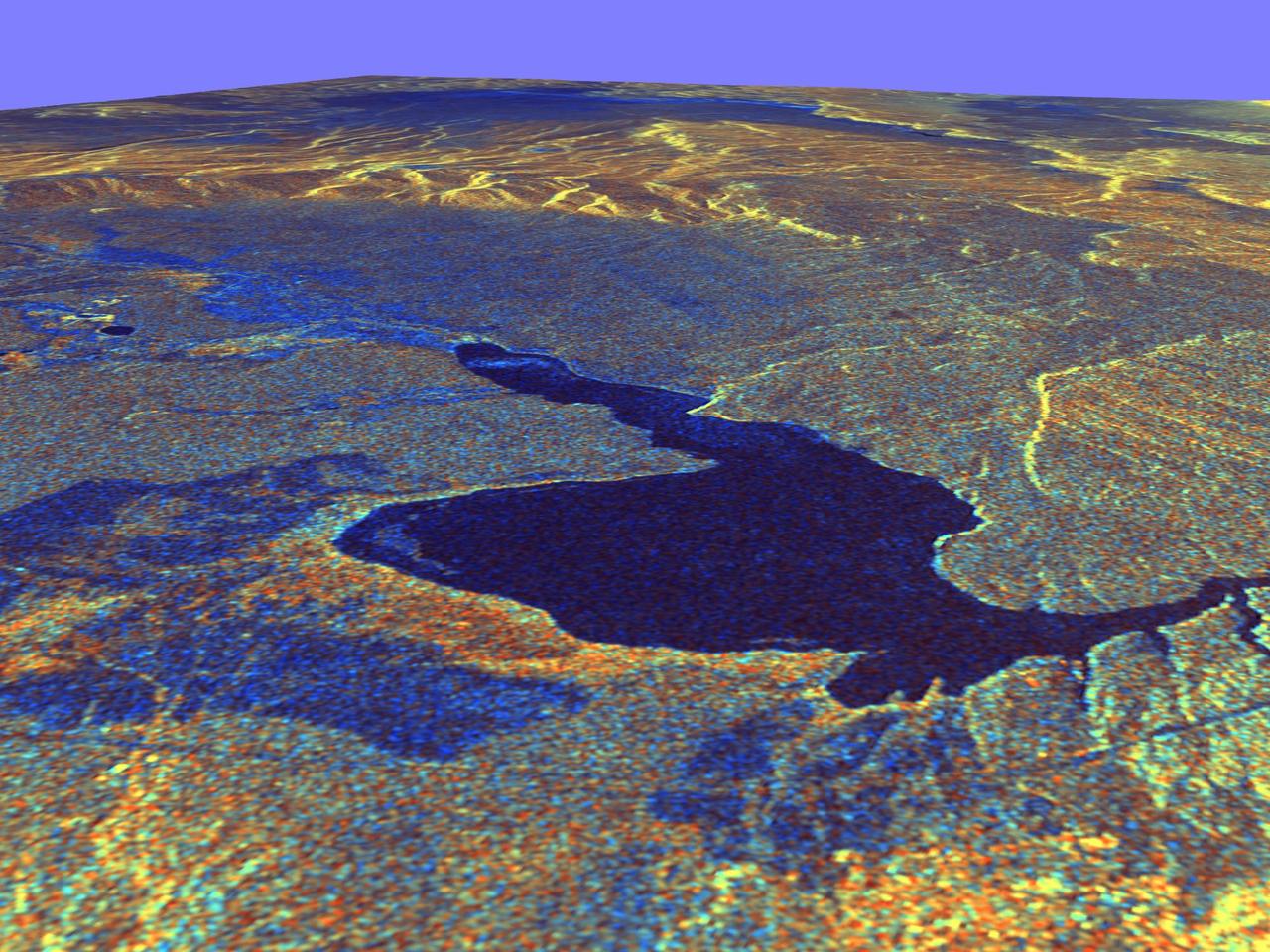
This three-dimensional perspective view of Long Valley, California was created from data taken by the Spaceborne Imaging Radar-C/X-band Synthetic Aperture Radar on board the space shuttle Endeavour. This image was constructed by overlaying a color composite SIR-C radar image on a digital elevation map. The digital elevation map was produced using radar interferometry, a process by which radar data are acquired on different passes of the space shuttle. The two data passes are compared to obtain elevation information. The interferometry data were acquired on April 13,1994 and on October 3, 1994, during the first and second flights of the SIR-C/X-SAR instrument. The color composite radar image was taken in October and was produced by assigning red to the C-band (horizontally transmitted and vertically received) polarization; green to the C-band (vertically transmitted and received) polarization; and blue to the ratio of the two data sets. Blue areas in the image are smooth and yellow areas are rock outcrops with varying amounts of snow and vegetation. The view is looking north along the northeastern edge of the Long Valley caldera, a volcanic collapse feature created 750,000 years ago and the site of continued subsurface activity. Crowley Lake is the large dark feature in the foreground. http://photojournal.jpl.nasa.gov/catalog/PIA01769
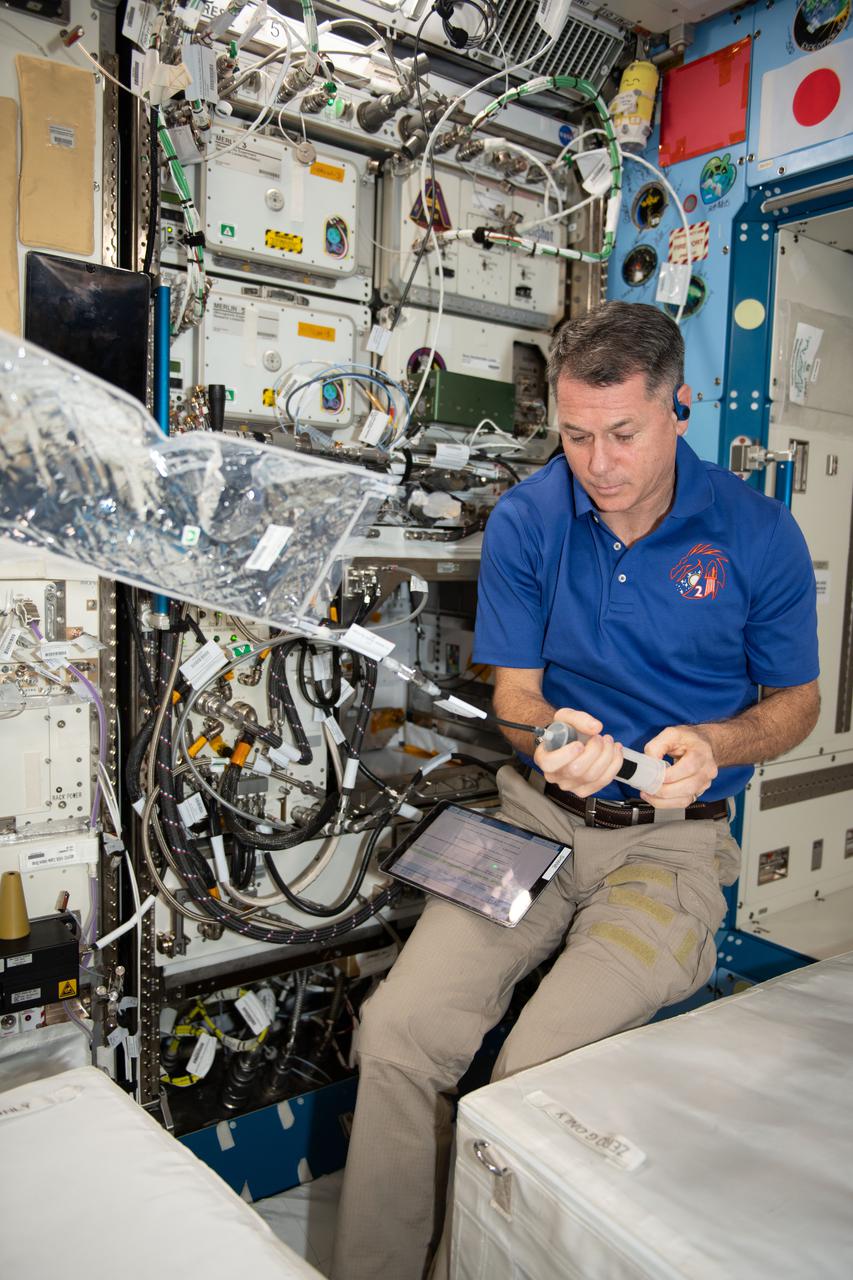
iss065e163206 (June 9, 2021) --- NASA astronaut and Expedition 65 Flight Engineer Shane Kimbrough configures the Advanced Plant Habitat and fills it with water to support the Plant Habitat-04 space botany experiment. The study is demonstrating growing peppers, which are an excellent source of vitamin C, in space for the first time.
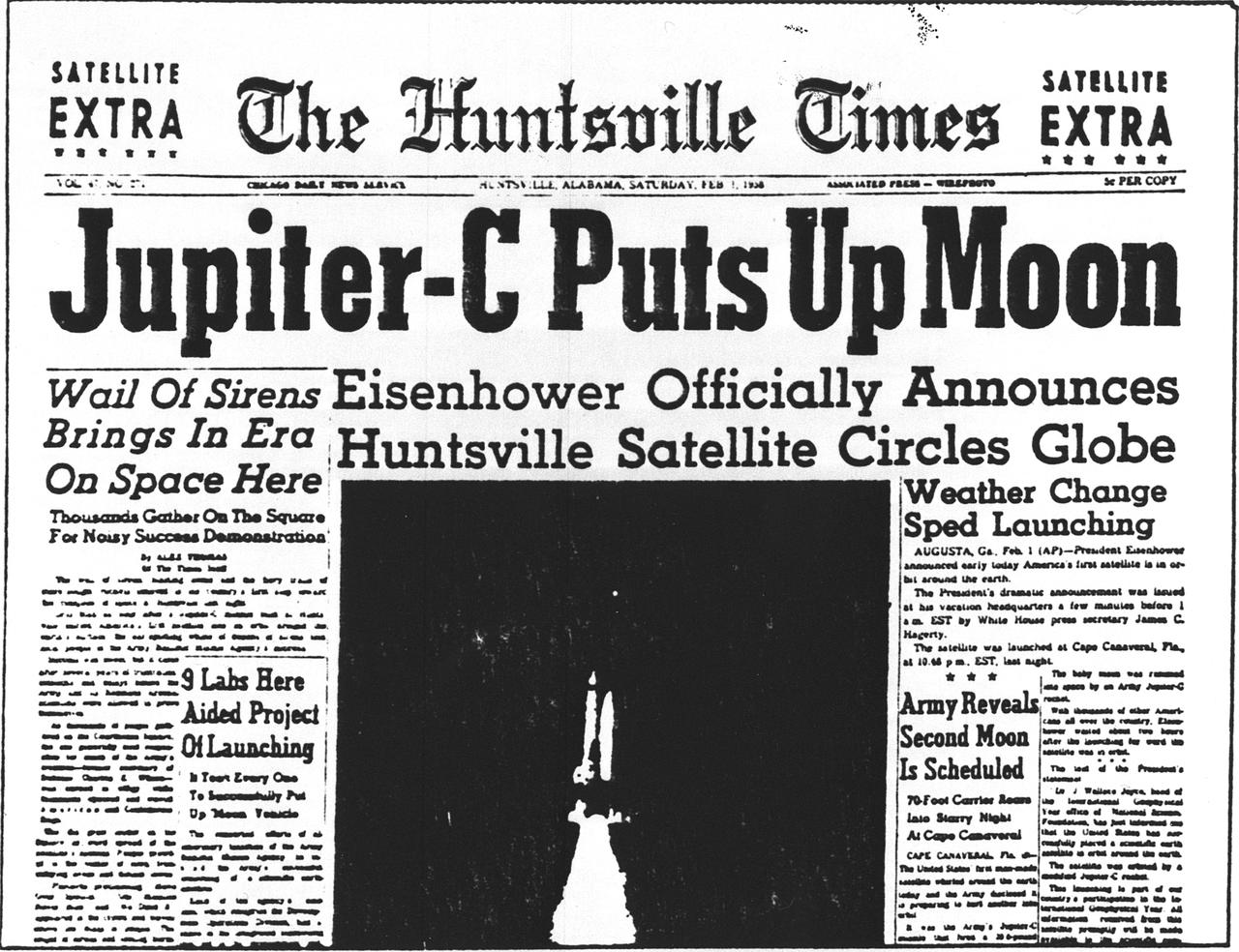
In January 1958, a modified Redstone rocket lifted the first American satellite into orbit just 3 months after the the von Braun team received the go-ahead. This modified Redstone rocket was known as a Jupiter-C. Its satellite payload was called Explorer I.

Technicians install the first composite panel on the Exploration Flight Test-1 (EFT-1) Orion service module in the Operations and Checkout (O&C) Building at NASA’s Kennedy Space Center on Dec. 31, 2011. Part of Batch image transfer from Flickr.
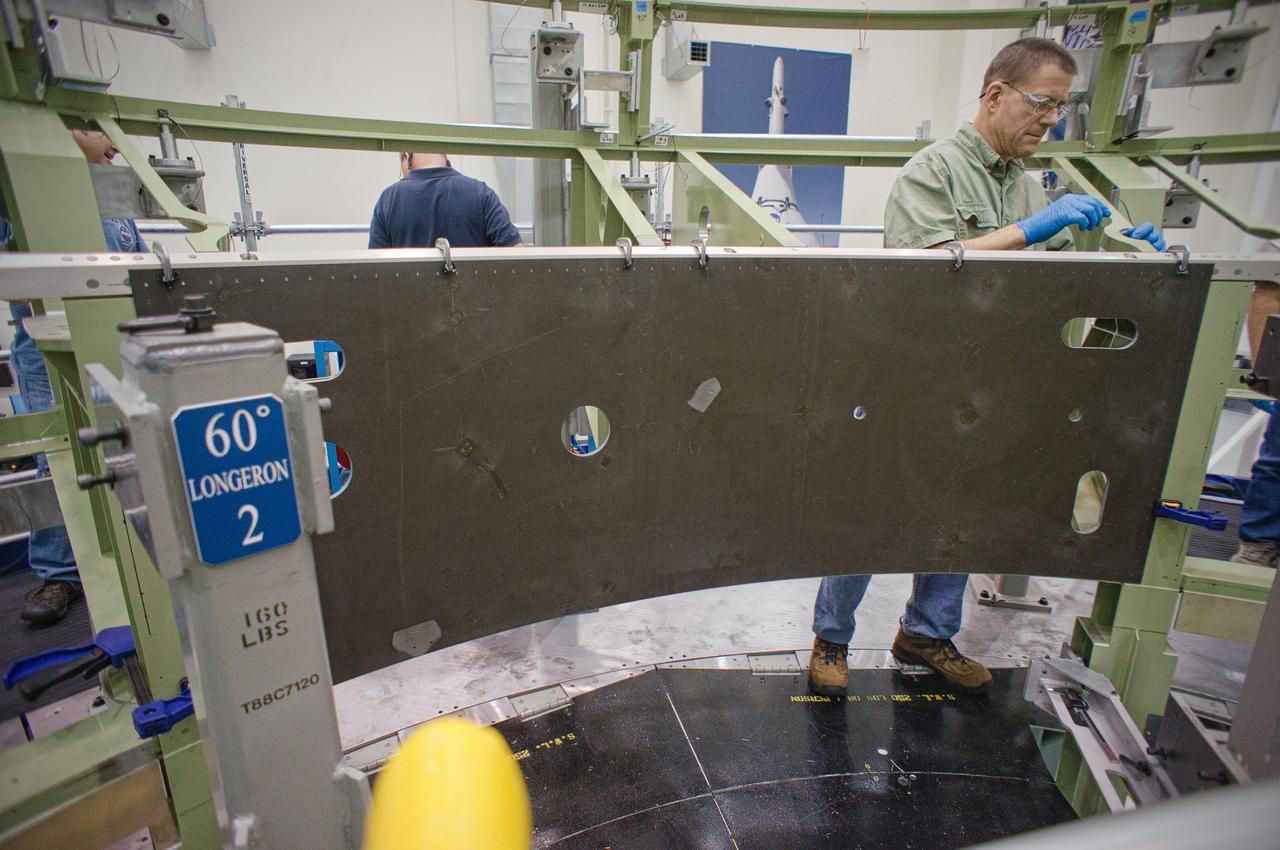
Technicians install the first composite panel on the Exploration Flight Test-1 (EFT-1) Orion service module in the Operations and Checkout (O&C) Building at NASA’s Kennedy Space Center on Dec. 31, 2011. Part of Batch image transfer from Flickr.
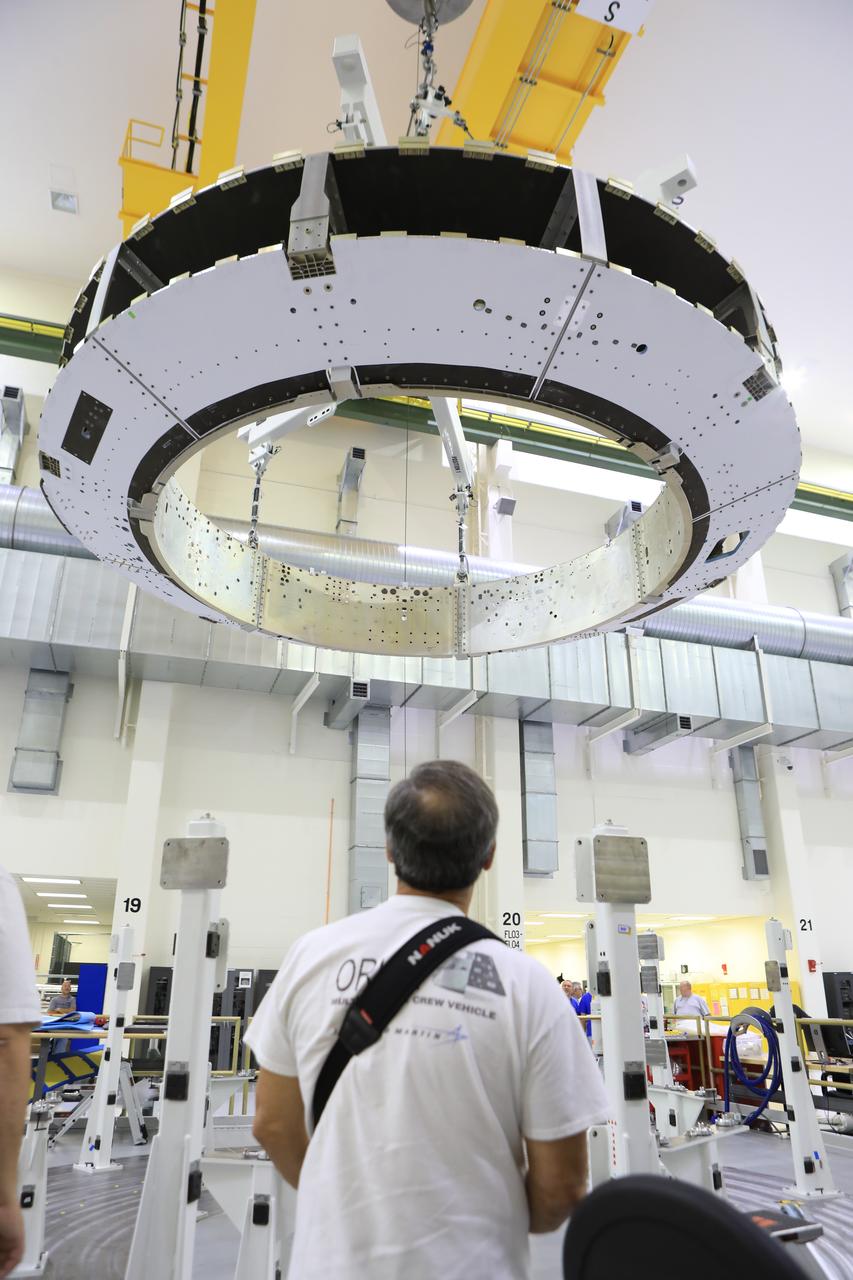
The Orion crew module adapter (CMA) for Exploration Mission 1 was lifted for the first and only time, Nov. 11, during its processing flow inside the Neil Armstrong Operations and Checkout (O&C) Building high bay at the agency's Kennedy Space Center in Florida. The CMA is now undergoing secondary structure outfitting.

An Air Force Titan III-C lifted off from Complex 40 at Cape Canaveral Air Force Station at 9:00 A.M. EDT today to launch Application Technology Satellite 6, first in a new generation of NASA Communications satellites. (1.3-13)(Test 7670)
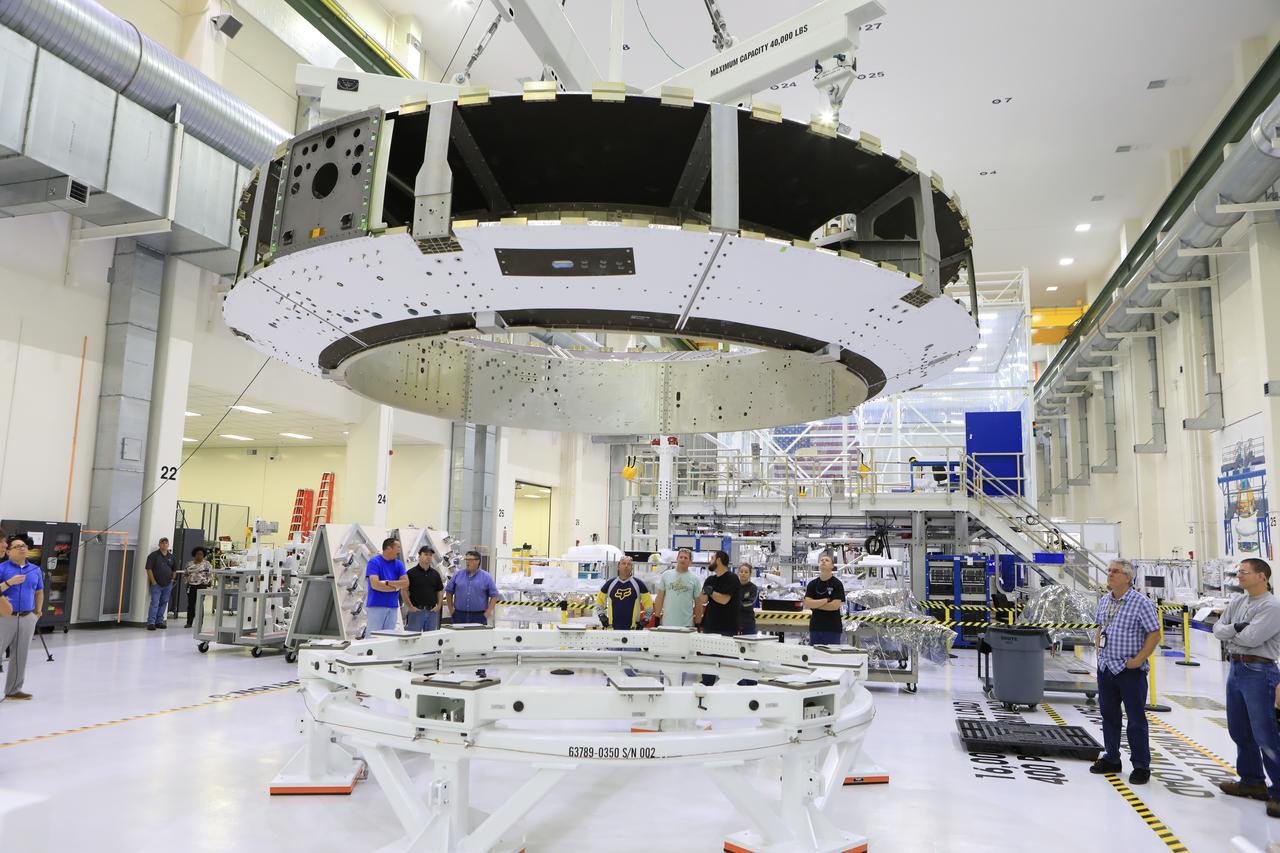
The Orion crew module adapter (CMA) for Exploration Mission 1 was lifted for the first and only time, Nov. 11, during its processing flow inside the Neil Armstrong Operations and Checkout (O&C) Building high bay at the agency's Kennedy Space Center in Florida. The CMA is now undergoing secondary structure outfitting.
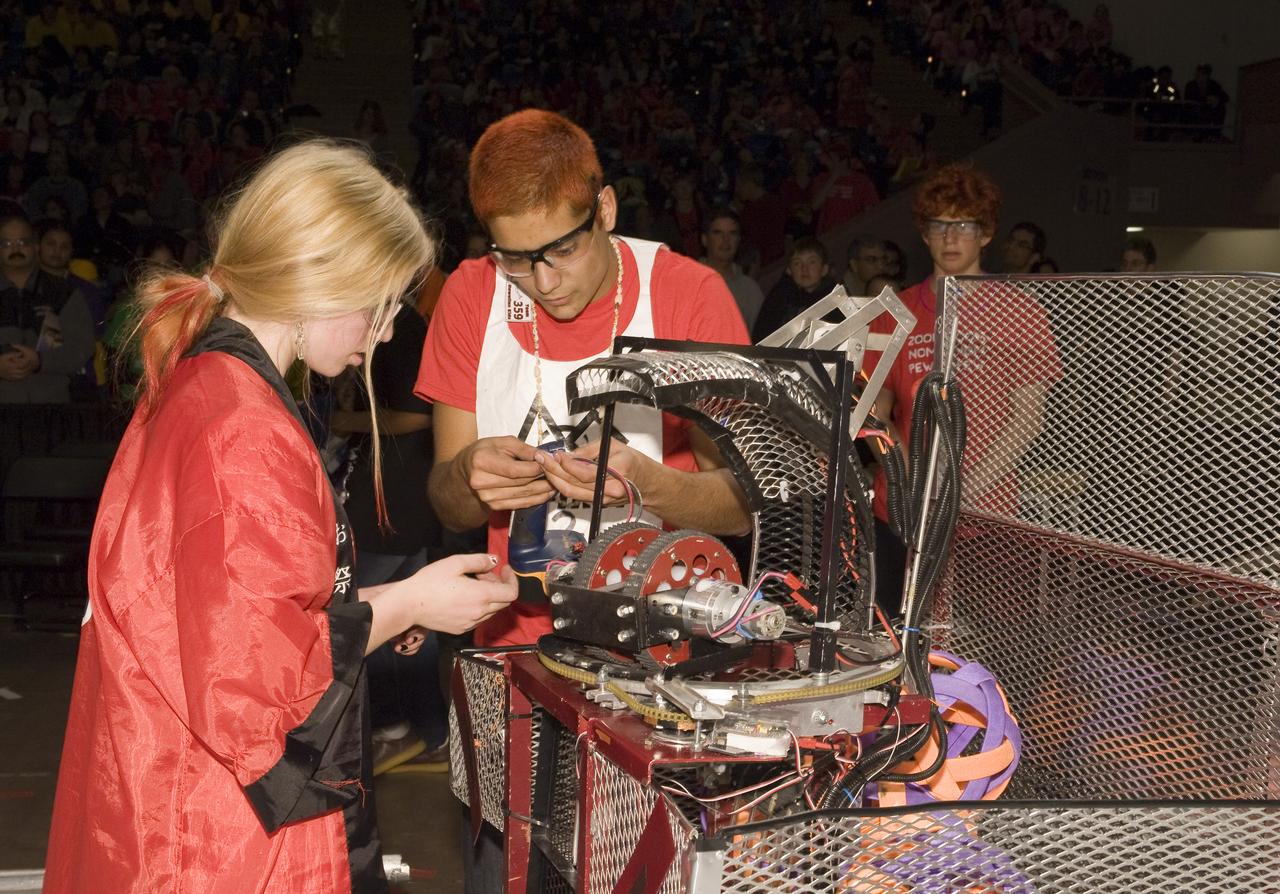
FIRST Robotics Competition 'Lunacy' hosted by NASA at San Jose State University Event Center. For Inspiration and Recognition of Science and Technology let the games begin. Ragin' C-Biscuits of San Ramon Valley High team #1280 and the Hawaiian Kids team #359 look over a problem bot.
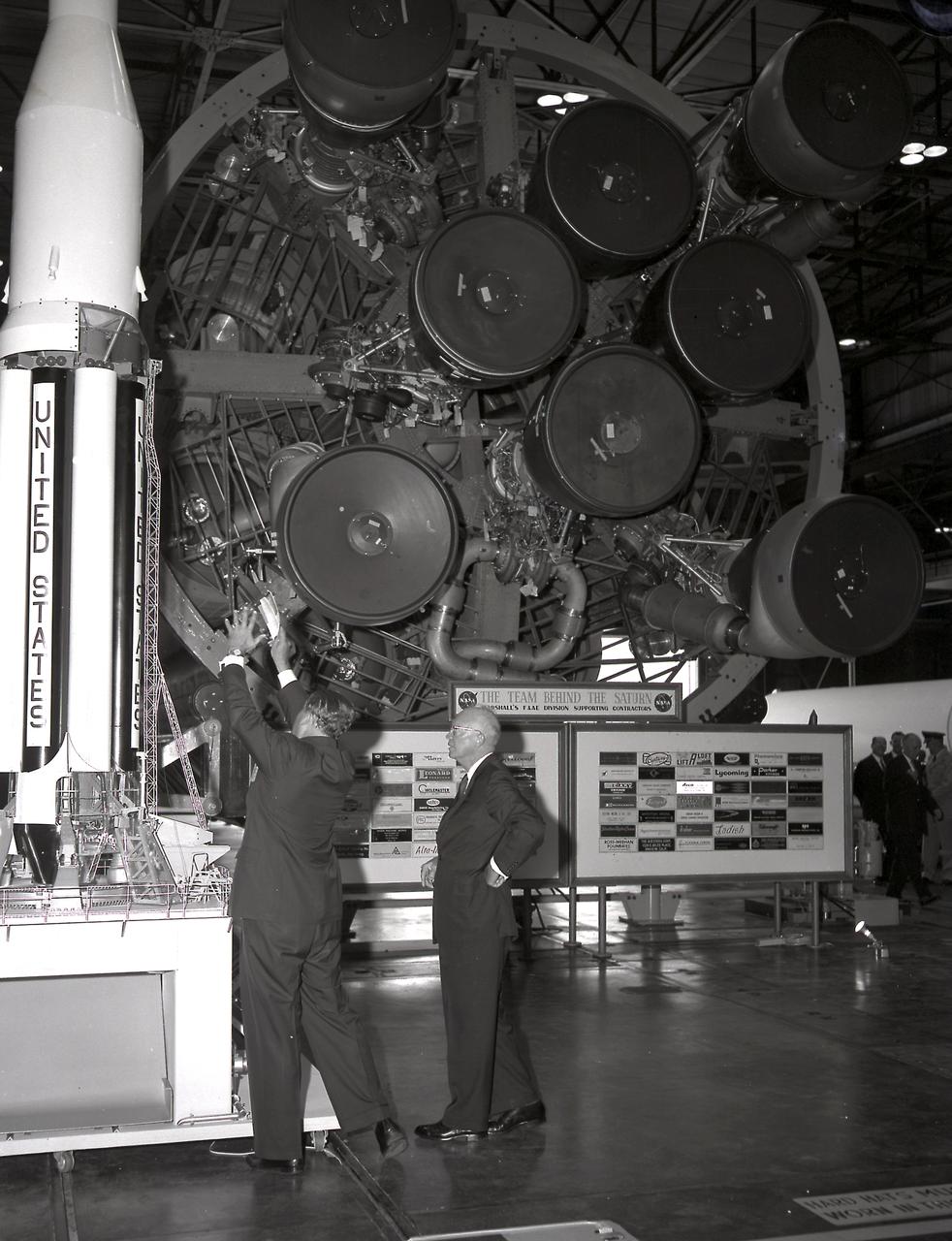
Dr. von Braun briefs President Eisenhower at the front of the S1 Stage (first Stage) of the Saturn 1 vehicle at the Marshall Space Flight Center (MSFC) on September 8, 1960. The President's visit was to dedicate Marshall Space Flight Center as a new NASA field center in honor of General George C. Marshall.
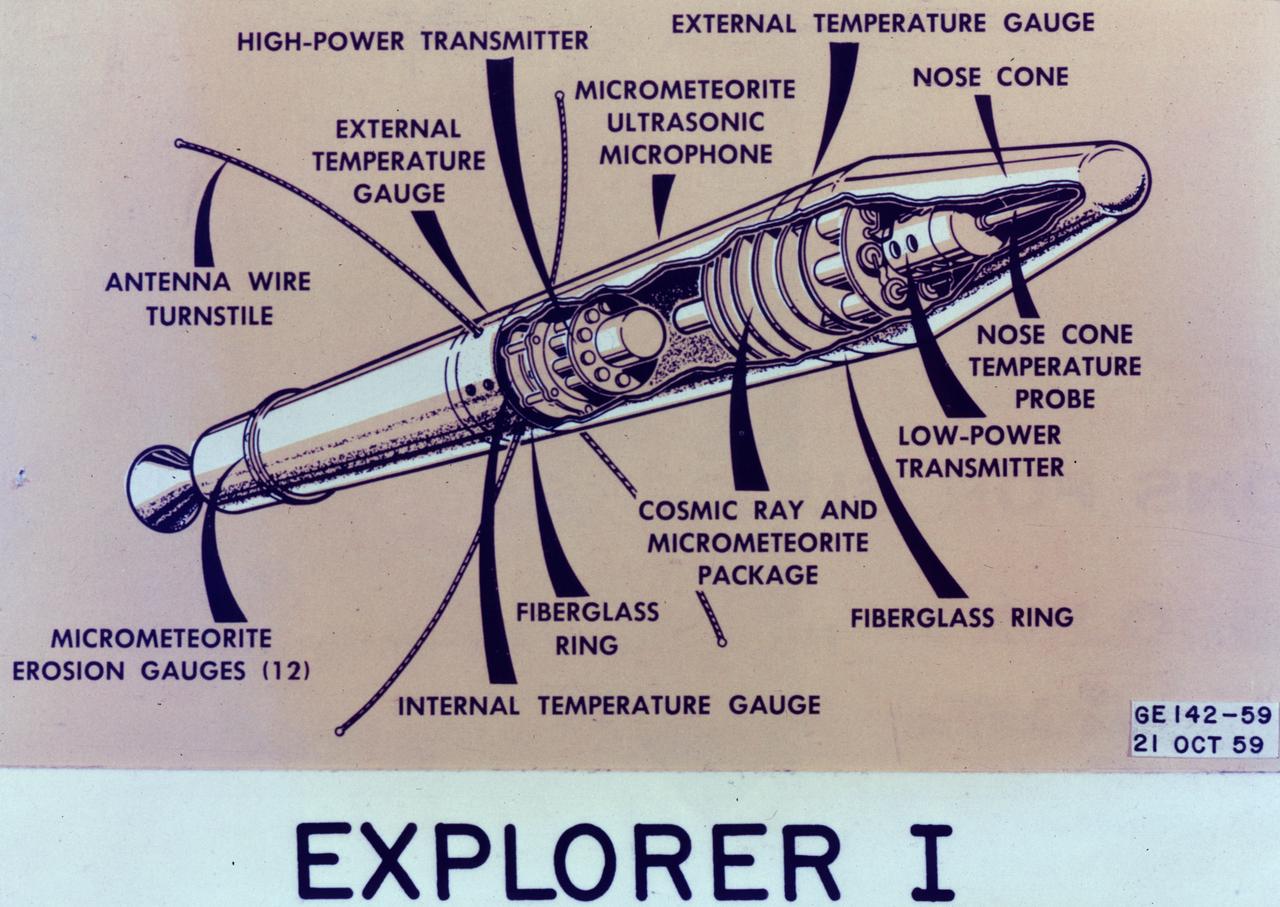
This image is a cutaway illustration of the Explorer I satellite with callouts. The Explorer I satellite was America's first scientific satellite launched aboard the Jupiter C launch vehicle on January 31, 1958. The Explorer I carried the radiation detection experiment designed by Dr. James Van Allen and discovered the Van Allen Radiation Belt.
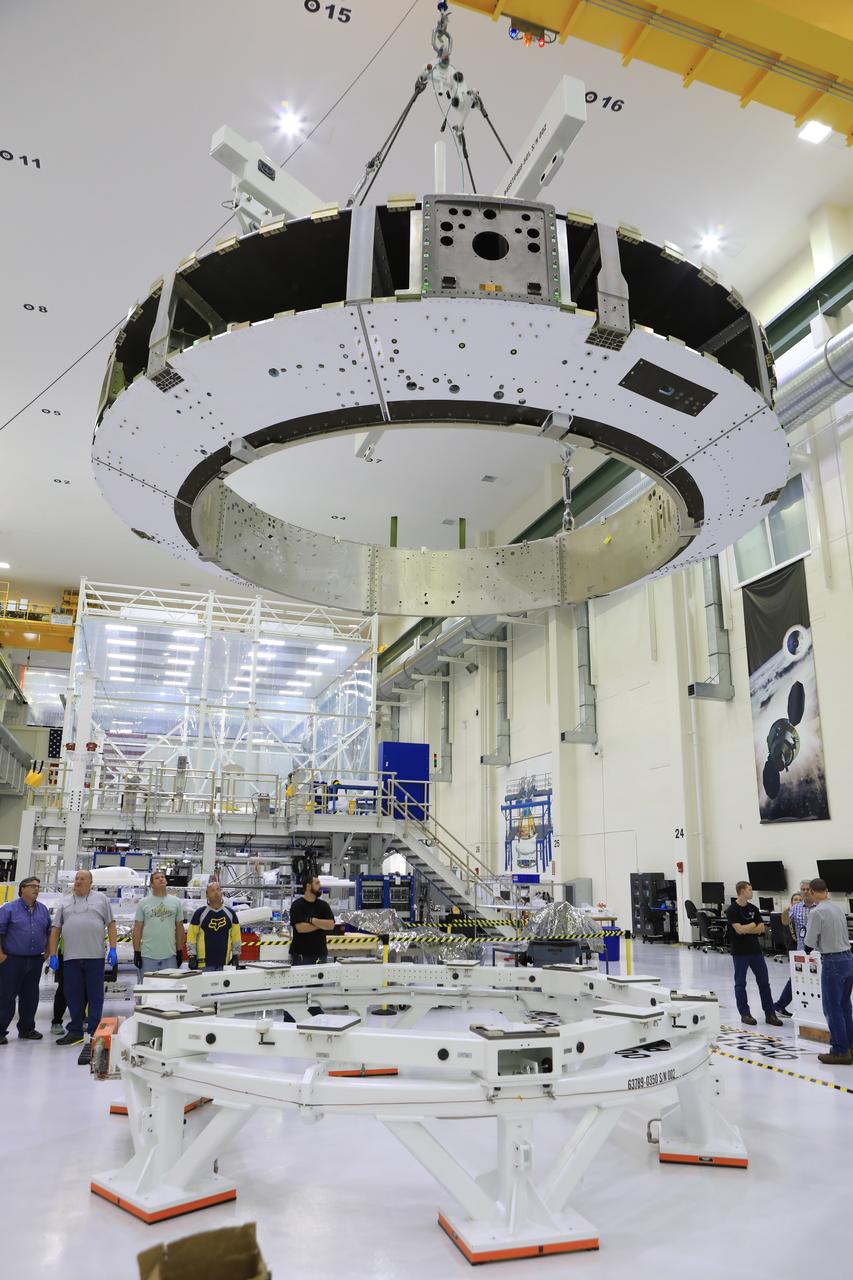
The Orion crew module adapter (CMA) for Exploration Mission 1 was lifted for the first and only time, Nov. 11, during its processing flow inside the Neil Armstrong Operations and Checkout (O&C) Building high bay at the agency's Kennedy Space Center in Florida. The CMA is now undergoing secondary structure outfitting.
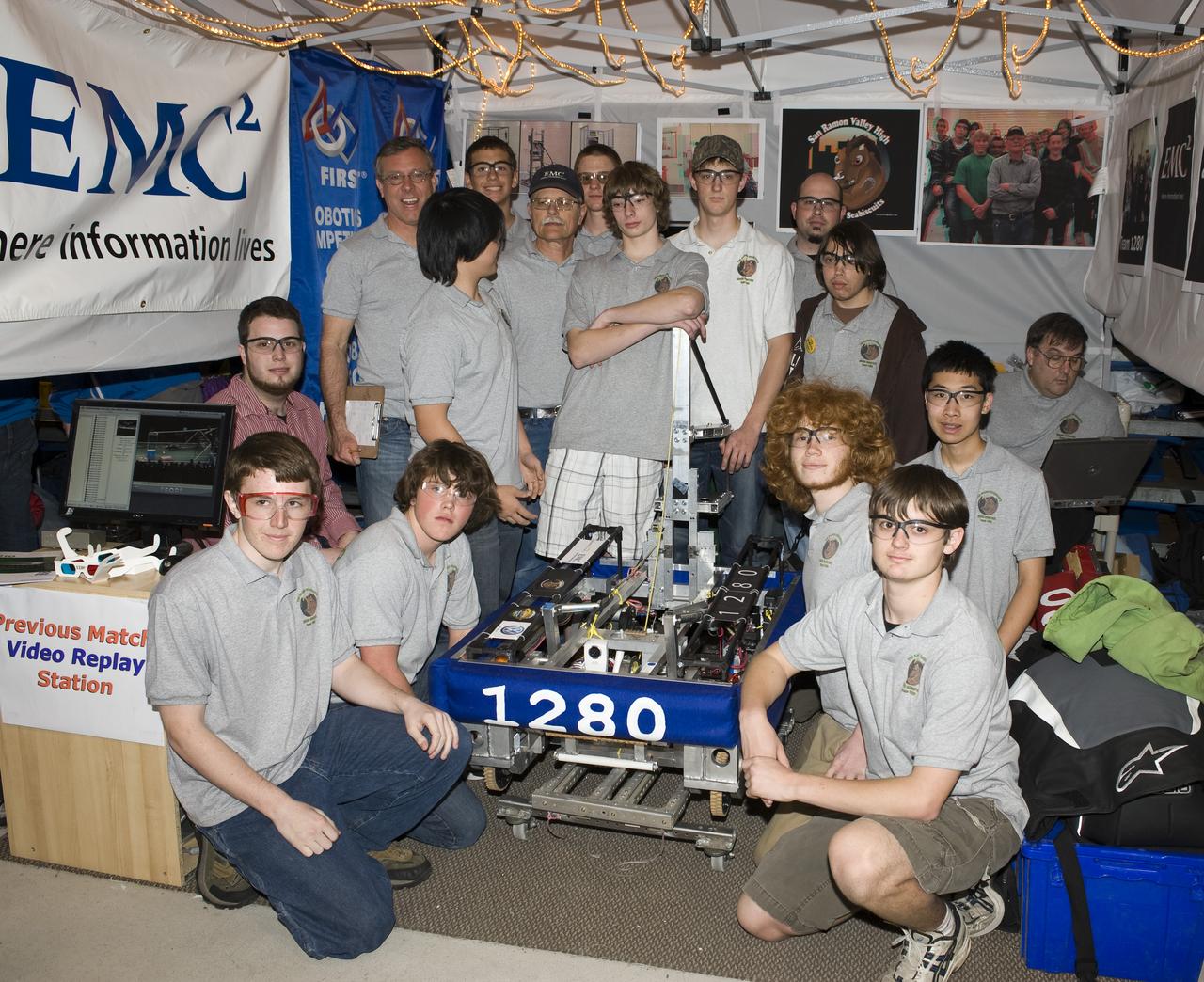
For Inspiration and Recognition of Science and Technology; FIRST Robotics Competition 2010 Silicon Valley Regional held at San Jose State University, San Jose, California Ragin' C-Biscuits of San Ramon Valley High, San Ramon Valley H.S.,CA Team 1280
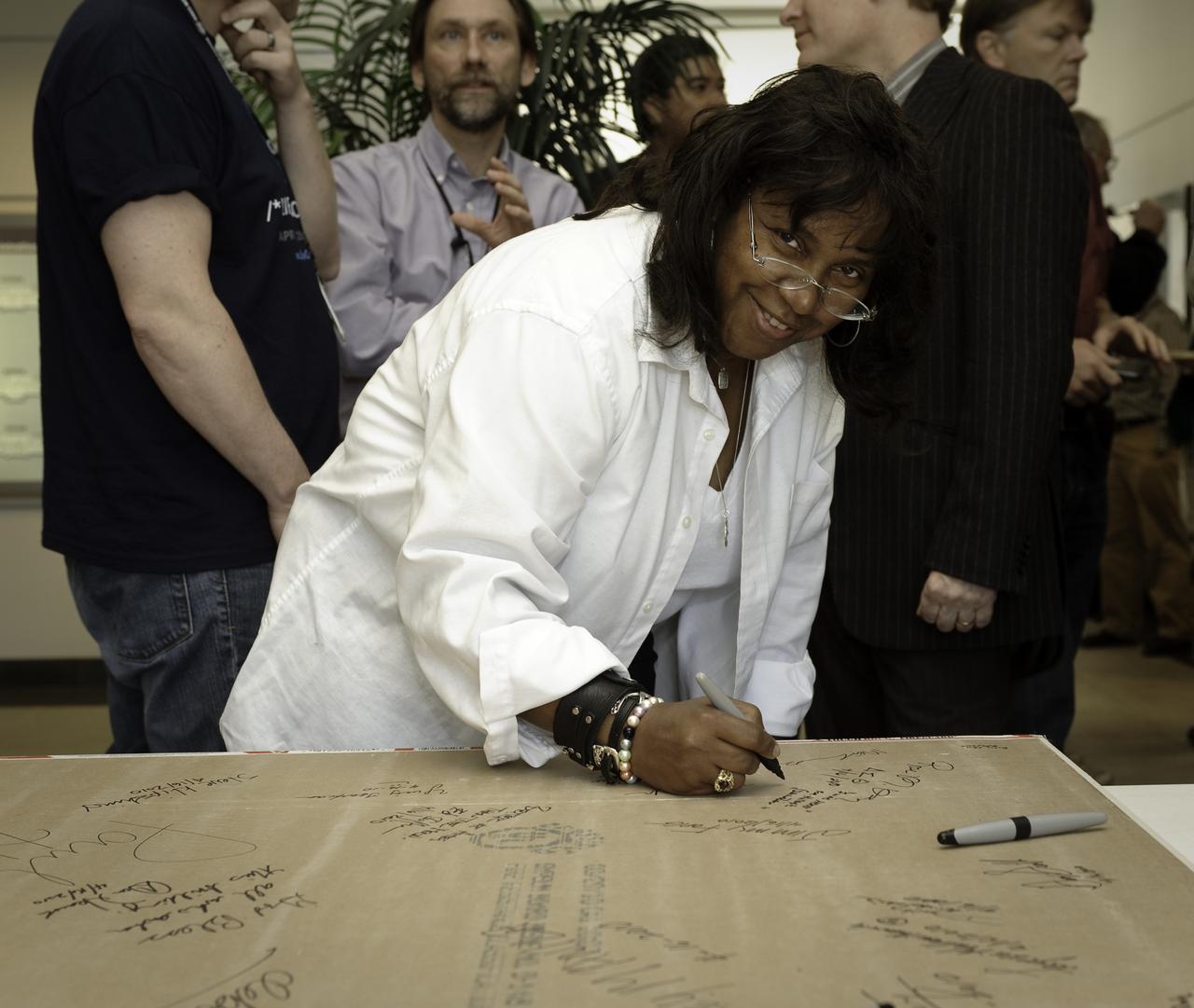
Sustainability Base celebration, sheetrock signing and social in lobby of N-200. Rose King of Code C slated to become on of the first occupants of the new Green building at NASA Ames Research Center, Moffett Field, California designated Sustainability Base N-232 puts her mark on the building forever.

FIRST Robotics Competition 'Lunacy' hosted by NASA at San Jose State University Event Center. For Inspiration and Recognition of Science and Technology let the games begin. Highrollers Team # 987, PTC Team # 26 Ragin' C-Biscits of San Ramon Valley High Team # 1280
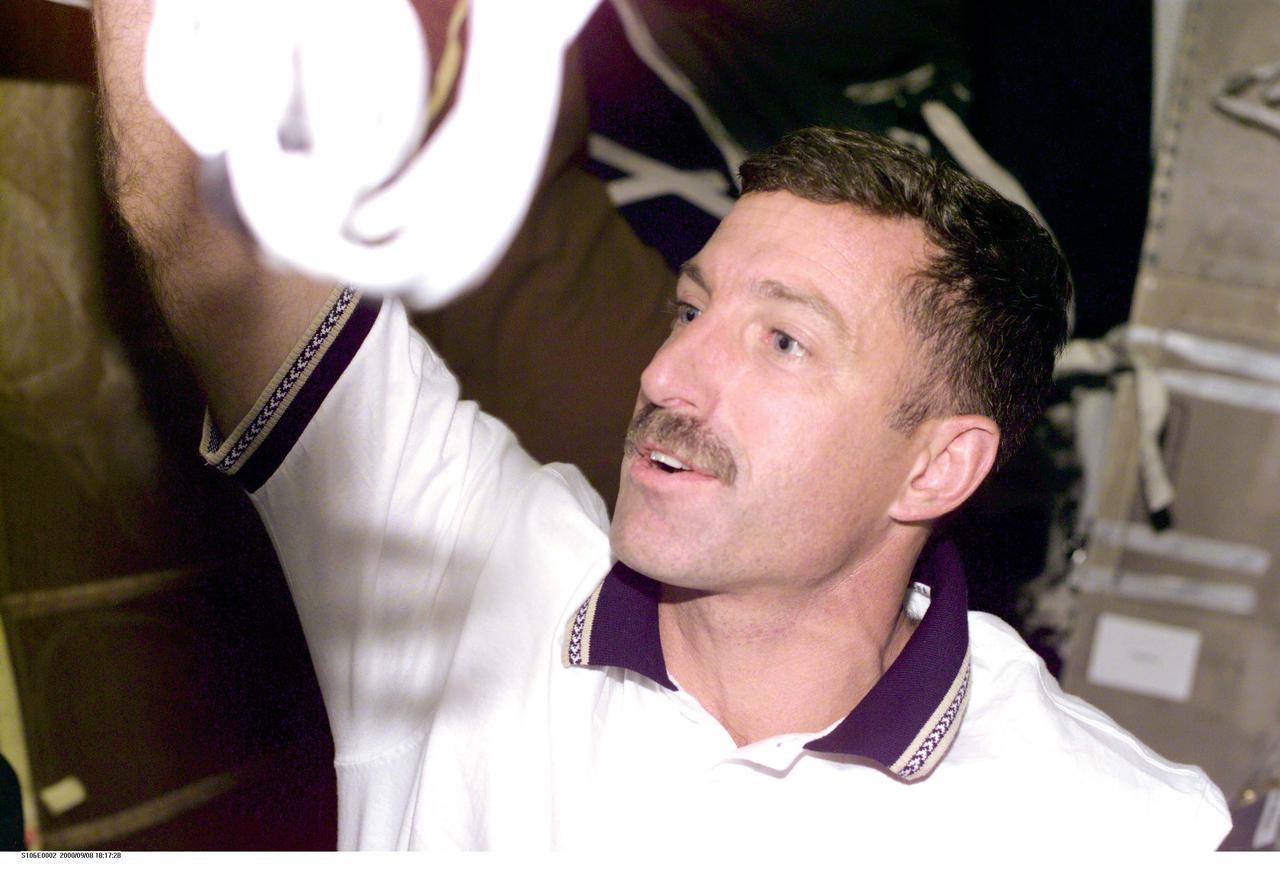
S106-E-5002 (8 September 2000) --- Getting Atlantis ready to support the duration of the STS-106 mission is Daniel C. Burbank, mission specialist. This electronic still camera's (ESC) photo was among the first downlinked by the Atlantis crew on Flight Day 1.
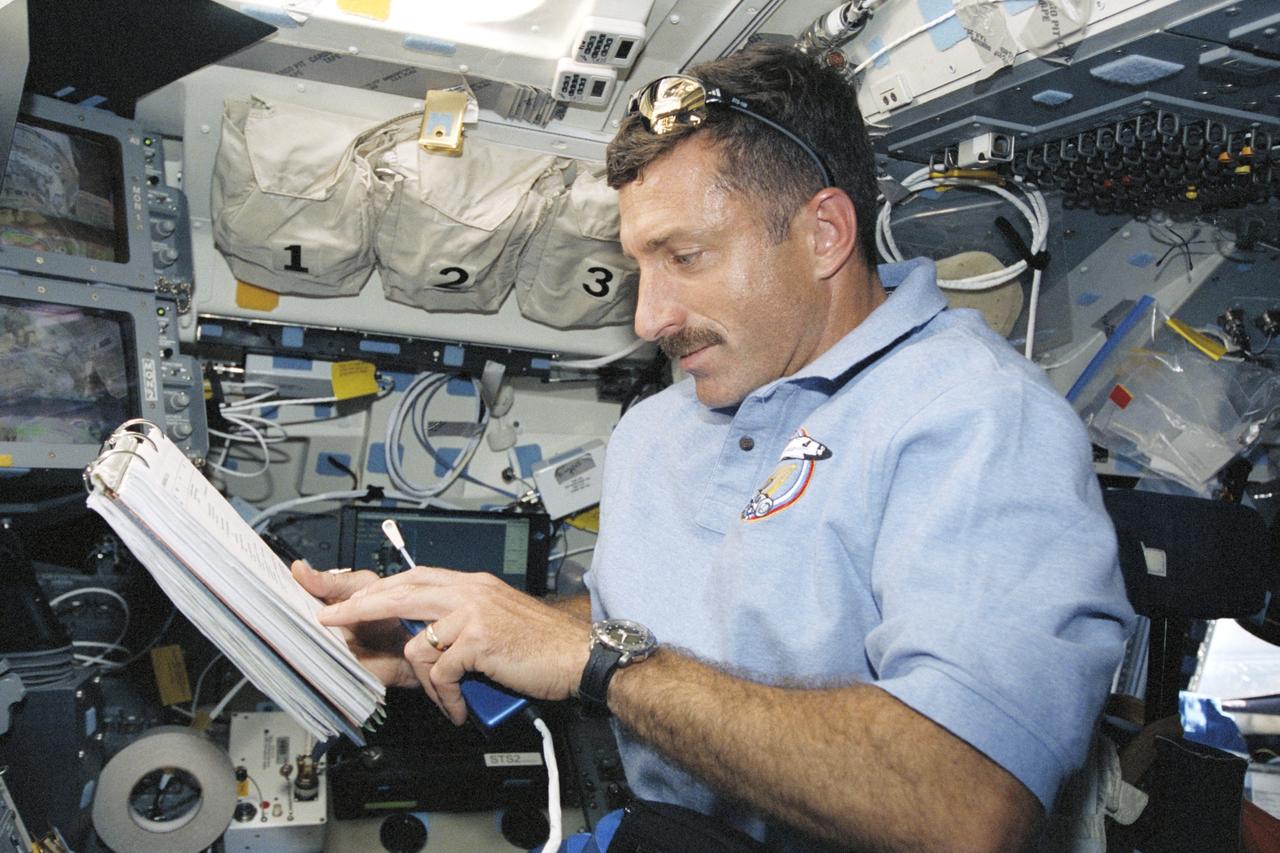
STS106-370-004 (8-20 September 2000) --- Astronaut Daniel C. Burbank, STS-106 mission specialist, looks over a procedures checklist on the aft flight deck of the Space Shuttle Atlantis. Burbank is marking his first space flight.
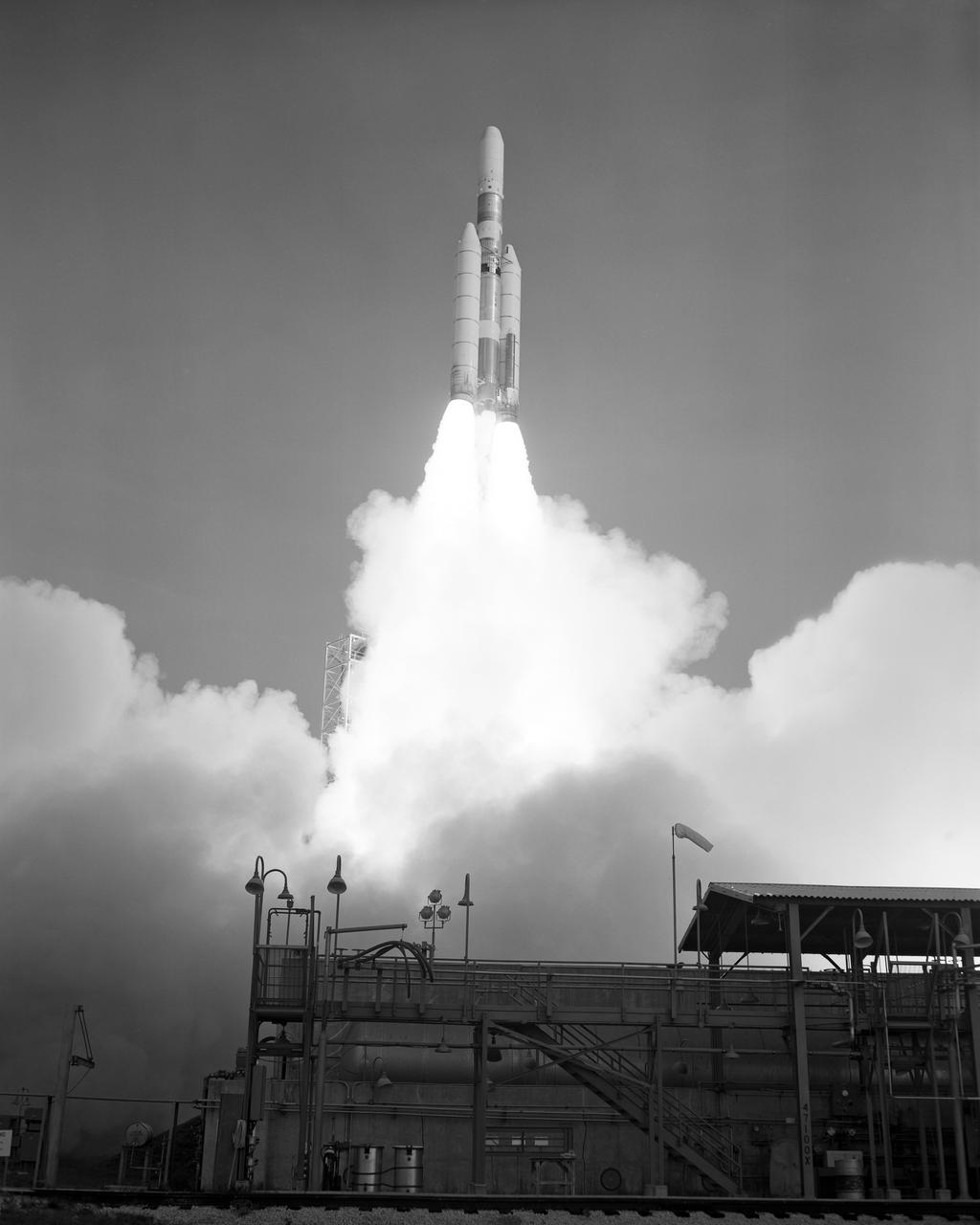
An Air Force Titan III-C lifted off from Complex 40 at Cape Canaveral Air Force Station at 9:00 A.M. EDT today to launch Application Technology Satellite 6, first in a new generation of NASA Communications satellites. (1.3-22)
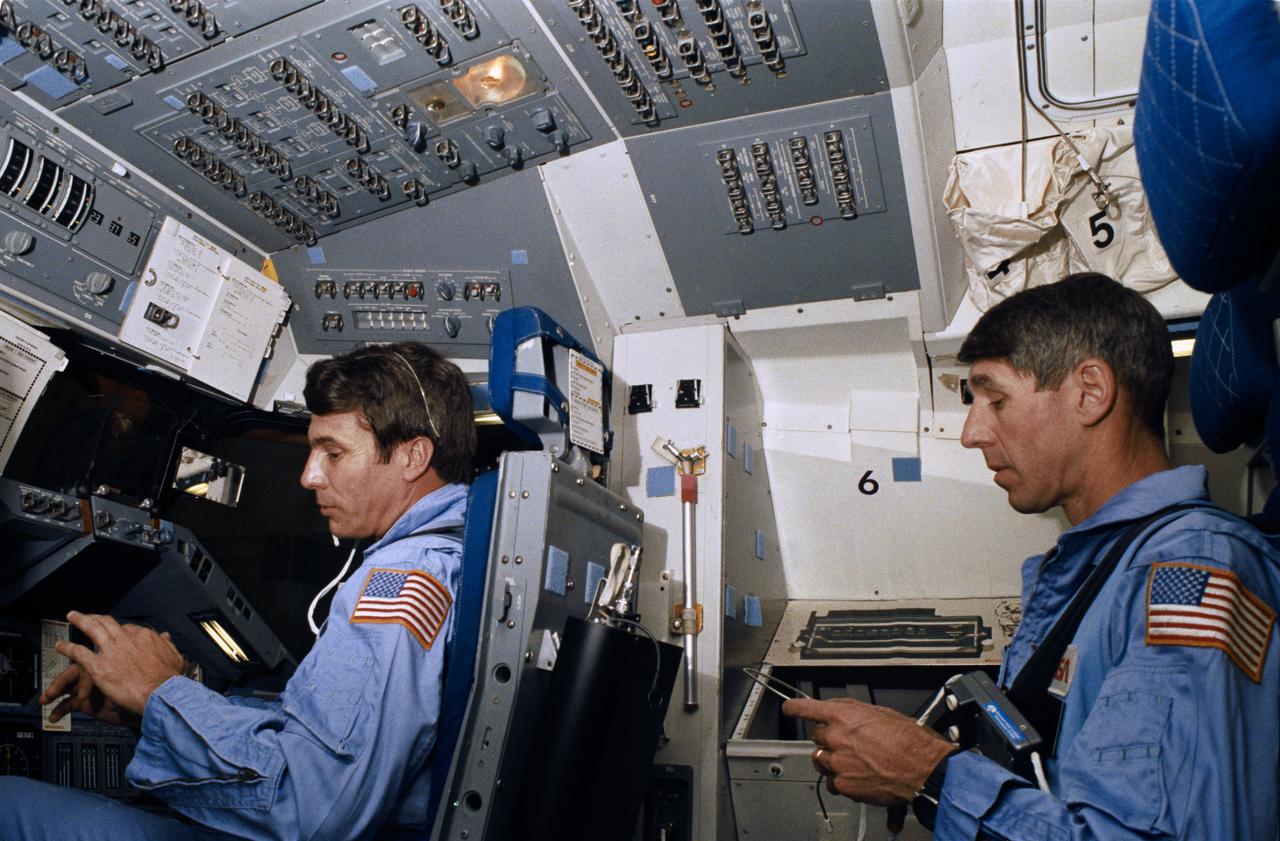
S86-29122 (March 1986) --- Astronauts John E. Blaha, left, and Robert C. Springer participate in a rehearsal for their assigned flight in the crew compartment trainer at the Johnson Space Center (JSC). Blaha is pilot and Springer, one of three mission specialists for the mission. The two will mark their first spaceflights on the next mission.
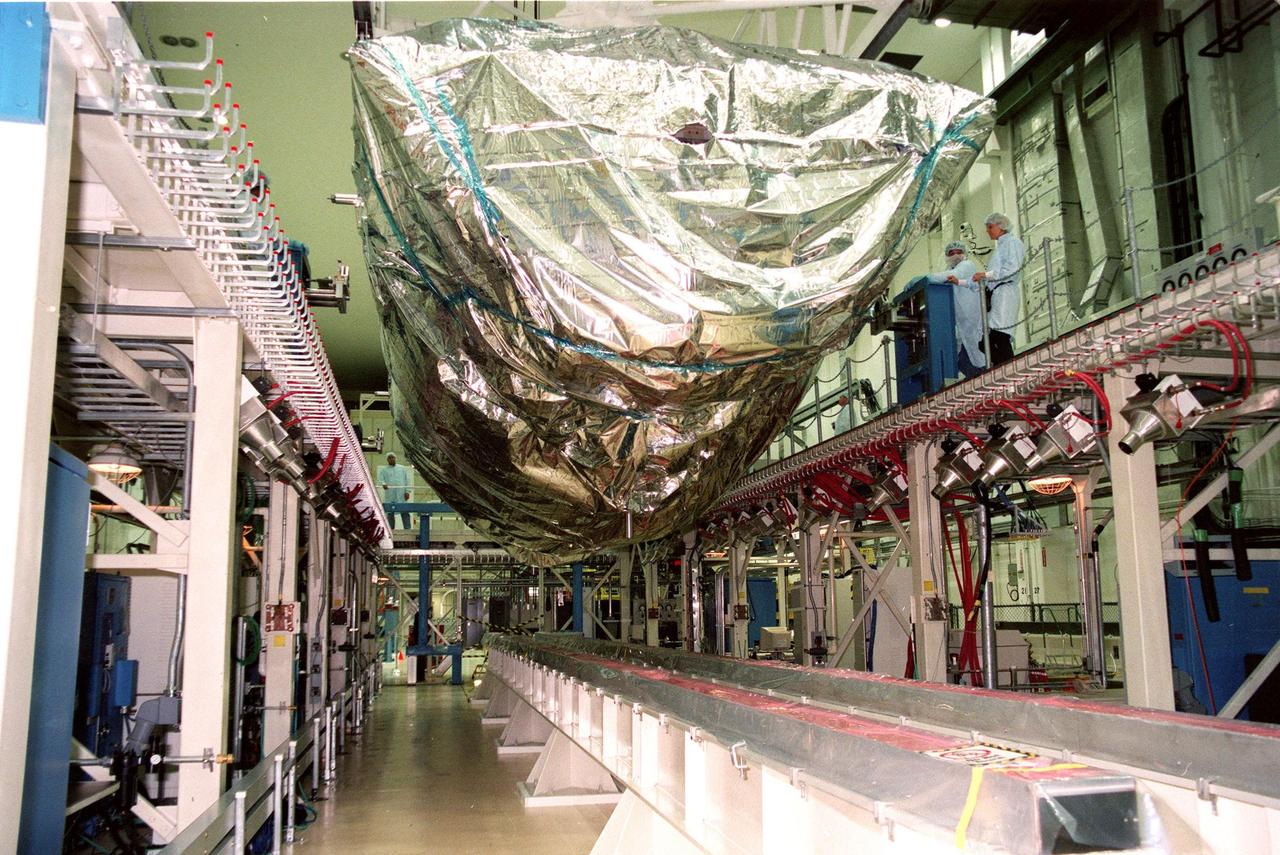
KENNEDY SPACE CENTER, FLA. -- The S0 truss nears its resting place in the workstand in the O&C Bldg. (O&C). The S0 truss will undergo processing in the O&C during which the Canadian Mobile Transporter, power distribution system modules, a heat pipe radiator for cooling, computers, and a pair of rate gyroscopes will be installed. Four Global Positioning System antennas are already installed. A 44by 15-foot structure weighing 30,800 pounds when fully outfitted and ready for launch, the truss will be at the center of the ISS 10-truss, girderlike structure that will ultimately extend the length of a football field. Eventually the S0 truss will be attached to the U.S. Lab, "Destiny," which is scheduled to be added to the ISS in April 2000. Later, other trusses will be attached to the S0 on-orbit. The S0 truss is scheduled to be launched in the first quarter of 2001 on mission STS-108
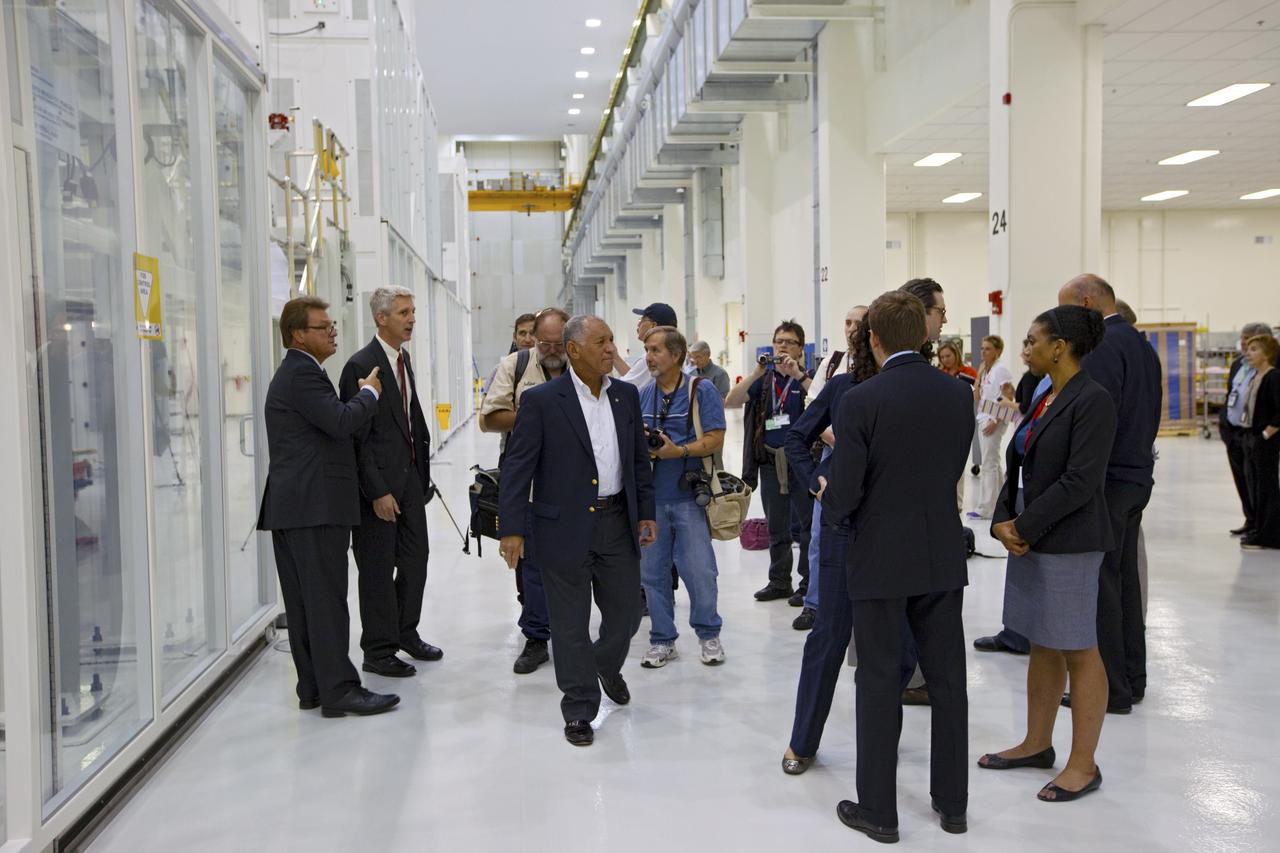
CAPE CANAVERAL, Fla. - NASA Administrator Charles Bolden tours the Operations and Checkout, or O& C, Building at the Kennedy Space Center in Florida. In the O&C, the Orion EFT-1 spacecraft is being prepared for the program's first flight. Bolden took a few dozen members of the news media on a tour of the space agency's Kennedy Space Center and adjacent Cape Canaveral Air Force Station on Aug. 23, 2012 to show the progress being made for future government and commercial space endeavors that will begin from Florida's Space Coast. For more information, visit: http://www.nasa.gov/centers/kennedy/news/kennedy-bolden-tour.html Photo credit: NASA/Kim Shiflett
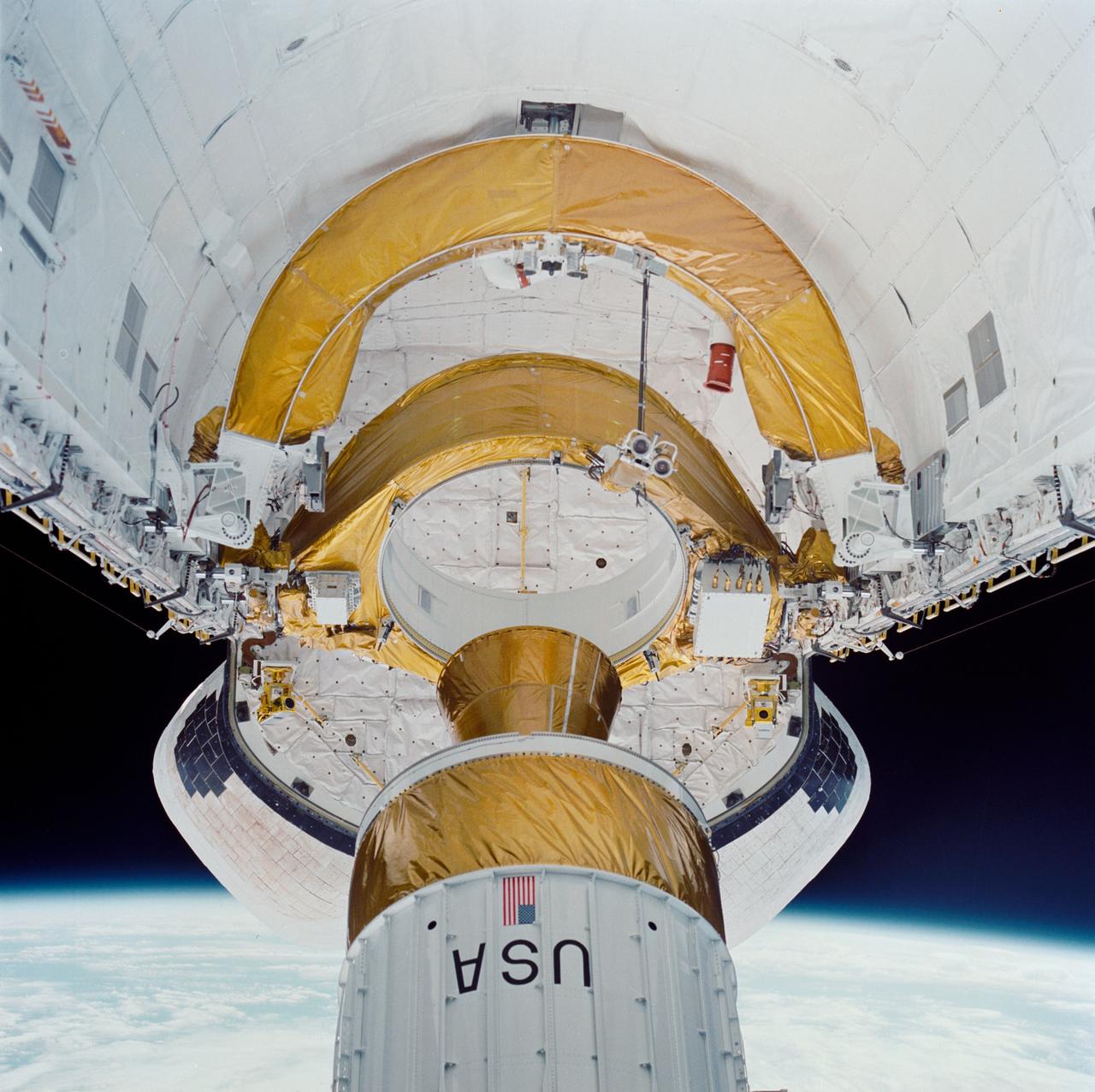
During STS-26, inertial upper stage (IUS) with the tracking and data relay satellite C (TDRS-C) drifts above Discovery, Orbiter Vehicle (OV) 103, payload bay (PLB) after being positioned in deployment attitude (an angle of 50 degrees) by the airborne support equipment (ASE). IUS vacates the ASE aft frame tilt actuator (AFTA) table in the PLB while the disconnected ASE umbilical boom floats above ASE forward cradle. IUS first stage rocket motor and nozzle and the interstage are visible as the IUS is deployed. In the background are the orbital maneuvering system (OMS) pods and the Earth's limb.
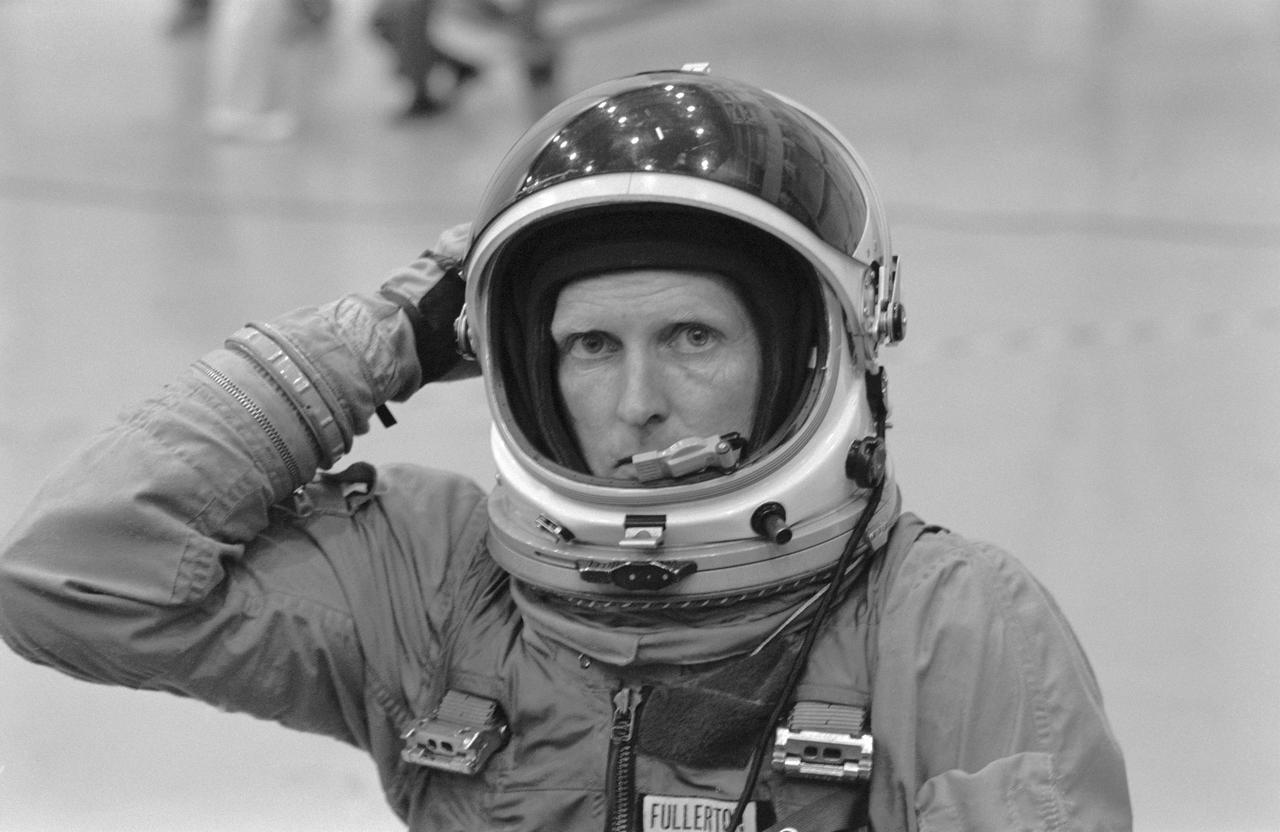
S78-34927 (31 Aug. 1978) --- Astronaut C. Gordon Fullerton, one of a group of eight astronauts named to fly the first few orbital flight tests of the space transportation system, gets ready to participate in a training session for emergency egress from a space shuttle vehicle at the launch pad. He is wearing a USAF modified high altitude pressure garment like those to be worn by shuttle crew members at takeoff and landing. Photo credit: NASA NOTE: Since this photograph was made, astronaut C. Gordon Fullerton was named pilot of STS-3, scheduled for launch in early spring of 1982.
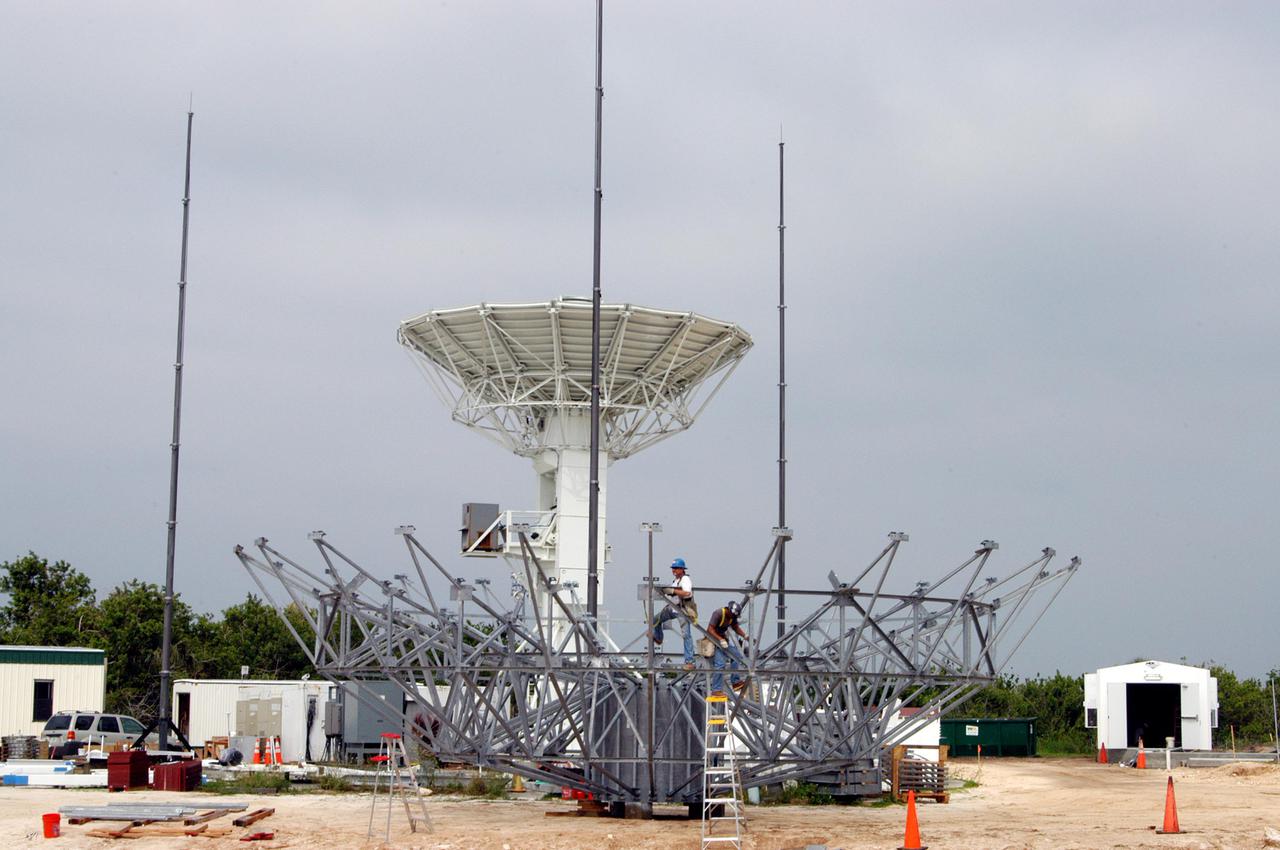
KENNEDY SPACE CENTER, FLA. - At a radar site on North Merritt Island, Fla., north of the Haulover Canal, workers continue assembling a 50-foot C-band radar. The radar will be used for long-term Shuttle missions to track the launches and observe possible debris coming from the Shuttle. In the background is an existing 30-foot C-band Pathfinder radar whose use was demonstrated on the Delta Messenger launch. It will be used on the upcoming two Return to Flight missions. The launch window for the first Return to Flight mission, STS-114, is July 13 to July 31.
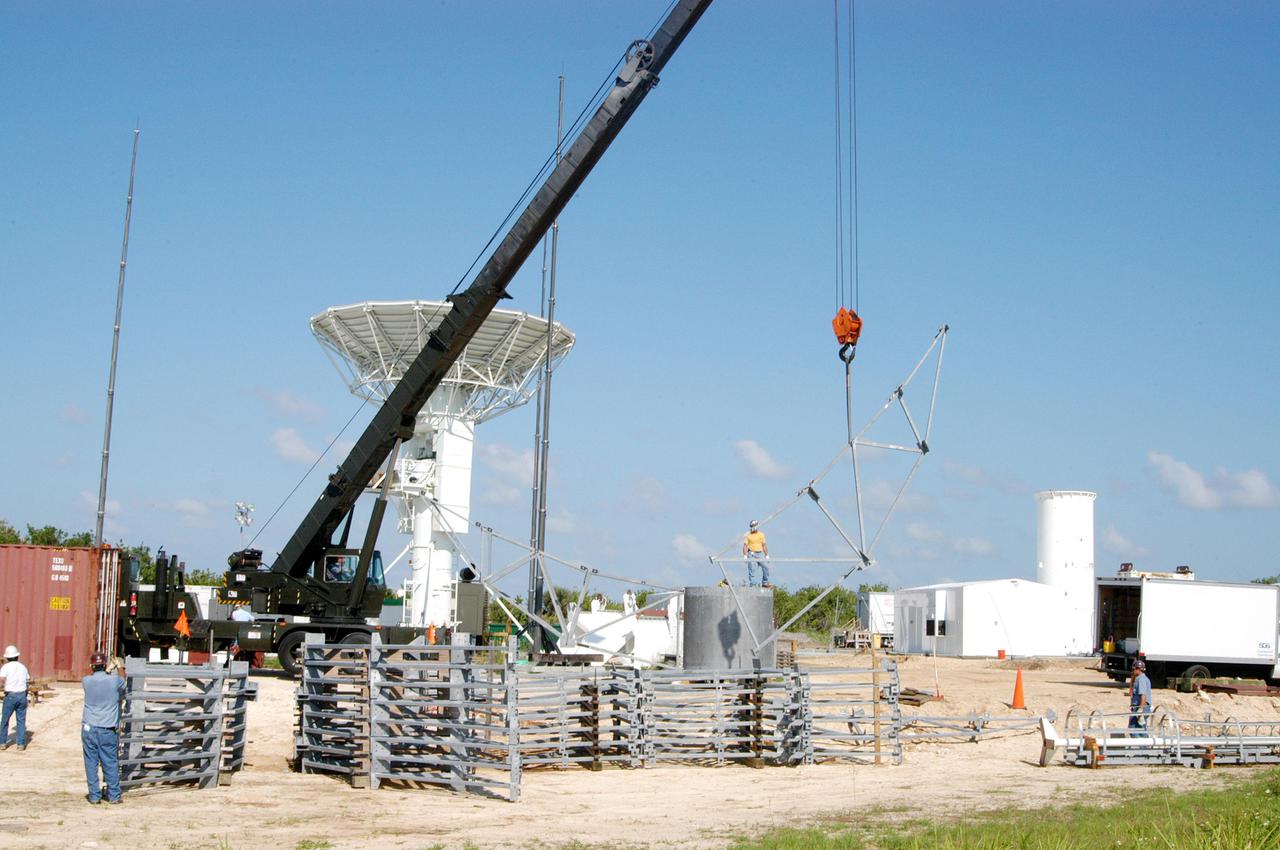
KENNEDY SPACE CENTER, FLA. - At a radar site on North Merritt Island, Fla., north of the Haulover Canal, a 50-foot dish for NASA’s C-band radar is being assembled. The radar will be used for long-term Shuttle missions to track the launches and observe possible debris coming from the Shuttle. Behind the dish is an existing 30-foot C-band Pathfinder radar whose use was demonstrated on the Delta Messenger launch. It will be used on the upcoming two Return to Flight missions. The launch window for the first Return to Flight mission, STS-114, is July 13 to July 31.
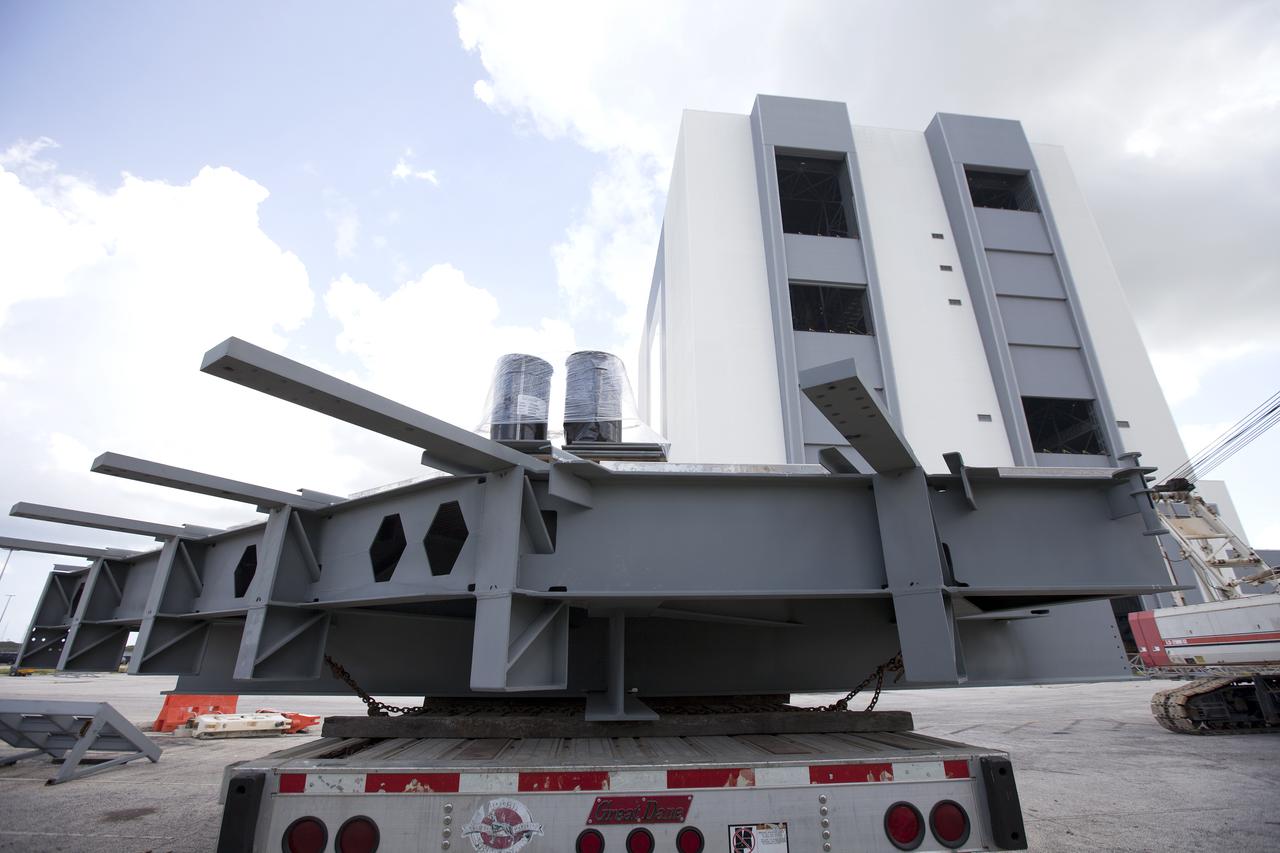
A heavy load transport truck from Tillett Heavy Hauling in Titusville, Florida, arrives at the Vehicle Assembly Building (VAB) at NASA’s Kennedy Space Center in Florida, carrying the second section of the first half of the C-level work platforms, C South, for the agency’s Space Launch System (SLS) rocket. The platform will be offloaded in the VAB staging area in the west parking lot. The Ground Systems Development and Operations Program is overseeing upgrades and modifications to VAB High Bay 3 to support processing of the SLS and Orion spacecraft. A total of 10 levels of new platforms, 20 platform halves altogether, will surround the SLS rocket and Orion spacecraft and provide access for testing and processing.

A heavy load transport truck from Tillett Heavy Hauling in Titusville, Florida, arrives at the Vehicle Assembly Building (VAB) at NASA’s Kennedy Space Center in Florida, carrying the second section of the first half of the C-level work platforms, C South, for the agency’s Space Launch System (SLS) rocket. The platform will be offloaded in the VAB staging area in the west parking lot. The Ground Systems Development and Operations Program is overseeing upgrades and modifications to VAB High Bay 3 to support processing of the SLS and Orion spacecraft. A total of 10 levels of new platforms, 20 platform halves altogether, will surround the SLS rocket and Orion spacecraft and provide access for testing and processing.
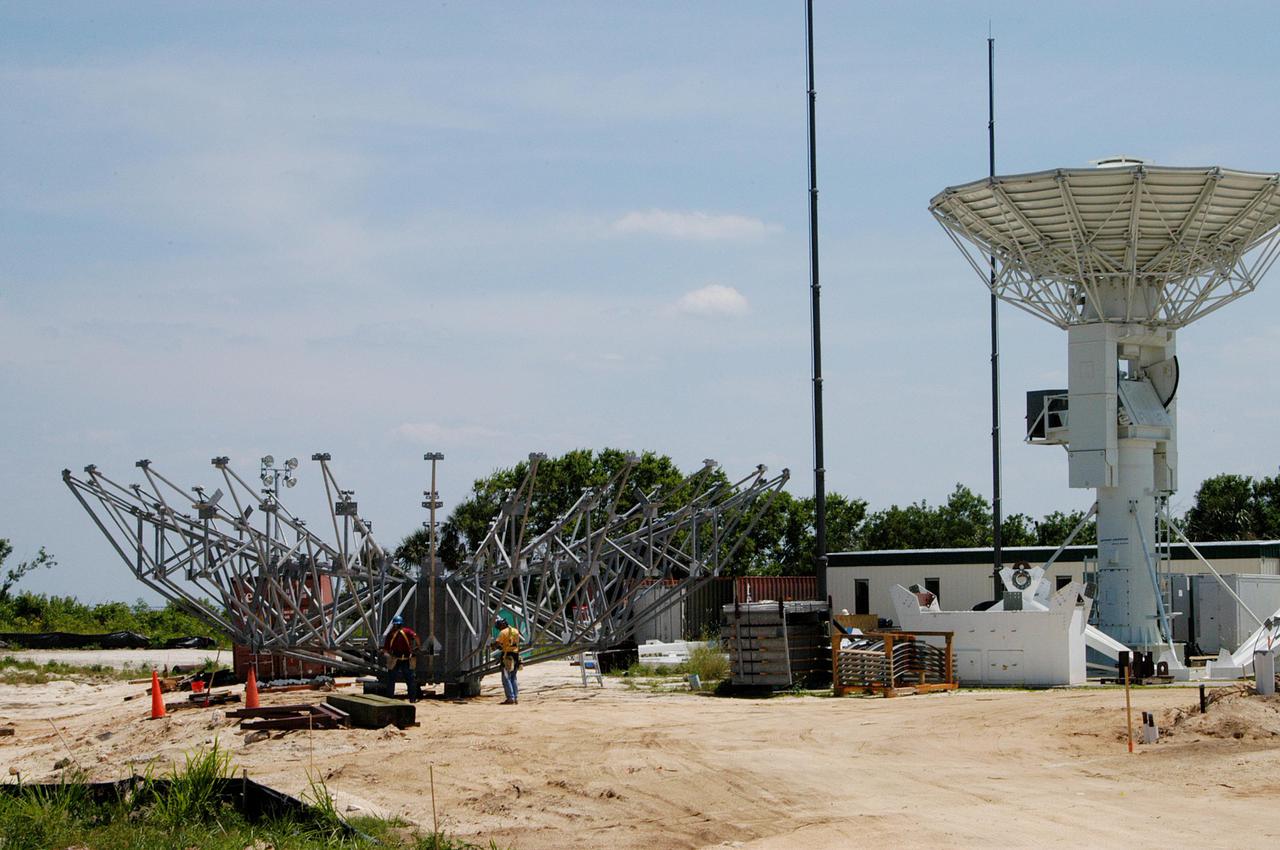
KENNEDY SPACE CENTER, FLA. - At a radar site on North Merritt Island, Fla., north of the Haulover Canal, a 50-foot dish for NASA’s C-band radar is being assembled. The radar will be used for long-term Shuttle missions to track the launches and observe possible debris coming from the Shuttle. On the right is an existing 30-foot C-band Pathfinder radar whose use was demonstrated on the Delta Messenger launch. It will be used on the upcoming two Return to Flight missions. The launch window for the first Return to Flight mission, STS-114, is July 13 to July 31.
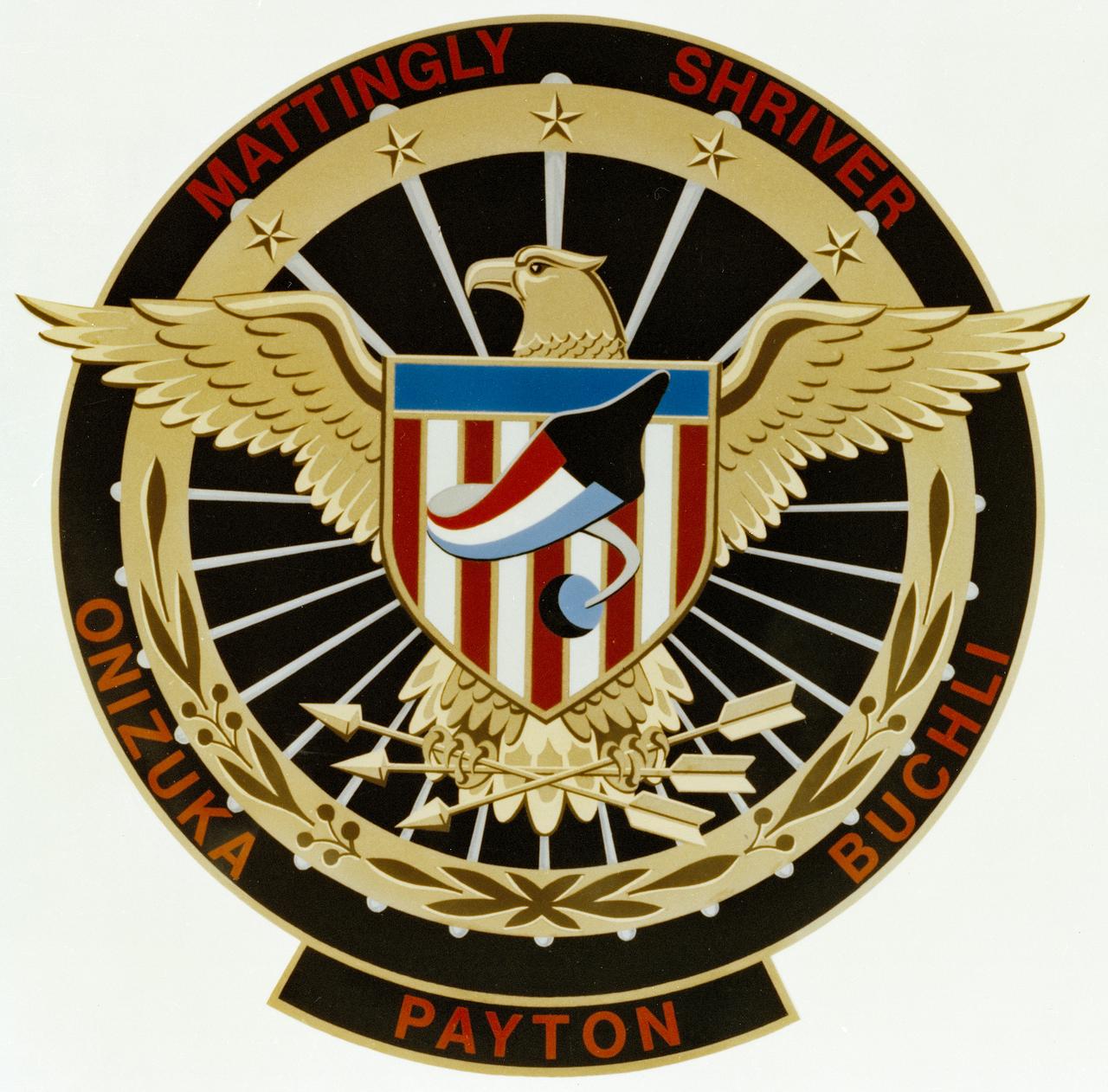
The crew insignia for STS Flight 51-C includes the names of its five crewmembers. The STS 51-C mission marked the third trip of the Space Shuttle Discovery into space. It was the first Space Shuttle mission totally dedicated to the Department of Defense. The U. S. Air Force Inertial Upper Stage Booster Rocket was successfully deployed. Due to the nature of the mission, few additional details of the flight were made available. Landing was made at the Kennedy Space Center, FL on January 27 at 4:23 PM EST. Mission duration was three days, one hour and 33 minutes.
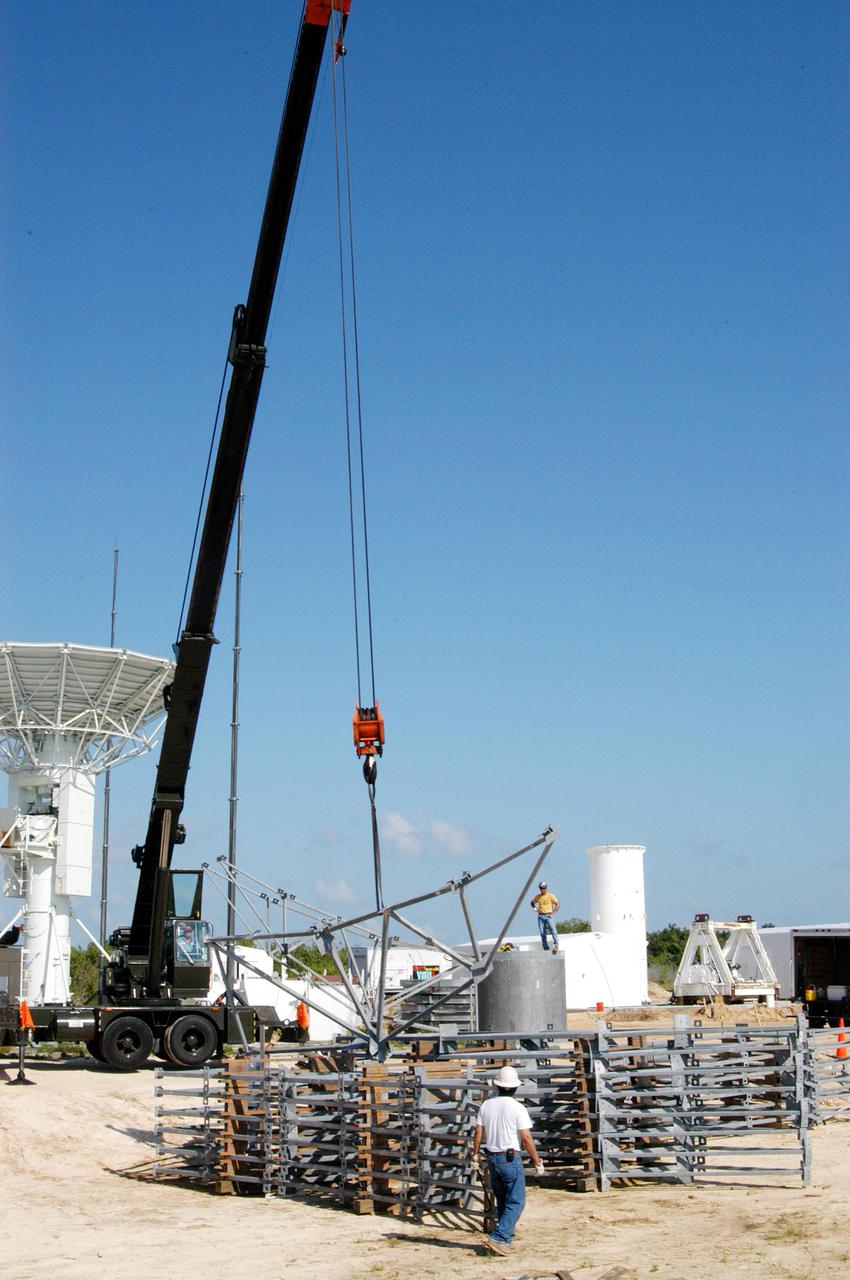
KENNEDY SPACE CENTER, FLA. - At a radar site on North Merritt Island, Fla., north of the Haulover Canal, a 50-foot dish for NASA’s C-band radar is being assembled. The radar will be used for long-term Shuttle missions to track the launches and observe possible debris coming from the Shuttle. At left is an existing 30-foot C-band Pathfinder radar whose use was demonstrated on the Delta Messenger launch. It will be used on the upcoming two Return to Flight missions. The launch window for the first Return to Flight mission, STS-114, is July 13 to July 31.
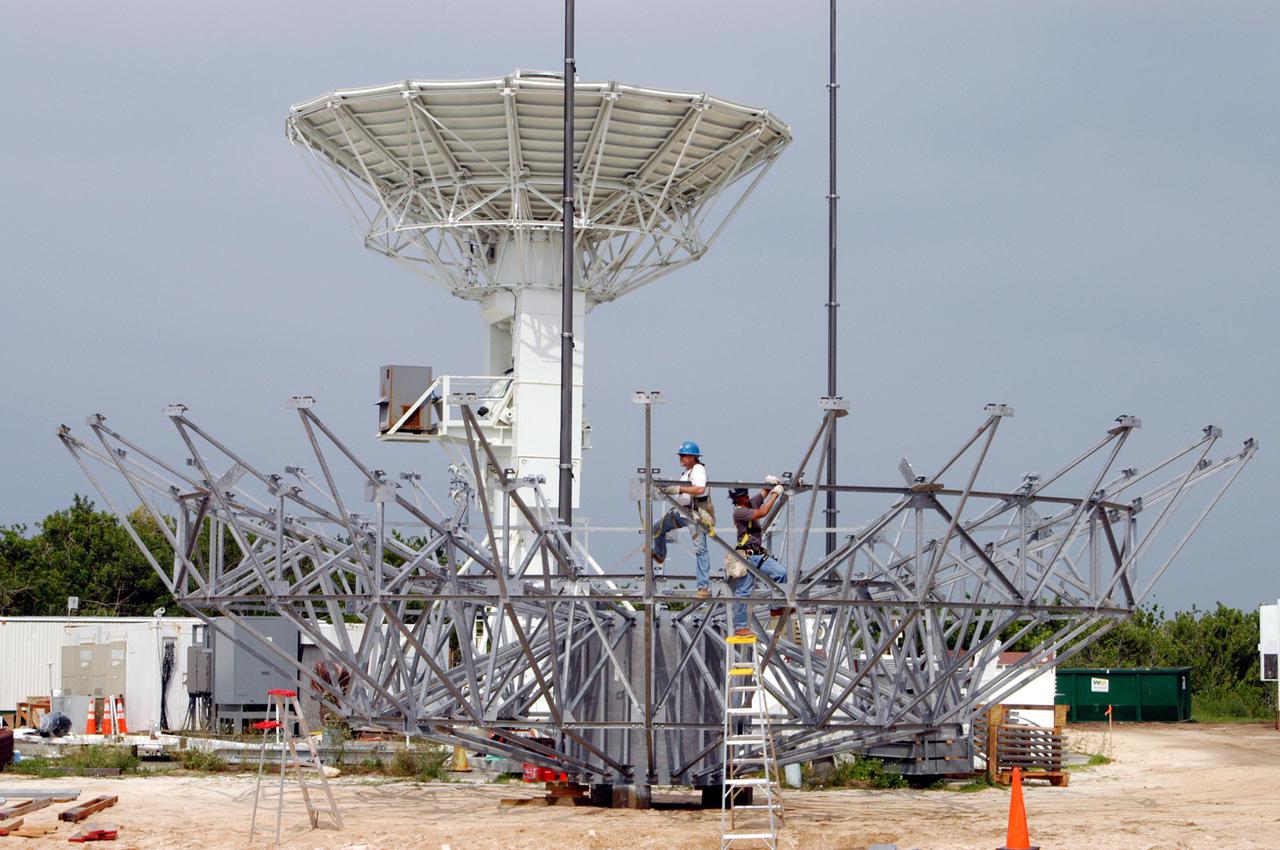
KENNEDY SPACE CENTER, FLA. - At a radar site on North Merritt Island, Fla., north of the Haulover Canal, workers continue assembling a 50-foot C-band radar. The radar will be used for long-term Shuttle missions to track the launches and observe possible debris coming from the Shuttle. In the background is an existing 30-foot C-band Pathfinder radar whose use was demonstrated on the Delta Messenger launch. It will be used on the upcoming two Return to Flight missions. The launch window for the first Return to Flight mission, STS-114, is July 13 to July 31.
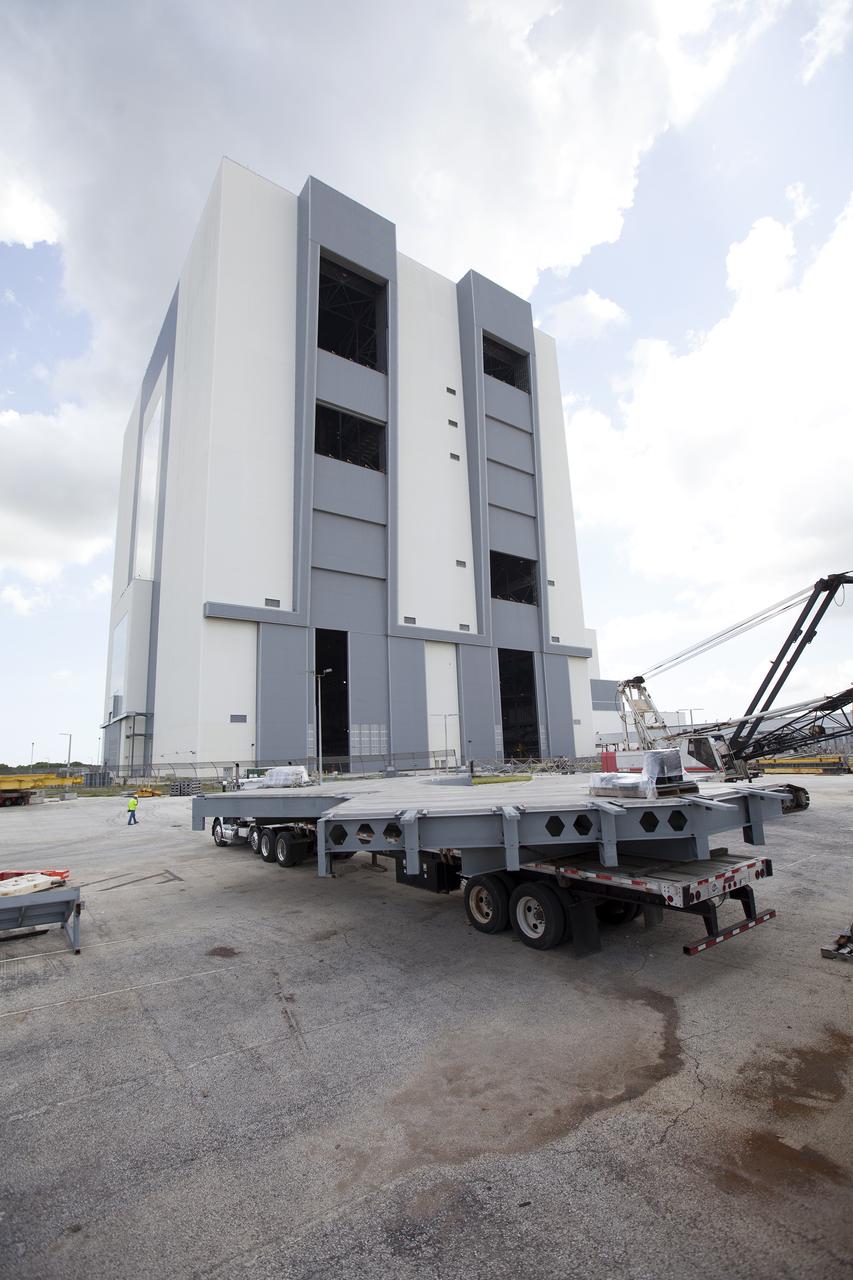
A heavy load transport truck from Tillett Heavy Hauling in Titusville, Florida, arrives at the Vehicle Assembly Building (VAB) at NASA’s Kennedy Space Center in Florida, carrying the second section of the first half of the C-level work platforms, C South, for the agency’s Space Launch System (SLS) rocket. The platform will be offloaded in the VAB staging area in the west parking lot. The Ground Systems Development and Operations Program is overseeing upgrades and modifications to VAB High Bay 3 to support processing of the SLS and Orion spacecraft. A total of 10 levels of new platforms, 20 platform halves altogether, will surround the SLS rocket and Orion spacecraft and provide access for testing and processing.
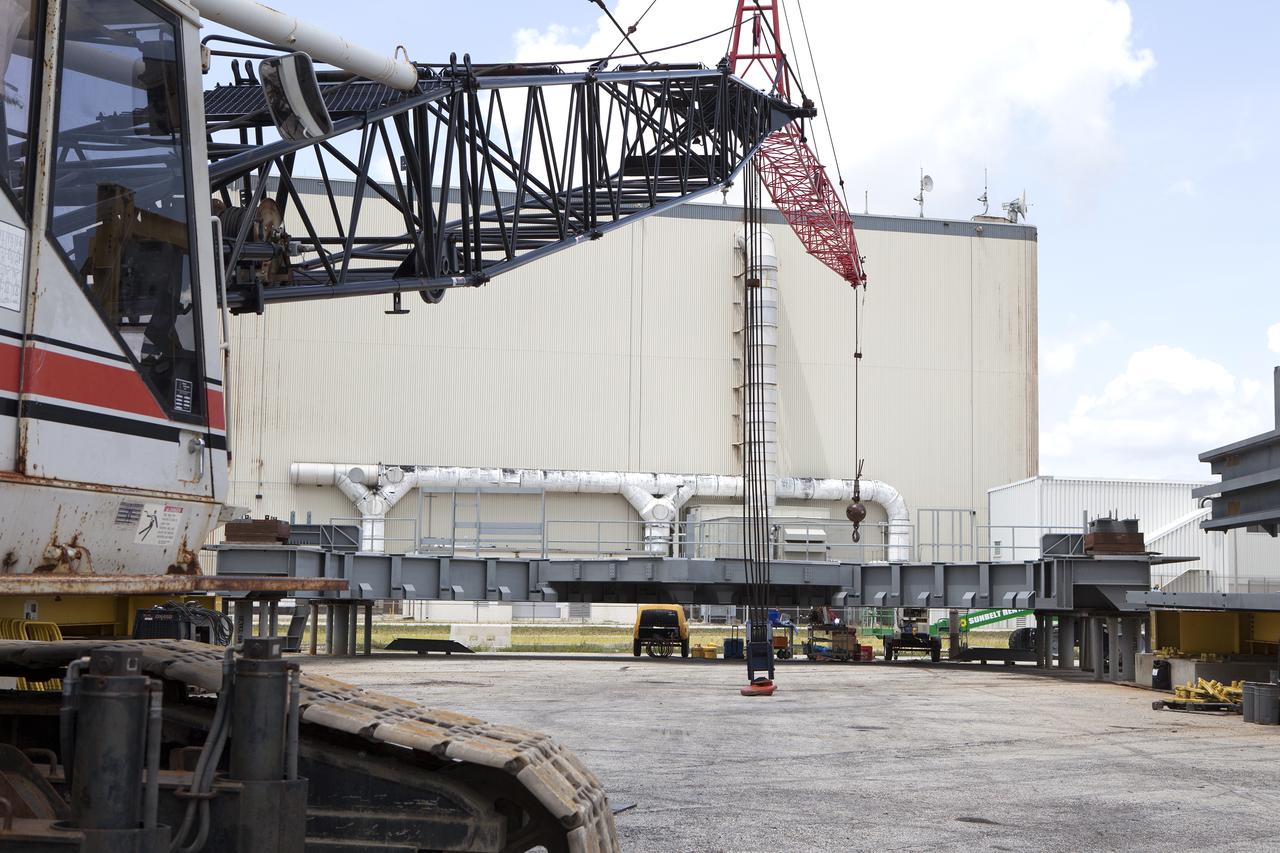
The second section of the first half of the C-level work platforms, C South, for NASA’s Space Launch System (SLS) rocket was offloaded from a heavy transport truck in a staging area on the west side of the Vehicle Assembly Building (VAB) at the agency’s Kennedy Space Center in Florida. The Ground Systems Development and Operations Program is overseeing upgrades and modifications to VAB High Bay 3 to support processing of the SLS and Orion spacecraft. A total of 10 levels of new platforms, 20 platform halves altogether, will surround the SLS rocket and Orion spacecraft and provide access for testing and processing.
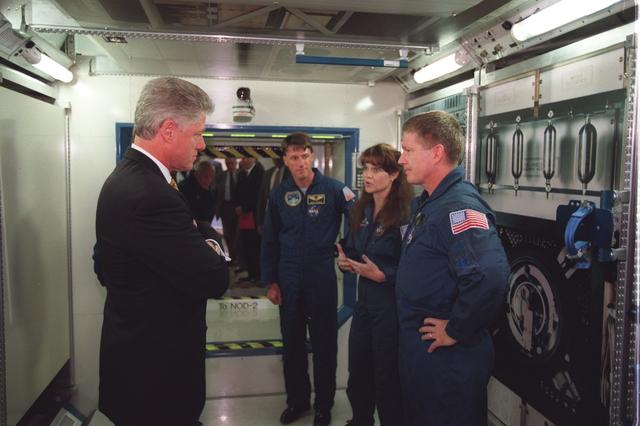
S98-05025 (14 April 1998) --- President Bill Clinton tours a laboratory mockup used for training purposes by astronauts assigned to fly aboard the International Space Station (ISS). Astronaut William Shepherd (right), mission commander for the first ISS expedition crew, briefs the Chief Executive. Looking on are astronauts C. Michael Foale and Tamara C. Jernigan. Foale spent four months last year aboard Russia's Mir space station. President Clinton toured several mockups and other training components before speaking to a crowd of JSC employees. Photo Credit: Joe McNally, National Geographic, for NASA
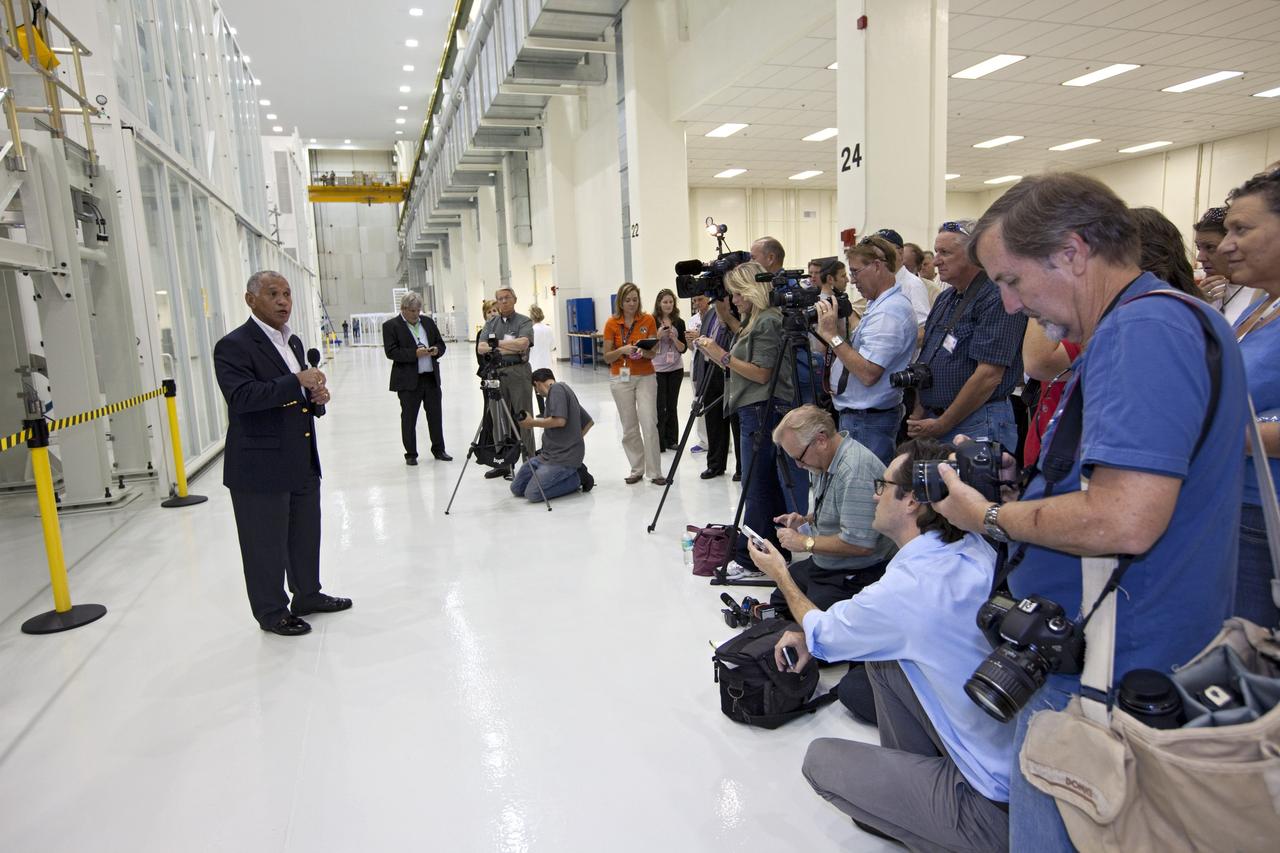
CAPE CANAVERAL, Fla. - NASA Administrator Charles Bolden addresses news media in the Operations and Checkout, or O& C, Building at the Kennedy Space Center in Florida. In the O&C, the Orion EFT-1 spacecraft is being prepared for the program's first flight. Bolden took a few dozen members of the news media on a tour of the space agency's Kennedy Space Center and adjacent Cape Canaveral Air Force Station on Aug. 23, 2012 to show the progress being made for future government and commercial space endeavors that will begin from Florida's Space Coast. For more information, visit: http://www.nasa.gov/centers/kennedy/news/kennedy-bolden-tour.html Photo credit: NASA/Kim Shiflett
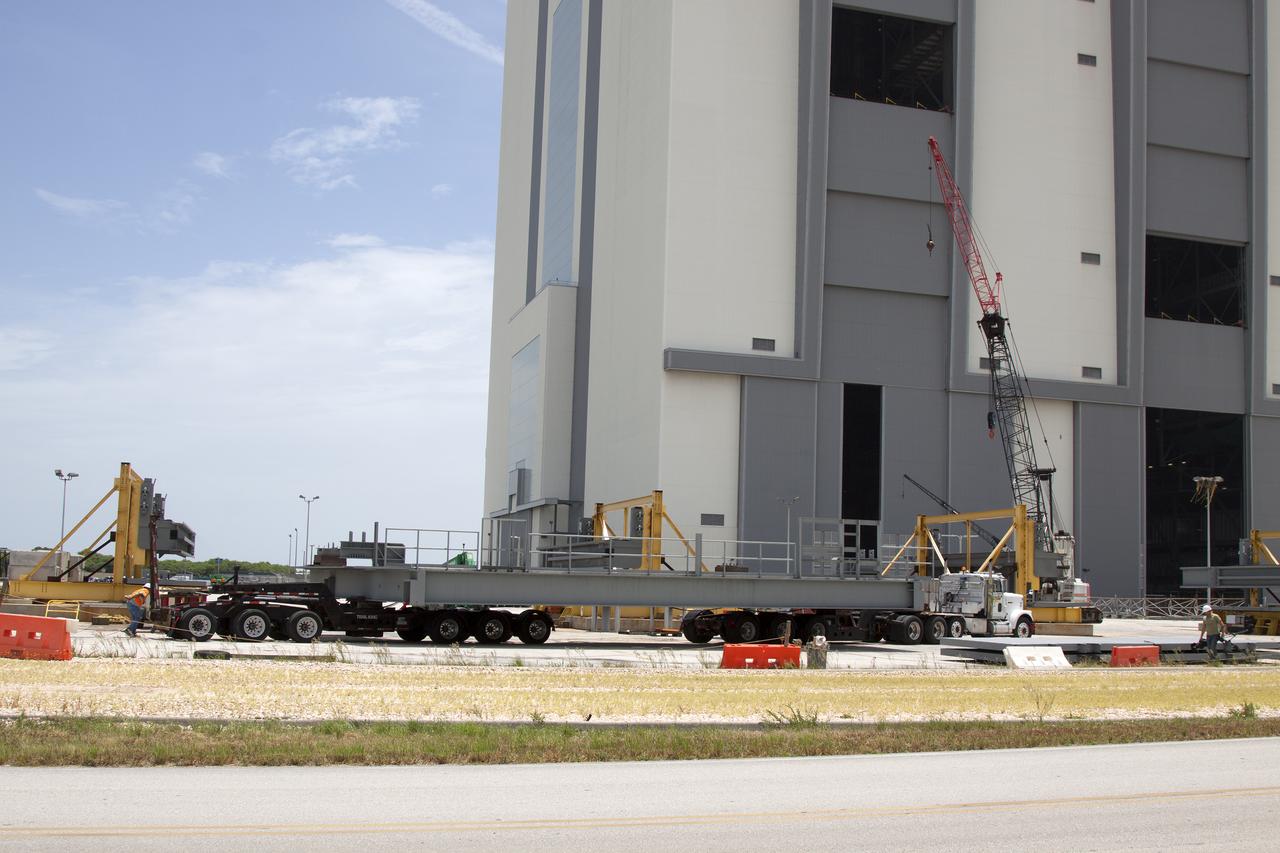
A heavy load transport truck from Tillett Heavy Hauling in Titusville, Florida, arrives at the Vehicle Assembly Building (VAB) at NASA’s Kennedy Space Center in Florida, carrying a section of the first half of the C-level work platforms, C south, for the agency’s Space Launch System (SLS) rocket. The platform will be delivered to the VAB staging area in the west parking lot. The Ground Systems Development and Operations Program is overseeing upgrades and modifications to VAB High Bay 3 to support processing of the SLS and Orion spacecraft. A total of 10 levels of new platforms, 20 platform halves altogether, will surround the SLS rocket and Orion spacecraft and provide access for testing and processing.
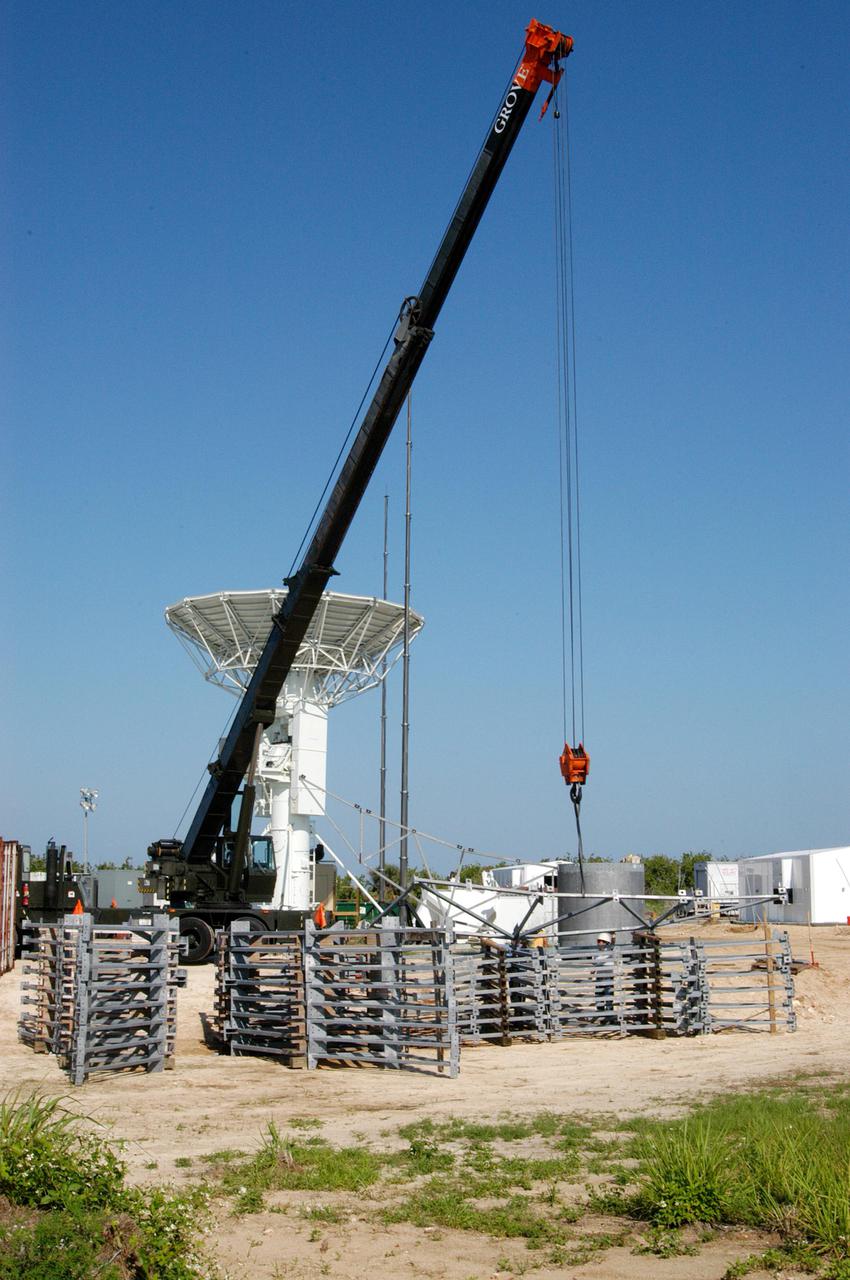
KENNEDY SPACE CENTER, FLA. - At a radar site on North Merritt Island, Fla., north of the Haulover Canal, workers begin assembling the dish for the 50-foot NASA C-band radar. The radar will be used for long-term Shuttle missions to track the launches and observe possible debris coming from the Shuttle. In the background is an existing 30-foot C-band Pathfinder radar whose use was demonstrated on the Delta Messenger launch. It will be used on the upcoming two Return to Flight missions. The launch window for the first Return to Flight mission, STS-114, is July 13 to July 31.
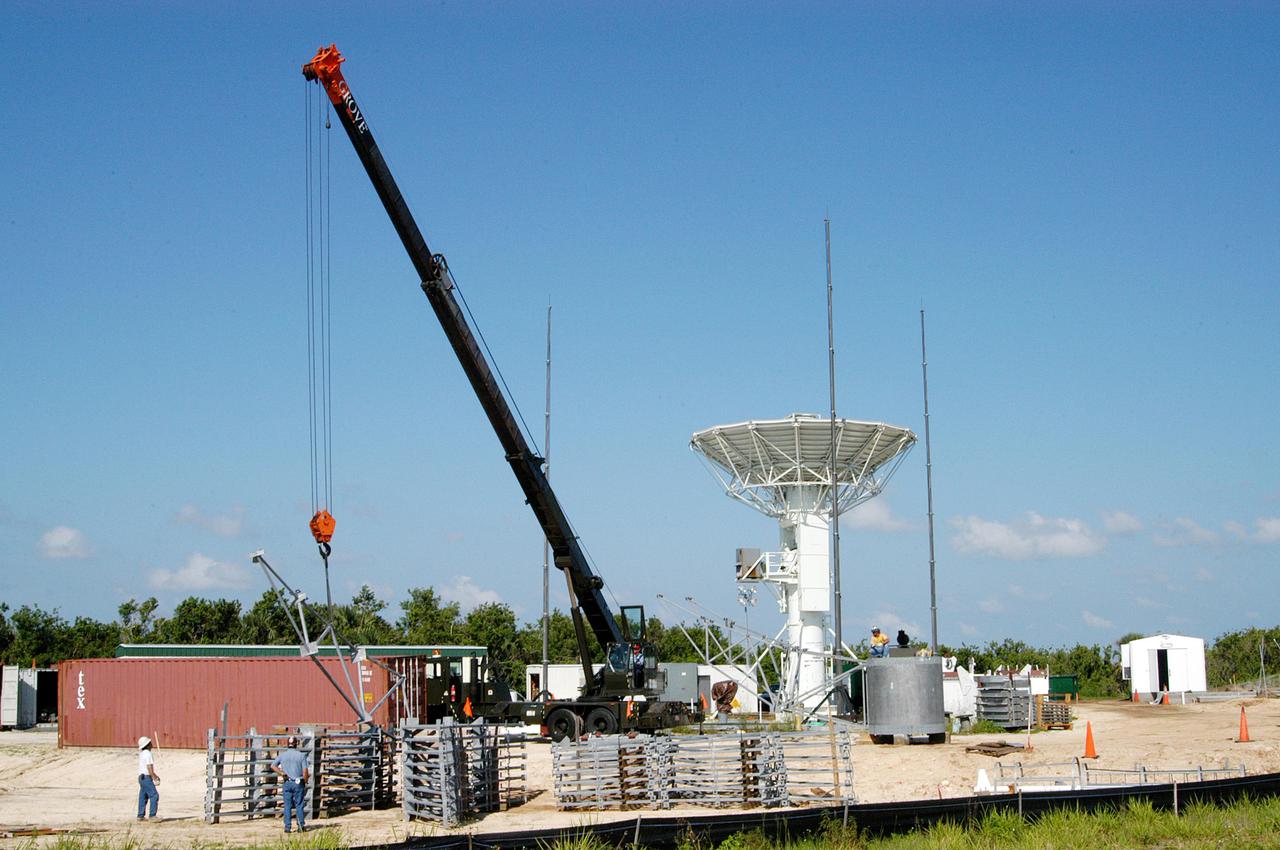
KENNEDY SPACE CENTER, FLA. - At a radar site on North Merritt Island, Fla., north of the Haulover Canal, a 50-foot dish for NASA’s C-band radar is being assembled. The radar will be used for long-term Shuttle missions to track the launches and observe possible debris coming from the Shuttle. In the background is an existing 30-foot C-band Pathfinder radar whose use was demonstrated on the Delta Messenger launch. It will be used on the upcoming two Return to Flight missions. The launch window for the first Return to Flight mission, STS-114, is July 13 to July 31.

KENNEDY SPACE CENTER, FLA. - At a radar site on North Merritt Island, Fla., north of the Haulover Canal, workers are assembling the dish for the 50-foot NASA C-band radar. The radar will be used for long-term Shuttle missions to track the launches and observe possible debris coming from the Shuttle. In the background is an existing 30-foot C-band Pathfinder radar whose use was demonstrated on the Delta Messenger launch. It will be used on the upcoming two Return to Flight missions. The launch window for the first Return to Flight mission, STS-114, is July 13 to July 31..
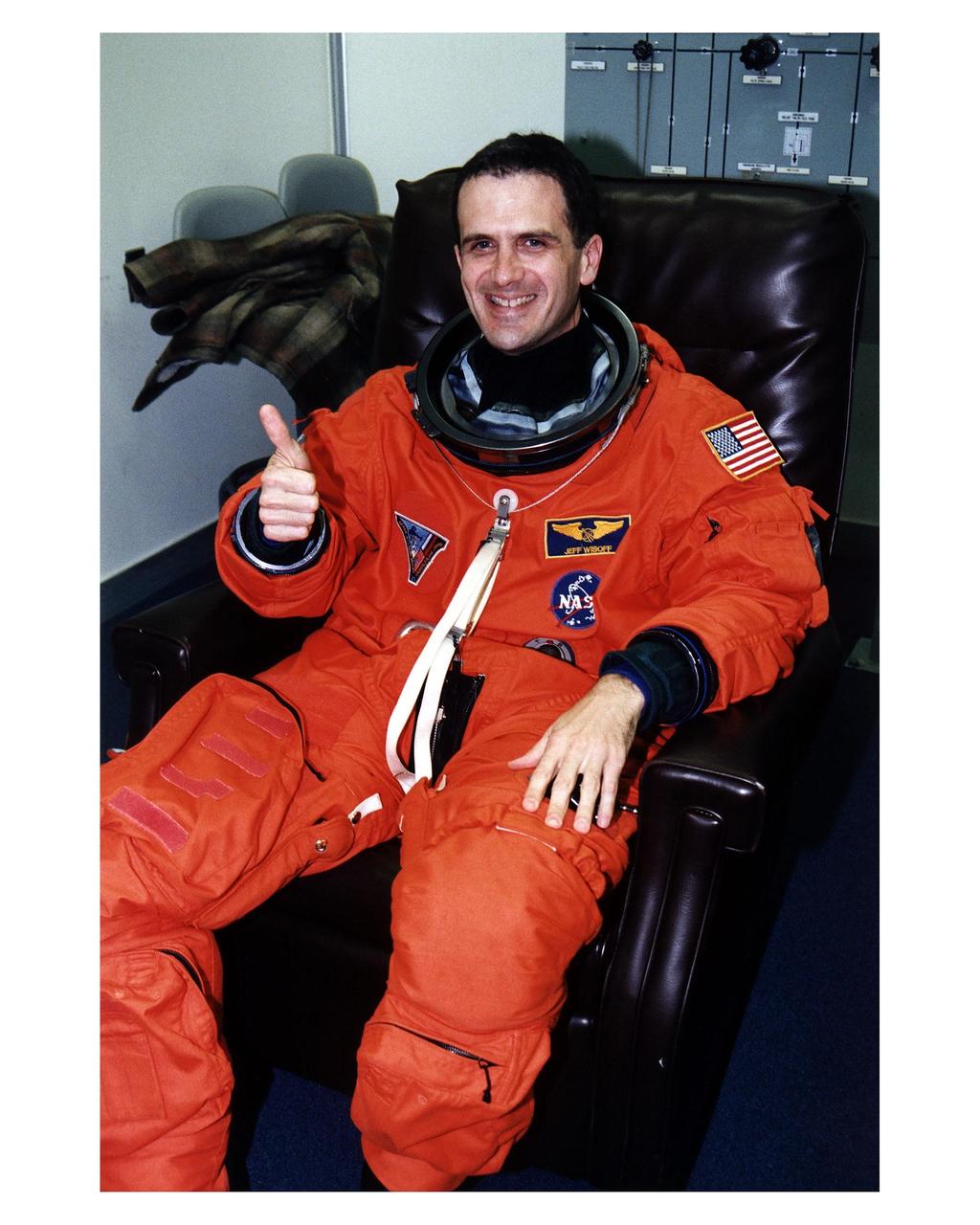
STS-81 Mission Specialist Peter J. K. "Jeff" Wisoff prepares for the fifth ShuttleMir docking as he waits in the Operations and Checkout (O&C) Building for the operation to fit him into his launch/entry suit to be completed. He conducted a spacewalk on his on his first Shuttle mission, STS57 and holds a doctorate degree in applied physics with an emphasis on lasers and semiconductor materials. He and five crew members will shortly depart the O&C and head for Launch Pad 39B, where the Space Shuttle Atlantis will lift off during a 7-minute window that opens at 4:27 a.m. EST, January 12
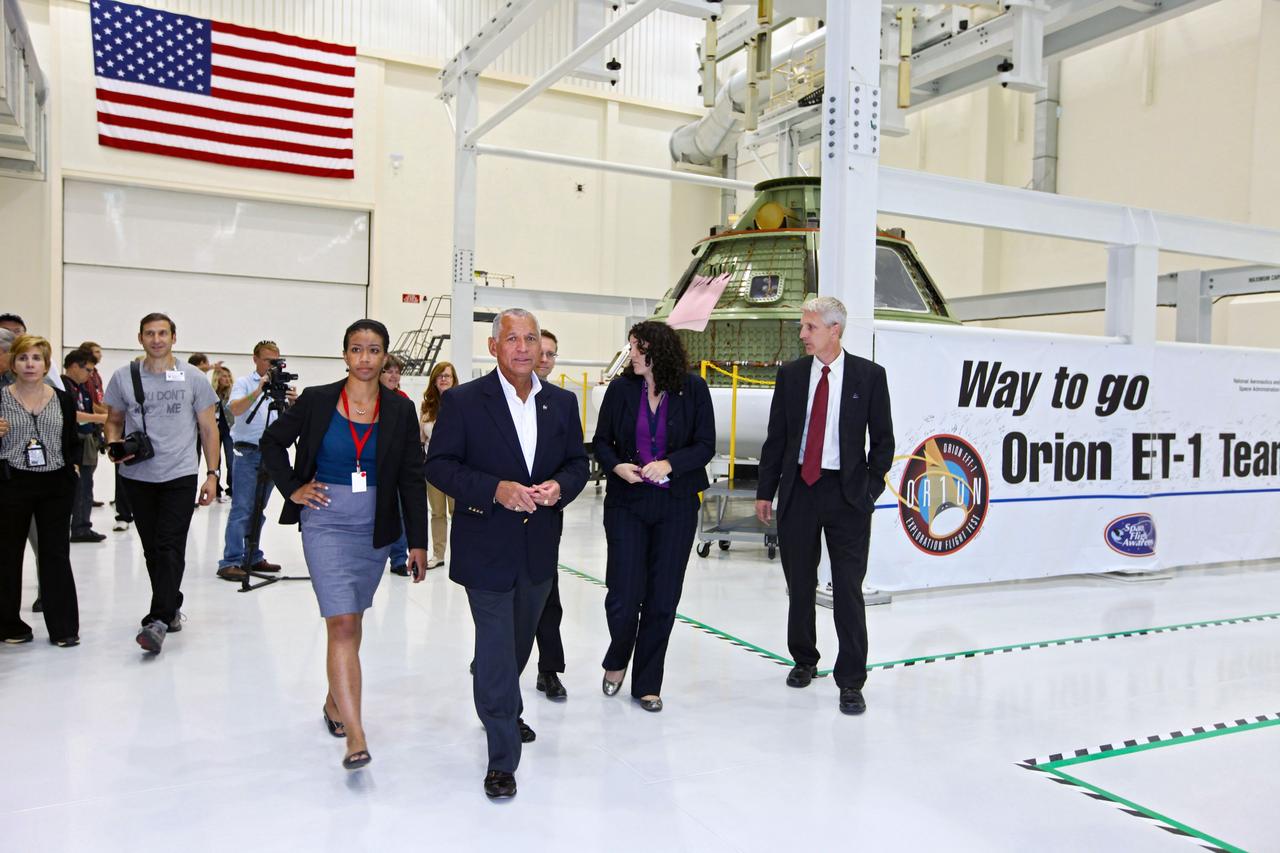
CAPE CANAVERAL, Fla. - NASA Administrator Charles Bolden tours the Operations and Checkout, or O& C, Building at the Kennedy Space Center in Florida. In the O&C, the Orion EFT-1 spacecraft is being prepared for the program's first flight. Bolden took a few dozen members of the news media on a tour of the space agency's Kennedy Space Center and adjacent Cape Canaveral Air Force Station on Aug. 23, 2012 to show the progress being made for future government and commercial space endeavors that will begin from Florida's Space Coast. For more information, visit: http://www.nasa.gov/centers/kennedy/news/kennedy-bolden-tour.html Photo credit: NASA/Kim Shiflett
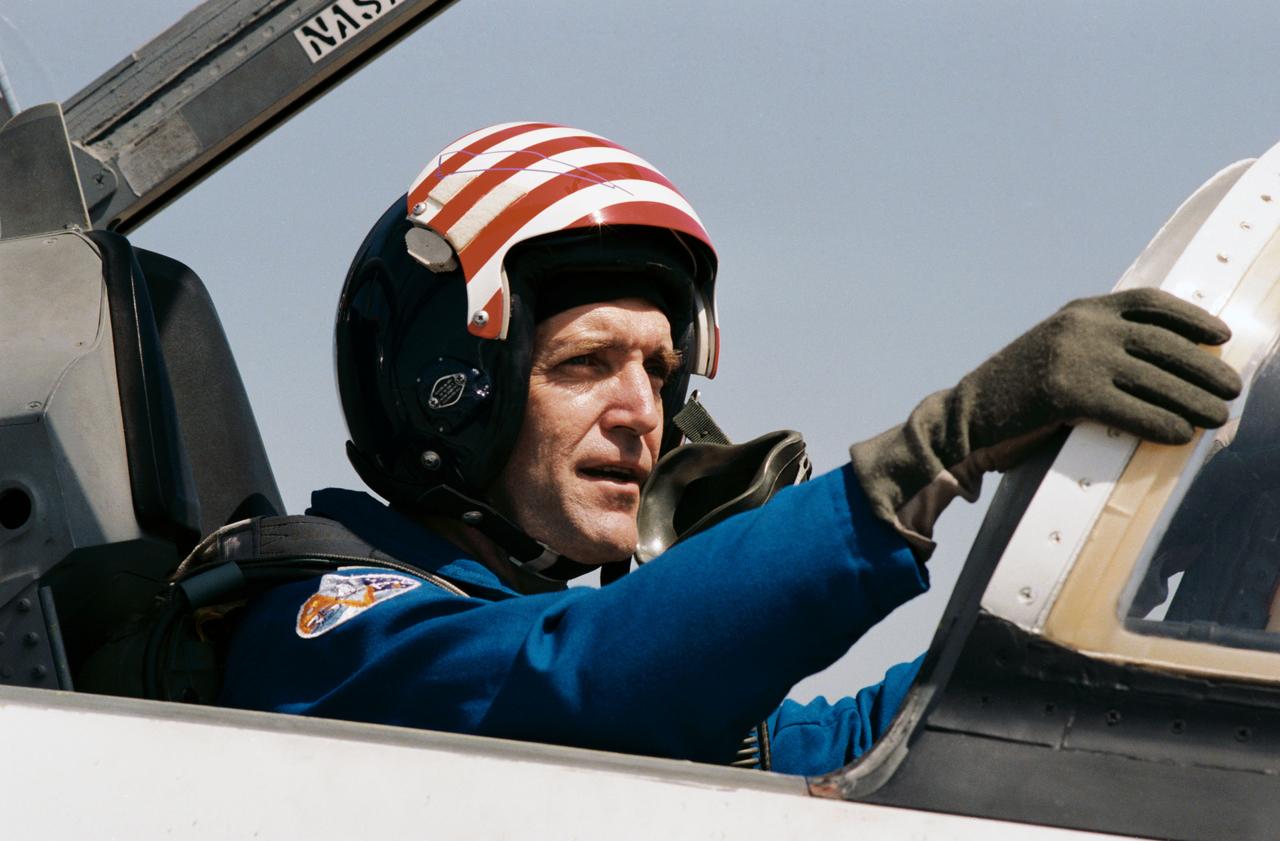
41C-3002 (3 April 1984) --- Astronaut Francis R. (Dick) Scobee, 41-C pilot, is only minutes away from leaving Ellington Air Base in a T-38. Scobee and four other 41-C crewmembers, along with Astronaut John W. Young, are headed for Florida, site of a launch in three days of the Space Shuttle Challenger. Scobee, an experienced pilot, is responsible for helping a number of other NASA astronauts learn to fly. The eleventh Space Shuttle mission will mark his first experience in space. This photograph was taken by Otis Imboden.
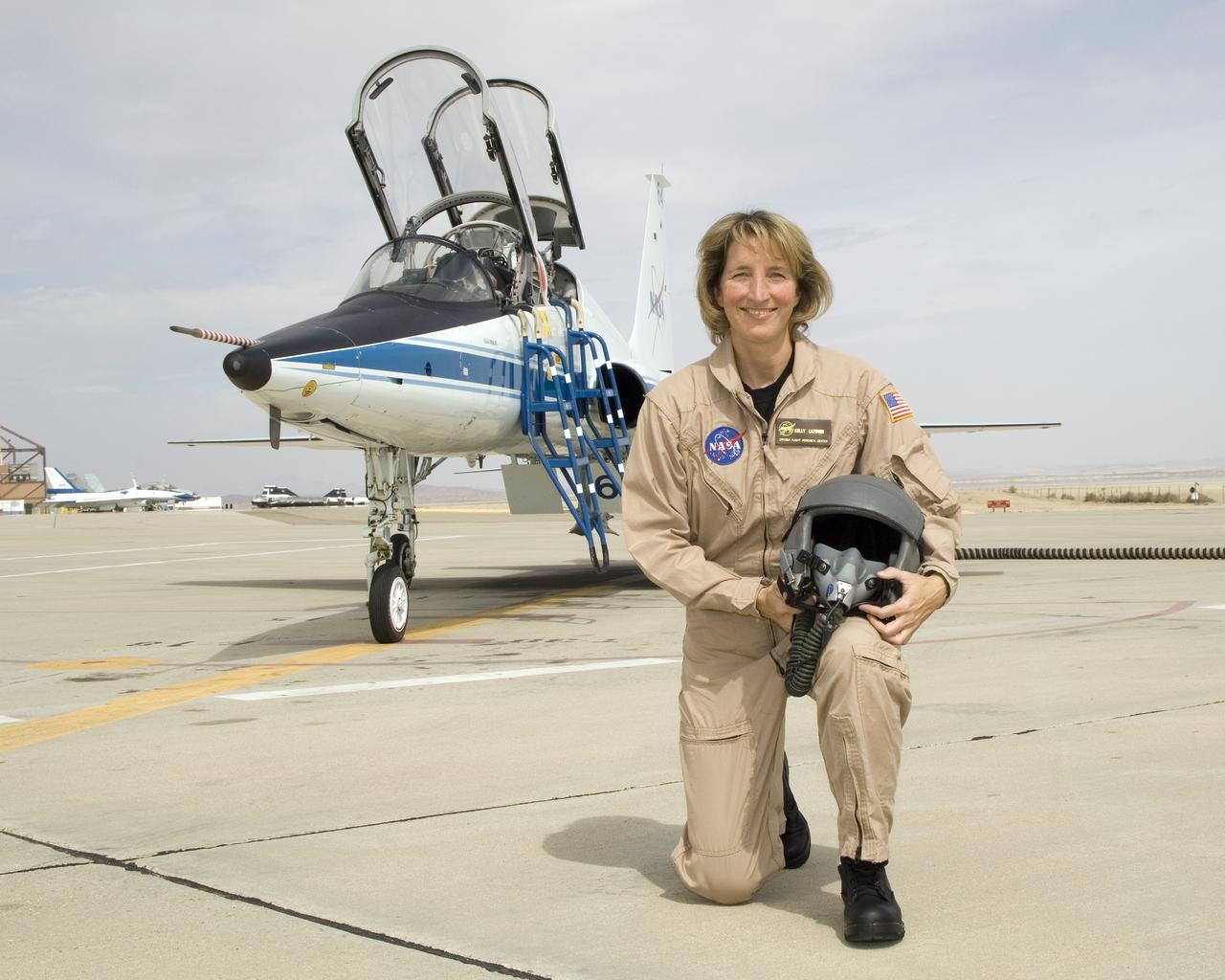
Kelly Latimer is a research pilot in the Flight Crew Branch of NASA's Dryden Flight Research Center, Edwards, Calif. Latimer joined NASA in March 2007 and will fly the T38, T-34, G-III, C-17 and the "Ikhana" Predator B. Latimer is Dryden's first female research test pilot. Prior to joining NASA, Latimer was on active duty with the U.S. Air Force. She has accumulated more than 5,000 hours of military and civilian flight experience in 30 aircraft. Latimer's first association with NASA was while attending graduate school at George Washington University, Washington, D.C. Her studies included work with the Joint Institute for the Advancement of Flight Sciences at NASA's Langley Research Center, Hampton, Va. She flew an Air Force C-17 during a 2005 NASA study to reduce aircraft noise. A team of California Polytechnic State University students and Northrop Grumman personnel were stationed on Rogers Dry Lake located at Edwards Air Force Base, Calif., to record the noise footprint of the aircraft as it made various landing approaches to Edwards' runway. Latimer completed undergraduate pilot training at Reese Air Force Base, Texas, in 1990. She remained at Reese as a T-38 instructor pilot until 1993. She was assigned as a C-141 aircraft commander at McCord Air Force Base, Tacoma, Wash., until 1996. Latimer graduated from the U.S. Air Force Test Pilot School at Edwards in Class 96B. She served as a C-17 and C-141 experimental test pilot at Edwards until 2000. She then became the chief of the Performance Branch and a T-38 instructor pilot at The Air Force Test Pilot School. She returned to McCord in 2002, where she was a C-17 aircraft commander and the operations officer for the 62nd Operations Support Squadron. In 2004, Latimer became the commander of Edwards' 418th Flight Test Squadron and director of the Global Reach Combined Test Force. Following that assignment, she deployed to Iraq as an advisor to the Iraqi Air Force. Her last active duty tour was as an instructor a
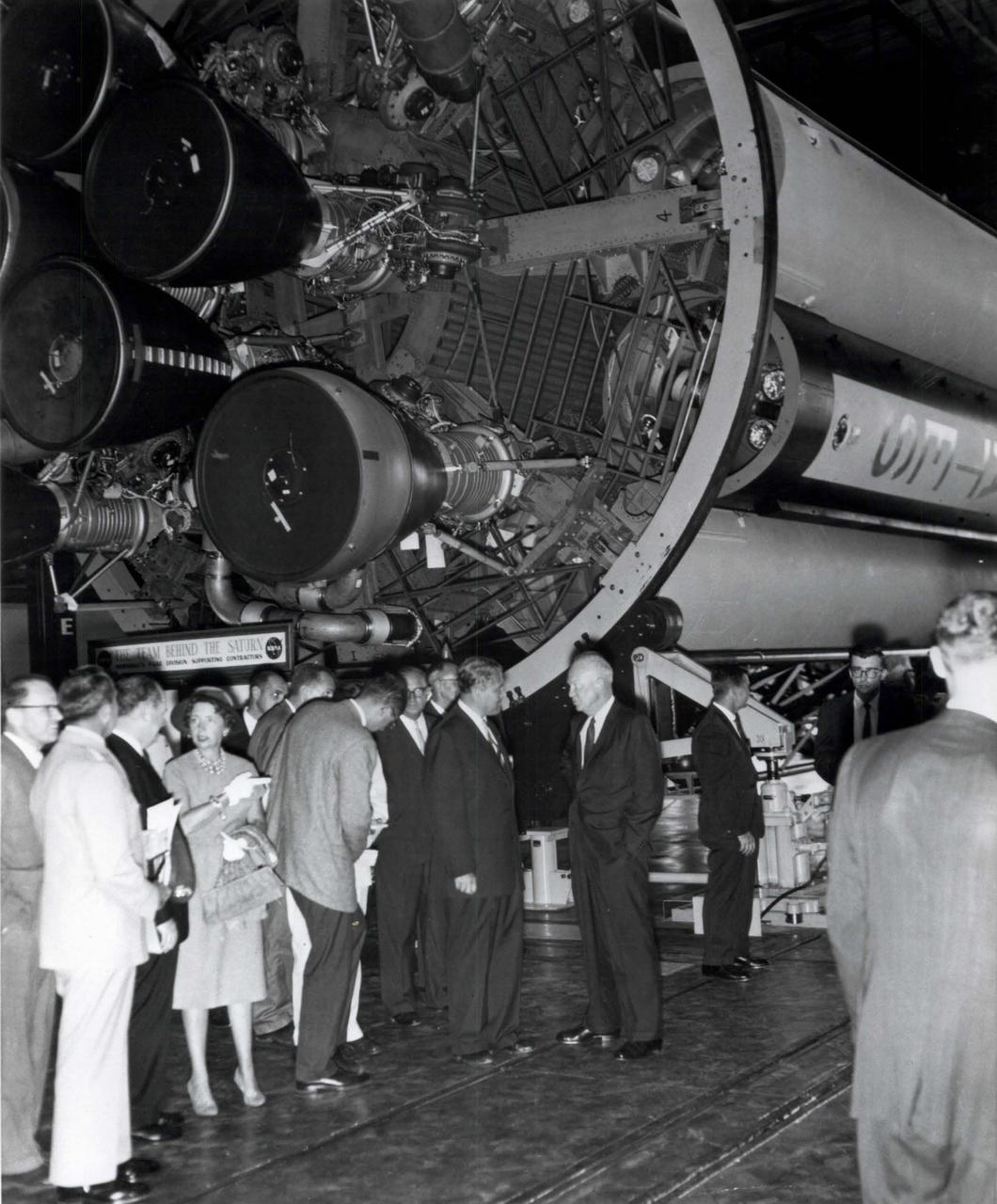
On September 8, 1960 President Dwight D. Eisenhower visited Huntsville, Alabama to dedicate a new NASA field center in honor of General George C. Marshall, Eisenhower's wartime colleague and the founder of the famous Marshall Plan for European recover after World War II. The new George C. Marshall Space Flight Center was placed under the control of Dr. Wernher Von Braun shown here talking with President Eisenhower. As parto f his remarks dedicating the center, President Eisenhowe refereed to General Marshall as a "man of yar, yet a builder of peace". the Marshall Center's first major assignment including building the huge Saturn V rocket that launched human beings on their first journey to the surface of the moon in 1969.
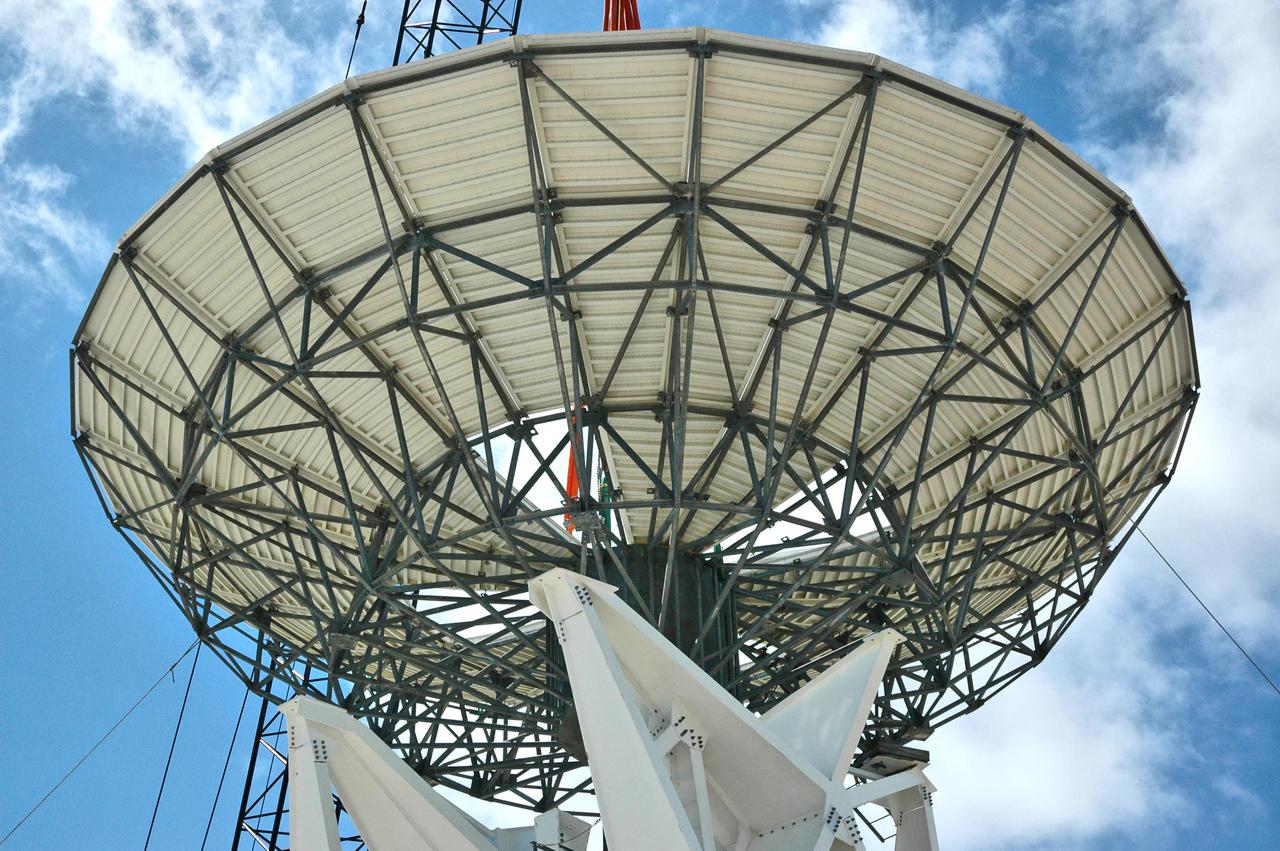
KENNEDY SPACE CENTER, FLA. - At a radar site on North Merritt Island, Fla., the 50-foot C-band radar antenna dish is lowered toward the top of the support structure. It will be placed on the counterweights installed there. The radar will be used for Shuttle missions to track the launches and observe possible debris coming from the Shuttle. It will be used for the first time on STS-114. The launch window for the first Return to Flight mission is July 13 to July 31.
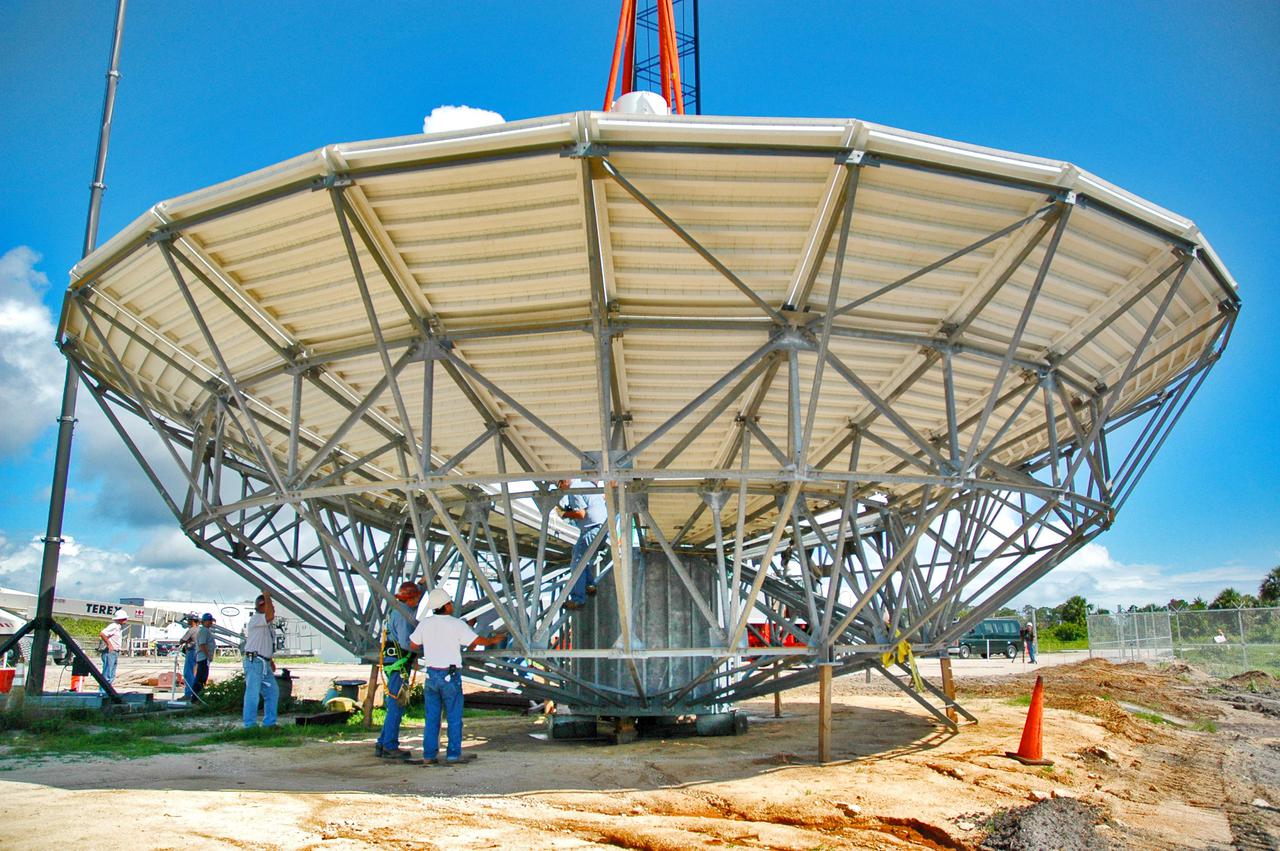
KENNEDY SPACE CENTER, FLA. - At a radar site on North Merritt Island, Fla., the 50-foot C-band radar antenna dish is prepared to be lifted onto the top of a support structure. The radar will be used for Shuttle missions to track the launches and observe possible debris coming from the Shuttle. It will be used for the first time on STS-114. The launch window for the first Return to Flight mission is July 13 to July 31.
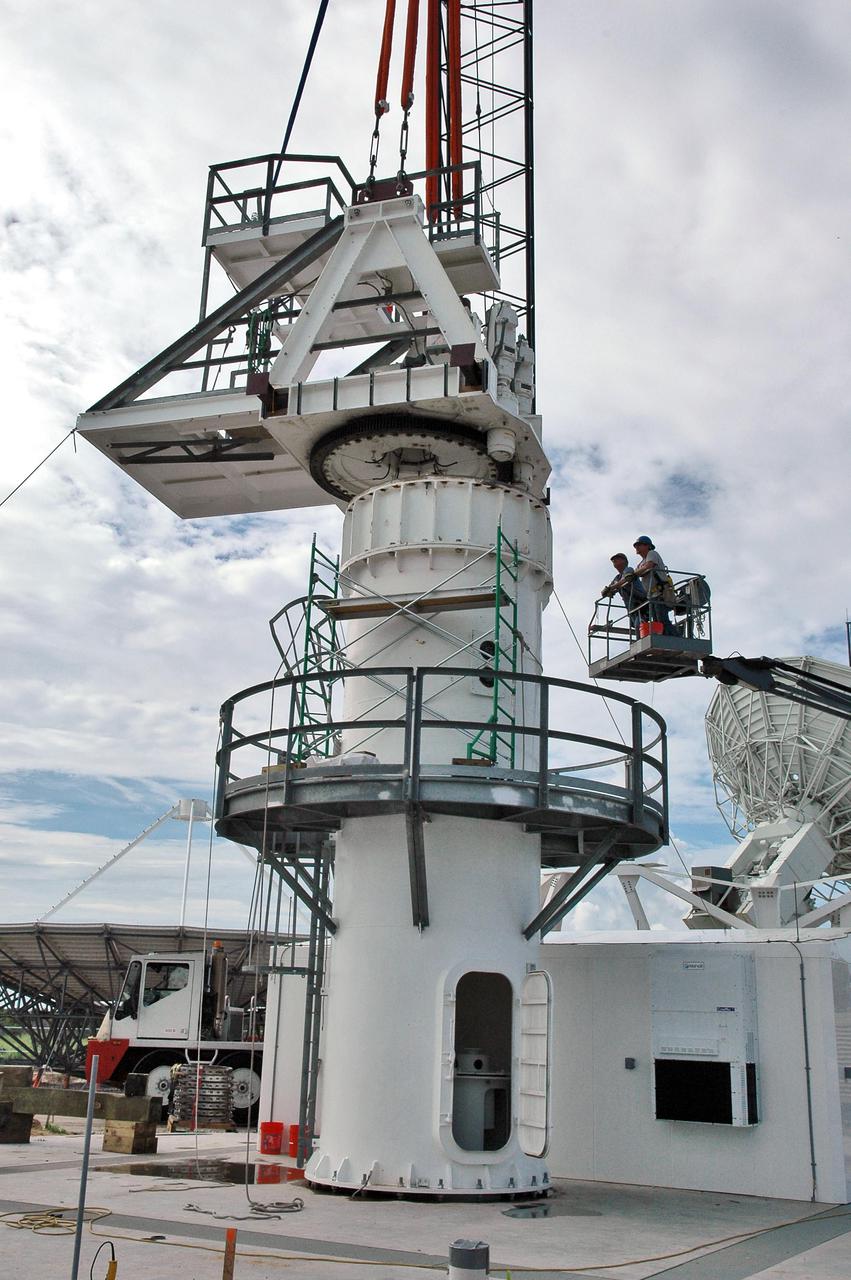
KENNEDY SPACE CENTER, FLA. - On a radar site on North Merritt Island, Fla., part of the structure for the support base for a 50-foot C-band radar antenna is put in position.The radar will be used for Shuttle missions to track the launches and observe possible debris coming from the Shuttle. It will be used for the first time on STS-114. The launch window for the first Return to Flight mission is July 13 to July 31.