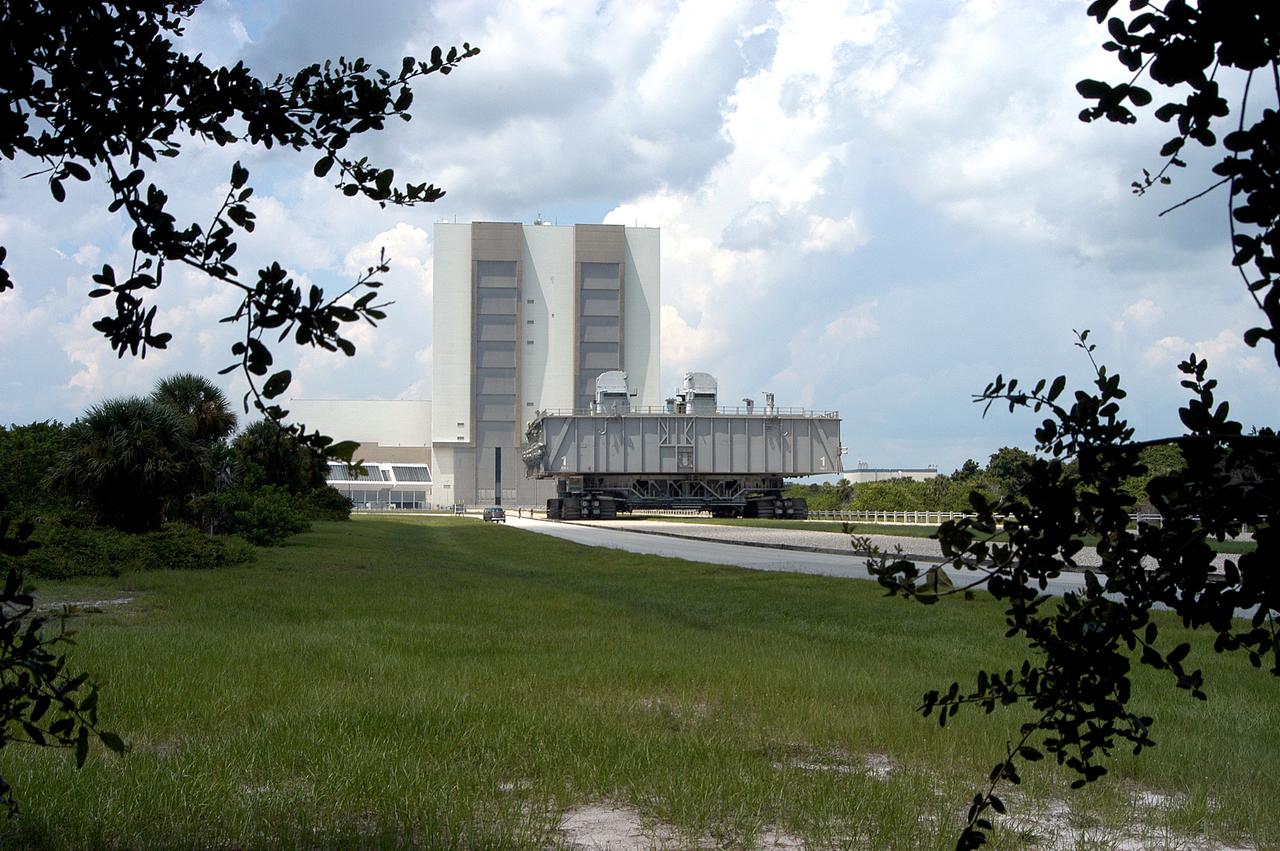
KENNEDY SPACE CENTER, FLA. -Crawler-transporter (CT) number 2, moves away from the Vehicle Assembly Building, with a Mobile Launcher Platform on top, on a test run to the launch pad. The CT recently underwent modifications to the cab. The CT moves Space Shuttle vehicles between the VAB and launch pad. Moving on four double-tracked crawlers, the CT uses a laser guidance system and a leveling system for the journey that keeps the top of a Space Shuttle vertical within plus- or minus-10 minutes of arc. The system enables the CT-MLP-Shuttle to negotiate the ramp leading to the launch pads and keep the load level. Unloaded, the CT weighs 6 million pounds.
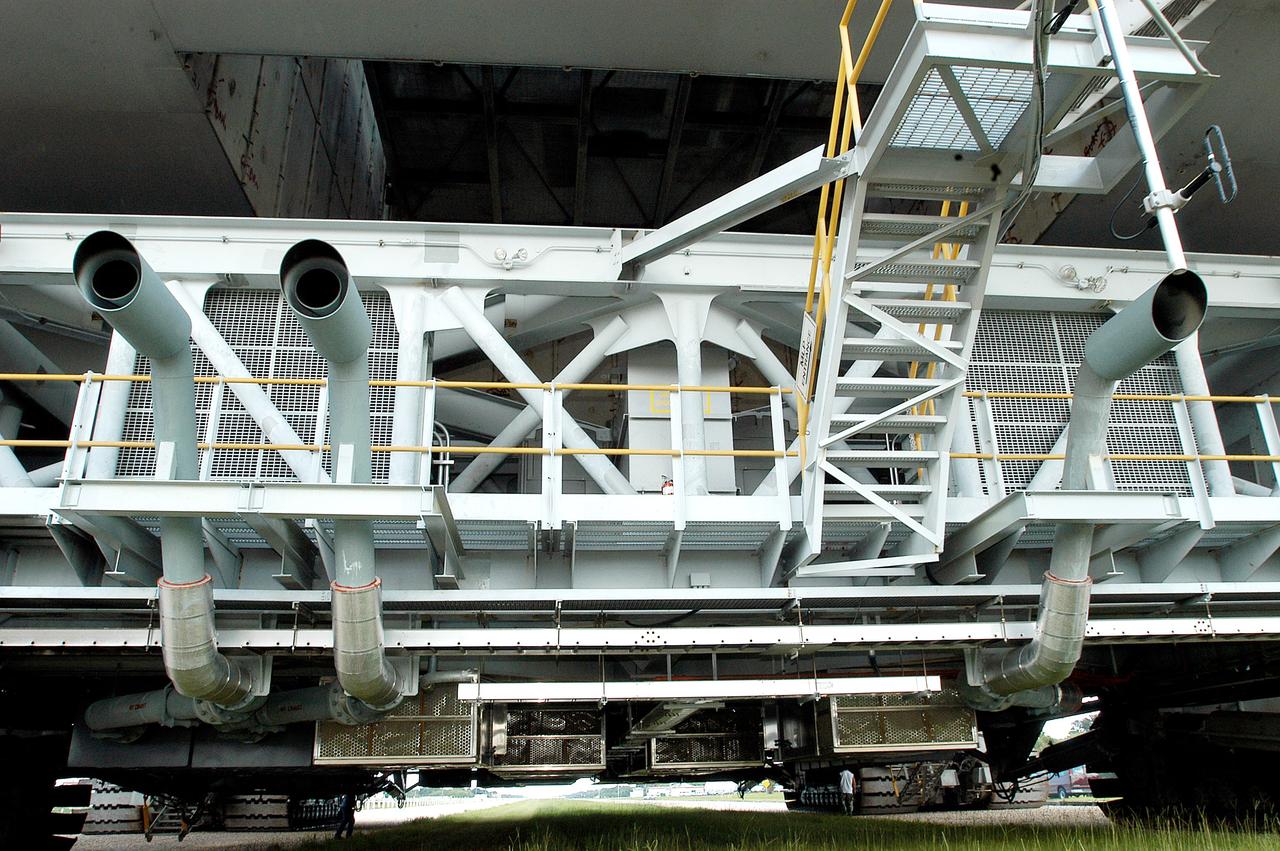
KENNEDY SPACE CENTER, FLA. - A closeup of crawler-transportation (CT) number 2 shows the new muffler system on the vehicle. The CT also recently underwent modifications to the cab. The CT is transporting a Mobile Launch Platform (MLP). The CT moves Space Shuttle vehicles, situated on the MLP, between the VAB and launch pad. Moving on four double-tracked crawlers, the CT uses a laser guidance system and a leveling system for the journey that keeps the top of a Space Shuttle vertical within plus- or minus-10 minutes of arc. The system enables the CT-MLP-Shuttle to negotiate the ramp leading to the launch pads and keep the load level. Unloaded, the CT weighs 6 million pounds. Seen on top of the MLP are two tail service masts that support the fluid, gas and electrical requirements of the orbiter’s liquid oxygen and liquid hydrogen aft umbilicals.
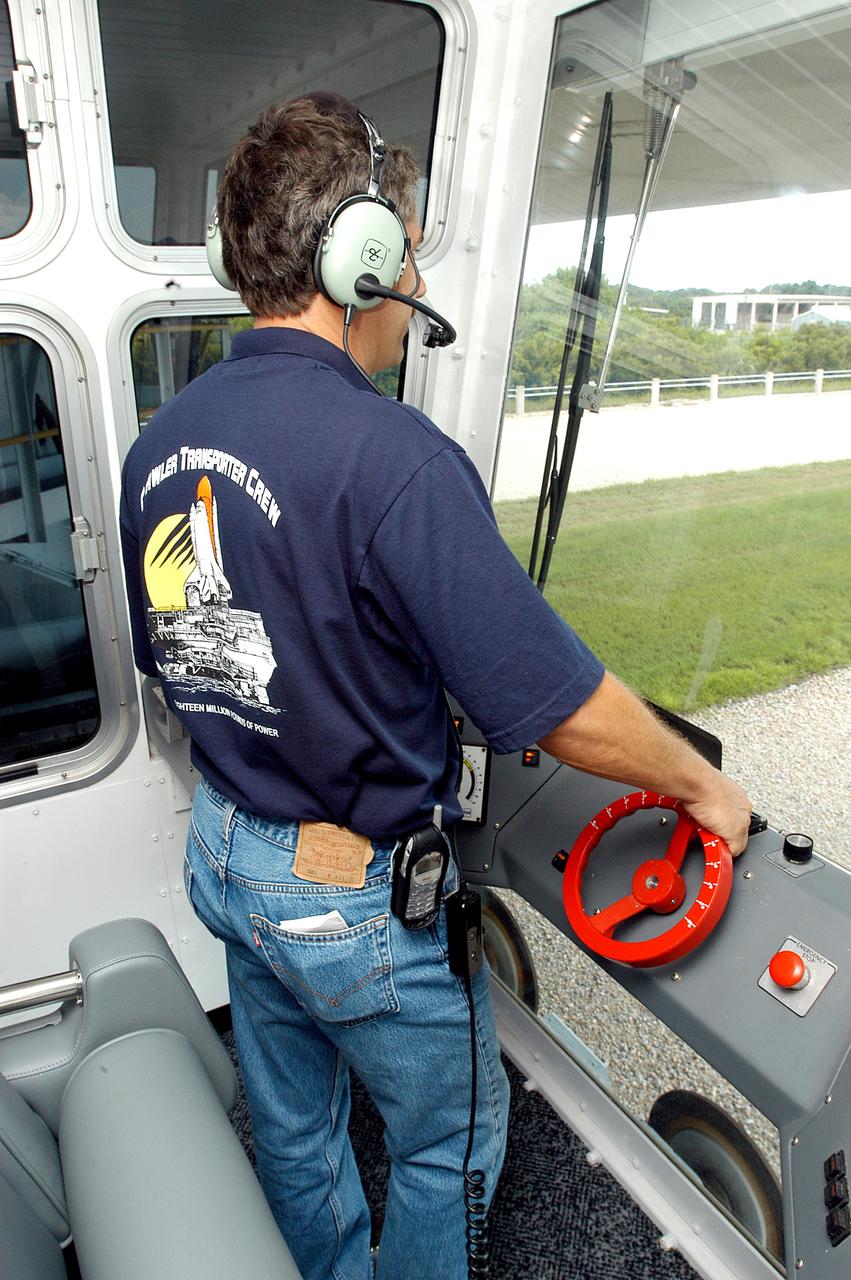
KENNEDY SPACE CENTER, FLA. - Inside the cab of crawler-transporter (CT) number 2, driver Sam Dove, with United Space Alliance, operates the vehicle on a test run to the launch pad. The CT recently underwent modifications to the cab. The CT is transporting a Mobile Launch Platform (MLP). The CT moves Space Shuttle vehicles, situated on the MLP, between the VAB and launch pad. Moving on four double-tracked crawlers, the CT uses a laser guidance system and a leveling system for the journey that keeps the top of a Space Shuttle vertical within plus- or minus-10 minutes of arc. The system enables the CT-MLP-Shuttle to negotiate the ramp leading to the launch pads and keep the load level. Unloaded, the CT weighs 6 million pounds. Seen on top of the MLP are two tail service masts that support the fluid, gas and electrical requirements of the orbiter’s liquid oxygen and liquid hydrogen aft umbilicals.
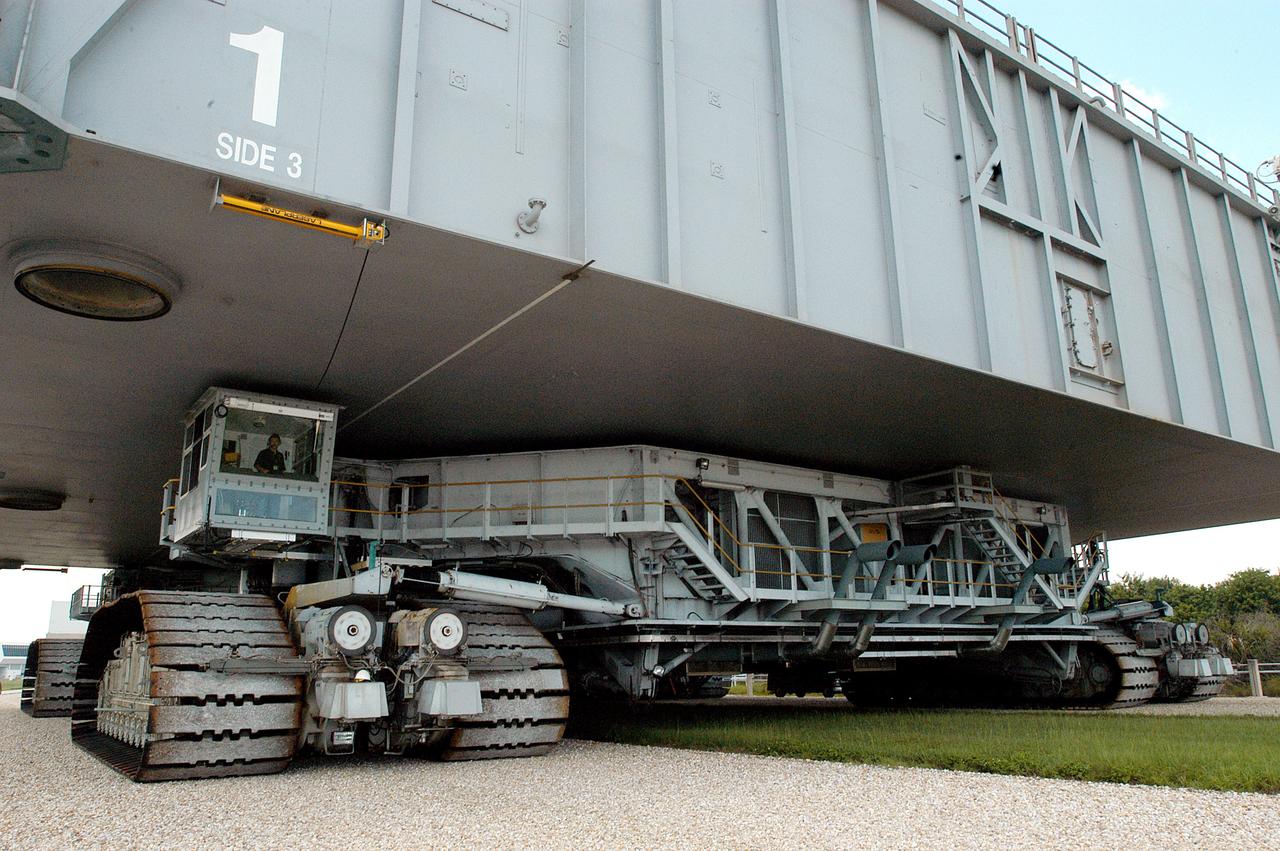
KENNEDY SPACE CENTER, FLA. - A closeup of crawler-transporter (CT) number 2 shows the cab (left, above the tracks) that recently underwent modifications. The CT is transporting a Mobile Launch Platform (MLP) on a test run to the pad. The CT moves Space Shuttle vehicles, situated on the MLP, between the VAB and launch pad. Moving on four double-tracked crawlers, the CT uses a laser guidance system and a leveling system for the journey that keeps the top of a Space Shuttle vertical within plus- or minus-10 minutes of arc. The system enables the CT-MLP-Shuttle to negotiate the ramp leading to the launch pads and keep the load level. Unloaded, the CT weighs 6 million pounds. Seen on top of the MLP are two tail service masts that support the fluid, gas and electrical requirements of the orbiter’s liquid oxygen and liquid hydrogen aft umbilicals.
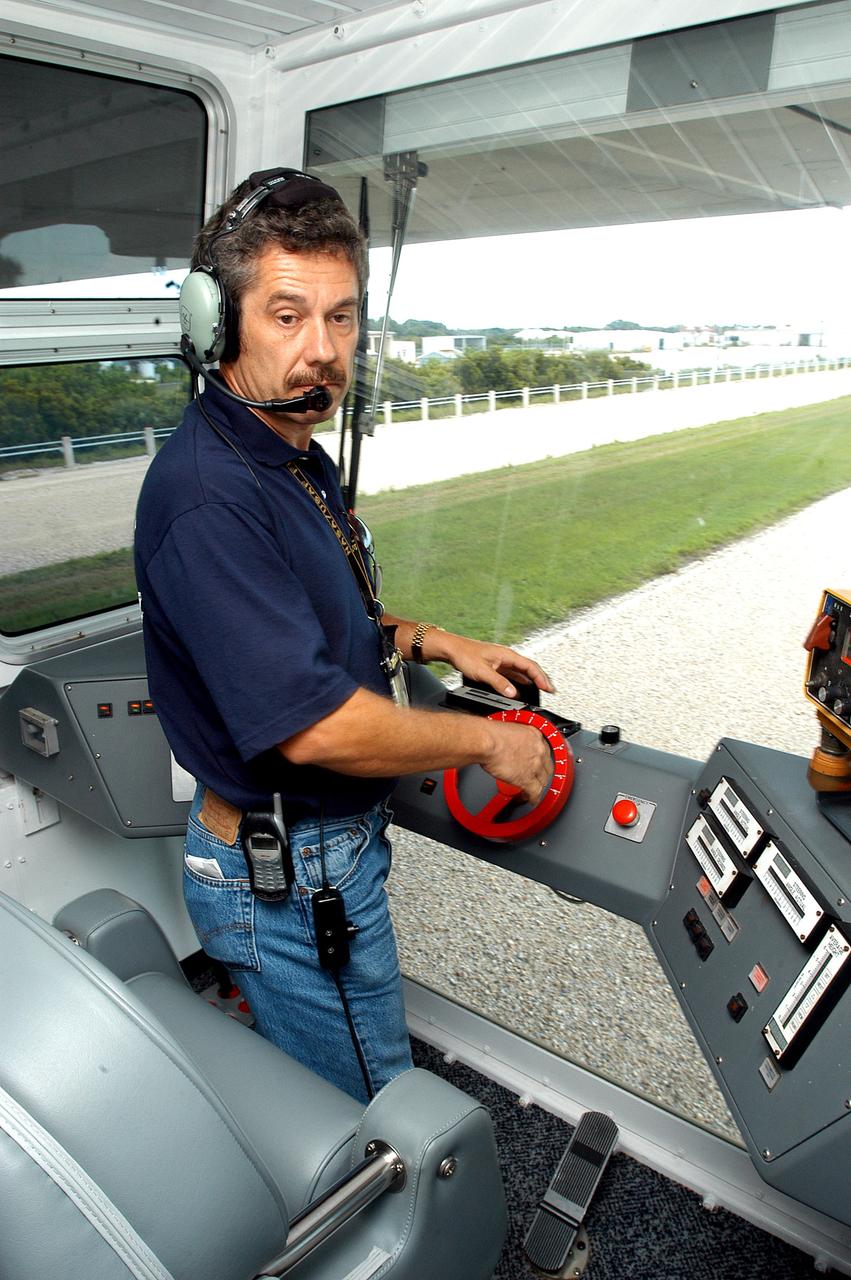
KENNEDY SPACE CENTER, FLA. - Inside the cab of crawler-transporter (CT) number 2, driver Sam Dove, with United Space Alliance, operates the vehicle on a test run to the launch pad. The CT recently underwent modifications to the cab. The CT is transporting a Mobile Launch Platform (MLP). The CT moves Space Shuttle vehicles, situated on the MLP, between the VAB and launch pad. Moving on four double-tracked crawlers, the CT uses a laser guidance system and a leveling system for the journey that keeps the top of a Space Shuttle vertical within plus- or minus-10 minutes of arc. The system enables the CT-MLP-Shuttle to negotiate the ramp leading to the launch pads and keep the load level. Unloaded, the CT weighs 6 million pounds. Seen on top of the MLP are two tail service masts that support the fluid, gas and electrical requirements of the orbiter’s liquid oxygen and liquid hydrogen aft umbilicals.
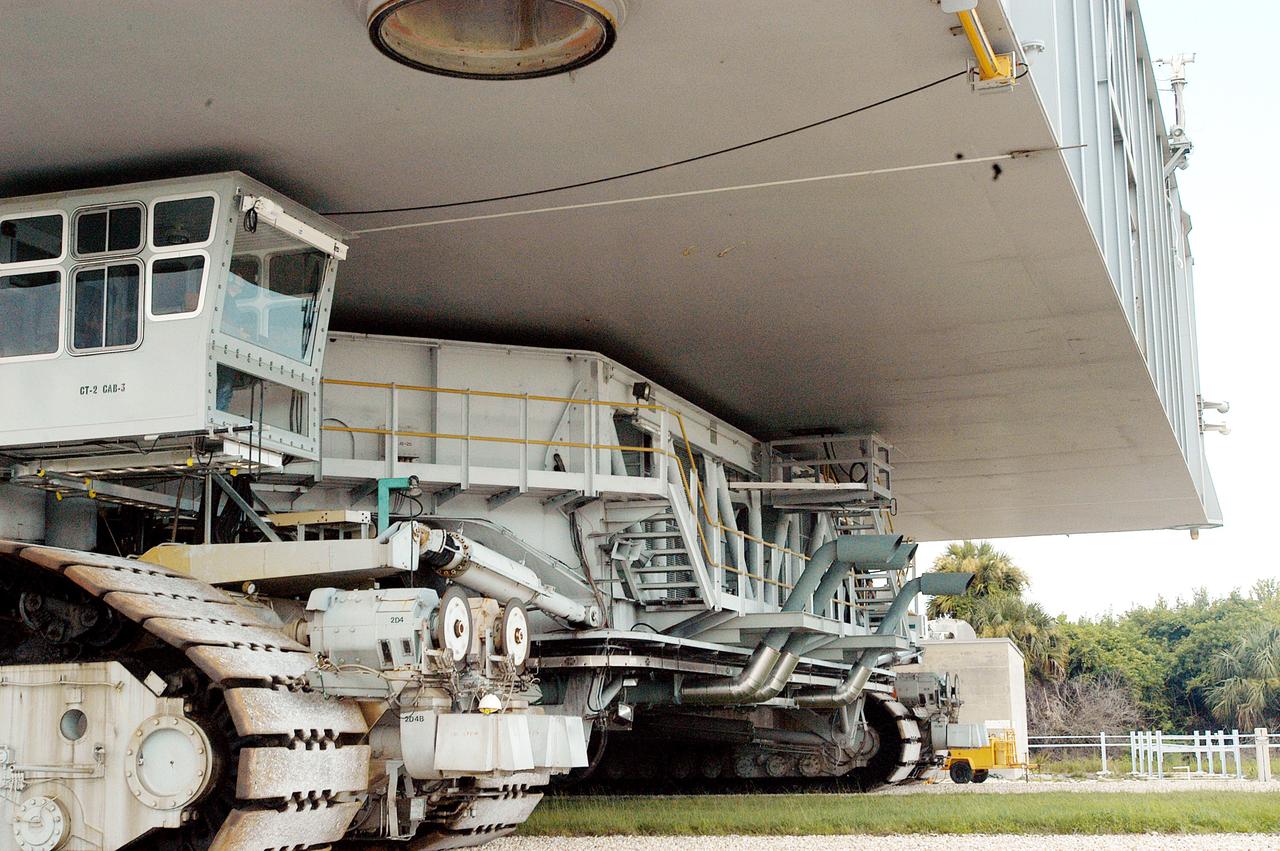
KENNEDY SPACE CENTER, FLA. - A closeup of crawler-transporter (CT) number 2 shows the cab, at left, that recently underwent modifications. The CT is transporting a Mobile Launch Platform (MLP) on a test run to the pad. The CT moves Space Shuttle vehicles, situated on the MLP, between the VAB and launch pad. Moving on four double-tracked crawlers, the CT uses a laser guidance system and a leveling system for the journey that keeps the top of a Space Shuttle vertical within plus- or minus-10 minutes of arc. The system enables the CT-MLP-Shuttle to negotiate the ramp leading to the launch pads and keep the load level. Unloaded, the CT weighs 6 million pounds. Seen on top of the MLP are two tail service masts that support the fluid, gas and electrical requirements of the orbiter’s liquid oxygen and liquid hydrogen aft umbilicals.
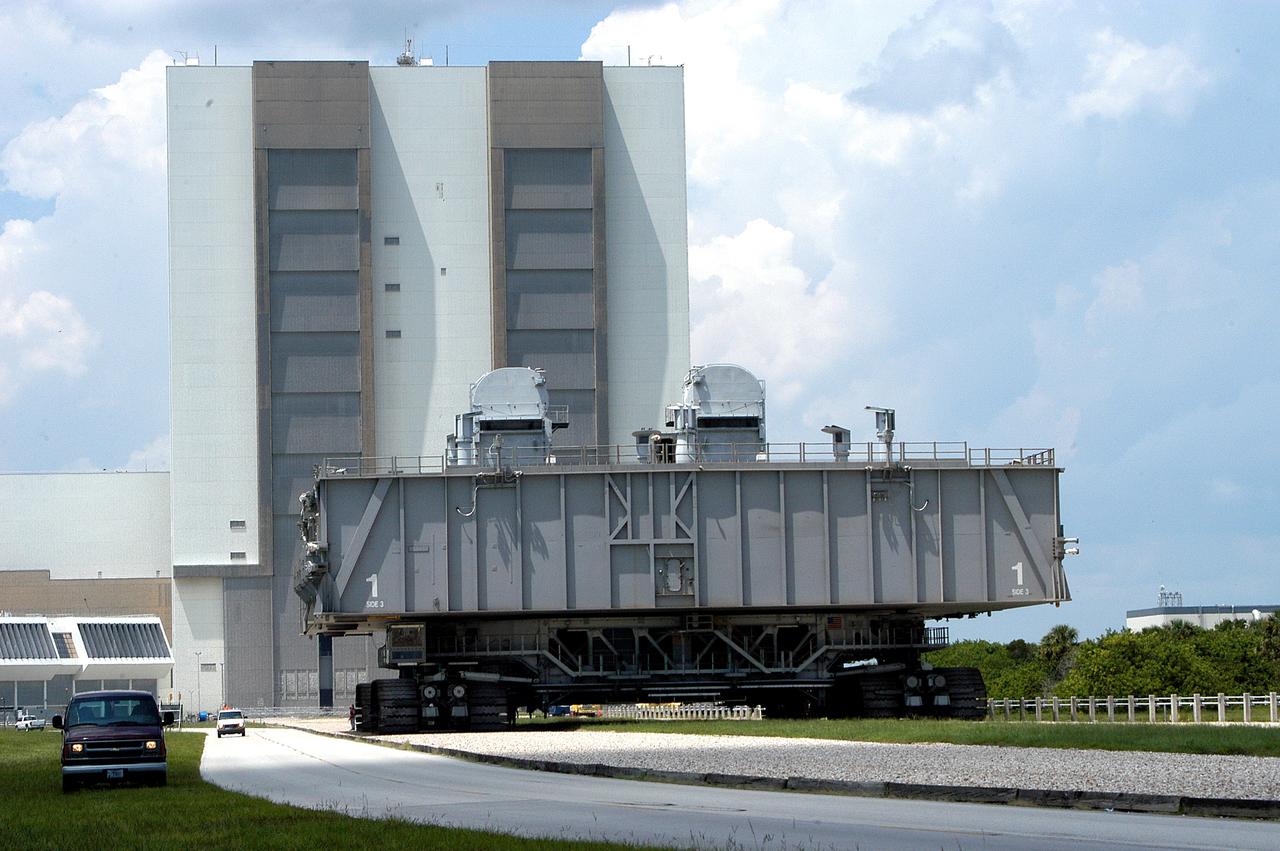
KENNEDY SPACE CENTER, FLA. - Crawler-transporter (CT) number 2, moves away from the Vehicle Assembly Building with a Mobile Launcher Platform (MLP) on top on a test run to the launch pad. The CT recently underwent modifications to the cab. The CT moves Space Shuttle vehicles, situated on the MLP, between the VAB and launch pad. Moving on four double-tracked crawlers, the CT uses a laser guidance system and a leveling system for the journey that keeps the top of a Space Shuttle vertical within plus- or minus-10 minutes of arc. The system enables the CT-MLP-Shuttle to negotiate the ramp leading to the launch pads and keep the load level. Unloaded, the CT weighs 6 million pounds. Seen on top of the MLP are two tail service masts that support the fluid, gas and electrical requirements of the orbiter’s liquid oxygen and liquid hydrogen aft umbilicals.
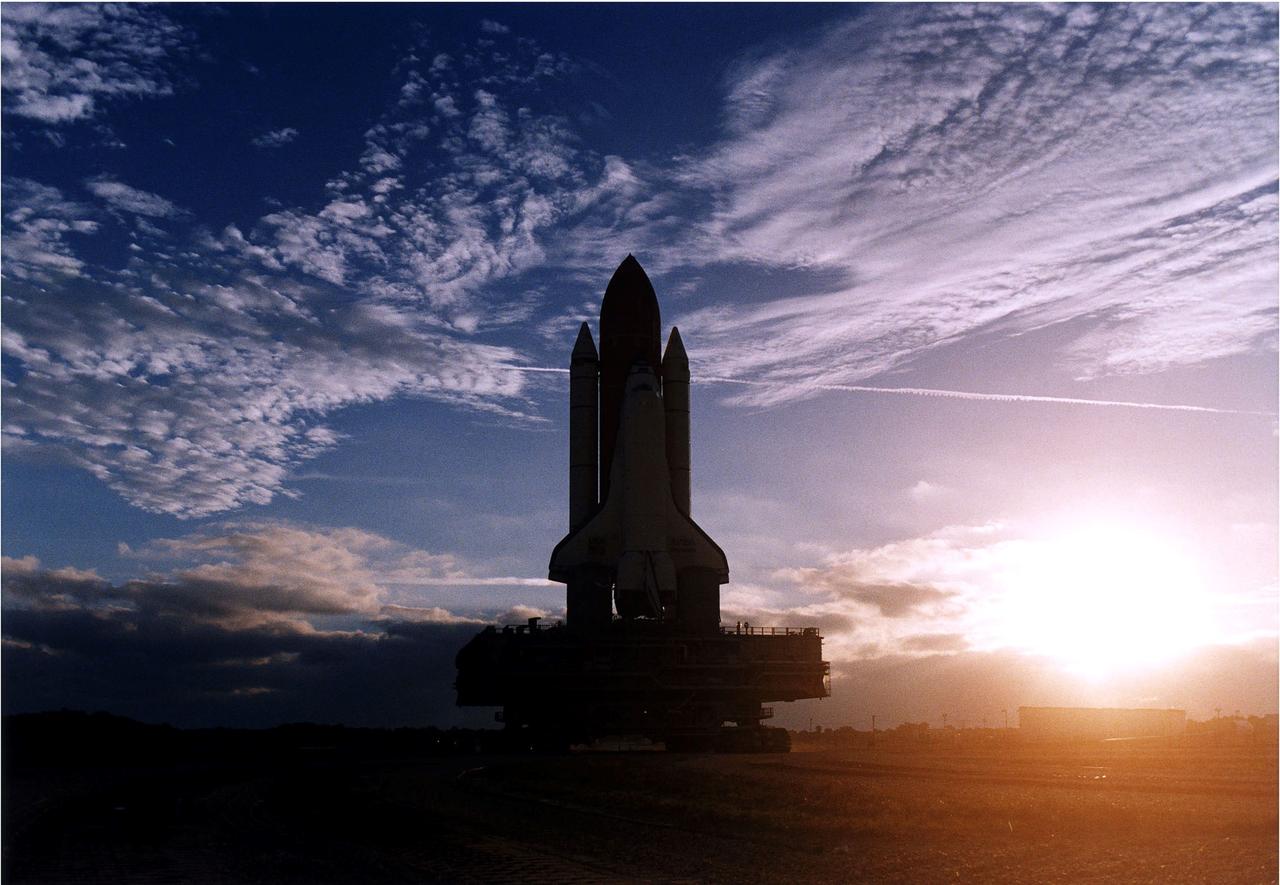
KENNEDY SPACE CENTER, FLA. - The rising sun and some scattered clouds provide a picturesque backdrop for the Space Shuttle Discovery as it travels along the crawlerway toward Launch Pad 39A in preparation for the STS-82 mission. The Shuttle is on a Mobile Launcher Platform, and the entire assemblage is being carried by a large, tracked vehicle called the crawler transporter. A seven-member crew will perform the second servicing of the orbiting Hubble Space Telescope (HST) during the 10-day STS-82 flight, whcih is targeted for a Feb. 11 liftoff.
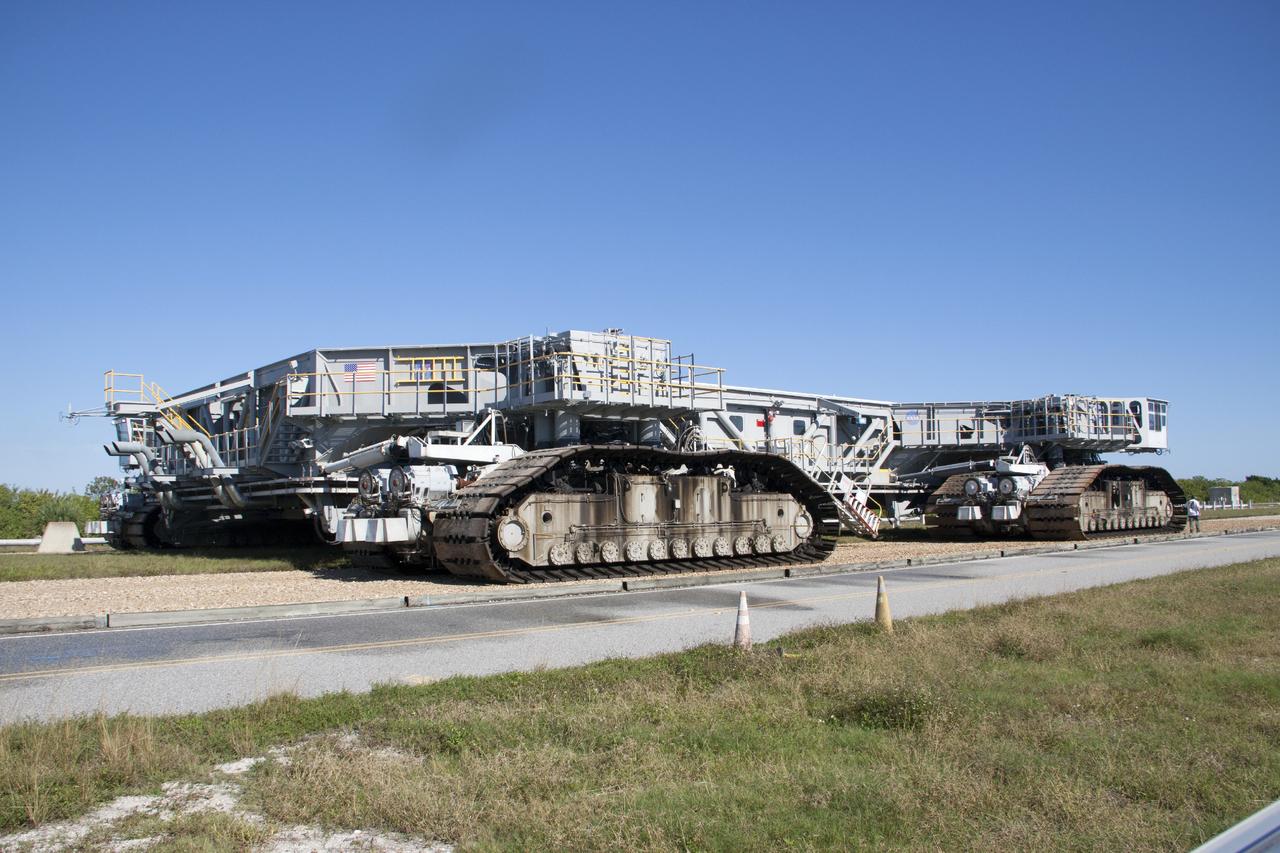
CAPE CANAVERAL, Fla. -- Crawler-transporter 1 continues its trek on the crawlerway to Launch Pad 39A at NASA’s Kennedy Space Center in Florida. New jacking, equalizing and leveling, or JEL, hydraulic cylinders were installed on CT-1 and will be tested for increased load carrying capacity and reliability. The Ground Systems Development and Operations Program at Kennedy continues to upgrade the crawler-transporter as part of its general maintenance. CT-1 could be available to carry a variety of launch vehicles to the launch pad. Two crawler-transporters were used to carry the mobile launcher platform and space shuttle to Launch Complex 39 for space shuttle launches for 30 years. Photo credit: NASA/Jim Grossmann
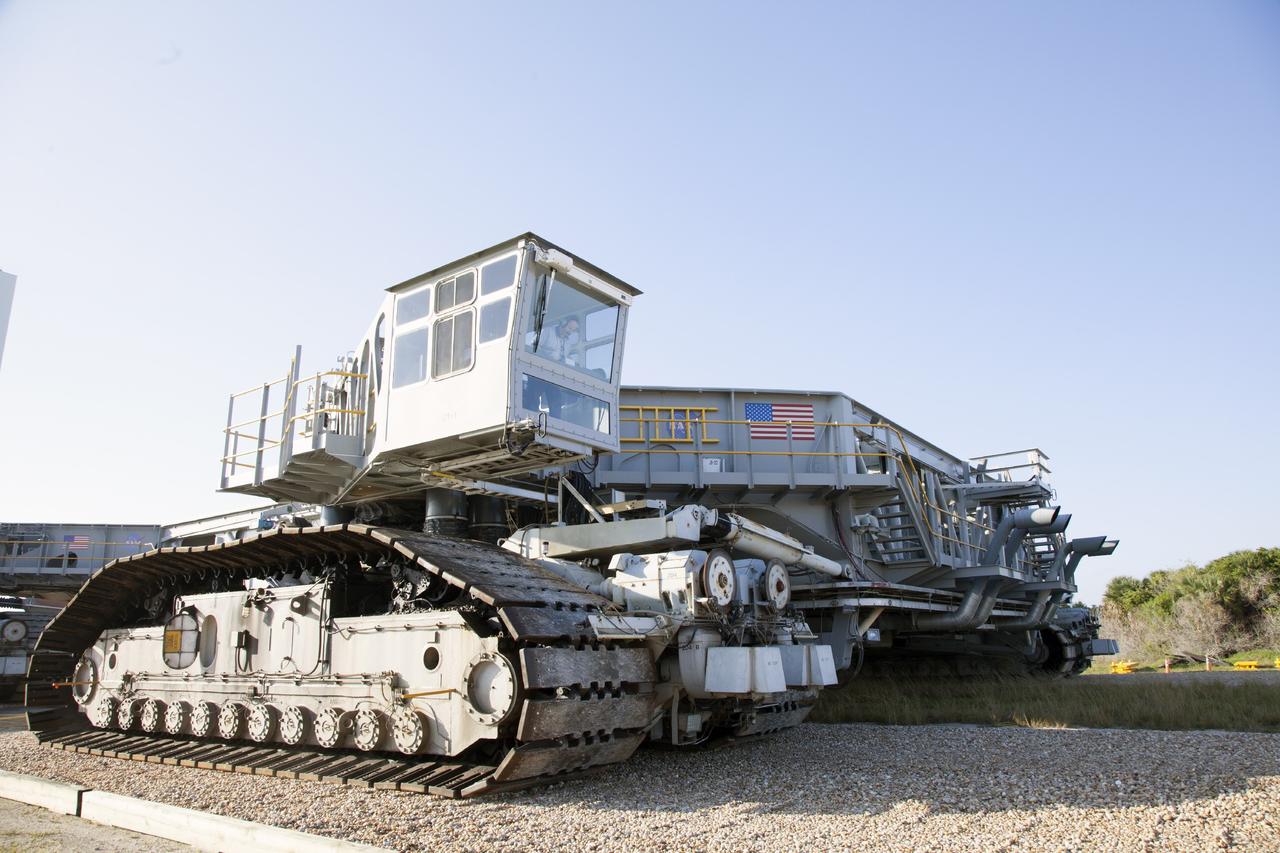
CAPE CANAVERAL, Fla. -- Crawler-transporter 1 continues its trek from the crawler transporter maintenance facility to Launch Pad 39A at NASA’s Kennedy Space Center in Florida. New jacking, equalizing and leveling, or JEL, hydraulic cylinders were installed on CT-1 and are being tested for increased load carrying capacity and reliability. The Ground Systems Development and Operations Program at Kennedy continues to upgrade the crawler-transporter as part of its general maintenance. CT-1 could be available to carry a variety of launch vehicles to the launch pad. Two crawler-transporters were used to carry the mobile launcher platform and space shuttle to Launch Complex 39 for space shuttle launches for 30 years. Photo credit: NASA/Daniel Casper

Seen from across the backwaters of the Indian River Lagoon, the Space Shuttle Atlantis, atop the mobile launcher platform and crawler-transporter, nears Launch Pad 39A at 1 mph. The crawler-transporter takes about five hours to cover the 3.4 miles from the Vehicle Assembly Building to the launch pad. The crawler-transporter carries its cargo at 1 mph, taking about five hours to cover the 3.4 miles from the Vehicle Assembly Building to the launch pad. A leveling system on the crawler-transporter keeps the top of the Space Shuttle vertical, especially negotiating the ramp leading to the launch pads and when it is raised and lowered on pedestals at the pad. Liftoff of Atlantis on mission STS-101 is scheduled for April 17 at 7:03 p.m. EDT. STS-101 is a logistics and resupply mission for the International Space Station, to restore full redundancy to the International Space Station power system in preparation for the arrival of the next pressurized module, the Russian-built Zvezda
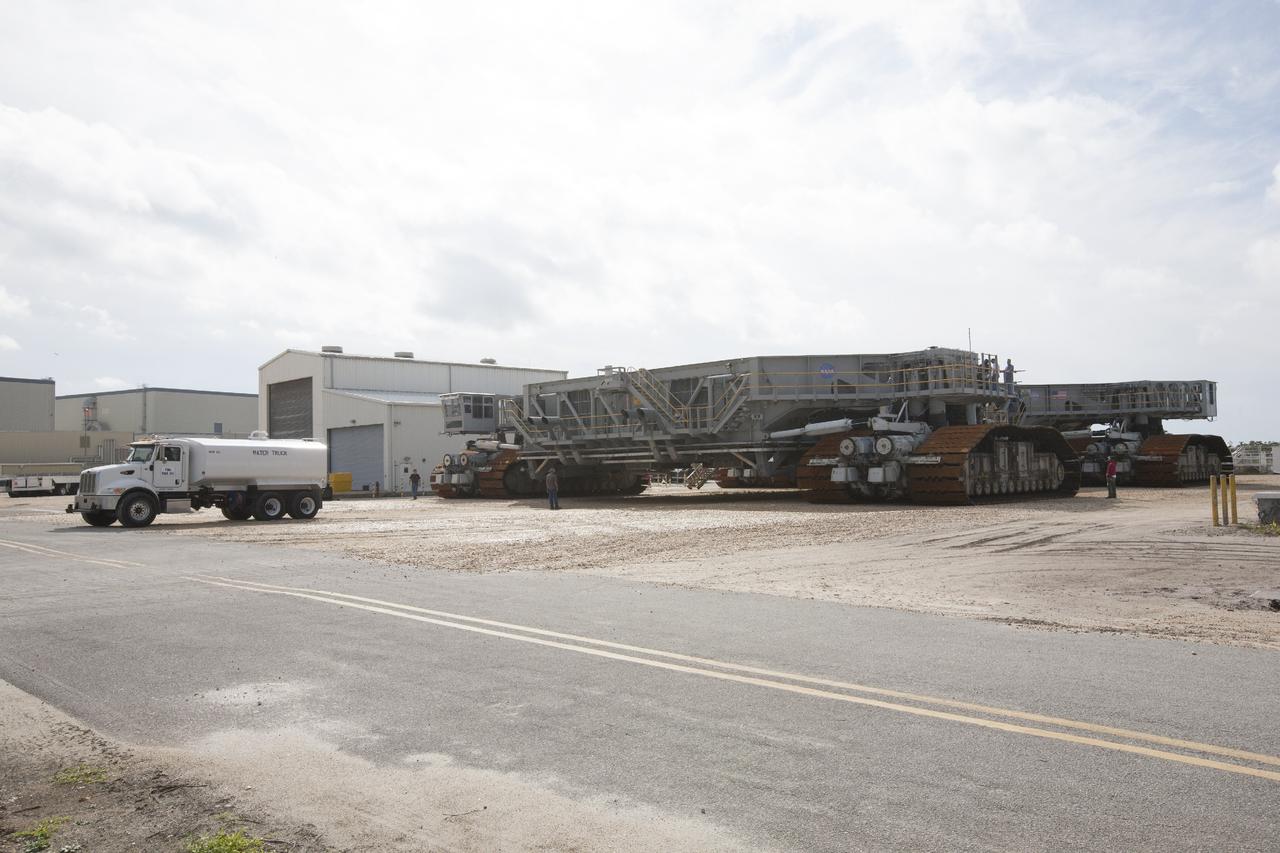
CAPE CANAVERAL, Fla. -- Crawler-transporter 1 begins its trek from the crawler transporter maintenance facility to Launch Pad 39A at NASA’s Kennedy Space Center in Florida. New jacking, equalizing and leveling, or JEL, hydraulic cylinders were installed on CT-1 and are being tested for increased load carrying capacity and reliability. The Ground Systems Development and Operations Program at Kennedy continues to upgrade the crawler-transporter as part of its general maintenance. CT-1 could be available to carry a variety of launch vehicles to the launch pad. Two crawler-transporters were used to carry the mobile launcher platform and space shuttle to Launch Complex 39 for space shuttle launches for 30 years. Photo credit: NASA/Daniel Casper
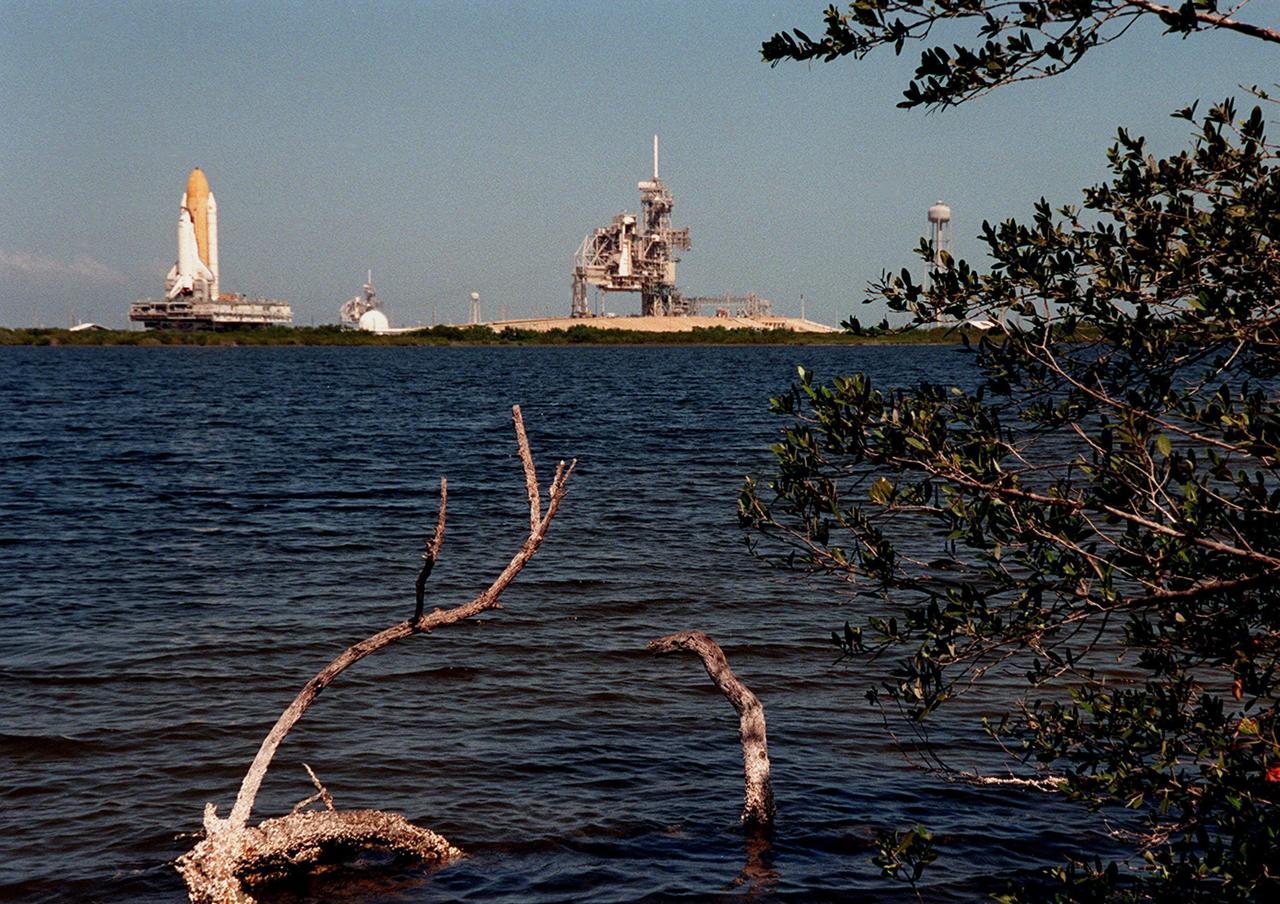
Seen from across the backwaters of the Indian River Lagoon, the Space Shuttle Atlantis, atop the mobile launcher platform and crawler-transporter, nears Launch Pad 39A at 1 mph. The crawler-transporter takes about five hours to cover the 3.4 miles from the Vehicle Assembly Building to the launch pad. The crawler-transporter carries its cargo at 1 mph, taking about five hours to cover the 3.4 miles from the Vehicle Assembly Building to the launch pad. A leveling system on the crawler-transporter keeps the top of the Space Shuttle vertical, especially negotiating the ramp leading to the launch pads and when it is raised and lowered on pedestals at the pad. Liftoff of Atlantis on mission STS-101 is scheduled for April 17 at 7:03 p.m. EDT. STS-101 is a logistics and resupply mission for the International Space Station, to restore full redundancy to the International Space Station power system in preparation for the arrival of the next pressurized module, the Russian-built Zvezda
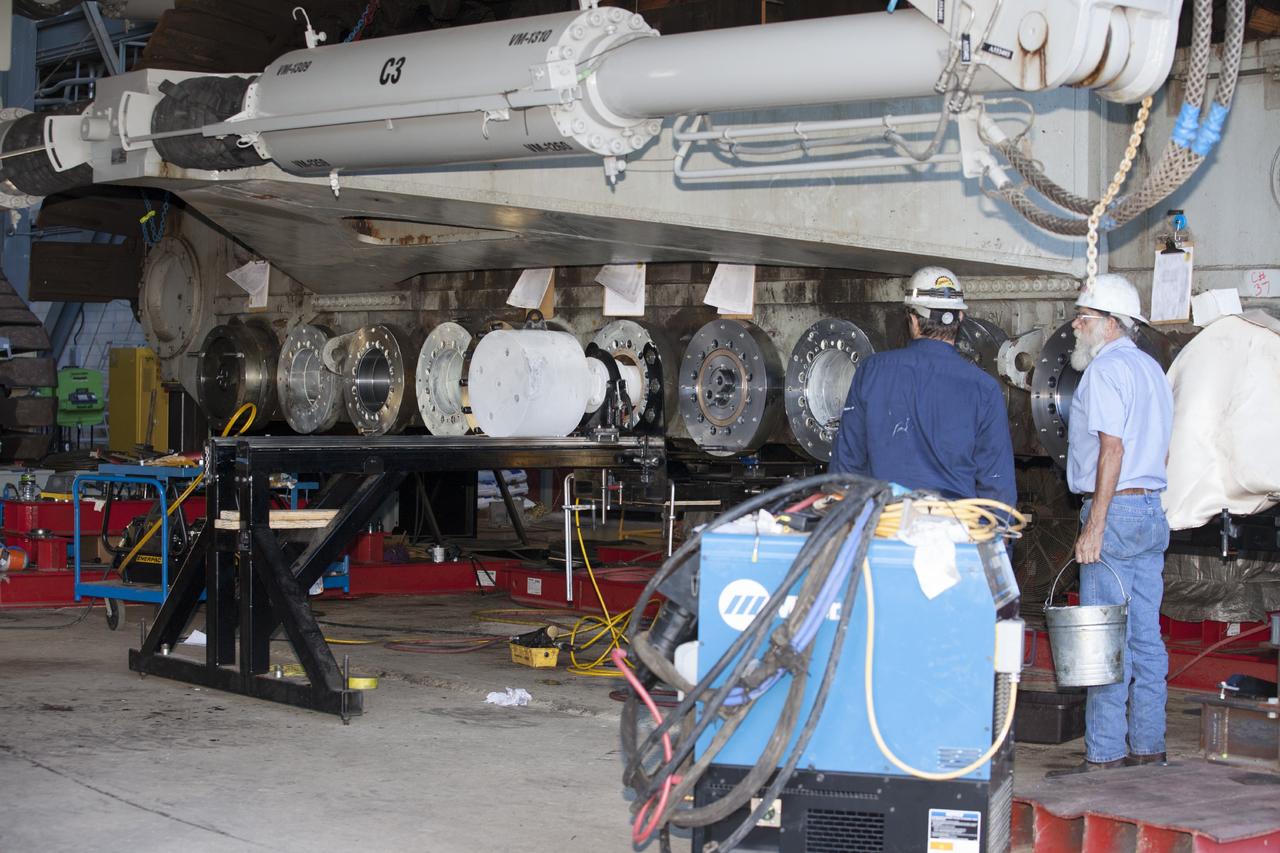
CAPE CANAVERAL, Fla. -- The installation of new bearings on crawler-transporter 2 is underway in Vehicle Assembly Building High Bay 2 at NASA's Kennedy Space Center in Florida. Modifications underway on the crawler are designed to ensure its ability to transport launch vehicles currently under development, such as the agency’s Space Launch System, to the launch pad. Present modifications represent a redesign and upgrade to the roller bearings and assemblies originally installed on the crawler. The Ground Systems Development and Operations Program office at Kennedy is overseeing the upgrades. For more than 45 years the crawler-transporters were used to transport the mobile launcher platform carrying the Apollo-Saturn V rockets and space shuttles to Launch Pads 39A and 39B. For more information, visit http://www.nasa.gov/exploration/systems/ground/crawler-transporter_bearings_prt.htm. Photo credit: NASA/Kim Shiflett
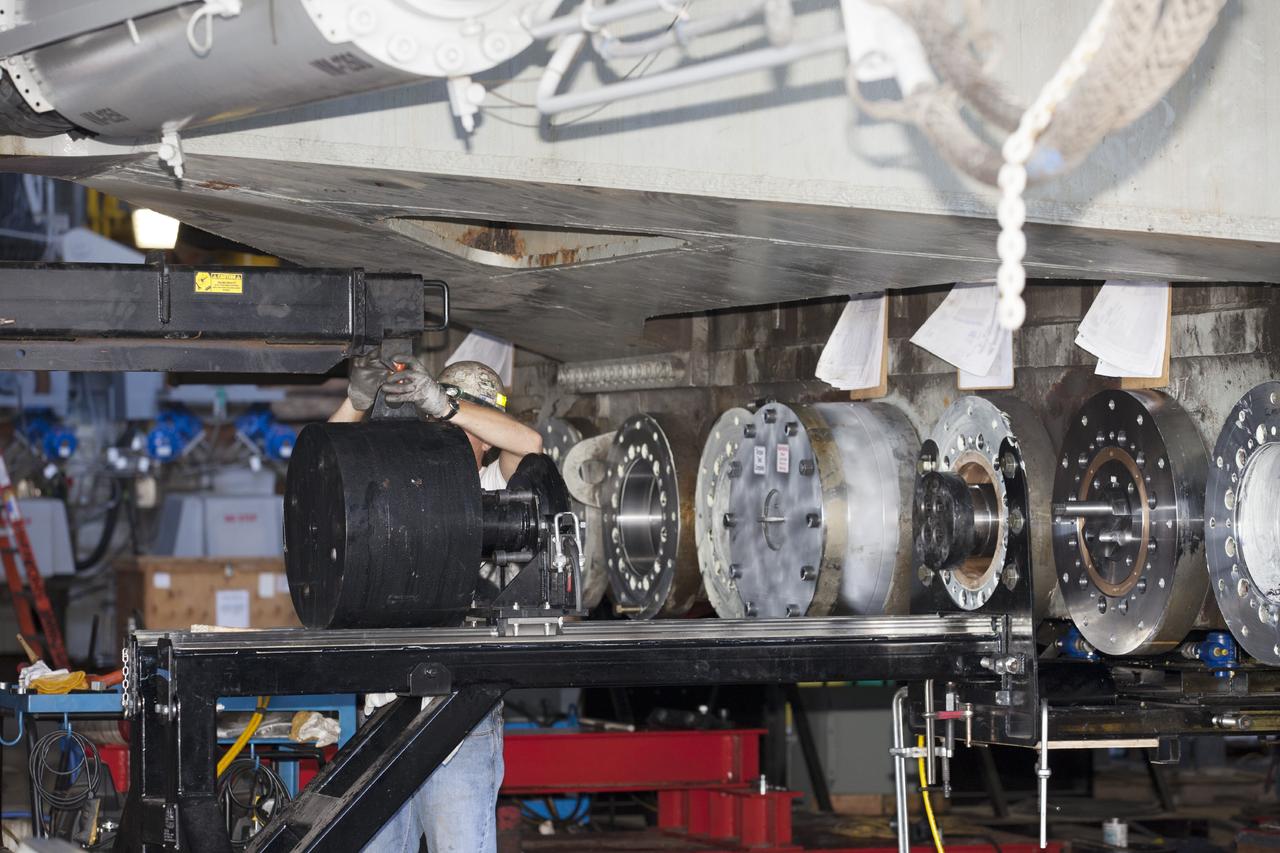
CAPE CANAVERAL, Fla. -- A technician completes the installation of a new bearing on crawler-transporter 2 in Vehicle Assembly Building High Bay 2 at NASA's Kennedy Space Center in Florida. Modifications underway on the crawler are designed to ensure its ability to transport launch vehicles currently under development, such as the agency’s Space Launch System, to the launch pad. Present modifications represent a redesign and upgrade to the roller bearings and assemblies originally installed on the crawler. The Ground Systems Development and Operations Program office at Kennedy is overseeing the upgrades. For more than 45 years the crawler-transporters were used to transport the mobile launcher platform carrying the Apollo-Saturn V rockets and space shuttles to Launch Pads 39A and 39B. For more information, visit http://www.nasa.gov/exploration/systems/ground/crawler-transporter_bearings_prt.htm. Photo credit: NASA/Kim Shiflett
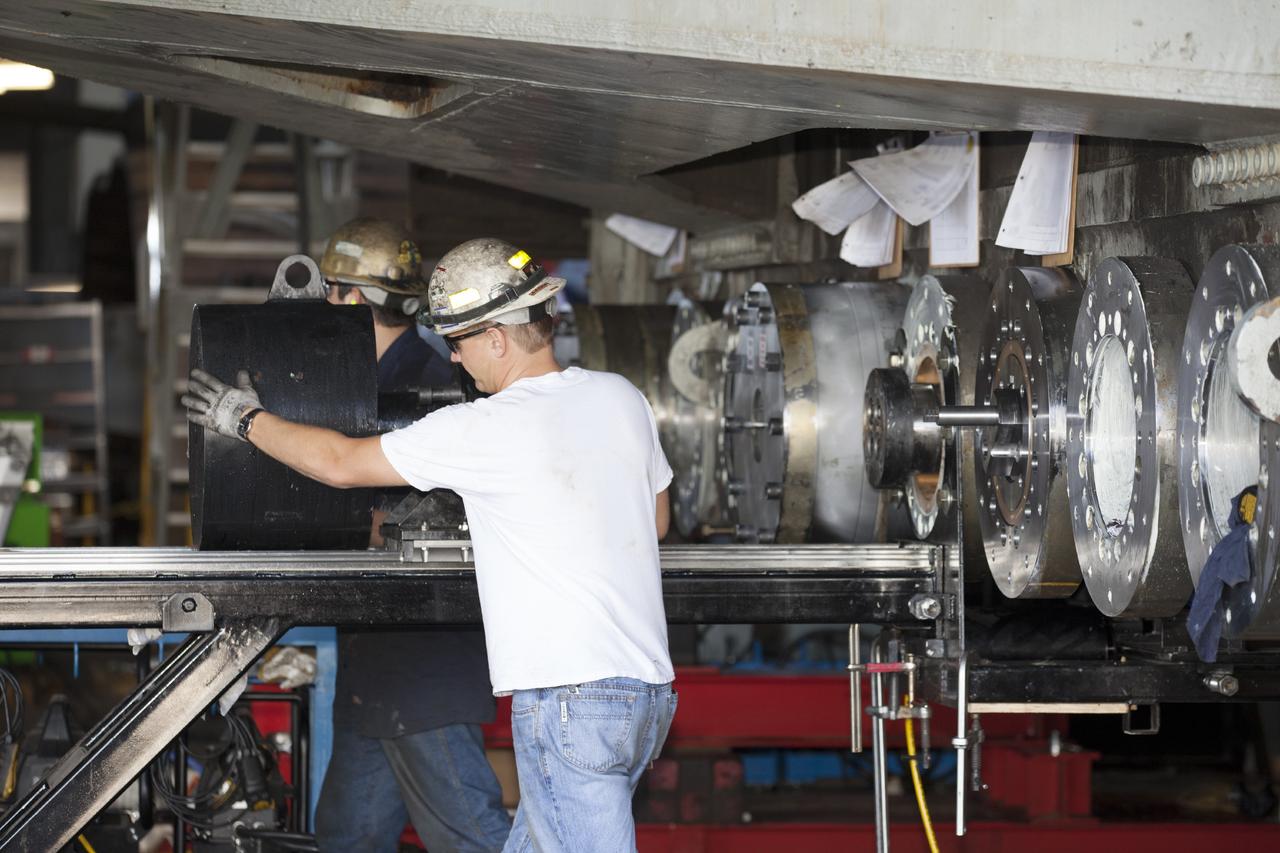
CAPE CANAVERAL, Fla. -- Technicians complete the installation of a new bearing on crawler-transporter 2 in Vehicle Assembly Building High Bay 2 at NASA's Kennedy Space Center in Florida. Modifications underway on the crawler are designed to ensure its ability to transport launch vehicles currently under development, such as the agency’s Space Launch System, to the launch pad. Present modifications represent a redesign and upgrade to the roller bearings and assemblies originally installed on the crawler. The Ground Systems Development and Operations Program office at Kennedy is overseeing the upgrades. For more than 45 years the crawler-transporters were used to transport the mobile launcher platform carrying the Apollo-Saturn V rockets and space shuttles to Launch Pads 39A and 39B. For more information, visit http://www.nasa.gov/exploration/systems/ground/crawler-transporter_bearings_prt.htm. Photo credit: NASA/Kim Shiflett
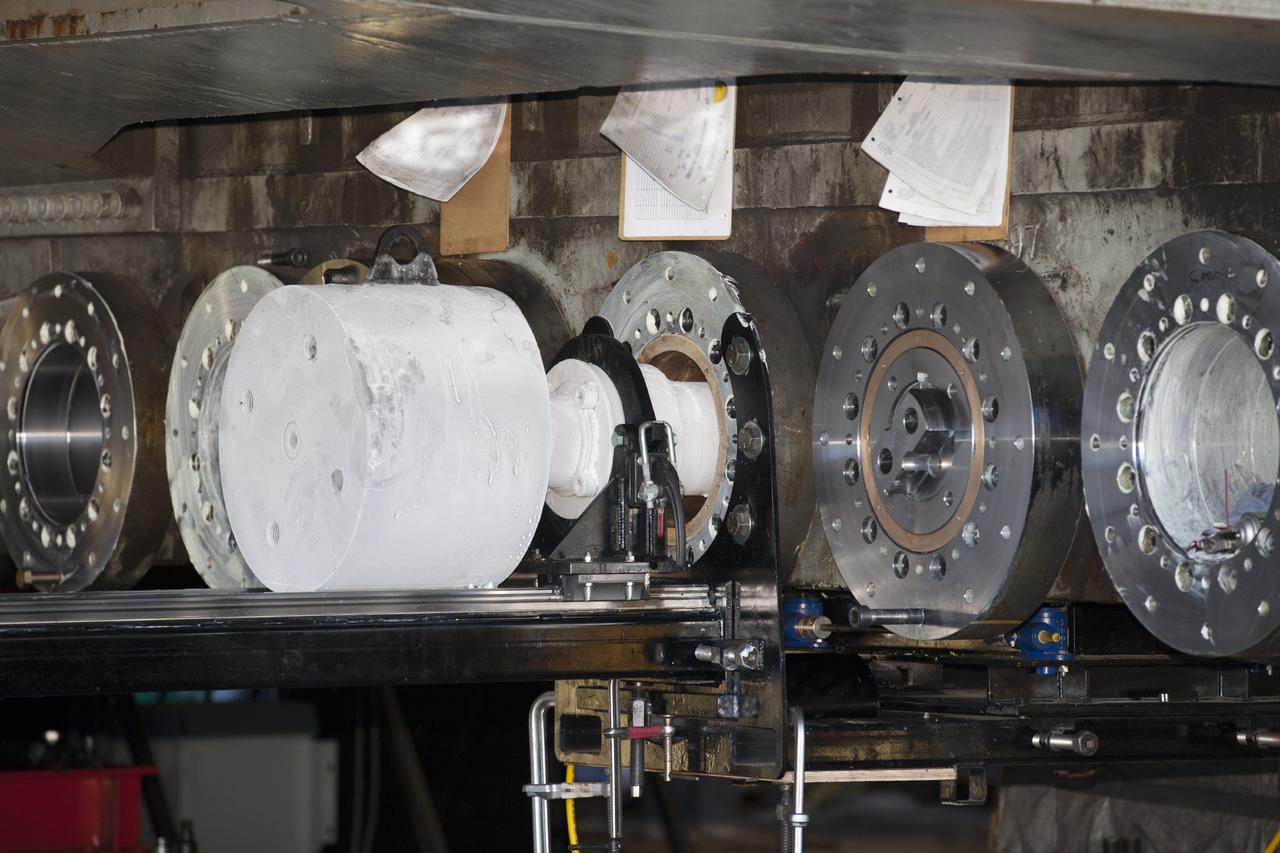
CAPE CANAVERAL, Fla. -- The installation of new bearings on crawler-transporter 2 is underway in Vehicle Assembly Building High Bay 2 at NASA's Kennedy Space Center in Florida. Modifications underway on the crawler are designed to ensure its ability to transport launch vehicles currently under development, such as the agency’s Space Launch System, to the launch pad. Present modifications represent a redesign and upgrade to the roller bearings and assemblies originally installed on the crawler. The Ground Systems Development and Operations Program office at Kennedy is overseeing the upgrades. For more than 45 years the crawler-transporters were used to transport the mobile launcher platform carrying the Apollo-Saturn V rockets and space shuttles to Launch Pads 39A and 39B. For more information, visit http://www.nasa.gov/exploration/systems/ground/crawler-transporter_bearings_prt.htm. Photo credit: NASA/Kim Shiflett
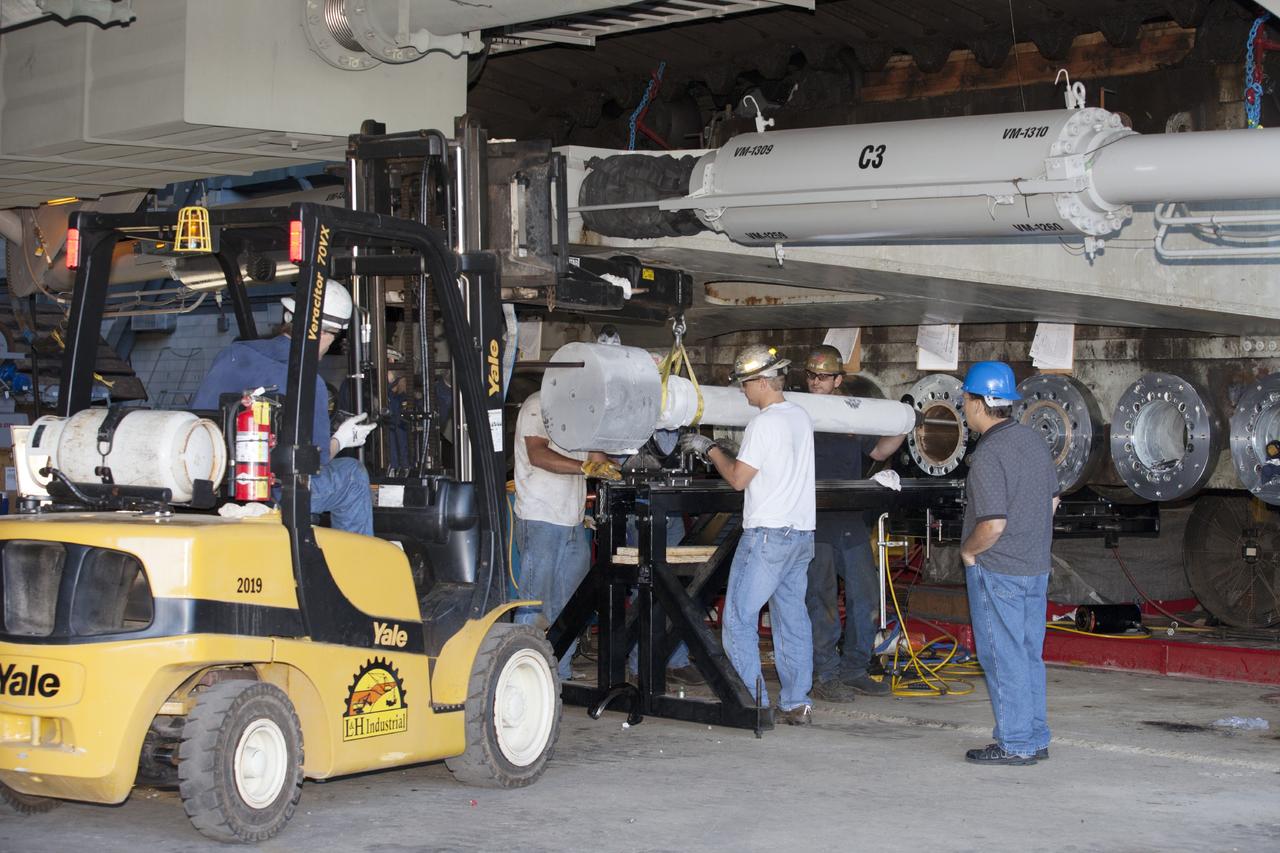
CAPE CANAVERAL, Fla. -- Technicians install a new bearing on crawler-transporter 2 in Vehicle Assembly Building High Bay 2 at NASA's Kennedy Space Center in Florida. Modifications underway on the crawler are designed to ensure its ability to transport launch vehicles currently under development, such as the agency’s Space Launch System, to the launch pad. Present modifications represent a redesign and upgrade to the roller bearings and assemblies originally installed on the crawler. The Ground Systems Development and Operations Program office at Kennedy is overseeing the upgrades. For more than 45 years the crawler-transporters were used to transport the mobile launcher platform carrying the Apollo-Saturn V rockets and space shuttles to Launch Pads 39A and 39B. For more information, visit http://www.nasa.gov/exploration/systems/ground/crawler-transporter_bearings_prt.htm. Photo credit: NASA/Kim Shiflett
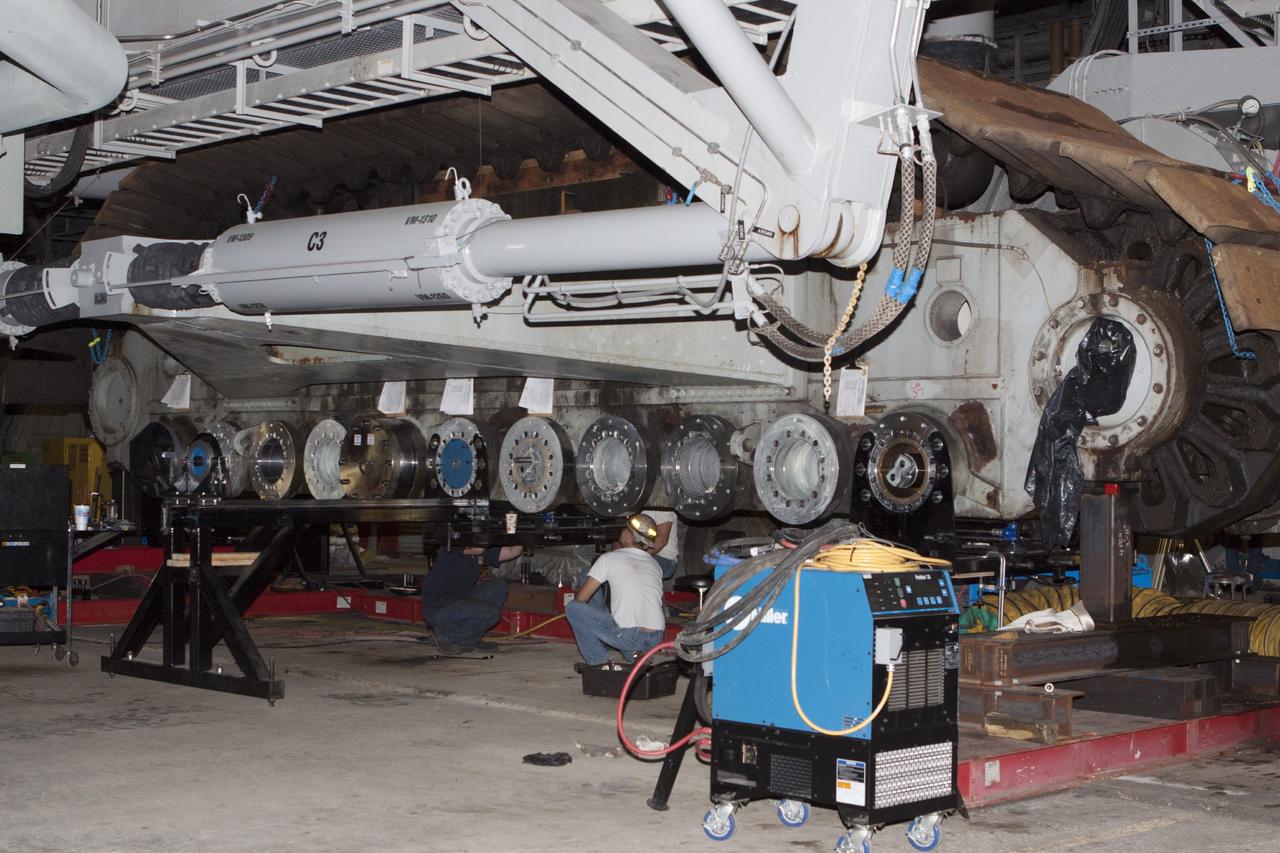
CAPE CANAVERAL, Fla. -- Preparations are underway to install new bearings on crawler-transporter 2 in the Vehicle Assembly Building High Bay 2 at NASA's Kennedy Space Center in Florida. Modifications underway on the crawler are designed to ensure its ability to transport launch vehicles currently under development, such as the agency’s Space Launch System, to the launch pad. Present modifications represent a redesign and upgrade to the roller bearings and assemblies originally installed on the crawler. The Ground Systems Development and Operations Program office at Kennedy is overseeing the upgrades. For more than 45 years the crawler-transporters were used to transport the mobile launcher platform carrying the Apollo-Saturn V rockets and space shuttles to Launch Pads 39A and 39B. For more information, visit http://www.nasa.gov/exploration/systems/ground/crawler-transporter_bearings_prt.htm. Photo credit: NASA/Kim Shiflett
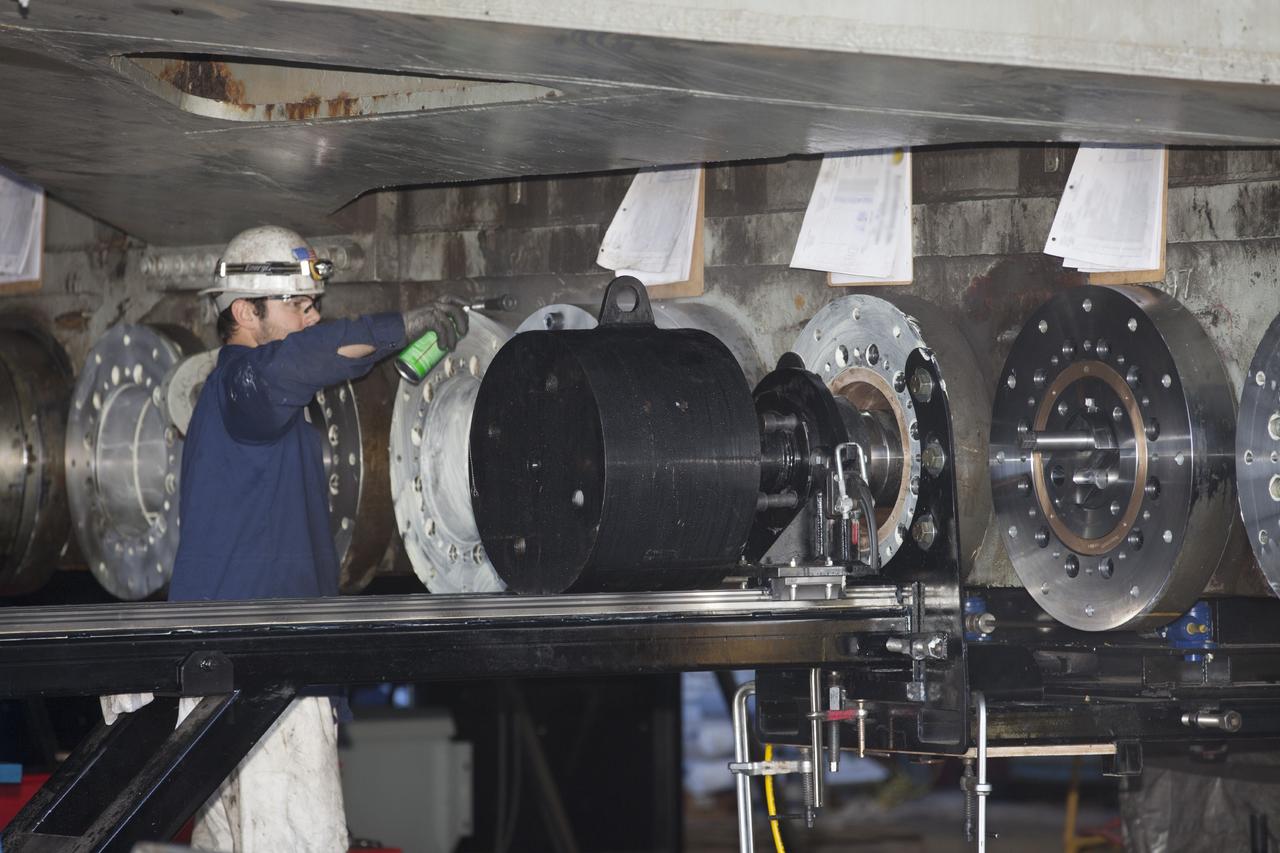
CAPE CANAVERAL, Fla. -- A technician completes the installation of a new bearing on crawler-transporter 2 in Vehicle Assembly Building High Bay 2 at NASA's Kennedy Space Center in Florida. Modifications underway on the crawler are designed to ensure its ability to transport launch vehicles currently under development, such as the agency’s Space Launch System, to the launch pad. Present modifications represent a redesign and upgrade to the roller bearings and assemblies originally installed on the crawler. The Ground Systems Development and Operations Program office at Kennedy is overseeing the upgrades. For more than 45 years the crawler-transporters were used to transport the mobile launcher platform carrying the Apollo-Saturn V rockets and space shuttles to Launch Pads 39A and 39B. For more information, visit http://www.nasa.gov/exploration/systems/ground/crawler-transporter_bearings_prt.htm. Photo credit: NASA/Kim Shiflett
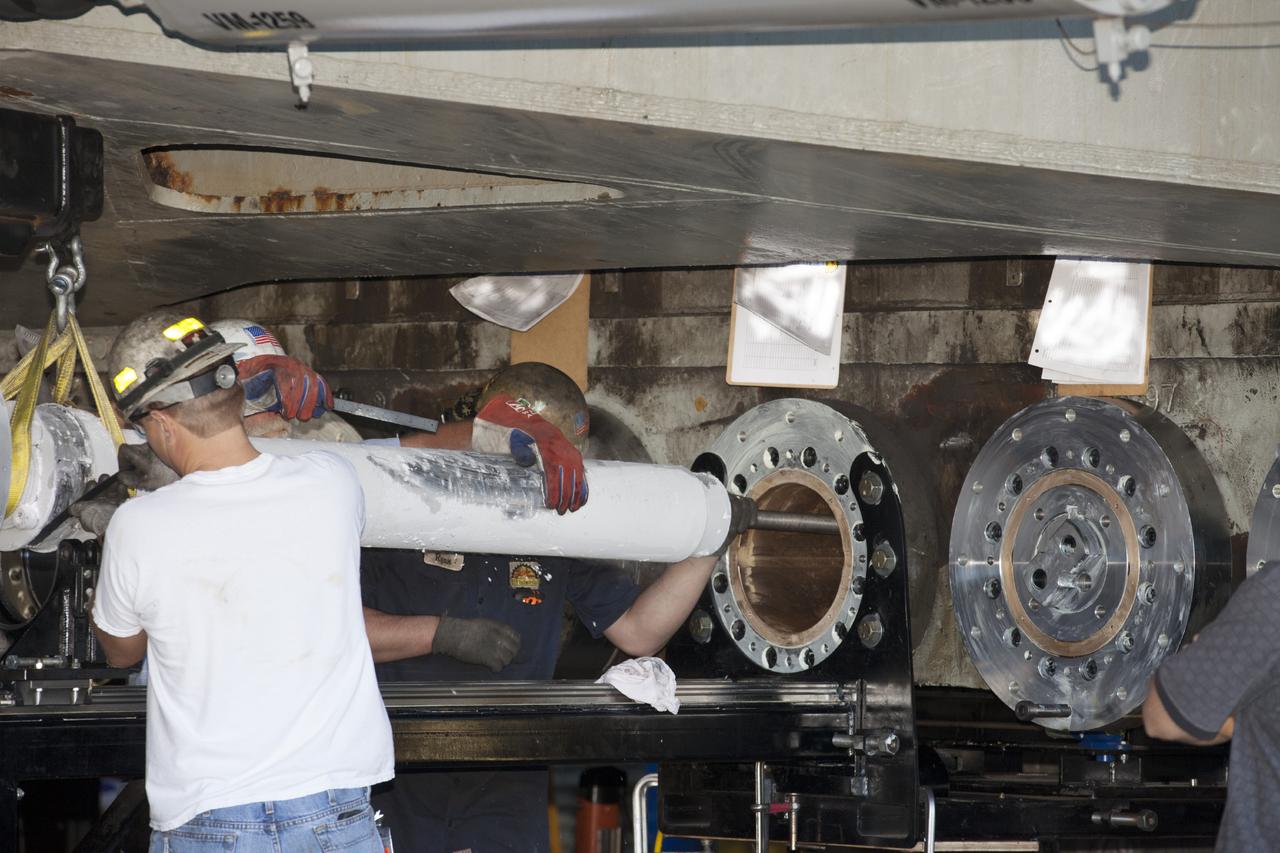
CAPE CANAVERAL, Fla. -- A technician installs a new bearing on crawler-transporter 2 in Vehicle Assembly Building High Bay 2 at NASA's Kennedy Space Center in Florida. Modifications underway on the crawler are designed to ensure its ability to transport launch vehicles currently under development, such as the agency’s Space Launch System, to the launch pad. Present modifications represent a redesign and upgrade to the roller bearings and assemblies originally installed on the crawler. The Ground Systems Development and Operations Program office at Kennedy is overseeing the upgrades. For more than 45 years the crawler-transporters were used to transport the mobile launcher platform carrying the Apollo-Saturn V rockets and space shuttles to Launch Pads 39A and 39B. For more information, visit http://www.nasa.gov/exploration/systems/ground/crawler-transporter_bearings_prt.htm. Photo credit: NASA/Kim Shiflett
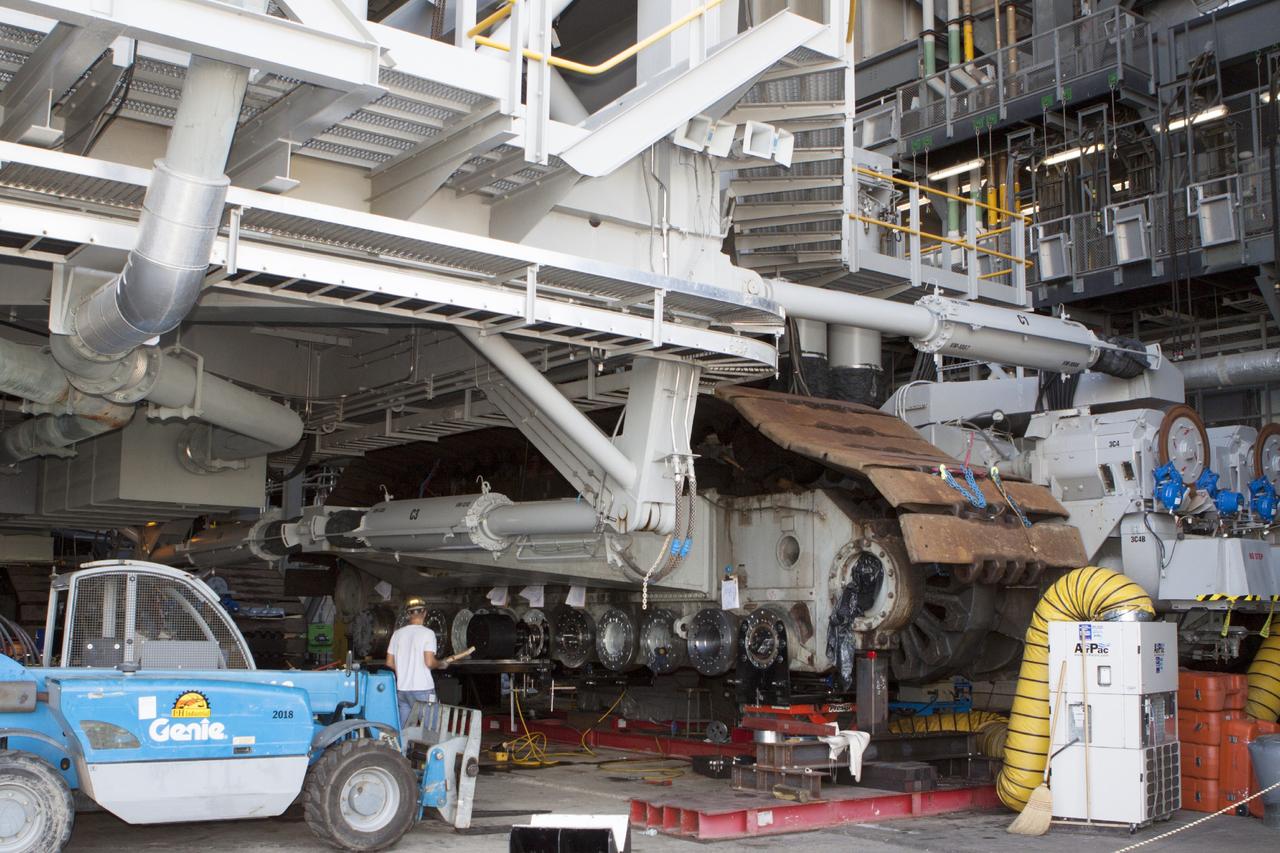
CAPE CANAVERAL, Fla. -- Steady progress is made on the installation of new bearings on crawler-transporter 2 in Vehicle Assembly Building High Bay 2 at NASA's Kennedy Space Center in Florida. Modifications underway on the crawler are designed to ensure its ability to transport launch vehicles currently under development, such as the agency’s Space Launch System, to the launch pad. Present modifications represent a redesign and upgrade to the roller bearings and assemblies originally installed on the crawler. The Ground Systems Development and Operations Program office at Kennedy is overseeing the upgrades. For more than 45 years the crawler-transporters were used to transport the mobile launcher platform carrying the Apollo-Saturn V rockets and space shuttles to Launch Pads 39A and 39B. For more information, visit http://www.nasa.gov/exploration/systems/ground/crawler-transporter_bearings_prt.htm. Photo credit: NASA/Kim Shiflett
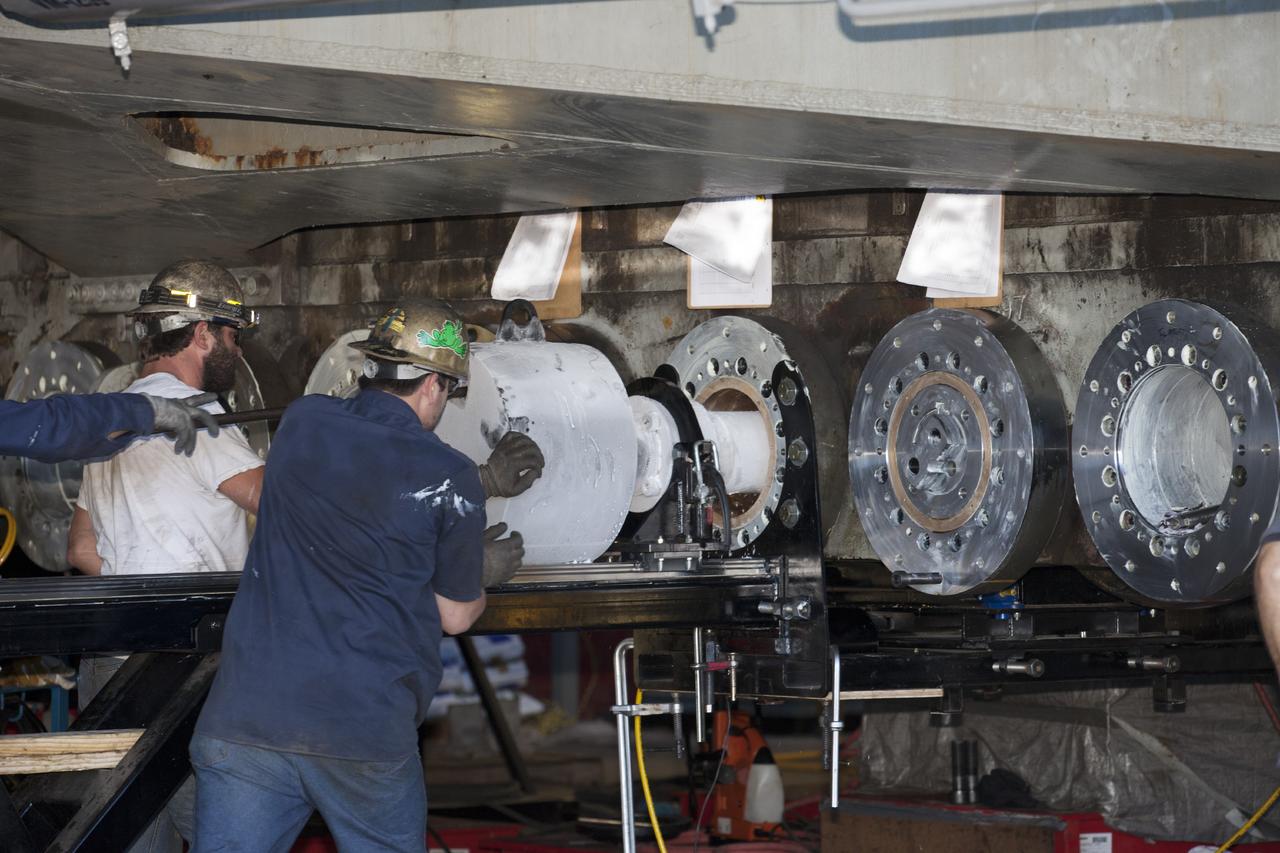
CAPE CANAVERAL, Fla. -- Technicians install a new bearing on crawler-transporter 2 in the Vehicle Assembly Building High Bay 2 at NASA's Kennedy Space Center in Florida. Modifications underway on the crawler are designed to ensure its ability to transport launch vehicles currently under development, such as the agency’s Space Launch System, to the launch pad. Present modifications represent a redesign and upgrade to the roller bearings and assemblies originally installed on the crawler. The Ground Systems Development and Operations Program office at Kennedy is overseeing the upgrades. For more than 45 years the crawler-transporters were used to transport the mobile launcher platform carrying the Apollo-Saturn V rockets and space shuttles to Launch Pads 39A and 39B. For more information, visit http://www.nasa.gov/exploration/systems/ground/crawler-transporter_bearings_prt.htm. Photo credit: NASA/Kim Shiflett
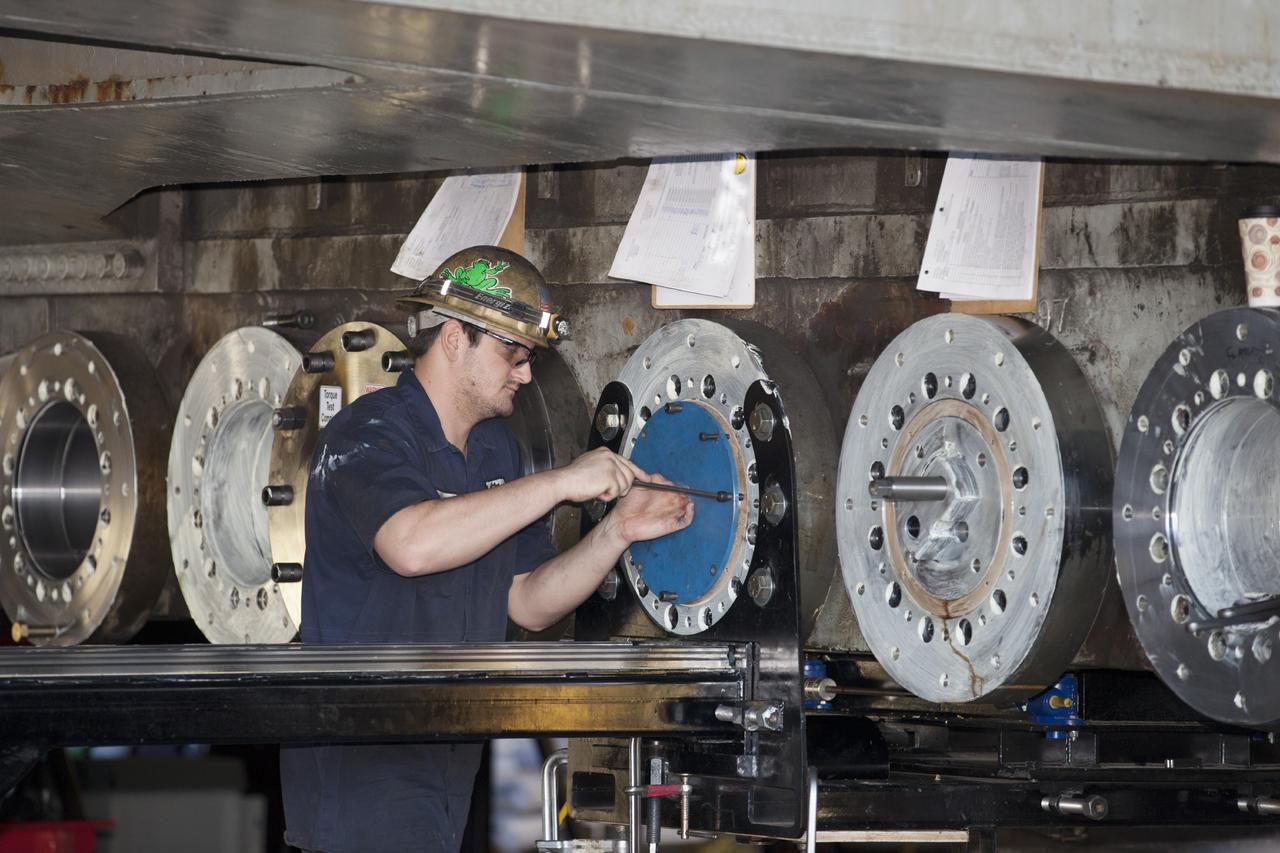
CAPE CANAVERAL, Fla. -- A technician installs a new bearing on crawler-transporter 2 in Vehicle Assembly Building High Bay 2 at NASA's Kennedy Space Center in Florida. Modifications underway on the crawler are designed to ensure its ability to transport launch vehicles currently under development, such as the agency’s Space Launch System, to the launch pad. Present modifications represent a redesign and upgrade to the roller bearings and assemblies originally installed on the crawler. The Ground Systems Development and Operations Program office at Kennedy is overseeing the upgrades. For more than 45 years the crawler-transporters were used to transport the mobile launcher platform carrying the Apollo-Saturn V rockets and space shuttles to Launch Pads 39A and 39B. For more information, visit http://www.nasa.gov/exploration/systems/ground/crawler-transporter_bearings_prt.htm. Photo credit: NASA/Kim Shiflett
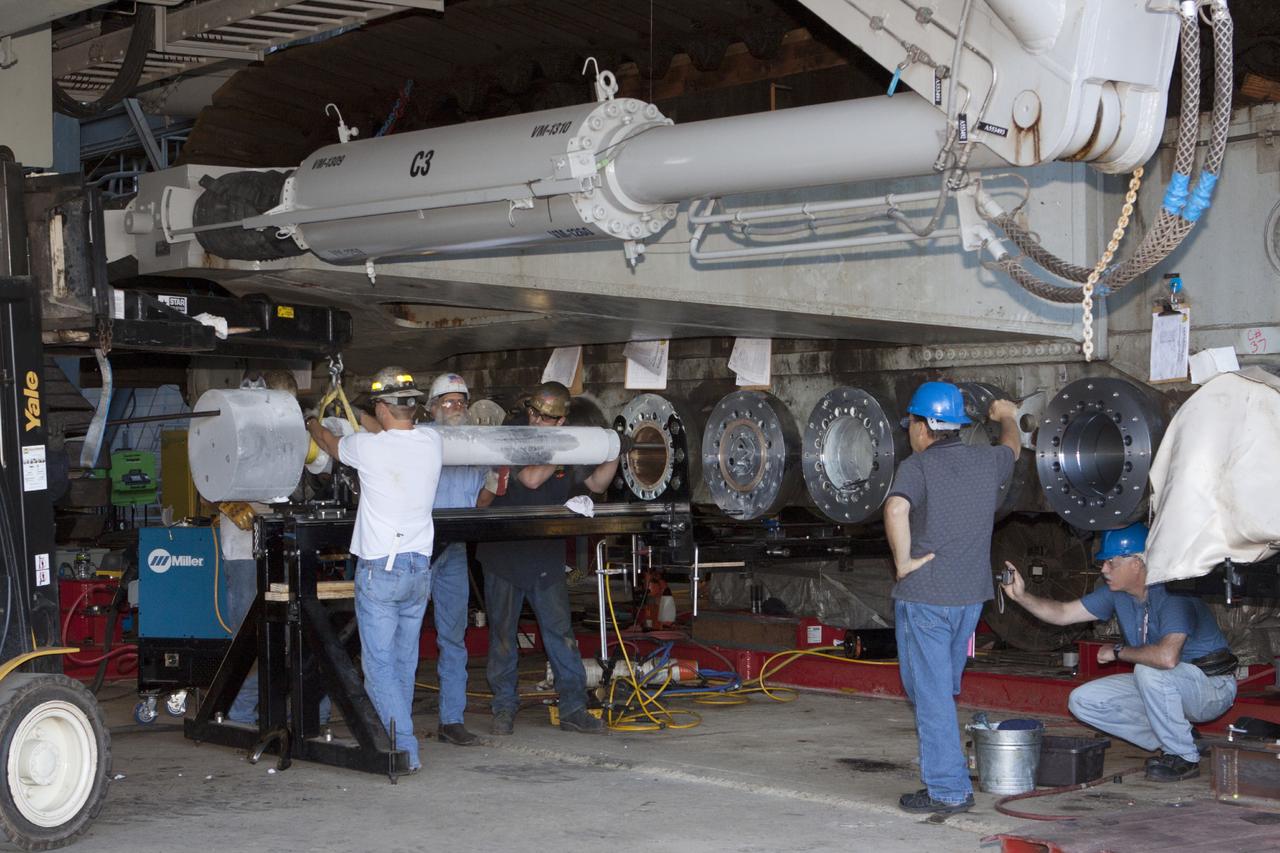
CAPE CANAVERAL, Fla. -- Technicians install a new bearing on crawler-transporter 2 in Vehicle Assembly Building High Bay 2 at NASA's Kennedy Space Center in Florida. Modifications underway on the crawler are designed to ensure its ability to transport launch vehicles currently under development, such as the agency’s Space Launch System, to the launch pad. Present modifications represent a redesign and upgrade to the roller bearings and assemblies originally installed on the crawler. The Ground Systems Development and Operations Program office at Kennedy is overseeing the upgrades. For more than 45 years the crawler-transporters were used to transport the mobile launcher platform carrying the Apollo-Saturn V rockets and space shuttles to Launch Pads 39A and 39B. For more information, visit http://www.nasa.gov/exploration/systems/ground/crawler-transporter_bearings_prt.htm. Photo credit: NASA/Kim Shiflett
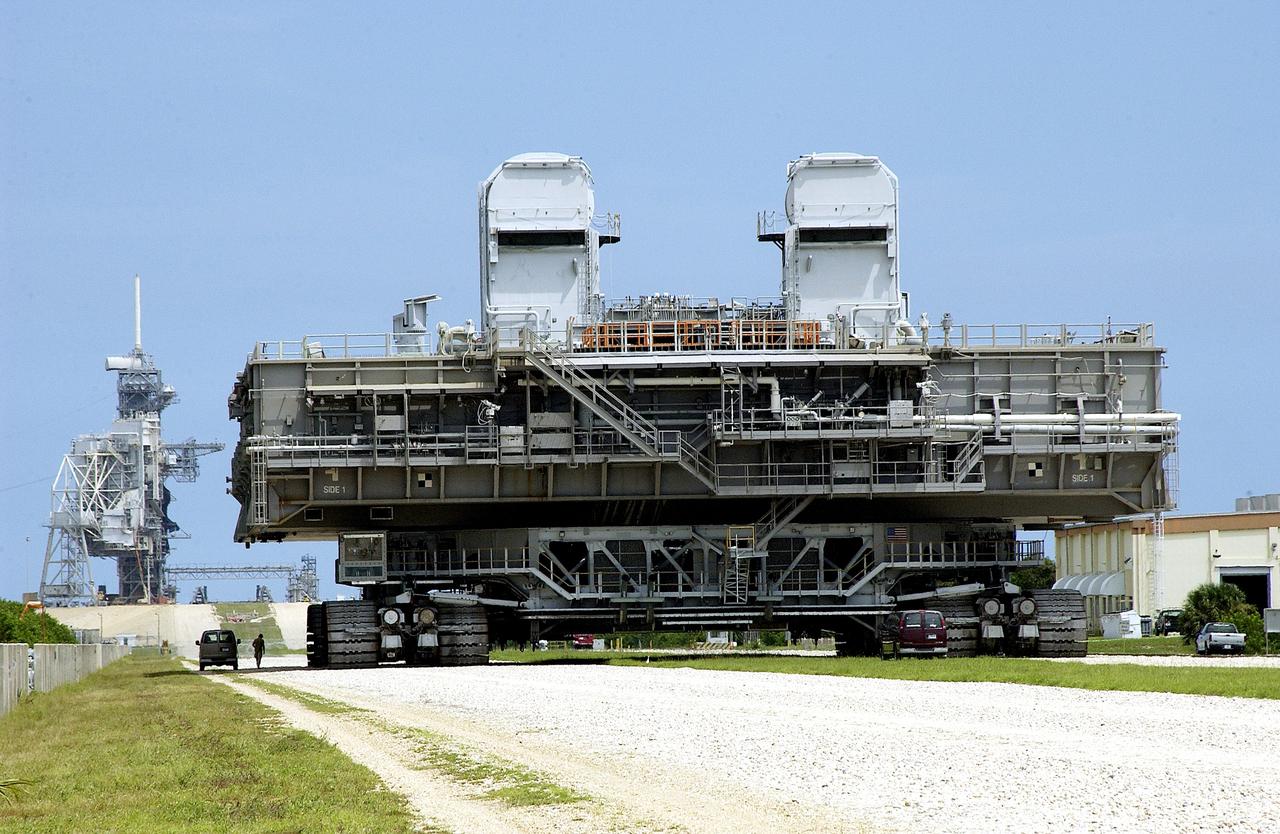
KENNEDY SPACE CENTER, FLA. - Crawler-transporter (CT) number 2 nears the launch pad with a Mobile Launcher Platform (MLP) on top. After recent modifications to the cab and muffler system, the CT was taken on a test run. The CT moves Space Shuttle vehicles, situated on the MLP, between the VAB and launch pad. Moving on four double-tracked crawlers, the CT uses a laser guidance system and a leveling system for the journey that keeps the top of a Space Shuttle vertical within plus- or minus-10 minutes of arc. The system enables the CT-MLP-Shuttle to negotiate the ramp leading to the launch pads and keep the load level. Unloaded, the CT weighs 6 million pounds. Seen on top of the MLP are two tail service masts that support the fluid, gas and electrical requirements of the orbiter’s liquid oxygen and liquid hydrogen aft umbilicals.
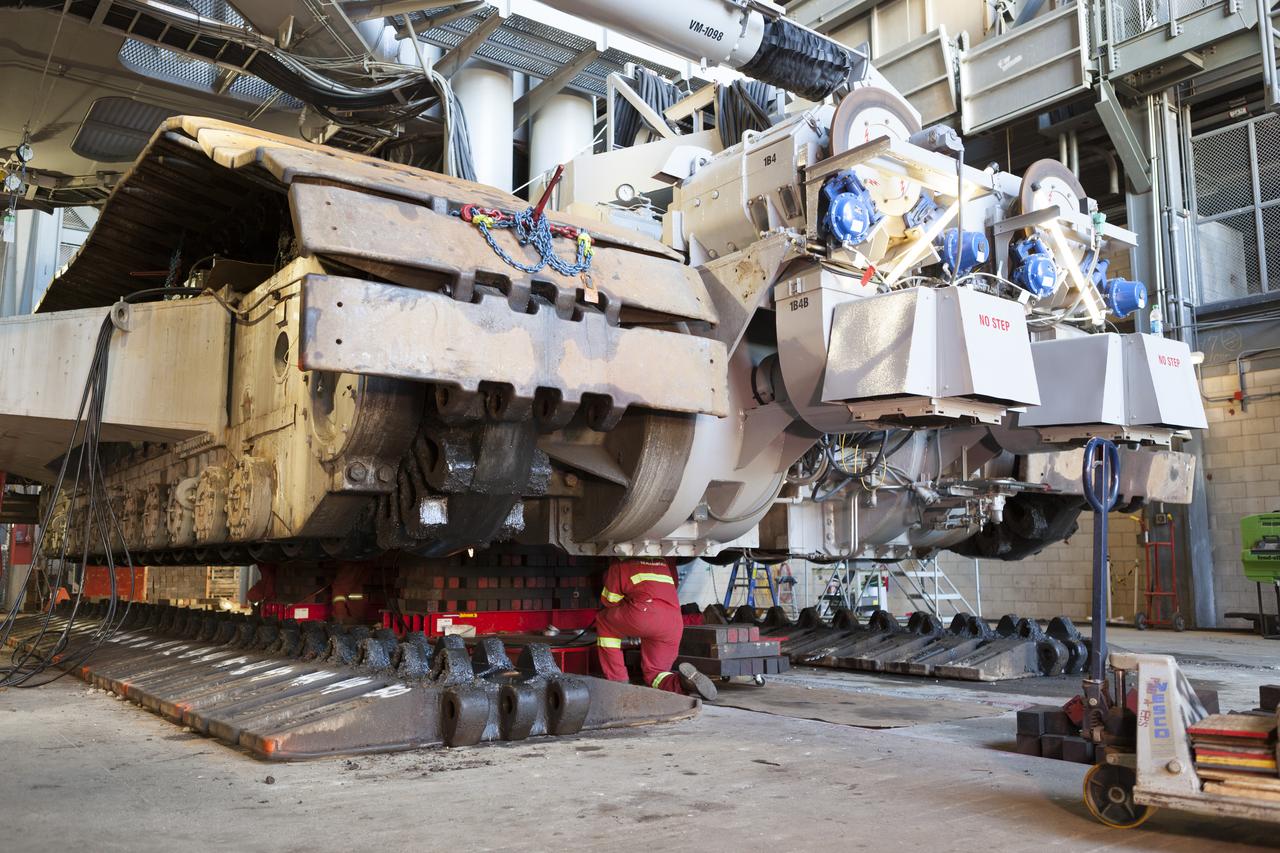
CAPE CANAVERAL, Fla. – Inside the Vehicle Assembly Building at NASA’s Kennedy Space Center in Florida, a technician monitors the progress as the B and D truck sections of crawler-transporter 2, or CT-2, are raised up to prepare for installation of new roller bearing assemblies. Sections of the crawler’s large metal tracks have been removed. Work continues in high bay 2 to upgrade CT-2. The modifications are designed to ensure CT-2’s ability to transport launch vehicles currently in development, such as the agency’s Space Launch System, to the launch pad. The Ground Systems Development and Operations Program office at Kennedy is overseeing the upgrades. For more than 45 years the crawler-transporters were used to transport the mobile launcher platform and the Apollo-Saturn V rockets and, later, space shuttles to Launch Pads 39A and B. For more information, visit: http://www.nasa.gov/exploration/systems/ground/crawler-transporter. Photo credit: NASA/Dimitri Gerondidakis
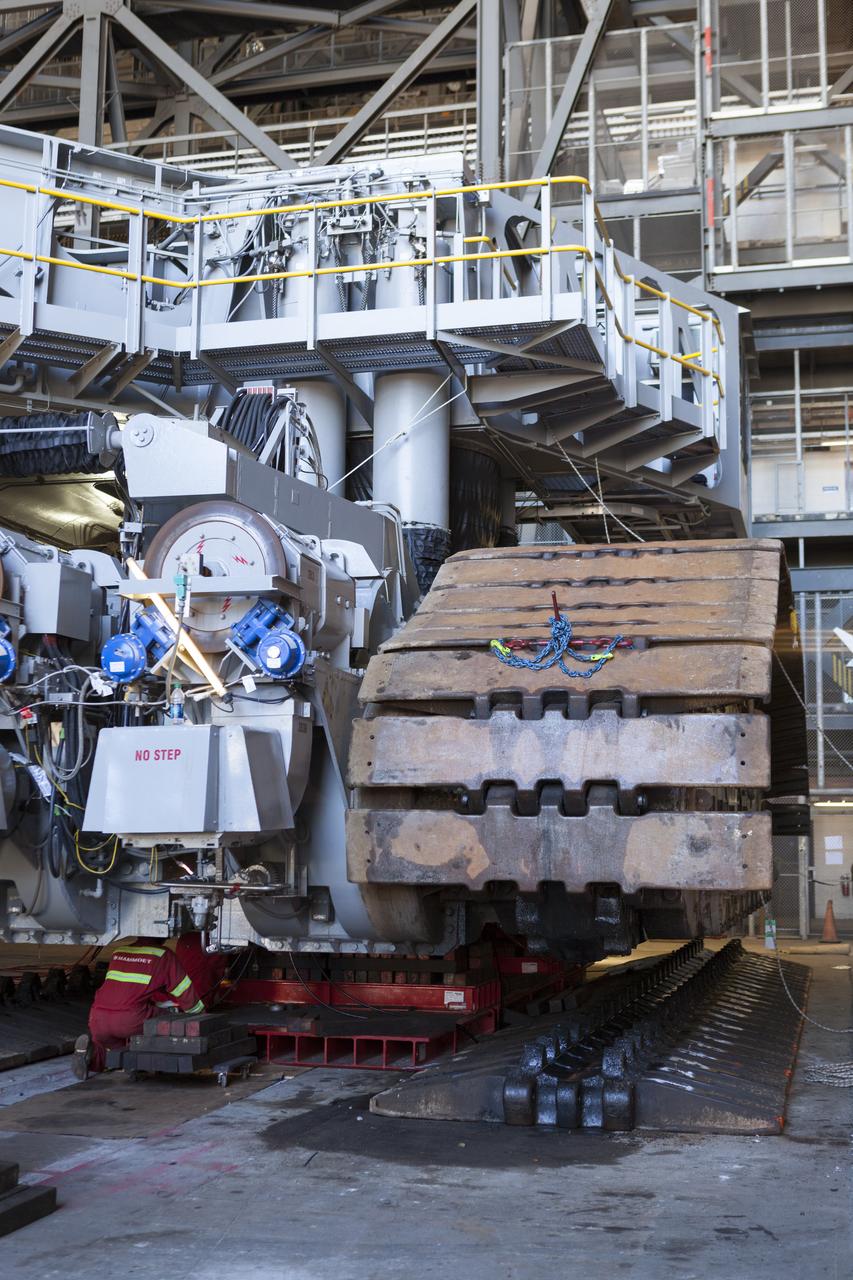
CAPE CANAVERAL, Fla. – Inside the Vehicle Assembly Building at NASA’s Kennedy Space Center in Florida, the B and D truck sections of crawler-transporter 2, or CT-2, are being raised up to prepare for installation of new roller bearing assemblies. Sections of the crawler’s large metal tracks have been removed. Work continues in high bay 2 to upgrade CT-2. The modifications are designed to ensure CT-2’s ability to transport launch vehicles currently in development, such as the agency’s Space Launch System, to the launch pad. The Ground Systems Development and Operations Program office at Kennedy is overseeing the upgrades. For more than 45 years the crawler-transporters were used to transport the mobile launcher platform and the Apollo-Saturn V rockets and, later, space shuttles to Launch Pads 39A and B. For more information, visit: http://www.nasa.gov/exploration/systems/ground/crawler-transporter. Photo credit: NASA/Dimitri Gerondidakis
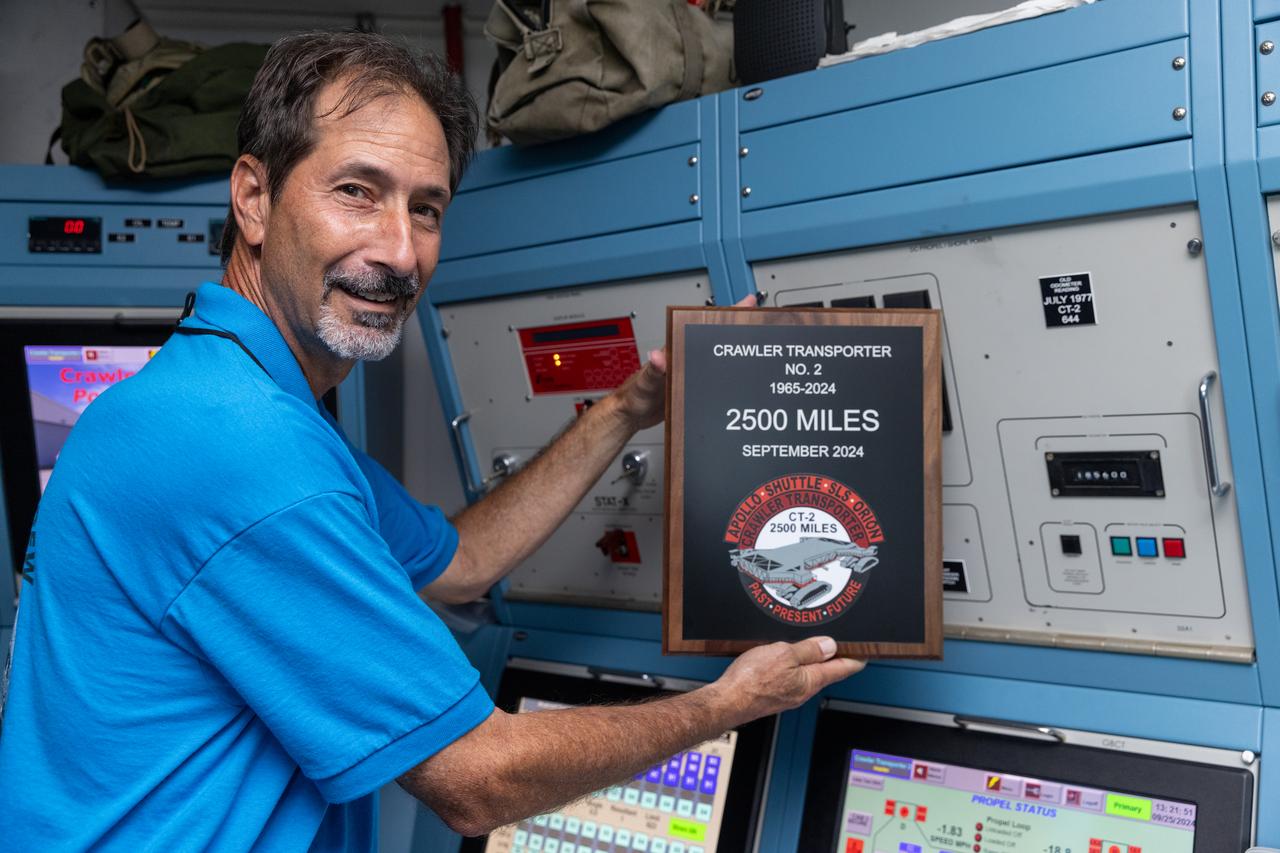
John Giles, crawler element operations manager for NASA’s Exploration Ground Systems, holds a plaque near the odometer of the agency’s crawler-transporter 2, on Wednesday, Sept. 25, 2024, at NASA’s Kennedy Space Center in Florida, commemorating the milestone of 2,500 miles traveled since its construction in 1965. Crawler-transporter 2 reached the milestone while teams took it on a trip in preparation for supporting the roll of the mobile launcher from Launch Pad 39B back into the spaceport’s Vehicle Assembly Building ahead of the Artemis II launch. Built originally to transport massive Saturn V rockets during the Apollo Program, crawler-transporter 2 continued its service during the Space Shuttle Program, and currently transports the massive SLS (Space Launch System) rocket and Orion spacecraft atop the mobile launcher as part of the agency’s Artemis campaign.
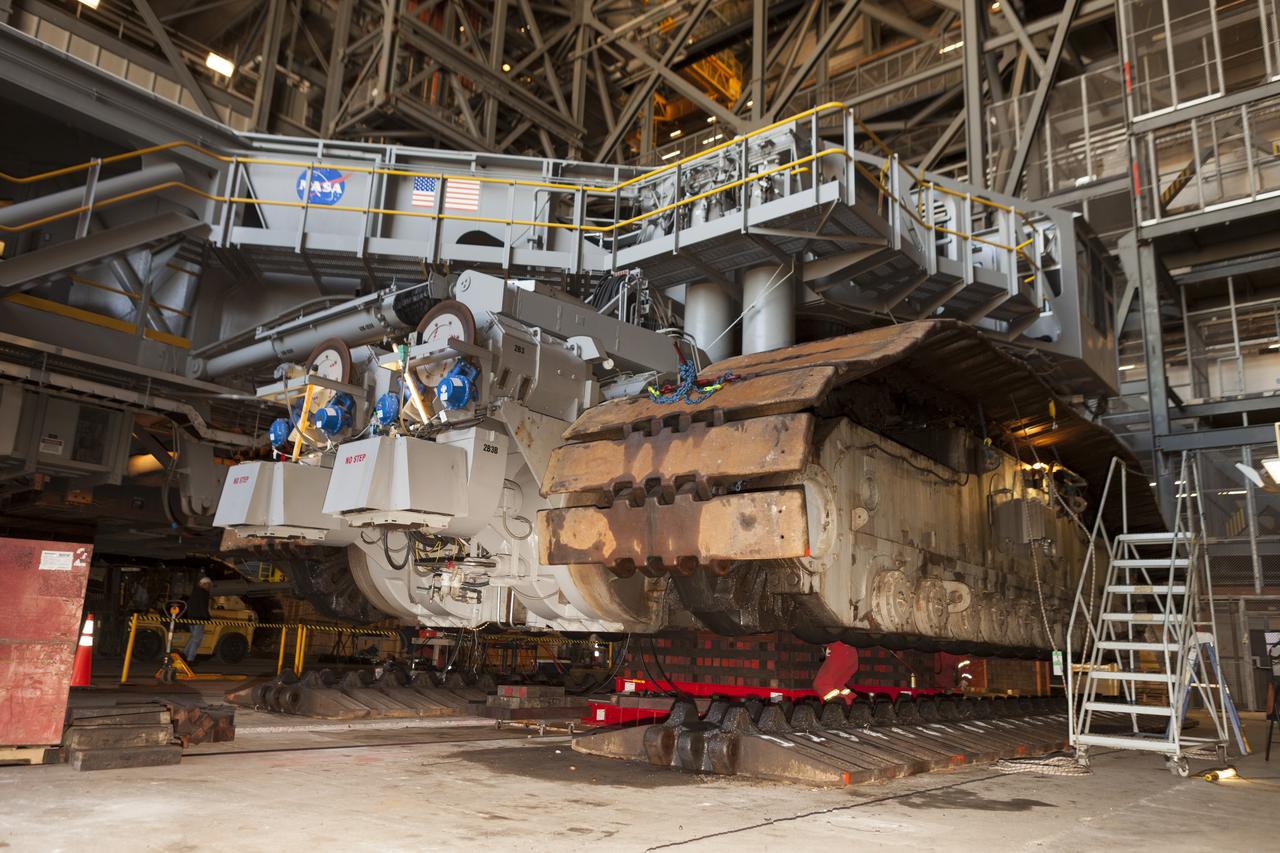
CAPE CANAVERAL, Fla. – Inside the Vehicle Assembly Building at NASA’s Kennedy Space Center in Florida, the B and D truck sections of crawler-transporter 2, or CT-2, have been raised up to prepare for installation of new roller bearing assemblies. Sections of the crawler’s large metal tracks have been removed. Work continues in high bay 2 to upgrade CT-2. The modifications are designed to ensure CT-2’s ability to transport launch vehicles currently in development, such as the agency’s Space Launch System, to the launch pad. The Ground Systems Development and Operations Program office at Kennedy is overseeing the upgrades. For more than 45 years the crawler-transporters were used to transport the mobile launcher platform and the Apollo-Saturn V rockets and, later, space shuttles to Launch Pads 39A and B. For more information, visit: http://www.nasa.gov/exploration/systems/ground/crawler-transporter. Photo credit: NASA/Dimitri Gerondidakis
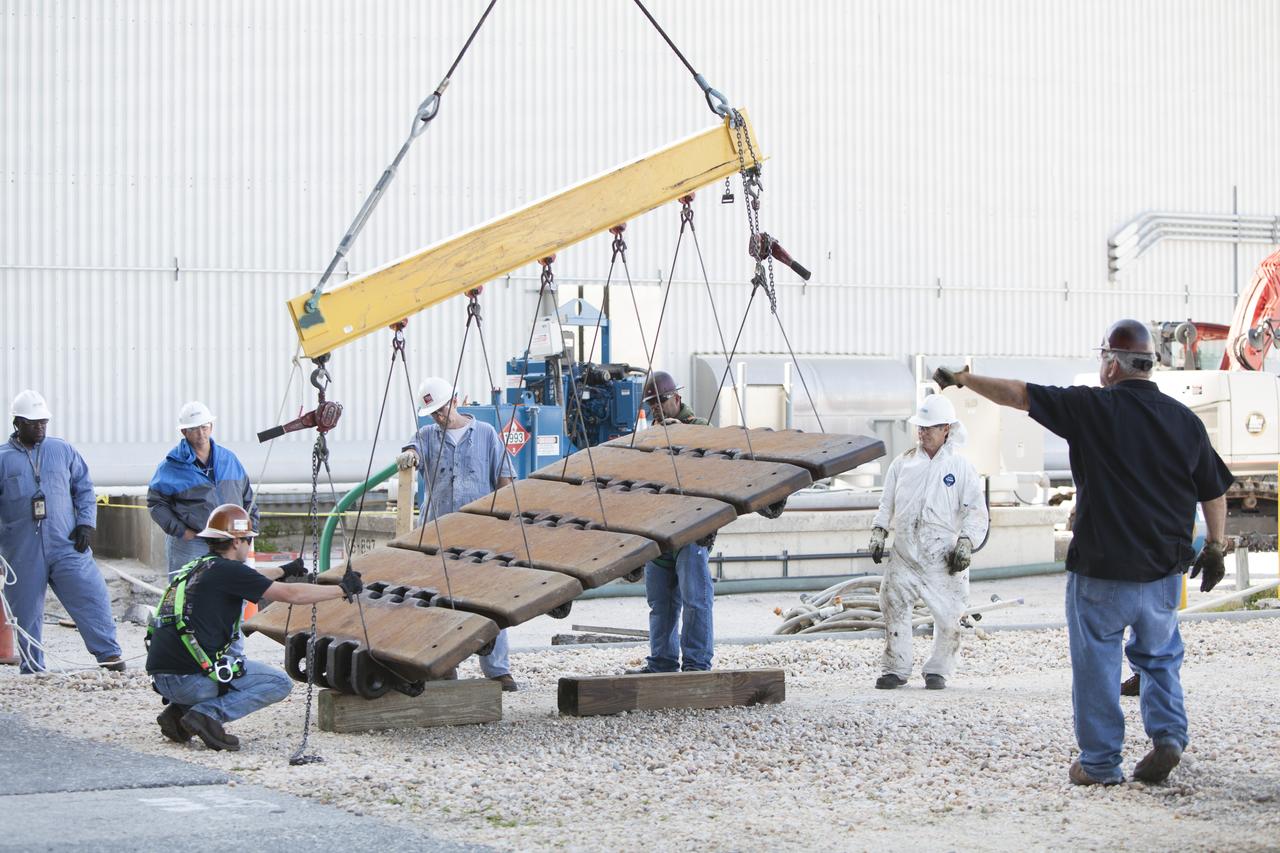
CAPE CANAVERAL, Fla. – A section of the treads on the C truck of crawler-transporter 2, or CT-2, have been removed and are being stored near the Vehicle Assembly Building at NASA’s Kennedy Space Center in Florida. The treads are being removed from the crawler in order to gain access to remove the gear boxes. Work continues in high bay 2 to upgrade CT-2. The modifications are designed to ensure CT-2’s ability to transport launch vehicles currently in development, such as the agency’s Space Launch System, to the launch pad. The Ground Systems Development and Operations Program office at Kennedy is overseeing the upgrades. For more than 45 years the crawler-transporters were used to transport the mobile launcher platform and the Apollo-Saturn V rockets and, later, space shuttles to Launch Pads 39A and B. For more information, visit: http://www.nasa.gov/exploration/systems/ground/crawler-transporter. Photo credit: NASA/Dimitri Gerondidakis
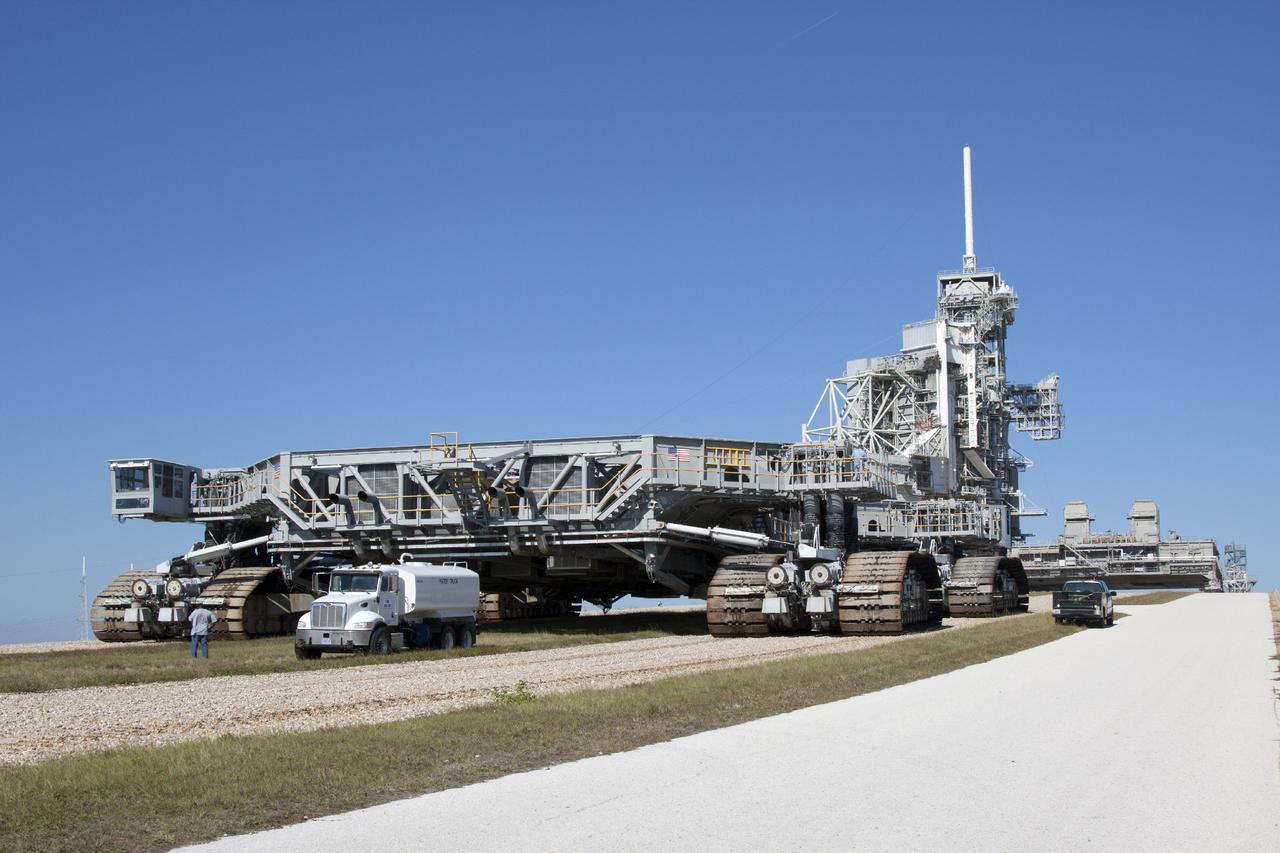
CAPE CANAVERAL, Fla. -- Crawler-transporter 1 approaches the top of Launch Pad 39A after traveling along the crawlerway at NASA’s Kennedy Space Center in Florida. New jacking, equalizing and leveling, or JEL, hydraulic cylinders were installed on CT-1 and are undergoing a leveling and turning test as the crawler travels along the slope to the top of the pad. The Ground Systems Development and Operations Program at Kennedy continues to upgrade the crawler-transporter as part of its general maintenance. CT-1 could be available to carry a variety of launch vehicles to the launch pad. Two crawler-transporters were used to carry the mobile launcher platform and space shuttle to Launch Complex 39 for space shuttle launches for 30 years. Photo credit: NASA/Jim Grossmann
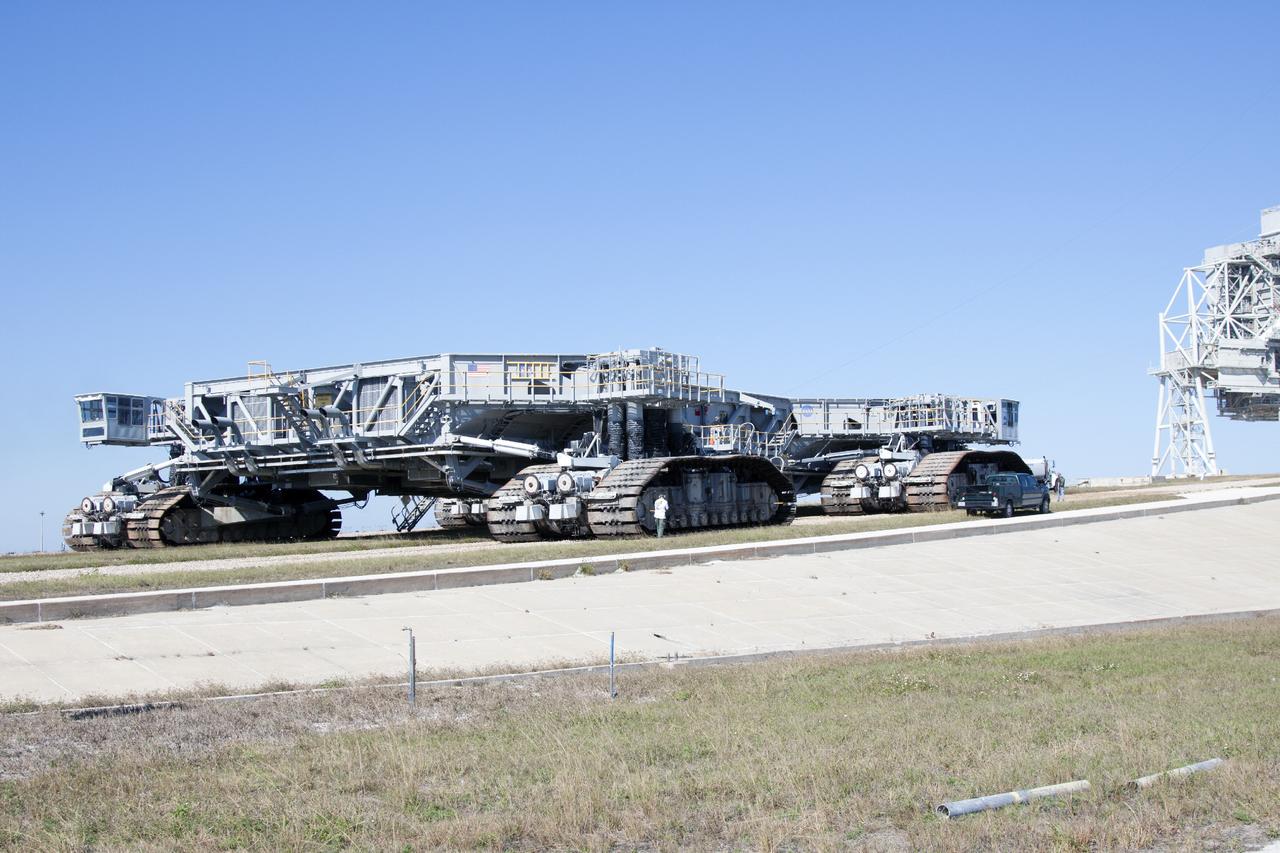
CAPE CANAVERAL, Fla. -- Crawler-transporter 1 approaches the slope on the crawlerway leading up to Launch Pad 39A at NASA’s Kennedy Space Center in Florida. New jacking, equalizing and leveling, or JEL, hydraulic cylinders were installed on CT-1 and will undergo a leveling and turning test as the crawler travels along the slope to the top of the pad. The Ground Systems Development and Operations Program at Kennedy continues to upgrade the crawler-transporter as part of its general maintenance. CT-1 could be available to carry a variety of launch vehicles to the launch pad. Two crawler-transporters were used to carry the mobile launcher platform and space shuttle to Launch Complex 39 for space shuttle launches for 30 years. Photo credit: NASA/Jim Grossmann
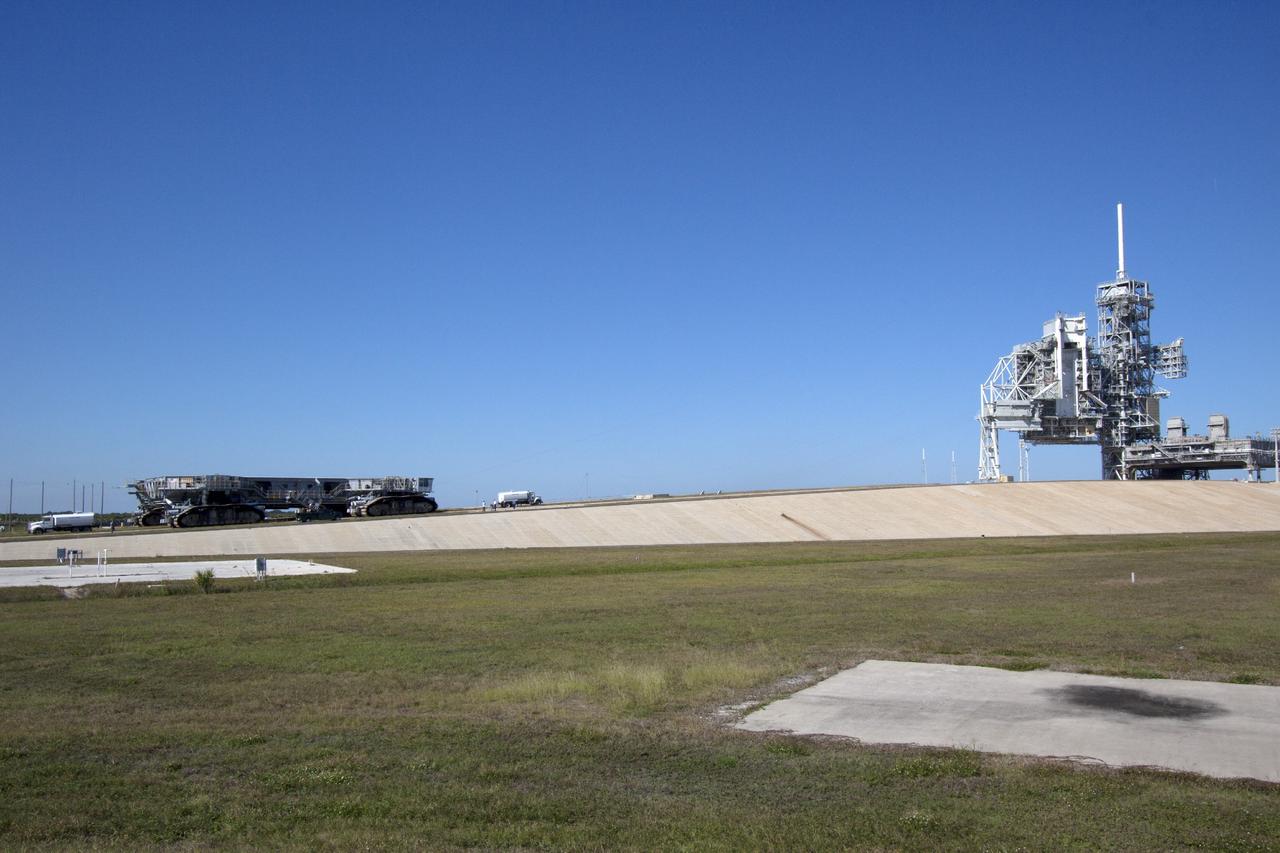
CAPE CANAVERAL, Fla. -- Crawler-transporter 1 continues its trek up the slope on the crawlerway leading up to Launch Pad 39A at NASA’s Kennedy Space Center in Florida. New jacking, equalizing and leveling, or JEL, hydraulic cylinders were installed on CT-1 and are undergoing a leveling and turning test as the crawler travels along the slope to the top of the pad. The Ground Systems Development and Operations Program at Kennedy continues to upgrade the crawler-transporter as part of its general maintenance. CT-1 could be available to carry a variety of launch vehicles to the launch pad. Two crawler-transporters were used to carry the mobile launcher platform and space shuttle to Launch Complex 39 for space shuttle launches for 30 years. Photo credit: NASA/Jim Grossmann

KENNEDY SPACE CENTER, Fla. -- The crawler-transporter (bottom) rolls out from under Space Shuttle Discovery and the mobile launcher platform on Launch Pad 39A. The crawler-transporter earlier moved the Shuttle and MLP from the Vehicle Assembly Building on a six-hour journey of 3.4 miles. Discovery is scheduled to launch in early August on mission STS-105. Photo by Scott Andrews using a Nikon D1X camera
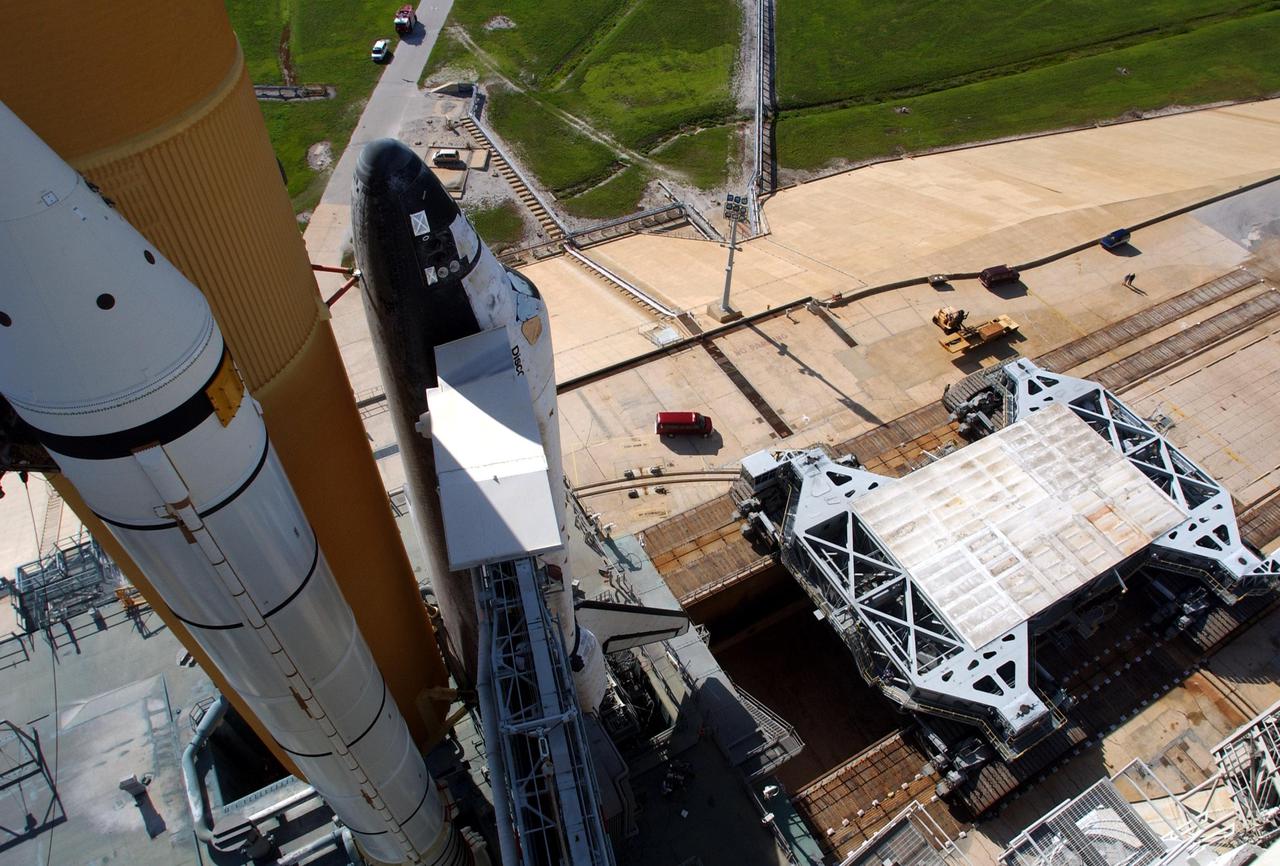
KENNEDY SPACE CENTER, Fla. -- This high-level view shows the crawler transporter (right) as it is backing away from Space Shuttle Atlantis and the mobile launcher platform (MLP) on Launch Pad 39A. The crawler transporter moved the Shuttle atop the MLP from the Vehicle Assembly Building to the pad in about six hours. Discovery is scheduled to launch in early August on mission STS-105. Photo by Scott Andrews using a Nikon D1X camera
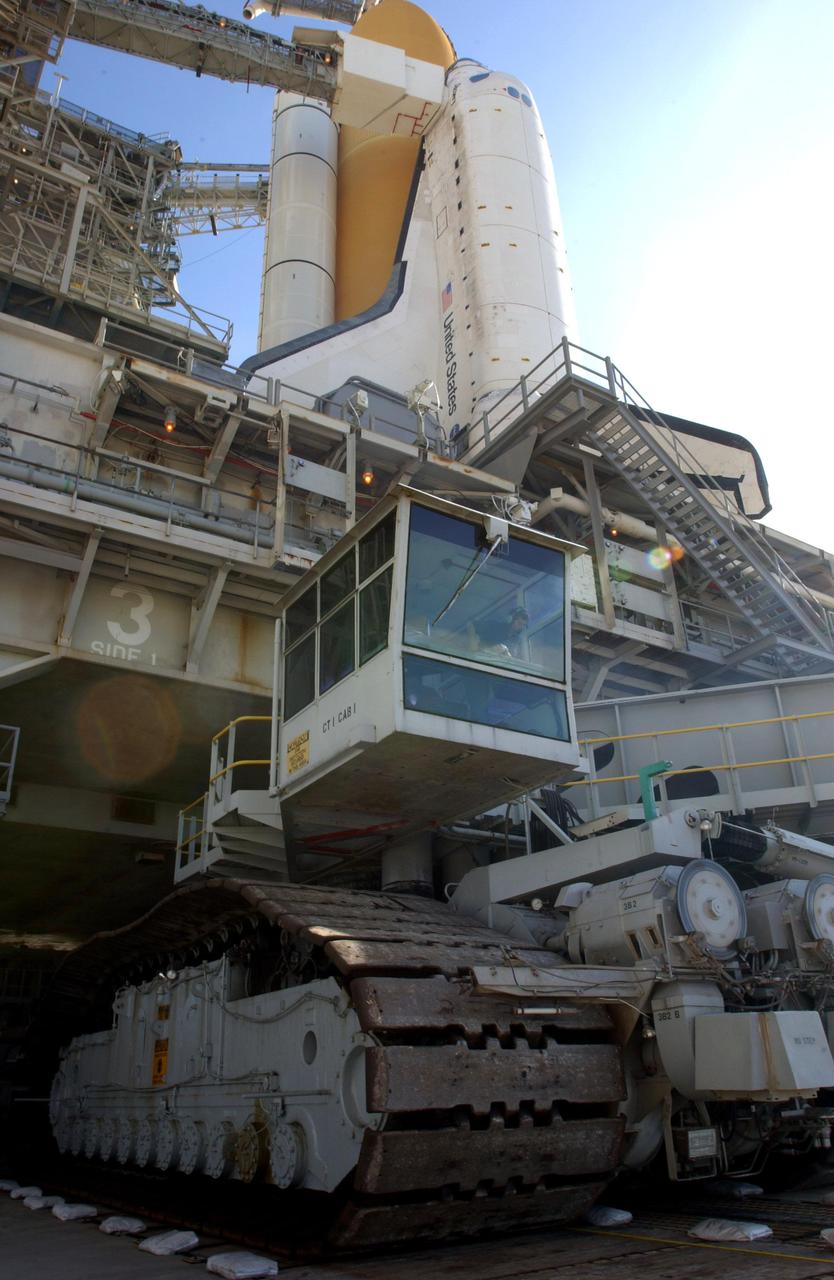
KENNEDY SPACE CENTER, Fla. - This closeup shows the crawler-transporter (bottom) as it rolls out from under Space Shuttle Discovery and the mobile launcher platform on Launch Pad 39A. The operator can be seen in the control cab. The crawler-transporter earlier moved the Shuttle and MLP from the Vehicle Assembly Building on a six-hour journey of 3.4 miles. Discovery is scheduled to launch in early August on mission STS-105. Photo by Scott Andrews using a Nikon D1X camera
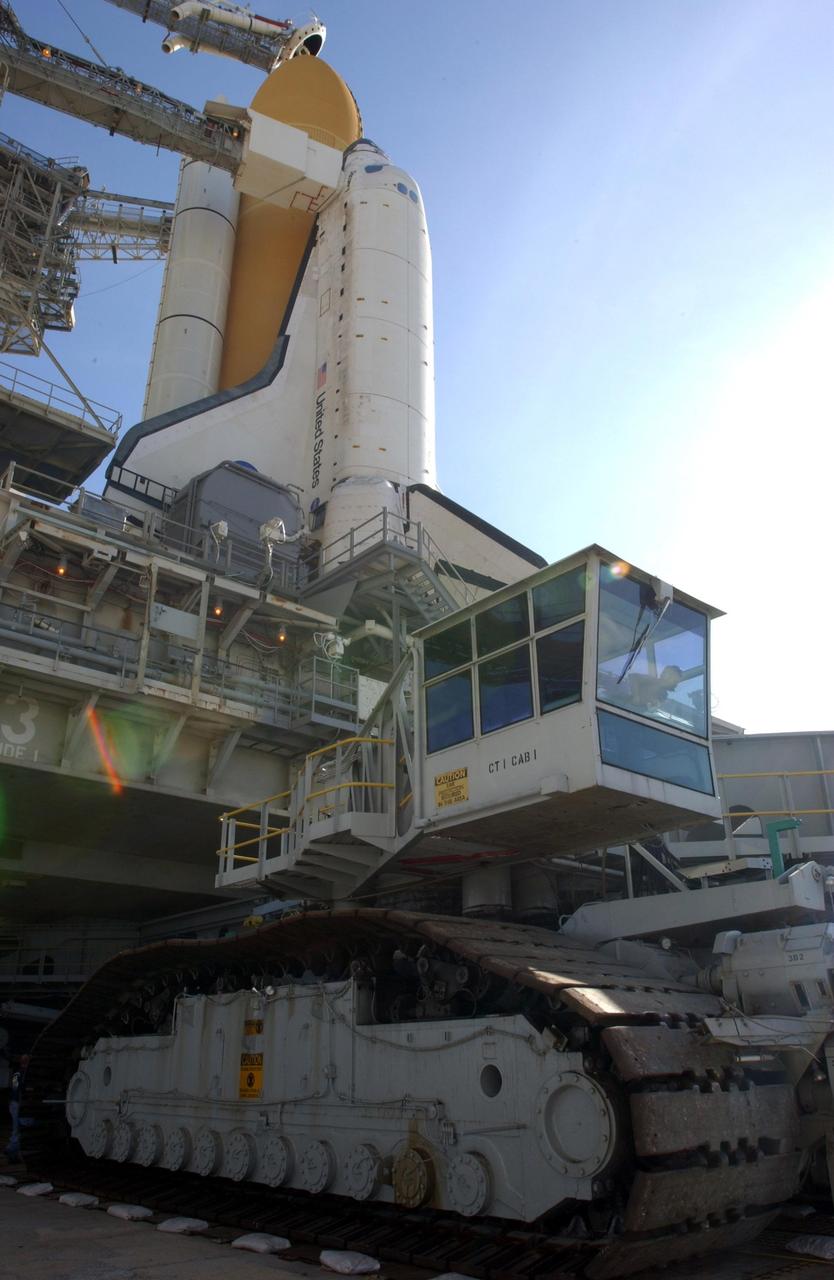
KENNEDY SPACE CENTER, Fla. -- The crawler-transporter (bottom) rolls out from under Space Shuttle Discovery and the mobile launcher platform on Launch Pad 39A. The crawler-transporter earlier moved the Shuttle and MLP from the Vehicle Assembly Building on a six-hour journey of 3.4 miles. Discovery is scheduled to launch in early August on mission STS-105. Photo by Scott Andrews using a Nikon D1X camera
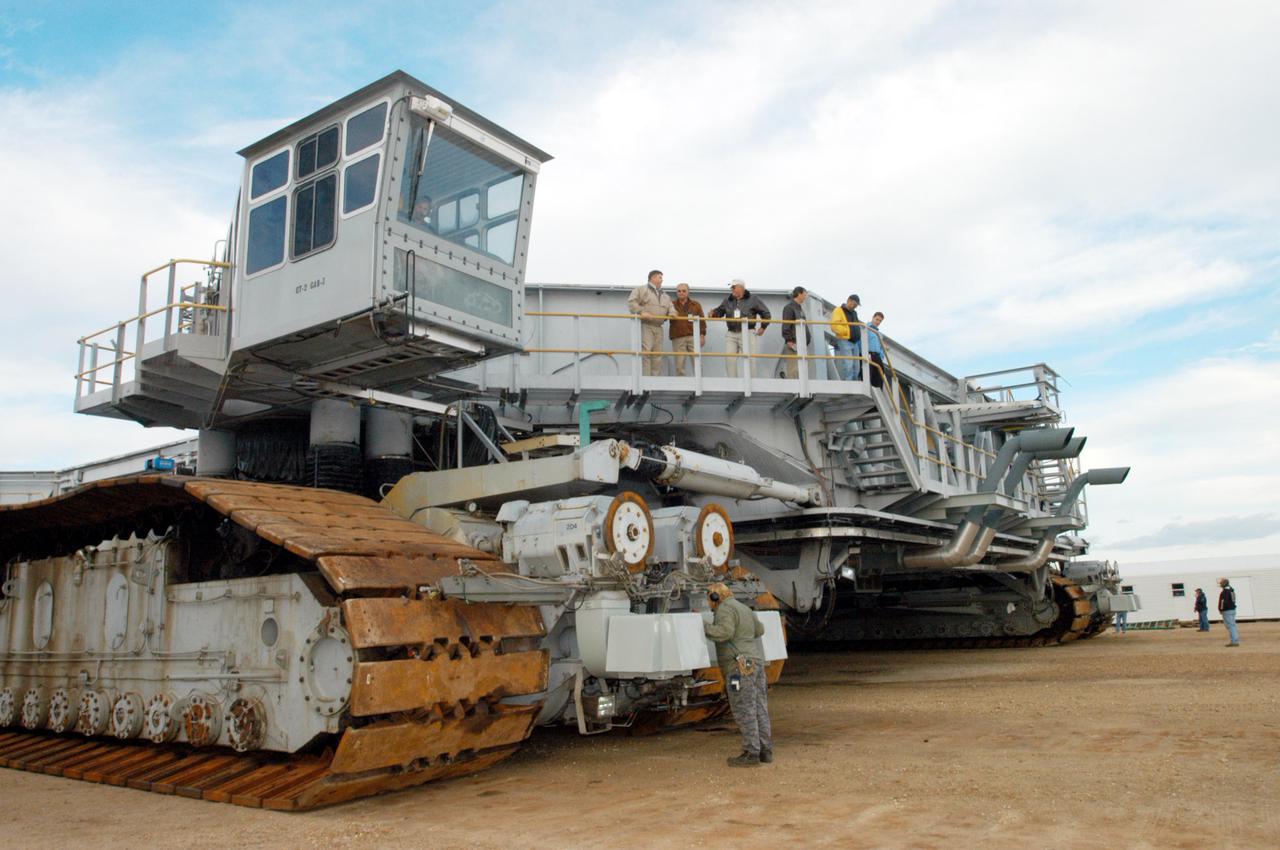
KENNEDY SPACE CENTER, FLA. - The newly shod Crawler Transporter is checked out before beginning a road test. The Crawler Transporter that will move Space Shuttle Discovery to the launch pad for Return to Flight is taking its first road test following the replacement of all its shoes. The crawlers have 456 shoes, 57 per belt (8 belts in all). Each shoe weighs 2,200 pounds. Cracks appeared in the shoes in recent years, spurring a need for replacement. The new manufacturer, in Duluth, Minn., has improved the design for a safe Return to Flight and use through the balance of the Space Shuttle Program.
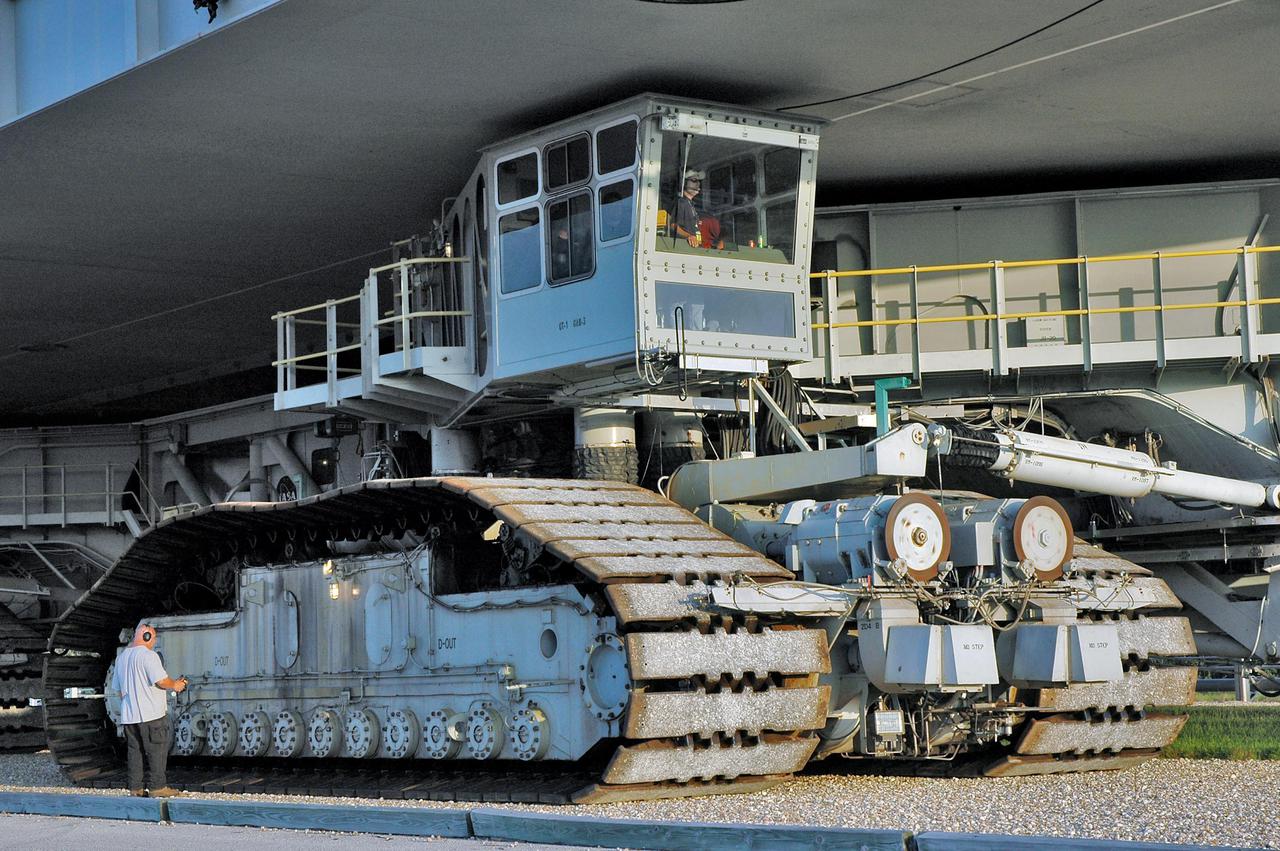
KENNEDY SPACE CENTER, FLA. - The Crawler-Transporter carries Space Shuttle Discovery and the Mobile Launcher Platform to Launch Pad 39B. The crawler is operated by a United Space Alliance driver, seen in the cab above the crawler tracks. The transporter uses a laser guidance system and a leveling system for the journey that keeps the top of the Space Shuttle vertical. This is the second rollout of Discovery after being returned to the Vehicle Assembly Building for connection to an improved External Tank. Launch of Discovery on its Return to Flight mission STS-114 is targeted for a launch window extending from July 13 to July 31.
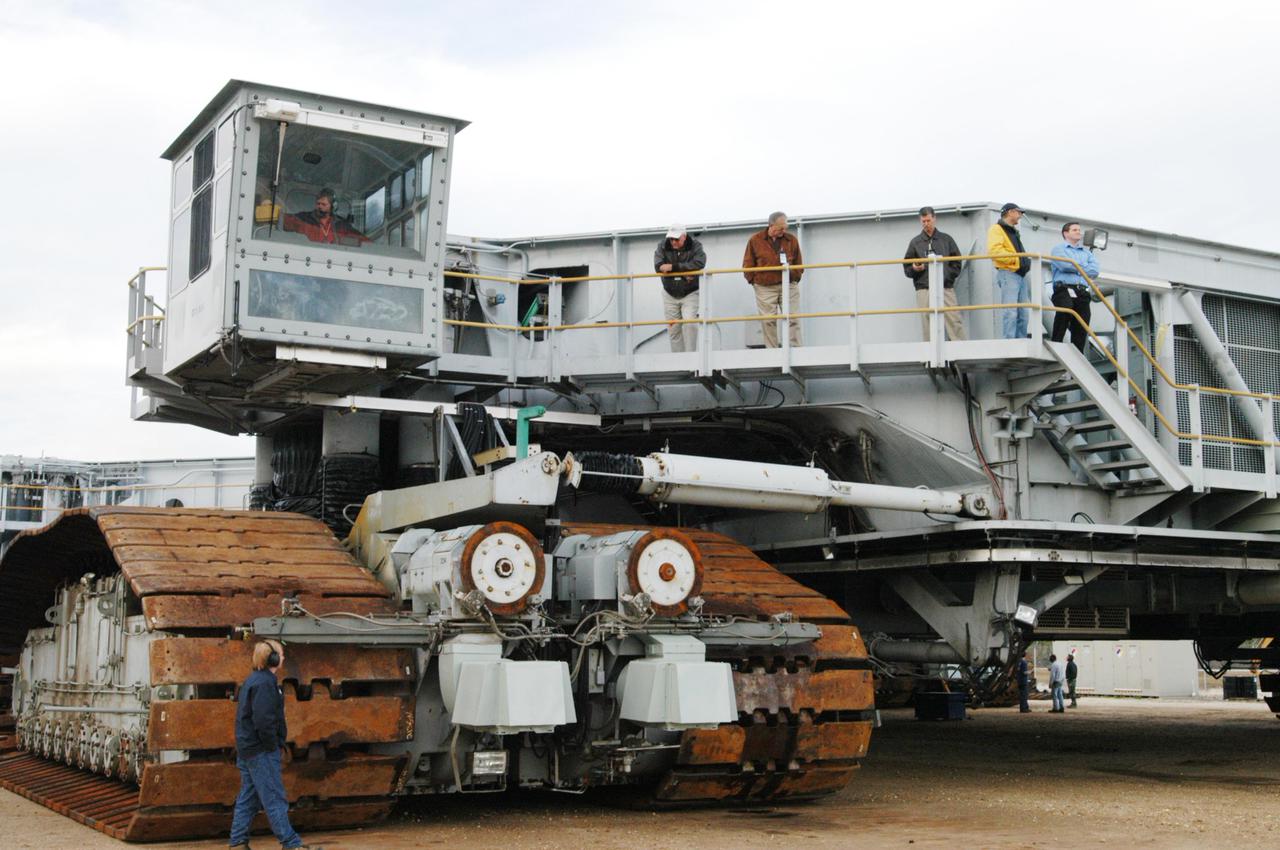
KENNEDY SPACE CENTER, FLA. - The newly shod Crawler Transporter moves forward slowly as it begins its road test. The Crawler Transporter that will move Space Shuttle Discovery to the launch pad for Return to Flight is taking its first road test following the replacement of all its shoes. The crawlers have 456 shoes, 57 per belt (8 belts in all). Each shoe weighs 2,200 pounds. Cracks appeared in the shoes in recent years, spurring a need for replacement. The new manufacturer, in Duluth, Minn., has improved the design for a safe Return to Flight and use through the balance of the Space Shuttle Program.
KENNEDY SPACE CENTER, FLA. - The newly shod Crawler Transporter is ready for a road test. The Crawler Transporter that will move Space Shuttle Discovery to the launch pad for Return to Flight is taking its first road test following the replacement of all its shoes. The crawlers have 456 shoes, 57 per belt (8 belts in all). Each shoe weighs 2,200 pounds. Cracks appeared in the shoes in recent years, spurring a need for replacement. The new manufacturer, in Duluth, Minn., has improved the design for a safe Return to Flight and use through the balance of the Space Shuttle Program.
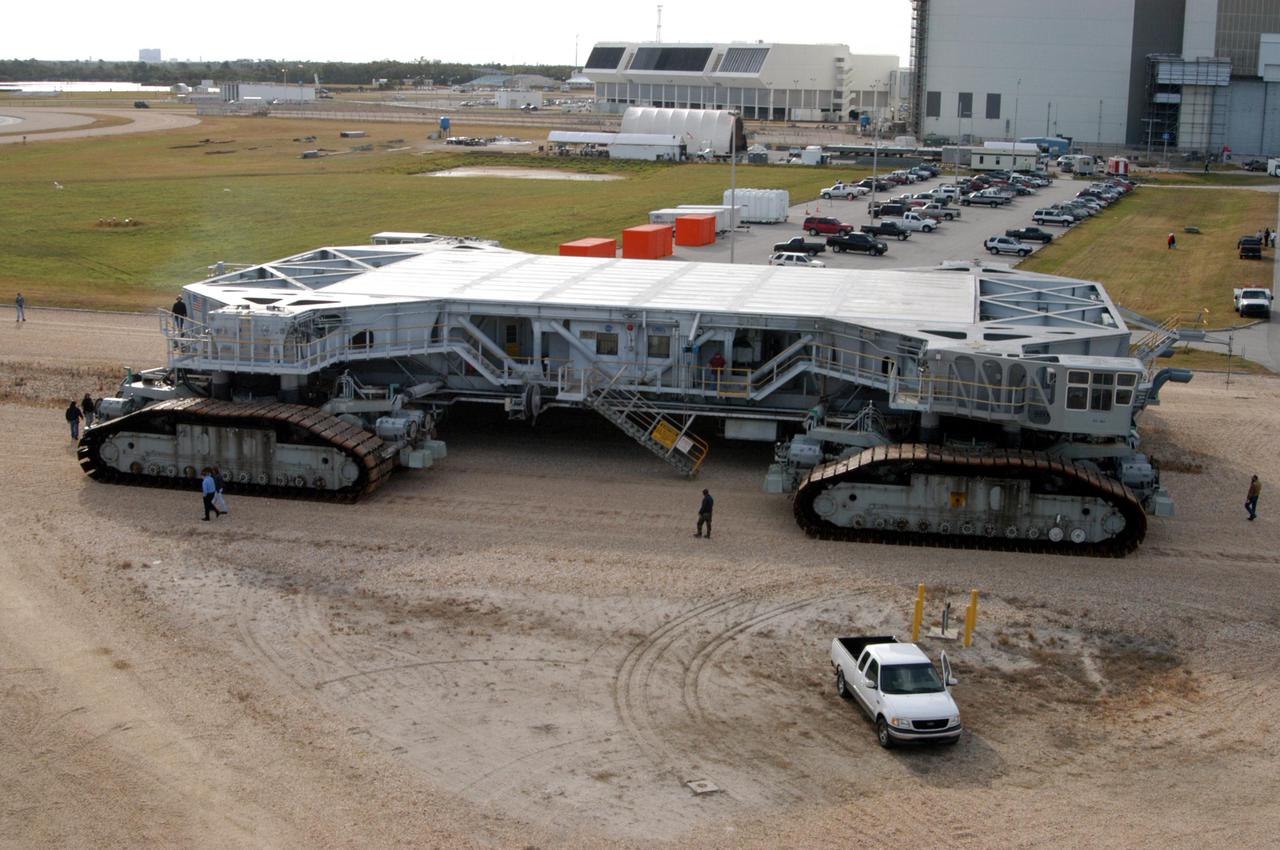
KENNEDY SPACE CENTER, FLA. - Observers walk alongside the newly shod Crawler Transporter as it moves slowly forward. The Crawler Transporter that will move Space Shuttle Discovery to the launch pad for Return to Flight is taking its first road test following the replacement of all its shoes. The crawlers have 456 shoes, 57 per belt (8 belts in all). Each shoe weighs 2,200 pounds. Cracks appeared in the shoes in recent years, spurring a need for replacement. The new manufacturer, in Duluth, Minn., has improved the design for a safe Return to Flight and use through the balance of the Space Shuttle Program.
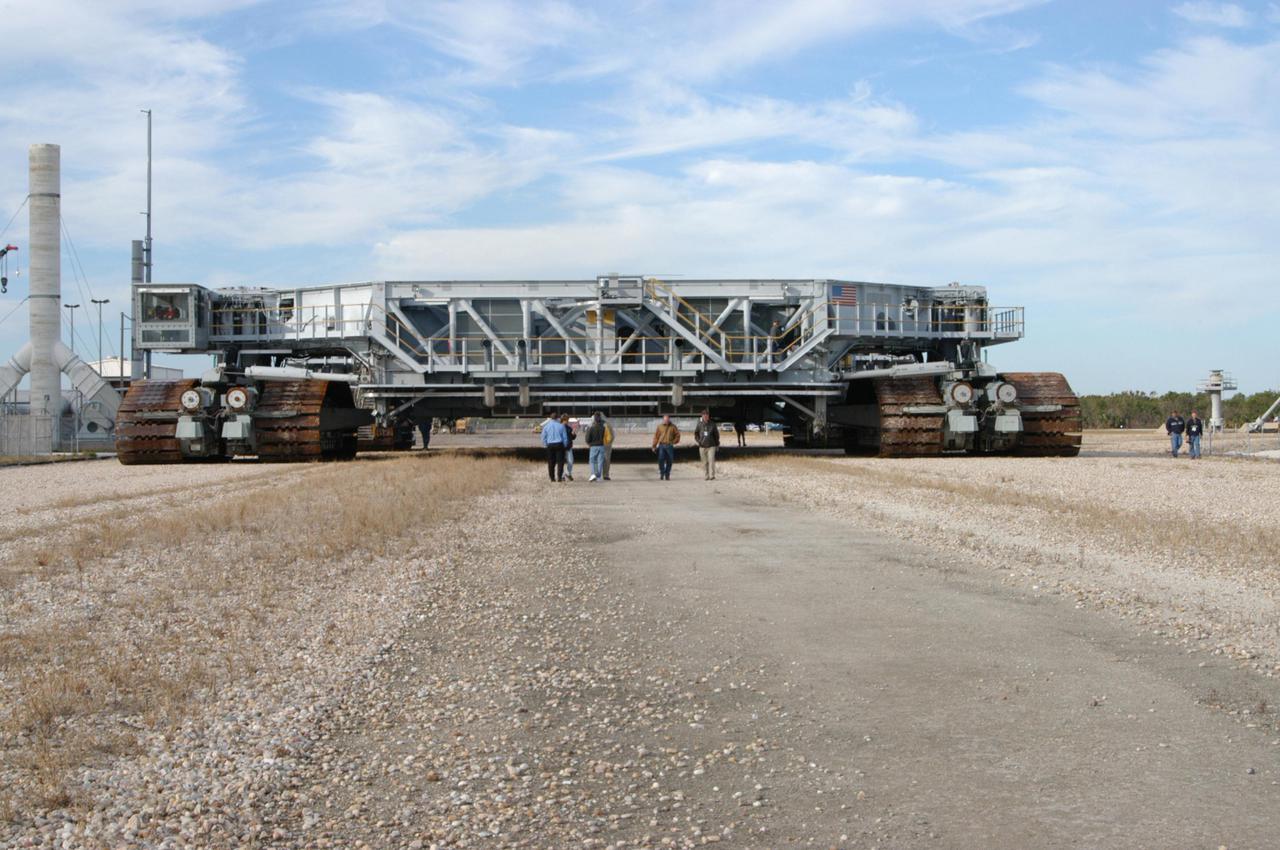
KENNEDY SPACE CENTER, FLA. - The newly shod Crawler Transporter is ready for its road test. The Crawler Transporter that will move Space Shuttle Discovery to the launch pad for Return to Flight is taking its first road test following the replacement of all its shoes. The crawlers have 456 shoes, 57 per belt (8 belts in all). Each shoe weighs 2,200 pounds. Cracks appeared in the shoes in recent years, spurring a need for replacement. The new manufacturer, in Duluth, Minn., has improved the design for a safe Return to Flight and use through the balance of the Space Shuttle Program.
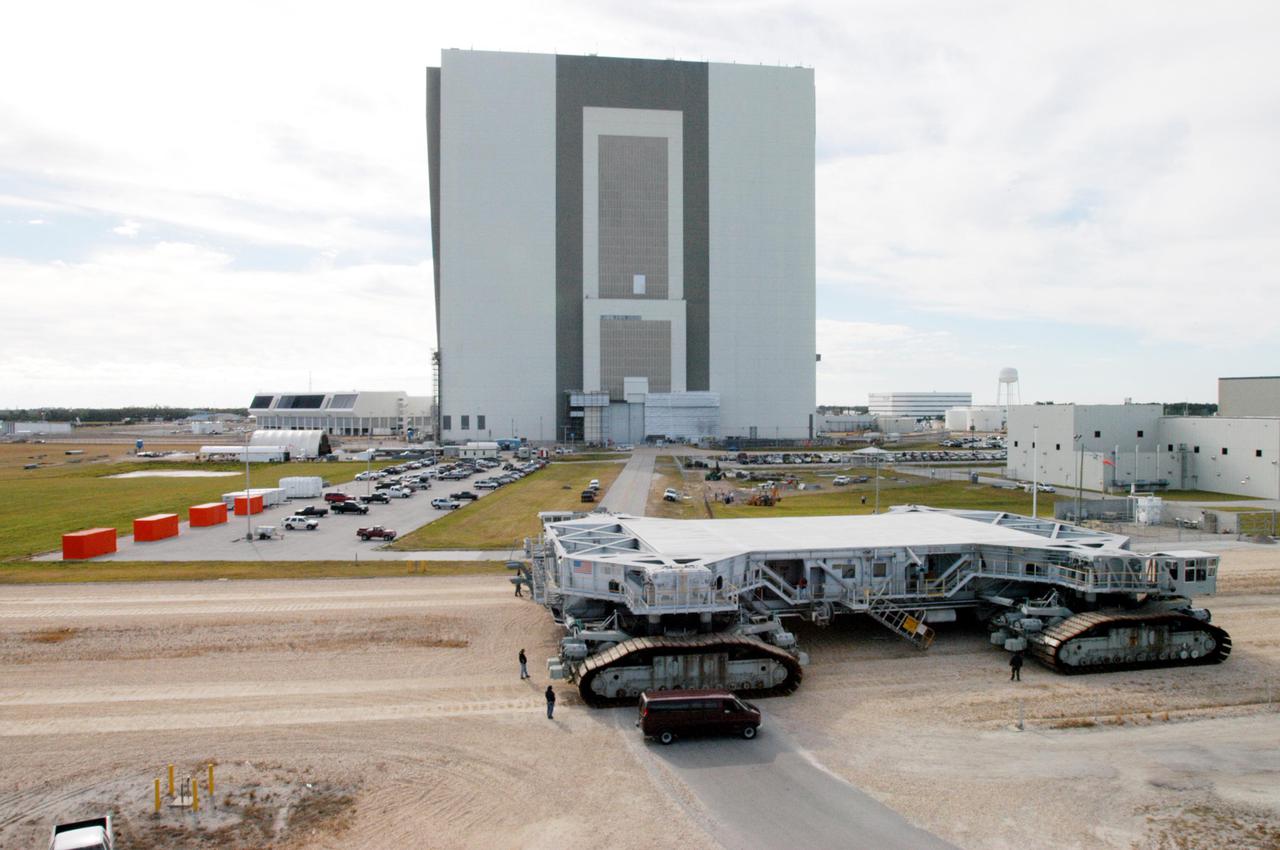
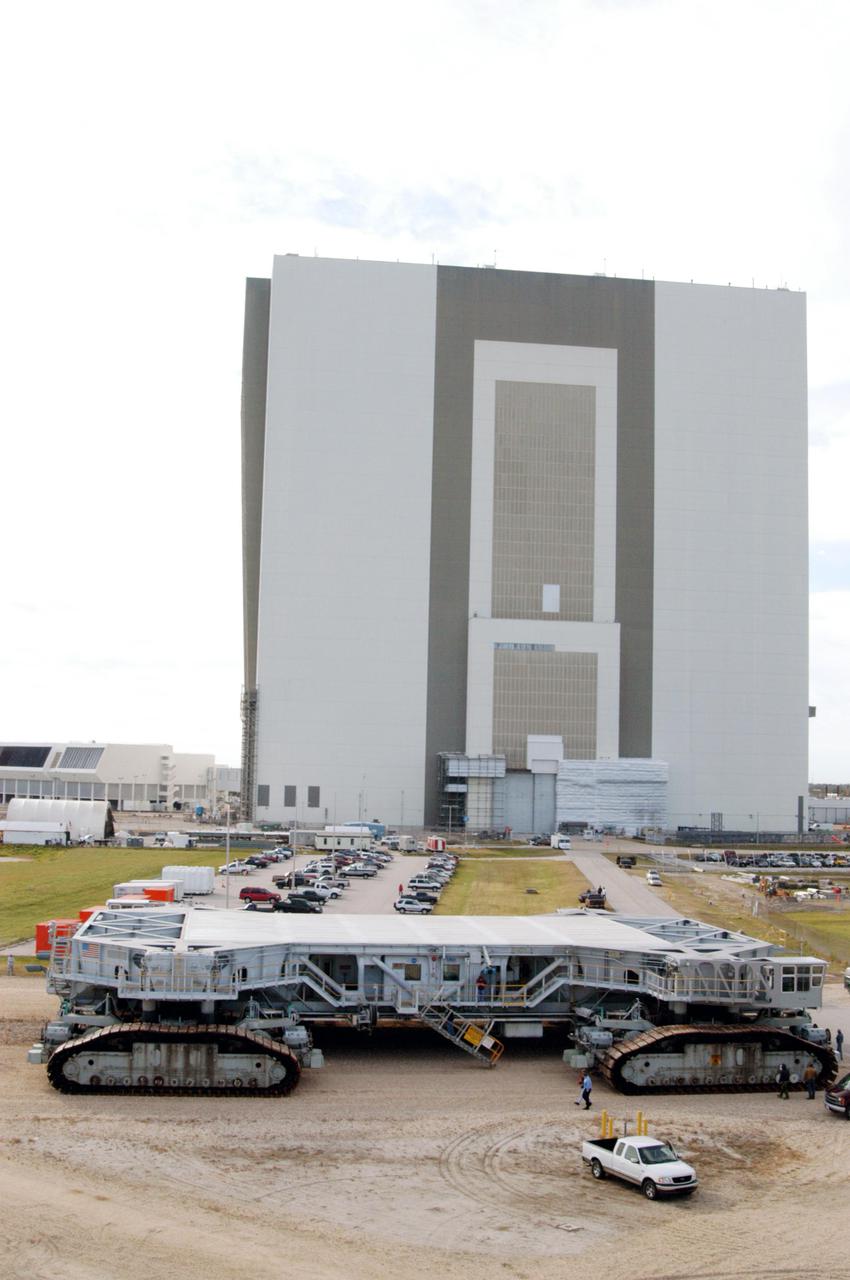
KENNEDY SPACE CENTER, FLA. - The Crawler Transporter sits behind the Vehicle Assembly Building after its road test of the new shoes. The Crawler Transporter that will move Space Shuttle Discovery to the launch pad for Return to Flight is taking its first road test following the replacement of all its shoes. The crawlers have 456 shoes, 57 per belt (8 belts in all). Each shoe weighs 2,200 pounds. Cracks appeared in the shoes in recent years, spurring a need for replacement. The new manufacturer, in Duluth, Minn., has improved the design for a safe Return to Flight and use through the balance of the Space Shuttle Program.
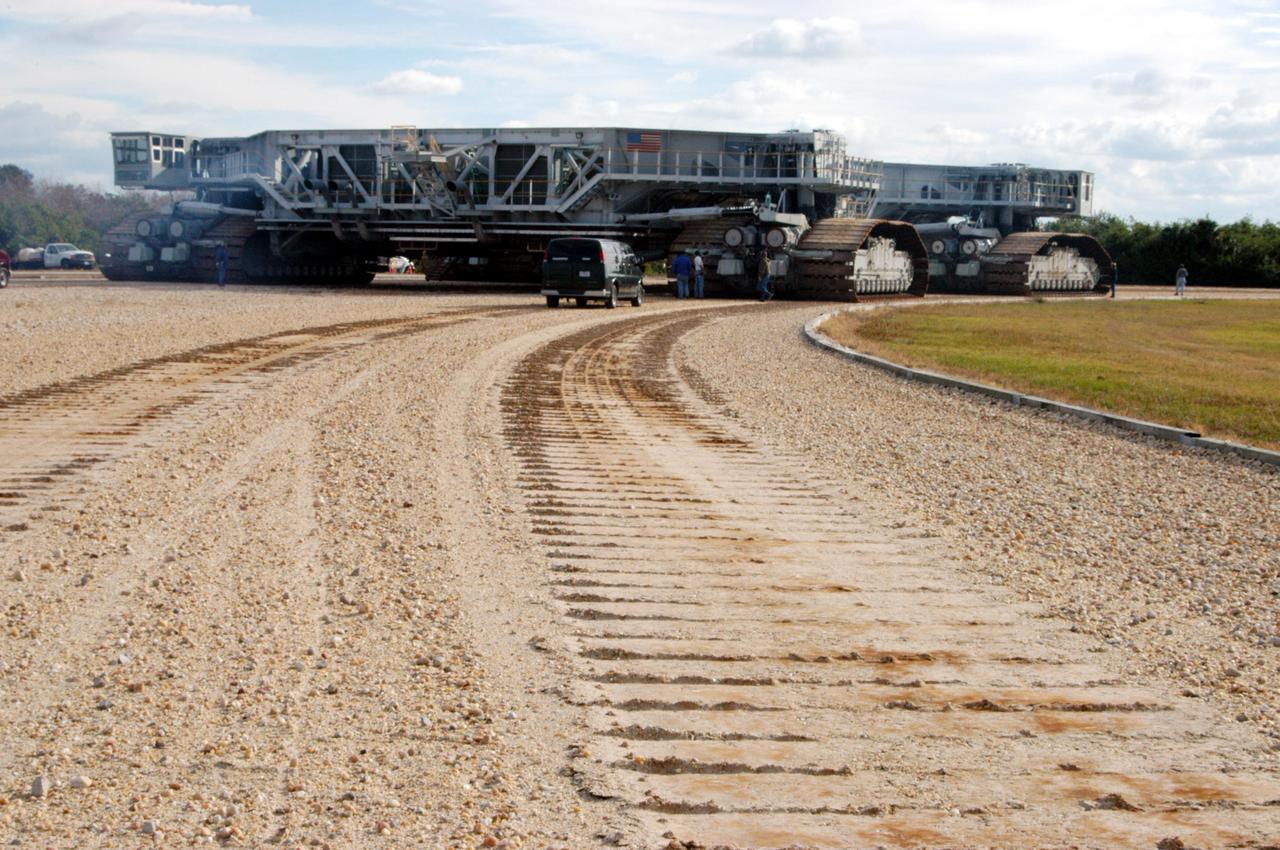
KENNEDY SPACE CENTER, FLA. - The newly shod Crawler Transporter leaves tracks in the dirt as it moves forward on its road test. The Crawler Transporter that will move Space Shuttle Discovery to the launch pad for Return to Flight is taking its first road test following the replacement of all its shoes. The crawlers have 456 shoes, 57 per belt (8 belts in all). Each shoe weighs 2,200 pounds. Cracks appeared in the shoes in recent years, spurring a need for replacement. The new manufacturer, in Duluth, Minn., has improved the design for a safe Return to Flight and use through the balance of the Space Shuttle Program.
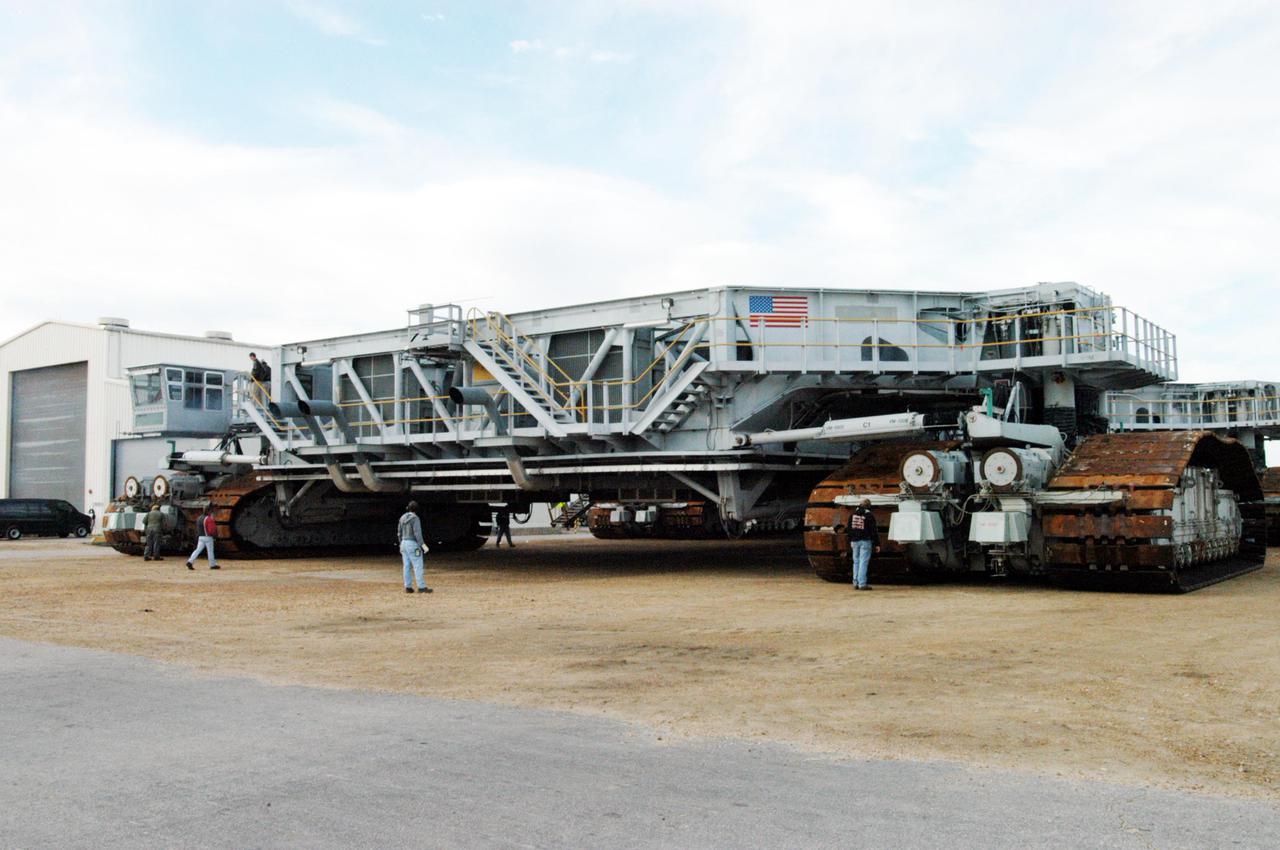
KENNEDY SPACE CENTER, FLA. - The newly shod Crawler Transporter is checked out before beginning its road test. The Crawler Transporter that will move Space Shuttle Discovery to the launch pad for Return to Flight is taking its first road test following the replacement of all its shoes. The crawlers have 456 shoes, 57 per belt (8 belts in all). Each shoe weighs 2,200 pounds. Cracks appeared in the shoes in recent years, spurring a need for replacement. The new manufacturer, in Duluth, Minn., has improved the design for a safe Return to Flight and use through the balance of the Space Shuttle Program.
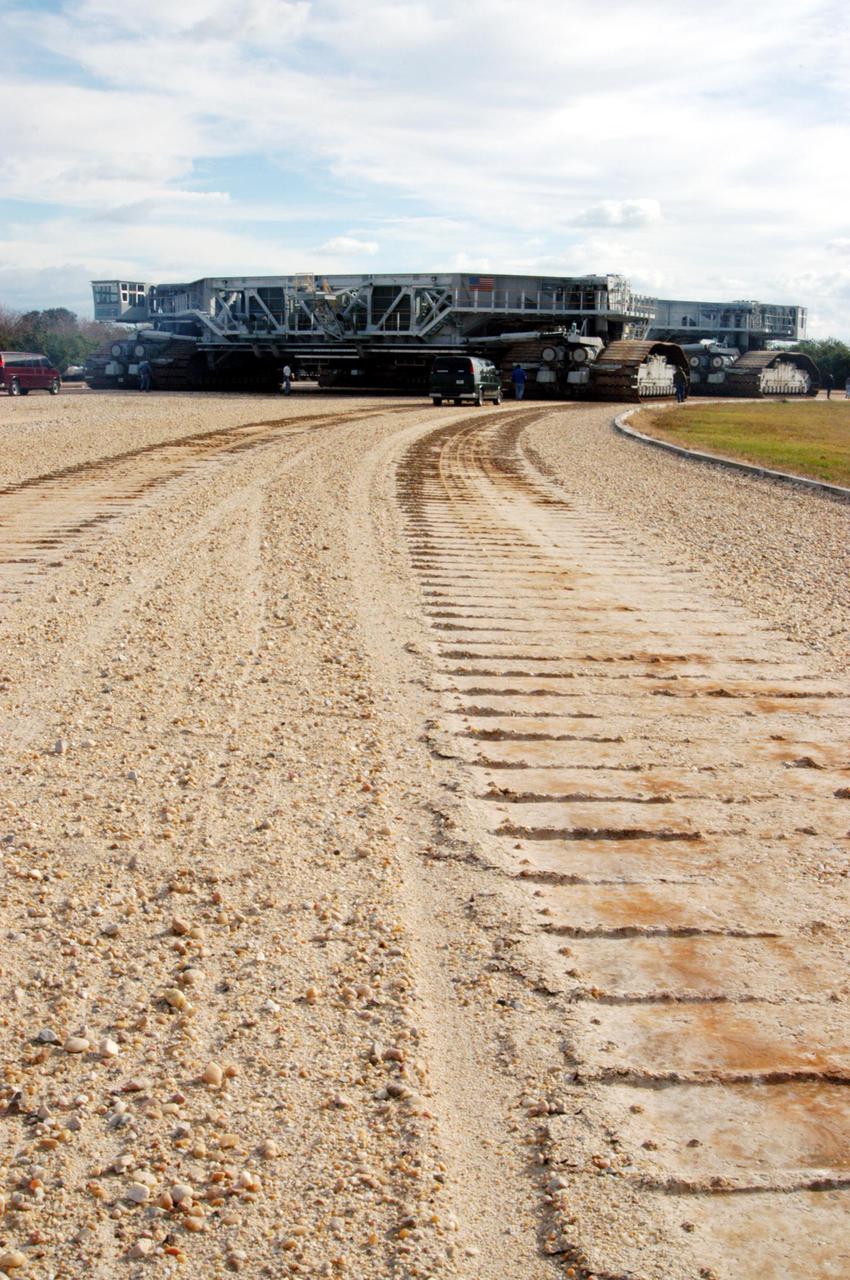
KENNEDY SPACE CENTER, FLA. - The newly shod Crawler Transporter leaves tracks in the dirt as it moves forward on its road test. The Crawler Transporter that will move Space Shuttle Discovery to the launch pad for Return to Flight is taking its first road test following the replacement of all its shoes. The crawlers have 456 shoes, 57 per belt (8 belts in all). Each shoe weighs 2,200 pounds. Cracks appeared in the shoes in recent years, spurring a need for replacement. The new manufacturer, in Duluth, Minn., has improved the design for a safe Return to Flight and use through the balance of the Space Shuttle Program.
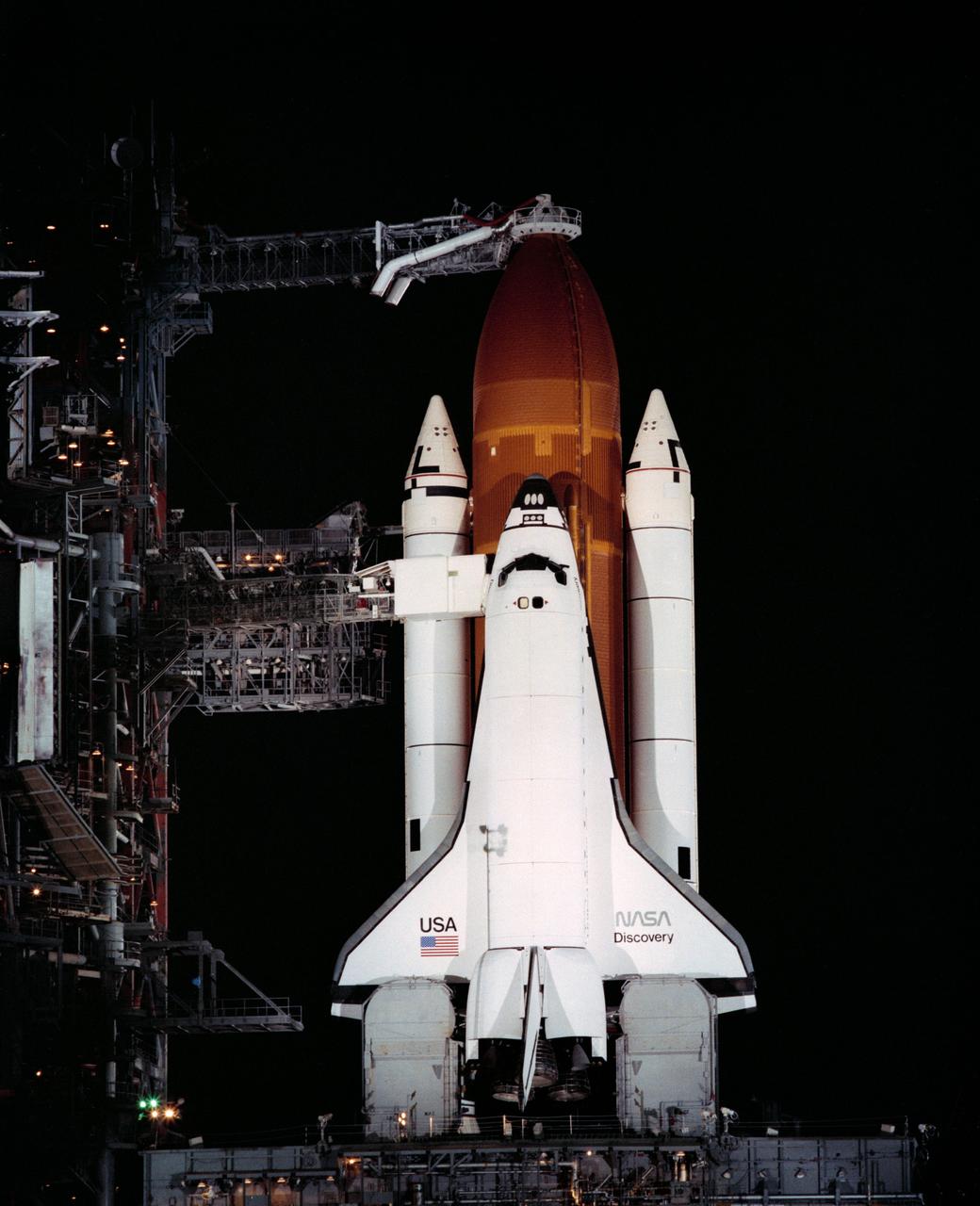
The Space Shuttle Discovery moves towards Pad "A" on the crawler transporter for its maiden flight. The Shuttle Discovery is poised atop Pad "A" at Complex 39 prior ot the STS-41D mission. KSC, FL
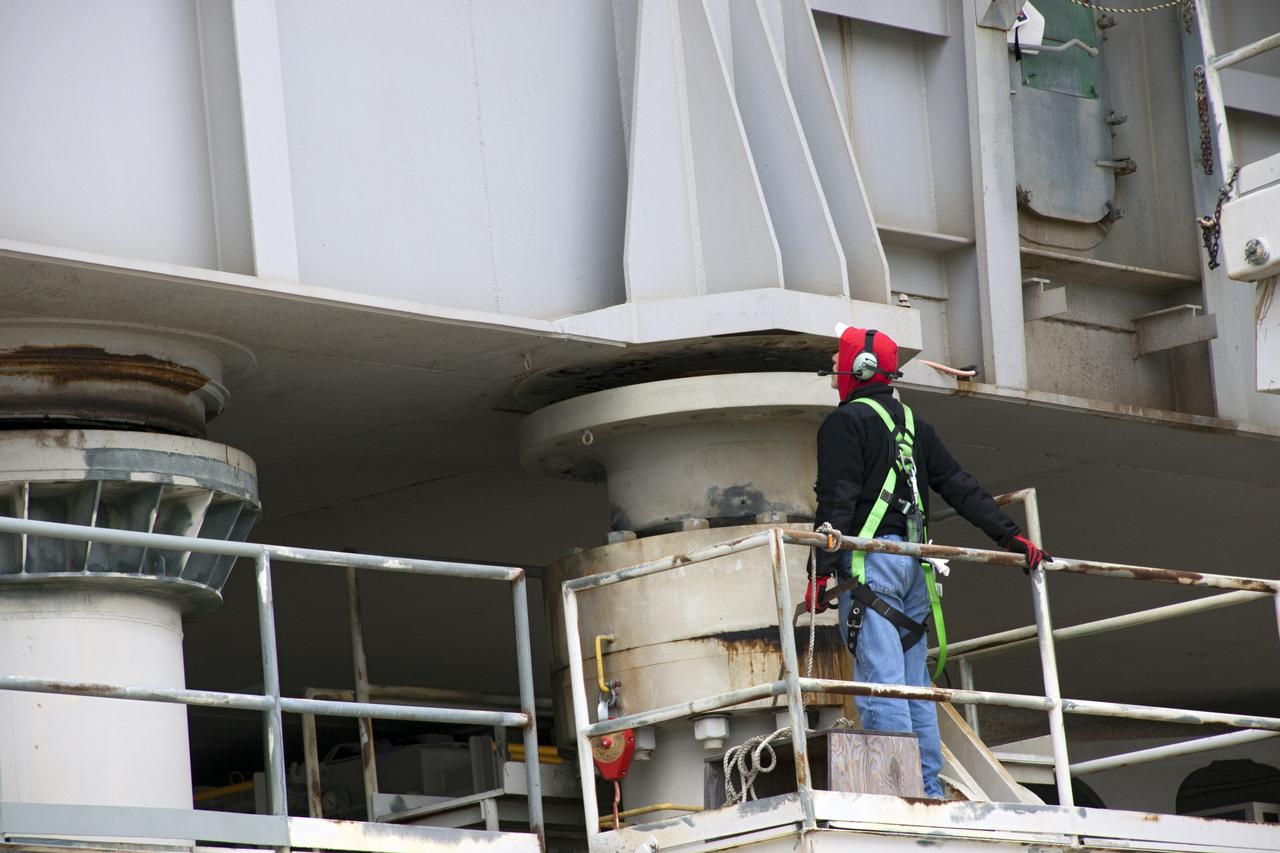
CAPE CANAVERAL, Fla. -- Technicians monitor progress as crawler-transporter No. 2 lifts a space shuttle era mobile launcher platform at Launch Pad 39A at NASA's Kennedy Space Center in Florida. The crawler-transporter is undergoing testing to check out recently completed modifications to ensure its ability to carry launch vehicles such as the space agency's Space Launch System heavy-lift rocket to the pad. NASA's Ground Systems Development and Operations Program is leading the 20-year life-extension project for the crawler. A pair of behemoth machines called crawler-transporters has carried the load of taking rockets and spacecraft to the launch pad for more than 40 years at NASA’s Kennedy Space Center in Florida. Each weighing six and a half million pounds and larger in size than a professional baseball infield, the crawler-transporters are powered by locomotive and large electrical power generator engines. The crawler-transporters will stand ready to keep up the work for the next generation of launch vehicles to lift astronauts into space. For more information, visit http://www.nasa.gov/exploration/systems/ground/index.html Photo credit: NASA/ Jim Grossmann
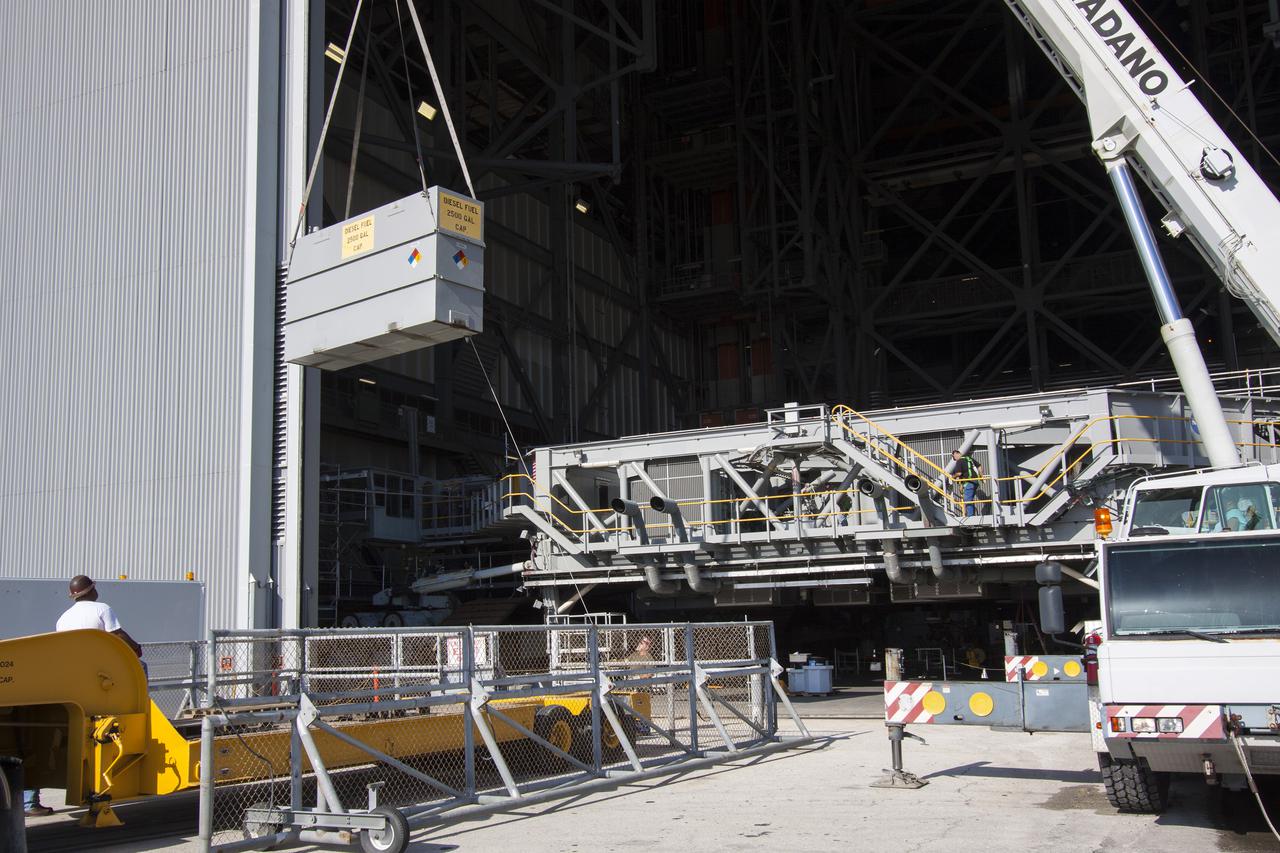
CAPE CANAVERAL, Fla. – Inside the Vehicle Assembly Building at NASA’s Kennedy Space Center in Florida, a large crane is used to lift a fuel tank away from crawler-transporter 1 CT-1 in high bay 3. The fuel tank will be transported to the Wiltech facility at Kennedy for cleaning and inspection. Work continues in high bay 3 to upgrade CT-1 as part of its general maintenance. CT-1 could be available to carry commercial launch vehicles to the launch pad. The crawler-transporters were used to carry the mobile launcher platform and space shuttle to Launch Complex 39 for space shuttle launches for 30 years. Photo credit: NASA_Jim Grossman

CAPE CANAVERAL, Fla. – Inside the Vehicle Assembly Building at NASA’s Kennedy Space Center in Florida, technicians prepare to remove a fuel tank from crawler-transporter 1 CT-1 in high bay 3. The fuel tank will be transported to the Wiltech facility at Kennedy for cleaning and inspection. Work continues in high bay 3 to upgrade CT-1 as part of its general maintenance. CT-1 could be available to carry commercial launch vehicles to the launch pad. The crawler-transporters were used to carry the mobile launcher platform and space shuttle to Launch Complex 39 for space shuttle launches for 30 years. Photo credit: NASA_Jim Grossman
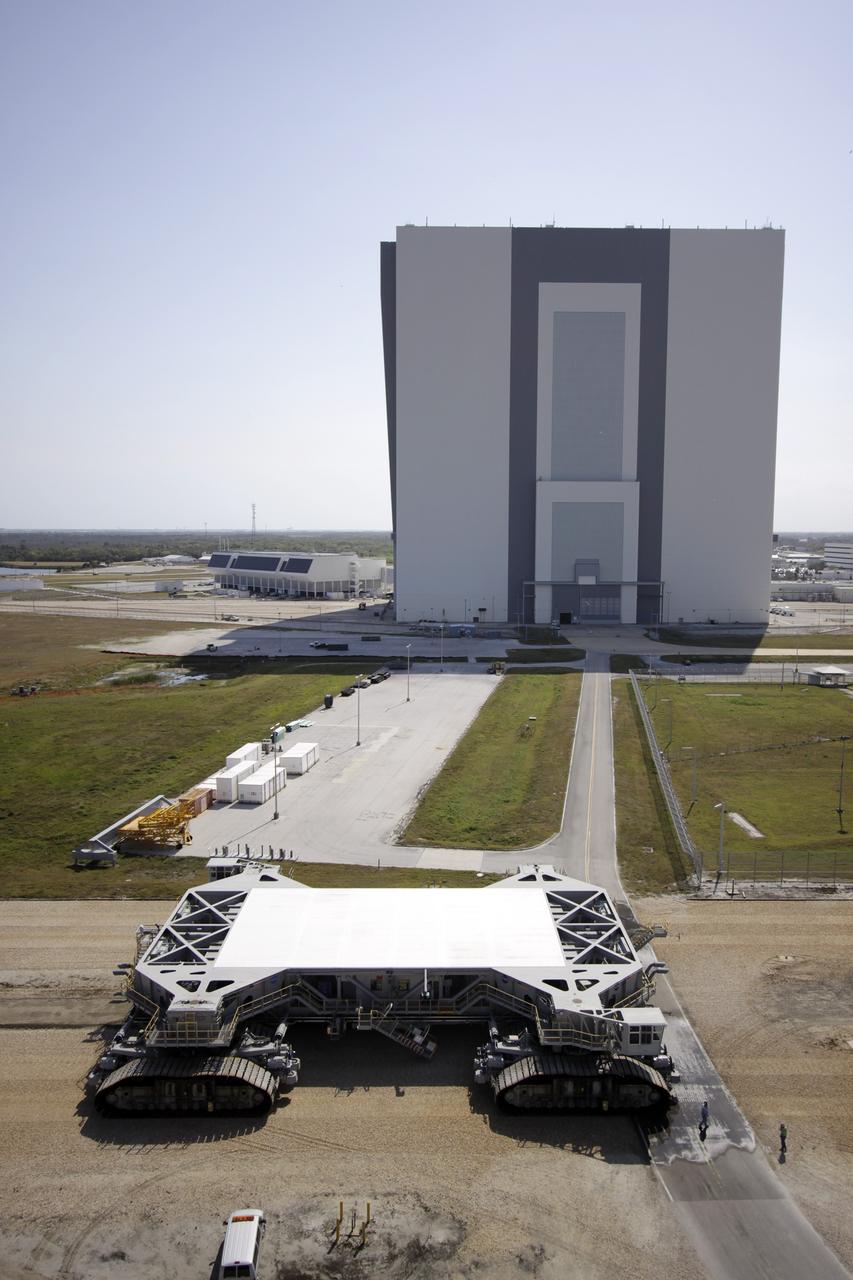
CAPE CANAVERAL, Fla. – At NASA’s Kennedy Space Center in Florida, the crawler-transporter 2, or CT-2, is on its way to the Park Site west of the Vehicle Assembly Building. The transporter has new brakes and mufflers and a recently-painted white roof deck. The Ground Systems Development and Operations Program office at Kennedy is overseeing the upgrades to CT-2 so that it can carry NASA’s Space Launch System heavy-lift rocket, which is under design, and new Orion spacecraft to the launch pad. The crawler-transporters were used to carry the mobile launcher platform and space shuttle to Launch Complex 39 for space shuttle launches for 30 years. Photo credit: NASA/Jim Grossmann
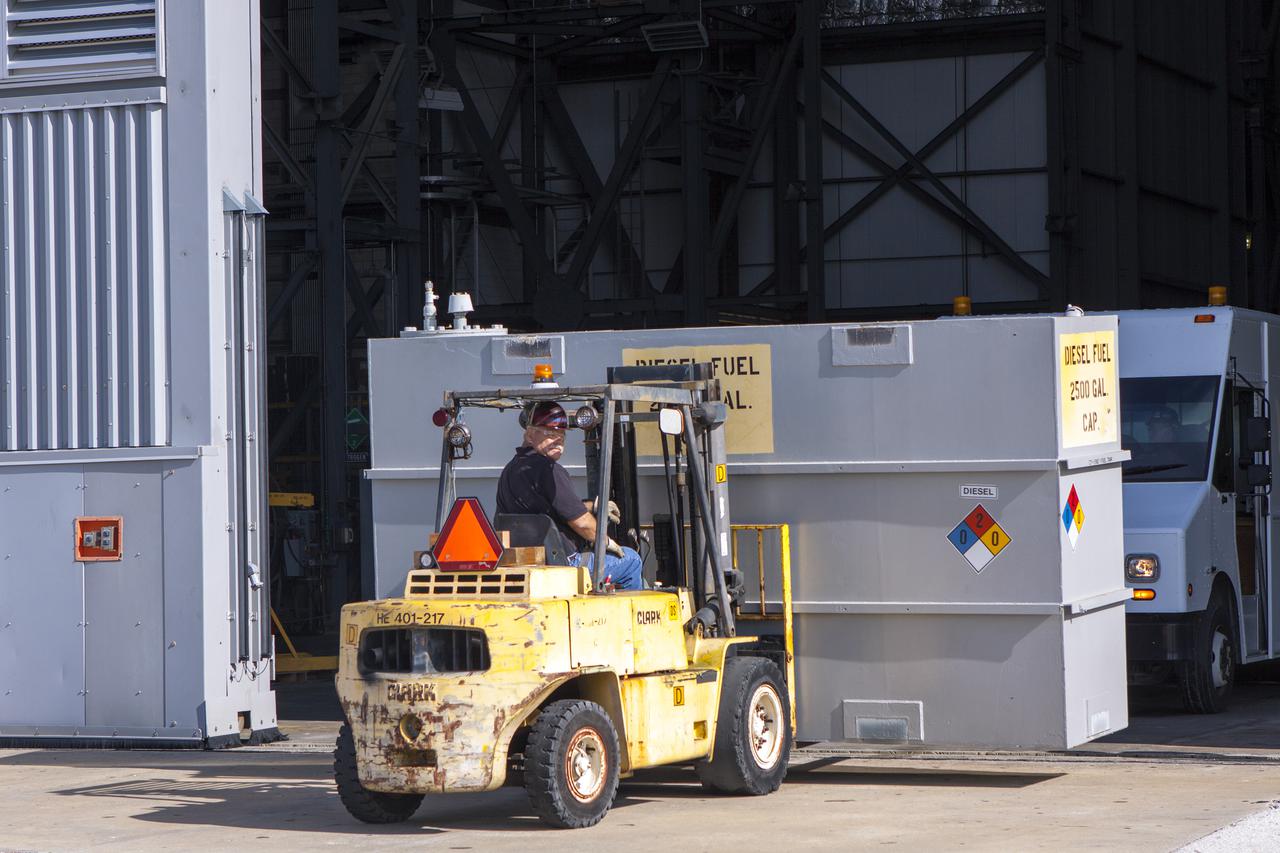
CAPE CANAVERAL, Fla. – In front of the Vehicle Assembly Building at NASA’s Kennedy Space Center in Florida, a technician uses a forklift to move a fuel tank after it was removed from crawler-transporter 1 CT-1 in high bay 3. The fuel tank will be transporter to the Wiltech facility at Kennedy for cleaning and inspection. Work continues in high bay 3 to upgrade CT-1 as part of its general maintenance. CT-1 could be available to carry commercial launch vehicles to the launch pad. The crawler-transporters were used to carry the mobile launcher platform and space shuttle to Launch Complex 39 for space shuttle launches for 30 years. Photo credit: NASA_Jim Grossman
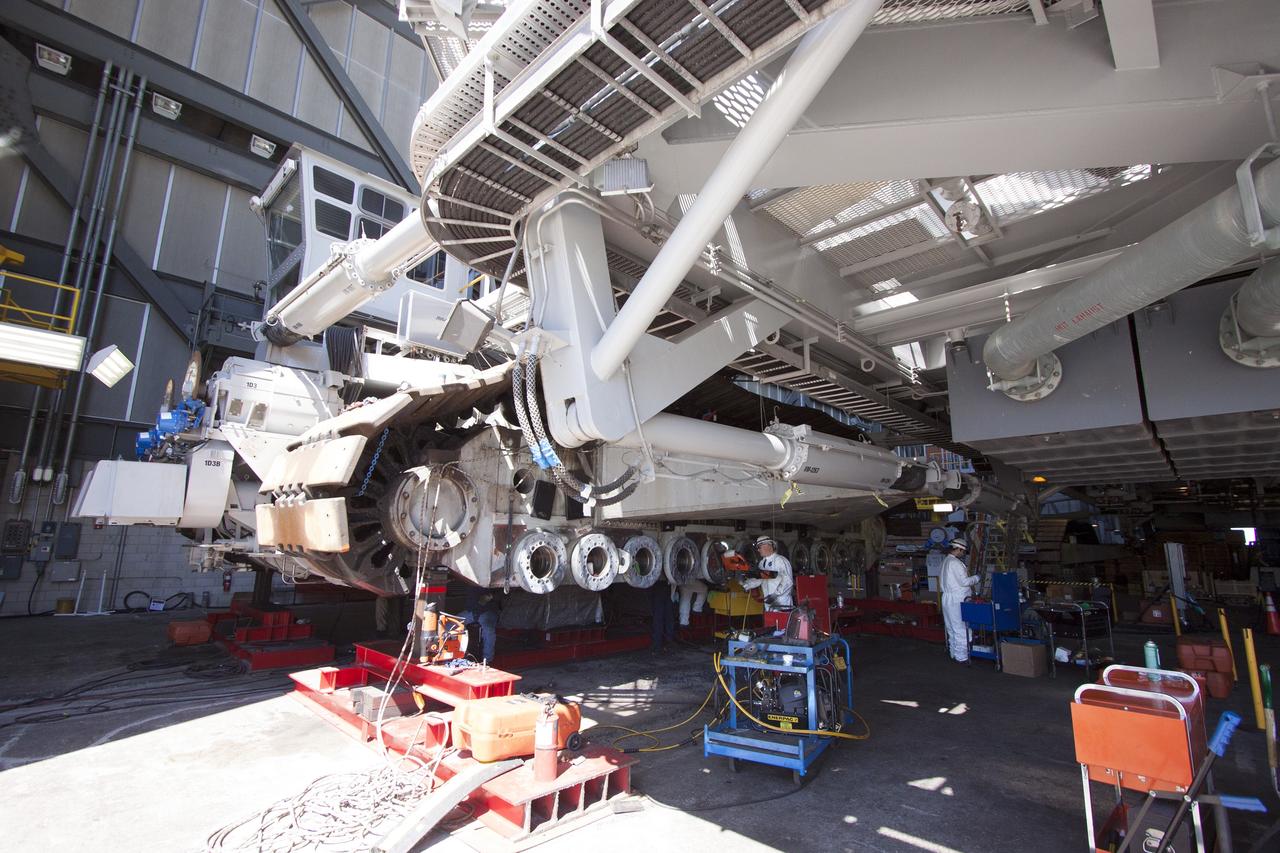
CAPE CANAVERAL, Fla. – Inside the Vehicle Assembly Building at NASA’s Kennedy Space Center in Florida, ground support technicians install new roller bearings on the C truck of crawler-transporter 2, or CT-2. Work continues in high bay 2 to upgrade CT-2. The modifications are designed to ensure CT-2’s ability to transport launch vehicles currently in development, such as the agency’s Space Launch System, to the launch pad. The Ground Systems Development and Operations Program office at Kennedy is overseeing the upgrades. For more than 45 years the crawler-transporters were used to transport the mobile launcher platform and the Apollo-Saturn V rockets and, later, space shuttles to Launch Pads 39A and B. For more information, visit: http://www.nasa.gov/exploration/systems/ground/crawler-transporter. Photo credit: NASA/Cory Huston
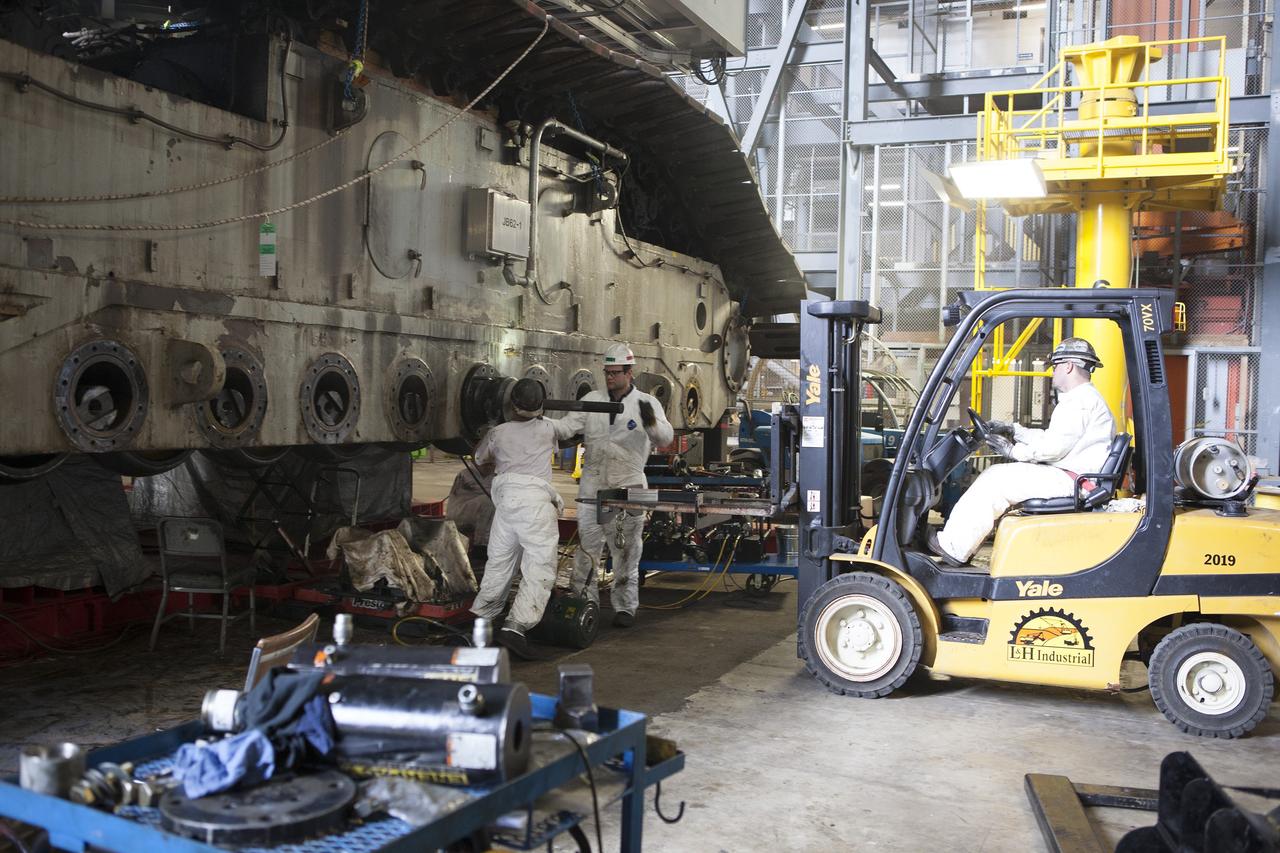
CAPE CANAVERAL, Fla. – Inside the Vehicle Assembly Building at NASA’s Kennedy Space Center in Florida, ground support technicians assist with removal of a bearing from the B truck tread of crawler-transporter 2, or CT-2, and prepare to load it on a forklift for disposal. New roller bearing assemblies will be installed. Work continues in high bay 2 to upgrade CT-2. The modifications are designed to ensure CT-2’s ability to transport launch vehicles currently in development, such as the agency’s Space Launch System, to the launch pad. The Ground Systems Development and Operations Program office at Kennedy is overseeing the upgrades. For more than 45 years the crawler-transporters were used to transport the mobile launcher platform and the Apollo-Saturn V rockets and, later, space shuttles to Launch Pads 39A and B. For more information, visit: http://www.nasa.gov/exploration/systems/ground/crawler-transporter. Photo credit: NASA/Dimitri Gerondidakis
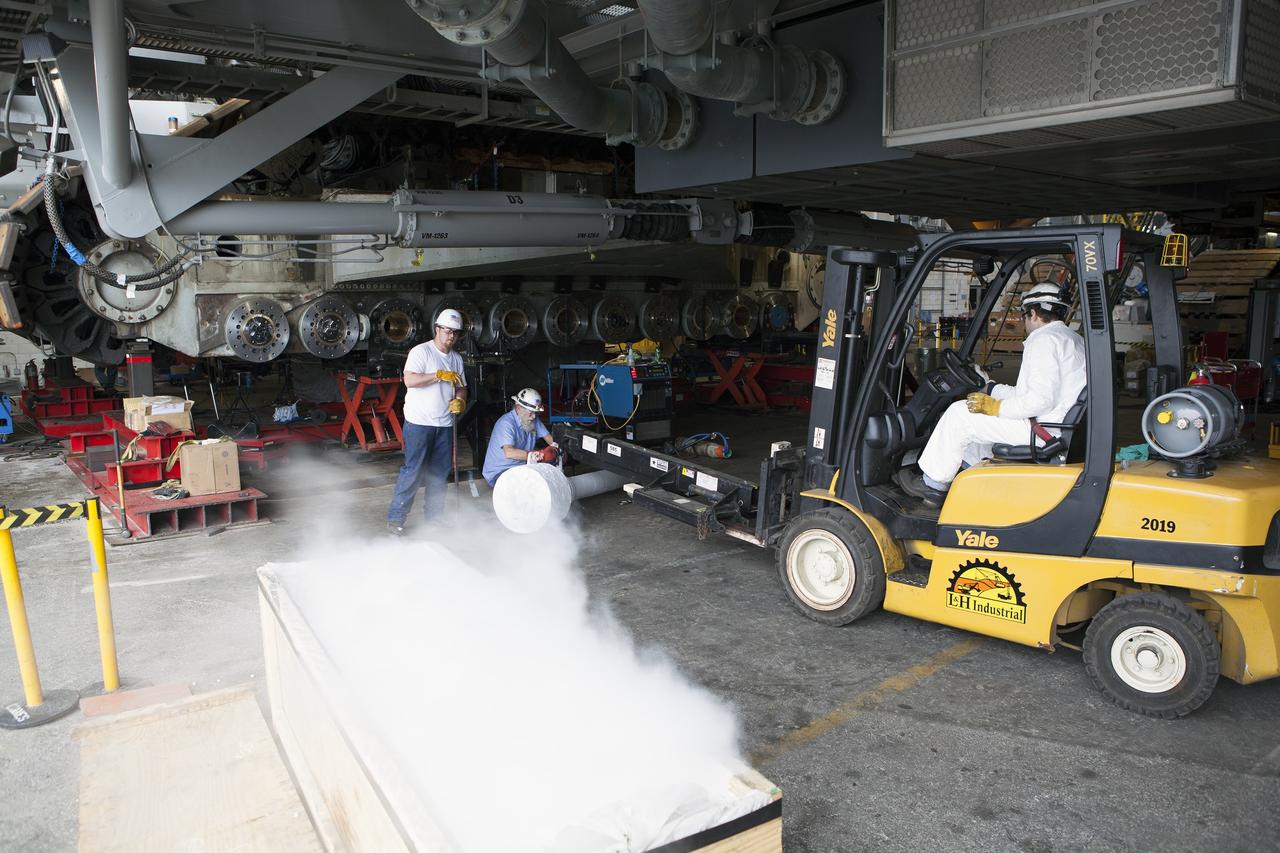
CAPE CANAVERAL, Fla. - Inside the Vehicle Assembly Building at NASA’s Kennedy Space Center in Florida, ground support technicians attach a roller bearing shaft to a forklift. The bearing is being prepared for insertion in the C truck of crawler-transporter 2, or CT-2. A section of the treads on the C truck were removed to allow access to the bearings. Work continues in high bay 2 to upgrade CT-2. The modifications are designed to ensure CT-2’s ability to transport launch vehicles currently in development, such as the agency’s Space Launch System, to the launch pad. The Ground Systems Development and Operations Program office at Kennedy is overseeing the upgrades. For more than 45 years the crawler-transporters were used to transport the mobile launcher platform and the Apollo-Saturn V rockets and, later, space shuttles to Launch Pads 39A and B. For more information, visit: http://www.nasa.gov/exploration/systems/ground/crawler-transporter. Photo credit: NASA/Dimitri Gerondidakis
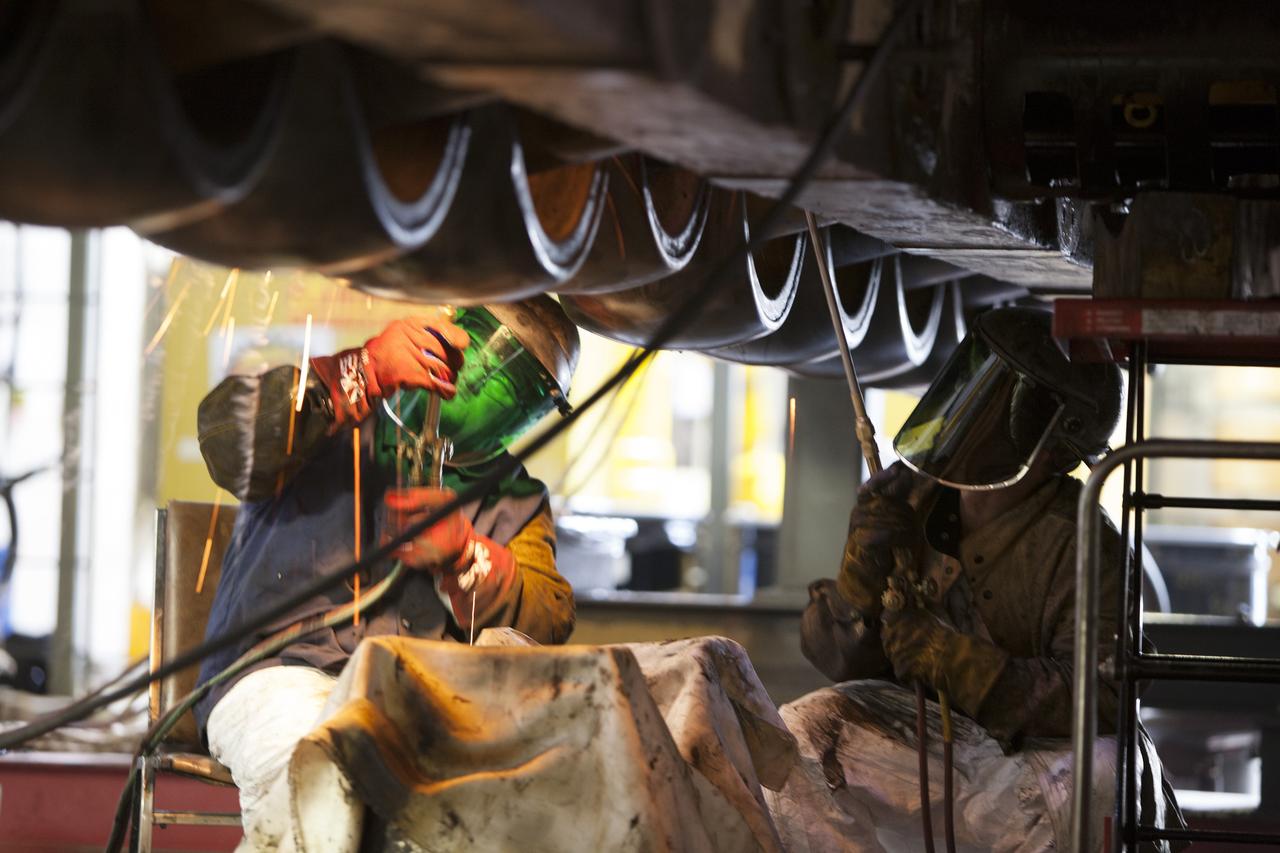
CAPE CANAVERAL, Fla. – Inside the Vehicle Assembly Building at NASA’s Kennedy Space Center in Florida, ground support technicians apply heat to a casing that contains an old bearing on the B truck tread of crawler-transporter 2, or CT-2. The bearing will separate and out for removal. New roller bearing assemblies will be installed on CT-2. Work continues in high bay 2 to upgrade CT-2. The modifications are designed to ensure CT-2’s ability to transport launch vehicles currently in development, such as the agency’s Space Launch System, to the launch pad. The Ground Systems Development and Operations Program office at Kennedy is overseeing the upgrades. For more than 45 years the crawler-transporters were used to transport the mobile launcher platform and the Apollo-Saturn V rockets and, later, space shuttles to Launch Pads 39A and B. For more information, visit: http://www.nasa.gov/exploration/systems/ground/crawler-transporter. Photo credit: NASA/Dimitri Gerondidakis
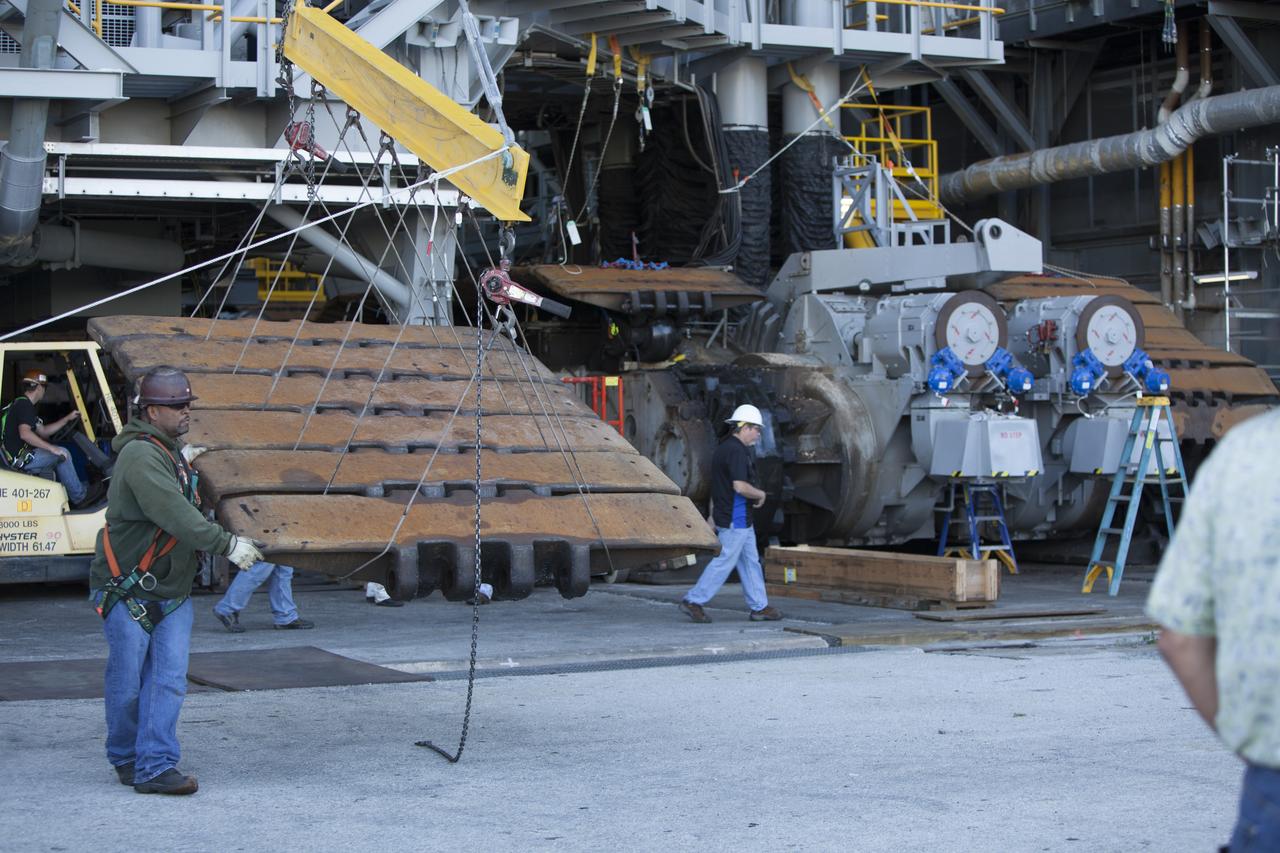
CAPE CANAVERAL, Fla. – Inside the Vehicle Assembly Building at NASA’s Kennedy Space Center in Florida, ground support technicians assist as a crane lifts a portion of the treads on the C truck of crawler-transporter 2, or CT-2, away from the vehicle. The treads are being removed in order to gain access to remove the gear boxes. Work continues in high bay 2 to upgrade CT-2. The modifications are designed to ensure CT-2’s ability to transport launch vehicles currently in development, such as the agency’s Space Launch System, to the launch pad. The Ground Systems Development and Operations Program office at Kennedy is overseeing the upgrades. For more than 45 years the crawler-transporters were used to transport the mobile launcher platform and the Apollo-Saturn V rockets and, later, space shuttles to Launch Pads 39A and B. For more information, visit: http://www.nasa.gov/exploration/systems/ground/crawler-transporter. Photo credit: NASA/Dimitri Gerondidakis
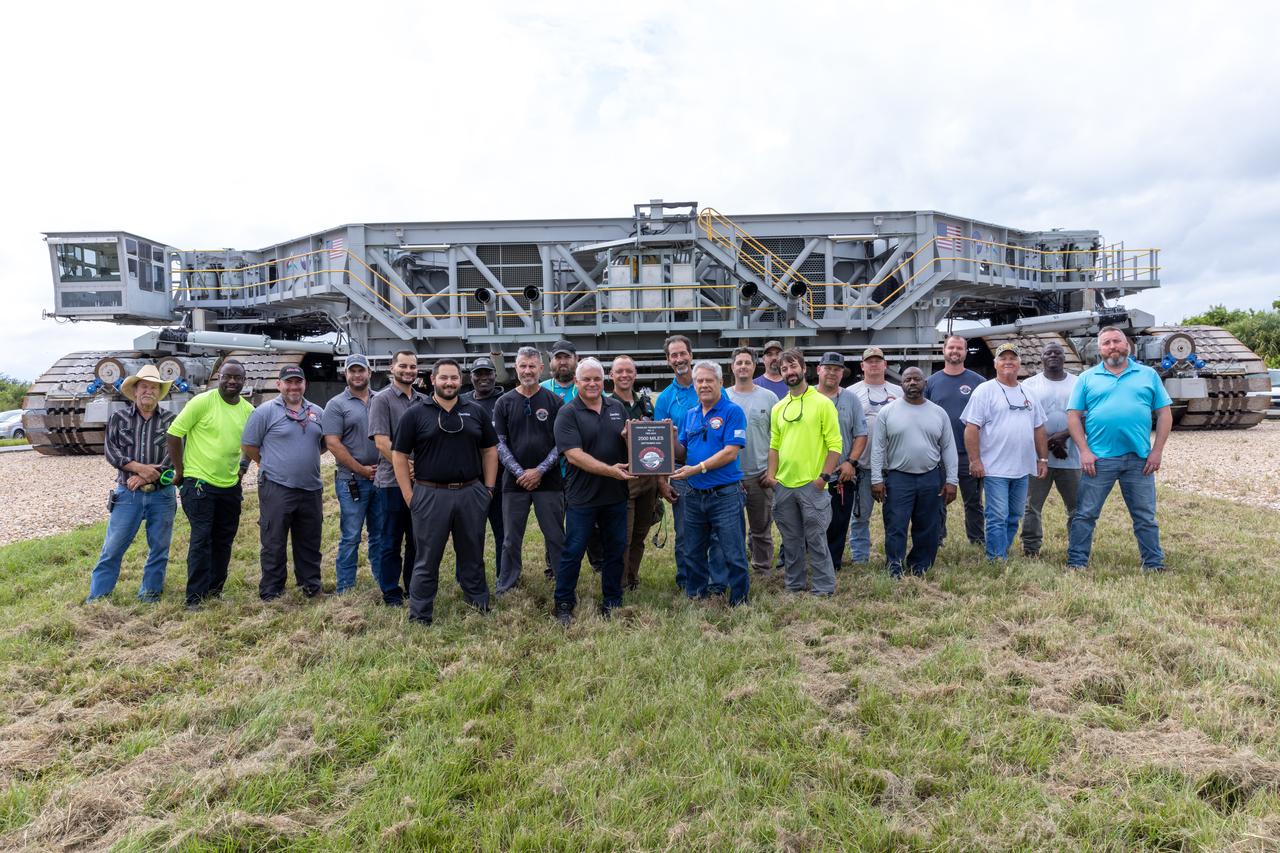
Teams with NASA’s Exploration Ground Systems at NASA’s Kennedy Space Center in Florida celebrate on Wednesday, Sept. 25, 2024, the agency’s crawler-transporter 2 reaching the milestone of 2,500 miles traveled since its construction in 1965. Crawler-transporter 2 reached the milestone while teams took it on a trip in preparation for supporting the roll of the mobile launcher from Launch Pad 39B back into the spaceport’s Vehicle Assembly Building ahead of the Artemis II launch. Built originally to transport massive Saturn V rockets during the Apollo Program, crawler-transporter 2 continued its service during the Space Shuttle Program, and currently transports the massive SLS (Space Launch System) rocket and Orion spacecraft atop the mobile launcher as part of the agency’s Artemis campaign.
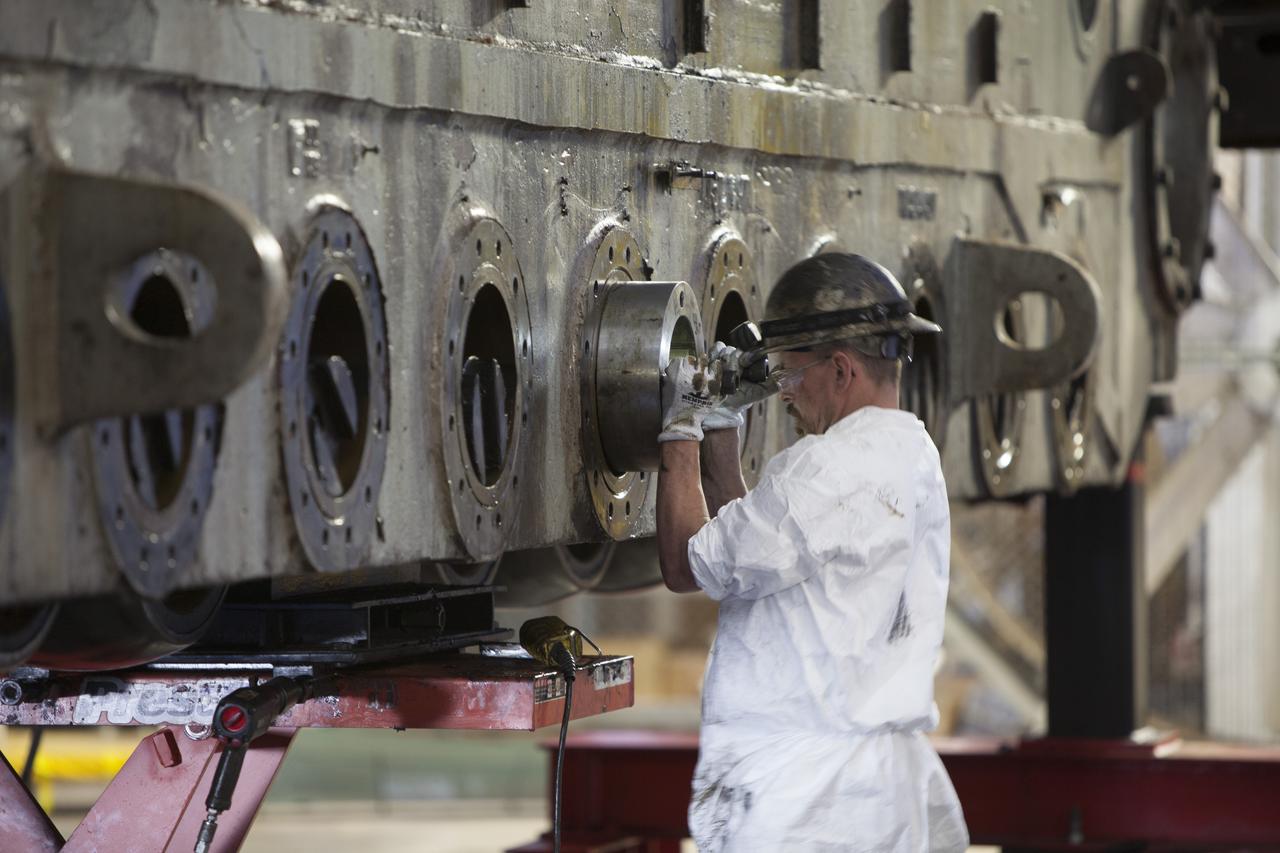
CAPE CANAVERAL, Fla. – Inside the Vehicle Assembly Building at NASA’s Kennedy Space Center in Florida, a ground support technician assists with removal of a bearing from the B truck tread of crawler-transporter 2, or CT-2. New roller bearing assemblies will be installed. Work continues in high bay 2 to upgrade CT-2. The modifications are designed to ensure CT-2’s ability to transport launch vehicles currently in development, such as the agency’s Space Launch System, to the launch pad. The Ground Systems Development and Operations Program office at Kennedy is overseeing the upgrades. For more than 45 years the crawler-transporters were used to transport the mobile launcher platform and the Apollo-Saturn V rockets and, later, space shuttles to Launch Pads 39A and B. For more information, visit: http://www.nasa.gov/exploration/systems/ground/crawler-transporter. Photo credit: NASA/Dimitri Gerondidakis
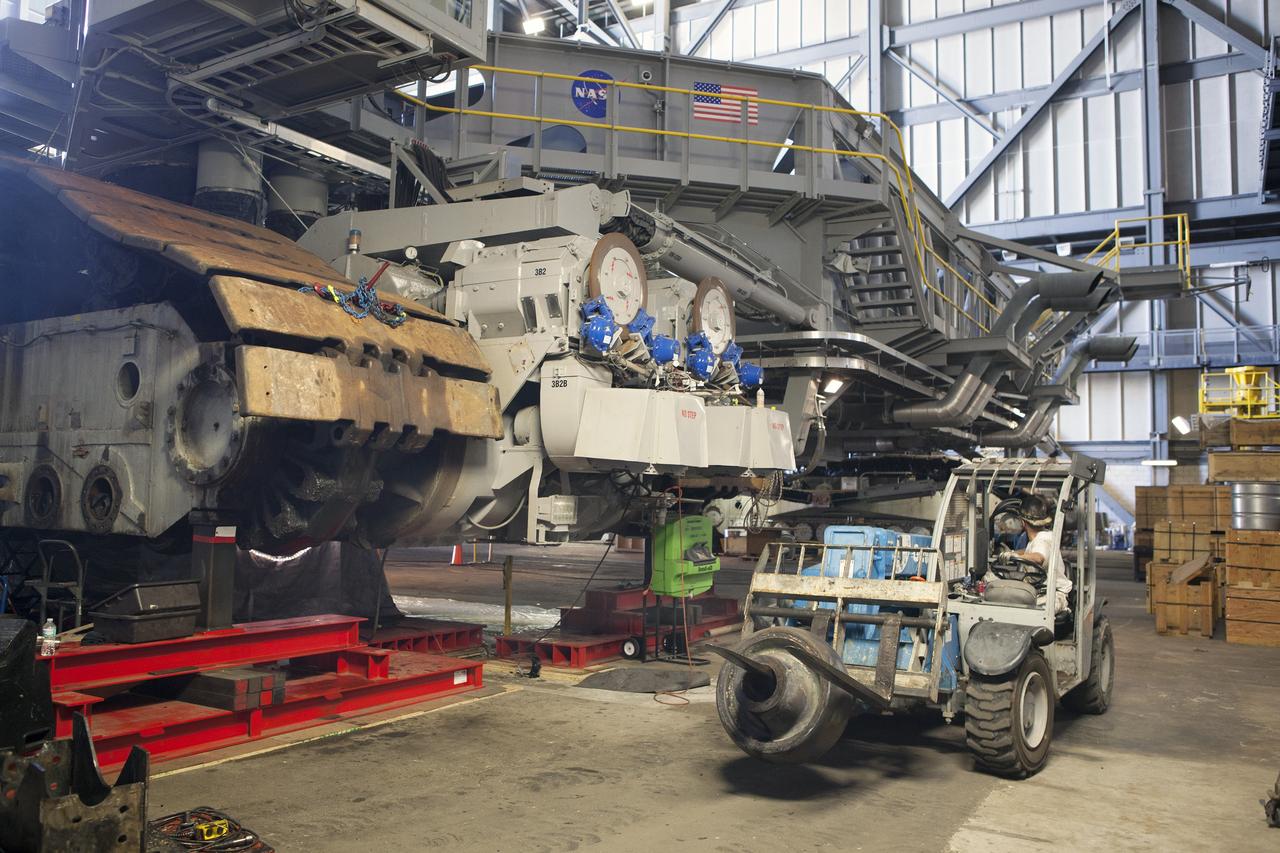
CAPE CANAVERAL, Fla. – Inside the Vehicle Assembly Building at NASA’s Kennedy Space Center in Florida, an old bearing has been removed from the B truck tread of crawler-transporter 2, or CT-2, and loaded onto a forklift for disposal. New roller bearing assemblies will be installed. Work continues in high bay 2 to upgrade CT-2. The modifications are designed to ensure CT-2’s ability to transport launch vehicles currently in development, such as the agency’s Space Launch System, to the launch pad. The Ground Systems Development and Operations Program office at Kennedy is overseeing the upgrades. For more than 45 years the crawler-transporters were used to transport the mobile launcher platform and the Apollo-Saturn V rockets and, later, space shuttles to Launch Pads 39A and B. For more information, visit: http://www.nasa.gov/exploration/systems/ground/crawler-transporter. Photo credit: NASA/Dimitri Gerondidakis
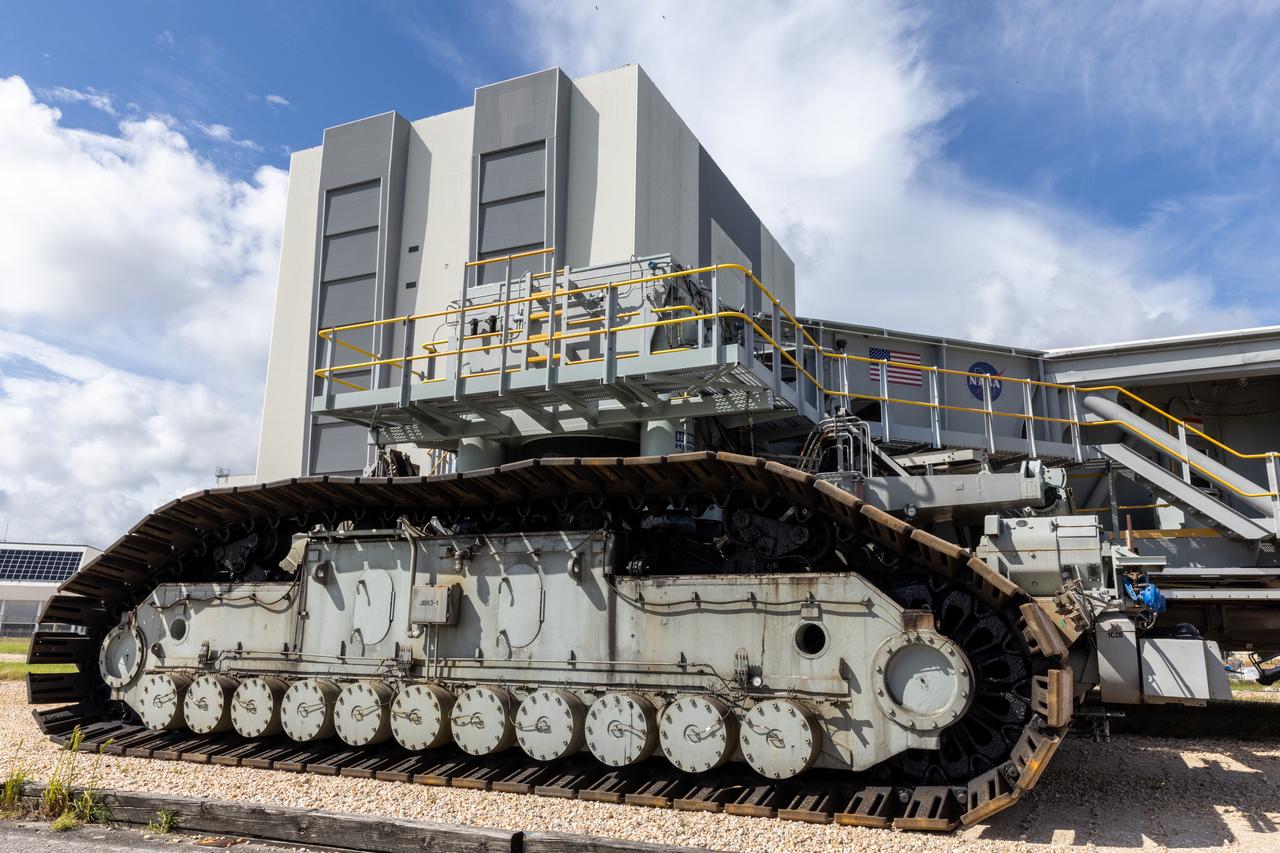
NASA’s crawler-transporter 2 moves slowly along the crawlerway towards Launch Pad 39B at the agency’s Kennedy Space Center in Florida on Wednesday, Sept. 25, 2024, after reaching the milestone of 2,500 miles traveled since its construction in 1965. Crawler-transporter 2 reached the milestone while teams with NASA’s Exploration Ground Systems took it on a trip in preparation for supporting the roll of the mobile launcher back into the spaceport’s Vehicle Assembly Building ahead of the Artemis II launch. Built originally to transport massive Saturn V rockets during the Apollo Program, crawler-transporter 2 continued its service during the Space Shuttle Program, and currently transports the massive SLS (Space Launch System) rocket and Orion spacecraft atop the mobile launcher as part of the agency’s Artemis campaign.
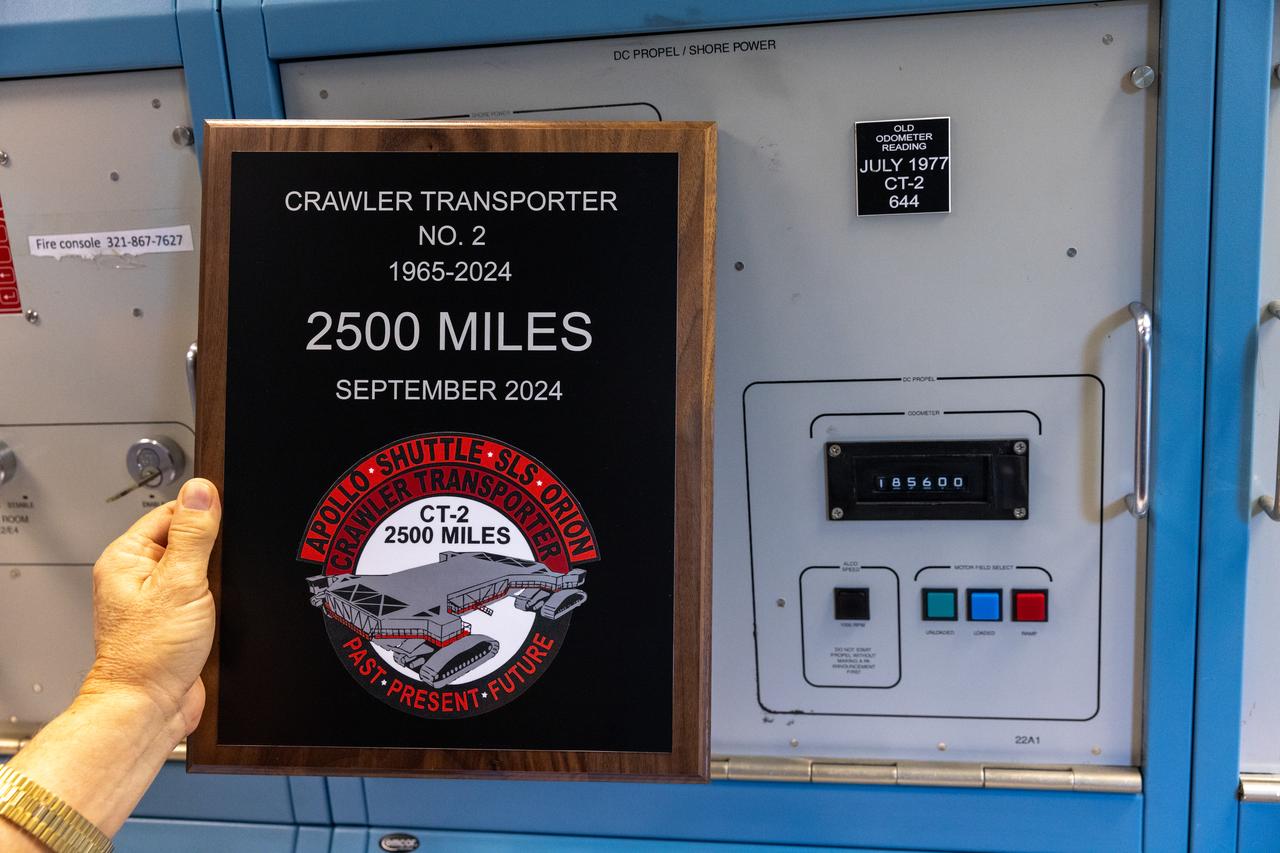
A plaque is held near the odometer of the agency’s crawler-transporter 2, on Wednesday, Sept. 25, 2024, at NASA’s Kennedy Space Center in Florida, commemorating the milestone of 2,500 miles traveled since its construction in 1965. Crawler-transporter 2 reached the milestone while teams with NASA’s Exploration Ground Systems took it on a trip in preparation for supporting the roll of the mobile launcher from Launch Pad 39B back into the spaceport’s Vehicle Assembly Building ahead of the Artemis II launch. Built originally to transport massive Saturn V rockets during the Apollo Program, crawler-transporter 2 continued its service during the Space Shuttle Program, and currently transports the massive SLS (Space Launch System) rocket and Orion spacecraft atop the mobile launcher as part of the agency’s Artemis campaign.
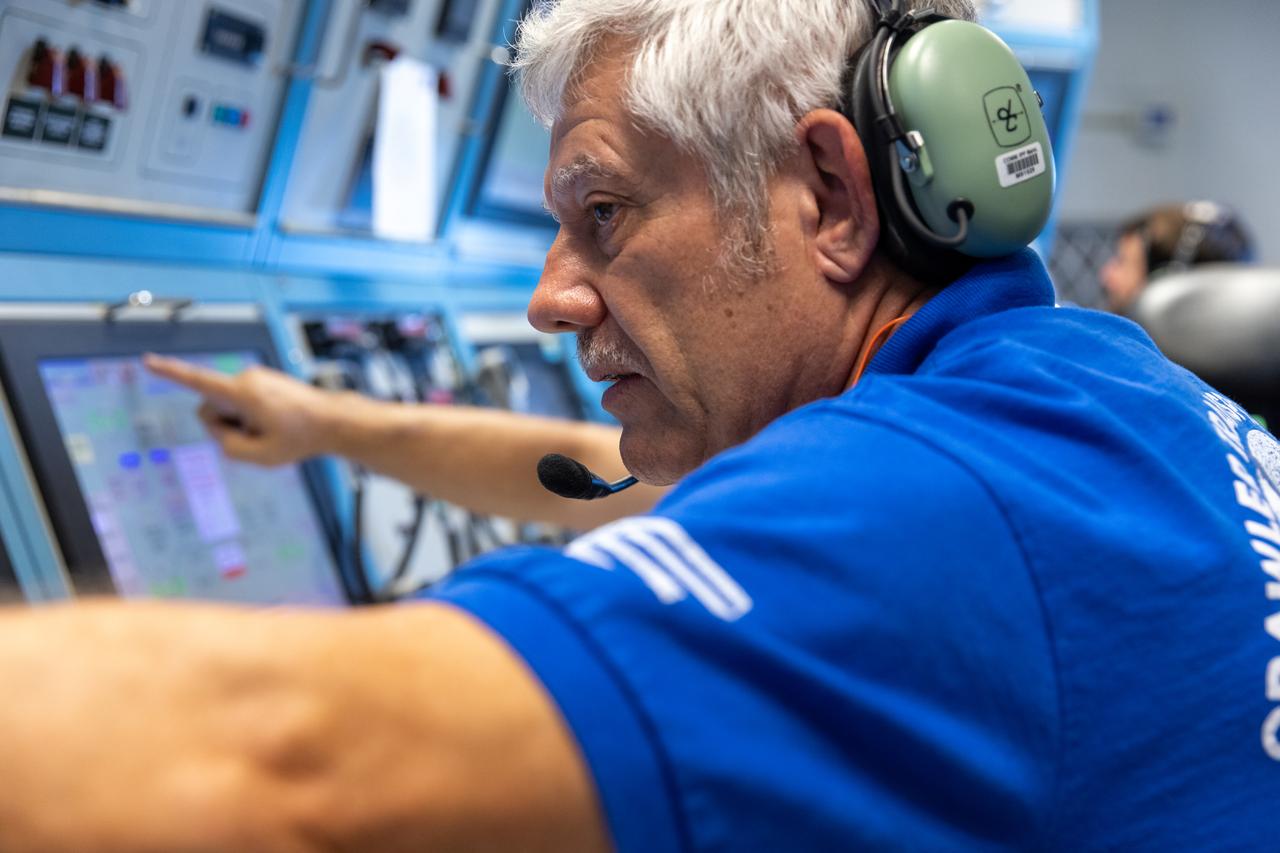
Teams with NASA’s Exploration Ground Systems at NASA’s Kennedy Space Center in Florida celebrate on Wednesday, Sept. 25, 2024, the agency’s crawler-transporter 2 reaching the milestone of 2,500 miles traveled since its construction in 1965. Crawler-transporter 2 reached the milestone while teams took it on a trip in preparation for supporting the roll of the mobile launcher from Launch Pad 39B back into the spaceport’s Vehicle Assembly Building ahead of the Artemis II launch. Built originally to transport massive Saturn V rockets during the Apollo Program, crawler-transporter 2 continued its service during the Space Shuttle Program, and currently transports the massive SLS (Space Launch System) rocket and Orion spacecraft atop the mobile launcher as part of the agency’s Artemis campaign.
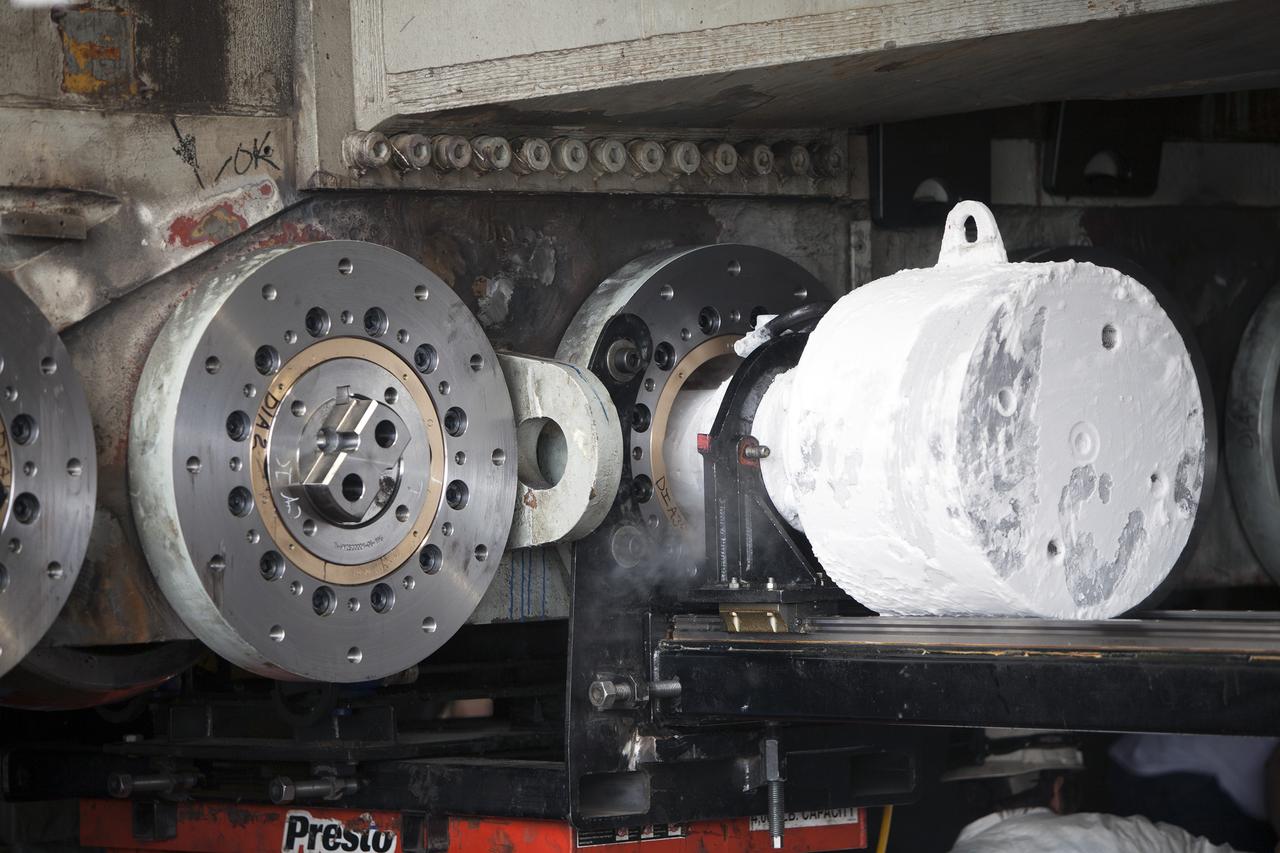
CAPE CANAVERAL, Fla. - Inside the Vehicle Assembly Building at NASA’s Kennedy Space Center in Florida, a new roller bearing shaft is being inserted in the C truck of crawler-transporter 2, or CT-2. Work continues in high bay 2 to upgrade CT-2. The modifications are designed to ensure CT-2’s ability to transport launch vehicles currently in development, such as the agency’s Space Launch System, to the launch pad. The Ground Systems Development and Operations Program office at Kennedy is overseeing the upgrades. For more than 45 years the crawler-transporters were used to transport the mobile launcher platform and the Apollo-Saturn V rockets and, later, space shuttles to Launch Pads 39A and B. For more information, visit: http://www.nasa.gov/exploration/systems/ground/crawler-transporter. Photo credit: NASA/Dimitri Gerondidakis
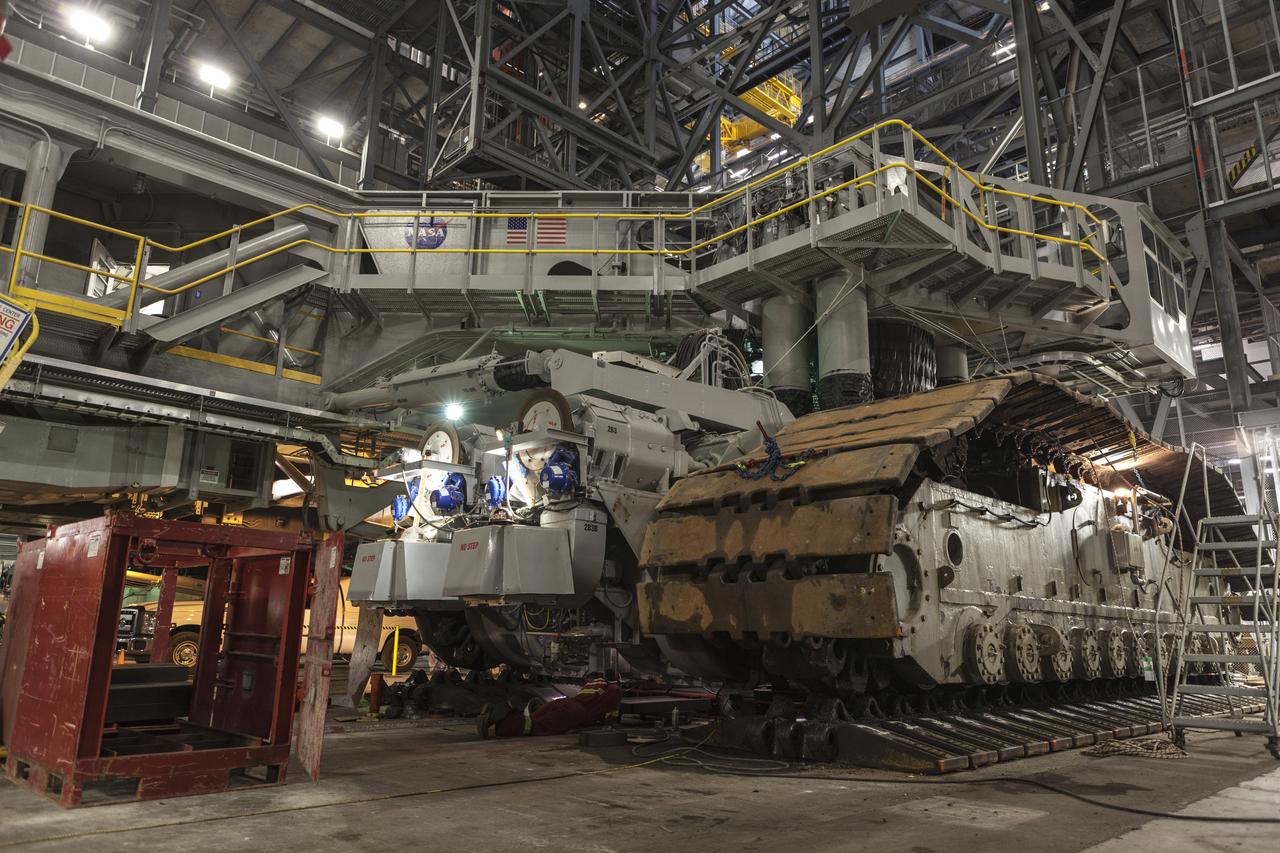
CAPE CANAVERAL, Fla. – Inside the Vehicle Assembly Building at NASA’s Kennedy Space Center in Florida, the B and D truck sections of crawler-transporter 2, or CT-2, are being raised up to prepare for installation of new roller bearing assemblies. Work continues in high bay 2 to upgrade CT-2. The modifications are designed to ensure CT-2’s ability to transport launch vehicles currently in development, such as the agency’s Space Launch System, to the launch pad. The Ground Systems Development and Operations Program office at Kennedy is overseeing the upgrades. For more than 45 years the crawler-transporters were used to transport the mobile launcher platform and the Apollo-Saturn V rockets and, later, space shuttles to Launch Pads 39A and B. For more information, visit: http://www.nasa.gov/exploration/systems/ground/crawler-transporter. Photo credit: NASA/Dimitri Gerondidakis
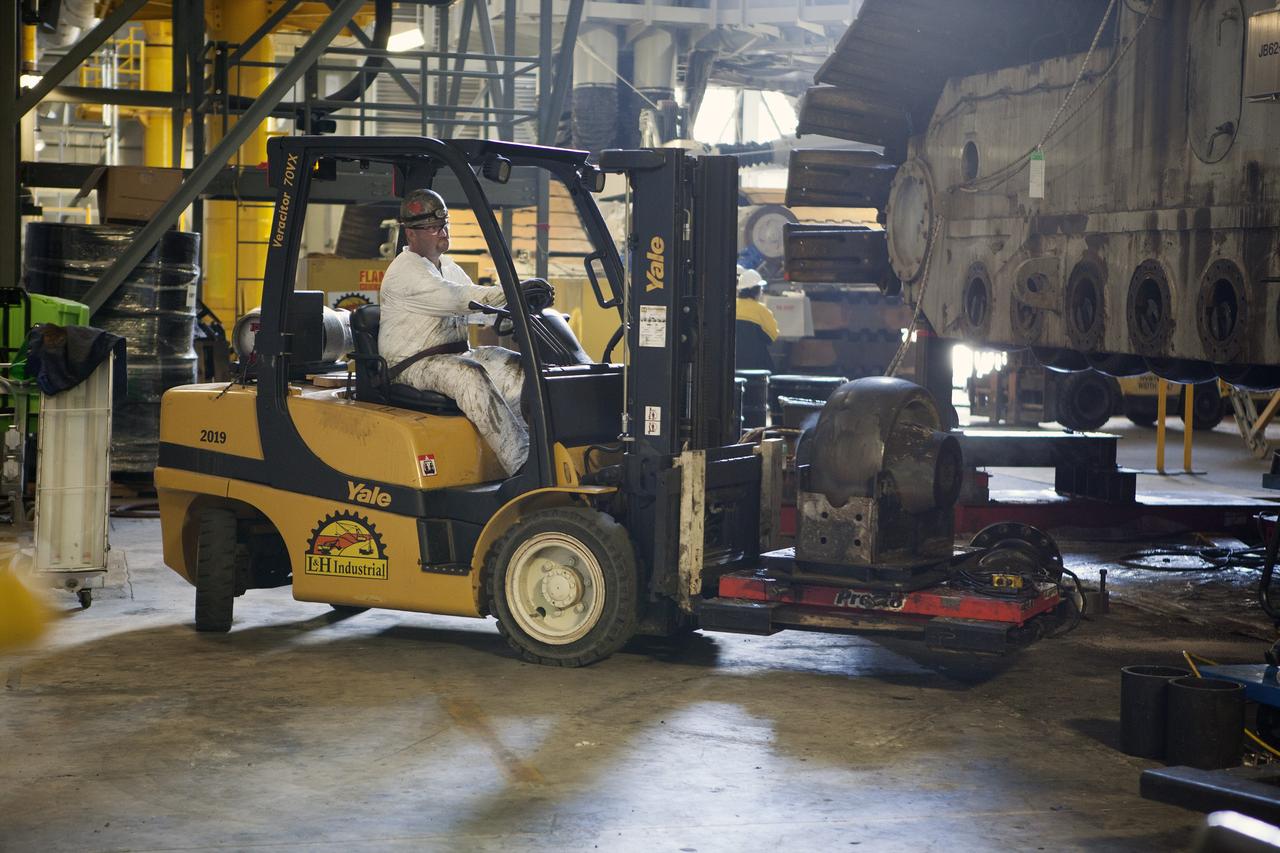
CAPE CANAVERAL, Fla. – Inside the Vehicle Assembly Building at NASA’s Kennedy Space Center in Florida, an old bearing has been removed from the B truck tread of crawler-transporter 2, or CT-2, and loaded onto a forklift for disposal. New roller bearing assemblies will be installed. Work continues in high bay 2 to upgrade CT-2. The modifications are designed to ensure CT-2’s ability to transport launch vehicles currently in development, such as the agency’s Space Launch System, to the launch pad. The Ground Systems Development and Operations Program office at Kennedy is overseeing the upgrades. For more than 45 years the crawler-transporters were used to transport the mobile launcher platform and the Apollo-Saturn V rockets and, later, space shuttles to Launch Pads 39A and B. For more information, visit: http://www.nasa.gov/exploration/systems/ground/crawler-transporter. Photo credit: NASA/Dimitri Gerondidakis
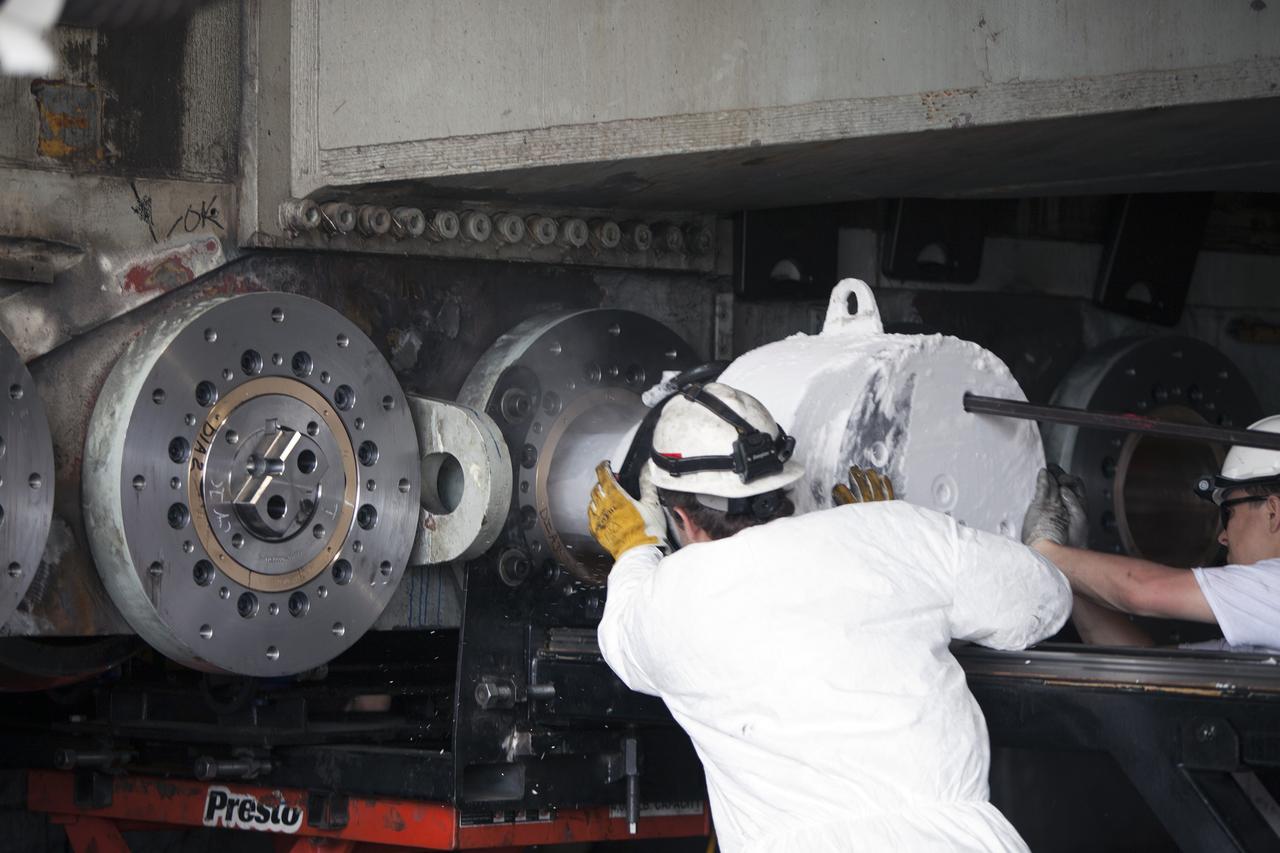
CAPE CANAVERAL, Fla. - Inside the Vehicle Assembly Building at NASA’s Kennedy Space Center in Florida, ground support technicians install a new roller bearing shaft on the C truck of crawler-transporter 2, or CT-2. Work continues in high bay 2 to upgrade CT-2. The modifications are designed to ensure CT-2’s ability to transport launch vehicles currently in development, such as the agency’s Space Launch System, to the launch pad. The Ground Systems Development and Operations Program office at Kennedy is overseeing the upgrades. For more than 45 years the crawler-transporters were used to transport the mobile launcher platform and the Apollo-Saturn V rockets and, later, space shuttles to Launch Pads 39A and B. For more information, visit: http://www.nasa.gov/exploration/systems/ground/crawler-transporter. Photo credit: NASA/Dimitri Gerondidakis
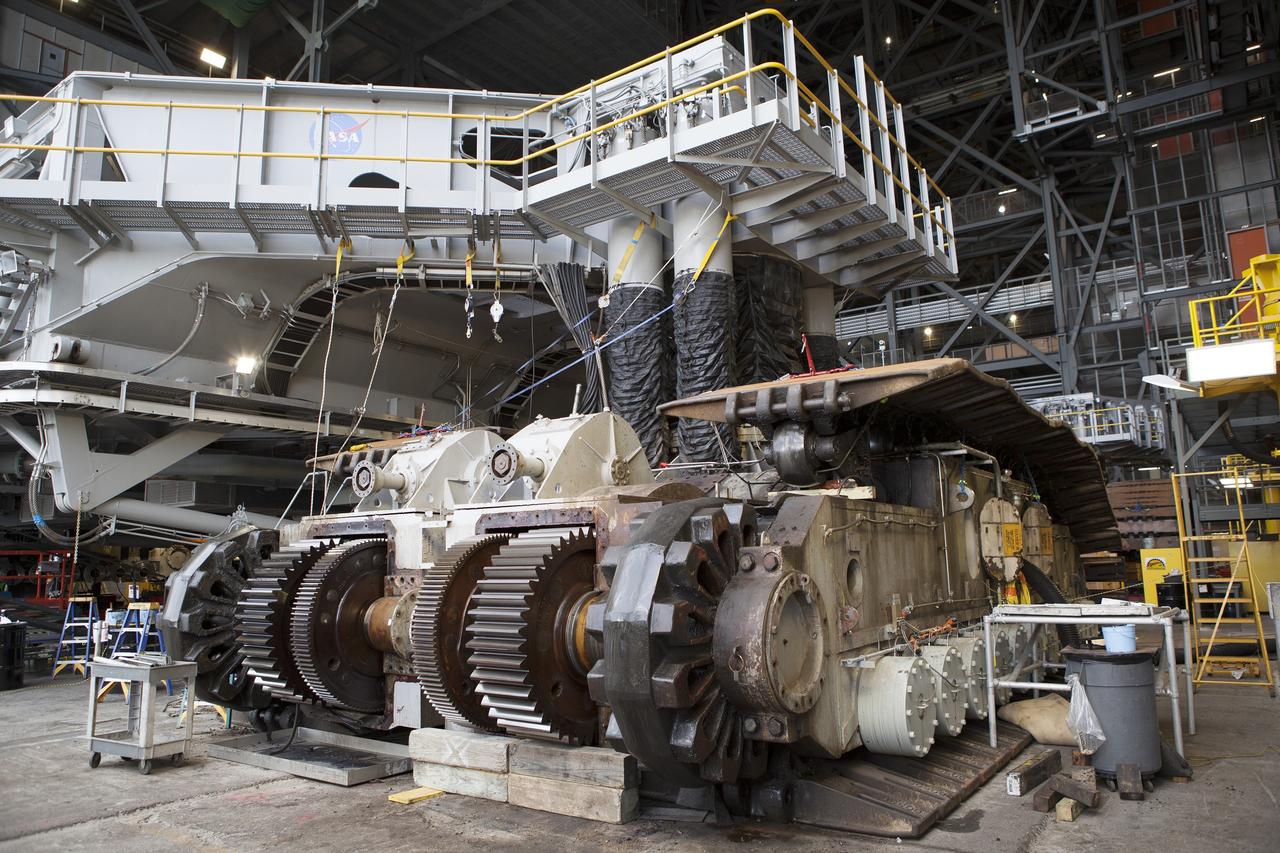
CAPE CANAVERAL, Fla. - Inside the Vehicle Assembly Building at NASA’s Kennedy Space Center in Florida, work continues to remove the sprocket shaft assembly from the C truck of crawler-transporter 2, or CT-2. The sprocket assemblies will be placed into shipping cradles on pallets and positioned on a flatbed trailer. They will be sent to a vendor for inspections and refurbishment. Work continues in high bay 2 to upgrade CT-2. The modifications are designed to ensure CT-2’s ability to transport launch vehicles currently in development, such as the agency’s Space Launch System, to the launch pad. The Ground Systems Development and Operations Program office at Kennedy is overseeing the upgrades. For more than 45 years the crawler-transporters were used to transport the mobile launcher platform and the Apollo-Saturn V rockets and, later, space shuttles to Launch Pads 39A and B. For more information, visit: http://www.nasa.gov/exploration/systems/ground/crawler-transporter. Photo credit: NASA/Dimitri Gerondidakis
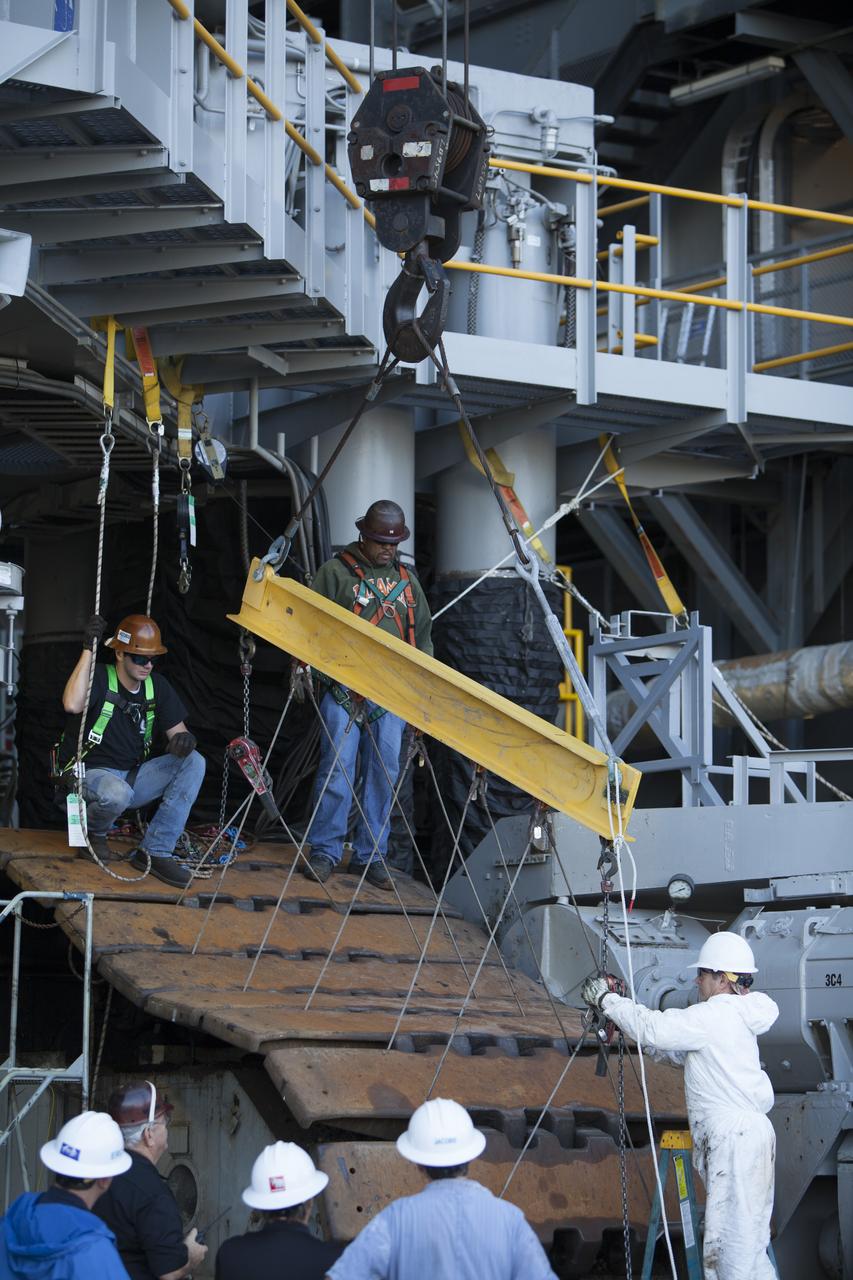
CAPE CANAVERAL, Fla. – Inside the Vehicle Assembly Building at NASA’s Kennedy Space Center in Florida, ground support technicians attach crane lines to the treads on the C truck of crawler-transporter 2, or CT-2, so they can be lifted up and away. The treads are being removed in order to gain access to remove the gear boxes. Work continues in high bay 2 to upgrade CT-2. The modifications are designed to ensure CT-2’s ability to transport launch vehicles currently in development, such as the agency’s Space Launch System, to the launch pad. The Ground Systems Development and Operations Program office at Kennedy is overseeing the upgrades. For more than 45 years the crawler-transporters were used to transport the mobile launcher platform and the Apollo-Saturn V rockets and, later, space shuttles to Launch Pads 39A and B. For more information, visit: http://www.nasa.gov/exploration/systems/ground/crawler-transporter. Photo credit: NASA/Dimitri Gerondidakis
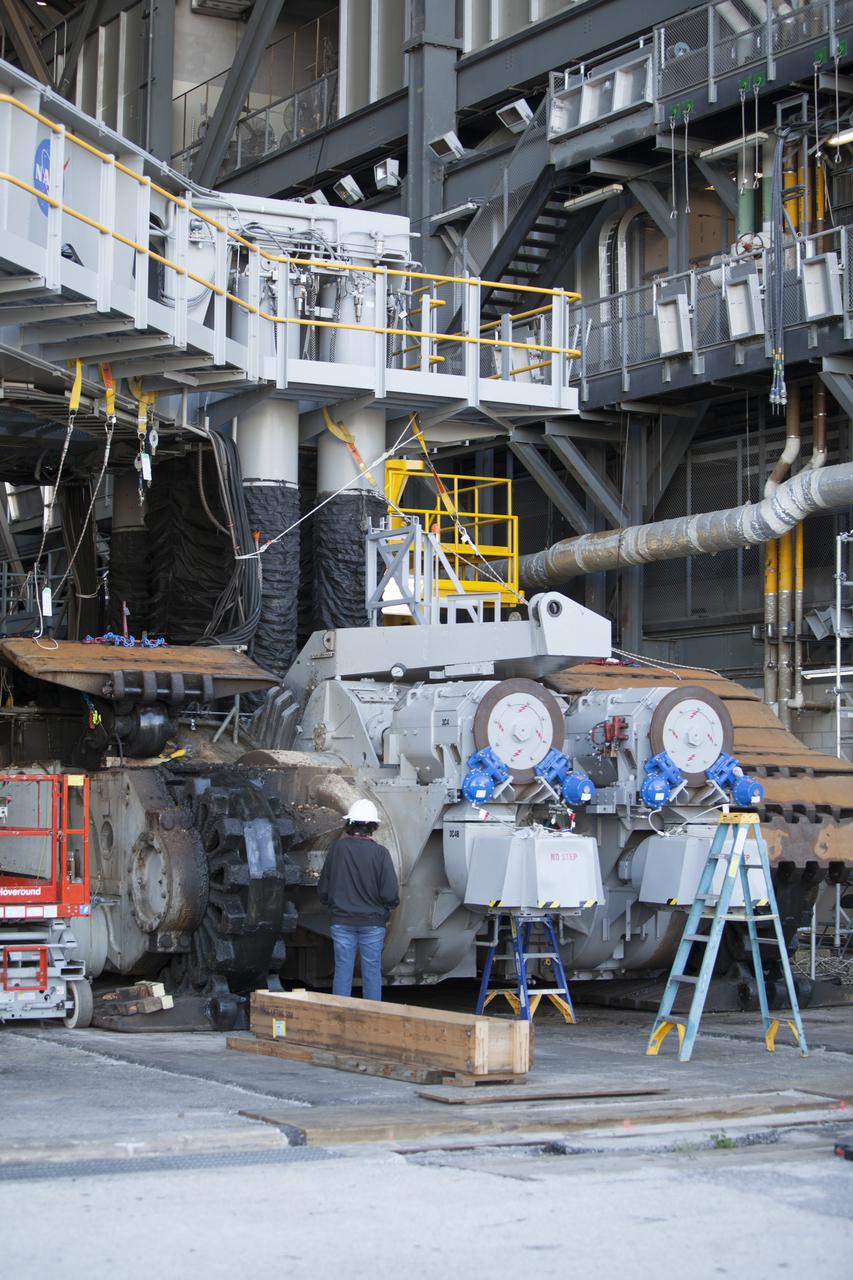
CAPE CANAVERAL, Fla. – Inside the Vehicle Assembly Building at NASA’s Kennedy Space Center in Florida, a portion of the treads on the C truck of crawler-transporter 2, or CT-2, have been removed from the vehicle. The treads are being removed in order to gain access to remove the gear boxes. Work continues in high bay 2 to upgrade CT-2. The modifications are designed to ensure CT-2’s ability to transport launch vehicles currently in development, such as the agency’s Space Launch System, to the launch pad. The Ground Systems Development and Operations Program office at Kennedy is overseeing the upgrades. For more than 45 years the crawler-transporters were used to transport the mobile launcher platform and the Apollo-Saturn V rockets and, later, space shuttles to Launch Pads 39A and B. For more information, visit: http://www.nasa.gov/exploration/systems/ground/crawler-transporter. Photo credit: NASA/Dimitri Gerondidakis
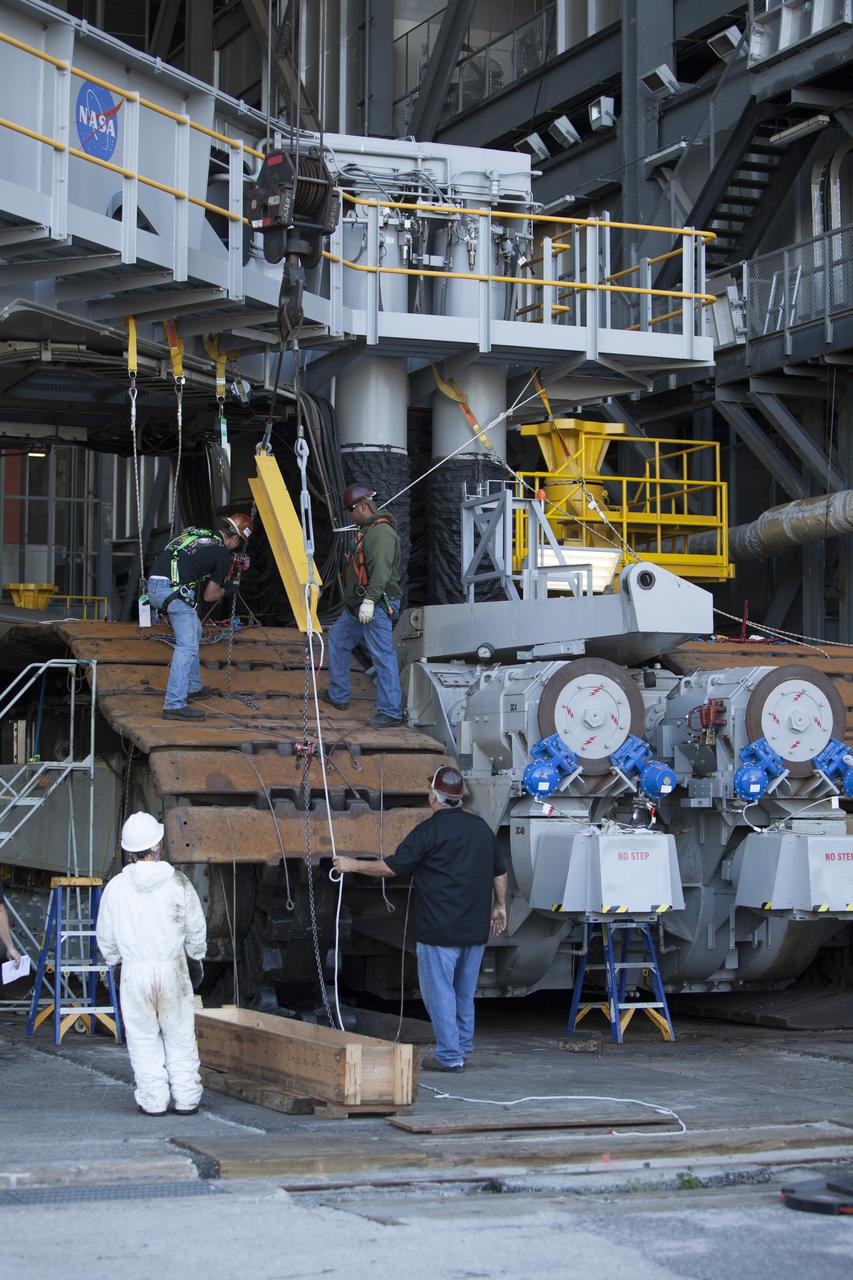
CAPE CANAVERAL, Fla. – Inside the Vehicle Assembly Building at NASA’s Kennedy Space Center in Florida, ground support technicians attach crane lines to the treads on the C truck of crawler-transporter 2, or CT-2, so they can be lifted up and away. The treads are being removed in order to gain access to remove the gear boxes. Work continues in high bay 2 to upgrade CT-2. The modifications are designed to ensure CT-2’s ability to transport launch vehicles currently in development, such as the agency’s Space Launch System, to the launch pad. The Ground Systems Development and Operations Program office at Kennedy is overseeing the upgrades. For more than 45 years the crawler-transporters were used to transport the mobile launcher platform and the Apollo-Saturn V rockets and, later, space shuttles to Launch Pads 39A and B. For more information, visit: http://www.nasa.gov/exploration/systems/ground/crawler-transporter. Photo credit: NASA/Dimitri Gerondidakis
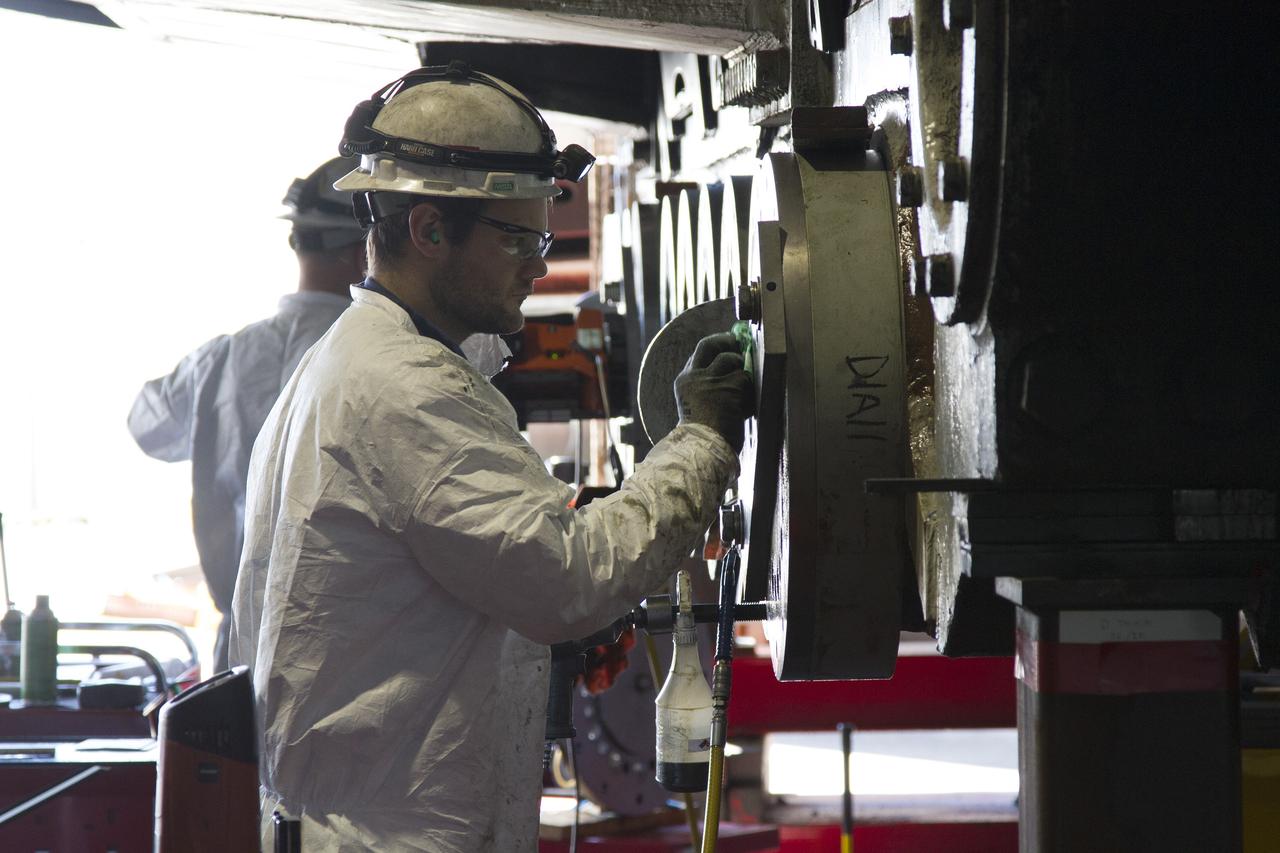
CAPE CANAVERAL, Fla. – Inside the Vehicle Assembly Building at NASA’s Kennedy Space Center in Florida, ground support technicians install new roller bearings on the C truck of crawler-transporter 2, or CT-2. Work continues in high bay 2 to upgrade CT-2. The modifications are designed to ensure CT-2’s ability to transport launch vehicles currently in development, such as the agency’s Space Launch System, to the launch pad. The Ground Systems Development and Operations Program office at Kennedy is overseeing the upgrades. For more than 45 years the crawler-transporters were used to transport the mobile launcher platform and the Apollo-Saturn V rockets and, later, space shuttles to Launch Pads 39A and B. For more information, visit: http://www.nasa.gov/exploration/systems/ground/crawler-transporter. Photo credit: NASA/Cory Huston

CAPE CANAVERAL, Fla. - Inside the Vehicle Assembly Building at NASA’s Kennedy Space Center in Florida, ground support technicians use a special work stand to guide a roller bearing shaft for insertion on the C truck of crawler-transporter 2, or CT-2. A section of the treads on the C truck were removed to allow access to the bearings. Work continues in high bay 2 to upgrade CT-2. The modifications are designed to ensure CT-2’s ability to transport launch vehicles currently in development, such as the agency’s Space Launch System, to the launch pad. The Ground Systems Development and Operations Program office at Kennedy is overseeing the upgrades. For more than 45 years the crawler-transporters were used to transport the mobile launcher platform and the Apollo-Saturn V rockets and, later, space shuttles to Launch Pads 39A and B. For more information, visit: http://www.nasa.gov/exploration/systems/ground/crawler-transporter. Photo credit: NASA/Dimitri Gerondidakis
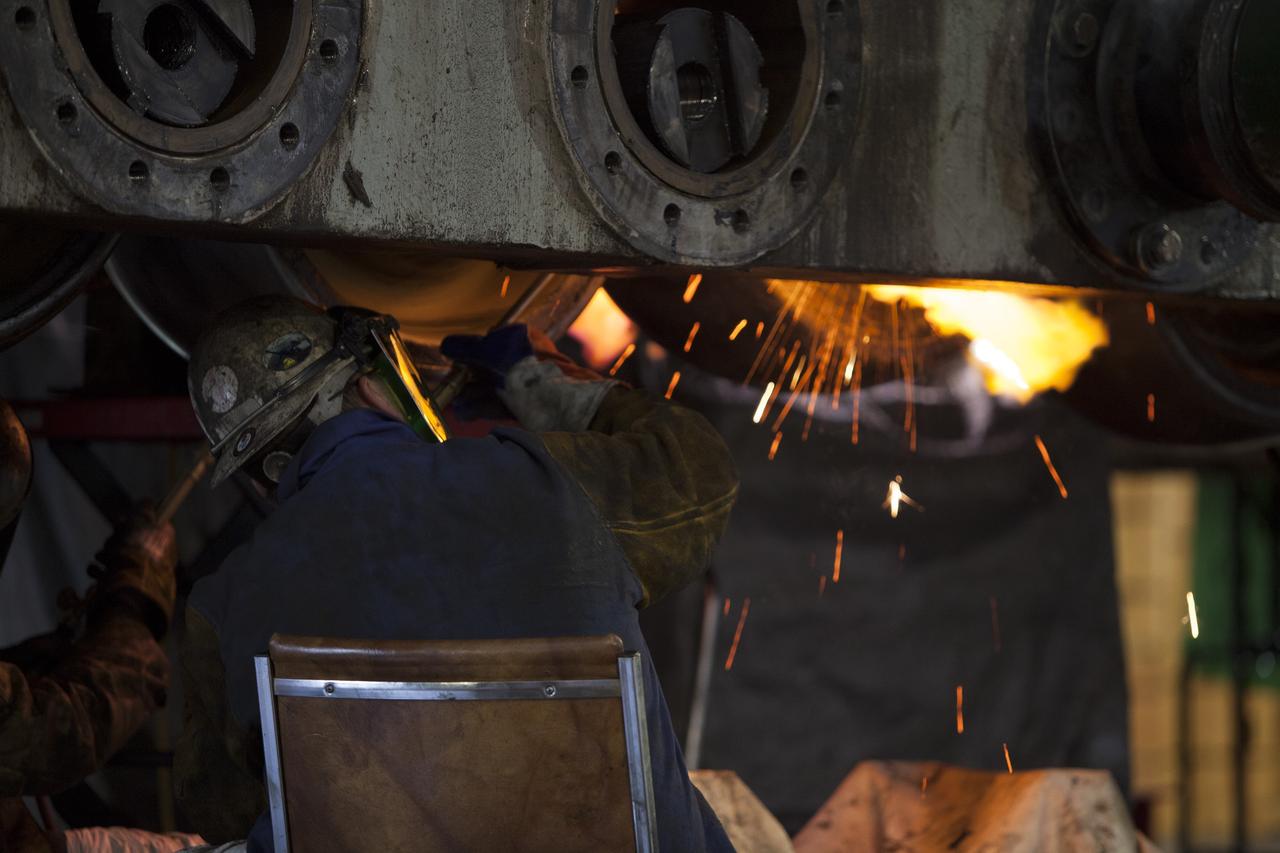
CAPE CANAVERAL, Fla. – Inside the Vehicle Assembly Building at NASA’s Kennedy Space Center in Florida, a ground support technician applies heat to a casing that contains an old bearing on the B truck tread of crawler-transporter 2, or CT-2. The bearing will separate and out for removal. New roller bearing assemblies will be installed on CT-2. Work continues in high bay 2 to upgrade CT-2. The modifications are designed to ensure CT-2’s ability to transport launch vehicles currently in development, such as the agency’s Space Launch System, to the launch pad. The Ground Systems Development and Operations Program office at Kennedy is overseeing the upgrades. For more than 45 years the crawler-transporters were used to transport the mobile launcher platform and the Apollo-Saturn V rockets and, later, space shuttles to Launch Pads 39A and B. For more information, visit: http://www.nasa.gov/exploration/systems/ground/crawler-transporter. Photo credit: NASA/Dimitri Gerondidakis
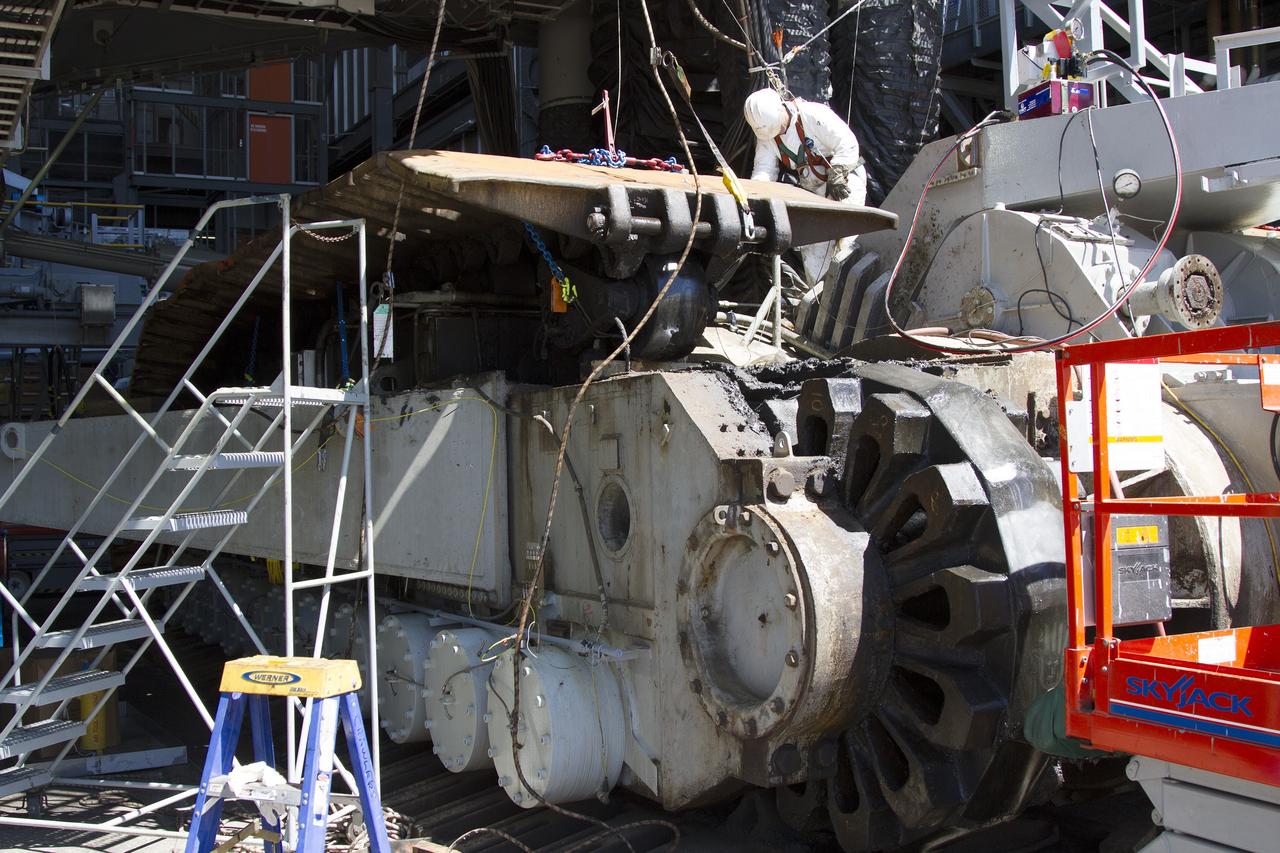
CAPE CANAVERAL, Fla. – Inside the Vehicle Assembly Building at NASA’s Kennedy Space Center in Florida, a ground support technician assists as a crane lifts up a section of the treads on the C truck of crawler-transporter 2, or CT-2. The treads are being removed in order to gain access to remove the gear boxes. Work continues in high bay 2 to upgrade CT-2. The modifications are designed to ensure CT-2’s ability to transport launch vehicles currently in development, such as the agency’s Space Launch System, to the launch pad. The Ground Systems Development and Operations Program office at Kennedy is overseeing the upgrades. For more than 45 years the crawler-transporters were used to transport the mobile launcher platform and the Apollo-Saturn V rockets and, later, space shuttles to Launch Pads 39A and B. For more information, visit: http://www.nasa.gov/exploration/systems/ground/crawler-transporter. Photo credit: NASA/Cory Huston
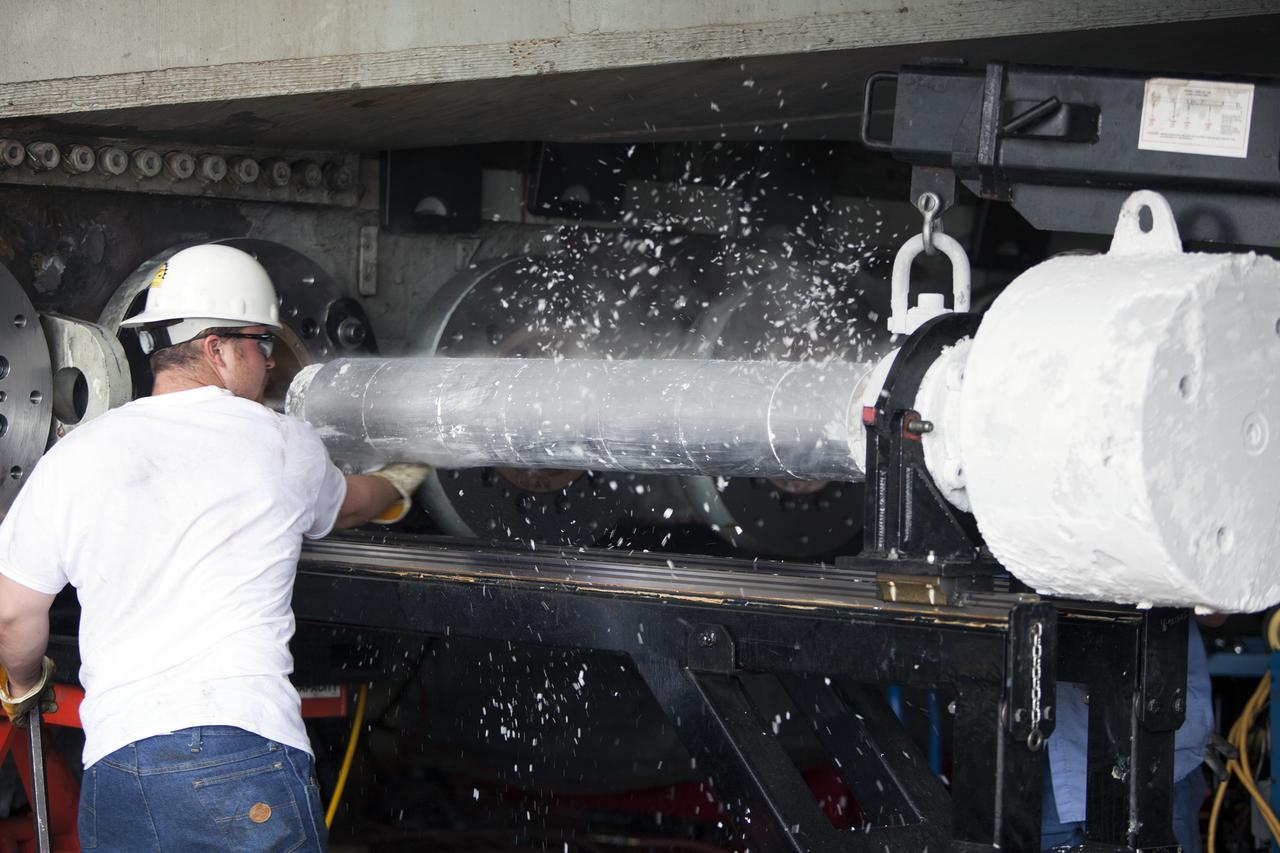
CAPE CANAVERAL, Fla. - Inside the Vehicle Assembly Building at NASA’s Kennedy Space Center in Florida, ground support technicians use a special work stand to guide a roller bearing shaft for insertion on the C truck of crawler-transporter 2, or CT-2. A section of the treads on the C truck were removed to allow access to the bearings. Work continues in high bay 2 to upgrade CT-2. The modifications are designed to ensure CT-2’s ability to transport launch vehicles currently in development, such as the agency’s Space Launch System, to the launch pad. The Ground Systems Development and Operations Program office at Kennedy is overseeing the upgrades. For more than 45 years the crawler-transporters were used to transport the mobile launcher platform and the Apollo-Saturn V rockets and, later, space shuttles to Launch Pads 39A and B. For more information, visit: http://www.nasa.gov/exploration/systems/ground/crawler-transporter. Photo credit: NASA/Dimitri Gerondidakis
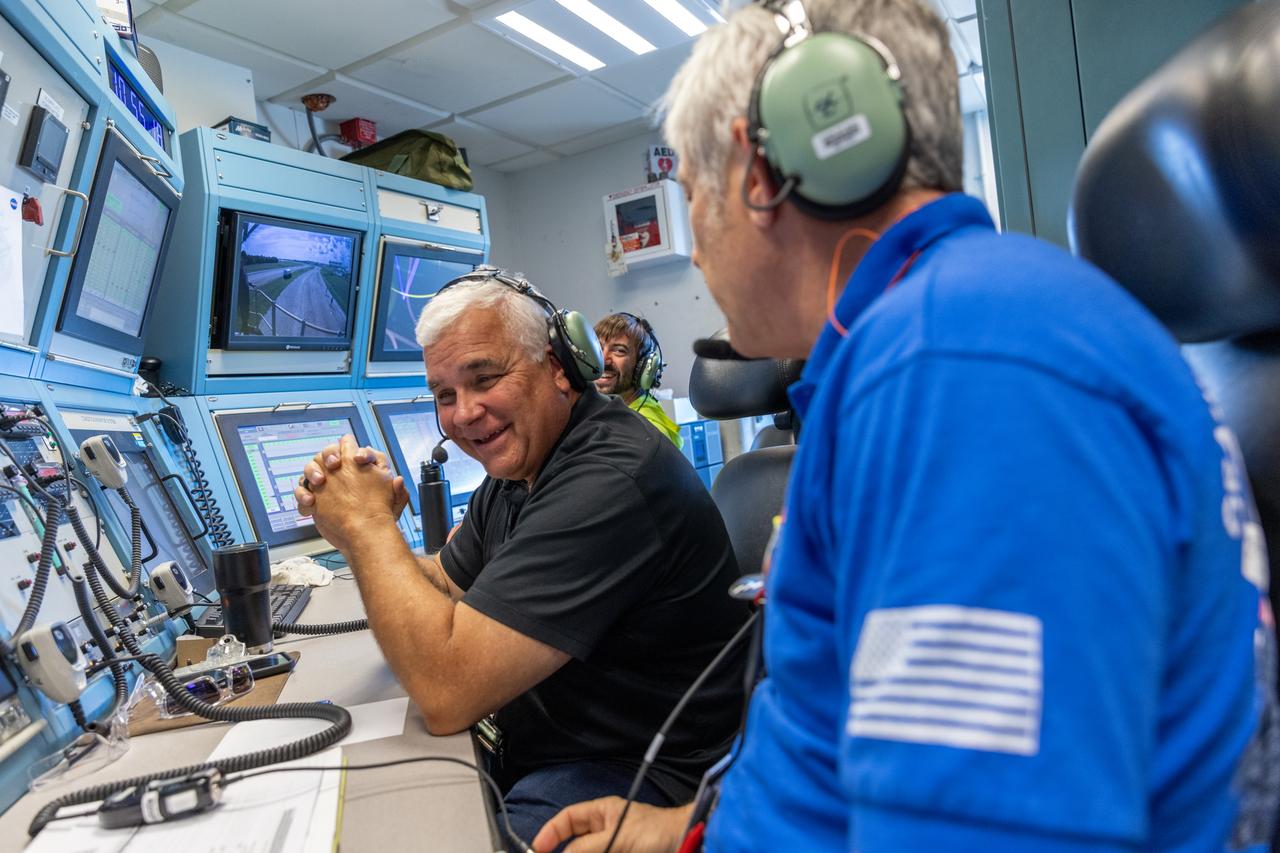
Teams with NASA’s Exploration Ground Systems at NASA’s Kennedy Space Center in Florida celebrate on Wednesday, Sept. 25, 2024, the agency’s crawler-transporter 2 reaching the milestone of 2,500 miles traveled since its construction in 1965. Crawler-transporter 2 reached the milestone while teams took it on a trip in preparation for supporting the roll of the mobile launcher from Launch Pad 39B back into the spaceport’s Vehicle Assembly Building ahead of the Artemis II launch. Built originally to transport massive Saturn V rockets during the Apollo Program, crawler-transporter 2 continued its service during the Space Shuttle Program, and currently transports the massive SLS (Space Launch System) rocket and Orion spacecraft atop the mobile launcher as part of the agency’s Artemis campaign.
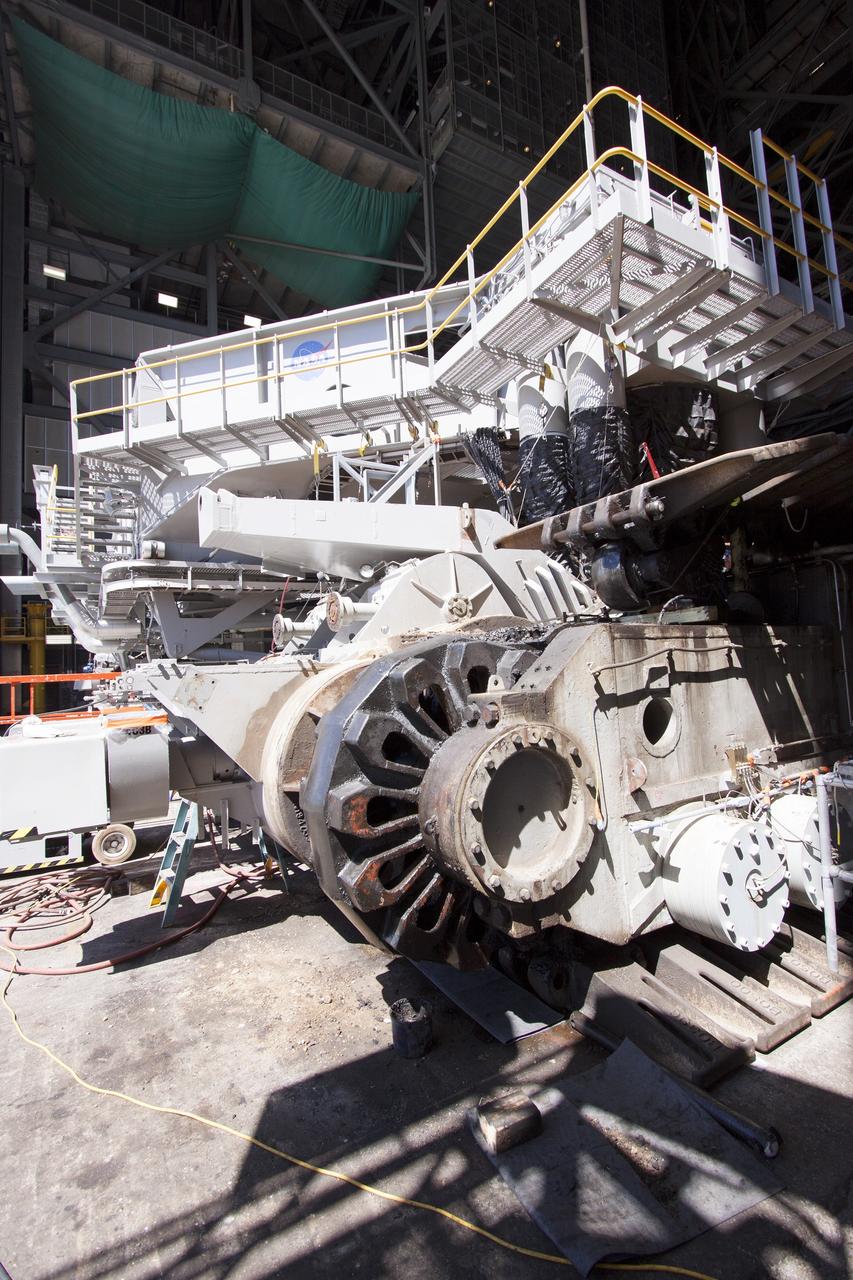
CAPE CANAVERAL, Fla. – Inside the Vehicle Assembly Building at NASA’s Kennedy Space Center in Florida, preparations are underway to remove the gear boxes on the C truck of crawler-transporter 2, or CT-2. A section of the treads were removed to allow access to the gear boxes. Work continues in high bay 2 to upgrade CT-2. The modifications are designed to ensure CT-2’s ability to transport launch vehicles currently in development, such as the agency’s Space Launch System, to the launch pad. The Ground Systems Development and Operations Program office at Kennedy is overseeing the upgrades. For more than 45 years the crawler-transporters were used to transport the mobile launcher platform and the Apollo-Saturn V rockets and, later, space shuttles to Launch Pads 39A and B. For more information, visit: http://www.nasa.gov/exploration/systems/ground/crawler-transporter. Photo credit: NASA/Cory Huston
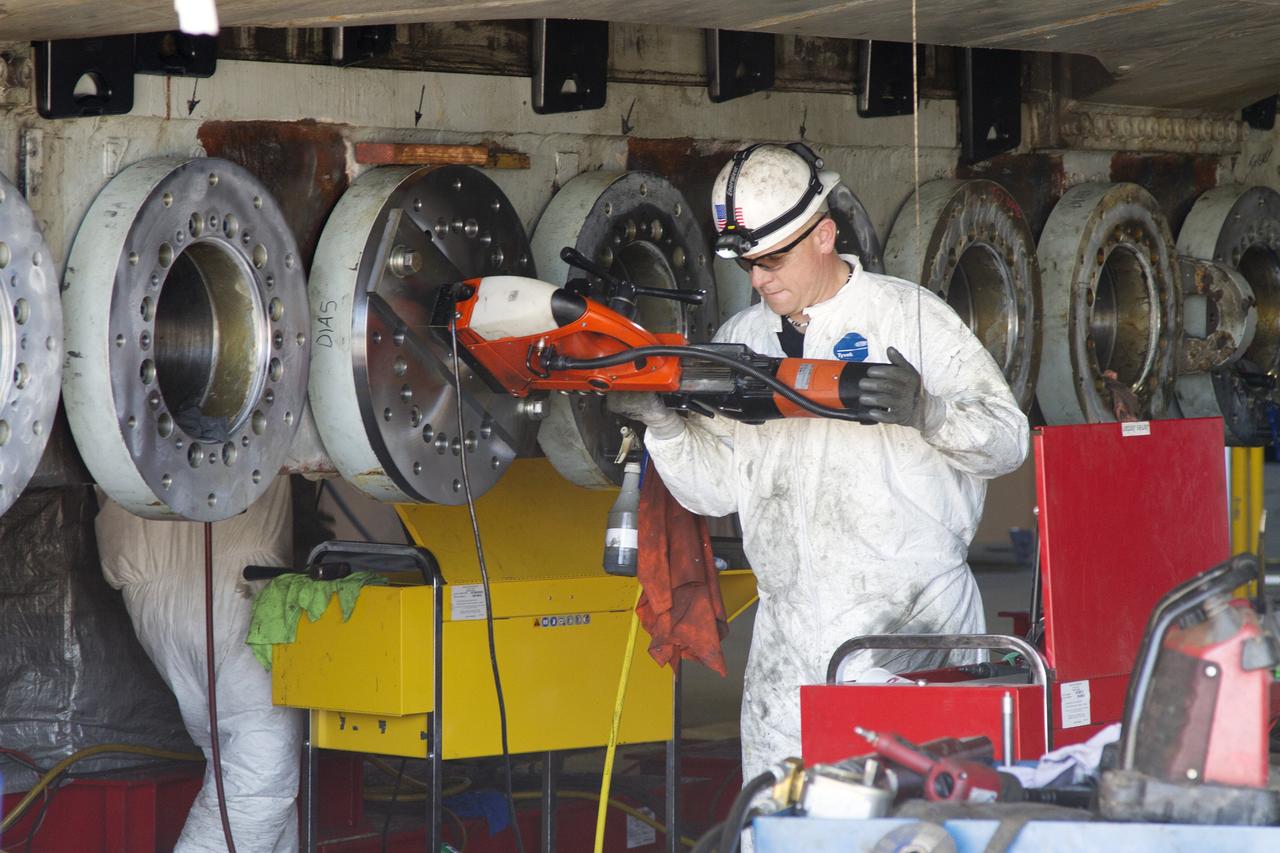
CAPE CANAVERAL, Fla. – Inside the Vehicle Assembly Building at NASA’s Kennedy Space Center in Florida, a ground support technician installs a new roller bearing on the C truck of crawler-transporter 2, or CT-2. Work continues in high bay 2 to upgrade CT-2. The modifications are designed to ensure CT-2’s ability to transport launch vehicles currently in development, such as the agency’s Space Launch System, to the launch pad. The Ground Systems Development and Operations Program office at Kennedy is overseeing the upgrades. For more than 45 years the crawler-transporters were used to transport the mobile launcher platform and the Apollo-Saturn V rockets and, later, space shuttles to Launch Pads 39A and B. For more information, visit: http://www.nasa.gov/exploration/systems/ground/crawler-transporter. Photo credit: NASA/Cory Huston
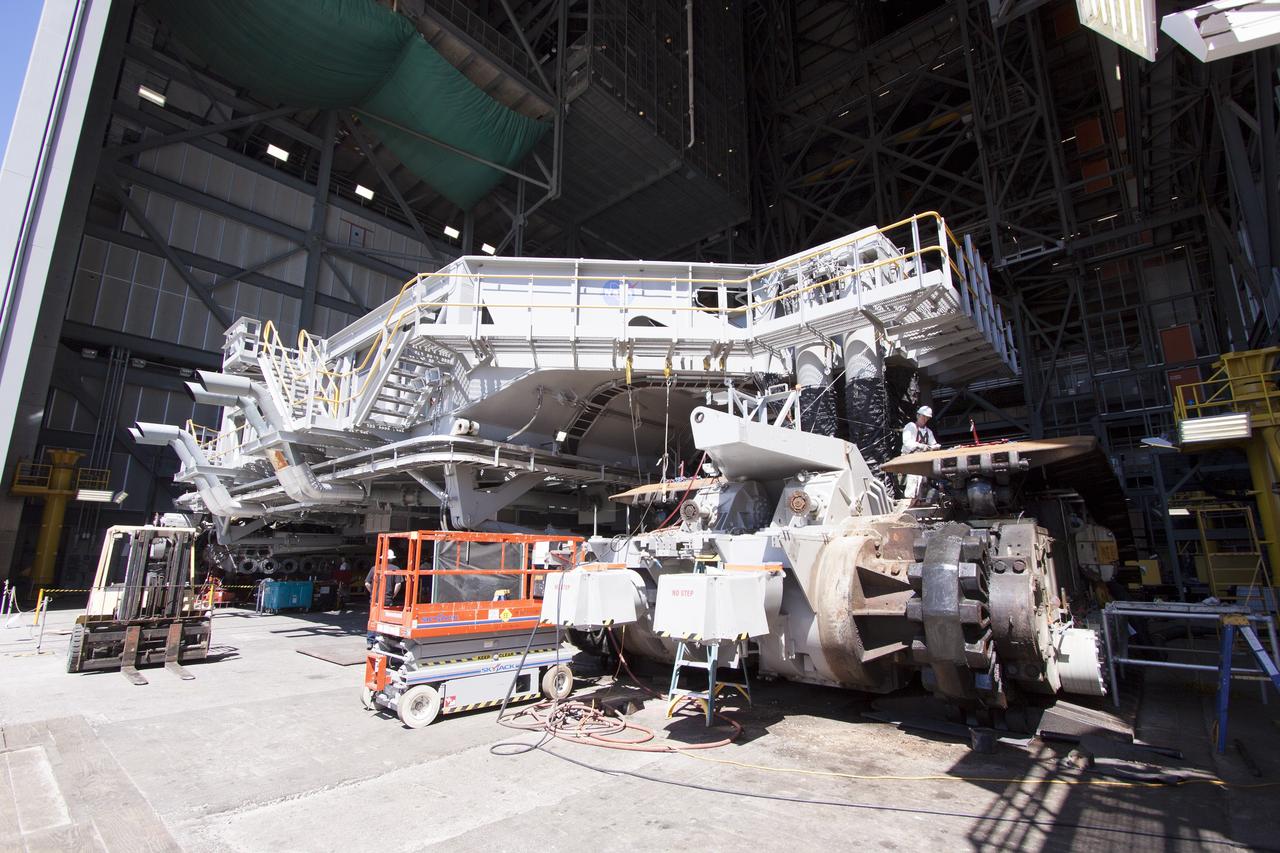
CAPE CANAVERAL, Fla. – Inside the Vehicle Assembly Building at NASA’s Kennedy Space Center in Florida, preparations are underway to remove the gear boxes on the C truck of crawler-transporter 2, or CT-2. A section of the treads were removed to allow access to the gear boxes. Work continues in high bay 2 to upgrade CT-2. The modifications are designed to ensure CT-2’s ability to transport launch vehicles currently in development, such as the agency’s Space Launch System, to the launch pad. The Ground Systems Development and Operations Program office at Kennedy is overseeing the upgrades. For more than 45 years the crawler-transporters were used to transport the mobile launcher platform and the Apollo-Saturn V rockets and, later, space shuttles to Launch Pads 39A and B. For more information, visit: http://www.nasa.gov/exploration/systems/ground/crawler-transporter. Photo credit: NASA/Cory Huston
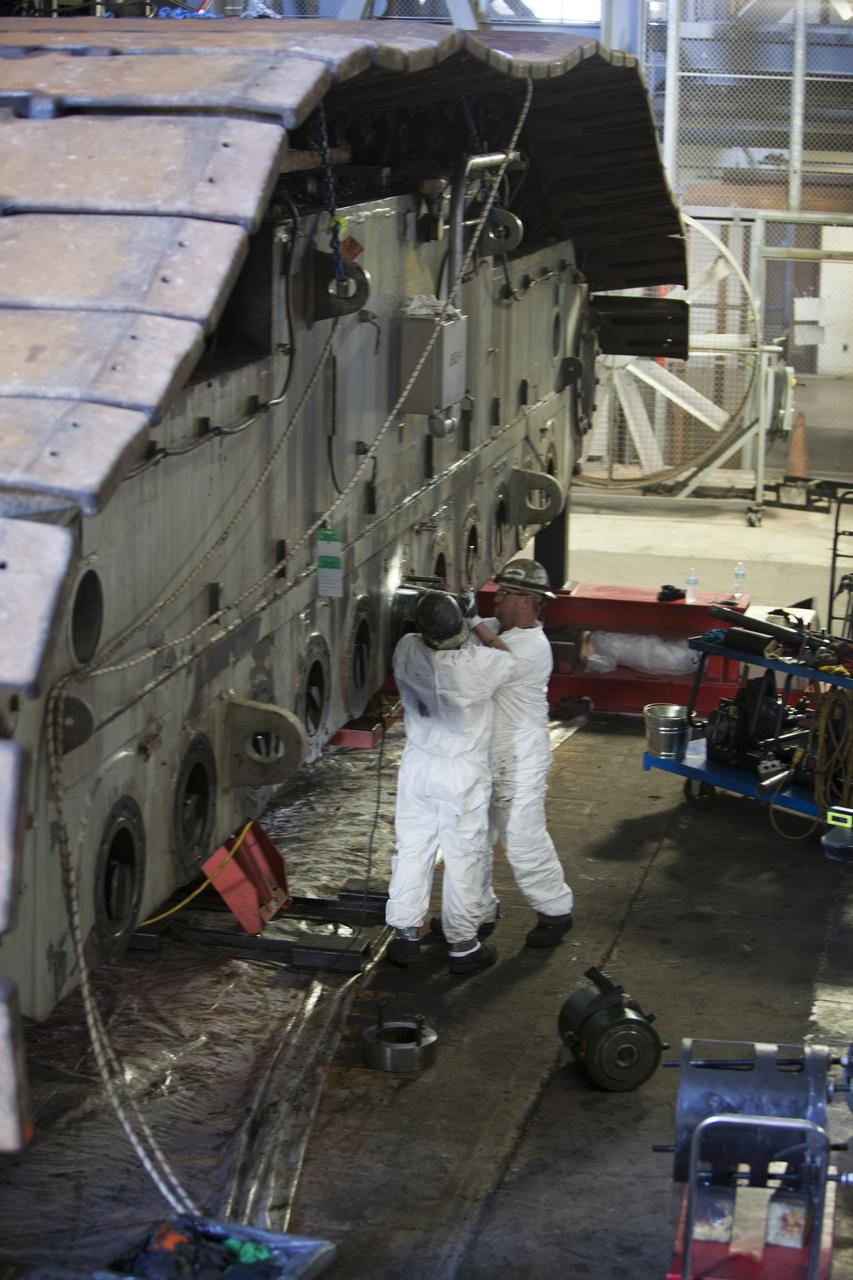
CAPE CANAVERAL, Fla. – Inside the Vehicle Assembly Building at NASA’s Kennedy Space Center in Florida, ground support technicians assist with removal of bearings from the B truck tread of crawler-transporter 2, or CT-2. New roller bearing assemblies will be installed. Work continues in high bay 2 to upgrade CT-2. The modifications are designed to ensure CT-2’s ability to transport launch vehicles currently in development, such as the agency’s Space Launch System, to the launch pad. The Ground Systems Development and Operations Program office at Kennedy is overseeing the upgrades. For more than 45 years the crawler-transporters were used to transport the mobile launcher platform and the Apollo-Saturn V rockets and, later, space shuttles to Launch Pads 39A and B. For more information, visit: http://www.nasa.gov/exploration/systems/ground/crawler-transporter. Photo credit: NASA/Dimitri Gerondidakis
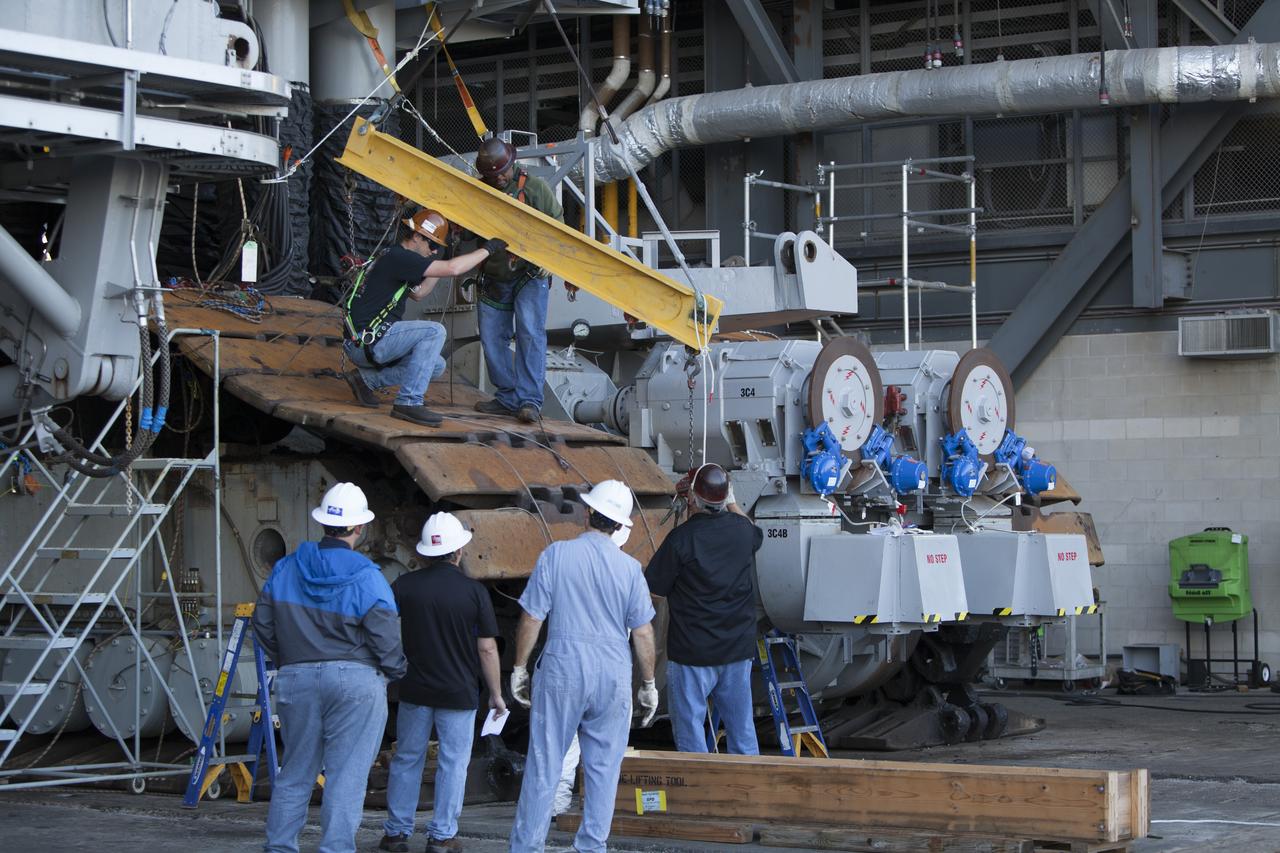
CAPE CANAVERAL, Fla. – Inside the Vehicle Assembly Building at NASA’s Kennedy Space Center in Florida, ground support technicians attach crane lines to the treads on the C truck of crawler-transporter 2, or CT-2, so they can be lifted up and away. The treads are being removed in order to gain access to remove the gear boxes. Work continues in high bay 2 to upgrade CT-2. The modifications are designed to ensure CT-2’s ability to transport launch vehicles currently in development, such as the agency’s Space Launch System, to the launch pad. The Ground Systems Development and Operations Program office at Kennedy is overseeing the upgrades. For more than 45 years the crawler-transporters were used to transport the mobile launcher platform and the Apollo-Saturn V rockets and, later, space shuttles to Launch Pads 39A and B. For more information, visit: http://www.nasa.gov/exploration/systems/ground/crawler-transporter. Photo credit: NASA/Dimitri Gerondidakis
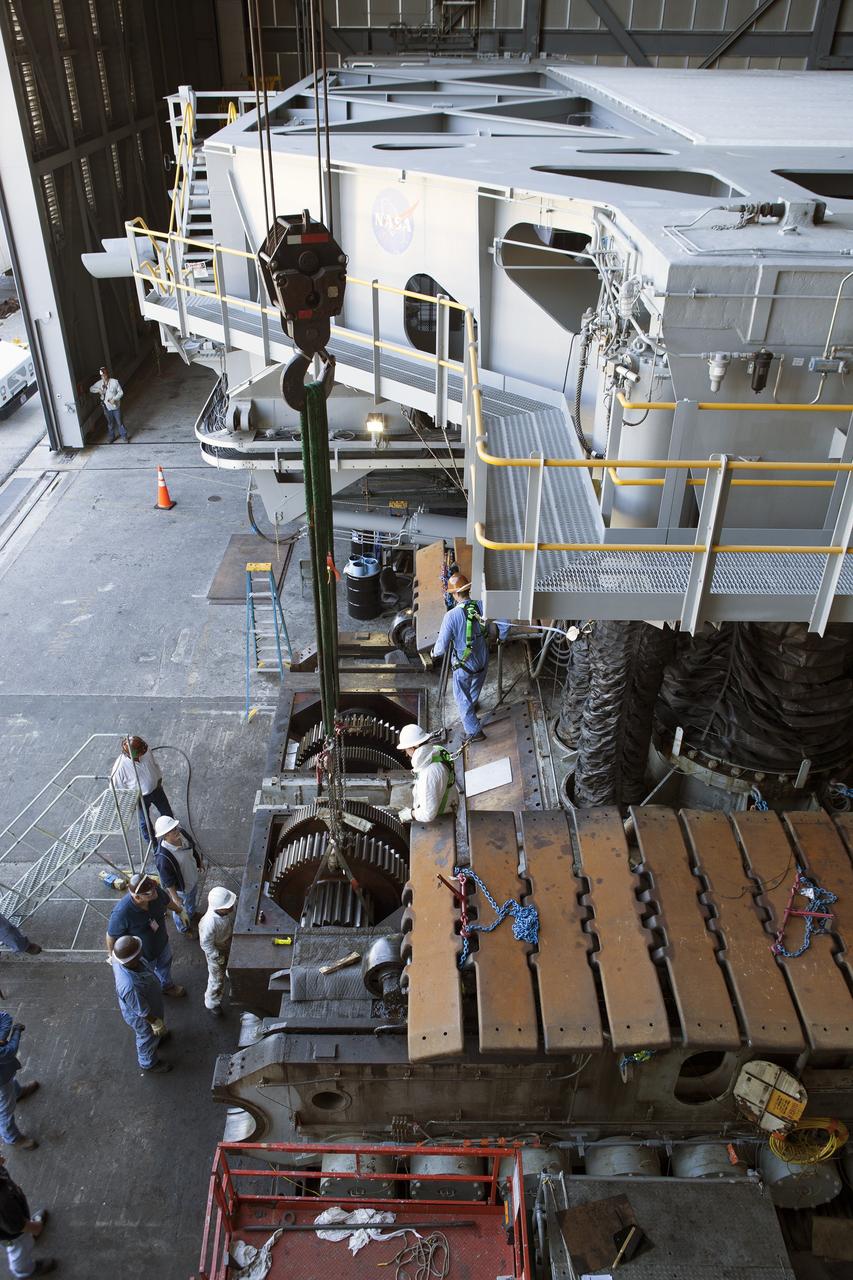
CAPE CANAVERAL, Fla. -- Inside the Vehicle Assembly Building at NASA’s Kennedy Space Center in Florida, ground support technicians prepare for removal of one of the sprocket shaft assemblies on the C truck of crawler-transporter 2, or CT-2. A section of the treads on the C truck were removed to allow access to the sprocket assemblies. Work continues in high bay 2 to upgrade CT-2. The modifications are designed to ensure CT-2’s ability to transport launch vehicles currently in development, such as the agency’s Space Launch System, to the launch pad. The Ground Systems Development and Operations Program office at Kennedy is overseeing the upgrades. For more than 45 years the crawler-transporters were used to transport the mobile launcher platform and the Apollo-Saturn V rockets and, later, space shuttles to Launch Pads 39A and B. For more information, visit: http://www.nasa.gov/exploration/systems/ground/crawler-transporter. Photo credit: NASA/Dimitri Gerondidakis
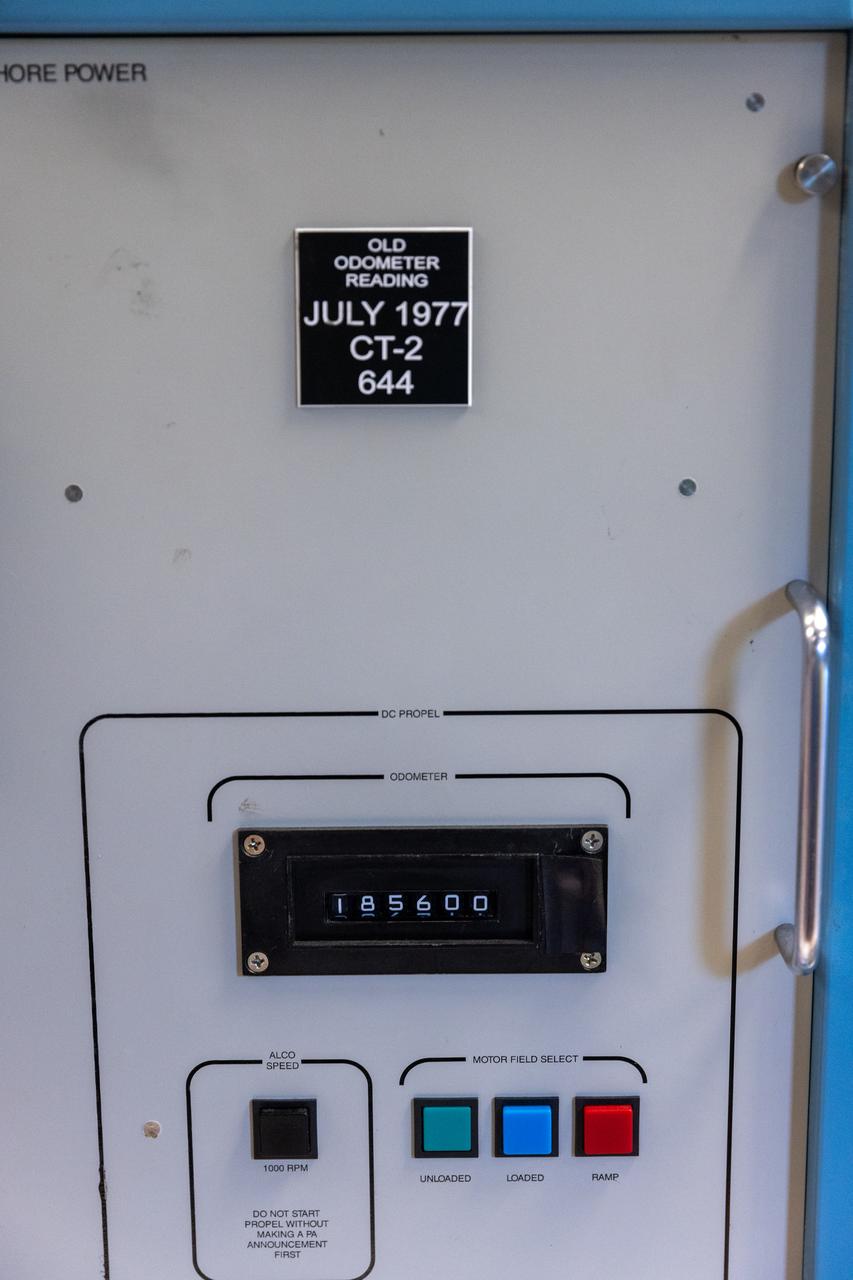
A photo of NASA’s crawler-transporter 2 odometer on Wednesday, Sept. 25, 2024, at NASA’s Kennedy Space Center in Florida, commemorates the milestone of reaching 2,500 miles traveled since its construction in 1965. Crawler-transporter 2’s original odometer ceased working in 1977 at 644 miles, so teams with NASA’s Exploration Ground Systems added the original figure to the new odometer to calculate the milestone. Built originally to transport massive Saturn V rockets during the Apollo Program, crawler-transporter 2 continued its service during the Space Shuttle Program, and currently transports the massive SLS (Space Launch System) rocket and Orion spacecraft atop the mobile launcher as part of the agency’s Artemis campaign.
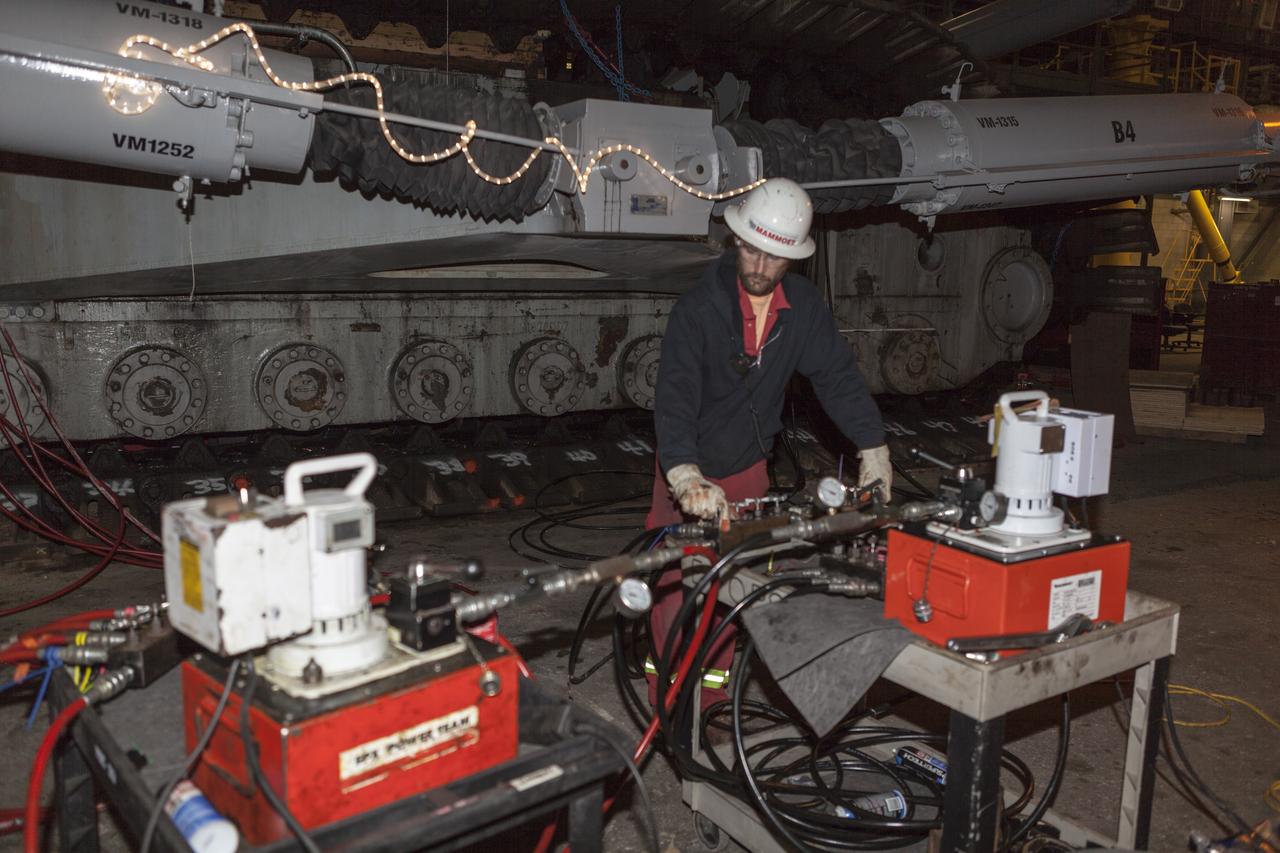
CAPE CANAVERAL, Fla. – Inside the Vehicle Assembly Building at NASA’s Kennedy Space Center in Florida, the B and D truck sections of crawler-transporter 2, or CT-2, are being raised up to prepare for installation of new roller bearing assemblies. Work continues in high bay 2 to upgrade CT-2. The modifications are designed to ensure CT-2’s ability to transport launch vehicles currently in development, such as the agency’s Space Launch System, to the launch pad. The Ground Systems Development and Operations Program office at Kennedy is overseeing the upgrades. For more than 45 years the crawler-transporters were used to transport the mobile launcher platform and the Apollo-Saturn V rockets and, later, space shuttles to Launch Pads 39A and B. For more information, visit: http://www.nasa.gov/exploration/systems/ground/crawler-transporter. Photo credit: NASA/Dimitri Gerondidakis
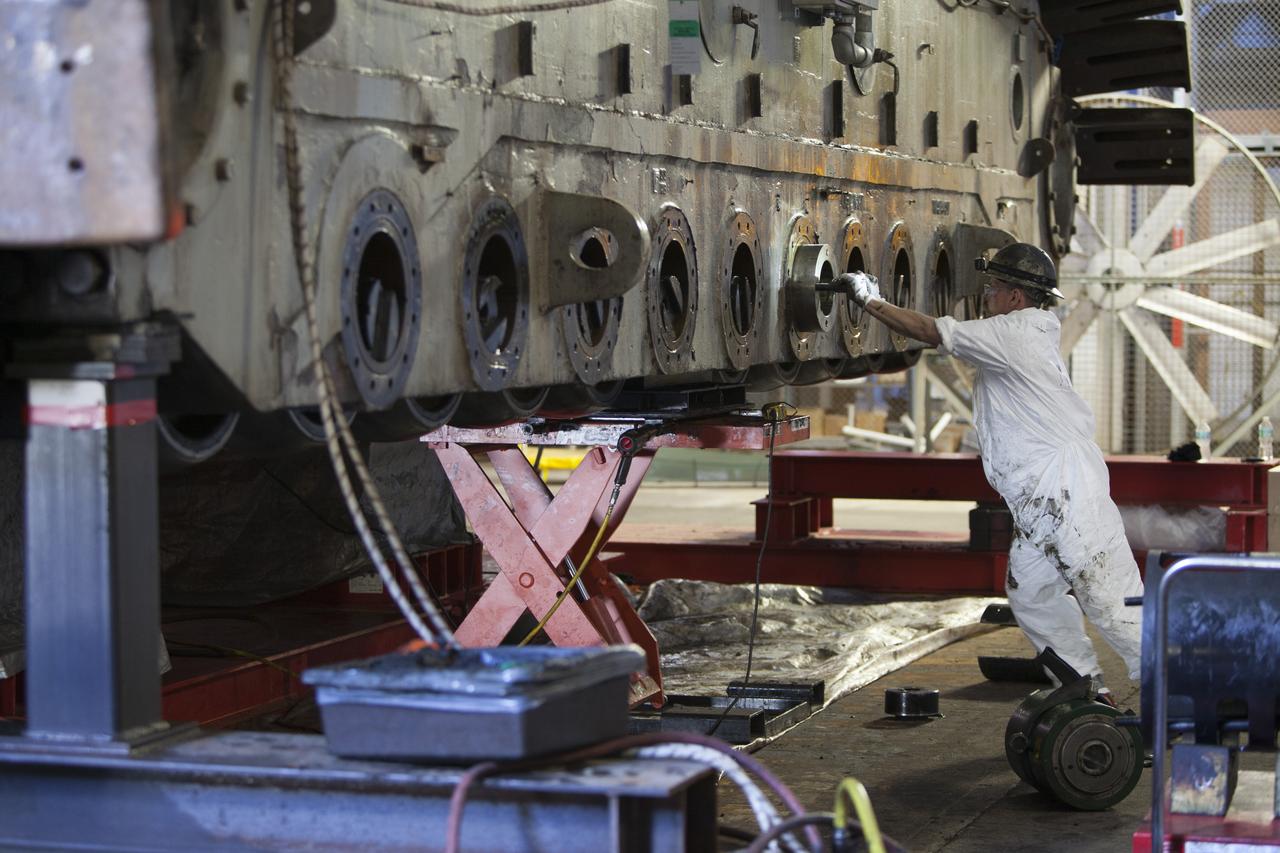
CAPE CANAVERAL, Fla. – Inside the Vehicle Assembly Building at NASA’s Kennedy Space Center in Florida, a ground support technician assists with removal of bearings from the B truck tread of crawler-transporter 2, or CT-2. New roller bearing assemblies will be installed. Work continues in high bay 2 to upgrade CT-2. The modifications are designed to ensure CT-2’s ability to transport launch vehicles currently in development, such as the agency’s Space Launch System, to the launch pad. The Ground Systems Development and Operations Program office at Kennedy is overseeing the upgrades. For more than 45 years the crawler-transporters were used to transport the mobile launcher platform and the Apollo-Saturn V rockets and, later, space shuttles to Launch Pads 39A and B. For more information, visit: http://www.nasa.gov/exploration/systems/ground/crawler-transporter. Photo credit: NASA/Dimitri Gerondidakis
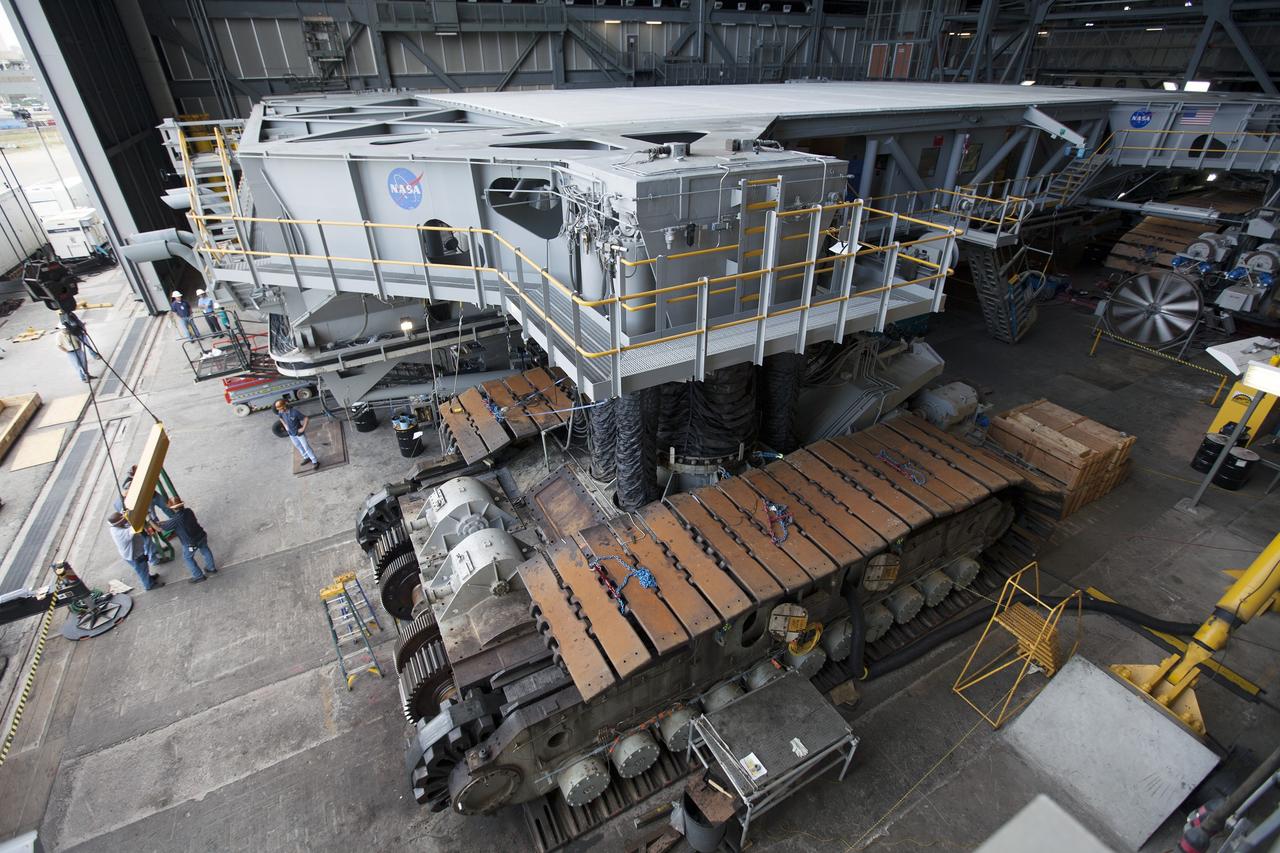
CAPE CANAVERAL, Fla. - Inside the Vehicle Assembly Building at NASA’s Kennedy Space Center in Florida, ground support technicians prepare for removal of the outboard and inboard sprocket shaft assemblies on the C truck of crawler-transporter 2, or CT-2. A section of the treads on the C truck were removed to allow access to the sprocket assemblies. Work continues in high bay 2 to upgrade CT-2. The modifications are designed to ensure CT-2’s ability to transport launch vehicles currently in development, such as the agency’s Space Launch System, to the launch pad. The Ground Systems Development and Operations Program office at Kennedy is overseeing the upgrades. For more than 45 years the crawler-transporters were used to transport the mobile launcher platform and the Apollo-Saturn V rockets and, later, space shuttles to Launch Pads 39A and B. For more information, visit: http://www.nasa.gov/exploration/systems/ground/crawler-transporter. Photo credit: NASA/Dimitri Gerondidakis
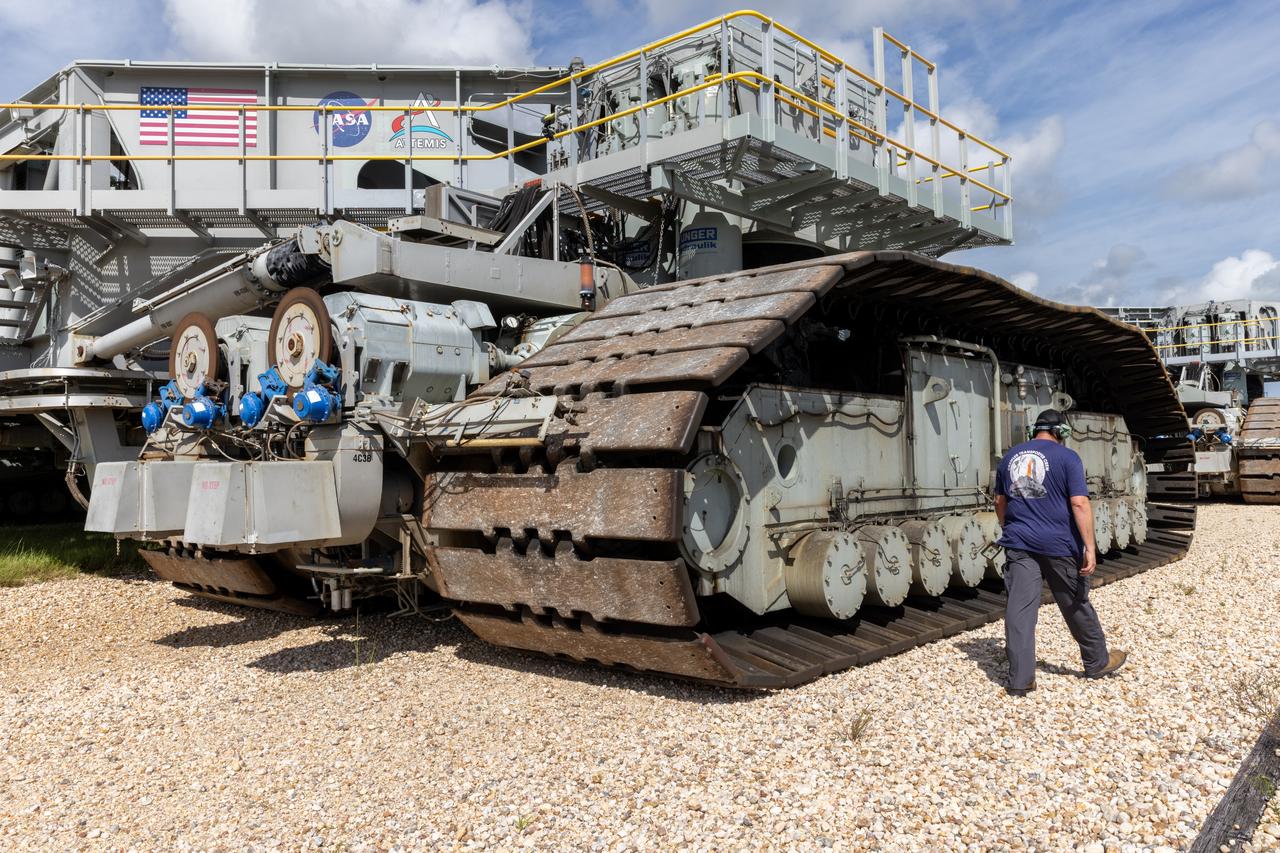
NASA’s crawler-transporter 2 moves slowly along the crawlerway towards Launch Pad 39B at the agency’s Kennedy Space Center in Florida on Wednesday, Sept. 25, 2024, after reaching the milestone of 2,500 miles traveled since its construction in 1965. Crawler-transporter 2 reached the milestone while teams with NASA’s Exploration Ground Systems took it on a trip in preparation for supporting the roll of the mobile launcher back into the spaceport’s Vehicle Assembly Building ahead of the Artemis II launch. Built originally to transport massive Saturn V rockets during the Apollo Program, crawler-transporter 2 continued its service during the Space Shuttle Program, and currently transports the massive SLS (Space Launch System) rocket and Orion spacecraft atop the mobile launcher as part of the agency’s Artemis campaign.
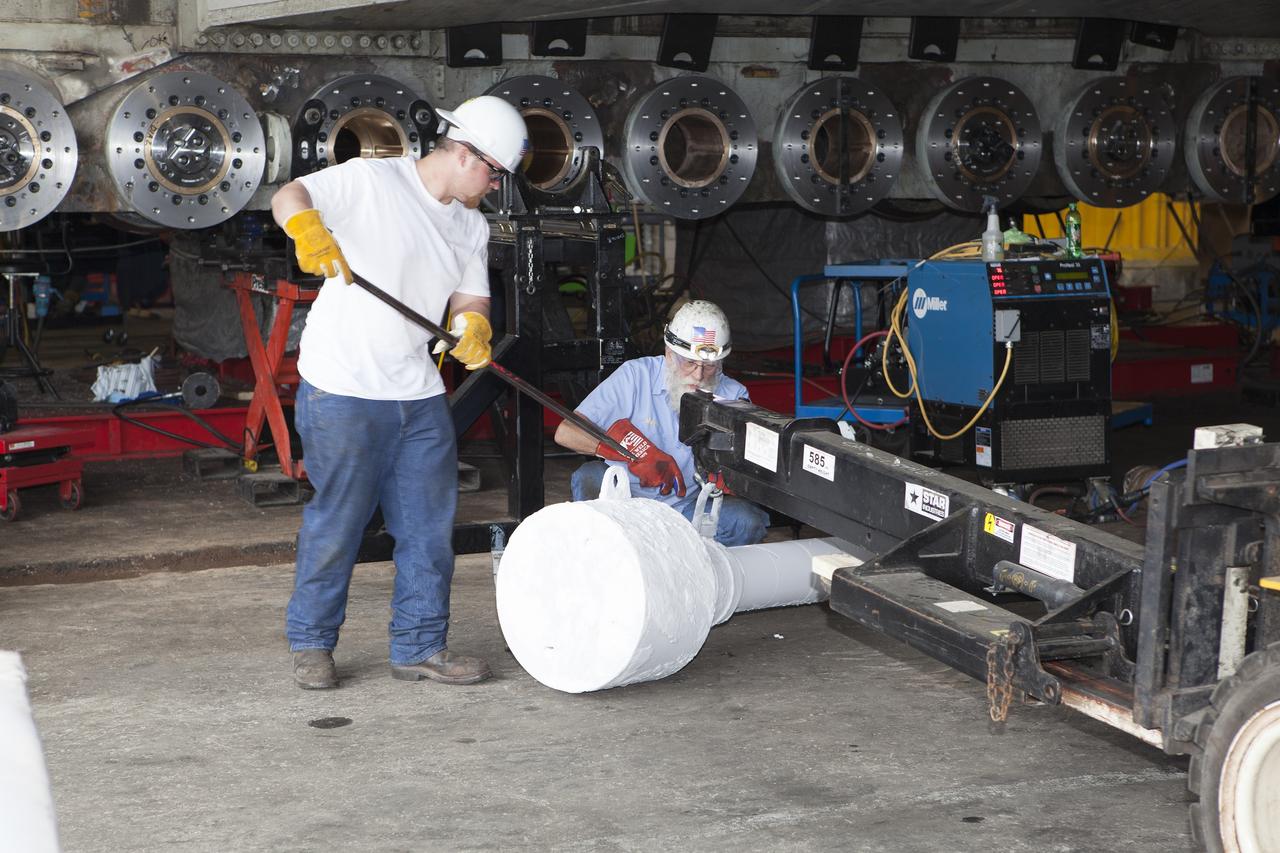
CAPE CANAVERAL, Fla. - Inside the Vehicle Assembly Building at NASA’s Kennedy Space Center in Florida, ground support technicians attach a roller bearing shaft to a forklift. The bearing is being prepared for insertion in the C truck of crawler-transporter 2, or CT-2. A section of the treads on the C truck were removed to allow access to the bearings. Work continues in high bay 2 to upgrade CT-2. The modifications are designed to ensure CT-2’s ability to transport launch vehicles currently in development, such as the agency’s Space Launch System, to the launch pad. The Ground Systems Development and Operations Program office at Kennedy is overseeing the upgrades. For more than 45 years the crawler-transporters were used to transport the mobile launcher platform and the Apollo-Saturn V rockets and, later, space shuttles to Launch Pads 39A and B. For more information, visit: http://www.nasa.gov/exploration/systems/ground/crawler-transporter. Photo credit: NASA/Dimitri Gerondidakis
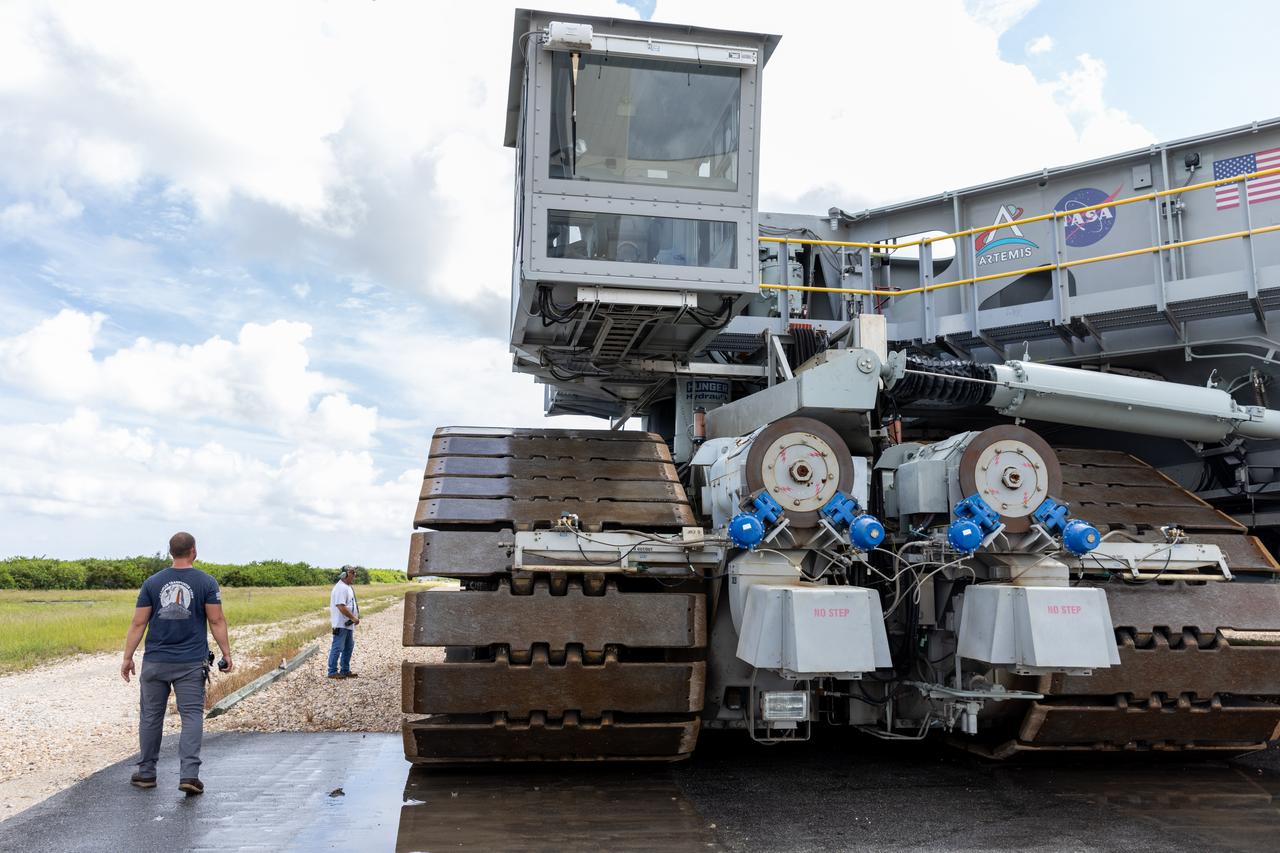
NASA’s crawler-transporter 2 moves slowly along the crawlerway towards Launch Pad 39B at the agency’s Kennedy Space Center in Florida on Wednesday, Sept. 25, 2024, after reaching the milestone of 2,500 miles traveled since its construction in 1965. Crawler-transporter 2 reached the milestone while teams with NASA’s Exploration Ground Systems took it on a trip in preparation for supporting the roll of the mobile launcher back into the spaceport’s Vehicle Assembly Building ahead of the Artemis II launch. Built originally to transport massive Saturn V rockets during the Apollo Program, crawler-transporter 2 continued its service during the Space Shuttle Program, and currently transports the massive SLS (Space Launch System) rocket and Orion spacecraft atop the mobile launcher as part of the agency’s Artemis campaign.
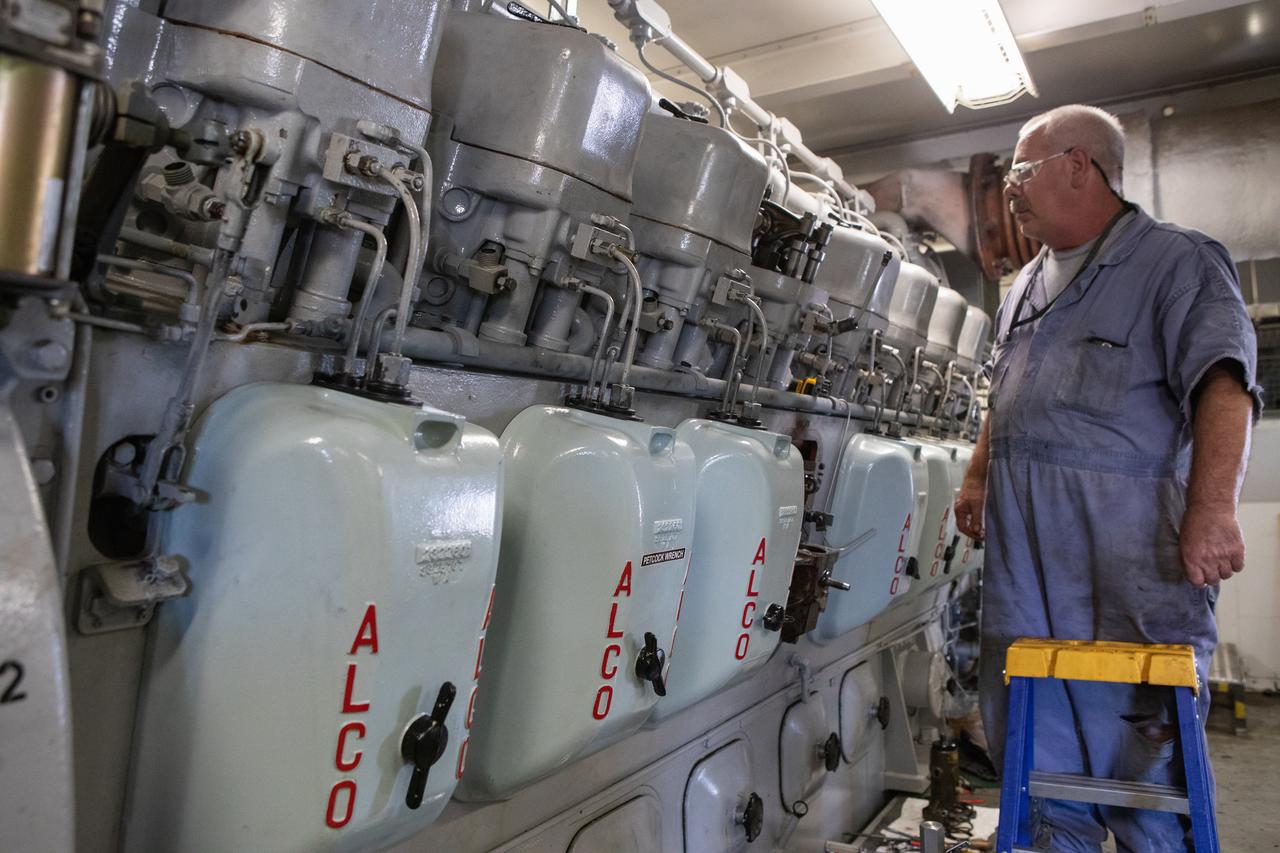
William Vardaman, a mechanical technician with the Jacobs contracting team, performs engine maintenance on NASA's crawler-transporter 2 on March 26, 2019, in the crawler yard located in Kennedy Space Center's Launch Complex 39 area. Recent engine work included rebuilding the vehicles’ fuel pump assemblies and installing new oil pumps that will help minimize future wear. This is one of two crawler-transporters that carried rockets and spacecraft, including the Apollo/Saturn V and space shuttle, from the Vehicle Assembly Building to the launch pad. NASA’s Exploration Ground Systems oversaw modifications and upgrades to crawler-transporter 2 so it can carry the mobile launcher and NASA's Space Launch System rocket, topped by the Orion spacecraft, to Launch Pad 39B for Exploration Mission-1.
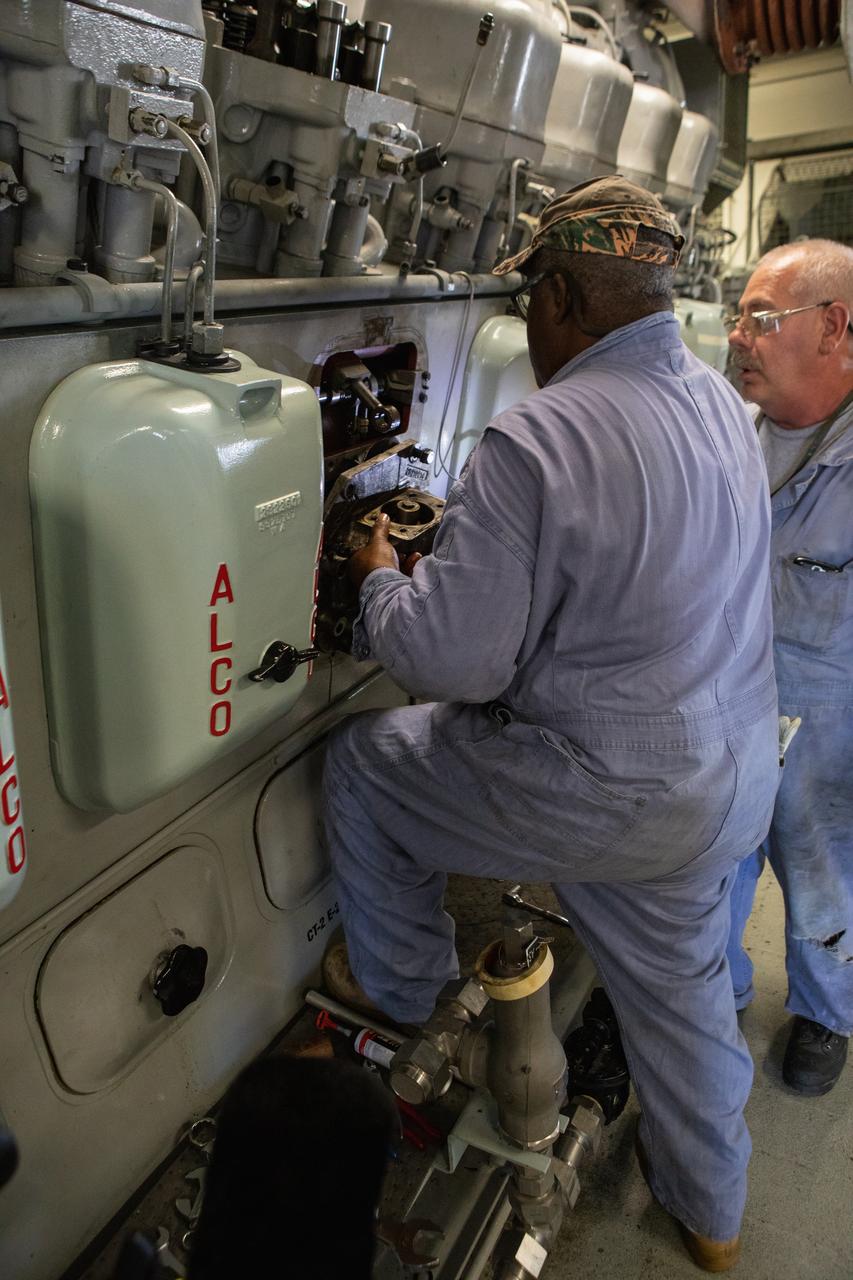
Pat Brown, left, and William Vardaman, mechanical technicians with the Jacobs contracting team, perform engine maintenance on NASA's crawler-transporter 2 on March 26, 2019, in the crawler yard located in Kennedy Space Center's Launch Complex 39 area. Recent engine work included rebuilding the vehicles’ fuel pump assemblies and installing new oil pumps that will help minimize future wear. This is one of two crawler-transporters that carried rockets and spacecraft, including the Apollo/Saturn V and space shuttle, from the Vehicle Assembly Building to the launch pad. NASA’s Exploration Ground Systems oversaw modifications and upgrades to crawler-transporter 2 so it can carry the mobile launcher and NASA's Space Launch System rocket, topped by the Orion spacecraft, to Launch Pad 39B for Exploration Mission-1.
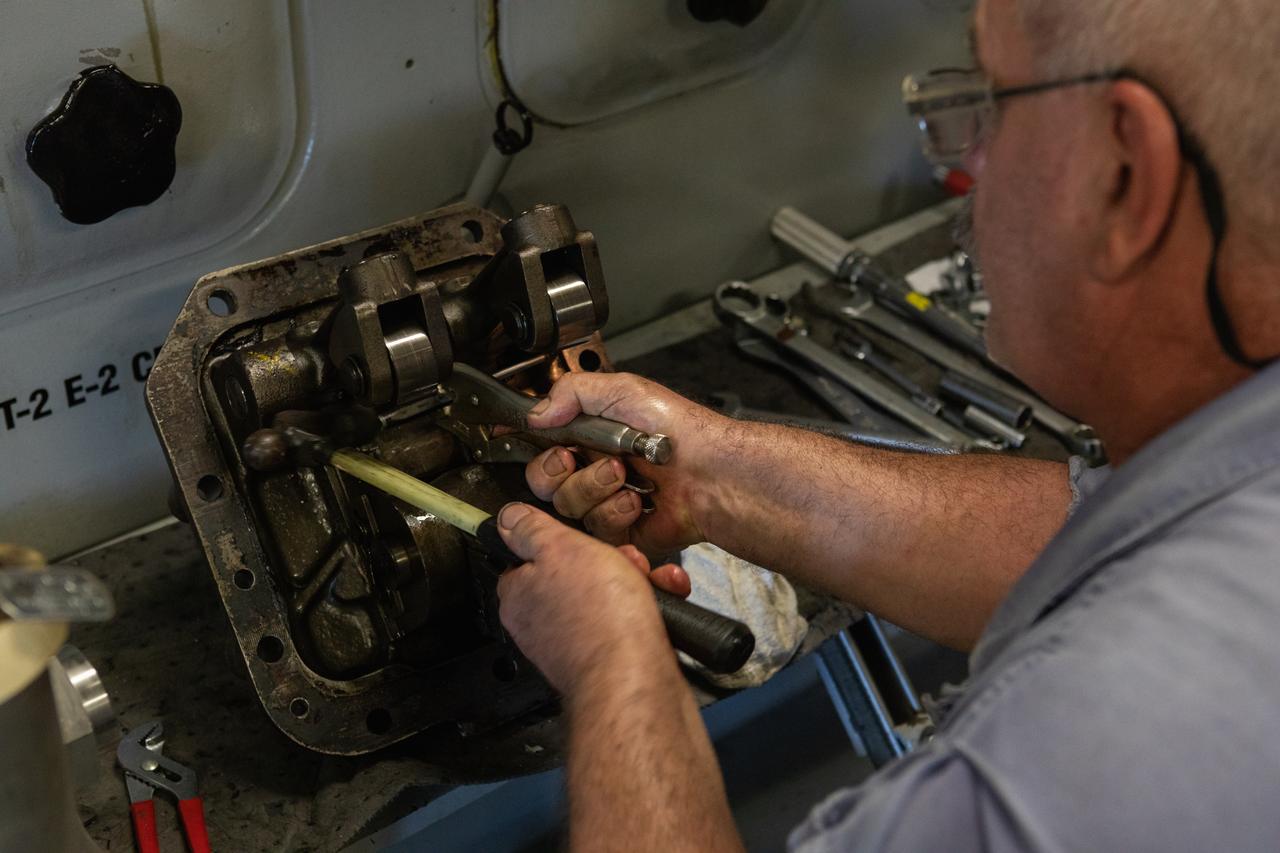
William Vardaman, a mechanical technician with the Jacobs contracting team, performs engine maintenance on NASA's crawler-transporter 2 on March 26, 2019, in the crawler yard located in Kennedy Space Center's Launch Complex 39 area. Recent engine work included rebuilding the vehicles’ fuel pump assemblies and installing new oil pumps that will help minimize future wear. This is one of two crawler-transporters that carried rockets and spacecraft, including the Apollo/Saturn V and space shuttle, from the Vehicle Assembly Building to the launch pad. NASA’s Exploration Ground Systems oversaw modifications and upgrades to crawler-transporter 2 so it can carry the mobile launcher and NASA's Space Launch System rocket, topped by the Orion spacecraft, to Launch Pad 39B for Exploration Mission-1.
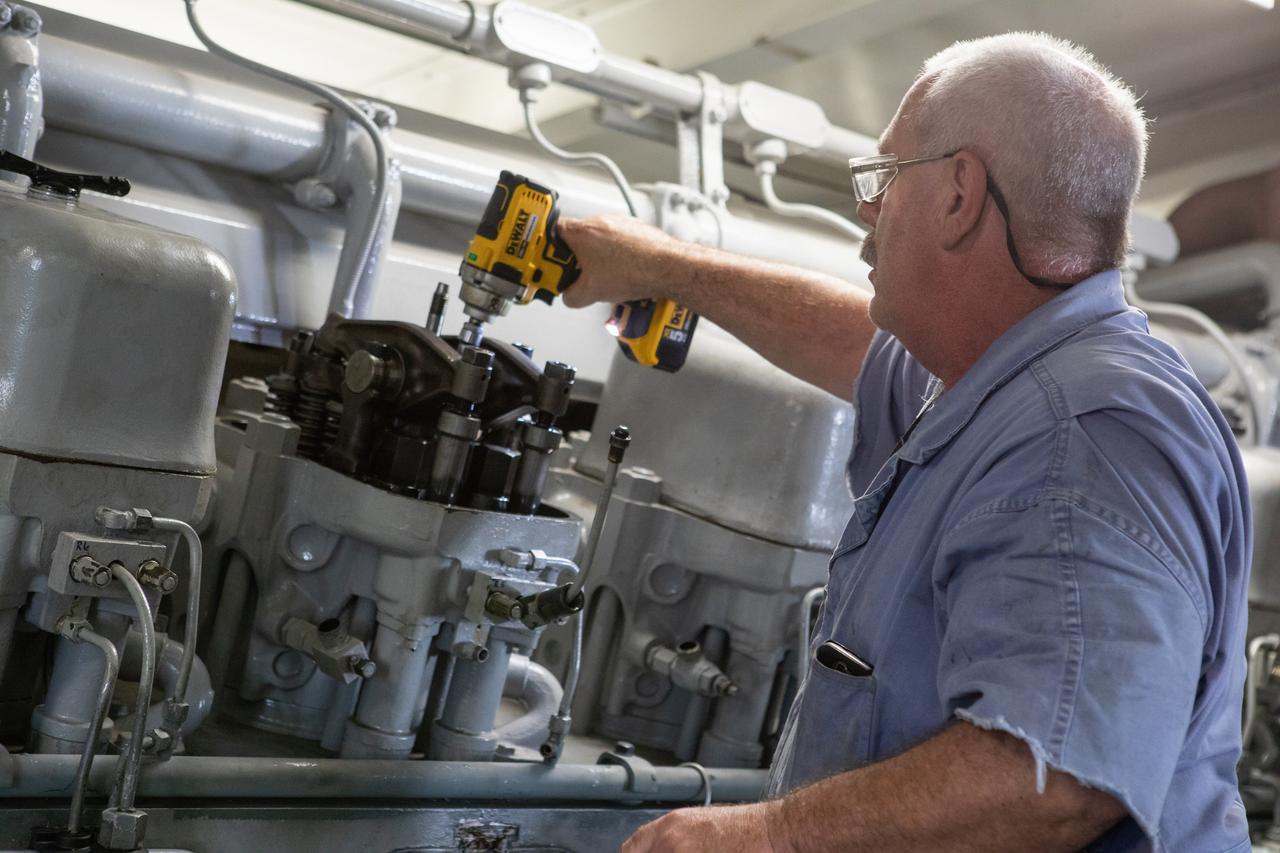
William Vardaman, a mechanical technician with the Jacobs contracting team, performs engine maintenance on NASA's crawler-transporter 2 on March 26, 2019, in the crawler yard located in Kennedy Space Center's Launch Complex 39 area. Recent engine work included rebuilding the vehicles’ fuel pump assemblies and installing new oil pumps that will help minimize future wear. This is one of two crawler-transporters that carried rockets and spacecraft, including the Apollo/Saturn V and space shuttle, from the Vehicle Assembly Building to the launch pad. NASA’s Exploration Ground Systems oversaw modifications and upgrades to crawler-transporter 2 so it can carry the mobile launcher and NASA's Space Launch System rocket, topped by the Orion spacecraft, to Launch Pad 39B for Exploration Mission-1.
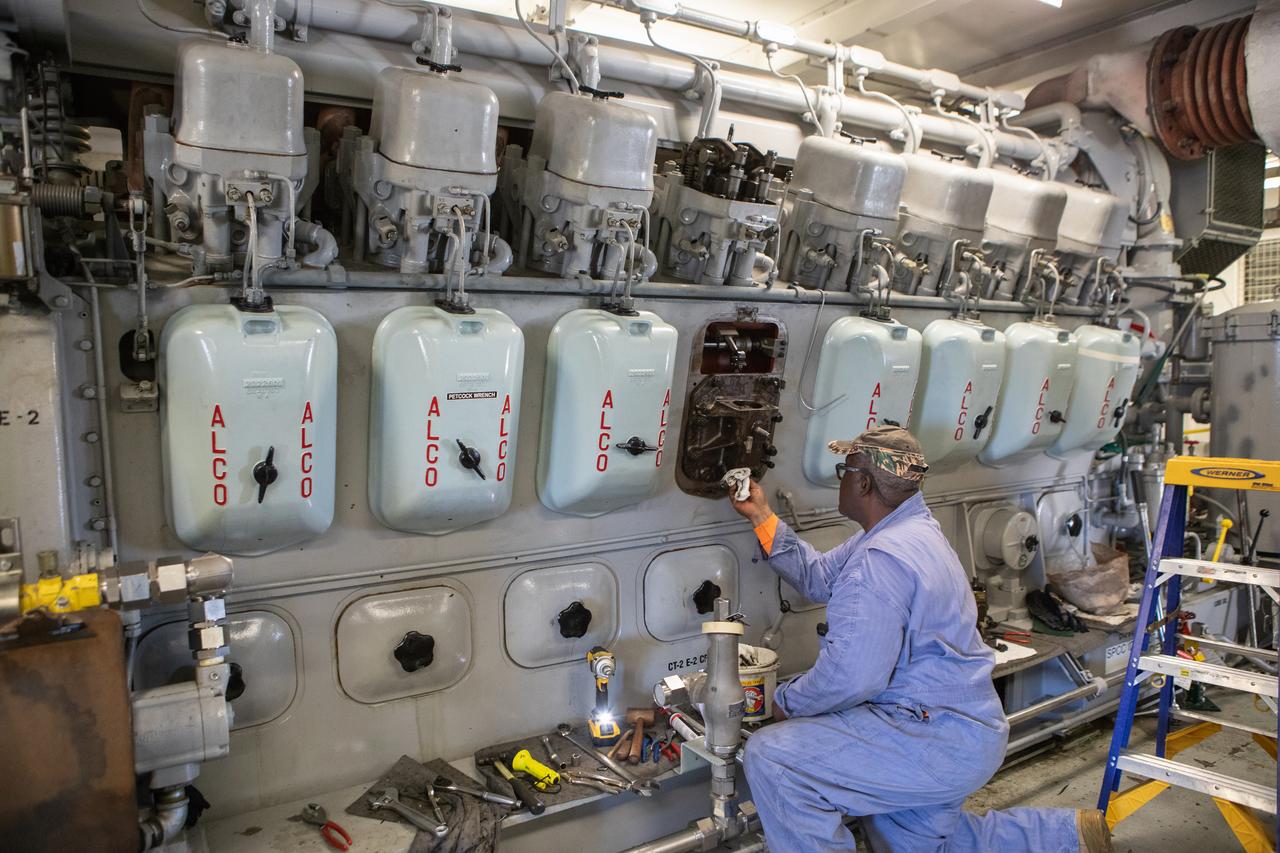
Pat Brown, a mechanical technician with Jacobs, performs engine maintenance on NASA's crawler-transporter 2 on March 26, 2019, in the crawler yard located in Kennedy Space Center's Launch Complex 39 area. Recent engine work included rebuilding the vehicles’ fuel pump assemblies and installing new oil pumps that will help minimize future wear. This is one of two crawler-transporters that carried rockets and spacecraft, including the Apollo/Saturn V and space shuttle, from the Vehicle Assembly Building to the launch pad. NASA’s Exploration Ground Systems oversaw modifications and upgrades to crawler-transporter 2 so it can carry the mobile launcher and NASA's Space Launch System rocket, topped by the Orion spacecraft, to Launch Pad 39B for Exploration Mission-1.
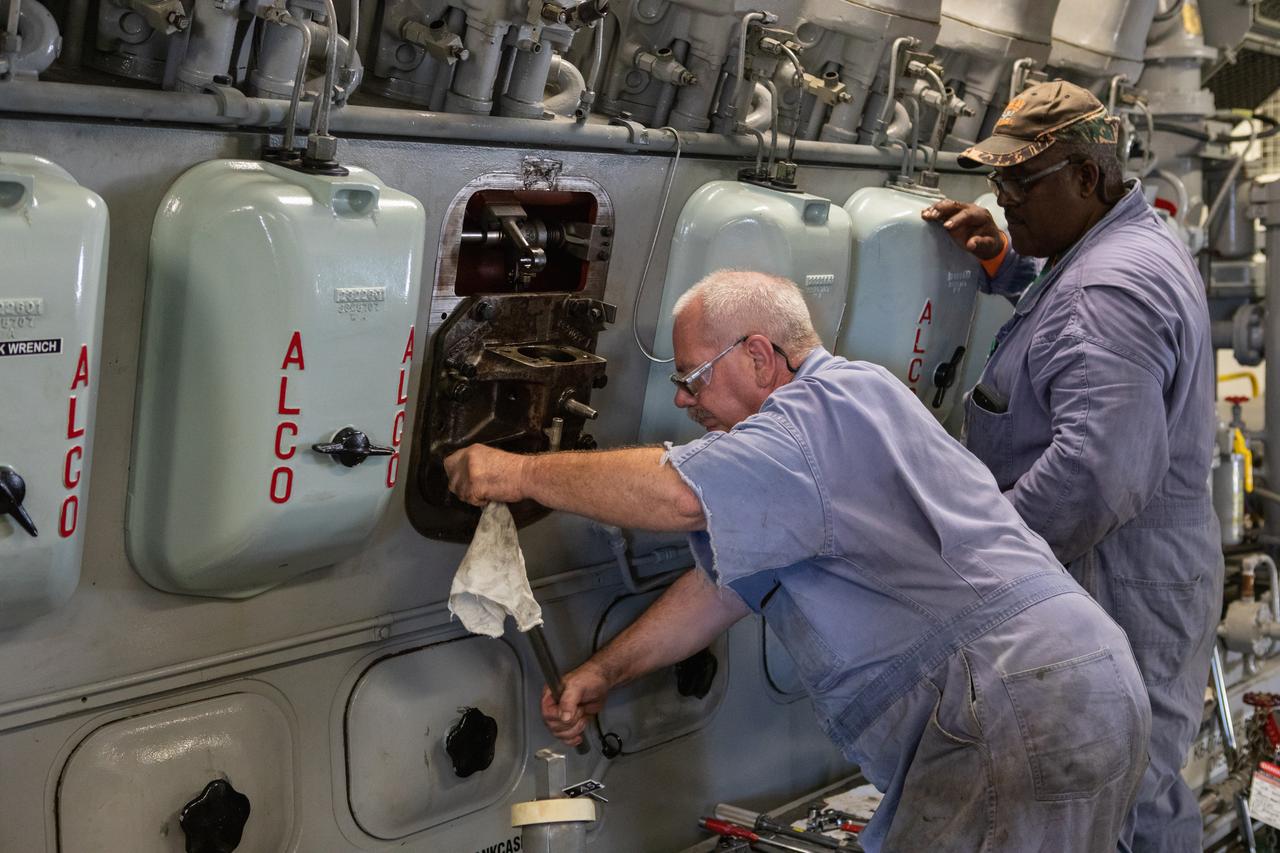
William Vardaman, left, and Pat Brown, mechanical technicians with the Jacobs contracting team, perform engine maintenance on NASA's crawler-transporter 2 on March 26, 2019, in the crawler yard located in Kennedy Space Center's Launch Complex 39 area. Recent engine work included rebuilding the vehicles’ fuel pump assemblies and installing new oil pumps that will help minimize future wear. This is one of two crawler-transporters that carried rockets and spacecraft, including the Apollo/Saturn V and space shuttle, from the Vehicle Assembly Building to the launch pad. NASA’s Exploration Ground Systems oversaw modifications and upgrades to crawler-transporter 2 so it can carry the mobile launcher and NASA's Space Launch System rocket, topped by the Orion spacecraft, to Launch Pad 39B for Exploration Mission-1.
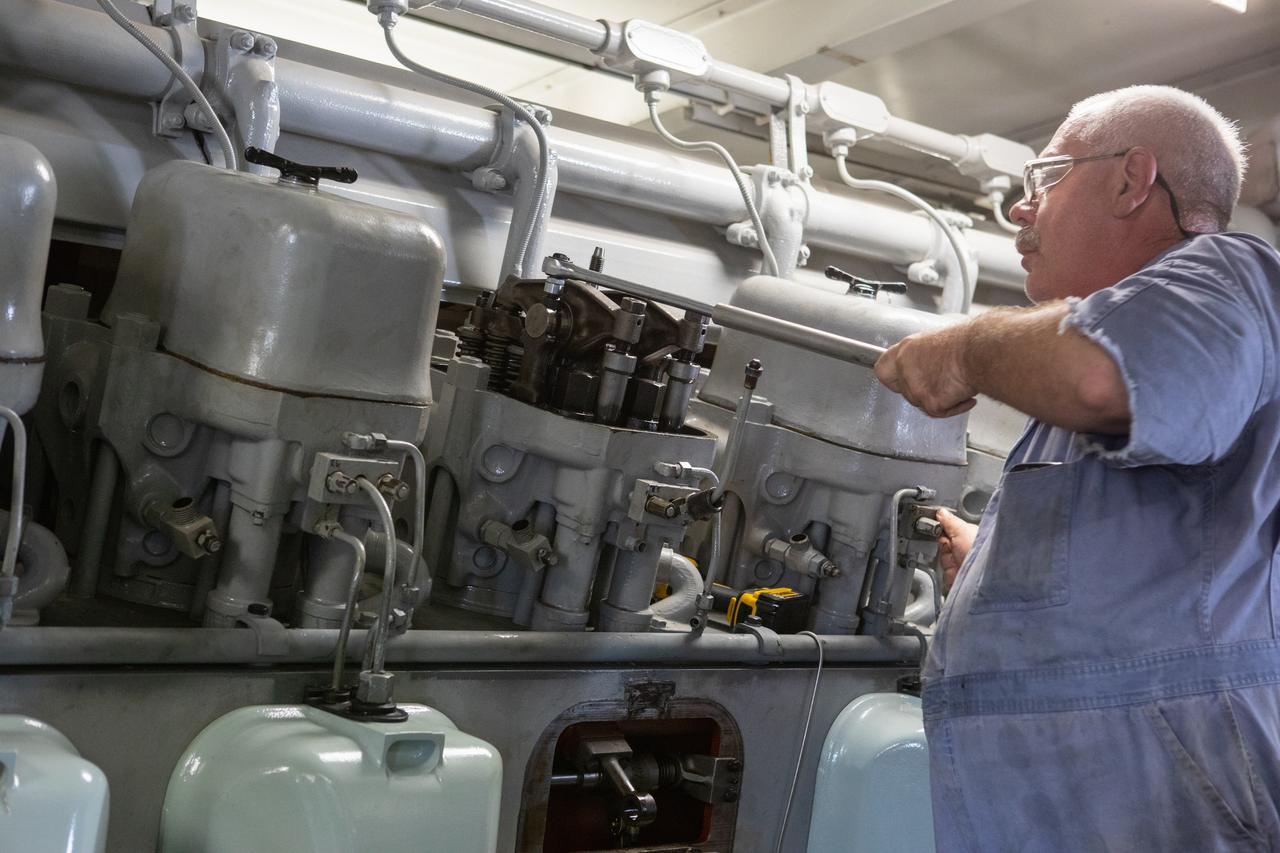
William Vardaman, mechanical technician with the Jacobs contracting team, performs engine maintenance on NASA's crawler-transporter 2 on March 26, 2019, in the crawler yard located in Kennedy Space Center's Launch Complex 39 area. Recent engine work included rebuilding the vehicles’ fuel pump assemblies and installing new oil pumps that will help minimize future wear. This is one of two crawler-transporters that carried rockets and spacecraft, including the Apollo/Saturn V and space shuttle, from the Vehicle Assembly Building to the launch pad. NASA’s Exploration Ground Systems oversaw modifications and upgrades to crawler-transporter 2 so it can carry the mobile launcher and NASA's Space Launch System rocket, topped by the Orion spacecraft, to Launch Pad 39B for Exploration Mission-1.
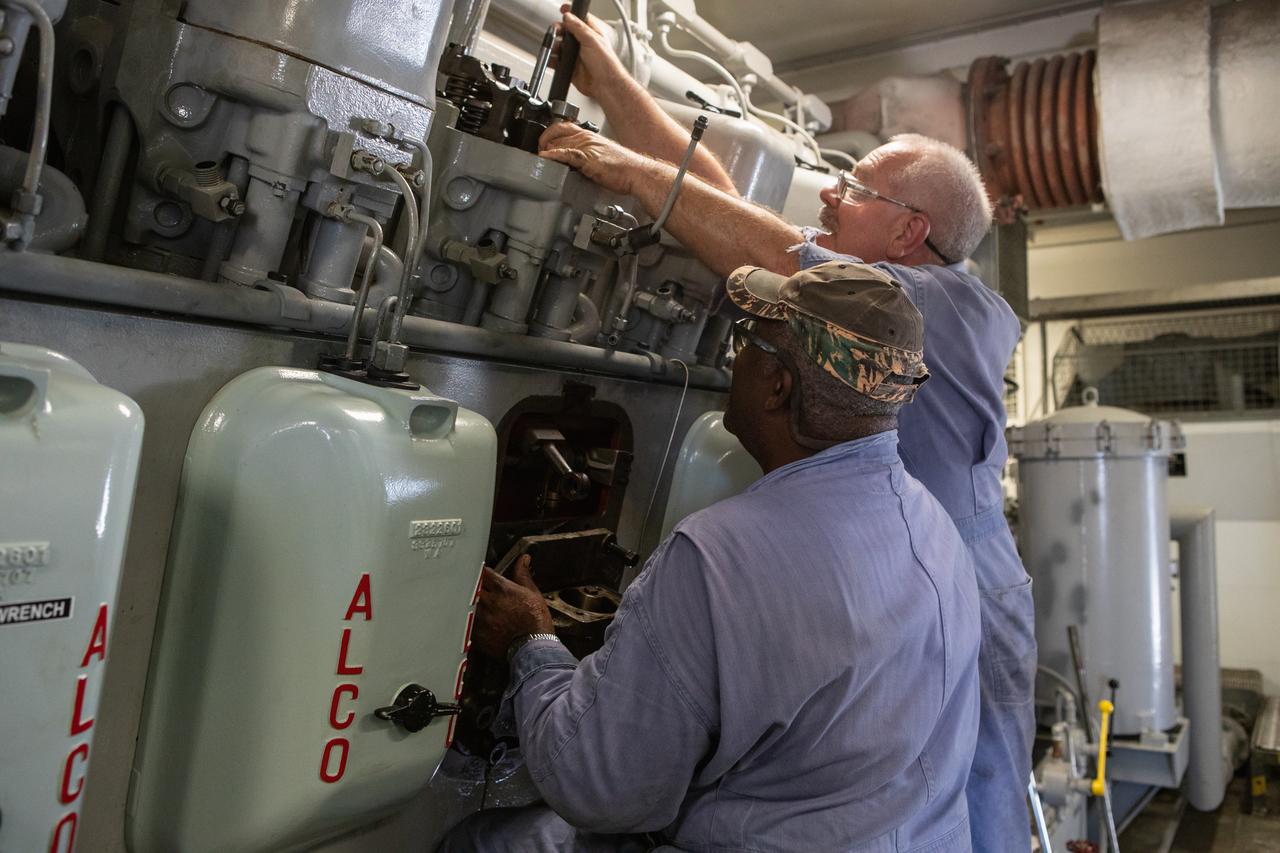
Pat Brown, left, and William Vardaman, mechanical technicians with the Jacobs contracting team, perform engine maintenance on NASA's crawler-transporter 2 on March 26, 2019, in the crawler yard located in Kennedy Space Center's Launch Complex 39 area. Recent engine work included rebuilding the vehicles’ fuel pump assemblies and installing new oil pumps that will help minimize future wear. This is one of two crawler-transporters that carried rockets and spacecraft, including the Apollo/Saturn V and space shuttle, from the Vehicle Assembly Building to the launch pad. NASA’s Exploration Ground Systems oversaw modifications and upgrades to crawler-transporter 2 so it can carry the mobile launcher and NASA's Space Launch System rocket, topped by the Orion spacecraft, to Launch Pad 39B for Exploration Mission-1.