Drawing the Drapes
Drawing the Drapes
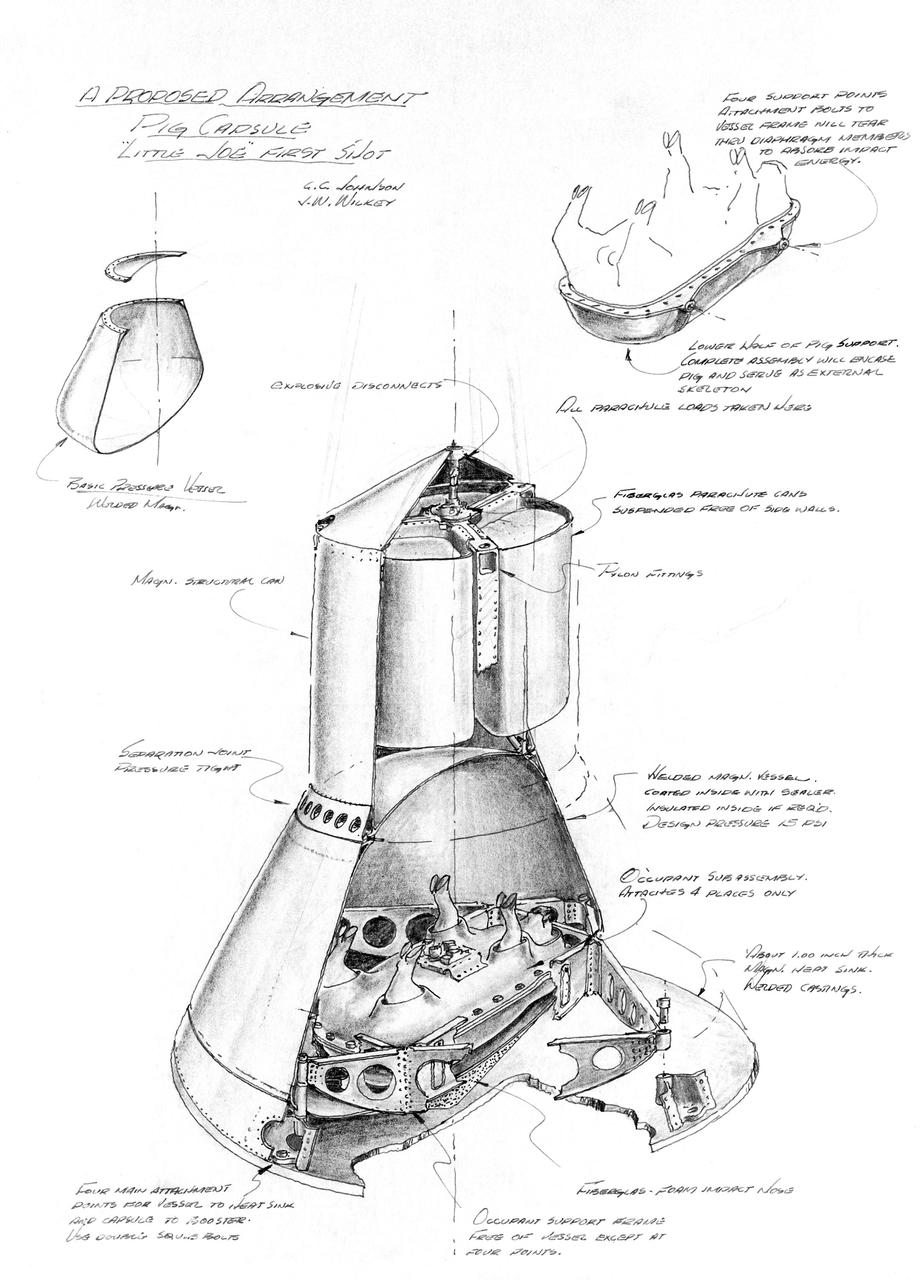
S63-19319 (October 1963) --- Pen and ink drawing of a proposed arrangement for a Pig Capsule in Little Joe capsule first shot. Photo credit: NASA
Drawing of proposed Pig Capsule Little Joe first shot
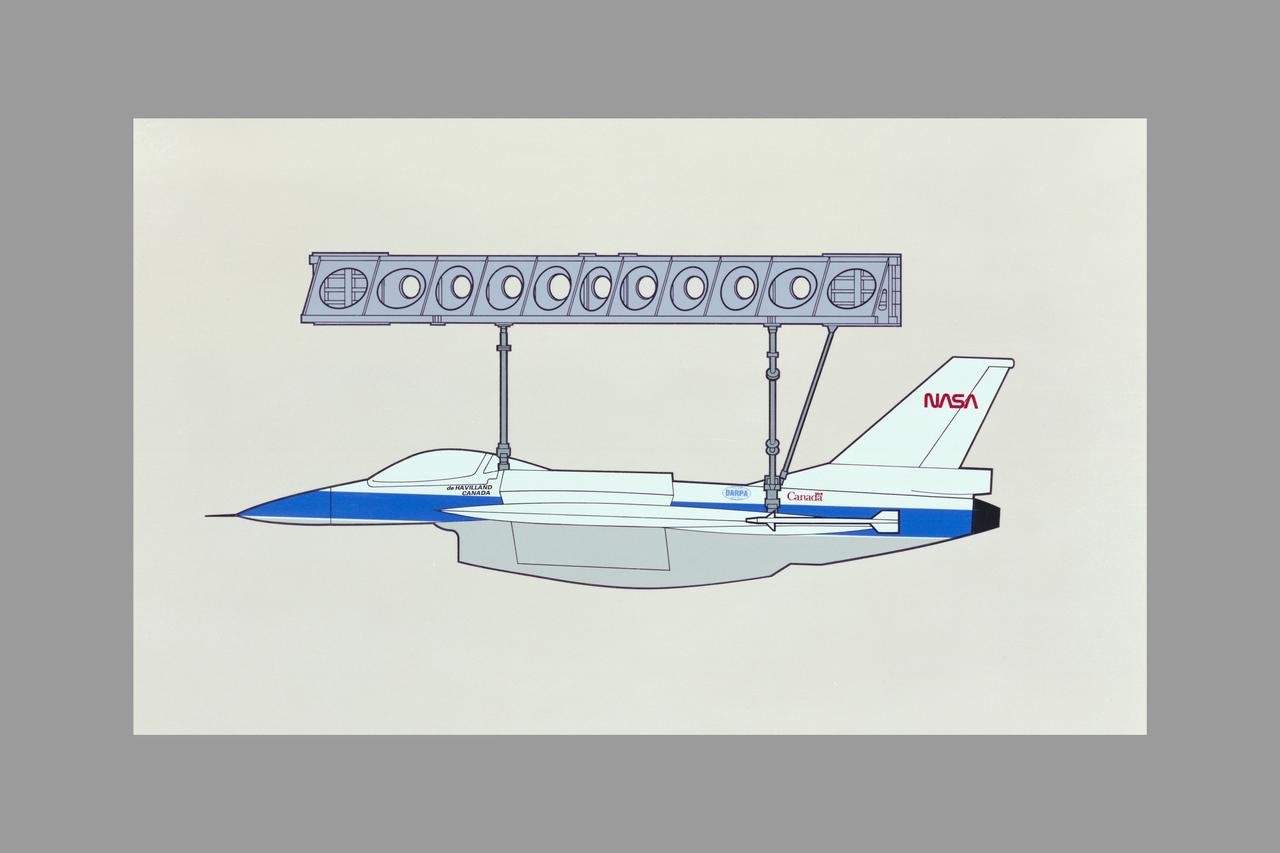
Drawing DARPA Ejector fighter model  (deHavilland/Canada/NASA) E-7
ARC-1989-AC89-0060
Labeled line drawing entitled GALILEO PROBE identifies the deceleration module aft cover, descent module, and deceleration module aeroshell configurations and dimensions prior to and during entry into Jupiter's atmosphere.
Labeled line drawing of Galileo spacecraft's atmospheric probe
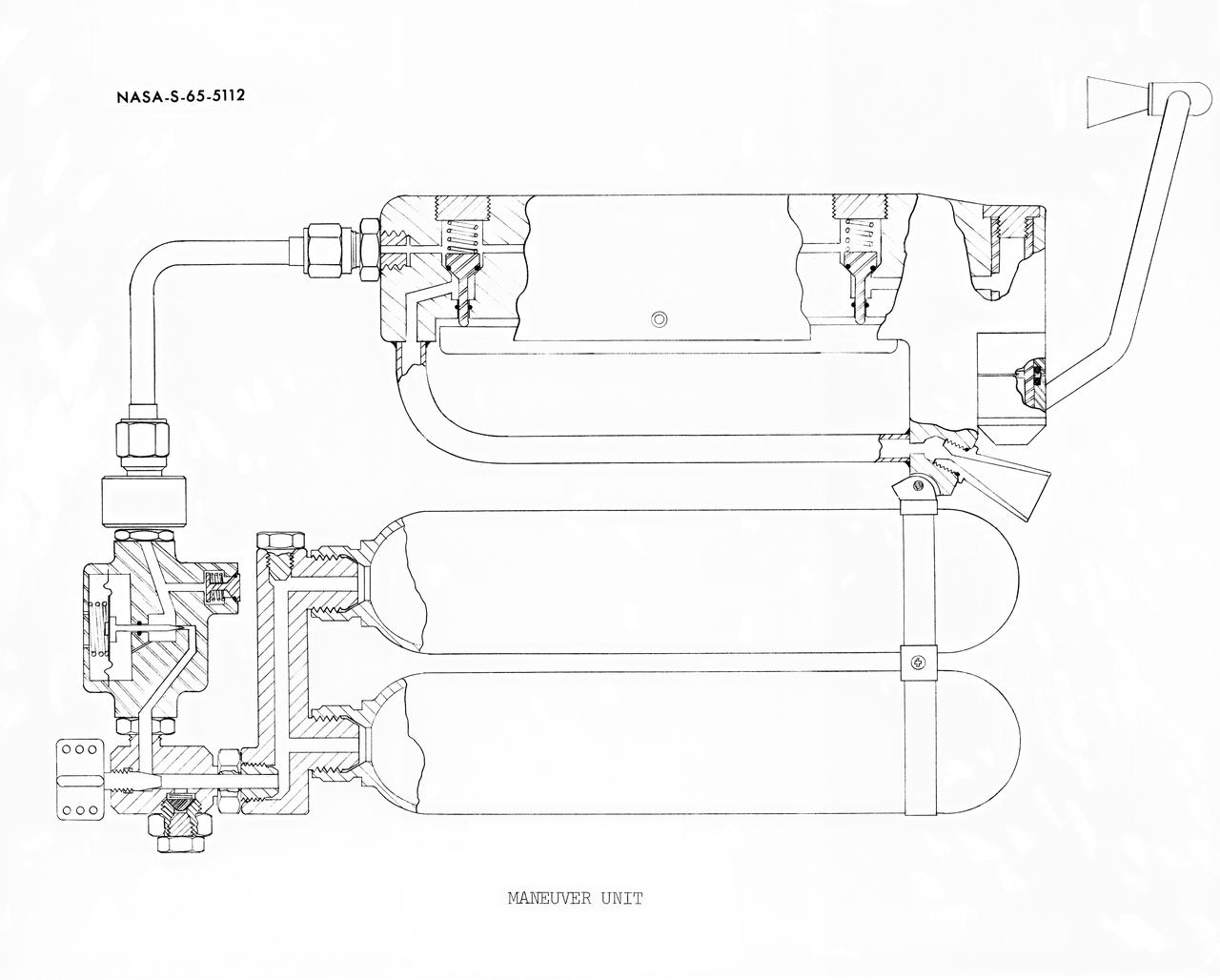
S65-05112 (30 May 1965) --- Cutaway engineering drawing showing some of the features of the zero-gravity integral propulsion unit.
Cutaway engineering drawing of Hand-Held Self-Maneuvering Unit
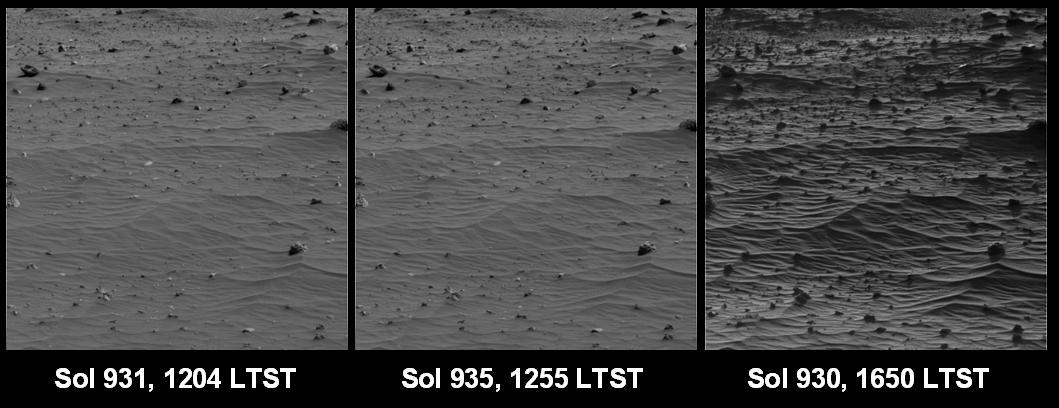
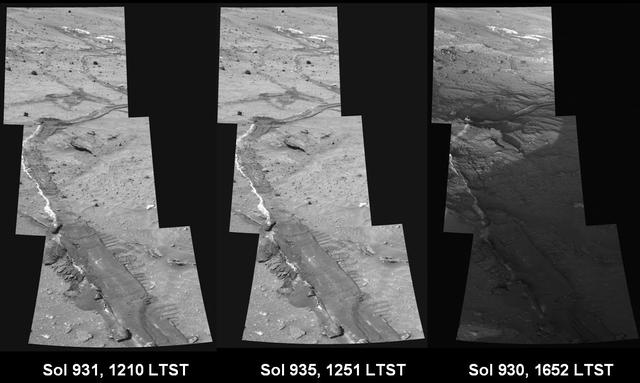
Shadows Draw Attention to Features of Mars Landscape Sand Ripples
Shadows Draw Attention to Features of Mars Landscape Rover Tracks
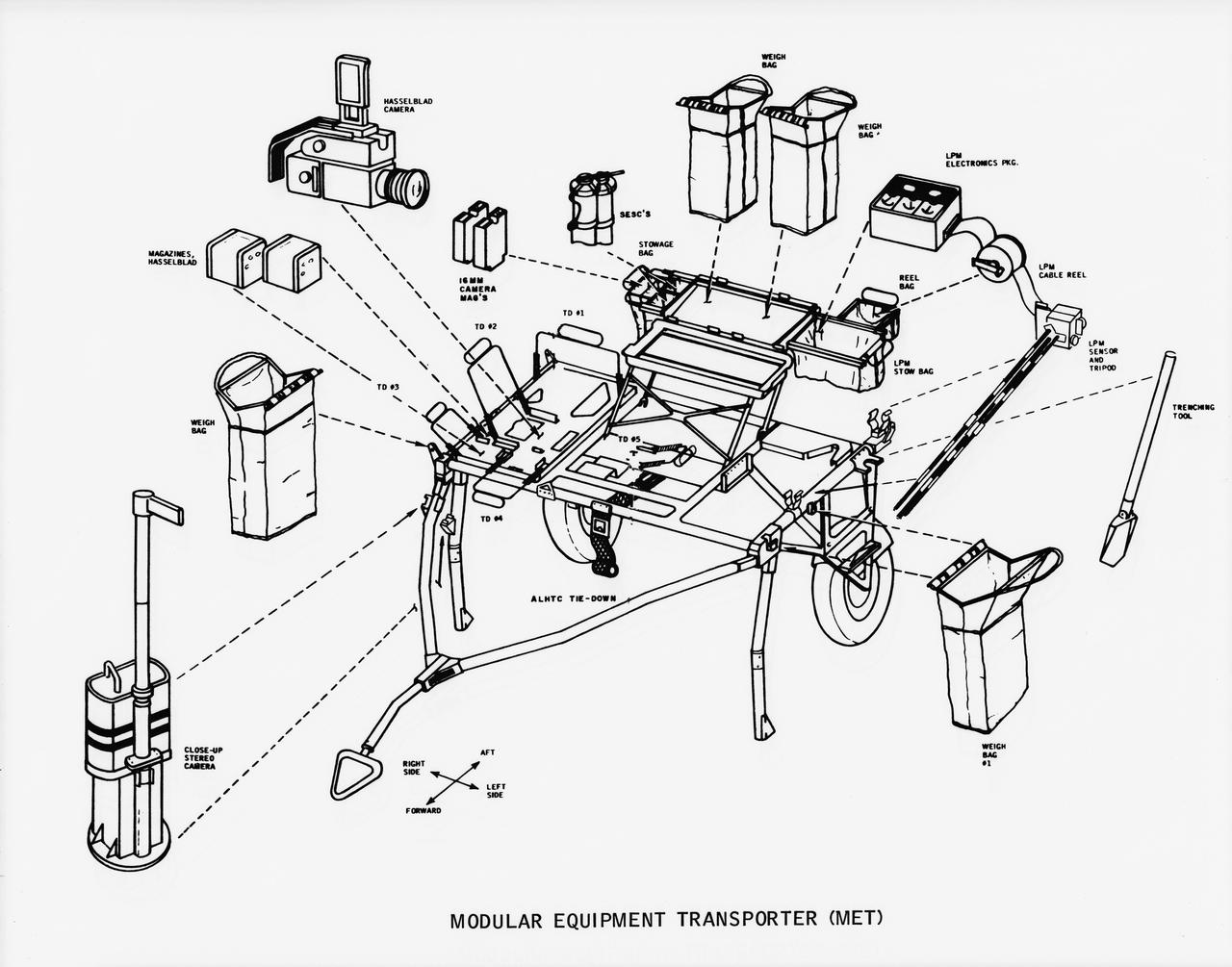
S70-50762 (November 1970) --- A line drawing illustrating layout view of the modular equipment transporter (MET) and its equipment. A MET (or Rickshaw, as it has been nicknamed) will be used on the lunar surface for the first time during the Apollo 14 lunar landing mission. The Rickshaw will serve as a portable workbench with a place for the Apollo lunar hand tools (ALHT) and their carrier, three cameras, two sample container bags, a special environment sample container (SESC), a lunar portable magnetometer (LPM) and spare film magazines.
Drawings of the Modular Equipment Transporter and Hand Tool Carrier
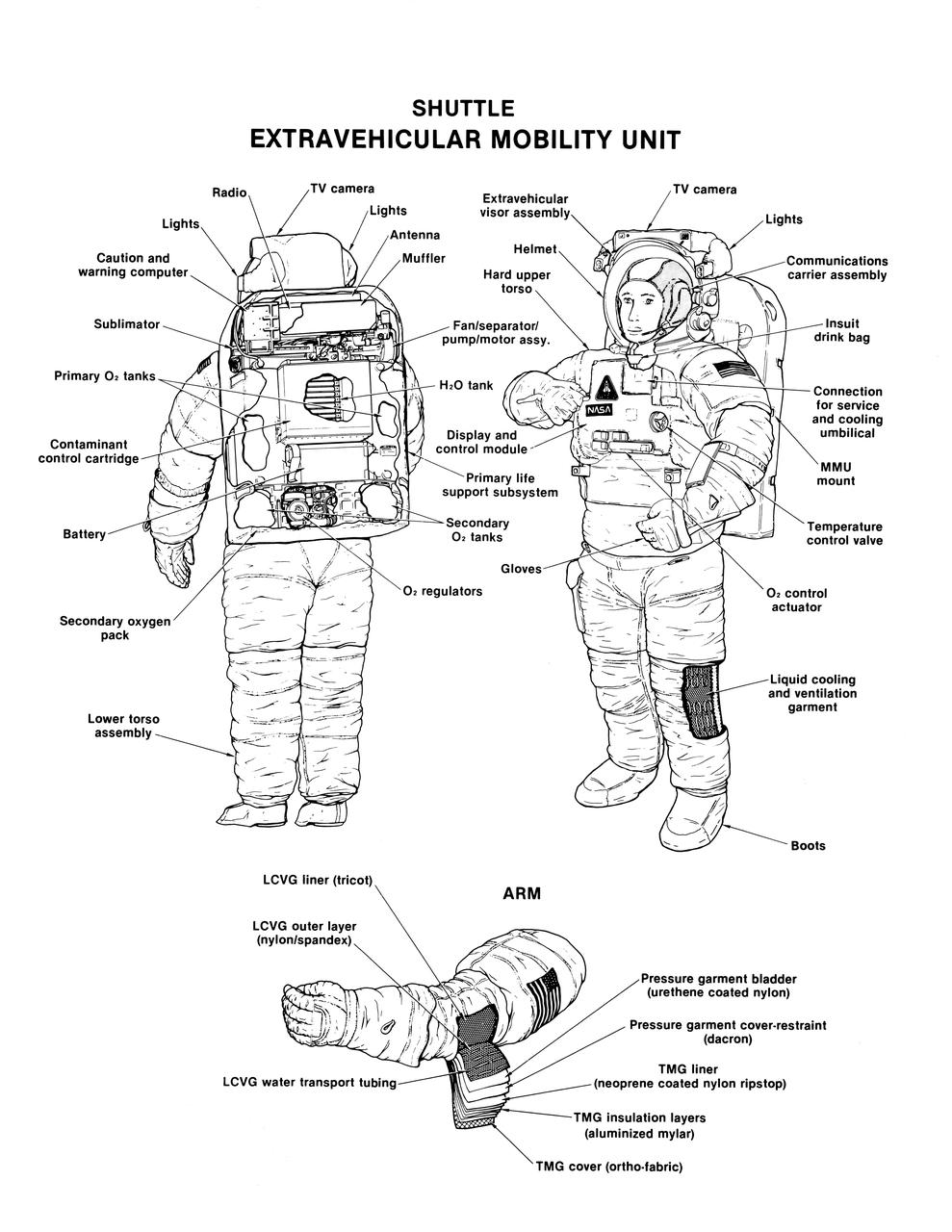
Labeled cutaway line drawing of the Shuttle extravehicular mobility unit (EMU) identifies its various components and equipment. The portable life support system (PLSS) and protective layers of fabric (thermal micrometeoroid garment (TMG)) incorporated in this extravehicular activity (EVA) space suit are shown.
Labeled cutaway line drawing of Shuttle Extravehicular Mobility Unit (EMU)
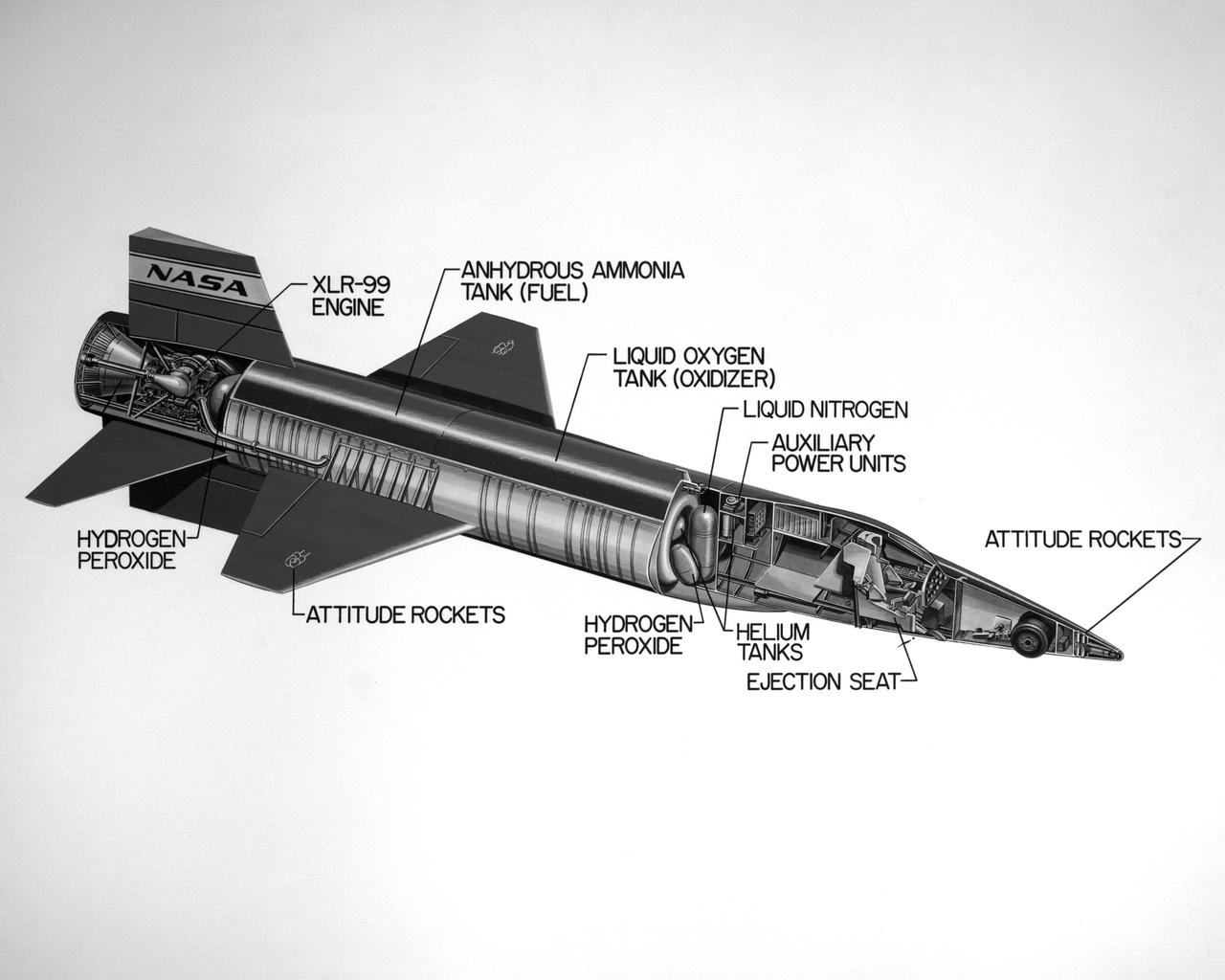
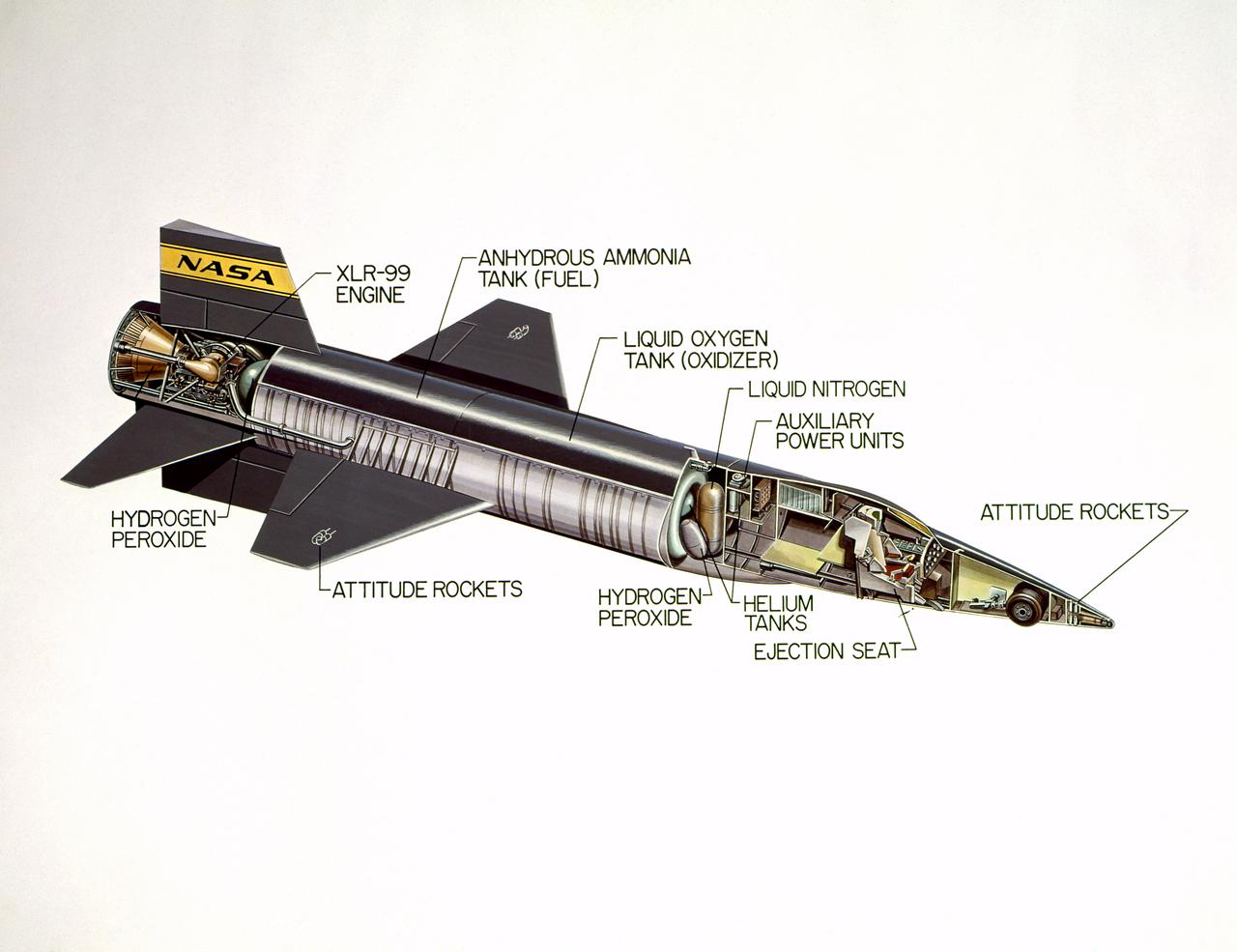
Cutaway drawing of the North American X-15.
Cutaway drawing of the North American X-15
Cutaway drawing of the North American X-15.
Cutaway drawing of the North American X-15
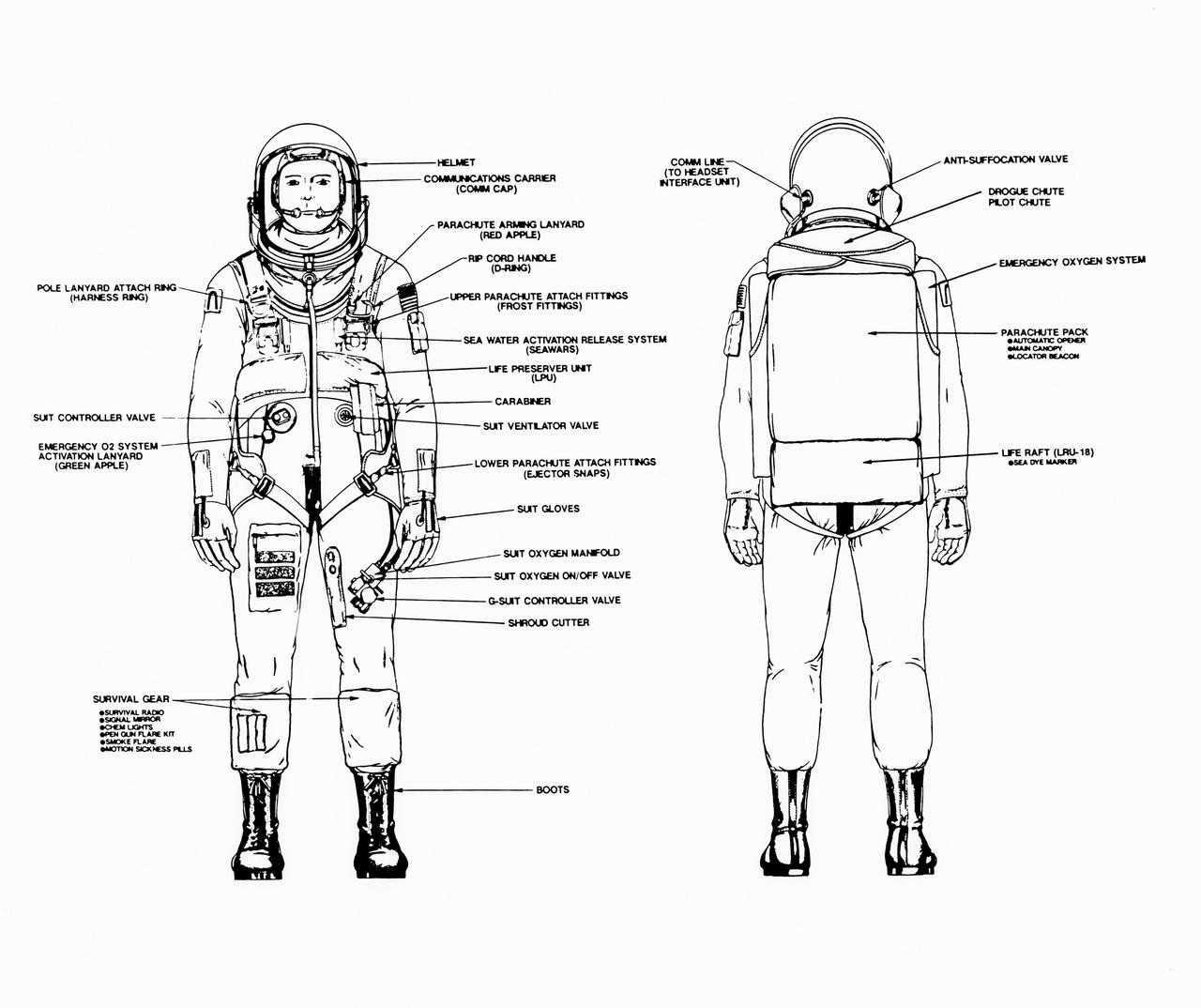
Line drawings illustrate the front and back of the space shuttle launch and entry suit (LES) and labels identify various components. LES was designed for STS-26, the return to flight mission, and subsequent missions. Included in the crew escape system (CES) package are launch and entry helmet (LEH) with communications carrier (COMM CAP), parachute pack and harness, life preserver unit (LPU), life raft unit (LRU), LES gloves, suit oxygen manifold and valves, boots, and survival gear. Details of larger components are also identified.
Labeled line drawing of launch and entry suit identifies various components
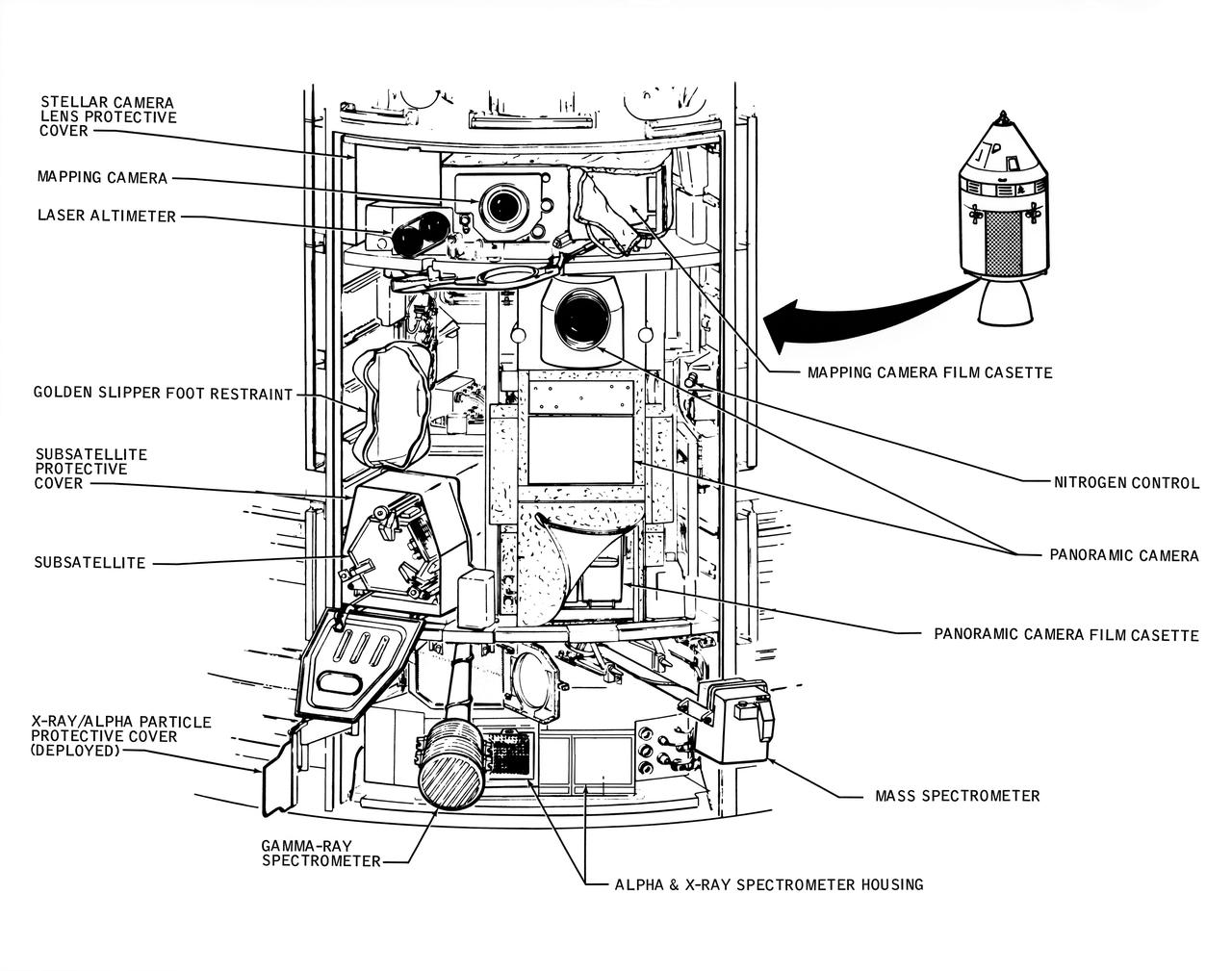
A line drawing illustrating the layout of the Scietific Instrument Module (SIM) of the Apollo 16 Service Module. Shown here is the location in the SIM bay of the equipment for each orbital experiment. Arrows point to various components of the SIM bay. The sensors for the gamma ray spectrometer and the mas spectrometer both extend outward on a boom about 25 feet when the instruments are in use. The subsatellite is launched while the Service Module is in orbit around the moon. The film cassettes must be retrieved prior to Command Module/Service Module separation.
Line drawing of layout of Scietific Instrument Module of Apollo 16
In 1650, a Polish artillery expert, Kazimierz Siemienowicz, published a series of drawings for a staged rocket. These drawing were recreated by artist Larry Toschik
Early Rockets
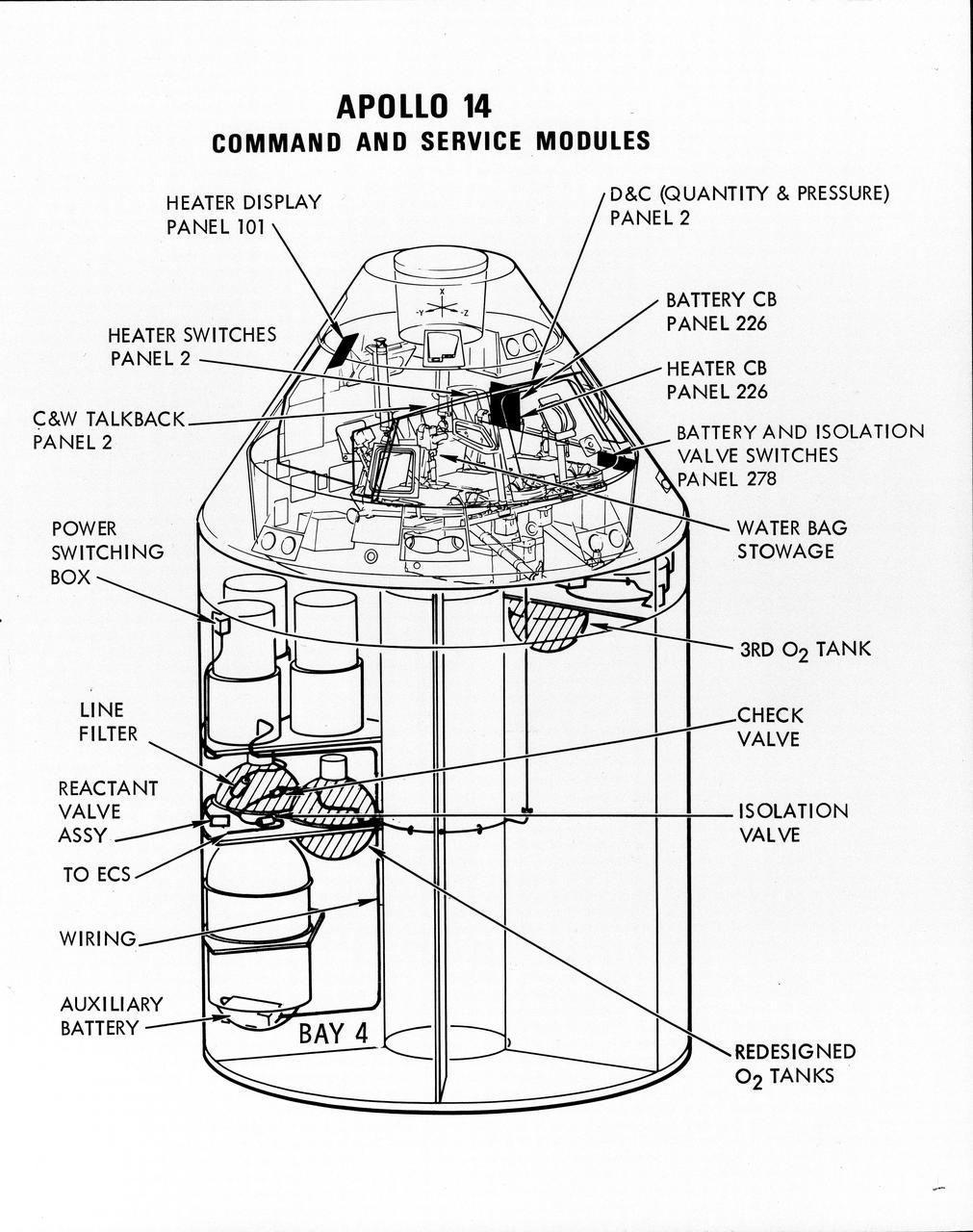
S71-16823 (January 1971) --- A line drawing illustrating a cutaway view of the Apollo 14 Command and Service Modules, showing the engineering changes in the CSM which were recommended by the Apollo 13 Review Board. (The Apollo 13 abort was caused by a short circuit and wiring overheating in one of the SM cryogenic oxygen tanks.) The major changes to the Apollo 14 CSM include adding a third cryogenic oxygen tank installed in a heretofore empty bay (in sector one) of the SM, addition of an auxiliary battery in the SM as a backup in case of fuel cell failure, and removal of destratification fans in the cryogenic oxygen tanks and removal of thermostat switches from the oxygen tank heater circuits. Provision for stowage of an emergency five-gallon supply of drinking water has been added to the CM.
Line drawing of Apollo 14 Command/Service Modules
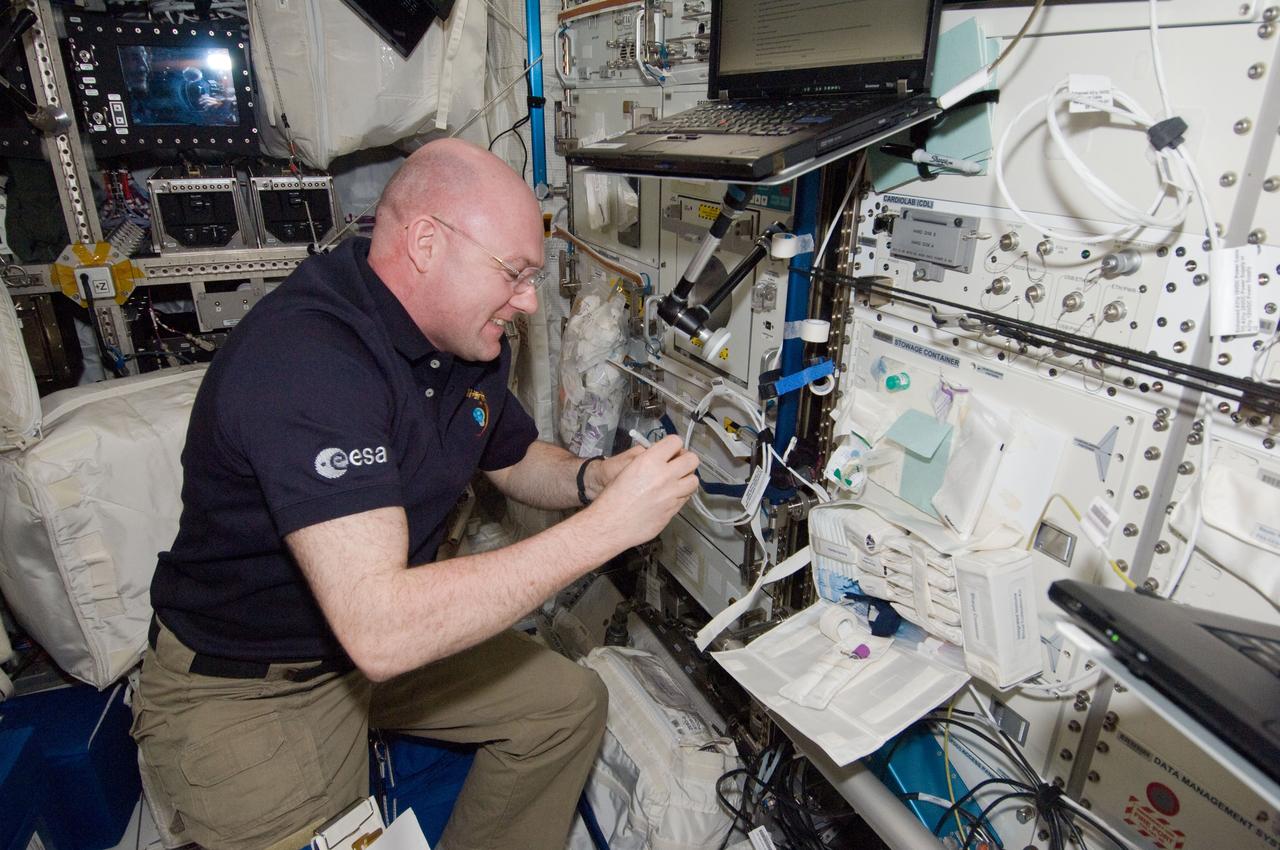
ISS030-E-257690 (26 April 2012) --- European Space Agency astronaut Andre Kuipers, Expedition 30 flight engineer, prepares for IMMUNE venous blood sample draws in the Columbus laboratory of the International Space Station. Following the blood draws, the samples were temporarily stowed in the Minus Eighty Laboratory Freezer for ISS 1 (MELFI-1) and later packed together with saliva samples on the Soyuz TMA-22 for return to Earth for analysis.
Immune Blood Sample Draw
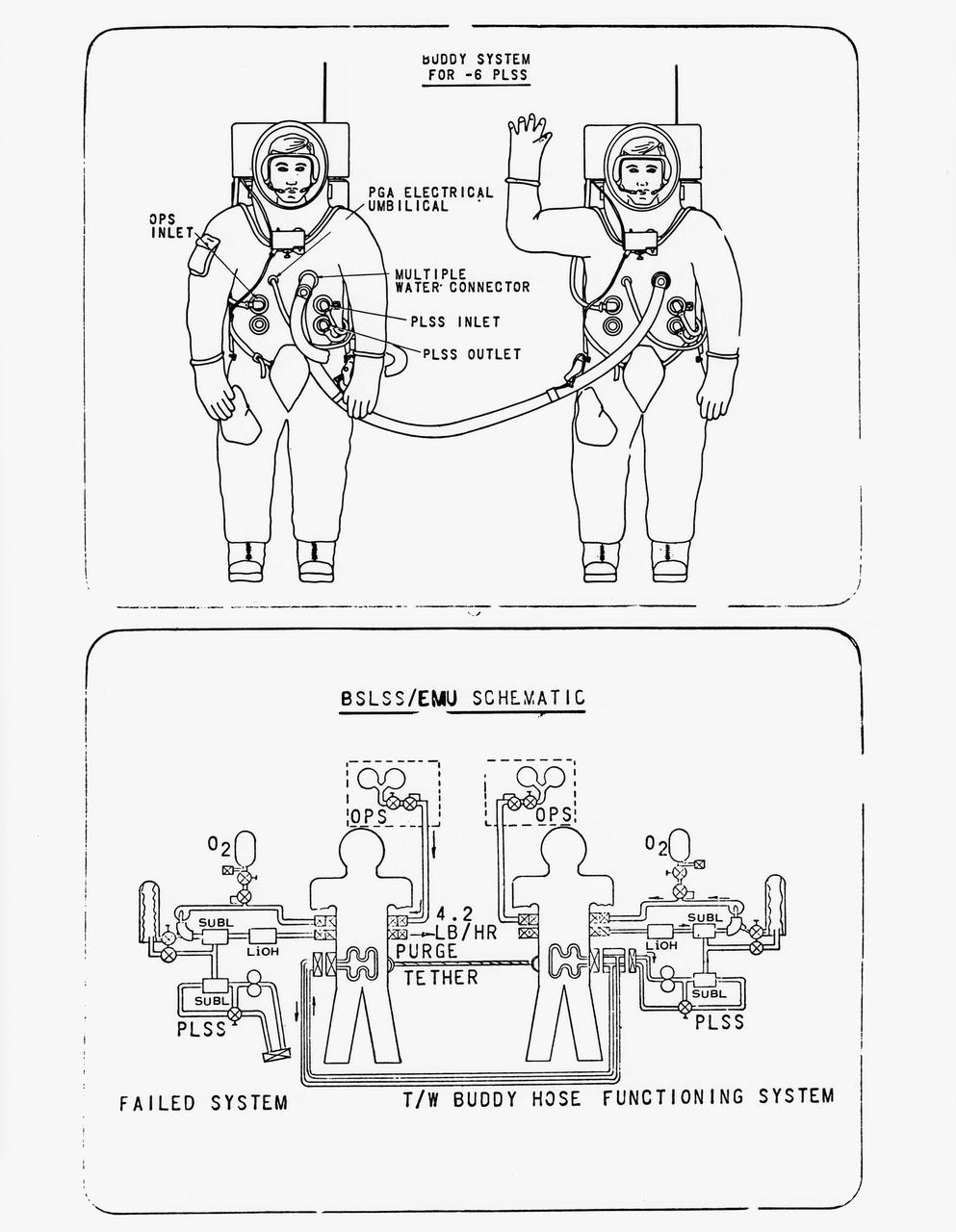
S70-56965 (December 1970) --- Drawing of the newly developed Buddy Secondary Life Support System (BSLSS). The life-sustaining system will be provided for the first time on the Apollo 14 lunar landing mission. The two flexible hoses, to be used on the second Apollo 14 extravehicular activity (EVA), will be among the paraphernalia on the Modular Equipment Transporter (MET) or two-wheeled workshop, and readily accessible in an emergency. During EVAs the Portable Life Support System (PLSS) supplies the astronaut with breathing and suit-pressurizing oxygen and water flow for the liquid-cooling garment -- a suit of knitted long underwear with thin tubing woven in the torso and limbs. The tubes carry water from a reservoir in the PLSS, and the circulating water serves to carry the astronaut's metabolic heat to a heat exchanger in the PLSS. Before the BSLSS was devised, the emergency tank was required to furnish not only suit pressure and breathing oxygen, but also cooling through a high oxygen flow rate. The BSLSS, by sharing the water supply between the two crewmen, stretches the time of the emergency oxygen from about 40 minutes to 60 to 75 minutes.
Drawing of the Buddy Secondary Life Support System
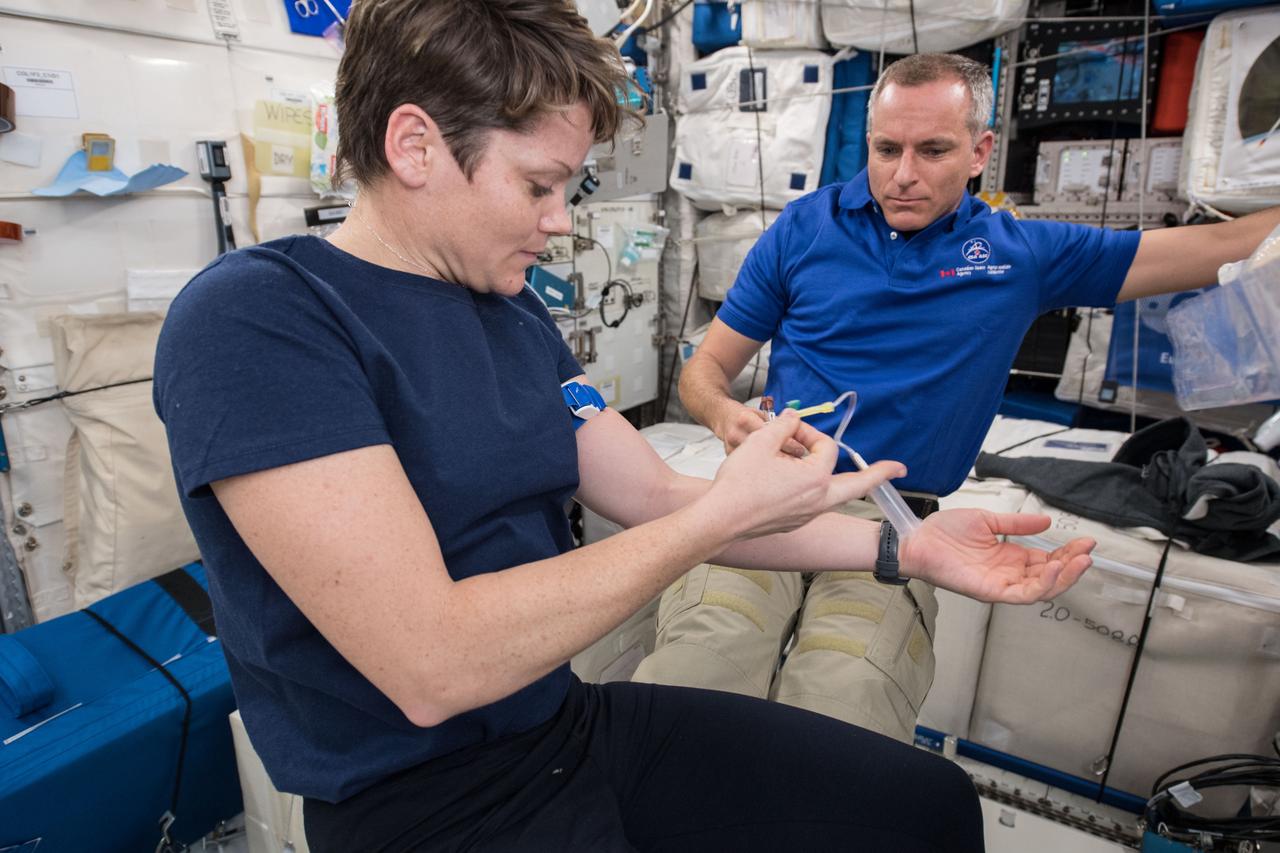
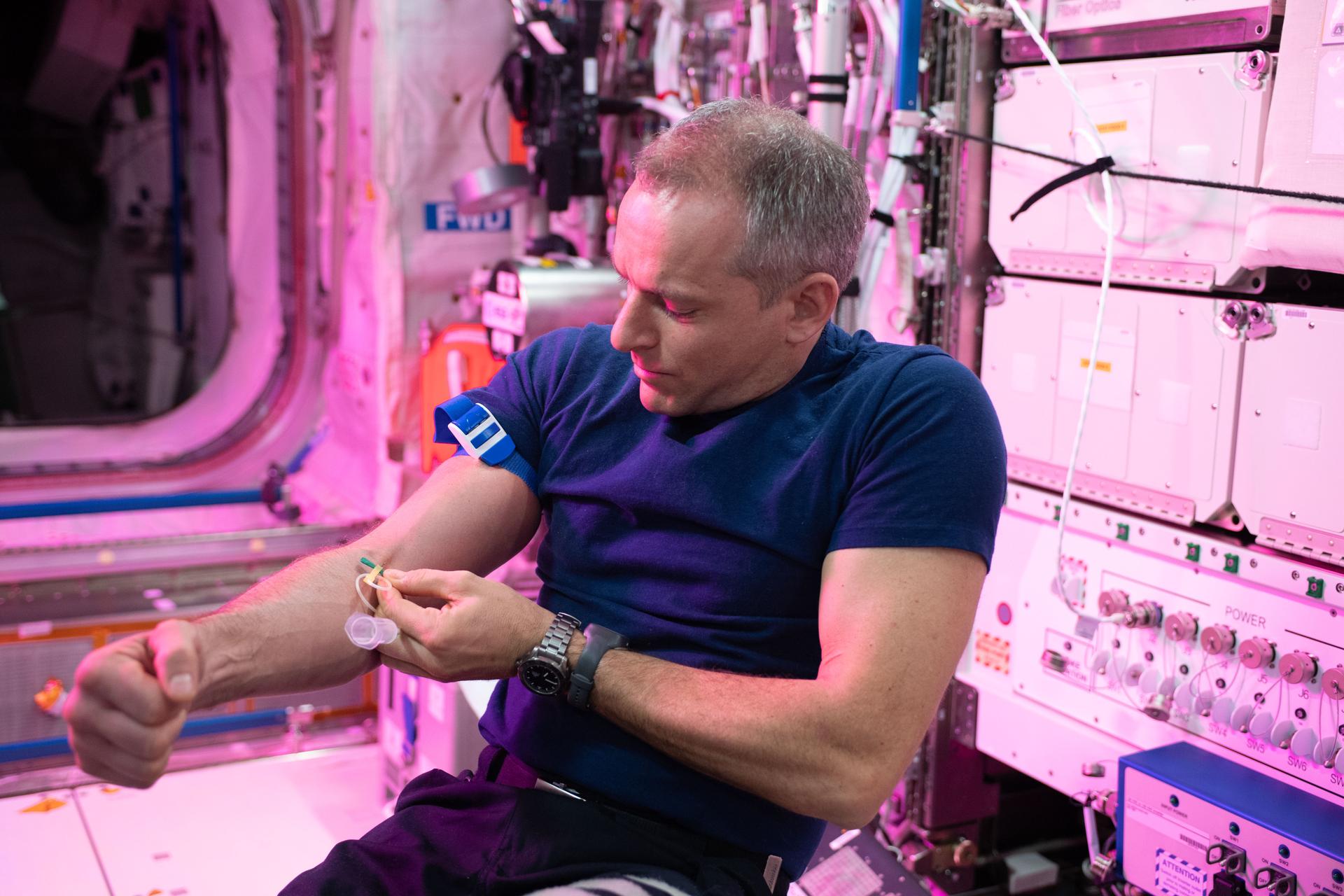
(12/8/2018) --- Flight Engineer (FE) Anne McClain prepares to draw her blood for the Marrow Study (Bone Marrow Adipose Reaction: Red Or White?). FE David Saint-Jacques assists. Photo was taken in the Columbus European Laboratory.
Blood Draw for the Marrow Study
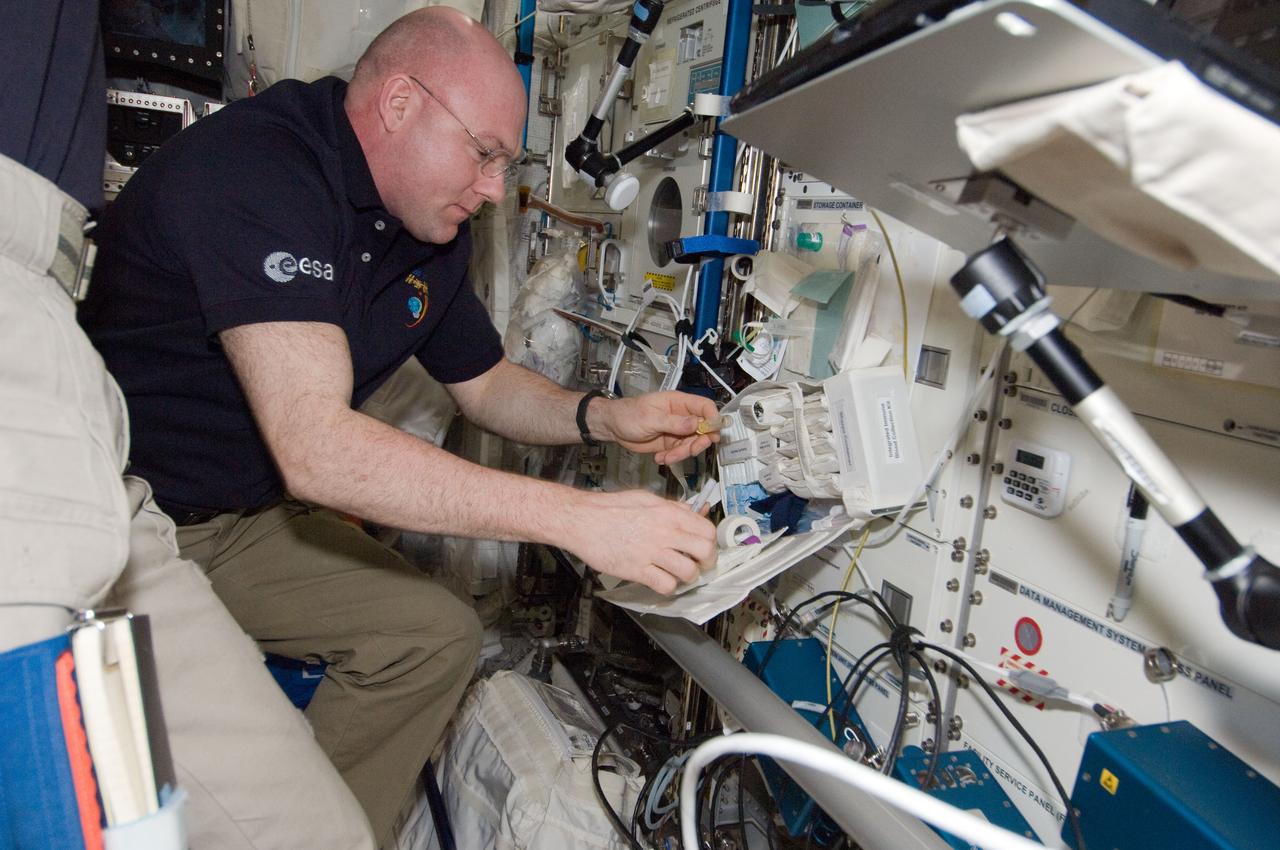
iss030e257689 (4/26/2012) --- European Space Agency (ESA) Andre Kuipers during Integrated Immune Blood Sample Draw at the Human Research Facility (HRF), in the Columbus Module. The Functional Immune investigation analyzes blood and saliva samples to determine the changes taking place in crew members’ immune systems during flight.
Immune Blood Sample Draw
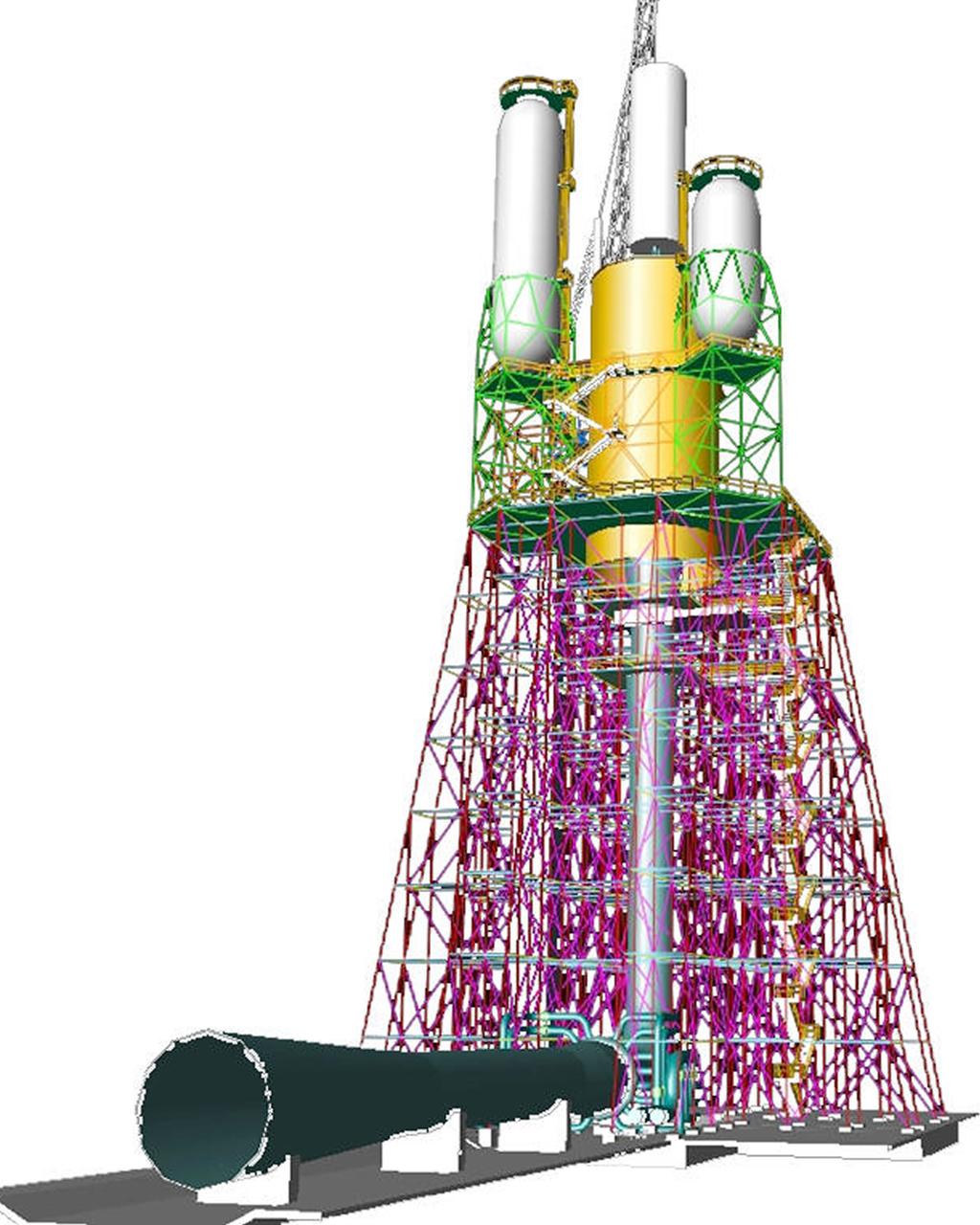
This engineer's concept drawing of the A-3 Test Stand shows the 300-foot-tall structure's open steel frame and large exhaust diffuser.
A-3 Test Stand
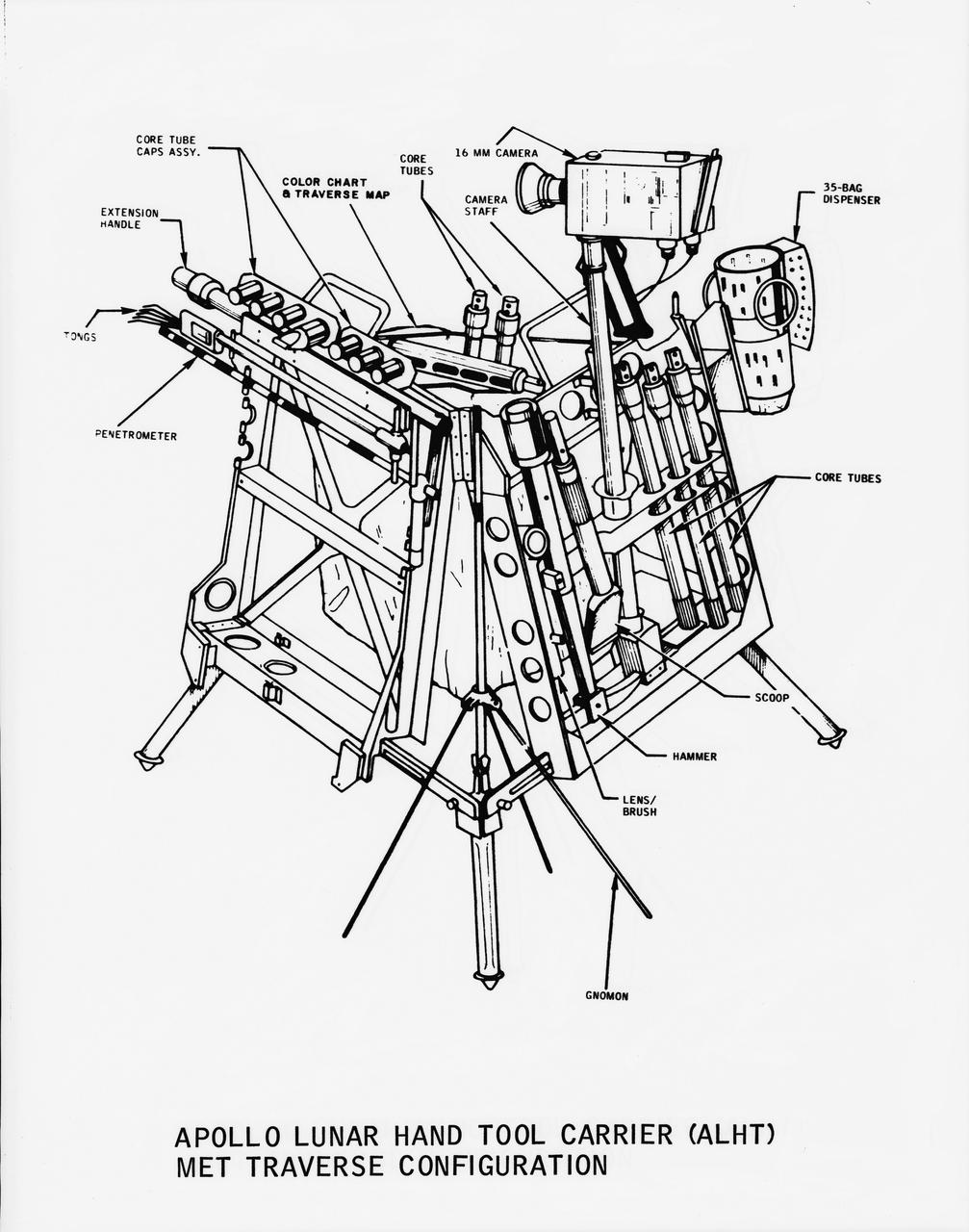
Line drawing of the Apollo Lunar Hand Tool Carrier (ALHT) MET Traverse Configuration for use during the Apollo 14 lunar landing mission
Line drawing of Apollo Lunar Hand Tool carrier
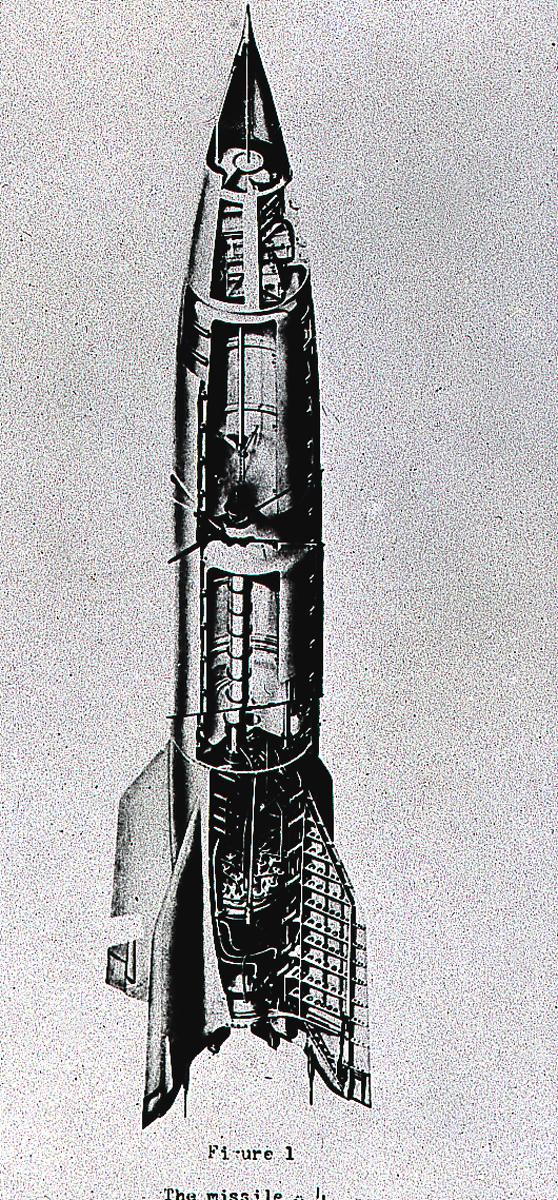
The cutaway drawing of the A-4 (Aggregate-4) rocket. Later renamed the V-2 (Vengeance Weapon-2), The rocket was developed by Dr. Wernher von Braun and the German rocket team at Peenemuende, Germany on the Baltic Sea. At the end of World War II, the team of German engineers and scientists came to the United States and continued rocket research for the Army at Fort Bliss, Texas, and Redstone Arsenal in Huntsville, Alabama.
Early Rockets
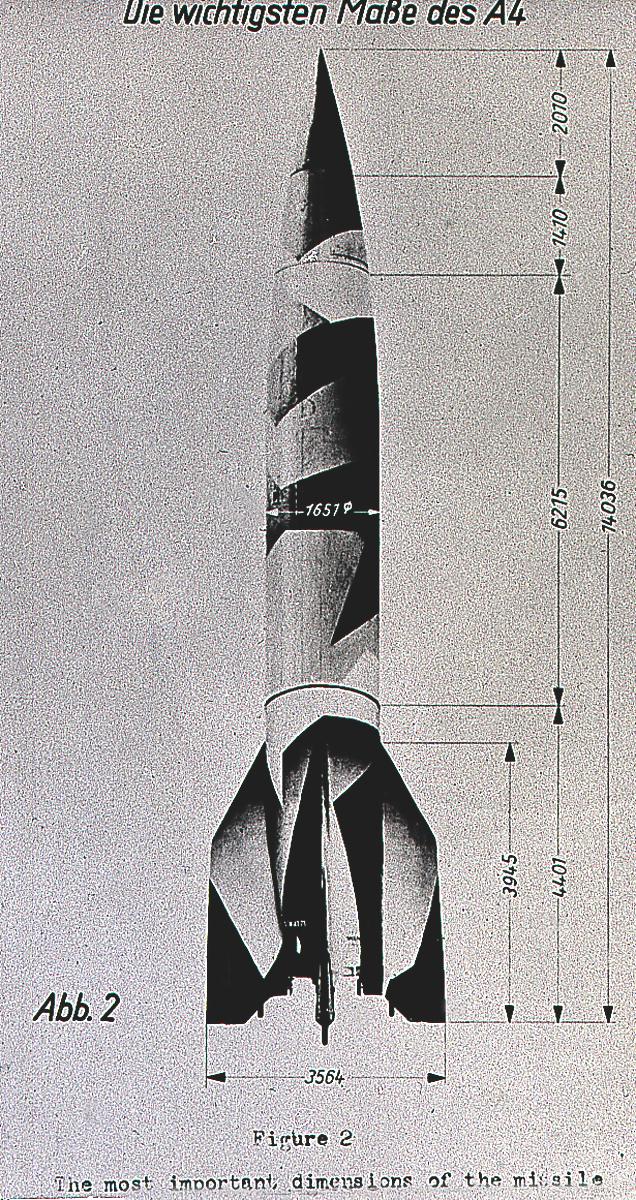
This drawing illustrates the vital dimensions of the A-4 (Aggregate-4). Later renamed the V-2 (Vengeance Weapon-2), the rocket was developed by Dr. Wernher von Braun and the German rocket team at Peenemuende, Germany on the Baltic Sea. At the end of World War II, the team of German engineers and scientists came to the United States and continued rocket research for the Army at Fort Bliss, Texas, and Redstone Arsenal in Huntsville, Alabama.
Early Rockets
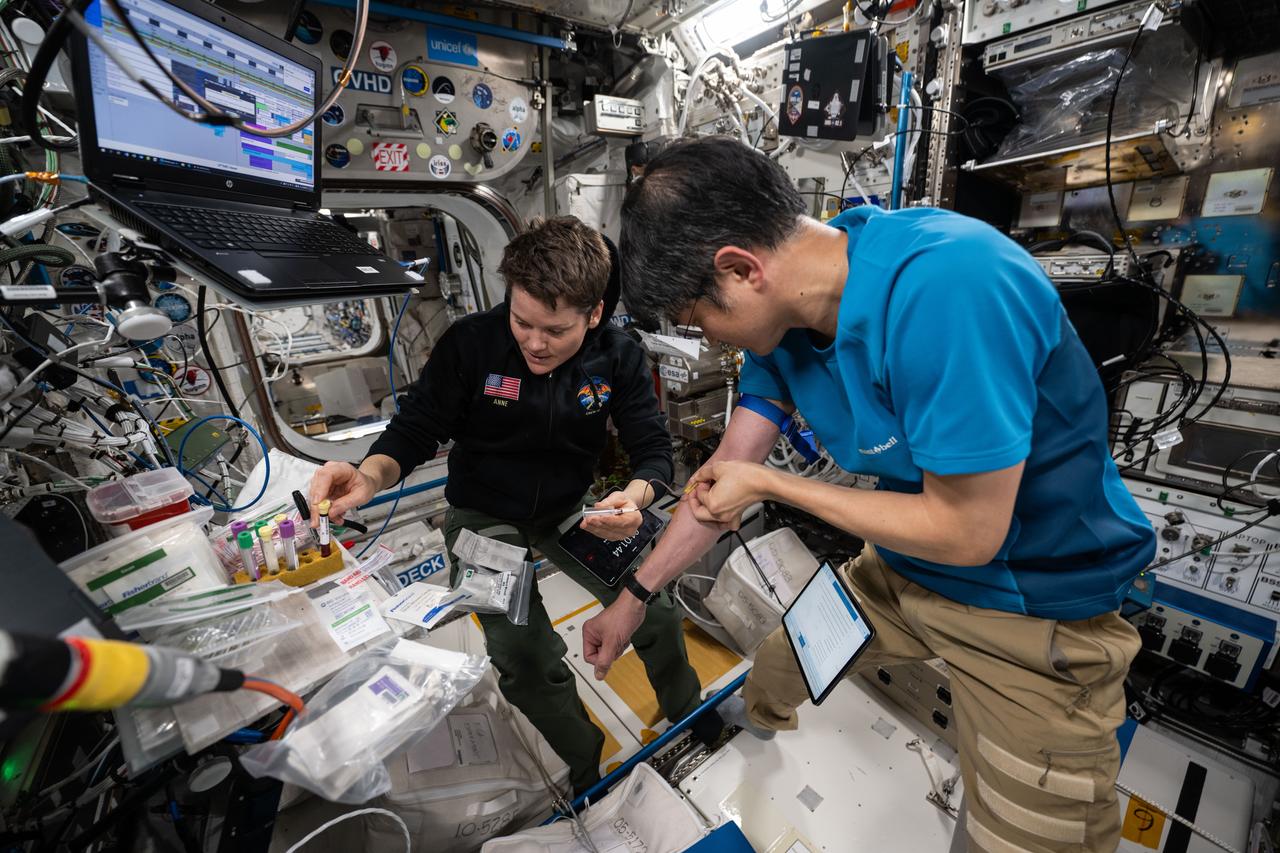
iss073e0078566 (May 23, 2025) --- Astronauts Anne McClain of NASA and Takuya Onishi of JAXA (Japan Aerospace Exploration Agency), Expedition 73 Flight Engineer and Commander respectively, work together inside the International Space Station's Columbus laboratory module drawing blood samples for testing and monitoring an astronaut's health in microgravity.
Astronauts Anne McClain and Takuya Onishi work together and draw blood samples
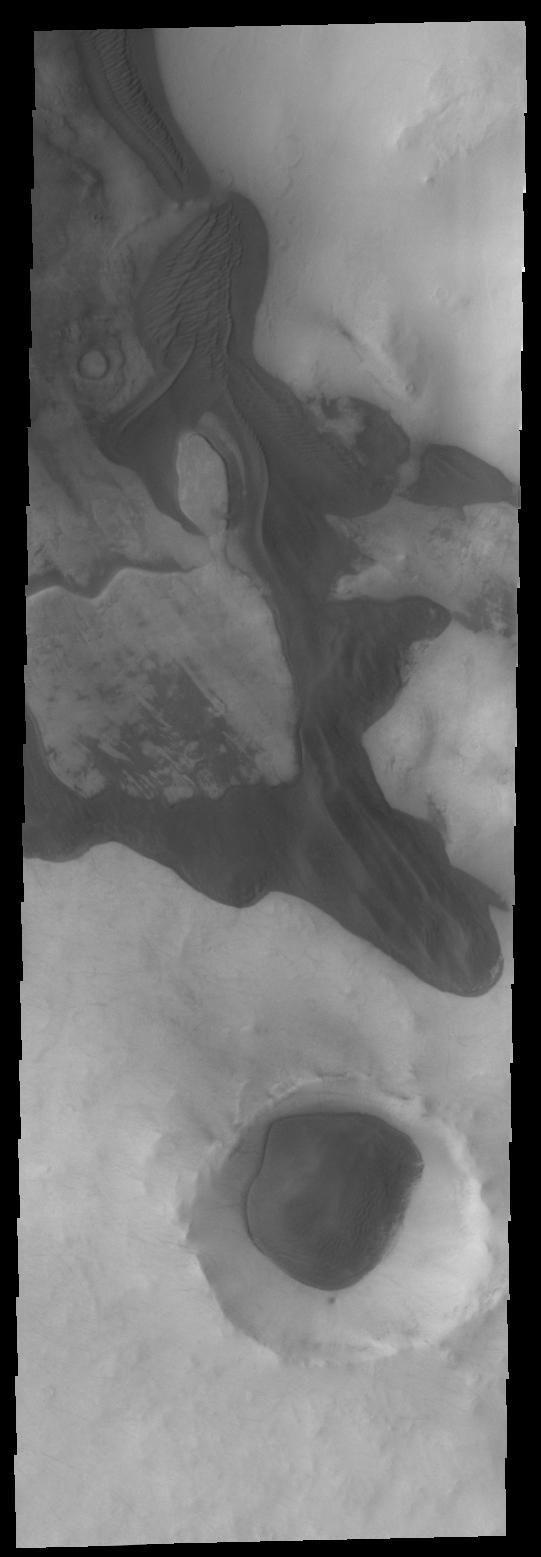
These dark dunes are frost covered for most of the year. As southern  summer draws to a close, the dunes have been completely defrosted
Frost-free Dunes
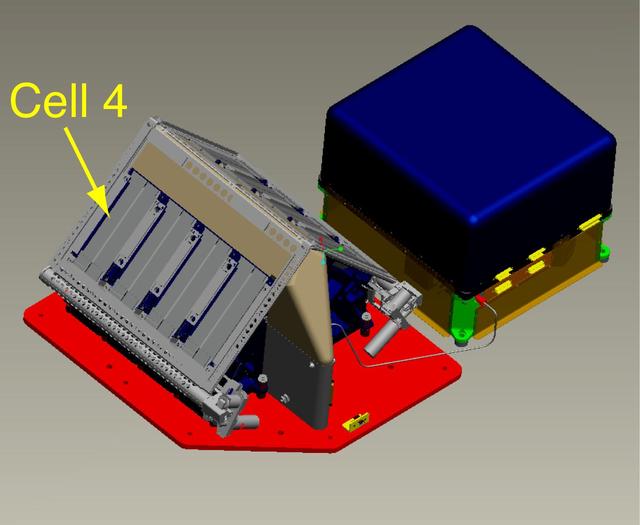
This is a computer-aided drawing of the Thermal and Evolved-Gas Analyzer, or TEGA, on NASA Phoenix Mars Lander.
Thermal and Evolved-Gas Analyzer Illustration
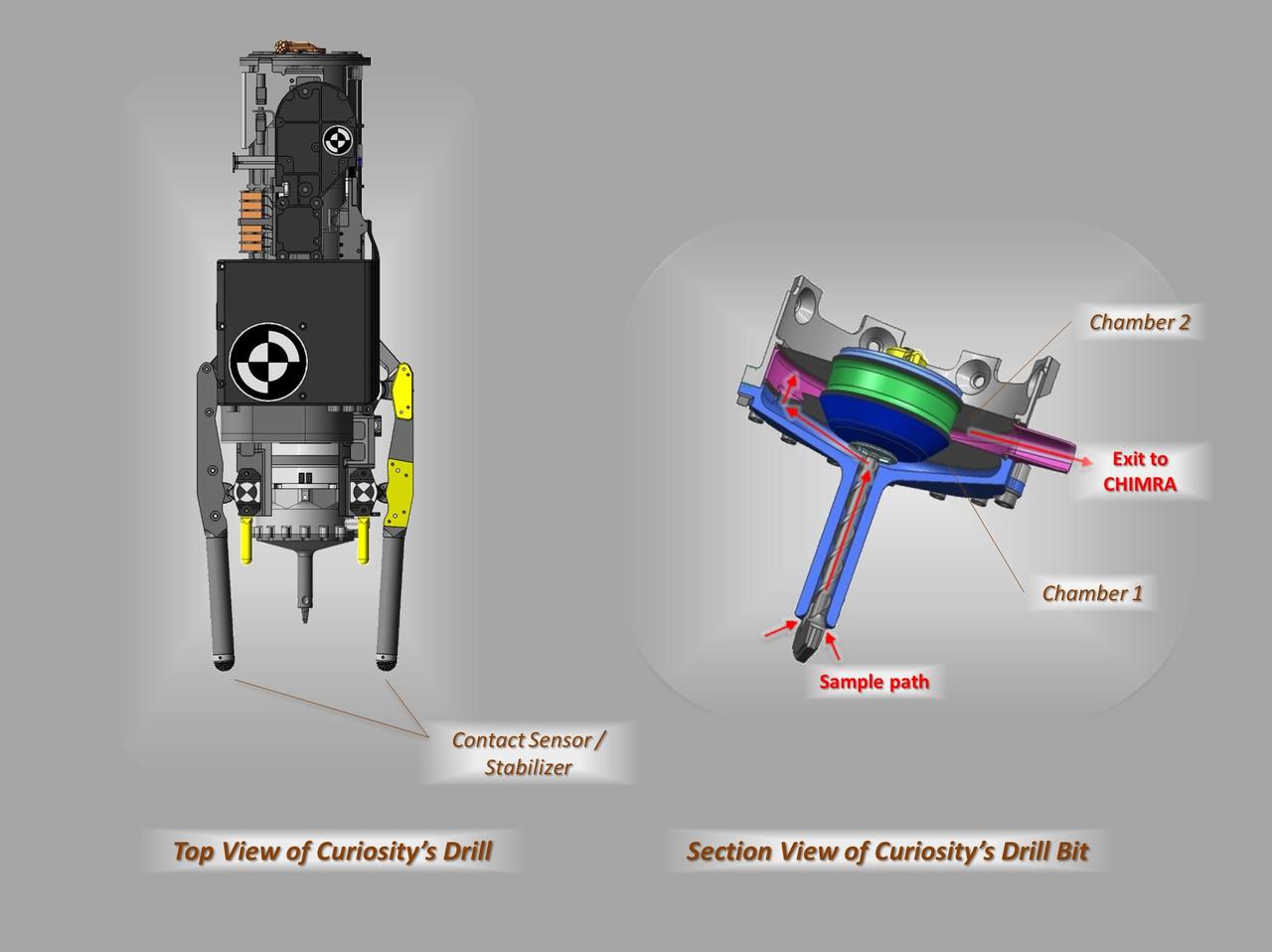
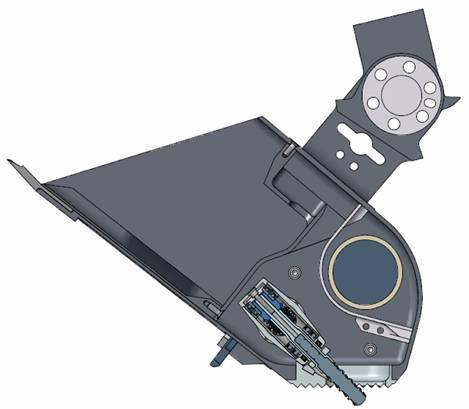
These schematic drawings show a top view and a cutaway view of a section of the drill on NASA Curiosity rover on Mars.
Views of Curiosity Drill
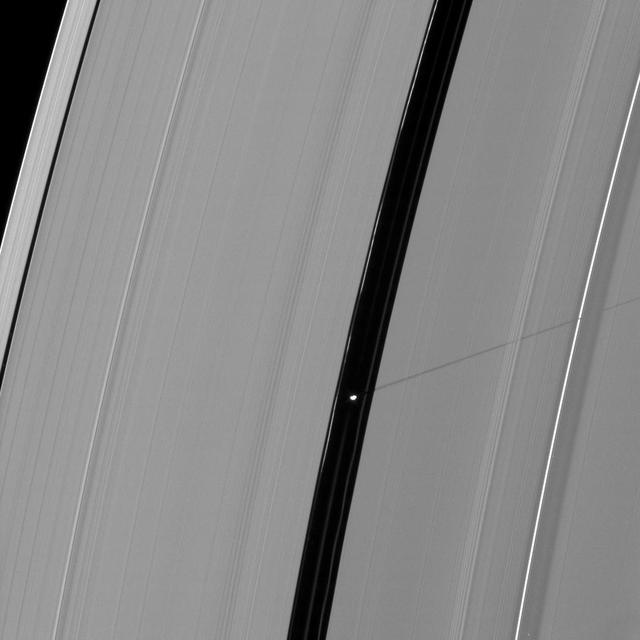
Saturn moon Pan casts a longer shadow across the A ring as the planet August 2009 equinox draws near.
Pan Lengthening Shadow
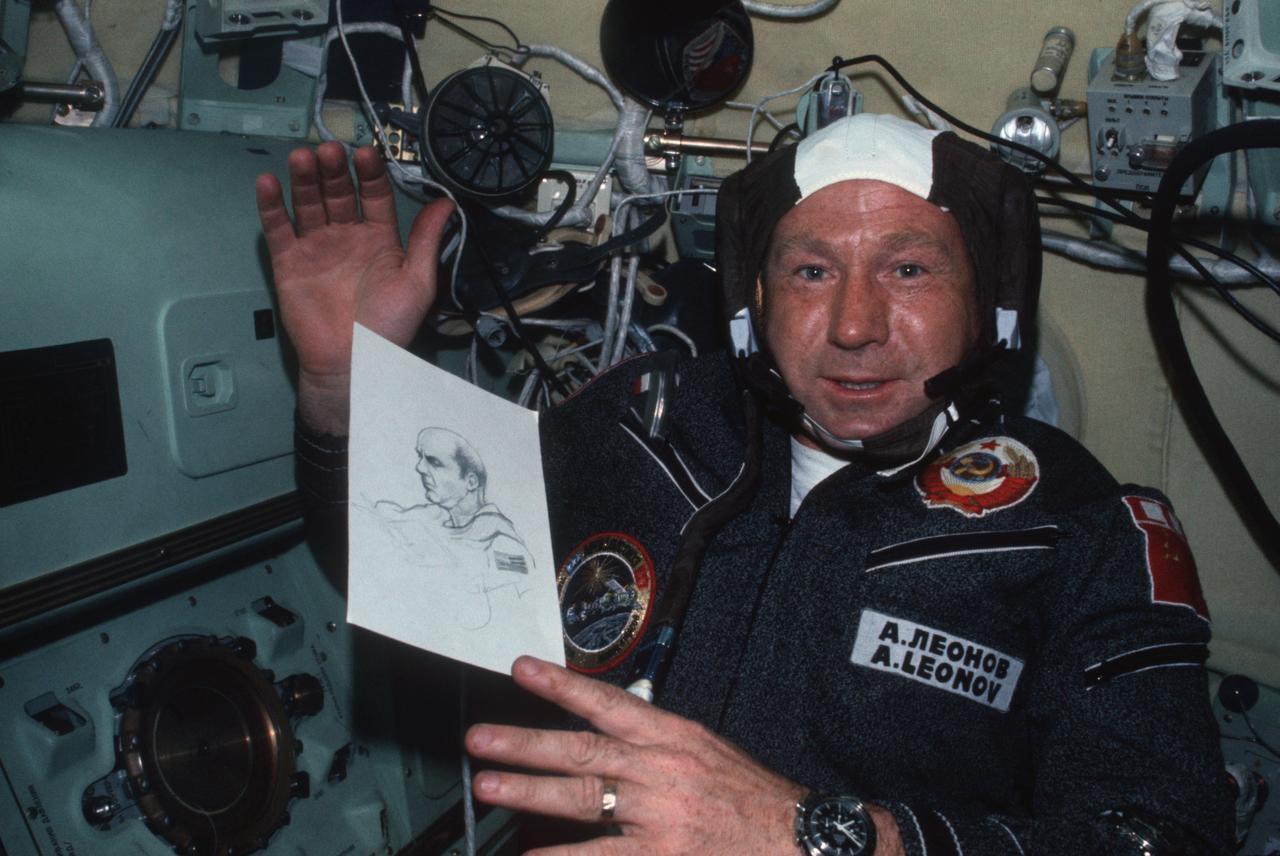
AST-05-275 (17-19 July 1975) --- Cosmonaut Aleksey A. Leonov, commander of the Soviet ASTP crew, displays a drawing of astronaut Thomas P. Stafford during the joint U.S.-USSR Apollo-Soyuz Test Project docking mission in Earth orbit. He is in the Soyuz Orbital Module. This picture was taken by an American ASTP crewman with a 35mm camera.
Cosmonaut Aleksey Leonov displays drawing of Astronaut Thomas Stafford
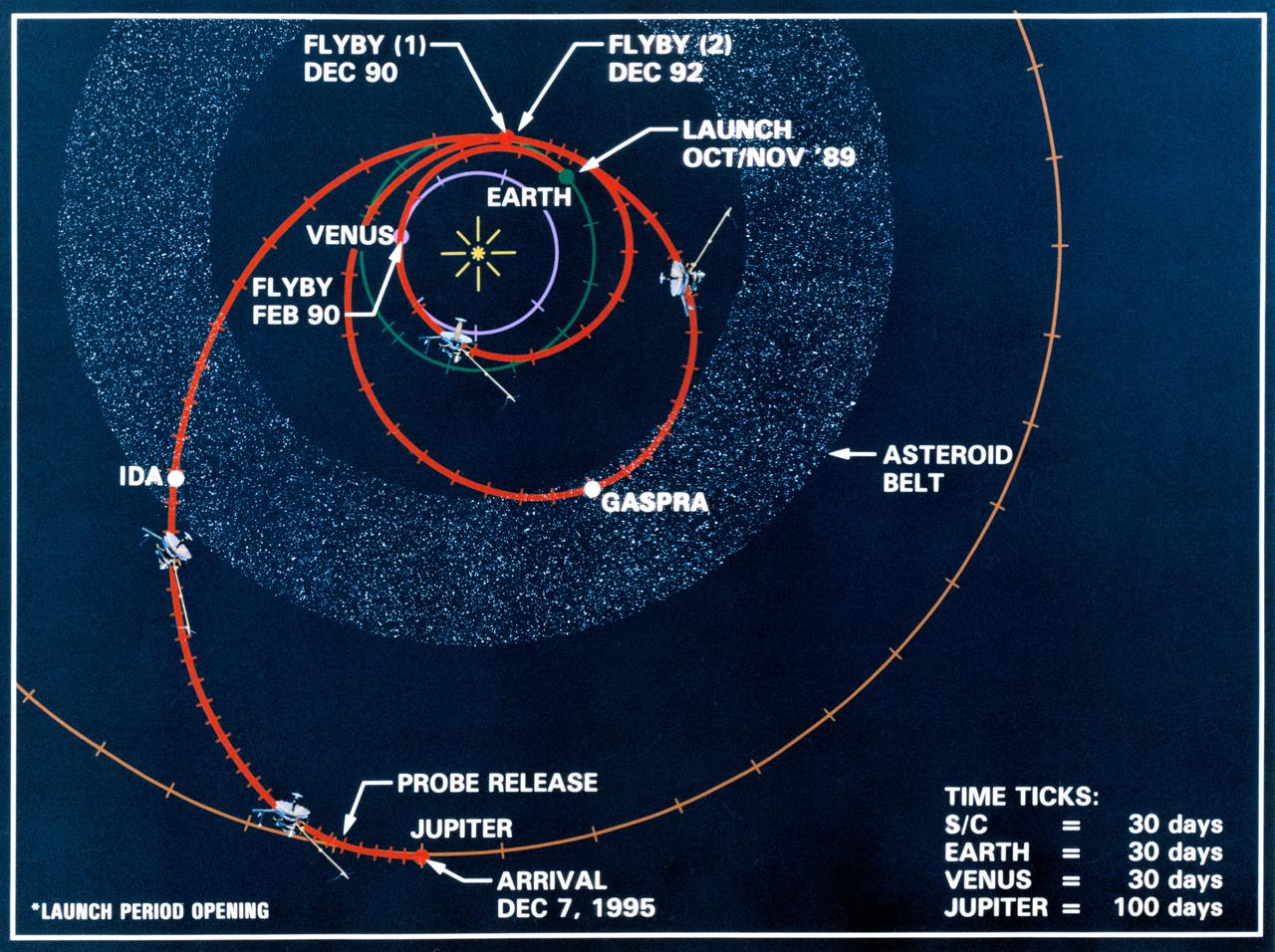
Line drawing charts the Galileo spacecraft's launch from low Earth orbit and its three planetary and two asteroid encounters in the course of its gravity-assisted flight to Jupiter. These encounters include Venus (February 1990), two Earth passes (December 1990 and December 1992), and the asteroids Gaspra and Ida in the asteroid belt. Galileo will release a probe and will arrive at Jupiter, 12-07-95.
Line drawing of the Galileo spacecraft's encounters on its way to Jupiter
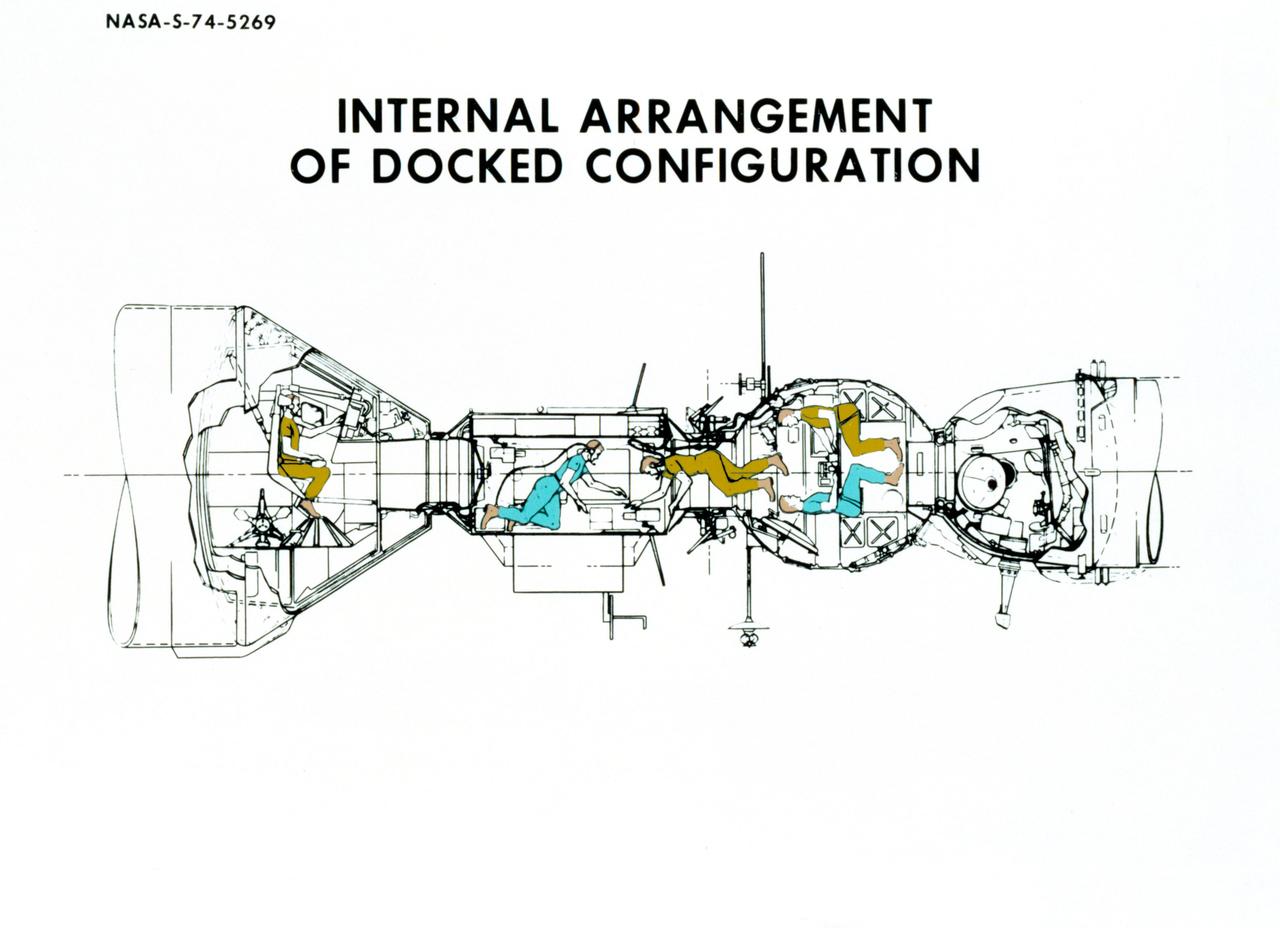
S74-05269 (December 1974) --- An artist?s drawing illustrating the internal arrangement of the Apollo and Soyuz spacecraft in Earth orbit in a docked configuration.  The three American Apollo crewmen and the two Soviet Soyuz crewmen will transfer to each other?s spacecraft during the July 1975 ASTP mission.  The four Apollo-Soyuz Test Project visible components are, left to right, the Apollo Command Module, the Docking Module, the Soyuz Orbital Module and the Soyuz Descent Vehicle.
Artist's drawing of internal arrangement of orbiting Apollo & Soyuz crafts
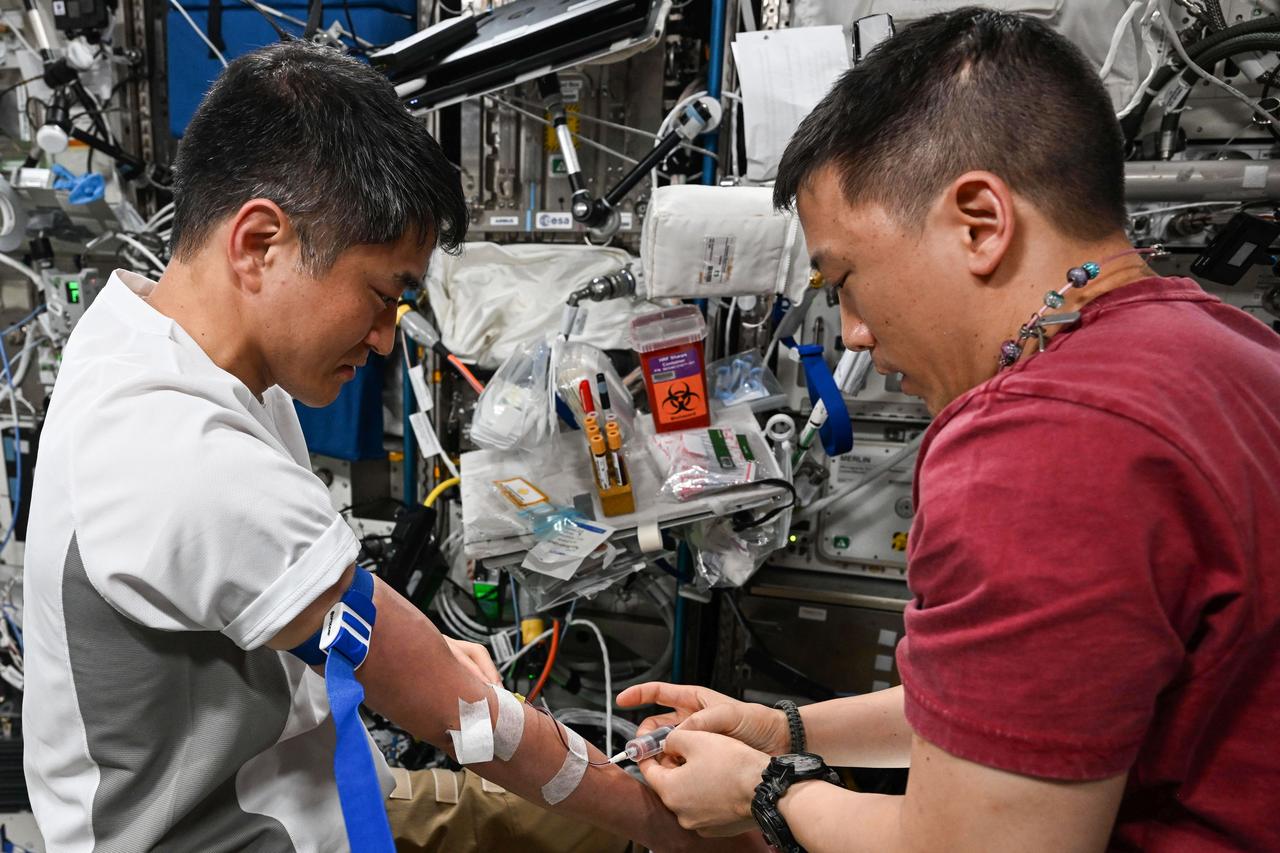
iss073e0384171 (July 1, 2025) --- Expedition 73 Flight Engineer Jonny Kim (right) of NASA draws a blood sample from station Commander Takuya Onishi of JAXA (Japan Aerospace Exploration Agency) for processing in a centrifuge and preservation in a science freezer. The samples will be returned to Earth where scientists will analyze the specimens to learn how living and working in microgravity affects the human body and provide countermeasures to potential space-caused symptoms.
Astronaut Jonny Kim draws a blood sample from astronaut Takuya Onishi
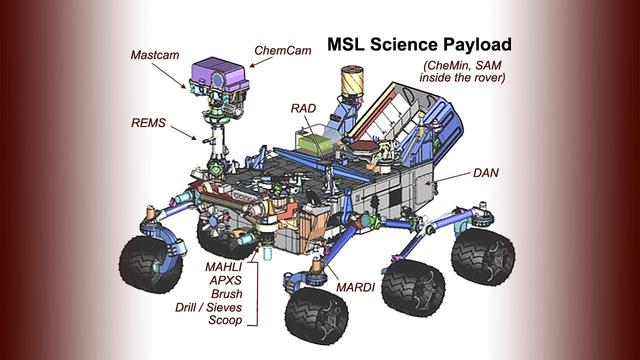
This drawing of the Mars Science Laboratory mission rover, Curiosity, indicates the location of science instruments and some other tools on the car-size rover.
Diverse Science Payload on Mars Rover Curiosity
This drawing shows a side view of NASA Phoenix Mars Lander scoop with various tools for acquiring soil, icy soil and ice samples.
Phoenix Robotic Arm Scoop with Rasp
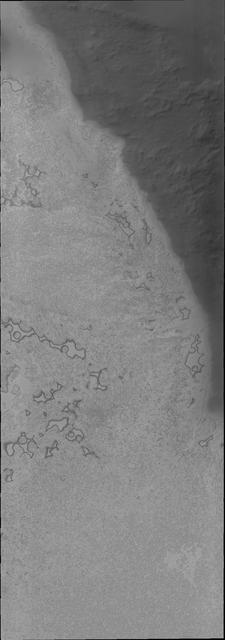
With southern summer drawing to a close, the surface of the polar ice cap will begin to frost over on Mars as seen by NASA 2001 Mars Odyssey spacecraft.
South Polar Surface
The Seagull nebula, seen in this infrared mosaic from NASA Wide-field Infrared Survey Explorer, draws its common name from it resemblance to a gull in flight.
Seagull Nebula -- Running with the Big Dog
The Apollo program demonstrated that men could travel into space, perform useful tasks there, and return safely to Earth. But space had to be more accessible. This led to the development of the Space Shuttle. The Shuttle's major components are the orbiter spacecraft; the three main engines, with a combined thrust of more than 1.2 million pounds; the huge external tank (ET) that feeds the liquid hydrogen fuel and liquid oxygen oxidizer to the three main engines; and the two solid rocket boosters (SRBs), with their combined thrust of some 5.8 million pounds, that provide most of the power for the first two minutes of flight. Crucially involved with the Space Shuttle program virtually from its inception, the Marshall Space Flight Center (MSFC) played a leading role in the design, development, testing, and fabrication of many major Shuttle propulsion components.
Space Shuttle Projects
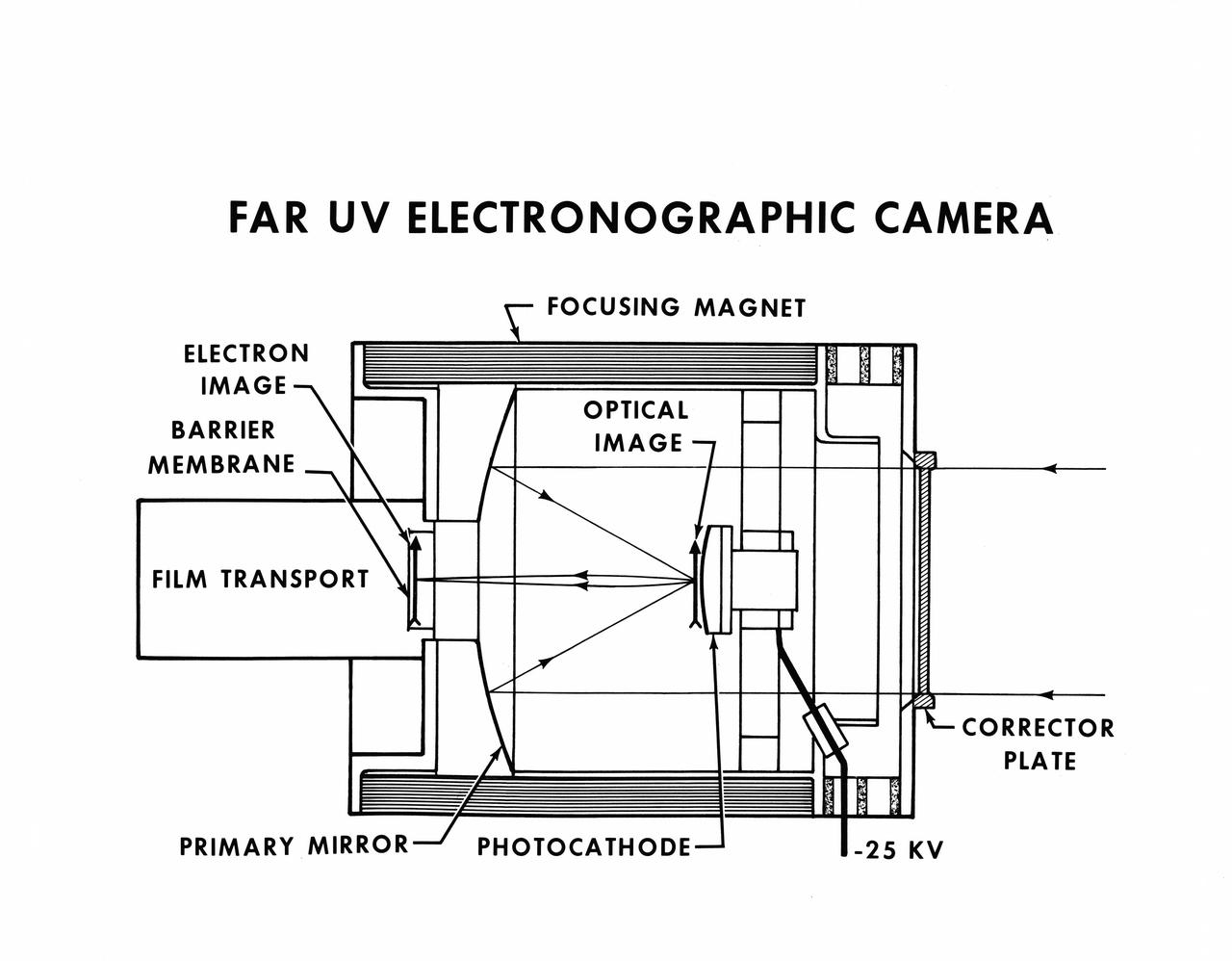
S73-36910 (November 1973) --- An engineer's drawing of the Skylab 4 Far Ultraviolet Electronographic camera (Experiment S201). Arrows point to various features and components of the camera. As the Comet Kohoutek streams through space at speeds of 100,000 miles per hour, the Skylab 4 crewmen will use the S201 UV camera to photograph features of the comet not visible from the Earth's surface. While the comet is some distance from the sun, the camera will be pointed through the scientific airlock in the wall of the Skylab space station Orbital Workshop (OWS). By using a movable mirror system built for the Ultraviolet Stellar Astronomy (S019) Experiment and rotating the space station, the S201 camera will be able to photograph the comet around the side of the space station. Photo credit: NASA
Engineer's drawing of Skylab 4 Far Ultraviolet Electronographic camera
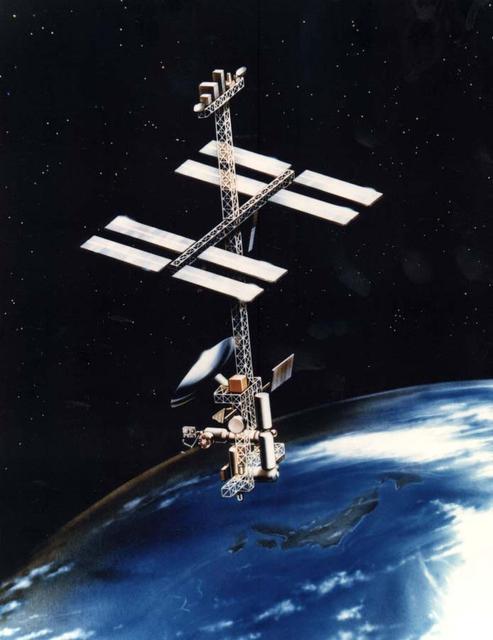
Concept drawing
SSPFpowerTower
Concept drawing
SSPF1952
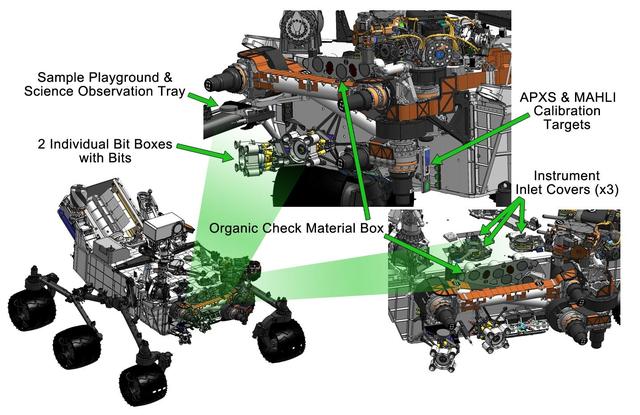
This engineering drawing shows various components needed to support tools at the end of the arm on NASA Curiosity rover, including: calibration targets for helping instruments set their baseline levels.
Curiosity Work Bench
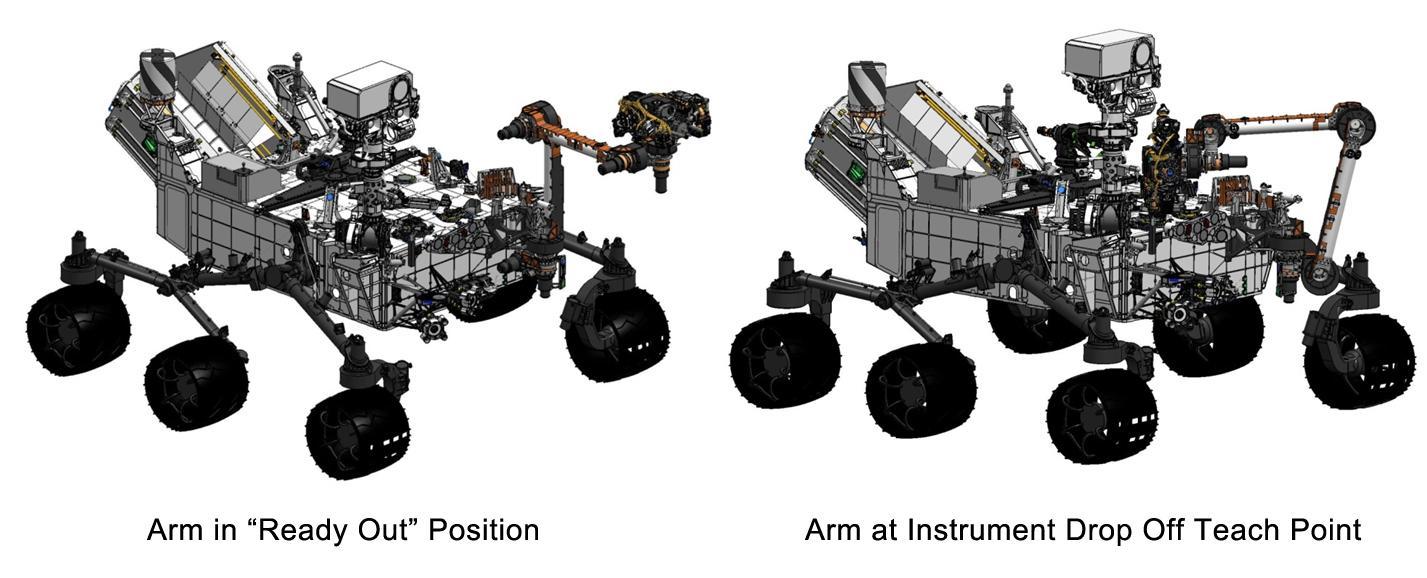
This engineering drawing shows the arm on NASA's Curiosity's rover in its "ready-for-action" position, or "ready out" as engineers say, in addition to the position it assumes to drop off samples.  http://photojournal.jpl.nasa.gov/catalog/PIA16147
Flexing Curiosity's Arm
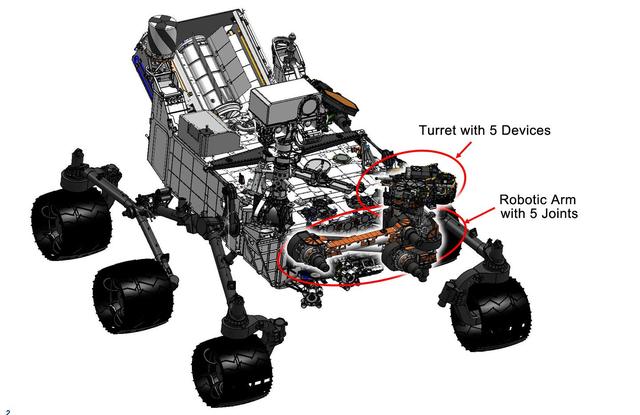
This engineering drawing shows the location of the arm on NASA Curiosity rover, in addition to the arm turret, which holds two instruments and three tools. The arm places and holds turret-mounted tools on rock and soil targets.
Curiosity Robotic Arm
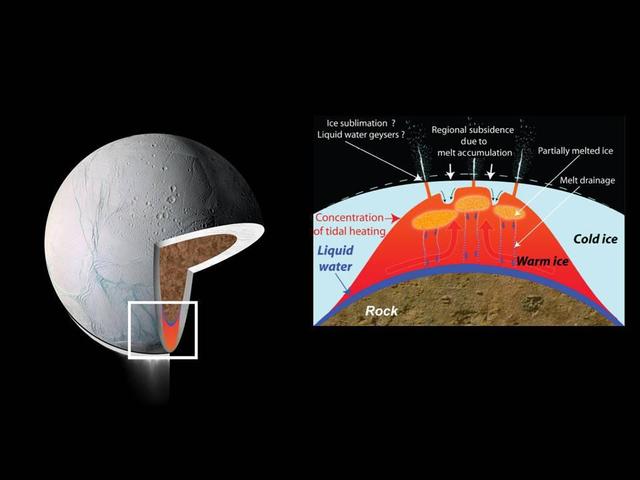
These drawings depict explanations for the source of intense heat that has been measured coming from Enceladus south polar region. These models predict that water could exist in a deep layer as an ocean or sea and also near the surface.
Melted Ice
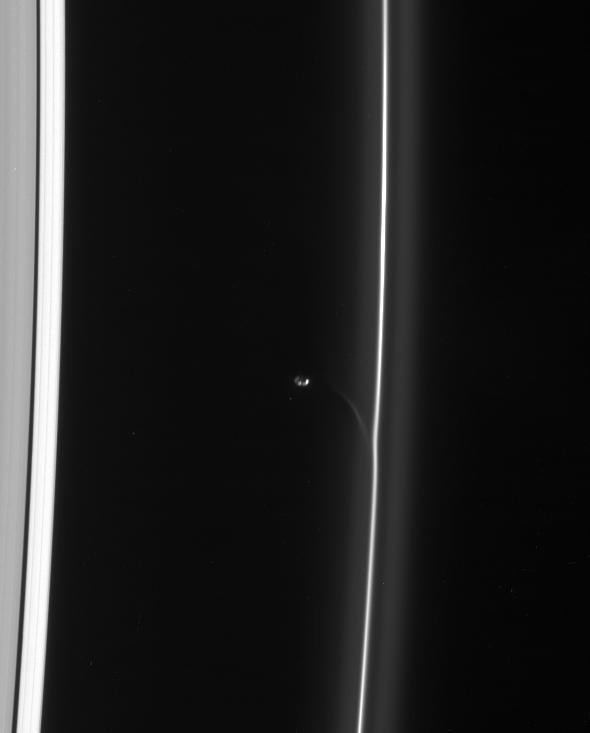
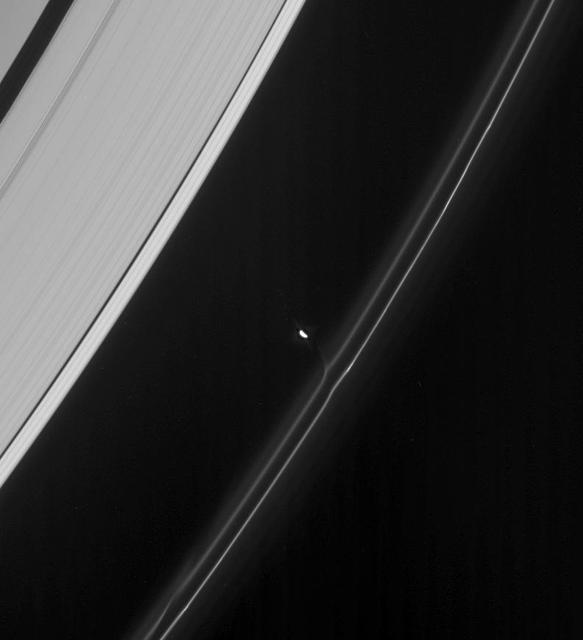
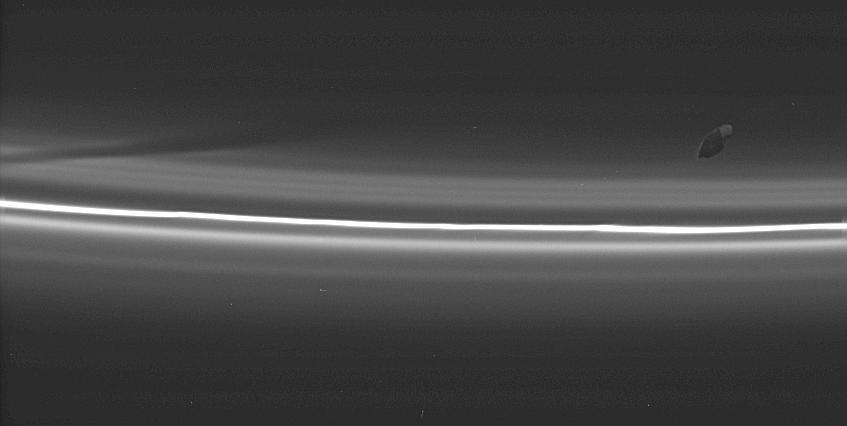
Prometheus draws a fresh streamer of material from the F ring as it passes the ring interior edge. The streamer will continuously shear out as it orbits the planet, becoming more elongated and increasingly aligned with the F ring with time
Streamer Genesis
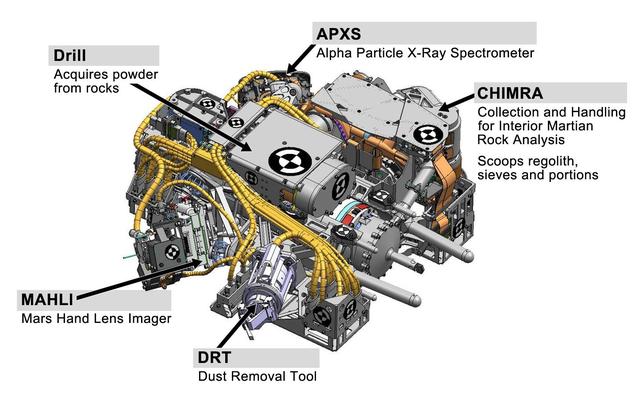
This engineering drawing shows the five devices that make up the turret at the end of the arm on NASA Curiosity rover. These include: the drill for acquiring powdered samples from interiors of rocks.
Tools at Curiosity Fingertips
Prometheus draws material from the F ring along an invisible thread of gravity. Near lower left is an identical feature the moon created on a previous pass near the ring
Moon at Work
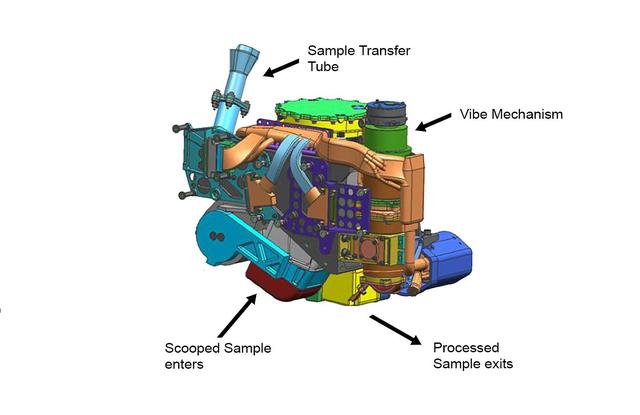
This false-color engineering drawing shows the Collection and Handling for In-Situ Martian Rock Analysis CHIMRA device, attached to the turret at the end of the robotic arm on NASA Curiosity Mars rover.
CHIMRA: Scoops, Sieves and Delivers Samples
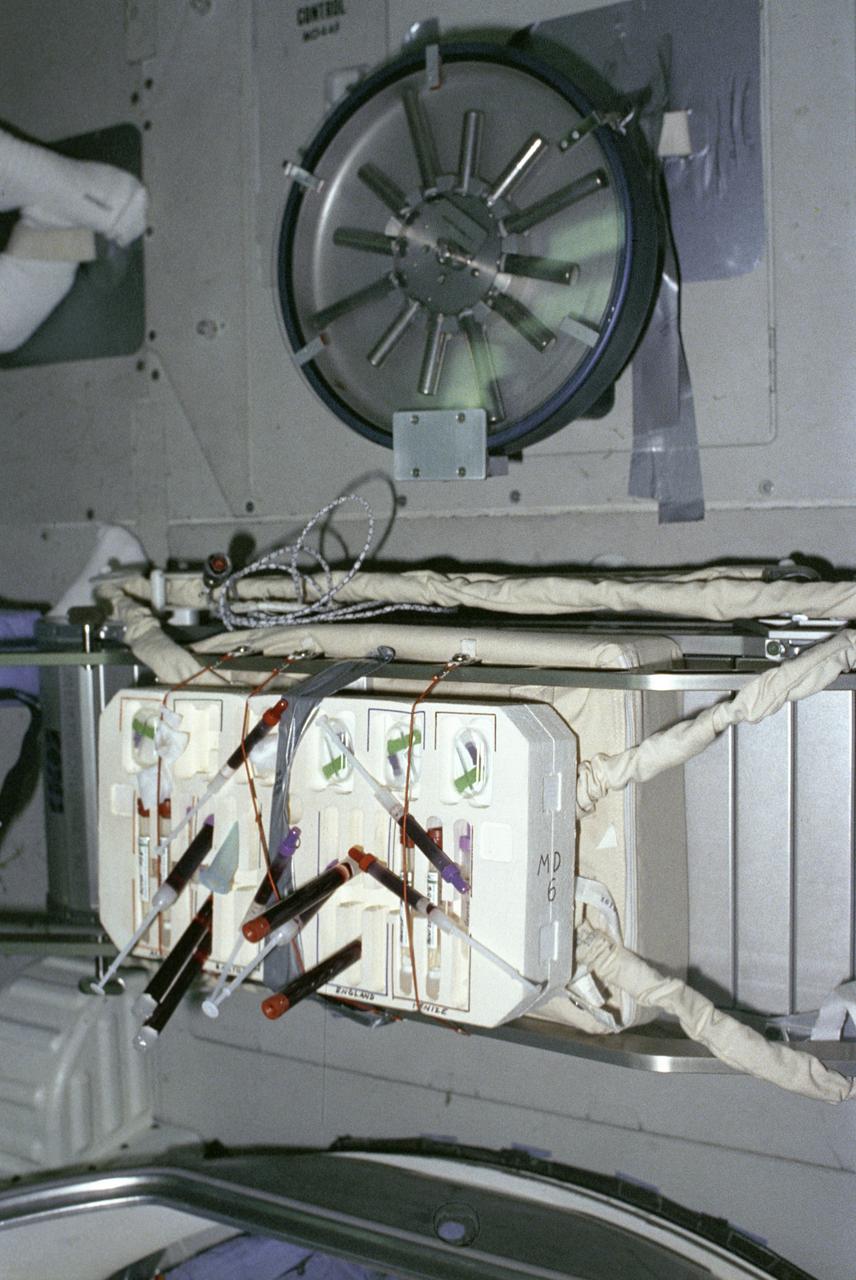
While instruments on the pallets in the payload bay observed the universe, biological experiments were performed in the middeck of the Shuttle Orbiter Challenger. Studying life processes in a microgravity environment can shed new light on the functioning of biological systems on Earth. These investigations can also help us understand how living organisms react to prolonged weightlessness. One such experiment was the vitamin D metabolites and bone demineralization experiment. This investigation measured the vitamin d metabolite levels of crew members to gain information on the cause of bone demineralization and mineral imbalance that occur during prolonged spaceflight as well as on Earth. Research into the biochemical nature of vitamin D has shown that the D-metabolites play a major role in regulating the body's calcium and phosphorus levels. One major function of the most biologically active vitamin D metabolite is to regulate the amount of calcium absorbed from the diet and taken out of bones. This investigation had two phases. The first was the developmental phase, which included extensive testing before flight, and the second, or final phase, involved the postflight analysis of the crew's blood samples. This photograph shows a blood draw test kit and centrifuge used for the experiment aboard the Spacelab-2. Marshall Space Flight Center had management responsibilities of all Spacelab missions.
Spacelab
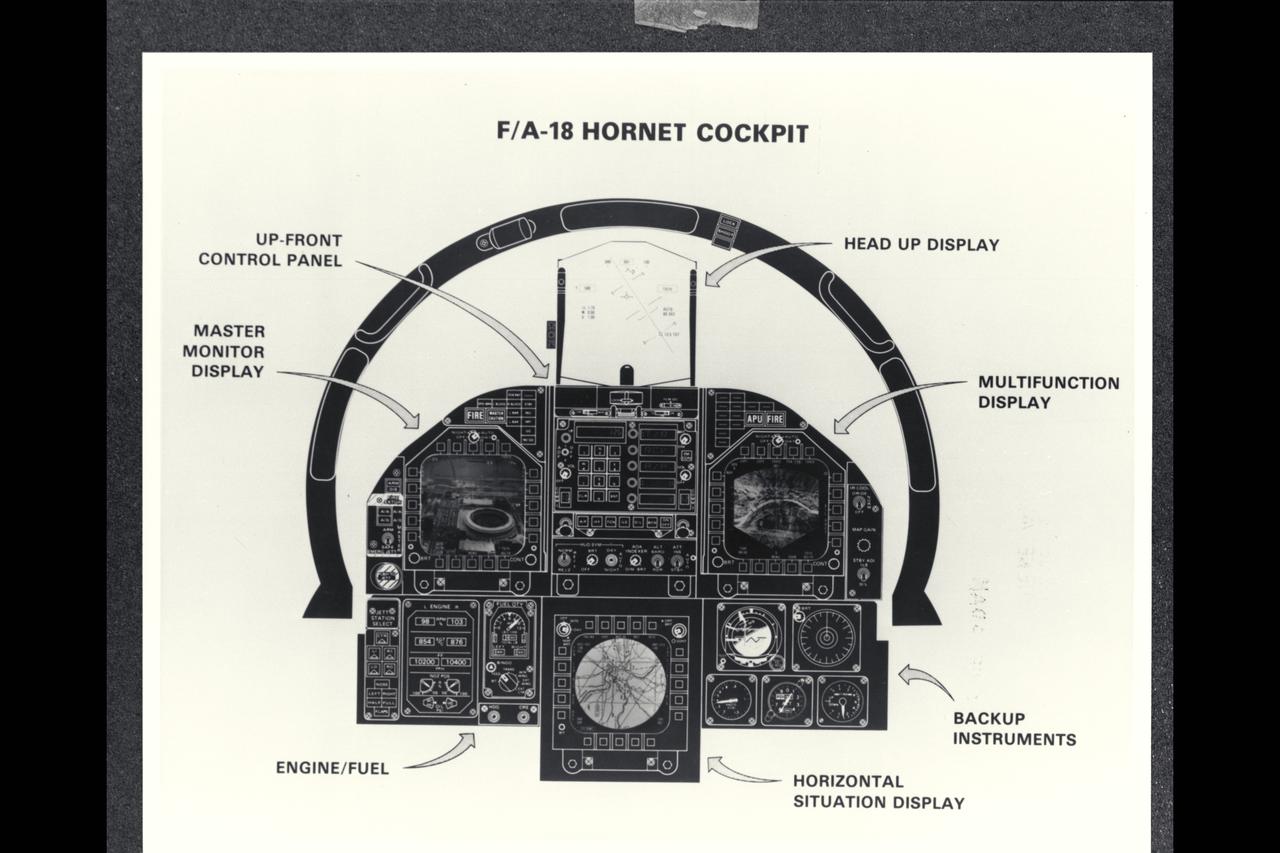
McDonnell Douglas F/A-18A Hornet cockpit drawing
ARC-1993-A83-0499-34
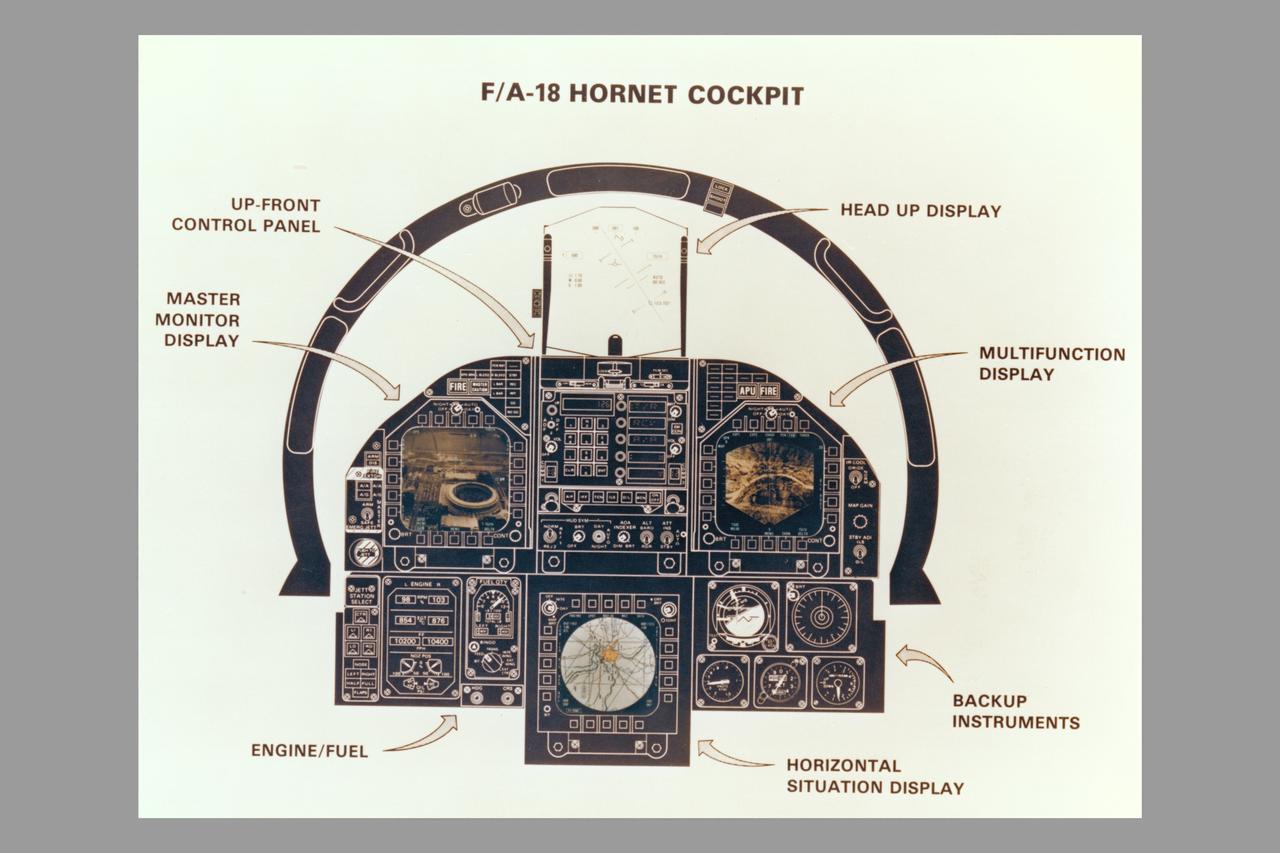
McDonnell Douglas F/A-18A Hornet cockpit drawing
ARC-1993-AC83-0499-34
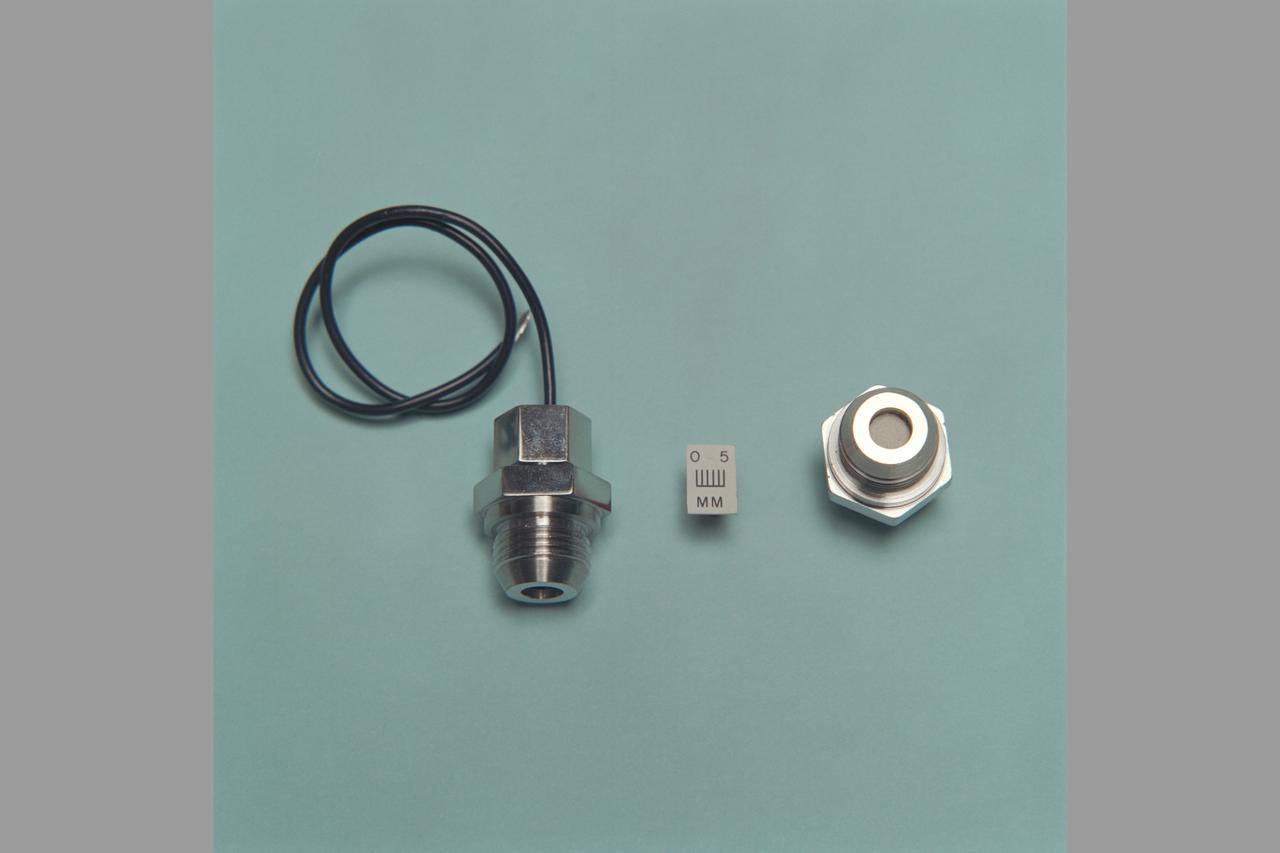
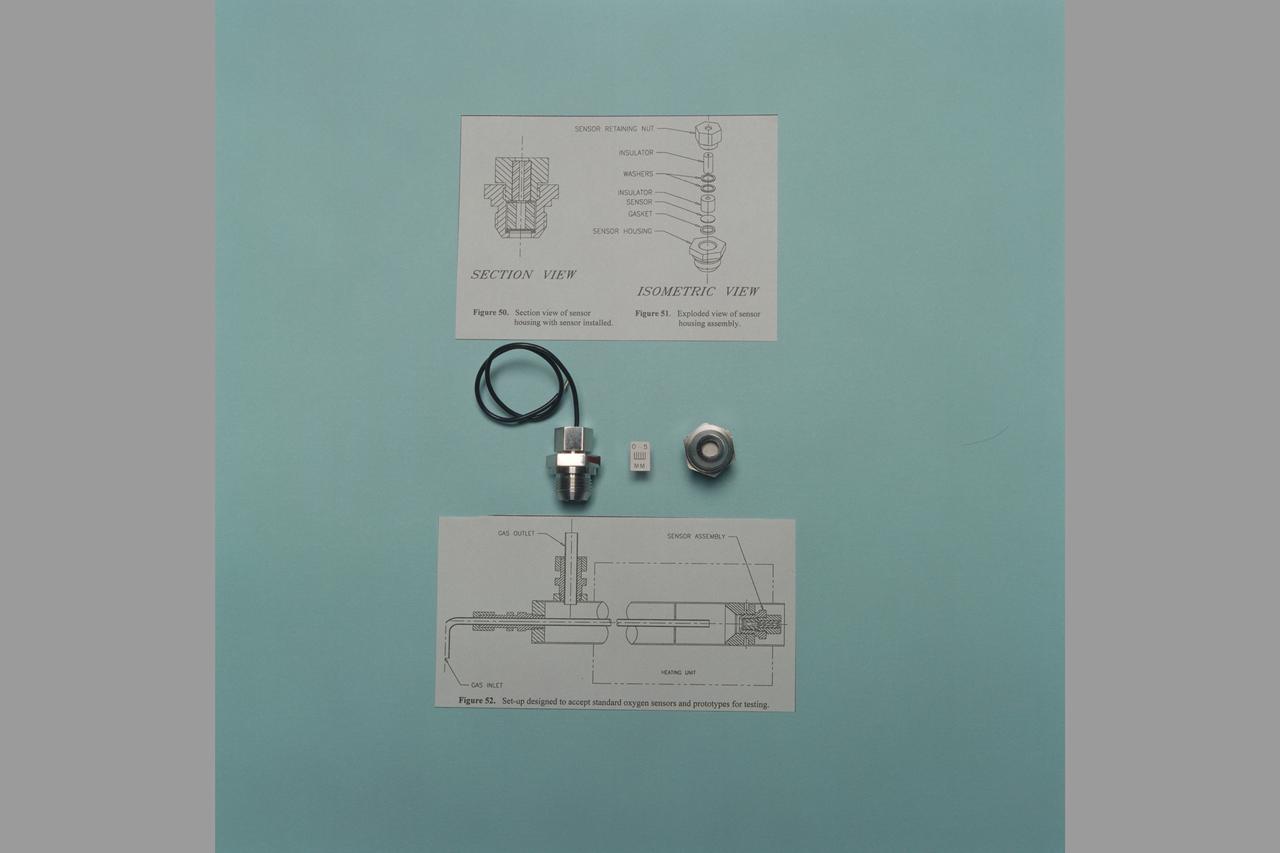
Miniature Oxygen Sensing Device.  (sensor & sensors with drawings)
ARC-1998-AC98-0171-2
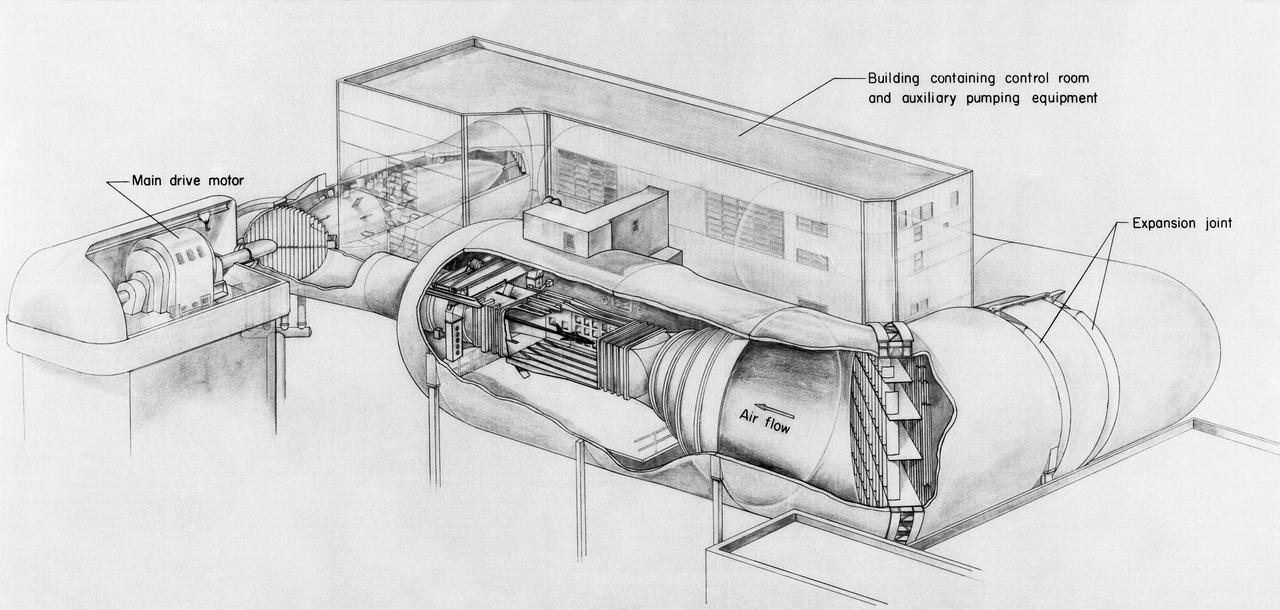
 Drawing of the 8-Foot Transonic Pressure Tunnel.
8-Foot Transonic Pressure Tunnel
Miniature Oxygen Sensing Device.  (sensor & sensors with drawings)
ARC-1998-AC98-0171-1
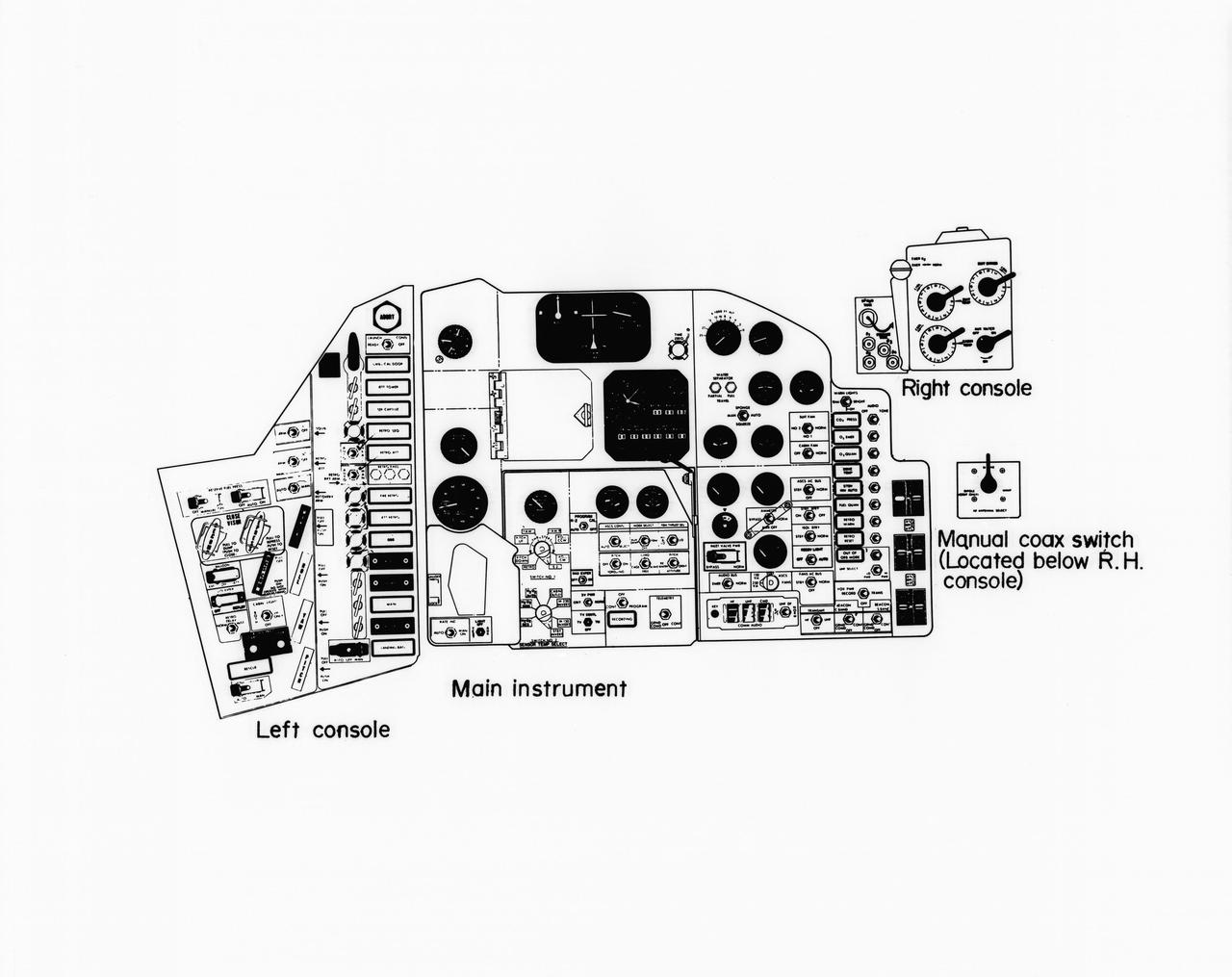
S63-21624 (November 1963) --- Main instrument panel for the Mercury spacecraft. Photo credit: NASA
MERCURY SPACECRAFT - LINE DRAWING
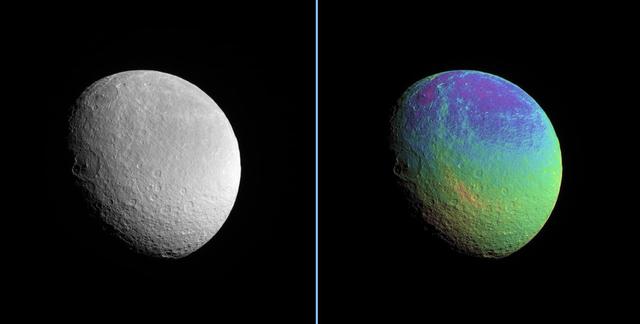
Rhea displays a marked color contrast from north to south that is particularly easy to see in the extreme color-enhanced Cassini spacecraft view presented here
Drawing Out Details
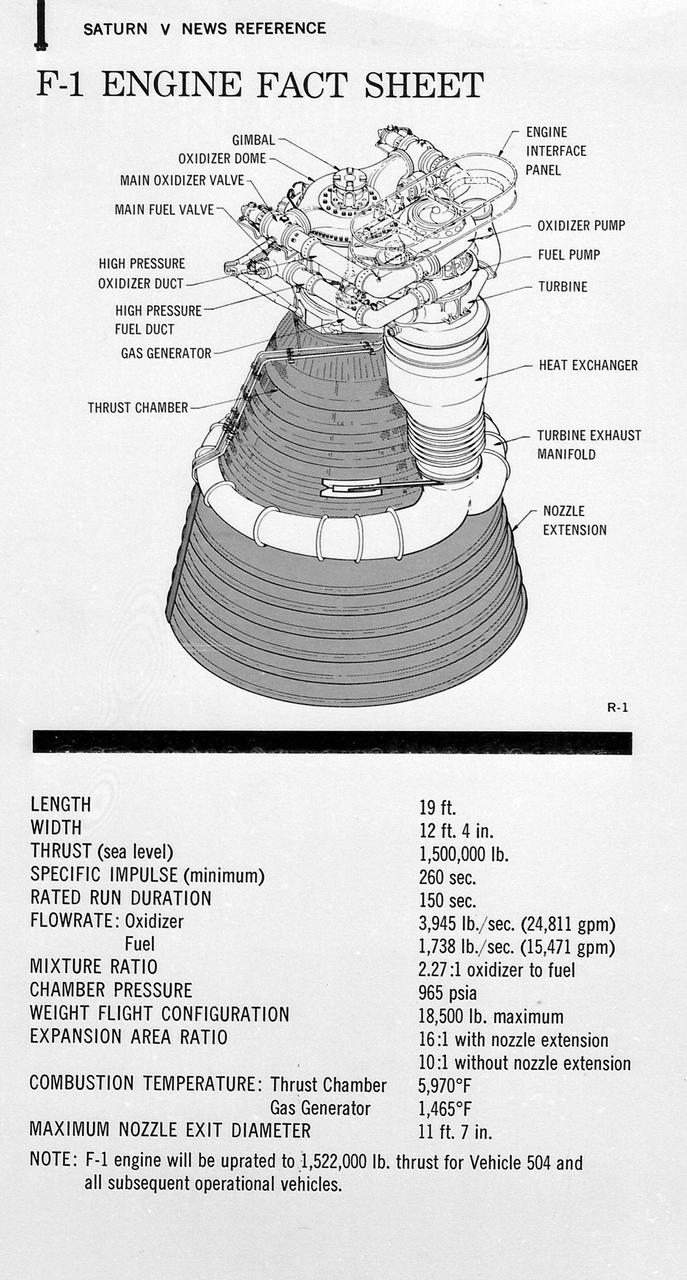
This figure is a drawing of the F-1 engine with callouts of the major components and the engine characteristics.
Saturn Apollo Program
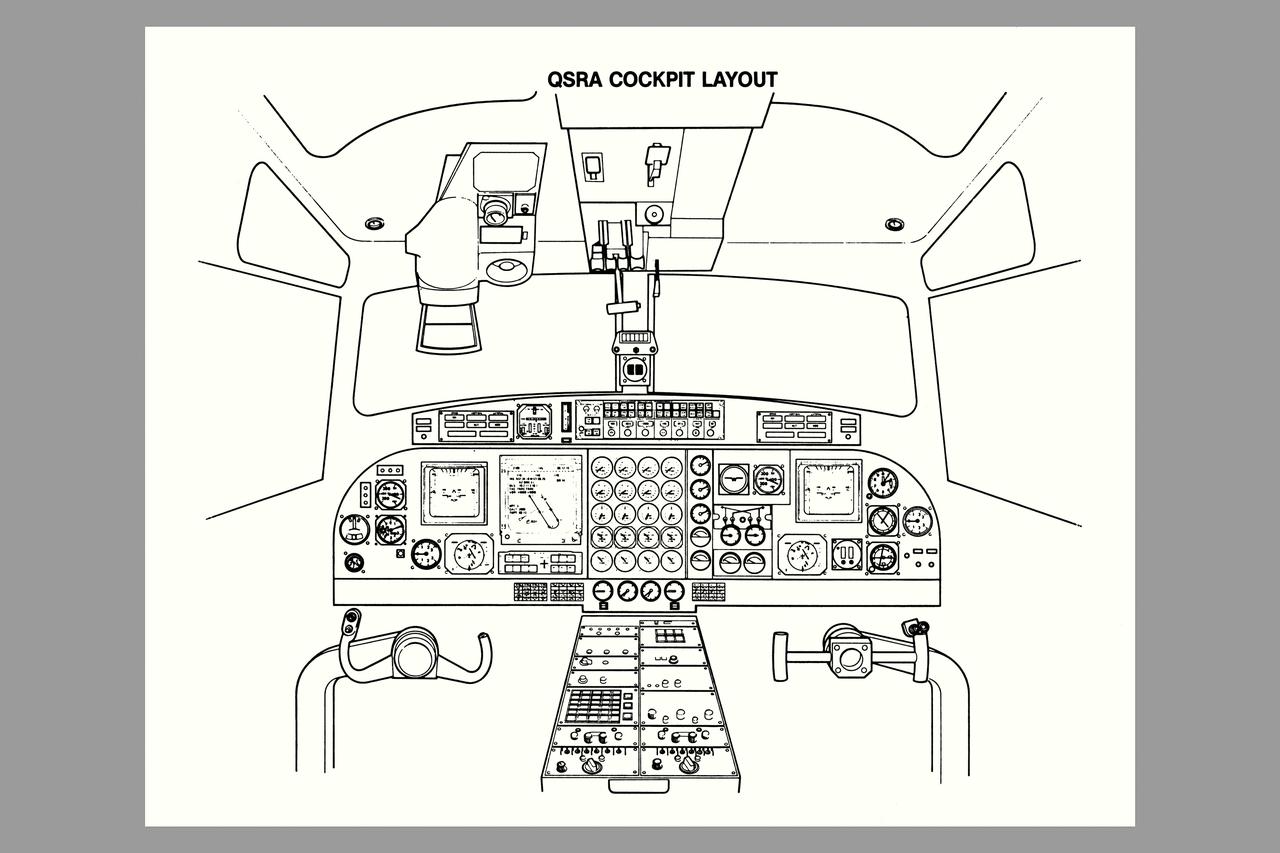
DeHavilland QSRA (Quite Short Haul Research Aircraft) cockpit layout drawing
ARC-1969-A96-0025-5
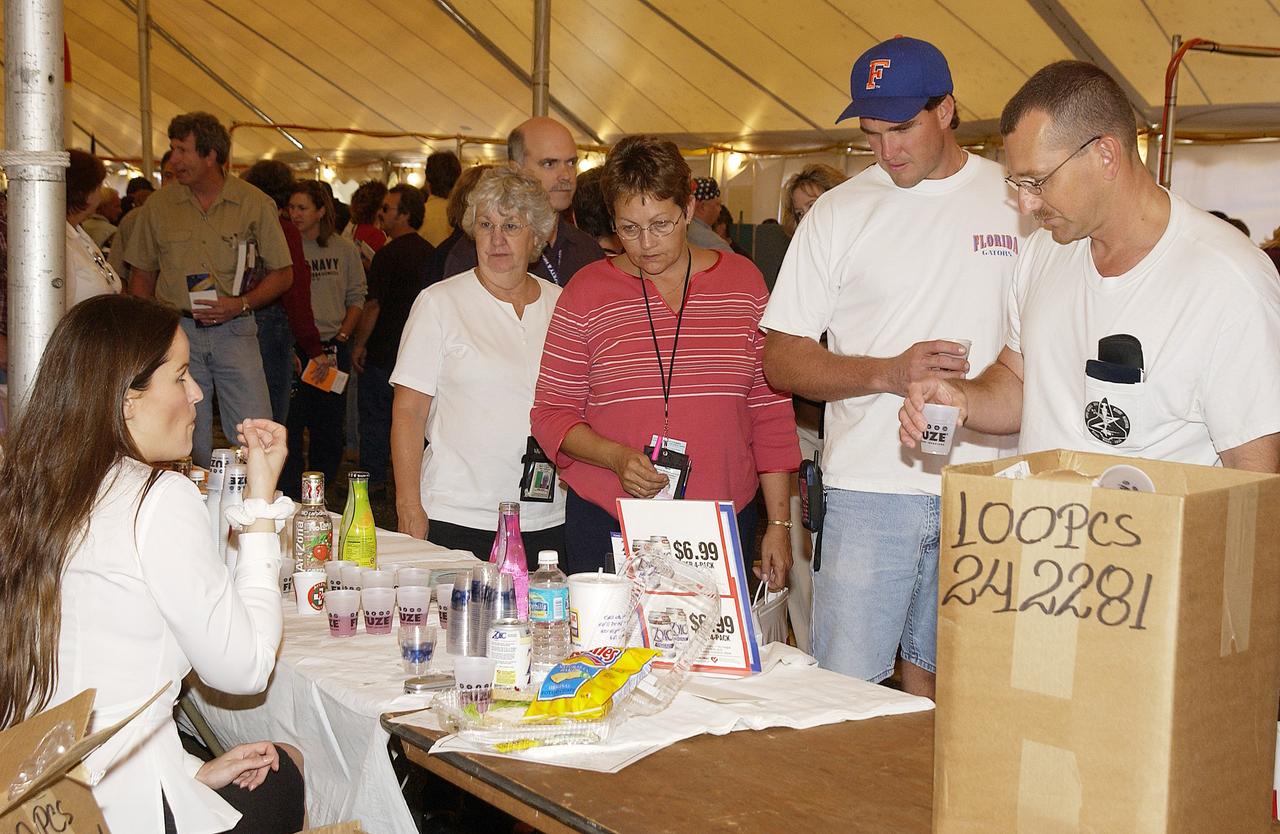
KENNEDY SPACE CENTER, FLA. -   One of many vendors displaying their products during the Spaceport Super Safety and Health Day at KSC and Cape Canaveral Air Force Station, Florida Power and Light draws a crowd during a demonstration.  The annual KSC event is dedicated to reinforcing safe and healthful behaviors in the workforce.
KENNEDY SPACE CENTER, FLA. - One of many vendors displaying their products during the Spaceport Super Safety and Health Day at KSC and Cape Canaveral Air Force Station, Florida Power and Light draws a crowd during a demonstration. The annual KSC event is dedicated to reinforcing safe and healthful behaviors in the workforce.
S65-05399 (1965) --- Composite drawing showing the vertical, lateral, forward and aft maneuvering control of the Gemini spacecraft.
GEMINI SPACECRAFT - MANEUVERING CONTROL - MSC
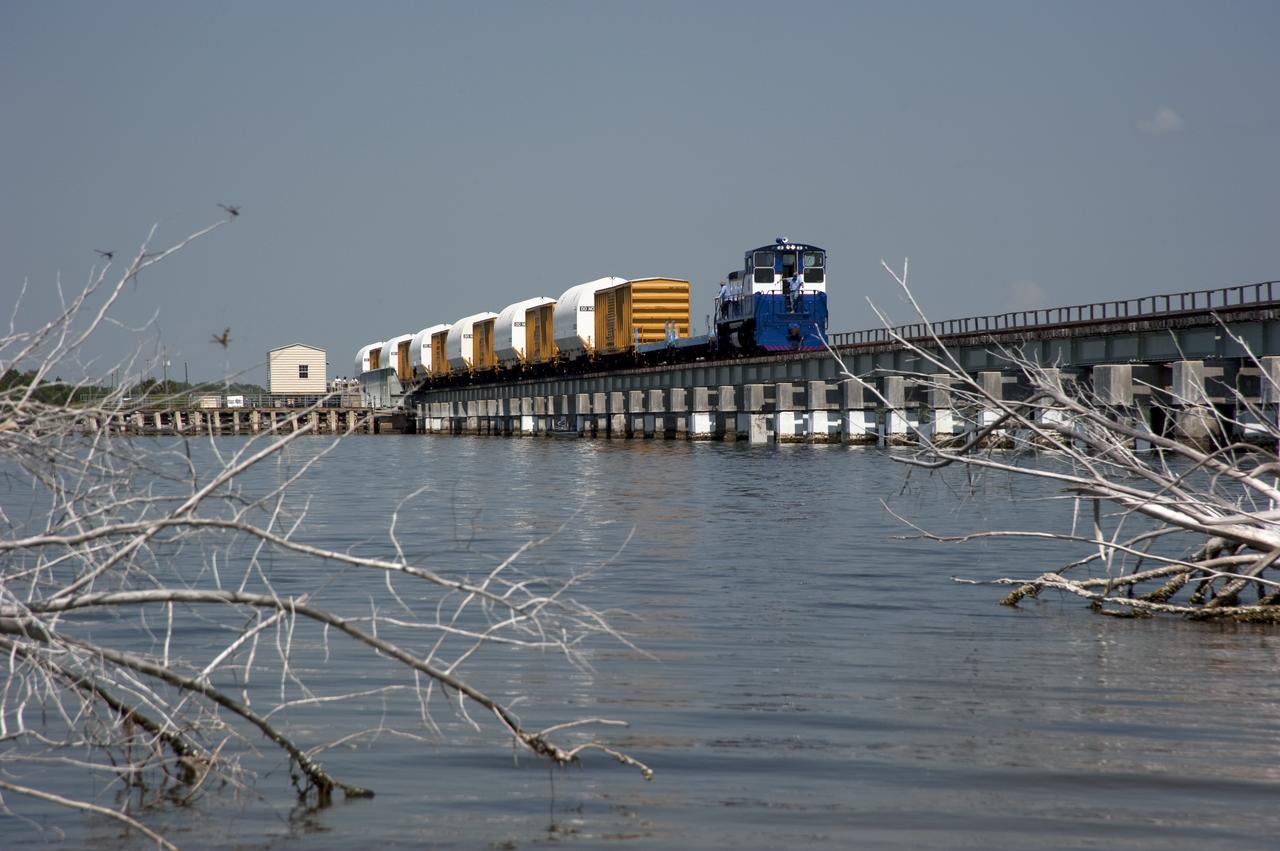
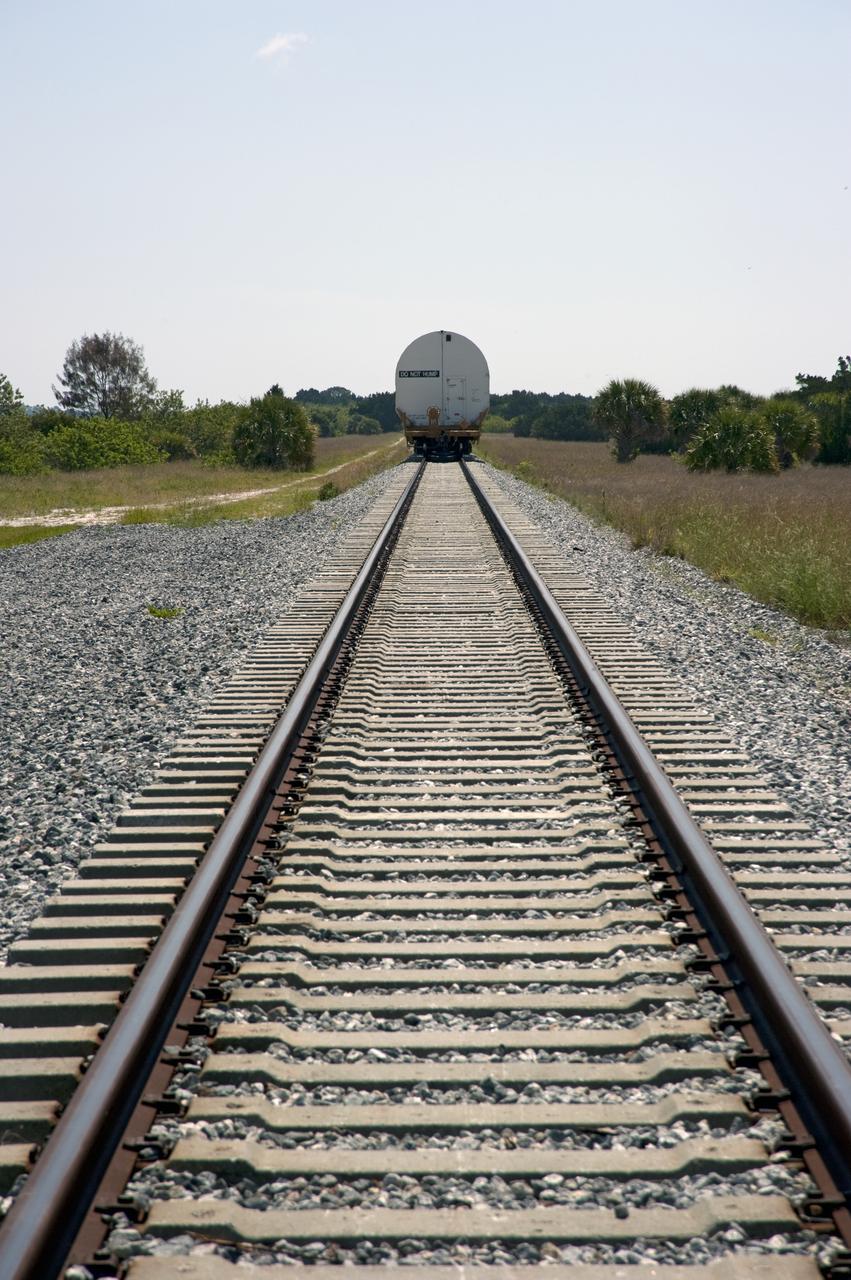
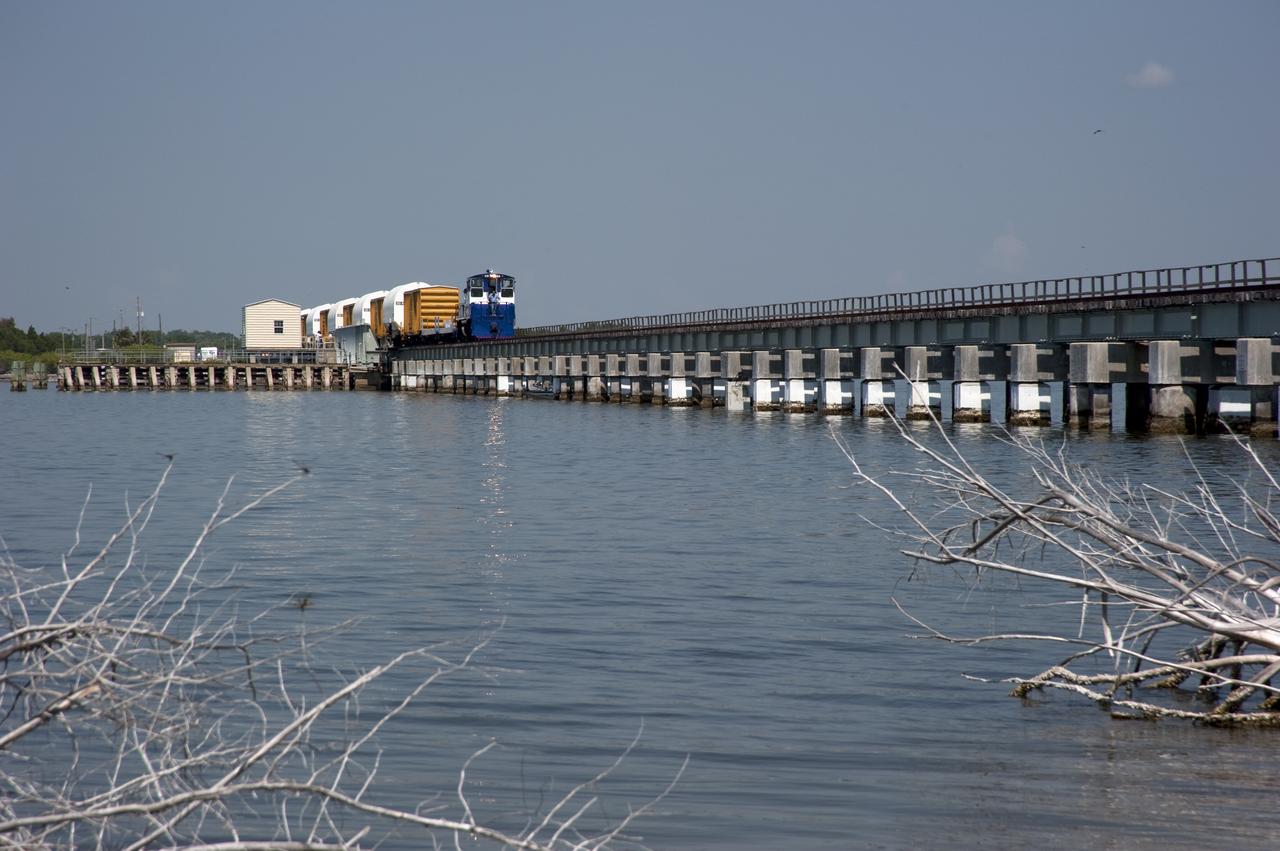
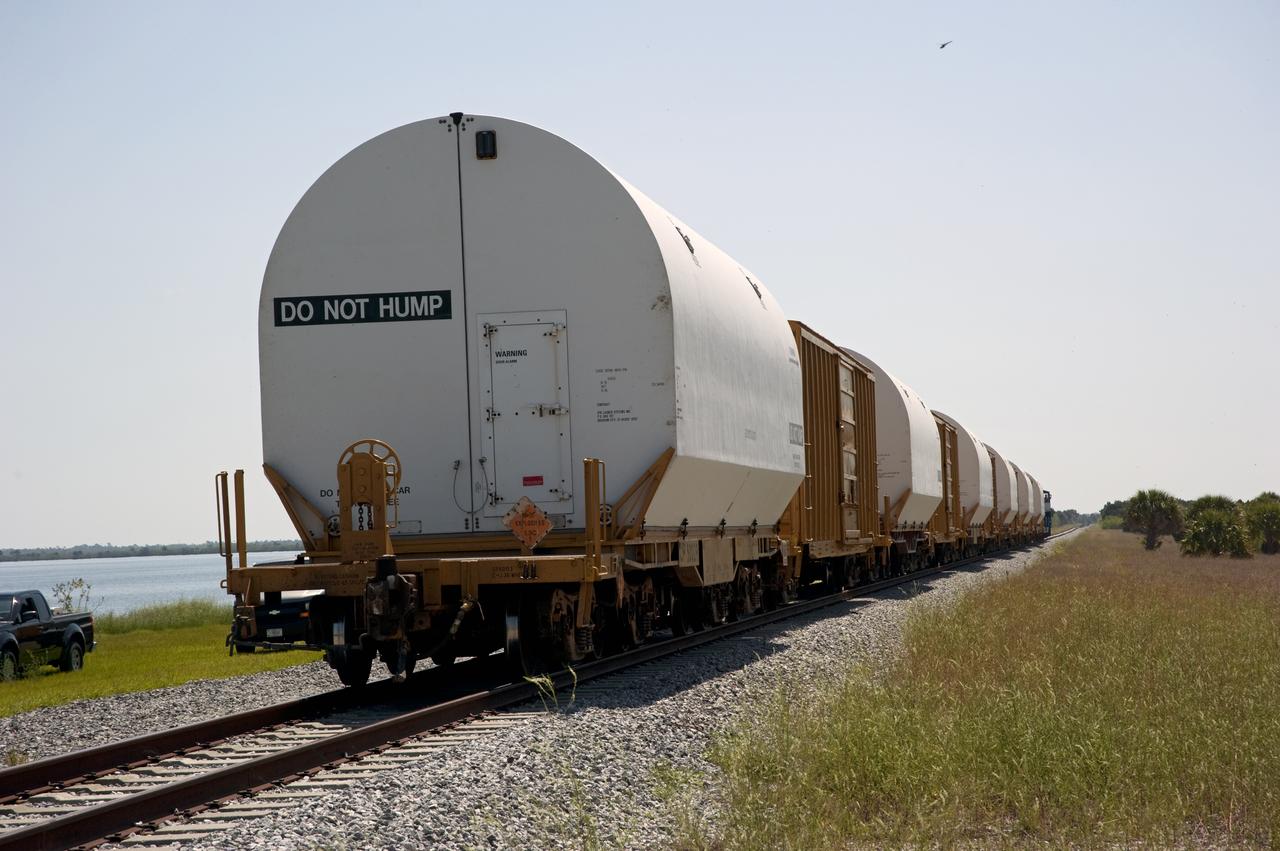
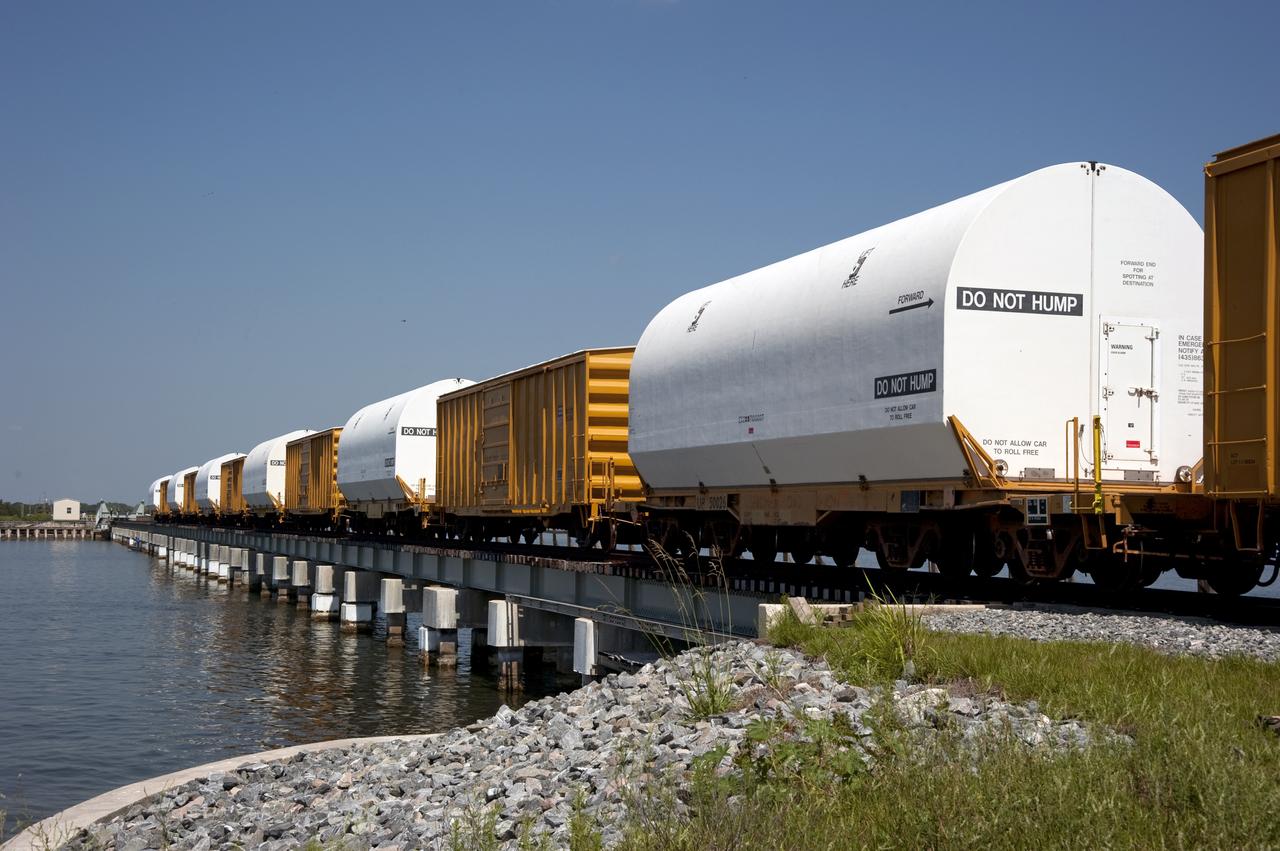
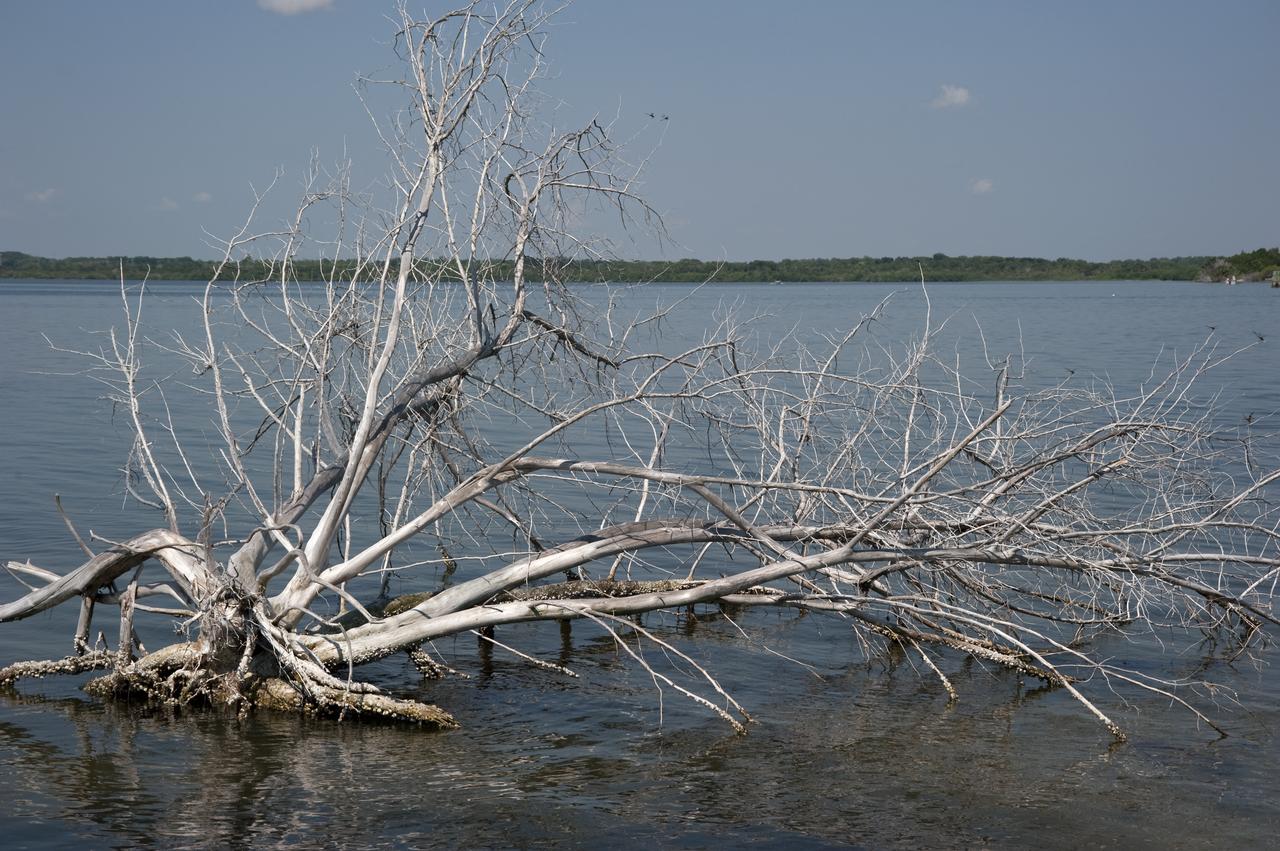
STS-335 LAUNCH ON NEED - LAST SRB SEGMENTS ARRIVAL - DRAW BRIDGE OVER BANANA RIVER
2010-3629
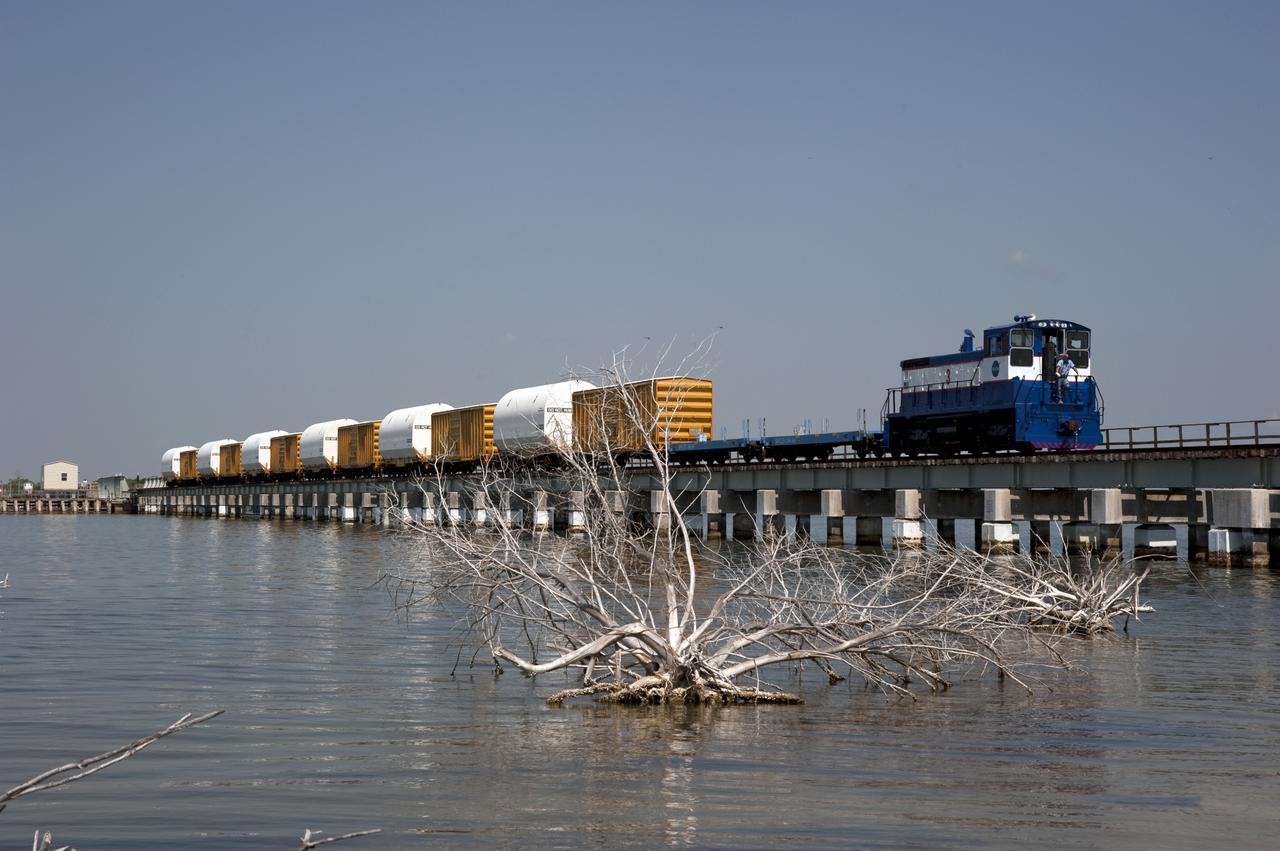
STS-335 LAUNCH ON NEED - LAST SRB SEGMENTS ARRIVAL - DRAW BRIDGE OVER BANANA RIVER
2010-3632
This figure is a line drawing of the J-2 engine with callouts of the major components and the engine characteristics.
Saturn Apollo Program
STS-335 LAUNCH ON NEED - LAST SRB SEGMENTS ARRIVAL - DRAW BRIDGE OVER BANANA RIVER
2010-3633
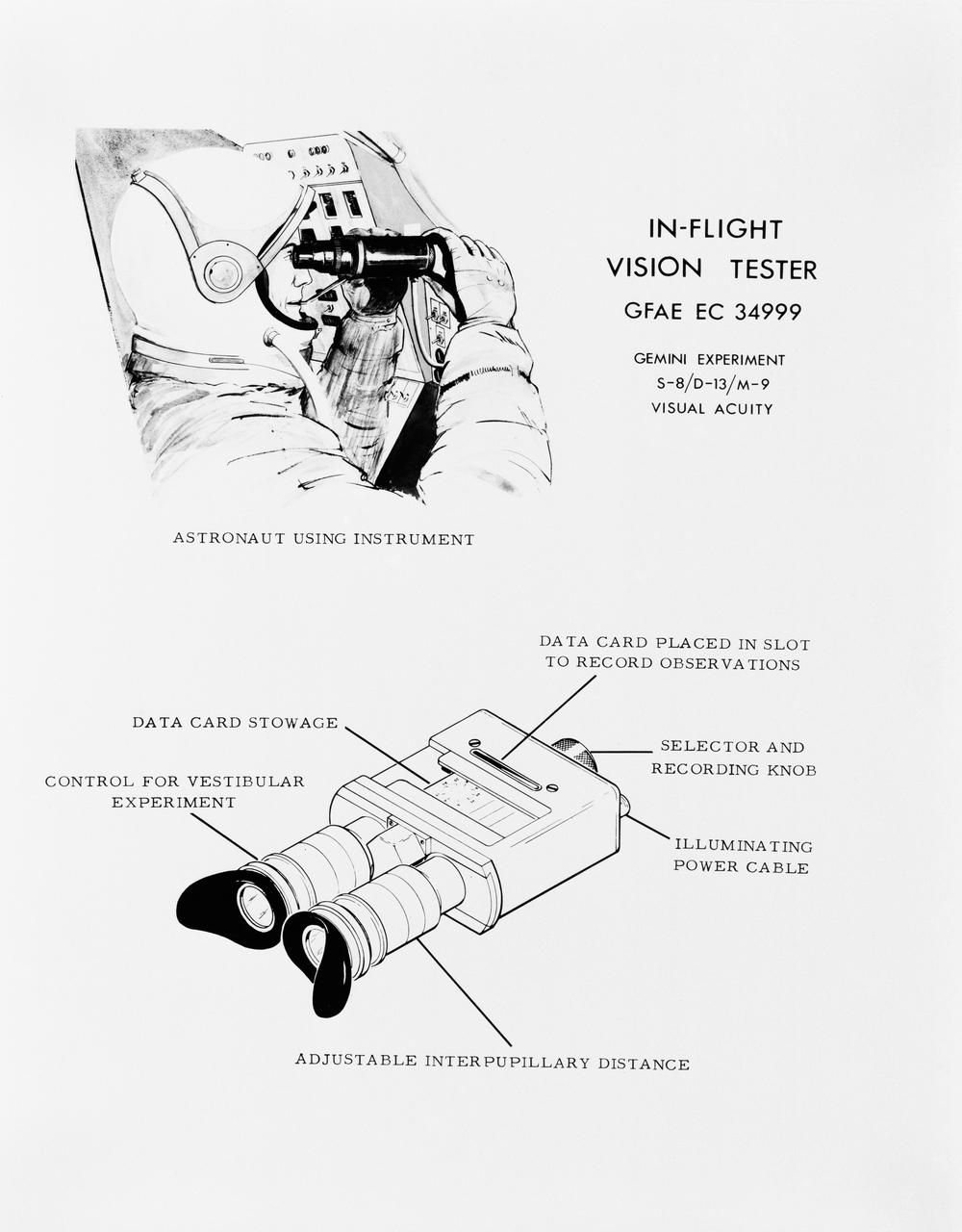
S65-28642 (June 1965) --- Drawing illustrating Gemini experiment In-Flight Vision Tester.
Chart - Visual Acuity - Inflight Vision Tester - CA
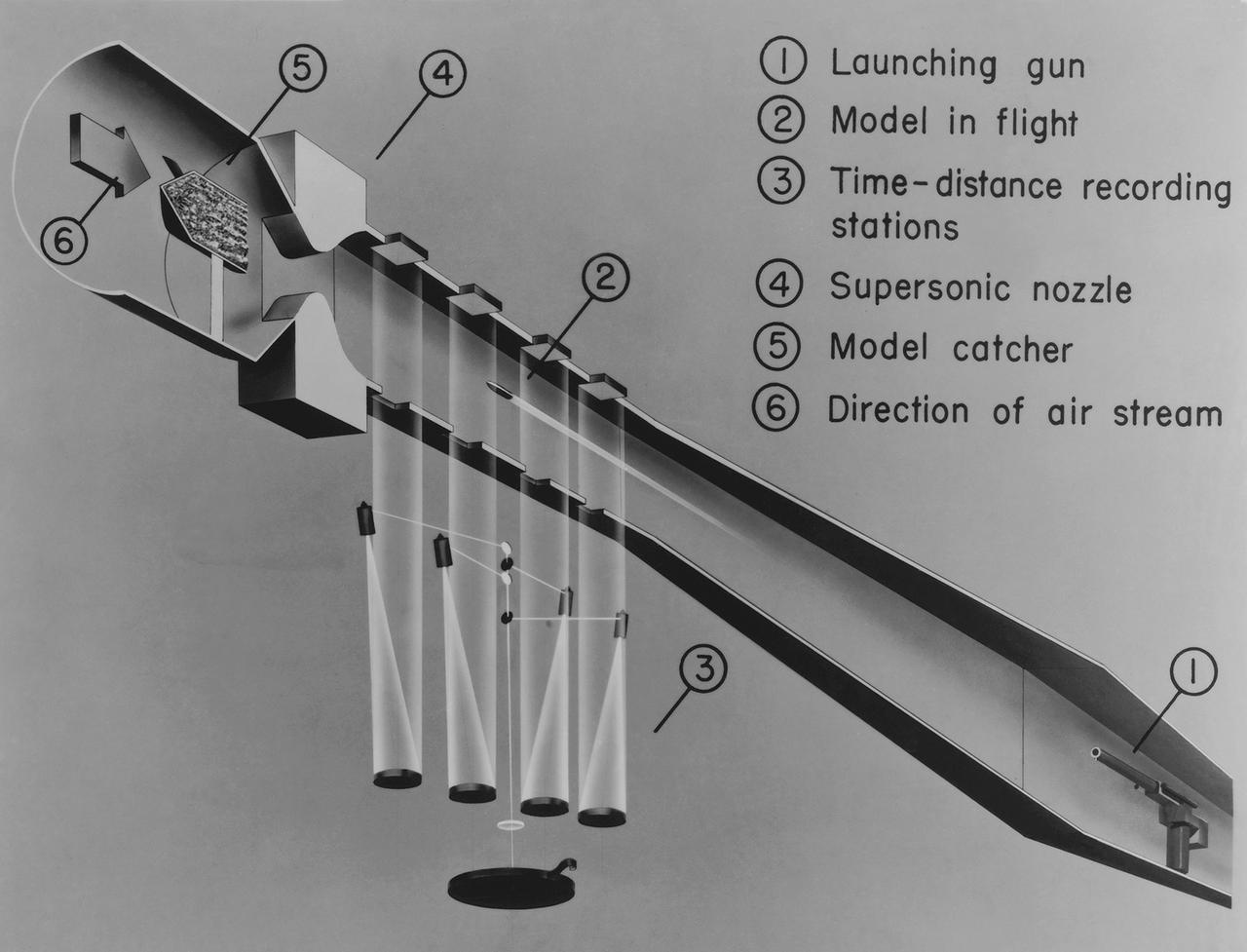
Ames hi-speed research schematic drawing of the Supersonic Free Flight  Tunnel (SSFFT)
ARC-1950-A-15058
STS-335 LAUNCH ON NEED - LAST SRB SEGMENTS ARRIVAL - DRAW BRIDGE OVER BANANA RIVER
2010-3636
STS-335 LAUNCH ON NEED - LAST SRB SEGMENTS ARRIVAL - DRAW BRIDGE OVER BANANA RIVER
2010-3638
STS-335 LAUNCH ON NEED - LAST SRB SEGMENTS ARRIVAL - DRAW BRIDGE OVER BANANA RIVER
2010-3634
STS-335 LAUNCH ON NEED - LAST SRB SEGMENTS ARRIVAL - DRAW BRIDGE OVER BANANA RIVER
2010-3637
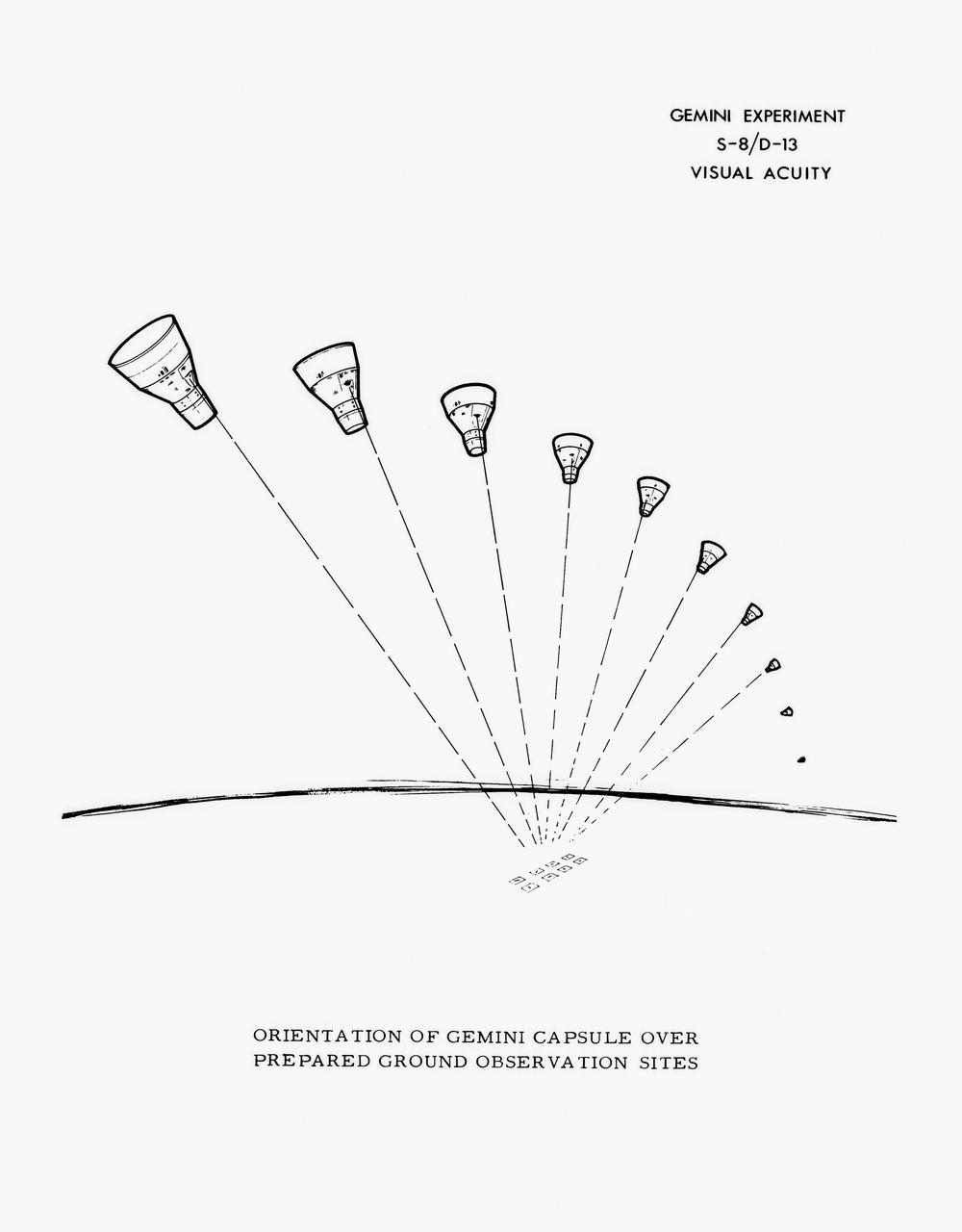
S65-28639 (June 1965) --- Drawing illustrating orientation of Gemini spacecraft over prepared ground observation sites.
VISUAL ACUITY - EXPERIMENT - GEMINI-TITAN (GT)-5 - FL
STS-335 LAUNCH ON NEED - LAST SRB SEGMENTS ARRIVAL - DRAW BRIDGE OVER BANANA RIVER
2010-3630
STS-335 LAUNCH ON NEED - LAST SRB SEGMENTS ARRIVAL - DRAW BRIDGE OVER BANANA RIVER
2010-3635
STS-335 LAUNCH ON NEED - LAST SRB SEGMENTS ARRIVAL - DRAW BRIDGE OVER BANANA RIVER
2010-3631
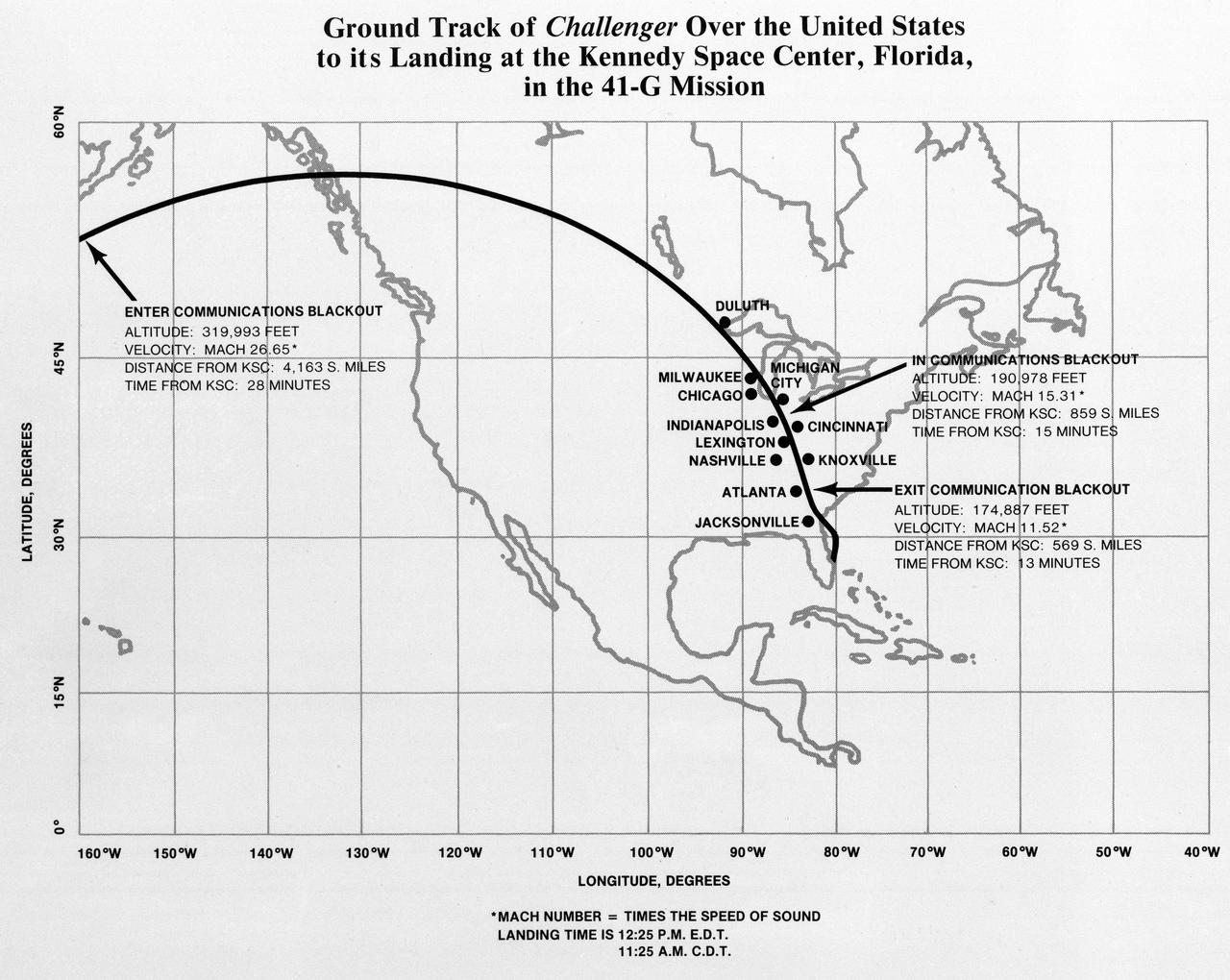
Art drawing of ground track over U.S. of landing for STS-41G.        1.  ART CONCEPTS - STS-41G MAP (LANDING)        KSC, FL
LANDING (MAP) - STS-41G - KSC
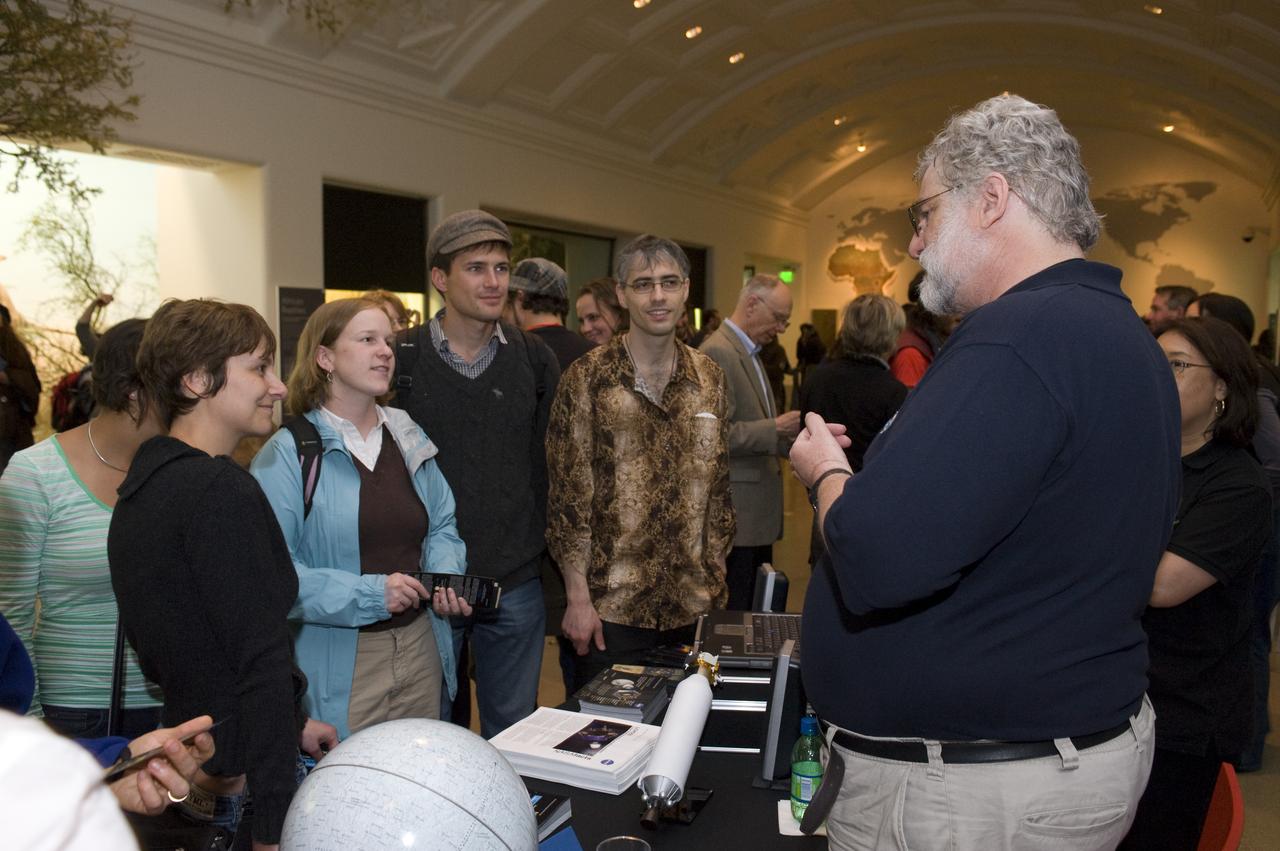
Yuri's Night 2009 held at the California Acaemy of Sciences in San Francisco, California Brian Day, Planners draws a crowd to the LCROSS booth with his mission rundown.
ARC-2009-ACD09-0054-051
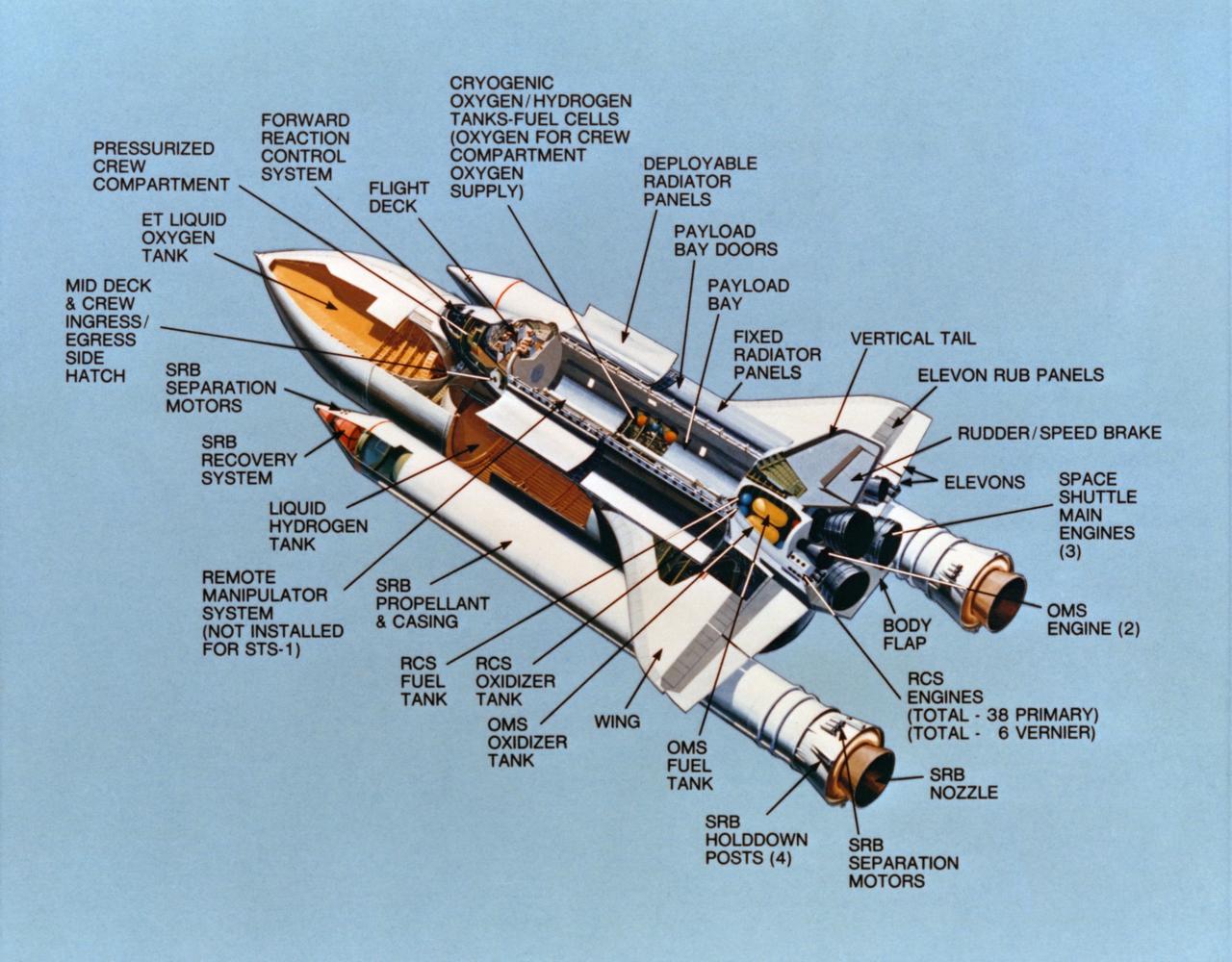
S81-30630 (February 1981) --- This "cutaway" artist's concept exercises some artistic license to reveal systems of the major components of a space shuttle vehicle. With its payload bay doors open here, the shuttle's cryogenic supply station (note cutaway) and the deployable radiator panels (visible) can be seen. In reality, the cargo bay panels would never be open while the orbiter is attached to the solid rocket boosters (SRB) and external fuel tank (ET). The thick-bodied, delta-winged aerospace craft is 37 meters long, has a span of 24 meters (120 feet by 80 feet), and weighs about 75,000 kilograms empty (165,000 lbs). Its payload bay, 18.3 meters long and 4.6 meters in diameter (60 feet by 15 feet) can deliver single or conglomerate payloads of up to 370 kilometers altitude or smaller loads up to 1110 kilometers (230 miles to 690 miles). It can bring payloads of 14,515 kilograms (32,000 lbs) back to Earth and it can carry out a variety of missions lasting seven to 30 days. Photo credit: NASA
Detailed Drawing - STS-1 Columbia
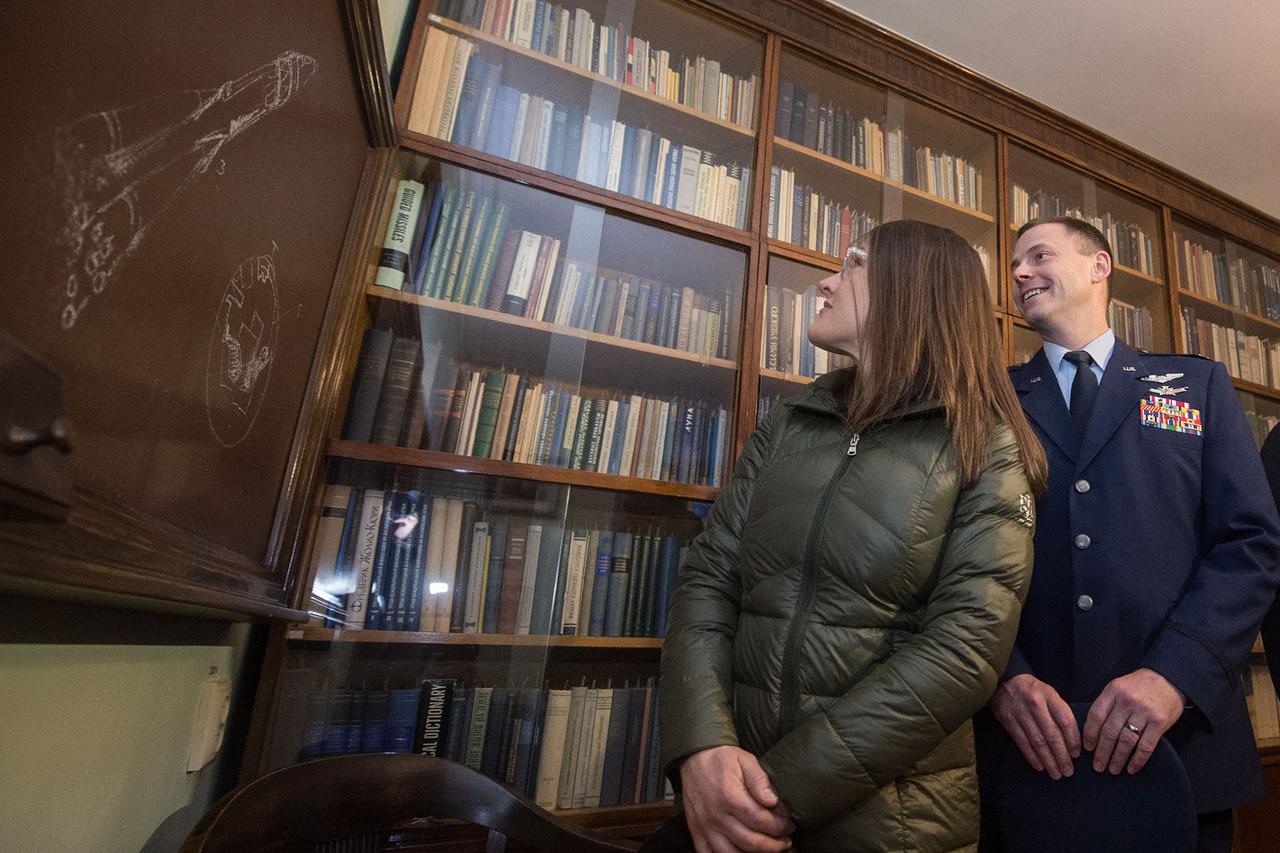
At the Korolev Library in Moscow named after the Russian space designer, Sergei Korolev, NASA’s Expedition 59 astronauts Christina Koch (left) and Nick Hague (right) study a framed drawing of a Soyuz rocket Feb. 21 that Korolev himself drew decades ago. Koch, Hague and Alexey Ovchinin of Roscosmos will launch March 14, U.S. time, on the Soyuz MS-12 spacecraft from the Baikonur Cosmodrome in Kazakhstan for a six-and-a-half month mission on the International Space Station.  Andrey Shelepin/Gagarin Cosmonaut Training Center
jsc2019e004429 - At the Korolev Library in Moscow named after the Russian space designer, Sergei Korolev, NASA’s Expedition 59 astronauts Christina Koch (left) and Nick Hague (right) study a framed drawing of a Soyuz rocket Feb. 21 that Korolev himself
For me, I picked up an interest for engineering through drawing. When I was young, I was really big into art. Like most science-drawn younger kids, I would draw Pokémon, I would draw Dragon Ball Z, things like that. I guess my passion for art and drawing helped me to get into CAD (Computer Aided Design) modeling — things like 3D modeling and 3D printing. And with CAD modeling, you need to learn how to figure out the dimensions of things, what material they’re made out of, xyz. So that got me deeper into engineering.   There’s definitely an artistic component to science. You can just look at James Webb [Space Telescope]. It looks artistic. If you look at the beveled mirrors, or how the bat wings on the side fold out, I would argue that that is artistic in a sense. But it also matches perfectly with its scientific functions. So not only does it need to fit into the rocket, but it also needs these beveled mirrors to reflect light at a specific angle. So, I think art and science blend pretty well.  Kenneth Harris II, lead database engineer for the Joint Polar Satellite System (JPSS) J2 Satellite Mission at NASA’s Goddard Space Flight Center, Friday, Feb. 21, 2020, Greenbelt, Md.  Photo Credit: (NASA/Joel Kowsky)
Kenneth Harris Portrait
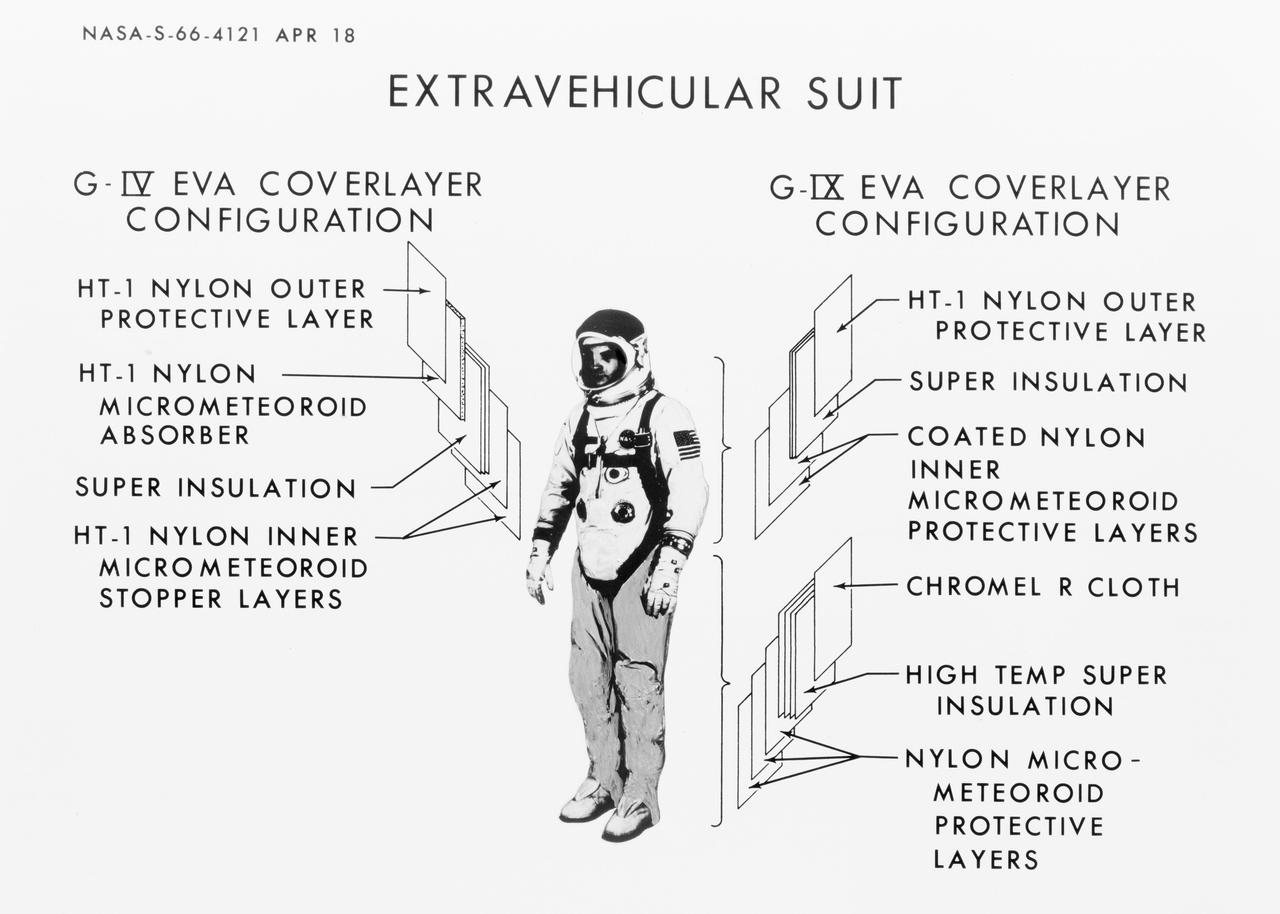
S66-04121 (18 April 1966) --- Drawing of the Gemini-9 extravehicular spacesuit, with a comparison of the breakdown between the Gemini-4 suit layers and the Gemini-9 suit layers. Photo credit: NASA
COMPARISON CHART - GEMINI-TITAN (GT)-4/GT-9 EXTRAVEHICULAR ACTIVITY (EVA) - SUIT - MSC
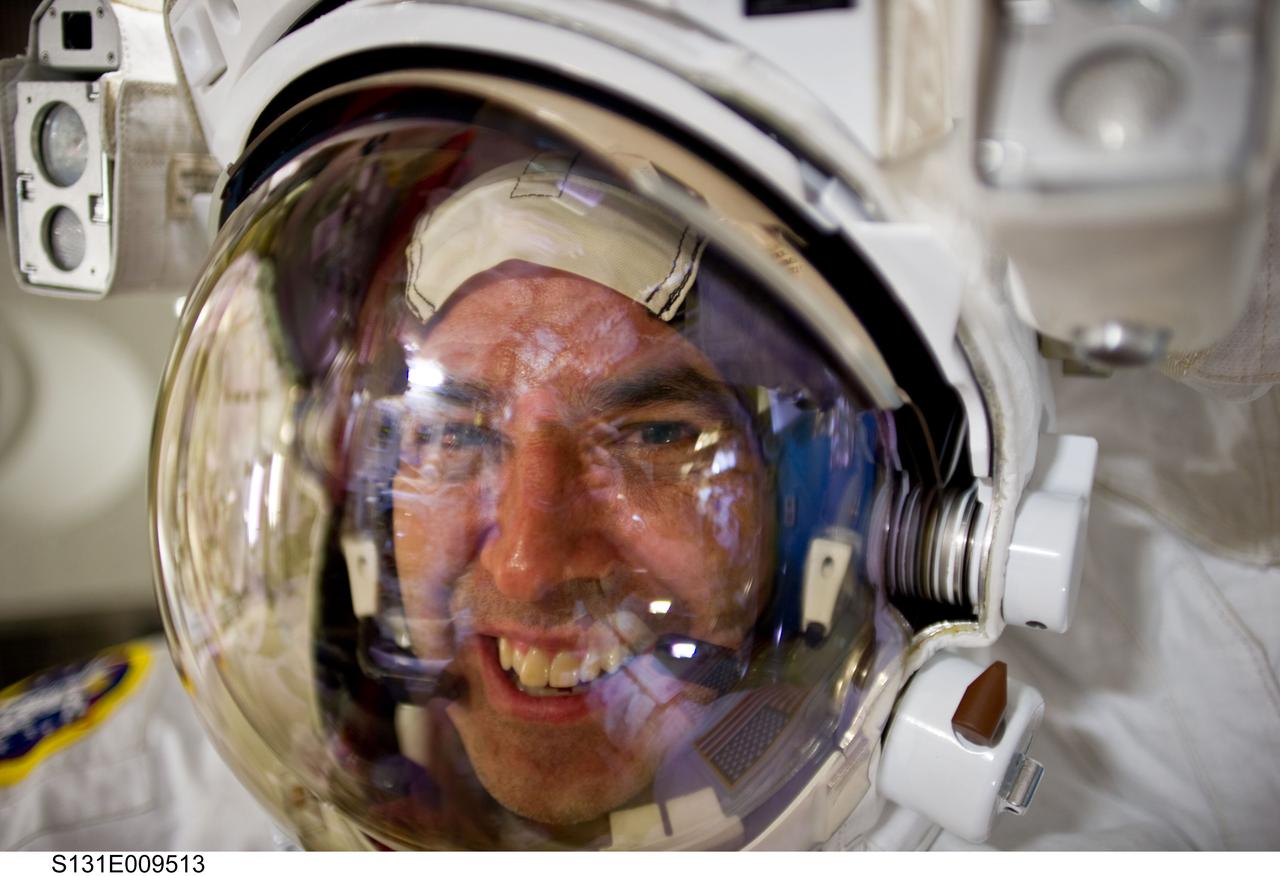
S131-E-009513 (13 April 2010) --- NASA astronaut Rick Mastracchio, STS-131 mission specialist, is pictured in the Quest airlock of the International Space Station as the mission’s third and final spacewalk draws to a close.
EMU Cleanup OPS
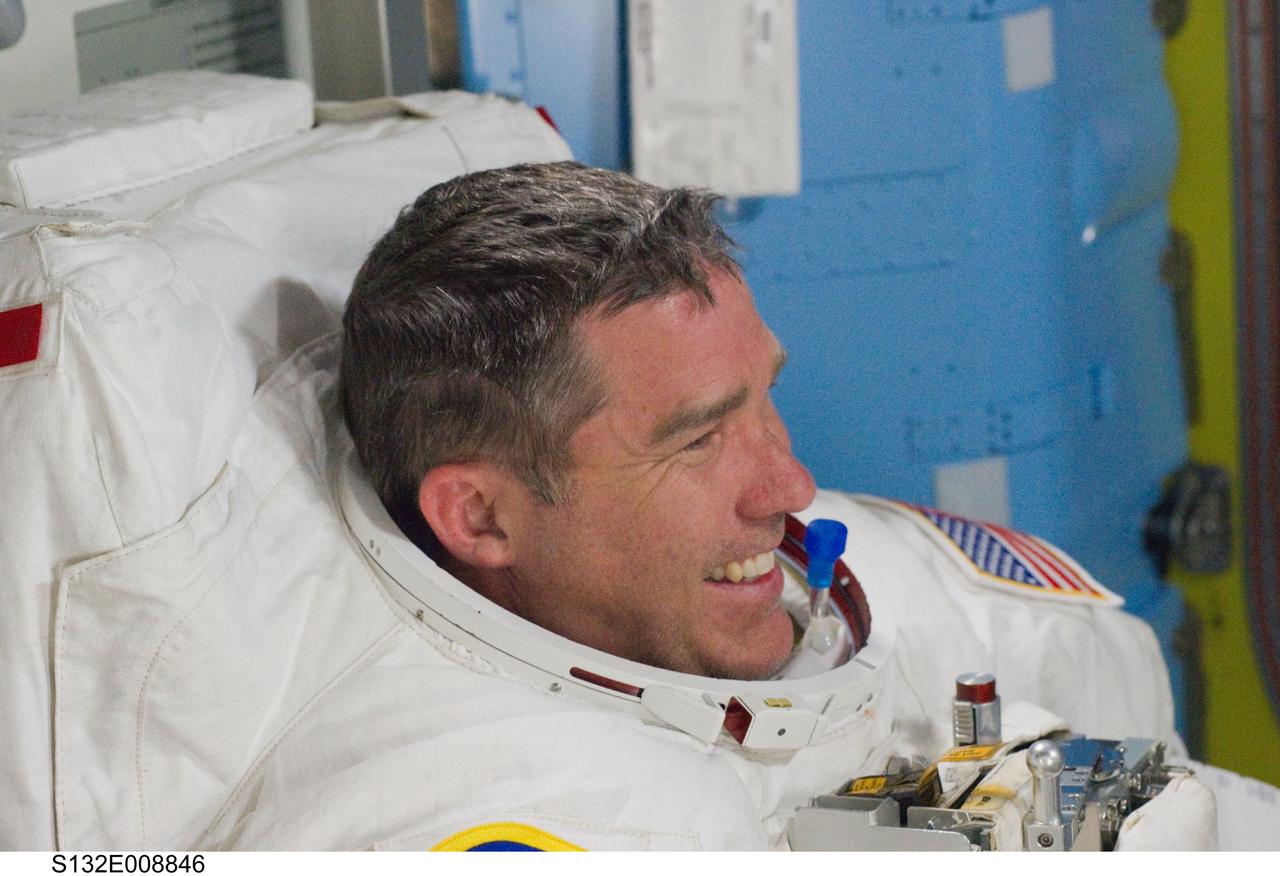
S132-E-008846 (19 May 2010) --- NASA astronaut Steve Bowen, STS-132 mission specialist, is pictured in the Quest airlock of the International Space Station as the mission’s second spacewalk draws to a close.
Bowen in the A/L during Joint Operations
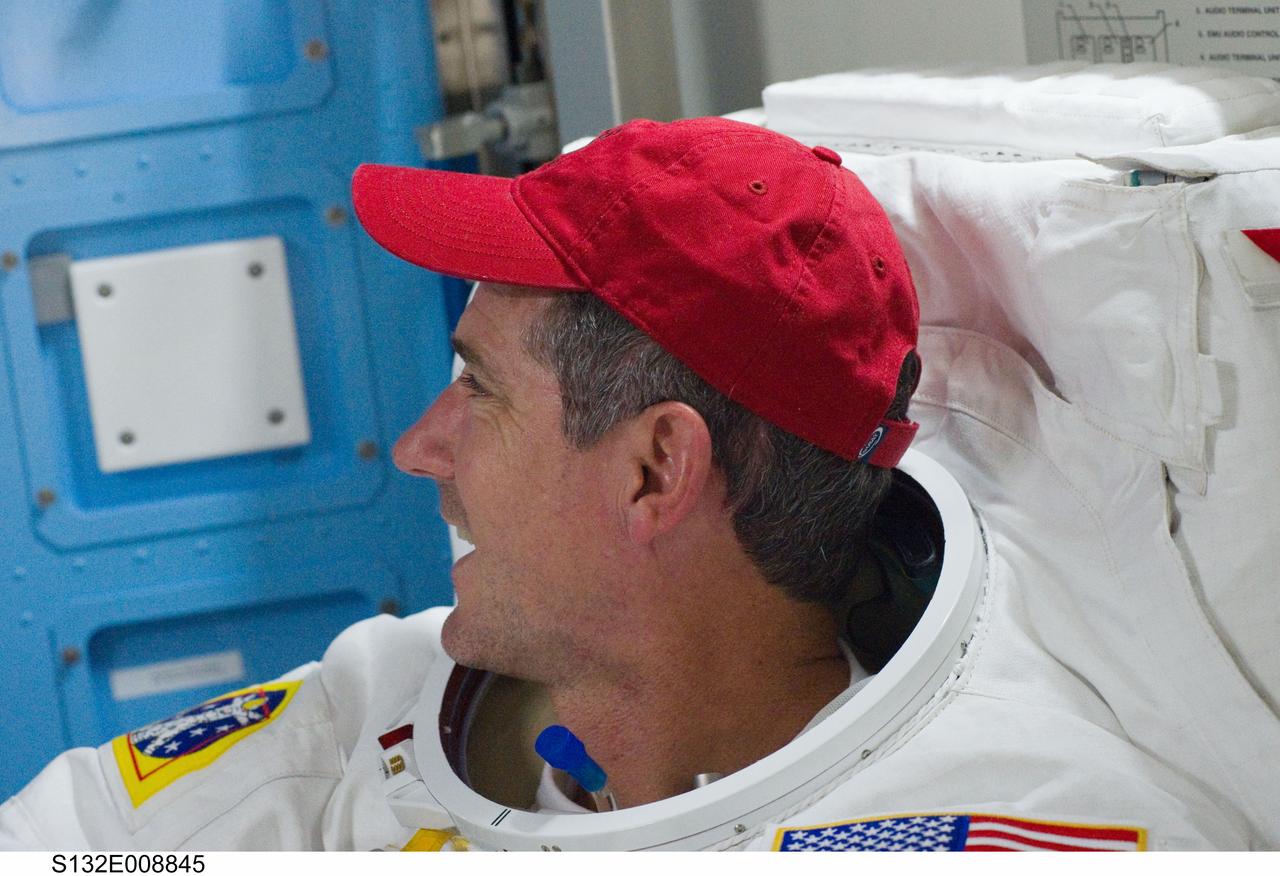
S132-E-008845 (19 May 2010) --- NASA astronaut Michael Good, STS-132 mission specialist, is pictured in the Quest airlock of the International Space Station as the mission’s second spacewalk draws to a close.
Good in the A/L during Joint Operations
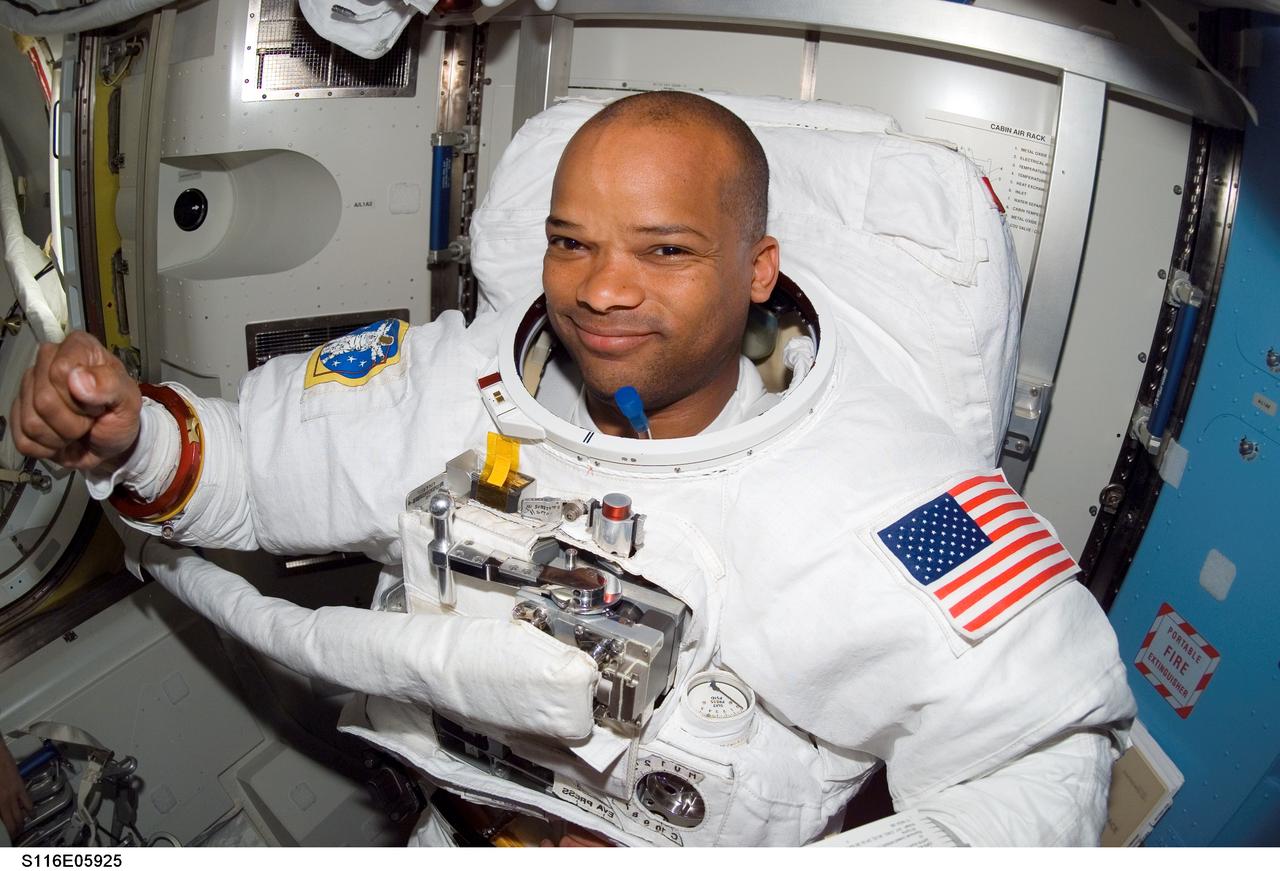
S116-E-05925 (12 Dec. 2006) --- As the mission's first spacewalk draws to a close, astronaut Robert L. Curbeam, Jr., STS-116 mission specialist, smiles for the camera in the Quest Airlock of the International Space Station.
STS-116 MS Curbeam wearing EMU in the A/L after EVA 1
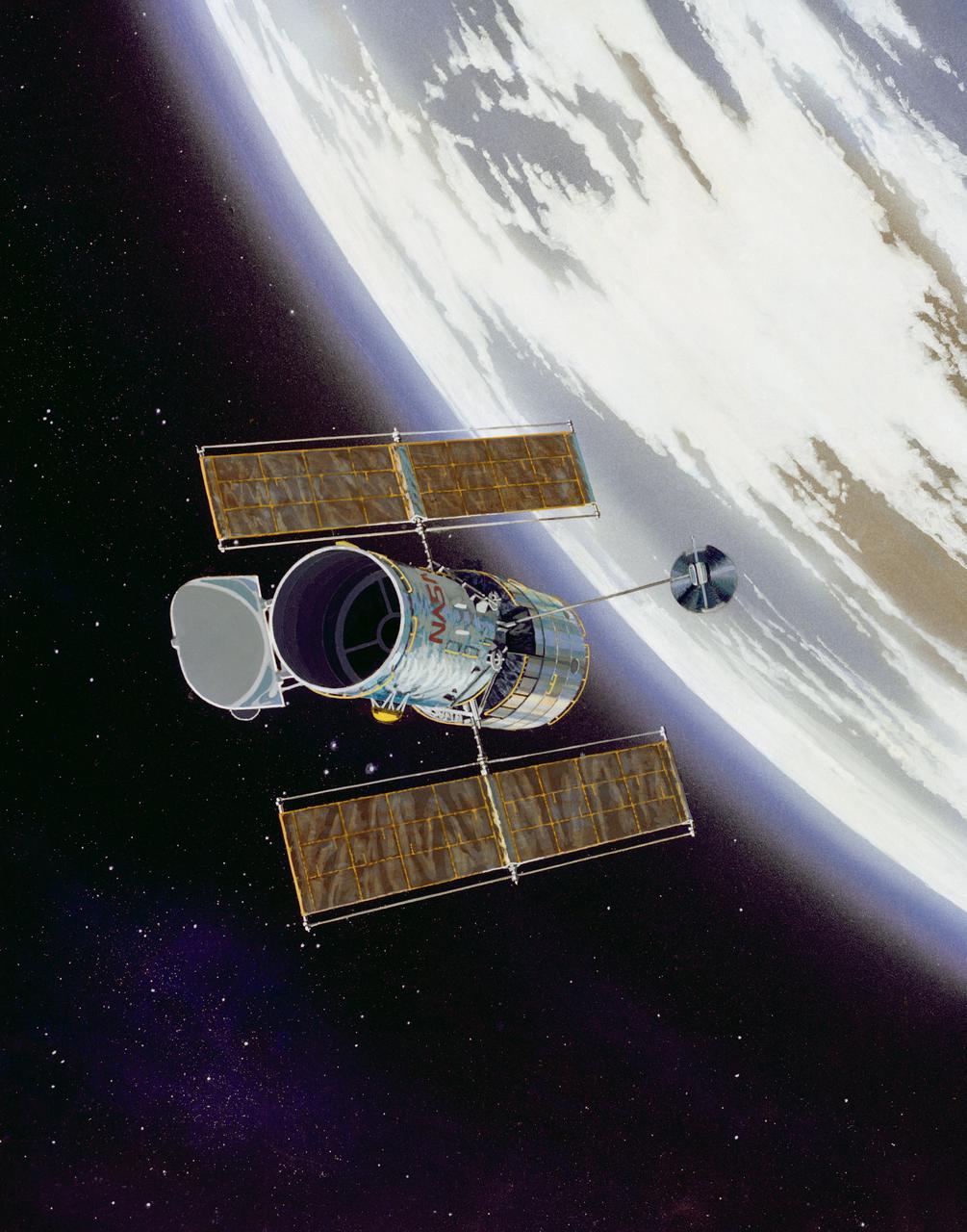
This artist concept shows the Hubble Space Telescope (HST) in operational configuration orbiting the Earth after its deploy from Discovery, Orbiter Vehicle (OV) 103 during STS-31. The high gain antennas (HGAs) and solar arrays (SAs) have been extended. HST's aperature door is open as it views the universe from a vantage point above the Earth's atmosphere. View provided by the Marshall Space Flight Center (MSFC).
Artist concept of Hubble Space Telescope (HST) orbiting Earth after deploy
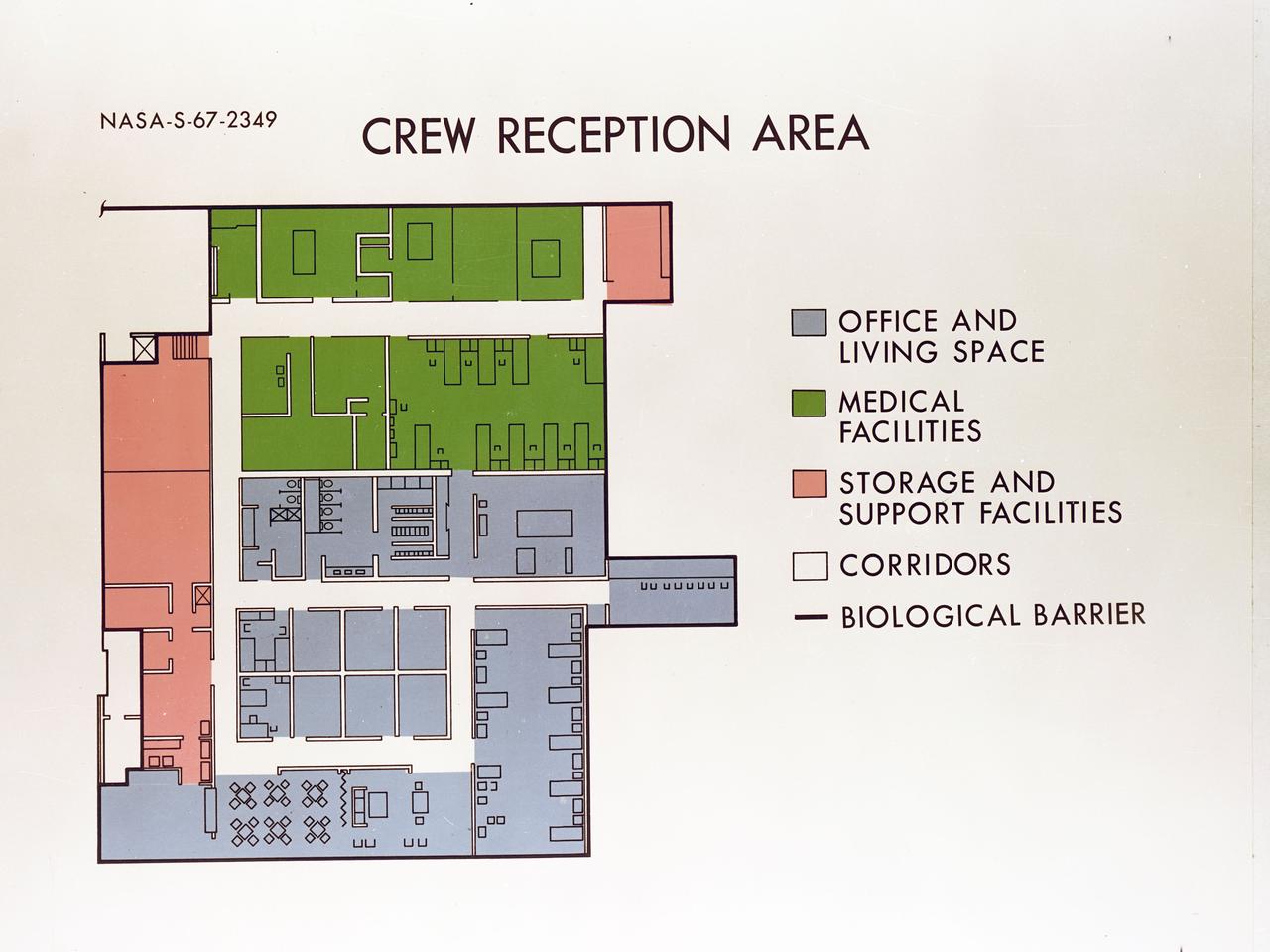
Artist's concept depicting the floor plan of the Crew Reception Area of the Lunar Receiving Laboratory (LRL), bldg 37.
Artist's concept of layout of the Crew Reception Area in the LRL
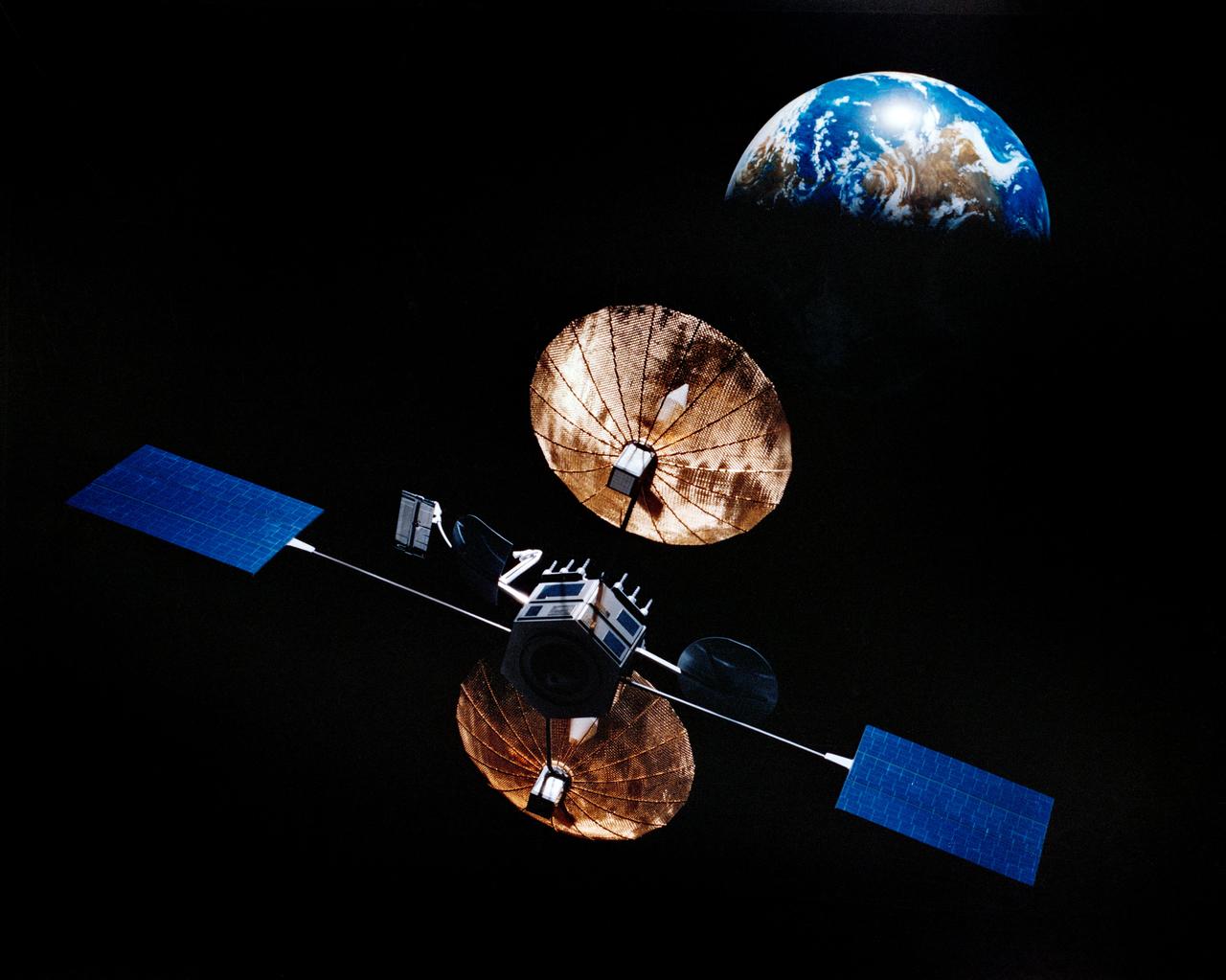
Artist concept of satellite with solar panels deployed in orbit above the earth.
Artist concept of satellite in orbit above the earth
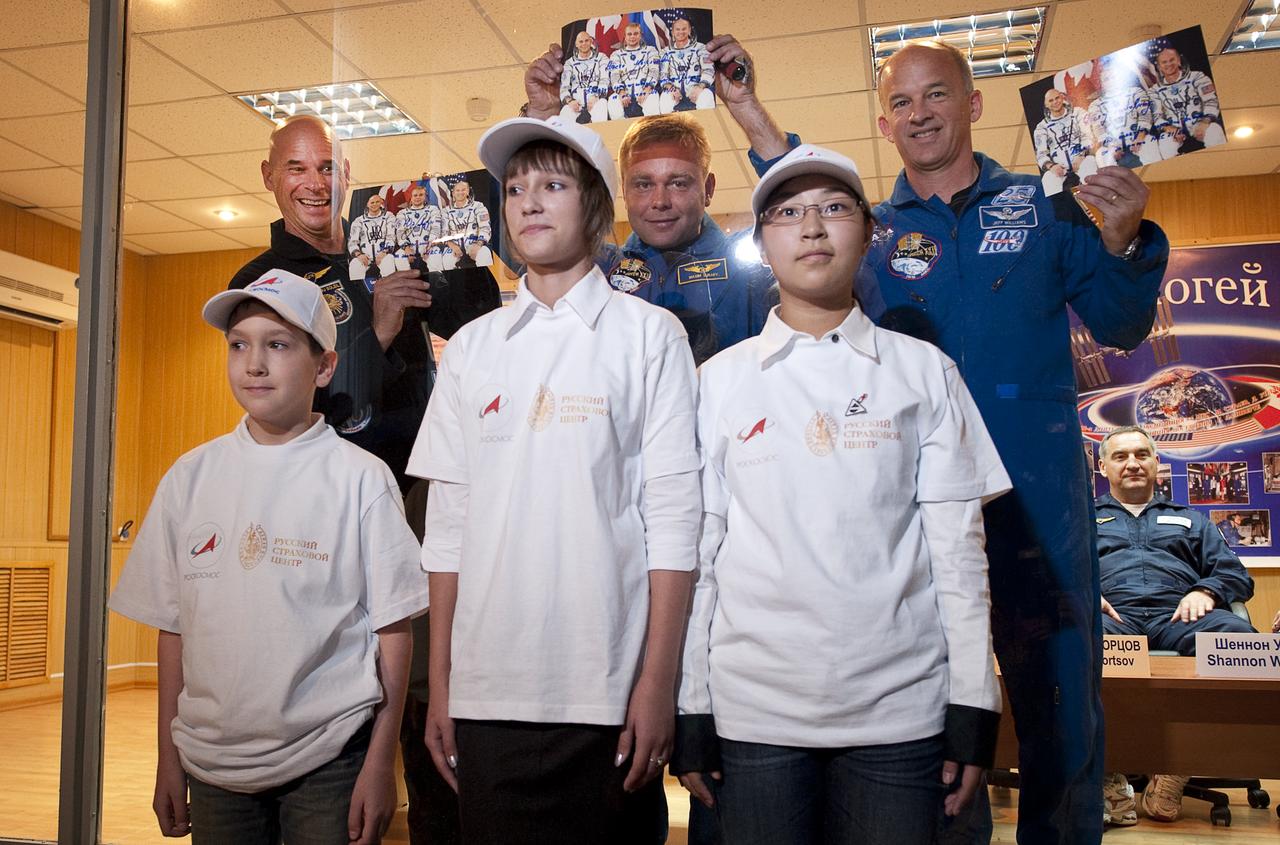
Spaceflight Participant Guy Laliberté, back left, Expedition 21 Flight Engineer Maxim Suraev, back center, Expedition 21 Flight Engineer Jeffrey N. Williams, back right, pose for a photograph with winners of a ROSCOSMOS drawing contest, Oleg Golovin, from Elektrostal, Russia, front left, Nastya Mestyashova from Orenburg, Russia, front center, and Dong Yue from China at the start of the press conference, Tuesday, Sept. 29, 2009 at the Cosmonaut Hotel in Baikonur, Kazakhstan.  Their winning drawings will be incorporated into the Expedition 22 mission patch.  Photo Credit: (NASA/Bill Ingalls)
Expedition 21 Prelaunch Press Conference
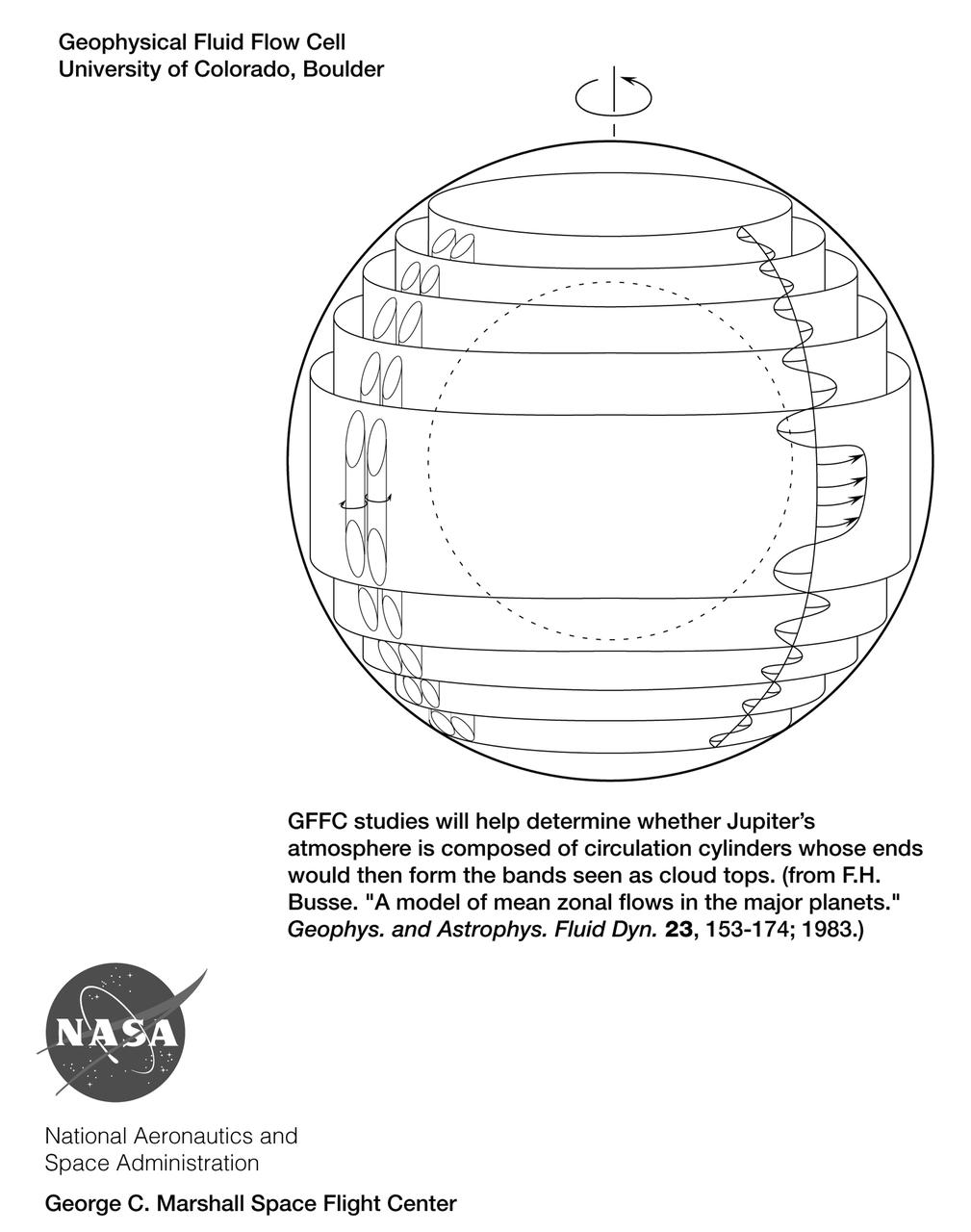
This drawing depicts one set of flow patterns simulated in the Geophysical Fluid Flow Cell (GFFC) that flew on two Spacelab missions. Silicone oil served as the atmosphere around a rotating steel hemisphere (dotted circle) and an electrostatic field pulled the oil inward to mimic gravity's effects during the experiments. The GFFC thus produced flow patterns that simulated conditions inside the atmospheres of Jupiter and the Sun and other stars. The principal investigator was John Hart of the University of Colorado at Boulder. It was managed by NASA's Marshall Space Flight Center (MSFC). An Acrobat PDF copy of this drawing is available at http://microgravity.nasa.gov/gallery. (Credit: NASA/Marshall Space Flight Center)
Microgravity
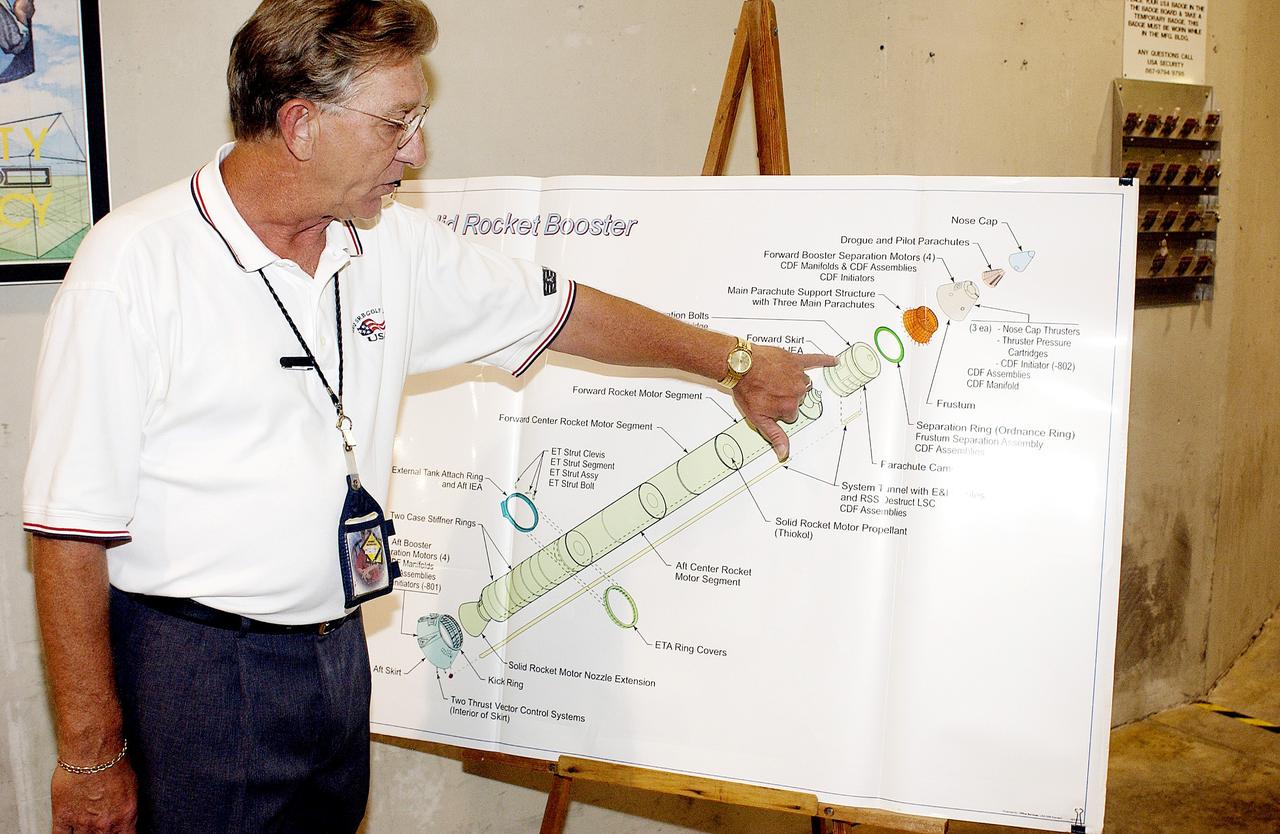
KENNEDY SPACE CENTER, FLA. - On a drawing of a solid rocket booster (SRB), Mark Northcraft, with United Space Alliance, points to the spot where a parachute camera will be installed, on the forward skirt of the SRB.  The work is being done in the Solid Rocket Booster Assembly and Refurbishment Facility, which routinely carries out refurbishment and subassembly of Shuttle SRB hardware.
KENNEDY SPACE CENTER, FLA. - On a drawing of a solid rocket booster (SRB), Mark Northcraft, with United Space Alliance, points to the spot where a parachute camera will be installed, on the forward skirt of the SRB. The work is being done in the Solid Rocket Booster Assembly and Refurbishment Facility, which routinely carries out refurbishment and subassembly of Shuttle SRB hardware.
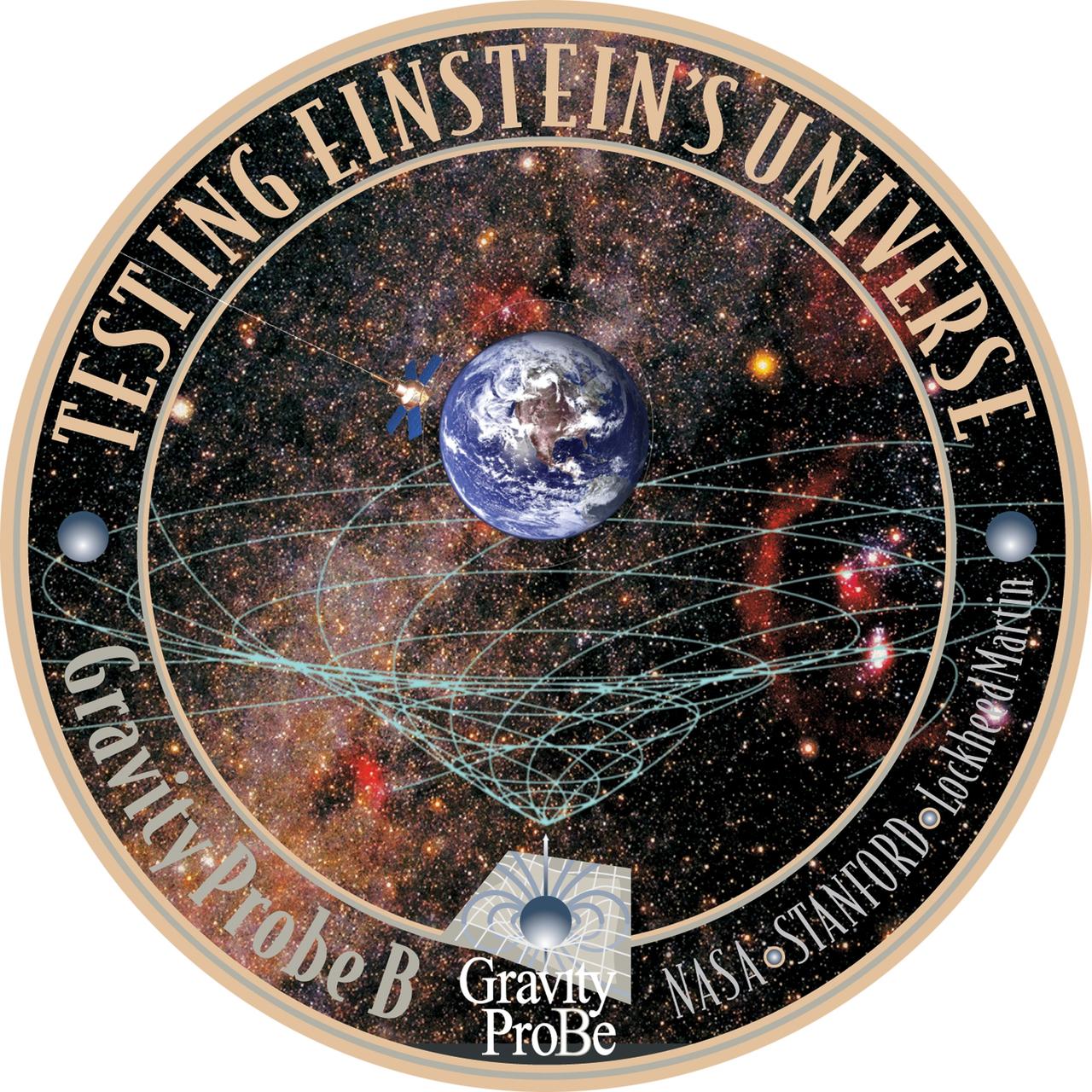
KENNEDY SPACE CENTER, FLA.  - This seal illustrates the mission of the Gravity Probe B spacecraft and the organizations who developed the experiment: Stanford University, NASA’s Marshall Space Flight Center and Lockheed Martin.  The Gravity Probe B mission will test the theory of curved spacetime and "frame-dragging," depicted graphically in the lower half, that was developed by Einstein and other scientists.   Above the graphic is a drawing of GP-B circling the Earth.
KENNEDY SPACE CENTER, FLA. - This seal illustrates the mission of the Gravity Probe B spacecraft and the organizations who developed the experiment: Stanford University, NASA’s Marshall Space Flight Center and Lockheed Martin. The Gravity Probe B mission will test the theory of curved spacetime and "frame-dragging," depicted graphically in the lower half, that was developed by Einstein and other scientists. Above the graphic is a drawing of GP-B circling the Earth.
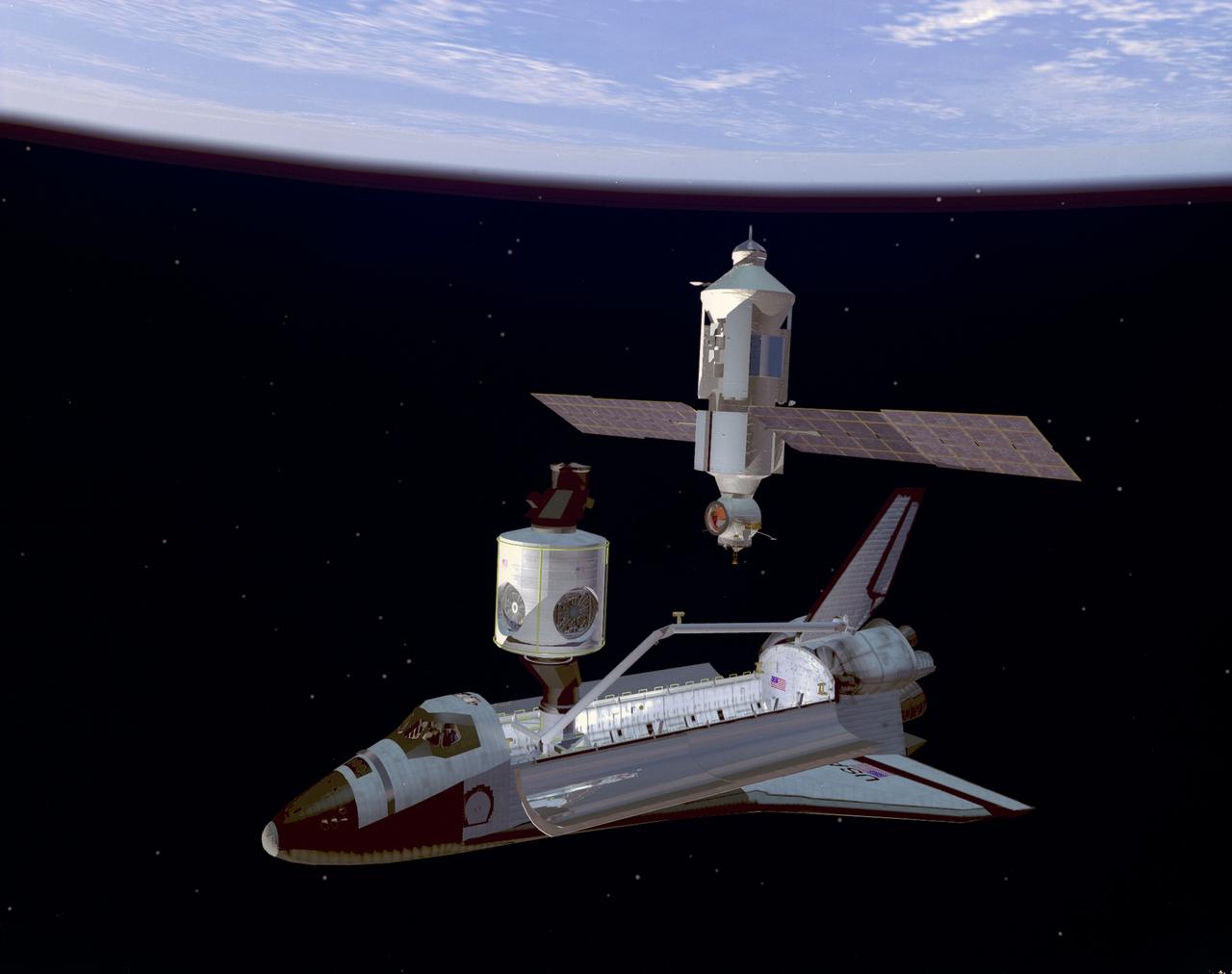
S98-04904 (21 July 1997) --- The Space Shuttle Endeavour prepares to capture the Functional Cargo Block (FGB) using the shuttle's mechanical arm in this artist's depiction of the first Space Shuttle assembly flight for the International Space Station (ISS), mission STS-88 scheduled to launch in December 1998.  The shuttle will carry the first United States-built component for the station, a connecting module called Node 1 or Unity, and attach it to the already orbiting FGB, which supplies early electrical power and propulsion.  The FGB, Zarya, will have been launched about two weeks earlier on a Russian Proton rocket from the Baikonur Cosmodrome, Kazahkstan.  Once the FGB is captured using the mechanical arm, astronaut Nancy J. Currie will maneuver the arm to dock the FGB to the conical mating adapter at the top of Node 1 in the Shuttle's cargo bay.  In ensuing days, three Extravehicular Activity?s (EVA) by astronauts Jerry L. Ross and James H. Newman will be performed to make power, data and utility connections between the two modules.
Art concept, line drawing and Service Module of the ISS
S63-12019 (1963) --- Artist concept for Gemini parasail deployment showing re-entry, drogue chute deployment, and stages of parasail deployment.
CHART - LINE DRAWING - GEMINI PARASAIL DEPLOYMENT
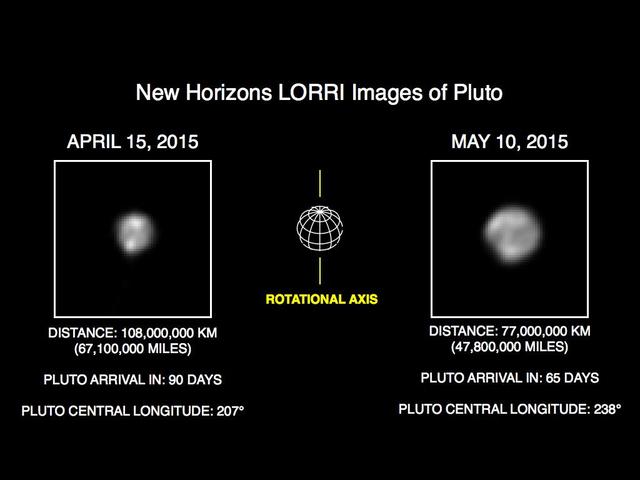
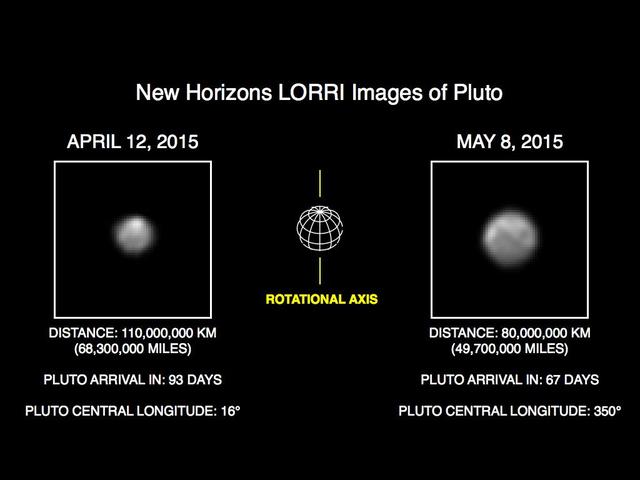
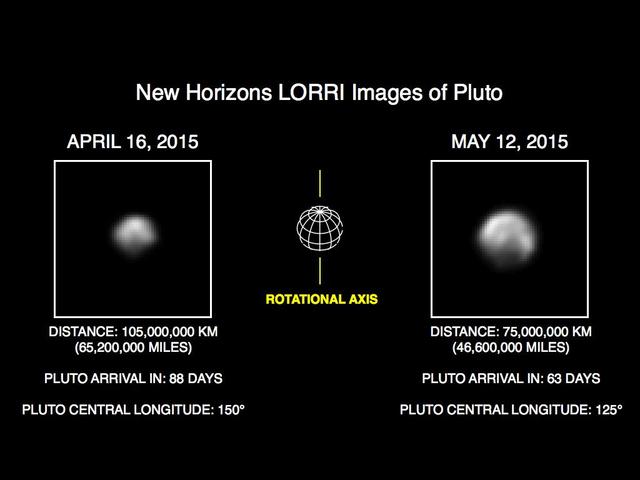
This image of Pluto is part of series of New Horizons Long Range Reconnaissance Imager LORRI photos taken May 8-12, 2015; the image at left shows LORRI view of Pluto just one month earlier.
More Detail as New Horizons Draws Closer
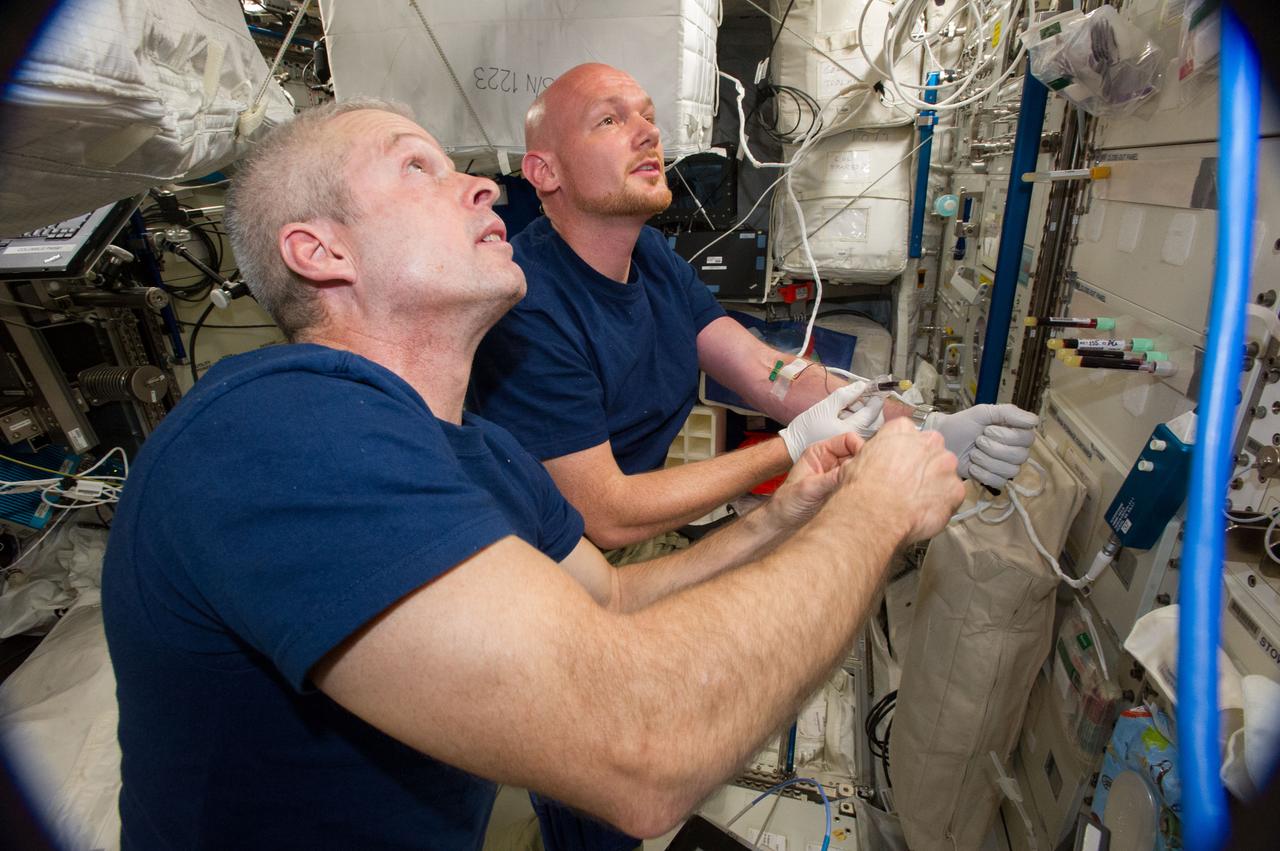
Astronaut Alexander Gerst,Expedition 40 flight engineer (background),and Expedition 40 Commander Steve Swanson are photographed performing blood sample collection in the Columbus module as part of HRF Generic Frozen Blood Collection Operations.
Gerst and Swanson perform blood draw in Columbus module
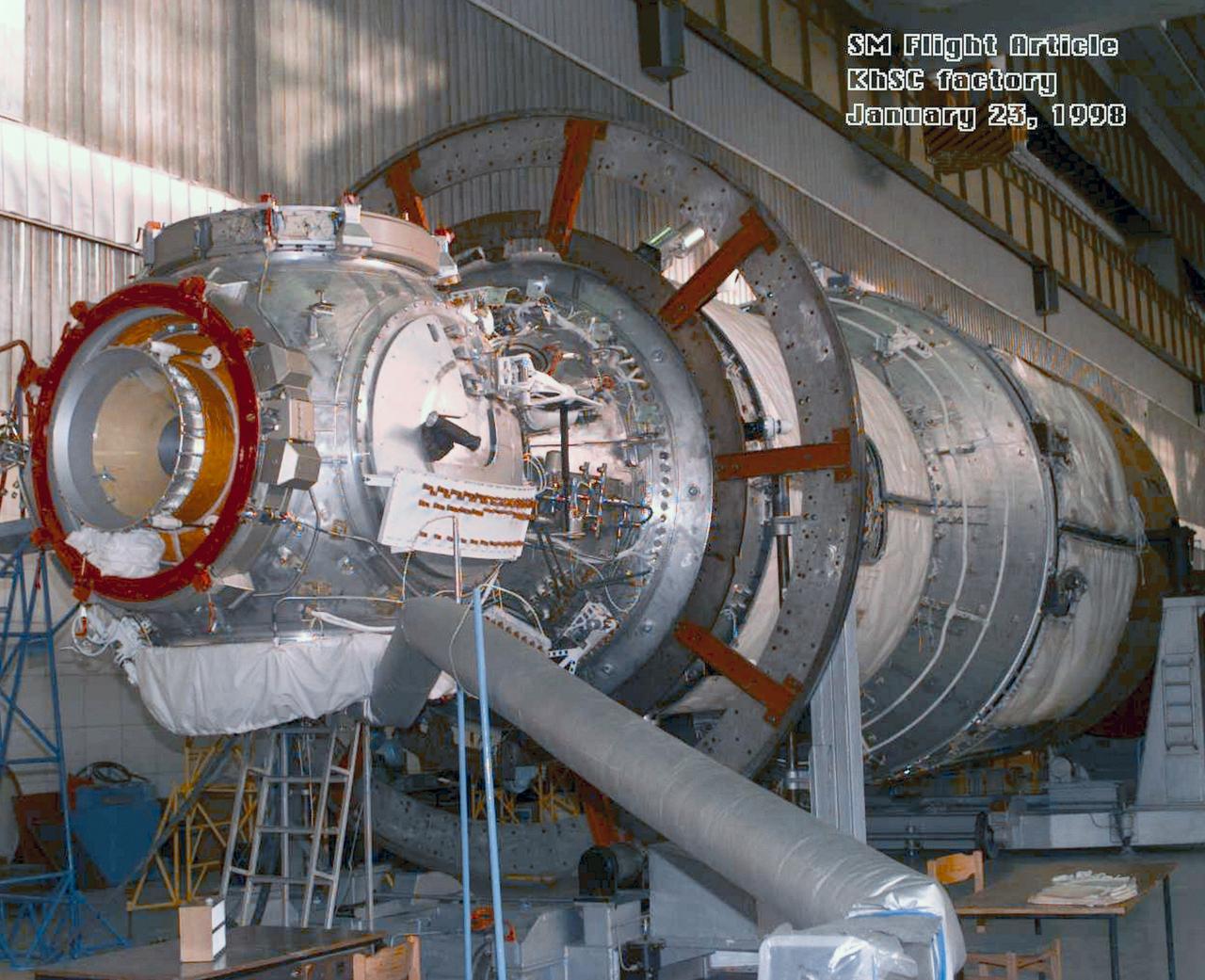
S98-04906 (23 Jan. 1998) --- A three-quarter frontal view of the flight article of the Service Module (SM) for the International Space Station (ISS).  The first fully Russian contribution to ISS, the SM will provide early power, propulsion, life support, communications and living quarters for the station. It will be the third station element to be launched and join the United States-funded, Russian-built Functional Cargo Block (FGB) and the United States connecting module Node 1 in orbit.
Art concept, line drawing and Service Module of the ISS
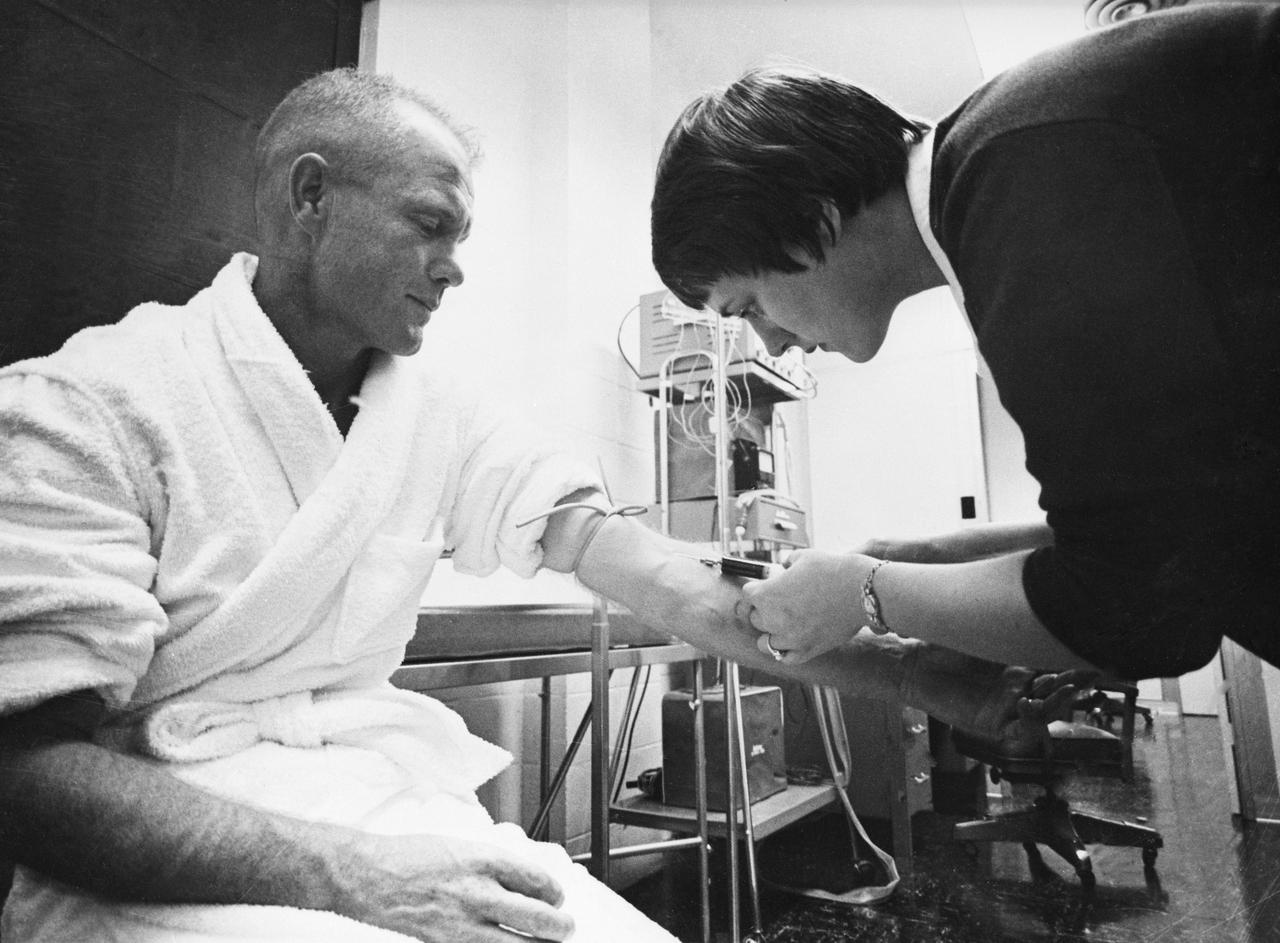
S61-02579 (1961) --- Astronaut nurse Delores B. O'Hara, R.N., in the Aeromedical Laboratory at Cape Canaveral, Florida, takes a blood sample from Mercury astronaut John H. Glenn Jr. Photo credit: NASA
Astronaut John Glenn - Blood Draw - Training - Cape
This image of Pluto is part of series of New Horizons Long Range Reconnaissance Imager LORRI photos taken May 8-12, 2015; the image at left shows LORRI view of Pluto just one month earlier.
More Detail as New Horizons Draws Closer
This image of Pluto is part of series of New Horizons Long Range Reconnaissance Imager LORRI photos taken May 8-12, 2015; the image at left shows LORRI view of Pluto just one month earlier.
More Detail as New Horizons Draws Closer
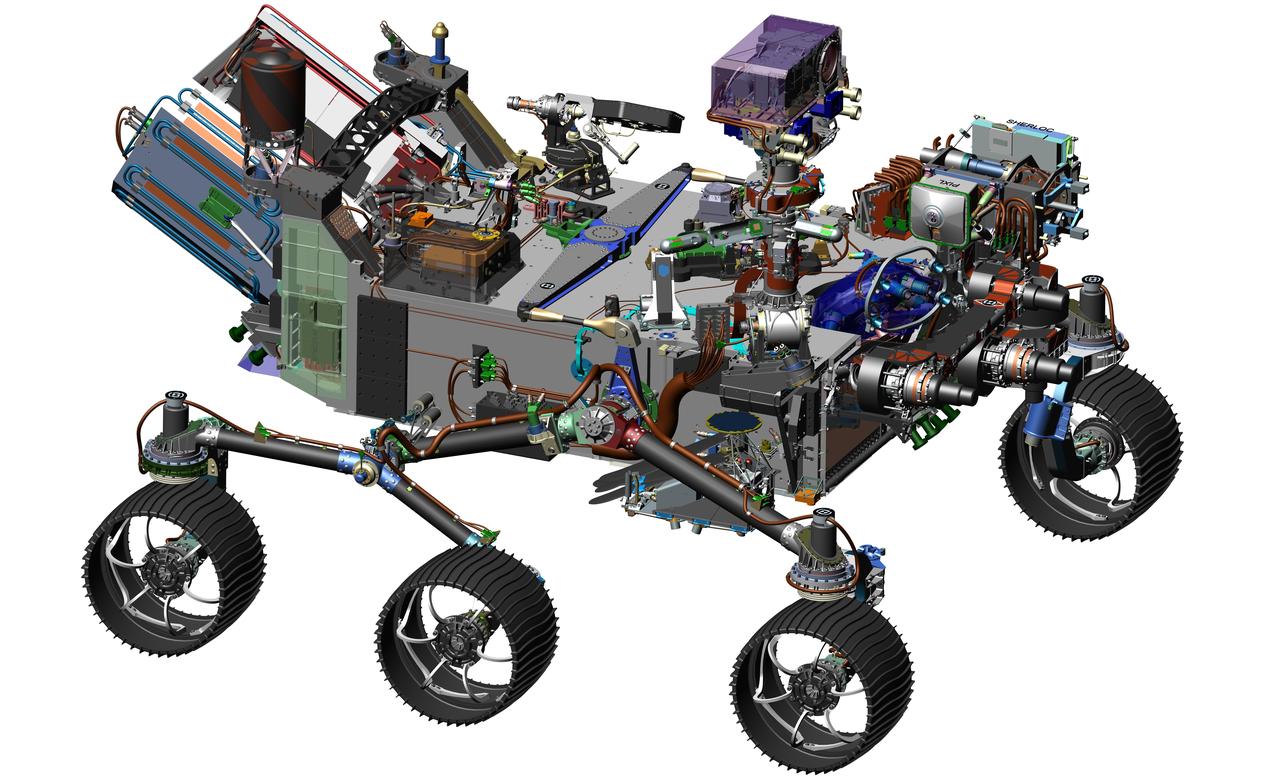
NASA's 2020 Mars rover mission will go to a region of Mars thought to have offered favorable conditions long ago for microbial life, and the rover will search for signs of past life there. It will also collect and cache samples for potential return to Earth, for many types of laboratory analysis. As a pioneering step toward how humans on Mars will use the Red Planet's natural resources, the rover will extract oxygen from the Martian atmosphere.  This 2016 image comes from computer-assisted-design work on the 2020 rover. The design leverages many successful features of NASA's Curiosity rover, which landed on Mars in 2012, but it adds new science instruments and a sampling system to carry out the new goals for the mission.  http://photojournal.jpl.nasa.gov/catalog/PIA20759
Computer-Design Drawing for NASA 2020 Mars Rover