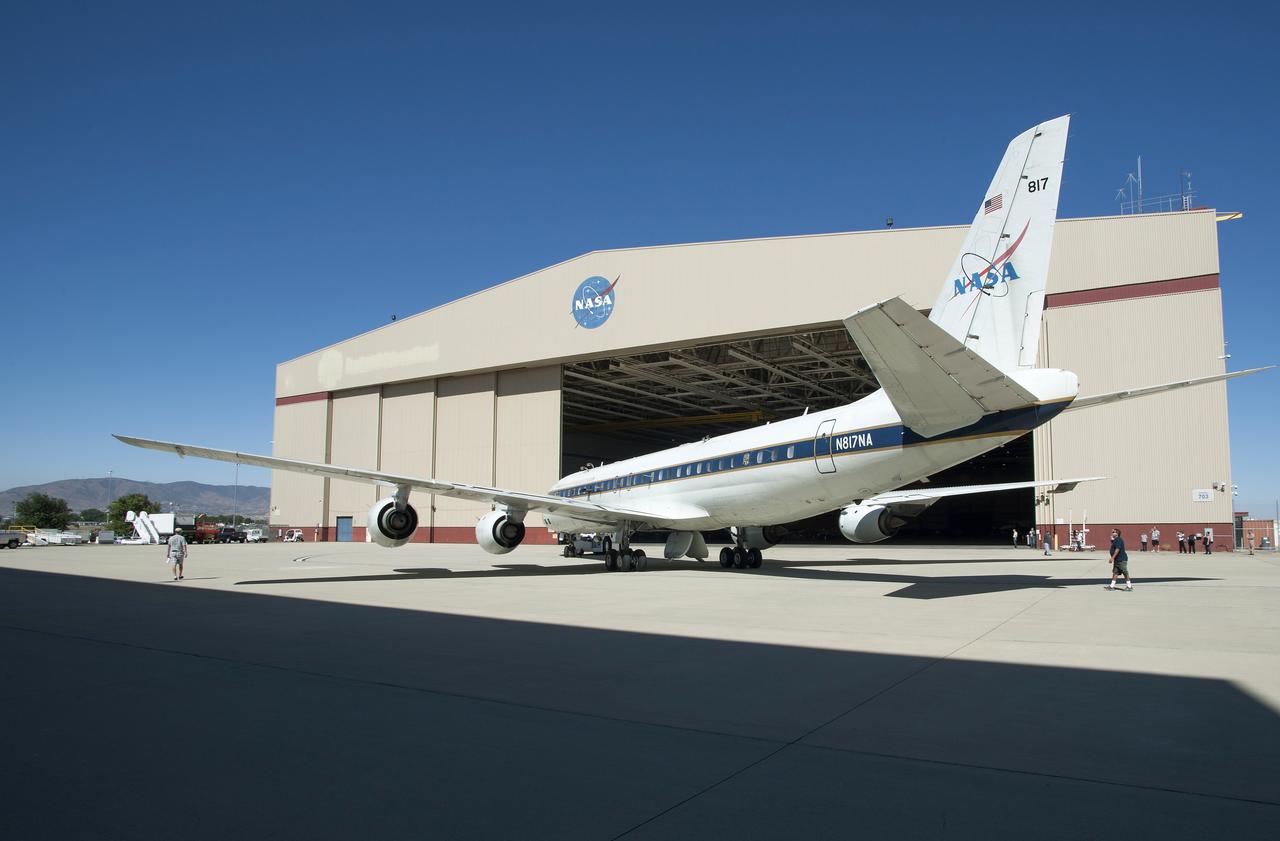
Media observe as ground crews tow NASA’s DC-8 airborne laboratory into its Palmdale, California hangar.
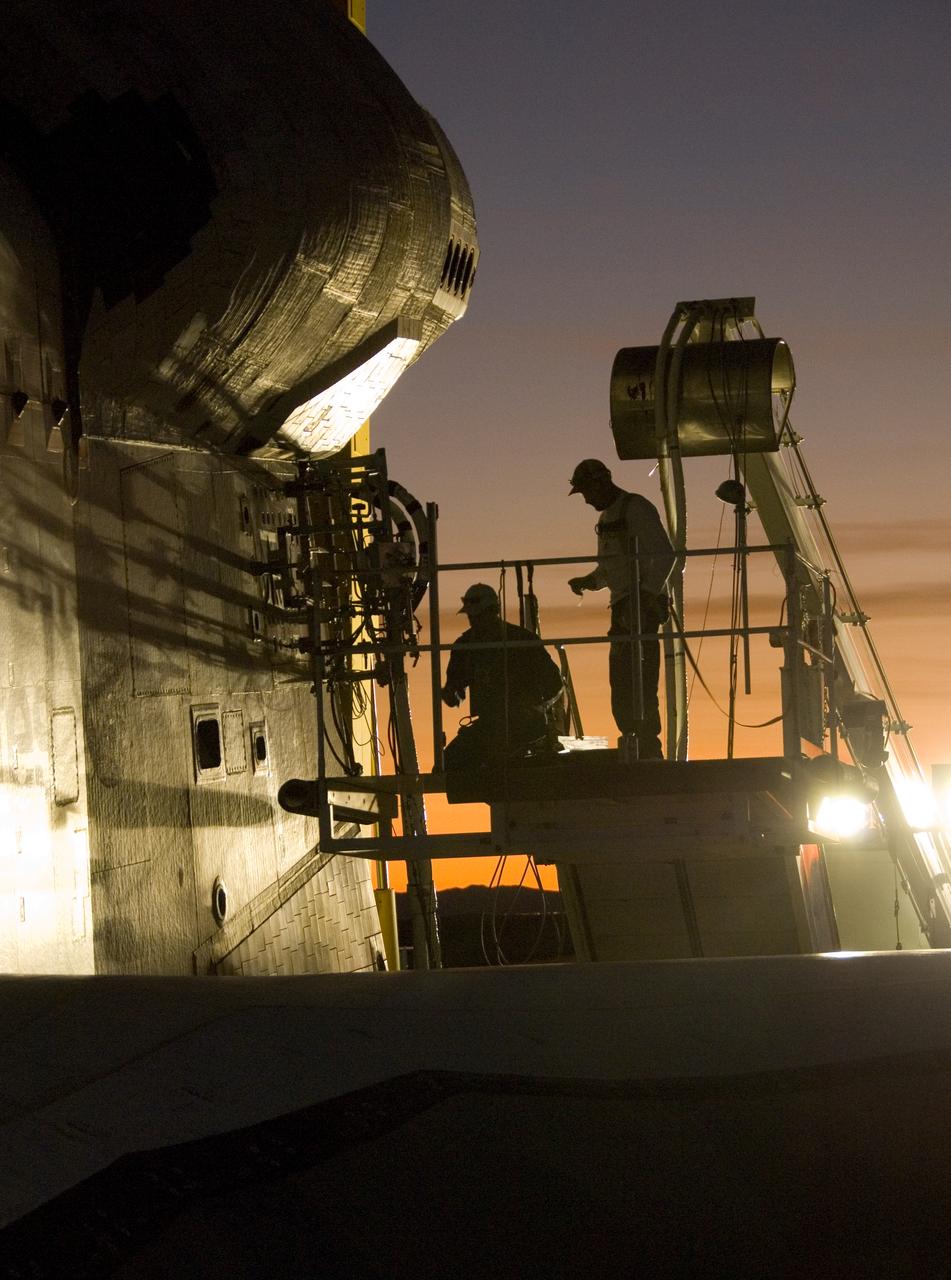
As dusk settles over Edwards Air Force Base, NASA technicians hook up various ground-support systems before shuttle Endeavour is towed off the landing runway.
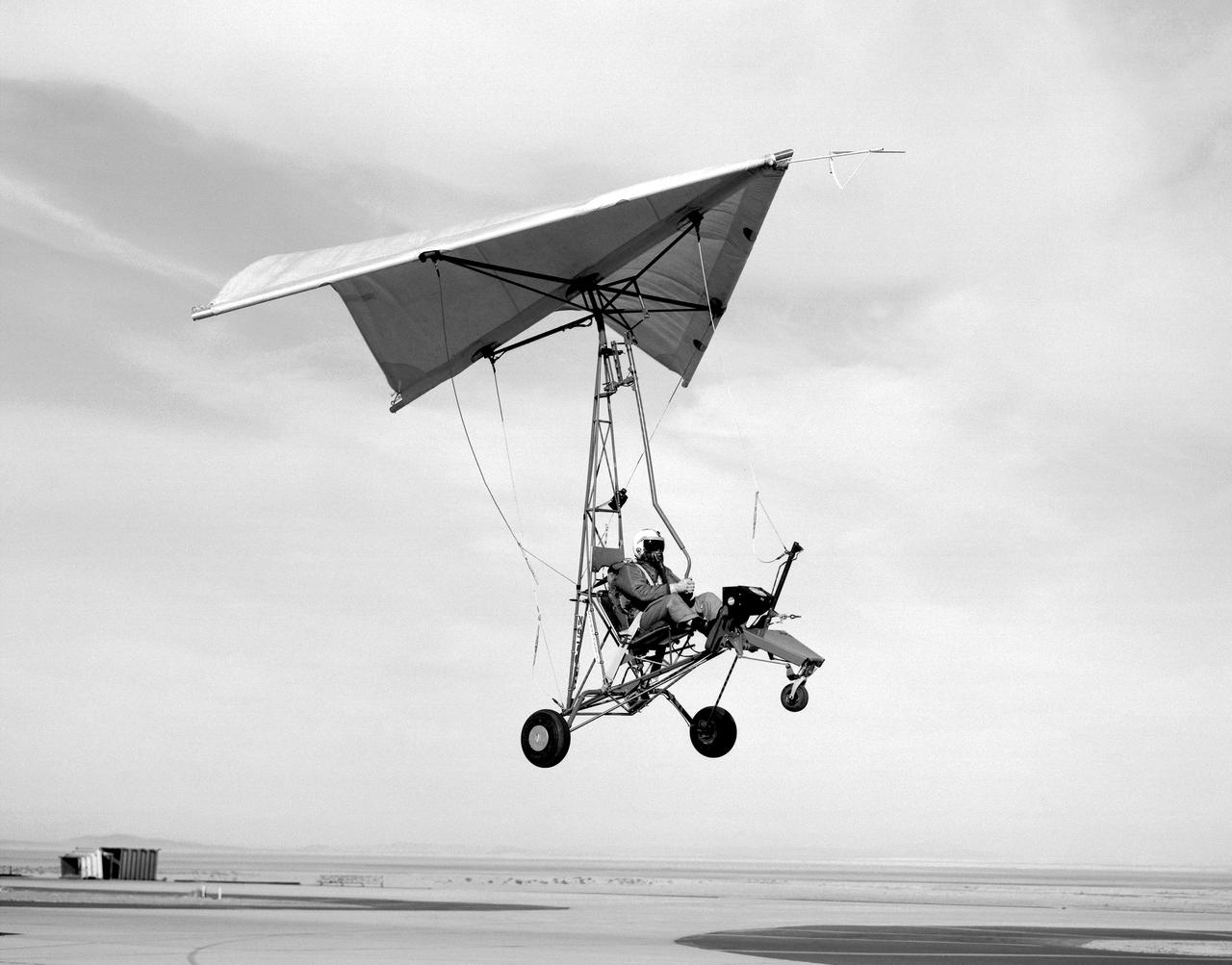
Pilot and Paresev 1 preparing for a landing on the Rogers dry lakebed in 1962 at Edwards Air Force Base, California. The flight program began with ground tow tests. Several tows were made before liftoff was attempted to check the control rigging and to familiarize the pilot with the vehicle’s ground stability. As the pilot’s confidence and experience increased, tow speeds were also increased until liftoff was attained. Liftoff was at about 40 knots indicated airspeed (kias).
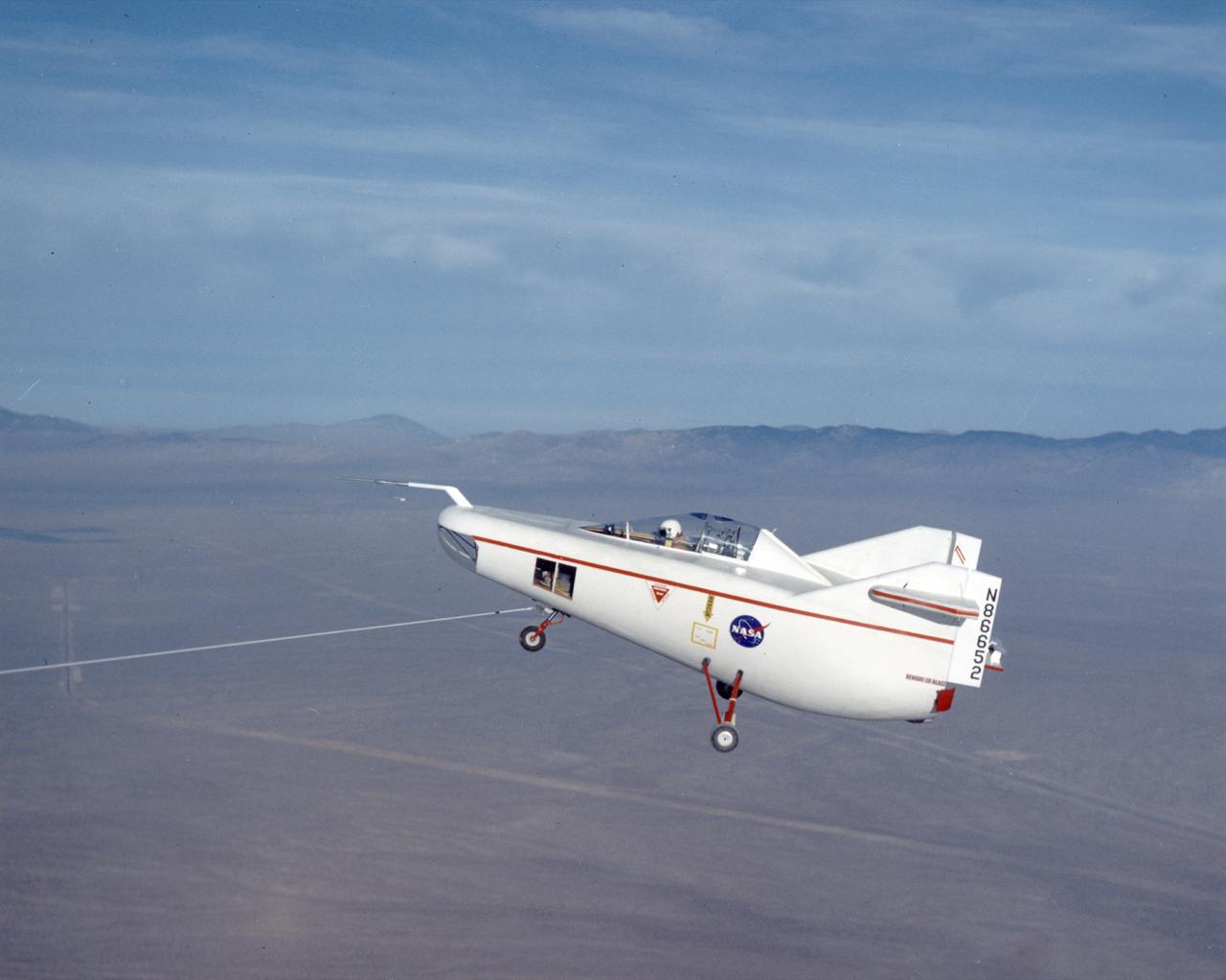
After initial ground-tow flights of the M2-F1 using the Pontiac as a tow vehicle, the way was clear to make air tows behind a C-47. The first air tow took place on 16 August 1963. Pilot Milt Thompson found that the M2-F1 flew well, with good control. This first flight lasted less than two minutes from tow-line release to touchdown. The descent rate was 4,000 feet per minute.
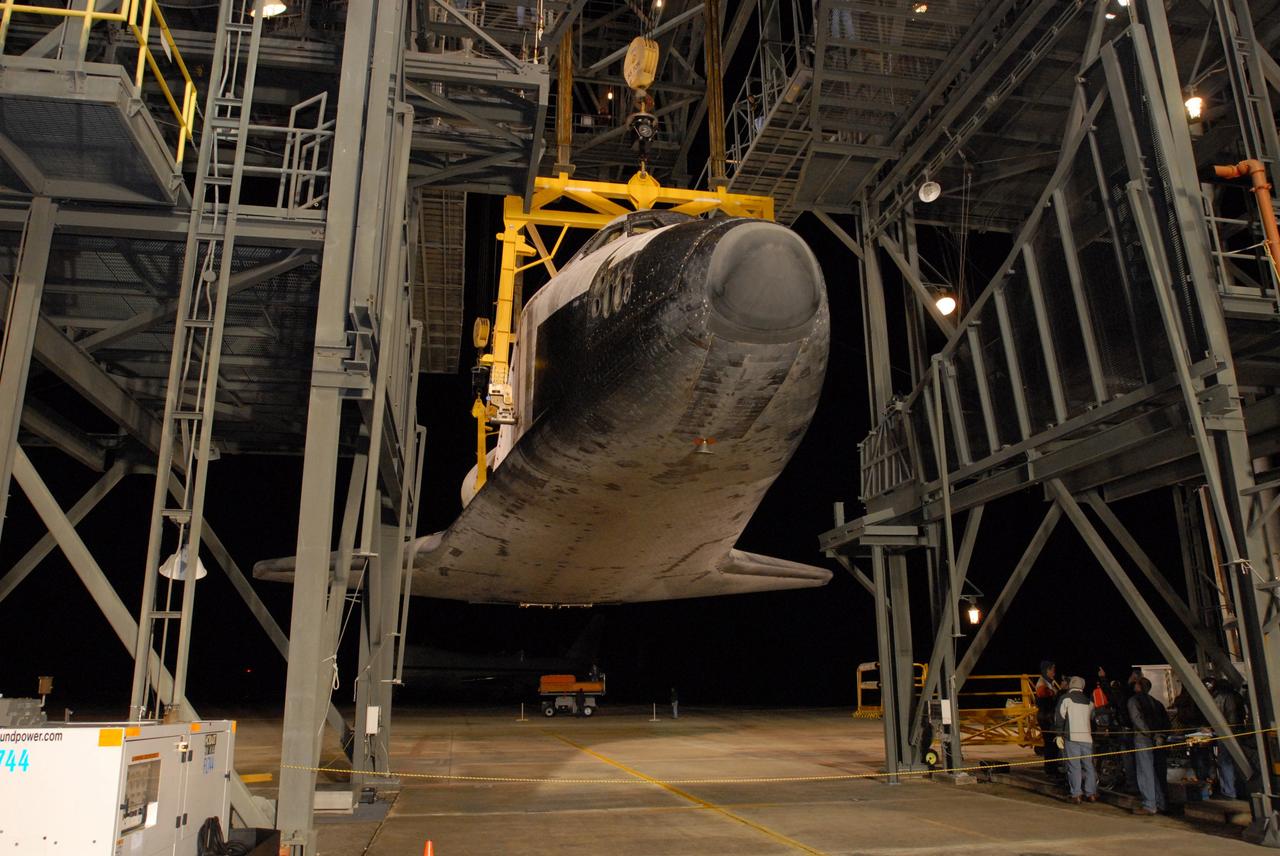
CAPE CANAVERAL, Fla. -- Before dawn, at the Shuttle Landing Facility, or SLF, at NASA's Kennedy Space Center in Florida, space shuttle Endeavour is lowered toward the ground by the sling in the mate/demate device. After Endeavour is on the ground, it will be towed via the two-mile tow-way from the SLF by a diesel-powered tractor to the Orbiter Processing Facility where it will begin preparations for its next mission, STS-127, targeted for May 2009. Photo credit: NASA/Jim Grossmann
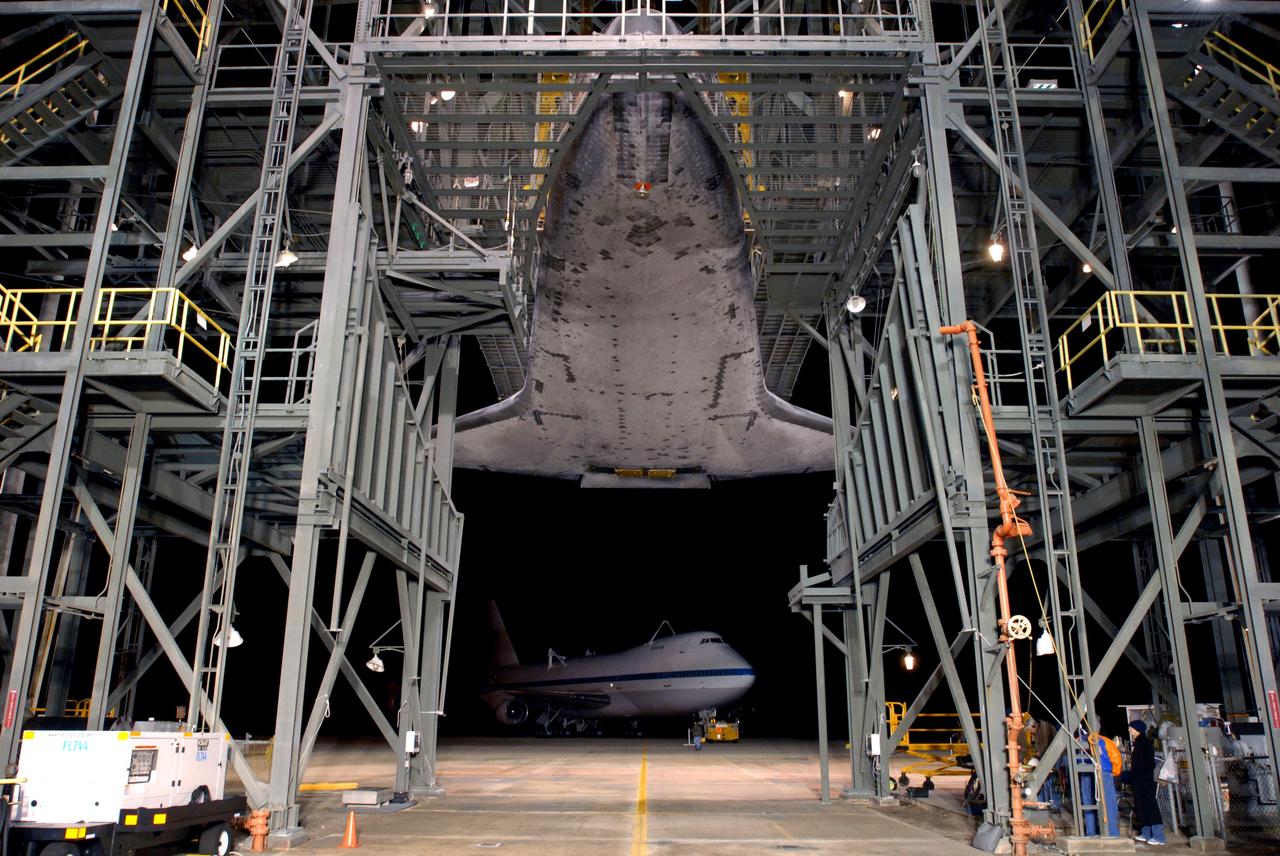
CAPE CANAVERAL, Fla. -- Before dawn, at the Shuttle Landing Facility, or SLF, at NASA's Kennedy Space Center in Florida, space shuttle Endeavour is lowered toward the ground by the sling in the mate/demate device. Visible on Endeavour is the tail cone that covers and protects the main engines during the ferry flight. After Endeavour is on the ground, it will be towed via the two-mile tow-way from the SLF by a diesel-powered tractor to the Orbiter Processing Facility where it will begin preparations for its next mission, STS-127, targeted for May 2009. Photo credit: NASA/Jim Grossmann
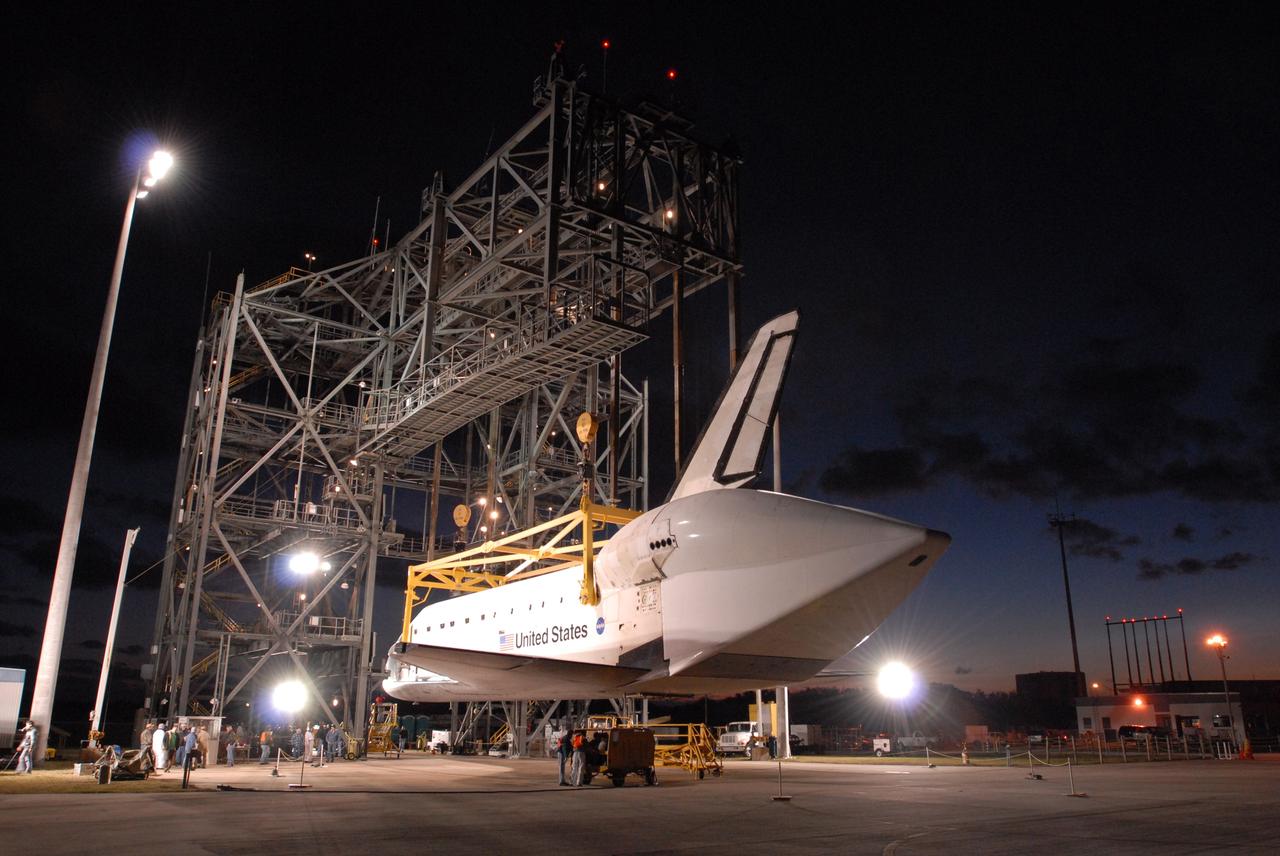
CAPE CANAVERAL, Fla. -- Before dawn, at the Shuttle Landing Facility, or SLF, at NASA's Kennedy Space Center in Florida, space shuttle Endeavour is suspended by a sling under the mate/demate device. The shuttle carrier aircraft, or SCA, has rolled away. Endeavour will be lowered onto the ground. The SCA carried the shuttle piggyback from California, where Endeavour landed Nov. 30 to end the STS-126 mission. After Endeavour is on the ground, it will be towed via the two-mile tow-way from the SLF by a diesel-powered tractor to the Orbiter Processing Facility where it will begin preparations for its next mission, STS-127, targeted for May 2009. Photo credit: NASA/Jim Grossmann
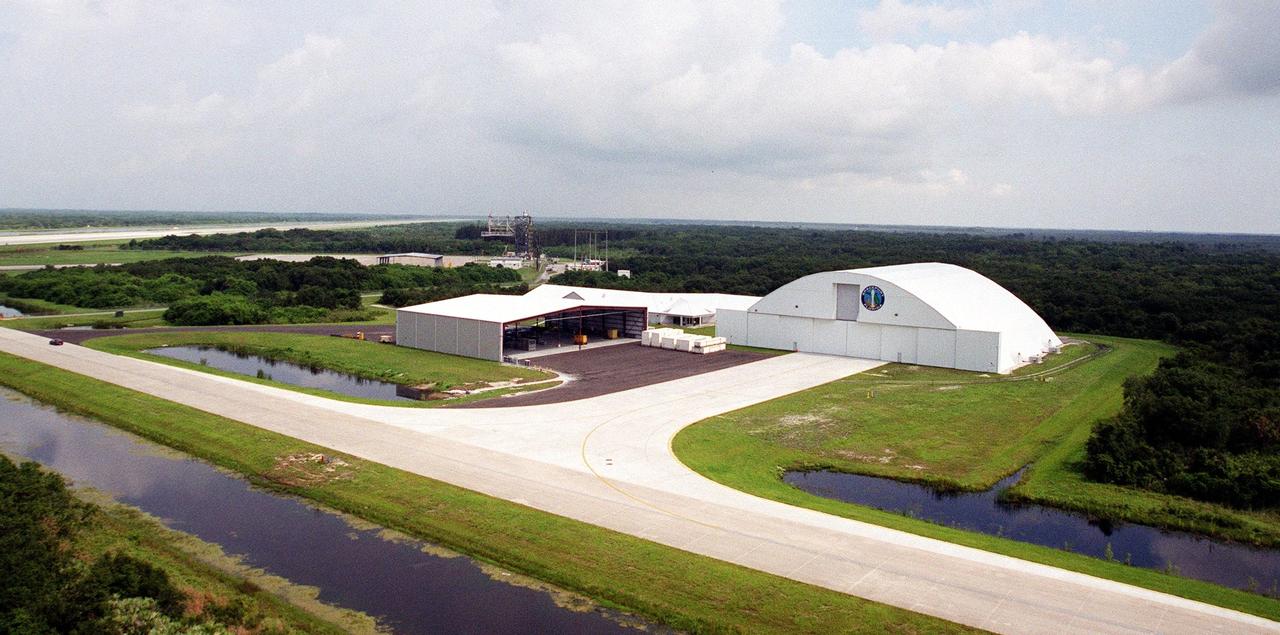
KENNEDY SPACE CENTER, Fla. -- An aerial view shows in the foreground the recently completed Reusable Launch Vehicle (RLV) Support Complex. Located on the tow-way at the south end of the Shuttle Landing Facility, the complex includes a multi-purpose RLV hangar (right) and adjacent facilities for related ground support equipment and administrative/technical support. The gate to the SLF is at the end of the tow-way to the left. The SLF runway is on the left horizon. At the other end can be seen the mate/demate device, with the office building below it. A drainage canal lies on either side of the tow-way
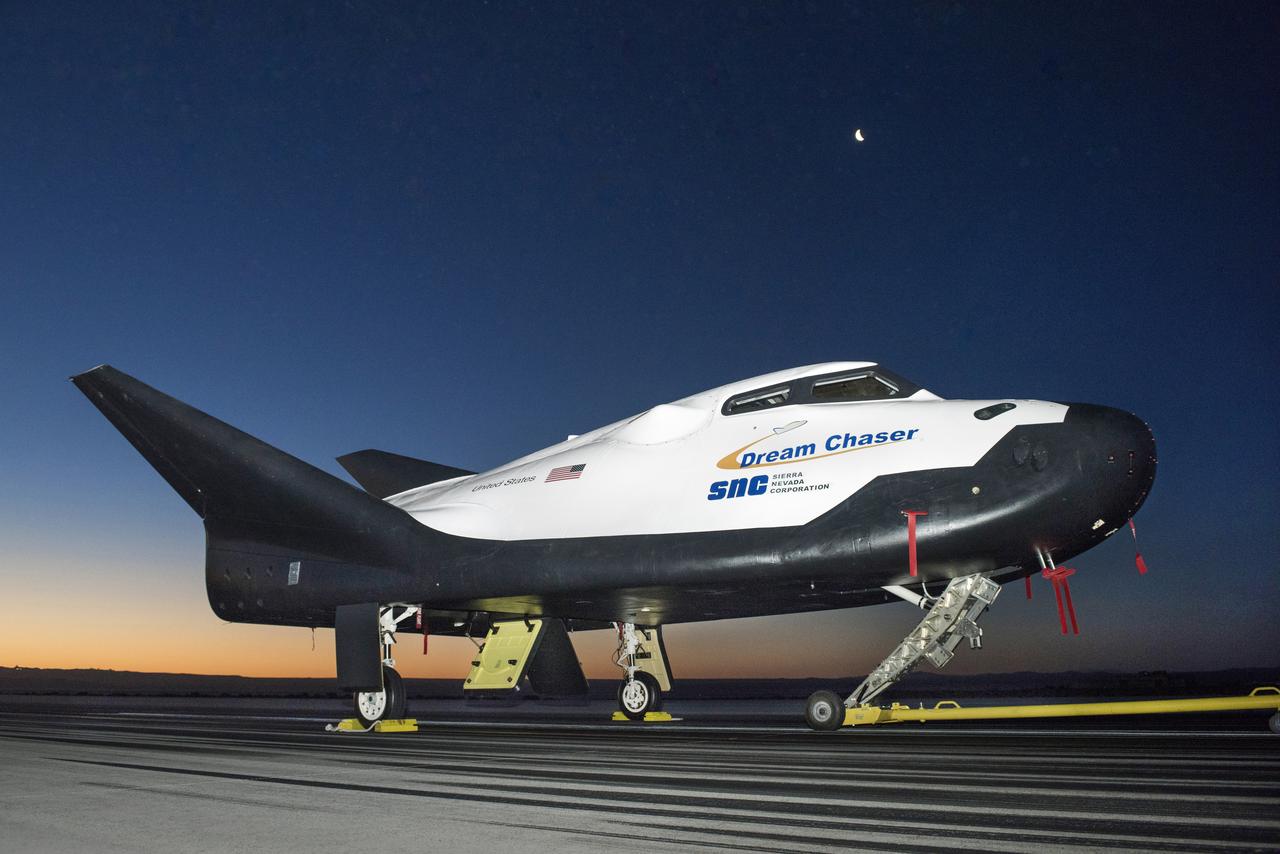
Sierra Nevada Corporation's (SNC) Dream Chaser® spacecraft shown on the runway at NASA's Armstrong Flight Research Center on May 20 preparing for a tow-test. The spacecraft is undergoing ground tests leading up to a free flight test later this year.
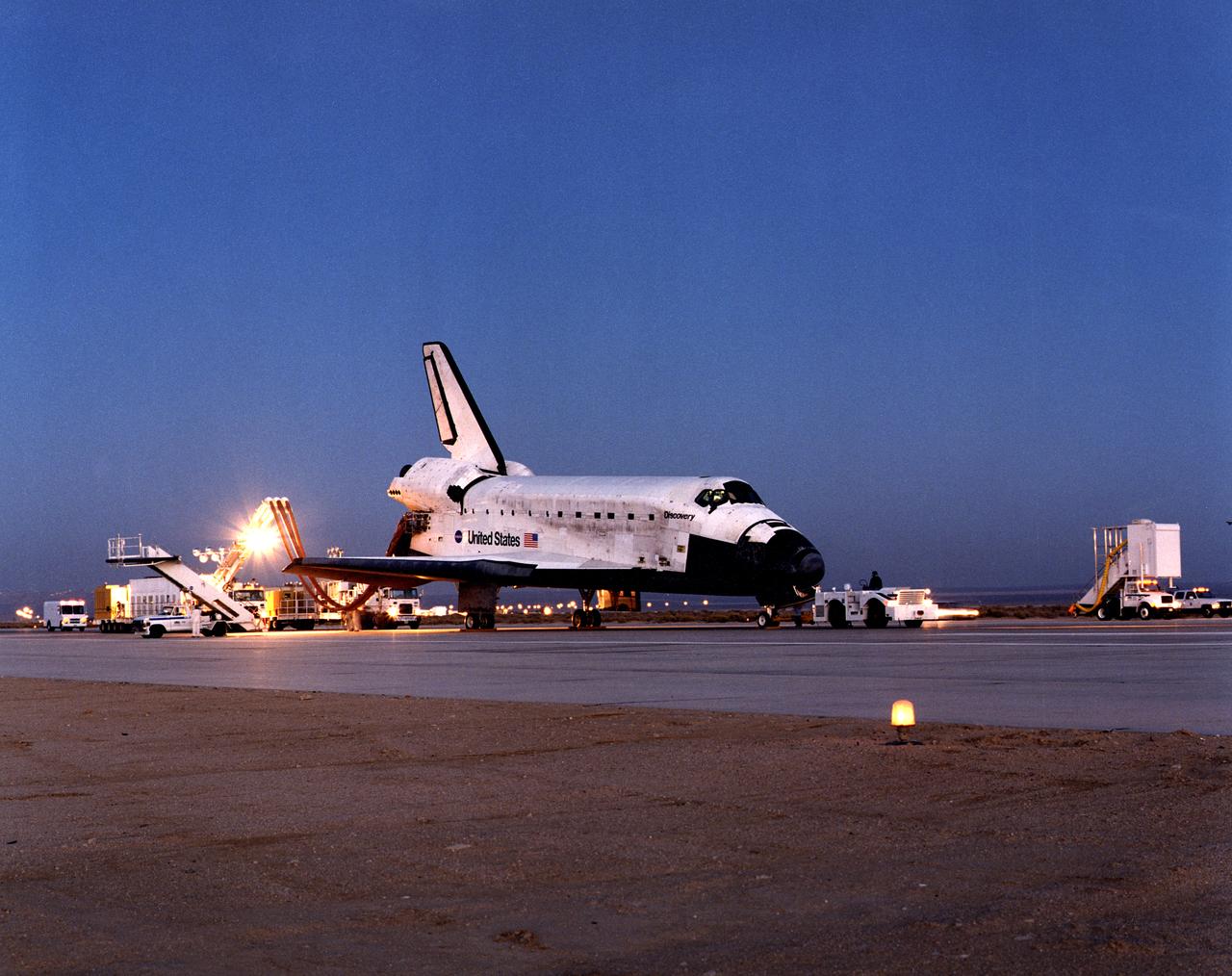
Ground crews worked into the evening to prepare the Space Shuttle Discovery for towing back to NASA’s Dryden Flight Research Center after its landing at Edwards Air Force Base on October 24, 2000. The landing marked the end of the STS-92 mission.
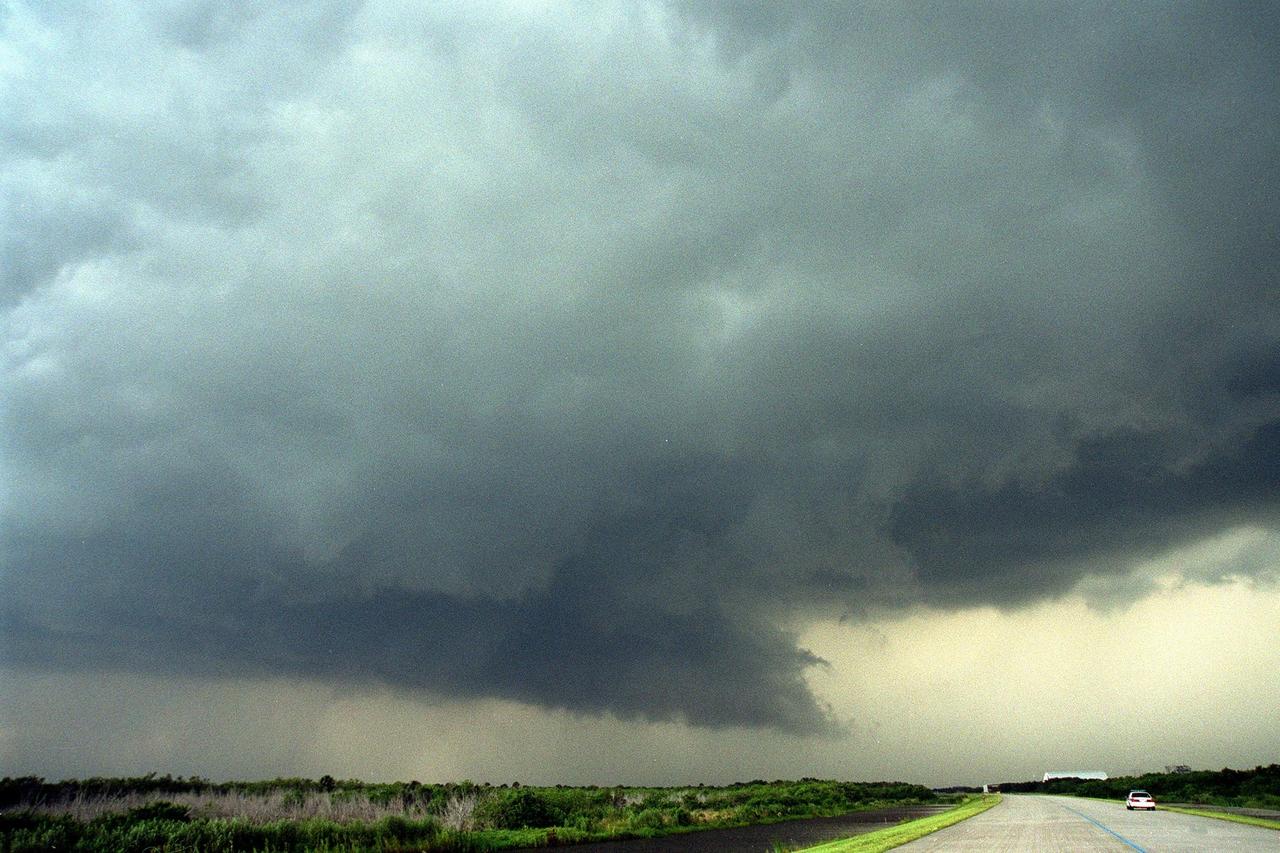
KENNEDY SPACE CENTER, Fla. -- Dark clouds and strong winds seem almost to touch the ground near the tow-way leading from the Shuttle Landing Facility (SLF). In the background (right) can be seen the new hangar at the SLF and the mate/demate device. The cloud formation is proceeding across the SLF towards the Vehicle Assembly Building
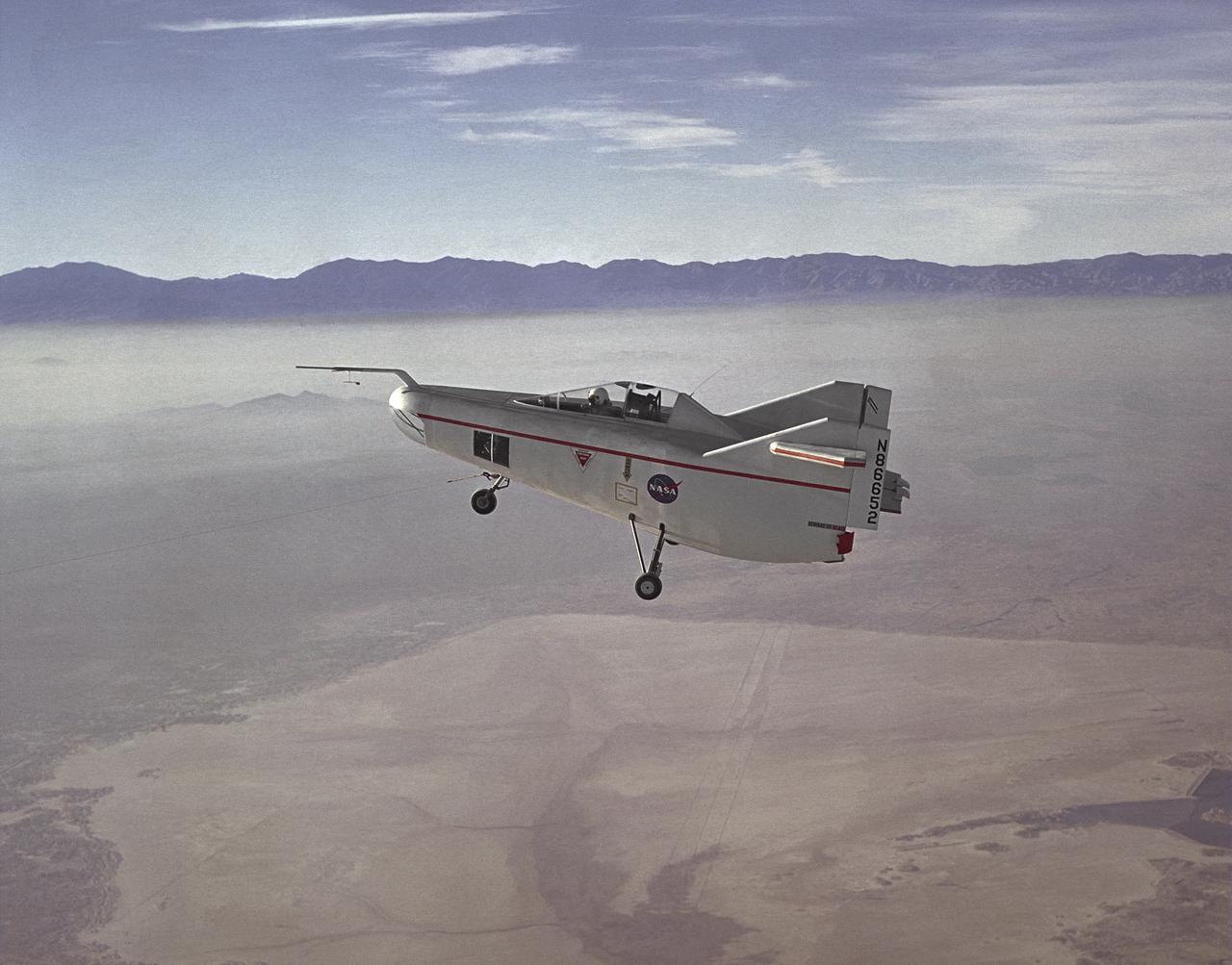
The M2-F1 Lifting Body is seen here under tow, high above Rogers Dry Lake near the Flight Research Center (later redesignated the Dryden Flight Research Center), Edwards, California. R. Dale Reed effectively advocated the project with the support of NASA research pilot Milt Thompson. Together, they gained the support of Flight Research Center Director Paul Bikle. After a six-month feasibility study, Bikle gave approval in the fall of 1962 for the M2-F1 to be built.
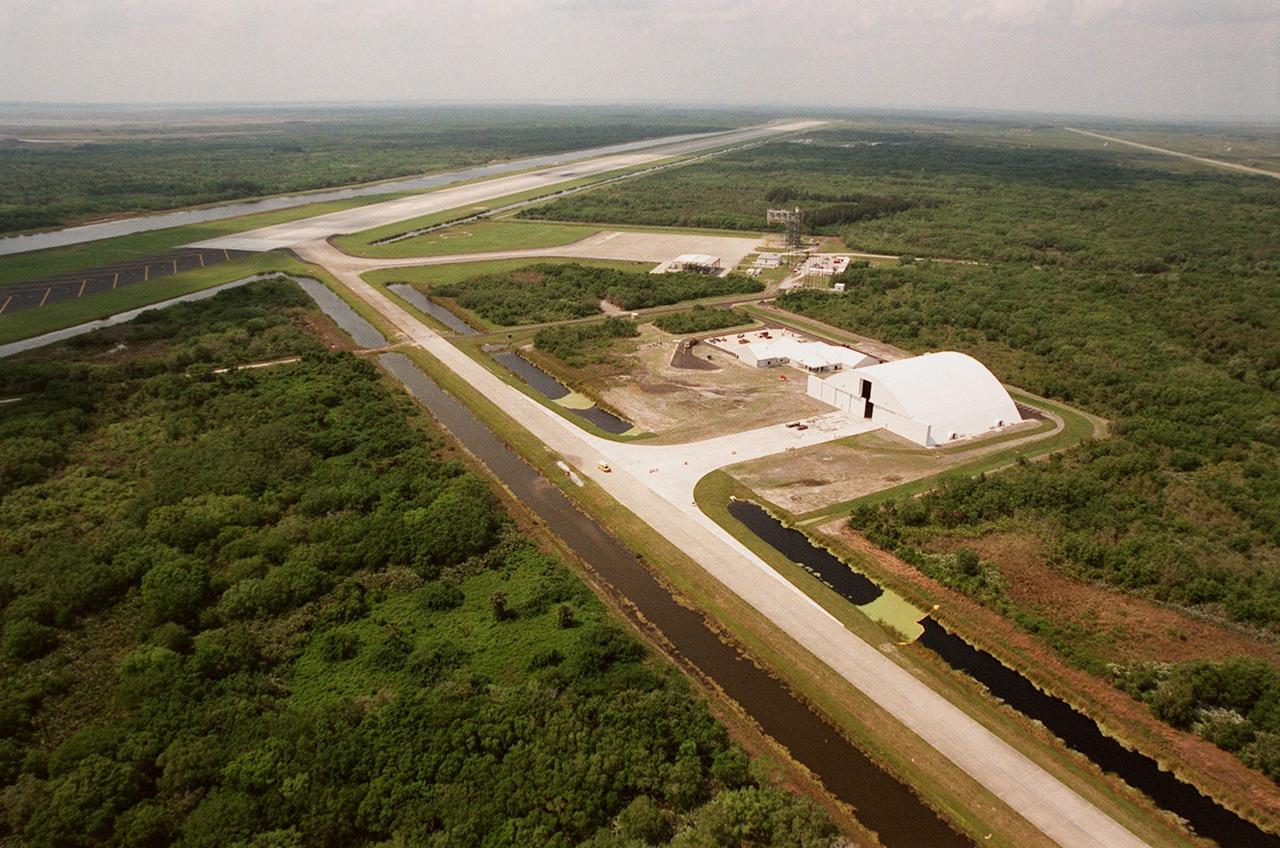
This broad aerial view shows the runway at KSC (top), the parking facility with the mate/demate device (center), and the remote launch vehicle (RLV) hangar, at right, still under construction at the south end of the Shuttle Landing Facility. Next to the multi-purpose RLV hangar are facilities for related ground support equipment and administrative/technical support. The tow-way stretches from the runway past the hangar to lower right in the photo. Stretching toward the horizon are the grounds of the Merritt island National Wildlife Refuge, which shares a boundary with KSC
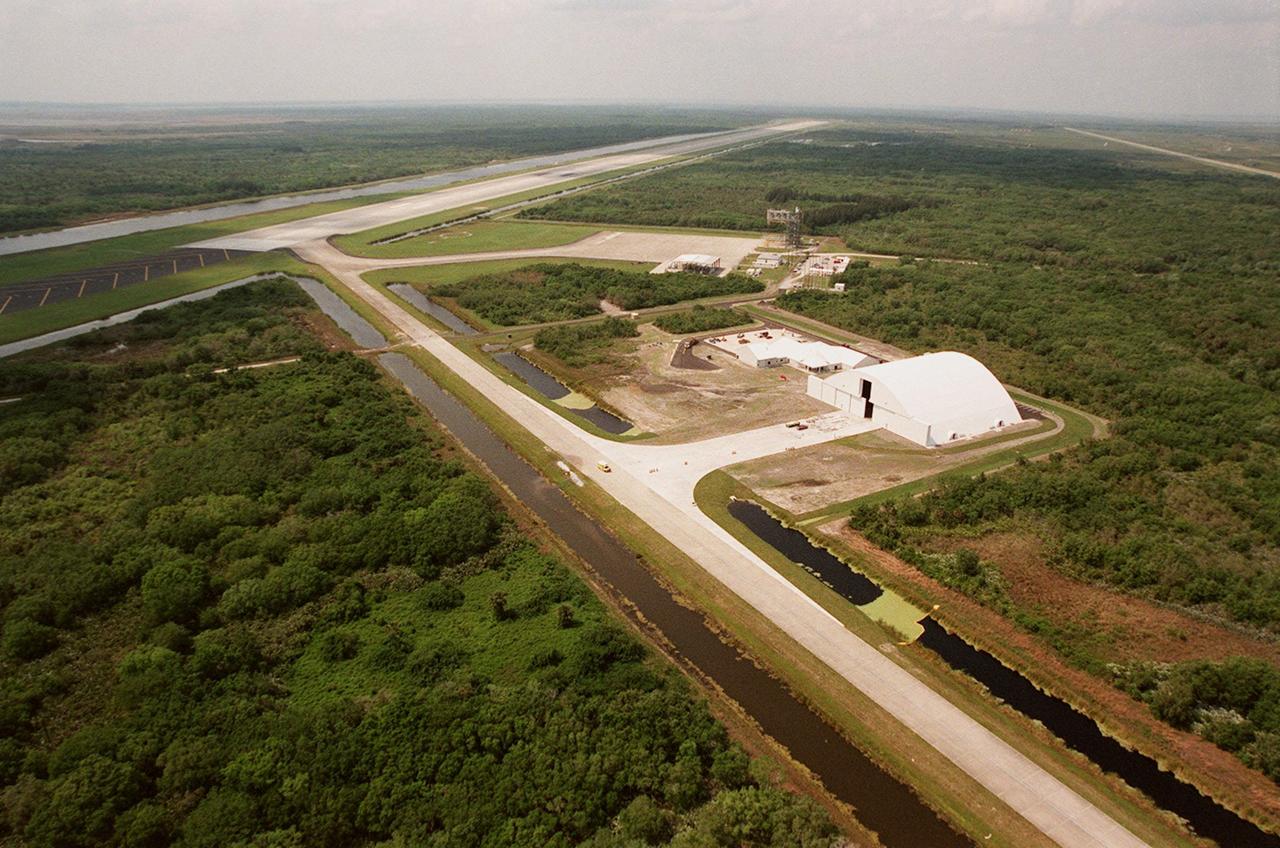
This broad aerial view shows the runway at KSC (top), the parking facility with the mate/demate device (center), and the remote launch vehicle (RLV) hangar, at right, still under construction at the south end of the Shuttle Landing Facility. Next to the multi-purpose RLV hangar are facilities for related ground support equipment and administrative/technical support. The tow-way stretches from the runway past the hangar to lower right in the photo. Stretching toward the horizon are the grounds of the Merritt island National Wildlife Refuge, which shares a boundary with KSC
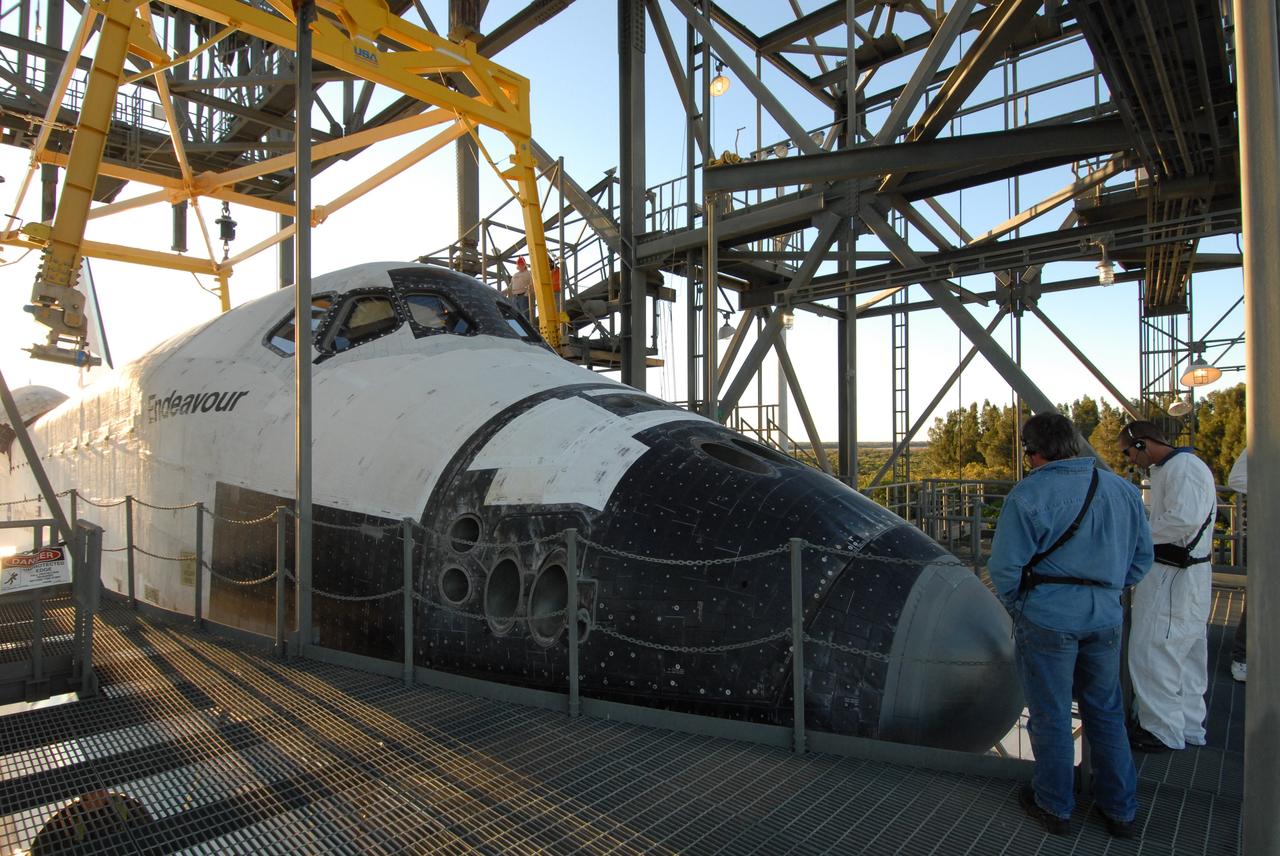
CAPE CANAVERAL, Fla. -- At the Shuttle Landing Facility, or SLF, at NASA's Kennedy Space Center in Florida, the overhead sling in the mate/demate device is moved into place on either side of the space shuttle Endeavour. The sling will lift the shuttle away from the shuttle carrier aircraft, or SCA, underneath. The SCA carried the shuttle piggyback from California, where Endeavour landed Nov. 30 to end the STS-126 mission. When Endeavour is on the ground, it will be towed via the two-mile tow-way from the SLF by a diesel-powered tractor to the Orbiter Processing Facility where it will begin preparations for its next mission, STS-127, targeted for May 2009. Photo credit: NASA/Jack Pfaller
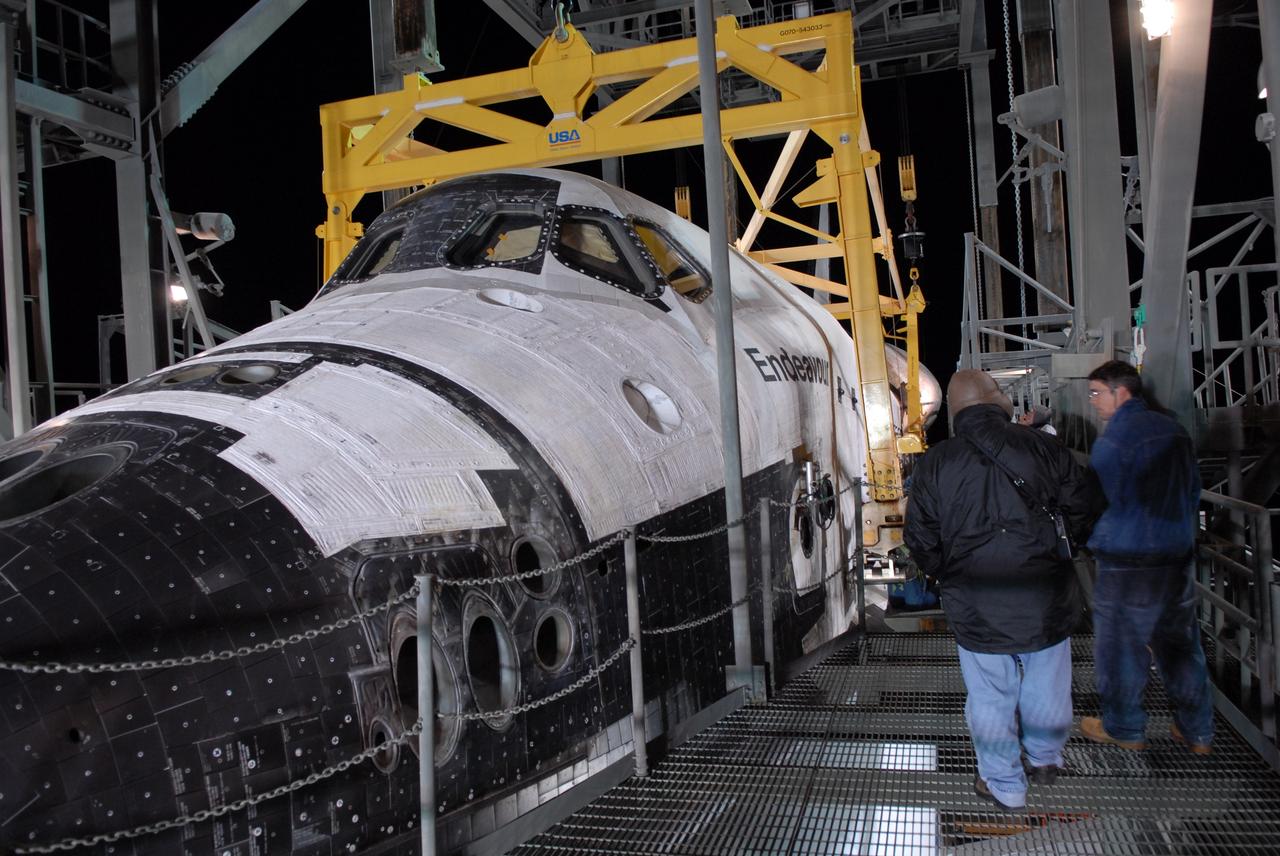
CAPE CANAVERAL, Fla. -- After dark, at the Shuttle Landing Facility, or SLF, at NASA's Kennedy Space Center in Florida, workers on the mate/demate device have attached the sling that will lift the shuttle away from the shuttle carrier aircraft, or SCA, underneath. The SCA carried the shuttle piggyback from California, where Endeavour landed Nov. 30 to end the STS-126 mission. When Endeavour is on the ground, it will be towed via the two-mile tow-way from the SLF by a diesel-powered tractor to the Orbiter Processing Facility where it will begin preparations for its next mission, STS-127, targeted for May 2009. Photo credit: NASA/Jack Pfaller
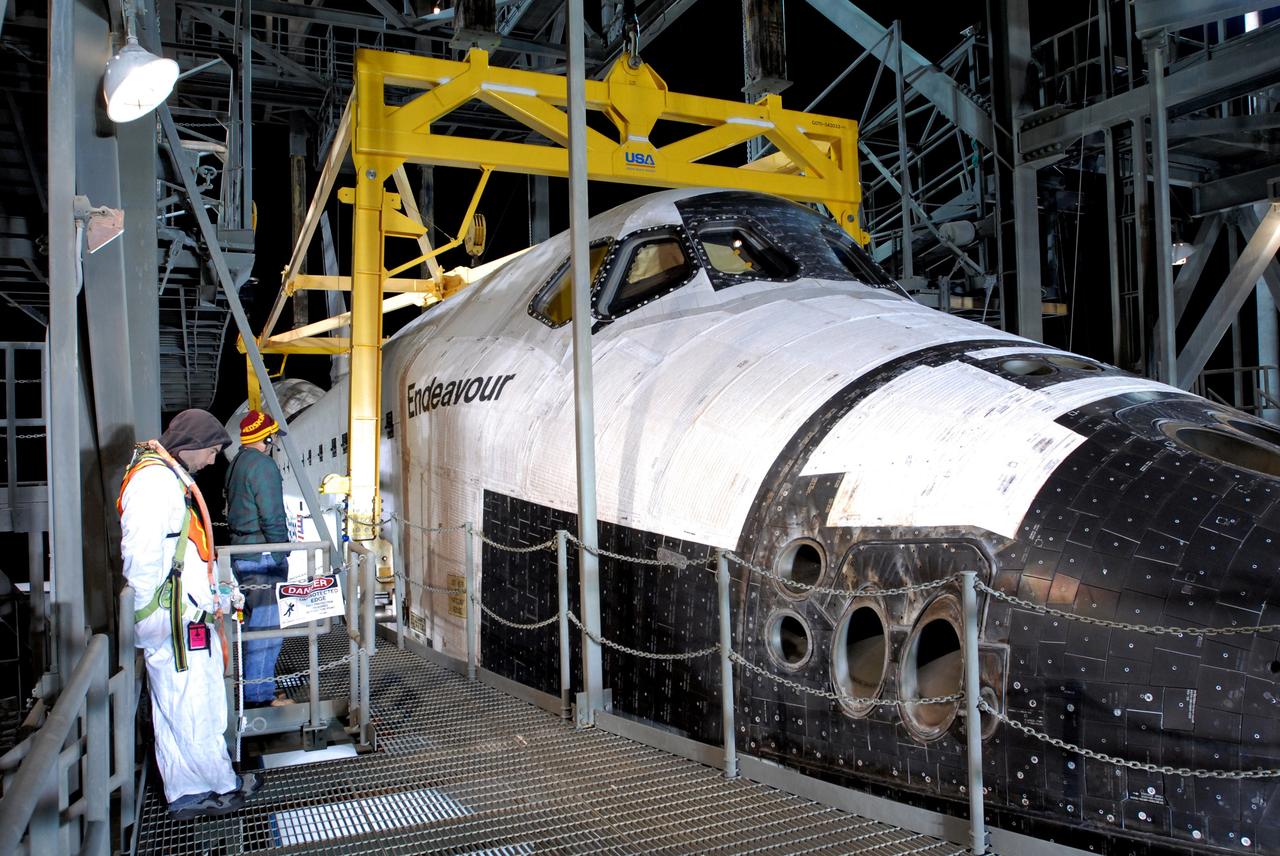
CAPE CANAVERAL, Fla. -- Before dawn, at the Shuttle Landing Facility, or SLF, at NASA's Kennedy Space Center in Florida, space shuttle Endeavour is ready to be lifted, via the sling attached, away from the shuttle carrier aircraft, or SCA, underneath. The SCA carried the shuttle piggyback from California, where Endeavour landed Nov. 30 to end the STS-126 mission. After Endeavour is on the ground, it will be towed via the two-mile tow-way from the SLF by a diesel-powered tractor to the Orbiter Processing Facility where it will begin preparations for its next mission, STS-127, targeted for May 2009. Photo credit: NASA/Jim Grossmann
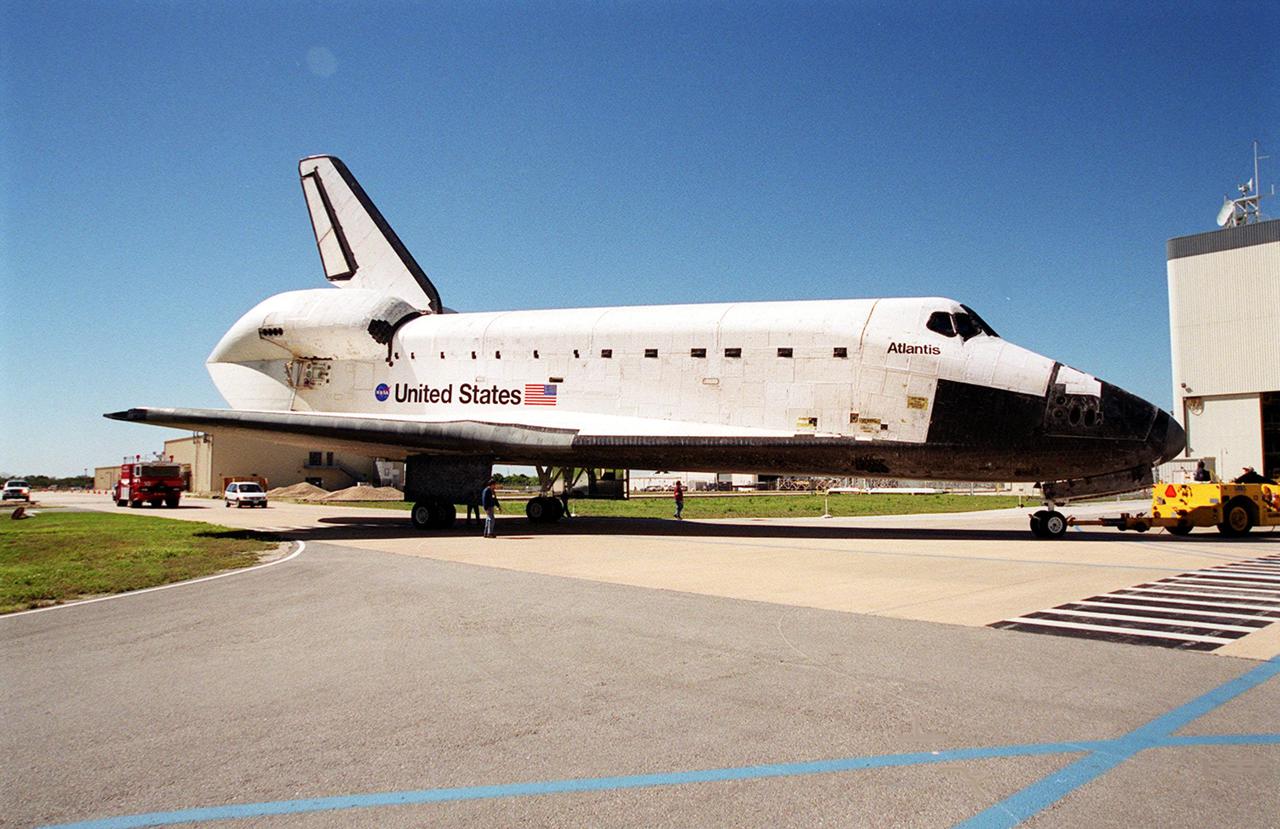
KENNEDY SPACE CENTER, FLA. -- On its journey to the Orbiter Processing Facility, Atlantis, in tow, turns from the tow-way toward the OPF. Atlantis returned from California atop a Shuttle Carrier Aircraft after its Feb. 19 landing at Edwards Air Force Base, concluding mission STS-98. The ferry flight began March 1; unfavorable weather conditions kept it on the ground at Altus AFB, Okla., until it could return to Florida. In the Orbiter Processing Facility, Atlantis will be prepared for mission STS-104, the 10th construction flight to the International Space Station, scheduled to launch June 8
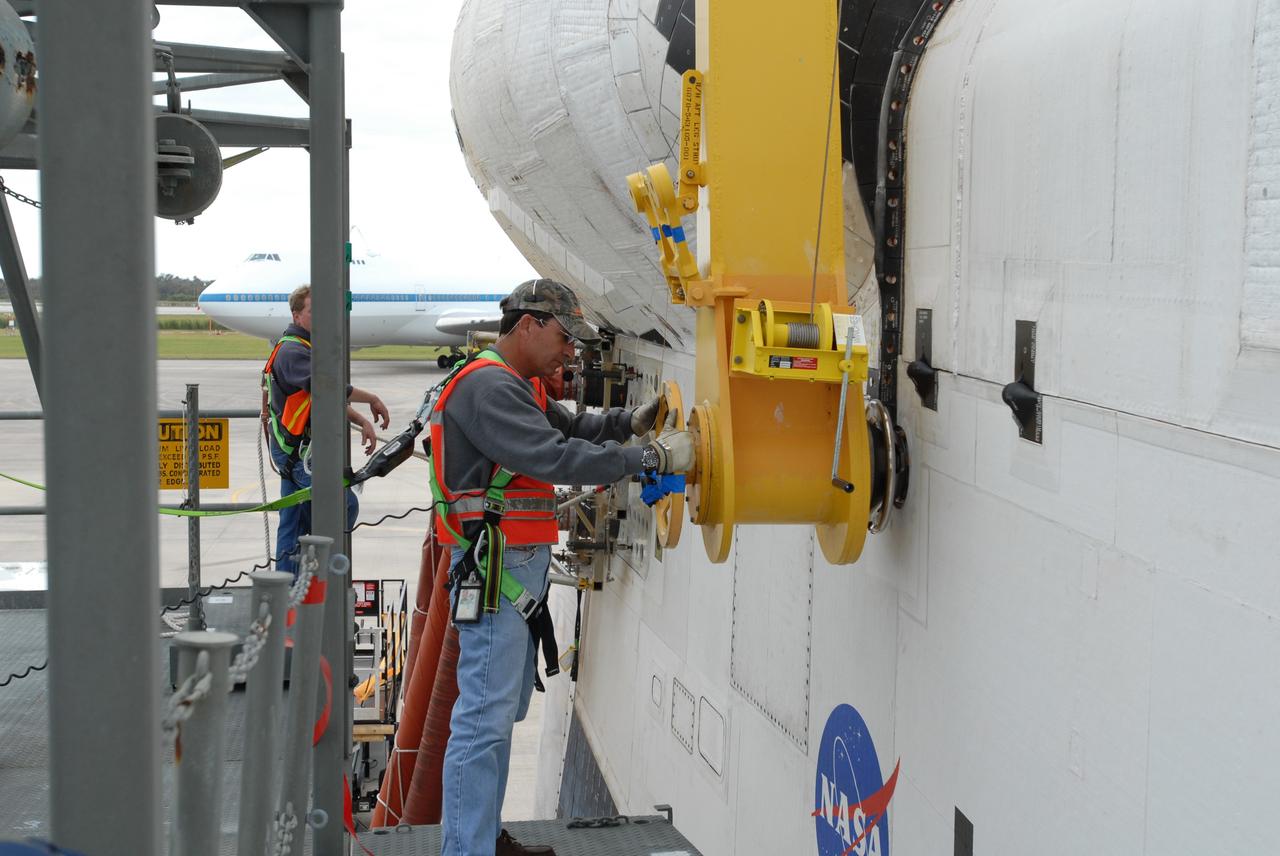
CAPE CANAVERAL, Fla. -- At the Shuttle Landing Facility, or SLF, at NASA's Kennedy Space Center in Florida, workers begin removing the sling from around space shuttle Endeavour. Part of the mate/demate device, the sling enabled Endeavour to be lifted away from shuttle carrier aircraft, or SCA, and lowered to the ground. The SCA carried the shuttle piggyback from California, where Endeavour landed Nov. 30 to end the STS-126 mission. Endeavour will be towed via the two-mile tow-way from the SLF by a diesel-powered tractor to the Orbiter Processing Facility where it will begin preparations for its next mission, STS-127, targeted for May 2009. Photo credit: NASA/Jim Grossmann
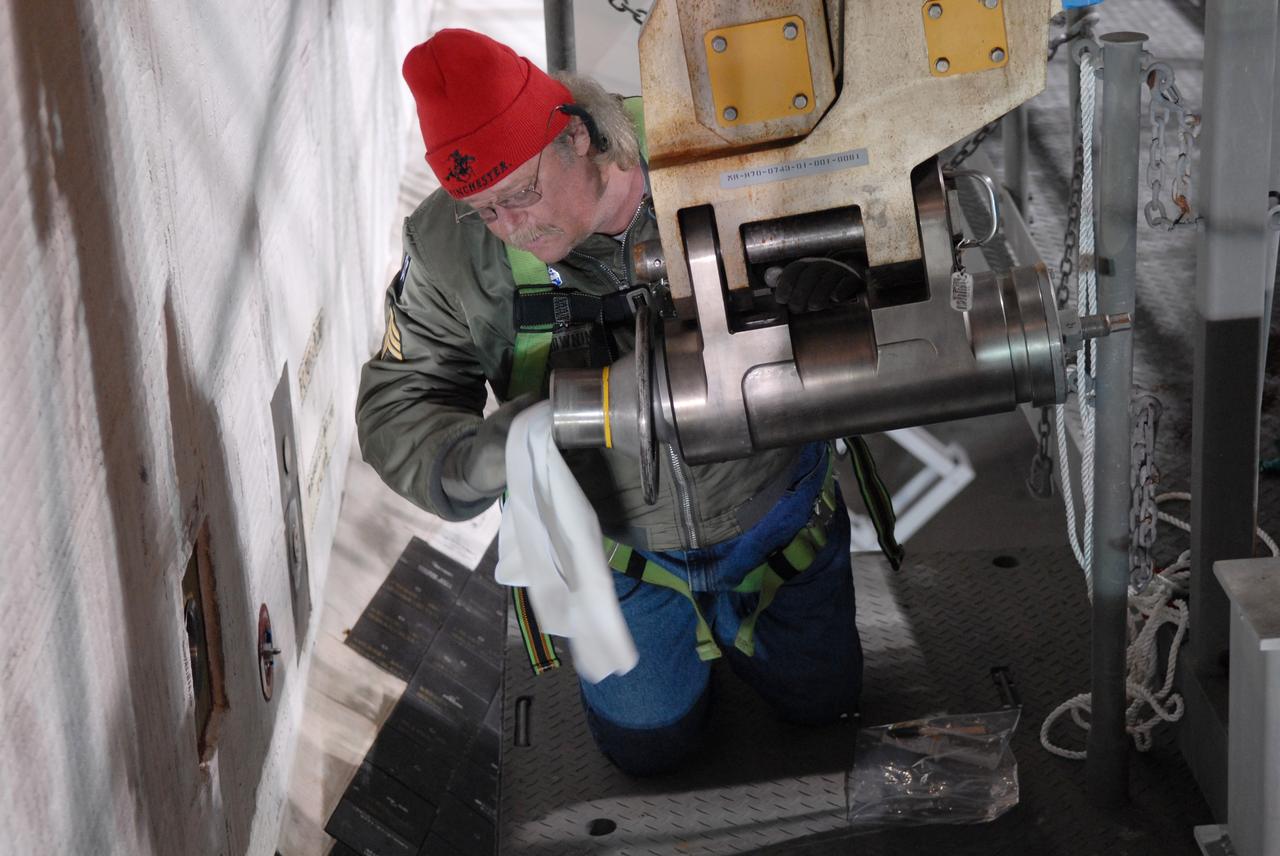
CAPE CANAVERAL, Fla. -- After dark, at the Shuttle Landing Facility, or SLF, at NASA's Kennedy Space Center in Florida, a worker on the mate/demate device prepares to attach the sling that will lift the shuttle away from the shuttle carrier aircraft, or SCA, underneath. The SCA carried the shuttle piggyback from California, where Endeavour landed Nov. 30 to end the STS-126 mission. When Endeavour is on the ground, it will be towed via the two-mile tow-way from the SLF by a diesel-powered tractor to the Orbiter Processing Facility where it will begin preparations for its next mission, STS-127, targeted for May 2009. Photo credit: NASA/Jack Pfaller
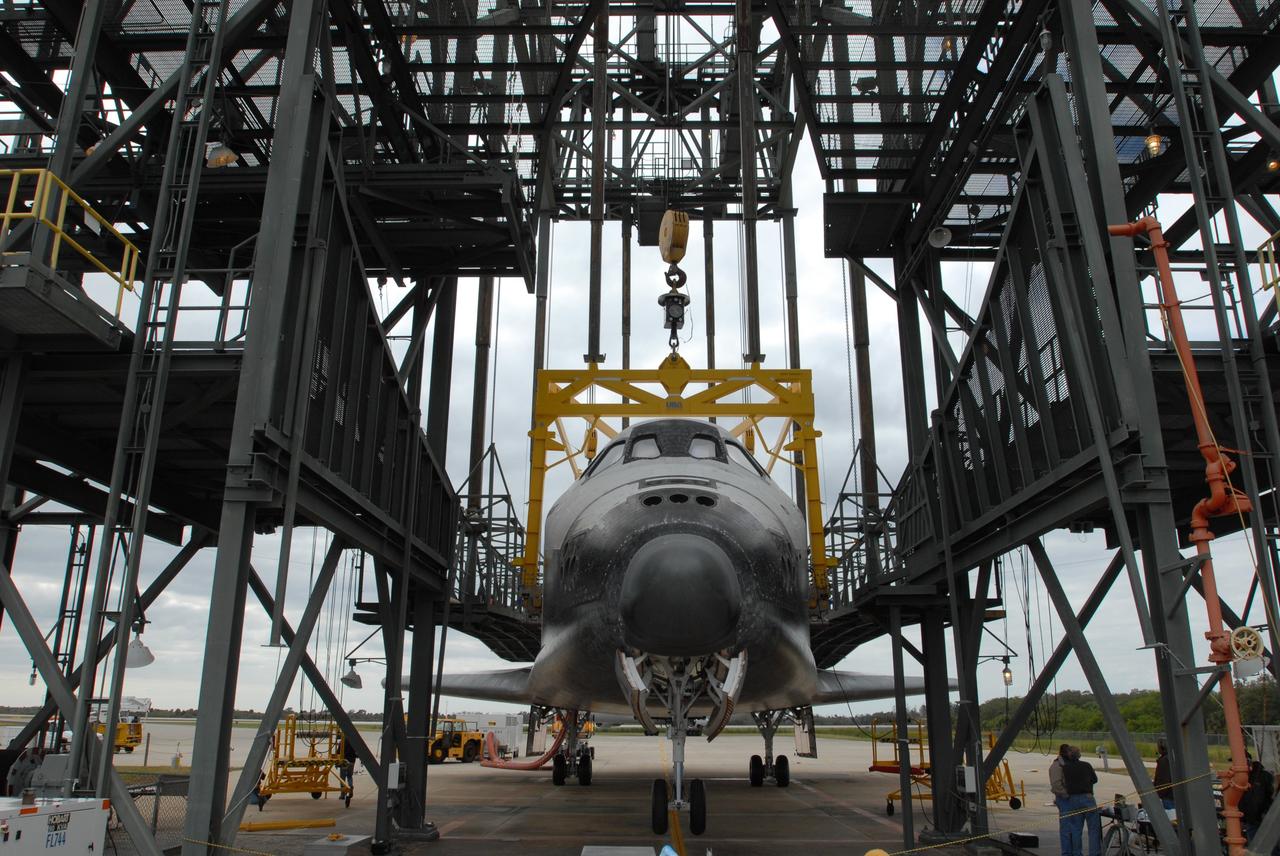
CAPE CANAVERAL, Fla. -- At the Shuttle Landing Facility, or SLF, at NASA's Kennedy Space Center in Florida, space shuttle Endeavour waits for the sling to be removed. Part of the mate/demate device, the sling enabled Endeavour to be lifted away from the shuttle carrier aircraft, or SCA, and lowered to the ground. The SCA carried the shuttle piggyback from California, where Endeavour landed Nov. 30 to end the STS-126 mission. Endeavour will be towed via the two-mile tow-way from the SLF by a diesel-powered tractor to the Orbiter Processing Facility where it will begin preparations for its next mission, STS-127, targeted for May 2009. Photo credit: NASA/Jim Grossmann
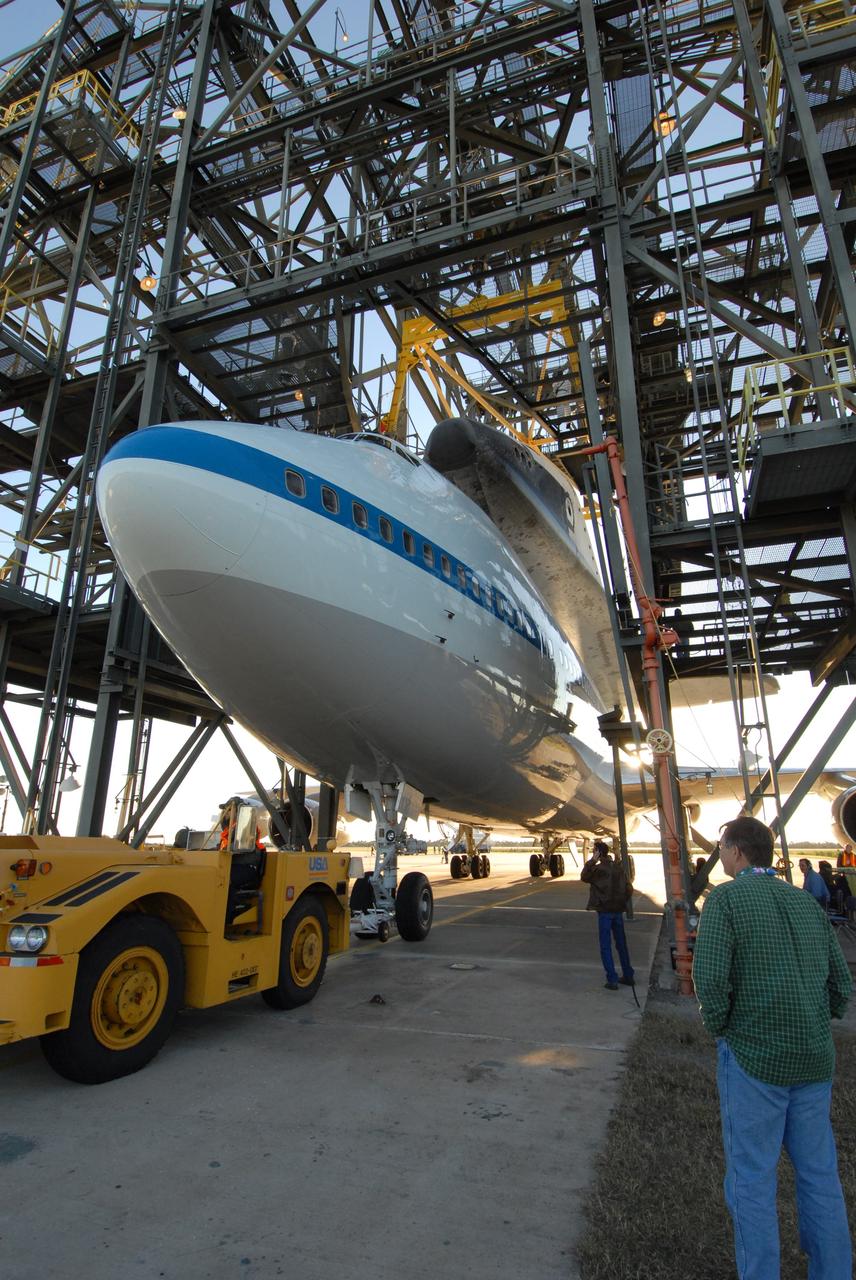
CAPE CANAVERAL, Fla. -- At the Shuttle Landing Facility, or SLF, at NASA's Kennedy Space Center in Florida, the overhead sling in the mate/demate device is moved into place on either side of the space shuttle Endeavour. The sling will lift the shuttle away from the shuttle carrier aircraft, or SCA, underneath. The SCA carried the shuttle piggyback from California, where Endeavour landed Nov. 30 to end the STS-126 mission. When Endeavour is on the ground, it will be towed via the two-mile tow-way from the SLF by a diesel-powered tractor to the Orbiter Processing Facility where it will begin preparations for its next mission, STS-127, targeted for May 2009. Photo credit: NASA/Jack Pfaller
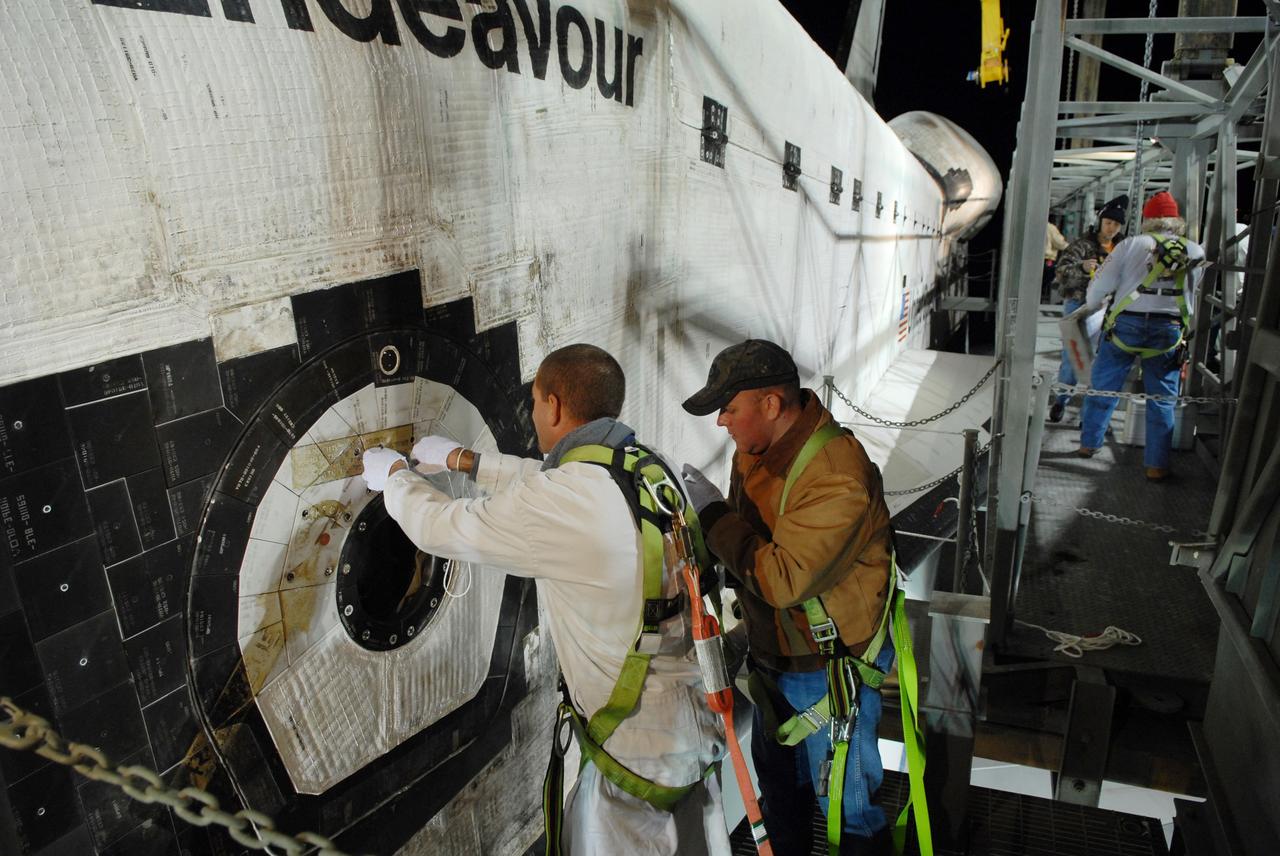
CAPE CANAVERAL, Fla. -- After dark, under the mate/demate device at the Shuttle Landing Facility, or SLF, at NASA's Kennedy Space Center in Florida, workers prepare space shuttle Endeavour for attachment of the sling that will lift the shuttle away from the shuttle carrier aircraft, or SCA, underneath. The SCA carried the shuttle piggyback from California, where Endeavour landed Nov. 30 to end the STS-126 mission. When Endeavour is on the ground, it will be towed via the two-mile tow-way from the SLF by a diesel-powered tractor to the Orbiter Processing Facility where it will begin preparations for its next mission, STS-127, targeted for May 2009. Photo credit: NASA/Jack Pfaller
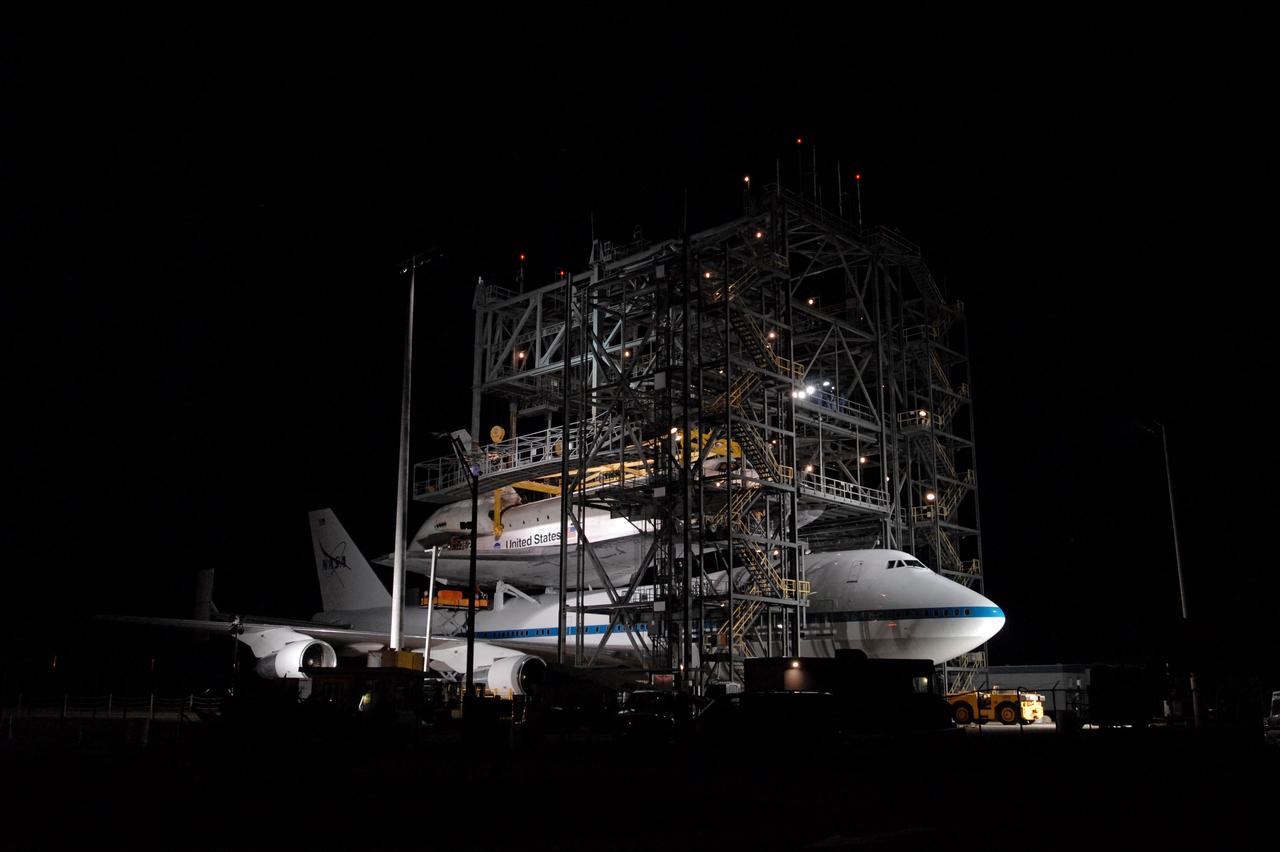
CAPE CANAVERAL, Fla. -- After dark, at the Shuttle Landing Facility, or SLF, at NASA's Kennedy Space Center in Florida, space shuttle Endeavour has been attached to the sling that will lift the shuttle away from the shuttle carrier aircraft, or SCA, underneath. The SCA carried the shuttle piggyback from California, where Endeavour landed Nov. 30 to end the STS-126 mission. After Endeavour is on the ground, it will be towed via the two-mile tow-way from the SLF by a diesel-powered tractor to the Orbiter Processing Facility where it will begin preparations for its next mission, STS-127, targeted for May 2009. Photo credit: NASA/Jim Grossmann
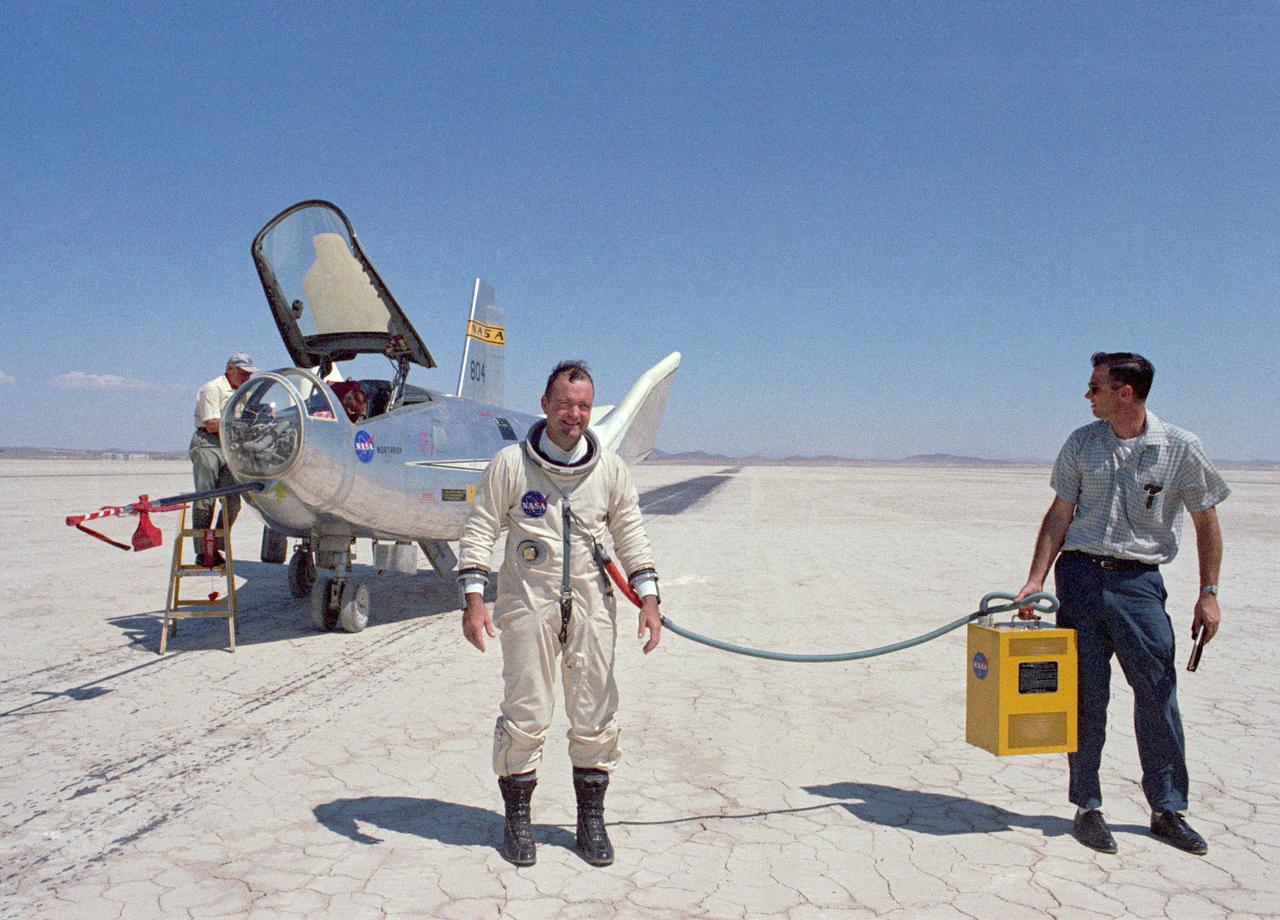
NASA research pilot Bill Dana after his fourth free flight (1 glide and 3 powered) in the HL-10. This particular flight reached a maximum speed of Mach 1.45. Dana made a total of nine HL-10 flights (1 glide and 8 powered), and his lifting body experience as a whole included several car tow and 1 air tow flights in the M2-F1; 4 glide and 15 powered flights in the M2-F3; and 2 powered flights in the X-24B. He is wearing a pressure suit for protection against the cockpit depressurizing at high altitudes. The air conditioner box held by the ground crewman provides cool air to prevent overheating.
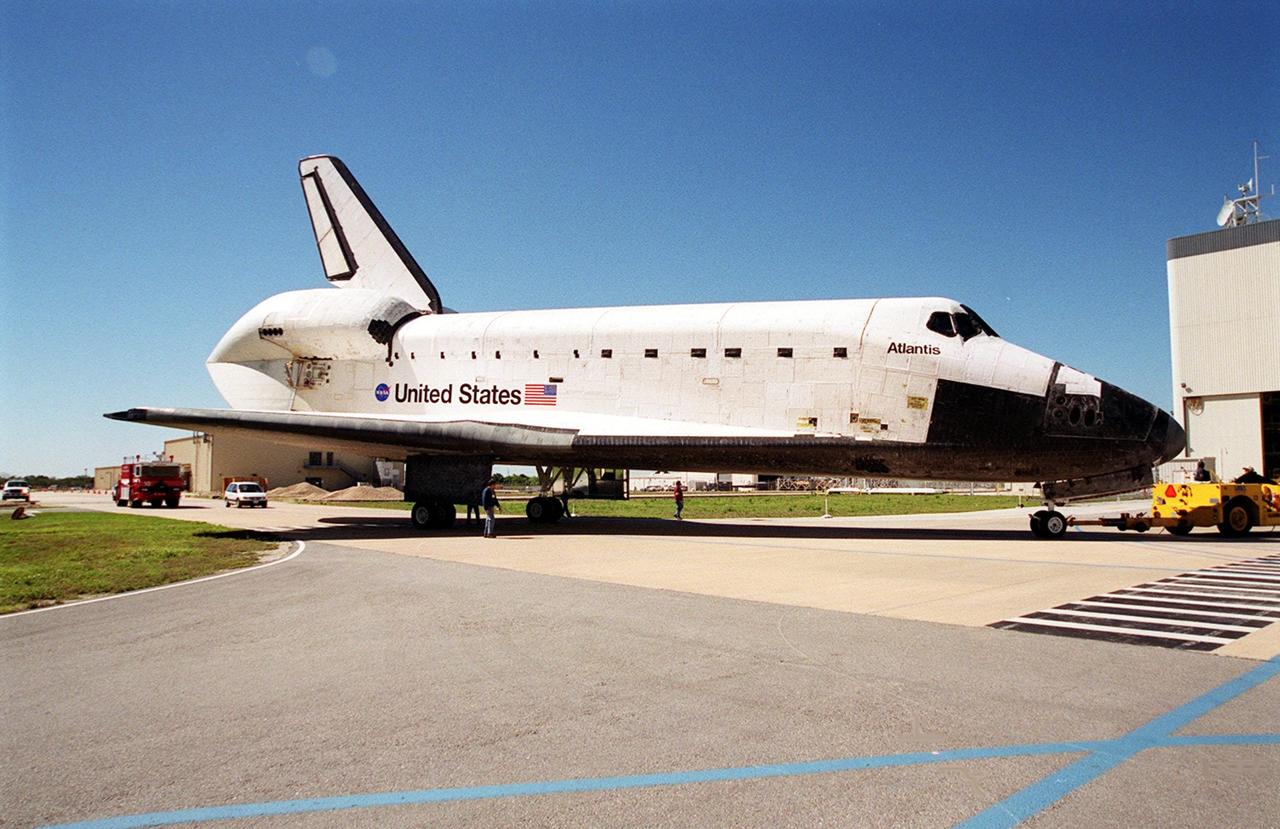
KENNEDY SPACE CENTER, FLA. -- On its journey to the Orbiter Processing Facility, Atlantis, in tow, turns from the tow-way toward the OPF. Atlantis returned from California atop a Shuttle Carrier Aircraft after its Feb. 19 landing at Edwards Air Force Base, concluding mission STS-98. The ferry flight began March 1; unfavorable weather conditions kept it on the ground at Altus AFB, Okla., until it could return to Florida. In the Orbiter Processing Facility, Atlantis will be prepared for mission STS-104, the 10th construction flight to the International Space Station, scheduled to launch June 8
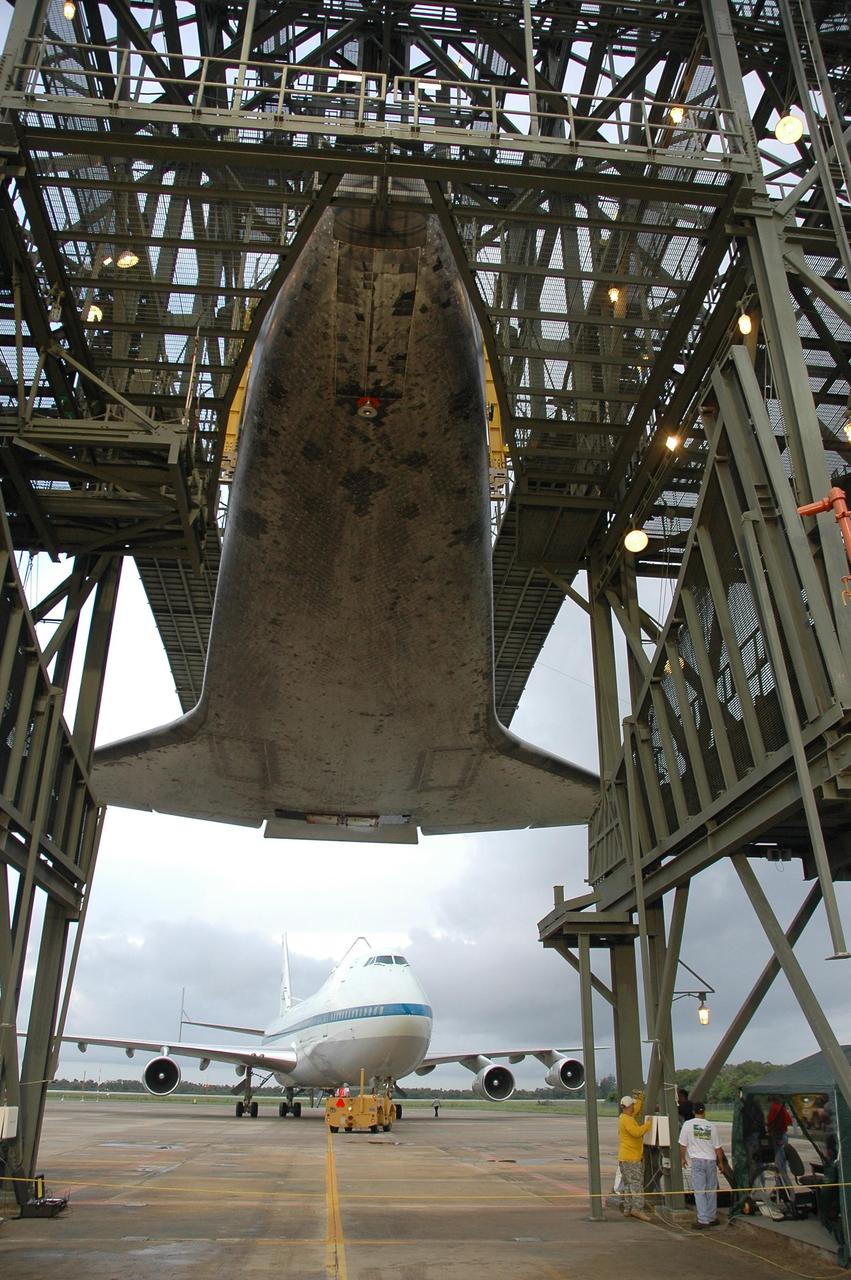
KENNEDY SPACE CENTER, FLA. -- At the mate/demate device at Kennedy Space Center's Shuttle Landing Facility, work begins to lower Atlantis to the ground. In the background, a towing device is used to back the shuttle carrier aircraft, or SCA, away from the device. When the orbiter is lowered to the ground it will be towed to the Orbiter Processing Facility to begin processing for its next launch, mission STS-122 in December. Atlantis arrived at Kennedy Space Center atop the SCA on July 3 after a three-day, cross-country flight due to fuel stops and weather delays. Touchdown was at 8:27 a.m. EDT. Atlantis landed at Edwards Air Force Base in California on June 22 to end mission STS-117. Photo credit: NASA/Jack Pfaller.
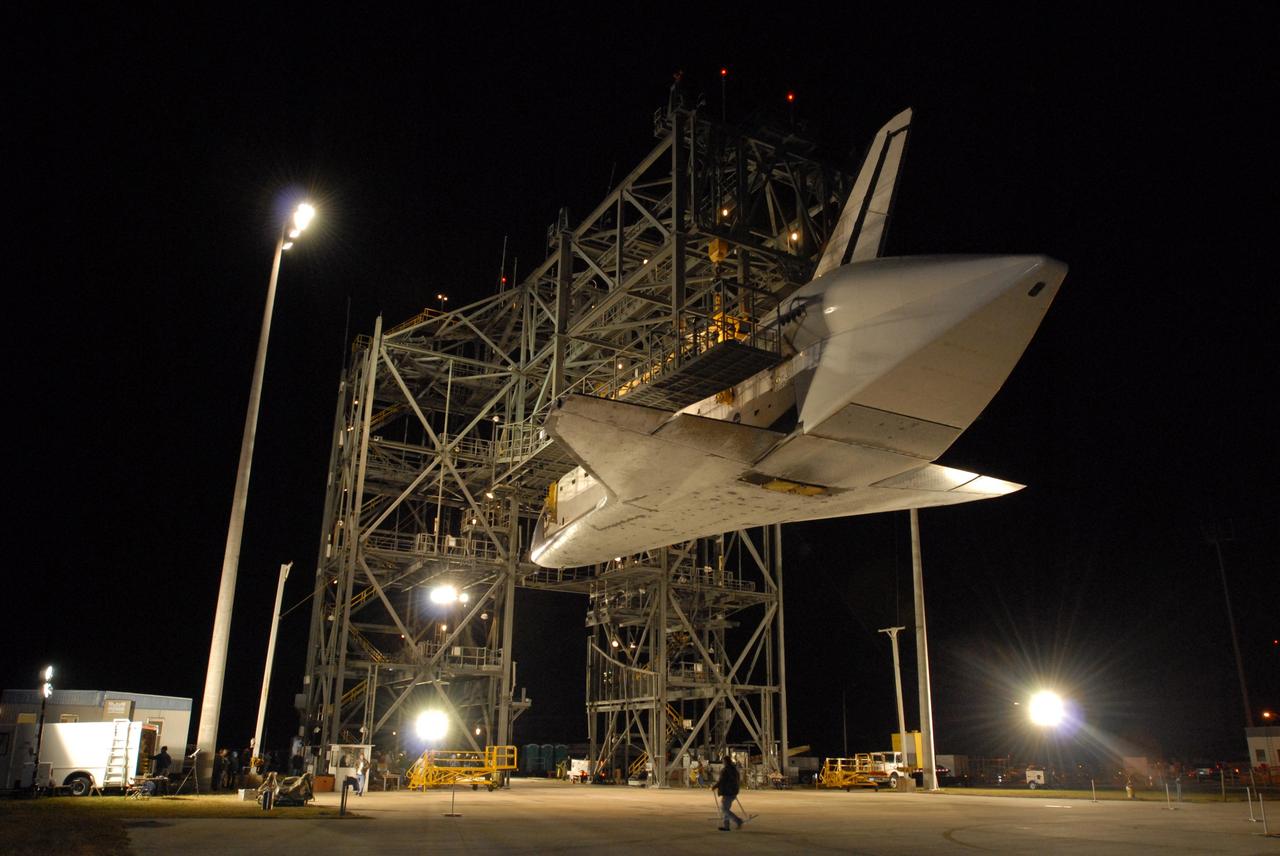
CAPE CANAVERAL, Fla. -- Before dawn, at the Shuttle Landing Facility, or SLF, at NASA's Kennedy Space Center in Florida, space shuttle Endeavour is suspended by a sling under the mate/demate device. The shuttle carrier aircraft, or SCA, has rolled away. Endeavour, which retains the tail cone that covers and protects the main engines during the ferry flight, will be lowered onto the ground. The SCA carried the shuttle piggyback from California, where Endeavour landed Nov. 30 to end the STS-126 mission. After Endeavour is on the ground, it will be towed via the two-mile tow-way from the SLF by a diesel-powered tractor to the Orbiter Processing Facility where it will begin preparations for its next mission, STS-127, targeted for May 2009. Photo credit: NASA/Jim Grossmann

CAPE CANAVERAL, Fla. -- At the Shuttle Landing Facility, or SLF, at NASA's Kennedy Space Center in Florida, the shuttle carrier aircraft with space shuttle Endeavour on top moves under the mate/demate device. An overhead sling will be placed around Endeavour to lift it away from the aircraft. After the aircraft rolls away, the shuttle will be placed on the ground. The SCA carried the shuttle piggyback from California, where Endeavour landed Nov. 30 to end the STS-126 mission. When Endeavour is on the ground, it will be towed via the two-mile tow-way from the SLF by a diesel-powered tractor to the Orbiter Processing Facility where it will begin preparations for its next mission, STS-127, targeted for May 2009. Photo credit: NASA/Jack Pfaller
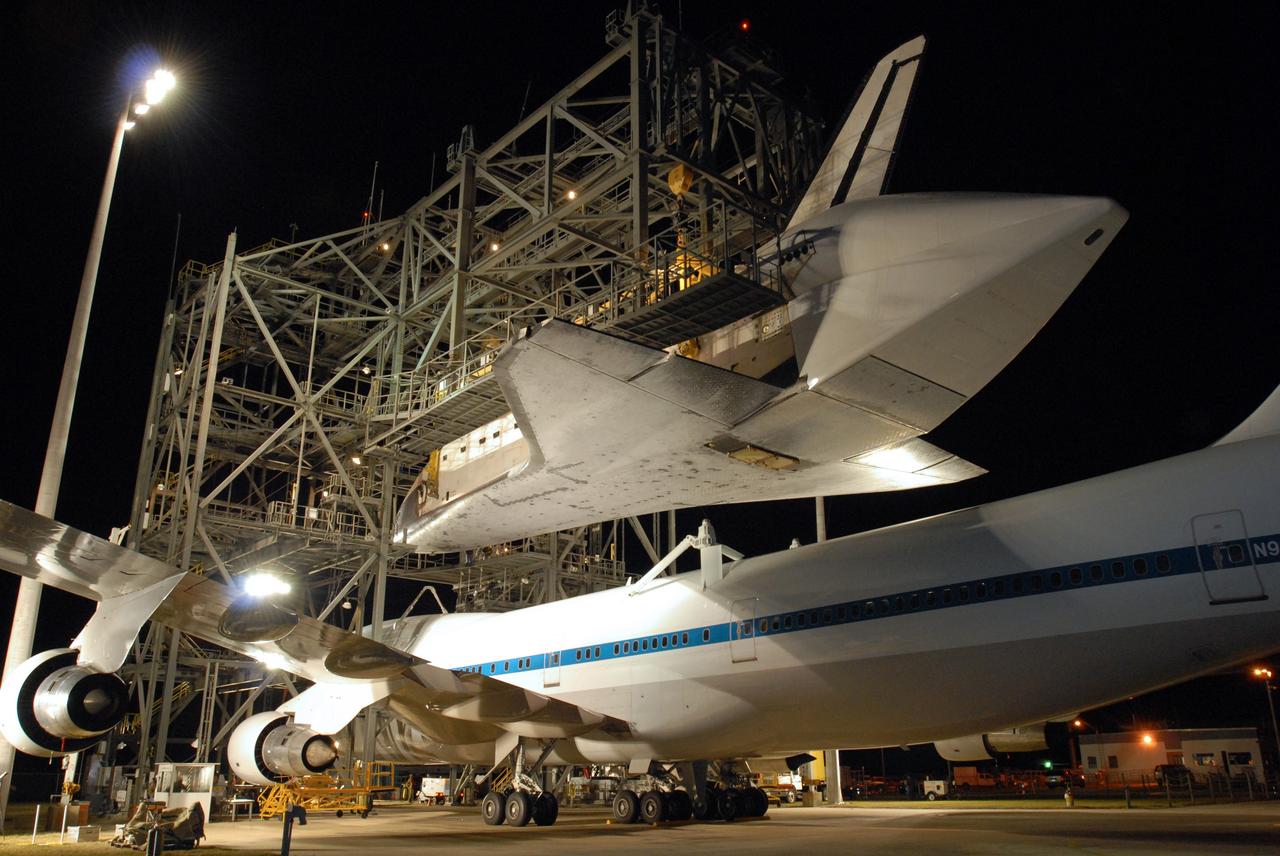
CAPE CANAVERAL, Fla. -- Before dawn, at the Shuttle Landing Facility, or SLF, at NASA's Kennedy Space Center in Florida, space shuttle Endeavour has been lifted away from the shuttle carrier aircraft, or SCA, underneath. The SCA will be rolled back and Endeavour placed on the ground. Visible on Endeavour is the tail cone that covers and protects the main engines during the ferry flight. The SCA carried the shuttle piggyback from California, where Endeavour landed Nov. 30 to end the STS-126 mission. After Endeavour is on the ground, it will be towed via the two-mile tow-way from the SLF by a diesel-powered tractor to the Orbiter Processing Facility where it will begin preparations for its next mission, STS-127, targeted for May 2009. Photo credit: NASA/Jim Grossmann
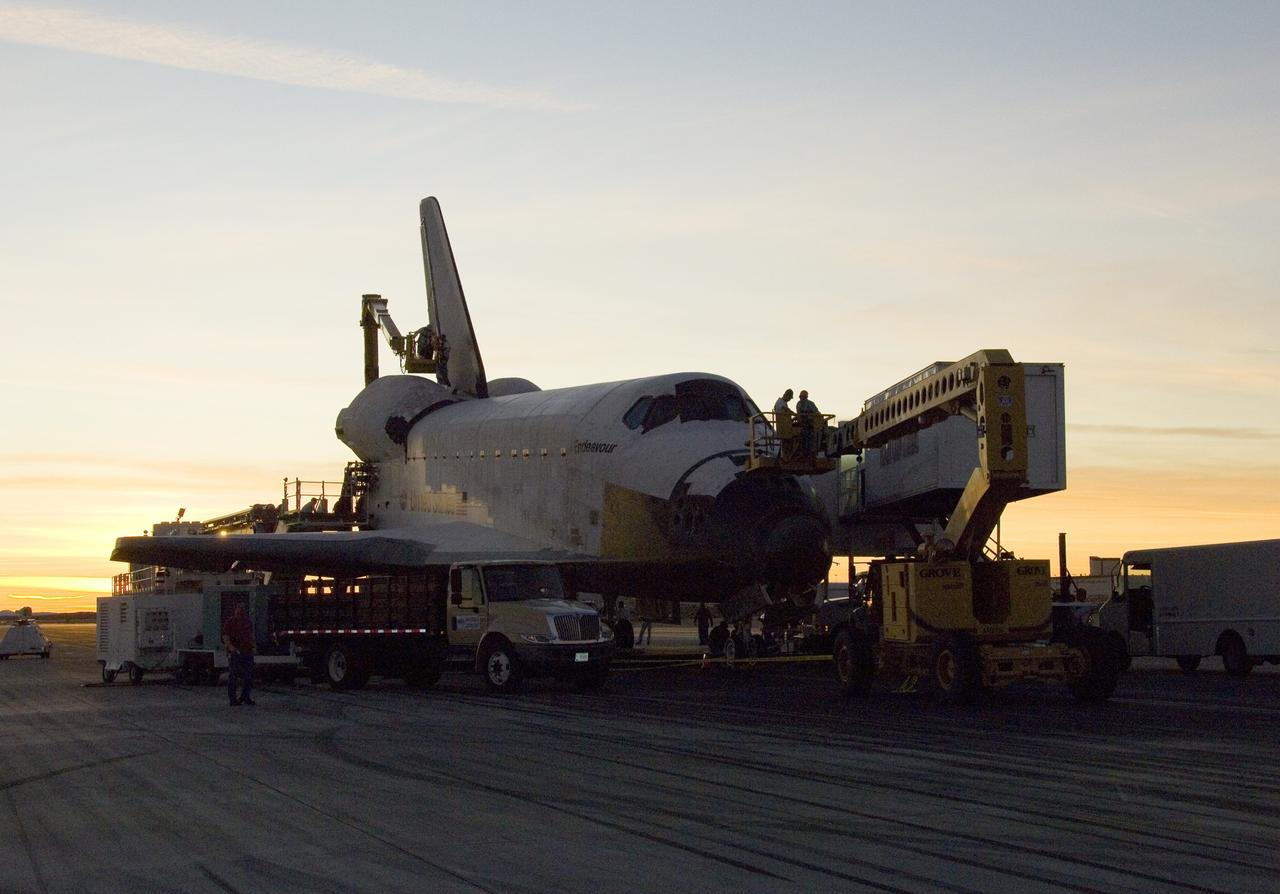
EDWARDS, Calif. – On Edwards Air Force Base in California, space shuttle Endeavour undergoes recovery operations after its landing. The orbiter convoy normally begins recovery operations in earnest about two hours before the shuttle is scheduled to land. Specially designed vehicles or units and a team of trained personnel “safe” the orbiter and prepare it for towing. Purge and Coolant Umbilical Access Vehicles are moved into position behind the orbiter to get access to the umbilical areas. The flight crew is replaced aboard the orbiter by exchange sup¬port personnel who prepare the orbiter for ground tow operations, install switch guards and remove data packages from any onboard experiments. After a total safety downgrade, vehicle ground personnel make numerous preparations for the towing operation, including install¬ing landing gear lock pins, disconnecting the nose landing gear drag link, positioning the towing vehicle in front of the orbiter and connecting the tow bar. The decision to land Endeavour at Edwards was made due to weather concerns at NASA's Kennedy Space Center in Florida. In the 52nd landing at Edwards, Endeavour touched down at 4:25 p.m. EST to end the STS-126 mission, completing its 16-day journey of more than 6.6 million miles in space. Endeavour will be returned to Kennedy atop a Shuttle Carrier Aircraft, or SCA, a modified Boeing 747 jetliner. Photo credit: NASA/Tony Landis, VAFB
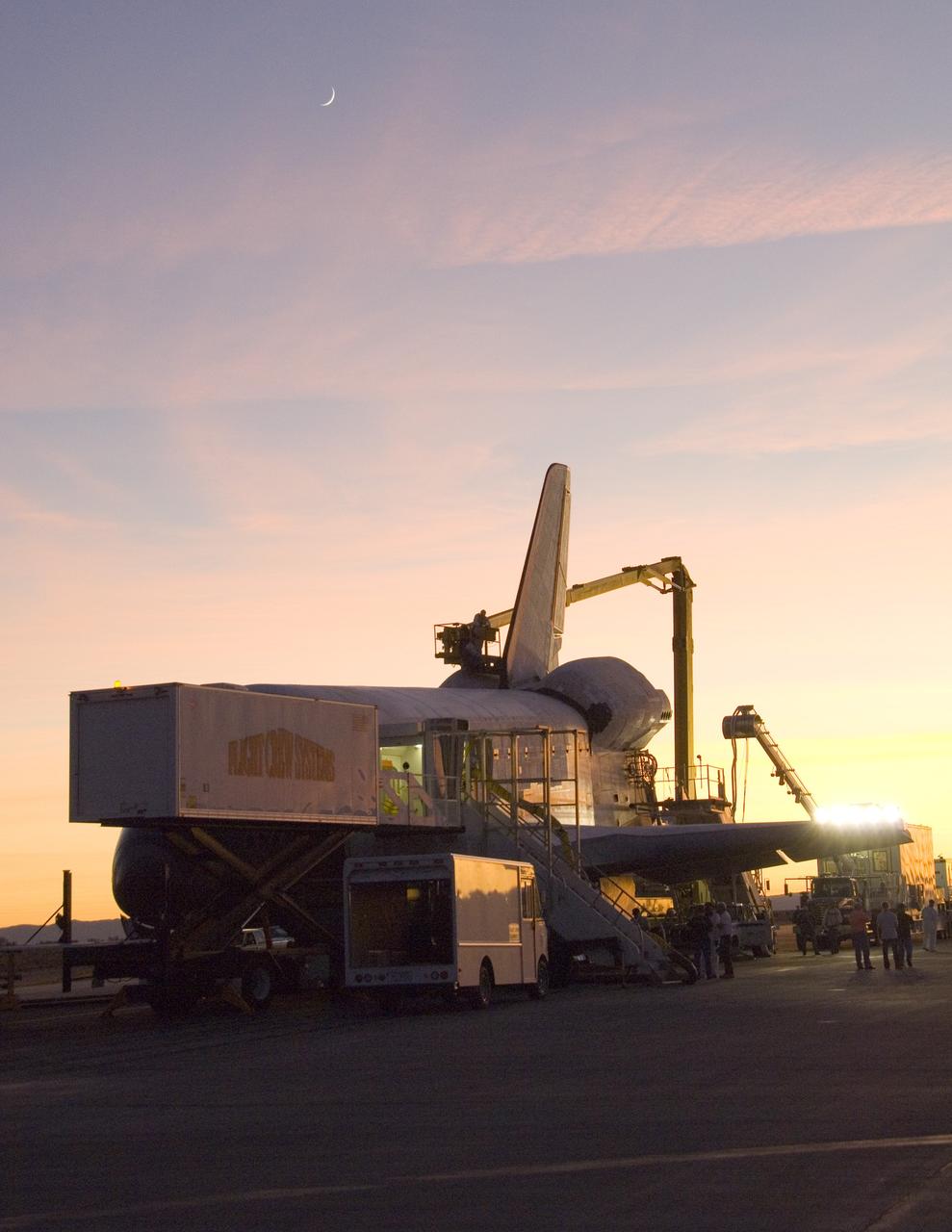
EDWARDS, Calif. – On Edwards Air Force Base in California, space shuttle Endeavour undergoes recovery operations after its landing. The orbiter convoy normally begins recovery operations in earnest about two hours before the shuttle is scheduled to land. Specially designed vehicles or units and a team of trained personnel “safe” the orbiter and prepare it for towing. Purge and Coolant Umbilical Access Vehicles are moved into position behind the orbiter to get access to the umbilical areas. The flight crew is replaced aboard the orbiter by exchange sup¬port personnel who prepare the orbiter for ground tow operations, install switch guards and remove data packages from any onboard experiments. After a total safety downgrade, vehicle ground personnel make numerous preparations for the towing operation, including install¬ing landing gear lock pins, disconnecting the nose landing gear drag link, positioning the towing vehicle in front of the orbiter and connecting the tow bar. The decision to land Endeavour at Edwards was made due to weather concerns at NASA's Kennedy Space Center in Florida. In the 52nd landing at Edwards, Endeavour touched down at 4:25 p.m. EST to end the STS-126 mission, completing its 16-day journey of more than 6.6 million miles in space. Endeavour will be returned to Kennedy atop a Shuttle Carrier Aircraft, or SCA, a modified Boeing 747 jetliner. Photo credit: NASA/Tony Landis, VAFB
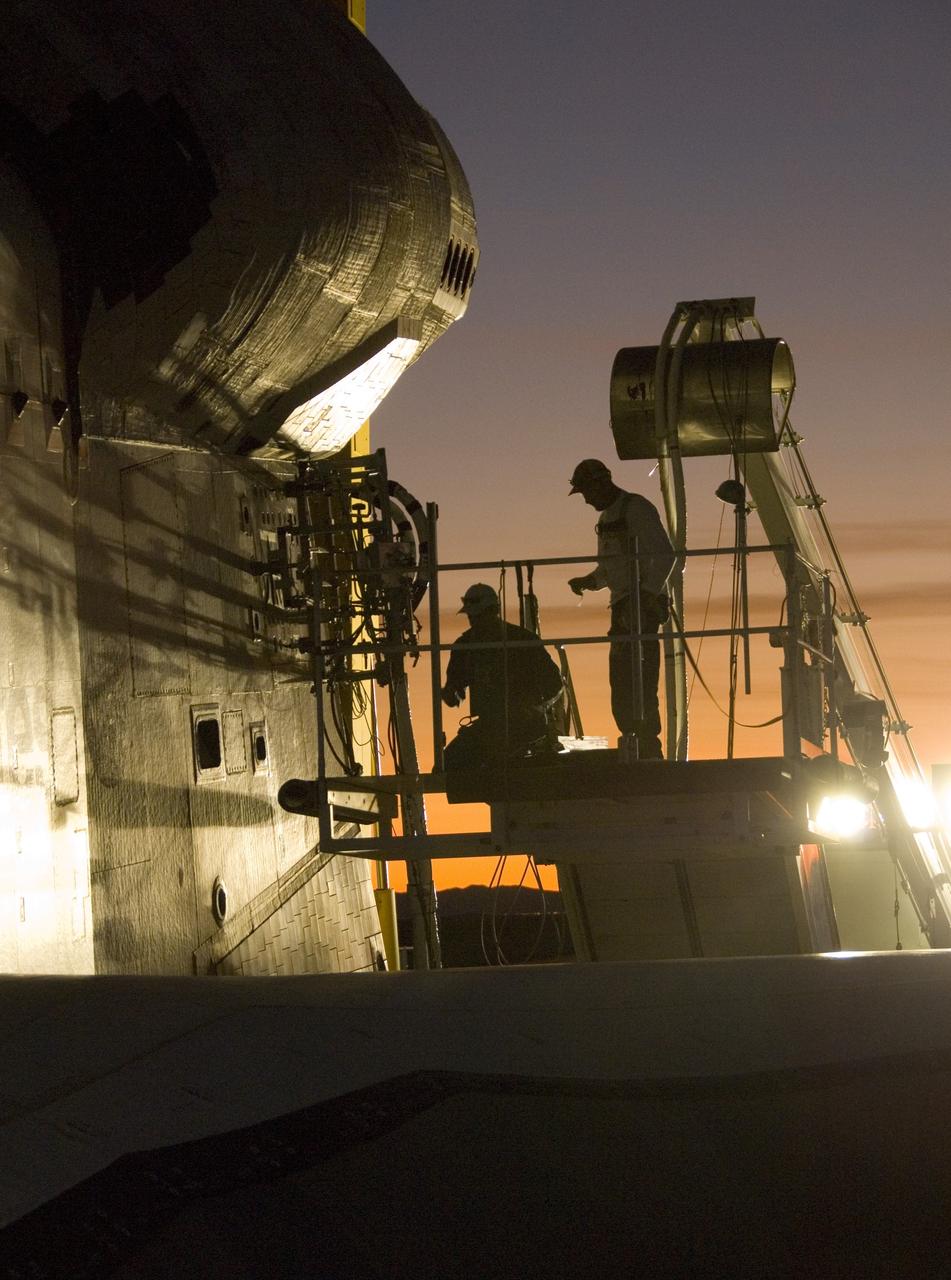
EDWARDS, Calif. – Against a setting sun, space shuttle Endeavour undergoes recovery operations on Edwards Air Force Base in California after its landing. The orbiter convoy normally begins recovery operations in earnest about two hours before the shuttle is scheduled to land. Specially designed vehicles or units and a team of trained personnel “safe” the orbiter and prepare it for towing. Purge and Coolant Umbilical Access Vehicles are moved into position behind the orbiter to get access to the umbilical areas. The flight crew is replaced aboard the orbiter by exchange sup¬port personnel who prepare the orbiter for ground tow operations, install switch guards and remove data packages from any onboard experiments. After a total safety downgrade, vehicle ground personnel make numerous preparations for the towing operation, including install¬ing landing gear lock pins, disconnecting the nose landing gear drag link, positioning the towing vehicle in front of the orbiter and connecting the tow bar. The decision to land Endeavour at Edwards was made due to weather concerns at NASA's Kennedy Space Center in Florida. In the 52nd landing at Edwards, Endeavour touched down at 4:25 p.m. EST to end the STS-126 mission, completing its 16-day journey of more than 6.6 million miles in space. Endeavour will be returned to Kennedy atop a Shuttle Carrier Aircraft, or SCA, a modified Boeing 747 jetliner. Photo credit: NASA/Tony Landis, VAFB
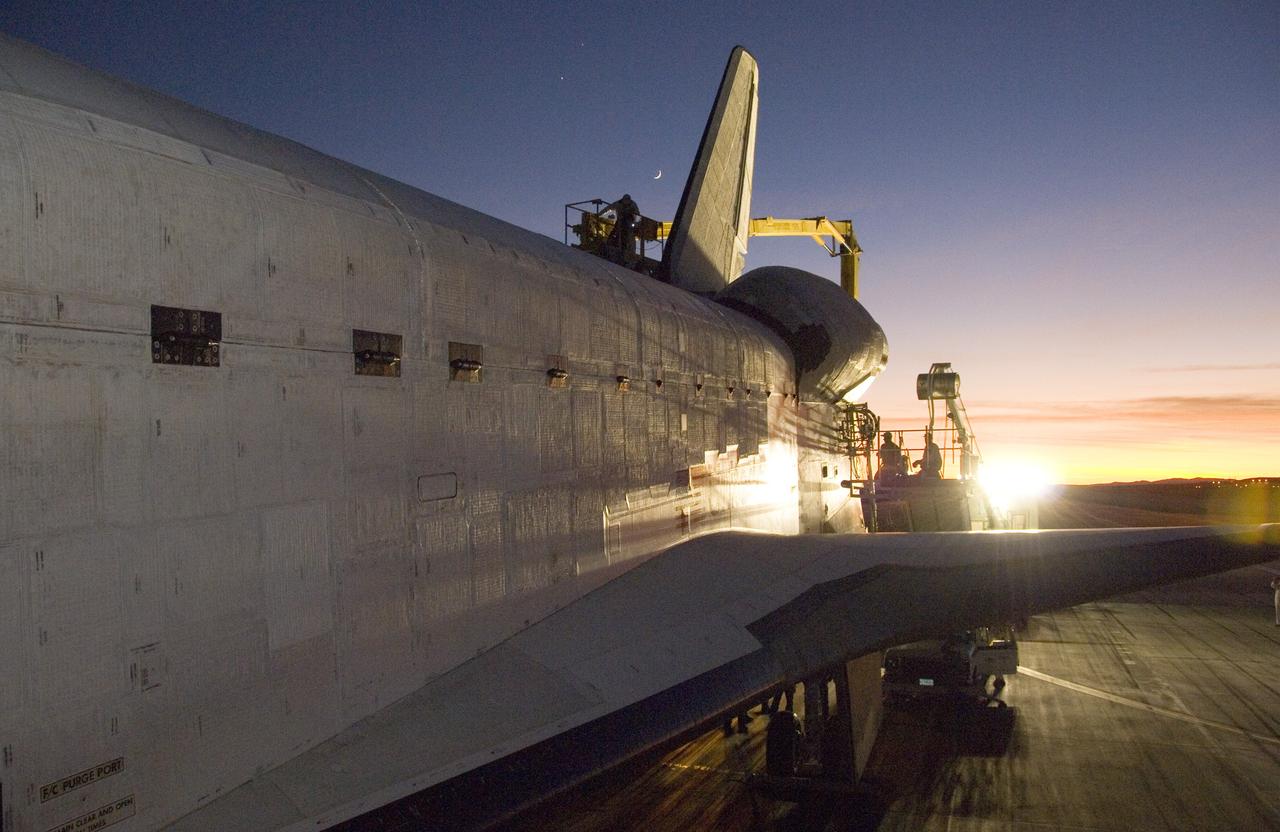
EDWARDS, Calif. – Against a setting sun, space shuttle Endeavour undergoes recovery operations on Edwards Air Force Base in California after its landing. The orbiter convoy normally begins recovery operations in earnest about two hours before the shuttle is scheduled to land. Specially designed vehicles or units and a team of trained personnel “safe” the orbiter and prepare it for towing. Purge and Coolant Umbilical Access Vehicles are moved into position behind the orbiter to get access to the umbilical areas. The flight crew is replaced aboard the orbiter by exchange sup¬port personnel who prepare the orbiter for ground tow operations, install switch guards and remove data packages from any onboard experiments. After a total safety downgrade, vehicle ground personnel make numerous preparations for the towing operation, including install¬ing landing gear lock pins, disconnecting the nose landing gear drag link, positioning the towing vehicle in front of the orbiter and connecting the tow bar. The decision to land Endeavour at Edwards was made due to weather concerns at NASA's Kennedy Space Center in Florida. In the 52nd landing at Edwards, Endeavour touched down at 4:25 p.m. EST to end the STS-126 mission, completing its 16-day journey of more than 6.6 million miles in space. Endeavour will be returned to Kennedy atop a Shuttle Carrier Aircraft, or SCA, a modified Boeing 747 jetliner. Photo credit: NASA/Tony Landis, VAFB
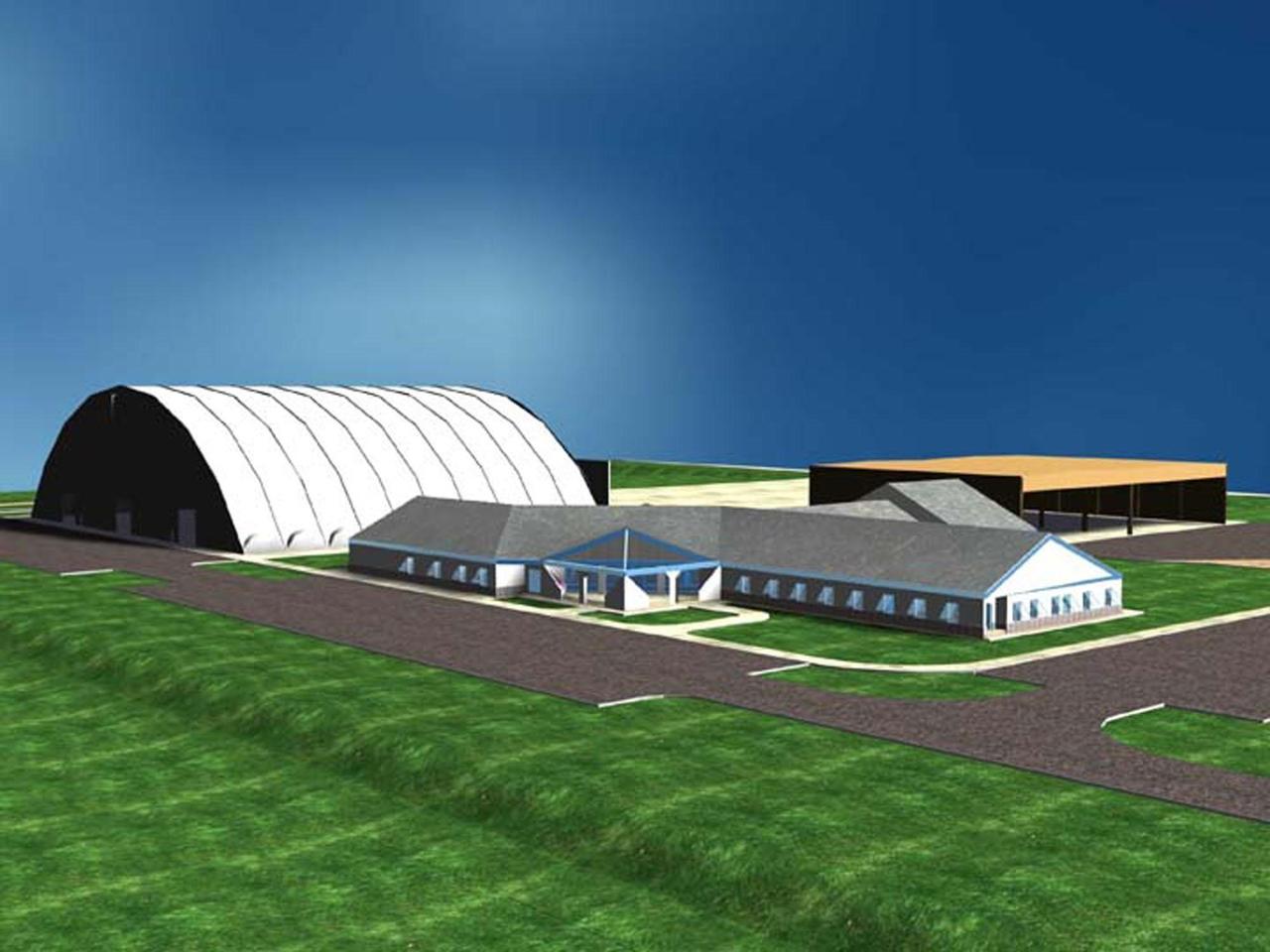
An artist's rendering shows the $8-million Reusable Launch Vehicle (RLV) Support Complex planned for the Shuttle Landing Facility (SLF) at Kennedy Space Center. The ground breaking took place today. To be located at the tow-way adjacent to the SLF, the complex will include a multi-purpose RLV hangar and adjacent facilities for related ground support equipment and administrative/technical support. It will be available to accommodate the Space Shuttle, the X-34 RLV technology demonstrator, the L-1011 carrier aircraft for Pegasus and X-34, and other RLV and X-vehicle programs. The complex is jointly funded by the Spaceport Florida Authority, NASA's Space Shuttle Program and KSC. The facility will be operational in early 2000
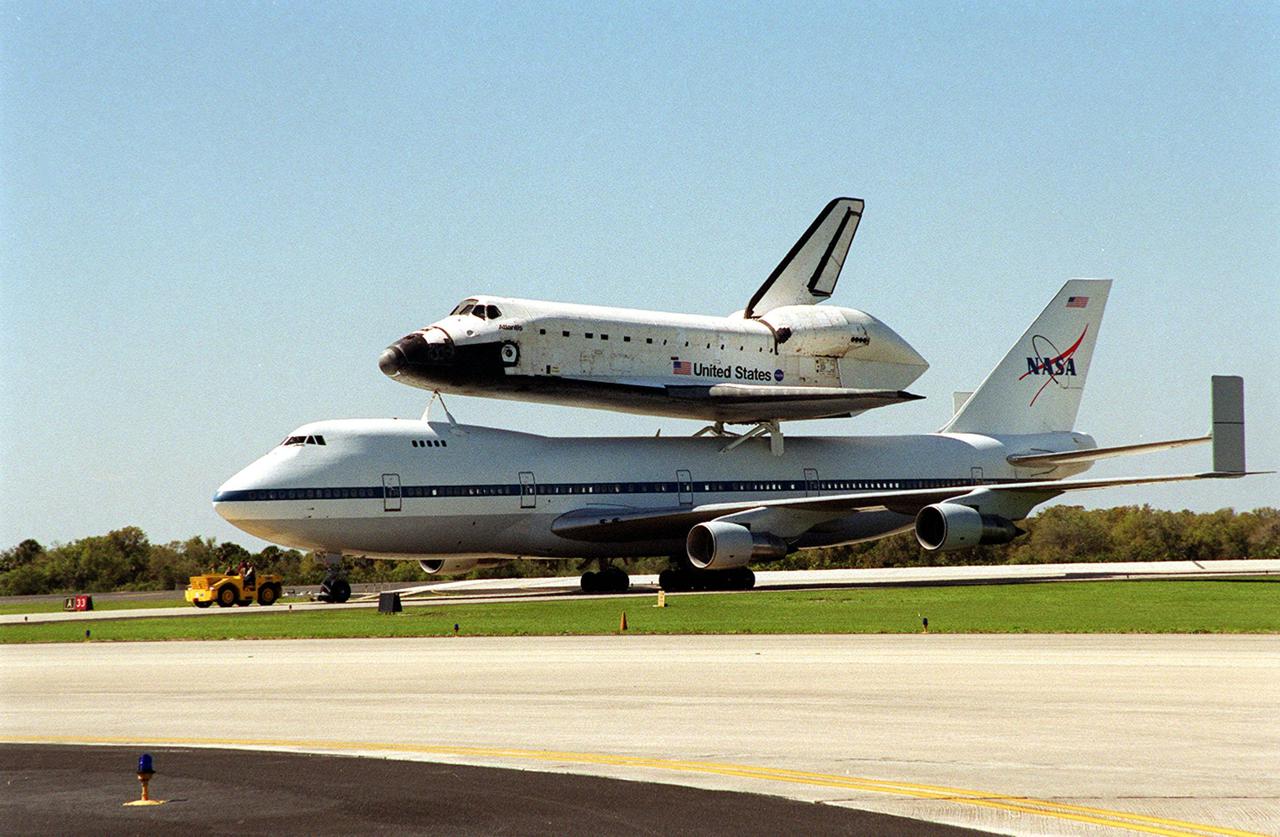
The Shuttle Carrier Aircraft, with its piggyback cargo the orbiter Atlantis, turns on the runway after landing at the KSC Shuttle Landing Facility. The ground vehicle near the nose will tow it to the mate_demate device to have Atlantis removed from its perch. Atlantis landed in California Feb. 19 concluding mission STS-98. The ferry flight began in California March 1; unfavorable weather conditions kept it on the ground at Altus AFB, Okla., until it could return to Florida. The orbiter will next fly on mission STS-104, the 10th construction flight to the International Space Station, scheduled June 8
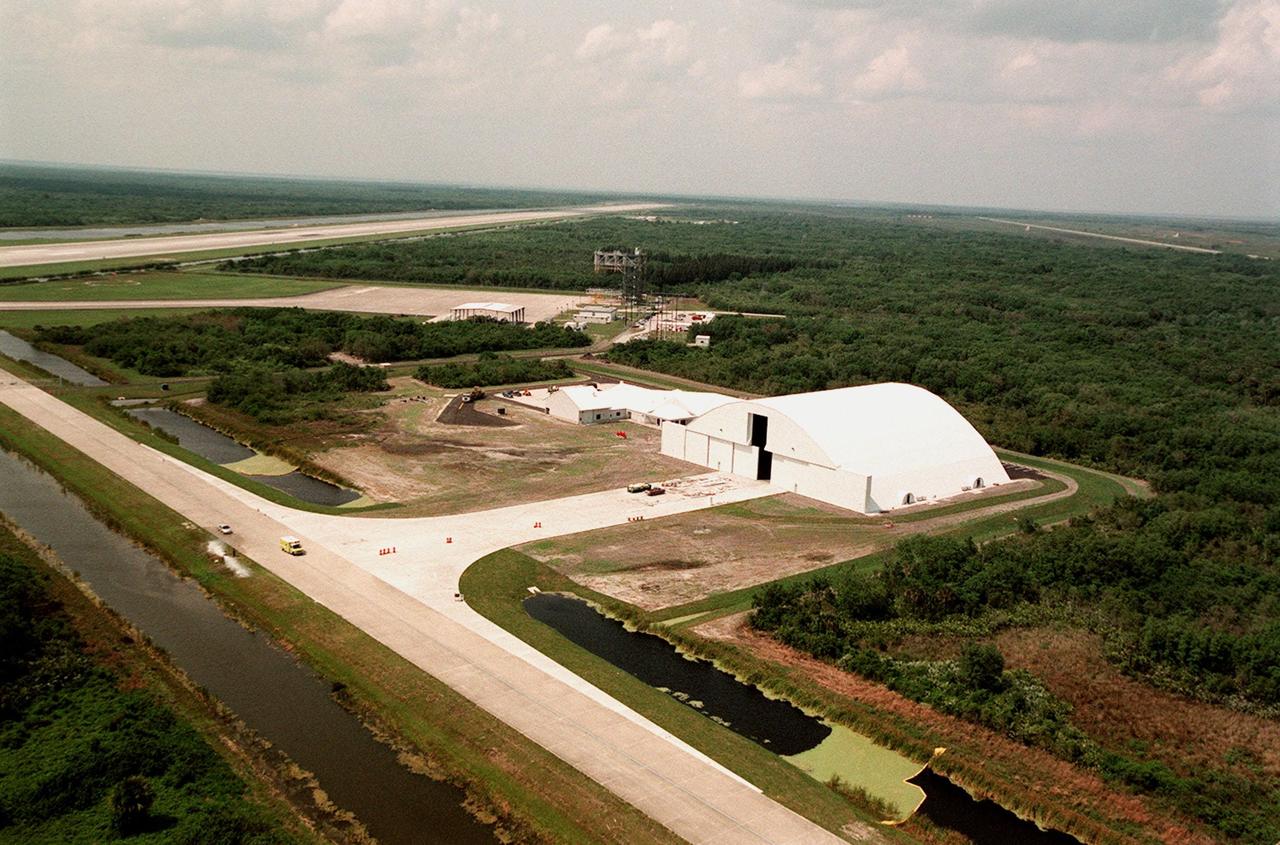
Looking northeast, several elements of the Shuttle Landing Facility (SLF) can be seen. The road on the bottom left corner is the tow-way road, connecting the Orbiter Processing Facility with the landing strip, seen at upper left. The building in the center is the remote launch vehicle (RLV) hangar, still under construction, at the south end of the SLF. Next to the multi-purpose RLV hangar are facilities for related ground support equipment and administrative/technical support. Beyond them is the parking tarmac with its mate-demate device. The lush grounds of the Merritt Island National Wildlife Refuge, which shares a boundary with KSC, extend beyond
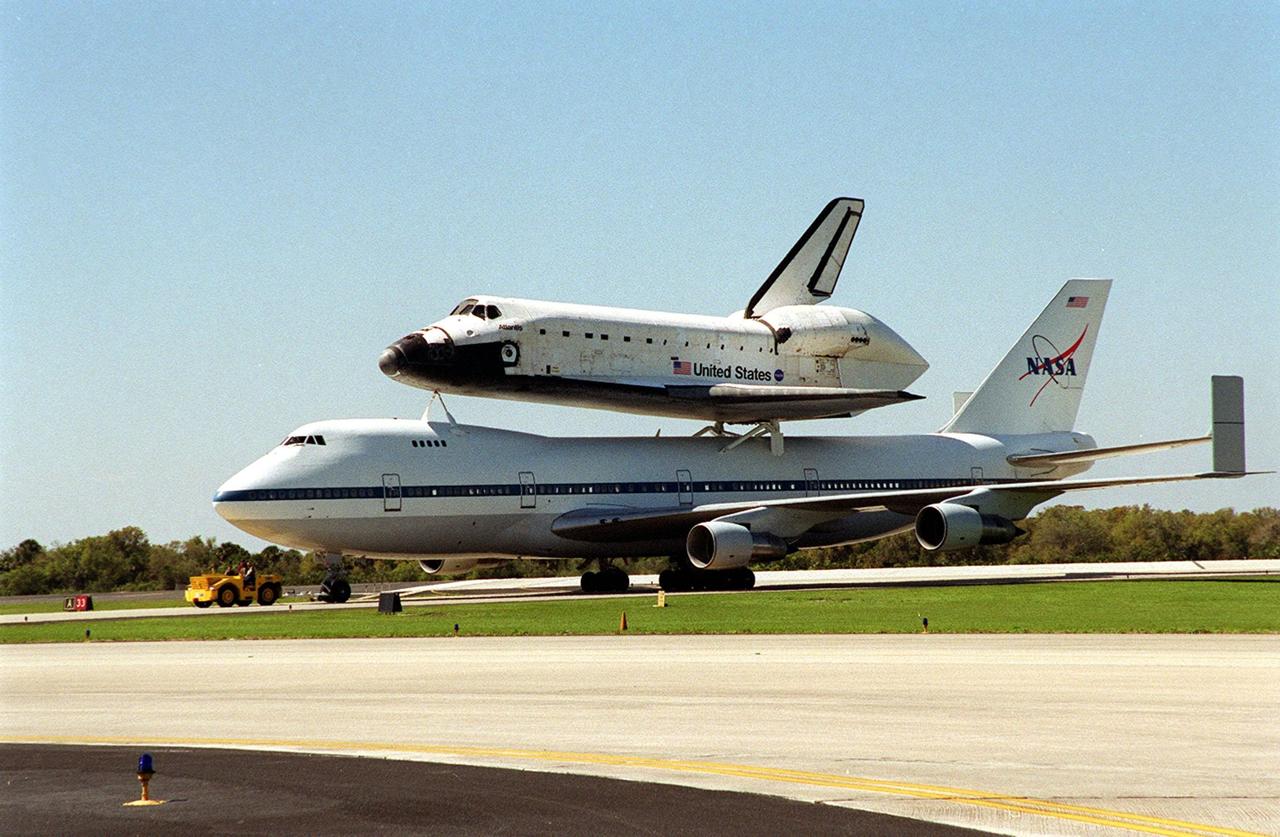
The Shuttle Carrier Aircraft, with its piggyback cargo the orbiter Atlantis, turns on the runway after landing at the KSC Shuttle Landing Facility. The ground vehicle near the nose will tow it to the mate/demate device to have Atlantis removed from its perch. Atlantis landed in California Feb. 19 concluding mission STS-98. The ferry flight began in California March 1; unfavorable weather conditions kept it on the ground at Altus AFB, Okla., until it could return to Florida. The orbiter will next fly on mission STS-104, the 10th construction flight to the International Space Station, scheduled June 8
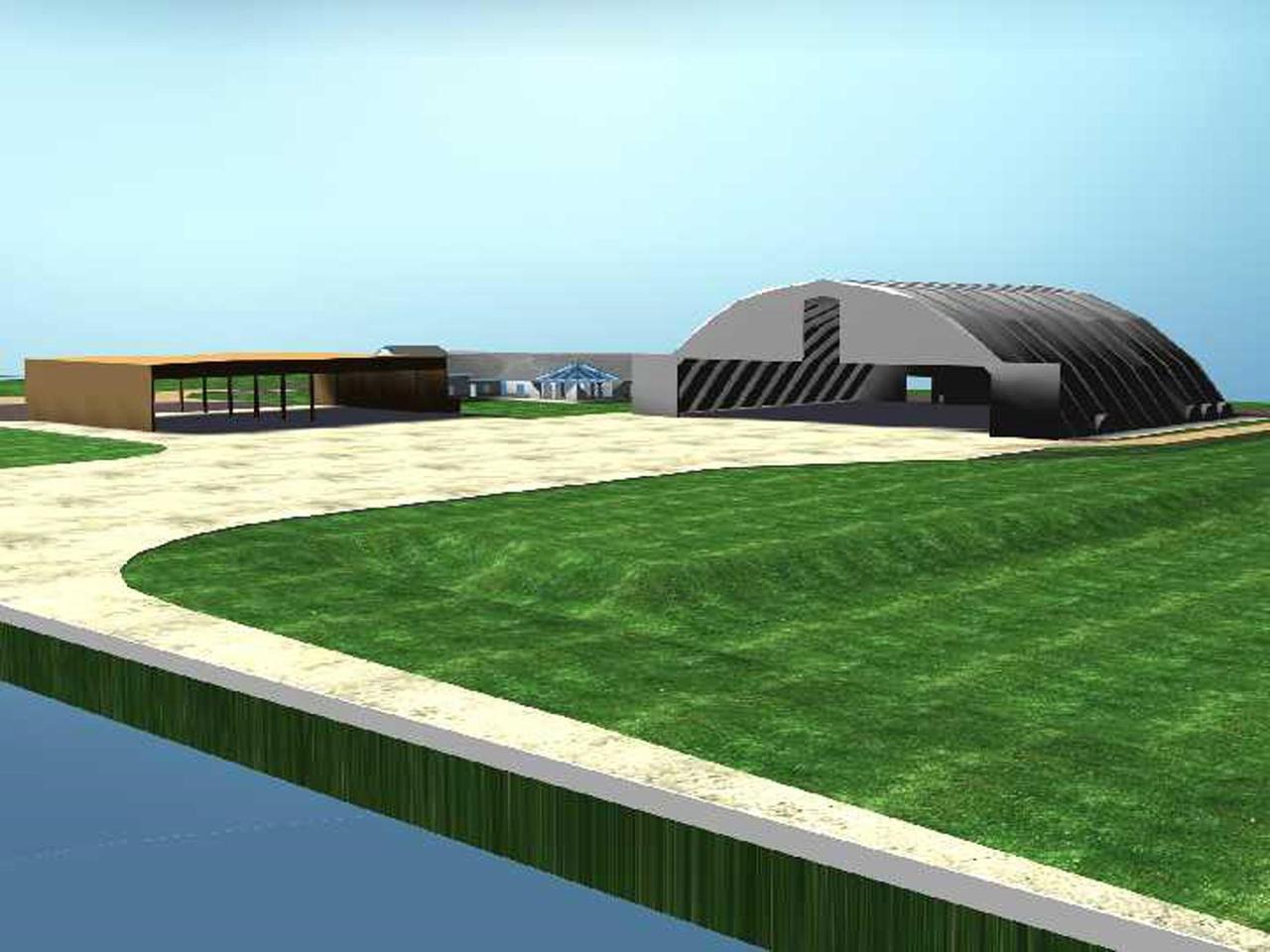
An artist's rendering shows the $8-million Reusable Launch Vehicle (RLV) Support Complex planned for the Shuttle Landing Facility (SLF) at Kennedy Space Center. The ground breaking took place today. To be located at the tow-way adjacent to the SLF, the complex will include a multi-purpose RLV hangar and adjacent facilities for related ground support equipment and administrative/technical support. It will be available to accommodate the Space Shuttle, the X-34 RLV technology demonstrator, the L-1011 carrier aircraft for Pegasus and X-34, and other RLV and X-vehicle programs. The complex is jointly funded by the Spaceport Florida Authority, NASA's Space Shuttle Program and KSC. The facility will be operational in early 2000
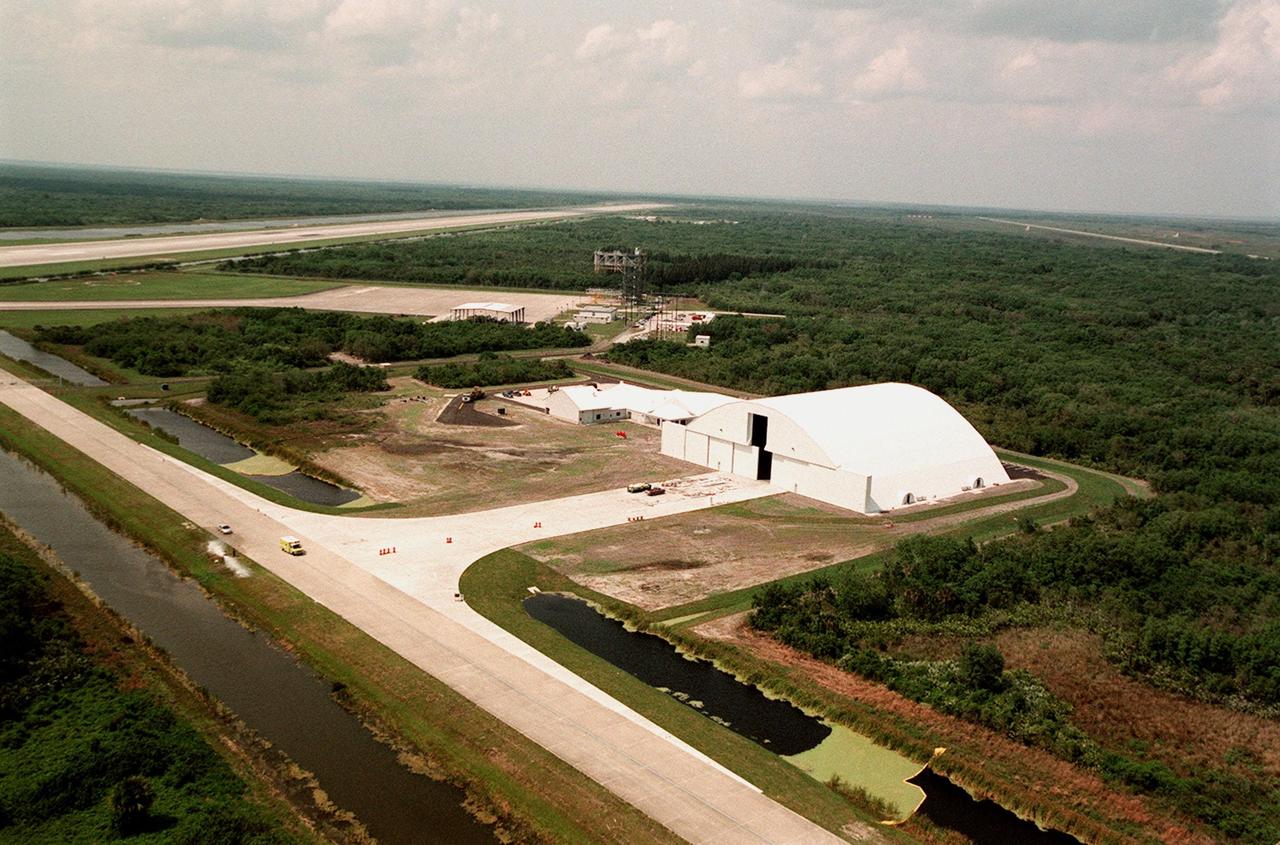
Looking northeast, several elements of the Shuttle Landing Facility (SLF) can be seen. The road on the bottom left corner is the tow-way road, connecting the Orbiter Processing Facility with the landing strip, seen at upper left. The building in the center is the remote launch vehicle (RLV) hangar, still under construction, at the south end of the SLF. Next to the multi-purpose RLV hangar are facilities for related ground support equipment and administrative/technical support. Beyond them is the parking tarmac with its mate-demate device. The lush grounds of the Merritt Island National Wildlife Refuge, which shares a boundary with KSC, extend beyond
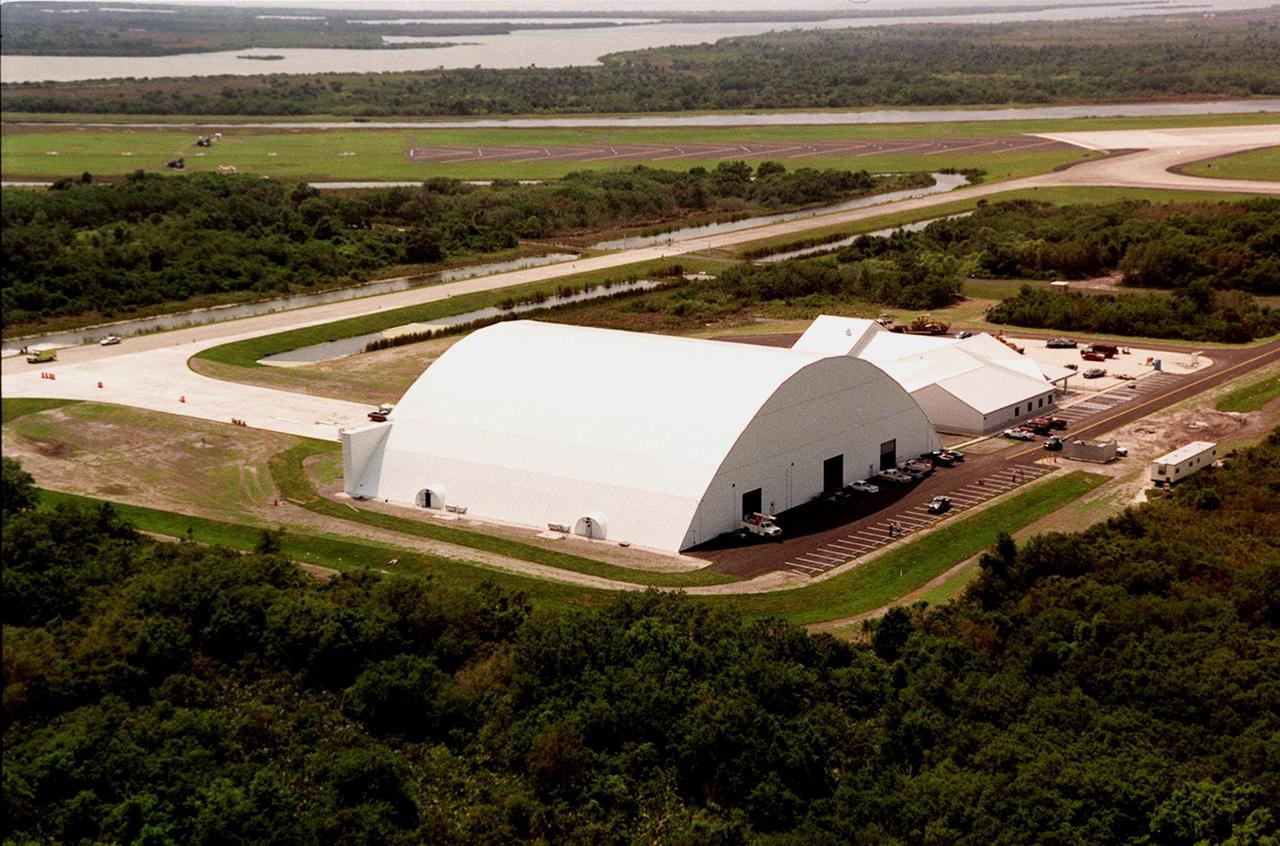
The remote launch vehicle (RLV) hangar, still under construction, is seen here. It sits at the south end of the Shuttle Landing Facility. Adjacent to the multi-purpose RLV hangar (right) are facilities for related ground support equipment and administrative/technical support. Next to the hangar is the tow-way road leading to the runway, which starts on the right of the photo. The top of the photo shows the Indian River, part of the Intracoastal Waterway in Florida
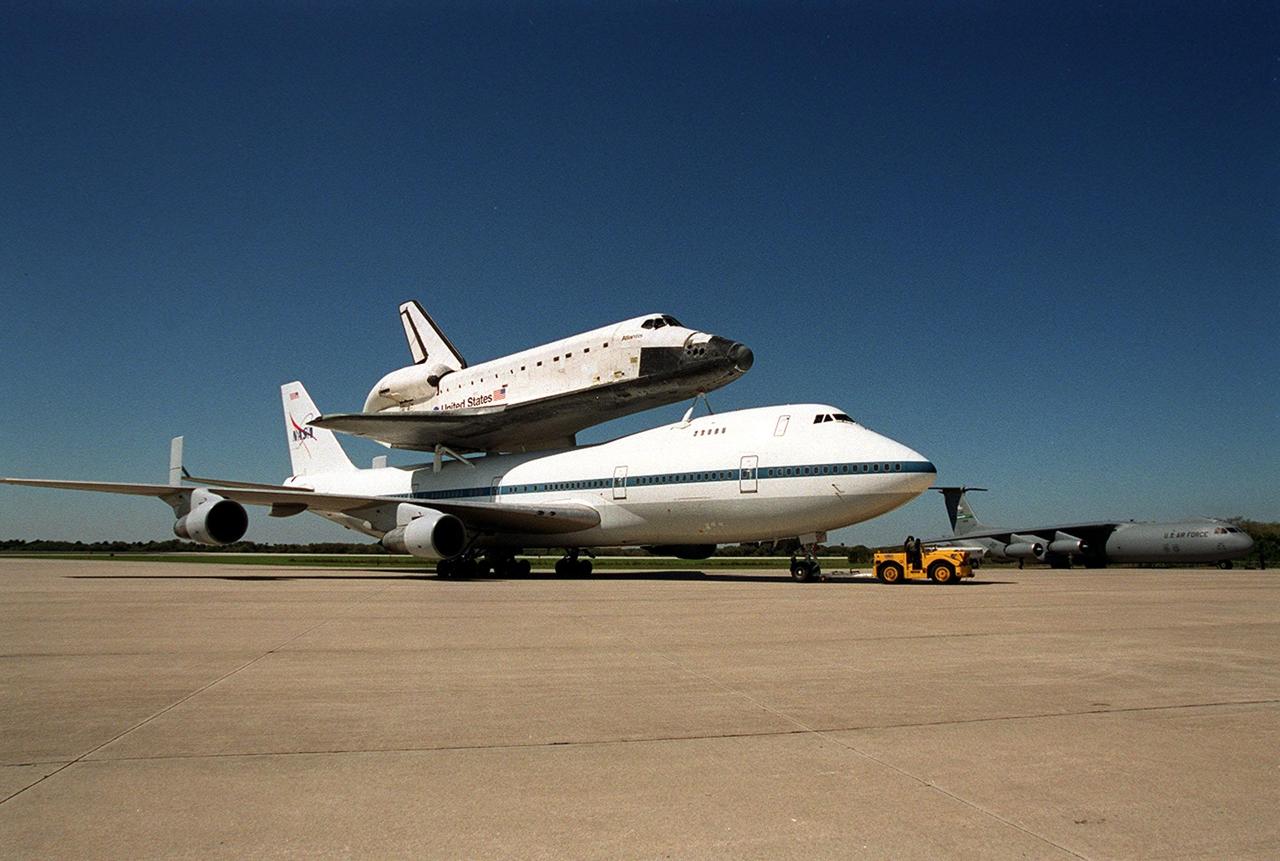
The Shuttle Carrier Aircraft, with its piggyback cargo the orbiter Atlantis, is towed to the parking area at the Shuttle Landing Facility. There it will be demated from the orbiter in the mate/demate device. Atlantis landed in California Feb. 19 concluding mission STS-98. The ferry flight began in California March 1; unfavorable weather conditions kept it on the ground at Altus AFB, Okla., until it could return to Florida. The orbiter will next fly on mission STS-104, the 10th construction flight to the International Space Station, scheduled June 8
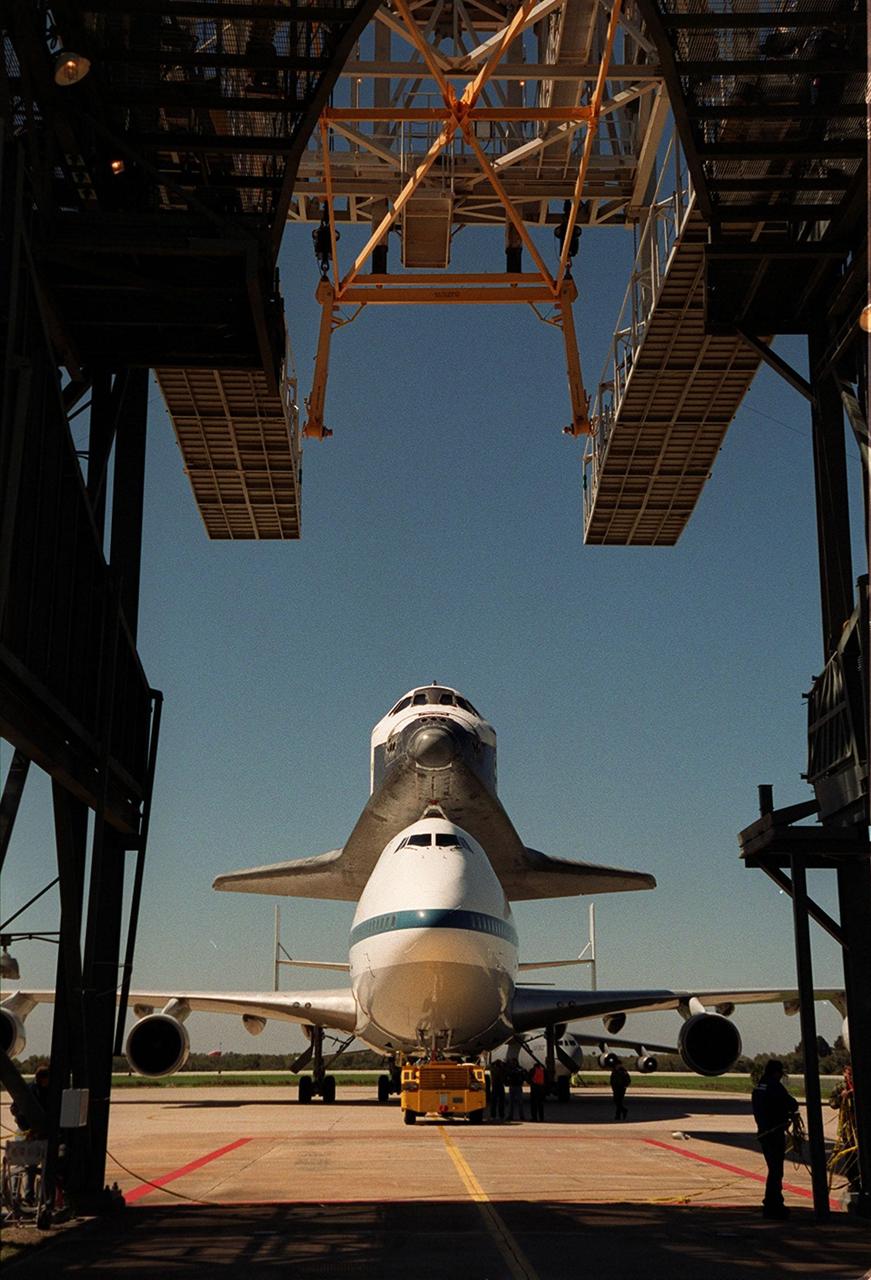
Viewed from behind the mate/demate device at the Shuttle Landing Facility, the Shuttle Carrier Aircraft and the orbiter Atlantis are towed toward the MDD where Atlantis will be lifted from the SCA. Atlantis landed in California Feb. 19 concluding mission STS-98. The ferry flight began in California March 1; unfavorable weather conditions kept it on the ground at Altus AFB, Okla., until it could return to Florida. The orbiter will next fly on mission STS-104, the 10th construction flight to the International Space Station, scheduled June 8
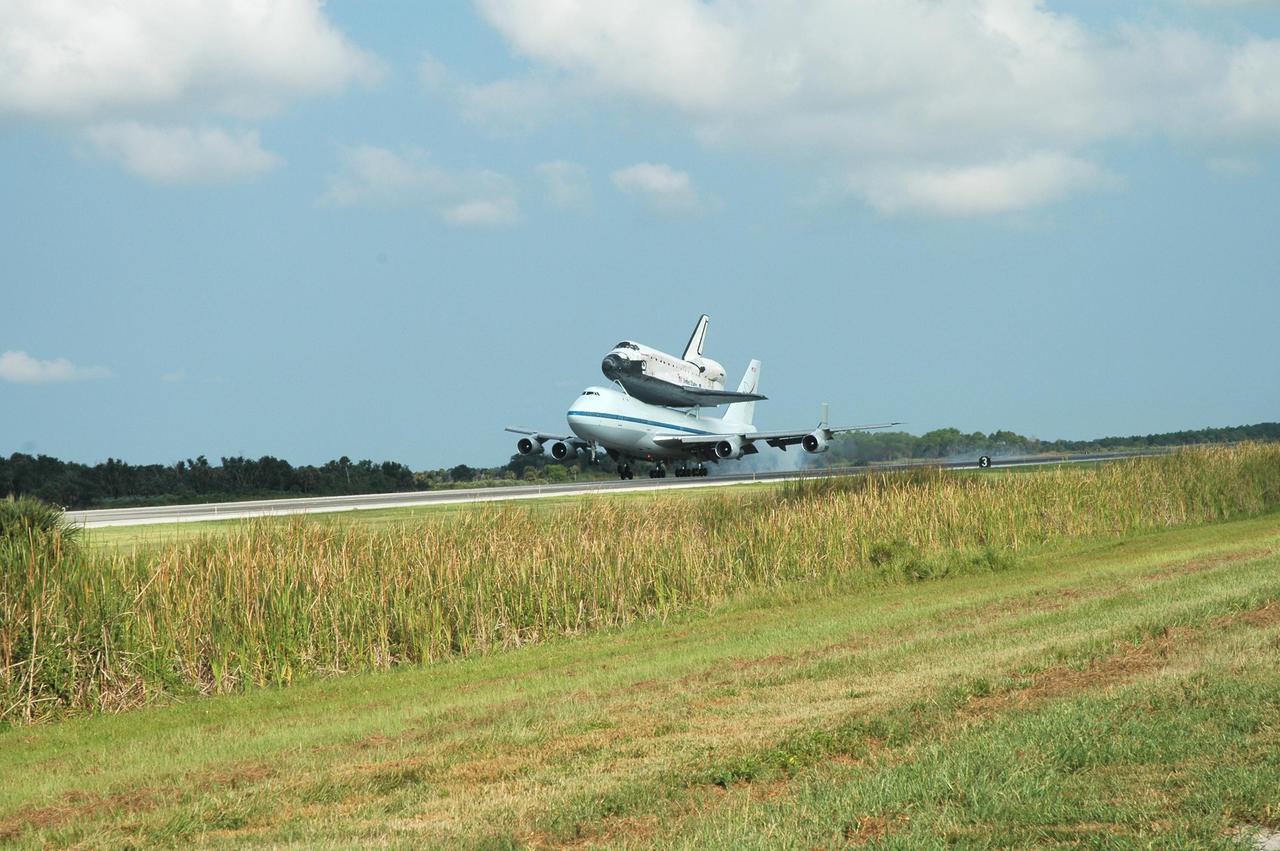
KENNEDY SPACE CENTER, FLA. - Space Shuttle Discovery, atop a modified Boeing 747 Shuttle Carrier Aircraft (SCA), touches down on runway 15 at NASA Kennedy Space Center's Shuttle Landing Facility (SLF) at about 10:00 a.m. EDT. The cross-country ferry flight became necessary when two days of unfavorable weather conditions at KSC forced Discovery to land on runway 22 at Edwards Air Force Base, Calif., on Aug. 9 following mission STS-114. On the return trip, stops were made at Altus Air Force Base, Okla., and Barksdale Air Force Base, La., where Discovery stayed for two nights. The SCA and Discovery will be towed to the Mate_Demate Device at the SLF where a crane will lift Discovery from the SCA and place it on solid ground. Discovery will then be towed to the Orbiter Processing Facility where preparations will begin for its next flight, STS-121.
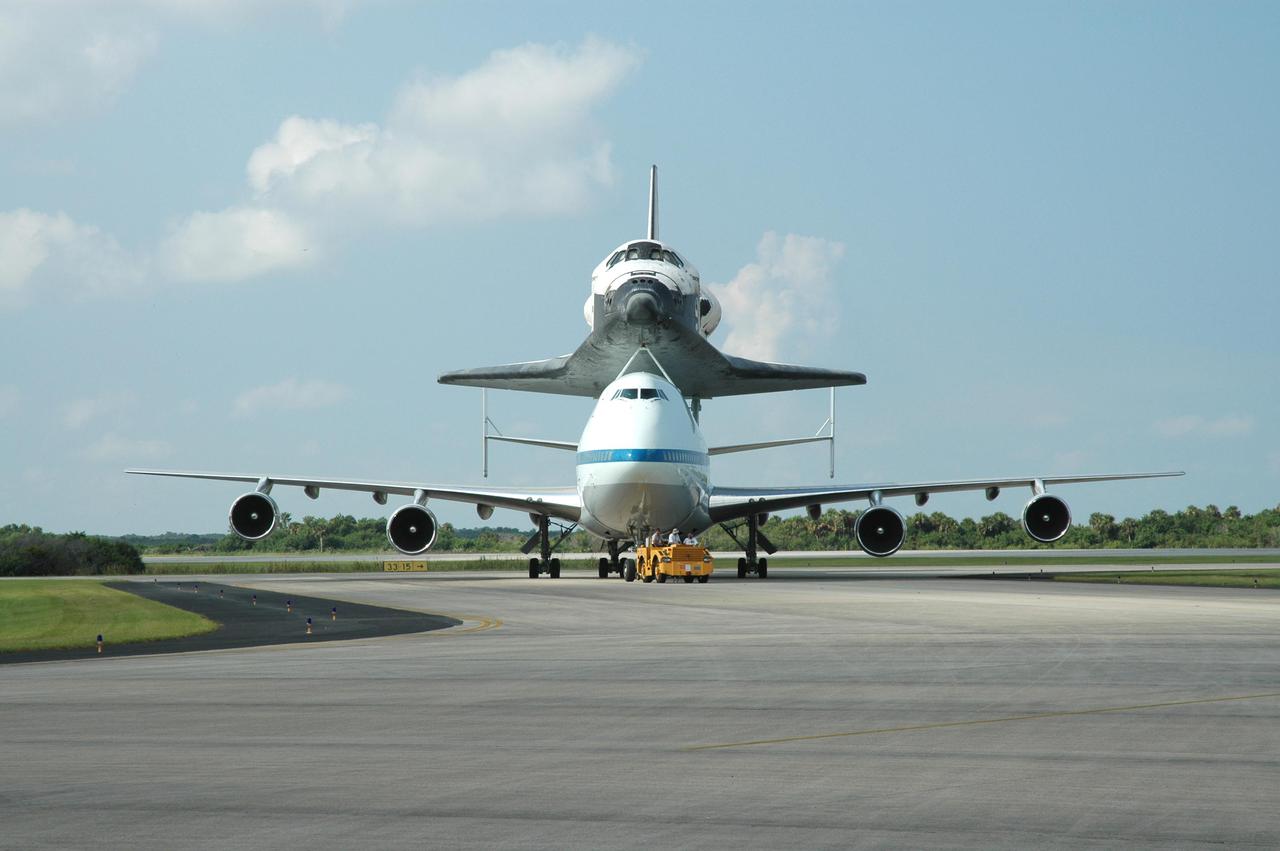
KENNEDY SPACE CENTER, FLA. - Space Shuttle Discovery, atop a modified Boeing 747 Shuttle Carrier Aircraft (SCA), is towed to the Mate_Demate Device (MDD) at NASA Kennedy Space Center's Shuttle Landing Facility (SLF) following touchdown on runway 15 at about 10:00 a.m. EDT. The cross-country ferry flight became necessary when two days of unfavorable weather conditions at KSC forced Discovery to land on runway 22 at Edwards Air Force Base, Calif., on Aug. 9 following mission STS-114. On the return trip, stops were made at Altus Air Force Base, Okla., and Barksdale Air Force Base, La., where Discovery stayed for two nights. A crane on the MDD will lift Discovery from the SCA and place it on solid ground. Discovery will then be towed to the Orbiter Processing Facility where preparations will begin for its next flight, STS-121.
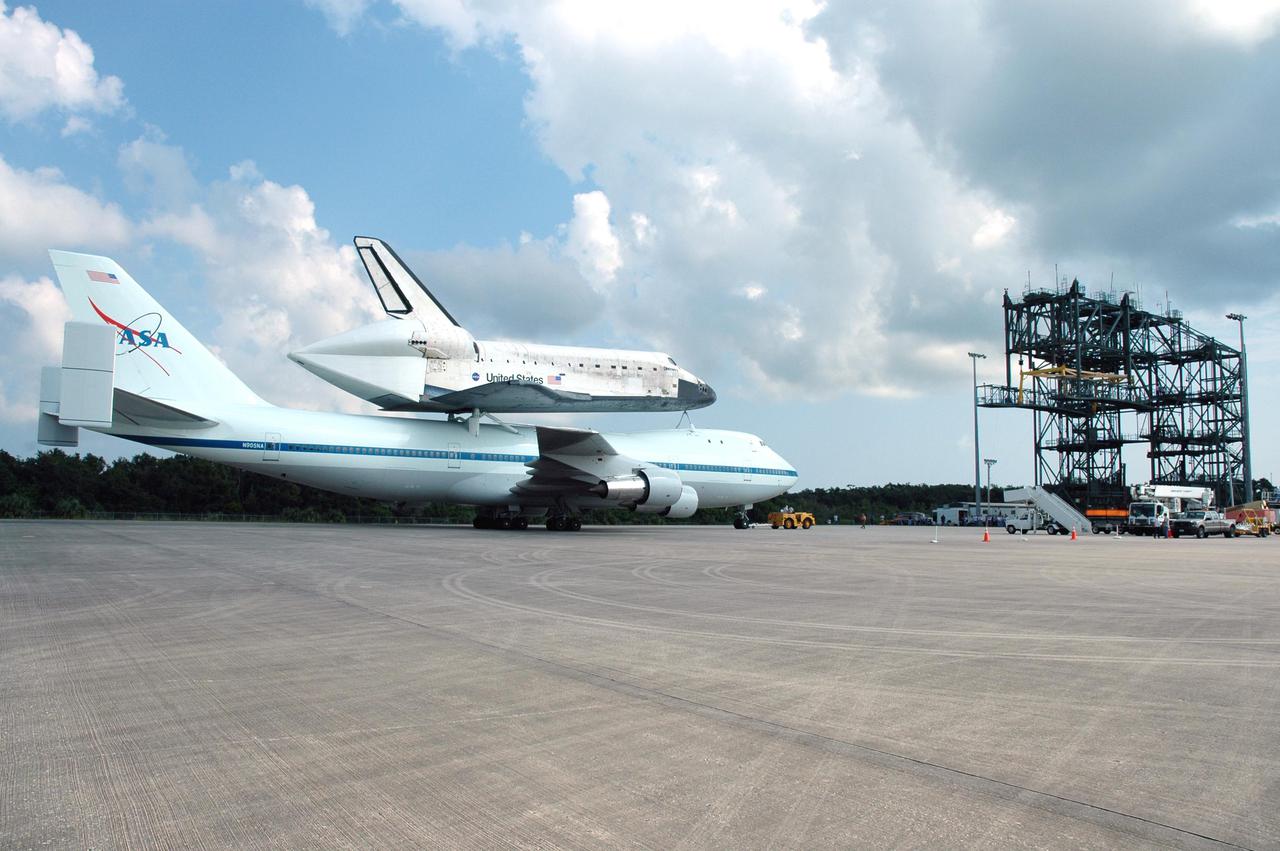
KENNEDY SPACE CENTER, FLA. - Space Shuttle Discovery, atop a modified Boeing 747 Shuttle Carrier Aircraft (SCA), is towed to the Mate_Demate Device (MDD), at right, at NASA Kennedy Space Center's Shuttle Landing Facility (SLF) following touchdown on runway 15 at about 10:00 a.m. EDT. The cross-country ferry flight became necessary when two days of unfavorable weather conditions at KSC forced Discovery to land on runway 22 at Edwards Air Force Base, Calif., on Aug. 9 following mission STS-114. On the return trip, stops were made at Altus Air Force Base, Okla., and Barksdale Air Force Base, La., where Discovery stayed for two nights. A crane on the MDD will lift Discovery from the SCA and place it on solid ground. Discovery will then be towed to the Orbiter Processing Facility where preparations will begin for its next flight, STS-121.
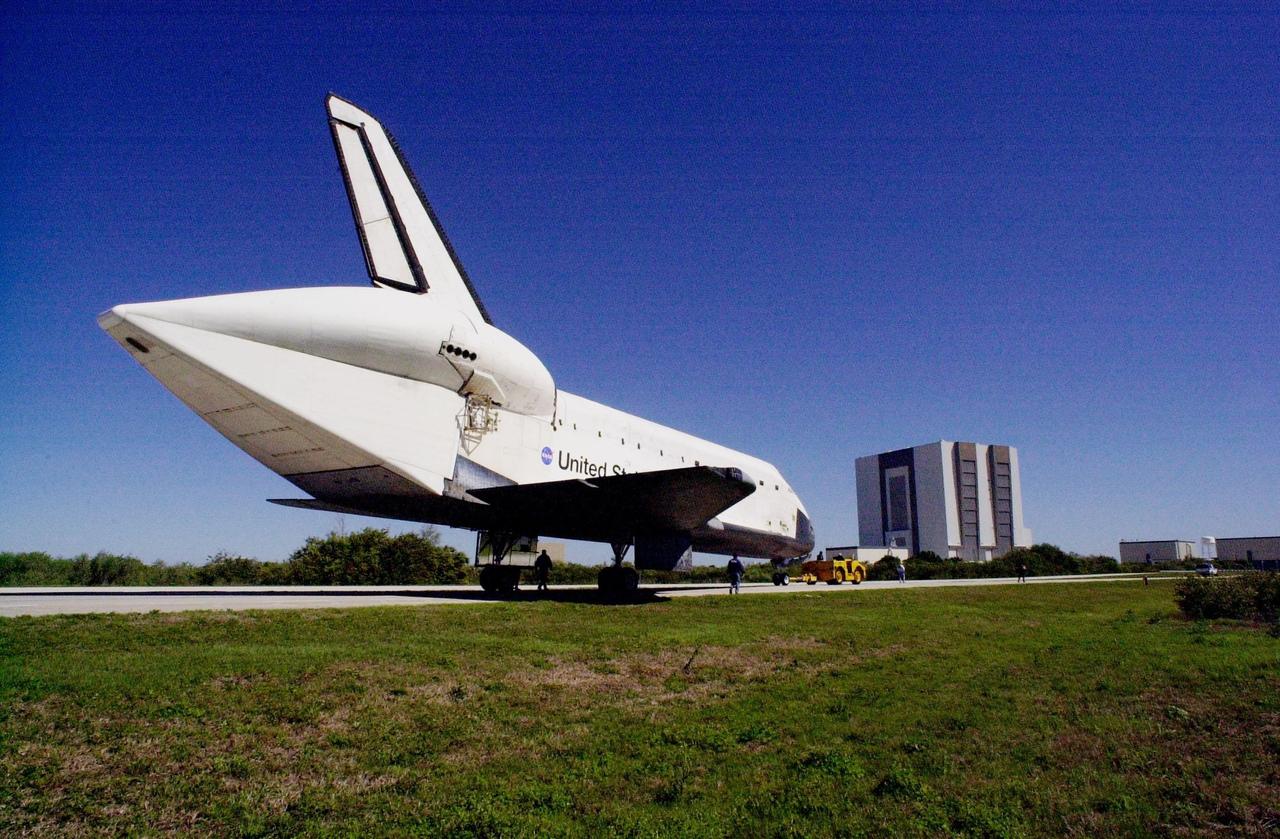
KENNEDY SPACE CENTER, FLA. -- Orbiter Atlantis is towed to the Orbiter Processing Facility bay 3 along the tow-way. In the background is the Vehicle Assembly Building. The unusual silhouette of the aft section on the orbiter is due to the tail cone covering the aft engines. Atlantis landed Feb. 19 at Edwards Air Force Base concluding mission STS-98. The orbiter returned to Florida on the back of a Shuttle Carrier Aircraft, known as a ferry flight, that began March 1. Unfavorable weather conditions kept it on the ground at Altus AFB, Okla., for several days until it could return to Florida. Atlantis will be prepared in the OPF for mission STS-104, the 10th construction flight to the International Space Station, scheduled to launch June 8
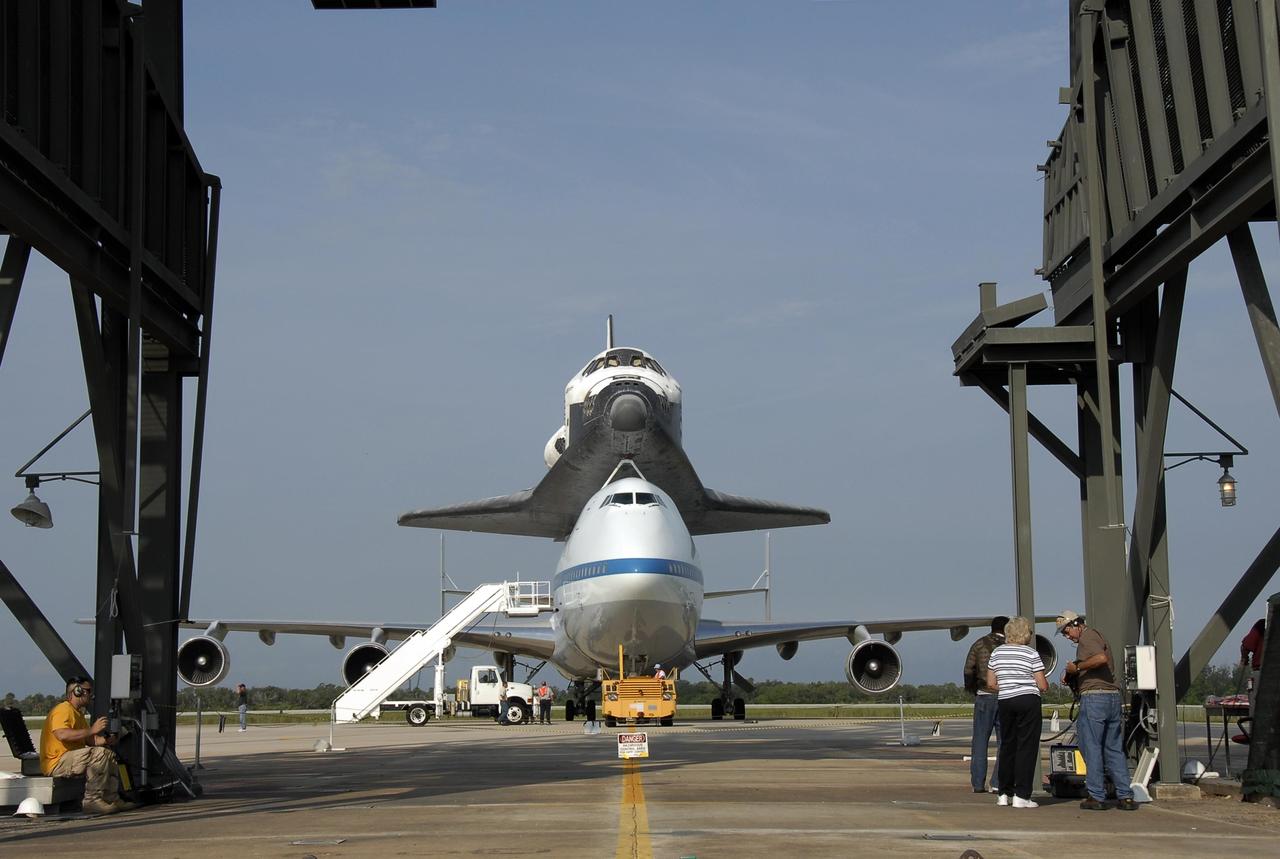
KENNEDY SPACE CENTER, FLA. -- The shuttle carrier aircraft, or SCA, and its piggyback passenger Atlantis are poised to be towed into the mate/demate device, in the foreground. The device will lift the orbiter and put it back on the ground. After a three-day, cross-country trip, the orbiter/SCA duo touched down at 8:27 a.m. EDT. The SCA is a modified Boeing 747 jetliner. Atlantis landed at Edwards Air Force Base in California to end mission STS-117. The return to KSC began July 1 and included several stops across the country for fuel. The last stop was at Ft. Campbell in Kentucky. Weather conditions over the last leg postponed the return trip until July 3. After demate, Atlantis will then be towed to the Orbiter Processing Facility to begin processing for its next launch, mission STS-122 in December. Photo credit: NASA/Kim Shiflett
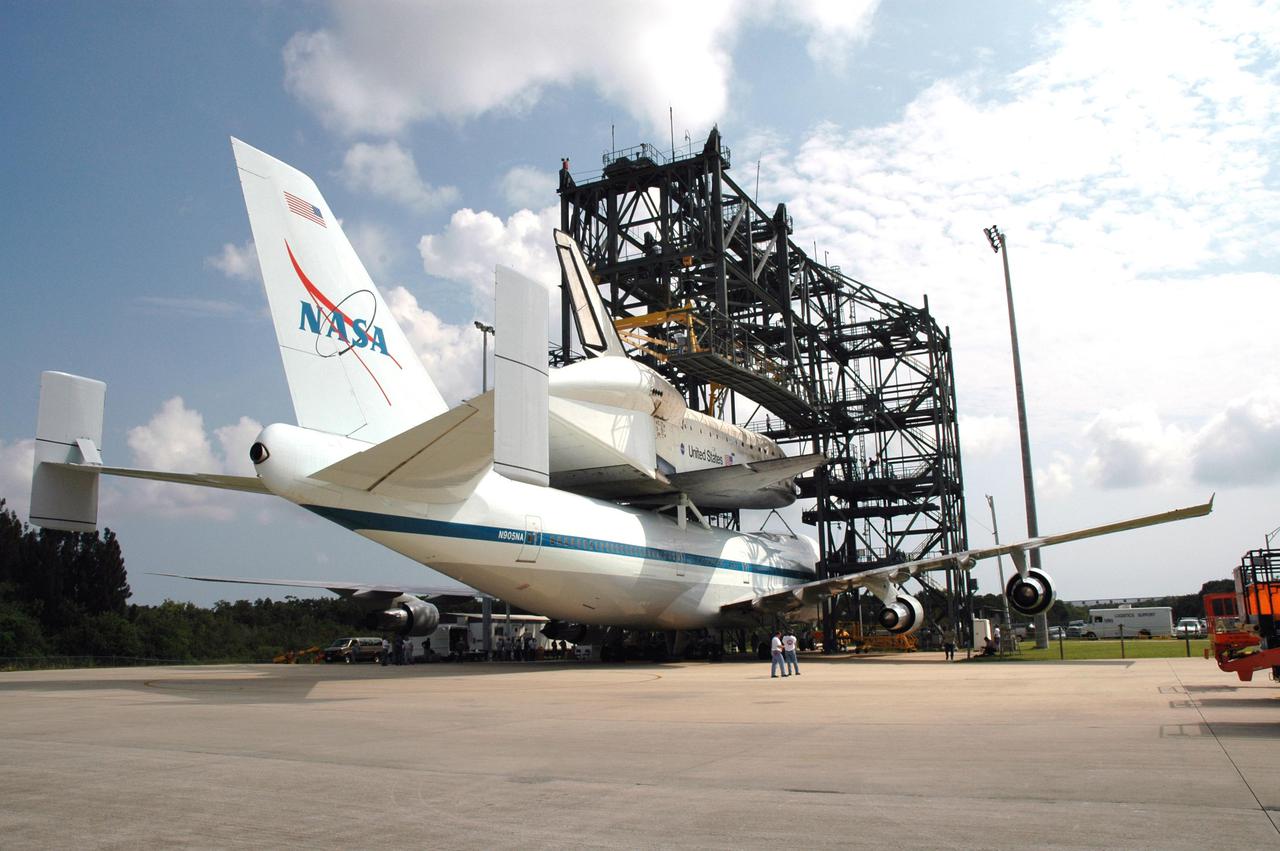
KENNEDY SPACE CENTER, FLA. - The orbiter Discovery on top of the Shuttle Carrier Aircraft, a modified Boeing 747, is towed into the mate_demate device at NASA Kennedy Space Center’s Shuttle Landing Facility. Discovery was returned to Kennedy Space Center on a ferry flight from Edwards Air Force Base in California, where it landed Aug. 9 after 13 days in space on mission STS-114. In the mate_demate device, a horizontal structure mounted at the 80-foot level between two towers controls and guides a large lift beam that attaches to the orbiter to raise and lower it. Once Discovery is lifted off the back of the SCA, the 747 can then roll away and the orbiter will be lowered to the ground. It will then be towed from the SLF to the Orbiter Processing Facility. Once inside the OPF, the payload bay doors will be opened and the MPLM Raffaello brought back from the International Space Station will be unloaded and transferred to the Space Station Processing Facility. This concludes mission STS-114.

CAPE CANAVERAL, Fla. -- At the Shuttle Landing Facility, or SLF, at NASA's Kennedy Space Center in Florida, the shuttle carrier aircraft with space shuttle Endeavour on top backs away from the mate/demate device for another try. A sling in the device will lift the shuttle away from the shuttle carrier aircraft, or SCA, underneath. The SCA carried the shuttle piggyback from California, where Endeavour landed Nov. 30 to end the STS-126 mission. When Endeavour is on the ground, it will be towed via the two-mile tow-way from the SLF by a diesel-powered tractor to the Orbiter Processing Facility where it will begin preparations for its next mission, STS-127, targeted for May 2009. Photo credit: NASA/Jack Pfaller
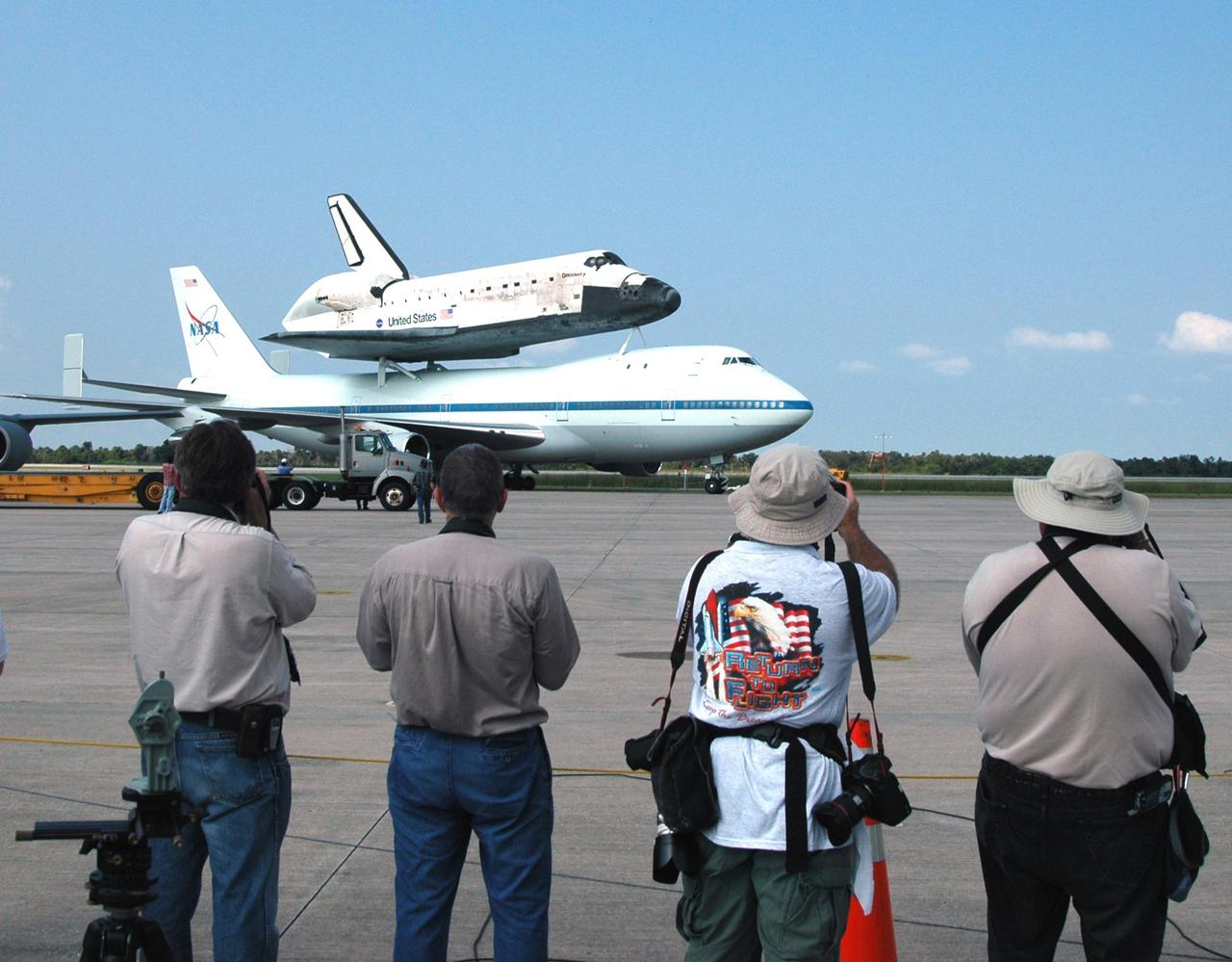
KENNEDY SPACE CENTER, FLA. - News media photographers are on hand for the touchdown of Space Shuttle Discovery, atop a modified Boeing 747 Shuttle Carrier Aircraft (SCA), on runway 15 at NASA Kennedy Space Center's Shuttle Landing Facility (SLF) at about 10:00 a.m. EDT. The cross-country ferry flight became necessary when two days of unfavorable weather conditions at KSC forced Discovery to land on runway 22 at Edwards Air Force Base, Calif., on Aug. 9 following mission STS-114. On the return trip, stops were made at Altus Air Force Base, Okla., and Barksdale Air Force Base, La., where Discovery stayed for two nights. The SCA and Discovery will be towed to the Mate_Demate Device at the SLF where a crane will lift Discovery from the SCA and place it on solid ground. Discovery will then be towed to the Orbiter Processing Facility where preparations will begin for its next flight, STS-121.
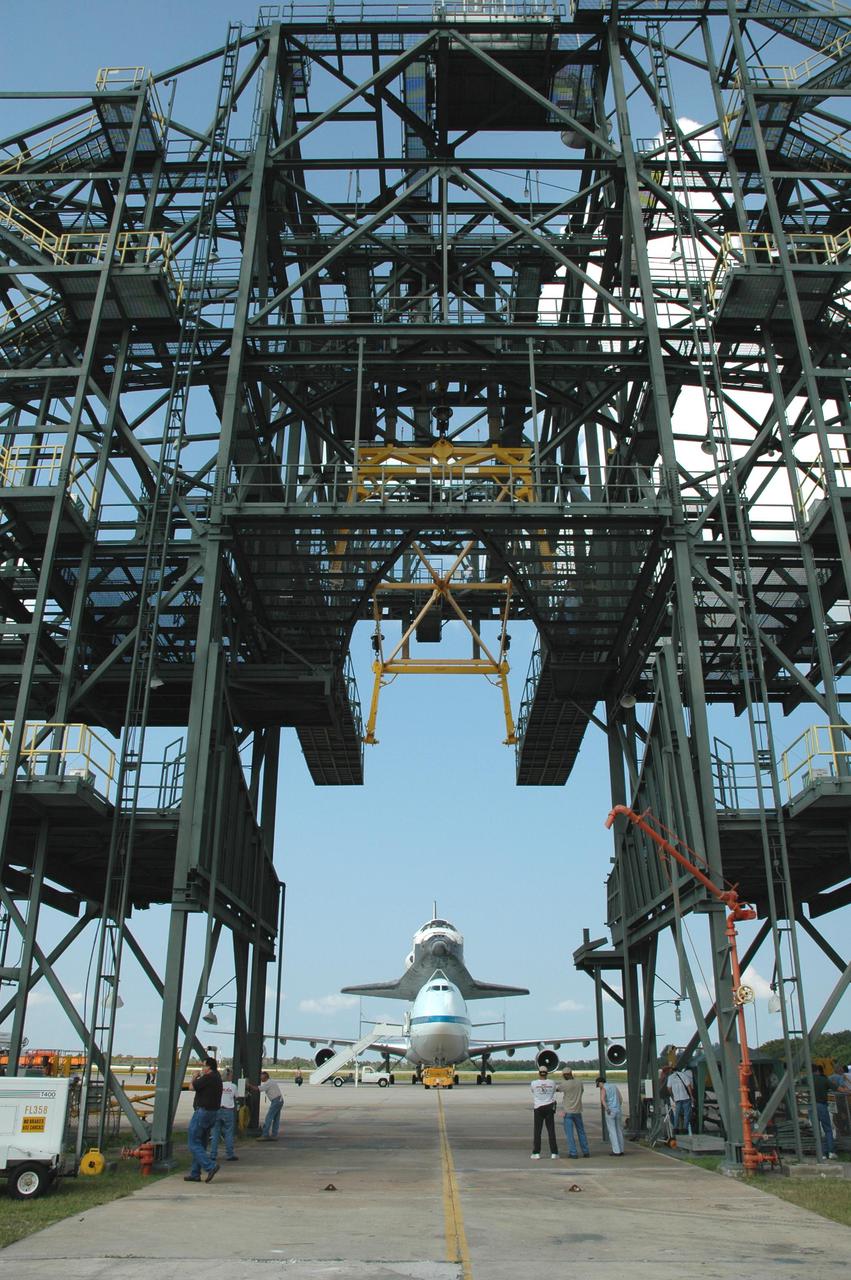
KENNEDY SPACE CENTER, FLA. - Space Shuttle Discovery, atop a modified Boeing 747 Shuttle Carrier Aircraft (SCA), is towed toward the Mate_Demate Device (MDD), in the foreground, at NASA Kennedy Space Center's Shuttle Landing Facility (SLF) following touchdown on runway 15 at about 10:00 a.m. EDT. The cross-country ferry flight became necessary when two days of unfavorable weather conditions at KSC forced Discovery to land on runway 22 at Edwards Air Force Base, Calif., on Aug. 9 following mission STS-114. On the return trip, stops were made at Altus Air Force Base, Okla., and Barksdale Air Force Base, La., where Discovery stayed for two nights. A crane on the MDD will lift Discovery from the SCA and place it on solid ground. Discovery will then be towed to the Orbiter Processing Facility where preparations will begin for its next flight, STS-121.
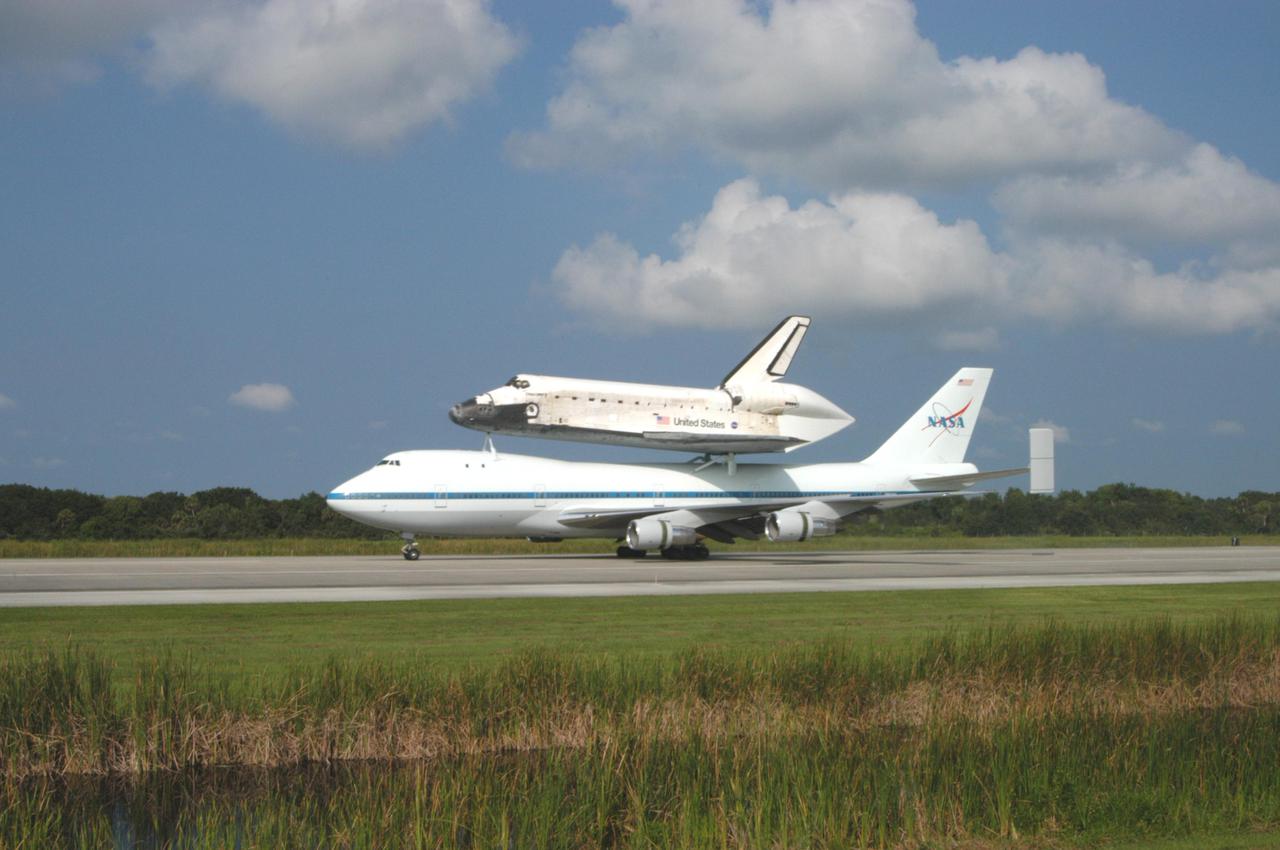
KENNEDY SPACE CENTER, FLA. - Space Shuttle Discovery, atop a modified Boeing 747 Shuttle Carrier Aircraft (SCA), lands on runway 15 at NASA Kennedy Space Center's Shuttle Landing Facility (SLF) at about 10:00 a.m. EDT. The cross-country ferry flight became necessary when two days of unfavorable weather conditions at KSC forced Discovery to land on runway 22 at Edwards Air Force Base, Calif., on Aug. 9 following mission STS-114. On the return trip, stops were made at Altus Air Force Base, Okla., and Barksdale Air Force Base, La., where Discovery stayed for two nights. The SCA and Discovery will be towed to the Mate_Demate Device at the SLF where a crane will lift Discovery from the SCA and place it on solid ground. Discovery will then be towed to the Orbiter Processing Facility where preparations will begin for its next flight, STS-121.
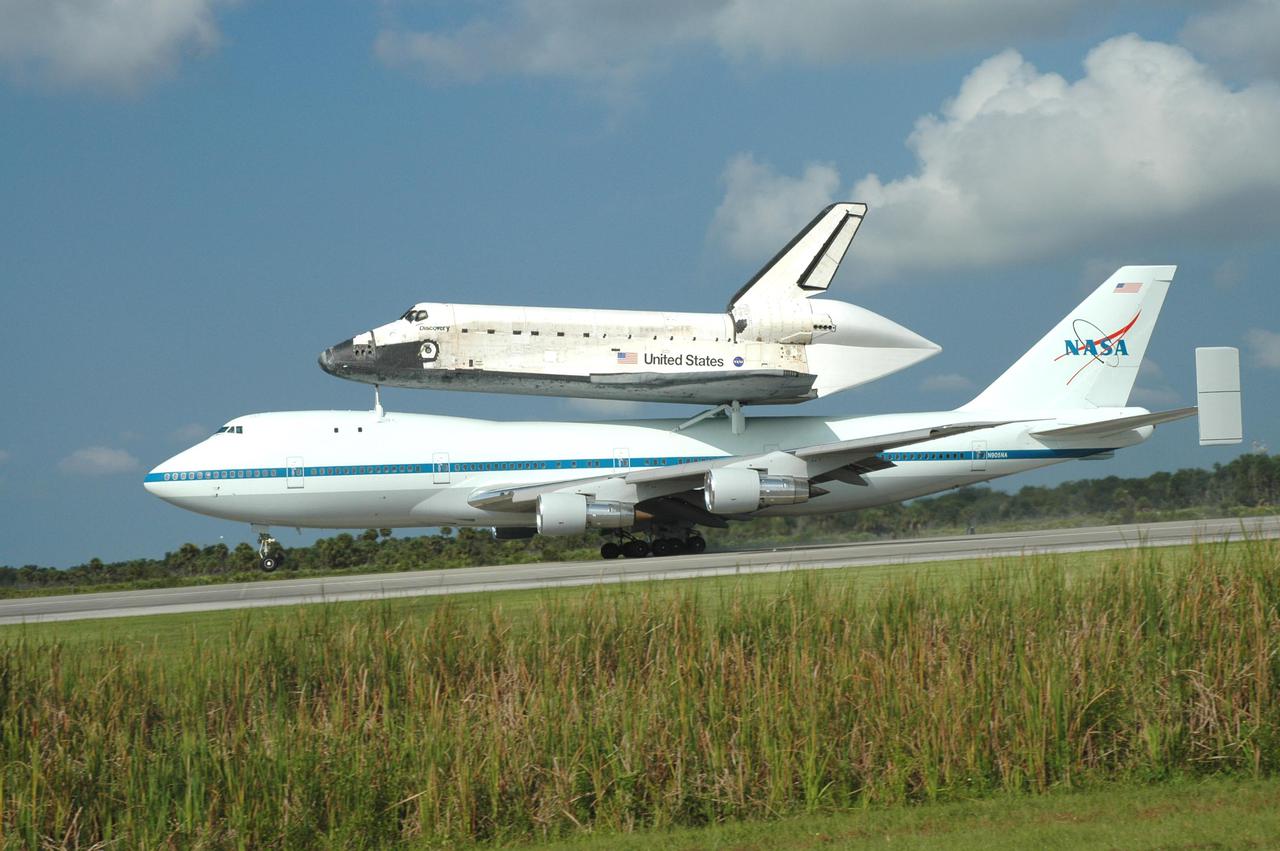
KENNEDY SPACE CENTER, FLA. - Space Shuttle Discovery, atop a modified Boeing 747 Shuttle Carrier Aircraft (SCA), touches down on runway 15 at NASA Kennedy Space Center's Shuttle Landing Facility (SLF) at about 10:00 a.m. EDT. The cross-country ferry flight became necessary when two days of unfavorable weather conditions at KSC forced Discovery to land on runway 22 at Edwards Air Force Base, Calif., on Aug. 9 following mission STS-114. On the return trip, stops were made at Altus Air Force Base, Okla., and Barksdale Air Force Base, La., where Discovery stayed for two nights. The SCA and Discovery will be towed to the Mate_Demate Device at the SLF where a crane will lift Discovery from the SCA and place it on solid ground. Discovery will then be towed to the Orbiter Processing Facility where preparations will begin for its next flight, STS-121.
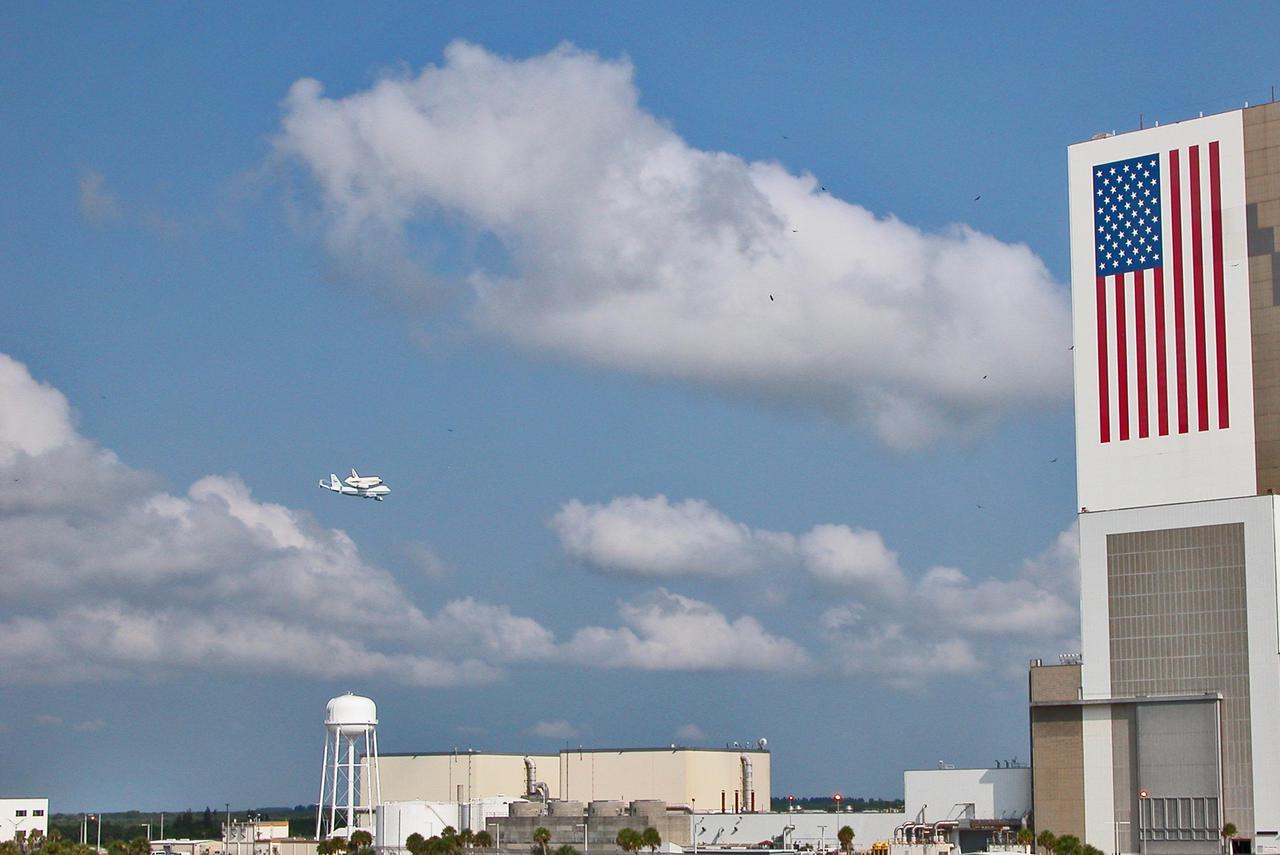
KENNEDY SPACE CENTER, FLA. -- Space Shuttle Discovery, atop a modified Boeing 747 Shuttle Carrier Aircraft (SCA), flies past the Vehicle Assembly Building at Kennedy Space Center on its final approach to runway 15 at the Shuttle Landing Facility (SLF). Landing was at about 10:00 a.m. EDT. The cross-country ferry flight became necessary when two days of unfavorable weather conditions at KSC forced Discovery to land on runway 22 at Edwards Air Force Base, Calif., on Aug. 9 following mission STS-114. The SCA and Discovery will be towed to the Mate_Demate Device at the SLF where a crane will lift Discovery from the SCA and place it on solid ground. Discovery will then be towed to the Orbiter Processing Facility where preparations will begin for its next flight, STS-121.
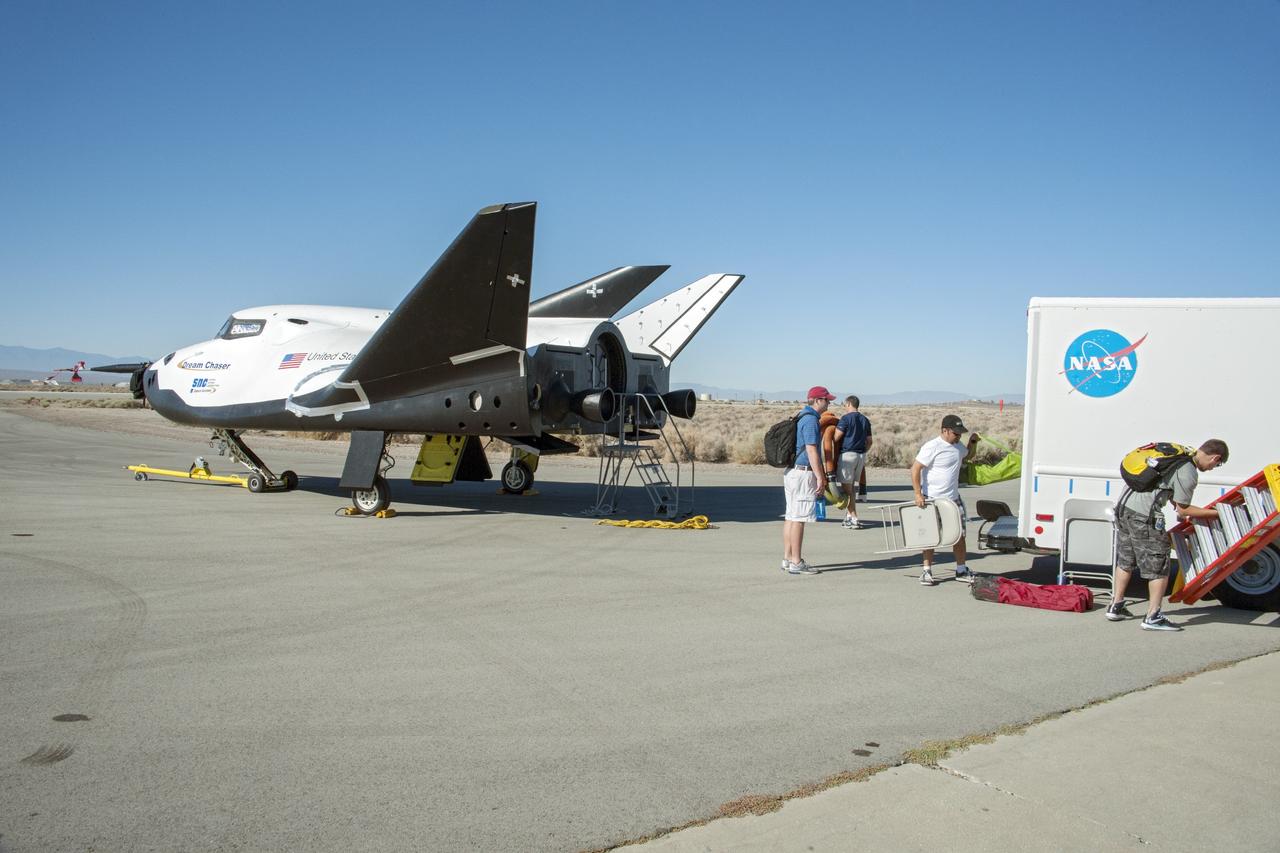
Edwards, Calif. – ED13-0215-016 - Sierra Nevada Corporation SNC Space Systems' team members prepare to tow the Dream Chaser flight vehicle along a concrete runway at NASA's Dryden Flight Research Center in California for range and taxi tow tests. The ground testing will validate the performance of the spacecraft's nose skid, brakes, tires and other systems prior to captive-carry and free-flight tests scheduled for later this year. SNC is one of three companies working with NASA's Commercial Crew Program, or CCP, during the agency's Commercial Crew Integrated Capability, or CCiCap, initiative, which is intended to lead to the availability of commercial human spaceflight services for government and commercial customers. To learn more about CCP and its industry partners, visit www.nasa.gov/commercialcrew. Image credit: NASA/Ken Ulbrich
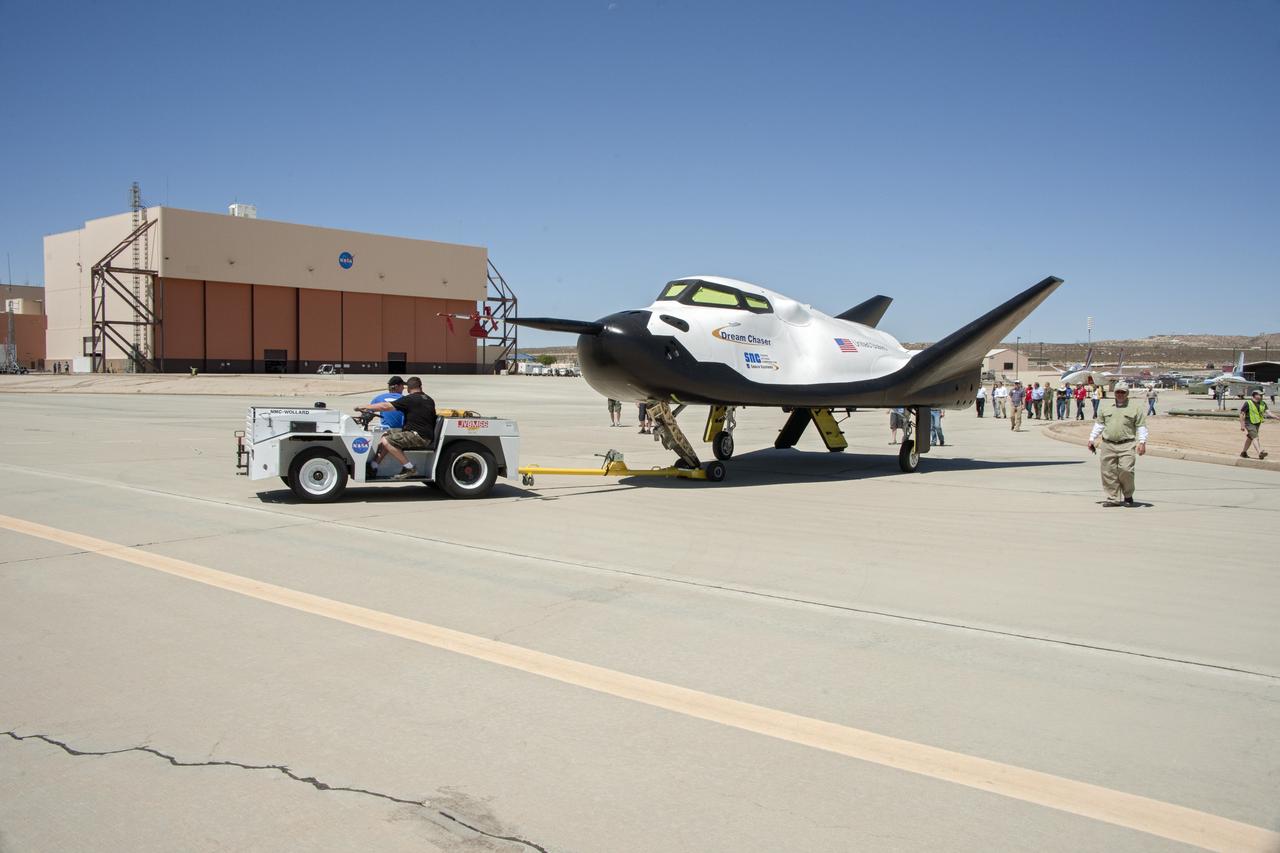
Edwards, Calif. – ED13-164-34 - Sierra Nevada Corporation SNC Space Systems' team members tow the Dream Chaser flight vehicle out to a concrete runway at NASA's Dryden Flight Research Center in California for range and taxi tow tests. The ground testing will validate the performance of the spacecraft's nose skid, brakes, tires and other systems prior to captive-carry and free-flight tests scheduled for later this year. SNC is one of three companies working with NASA's Commercial Crew Program, or CCP, during the agency's Commercial Crew Integrated Capability, or CCiCap, initiative, which is intended to lead to the availability of commercial human spaceflight services for government and commercial customers. To learn more about CCP and its industry partners, visit www.nasa.gov/commercialcrew. Image credit: NASA/Ken Ulbrich
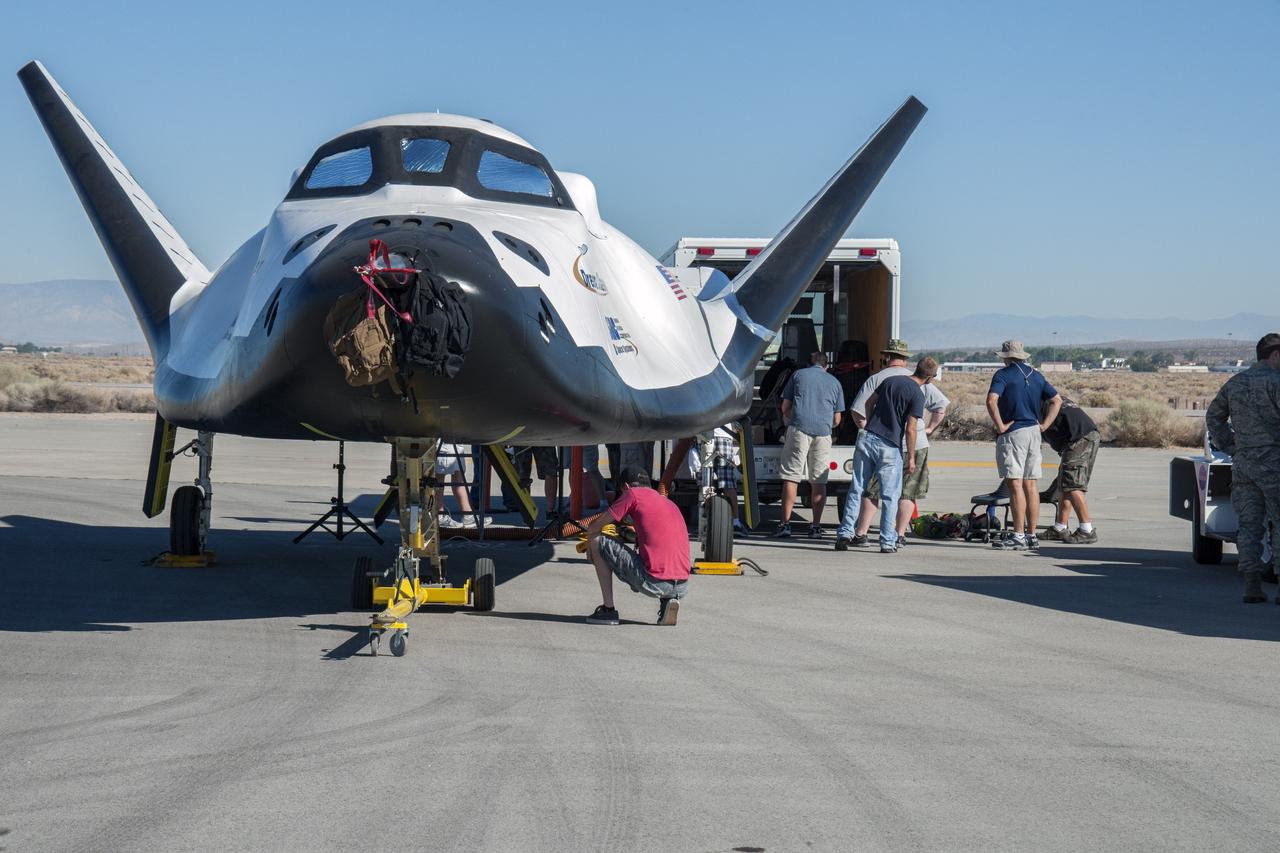
Edwards, Calif. – ED13-0215-024 - Sierra Nevada Corporation SNC Space Systems' team members prepare to tow the Dream Chaser flight vehicle along a concrete runway at NASA's Dryden Flight Research Center in California for range and taxi tow tests. The ground testing will validate the performance of the spacecraft's nose skid, brakes, tires and other systems prior to captive-carry and free-flight tests scheduled for later this year. SNC is one of three companies working with NASA's Commercial Crew Program, or CCP, during the agency's Commercial Crew Integrated Capability, or CCiCap, initiative, which is intended to lead to the availability of commercial human spaceflight services for government and commercial customers. To learn more about CCP and its industry partners, visit www.nasa.gov/commercialcrew. Image credit: NASA/Ken Ulbrich
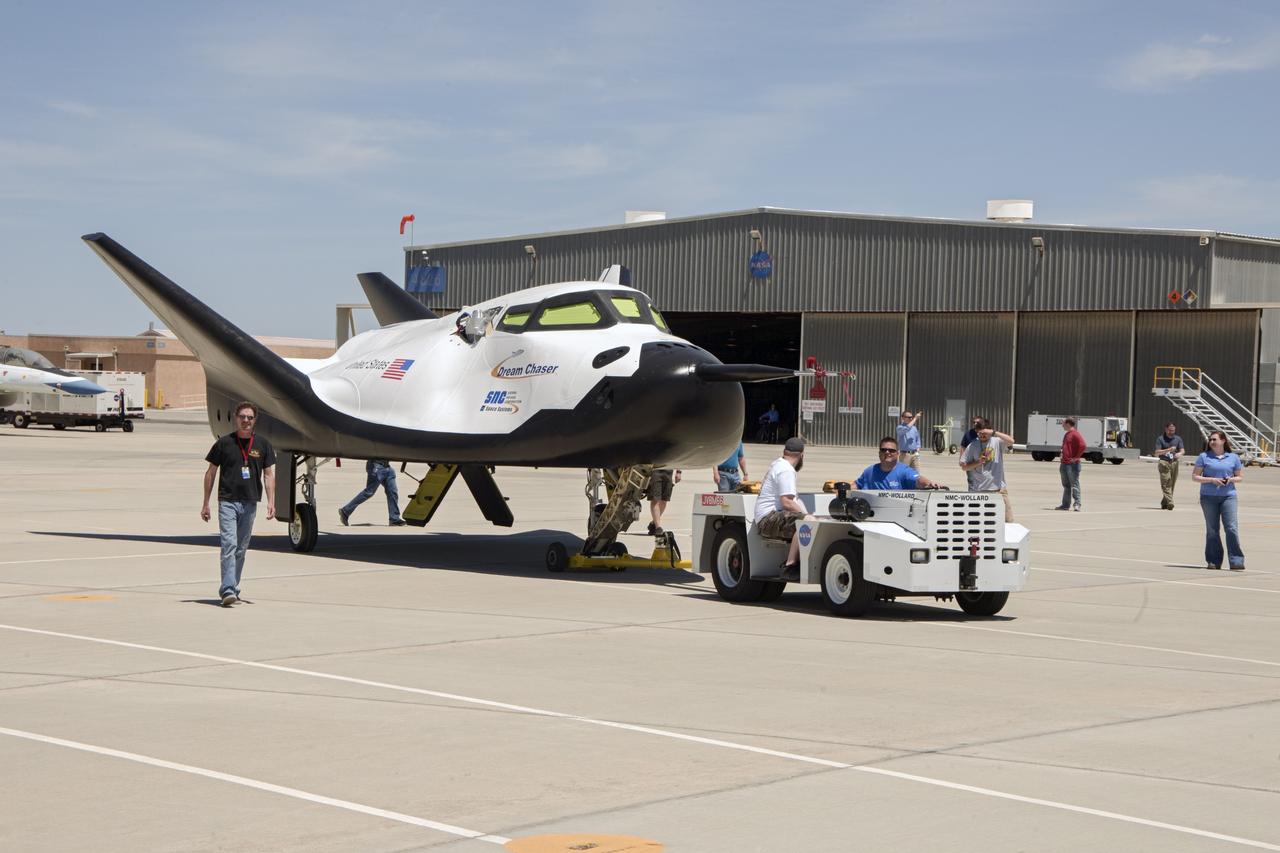
Edwards, Calif. – ED13-161-35 - Sierra Nevada Corporation SNC Space Systems' team members tow the Dream Chaser flight vehicle out to a concrete runway at NASA's Dryden Flight Research Center in California for range and taxi tow tests. The ground testing will validate the performance of the spacecraft's nose skid, brakes, tires and other systems prior to captive-carry and free-flight tests scheduled for later this year. SNC is one of three companies working with NASA's Commercial Crew Program, or CCP, during the agency's Commercial Crew Integrated Capability, or CCiCap, initiative, which is intended to lead to the availability of commercial human spaceflight services for government and commercial customers. To learn more about CCP and its industry partners, visit www.nasa.gov/commercialcrew. Image credit: NASA/Ken Ulbrich
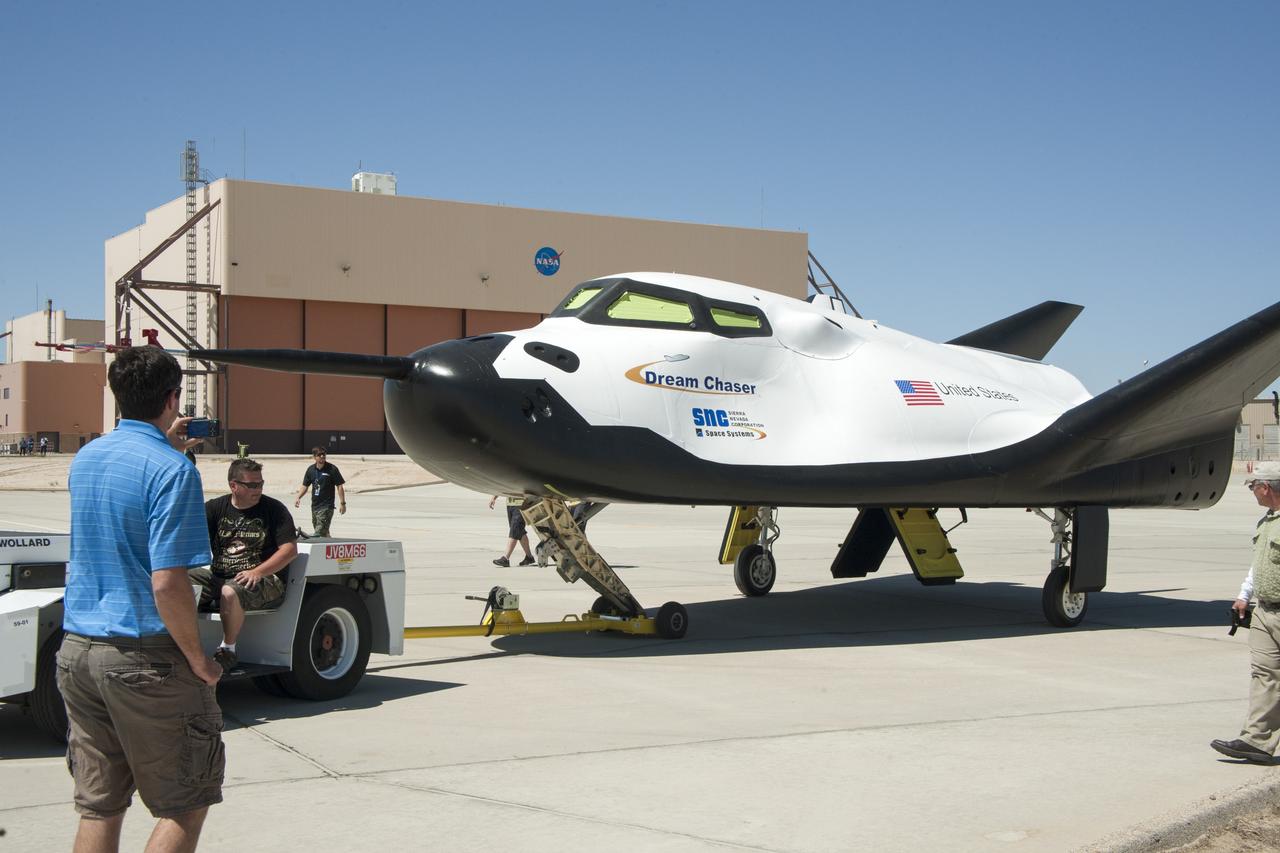
Edwards, Calif. – ED13-164-32 - Sierra Nevada Corporation SNC Space Systems' team members tow the Dream Chaser flight vehicle out to a concrete runway at NASA's Dryden Flight Research Center in California for range and taxi tow tests. The ground testing will validate the performance of the spacecraft's nose skid, brakes, tires and other systems prior to captive-carry and free-flight tests scheduled for later this year. SNC is one of three companies working with NASA's Commercial Crew Program, or CCP, during the agency's Commercial Crew Integrated Capability, or CCiCap, initiative, which is intended to lead to the availability of commercial human spaceflight services for government and commercial customers. To learn more about CCP and its industry partners, visit www.nasa.gov/commercialcrew. Image credit: NASA/Ken Ulbrich
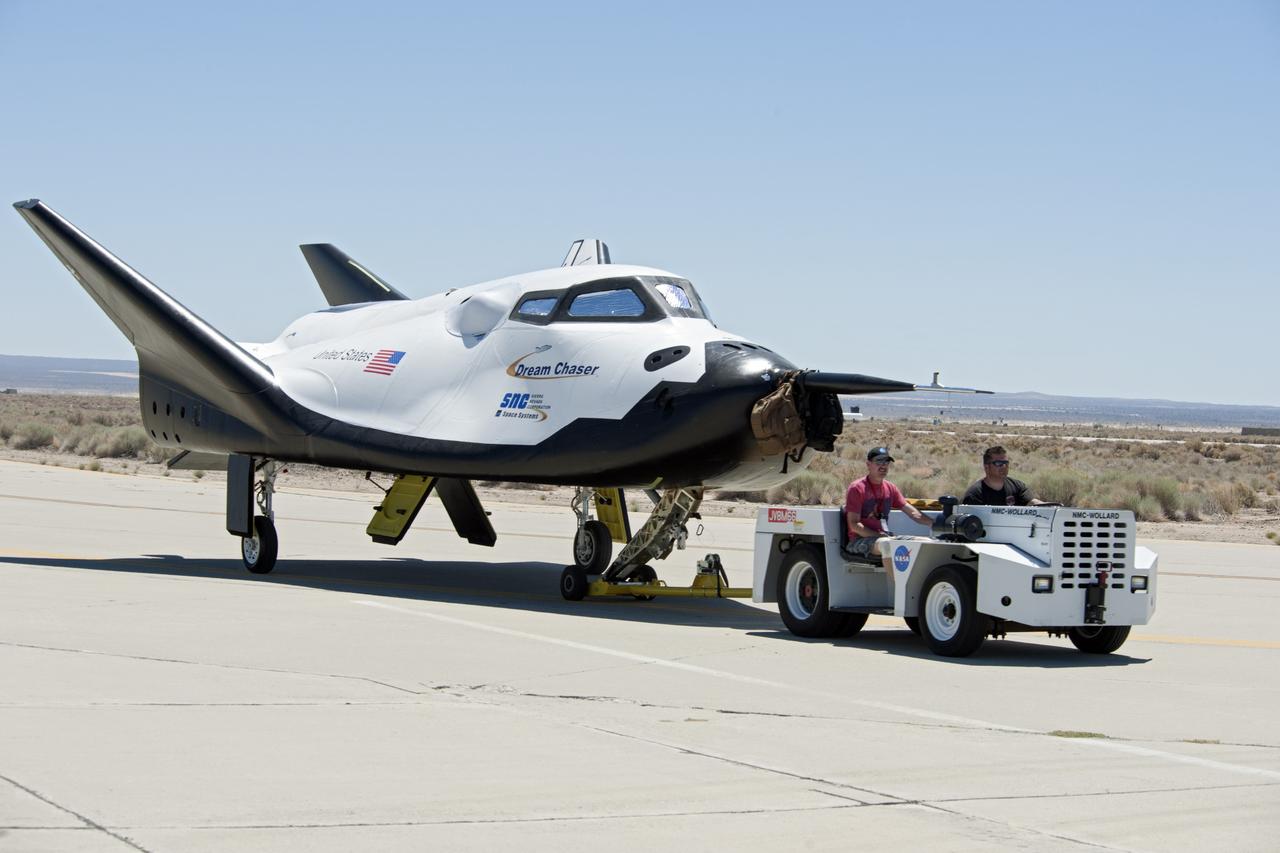
Edwards, Calif. – ED13-0215-072 - Sierra Nevada Corporation SNC Space Systems' team members tow the Dream Chaser flight vehicle along a concrete runway at NASA's Dryden Flight Research Center in California for range and taxi tow tests. The ground testing will validate the performance of the spacecraft's nose skid, brakes, tires and other systems prior to captive-carry and free-flight tests scheduled for later this year. SNC is one of three companies working with NASA's Commercial Crew Program, or CCP, during the agency's Commercial Crew Integrated Capability, or CCiCap, initiative, which is intended to lead to the availability of commercial human spaceflight services for government and commercial customers. To learn more about CCP and its industry partners, visit www.nasa.gov/commercialcrew. Image credit: NASA/Ken Ulbrich
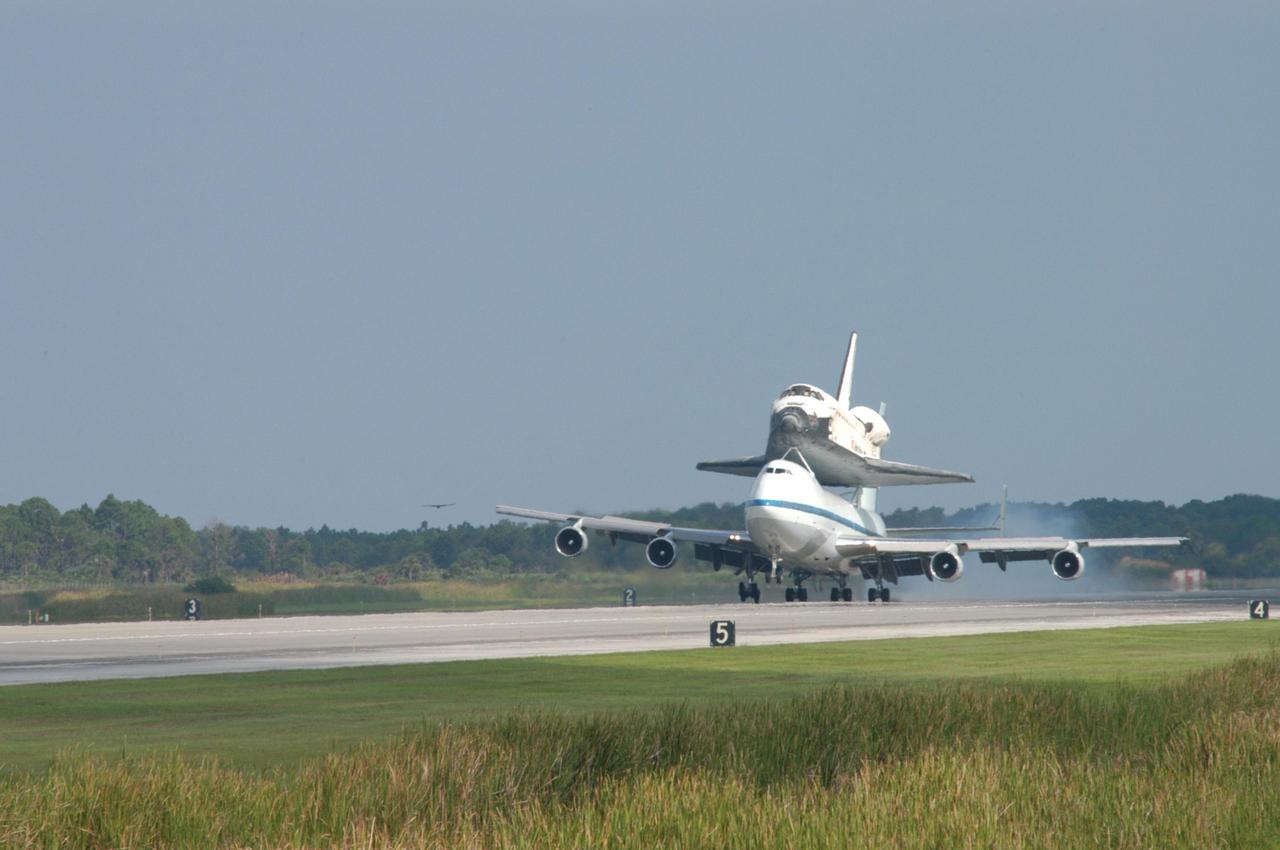
KENNEDY SPACE CENTER, FLA. - Space Shuttle Discovery, atop a modified Boeing 747 Shuttle Carrier Aircraft (SCA), lands on runway 15 at NASA Kennedy Space Center's Shuttle Landing Facility (SLF) at about 10:00 a.m. EDT. The cross-country ferry flight became necessary when two days of unfavorable weather conditions at KSC forced Discovery to land on runway 22 at Edwards Air Force Base, Calif., on Aug. 9 following mission STS-114. On the return trip, stops were made at Altus Air Force Base, Okla., and Barksdale Air Force Base, La., where Discovery stayed for two nights. The SCA and Discovery will be towed to the Mate_Demate Device at the SLF where a crane will lift Discovery from the SCA and place it on solid ground. Discovery will then be towed to the Orbiter Processing Facility where preparations will begin for its next flight, STS-121.
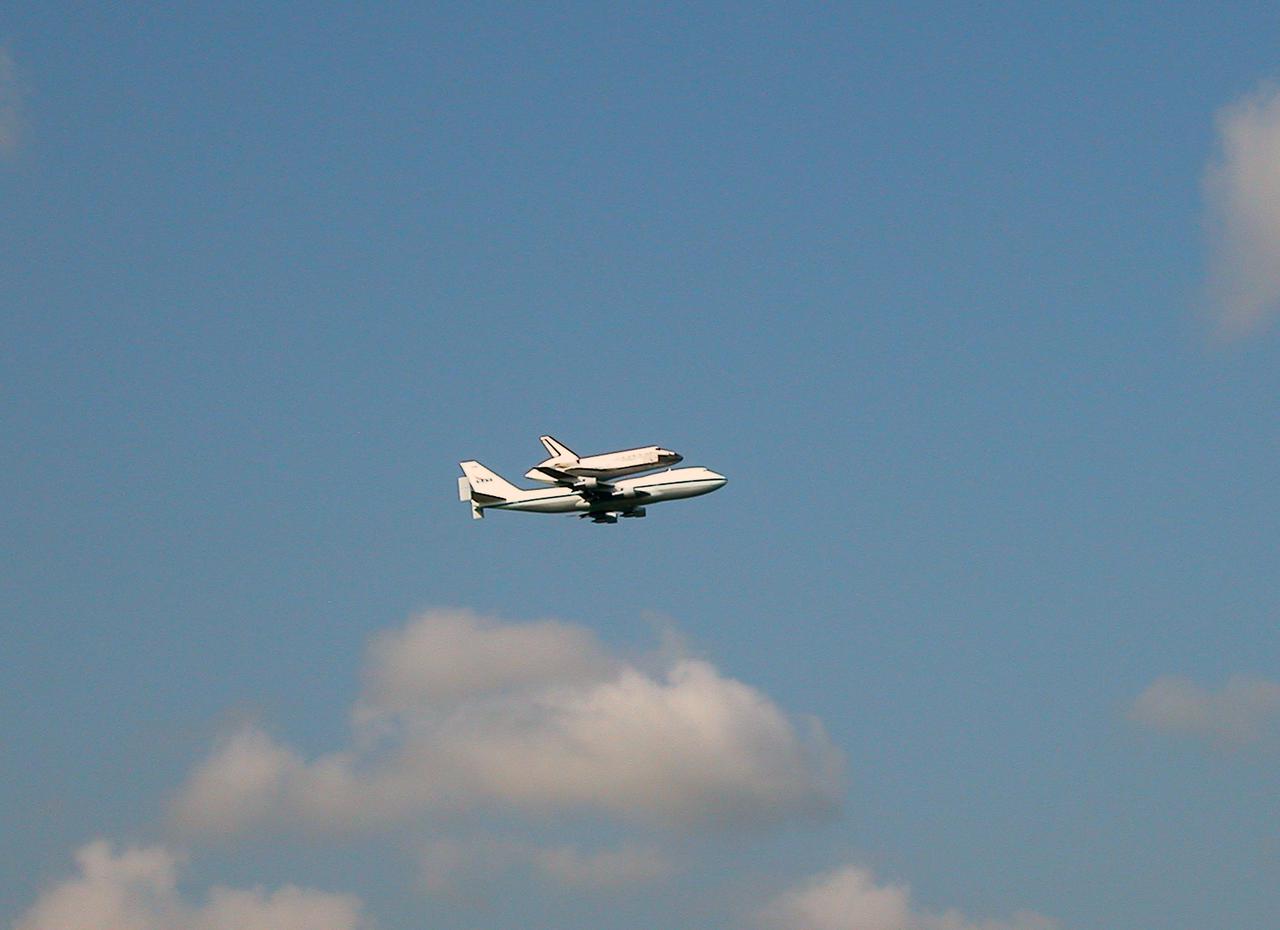
KENNEDY SPACE CENTER, FLA. -- Space Shuttle Discovery, atop a modified Boeing 747 Shuttle Carrier Aircraft (SCA), flies over Launch Complex 39 at Kennedy Space Center on its final approach to runway 15 at the Shuttle Landing Facility (SLF). Landing was at about 10:00 a.m. EDT. The cross-country ferry flight became necessary when two days of unfavorable weather conditions at KSC forced Discovery to land on runway 22 at Edwards Air Force Base, Calif., on Aug. 9 following mission STS-114. The SCA and Discovery will be towed to the Mate_Demate Device at the SLF where a crane will lift Discovery from the SCA and place it on solid ground. Discovery will then be towed to the Orbiter Processing Facility where preparations will begin for its next flight, STS-121.
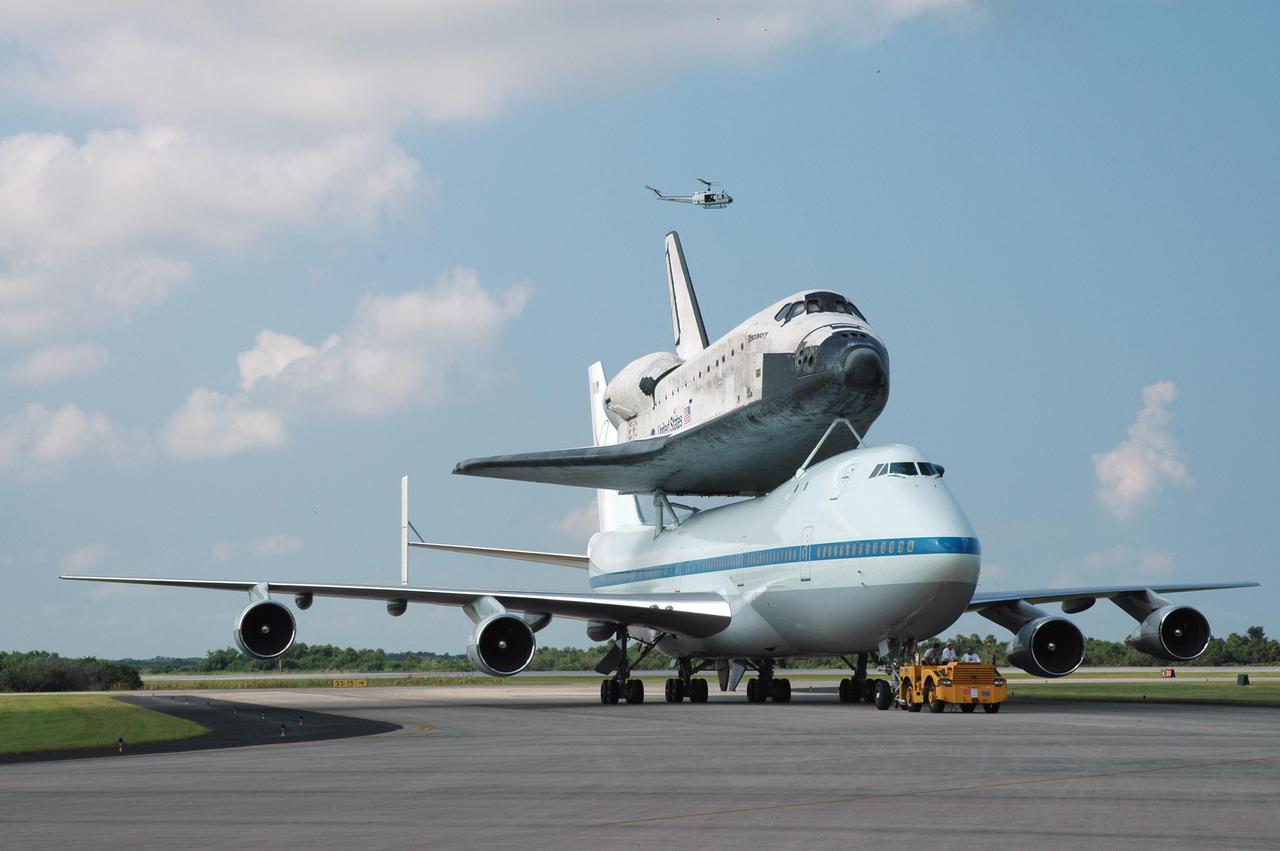
KENNEDY SPACE CENTER, FLA. - Space Shuttle Discovery, atop a modified Boeing 747 Shuttle Carrier Aircraft (SCA), is towed to the Mate_Demate Device (MDD) at NASA Kennedy Space Center's Shuttle Landing Facility (SLF) following touchdown on runway 15 at about 10:00 a.m. EDT. The cross-country ferry flight became necessary when two days of unfavorable weather conditions at KSC forced Discovery to land on runway 22 at Edwards Air Force Base, Calif., on Aug. 9 following mission STS-114. On the return trip, stops were made at Altus Air Force Base, Okla., and Barksdale Air Force Base, La., where Discovery stayed for two nights. A crane on the MDD will lift Discovery from the SCA and place it on solid ground. Discovery will then be towed to the Orbiter Processing Facility where preparations will begin for its next flight, STS-121.
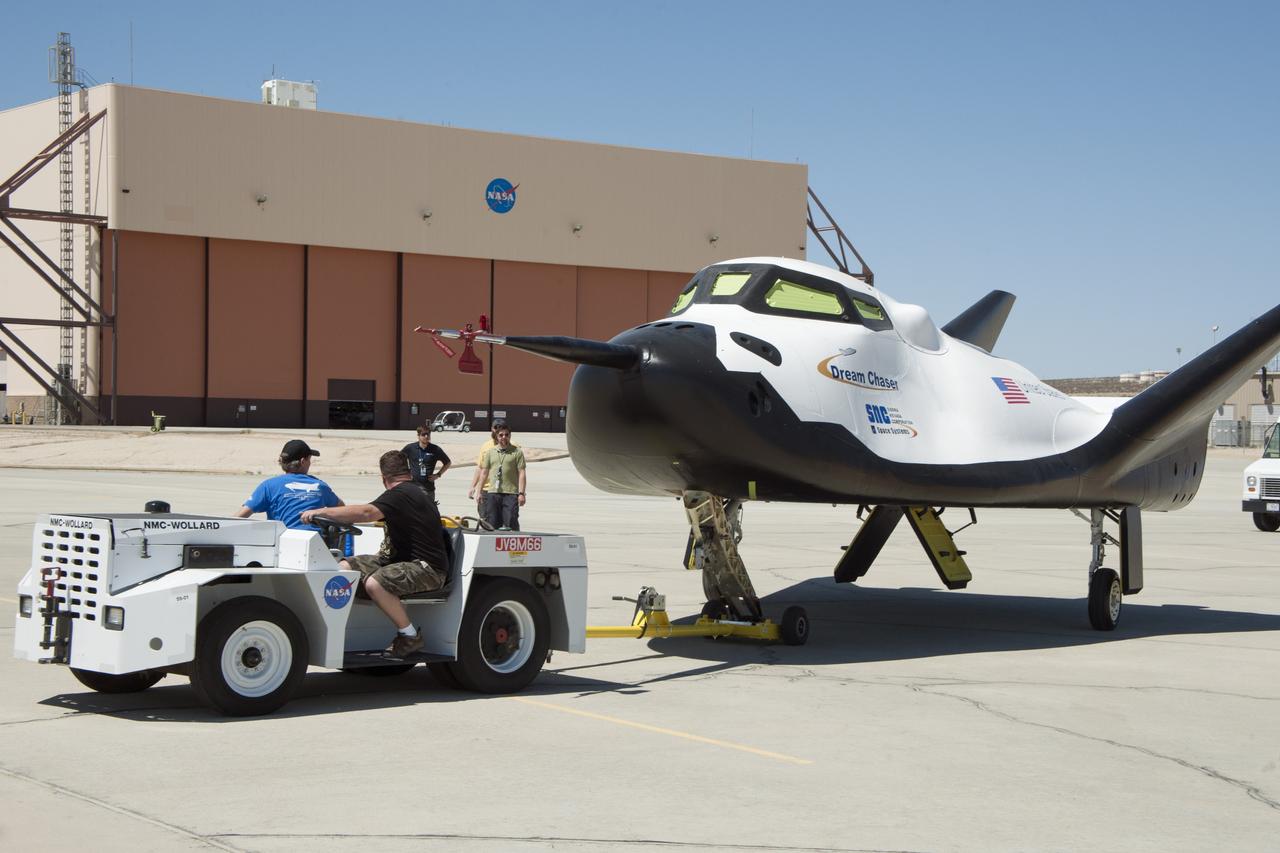
Edwards, Calif. – ED13-164-33 - Sierra Nevada Corporation SNC Space Systems' team members tow the Dream Chaser flight vehicle out to a concrete runway at NASA's Dryden Flight Research Center in California for range and taxi tow tests. The ground testing will validate the performance of the spacecraft's nose skid, brakes, tires and other systems prior to captive-carry and free-flight tests scheduled for later this year. SNC is one of three companies working with NASA's Commercial Crew Program, or CCP, during the agency's Commercial Crew Integrated Capability, or CCiCap, initiative, which is intended to lead to the availability of commercial human spaceflight services for government and commercial customers. To learn more about CCP and its industry partners, visit www.nasa.gov/commercialcrew. Image credit: NASA/Ken Ulbrich
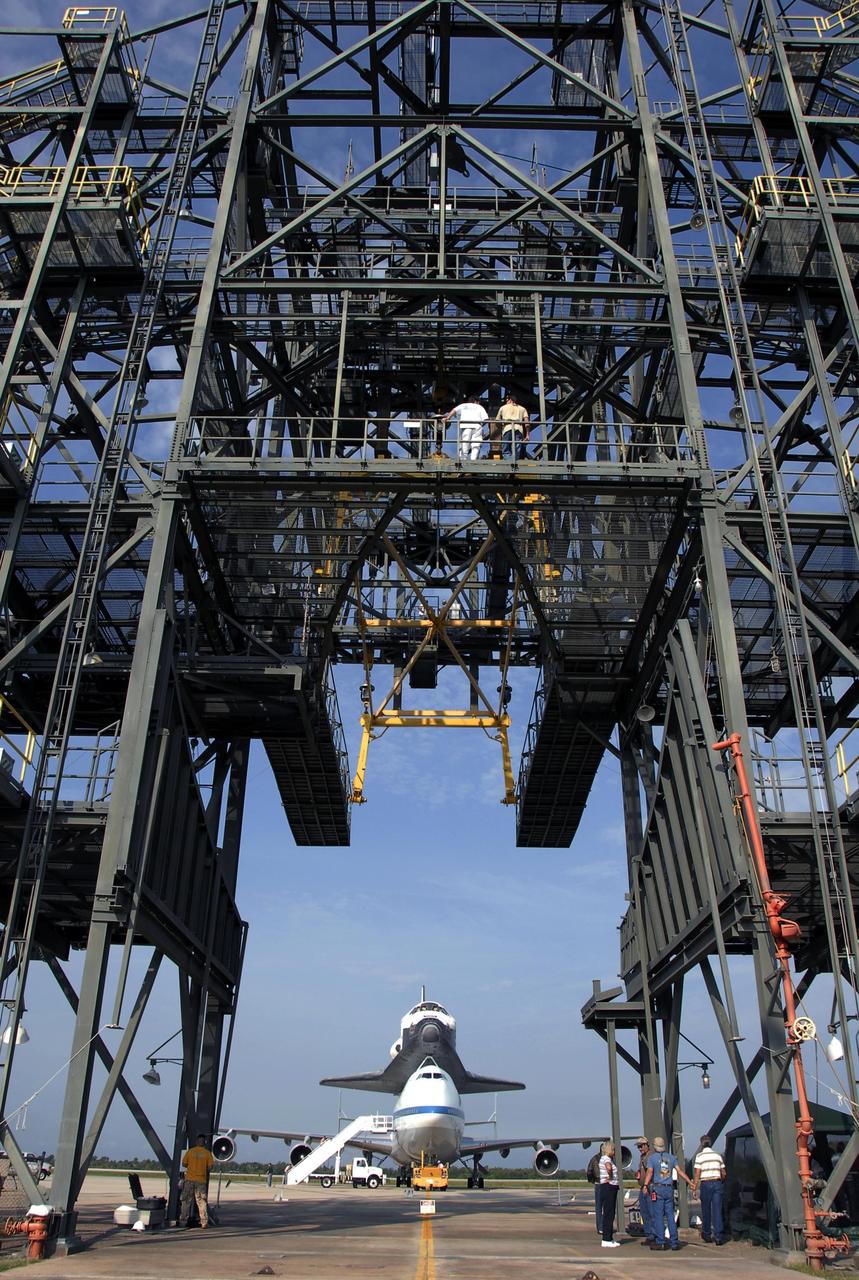
KENNEDY SPACE CENTER, FLA. -- The shuttle carrier aircraft, or SCA, and its piggyback passenger Atlantis are poised to be towed into the mate/demate device, in the foreground. The device will lift the orbiter and put it back on the ground. After a three-day, cross-country trip, the orbiter/SCA duo touched down at 8:27 a.m. EDT. The SCA is a modified Boeing 747 jetliner. Atlantis landed at Edwards Air Force Base in California to end mission STS-117. The return to KSC began July 1 and included several stops across the country for fuel. The last stop was at Ft. Campbell in Kentucky. Weather conditions over the last leg postponed the return trip until July 3. After demate, Atlantis will then be towed to the Orbiter Processing Facility to begin processing for its next launch, mission STS-122 in December. Photo credit: NASA/Kim Shiflett
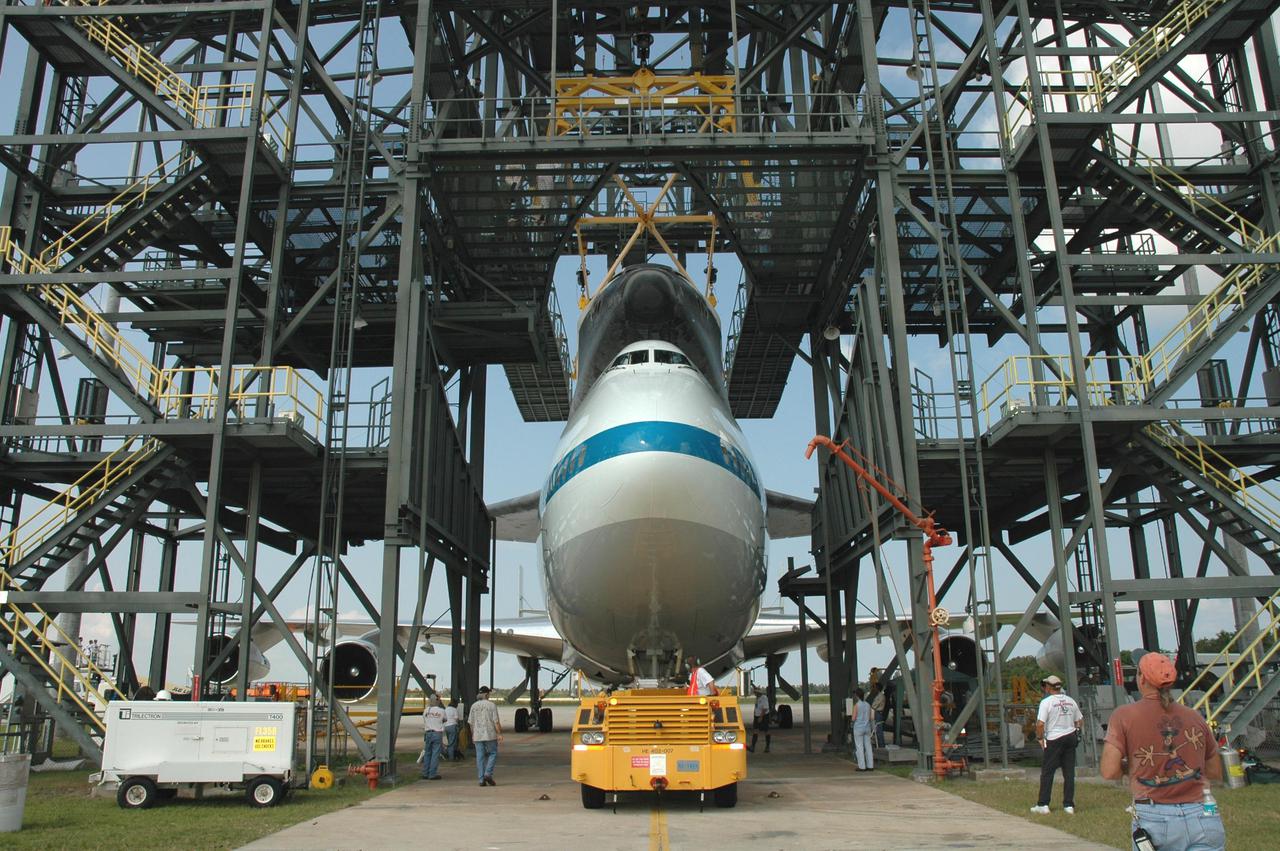
KENNEDY SPACE CENTER, FLA. - The Shuttle Carrier Aircraft, a modified Boeing 747, with the orbiter Discovery on top is towed into the mate_demate device at NASA Kennedy Space Center’s Shuttle Landing Facility. Discovery was returned to Kennedy Space Center on a ferry flight from Edwards Air Force Base in California, where it landed Aug. 9 after 13 days in space on mission STS-114. In the mate_demate device, a horizontal structure mounted at the 80-foot level between two towers controls and guides a large lift beam that attaches to the orbiter to raise and lower it. Once Discovery is lifted off the back of the SCA, the 747 can then roll away and the orbiter will be lowered to the ground. It will then be towed from the SLF to the Orbiter Processing Facility. Once inside the OPF, the payload bay doors will be opened and the MPLM Raffaello brought back from the International Space Station will be unloaded and transferred to the Space Station Processing Facility. This concludes mission STS-114.

CAPE CANAVERAL, Fla. -- Dusk falls on the Shuttle Landing Facility, or SLF, at NASA's Kennedy Space Center in Florida where space shuttle Endeavour and the shuttle carrier aircraft are positioned under the mate/demate device. A sling will lift the shuttle away from the shuttle carrier aircraft, or SCA, underneath. The SCA carried the shuttle piggyback from California, where Endeavour landed Nov. 30 to end the STS-126 mission. When Endeavour is on the ground, it will be towed via the two-mile tow-way from the SLF by a diesel-powered tractor to the Orbiter Processing Facility where it will begin preparations for its next mission, STS-127, targeted for May 2009. Photo credit: NASA/Jack Pfaller
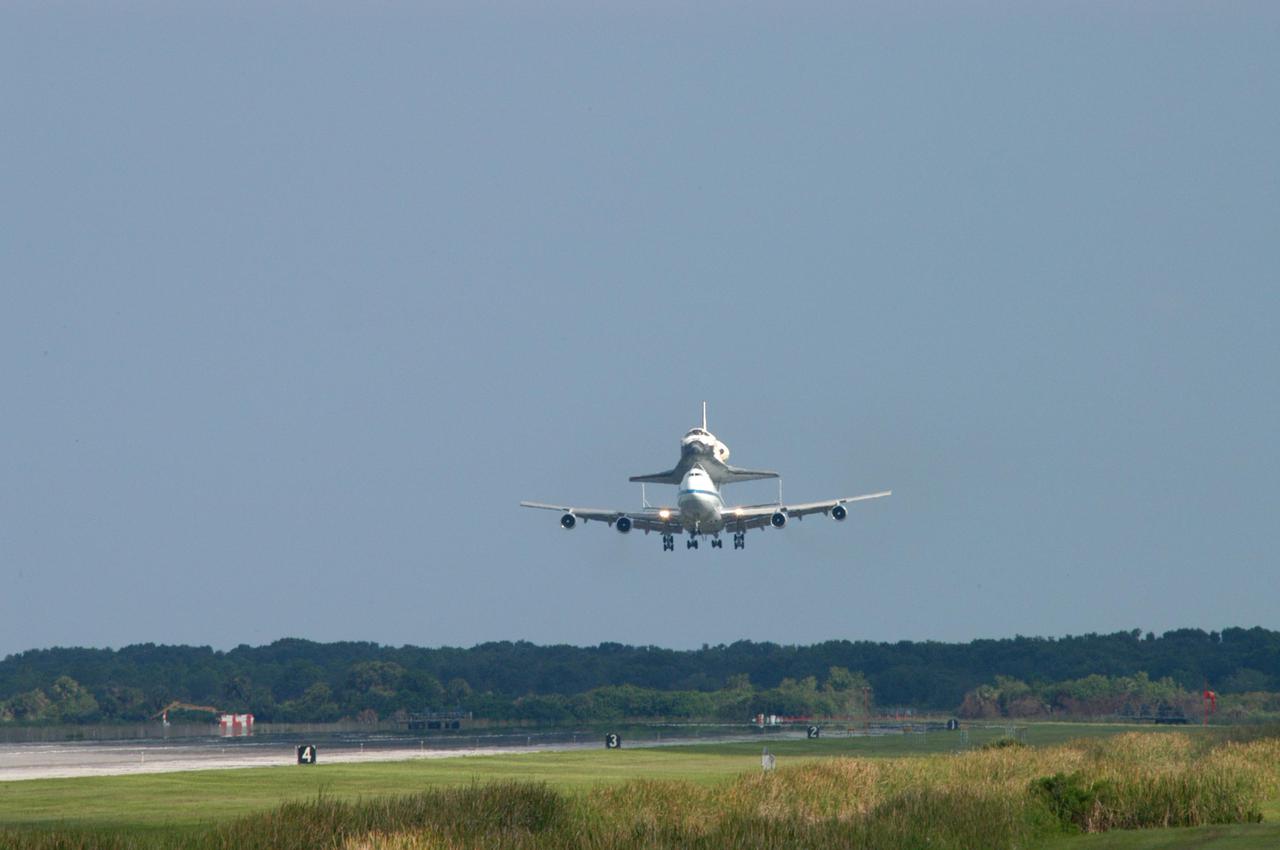
KENNEDY SPACE CENTER, FLA. - Space Shuttle Discovery, atop a modified Boeing 747 Shuttle Carrier Aircraft (SCA), is on its final approach to land on runway 15 at NASA Kennedy Space Center's Shuttle Landing Facility (SLF) at about 10:00 a.m. EDT. The cross-country ferry flight became necessary when two days of unfavorable weather conditions at KSC forced Discovery to land on runway 22 at Edwards Air Force Base, Calif., on Aug. 9 following mission STS-114. On the return trip, stops were made at Altus Air Force Base, Okla., and Barksdale Air Force Base, La., where Discovery stayed for two nights. The SCA and Discovery will be towed to the Mate_Demate Device at the SLF where a crane will lift Discovery from the SCA and place it on solid ground. Discovery will then be towed to the Orbiter Processing Facility where preparations will begin for its next flight, STS-121.
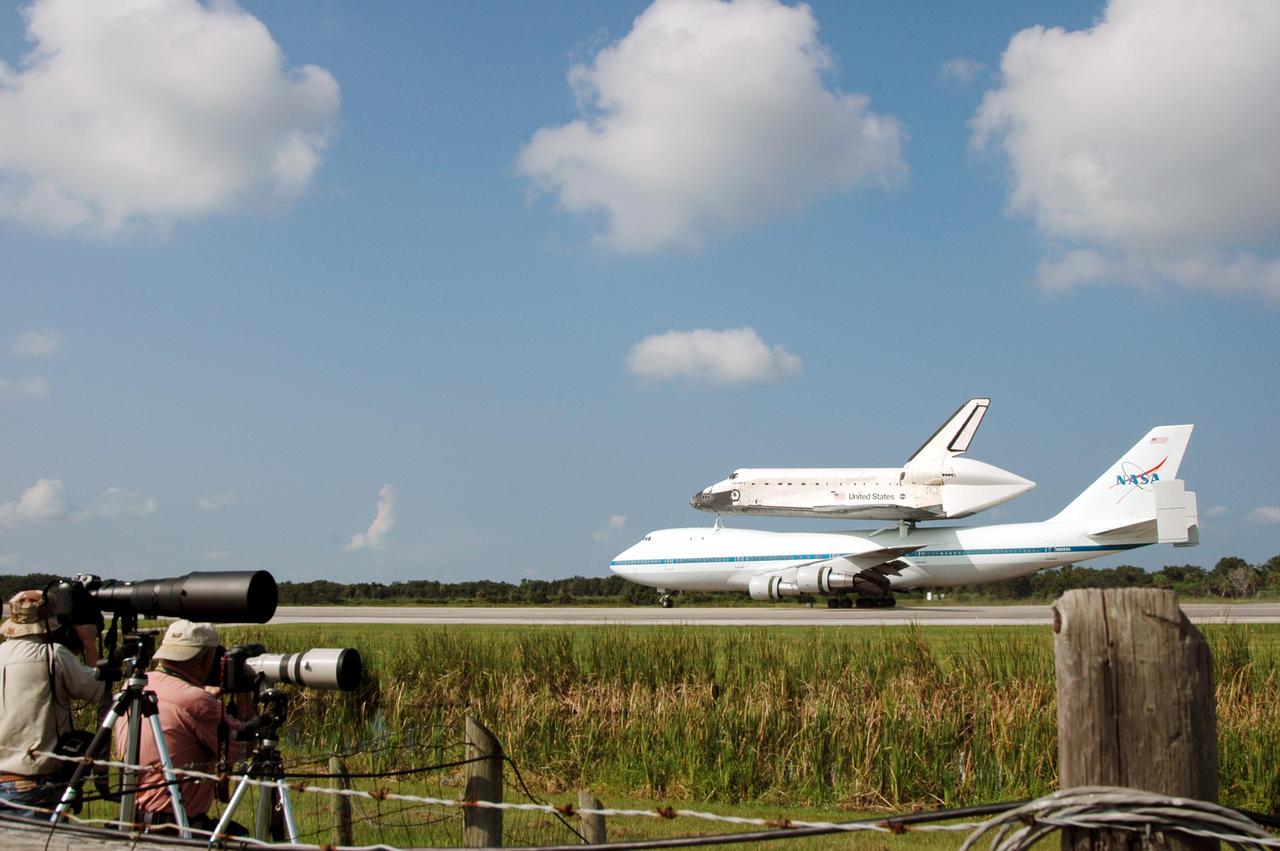
KENNEDY SPACE CENTER, FLA. - News media photographers capture the touchdown of Space Shuttle Discovery, atop a modified Boeing 747 Shuttle Carrier Aircraft (SCA), on runway 15 at NASA Kennedy Space Center's Shuttle Landing Facility (SLF) at about 10:00 a.m. EDT. The cross-country ferry flight became necessary when two days of unfavorable weather conditions at KSC forced Discovery to land on runway 22 at Edwards Air Force Base, Calif., on Aug. 9 following mission STS-114. On the return trip, stops were made at Altus Air Force Base, Okla., and Barksdale Air Force Base, La., where Discovery stayed for two nights. The SCA and Discovery will be towed to the Mate_Demate Device at the SLF where a crane will lift Discovery from the SCA and place it on solid ground. Discovery will then be towed to the Orbiter Processing Facility where preparations will begin for its next flight, STS-121.
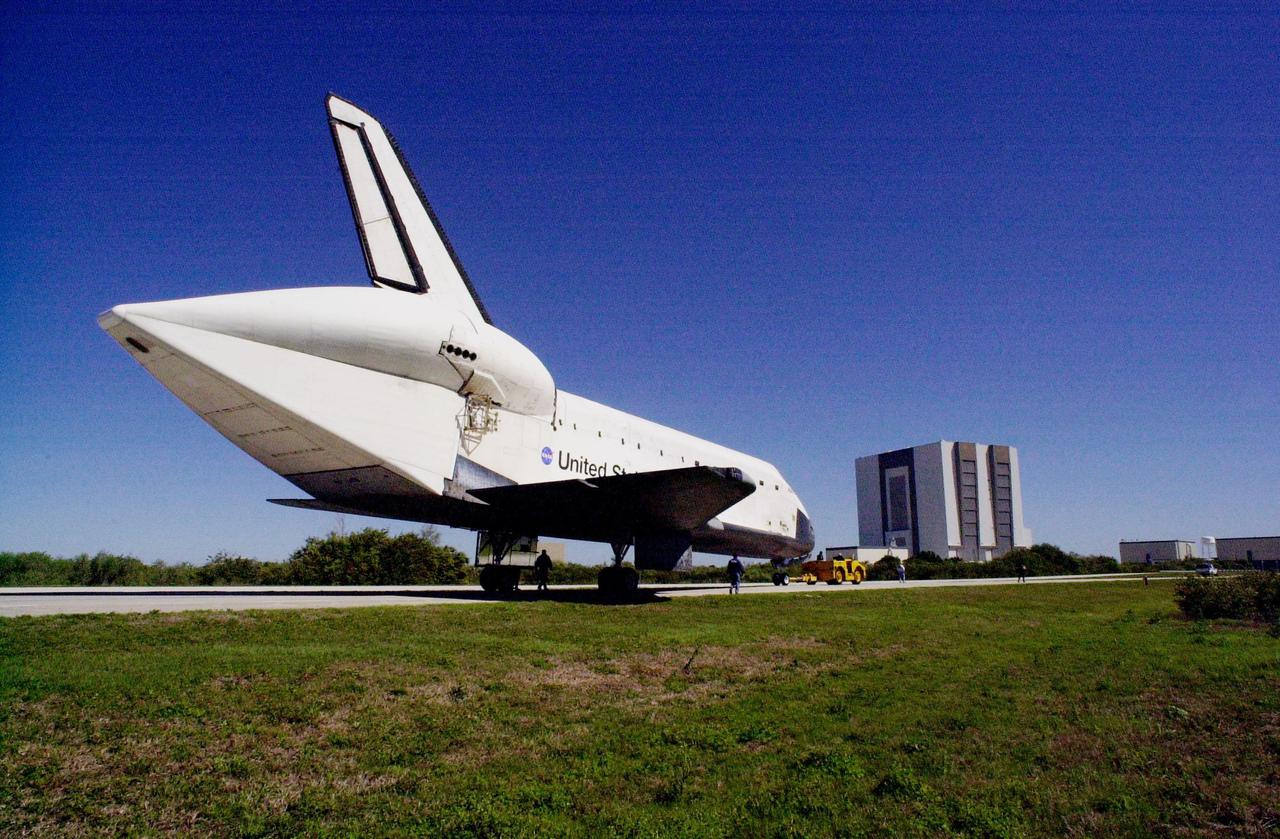
KENNEDY SPACE CENTER, FLA. -- Orbiter Atlantis is towed to the Orbiter Processing Facility bay 3 along the tow-way. In the background is the Vehicle Assembly Building. The unusual silhouette of the aft section on the orbiter is due to the tail cone covering the aft engines. Atlantis landed Feb. 19 at Edwards Air Force Base concluding mission STS-98. The orbiter returned to Florida on the back of a Shuttle Carrier Aircraft, known as a ferry flight, that began March 1. Unfavorable weather conditions kept it on the ground at Altus AFB, Okla., for several days until it could return to Florida. Atlantis will be prepared in the OPF for mission STS-104, the 10th construction flight to the International Space Station, scheduled to launch June 8
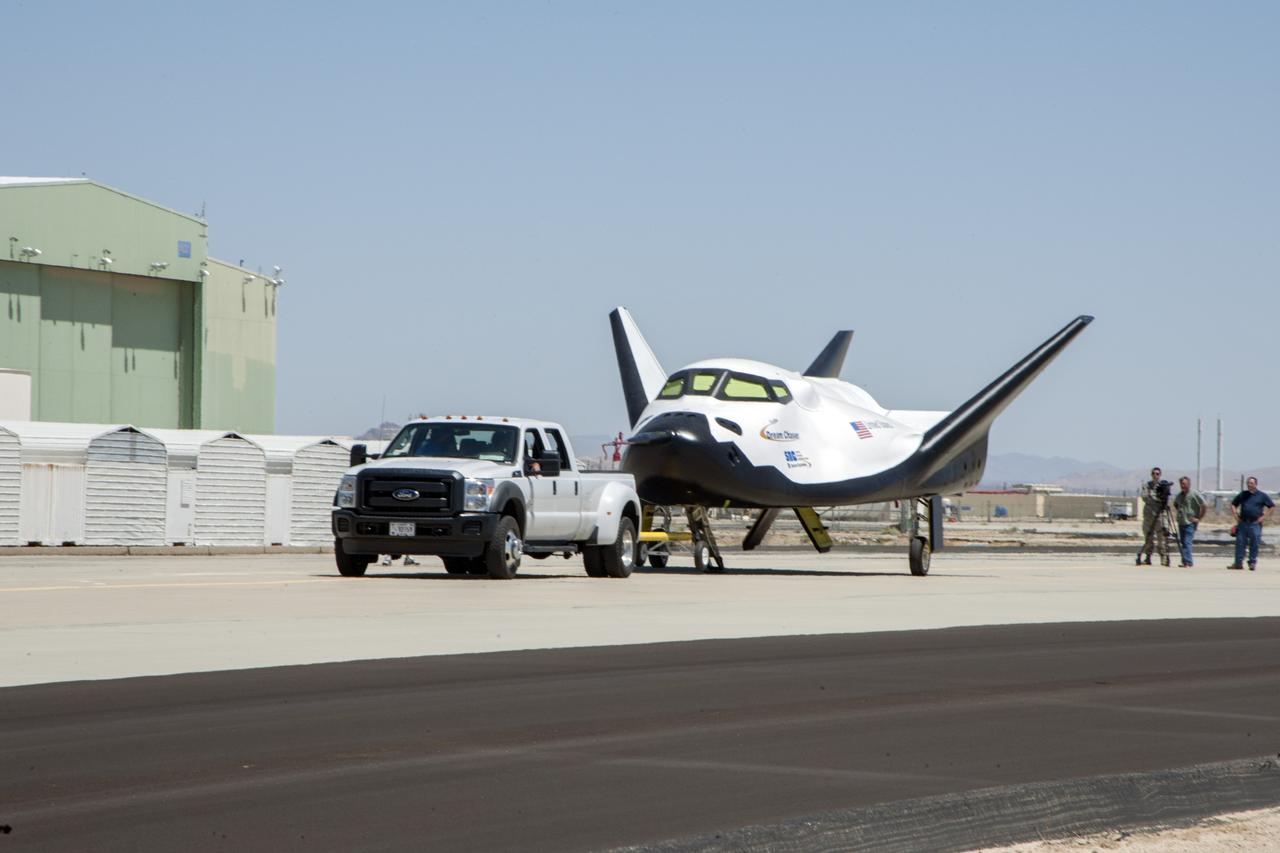
Edwards, Calif. – ED13-164-34 - Sierra Nevada Corporation SNC Space Systems' team members tow the Dream Chaser flight vehicle out to a concrete runway at NASA's Dryden Flight Research Center in California for range and taxi tow tests. The ground testing will validate the performance of the spacecraft's nose skid, brakes, tires and other systems prior to captive-carry and free-flight tests scheduled for later this year. SNC is one of three companies working with NASA's Commercial Crew Program, or CCP, during the agency's Commercial Crew Integrated Capability, or CCiCap, initiative, which is intended to lead to the availability of commercial human spaceflight services for government and commercial customers. To learn more about CCP and its industry partners, visit www.nasa.gov/commercialcrew. Image credit: NASA/Ken Ulbrich
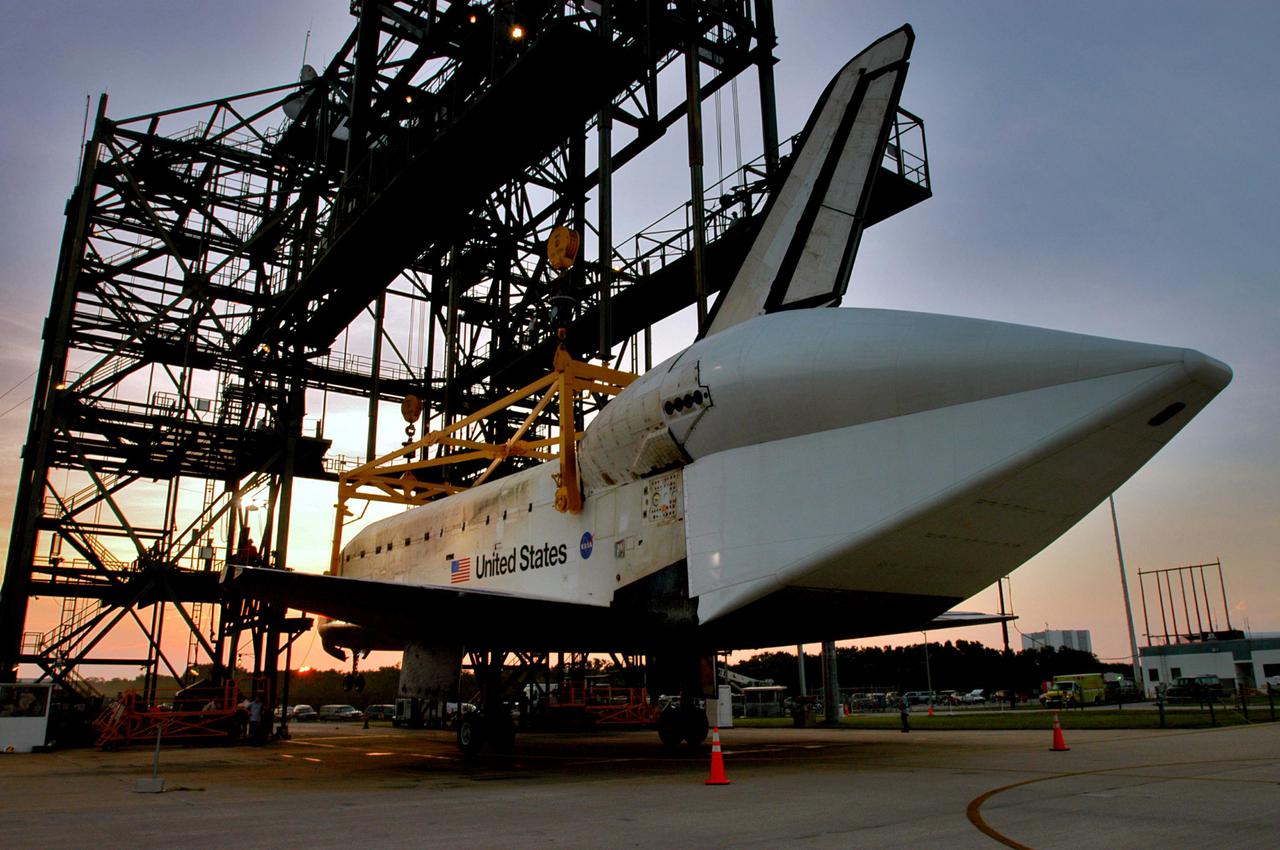
KENNEDY SPACE CENTER, FLA. - Just before sunrise, Discovery finally rests on its wheels on the ground at NASA Kennedy Space Center’s Shuttle Landing Facility. The orbiter was lowered overnight from the mate_demate device after the Shuttle Carrier Aircraft, a modified Boeing 747, was rolled away. Discovery was returned to Kennedy Space Center on a ferry flight from Edwards Air Force Base in California, where it landed Aug. 9 after 13 days in space on mission STS-114. In the mate_demate device, a horizontal structure mounted at the 80-foot level between two towers controls and guides a large lift beam that attaches to the orbiter to raise and lower it. The orbiter will be lowered to the ground and then be towed to the Orbiter Processing Facility. Once inside the OPF, the payload bay doors will be opened and the MPLM Raffaello brought back from the International Space Station will be unloaded and transferred to the Space Station Processing Facility. This concludes mission STS-114.
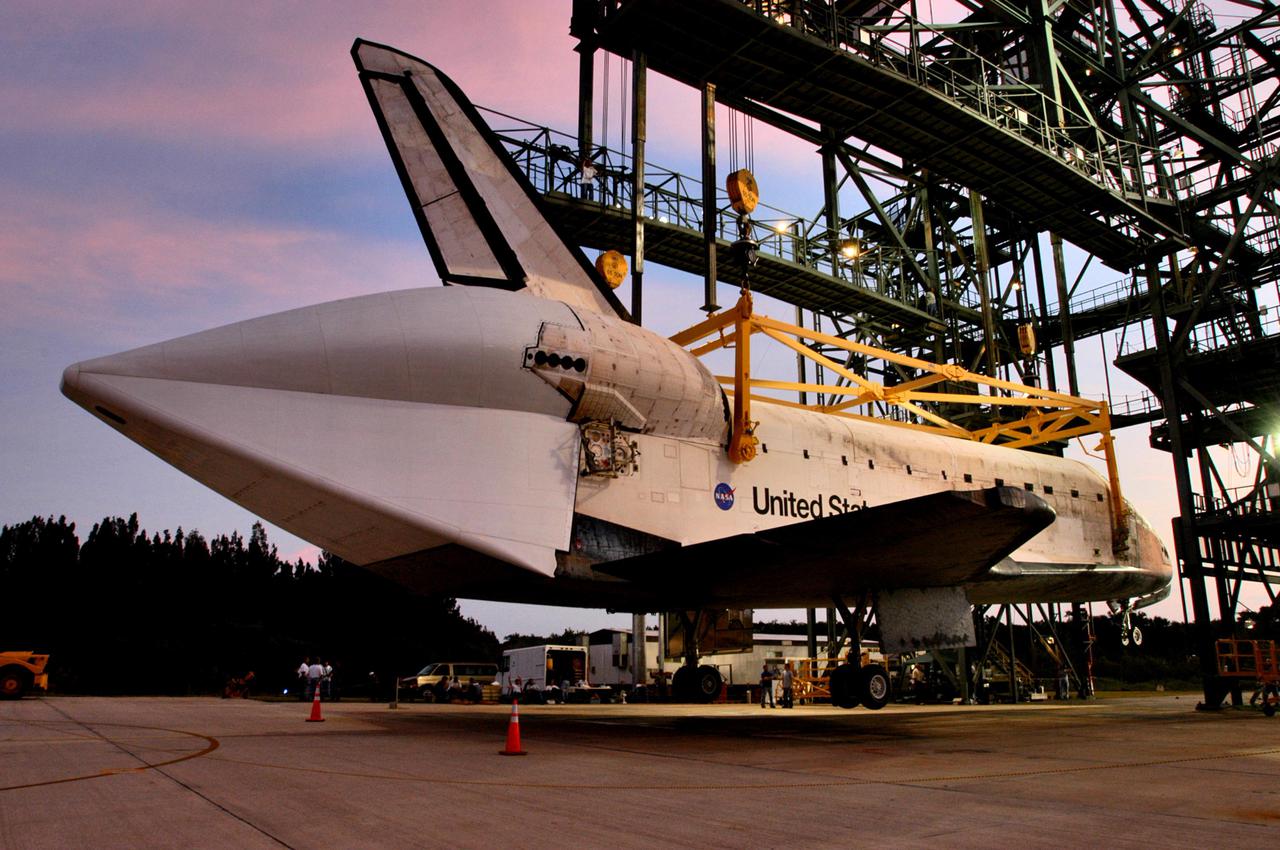
KENNEDY SPACE CENTER, FLA. - Just before sunrise, Discovery finally rests on its wheels on the ground at NASA Kennedy Space Center’s Shuttle Landing Facility. The orbiter was lowered overnight from the mate_demate device after the Shuttle Carrier Aircraft, a modified Boeing 747, was rolled away. Discovery was returned to Kennedy Space Center on a ferry flight from Edwards Air Force Base in California, where it landed Aug. 9 after 13 days in space on mission STS-114. In the mate_demate device, a horizontal structure mounted at the 80-foot level between two towers controls and guides a large lift beam that attaches to the orbiter to raise and lower it. The orbiter will be lowered to the ground and then be towed to the Orbiter Processing Facility. Once inside the OPF, the payload bay doors will be opened and the MPLM Raffaello brought back from the International Space Station will be unloaded and transferred to the Space Station Processing Facility. This concludes mission STS-114.
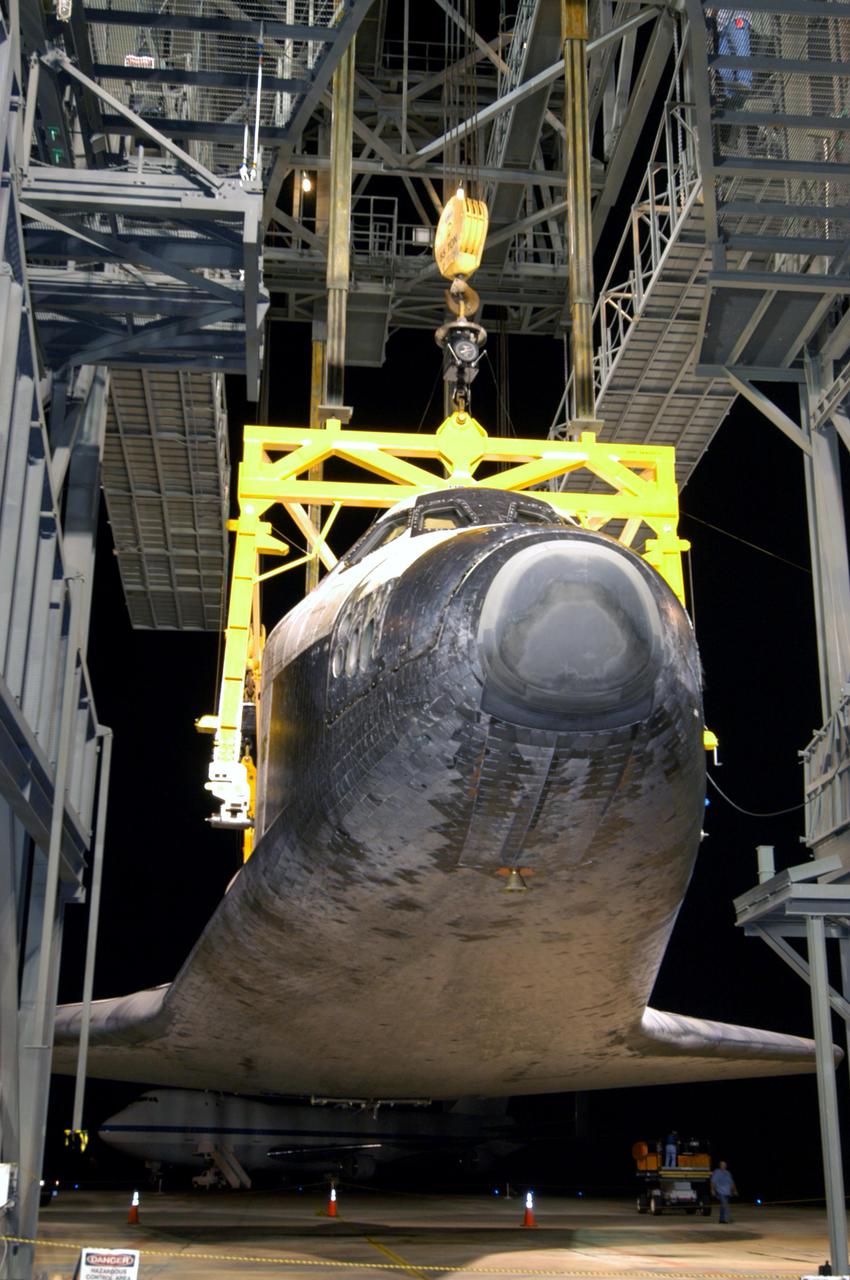
KENNEDY SPACE CENTER, FLA. - In the early morning hours at NASA Kennedy Space Center’s Shuttle Landing Facility, the orbiter Discovery is slowly lowered toward the ground from the mate_demate device. Visible on the orbiter is the tail cone that covers the main engines during the ferry flight. Discovery was returned to Kennedy Space Center on a ferry flight from Edwards Air Force Base in California, where it landed Aug. 9 after 13 days in space on mission STS-114. In the mate_demate device, a horizontal structure mounted at the 80-foot level between two towers controls and guides a large lift beam that attaches to the orbiter to raise and lower it. The orbiter will be lowered to the ground and then be towed to the Orbiter Processing Facility. Once inside the OPF, the payload bay doors will be opened and the MPLM Raffaello brought back from the International Space Station will be unloaded and transferred to the Space Station Processing Facility. This concludes mission STS-114.
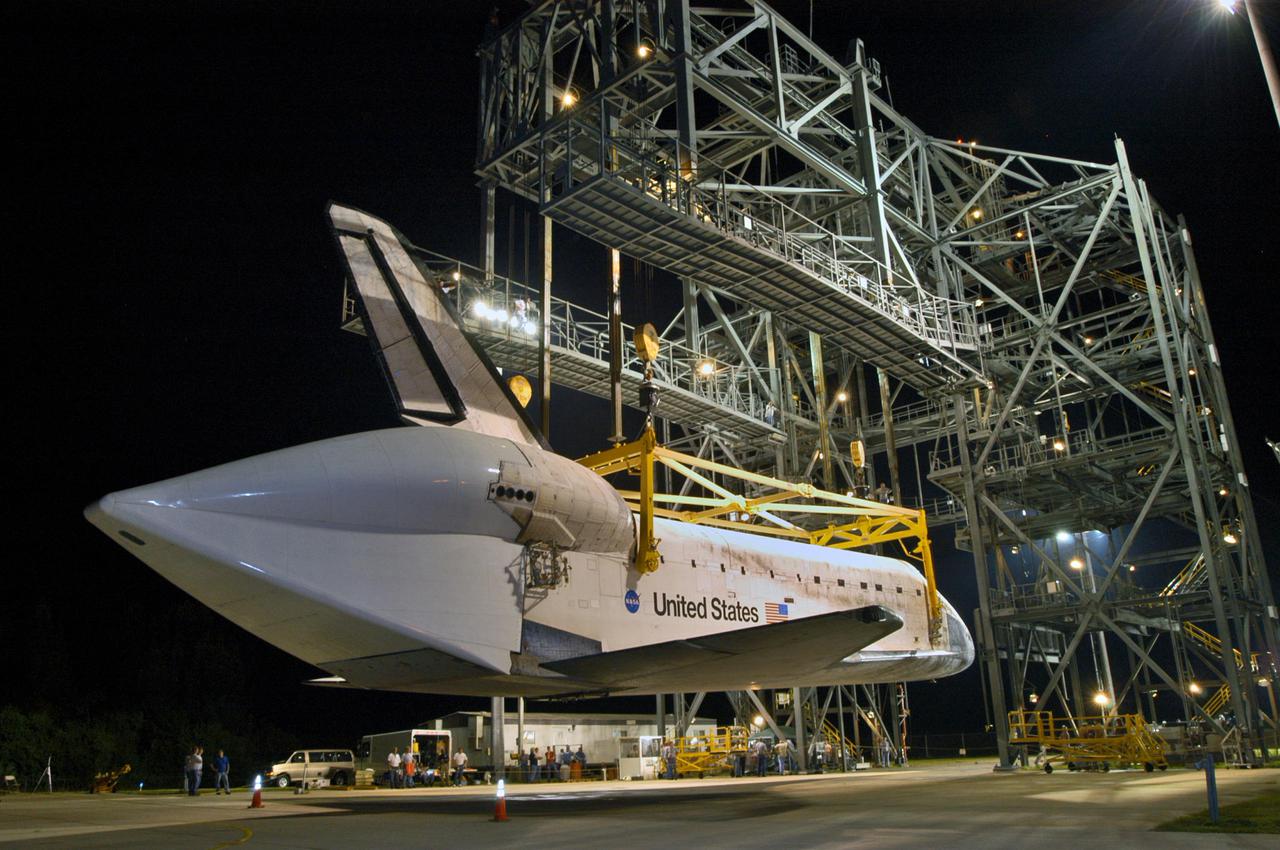
KENNEDY SPACE CENTER, FLA. - In the early morning hours at NASA Kennedy Space Center’s Shuttle Landing Facility, the orbiter Discovery is slowly lowered toward the ground from the mate_demate device. Discovery was returned to Kennedy Space Center on a ferry flight from Edwards Air Force Base in California, where it landed Aug. 9 after 13 days in space on mission STS-114. In the mate_demate device, a horizontal structure mounted at the 80-foot level between two towers controls and guides a large lift beam that attaches to the orbiter to raise and lower it. The orbiter will be lowered to the ground and then be towed to the Orbiter Processing Facility. Once inside the OPF, the payload bay doors will be opened and the MPLM Raffaello brought back from the International Space Station will be unloaded and transferred to the Space Station Processing Facility. This concludes mission STS-114.
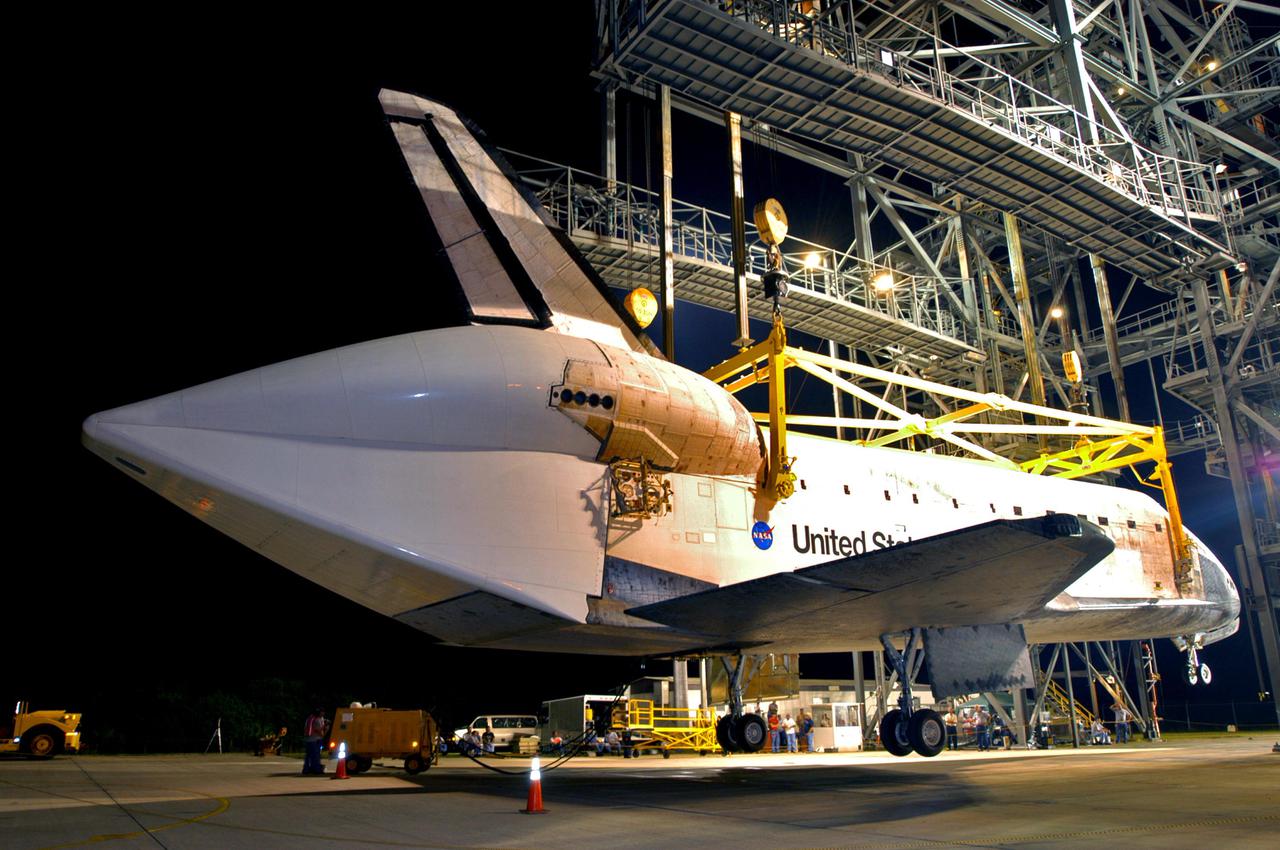
KENNEDY SPACE CENTER, FLA. - After being lowered close enough to the ground from the mate_demate device, Discovery’s wheels are lowered at NASA Kennedy Space Center’s Shuttle Landing Facility. Visible on the orbiter is the tail cone that covers the main engines during the ferry flight. Discovery was returned to Kennedy Space Center on a ferry flight from Edwards Air Force Base in California, where it landed Aug. 9 after 13 days in space on mission STS-114. In the mate_demate device, a horizontal structure mounted at the 80-foot level between two towers controls and guides a large lift beam that attaches to the orbiter to raise and lower it. The orbiter will be lowered to the ground and then be towed to the Orbiter Processing Facility. Once inside the OPF, the payload bay doors will be opened and the MPLM Raffaello brought back from the International Space Station will be unloaded and transferred to the Space Station Processing Facility. This concludes mission STS-114.
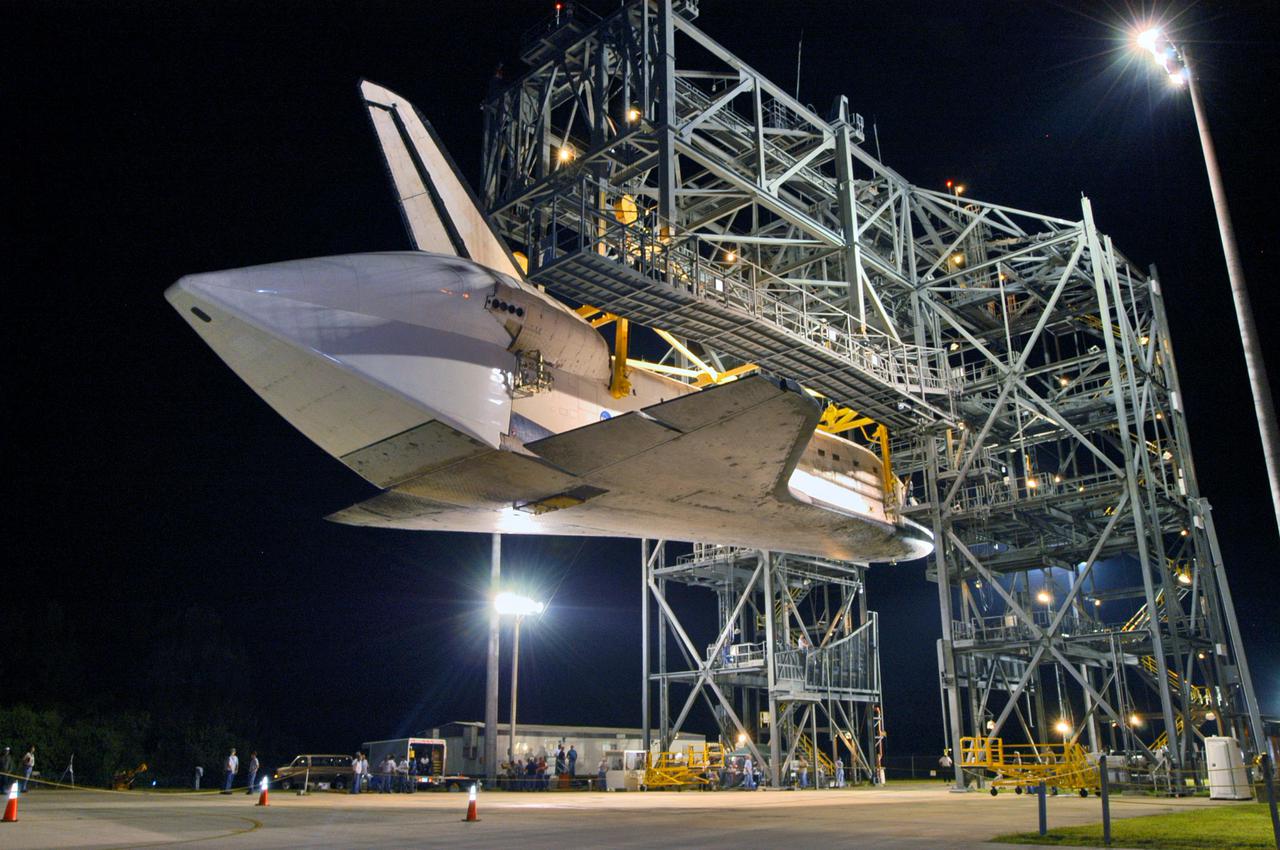
KENNEDY SPACE CENTER, FLA. - In the early morning hours at NASA Kennedy Space Center’s Shuttle Landing Facility, the orbiter Discovery is slowly lowered toward the ground from the mate_demate device. Visible on the orbiter is the tail cone that covers the main engines during the ferry flight. Discovery was returned to Kennedy Space Center on a ferry flight from Edwards Air Force Base in California, where it landed Aug. 9 after 13 days in space on mission STS-114. In the mate_demate device, a horizontal structure mounted at the 80-foot level between two towers controls and guides a large lift beam that attaches to the orbiter to raise and lower it. The orbiter will be lowered to the ground and then be towed to the Orbiter Processing Facility. Once inside the OPF, the payload bay doors will be opened and the MPLM Raffaello brought back from the International Space Station will be unloaded and transferred to the Space Station Processing Facility. This concludes mission STS-114.
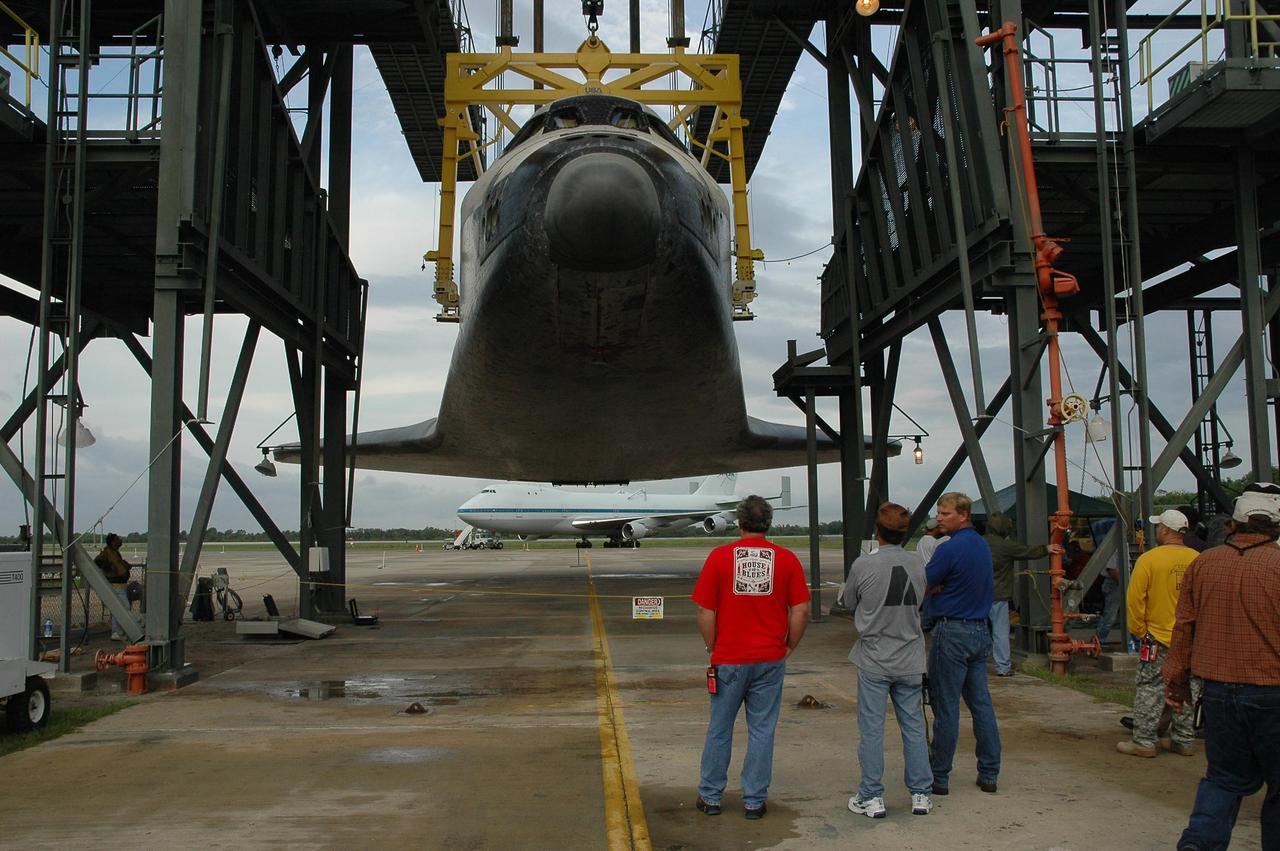
KENNEDY SPACE CENTER, FLA. -- At the mate/demate device at Kennedy Space Center's Shuttle Landing Facility, the crane lowers Atlantis close to the ground. The shuttle carrier aircraft, or SCA, can be seen in the background. Once on the ground, the orbiter will be towed to the Orbiter Processing Facility to begin processing for its next launch, mission STS-122 in December. Atlantis arrived at Kennedy Space Center atop the SCA on July 3 after a three-day, cross-country flight due to fuel stops and weather delays. Touchdown was at 8:27 a.m. EDT. Atlantis landed at Edwards Air Force Base in California on June 22 to end mission STS-117. Photo credit: NASA/Jack Pfaller.
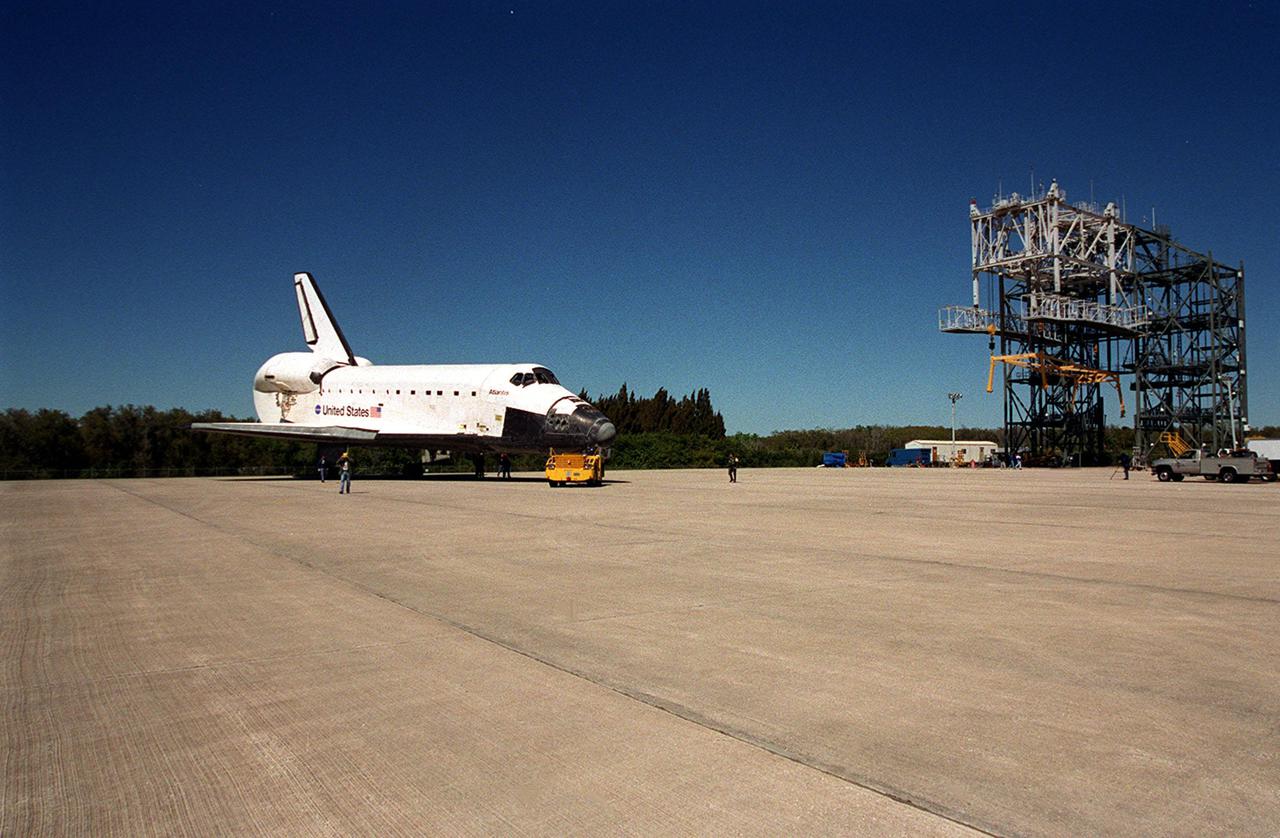
Atlantis turns away from the mate_demate device at KSC’s Shuttle Landing Facility for towing to the Orbiter Processing Facility. Atlantis returned from California atop a Shuttle Carrier Aircraft after its Feb. 19 landing at Edwards Air Force Base, concluding mission STS-98. The ferry flight began March 1; unfavorable weather conditions kept it on the ground at Altus AFB, Okla., until it could return to Florida. In the Orbiter Processing Facility, Atlantis will be prepared for mission STS-104, the 10th construction flight to the International Space Station, scheduled to launch June 8

KENNEDY SPACE CENTER, FLA. -- At the mate/demate device at Kennedy Space Center's Shuttle Landing Facility, Atlantis is lifted up as the shuttle carrier aircraft, or SCA, begins to back away. The orbiter will be lowered to the ground and then towed to the Orbiter Processing Facility to begin processing for its next launch, mission STS-122 in December. Atlantis arrived at Kennedy Space Center atop the SCA on July 3 after a three-day, cross-country flight due to fuel stops and weather delays. Touchdown was at 8:27 a.m. EDT. Atlantis landed at Edwards Air Force Base in California on June 22 to end mission STS-117. Photo credit: NASA/Jack Pfaller.
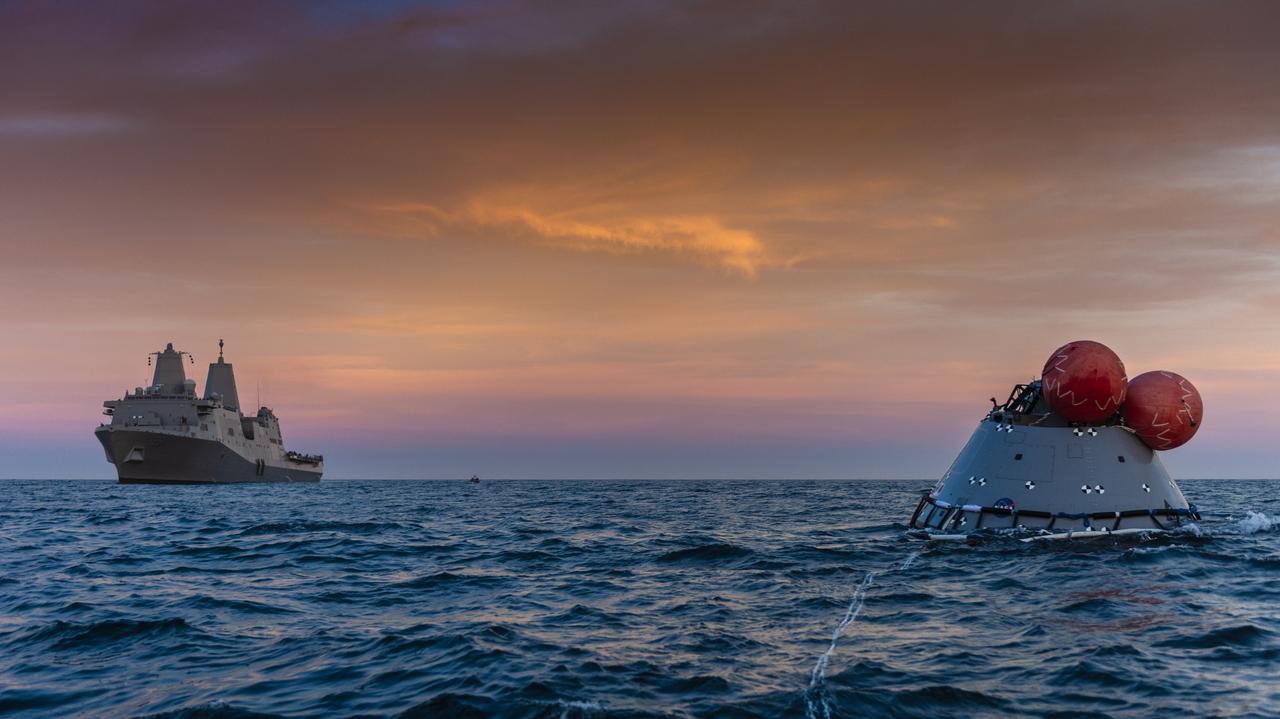
At sunset, a test version of the Orion capsule floats in the Pacific Ocean on Nov. 1, 2018, during Underway Recovery Test-7 (URT-7). Nearby is the USS John P. Murtha. Orion will be towed into the ship's well deck. URT-7 is one in a series of tests that the Exploration Ground Systems Recovery Team, along with the U.S. Navy, are conducting to verify and validate procedures and hardware that will be used to recover the Orion spacecraft after it splashes down in the Pacific Ocean following deep space exploration missions. Orion will have emergency abort capability, sustain the crew during space travel and provide safe re-entry from deep space return velocities.
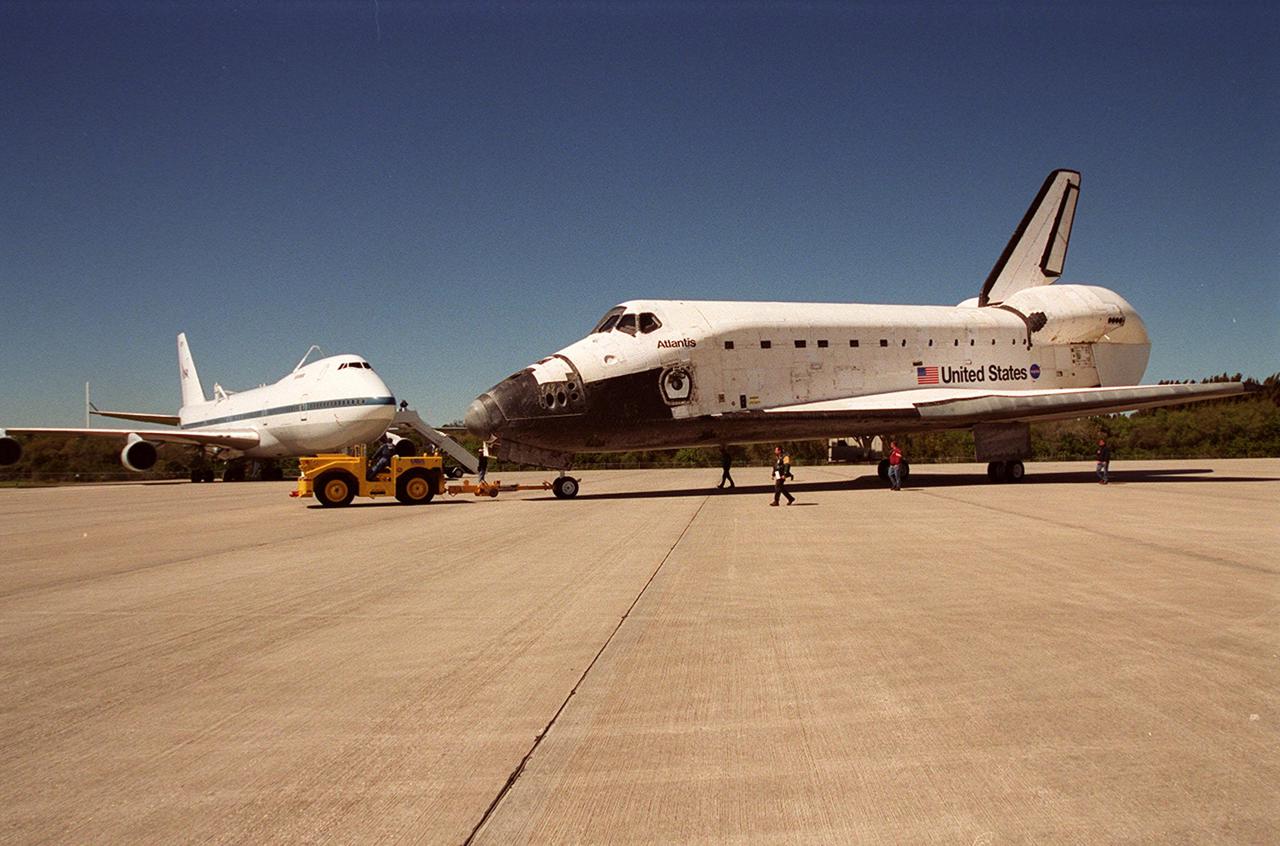
Atlantis is towed from KSC’s Shuttle Landing Facility to the Orbiter Processing Facility. Atlantis returned from California atop a Shuttle Carrier Aircraft (seen in the background, left) after its Feb. 19 landing at Edwards Air Force Base, concluding mission STS-98. The ferry flight began March 1; unfavorable weather conditions kept it on the ground at Altus AFB, Okla., until it could return to Florida. In the Orbiter Processing Facility, Atlantis will be prepared for mission STS-104, the 10th construction flight to the International Space Station, scheduled to launch June 8
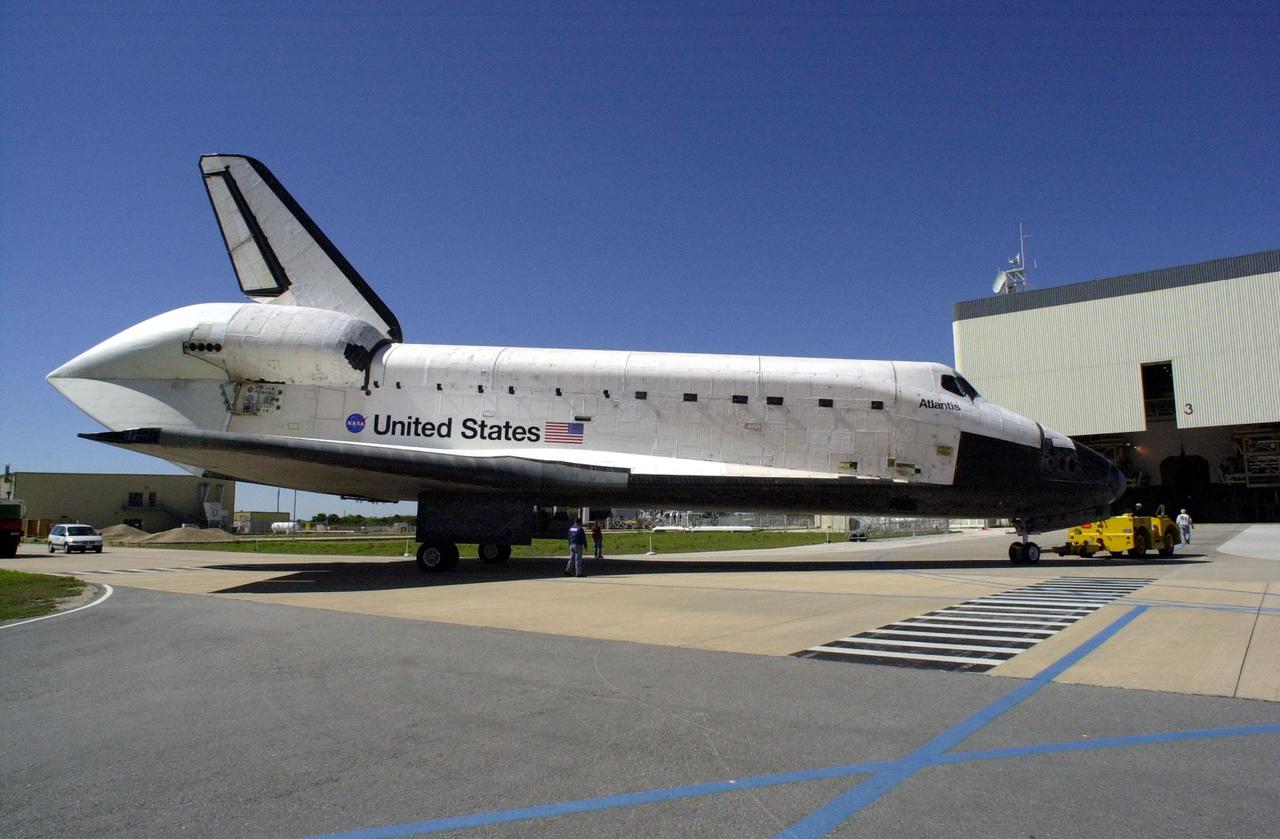
The orbiter Atlantis makes the turn to the Orbiter Processing Facility bay 3 after being towed from the Shuttle Landing Facility. The unusual silhouette of the aft section on the orbiter is due to the tail cone covering the aft engines. Atlantis landed Feb. 19 at Edwards Air Force Base concluding mission STS-98. The orbiter returned to Florida on the back of a Shuttle Carrier Aircraft, known as a ferry flight, that began March 1. Unfavorable weather conditions kept it on the ground at Altus AFB, Okla., for several days until it could return to Florida. Atlantis will be prepared in the OPF for mission STS-104, the 10th construction flight to the International Space Station, scheduled to launch June 8
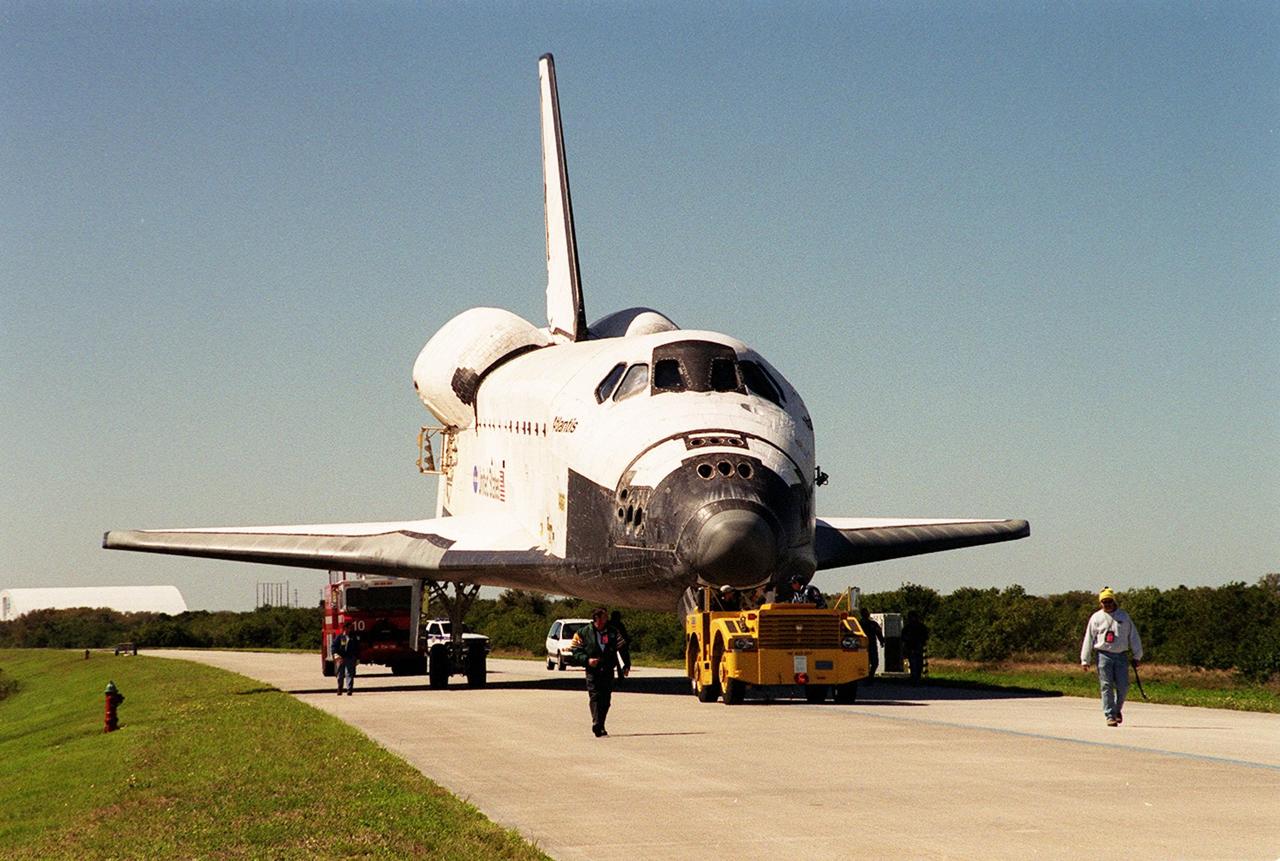
Accompanied by workers and Security, Atlantis moves along the tow-way from the KSC Shuttle Landing Facility to the Orbiter Processing Facility. Atlantis returned from California atop a Shuttle Carrier Aircraft after its Feb. 19 landing at Edwards Air Force Base, concluding mission STS-98. The ferry flight began March 1; unfavorable weather conditions kept it on the ground at Altus AFB, Okla., until it could return to Florida. In the Orbiter Processing Facility, Atlantis will be prepared for mission STS-104, the 10th construction flight to the International Space Station, scheduled to launch June 8
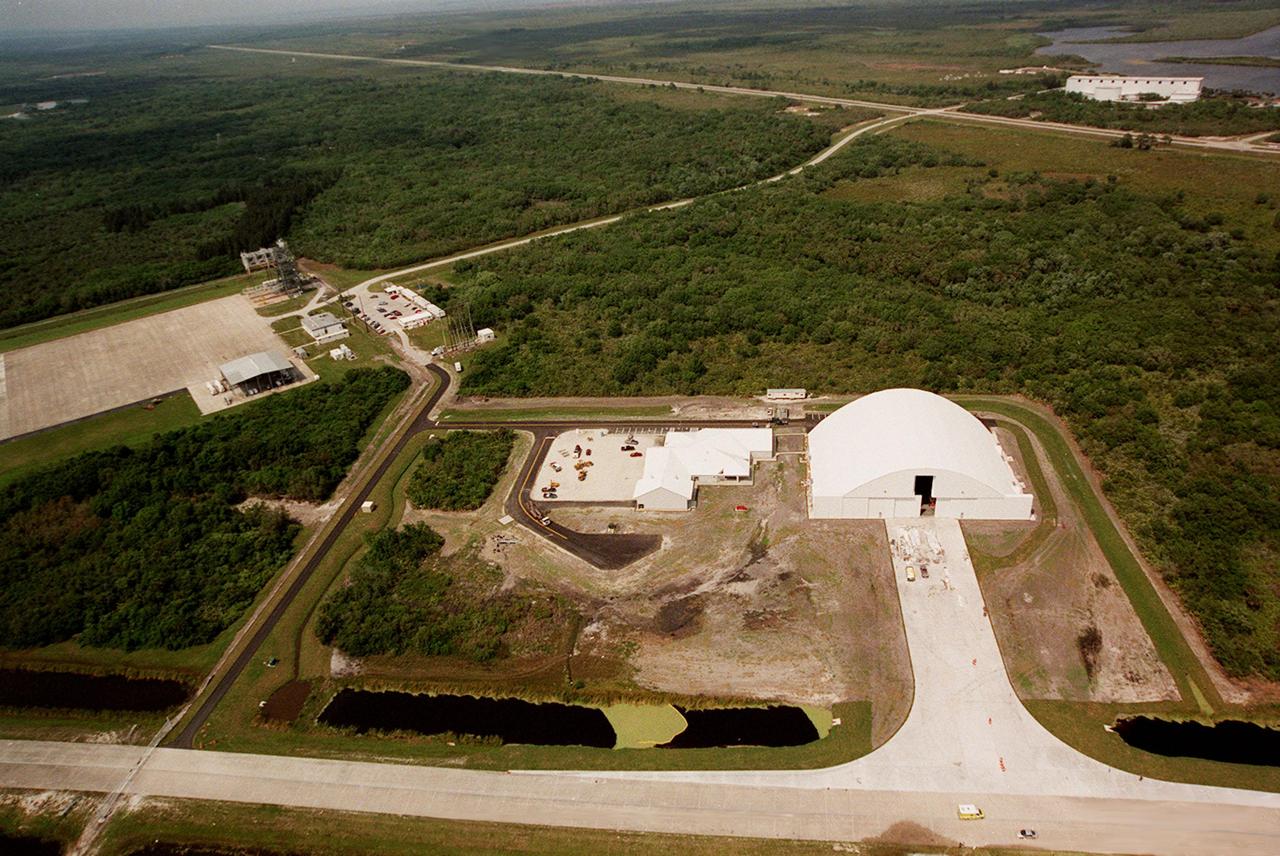
Looking east in this aerial photo can be seen several facilities at KSC. On the left is the parking tarmac next to the runway at the Shuttle Landing Facility. Astronaut Rd. runs from it toward the upper right corner, connecting with Kennedy Parkway North. The white building, upper right) is the Apollo/Saturn V Center. At the center of the photo is the remote launch vehicle (RLV) hangar, still under construction, at the south end of the Shuttle Landing Facility. Next to the multi-purpose RLV hangar are facilities for related ground support equipment and administrative/technical support. At the bottom of the photo is the tow-way road which connects the runway with the Orbiter Processing Facility.
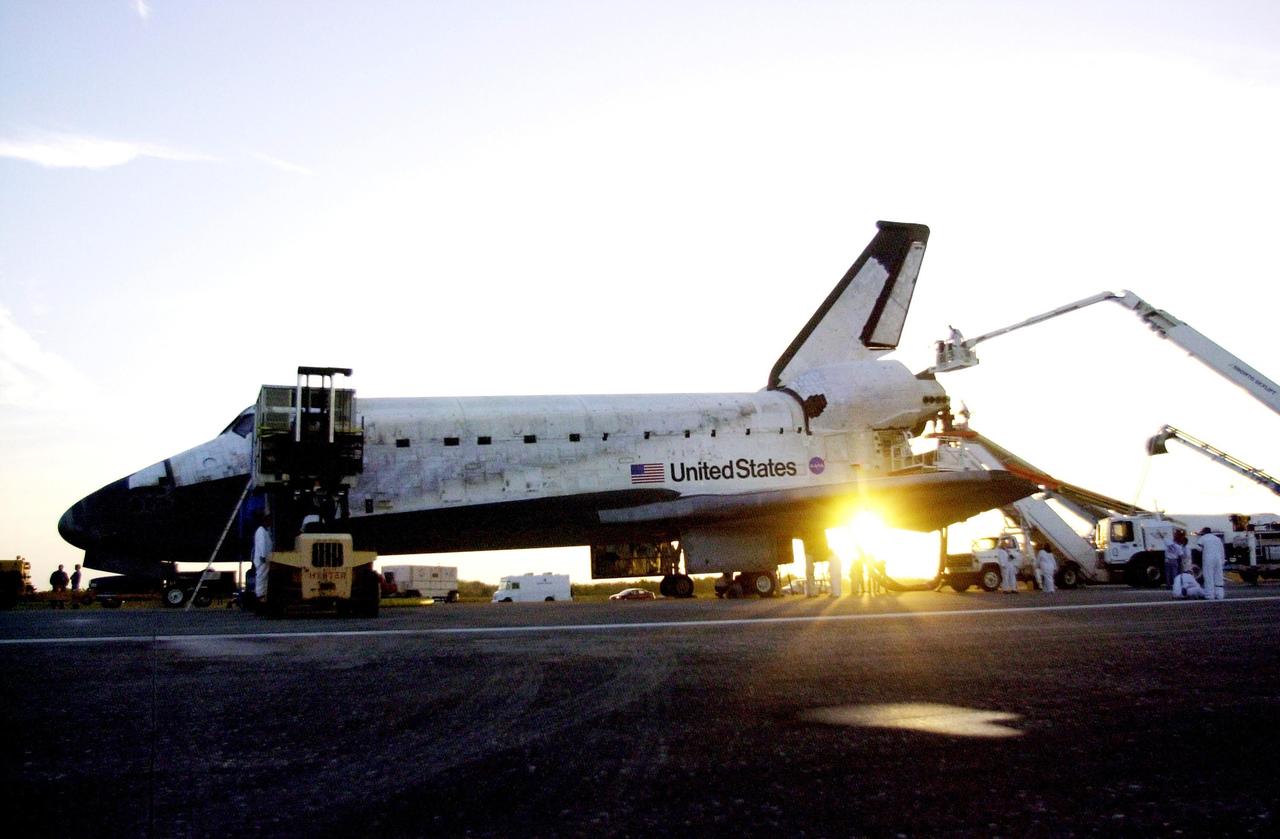
KENNEDY SPACE CENTER, FLA. -- The rising sun blazes from beneath orbiter Columbia as workers prepare the vehicle for ground tow operations. Columbia landed at the KSC Shuttle Landing Facility at 4:33:09 a.m. EST after a successful 11-day mission servicing the Hubble Space Telescope. Main gear touchdown occurred at 4:31:52 a.m. and nose wheel touchdown at 4:32:02. Rollout time was 1 minute, 17 seconds. This was the 58th landing at KSC out of 108 missions in the history of the Shuttle program
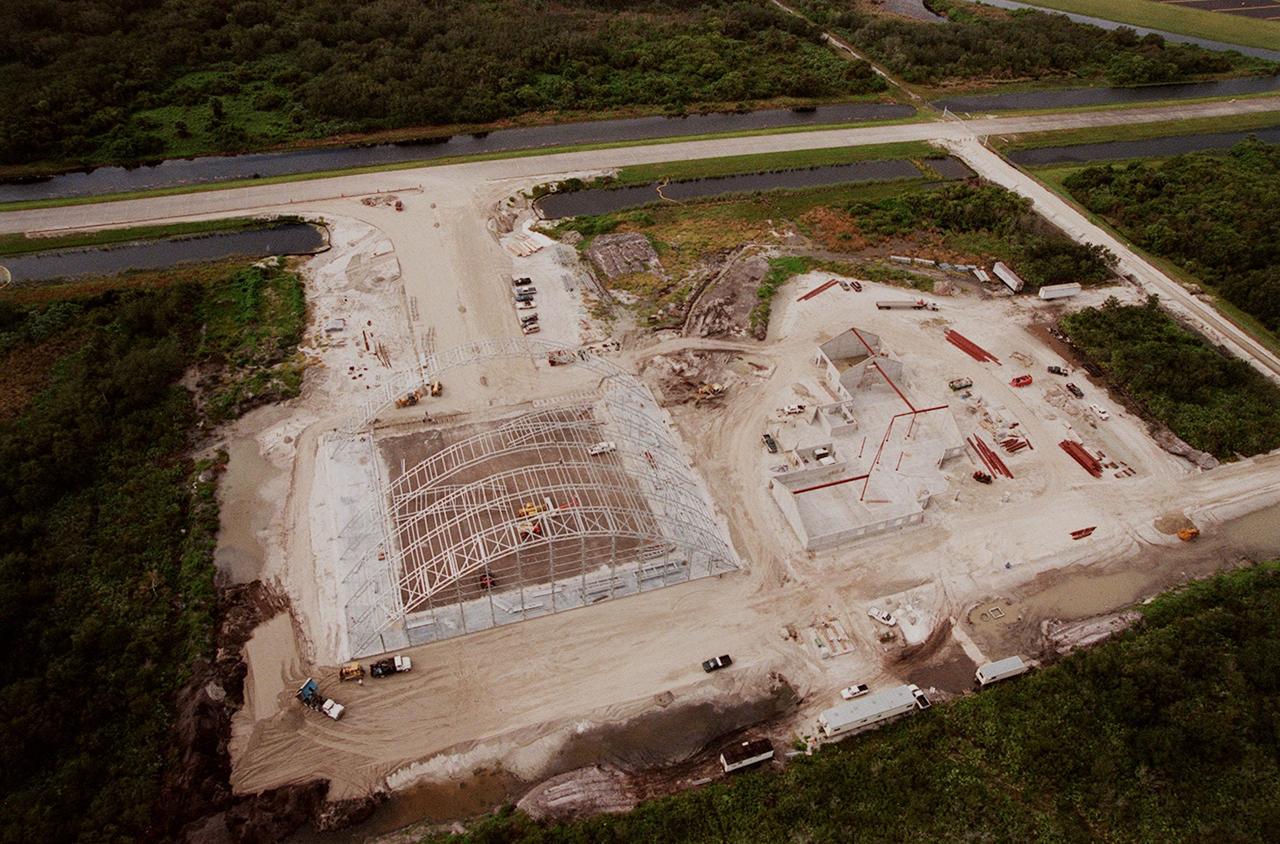
Construction continues on an $8 million Reusable Launch Vehicle (RLV) Support Complex at Kennedy Space Center. At left is a multi-purpose hangar and at right a building for related ground support equipment and administrative/ technical support. The complex is situated at the Shuttle Landing Facility (upper right). Near the top of the photo is the tow-way. The RLV complex will be available to accommodate the Space Shuttle; the X-34 RLV technology demonstrator; the L-1011 carrier aircraft for Pegasus and X-34; and other RLV and X-vehicle programs. The complex is jointly funded by the Spaceport Florida Authority, NASA's Space Shuttle Program and KSC. The facility will be operational in early 2000
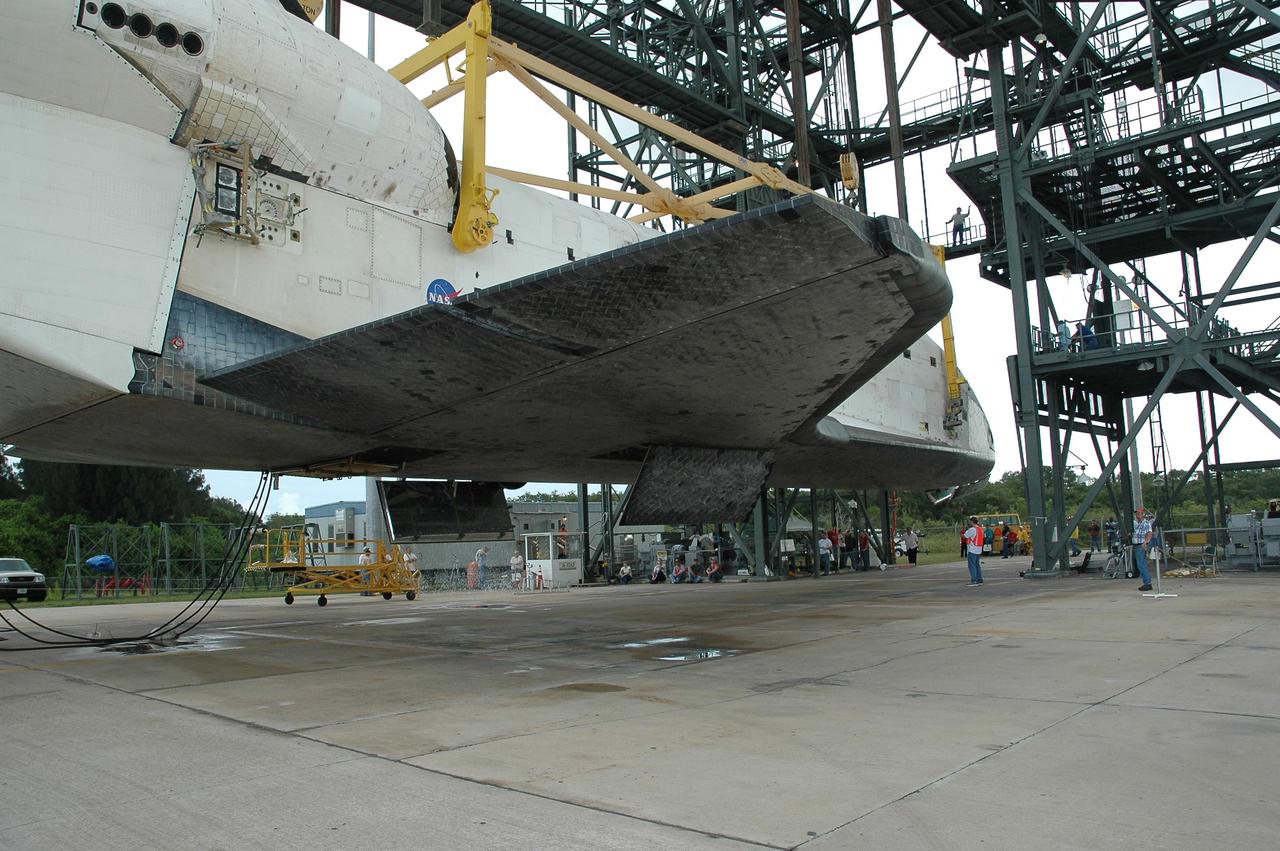
KENNEDY SPACE CENTER, FLA. -- Atlantis is slowly lowered to the ground at the mate/demate device at Kennedy Space Center's Shuttle Landing Facility. The orbiter will be detached from the lifting crane and then towed to the Orbiter Processing Facility to begin processing for its next launch, mission STS-122 in December. Atlantis arrived at Kennedy Space Center atop the SCA on July 3 after a three-day, cross-country flight due to fuel stops and weather delays. Touchdown was at 8:27 a.m. EDT. Atlantis landed at Edwards Air Force Base in California on June 22 to end mission STS-117. Photo credit: NASA/Jack Pfaller.
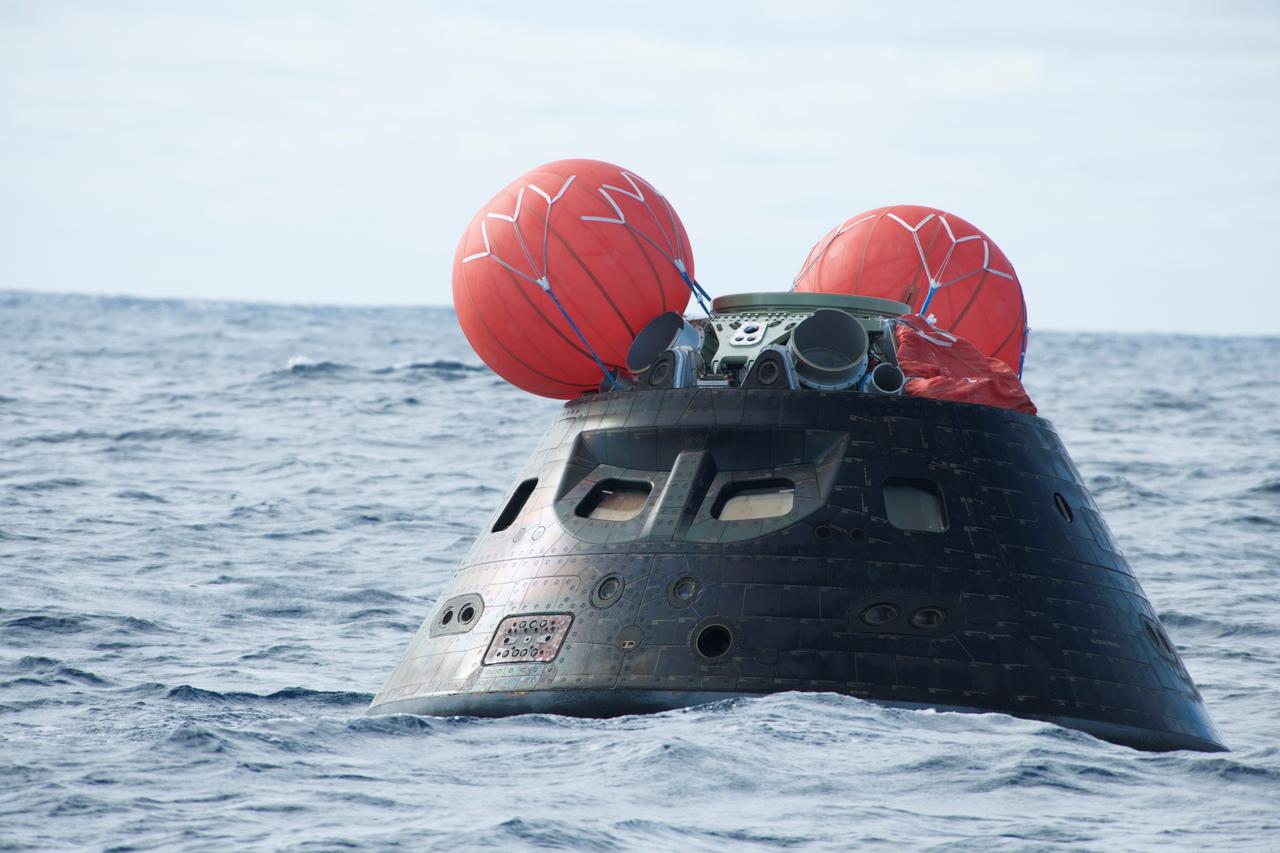
NASA's Orion spacecraft floats in the Pacific Ocean after splashdown from its first flight test in Earth orbit. The spacecraft completed a two-orbit, four-and-a-half-hour mission in Earth orbit. NASA, the U.S. Navy and Lockheed Martin are coordinating efforts to recover Orion, the forward bay cover and main parachutes. Orion will be towed in and secure in the well deck of the nearby USS Anchorage. Orion's mission tested systems critical to crew safety, including the launch abort system, the heat shield and the parachute system. The Ground Systems Development and Operations Program is leading the recovery efforts.
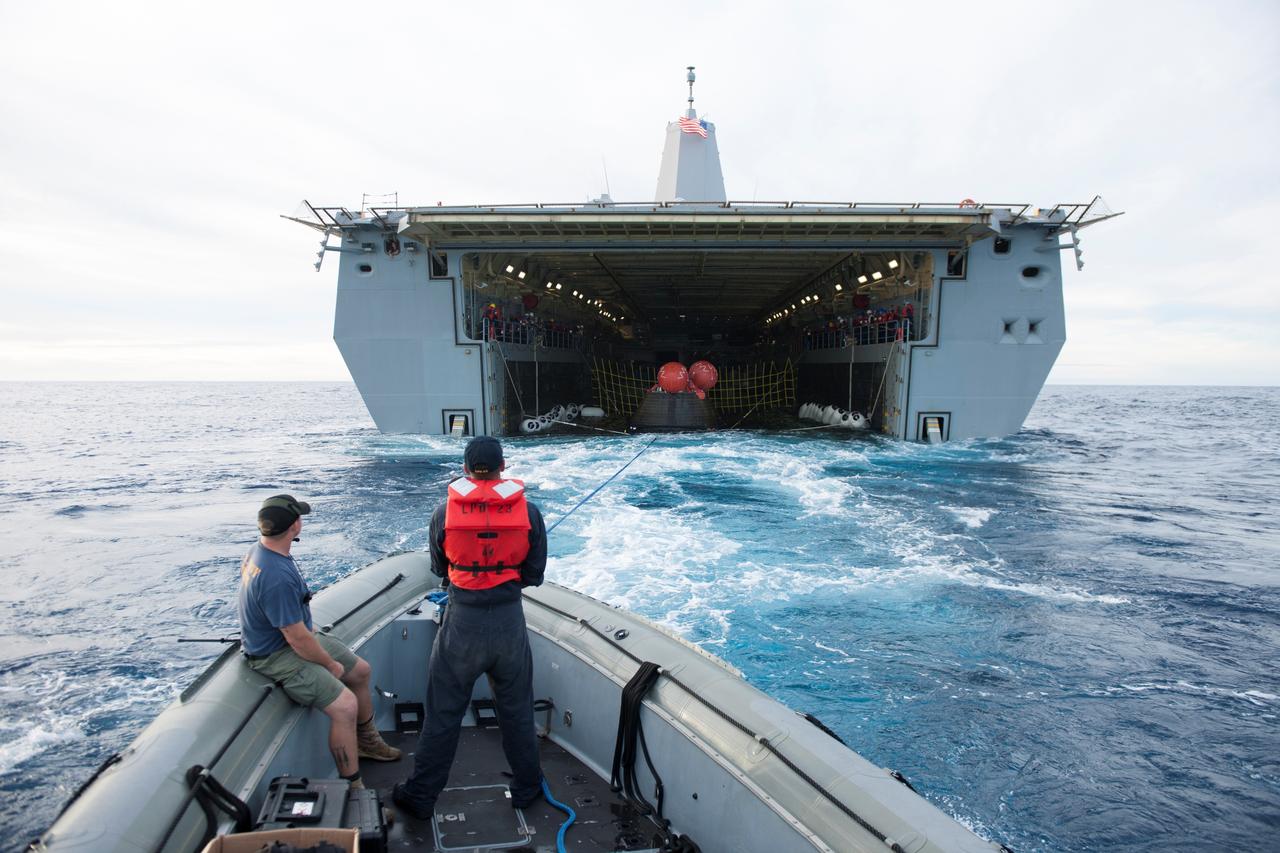
U.S. Navy personnel aboard a rigid hull inflatable boat help recover NASA's Orion spacecraft following its splashdown in the Pacific Ocean after its first flight test in Earth orbit. Orion is towed into the flooded well deck of the USS Anchorage. NASA, the U.S. Navy and Lockheed Martin coordinated efforts to recover Orion, the forward bay cover and main parachutes. Orion completed a two-orbit, four-and-a-half hour mission, to test systems critical to crew safety, including the launch abort system, the heat shield and the parachute system. The Ground Systems Development and Operations Program is leading the recovery efforts.
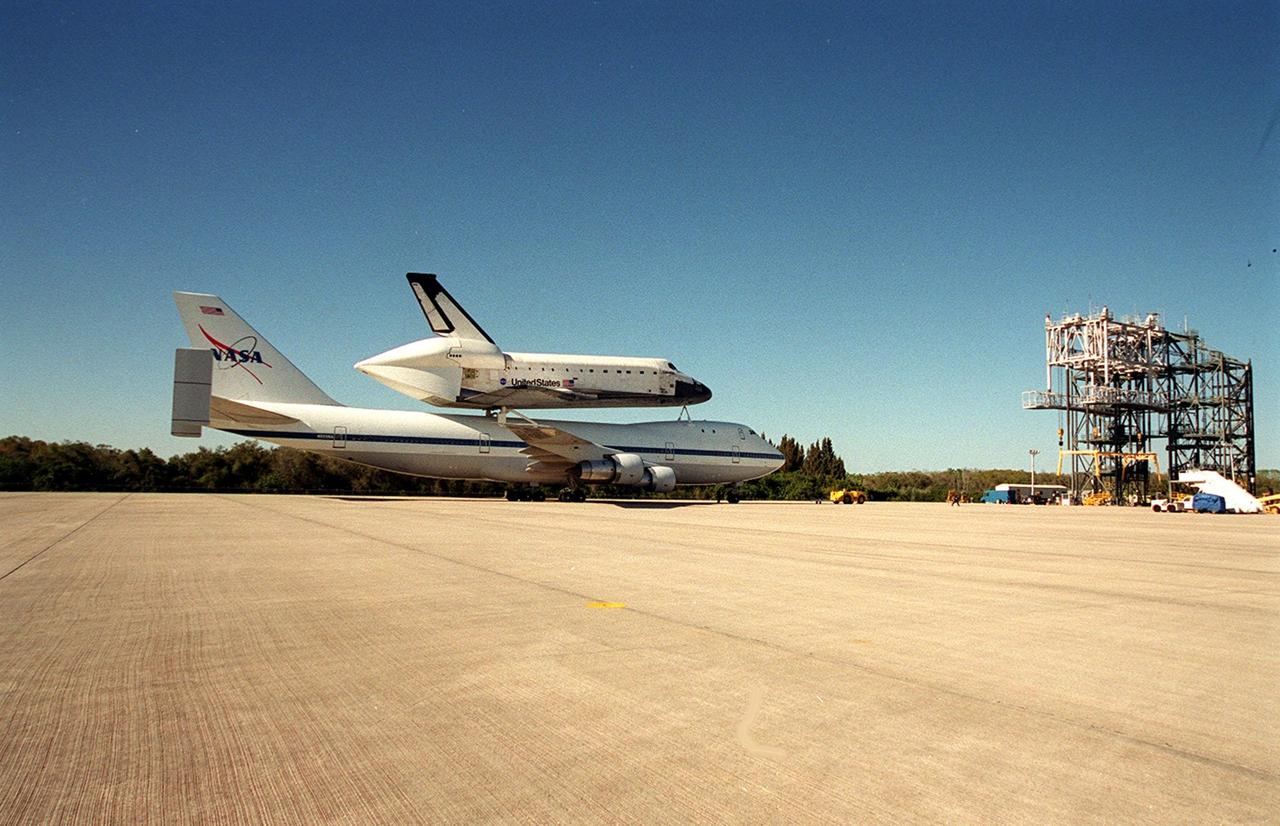
The Shuttle Carrier Aircraft with orbiter Columbia riding piggyback taxis toward the mate/demate device at the KSC Shuttle Landing Facility. At the MDD, Columbia will be lifted off the SCA and towed to the Orbiter Processing Facility bay 1. Columbia’s ferry flight began in California March 1. Unfavorable weather conditions kept it on the ground at Dyess AFB, Texas, until it could return to Florida. It landed temporarily at the CCAFS Skid Strip until Atlantis, which had already landed at the SLF, could be transferred. Columbia is returning from a 17-month-long modification and refurbishment process as part of a routine maintenance plan. The orbiter will next fly on mission STS-107, scheduled Oct. 25
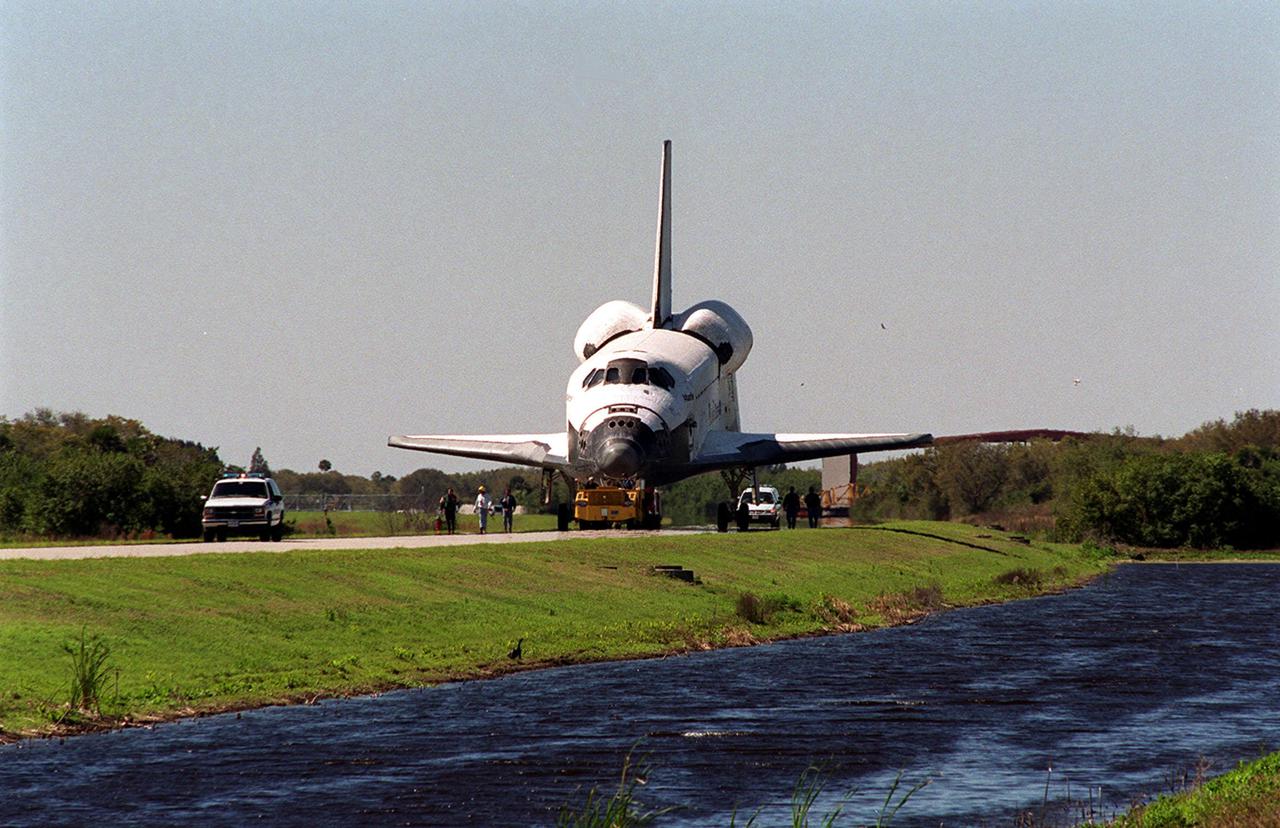
Accompanied by workers and Security, Atlantis moves along the tow-way from the KSC Shuttle Landing Facility to the Orbiter Processing Facility. Atlantis returned from California atop a Shuttle Carrier Aircraft after its Feb. 19 landing at Edwards Air Force Base, concluding mission STS-98. The ferry flight began March 1; unfavorable weather conditions kept it on the ground at Altus AFB, Okla., until it could return to Florida. In the Orbiter Processing Facility, Atlantis will be prepared for mission STS-104, the 10th construction flight to the International Space Station, scheduled to launch June 8
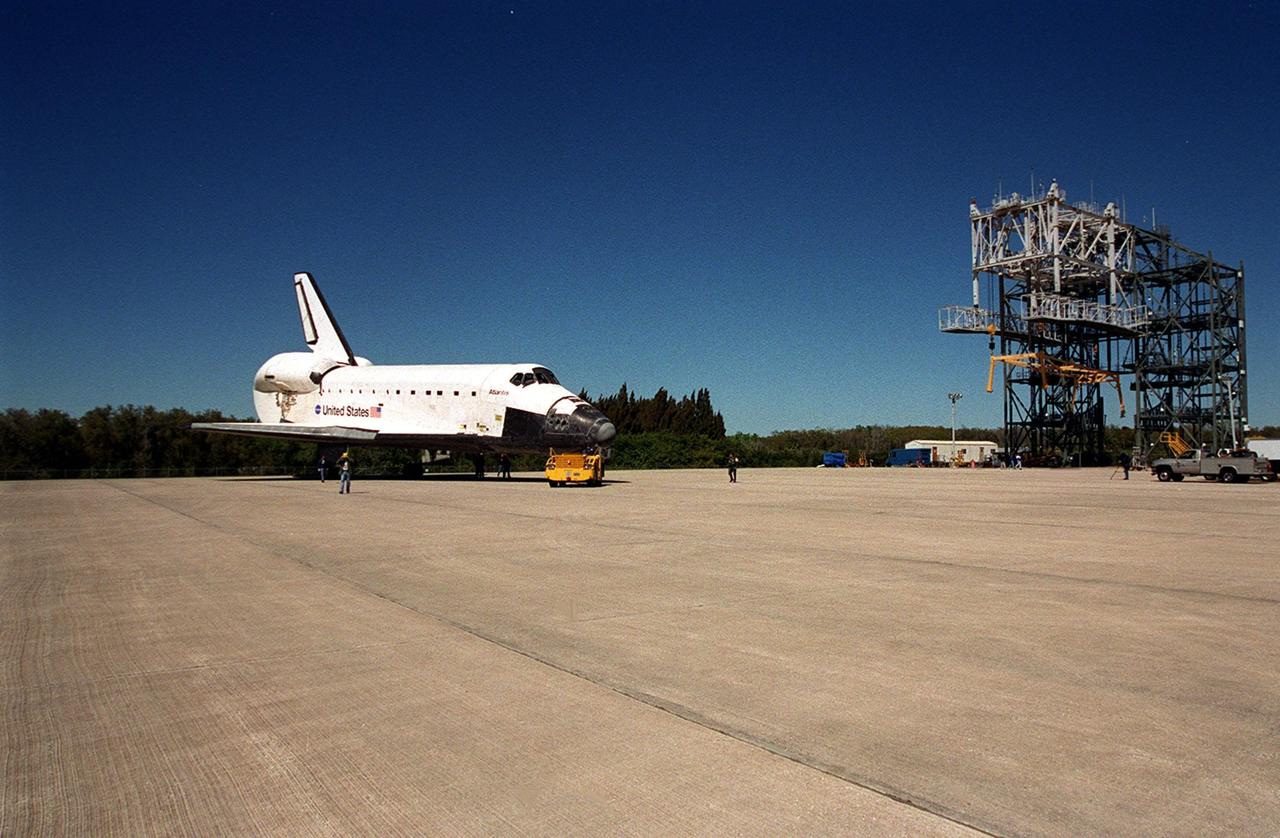
Atlantis turns away from the mate/demate device at KSC’s Shuttle Landing Facility for towing to the Orbiter Processing Facility. Atlantis returned from California atop a Shuttle Carrier Aircraft after its Feb. 19 landing at Edwards Air Force Base, concluding mission STS-98. The ferry flight began March 1; unfavorable weather conditions kept it on the ground at Altus AFB, Okla., until it could return to Florida. In the Orbiter Processing Facility, Atlantis will be prepared for mission STS-104, the 10th construction flight to the International Space Station, scheduled to launch June 8
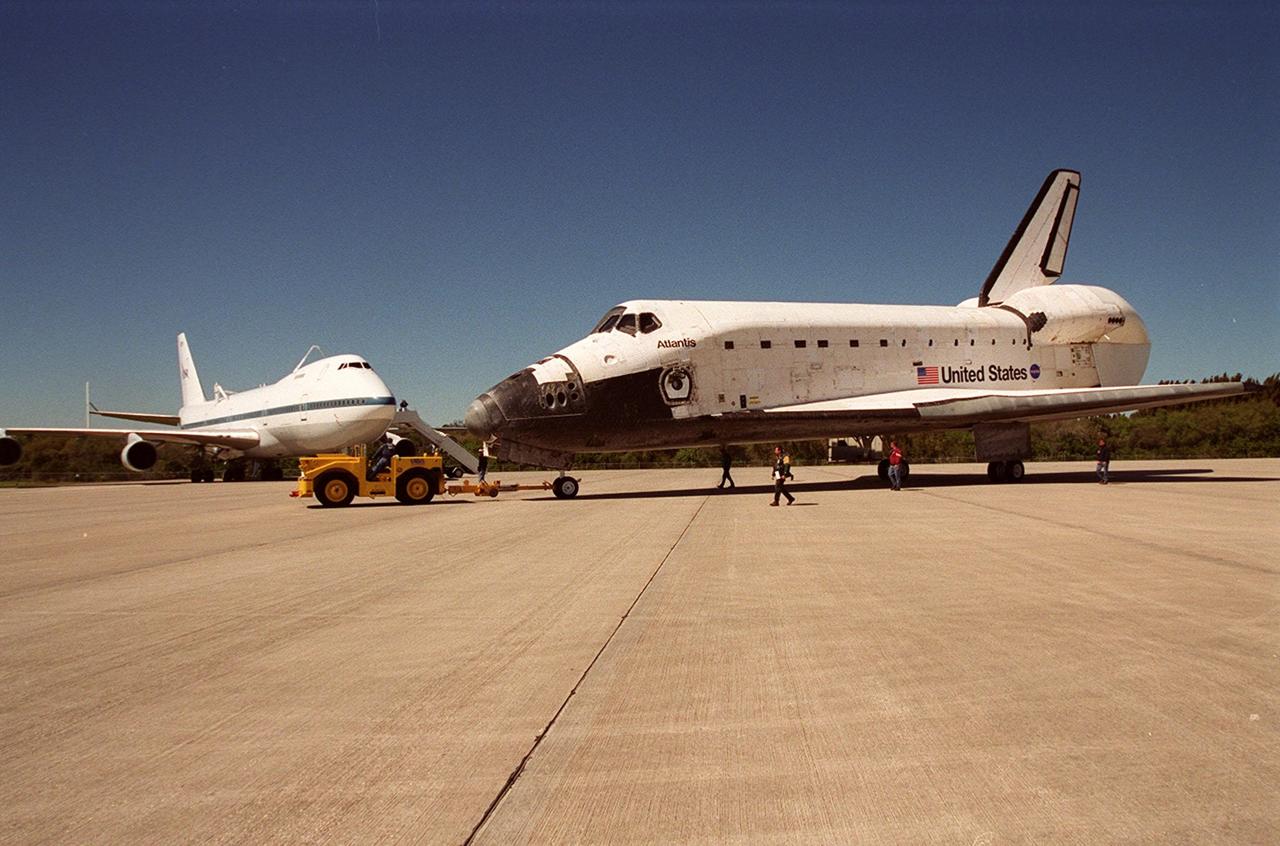
Atlantis is towed from KSC’s Shuttle Landing Facility to the Orbiter Processing Facility. Atlantis returned from California atop a Shuttle Carrier Aircraft (seen in the background, left) after its Feb. 19 landing at Edwards Air Force Base, concluding mission STS-98. The ferry flight began March 1; unfavorable weather conditions kept it on the ground at Altus AFB, Okla., until it could return to Florida. In the Orbiter Processing Facility, Atlantis will be prepared for mission STS-104, the 10th construction flight to the International Space Station, scheduled to launch June 8
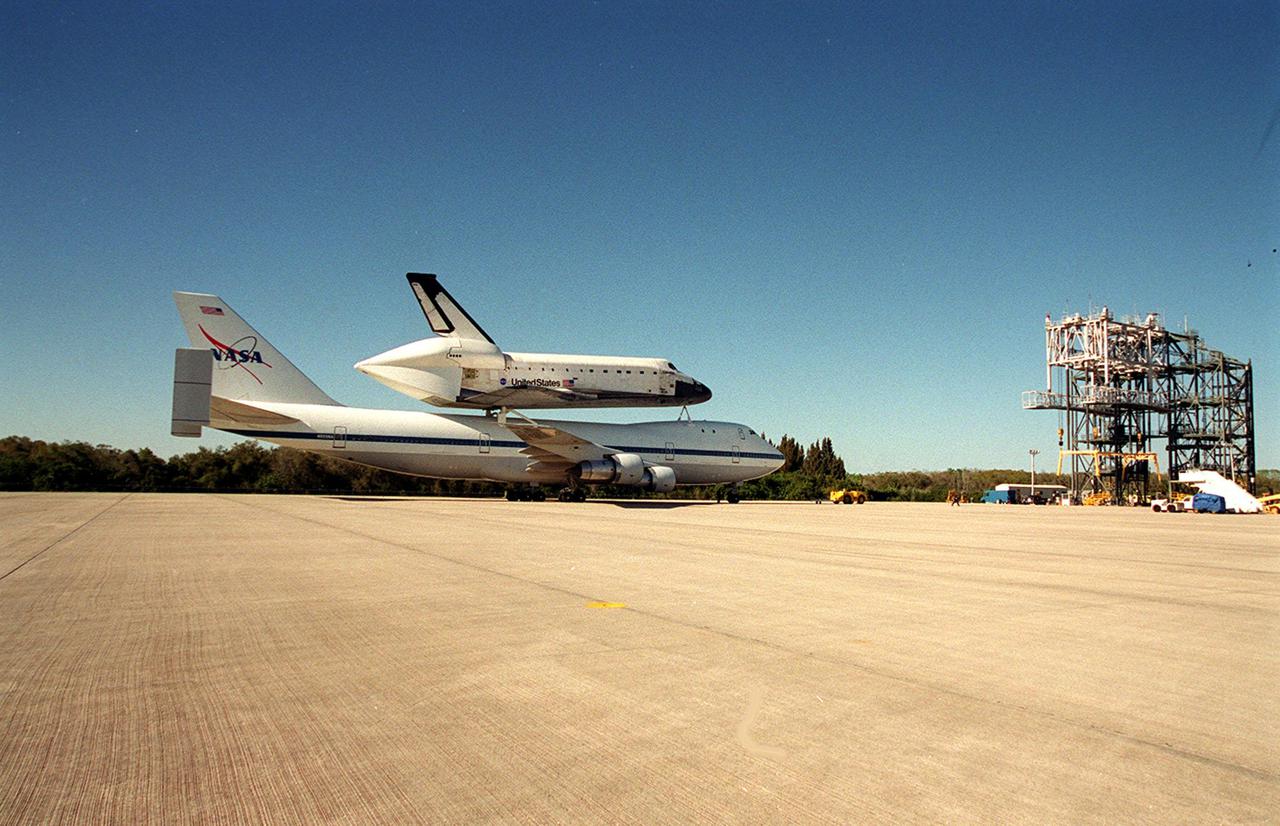
The Shuttle Carrier Aircraft with orbiter Columbia riding piggyback taxis toward the mate_demate device at the KSC Shuttle Landing Facility. At the MDD, Columbia will be lifted off the SCA and towed to the Orbiter Processing Facility bay 1. Columbia’s ferry flight began in California March 1. Unfavorable weather conditions kept it on the ground at Dyess AFB, Texas, until it could return to Florida. It landed temporarily at the CCAFS Skid Strip until Atlantis, which had already landed at the SLF, could be transferred. Columbia is returning from a 17-month-long modification and refurbishment process as part of a routine maintenance plan. The orbiter will next fly on mission STS-107, scheduled Oct. 25
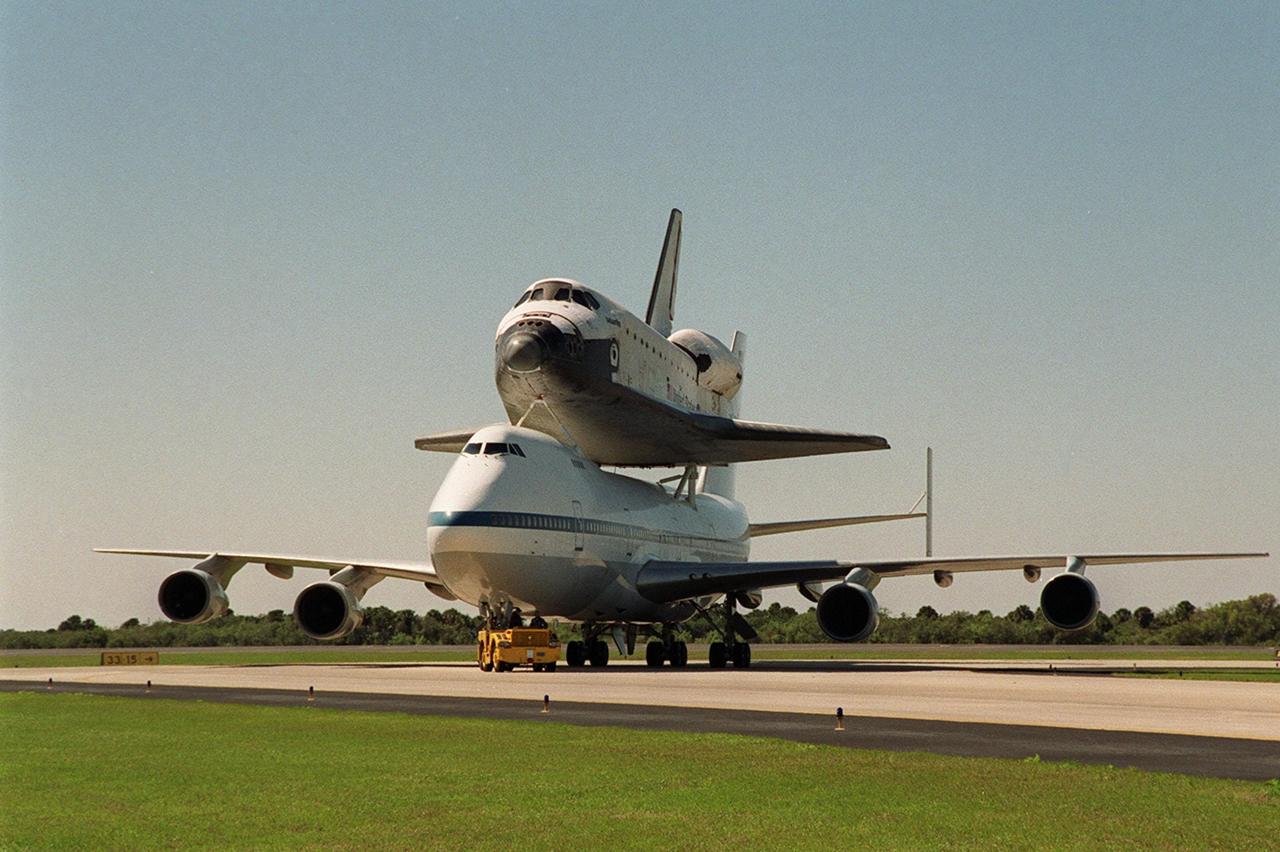
At the Shuttle Landing Facility, the Shuttle Carrier Aircraft, with the orbiter Atlantis on top, is towed around the turn to to the parking area at the Shuttle Landing Facility. There it will be demated from the orbiter in the mate/demate device. Atlantis landed in California Feb. 19 concluding mission STS-98. The ferry flight began in California March 1; unfavorable weather conditions kept it on the ground at Altus AFB, Okla., until it could return to Florida. The orbiter will next fly on mission STS-104, the 10th construction flight to the International Space Station, scheduled June 8
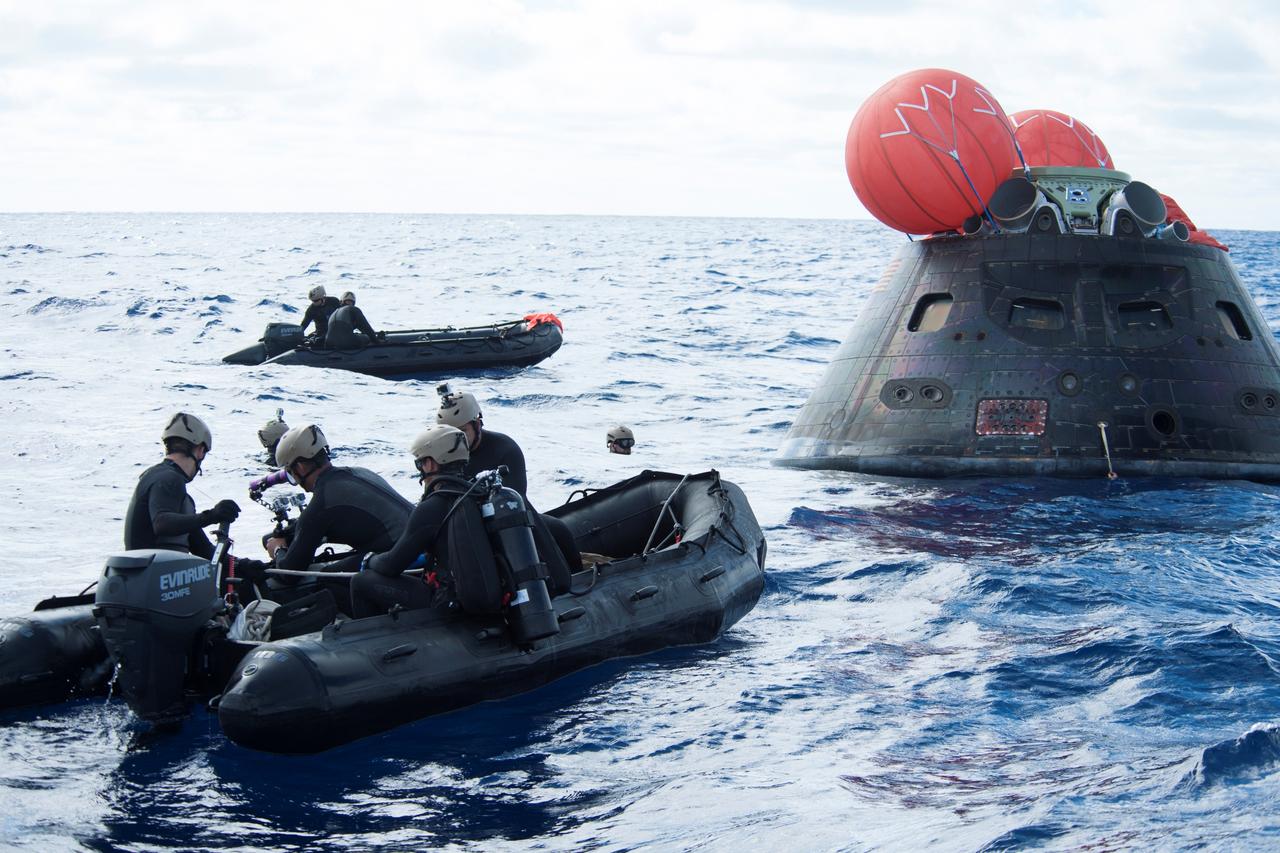
NASA's Orion spacecraft splashed down in the Pacific Ocean after its first flight test atop a Delta IV Heavy rocket from Space Launch Complex 37 at Cape Canaveral Air Force Station in Florida. U.S. Navy divers in Zodiac boats prepare to recover Orion and tow her in to the well deck of the USS Anchorage. NASA's Orion spacecraft completed a two-orbit, four-and-a-half hour mission to test systems critical to crew safety, including the launch abort system, the heat shield and the parachute system. The Ground Systems Development and Operations Program is leading the recovery efforts.
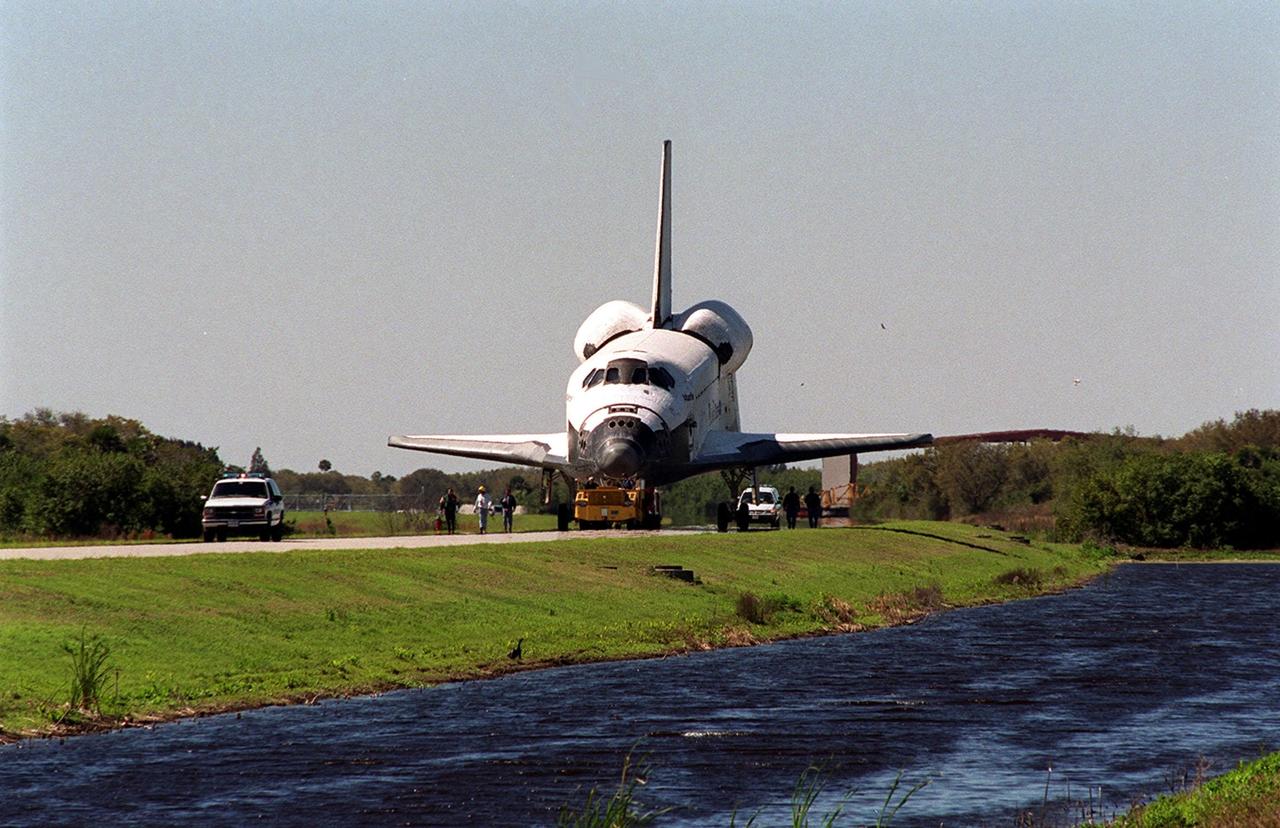
Accompanied by workers and Security, Atlantis moves along the tow-way from the KSC Shuttle Landing Facility to the Orbiter Processing Facility. Atlantis returned from California atop a Shuttle Carrier Aircraft after its Feb. 19 landing at Edwards Air Force Base, concluding mission STS-98. The ferry flight began March 1; unfavorable weather conditions kept it on the ground at Altus AFB, Okla., until it could return to Florida. In the Orbiter Processing Facility, Atlantis will be prepared for mission STS-104, the 10th construction flight to the International Space Station, scheduled to launch June 8
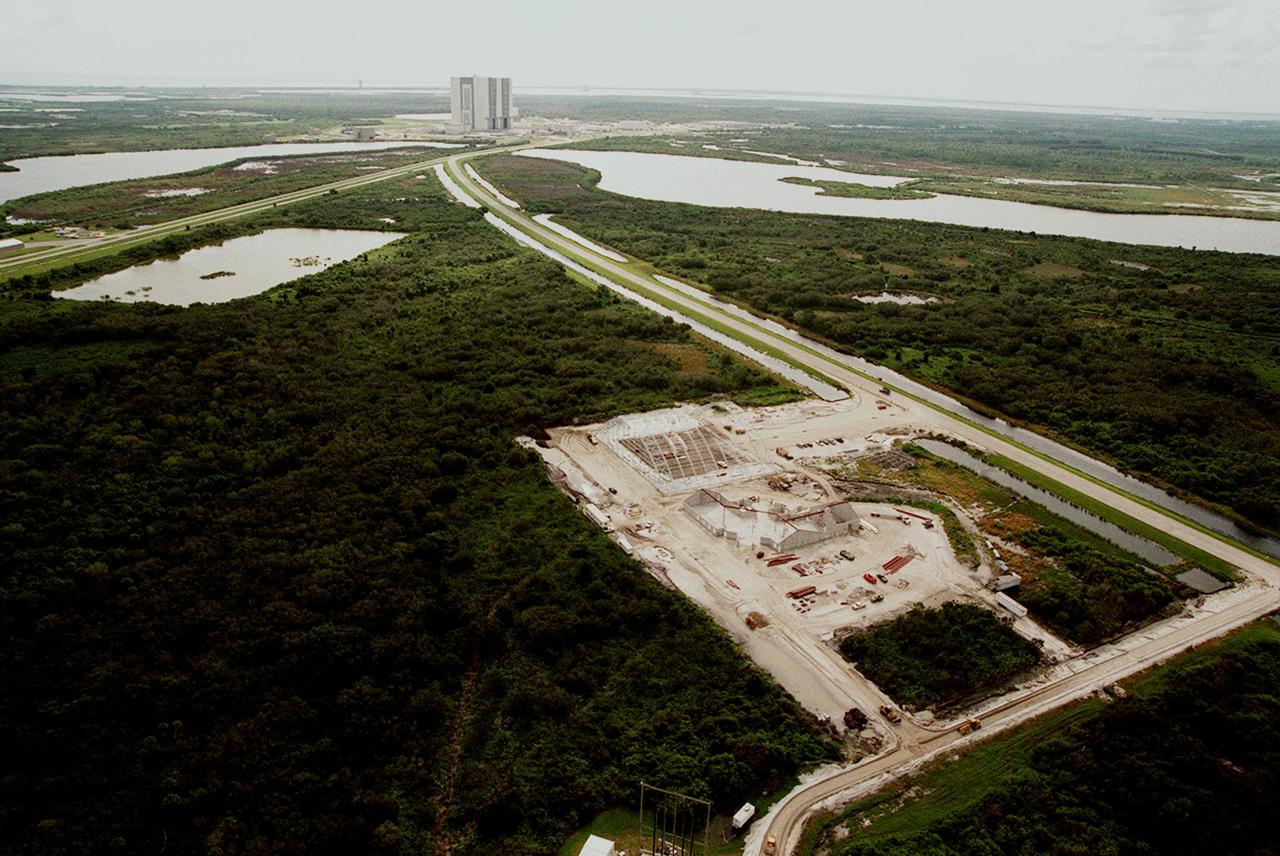
An aerial view reveals (foreground) the ongoing construction of an $8 million Reusable Launch Vehicle (RLV) Support Complex at Kennedy Space Center. At left is a multi-purpose hangar and at right a building for related ground support equipment and administrative/ technical support. In the background is the Vehicle Assembly Building. The road at right is the tow-way. The RLV complex will be available to accommodate the Space Shuttle; the X-34 RLV technology demonstrator; the L-1011 carrier aircraft for Pegasus and X-34; and other RLV and X-vehicle programs. The complex is jointly funded by the Spaceport Florida Authority, NASA's Space Shuttle Program and KSC. The facility will be operational in early 2000.