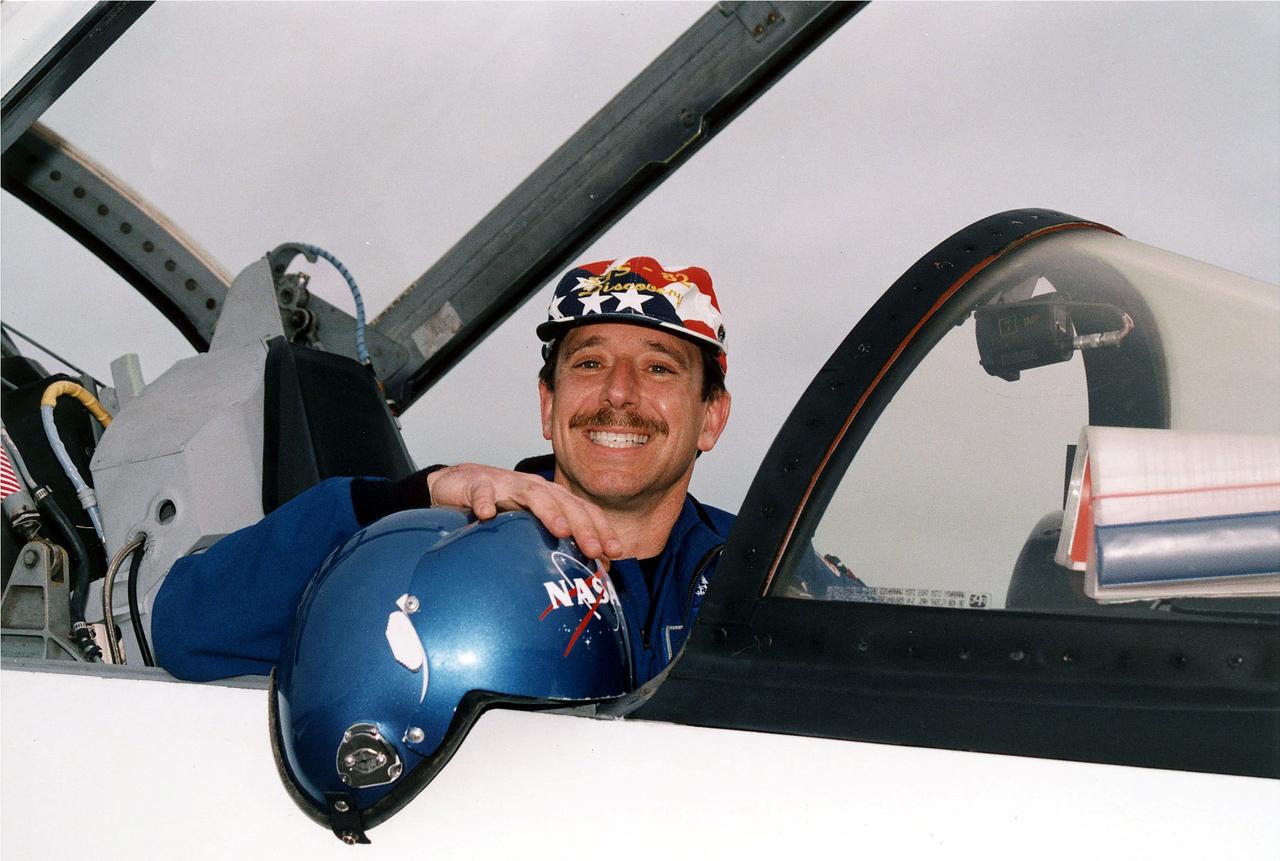
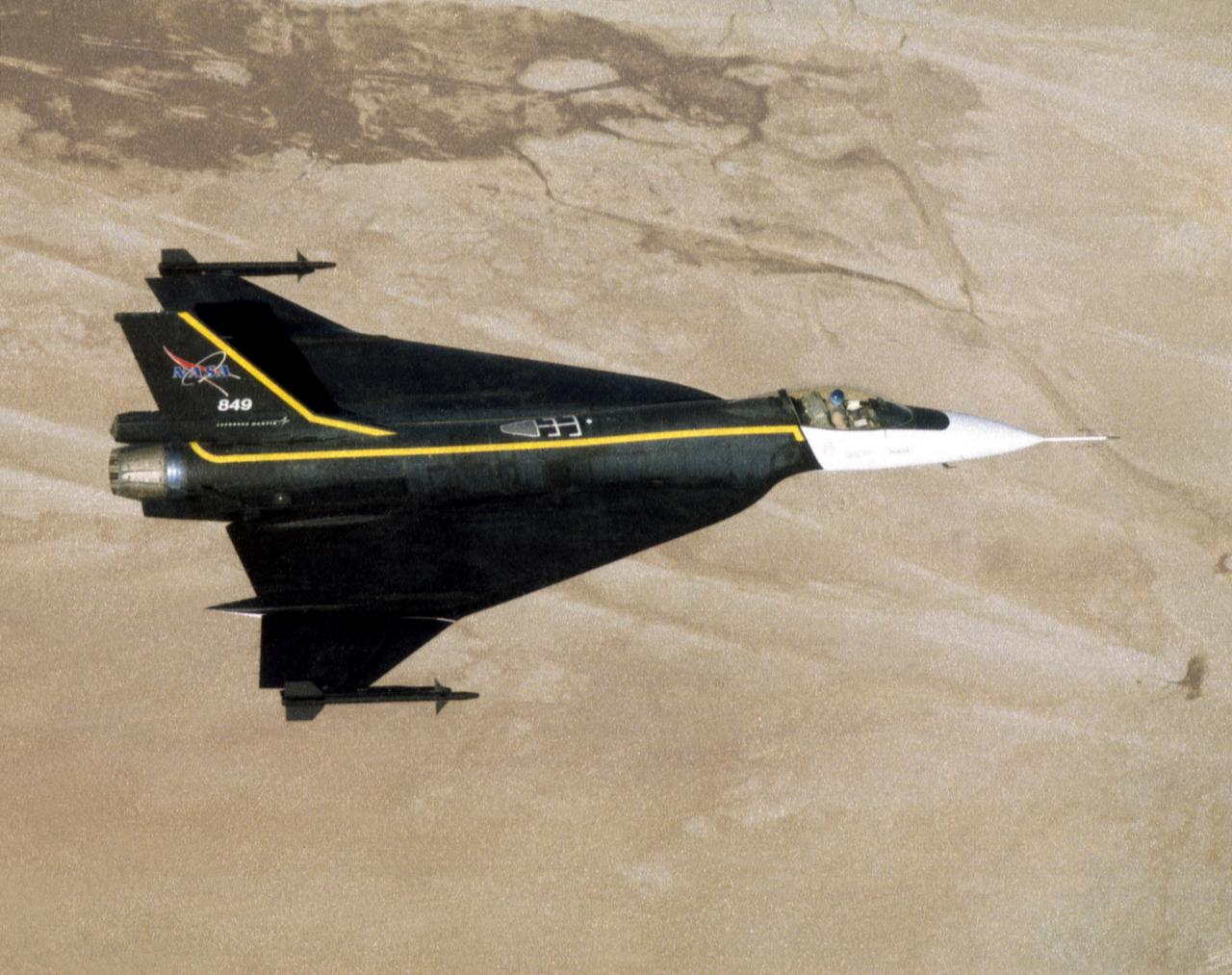
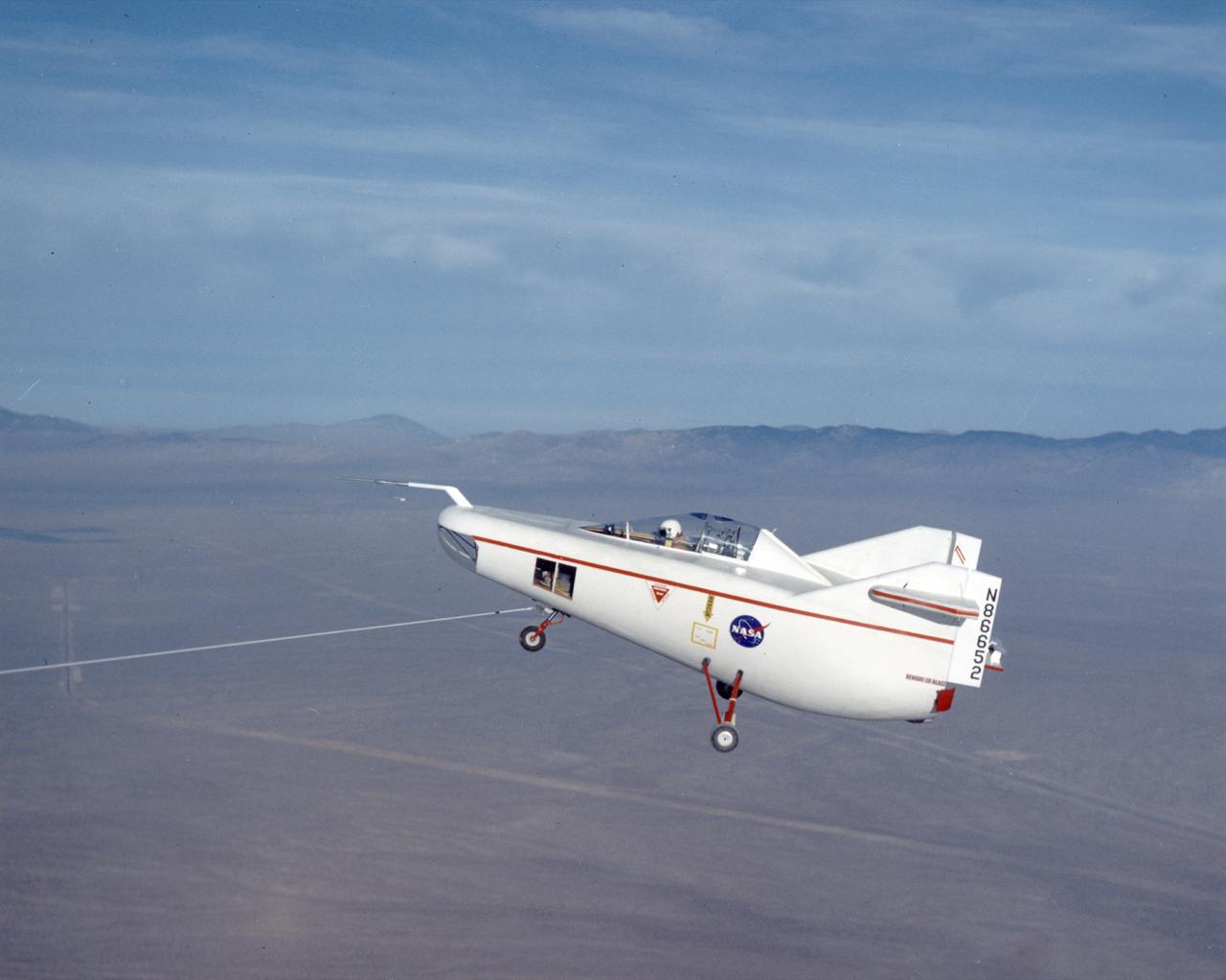
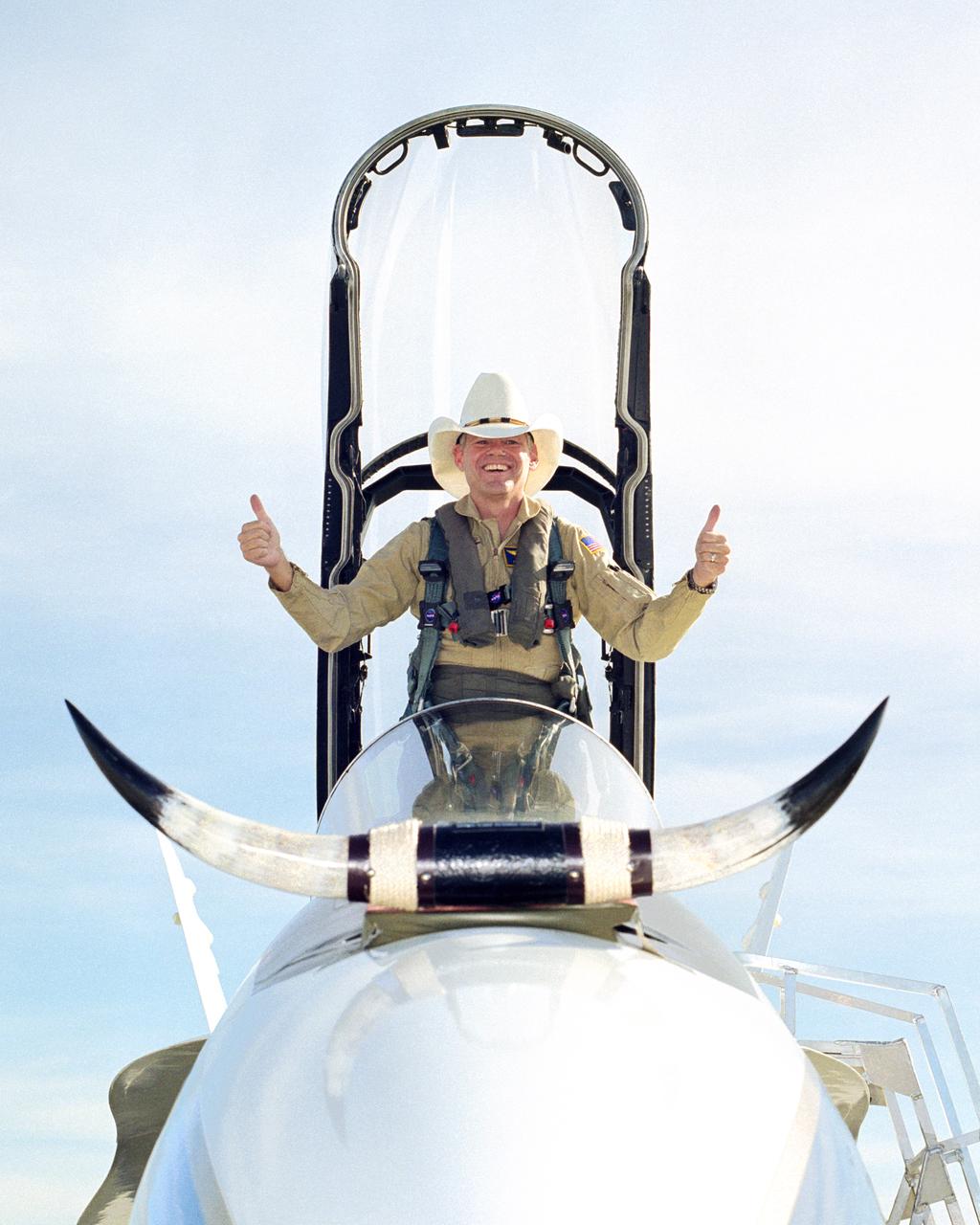
In a lighter mood, Ed Schneider gives a "thumbs-up" after his last flight at the Dryden Flight Research Center on September 19, 2000. Schneider arrived at the NASA Ames-Dryden Flight Research Facility on July 5, 1982, as a Navy Liaison Officer, becoming a NASA research pilot one year later. He has been project pilot for the F-18 High Angle-of-Attack program (HARV), the F-15 aeronautical research aircraft, the NASA B-52 launch aircraft, and the SR-71 "Blackbird" aircraft. He also participated in such programs as the F-8 Digital Fly-By-Wire, the FAA/NASA 720 Controlled Impact Demonstration, the F-14 Automatic Rudder Interconnect and Laminar Flow, and the F-104 Aeronautical Research and Microgravity projects.
Ed Schneider gives a "thumbs-up" after his last flight at the Dryden Flight Research Center
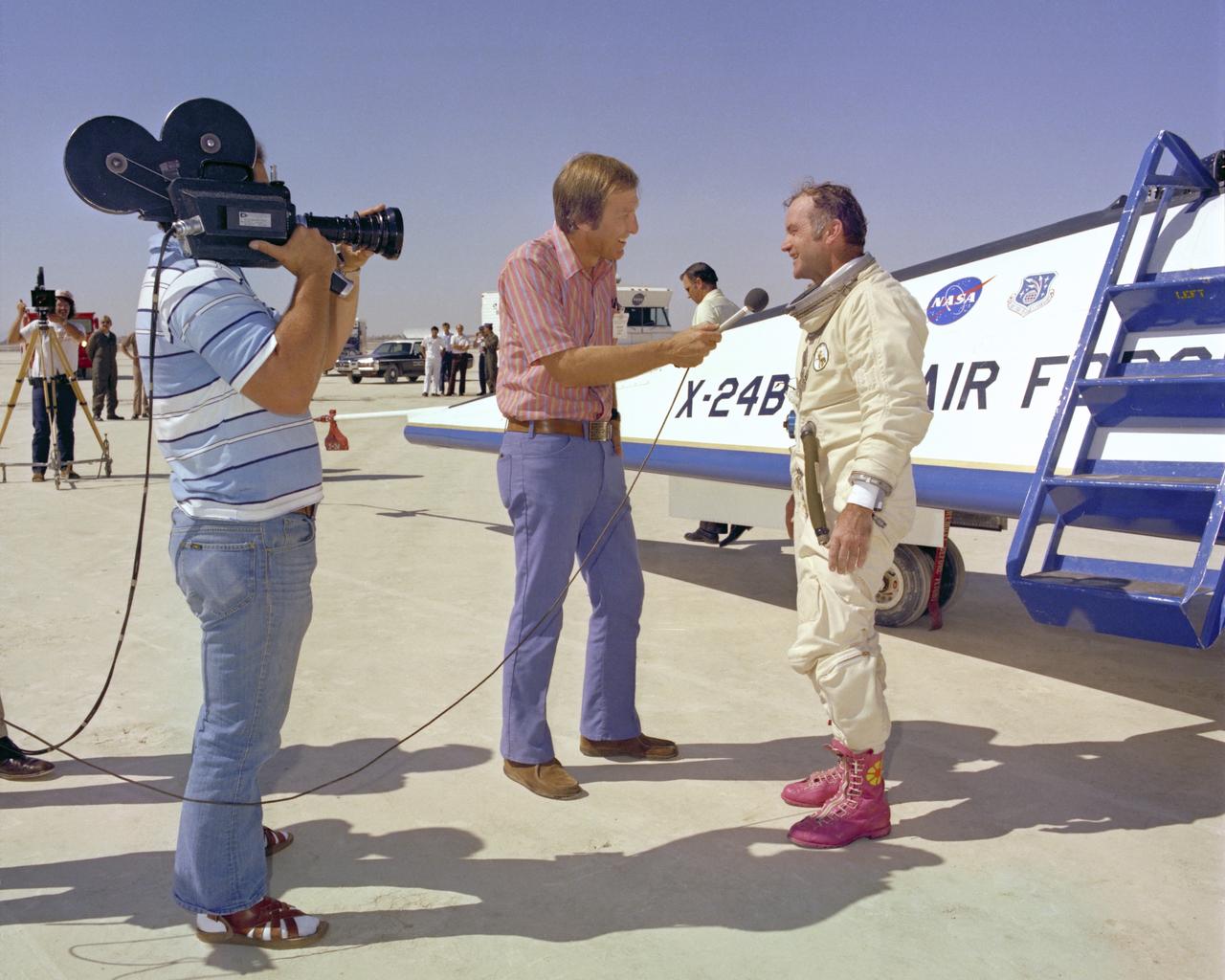
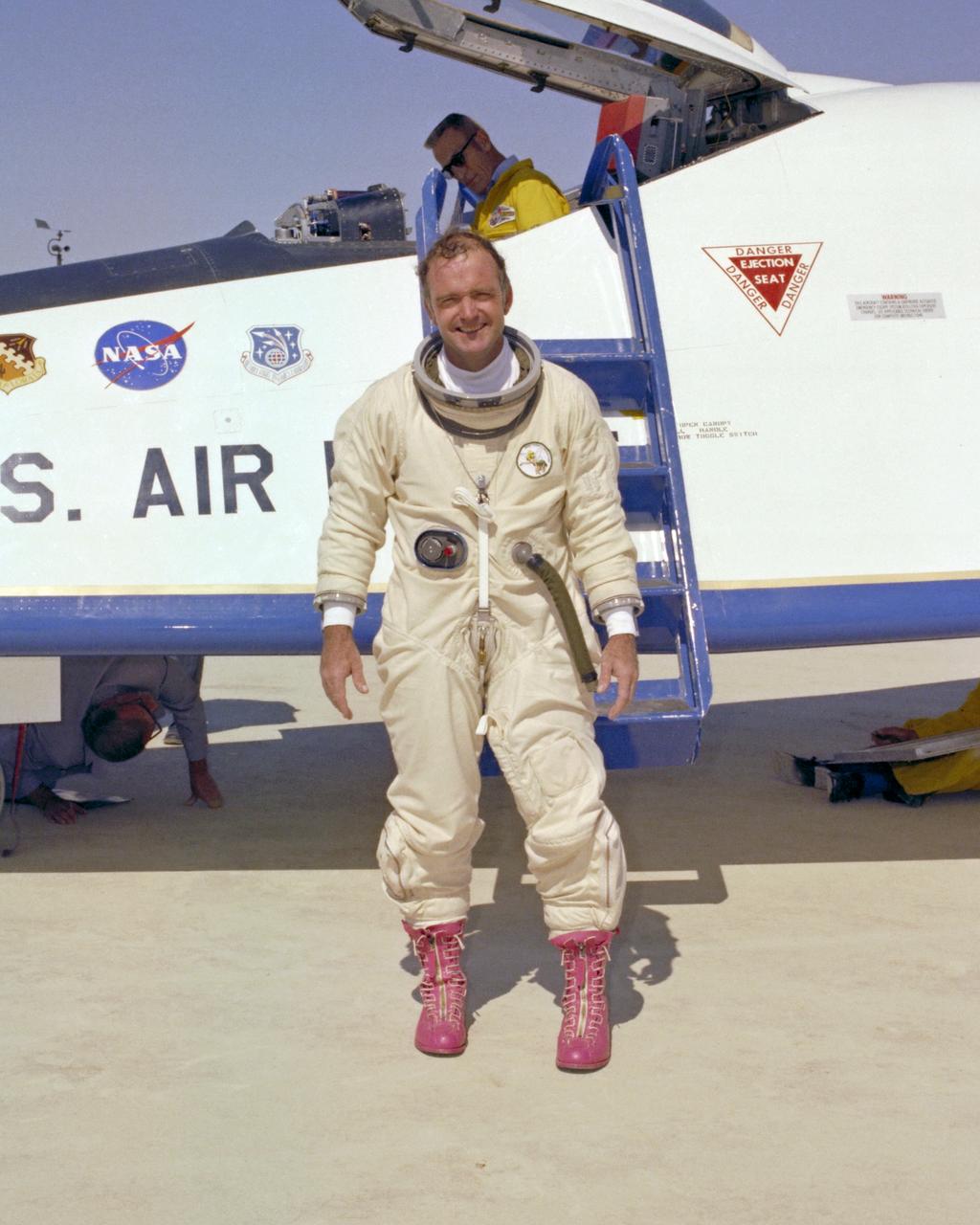
A TV reporter interviews NASA test pilot Bill Dana, wearing his infamous pink boots with yellow daisy decals, after the last powered flight of the X-24B.
NASA test pilot Bill Dana, resplendent in pink boots and pressure suit, was all smiles following the last powered flight of the X-24B on Sept. 23, 1975.
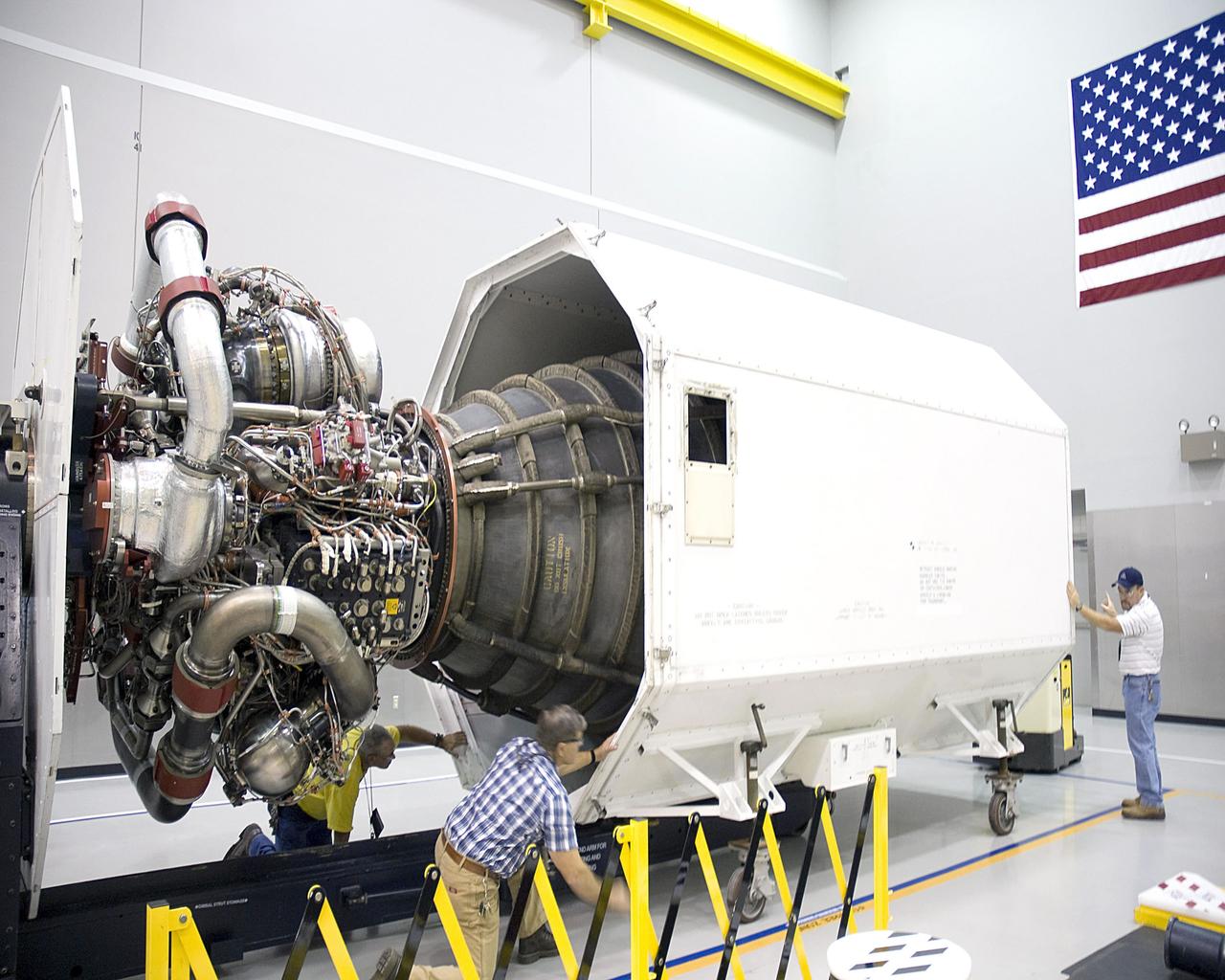
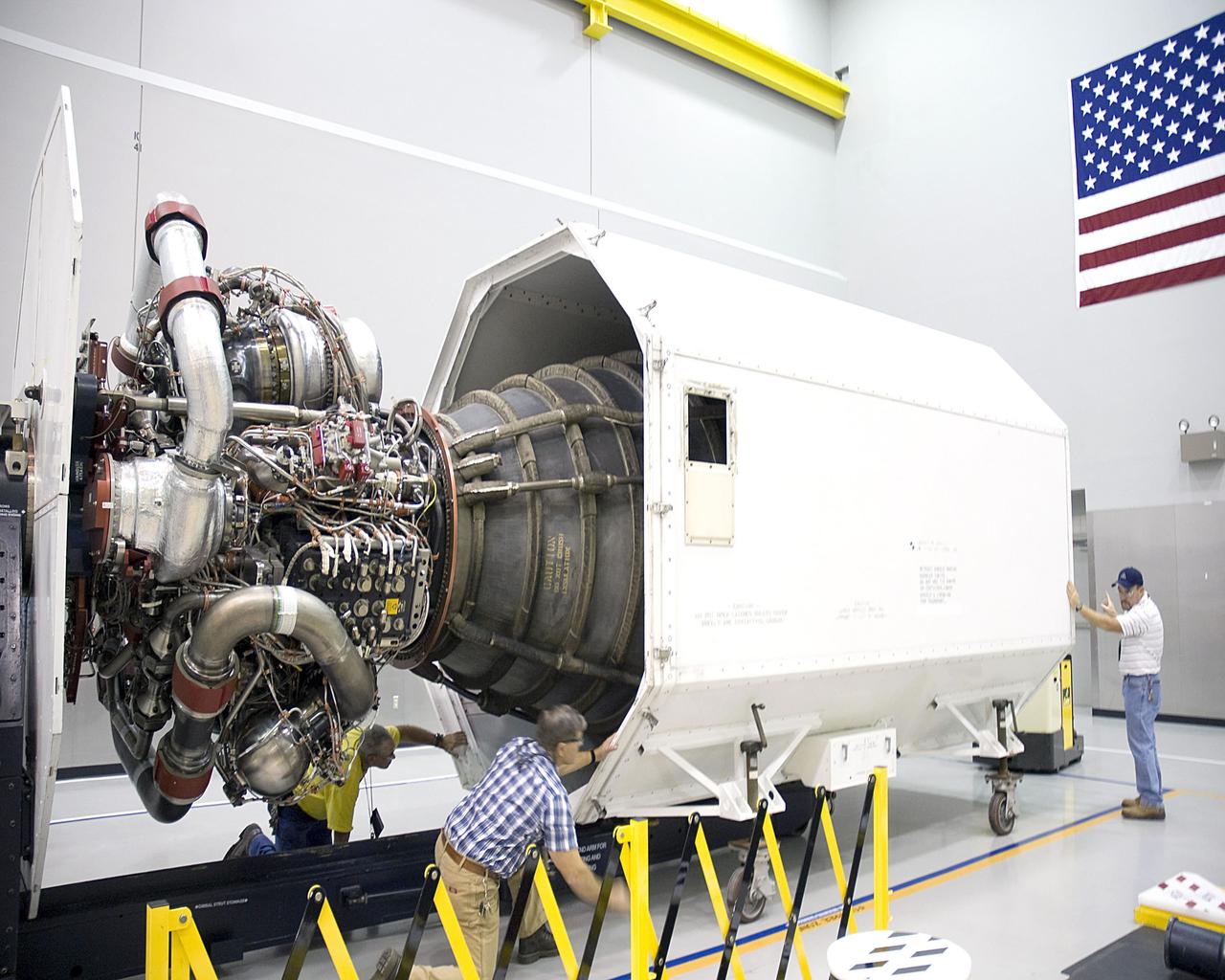
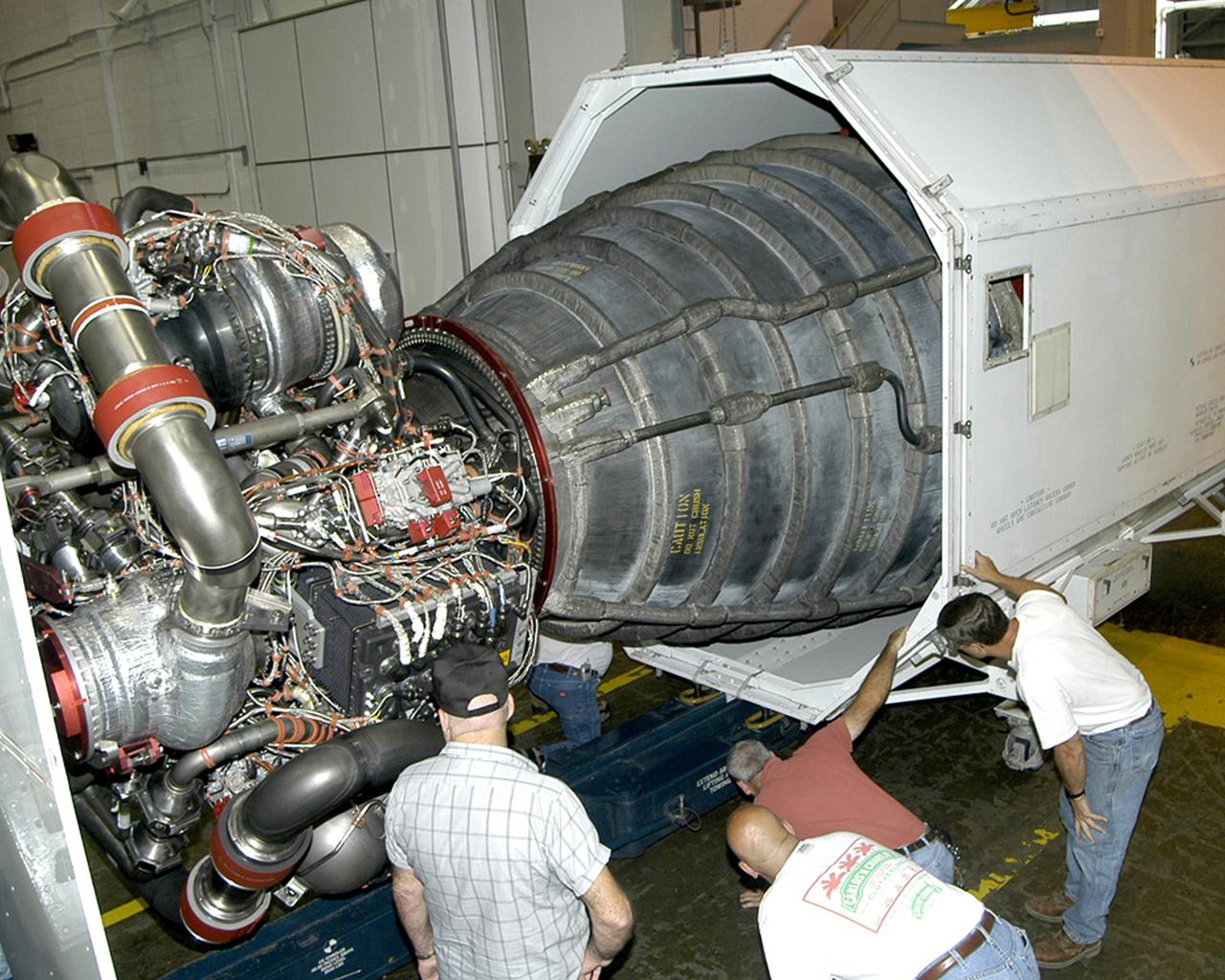
Workers at Stennis Space Center examine space shuttle main engine 2061 upon its arrival Oct. 1. The engine was to be the last shuttle flight engine to be scheduled for testing at Stennis.
Last flight engine arrives
Workers at Stennis Space Center examine space shuttle main engine 2061 upon its arrival Oct. 1. The engine was to be the last shuttle flight engine to be scheduled for testing at Stennis.
Last flight engine arrives
Veterans of the X-15 flight research program, most of them now retired, reunited at Dryden on the 40th anniversary of the last X-15 flight on Oct. 24, 1968 for a historical colloquium on the X-15 by noted aerospace historian and author Dennis Jenkins on Oct. 24, 2008. Gathered in front of the replica of X-15 #3 the were (from left) Johnny Armstrong, Betty Love, Paul Reukauf, Bob Hoey, Dave Stoddard, Dean Webb, Vince Capasso, Bill Dana (who flew the last flight), John McTigue and T.D. Barnes. Jenkins, the author of "X-15: Extending the Frontiers of Flight," maintained during his presentation that despite setbacks, the X-15 program became the most successful of all the X-plane research programs due to the can-do, fix-the-problem and go-fly-again attitude of the X-15's cadre of engineers and technicians.
Veterans of the X-15 program reunited at Dryden during a historical colloquium on the 40th anniversary of the last X-15 flight that occurred Oct. 24, 1968.
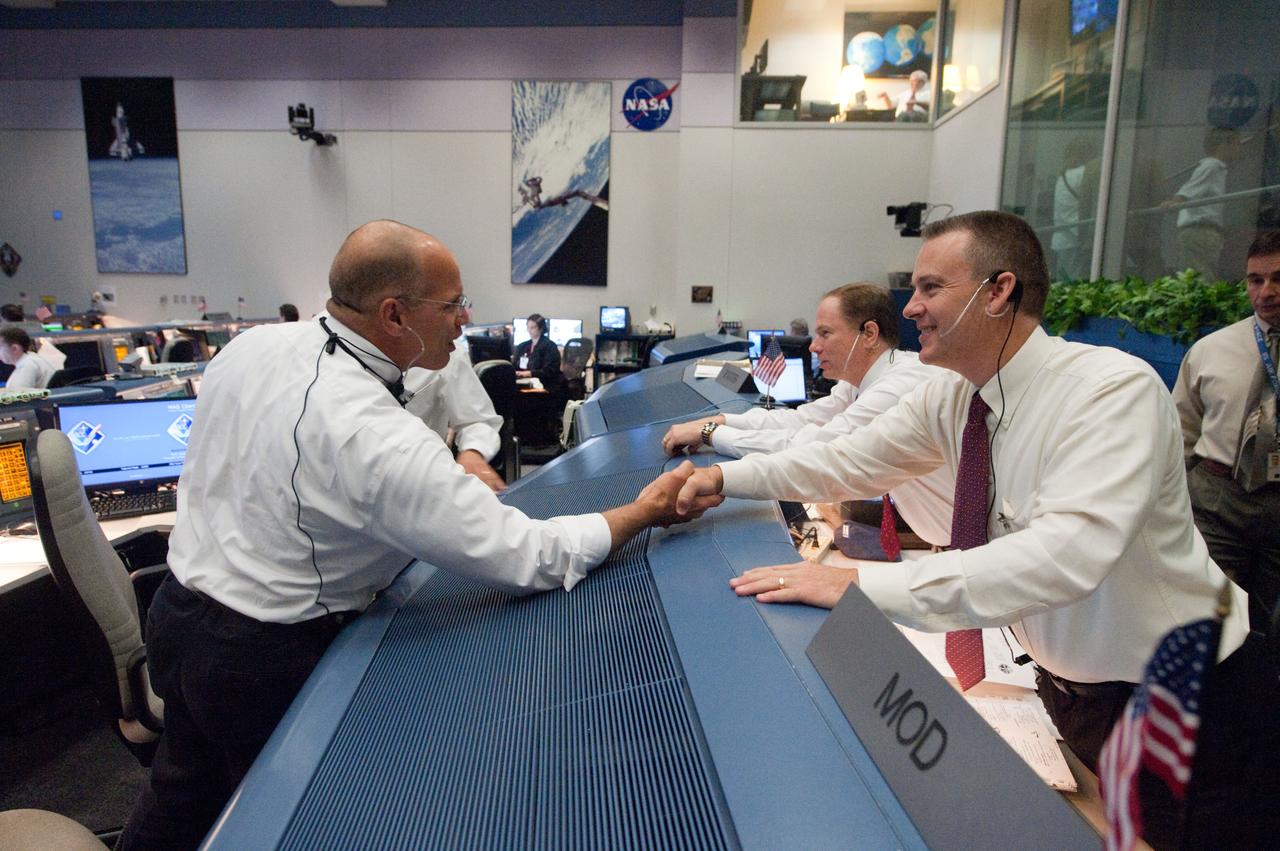
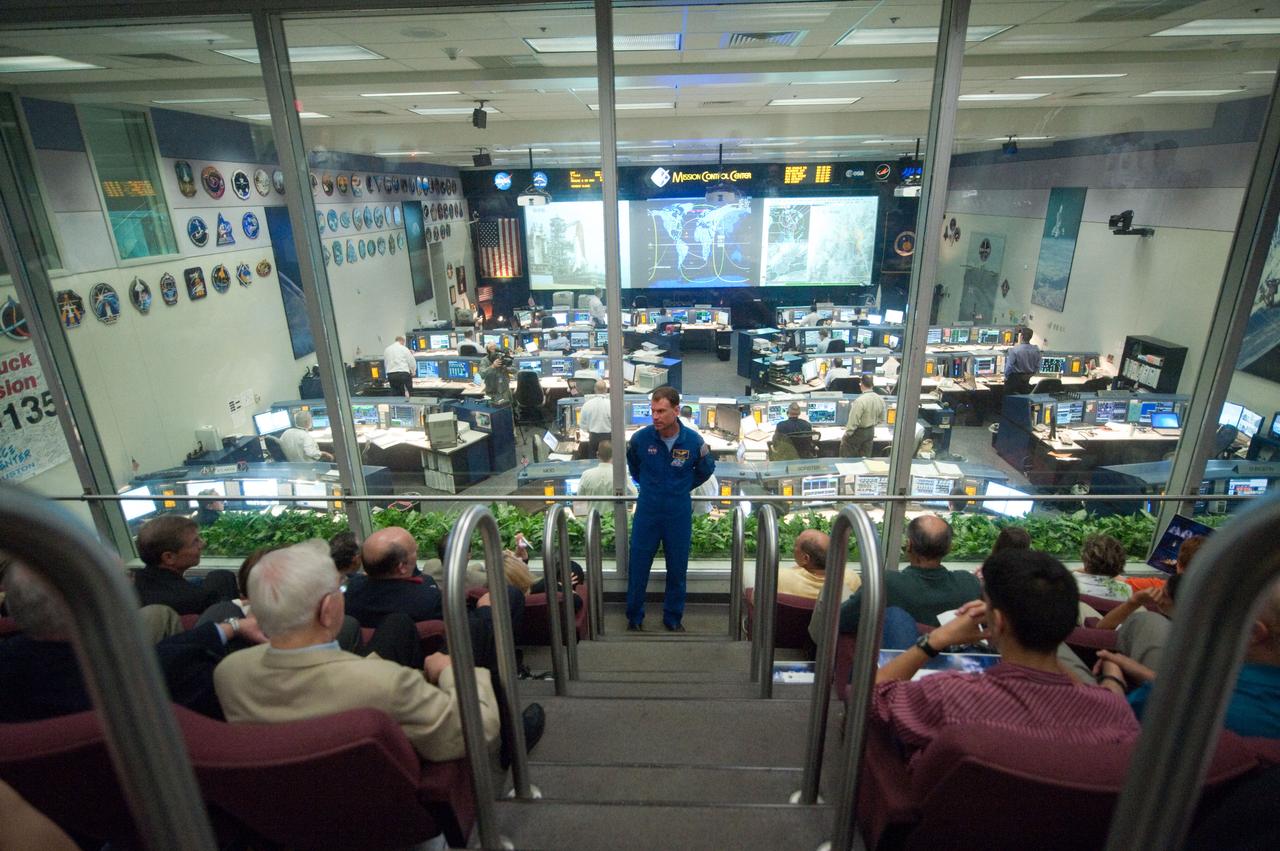
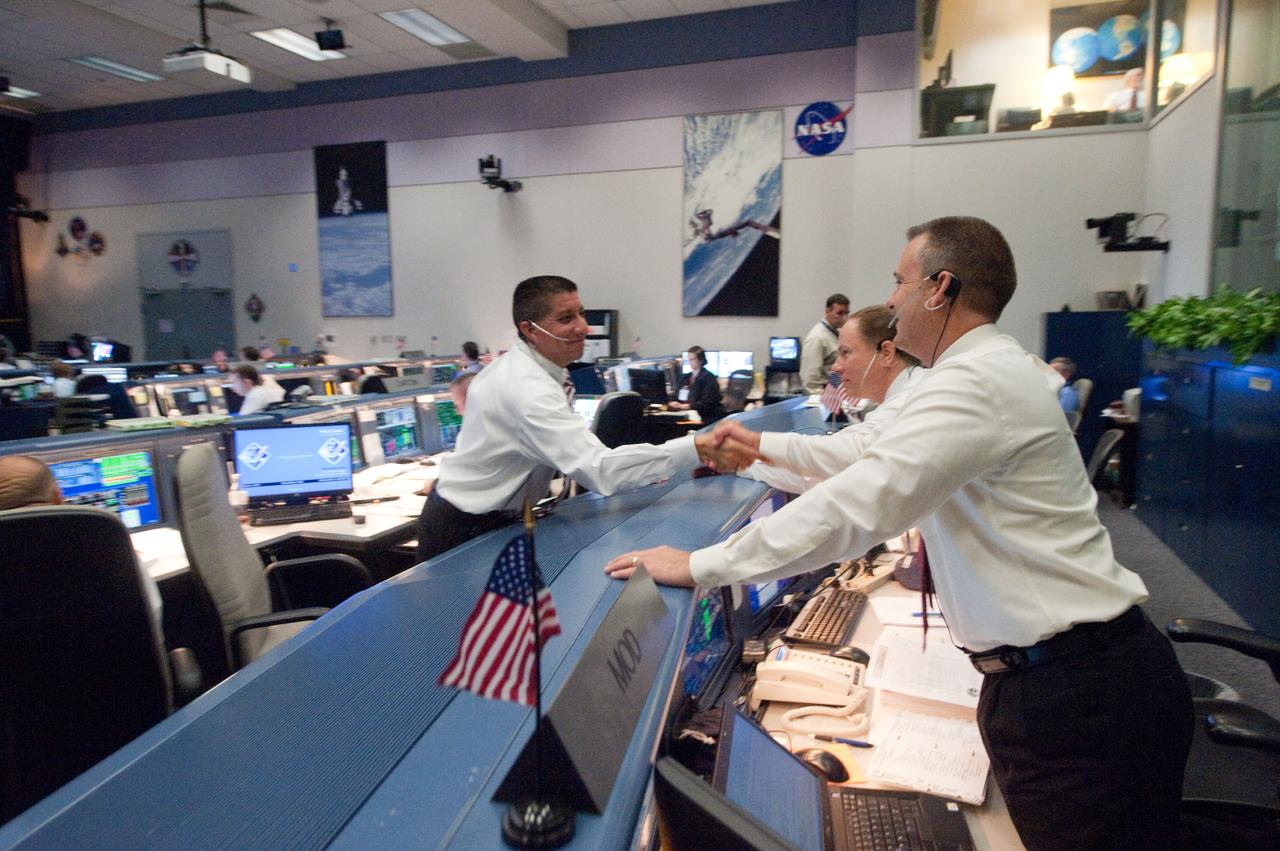
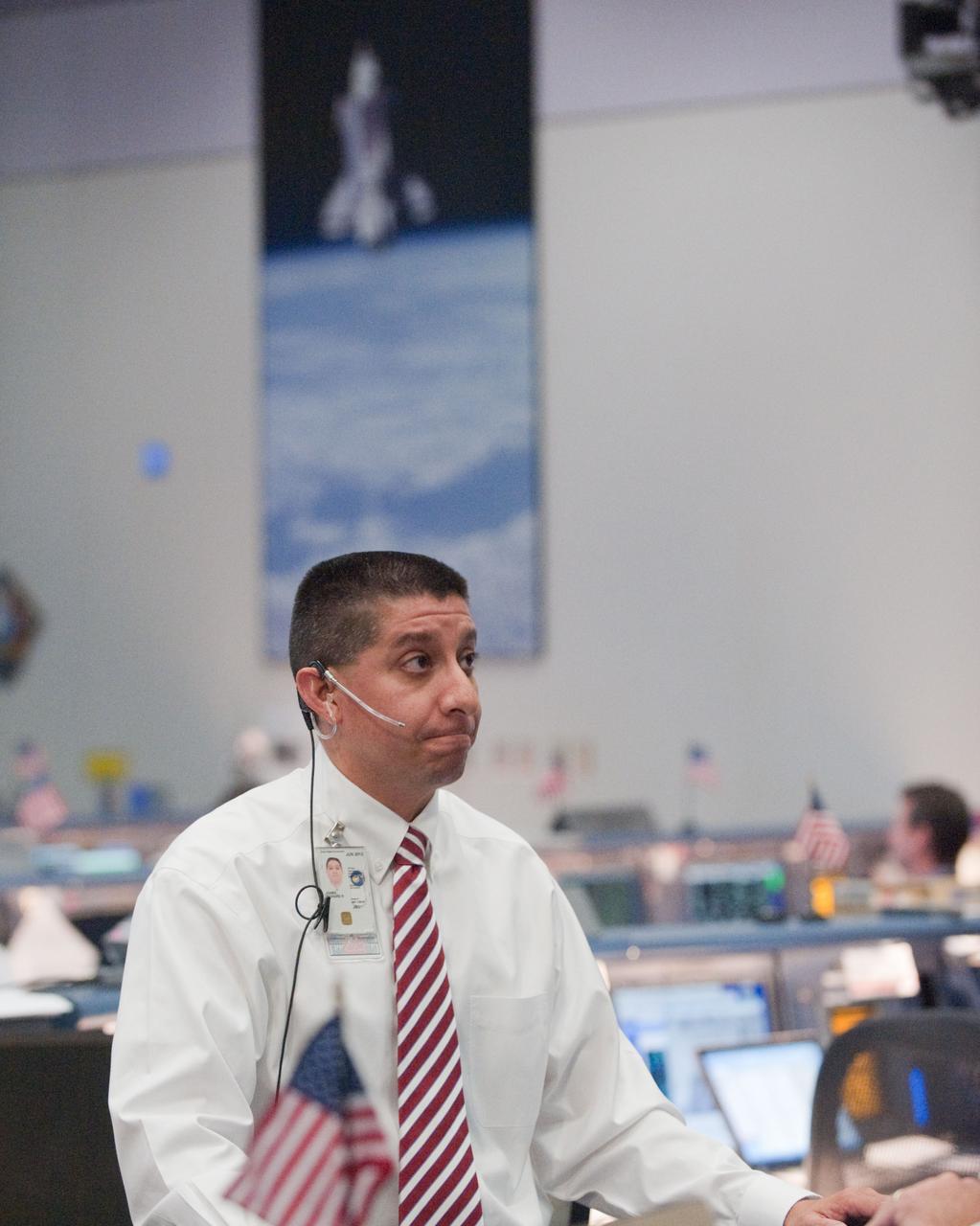
Photo Date: 7-8-2011 Subject: STS135 flight controllers on console during last shuttle mission Location: B. 30S WFCR and SMG Photographer: Bill Stafford
STS135 flight controllers on console during last shuttle mission
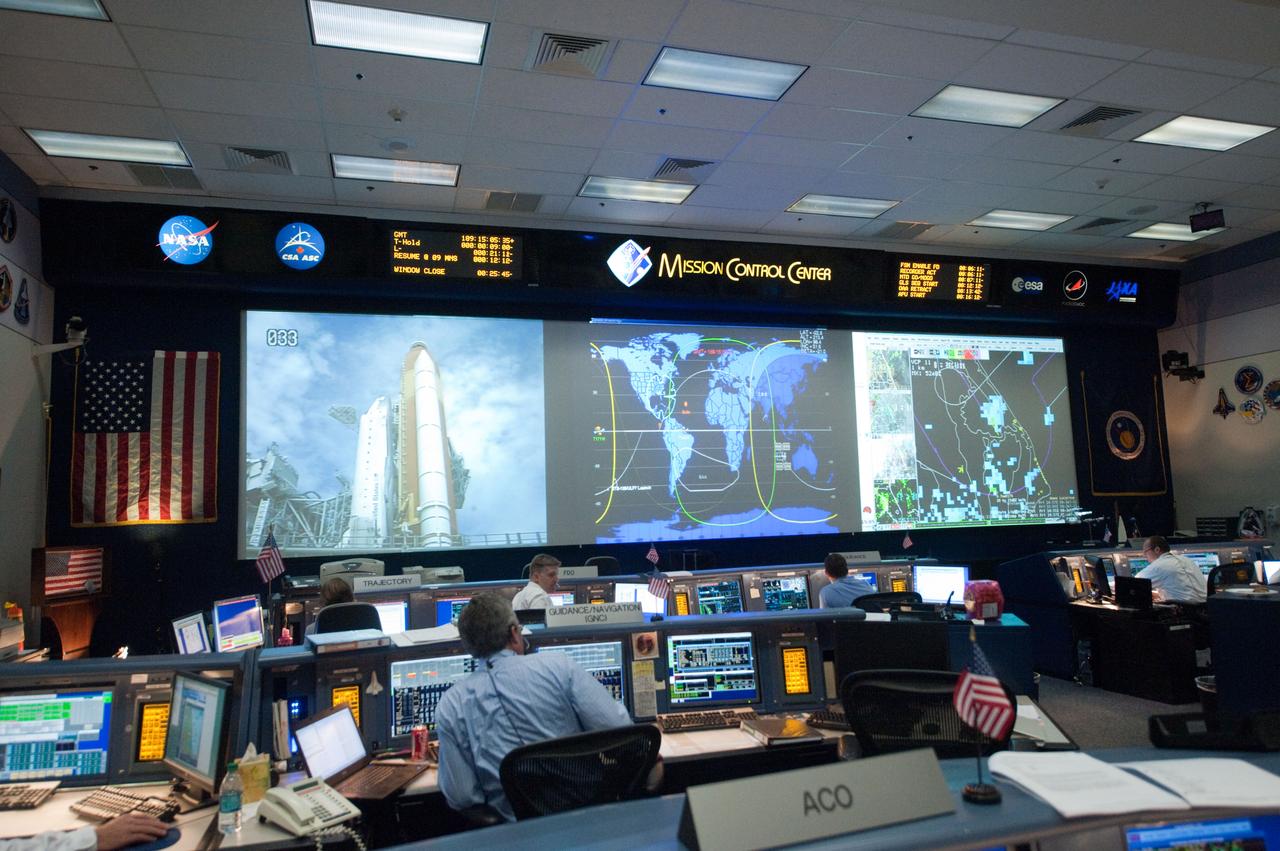
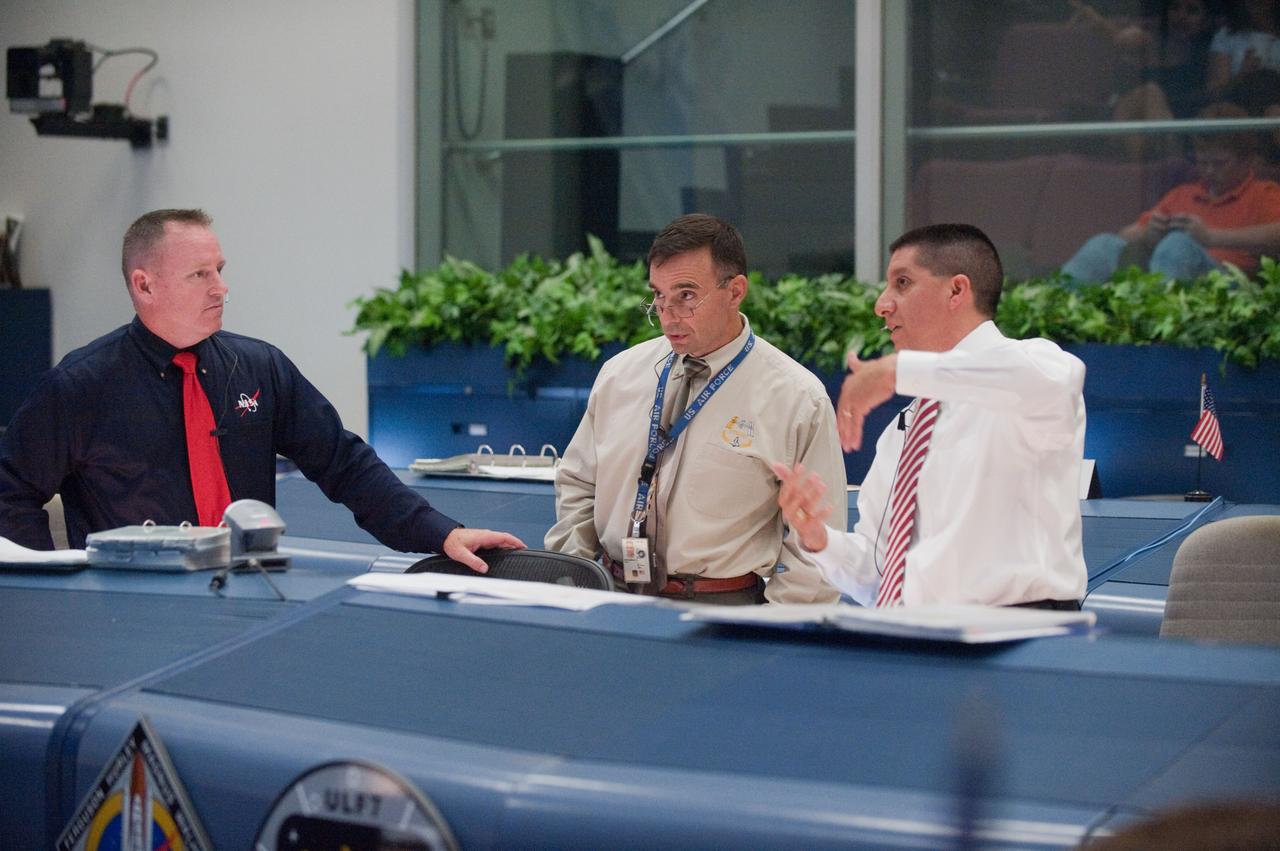
Photo Date: 7-8-2011 Subject: STS135 flight controllers on console during last shuttle mission Location: B. 30S WFCR and SMG Photographer: Bill Stafford
STS135 flight controllers on console during last shuttle mission
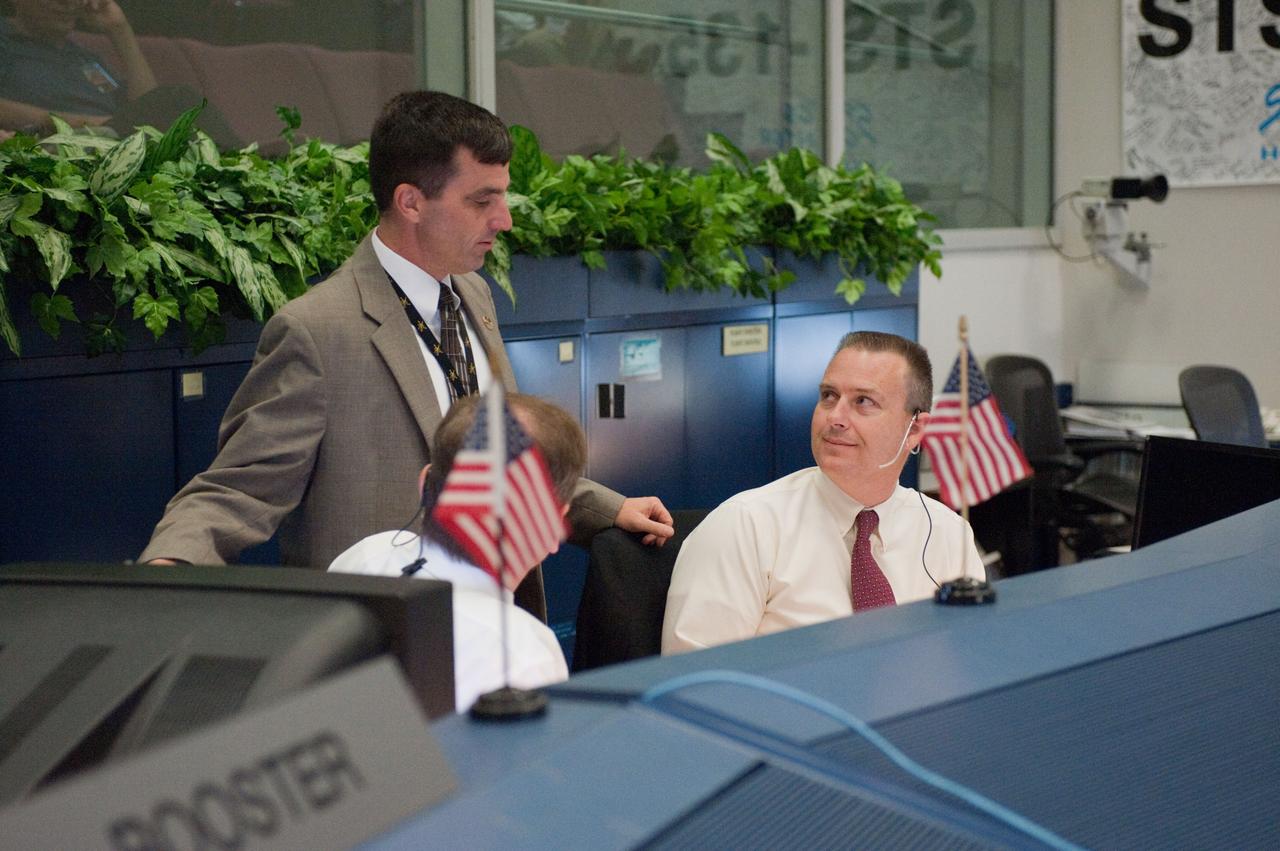
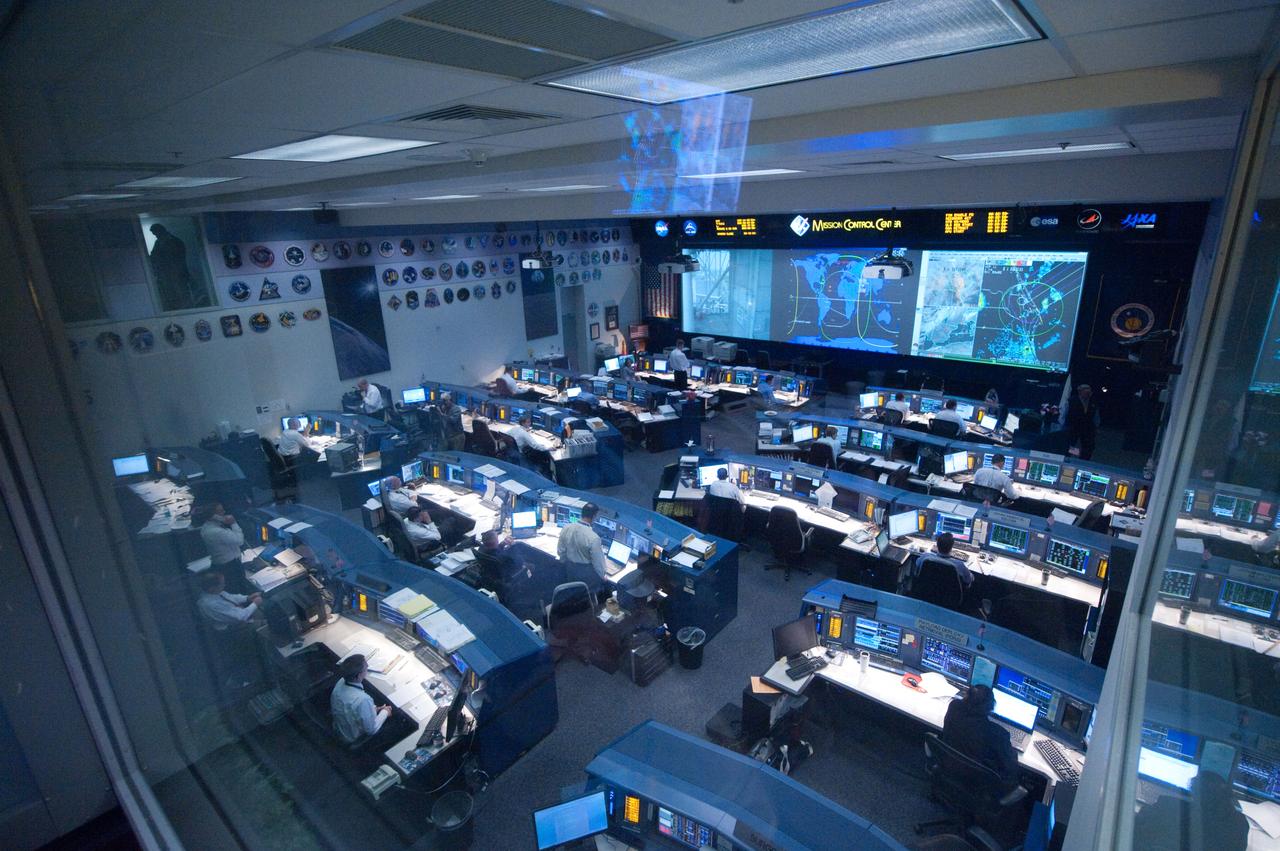
Photo Date: 7-8-2011 Subject: STS135 flight controllers on console during last shuttle mission Location: B. 30S WFCR and SMG Photographer: Bill Stafford
STS135 flight controllers on console during last shuttle mission
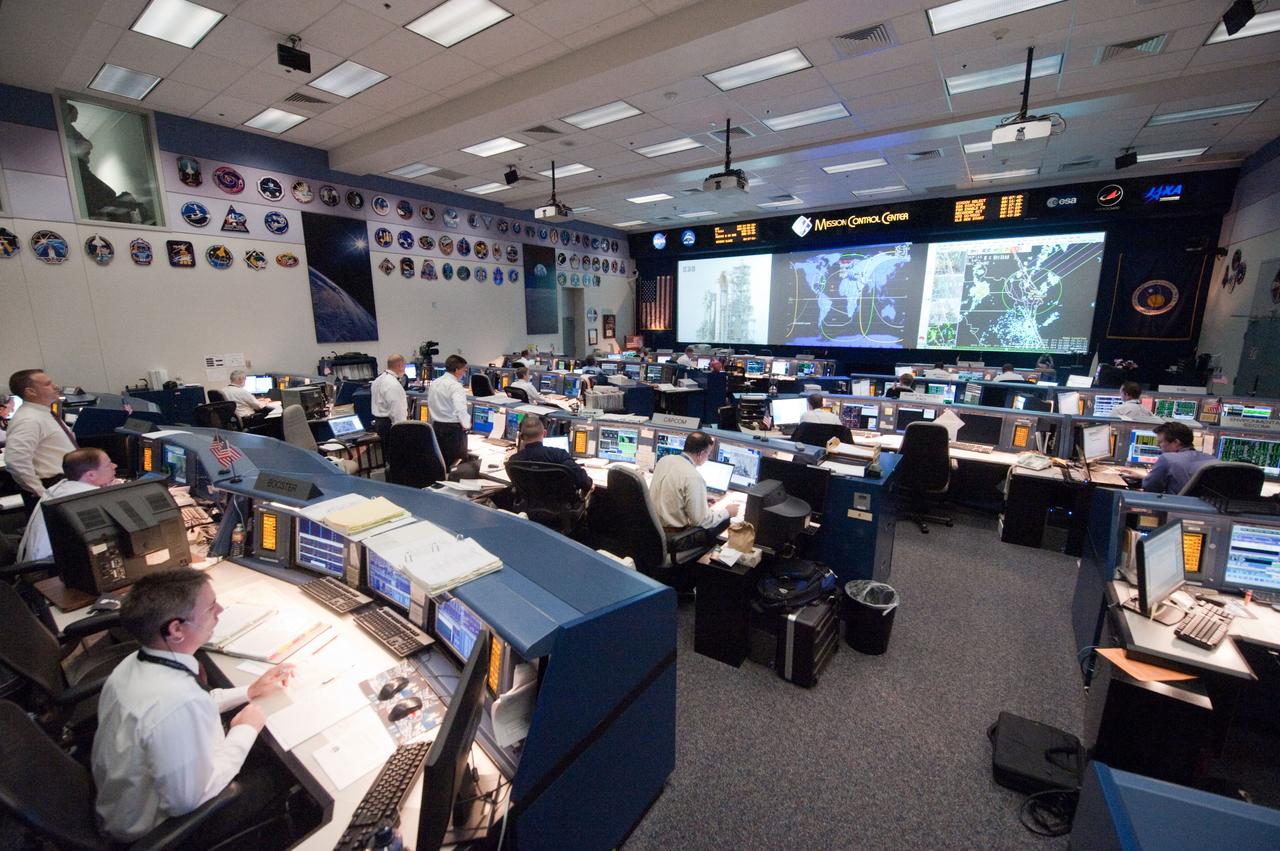
Photo Date: 7-8-2011 Subject: STS135 flight controllers on console during last shuttle mission Location: B. 30S WFCR and SMG Photographer: Bill Stafford
STS135 flight controllers on console during last shuttle mission
PHOTO DATE: 08 July 2011 LOCATION: Bldg. 30 south - WFCR, SMG SUBJECT: STS-135 Flight Controllers on Console during last space shuttle launch WORK ORDER:  01815-BS___07-08-11-STS 135 LAUNCH WFCR PHOTOGRAPHER: Bill Stafford
STS135 flight controllers on console during last shuttle mission
PHOTO DATE: 08 July 2011 LOCATION: Bldg. 30 south - WFCR, SMG SUBJECT: STS-135 Flight Controllers on Console during last space shuttle launch WORK ORDER:  01815-BS___07-08-11-STS 135 LAUNCH WFCR PHOTOGRAPHER: Bill Stafford
STS135 flight controllers on console during last shuttle mission
PHOTO DATE: 08 July 2011 LOCATION: Bldg. 30 south - WFCR, SMG SUBJECT: STS-135 Flight Controllers on Console during last space shuttle launch WORK ORDER:  01815-BS___07-08-11-STS 135 LAUNCH WFCR PHOTOGRAPHER: Bill Stafford
STS135 flight controllers on console during last shuttle mission
PHOTO DATE: 08 July 2011 LOCATION: Bldg. 30 south - WFCR, SMG SUBJECT: STS-135 Flight Controllers on Console during last space shuttle launch WORK ORDER:  01815-BS___07-08-11-STS 135 LAUNCH WFCR PHOTOGRAPHER: Bill Stafford
STS135 flight controllers on console during last shuttle mission
PHOTO DATE: 08 July 2011 LOCATION: Bldg. 30 south - WFCR, SMG SUBJECT: STS-135 Flight Controllers on Console during last space shuttle launch WORK ORDER:  01815-BS___07-08-11-STS 135 LAUNCH WFCR PHOTOGRAPHER: Bill Stafford
STS135 flight controllers on console during last shuttle mission
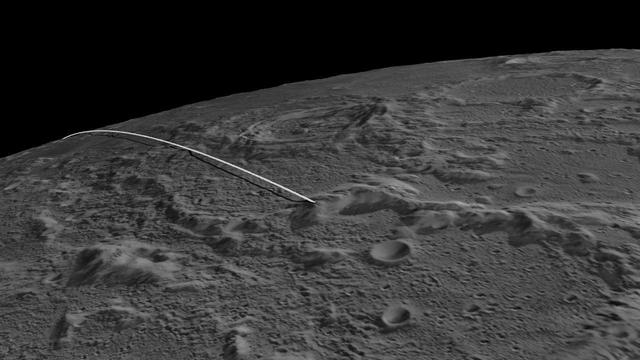
This image shows the final flight path for NASA twin Gravity Recovery and Interior Laboratory GRAIL mission spacecraft, which will impact the moon on Dec. 17, 2012, around 2:28 p.m. PST.
Last Flight for GRAIL Twin Spacecraft
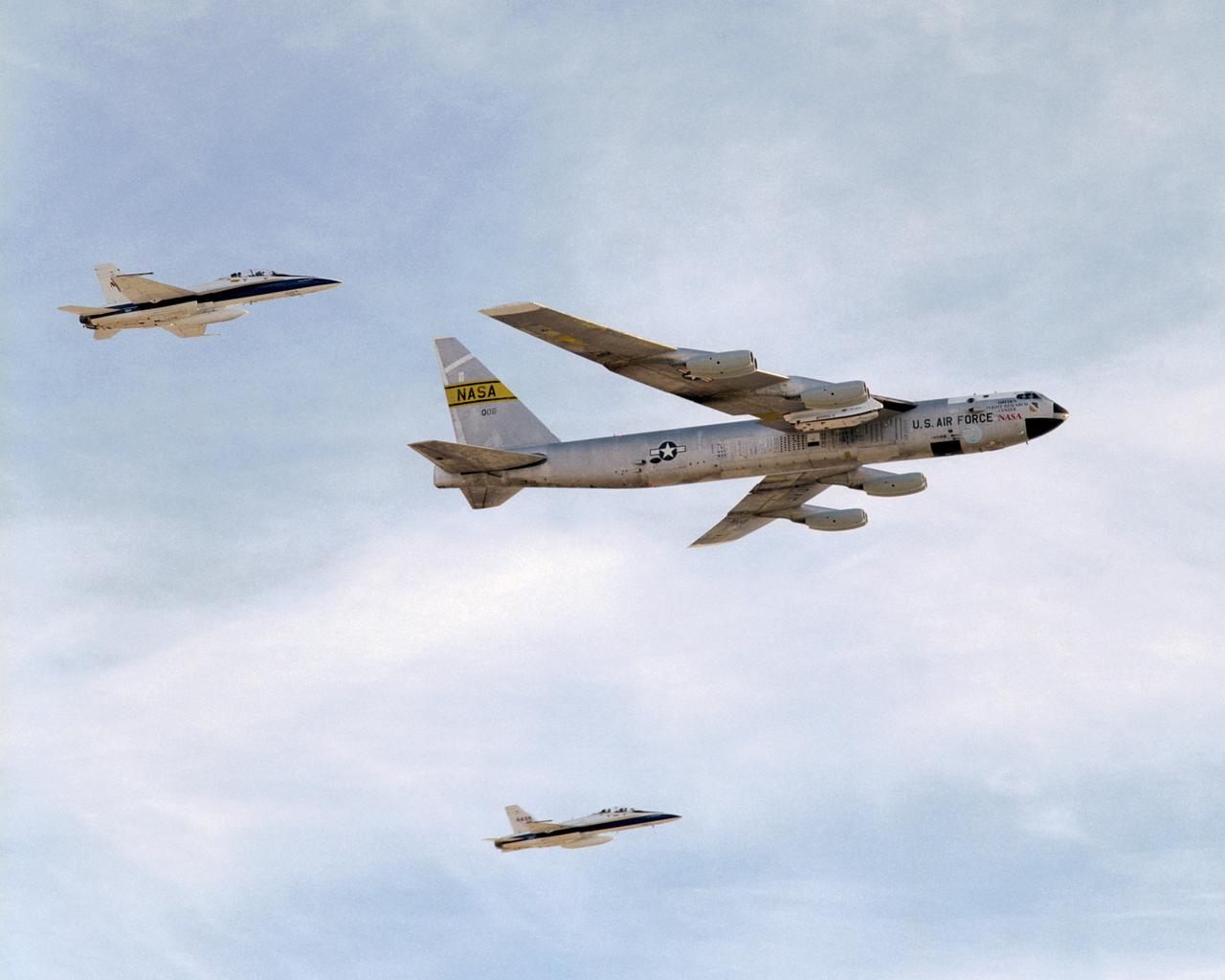
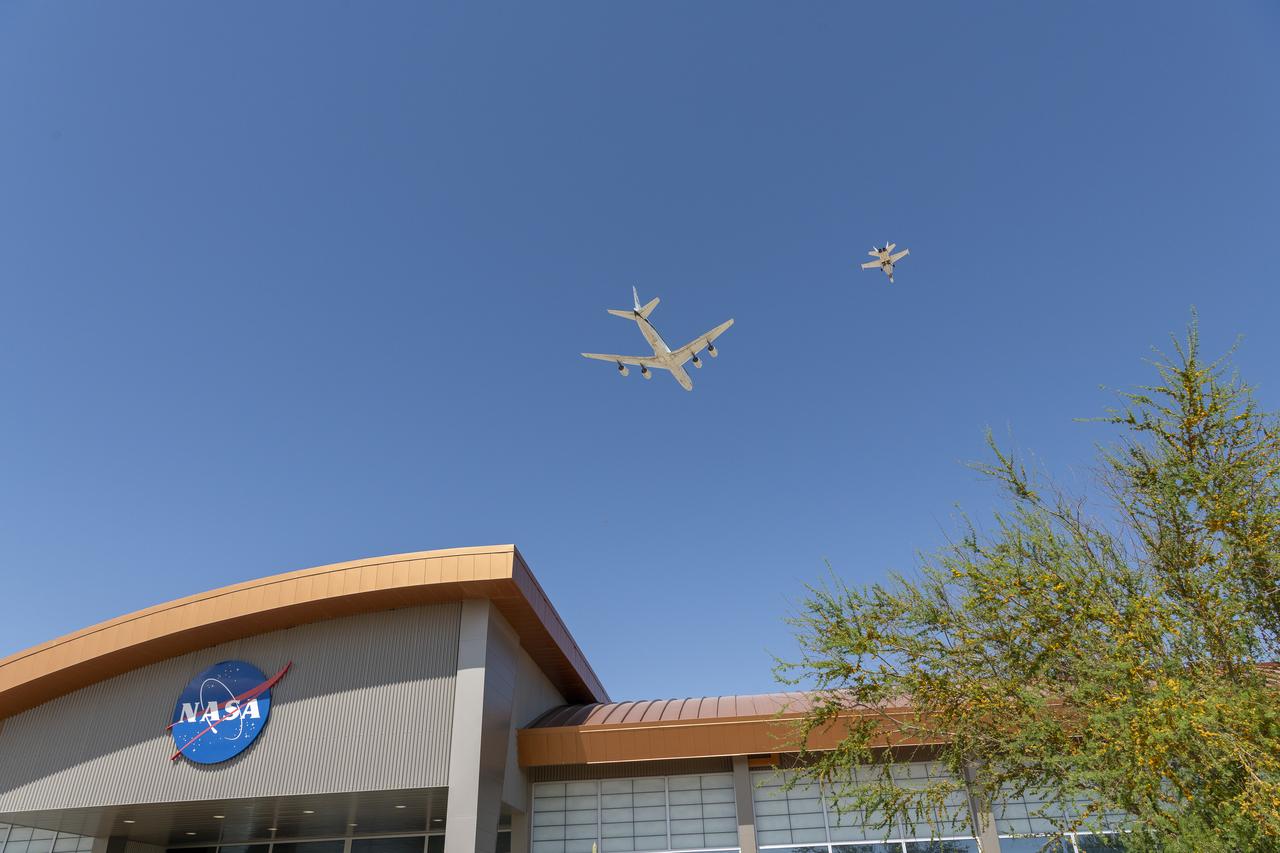
NASA's B-52B mothership, escorted by two F-18s, makes a final flyover after its last research mission that launched the X-43A on its record Mach 9.6 flight.
NASA's B-52B mothership, escorted by two F-18s, makes a final flyover after its last research mission that launched the X-43A on its record Mach 9.6 flight
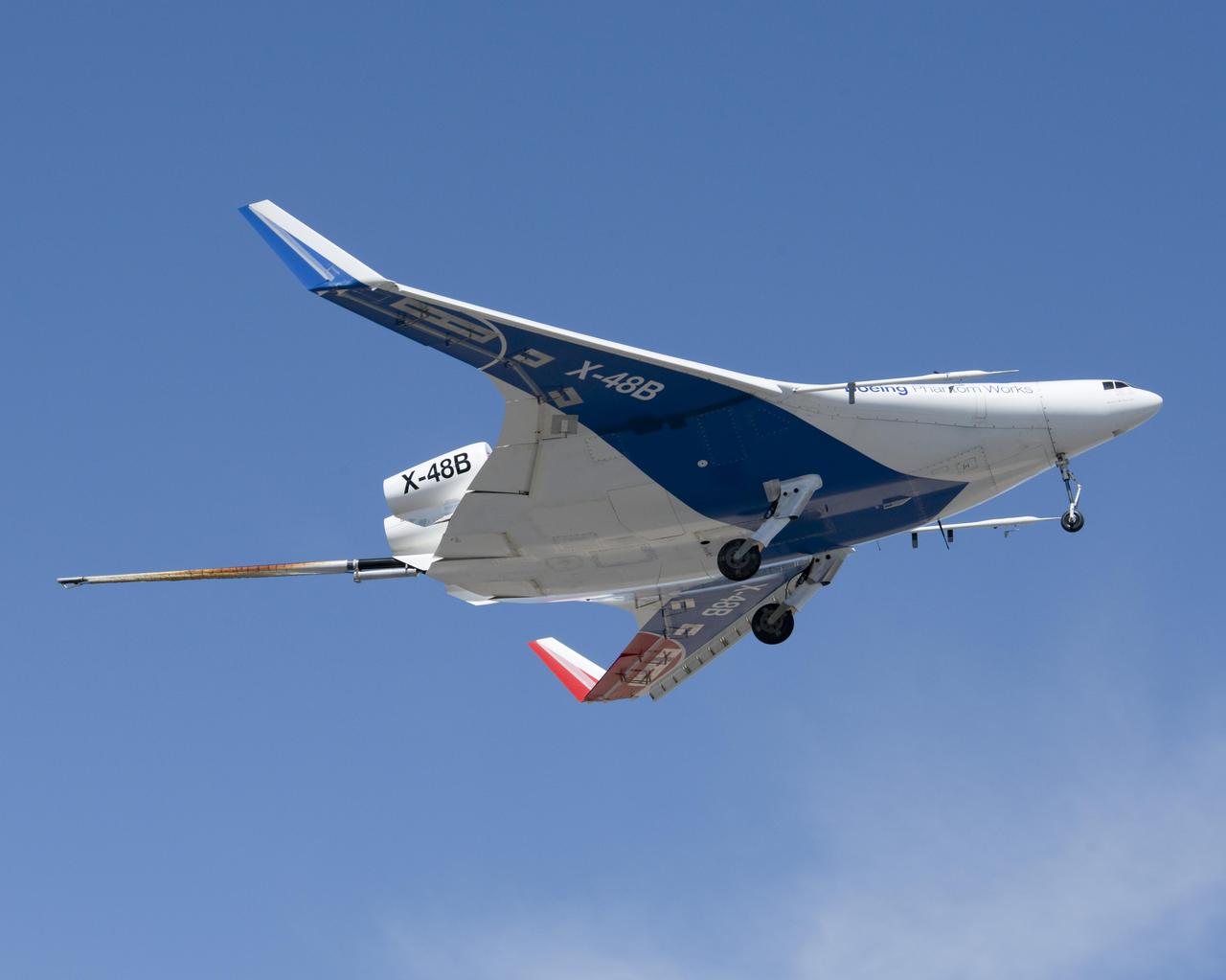
A joint NASA/Boeing team completed the first phase of flight tests on the unique X-48B Blended Wing Body aircraft at NASA's Dryden Flight Research Center at Edwards, CA. The team completed the 80th and last flight of the project's first phase on March 19, 2010.
X-48B Skyray Takeoff
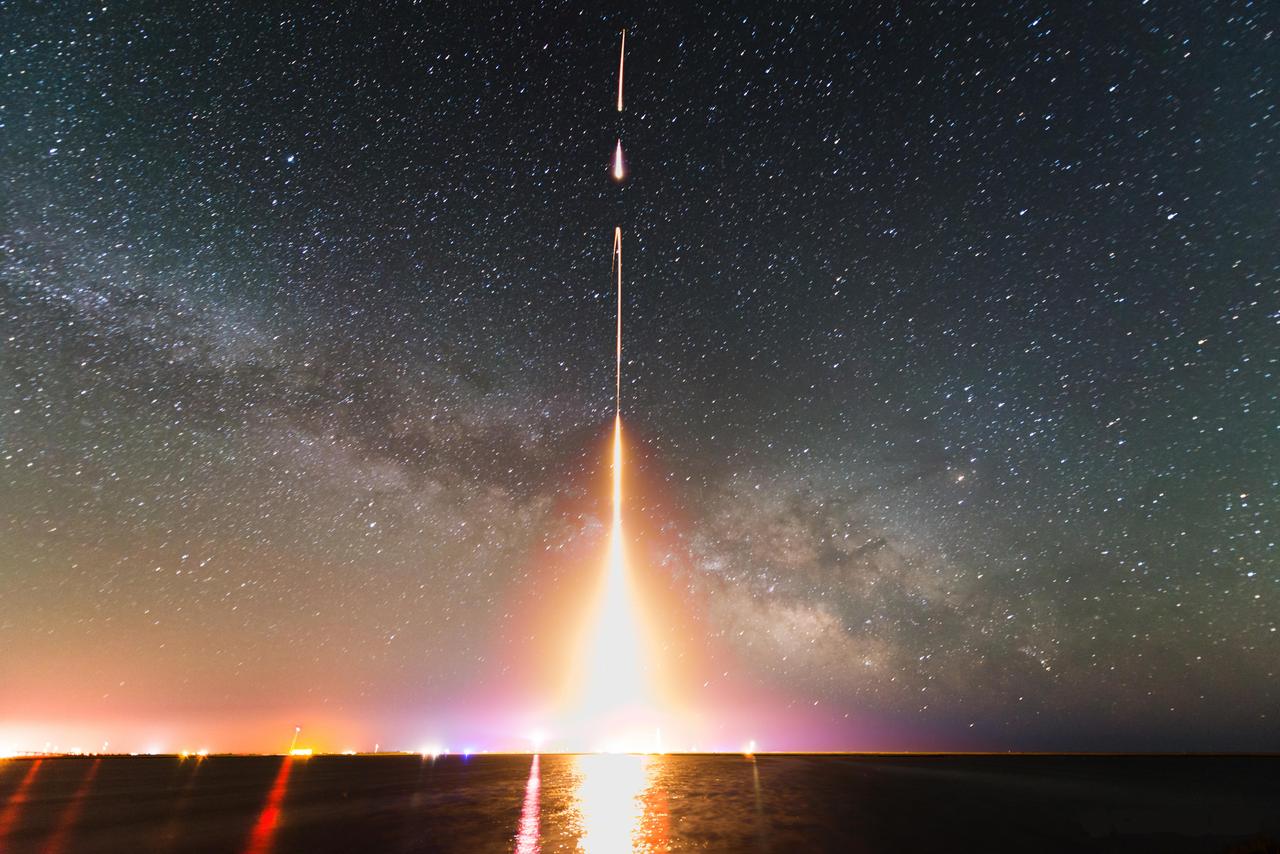
A time-lapse photograph of the CIBER rocket launch, taken from NASA Wallops Flight Facility in Virginia in 2013. This was the last of four launches of the Cosmic Infrared Background Experiment CIBER.
CIBER Launch
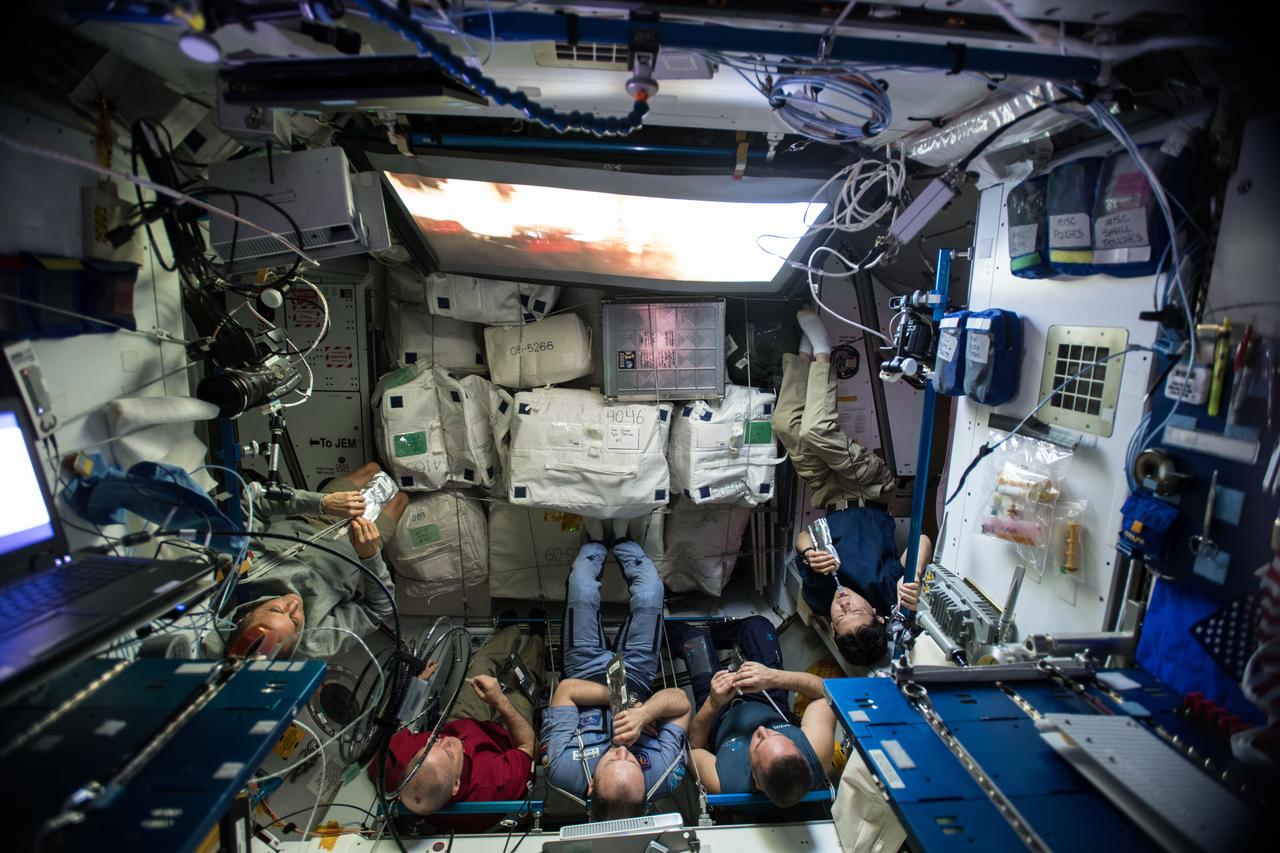
iss054e004175 (Dec. 23, 2017) --- Expedition 54 crew members watch the movie "Star Wars: The Last Jedi" on the big screen in the Harmony module. From left, are Flight Engineers Joe Acaba and Scott Tingle, Commander Alexander Misurkin, and Flight Engineers Anton Shkaplerov and Norishige Kanai.
Expedition 54 crew members watch a movie
Shadowed by two F/A-18s, NASA Dryden's venerable NB-52B is saluted by employees as it makes its final flyover after the last X-43A launch in November 2004.
EC04-0327-39
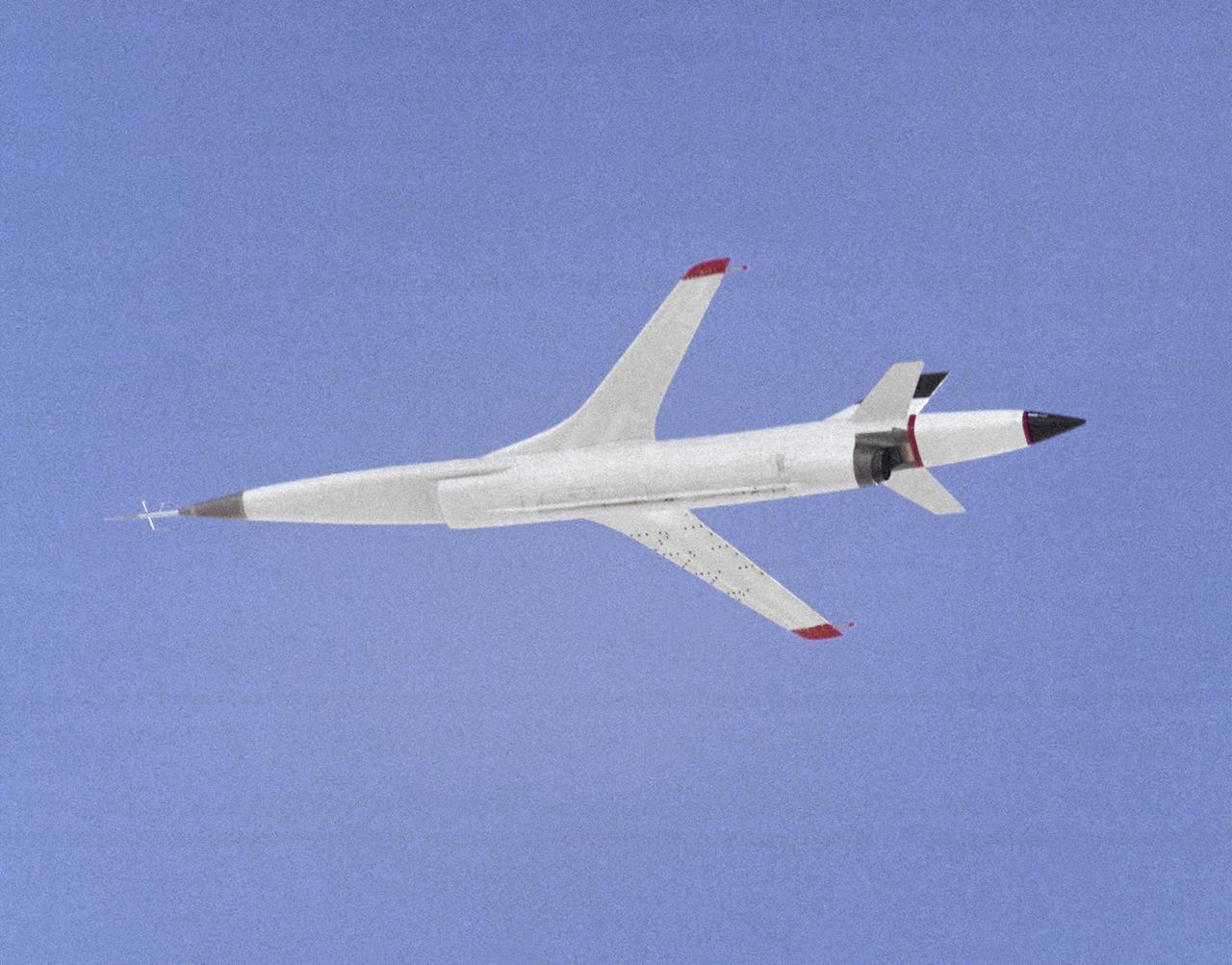
DAST in Flight. Last Flight
EC80-14090
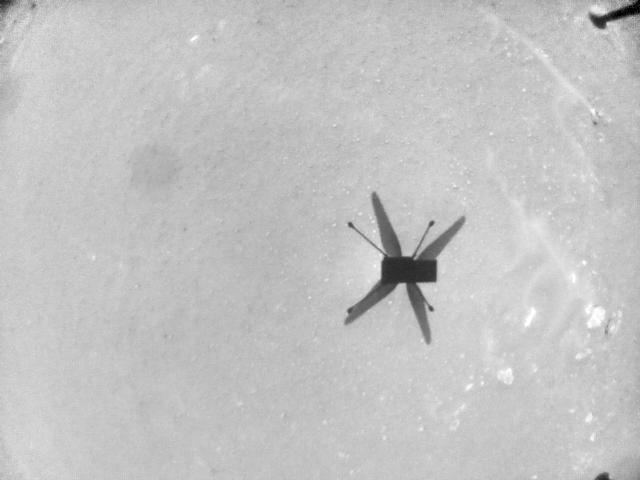
This sequence of images – taken on May 22, 2021, by the navigation camera aboard NASA's Ingenuity Mars Helicopter – depicts the last 29 seconds of the rotorcraft's sixth flight. Frame rate is 3.3 frames per second until Ingenuity began its final descent to the surface, at which point it collected a frame every two seconds.  Movie available at https://photojournal.jpl.nasa.gov/catalog/PIA24598
Ingenuity Flight Six Navcam Image
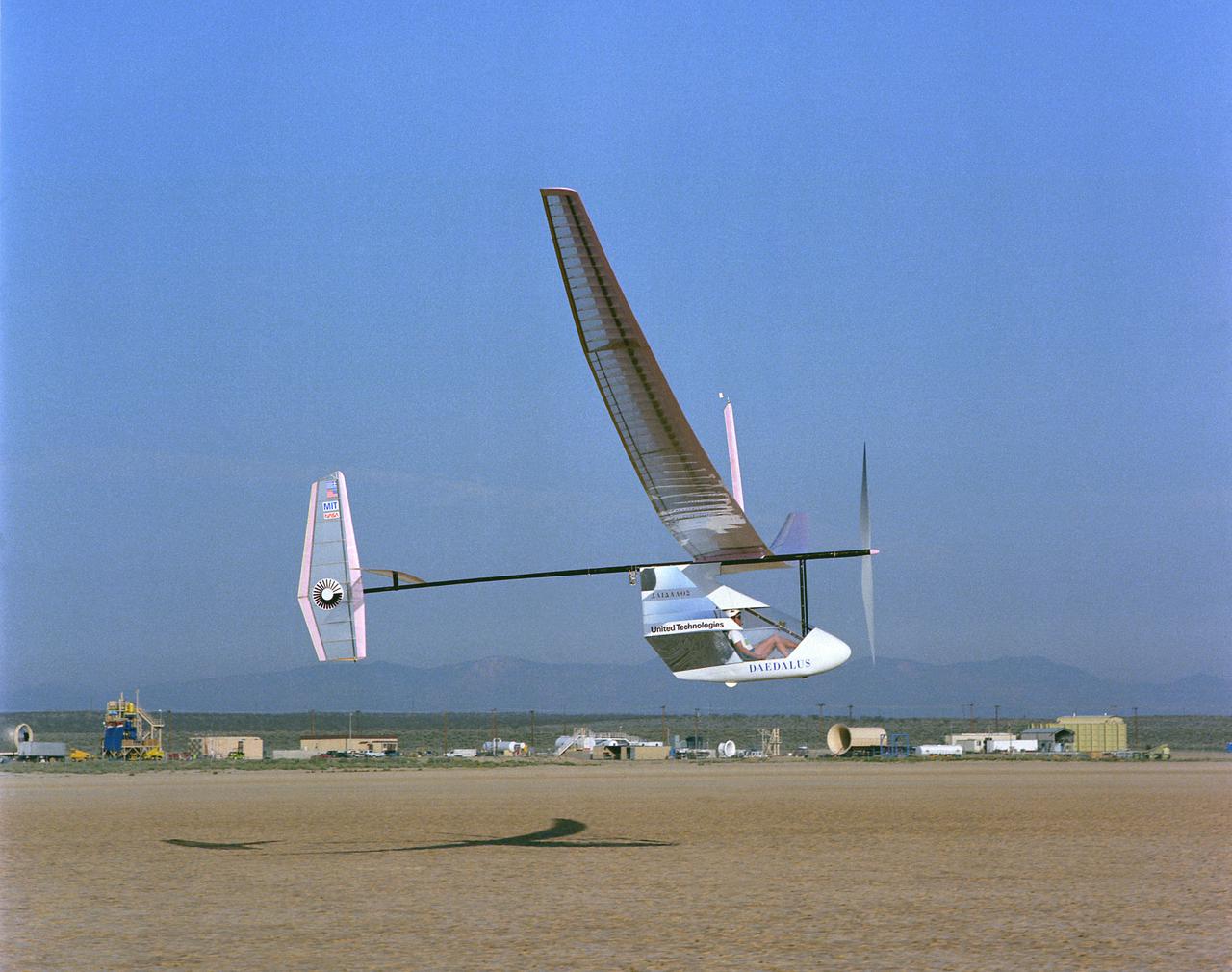
Daedalus - Last Dryden flight with Glenn Tremml
EC88-0059-002
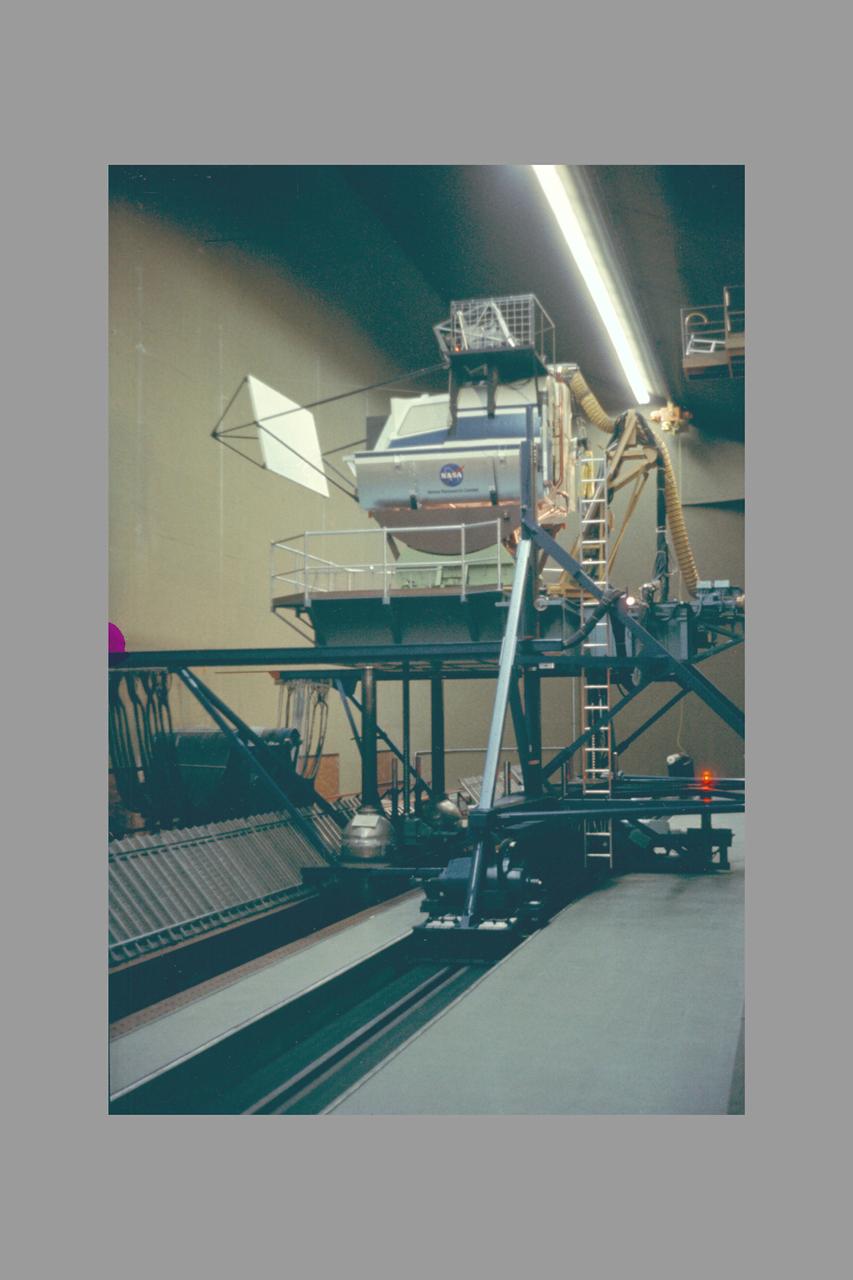
Flight Simulator forAdvanced Aircraft (FSAA) S.10 after painting (IC position from last end)
ARC-1969-AC-42635-1
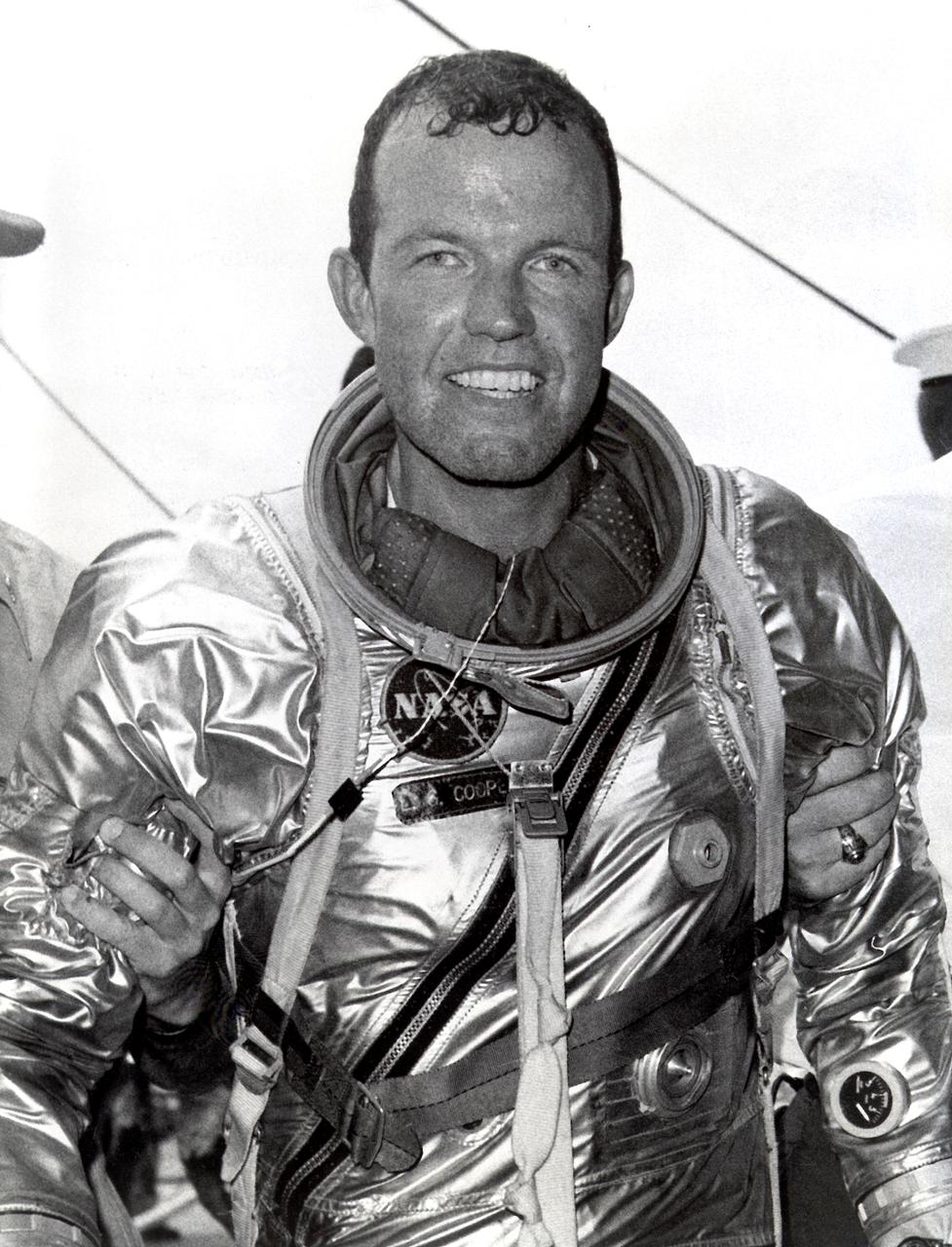
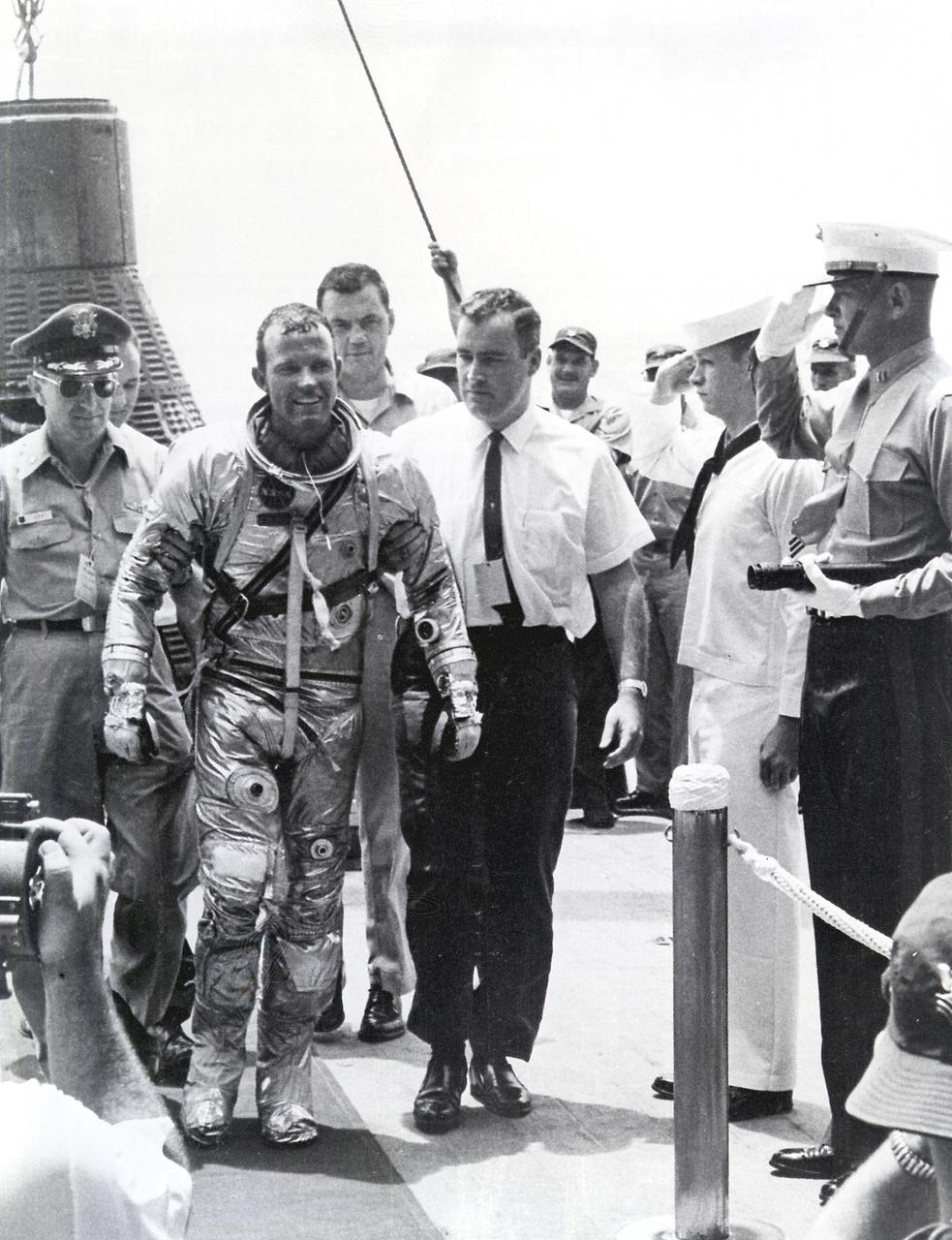
Astronaut Gordon Cooper leaves the Faith 7 (MA-9) spacecraft after a successful recovery operation. The MA-9 mission, the last flight of the Mercury Project, was launched on May 15, 1963, orbited the Earth 22 times, and lasted for 1-1/2 days.
Mercury Project
Astronaut Gordon Cooper leaves the Faith 7 (MA-9) spacecraft after a successful recovery operation. The MA-9 mission, the last flight of the Mercury Project, was launched on May 15, 1963, orbited the Earth 22 times, and lasted for 1-1/2 days.
Mercury Project
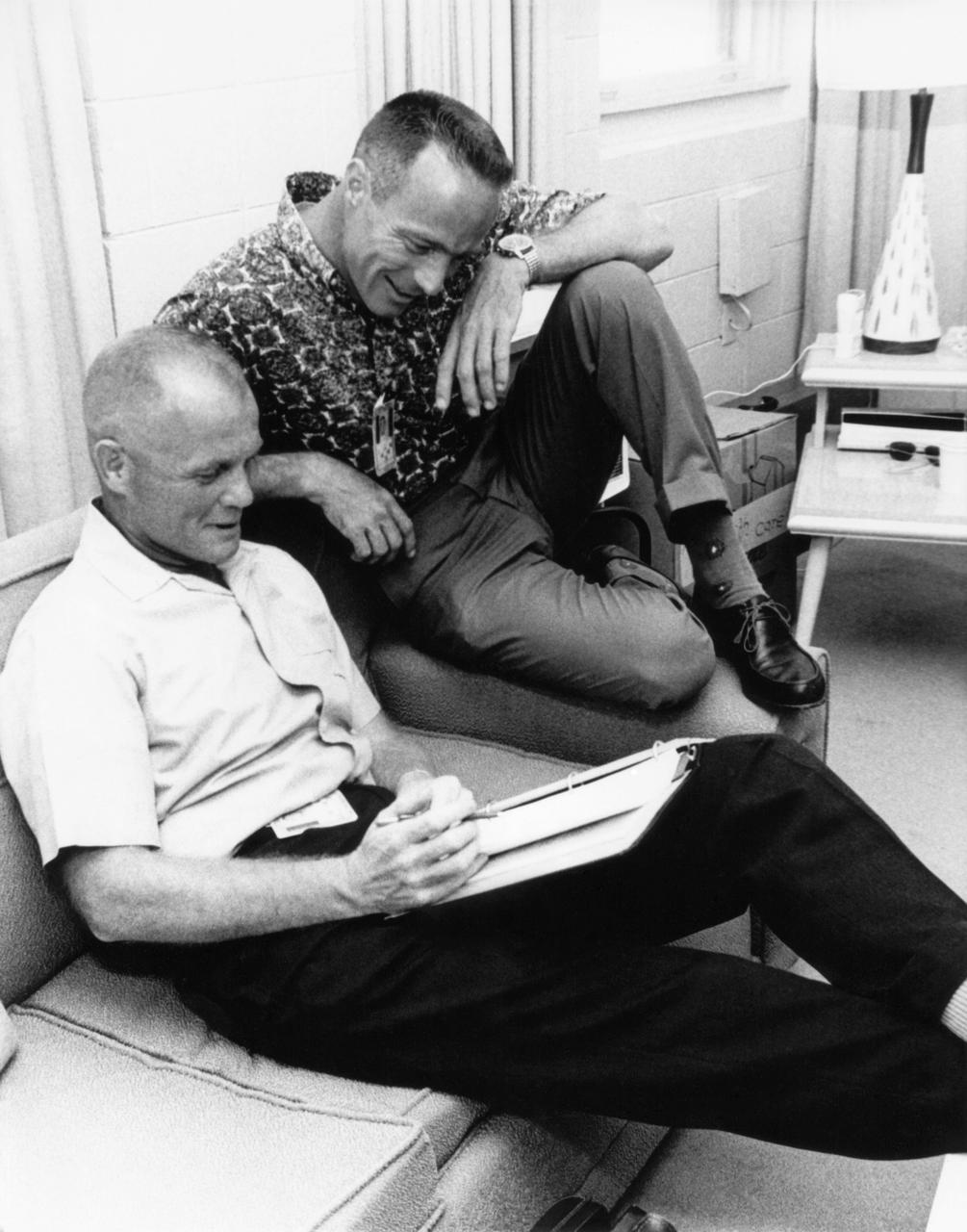
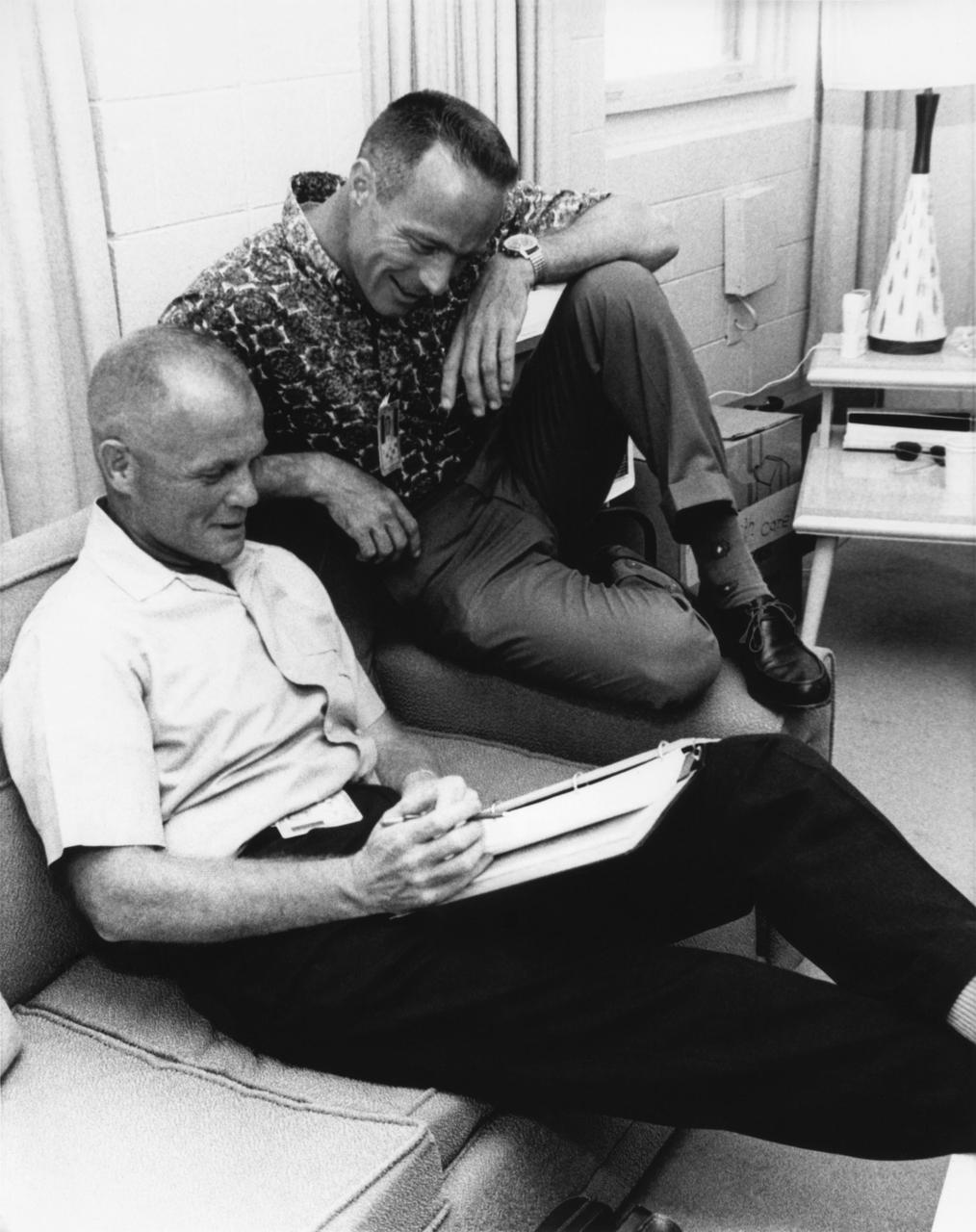
62-MA7-86 (1962) --- John Glenn (left) makes last minute preparations with Scott Carpenter prior to the flight of MA-7. Photo credit: NASA
Mercury 7 Preparations
CAPE CANAVERAL, Fla. -- John Glenn makes last minute preparations with Scott Carpenter prior to the flight of MA-7.  Photo credit: NASA
62-MA7-86
A joint NASA/Boeing team completed the first phase of flight tests on the unique X-48B Blended Wing Body aircraft at NASA's Dryden Flight Research Center at Edwards, CA. The team completed the 80th and last flight of the project's first phase on March 19, 2010.
First Phase of X-48B Flight Tests Completed
On Oct. 5, 2004, SSC shipped the last of the three Space Shuttle Main Engines to NASA's Kennedy Space Center for installation on Space Shuttle Discovery for STS-114, NASA's Return to Flight mission.
Return to Flight SSME loaded for shipping
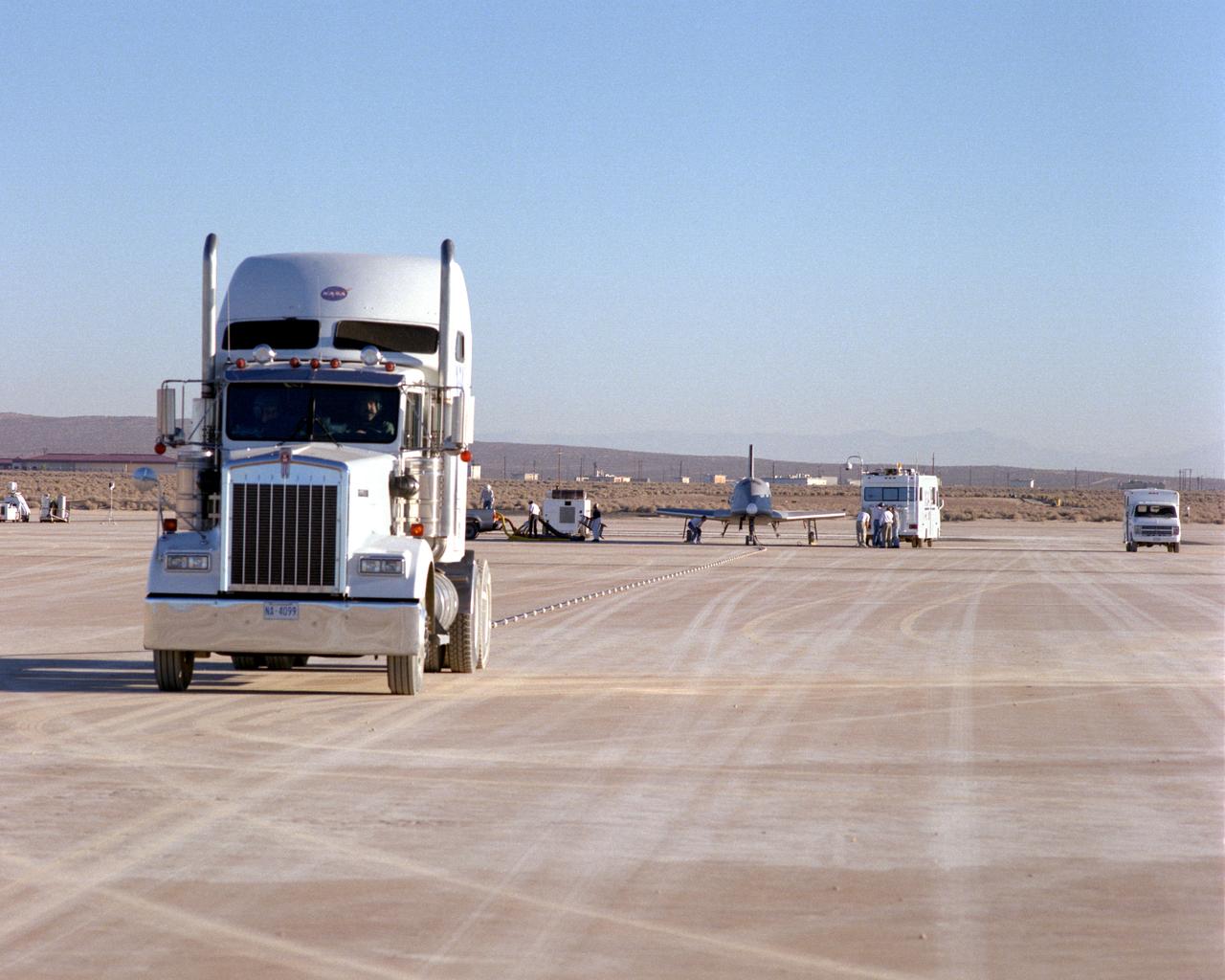
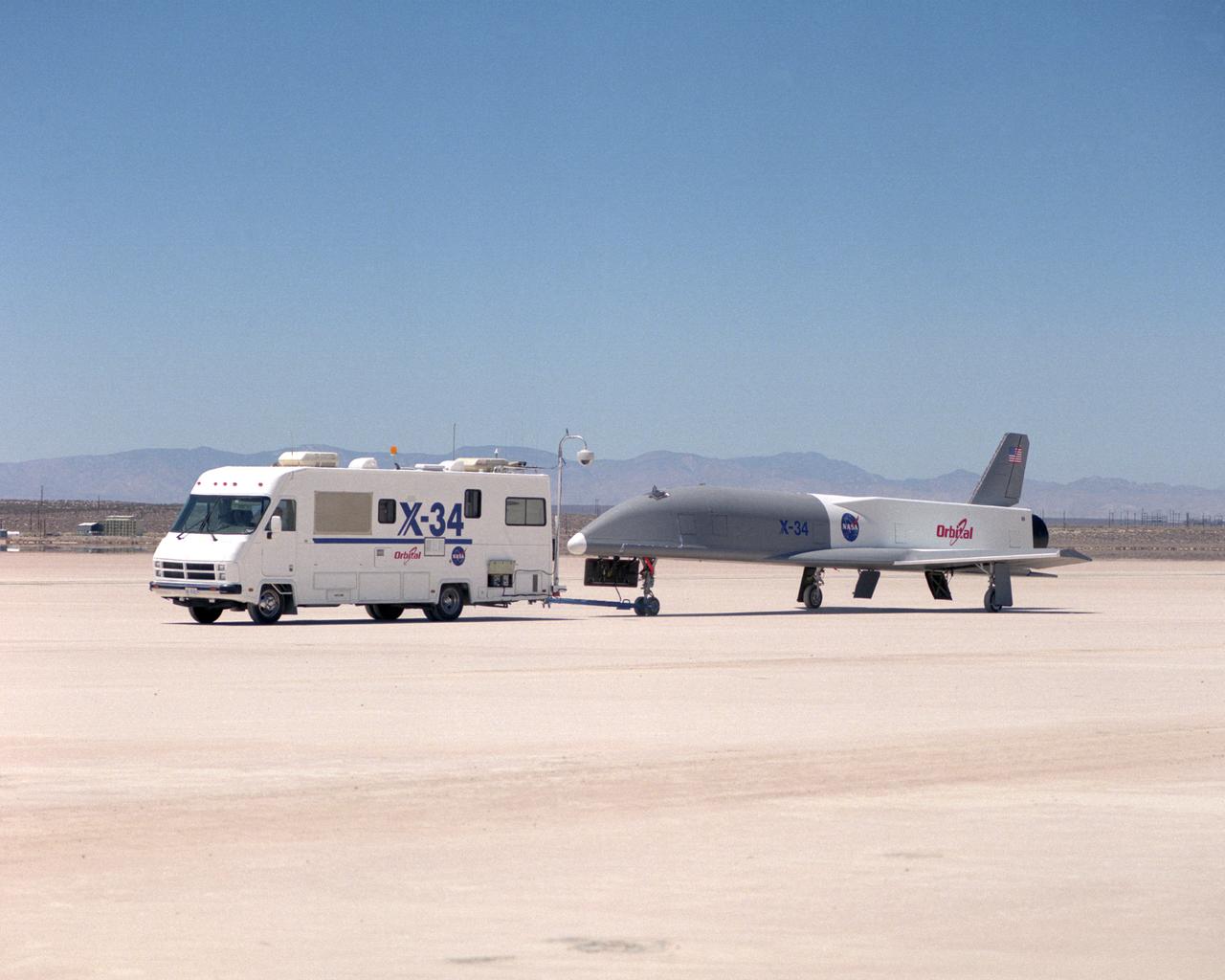
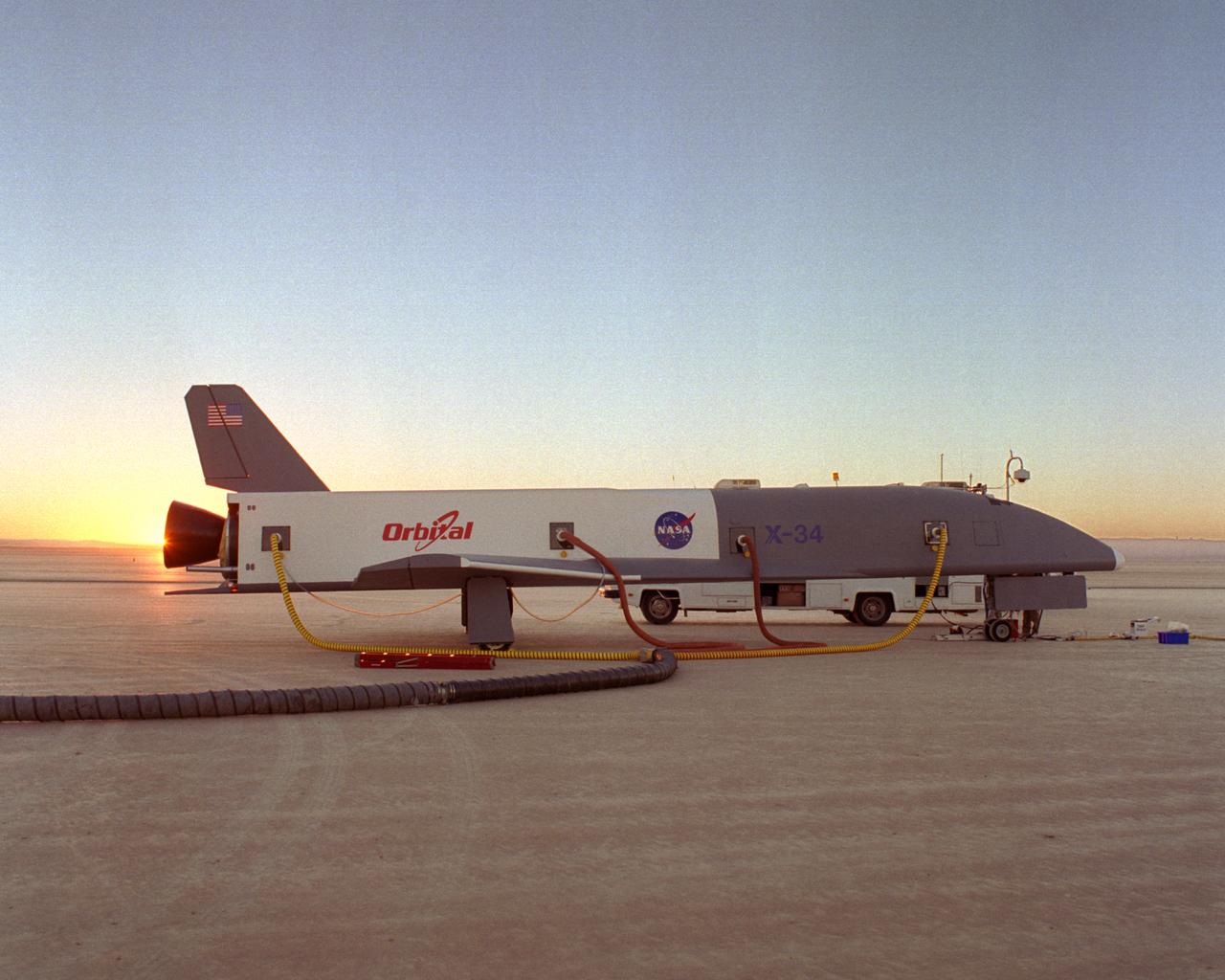
Following initial captive flight tests last year at NASA's Dryden Flight Research Center, Edwards Air Force Base, California, the X-34 technology demonstrator began a new series of tests last week in which it is being towed behind a semi-truck and released to coast on the Edwards dry lakebed.  On July 20, 2000, it was towed and released twice at speeds of five and 10 miles per hour. On July 24, 2000, it was towed and released twice at 10 and 30 miles per hour.  Twelve tests are planned during which the X-34 will be towed for distances up to 10,000 feet and released at speeds up to 80 miles per hour. The test series is expected to last at least six weeks.
X-34 on lakebed prior to tow tests
Following initial captive flight tests last year at NASA's Dryden Flight Research Center, Edwards Air Force Base, California, the X-34 technology demonstrator began a new series of tests last week in which it is being towed behind a semi-truck and released to coast on the Edwards dry lakebed.  On July 20, 2000, it was towed and released twice at speeds of five and 10 miles per hour. On July 24, 2000, it was towed and released twice at 10 and 30 miles per hour.  Twelve tests are planned during which the X-34 will be towed for distances up to 10,000 feet and released at speeds up to 80 miles per hour. The test series is expected to last at least six weeks.
X-34 being towed by the Mobile Operations Module during navigational tests on the Rogers Dry Lakebed
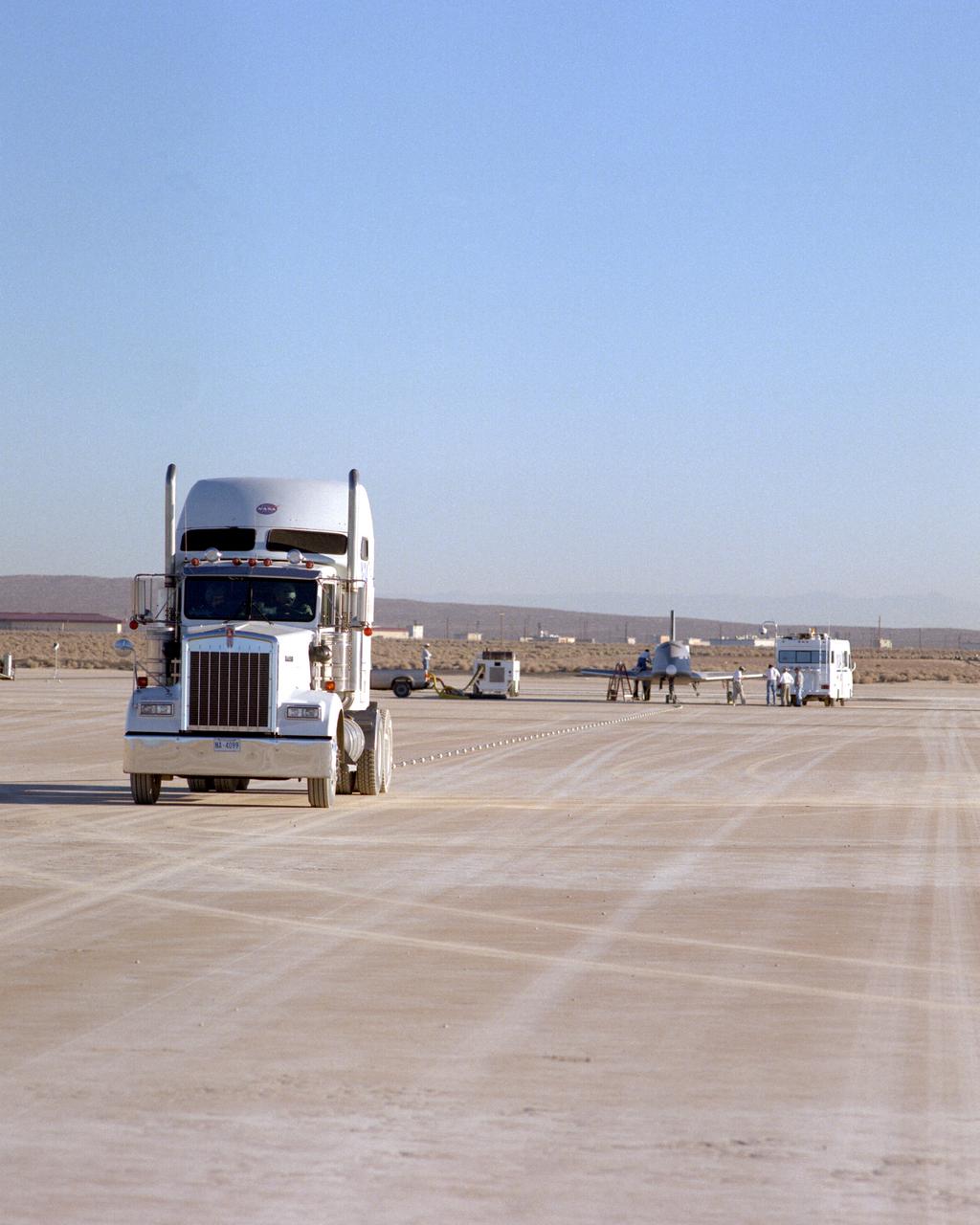
Following initial captive flight tests last year at NASA's Dryden Flight Research Center, Edwards Air Force Base, California, the X-34 technology demonstrator began a new series of tests last week in which it is being towed behind a semi-truck and released to coast on the Edwards dry lakebed.  On July 20, 2000, it was towed and released twice at speeds of five and 10 miles per hour. On July 24, 2000, it was towed and released twice at 10 and 30 miles per hour.  Twelve tests are planned during which the X-34 will be towed for distances up to 10,000 feet and released at speeds up to 80 miles per hour. The test series is expected to last at least six weeks.
X-34 and HSTV tow vehicle on lakebed prior to tow test
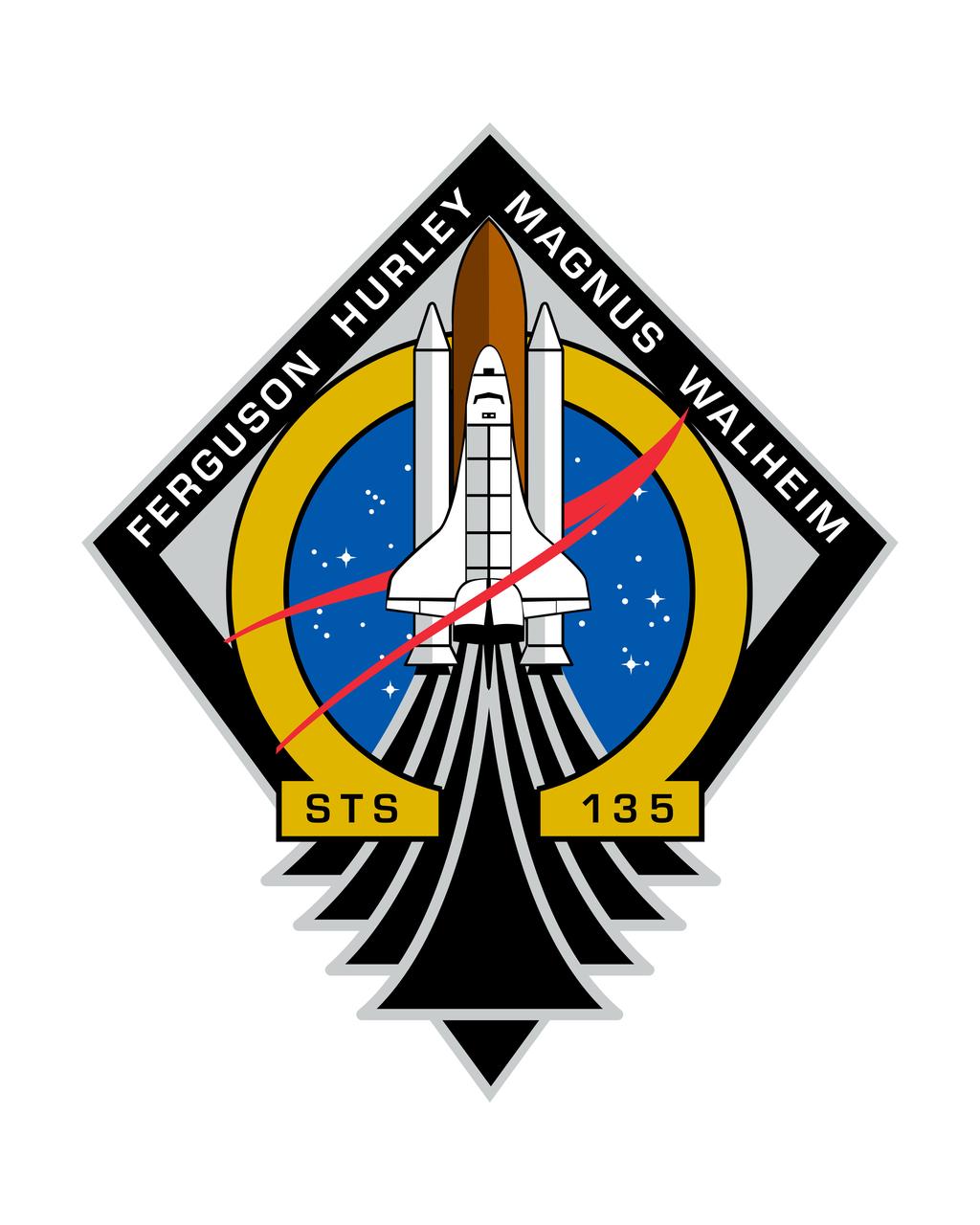
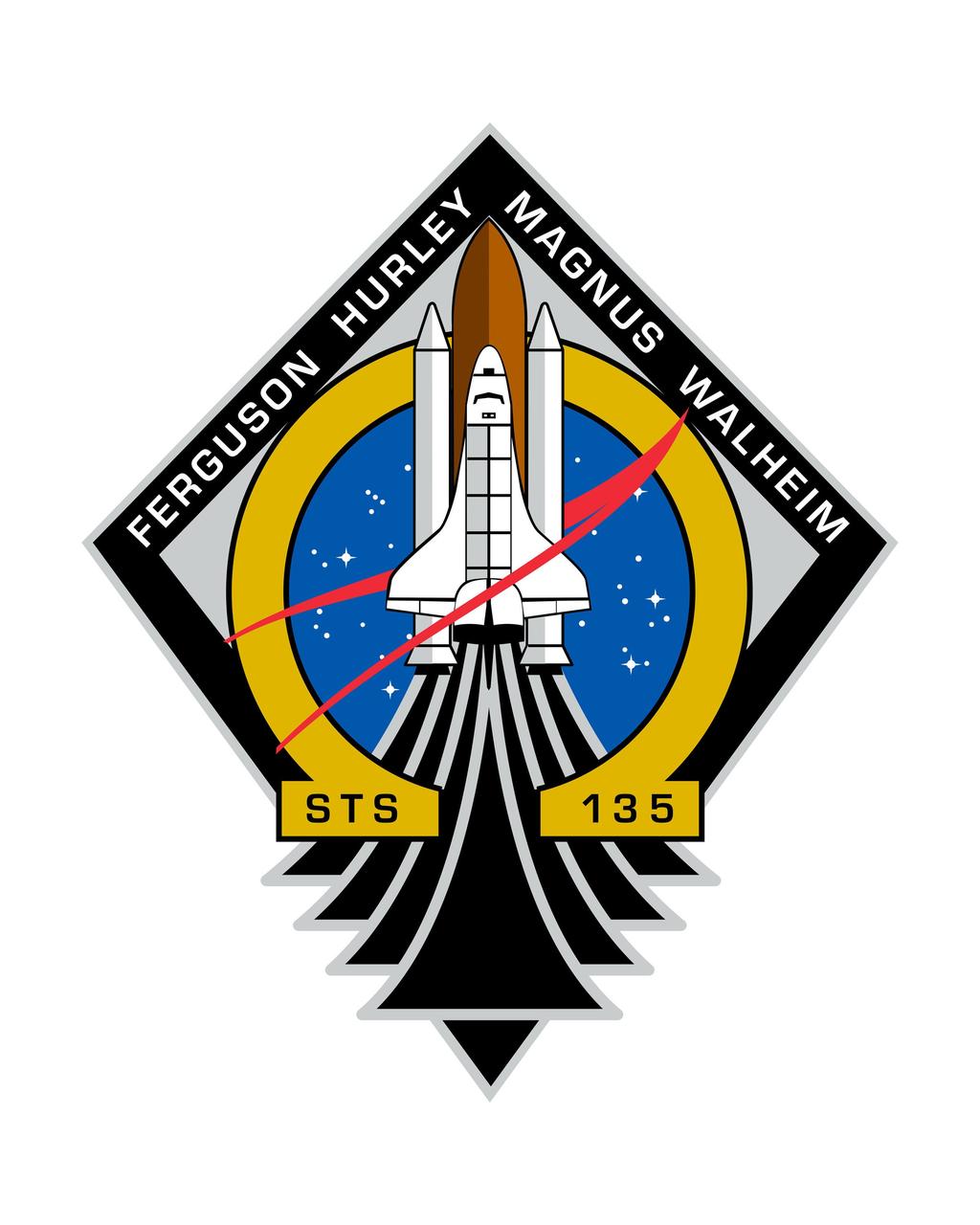
STS135-S-001 (27 Jan. 2011) --- The STS-135 patch represents the space shuttle Atlantis embarking on its mission to resupply the International Space Station. Atlantis is centered over elements of the NASA emblem depicting how the space shuttle has been at the heart of NASA for the last 30 years.  It also pays tribute to the entire NASA and contractor team that made possible all the incredible accomplishments of the space shuttle.  Omega, the last letter in the Greek alphabet, recognizes this mission as the last flight of the Space Shuttle Program.     The NASA insignia design for space shuttle flights is reserved for use by the astronauts and for other official use as the NASA Administrator may authorize. Public availability has been approved only in the forms of illustrations by the various news media. When and if there is any change in this policy, which is not anticipated, the change will be publicly announced. Photo credit: NASA
sts-135patch only
Following initial captive flight tests last year at NASA's Dryden Flight Research Center, Edwards Air Force Base, California, the X-34 technology demonstrator began a new series of tests last week in which it is being towed behind a semi-truck and released to coast on the Edwards dry lakebed.  On July 20, 2000, it was towed and released twice at speeds of five and 10 miles per hour. On July 24, 2000, it was towed and released twice at 10 and 30 miles per hour.  Twelve tests are planned during which the X-34 will be towed for distances up to 10,000 feet and released at speeds up to 80 miles per hour. The test series is expected to last at least six weeks.
X-34 and HSTV tow vehicle on lakebed prior to tow test
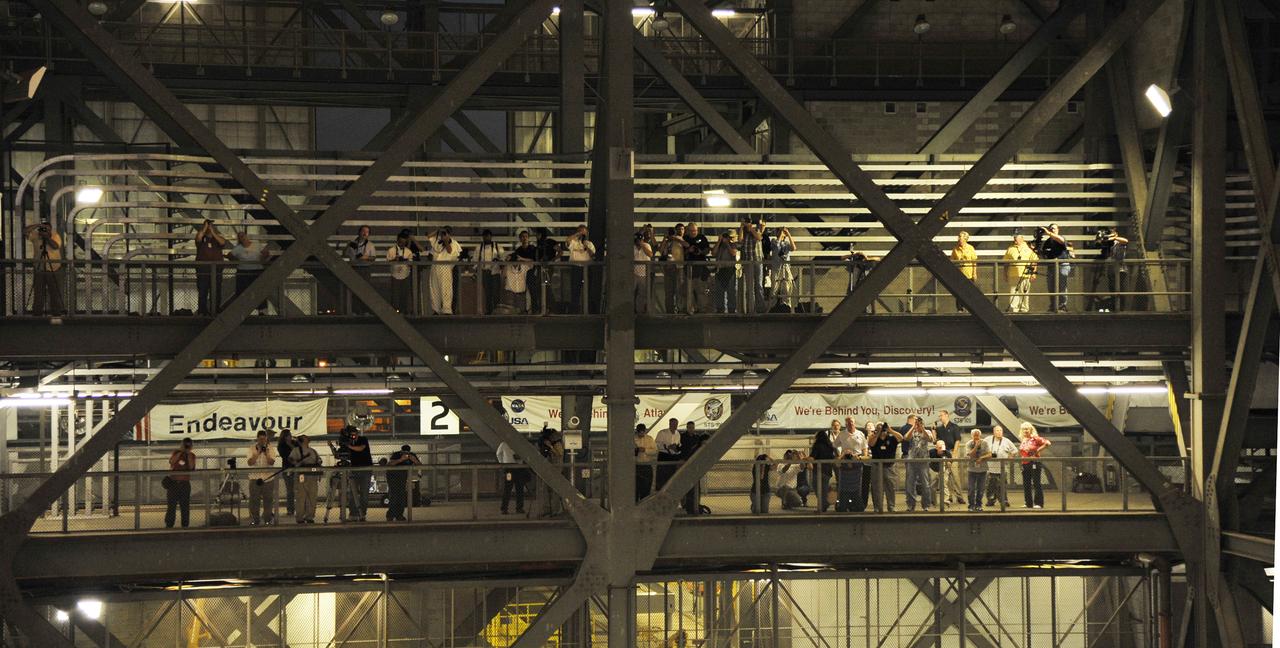
members of the media gather in the VAB to photograph the last rollout of Shuttle Atlantis on the Mobil Launch Platform (MLP)  at Kennedy Space Center, Cape Canaveral, Florida, USA 31 May 2011. Launch of Atlantis on the STS-135 mission to deliver supplies to the International Space Station is currently planned for no earlier than 08 July 2011. The STS-135 mission is  planned to last eight days and will be the final flight of the Space Shuttle program.
USA SHUTTLE ATLANTIS ROLLOUT
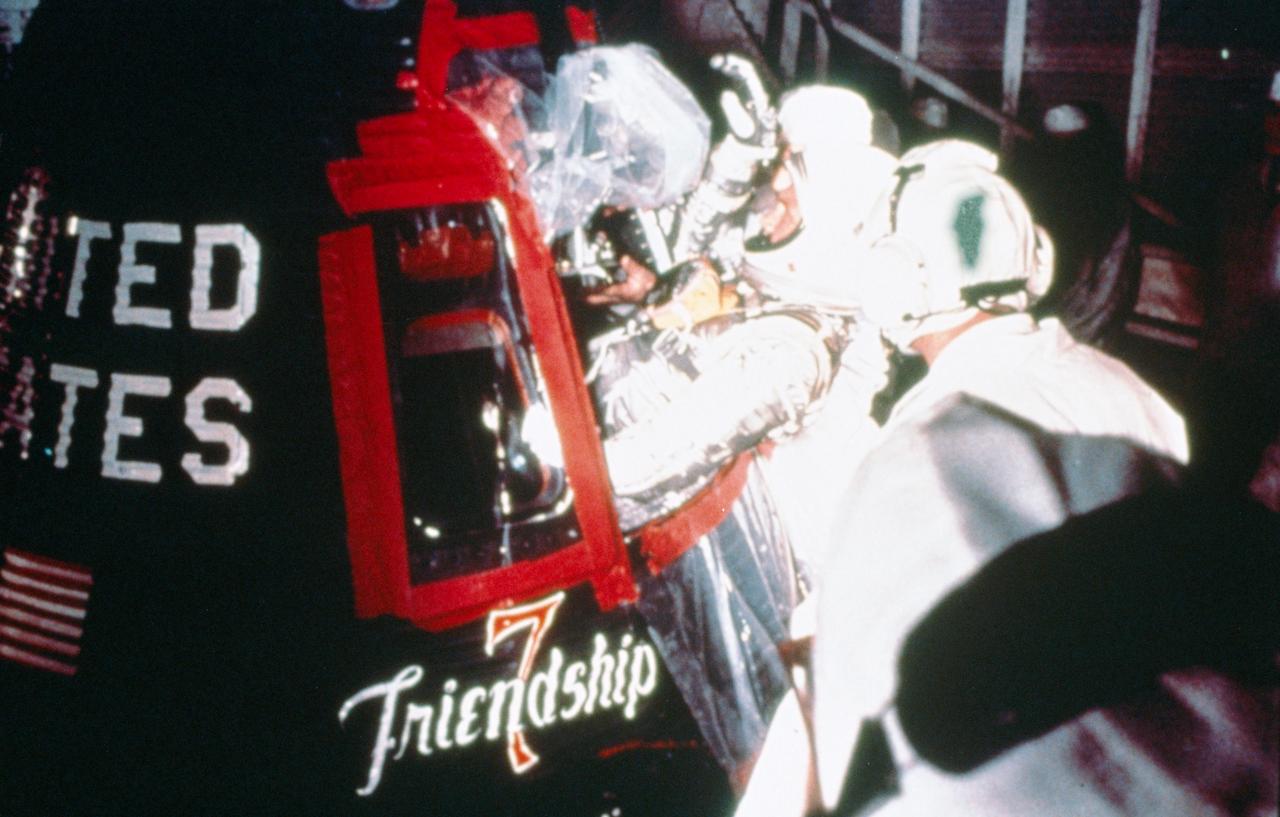
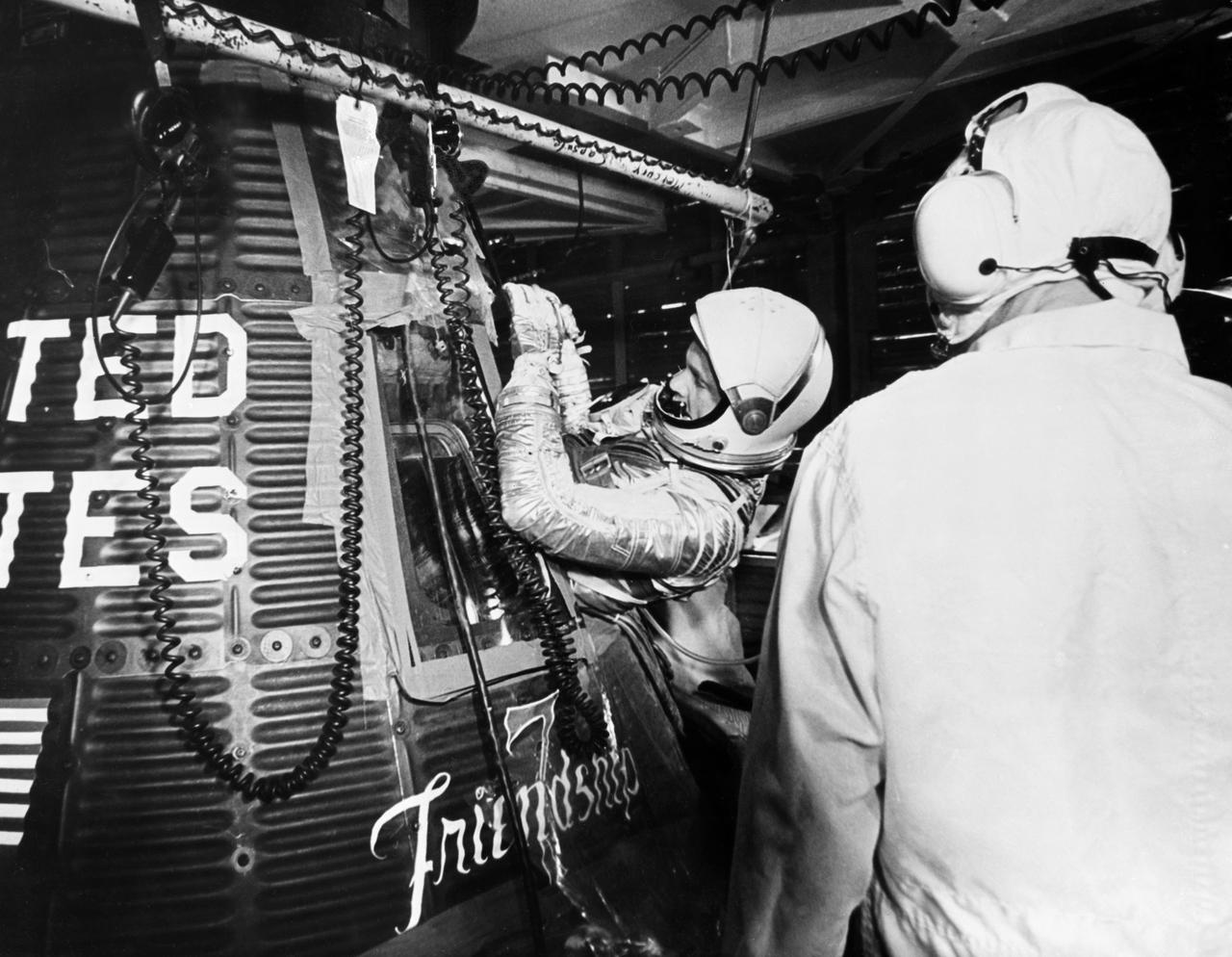
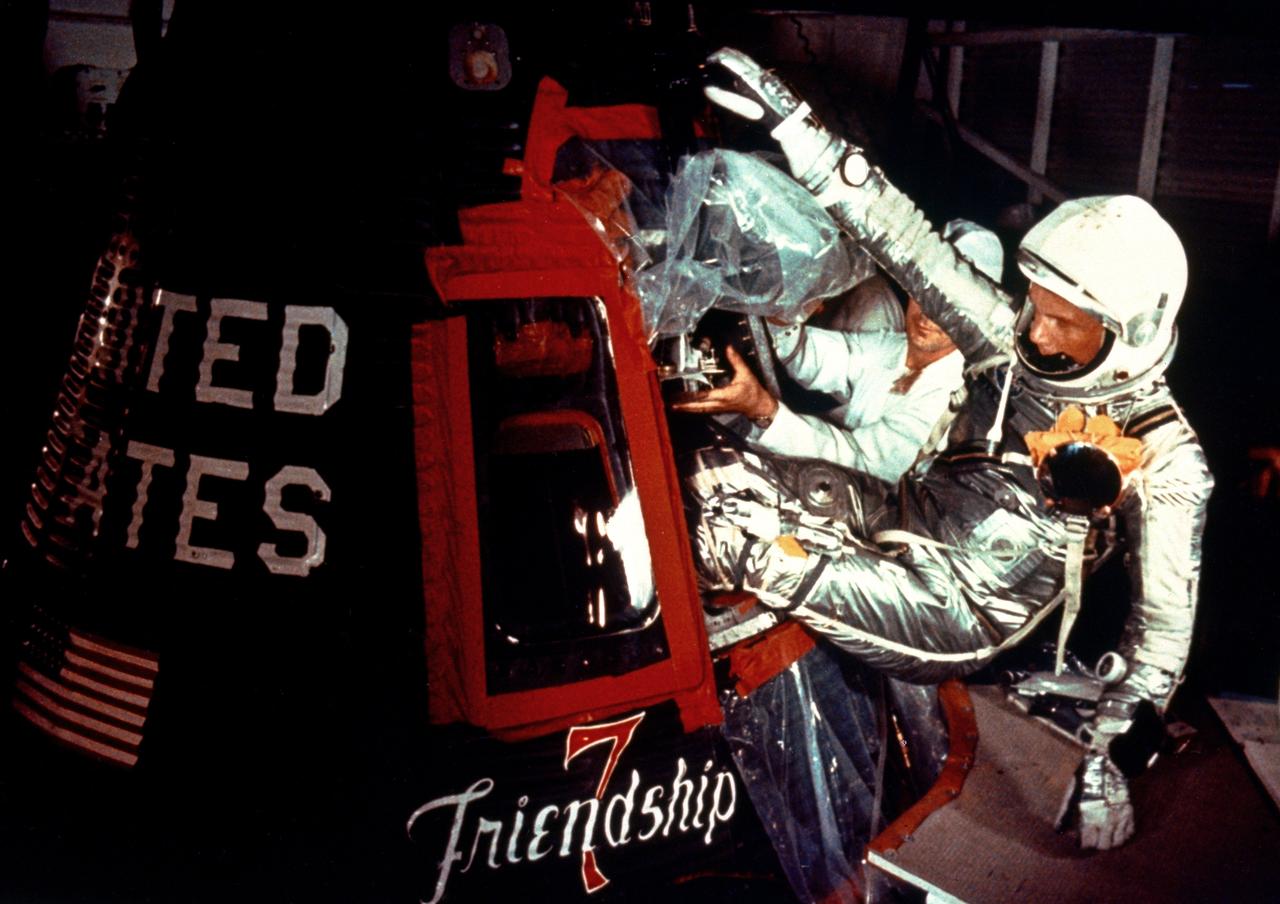
Project Mercury astronaut John H. Glenn Jr., enters the Friendship 7 spacecraft during the last part of the countdown on Feb. 20, 1962. At 9:47 a.m. EST, the Atlas launch vehicle lifted the spacecraft into orbit for a three-orbit mission lasting four hours, 55 minutes and 23 seconds. Glenn and his spacecraft were recovered by the destroyer Noa just 21 minutes after landing in the Atlantic near Grand Turk Island, to successfully complete the nation's first manned orbital flight.
John H Glenn Jr.
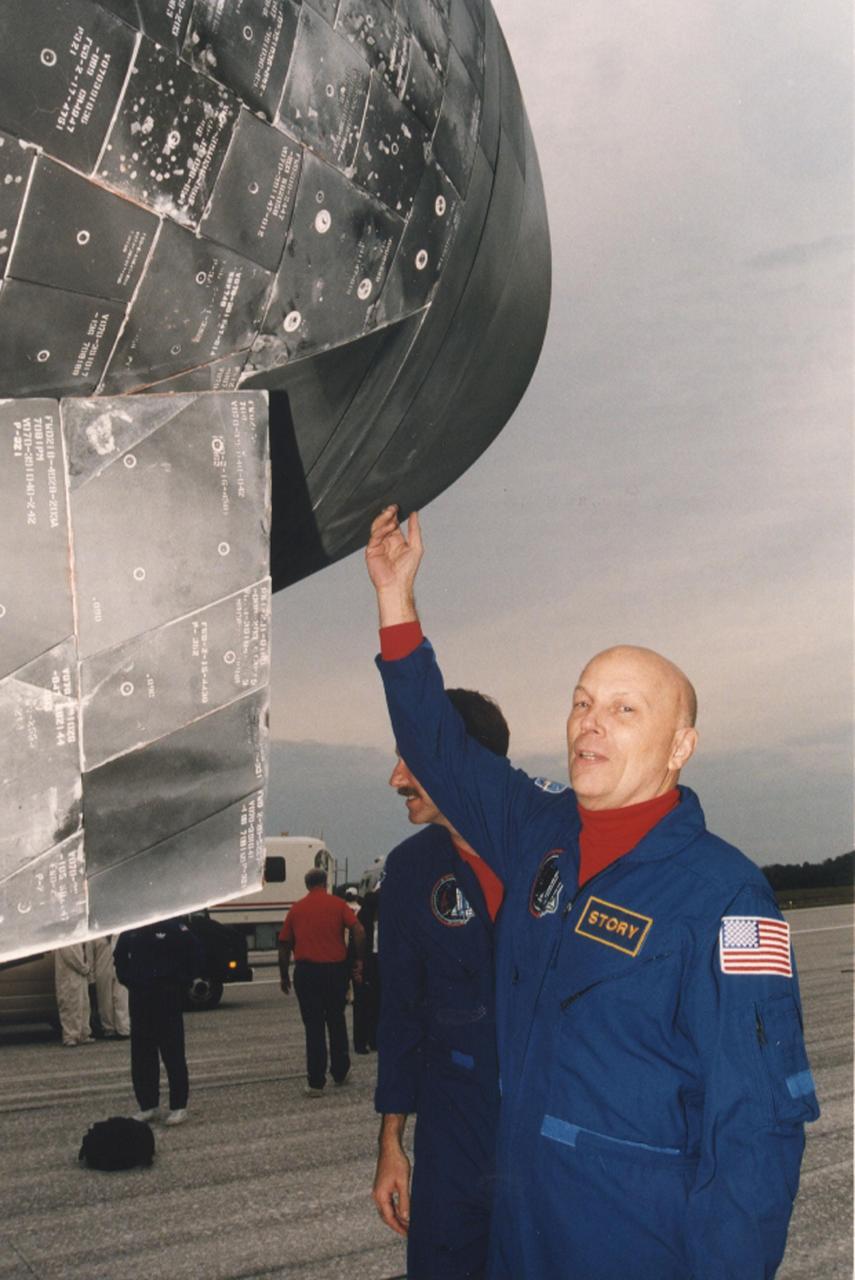
KENNEDY SPACE CENTER, FLA. -- His last spaceflight behind him, STS-80 Mission Specialist Story Musgrave takes one last look at the orbiter Columbia parked on Runway 33 of KSC’s Shuttle Landing Facility. Musgrave became at age 61 the oldest human being to fly into space and in completing his sixth spaceflight ties astronaut John Young’s record for most human spaceflight, while also setting a new record for most Shuttle flights. Columbia touched down at 6:49:05 a.m. EST, Dec. 7, wrapping up Mission STS-80 and the final Shuttle flight of 1996.
KSC-96pc1338
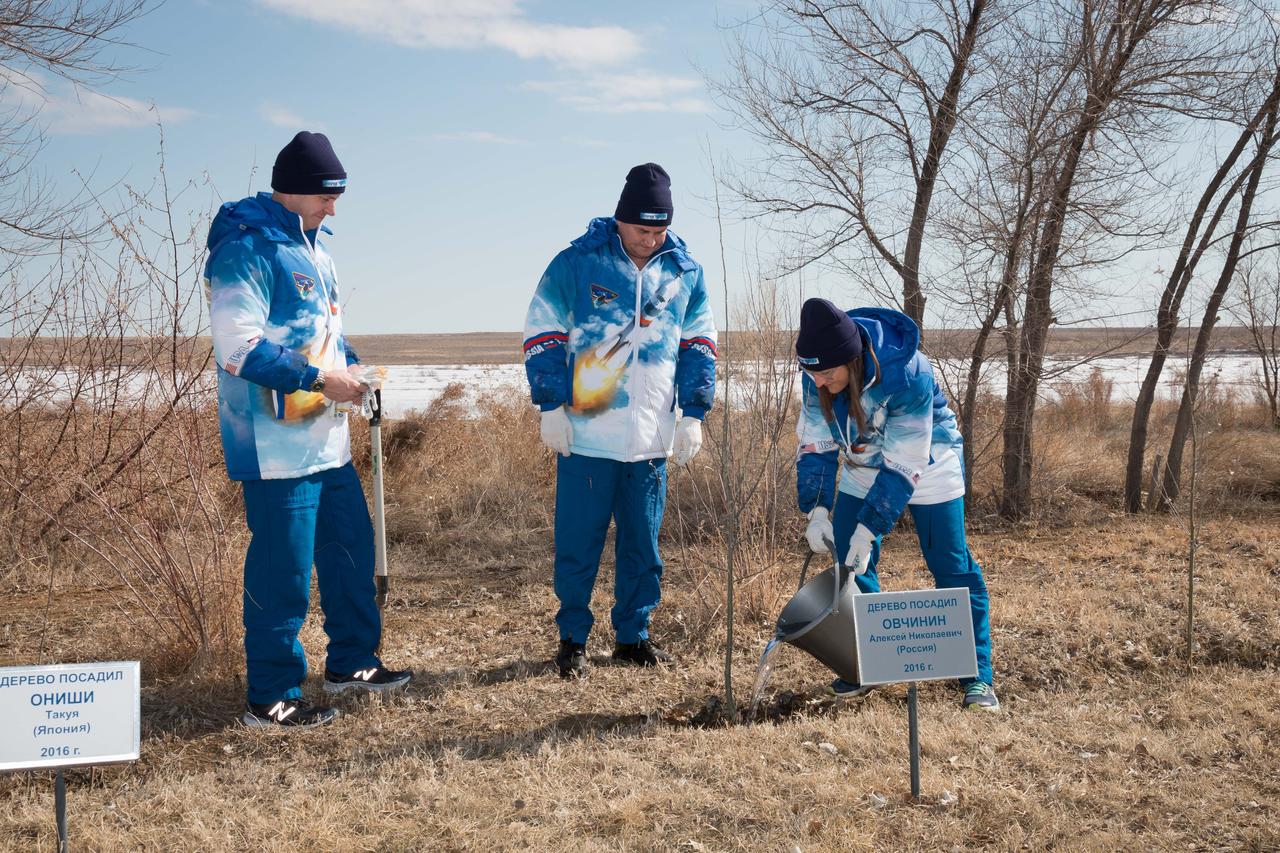
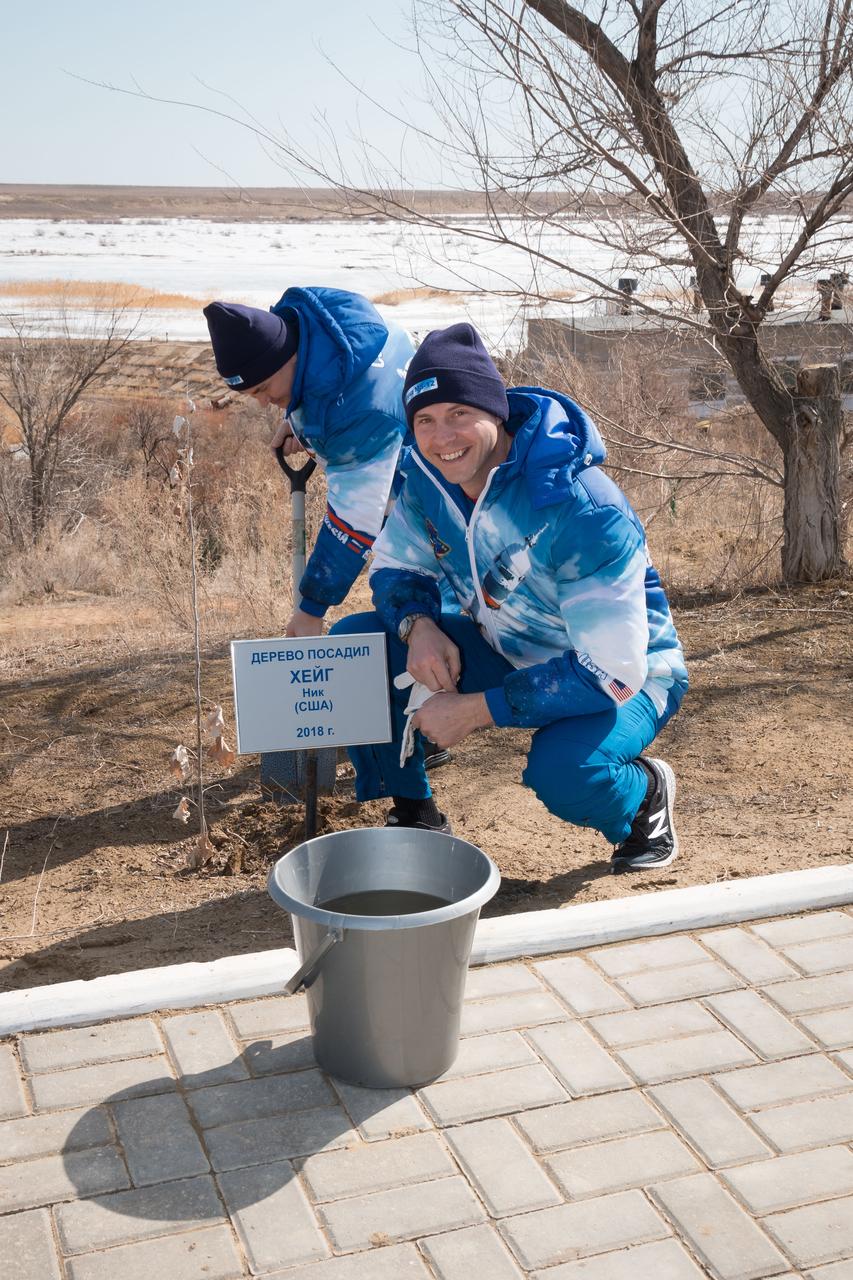
At the Cosmonaut Hotel crew quarters in Baikonur, Kazakhstan, Expedition 59 crewmember Nick Hague of NASA poses for pictures March 7 in front of a tree he originally planted last October before his first flight. Preparing the tree for watering is crewmate Alexey Ovchinin of Roscosmos. They launched together last October 11, but their flight was cut short two minutes after launch by an abort triggered by a first-stage booster rocket separation problem. They are set to launch again March 14, U.S. time, this time with crewmate Christina Koch of NASA on the Soyuz MS-12 spacecraft from the Baikonur Cosmodrome for a six-and-a-half month mission on the International Space Station...NASA/Victor Zelentsov.
jsc2019e013059
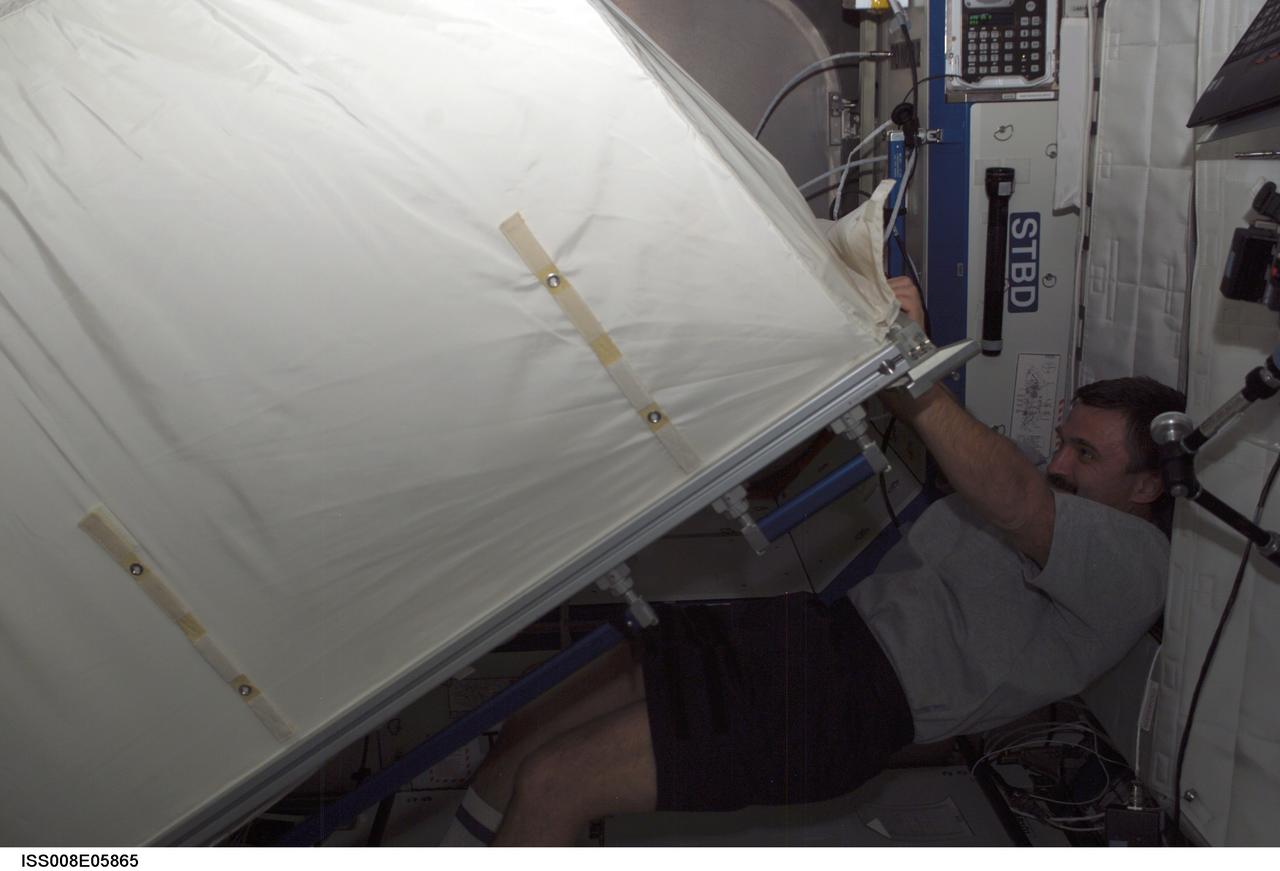
ISS008-E-05865 (12 November 2003) --- Cosmonaut Alexander Y. Kaleri, Expedition 8 flight engineer, moves a Zero-G Storage Rack (ZSR) in the Destiny laboratory on the International Space Station (ISS). Kaleri, who represents Rosaviakosmos, commanded the Soyuz flight that took the crew to the station last month.
Kaleri works with a ZSR in the Lab during Expedition 8
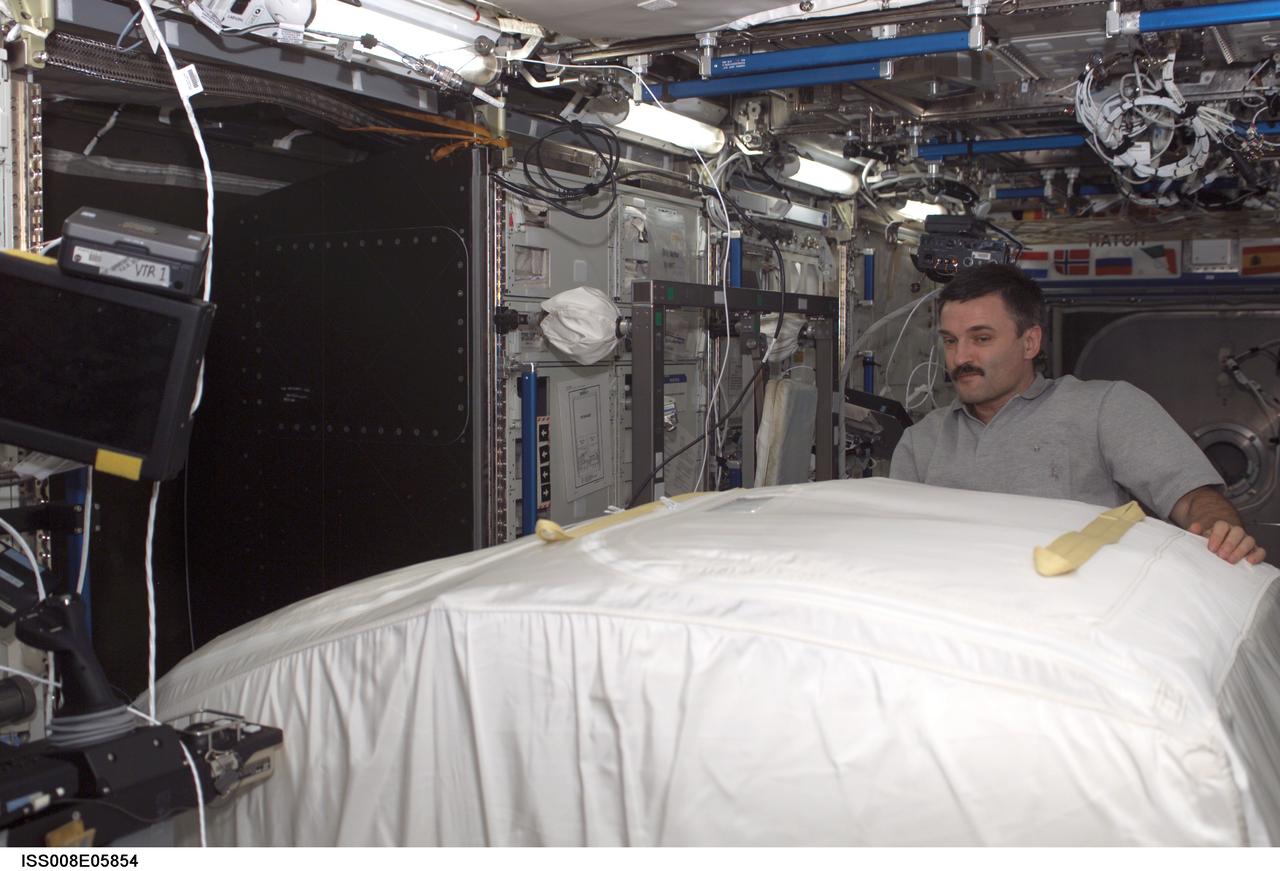
ISS008-E-05854 (12 November 2003) --- Cosmonaut Alexander Y. Kaleri,  Expedition 8 flight engineer, moves a Zero-G Storage Rack (ZSR) in the Destiny laboratory on the International Space Station (ISS). Kaleri, who represents Rosaviakosmos, commanded the Soyuz flight that took the crew to the station last month.
Kaleri works with a ZSR in the Lab during Expedition 8
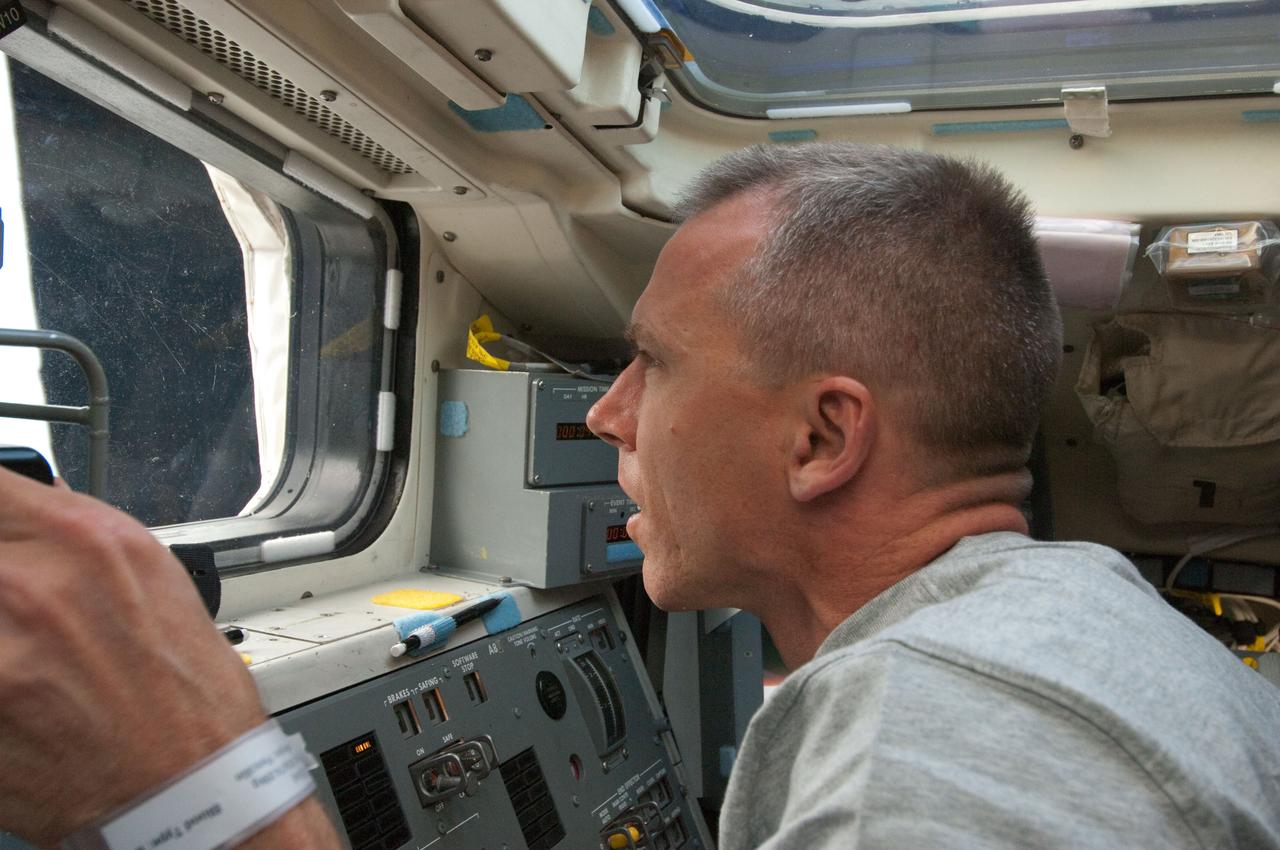
S134-E-005333 (16 May 2011) --- Astronaut Andrew Feustel, STS-134 mission specialist, looks out a window on the aft flight deck of space shuttle Endeavour's crew cabin soon after the vehicle reached Earth orbit for its last flight. Photo credit: NASA
View of STS-134 MS Feustel working on the Flight Deck
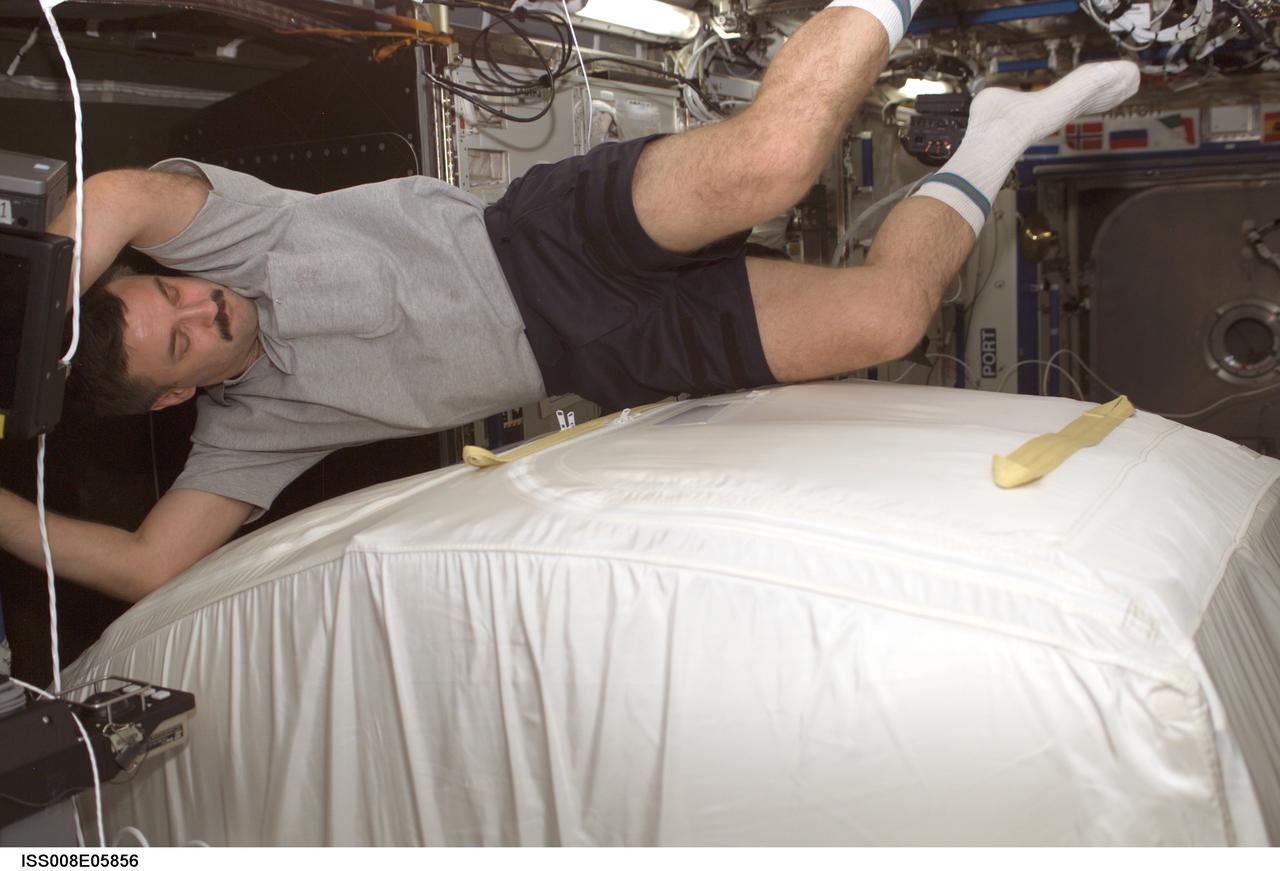
ISS008-E-05856 (12 November 2003) --- Cosmonaut Alexander Y. Kaleri, Expedition 8 flight engineer, moves a Zero-G Storage Rack (ZSR) in the Destiny laboratory on the International Space Station (ISS). Kaleri, who represents Rosaviakosmos, commanded the Soyuz flight that took the crew to the station last month.
Kaleri works with a ZSR in the Lab during Expedition 8
JOHNSON SPACE CENTER, Houston - STS135-S-001 ---The STS-135 patch represents the space shuttle Atlantis embarking on its mission to resupply the International Space Station. Atlantis is centered over elements of the NASA emblem depicting how the space shuttle has been at the heart of NASA for the last 30 years. It also pays tribute to the entire NASA and contractor team that made possible all the incredible accomplishments of the space shuttle. Omega, the last letter in the Greek alphabet, recognizes this mission as the last flight of the Space Shuttle Program. Public availability has been approved only in the form of illustrations by the various news media. When and if there is any change in this policy, which we do not anticipate, it will be publicly announced. Photo credit: NASA or National Aeronautics and Space Administration
KSC-2011-4286
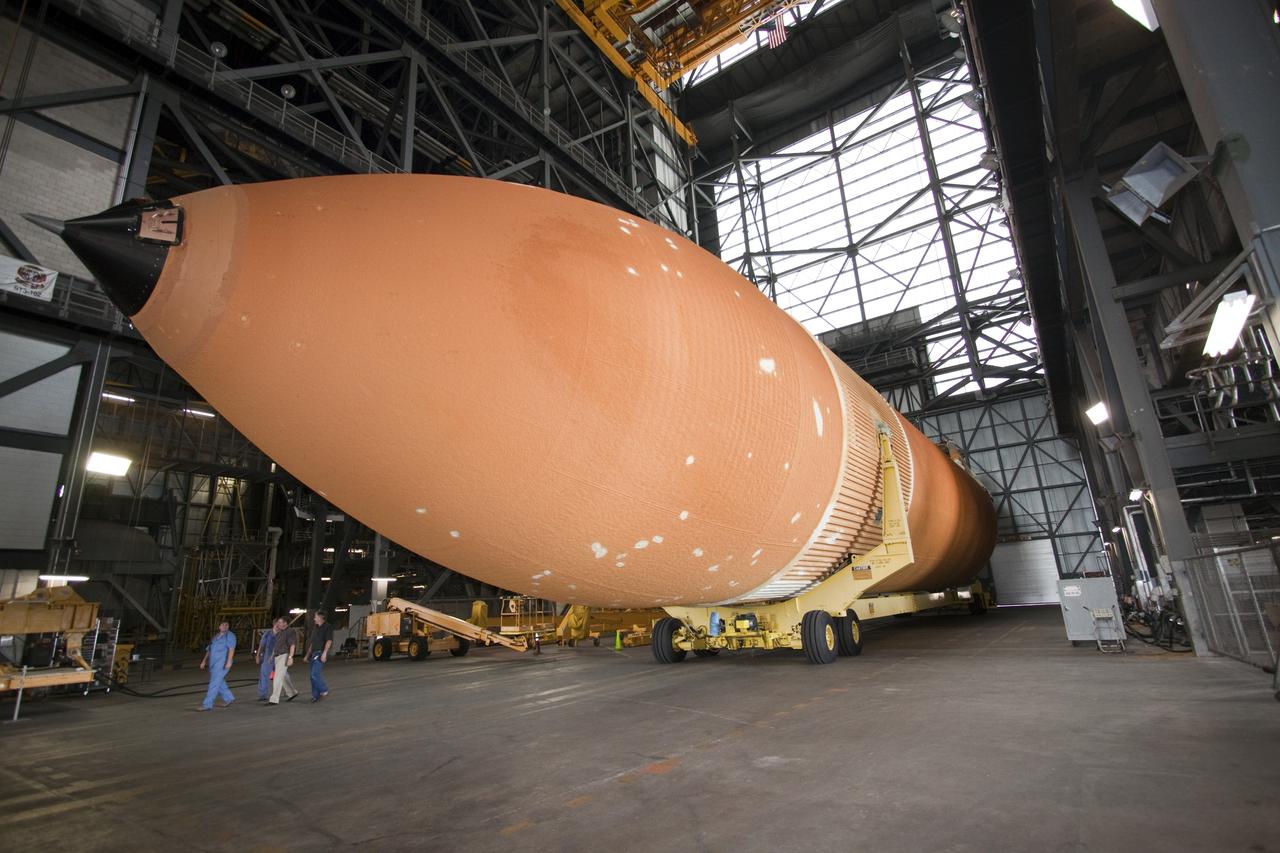
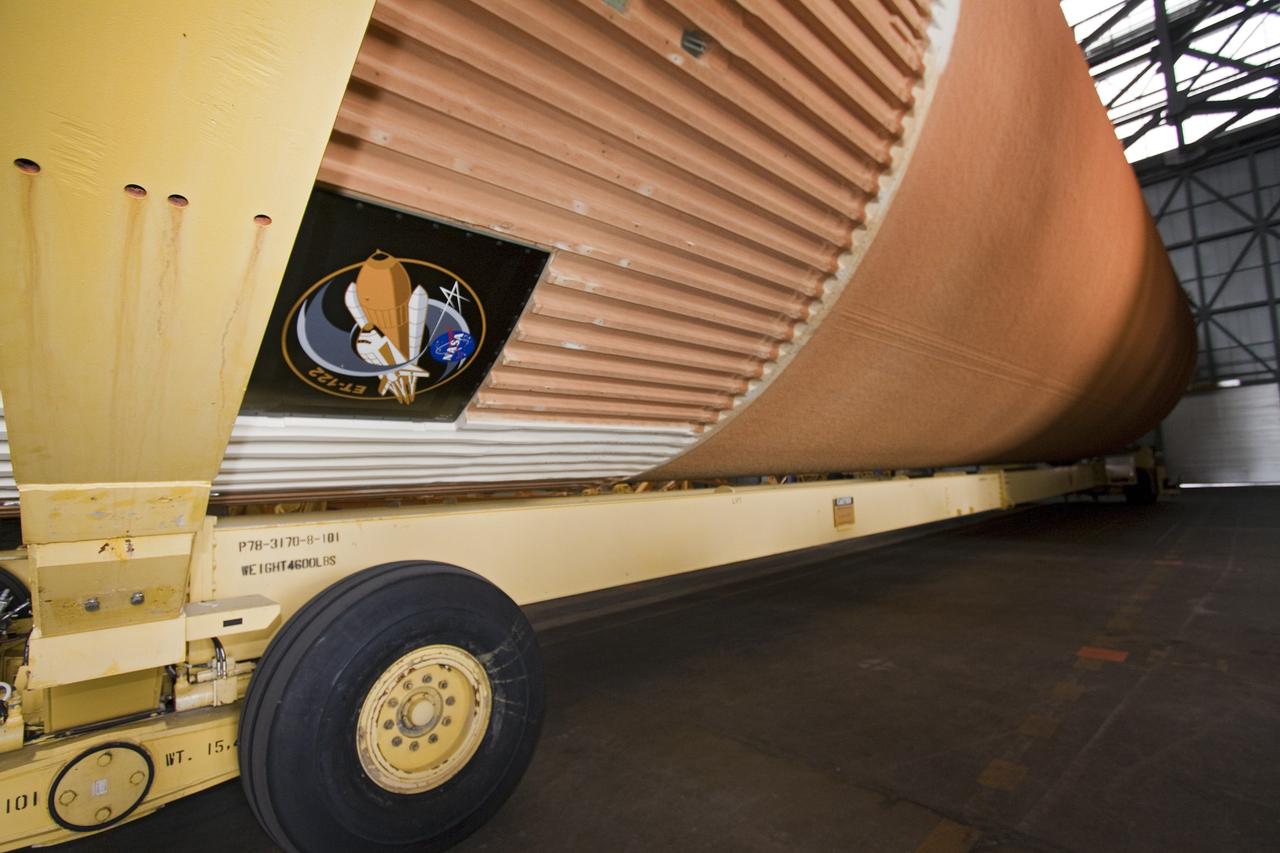
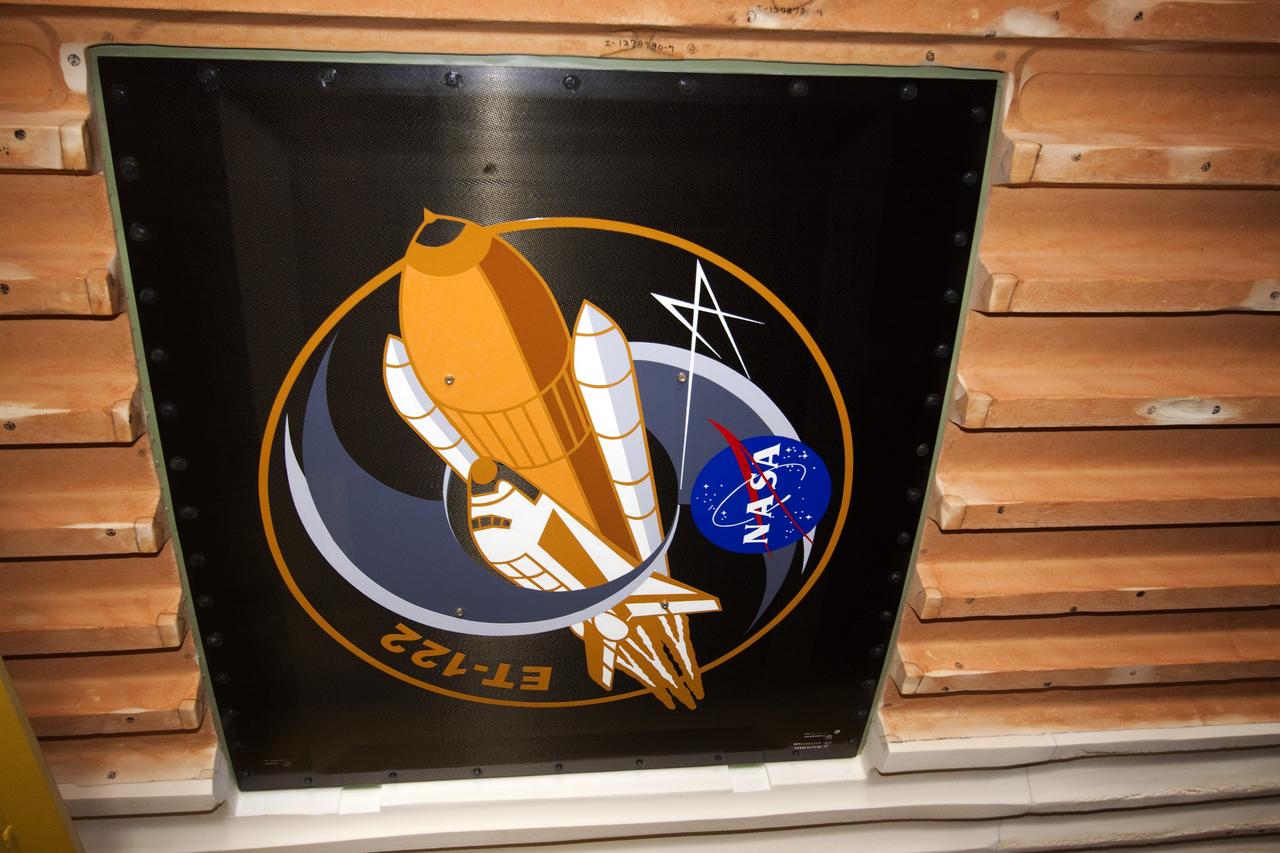
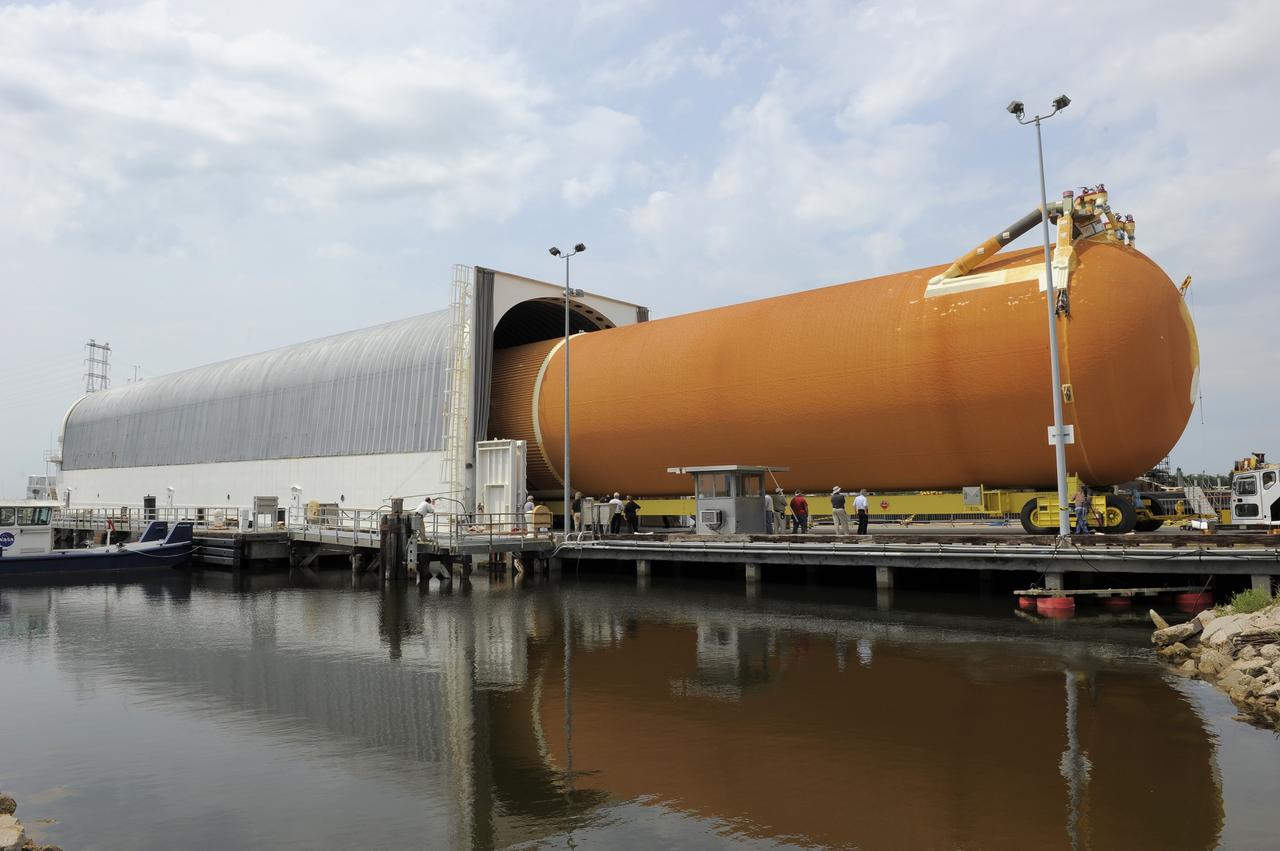
CAPE CANAVERAL, Fla. -- To commemorate the history of the Space Shuttle Program's last external fuel tank, its intertank door is emblazoned with an ET-122 insignia. The tank is in the Vehicle Assembly Building at NASA's Kennedy Space Center in Florida after traveling 900 miles by sea from NASA's Michoud Assembly Facility in New Orleans aboard the Pegasus Barge. It eventually will be attached to space shuttle Endeavour for the STS-134 mission to the International Space Station. STS-134, targeted to launch in Feb. 2011, currently is scheduled to be the last mission in the shuttle program.           The tank, which is the largest element of the space shuttle stack, was completed in 2002, modified during Return to Flight operations in 2003 and 2004, damaged during Hurricane Katrina in 2005, and then restored to flight configuration by Lockheed Martin Space Systems Company employees in 2008 at NASA's Marshall Space Flight Center in Alabama. Photo credit: NASA/Jack Pfaller
KSC-2010-4905
CAPE CANAVERAL, Fla. -- To commemorate the history of the Space Shuttle Program's last external fuel tank, its intertank door is emblazoned with an ET-122 insignia. The tank is in the Vehicle Assembly Building at NASA's Kennedy Space Center in Florida after traveling 900 miles by sea from NASA's Michoud Assembly Facility in New Orleans aboard the Pegasus Barge. It eventually will be attached to space shuttle Endeavour for the STS-134 mission to the International Space Station. STS-134, targeted to launch in Feb. 2011, currently is scheduled to be the last mission in the shuttle program.           The tank, which is the largest element of the space shuttle stack, was completed in 2002, modified during Return to Flight operations in 2003 and 2004, damaged during Hurricane Katrina in 2005, and then restored to flight configuration by Lockheed Martin Space Systems Company employees in 2008 at NASA's Marshall Space Flight Center in Alabama. Photo credit: NASA/Jack Pfaller
KSC-2010-4904
CAPE CANAVERAL, Fla. -- To commemorate the history of the Space Shuttle Program's last external fuel tank, its intertank door is emblazoned with an ET-122 insignia. The tank is in the Vehicle Assembly Building at NASA's Kennedy Space Center in Florida after traveling 900 miles by sea from NASA's Michoud Assembly Facility in New Orleans aboard the Pegasus Barge. It eventually will be attached to space shuttle Endeavour for the STS-134 mission to the International Space Station. STS-134, targeted to launch in Feb. 2011, currently is scheduled to be the last mission in the shuttle program.           The tank, which is the largest element of the space shuttle stack, was completed in 2002, modified during Return to Flight operations in 2003 and 2004, damaged during Hurricane Katrina in 2005, and then restored to flight configuration by Lockheed Martin Space Systems Company employees in 2008 at NASA's Marshall Space Flight Center in Alabama. Photo credit: NASA/Jack Pfaller
KSC-2010-4906
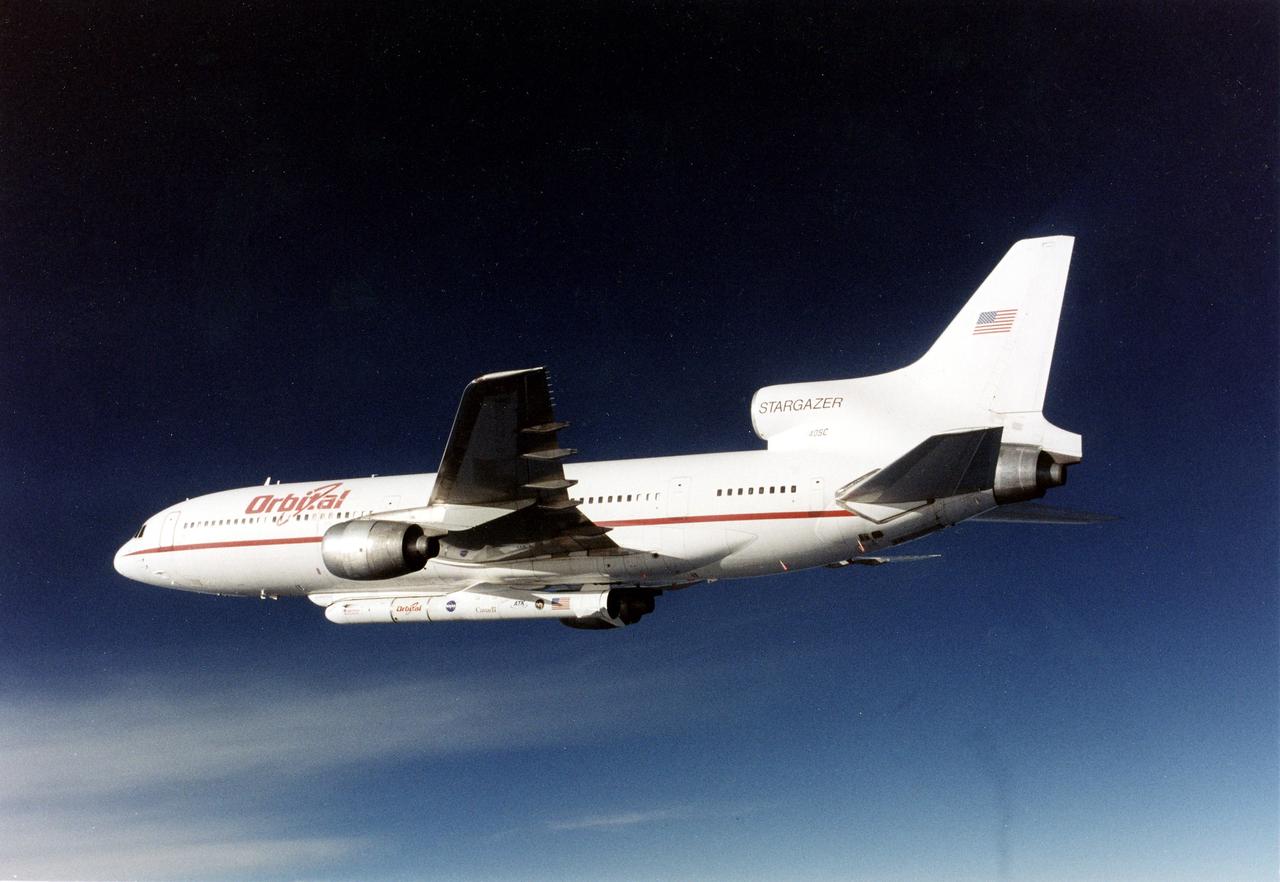
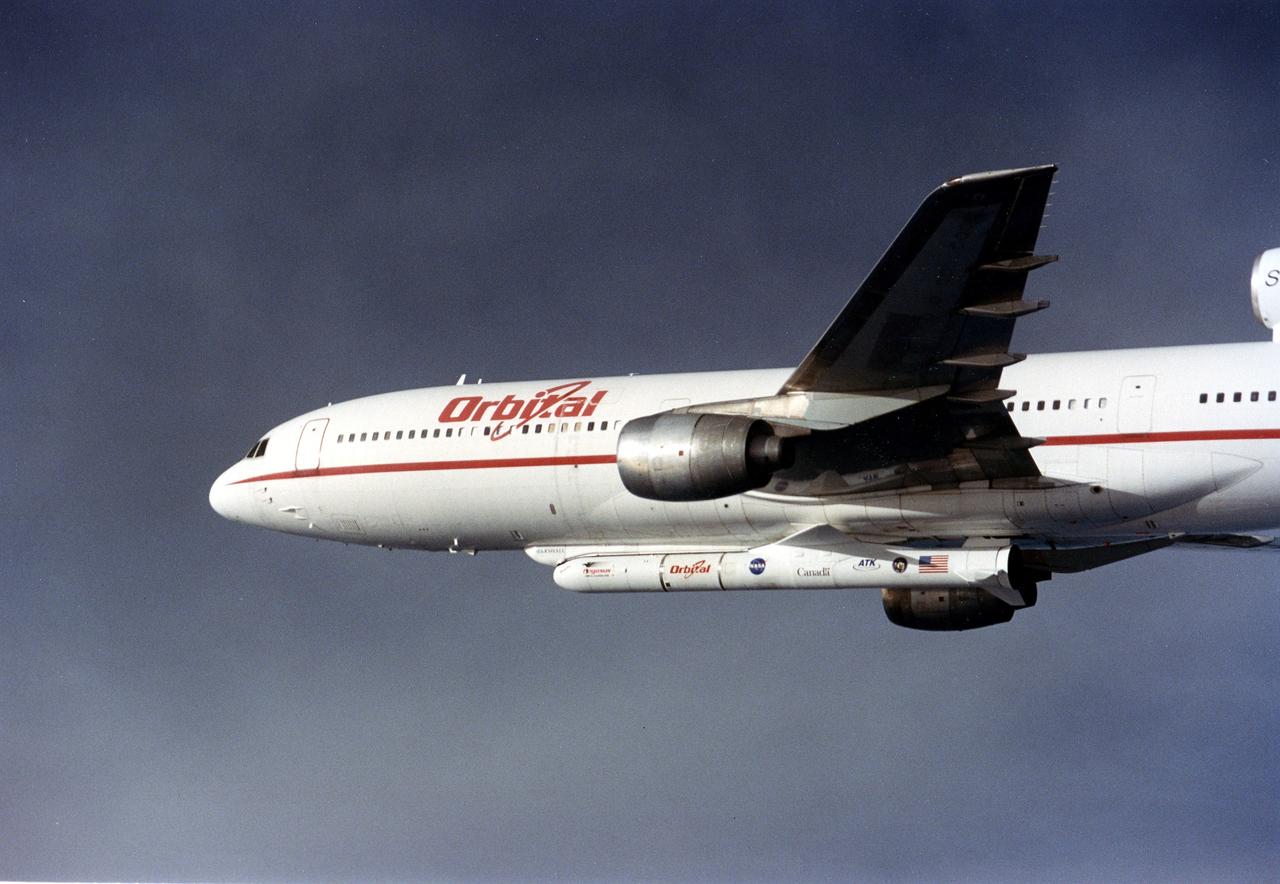
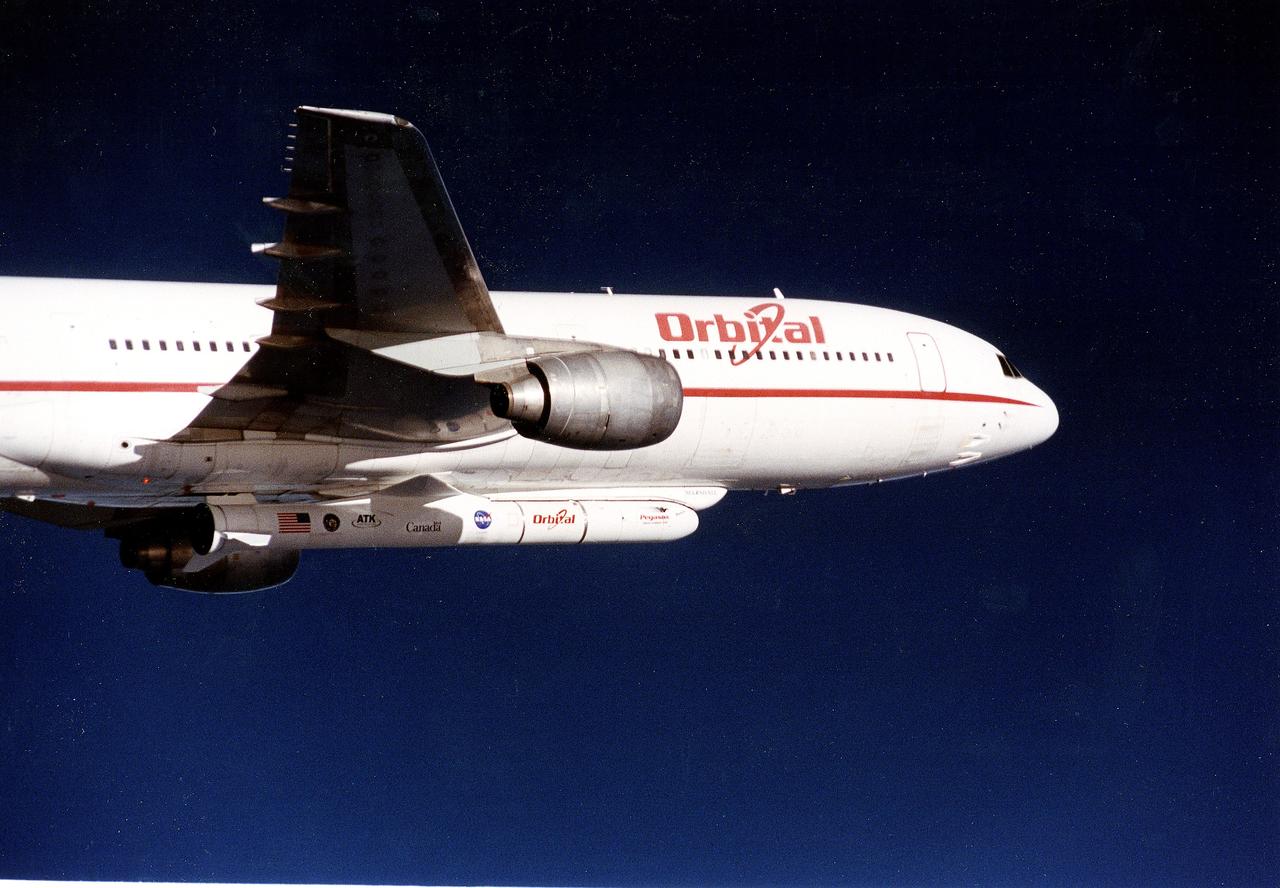
VANDENBERG AIR FORCE BASE, CALIF. -  The L-1011 carrier aircraft is in flight with its cargo of the Pegasus launch vehicle and SciSat-1 spacecraft underneath. The SciSat-1 weighs approximately 330 pounds and after launch will be placed in a 400-mile-high polar orbit to investigate processes that control the distribution of ozone in the upper atmosphere. The data from the satellite will provide Canadian and international scientists with improved measurements relating to global ozone processes and help policymakers assess existing environmental policy and develop protective measures for improving the health of our atmosphere, preventing further ozone depletion. The mission is designed to last two years.
VANDENBERG AIR FORCE BASE, CALIF. - The L-1011 carrier aircraft is in flight with its cargo of the Pegasus launch vehicle and SciSat-1 spacecraft underneath. The SciSat-1 weighs approximately 330 pounds and after launch will be placed in a 400-mile-high polar orbit to investigate processes that control the distribution of ozone in the upper atmosphere. The data from the satellite will provide Canadian and international scientists with improved measurements relating to global ozone processes and help policymakers assess existing environmental policy and develop protective measures for improving the health of our atmosphere, preventing further ozone depletion. The mission is designed to last two years.
VANDENBERG AIR FORCE BASE, CALIF. -  The L-1011 carrier aircraft is in flight with its cargo of the Pegasus launch vehicle and SciSat-1 spacecraft underneath.  The SciSat-1 weighs approximately 330 pounds and after launch will be placed in a 400-mile-high polar orbit to investigate processes that control the distribution of ozone in the upper atmosphere. The data from the satellite will provide Canadian and international scientists with improved measurements relating to global ozone processes and help policymakers assess existing environmental policy and develop protective measures for improving the health of our atmosphere, preventing further ozone depletion. The mission is designed to last two years.
VANDENBERG AIR FORCE BASE, CALIF. - The L-1011 carrier aircraft is in flight with its cargo of the Pegasus launch vehicle and SciSat-1 spacecraft underneath. The SciSat-1 weighs approximately 330 pounds and after launch will be placed in a 400-mile-high polar orbit to investigate processes that control the distribution of ozone in the upper atmosphere. The data from the satellite will provide Canadian and international scientists with improved measurements relating to global ozone processes and help policymakers assess existing environmental policy and develop protective measures for improving the health of our atmosphere, preventing further ozone depletion. The mission is designed to last two years.
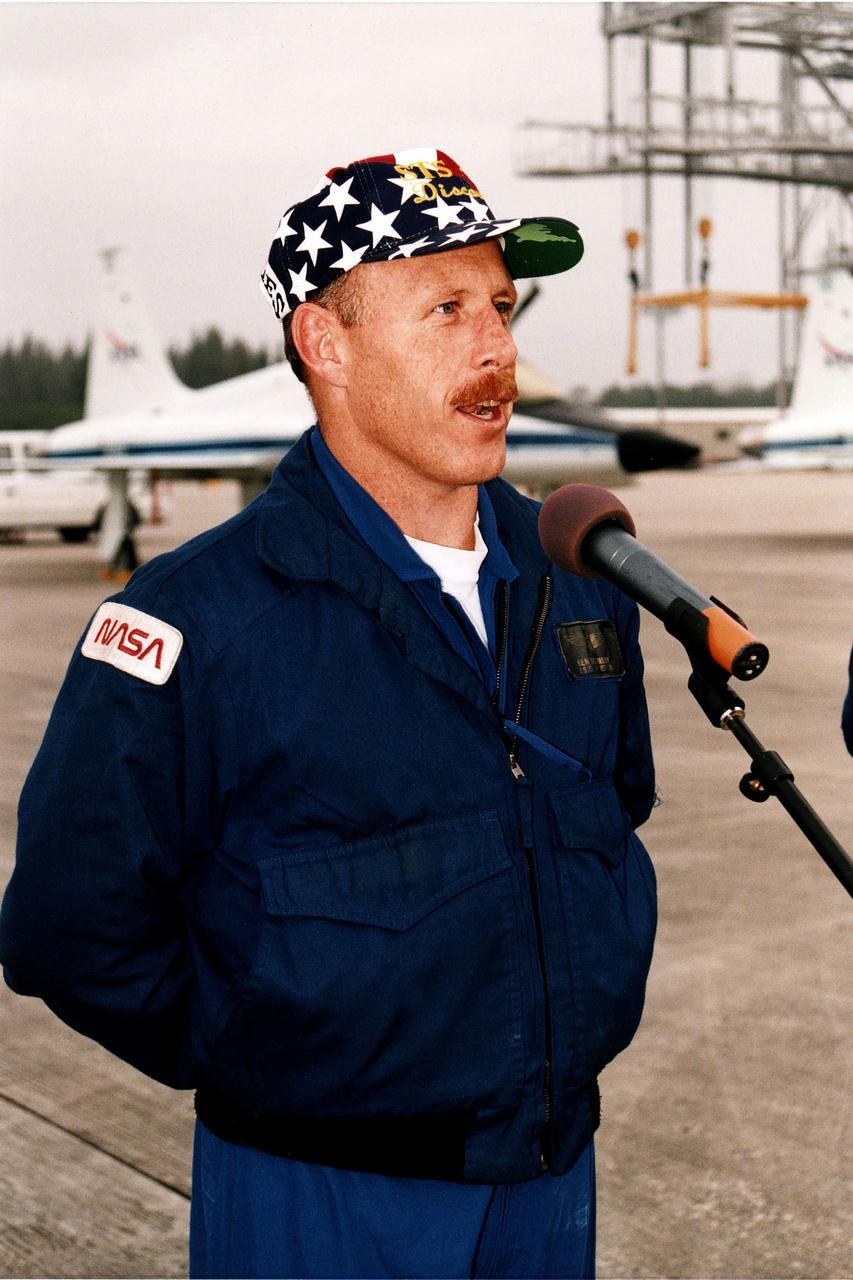
KENNEDY SPACE CENTER, FLA. -   STS-82 Mission Commander Kenneth D. Bowersox greets media representatives after arrival at KSC's Shuttle Landing Facility.  Bowersox and the other six members of the STS-82 crew came from their home base at Johnson Space Center in Houston, Texas, to spend the last few days before launch at KSC.  STS-82 is scheduled for liftoff on Feb. 11 during a 65-minute launch window that opens at 3:56 a.m. EST.  The 10-day flight aboard the Space Shuttle Discovery will be the second Hubble Space Telescope (HST) servicing mission.
KENNEDY SPACE CENTER, FLA. - STS-82 Mission Commander Kenneth D. Bowersox greets media representatives after arrival at KSC's Shuttle Landing Facility. Bowersox and the other six members of the STS-82 crew came from their home base at Johnson Space Center in Houston, Texas, to spend the last few days before launch at KSC. STS-82 is scheduled for liftoff on Feb. 11 during a 65-minute launch window that opens at 3:56 a.m. EST. The 10-day flight aboard the Space Shuttle Discovery will be the second Hubble Space Telescope (HST) servicing mission.
VANDENBERG AIR FORCE BASE, CALIF. -  The L-1011 carrier aircraft is in flight with its cargo underneath of the Pegasus launch vehicle and SciSat-1 spacecraft.  The SciSat-1 weighs approximately 330 pounds and after launch will be placed in a 400-mile-high polar orbit to investigate processes that control the distribution of ozone in the upper atmosphere. The data from the satellite will provide Canadian and international scientists with improved measurements relating to global ozone processes and help policymakers assess existing environmental policy and develop protective measures for improving the health of our atmosphere, preventing further ozone depletion. The mission is designed to last two years.
VANDENBERG AIR FORCE BASE, CALIF. - The L-1011 carrier aircraft is in flight with its cargo underneath of the Pegasus launch vehicle and SciSat-1 spacecraft. The SciSat-1 weighs approximately 330 pounds and after launch will be placed in a 400-mile-high polar orbit to investigate processes that control the distribution of ozone in the upper atmosphere. The data from the satellite will provide Canadian and international scientists with improved measurements relating to global ozone processes and help policymakers assess existing environmental policy and develop protective measures for improving the health of our atmosphere, preventing further ozone depletion. The mission is designed to last two years.
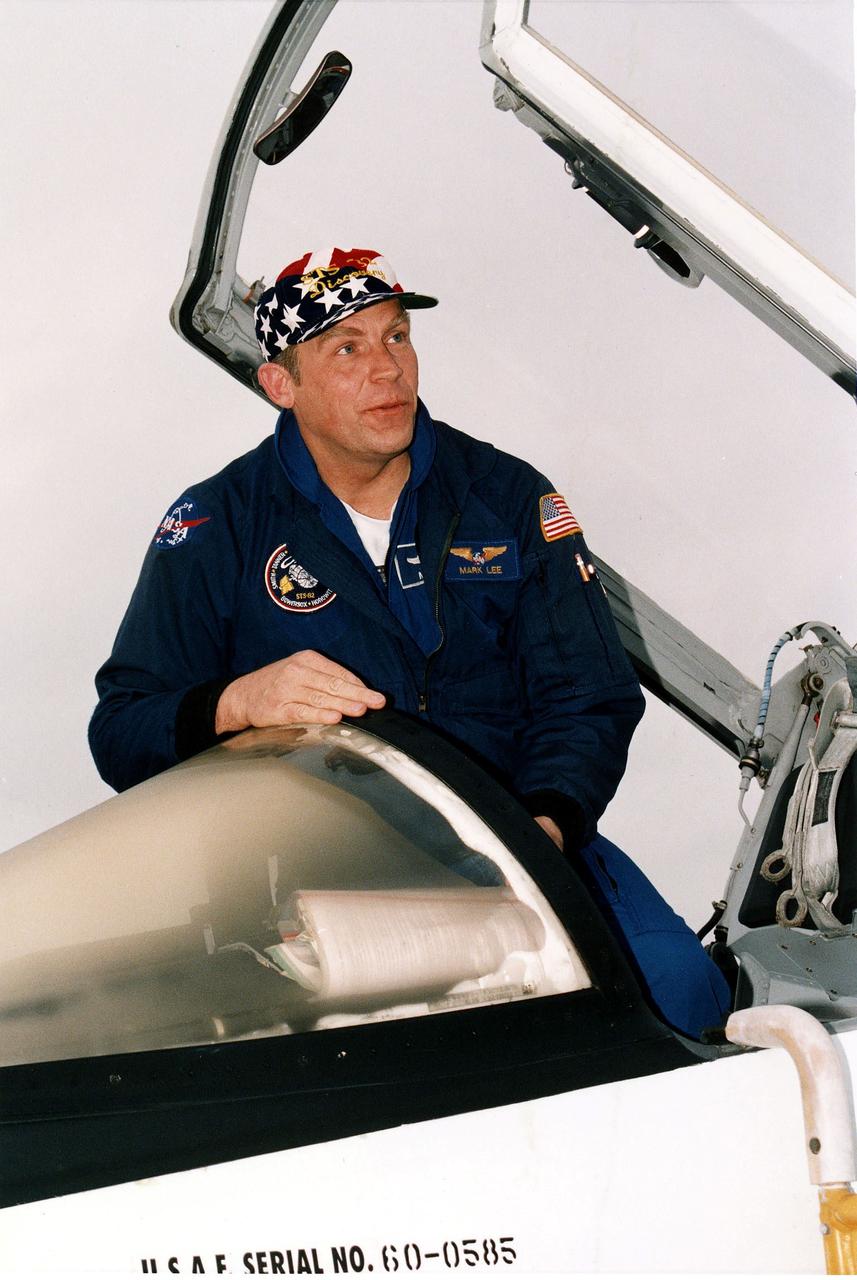
KENNEDY SPACE CENTER, FLA. -  STS-82 Payload Commander Mark C. Lee prepares to step down from the T-38 jet he flew from an air field serving the astronauts' home base at Johnson Space Center, Houston, Texas, to KSC's Shuttle Landing Facility.  Lee and the other six members of the STS-82 crew will spend the last few days before launch at KSC.  STS-82 is scheduled for liftoff on Feb. 11 during a 65-minute launch window that opens at 3:56 a.m. EST.  The 10-day flight aboard the Space Shuttle Discovery will be the second Hubble Space Telescope (HST) servicing mission.
KENNEDY SPACE CENTER, FLA. - STS-82 Payload Commander Mark C. Lee prepares to step down from the T-38 jet he flew from an air field serving the astronauts' home base at Johnson Space Center, Houston, Texas, to KSC's Shuttle Landing Facility. Lee and the other six members of the STS-82 crew will spend the last few days before launch at KSC. STS-82 is scheduled for liftoff on Feb. 11 during a 65-minute launch window that opens at 3:56 a.m. EST. The 10-day flight aboard the Space Shuttle Discovery will be the second Hubble Space Telescope (HST) servicing mission.
KENNEDY SPACE CENTER, FLA. -  STS-82 Pilot Scott J. "Doc" Horowitz flashes a wide grin for photographers after landing his T-38 jet at KSC's Shuttle Landing Facility.  Horowitz and the other six members of the STS-82 crew came from their home base at Johnson Space Center in Houston, Texas, to spend the last few days before launch at KSC.   STS-82 is scheduled for liftoff on Feb. 11 during a 65-minute launch window that opens at 3:56 a.m. EST.  The 10-day flight aboard the Space Shuttle Discovery will be the second Hubble Space Telescope (HST) servicing mission.
KENNEDY SPACE CENTER, FLA. - STS-82 Pilot Scott J. "Doc" Horowitz flashes a wide grin for photographers after landing his T-38 jet at KSC's Shuttle Landing Facility. Horowitz and the other six members of the STS-82 crew came from their home base at Johnson Space Center in Houston, Texas, to spend the last few days before launch at KSC. STS-82 is scheduled for liftoff on Feb. 11 during a 65-minute launch window that opens at 3:56 a.m. EST. The 10-day flight aboard the Space Shuttle Discovery will be the second Hubble Space Telescope (HST) servicing mission.
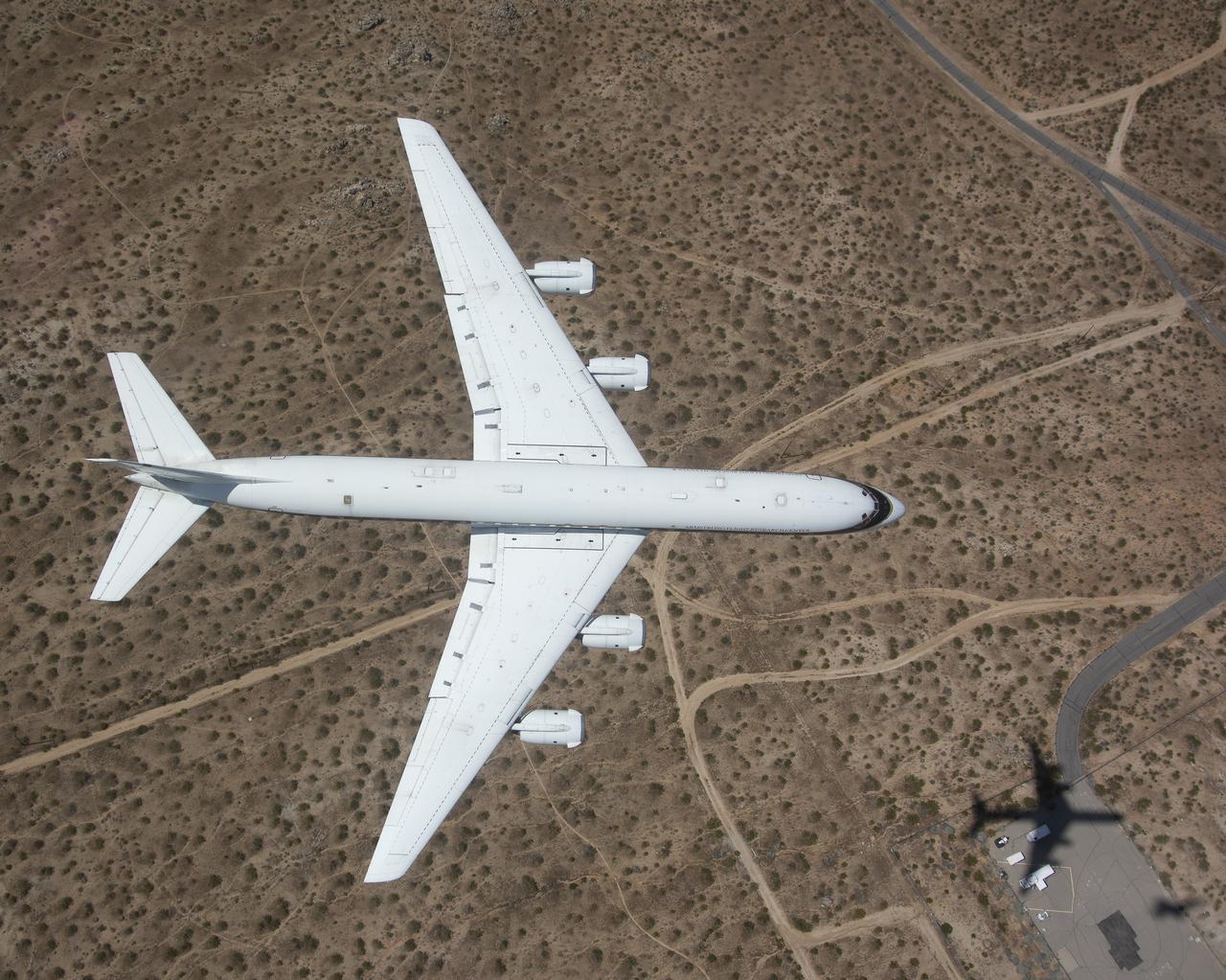
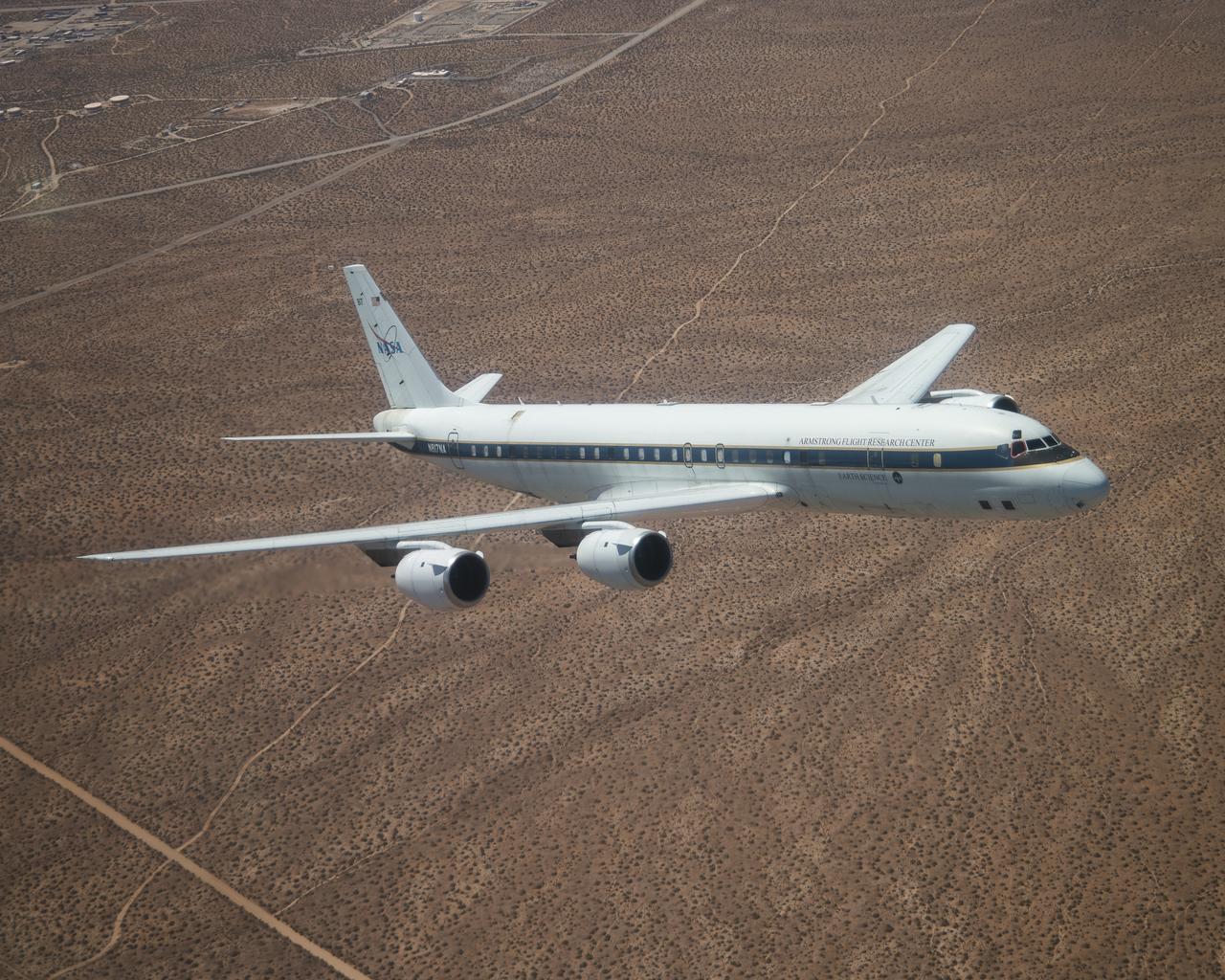
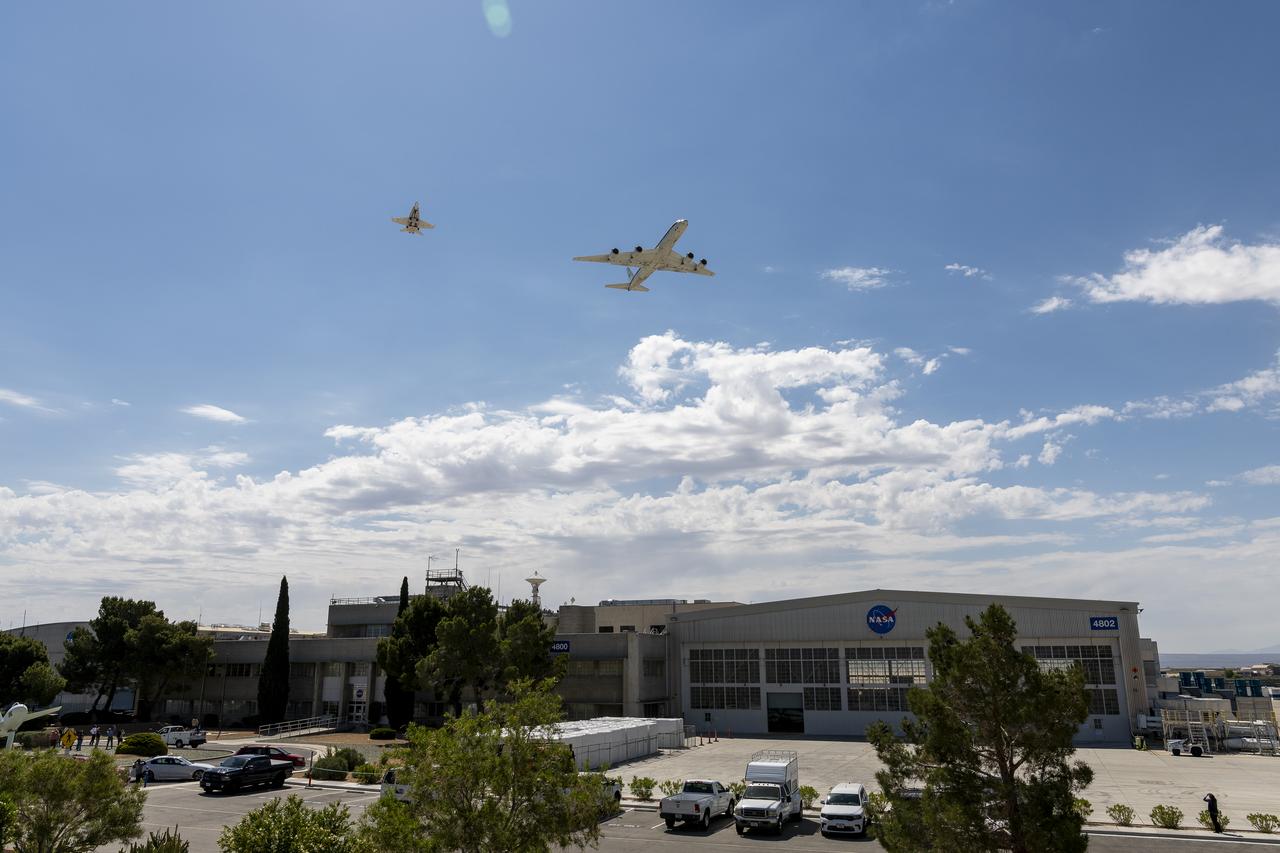
The DC-8 flies low for the last time over NASA’s Armstrong Flight Research Center in Edwards, California, before it retires to Idaho State University in Pocatello, Idaho. The DC-8 will provide real-world experience to train future aircraft technicians at the college’s Aircraft Maintenance Technology Program.
NASA Bids Farewell to DC-8
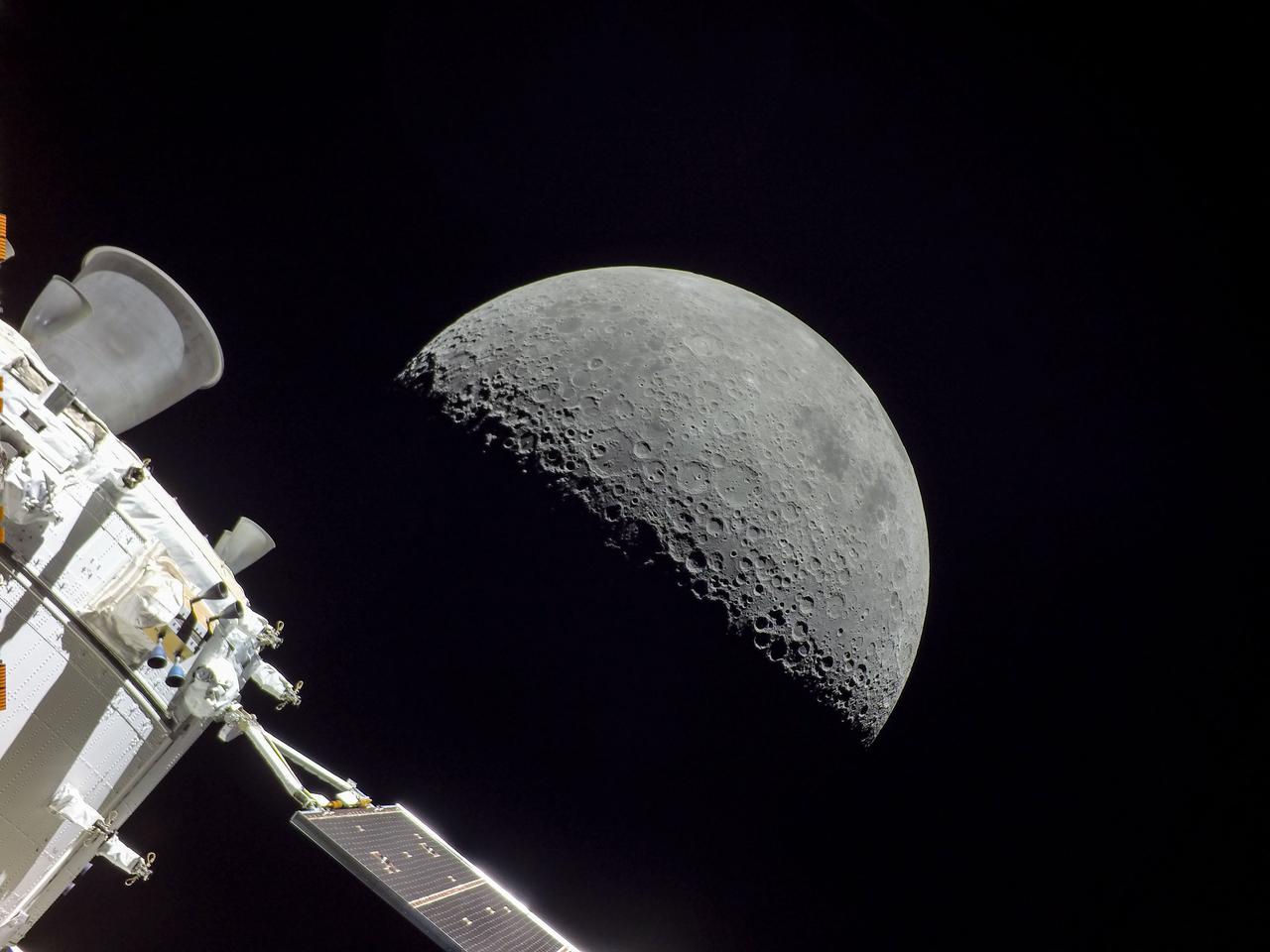
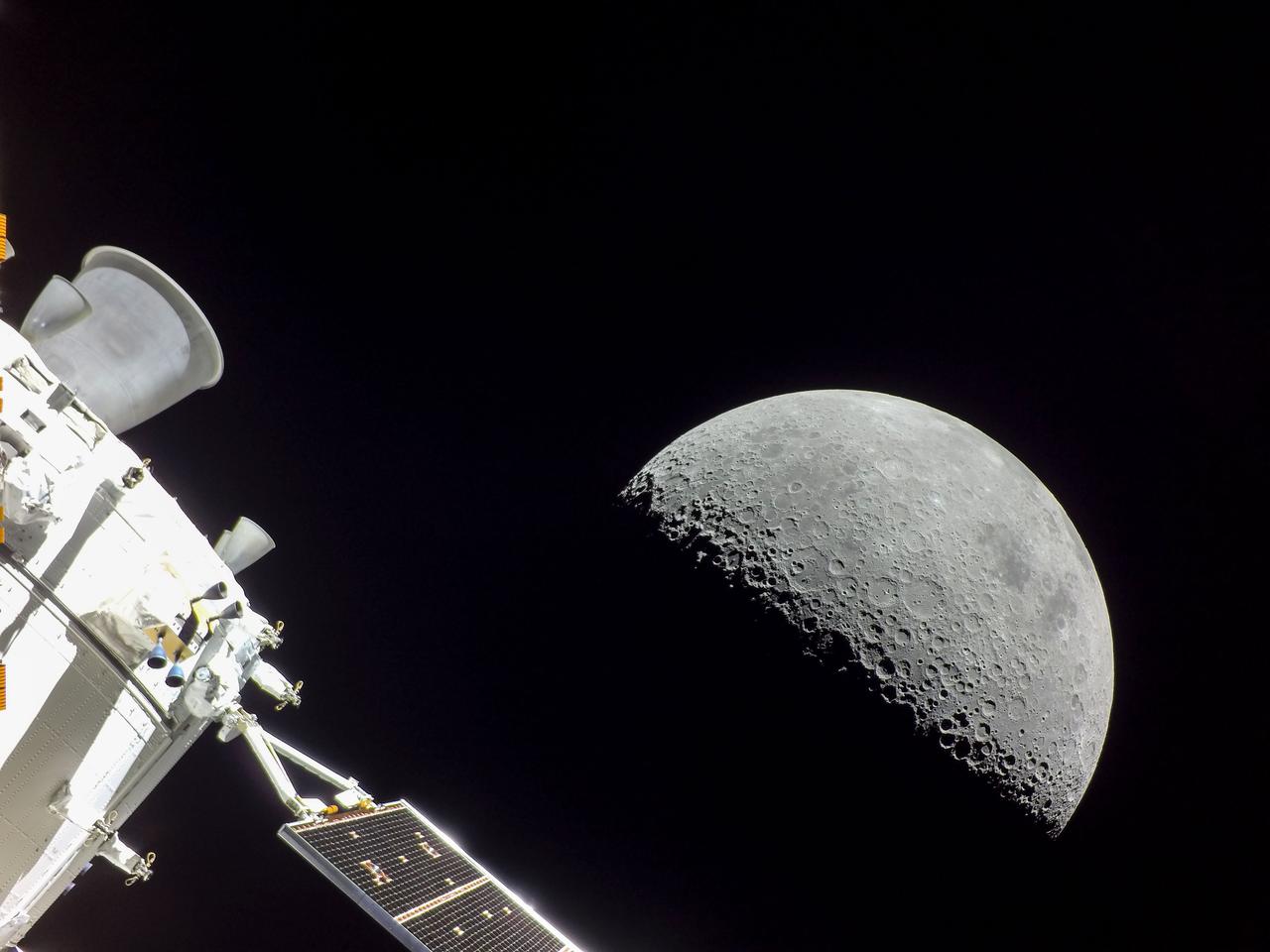
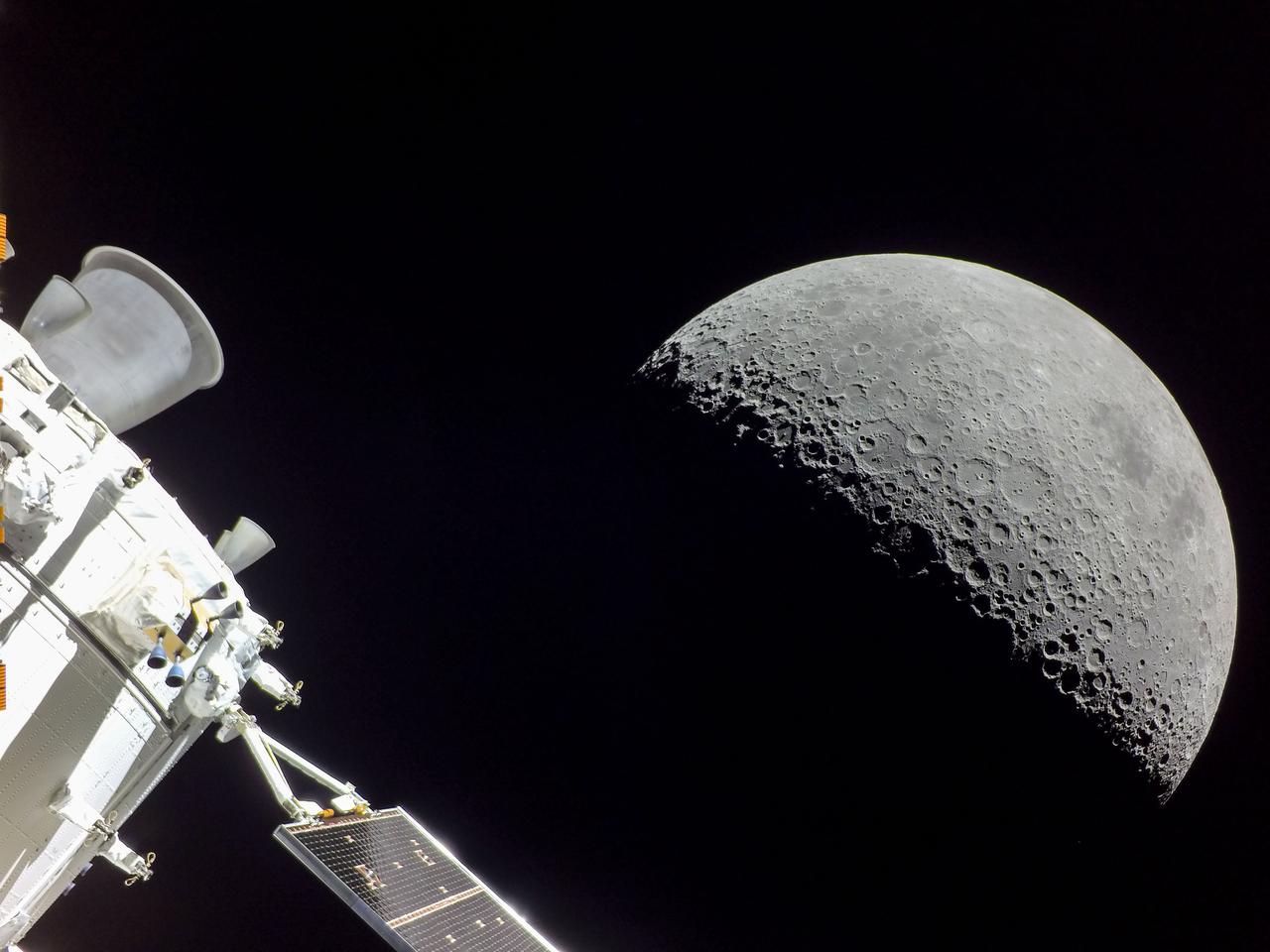
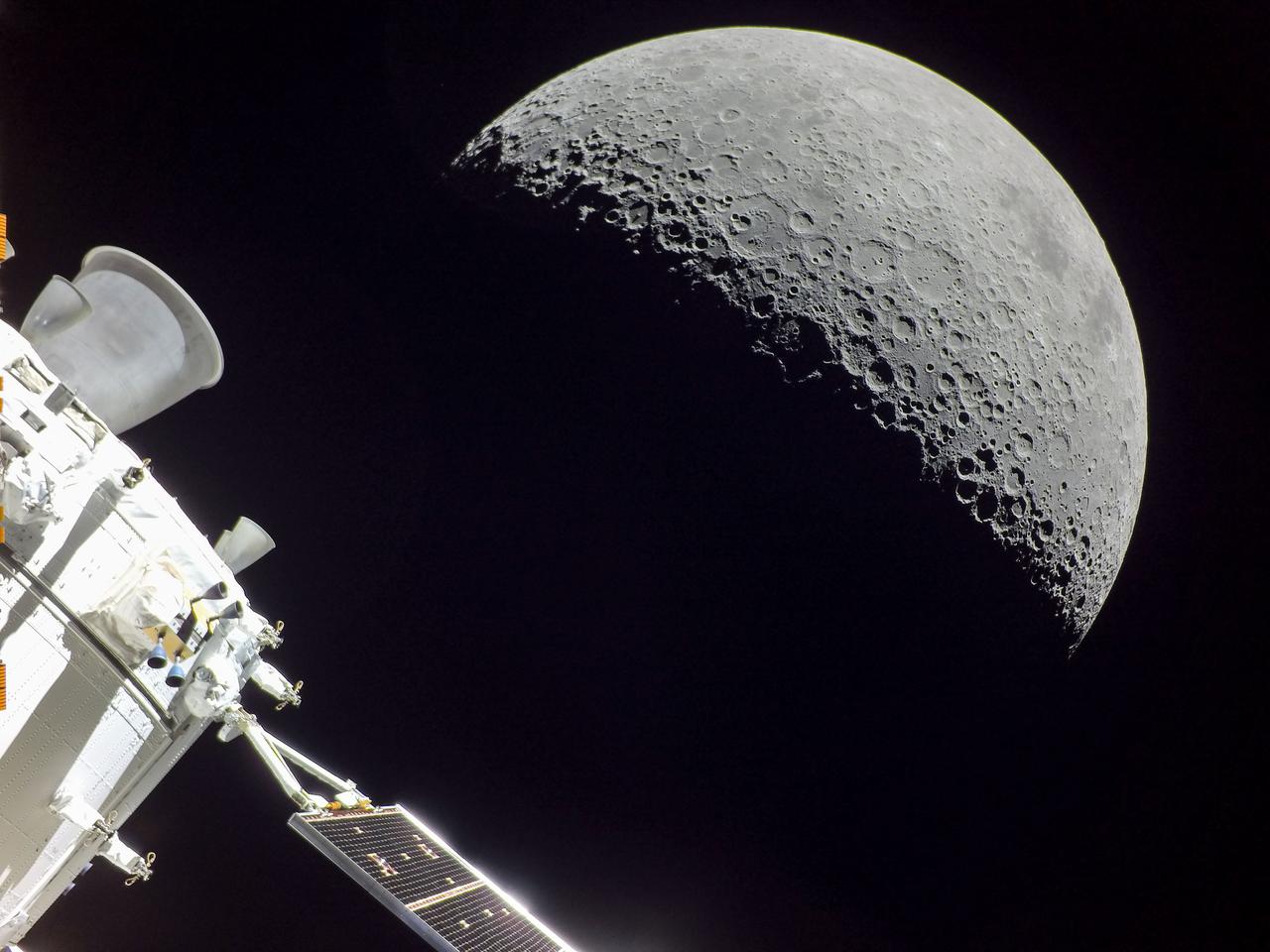
art001e002071 (Dec. 5, 2022) On flight day 20 of the Artemis I mission, Orion captured the Moon on the day of return powered flyby. The burn, which lasted 3 minutes, 27 seconds, committed the spacecraft to a Dec. 11 splashdown.
Flight Day 20: Orion and Our Moon
art001e002070 (Dec. 5, 2022) On flight day 20 of the Artemis I mission, Orion captured the Moon on the day of return powered flyby. The burn, which lasted 3 minutes, 27 seconds, committed the spacecraft to a Dec. 11 splashdown.
Flight Day 20: Orion and Our Moon
The DC-8 flies low for the last time over NASA’s Armstrong Flight Research Center in Edwards, California, before it retires to Idaho State University in Pocatello, Idaho. The DC-8 will provide real-world experience to train future aircraft technicians at the college’s Aircraft Maintenance Technology Program.
NASA Bids Farewell to DC-8
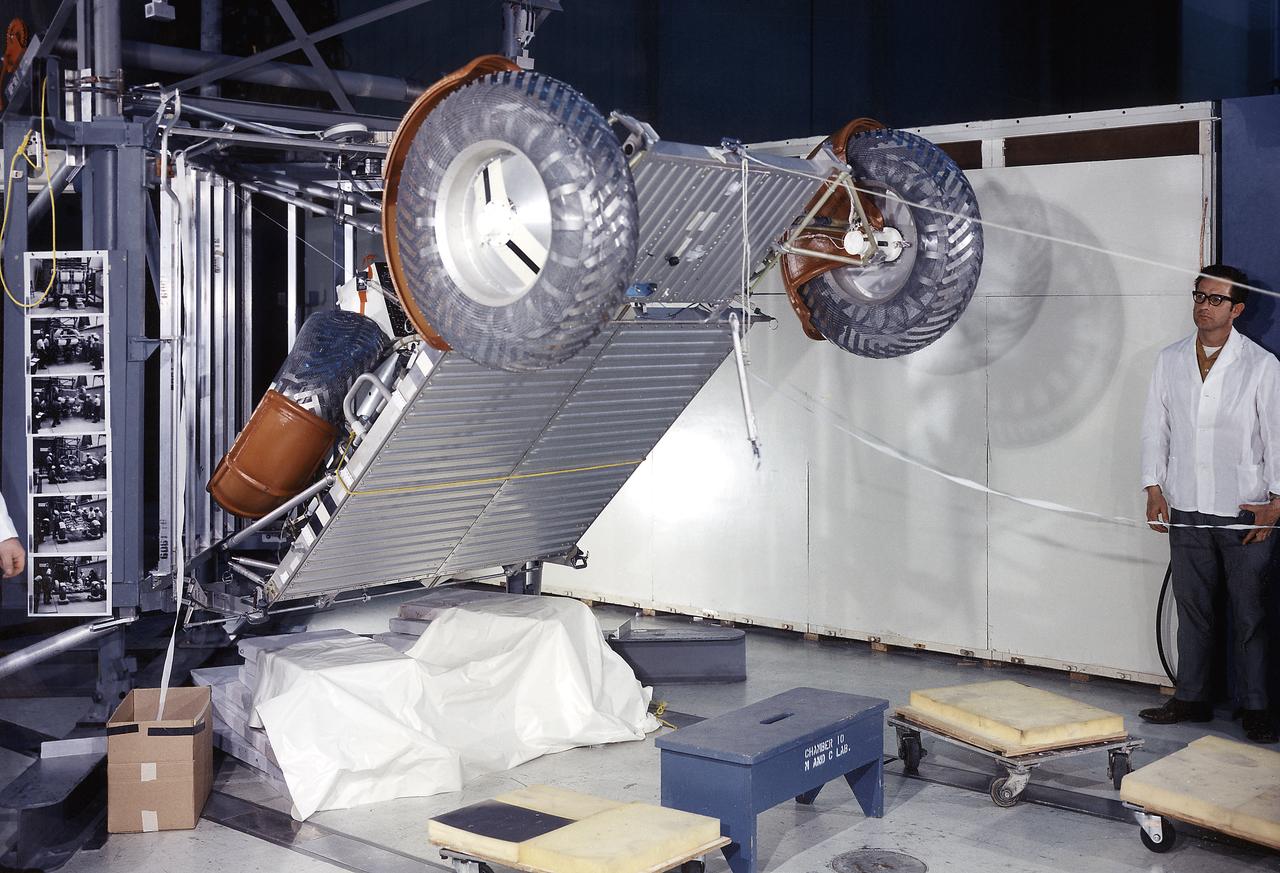
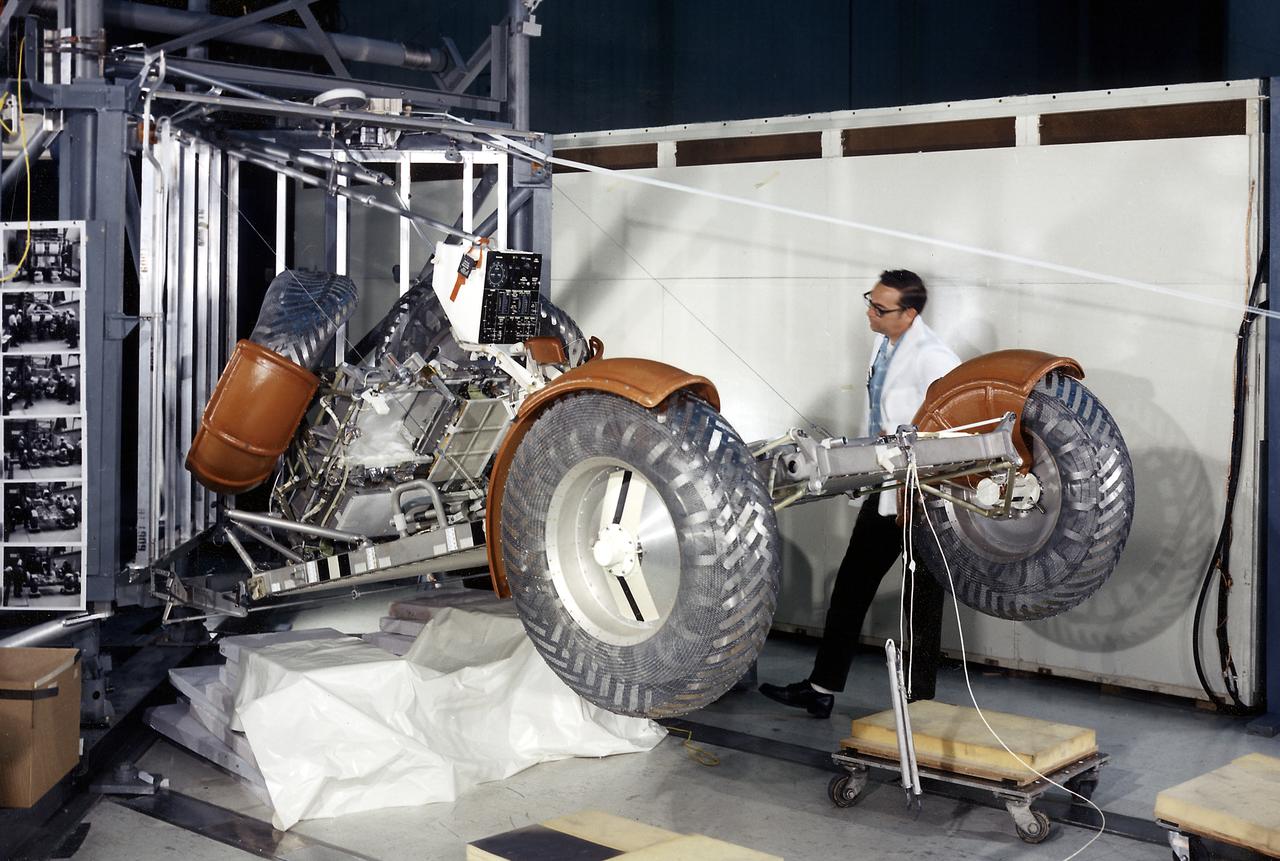
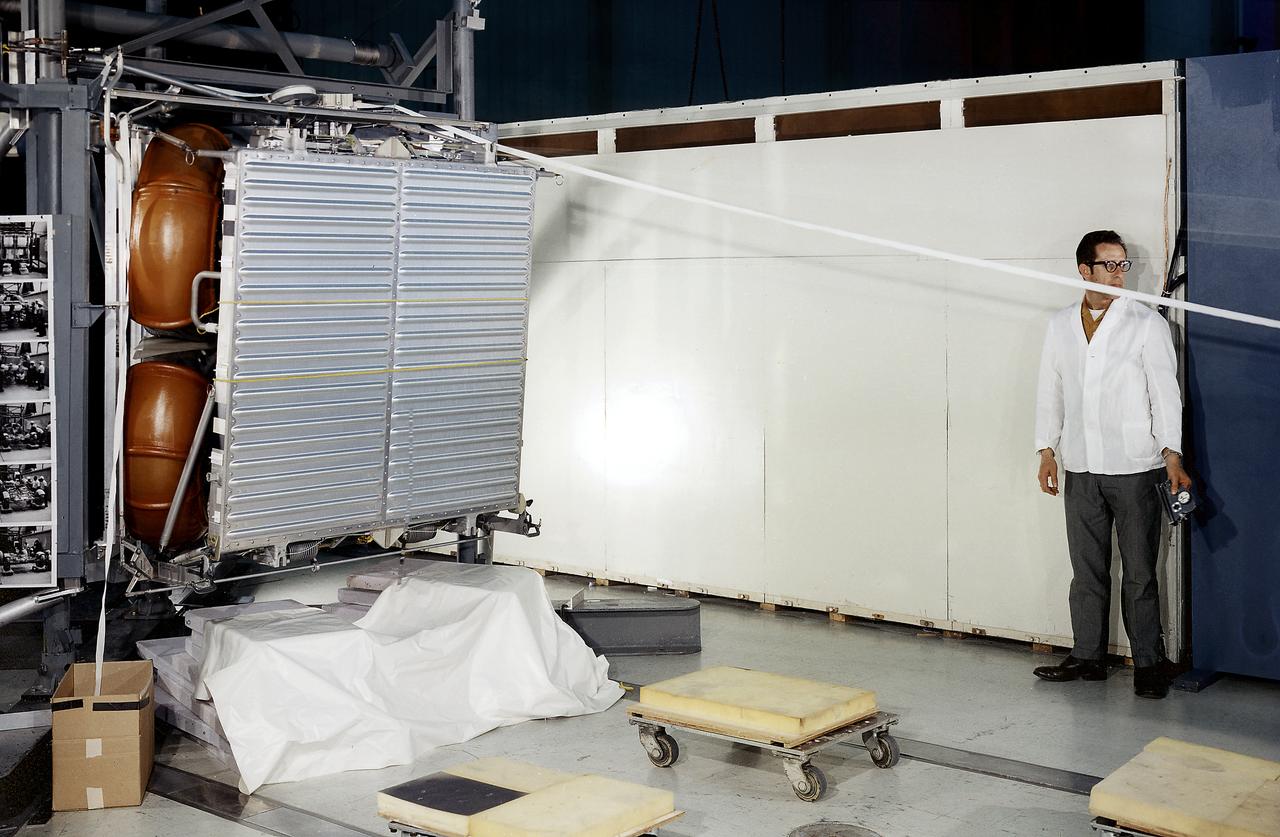
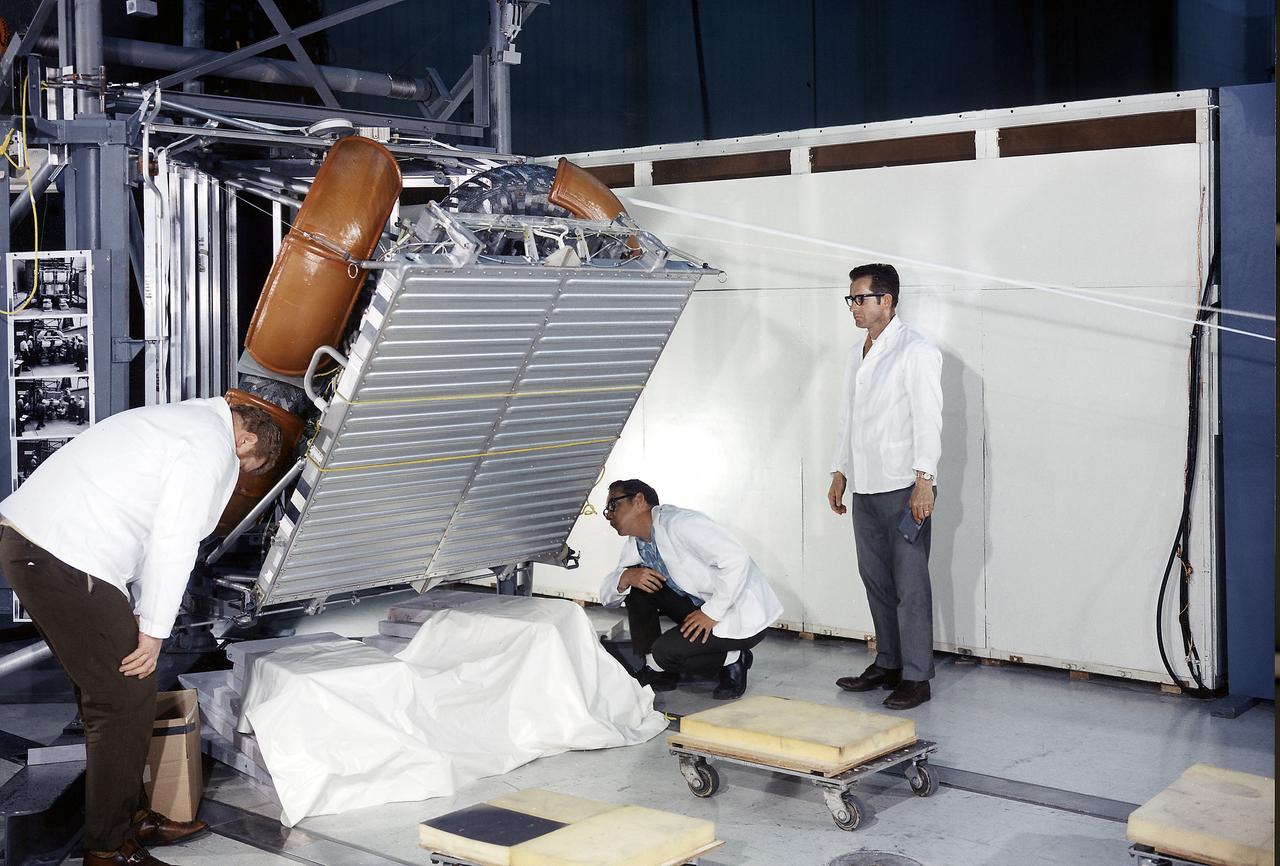
This photograph was taken during a deployment simulation of the Lunar Roving Vehicle (LRV). The LRV was built to give Apollo astronauts a greater range of mobility during the last three lunar exploration missions; Apollo 15, Apollo 16, and Apollo 17. It was designed and developed by the Marshall Space Flight Center and built by the Boeing Company.
Saturn Apollo Program
This photograph was taken during a deployment simulation of the Lunar Roving Vehicle (LRV). The LRV was built to give Apollo astronauts a greater range of mobility during the last three lunar exploration missions; Apollo 15, Apollo 16, and Apollo 17. It was designed and developed by the Marshall Space Flight Center and built by the Boeing Company.
Saturn Apollo Program
The DC-8 flies for the last time from NASA’s Armstrong Flight Research Center Building 703 in Palmdale, California, to Idaho State University in Pocatello, Idaho. The DC-8 will provide real-world experience to train future aircraft technicians at the college’s Aircraft Maintenance Technology Program.
NASA’s DC-8 Conducts Final Flight
This photograph was taken during a deployment simulation of the Lunar Roving Vehicle (LRV). The LRV was built to give Apollo astronauts a greater range of mobility during the last three lunar exploration missions; Apollo 15, Apollo 16, and Apollo 17. It was designed and developed by the Marshall Space Flight Center and built by the Boeing Company.
Saturn Apollo Program
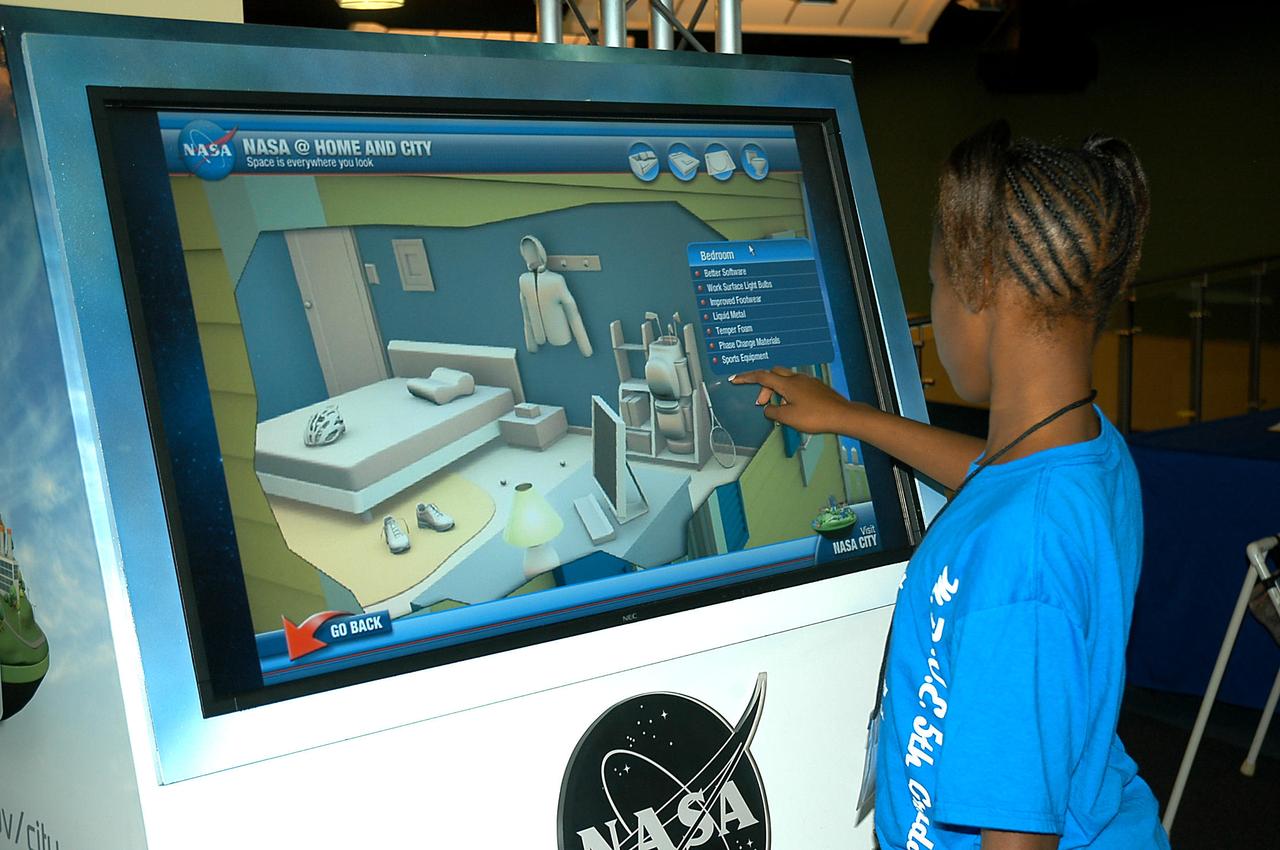
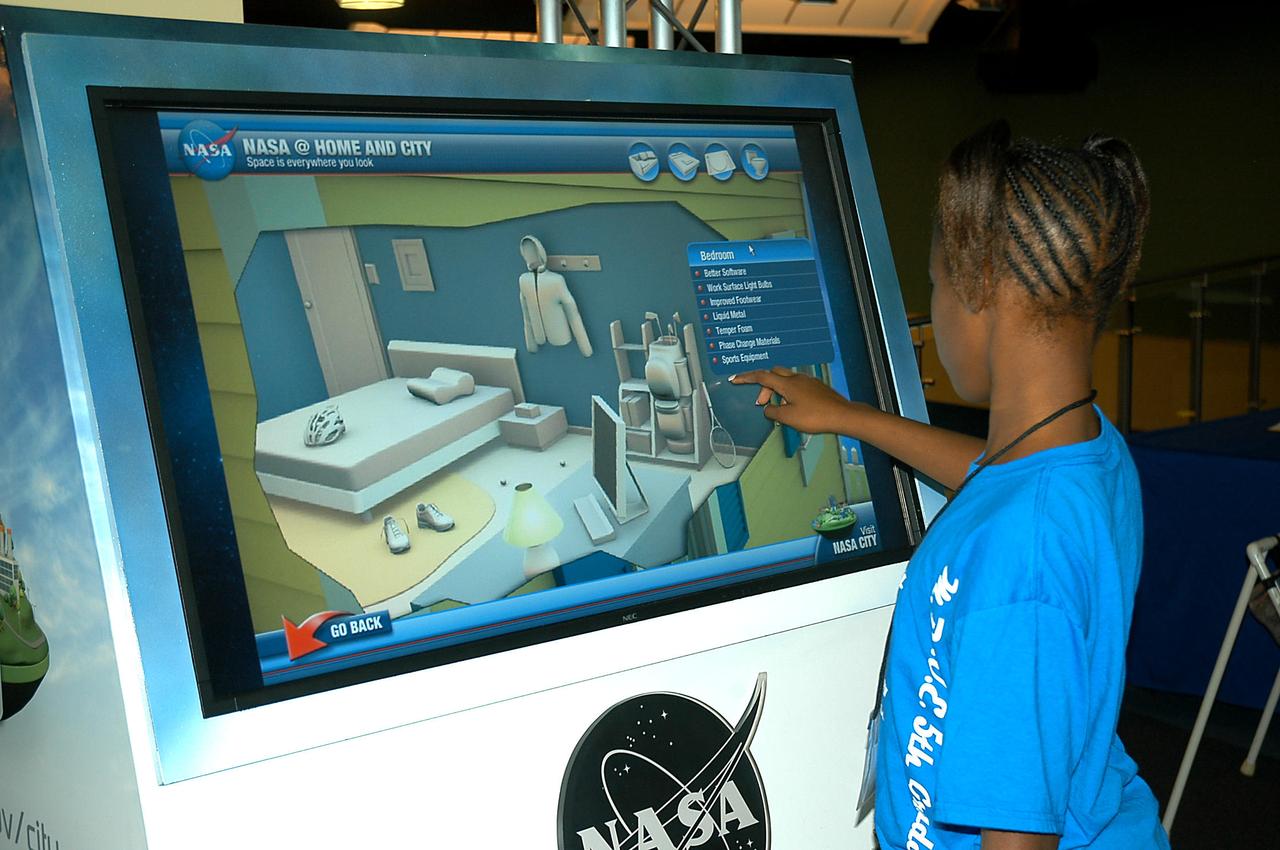
Escatawpa Elementary School student Danisha Dillon of Moss Point, Miss., learns about NASA at the Home and City interactive exhibit at INFINITY Science Center, a NASA visitors center. The facility hosted two days of activity to celebrate the 40th anniversary of the Apollo 17 flight, the last manned space mission to the moon.
Apollo 17 celebration
art001e002069 (Dec. 5, 2022) On flight day 20 of the Artemis I mission, Orion captured the Moon on the day of return powered flyby. The burn, which lasted 3 minutes, 27 seconds, committed the spacecraft to a Dec. 11 splashdown.
Flight Day 20: Orion and Our Moon
art001e002067 (Dec. 5, 2022) On flight day 20 of the Artemis I mission, Orion captured the Moon on the day of return powered flyby. The burn, which lasted 3 minutes, 27 seconds, committed the spacecraft to a Dec. 11 splashdown.
Flight Day 20: Orion and Our Moon
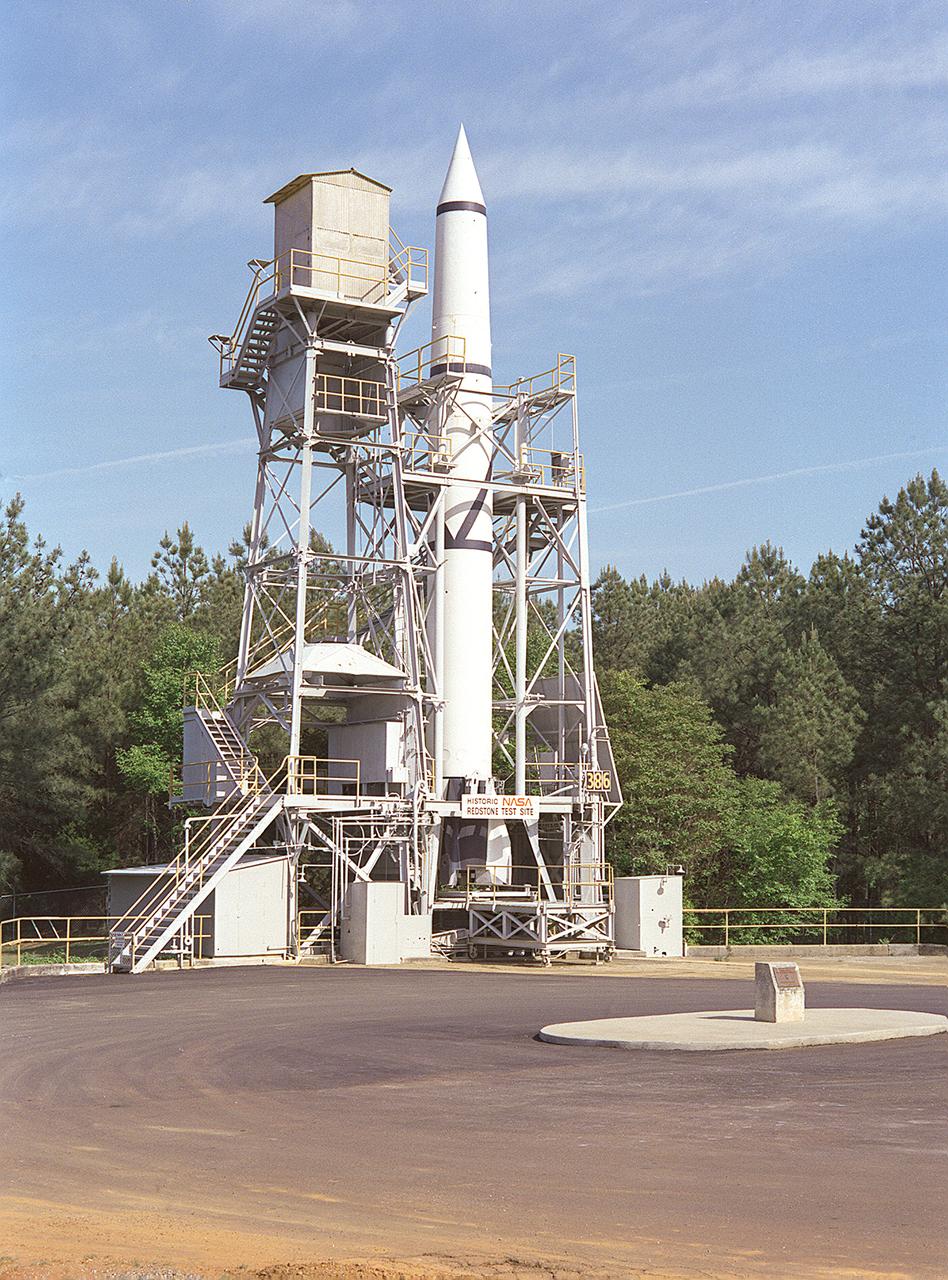
The Redstone Test Stand was used during the 1950s in early development of the Redstone missile propulsion system. This was the test stand where the modified Redstone missile that launched into space the first American, Alan Shepard, was static tested as the last step before the flight occurred.
Mercury Project
Astronaut L. Gordon Cooper, Jr., one of the original seven astronauts for Mercury Project selected by NASA on April 27, 1959. The MA-9 mission, boosted by the Mercury-Atlas launch vehicle, was the last flight of the Mercury Project. The Faith 7 spacecraft orbited the Earth 22 times in 1-1/2 days.
Mercury Project
The DC-8 flies for the last time from NASA’s Armstrong Flight Research Center Building 703 in Palmdale, California, before it retires to Idaho State University in Pocatello, Idaho. The DC-8 will provide real-world experience to train future aircraft technicians at the college’s Aircraft Maintenance Technology Program.
NASA’s DC-8 Conducts Final Flight
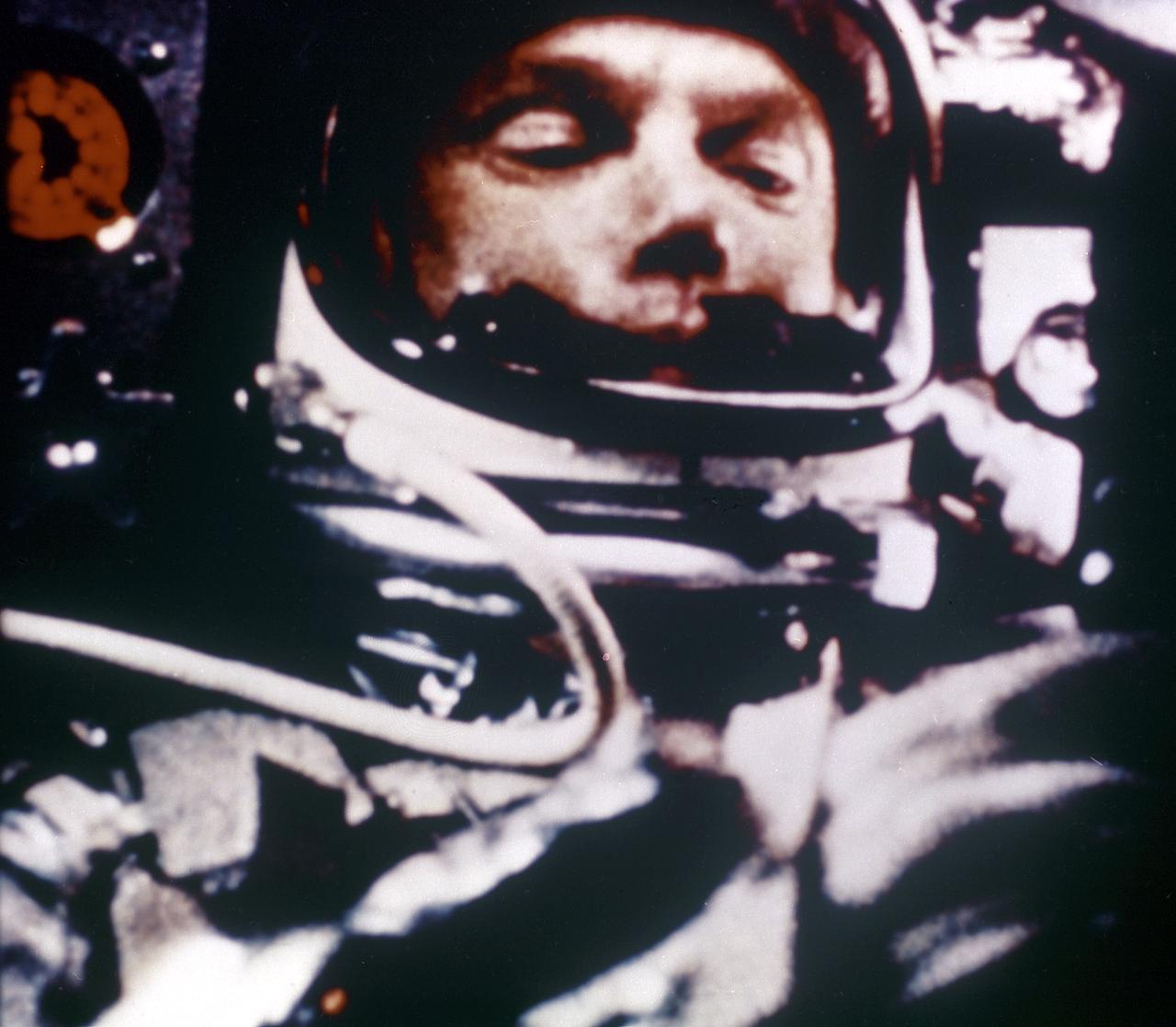
Astronaut John Glenn in the Friendship 7 capsule during the first manned orbital flight, the MA-6 mission. Boosted by the Mercury-Atlas vehicle, a modified Atlas (intercontinental ballistic missile), the MA-6 mission lasted for 5 hours and orbited the Earth three times.
Mercury Project
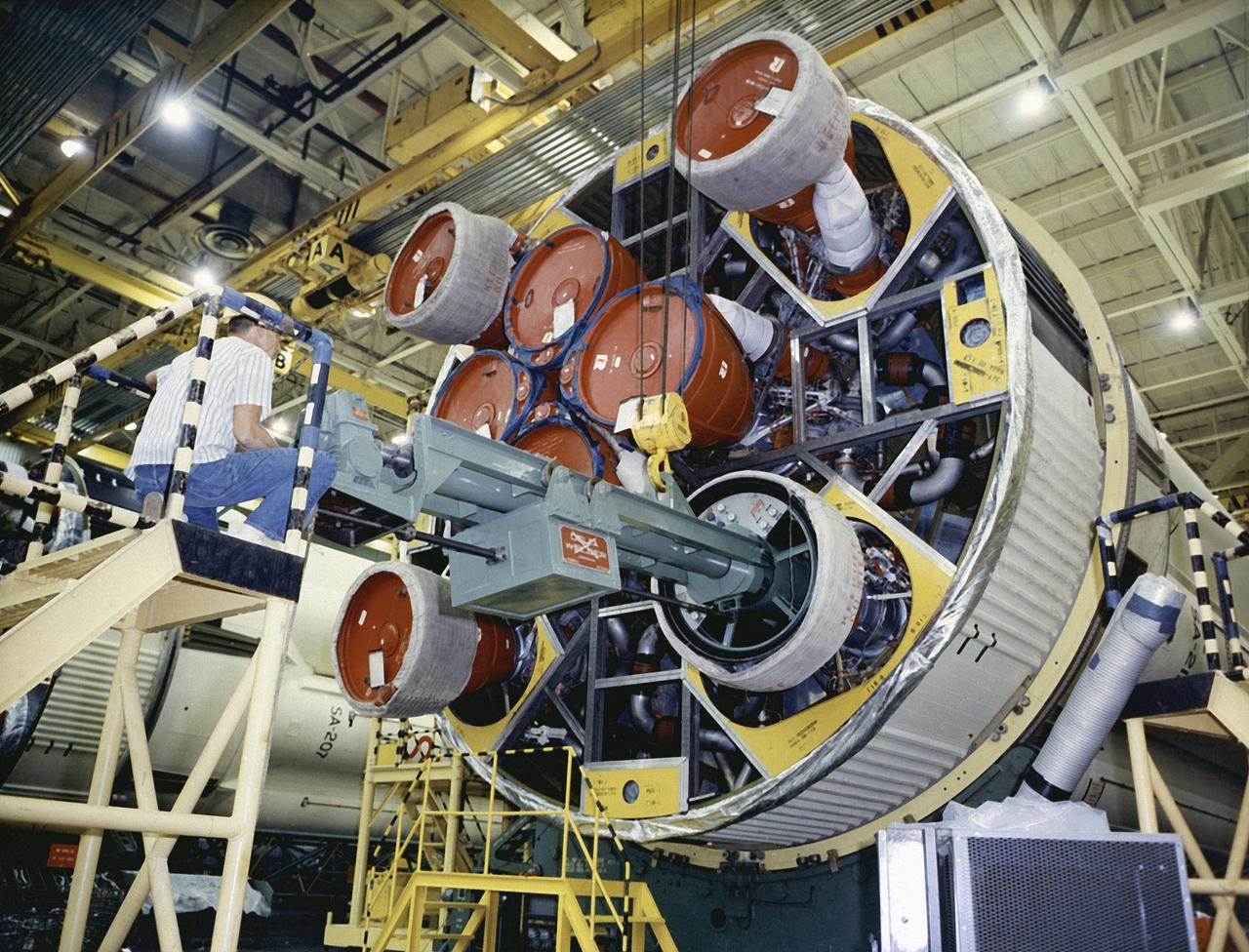
Workers at the Michoud Assembly Facility (MAF) near New Orleans, Louisiana, install the last engine on the S-IB stage. Developed by the Marshall Space Flight Center (MSFC) and built by the Chrysler Corporation at MAF, the S-IB stage utilized eight H-1 engines to produce a combined thrust of 1,600,000 pounds.
Saturn Apollo Program
The DC-8 flies for the last time from NASA’s Armstrong Flight Research Center Building 703 in Palmdale, California, before it retires to Idaho State University in Pocatello, Idaho. The DC-8 will provide real-world experience to train future aircraft technicians at the college’s Aircraft Maintenance Technology Program.
NASA’s DC-8 Flies for Last Time
Escatawpa Elementary School student Danisha Dillon of Moss Point, Miss., learns about NASA at the Home and City interactive exhibit at INFINITY Science Center, a NASA visitors center. The facility hosted two days of activity to celebrate the 40th anniversary of the Apollo 17 flight, the last manned space mission to the moon.
Apollo 17 celebration
This photograph was taken during a deployment simulation of the Lunar Roving Vehicle (LRV). The LRV was built to give Apollo astronauts a greater range of mobility during the last three lunar exploration missions; Apollo 15, Apollo 16, and Apollo 17. It was designed and developed by the Marshall Space Flight Center and built by the Boeing Company.
Saturn Apollo Program
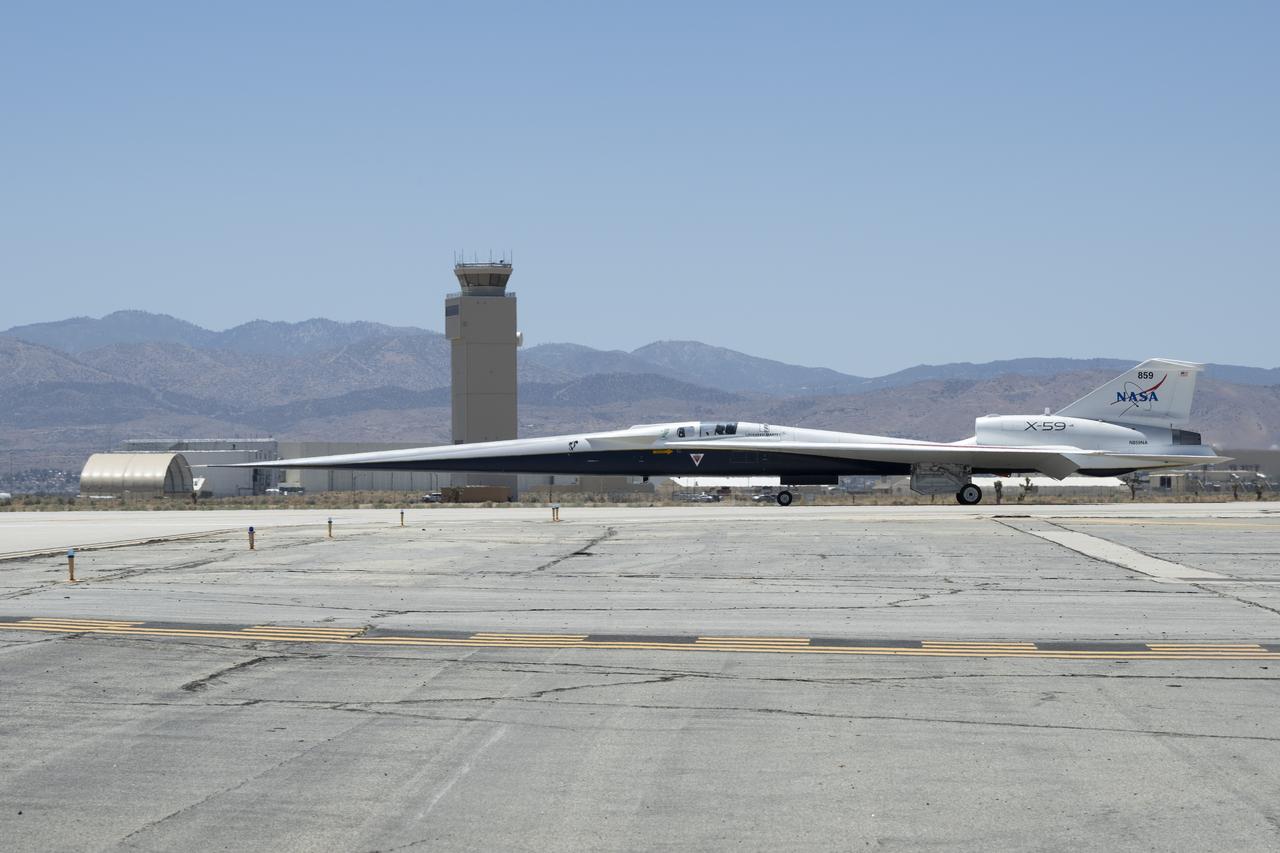
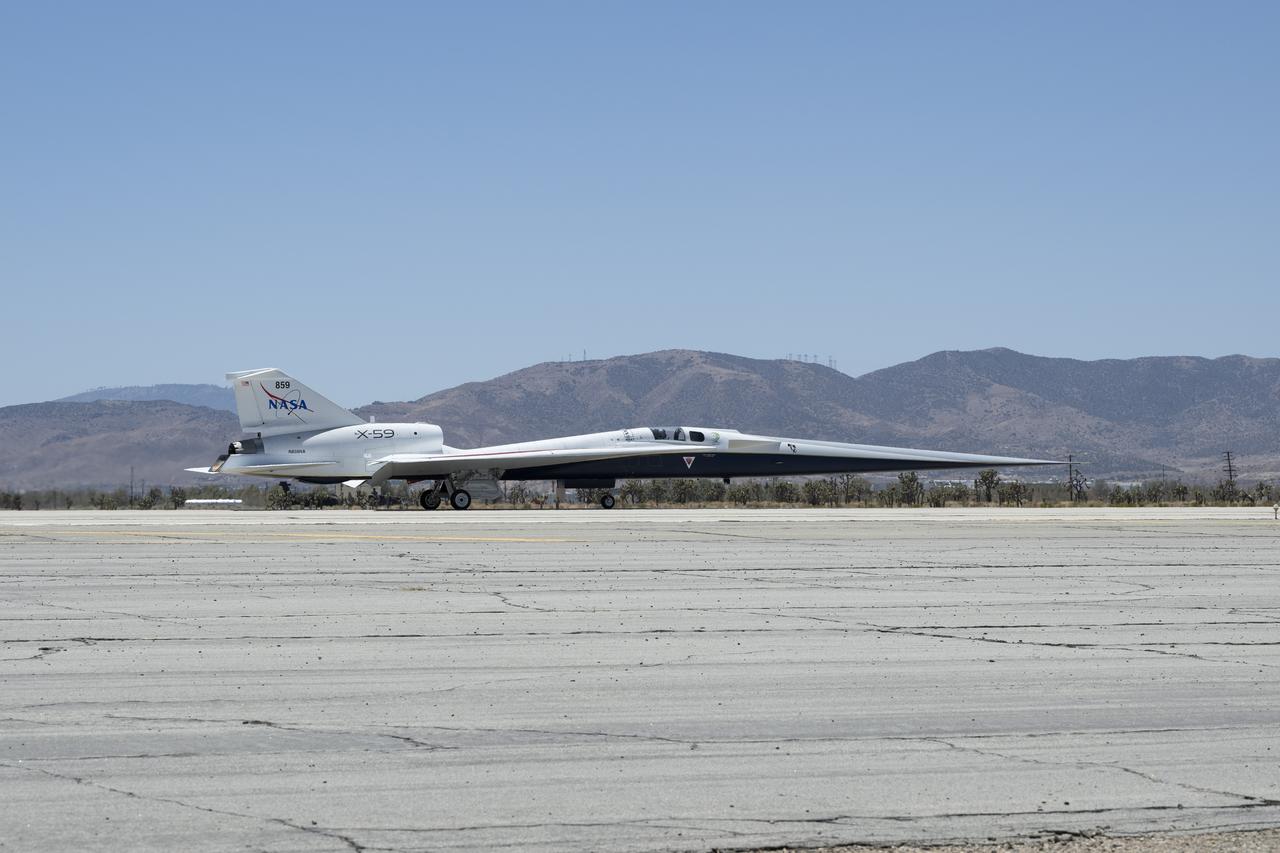
NASA’s X-59 quiet supersonic research aircraft taxis across the runway during a low-speed taxi test at U.S. Air Force Plant 42 in Palmdale, California, on July 10, 2025. The test marks the start of taxi tests and the last series of ground tests before first flight.
NASA’s X-59 Begins Taxi Tests
NASA’s X-59 quiet supersonic research aircraft taxis across the runway during a low-speed taxi test at U.S. Air Force Plant 42 in Palmdale, California, on July 10, 2025. The test marks the start of taxi tests and the last series of ground tests before first flight.
NASA’s X-59 Begins Taxi Tests
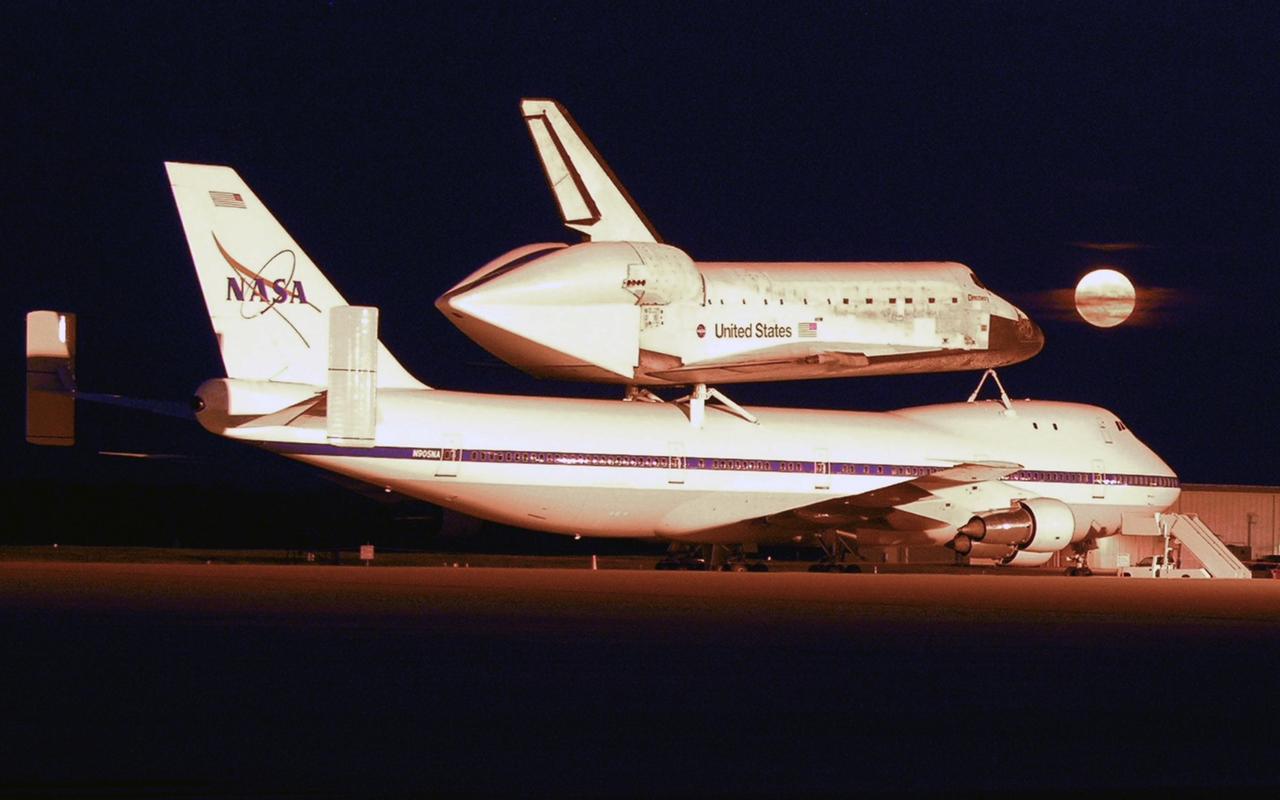
OFFUTT FIELD, NEB. -- The shuttle carrier aircraft, or SCA, and its piggyback passenger Atlantis are captured in the light of a full moon after landing at Offutt Field on the ferry flight from California to Florida.  Atlantis landed at Edwards Air Force Base in California to end mission STS-117. Touchdown was at 8:27 a.m. EDT. The SCA is a modified Boeing 747 jetliner.  The return to KSC began July 1 and took three days after stops across the country for fuel. The last stop was at Ft. Campbell in Kentucky. Weather conditions over the last leg postponed the return trip until July 3. Photo credit: NASA/Casey Wood
KSC-07pd2044
S62-00957 (20 Feb. 1962) --- Project Mercury astronaut John H. Glenn Jr., enters the Friendship 7 spacecraft during the last part of the countdown on Feb. 20, 1962. At 9:47 a.m. (EST), the Atlas launch vehicle lifted the spacecraft into orbit for a three-orbit mission lasting four hours, 55 minutes and 23 seconds. Glenn and his spacecraft were recovered by the destroyer Noa just 21 minutes after landing in the Atlantic near Grand Turk Island, to successfully complete the nation's first manned orbital flight. Photo credit: NASA
View of Astronaut John Glenn insertion into the Mercury Spacecraft
S85-26952 (20 Feb. 1962) --- Project Mercury astronaut John H. Glenn Jr., enters the Friendship 7 spacecraft during the last part of the countdown on Feb. 20, 1962. At 9:47 a.m. (EST), the Atlas launch vehicle lifted the spacecraft into orbit for a three-orbit mission lasting four hours, 55 minutes and 23 seconds. Glenn and his spacecraft were recovered by the destroyer Noa just 21 minutes after landing in the Atlantic near Grand Turk Island, to successfully complete the nation's first manned orbital flight. Photo credit: NASA
MERCURY-ATLAS (MA)-6 - LAUNCH (INGRESS)
At the Cosmonaut Hotel crew quarters in Baikonur, Kazakhstan, Expedition 59 crewmember Christina Koch of NASA (right) waters a tree March 7 originally planted last October by crewmate Alexey Ovchinin (center). Ovchinin and crewmate Nick Hague of NASA (left) launched together last October 11, but their flight was cut short two minutes after launch by an abort triggered by a first-stage booster rocket separation problem. They are set to launch again March 14, U.S. time, this time with Koch on the Soyuz MS-12 spacecraft from the Baikonur Cosmodrome for a six-and-a-half month mission on the International Space Station...NASA/Victor Zelentsov.
jsc2019e013060
NEW ORLEANS -- Workers escort the Space Shuttle Program's last external fuel tank, ET-122, to the Pegasus Barge at NASA's Michoud Assembly Facility in New Orleans. The tank will travel 900 miles aboard the Pegasus Barge to NASA's Kennedy Space Center in Florida where it will be integrated to space shuttle Endeavour for the STS-134 mission to the International Space Station. STS-134, targeted to launch in 2011, currently is scheduled to be the last mission in the Space Shuttle Program.    The tank, which is the largest element of the space shuttle stack, was damaged during Hurricane Katrina in August 2005 and restored to flight configuration by Lockheed Martin Space Systems Company employees. Photo credit: NASA/Kim Shiflett
KSC-2010-4747
NEW ORLEANS -- The Space Shuttle Program's last external fuel tank, ET-122, is loaded onto the Pegasus Barge at NASA's Michoud Assembly Facility in New Orleans. The tank will travel 900 miles to NASA's Kennedy Space Center in Florida where it will be integrated to space shuttle Endeavour for the STS-134 mission to the International Space Station. STS-134, targeted to launch in 2011, currently is scheduled to be the last mission in the Space Shuttle Program.    The tank, which is the largest element of the space shuttle stack, was damaged during Hurricane Katrina in August 2005 and restored to flight configuration by Lockheed Martin Space Systems Company employees. Photo credit: NASA/Kim Shiflett
KSC-2010-4748
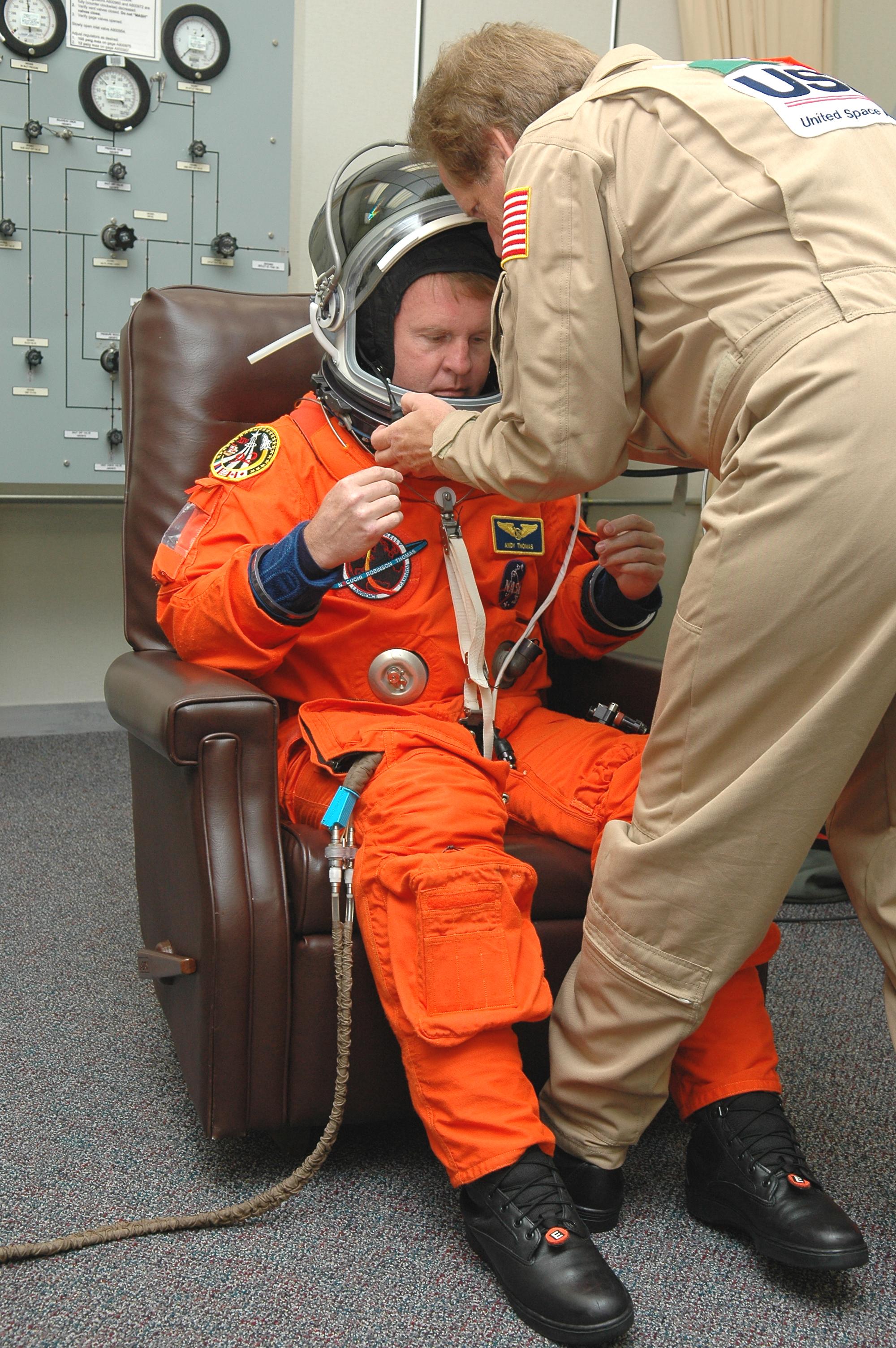
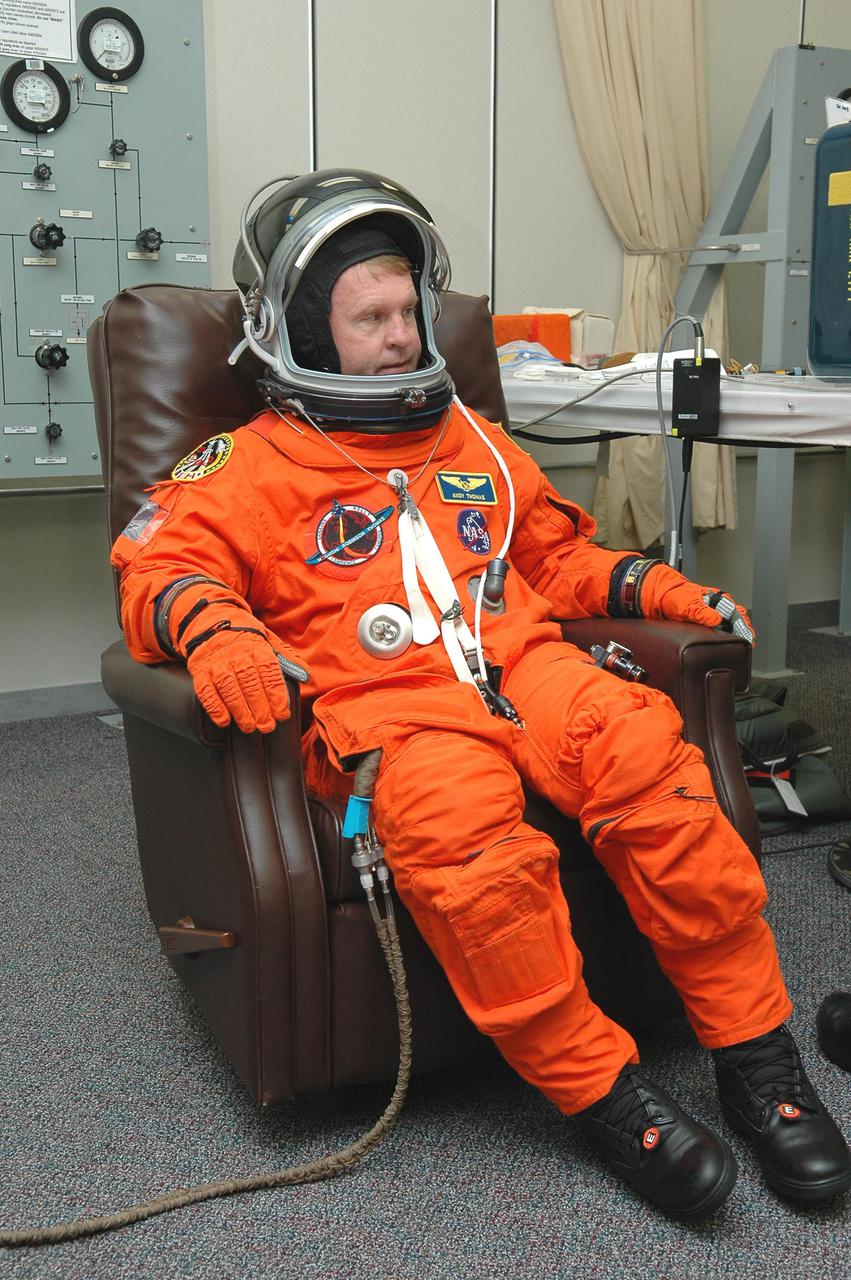
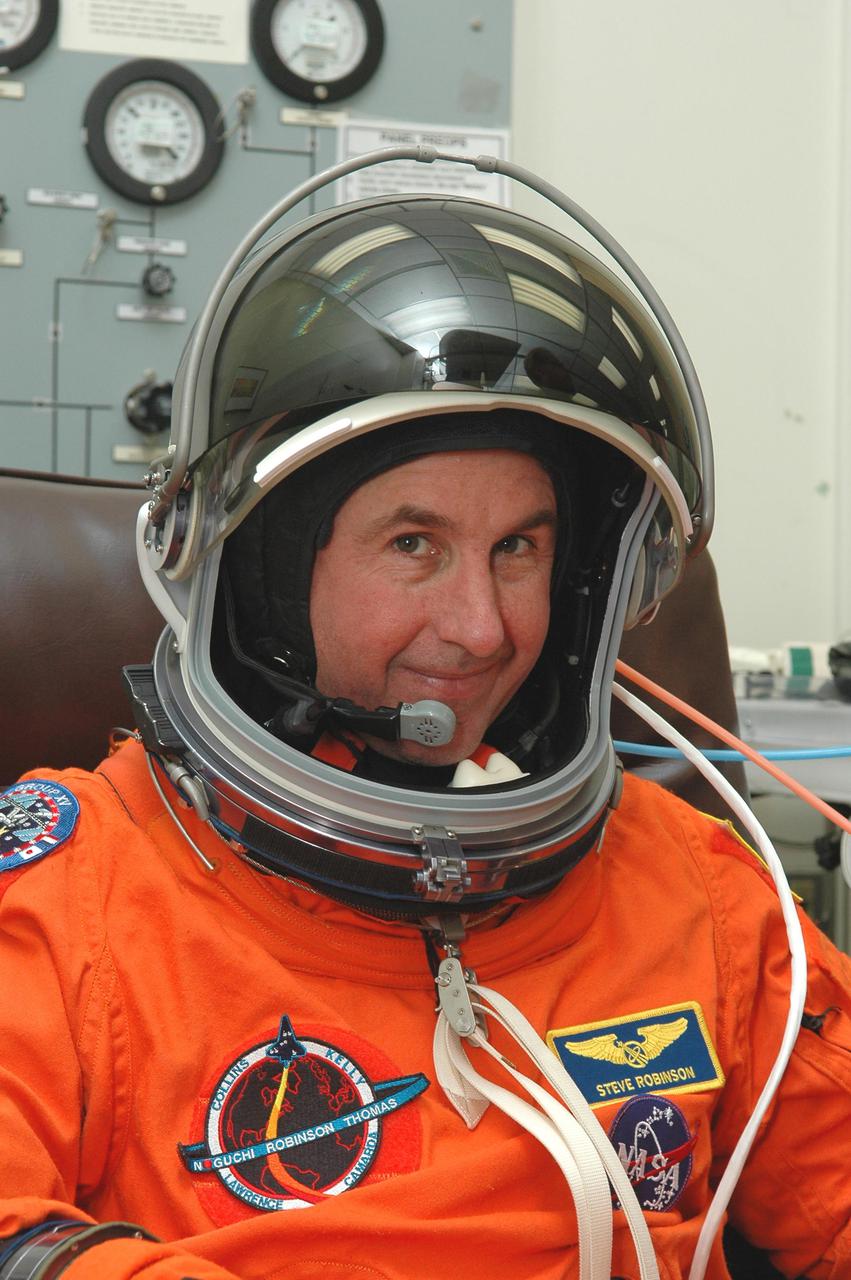
KENNEDY SPACE CENTER, FLA. -- In the Operations and Checkout Building at NASA’s Kennedy Space Center, Return to Flight STS-114 Mission Specialist Andrew Thomas checks the fit of his helmet, as well as his launch and entry suit.  This is Thomas’ fourth Shuttle flight.  There are two days to the launch of Space Shuttle Discovery scheduled for 3:51 p.m. July 13.  This launch is the 114th Space Shuttle flight and is scheduled to last about 12 days with a planned KSC landing at about 11:06 a.m. EDT on July 25.
KSC-05pd-1486
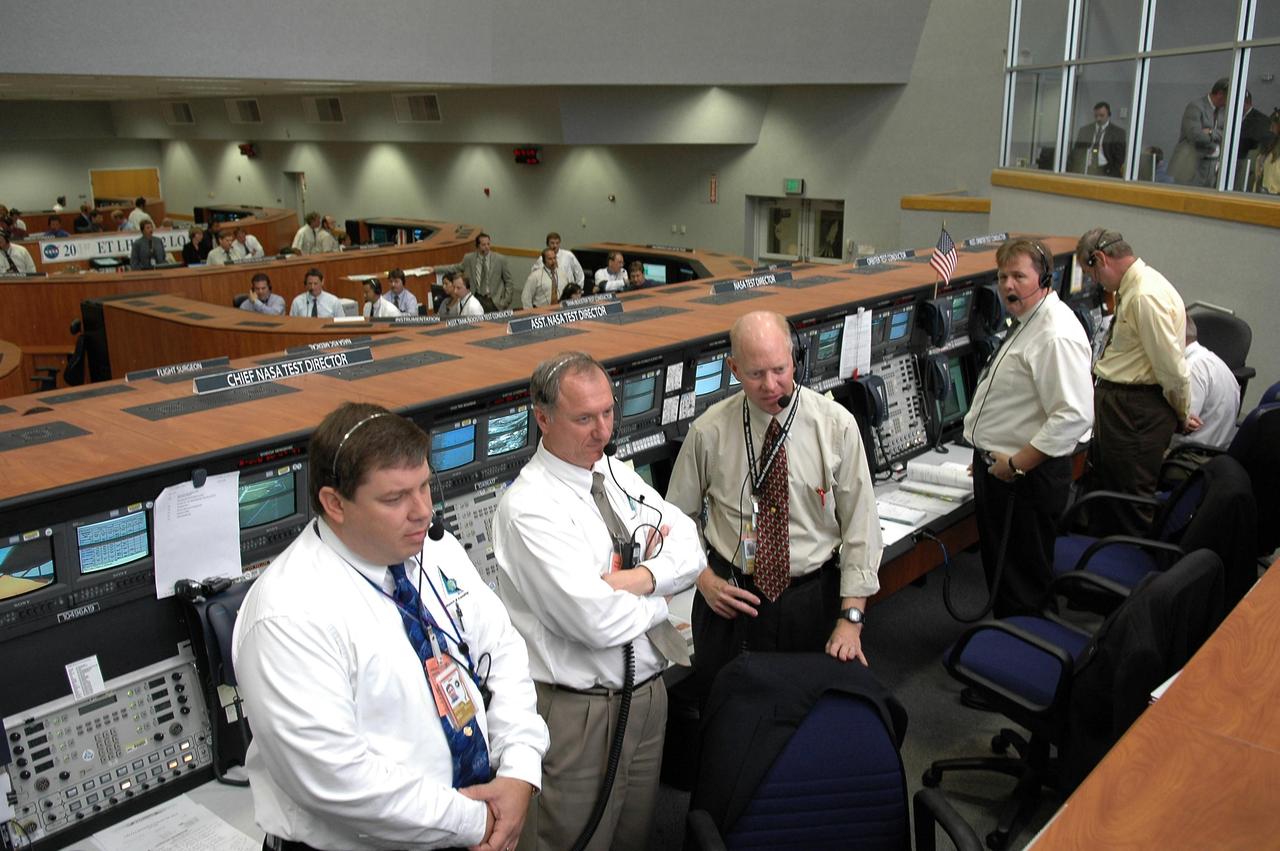
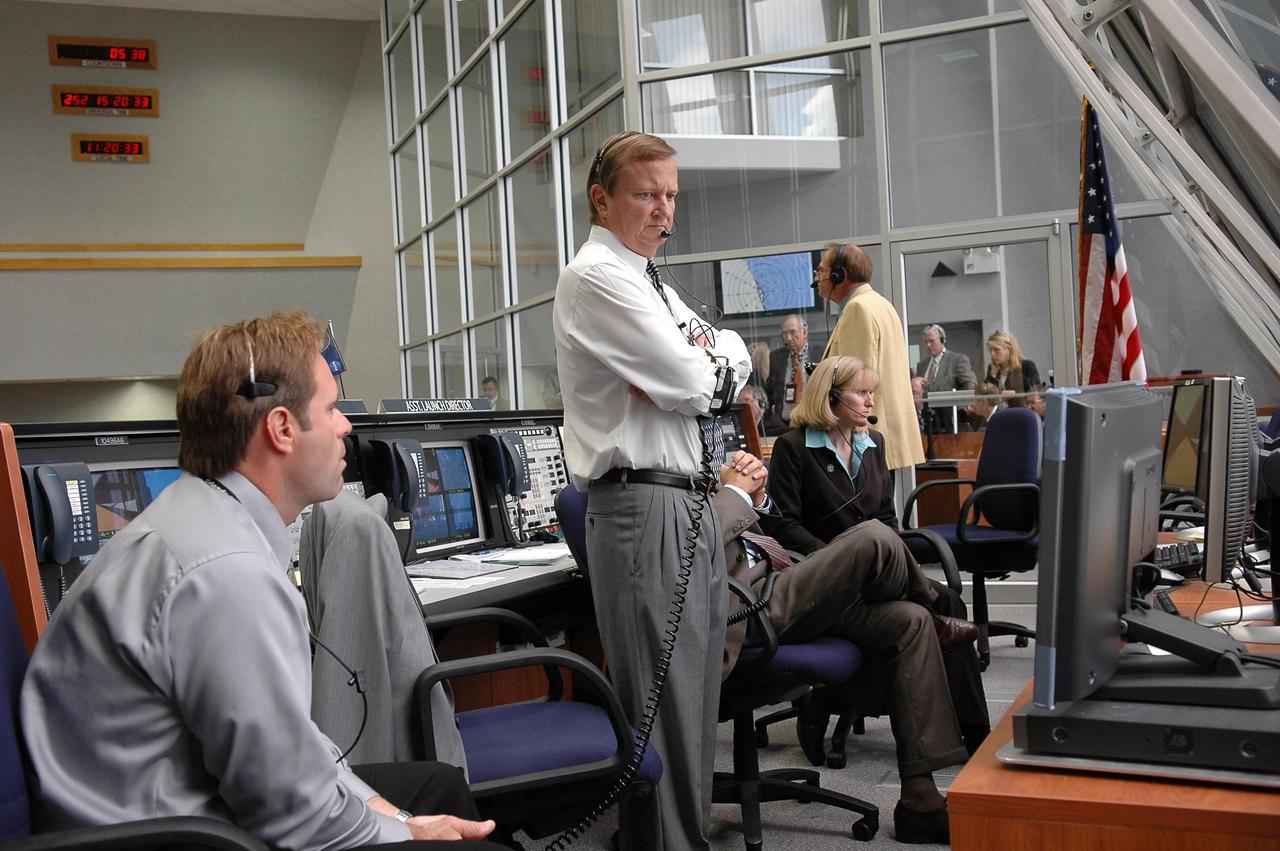
KENNEDY SPACE CENTER, FLA. -  Inside the Launch Control Center, Shuttle Launch Director Mike Leinbach (center, standing) watches the computer screen as cameras document Space Shuttle Atlantis' climb toward space on mission STS-115.  Mission STS-115 is the 116th space shuttle flight, the 27th flight for orbiter Atlantis, and the 19th U.S. flight to the International Space Station. sts-115 is scheduled to last 11 days with a planned landing at KSC. Photo credit: NASA/Kim Shiflett
KSC-06pd2135
KENNEDY SPACE CENTER, FLA. -  Inside the Launch Control Center, KSC officials turn from their computers to watch through the broad windows the launch of Space Shuttle Atlantis on mission STS-115.  Second from left is NASA Test Director Pete Nickolenko.   Mission STS-115 is the 116th space shuttle flight, the 27th flight for orbiter Atlantis, and the 19th U.S. flight to the International Space Station. sts-115 is scheduled to last 11 days with a planned landing at KSC. Photo credit: NASA/Kim Shiflett
KSC-06pd2134
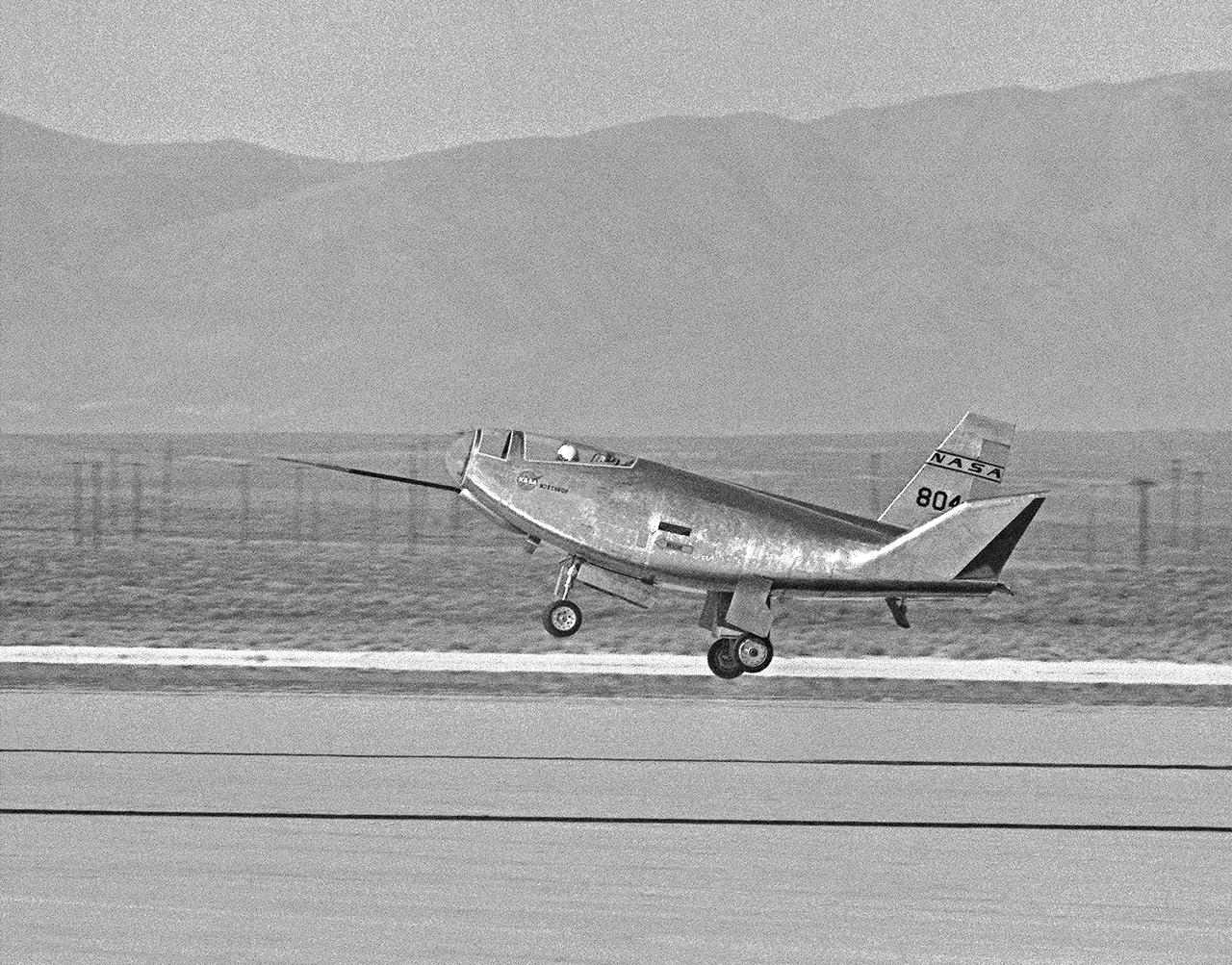
The HL-10 Lifting Body completes its first research flight with a landing on Rogers Dry Lake. Due to control problems, pilot Bruce Peterson had to land at a higher speed than originally planned in order to keep the vehicle under control. The actual touchdown speed was about 280 knots. This was 30 knots above the speed called for in the flight plan. The HL-10's first flight had lasted 3 minutes and 9 seconds.
E-16211
KENNEDY SPACE CENTER, FLA. -- In the Operations and Checkout Building at NASA’s Kennedy Space Center, Return to Flight STS-114 Mission Specialist Andrew Thomas checks the fit of his launch and entry suit, as well as his helmet.  This is Thomas’ fourth Shuttle flight.  There are two days to the launch of Space Shuttle Discovery scheduled for 3:51 p.m. July 13.  This launch is the 114th Space Shuttle flight and is scheduled to last about 12 days with a planned KSC landing at about 11:06 a.m. EDT on July 25.
KSC-05pd-1487
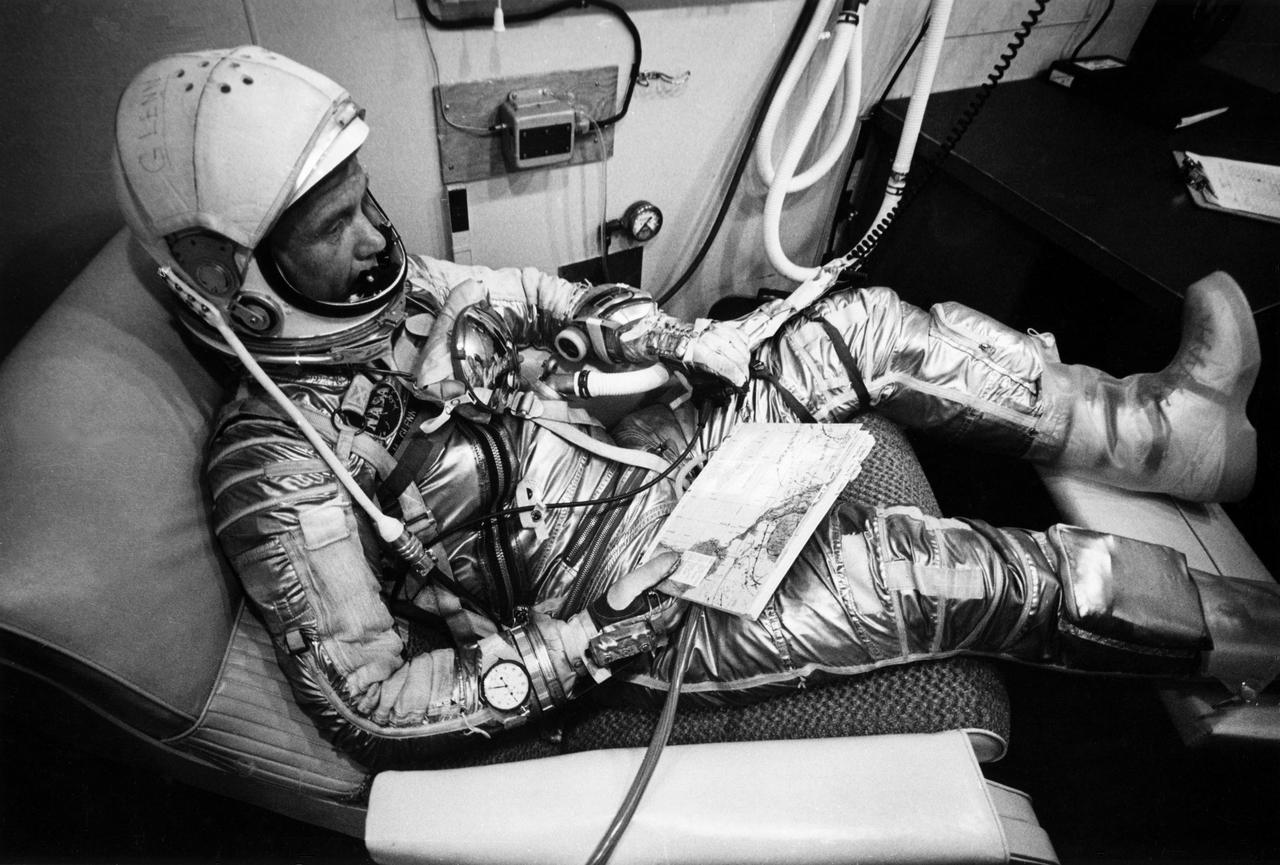
CAPE CANAVERAL, Fla. – John Glenn in flight suit prior to MA-6 launch at Cape Canaveral, Fla. He is relaxing on his contour couch in Hangar S early Feb. 20, 1962. Glanced over his flight maps in a last-minute check before leaving for his Friendship 7 space capsule and an orbital flight of the Earth. Glenn completed three orbits of the Earth and plunged to a safe landing in the Atlantic nearly five hours after blastoff.  Photo credit: NASA
62-MA6-104
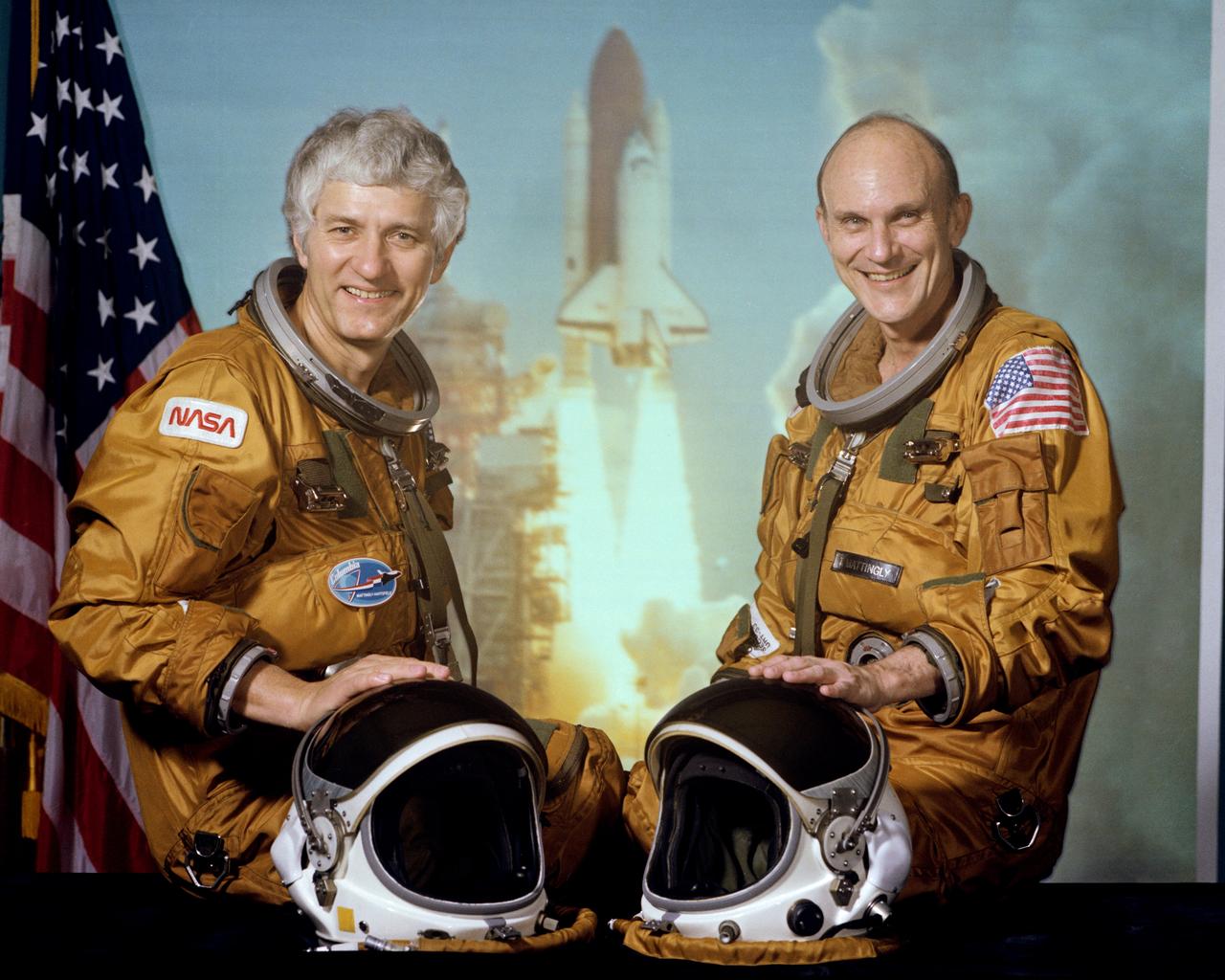
S82-31207 (1 May 1982) --- These two astronauts will man the space shuttle Columbia for NASA's fourth and final (STS-4) orbital flight test. Thomas K. (Ken) Mattingly II, right, is crew commander. Henry W. Hartsfield Jr., is pilot. Their flight is scheduled for launch in late June 1982, and is to last approximately one week, with launch to take place form KSC and landing to be on the dry lake beds of Edwards Air Force Base and Dryden Flight Research Facility (DFRC) in California. Photo credit: NASA
OFFICIAL - STS-4 CREW PORTRAIT
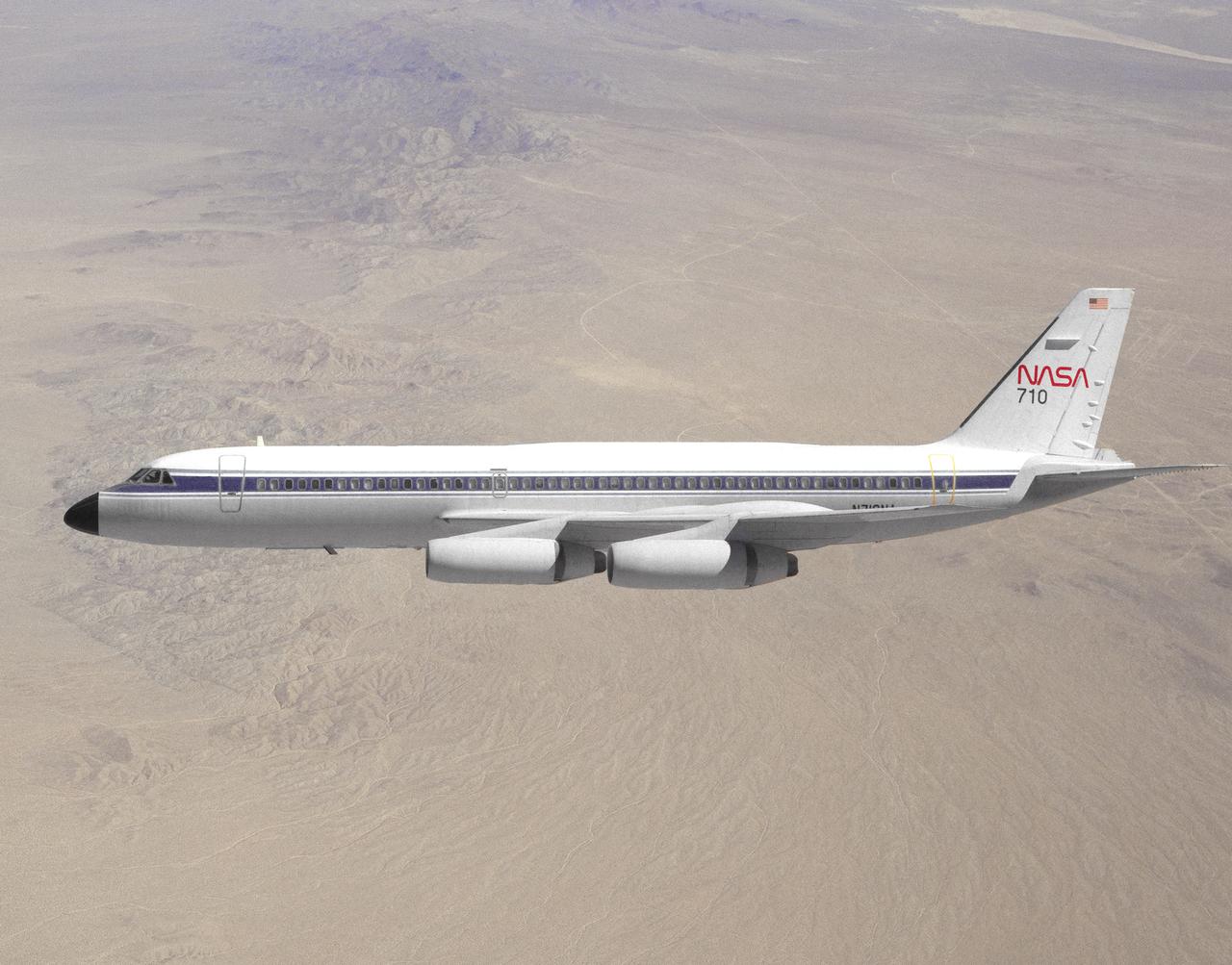
NASA 710, a Convair 990 transport aircraft formerly used for medium altitude atmospheric research, cruises over the Mojave Desert near NASA's Dryden Flight Research Center, Edwards, California. The flight was a final speed calibration run prior to the start of extensive modifications that turned the aircraft into a landing systems research aircraft to test and evaluate brakes and landing gear systems on space shuttles and also conventional aircraft. Research flights with the aircraft began in April of 1993. Testing of shuttle components lasted into fiscal year 1995.
CV-990 LSRA
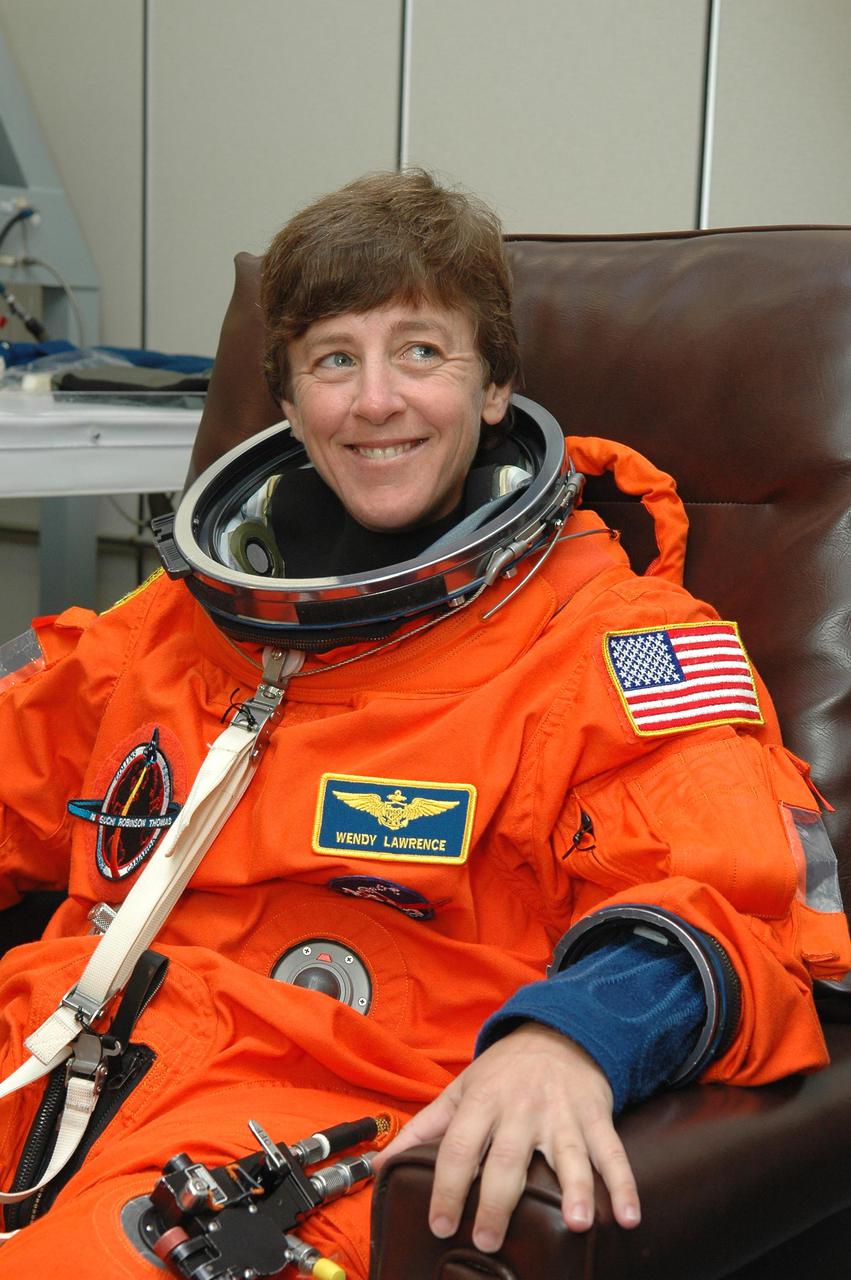
KENNEDY SPACE CENTER, FLA. -- In the Operations and Checkout Building at NASA’s Kennedy Space Center, Return to Flight STS-114 Mission Specialist Wendy Lawrence checks the fit of her launch and entry suit.  This is Lawrence’s fourth Shuttle flight.  There are two days to the launch of Space Shuttle Discovery scheduled for 3:51 p.m. July 13.  This launch is the 114th Space Shuttle flight and is scheduled to last about 12 days with a planned KSC landing at about 11:06 a.m. EDT on July 25.
KSC-05pd-1482
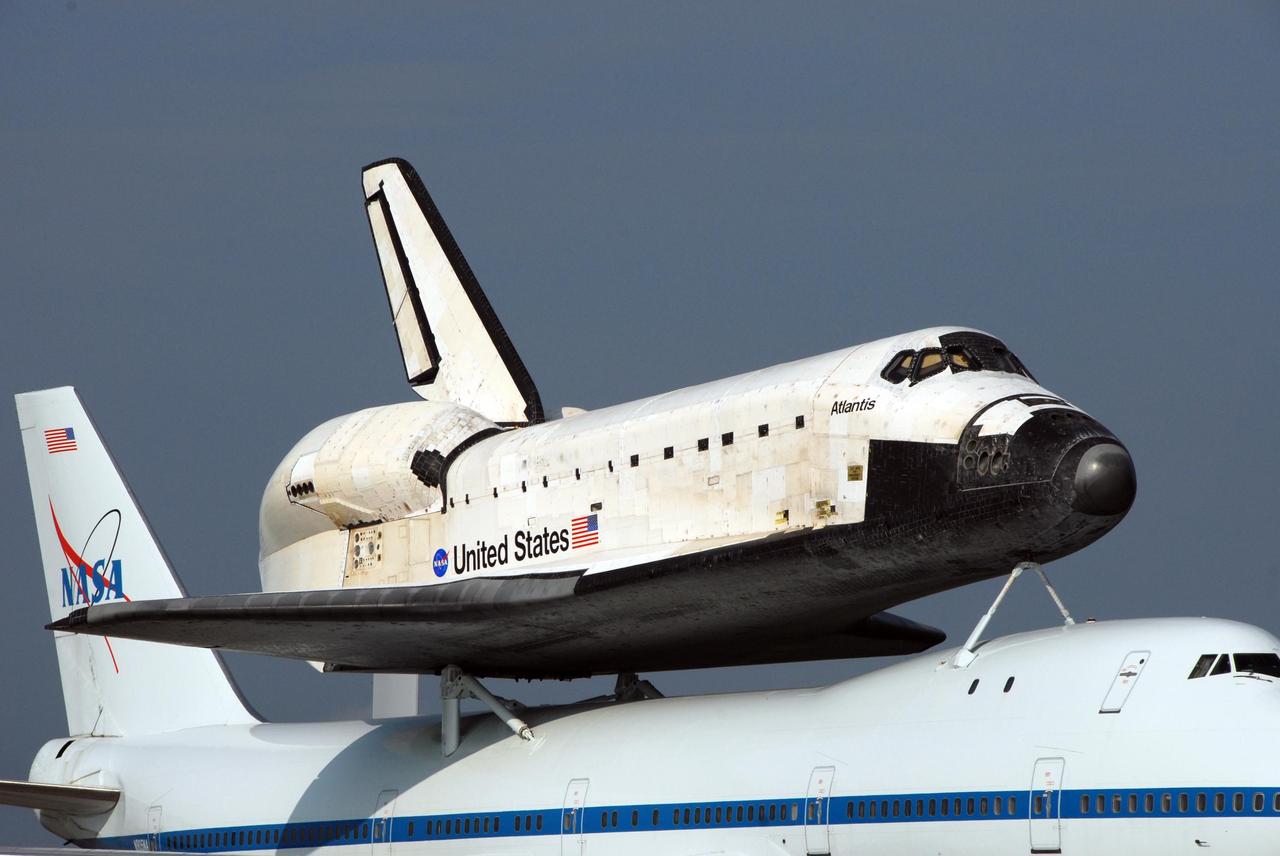
KENNEDY SPACE CENTER, FLA. --  Struts on the shuttle carrier aircraft, or SCA, attach the orbiter Atlantis for the piggyback flight.  The plane and orbiter returned from California after three days.  Touchdown was at 8:27 a.m. EDT. The SCA is a modified Boeing 747 jetliner. Visible on Atlantis is the tail cone that covers and protects the main engines during the ferry flight.  Atlantis landed at Edwards Air Force Base in California to end mission STS-117.  The return to KSC began July 1 and  took three days after stops across the country for fuel.  The last stop was at Ft. Campbell in Kentucky. Weather conditions over the last leg postponed the return trip until July 3.  Atlantis will be removed from the back of the SCA via the mate/demate device at the SLF.  It will then be towed to the Orbiter Processing Facility to begin processing for its next launch, mission STS-122 in December.  Photo credit: NASA/Ken Thornsley
KSC-07pd1739
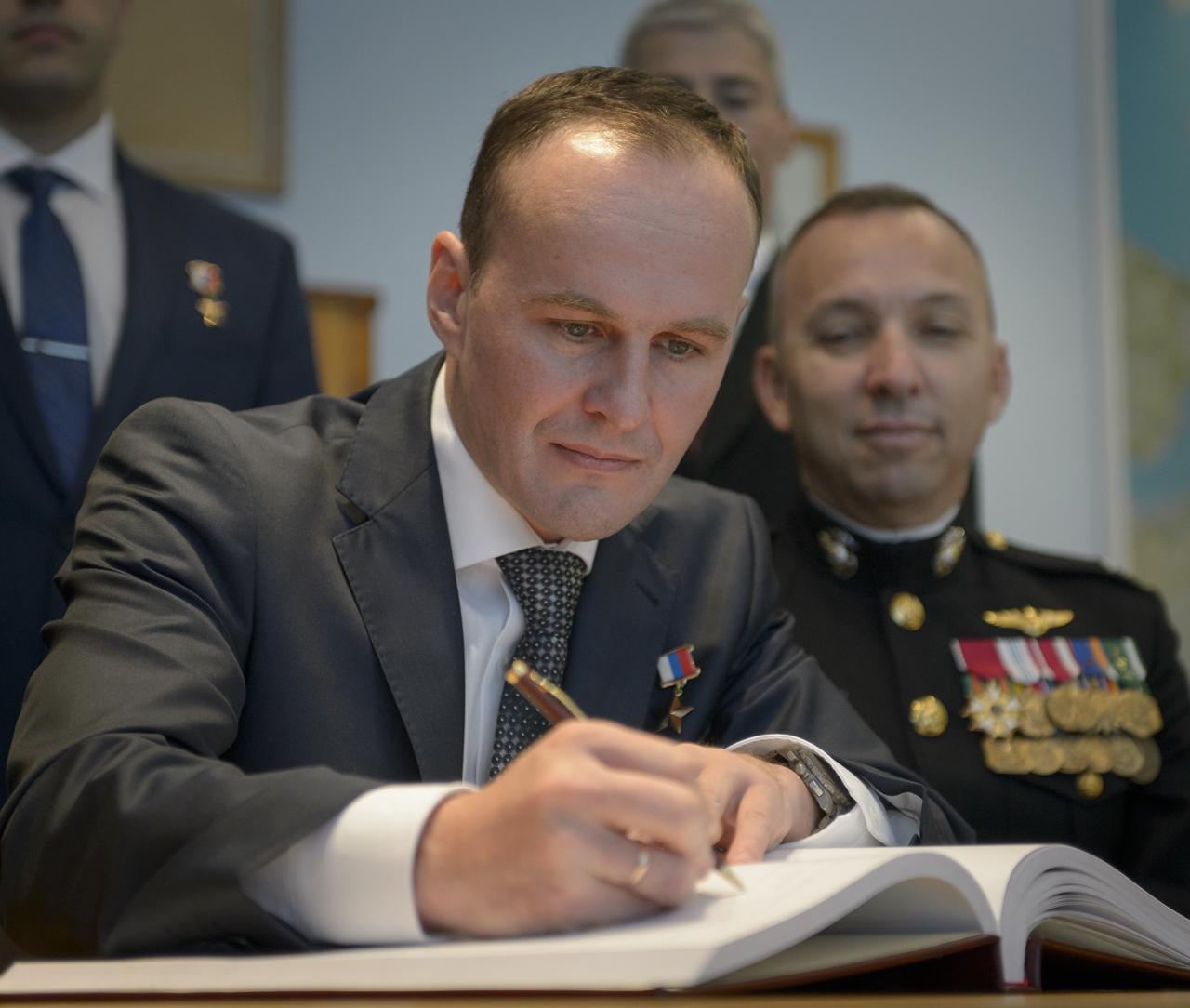
Expedition 52 flight engineer Paolo Nespoli of ESA signs a guest book at the "Memorial working study of Yuri Gagarin" at the Gagarin Cosmonaut Training Center (GCTC), Monday, July 10, 2017 in Star City, Russia.  The memorial study represents Gagarin's working study in the way it was abandoned by Gagarin on March 27, 1968 before leaving for the airfield for training flight that became his last. Photo Credit: (NASA/Bill Ingalls)
Expedition 52 GCTC Museum Visit
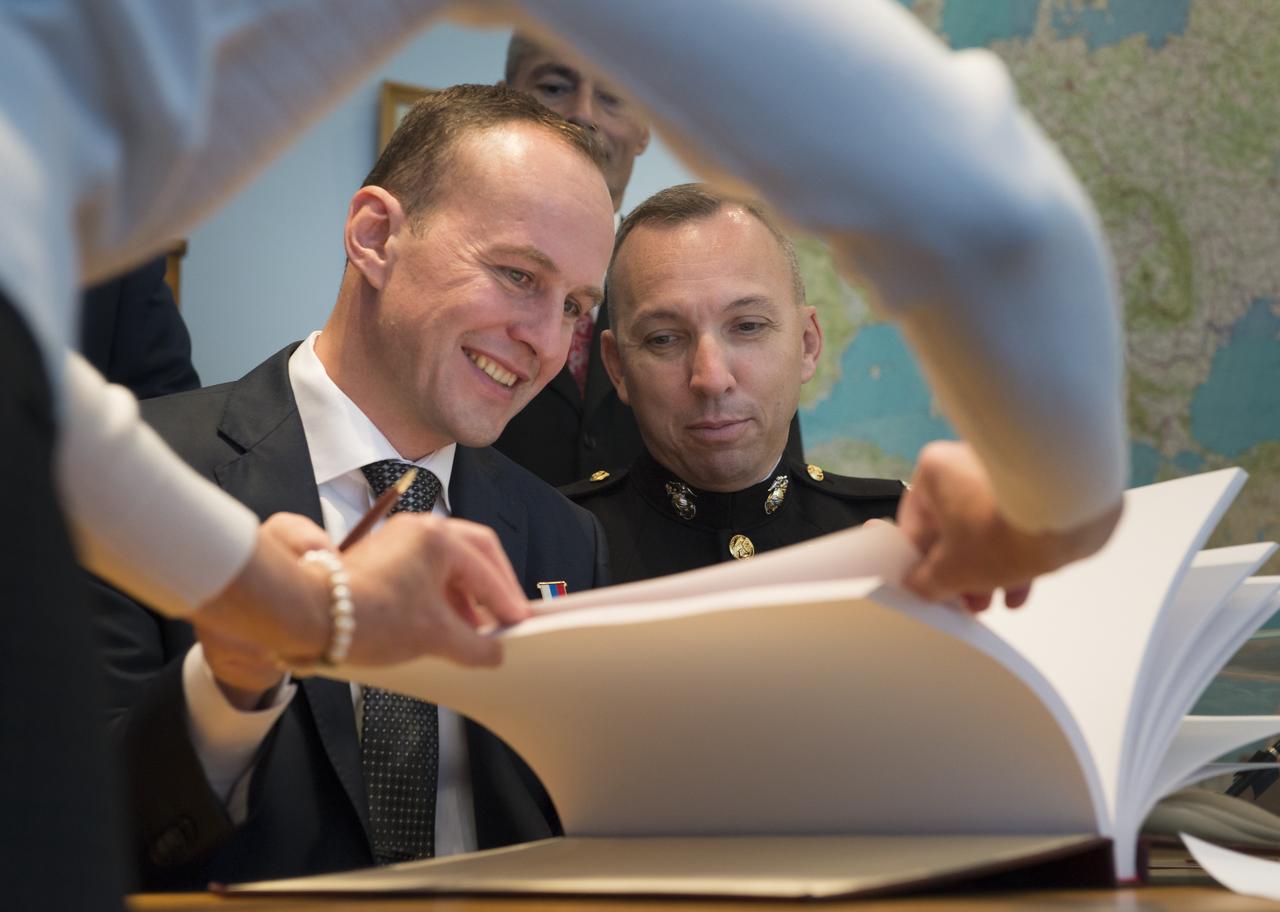
Expedition 52 flight engineers Sergey Ryazanskiy of Roscosmos, seated left, and Randy Bresnik of NASA are seen as they sign a guest book at the "Memorial working study of Yuri Gagarin" at the Gagarin Cosmonaut Training Center (GCTC), Monday, July 10, 2017 in Star City, Russia.  The memorial study represents Gagarin's working study in the way it was abandoned by Gagarin on March 27, 1968 before leaving for the airfield for training flight that became his last. Photo Credit: (NASA/Bill Ingalls)
Expedition 52 GCTC Museum Visit
Expedition 52 flight engineers Sergey Ryazanskiy of Roscosmos, seated left, and Randy Bresnik of NASA are seen as they sign a guest book at the "Memorial working study of Yuri Gagarin" at the Gagarin Cosmonaut Training Center (GCTC), Monday, July 10, 2017 in Star City, Russia.  The memorial study represents Gagarin's working study in the way it was abandoned by Gagarin on March 27, 1968 before leaving for the airfield for training flight that became his last. Photo Credit: (NASA/Bill Ingalls)
Expedition 52 GCTC Museum Visit
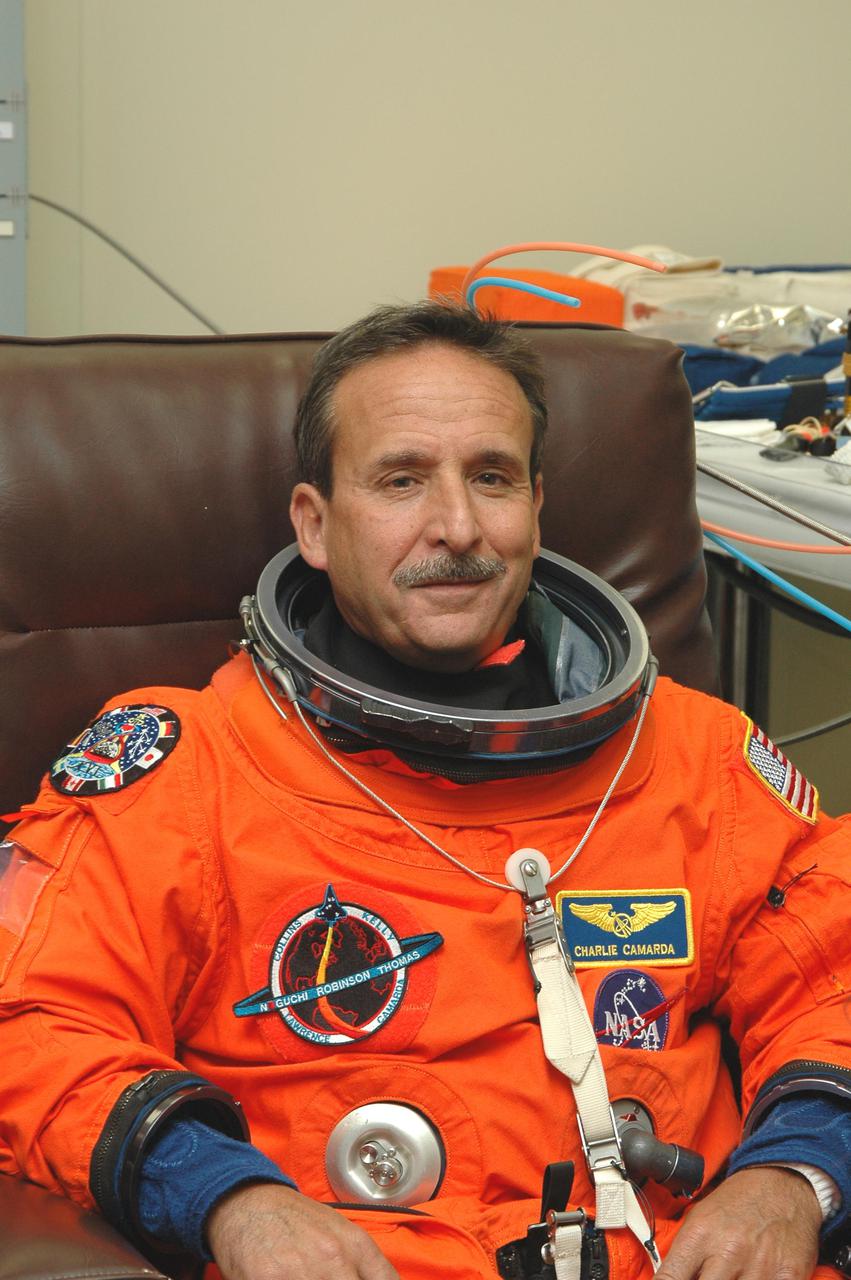
KENNEDY SPACE CENTER, FLA. -- In the Operations and Checkout Building at NASA’s Kennedy Space Center, Return to Flight STS-114 Mission Specialist Charles Camarda checks the fit of his launch and entry suit.  This is Camarda’s first Shuttle launch.  There are two days to the launch of Space Shuttle Discovery scheduled for 3:51 p.m. July 13.  This launch is the 114th Space Shuttle flight and is scheduled to last about 12 days with a planned KSC landing at about 11:06 a.m. EDT on July 25.
KSC-05pd-1479
S134-E-005609 (16 May 2011) --- Pictured on the middeck, European Space Agency astronaut Roberto Vittori, STS-134 mission specialist, enjoys a sandwich, which represents his first snack or meal onboard the space shuttle Endeavour on its first day in space for STS-134. He joins five NASA astronauts for the 16-day flight, the final for Endeavour and the second last flight for the Shuttle Program.  Photo credit: NASA
View of STS-134 MS Vittori on the Middeck
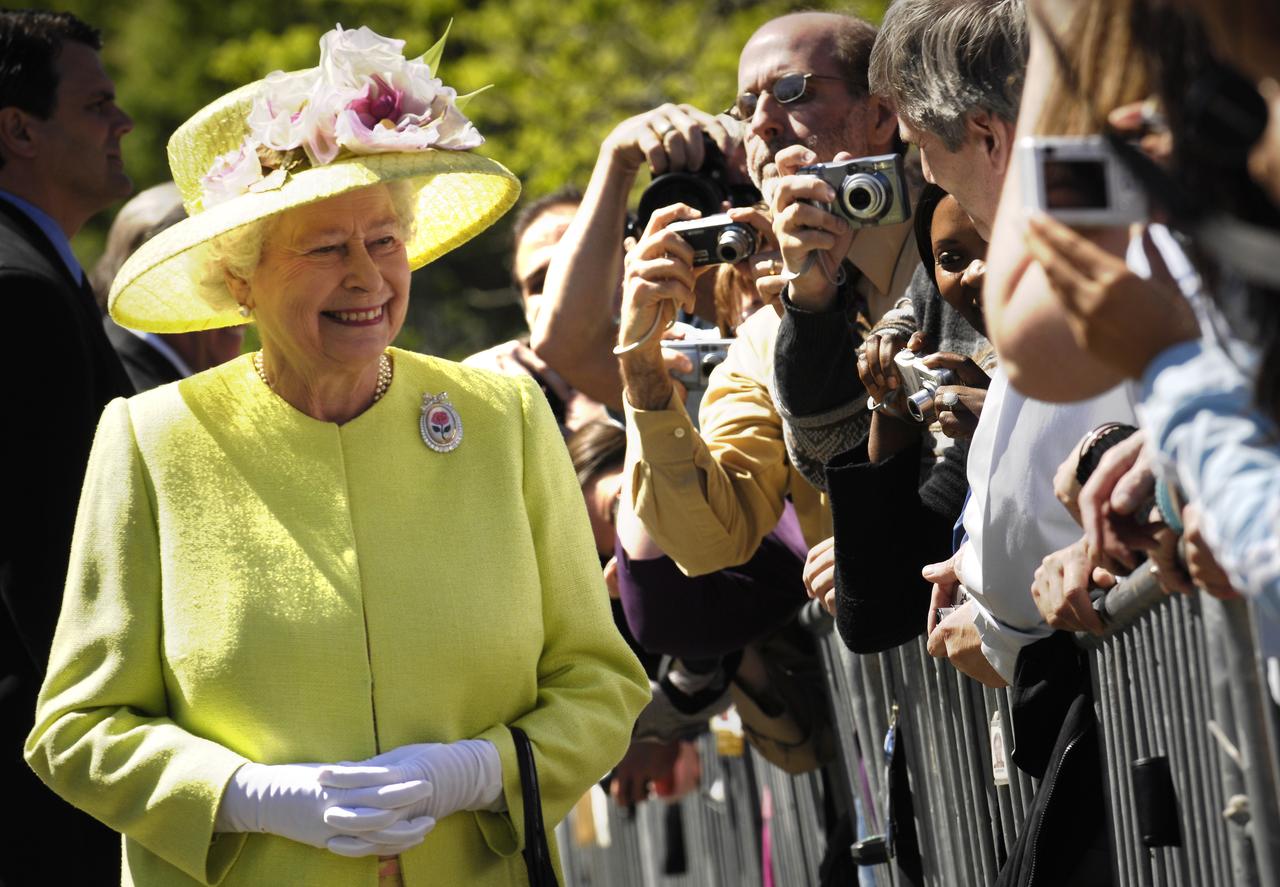
Queen Elizabeth II greets employees on her walk from NASA’s Goddard Space Flight Center mission control to a reception in the center’s main auditorium, Tuesday, May 8, 2007, in Greenbelt, Md.  Queen Elizabeth II and her husband, Prince Philip, Duke of Edinburgh, visited the NASA Goddard Space Flight Center as one of the last stops on their six-day United States visit. Photo Credit: (NASA/Bill Ingalls)
Goddard Queen Visit
An image of the F-16XL #1 during its functional flight check of the Digital Flight Control System (DFCS) on December 16, 1997. The mission was flown by NASA research pilot Dana Purifoy, and lasted 1 hour and 25 minutes. The tests included pilot familiarly, functional check, and handling qualities evaluation maneuvers to a speed of Mach 0.6 and 300 knots. Purifoy completed all the briefed data points with no problems, and reported that the DFCS handled as well, if not better than the analog computer system that it replaced.
EC97-44354-2
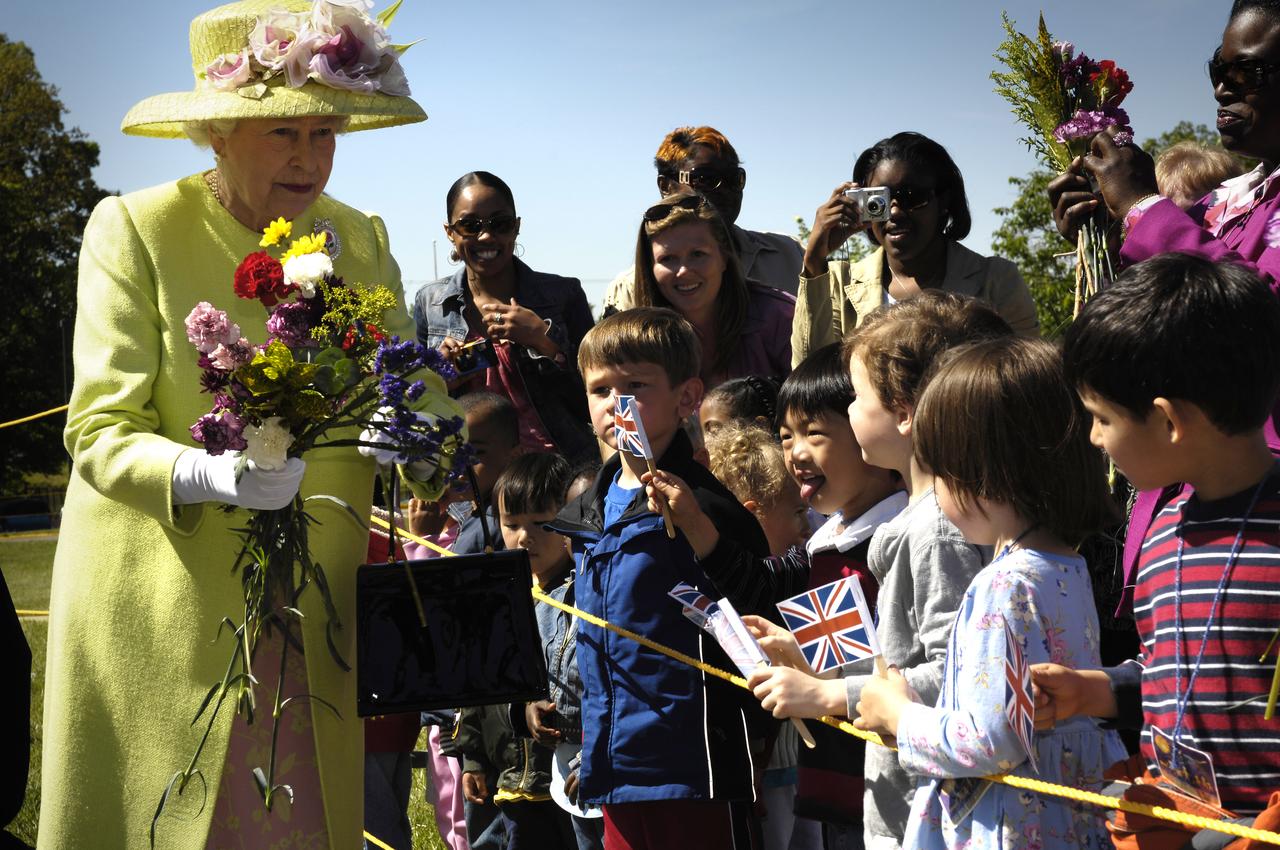
Queen Elizabeth II greets children on her walk from NASA’s Goddard Space Flight Center mission control to a reception in the center’s main auditorium, Tuesday, May 8, 2007, in Greenbelt, Md.  Queen Elizabeth II and her husband, Prince Philip, Duke of Edinburgh, visited the NASA Goddard Space Flight Center as one of the last stops on their six-day United States visit. Photo Credit: (NASA/Bill Ingalls)
Goddard Queen Visit
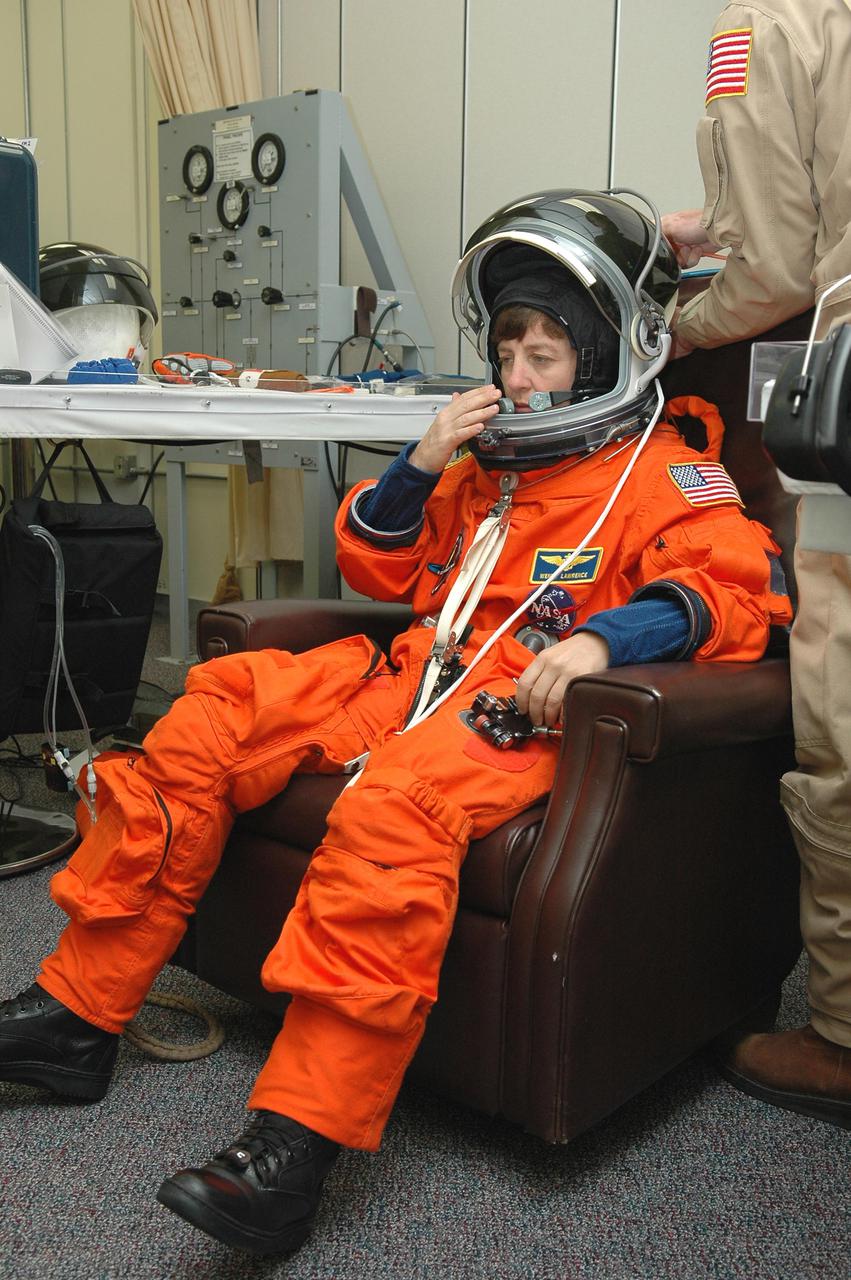
KENNEDY SPACE CENTER, FLA. -- In the Operations and Checkout Building at NASA’s Kennedy Space Center, Return to Flight STS-114 Mission Specialist Wendy Lawrence checks the fit of her launch and entry suit and helmet.  There are two days to the launch of Space Shuttle Discovery scheduled for 3:51 p.m. July 13.  This launch is the 114th Space Shuttle flight and is scheduled to last about 12 days with a planned KSC landing at about 11:06 a.m. EDT on July 25.
KSC-05pd-1484