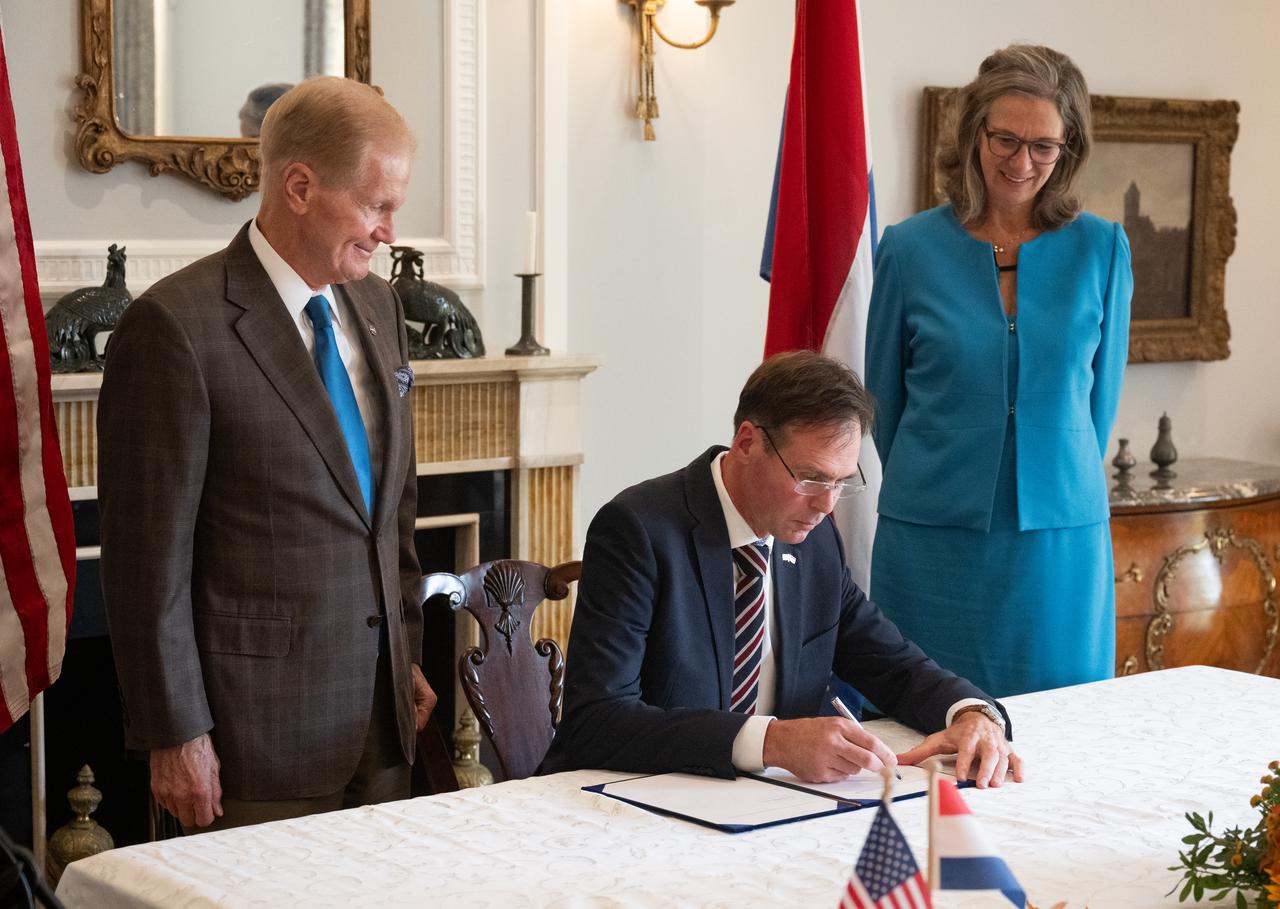
Harm van de Wetering, director of the Netherlands Space Office, center, signs the Artemis Accords as NASA Administrator Bill Nelson, left, and Ambassador of the Kingdom of the Netherlands to the United States Birgitta Tazelaar, right, look on, Wednesday, Nov. 1, 2023, at the Dutch Ambassador’s Residence in Washington. Netherlands is the 31st country to sign the Artemis Accords, which establish a practical set of principles to guide space exploration cooperation among nations participating in NASA’s Artemis program. Photo Credit: (NASA/Joel Kowsky)
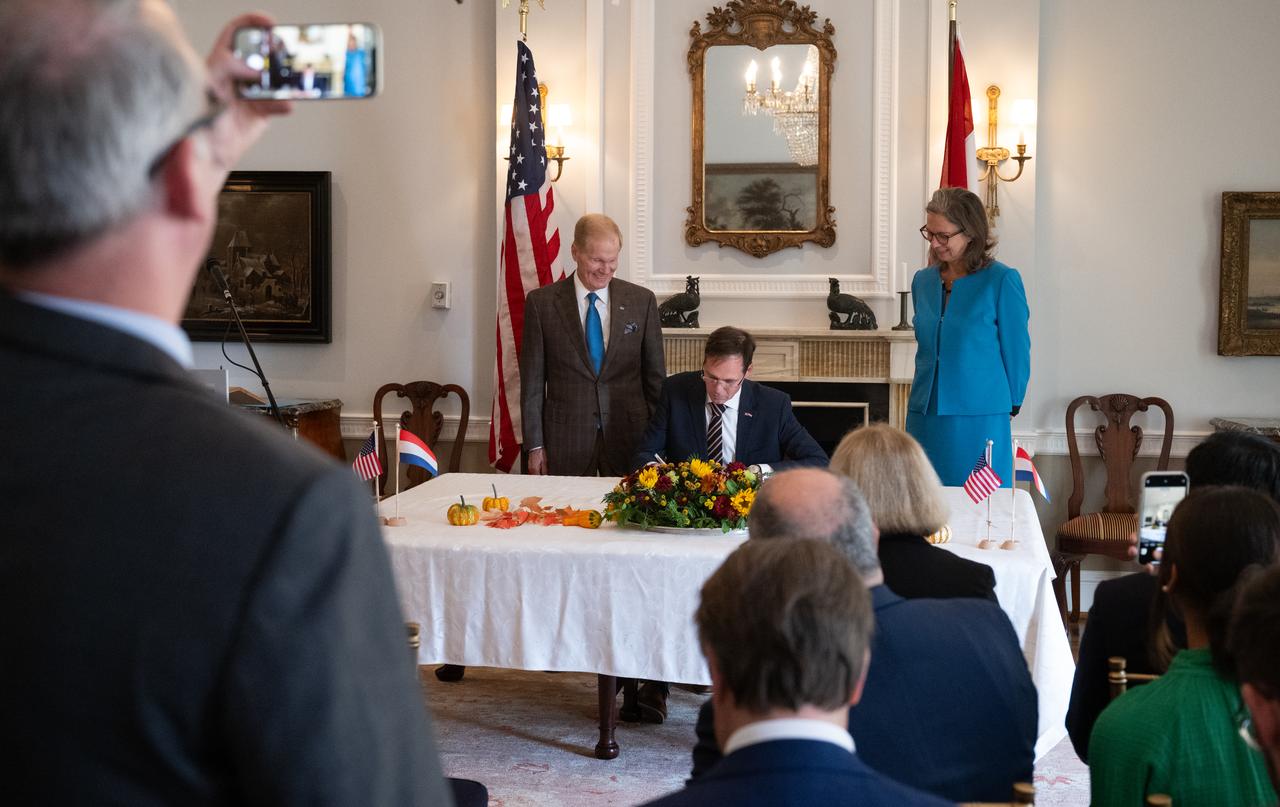
Harm van de Wetering, director of the Netherlands Space Office, center, signs the Artemis Accords as NASA Administrator Bill Nelson, left, and Ambassador of the Kingdom of the Netherlands to the United States Birgitta Tazelaar, right, look on, Wednesday, Nov. 1, 2023, at the Dutch Ambassador’s Residence in Washington. Netherlands is the 31st country to sign the Artemis Accords, which establish a practical set of principles to guide space exploration cooperation among nations participating in NASA’s Artemis program. Photo Credit: (NASA/Joel Kowsky)
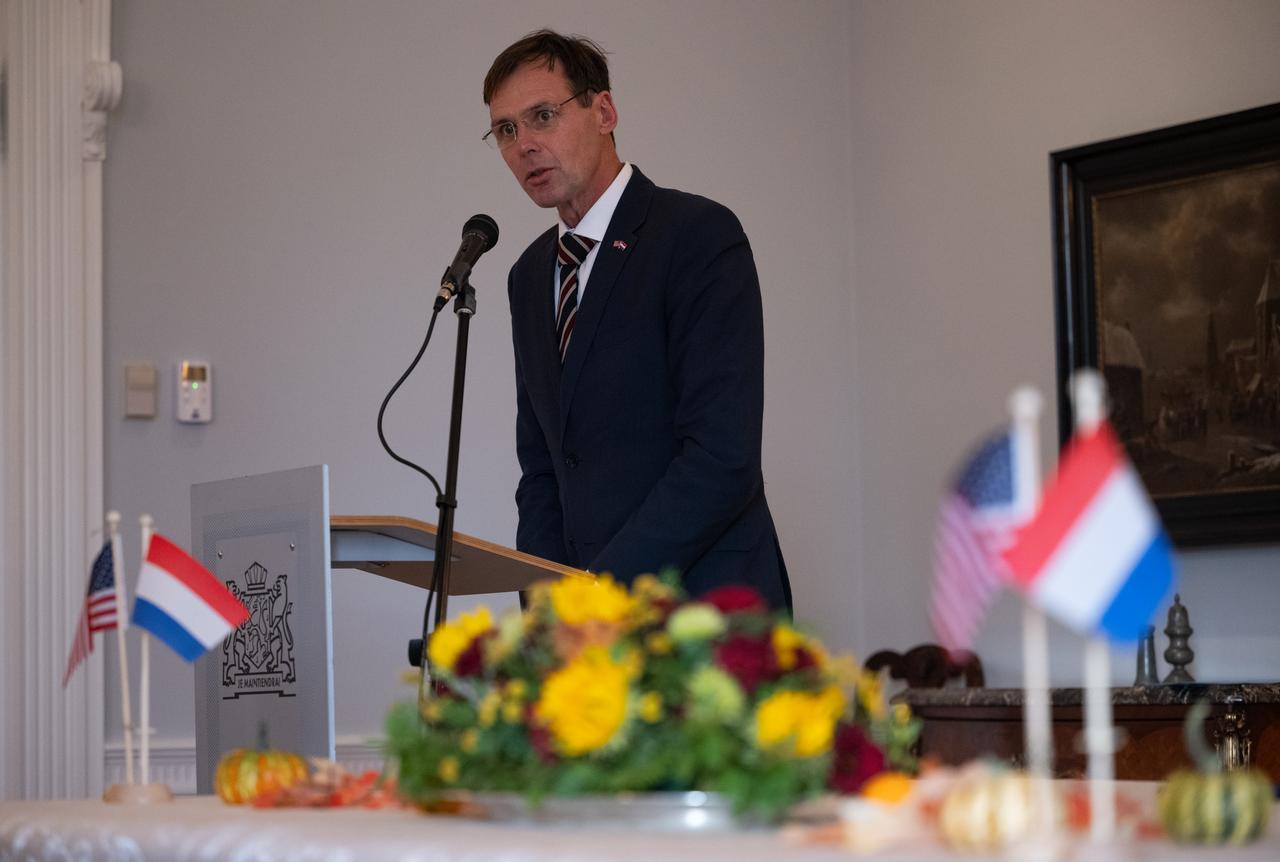
Harm van de Wetering, director of the Netherlands Space Office, delivers remarks during an Artemis Accords signing ceremony, Wednesday, Nov. 1, 2023, at the Dutch Ambassador’s Residence in Washington. Netherlands is the 31st country to sign the Artemis Accords, which establish a practical set of principles to guide space exploration cooperation among nations participating in NASA’s Artemis program. Photo Credit: (NASA/Joel Kowsky)
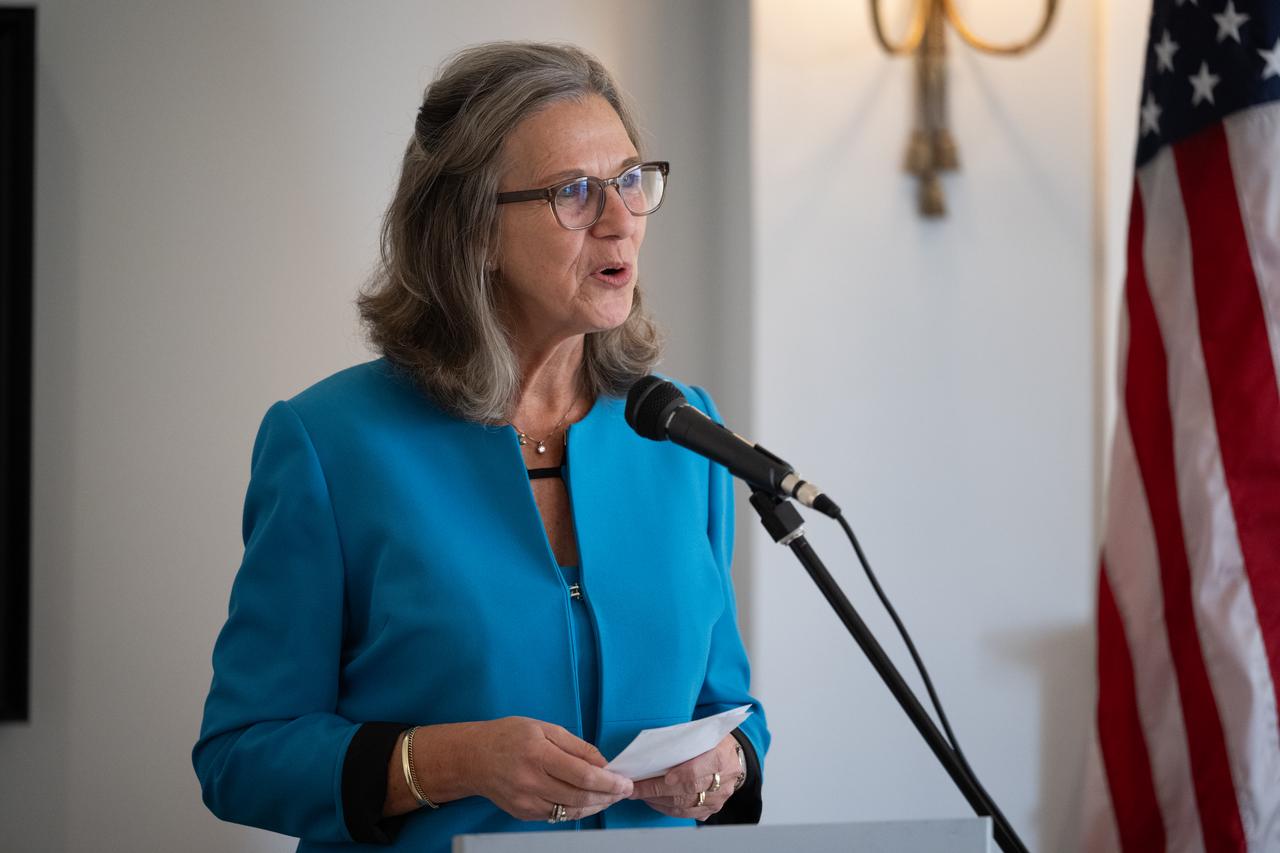
Ambassador of the Kingdom of the Netherlands to the United States Birgitta Tazelaar delivers remarks during an Artemis Accords signing ceremony, Wednesday, Nov. 1, 2023, at the Dutch Ambassador’s Residence in Washington. Netherlands is the 31st country to sign the Artemis Accords, which establish a practical set of principles to guide space exploration cooperation among nations participating in NASA’s Artemis program. Photo Credit: (NASA/Joel Kowsky)

Ambassador of the Kingdom of the Netherlands to the United States Birgitta Tazelaar delivers remarks during an Artemis Accords signing ceremony, Wednesday, Nov. 1, 2023, at the Dutch Ambassador’s Residence in Washington. Netherlands is the 31st country to sign the Artemis Accords, which establish a practical set of principles to guide space exploration cooperation among nations participating in NASA’s Artemis program. Photo Credit: (NASA/Joel Kowsky)
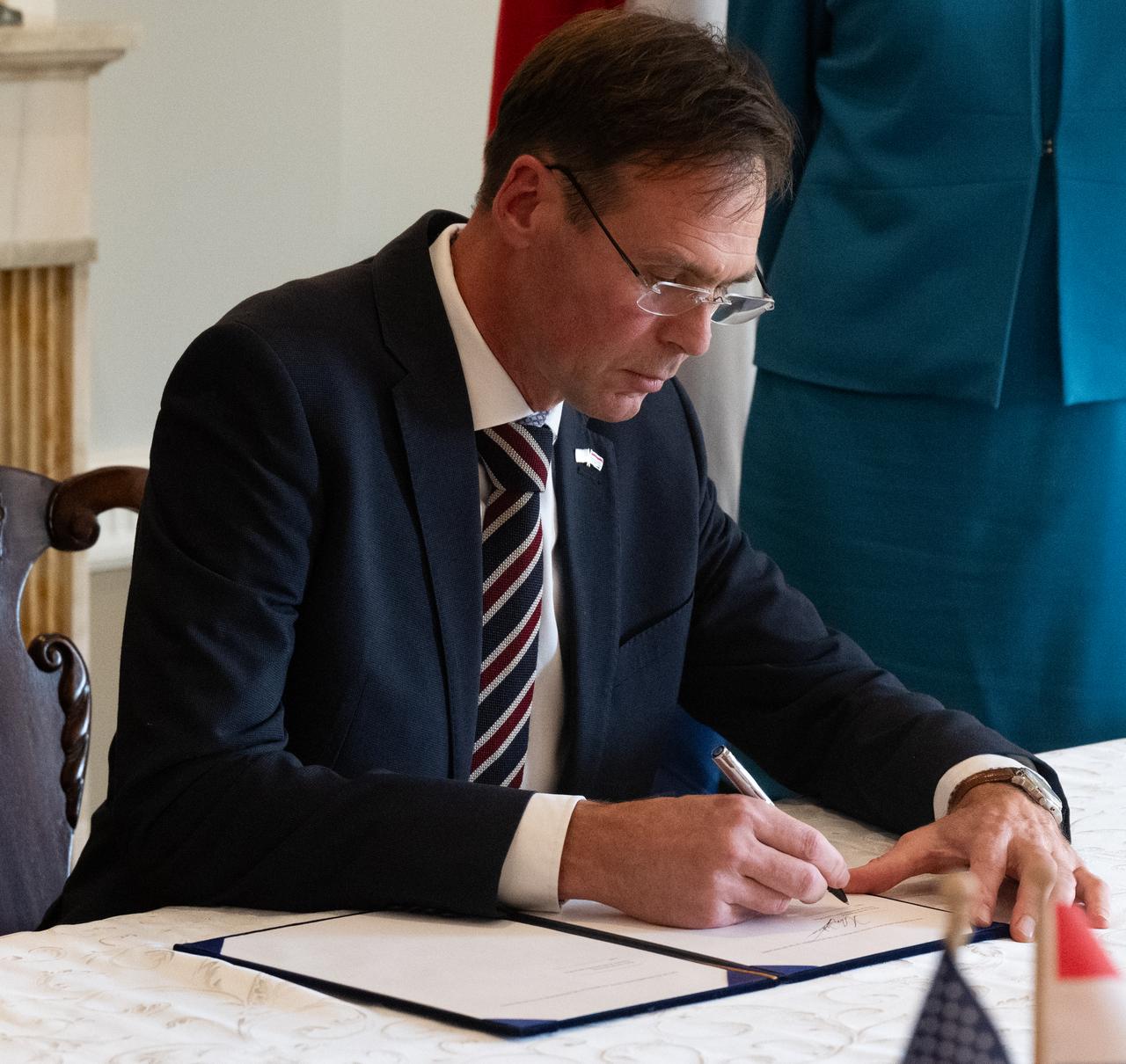
Harm van de Wetering, director of the Netherlands Space Office, center, signs the Artemis Accords, Wednesday, Nov. 1, 2023, at the Dutch Ambassador’s Residence in Washington. Netherlands is the 31st country to sign the Artemis Accords, which establish a practical set of principles to guide space exploration cooperation among nations participating in NASA’s Artemis program. Photo Credit: (NASA/Joel Kowsky)
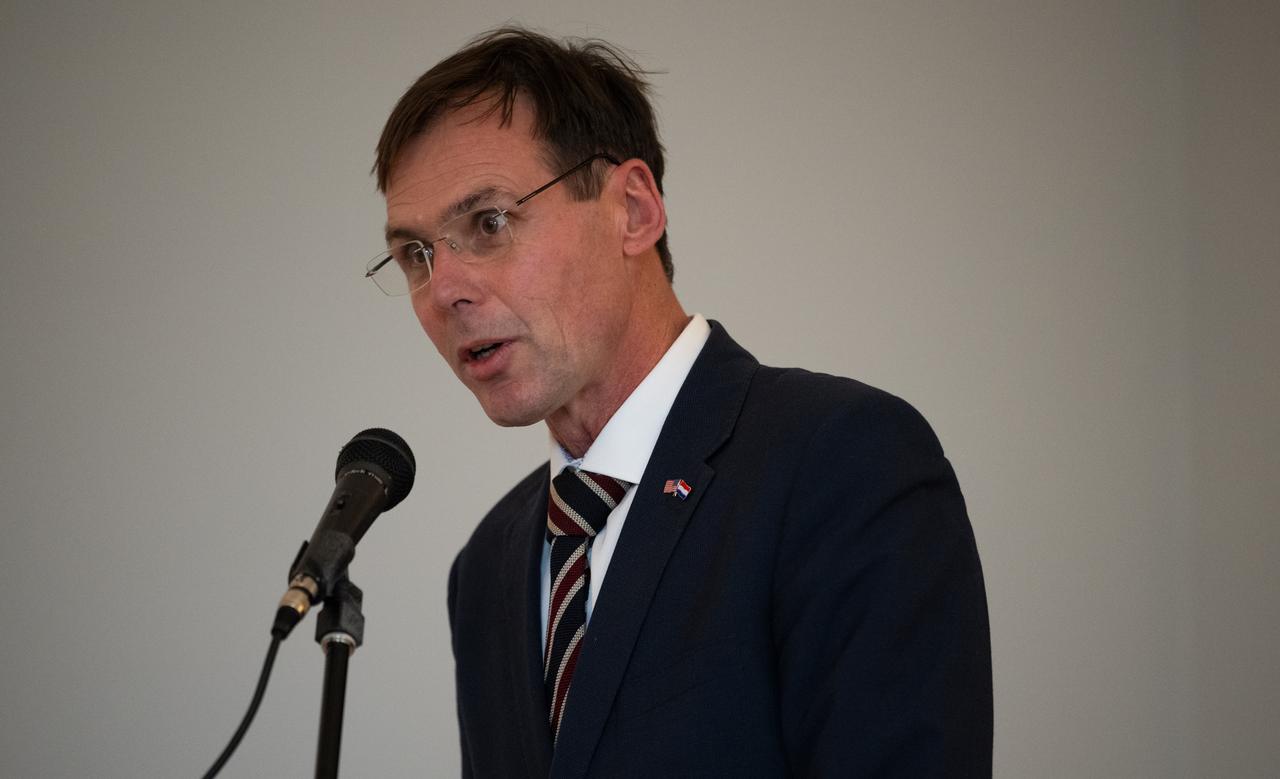
Harm van de Wetering, director of the Netherlands Space Office, delivers remarks during an Artemis Accords signing ceremony, Wednesday, Nov. 1, 2023, at the Dutch Ambassador’s Residence in Washington. Netherlands is the 31st country to sign the Artemis Accords, which establish a practical set of principles to guide space exploration cooperation among nations participating in NASA’s Artemis program. Photo Credit: (NASA/Joel Kowsky)

Harm van de Wetering, director of the Netherlands Space Office, right, shakes hands with NASA Administrator Bill Nelson after signing the Artemis Accords, Wednesday, Nov. 1, 2023, at the Dutch Ambassador’s Residence in Washington. Netherlands is the 31st country to sign the Artemis Accords, which establish a practical set of principles to guide space exploration cooperation among nations participating in NASA’s Artemis program. Photo Credit: (NASA/Joel Kowsky)

Harm van de Wetering, director of the Netherlands Space Office, left, NASA Administrator Bill Nelson, second from right, Chiragh Parikh, executive secretary of the National Space Council, not visible, NASA Deputy Administrator Pam Melroy, second from right, and Ambassador of the Kingdom of the Netherlands to the United States Birgitta Tazelaar, right, are seen as they speak following the signing of the Artemis Accords, Wednesday, Nov. 1, 2023, at the Dutch Ambassador’s Residence in Washington. Netherlands is the 31st country to sign the Artemis Accords, which establish a practical set of principles to guide space exploration cooperation among nations participating in NASA’s Artemis program. Photo Credit: (NASA/Joel Kowsky)
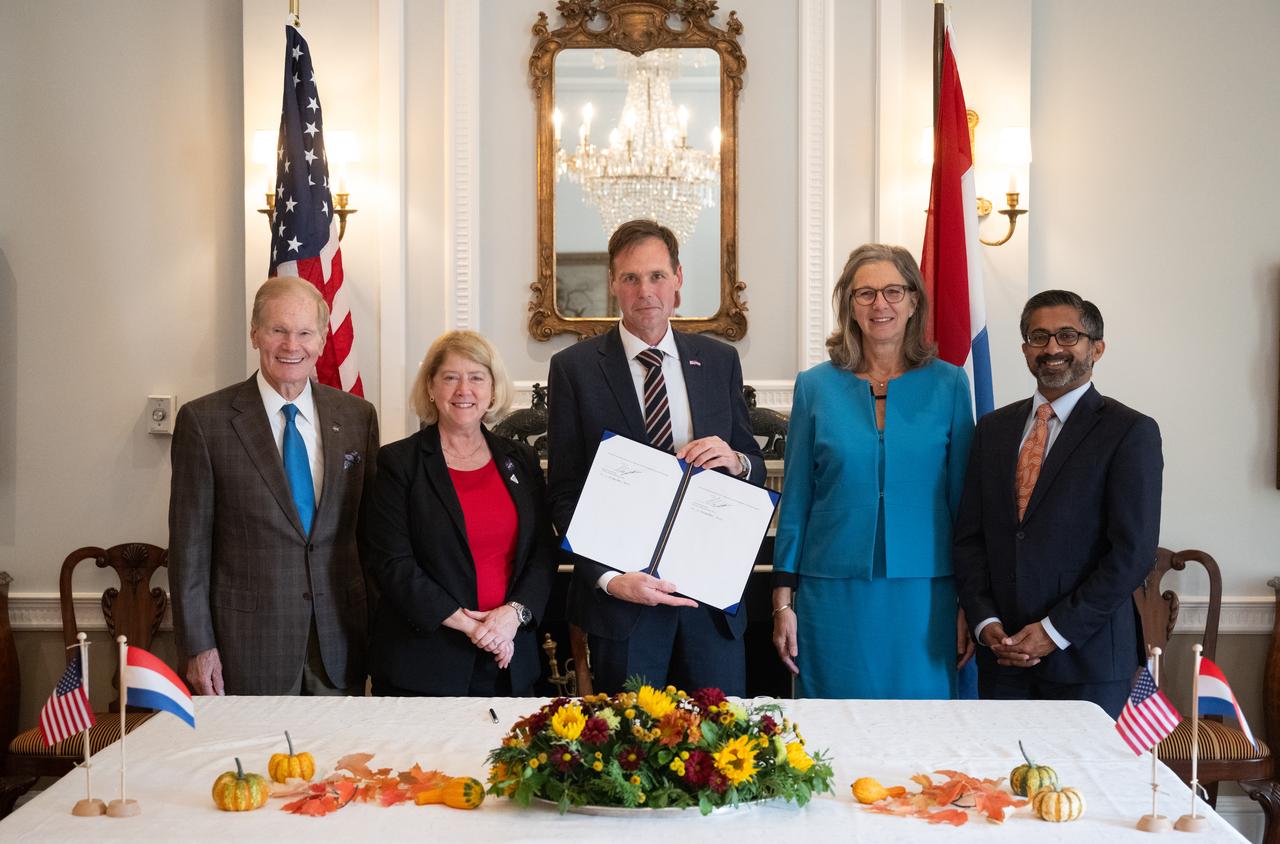
NASA Administrator Bill Nelson, left, NASA Deputy Administrator Pam Melroy, Harm van de Wetering, director of the Netherlands Space Office, Ambassador of the Kingdom of the Netherlands to the United States Birgitta Tazelaar, and Chiragh Parikh, executive secretary of the National Space Council, pose for a picture after the signing of the Artemis Accords, Wednesday, Nov. 1, 2023, at the Dutch Ambassador’s Residence in Washington. Netherlands is the 31st country to sign the Artemis Accords, which establish a practical set of principles to guide space exploration cooperation among nations participating in NASA’s Artemis program. Photo Credit: (NASA/Joel Kowsky)
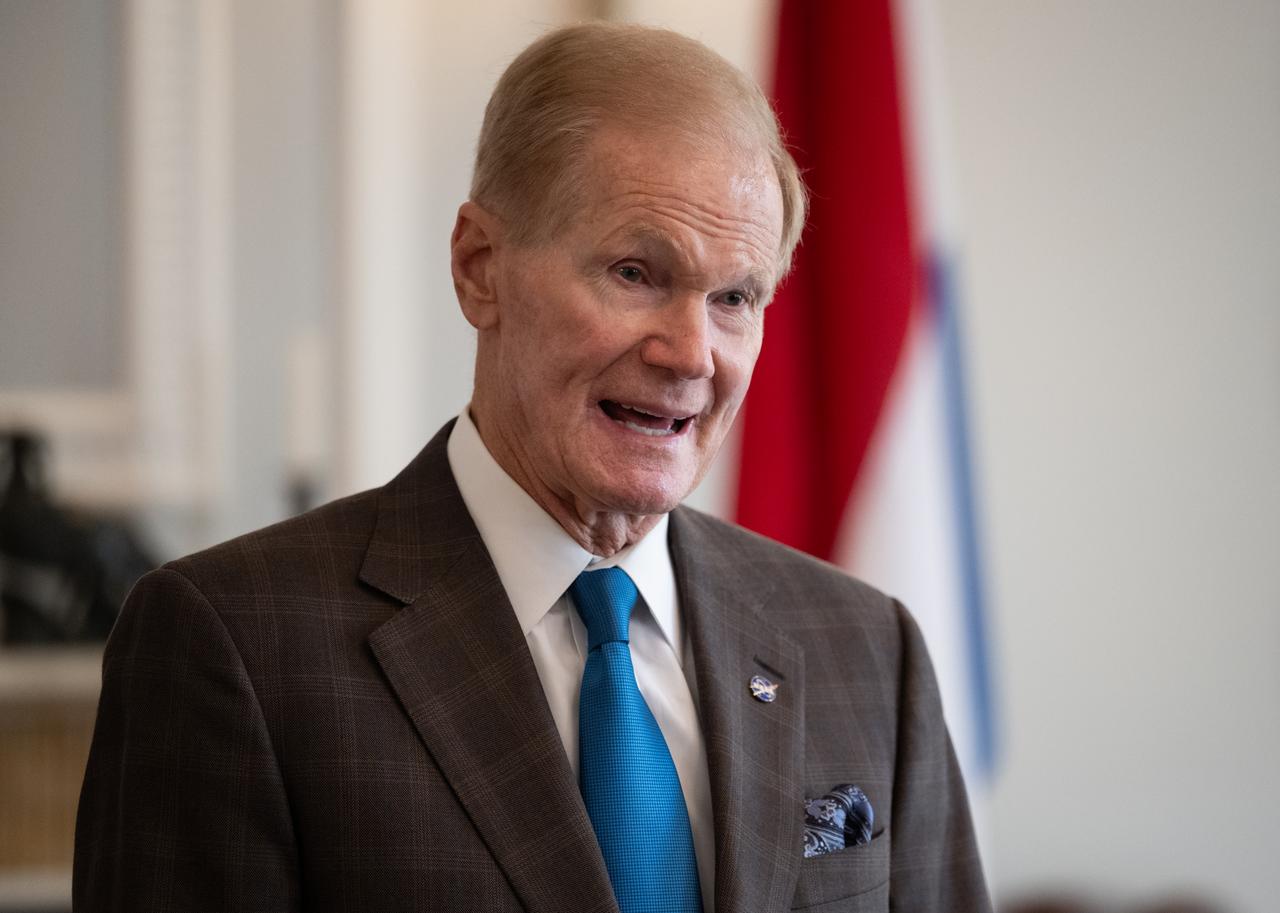
NASA Administrator Bill Nelson delivers remarks during an Artemis Accords signing ceremony, Wednesday, Nov. 1, 2023, at the Dutch Ambassador’s Residence in Washington. Netherlands is the 31st country to sign the Artemis Accords, which establish a practical set of principles to guide space exploration cooperation among nations participating in NASA’s Artemis program. Photo Credit: (NASA/Joel Kowsky)

NASA Administrator Bill Nelson delivers remarks during an Artemis Accords signing ceremony, Wednesday, Nov. 1, 2023, at the Dutch Ambassador’s Residence in Washington. Netherlands is the 31st country to sign the Artemis Accords, which establish a practical set of principles to guide space exploration cooperation among nations participating in NASA’s Artemis program. Photo Credit: (NASA/Joel Kowsky)

Chiragh Parikh, executive secretary of the National Space Council, delivers remarks during an Artemis Accords signing ceremony, Wednesday, Nov. 1, 2023, at the Dutch Ambassador’s Residence in Washington. Netherlands is the 31st country to sign the Artemis Accords, which establish a practical set of principles to guide space exploration cooperation among nations participating in NASA’s Artemis program. Photo Credit: (NASA/Joel Kowsky)
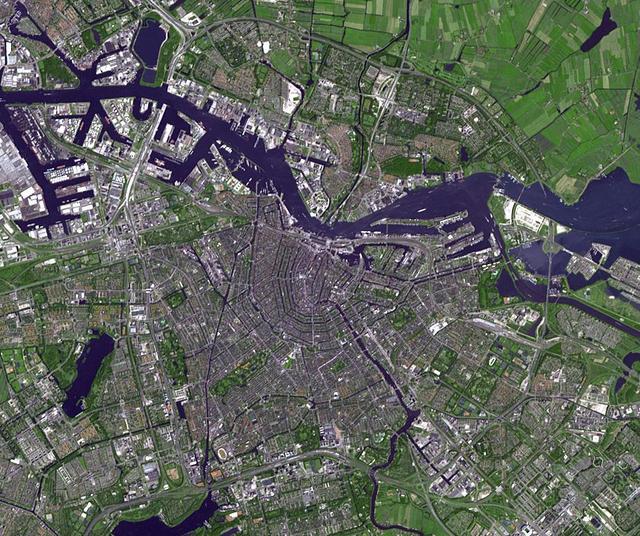
Amsterdam is the largest city and the capital of the Netherlands. Its name derives from a dam in the river Amstel. Founded in the 12th century as a fishing village, Amsterdam was one of the most important ports in the world in the 17th century.
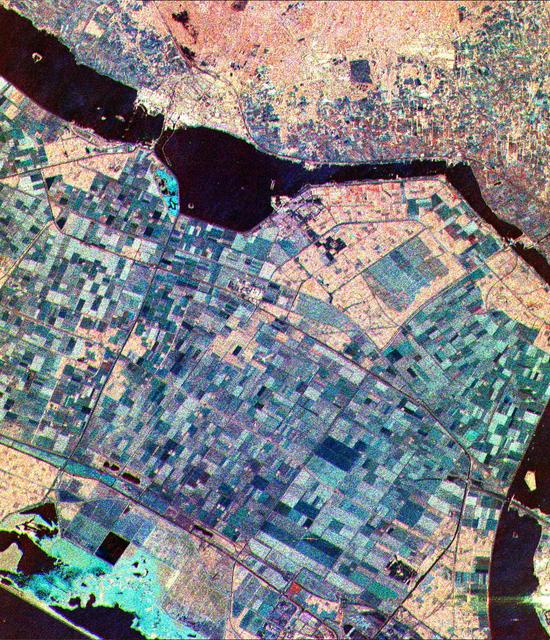
This is a three-frequency false color image of Flevoland, The Netherlands, centered at 52.4 degrees north latitude, 5.4 degrees east longitude.
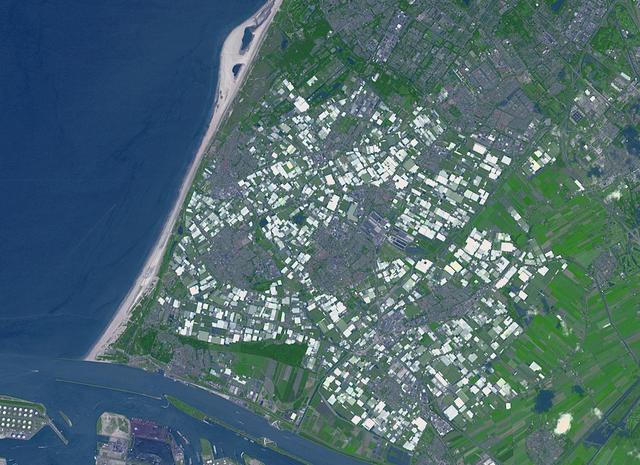
Westland in the Netherlands is the greenhouse capital of the world. It is the number two exporter of food as measured by value, second only to the United States. This is accomplished inside of almost 100 square kilometers of greenhouses. Tomato production, for example is 1 million tons per year, grown on only 18 square kilometers of area, making it number one globally in efficiency. The image was acquired June 12, 2014, covers an area of 13.5 by 18.4 kilometers, and is located at 52 degrees north, 4.3 degrees east. https://photojournal.jpl.nasa.gov/catalog/PIA21986
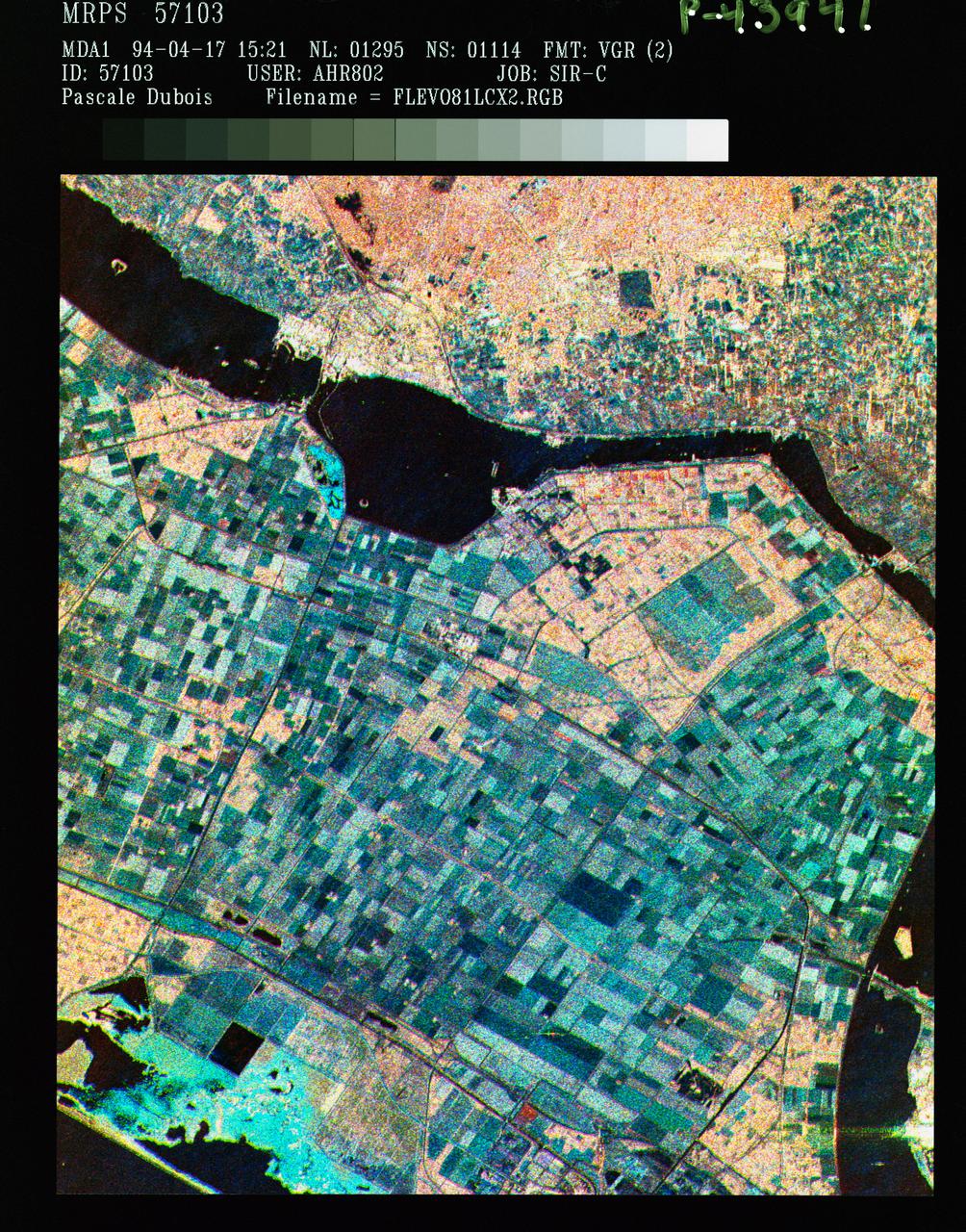
STS059-S-086 (18 April 1994) --- This is a three-frequency false-color image of Flevoland, the Netherlands, centered at 52.4 degrees north latitude, and 5.4 degrees east longitude. This image was acquired by the Spaceborne Imaging Radar-C and X-Band Synthetic Aperture Radar (SIR-C/X-SAR) aboard the Space Shuttle Endeavour on April 14, 1994. It was produced by combining data from the X-Band, C-Band and L-Band radar's. The area shown is approximately 25 by 28 kilometers (15 1/2 by 17 1/2 miles). Flevoland, which fills the lower two-thirds of the image, is a very flat area that is made up of reclaimed land that is used for agriculture and forestry. At the top of the image, across the canal from Flevoland, is an older forest shown in red; the city of Harderwijk is shown in white on the shore of the canal. At this time of the year, the agricultural fields are bare soil, and they show up in this images in blue. The changes in the brightness of the blue areas are equal to the changes in roughness. The dark blue areas are water and the small dots in the canal are boats. This SIR-C/X-SAR supersite is being used for both calibration and agricultural studies. Several soil and crop ground-truth studies will be conducted during the Shuttle flight. In addition, about 10 calibration devices and 10 corner reflectors have been deployed to calibrate and monitor the radar signal. One of these transponders can be seen as a bright star in the lower right quadrant of the image. This false-color image was made using L-Band total power in the red channel, C-Band total power in the green channel, and X-Band VV polarization in the blue channel. SIR-C/X-SAR is part of NASA's Mission to Planet Earth (MTPE). SIR-C/X-SAR radars illuminate Earth with microwaves allowing detailed observations at any time, regardless of weather or sunlight conditions. SIR-C/X-SAR uses three microwave wavelengths: L-Band (24 cm), C-Band (6 cm), and X-Band (3 cm). The multi-frequency data will be used by the international scientific community to better understand the global environment and how it is changing. The SIR-C/X-SAR data, complemented by aircraft and ground studies, will give scientists clearer insights into those environmental changes which are caused by nature and those changes which are induced by human activity. SIR-C was developed by NASA's Jet Propulsion Laboratory (JPL). X-SAR was developed by the Dornire and Alenia Spazio Companies for the German Space Agency, Deutsche Agentur fuer Raumfahrtangelegenheiten (DARA), and the Italian Space Agency, Agenzia Spaziale Italiana (ASI). JPL Photo ID: P-43941
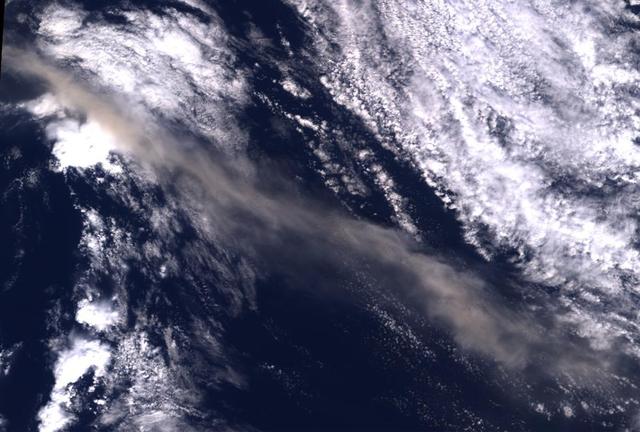
Ash from Iceland Eyjafjallajökull volcano, viewed here in imagery from NASA Terra spacecraft on May 16, 2010, once again disrupted air traffic over Europe with the closure of major airports in the United Kingdom and the Netherlands.
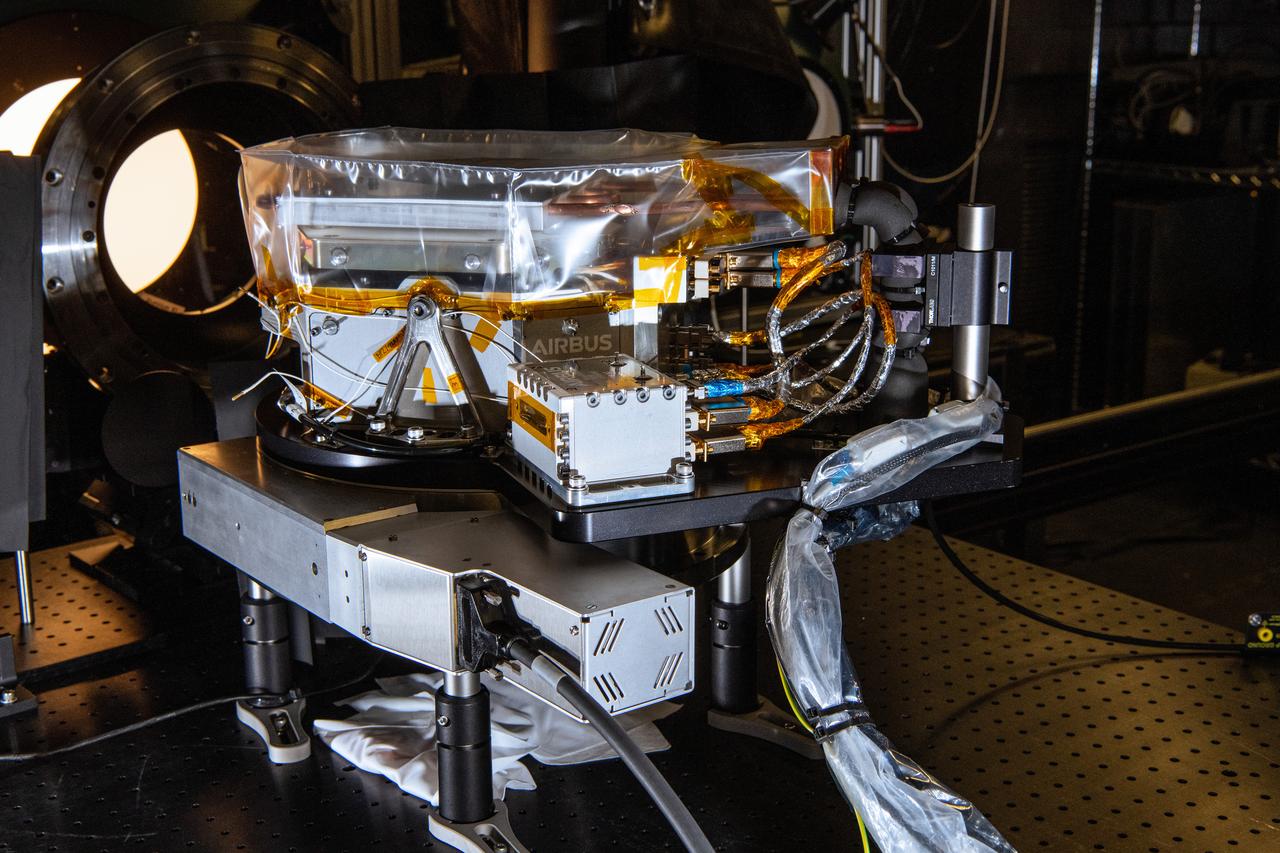
The SPEXone instrument undergoes Polarimetric Calibration at NASA's Goddard Space Flight Center in Greenbelt,Maryland on April 8th, 2021. SPEXone is one of three instruments on NASA's Plankton, Aerosol, Cloud, ocean Ecosystem (PACE) observatory and has been developed by a Dutch consortium consisting of SRON Netherlands Institute for Space Research and Airbus Defence and Space Netherlands, supported by opto-mechanical expertise from TNO. SRON and Airbus DS NL are responsible for the design, manufacturing and testing of the instrument. The scientific lead is in the hands of SRON. SPEXone is a public-private initiative, funded by the Netherlands Space Office (NSO), the Netherlands Organization of Scientific Research (NWO), SRON and Airbus DS NL.
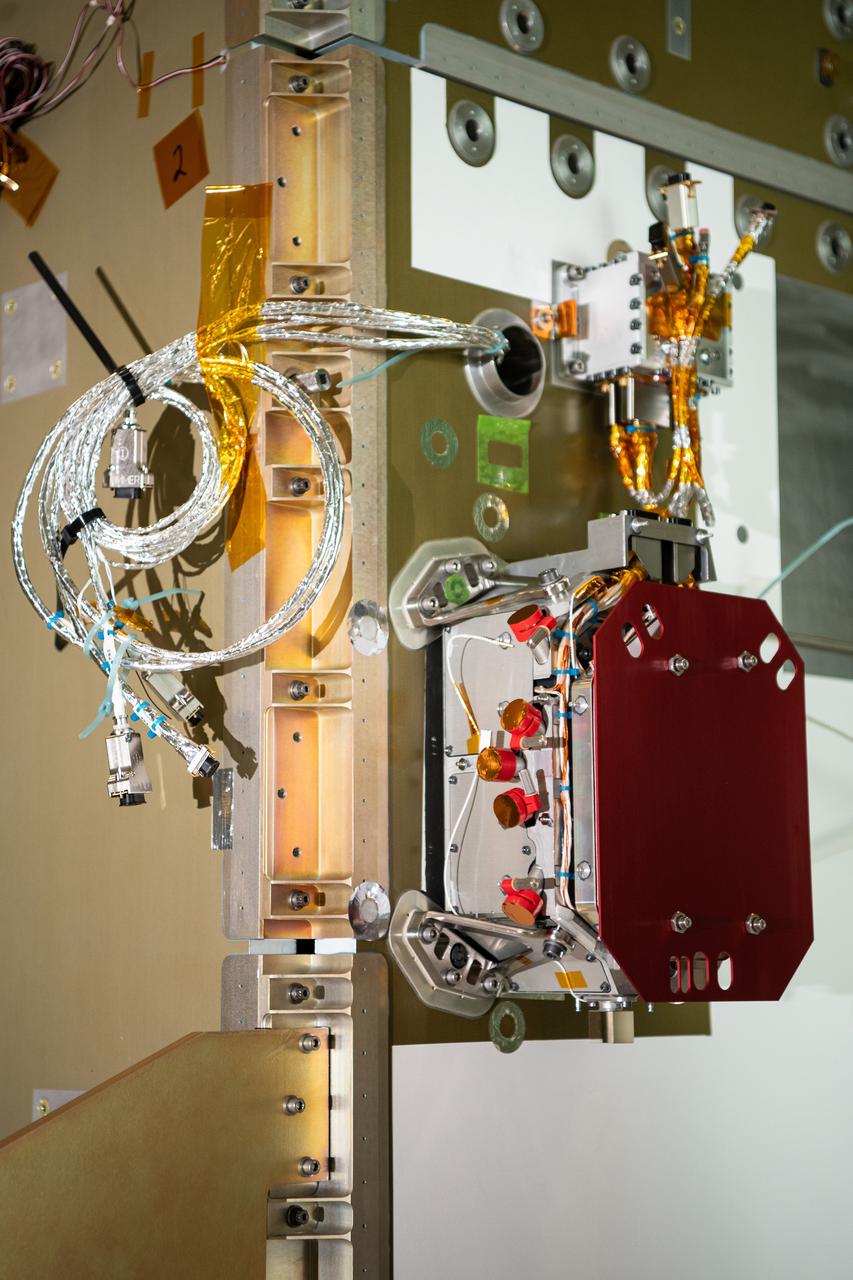
The SPEXone instrument after integration to the Plankton, Aerosol, Cloud, ocean Ecosystem (PACE) Observatory. SPEXone is one of three instruments on NASA's Plankton, Aerosol, Cloud, ocean Ecosystem (PACE) observatory and has been developed by a Dutch consortium consisting of SRON Netherlands Institute for Space Research and Airbus Defence and Space Netherlands, supported by opto-mechanical expertise from TNO. SRON and Airbus DS NL are responsible for the design, manufacturing and testing of the instrument. The scientific lead is in the hands of SRON. SPEXone is a public-private initiative, funded by the Netherlands Space Office (NSO), the Netherlands Organization of Scientific Research (NWO), SRON and Airbus DS NL.
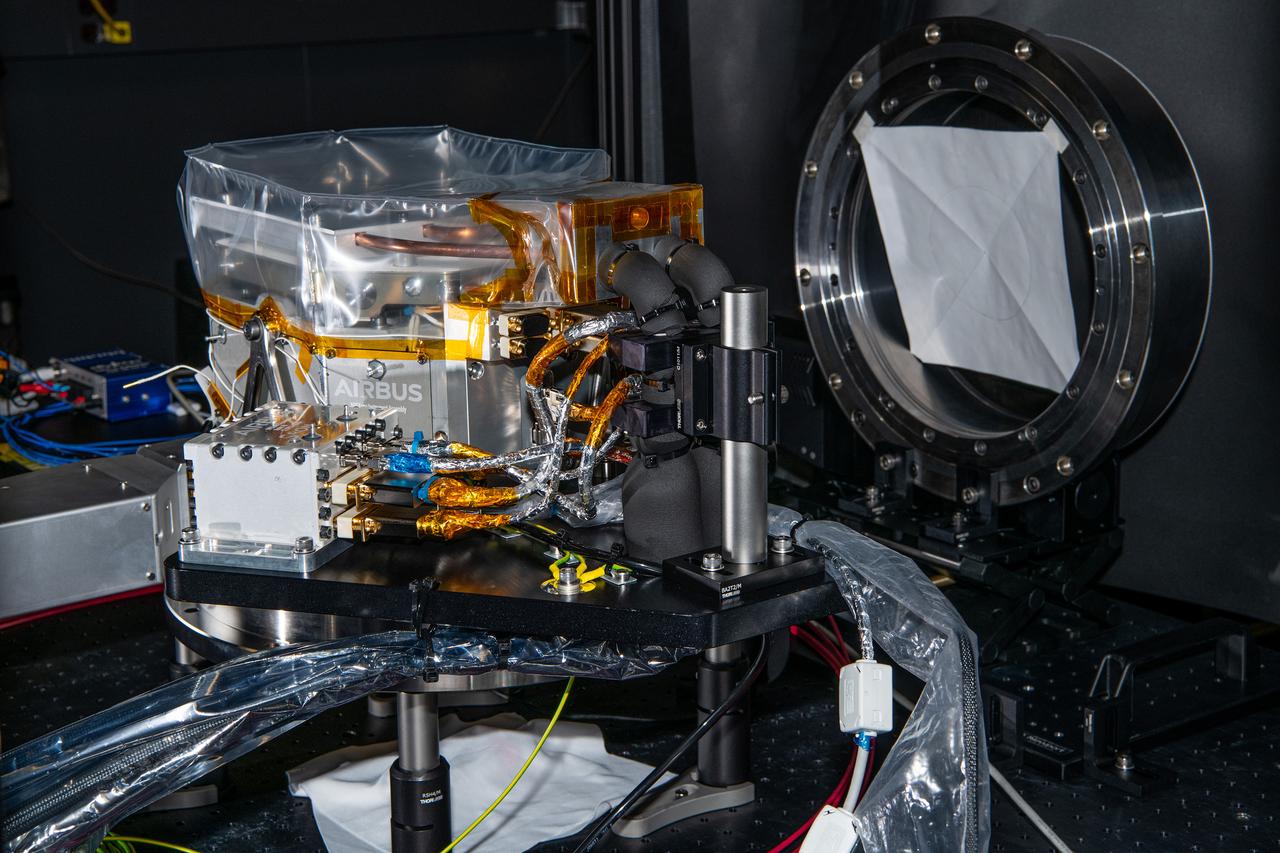
The SPEXone instrument undergoes comprehensive performace and calibration testing at NASA's Goddard Space Flight Center in Greenbelt,Maryland on April 8th, 2021. SPEXone is one of three instruments on NASA's Plankton, Aerosol, Cloud, ocean Ecosystem (PACE) observatory and has been developed by a Dutch consortium consisting of SRON Netherlands Institute for Space Research and Airbus Defence and Space Netherlands, supported by opto-mechanical expertise from TNO. SRON and Airbus DS NL are responsible for the design, manufacturing and testing of the instrument. The scientific lead is in the hands of SRON. SPEXone is a public-private initiative, funded by the Netherlands Space Office (NSO), the Netherlands Organization of Scientific Research (NWO), SRON and Airbus DS NL.
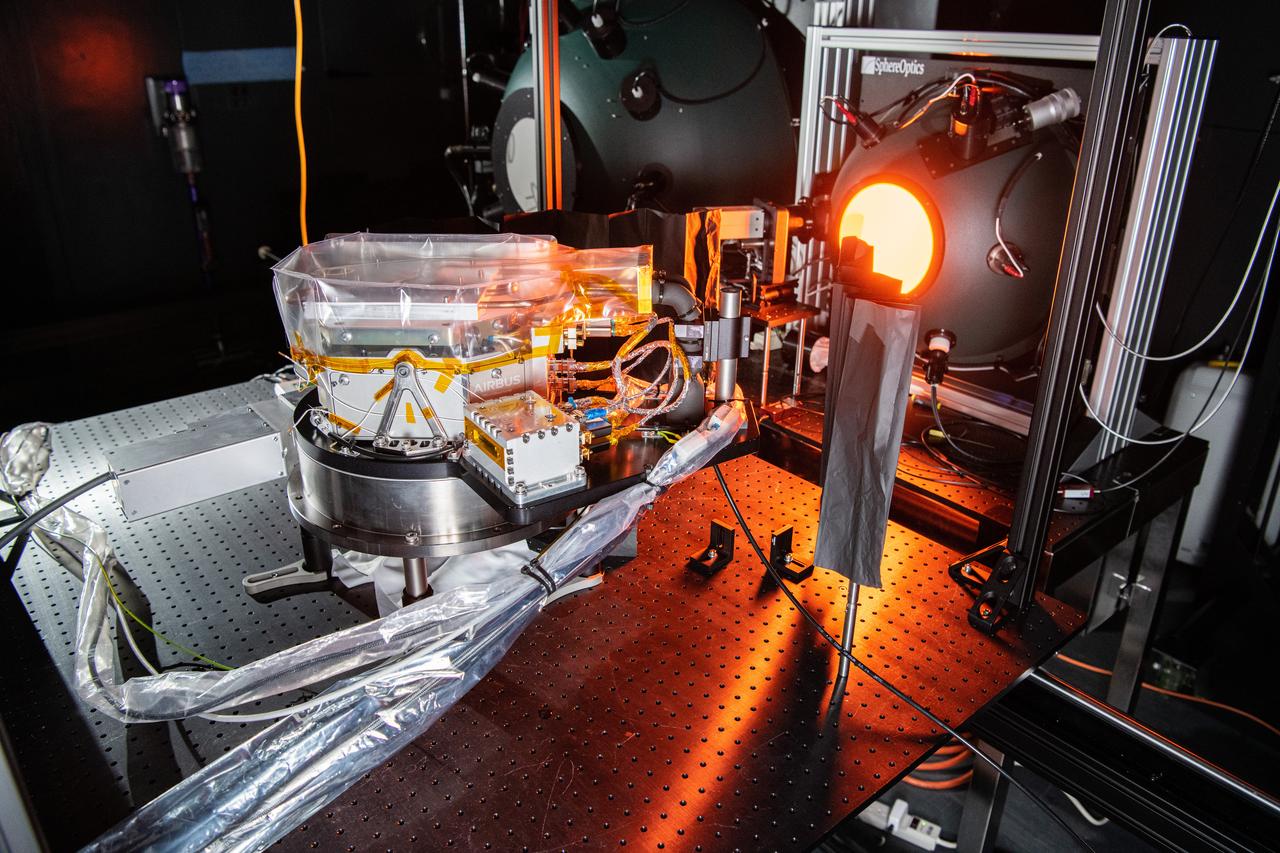
The SPEXone instrument undergoes cross calibration at NASA's Goddard Space Flight Center in Greenbelt,Maryland on April 20th, 2021. SPEXone is one of three instruments on NASA's Plankton, Aerosol, Cloud, ocean Ecosystem (PACE) observatory and has been developed by a Dutch consortium consisting of SRON Netherlands Institute for Space Research and Airbus Defence and Space Netherlands, supported by opto-mechanical expertise from TNO. SRON and Airbus DS NL are responsible for the design, manufacturing and testing of the instrument. The scientific lead is in the hands of SRON. SPEXone is a public-private initiative, funded by the Netherlands Space Office (NSO), the Netherlands Organization of Scientific Research (NWO), SRON and Airbus DS NL.
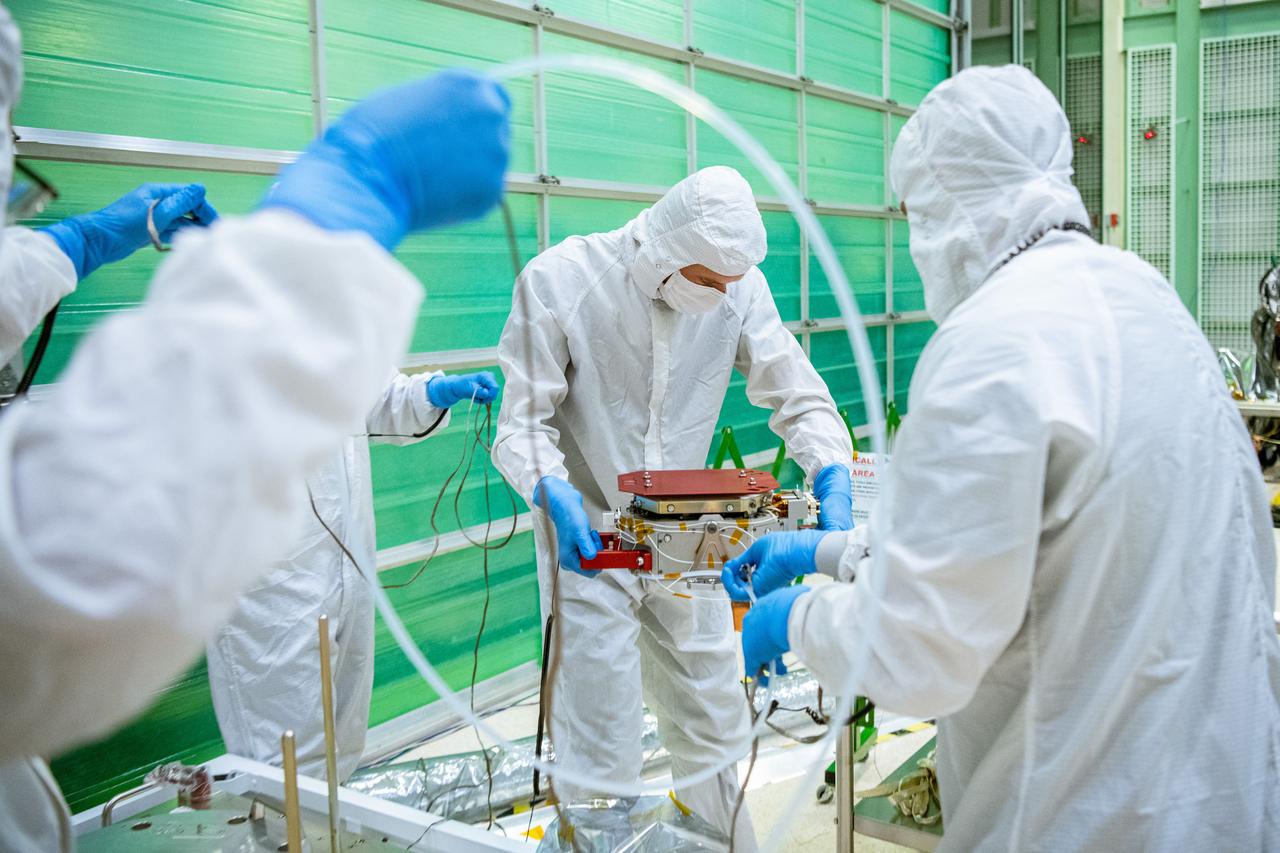
Senior Mechanical Design Engineer Alexander Eigenraam from SRON, the Netherlands Institute for Space Research, moves the SPEXone instrument before it is integrated onto the Plankton, Aerosol, Cloud, ocean Ecosystem (PACE) Spacecraft at NASA Goddard Space Flight Center in Greenbelt, Maryland on June 13th, 2022. SPEXone is one of three instruments on NASA's Plankton, Aerosol, Cloud, ocean Ecosystem (PACE) observatory and has been developed by a Dutch consortium consisting of SRON Netherlands Institute for Space Research and Airbus Defence and Space Netherlands, supported by opto-mechanical expertise from TNO. SRON and Airbus DS NL are responsible for the design, manufacturing and testing of the instrument. The scientific lead is in the hands of SRON. SPEXone is a public-private initiative, funded by the Netherlands Space Office (NSO), the Netherlands Organization of Scientific Research (NWO), SRON and Airbus DS NL.instrument. The scientific lead is in the hands of SRON. SPEXone is a public-private initiative, funded by the Netherlands Space Office (NSO), the Netherlands Organization of Scientific Research (NWO), SRON and Airbus DS NL.
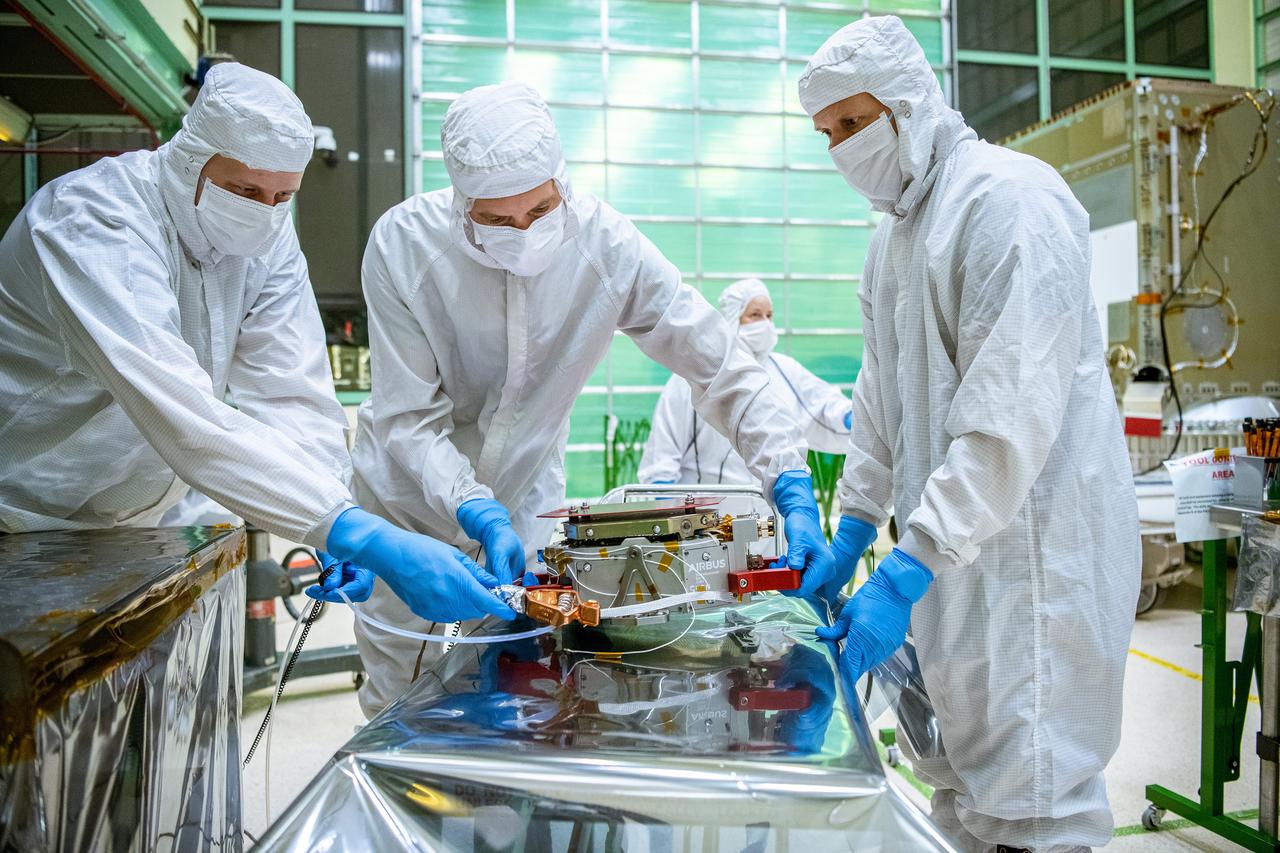
Engineers from SRON, the Netherlands Institute for Space Research, move the SPEXone instrument before it is integrated onto the Plankton, Aerosol, Cloud, ocean Ecosystem (PACE) Spacecraft at NASA Goddard Space Flight Center in Greenbelt, Maryland on June 13th, 2022. SPEXone is a compact, optical satellite instrument that will characterize aerosols from low Earth orbit as part of the NASA PACE mission. SPEXone is one of three instruments on NASA's Plankton, Aerosol, Cloud, ocean Ecosystem (PACE) observatory and has been developed by a Dutch consortium consisting of SRON Netherlands Institute for Space Research and Airbus Defence and Space Netherlands, supported by opto-mechanical expertise from TNO. SRON and Airbus DS NL are responsible for the design, manufacturing and testing of the instrument. The scientific lead is in the hands of SRON. SPEXone is a public-private initiative, funded by the Netherlands Space Office (NSO), the Netherlands Organization of Scientific Research (NWO), SRON and Airbus DS NL.
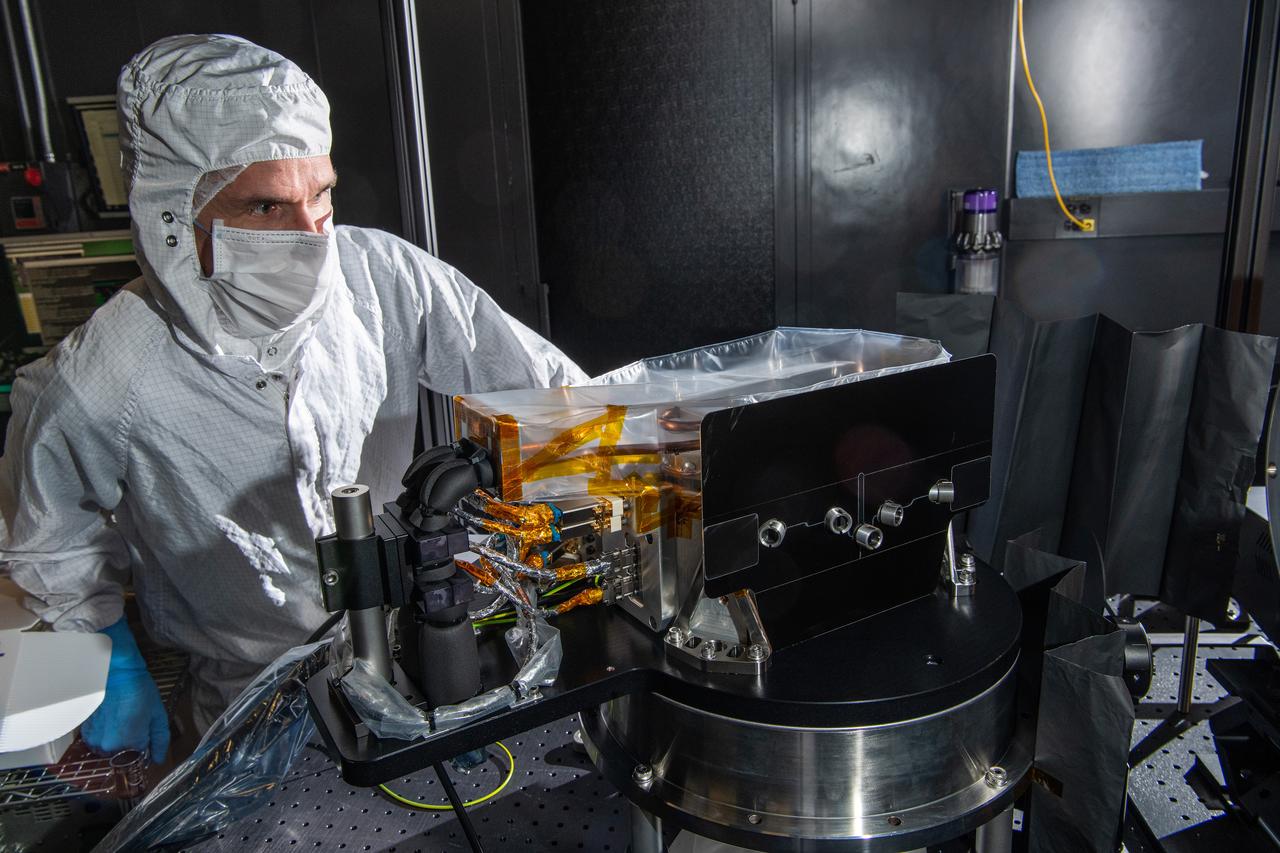
Jochen Campo from SRON Netherlands Institute for Space Research with the The SPEXone Polarimetric Calibration at NASA's Goddard Space Flight Center in Greenbelt,Maryland on April 8th, 2021. SPEXone is one of three instruments on NASA's Plankton, Aerosol, Cloud, ocean Ecosystem (PACE) observatory and has been developed by a Dutch consortium consisting of SRON Netherlands Institute for Space Research and Airbus Defence and Space Netherlands, supported by opto-mechanical expertise from TNO. SRON and Airbus DS NL are responsible for the design, manufacturing and testing of the instrument. The scientific lead is in the hands of SRON. SPEXone is a public-private initiative, funded by the Netherlands Space Office (NSO), the Netherlands Organization of Scientific Research (NWO), SRON and Airbus DS NL.
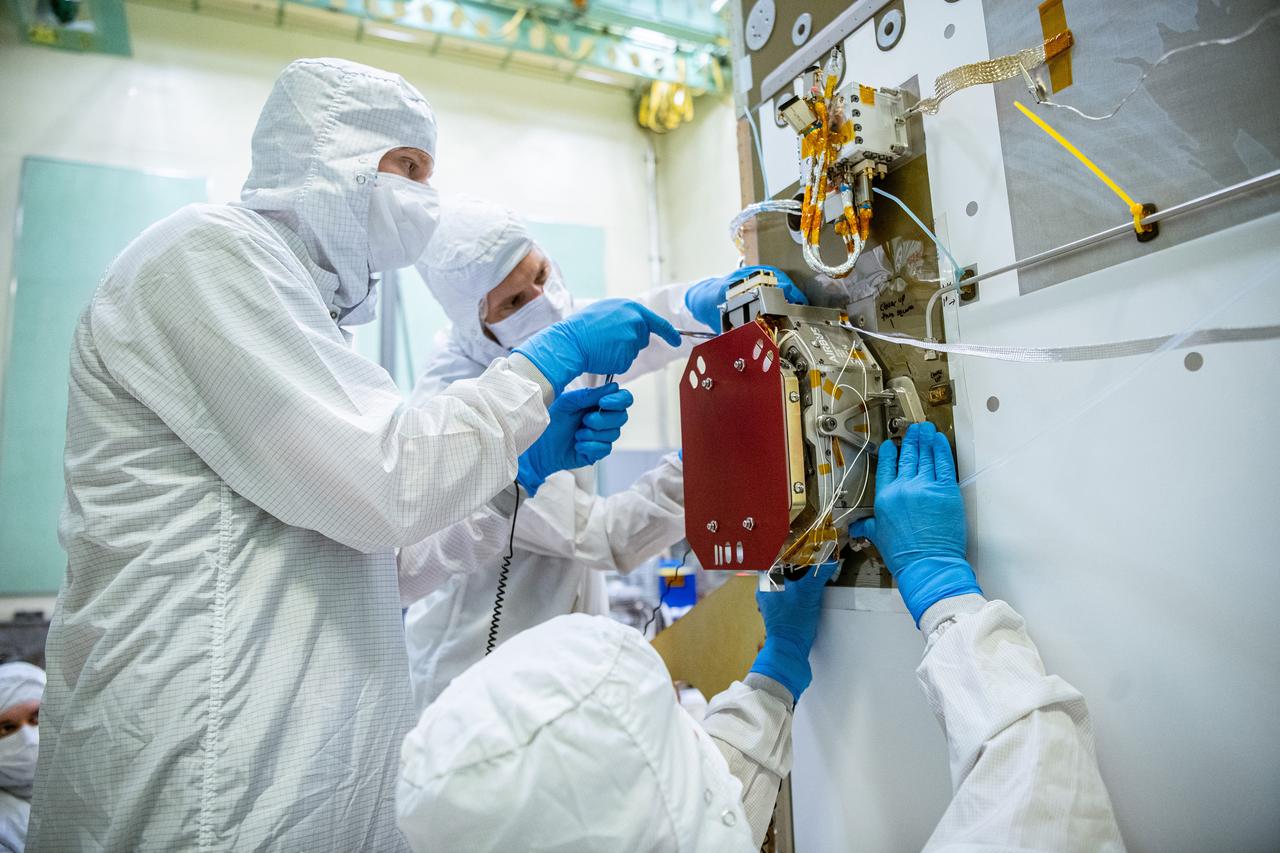
NASA technicians and Engineers from SRON, the Netherlands Institute for Space Research, integrate the SPEXone instrument to the Plankton, Aerosol, Cloud, ocean Ecosystem (PACE) Spacecraft at NASA Goddard Space Flight Center in Greenbelt, Maryland on June 13th, 2022. SPEXone is a compact, optical satellite instrument that will characterize aerosols from low Earth orbit as part of the NASA PACE mission. SPEXone is one of three instruments on NASA's Plankton, Aerosol, Cloud, ocean Ecosystem (PACE) observatory and has been developed by a Dutch consortium consisting of SRON Netherlands Institute for Space Research and Airbus Defence and Space Netherlands, supported by opto-mechanical expertise from TNO. SRON and Airbus DS NL are responsible for the design, manufacturing and testing of the instrument. The scientific lead is in the hands of SRON. SPEXone is a public-private initiative, funded by the Netherlands Space Office (NSO), the Netherlands Organization of Scientific Research (NWO), SRON and Airbus DS NL.
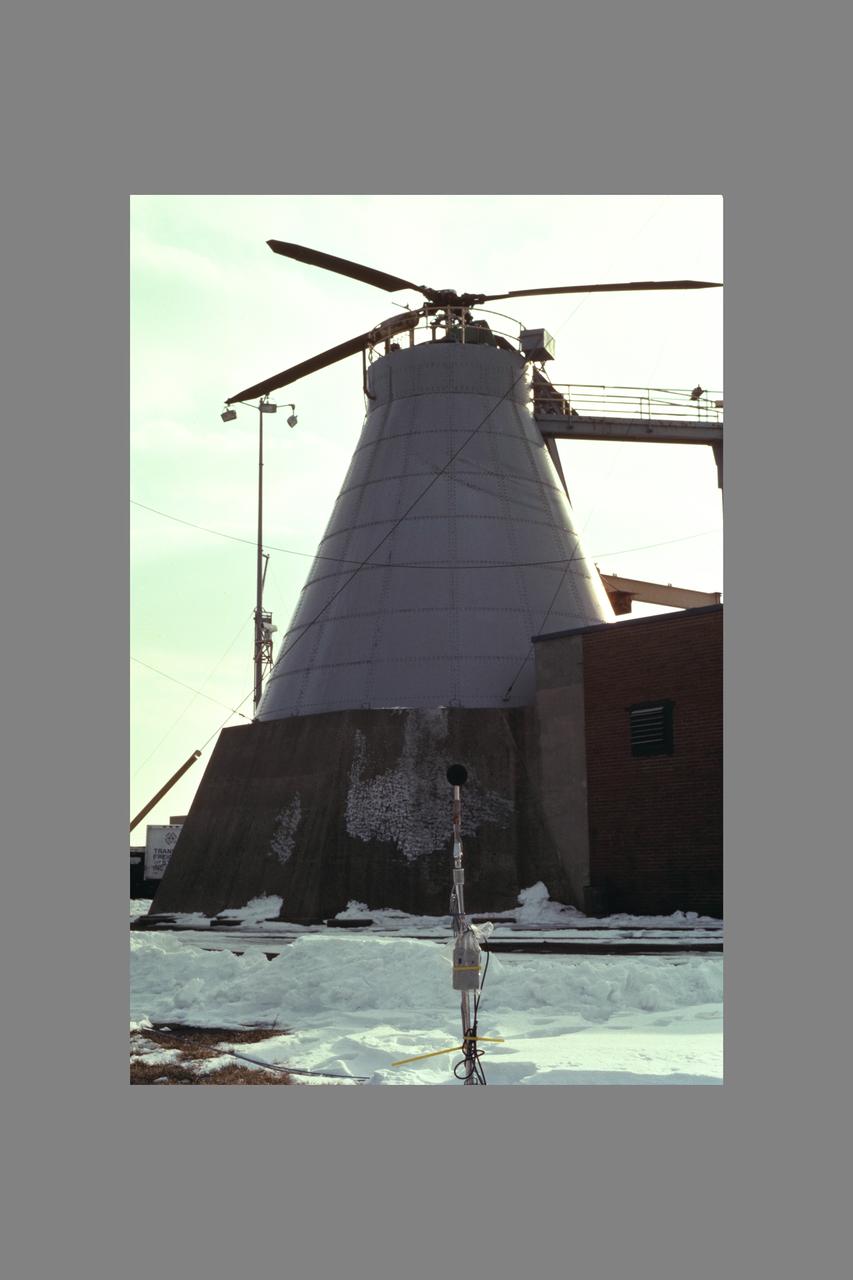
Dutch Netherlands testing of Boeing 360 Vertol Rotor: Full Test

Dutch Netherlands testing of Boeing 360 Vertol Rotor: Full Test
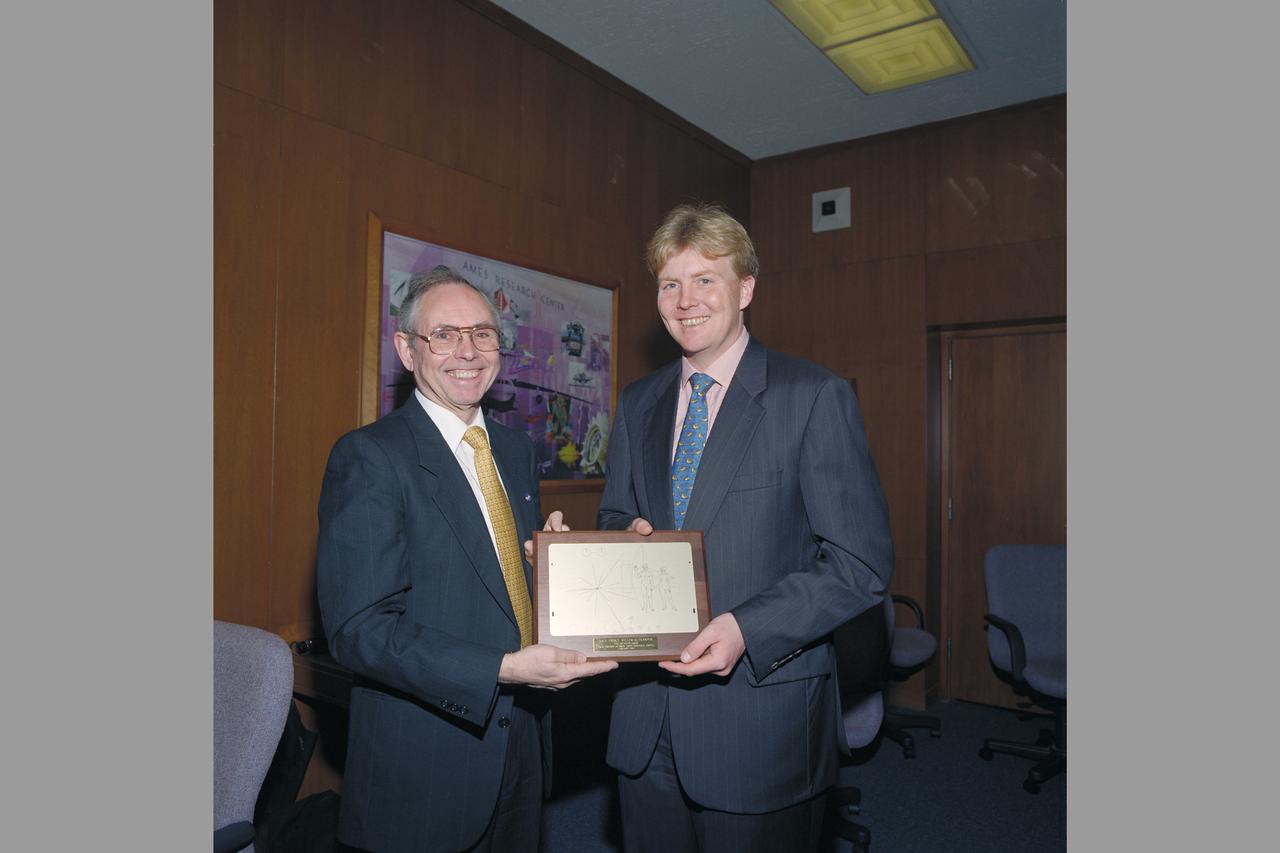
Prince Willem Alexander (Crown Prince of the Netherlands) visits Ames shown here with Ames Center Director H. McDonald.
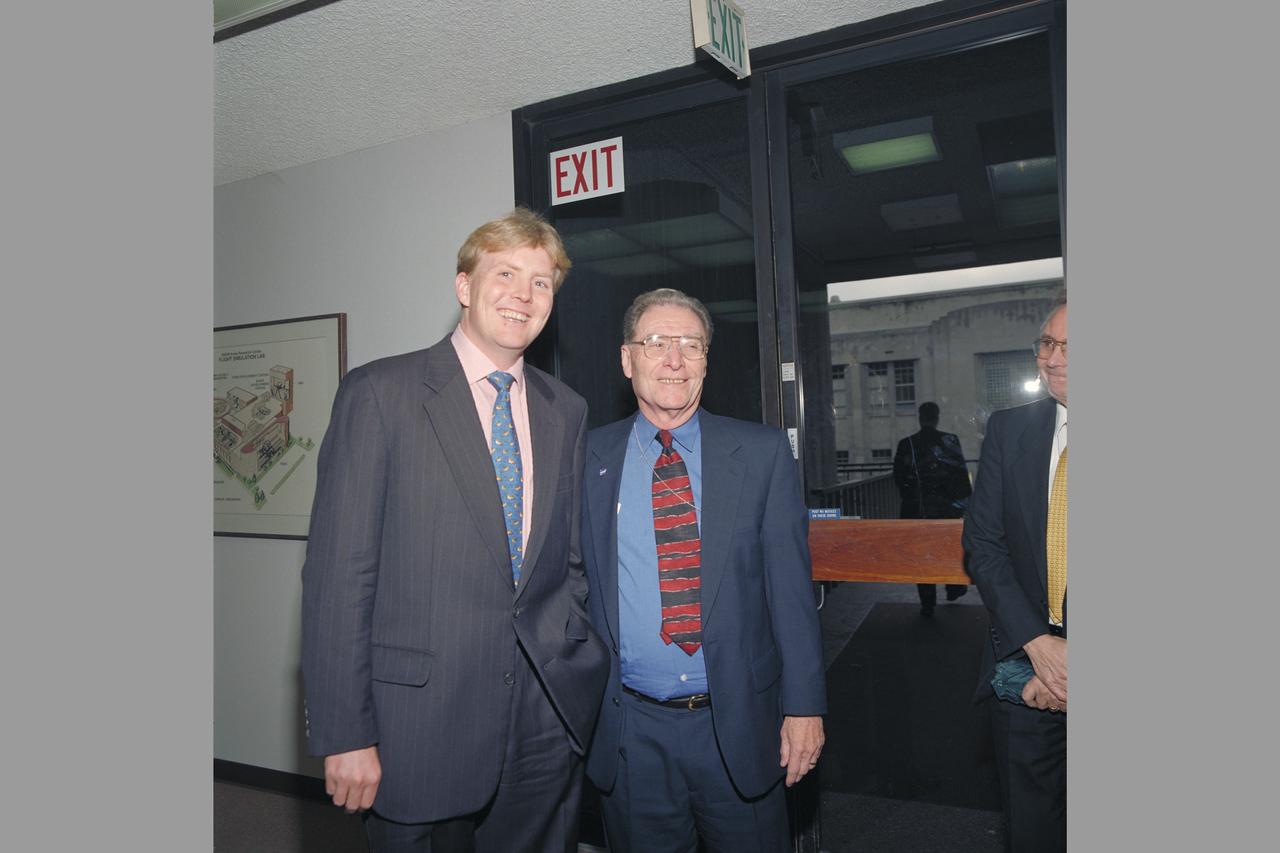
Prince Willem Alexander (Crown Prince of the Netherlands) visits Ames shown here with Jack Boyd
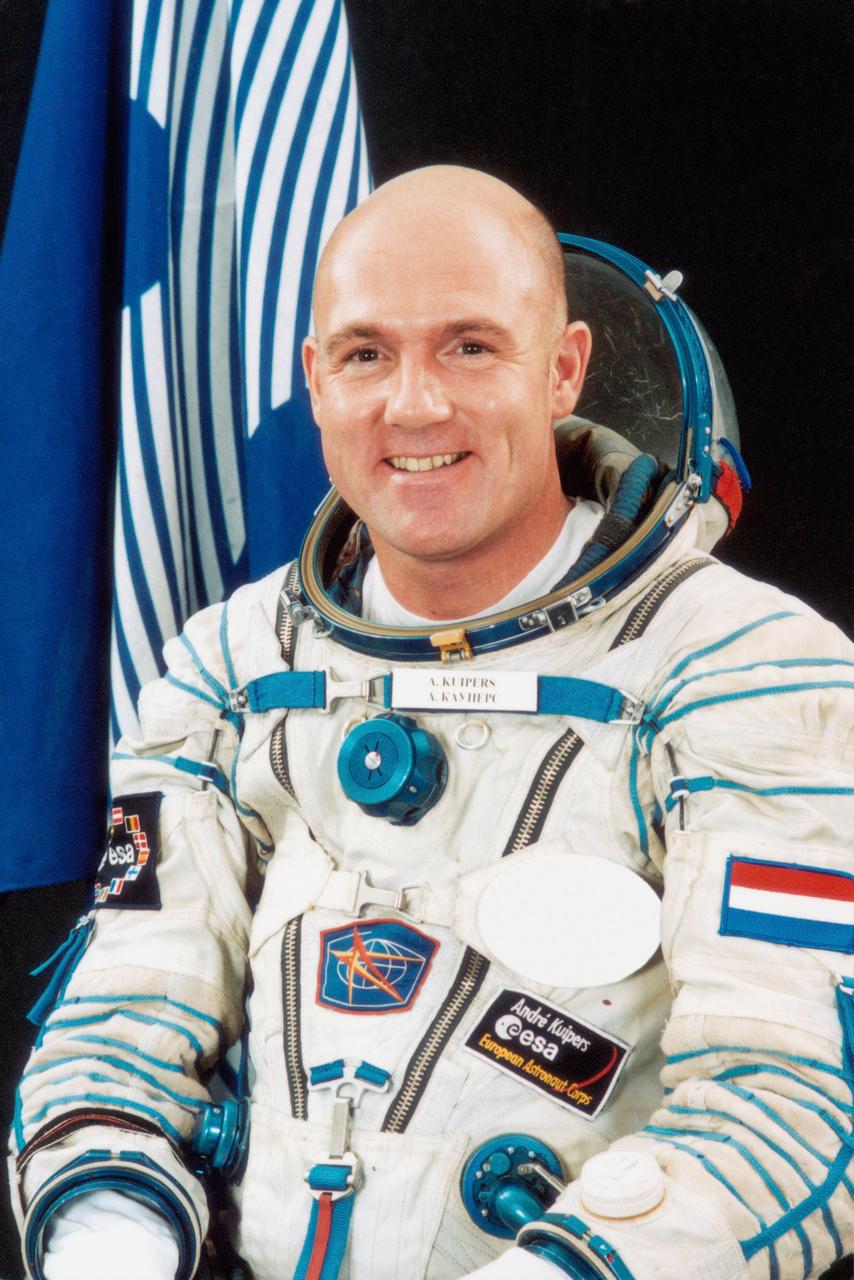
JSC2004-E-04177 (January 2004) --- European Space Agency (ESA) astronaut Andre Kuipers of the Netherlands. Photo credit: ESA/GCTC
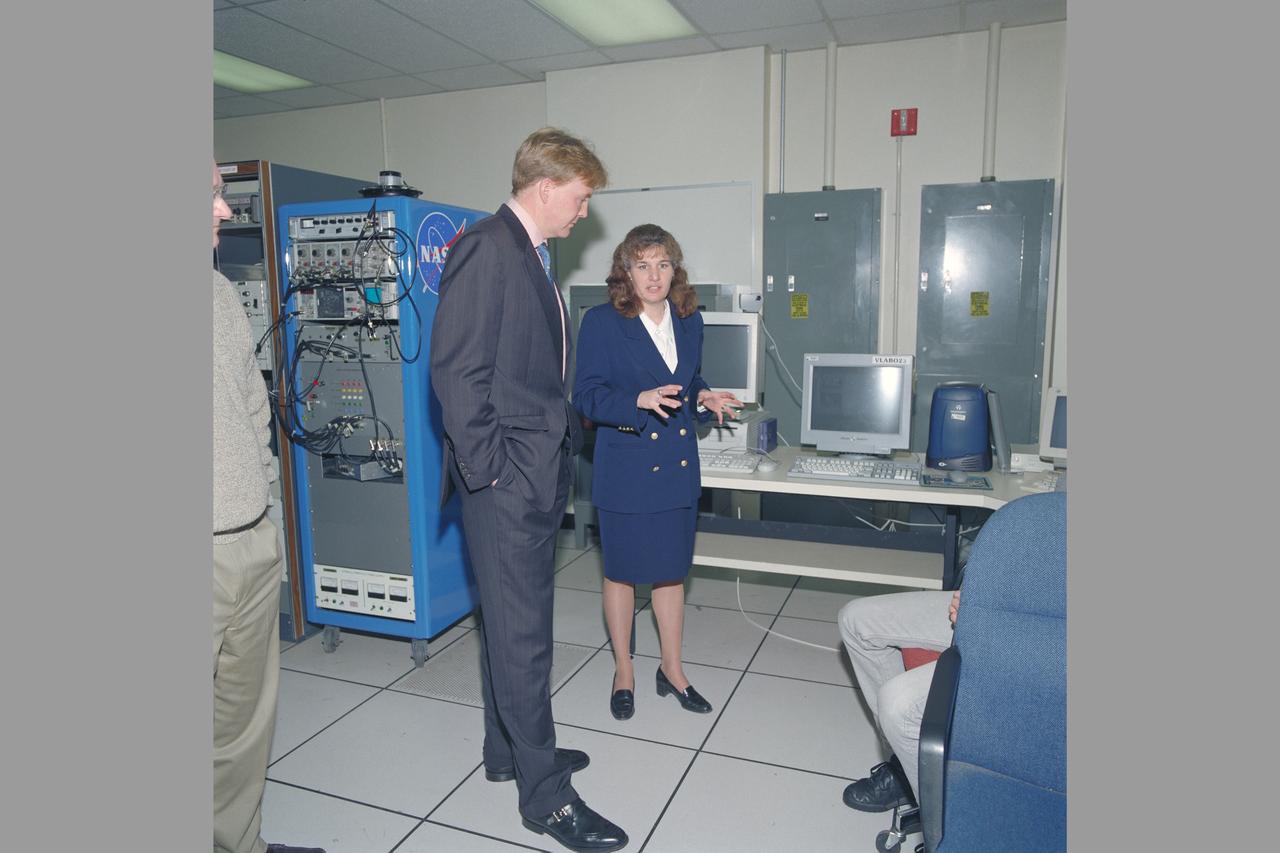
Julie Mikula & Prince in VMS Control Room. Visit: Crown Prince of the Netherlands, His Royal Highness The Prince of Orange Willem-Alexander.
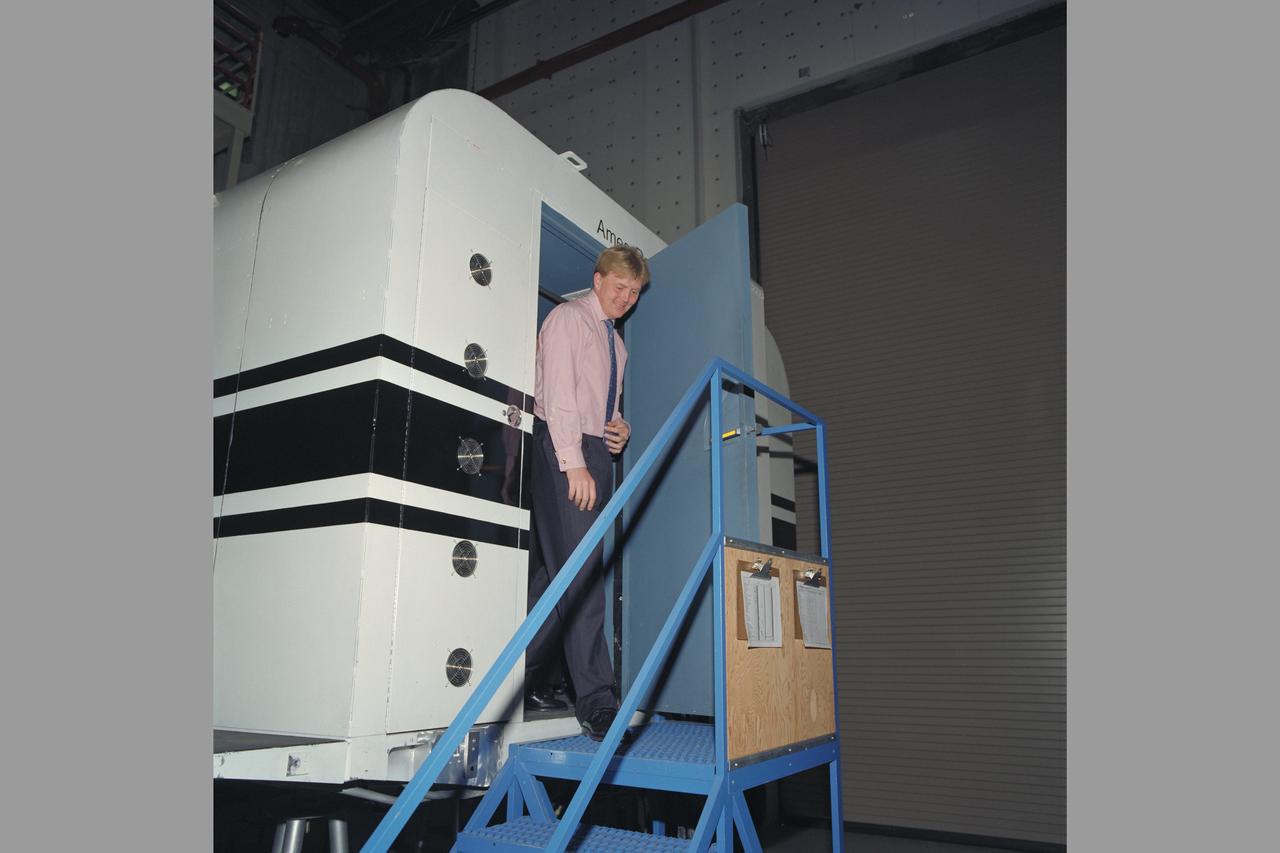
Prince Willem-Alexander van Oranje, Crown Prince of the Netherlands visits Ames shown here leaving VMS cab after a simulated flight
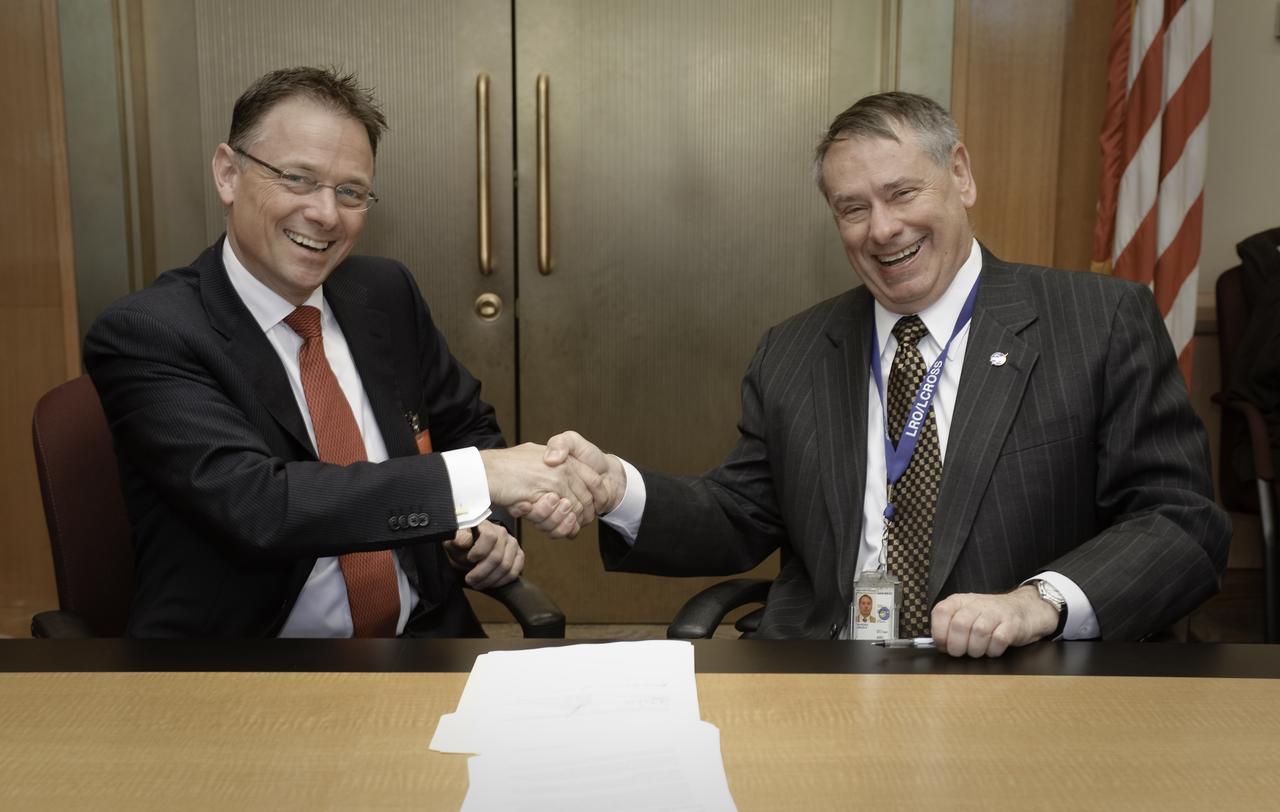
Netherlands Memorandum of Record (MOR) agreement signing the NASA Ames Research Center, Mofffett Field, California. Signing the MOR are on left Dr. Louis B.J.Vertegaal, Director of Physical Sciences, Chemistry, and Advanced Chemical Technologies for Sustainability, of the Netherlands Organisation for Scientific Research (NWO) and on right Dr. S. Pete Worden, Director NASA Ames Research Center
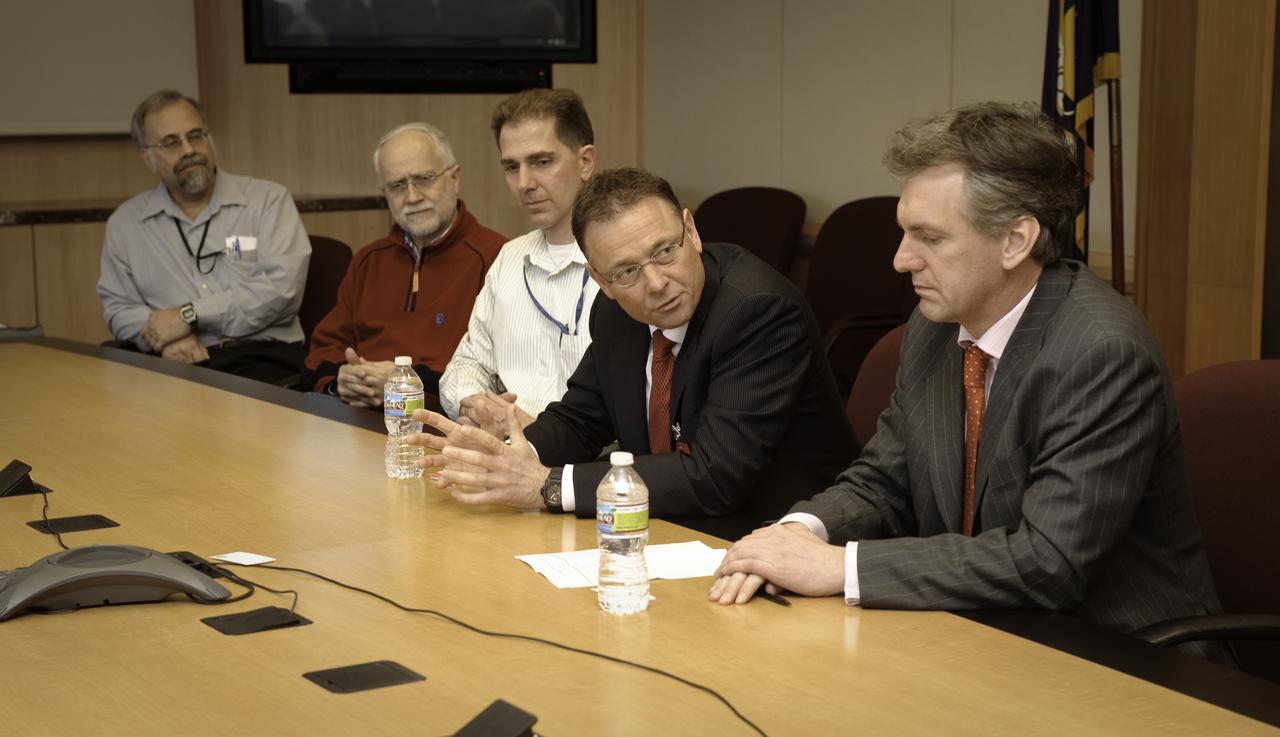
Netherlands Memorandum of Record (MOR) agreement signing and visit to the NASA Ames Research Center, Mofffett Field, California. At the table are left to right, Dr. Scott Sanford, NASA Ames, Dr Alexander Tielens, former NASA Civil Servant and former SOFIA Project Scientist, Dr Andrew Mattioda, NASA Ames, Dr. Louis B.J.Vertegaal, Director of Physical Sciences, Chemistry, and Advanced Chemical Technologies for Sustainability, of the Netherlands Organisation for Scientific Research (NWO)
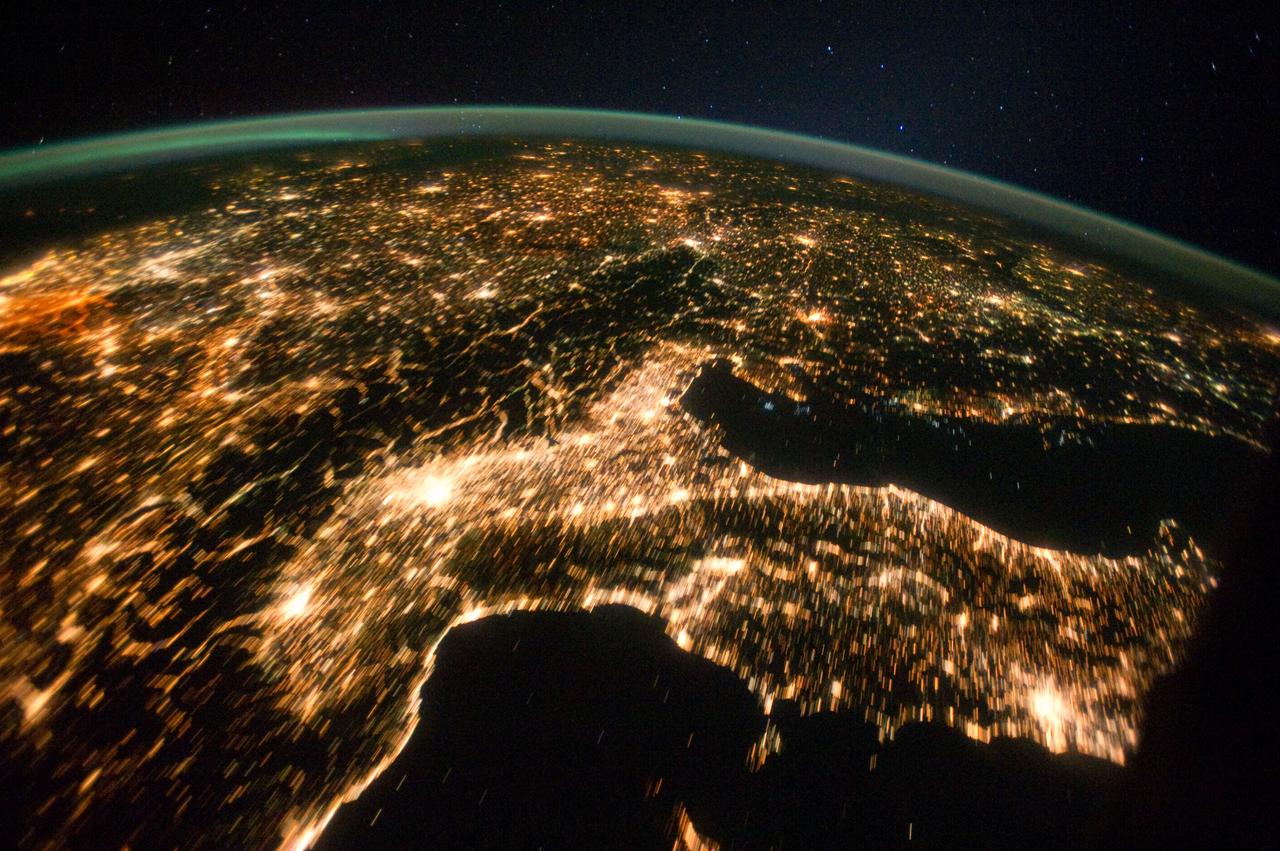
ISS029-E-021987 (2 Oct. 2011) --- This is one of a series of night time images photographed by one of the Expedition 29 crew members from the International Space Station. It features Central and Eastern Europe, extending from the Netherlands to Hungary and Italy to northern Poland. Overall, the view includes the Netherlands, Italy, Germany, Poland, and Hungary. When the photo was taken on Oct 2, 2011, the station was over Corsica at 43.18 degrees north latitude and 9.95 degrees east longitude.
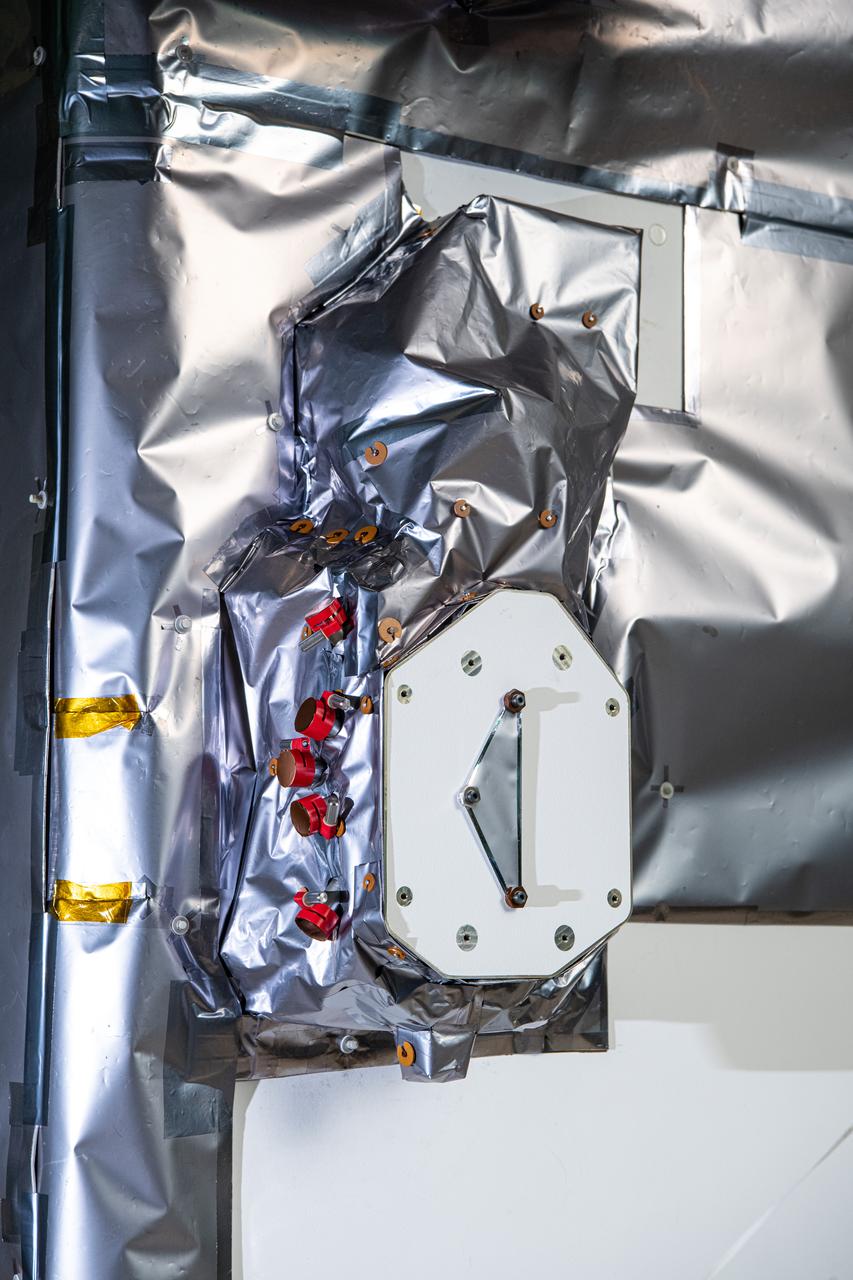
The SPEXone instrument on The Plankton, Aerosol, Cloud, ocean Ecosystem (PACE) in the clean room at NASA's Goddard Space Flight Center in Greenbelt, Maryland on October 31st, 2023. SPEXone is one of three instruments on NASA's Plankton, Aerosol, Cloud, ocean Ecosystem (PACE) observatory and has been developed by a Dutch consortium consisting of SRON Netherlands Institute for Space Research and Airbus Defence and Space Netherlands, supported by opto-mechanical expertise from TNO. SRON and Airbus DS NL are responsible for the design, manufacturing and testing of the instrument. The scientific lead is in the hands of SRON. SPEXone is a public-private initiative, funded by the Netherlands Space Office (NSO), the Netherlands Organization of Scientific Research (NWO), SRON and Airbus DS NL. PACE's unprecedented spectral coverage will provide the first-ever global measurements designed to identify phytoplankton community composition. The mission will make global ocean color measurements, using the Ocean Color Instrument (OCI), to provide extended data records on ocean ecology and global biogeochemistry along with polarimetry measurements, using the Spectro-polarimeter for Planetary Exploration (SPEXone) and the Hyper Angular Research Polarimeter (HARP2) to provide extended data records on clouds and aerosols. The Earth-observing satellite mission, built at Goddard Space Flight Center in Greenbelt, MD, will continue and advance observations of global ocean color, biogeochemistry, and ecology, as well as the carbon cycle, aerosols and clouds.
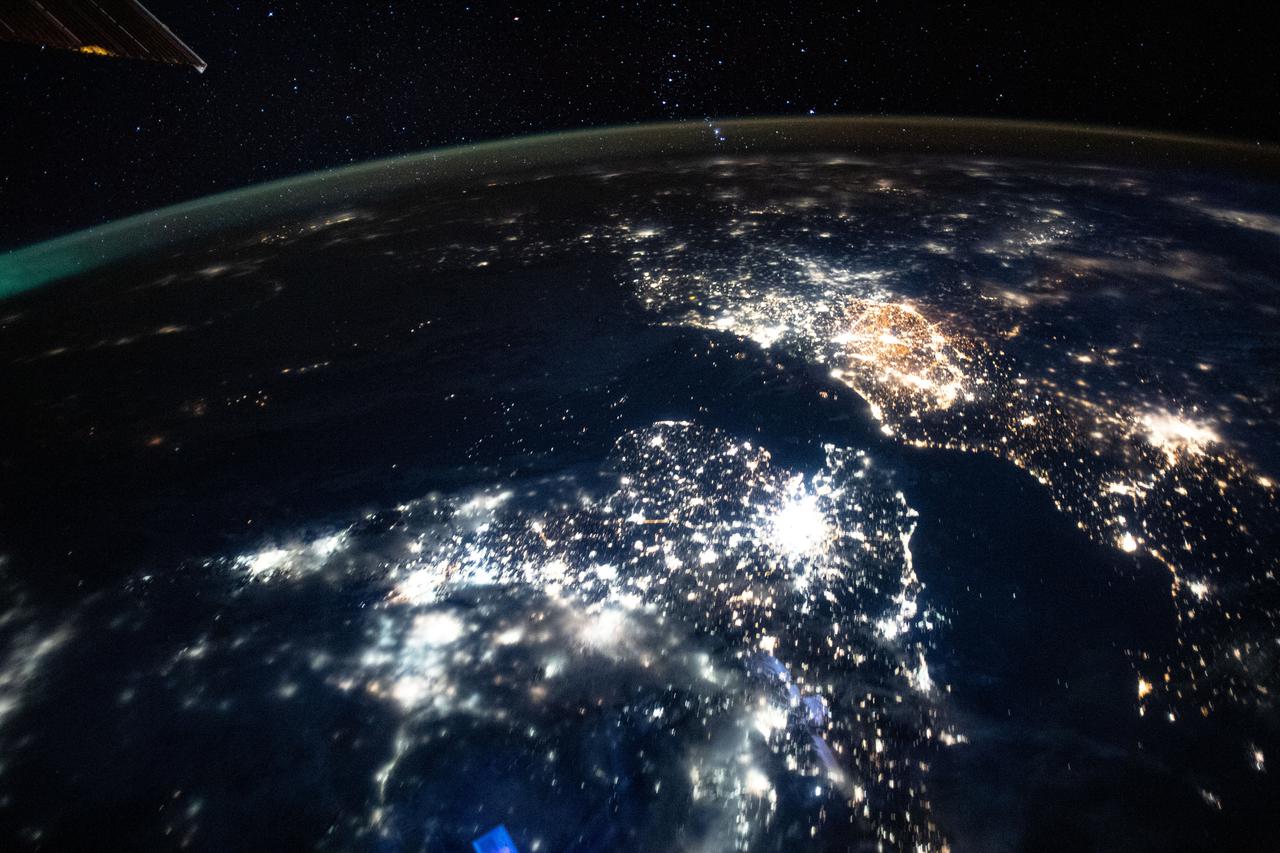
iss065e385457 (Sept. 15, 2021) --- The International Space Station was orbiting 265 miles above the north Atlantic Ocean when an Expedition 65 crew member captured this photograph of the city lights of England, The Netherlands, Belgium and France.
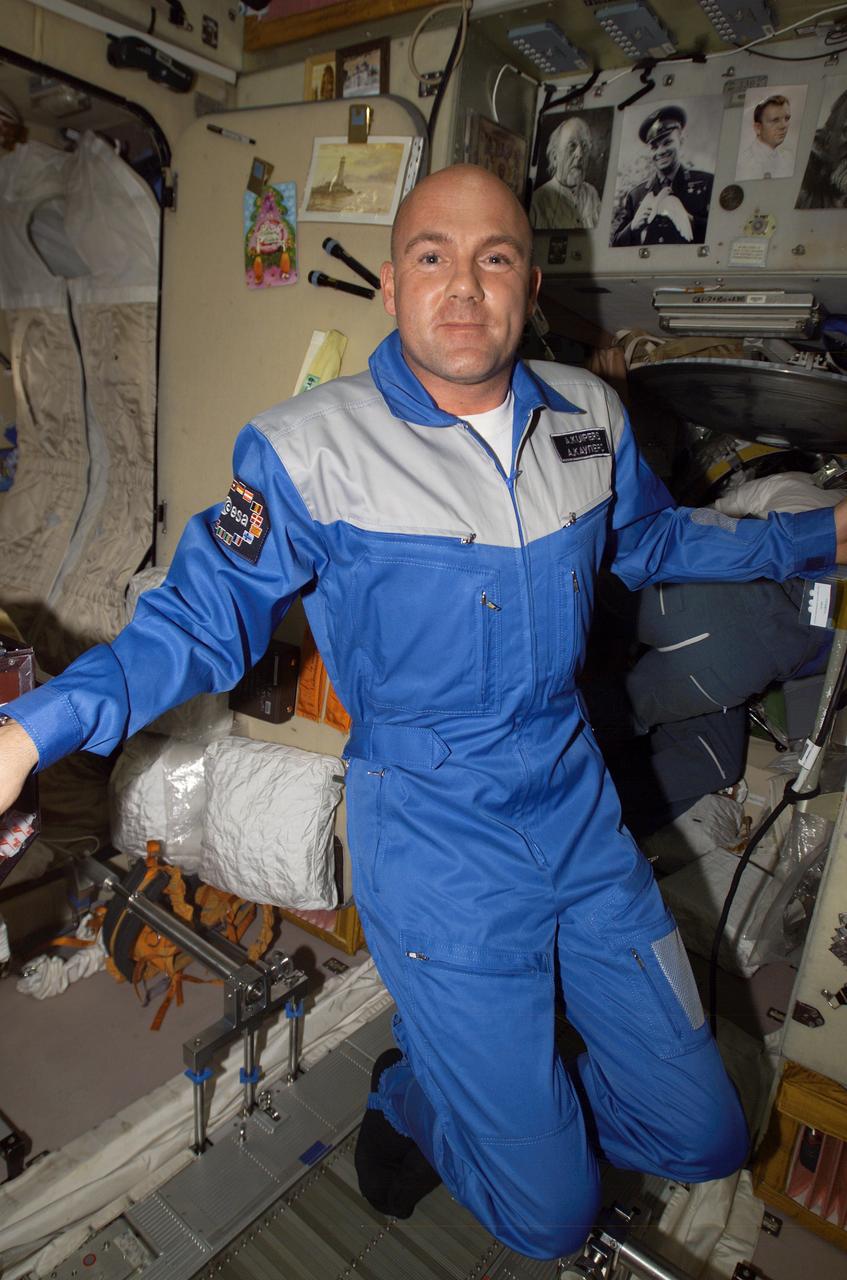
ISS008-E-21951 (21 April 2004) --- European Space Agency (ESA) astronaut Andre Kuipers of the Netherlands floats in the Zvezda Service Module on the International Space Station (ISS).
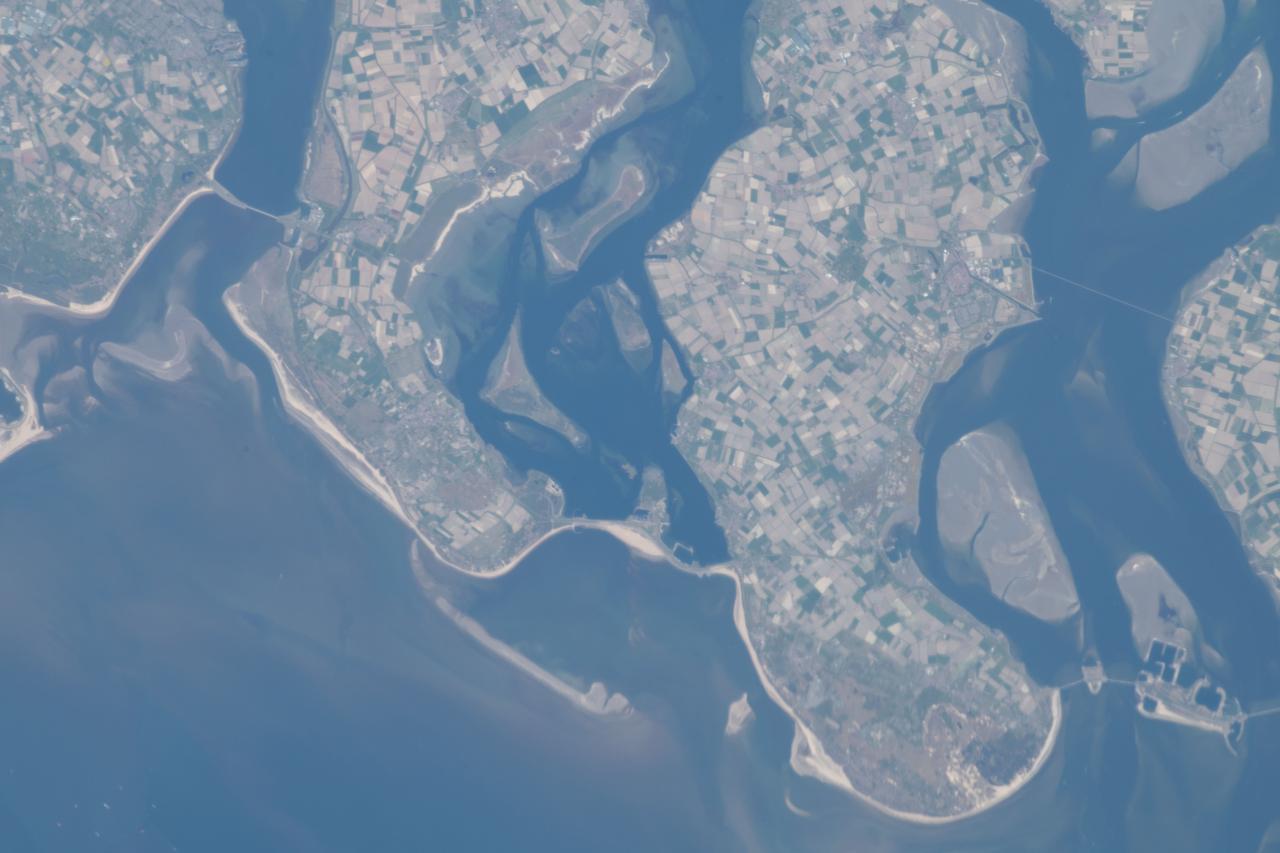
iss063e002730 (April 23, 2020) --- The Rhine–Meuse–Scheldt delta, a river delta in the Netherlands, is pictured from the International Space Station as it orbited off the east coast of England.
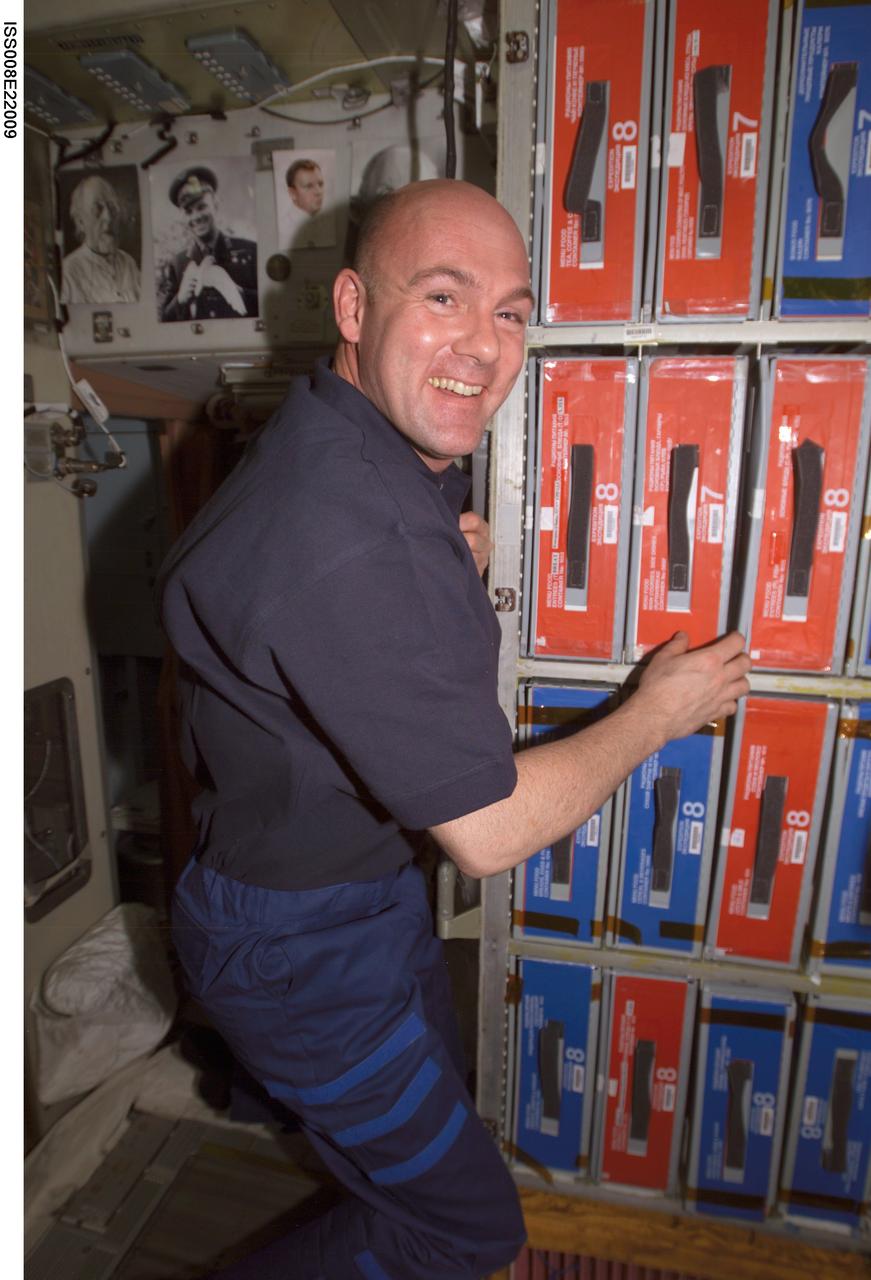
ISS008-E-22009 (22 April 2004) --- European Space Agency (ESA) astronaut Andre Kuipers of the Netherlands is pictured near food storage containers in the Zvezda Service Module of the International Space Station (ISS).
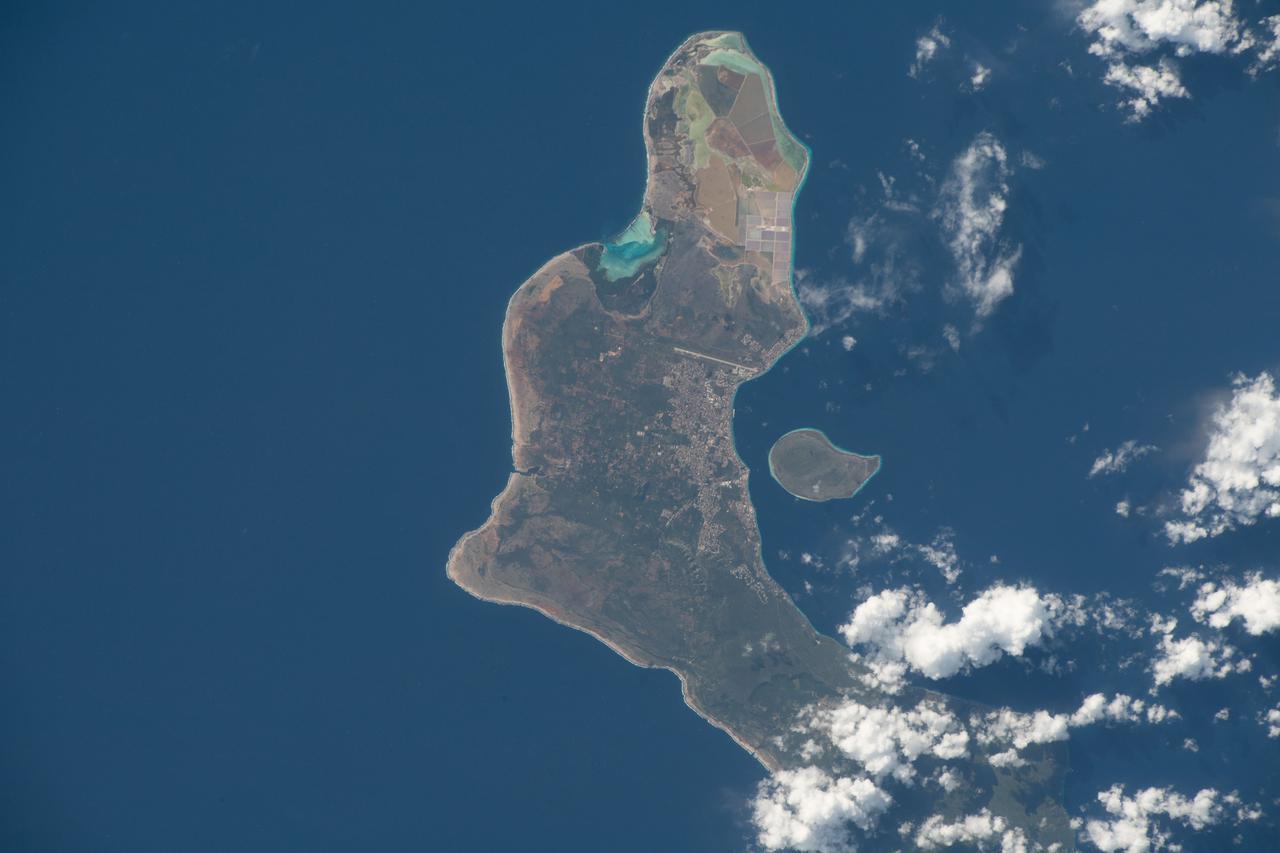
iss068e036406 (Jan. 2, 2023) --- The island of Bonaire off the coast of Venezuela, one of three island municipalities comprising the Caribbean Netherlands, is pictured from the International Space Station as it orbited 258 miles above.
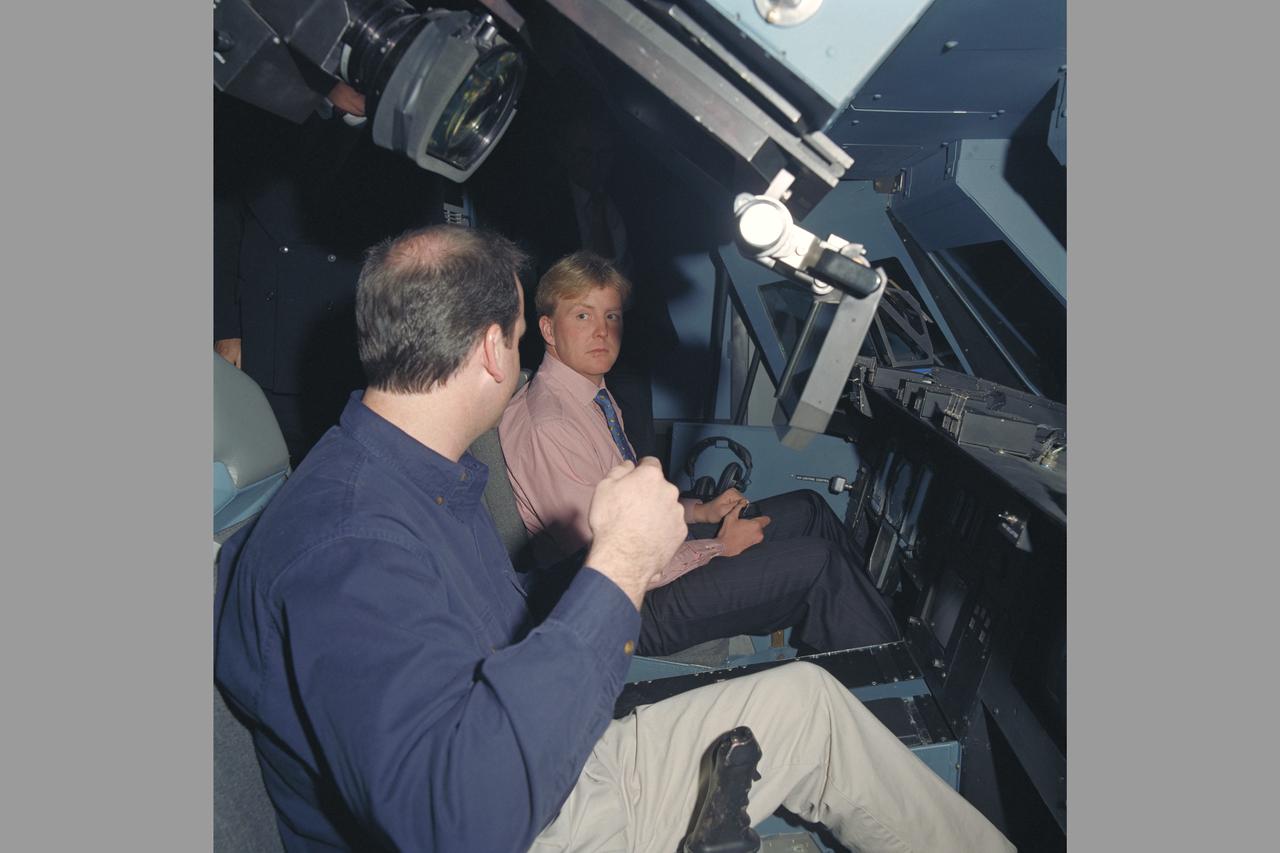
Prince Willem-Alexander van Oranje (Crown Prince of the Netherlands) visits Ames. Shown here with Chris Sweeney (Ames) as he explains the control in the VMS S-cab
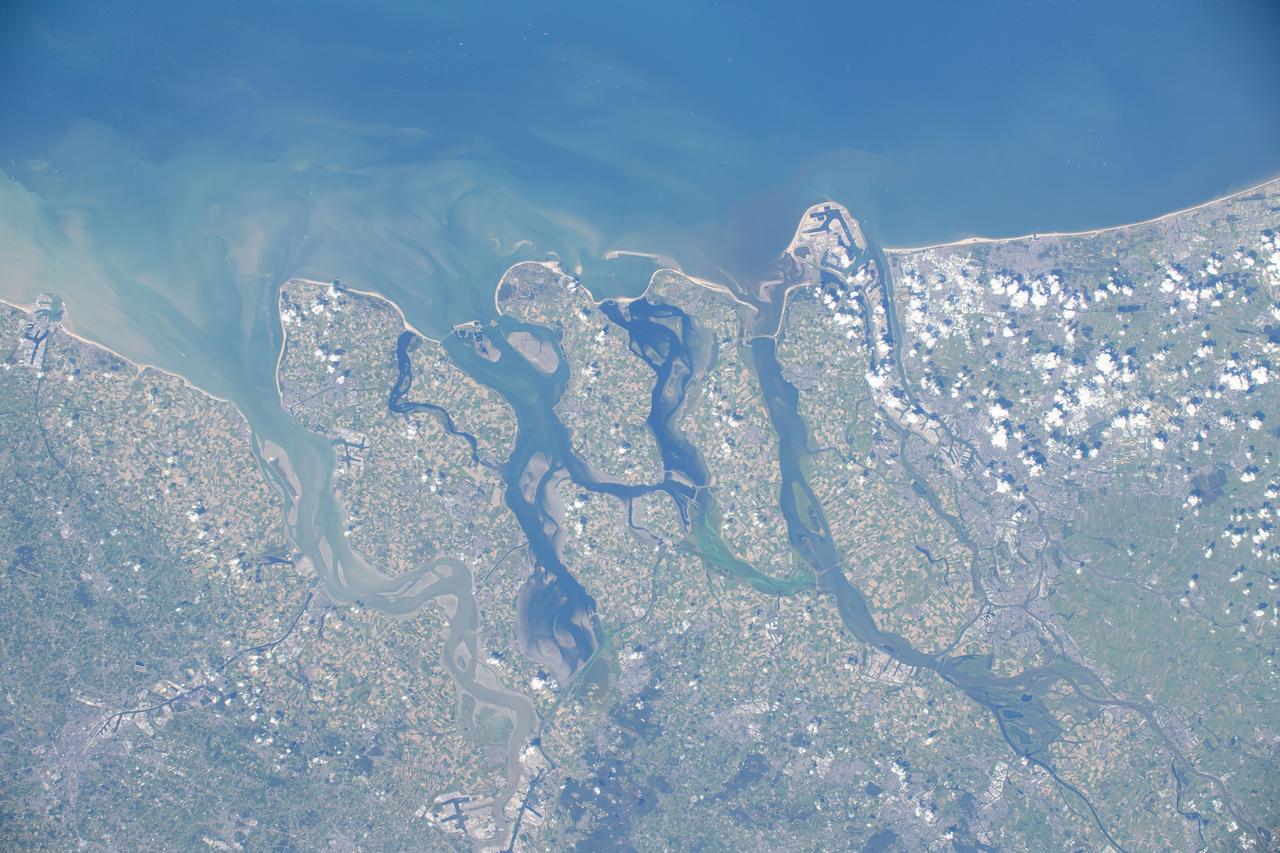
iss071e488058 (Aug. 11, 2024) --- The Hague and Rotterdam, cities next to the Rhine–Meuse–Scheldt river delta in Netherlands on the coast of the North Sea, are pictured from the International Space Station as it orbited 263 miles above Northern Europe.
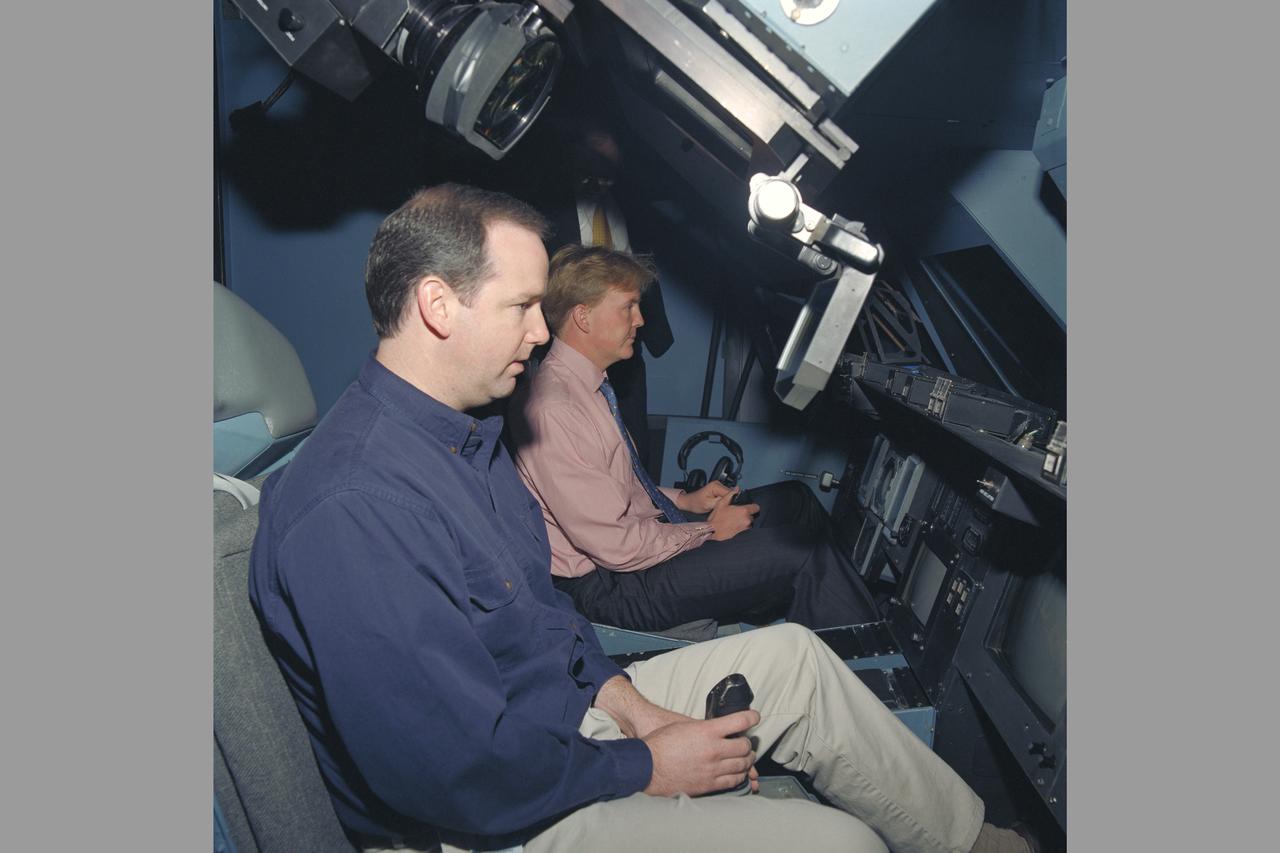
Prince Willem-Alexander van Oranje (Crown Prince of the Netherlands) visits Ames. Shown here with Chris Sweeney (Ames) as he explains the control in the VMS S-cab
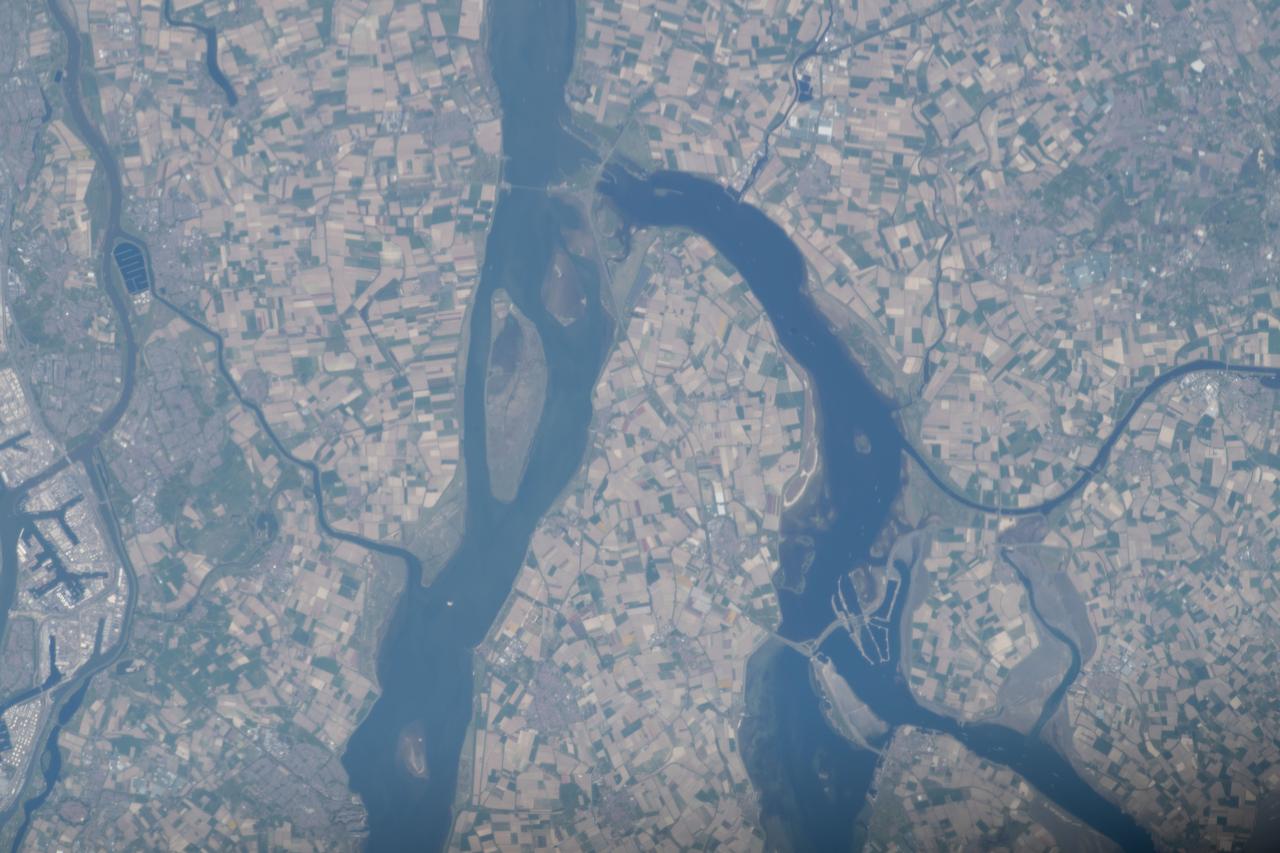
iss063e002750 (April 23, 2020) --- The Rhine–Meuse–Scheldt delta, a river delta in the Netherlands, is pictured from the International Space Station as it orbited off the east coast of England.
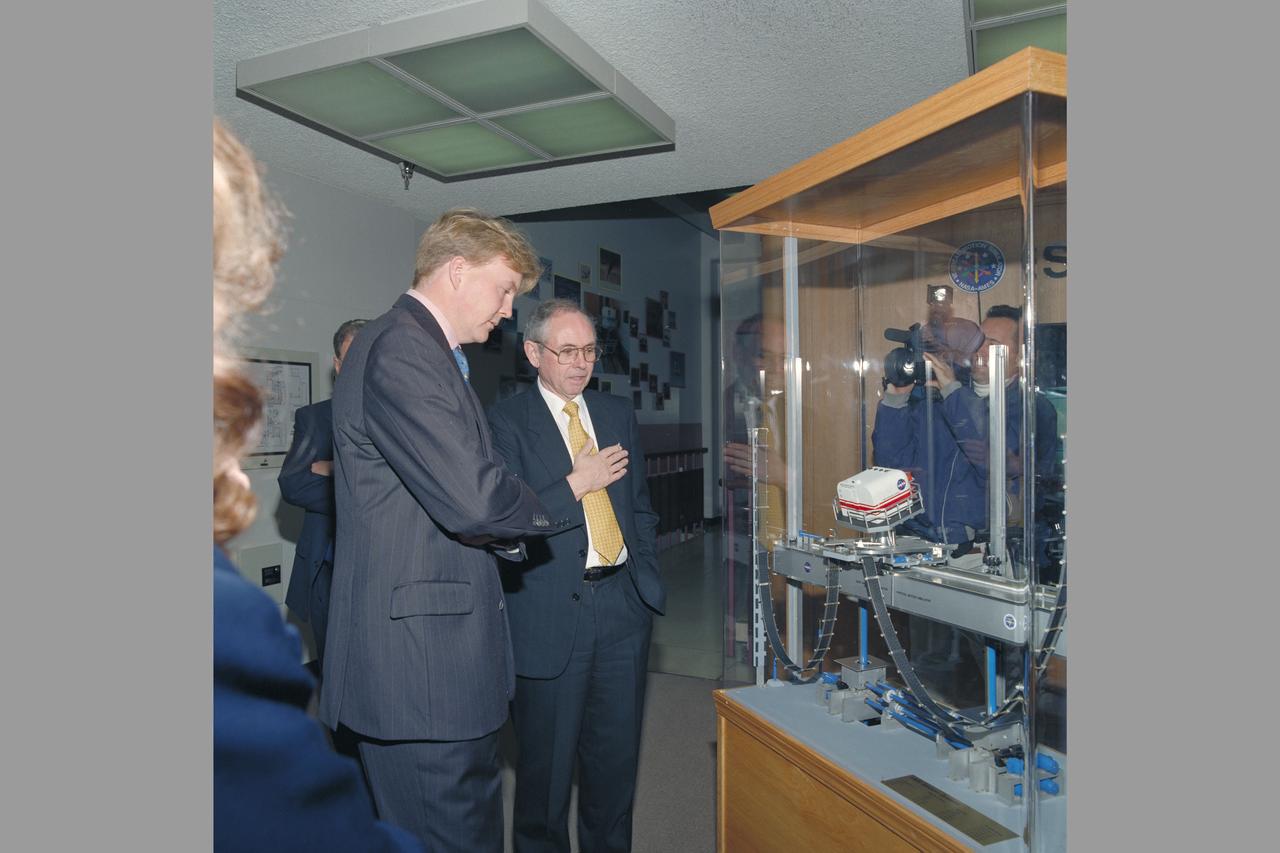
Prince Willem-Alexander van Oranje (Crown Prince of the Netherlands) visits Ames. Shown here with Dr Henry McDonald, Ames Director in lobby of N-243. His visit was prompted by his strong personal interest in aviation.
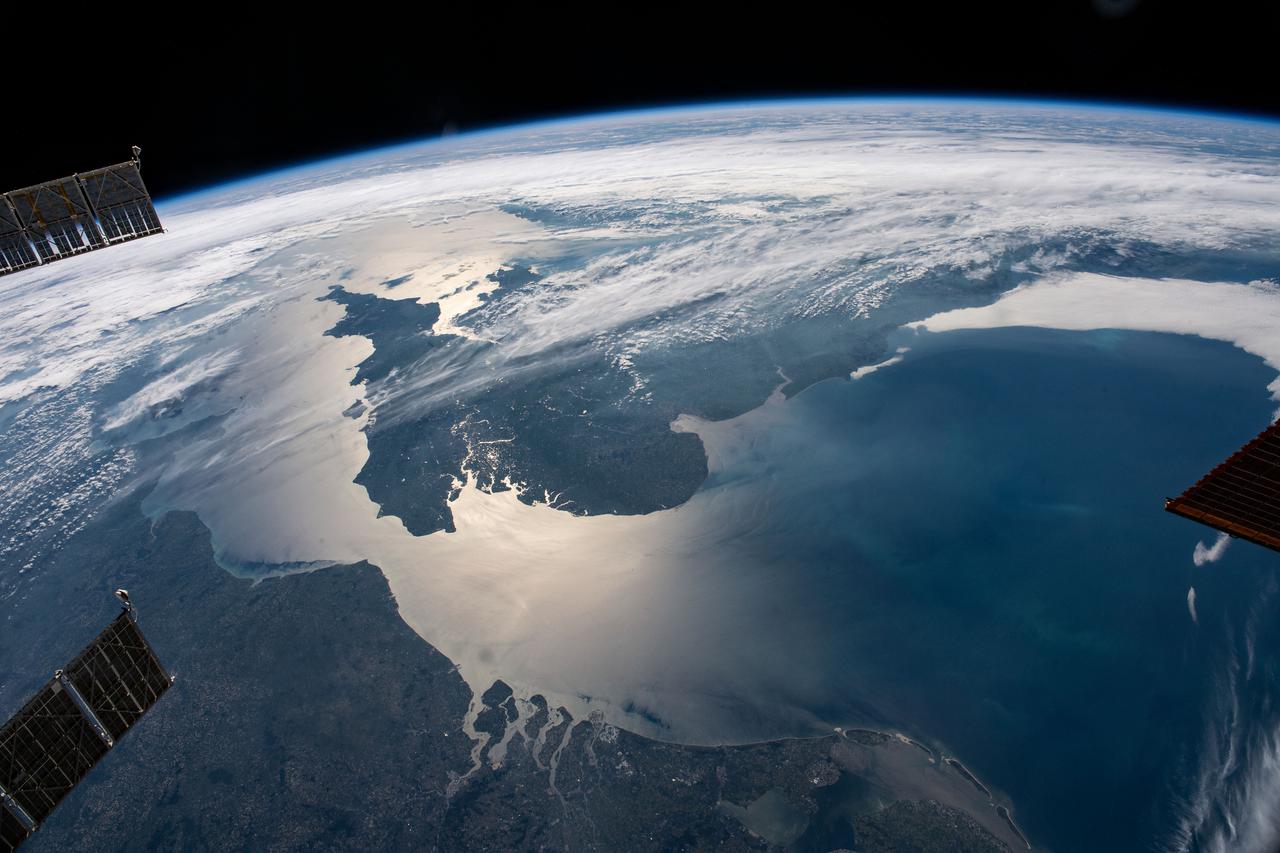
iss065e083895 (June 1, 2021) --- The sun's glint beams across the English Channel and the North Sea in between southern England and the coasts of France, Belgium and The Netherlands, in this photograph from the International Space Station as it orbited 263 miles above.
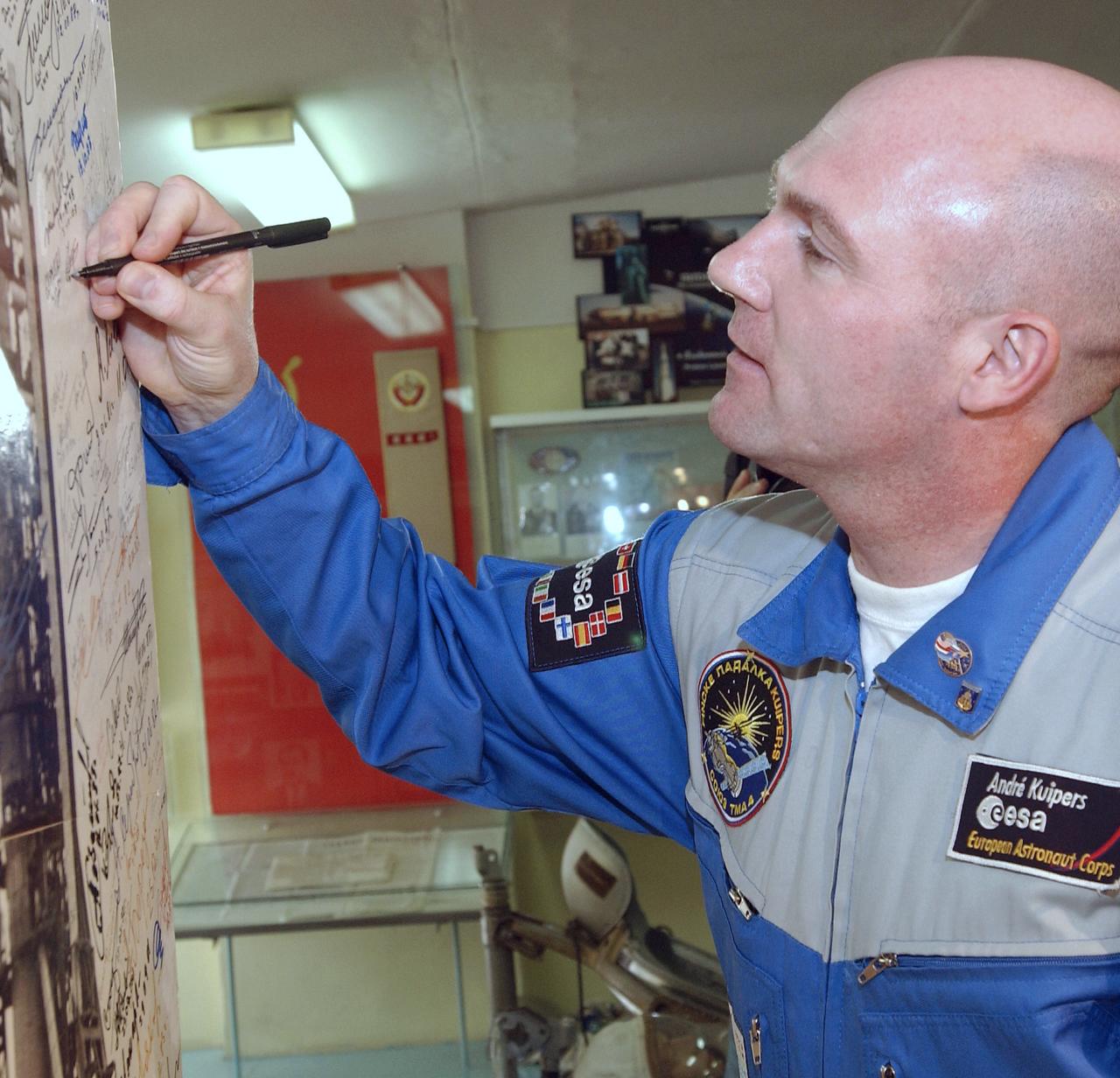
European Space Agency astronaut Andre Kuipers of the Netherlands signs a photograph in the space museum located at the Baikonur Cosmodrome, Wednesday, April 14, 2004, in Baikonur, Kazakhstan. Photo Credit: "NASA/Bill Ingalls"
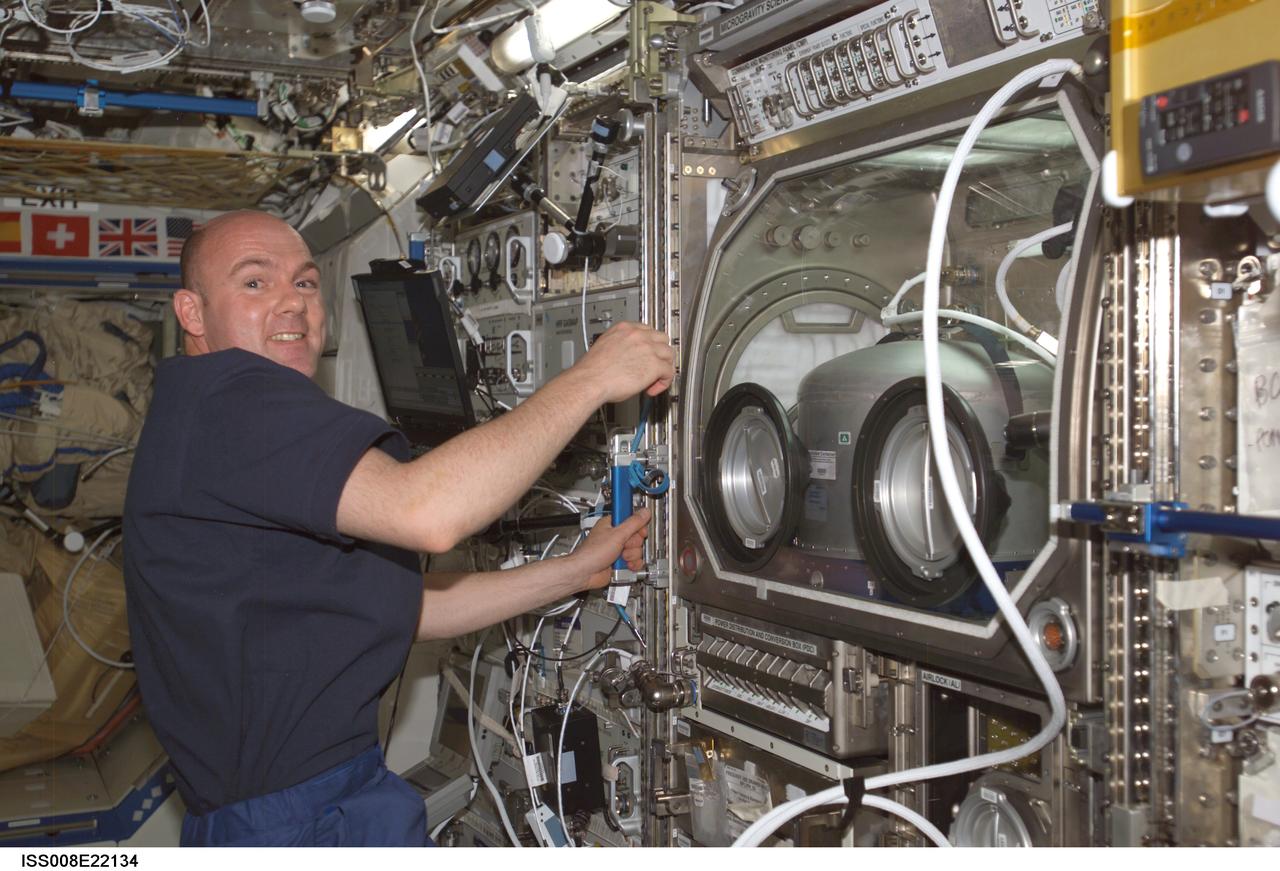
ISS008-E-22134 (24 April 2004) --- European Space Agency (ESA) astronaut Andre Kuipers of the Netherlands is pictured near the Microgravity Science Glovebox (MSG) in the Destiny laboratory of the International Space Station (ISS).

iss059e011769 (April 4, 2019) --- Russia's Soyuz MS-12 crew ship is pictured docked to the International Space Station's Rassvet module as the orbital complex flew 258 miles above the North Sea off the coast of the Netherlands.
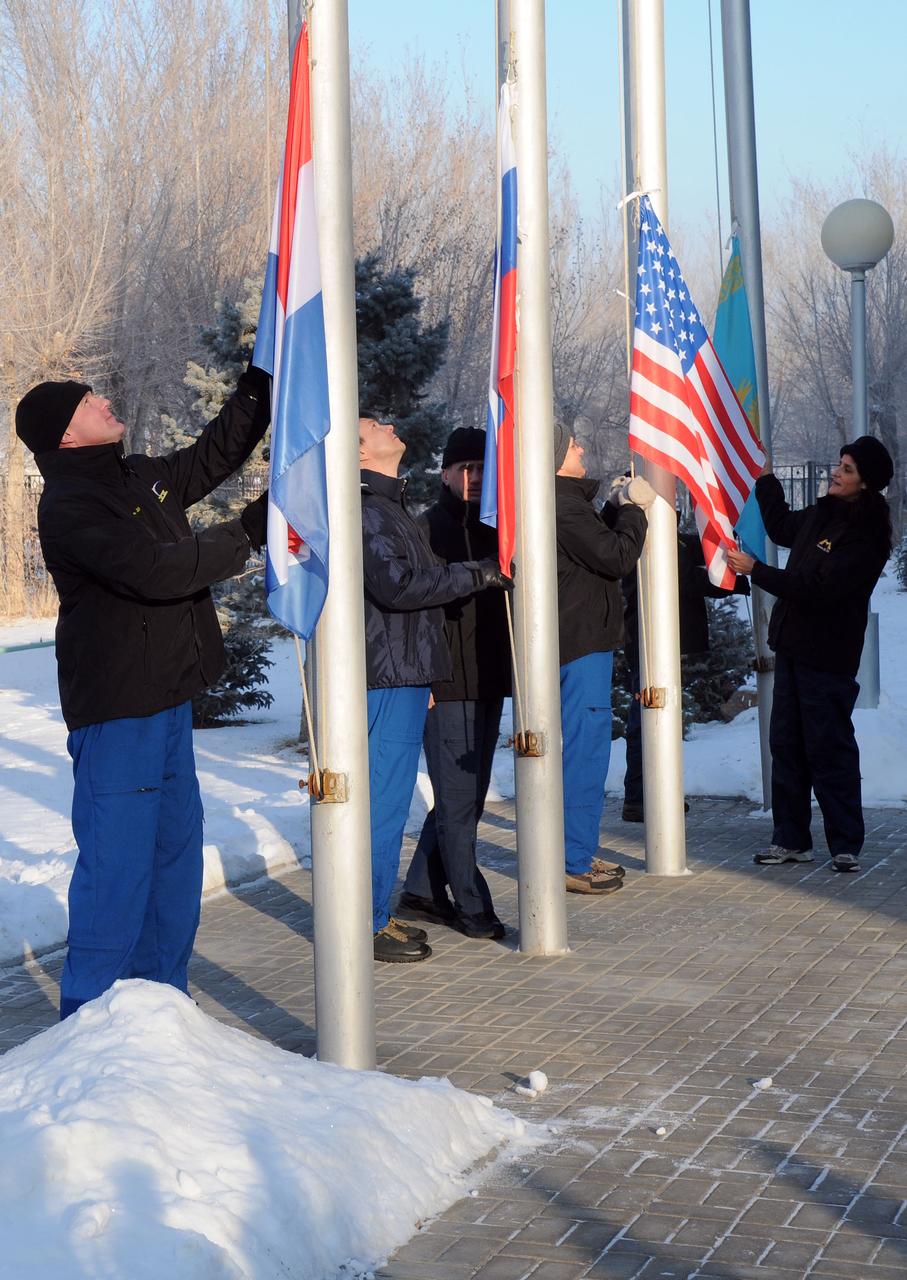
At their crew quarters at the Cosmonaut Hotel in Baikonur, Kazakhstan, Expedition 30 prime and backup crewmembers raise the flags of the Netherlands, the United States and Russia Dec. 10, 2011 in a traditional ceremony as part of their pre-launch preparations. From left to right are Expedition 30 prime Flight Engineer Andre Kuipers of the European Space Agency who is a native of the Netherlands, prime Soyuz Commander Oleg Kononenko, backup Soyuz Commander Yuri Malenchenko, prime NASA Flight Engineer Don Pettit, and backup NASA Flight Engineer Suni Williams. Pettit, Kononenko and Kuipers will launch to the International Space Station on Dec. 21 on their Soyuz TMA-03M spacecraft. Credit: NASA
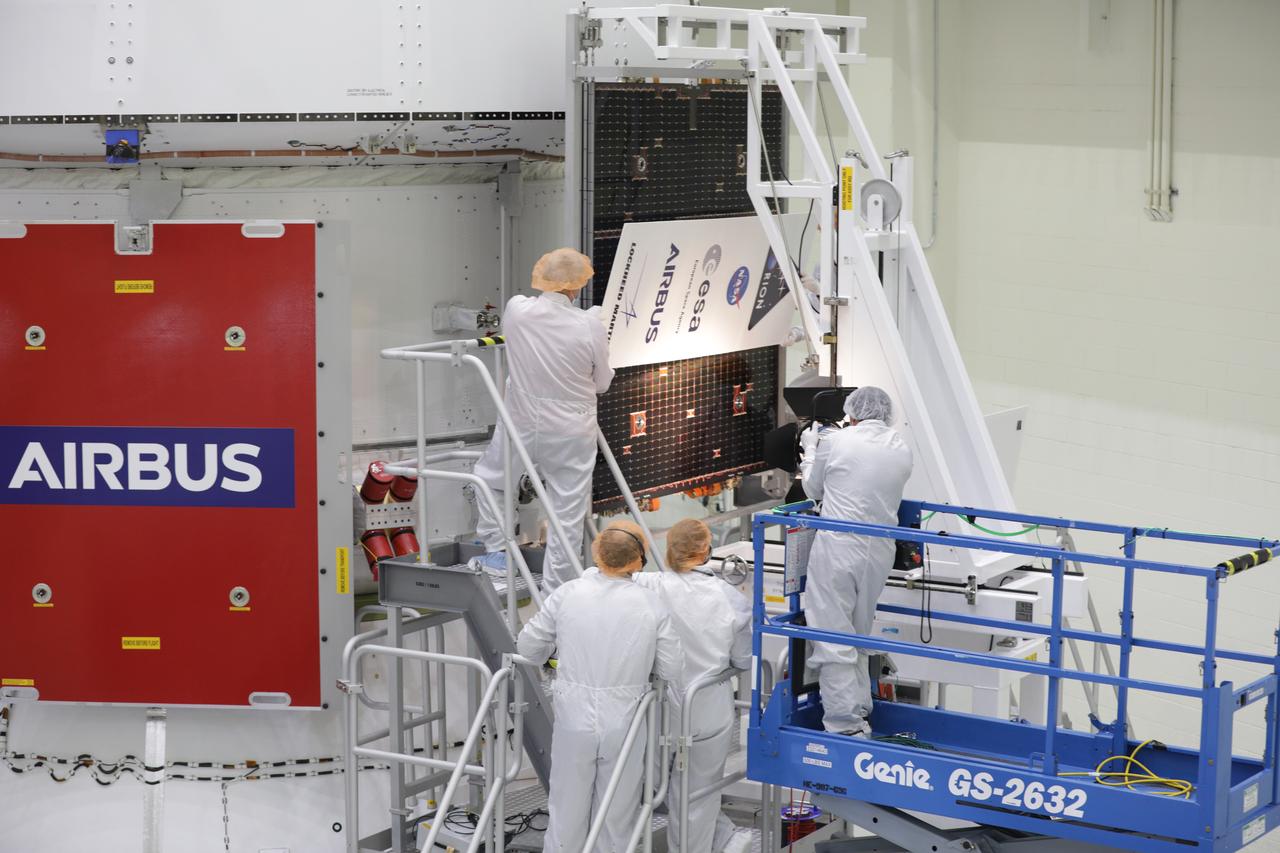
Technicians with the European Space Agency and Airbus/Airbus Netherlands are shown performing an illumination test on one of the solar array wing panels during installation on the Orion spacecraft for Artemis I inside the Neil Armstrong Operations and Checkout Building high bay at NASA’s Kennedy Space Center in Florida on Sept. 30, 2020. The solar arrays were extended, inspected, and then retracted, before installation on the spacecraft. Each solar array panel will generate 11 kilowatts of power and span about 63 feet. The array is a component of Orion’s service module, which is provided by the European Space Agency and built by Airbus Defence and Space to supply Orion’s power, propulsion, air and water. The first in a series of increasingly complex missions, Artemis I will test the Orion spacecraft and Space Launch System as an integrated system ahead of crewed flights to the Moon. Under the Artemis program, NASA will land the first woman and the next man on the Moon in 2024.
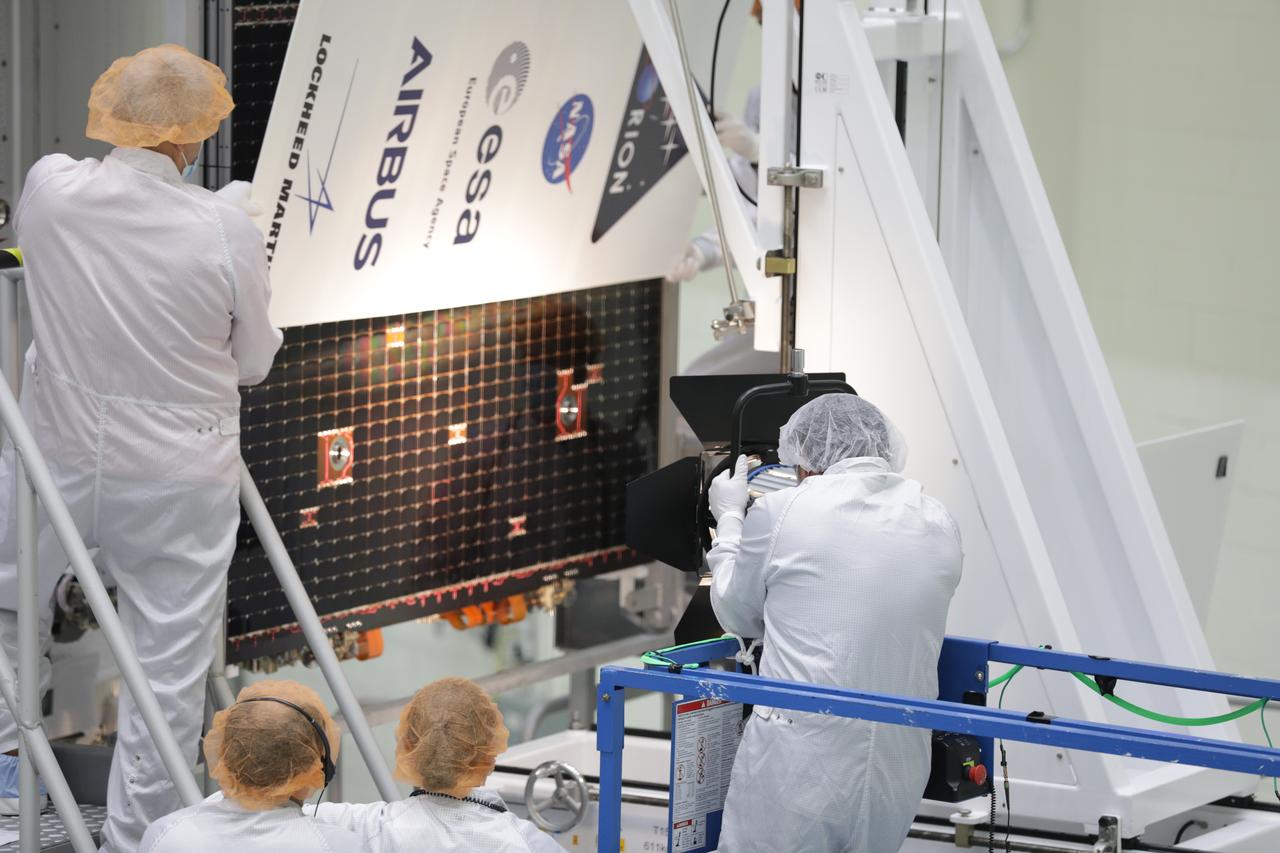
Technicians with the European Space Agency and Airbus/Airbus Netherlands are shown performing an illumination test on one of the solar array wing panels during installation on the Orion spacecraft for Artemis I inside the Neil Armstrong Operations and Checkout Building high bay at NASA’s Kennedy Space Center in Florida on Sept. 30, 2020. The solar arrays were extended, inspected, and then retracted, before installation on the spacecraft. Each solar array panel will generate 11 kilowatts of power and span about 63 feet. The array is a component of Orion’s service module, which is provided by the European Space Agency and built by Airbus Defence and Space to supply Orion’s power, propulsion, air and water. The first in a series of increasingly complex missions, Artemis I will test the Orion spacecraft and Space Launch System as an integrated system ahead of crewed flights to the Moon. Under the Artemis program, NASA will land the first woman and the next man on the Moon in 2024.
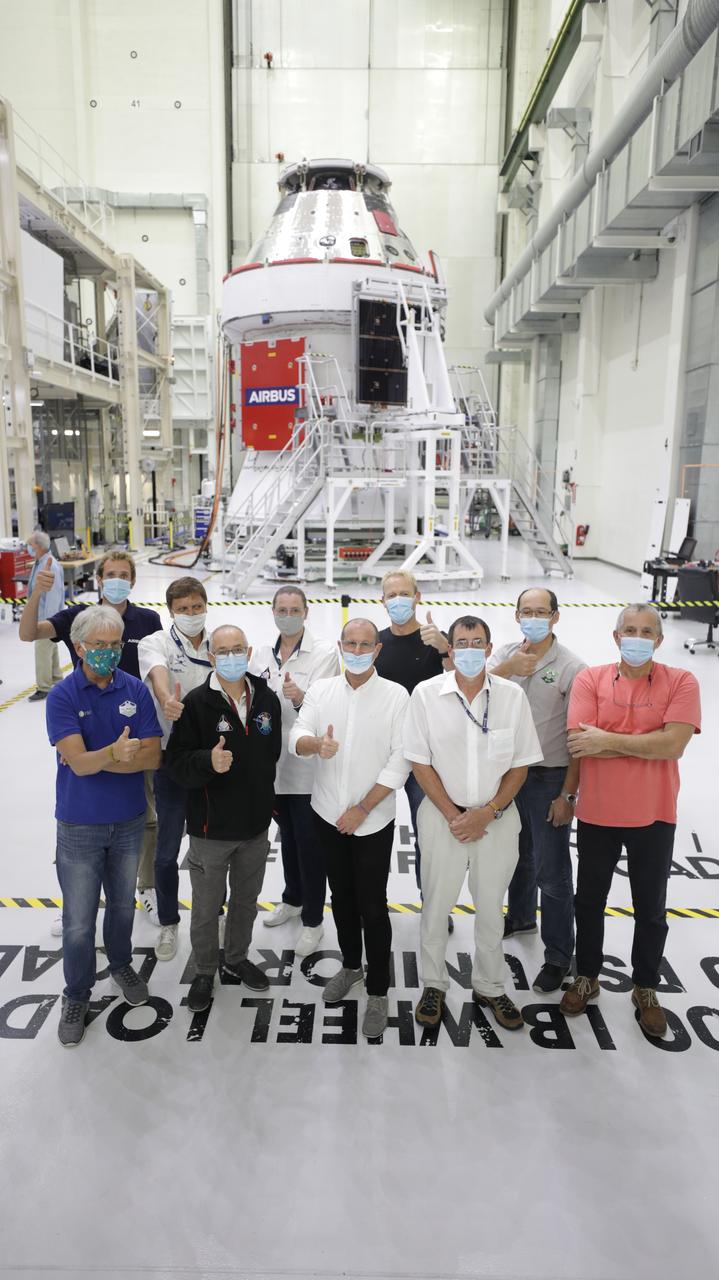
Members of the European Service Module processing team from the European Space Agency, Airbus, and Airbus Netherlands are shown with Orion’s solar array wings installed on the spacecraft for Artemis I inside the Neil Armstrong Operations and Checkout Building high bay at NASA’s Kennedy Space Center in Florida on Sept. 30, 2020. The solar arrays were extended, inspected, and then retracted, before installation on the spacecraft. Each solar array panel will generate 11 kilowatts of power and span about 63 feet. The array is a component of Orion’s service module, which is provided by the European Space Agency and built by Airbus Defence and Space to supply Orion’s power, propulsion, air and water. The first in a series of increasingly complex missions, Artemis I will test the Orion spacecraft and Space Launch System as an integrated system ahead of crewed flights to the Moon. Under the Artemis program, NASA will land the first woman and the next man on the Moon in 2024.
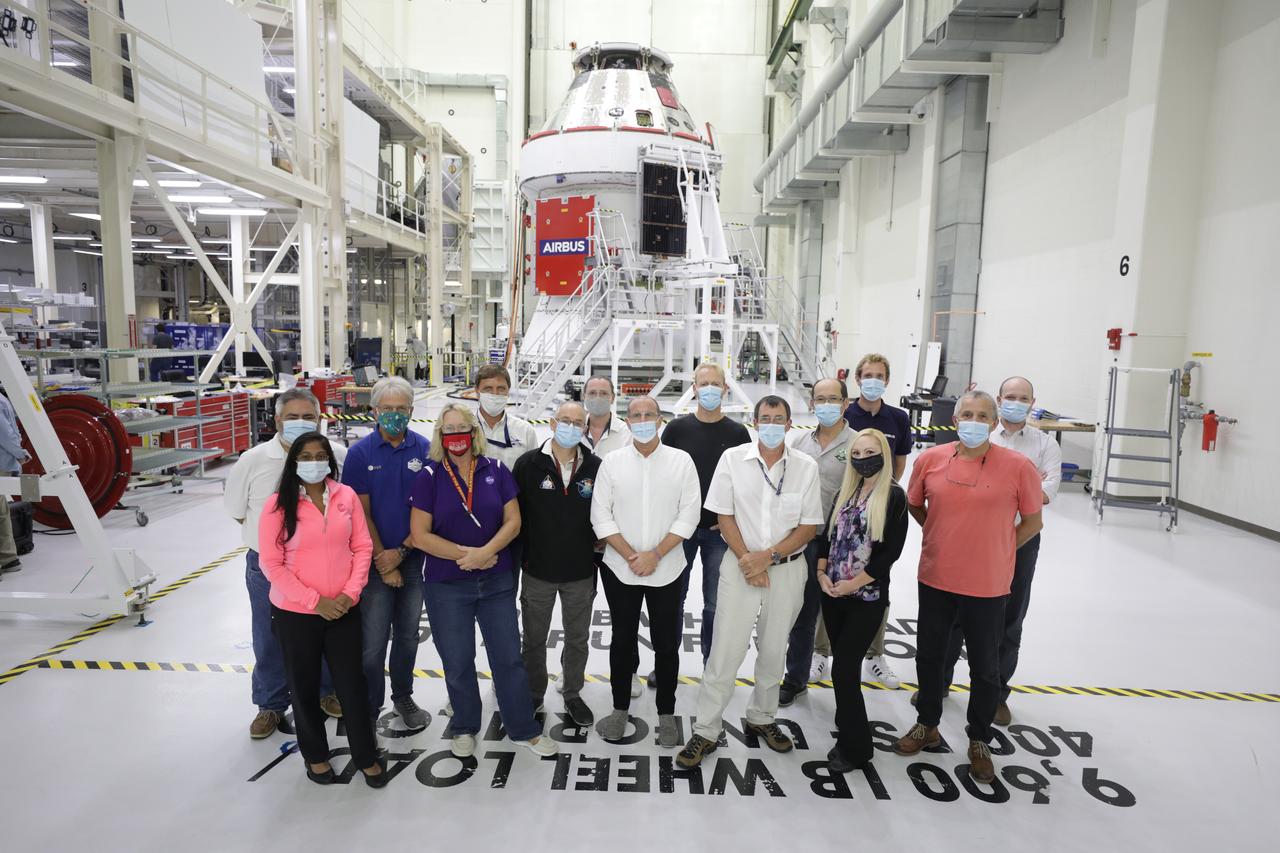
Members of the European Service Module processing team from NASA, the European Space Agency, Airbus, Airbus Netherlands, and Lockheed Martin are shown with Orion’s solar array wings installed on the spacecraft for Artemis I inside the Neil Armstrong Operations and Checkout Building high bay at NASA’s Kennedy Space Center in Florida on Sept. 30, 2020. The solar arrays were extended, inspected, and then retracted, before installation on the spacecraft. Each solar array panel will generate 11 kilowatts of power and span about 63 feet. The array is a component of Orion’s service module, which is provided by the European Space Agency and built by Airbus Defence and Space to supply Orion’s power, propulsion, air and water. The first in a series of increasingly complex missions, Artemis I will test the Orion spacecraft and Space Launch System as an integrated system ahead of crewed flights to the Moon. Under the Artemis program, NASA will land the first woman and the next man on the Moon in 2024.
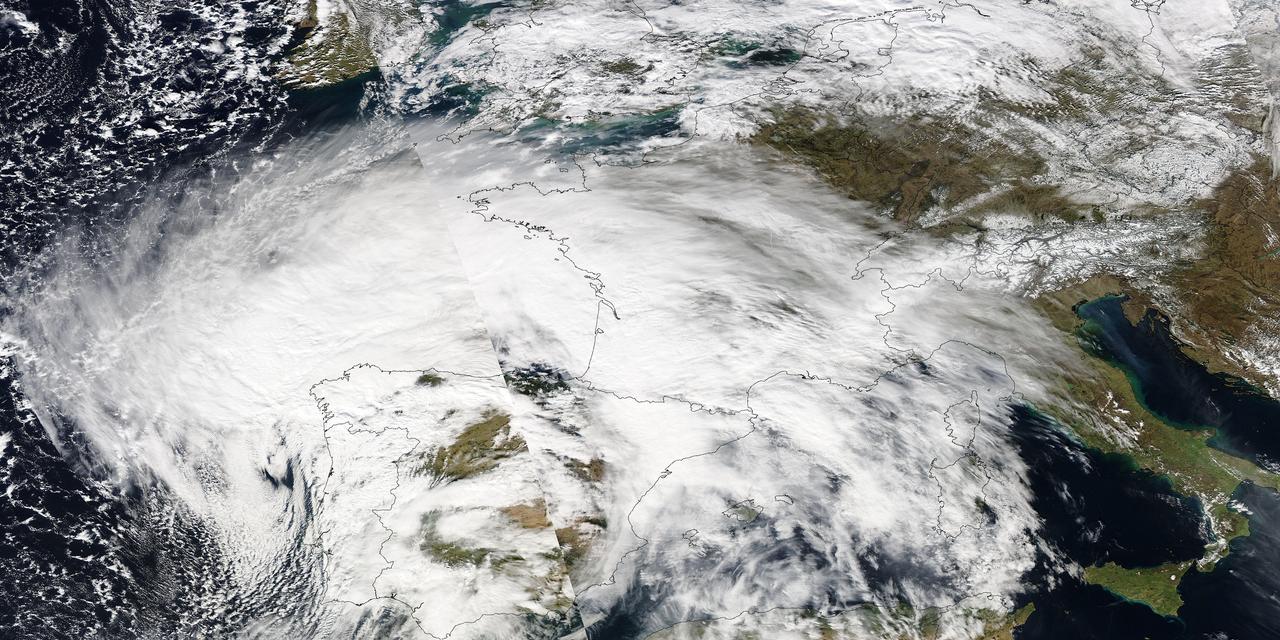
Image acquired February 27, 2010: An extratropical cyclone named Xynthia brought hurricane-force winds and high waves to Western Europe at the end of February 2010, CNN reported. Winds as fast as 200 kilometers (125 miles) per hour reached as far inland as Paris, and at the storm’s peak, hurricane-force winds extended from Portugal to the Netherlands. Hundreds of people had to take refuge from rising waters on their rooftops. By March 1, at least 58 people had died, some of them struck by falling trees. Most of the deaths occurred in France, but the storm also caused casualties in England, Germany, Belgium, Spain, and Portugal. The Moderate Resolution Imaging Spectroradiometer (MODIS) on NASA’s Aqua satellite captured this image of Western Europe, acquired in two separate overpasses on February 27, 2010. MODIS captured the eastern half of the image around 10:50 UTC, and the western half about 12:30 UTC. Forming a giant comma shape, clouds stretch from the Atlantic Ocean to northern Italy. NASA image courtesy MODIS Rapid Response Team at NASA Goddard Space Flight Center. Caption by Michon Scott. Instrument: Aqua - MODIS For more information related to this image go to: <a href="http://earthobservatory.nasa.gov/NaturalHazards/view.php?id=42881" rel="nofollow">earthobservatory.nasa.gov/NaturalHazards/view.php?id=42881</a>
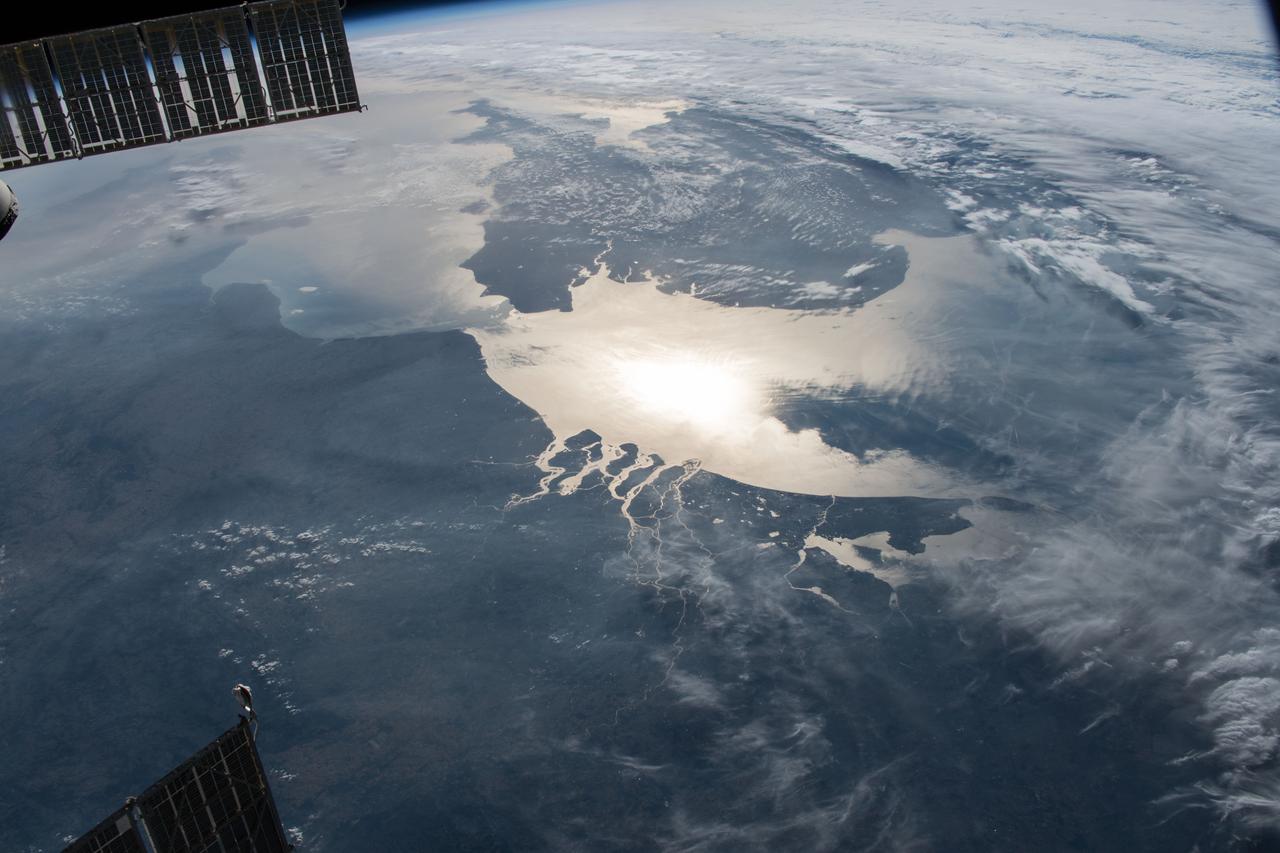
iss056e127185 (Aug. 6, 2018) --- The International Space Station was orbiting above Germany when an Expedition 56 crew member photographed the English Channel and the North Sea, lit by the Sun's glint, separating the United Kingdom from the European countries of France, Belgium and the Netherlands.
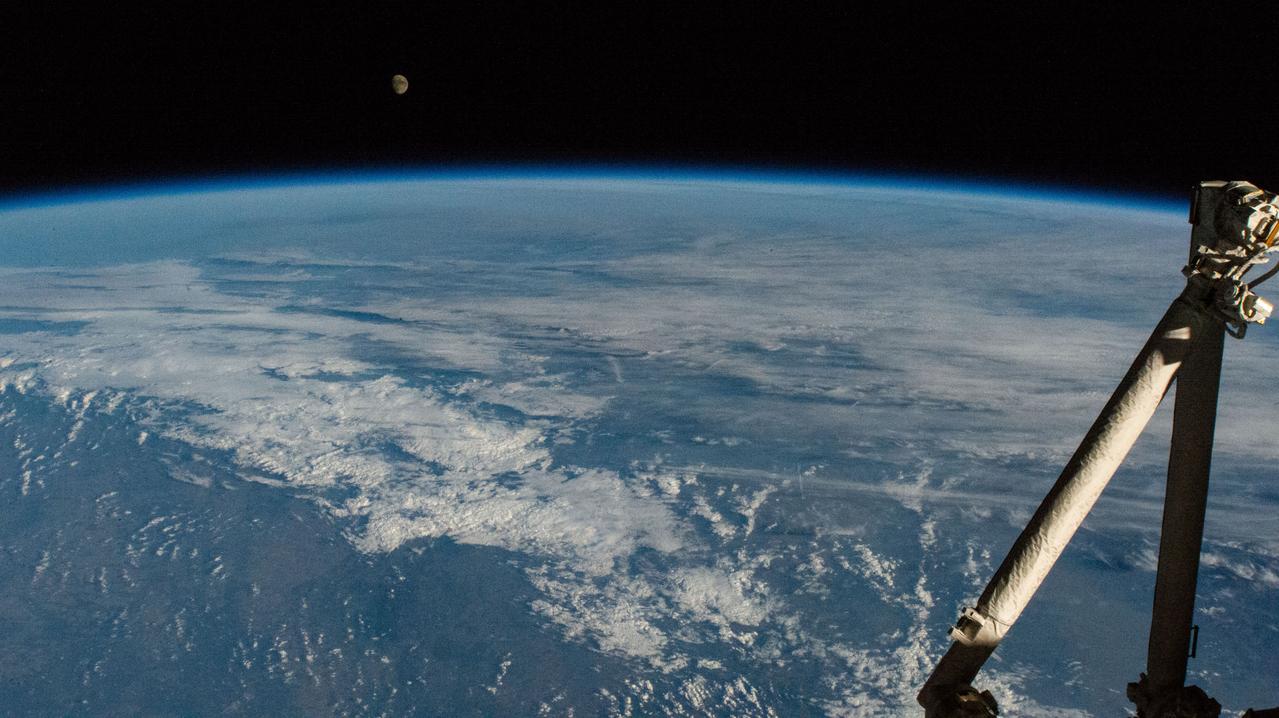
iss068e012259 (Oct. 6, 2022) --- The waxing gibbous Moon is pictured above the Earth's horizon as the International Space Station orbited 264 miles above the Netherlands. In the right foreground, is the Japanese robotic arm that supports payload operations outside the Kibo laboratory module.
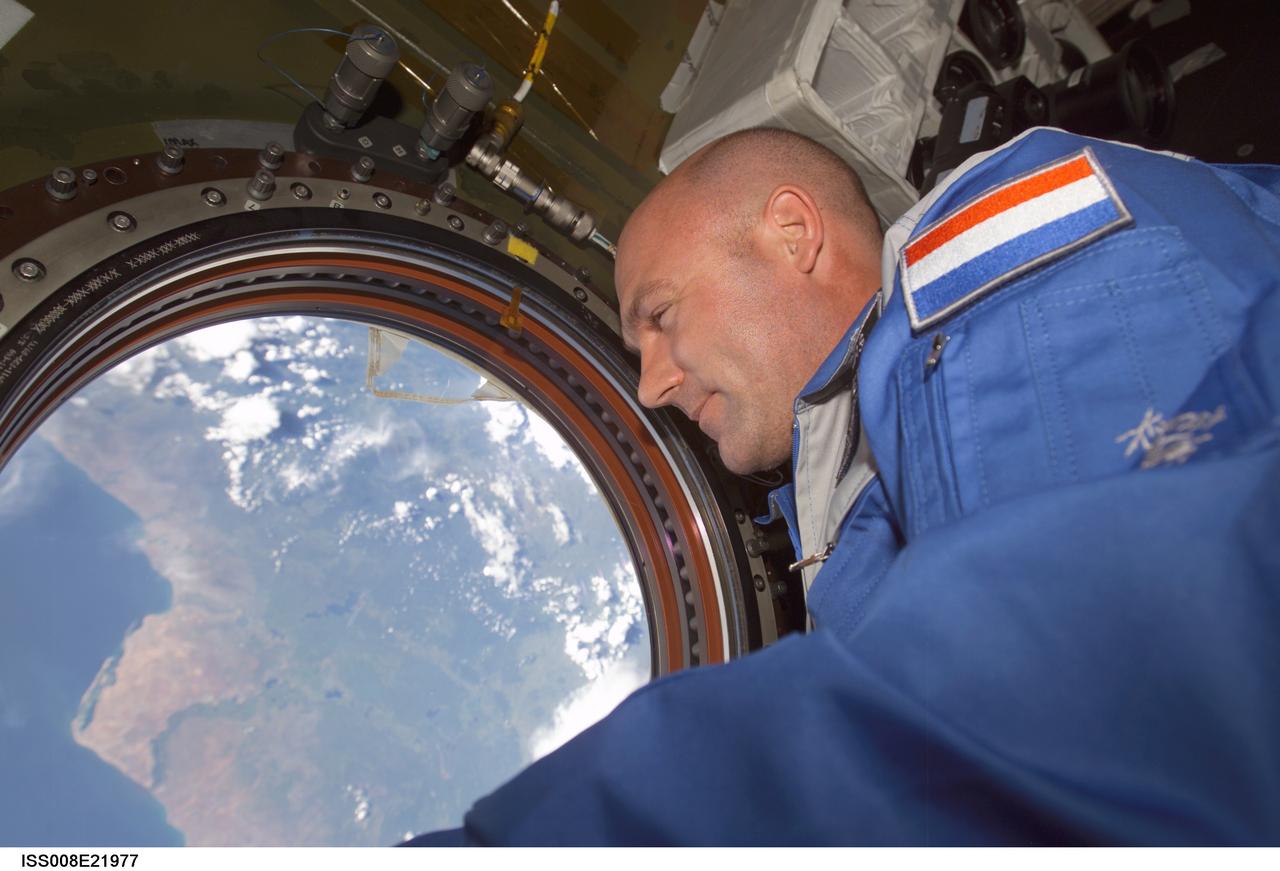
ISS008-E-21977 (21 April 2004) --- European Space Agency (ESA) astronaut Andre Kuipers of the Netherlands looks through the Earth observation window in the Destiny laboratory on the International Space Station soon after arriving in a Soyuz spacecraft for several days' stay onboard the Earth-orbiting complex.
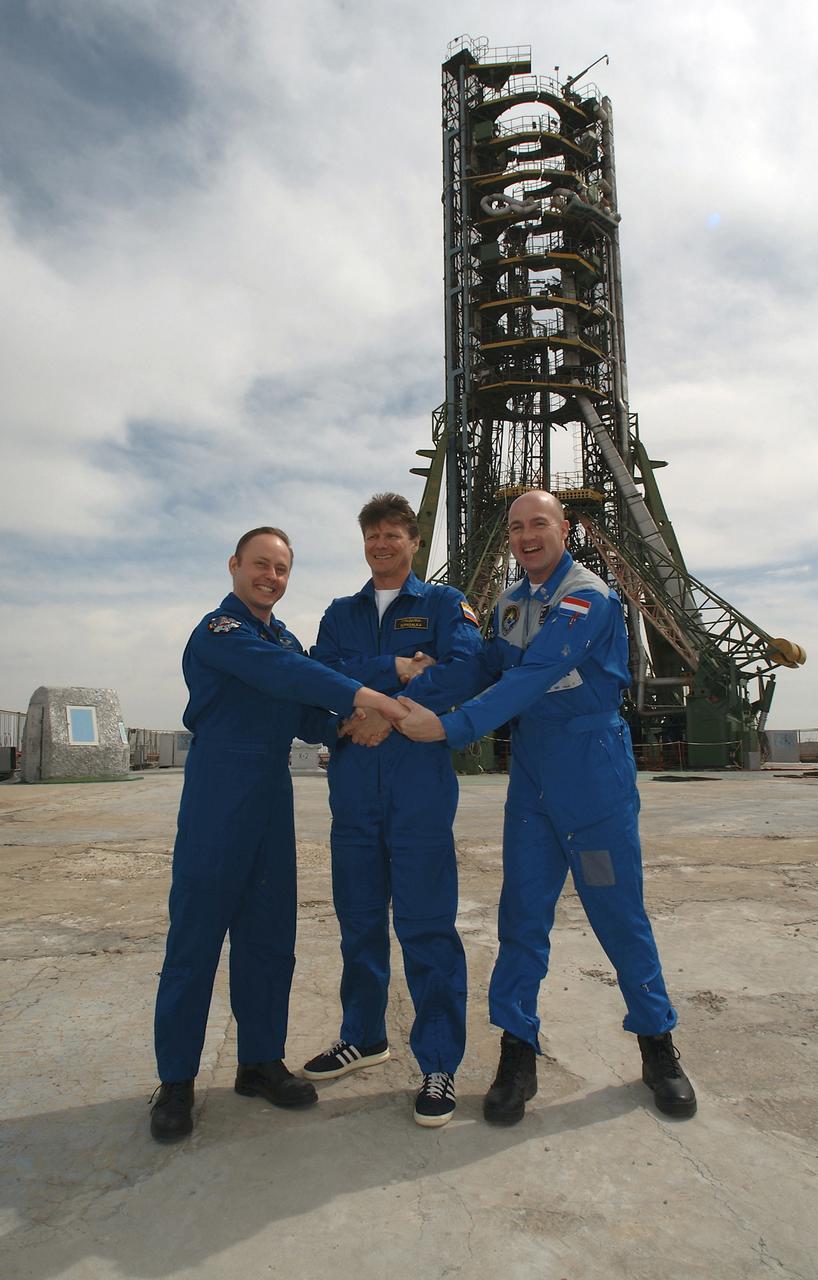
Flight Engineer and NASA Science Officer Mike Fincke, left, Expedition 9 Commander Gennady Padalka, center and European Space Agency astronaut Andre Kuipers of the Netherlands pose for a photo during a tour of the Soyuz launch pad, Wednesday, April 14, 2004, 2004 in Baikonur, Kazakhstan. Photo Credit: (NASA/Bill Ingalls)
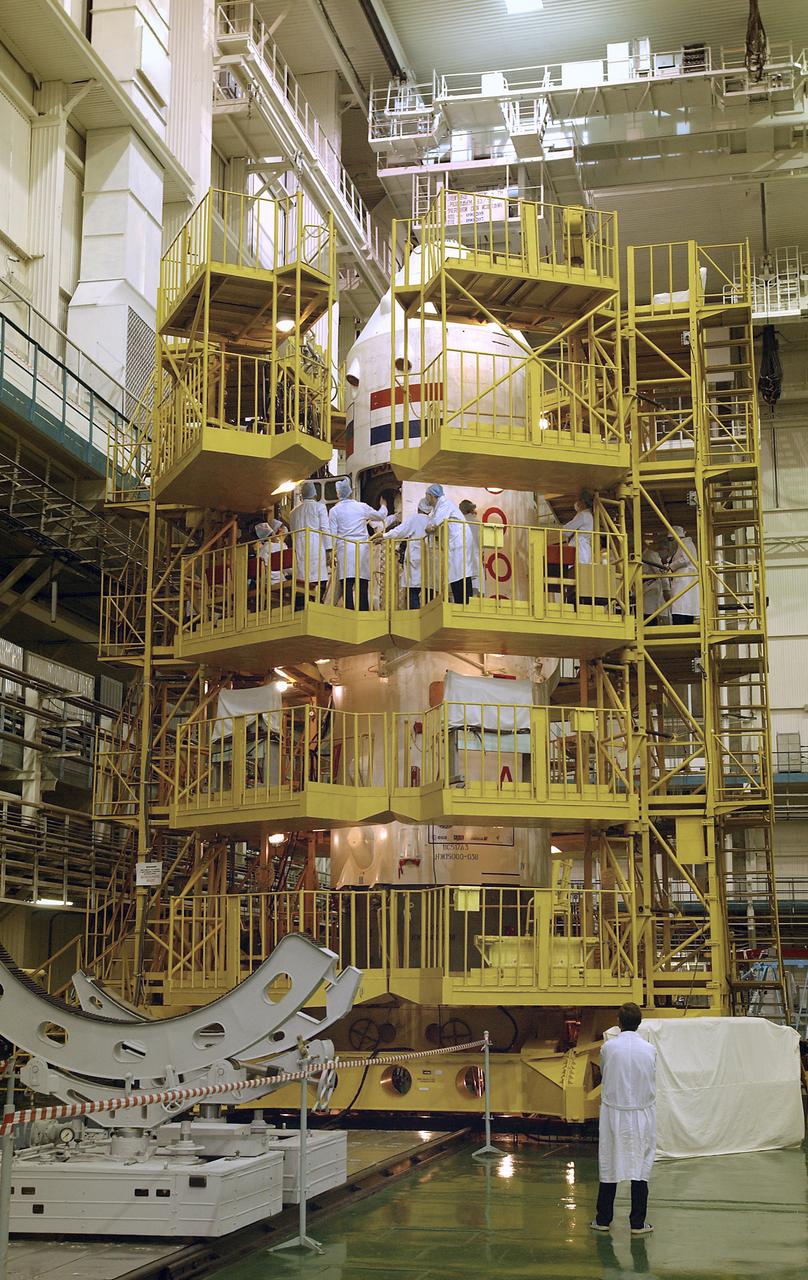
Expedition 9 Commander Gennady Padalka, Flight Engineer, NASA Science Officer Mike Fincke and European Space Agency astronaut Andre Kuipers of the Netherlands do their final fit check in the Soyuz capsule at building 254 at the Baikonur Cosmodrome in Kazakhstan, Wednesday, April 14, 2004. Photo Credit: (NASA/Bill Ingalls)
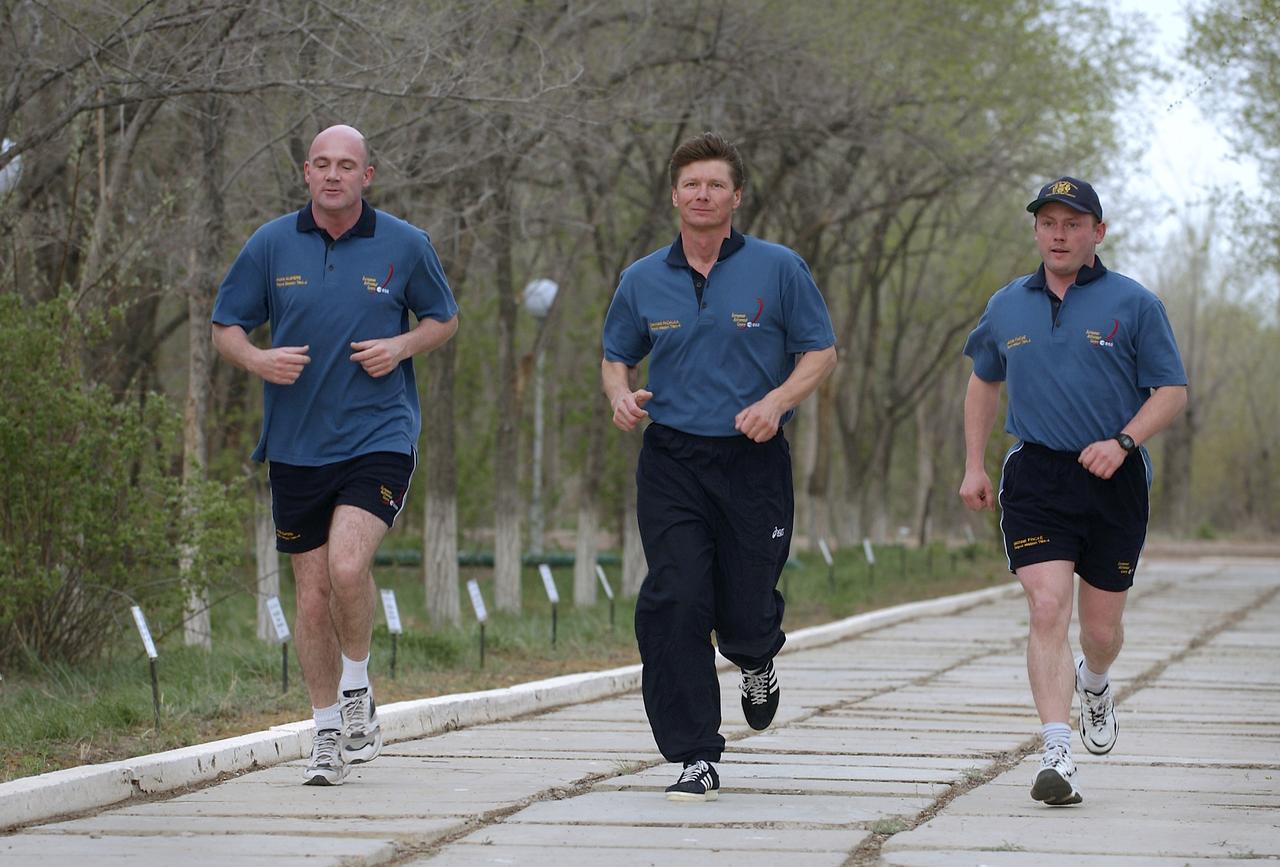
Flight Engineer and European Space Agency astronaut Andre Kuipers of the Netherlands, left, Expedition 9 Commander Gennady Padalka, center and NASA Science Officer Mike Fincke jog on the grounds of the Cosmonaut Hotel, Friday, April 16, 2004, in Baikonur, Kazakhstan. Photo Credit: (NASA/Bill Ingalls)
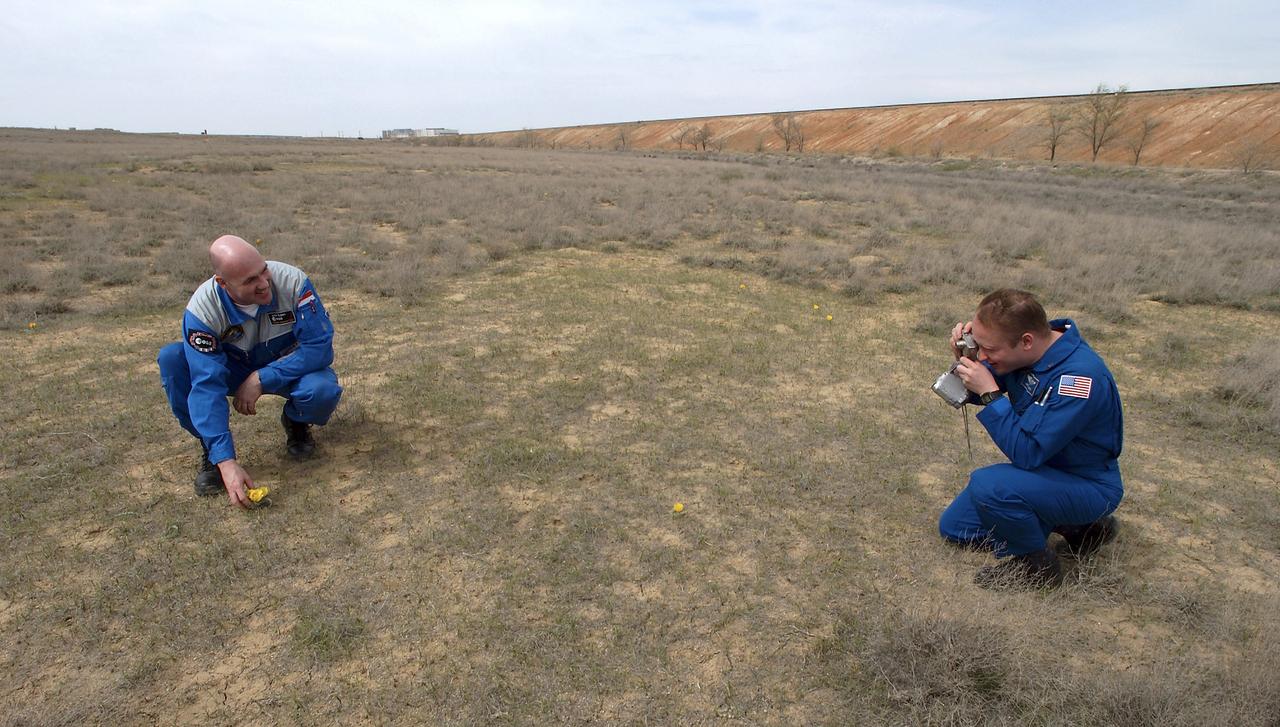
Flight Engineer and NASA Science Officer Mike Fincke, right, makes a photograph of European Space Agency astronaut Andre Kuipers of the Netherlands with a desert tulip just outside the gates to the Soyuz launch pad, Wednesday, April 14, 2004 in Baikonur, Kazakhstan. Photo Credit: (NASA/Bill Ingalls)
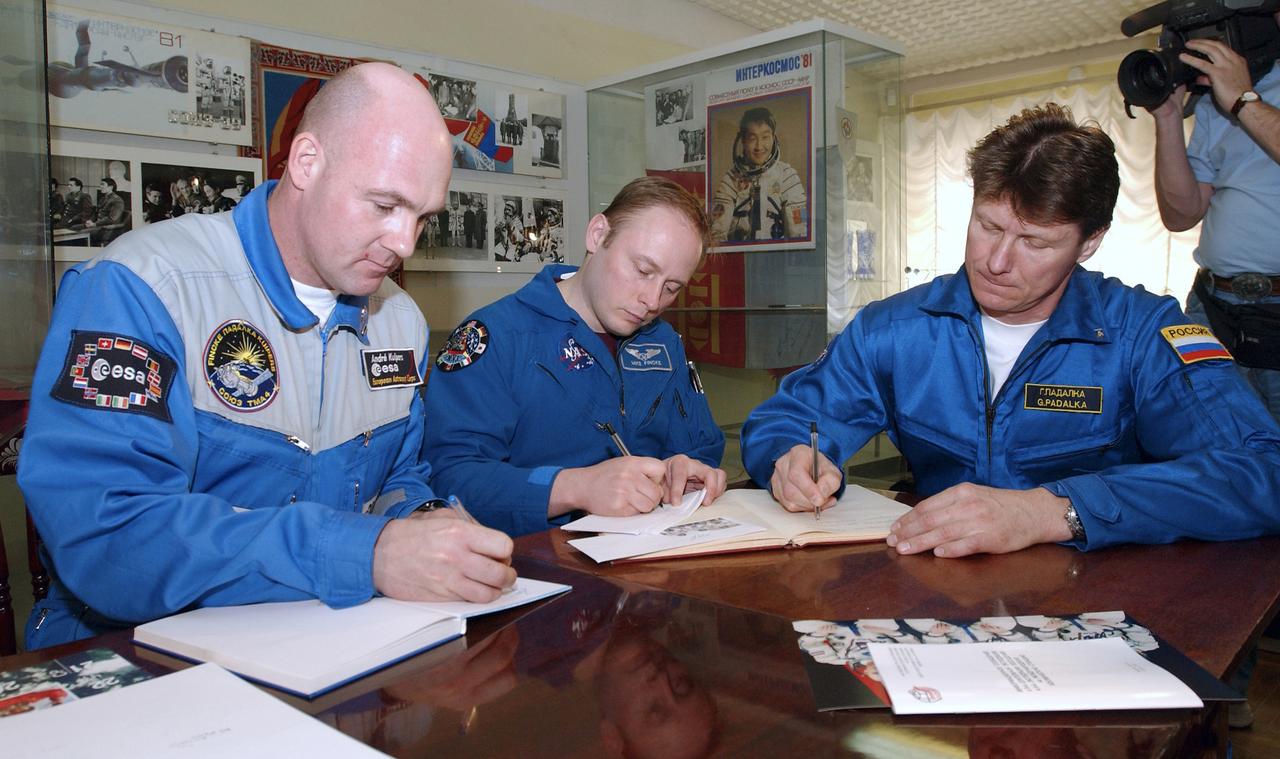
European Space Agency astronaut Andre Kuipers of the Netherlands, left, NASA Science Officer Mike Fincke, center and Expedition 9 Commander Gennady Padalka sign books, envelops and mementos in the space museum located at the Baikonur Cosmodrome, Wednesday, April, 14, 2004, in Baikonur, Kazakhstan. Photo Credit: "NASA/Bill Ingalls"
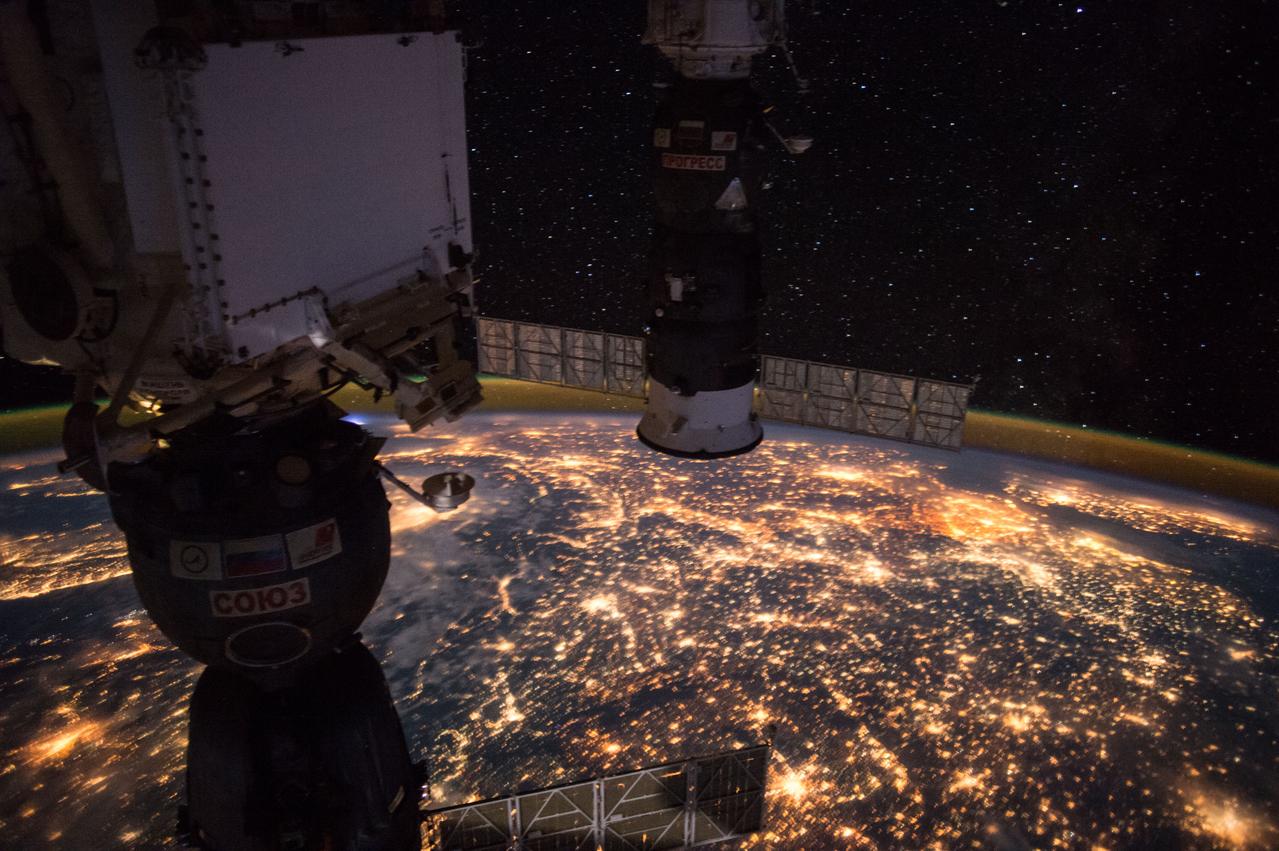
ISS049e009356 (09/24/2016) --- Earth observation taken during a night pass by the Expedition 49 crew aboard the International Space Station. Framed by the docked Soyuz and Progress spacecraft is Western Europe. The bright, dense lights in the East are the Netherlands, Belgium. The dark strip is the Alps
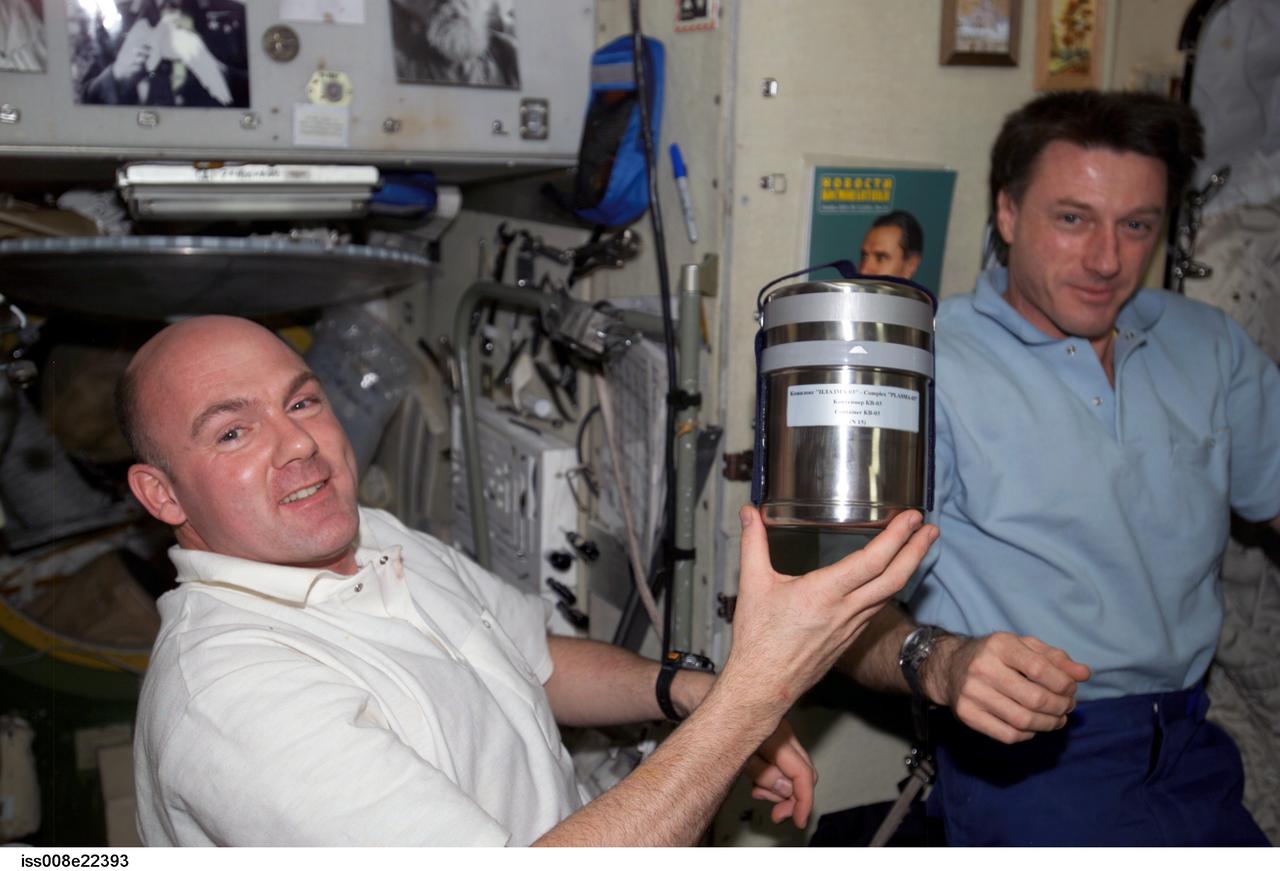
ISS008-E-22393 (29 April 2004) --- European Space Agency (ESA) astronaut Andre Kuipers of the Netherlands, holds a Complex “Plasma-03” canister in the Zvezda Service Module of the International Space Station (ISS). Astronaut C. Michael Foale, Expedition 8 commander and NASA ISS science officer, is at right.
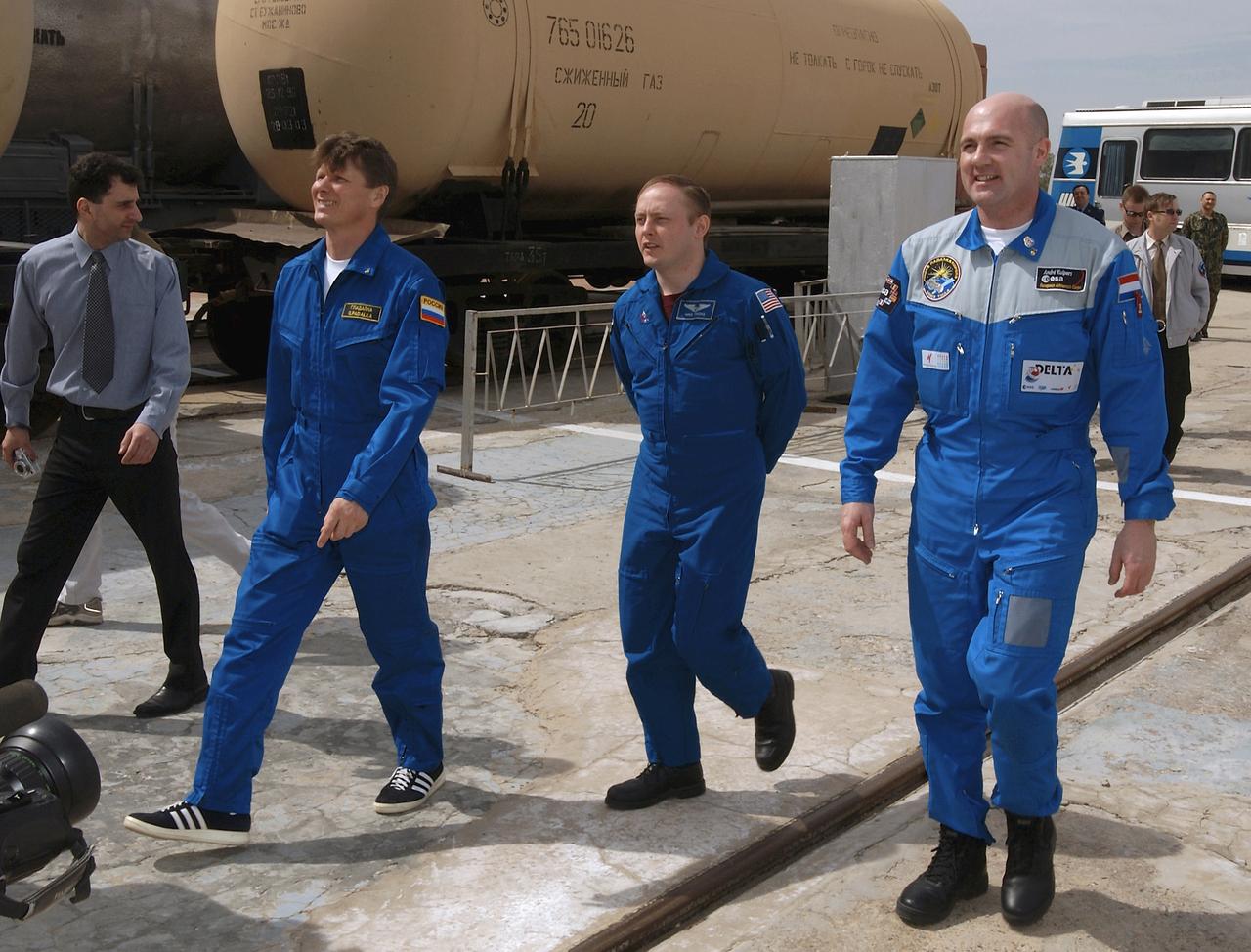
Expedition 9 Commander Gennady Padalka, Flight Engineer and NASA Science Officer Mike Fincke, center and European Space Agency astronaut Andre Kuipers of the Netherlands take a tour of the Soyuz launch pad, Wednesday, April 14, 2004, in Baikonur, Kazakhstan. Photo Credit: (NASA/Bill Ingalls)

The The Soyuz TMA-4 vehicle blasts off from the Baikonur Cosmodrome in Kazakhstan, Monday, April 19, 2004 carrying Expedition 9 Commander Gennady Padalka, Flight Engineer and NASA International Space Station Science Officer Michael Fincke and European Space Agency astronaut Andre Kuipers of the Netherlands to the International Space Station. Padalka and Fincke will spend six months on the Station, while Kuipers returns home April 30 with the Expedition 8 crew members. Photo Credit: (NASA/Bill Ingalls) vehicle blasts off from the Baikonur Cosmodrome in Kazakhstan, Monday, April 19, 2004 carrying Expedition 9 Commander Gennady Padalka, Flight Engineer Mike Fincke and European Space Agency astronaut Andre Kuipers of the Netherlands to the International Space Station. Padalka and Fincke will spend six months on the Station, while Kuipers returns home April 30 with the Expedition 8 crew members. Photo Credit: (NASA/Bill Ingalls)
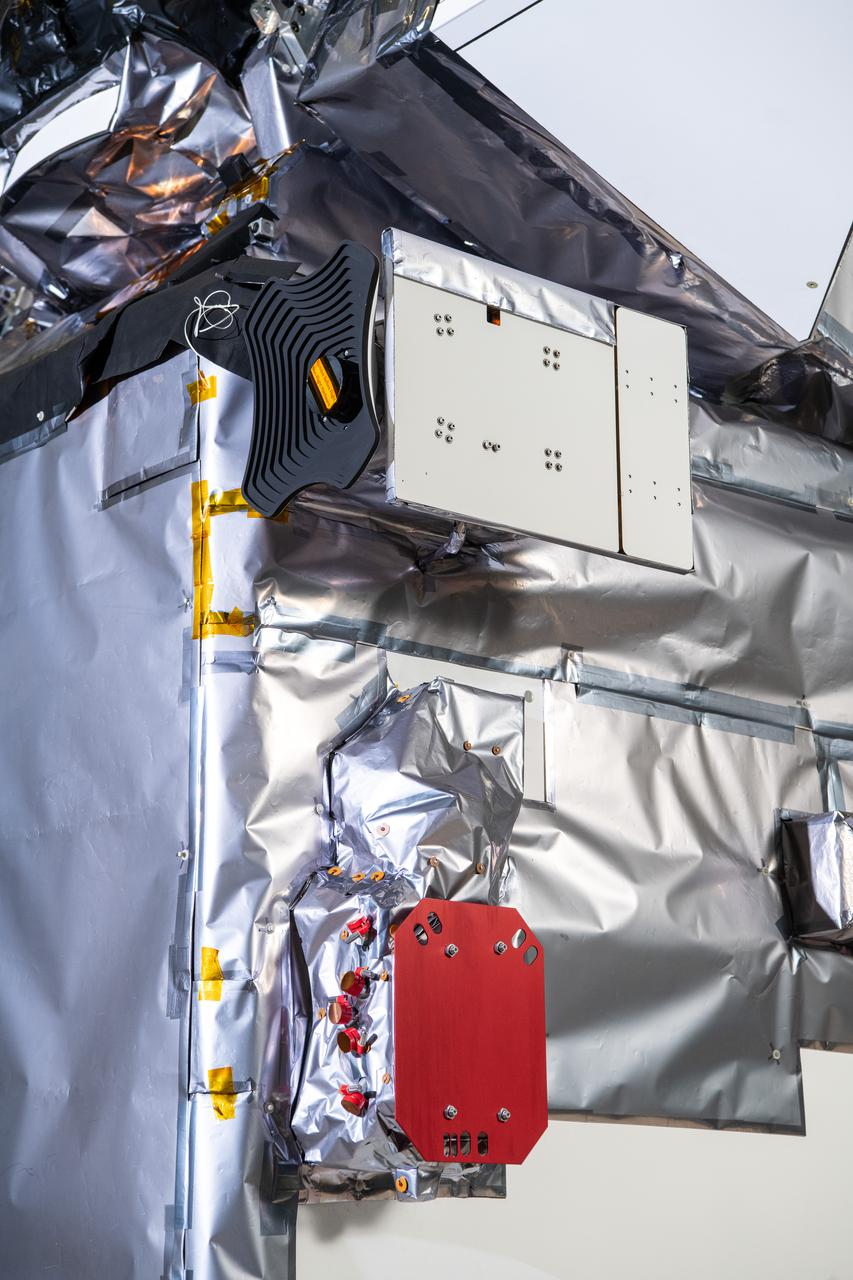
The Hyper-Angular Rainbow Polarimeter #2 (HARP2) instrument (top) and the SPEXone instrument on The Plankton, Aerosol, Cloud, ocean Ecosystem (PACE) in the clean room at NASA's Goddard Space Flight Center in Greenbelt, Maryland on October 31st, 2023. HARP2 is one of three instruments on NASA's PACE observatory, it was designed and built by UMBC's Earth and Space Institute. SPEXone has been developed by a Dutch consortium consisting of SRON Netherlands Institute for Space Research and Airbus Defence and Space Netherlands, supported by opto-mechanical expertise from TNO. SRON and Airbus DS NL are responsible for the design, manufacturing and testing of the instrument. The scientific lead is in the hands of SRON. SPEXone is a public-private initiative, funded by the Netherlands Space Office (NSO), the Netherlands Organization of Scientific Research (NWO), SRON and Airbus DS NL. PACE's unprecedented spectral coverage will provide the first-ever global measurements designed to identify phytoplankton community composition. The mission will make global ocean color measurements, using the Ocean Color Instrument (OCI), to provide extended data records on ocean ecology and global biogeochemistry along with polarimetry measurements, using the Spectro-polarimeter for Planetary Exploration (SPEXone) and the Hyper Angular Research Polarimeter (HARP2) to provide extended data records on clouds and aerosols. The Earth-observing satellite mission, built at Goddard Space Flight Center in Greenbelt, MD, will continue and advance observations of global ocean color, biogeochemistry, and ecology, as well as the carbon cycle, aerosols and clouds.
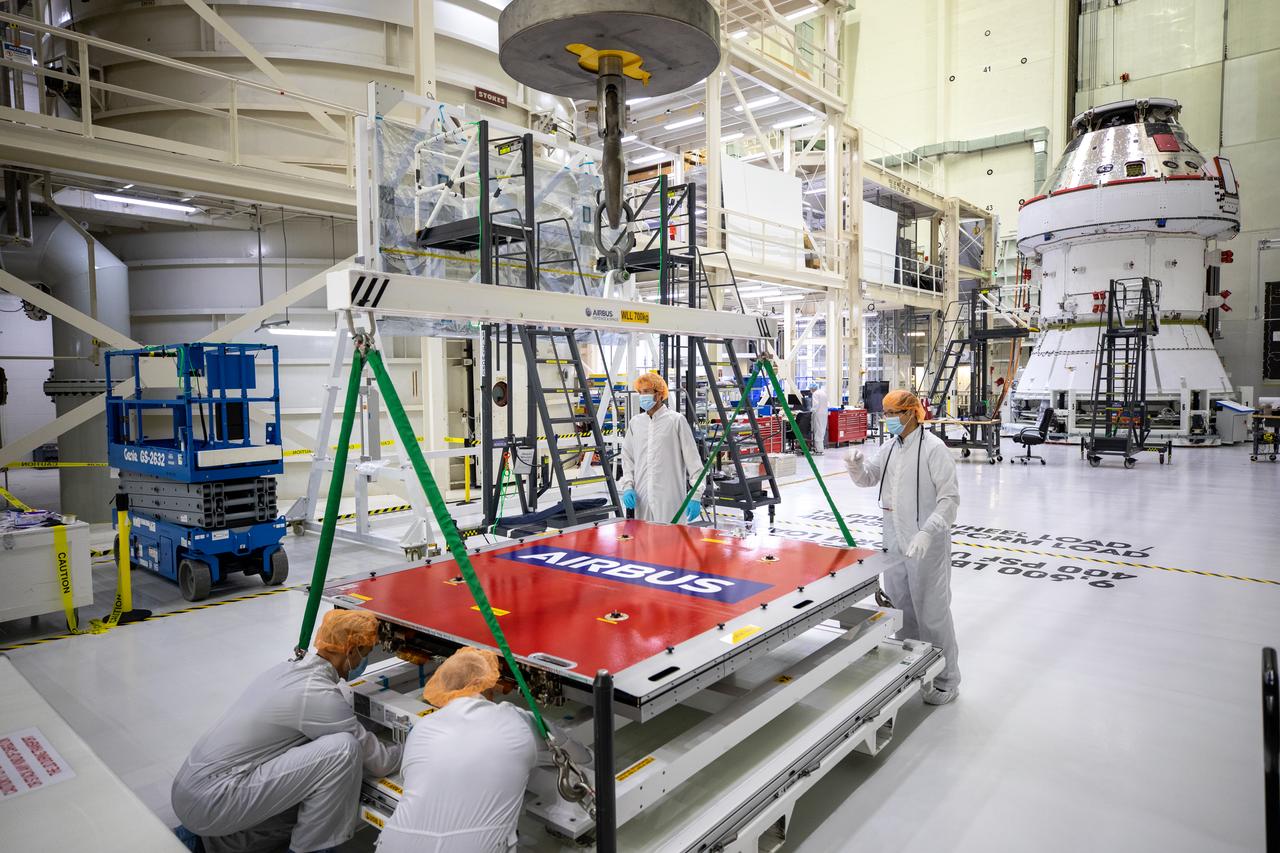
Technicians with European Service Module processing teams from the European Space Agency, Airbus, and Airbus Netherlands assist with securing a protective cover as a crane prepares to lift the panel during installation of one of four solar array wings inside the Neil Armstrong Operations and Checkout Building high bay at NASA’s Kennedy Space Center in Florida on Sept. 23, 2020. The Orion spacecraft for Artemis I is shown in the background. The solar arrays were extended, inspected, and then retracted, before installation on the spacecraft. Each solar array panel will generate 11 kilowatts of power and span about 63 feet. The array is a component of Orion’s service module, which is provided by the European Space Agency and built by Airbus Defence and Space to supply Orion’s power, propulsion, air and water. The first in a series of increasingly complex missions, Artemis I will test the Orion spacecraft and Space Launch System as an integrated system ahead of crewed flights to the Moon. Under the Artemis program, NASA will land the first woman and the next man on the Moon in 2024.
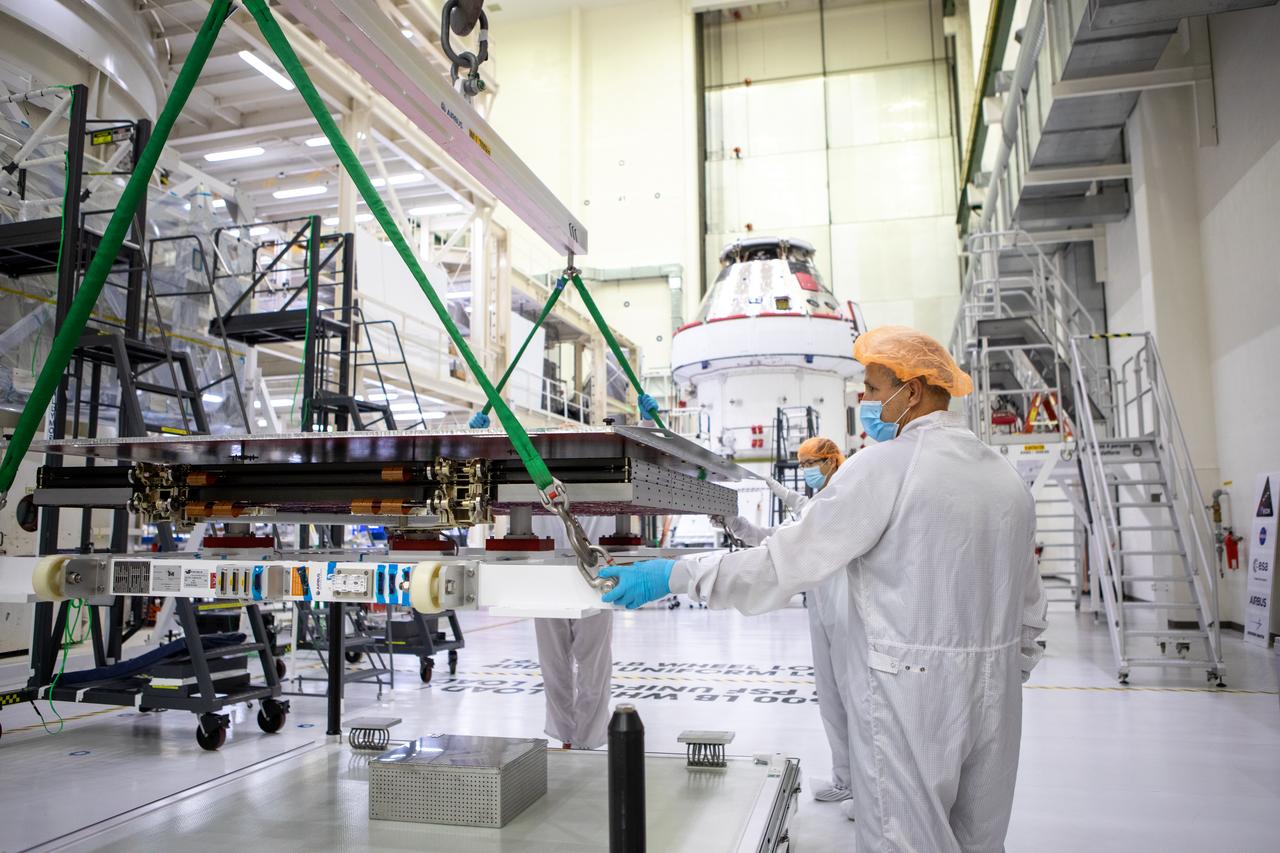
Technicians with European Service Module processing teams from the European Space Agency, Airbus, and Airbus Netherlands assist with securing a protective cover as a crane prepares to lift the panel during installation of one of four solar array wings inside the Neil Armstrong Operations and Checkout Building high bay at NASA’s Kennedy Space Center in Florida on Sept. 23, 2020. The Orion spacecraft for Artemis I is shown in the background. The solar arrays were extended, inspected, and then retracted, before installation on the spacecraft. Each solar array panel will generate 11 kilowatts of power and span about 63 feet. The array is a component of Orion’s service module, which is provided by the European Space Agency and built by Airbus Defence and Space to supply Orion’s power, propulsion, air and water. The first in a series of increasingly complex missions, Artemis I will test the Orion spacecraft and Space Launch System as an integrated system ahead of crewed flights to the Moon. Under the Artemis program, NASA will land the first woman and the next man on the Moon in 2024.
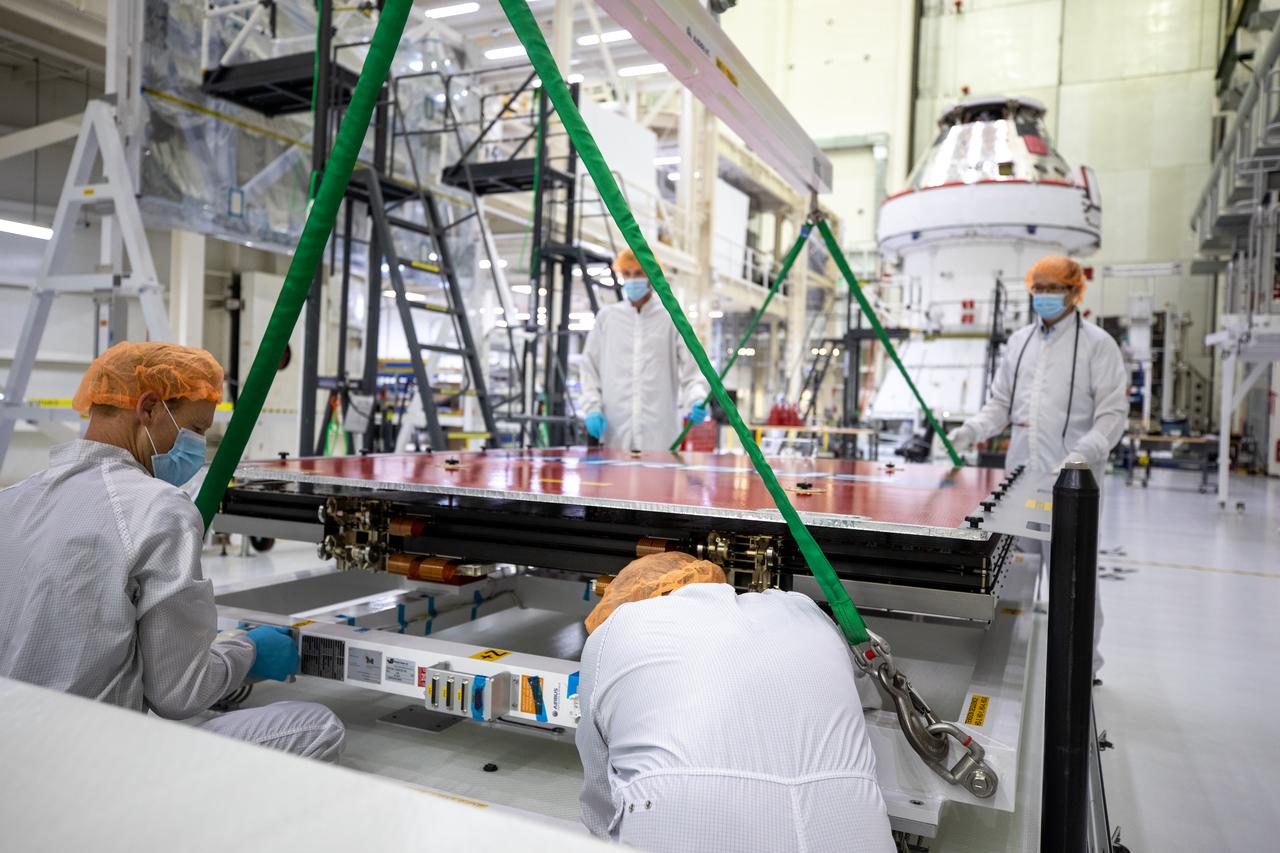
Technicians with European Service Module processing teams from the European Space Agency, Airbus, and Airbus Netherlands assist with securing a protective cover as a crane prepares to lift the panel during installation of one of four solar array wings inside the Neil Armstrong Operations and Checkout Building high bay at NASA’s Kennedy Space Center in Florida on Sept. 23, 2020. The Orion spacecraft for Artemis I is shown in the background. The solar arrays were extended, inspected, and then retracted, before installation on the spacecraft. Each solar array panel will generate 11 kilowatts of power and span about 63 feet. The array is a component of Orion’s service module, which is provided by the European Space Agency and built by Airbus Defence and Space to supply Orion’s power, propulsion, air and water. The first in a series of increasingly complex missions, Artemis I will test the Orion spacecraft and Space Launch System as an integrated system ahead of crewed flights to the Moon. Under the Artemis program, NASA will land the first woman and the next man on the Moon in 2024.
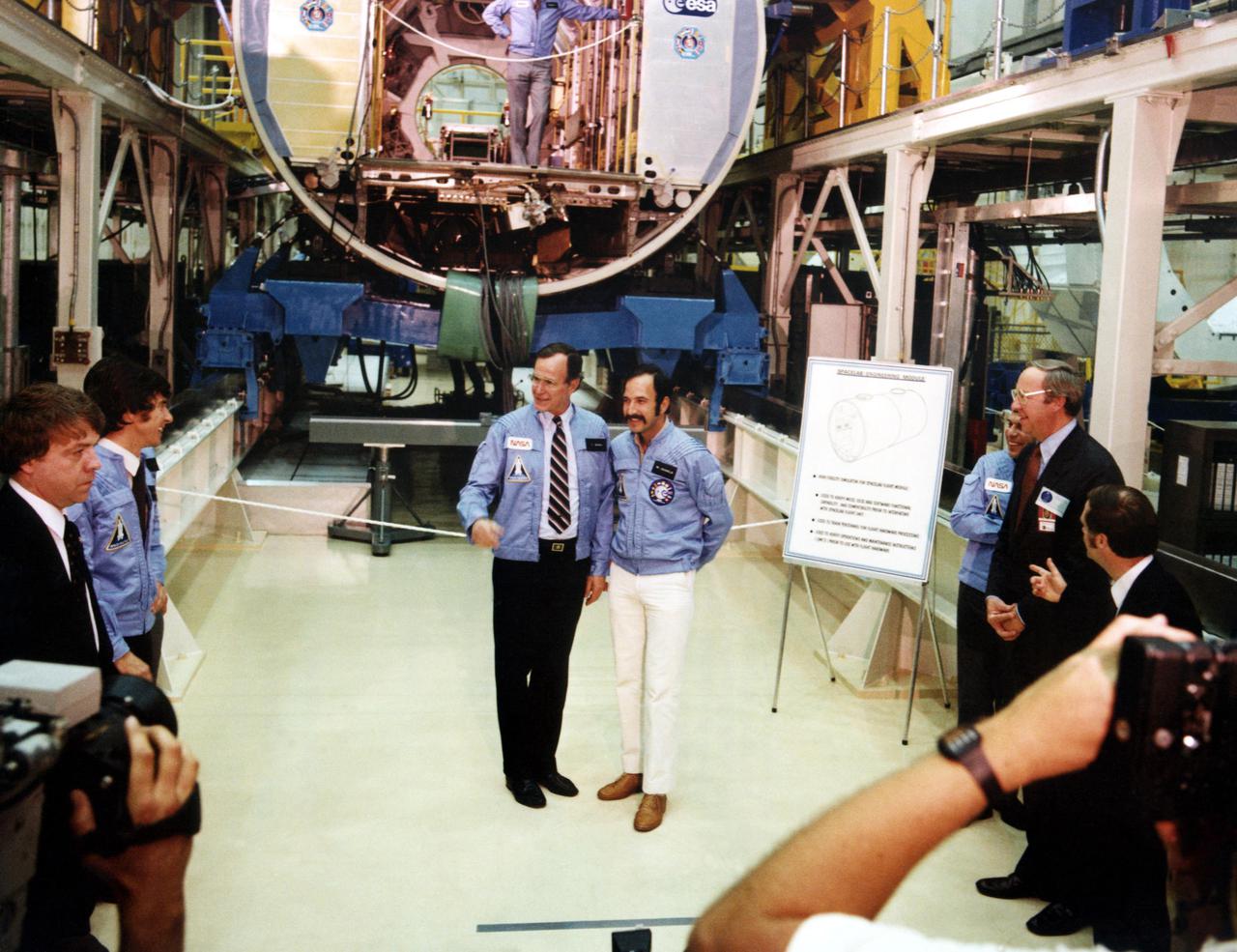
KENNEDY SPACE CENTER, FLA. -- Vice President George F. Bush, center left, is pictured with Payload Specialist Wubbo Ockels of the Netherlands during the Spacelab Arrival Ceremony. Second from left is Payload Specialist Ulf Merbold, Germany. At far right are James McCulls, chief, Special Services Branch, NASA Headquarters; and James C. Harrington, director, Spacelab Program, NASA. Overhead, astronaut Owen K. Garriott, U.S.A., stands in the Spacelab Engineering Module.

Expedition 9 Commander Gennady Padalka, right, and Flight Engineer and NASA Science Officer Mike Fincke check each other's suits, Monday, April 19, 2004, prior to departing for the launch pad for their liftoff to the International Space Station April 19, 2004 from the Baikonur Cosmodrome in Baikonur, Kazakhstan. Padalka and Fincke launched with European Space Agency Astronaut Andre Kuipers of the Netherlands, who will spend 9 days on the Station, while Padalka and Fincke will remain on board until October. Photo Credit: (NASA/Bill Ingalls)
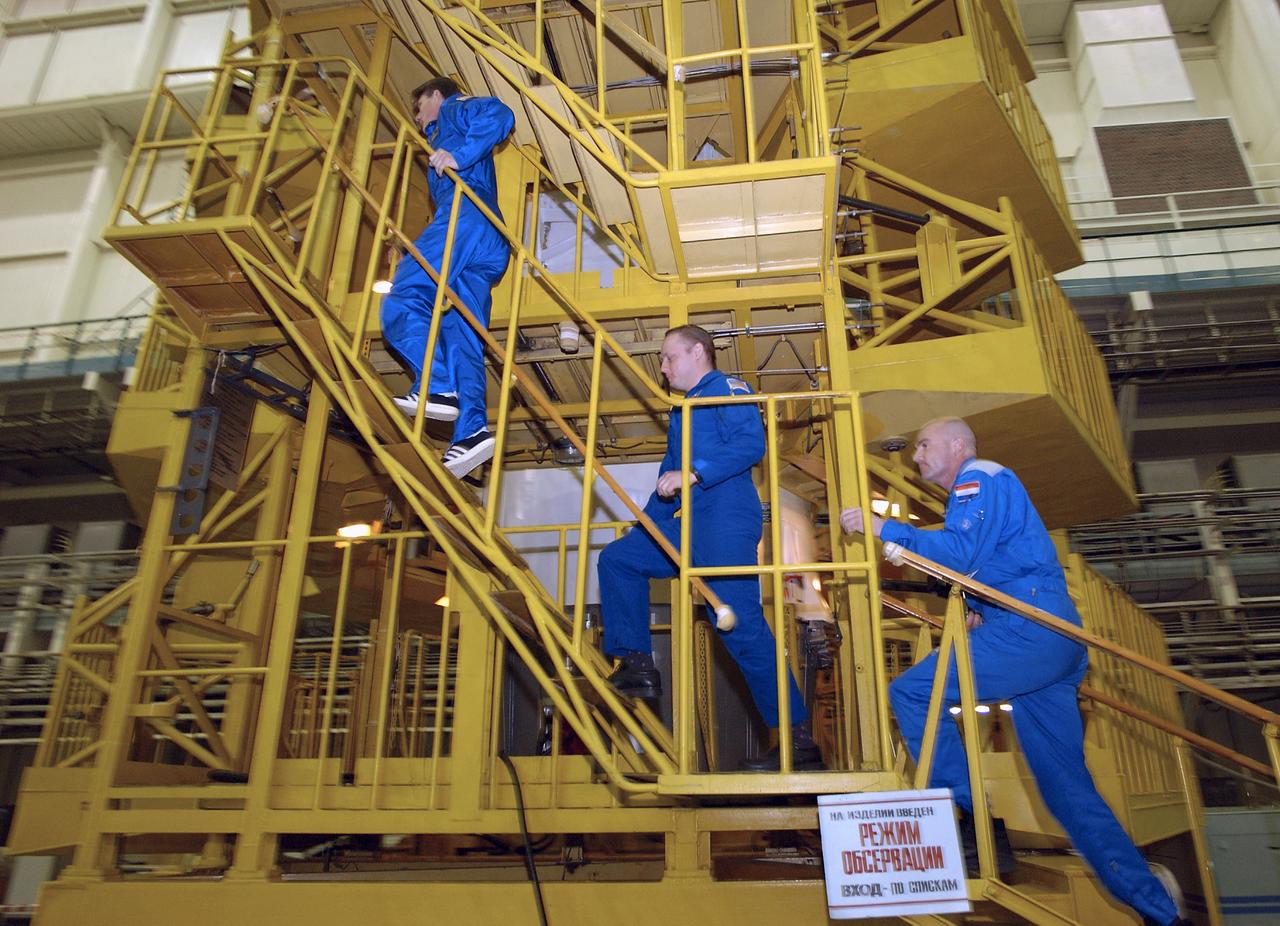
Expedition 9 Commander Gennady Padalka, left, NASA Science Officer Mike Fincke, center and Flight Engineer and European Space Agency astronaut Andre Kuipers of the Netherlands climb the workstand around the Soyuz capsule for their final fit check at building 254 at the Baikonur Cosmodrome, Wednesday, April 14, 2004, in Baikonur, Kazakhstan. Photo Credit: (NASA/Bill Ingalls)
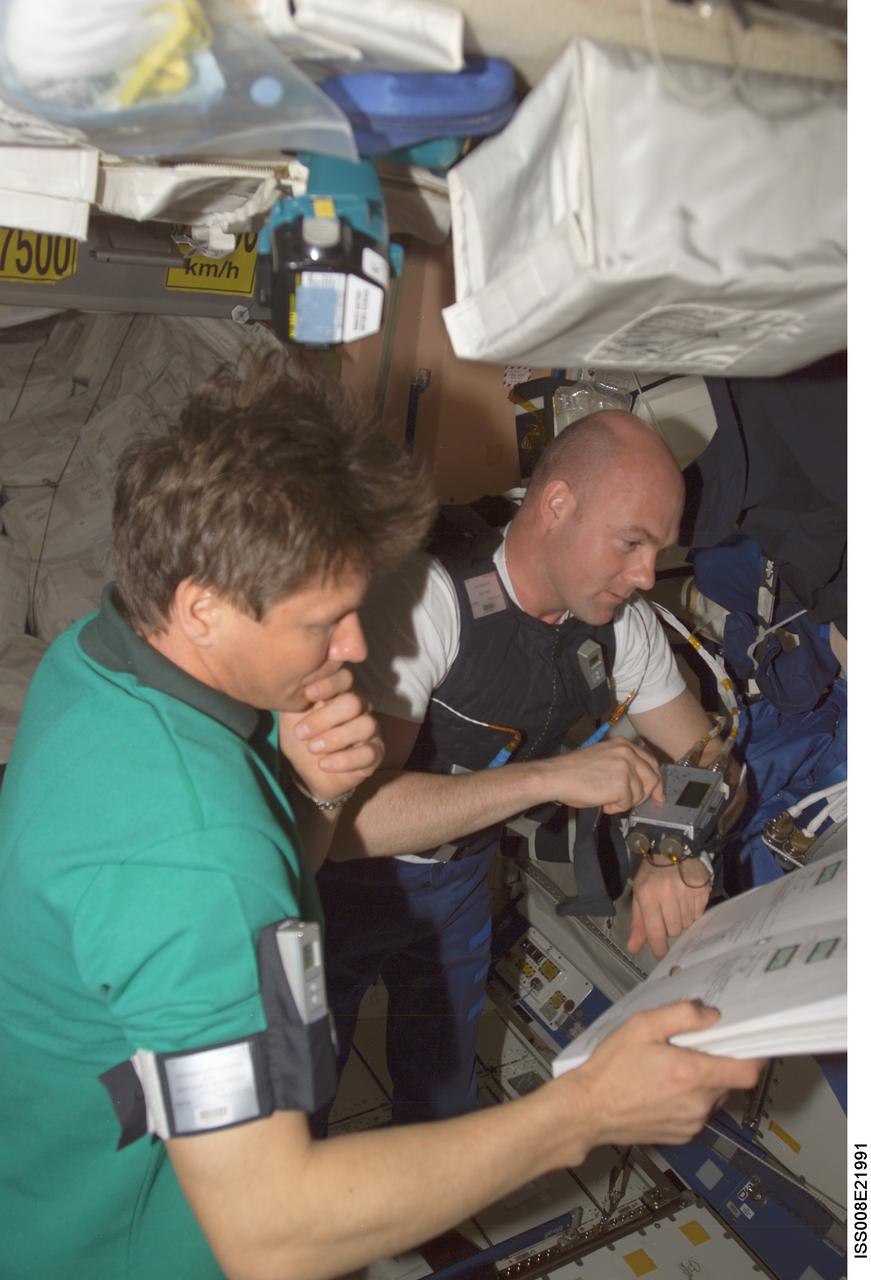
ISS008-E-21991 (22 April 2004) --- Cosmonaut Gennady I. Padalka (left), Expedition 9 commander, and European Space Agency (ESA) astronaut Andre Kuipers of the Netherlands, work with one of experiments of the Dutch Expedition for Life Science, Technology and Atmospheric (DELTA) Research in the Unity node of the International Space Station (ISS). Padalka represents Russia’s Federal Space Agency.

View of Vice-President George Bush visiting with Astronaut Owen Garriott and Payload Specialist (PS) Wubbo Ockels of the Netherlands, inside the SL after the dedication ceremony, KSC Operations & Checkout (O&C) Building. 1. Astronaut Owen K. Garriott 2. Vice President George Bush 3. Wubbo Ockels - PS 4x5 Color and B&W
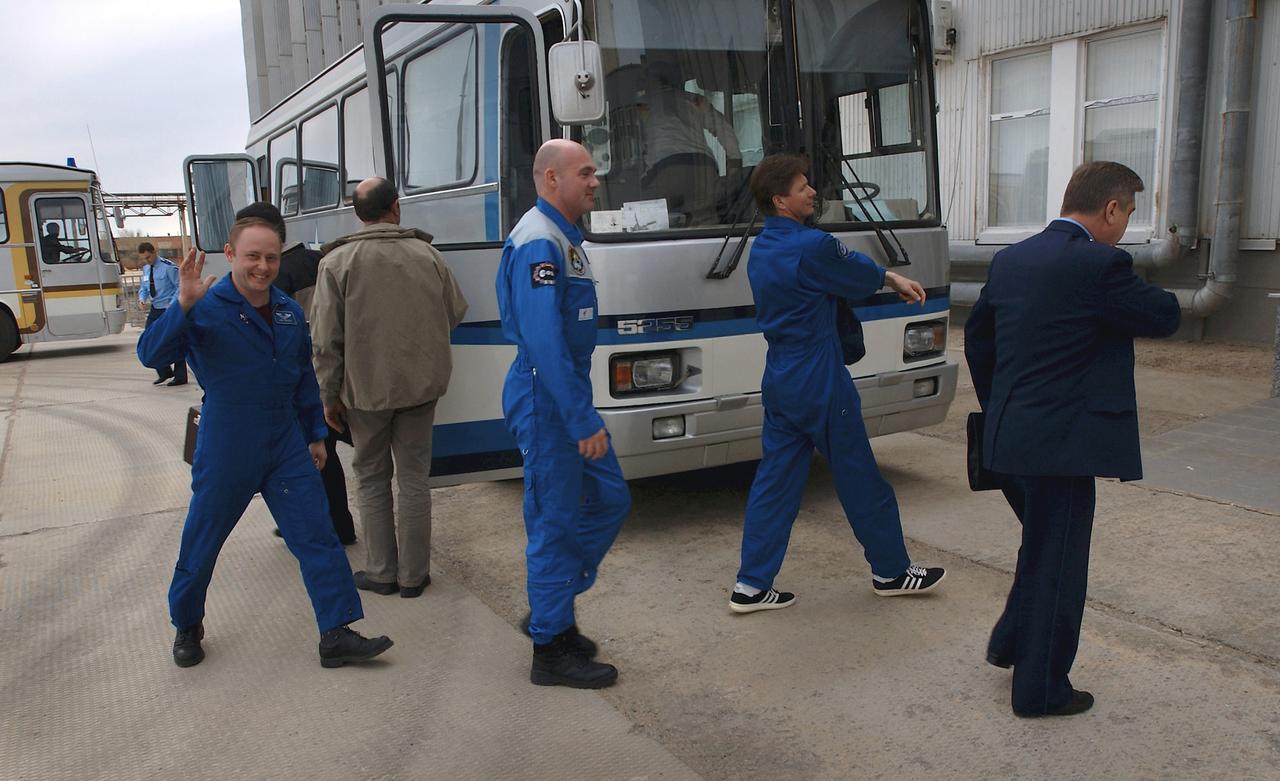
Expedition 9 NASA International Space Station Science Officer and Flight Engineer Mike Fincke, left, European Space Agency astronaut Andre Kuipers of the Netherlands, center and Expedition 9 Commander Gennady Padalka arrive at building 254 at the Baikonur Cosmodrome for their final fit check in the Soyuz, Wednesday, April 14, 2004, in Baikonur, Kazakhstan. Photo Credit: (NASA/Bill Ingalls)
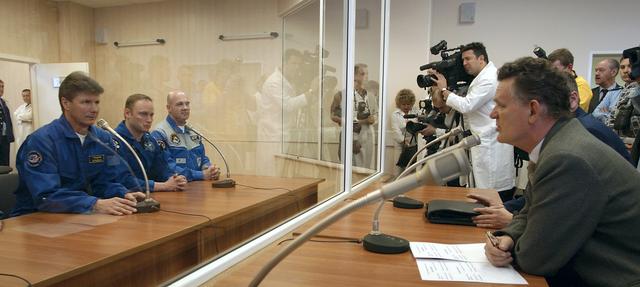
Expedition 9 Commander Gennady Padalka, far left, NASA International Space Station Science Officer Mike Fincke and Flight Engineer and European Space Agency astronaut Andre Kuipers of the Netherlands, far right, speak to members of the State Commission from behind glass at building 254 at the Baikonur Cosmodrome prior to their final fit check in the Soyuz, Wednesday, April 14, 2004, in Baikonur, Kazakhstan. Photo Credit: (NASA/Bill Ingalls)
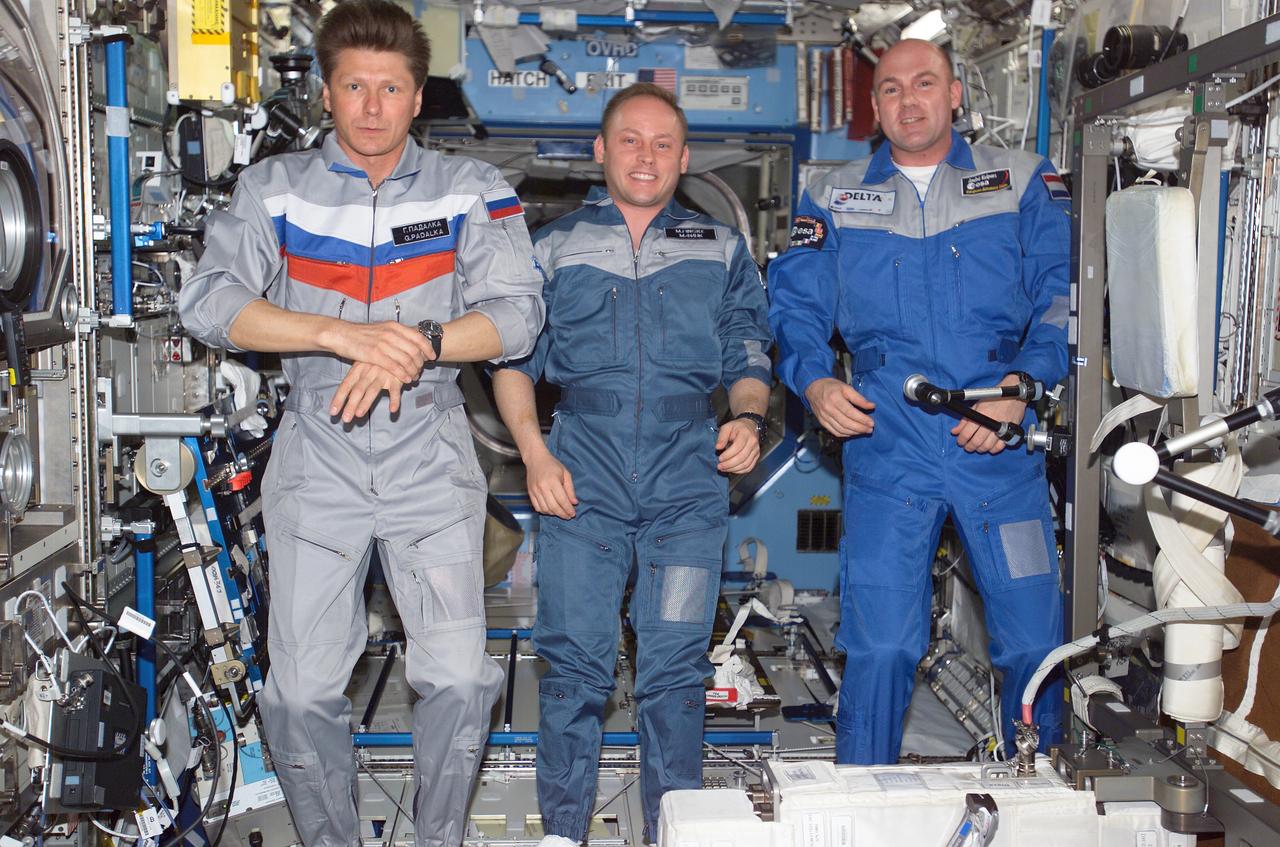
ISS008-E-22249 (23 April 2004) --- Cosmonaut Gennady I. Padalka (left), Expedition 9 commander; astronaut Edward M. (Mike) Fincke, NASA ISS science officer and flight engineer; and European Space Agency (ESA) astronaut Andre Kuipers of the Netherlands pose for a group photo in the Destiny laboratory of the International Space Station (ISS). Padalka represents Russia’s Federal Space Agency.
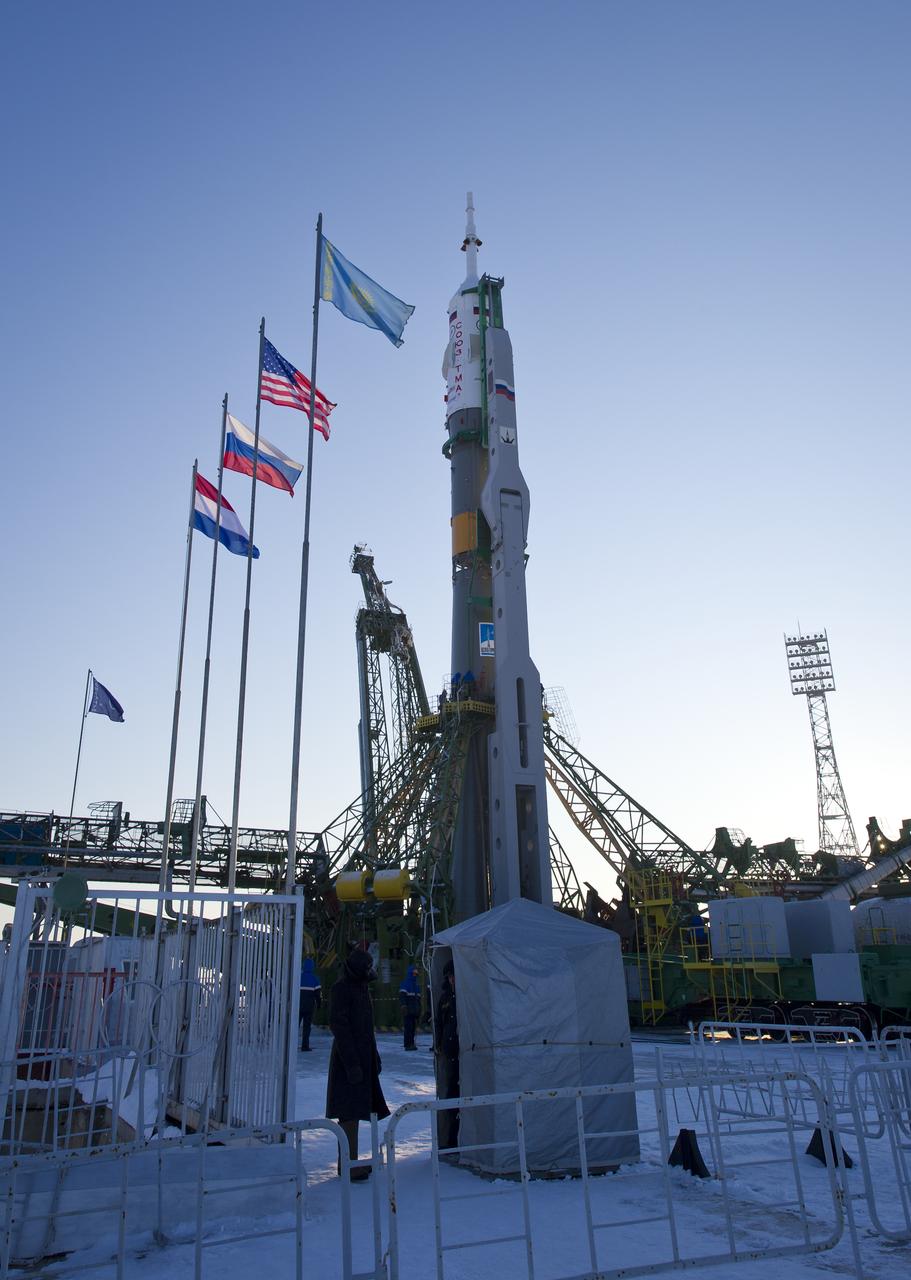
The flags representing Kazakhstan and the nations of the three crewmembers who will launch in the Soyuz TMA-03M spacecraft are shown at the launch pad at the Baikonur Cosmodrome in Kazakhstan on Monday, Dec. 19, 2011. From left to right are the flags of The Netherlands, Russia, the United States and Kazakhstan. Scheduled to launch on December 21st local time are Expedition 30 Soyuz Commander Oleg Kononenko of Russia, NASA Flight Engineer Don Pettit and ESA (European Space Agency) astronaut and Flight Engineer Andre Kuipers. Photo Credit (NASA/Carla Cioffi)
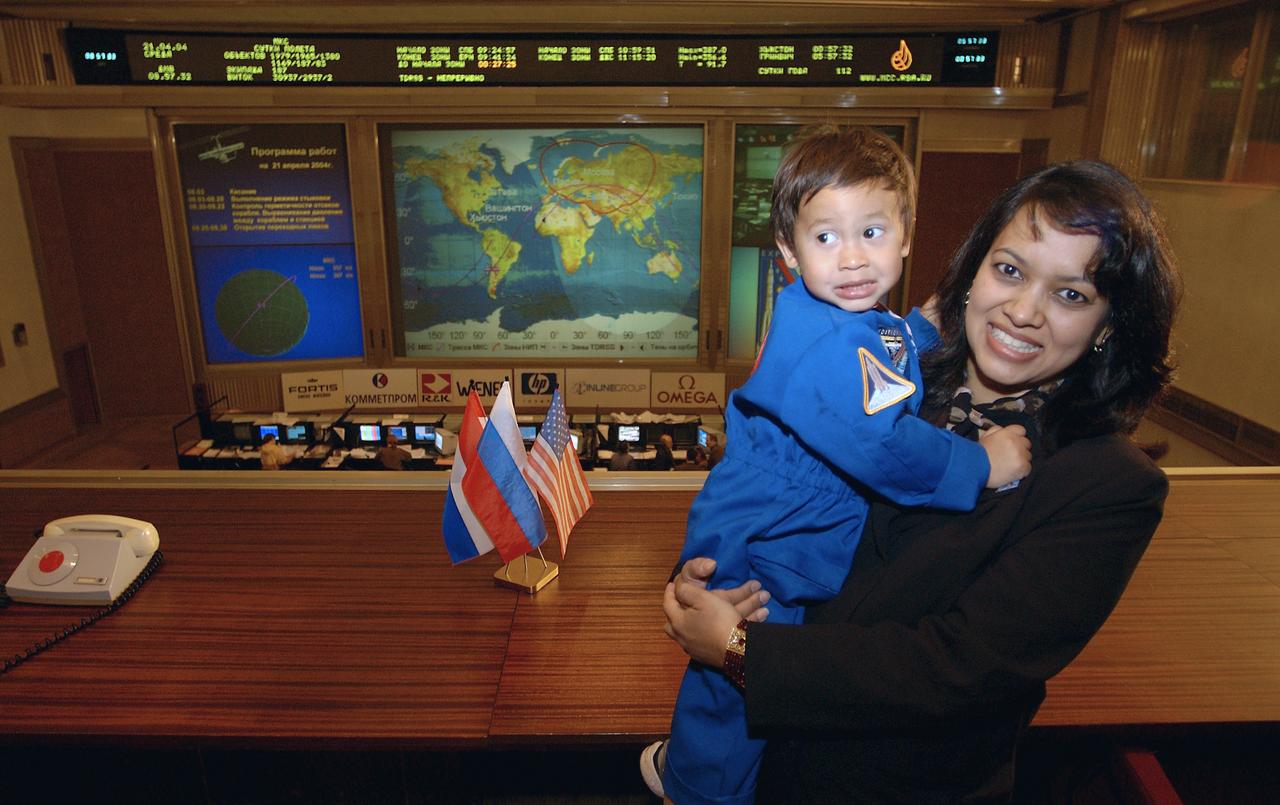
Renita Fincke, wife of Expedition 9 Flight Engineer and NASA International Space Station Science Officer Michael Fincke, smiles with their two-year old son Chandra at the Russian Mission Control Center outside Moscow, Wednesday, April 21, 2004, following the successful docking of the Russian Soyuz capsule carrying Fincke, Expedition 9 Commander Gennady Padalka and European Space Agency astronaut Andre Kuipers of the Netherlands to the International Space Station. Photo Credit: (NASA/Bill Ingalls)
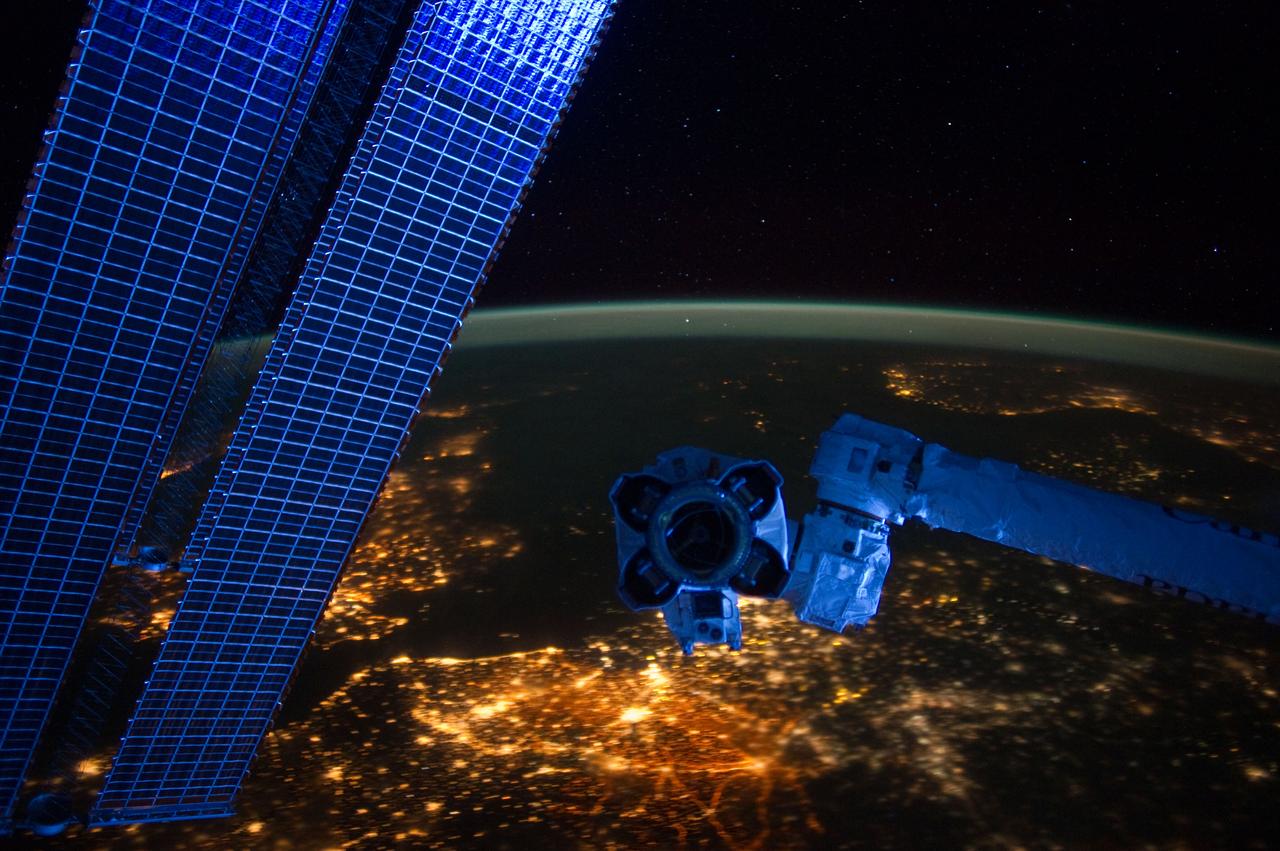
ISS030-E-048067 (22 Jan. 2012) --- With hardware from the Earth-orbiting International Space Station appearing in the near foreground, a night time European panorama reveals city lights from Belgium and the Netherlands at bottom center, the British Isles partially obscured by solar array panels at left, the North Sea at left center, and Scandinavia at right center beneath the end effector of the Space Station Remote Manipulator System or Canadarm2.
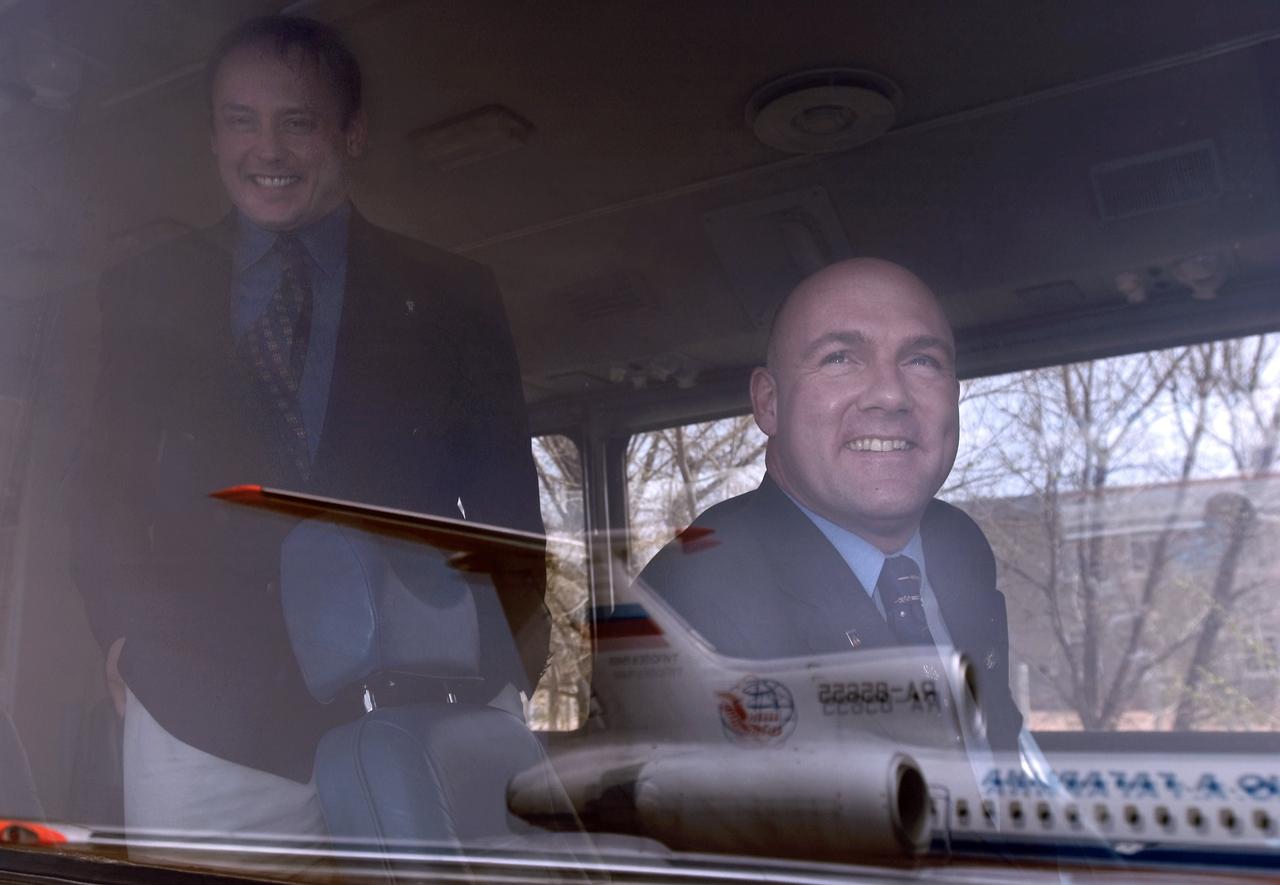
Flight Engineer and NASA International Space Station Science Officer Mike Fincke, left and European Space Agency astronaut Andre Kuipers of the Netherlands on board their bus after arrival at Baikonur, Kazakhstan, Tuesday, April 13, 2004, six days prior to their scheduled launch on board a Soyuz rocket. Kuipers, who is flying under a commercial contract between ESA and the Russian Federal Space Agency, will return to Earth with the Expedition 8 crew on April 30, 2004. Photo Credit: (NASA/Bill Ingalls)
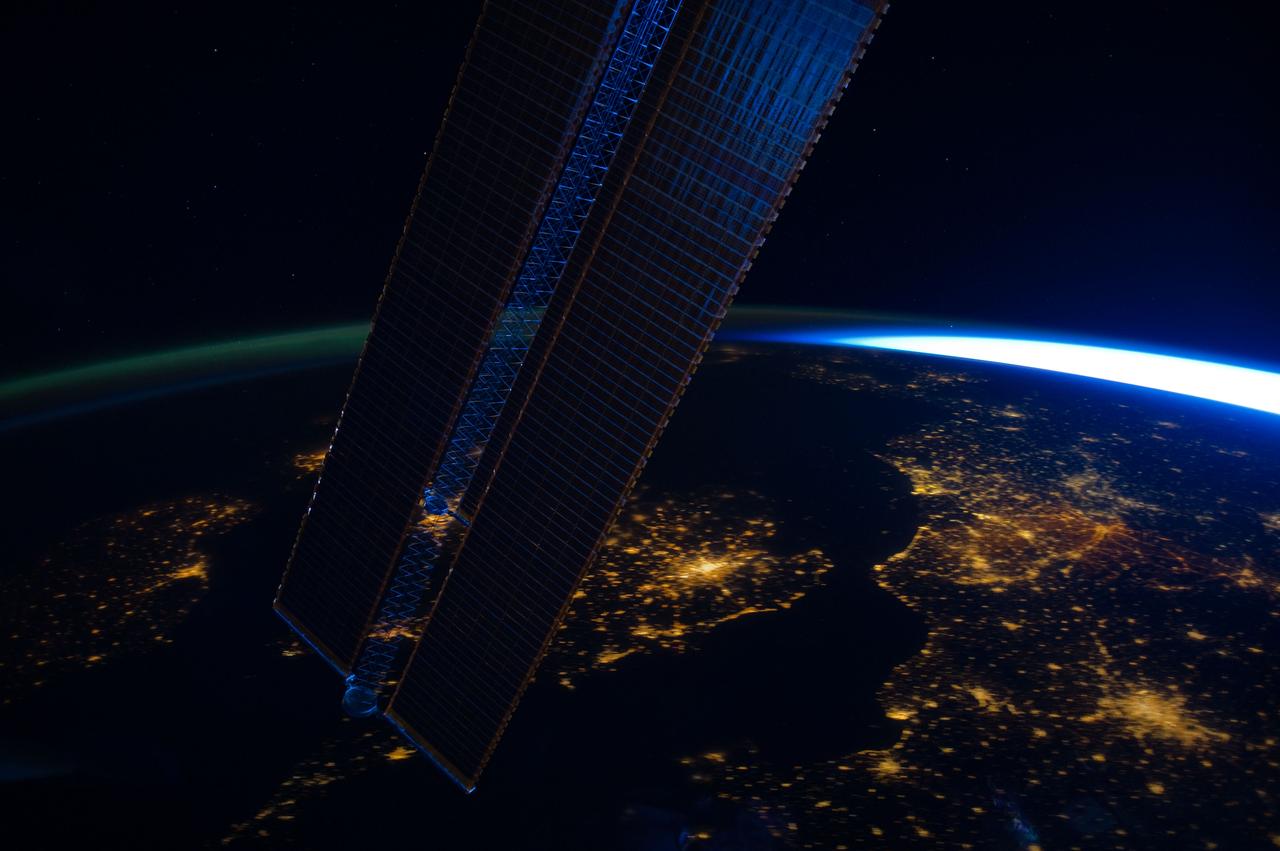
ISS030-E-064161 (2 Feb. 2012) --- Parts of a number of European nations appear in this nighttime image photographed from the International Space Station. The scene, captured by one of the Expedition 30 crew members, shows the British Isles (left, partially obstructed by one of the space station's solar array panels) with London just right of bottom center; the English Channel, which is dark; Paris (lower right corner); and the Netherlands (right side). The greenish airglow is fairly uniform and minor until it transitions to daybreak on the right.
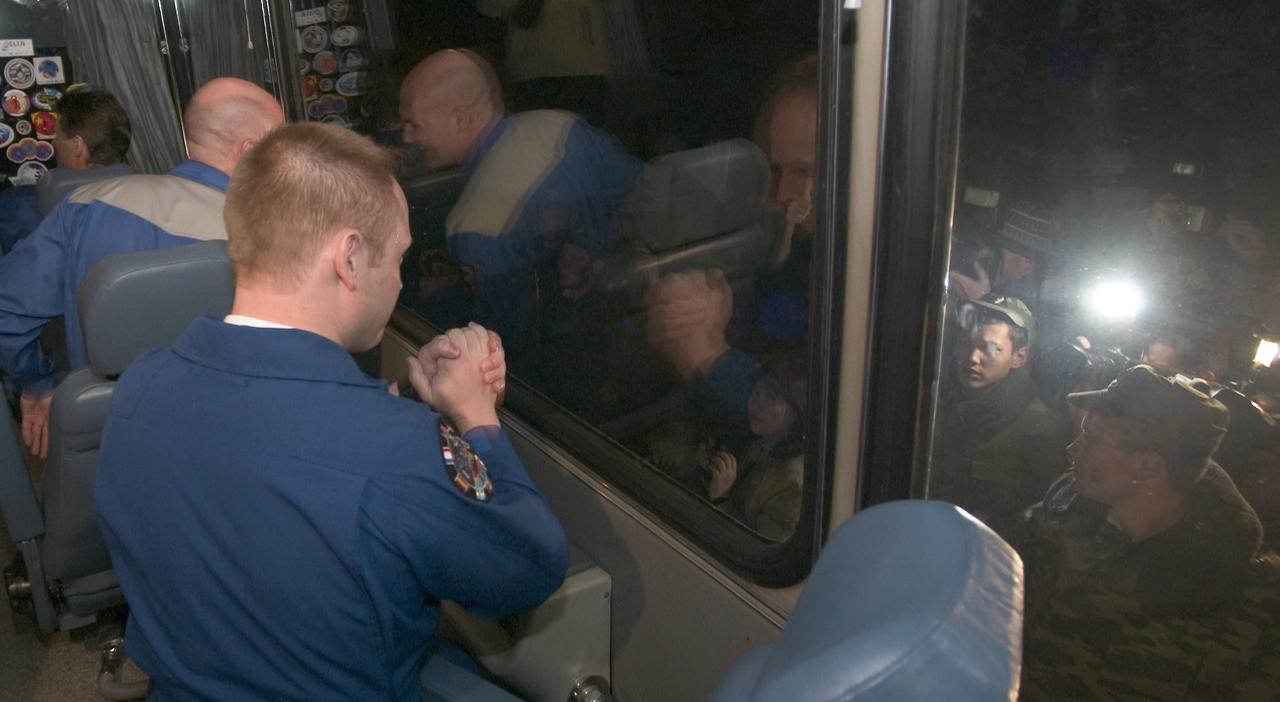
Expedition 9 Commander Gennady Padalka, left, European Space Agency astronaut Andre Kuipers of the Netherlands and Flight Engineer and NASA Science Officer Mike Fincke, right, wave to a crowd from their bus which will take the crew from the Cosmonaut Hotel to the suit up facility, Monday, April 19, 2004, in Baikonur, Kazakhstan. Photo Credit: (NASA/Bill Ingalls)
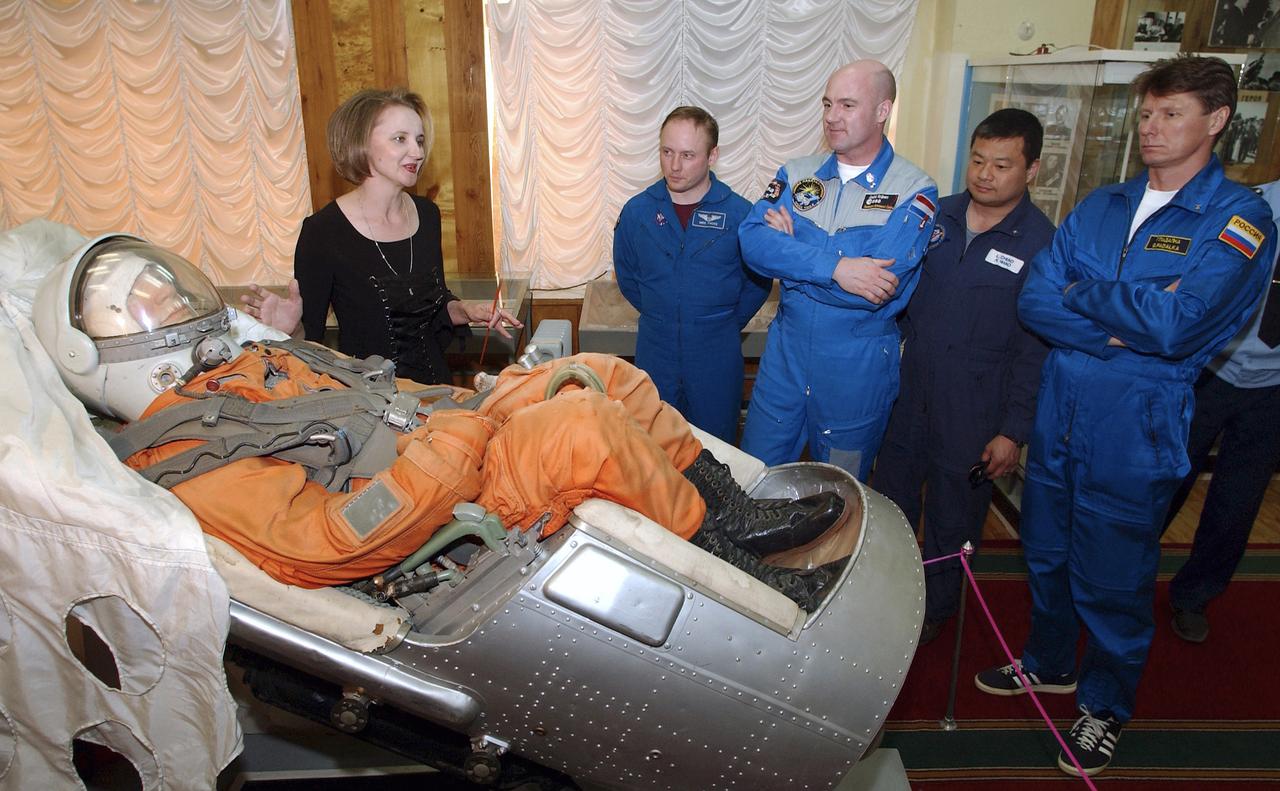
A tour guide at the Baikonur Cosmodrome Space Museum explains the displays to NASA Science Officer Mike Fincke, second from left, Flight Engineer and European Space Agency astronaut Andre Kuipers of the Netherlands, center, backup Expedition 9 Commander Leroy Chiao, second from right and Expedition 9 Commander Gennady Padalka, far right, Wednesday, April 14, 2004, in Baikonur, Kazakhstan. Photo Credit: (NASA/Bill Ingalls)
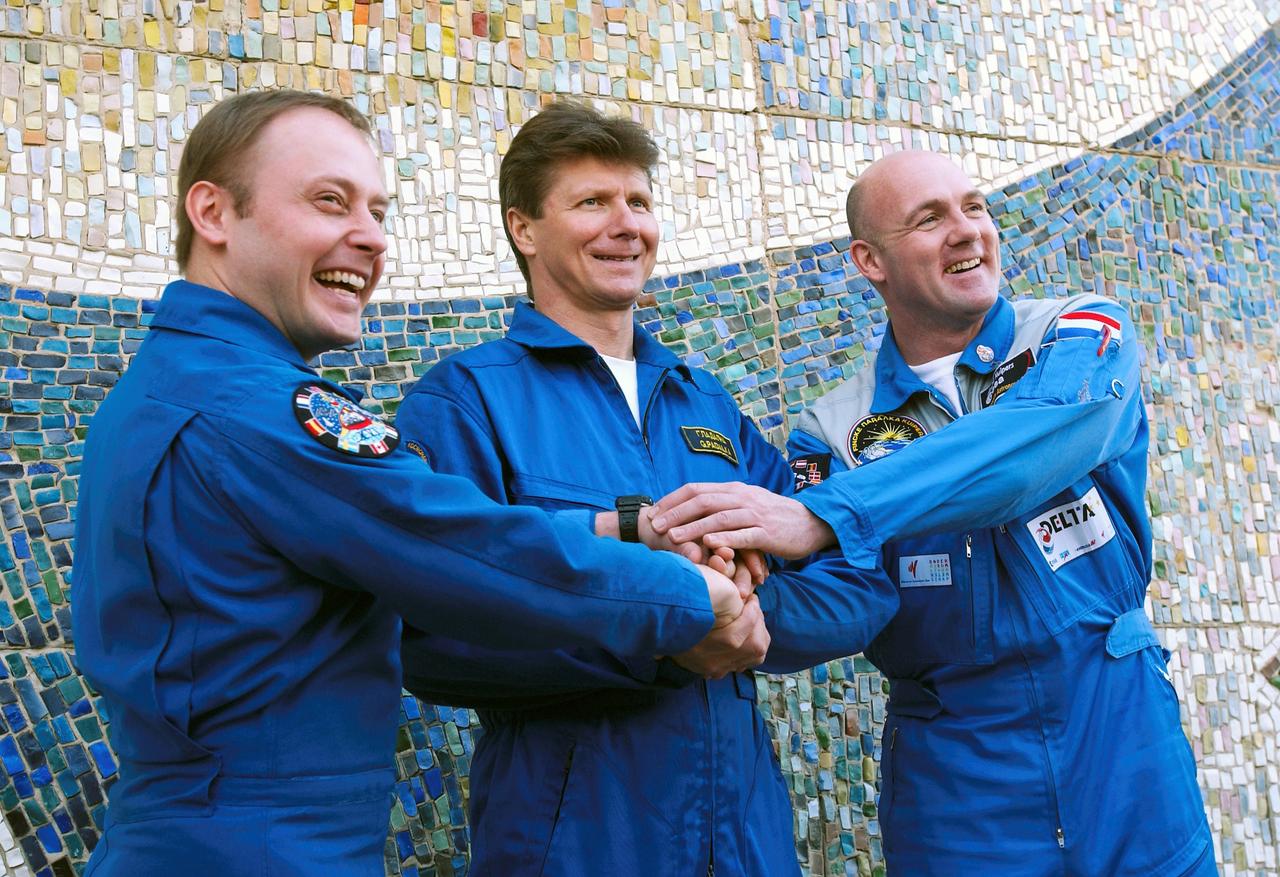
JSC2004-E-19914 (15 April 2004) --- Astronaut Edward M. (Mike) Fincke (left), NASA International Space Station (ISS) science officer and flight engineer; cosmonaut Gennady I. Padalka (center), Russia’s Federal Space Agency Expedition 9 mission commander; and European Space Agency (ESA) astronaut Andre Kuipers (right) of the Netherlands pose for a group photo after the flag raising ceremony at the Cosmonaut Hotel, Baikonur, Kazakhstan. Photo Credit: NASA/Bill Ingalls
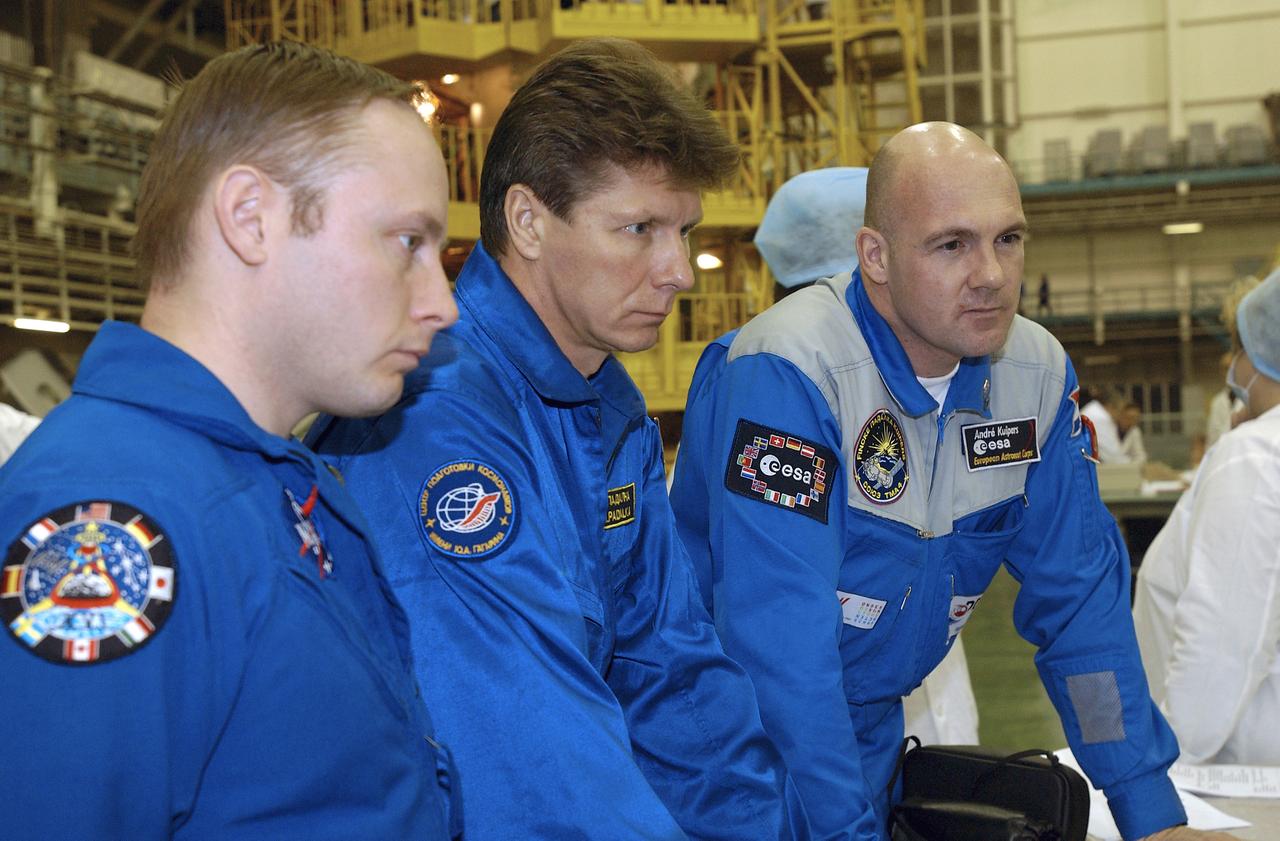
Expedition 9 Science Officer and Flight Engineer Mike Fincke, left, Expedition 9 Commander Gennady Padalka, center and European Space Agency astronaut Andre Kuipers of the Netherlands listen to instructions on satellite phone and GPS use in building 254 at the Baikonur Cosmodrome, Wednesday, April 14, 2004, in Baikonur, Kazakhstan. Photo Credit: (NASA/Bill Ingalls)
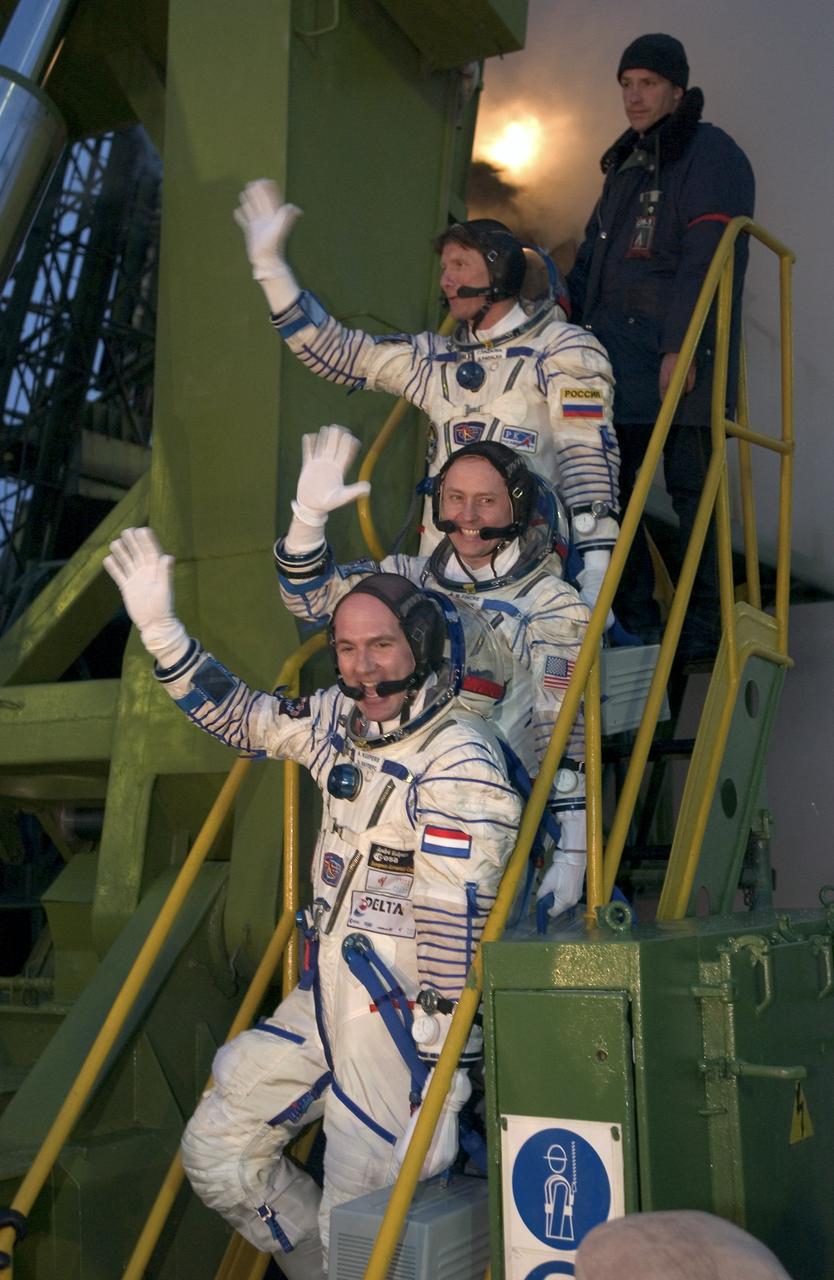
Expedition 9 Commander Gennady Padalka, second from top, Flight Engineer and NASA Science Officer Mike Fincke, second from bottom, and European Space Agency astronaut Andre Kuipers of the Netherlands bid farewell as they prepare to board the Soyuz TMA-4 vehicle on Monday, April 19, in Baikonur, Kazakhstan prior to their launch to the International Space Station. Photo Credit: (NASA/Bill Ingalls)
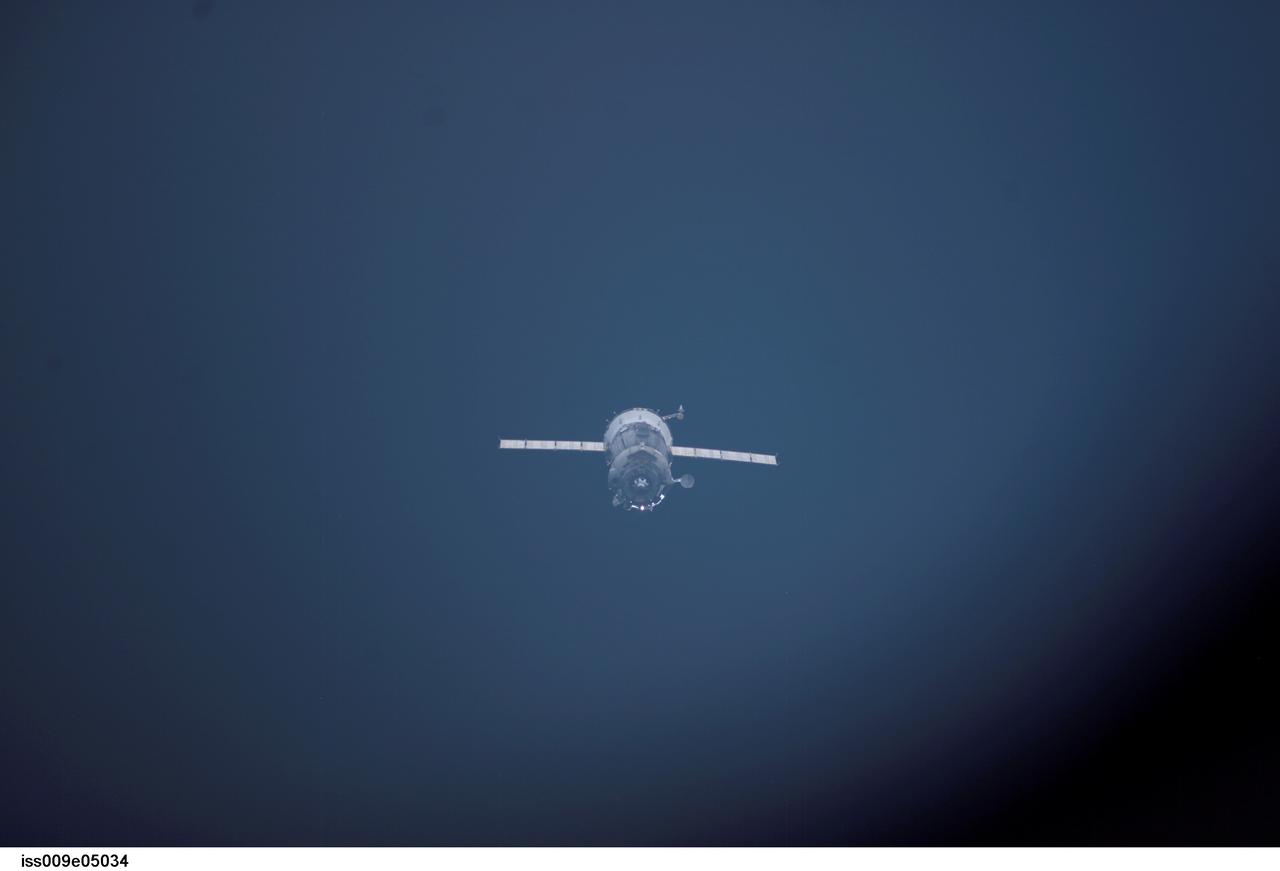
ISS009-E-05034 (29 April 2004) --- As seen through a window on the International Space Station (ISS), the Soyuz TMA-3 capsule departs from the Station carrying astronaut C. Michael Foale, Expedition 8 commander and NASA ISS science officer; cosmonaut Alexander Y. Kaleri, flight engineer representing Russia’s Federal Space Agency; and European Space Agency (ESA) astronaut Andre Kuipers of the Netherlands. Undocking occurred at 3:52 p.m. (CDT) on April 29.
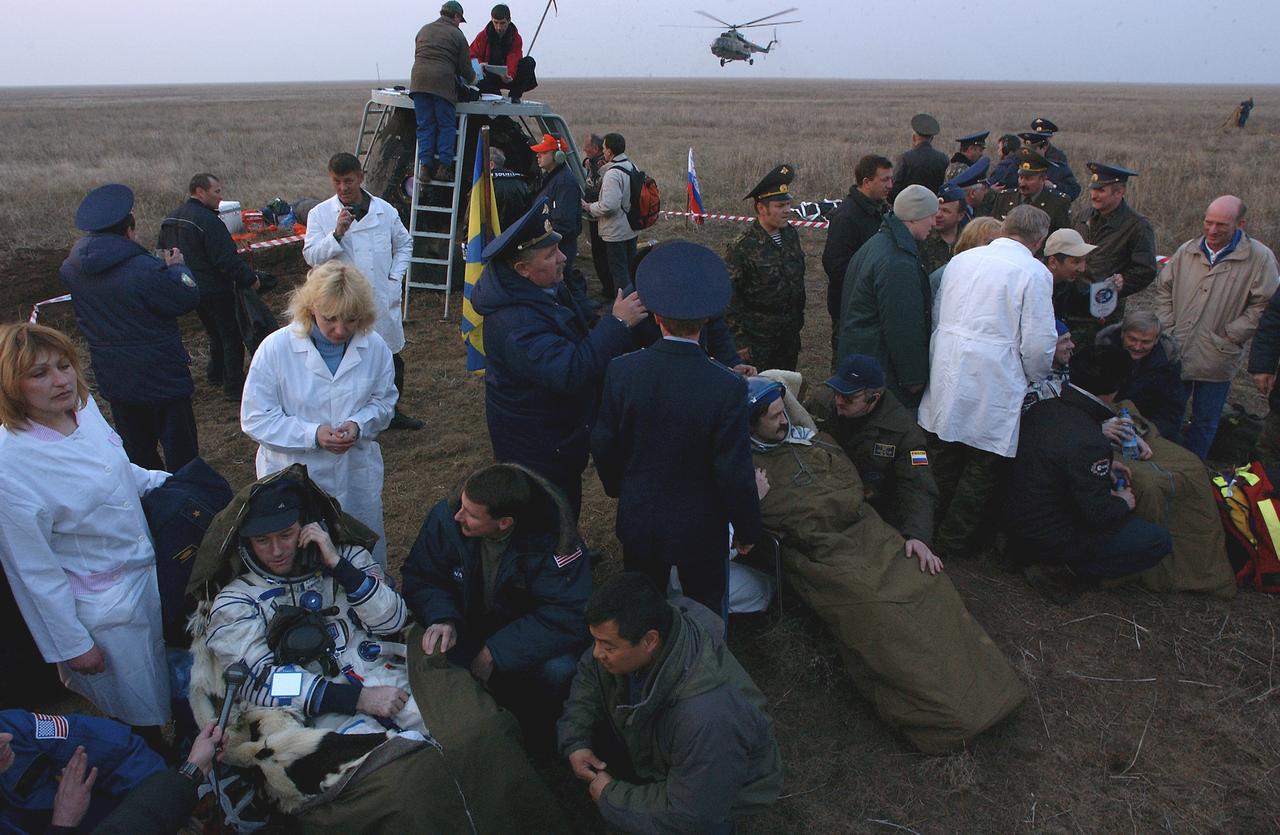
Expedition 8 Commander Mike Foale, lower left, Soyuz Flight Engineer Alexander Kaleri and European Space Agency astronaut Andre Kuipers of the Netherlands, partially hidden, are tended to after touching down in north central Kazakhstan, Friday, April 30, 2004. Foale and Kaleri completed 195 days in space aboard the International Space Station, while Kuipers returned after an 11-day research mission as part of a commercial agreement between ESA and the Russian Federal Space Agency. Photo Credit (NASA/Bill Ingalls)
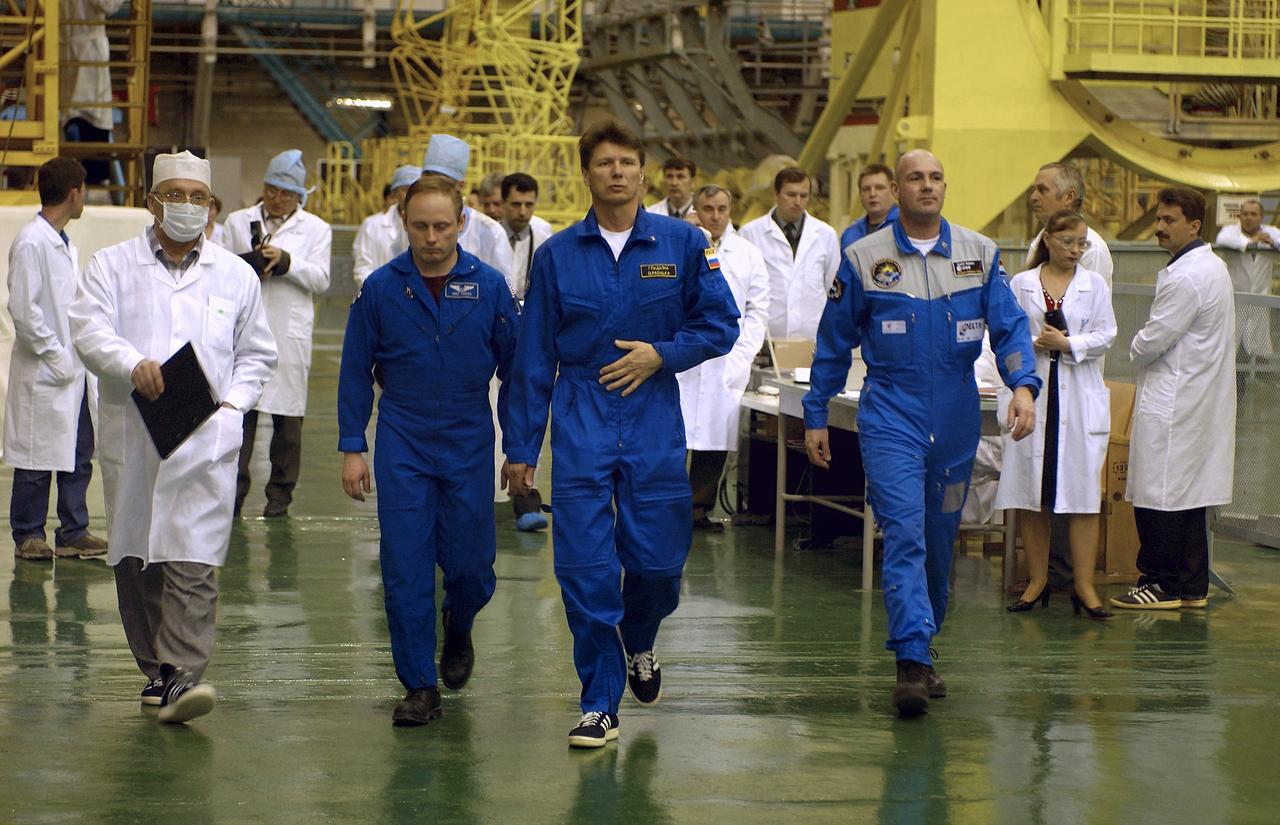
NASA Science Officer Mike Fincke, left, Expedition 9 Commander Gennady Padalka, center and Flight Engineer and European Space Agency astronaut Andre Kuipers of the Netherlands walk from the Soyuz capsule at building 254 at the Baikonur Cosmodrome after their final fit check in the Soyuz, Wednesday, April 14, 2004, in Baikonur, Kazakhstan. Photo Credit: (NASA/Bill Ingalls)
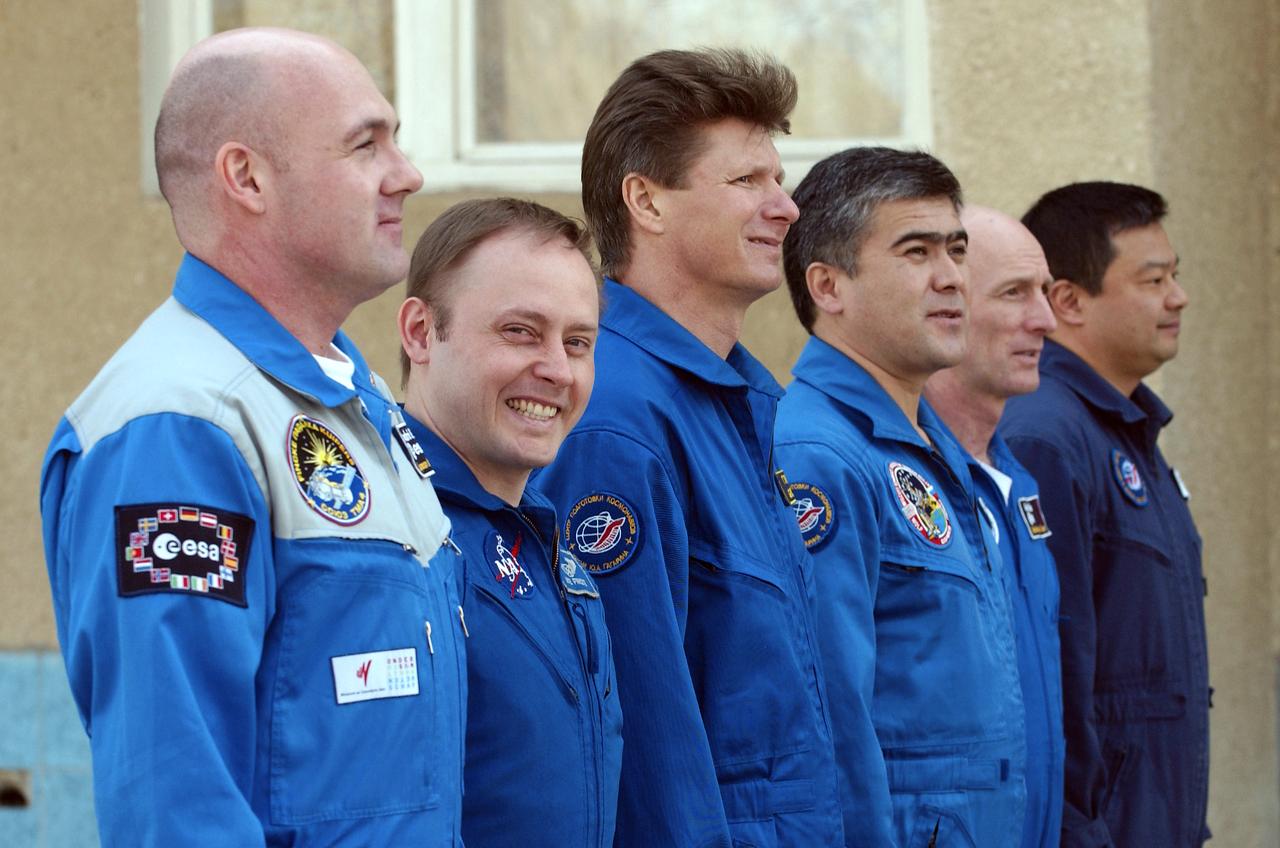
Left to Right: European Space Agency astronaut Andre Kuipers of the Netherlands, Expedition 9 Flight Engineer and NASA Science Officer Mike Fincke, Expedition 9 Commander Gennady Padalka, Backup Flight Engineer Salizhan Sharipov, backup European Space Agency astronaut Gerhard Thiele of Germany, NASA Expedition 9 backup Commander Leroy Chiao, prepare for the flag raising ceremony at the Cosmonaut Hotel, Thursday, April 15, 2004, in Baikonur, Kazakhstan. Photo Credit: (NASA/Bill Ingalls)
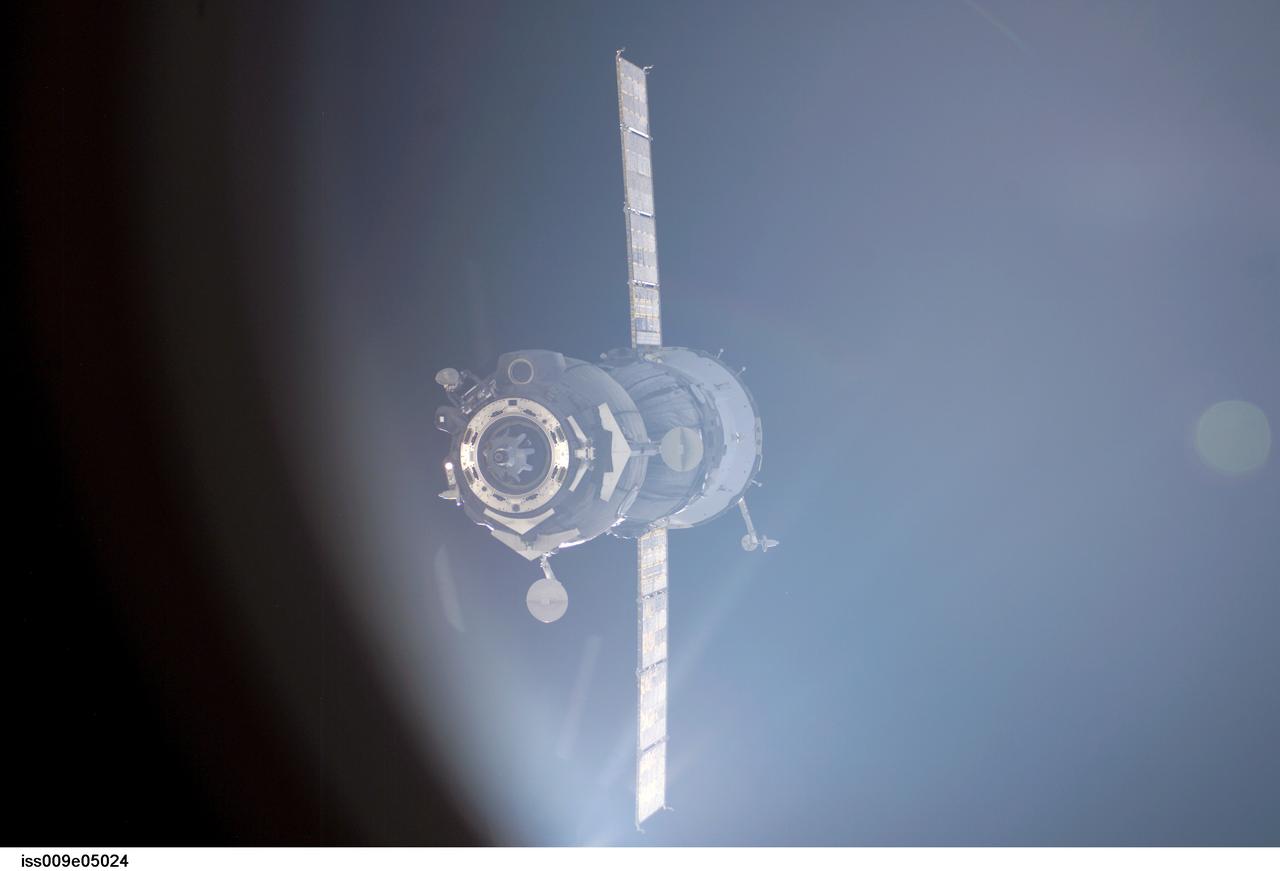
ISS009-E-05024 (29 April 2004) --- As seen through a window on the International Space Station (ISS), the Soyuz TMA-3 capsule departs from the Station carrying astronaut C. Michael Foale, Expedition 8 commander and NASA ISS science officer; cosmonaut Alexander Y. Kaleri, flight engineer representing Russia’s Federal Space Agency; and European Space Agency (ESA) astronaut Andre Kuipers of the Netherlands. Undocking occurred at 3:52 p.m. (CDT) on April 29.
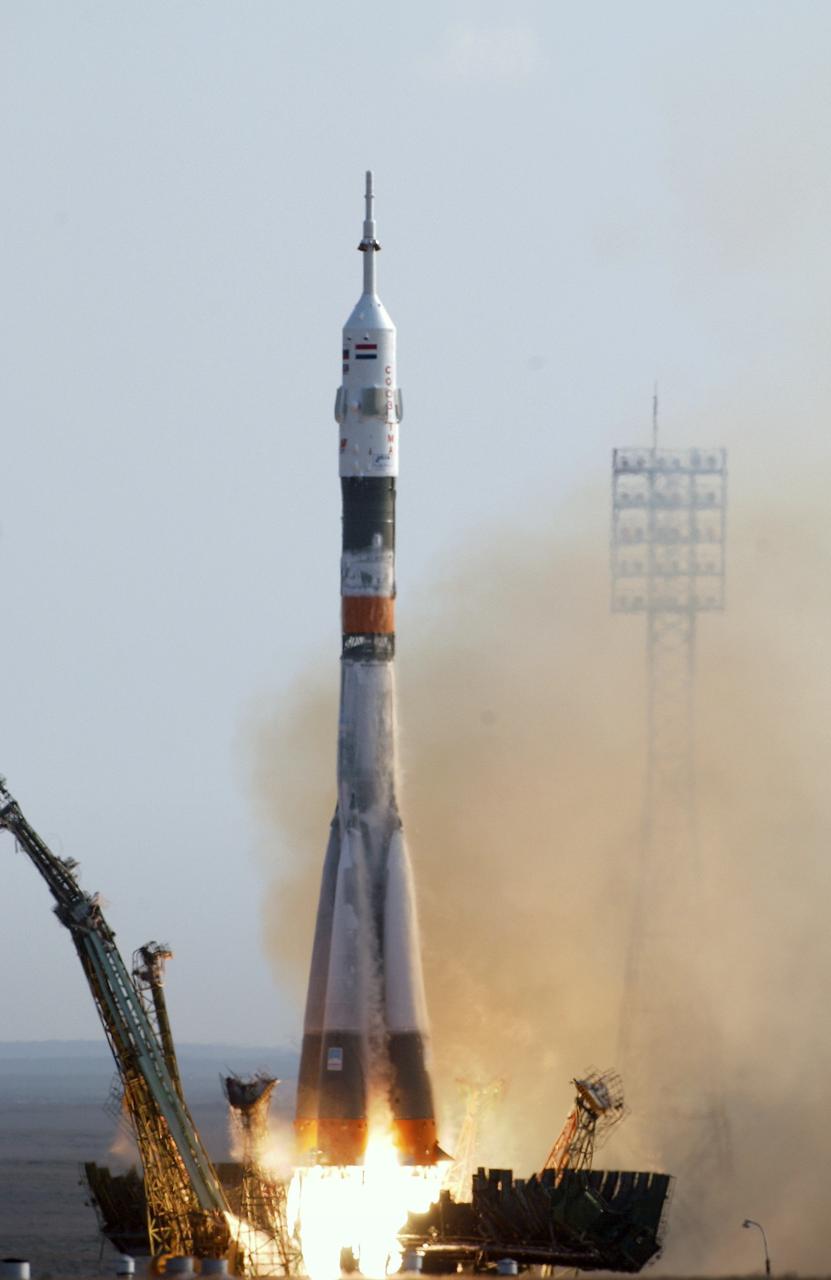
The Soyuz TMA-4 vehicle blasts off from the Baikonur Cosmodrome in Kazakhstan, Monday, April 19, 2004 carrying Expedition 9 Commander Gennady Padalka, Flight Engineer and NASA International Space Station Science Officer Michael Fincke and European Space Agency astronaut Andre Kuipers of the Netherlands to the International Space Station. Padalka and Fincke will spend six months on the Station, while Kuipers returns home April 30 with the Expedition 8 crew. Photo Credit: (NASA/Bill Ingalls)
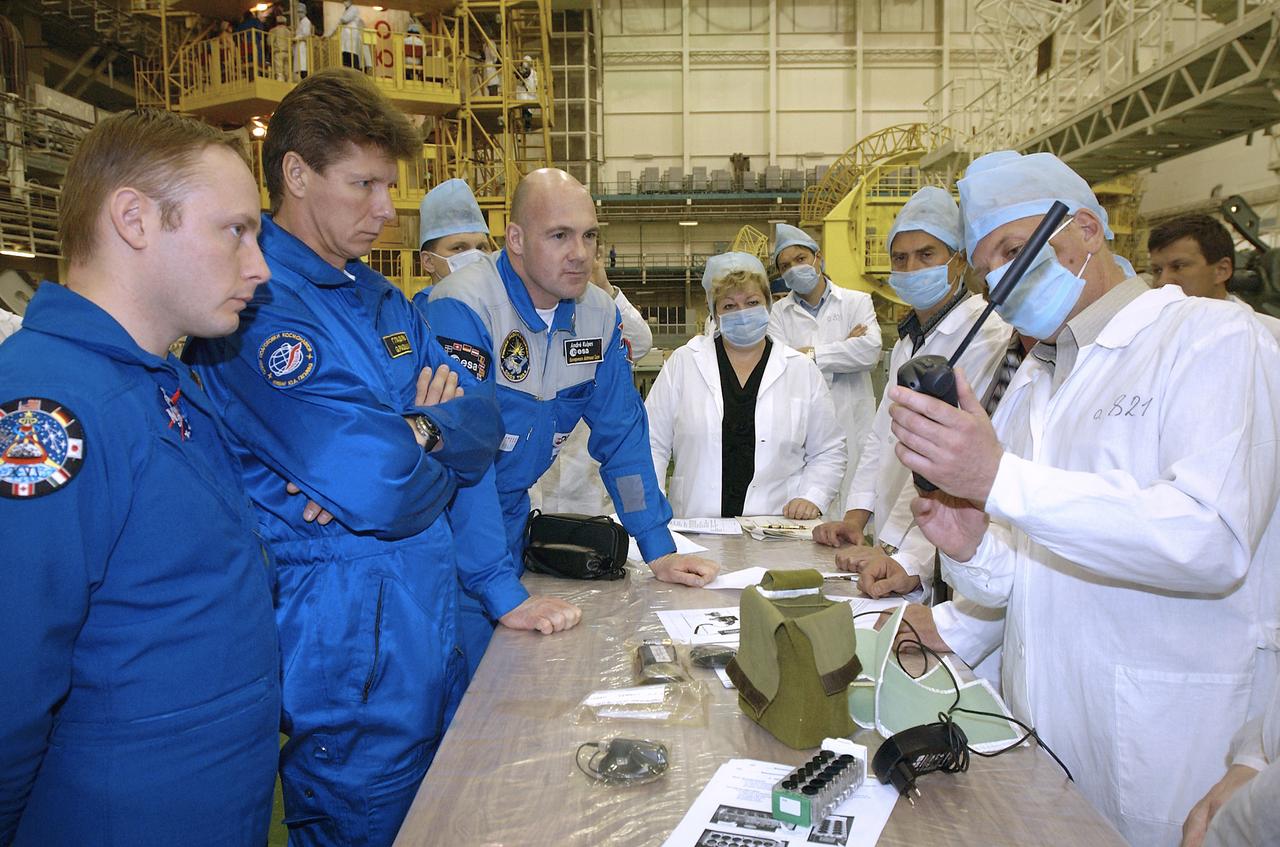
Expedition 9 Science Officer and Flight Engineer Mike Fincke, left, Expedition 9 Commander Gennady Padalka, second from left and Flight Engineer and European Space Agency astronaut Andre Kuipers of the Netherlands listen to instructions on satellite phone and GPS use at building 254 at Baikonur Cosmodrome Wednesday, April 14, 2004, in Baikonur, Kazakhstan. Photo Credit: (NASA/Bill Ingalls)
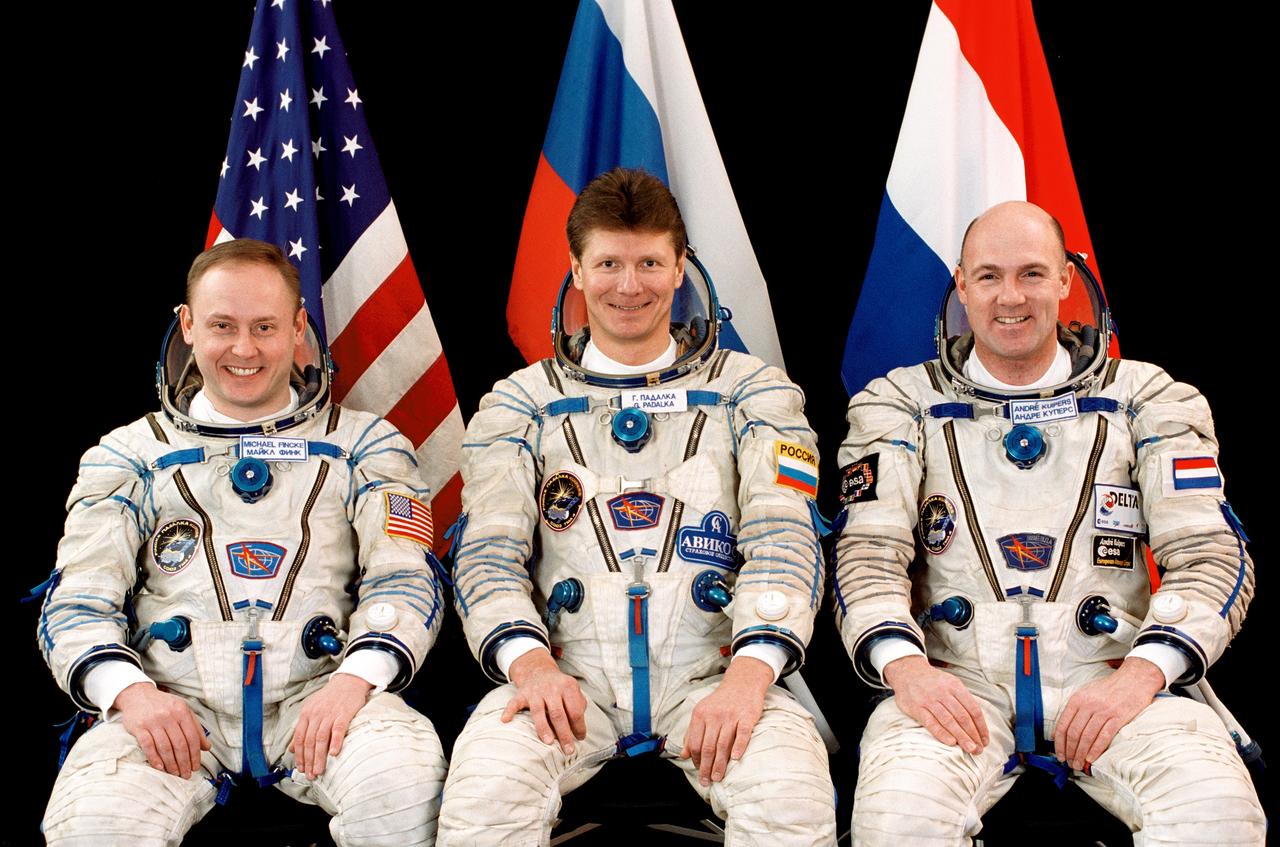
JSC2004-E-13883 (March 2004) --- The Expedition 9 crewmembers and European Space Agency (ESA) Soyuz crewmember Andre Kuipers (right) of the Netherlands, wearing Russian Sokol suits, take a break from training to pose for a portrait at the Gagarin Cosmonaut Training Center, Star City, Russia. From the left are astronaut Edward M. (Mike) Fincke, NASA ISS science officer and flight engineer, and cosmonaut Gennady I. Padalka, commander representing the Federal Space Agency.
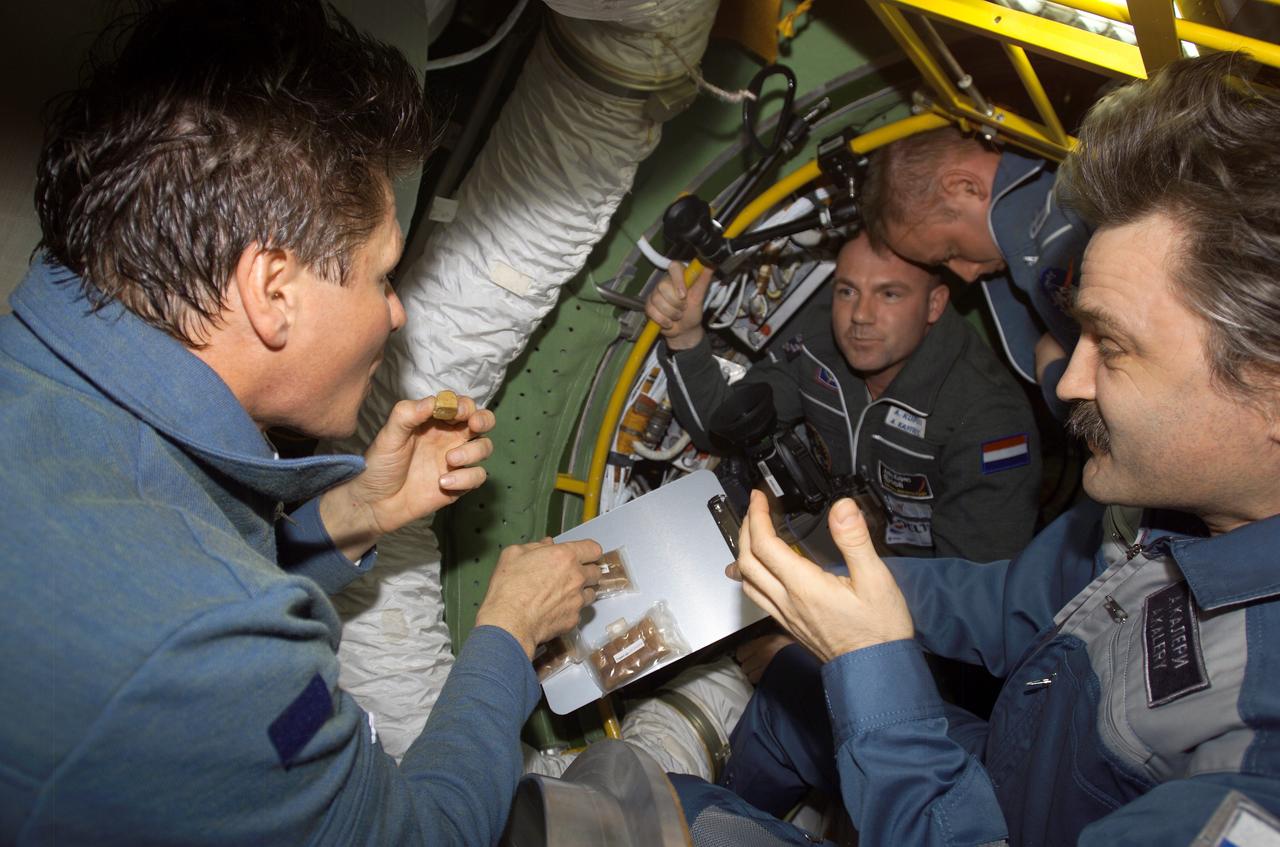
ISS008-E-21947 (21 April 2004) --- Cosmonaut Gennady I. Padalka (left), Expedition 9 commander, partakes of a traditional greeting of salt and bread presented by cosmonaut Alexander Y. Kaleri (right), Expedition 8 flight engineer, both representing Russia’s Federal Space Agency. European Space Agency (ESA) astronaut Andre Kuipers of the Netherlands and astronaut Edward M. (Mike) Fincke, Expedition 9 NASA ISS science officer and flight engineer, are visible in the background.